window.__IS_SSR__=true
window.__INITIAL_STATE__={
"attachmentsReducer": {
"audio_0": {
"type": "attachments",
"id": "audio_0",
"imgSizes": {
"kqedFullSize": {
"file": "https://ww2.kqed.org/news/wp-content/themes/KQED-unified/img/audio_bgs/background0.jpg"
}
}
},
"audio_1": {
"type": "attachments",
"id": "audio_1",
"imgSizes": {
"kqedFullSize": {
"file": "https://ww2.kqed.org/news/wp-content/themes/KQED-unified/img/audio_bgs/background1.jpg"
}
}
},
"audio_2": {
"type": "attachments",
"id": "audio_2",
"imgSizes": {
"kqedFullSize": {
"file": "https://ww2.kqed.org/news/wp-content/themes/KQED-unified/img/audio_bgs/background2.jpg"
}
}
},
"audio_3": {
"type": "attachments",
"id": "audio_3",
"imgSizes": {
"kqedFullSize": {
"file": "https://ww2.kqed.org/news/wp-content/themes/KQED-unified/img/audio_bgs/background3.jpg"
}
}
},
"audio_4": {
"type": "attachments",
"id": "audio_4",
"imgSizes": {
"kqedFullSize": {
"file": "https://ww2.kqed.org/news/wp-content/themes/KQED-unified/img/audio_bgs/background4.jpg"
}
}
},
"placeholder": {
"type": "attachments",
"id": "placeholder",
"imgSizes": {
"thumbnail": {
"file": "https://cdn.kqed.org/wp-content/uploads/2024/12/KQED-Default-Image-816638274-2000x1333-1-160x107.jpg",
"width": 160,
"height": 107,
"mimeType": "image/jpeg"
},
"medium": {
"file": "https://cdn.kqed.org/wp-content/uploads/2024/12/KQED-Default-Image-816638274-2000x1333-1-800x533.jpg",
"width": 800,
"height": 533,
"mimeType": "image/jpeg"
},
"medium_large": {
"file": "https://cdn.kqed.org/wp-content/uploads/2024/12/KQED-Default-Image-816638274-2000x1333-1-768x512.jpg",
"width": 768,
"height": 512,
"mimeType": "image/jpeg"
},
"large": {
"file": "https://cdn.kqed.org/wp-content/uploads/2024/12/KQED-Default-Image-816638274-2000x1333-1-1020x680.jpg",
"width": 1020,
"height": 680,
"mimeType": "image/jpeg"
},
"1536x1536": {
"file": "https://cdn.kqed.org/wp-content/uploads/2024/12/KQED-Default-Image-816638274-2000x1333-1-1536x1024.jpg",
"width": 1536,
"height": 1024,
"mimeType": "image/jpeg"
},
"fd-lrg": {
"file": "https://cdn.kqed.org/wp-content/uploads/2024/12/KQED-Default-Image-816638274-2000x1333-1-1536x1024.jpg",
"width": 1536,
"height": 1024,
"mimeType": "image/jpeg"
},
"fd-med": {
"file": "https://cdn.kqed.org/wp-content/uploads/2024/12/KQED-Default-Image-816638274-2000x1333-1-1020x680.jpg",
"width": 1020,
"height": 680,
"mimeType": "image/jpeg"
},
"fd-sm": {
"file": "https://cdn.kqed.org/wp-content/uploads/2024/12/KQED-Default-Image-816638274-2000x1333-1-800x533.jpg",
"width": 800,
"height": 533,
"mimeType": "image/jpeg"
},
"post-thumbnail": {
"file": "https://cdn.kqed.org/wp-content/uploads/2024/12/KQED-Default-Image-816638274-2000x1333-1-672x372.jpg",
"width": 672,
"height": 372,
"mimeType": "image/jpeg"
},
"twentyfourteen-full-width": {
"file": "https://cdn.kqed.org/wp-content/uploads/2024/12/KQED-Default-Image-816638274-2000x1333-1-1038x576.jpg",
"width": 1038,
"height": 576,
"mimeType": "image/jpeg"
},
"xxsmall": {
"file": "https://cdn.kqed.org/wp-content/uploads/2024/12/KQED-Default-Image-816638274-2000x1333-1-160x107.jpg",
"width": 160,
"height": 107,
"mimeType": "image/jpeg"
},
"xsmall": {
"file": "https://cdn.kqed.org/wp-content/uploads/2024/12/KQED-Default-Image-816638274-2000x1333-1-672x372.jpg",
"width": 672,
"height": 372,
"mimeType": "image/jpeg"
},
"small": {
"file": "https://cdn.kqed.org/wp-content/uploads/2024/12/KQED-Default-Image-816638274-2000x1333-1-672x372.jpg",
"width": 672,
"height": 372,
"mimeType": "image/jpeg"
},
"xlarge": {
"file": "https://cdn.kqed.org/wp-content/uploads/2024/12/KQED-Default-Image-816638274-2000x1333-1-1020x680.jpg",
"width": 1020,
"height": 680,
"mimeType": "image/jpeg"
},
"full-width": {
"file": "https://cdn.kqed.org/wp-content/uploads/2024/12/KQED-Default-Image-816638274-2000x1333-1-1920x1280.jpg",
"width": 1920,
"height": 1280,
"mimeType": "image/jpeg"
},
"guest-author-32": {
"file": "https://cdn.kqed.org/wp-content/uploads/2025/01/KQED-Default-Image-816638274-1333x1333-1-160x160.jpg",
"width": 32,
"height": 32,
"mimeType": "image/jpeg"
},
"guest-author-50": {
"file": "https://cdn.kqed.org/wp-content/uploads/2025/01/KQED-Default-Image-816638274-1333x1333-1-160x160.jpg",
"width": 50,
"height": 50,
"mimeType": "image/jpeg"
},
"guest-author-64": {
"file": "https://cdn.kqed.org/wp-content/uploads/2025/01/KQED-Default-Image-816638274-1333x1333-1-160x160.jpg",
"width": 64,
"height": 64,
"mimeType": "image/jpeg"
},
"guest-author-96": {
"file": "https://cdn.kqed.org/wp-content/uploads/2025/01/KQED-Default-Image-816638274-1333x1333-1-160x160.jpg",
"width": 96,
"height": 96,
"mimeType": "image/jpeg"
},
"guest-author-128": {
"file": "https://cdn.kqed.org/wp-content/uploads/2025/01/KQED-Default-Image-816638274-1333x1333-1-160x160.jpg",
"width": 128,
"height": 128,
"mimeType": "image/jpeg"
},
"detail": {
"file": "https://cdn.kqed.org/wp-content/uploads/2025/01/KQED-Default-Image-816638274-1333x1333-1-160x160.jpg",
"width": 160,
"height": 160,
"mimeType": "image/jpeg"
},
"kqedFullSize": {
"file": "https://cdn.kqed.org/wp-content/uploads/2024/12/KQED-Default-Image-816638274-2000x1333-1.jpg",
"width": 2000,
"height": 1333
}
}
},
"news_11906434": {
"type": "attachments",
"id": "news_11906434",
"meta": {
"index": "attachments_1716263798",
"site": "news",
"id": "11906434",
"found": true
},
"parent": 11906302,
"imgSizes": {
"twentyfourteen-full-width": {
"file": "https://ww2.kqed.org/app/uploads/sites/10/2022/02/UkraineCH-1038x576.jpg",
"width": 1038,
"mimeType": "image/jpeg",
"height": 576
},
"thumbnail": {
"file": "https://ww2.kqed.org/app/uploads/sites/10/2022/02/UkraineCH-160x107.jpg",
"width": 160,
"mimeType": "image/jpeg",
"height": 107
},
"post-thumbnail": {
"file": "https://ww2.kqed.org/app/uploads/sites/10/2022/02/UkraineCH-672x372.jpg",
"width": 672,
"mimeType": "image/jpeg",
"height": 372
},
"kqedFullSize": {
"file": "https://ww2.kqed.org/app/uploads/sites/10/2022/02/UkraineCH.jpg",
"width": 1620,
"height": 1080
},
"large": {
"file": "https://ww2.kqed.org/app/uploads/sites/10/2022/02/UkraineCH-1020x680.jpg",
"width": 1020,
"mimeType": "image/jpeg",
"height": 680
},
"1536x1536": {
"file": "https://ww2.kqed.org/app/uploads/sites/10/2022/02/UkraineCH-1536x1024.jpg",
"width": 1536,
"mimeType": "image/jpeg",
"height": 1024
},
"medium": {
"file": "https://ww2.kqed.org/app/uploads/sites/10/2022/02/UkraineCH-800x533.jpg",
"width": 800,
"mimeType": "image/jpeg",
"height": 533
}
},
"publishDate": 1645754247,
"modified": 1646091334,
"caption": "Demonstrators wrapped in Ukrainian flags gather in San Francisco Civic Center on Feb. 24, 2022. ",
"description": "Hundreds of demonstrators gather in front of City Hall in San Francisco on Feb. 24, 2022, to protest the Russian invasion of Ukraine. Longstanding ties between Ukraine and the Bay Area's tech industry mean numerous companies have been working on contingency plans to make sure workers and their families are safe. ",
"title": "UkraineCH",
"credit": "Beth LaBerge/KQED",
"status": "inherit",
"altTag": "group shot of dozens of people holding protest signs and yellow and blue Ukrainian flags",
"isLoading": false,
"fetchFailed": false
},
"news_11905487": {
"type": "attachments",
"id": "news_11905487",
"meta": {
"index": "attachments_1716263798",
"site": "news",
"id": "11905487",
"found": true
},
"parent": 11905230,
"imgSizes": {
"twentyfourteen-full-width": {
"file": "https://ww2.kqed.org/app/uploads/sites/10/2022/02/GettyImages-1235410527-1038x576.jpg",
"width": 1038,
"mimeType": "image/jpeg",
"height": 576
},
"thumbnail": {
"file": "https://ww2.kqed.org/app/uploads/sites/10/2022/02/GettyImages-1235410527-160x107.jpg",
"width": 160,
"mimeType": "image/jpeg",
"height": 107
},
"post-thumbnail": {
"file": "https://ww2.kqed.org/app/uploads/sites/10/2022/02/GettyImages-1235410527-672x372.jpg",
"width": 672,
"mimeType": "image/jpeg",
"height": 372
},
"kqedFullSize": {
"file": "https://ww2.kqed.org/app/uploads/sites/10/2022/02/GettyImages-1235410527-scaled-e1645129664958.jpg",
"width": 1920,
"height": 1281
},
"2048x2048": {
"file": "https://ww2.kqed.org/app/uploads/sites/10/2022/02/GettyImages-1235410527-2048x1366.jpg",
"width": 2048,
"mimeType": "image/jpeg",
"height": 1366
},
"large": {
"file": "https://ww2.kqed.org/app/uploads/sites/10/2022/02/GettyImages-1235410527-1020x680.jpg",
"width": 1020,
"mimeType": "image/jpeg",
"height": 680
},
"1536x1536": {
"file": "https://ww2.kqed.org/app/uploads/sites/10/2022/02/GettyImages-1235410527-1536x1025.jpg",
"width": 1536,
"mimeType": "image/jpeg",
"height": 1025
},
"full-width": {
"file": "https://ww2.kqed.org/app/uploads/sites/10/2022/02/GettyImages-1235410527-1920x1281.jpg",
"width": 1920,
"mimeType": "image/jpeg",
"height": 1281
},
"medium": {
"file": "https://ww2.kqed.org/app/uploads/sites/10/2022/02/GettyImages-1235410527-800x534.jpg",
"width": 800,
"mimeType": "image/jpeg",
"height": 534
}
},
"publishDate": 1645112635,
"modified": 1645139970,
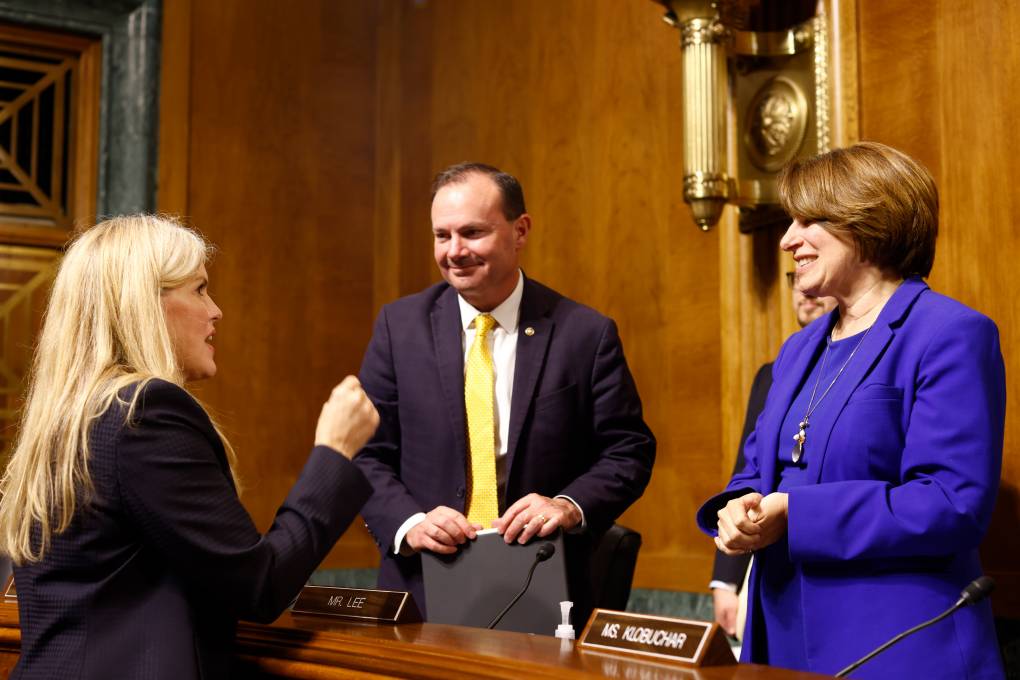
"caption": "Sen. Amy Klobuchar, D-Minnesota (right), chair of the Senate Judiciary Subcommittee on Competition Policy, Antitrust, and Consumer Rights, and ranking member Sen. Mike Lee, R-Utah, chat with Sheila Colclasure, global chief digital responsibility and public policy officer at IPG Kinesso, at the conclusion of a hearing on big data on Sept. 21, 2021, in Washington, D.C.",
"description": "Sen. Amy Klobuchar (D-MI) and chair of the Senate Judiciary Subcommittee on Competition Policy, Antitrust, and Consumer Rights, and ranking member Sen. Mike Lee (R-UT) chat with Sheila Colclasure, global chief digital responsibility and public policy officer at IPG Kinesso, after the conclusion of a hearing on September 21, 2021 in Washington, D.C. The hearing is titled Big Data, Big Questions: Implications for Competition and Consumers. ",
"title": "Senate Judiciary Hears Testimony From Tech Executives On Competition For Consumers",
"credit": "Ting Shen-Pool/Getty Images",
"status": "inherit",
"altTag": "Two U.S. senators chat with a technology company in a wood-paneled room at the U.S. Capitol.",
"isLoading": false,
"fetchFailed": false
},
"news_11904766": {
"type": "attachments",
"id": "news_11904766",
"meta": {
"index": "attachments_1716263798",
"site": "news",
"id": "11904766",
"found": true
},
"parent": 11904753,
"imgSizes": {
"twentyfourteen-full-width": {
"file": "https://ww2.kqed.org/app/uploads/sites/10/2022/02/RS53688_GettyImages-1008732798-qut-1038x576.jpg",
"width": 1038,
"mimeType": "image/jpeg",
"height": 576
},
"thumbnail": {
"file": "https://ww2.kqed.org/app/uploads/sites/10/2022/02/RS53688_GettyImages-1008732798-qut-160x107.jpg",
"width": 160,
"mimeType": "image/jpeg",
"height": 107
},
"post-thumbnail": {
"file": "https://ww2.kqed.org/app/uploads/sites/10/2022/02/RS53688_GettyImages-1008732798-qut-672x372.jpg",
"width": 672,
"mimeType": "image/jpeg",
"height": 372
},
"kqedFullSize": {
"file": "https://ww2.kqed.org/app/uploads/sites/10/2022/02/RS53688_GettyImages-1008732798-qut.jpg",
"width": 1920,
"height": 1280
},
"large": {
"file": "https://ww2.kqed.org/app/uploads/sites/10/2022/02/RS53688_GettyImages-1008732798-qut-1020x680.jpg",
"width": 1020,
"mimeType": "image/jpeg",
"height": 680
},
"1536x1536": {
"file": "https://ww2.kqed.org/app/uploads/sites/10/2022/02/RS53688_GettyImages-1008732798-qut-1536x1024.jpg",
"width": 1536,
"mimeType": "image/jpeg",
"height": 1024
},
"medium": {
"file": "https://ww2.kqed.org/app/uploads/sites/10/2022/02/RS53688_GettyImages-1008732798-qut-800x533.jpg",
"width": 800,
"mimeType": "image/jpeg",
"height": 533
}
},
"publishDate": 1644537054,
"modified": 1644539214,
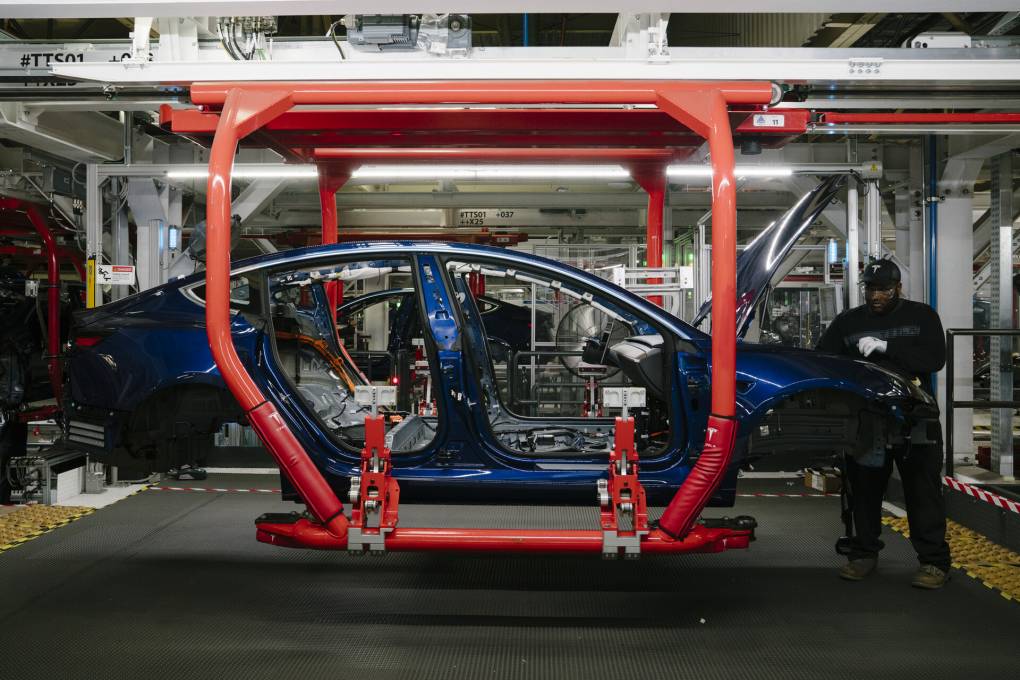
"caption": "A Tesla employee works on the general assembly of a Tesla Model 3 at the company's factory in Fremont in July of 2018. California sued the carmaker this week after receiving hundreds of worker complaints, alleging the company discriminated against Black workers. ",
"description": null,
"title": "Tour of Tesla Factor in Fremont, California",
"credit": "Mason Trinca/Getty Images",
"status": "inherit",
"altTag": "A Black Tesla worker stands next to a partially assembled car on a factory assembly line",
"isLoading": false,
"fetchFailed": false
},
"news_11902512": {
"type": "attachments",
"id": "news_11902512",
"meta": {
"index": "attachments_1716263798",
"site": "news",
"id": "11902512",
"found": true
},
"parent": 11902511,
"imgSizes": {
"twentyfourteen-full-width": {
"file": "https://ww2.kqed.org/app/uploads/sites/10/2022/01/ap135986392875_custom-bb11b3d6df1bbc0f6ce02544503a31d599b2af5b-1038x576.jpg",
"width": 1038,
"mimeType": "image/jpeg",
"height": 576
},
"thumbnail": {
"file": "https://ww2.kqed.org/app/uploads/sites/10/2022/01/ap135986392875_custom-bb11b3d6df1bbc0f6ce02544503a31d599b2af5b-160x107.jpg",
"width": 160,
"mimeType": "image/jpeg",
"height": 107
},
"post-thumbnail": {
"file": "https://ww2.kqed.org/app/uploads/sites/10/2022/01/ap135986392875_custom-bb11b3d6df1bbc0f6ce02544503a31d599b2af5b-672x372.jpg",
"width": 672,
"mimeType": "image/jpeg",
"height": 372
},
"kqedFullSize": {
"file": "https://ww2.kqed.org/app/uploads/sites/10/2022/01/ap135986392875_custom-bb11b3d6df1bbc0f6ce02544503a31d599b2af5b-scaled-e1643058757713.jpg",
"width": 1920,
"height": 1279
},
"2048x2048": {
"file": "https://ww2.kqed.org/app/uploads/sites/10/2022/01/ap135986392875_custom-bb11b3d6df1bbc0f6ce02544503a31d599b2af5b-2048x1364.jpg",
"width": 2048,
"mimeType": "image/jpeg",
"height": 1364
},
"large": {
"file": "https://ww2.kqed.org/app/uploads/sites/10/2022/01/ap135986392875_custom-bb11b3d6df1bbc0f6ce02544503a31d599b2af5b-1020x679.jpg",
"width": 1020,
"mimeType": "image/jpeg",
"height": 679
},
"1536x1536": {
"file": "https://ww2.kqed.org/app/uploads/sites/10/2022/01/ap135986392875_custom-bb11b3d6df1bbc0f6ce02544503a31d599b2af5b-1536x1023.jpg",
"width": 1536,
"mimeType": "image/jpeg",
"height": 1023
},
"full-width": {
"file": "https://ww2.kqed.org/app/uploads/sites/10/2022/01/ap135986392875_custom-bb11b3d6df1bbc0f6ce02544503a31d599b2af5b-1920x1279.jpg",
"width": 1920,
"mimeType": "image/jpeg",
"height": 1279
},
"medium": {
"file": "https://ww2.kqed.org/app/uploads/sites/10/2022/01/ap135986392875_custom-bb11b3d6df1bbc0f6ce02544503a31d599b2af5b-800x533.jpg",
"width": 800,
"mimeType": "image/jpeg",
"height": 533
}
},
"publishDate": 1643058085,
"modified": 1643135162,
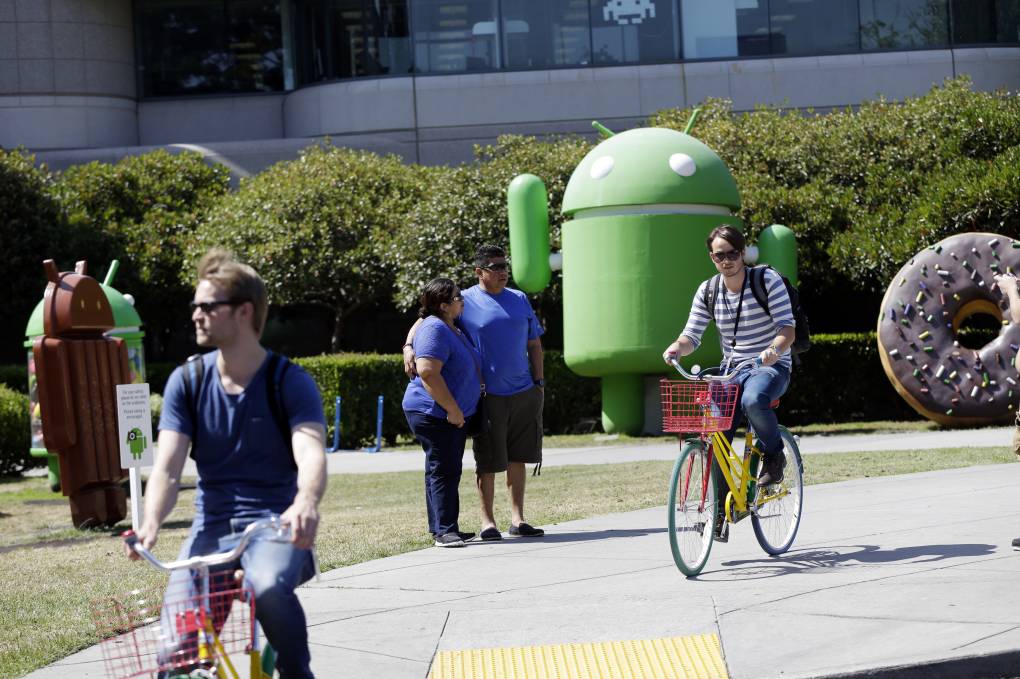
"caption": "Cyclists and visitors converge on the Google campus on Thursday, June 5, 2014, in Mountain View. ",
"description": "Cyclists and visitors converge on the Google campus on Thursday, June 5, 2014, in Mountain View, Calif. (AP Photo/Marcio Jose Sanchez)",
"title": "While Wilkinson suggests companies rethink extravagant amenities, he does think outdoor spaces should be part of any layout.",
"credit": "Marcio Jose Sanchez/AP",
"status": "inherit",
"altTag": "Googleplex campus",
"isLoading": false,
"fetchFailed": false
},
"news_11900965": {
"type": "attachments",
"id": "news_11900965",
"meta": {
"index": "attachments_1716263798",
"site": "news",
"id": "11900965",
"found": true
},
"parent": 11900964,
"imgSizes": {
"twentyfourteen-full-width": {
"file": "https://ww2.kqed.org/app/uploads/sites/10/2022/01/ap20171734384751_custom-492f064d88a92197e72ae78a3b25f13553c07c96-1038x576.jpg",
"width": 1038,
"mimeType": "image/jpeg",
"height": 576
},
"thumbnail": {
"file": "https://ww2.kqed.org/app/uploads/sites/10/2022/01/ap20171734384751_custom-492f064d88a92197e72ae78a3b25f13553c07c96-160x107.jpg",
"width": 160,
"mimeType": "image/jpeg",
"height": 107
},
"post-thumbnail": {
"file": "https://ww2.kqed.org/app/uploads/sites/10/2022/01/ap20171734384751_custom-492f064d88a92197e72ae78a3b25f13553c07c96-672x372.jpg",
"width": 672,
"mimeType": "image/jpeg",
"height": 372
},
"kqedFullSize": {
"file": "https://ww2.kqed.org/app/uploads/sites/10/2022/01/ap20171734384751_custom-492f064d88a92197e72ae78a3b25f13553c07c96-scaled-e1641496915898.jpg",
"width": 1920,
"height": 1281
},
"2048x2048": {
"file": "https://ww2.kqed.org/app/uploads/sites/10/2022/01/ap20171734384751_custom-492f064d88a92197e72ae78a3b25f13553c07c96-2048x1367.jpg",
"width": 2048,
"mimeType": "image/jpeg",
"height": 1367
},
"large": {
"file": "https://ww2.kqed.org/app/uploads/sites/10/2022/01/ap20171734384751_custom-492f064d88a92197e72ae78a3b25f13553c07c96-1020x681.jpg",
"width": 1020,
"mimeType": "image/jpeg",
"height": 681
},
"1536x1536": {
"file": "https://ww2.kqed.org/app/uploads/sites/10/2022/01/ap20171734384751_custom-492f064d88a92197e72ae78a3b25f13553c07c96-1536x1025.jpg",
"width": 1536,
"mimeType": "image/jpeg",
"height": 1025
},
"full-width": {
"file": "https://ww2.kqed.org/app/uploads/sites/10/2022/01/ap20171734384751_custom-492f064d88a92197e72ae78a3b25f13553c07c96-1920x1281.jpg",
"width": 1920,
"mimeType": "image/jpeg",
"height": 1281
},
"medium": {
"file": "https://ww2.kqed.org/app/uploads/sites/10/2022/01/ap20171734384751_custom-492f064d88a92197e72ae78a3b25f13553c07c96-800x534.jpg",
"width": 800,
"mimeType": "image/jpeg",
"height": 534
}
},
"publishDate": 1641496259,
"modified": 1641509247,
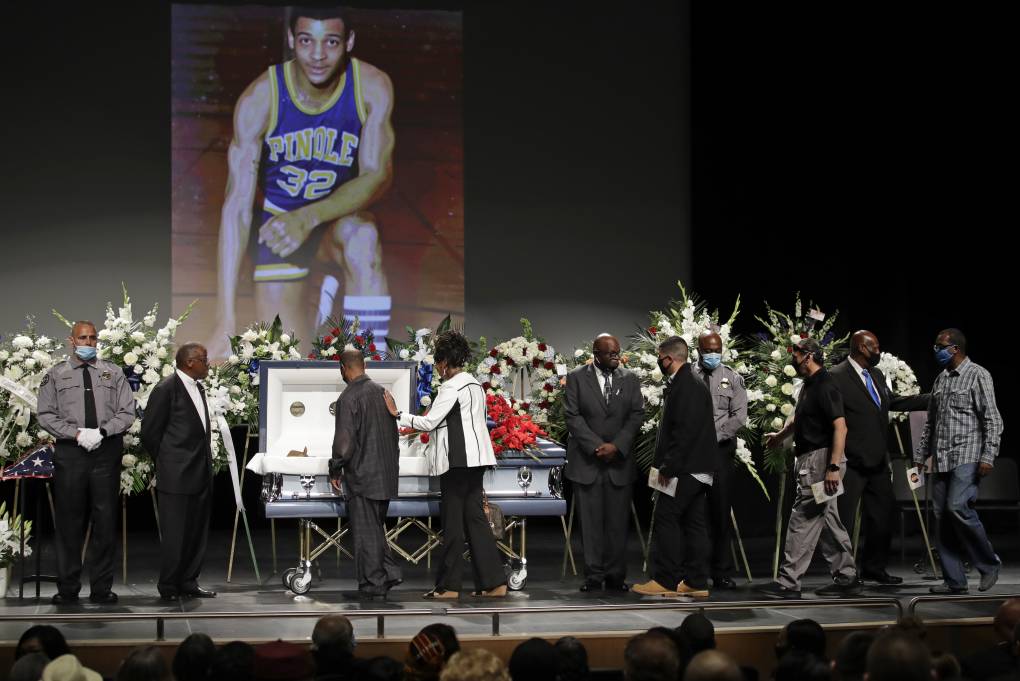
"caption": "Mourners view the body of federal protective services officer Dave Patrick Underwood after a memorial service on Friday, June 19, 2020, in Pinole. Underwood was fatally shot by a suspect investigators say had ties to right-wing extremists as he was guarding the Ronald V. Dellums Federal Building in Oakland, amid protests on May 29, 2020.",
"description": "Mourners view the body of Federal Protective Services Officer Dave Patrick Underwood after a memorial service on Friday, June 19, 2020, in Pinole. Underwood was fatally shot by a suspect investigators say had ties to right-wing extremists as he was guarding the Ronald V. Dellums Federal Building in Oakland, amid protests on May 29, 2020.",
"title": "Mourners view the body of Federal Protective Services Officer Dave Patrick Underwood after a memorial service in June 2020. Underwood was fatally shot as he was guarding a federal building in Oakland, Calif., amid George Floyd-related protests.",
"credit": "Ben Margot/AP",
"status": "inherit",
"altTag": "mourners file past an open casket funeral, a large photo of the deceased as a young man playing basketball appears in background",
"isLoading": false,
"fetchFailed": false
},
"news_11900932": {
"type": "attachments",
"id": "news_11900932",
"meta": {
"index": "attachments_1716263798",
"site": "news",
"id": "11900932",
"found": true
},
"parent": 11900856,
"imgSizes": {
"twentyfourteen-full-width": {
"file": "https://ww2.kqed.org/app/uploads/sites/10/2022/01/PaoAndHolmesDiptych-1038x576.jpg",
"width": 1038,
"mimeType": "image/jpeg",
"height": 576
},
"thumbnail": {
"file": "https://ww2.kqed.org/app/uploads/sites/10/2022/01/PaoAndHolmesDiptych-160x87.jpg",
"width": 160,
"mimeType": "image/jpeg",
"height": 87
},
"post-thumbnail": {
"file": "https://ww2.kqed.org/app/uploads/sites/10/2022/01/PaoAndHolmesDiptych-672x372.jpg",
"width": 672,
"mimeType": "image/jpeg",
"height": 372
},
"kqedFullSize": {
"file": "https://ww2.kqed.org/app/uploads/sites/10/2022/01/PaoAndHolmesDiptych.jpg",
"width": 1920,
"height": 1048
},
"large": {
"file": "https://ww2.kqed.org/app/uploads/sites/10/2022/01/PaoAndHolmesDiptych-1020x557.jpg",
"width": 1020,
"mimeType": "image/jpeg",
"height": 557
},
"1536x1536": {
"file": "https://ww2.kqed.org/app/uploads/sites/10/2022/01/PaoAndHolmesDiptych-1536x838.jpg",
"width": 1536,
"mimeType": "image/jpeg",
"height": 838
},
"medium": {
"file": "https://ww2.kqed.org/app/uploads/sites/10/2022/01/PaoAndHolmesDiptych-800x437.jpg",
"width": 800,
"mimeType": "image/jpeg",
"height": 437
}
},
"publishDate": 1641431068,
"modified": 1641433146,
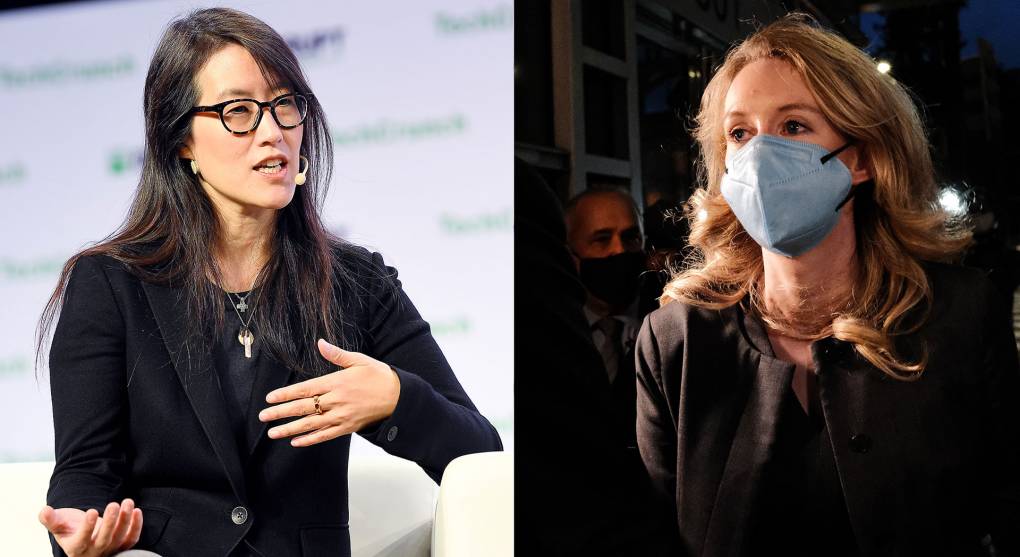
"caption": "Ellen Pao (left), co-founder and CEO of Project Include and former CEO of Reddit, said she was concerned that Elizabeth Holmes's fraud conviction would give investors 'an excuse to continue to avoid investing in women.' Holmes, the former CEO of Theranos (right), leaves a San José courthouse following her fraud conviction on Jan. 3, 2022. ",
"description": "Ellen Pao, co-founder and CEO of Project Include and former CEO of Reddit, said she was concerned that Elizabeth Holmes's fraud conviction would give investors 'an excuse to continue to avoid investing in women.' Holmes, the former CEO of Theranos (right), leaves a San Jose courthouse following her fraud conviction on Jan. 3. ",
"title": "PaoAndHolmesDiptych",
"credit": "Steve Jennings/Getty Images, David Odisho/Getty Images",
"status": "inherit",
"altTag": "side-by-side photos of Ellen Pao, left, speaking at a conference, and Elizabeth Holmes, right, leaving court after her conviction",
"isLoading": false,
"fetchFailed": false
},
"news_11900172": {
"type": "attachments",
"id": "news_11900172",
"meta": {
"index": "attachments_1716263798",
"site": "news",
"id": "11900172",
"found": true
},
"parent": 11899955,
"imgSizes": {
"twentyfourteen-full-width": {
"file": "https://ww2.kqed.org/app/uploads/sites/10/2021/12/crypto-illo-1-1038x576.jpg",
"width": 1038,
"mimeType": "image/jpeg",
"height": 576
},
"thumbnail": {
"file": "https://ww2.kqed.org/app/uploads/sites/10/2021/12/crypto-illo-1-160x108.jpg",
"width": 160,
"mimeType": "image/jpeg",
"height": 108
},
"post-thumbnail": {
"file": "https://ww2.kqed.org/app/uploads/sites/10/2021/12/crypto-illo-1-672x372.jpg",
"width": 672,
"mimeType": "image/jpeg",
"height": 372
},
"kqedFullSize": {
"file": "https://ww2.kqed.org/app/uploads/sites/10/2021/12/crypto-illo-1.jpg",
"width": 2000,
"height": 1350
},
"large": {
"file": "https://ww2.kqed.org/app/uploads/sites/10/2021/12/crypto-illo-1-1020x689.jpg",
"width": 1020,
"mimeType": "image/jpeg",
"height": 689
},
"1536x1536": {
"file": "https://ww2.kqed.org/app/uploads/sites/10/2021/12/crypto-illo-1-1536x1037.jpg",
"width": 1536,
"mimeType": "image/jpeg",
"height": 1037
},
"full-width": {
"file": "https://ww2.kqed.org/app/uploads/sites/10/2021/12/crypto-illo-1-1920x1296.jpg",
"width": 1920,
"mimeType": "image/jpeg",
"height": 1296
},
"medium": {
"file": "https://ww2.kqed.org/app/uploads/sites/10/2021/12/crypto-illo-1-800x540.jpg",
"width": 800,
"mimeType": "image/jpeg",
"height": 540
}
},
"publishDate": 1640283148,
"modified": 1640283547,
"caption": "Major banks have cracked down on sex workers using their financial services and shut down many accounts, fearing potential consequences. Seeing an underserved market in the adult entertainment industry, tech entrepreneurs have developed crypto startups with snappy names like CumRocket, TitCoin and Model-X.",
"description": "A illustration that shows three screens with figures in them, in different poses. Small pixelated coins are distributed through the image.",
"title": "crypto-illo (1)",
"credit": "Illustration by Anna Vignet/KQED",
"status": "inherit",
"altTag": "A illustration that shows three screens with figures in them, in different poses. Small pixelated coins are distributed through the image.",
"isLoading": false,
"fetchFailed": false
},
"news_11899594": {
"type": "attachments",
"id": "news_11899594",
"meta": {
"index": "attachments_1716263798",
"site": "news",
"id": "11899594",
"found": true
},
"parent": 11899593,
"imgSizes": {
"twentyfourteen-full-width": {
"file": "https://ww2.kqed.org/app/uploads/sites/10/2021/12/KNR_2021-_b-1038x576.png",
"width": 1038,
"mimeType": "image/png",
"height": 576
},
"thumbnail": {
"file": "https://ww2.kqed.org/app/uploads/sites/10/2021/12/KNR_2021-_b-160x90.png",
"width": 160,
"mimeType": "image/png",
"height": 90
},
"post-thumbnail": {
"file": "https://ww2.kqed.org/app/uploads/sites/10/2021/12/KNR_2021-_b-672x372.png",
"width": 672,
"mimeType": "image/png",
"height": 372
},
"kqedFullSize": {
"file": "https://ww2.kqed.org/app/uploads/sites/10/2021/12/KNR_2021-_b.png",
"width": 1920,
"height": 1080
},
"large": {
"file": "https://ww2.kqed.org/app/uploads/sites/10/2021/12/KNR_2021-_b-1020x574.png",
"width": 1020,
"mimeType": "image/png",
"height": 574
},
"1536x1536": {
"file": "https://ww2.kqed.org/app/uploads/sites/10/2021/12/KNR_2021-_b-1536x864.png",
"width": 1536,
"mimeType": "image/png",
"height": 864
},
"medium": {
"file": "https://ww2.kqed.org/app/uploads/sites/10/2021/12/KNR_2021-_b-800x450.png",
"width": 800,
"mimeType": "image/png",
"height": 450
}
},
"publishDate": 1639773438,
"modified": 1639773438,
"caption": null,
"description": null,
"title": "KNR_2021 _b",
"credit": null,
"status": "inherit",
"altTag": null,
"isLoading": false,
"fetchFailed": false
},
"news_11898974": {
"type": "attachments",
"id": "news_11898974",
"meta": {
"index": "attachments_1716263798",
"site": "news",
"id": "11898974",
"found": true
},
"parent": 11898973,
"imgSizes": {
"twentyfourteen-full-width": {
"file": "https://ww2.kqed.org/app/uploads/sites/10/2021/12/RS52837_009_SanFrancisco_UCSFVirtualReality_12102021-qut-1038x576.jpg",
"width": 1038,
"mimeType": "image/jpeg",
"height": 576
},
"thumbnail": {
"file": "https://ww2.kqed.org/app/uploads/sites/10/2021/12/RS52837_009_SanFrancisco_UCSFVirtualReality_12102021-qut-160x107.jpg",
"width": 160,
"mimeType": "image/jpeg",
"height": 107
},
"post-thumbnail": {
"file": "https://ww2.kqed.org/app/uploads/sites/10/2021/12/RS52837_009_SanFrancisco_UCSFVirtualReality_12102021-qut-672x372.jpg",
"width": 672,
"mimeType": "image/jpeg",
"height": 372
},
"kqedFullSize": {
"file": "https://ww2.kqed.org/app/uploads/sites/10/2021/12/RS52837_009_SanFrancisco_UCSFVirtualReality_12102021-qut.jpg",
"width": 1920,
"height": 1280
},
"large": {
"file": "https://ww2.kqed.org/app/uploads/sites/10/2021/12/RS52837_009_SanFrancisco_UCSFVirtualReality_12102021-qut-1020x680.jpg",
"width": 1020,
"mimeType": "image/jpeg",
"height": 680
},
"1536x1536": {
"file": "https://ww2.kqed.org/app/uploads/sites/10/2021/12/RS52837_009_SanFrancisco_UCSFVirtualReality_12102021-qut-1536x1024.jpg",
"width": 1536,
"mimeType": "image/jpeg",
"height": 1024
},
"medium": {
"file": "https://ww2.kqed.org/app/uploads/sites/10/2021/12/RS52837_009_SanFrancisco_UCSFVirtualReality_12102021-qut-800x533.jpg",
"width": 800,
"mimeType": "image/jpeg",
"height": 533
}
},
"publishDate": 1639446469,
"modified": 1639626738,
"caption": "Nova Wilson, program coordinator for the UCSF Institute for Global Health Sciences, instructs Dr. Mike Reid on using virtual reality equipment at UCSF offices in San Francisco on Dec. 10, 2021. The VR program is intended to teach doctors to have more empathy for their patients of color.",
"description": "Nova Wilson, program coordinator for UCSF Institute for Global Health Sciences, instructs Dr. Mike Reid on using virtual reality equipment at UCSF offices in San Francisco on Dec. 10, 2021. The VR program is intended to teach doctors to have more empathy for their patients of color.",
"title": "RS52837_009_SanFrancisco_UCSFVirtualReality_12102021-qut",
"credit": "Beth LaBerge/KQED",
"status": "inherit",
"altTag": "Two people stand in a room: one wears a virtual reality headset and holds two controllers while the second figure stands by and watches over.",
"isLoading": false,
"fetchFailed": false
},
"news_11898791": {
"type": "attachments",
"id": "news_11898791",
"meta": {
"index": "attachments_1716263798",
"site": "news",
"id": "11898791",
"found": true
},
"parent": 11898753,
"imgSizes": {
"twentyfourteen-full-width": {
"file": "https://ww2.kqed.org/app/uploads/sites/10/2021/12/iStock-1296421265-1038x576.jpg",
"width": 1038,
"mimeType": "image/jpeg",
"height": 576
},
"thumbnail": {
"file": "https://ww2.kqed.org/app/uploads/sites/10/2021/12/iStock-1296421265-160x90.jpg",
"width": 160,
"mimeType": "image/jpeg",
"height": 90
},
"post-thumbnail": {
"file": "https://ww2.kqed.org/app/uploads/sites/10/2021/12/iStock-1296421265-672x372.jpg",
"width": 672,
"mimeType": "image/jpeg",
"height": 372
},
"kqedFullSize": {
"file": "https://ww2.kqed.org/app/uploads/sites/10/2021/12/iStock-1296421265-scaled.jpg",
"width": 2560,
"height": 1440
},
"2048x2048": {
"file": "https://ww2.kqed.org/app/uploads/sites/10/2021/12/iStock-1296421265-2048x1152.jpg",
"width": 2048,
"mimeType": "image/jpeg",
"height": 1152
},
"large": {
"file": "https://ww2.kqed.org/app/uploads/sites/10/2021/12/iStock-1296421265-1020x574.jpg",
"width": 1020,
"mimeType": "image/jpeg",
"height": 574
},
"1536x1536": {
"file": "https://ww2.kqed.org/app/uploads/sites/10/2021/12/iStock-1296421265-1536x864.jpg",
"width": 1536,
"mimeType": "image/jpeg",
"height": 864
},
"full-width": {
"file": "https://ww2.kqed.org/app/uploads/sites/10/2021/12/iStock-1296421265-1920x1080.jpg",
"width": 1920,
"mimeType": "image/jpeg",
"height": 1080
},
"medium": {
"file": "https://ww2.kqed.org/app/uploads/sites/10/2021/12/iStock-1296421265-800x450.jpg",
"width": 800,
"mimeType": "image/jpeg",
"height": 450
}
},
"publishDate": 1639179401,
"modified": 1639179567,
"caption": "Experts say freezing your child's credit is not a panacea, but it will stop criminals from using data to do anything that requires a credit check, once it's in place.",
"description": "Experts say freezing your child's credit is not a panacea, but it will stop criminals from using data to do anything that requires a credit check, once it's in place.",
"title": "Experts say freezing your child's credit is not a panacea, but it will stop criminals from using data to do anything that requires a credit check, once it's in place.",
"credit": "iStock",
"status": "inherit",
"altTag": "A small child taps away on a computer tablet, surrounded by ghostly images of the digital world.",
"isLoading": false,
"fetchFailed": false
},
"news_11897653": {
"type": "attachments",
"id": "news_11897653",
"meta": {
"index": "attachments_1716263798",
"site": "news",
"id": "11897653",
"found": true
},
"title": "Waymo-car",
"publishDate": 1638234660,
"status": "inherit",
"parent": 11897647,
"modified": 1747702021,
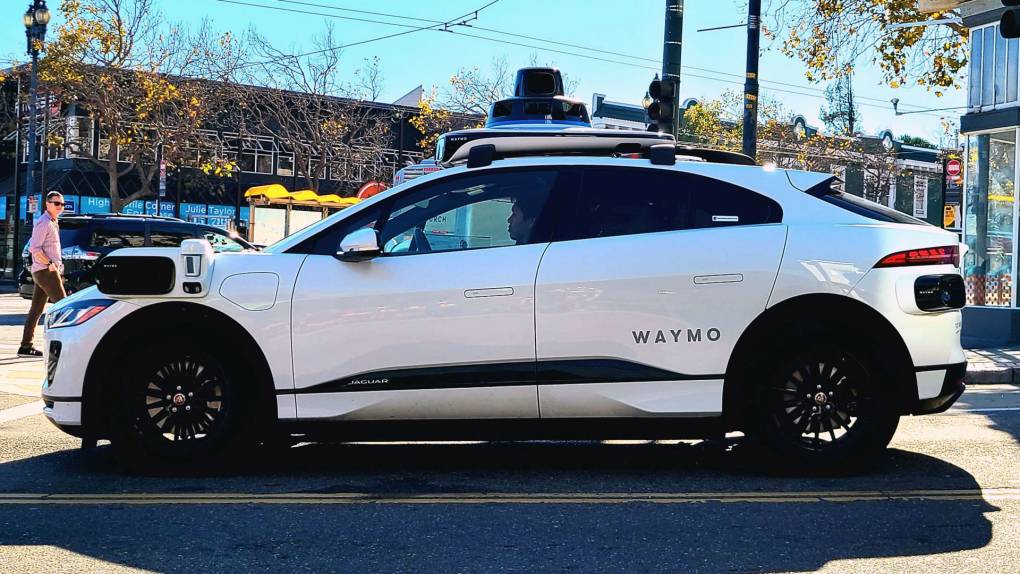
"caption": "A Waymo-brand car sits at an intersection in San Francisco's Castro neighborhood.",
"credit": "Christopher Beale/KQED",
"altTag": "A white SUV with tech gadgets and cameras sticking out from the sides and roof waits at a stoplight in San Francisco's Castro neighborhood.",
"description": null,
"imgSizes": {
"medium": {
"file": "https://cdn.kqed.org/wp-content/uploads/sites/10/2021/11/Waymo-car-800x450.jpg",
"width": 800,
"height": 450,
"mimeType": "image/jpeg"
},
"large": {
"file": "https://cdn.kqed.org/wp-content/uploads/sites/10/2021/11/Waymo-car-1020x574.jpg",
"width": 1020,
"height": 574,
"mimeType": "image/jpeg"
},
"thumbnail": {
"file": "https://cdn.kqed.org/wp-content/uploads/sites/10/2021/11/Waymo-car-160x90.jpg",
"width": 160,
"height": 90,
"mimeType": "image/jpeg"
},
"1536x1536": {
"file": "https://cdn.kqed.org/wp-content/uploads/sites/10/2021/11/Waymo-car-1536x864.jpg",
"width": 1536,
"height": 864,
"mimeType": "image/jpeg"
},
"post-thumbnail": {
"file": "https://cdn.kqed.org/wp-content/uploads/sites/10/2021/11/Waymo-car-672x372.jpg",
"width": 672,
"height": 372,
"mimeType": "image/jpeg"
},
"twentyfourteen-full-width": {
"file": "https://cdn.kqed.org/wp-content/uploads/sites/10/2021/11/Waymo-car-1038x576.jpg",
"width": 1038,
"height": 576,
"mimeType": "image/jpeg"
},
"kqedFullSize": {
"file": "https://cdn.kqed.org/wp-content/uploads/sites/10/2021/11/Waymo-car.jpg",
"width": 1920,
"height": 1080
}
},
"isLoading": false,
"fetchFailed": false
},
"news_11897570": {
"type": "attachments",
"id": "news_11897570",
"meta": {
"index": "attachments_1716263798",
"site": "news",
"id": "11897570",
"found": true
},
"parent": 11897548,
"imgSizes": {
"twentyfourteen-full-width": {
"file": "https://ww2.kqed.org/app/uploads/sites/10/2021/11/GettyImages-1321753242-1-1-1038x576.jpg",
"width": 1038,
"mimeType": "image/jpeg",
"height": 576
},
"thumbnail": {
"file": "https://ww2.kqed.org/app/uploads/sites/10/2021/11/GettyImages-1321753242-1-1-160x117.jpg",
"width": 160,
"mimeType": "image/jpeg",
"height": 117
},
"post-thumbnail": {
"file": "https://ww2.kqed.org/app/uploads/sites/10/2021/11/GettyImages-1321753242-1-1-672x372.jpg",
"width": 672,
"mimeType": "image/jpeg",
"height": 372
},
"kqedFullSize": {
"file": "https://ww2.kqed.org/app/uploads/sites/10/2021/11/GettyImages-1321753242-1-1.jpg",
"width": 1920,
"height": 1409
},
"large": {
"file": "https://ww2.kqed.org/app/uploads/sites/10/2021/11/GettyImages-1321753242-1-1-1020x749.jpg",
"width": 1020,
"mimeType": "image/jpeg",
"height": 749
},
"1536x1536": {
"file": "https://ww2.kqed.org/app/uploads/sites/10/2021/11/GettyImages-1321753242-1-1-1536x1127.jpg",
"width": 1536,
"mimeType": "image/jpeg",
"height": 1127
},
"medium": {
"file": "https://ww2.kqed.org/app/uploads/sites/10/2021/11/GettyImages-1321753242-1-1-800x587.jpg",
"width": 800,
"mimeType": "image/jpeg",
"height": 587
}
},
"publishDate": 1638212500,
"modified": 1638228926,
"caption": "Jack Dorsey is stepping down as the CEO of Twitter, which he co-founded. Here he's shown at a Bitcoin convention in June 2021.",
"description": null,
"title": "GettyImages-1321753242 (1)",
"credit": "Joe Raedle/Getty Images",
"status": "inherit",
"altTag": "In the photo, Dorsey is seen in a tye-dye shit (red/orange and yellow) against a black background. His beard is almost down to his collarbone.",
"isLoading": false,
"fetchFailed": false
}
},
"audioPlayerReducer": {
"postId": "stream_live",
"isPaused": true,
"isPlaying": false,
"pfsActive": false,
"pledgeModalIsOpen": true,
"playerDrawerIsOpen": false,
"liveAudioPlayStartedAt": 0,
"liveAudioPlayContext": ""
},
"authorsReducer": {
"byline_news_11904753": {
"type": "authors",
"id": "byline_news_11904753",
"meta": {
"override": true
},
"slug": "byline_news_11904753",
"name": "Michael Liedtke \u003cbr> The Associated Press",
"isLoading": false
},
"byline_news_11902511": {
"type": "authors",
"id": "byline_news_11902511",
"meta": {
"override": true
},
"slug": "byline_news_11902511",
"name": "Bobby Allyn",
"isLoading": false
},
"byline_news_11900964": {
"type": "authors",
"id": "byline_news_11900964",
"meta": {
"override": true
},
"slug": "byline_news_11900964",
"name": "\u003ca href=\"https://www.npr.org/people/638550790/bobby-allyn\">Bobby Allyn\u003c/a>",
"isLoading": false
},
"byline_news_11897548": {
"type": "authors",
"id": "byline_news_11897548",
"meta": {
"override": true
},
"slug": "byline_news_11897548",
"name": "Shannon Bond",
"isLoading": false
},
"dmarks": {
"type": "authors",
"id": "182",
"meta": {
"index": "authors_1716337520",
"id": "182",
"found": true
},
"name": "David Marks",
"firstName": "David",
"lastName": "Marks",
"slug": "dmarks",
"email": "dmarks@kqed.org",
"display_author_email": false,
"staff_mastheads": [],
"title": "KQED Editor",
"bio": "David Marks is a senior digital editor for KQED News. \u003c/a>Reach him at dmarks@kqed.org.",
"avatar": "https://secure.gravatar.com/avatar/b88bd6227ce6cb96ae33fefaf42b2a29?s=600&d=mm&r=g",
"twitter": "divadskram",
"facebook": null,
"instagram": null,
"linkedin": null,
"sites": [
{
"site": "news",
"roles": []
},
{
"site": "science",
"roles": []
},
{
"site": "perspectives",
"roles": []
},
{
"site": "liveblog",
"roles": []
}
],
"headData": {
"title": "David Marks | KQED",
"description": "KQED Editor",
"ogImgSrc": "https://secure.gravatar.com/avatar/b88bd6227ce6cb96ae33fefaf42b2a29?s=600&d=mm&r=g",
"twImgSrc": "https://secure.gravatar.com/avatar/b88bd6227ce6cb96ae33fefaf42b2a29?s=600&d=mm&r=g"
},
"isLoading": false,
"link": "/author/dmarks"
},
"kqed": {
"type": "authors",
"id": "236",
"meta": {
"index": "authors_1716337520",
"id": "236",
"found": true
},
"name": "KQED News Staff",
"firstName": "KQED News Staff",
"lastName": null,
"slug": "kqed",
"email": "faq@kqed.org",
"display_author_email": false,
"staff_mastheads": [],
"title": null,
"bio": null,
"avatar": "https://secure.gravatar.com/avatar/ef0e801a68c4c54afa9180db14084167?s=600&d=blank&r=g",
"twitter": null,
"facebook": null,
"instagram": null,
"linkedin": null,
"sites": [
{
"site": "arts",
"roles": [
"contributor"
]
},
{
"site": "news",
"roles": [
"editor"
]
},
{
"site": "futureofyou",
"roles": [
"author"
]
}
],
"headData": {
"title": "KQED News Staff | KQED",
"description": null,
"ogImgSrc": "https://secure.gravatar.com/avatar/ef0e801a68c4c54afa9180db14084167?s=600&d=blank&r=g",
"twImgSrc": "https://secure.gravatar.com/avatar/ef0e801a68c4c54afa9180db14084167?s=600&d=blank&r=g"
},
"isLoading": false,
"link": "/author/kqed"
},
"rachael-myrow": {
"type": "authors",
"id": "251",
"meta": {
"index": "authors_1716337520",
"id": "251",
"found": true
},
"name": "Rachael Myrow",
"firstName": "Rachael",
"lastName": "Myrow",
"slug": "rachael-myrow",
"email": "rmyrow@kqed.org",
"display_author_email": true,
"staff_mastheads": [
"news"
],
"title": "Senior Editor of KQED's Silicon Valley News Desk",
"bio": "• I write and edit stories about how Silicon Valley power and policies shape everyday life in California. I’m also passionate about making Bay Area history and culture more accessible to a broad public. • I’ve been a journalist for most of my life, starting in high school with The Franklin Press in Los Angeles, where I grew up. While earning my first degree in English at UC Berkeley, I got my start in public radio at KALX-FM. After completing a second degree in journalism at Cal, I landed my first professional job at Marketplace, then moved on to KPCC (now LAist), and then KQED, where I hosted The California Report for more than seven years. • My reporting has appeared on NPR, The World, WBUR’s \u003ci>Here & Now\u003c/i>, and the BBC. I also guest host for KQED’s \u003ci>Forum\u003c/i>, as well as the Commonwealth Club in San Francisco. • I speak periodically on media, democracy and technology issues, and do voiceover work for documentaries and educational video projects. • Outside of the studio, you'll find me hiking Bay Area trails and whipping up Insta-ready meals in my kitchen. • I do not accept gifts, money, or favors from anyone connected to my reporting, I don't pay people for information, and I do not support or donate to political causes. • I strive to treat the people I report on with fairness, honesty, and respect. I also recognize there are often multiple sides to a story and work to verify information through multiple sources and documentation. If I get something wrong, I correct it.",
"avatar": "https://secure.gravatar.com/avatar/3ed8a3c5f26025e4a805ba634cda8cd764906b97438a6d9ce216b044e340da4e?s=600&d=blank&r=g",
"twitter": "rachaelmyrow",
"bluesky": null,
"facebook": null,
"instagram": null,
"linkedin": "https://www.linkedin.com/in/rachaelmyrow/",
"sites": [
{
"site": "arts",
"roles": [
"administrator"
]
},
{
"site": "news",
"roles": [
"edit_others_posts",
"editor"
]
},
{
"site": "futureofyou",
"roles": [
"editor"
]
},
{
"site": "bayareabites",
"roles": [
"editor"
]
},
{
"site": "stateofhealth",
"roles": [
"editor"
]
},
{
"site": "science",
"roles": [
"editor"
]
},
{
"site": "food",
"roles": [
"editor"
]
},
{
"site": "forum",
"roles": [
"editor"
]
},
{
"site": "liveblog",
"roles": [
"author"
]
}
],
"headData": {
"title": "Rachael Myrow | KQED",
"description": "Senior Editor of KQED's Silicon Valley News Desk",
"ogImgSrc": "https://secure.gravatar.com/avatar/3ed8a3c5f26025e4a805ba634cda8cd764906b97438a6d9ce216b044e340da4e?s=600&d=blank&r=g",
"twImgSrc": "https://secure.gravatar.com/avatar/3ed8a3c5f26025e4a805ba634cda8cd764906b97438a6d9ce216b044e340da4e?s=600&d=blank&r=g"
},
"isLoading": false,
"link": "/author/rachael-myrow"
},
"adembosky": {
"type": "authors",
"id": "3205",
"meta": {
"index": "authors_1716337520",
"id": "3205",
"found": true
},
"name": "April Dembosky",
"firstName": "April",
"lastName": "Dembosky",
"slug": "adembosky",
"email": "adembosky@kqed.org",
"display_author_email": false,
"staff_mastheads": [
"news",
"science"
],
"title": "KQED Health Correspondent",
"bio": "April Dembosky is the health correspondent for KQED News and a regular contributor to NPR. She specializes in covering altered states of mind, from postpartum depression to methamphetamine-induced psychosis to the insanity defense. Her investigative series on insurance companies sidestepping mental health laws won multiple awards, including first place in beat reporting from the national Association of Health Care Journalists. She is the recipient of numerous other prizes and fellowships, including a national Edward R. Murrow award for investigative reporting, a Society of Professional Journalists award for long-form storytelling, and a Carter Center Fellowship for Mental Health Journalism.\r\n\r\nDembosky reported and produced \u003cem>Soundtrack of Silence\u003c/em>, an audio documentary about music and memory that is currently being made into a feature film by Paramount Pictures.\r\n\r\nBefore joining KQED in 2013, Dembosky covered technology and Silicon Valley for \u003cem>The Financial Times of London,\u003c/em> and contributed business and arts stories to \u003cem>Marketplace \u003c/em>and \u003cem>The New York Times.\u003c/em> She got her undergraduate degree in philosophy from Smith College and her master's in journalism from the University of California, Berkeley. She is a classically trained violinist and proud alum of the first symphony orchestra at Burning Man.",
"avatar": "https://secure.gravatar.com/avatar/d6593cd737b732102fe0b6250b5351c2d3bc9b2987566514aa3c9a106494d684?s=600&d=blank&r=g",
"twitter": "adembosky",
"bluesky": null,
"facebook": null,
"instagram": null,
"linkedin": null,
"sites": [
{
"site": "arts",
"roles": [
"author"
]
},
{
"site": "news",
"roles": [
"editor"
]
},
{
"site": "futureofyou",
"roles": [
"author"
]
},
{
"site": "stateofhealth",
"roles": [
"editor"
]
},
{
"site": "science",
"roles": [
"editor"
]
},
{
"site": "forum",
"roles": [
"editor"
]
}
],
"headData": {
"title": "April Dembosky | KQED",
"description": "KQED Health Correspondent",
"ogImgSrc": "https://secure.gravatar.com/avatar/d6593cd737b732102fe0b6250b5351c2d3bc9b2987566514aa3c9a106494d684?s=600&d=blank&r=g",
"twImgSrc": "https://secure.gravatar.com/avatar/d6593cd737b732102fe0b6250b5351c2d3bc9b2987566514aa3c9a106494d684?s=600&d=blank&r=g"
},
"isLoading": false,
"link": "/author/adembosky"
},
"abandlamudi": {
"type": "authors",
"id": "11672",
"meta": {
"index": "authors_1716337520",
"id": "11672",
"found": true
},
"name": "Adhiti Bandlamudi",
"firstName": "Adhiti",
"lastName": "Bandlamudi",
"slug": "abandlamudi",
"email": "abandlamudi@kqed.org",
"display_author_email": false,
"staff_mastheads": [
"news"
],
"title": "KQED Housing Reporter",
"bio": "Adhiti Bandlamudi reports for KQED's Housing desk. She focuses on how housing gets built across the Bay Area. Before joining KQED in 2020, she reported for WUNC in Durham, North Carolina, WABE in Atlanta, Georgia and Capital Public Radio in Sacramento. In 2017, she was awarded a Kroc Fellowship at NPR where she reported on everything from sprinkles to the Golden State Killer's arrest. When she's not reporting, she's baking new recipes in her kitchen or watching movies with friends and family. She's originally from Georgia and has strong opinions about Great British Bake Off.",
"avatar": "https://secure.gravatar.com/avatar/868129c8b257bb99a3500e2c86a65400?s=600&d=mm&r=g",
"twitter": "oddity_adhiti",
"facebook": null,
"instagram": null,
"linkedin": null,
"sites": [
{
"site": "arts",
"roles": [
"author"
]
},
{
"site": "news",
"roles": [
"editor"
]
},
{
"site": "liveblog",
"roles": [
"author"
]
}
],
"headData": {
"title": "Adhiti Bandlamudi | KQED",
"description": "KQED Housing Reporter",
"ogImgSrc": "https://secure.gravatar.com/avatar/868129c8b257bb99a3500e2c86a65400?s=600&d=mm&r=g",
"twImgSrc": "https://secure.gravatar.com/avatar/868129c8b257bb99a3500e2c86a65400?s=600&d=mm&r=g"
},
"isLoading": false,
"link": "/author/abandlamudi"
},
"cbeale": {
"type": "authors",
"id": "11749",
"meta": {
"index": "authors_1716337520",
"id": "11749",
"found": true
},
"name": "Christopher Beale",
"firstName": "Christopher",
"lastName": "Beale",
"slug": "cbeale",
"email": "cbeale@kqed.org",
"display_author_email": true,
"staff_mastheads": [
"news"
],
"title": "Engineer/Producer/Reporter",
"bio": "\u003ca href=\"https://linktr.ee/realchrisjbeale\" rel=\"noopener noreferrer\">Christopher J. Beale\u003c/a> is an award winning journalist, audio engineer, and media host living in San Francisco. \r\n\r\nChristopher works primarily as an audio engineer at KQED and serves as the sound designer for both the Bay Curious and Rightnowish podcasts. He is the host and producer of the LGBTQIA podcast and radio segment \u003ca href=\"https://stereotypespodcast.org\">Stereotypes\u003c/a>.",
"avatar": "https://secure.gravatar.com/avatar/dc485bf84788eb7e7414eb638e72407e?s=600&d=blank&r=g",
"twitter": "realchrisjbeale",
"facebook": null,
"instagram": "http://instagram.com/realchrisjbeale",
"linkedin": null,
"sites": [
{
"site": "arts",
"roles": [
"contributor"
]
},
{
"site": "news",
"roles": [
"editor"
]
},
{
"site": "forum",
"roles": [
"editor"
]
}
],
"headData": {
"title": "Christopher Beale | KQED",
"description": "Engineer/Producer/Reporter",
"ogImgSrc": "https://secure.gravatar.com/avatar/dc485bf84788eb7e7414eb638e72407e?s=600&d=blank&r=g",
"twImgSrc": "https://secure.gravatar.com/avatar/dc485bf84788eb7e7414eb638e72407e?s=600&d=blank&r=g"
},
"isLoading": false,
"link": "/author/cbeale"
},
"nnavarro": {
"type": "authors",
"id": "11756",
"meta": {
"index": "authors_1716337520",
"id": "11756",
"found": true
},
"name": "Natalia Navarro",
"firstName": "Natalia",
"lastName": "Navarro",
"slug": "nnavarro",
"email": "nnavarro@kqed.org",
"display_author_email": true,
"staff_mastheads": [
"news"
],
"title": "Afternoon News Anchor",
"bio": "Natalia Navarro is KQED's afternoon radio news anchor. She came to KQED in 2021 from Colorado Public Radio, where she was a reporter and host. She has received several awards for her work covering daily and breaking news from professional organizations such as the San Francisco Press Club, Society of Professional Journalists and the Colorado Broadcasters Association. Natalia is originally from Tucson, Arizona, where she got her start in journalism writing for the Arizona Daily Star, Arizona Public Media and the Tucson Weekly. Natalia earned her bachelor's degree in journalism and economics, and her master's degree in journalism from the University of Arizona.",
"avatar": "https://secure.gravatar.com/avatar/a2bdb19fd9520bdea295a2d5f9b2ad65ec51cf0bf559fb1cc041d3a0a04d62ad?s=600&d=blank&r=g",
"twitter": "@NataliaVNavarro",
"bluesky": null,
"facebook": null,
"instagram": null,
"linkedin": null,
"sites": [
{
"site": "news",
"roles": [
"editor"
]
}
],
"headData": {
"title": "Natalia Navarro | KQED",
"description": "Afternoon News Anchor",
"ogImgSrc": "https://secure.gravatar.com/avatar/a2bdb19fd9520bdea295a2d5f9b2ad65ec51cf0bf559fb1cc041d3a0a04d62ad?s=600&d=blank&r=g",
"twImgSrc": "https://secure.gravatar.com/avatar/a2bdb19fd9520bdea295a2d5f9b2ad65ec51cf0bf559fb1cc041d3a0a04d62ad?s=600&d=blank&r=g"
},
"isLoading": false,
"link": "/author/nnavarro"
}
},
"pagesReducer": {
"news_category_technology": {
"type": "terms",
"id": "news_248",
"meta": {
"index": "terms_1716263798",
"site": "news",
"id": "248",
"score": 10.93111
},
"featImg": null,
"name": "Technology",
"description": null,
"taxonomy": "category",
"headData": {
"twImgId": null,
"twTitle": null,
"ogTitle": null,
"ogImgId": null,
"twDescription": null,
"description": null,
"title": "Technology Archives | KQED News",
"ogDescription": null
},
"ttid": 256,
"slug": "technology",
"isLoading": false,
"title": "Technology",
"pageMeta": {
"site": "news",
"WpPageTemplate": "page-topic-editorial",
"currentPage": 39
},
"blocks": [
{
"blockName": "kqed/post-list",
"attrs": {
"layout": "cardArticle2",
"query": "posts/news?category=technology",
"seeMore": false,
"paginated": true,
"page": 39
}
},
{
"blockName": "kqed/ad"
}
]
}
},
"pfsSessionReducer": {},
"postsReducer": {
"stream_live": {
"type": "live",
"id": "stream_live",
"audioUrl": "https://streams.kqed.org/kqedradio",
"title": "Live Stream",
"excerpt": "Live Stream information currently unavailable.",
"link": "/radio",
"featImg": "",
"label": {
"name": "KQED Live",
"link": "/"
}
},
"stream_kqedNewscast": {
"type": "posts",
"id": "stream_kqedNewscast",
"audioUrl": "https://www.kqed.org/.stream/anon/radio/RDnews/newscast.mp3?_=1",
"title": "KQED Newscast",
"featImg": "",
"label": {
"name": "88.5 FM",
"link": "/"
}
},
"news_11906302": {
"type": "posts",
"id": "news_11906302",
"meta": {
"index": "posts_1716263798",
"site": "news",
"id": "11906302",
"score": null,
"sort": [
1645754960000
]
},
"guestAuthors": [],
"slug": "why-russias-invasion-of-ukraine-is-personal-for-silicon-valley",
"title": "Why Russia's Invasion of Ukraine Is Personal for Silicon Valley",
"publishDate": 1645754960,
"format": "audio",
"headTitle": "Why Russia’s Invasion of Ukraine Is Personal for Silicon Valley | KQED",
"labelTerm": {
"term": 72,
"site": "news"
},
"content": "\u003cp>For years, Ukraine has been one of Silicon Valley’s favorite offshore outposts for educated, cheap IT labor. There are now roughly 20,000 people of Ukrainian descent living in the Bay Area, according to the \u003ca href=\"https://san-francisco.mfa.gov.ua/en\" target=\"_blank\" rel=\"noopener noreferrer\">Ukrainian consulate in San Francisco\u003c/a>.\u003c/p>\n\u003cp>The connections between the two regions are not simply economic. Strong cultural affinities have developed. People move between the Bay Area and Ukraine and work together on projects. They get married to each other.\u003c/p>\n\u003cp>“My wife is Ukrainian,” said John Sung Kim, CEO of the Bay Area-based outsourcing company \u003ca href=\"https://jetbridge.com\" target=\"_blank\" rel=\"noopener noreferrer\">JetBridge\u003c/a>. He’s married to a Ukrainian woman, with in-laws in one of the disputed regions.\u003c/p>\n\u003cp>They told him tanks have arrived in their town \u003ca href=\"https://www.npr.org/live-updates/ukraine-russia-invasion-putin\">as Russia’s long-feared assault on Ukraine began Thursday\u003c/a>, and they’ve relocated to their basement. “So we need evacuation plans for them,” Kim said.\u003c/p>\n\u003cp>JetBridge employs more than 20 people in Ukraine, and the company has been working on contingency plans to get them out: to western Ukraine, to Poland, or even to the Bay Area.\u003c/p>\n\u003cp>[ad fullwidth]\u003c/p>\n\u003cp>“If we have to evacuate them, we also have to evacuate their families. And so this could be 100 people,” Kim said. But it’s an open question when that might happen. “Airports have been bombed and traffic is a no go. People are stuck.”\u003c/p>\n\u003cp>Then there’s the JetBridge team in Belarus, dependent, like their co-workers in Ukraine, on international money transfers for their salaries. Kim fears financial sanctions on Russia could be extended to include Belarus, a Russian ally. Should that happen, it could become difficult to pay his employees there. “So now we have questions, like, do we need to extract people out of Belarus?” he said.\u003c/p>\n\u003cfigure id=\"attachment_11906424\" class=\"wp-caption aligncenter\" style=\"max-width: 1920px\">\u003cimg loading=\"lazy\" decoding=\"async\" class=\"size-full wp-image-11906424\" src=\"https://ww2.kqed.org/app/uploads/sites/10/2022/02/CyclistUkraineFlag.jpg\" alt=\"cyclist carrying bright yellow and blue ukrainian flag rides under series of metal hoops under a blue sky\" width=\"1920\" height=\"1416\" srcset=\"https://cdn.kqed.org/wp-content/uploads/sites/10/2022/02/CyclistUkraineFlag.jpg 1920w, https://cdn.kqed.org/wp-content/uploads/sites/10/2022/02/CyclistUkraineFlag-800x590.jpg 800w, https://cdn.kqed.org/wp-content/uploads/sites/10/2022/02/CyclistUkraineFlag-1020x752.jpg 1020w, https://cdn.kqed.org/wp-content/uploads/sites/10/2022/02/CyclistUkraineFlag-160x118.jpg 160w, https://cdn.kqed.org/wp-content/uploads/sites/10/2022/02/CyclistUkraineFlag-1536x1133.jpg 1536w\" sizes=\"(max-width: 1920px) 100vw, 1920px\">\u003cfigcaption class=\"wp-caption-text\">A bicyclist waves the Ukrainian flag over his head as he rides through the Sonic Runway, an art installation outside San Jose City Hall. \u003ccite>(Rachael Myrow/KQED)\u003c/cite>\u003c/figcaption>\u003c/figure>\n\u003cp>While many companies big and small employ Ukrainians here or in Ukraine, those contacted by KQED declined to identify specific employees out of concern for their safety.\u003c/p>\n\u003cp>JustAnswer, a San Francisco-based tech company that employs 252 people in Ukraine, \u003ca href=\"https://www.sfchronicle.com/tech/article/How-Russia-invading-Ukraine-affects-the-workforce-16938923.php\">also has been working on contingency plans to keep its workers safe, make sure they get paid — and handle workers who want to serve in Ukraine’s military\u003c/a>, according to The San Francisco Chronicle.\u003c/p>\n\u003cp>Google, Oracle, Snap, Grammarly and Ring also employ workers in Ukraine.\u003c/p>\n\u003cp>A spokesperson for Ring said the company is in close contact with the people it does business with in Ukraine, and that “we’re of course monitoring their well-being with great care.”\u003c/p>\n\u003cp>“This is not the first time that our team members in Ukraine have experienced heightened uncertainty,” said a spokesperson for Grammarly, \u003ca href=\"https://gbozhok.medium.com/grammarly-the-story-of-how-three-ukrainians-created-the-most-popular-online-grammar-checker-5c3f20a2f66a\" target=\"_blank\" rel=\"noopener noreferrer\">a company founded by Ukrainians\u003c/a>.\u003c/p>\n\u003cp>“Grammarly also supports all of our team members, including those who call Ukraine home, with various mental health benefits and frequent internal communication updates that aim to provide clarity in a time of uncertainty,” the spokesperson said. “Our contingency plans also account for ensuring Grammarly’s services will not be disrupted. This includes backup communication methods and temporary transfer of business-critical responsibilities to team members outside of Ukraine to ensure our Ukraine-based team members can focus on the immediate safety of themselves and their families.”\u003c/p>\n\u003cp>In 2014, after Russia invaded and annexed Crimea, the nonprofit humanitarian aid organization \u003ca href=\"https://novaukraine.org/\">Nova Ukraine\u003c/a> was born in the Bay Area. It’s one of several groups raising funds for causes ranging from helping underserved children in Ukraine with educational aid, to COVID relief, to a letter-writing campaign directed at U.S. lawmakers regarding the Russian invasion.\u003c/p>\n\u003cp>“I have fewer connections now than before,” said Igor Markov, a research scientist for a prominent Silicon Valley company who volunteers for Nova Ukraine in his spare time.\u003c/p>\n\u003cp>He came to the U.S. in 1993 to study mathematics in graduate school. He estimates that a third of his high school class from Kyiv now lives in the U.S., reflecting how enmeshed the two countries have become in the last three decades.\u003c/p>\n\u003cp>\u003c/p>\n\u003cp>“Putin and his subservient government and parliament — they have gone way too far,” Markov said. “It’s not a matter of Russians versus Ukrainians at all. It’s a matter of Putin versus the world.”\u003c/p>\n\n",
"blocks": [],
"excerpt": "Longstanding ties between Ukraine and the Bay Area's tech industry mean numerous companies have been working on contingency plans to make sure workers and their families are safe.",
"status": "publish",
"parent": 0,
"modified": 1729027764,
"stats": {
"hasAudio": false,
"hasVideo": false,
"hasChartOrMap": false,
"iframeSrcs": [],
"hasGoogleForm": false,
"hasGallery": false,
"hasHearkenModule": false,
"hasPolis": false,
"paragraphCount": 19,
"wordCount": 753
},
"headData": {
"title": "Why Russia's Invasion of Ukraine Is Personal for Silicon Valley | KQED",
"description": "Longstanding ties between Ukraine and the Bay Area's tech industry mean numerous companies have been working on contingency plans to make sure workers and their families are safe.",
"ogTitle": "",
"ogDescription": "",
"ogImgId": "",
"twTitle": "",
"twDescription": "",
"twImgId": "",
"schema": {
"@context": "https://schema.org",
"@type": "NewsArticle",
"headline": "Why Russia's Invasion of Ukraine Is Personal for Silicon Valley",
"datePublished": "2022-02-24T18:09:20-08:00",
"dateModified": "2024-10-15T14:29:24-07:00",
"image": "https://cdn.kqed.org/wp-content/uploads/2020/02/KQED-OG-Image@1x.png",
"isAccessibleForFree": "True",
"publisher": {
"@type": "NewsMediaOrganization",
"@id": "https://www.kqed.org/#organization",
"name": "KQED",
"logo": "https://cdn.kqed.org/wp-content/uploads/2020/02/KQED-OG-Image@1x.png",
"url": "https://www.kqed.org",
"sameAs": [
"https://www.facebook.com/KQED",
"https://twitter.com/KQED",
"https://www.instagram.com/kqed/",
"https://www.tiktok.com/@kqedofficial",
"https://www.linkedin.com/company/kqed",
"https://www.youtube.com/channel/UCeC0IOo7i1P_61zVUWbJ4nw"
]
}
}
},
"audioUrl": "https://traffic.omny.fm/d/clips/0af137ef-751e-4b19-a055-aaef00d2d578/ffca7e9f-6831-4[…]f-aaef00f5a073/66951e48-eec7-4213-8daa-ae46010af317/audio.mp3",
"sticky": false,
"excludeFromSiteSearch": "Include",
"path": "/news/11906302/why-russias-invasion-of-ukraine-is-personal-for-silicon-valley",
"audioTrackLength": null,
"parsedContent": [
{
"type": "contentString",
"content": "\u003cdiv class=\"post-body\">\u003cp>\u003cp>For years, Ukraine has been one of Silicon Valley’s favorite offshore outposts for educated, cheap IT labor. There are now roughly 20,000 people of Ukrainian descent living in the Bay Area, according to the \u003ca href=\"https://san-francisco.mfa.gov.ua/en\" target=\"_blank\" rel=\"noopener noreferrer\">Ukrainian consulate in San Francisco\u003c/a>.\u003c/p>\n\u003cp>The connections between the two regions are not simply economic. Strong cultural affinities have developed. People move between the Bay Area and Ukraine and work together on projects. They get married to each other.\u003c/p>\n\u003cp>“My wife is Ukrainian,” said John Sung Kim, CEO of the Bay Area-based outsourcing company \u003ca href=\"https://jetbridge.com\" target=\"_blank\" rel=\"noopener noreferrer\">JetBridge\u003c/a>. He’s married to a Ukrainian woman, with in-laws in one of the disputed regions.\u003c/p>\n\u003cp>They told him tanks have arrived in their town \u003ca href=\"https://www.npr.org/live-updates/ukraine-russia-invasion-putin\">as Russia’s long-feared assault on Ukraine began Thursday\u003c/a>, and they’ve relocated to their basement. “So we need evacuation plans for them,” Kim said.\u003c/p>\n\u003cp>JetBridge employs more than 20 people in Ukraine, and the company has been working on contingency plans to get them out: to western Ukraine, to Poland, or even to the Bay Area.\u003c/p>\n\u003cp>\u003c/p>\u003c/div>",
"attributes": {
"named": {},
"numeric": []
}
},
{
"type": "component",
"content": "",
"name": "ad",
"attributes": {
"named": {
"label": "fullwidth"
},
"numeric": [
"fullwidth"
]
}
},
{
"type": "contentString",
"content": "\u003cdiv class=\"post-body\">\u003cp>\u003c/p>\n\u003cp>“If we have to evacuate them, we also have to evacuate their families. And so this could be 100 people,” Kim said. But it’s an open question when that might happen. “Airports have been bombed and traffic is a no go. People are stuck.”\u003c/p>\n\u003cp>Then there’s the JetBridge team in Belarus, dependent, like their co-workers in Ukraine, on international money transfers for their salaries. Kim fears financial sanctions on Russia could be extended to include Belarus, a Russian ally. Should that happen, it could become difficult to pay his employees there. “So now we have questions, like, do we need to extract people out of Belarus?” he said.\u003c/p>\n\u003cfigure id=\"attachment_11906424\" class=\"wp-caption aligncenter\" style=\"max-width: 1920px\">\u003cimg loading=\"lazy\" decoding=\"async\" class=\"size-full wp-image-11906424\" src=\"https://ww2.kqed.org/app/uploads/sites/10/2022/02/CyclistUkraineFlag.jpg\" alt=\"cyclist carrying bright yellow and blue ukrainian flag rides under series of metal hoops under a blue sky\" width=\"1920\" height=\"1416\" srcset=\"https://cdn.kqed.org/wp-content/uploads/sites/10/2022/02/CyclistUkraineFlag.jpg 1920w, https://cdn.kqed.org/wp-content/uploads/sites/10/2022/02/CyclistUkraineFlag-800x590.jpg 800w, https://cdn.kqed.org/wp-content/uploads/sites/10/2022/02/CyclistUkraineFlag-1020x752.jpg 1020w, https://cdn.kqed.org/wp-content/uploads/sites/10/2022/02/CyclistUkraineFlag-160x118.jpg 160w, https://cdn.kqed.org/wp-content/uploads/sites/10/2022/02/CyclistUkraineFlag-1536x1133.jpg 1536w\" sizes=\"(max-width: 1920px) 100vw, 1920px\">\u003cfigcaption class=\"wp-caption-text\">A bicyclist waves the Ukrainian flag over his head as he rides through the Sonic Runway, an art installation outside San Jose City Hall. \u003ccite>(Rachael Myrow/KQED)\u003c/cite>\u003c/figcaption>\u003c/figure>\n\u003cp>While many companies big and small employ Ukrainians here or in Ukraine, those contacted by KQED declined to identify specific employees out of concern for their safety.\u003c/p>\n\u003cp>JustAnswer, a San Francisco-based tech company that employs 252 people in Ukraine, \u003ca href=\"https://www.sfchronicle.com/tech/article/How-Russia-invading-Ukraine-affects-the-workforce-16938923.php\">also has been working on contingency plans to keep its workers safe, make sure they get paid — and handle workers who want to serve in Ukraine’s military\u003c/a>, according to The San Francisco Chronicle.\u003c/p>\n\u003cp>Google, Oracle, Snap, Grammarly and Ring also employ workers in Ukraine.\u003c/p>\n\u003cp>A spokesperson for Ring said the company is in close contact with the people it does business with in Ukraine, and that “we’re of course monitoring their well-being with great care.”\u003c/p>\n\u003cp>“This is not the first time that our team members in Ukraine have experienced heightened uncertainty,” said a spokesperson for Grammarly, \u003ca href=\"https://gbozhok.medium.com/grammarly-the-story-of-how-three-ukrainians-created-the-most-popular-online-grammar-checker-5c3f20a2f66a\" target=\"_blank\" rel=\"noopener noreferrer\">a company founded by Ukrainians\u003c/a>.\u003c/p>\n\u003cp>“Grammarly also supports all of our team members, including those who call Ukraine home, with various mental health benefits and frequent internal communication updates that aim to provide clarity in a time of uncertainty,” the spokesperson said. “Our contingency plans also account for ensuring Grammarly’s services will not be disrupted. This includes backup communication methods and temporary transfer of business-critical responsibilities to team members outside of Ukraine to ensure our Ukraine-based team members can focus on the immediate safety of themselves and their families.”\u003c/p>\n\u003cp>In 2014, after Russia invaded and annexed Crimea, the nonprofit humanitarian aid organization \u003ca href=\"https://novaukraine.org/\">Nova Ukraine\u003c/a> was born in the Bay Area. It’s one of several groups raising funds for causes ranging from helping underserved children in Ukraine with educational aid, to COVID relief, to a letter-writing campaign directed at U.S. lawmakers regarding the Russian invasion.\u003c/p>\n\u003cp>“I have fewer connections now than before,” said Igor Markov, a research scientist for a prominent Silicon Valley company who volunteers for Nova Ukraine in his spare time.\u003c/p>\n\u003cp>He came to the U.S. in 1993 to study mathematics in graduate school. He estimates that a third of his high school class from Kyiv now lives in the U.S., reflecting how enmeshed the two countries have become in the last three decades.\u003c/p>\n\u003cp>\u003c/p>\n\u003cp>“Putin and his subservient government and parliament — they have gone way too far,” Markov said. “It’s not a matter of Russians versus Ukrainians at all. It’s a matter of Putin versus the world.”\u003c/p>\n\n\u003c/div>\u003c/p>",
"attributes": {
"named": {},
"numeric": []
}
}
],
"link": "/news/11906302/why-russias-invasion-of-ukraine-is-personal-for-silicon-valley",
"authors": [
"251"
],
"programs": [
"news_72"
],
"categories": [
"news_1758",
"news_1169",
"news_8",
"news_33520",
"news_248"
],
"tags": [
"news_93",
"news_285",
"news_2011",
"news_20279",
"news_1631",
"news_26723"
],
"featImg": "news_11906434",
"label": "news_72"
},
"news_11905230": {
"type": "posts",
"id": "news_11905230",
"meta": {
"index": "posts_1716263798",
"site": "news",
"id": "11905230",
"score": null,
"sort": [
1645141165000
]
},
"guestAuthors": [],
"slug": "do-federal-lawmakers-have-the-stomach-to-rein-in-big-tech",
"title": "Do Federal Lawmakers Have the Stomach to Rein in Big Tech?",
"publishDate": 1645141165,
"format": "audio",
"headTitle": "Do Federal Lawmakers Have the Stomach to Rein in Big Tech? | KQED",
"labelTerm": {
"term": 72,
"site": "news"
},
"content": "\u003cp>More than a dozen antitrust bills targeting Big Tech are currently in play in the nation’s capital, and Silicon Valley has mounted a full-court press to kill or soften the legislative onslaught.\u003c/p>\n\u003cp>The bills could make it more difficult for large tech companies to, among other things, acquire smaller companies, use their platforms to unduly boost their own products, and wield their huge cash stockpiles to \u003ca href=\"https://www.npr.org/2018/11/13/666274605/how-big-is-amazon\" target=\"_blank\" rel=\"noopener noreferrer\">dominate multiple, additional industries\u003c/a>.[aside postID=\"news_11889347\" hero=\"https://ww2.kqed.org/app/uploads/sites/10/2021/09/RS51554_GettyImages-1235407516-qut.jpg\"]The main companies in the sights of federal lawmakers include Amazon, Apple, Google and Meta, the latter three of which are headquartered in the Bay Area. All four have become multibillion-dollar giants of advertising through buying and selling consumer data, while also variously dominating other industries like retail, apps and entertainment.\u003c/p>\n\u003cp>Federal lawmakers on both sides of the aisle have historically taken a relatively light touch toward regulating the technology industry. But that \u003ca href=\"https://www.politico.com/news/2021/12/27/monopoly-antitrust-new-rules-tech-525161\">hands-off approach has recently shifted\u003c/a> among a growing number of Democrats, and even some Republicans, as the power and size of these companies has grown exponentially.\u003c/p>\n\u003cp>“You have companies like Google that have 90% control over search engines,” Sen. Amy Klobuchar, D-Minnesota, \u003ca href=\"https://www.facebook.com/amyklobuchar/videos/1985625218247197/\" target=\"_blank\" rel=\"noopener noreferrer\">told CNN\u003c/a> last year. “What I’m proposing is, make sure [federal agencies like the Federal Trade Commission] are able to take on trillion-dollar companies like Facebook and Google. They can’t do it with Band-Aids and duct tape.”\u003c/p>\n\u003cp>She added, “We must have laws that are as sophisticated as the companies we’re dealing with.”\u003c/p>\n\u003cp>[ad fullwidth]\u003c/p>\n\u003cp>In that vein, the slate of proposed legislation tackles a wide array of gray areas in the law to provide federal regulators with the resources — monetary and conceptual — to go after large companies. Here’s a small sampling of the bills:\u003c/p>\n\u003cp>— \u003ca href=\"https://www.congress.gov/bill/117th-congress/house-bill/3816\" target=\"_blank\" rel=\"noopener noreferrer\">HR 3816\u003c/a> and \u003ca href=\"https://www.congress.gov/bill/117th-congress/senate-bill/2992\" target=\"_blank\" rel=\"noopener noreferrer\">S 2992\u003c/a>: \u003cstrong>The American Choice and Innovation Online Act\u003c/strong> would bar platforms like Apple’s App Store or Amazon’s Marketplace from “self-preferencing,” or giving their own products an unfair advantage over those of their competitors.\u003c/p>\n\u003cp>— \u003ca href=\"https://www.congress.gov/bill/117th-congress/house-bill/3843?q=%7B%22search%22:%5B%223843%22,%223843%22%5D%7D&s=3&r=1\" target=\"_blank\" rel=\"noopener noreferrer\">HR 3843\u003c/a> and \u003ca href=\"https://www.congress.gov/bill/117th-congress/senate-bill/228?q=%7B%22search%22:%5B%22Merger+Filing+Fee+Modernization+Act%22,%22Merger%22,%22Filing%22,%22Fee%22,%22Modernization%22,%22Act%22%5D%7D&s=6&r=1\" target=\"_blank\" rel=\"noopener noreferrer\">S 228\u003c/a>: \u003cstrong>The Merger Filing Fee Modernization Act of 2021\u003c/strong> would increase the merger fees regulators collect from companies and use the additional amounts to fund aggressive enforcement of antitrust laws by the U.S. Department of Justice and the Federal Trade Commission.\u003c/p>\n\u003cp>— \u003ca href=\"https://www.congress.gov/bill/117th-congress/senate-bill/3608?q=%7B%22search%22%3A%5B%22Social+Media+NUDGE+Act%22%2C%22Social%22%2C%22Media%22%2C%22NUDGE%22%2C%22Act%22%5D%7D&s=1&r=1\" target=\"_blank\" rel=\"noopener noreferrer\">S 3608\u003c/a>: \u003cstrong>The Social Media NUDGE Act\u003c/strong> would direct the National Science Foundation and the National Academies of Sciences, Engineering and Medicine to study “content neutral” ways to address the algorithmic amplification of harmful content.[aside postID=\"forum_2010101882161\" hero=\"https://ww2.kqed.org/app/uploads/sites/43/2016/11/facebook-screen.jpg\"]But despite high-drama hearings from whistleblowers like former Facebook lead product manager \u003ca href=\"https://www.franceshaugen.com\" target=\"_blank\" rel=\"noopener noreferrer\">Frances Haugen\u003c/a>, most of these bills have yet to make it out of their respective committees. It’s entirely unclear how many will ever get a floor vote in the House or Senate.\u003c/p>\n\u003cp>Klobuchar, among the handful of lawmakers leading the antitrust charge, has acknowledged that the odds are daunting.\u003c/p>\n\u003cp>“We are up against a lot. … The tech companies have 2,500 lobbyists and probably 10,000 lawyers,” she said at a hearing of the Senate Judiciary \u003ca href=\"https://www.c-span.org/video/?516757-1/senate-hearing-impact-corporate-monopolies-innovation\" target=\"_blank\" rel=\"noopener noreferrer\">Subcommittee on Competition Policy, Antitrust, and Consumer Rights\u003c/a> last December.\u003c/p>\n\u003cp>And most analysts agree that if Republicans regain the majority in Congress after this year’s midterm elections, it’s game over for the biggest antitrust effort in generations.\u003c/p>\n\u003ch2>Strong pushback\u003c/h2>\n\u003cp>Tech industry proponents have presented a varied, and in some cases compelling, set of arguments against these legislative efforts.\u003c/p>\n\u003cp>Berin Szóka, president of TechFreedom, a \u003ca href=\"https://services.google.com/fh/files/misc/trade_association_and_third_party_groups.pdf\" target=\"_blank\" rel=\"noopener noreferrer\">tech-funded\u003c/a> think tank in Washington, D.C., argues that the bills are rushed and poorly written. He decries the lack of traditional legislative hearings and markups before floor debate, even while acknowledging this practice has fallen out of vogue in recent years.\u003c/p>\n\u003cp>“We are legislating the way that that cartoon shows the railroad bridge being built out over the canyon as the train is going — except we don’t know what the train looks like or where it’s going,” he said.[pullquote size=\"medium\" align=\"right\" citation=\"Jennifer King, privacy and data policy fellow, Stanford Institute for Human-Centered Artificial Intelligence\"]‘We now have a legislative structure that’s just as dependent on those data practices that the commercial structure is dependent on: behavioral targeting and marketing practices that are really at issue in all these cases.’[/pullquote]Efforts by Democrats, like Klobuchar, to win support from key Republicans, he says, have resulted in bills full of ticking time bombs that could explode on Democrats and their allies the next time Republicans regain control of the White House.\u003c/p>\n\u003cp>For instance, Szóka argues, the same bill that would prevent tech titans from discriminating against competitors might also prevent them from removing companies from their app stores that have violated content rules, like Parler, a social media platform that has become a safe harbor for right-wing conspiracy theorists.\u003c/p>\n\u003cp>“It’s going to be easy for these sites that cater to extremists to sue, to harass mainstream services, to rifle through emails, to depose executives,” said Szóka.\u003c/p>\n\u003cp>Similar concerns have been expressed by many in California’s congressional delegation, suggesting that Democrats could balk at supporting some of the bills.\u003c/p>\n\u003cp>Sens. Dianne Feinstein and Alex Padilla are among a large group of California Democrats who have criticized elements of the bills, mirroring some of the arguments made by tech-funded think tanks. Reps. Lou Correa, D-East LA; Ted Lieu, D-Torrance; Eric Swalwell, D-Castro Valley; Ro Khanna, D-Fremont; and Zoe Lofgren, D-San Jose also have raised concerns.\u003c/p>\n\u003cp>“I think they spent more time on the hearing than they did in writing the proposed legislation. Because it’s not well crafted and it was done in a hurry,” Lofgren recently lamented about the American Choice and Innovation Online Act.\u003c/p>\n\u003cp>In an interview last month with Julia Angwin of The Markup, \u003ca href=\"https://www.c-span.org/video/?517286-1/after-words-representative-ro-khanna\">Rep. Khanna said breakups are certainly justified\u003c/a> in some instances. “On Facebook, for example, where they’ve acquired Instagram and WhatsApp, you should have an unraveling of that company. I think you want to have a ban on mergers that are acquiring competitors.”[aside postID=\"news_11888891\" hero=\"https://ww2.kqed.org/app/uploads/sites/10/2021/09/GettyImages-461843598-scaled.jpg\"]But he cautioned about being “overly restrictive on all mergers,” noting that mergers and acquisitions are a basic element of the U.S. economy.\u003c/p>\n\u003cp>The Washington Post recently reported that \u003ca href=\"https://www.washingtonpost.com/technology/2022/01/21/tech-lobbying-in-washington/\" target=\"_blank\" rel=\"noopener noreferrer\">just seven large tech companies spent nearly $70 million\u003c/a> lobbying the U.S. government in 2021.\u003c/p>\n\u003cp>“We are genuinely concerned that they could break a wide range of popular services we offer to our users, all the work we do to make our products safe, private and secure, and in some cases can hurt American competitiveness by disadvantaging solely U.S. companies,” Google CEO Sundar Pichai said of the current bills during a recent earnings call.\u003c/p>\n\u003cp>And Lofgren and others who have voiced concerns with the current bills \u003ca href=\"https://www.washingtonpost.com/politics/2022/02/03/tech-giants-are-doling-out-political-donations-antitrust-skeptics-congress/\" target=\"_blank\" rel=\"noopener noreferrer\">continue to take money\u003c/a> from the likes of Amazon, Google, Meta and Microsoft, but say that doesn’t influence their position.\u003c/p>\n\u003cp>Lofgren told KQED, “That’s obviously baloney, and if that were the case, Anna [Eshoo] and I wouldn’t have introduced our privacy bill, which would require a huge change in the business model of any company that relies on the data of its users.”\u003c/p>\n\u003cp>The \u003ca href=\"https://www.congress.gov/bill/117th-congress/house-bill/6027/text?q=%7B%22search%22%3A%5B%22Online+Privacy+Act%22%2C%22Online%22%2C%22Privacy%22%2C%22Act%22%5D%7D&r=1&s=1\" target=\"_blank\" rel=\"noopener noreferrer\">Online Privacy Act\u003c/a> Lofgren reintroduced with fellow Silicon Valley Rep. Anna Eshoo is considered a serious threat to the personal data trading model that’s become the bread and butter for mega conglomerates. The legislation would require companies to protect users’ data, as well as establish a new federal agency to enforce privacy protections, and strengthen enforcement of privacy law violations.\u003c/p>\n\u003cp>Jennifer King, who follows data and privacy for the \u003ca href=\"http://cyberlaw.stanford.edu/about/people/jen-king\" target=\"_blank\" rel=\"noopener noreferrer\">Stanford Institute for Human-Centered Artificial Intelligence\u003c/a>, is not holding her breath for this Congress to act on any kind of revolutionary reform.\u003c/p>\n\u003cp>One big reason why: Both political parties, she notes, have grown quite fond of using targeted advertising themselves. “We now have a legislative structure that’s just as dependent on those data practices that the commercial structure is dependent on: behavioral targeting and marketing practices that are really at issue in all these cases,” King said.\u003c/p>\n\u003cp>[ad floatright]\u003c/p>\n\u003cp>The one thing most lawmakers do seem to agree on is the need for some kind of new legislation, if only to bolster funding for federal regulators like those at the Federal Trade Commission. But what exactly that should look like is where the consensus falls apart.\u003c/p>\n\n",
"blocks": [],
"excerpt": "More than a dozen antitrust bills targeting Big Tech are in play in the nation's capital right now, and Silicon Valley has mounted a full-court press to kill or soften the legislative attack.",
"status": "publish",
"parent": 0,
"modified": 1729027769,
"stats": {
"hasAudio": false,
"hasVideo": false,
"hasChartOrMap": false,
"iframeSrcs": [],
"hasGoogleForm": false,
"hasGallery": false,
"hasHearkenModule": false,
"hasPolis": false,
"paragraphCount": 31,
"wordCount": 1511
},
"headData": {
"title": "Do Federal Lawmakers Have the Stomach to Rein in Big Tech? | KQED",
"description": "More than a dozen antitrust bills targeting Big Tech are in play in the nation's capital right now, and Silicon Valley has mounted a full-court press to kill or soften the legislative attack.",
"ogTitle": "",
"ogDescription": "",
"ogImgId": "",
"twTitle": "",
"twDescription": "",
"twImgId": "",
"schema": {
"@context": "https://schema.org",
"@type": "NewsArticle",
"headline": "Do Federal Lawmakers Have the Stomach to Rein in Big Tech?",
"datePublished": "2022-02-17T15:39:25-08:00",
"dateModified": "2024-10-15T14:29:29-07:00",
"image": "https://cdn.kqed.org/wp-content/uploads/2020/02/KQED-OG-Image@1x.png",
"isAccessibleForFree": "True",
"publisher": {
"@type": "NewsMediaOrganization",
"@id": "https://www.kqed.org/#organization",
"name": "KQED",
"logo": "https://cdn.kqed.org/wp-content/uploads/2020/02/KQED-OG-Image@1x.png",
"url": "https://www.kqed.org",
"sameAs": [
"https://www.facebook.com/KQED",
"https://twitter.com/KQED",
"https://www.instagram.com/kqed/",
"https://www.tiktok.com/@kqedofficial",
"https://www.linkedin.com/company/kqed",
"https://www.youtube.com/channel/UCeC0IOo7i1P_61zVUWbJ4nw"
]
}
}
},
"audioUrl": "https://traffic.omny.fm/d/clips/0af137ef-751e-4b19-a055-aaef00d2d578/ffca7e9f-6831-41c5-bcaf-aaef00f5a073/86b2144c-161e-43c4-9c10-ae3d01176691/audio.mp3",
"sticky": false,
"excludeFromSiteSearch": "Include",
"path": "/news/11905230/do-federal-lawmakers-have-the-stomach-to-rein-in-big-tech",
"audioTrackLength": null,
"parsedContent": [
{
"type": "contentString",
"content": "\u003cdiv class=\"post-body\">\u003cp>\u003cp>More than a dozen antitrust bills targeting Big Tech are currently in play in the nation’s capital, and Silicon Valley has mounted a full-court press to kill or soften the legislative onslaught.\u003c/p>\n\u003cp>The bills could make it more difficult for large tech companies to, among other things, acquire smaller companies, use their platforms to unduly boost their own products, and wield their huge cash stockpiles to \u003ca href=\"https://www.npr.org/2018/11/13/666274605/how-big-is-amazon\" target=\"_blank\" rel=\"noopener noreferrer\">dominate multiple, additional industries\u003c/a>.\u003c/p>\u003c/div>",
"attributes": {
"named": {},
"numeric": []
}
},
{
"type": "component",
"content": "",
"name": "aside",
"attributes": {
"named": {
"postid": "news_11889347",
"hero": "https://ww2.kqed.org/app/uploads/sites/10/2021/09/RS51554_GettyImages-1235407516-qut.jpg",
"label": ""
},
"numeric": []
}
},
{
"type": "contentString",
"content": "\u003cdiv class=\"post-body\">\u003cp>The main companies in the sights of federal lawmakers include Amazon, Apple, Google and Meta, the latter three of which are headquartered in the Bay Area. All four have become multibillion-dollar giants of advertising through buying and selling consumer data, while also variously dominating other industries like retail, apps and entertainment.\u003c/p>\n\u003cp>Federal lawmakers on both sides of the aisle have historically taken a relatively light touch toward regulating the technology industry. But that \u003ca href=\"https://www.politico.com/news/2021/12/27/monopoly-antitrust-new-rules-tech-525161\">hands-off approach has recently shifted\u003c/a> among a growing number of Democrats, and even some Republicans, as the power and size of these companies has grown exponentially.\u003c/p>\n\u003cp>“You have companies like Google that have 90% control over search engines,” Sen. Amy Klobuchar, D-Minnesota, \u003ca href=\"https://www.facebook.com/amyklobuchar/videos/1985625218247197/\" target=\"_blank\" rel=\"noopener noreferrer\">told CNN\u003c/a> last year. “What I’m proposing is, make sure [federal agencies like the Federal Trade Commission] are able to take on trillion-dollar companies like Facebook and Google. They can’t do it with Band-Aids and duct tape.”\u003c/p>\n\u003cp>She added, “We must have laws that are as sophisticated as the companies we’re dealing with.”\u003c/p>\n\u003cp>\u003c/p>\u003c/div>",
"attributes": {
"named": {},
"numeric": []
}
},
{
"type": "component",
"content": "",
"name": "ad",
"attributes": {
"named": {
"label": "fullwidth"
},
"numeric": [
"fullwidth"
]
}
},
{
"type": "contentString",
"content": "\u003cdiv class=\"post-body\">\u003cp>\u003c/p>\n\u003cp>In that vein, the slate of proposed legislation tackles a wide array of gray areas in the law to provide federal regulators with the resources — monetary and conceptual — to go after large companies. Here’s a small sampling of the bills:\u003c/p>\n\u003cp>— \u003ca href=\"https://www.congress.gov/bill/117th-congress/house-bill/3816\" target=\"_blank\" rel=\"noopener noreferrer\">HR 3816\u003c/a> and \u003ca href=\"https://www.congress.gov/bill/117th-congress/senate-bill/2992\" target=\"_blank\" rel=\"noopener noreferrer\">S 2992\u003c/a>: \u003cstrong>The American Choice and Innovation Online Act\u003c/strong> would bar platforms like Apple’s App Store or Amazon’s Marketplace from “self-preferencing,” or giving their own products an unfair advantage over those of their competitors.\u003c/p>\n\u003cp>— \u003ca href=\"https://www.congress.gov/bill/117th-congress/house-bill/3843?q=%7B%22search%22:%5B%223843%22,%223843%22%5D%7D&s=3&r=1\" target=\"_blank\" rel=\"noopener noreferrer\">HR 3843\u003c/a> and \u003ca href=\"https://www.congress.gov/bill/117th-congress/senate-bill/228?q=%7B%22search%22:%5B%22Merger+Filing+Fee+Modernization+Act%22,%22Merger%22,%22Filing%22,%22Fee%22,%22Modernization%22,%22Act%22%5D%7D&s=6&r=1\" target=\"_blank\" rel=\"noopener noreferrer\">S 228\u003c/a>: \u003cstrong>The Merger Filing Fee Modernization Act of 2021\u003c/strong> would increase the merger fees regulators collect from companies and use the additional amounts to fund aggressive enforcement of antitrust laws by the U.S. Department of Justice and the Federal Trade Commission.\u003c/p>\n\u003cp>— \u003ca href=\"https://www.congress.gov/bill/117th-congress/senate-bill/3608?q=%7B%22search%22%3A%5B%22Social+Media+NUDGE+Act%22%2C%22Social%22%2C%22Media%22%2C%22NUDGE%22%2C%22Act%22%5D%7D&s=1&r=1\" target=\"_blank\" rel=\"noopener noreferrer\">S 3608\u003c/a>: \u003cstrong>The Social Media NUDGE Act\u003c/strong> would direct the National Science Foundation and the National Academies of Sciences, Engineering and Medicine to study “content neutral” ways to address the algorithmic amplification of harmful content.\u003c/p>\u003c/div>",
"attributes": {
"named": {},
"numeric": []
}
},
{
"type": "component",
"content": "",
"name": "aside",
"attributes": {
"named": {
"postid": "forum_2010101882161",
"hero": "https://ww2.kqed.org/app/uploads/sites/43/2016/11/facebook-screen.jpg",
"label": ""
},
"numeric": []
}
},
{
"type": "contentString",
"content": "\u003cdiv class=\"post-body\">\u003cp>But despite high-drama hearings from whistleblowers like former Facebook lead product manager \u003ca href=\"https://www.franceshaugen.com\" target=\"_blank\" rel=\"noopener noreferrer\">Frances Haugen\u003c/a>, most of these bills have yet to make it out of their respective committees. It’s entirely unclear how many will ever get a floor vote in the House or Senate.\u003c/p>\n\u003cp>Klobuchar, among the handful of lawmakers leading the antitrust charge, has acknowledged that the odds are daunting.\u003c/p>\n\u003cp>“We are up against a lot. … The tech companies have 2,500 lobbyists and probably 10,000 lawyers,” she said at a hearing of the Senate Judiciary \u003ca href=\"https://www.c-span.org/video/?516757-1/senate-hearing-impact-corporate-monopolies-innovation\" target=\"_blank\" rel=\"noopener noreferrer\">Subcommittee on Competition Policy, Antitrust, and Consumer Rights\u003c/a> last December.\u003c/p>\n\u003cp>And most analysts agree that if Republicans regain the majority in Congress after this year’s midterm elections, it’s game over for the biggest antitrust effort in generations.\u003c/p>\n\u003ch2>Strong pushback\u003c/h2>\n\u003cp>Tech industry proponents have presented a varied, and in some cases compelling, set of arguments against these legislative efforts.\u003c/p>\n\u003cp>Berin Szóka, president of TechFreedom, a \u003ca href=\"https://services.google.com/fh/files/misc/trade_association_and_third_party_groups.pdf\" target=\"_blank\" rel=\"noopener noreferrer\">tech-funded\u003c/a> think tank in Washington, D.C., argues that the bills are rushed and poorly written. He decries the lack of traditional legislative hearings and markups before floor debate, even while acknowledging this practice has fallen out of vogue in recent years.\u003c/p>\n\u003cp>“We are legislating the way that that cartoon shows the railroad bridge being built out over the canyon as the train is going — except we don’t know what the train looks like or where it’s going,” he said.\u003c/p>\u003c/div>",
"attributes": {
"named": {},
"numeric": []
}
},
{
"type": "component",
"content": "‘We now have a legislative structure that’s just as dependent on those data practices that the commercial structure is dependent on: behavioral targeting and marketing practices that are really at issue in all these cases.’",
"name": "pullquote",
"attributes": {
"named": {
"size": "medium",
"align": "right",
"citation": "Jennifer King, privacy and data policy fellow, Stanford Institute for Human-Centered Artificial Intelligence",
"label": ""
},
"numeric": []
}
},
{
"type": "contentString",
"content": "\u003cdiv class=\"post-body\">\u003cp>Efforts by Democrats, like Klobuchar, to win support from key Republicans, he says, have resulted in bills full of ticking time bombs that could explode on Democrats and their allies the next time Republicans regain control of the White House.\u003c/p>\n\u003cp>For instance, Szóka argues, the same bill that would prevent tech titans from discriminating against competitors might also prevent them from removing companies from their app stores that have violated content rules, like Parler, a social media platform that has become a safe harbor for right-wing conspiracy theorists.\u003c/p>\n\u003cp>“It’s going to be easy for these sites that cater to extremists to sue, to harass mainstream services, to rifle through emails, to depose executives,” said Szóka.\u003c/p>\n\u003cp>Similar concerns have been expressed by many in California’s congressional delegation, suggesting that Democrats could balk at supporting some of the bills.\u003c/p>\n\u003cp>Sens. Dianne Feinstein and Alex Padilla are among a large group of California Democrats who have criticized elements of the bills, mirroring some of the arguments made by tech-funded think tanks. Reps. Lou Correa, D-East LA; Ted Lieu, D-Torrance; Eric Swalwell, D-Castro Valley; Ro Khanna, D-Fremont; and Zoe Lofgren, D-San Jose also have raised concerns.\u003c/p>\n\u003cp>“I think they spent more time on the hearing than they did in writing the proposed legislation. Because it’s not well crafted and it was done in a hurry,” Lofgren recently lamented about the American Choice and Innovation Online Act.\u003c/p>\n\u003cp>In an interview last month with Julia Angwin of The Markup, \u003ca href=\"https://www.c-span.org/video/?517286-1/after-words-representative-ro-khanna\">Rep. Khanna said breakups are certainly justified\u003c/a> in some instances. “On Facebook, for example, where they’ve acquired Instagram and WhatsApp, you should have an unraveling of that company. I think you want to have a ban on mergers that are acquiring competitors.”\u003c/p>\u003c/div>",
"attributes": {
"named": {},
"numeric": []
}
},
{
"type": "component",
"content": "",
"name": "aside",
"attributes": {
"named": {
"postid": "news_11888891",
"hero": "https://ww2.kqed.org/app/uploads/sites/10/2021/09/GettyImages-461843598-scaled.jpg",
"label": ""
},
"numeric": []
}
},
{
"type": "contentString",
"content": "\u003cdiv class=\"post-body\">\u003cp>But he cautioned about being “overly restrictive on all mergers,” noting that mergers and acquisitions are a basic element of the U.S. economy.\u003c/p>\n\u003cp>The Washington Post recently reported that \u003ca href=\"https://www.washingtonpost.com/technology/2022/01/21/tech-lobbying-in-washington/\" target=\"_blank\" rel=\"noopener noreferrer\">just seven large tech companies spent nearly $70 million\u003c/a> lobbying the U.S. government in 2021.\u003c/p>\n\u003cp>“We are genuinely concerned that they could break a wide range of popular services we offer to our users, all the work we do to make our products safe, private and secure, and in some cases can hurt American competitiveness by disadvantaging solely U.S. companies,” Google CEO Sundar Pichai said of the current bills during a recent earnings call.\u003c/p>\n\u003cp>And Lofgren and others who have voiced concerns with the current bills \u003ca href=\"https://www.washingtonpost.com/politics/2022/02/03/tech-giants-are-doling-out-political-donations-antitrust-skeptics-congress/\" target=\"_blank\" rel=\"noopener noreferrer\">continue to take money\u003c/a> from the likes of Amazon, Google, Meta and Microsoft, but say that doesn’t influence their position.\u003c/p>\n\u003cp>Lofgren told KQED, “That’s obviously baloney, and if that were the case, Anna [Eshoo] and I wouldn’t have introduced our privacy bill, which would require a huge change in the business model of any company that relies on the data of its users.”\u003c/p>\n\u003cp>The \u003ca href=\"https://www.congress.gov/bill/117th-congress/house-bill/6027/text?q=%7B%22search%22%3A%5B%22Online+Privacy+Act%22%2C%22Online%22%2C%22Privacy%22%2C%22Act%22%5D%7D&r=1&s=1\" target=\"_blank\" rel=\"noopener noreferrer\">Online Privacy Act\u003c/a> Lofgren reintroduced with fellow Silicon Valley Rep. Anna Eshoo is considered a serious threat to the personal data trading model that’s become the bread and butter for mega conglomerates. The legislation would require companies to protect users’ data, as well as establish a new federal agency to enforce privacy protections, and strengthen enforcement of privacy law violations.\u003c/p>\n\u003cp>Jennifer King, who follows data and privacy for the \u003ca href=\"http://cyberlaw.stanford.edu/about/people/jen-king\" target=\"_blank\" rel=\"noopener noreferrer\">Stanford Institute for Human-Centered Artificial Intelligence\u003c/a>, is not holding her breath for this Congress to act on any kind of revolutionary reform.\u003c/p>\n\u003cp>One big reason why: Both political parties, she notes, have grown quite fond of using targeted advertising themselves. “We now have a legislative structure that’s just as dependent on those data practices that the commercial structure is dependent on: behavioral targeting and marketing practices that are really at issue in all these cases,” King said.\u003c/p>\n\u003cp>\u003c/p>\u003c/div>",
"attributes": {
"named": {},
"numeric": []
}
},
{
"type": "component",
"content": "",
"name": "ad",
"attributes": {
"named": {
"label": "floatright"
},
"numeric": [
"floatright"
]
}
},
{
"type": "contentString",
"content": "\u003cdiv class=\"post-body\">\u003cp>\u003c/p>\n\u003cp>The one thing most lawmakers do seem to agree on is the need for some kind of new legislation, if only to bolster funding for federal regulators like those at the Federal Trade Commission. But what exactly that should look like is where the consensus falls apart.\u003c/p>\n\n\u003c/div>\u003c/p>",
"attributes": {
"named": {},
"numeric": []
}
}
],
"link": "/news/11905230/do-federal-lawmakers-have-the-stomach-to-rein-in-big-tech",
"authors": [
"251"
],
"programs": [
"news_72"
],
"categories": [
"news_1758",
"news_8",
"news_33520",
"news_248"
],
"tags": [
"news_1611",
"news_25267",
"news_23736",
"news_19182",
"news_20910",
"news_93",
"news_30214",
"news_3952",
"news_17968",
"news_2011",
"news_6238",
"news_1631",
"news_2013"
],
"featImg": "news_11905487",
"label": "news_72"
},
"news_11904753": {
"type": "posts",
"id": "news_11904753",
"meta": {
"index": "posts_1716263798",
"site": "news",
"id": "11904753",
"score": null,
"sort": [
1644537492000
]
},
"parent": 0,
"labelTerm": {
"site": "news",
"term": 72
},
"blocks": [],
"publishDate": 1644537492,
"format": "audio",
"disqusTitle": "Tesla Discriminated Against Black Workers at Fremont Factory, State Lawsuit Says",
"title": "Tesla Discriminated Against Black Workers at Fremont Factory, State Lawsuit Says",
"headTitle": "The California Report | KQED News",
"content": "\u003cp>\u003cem>Updated 5:20 p.m.\u003c/em>\u003c/p>\n\u003cp>California regulators have sued Tesla Inc., alleging the electric carmaker has been discriminating against Black employees at the Bay Area factory where most of its vehicles are made.\u003c/p>\n\u003cp>The lawsuit seems likely to widen a rift between Tesla CEO Elon Musk, the world's wealthiest person, and the state where he launched the company. Tesla is now worth more than $900 billion, less than 20 years after Musk set out to transform the auto industry.\u003c/p>\n\u003cp>Musk moved Tesla's headquarters from Palo Alto to Austin, Texas, last year after publicly feuding with Alameda County officials over whether Tesla's Fremont factory should remain shut down during the spring of 2020 while the coronavirus pandemic was still in its early stages (\u003ca href=\"https://www.kqed.org/news/11818938/tesla-reopens-but-battle-between-carmaker-and-alameda-county-isnt-over\">Musk reopened the factory in defiance of county health orders\u003c/a>).\u003c/p>\n\u003cp>The discrimination lawsuit, \u003ca href=\"https://s3.documentcloud.org/documents/21202498/dfeh-vs-tesla.pdf\">filed late Wednesday in Alameda County Superior Court\u003c/a> by California's Department of Fair Employment and Housing, was sparked by hundreds of worker complaints, said Kevin Kish, the agency's head.\u003c/p>\n\u003cp>The department, which enforces state civil rights laws, \"found evidence that Tesla's Fremont factory is a racially segregated workplace where Black workers are subjected to racial slurs and discriminated against in job assignments, discipline, pay, and promotion creating a hostile work environment,\" Kish said in a statement reported by \u003ca href=\"https://www.wsj.com/articles/tesla-sued-by-california-civil-rights-agency-for-alleged-racial-discrimination-harassment-11644468985?mod=hp_lista_pos1\">The Wall Street Journal\u003c/a> and \u003ca href=\"https://www.bloomberg.com/news/articles/2022-02-10/tesla-sued-by-california-for-race-discrimination-agency-says\">Bloomberg\u003c/a>.\u003c/p>\n\u003cp>In its \u003ca href=\"https://s3.documentcloud.org/documents/21202498/dfeh-vs-tesla.pdf\">39-page complaint filed Wednesday\u003c/a>, the state alleges that Black workers at Tesla's Fremont factory have reported since 2012 that supervisors and managers \"constantly use the n-word and other racial slurs to refer to Black workers.\"\u003c/p>\n\u003cp>Black workers have also complained \"that swastikas, 'KKK,' the n-word, and other racist writing are etched onto walls of restrooms, restroom stalls, lunch tables, and even factory machinery,\" and have said they are often assigned more physically demanding work, paid less than other workers and often denied advancement opportunities, the filing reads.\u003c/p>\n\u003cp>[ad fullwidth]\u003c/p>\n\u003cp>The lawsuit frames Tesla's move to Texas as an attempt to evade accountability for turning “a blind eye to years of complaints from Black workers who protest commonplace use of racial slurs on the assembly line.\"\u003c/p>\n\u003cp>In response to the complaints, the lawsuit alleges Musk has told workers to be “thick-skinned\" about racial harassment, contributing to the culture that's slow to clean up racist graffiti and other hateful symbols scrawled around the factory.\u003c/p>\n\u003cp>Besides the N-word, other racist language used in the factory included \"porch monkey\" and \"hood rat\" and entreaties that Black workers \"go back to Africa,\" according to the lawsuit. The complaint also alleges the factory was racially segregated, and that the area where Black workers labored was derided as the \"slave ship,\" or \"the plantation.\"\u003c/p>\n\u003cp>Even before the agency filed the lawsuit, Tesla \u003ca href=\"https://www.tesla.com/blog/dfehs-misguided-lawsuit\">preemptively posted a statement on its website\u003c/a> lashing out at what it called an \"unfair and counterproductive\" lawsuit.\u003c/p>\n\u003cp>[aside label='Related Coverage' tag='tesla']The company asserted that the agency has been asked on nearly 50 occasions during the past five years to look into allegations of discrimination and harassment, and closed each investigation without finding any evidence of misconduct.\u003c/p>\n\u003cp>\"It therefore strains credibility for the agency to now allege, after a three-year investigation, that systematic racial discrimination and harassment somehow existed at Tesla,\" the company wrote, while trying to frame the lawsuit as a publicity stunt.\u003c/p>\n\u003cp>But this isn't the first time that Tesla's treatment of the roughly 10,000 employees at its Fremont factory has come under scrutiny. The factory remains Tesla's biggest manufacturer of electric cars, even as the company has opened additional plants, including a new one in Texas.\u003c/p>\n\u003cp>Last October, \u003ca href=\"https://www.kqed.org/news/11891110/tesla-must-pay-137-million-to-a-black-former-contractor-who-claimed-racial-abuse\">a federal jury awarded $137 million in damages to a \u003c/a>\u003ca href=\"https://www.kqed.org/news/11891110/tesla-must-pay-137-million-to-a-black-former-contractor-who-claimed-racial-abuse\">Black \u003c/a>\u003ca href=\"https://www.kqed.org/news/11891110/tesla-must-pay-137-million-to-a-black-former-contractor-who-claimed-racial-abuse\">former elevator operator who had alleged he faced daily racist slurs\u003c/a> and other forms of harassment while working at the Fremont plant in 2015 and 2016 before quitting. Tesla is appealing that verdict and has denied any knowledge of racist conduct that the former elevator operator, Owen Diaz, said took place at the plant.\u003c/p>\n\u003cp>And then more than a half dozen current and former Tesla employees filed another lawsuit, alleging the company didn't take adequate steps to protect them against sexual harassment. Tesla is seeking to shift those complaints into arbitration.\u003c/p>\n\u003cp>About 10% of Tesla's U.S. employees are Black and 21% are women, according to the company's latest employment breakdown.\u003c/p>\n\u003cp>\u003cem>This story includes reporting from KQED's David Marks.\u003c/em>\u003c/p>\n\u003cp>\u003c/p>\n",
"disqusIdentifier": "11904753 https://ww2.kqed.org/news/?p=11904753",
"disqusUrl": "https://ww2.kqed.org/news/2022/02/10/tesla-discriminated-against-black-workers-at-fremont-factory-state-lawsuit-alleges/",
"stats": {
"hasVideo": false,
"hasChartOrMap": false,
"hasAudio": false,
"hasPolis": false,
"wordCount": 745,
"hasGoogleForm": false,
"hasGallery": false,
"hasHearkenModule": false,
"iframeSrcs": [],
"paragraphCount": 21
},
"modified": 1644614598,
"excerpt": "The discrimination lawsuit, filed late Wednesday in Alameda County Superior Court by California's Dept. of Fair Employment and Housing, was sparked by hundreds of worker complaints.",
"headData": {
"twImgId": "",
"twTitle": "",
"ogTitle": "",
"ogImgId": "",
"twDescription": "",
"description": "The discrimination lawsuit, filed late Wednesday in Alameda County Superior Court by California's Dept. of Fair Employment and Housing, was sparked by hundreds of worker complaints.",
"title": "Tesla Discriminated Against Black Workers at Fremont Factory, State Lawsuit Says | KQED",
"ogDescription": "",
"schema": {
"@context": "https://schema.org",
"@type": "NewsArticle",
"headline": "Tesla Discriminated Against Black Workers at Fremont Factory, State Lawsuit Says",
"datePublished": "2022-02-10T15:58:12-08:00",
"dateModified": "2022-02-11T13:23:18-08:00",
"image": "https://cdn.kqed.org/wp-content/uploads/2020/02/KQED-OG-Image@1x.png",
"isAccessibleForFree": "True",
"publisher": {
"@type": "NewsMediaOrganization",
"@id": "https://www.kqed.org/#organization",
"name": "KQED",
"logo": "https://cdn.kqed.org/wp-content/uploads/2020/02/KQED-OG-Image@1x.png",
"url": "https://www.kqed.org",
"sameAs": [
"https://www.facebook.com/KQED",
"https://twitter.com/KQED",
"https://www.instagram.com/kqed/",
"https://www.tiktok.com/@kqedofficial",
"https://www.linkedin.com/company/kqed",
"https://www.youtube.com/channel/UCeC0IOo7i1P_61zVUWbJ4nw"
]
}
}
},
"guestAuthors": [],
"slug": "tesla-discriminated-against-black-workers-at-fremont-factory-state-lawsuit-alleges",
"status": "publish",
"audioUrl": "https://traffic.omny.fm/d/clips/0af137ef-751e-4b19-a055-aaef00d2d578/ffca7e9f-6831-41c5-bcaf-aaef00f5a073/c946f4bd-0e07-46da-9c92-ae39013d199e/audio.mp3",
"nprByline": "Michael Liedtke \u003cbr> The Associated Press",
"excludeFromSiteSearch": "Include",
"showOnAuthorArchivePages": "No",
"path": "/news/11904753/tesla-discriminated-against-black-workers-at-fremont-factory-state-lawsuit-alleges",
"audioTrackLength": null,
"parsedContent": [
{
"type": "contentString",
"content": "\u003cdiv class=\"post-body\">\u003cp>\u003cp>\u003cem>Updated 5:20 p.m.\u003c/em>\u003c/p>\n\u003cp>California regulators have sued Tesla Inc., alleging the electric carmaker has been discriminating against Black employees at the Bay Area factory where most of its vehicles are made.\u003c/p>\n\u003cp>The lawsuit seems likely to widen a rift between Tesla CEO Elon Musk, the world's wealthiest person, and the state where he launched the company. Tesla is now worth more than $900 billion, less than 20 years after Musk set out to transform the auto industry.\u003c/p>\n\u003cp>Musk moved Tesla's headquarters from Palo Alto to Austin, Texas, last year after publicly feuding with Alameda County officials over whether Tesla's Fremont factory should remain shut down during the spring of 2020 while the coronavirus pandemic was still in its early stages (\u003ca href=\"https://www.kqed.org/news/11818938/tesla-reopens-but-battle-between-carmaker-and-alameda-county-isnt-over\">Musk reopened the factory in defiance of county health orders\u003c/a>).\u003c/p>\n\u003cp>The discrimination lawsuit, \u003ca href=\"https://s3.documentcloud.org/documents/21202498/dfeh-vs-tesla.pdf\">filed late Wednesday in Alameda County Superior Court\u003c/a> by California's Department of Fair Employment and Housing, was sparked by hundreds of worker complaints, said Kevin Kish, the agency's head.\u003c/p>\n\u003cp>The department, which enforces state civil rights laws, \"found evidence that Tesla's Fremont factory is a racially segregated workplace where Black workers are subjected to racial slurs and discriminated against in job assignments, discipline, pay, and promotion creating a hostile work environment,\" Kish said in a statement reported by \u003ca href=\"https://www.wsj.com/articles/tesla-sued-by-california-civil-rights-agency-for-alleged-racial-discrimination-harassment-11644468985?mod=hp_lista_pos1\">The Wall Street Journal\u003c/a> and \u003ca href=\"https://www.bloomberg.com/news/articles/2022-02-10/tesla-sued-by-california-for-race-discrimination-agency-says\">Bloomberg\u003c/a>.\u003c/p>\n\u003cp>In its \u003ca href=\"https://s3.documentcloud.org/documents/21202498/dfeh-vs-tesla.pdf\">39-page complaint filed Wednesday\u003c/a>, the state alleges that Black workers at Tesla's Fremont factory have reported since 2012 that supervisors and managers \"constantly use the n-word and other racial slurs to refer to Black workers.\"\u003c/p>\n\u003cp>Black workers have also complained \"that swastikas, 'KKK,' the n-word, and other racist writing are etched onto walls of restrooms, restroom stalls, lunch tables, and even factory machinery,\" and have said they are often assigned more physically demanding work, paid less than other workers and often denied advancement opportunities, the filing reads.\u003c/p>\n\u003cp>\u003c/p>\u003c/div>",
"attributes": {
"named": {},
"numeric": []
}
},
{
"type": "component",
"content": "",
"name": "ad",
"attributes": {
"named": {
"label": "fullwidth"
},
"numeric": [
"fullwidth"
]
}
},
{
"type": "contentString",
"content": "\u003cdiv class=\"post-body\">\u003cp>\u003c/p>\n\u003cp>The lawsuit frames Tesla's move to Texas as an attempt to evade accountability for turning “a blind eye to years of complaints from Black workers who protest commonplace use of racial slurs on the assembly line.\"\u003c/p>\n\u003cp>In response to the complaints, the lawsuit alleges Musk has told workers to be “thick-skinned\" about racial harassment, contributing to the culture that's slow to clean up racist graffiti and other hateful symbols scrawled around the factory.\u003c/p>\n\u003cp>Besides the N-word, other racist language used in the factory included \"porch monkey\" and \"hood rat\" and entreaties that Black workers \"go back to Africa,\" according to the lawsuit. The complaint also alleges the factory was racially segregated, and that the area where Black workers labored was derided as the \"slave ship,\" or \"the plantation.\"\u003c/p>\n\u003cp>Even before the agency filed the lawsuit, Tesla \u003ca href=\"https://www.tesla.com/blog/dfehs-misguided-lawsuit\">preemptively posted a statement on its website\u003c/a> lashing out at what it called an \"unfair and counterproductive\" lawsuit.\u003c/p>\n\u003cp>\u003c/p>\u003c/div>",
"attributes": {
"named": {},
"numeric": []
}
},
{
"type": "component",
"content": "",
"name": "aside",
"attributes": {
"named": {
"label": "Related Coverage ",
"tag": "tesla"
},
"numeric": []
}
},
{
"type": "contentString",
"content": "\u003cdiv class=\"post-body\">\u003cp>The company asserted that the agency has been asked on nearly 50 occasions during the past five years to look into allegations of discrimination and harassment, and closed each investigation without finding any evidence of misconduct.\u003c/p>\n\u003cp>\"It therefore strains credibility for the agency to now allege, after a three-year investigation, that systematic racial discrimination and harassment somehow existed at Tesla,\" the company wrote, while trying to frame the lawsuit as a publicity stunt.\u003c/p>\n\u003cp>But this isn't the first time that Tesla's treatment of the roughly 10,000 employees at its Fremont factory has come under scrutiny. The factory remains Tesla's biggest manufacturer of electric cars, even as the company has opened additional plants, including a new one in Texas.\u003c/p>\n\u003cp>Last October, \u003ca href=\"https://www.kqed.org/news/11891110/tesla-must-pay-137-million-to-a-black-former-contractor-who-claimed-racial-abuse\">a federal jury awarded $137 million in damages to a \u003c/a>\u003ca href=\"https://www.kqed.org/news/11891110/tesla-must-pay-137-million-to-a-black-former-contractor-who-claimed-racial-abuse\">Black \u003c/a>\u003ca href=\"https://www.kqed.org/news/11891110/tesla-must-pay-137-million-to-a-black-former-contractor-who-claimed-racial-abuse\">former elevator operator who had alleged he faced daily racist slurs\u003c/a> and other forms of harassment while working at the Fremont plant in 2015 and 2016 before quitting. Tesla is appealing that verdict and has denied any knowledge of racist conduct that the former elevator operator, Owen Diaz, said took place at the plant.\u003c/p>\n\u003cp>And then more than a half dozen current and former Tesla employees filed another lawsuit, alleging the company didn't take adequate steps to protect them against sexual harassment. Tesla is seeking to shift those complaints into arbitration.\u003c/p>\n\u003cp>About 10% of Tesla's U.S. employees are Black and 21% are women, according to the company's latest employment breakdown.\u003c/p>\n\u003cp>\u003cem>This story includes reporting from KQED's David Marks.\u003c/em>\u003c/p>\n\u003cp>\u003c/p>\n\u003c/div>\u003c/p>",
"attributes": {
"named": {},
"numeric": []
}
}
],
"link": "/news/11904753/tesla-discriminated-against-black-workers-at-fremont-factory-state-lawsuit-alleges",
"authors": [
"byline_news_11904753"
],
"programs": [
"news_72"
],
"categories": [
"news_6188",
"news_8",
"news_248",
"news_1397"
],
"tags": [
"news_20228",
"news_3897",
"news_66",
"news_28180",
"news_19216",
"news_57"
],
"featImg": "news_11904766",
"label": "news_72"
},
"news_11902511": {
"type": "posts",
"id": "news_11902511",
"meta": {
"index": "posts_1716263798",
"site": "news",
"id": "11902511",
"score": null,
"sort": [
1643061296000
]
},
"parent": 0,
"labelTerm": {},
"blocks": [],
"publishDate": 1643061296,
"format": "standard",
"disqusTitle": "Why Googleplex Architect Says Luxury On-Site Perks Are 'Dangerous'",
"title": "Why Googleplex Architect Says Luxury On-Site Perks Are 'Dangerous'",
"headTitle": "KQED News",
"content": "\u003cp>For more than three decades, Clive Wilkinson has been among the most sought-after office designers in the world. He has planned spaces for the likes of Microsoft, Disney, Intuit and other companies seeking unorthodox approaches to work life.\u003c/p>\n\u003cp>But he now has regrets about what is perhaps his most famous work: the Googleplex, the tech giant's posh headquarters in Mountain View.\u003c/p>\n\u003cp>Wilkinson helped lay out Google's campus after winning its design competition in 2004, leading him to work directly with Google co-founders Larry Page and Sergey Brin.\u003c/p>\n\u003cp>\"Larry and Sergey said at the time, 'We don't really have any reference point but the Stanford campus model,'\" said Wilkinson.\u003c/p>\n\u003cp>In Mountain View, what emerged was a maze of well-lit nooks, bleachers and clubhouse rooms to encourage collaboration. The office would also become famous for its amenities: Gourmet meals. Fitness classes. Organic gardens. Massage rooms. Laundry services. Private parks. Volleyball courts. Swimming pools. And so on.\u003c/p>\n\u003cp>[ad fullwidth]\u003c/p>\n\u003cp>But looking back, Wilkinson thinks Google's luxurious on-site perks have made workers too dependent on the company, a situation he calls \"dangerous.\"\u003c/p>\n\u003cp>\"This notion that you can provide everything that would support a worker's life on campus might appear to be extremely generous and supportive,\" he said. \"But it also has a whole range of potentially negative impacts.\"\u003c/p>\n\u003cfigure id=\"attachment_11902513\" class=\"wp-caption alignnone\" style=\"max-width: 1920px\">\u003cimg class=\"size-full wp-image-11902513\" src=\"https://ww2.kqed.org/app/uploads/sites/10/2022/01/clive-wilkinson_003-edit_custom-28f1d4588fcde15941d9af240730efe934e9b4e5-scaled-e1643058811428.jpg\" alt=\"\" width=\"1920\" height=\"1279\">\u003cfigcaption class=\"wp-caption-text\">Architect Clive Wilkinson's design for the famed Googleplex set a high bar for other Silicon Valley companies eager to keep employees at home in the office. \u003ccite>(Jessica Pons for NPR)\u003c/cite>\u003c/figcaption>\u003c/figure>\n\u003cp>Wilkinson spoke in an interview at his glass-enclosed hillside home in West Los Angeles, which some have compared to a \"\u003ca href=\"https://homeworlddesign.com/west-los-angeles-residence-clive-wilkinson-architects/\">spaceship on stilts\u003c/a>.\" His comments on Google's campus came during an extensive conversation with NPR about how the pandemic may forever reshape office life and what it could mean for workers.\u003c/p>\n\u003cp>While Silicon Valley has long been known for offering unusual amenities to its workers, Google's offerings set a high bar. Other tech giants began to roll out their own free meals, nature trails and private transportation services in efforts to attract and retain talent. But Wilkinson said as companies plan to bring workers back into the office, such arrangements should be reconsidered.\u003c/p>\n\u003cp>He said blurring the line between work and nonwork keeps employees tethered to the office, benefiting the employer most of all. That, he argues, may seem to keep workers happy but can quickly spark burnout.\u003c/p>\n\u003cp>\"Work-life balance cannot be achieved by spending all your life on a work campus. It's not real. It's not really engaging with the world in the way most people do,\" he said. \"It also drains the immediate neighborhoods of being able to have a commercial reality.\"\u003c/p>\n\u003cp>Employees have no reason to leave campus to explore local cafes, restaurants or grocery stores because everything is handed to them. To Wilkinson, overly coddling workers like this is \"fundamentally unhealthy.\"\u003c/p>\n\u003cp>That, he said, \"hasn't been recognized as one of the dangerous side effects.\"\u003c/p>\n\u003cp>If an employer is trying to foster creativity, \"you don't want an overly comfortable workplace. You shouldn't have sleep pods everywhere,\" he said. \"Creative work doesn't happen in a condition of luxury. If you have that much luxury, you naturally want to fall asleep.\"\u003c/p>\n\u003cp>At the same time, it is \"a difficult one to pull apart,\" he said. \"Because once you made all those offers to your employees, how do you pull back from that situation?\"\u003c/p>\n\u003cp>Authors Charlie Warzel and Anne Helen Petersen talked to Wilkinson about his new perspective on the Googleplex in their new book \u003ca href=\"https://www.npr.org/2021/11/29/1059829390/working-from-home-doesnt-have-to-suck-heres-how-out-of-office-can-be-better\">\u003cem>Out of Office: The Big Problem and Bigger Promise of Working from Home\u003c/em>\u003c/a>\u003cem>.\u003c/em>\u003c/p>\n\u003cp>\"There's a way that something that was built with good intentions can be slightly corrupted,\" Warzel told NPR. \"It's not a terrible thing for employees to get nice perks, but what is it in service of? Making you a better worker? Or making sure your needs are met? Or keeping you stuck in this liminal work-like state for as long as possible.\"\u003c/p>\n\u003cp>That said, plenty of Google's some 144,000 employees appear to be just fine with the on-site luxuries their employer provides. Surveys routinely place Google at the tops of lists for\u003ca href=\"https://www.businesswire.com/news/home/20191204005292/en/Despite-Employee-Tensions-Google-Ranks-1-out-of-the-CareerBliss-50-Happiest-Companies-for-2020\"> worker happiness\u003c/a> and satisfaction with how much employees are paid. When the pandemic forced Googlers off campus, it appears it dented worker morale, and the company is responding with \u003ca href=\"https://www.reuters.com/technology/google-give-additional-staff-bonus-next-year-2021-12-08/\">new cash bonuses\u003c/a>.\u003c/p>\n\u003cp>Google, which did not respond to a request for comment, is planning a new \u003ca href=\"https://www.cnbc.com/2021/05/25/google-cleared-to-build-multi-billion-dollar-megacampus-in-san-jose.html?__source=sharebar%7Ctwitter&par=sharebar\">multibillion-dollar campus\u003c/a> in San Jose and \u003ca href=\"https://www.mercurynews.com/2021/05/19/google-huge-new-campus-mountain-view-green-tech-real-estate-develop/\">another massive site\u003c/a> in Mountain View.\u003c/p>\n\u003ch3>The office is not dead, Wilkinson argues\u003c/h3>\n\u003cp>When COVID-19 hit, some 2.5 million square feet of office space Wilkinson's firm was working on was canceled or delayed. But he becomes defiant when asked whether the pandemic has killed the office.\u003c/p>\n\u003cp>\"It's ridiculous to say the office is dead,\" said Wilkinson. \"The office is the fermenting ground for people growing into successful adults. How would that ever be dead?\"\u003c/p>\n\u003cp>Studies suggest remote work will outlast the pandemic. But most companies in a \u003ca href=\"https://www.uschamber.com/workforce/rsm-survey-shows-how-covid-19-has-influenced-a-transformation-of-the-working-world\">new U.S. Chamber of Commerce survey\u003c/a> said they also plan to maintain their office spaces. Wilkinson's corporate clients are now returning. He says most of them are not ready to forgo the office. They are, however, eager for a facelift, one that makes sense in a hybrid work environment.\u003c/p>\n\u003cp>To a certain degree, he said, companies are winging it.\u003c/p>\n\u003cp>\"People don't know how much space they need anymore, so I think an awful lot of large companies are waiting to see what everybody else does,\" Wilkinson said.\u003c/p>\n\u003cp>No one wants a depressingly empty office, something he calls \"one of the biggest problems in the new workplace.\"\u003c/p>\n\u003cp>He adds, \"When you go in there, specifically because of hybrid working, is the place going to feel that it's underpowered and it's running on empty?\"\u003c/p>\n\u003cp>And so he suspects, happily, that the pandemic has wiped out one particular type of office: the cubicle farm.\u003c/p>\n\u003cp>\"Cubicles are like human chicken farming. They have always been bad for anything other than kind of factory-farming kind of approach to the office,\" he said. \"Put people in tiny little footprint because it takes less money than an enclosed office and we can kind of keep an eye on them.\"\u003c/p>\n\u003ch3>Out with the old office, in with the 'boutique hotel' feel\u003c/h3>\n\u003cp>If jammed-together desks are out and Wilkinson cautions against swanky amenities à la Google, what does the post-pandemic workplace resemble?\u003c/p>\n\u003cp>Wilkinson envisions big, open spaces with couches and cozy nooks as work stations that are not assigned to any single employee. An environment where it's easy to hang out and chat.\u003c/p>\n\u003cfigure class=\"wp-caption alignnone\" style=\"max-width: 1600px\">\u003cimg src=\"https://media.npr.org/assets/img/2022/01/19/clive-wilkinson_008-edit_custom-f21324dfa746b167ea0996cad197100dbc35fbb1-s1600-c85.webp\" alt=\"\" width=\"1600\" height=\"1065\">\u003cfigcaption class=\"wp-caption-text\">Some have compared the glass-enclosed hillside home that Wilkinson built for himself in West Los Angeles to a \"spaceship on stilts.\"\u003c/figcaption>\u003c/figure>\n\u003cp>\"You might think you're walking into the lounge of a boutique hotel,\" Wilkinson said. \"It's an amazingly effective work environment, even though there's no conventional kind of office furnishing or anything like that.\"\u003c/p>\n\u003cp>He has noticed something else about the pandemic-era office plans he is now working on: Companies are investing in outdoor spaces. Go ahead, answer your emails in the shade.\u003c/p>\n\u003cp>\"Because now it's seen as being healthy,\" he said. \"Health itself has suddenly become one of the top criteria about where you work.\"\u003c/p>\n\u003cp>He said the future office will be a balancing act. It needs to be more attractive than working from home, yet not so attractive that workers don't want to go home.\u003c/p>\n\u003cp>But not even the most seasoned corporate architect can predict the answer to the question at the center of it all: How many workers really want to return to the office, and how often do they want to be there?\u003c/p>\n\u003cp>[ad floatright]\u003c/p>\n\u003cp>\"We're having very interesting conversations with a lot of clients right now about, 'Does the office need to be a bunch of project rooms? Does it need to be one huge cafeteria?'\" he said. \"We're now building a lot of Zoom rooms, which is something we never did before.\"\u003c/p>\n\u003cdiv class=\"fullattribution\">Copyright 2022 NPR. To see more, visit www.npr.org.\u003cimg src=\"https://www.google-analytics.com/__utm.gif?utmac=UA-5828686-4&utmdt=Architect+behind+Googleplex+now+says+it%27s+%27dangerous%27+to+work+at+such+a+posh+office&utme=8(APIKey)9(MDAxOTAwOTE4MDEyMTkxMDAzNjczZDljZA004)\">\u003c/div>\n\n",
"disqusIdentifier": "11902511 https://ww2.kqed.org/news/?p=11902511",
"disqusUrl": "https://ww2.kqed.org/news/2022/01/24/why-googleplex-architect-says-luxury-on-site-perks-are-dangerous/",
"stats": {
"hasVideo": false,
"hasChartOrMap": false,
"hasAudio": false,
"hasPolis": false,
"wordCount": 1374,
"hasGoogleForm": false,
"hasGallery": false,
"hasHearkenModule": false,
"iframeSrcs": [],
"paragraphCount": 38
},
"modified": 1643135589,
"excerpt": "Clive Wilkinson says it's really not a good thing for employees to work at a place that has catered meals, private parks, massage tables and a laundromat ... because why would you ever leave? ",
"headData": {
"twImgId": "",
"twTitle": "",
"ogTitle": "",
"ogImgId": "",
"twDescription": "",
"description": "Clive Wilkinson says it's really not a good thing for employees to work at a place that has catered meals, private parks, massage tables and a laundromat ... because why would you ever leave?",
"title": "Why Googleplex Architect Says Luxury On-Site Perks Are 'Dangerous' | KQED",
"ogDescription": "",
"schema": {
"@context": "https://schema.org",
"@type": "NewsArticle",
"headline": "Why Googleplex Architect Says Luxury On-Site Perks Are 'Dangerous'",
"datePublished": "2022-01-24T13:54:56-08:00",
"dateModified": "2022-01-25T10:33:09-08:00",
"image": "https://cdn.kqed.org/wp-content/uploads/2020/02/KQED-OG-Image@1x.png",
"isAccessibleForFree": "True",
"publisher": {
"@type": "NewsMediaOrganization",
"@id": "https://www.kqed.org/#organization",
"name": "KQED",
"logo": "https://cdn.kqed.org/wp-content/uploads/2020/02/KQED-OG-Image@1x.png",
"url": "https://www.kqed.org",
"sameAs": [
"https://www.facebook.com/KQED",
"https://twitter.com/KQED",
"https://www.instagram.com/kqed/",
"https://www.tiktok.com/@kqedofficial",
"https://www.linkedin.com/company/kqed",
"https://www.youtube.com/channel/UCeC0IOo7i1P_61zVUWbJ4nw"
]
}
}
},
"guestAuthors": [],
"slug": "why-googleplex-architect-says-luxury-on-site-perks-are-dangerous",
"status": "publish",
"nprApiLink": "http://api.npr.org/query?id=1073975824&apiKey=MDAxOTAwOTE4MDEyMTkxMDAzNjczZDljZA004",
"nprStoryDate": "Sat, 22 Jan 2022 09:23:23 -0500",
"excludeFromSiteSearch": "Include",
"nprLastModifiedDate": "Sat, 22 Jan 2022 13:07:30 -0500",
"nprHtmlLink": "https://www.npr.org/2022/01/22/1073975824/architect-behind-googleplex-now-says-its-dangerous-to-work-at-such-a-posh-office?ft=nprml&f=1073975824",
"nprAudio": "https://ondemand.npr.org/anon.npr-mp3/npr/me/2022/01/20220121_me_what_will_the_future_office_look_like.mp3?orgId=1&topicId=1006&d=231&story=1073975824&ft=nprml&f=1073975824",
"nprImageAgency": "AP",
"source": "NPR",
"nprAudioM3u": "http://api.npr.org/m3u/11074905910-e43f12.m3u?orgId=1&topicId=1006&d=231&story=1073975824&ft=nprml&f=1073975824",
"nprStoryId": "1073975824",
"sourceUrl": "https://www.npr.org/",
"nprByline": "Bobby Allyn",
"nprImageCredit": "Marcio Jose Sanchez",
"showOnAuthorArchivePages": "No",
"nprRetrievedStory": "1",
"nprPubDate": "Sat, 22 Jan 2022 13:07:00 -0500",
"path": "/news/11902511/why-googleplex-architect-says-luxury-on-site-perks-are-dangerous",
"audioUrl": "https://ondemand.npr.org/anon.npr-mp3/npr/me/2022/01/20220121_me_what_will_the_future_office_look_like.mp3?orgId=1&topicId=1006&d=231&story=1073975824&ft=nprml&f=1073975824",
"audioTrackLength": null,
"parsedContent": [
{
"type": "contentString",
"content": "\u003cdiv class=\"post-body\">\u003cp>\u003cp>For more than three decades, Clive Wilkinson has been among the most sought-after office designers in the world. He has planned spaces for the likes of Microsoft, Disney, Intuit and other companies seeking unorthodox approaches to work life.\u003c/p>\n\u003cp>But he now has regrets about what is perhaps his most famous work: the Googleplex, the tech giant's posh headquarters in Mountain View.\u003c/p>\n\u003cp>Wilkinson helped lay out Google's campus after winning its design competition in 2004, leading him to work directly with Google co-founders Larry Page and Sergey Brin.\u003c/p>\n\u003cp>\"Larry and Sergey said at the time, 'We don't really have any reference point but the Stanford campus model,'\" said Wilkinson.\u003c/p>\n\u003cp>In Mountain View, what emerged was a maze of well-lit nooks, bleachers and clubhouse rooms to encourage collaboration. The office would also become famous for its amenities: Gourmet meals. Fitness classes. Organic gardens. Massage rooms. Laundry services. Private parks. Volleyball courts. Swimming pools. And so on.\u003c/p>\n\u003cp>\u003c/p>\u003c/div>",
"attributes": {
"named": {},
"numeric": []
}
},
{
"type": "component",
"content": "",
"name": "ad",
"attributes": {
"named": {
"label": "fullwidth"
},
"numeric": [
"fullwidth"
]
}
},
{
"type": "contentString",
"content": "\u003cdiv class=\"post-body\">\u003cp>\u003c/p>\n\u003cp>But looking back, Wilkinson thinks Google's luxurious on-site perks have made workers too dependent on the company, a situation he calls \"dangerous.\"\u003c/p>\n\u003cp>\"This notion that you can provide everything that would support a worker's life on campus might appear to be extremely generous and supportive,\" he said. \"But it also has a whole range of potentially negative impacts.\"\u003c/p>\n\u003cfigure id=\"attachment_11902513\" class=\"wp-caption alignnone\" style=\"max-width: 1920px\">\u003cimg class=\"size-full wp-image-11902513\" src=\"https://ww2.kqed.org/app/uploads/sites/10/2022/01/clive-wilkinson_003-edit_custom-28f1d4588fcde15941d9af240730efe934e9b4e5-scaled-e1643058811428.jpg\" alt=\"\" width=\"1920\" height=\"1279\">\u003cfigcaption class=\"wp-caption-text\">Architect Clive Wilkinson's design for the famed Googleplex set a high bar for other Silicon Valley companies eager to keep employees at home in the office. \u003ccite>(Jessica Pons for NPR)\u003c/cite>\u003c/figcaption>\u003c/figure>\n\u003cp>Wilkinson spoke in an interview at his glass-enclosed hillside home in West Los Angeles, which some have compared to a \"\u003ca href=\"https://homeworlddesign.com/west-los-angeles-residence-clive-wilkinson-architects/\">spaceship on stilts\u003c/a>.\" His comments on Google's campus came during an extensive conversation with NPR about how the pandemic may forever reshape office life and what it could mean for workers.\u003c/p>\n\u003cp>While Silicon Valley has long been known for offering unusual amenities to its workers, Google's offerings set a high bar. Other tech giants began to roll out their own free meals, nature trails and private transportation services in efforts to attract and retain talent. But Wilkinson said as companies plan to bring workers back into the office, such arrangements should be reconsidered.\u003c/p>\n\u003cp>He said blurring the line between work and nonwork keeps employees tethered to the office, benefiting the employer most of all. That, he argues, may seem to keep workers happy but can quickly spark burnout.\u003c/p>\n\u003cp>\"Work-life balance cannot be achieved by spending all your life on a work campus. It's not real. It's not really engaging with the world in the way most people do,\" he said. \"It also drains the immediate neighborhoods of being able to have a commercial reality.\"\u003c/p>\n\u003cp>Employees have no reason to leave campus to explore local cafes, restaurants or grocery stores because everything is handed to them. To Wilkinson, overly coddling workers like this is \"fundamentally unhealthy.\"\u003c/p>\n\u003cp>That, he said, \"hasn't been recognized as one of the dangerous side effects.\"\u003c/p>\n\u003cp>If an employer is trying to foster creativity, \"you don't want an overly comfortable workplace. You shouldn't have sleep pods everywhere,\" he said. \"Creative work doesn't happen in a condition of luxury. If you have that much luxury, you naturally want to fall asleep.\"\u003c/p>\n\u003cp>At the same time, it is \"a difficult one to pull apart,\" he said. \"Because once you made all those offers to your employees, how do you pull back from that situation?\"\u003c/p>\n\u003cp>Authors Charlie Warzel and Anne Helen Petersen talked to Wilkinson about his new perspective on the Googleplex in their new book \u003ca href=\"https://www.npr.org/2021/11/29/1059829390/working-from-home-doesnt-have-to-suck-heres-how-out-of-office-can-be-better\">\u003cem>Out of Office: The Big Problem and Bigger Promise of Working from Home\u003c/em>\u003c/a>\u003cem>.\u003c/em>\u003c/p>\n\u003cp>\"There's a way that something that was built with good intentions can be slightly corrupted,\" Warzel told NPR. \"It's not a terrible thing for employees to get nice perks, but what is it in service of? Making you a better worker? Or making sure your needs are met? Or keeping you stuck in this liminal work-like state for as long as possible.\"\u003c/p>\n\u003cp>That said, plenty of Google's some 144,000 employees appear to be just fine with the on-site luxuries their employer provides. Surveys routinely place Google at the tops of lists for\u003ca href=\"https://www.businesswire.com/news/home/20191204005292/en/Despite-Employee-Tensions-Google-Ranks-1-out-of-the-CareerBliss-50-Happiest-Companies-for-2020\"> worker happiness\u003c/a> and satisfaction with how much employees are paid. When the pandemic forced Googlers off campus, it appears it dented worker morale, and the company is responding with \u003ca href=\"https://www.reuters.com/technology/google-give-additional-staff-bonus-next-year-2021-12-08/\">new cash bonuses\u003c/a>.\u003c/p>\n\u003cp>Google, which did not respond to a request for comment, is planning a new \u003ca href=\"https://www.cnbc.com/2021/05/25/google-cleared-to-build-multi-billion-dollar-megacampus-in-san-jose.html?__source=sharebar%7Ctwitter&par=sharebar\">multibillion-dollar campus\u003c/a> in San Jose and \u003ca href=\"https://www.mercurynews.com/2021/05/19/google-huge-new-campus-mountain-view-green-tech-real-estate-develop/\">another massive site\u003c/a> in Mountain View.\u003c/p>\n\u003ch3>The office is not dead, Wilkinson argues\u003c/h3>\n\u003cp>When COVID-19 hit, some 2.5 million square feet of office space Wilkinson's firm was working on was canceled or delayed. But he becomes defiant when asked whether the pandemic has killed the office.\u003c/p>\n\u003cp>\"It's ridiculous to say the office is dead,\" said Wilkinson. \"The office is the fermenting ground for people growing into successful adults. How would that ever be dead?\"\u003c/p>\n\u003cp>Studies suggest remote work will outlast the pandemic. But most companies in a \u003ca href=\"https://www.uschamber.com/workforce/rsm-survey-shows-how-covid-19-has-influenced-a-transformation-of-the-working-world\">new U.S. Chamber of Commerce survey\u003c/a> said they also plan to maintain their office spaces. Wilkinson's corporate clients are now returning. He says most of them are not ready to forgo the office. They are, however, eager for a facelift, one that makes sense in a hybrid work environment.\u003c/p>\n\u003cp>To a certain degree, he said, companies are winging it.\u003c/p>\n\u003cp>\"People don't know how much space they need anymore, so I think an awful lot of large companies are waiting to see what everybody else does,\" Wilkinson said.\u003c/p>\n\u003cp>No one wants a depressingly empty office, something he calls \"one of the biggest problems in the new workplace.\"\u003c/p>\n\u003cp>He adds, \"When you go in there, specifically because of hybrid working, is the place going to feel that it's underpowered and it's running on empty?\"\u003c/p>\n\u003cp>And so he suspects, happily, that the pandemic has wiped out one particular type of office: the cubicle farm.\u003c/p>\n\u003cp>\"Cubicles are like human chicken farming. They have always been bad for anything other than kind of factory-farming kind of approach to the office,\" he said. \"Put people in tiny little footprint because it takes less money than an enclosed office and we can kind of keep an eye on them.\"\u003c/p>\n\u003ch3>Out with the old office, in with the 'boutique hotel' feel\u003c/h3>\n\u003cp>If jammed-together desks are out and Wilkinson cautions against swanky amenities à la Google, what does the post-pandemic workplace resemble?\u003c/p>\n\u003cp>Wilkinson envisions big, open spaces with couches and cozy nooks as work stations that are not assigned to any single employee. An environment where it's easy to hang out and chat.\u003c/p>\n\u003cfigure class=\"wp-caption alignnone\" style=\"max-width: 1600px\">\u003cimg src=\"https://media.npr.org/assets/img/2022/01/19/clive-wilkinson_008-edit_custom-f21324dfa746b167ea0996cad197100dbc35fbb1-s1600-c85.webp\" alt=\"\" width=\"1600\" height=\"1065\">\u003cfigcaption class=\"wp-caption-text\">Some have compared the glass-enclosed hillside home that Wilkinson built for himself in West Los Angeles to a \"spaceship on stilts.\"\u003c/figcaption>\u003c/figure>\n\u003cp>\"You might think you're walking into the lounge of a boutique hotel,\" Wilkinson said. \"It's an amazingly effective work environment, even though there's no conventional kind of office furnishing or anything like that.\"\u003c/p>\n\u003cp>He has noticed something else about the pandemic-era office plans he is now working on: Companies are investing in outdoor spaces. Go ahead, answer your emails in the shade.\u003c/p>\n\u003cp>\"Because now it's seen as being healthy,\" he said. \"Health itself has suddenly become one of the top criteria about where you work.\"\u003c/p>\n\u003cp>He said the future office will be a balancing act. It needs to be more attractive than working from home, yet not so attractive that workers don't want to go home.\u003c/p>\n\u003cp>But not even the most seasoned corporate architect can predict the answer to the question at the center of it all: How many workers really want to return to the office, and how often do they want to be there?\u003c/p>\n\u003cp>\u003c/p>\u003c/div>",
"attributes": {
"named": {},
"numeric": []
}
},
{
"type": "component",
"content": "",
"name": "ad",
"attributes": {
"named": {
"label": "floatright"
},
"numeric": [
"floatright"
]
}
},
{
"type": "contentString",
"content": "\u003cdiv class=\"post-body\">\u003cp>\u003c/p>\n\u003cp>\"We're having very interesting conversations with a lot of clients right now about, 'Does the office need to be a bunch of project rooms? Does it need to be one huge cafeteria?'\" he said. \"We're now building a lot of Zoom rooms, which is something we never did before.\"\u003c/p>\n\u003cdiv class=\"fullattribution\">Copyright 2022 NPR. To see more, visit www.npr.org.\u003cimg src=\"https://www.google-analytics.com/__utm.gif?utmac=UA-5828686-4&utmdt=Architect+behind+Googleplex+now+says+it%27s+%27dangerous%27+to+work+at+such+a+posh+office&utme=8(APIKey)9(MDAxOTAwOTE4MDEyMTkxMDAzNjczZDljZA004)\">\u003c/div>\n\n\u003c/div>\u003c/p>",
"attributes": {
"named": {},
"numeric": []
}
}
],
"link": "/news/11902511/why-googleplex-architect-says-luxury-on-site-perks-are-dangerous",
"authors": [
"byline_news_11902511"
],
"categories": [
"news_8",
"news_248"
],
"tags": [
"news_17657",
"news_93",
"news_30563",
"news_30562"
],
"featImg": "news_11902512",
"label": "source_news_11902511"
},
"news_11900964": {
"type": "posts",
"id": "news_11900964",
"meta": {
"index": "posts_1716263798",
"site": "news",
"id": "11900964",
"score": null,
"sort": [
1641510045000
]
},
"guestAuthors": [],
"slug": "sister-of-slain-oakland-security-officer-sues-facebook-over-killing-tied-to-right-wing-extremists",
"title": "Sister of Slain Oakland Security Officer Sues Facebook Over Killing Tied to Right-Wing Extremists",
"publishDate": 1641510045,
"format": "standard",
"headTitle": "Sister of Slain Oakland Security Officer Sues Facebook Over Killing Tied to Right-Wing Extremists | KQED",
"labelTerm": {},
"content": "\u003cp>The sister of a federal security officer who was fatally shot while guarding a courthouse during George Floyd-related protests \u003ca href=\"https://www.documentcloud.org/documents/21174499-underwood-v-meta-complaint\">has sued Facebook\u003c/a>, accusing the tech giant of playing a role in radicalizing the alleged shooter.\u003c/p>\n\u003cp>Dave Patrick Underwood, 53, was shot and killed on May 29, 2020, in Oakland. Authorities have charged suspected gunman Steven Carrillo with murder. Investigators say \u003ca href=\"https://www.kqed.org/news/11824604/man-charged-in-killings-of-oakland-federal-officer-santa-cruz-deputy-linked-to-right-wing-extremist-group\">Carrillo had ties to the far-right, anti-government boogaloo movement\u003c/a> and that he organized with other boogaloo supporters on Facebook, including his alleged getaway driver, Robert A. Justus Jr., of Millbrae. Carrillo also faces murder charges in the June 5, 2020, \u003ca href=\"https://www.kqed.org/news/11823427/hundreds-mourn-santa-clara-county-sheriffs-deputy-killed-over-the-weekend\">ambush killing\u003c/a> of a Santa Cruz County sheriff’s deputy.\u003c/p>\n\u003cp>In a suit filed Thursday in California state court against Meta, Facebook’s parent company, Angela Underwood Jacobs accused Facebook officials of being aware that the social network was being used as a recruitment tool for boogaloo adherents, yet did not take steps to stop recommending boogaloo-related pages until after Underwood’s death. The suit called the deadly shooting “the culmination of an extremist plot hatched and planned on Facebook by two men who Meta connected through Facebook’s groups infrastructure and its use of algorithms designed and intended to increase user engagement and, correspondingly, Meta’s profits.”\u003c/p>\n\u003cp>The boogaloo movement is a collection of far-right extremists who claim to want to overthrow the U.S. government through a second civil war. Sometimes clad in Hawaiian-print T-shirts, the group is known to be heavily armed and is highly active online.\u003c/p>\n\u003cp>[aside postID=news_11824604 hero='https://ww2.kqed.org/app/uploads/sites/10/2020/06/Carrillo-van-oakland-1020x631.jpg']Lawyers for Underwood Jacobs claim Facebook was negligent in designing a product “to promote and engage its users in extremist content” despite knowing that it could lead to potential violence.\u003c/p>\n\u003cp>“Facebook Inc. knew or could have reasonably foreseen that one or more individuals would be likely to become radicalized upon joining boogaloo-related groups on Facebook,” the suit states.\u003c/p>\n\u003cp>Federal investigators have said Carrillo, a staff sergeant at Fairfield’s Travis Air Force Base at the time of the shooting, used Facebook to communicate with other boogaloo supporters. On the same day Underwood was killed, Carrillo allegedly posted to a Facebook group that he planned to go to the George Floyd protests in Oakland to “show them the real targets. Use their anger to fuel our fire,” he allegedly wrote. “We have mobs of angry people to use to our advantage,” he wrote, according to federal prosecutors.\u003c/p>\n\u003cp>Authorities say Carrillo wrote that the protest was “a group opportunity to target the specialty soup bois,” a phrase boogaloo adherents use to refer to law enforcement officials because of the “alphabet soup” of federal law enforcement acronyms.\u003c/p>\n\u003cp>Underwood Jacobs’s suit contends that if Facebook had altered its algorithm so it was not recommending and promoting boogaloo groups, Carrillo may never have connected online with others in the extremist movement.\u003c/p>\n\u003cp>“Facebook bears responsibility for the murder of my brother,” Underwood Jacobs said.\u003c/p>\n\u003cp>Facebook did not have an immediate response to the suit.\u003c/p>\n\u003cfigure id=\"attachment_11901003\" class=\"wp-caption aligncenter\" style=\"max-width: 1920px\">\u003cimg loading=\"lazy\" decoding=\"async\" class=\"wp-image-11901003 size-full\" src=\"https://ww2.kqed.org/app/uploads/sites/10/2022/01/AngelaUnderwoodJacobs.jpg\" alt='A Black woman with long, straight hair sits beneath a bright light at a large wooden desk with two plastic water bottles and a pump bottle of hand sanitizer, a white placard in front of her saying in all-capital letters, \"MS. ANGELA UNDERWOOD JACOBS.\" She looks to her direct left, as if someone out of the frame is speaking. Behind her sits a bald White man wearing a gray suit, a yellow tie, and a black facemask.' width=\"1920\" height=\"1200\" srcset=\"https://cdn.kqed.org/wp-content/uploads/sites/10/2022/01/AngelaUnderwoodJacobs.jpg 1920w, https://cdn.kqed.org/wp-content/uploads/sites/10/2022/01/AngelaUnderwoodJacobs-800x500.jpg 800w, https://cdn.kqed.org/wp-content/uploads/sites/10/2022/01/AngelaUnderwoodJacobs-1020x638.jpg 1020w, https://cdn.kqed.org/wp-content/uploads/sites/10/2022/01/AngelaUnderwoodJacobs-160x100.jpg 160w, https://cdn.kqed.org/wp-content/uploads/sites/10/2022/01/AngelaUnderwoodJacobs-1536x960.jpg 1536w\" sizes=\"(max-width: 1920px) 100vw, 1920px\">\u003cfigcaption class=\"wp-caption-text\">Angela Underwood Jacobs, whose brother David Underwood was shot and killed in 2020 by a suspect investigators say had right-wing extremist ties while working as a federal security officer in Oakland, attends a June 10, 2020, hearing on Capitol Hill about policing practices and law enforcement accountability prompted by the police murder of George Floyd. \u003ccite>(Brendan Smialowski/Pool/AFP via Getty Images)\u003c/cite>\u003c/figcaption>\u003c/figure>\n\u003cp>The lawsuit is the latest attempt to hold a Big Tech company accountable for real-world harm.\u003c/p>\n\u003cp>Social media companies largely escape legal responsibility in such cases thanks to a law known as Section 230, which prevents online platforms from being held liable for what users post.\u003c/p>\n\u003cp>There have been rare exceptions in attempts to advance lawsuits against tech companies, like when an appeals court \u003ca href=\"https://www.npr.org/2021/05/04/993579600/snapchat-can-be-sued-for-role-in-fatal-car-crash-court-rules\">found that Snapchat could be sued\u003c/a> for a feature that allegedly encouraged reckless driving.\u003c/p>\n\u003cp>Eric Goldman, a professor at Santa Clara University School of Law who studies Section 230, said Facebook likely will invoke the legal shield in this case, but he said the suit faces other hurdles, as well.\u003c/p>\n\u003cp>“There have been a number of lawsuits trying to establish that Facebook is liable for how violent groups and terrorists used their services,” Goldman said. “And courts have consistently rejected those claims because services like Facebook aren’t responsible for harms caused by people using the service.”\u003c/p>\n\u003cp>[ad fullwidth]\u003c/p>\n\u003cp>The lawsuit leans heavily on the \u003ca href=\"https://www.wsj.com/articles/the-facebook-files-11631713039\">Facebook Files\u003c/a>, a cache of internal company documents exposed in a series of stories by The Wall Street Journal. Among the allegations is that Facebook’s algorithm promotes extremism through inflammatory and divisive content in order to keep users engaged and advertising dollars rolling in. Facebook researchers have estimated that the social network only catches between 3% and 5% of hate speech on the platform.\u003c/p>\n\u003cp>In a statement, lawyers for Underwood Jacobs said the Facebook Files revealed “Facebook’s active role in shaping the content on its website as well as creating and building groups on the platform – activities that fall outside of the conduct protected by Section 230.”\u003c/p>\n\u003cp>Facebook has reportedly \u003ca href=\"https://www.theverge.com/2021/10/12/22722885/facebook-militarized-social-movements-banned-internal-list-leak\">banned nearly 1,000 private groups\u003c/a> focused on “militarized social movements” like boogaloo.\u003c/p>\n\u003cp>Facebook has previously acknowledged its role in militia-fueled violence. In August 2020, Facebook CEO Mark Zuckerberg said it made an “operational mistake” in failing to remove a page for a militia group that called for armed citizens to enter Kenosha, Wisconsin. Two protesters were shot and killed there during demonstrations over the police shooting of Jacob Blake.\u003c/p>\n\u003cp>The same month, \u003ca href=\"https://about.fb.com/news/2020/08/addressing-movements-and-organizations-tied-to-violence/\">Facebook said it took down 2,400 pages\u003c/a> and more than 14,000 groups on the site started by militia groups.\u003c/p>\n\u003cdiv class=\"fullattribution\">Copyright 2022 NPR. To see more, visit \u003ca href=\"https://www.npr.org/\">npr.org\u003c/a>.\u003cimg decoding=\"async\" src=\"https://www.google-analytics.com/__utm.gif?utmac=UA-5828686-4&utmdt=Sister+of+slain+security+officer+sues+Facebook+over+killing+tied+to+Boogaloo+movement&utme=8(APIKey)9(MDAxOTAwOTE4MDEyMTkxMDAzNjczZDljZA004)\">\u003c/div>\n\u003cp>\u003c/p>\n",
"blocks": [],
"excerpt": "Angela Underwood Jacobs' lawsuit is the latest attempt to hold a Big Tech company responsible for harm caused in the real world that allegedly was fueled by a social media platform.",
"status": "publish",
"parent": 0,
"modified": 1721125318,
"stats": {
"hasAudio": false,
"hasVideo": false,
"hasChartOrMap": false,
"iframeSrcs": [],
"hasGoogleForm": false,
"hasGallery": false,
"hasHearkenModule": false,
"hasPolis": false,
"paragraphCount": 23,
"wordCount": 1002
},
"headData": {
"title": "Sister of Slain Oakland Security Officer Sues Facebook Over Killing Tied to Right-Wing Extremists | KQED",
"description": "Angela Underwood Jacobs' lawsuit is the latest attempt to hold a Big Tech company responsible for harm caused in the real world that allegedly was fueled by a social media platform.",
"ogTitle": "",
"ogDescription": "",
"ogImgId": "",
"twTitle": "",
"twDescription": "",
"twImgId": "",
"schema": {
"@context": "https://schema.org",
"@type": "NewsArticle",
"headline": "Sister of Slain Oakland Security Officer Sues Facebook Over Killing Tied to Right-Wing Extremists",
"datePublished": "2022-01-06T15:00:45-08:00",
"dateModified": "2024-07-16T03:21:58-07:00",
"image": "https://cdn.kqed.org/wp-content/uploads/2020/02/KQED-OG-Image@1x.png",
"isAccessibleForFree": "True",
"publisher": {
"@type": "NewsMediaOrganization",
"@id": "https://www.kqed.org/#organization",
"name": "KQED",
"logo": "https://cdn.kqed.org/wp-content/uploads/2020/02/KQED-OG-Image@1x.png",
"url": "https://www.kqed.org",
"sameAs": [
"https://www.facebook.com/KQED",
"https://twitter.com/KQED",
"https://www.instagram.com/kqed/",
"https://www.tiktok.com/@kqedofficial",
"https://www.linkedin.com/company/kqed",
"https://www.youtube.com/channel/UCeC0IOo7i1P_61zVUWbJ4nw"
]
}
}
},
"source": "NPR",
"sourceUrl": "https://www.npr.org/",
"sticky": false,
"nprImageCredit": "Ben Margot",
"nprByline": "\u003ca href=\"https://www.npr.org/people/638550790/bobby-allyn\">Bobby Allyn\u003c/a>",
"nprImageAgency": "AP",
"nprStoryId": "1047326228",
"nprApiLink": "http://api.npr.org/query?id=1047326228&apiKey=MDAxOTAwOTE4MDEyMTkxMDAzNjczZDljZA004",
"nprHtmlLink": "https://www.npr.org/2022/01/06/1047326228/sister-of-slain-security-officer-sues-facebook-over-killing-tied-to-boogaloo-mov?ft=nprml&f=1047326228",
"nprRetrievedStory": "1",
"nprPubDate": "Thu, 06 Jan 2022 13:03:00 -0500",
"nprStoryDate": "Thu, 06 Jan 2022 11:03:00 -0500",
"nprLastModifiedDate": "Thu, 06 Jan 2022 13:03:33 -0500",
"excludeFromSiteSearch": "Include",
"showOnAuthorArchivePages": "No",
"path": "/news/11900964/sister-of-slain-oakland-security-officer-sues-facebook-over-killing-tied-to-right-wing-extremists",
"audioTrackLength": null,
"parsedContent": [
{
"type": "contentString",
"content": "\u003cdiv class=\"post-body\">\u003cp>\u003cp>The sister of a federal security officer who was fatally shot while guarding a courthouse during George Floyd-related protests \u003ca href=\"https://www.documentcloud.org/documents/21174499-underwood-v-meta-complaint\">has sued Facebook\u003c/a>, accusing the tech giant of playing a role in radicalizing the alleged shooter.\u003c/p>\n\u003cp>Dave Patrick Underwood, 53, was shot and killed on May 29, 2020, in Oakland. Authorities have charged suspected gunman Steven Carrillo with murder. Investigators say \u003ca href=\"https://www.kqed.org/news/11824604/man-charged-in-killings-of-oakland-federal-officer-santa-cruz-deputy-linked-to-right-wing-extremist-group\">Carrillo had ties to the far-right, anti-government boogaloo movement\u003c/a> and that he organized with other boogaloo supporters on Facebook, including his alleged getaway driver, Robert A. Justus Jr., of Millbrae. Carrillo also faces murder charges in the June 5, 2020, \u003ca href=\"https://www.kqed.org/news/11823427/hundreds-mourn-santa-clara-county-sheriffs-deputy-killed-over-the-weekend\">ambush killing\u003c/a> of a Santa Cruz County sheriff’s deputy.\u003c/p>\n\u003cp>In a suit filed Thursday in California state court against Meta, Facebook’s parent company, Angela Underwood Jacobs accused Facebook officials of being aware that the social network was being used as a recruitment tool for boogaloo adherents, yet did not take steps to stop recommending boogaloo-related pages until after Underwood’s death. The suit called the deadly shooting “the culmination of an extremist plot hatched and planned on Facebook by two men who Meta connected through Facebook’s groups infrastructure and its use of algorithms designed and intended to increase user engagement and, correspondingly, Meta’s profits.”\u003c/p>\n\u003cp>The boogaloo movement is a collection of far-right extremists who claim to want to overthrow the U.S. government through a second civil war. Sometimes clad in Hawaiian-print T-shirts, the group is known to be heavily armed and is highly active online.\u003c/p>\n\u003cp>\u003c/p>\u003c/div>",
"attributes": {
"named": {},
"numeric": []
}
},
{
"type": "component",
"content": "",
"name": "aside",
"attributes": {
"named": {
"postid": "news_11824604",
"hero": "https://ww2.kqed.org/app/uploads/sites/10/2020/06/Carrillo-van-oakland-1020x631.jpg",
"label": ""
},
"numeric": []
}
},
{
"type": "contentString",
"content": "\u003cdiv class=\"post-body\">\u003cp>Lawyers for Underwood Jacobs claim Facebook was negligent in designing a product “to promote and engage its users in extremist content” despite knowing that it could lead to potential violence.\u003c/p>\n\u003cp>“Facebook Inc. knew or could have reasonably foreseen that one or more individuals would be likely to become radicalized upon joining boogaloo-related groups on Facebook,” the suit states.\u003c/p>\n\u003cp>Federal investigators have said Carrillo, a staff sergeant at Fairfield’s Travis Air Force Base at the time of the shooting, used Facebook to communicate with other boogaloo supporters. On the same day Underwood was killed, Carrillo allegedly posted to a Facebook group that he planned to go to the George Floyd protests in Oakland to “show them the real targets. Use their anger to fuel our fire,” he allegedly wrote. “We have mobs of angry people to use to our advantage,” he wrote, according to federal prosecutors.\u003c/p>\n\u003cp>Authorities say Carrillo wrote that the protest was “a group opportunity to target the specialty soup bois,” a phrase boogaloo adherents use to refer to law enforcement officials because of the “alphabet soup” of federal law enforcement acronyms.\u003c/p>\n\u003cp>Underwood Jacobs’s suit contends that if Facebook had altered its algorithm so it was not recommending and promoting boogaloo groups, Carrillo may never have connected online with others in the extremist movement.\u003c/p>\n\u003cp>“Facebook bears responsibility for the murder of my brother,” Underwood Jacobs said.\u003c/p>\n\u003cp>Facebook did not have an immediate response to the suit.\u003c/p>\n\u003cfigure id=\"attachment_11901003\" class=\"wp-caption aligncenter\" style=\"max-width: 1920px\">\u003cimg loading=\"lazy\" decoding=\"async\" class=\"wp-image-11901003 size-full\" src=\"https://ww2.kqed.org/app/uploads/sites/10/2022/01/AngelaUnderwoodJacobs.jpg\" alt='A Black woman with long, straight hair sits beneath a bright light at a large wooden desk with two plastic water bottles and a pump bottle of hand sanitizer, a white placard in front of her saying in all-capital letters, \"MS. ANGELA UNDERWOOD JACOBS.\" She looks to her direct left, as if someone out of the frame is speaking. Behind her sits a bald White man wearing a gray suit, a yellow tie, and a black facemask.' width=\"1920\" height=\"1200\" srcset=\"https://cdn.kqed.org/wp-content/uploads/sites/10/2022/01/AngelaUnderwoodJacobs.jpg 1920w, https://cdn.kqed.org/wp-content/uploads/sites/10/2022/01/AngelaUnderwoodJacobs-800x500.jpg 800w, https://cdn.kqed.org/wp-content/uploads/sites/10/2022/01/AngelaUnderwoodJacobs-1020x638.jpg 1020w, https://cdn.kqed.org/wp-content/uploads/sites/10/2022/01/AngelaUnderwoodJacobs-160x100.jpg 160w, https://cdn.kqed.org/wp-content/uploads/sites/10/2022/01/AngelaUnderwoodJacobs-1536x960.jpg 1536w\" sizes=\"(max-width: 1920px) 100vw, 1920px\">\u003cfigcaption class=\"wp-caption-text\">Angela Underwood Jacobs, whose brother David Underwood was shot and killed in 2020 by a suspect investigators say had right-wing extremist ties while working as a federal security officer in Oakland, attends a June 10, 2020, hearing on Capitol Hill about policing practices and law enforcement accountability prompted by the police murder of George Floyd. \u003ccite>(Brendan Smialowski/Pool/AFP via Getty Images)\u003c/cite>\u003c/figcaption>\u003c/figure>\n\u003cp>The lawsuit is the latest attempt to hold a Big Tech company accountable for real-world harm.\u003c/p>\n\u003cp>Social media companies largely escape legal responsibility in such cases thanks to a law known as Section 230, which prevents online platforms from being held liable for what users post.\u003c/p>\n\u003cp>There have been rare exceptions in attempts to advance lawsuits against tech companies, like when an appeals court \u003ca href=\"https://www.npr.org/2021/05/04/993579600/snapchat-can-be-sued-for-role-in-fatal-car-crash-court-rules\">found that Snapchat could be sued\u003c/a> for a feature that allegedly encouraged reckless driving.\u003c/p>\n\u003cp>Eric Goldman, a professor at Santa Clara University School of Law who studies Section 230, said Facebook likely will invoke the legal shield in this case, but he said the suit faces other hurdles, as well.\u003c/p>\n\u003cp>“There have been a number of lawsuits trying to establish that Facebook is liable for how violent groups and terrorists used their services,” Goldman said. “And courts have consistently rejected those claims because services like Facebook aren’t responsible for harms caused by people using the service.”\u003c/p>\n\u003cp>\u003c/p>\u003c/div>",
"attributes": {
"named": {},
"numeric": []
}
},
{
"type": "component",
"content": "",
"name": "ad",
"attributes": {
"named": {
"label": "fullwidth"
},
"numeric": [
"fullwidth"
]
}
},
{
"type": "contentString",
"content": "\u003cdiv class=\"post-body\">\u003cp>\u003c/p>\n\u003cp>The lawsuit leans heavily on the \u003ca href=\"https://www.wsj.com/articles/the-facebook-files-11631713039\">Facebook Files\u003c/a>, a cache of internal company documents exposed in a series of stories by The Wall Street Journal. Among the allegations is that Facebook’s algorithm promotes extremism through inflammatory and divisive content in order to keep users engaged and advertising dollars rolling in. Facebook researchers have estimated that the social network only catches between 3% and 5% of hate speech on the platform.\u003c/p>\n\u003cp>In a statement, lawyers for Underwood Jacobs said the Facebook Files revealed “Facebook’s active role in shaping the content on its website as well as creating and building groups on the platform – activities that fall outside of the conduct protected by Section 230.”\u003c/p>\n\u003cp>Facebook has reportedly \u003ca href=\"https://www.theverge.com/2021/10/12/22722885/facebook-militarized-social-movements-banned-internal-list-leak\">banned nearly 1,000 private groups\u003c/a> focused on “militarized social movements” like boogaloo.\u003c/p>\n\u003cp>Facebook has previously acknowledged its role in militia-fueled violence. In August 2020, Facebook CEO Mark Zuckerberg said it made an “operational mistake” in failing to remove a page for a militia group that called for armed citizens to enter Kenosha, Wisconsin. Two protesters were shot and killed there during demonstrations over the police shooting of Jacob Blake.\u003c/p>\n\u003cp>The same month, \u003ca href=\"https://about.fb.com/news/2020/08/addressing-movements-and-organizations-tied-to-violence/\">Facebook said it took down 2,400 pages\u003c/a> and more than 14,000 groups on the site started by militia groups.\u003c/p>\n\u003cdiv class=\"fullattribution\">Copyright 2022 NPR. To see more, visit \u003ca href=\"https://www.npr.org/\">npr.org\u003c/a>.\u003cimg decoding=\"async\" src=\"https://www.google-analytics.com/__utm.gif?utmac=UA-5828686-4&utmdt=Sister+of+slain+security+officer+sues+Facebook+over+killing+tied+to+Boogaloo+movement&utme=8(APIKey)9(MDAxOTAwOTE4MDEyMTkxMDAzNjczZDljZA004)\">\u003c/div>\n\u003cp>\u003c/p>\n\u003c/div>\u003c/p>",
"attributes": {
"named": {},
"numeric": []
}
}
],
"link": "/news/11900964/sister-of-slain-oakland-security-officer-sues-facebook-over-killing-tied-to-right-wing-extremists",
"authors": [
"byline_news_11900964"
],
"categories": [
"news_6188",
"news_8",
"news_248"
],
"tags": [
"news_28182",
"news_17725",
"news_20013",
"news_29026",
"news_249",
"news_30202",
"news_30214",
"news_29025",
"news_28118"
],
"featImg": "news_11900965",
"label": "source_news_11900964"
},
"news_11900856": {
"type": "posts",
"id": "news_11900856",
"meta": {
"index": "posts_1716263798",
"site": "news",
"id": "11900856",
"score": null,
"sort": [
1641463286000
]
},
"guestAuthors": [],
"slug": "hold-more-men-accountable-ellen-pao-on-what-silicon-valley-should-learn-from-elizabeth-holmess-conviction",
"title": "'Hold More Men Accountable': Ellen Pao on What Silicon Valley Should Learn from Elizabeth Holmes's Conviction",
"publishDate": 1641463286,
"format": "audio",
"headTitle": "‘Hold More Men Accountable’: Ellen Pao on What Silicon Valley Should Learn from Elizabeth Holmes’s Conviction | KQED",
"labelTerm": {
"site": "news"
},
"content": "\u003cp>Silicon Valley is full of charismatic, high-flying start-up founders like former Theranos CEO Elizabeth Holmes, but very few of them are women.\u003c/p>\n\u003cp>Shady dealings and even outright fraud also are not unknown in the tech industry, but high-profile prosecutions of executives — like the one that led to \u003ca href=\"https://www.kqed.org/science/1978159/former-theranos-ceo-elizabeth-holmes-is-found-guilty-on-4-counts-in-her-fraud-trial\">Holmes’s conviction on four counts of fraud this week\u003c/a> — are relatively rare.\u003c/p>\n\u003cp>Ellen Pao, a tech investor and former CEO of Reddit, who has fought sexism in the venture capital industry, now heads \u003ca href=\"https://projectinclude.org/\">Project Include\u003c/a>, a nonprofit focused on building lasting diversity and inclusion in the tech industry.\u003c/p>\n\u003cp>In September, Pao wrote a \u003ca href=\"https://www.nytimes.com/2021/09/15/opinion/elizabeth-holmes-trial-sexism.html\">New York Times opinion piece\u003c/a> questioning why Holmes in particular was being held accountable while many male executives in Silicon Valley tend to avoid accountability for the “questionable, unethical, even dangerous behavior [that] has run rampant in the male-dominated world of tech start-ups.” And some of the men who are made to answer for their actions often return to lucrative roles in the industry, she said.\u003c/p>\n\u003cp>KQED spoke with Pao this week about Holmes’s conviction, and whether she thinks it will affect the barriers of entry for women in the industry.\u003c/p>\n\u003cp>[ad fullwidth]\u003c/p>\n\u003cp>\u003cem>This interview has been edited for length and clarity.\u003c/em>\u003c/p>\n\u003cp>\u003cstrong>What did you think of this week’s verdict? Were you surprised by it? \u003c/strong>\u003c/p>\n\u003cp>Well, I was expecting a conviction. I’m glad that there was a conviction. I think it’s important to hold CEOs accountable for their actions, and my main problem with this prosecution is that it’s been one of the few prosecutions, and I wish more CEOs were held accountable for their actions as well.\u003c/p>\n\u003cp>\u003cstrong>In your opinion piece, you say Holmes should be held accountable for her actions, but that it’s also sexist to not do the same for prominent male tech leaders. Are there particular examples that you were thinking of when you wrote that? \u003c/strong>\u003c/p>\n\u003cp>I think it’s both in the broader context where we see it’s harder for women to get funding. It’s harder for especially women of color, Black women, Latinx women to get funding. So in that context, you see that women are often treated differently than men. And then all of a sudden you see a woman CEO being prosecuted.\u003c/p>\n\u003cp>But yet we look at all of the harm that’s been caused by companies like Facebook — the genocide incited in Myanmar — the scandals at Uber, where there’s accusations of harassment, of price gouging, of actual sexual assaults. And neither Mark Zuckerberg nor Travis Kalanick have faced any significant legal consequences, much less any kind of attempts to hold them personally accountable. The consequences, I believe, have only been to Facebook and to Uber as companies, and not to them as individuals for their leadership roles in these problems.\u003c/p>\n\u003cp>I’ve gotten so much flak for calling out Juul, which has caused so much harm in creating this youth nicotine epidemic. And it’s been called out for marketing its products as safe for children, for convincing kids to market to other kids, according to some of the information that came out in a congressional investigation. And … [w]e haven’t seen Kevin Burns, that [former] CEO who’s no longer there, be held accountable in any way. I hope we see other agencies really looking at this Theranos conviction as the start of holding many companies and many of their CEOs accountable.[pullquote size=\"medium\" align=\"right\" citation=\"Ellen Pao, tech investor and former Reddit CEO\"]‘It doesn’t mean that [Holmes] shouldn’t be held accountable. I just think we need to hold more men accountable. But the reaction where people felt so threatened by this callout of sexism in the industry, it makes me feel that for some, it’s going to be an excuse to continue to avoid investing in women. They already don’t invest in women, so that’s not going to be a big change.’[/pullquote]\u003c/p>\n\u003cp>\u003cstrong>Did you feel the coverage of the trial itself was different because Holmes was a woman? \u003c/strong>\u003c/p>\n\u003cp>I could not believe the number of articles about her appearance, about what she was wearing, about her hair and how she should change and what was her voice going to sound like. There was so much attention paid to her appearance and her demeanor that you don’t see and, you know, you don’t hear about or read about in other accounts of trials.\u003c/p>\n\u003cp>\u003cstrong>Why are women CEOs and start-up founders relatively rare in Silicon Valley? \u003c/strong>\u003c/p>\n\u003cp>I think there is a systemic sexism in the valley that comes from its origins — it was started by a group of white men who came out of the semiconductor industry. They hired a bunch of their friends who were white men, and all of a sudden that became the model. And even when I was in venture capital, the person that I worked for said, ‘Oh, we’re looking for men who are young and who have dropped out of school,’ and they wanted those men to be the people that we looked for and invested in.\u003c/p>\n\u003cp>And all of a sudden, you have this self-fulfilling prophecy where the only people that you’re investing in are these white 26-year-old men, and then they, lo and behold, are the only ones who are successful because they’re the only ones who are given the opportunities. And then for those venture capitalists, they feel like, ‘Oh, look, my pattern-matching held true. I’m going to double down on this theory I have that only white men who are 26-year-olds are going to be successful, and it keeps turning out to be true because that’s the only type of person that I invest in.’\u003c/p>\n\u003cp>So there’s a lot of this fixed mindset around who can be successful and who looks like a leader and who acts like a leader. [aside label='Theranos Coverage' tag='theranos']\u003cstrong>Do you think the Holmes trial and the high-profile conviction will affect the barriers of entry for women in the industry? \u003c/strong>\u003c/p>\n\u003cp>It’s been interesting to read the feedback from the column that I wrote. So many men were so angry with me, saying things like, “No, look, what she did was completely wrong, and she did something that was totally different from what these other people are doing. She is a terrible evil person!” Because they just don’t want to address the fact that actually we are holding her to a different standard.\u003c/p>\n\u003cp>It doesn’t mean that she shouldn’t be held accountable. I just think we need to hold more men accountable. But the reaction where people felt so threatened by this callout of sexism in the industry, it makes me feel that for some, it’s going to be an excuse to continue to avoid investing in women. They already don’t invest in women, so that’s not going to be a big change. But it’s just going to be slower to change these folks because they’ve just found another excuse to hold on to the past.\u003c/p>\n\u003cp>\u003cstrong>What can the tech and investment industry do to improve the situation for women and give them more of a chance to found and lead companies? \u003c/strong>\u003c/p>\n\u003cp>I have been pushing so hard, and through Project Include as well, for people to \u003cem>measure\u003c/em> — measure the demographics of who you are investing in. Not just by how many companies have a founder who is a woman or a founder who is Black. Really look at the percentage of founders, and also look at the percentage of dollars going in, because there are many venture capital firms that will invest in [some of these] companies, but not very much money. And the big dollars — you know, the $100 million investments — are still going to white men.\u003c/p>\n\u003cp>So let’s look for the distribution of dollars and the demographics of the founders and the demographics of the CEOs and really look for: Where are you today? Where do you want to be? And how are you going to get there?\u003c/p>\n\u003cp>There’s too much of these vanity metrics where you’re looking at … numbers that look better optically but aren’t actually showing the level of the lack of funding [to] different groups. We should be really looking at the real numbers, for venture capital firms, but also for companies. And investors should be looking at those numbers, too, not just in venture capital firms, but the limited partners that invest in venture capital firms. I wish they would hold the firms that they’re putting their money into more accountable.\u003c/p>\n\u003cp>[ad floatright]\u003c/p>\n",
"blocks": [],
"excerpt": "KQED spoke with the tech investor and former Reddit CEO about Elizabeth Holmes's conviction, and whether it will affect barriers of entry for women in the tech industry.",
"status": "publish",
"parent": 0,
"modified": 1740181007,
"stats": {
"hasAudio": false,
"hasVideo": false,
"hasChartOrMap": false,
"iframeSrcs": [],
"hasGoogleForm": false,
"hasGallery": false,
"hasHearkenModule": false,
"hasPolis": false,
"paragraphCount": 26,
"wordCount": 1523
},
"headData": {
"title": "'Hold More Men Accountable': Ellen Pao on What Silicon Valley Should Learn from Elizabeth Holmes's Conviction | KQED",
"description": "KQED spoke with the tech investor and former Reddit CEO about Elizabeth Holmes's conviction, and whether it will affect barriers of entry for women in the tech industry.",
"ogTitle": "",
"ogDescription": "",
"ogImgId": "",
"twTitle": "",
"twDescription": "",
"twImgId": "",
"schema": {
"@context": "https://schema.org",
"@type": "NewsArticle",
"headline": "'Hold More Men Accountable': Ellen Pao on What Silicon Valley Should Learn from Elizabeth Holmes's Conviction",
"datePublished": "2022-01-06T02:01:26-08:00",
"dateModified": "2025-02-21T15:36:47-08:00",
"image": "https://cdn.kqed.org/wp-content/uploads/2020/02/KQED-OG-Image@1x.png",
"isAccessibleForFree": "True",
"publisher": {
"@type": "NewsMediaOrganization",
"@id": "https://www.kqed.org/#organization",
"name": "KQED",
"logo": "https://cdn.kqed.org/wp-content/uploads/2020/02/KQED-OG-Image@1x.png",
"url": "https://www.kqed.org",
"sameAs": [
"https://www.facebook.com/KQED",
"https://twitter.com/KQED",
"https://www.instagram.com/kqed/",
"https://www.tiktok.com/@kqedofficial",
"https://www.linkedin.com/company/kqed",
"https://www.youtube.com/channel/UCeC0IOo7i1P_61zVUWbJ4nw"
]
}
}
},
"audioUrl": "https://www.kqed.org/.stream/anon/radio/RDnews/2022/01/430NewscastEllenPaoEXTENDED220104.mp3",
"sticky": false,
"excludeFromSiteSearch": "Include",
"path": "/news/11900856/hold-more-men-accountable-ellen-pao-on-what-silicon-valley-should-learn-from-elizabeth-holmess-conviction",
"audioTrackLength": null,
"parsedContent": [
{
"type": "contentString",
"content": "\u003cdiv class=\"post-body\">\u003cp>\u003cp>Silicon Valley is full of charismatic, high-flying start-up founders like former Theranos CEO Elizabeth Holmes, but very few of them are women.\u003c/p>\n\u003cp>Shady dealings and even outright fraud also are not unknown in the tech industry, but high-profile prosecutions of executives — like the one that led to \u003ca href=\"https://www.kqed.org/science/1978159/former-theranos-ceo-elizabeth-holmes-is-found-guilty-on-4-counts-in-her-fraud-trial\">Holmes’s conviction on four counts of fraud this week\u003c/a> — are relatively rare.\u003c/p>\n\u003cp>Ellen Pao, a tech investor and former CEO of Reddit, who has fought sexism in the venture capital industry, now heads \u003ca href=\"https://projectinclude.org/\">Project Include\u003c/a>, a nonprofit focused on building lasting diversity and inclusion in the tech industry.\u003c/p>\n\u003cp>In September, Pao wrote a \u003ca href=\"https://www.nytimes.com/2021/09/15/opinion/elizabeth-holmes-trial-sexism.html\">New York Times opinion piece\u003c/a> questioning why Holmes in particular was being held accountable while many male executives in Silicon Valley tend to avoid accountability for the “questionable, unethical, even dangerous behavior [that] has run rampant in the male-dominated world of tech start-ups.” And some of the men who are made to answer for their actions often return to lucrative roles in the industry, she said.\u003c/p>\n\u003cp>KQED spoke with Pao this week about Holmes’s conviction, and whether she thinks it will affect the barriers of entry for women in the industry.\u003c/p>\n\u003cp>\u003c/p>\u003c/div>",
"attributes": {
"named": {},
"numeric": []
}
},
{
"type": "component",
"content": "",
"name": "ad",
"attributes": {
"named": {
"label": "fullwidth"
},
"numeric": [
"fullwidth"
]
}
},
{
"type": "contentString",
"content": "\u003cdiv class=\"post-body\">\u003cp>\u003c/p>\n\u003cp>\u003cem>This interview has been edited for length and clarity.\u003c/em>\u003c/p>\n\u003cp>\u003cstrong>What did you think of this week’s verdict? Were you surprised by it? \u003c/strong>\u003c/p>\n\u003cp>Well, I was expecting a conviction. I’m glad that there was a conviction. I think it’s important to hold CEOs accountable for their actions, and my main problem with this prosecution is that it’s been one of the few prosecutions, and I wish more CEOs were held accountable for their actions as well.\u003c/p>\n\u003cp>\u003cstrong>In your opinion piece, you say Holmes should be held accountable for her actions, but that it’s also sexist to not do the same for prominent male tech leaders. Are there particular examples that you were thinking of when you wrote that? \u003c/strong>\u003c/p>\n\u003cp>I think it’s both in the broader context where we see it’s harder for women to get funding. It’s harder for especially women of color, Black women, Latinx women to get funding. So in that context, you see that women are often treated differently than men. And then all of a sudden you see a woman CEO being prosecuted.\u003c/p>\n\u003cp>But yet we look at all of the harm that’s been caused by companies like Facebook — the genocide incited in Myanmar — the scandals at Uber, where there’s accusations of harassment, of price gouging, of actual sexual assaults. And neither Mark Zuckerberg nor Travis Kalanick have faced any significant legal consequences, much less any kind of attempts to hold them personally accountable. The consequences, I believe, have only been to Facebook and to Uber as companies, and not to them as individuals for their leadership roles in these problems.\u003c/p>\n\u003cp>I’ve gotten so much flak for calling out Juul, which has caused so much harm in creating this youth nicotine epidemic. And it’s been called out for marketing its products as safe for children, for convincing kids to market to other kids, according to some of the information that came out in a congressional investigation. And … [w]e haven’t seen Kevin Burns, that [former] CEO who’s no longer there, be held accountable in any way. I hope we see other agencies really looking at this Theranos conviction as the start of holding many companies and many of their CEOs accountable.\u003c/p>\u003c/div>",
"attributes": {
"named": {},
"numeric": []
}
},
{
"type": "component",
"content": "‘It doesn’t mean that [Holmes] shouldn’t be held accountable. I just think we need to hold more men accountable. But the reaction where people felt so threatened by this callout of sexism in the industry, it makes me feel that for some, it’s going to be an excuse to continue to avoid investing in women. They already don’t invest in women, so that’s not going to be a big change.’",
"name": "pullquote",
"attributes": {
"named": {
"size": "medium",
"align": "right",
"citation": "Ellen Pao, tech investor and former Reddit CEO",
"label": ""
},
"numeric": []
}
},
{
"type": "contentString",
"content": "\u003cdiv class=\"post-body\">\u003cp>\u003c/p>\n\u003cp>\u003cstrong>Did you feel the coverage of the trial itself was different because Holmes was a woman? \u003c/strong>\u003c/p>\n\u003cp>I could not believe the number of articles about her appearance, about what she was wearing, about her hair and how she should change and what was her voice going to sound like. There was so much attention paid to her appearance and her demeanor that you don’t see and, you know, you don’t hear about or read about in other accounts of trials.\u003c/p>\n\u003cp>\u003cstrong>Why are women CEOs and start-up founders relatively rare in Silicon Valley? \u003c/strong>\u003c/p>\n\u003cp>I think there is a systemic sexism in the valley that comes from its origins — it was started by a group of white men who came out of the semiconductor industry. They hired a bunch of their friends who were white men, and all of a sudden that became the model. And even when I was in venture capital, the person that I worked for said, ‘Oh, we’re looking for men who are young and who have dropped out of school,’ and they wanted those men to be the people that we looked for and invested in.\u003c/p>\n\u003cp>And all of a sudden, you have this self-fulfilling prophecy where the only people that you’re investing in are these white 26-year-old men, and then they, lo and behold, are the only ones who are successful because they’re the only ones who are given the opportunities. And then for those venture capitalists, they feel like, ‘Oh, look, my pattern-matching held true. I’m going to double down on this theory I have that only white men who are 26-year-olds are going to be successful, and it keeps turning out to be true because that’s the only type of person that I invest in.’\u003c/p>\n\u003cp>So there’s a lot of this fixed mindset around who can be successful and who looks like a leader and who acts like a leader. \u003c/p>\u003c/div>",
"attributes": {
"named": {},
"numeric": []
}
},
{
"type": "component",
"content": "",
"name": "aside",
"attributes": {
"named": {
"label": "Theranos Coverage ",
"tag": "theranos"
},
"numeric": []
}
},
{
"type": "contentString",
"content": "\u003cdiv class=\"post-body\">\u003cp>\u003cstrong>Do you think the Holmes trial and the high-profile conviction will affect the barriers of entry for women in the industry? \u003c/strong>\u003c/p>\n\u003cp>It’s been interesting to read the feedback from the column that I wrote. So many men were so angry with me, saying things like, “No, look, what she did was completely wrong, and she did something that was totally different from what these other people are doing. She is a terrible evil person!” Because they just don’t want to address the fact that actually we are holding her to a different standard.\u003c/p>\n\u003cp>It doesn’t mean that she shouldn’t be held accountable. I just think we need to hold more men accountable. But the reaction where people felt so threatened by this callout of sexism in the industry, it makes me feel that for some, it’s going to be an excuse to continue to avoid investing in women. They already don’t invest in women, so that’s not going to be a big change. But it’s just going to be slower to change these folks because they’ve just found another excuse to hold on to the past.\u003c/p>\n\u003cp>\u003cstrong>What can the tech and investment industry do to improve the situation for women and give them more of a chance to found and lead companies? \u003c/strong>\u003c/p>\n\u003cp>I have been pushing so hard, and through Project Include as well, for people to \u003cem>measure\u003c/em> — measure the demographics of who you are investing in. Not just by how many companies have a founder who is a woman or a founder who is Black. Really look at the percentage of founders, and also look at the percentage of dollars going in, because there are many venture capital firms that will invest in [some of these] companies, but not very much money. And the big dollars — you know, the $100 million investments — are still going to white men.\u003c/p>\n\u003cp>So let’s look for the distribution of dollars and the demographics of the founders and the demographics of the CEOs and really look for: Where are you today? Where do you want to be? And how are you going to get there?\u003c/p>\n\u003cp>There’s too much of these vanity metrics where you’re looking at … numbers that look better optically but aren’t actually showing the level of the lack of funding [to] different groups. We should be really looking at the real numbers, for venture capital firms, but also for companies. And investors should be looking at those numbers, too, not just in venture capital firms, but the limited partners that invest in venture capital firms. I wish they would hold the firms that they’re putting their money into more accountable.\u003c/p>\n\u003cp>\u003c/p>\u003c/div>",
"attributes": {
"named": {},
"numeric": []
}
},
{
"type": "component",
"content": "",
"name": "ad",
"attributes": {
"named": {
"label": "floatright"
},
"numeric": [
"floatright"
]
}
},
{
"type": "contentString",
"content": "\u003cdiv class=\"post-body\">\u003cp>\u003c/p>\n\u003c/div>\u003c/p>",
"attributes": {
"named": {},
"numeric": []
}
}
],
"link": "/news/11900856/hold-more-men-accountable-ellen-pao-on-what-silicon-valley-should-learn-from-elizabeth-holmess-conviction",
"authors": [
"11756",
"182"
],
"categories": [
"news_457",
"news_6188",
"news_8",
"news_248"
],
"tags": [
"news_18538",
"news_23479",
"news_27626",
"news_20088",
"news_4849",
"news_1631",
"news_19239",
"news_2833"
],
"featImg": "news_11900932",
"label": "news"
},
"news_11899955": {
"type": "posts",
"id": "news_11899955",
"meta": {
"index": "posts_1716263798",
"site": "news",
"id": "11899955",
"score": null,
"sort": [
1640284213000
]
},
"guestAuthors": [],
"slug": "when-banks-turned-their-backs-on-them-some-adult-entertainment-workers-turned-to-cryptocurrency",
"title": "When Banks Turned Their Backs on Them, Some Adult Entertainment Workers Turned to Cryptocurrency",
"publishDate": 1640284213,
"format": "standard",
"headTitle": "When Banks Turned Their Backs on Them, Some Adult Entertainment Workers Turned to Cryptocurrency | KQED",
"labelTerm": {
"site": "news"
},
"content": "\u003cp>Alexandria LaRue became a sex worker in 2012, posting photos and videos on Backpage, \u003ca href=\"https://www.washingtonpost.com/news/morning-mix/wp/2017/01/10/backpage-com-shuts-down-adult-services-ads-after-relentless-pressure-from-authorities/\">a now-defunct classified advertising website that gained notoriety for its adult-themed content\u003c/a>.\u003c/p>\n\u003cp>Almost immediately after LaRue — who uses the pronoun “they” — started doing this work, Bank of America closed their account and seized the more than $2,000 that was in it. Bank of America and other large banks \u003ca href=\"https://www.bankofamerica.com/deposits/deposit-holds-faqs/\">are allowed to freeze deposits or entire accounts\u003c/a> if they believe fraud or suspicious activity is occurring.\u003c/p>\n\u003cp>“It feels like nothing is a safe space or a safe place, especially when it comes to finances,” LaRue, who posted pornographic videos online, said. “Even though \u003ca href=\"https://www.law.cornell.edu/wex/pornography#\">the work I do is 1,000 percent legal\u003c/a>, it doesn’t mean they won’t shut down my account or they won’t take my money away.”\u003c/p>\n\u003cp>Backpage started processing payments in cryptocurrency soon after \u003ca href=\"https://www.buzzfeednews.com/article/matthewzeitlin/backpagecom-cut-off-from-credit-card-networks\">Visa and Mastercard cut off ties with the website in 2015\u003c/a> as allegations grew that it was complicit in sex trafficking. Finally in 2018, \u003ca href=\"https://www.justice.gov/opa/pr/justice-department-leads-effort-seize-backpagecom-internet-s-leading-forum-prostitution-ads\">the Department of Justice seized the website and shut it down for “facilitating prostitution.”\u003c/a>\u003c/p>\n\u003ch3>The limits of traditional banking\u003c/h3>\n\u003cp>A few days after the end of Backpage, Congress \u003ca href=\"https://www.govinfo.gov/content/pkg/PLAW-115publ164/pdf/PLAW-115publ164.pdf\">passed a series of bills into law aimed at curbing sex trafficking.\u003c/a>\u003c/p>\n\u003cp>The laws, known as the Allow States and Victims To Fight Online Sex Trafficking Act (FOSTA) and the Stop Enabling Sex Traffickers Act (SESTA), attempted to shut down websites that facilitated sex trafficking online by increasing liability for third-party platforms — like Pornhub, RedTube and others — if they hosted content which played any role in facilitating sex trafficking or other illegal activities.\u003c/p>\n\u003cp>[aside postID=\"arts_13897823\" hero=\"https://ww2.kqed.org/app/uploads/sites/2/2021/06/nft-artists-composite.jpg\"]Sex workers and advocates for the industry warned that, while the laws were well-intentioned and addressed an important problem, the laws were too vaguely written and could harm sex workers and porn performers conducting their business legally.\u003c/p>\n\u003cp>Sure enough, in the years that followed, \u003ca href=\"https://lgbtq-economics.org/research/shut-down-shut-out/?fbclid=IwAR2G-691ykt7zDId3KGheoFdLujwbZP_rYhcEE1NSjFWF77_eFXfdlcouJw\">banks like JP Morgan Chase and Bank of America cracked down on sex workers\u003c/a> using their financial services and shut down many accounts, for fear of being perceived to be complicit by federal regulators.\u003c/p>\n\u003cp>“Folks had their accounts closed by either banks or fintech companies that also frequently froze the money they had in those accounts, and they had difficulties getting that back,” said Spencer Watson, Executive Director of the Center for LGBTQ Economic Advancement and Research (CLEAR), a Bay-Area based advocacy group. “Some were completely unable to get that back or some had to wait weeks or more in order to have the check from the proceeds of their bank account delivered to them.”\u003c/p>\n\u003cp>[pullquote align=\"right\" size=\"medium\" citation=\"Alexandria LaRue, Sex worker\"]‘Even though the work I do is 1,000 percent legal, it doesn’t mean [banks] won’t shut down my account or they won’t take my money away.’[/pullquote]In 2019, the Sex Workers Outreach Project’s (SWOP) Sacramento branch and non-profit Reframe Health + Justice \u003ca href=\"https://lgbtq-economics.org/research/shut-down-shut-out/?fbclid=IwAR2G-691ykt7zDId3KGheoFdLujwbZP_rYhcEE1NSjFWF77_eFXfdlcouJw\">conducted a national survey of more than 60 sex workers and their experiences with traditional banking systems\u003c/a>. Almost half of the respondents said they had their accounts closed or denied by national banks and almost a third were told their account had been closed for a violation of the company’s terms and conditions of service.\u003c/p>\n\u003cp>“These companies have a strong profit motive and they’re also risk-averse,” Watson said. “And so the risk of dealing with individuals who work in sex work or in adult professions and businesses is a really strong deterrent for them to actually provide service.”\u003cbr>\n[ad fullwidth]\u003c/p>\n\u003ch3>“This is the future, this is where stuff is going to go”\u003c/h3>\n\u003cp>LaRue, also a Chapter Director for SWOP, felt like cryptocurrency was the only way to secure their financial future.\u003c/p>\n\u003cp>“I just integrated it into part of my life because I knew this is the future, this is where stuff is going to go,” they said. “There was information about it online, of course, and I spent a lot of time on Reddit trying to educate myself on what it is, how it works.”\u003c/p>\n\u003cp>Cryptocurrency-focused entrepreneurs saw an underserved market in the adult entertainment industry. Startups have popped up with snappy names like CumRocket, TitCoin and Model-X. Until federal regulators start to write laws that take into account cryptocurrency, these companies can operate outside the rules traditional banks must follow.\u003c/p>\n\u003cp>[aside postID=\"news_11860999\" hero=\"https://ww2.kqed.org/app/uploads/sites/10/2021/02/Protest_1-1-1020x573.png\"]When banks like JP Morgan Chase and Bank of America do provide service to adult entertainment websites, they often \u003ca href=\"https://www.ft.com/content/a6b5f2ca-daeb-483f-8004-d8189d99ded3\">charge high rates, because of a high frequency of “chargebacks,”\u003c/a> when a customer disputes a charge on their account statement and claims the charge was made fraudulently.\u003c/p>\n\u003cp>Cryptocurrency, on the other hand, is immutable, so it can’t be disputed or taken back. Once a payment is made, it’s accounted for on the distributed ledger and is set in stone. Adult entertainment sites that accept cryptocurrency, instead of payment from traditional banks, don’t have to pay high fees from those cryptocurrency platforms and therefore don’t pass along the cost to the performers who post their content on their sites.\u003c/p>\n\u003cp>LaRue was one of the early adopters of SpankChain, a website on which adult entertainers can post explicit pictures and videos and get paid for their work in cryptocurrency. The company launched BOOTY ERC20, which has a lower volatility in value than a cryptocurrency coin like Bitcoin or Ether. It also recently launched Spank Pop Shots, where customers can buy one-of-a-kind digital, erotic pictures of models and performers called nonfungible tokens (NFTs).\u003c/p>\n\u003cp>But cryptocurrency still remains a mystery to many porn performers looking for alternative banking solutions.\u003c/p>\n\u003cp>Sage the Flame, a performer based in Atlanta, started out in adult entertainment by posting erotic pictures on Snapchat. She handled money through PayPal, but the company eventually flagged her account for suspicious activity.\u003c/p>\n\u003cp>[aside postID=\"arts_13901451\" hero=\"https://ww2.kqed.org/app/uploads/sites/2/2021/08/022_SanFrancisco_TransgenderDistrictStaff_07292021-1020x680.jpg\"]“I guess my account got flagged just because of the small frequent payments that were happening on my account,” Sage said. “And they were just like, this is against our terms of service. You’re banned for life.”\u003c/p>\n\u003cp>The company held almost $2,000 in her account for six months. Sage had to ask family members for help to cover bills and rent payments. After getting her money back, Sage decided to turn to OnlyFans to post content. She found it easy to use and was pleased to see a specialized payment platform built into the website.\u003c/p>\n\u003cp>“It definitely made the whole process of keeping fans engaged, selling them content, interacting with them — it definitely made that process a lot easier and a lot more streamlined,” Sage said.\u003c/p>\n\u003cp>When the pandemic hit, Sage’s popularity on OnlyFans skyrocketed and she was able to make a steady income from her channel. But then in August, OnlyFans announced it would have to start banning sexually explicit content because of pressure from credit card companies and banks.\u003c/p>\n\u003cp>https://twitter.com/OnlyFans/status/1429117407340240902?s=20\u003c/p>\n\u003cp>Sage started looking for other websites she could post her content to. The company reversed its decision six days later, but Sage and other performers no longer trusted the platform.\u003c/p>\n\u003cp>“It feels like the rug has been pulled up under us,” she said. “Why are we so disposable as a community? Why are we being discarded like this?”\u003c/p>\n\u003cp>Now Sage is working to diversify her platforms and post content to other sites. She asks customers to pay her on other financial platforms and keep the memo tab blank so her account doesn’t get flagged. But she’s not ready to switch to crypto.\u003c/p>\n\u003cp>“Unfortunately, cryptocurrency is not a convenient payment that everyone is accepting or everyone knows how to use,” she said.\u003c/p>\n\u003ch3>\u003cstrong>“Crypto is \u003cem>a\u003c/em> solution, not \u003cem>the\u003c/em> solution” \u003c/strong>\u003c/h3>\n\u003cp>Allie Knox, a fetish and porn performer, was one of the first performers to accept cryptocurrency payments exclusively and is one of the loudest voices in the sex work cryptocurrency space. She started shooting porn in 2014 and almost immediately got shut out from payment apps including PayPal, Square, Cash App and Stripe.\u003c/p>\n\u003cp>Left with no other choice, Knox started using cryptocurrency. She signed up with Coinbase, one of the largest crypto exchange platforms, and quickly became an expert in how to invest in the crypto market.\u003c/p>\n\u003cp>[aside label ='Related Stories' tag='technology']Knox believed in cryptocurrency’s promise to provide financial services to everyone, regardless of their profession, but that belief shattered when CoinBase blocked her account in 2016 for “suspicious activity.” CoinBase has since \u003ca href=\"https://www.coinbase.com/legal/user_agreement/united_states#appendix-1-prohibited-use-prohibited-businesses-and-conditional-use\">prohibited the use of accounts connected with adult content and services\u003c/a>, even though the production and distribution of pornography is legal.\u003c/p>\n\u003cp>“Technology is never going to solve these social issues and that’s really what this is,” she said.\u003c/p>\n\u003cp>She helped launch SpankChain and now serves as an advisor to the company. But Knox says there are real challenges with using cryptocurrency and getting an entire industry to come on board. She says it’s difficult to use and not as accessible as it promises to be.\u003c/p>\n\u003cp>“I have lost a lot of money in addition to making a lot of money. Crypto is a solution, not the solution,” Knox said.\u003cbr>\n[ad fullwidth]\u003c/p>\n\u003cp>[ad floatright]\u003c/p>\n",
"blocks": [],
"excerpt": "Ever since Congress passed a series of laws in 2018, it's been difficult for adult entertainment and sex workers to find platforms that will provide them with financial services. But cryptocurrencies are stepping in to fill that gap.",
"status": "publish",
"parent": 0,
"modified": 1740181721,
"stats": {
"hasAudio": false,
"hasVideo": false,
"hasChartOrMap": false,
"iframeSrcs": [],
"hasGoogleForm": false,
"hasGallery": false,
"hasHearkenModule": false,
"hasPolis": false,
"paragraphCount": 34,
"wordCount": 1648
},
"headData": {
"title": "When Banks Turned Their Backs on Them, Some Adult Entertainment Workers Turned to Cryptocurrency | KQED",
"description": "Ever since Congress passed a series of laws in 2018, it's been difficult for adult entertainment and sex workers to find platforms that will provide them with financial services. But cryptocurrencies are stepping in to fill that gap.",
"ogTitle": "",
"ogDescription": "",
"ogImgId": "",
"twTitle": "",
"twDescription": "",
"twImgId": "",
"schema": {
"@context": "https://schema.org",
"@type": "NewsArticle",
"headline": "When Banks Turned Their Backs on Them, Some Adult Entertainment Workers Turned to Cryptocurrency",
"datePublished": "2021-12-23T10:30:13-08:00",
"dateModified": "2025-02-21T15:48:41-08:00",
"image": "https://cdn.kqed.org/wp-content/uploads/2020/02/KQED-OG-Image@1x.png",
"isAccessibleForFree": "True",
"publisher": {
"@type": "NewsMediaOrganization",
"@id": "https://www.kqed.org/#organization",
"name": "KQED",
"logo": "https://cdn.kqed.org/wp-content/uploads/2020/02/KQED-OG-Image@1x.png",
"url": "https://www.kqed.org",
"sameAs": [
"https://www.facebook.com/KQED",
"https://twitter.com/KQED",
"https://www.instagram.com/kqed/",
"https://www.tiktok.com/@kqedofficial",
"https://www.linkedin.com/company/kqed",
"https://www.youtube.com/channel/UCeC0IOo7i1P_61zVUWbJ4nw"
]
}
}
},
"audioUrl": "https://traffic.omny.fm/d/clips/0af137ef-751e-4b19-a055-aaef00d2d578/ffca7e9f-6831-41c5-bcaf-aaef00f5a073/0d6a6301-b722-4564-85b4-adfe0137e44e/audio.mp3",
"sticky": false,
"excludeFromSiteSearch": "Include",
"path": "/news/11899955/when-banks-turned-their-backs-on-them-some-adult-entertainment-workers-turned-to-cryptocurrency",
"audioTrackLength": null,
"parsedContent": [
{
"type": "contentString",
"content": "\u003cdiv class=\"post-body\">\u003cp>\u003cp>Alexandria LaRue became a sex worker in 2012, posting photos and videos on Backpage, \u003ca href=\"https://www.washingtonpost.com/news/morning-mix/wp/2017/01/10/backpage-com-shuts-down-adult-services-ads-after-relentless-pressure-from-authorities/\">a now-defunct classified advertising website that gained notoriety for its adult-themed content\u003c/a>.\u003c/p>\n\u003cp>Almost immediately after LaRue — who uses the pronoun “they” — started doing this work, Bank of America closed their account and seized the more than $2,000 that was in it. Bank of America and other large banks \u003ca href=\"https://www.bankofamerica.com/deposits/deposit-holds-faqs/\">are allowed to freeze deposits or entire accounts\u003c/a> if they believe fraud or suspicious activity is occurring.\u003c/p>\n\u003cp>“It feels like nothing is a safe space or a safe place, especially when it comes to finances,” LaRue, who posted pornographic videos online, said. “Even though \u003ca href=\"https://www.law.cornell.edu/wex/pornography#\">the work I do is 1,000 percent legal\u003c/a>, it doesn’t mean they won’t shut down my account or they won’t take my money away.”\u003c/p>\n\u003cp>Backpage started processing payments in cryptocurrency soon after \u003ca href=\"https://www.buzzfeednews.com/article/matthewzeitlin/backpagecom-cut-off-from-credit-card-networks\">Visa and Mastercard cut off ties with the website in 2015\u003c/a> as allegations grew that it was complicit in sex trafficking. Finally in 2018, \u003ca href=\"https://www.justice.gov/opa/pr/justice-department-leads-effort-seize-backpagecom-internet-s-leading-forum-prostitution-ads\">the Department of Justice seized the website and shut it down for “facilitating prostitution.”\u003c/a>\u003c/p>\n\u003ch3>The limits of traditional banking\u003c/h3>\n\u003cp>A few days after the end of Backpage, Congress \u003ca href=\"https://www.govinfo.gov/content/pkg/PLAW-115publ164/pdf/PLAW-115publ164.pdf\">passed a series of bills into law aimed at curbing sex trafficking.\u003c/a>\u003c/p>\n\u003cp>The laws, known as the Allow States and Victims To Fight Online Sex Trafficking Act (FOSTA) and the Stop Enabling Sex Traffickers Act (SESTA), attempted to shut down websites that facilitated sex trafficking online by increasing liability for third-party platforms — like Pornhub, RedTube and others — if they hosted content which played any role in facilitating sex trafficking or other illegal activities.\u003c/p>\n\u003cp>\u003c/p>\u003c/div>",
"attributes": {
"named": {},
"numeric": []
}
},
{
"type": "component",
"content": "",
"name": "aside",
"attributes": {
"named": {
"postid": "arts_13897823",
"hero": "https://ww2.kqed.org/app/uploads/sites/2/2021/06/nft-artists-composite.jpg",
"label": ""
},
"numeric": []
}
},
{
"type": "contentString",
"content": "\u003cdiv class=\"post-body\">\u003cp>Sex workers and advocates for the industry warned that, while the laws were well-intentioned and addressed an important problem, the laws were too vaguely written and could harm sex workers and porn performers conducting their business legally.\u003c/p>\n\u003cp>Sure enough, in the years that followed, \u003ca href=\"https://lgbtq-economics.org/research/shut-down-shut-out/?fbclid=IwAR2G-691ykt7zDId3KGheoFdLujwbZP_rYhcEE1NSjFWF77_eFXfdlcouJw\">banks like JP Morgan Chase and Bank of America cracked down on sex workers\u003c/a> using their financial services and shut down many accounts, for fear of being perceived to be complicit by federal regulators.\u003c/p>\n\u003cp>“Folks had their accounts closed by either banks or fintech companies that also frequently froze the money they had in those accounts, and they had difficulties getting that back,” said Spencer Watson, Executive Director of the Center for LGBTQ Economic Advancement and Research (CLEAR), a Bay-Area based advocacy group. “Some were completely unable to get that back or some had to wait weeks or more in order to have the check from the proceeds of their bank account delivered to them.”\u003c/p>\n\u003cp>\u003c/p>\u003c/div>",
"attributes": {
"named": {},
"numeric": []
}
},
{
"type": "component",
"content": "‘Even though the work I do is 1,000 percent legal, it doesn’t mean [banks] won’t shut down my account or they won’t take my money away.’",
"name": "pullquote",
"attributes": {
"named": {
"align": "right",
"size": "medium",
"citation": "Alexandria LaRue, Sex worker",
"label": ""
},
"numeric": []
}
},
{
"type": "contentString",
"content": "\u003cdiv class=\"post-body\">\u003cp>In 2019, the Sex Workers Outreach Project’s (SWOP) Sacramento branch and non-profit Reframe Health + Justice \u003ca href=\"https://lgbtq-economics.org/research/shut-down-shut-out/?fbclid=IwAR2G-691ykt7zDId3KGheoFdLujwbZP_rYhcEE1NSjFWF77_eFXfdlcouJw\">conducted a national survey of more than 60 sex workers and their experiences with traditional banking systems\u003c/a>. Almost half of the respondents said they had their accounts closed or denied by national banks and almost a third were told their account had been closed for a violation of the company’s terms and conditions of service.\u003c/p>\n\u003cp>“These companies have a strong profit motive and they’re also risk-averse,” Watson said. “And so the risk of dealing with individuals who work in sex work or in adult professions and businesses is a really strong deterrent for them to actually provide service.”\u003cbr>\n\u003c/p>\u003c/div>",
"attributes": {
"named": {},
"numeric": []
}
},
{
"type": "component",
"content": "",
"name": "ad",
"attributes": {
"named": {
"label": "fullwidth"
},
"numeric": [
"fullwidth"
]
}
},
{
"type": "contentString",
"content": "\u003cdiv class=\"post-body\">\u003cp>\u003c/p>\n\u003ch3>“This is the future, this is where stuff is going to go”\u003c/h3>\n\u003cp>LaRue, also a Chapter Director for SWOP, felt like cryptocurrency was the only way to secure their financial future.\u003c/p>\n\u003cp>“I just integrated it into part of my life because I knew this is the future, this is where stuff is going to go,” they said. “There was information about it online, of course, and I spent a lot of time on Reddit trying to educate myself on what it is, how it works.”\u003c/p>\n\u003cp>Cryptocurrency-focused entrepreneurs saw an underserved market in the adult entertainment industry. Startups have popped up with snappy names like CumRocket, TitCoin and Model-X. Until federal regulators start to write laws that take into account cryptocurrency, these companies can operate outside the rules traditional banks must follow.\u003c/p>\n\u003cp>\u003c/p>\u003c/div>",
"attributes": {
"named": {},
"numeric": []
}
},
{
"type": "component",
"content": "",
"name": "aside",
"attributes": {
"named": {
"postid": "news_11860999",
"hero": "https://ww2.kqed.org/app/uploads/sites/10/2021/02/Protest_1-1-1020x573.png",
"label": ""
},
"numeric": []
}
},
{
"type": "contentString",
"content": "\u003cdiv class=\"post-body\">\u003cp>When banks like JP Morgan Chase and Bank of America do provide service to adult entertainment websites, they often \u003ca href=\"https://www.ft.com/content/a6b5f2ca-daeb-483f-8004-d8189d99ded3\">charge high rates, because of a high frequency of “chargebacks,”\u003c/a> when a customer disputes a charge on their account statement and claims the charge was made fraudulently.\u003c/p>\n\u003cp>Cryptocurrency, on the other hand, is immutable, so it can’t be disputed or taken back. Once a payment is made, it’s accounted for on the distributed ledger and is set in stone. Adult entertainment sites that accept cryptocurrency, instead of payment from traditional banks, don’t have to pay high fees from those cryptocurrency platforms and therefore don’t pass along the cost to the performers who post their content on their sites.\u003c/p>\n\u003cp>LaRue was one of the early adopters of SpankChain, a website on which adult entertainers can post explicit pictures and videos and get paid for their work in cryptocurrency. The company launched BOOTY ERC20, which has a lower volatility in value than a cryptocurrency coin like Bitcoin or Ether. It also recently launched Spank Pop Shots, where customers can buy one-of-a-kind digital, erotic pictures of models and performers called nonfungible tokens (NFTs).\u003c/p>\n\u003cp>But cryptocurrency still remains a mystery to many porn performers looking for alternative banking solutions.\u003c/p>\n\u003cp>Sage the Flame, a performer based in Atlanta, started out in adult entertainment by posting erotic pictures on Snapchat. She handled money through PayPal, but the company eventually flagged her account for suspicious activity.\u003c/p>\n\u003cp>\u003c/p>\u003c/div>",
"attributes": {
"named": {},
"numeric": []
}
},
{
"type": "component",
"content": "",
"name": "aside",
"attributes": {
"named": {
"postid": "arts_13901451",
"hero": "https://ww2.kqed.org/app/uploads/sites/2/2021/08/022_SanFrancisco_TransgenderDistrictStaff_07292021-1020x680.jpg",
"label": ""
},
"numeric": []
}
},
{
"type": "contentString",
"content": "\u003cdiv class=\"post-body\">\u003cp>“I guess my account got flagged just because of the small frequent payments that were happening on my account,” Sage said. “And they were just like, this is against our terms of service. You’re banned for life.”\u003c/p>\n\u003cp>The company held almost $2,000 in her account for six months. Sage had to ask family members for help to cover bills and rent payments. After getting her money back, Sage decided to turn to OnlyFans to post content. She found it easy to use and was pleased to see a specialized payment platform built into the website.\u003c/p>\n\u003cp>“It definitely made the whole process of keeping fans engaged, selling them content, interacting with them — it definitely made that process a lot easier and a lot more streamlined,” Sage said.\u003c/p>\n\u003cp>When the pandemic hit, Sage’s popularity on OnlyFans skyrocketed and she was able to make a steady income from her channel. But then in August, OnlyFans announced it would have to start banning sexually explicit content because of pressure from credit card companies and banks.\u003c/p>\u003c/p>\u003c/div>",
"attributes": {
"named": {},
"numeric": []
}
},
{
"type": "component",
"content": "",
"name": "singleTwitterStatus",
"attributes": {
"named": {
"id": "1429117407340240902"
},
"numeric": []
}
},
{
"type": "contentString",
"content": "\u003cdiv class=\"post-body\">\u003cp>\n\u003cp>Sage started looking for other websites she could post her content to. The company reversed its decision six days later, but Sage and other performers no longer trusted the platform.\u003c/p>\n\u003cp>“It feels like the rug has been pulled up under us,” she said. “Why are we so disposable as a community? Why are we being discarded like this?”\u003c/p>\n\u003cp>Now Sage is working to diversify her platforms and post content to other sites. She asks customers to pay her on other financial platforms and keep the memo tab blank so her account doesn’t get flagged. But she’s not ready to switch to crypto.\u003c/p>\n\u003cp>“Unfortunately, cryptocurrency is not a convenient payment that everyone is accepting or everyone knows how to use,” she said.\u003c/p>\n\u003ch3>\u003cstrong>“Crypto is \u003cem>a\u003c/em> solution, not \u003cem>the\u003c/em> solution” \u003c/strong>\u003c/h3>\n\u003cp>Allie Knox, a fetish and porn performer, was one of the first performers to accept cryptocurrency payments exclusively and is one of the loudest voices in the sex work cryptocurrency space. She started shooting porn in 2014 and almost immediately got shut out from payment apps including PayPal, Square, Cash App and Stripe.\u003c/p>\n\u003cp>Left with no other choice, Knox started using cryptocurrency. She signed up with Coinbase, one of the largest crypto exchange platforms, and quickly became an expert in how to invest in the crypto market.\u003c/p>\n\u003cp>\u003c/p>\u003c/div>",
"attributes": {
"named": {},
"numeric": []
}
},
{
"type": "component",
"content": "",
"name": "aside",
"attributes": {
"named": {
"label": "Related Stories ",
"tag": "technology"
},
"numeric": []
}
},
{
"type": "contentString",
"content": "\u003cdiv class=\"post-body\">\u003cp>Knox believed in cryptocurrency’s promise to provide financial services to everyone, regardless of their profession, but that belief shattered when CoinBase blocked her account in 2016 for “suspicious activity.” CoinBase has since \u003ca href=\"https://www.coinbase.com/legal/user_agreement/united_states#appendix-1-prohibited-use-prohibited-businesses-and-conditional-use\">prohibited the use of accounts connected with adult content and services\u003c/a>, even though the production and distribution of pornography is legal.\u003c/p>\n\u003cp>“Technology is never going to solve these social issues and that’s really what this is,” she said.\u003c/p>\n\u003cp>She helped launch SpankChain and now serves as an advisor to the company. But Knox says there are real challenges with using cryptocurrency and getting an entire industry to come on board. She says it’s difficult to use and not as accessible as it promises to be.\u003c/p>\n\u003cp>“I have lost a lot of money in addition to making a lot of money. Crypto is a solution, not the solution,” Knox said.\u003cbr>\n\u003c/p>\u003c/div>",
"attributes": {
"named": {},
"numeric": []
}
},
{
"type": "component",
"content": "",
"name": "ad",
"attributes": {
"named": {
"label": "fullwidth"
},
"numeric": [
"fullwidth"
]
}
},
{
"type": "contentString",
"content": "\u003cdiv class=\"post-body\">\u003cp>\u003c/p>\n\u003cp>\u003c/p>\u003c/div>",
"attributes": {
"named": {},
"numeric": []
}
},
{
"type": "component",
"content": "",
"name": "ad",
"attributes": {
"named": {
"label": "floatright"
},
"numeric": [
"floatright"
]
}
},
{
"type": "contentString",
"content": "\u003cdiv class=\"post-body\">\u003cp>\u003c/p>\n\u003c/div>\u003c/p>",
"attributes": {
"named": {},
"numeric": []
}
}
],
"link": "/news/11899955/when-banks-turned-their-backs-on-them-some-adult-entertainment-workers-turned-to-cryptocurrency",
"authors": [
"11672"
],
"categories": [
"news_8",
"news_248"
],
"tags": [
"news_69",
"news_22757",
"news_27626",
"news_2619",
"news_5568",
"news_1631",
"news_4569"
],
"featImg": "news_11900172",
"label": "news"
},
"news_11899593": {
"type": "posts",
"id": "news_11899593",
"meta": {
"index": "posts_1716263798",
"site": "news",
"id": "11899593",
"score": null,
"sort": [
1639786883000
]
},
"guestAuthors": [],
"slug": "james-webb-space-telescope-showgirl-magic-museum",
"title": "James Webb Space Telescope | Showgirl Magic Museum",
"publishDate": 1639786883,
"format": "video",
"headTitle": "James Webb Space Telescope | Showgirl Magic Museum | KQED",
"labelTerm": {
"term": 7052,
"site": "news"
},
"content": "\u003cp>\u003cb>James Webb Space Telescope: Exploring the Origins of the Universe\u003cbr>\n\u003c/b>\u003cspan style=\"font-weight: 400\">Over two decades, thousands of people across 14 countries have been working to build a massive new telescope. The James Webb Space Telescope will be the largest of its kind and will be put into space to explore distant parts of the universe that formed almost 14 billion years ago. The Webb is set to launch Dec. 22 from the Guiana Space Center in Kourou, French Guiana.\u003c/span>\u003c/p>\n\u003cp>\u003cspan style=\"font-weight: 400\">Guest:\u003c/span>\u003c/p>\n\u003cul>\n\u003cli style=\"font-weight: 400\">\u003cspan style=\"font-weight: 400\">Amy Lo, Northrop Grumman deputy space vehicle director\u003c/span>\u003c/li>\n\u003c/ul>\n\u003cp>\u003cb>This Year in California Politics\u003cbr>\n\u003c/b>\u003cspan style=\"font-weight: 400\">California’s political scene has been a wild ride this year, with one of the biggest stories the recall election of Gov. Gavin Newsom. While he remains in office, others are leaving the limelight, such as Congressmember Jackie Speier, who announced her retirement last month.\u003c/span>\u003c/p>\n\u003cp>\u003cspan style=\"font-weight: 400\">Guests:\u003c/span>\u003c/p>\n\u003cul>\n\u003cli style=\"font-weight: 400\">\u003cspan style=\"font-weight: 400\">Scott Shafer, KQED politics and government senior editor\u003c/span>\u003c/li>\n\u003cli style=\"font-weight: 400\">\u003cspan style=\"font-weight: 400\">Marisa Lagos, KQED politics and government correspondent\u003c/span>\u003c/li>\n\u003c/ul>\n\u003cp>\u003cb>SF Chinatown’s Showgirl Magic Museum\u003cbr>\n\u003c/b>\u003cspan style=\"font-weight: 400\">San Francisco’s Chinatown has long been a popular tourist destination, but back in the 1950s, it had a very different feel, with sidewalks bustling late into the night and an array of elegant supper clubs where celebrities rubbed shoulders with entertainers. KQED’s Chloe Veltman takes us back to that time with her visit to the Showgirl Magic Museum.\u003c/span>\u003c/p>\n\u003cp>[ad fullwidth]\u003c/p>\n\u003cp>\u003c/p>\n\u003cp>\u003cb>Something Beautiful: A Year in Photos by Beth LaBerge\u003cbr>\n\u003c/b>\u003cspan style=\"font-weight: 400\">We look back at 2021 through the lens of KQED photographer Beth LaBerge.\u003c/span>\u003c/p>\n\n",
"blocks": [],
"excerpt": null,
"status": "publish",
"parent": 0,
"modified": 1722644415,
"stats": {
"hasAudio": false,
"hasVideo": false,
"hasChartOrMap": false,
"iframeSrcs": [],
"hasGoogleForm": false,
"hasGallery": false,
"hasHearkenModule": false,
"hasPolis": false,
"paragraphCount": 8,
"wordCount": 246
},
"headData": {
"title": "James Webb Space Telescope | Showgirl Magic Museum | KQED",
"description": "California’s political scene has been a wild ride this year, with one of the biggest stories the recall election of Gov. Gavin Newsom.",
"ogTitle": "",
"ogDescription": "",
"ogImgId": "",
"twTitle": "",
"twDescription": "",
"twImgId": "",
"socialDescription": "California’s political scene has been a wild ride this year, with one of the biggest stories the recall election of Gov. Gavin Newsom.",
"schema": {
"@context": "https://schema.org",
"@type": "NewsArticle",
"headline": "James Webb Space Telescope | Showgirl Magic Museum",
"datePublished": "2021-12-17T16:21:23-08:00",
"dateModified": "2024-08-02T17:20:15-07:00",
"image": "https://cdn.kqed.org/wp-content/uploads/2020/02/KQED-OG-Image@1x.png",
"isAccessibleForFree": "True",
"publisher": {
"@type": "NewsMediaOrganization",
"@id": "https://www.kqed.org/#organization",
"name": "KQED",
"logo": "https://cdn.kqed.org/wp-content/uploads/2020/02/KQED-OG-Image@1x.png",
"url": "https://www.kqed.org",
"sameAs": [
"https://www.facebook.com/KQED",
"https://twitter.com/KQED",
"https://www.instagram.com/kqed/",
"https://www.tiktok.com/@kqedofficial",
"https://www.linkedin.com/company/kqed",
"https://www.youtube.com/channel/UCeC0IOo7i1P_61zVUWbJ4nw"
]
}
}
},
"videoEmbed": "https://youtu.be/gikOBz-DqQ4",
"sticky": false,
"excludeFromSiteSearch": "Include",
"path": "/news/11899593/james-webb-space-telescope-showgirl-magic-museum",
"audioTrackLength": null,
"parsedContent": [
{
"type": "contentString",
"content": "\u003cdiv class=\"post-body\">\u003cp>\u003cp>\u003cb>James Webb Space Telescope: Exploring the Origins of the Universe\u003cbr>\n\u003c/b>\u003cspan style=\"font-weight: 400\">Over two decades, thousands of people across 14 countries have been working to build a massive new telescope. The James Webb Space Telescope will be the largest of its kind and will be put into space to explore distant parts of the universe that formed almost 14 billion years ago. The Webb is set to launch Dec. 22 from the Guiana Space Center in Kourou, French Guiana.\u003c/span>\u003c/p>\n\u003cp>\u003cspan style=\"font-weight: 400\">Guest:\u003c/span>\u003c/p>\n\u003cul>\n\u003cli style=\"font-weight: 400\">\u003cspan style=\"font-weight: 400\">Amy Lo, Northrop Grumman deputy space vehicle director\u003c/span>\u003c/li>\n\u003c/ul>\n\u003cp>\u003cb>This Year in California Politics\u003cbr>\n\u003c/b>\u003cspan style=\"font-weight: 400\">California’s political scene has been a wild ride this year, with one of the biggest stories the recall election of Gov. Gavin Newsom. While he remains in office, others are leaving the limelight, such as Congressmember Jackie Speier, who announced her retirement last month.\u003c/span>\u003c/p>\n\u003cp>\u003cspan style=\"font-weight: 400\">Guests:\u003c/span>\u003c/p>\n\u003cul>\n\u003cli style=\"font-weight: 400\">\u003cspan style=\"font-weight: 400\">Scott Shafer, KQED politics and government senior editor\u003c/span>\u003c/li>\n\u003cli style=\"font-weight: 400\">\u003cspan style=\"font-weight: 400\">Marisa Lagos, KQED politics and government correspondent\u003c/span>\u003c/li>\n\u003c/ul>\n\u003cp>\u003cb>SF Chinatown’s Showgirl Magic Museum\u003cbr>\n\u003c/b>\u003cspan style=\"font-weight: 400\">San Francisco’s Chinatown has long been a popular tourist destination, but back in the 1950s, it had a very different feel, with sidewalks bustling late into the night and an array of elegant supper clubs where celebrities rubbed shoulders with entertainers. KQED’s Chloe Veltman takes us back to that time with her visit to the Showgirl Magic Museum.\u003c/span>\u003c/p>\n\u003cp>\u003c/p>\u003c/div>",
"attributes": {
"named": {},
"numeric": []
}
},
{
"type": "component",
"content": "",
"name": "ad",
"attributes": {
"named": {
"label": "fullwidth"
},
"numeric": [
"fullwidth"
]
}
},
{
"type": "contentString",
"content": "\u003cdiv class=\"post-body\">\u003cp>\u003c/p>\n\u003cp>\u003c/p>\n\u003cp>\u003cb>Something Beautiful: A Year in Photos by Beth LaBerge\u003cbr>\n\u003c/b>\u003cspan style=\"font-weight: 400\">We look back at 2021 through the lens of KQED photographer Beth LaBerge.\u003c/span>\u003c/p>\n\n\u003c/div>\u003c/p>",
"attributes": {
"named": {},
"numeric": []
}
}
],
"link": "/news/11899593/james-webb-space-telescope-showgirl-magic-museum",
"authors": [
"236"
],
"programs": [
"news_7052"
],
"categories": [
"news_223",
"news_8",
"news_13",
"news_356",
"news_248"
],
"tags": [
"news_16",
"news_602",
"news_20562",
"news_30076",
"news_163",
"news_1770"
],
"featImg": "news_11899594",
"label": "news_7052"
},
"news_11898973": {
"type": "posts",
"id": "news_11898973",
"meta": {
"index": "posts_1716263798",
"site": "news",
"id": "11898973",
"score": null,
"sort": [
1639566105000
]
},
"guestAuthors": [],
"slug": "can-virtual-reality-help-combat-racial-bias-in-health-care",
"title": "Can Virtual Reality Be Used to Combat Racial Bias in Health Care?",
"publishDate": 1639566105,
"format": "standard",
"headTitle": "Can Virtual Reality Be Used to Combat Racial Bias in Health Care? | KQED",
"labelTerm": {
"site": "news"
},
"content": "\u003cp>When you slip the virtual reality headset over your eyes and take hold of the hand controls, a middle-aged Black woman appears before you. When you move your hands, she moves hers. When you turn your head to the left, so does she.\u003c/p>\n\u003cp>“You are Monique Williams,” the VR narrator says. “Take a look at yourself in the mirror.”\u003c/p>\n\u003cp>You have a short Afro and you’re wearing a blue sweatshirt and jeans. You’ve been experiencing a lot of pain in your right arm, the narrator tells you, but after you went to the doctor two weeks ago, the pain has gotten worse, so you’re heading back.\u003c/p>\n\u003cp>Now you sit on a medical exam table, and a white doctor stands at her computer looking down at you. Her voice brims with contempt.\u003c/p>\n\u003cp>“Yeah, I can see in these notes that one of the other doctors on my team told you \u003cem>last time\u003c/em> that a lot of what you’re experiencing is because of your \u003cem>weight\u003c/em> and lack of exercise,” she says.\u003c/p>\n\u003cp>[ad fullwidth]\u003c/p>\n\u003cp>When you try to tell her the pain is really bad and you need help right now, she looks at her cellphone.\u003c/p>\n\u003cp>“Listen, Monica. Uh, Monique,” she says. “As the professional here, I can say, I really don’t think you need anything other than to work on diet and exercise.”\u003c/p>\n\u003cfigure id=\"attachment_11899065\" class=\"wp-caption aligncenter\" style=\"max-width: 1920px\">\u003cimg loading=\"lazy\" decoding=\"async\" class=\"size-full wp-image-11899065\" src=\"https://ww2.kqed.org/app/uploads/sites/10/2021/12/MoniquePOV-e1639526962778.png\" alt=\"\" width=\"1920\" height=\"1199\">\u003cfigcaption class=\"wp-caption-text\">A virtual reality program lets users experience racial bias as patient Monique Williams, a middle-aged Black woman. UCSF researchers hope virtual reality tools can raise awareness of medical mistreatment and mitigate bias among doctors and nurses. \u003ccite>(Courtesy UCSF)\u003c/cite>\u003c/figcaption>\u003c/figure>\n\u003cp>Next, the VR narrator asks you how you feel, giving you a range of emoticons to choose from. The frustration, anger and embarrassment all are feelings behavioral scientist Kelly Taylor, 50, knows well from real life. She’s Black and has gone through the same experience as Monique at the doctor’s office.\u003c/p>\n\u003cp>“For instance, I’ve gone in, I had some back pain and they will not prescribe pain meds because there’s a perception of drug-seeking behavior,” she said. “In those instances, I have felt that, ‘You don’t believe me.’”\u003c/p>\n\u003cp>Black patients overall are 22% less likely to be prescribed pain medication than white patients, \u003ca href=\"https://pubmed.ncbi.nlm.nih.gov/22239747/\">according to an analysis of 20 years of research\u003c/a>. These treatment disparities are often traced to \u003ca href=\"https://www.kqed.org/stateofhealth/54909/doctors-struggle-with-unconscious-bias-same-as-police\">bias among physicians\u003c/a>, many of whom, \u003ca href=\"https://www.aamc.org/news-insights/how-we-fail-black-patients-pain\">research shows\u003c/a>, falsely believe Black people feel less pain than white people. Such beliefs and behaviors are seen across medical fields and can contribute to fatal consequences. Black people are more likely to die from conditions like \u003ca href=\"https://minorityhealth.hhs.gov/omh/browse.aspx?lvl=4&lvlid=19\">heart disease\u003c/a>, \u003ca href=\"https://minorityhealth.hhs.gov/omh/browse.aspx?lvl=4&lvlid=18\">diabetes\u003c/a> and \u003ca href=\"https://www.cdc.gov/coronavirus/2019-ncov/community/health-equity/racial-ethnic-disparities/disparities-deaths.html\">COVID\u003c/a> compared to white people.\u003c/p>\n\u003cp>Now Taylor is leading the research team at UCSF to see whether virtual reality might play a part in reversing trends like these, testing the simulation to see whether it can raise awareness of medical mistreatment and mitigate \u003ca href=\"https://www.kqed.org/news/11826872/all-you-want-is-to-be-believed-the-impacts-of-unconscious-bias-in-health-care\">unconscious bias\u003c/a> among doctors and nurses.\u003c/p>\n\u003ch3>Using emotion to bypass intellectual defenses\u003c/h3>\n\u003cp>The project is called \u003ca href=\"https://globalhealthsciences.ucsf.edu/news/tapping-virtual-reality-help-drive-equity-healthcare\">CULTIVATE\u003c/a>, short for Combating Unequal Treatment in Health Care Through Virtual Awareness and Training in Empathy. Researchers hypothesize virtual reality can interrupt the kinds of interactions patients like Monique have and may even do a better job than \u003ca href=\"https://www.kqed.org/stateofhealth/56311/ucsf-doctors-students-confront-their-own-unconscious-bias\">existing training modules\u003c/a>.\u003c/p>\n\u003cp>[pullquote size=\"medium\" align=\"right\" citation=\"Kelly Taylor, behavioral scientist and co-leader of UCSF's CULTIVATE project\"]‘We’re not telling you, ‘You’re bad.’ We’re saying, this is how someone else is experiencing life, and maybe if you can see it from their perspective, that may change how you engage with them.’[/pullquote]“Unconscious bias training is super popular,” Taylor said.\u003c/p>\n\u003cp>She points to the many medical institutions that now ask their staff and students to complete some form of it. California law \u003ca href=\"https://leginfo.legislature.ca.gov/faces/billNavClient.xhtml?bill_id=202120220SB65\">now mandates unconscious bias training for all maternity care providers\u003c/a> in an attempt to address the disparities in the state’s maternal and infant mortality rates: Black women are \u003ca href=\"https://www.kqed.org/news/11889997/new-momnibus-bill-wants-to-help-more-black-moms-survive-childbirth\">three times as likely to die\u003c/a> from childbirth-related complications compared to the state average, and Black and Native American babies are twice as likely to die.\u003c/p>\n\u003cp>But the law doesn’t specify what training should be used. \u003ca href=\"https://www.ncbi.nlm.nih.gov/pmc/articles/PMC6687518/\">Research is mixed\u003c/a> on the many variations of unconscious bias training that have been developed, and, Taylor says, the \u003ca href=\"https://www.ncbi.nlm.nih.gov/pmc/articles/PMC7265967/\">jury is still out\u003c/a> on how well it works or whether it works at all.\u003c/p>\n\u003cp>“We also don’t know much about dosing — how much it should take, how long we should do it to actually see a change in implicit bias,” she adds. “We do know that in some spaces, if it’s not carefully thought through, it can actually do more harm than good.”\u003c/p>\n\u003cp>Some studies show white men in particular may \u003ca href=\"https://hbr.org/2016/01/diversity-policies-dont-help-women-or-minorities-and-they-make-white-men-feel-threatened\">feel shamed or threatened by diversity training\u003c/a>. They argue back or shut down, Taylor says — conversation over. With virtual reality, Taylor’s team thinks they can sidestep some of the brain’s intellectual defenses and trigger an empathy response instead.\u003c/p>\n\u003cp>“So we’re not telling you, ‘You’re bad,'” Taylor said. “We’re saying, this is how someone else is experiencing life, and maybe if you can see it from their perspective, that may change how you engage with them.”\u003c/p>\n\u003cfigure id=\"attachment_11899062\" class=\"wp-caption aligncenter\" style=\"max-width: 1108px\">\u003cimg loading=\"lazy\" decoding=\"async\" class=\"size-full wp-image-11899062\" src=\"https://ww2.kqed.org/app/uploads/sites/10/2021/12/download.jpg\" alt=\"Behavioral Scientist Kelly Taylor, a Black woman, uses a VR headset\" width=\"1108\" height=\"856\" srcset=\"https://cdn.kqed.org/wp-content/uploads/sites/10/2021/12/download.jpg 1108w, https://cdn.kqed.org/wp-content/uploads/sites/10/2021/12/download-800x618.jpg 800w, https://cdn.kqed.org/wp-content/uploads/sites/10/2021/12/download-1020x788.jpg 1020w, https://cdn.kqed.org/wp-content/uploads/sites/10/2021/12/download-160x124.jpg 160w\" sizes=\"auto, (max-width: 1108px) 100vw, 1108px\">\u003cfigcaption class=\"wp-caption-text\">Behavioral scientist Kelly Taylor is leading the research team at UCSF to see whether virtual reality can raise awareness of medical mistreatment and mitigate unconscious bias among doctors and nurses. \u003ccite>(Courtesy Kelly Taylor)\u003c/cite>\u003c/figcaption>\u003c/figure>\n\u003ch3>Can you teach empathy?\u003c/h3>\n\u003cp>There is scientific debate around whether empathy is something that can be taught. Some social psychologists believe it’s a fixed trait, \u003ca href=\"https://www.sciencedaily.com/releases/2018/03/180312085124.htm\">rooted in genetics\u003c/a>, and what we’re born with is what we have for life. But others, including Taylor and her team, believe whatever our innate capacity for empathy is, we can learn to increase it.\u003c/p>\n\u003cp>Virtual reality, in particular, can be an effective tool for cultivating empathy, with some calling it “\u003ca href=\"https://cas.nyu.edu/content/dam/nyu-as/casEWP/documents/MS%202019.pdf#page=132\">the empathy machine\u003c/a>.”\u003c/p>\n\u003cp>\u003ca href=\"https://journals.plos.org/plosone/article?id=10.1371/journal.pone.0204494\">A Stanford study\u003c/a> showed that people who lost their homes in virtual reality developed long-lasting compassion for unhoused people in real life and were more willing to sign a petition for affordable housing. More than 86% of participants in a \u003ca href=\"https://journals.lww.com/academicmedicine/Fulltext/2020/12000/Cultivating_Empathy_Through_Virtual_Reality_.36.aspx\">Columbia study\u003c/a> said VR enhanced their empathy for people of color after they inhabited the experience of a Black man interacting with police and being ignored in a job interview.\u003c/p>\n\u003cp>“You can intellectually understand something, but when you evoke an emotion, it scientifically interacts with a different part of your brain. It codes in your memory in a different way. It triggers different physiologic processes,” said Dr. Madhavi Dandu, professor of medicine at UCSF and an investigator on the research team.\u003c/p>\n\u003cp>Hearing stories in the news, seeing movies about how other people live and traveling to different states or countries all are things that allow us to connect with others, she added.\u003c/p>\n\u003cp>“Seeing people differently, understanding something differently than the way we saw something in the first place is where empathy comes from,” she said. “So I think it is learnable and teachable, and more importantly, it’s encode-able: It becomes a part of who we are.”\u003c/p>\n\u003cp>Other researchers caution that empathy is just one piece of what should be a comprehensive, ongoing approach to training health care providers about racism and bias.\u003c/p>\n\u003cp>“We have to change hearts and minds,” said Monique Jindal, assistant professor of clinical medicine at the University of Illinois Chicago, who believes individual bias training should be paired with education about the structural and systemic causes of racism.\u003c/p>\n\u003cp>She equates addressing unconscious bias with quitting smoking, which often involves multiple attempts and strategies.\u003c/p>\n\u003cp>“Some people need knowledge, some people need to be motivated, some people need to be scared by something,” she said. “There are a lot of things that go into someone being able to change the way that they are and the way that they’ve operated throughout the world their whole life.”\u003c/p>\n\u003ch3>Can building empathy lead to change in the doctor’s office?\u003c/h3>\n\u003cp>UCSF researchers acknowledge that their VR simulation is only a starting point. The study is in its early phases and still needs to be refined and fully tested before it can be scaled and, ultimately, given away for free to whatever institutions wish to use it.\u003c/p>\n\u003cp>For now, they want to see whether it sparks an empathy response, and whether that might lead to even small changes in how doctors interact with their patients.\u003c/p>\n\u003cp>That’s what happened for one of the first white doctors who tried it.\u003c/p>\n\u003cp>When Mike Reid placed the VR headset over his head and became Monique Williams, his breathing quickened almost immediately.\u003c/p>\n\u003cp>“I’m in the body of a Black woman. I’ve got boobs and I feel different as I look at myself in the mirror,” said Reid, an infectious disease doctor at UCSF and co-principal investigator on the study, along with Taylor.\u003c/p>\n\u003cp>After 20 minutes in the virtual clinic, being ignored by the receptionist and failing to get the doctor to take his pain seriously, he’s visibly flustered. He looks like he just ran to catch a bus, but still missed it.\u003c/p>\n\u003cp>“Viscerally, it was very uncomfortable,” he said. “I felt uncomfortable about the lack of eye contact and what felt like contempt or dismissiveness. I could feel my blood pressure rising.”\u003c/p>\n\u003cfigure id=\"attachment_11899067\" class=\"wp-caption aligncenter\" style=\"max-width: 1920px\">\u003cimg loading=\"lazy\" decoding=\"async\" class=\"size-full wp-image-11899067\" src=\"https://ww2.kqed.org/app/uploads/sites/10/2021/12/RS52848_019_SanFrancisco_UCSFVirtualReality_12102021-qut.jpg\" alt=\"Woman of color watches as white man uses VR headset in medical office\" width=\"1920\" height=\"1280\" srcset=\"https://cdn.kqed.org/wp-content/uploads/sites/10/2021/12/RS52848_019_SanFrancisco_UCSFVirtualReality_12102021-qut.jpg 1920w, https://cdn.kqed.org/wp-content/uploads/sites/10/2021/12/RS52848_019_SanFrancisco_UCSFVirtualReality_12102021-qut-800x533.jpg 800w, https://cdn.kqed.org/wp-content/uploads/sites/10/2021/12/RS52848_019_SanFrancisco_UCSFVirtualReality_12102021-qut-1020x680.jpg 1020w, https://cdn.kqed.org/wp-content/uploads/sites/10/2021/12/RS52848_019_SanFrancisco_UCSFVirtualReality_12102021-qut-160x107.jpg 160w, https://cdn.kqed.org/wp-content/uploads/sites/10/2021/12/RS52848_019_SanFrancisco_UCSFVirtualReality_12102021-qut-1536x1024.jpg 1536w\" sizes=\"auto, (max-width: 1920px) 100vw, 1920px\">\u003cfigcaption class=\"wp-caption-text\">Nova Wilson, program coordinator for the UCSF Institute for Global Health Sciences, instructs Dr. Mike Reid on using virtual reality equipment at UCSF offices in San Francisco on Dec. 10, 2021. The VR program is intended to teach doctors to have more empathy for their patients of color. \u003ccite>(Beth LaBerge/KQED)\u003c/cite>\u003c/figcaption>\u003c/figure>\n\u003cp>Right away, Reid starts reflecting on how he’s made his patients of color feel this way.\u003c/p>\n\u003cp>“I’m embarrassed to say that I think these kinds of things happen all the time,” he said. “I keep people waiting. I’m not fully attentive to their needs because I’m distracted by a million other things.”\u003c/p>\n\u003cp>The VR simulation includes what researchers call a “repair vignette,” where Monique goes back to the clinic and this time is treated with respect and kindness. The doctor asks her if she prefers to be called ‘Monique’ or ‘Ms. Williams.’ She sits down across from her at eye level. She listens and collaborates with her on finding an immediate solution to her pain.\u003c/p>\n\u003cp>Reid says these are changes he can make to his practice right away. Before this, seeing a patient was all about his own time and all the things he had to do. Now, he’s thinking about his patients of color and how precious their time is. He believes these adjustments will save time overall, for him and his patients.\u003c/p>\n\u003cp>“If they feel respected and validated, you are more likely to be a confidante and trusted provider to them,” he said, “and the engagement is more likely to be productive.”\u003c/p>\n\u003cp>But it’s a long road from building trust and rapport to having a definitive impact on a person’s health, let alone reversing the statistics on racial disparities in disease outcomes and death. A large, long-term study is needed to see whether there’s a causal relationship there.\u003c/p>\n\u003cp>“So essentially, does our VR reduce health disparities? It’s a huge question,” Kelly Taylor said. “We’d love to be able to say, 10, five years even from now, that yes, it does.”\u003c/p>\n\u003cp>[ad floatright]\u003c/p>\n\u003cp>In the meantime, if doctors say they’re going to do their work differently because of VR, even on a small scale, Taylor says, “We’d be satisfied with that outcome for now.”\u003c/p>\n\n",
"blocks": [],
"excerpt": "UCSF researchers believe putting doctors in the shoes of their Black and Latinx patients will raise awareness of medical mistreatment and lead to improvements in care.",
"status": "publish",
"parent": 0,
"modified": 1738186508,
"stats": {
"hasAudio": false,
"hasVideo": false,
"hasChartOrMap": false,
"iframeSrcs": [],
"hasGoogleForm": false,
"hasGallery": false,
"hasHearkenModule": false,
"hasPolis": false,
"paragraphCount": 45,
"wordCount": 2037
},
"headData": {
"title": "Can Virtual Reality Be Used to Combat Racial Bias in Health Care? | KQED",
"description": "UCSF researchers believe putting doctors in the shoes of their Black and Latinx patients will raise awareness of medical mistreatment and lead to improvements in care.",
"ogTitle": "",
"ogDescription": "",
"ogImgId": "",
"twTitle": "",
"twDescription": "",
"twImgId": "",
"schema": {
"@context": "https://schema.org",
"@type": "NewsArticle",
"headline": "Can Virtual Reality Be Used to Combat Racial Bias in Health Care?",
"datePublished": "2021-12-15T03:01:45-08:00",
"dateModified": "2025-01-29T13:35:08-08:00",
"image": "https://cdn.kqed.org/wp-content/uploads/2020/02/KQED-OG-Image@1x.png",
"isAccessibleForFree": "True",
"publisher": {
"@type": "NewsMediaOrganization",
"@id": "https://www.kqed.org/#organization",
"name": "KQED",
"logo": "https://cdn.kqed.org/wp-content/uploads/2020/02/KQED-OG-Image@1x.png",
"url": "https://www.kqed.org",
"sameAs": [
"https://www.facebook.com/KQED",
"https://twitter.com/KQED",
"https://www.instagram.com/kqed/",
"https://www.tiktok.com/@kqedofficial",
"https://www.linkedin.com/company/kqed",
"https://www.youtube.com/channel/UCeC0IOo7i1P_61zVUWbJ4nw"
]
}
}
},
"audioUrl": "https://traffic.omny.fm/d/clips/0af137ef-751e-4b19-a055-aaef00d2d578/ffca7e9f-6831-4[…]f-aaef00f5a073/8d8f85ac-e290-441f-a837-adff012ddb56/audio.mp3",
"sticky": false,
"excludeFromSiteSearch": "Include",
"path": "/news/11898973/can-virtual-reality-help-combat-racial-bias-in-health-care",
"audioTrackLength": null,
"parsedContent": [
{
"type": "contentString",
"content": "\u003cdiv class=\"post-body\">\u003cp>\u003cp>When you slip the virtual reality headset over your eyes and take hold of the hand controls, a middle-aged Black woman appears before you. When you move your hands, she moves hers. When you turn your head to the left, so does she.\u003c/p>\n\u003cp>“You are Monique Williams,” the VR narrator says. “Take a look at yourself in the mirror.”\u003c/p>\n\u003cp>You have a short Afro and you’re wearing a blue sweatshirt and jeans. You’ve been experiencing a lot of pain in your right arm, the narrator tells you, but after you went to the doctor two weeks ago, the pain has gotten worse, so you’re heading back.\u003c/p>\n\u003cp>Now you sit on a medical exam table, and a white doctor stands at her computer looking down at you. Her voice brims with contempt.\u003c/p>\n\u003cp>“Yeah, I can see in these notes that one of the other doctors on my team told you \u003cem>last time\u003c/em> that a lot of what you’re experiencing is because of your \u003cem>weight\u003c/em> and lack of exercise,” she says.\u003c/p>\n\u003cp>\u003c/p>\u003c/div>",
"attributes": {
"named": {},
"numeric": []
}
},
{
"type": "component",
"content": "",
"name": "ad",
"attributes": {
"named": {
"label": "fullwidth"
},
"numeric": [
"fullwidth"
]
}
},
{
"type": "contentString",
"content": "\u003cdiv class=\"post-body\">\u003cp>\u003c/p>\n\u003cp>When you try to tell her the pain is really bad and you need help right now, she looks at her cellphone.\u003c/p>\n\u003cp>“Listen, Monica. Uh, Monique,” she says. “As the professional here, I can say, I really don’t think you need anything other than to work on diet and exercise.”\u003c/p>\n\u003cfigure id=\"attachment_11899065\" class=\"wp-caption aligncenter\" style=\"max-width: 1920px\">\u003cimg loading=\"lazy\" decoding=\"async\" class=\"size-full wp-image-11899065\" src=\"https://ww2.kqed.org/app/uploads/sites/10/2021/12/MoniquePOV-e1639526962778.png\" alt=\"\" width=\"1920\" height=\"1199\">\u003cfigcaption class=\"wp-caption-text\">A virtual reality program lets users experience racial bias as patient Monique Williams, a middle-aged Black woman. UCSF researchers hope virtual reality tools can raise awareness of medical mistreatment and mitigate bias among doctors and nurses. \u003ccite>(Courtesy UCSF)\u003c/cite>\u003c/figcaption>\u003c/figure>\n\u003cp>Next, the VR narrator asks you how you feel, giving you a range of emoticons to choose from. The frustration, anger and embarrassment all are feelings behavioral scientist Kelly Taylor, 50, knows well from real life. She’s Black and has gone through the same experience as Monique at the doctor’s office.\u003c/p>\n\u003cp>“For instance, I’ve gone in, I had some back pain and they will not prescribe pain meds because there’s a perception of drug-seeking behavior,” she said. “In those instances, I have felt that, ‘You don’t believe me.’”\u003c/p>\n\u003cp>Black patients overall are 22% less likely to be prescribed pain medication than white patients, \u003ca href=\"https://pubmed.ncbi.nlm.nih.gov/22239747/\">according to an analysis of 20 years of research\u003c/a>. These treatment disparities are often traced to \u003ca href=\"https://www.kqed.org/stateofhealth/54909/doctors-struggle-with-unconscious-bias-same-as-police\">bias among physicians\u003c/a>, many of whom, \u003ca href=\"https://www.aamc.org/news-insights/how-we-fail-black-patients-pain\">research shows\u003c/a>, falsely believe Black people feel less pain than white people. Such beliefs and behaviors are seen across medical fields and can contribute to fatal consequences. Black people are more likely to die from conditions like \u003ca href=\"https://minorityhealth.hhs.gov/omh/browse.aspx?lvl=4&lvlid=19\">heart disease\u003c/a>, \u003ca href=\"https://minorityhealth.hhs.gov/omh/browse.aspx?lvl=4&lvlid=18\">diabetes\u003c/a> and \u003ca href=\"https://www.cdc.gov/coronavirus/2019-ncov/community/health-equity/racial-ethnic-disparities/disparities-deaths.html\">COVID\u003c/a> compared to white people.\u003c/p>\n\u003cp>Now Taylor is leading the research team at UCSF to see whether virtual reality might play a part in reversing trends like these, testing the simulation to see whether it can raise awareness of medical mistreatment and mitigate \u003ca href=\"https://www.kqed.org/news/11826872/all-you-want-is-to-be-believed-the-impacts-of-unconscious-bias-in-health-care\">unconscious bias\u003c/a> among doctors and nurses.\u003c/p>\n\u003ch3>Using emotion to bypass intellectual defenses\u003c/h3>\n\u003cp>The project is called \u003ca href=\"https://globalhealthsciences.ucsf.edu/news/tapping-virtual-reality-help-drive-equity-healthcare\">CULTIVATE\u003c/a>, short for Combating Unequal Treatment in Health Care Through Virtual Awareness and Training in Empathy. Researchers hypothesize virtual reality can interrupt the kinds of interactions patients like Monique have and may even do a better job than \u003ca href=\"https://www.kqed.org/stateofhealth/56311/ucsf-doctors-students-confront-their-own-unconscious-bias\">existing training modules\u003c/a>.\u003c/p>\n\u003cp>\u003c/p>\u003c/div>",
"attributes": {
"named": {},
"numeric": []
}
},
{
"type": "component",
"content": "‘We’re not telling you, ‘You’re bad.’ We’re saying, this is how someone else is experiencing life, and maybe if you can see it from their perspective, that may change how you engage with them.’",
"name": "pullquote",
"attributes": {
"named": {
"size": "medium",
"align": "right",
"citation": "Kelly Taylor, behavioral scientist and co-leader of UCSF's CULTIVATE project",
"label": ""
},
"numeric": []
}
},
{
"type": "contentString",
"content": "\u003cdiv class=\"post-body\">\u003cp>“Unconscious bias training is super popular,” Taylor said.\u003c/p>\n\u003cp>She points to the many medical institutions that now ask their staff and students to complete some form of it. California law \u003ca href=\"https://leginfo.legislature.ca.gov/faces/billNavClient.xhtml?bill_id=202120220SB65\">now mandates unconscious bias training for all maternity care providers\u003c/a> in an attempt to address the disparities in the state’s maternal and infant mortality rates: Black women are \u003ca href=\"https://www.kqed.org/news/11889997/new-momnibus-bill-wants-to-help-more-black-moms-survive-childbirth\">three times as likely to die\u003c/a> from childbirth-related complications compared to the state average, and Black and Native American babies are twice as likely to die.\u003c/p>\n\u003cp>But the law doesn’t specify what training should be used. \u003ca href=\"https://www.ncbi.nlm.nih.gov/pmc/articles/PMC6687518/\">Research is mixed\u003c/a> on the many variations of unconscious bias training that have been developed, and, Taylor says, the \u003ca href=\"https://www.ncbi.nlm.nih.gov/pmc/articles/PMC7265967/\">jury is still out\u003c/a> on how well it works or whether it works at all.\u003c/p>\n\u003cp>“We also don’t know much about dosing — how much it should take, how long we should do it to actually see a change in implicit bias,” she adds. “We do know that in some spaces, if it’s not carefully thought through, it can actually do more harm than good.”\u003c/p>\n\u003cp>Some studies show white men in particular may \u003ca href=\"https://hbr.org/2016/01/diversity-policies-dont-help-women-or-minorities-and-they-make-white-men-feel-threatened\">feel shamed or threatened by diversity training\u003c/a>. They argue back or shut down, Taylor says — conversation over. With virtual reality, Taylor’s team thinks they can sidestep some of the brain’s intellectual defenses and trigger an empathy response instead.\u003c/p>\n\u003cp>“So we’re not telling you, ‘You’re bad,'” Taylor said. “We’re saying, this is how someone else is experiencing life, and maybe if you can see it from their perspective, that may change how you engage with them.”\u003c/p>\n\u003cfigure id=\"attachment_11899062\" class=\"wp-caption aligncenter\" style=\"max-width: 1108px\">\u003cimg loading=\"lazy\" decoding=\"async\" class=\"size-full wp-image-11899062\" src=\"https://ww2.kqed.org/app/uploads/sites/10/2021/12/download.jpg\" alt=\"Behavioral Scientist Kelly Taylor, a Black woman, uses a VR headset\" width=\"1108\" height=\"856\" srcset=\"https://cdn.kqed.org/wp-content/uploads/sites/10/2021/12/download.jpg 1108w, https://cdn.kqed.org/wp-content/uploads/sites/10/2021/12/download-800x618.jpg 800w, https://cdn.kqed.org/wp-content/uploads/sites/10/2021/12/download-1020x788.jpg 1020w, https://cdn.kqed.org/wp-content/uploads/sites/10/2021/12/download-160x124.jpg 160w\" sizes=\"auto, (max-width: 1108px) 100vw, 1108px\">\u003cfigcaption class=\"wp-caption-text\">Behavioral scientist Kelly Taylor is leading the research team at UCSF to see whether virtual reality can raise awareness of medical mistreatment and mitigate unconscious bias among doctors and nurses. \u003ccite>(Courtesy Kelly Taylor)\u003c/cite>\u003c/figcaption>\u003c/figure>\n\u003ch3>Can you teach empathy?\u003c/h3>\n\u003cp>There is scientific debate around whether empathy is something that can be taught. Some social psychologists believe it’s a fixed trait, \u003ca href=\"https://www.sciencedaily.com/releases/2018/03/180312085124.htm\">rooted in genetics\u003c/a>, and what we’re born with is what we have for life. But others, including Taylor and her team, believe whatever our innate capacity for empathy is, we can learn to increase it.\u003c/p>\n\u003cp>Virtual reality, in particular, can be an effective tool for cultivating empathy, with some calling it “\u003ca href=\"https://cas.nyu.edu/content/dam/nyu-as/casEWP/documents/MS%202019.pdf#page=132\">the empathy machine\u003c/a>.”\u003c/p>\n\u003cp>\u003ca href=\"https://journals.plos.org/plosone/article?id=10.1371/journal.pone.0204494\">A Stanford study\u003c/a> showed that people who lost their homes in virtual reality developed long-lasting compassion for unhoused people in real life and were more willing to sign a petition for affordable housing. More than 86% of participants in a \u003ca href=\"https://journals.lww.com/academicmedicine/Fulltext/2020/12000/Cultivating_Empathy_Through_Virtual_Reality_.36.aspx\">Columbia study\u003c/a> said VR enhanced their empathy for people of color after they inhabited the experience of a Black man interacting with police and being ignored in a job interview.\u003c/p>\n\u003cp>“You can intellectually understand something, but when you evoke an emotion, it scientifically interacts with a different part of your brain. It codes in your memory in a different way. It triggers different physiologic processes,” said Dr. Madhavi Dandu, professor of medicine at UCSF and an investigator on the research team.\u003c/p>\n\u003cp>Hearing stories in the news, seeing movies about how other people live and traveling to different states or countries all are things that allow us to connect with others, she added.\u003c/p>\n\u003cp>“Seeing people differently, understanding something differently than the way we saw something in the first place is where empathy comes from,” she said. “So I think it is learnable and teachable, and more importantly, it’s encode-able: It becomes a part of who we are.”\u003c/p>\n\u003cp>Other researchers caution that empathy is just one piece of what should be a comprehensive, ongoing approach to training health care providers about racism and bias.\u003c/p>\n\u003cp>“We have to change hearts and minds,” said Monique Jindal, assistant professor of clinical medicine at the University of Illinois Chicago, who believes individual bias training should be paired with education about the structural and systemic causes of racism.\u003c/p>\n\u003cp>She equates addressing unconscious bias with quitting smoking, which often involves multiple attempts and strategies.\u003c/p>\n\u003cp>“Some people need knowledge, some people need to be motivated, some people need to be scared by something,” she said. “There are a lot of things that go into someone being able to change the way that they are and the way that they’ve operated throughout the world their whole life.”\u003c/p>\n\u003ch3>Can building empathy lead to change in the doctor’s office?\u003c/h3>\n\u003cp>UCSF researchers acknowledge that their VR simulation is only a starting point. The study is in its early phases and still needs to be refined and fully tested before it can be scaled and, ultimately, given away for free to whatever institutions wish to use it.\u003c/p>\n\u003cp>For now, they want to see whether it sparks an empathy response, and whether that might lead to even small changes in how doctors interact with their patients.\u003c/p>\n\u003cp>That’s what happened for one of the first white doctors who tried it.\u003c/p>\n\u003cp>When Mike Reid placed the VR headset over his head and became Monique Williams, his breathing quickened almost immediately.\u003c/p>\n\u003cp>“I’m in the body of a Black woman. I’ve got boobs and I feel different as I look at myself in the mirror,” said Reid, an infectious disease doctor at UCSF and co-principal investigator on the study, along with Taylor.\u003c/p>\n\u003cp>After 20 minutes in the virtual clinic, being ignored by the receptionist and failing to get the doctor to take his pain seriously, he’s visibly flustered. He looks like he just ran to catch a bus, but still missed it.\u003c/p>\n\u003cp>“Viscerally, it was very uncomfortable,” he said. “I felt uncomfortable about the lack of eye contact and what felt like contempt or dismissiveness. I could feel my blood pressure rising.”\u003c/p>\n\u003cfigure id=\"attachment_11899067\" class=\"wp-caption aligncenter\" style=\"max-width: 1920px\">\u003cimg loading=\"lazy\" decoding=\"async\" class=\"size-full wp-image-11899067\" src=\"https://ww2.kqed.org/app/uploads/sites/10/2021/12/RS52848_019_SanFrancisco_UCSFVirtualReality_12102021-qut.jpg\" alt=\"Woman of color watches as white man uses VR headset in medical office\" width=\"1920\" height=\"1280\" srcset=\"https://cdn.kqed.org/wp-content/uploads/sites/10/2021/12/RS52848_019_SanFrancisco_UCSFVirtualReality_12102021-qut.jpg 1920w, https://cdn.kqed.org/wp-content/uploads/sites/10/2021/12/RS52848_019_SanFrancisco_UCSFVirtualReality_12102021-qut-800x533.jpg 800w, https://cdn.kqed.org/wp-content/uploads/sites/10/2021/12/RS52848_019_SanFrancisco_UCSFVirtualReality_12102021-qut-1020x680.jpg 1020w, https://cdn.kqed.org/wp-content/uploads/sites/10/2021/12/RS52848_019_SanFrancisco_UCSFVirtualReality_12102021-qut-160x107.jpg 160w, https://cdn.kqed.org/wp-content/uploads/sites/10/2021/12/RS52848_019_SanFrancisco_UCSFVirtualReality_12102021-qut-1536x1024.jpg 1536w\" sizes=\"auto, (max-width: 1920px) 100vw, 1920px\">\u003cfigcaption class=\"wp-caption-text\">Nova Wilson, program coordinator for the UCSF Institute for Global Health Sciences, instructs Dr. Mike Reid on using virtual reality equipment at UCSF offices in San Francisco on Dec. 10, 2021. The VR program is intended to teach doctors to have more empathy for their patients of color. \u003ccite>(Beth LaBerge/KQED)\u003c/cite>\u003c/figcaption>\u003c/figure>\n\u003cp>Right away, Reid starts reflecting on how he’s made his patients of color feel this way.\u003c/p>\n\u003cp>“I’m embarrassed to say that I think these kinds of things happen all the time,” he said. “I keep people waiting. I’m not fully attentive to their needs because I’m distracted by a million other things.”\u003c/p>\n\u003cp>The VR simulation includes what researchers call a “repair vignette,” where Monique goes back to the clinic and this time is treated with respect and kindness. The doctor asks her if she prefers to be called ‘Monique’ or ‘Ms. Williams.’ She sits down across from her at eye level. She listens and collaborates with her on finding an immediate solution to her pain.\u003c/p>\n\u003cp>Reid says these are changes he can make to his practice right away. Before this, seeing a patient was all about his own time and all the things he had to do. Now, he’s thinking about his patients of color and how precious their time is. He believes these adjustments will save time overall, for him and his patients.\u003c/p>\n\u003cp>“If they feel respected and validated, you are more likely to be a confidante and trusted provider to them,” he said, “and the engagement is more likely to be productive.”\u003c/p>\n\u003cp>But it’s a long road from building trust and rapport to having a definitive impact on a person’s health, let alone reversing the statistics on racial disparities in disease outcomes and death. A large, long-term study is needed to see whether there’s a causal relationship there.\u003c/p>\n\u003cp>“So essentially, does our VR reduce health disparities? It’s a huge question,” Kelly Taylor said. “We’d love to be able to say, 10, five years even from now, that yes, it does.”\u003c/p>\n\u003cp>\u003c/p>\u003c/div>",
"attributes": {
"named": {},
"numeric": []
}
},
{
"type": "component",
"content": "",
"name": "ad",
"attributes": {
"named": {
"label": "floatright"
},
"numeric": [
"floatright"
]
}
},
{
"type": "contentString",
"content": "\u003cdiv class=\"post-body\">\u003cp>\u003c/p>\n\u003cp>In the meantime, if doctors say they’re going to do their work differently because of VR, even on a small scale, Taylor says, “We’d be satisfied with that outcome for now.”\u003c/p>\n\n\u003c/div>\u003c/p>",
"attributes": {
"named": {},
"numeric": []
}
}
],
"link": "/news/11898973/can-virtual-reality-help-combat-racial-bias-in-health-care",
"authors": [
"3205"
],
"categories": [
"news_457",
"news_8",
"news_356",
"news_248"
],
"tags": [
"news_25184",
"news_18543",
"news_20109",
"news_19960",
"news_19216",
"news_922",
"news_6813"
],
"featImg": "news_11898974",
"label": "news"
},
"news_11898753": {
"type": "posts",
"id": "news_11898753",
"meta": {
"index": "posts_1716263798",
"site": "news",
"id": "11898753",
"score": null,
"sort": [
1639243711000
]
},
"guestAuthors": [],
"slug": "experts-say-you-should-freeze-your-childrens-credit-heres-how",
"title": "Experts Say You Should Freeze Your Children's Credit. Here's How",
"publishDate": 1639243711,
"format": "standard",
"headTitle": "Experts Say You Should Freeze Your Children’s Credit. Here’s How | KQED",
"labelTerm": {
"term": 72,
"site": "news"
},
"content": "\u003cp>If you have a child, there’s a good chance their personal information is on the dark web. That’s because \u003ca href=\"https://www.nytimes.com/2019/07/28/us/hacker-school-cybersecurity.html\" target=\"_blank\" rel=\"noopener noreferrer\">hackers target schools\u003c/a>, along with everything else.\u003c/p>\n\u003cp>Last September, NBC News reported that the dark web is “\u003ca href=\"https://www.nbcnews.com/tech/security/hackers-are-leaking-childrens-data-s-little-parents-can-rcna1926\">littered with personal information of children\u003c/a>.” Ask yourself how well-protected from cybercrime you think your child’s school is, and the school district, doctor’s office, sports league, and community program. Odds are, that data is not secure enough.\u003c/p>\n\u003cp>So far this year, 63 districts in the United States, with about 1,000 schools among them, were hit with a ransomware attack, according to Brett Callow, a researcher at the cybersecurity firm \u003ca href=\"https://www.emsisoft.com/en/\" target=\"_blank\" rel=\"noopener noreferrer\">Emsisoft\u003c/a>, which conducts an annual tally. (\u003ca href=\"https://blog.emsisoft.com/en/37314/the-state-of-ransomware-in-the-us-report-and-statistics-2020/\">Here’s the tally for 2020.\u003c/a>)\u003c/p>\n\u003cp>He adds that data was stolen in more than 30 of those 63 incidents. “So it’s not only the hackers who may (mis)use the info; other people can download and (mis)use it too,” he wrote to KQED.\u003c/p>\n\u003cp>“Ransomware is huge,” said Eva Velasquez, who heads the \u003ca href=\"https://www.idtheftcenter.org/one-million-kids-were-victims-of-id-theft-last-year/\" target=\"_blank\" rel=\"noopener noreferrer\">Identity Theft Resource Center\u003c/a> in El Cajon, east of San Diego. The nonprofit supports victims of identity crime, and also issues reports.\u003c/p>\n\u003cp>[ad fullwidth]\u003c/p>\n\u003cp>“We don’t wrap our brains around that this is actually a thing. Especially parents. ‘Really? That’s one more thing I have to worry about?’ But it is the world we live in right now,” she said.\u003c/p>\n\u003cp>A recent \u003ca href=\"https://www.idtheftcenter.org/data-breach-notice-research-by-the-identity-theft-resource-center-shows-consumers-dont-act-after-a-data-theft/?utm_source=pressrelease&utm_medium=mediaemail11821&utm_campaign=DataBreachNoticeResearch\" target=\"_blank\" rel=\"noopener noreferrer\">survey\u003c/a> by the ITRC found “just three percent of respondents said they placed a credit freeze to block new accounts from being created.” That’s for themselves — never mind their children.\u003c/p>\n\u003cp>[aside label=\"related coverage\" tag=\"cybersecurity\"]So here’s one more thing to add to your list of New Year’s resolutions for 2022: Freeze your child’s credit. It’s not a panacea, but it will stop criminals from using data to do anything that requires a credit check, once it’s in place.\u003c/p>\n\u003cp>“There’s a misconception among parents that a lot of this is behavior-driven,” Velasquez explained. “‘My child doesn’t engage online. They don’t have social media accounts. They don’t have a bank account.’ I’m sorry to burst your bubble here, but that is really giving you a false sense of security. Your children do have identity credentials.”\u003c/p>\n\u003cp>Identity credentials are home addresses, passport numbers, phone numbers and, if they’re old enough. driver’s license numbers.\u003c/p>\n\u003cp>“We are creating data about our children,” Velasquez said. “If you’re claiming them on your taxes, they have a Social Security number.”\u003c/p>\n\u003cp>In short: Your children have an online profile already, one that’s attractively clean, because it’s been barely used.\u003c/p>\n\u003ch2>Why do hackers want kids’ data?\u003c/h2>\n\u003cp>Hackers can do a variety of things with kids’ data. Here are only a few examples:\u003c/p>\n\u003cul>\n\u003cli>\u003cstrong>Financial identity theft\u003c/strong>: opening credit cards, taking out car loans, getting payday loans.\u003c/li>\n\u003cli>\u003cstrong>Government identity theft\u003c/strong>: applying for government benefits (like unemployment) or tax refunds.\u003c/li>\n\u003cli>\u003cstrong>Medical identity theft\u003c/strong>: purchasing medical equipment, paying for a hospital stay or other medical debt.\u003c/li>\n\u003cli>\u003cstrong>Criminal identify theft\u003c/strong>: giving law enforcement your information to sidestep the consequences of a crime.\u003c/li>\n\u003c/ul>\n\u003cp>These days, hackers will often craft what are called “synthetic” profiles, cobbling together a Social Security number from one person with a home address from another and a photo from a third.\u003c/p>\n\u003cfigure id=\"attachment_11898924\" class=\"wp-caption aligncenter\" style=\"max-width: 2560px\">\u003cimg loading=\"lazy\" decoding=\"async\" class=\"size-full wp-image-11898924\" src=\"https://ww2.kqed.org/app/uploads/sites/10/2021/12/DSC_9296-scaled.jpg\" alt=\"A family snapshot taken outdoors features a smiling father, mother and three teenage girls.\" width=\"2560\" height=\"1709\" srcset=\"https://cdn.kqed.org/wp-content/uploads/sites/10/2021/12/DSC_9296-scaled.jpg 2560w, https://cdn.kqed.org/wp-content/uploads/sites/10/2021/12/DSC_9296-800x534.jpg 800w, https://cdn.kqed.org/wp-content/uploads/sites/10/2021/12/DSC_9296-1020x681.jpg 1020w, https://cdn.kqed.org/wp-content/uploads/sites/10/2021/12/DSC_9296-160x107.jpg 160w, https://cdn.kqed.org/wp-content/uploads/sites/10/2021/12/DSC_9296-1536x1025.jpg 1536w, https://cdn.kqed.org/wp-content/uploads/sites/10/2021/12/DSC_9296-2048x1367.jpg 2048w, https://cdn.kqed.org/wp-content/uploads/sites/10/2021/12/DSC_9296-1920x1281.jpg 1920w\" sizes=\"(max-width: 2560px) 100vw, 2560px\">\u003cfigcaption class=\"wp-caption-text\">It’s a family affair: Anu Minocha’s family in Saratoga has met weekly for years to go over all things financial. Transparency is important to Minocha, but also, she wants her girls to grow up to be comfortable thinking about basic financial principles. That includes cybersecurity. \u003ccite>(Courtesy of Anu Minocha)\u003c/cite>\u003c/figcaption>\u003c/figure>\n\u003ch2>Parents may not have a sense of urgency\u003c/h2>\n\u003cp>[pullquote align=\"right\" size=\"medium\" citation='Eva Velasquez, Identity Theft Resource Center']‘Ransomware is huge. We don’t wrap our brains around that this is actually a thing. Especially parents. … But it is the world we live in right now.’[/pullquote] Retired dentist Anu Minocha of Saratoga has three children: a 19-year-old at UCLA and a pair of 17-year-old twins in high school. Minocha says she wasn’t raised in a financially savvy or transparent way. So it’s been important to her and her husband to raise their children to be comfortable discussing money.\u003c/p>\n\u003cp>“Where are they going to learn that from if you don’t show it to them?” Minocha asked. Since the children were in middle school, the family has met weekly to go over everything. Said Minocha, “So [her teenagers] know our income. They know how much electricity, water, everything costs, mortgage, the insurance. The vacations, which they so enjoy: They know how much they cost!”\u003c/p>\n\u003cp>The 19-year-old has a Discover card. The twins have bank accounts. Minocha is aware that ransomeware attacks have spiked in the last year, but she said she’s not alarmed. “What do you do? I mean, that’s the world we live in, right? So you can’t hide under a blanket. I think you have to teach kids how to manage that world,” she said.\u003c/p>\n\u003cp>For Minocha, that means being on the alert to respond quickly to hacks — but she says she wasn’t thinking about freezing their credit before speaking with KQED.\u003c/p>\n\u003cp>Then, we talked for this story. Minocha wrote back to say, “Thank you! As a followup, I froze all my girls’ credit with two of the agencies. Working on the third. Froze mine, too. Am in process of freezing my parents. It’s a real pain, as each one has a different process, needing copies of social security cards, birth certificates, drivers licenses, utility bills, but that’s the world we live in. Gotta do what you gotta do.”\u003c/p>\n\u003ch2>How to freeze your child’s credit online\u003c/h2>\n\u003cp>Freezing a child’s credit can be time-consuming, and it requires completing the process with all three major credit-monitoring services: \u003ca href=\"https://www.experian.com/blogs/ask-experian/requesting-a-security-freeze-for-a-minor-childs-credit-report/\" target=\"_blank\" rel=\"noopener noreferrer\">Experian\u003c/a>, \u003ca href=\"https://www.equifax.com/personal/education/identity-theft/freezing-your-childs-credit-report-faq/\" target=\"_blank\" rel=\"noopener noreferrer\">Equifax\u003c/a> and \u003ca href=\"https://www.transunion.com/credit-freeze/credit-freeze-faq\" target=\"_blank\" rel=\"noopener noreferrer\">TransUnion\u003c/a>.\u003c/p>\n\u003cp>“There is another layer of complexity,” said Velasquez. “You not only have to have their foundational identity documents available and ready, you also have to demonstrate that you have the legal authority to act on behalf of that child.”\u003c/p>\n\u003cp>You also have to snail mail your request. Below is an example from Equifax of what you need. However, each agency has slightly different requirements:\u003c/p>\n\u003cp>\u003cem>To prove your identity, please provide copies of one of the following pieces of identification:\u003c/em>\u003c/p>\n\u003cul>\n\u003cli>\u003cem>A copy of your driver’s license or other government-issued identification\u003c/em>\u003c/li>\n\u003cli>\u003cem>A copy of your Social Security card\u003c/em>\u003c/li>\n\u003cli>\u003cem>A copy of your birth certificate\u003c/em>\u003c/li>\n\u003c/ul>\n\u003cp>\u003cem>To prove you are the child’s parent or authorized representative, please provide copies of one of the following pieces of documentation:\u003c/em>\u003c/p>\n\u003cul>\n\u003cli>\u003cem>A copy of the child’s birth certificate\u003c/em>\u003c/li>\n\u003cli>\u003cem>A copy of a court order\u003c/em>\u003c/li>\n\u003cli>\u003cem>A copy of a lawfully executed and valid power of attorney\u003c/em>\u003c/li>\n\u003cli>\u003cem>A copy of a foster care certification\u003c/em>\u003c/li>\n\u003c/ul>\n\u003cp>\u003cem>To validate the child’s identity, please provide copies of both of the following:\u003c/em>\u003c/p>\n\u003cul>\n\u003cli>\u003cem>A copy of the child’s Social Security card\u003c/em>\u003c/li>\n\u003cli>\u003cem>A copy of the child’s birth certificate\u003c/em>\u003c/li>\n\u003c/ul>\n\u003cp>Once you’ve established a security freeze, it remains in place until the child decides otherwise, by phone or by mail. They won’t be able to set up an online account until they hit 18.\u003c/p>\n\u003cp>Here’s an additional thought: Consider freezing the credit of vulnerable older family members, too.\u003c/p>\n\u003cp>[ad floatright]\u003c/p>\n\u003cp>Since hackers target everything — including the big three credit-reporting agencies, some parents wonder about the threat of the hacking of credit agencies as a reason to avoid sending sensitive documents. Experts say: The benefits of freezing children’s credit outweigh that risk.\u003c/p>\n\n",
"blocks": [],
"excerpt": "Ransomware attacks spiked in 2021, leading financial and cybersecurity experts to urge everyone to freeze their credit — including children's.",
"status": "publish",
"parent": 0,
"modified": 1729027781,
"stats": {
"hasAudio": false,
"hasVideo": false,
"hasChartOrMap": false,
"iframeSrcs": [],
"hasGoogleForm": false,
"hasGallery": false,
"hasHearkenModule": false,
"hasPolis": false,
"paragraphCount": 30,
"wordCount": 1365
},
"headData": {
"title": "Experts Say You Should Freeze Your Children's Credit. Here's How | KQED",
"description": "Ransomware attacks spiked in 2021, leading financial and cybersecurity experts to urge everyone to freeze their credit — including children's.",
"ogTitle": "",
"ogDescription": "",
"ogImgId": "",
"twTitle": "",
"twDescription": "",
"twImgId": "",
"schema": {
"@context": "https://schema.org",
"@type": "NewsArticle",
"headline": "Experts Say You Should Freeze Your Children's Credit. Here's How",
"datePublished": "2021-12-11T09:28:31-08:00",
"dateModified": "2024-10-15T14:29:41-07:00",
"image": "https://cdn.kqed.org/wp-content/uploads/2020/02/KQED-OG-Image@1x.png",
"isAccessibleForFree": "True",
"publisher": {
"@type": "NewsMediaOrganization",
"@id": "https://www.kqed.org/#organization",
"name": "KQED",
"logo": "https://cdn.kqed.org/wp-content/uploads/2020/02/KQED-OG-Image@1x.png",
"url": "https://www.kqed.org",
"sameAs": [
"https://www.facebook.com/KQED",
"https://twitter.com/KQED",
"https://www.instagram.com/kqed/",
"https://www.tiktok.com/@kqedofficial",
"https://www.linkedin.com/company/kqed",
"https://www.youtube.com/channel/UCeC0IOo7i1P_61zVUWbJ4nw"
]
}
}
},
"sticky": false,
"excludeFromSiteSearch": "Include",
"path": "/news/11898753/experts-say-you-should-freeze-your-childrens-credit-heres-how",
"audioTrackLength": null,
"parsedContent": [
{
"type": "contentString",
"content": "\u003cdiv class=\"post-body\">\u003cp>\u003cp>If you have a child, there’s a good chance their personal information is on the dark web. That’s because \u003ca href=\"https://www.nytimes.com/2019/07/28/us/hacker-school-cybersecurity.html\" target=\"_blank\" rel=\"noopener noreferrer\">hackers target schools\u003c/a>, along with everything else.\u003c/p>\n\u003cp>Last September, NBC News reported that the dark web is “\u003ca href=\"https://www.nbcnews.com/tech/security/hackers-are-leaking-childrens-data-s-little-parents-can-rcna1926\">littered with personal information of children\u003c/a>.” Ask yourself how well-protected from cybercrime you think your child’s school is, and the school district, doctor’s office, sports league, and community program. Odds are, that data is not secure enough.\u003c/p>\n\u003cp>So far this year, 63 districts in the United States, with about 1,000 schools among them, were hit with a ransomware attack, according to Brett Callow, a researcher at the cybersecurity firm \u003ca href=\"https://www.emsisoft.com/en/\" target=\"_blank\" rel=\"noopener noreferrer\">Emsisoft\u003c/a>, which conducts an annual tally. (\u003ca href=\"https://blog.emsisoft.com/en/37314/the-state-of-ransomware-in-the-us-report-and-statistics-2020/\">Here’s the tally for 2020.\u003c/a>)\u003c/p>\n\u003cp>He adds that data was stolen in more than 30 of those 63 incidents. “So it’s not only the hackers who may (mis)use the info; other people can download and (mis)use it too,” he wrote to KQED.\u003c/p>\n\u003cp>“Ransomware is huge,” said Eva Velasquez, who heads the \u003ca href=\"https://www.idtheftcenter.org/one-million-kids-were-victims-of-id-theft-last-year/\" target=\"_blank\" rel=\"noopener noreferrer\">Identity Theft Resource Center\u003c/a> in El Cajon, east of San Diego. The nonprofit supports victims of identity crime, and also issues reports.\u003c/p>\n\u003cp>\u003c/p>\u003c/div>",
"attributes": {
"named": {},
"numeric": []
}
},
{
"type": "component",
"content": "",
"name": "ad",
"attributes": {
"named": {
"label": "fullwidth"
},
"numeric": [
"fullwidth"
]
}
},
{
"type": "contentString",
"content": "\u003cdiv class=\"post-body\">\u003cp>\u003c/p>\n\u003cp>“We don’t wrap our brains around that this is actually a thing. Especially parents. ‘Really? That’s one more thing I have to worry about?’ But it is the world we live in right now,” she said.\u003c/p>\n\u003cp>A recent \u003ca href=\"https://www.idtheftcenter.org/data-breach-notice-research-by-the-identity-theft-resource-center-shows-consumers-dont-act-after-a-data-theft/?utm_source=pressrelease&utm_medium=mediaemail11821&utm_campaign=DataBreachNoticeResearch\" target=\"_blank\" rel=\"noopener noreferrer\">survey\u003c/a> by the ITRC found “just three percent of respondents said they placed a credit freeze to block new accounts from being created.” That’s for themselves — never mind their children.\u003c/p>\n\u003cp>\u003c/p>\u003c/div>",
"attributes": {
"named": {},
"numeric": []
}
},
{
"type": "component",
"content": "",
"name": "aside",
"attributes": {
"named": {
"label": "related coverage ",
"tag": "cybersecurity"
},
"numeric": []
}
},
{
"type": "contentString",
"content": "\u003cdiv class=\"post-body\">\u003cp>So here’s one more thing to add to your list of New Year’s resolutions for 2022: Freeze your child’s credit. It’s not a panacea, but it will stop criminals from using data to do anything that requires a credit check, once it’s in place.\u003c/p>\n\u003cp>“There’s a misconception among parents that a lot of this is behavior-driven,” Velasquez explained. “‘My child doesn’t engage online. They don’t have social media accounts. They don’t have a bank account.’ I’m sorry to burst your bubble here, but that is really giving you a false sense of security. Your children do have identity credentials.”\u003c/p>\n\u003cp>Identity credentials are home addresses, passport numbers, phone numbers and, if they’re old enough. driver’s license numbers.\u003c/p>\n\u003cp>“We are creating data about our children,” Velasquez said. “If you’re claiming them on your taxes, they have a Social Security number.”\u003c/p>\n\u003cp>In short: Your children have an online profile already, one that’s attractively clean, because it’s been barely used.\u003c/p>\n\u003ch2>Why do hackers want kids’ data?\u003c/h2>\n\u003cp>Hackers can do a variety of things with kids’ data. Here are only a few examples:\u003c/p>\n\u003cul>\n\u003cli>\u003cstrong>Financial identity theft\u003c/strong>: opening credit cards, taking out car loans, getting payday loans.\u003c/li>\n\u003cli>\u003cstrong>Government identity theft\u003c/strong>: applying for government benefits (like unemployment) or tax refunds.\u003c/li>\n\u003cli>\u003cstrong>Medical identity theft\u003c/strong>: purchasing medical equipment, paying for a hospital stay or other medical debt.\u003c/li>\n\u003cli>\u003cstrong>Criminal identify theft\u003c/strong>: giving law enforcement your information to sidestep the consequences of a crime.\u003c/li>\n\u003c/ul>\n\u003cp>These days, hackers will often craft what are called “synthetic” profiles, cobbling together a Social Security number from one person with a home address from another and a photo from a third.\u003c/p>\n\u003cfigure id=\"attachment_11898924\" class=\"wp-caption aligncenter\" style=\"max-width: 2560px\">\u003cimg loading=\"lazy\" decoding=\"async\" class=\"size-full wp-image-11898924\" src=\"https://ww2.kqed.org/app/uploads/sites/10/2021/12/DSC_9296-scaled.jpg\" alt=\"A family snapshot taken outdoors features a smiling father, mother and three teenage girls.\" width=\"2560\" height=\"1709\" srcset=\"https://cdn.kqed.org/wp-content/uploads/sites/10/2021/12/DSC_9296-scaled.jpg 2560w, https://cdn.kqed.org/wp-content/uploads/sites/10/2021/12/DSC_9296-800x534.jpg 800w, https://cdn.kqed.org/wp-content/uploads/sites/10/2021/12/DSC_9296-1020x681.jpg 1020w, https://cdn.kqed.org/wp-content/uploads/sites/10/2021/12/DSC_9296-160x107.jpg 160w, https://cdn.kqed.org/wp-content/uploads/sites/10/2021/12/DSC_9296-1536x1025.jpg 1536w, https://cdn.kqed.org/wp-content/uploads/sites/10/2021/12/DSC_9296-2048x1367.jpg 2048w, https://cdn.kqed.org/wp-content/uploads/sites/10/2021/12/DSC_9296-1920x1281.jpg 1920w\" sizes=\"(max-width: 2560px) 100vw, 2560px\">\u003cfigcaption class=\"wp-caption-text\">It’s a family affair: Anu Minocha’s family in Saratoga has met weekly for years to go over all things financial. Transparency is important to Minocha, but also, she wants her girls to grow up to be comfortable thinking about basic financial principles. That includes cybersecurity. \u003ccite>(Courtesy of Anu Minocha)\u003c/cite>\u003c/figcaption>\u003c/figure>\n\u003ch2>Parents may not have a sense of urgency\u003c/h2>\n\u003cp>\u003c/p>\u003c/div>",
"attributes": {
"named": {},
"numeric": []
}
},
{
"type": "component",
"content": "‘Ransomware is huge. We don’t wrap our brains around that this is actually a thing. Especially parents. … But it is the world we live in right now.’",
"name": "pullquote",
"attributes": {
"named": {
"align": "right",
"size": "medium",
"citation": "Eva Velasquez, Identity Theft Resource Center",
"label": ""
},
"numeric": []
}
},
{
"type": "contentString",
"content": "\u003cdiv class=\"post-body\">\u003cp> Retired dentist Anu Minocha of Saratoga has three children: a 19-year-old at UCLA and a pair of 17-year-old twins in high school. Minocha says she wasn’t raised in a financially savvy or transparent way. So it’s been important to her and her husband to raise their children to be comfortable discussing money.\u003c/p>\n\u003cp>“Where are they going to learn that from if you don’t show it to them?” Minocha asked. Since the children were in middle school, the family has met weekly to go over everything. Said Minocha, “So [her teenagers] know our income. They know how much electricity, water, everything costs, mortgage, the insurance. The vacations, which they so enjoy: They know how much they cost!”\u003c/p>\n\u003cp>The 19-year-old has a Discover card. The twins have bank accounts. Minocha is aware that ransomeware attacks have spiked in the last year, but she said she’s not alarmed. “What do you do? I mean, that’s the world we live in, right? So you can’t hide under a blanket. I think you have to teach kids how to manage that world,” she said.\u003c/p>\n\u003cp>For Minocha, that means being on the alert to respond quickly to hacks — but she says she wasn’t thinking about freezing their credit before speaking with KQED.\u003c/p>\n\u003cp>Then, we talked for this story. Minocha wrote back to say, “Thank you! As a followup, I froze all my girls’ credit with two of the agencies. Working on the third. Froze mine, too. Am in process of freezing my parents. It’s a real pain, as each one has a different process, needing copies of social security cards, birth certificates, drivers licenses, utility bills, but that’s the world we live in. Gotta do what you gotta do.”\u003c/p>\n\u003ch2>How to freeze your child’s credit online\u003c/h2>\n\u003cp>Freezing a child’s credit can be time-consuming, and it requires completing the process with all three major credit-monitoring services: \u003ca href=\"https://www.experian.com/blogs/ask-experian/requesting-a-security-freeze-for-a-minor-childs-credit-report/\" target=\"_blank\" rel=\"noopener noreferrer\">Experian\u003c/a>, \u003ca href=\"https://www.equifax.com/personal/education/identity-theft/freezing-your-childs-credit-report-faq/\" target=\"_blank\" rel=\"noopener noreferrer\">Equifax\u003c/a> and \u003ca href=\"https://www.transunion.com/credit-freeze/credit-freeze-faq\" target=\"_blank\" rel=\"noopener noreferrer\">TransUnion\u003c/a>.\u003c/p>\n\u003cp>“There is another layer of complexity,” said Velasquez. “You not only have to have their foundational identity documents available and ready, you also have to demonstrate that you have the legal authority to act on behalf of that child.”\u003c/p>\n\u003cp>You also have to snail mail your request. Below is an example from Equifax of what you need. However, each agency has slightly different requirements:\u003c/p>\n\u003cp>\u003cem>To prove your identity, please provide copies of one of the following pieces of identification:\u003c/em>\u003c/p>\n\u003cul>\n\u003cli>\u003cem>A copy of your driver’s license or other government-issued identification\u003c/em>\u003c/li>\n\u003cli>\u003cem>A copy of your Social Security card\u003c/em>\u003c/li>\n\u003cli>\u003cem>A copy of your birth certificate\u003c/em>\u003c/li>\n\u003c/ul>\n\u003cp>\u003cem>To prove you are the child’s parent or authorized representative, please provide copies of one of the following pieces of documentation:\u003c/em>\u003c/p>\n\u003cul>\n\u003cli>\u003cem>A copy of the child’s birth certificate\u003c/em>\u003c/li>\n\u003cli>\u003cem>A copy of a court order\u003c/em>\u003c/li>\n\u003cli>\u003cem>A copy of a lawfully executed and valid power of attorney\u003c/em>\u003c/li>\n\u003cli>\u003cem>A copy of a foster care certification\u003c/em>\u003c/li>\n\u003c/ul>\n\u003cp>\u003cem>To validate the child’s identity, please provide copies of both of the following:\u003c/em>\u003c/p>\n\u003cul>\n\u003cli>\u003cem>A copy of the child’s Social Security card\u003c/em>\u003c/li>\n\u003cli>\u003cem>A copy of the child’s birth certificate\u003c/em>\u003c/li>\n\u003c/ul>\n\u003cp>Once you’ve established a security freeze, it remains in place until the child decides otherwise, by phone or by mail. They won’t be able to set up an online account until they hit 18.\u003c/p>\n\u003cp>Here’s an additional thought: Consider freezing the credit of vulnerable older family members, too.\u003c/p>\n\u003cp>\u003c/p>\u003c/div>",
"attributes": {
"named": {},
"numeric": []
}
},
{
"type": "component",
"content": "",
"name": "ad",
"attributes": {
"named": {
"label": "floatright"
},
"numeric": [
"floatright"
]
}
},
{
"type": "contentString",
"content": "\u003cdiv class=\"post-body\">\u003cp>\u003c/p>\n\u003cp>Since hackers target everything — including the big three credit-reporting agencies, some parents wonder about the threat of the hacking of credit agencies as a reason to avoid sending sensitive documents. Experts say: The benefits of freezing children’s credit outweigh that risk.\u003c/p>\n\n\u003c/div>\u003c/p>",
"attributes": {
"named": {},
"numeric": []
}
}
],
"link": "/news/11898753/experts-say-you-should-freeze-your-childrens-credit-heres-how",
"authors": [
"251"
],
"programs": [
"news_72"
],
"categories": [
"news_8",
"news_33520",
"news_248"
],
"tags": [
"news_29235",
"news_17619",
"news_2736",
"news_2011",
"news_1631"
],
"featImg": "news_11898791",
"label": "news_72"
},
"news_11897647": {
"type": "posts",
"id": "news_11897647",
"meta": {
"index": "posts_1716263798",
"site": "news",
"id": "11897647",
"score": null,
"sort": [
1638442820000
]
},
"parent": 0,
"labelTerm": {},
"blocks": [],
"publishDate": 1638442820,
"format": "standard",
"title": "You're Not Imagining It: There Are More Driverless Cars in SF Now",
"headTitle": "You’re Not Imagining It: There Are More Driverless Cars in SF Now | KQED",
"content": "\u003cp>If you’ve driven around San Francisco recently, you may have noticed a fleet of white Jaguar SUVs with spinning gadgetry on top and lots of other tech sticking off the back and sides. If you pull up next to one of these, you might notice that even though a person is sitting in the driver’s seat, they aren’t really controlling the car.\u003c/p>\n\u003cp>These are self-driving cars — or autonomous vehicles, as they are known more formally — from a company called Waymo.\u003c/p>\n\u003cp>Bay Curious listener Lenore Kenny says she’s noticed a lot more of these on San Francisco streets than she used to see. She’s wondering, why are there so many? And what are they doing?\u003c/p>\n\u003cp>[baycuriouspodcastinfo]\u003c/p>\n\u003cp>Lenore’s right: There are more autonomous vehicles, or AVs, on our roads. More than 1,400 are registered in California, up from 900 last November, according to the DMV. But San Francisco alone has more than 400,000 registered vehicles; the number of AVs is small by comparison. Still, in some parts of the city, you can count on seeing AVs every few minutes.\u003c/p>\n\u003cp>[ad fullwidth]\u003c/p>\n\u003cp>Waymo is not the only culprit. Nine AV companies are testing driverless tech in California right now, according to the California Public Utilities Commission. Companies like Cruise, Argo AI and Zoox are competing to crack the automated vehicle market.\u003c/p>\n\u003cp>Lenore wants to know why more cars are on the road than before. The short answer is that companies developing AVs need data — lots of data — to ensure the cars can handle any driving situation. And, as anybody who has driven in San Francisco can attest, there’s a lot to think about when driving here.\u003c/p>\n\u003cp>“San Francisco is an incredibly diverse driving environment,” says Sam Kansara, senior product manager for Waymo, which is owned by Google’s parent company, Alphabet. “Part of our increase in presence in San Francisco is about making sure our software and technology can perform well in all of those different environments.”\u003c/p>\n\u003cp>The AV experiment uses the idea of machine learning. \u003ca href=\"https://www.bu.edu/articles/2021/self-taught-self-driving-cars/\">Engineers created an algorithm that continues to get better as the test vehicles collect data.\u003c/a> The car “learns” from its experiences driving, building new scenarios into its algorithm and making it more reliable and safer over time. The more miles the cars drive, the more data they collect.\u003c/p>\n\u003cp>“The key of the algorithms is that in order to be efficient, they need to have a pretty big database of learning examples,” says Alexandre Bayen, director of the \u003ca href=\"https://its.berkeley.edu/\">UC Berkeley Institute of Transportation Studies\u003c/a>. “That’s why you see so many of them collecting that data right now, because we’re not there yet.”\u003c/p>\n\u003cp>It has been a long road to development for autonomous vehicles. They are certainly more visible on streets today, but AVs have been on California’s roads in one form or another for almost 30 years, beginning in 1997 in San Diego. The HOV lanes on I-15 were closed during the day, which allowed scientists and research engineers like Steven Shladover from \u003ca href=\"https://path.berkeley.edu/\">UC Berkeley’s California Partners for Advanced Transportation Technology program\u003c/a> to run vehicles for “a big public demonstration.” Until then testing had taken place primarily on test tracks.\u003c/p>\n\u003cp>The technology has evolved from those early years and spawned things like adaptive cruise control — available on many modern automobiles — to cars that can drive themselves.\u003c/p>\n\u003ch3>Are autonomous vehicles safe?\u003c/h3>\n\u003cp>At this point, companies and scientists have been testing AVs on California streets since the 1990s, always with a human operator in the car in case of emergencies. But cars can be deadly, so regulators are being cautious about approving AVs in their current state.\u003c/p>\n\u003cp>“They’re going to have to have some minimum standards set so that riders who aren’t specialists in this field can be given some reassurance that this is actually a safe system,” says Shladover. He wouldn’t name specific brands but cautioned, “some of the companies that work in this space don’t know what they’re doing.”\u003c/p>\n\u003cp>[emailsignup newslettername=\"baycurious\" align=\"right\"]\u003c/p>\n\u003cp>The California DMV says \u003ca href=\"https://www.dmv.ca.gov/portal/vehicle-industry-services/autonomous-vehicles/california-autonomous-vehicle-regulations/\">a variety of safety protocols are in place\u003c/a> and bad actors can lose their permits to operate. But Shladover cautions, “The state cannot ensure the safety of the automated driving systems entirely by themselves.” He says it will take cooperation between the federal government and the state government to make AVs truly safe. “They will need federal safety regulations to complement the state regulations in areas that the state does not have the authority or the expertise to regulate,” he says.\u003c/p>\n\u003cp>As the software algorithms improve, safety should improve along with it. Still, the rollout likely will remain a gradual process, with certain types of vehicles allowed to operate in certain areas under certain conditions and at certain times of day. If AVs are going to truly become a viable transportation option, they’ll need to be able to drive everywhere, on any type of road, in many weather conditions.\u003c/p>\n\u003cp>“That means not only driving here in the Bay Area, but driving up to Tahoe,” says Shladover, “driving up to Yosemite, the rural roads in central California, going through the Bay Bridge toll plaza around sunset when the sun is shining straight in your eyes.” All of these scenarios need to be accounted for, for a driverless vehicle to drive solo.\u003c/p>\n\u003cp>When could we see driverless AVs on the road all around us, safely ferrying zoned-out passengers to their destinations? Estimates vary, with regulatory agencies like the CPUC and DMV, as well as the AV companies themselves, apprehensive to discuss concrete timelines. Meanwhile, observing experts, like Shladover, say we have a long way to go.\u003c/p>\n\u003cp>When pressed for a date, he says 2075, but adds his gut answer: “Probably never.”\u003c/p>\n\u003cp>\u003c/p>\n\u003cp>[baycuriousquestion]\u003c/p>\n\n",
"stats": {
"hasVideo": false,
"hasChartOrMap": false,
"hasAudio": false,
"hasPolis": false,
"wordCount": 1012,
"hasGoogleForm": false,
"hasGallery": false,
"hasHearkenModule": true,
"iframeSrcs": [],
"paragraphCount": 23
},
"modified": 1700534561,
"excerpt": "Self-driving cars are all over San Francisco's streets these days. Why are there so many, and what's the latest with autonomous vehicle development?",
"headData": {
"twImgId": "",
"twTitle": "",
"ogTitle": "",
"ogImgId": "",
"twDescription": "",
"description": "Self-driving cars are all over San Francisco's streets these days. Why are there so many, and what's the latest with autonomous vehicle development?",
"title": "You're Not Imagining It: There Are More Driverless Cars in SF Now | KQED",
"ogDescription": "",
"schema": {
"@context": "https://schema.org",
"@type": "NewsArticle",
"headline": "You're Not Imagining It: There Are More Driverless Cars in SF Now",
"datePublished": "2021-12-02T03:00:20-08:00",
"dateModified": "2023-11-20T18:42:41-08:00",
"image": "https://cdn.kqed.org/wp-content/uploads/2020/02/KQED-OG-Image@1x.png",
"isAccessibleForFree": "True",
"publisher": {
"@type": "NewsMediaOrganization",
"@id": "https://www.kqed.org/#organization",
"name": "KQED",
"logo": "https://cdn.kqed.org/wp-content/uploads/2020/02/KQED-OG-Image@1x.png",
"url": "https://www.kqed.org",
"sameAs": [
"https://www.facebook.com/KQED",
"https://twitter.com/KQED",
"https://www.instagram.com/kqed/",
"https://www.tiktok.com/@kqedofficial",
"https://www.linkedin.com/company/kqed",
"https://www.youtube.com/channel/UCeC0IOo7i1P_61zVUWbJ4nw"
]
}
}
},
"guestAuthors": [],
"slug": "youre-not-imagining-it-there-are-more-driverless-cars-in-sf-now",
"status": "publish",
"sourceUrl": "https://www.kqed.org/podcasts/baycurious",
"audioUrl": "https://dcs.megaphone.fm/KQINC3719514861.mp3?key=f6d33efc1487612ed08f1d67e20ee7da",
"excludeFromSiteSearch": "Include",
"subhead": "Waymo, Cruise, Argo AI, Zoox — autonomous cars are hard to miss in some Bay Area cities.",
"source": "Bay Curious",
"path": "/news/11897647/youre-not-imagining-it-there-are-more-driverless-cars-in-sf-now",
"audioTrackLength": null,
"parsedContent": [
{
"type": "contentString",
"content": "\u003cdiv class=\"post-body\">\u003cp>\u003cp>If you’ve driven around San Francisco recently, you may have noticed a fleet of white Jaguar SUVs with spinning gadgetry on top and lots of other tech sticking off the back and sides. If you pull up next to one of these, you might notice that even though a person is sitting in the driver’s seat, they aren’t really controlling the car.\u003c/p>\n\u003cp>These are self-driving cars — or autonomous vehicles, as they are known more formally — from a company called Waymo.\u003c/p>\n\u003cp>Bay Curious listener Lenore Kenny says she’s noticed a lot more of these on San Francisco streets than she used to see. She’s wondering, why are there so many? And what are they doing?\u003c/p>\n\u003cp>\u003c/p>\u003cp>\u003caside class=\"alignleft utils-parseShortcode-shortcodes-__bayCuriousPodcastShortcode__bayCurious\">\u003cimg src=https://cdn.kqed.org/wp-content/uploads/2023/02/bayCuriousLogo.png alt=\"Bay Curious Podcast\" loading=\"lazy\" />\n \u003ca href=\"/news/series/baycurious\">Bay Curious\u003c/a> is a podcast that answers your questions about the Bay Area.\n Subscribe on \u003ca href=\"https://itunes.apple.com/us/podcast/bay-curious/id1172473406\" target=\"_blank\" rel=\"noopener noreferrer\">Apple Podcasts\u003c/a>,\n \u003ca href=\"http://www.npr.org/podcasts/500557090/bay-curious\" target=\"_blank\" rel=\"noopener noreferrer\">NPR One\u003c/a> or your favorite podcast platform.\u003c/aside>\u003c/p>\u003cp>\u003c/p>\n\u003cp>Lenore’s right: There are more autonomous vehicles, or AVs, on our roads. More than 1,400 are registered in California, up from 900 last November, according to the DMV. But San Francisco alone has more than 400,000 registered vehicles; the number of AVs is small by comparison. Still, in some parts of the city, you can count on seeing AVs every few minutes.\u003c/p>\n\u003cp>\u003c/p>\u003c/div>",
"attributes": {
"named": {},
"numeric": []
}
},
{
"type": "component",
"content": "",
"name": "ad",
"attributes": {
"named": {
"label": "fullwidth"
},
"numeric": [
"fullwidth"
]
}
},
{
"type": "contentString",
"content": "\u003cdiv class=\"post-body\">\u003cp>\u003c/p>\n\u003cp>Waymo is not the only culprit. Nine AV companies are testing driverless tech in California right now, according to the California Public Utilities Commission. Companies like Cruise, Argo AI and Zoox are competing to crack the automated vehicle market.\u003c/p>\n\u003cp>Lenore wants to know why more cars are on the road than before. The short answer is that companies developing AVs need data — lots of data — to ensure the cars can handle any driving situation. And, as anybody who has driven in San Francisco can attest, there’s a lot to think about when driving here.\u003c/p>\n\u003cp>“San Francisco is an incredibly diverse driving environment,” says Sam Kansara, senior product manager for Waymo, which is owned by Google’s parent company, Alphabet. “Part of our increase in presence in San Francisco is about making sure our software and technology can perform well in all of those different environments.”\u003c/p>\n\u003cp>The AV experiment uses the idea of machine learning. \u003ca href=\"https://www.bu.edu/articles/2021/self-taught-self-driving-cars/\">Engineers created an algorithm that continues to get better as the test vehicles collect data.\u003c/a> The car “learns” from its experiences driving, building new scenarios into its algorithm and making it more reliable and safer over time. The more miles the cars drive, the more data they collect.\u003c/p>\n\u003cp>“The key of the algorithms is that in order to be efficient, they need to have a pretty big database of learning examples,” says Alexandre Bayen, director of the \u003ca href=\"https://its.berkeley.edu/\">UC Berkeley Institute of Transportation Studies\u003c/a>. “That’s why you see so many of them collecting that data right now, because we’re not there yet.”\u003c/p>\n\u003cp>It has been a long road to development for autonomous vehicles. They are certainly more visible on streets today, but AVs have been on California’s roads in one form or another for almost 30 years, beginning in 1997 in San Diego. The HOV lanes on I-15 were closed during the day, which allowed scientists and research engineers like Steven Shladover from \u003ca href=\"https://path.berkeley.edu/\">UC Berkeley’s California Partners for Advanced Transportation Technology program\u003c/a> to run vehicles for “a big public demonstration.” Until then testing had taken place primarily on test tracks.\u003c/p>\n\u003cp>The technology has evolved from those early years and spawned things like adaptive cruise control — available on many modern automobiles — to cars that can drive themselves.\u003c/p>\n\u003ch3>Are autonomous vehicles safe?\u003c/h3>\n\u003cp>At this point, companies and scientists have been testing AVs on California streets since the 1990s, always with a human operator in the car in case of emergencies. But cars can be deadly, so regulators are being cautious about approving AVs in their current state.\u003c/p>\n\u003cp>“They’re going to have to have some minimum standards set so that riders who aren’t specialists in this field can be given some reassurance that this is actually a safe system,” says Shladover. He wouldn’t name specific brands but cautioned, “some of the companies that work in this space don’t know what they’re doing.”\u003c/p>\n\u003cp>\u003c/p>\u003c/div>",
"attributes": {
"named": {},
"numeric": []
}
},
{
"type": "component",
"content": "",
"name": "emailsignup",
"attributes": {
"named": {
"newslettername": "baycurious",
"align": "right",
"label": ""
},
"numeric": []
}
},
{
"type": "contentString",
"content": "\u003cdiv class=\"post-body\">\u003cp>\u003c/p>\n\u003cp>The California DMV says \u003ca href=\"https://www.dmv.ca.gov/portal/vehicle-industry-services/autonomous-vehicles/california-autonomous-vehicle-regulations/\">a variety of safety protocols are in place\u003c/a> and bad actors can lose their permits to operate. But Shladover cautions, “The state cannot ensure the safety of the automated driving systems entirely by themselves.” He says it will take cooperation between the federal government and the state government to make AVs truly safe. “They will need federal safety regulations to complement the state regulations in areas that the state does not have the authority or the expertise to regulate,” he says.\u003c/p>\n\u003cp>As the software algorithms improve, safety should improve along with it. Still, the rollout likely will remain a gradual process, with certain types of vehicles allowed to operate in certain areas under certain conditions and at certain times of day. If AVs are going to truly become a viable transportation option, they’ll need to be able to drive everywhere, on any type of road, in many weather conditions.\u003c/p>\n\u003cp>“That means not only driving here in the Bay Area, but driving up to Tahoe,” says Shladover, “driving up to Yosemite, the rural roads in central California, going through the Bay Bridge toll plaza around sunset when the sun is shining straight in your eyes.” All of these scenarios need to be accounted for, for a driverless vehicle to drive solo.\u003c/p>\n\u003cp>When could we see driverless AVs on the road all around us, safely ferrying zoned-out passengers to their destinations? Estimates vary, with regulatory agencies like the CPUC and DMV, as well as the AV companies themselves, apprehensive to discuss concrete timelines. Meanwhile, observing experts, like Shladover, say we have a long way to go.\u003c/p>\n\u003cp>When pressed for a date, he says 2075, but adds his gut answer: “Probably never.”\u003c/p>\n\u003cp>\u003c/p>\n\u003cp>\u003c/p>\u003c/div>",
"attributes": {
"named": {},
"numeric": []
}
},
{
"type": "component",
"content": "",
"name": "baycuriousquestion",
"attributes": {
"named": {
"label": ""
},
"numeric": []
}
},
{
"type": "contentString",
"content": "\u003cdiv class=\"post-body\">\u003cp>\u003c/p>\n\n\u003c/div>\u003c/p>",
"attributes": {
"named": {},
"numeric": []
}
}
],
"link": "/news/11897647/youre-not-imagining-it-there-are-more-driverless-cars-in-sf-now",
"authors": [
"11749"
],
"programs": [
"news_33523"
],
"series": [
"news_17986"
],
"categories": [
"news_8",
"news_33520",
"news_248"
],
"tags": [
"news_20291",
"news_18078",
"news_20576"
],
"featImg": "news_11897653",
"label": "source_news_11897647"
},
"news_11897548": {
"type": "posts",
"id": "news_11897548",
"meta": {
"index": "posts_1716263798",
"site": "news",
"id": "11897548",
"score": null,
"sort": [
1638216747000
]
},
"guestAuthors": [],
"slug": "twitter-co-founder-jack-dorsey-steps-down-as-ceo",
"title": "Twitter Co-Founder Jack Dorsey Steps Down as CEO",
"publishDate": 1638216747,
"format": "standard",
"headTitle": "Twitter Co-Founder Jack Dorsey Steps Down as CEO | KQED",
"labelTerm": {},
"content": "\u003cp>Jack Dorsey is stepping down as CEO of Twitter, the social media company he co-founded in 2006. He will be replaced by Twitter’s chief technology officer, Parag Agrawal, a 10-year veteran of the company.\u003c/p>\n\u003cp>Twitter stock rose on the news, which was first reported by CNBC.\u003c/p>\n\u003cp>“I’ve decided to leave Twitter because I believe the company is ready to move on from its founders,” Dorsey said in a statement. “My trust in Parag as Twitter’s CEO is deep. His work over the past 10 years has been transformational. I’m deeply grateful for his skill, heart, and soul. It’s his time to lead.”\u003c/p>\n\u003cp>Dorsey will remain on the company’s board of directors until May of next year. He was Twitter’s founding CEO but left the company once before, after a falling-out with a fellow co-founder. He returned to the top job in 2015.\u003c/p>\n\u003cp>In San Francisco, the Twitter founder stepped into brewing tensions over homelessness in 2018 when he publicly quarreled with Salesforce CEO Marc Benioff. The two were on opposite sides of \u003ca href=\"https://www.kqed.org/forum/2010101867937/sfs-prop-c-would-tap-big-business-to-pay-for-homeless-services\">a ballot proposition to enact a gross receipts tax on businesses that make more than $50 million in gross annual receipts to fund support for those who are homeless\u003c/a>. Benioff supported and largely funded Proposition C, whereas Dorsey was against it, citing Mayor London Breed and state Sen. Scott Wiener’s opposition.\u003c/p>\n\u003cp>[ad fullwidth]\u003c/p>\n\u003cp>“This is about me supporting Mayor @LondonBreed for *the* reason she was elected. The Mayor doesn’t support Prop C, and we should listen to her. I support the Mayor, and I’m committed to helping her execute her plan,” Dorsey tweeted publicly to Benioff in 2018.\u003c/p>\n\u003cp>Proposition C ultimately was approved by San Francisco voters. Notably, Twitter’s headquarters is in the central Market Street area, a neighborhood that often becomes a flashpoint around the city’s policies on homelessness.\u003c/p>\n\u003cp>https://twitter.com/jack/status/1050780155524857856\u003c/p>\n\u003cp>Dorsey is also CEO of Square, the financial payments company he founded in 2009, and has been criticized by some investors for leading two public companies at once. The hedge fund \u003ca href=\"https://www.npr.org/2020/03/01/810979699/jack-dorsey-twitters-eccentric-ceo-could-be-looking-for-a-job-soon\">Elliott Management, a major shareholder, sought to replace Dorsey\u003c/a> last year. It argued that Twitter should have a CEO solely focused on running the company. The hedge fund backed off its demand, however, after striking a deal with Twitter management.\u003c/p>\n\u003cp>Beyond running the two companies, Dorsey is known to have many passions including the cryptocurrency Bitcoin and meditation. He told Wired magazine in 2020 that \u003ca href=\"https://www.youtube.com/watch?v=de8wRd2TQQU&t=360s\">he eats just one meal a day and tries to spend two hours a day meditating\u003c/a>.\u003c/p>\n\u003cp>[aside postID=\"forum_2010101867937\" label=\"What are teachers really paid?\"]\u003c/p>\n\u003cp>While Twitter is popular among celebrities, politicians and the media, it has been slow to innovate compared with top competitors such as Facebook, Snapchat and TikTok. The microblogging platform has stayed largely the same for years. Only \u003ca href=\"https://www.npr.org/2021/03/05/974173496/twitter-tests-new-products-and-experiments-like-super-follows\">recently has it introduced new features\u003c/a>, such as Twitter Blue, a subscription service for frequent users, and \u003ca href=\"https://www.npr.org/2021/06/11/1005304644/social-audio-began-as-a-pandemic-fad-tech-companies-see-it-as-the-future\">Spaces, for audio chats\u003c/a>, as part of an ambitious effort to more than double annual revenue and attract new users.\u003c/p>\n\u003cp>Twitter has just over 200 million daily active users, a common industry metric.\u003c/p>\n\u003cp>“I believe that strategy to be bold and right,” Agrawal wrote in a note to Twitter employees on Monday. “But our critical challenge is how we work to execute against it and deliver results – that’s how we’ll make Twitter the best it can be for our customers, shareholders, and for each of you.”\u003c/p>\n\u003cp>Agrawal joins a growing group of major tech-sector CEOs who are Indian American, including Google CEO Sundar Pichai, Adobe CEO Shantanu Narayen and IBM CEO Arvind Krishna.\u003c/p>\n\u003cp>He takes the reins of Twitter in a time of controversy. Twitter was caught up in the heated political atmosphere leading up to the 2020 election, particularly when it banned former President Donald Trump following his incitement of the Jan. 6 riot at the U.S. Capitol. Dorsey defended the move, saying Trump’s tweets after the event resulted in a risk to public safety and created an “extraordinary and untenable circumstance” for the company. Trump sued the company, along with Facebook and YouTube, in July for alleged censorship.\u003c/p>\n\u003cp>Critics argued that Twitter took too long to address hate speech, harassment and other harmful activity on its platform, particularly during the 2020 campaign.\u003c/p>\n\u003cp>“If he’s actually stepping away from Twitter this time, Dorsey leaves behind a mixed legacy,” said Paul Barrett, deputy director of the NYU Stern Center for Business and Human Rights. “A platform that’s useful and potent for quick communication but one that’s been exploited by a range of bad actors, including former President Donald Trump, who did his best on Twitter to undermine democracy — until Dorsey’s people finally had enough and shut him down.”\u003c/p>\n\u003cp>The early days of Twitter began with a tweet sent by Dorsey on March 21, 2006, that read “just setting up my twttr.” Twitter went through a period of robust growth during its early years, but as its expansion slowed the San Francisco company began tweaking its format in a bid to make it easier and more engaging to use.\u003c/p>\n\u003cp>Dorsey became Twitter CEO in 2007, but was forced out the following year. He returned to the role in 2015. In his goodbye letter, Dorsey said he has “worked hard to ensure this company can break away from its founding and founders” and that to focus too much on whether companies are led by their founders is “severely limiting.”\u003c/p>\n\u003cp>\u003ca href=\"https://twitter.com/jack/status/1465347002426867720\">Dorsey shared an email to staff announcing his departure on Twitter\u003c/a>, describing it as “a tough one” but as his own decision.\u003c/p>\n\u003cp>“There aren’t many companies that get to this level. And there aren’t many founders that choose their company over their own ego,” he wrote. “I know we’ll prove this was the right move.”\u003c/p>\n\u003cp>\u003c/p>\n\u003cp>\u003cem>Associated Press reporters Michelle Chapman and Tali Arbel contributed to this report. \u003c/em>\u003c/p>\n\n",
"blocks": [],
"excerpt": "Parag Agrawal succeeds Dorsey as Twitter CEO. Dorsey has taken a stance in San Francisco politics, particularly over funding to combat homelessness.",
"status": "publish",
"parent": 0,
"modified": 1725925247,
"stats": {
"hasAudio": false,
"hasVideo": false,
"hasChartOrMap": false,
"iframeSrcs": [],
"hasGoogleForm": false,
"hasGallery": false,
"hasHearkenModule": false,
"hasPolis": false,
"paragraphCount": 24,
"wordCount": 1052
},
"headData": {
"title": "Twitter Co-Founder Jack Dorsey Steps Down as CEO | KQED",
"description": "Parag Agrawal succeeds Dorsey as Twitter CEO. Dorsey has taken a stance in San Francisco politics, particularly over funding to combat homelessness.",
"ogTitle": "",
"ogDescription": "",
"ogImgId": "",
"twTitle": "",
"twDescription": "",
"twImgId": "",
"schema": {
"@context": "https://schema.org",
"@type": "NewsArticle",
"headline": "Twitter Co-Founder Jack Dorsey Steps Down as CEO",
"datePublished": "2021-11-29T12:12:27-08:00",
"dateModified": "2024-09-09T16:40:47-07:00",
"image": "https://cdn.kqed.org/wp-content/uploads/2020/02/KQED-OG-Image@1x.png",
"isAccessibleForFree": "True",
"publisher": {
"@type": "NewsMediaOrganization",
"@id": "https://www.kqed.org/#organization",
"name": "KQED",
"logo": "https://cdn.kqed.org/wp-content/uploads/2020/02/KQED-OG-Image@1x.png",
"url": "https://www.kqed.org",
"sameAs": [
"https://www.facebook.com/KQED",
"https://twitter.com/KQED",
"https://www.instagram.com/kqed/",
"https://www.tiktok.com/@kqedofficial",
"https://www.linkedin.com/company/kqed",
"https://www.youtube.com/channel/UCeC0IOo7i1P_61zVUWbJ4nw"
]
}
}
},
"source": "NPR",
"sourceUrl": "www.npr.org",
"sticky": false,
"nprByline": "Shannon Bond",
"excludeFromSiteSearch": "Include",
"showOnAuthorArchivePages": "No",
"path": "/news/11897548/twitter-co-founder-jack-dorsey-steps-down-as-ceo",
"audioTrackLength": null,
"parsedContent": [
{
"type": "contentString",
"content": "\u003cdiv class=\"post-body\">\u003cp>\u003cp>Jack Dorsey is stepping down as CEO of Twitter, the social media company he co-founded in 2006. He will be replaced by Twitter’s chief technology officer, Parag Agrawal, a 10-year veteran of the company.\u003c/p>\n\u003cp>Twitter stock rose on the news, which was first reported by CNBC.\u003c/p>\n\u003cp>“I’ve decided to leave Twitter because I believe the company is ready to move on from its founders,” Dorsey said in a statement. “My trust in Parag as Twitter’s CEO is deep. His work over the past 10 years has been transformational. I’m deeply grateful for his skill, heart, and soul. It’s his time to lead.”\u003c/p>\n\u003cp>Dorsey will remain on the company’s board of directors until May of next year. He was Twitter’s founding CEO but left the company once before, after a falling-out with a fellow co-founder. He returned to the top job in 2015.\u003c/p>\n\u003cp>In San Francisco, the Twitter founder stepped into brewing tensions over homelessness in 2018 when he publicly quarreled with Salesforce CEO Marc Benioff. The two were on opposite sides of \u003ca href=\"https://www.kqed.org/forum/2010101867937/sfs-prop-c-would-tap-big-business-to-pay-for-homeless-services\">a ballot proposition to enact a gross receipts tax on businesses that make more than $50 million in gross annual receipts to fund support for those who are homeless\u003c/a>. Benioff supported and largely funded Proposition C, whereas Dorsey was against it, citing Mayor London Breed and state Sen. Scott Wiener’s opposition.\u003c/p>\n\u003cp>\u003c/p>\u003c/div>",
"attributes": {
"named": {},
"numeric": []
}
},
{
"type": "component",
"content": "",
"name": "ad",
"attributes": {
"named": {
"label": "fullwidth"
},
"numeric": [
"fullwidth"
]
}
},
{
"type": "contentString",
"content": "\u003cdiv class=\"post-body\">\u003cp>\u003c/p>\n\u003cp>“This is about me supporting Mayor @LondonBreed for *the* reason she was elected. The Mayor doesn’t support Prop C, and we should listen to her. I support the Mayor, and I’m committed to helping her execute her plan,” Dorsey tweeted publicly to Benioff in 2018.\u003c/p>\n\u003cp>Proposition C ultimately was approved by San Francisco voters. Notably, Twitter’s headquarters is in the central Market Street area, a neighborhood that often becomes a flashpoint around the city’s policies on homelessness.\u003c/p>\u003c/p>\u003c/div>",
"attributes": {
"named": {},
"numeric": []
}
},
{
"type": "component",
"content": "",
"name": "singleTwitterStatus",
"attributes": {
"named": {
"id": "1050780155524857856"
},
"numeric": []
}
},
{
"type": "contentString",
"content": "\u003cdiv class=\"post-body\">\u003cp>\n\u003cp>Dorsey is also CEO of Square, the financial payments company he founded in 2009, and has been criticized by some investors for leading two public companies at once. The hedge fund \u003ca href=\"https://www.npr.org/2020/03/01/810979699/jack-dorsey-twitters-eccentric-ceo-could-be-looking-for-a-job-soon\">Elliott Management, a major shareholder, sought to replace Dorsey\u003c/a> last year. It argued that Twitter should have a CEO solely focused on running the company. The hedge fund backed off its demand, however, after striking a deal with Twitter management.\u003c/p>\n\u003cp>Beyond running the two companies, Dorsey is known to have many passions including the cryptocurrency Bitcoin and meditation. He told Wired magazine in 2020 that \u003ca href=\"https://www.youtube.com/watch?v=de8wRd2TQQU&t=360s\">he eats just one meal a day and tries to spend two hours a day meditating\u003c/a>.\u003c/p>\n\u003cp>\u003c/p>\u003c/div>",
"attributes": {
"named": {},
"numeric": []
}
},
{
"type": "component",
"content": "",
"name": "aside",
"attributes": {
"named": {
"postid": "forum_2010101867937",
"label": "What are teachers really paid? "
},
"numeric": []
}
},
{
"type": "contentString",
"content": "\u003cdiv class=\"post-body\">\u003cp>\u003c/p>\n\u003cp>While Twitter is popular among celebrities, politicians and the media, it has been slow to innovate compared with top competitors such as Facebook, Snapchat and TikTok. The microblogging platform has stayed largely the same for years. Only \u003ca href=\"https://www.npr.org/2021/03/05/974173496/twitter-tests-new-products-and-experiments-like-super-follows\">recently has it introduced new features\u003c/a>, such as Twitter Blue, a subscription service for frequent users, and \u003ca href=\"https://www.npr.org/2021/06/11/1005304644/social-audio-began-as-a-pandemic-fad-tech-companies-see-it-as-the-future\">Spaces, for audio chats\u003c/a>, as part of an ambitious effort to more than double annual revenue and attract new users.\u003c/p>\n\u003cp>Twitter has just over 200 million daily active users, a common industry metric.\u003c/p>\n\u003cp>“I believe that strategy to be bold and right,” Agrawal wrote in a note to Twitter employees on Monday. “But our critical challenge is how we work to execute against it and deliver results – that’s how we’ll make Twitter the best it can be for our customers, shareholders, and for each of you.”\u003c/p>\n\u003cp>Agrawal joins a growing group of major tech-sector CEOs who are Indian American, including Google CEO Sundar Pichai, Adobe CEO Shantanu Narayen and IBM CEO Arvind Krishna.\u003c/p>\n\u003cp>He takes the reins of Twitter in a time of controversy. Twitter was caught up in the heated political atmosphere leading up to the 2020 election, particularly when it banned former President Donald Trump following his incitement of the Jan. 6 riot at the U.S. Capitol. Dorsey defended the move, saying Trump’s tweets after the event resulted in a risk to public safety and created an “extraordinary and untenable circumstance” for the company. Trump sued the company, along with Facebook and YouTube, in July for alleged censorship.\u003c/p>\n\u003cp>Critics argued that Twitter took too long to address hate speech, harassment and other harmful activity on its platform, particularly during the 2020 campaign.\u003c/p>\n\u003cp>“If he’s actually stepping away from Twitter this time, Dorsey leaves behind a mixed legacy,” said Paul Barrett, deputy director of the NYU Stern Center for Business and Human Rights. “A platform that’s useful and potent for quick communication but one that’s been exploited by a range of bad actors, including former President Donald Trump, who did his best on Twitter to undermine democracy — until Dorsey’s people finally had enough and shut him down.”\u003c/p>\n\u003cp>The early days of Twitter began with a tweet sent by Dorsey on March 21, 2006, that read “just setting up my twttr.” Twitter went through a period of robust growth during its early years, but as its expansion slowed the San Francisco company began tweaking its format in a bid to make it easier and more engaging to use.\u003c/p>\n\u003cp>Dorsey became Twitter CEO in 2007, but was forced out the following year. He returned to the role in 2015. In his goodbye letter, Dorsey said he has “worked hard to ensure this company can break away from its founding and founders” and that to focus too much on whether companies are led by their founders is “severely limiting.”\u003c/p>\n\u003cp>\u003ca href=\"https://twitter.com/jack/status/1465347002426867720\">Dorsey shared an email to staff announcing his departure on Twitter\u003c/a>, describing it as “a tough one” but as his own decision.\u003c/p>\n\u003cp>“There aren’t many companies that get to this level. And there aren’t many founders that choose their company over their own ego,” he wrote. “I know we’ll prove this was the right move.”\u003c/p>\n\u003cp>\u003c/p>\n\u003cp>\u003cem>Associated Press reporters Michelle Chapman and Tali Arbel contributed to this report. \u003c/em>\u003c/p>\n\n\u003c/div>\u003c/p>",
"attributes": {
"named": {},
"numeric": []
}
}
],
"link": "/news/11897548/twitter-co-founder-jack-dorsey-steps-down-as-ceo",
"authors": [
"byline_news_11897548"
],
"categories": [
"news_6266",
"news_8",
"news_248"
],
"tags": [
"news_4020",
"news_18786",
"news_6931",
"news_1217",
"news_346"
],
"featImg": "news_11897570",
"label": "source_news_11897548"
}
},
"podcastsReducer": {
"isFetching": false,
"fetchFailed": false,
"hasFetched": false,
"podcasts": {}
},
"radioProgramsReducer": {
"isFetching": false,
"fetchFailed": false,
"hasFetched": false,
"radioPrograms": {}
},
"radioSearchSegmentsReducer": {},
"programsReducer": {
"all-things-considered": {
"id": "all-things-considered",
"title": "All Things Considered",
"info": "Every weekday, \u003cem>All Things Considered\u003c/em> hosts Robert Siegel, Audie Cornish, Ari Shapiro, and Kelly McEvers present the program's trademark mix of news, interviews, commentaries, reviews, and offbeat features. Michel Martin hosts on the weekends.",
"airtime": "MON-FRI 1pm-2pm, 4:30pm-6:30pm\u003cbr />SAT-SUN 5pm-6pm",
"imageSrc": "https://cdn.kqed.org/wp-content/uploads/2024/04/All-Things-Considered-Podcast-Tile-360x360-1.jpg",
"officialWebsiteLink": "https://www.npr.org/programs/all-things-considered/",
"meta": {
"site": "news",
"source": "npr"
},
"link": "/radio/program/all-things-considered"
},
"american-suburb-podcast": {
"id": "american-suburb-podcast",
"title": "American Suburb: The Podcast",
"tagline": "The flip side of gentrification, told through one town",
"info": "Gentrification is changing cities across America, forcing people from neighborhoods they have long called home. Call them the displaced. Now those priced out of the Bay Area are looking for a better life in an unlikely place. American Suburb follows this migration to one California town along the Delta, 45 miles from San Francisco. But is this once sleepy suburb ready for them?",
"imageSrc": "https://cdn.kqed.org/wp-content/uploads/2024/04/American-Suburb-Podcast-Tile-703x703-1.jpg",
"officialWebsiteLink": "/news/series/american-suburb-podcast",
"meta": {
"site": "news",
"source": "kqed",
"order": 19
},
"link": "/news/series/american-suburb-podcast/",
"subscribe": {
"npr": "https://rpb3r.app.goo.gl/RBrW",
"apple": "https://itunes.apple.com/WebObjects/MZStore.woa/wa/viewPodcast?mt=2&id=1287748328",
"tuneIn": "https://tunein.com/radio/American-Suburb-p1086805/",
"rss": "https://ww2.kqed.org/news/series/american-suburb-podcast/feed/podcast",
"google": "https://podcasts.google.com/feed/aHR0cHM6Ly9mZWVkcy5tZWdhcGhvbmUuZm0vS1FJTkMzMDExODgxNjA5"
}
},
"baycurious": {
"id": "baycurious",
"title": "Bay Curious",
"tagline": "Exploring the Bay Area, one question at a time",
"info": "KQED’s new podcast, Bay Curious, gets to the bottom of the mysteries — both profound and peculiar — that give the Bay Area its unique identity. And we’ll do it with your help! You ask the questions. You decide what Bay Curious investigates. And you join us on the journey to find the answers.",
"imageSrc": "https://cdn.kqed.org/wp-content/uploads/2024/04/Bay-Curious-Podcast-Tile-703x703-1.jpg",
"imageAlt": "KQED Bay Curious",
"officialWebsiteLink": "/news/series/baycurious",
"meta": {
"site": "news",
"source": "kqed",
"order": 3
},
"link": "/podcasts/baycurious",
"subscribe": {
"apple": "https://podcasts.apple.com/us/podcast/bay-curious/id1172473406",
"npr": "https://www.npr.org/podcasts/500557090/bay-curious",
"rss": "https://ww2.kqed.org/news/category/bay-curious-podcast/feed/podcast",
"amazon": "https://music.amazon.com/podcasts/9a90d476-aa04-455d-9a4c-0871ed6216d4/bay-curious",
"stitcher": "https://www.stitcher.com/podcast/kqed/bay-curious",
"spotify": "https://open.spotify.com/show/6O76IdmhixfijmhTZLIJ8k"
}
},
"bbc-world-service": {
"id": "bbc-world-service",
"title": "BBC World Service",
"info": "The day's top stories from BBC News compiled twice daily in the week, once at weekends.",
"airtime": "MON-FRI 9pm-10pm, TUE-FRI 1am-2am",
"imageSrc": "https://cdn.kqed.org/wp-content/uploads/2024/04/BBC-World-Service-Podcast-Tile-360x360-1.jpg",
"officialWebsiteLink": "https://www.bbc.co.uk/sounds/play/live:bbc_world_service",
"meta": {
"site": "news",
"source": "BBC World Service"
},
"link": "/radio/program/bbc-world-service",
"subscribe": {
"apple": "https://itunes.apple.com/us/podcast/global-news-podcast/id135067274?mt=2",
"tuneIn": "https://tunein.com/radio/BBC-World-Service-p455581/",
"rss": "https://podcasts.files.bbci.co.uk/p02nq0gn.rss"
}
},
"californiareport": {
"id": "californiareport",
"title": "The California Report",
"tagline": "California, day by day",
"info": "KQED’s statewide radio news program providing daily coverage of issues, trends and public policy decisions.",
"imageSrc": "https://cdn.kqed.org/wp-content/uploads/2024/04/The-California-Report-Podcast-Tile-703x703-1.jpg",
"imageAlt": "KQED The California Report",
"officialWebsiteLink": "/californiareport",
"meta": {
"site": "news",
"source": "kqed",
"order": 8
},
"link": "/californiareport",
"subscribe": {
"apple": "https://podcasts.apple.com/us/podcast/kqeds-the-california-report/id79681292",
"amazon": "https://music.amazon.com/podcasts/26099305-72af-4542-9dde-ac1807fe36d5/kqed-s-the-california-report",
"npr": "https://www.npr.org/podcasts/432285393/the-california-report",
"stitcher": "https://www.stitcher.com/podcast/kqedfm-kqeds-the-california-report-podcast-8838",
"rss": "https://ww2.kqed.org/news/tag/tcram/feed/podcast"
}
},
"californiareportmagazine": {
"id": "californiareportmagazine",
"title": "The California Report Magazine",
"tagline": "Your state, your stories",
"info": "Every week, The California Report Magazine takes you on a road trip for the ears: to visit the places and meet the people who make California unique. The in-depth storytelling podcast from the California Report.",
"airtime": "FRI 4:30pm-5pm, 6:30pm-7pm, 11pm-11:30pm",
"imageSrc": "https://cdn.kqed.org/wp-content/uploads/2024/04/The-California-Report-Magazine-Podcast-Tile-703x703-1.jpg",
"imageAlt": "KQED The California Report Magazine",
"officialWebsiteLink": "/californiareportmagazine",
"meta": {
"site": "news",
"source": "kqed",
"order": 10
},
"link": "/californiareportmagazine",
"subscribe": {
"apple": "https://podcasts.apple.com/us/podcast/the-california-report-magazine/id1314750545",
"google": "https://podcasts.google.com/feed/aHR0cHM6Ly9mZWVkcy5tZWdhcGhvbmUuZm0vS1FJTkM3NjkwNjk1OTAz",
"npr": "https://www.npr.org/podcasts/564733126/the-california-report-magazine",
"stitcher": "https://www.stitcher.com/podcast/kqed/the-california-report-magazine",
"rss": "https://ww2.kqed.org/news/tag/tcrmag/feed/podcast"
}
},
"city-arts": {
"id": "city-arts",
"title": "City Arts & Lectures",
"info": "A one-hour radio program to hear celebrated writers, artists and thinkers address contemporary ideas and values, often discussing the creative process. Please note: tapes or transcripts are not available",
"imageSrc": "https://ww2.kqed.org/radio/wp-content/uploads/sites/50/2018/05/cityartsandlecture-300x300.jpg",
"officialWebsiteLink": "https://www.cityarts.net/",
"airtime": "SUN 1pm-2pm, TUE 10pm, WED 1am",
"meta": {
"site": "news",
"source": "City Arts & Lectures"
},
"link": "https://www.cityarts.net",
"subscribe": {
"tuneIn": "https://tunein.com/radio/City-Arts-and-Lectures-p692/",
"rss": "https://www.cityarts.net/feed/"
}
},
"closealltabs": {
"id": "closealltabs",
"title": "Close All Tabs",
"tagline": "Your irreverent guide to the trends redefining our world",
"info": "Close All Tabs breaks down how digital culture shapes our world through thoughtful insights and irreverent humor.",
"imageSrc": "https://cdn.kqed.org/wp-content/uploads/2025/02/CAT_2_Tile-scaled.jpg",
"imageAlt": "KQED Close All Tabs",
"officialWebsiteLink": "/podcasts/closealltabs",
"meta": {
"site": "news",
"source": "kqed",
"order": 1
},
"link": "/podcasts/closealltabs",
"subscribe": {
"apple": "https://podcasts.apple.com/us/podcast/close-all-tabs/id214663465",
"rss": "https://feeds.megaphone.fm/KQINC6993880386",
"amazon": "https://music.amazon.com/podcasts/92d9d4ac-67a3-4eed-b10a-fb45d45b1ef2/close-all-tabs",
"spotify": "https://open.spotify.com/show/6LAJFHnGK1pYXYzv6SIol6?si=deb0cae19813417c"
}
},
"code-switch-life-kit": {
"id": "code-switch-life-kit",
"title": "Code Switch / Life Kit",
"info": "\u003cem>Code Switch\u003c/em>, which listeners will hear in the first part of the hour, has fearless and much-needed conversations about race. Hosted by journalists of color, the show tackles the subject of race head-on, exploring how it impacts every part of society — from politics and pop culture to history, sports and more.\u003cbr />\u003cbr />\u003cem>Life Kit\u003c/em>, which will be in the second part of the hour, guides you through spaces and feelings no one prepares you for — from finances to mental health, from workplace microaggressions to imposter syndrome, from relationships to parenting. The show features experts with real world experience and shares their knowledge. Because everyone needs a little help being human.\u003cbr />\u003cbr />\u003ca href=\"https://www.npr.org/podcasts/510312/codeswitch\">\u003cem>Code Switch\u003c/em> offical site and podcast\u003c/a>\u003cbr />\u003ca href=\"https://www.npr.org/lifekit\">\u003cem>Life Kit\u003c/em> offical site and podcast\u003c/a>\u003cbr />",
"airtime": "SUN 9pm-10pm",
"imageSrc": "https://cdn.kqed.org/wp-content/uploads/2024/04/Code-Switch-Life-Kit-Podcast-Tile-360x360-1.jpg",
"meta": {
"site": "radio",
"source": "npr"
},
"link": "/radio/program/code-switch-life-kit",
"subscribe": {
"apple": "https://podcasts.apple.com/podcast/1112190608?mt=2&at=11l79Y&ct=nprdirectory",
"google": "https://podcasts.google.com/feed/aHR0cHM6Ly93d3cubnByLm9yZy9yc3MvcG9kY2FzdC5waHA_aWQ9NTEwMzEy",
"spotify": "https://open.spotify.com/show/3bExJ9JQpkwNhoHvaIIuyV",
"rss": "https://feeds.npr.org/510312/podcast.xml"
}
},
"commonwealth-club": {
"id": "commonwealth-club",
"title": "Commonwealth Club of California Podcast",
"info": "The Commonwealth Club of California is the nation's oldest and largest public affairs forum. As a non-partisan forum, The Club brings to the public airwaves diverse viewpoints on important topics. The Club's weekly radio broadcast - the oldest in the U.S., dating back to 1924 - is carried across the nation on public radio stations and is now podcasting. Our website archive features audio of our recent programs, as well as selected speeches from our long and distinguished history. This podcast feed is usually updated twice a week and is always un-edited.",
"airtime": "THU 10pm, FRI 1am",
"imageSrc": "https://cdn.kqed.org/wp-content/uploads/2024/04/Commonwealth-Club-Podcast-Tile-360x360-1.jpg",
"officialWebsiteLink": "https://www.commonwealthclub.org/podcasts",
"meta": {
"site": "news",
"source": "Commonwealth Club of California"
},
"link": "/radio/program/commonwealth-club",
"subscribe": {
"apple": "https://itunes.apple.com/us/podcast/commonwealth-club-of-california-podcast/id976334034?mt=2",
"google": "https://podcasts.google.com/feed/aHR0cDovL3d3dy5jb21tb253ZWFsdGhjbHViLm9yZy9hdWRpby9wb2RjYXN0L3dlZWtseS54bWw",
"tuneIn": "https://tunein.com/radio/Commonwealth-Club-of-California-p1060/"
}
},
"forum": {
"id": "forum",
"title": "Forum",
"tagline": "The conversation starts here",
"info": "KQED’s live call-in program discussing local, state, national and international issues, as well as in-depth interviews.",
"airtime": "MON-FRI 9am-11am, 10pm-11pm",
"imageSrc": "https://cdn.kqed.org/wp-content/uploads/2024/04/Forum-Podcast-Tile-703x703-1.jpg",
"imageAlt": "KQED Forum with Mina Kim and Alexis Madrigal",
"officialWebsiteLink": "/forum",
"meta": {
"site": "news",
"source": "kqed",
"order": 9
},
"link": "/forum",
"subscribe": {
"apple": "https://podcasts.apple.com/us/podcast/kqeds-forum/id73329719",
"google": "https://podcasts.google.com/feed/aHR0cHM6Ly9mZWVkcy5tZWdhcGhvbmUuZm0vS1FJTkM5NTU3MzgxNjMz",
"npr": "https://www.npr.org/podcasts/432307980/forum",
"stitcher": "https://www.stitcher.com/podcast/kqedfm-kqeds-forum-podcast",
"rss": "https://feeds.megaphone.fm/KQINC9557381633"
}
},
"freakonomics-radio": {
"id": "freakonomics-radio",
"title": "Freakonomics Radio",
"info": "Freakonomics Radio is a one-hour award-winning podcast and public-radio project hosted by Stephen Dubner, with co-author Steve Levitt as a regular guest. It is produced in partnership with WNYC.",
"imageSrc": "https://ww2.kqed.org/news/wp-content/uploads/sites/10/2018/05/freakonomicsRadio.png",
"officialWebsiteLink": "http://freakonomics.com/",
"airtime": "SUN 1am-2am, SAT 3pm-4pm",
"meta": {
"site": "radio",
"source": "WNYC"
},
"link": "/radio/program/freakonomics-radio",
"subscribe": {
"npr": "https://rpb3r.app.goo.gl/4s8b",
"apple": "https://itunes.apple.com/us/podcast/freakonomics-radio/id354668519",
"tuneIn": "https://tunein.com/podcasts/WNYC-Podcasts/Freakonomics-Radio-p272293/",
"rss": "https://feeds.feedburner.com/freakonomicsradio"
}
},
"fresh-air": {
"id": "fresh-air",
"title": "Fresh Air",
"info": "Hosted by Terry Gross, \u003cem>Fresh Air from WHYY\u003c/em> is the Peabody Award-winning weekday magazine of contemporary arts and issues. One of public radio's most popular programs, Fresh Air features intimate conversations with today's biggest luminaries.",
"airtime": "MON-FRI 7pm-8pm",
"imageSrc": "https://cdn.kqed.org/wp-content/uploads/2024/04/Fresh-Air-Podcast-Tile-360x360-1.jpg",
"officialWebsiteLink": "https://www.npr.org/programs/fresh-air/",
"meta": {
"site": "radio",
"source": "npr"
},
"link": "/radio/program/fresh-air",
"subscribe": {
"npr": "https://rpb3r.app.goo.gl/4s8b",
"apple": "https://itunes.apple.com/WebObjects/MZStore.woa/wa/viewPodcast?s=143441&mt=2&id=214089682&at=11l79Y&ct=nprdirectory",
"tuneIn": "https://tunein.com/radio/Fresh-Air-p17/",
"rss": "https://feeds.npr.org/381444908/podcast.xml"
}
},
"here-and-now": {
"id": "here-and-now",
"title": "Here & Now",
"info": "A live production of NPR and WBUR Boston, in collaboration with stations across the country, Here & Now reflects the fluid world of news as it's happening in the middle of the day, with timely, in-depth news, interviews and conversation. Hosted by Robin Young, Jeremy Hobson and Tonya Mosley.",
"airtime": "MON-THU 11am-12pm",
"imageSrc": "https://cdn.kqed.org/wp-content/uploads/2024/04/Here-And-Now-Podcast-Tile-360x360-1.jpg",
"officialWebsiteLink": "http://www.wbur.org/hereandnow",
"meta": {
"site": "news",
"source": "npr"
},
"link": "/radio/program/here-and-now",
"subsdcribe": {
"apple": "https://itunes.apple.com/WebObjects/MZStore.woa/wa/viewPodcast?mt=2&id=426698661",
"tuneIn": "https://tunein.com/radio/Here--Now-p211/",
"rss": "https://feeds.npr.org/510051/podcast.xml"
}
},
"hidden-brain": {
"id": "hidden-brain",
"title": "Hidden Brain",
"info": "Shankar Vedantam uses science and storytelling to reveal the unconscious patterns that drive human behavior, shape our choices and direct our relationships.",
"imageSrc": "https://ww2.kqed.org/radio/wp-content/uploads/sites/50/2018/05/hiddenbrain.jpg",
"officialWebsiteLink": "https://www.npr.org/series/423302056/hidden-brain",
"airtime": "SUN 7pm-8pm",
"meta": {
"site": "news",
"source": "NPR"
},
"link": "/radio/program/hidden-brain",
"subscribe": {
"apple": "https://itunes.apple.com/us/podcast/hidden-brain/id1028908750?mt=2",
"tuneIn": "https://tunein.com/podcasts/Science-Podcasts/Hidden-Brain-p787503/",
"rss": "https://feeds.npr.org/510308/podcast.xml"
}
},
"how-i-built-this": {
"id": "how-i-built-this",
"title": "How I Built This with Guy Raz",
"info": "Guy Raz dives into the stories behind some of the world's best known companies. How I Built This weaves a narrative journey about innovators, entrepreneurs and idealists—and the movements they built.",
"imageSrc": "https://ww2.kqed.org/news/wp-content/uploads/sites/10/2018/05/howIBuiltThis.png",
"officialWebsiteLink": "https://www.npr.org/podcasts/510313/how-i-built-this",
"airtime": "SUN 7:30pm-8pm",
"meta": {
"site": "news",
"source": "npr"
},
"link": "/radio/program/how-i-built-this",
"subscribe": {
"npr": "https://rpb3r.app.goo.gl/3zxy",
"apple": "https://itunes.apple.com/us/podcast/how-i-built-this-with-guy-raz/id1150510297?mt=2",
"tuneIn": "https://tunein.com/podcasts/Arts--Culture-Podcasts/How-I-Built-This-p910896/",
"rss": "https://feeds.npr.org/510313/podcast.xml"
}
},
"hyphenacion": {
"id": "hyphenacion",
"title": "Hyphenación",
"tagline": "Where conversation and cultura meet",
"info": "What kind of no sabo word is Hyphenación? For us, it’s about living within a hyphenation. Like being a third-gen Mexican-American from the Texas border now living that Bay Area Chicano life. Like Xorje! Each week we bring together a couple of hyphenated Latinos to talk all about personal life choices: family, careers, relationships, belonging … everything is on the table. ",
"imageSrc": "https://cdn.kqed.org/wp-content/uploads/2025/03/Hyphenacion_FinalAssets_PodcastTile.png",
"imageAlt": "KQED Hyphenación",
"officialWebsiteLink": "/podcasts/hyphenacion",
"meta": {
"site": "news",
"source": "kqed",
"order": 15
},
"link": "/podcasts/hyphenacion",
"subscribe": {
"apple": "https://podcasts.apple.com/us/podcast/hyphenaci%C3%B3n/id1191591838",
"spotify": "https://open.spotify.com/show/2p3Fifq96nw9BPcmFdIq0o?si=39209f7b25774f38",
"youtube": "https://www.youtube.com/c/kqedarts",
"amazon": "https://music.amazon.com/podcasts/6c3dd23c-93fb-4aab-97ba-1725fa6315f1/hyphenaci%C3%B3n",
"rss": "https://feeds.megaphone.fm/KQINC2275451163"
}
},
"jerrybrown": {
"id": "jerrybrown",
"title": "The Political Mind of Jerry Brown",
"tagline": "Lessons from a lifetime in politics",
"info": "The Political Mind of Jerry Brown brings listeners the wisdom of the former Governor, Mayor, and presidential candidate. Scott Shafer interviewed Brown for more than 40 hours, covering the former governor's life and half-century in the political game – and Brown has some lessons he'd like to share. ",
"imageSrc": "https://cdn.kqed.org/wp-content/uploads/2024/04/The-Political-Mind-of-Jerry-Brown-Podcast-Tile-703x703-1.jpg",
"imageAlt": "KQED The Political Mind of Jerry Brown",
"officialWebsiteLink": "/podcasts/jerrybrown",
"meta": {
"site": "news",
"source": "kqed",
"order": 18
},
"link": "/podcasts/jerrybrown",
"subscribe": {
"npr": "https://www.npr.org/podcasts/790253322/the-political-mind-of-jerry-brown",
"apple": "https://itunes.apple.com/us/podcast/id1492194549",
"rss": "https://ww2.kqed.org/news/series/jerrybrown/feed/podcast/",
"tuneIn": "http://tun.in/pjGcK",
"stitcher": "https://www.stitcher.com/podcast/kqed/the-political-mind-of-jerry-brown",
"spotify": "https://open.spotify.com/show/54C1dmuyFyKMFttY6X2j6r?si=K8SgRCoISNK6ZbjpXrX5-w",
"amazon": "https://music.amazon.com/podcasts/44420f75-3b0e-4301-ab3b-16da6b09e543/the-political-mind-of-jerry-brown"
}
},
"latino-usa": {
"id": "latino-usa",
"title": "Latino USA",
"airtime": "MON 1am-2am, SUN 6pm-7pm",
"info": "Latino USA, the radio journal of news and culture, is the only national, English-language radio program produced from a Latino perspective.",
"imageSrc": "https://ww2.kqed.org/radio/wp-content/uploads/sites/50/2018/04/latinoUsa.jpg",
"officialWebsiteLink": "http://latinousa.org/",
"meta": {
"site": "news",
"source": "npr"
},
"link": "/radio/program/latino-usa",
"subscribe": {
"npr": "https://rpb3r.app.goo.gl/xtTd",
"apple": "https://itunes.apple.com/WebObjects/MZStore.woa/wa/viewPodcast?s=143441&mt=2&id=79681317&at=11l79Y&ct=nprdirectory",
"tuneIn": "https://tunein.com/radio/Latino-USA-p621/",
"rss": "https://feeds.npr.org/510016/podcast.xml"
}
},
"marketplace": {
"id": "marketplace",
"title": "Marketplace",
"info": "Our flagship program, helmed by Kai Ryssdal, examines what the day in money delivered, through stories, conversations, newsworthy numbers and more. Updated Monday through Friday at about 3:30 p.m. PT.",
"airtime": "MON-FRI 4pm-4:30pm, MON-WED 6:30pm-7pm",
"imageSrc": "https://cdn.kqed.org/wp-content/uploads/2024/04/Marketplace-Podcast-Tile-360x360-1.jpg",
"officialWebsiteLink": "https://www.marketplace.org/",
"meta": {
"site": "news",
"source": "American Public Media"
},
"link": "/radio/program/marketplace",
"subscribe": {
"apple": "https://itunes.apple.com/WebObjects/MZStore.woa/wa/viewPodcast?s=143441&mt=2&id=201853034&at=11l79Y&ct=nprdirectory",
"tuneIn": "https://tunein.com/radio/APM-Marketplace-p88/",
"rss": "https://feeds.publicradio.org/public_feeds/marketplace-pm/rss/rss"
}
},
"masters-of-scale": {
"id": "masters-of-scale",
"title": "Masters of Scale",
"info": "Masters of Scale is an original podcast in which LinkedIn co-founder and Greylock Partner Reid Hoffman sets out to describe and prove theories that explain how great entrepreneurs take their companies from zero to a gazillion in ingenious fashion.",
"airtime": "Every other Wednesday June 12 through October 16 at 8pm (repeats Thursdays at 2am)",
"imageSrc": "https://cdn.kqed.org/wp-content/uploads/2024/04/Masters-of-Scale-Podcast-Tile-360x360-1.jpg",
"officialWebsiteLink": "https://mastersofscale.com/",
"meta": {
"site": "radio",
"source": "WaitWhat"
},
"link": "/radio/program/masters-of-scale",
"subscribe": {
"apple": "http://mastersofscale.app.link/",
"rss": "https://rss.art19.com/masters-of-scale"
}
},
"mindshift": {
"id": "mindshift",
"title": "MindShift",
"tagline": "A podcast about the future of learning and how we raise our kids",
"info": "The MindShift podcast explores the innovations in education that are shaping how kids learn. Hosts Ki Sung and Katrina Schwartz introduce listeners to educators, researchers, parents and students who are developing effective ways to improve how kids learn. We cover topics like how fed-up administrators are developing surprising tactics to deal with classroom disruptions; how listening to podcasts are helping kids develop reading skills; the consequences of overparenting; and why interdisciplinary learning can engage students on all ends of the traditional achievement spectrum. This podcast is part of the MindShift education site, a division of KQED News. KQED is an NPR/PBS member station based in San Francisco. You can also visit the MindShift website for episodes and supplemental blog posts or tweet us \u003ca href=\"https://twitter.com/MindShiftKQED\">@MindShiftKQED\u003c/a> or visit us at \u003ca href=\"/mindshift\">MindShift.KQED.org\u003c/a>",
"imageSrc": "https://cdn.kqed.org/wp-content/uploads/2024/04/Mindshift-Podcast-Tile-703x703-1.jpg",
"imageAlt": "KQED MindShift: How We Will Learn",
"officialWebsiteLink": "/mindshift/",
"meta": {
"site": "news",
"source": "kqed",
"order": 12
},
"link": "/podcasts/mindshift",
"subscribe": {
"apple": "https://podcasts.apple.com/us/podcast/mindshift-podcast/id1078765985",
"google": "https://podcasts.google.com/feed/aHR0cHM6Ly9mZWVkcy5tZWdhcGhvbmUuZm0vS1FJTkM1NzY0NjAwNDI5",
"npr": "https://www.npr.org/podcasts/464615685/mind-shift-podcast",
"stitcher": "https://www.stitcher.com/podcast/kqed/stories-teachers-share",
"spotify": "https://open.spotify.com/show/0MxSpNYZKNprFLCl7eEtyx"
}
},
"morning-edition": {
"id": "morning-edition",
"title": "Morning Edition",
"info": "\u003cem>Morning Edition\u003c/em> takes listeners around the country and the world with multi-faceted stories and commentaries every weekday. Hosts Steve Inskeep, David Greene and Rachel Martin bring you the latest breaking news and features to prepare you for the day.",
"airtime": "MON-FRI 3am-9am",
"imageSrc": "https://cdn.kqed.org/wp-content/uploads/2024/04/Morning-Edition-Podcast-Tile-360x360-1.jpg",
"officialWebsiteLink": "https://www.npr.org/programs/morning-edition/",
"meta": {
"site": "news",
"source": "npr"
},
"link": "/radio/program/morning-edition"
},
"onourwatch": {
"id": "onourwatch",
"title": "On Our Watch",
"tagline": "Deeply-reported investigative journalism",
"info": "For decades, the process for how police police themselves has been inconsistent – if not opaque. In some states, like California, these proceedings were completely hidden. After a new police transparency law unsealed scores of internal affairs files, our reporters set out to examine these cases and the shadow world of police discipline. On Our Watch brings listeners into the rooms where officers are questioned and witnesses are interrogated to find out who this system is really protecting. Is it the officers, or the public they've sworn to serve?",
"imageSrc": "https://cdn.kqed.org/wp-content/uploads/2024/04/On-Our-Watch-Podcast-Tile-703x703-1.jpg",
"imageAlt": "On Our Watch from NPR and KQED",
"officialWebsiteLink": "/podcasts/onourwatch",
"meta": {
"site": "news",
"source": "kqed",
"order": 11
},
"link": "/podcasts/onourwatch",
"subscribe": {
"apple": "https://podcasts.apple.com/podcast/id1567098962",
"google": "https://podcasts.google.com/feed/aHR0cHM6Ly9mZWVkcy5ucHIub3JnLzUxMDM2MC9wb2RjYXN0LnhtbD9zYz1nb29nbGVwb2RjYXN0cw",
"npr": "https://rpb3r.app.goo.gl/onourwatch",
"spotify": "https://open.spotify.com/show/0OLWoyizopu6tY1XiuX70x",
"tuneIn": "https://tunein.com/radio/On-Our-Watch-p1436229/",
"stitcher": "https://www.stitcher.com/show/on-our-watch",
"rss": "https://feeds.npr.org/510360/podcast.xml"
}
},
"on-the-media": {
"id": "on-the-media",
"title": "On The Media",
"info": "Our weekly podcast explores how the media 'sausage' is made, casts an incisive eye on fluctuations in the marketplace of ideas, and examines threats to the freedom of information and expression in America and abroad. For one hour a week, the show tries to lift the veil from the process of \"making media,\" especially news media, because it's through that lens that we see the world and the world sees us",
"airtime": "SUN 2pm-3pm, MON 12am-1am",
"imageSrc": "https://ww2.kqed.org/radio/wp-content/uploads/sites/50/2018/04/onTheMedia.png",
"officialWebsiteLink": "https://www.wnycstudios.org/shows/otm",
"meta": {
"site": "news",
"source": "wnyc"
},
"link": "/radio/program/on-the-media",
"subscribe": {
"apple": "https://itunes.apple.com/us/podcast/on-the-media/id73330715?mt=2",
"tuneIn": "https://tunein.com/radio/On-the-Media-p69/",
"rss": "http://feeds.wnyc.org/onthemedia"
}
},
"pbs-newshour": {
"id": "pbs-newshour",
"title": "PBS NewsHour",
"info": "Analysis, background reports and updates from the PBS NewsHour putting today's news in context.",
"airtime": "MON-FRI 3pm-4pm",
"imageSrc": "https://cdn.kqed.org/wp-content/uploads/2024/04/PBS-News-Hour-Podcast-Tile-360x360-1.jpg",
"officialWebsiteLink": "https://www.pbs.org/newshour/",
"meta": {
"site": "news",
"source": "pbs"
},
"link": "/radio/program/pbs-newshour",
"subscribe": {
"apple": "https://itunes.apple.com/us/podcast/pbs-newshour-full-show/id394432287?mt=2",
"tuneIn": "https://tunein.com/radio/PBS-NewsHour---Full-Show-p425698/",
"rss": "https://www.pbs.org/newshour/feeds/rss/podcasts/show"
}
},
"perspectives": {
"id": "perspectives",
"title": "Perspectives",
"tagline": "KQED's series of daily listener commentaries since 1991",
"info": "KQED's series of daily listener commentaries since 1991.",
"imageSrc": "https://cdn.kqed.org/wp-content/uploads/2025/01/Perspectives_Tile_Final.jpg",
"imageAlt": "KQED Perspectives",
"officialWebsiteLink": "/perspectives/",
"meta": {
"site": "radio",
"source": "kqed",
"order": 14
},
"link": "/perspectives",
"subscribe": {
"apple": "https://podcasts.apple.com/us/podcast/id73801135",
"npr": "https://www.npr.org/podcasts/432309616/perspectives",
"rss": "https://ww2.kqed.org/perspectives/category/perspectives/feed/",
"google": "https://podcasts.google.com/feed/aHR0cHM6Ly93dzIua3FlZC5vcmcvcGVyc3BlY3RpdmVzL2NhdGVnb3J5L3BlcnNwZWN0aXZlcy9mZWVkLw"
}
},
"planet-money": {
"id": "planet-money",
"title": "Planet Money",
"info": "The economy explained. Imagine you could call up a friend and say, Meet me at the bar and tell me what's going on with the economy. Now imagine that's actually a fun evening.",
"airtime": "SUN 3pm-4pm",
"imageSrc": "https://ww2.kqed.org/radio/wp-content/uploads/sites/50/2018/04/planetmoney.jpg",
"officialWebsiteLink": "https://www.npr.org/sections/money/",
"meta": {
"site": "news",
"source": "npr"
},
"link": "/radio/program/planet-money",
"subscribe": {
"npr": "https://rpb3r.app.goo.gl/M4f5",
"apple": "https://itunes.apple.com/us/podcast/planet-money/id290783428?mt=2",
"tuneIn": "https://tunein.com/podcasts/Business--Economics-Podcasts/Planet-Money-p164680/",
"rss": "https://feeds.npr.org/510289/podcast.xml"
}
},
"politicalbreakdown": {
"id": "politicalbreakdown",
"title": "Political Breakdown",
"tagline": "Politics from a personal perspective",
"info": "Political Breakdown is a new series that explores the political intersection of California and the nation. Each week hosts Scott Shafer and Marisa Lagos are joined with a new special guest to unpack politics -- with personality — and offer an insider’s glimpse at how politics happens.",
"airtime": "THU 6:30pm-7pm",
"imageSrc": "https://cdn.kqed.org/wp-content/uploads/2024/04/Political-Breakdown-2024-Podcast-Tile-703x703-1.jpg",
"imageAlt": "KQED Political Breakdown",
"officialWebsiteLink": "/podcasts/politicalbreakdown",
"meta": {
"site": "radio",
"source": "kqed",
"order": 5
},
"link": "/podcasts/politicalbreakdown",
"subscribe": {
"apple": "https://podcasts.apple.com/us/podcast/political-breakdown/id1327641087",
"amazon": "https://music.amazon.com/podcasts/e0c2d153-ad36-4c8d-901d-f1da6a724824/political-breakdown",
"npr": "https://www.npr.org/podcasts/572155894/political-breakdown",
"stitcher": "https://www.stitcher.com/podcast/kqed/political-breakdown",
"spotify": "https://open.spotify.com/show/07RVyIjIdk2WDuVehvBMoN",
"rss": "https://ww2.kqed.org/news/tag/political-breakdown/feed/podcast"
}
},
"possible": {
"id": "possible",
"title": "Possible",
"info": "Possible is hosted by entrepreneur Reid Hoffman and writer Aria Finger. Together in Possible, Hoffman and Finger lead enlightening discussions about building a brighter collective future. The show features interviews with visionary guests like Trevor Noah, Sam Altman and Janette Sadik-Khan. Possible paints an optimistic portrait of the world we can create through science, policy, business, art and our shared humanity. It asks: What if everything goes right for once? How can we get there? Each episode also includes a short fiction story generated by advanced AI GPT-4, serving as a thought-provoking springboard to speculate how humanity could leverage technology for good.",
"airtime": "SUN 2pm",
"imageSrc": "https://cdn.kqed.org/wp-content/uploads/2024/04/Possible-Podcast-Tile-360x360-1.jpg",
"officialWebsiteLink": "https://www.possible.fm/",
"meta": {
"site": "news",
"source": "Possible"
},
"link": "/radio/program/possible",
"subscribe": {
"apple": "https://podcasts.apple.com/us/podcast/possible/id1677184070",
"spotify": "https://open.spotify.com/show/730YpdUSNlMyPQwNnyjp4k"
}
},
"pri-the-world": {
"id": "pri-the-world",
"title": "PRI's The World: Latest Edition",
"info": "Each weekday, host Marco Werman and his team of producers bring you the world's most interesting stories in an hour of radio that reminds us just how small our planet really is.",
"airtime": "MON-FRI 2pm-3pm",
"imageSrc": "https://cdn.kqed.org/wp-content/uploads/2024/04/The-World-Podcast-Tile-360x360-1.jpg",
"officialWebsiteLink": "https://www.pri.org/programs/the-world",
"meta": {
"site": "news",
"source": "PRI"
},
"link": "/radio/program/pri-the-world",
"subscribe": {
"apple": "https://itunes.apple.com/us/podcast/pris-the-world-latest-edition/id278196007?mt=2",
"tuneIn": "https://tunein.com/podcasts/News--Politics-Podcasts/PRIs-The-World-p24/",
"rss": "http://feeds.feedburner.com/pri/theworld"
}
},
"radiolab": {
"id": "radiolab",
"title": "Radiolab",
"info": "A two-time Peabody Award-winner, Radiolab is an investigation told through sounds and stories, and centered around one big idea. In the Radiolab world, information sounds like music and science and culture collide. Hosted by Jad Abumrad and Robert Krulwich, the show is designed for listeners who demand skepticism, but appreciate wonder. WNYC Studios is the producer of other leading podcasts including Freakonomics Radio, Death, Sex & Money, On the Media and many more.",
"airtime": "SUN 12am-1am, SAT 2pm-3pm",
"imageSrc": "https://ww2.kqed.org/radio/wp-content/uploads/sites/50/2018/04/radiolab1400.png",
"officialWebsiteLink": "https://www.wnycstudios.org/shows/radiolab/",
"meta": {
"site": "science",
"source": "WNYC"
},
"link": "/radio/program/radiolab",
"subscribe": {
"apple": "https://itunes.apple.com/us/podcast/radiolab/id152249110?mt=2",
"tuneIn": "https://tunein.com/radio/RadioLab-p68032/",
"rss": "https://feeds.wnyc.org/radiolab"
}
},
"reveal": {
"id": "reveal",
"title": "Reveal",
"info": "Created by The Center for Investigative Reporting and PRX, Reveal is public radios first one-hour weekly radio show and podcast dedicated to investigative reporting. Credible, fact based and without a partisan agenda, Reveal combines the power and artistry of driveway moment storytelling with data-rich reporting on critically important issues. The result is stories that inform and inspire, arming our listeners with information to right injustices, hold the powerful accountable and improve lives.Reveal is hosted by Al Letson and showcases the award-winning work of CIR and newsrooms large and small across the nation. In a radio and podcast market crowded with choices, Reveal focuses on important and often surprising stories that illuminate the world for our listeners.",
"airtime": "SAT 4pm-5pm",
"imageSrc": "https://ww2.kqed.org/radio/wp-content/uploads/sites/50/2018/04/reveal300px.png",
"officialWebsiteLink": "https://www.revealnews.org/episodes/",
"meta": {
"site": "news",
"source": "npr"
},
"link": "/radio/program/reveal",
"subscribe": {
"apple": "https://itunes.apple.com/us/podcast/reveal/id886009669",
"tuneIn": "https://tunein.com/radio/Reveal-p679597/",
"rss": "http://feeds.revealradio.org/revealpodcast"
}
},
"rightnowish": {
"id": "rightnowish",
"title": "Rightnowish",
"tagline": "Art is where you find it",
"info": "Rightnowish digs into life in the Bay Area right now… ish. Journalist Pendarvis Harshaw takes us to galleries painted on the sides of liquor stores in West Oakland. We'll dance in warehouses in the Bayview, make smoothies with kids in South Berkeley, and listen to classical music in a 1984 Cutlass Supreme in Richmond. Every week, Pen talks to movers and shakers about how the Bay Area shapes what they create, and how they shape the place we call home.",
"imageSrc": "https://cdn.kqed.org/wp-content/uploads/2024/04/Rightnowish-Podcast-Tile-500x500-1.jpg",
"imageAlt": "KQED Rightnowish with Pendarvis Harshaw",
"officialWebsiteLink": "/podcasts/rightnowish",
"meta": {
"site": "arts",
"source": "kqed",
"order": 16
},
"link": "/podcasts/rightnowish",
"subscribe": {
"npr": "https://www.npr.org/podcasts/721590300/rightnowish",
"rss": "https://ww2.kqed.org/arts/programs/rightnowish/feed/podcast",
"apple": "https://podcasts.apple.com/us/podcast/rightnowish/id1482187648",
"stitcher": "https://www.stitcher.com/podcast/kqed/rightnowish",
"google": "https://podcasts.google.com/feed/aHR0cHM6Ly9mZWVkcy5tZWdhcGhvbmUuZm0vS1FJTkMxMjU5MTY3NDc4",
"spotify": "https://open.spotify.com/show/7kEJuafTzTVan7B78ttz1I"
}
},
"science-friday": {
"id": "science-friday",
"title": "Science Friday",
"info": "Science Friday is a weekly science talk show, broadcast live over public radio stations nationwide. Each week, the show focuses on science topics that are in the news and tries to bring an educated, balanced discussion to bear on the scientific issues at hand. Panels of expert guests join host Ira Flatow, a veteran science journalist, to discuss science and to take questions from listeners during the call-in portion of the program.",
"airtime": "FRI 11am-1pm",
"imageSrc": "https://cdn.kqed.org/wp-content/uploads/2024/04/Science-Friday-Podcast-Tile-360x360-1.jpg",
"officialWebsiteLink": "https://www.wnycstudios.org/shows/science-friday",
"meta": {
"site": "news",
"source": "npr"
},
"link": "/radio/program/science-friday",
"subscribe": {
"apple": "https://itunes.apple.com/WebObjects/MZStore.woa/wa/viewPodcast?s=143441&mt=2&id=73329284&at=11l79Y&ct=nprdirectory",
"tuneIn": "https://tunein.com/radio/Science-Friday-p394/",
"rss": "http://feeds.wnyc.org/science-friday"
}
},
"snap-judgment": {
"id": "snap-judgment",
"title": "Snap Judgment",
"tagline": "Real stories with killer beats",
"info": "The Snap Judgment radio show and podcast mixes real stories with killer beats to produce cinematic, dramatic radio. Snap's musical brand of storytelling dares listeners to see the world through the eyes of another. This is storytelling... with a BEAT!! Snap first aired on public radio stations nationwide in July 2010. Today, Snap Judgment airs on over 450 public radio stations and is brought to the airwaves by KQED & PRX.",
"airtime": "SAT 1pm-2pm, 9pm-10pm",
"imageSrc": "https://cdn.kqed.org/wp-content/uploads/2024/05/Snap-Judgment-Podcast-Tile-703x703-1.jpg",
"imageAlt": "KQED Snap Judgment",
"officialWebsiteLink": "https://snapjudgment.org",
"meta": {
"site": "arts",
"source": "kqed",
"order": 4
},
"link": "https://snapjudgment.org",
"subscribe": {
"apple": "https://podcasts.apple.com/us/podcast/snap-judgment/id283657561",
"npr": "https://www.npr.org/podcasts/449018144/snap-judgment",
"stitcher": "https://www.pandora.com/podcast/snap-judgment/PC:241?source=stitcher-sunset",
"spotify": "https://open.spotify.com/show/3Cct7ZWmxHNAtLgBTqjC5v",
"rss": "https://snap.feed.snapjudgment.org/"
}
},
"soldout": {
"id": "soldout",
"title": "SOLD OUT: Rethinking Housing in America",
"tagline": "A new future for housing",
"info": "Sold Out: Rethinking Housing in America",
"imageSrc": "https://cdn.kqed.org/wp-content/uploads/2024/04/Sold-Out-Podcast-Tile-703x703-1.jpg",
"imageAlt": "KQED Sold Out: Rethinking Housing in America",
"officialWebsiteLink": "/podcasts/soldout",
"meta": {
"site": "news",
"source": "kqed",
"order": 13
},
"link": "/podcasts/soldout",
"subscribe": {
"npr": "https://www.npr.org/podcasts/911586047/s-o-l-d-o-u-t-a-new-future-for-housing",
"apple": "https://podcasts.apple.com/us/podcast/introducing-sold-out-rethinking-housing-in-america/id1531354937",
"rss": "https://feeds.megaphone.fm/soldout",
"spotify": "https://open.spotify.com/show/38dTBSk2ISFoPiyYNoKn1X",
"stitcher": "https://www.stitcher.com/podcast/kqed/sold-out-rethinking-housing-in-america",
"tunein": "https://tunein.com/radio/SOLD-OUT-Rethinking-Housing-in-America-p1365871/"
}
},
"spooked": {
"id": "spooked",
"title": "Spooked",
"tagline": "True-life supernatural stories",
"info": "",
"imageSrc": "https://cdn.kqed.org/wp-content/uploads/2024/10/Spooked-Podcast-Tile-703x703-1.jpg",
"imageAlt": "KQED Spooked",
"officialWebsiteLink": "https://spookedpodcast.org/",
"meta": {
"site": "news",
"source": "kqed",
"order": 7
},
"link": "https://spookedpodcast.org/",
"subscribe": {
"apple": "https://podcasts.apple.com/us/podcast/spooked/id1279361017",
"npr": "https://www.npr.org/podcasts/549547848/snap-judgment-presents-spooked",
"spotify": "https://open.spotify.com/show/76571Rfl3m7PLJQZKQIGCT",
"rss": "https://feeds.simplecast.com/TBotaapn"
}
},
"tech-nation": {
"id": "tech-nation",
"title": "Tech Nation Radio Podcast",
"info": "Tech Nation is a weekly public radio program, hosted by Dr. Moira Gunn. Founded in 1993, it has grown from a simple interview show to a multi-faceted production, featuring conversations with noted technology and science leaders, and a weekly science and technology-related commentary.",
"airtime": "FRI 10pm",
"imageSrc": "https://cdn.kqed.org/wp-content/uploads/2024/04/Tech-Nation-Radio-Podcast-Tile-360x360-1.jpg",
"officialWebsiteLink": "http://technation.podomatic.com/",
"meta": {
"site": "science",
"source": "Tech Nation Media"
},
"link": "/radio/program/tech-nation",
"subscribe": {
"rss": "https://technation.podomatic.com/rss2.xml"
}
},
"ted-radio-hour": {
"id": "ted-radio-hour",
"title": "TED Radio Hour",
"info": "The TED Radio Hour is a journey through fascinating ideas, astonishing inventions, fresh approaches to old problems, and new ways to think and create.",
"airtime": "SUN 3pm-4pm, SAT 10pm-11pm",
"imageSrc": "https://ww2.kqed.org/radio/wp-content/uploads/sites/50/2018/04/tedRadioHour.jpg",
"officialWebsiteLink": "https://www.npr.org/programs/ted-radio-hour/?showDate=2018-06-22",
"meta": {
"site": "news",
"source": "npr"
},
"link": "/radio/program/ted-radio-hour",
"subscribe": {
"npr": "https://rpb3r.app.goo.gl/8vsS",
"apple": "https://itunes.apple.com/WebObjects/MZStore.woa/wa/viewPodcast?s=143441&mt=2&id=523121474&at=11l79Y&ct=nprdirectory",
"tuneIn": "https://tunein.com/radio/TED-Radio-Hour-p418021/",
"rss": "https://feeds.npr.org/510298/podcast.xml"
}
},
"thebay": {
"id": "thebay",
"title": "The Bay",
"tagline": "Local news to keep you rooted",
"info": "Host Devin Katayama walks you through the biggest story of the day with reporters and newsmakers.",
"imageSrc": "https://cdn.kqed.org/wp-content/uploads/2024/04/The-Bay-Podcast-Tile-703x703-1.jpg",
"imageAlt": "KQED The Bay",
"officialWebsiteLink": "/podcasts/thebay",
"meta": {
"site": "radio",
"source": "kqed",
"order": 2
},
"link": "/podcasts/thebay",
"subscribe": {
"apple": "https://podcasts.apple.com/us/podcast/the-bay/id1350043452",
"amazon": "https://music.amazon.com/podcasts/d800ea4c-7a2c-42f2-b861-edaf78a5db0b/the-bay",
"npr": "https://www.npr.org/podcasts/586725995/the-bay",
"stitcher": "https://www.stitcher.com/podcast/kqed/the-bay",
"spotify": "https://open.spotify.com/show/4BIKBKIujizLHlIlBNaAqQ",
"rss": "https://feeds.megaphone.fm/KQINC8259786327"
}
},
"thelatest": {
"id": "thelatest",
"title": "The Latest",
"tagline": "Trusted local news in real time",
"info": "",
"imageSrc": "https://cdn.kqed.org/wp-content/uploads/2025/05/The-Latest-2025-Podcast-Tile-703x703-1.jpg",
"imageAlt": "KQED The Latest",
"officialWebsiteLink": "/thelatest",
"meta": {
"site": "news",
"source": "kqed",
"order": 6
},
"link": "/thelatest",
"subscribe": {
"apple": "https://podcasts.apple.com/us/podcast/the-latest-from-kqed/id1197721799",
"npr": "https://www.npr.org/podcasts/1257949365/the-latest-from-k-q-e-d",
"spotify": "https://open.spotify.com/show/5KIIXMgM9GTi5AepwOYvIZ?si=bd3053fec7244dba",
"rss": "https://feeds.megaphone.fm/KQINC9137121918"
}
},
"theleap": {
"id": "theleap",
"title": "The Leap",
"tagline": "What if you closed your eyes, and jumped?",
"info": "Stories about people making dramatic, risky changes, told by award-winning public radio reporter Judy Campbell.",
"imageSrc": "https://cdn.kqed.org/wp-content/uploads/2024/04/The-Leap-Podcast-Tile-703x703-1.jpg",
"imageAlt": "KQED The Leap",
"officialWebsiteLink": "/podcasts/theleap",
"meta": {
"site": "news",
"source": "kqed",
"order": 17
},
"link": "/podcasts/theleap",
"subscribe": {
"apple": "https://podcasts.apple.com/us/podcast/the-leap/id1046668171",
"npr": "https://www.npr.org/podcasts/447248267/the-leap",
"stitcher": "https://www.stitcher.com/podcast/kqed/the-leap",
"spotify": "https://open.spotify.com/show/3sSlVHHzU0ytLwuGs1SD1U",
"rss": "https://ww2.kqed.org/news/programs/the-leap/feed/podcast"
}
},
"the-moth-radio-hour": {
"id": "the-moth-radio-hour",
"title": "The Moth Radio Hour",
"info": "Since its launch in 1997, The Moth has presented thousands of true stories, told live and without notes, to standing-room-only crowds worldwide. Moth storytellers stand alone, under a spotlight, with only a microphone and a roomful of strangers. The storyteller and the audience embark on a high-wire act of shared experience which is both terrifying and exhilarating. Since 2008, The Moth podcast has featured many of our favorite stories told live on Moth stages around the country. For information on all of our programs and live events, visit themoth.org.",
"airtime": "SAT 8pm-9pm and SUN 11am-12pm",
"imageSrc": "https://ww2.kqed.org/radio/wp-content/uploads/sites/50/2018/04/theMoth.jpg",
"officialWebsiteLink": "https://themoth.org/",
"meta": {
"site": "arts",
"source": "prx"
},
"link": "/radio/program/the-moth-radio-hour",
"subscribe": {
"apple": "https://itunes.apple.com/us/podcast/the-moth-podcast/id275699983?mt=2",
"tuneIn": "https://tunein.com/radio/The-Moth-p273888/",
"rss": "http://feeds.themoth.org/themothpodcast"
}
},
"the-new-yorker-radio-hour": {
"id": "the-new-yorker-radio-hour",
"title": "The New Yorker Radio Hour",
"info": "The New Yorker Radio Hour is a weekly program presented by the magazine's editor, David Remnick, and produced by WNYC Studios and The New Yorker. Each episode features a diverse mix of interviews, profiles, storytelling, and an occasional burst of humor inspired by the magazine, and shaped by its writers, artists, and editors. This isn't a radio version of a magazine, but something all its own, reflecting the rich possibilities of audio storytelling and conversation. Theme music for the show was composed and performed by Merrill Garbus of tUnE-YArDs.",
"airtime": "SAT 10am-11am",
"imageSrc": "https://cdn.kqed.org/wp-content/uploads/2024/04/The-New-Yorker-Podcast-Tile-360x360-1.jpg",
"officialWebsiteLink": "https://www.wnycstudios.org/shows/tnyradiohour",
"meta": {
"site": "arts",
"source": "WNYC"
},
"link": "/radio/program/the-new-yorker-radio-hour",
"subscribe": {
"apple": "https://itunes.apple.com/us/podcast/id1050430296",
"tuneIn": "https://tunein.com/podcasts/WNYC-Podcasts/New-Yorker-Radio-Hour-p803804/",
"rss": "https://feeds.feedburner.com/newyorkerradiohour"
}
},
"the-sam-sanders-show": {
"id": "the-sam-sanders-show",
"title": "The Sam Sanders Show",
"info": "One of public radio's most dynamic voices, Sam Sanders helped launch The NPR Politics Podcast and hosted NPR's hit show It's Been A Minute. Now, the award-winning host returns with something brand new, The Sam Sanders Show. Every week, Sam Sanders and friends dig into the culture that shapes our lives: what's driving the biggest trends, how artists really think, and even the memes you can't stop scrolling past. Sam is beloved for his way of unpacking the world and bringing you up close to fresh currents and engaging conversations. The Sam Sanders Show is smart, funny and always a good time.",
"airtime": "FRI 12-1pm AND SAT 11am-12pm",
"imageSrc": "https://cdn.kqed.org/wp-content/uploads/2025/11/The-Sam-Sanders-Show-Podcast-Tile-400x400-1.jpg",
"officialWebsiteLink": "https://www.kcrw.com/shows/the-sam-sanders-show/latest",
"meta": {
"site": "arts",
"source": "KCRW"
},
"link": "https://www.kcrw.com/shows/the-sam-sanders-show/latest",
"subscribe": {
"rss": "https://feed.cdnstream1.com/zjb/feed/download/ac/28/59/ac28594c-e1d0-4231-8728-61865cdc80e8.xml"
}
},
"the-splendid-table": {
"id": "the-splendid-table",
"title": "The Splendid Table",
"info": "\u003cem>The Splendid Table\u003c/em> hosts our nation's conversations about cooking, sustainability and food culture.",
"imageSrc": "https://cdn.kqed.org/wp-content/uploads/2024/04/The-Splendid-Table-Podcast-Tile-360x360-1.jpg",
"officialWebsiteLink": "https://www.splendidtable.org/",
"airtime": "SUN 10-11 pm",
"meta": {
"site": "radio",
"source": "npr"
},
"link": "/radio/program/the-splendid-table"
},
"this-american-life": {
"id": "this-american-life",
"title": "This American Life",
"info": "This American Life is a weekly public radio show, heard by 2.2 million people on more than 500 stations. Another 2.5 million people download the weekly podcast. It is hosted by Ira Glass, produced in collaboration with Chicago Public Media, delivered to stations by PRX The Public Radio Exchange, and has won all of the major broadcasting awards.",
"airtime": "SAT 12pm-1pm, 7pm-8pm",
"imageSrc": "https://ww2.kqed.org/radio/wp-content/uploads/sites/50/2018/04/thisAmericanLife.png",
"officialWebsiteLink": "https://www.thisamericanlife.org/",
"meta": {
"site": "news",
"source": "wbez"
},
"link": "/radio/program/this-american-life",
"subscribe": {
"apple": "https://itunes.apple.com/WebObjects/MZStore.woa/wa/viewPodcast?s=143441&mt=2&id=201671138&at=11l79Y&ct=nprdirectory",
"rss": "https://www.thisamericanlife.org/podcast/rss.xml"
}
},
"tinydeskradio": {
"id": "tinydeskradio",
"title": "Tiny Desk Radio",
"info": "We're bringing the best of Tiny Desk to the airwaves, only on public radio.",
"airtime": "SUN 8pm and SAT 9pm",
"imageSrc": "https://cdn.kqed.org/wp-content/uploads/2025/04/300x300-For-Member-Station-Logo-Tiny-Desk-Radio-@2x.png",
"officialWebsiteLink": "https://www.npr.org/series/g-s1-52030/tiny-desk-radio",
"meta": {
"site": "news",
"source": "npr"
},
"link": "/radio/program/tinydeskradio",
"subscribe": {
"rss": "https://feeds.npr.org/g-s1-52030/rss.xml"
}
},
"wait-wait-dont-tell-me": {
"id": "wait-wait-dont-tell-me",
"title": "Wait Wait... Don't Tell Me!",
"info": "Peter Sagal and Bill Kurtis host the weekly NPR News quiz show alongside some of the best and brightest news and entertainment personalities.",
"airtime": "SUN 10am-11am, SAT 11am-12pm, SAT 6pm-7pm",
"imageSrc": "https://cdn.kqed.org/wp-content/uploads/2024/04/Wait-Wait-Podcast-Tile-300x300-1.jpg",
"officialWebsiteLink": "https://www.npr.org/programs/wait-wait-dont-tell-me/",
"meta": {
"site": "news",
"source": "npr"
},
"link": "/radio/program/wait-wait-dont-tell-me",
"subscribe": {
"npr": "https://rpb3r.app.goo.gl/Xogv",
"apple": "https://itunes.apple.com/WebObjects/MZStore.woa/wa/viewPodcast?s=143441&mt=2&id=121493804&at=11l79Y&ct=nprdirectory",
"tuneIn": "https://tunein.com/radio/Wait-Wait-Dont-Tell-Me-p46/",
"rss": "https://feeds.npr.org/344098539/podcast.xml"
}
},
"weekend-edition-saturday": {
"id": "weekend-edition-saturday",
"title": "Weekend Edition Saturday",
"info": "Weekend Edition Saturday wraps up the week's news and offers a mix of analysis and features on a wide range of topics, including arts, sports, entertainment, and human interest stories. The two-hour program is hosted by NPR's Peabody Award-winning Scott Simon.",
"airtime": "SAT 5am-10am",
"imageSrc": "https://cdn.kqed.org/wp-content/uploads/2024/04/Weekend-Edition-Podcast-Tile-360x360-1.jpg",
"officialWebsiteLink": "https://www.npr.org/programs/weekend-edition-saturday/",
"meta": {
"site": "news",
"source": "npr"
},
"link": "/radio/program/weekend-edition-saturday"
},
"weekend-edition-sunday": {
"id": "weekend-edition-sunday",
"title": "Weekend Edition Sunday",
"info": "Weekend Edition Sunday features interviews with newsmakers, artists, scientists, politicians, musicians, writers, theologians and historians. The program has covered news events from Nelson Mandela's 1990 release from a South African prison to the capture of Saddam Hussein.",
"airtime": "SUN 5am-10am",
"imageSrc": "https://cdn.kqed.org/wp-content/uploads/2024/04/Weekend-Edition-Podcast-Tile-360x360-1.jpg",
"officialWebsiteLink": "https://www.npr.org/programs/weekend-edition-sunday/",
"meta": {
"site": "news",
"source": "npr"
},
"link": "/radio/program/weekend-edition-sunday"
}
},
"racesReducer": {},
"racesGenElectionReducer": {},
"racesGenElection2026Reducer": {},
"racesGenElection2026PresidentialReducer": {},
"radioSchedulesReducer": {},
"listsReducer": {
"posts/news?category=technology": {
"isFetching": false,
"latestQuery": {
"from": 456,
"size": 12
},
"vitalsOnly": false,
"totalRequested": 12,
"isLoading": false,
"isLoadingMore": true,
"total": {
"value": 2461,
"relation": "eq"
},
"items": [
"news_11906302",
"news_11905230",
"news_11904753",
"news_11902511",
"news_11900964",
"news_11900856",
"news_11899955",
"news_11899593",
"news_11898973",
"news_11898753",
"news_11897647",
"news_11897548"
],
"complete": true
}
},
"recallGuideReducer": {
"intros": {},
"policy": {},
"candidates": {}
},
"savedArticleReducer": {
"articles": [],
"status": {}
},
"newslettersReducer": {
"isFetching": false,
"fetchFailed": false,
"hasFetched": false,
"newsletters": {},
"isSubscribing": false,
"isUnsubscribing": false,
"subscribedNewsletters": {}
},
"termsReducer": {
"about": {
"name": "About",
"type": "terms",
"id": "about",
"slug": "about",
"link": "/about",
"taxonomy": "site"
},
"arts": {
"name": "Arts & Culture",
"grouping": [
"arts",
"pop",
"trulyca"
],
"description": "KQED Arts provides daily in-depth coverage of the Bay Area's music, art, film, performing arts, literature and arts news, as well as cultural commentary and criticism.",
"type": "terms",
"id": "arts",
"slug": "arts",
"link": "/arts",
"taxonomy": "site"
},
"artschool": {
"name": "Art School",
"parent": "arts",
"type": "terms",
"id": "artschool",
"slug": "artschool",
"link": "/artschool",
"taxonomy": "site"
},
"bayareabites": {
"name": "KQED food",
"grouping": [
"food",
"bayareabites",
"checkplease"
],
"parent": "food",
"type": "terms",
"id": "bayareabites",
"slug": "bayareabites",
"link": "/food",
"taxonomy": "site"
},
"bayareahiphop": {
"name": "Bay Area Hiphop",
"type": "terms",
"id": "bayareahiphop",
"slug": "bayareahiphop",
"link": "/bayareahiphop",
"taxonomy": "site"
},
"campaign21": {
"name": "Campaign 21",
"type": "terms",
"id": "campaign21",
"slug": "campaign21",
"link": "/campaign21",
"taxonomy": "site"
},
"careers": {
"name": "Careers",
"type": "terms",
"id": "careers",
"slug": "careers",
"link": "/careers",
"taxonomy": "site"
},
"checkplease": {
"name": "KQED food",
"grouping": [
"food",
"bayareabites",
"checkplease"
],
"parent": "food",
"type": "terms",
"id": "checkplease",
"slug": "checkplease",
"link": "/food",
"taxonomy": "site"
},
"education": {
"name": "Education",
"grouping": [
"education"
],
"type": "terms",
"id": "education",
"slug": "education",
"link": "/education",
"taxonomy": "site"
},
"elections": {
"name": "Elections",
"type": "terms",
"id": "elections",
"slug": "elections",
"link": "/elections",
"taxonomy": "site"
},
"events": {
"name": "Events",
"type": "terms",
"id": "events",
"slug": "events",
"link": "/events",
"taxonomy": "site"
},
"event": {
"name": "Event",
"alias": "events",
"type": "terms",
"id": "event",
"slug": "event",
"link": "/event",
"taxonomy": "site"
},
"filmschoolshorts": {
"name": "Film School Shorts",
"type": "terms",
"id": "filmschoolshorts",
"slug": "filmschoolshorts",
"link": "/filmschoolshorts",
"taxonomy": "site"
},
"food": {
"name": "KQED food",
"grouping": [
"food",
"bayareabites",
"checkplease"
],
"type": "terms",
"id": "food",
"slug": "food",
"link": "/food",
"taxonomy": "site"
},
"forum": {
"name": "Forum",
"relatedContentQuery": "posts/forum?",
"parent": "news",
"type": "terms",
"id": "forum",
"slug": "forum",
"link": "/forum",
"taxonomy": "site"
},
"futureofyou": {
"name": "Future of You",
"grouping": [
"science",
"futureofyou"
],
"parent": "science",
"type": "terms",
"id": "futureofyou",
"slug": "futureofyou",
"link": "/futureofyou",
"taxonomy": "site"
},
"jpepinheart": {
"name": "KQED food",
"relatedContentQuery": "posts/food,bayareabites,checkplease",
"parent": "food",
"type": "terms",
"id": "jpepinheart",
"slug": "jpepinheart",
"link": "/food",
"taxonomy": "site"
},
"liveblog": {
"name": "Live Blog",
"type": "terms",
"id": "liveblog",
"slug": "liveblog",
"link": "/liveblog",
"taxonomy": "site"
},
"livetv": {
"name": "Live TV",
"parent": "tv",
"type": "terms",
"id": "livetv",
"slug": "livetv",
"link": "/livetv",
"taxonomy": "site"
},
"lowdown": {
"name": "The Lowdown",
"relatedContentQuery": "posts/lowdown?",
"parent": "news",
"type": "terms",
"id": "lowdown",
"slug": "lowdown",
"link": "/lowdown",
"taxonomy": "site"
},
"mindshift": {
"name": "Mindshift",
"parent": "news",
"description": "MindShift explores the future of education by highlighting the innovative – and sometimes counterintuitive – ways educators and parents are helping all children succeed.",
"type": "terms",
"id": "mindshift",
"slug": "mindshift",
"link": "/mindshift",
"taxonomy": "site"
},
"news": {
"name": "News",
"grouping": [
"news",
"forum"
],
"type": "terms",
"id": "news",
"slug": "news",
"link": "/news",
"taxonomy": "site"
},
"newsletters": {
"name": "newsletters",
"type": "terms",
"id": "newsletters",
"slug": "newsletters",
"link": "/newsletters",
"taxonomy": "site"
},
"perspectives": {
"name": "Perspectives",
"parent": "radio",
"type": "terms",
"id": "perspectives",
"slug": "perspectives",
"link": "/perspectives",
"taxonomy": "site"
},
"podcasts": {
"name": "Podcasts",
"type": "terms",
"id": "podcasts",
"slug": "podcasts",
"link": "/podcasts",
"taxonomy": "site"
},
"pop": {
"name": "Pop",
"parent": "arts",
"type": "terms",
"id": "pop",
"slug": "pop",
"link": "/pop",
"taxonomy": "site"
},
"pressroom": {
"name": "Pressroom",
"type": "terms",
"id": "pressroom",
"slug": "pressroom",
"link": "/pressroom",
"taxonomy": "site"
},
"quest": {
"name": "Quest",
"parent": "science",
"type": "terms",
"id": "quest",
"slug": "quest",
"link": "/quest",
"taxonomy": "site"
},
"radio": {
"name": "Radio",
"grouping": [
"forum",
"perspectives"
],
"description": "Listen to KQED Public Radio – home of Forum and The California Report – on 88.5 FM in San Francisco, 89.3 FM in Sacramento, 88.3 FM in Santa Rosa and 88.1 FM in Martinez.",
"type": "terms",
"id": "radio",
"slug": "radio",
"link": "/radio",
"taxonomy": "site"
},
"root": {
"name": "KQED",
"image": "https://ww2.kqed.org/app/uploads/2020/02/KQED-OG-Image@1x.png",
"imageWidth": 1200,
"imageHeight": 630,
"headData": {
"title": "KQED | News, Radio, Podcasts, TV | Public Media for Northern California",
"description": "KQED provides public radio, television, and independent reporting on issues that matter to the Bay Area. We’re the NPR and PBS member station for Northern California."
},
"type": "terms",
"id": "root",
"slug": "root",
"link": "/root",
"taxonomy": "site"
},
"science": {
"name": "Science",
"grouping": [
"science",
"futureofyou"
],
"description": "KQED Science brings you award-winning science and environment coverage from the Bay Area and beyond.",
"type": "terms",
"id": "science",
"slug": "science",
"link": "/science",
"taxonomy": "site"
},
"stateofhealth": {
"name": "State of Health",
"parent": "science",
"type": "terms",
"id": "stateofhealth",
"slug": "stateofhealth",
"link": "/stateofhealth",
"taxonomy": "site"
},
"support": {
"name": "Support",
"type": "terms",
"id": "support",
"slug": "support",
"link": "/support",
"taxonomy": "site"
},
"thedolist": {
"name": "The Do List",
"parent": "arts",
"type": "terms",
"id": "thedolist",
"slug": "thedolist",
"link": "/thedolist",
"taxonomy": "site"
},
"trulyca": {
"name": "Truly CA",
"grouping": [
"arts",
"pop",
"trulyca"
],
"parent": "arts",
"type": "terms",
"id": "trulyca",
"slug": "trulyca",
"link": "/trulyca",
"taxonomy": "site"
},
"tv": {
"name": "TV",
"type": "terms",
"id": "tv",
"slug": "tv",
"link": "/tv",
"taxonomy": "site"
},
"voterguide": {
"name": "Voter Guide",
"parent": "elections",
"alias": "elections",
"type": "terms",
"id": "voterguide",
"slug": "voterguide",
"link": "/voterguide",
"taxonomy": "site"
},
"guiaelectoral": {
"name": "Guia Electoral",
"parent": "elections",
"alias": "elections",
"type": "terms",
"id": "guiaelectoral",
"slug": "guiaelectoral",
"link": "/guiaelectoral",
"taxonomy": "site"
},
"news_category_technology": {
"isLoading": true
},
"news_248": {
"type": "terms",
"id": "news_248",
"meta": {
"index": "terms_1716263798",
"site": "news",
"id": "248",
"found": true
},
"relationships": {},
"featImg": null,
"name": "Technology",
"description": null,
"taxonomy": "category",
"headData": {
"twImgId": null,
"twTitle": null,
"ogTitle": null,
"ogImgId": null,
"twDescription": null,
"description": null,
"title": "Technology Archives | KQED News",
"ogDescription": null
},
"ttid": 256,
"slug": "technology",
"isLoading": false,
"link": "/news/category/technology"
},
"source_news_11902511": {
"type": "terms",
"id": "source_news_11902511",
"meta": {
"override": true
},
"name": "NPR",
"link": "https://www.npr.org/",
"isLoading": false
},
"source_news_11900964": {
"type": "terms",
"id": "source_news_11900964",
"meta": {
"override": true
},
"name": "NPR",
"link": "https://www.npr.org/",
"isLoading": false
},
"source_news_11897647": {
"type": "terms",
"id": "source_news_11897647",
"meta": {
"override": true
},
"name": "Bay Curious",
"link": "https://www.kqed.org/podcasts/baycurious",
"isLoading": false
},
"source_news_11897548": {
"type": "terms",
"id": "source_news_11897548",
"meta": {
"override": true
},
"name": "NPR",
"link": "www.npr.org",
"isLoading": false
},
"news_72": {
"type": "terms",
"id": "news_72",
"meta": {
"index": "terms_1716263798",
"site": "news",
"id": "72",
"found": true
},
"relationships": {},
"featImg": "https://ww2.kqed.org/app/uploads/sites/10/2014/10/TCR-2-Logo-Web-Banners-03.png",
"name": "The California Report",
"description": null,
"taxonomy": "program",
"headData": {
"twImgId": null,
"twTitle": null,
"ogTitle": null,
"ogImgId": null,
"twDescription": null,
"description": null,
"title": "The California Report Archives | KQED News",
"ogDescription": null
},
"ttid": 6969,
"slug": "the-california-report",
"isLoading": false,
"link": "/news/program/the-california-report"
},
"news_1758": {
"type": "terms",
"id": "news_1758",
"meta": {
"index": "terms_1716263798",
"site": "news",
"id": "1758",
"found": true
},
"relationships": {},
"featImg": null,
"name": "Economy",
"description": null,
"taxonomy": "category",
"headData": {
"twImgId": null,
"twTitle": null,
"ogTitle": null,
"ogImgId": null,
"twDescription": null,
"description": "Full coverage of the economy",
"title": "Economy Archives | KQED News",
"ogDescription": null
},
"ttid": 2648,
"slug": "economy",
"isLoading": false,
"link": "/news/category/economy"
},
"news_1169": {
"type": "terms",
"id": "news_1169",
"meta": {
"index": "terms_1716263798",
"site": "news",
"id": "1169",
"found": true
},
"relationships": {},
"featImg": null,
"name": "Immigration",
"description": null,
"taxonomy": "category",
"headData": {
"twImgId": null,
"twTitle": null,
"ogTitle": null,
"ogImgId": null,
"twDescription": null,
"description": null,
"title": "Immigration Archives | KQED News",
"ogDescription": null
},
"ttid": 1180,
"slug": "immigration",
"isLoading": false,
"link": "/news/category/immigration"
},
"news_8": {
"type": "terms",
"id": "news_8",
"meta": {
"index": "terms_1716263798",
"site": "news",
"id": "8",
"found": true
},
"relationships": {},
"featImg": null,
"name": "News",
"description": null,
"taxonomy": "category",
"headData": {
"twImgId": null,
"twTitle": null,
"ogTitle": null,
"ogImgId": null,
"twDescription": null,
"description": null,
"title": "News Archives | KQED News",
"ogDescription": null
},
"ttid": 8,
"slug": "news",
"isLoading": false,
"link": "/news/category/news"
},
"news_33520": {
"type": "terms",
"id": "news_33520",
"meta": {
"index": "terms_1716263798",
"site": "news",
"id": "33520",
"found": true
},
"relationships": {},
"featImg": null,
"name": "Podcast",
"description": null,
"taxonomy": "category",
"headData": {
"twImgId": null,
"twTitle": null,
"ogTitle": null,
"ogImgId": null,
"twDescription": null,
"description": null,
"title": "Podcast Archives | KQED News",
"ogDescription": null
},
"ttid": 33537,
"slug": "podcast",
"isLoading": false,
"link": "/news/category/podcast"
},
"news_93": {
"type": "terms",
"id": "news_93",
"meta": {
"index": "terms_1716263798",
"site": "news",
"id": "93",
"found": true
},
"relationships": {},
"featImg": null,
"name": "Google",
"description": null,
"taxonomy": "tag",
"headData": {
"twImgId": null,
"twTitle": null,
"ogTitle": null,
"ogImgId": null,
"twDescription": null,
"description": null,
"title": "Google Archives | KQED News",
"ogDescription": null
},
"ttid": 96,
"slug": "google",
"isLoading": false,
"link": "/news/tag/google"
},
"news_285": {
"type": "terms",
"id": "news_285",
"meta": {
"index": "terms_1716263798",
"site": "news",
"id": "285",
"found": true
},
"relationships": {},
"featImg": null,
"name": "Oracle",
"description": null,
"taxonomy": "tag",
"headData": {
"twImgId": null,
"twTitle": null,
"ogTitle": null,
"ogImgId": null,
"twDescription": null,
"description": null,
"title": "Oracle Archives | KQED News",
"ogDescription": null
},
"ttid": 293,
"slug": "oracle",
"isLoading": false,
"link": "/news/tag/oracle"
},
"news_2011": {
"type": "terms",
"id": "news_2011",
"meta": {
"index": "terms_1716263798",
"site": "news",
"id": "2011",
"found": true
},
"relationships": {},
"featImg": null,
"name": "Rachael Myrow",
"description": null,
"taxonomy": "tag",
"headData": {
"twImgId": null,
"twTitle": null,
"ogTitle": null,
"ogImgId": null,
"twDescription": null,
"description": null,
"title": "Rachael Myrow Archives | KQED News",
"ogDescription": null
},
"ttid": 2026,
"slug": "rachael-myrow-2",
"isLoading": false,
"link": "/news/tag/rachael-myrow-2"
},
"news_20279": {
"type": "terms",
"id": "news_20279",
"meta": {
"index": "terms_1716263798",
"site": "news",
"id": "20279",
"found": true
},
"relationships": {},
"featImg": null,
"name": "Russia",
"description": null,
"taxonomy": "tag",
"headData": {
"twImgId": null,
"twTitle": null,
"ogTitle": null,
"ogImgId": null,
"twDescription": null,
"description": null,
"title": "Russia Archives | KQED News",
"ogDescription": null
},
"ttid": 20296,
"slug": "russia",
"isLoading": false,
"link": "/news/tag/russia"
},
"news_1631": {
"type": "terms",
"id": "news_1631",
"meta": {
"index": "terms_1716263798",
"site": "news",
"id": "1631",
"found": true
},
"relationships": {},
"name": "Technology",
"slug": "technology",
"taxonomy": "tag",
"description": null,
"featImg": null,
"headData": {
"title": "Technology | KQED News",
"description": null,
"ogTitle": null,
"ogDescription": null,
"ogImgId": null,
"twTitle": null,
"twDescription": null,
"twImgId": null
},
"ttid": 1643,
"isLoading": false,
"link": "/news/tag/technology"
},
"news_26723": {
"type": "terms",
"id": "news_26723",
"meta": {
"index": "terms_1716263798",
"site": "news",
"id": "26723",
"found": true
},
"relationships": {},
"featImg": null,
"name": "ukraine",
"description": null,
"taxonomy": "tag",
"headData": {
"twImgId": null,
"twTitle": null,
"ogTitle": null,
"ogImgId": null,
"twDescription": null,
"description": null,
"title": "ukraine Archives | KQED News",
"ogDescription": null
},
"ttid": 26740,
"slug": "ukraine",
"isLoading": false,
"link": "/news/tag/ukraine"
},
"news_1611": {
"type": "terms",
"id": "news_1611",
"meta": {
"index": "terms_1716263798",
"site": "news",
"id": "1611",
"found": true
},
"relationships": {},
"featImg": null,
"name": "Amazon",
"description": null,
"taxonomy": "tag",
"headData": {
"twImgId": null,
"twTitle": null,
"ogTitle": null,
"ogImgId": null,
"twDescription": null,
"description": null,
"title": "Amazon Archives | KQED News",
"ogDescription": null
},
"ttid": 1623,
"slug": "amazon",
"isLoading": false,
"link": "/news/tag/amazon"
},
"news_25267": {
"type": "terms",
"id": "news_25267",
"meta": {
"index": "terms_1716263798",
"site": "news",
"id": "25267",
"found": true
},
"relationships": {},
"featImg": null,
"name": "Amy Klobuchar",
"description": null,
"taxonomy": "tag",
"headData": {
"twImgId": null,
"twTitle": null,
"ogTitle": null,
"ogImgId": null,
"twDescription": null,
"description": null,
"title": "Amy Klobuchar Archives | KQED News",
"ogDescription": null
},
"ttid": 25284,
"slug": "amy-klobuchar",
"isLoading": false,
"link": "/news/tag/amy-klobuchar"
},
"news_23736": {
"type": "terms",
"id": "news_23736",
"meta": {
"index": "terms_1716263798",
"site": "news",
"id": "23736",
"found": true
},
"relationships": {},
"featImg": null,
"name": "antitrust",
"description": null,
"taxonomy": "tag",
"headData": {
"twImgId": null,
"twTitle": null,
"ogTitle": null,
"ogImgId": null,
"twDescription": null,
"description": null,
"title": "antitrust Archives | KQED News",
"ogDescription": null
},
"ttid": 23753,
"slug": "antitrust",
"isLoading": false,
"link": "/news/tag/antitrust"
},
"news_19182": {
"type": "terms",
"id": "news_19182",
"meta": {
"index": "terms_1716263798",
"site": "news",
"id": "19182",
"found": true
},
"relationships": {},
"featImg": null,
"name": "Apple",
"description": null,
"taxonomy": "tag",
"headData": {
"twImgId": null,
"twTitle": null,
"ogTitle": null,
"ogImgId": null,
"twDescription": null,
"description": null,
"title": "Apple Archives | KQED News",
"ogDescription": null
},
"ttid": 19199,
"slug": "apple",
"isLoading": false,
"link": "/news/tag/apple"
},
"news_20910": {
"type": "terms",
"id": "news_20910",
"meta": {
"index": "terms_1716263798",
"site": "news",
"id": "20910",
"found": true
},
"relationships": {},
"featImg": null,
"name": "Eric Swalwell",
"description": null,
"taxonomy": "tag",
"headData": {
"twImgId": null,
"twTitle": null,
"ogTitle": null,
"ogImgId": null,
"twDescription": null,
"description": null,
"title": "Eric Swalwell Archives | KQED News",
"ogDescription": null
},
"ttid": 20927,
"slug": "eric-swalwell",
"isLoading": false,
"link": "/news/tag/eric-swalwell"
},
"news_30214": {
"type": "terms",
"id": "news_30214",
"meta": {
"index": "terms_1716263798",
"site": "news",
"id": "30214",
"found": true
},
"relationships": {},
"featImg": null,
"name": "Meta",
"description": null,
"taxonomy": "tag",
"headData": {
"twImgId": null,
"twTitle": null,
"ogTitle": null,
"ogImgId": null,
"twDescription": null,
"description": null,
"title": "Meta Archives | KQED News",
"ogDescription": null
},
"ttid": 30231,
"slug": "meta",
"isLoading": false,
"link": "/news/tag/meta"
},
"news_3952": {
"type": "terms",
"id": "news_3952",
"meta": {
"index": "terms_1716263798",
"site": "news",
"id": "3952",
"found": true
},
"relationships": {},
"featImg": null,
"name": "Microsoft",
"description": null,
"taxonomy": "tag",
"headData": {
"twImgId": null,
"twTitle": null,
"ogTitle": null,
"ogImgId": null,
"twDescription": null,
"description": null,
"title": "Microsoft Archives | KQED News",
"ogDescription": null
},
"ttid": 3971,
"slug": "microsoft",
"isLoading": false,
"link": "/news/tag/microsoft"
},
"news_17968": {
"type": "terms",
"id": "news_17968",
"meta": {
"index": "terms_1716263798",
"site": "news",
"id": "17968",
"found": true
},
"relationships": {},
"name": "Politics",
"slug": "politics",
"taxonomy": "tag",
"description": null,
"featImg": null,
"headData": {
"title": "Politics | KQED News",
"description": null,
"ogTitle": null,
"ogDescription": null,
"ogImgId": null,
"twTitle": null,
"twDescription": null,
"twImgId": null
},
"ttid": 18002,
"isLoading": false,
"link": "/news/tag/politics"
},
"news_6238": {
"type": "terms",
"id": "news_6238",
"meta": {
"index": "terms_1716263798",
"site": "news",
"id": "6238",
"found": true
},
"relationships": {},
"featImg": null,
"name": "Ro Khanna",
"description": null,
"taxonomy": "tag",
"headData": {
"twImgId": null,
"twTitle": null,
"ogTitle": null,
"ogImgId": null,
"twDescription": null,
"description": null,
"title": "Ro Khanna Archives | KQED News",
"ogDescription": null
},
"ttid": 6262,
"slug": "ro-khanna",
"isLoading": false,
"link": "/news/tag/ro-khanna"
},
"news_2013": {
"type": "terms",
"id": "news_2013",
"meta": {
"index": "terms_1716263798",
"site": "news",
"id": "2013",
"found": true
},
"relationships": {},
"featImg": null,
"name": "Zoe Lofgren",
"description": null,
"taxonomy": "tag",
"headData": {
"twImgId": null,
"twTitle": null,
"ogTitle": null,
"ogImgId": null,
"twDescription": null,
"description": null,
"title": "Zoe Lofgren Archives | KQED News",
"ogDescription": null
},
"ttid": 2028,
"slug": "zoe-lofgren",
"isLoading": false,
"link": "/news/tag/zoe-lofgren"
},
"news_6188": {
"type": "terms",
"id": "news_6188",
"meta": {
"index": "terms_1716263798",
"site": "news",
"id": "6188",
"found": true
},
"relationships": {},
"featImg": null,
"name": "Law and Justice",
"description": null,
"taxonomy": "category",
"headData": {
"twImgId": null,
"twTitle": null,
"ogTitle": null,
"ogImgId": null,
"twDescription": null,
"description": null,
"title": "Law and Justice Archives | KQED News",
"ogDescription": null
},
"ttid": 6212,
"slug": "law-and-justice",
"isLoading": false,
"link": "/news/category/law-and-justice"
},
"news_1397": {
"type": "terms",
"id": "news_1397",
"meta": {
"index": "terms_1716263798",
"site": "news",
"id": "1397",
"found": true
},
"relationships": {},
"featImg": null,
"name": "Transportation",
"description": null,
"taxonomy": "category",
"headData": {
"twImgId": null,
"twTitle": null,
"ogTitle": null,
"ogImgId": null,
"twDescription": null,
"description": null,
"title": "Transportation Archives | KQED News",
"ogDescription": null
},
"ttid": 1409,
"slug": "transportation",
"isLoading": false,
"link": "/news/category/transportation"
},
"news_20228": {
"type": "terms",
"id": "news_20228",
"meta": {
"index": "terms_1716263798",
"site": "news",
"id": "20228",
"found": true
},
"relationships": {},
"featImg": null,
"name": "discrimination",
"description": null,
"taxonomy": "tag",
"headData": {
"twImgId": null,
"twTitle": null,
"ogTitle": null,
"ogImgId": null,
"twDescription": null,
"description": null,
"title": "discrimination Archives | KQED News",
"ogDescription": null
},
"ttid": 20245,
"slug": "discrimination",
"isLoading": false,
"link": "/news/tag/discrimination"
},
"news_3897": {
"type": "terms",
"id": "news_3897",
"meta": {
"index": "terms_1716263798",
"site": "news",
"id": "3897",
"found": true
},
"relationships": {},
"featImg": null,
"name": "Elon Musk",
"description": null,
"taxonomy": "tag",
"headData": {
"twImgId": null,
"twTitle": null,
"ogTitle": null,
"ogImgId": null,
"twDescription": null,
"description": null,
"title": "Elon Musk Archives | KQED News",
"ogDescription": null
},
"ttid": 3916,
"slug": "elon-musk",
"isLoading": false,
"link": "/news/tag/elon-musk"
},
"news_66": {
"type": "terms",
"id": "news_66",
"meta": {
"index": "terms_1716263798",
"site": "news",
"id": "66",
"found": true
},
"relationships": {},
"featImg": null,
"name": "Fremont",
"description": null,
"taxonomy": "tag",
"headData": {
"twImgId": null,
"twTitle": null,
"ogTitle": null,
"ogImgId": null,
"twDescription": null,
"description": null,
"title": "Fremont Archives | KQED News",
"ogDescription": null
},
"ttid": 67,
"slug": "fremont",
"isLoading": false,
"link": "/news/tag/fremont"
},
"news_28180": {
"type": "terms",
"id": "news_28180",
"meta": {
"index": "terms_1716263798",
"site": "news",
"id": "28180",
"found": true
},
"relationships": {},
"featImg": null,
"name": "racial discrimination",
"description": null,
"taxonomy": "tag",
"headData": {
"twImgId": null,
"twTitle": null,
"ogTitle": null,
"ogImgId": null,
"twDescription": null,
"description": null,
"title": "racial discrimination Archives | KQED News",
"ogDescription": null
},
"ttid": 28197,
"slug": "racial-discrimination",
"isLoading": false,
"link": "/news/tag/racial-discrimination"
},
"news_19216": {
"type": "terms",
"id": "news_19216",
"meta": {
"index": "terms_1716263798",
"site": "news",
"id": "19216",
"found": true
},
"relationships": {},
"featImg": null,
"name": "racism",
"description": null,
"taxonomy": "tag",
"headData": {
"twImgId": null,
"twTitle": null,
"ogTitle": null,
"ogImgId": null,
"twDescription": null,
"description": null,
"title": "racism Archives | KQED News",
"ogDescription": null
},
"ttid": 19233,
"slug": "racism",
"isLoading": false,
"link": "/news/tag/racism"
},
"news_57": {
"type": "terms",
"id": "news_57",
"meta": {
"index": "terms_1716263798",
"site": "news",
"id": "57",
"found": true
},
"relationships": {},
"featImg": null,
"name": "Tesla",
"description": null,
"taxonomy": "tag",
"headData": {
"twImgId": null,
"twTitle": null,
"ogTitle": null,
"ogImgId": null,
"twDescription": null,
"description": null,
"title": "Tesla Archives | KQED News",
"ogDescription": null
},
"ttid": 57,
"slug": "tesla",
"isLoading": false,
"link": "/news/tag/tesla"
},
"news_17657": {
"type": "terms",
"id": "news_17657",
"meta": {
"index": "terms_1716263798",
"site": "news",
"id": "17657",
"found": true
},
"relationships": {},
"featImg": null,
"name": "architecture",
"description": null,
"taxonomy": "tag",
"headData": {
"twImgId": null,
"twTitle": null,
"ogTitle": null,
"ogImgId": null,
"twDescription": null,
"description": null,
"title": "architecture Archives | KQED News",
"ogDescription": null
},
"ttid": 17691,
"slug": "architecture",
"isLoading": false,
"link": "/news/tag/architecture"
},
"news_28182": {
"type": "terms",
"id": "news_28182",
"meta": {
"index": "terms_1716263798",
"site": "news",
"id": "28182",
"found": true
},
"relationships": {},
"featImg": null,
"name": "boogaloo",
"description": null,
"taxonomy": "tag",
"headData": {
"twImgId": null,
"twTitle": null,
"ogTitle": null,
"ogImgId": null,
"twDescription": null,
"description": null,
"title": "boogaloo Archives | KQED News",
"ogDescription": null
},
"ttid": 28199,
"slug": "boogaloo",
"isLoading": false,
"link": "/news/tag/boogaloo"
},
"news_17725": {
"type": "terms",
"id": "news_17725",
"meta": {
"index": "terms_1716263798",
"site": "news",
"id": "17725",
"found": true
},
"relationships": {},
"featImg": null,
"name": "criminal justice",
"description": null,
"taxonomy": "tag",
"headData": {
"twImgId": null,
"twTitle": null,
"ogTitle": null,
"ogImgId": null,
"twDescription": null,
"description": null,
"title": "criminal justice Archives | KQED News",
"ogDescription": null
},
"ttid": 17759,
"slug": "criminal-justice",
"isLoading": false,
"link": "/news/tag/criminal-justice"
},
"news_20013": {
"type": "terms",
"id": "news_20013",
"meta": {
"index": "terms_1716263798",
"site": "news",
"id": "20013",
"found": true
},
"relationships": {},
"featImg": null,
"name": "education",
"description": null,
"taxonomy": "tag",
"headData": {
"twImgId": null,
"twTitle": null,
"ogTitle": null,
"ogImgId": null,
"twDescription": null,
"description": null,
"title": "education Archives | KQED News",
"ogDescription": null
},
"ttid": 20030,
"slug": "education",
"isLoading": false,
"link": "/news/tag/education"
},
"news_29026": {
"type": "terms",
"id": "news_29026",
"meta": {
"index": "terms_1716263798",
"site": "news",
"id": "29026",
"found": true
},
"relationships": {},
"featImg": null,
"name": "extremism",
"description": null,
"taxonomy": "tag",
"headData": {
"twImgId": null,
"twTitle": null,
"ogTitle": null,
"ogImgId": null,
"twDescription": null,
"description": null,
"title": "extremism Archives | KQED News",
"ogDescription": null
},
"ttid": 29043,
"slug": "extremism",
"isLoading": false,
"link": "/news/tag/extremism"
},
"news_249": {
"type": "terms",
"id": "news_249",
"meta": {
"index": "terms_1716263798",
"site": "news",
"id": "249",
"found": true
},
"relationships": {},
"featImg": null,
"name": "Facebook",
"description": null,
"taxonomy": "tag",
"headData": {
"twImgId": null,
"twTitle": null,
"ogTitle": null,
"ogImgId": null,
"twDescription": null,
"description": null,
"title": "Facebook Archives | KQED News",
"ogDescription": null
},
"ttid": 257,
"slug": "facebook",
"isLoading": false,
"link": "/news/tag/facebook"
},
"news_30202": {
"type": "terms",
"id": "news_30202",
"meta": {
"index": "terms_1716263798",
"site": "news",
"id": "30202",
"found": true
},
"relationships": {},
"featImg": null,
"name": "Far right extremism",
"description": null,
"taxonomy": "tag",
"headData": {
"twImgId": null,
"twTitle": null,
"ogTitle": null,
"ogImgId": null,
"twDescription": null,
"description": null,
"title": "Far right extremism Archives | KQED News",
"ogDescription": null
},
"ttid": 30219,
"slug": "far-right-extremism",
"isLoading": false,
"link": "/news/tag/far-right-extremism"
},
"news_29025": {
"type": "terms",
"id": "news_29025",
"meta": {
"index": "terms_1716263798",
"site": "news",
"id": "29025",
"found": true
},
"relationships": {},
"featImg": null,
"name": "right-wing extremism",
"description": null,
"taxonomy": "tag",
"headData": {
"twImgId": null,
"twTitle": null,
"ogTitle": null,
"ogImgId": null,
"twDescription": null,
"description": null,
"title": "right-wing extremism Archives | KQED News",
"ogDescription": null
},
"ttid": 29042,
"slug": "right-wing-extremism",
"isLoading": false,
"link": "/news/tag/right-wing-extremism"
},
"news_28118": {
"type": "terms",
"id": "news_28118",
"meta": {
"index": "terms_1716263798",
"site": "news",
"id": "28118",
"found": true
},
"relationships": {},
"featImg": null,
"name": "steven carrillo",
"description": null,
"taxonomy": "tag",
"headData": {
"twImgId": null,
"twTitle": null,
"ogTitle": null,
"ogImgId": null,
"twDescription": null,
"description": null,
"title": "steven carrillo Archives | KQED News",
"ogDescription": null
},
"ttid": 28135,
"slug": "steven-carrillo",
"isLoading": false,
"link": "/news/tag/steven-carrillo"
},
"news_457": {
"type": "terms",
"id": "news_457",
"meta": {
"index": "terms_1716263798",
"site": "news",
"id": "457",
"found": true
},
"relationships": {},
"featImg": null,
"name": "Health",
"description": null,
"taxonomy": "category",
"headData": {
"twImgId": null,
"twTitle": null,
"ogTitle": null,
"ogImgId": null,
"twDescription": null,
"description": null,
"title": "Health Archives | KQED News",
"ogDescription": null
},
"ttid": 16998,
"slug": "health",
"isLoading": false,
"link": "/news/category/health"
},
"news_18538": {
"type": "terms",
"id": "news_18538",
"meta": {
"index": "terms_1716263798",
"site": "news",
"id": "18538",
"found": true
},
"relationships": {},
"featImg": null,
"name": "California",
"description": null,
"taxonomy": "tag",
"headData": {
"twImgId": null,
"twTitle": null,
"ogTitle": null,
"ogImgId": null,
"twDescription": null,
"description": null,
"title": "California Archives | KQED News",
"ogDescription": null
},
"ttid": 31,
"slug": "california",
"isLoading": false,
"link": "/news/tag/california"
},
"news_23479": {
"type": "terms",
"id": "news_23479",
"meta": {
"index": "terms_1716263798",
"site": "news",
"id": "23479",
"found": true
},
"relationships": {},
"name": "elizabeth holmes",
"slug": "elizabeth-holmes",
"taxonomy": "tag",
"description": null,
"featImg": null,
"headData": {
"title": "elizabeth holmes | KQED News",
"description": null,
"ogTitle": null,
"ogDescription": null,
"ogImgId": null,
"twTitle": null,
"twDescription": null,
"twImgId": null,
"metaRobotsNoIndex": "noindex"
},
"ttid": 23496,
"isLoading": false,
"link": "/news/tag/elizabeth-holmes"
},
"news_27626": {
"type": "terms",
"id": "news_27626",
"meta": {
"index": "terms_1716263798",
"site": "news",
"id": "27626",
"found": true
},
"relationships": {},
"featImg": null,
"name": "featured-news",
"description": null,
"taxonomy": "tag",
"headData": {
"twImgId": null,
"twTitle": null,
"ogTitle": null,
"ogImgId": null,
"twDescription": null,
"description": null,
"title": "featured-news Archives | KQED News",
"ogDescription": null
},
"ttid": 27643,
"slug": "featured-news",
"isLoading": false,
"link": "/news/tag/featured-news"
},
"news_20088": {
"type": "terms",
"id": "news_20088",
"meta": {
"index": "terms_1716263798",
"site": "news",
"id": "20088",
"found": true
},
"relationships": {},
"featImg": null,
"name": "sexism",
"description": null,
"taxonomy": "tag",
"headData": {
"twImgId": null,
"twTitle": null,
"ogTitle": null,
"ogImgId": null,
"twDescription": null,
"description": null,
"title": "sexism Archives | KQED News",
"ogDescription": null
},
"ttid": 20105,
"slug": "sexism",
"isLoading": false,
"link": "/news/tag/sexism"
},
"news_4849": {
"type": "terms",
"id": "news_4849",
"meta": {
"index": "terms_1716263798",
"site": "news",
"id": "4849",
"found": true
},
"relationships": {},
"featImg": null,
"name": "startups",
"description": null,
"taxonomy": "tag",
"headData": {
"twImgId": null,
"twTitle": null,
"ogTitle": null,
"ogImgId": null,
"twDescription": null,
"description": null,
"title": "startups Archives | KQED News",
"ogDescription": null
},
"ttid": 4868,
"slug": "startups",
"isLoading": false,
"link": "/news/tag/startups"
},
"news_19239": {
"type": "terms",
"id": "news_19239",
"meta": {
"index": "terms_1716263798",
"site": "news",
"id": "19239",
"found": true
},
"relationships": {},
"featImg": null,
"name": "Theranos",
"description": null,
"taxonomy": "tag",
"headData": {
"twImgId": null,
"twTitle": null,
"ogTitle": null,
"ogImgId": null,
"twDescription": null,
"description": null,
"title": "Theranos Archives | KQED News",
"ogDescription": null
},
"ttid": 19256,
"slug": "theranos",
"isLoading": false,
"link": "/news/tag/theranos"
},
"news_2833": {
"type": "terms",
"id": "news_2833",
"meta": {
"index": "terms_1716263798",
"site": "news",
"id": "2833",
"found": true
},
"relationships": {},
"featImg": null,
"name": "women",
"description": null,
"taxonomy": "tag",
"headData": {
"twImgId": null,
"twTitle": null,
"ogTitle": null,
"ogImgId": null,
"twDescription": null,
"description": null,
"title": "women Archives | KQED News",
"ogDescription": null
},
"ttid": 2851,
"slug": "women",
"isLoading": false,
"link": "/news/tag/women"
},
"news_69": {
"type": "terms",
"id": "news_69",
"meta": {
"index": "terms_1716263798",
"site": "news",
"id": "69",
"found": true
},
"relationships": {},
"name": "Banks",
"slug": "banks",
"taxonomy": "tag",
"description": null,
"featImg": null,
"headData": {
"title": "Banks | KQED News",
"description": null,
"ogTitle": null,
"ogDescription": null,
"ogImgId": null,
"twTitle": null,
"twDescription": null,
"twImgId": null
},
"ttid": 70,
"isLoading": false,
"link": "/news/tag/banks"
},
"news_22757": {
"type": "terms",
"id": "news_22757",
"meta": {
"index": "terms_1716263798",
"site": "news",
"id": "22757",
"found": true
},
"relationships": {},
"featImg": null,
"name": "cryptocurrency",
"description": null,
"taxonomy": "tag",
"headData": {
"twImgId": null,
"twTitle": null,
"ogTitle": null,
"ogImgId": null,
"twDescription": null,
"description": null,
"title": "cryptocurrency Archives | KQED News",
"ogDescription": null
},
"ttid": 22774,
"slug": "cryptocurrency",
"isLoading": false,
"link": "/news/tag/cryptocurrency"
},
"news_2619": {
"type": "terms",
"id": "news_2619",
"meta": {
"index": "terms_1716263798",
"site": "news",
"id": "2619",
"found": true
},
"relationships": {},
"featImg": null,
"name": "finance",
"description": null,
"taxonomy": "tag",
"headData": {
"twImgId": null,
"twTitle": null,
"ogTitle": null,
"ogImgId": null,
"twDescription": null,
"description": null,
"title": "finance Archives | KQED News",
"ogDescription": null
},
"ttid": 2635,
"slug": "finance",
"isLoading": false,
"link": "/news/tag/finance"
},
"news_5568": {
"type": "terms",
"id": "news_5568",
"meta": {
"index": "terms_1716263798",
"site": "news",
"id": "5568",
"found": true
},
"relationships": {},
"featImg": null,
"name": "isanyoneup",
"description": null,
"taxonomy": "tag",
"headData": {
"twImgId": null,
"twTitle": null,
"ogTitle": null,
"ogImgId": null,
"twDescription": null,
"description": null,
"title": "isanyoneup Archives | KQED News",
"ogDescription": null
},
"ttid": 5592,
"slug": "isanyoneup",
"isLoading": false,
"link": "/news/tag/isanyoneup"
},
"news_4569": {
"type": "terms",
"id": "news_4569",
"meta": {
"index": "terms_1716263798",
"site": "news",
"id": "4569",
"found": true
},
"relationships": {},
"featImg": null,
"name": "Workers",
"description": null,
"taxonomy": "tag",
"headData": {
"twImgId": null,
"twTitle": null,
"ogTitle": null,
"ogImgId": null,
"twDescription": null,
"description": null,
"title": "Workers Archives | KQED News",
"ogDescription": null
},
"ttid": 4588,
"slug": "workers",
"isLoading": false,
"link": "/news/tag/workers"
},
"news_7052": {
"type": "terms",
"id": "news_7052",
"meta": {
"index": "terms_1716263798",
"site": "news",
"id": "7052",
"found": true
},
"relationships": {
"ogImgId": {
"data": {
"type": "attachments",
"id": "news_117396"
}
}
},
"featImg": "https://ww2.kqed.org/app/uploads/sites/10/2014/10/KQED-Newsroom-Logo-Web-Banners-051.png",
"name": "KQED Newsroom",
"description": null,
"taxonomy": "program",
"headData": {
"twImgId": null,
"twTitle": null,
"ogTitle": "KQED Newsroom",
"ogImgId": "news_117396",
"twDescription": null,
"description": "KQED Newsroom airs every Friday on KQED-9",
"title": "KQED Newsroom | KQED Arts",
"ogDescription": "KQED Newsroom is our weekly show highlighting the issues that matter most to the people of Northern California."
},
"ttid": 7078,
"slug": "kqed-newsroom",
"isLoading": false,
"link": "/news/program/kqed-newsroom"
},
"news_223": {
"type": "terms",
"id": "news_223",
"meta": {
"index": "terms_1716263798",
"site": "news",
"id": "223",
"found": true
},
"relationships": {},
"featImg": null,
"name": "Arts and Culture",
"description": null,
"taxonomy": "category",
"headData": {
"twImgId": null,
"twTitle": null,
"ogTitle": null,
"ogImgId": null,
"twDescription": null,
"description": null,
"title": "Arts and Culture Archives | KQED News",
"ogDescription": null
},
"ttid": 231,
"slug": "arts-and-culture",
"isLoading": false,
"link": "/news/category/arts-and-culture"
},
"news_13": {
"type": "terms",
"id": "news_13",
"meta": {
"index": "terms_1716263798",
"site": "news",
"id": "13",
"found": true
},
"relationships": {},
"name": "Politics",
"slug": "politics",
"taxonomy": "category",
"description": null,
"featImg": null,
"headData": {
"title": "Politics | KQED News",
"description": null,
"ogTitle": null,
"ogDescription": null,
"ogImgId": null,
"twTitle": null,
"twDescription": null,
"twImgId": null
},
"ttid": 13,
"isLoading": false,
"link": "/news/category/politics"
},
"news_356": {
"type": "terms",
"id": "news_356",
"meta": {
"index": "terms_1716263798",
"site": "news",
"id": "356",
"found": true
},
"relationships": {},
"featImg": null,
"name": "Science",
"description": null,
"taxonomy": "category",
"headData": {
"twImgId": null,
"twTitle": null,
"ogTitle": null,
"ogImgId": null,
"twDescription": null,
"description": null,
"title": "Science Archives | KQED News",
"ogDescription": null
},
"ttid": 364,
"slug": "science",
"isLoading": false,
"link": "/news/category/science"
},
"news_16": {
"type": "terms",
"id": "news_16",
"meta": {
"index": "terms_1716263798",
"site": "news",
"id": "16",
"found": true
},
"relationships": {},
"featImg": null,
"name": "Gavin Newsom",
"description": null,
"taxonomy": "tag",
"headData": {
"twImgId": null,
"twTitle": null,
"ogTitle": null,
"ogImgId": null,
"twDescription": null,
"description": null,
"title": "Gavin Newsom Archives | KQED News",
"ogDescription": null
},
"ttid": 16,
"slug": "gavin-newsom",
"isLoading": false,
"link": "/news/tag/gavin-newsom"
},
"news_602": {
"type": "terms",
"id": "news_602",
"meta": {
"index": "terms_1716263798",
"site": "news",
"id": "602",
"found": true
},
"relationships": {},
"featImg": null,
"name": "Jackie Speier",
"description": null,
"taxonomy": "tag",
"headData": {
"twImgId": null,
"twTitle": null,
"ogTitle": null,
"ogImgId": null,
"twDescription": null,
"description": null,
"title": "Jackie Speier Archives | KQED News",
"ogDescription": null
},
"ttid": 611,
"slug": "jackie-speier",
"isLoading": false,
"link": "/news/tag/jackie-speier"
},
"news_20562": {
"type": "terms",
"id": "news_20562",
"meta": {
"index": "terms_1716263798",
"site": "news",
"id": "20562",
"found": true
},
"relationships": {},
"featImg": null,
"name": "Marisa Lagos",
"description": null,
"taxonomy": "tag",
"headData": {
"twImgId": null,
"twTitle": null,
"ogTitle": null,
"ogImgId": null,
"twDescription": null,
"description": null,
"title": "Marisa Lagos Archives | KQED News",
"ogDescription": null
},
"ttid": 20579,
"slug": "marisa-lagos",
"isLoading": false,
"link": "/news/tag/marisa-lagos"
},
"news_30076": {
"type": "terms",
"id": "news_30076",
"meta": {
"index": "terms_1716263798",
"site": "news",
"id": "30076",
"found": true
},
"relationships": {},
"featImg": null,
"name": "San Francisco Chinatown",
"description": null,
"taxonomy": "tag",
"headData": {
"twImgId": null,
"twTitle": null,
"ogTitle": null,
"ogImgId": null,
"twDescription": null,
"description": null,
"title": "San Francisco Chinatown Archives | KQED News",
"ogDescription": null
},
"ttid": 30093,
"slug": "san-francisco-chinatown",
"isLoading": false,
"link": "/news/tag/san-francisco-chinatown"
},
"news_163": {
"type": "terms",
"id": "news_163",
"meta": {
"index": "terms_1716263798",
"site": "news",
"id": "163",
"found": true
},
"relationships": {},
"featImg": null,
"name": "Scott Shafer",
"description": null,
"taxonomy": "tag",
"headData": {
"twImgId": null,
"twTitle": null,
"ogTitle": null,
"ogImgId": null,
"twDescription": null,
"description": null,
"title": "Scott Shafer Archives | KQED News",
"ogDescription": null
},
"ttid": 170,
"slug": "scott-shafer",
"isLoading": false,
"link": "/news/tag/scott-shafer"
},
"news_1770": {
"type": "terms",
"id": "news_1770",
"meta": {
"index": "terms_1716263798",
"site": "news",
"id": "1770",
"found": true
},
"relationships": {},
"featImg": null,
"name": "space",
"description": null,
"taxonomy": "tag",
"headData": {
"twImgId": null,
"twTitle": null,
"ogTitle": null,
"ogImgId": null,
"twDescription": null,
"description": null,
"title": "space Archives | KQED News",
"ogDescription": null
},
"ttid": 1785,
"slug": "space",
"isLoading": false,
"link": "/news/tag/space"
},
"news_25184": {
"type": "terms",
"id": "news_25184",
"meta": {
"index": "terms_1716263798",
"site": "news",
"id": "25184",
"found": true
},
"relationships": {},
"featImg": null,
"name": "AI",
"description": null,
"taxonomy": "tag",
"headData": {
"twImgId": null,
"twTitle": null,
"ogTitle": null,
"ogImgId": null,
"twDescription": null,
"description": null,
"title": "AI Archives | KQED News",
"ogDescription": null
},
"ttid": 25201,
"slug": "ai",
"isLoading": false,
"link": "/news/tag/ai"
},
"news_18543": {
"type": "terms",
"id": "news_18543",
"meta": {
"index": "terms_1716263798",
"site": "news",
"id": "18543",
"found": true
},
"relationships": {},
"featImg": null,
"name": "Health",
"description": null,
"taxonomy": "tag",
"headData": {
"twImgId": null,
"twTitle": null,
"ogTitle": null,
"ogImgId": null,
"twDescription": null,
"description": null,
"title": "Health Archives | KQED News",
"ogDescription": null
},
"ttid": 466,
"slug": "health",
"isLoading": false,
"link": "/news/tag/health"
},
"news_20109": {
"type": "terms",
"id": "news_20109",
"meta": {
"index": "terms_1716263798",
"site": "news",
"id": "20109",
"found": true
},
"relationships": {},
"featImg": null,
"name": "implicit bias",
"description": null,
"taxonomy": "tag",
"headData": {
"twImgId": null,
"twTitle": null,
"ogTitle": null,
"ogImgId": null,
"twDescription": null,
"description": null,
"title": "implicit bias Archives | KQED News",
"ogDescription": null
},
"ttid": 20126,
"slug": "implicit-bias",
"isLoading": false,
"link": "/news/tag/implicit-bias"
},
"news_19960": {
"type": "terms",
"id": "news_19960",
"meta": {
"index": "terms_1716263798",
"site": "news",
"id": "19960",
"found": true
},
"relationships": {},
"featImg": null,
"name": "public health",
"description": null,
"taxonomy": "tag",
"headData": {
"twImgId": null,
"twTitle": null,
"ogTitle": null,
"ogImgId": null,
"twDescription": null,
"description": null,
"title": "public health Archives | KQED News",
"ogDescription": null
},
"ttid": 19977,
"slug": "public-health",
"isLoading": false,
"link": "/news/tag/public-health"
},
"news_922": {
"type": "terms",
"id": "news_922",
"meta": {
"index": "terms_1716263798",
"site": "news",
"id": "922",
"found": true
},
"relationships": {},
"featImg": null,
"name": "ucsf",
"description": null,
"taxonomy": "tag",
"headData": {
"twImgId": null,
"twTitle": null,
"ogTitle": null,
"ogImgId": null,
"twDescription": null,
"description": null,
"title": "ucsf Archives | KQED News",
"ogDescription": null
},
"ttid": 932,
"slug": "ucsf",
"isLoading": false,
"link": "/news/tag/ucsf"
},
"news_6813": {
"type": "terms",
"id": "news_6813",
"meta": {
"index": "terms_1716263798",
"site": "news",
"id": "6813",
"found": true
},
"relationships": {},
"featImg": null,
"name": "virtual reality",
"description": null,
"taxonomy": "tag",
"headData": {
"twImgId": null,
"twTitle": null,
"ogTitle": null,
"ogImgId": null,
"twDescription": null,
"description": null,
"title": "virtual reality Archives | KQED News",
"ogDescription": null
},
"ttid": 6837,
"slug": "virtual-reality",
"isLoading": false,
"link": "/news/tag/virtual-reality"
},
"news_29235": {
"type": "terms",
"id": "news_29235",
"meta": {
"index": "terms_1716263798",
"site": "news",
"id": "29235",
"found": true
},
"relationships": {},
"featImg": null,
"name": "child tax credit",
"description": null,
"taxonomy": "tag",
"headData": {
"twImgId": null,
"twTitle": null,
"ogTitle": null,
"ogImgId": null,
"twDescription": null,
"description": null,
"title": "child tax credit Archives | KQED News",
"ogDescription": null
},
"ttid": 29252,
"slug": "child-tax-credit",
"isLoading": false,
"link": "/news/tag/child-tax-credit"
},
"news_17619": {
"type": "terms",
"id": "news_17619",
"meta": {
"index": "terms_1716263798",
"site": "news",
"id": "17619",
"found": true
},
"relationships": {},
"featImg": null,
"name": "cybersecurity",
"description": null,
"taxonomy": "tag",
"headData": {
"twImgId": null,
"twTitle": null,
"ogTitle": null,
"ogImgId": null,
"twDescription": null,
"description": null,
"title": "cybersecurity Archives | KQED News",
"ogDescription": null
},
"ttid": 17653,
"slug": "cybersecurity",
"isLoading": false,
"link": "/news/tag/cybersecurity"
},
"news_2736": {
"type": "terms",
"id": "news_2736",
"meta": {
"index": "terms_1716263798",
"site": "news",
"id": "2736",
"found": true
},
"relationships": {},
"featImg": null,
"name": "hackers",
"description": null,
"taxonomy": "tag",
"headData": {
"twImgId": null,
"twTitle": null,
"ogTitle": null,
"ogImgId": null,
"twDescription": null,
"description": null,
"title": "hackers Archives | KQED News",
"ogDescription": null
},
"ttid": 2754,
"slug": "hackers",
"isLoading": false,
"link": "/news/tag/hackers"
},
"news_33523": {
"type": "terms",
"id": "news_33523",
"meta": {
"index": "terms_1716263798",
"site": "news",
"id": "33523",
"found": true
},
"relationships": {},
"featImg": null,
"name": "Bay Curious",
"description": null,
"taxonomy": "program",
"headData": {
"twImgId": null,
"twTitle": null,
"ogTitle": null,
"ogImgId": null,
"twDescription": null,
"description": null,
"title": "Bay Curious Archives | KQED News",
"ogDescription": null
},
"ttid": 33540,
"slug": "bay-curious",
"isLoading": false,
"link": "/news/program/bay-curious"
},
"news_17986": {
"type": "terms",
"id": "news_17986",
"meta": {
"index": "terms_1716263798",
"site": "news",
"id": "17986",
"found": true
},
"relationships": {},
"featImg": "https://ww2.kqed.org/app/uploads/sites/10/2016/11/BayCuriousLogoFinal01-e1493662037229.png",
"name": "Bay Curious",
"description": "\u003ch2>A podcast exploring the Bay Area one question at a time\u003c/h2>\r\n\r\n\u003caside>\r\n\u003cdiv style=\"width: 100%; padding-right: 20px;\">\r\n\r\nKQED’s \u003cstrong>Bay Curious\u003c/strong> gets to the bottom of the mysteries — both profound and peculiar — that give the Bay Area its unique identity. And we’ll do it with your help! You ask the questions. You decide what Bay Curious investigates. And you join us on the journey to find the answers.\r\n\u003cbr />\r\n\u003cspan class=\"alignleft\">\u003ca href=\"https://itunes.apple.com/us/podcast/id1172473406\">\u003cimg width=\"75px\" src=\"https://ww2.kqed.org/news/wp-content/uploads/sites/10/2016/11/DownloadOniTunes_100x100.png\">\u003c/a> \u003ca href=\"https://goo.gl/app/playmusic?ibi=com.google.PlayMusic&isi=691797987&ius=googleplaymusic&link=https://play.google.com/music/m/Ipi2mc5aqfen4nr2daayiziiyuy?t%3DBay_Curious\">\u003cimg width=\"75px\" src=\"https://ww2.kqed.org/news/wp-content/uploads/sites/10/2016/11/Google_Play_100x100.png\">\u003c/a>\u003c/span>\u003c/div>\r\n\u003c/aside> \r\n\u003ch2>What's your question?\u003c/h2>\r\n\u003cdiv id=\"huxq6\" class=\"curiosity-module\" data-pym-src=\"//modules.wearehearken.com/kqed/curiosity_modules/133\">\u003c/div>\r\n\u003cscript src=\"//assets.wearehearken.com/production/thirdparty/p.m.js\">\u003c/script>\r\n\u003ch2>Bay Curious monthly newsletter\u003c/h2>\r\nWe're launching it soon! \u003ca href=\"https://docs.google.com/forms/d/e/1FAIpQLSdEtzbyNbSQkRHCCAkKhoGiAl3Bd0zWxhk0ZseJ1KH_o_ZDjQ/viewform\" target=\"_blank\">Sign up\u003c/a> so you don't miss it when it drops.\r\n",
"taxonomy": "series",
"headData": {
"twImgId": null,
"twTitle": null,
"ogTitle": null,
"ogImgId": null,
"twDescription": null,
"description": "A podcast exploring the Bay Area one question at a time KQED’s Bay Curious gets to the bottom of the mysteries — both profound and peculiar — that give the Bay Area its unique identity. And we’ll do it with your help! You ask the questions. You decide what Bay Curious investigates. And you join us on the journey to find the answers. What's your question? Bay Curious monthly newsletter We're launching it soon! Sign up so you don't miss it when it drops.",
"title": "Bay Curious Archives | KQED News",
"ogDescription": null
},
"ttid": 18020,
"slug": "baycurious",
"isLoading": false,
"link": "/news/series/baycurious"
},
"news_18078": {
"type": "terms",
"id": "news_18078",
"meta": {
"index": "terms_1716263798",
"site": "news",
"id": "18078",
"found": true
},
"relationships": {},
"featImg": null,
"name": "self-driving cars",
"description": null,
"taxonomy": "tag",
"headData": {
"twImgId": null,
"twTitle": null,
"ogTitle": null,
"ogImgId": null,
"twDescription": null,
"description": null,
"title": "self-driving cars Archives | KQED News",
"ogDescription": null
},
"ttid": 18112,
"slug": "self-driving-cars",
"isLoading": false,
"link": "/news/tag/self-driving-cars"
},
"news_20576": {
"type": "terms",
"id": "news_20576",
"meta": {
"index": "terms_1716263798",
"site": "news",
"id": "20576",
"found": true
},
"relationships": {},
"featImg": null,
"name": "Waymo",
"description": null,
"taxonomy": "tag",
"headData": {
"twImgId": null,
"twTitle": null,
"ogTitle": null,
"ogImgId": null,
"twDescription": null,
"description": null,
"title": "Waymo Archives | KQED News",
"ogDescription": null
},
"ttid": 20593,
"slug": "waymo",
"isLoading": false,
"link": "/news/tag/waymo"
},
"news_6266": {
"type": "terms",
"id": "news_6266",
"meta": {
"index": "terms_1716263798",
"site": "news",
"id": "6266",
"found": true
},
"relationships": {},
"featImg": null,
"name": "Housing",
"description": null,
"taxonomy": "category",
"headData": {
"twImgId": null,
"twTitle": null,
"ogTitle": null,
"ogImgId": null,
"twDescription": null,
"description": null,
"title": "Housing Archives | KQED News",
"ogDescription": null
},
"ttid": 6290,
"slug": "housing",
"isLoading": false,
"link": "/news/category/housing"
},
"news_4020": {
"type": "terms",
"id": "news_4020",
"meta": {
"index": "terms_1716263798",
"site": "news",
"id": "4020",
"found": true
},
"relationships": {},
"name": "Homelessness",
"slug": "homelessness",
"taxonomy": "tag",
"description": null,
"featImg": null,
"headData": {
"title": "Homelessness | KQED News",
"description": null,
"ogTitle": null,
"ogDescription": null,
"ogImgId": null,
"twTitle": null,
"twDescription": null,
"twImgId": null,
"metaRobotsNoIndex": "index"
},
"ttid": 4039,
"isLoading": false,
"link": "/news/tag/homelessness"
},
"news_18786": {
"type": "terms",
"id": "news_18786",
"meta": {
"index": "terms_1716263798",
"site": "news",
"id": "18786",
"found": true
},
"relationships": {},
"name": "Jack Dorsey",
"slug": "jack-dorsey",
"taxonomy": "tag",
"description": null,
"featImg": null,
"headData": {
"title": "Jack Dorsey | KQED News",
"description": null,
"ogTitle": null,
"ogDescription": null,
"ogImgId": null,
"twTitle": null,
"twDescription": null,
"twImgId": null,
"metaRobotsNoIndex": "noindex"
},
"ttid": 18803,
"isLoading": false,
"link": "/news/tag/jack-dorsey"
},
"news_6931": {
"type": "terms",
"id": "news_6931",
"meta": {
"index": "terms_1716263798",
"site": "news",
"id": "6931",
"found": true
},
"relationships": {},
"featImg": null,
"name": "London Breed",
"description": null,
"taxonomy": "tag",
"headData": {
"twImgId": null,
"twTitle": null,
"ogTitle": null,
"ogImgId": null,
"twDescription": null,
"description": null,
"title": "London Breed Archives | KQED News",
"ogDescription": null
},
"ttid": 6955,
"slug": "london-breed",
"isLoading": false,
"link": "/news/tag/london-breed"
},
"news_1217": {
"type": "terms",
"id": "news_1217",
"meta": {
"index": "terms_1716263798",
"site": "news",
"id": "1217",
"found": true
},
"relationships": {},
"featImg": null,
"name": "Scott Wiener",
"description": null,
"taxonomy": "tag",
"headData": {
"twImgId": null,
"twTitle": null,
"ogTitle": null,
"ogImgId": null,
"twDescription": null,
"description": null,
"title": "Scott Wiener Archives | KQED News",
"ogDescription": null
},
"ttid": 1229,
"slug": "scott-wiener",
"isLoading": false,
"link": "/news/tag/scott-wiener"
},
"news_346": {
"type": "terms",
"id": "news_346",
"meta": {
"index": "terms_1716263798",
"site": "news",
"id": "346",
"found": true
},
"relationships": {},
"featImg": null,
"name": "Twitter",
"description": null,
"taxonomy": "tag",
"headData": {
"twImgId": null,
"twTitle": null,
"ogTitle": null,
"ogImgId": null,
"twDescription": null,
"description": null,
"title": "Twitter Archives | KQED News",
"ogDescription": null
},
"ttid": 354,
"slug": "twitter",
"isLoading": false,
"link": "/news/tag/twitter"
}
},
"userPermissionsReducer": {
"wpLoggedIn": false
},
"eventsReducer": {},
"fssReducer": {},
"tvDailyScheduleReducer": {},
"tvWeeklyScheduleReducer": {},
"tvPrimetimeScheduleReducer": {},
"tvMonthlyScheduleReducer": {},
"userAccountReducer": {
"user": {
"email": null,
"emailStatus": "EMAIL_UNVALIDATED",
"loggedStatus": "LOGGED_OUT",
"loggingChecked": false,
"articles": [],
"firstName": null,
"lastName": null,
"phoneNumber": null,
"fetchingMembership": false,
"membershipError": false,
"memberships": [
{
"id": null,
"startDate": null,
"firstName": null,
"lastName": null,
"familyNumber": null,
"memberNumber": null,
"memberSince": null,
"expirationDate": null,
"pfsEligible": false,
"isSustaining": false,
"membershipLevel": "Prospect",
"membershipStatus": "Non Member",
"lastGiftDate": null,
"renewalDate": null,
"lastDonationAmount": null
}
]
},
"authModal": {
"isOpen": false,
"view": "LANDING_VIEW"
},
"error": null
},
"youthMediaReducer": {},
"checkPleaseReducer": {
"filterData": {
"region": {
"key": "Restaurant Region",
"filters": [
"Any Region"
]
},
"cuisine": {
"key": "Restaurant Cuisine",
"filters": [
"Any Cuisine"
]
}
},
"restaurantDataById": {},
"restaurantIdsSorted": [],
"error": null
},
"userAgentReducer": {
"userAgent": "Mozilla/5.0 AppleWebKit/537.36 (KHTML, like Gecko; compatible; ClaudeBot/1.0; +claudebot@anthropic.com)",
"isBot": true
},
"requestOutcomesReducer": {
"notFound": []
}
}