window.__IS_SSR__=true
window.__INITIAL_STATE__={
"attachmentsReducer": {
"audio_0": {
"type": "attachments",
"id": "audio_0",
"imgSizes": {
"kqedFullSize": {
"file": "https://ww2.kqed.org/news/wp-content/themes/KQED-unified/img/audio_bgs/background0.jpg"
}
}
},
"audio_1": {
"type": "attachments",
"id": "audio_1",
"imgSizes": {
"kqedFullSize": {
"file": "https://ww2.kqed.org/news/wp-content/themes/KQED-unified/img/audio_bgs/background1.jpg"
}
}
},
"audio_2": {
"type": "attachments",
"id": "audio_2",
"imgSizes": {
"kqedFullSize": {
"file": "https://ww2.kqed.org/news/wp-content/themes/KQED-unified/img/audio_bgs/background2.jpg"
}
}
},
"audio_3": {
"type": "attachments",
"id": "audio_3",
"imgSizes": {
"kqedFullSize": {
"file": "https://ww2.kqed.org/news/wp-content/themes/KQED-unified/img/audio_bgs/background3.jpg"
}
}
},
"audio_4": {
"type": "attachments",
"id": "audio_4",
"imgSizes": {
"kqedFullSize": {
"file": "https://ww2.kqed.org/news/wp-content/themes/KQED-unified/img/audio_bgs/background4.jpg"
}
}
},
"placeholder": {
"type": "attachments",
"id": "placeholder",
"imgSizes": {
"thumbnail": {
"file": "https://cdn.kqed.org/wp-content/uploads/2024/12/KQED-Default-Image-816638274-2000x1333-1-160x107.jpg",
"width": 160,
"height": 107,
"mimeType": "image/jpeg"
},
"medium": {
"file": "https://cdn.kqed.org/wp-content/uploads/2024/12/KQED-Default-Image-816638274-2000x1333-1-800x533.jpg",
"width": 800,
"height": 533,
"mimeType": "image/jpeg"
},
"medium_large": {
"file": "https://cdn.kqed.org/wp-content/uploads/2024/12/KQED-Default-Image-816638274-2000x1333-1-768x512.jpg",
"width": 768,
"height": 512,
"mimeType": "image/jpeg"
},
"large": {
"file": "https://cdn.kqed.org/wp-content/uploads/2024/12/KQED-Default-Image-816638274-2000x1333-1-1020x680.jpg",
"width": 1020,
"height": 680,
"mimeType": "image/jpeg"
},
"1536x1536": {
"file": "https://cdn.kqed.org/wp-content/uploads/2024/12/KQED-Default-Image-816638274-2000x1333-1-1536x1024.jpg",
"width": 1536,
"height": 1024,
"mimeType": "image/jpeg"
},
"fd-lrg": {
"file": "https://cdn.kqed.org/wp-content/uploads/2024/12/KQED-Default-Image-816638274-2000x1333-1-1536x1024.jpg",
"width": 1536,
"height": 1024,
"mimeType": "image/jpeg"
},
"fd-med": {
"file": "https://cdn.kqed.org/wp-content/uploads/2024/12/KQED-Default-Image-816638274-2000x1333-1-1020x680.jpg",
"width": 1020,
"height": 680,
"mimeType": "image/jpeg"
},
"fd-sm": {
"file": "https://cdn.kqed.org/wp-content/uploads/2024/12/KQED-Default-Image-816638274-2000x1333-1-800x533.jpg",
"width": 800,
"height": 533,
"mimeType": "image/jpeg"
},
"post-thumbnail": {
"file": "https://cdn.kqed.org/wp-content/uploads/2024/12/KQED-Default-Image-816638274-2000x1333-1-672x372.jpg",
"width": 672,
"height": 372,
"mimeType": "image/jpeg"
},
"twentyfourteen-full-width": {
"file": "https://cdn.kqed.org/wp-content/uploads/2024/12/KQED-Default-Image-816638274-2000x1333-1-1038x576.jpg",
"width": 1038,
"height": 576,
"mimeType": "image/jpeg"
},
"xxsmall": {
"file": "https://cdn.kqed.org/wp-content/uploads/2024/12/KQED-Default-Image-816638274-2000x1333-1-160x107.jpg",
"width": 160,
"height": 107,
"mimeType": "image/jpeg"
},
"xsmall": {
"file": "https://cdn.kqed.org/wp-content/uploads/2024/12/KQED-Default-Image-816638274-2000x1333-1-672x372.jpg",
"width": 672,
"height": 372,
"mimeType": "image/jpeg"
},
"small": {
"file": "https://cdn.kqed.org/wp-content/uploads/2024/12/KQED-Default-Image-816638274-2000x1333-1-672x372.jpg",
"width": 672,
"height": 372,
"mimeType": "image/jpeg"
},
"xlarge": {
"file": "https://cdn.kqed.org/wp-content/uploads/2024/12/KQED-Default-Image-816638274-2000x1333-1-1020x680.jpg",
"width": 1020,
"height": 680,
"mimeType": "image/jpeg"
},
"full-width": {
"file": "https://cdn.kqed.org/wp-content/uploads/2024/12/KQED-Default-Image-816638274-2000x1333-1-1920x1280.jpg",
"width": 1920,
"height": 1280,
"mimeType": "image/jpeg"
},
"guest-author-32": {
"file": "https://cdn.kqed.org/wp-content/uploads/2025/01/KQED-Default-Image-816638274-1333x1333-1-160x160.jpg",
"width": 32,
"height": 32,
"mimeType": "image/jpeg"
},
"guest-author-50": {
"file": "https://cdn.kqed.org/wp-content/uploads/2025/01/KQED-Default-Image-816638274-1333x1333-1-160x160.jpg",
"width": 50,
"height": 50,
"mimeType": "image/jpeg"
},
"guest-author-64": {
"file": "https://cdn.kqed.org/wp-content/uploads/2025/01/KQED-Default-Image-816638274-1333x1333-1-160x160.jpg",
"width": 64,
"height": 64,
"mimeType": "image/jpeg"
},
"guest-author-96": {
"file": "https://cdn.kqed.org/wp-content/uploads/2025/01/KQED-Default-Image-816638274-1333x1333-1-160x160.jpg",
"width": 96,
"height": 96,
"mimeType": "image/jpeg"
},
"guest-author-128": {
"file": "https://cdn.kqed.org/wp-content/uploads/2025/01/KQED-Default-Image-816638274-1333x1333-1-160x160.jpg",
"width": 128,
"height": 128,
"mimeType": "image/jpeg"
},
"detail": {
"file": "https://cdn.kqed.org/wp-content/uploads/2025/01/KQED-Default-Image-816638274-1333x1333-1-160x160.jpg",
"width": 160,
"height": 160,
"mimeType": "image/jpeg"
},
"kqedFullSize": {
"file": "https://cdn.kqed.org/wp-content/uploads/2024/12/KQED-Default-Image-816638274-2000x1333-1.jpg",
"width": 2000,
"height": 1333
}
}
},
"news_11919389": {
"type": "attachments",
"id": "news_11919389",
"meta": {
"index": "attachments_1716263798",
"site": "news",
"id": "11919389",
"found": true
},
"parent": 11919374,
"imgSizes": {
"twentyfourteen-full-width": {
"file": "https://ww2.kqed.org/app/uploads/sites/10/2022/07/temple1000-952x576.jpg",
"width": 952,
"mimeType": "image/jpeg",
"height": 576
},
"thumbnail": {
"file": "https://ww2.kqed.org/app/uploads/sites/10/2022/07/temple1000-160x107.jpg",
"width": 160,
"mimeType": "image/jpeg",
"height": 107
},
"post-thumbnail": {
"file": "https://ww2.kqed.org/app/uploads/sites/10/2022/07/temple1000-672x372.jpg",
"width": 672,
"mimeType": "image/jpeg",
"height": 372
},
"kqedFullSize": {
"file": "https://ww2.kqed.org/app/uploads/sites/10/2022/07/temple1000.jpg",
"width": 952,
"height": 637
},
"medium": {
"file": "https://ww2.kqed.org/app/uploads/sites/10/2022/07/temple1000-800x535.jpg",
"width": 800,
"mimeType": "image/jpeg",
"height": 535
}
},
"publishDate": 1657656180,
"modified": 1657742287,
"caption": "The Shiva-Vishnu Temple in Livermore is one many Hindu temples in the San Francisco Bay Area, home to one of the country's largest Asian Indian populations. Researchers at Rutgers warn a recent spike in anti-Hindu hate speech online should serve as a warning of potential real-world violence.",
"description": "The Shiva-Vishnu Temple in Livermore is one many Hindu temples in the San Francisco Bay Area, home to one of the country's largest Asian Indian populations. Researchers at Rutgers warn a recent spike in anti-Hindu hate speech online should serve as a warning of potential real-world violence.",
"title": "temple1000",
"credit": "Wendy Goodfriend/KQED",
"status": "inherit",
"altTag": "Two women clad in magenta and blue series walk out of a Hindu temple in bright sunshine.",
"isLoading": false,
"fetchFailed": false
},
"news_11912619": {
"type": "attachments",
"id": "news_11912619",
"meta": {
"index": "attachments_1716263798",
"site": "news",
"id": "11912619",
"found": true
},
"parent": 11912590,
"imgSizes": {
"twentyfourteen-full-width": {
"file": "https://ww2.kqed.org/app/uploads/sites/10/2022/04/64667143290__84C93925-9FB3-4BA8-9CDD-959DE9D525B8.fullsizerender-2-1038x576.jpeg",
"width": 1038,
"mimeType": "image/jpeg",
"height": 576
},
"thumbnail": {
"file": "https://ww2.kqed.org/app/uploads/sites/10/2022/04/64667143290__84C93925-9FB3-4BA8-9CDD-959DE9D525B8.fullsizerender-2-160x151.jpeg",
"width": 160,
"mimeType": "image/jpeg",
"height": 151
},
"post-thumbnail": {
"file": "https://ww2.kqed.org/app/uploads/sites/10/2022/04/64667143290__84C93925-9FB3-4BA8-9CDD-959DE9D525B8.fullsizerender-2-672x372.jpeg",
"width": 672,
"mimeType": "image/jpeg",
"height": 372
},
"kqedFullSize": {
"file": "https://ww2.kqed.org/app/uploads/sites/10/2022/04/64667143290__84C93925-9FB3-4BA8-9CDD-959DE9D525B8.fullsizerender-2-scaled.jpeg",
"width": 2560,
"height": 2416
},
"2048x2048": {
"file": "https://ww2.kqed.org/app/uploads/sites/10/2022/04/64667143290__84C93925-9FB3-4BA8-9CDD-959DE9D525B8.fullsizerender-2-2048x1933.jpeg",
"width": 2048,
"mimeType": "image/jpeg",
"height": 1933
},
"large": {
"file": "https://ww2.kqed.org/app/uploads/sites/10/2022/04/64667143290__84C93925-9FB3-4BA8-9CDD-959DE9D525B8.fullsizerender-2-1020x963.jpeg",
"width": 1020,
"mimeType": "image/jpeg",
"height": 963
},
"1536x1536": {
"file": "https://ww2.kqed.org/app/uploads/sites/10/2022/04/64667143290__84C93925-9FB3-4BA8-9CDD-959DE9D525B8.fullsizerender-2-1536x1449.jpeg",
"width": 1536,
"mimeType": "image/jpeg",
"height": 1449
},
"full-width": {
"file": "https://ww2.kqed.org/app/uploads/sites/10/2022/04/64667143290__84C93925-9FB3-4BA8-9CDD-959DE9D525B8.fullsizerender-2-1920x1812.jpeg",
"width": 1920,
"mimeType": "image/jpeg",
"height": 1812
},
"medium": {
"file": "https://ww2.kqed.org/app/uploads/sites/10/2022/04/64667143290__84C93925-9FB3-4BA8-9CDD-959DE9D525B8.fullsizerender-2-800x755.jpeg",
"width": 800,
"mimeType": "image/jpeg",
"height": 755
}
},
"publishDate": 1651253967,
"modified": 1651254000,
"caption": "The Dish, aka the Stanford Dish, is a radio antenna in the Stanford foothills. It's also an iconic local landmark, and the centerpiece of a popular hiking path on the Stanford campus.",
"description": "The Dish, aka the Stanford Dish, is a radio antenna in the Stanford foothills. It's also an iconic local landmark, and the centerpiece of a popular hiking path on the Stanford campus.",
"title": "64667143290__84C93925-9FB3-4BA8-9CDD-959DE9D525B8.fullsizerender 2",
"credit": "Rachael Myrow/KQED",
"status": "inherit",
"altTag": "A satellite dish points up into the blue sky.",
"isLoading": false,
"fetchFailed": false
},
"news_11912745": {
"type": "attachments",
"id": "news_11912745",
"meta": {
"index": "attachments_1716263798",
"site": "news",
"id": "11912745",
"found": true
},
"parent": 11912743,
"imgSizes": {
"twentyfourteen-full-width": {
"file": "https://ww2.kqed.org/app/uploads/sites/10/2022/04/image1-3-1038x576.jpg",
"width": 1038,
"mimeType": "image/jpeg",
"height": 576
},
"thumbnail": {
"file": "https://ww2.kqed.org/app/uploads/sites/10/2022/04/image1-3-160x107.jpg",
"width": 160,
"mimeType": "image/jpeg",
"height": 107
},
"post-thumbnail": {
"file": "https://ww2.kqed.org/app/uploads/sites/10/2022/04/image1-3-672x372.jpg",
"width": 672,
"mimeType": "image/jpeg",
"height": 372
},
"kqedFullSize": {
"file": "https://ww2.kqed.org/app/uploads/sites/10/2022/04/image1-3.jpg",
"width": 1999,
"height": 1333
},
"large": {
"file": "https://ww2.kqed.org/app/uploads/sites/10/2022/04/image1-3-1020x680.jpg",
"width": 1020,
"mimeType": "image/jpeg",
"height": 680
},
"1536x1536": {
"file": "https://ww2.kqed.org/app/uploads/sites/10/2022/04/image1-3-1536x1024.jpg",
"width": 1536,
"mimeType": "image/jpeg",
"height": 1024
},
"full-width": {
"file": "https://ww2.kqed.org/app/uploads/sites/10/2022/04/image1-3-1920x1280.jpg",
"width": 1920,
"mimeType": "image/jpeg",
"height": 1280
},
"medium": {
"file": "https://ww2.kqed.org/app/uploads/sites/10/2022/04/image1-3-800x533.jpg",
"width": 800,
"mimeType": "image/jpeg",
"height": 533
}
},
"publishDate": 1651270403,
"modified": 1651270403,
"caption": null,
"description": null,
"title": "image1",
"credit": null,
"status": "inherit",
"altTag": null,
"isLoading": false,
"fetchFailed": false
},
"news_11912289": {
"type": "attachments",
"id": "news_11912289",
"meta": {
"index": "attachments_1716263798",
"site": "news",
"id": "11912289",
"found": true
},
"parent": 11912278,
"imgSizes": {
"twentyfourteen-full-width": {
"file": "https://ww2.kqed.org/app/uploads/sites/10/2022/04/rocketman_042622_final-1038x576.png",
"width": 1038,
"mimeType": "image/png",
"height": 576
},
"thumbnail": {
"file": "https://ww2.kqed.org/app/uploads/sites/10/2022/04/rocketman_042622_final-160x117.png",
"width": 160,
"mimeType": "image/png",
"height": 117
},
"post-thumbnail": {
"file": "https://ww2.kqed.org/app/uploads/sites/10/2022/04/rocketman_042622_final-672x372.png",
"width": 672,
"mimeType": "image/png",
"height": 372
},
"kqedFullSize": {
"file": "https://ww2.kqed.org/app/uploads/sites/10/2022/04/rocketman_042622_final.png",
"width": 1920,
"height": 1404
},
"large": {
"file": "https://ww2.kqed.org/app/uploads/sites/10/2022/04/rocketman_042622_final-1020x746.png",
"width": 1020,
"mimeType": "image/png",
"height": 746
},
"1536x1536": {
"file": "https://ww2.kqed.org/app/uploads/sites/10/2022/04/rocketman_042622_final-1536x1123.png",
"width": 1536,
"mimeType": "image/png",
"height": 1123
},
"medium": {
"file": "https://ww2.kqed.org/app/uploads/sites/10/2022/04/rocketman_042622_final-800x585.png",
"width": 800,
"mimeType": "image/png",
"height": 585
}
},
"publishDate": 1651008448,
"modified": 1651008533,
"caption": null,
"description": null,
"title": "rocketman_042622_final",
"credit": null,
"status": "inherit",
"altTag": "Cartoon: Elon Musk waving a cowboy hat as he rides a ramshackle rocket labeled \"free speech\" that is spewing \"conspiracies, hate, incitement and crypto hype.\"",
"isLoading": false,
"fetchFailed": false
},
"news_11911389": {
"type": "attachments",
"id": "news_11911389",
"meta": {
"index": "attachments_1716263798",
"site": "news",
"id": "11911389",
"found": true
},
"parent": 11911388,
"imgSizes": {
"twentyfourteen-full-width": {
"file": "https://ww2.kqed.org/app/uploads/sites/10/2022/04/image1-1038x576.jpg",
"width": 1038,
"mimeType": "image/jpeg",
"height": 576
},
"thumbnail": {
"file": "https://ww2.kqed.org/app/uploads/sites/10/2022/04/image1-160x100.jpg",
"width": 160,
"mimeType": "image/jpeg",
"height": 100
},
"post-thumbnail": {
"file": "https://ww2.kqed.org/app/uploads/sites/10/2022/04/image1-672x372.jpg",
"width": 672,
"mimeType": "image/jpeg",
"height": 372
},
"kqedFullSize": {
"file": "https://ww2.kqed.org/app/uploads/sites/10/2022/04/image1.jpg",
"width": 1694,
"height": 1055
},
"large": {
"file": "https://ww2.kqed.org/app/uploads/sites/10/2022/04/image1-1020x635.jpg",
"width": 1020,
"mimeType": "image/jpeg",
"height": 635
},
"1536x1536": {
"file": "https://ww2.kqed.org/app/uploads/sites/10/2022/04/image1-1536x957.jpg",
"width": 1536,
"mimeType": "image/jpeg",
"height": 957
},
"medium": {
"file": "https://ww2.kqed.org/app/uploads/sites/10/2022/04/image1-800x498.jpg",
"width": 800,
"mimeType": "image/jpeg",
"height": 498
}
},
"publishDate": 1650064907,
"modified": 1650064907,
"caption": null,
"description": null,
"title": "image1",
"credit": null,
"status": "inherit",
"altTag": null,
"isLoading": false,
"fetchFailed": false
},
"news_11910931": {
"type": "attachments",
"id": "news_11910931",
"meta": {
"index": "attachments_1716263798",
"site": "news",
"id": "11910931",
"found": true
},
"parent": 11910924,
"imgSizes": {
"twentyfourteen-full-width": {
"file": "https://ww2.kqed.org/app/uploads/sites/10/2022/04/RS41048_034_KQED_TaxiDriversSFO_01302020_0102-qut-1038x576.jpg",
"width": 1038,
"mimeType": "image/jpeg",
"height": 576
},
"thumbnail": {
"file": "https://ww2.kqed.org/app/uploads/sites/10/2022/04/RS41048_034_KQED_TaxiDriversSFO_01302020_0102-qut-160x107.jpg",
"width": 160,
"mimeType": "image/jpeg",
"height": 107
},
"post-thumbnail": {
"file": "https://ww2.kqed.org/app/uploads/sites/10/2022/04/RS41048_034_KQED_TaxiDriversSFO_01302020_0102-qut-672x372.jpg",
"width": 672,
"mimeType": "image/jpeg",
"height": 372
},
"kqedFullSize": {
"file": "https://ww2.kqed.org/app/uploads/sites/10/2022/04/RS41048_034_KQED_TaxiDriversSFO_01302020_0102-qut.jpg",
"width": 1920,
"height": 1280
},
"large": {
"file": "https://ww2.kqed.org/app/uploads/sites/10/2022/04/RS41048_034_KQED_TaxiDriversSFO_01302020_0102-qut-1020x680.jpg",
"width": 1020,
"mimeType": "image/jpeg",
"height": 680
},
"1536x1536": {
"file": "https://ww2.kqed.org/app/uploads/sites/10/2022/04/RS41048_034_KQED_TaxiDriversSFO_01302020_0102-qut-1536x1024.jpg",
"width": 1536,
"mimeType": "image/jpeg",
"height": 1024
},
"medium": {
"file": "https://ww2.kqed.org/app/uploads/sites/10/2022/04/RS41048_034_KQED_TaxiDriversSFO_01302020_0102-qut-800x533.jpg",
"width": 800,
"mimeType": "image/jpeg",
"height": 533
}
},
"publishDate": 1649800317,
"modified": 1649800685,
"caption": "Taxis fill the lower level of the short term parking garage as they wait to pick up passengers at San Francisco International Airport (SFO) on Jan. 30, 2020.",
"description": null,
"title": "RS41048_034_KQED_TaxiDriversSFO_01302020_0102-qut",
"credit": "Sam Harnett",
"status": "inherit",
"altTag": null,
"isLoading": false,
"fetchFailed": false
},
"news_11910763": {
"type": "attachments",
"id": "news_11910763",
"meta": {
"index": "attachments_1716263798",
"site": "news",
"id": "11910763",
"found": true
},
"title": "yes2",
"publishDate": 1649701642,
"status": "inherit",
"parent": 11910759,
"modified": 1649714628,
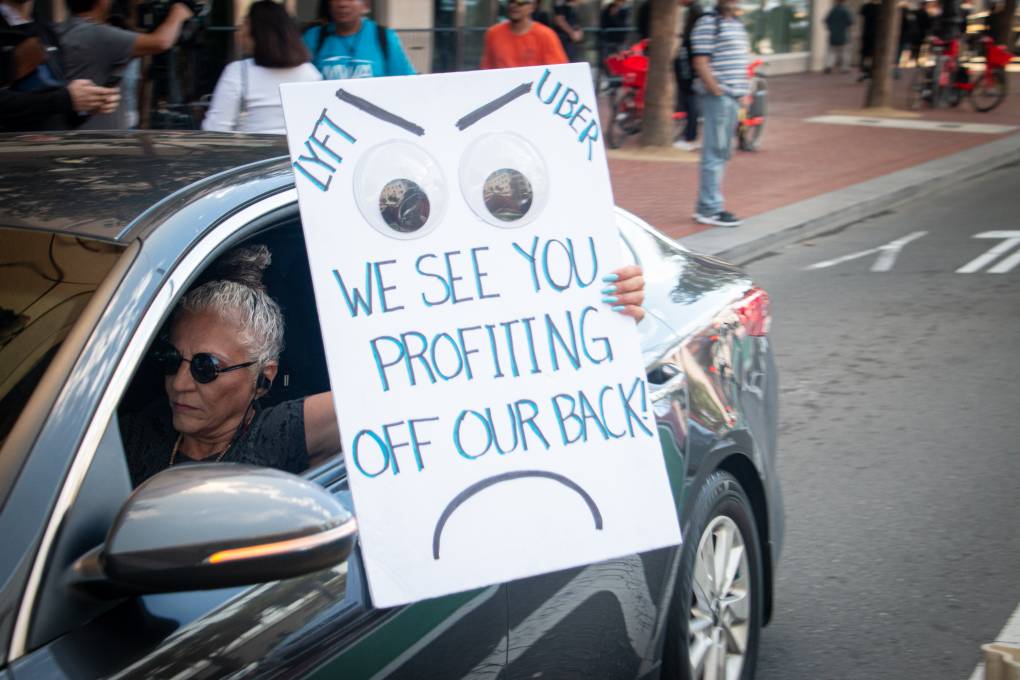
"caption": "Rideshare drivers protest outside Uber's former headquarters on Market Street in downtown San Francisco on Aug. 27, 2019.",
"credit": "Courtesy of Gig Workers Rising",
"altTag": "A woman wearing sunglasses drives a car while holding a sign that says: \"Lyft and Uber we see you profiting off our back!\"",
"description": null,
"imgSizes": {
"medium": {
"file": "https://cdn.kqed.org/wp-content/uploads/sites/10/2022/04/yes2-800x533.jpg",
"width": 800,
"height": 533,
"mimeType": "image/jpeg"
},
"large": {
"file": "https://cdn.kqed.org/wp-content/uploads/sites/10/2022/04/yes2-1020x680.jpg",
"width": 1020,
"height": 680,
"mimeType": "image/jpeg"
},
"thumbnail": {
"file": "https://cdn.kqed.org/wp-content/uploads/sites/10/2022/04/yes2-160x107.jpg",
"width": 160,
"height": 107,
"mimeType": "image/jpeg"
},
"1536x1536": {
"file": "https://cdn.kqed.org/wp-content/uploads/sites/10/2022/04/yes2-1536x1024.jpg",
"width": 1536,
"height": 1024,
"mimeType": "image/jpeg"
},
"2048x2048": {
"file": "https://cdn.kqed.org/wp-content/uploads/sites/10/2022/04/yes2-2048x1365.jpg",
"width": 2048,
"height": 1365,
"mimeType": "image/jpeg"
},
"post-thumbnail": {
"file": "https://cdn.kqed.org/wp-content/uploads/sites/10/2022/04/yes2-672x372.jpg",
"width": 672,
"height": 372,
"mimeType": "image/jpeg"
},
"twentyfourteen-full-width": {
"file": "https://cdn.kqed.org/wp-content/uploads/sites/10/2022/04/yes2-1038x576.jpg",
"width": 1038,
"height": 576,
"mimeType": "image/jpeg"
},
"full-width": {
"file": "https://cdn.kqed.org/wp-content/uploads/sites/10/2022/04/yes2-1920x1280.jpg",
"width": 1920,
"height": 1280,
"mimeType": "image/jpeg"
},
"kqedFullSize": {
"file": "https://cdn.kqed.org/wp-content/uploads/sites/10/2022/04/yes2-scaled-e1776791757748.jpg",
"width": 2000,
"height": 1334
}
},
"isLoading": false,
"fetchFailed": false
},
"news_11909405": {
"type": "attachments",
"id": "news_11909405",
"meta": {
"index": "attachments_1716263798",
"site": "news",
"id": "11909405",
"found": true
},
"parent": 11909366,
"imgSizes": {
"twentyfourteen-full-width": {
"file": "https://ww2.kqed.org/app/uploads/sites/10/2022/03/MARQUEE-926-1038x576.jpeg",
"width": 1038,
"mimeType": "image/jpeg",
"height": 576
},
"thumbnail": {
"file": "https://ww2.kqed.org/app/uploads/sites/10/2022/03/MARQUEE-926-160x90.jpeg",
"width": 160,
"mimeType": "image/jpeg",
"height": 90
},
"post-thumbnail": {
"file": "https://ww2.kqed.org/app/uploads/sites/10/2022/03/MARQUEE-926-672x372.jpeg",
"width": 672,
"mimeType": "image/jpeg",
"height": 372
},
"kqedFullSize": {
"file": "https://ww2.kqed.org/app/uploads/sites/10/2022/03/MARQUEE-926.jpeg",
"width": 1920,
"height": 1080
},
"large": {
"file": "https://ww2.kqed.org/app/uploads/sites/10/2022/03/MARQUEE-926-1020x574.jpeg",
"width": 1020,
"mimeType": "image/jpeg",
"height": 574
},
"1536x1536": {
"file": "https://ww2.kqed.org/app/uploads/sites/10/2022/03/MARQUEE-926-1536x864.jpeg",
"width": 1536,
"mimeType": "image/jpeg",
"height": 864
},
"medium": {
"file": "https://ww2.kqed.org/app/uploads/sites/10/2022/03/MARQUEE-926-800x450.jpeg",
"width": 800,
"mimeType": "image/jpeg",
"height": 450
}
},
"publishDate": 1648250566,
"modified": 1648250566,
"caption": null,
"description": null,
"title": "MARQUEE 926",
"credit": null,
"status": "inherit",
"altTag": null,
"isLoading": false,
"fetchFailed": false
},
"news_104566": {
"type": "attachments",
"id": "news_104566",
"meta": {
"index": "attachments_1716263798",
"site": "news",
"id": "104566",
"found": true
},
"parent": 104561,
"imgSizes": {
"kqedFullSize": {
"file": "https://ww2.kqed.org/app/uploads/sites/10/2013/07/RS4549_GoogleWorkers20120712-lpr.jpg",
"width": 1536,
"height": 1024
}
},
"publishDate": 1374705183,
"modified": 1647978469,
"caption": "Workers on Google's main campus in Mountain View, 2005. ",
"description": null,
"title": "Google campus",
"credit": "David Paul Morris/Getty Images",
"status": "inherit",
"altTag": "A sign showing the google logo in the foreground with people walking in the background",
"isLoading": false,
"fetchFailed": false
},
"news_11907321": {
"type": "attachments",
"id": "news_11907321",
"meta": {
"index": "attachments_1716263798",
"site": "news",
"id": "11907321",
"found": true
},
"parent": 11907319,
"imgSizes": {
"twentyfourteen-full-width": {
"file": "https://ww2.kqed.org/app/uploads/sites/10/2022/03/GettyImages-1238817320-1038x576.jpg",
"width": 1038,
"mimeType": "image/jpeg",
"height": 576
},
"thumbnail": {
"file": "https://ww2.kqed.org/app/uploads/sites/10/2022/03/GettyImages-1238817320-160x107.jpg",
"width": 160,
"mimeType": "image/jpeg",
"height": 107
},
"post-thumbnail": {
"file": "https://ww2.kqed.org/app/uploads/sites/10/2022/03/GettyImages-1238817320-672x372.jpg",
"width": 672,
"mimeType": "image/jpeg",
"height": 372
},
"kqedFullSize": {
"file": "https://ww2.kqed.org/app/uploads/sites/10/2022/03/GettyImages-1238817320-scaled.jpg",
"width": 2560,
"height": 1707
},
"2048x2048": {
"file": "https://ww2.kqed.org/app/uploads/sites/10/2022/03/GettyImages-1238817320-2048x1365.jpg",
"width": 2048,
"mimeType": "image/jpeg",
"height": 1365
},
"large": {
"file": "https://ww2.kqed.org/app/uploads/sites/10/2022/03/GettyImages-1238817320-1020x680.jpg",
"width": 1020,
"mimeType": "image/jpeg",
"height": 680
},
"1536x1536": {
"file": "https://ww2.kqed.org/app/uploads/sites/10/2022/03/GettyImages-1238817320-1536x1024.jpg",
"width": 1536,
"mimeType": "image/jpeg",
"height": 1024
},
"full-width": {
"file": "https://ww2.kqed.org/app/uploads/sites/10/2022/03/GettyImages-1238817320-1920x1280.jpg",
"width": 1920,
"mimeType": "image/jpeg",
"height": 1280
},
"medium": {
"file": "https://ww2.kqed.org/app/uploads/sites/10/2022/03/GettyImages-1238817320-800x533.jpg",
"width": 800,
"mimeType": "image/jpeg",
"height": 533
}
},
"publishDate": 1646676329,
"modified": 1646676691,
"caption": "Demonstrators gather to rally in support of Ukraine in Santa Monica on Feb. 27, 2022.",
"description": null,
"title": "US-RUSSIA-UKRAINE-CONFLICT-PROTEST",
"credit": "Ringo Chiu/AFP via Getty Images",
"status": "inherit",
"altTag": "A demonstration with hundreds of people holding signs and the Ukrainian flag.",
"isLoading": false,
"fetchFailed": false
},
"news_11904651": {
"type": "attachments",
"id": "news_11904651",
"meta": {
"index": "attachments_1716263798",
"site": "news",
"id": "11904651",
"found": true
},
"parent": 11904502,
"imgSizes": {
"twentyfourteen-full-width": {
"file": "https://ww2.kqed.org/app/uploads/sites/10/2022/02/RS53607_nypldigitalcollections5e66b3e8-faf1-d471-e040-e00a180654d7001w-qut-760x576.jpg",
"width": 760,
"mimeType": "image/jpeg",
"height": 576
},
"thumbnail": {
"file": "https://ww2.kqed.org/app/uploads/sites/10/2022/02/RS53607_nypldigitalcollections5e66b3e8-faf1-d471-e040-e00a180654d7001w-qut-160x129.jpg",
"width": 160,
"mimeType": "image/jpeg",
"height": 129
},
"post-thumbnail": {
"file": "https://ww2.kqed.org/app/uploads/sites/10/2022/02/RS53607_nypldigitalcollections5e66b3e8-faf1-d471-e040-e00a180654d7001w-qut-672x372.jpg",
"width": 672,
"mimeType": "image/jpeg",
"height": 372
},
"kqedFullSize": {
"file": "https://ww2.kqed.org/app/uploads/sites/10/2022/02/RS53607_nypldigitalcollections5e66b3e8-faf1-d471-e040-e00a180654d7001w-qut.jpg",
"width": 760,
"height": 611
}
},
"publishDate": 1644451811,
"modified": 1646351771,
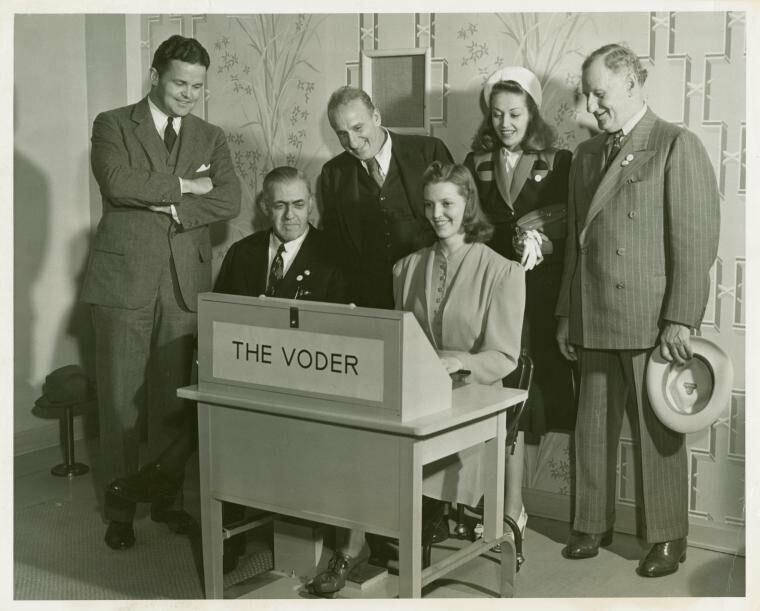
"caption": "Before Siri and Alexa, there was Voder, the world's first talking machine, which was on display at the New York World's Fair in 1939-1940.",
"description": null,
"title": "RS53607_nypldigitalcollections5e66b3e8-faf1-d471-e040-e00a180654d7001w-qut",
"credit": "Courtesy of The New York Public Library Collections",
"status": "inherit",
"altTag": "A woman plays a keyboard machine while 5 people look on.",
"isLoading": false,
"fetchFailed": false
}
},
"audioPlayerReducer": {
"postId": "stream_live",
"isPaused": true,
"isPlaying": false,
"pfsActive": false,
"pledgeModalIsOpen": true,
"playerDrawerIsOpen": false,
"liveAudioPlayStartedAt": 0,
"liveAudioPlayContext": ""
},
"authorsReducer": {
"byline_news_11908809": {
"type": "authors",
"id": "byline_news_11908809",
"meta": {
"override": true
},
"slug": "byline_news_11908809",
"name": "Barbara Ortutay",
"isLoading": false
},
"byline_news_11907319": {
"type": "authors",
"id": "byline_news_11907319",
"meta": {
"override": true
},
"slug": "byline_news_11907319",
"name": "John Antczak\u003cbr>The Associated Press",
"isLoading": false
},
"kqed": {
"type": "authors",
"id": "236",
"meta": {
"index": "authors_1716337520",
"id": "236",
"found": true
},
"name": "KQED News Staff",
"firstName": "KQED News Staff",
"lastName": null,
"slug": "kqed",
"email": "faq@kqed.org",
"display_author_email": false,
"staff_mastheads": [],
"title": null,
"bio": null,
"avatar": "https://secure.gravatar.com/avatar/ef0e801a68c4c54afa9180db14084167?s=600&d=blank&r=g",
"twitter": null,
"facebook": null,
"instagram": null,
"linkedin": null,
"sites": [
{
"site": "arts",
"roles": [
"contributor"
]
},
{
"site": "news",
"roles": [
"editor"
]
},
{
"site": "futureofyou",
"roles": [
"author"
]
}
],
"headData": {
"title": "KQED News Staff | KQED",
"description": null,
"ogImgSrc": "https://secure.gravatar.com/avatar/ef0e801a68c4c54afa9180db14084167?s=600&d=blank&r=g",
"twImgSrc": "https://secure.gravatar.com/avatar/ef0e801a68c4c54afa9180db14084167?s=600&d=blank&r=g"
},
"isLoading": false,
"link": "/author/kqed"
},
"rachael-myrow": {
"type": "authors",
"id": "251",
"meta": {
"index": "authors_1716337520",
"id": "251",
"found": true
},
"name": "Rachael Myrow",
"firstName": "Rachael",
"lastName": "Myrow",
"slug": "rachael-myrow",
"email": "rmyrow@kqed.org",
"display_author_email": true,
"staff_mastheads": [
"news"
],
"title": "Senior Editor of KQED's Silicon Valley News Desk",
"bio": "• I write and edit stories about how Silicon Valley power and policies shape everyday life in California. I’m also passionate about making Bay Area history and culture more accessible to a broad public. • I’ve been a journalist for most of my life, starting in high school with The Franklin Press in Los Angeles, where I grew up. While earning my first degree in English at UC Berkeley, I got my start in public radio at KALX-FM. After completing a second degree in journalism at Cal, I landed my first professional job at Marketplace, then moved on to KPCC (now LAist), and then KQED, where I hosted The California Report for more than seven years. • My reporting has appeared on NPR, The World, WBUR’s \u003ci>Here & Now\u003c/i>, and the BBC. I also guest host for KQED’s \u003ci>Forum\u003c/i>, as well as the Commonwealth Club in San Francisco. • I speak periodically on media, democracy and technology issues, and do voiceover work for documentaries and educational video projects. • Outside of the studio, you'll find me hiking Bay Area trails and whipping up Insta-ready meals in my kitchen. • I do not accept gifts, money, or favors from anyone connected to my reporting, I don't pay people for information, and I do not support or donate to political causes. • I strive to treat the people I report on with fairness, honesty, and respect. I also recognize there are often multiple sides to a story and work to verify information through multiple sources and documentation. If I get something wrong, I correct it.",
"avatar": "https://secure.gravatar.com/avatar/3ed8a3c5f26025e4a805ba634cda8cd764906b97438a6d9ce216b044e340da4e?s=600&d=blank&r=g",
"twitter": "rachaelmyrow",
"bluesky": null,
"facebook": null,
"instagram": null,
"linkedin": "https://www.linkedin.com/in/rachaelmyrow/",
"sites": [
{
"site": "arts",
"roles": [
"administrator"
]
},
{
"site": "news",
"roles": [
"edit_others_posts",
"editor"
]
},
{
"site": "futureofyou",
"roles": [
"editor"
]
},
{
"site": "bayareabites",
"roles": [
"editor"
]
},
{
"site": "stateofhealth",
"roles": [
"editor"
]
},
{
"site": "science",
"roles": [
"editor"
]
},
{
"site": "food",
"roles": [
"editor"
]
},
{
"site": "forum",
"roles": [
"editor"
]
},
{
"site": "liveblog",
"roles": [
"author"
]
}
],
"headData": {
"title": "Rachael Myrow | KQED",
"description": "Senior Editor of KQED's Silicon Valley News Desk",
"ogImgSrc": "https://secure.gravatar.com/avatar/3ed8a3c5f26025e4a805ba634cda8cd764906b97438a6d9ce216b044e340da4e?s=600&d=blank&r=g",
"twImgSrc": "https://secure.gravatar.com/avatar/3ed8a3c5f26025e4a805ba634cda8cd764906b97438a6d9ce216b044e340da4e?s=600&d=blank&r=g"
},
"isLoading": false,
"link": "/author/rachael-myrow"
},
"markfiore": {
"type": "authors",
"id": "3236",
"meta": {
"index": "authors_1716337520",
"id": "3236",
"found": true
},
"name": "Mark Fiore",
"firstName": "Mark",
"lastName": "Fiore",
"slug": "markfiore",
"email": "mark@markfiore.com",
"display_author_email": false,
"staff_mastheads": [
"news"
],
"title": "KQED News Cartoonist",
"bio": "\u003ca href=\"http://www.MarkFiore.com\">MarkFiore.com\u003c/a> | \u003ca href=\"https://twitter.com/markfiore\">Follow on Twitter\u003c/a> | \u003ca href=\"https://www.facebook.com/pages/Mark-Fiore-Animated-Political-Cartoons/94451707396?ref=bookmarks\">Facebook\u003c/a> | \u003ca href=\"mailto:mark@markfiore.com\">email\u003c/a>\r\n\r\nPulitzer Prize-winner, Mark Fiore, who the Wall Street Journal has called “the undisputed guru of the form,” creates animated political cartoons in San Francisco, where his work has been featured regularly on the San Francisco Chronicle’s web site, SFGate.com. His work has appeared on Newsweek.com, Slate.com, CBSNews.com, MotherJones.com, DailyKos.com and NPR’s web site. Fiore’s political animation has appeared on CNN, Frontline, Bill Moyers Journal, Salon.com and cable and broadcast outlets across the globe.\r\n\r\nBeginning his professional life by drawing traditional political cartoons for newspapers, Fiore’s work appeared in publications ranging from the Washington Post to the Los Angeles Times. In the late 1990s, he began to experiment with animating political cartoons and, after a short stint at the San Jose Mercury News as their staff cartoonist, Fiore devoted all his energies to animation.\r\nGrowing up in California, Fiore also spent a good portion of his life in the backwoods of Idaho. It was this combination that shaped him politically. Mark majored in political science at Colorado College, where, in a perfect send-off for a cartoonist, he received his diploma in 1991 as commencement speaker Dick Cheney smiled approvingly.\r\nMark Fiore was awarded the Pulitzer Prize for political cartooning in 2010, a Robert F. Kennedy Journalism Award in 2004 and has twice received an Online Journalism Award for commentary from the Online News Association (2002, 2008). Fiore has received two awards for his work in new media from the National Cartoonists Society (2001, 2002), and in 2006 received The James Madison Freedom of Information Award from The Society of Professional Journalists.",
"avatar": "https://secure.gravatar.com/avatar/fc4e2a612b15b67bad0c6f0e1db4ca9b?s=600&d=blank&r=g",
"twitter": "MarkFiore",
"facebook": null,
"instagram": "https://www.instagram.com/markfiore/?hl=en",
"linkedin": null,
"sites": [
{
"site": "arts",
"roles": [
"contributor"
]
},
{
"site": "news",
"roles": [
"editor"
]
},
{
"site": "futureofyou",
"roles": [
"editor"
]
},
{
"site": "science",
"roles": [
"editor"
]
}
],
"headData": {
"title": "Mark Fiore | KQED",
"description": "KQED News Cartoonist",
"ogImgSrc": "https://secure.gravatar.com/avatar/fc4e2a612b15b67bad0c6f0e1db4ca9b?s=600&d=blank&r=g",
"twImgSrc": "https://secure.gravatar.com/avatar/fc4e2a612b15b67bad0c6f0e1db4ca9b?s=600&d=blank&r=g"
},
"isLoading": false,
"link": "/author/markfiore"
},
"cveltman": {
"type": "authors",
"id": "8608",
"meta": {
"index": "authors_1716337520",
"id": "8608",
"found": true
},
"name": "Chloe Veltman",
"firstName": "Chloe",
"lastName": "Veltman",
"slug": "cveltman",
"email": "cveltman@kqed.org",
"display_author_email": true,
"staff_mastheads": [],
"title": "Arts and Culture Reporter",
"bio": "Chloe Veltman is a former arts and culture reporter for KQED. Prior to joining the organization, she launched and led the arts bureau at Colorado Public Radio, served as the Bay Area's culture columnist for the New York Times, and was the founder, host and executive producer of VoiceBox, a national award-winning weekly podcast/radio show and live events series all about the human voice. Chloe is the recipient of numerous prizes, grants and fellowships including a Webby Award for her work on interactive storytelling, both the John S Knight Journalism Fellowship and Humanities Center Fellowship at Stanford University, the Sundance Arts Writing Fellowship and a Library of Congress Research Fellowship. She is the author of the book \"On Acting\" and has appeared as a guest lecturer at Yale University and the San Francisco Conservatory of Music among other institutions. She holds a BA in english literature from King's College, Cambridge, and a Masters in Dramaturgy from the Central School of Speech and Drama/Harvard Institute for Advanced Theater Training.\r\n\u003ca href=\"https://www.chloeveltman.com\">www.chloeveltman.com\u003c/a>",
"avatar": "https://secure.gravatar.com/avatar/55403394b00a1ddab683952c2eb2cf85?s=600&d=blank&r=g",
"twitter": "chloeveltman",
"facebook": null,
"instagram": null,
"linkedin": null,
"sites": [
{
"site": "arts",
"roles": []
},
{
"site": "news",
"roles": [
"author"
]
},
{
"site": "pop",
"roles": [
"editor"
]
},
{
"site": "science",
"roles": []
}
],
"headData": {
"title": "Chloe Veltman | KQED",
"description": "Arts and Culture Reporter",
"ogImgSrc": "https://secure.gravatar.com/avatar/55403394b00a1ddab683952c2eb2cf85?s=600&d=blank&r=g",
"twImgSrc": "https://secure.gravatar.com/avatar/55403394b00a1ddab683952c2eb2cf85?s=600&d=blank&r=g"
},
"isLoading": false,
"link": "/author/cveltman"
},
"ecruzguevarra": {
"type": "authors",
"id": "8654",
"meta": {
"index": "authors_1716337520",
"id": "8654",
"found": true
},
"name": "Ericka Cruz Guevarra",
"firstName": "Ericka",
"lastName": "Cruz Guevarra",
"slug": "ecruzguevarra",
"email": "ecruzguevarra@kqed.org",
"display_author_email": true,
"staff_mastheads": [
"news"
],
"title": "Producer, The Bay Podcast",
"bio": "Ericka Cruz Guevarra is host of \u003ca href=\"https://www.kqed.org/podcasts/thebay\">\u003cem>The Bay\u003c/em>\u003c/a> podcast at KQED. Before host, she was the show’s producer. Her work in that capacity includes a three-part reported series on policing in Vallejo, which won a 2020 excellence in journalism award from the Society of Professional Journalists. Ericka has worked as a breaking news reporter at Oregon Public Broadcasting, helped produce the Code Switch podcast, and was KQED’s inaugural Raul Ramirez Diversity Fund intern. She’s also an alumna of NPR’s Next Generation Radio program. Send her an email if you have strong feelings about whether Fairfield and Suisun City are the Bay. Ericka is represented by SAG-AFTRA.",
"avatar": "https://secure.gravatar.com/avatar/accefc1de4bafc7e234b69bcb9b6f6536c130fd84709bc3069ef11a78787e1bb?s=600&d=blank&r=g",
"twitter": "NotoriousECG",
"bluesky": null,
"facebook": null,
"instagram": null,
"linkedin": null,
"sites": [
{
"site": "arts",
"roles": [
"subscriber"
]
},
{
"site": "news",
"roles": [
"editor",
"manage_categories"
]
},
{
"site": "futureofyou",
"roles": [
"subscriber"
]
},
{
"site": "stateofhealth",
"roles": [
"subscriber"
]
},
{
"site": "science",
"roles": [
"editor"
]
},
{
"site": "forum",
"roles": [
"subscriber"
]
}
],
"headData": {
"title": "Ericka Cruz Guevarra | KQED",
"description": "Producer, The Bay Podcast",
"ogImgSrc": "https://secure.gravatar.com/avatar/accefc1de4bafc7e234b69bcb9b6f6536c130fd84709bc3069ef11a78787e1bb?s=600&d=blank&r=g",
"twImgSrc": "https://secure.gravatar.com/avatar/accefc1de4bafc7e234b69bcb9b6f6536c130fd84709bc3069ef11a78787e1bb?s=600&d=blank&r=g"
},
"isLoading": false,
"link": "/author/ecruzguevarra"
},
"lrobinson": {
"type": "authors",
"id": "11620",
"meta": {
"index": "authors_1716337520",
"id": "11620",
"found": true
},
"name": "Lowell Robinson",
"firstName": "Lowell",
"lastName": "Robinson",
"slug": "lrobinson",
"email": "lrobinson@kqed.org",
"display_author_email": false,
"staff_mastheads": [],
"title": "Lowell Robinson",
"bio": "Lowell is KQED's Senior Producer of Voice & AI. He is currently working on emerging platforms & transmedia storytelling projects.",
"avatar": "https://secure.gravatar.com/avatar/da9585298575eea9f145247c5957c92a?s=600&d=blank&r=g",
"twitter": "lowellr",
"facebook": null,
"instagram": null,
"linkedin": null,
"sites": [
{
"site": "news",
"roles": []
},
{
"site": "science",
"roles": []
},
{
"site": "podcasts",
"roles": [
"administrator"
]
}
],
"headData": {
"title": "Lowell Robinson | KQED",
"description": "Lowell Robinson",
"ogImgSrc": "https://secure.gravatar.com/avatar/da9585298575eea9f145247c5957c92a?s=600&d=blank&r=g",
"twImgSrc": "https://secure.gravatar.com/avatar/da9585298575eea9f145247c5957c92a?s=600&d=blank&r=g"
},
"isLoading": false,
"link": "/author/lrobinson"
},
"amontecillo": {
"type": "authors",
"id": "11649",
"meta": {
"index": "authors_1716337520",
"id": "11649",
"found": true
},
"name": "Alan Montecillo",
"firstName": "Alan",
"lastName": "Montecillo",
"slug": "amontecillo",
"email": "amontecillo@kqed.org",
"display_author_email": false,
"staff_mastheads": [
"news"
],
"title": "KQED Contributor",
"bio": "Alan Montecillo is the senior editor of \u003cem>\u003ca href=\"http://kqed.org/thebay\">The Bay\u003c/a>, \u003c/em> KQED's local news podcast. Before moving to the Bay Area, he worked as a senior talk show producer for WILL in Champaign-Urbana, Illinois and at Oregon Public Broadcasting in Portland, Oregon. He has won journalism awards from the Society of Professional Journalists Northern California, the Public Media Journalists Association, The Signal Awards, and has also received a regional Edward R. Murrow award. Alan is a Filipino American from Hong Kong and a graduate of Reed College.",
"avatar": "https://secure.gravatar.com/avatar/268f53a2066899ea9efdd8a5900218b17c822d9862cbc9326cccec53ef41d349?s=600&d=blank&r=g",
"twitter": "alanmontecillo",
"bluesky": null,
"facebook": null,
"instagram": null,
"linkedin": null,
"sites": [
{
"site": "",
"roles": [
"editor"
]
},
{
"site": "news",
"roles": [
"editor",
"manage_categories"
]
}
],
"headData": {
"title": "Alan Montecillo | KQED",
"description": "KQED Contributor",
"ogImgSrc": "https://secure.gravatar.com/avatar/268f53a2066899ea9efdd8a5900218b17c822d9862cbc9326cccec53ef41d349?s=600&d=blank&r=g",
"twImgSrc": "https://secure.gravatar.com/avatar/268f53a2066899ea9efdd8a5900218b17c822d9862cbc9326cccec53ef41d349?s=600&d=blank&r=g"
},
"isLoading": false,
"link": "/author/amontecillo"
},
"abandlamudi": {
"type": "authors",
"id": "11672",
"meta": {
"index": "authors_1716337520",
"id": "11672",
"found": true
},
"name": "Adhiti Bandlamudi",
"firstName": "Adhiti",
"lastName": "Bandlamudi",
"slug": "abandlamudi",
"email": "abandlamudi@kqed.org",
"display_author_email": false,
"staff_mastheads": [
"news"
],
"title": "KQED Housing Reporter",
"bio": "Adhiti Bandlamudi reports for KQED's Housing desk. She focuses on how housing gets built across the Bay Area. Before joining KQED in 2020, she reported for WUNC in Durham, North Carolina, WABE in Atlanta, Georgia and Capital Public Radio in Sacramento. In 2017, she was awarded a Kroc Fellowship at NPR where she reported on everything from sprinkles to the Golden State Killer's arrest. When she's not reporting, she's baking new recipes in her kitchen or watching movies with friends and family. She's originally from Georgia and has strong opinions about Great British Bake Off.",
"avatar": "https://secure.gravatar.com/avatar/868129c8b257bb99a3500e2c86a65400?s=600&d=mm&r=g",
"twitter": "oddity_adhiti",
"facebook": null,
"instagram": null,
"linkedin": null,
"sites": [
{
"site": "arts",
"roles": [
"author"
]
},
{
"site": "news",
"roles": [
"editor"
]
},
{
"site": "liveblog",
"roles": [
"author"
]
}
],
"headData": {
"title": "Adhiti Bandlamudi | KQED",
"description": "KQED Housing Reporter",
"ogImgSrc": "https://secure.gravatar.com/avatar/868129c8b257bb99a3500e2c86a65400?s=600&d=mm&r=g",
"twImgSrc": "https://secure.gravatar.com/avatar/868129c8b257bb99a3500e2c86a65400?s=600&d=mm&r=g"
},
"isLoading": false,
"link": "/author/abandlamudi"
},
"cbeale": {
"type": "authors",
"id": "11749",
"meta": {
"index": "authors_1716337520",
"id": "11749",
"found": true
},
"name": "Christopher Beale",
"firstName": "Christopher",
"lastName": "Beale",
"slug": "cbeale",
"email": "cbeale@kqed.org",
"display_author_email": true,
"staff_mastheads": [
"news"
],
"title": "Engineer/Producer/Reporter",
"bio": "\u003ca href=\"https://linktr.ee/realchrisjbeale\" rel=\"noopener noreferrer\">Christopher J. Beale\u003c/a> is an award winning journalist, audio engineer, and media host living in San Francisco. \r\n\r\nChristopher works primarily as an audio engineer at KQED and serves as the sound designer for both the Bay Curious and Rightnowish podcasts. He is the host and producer of the LGBTQIA podcast and radio segment \u003ca href=\"https://stereotypespodcast.org\">Stereotypes\u003c/a>.",
"avatar": "https://secure.gravatar.com/avatar/dc485bf84788eb7e7414eb638e72407e?s=600&d=blank&r=g",
"twitter": "realchrisjbeale",
"facebook": null,
"instagram": "http://instagram.com/realchrisjbeale",
"linkedin": null,
"sites": [
{
"site": "arts",
"roles": [
"contributor"
]
},
{
"site": "news",
"roles": [
"editor"
]
},
{
"site": "forum",
"roles": [
"editor"
]
}
],
"headData": {
"title": "Christopher Beale | KQED",
"description": "Engineer/Producer/Reporter",
"ogImgSrc": "https://secure.gravatar.com/avatar/dc485bf84788eb7e7414eb638e72407e?s=600&d=blank&r=g",
"twImgSrc": "https://secure.gravatar.com/avatar/dc485bf84788eb7e7414eb638e72407e?s=600&d=blank&r=g"
},
"isLoading": false,
"link": "/author/cbeale"
},
"mesquinca": {
"type": "authors",
"id": "11802",
"meta": {
"index": "authors_1716337520",
"id": "11802",
"found": true
},
"name": "Maria Esquinca",
"firstName": "Maria",
"lastName": "Esquinca",
"slug": "mesquinca",
"email": "mesquinca@kqed.org",
"display_author_email": false,
"staff_mastheads": [],
"title": "Producer, The Bay",
"bio": "María Esquinca is a producer of The Bay. Before that, she was a New York Women’s Foundation IGNITE Fellow at Latino USA. She worked at Radio Bilingue where she covered the San Joaquin Valley. Maria has interned at WLRN, News 21, The New York Times Student Journalism Institute and at Crain’s Detroit Business as a Dow Jones News Fund Business Reporting Intern. She is an MFA graduate from the University of Miami. In 2017, she graduated from the Walter Cronkite School of Journalism and Mass Communication with a Master of Mass Communication. A fronteriza, she was born in Ciudad Juárez, Chihuahua, Mexico and grew up in El Paso, Texas.",
"avatar": "https://secure.gravatar.com/avatar/77cedba18aae91da775038ba06dcd8d0?s=600&d=blank&r=g",
"twitter": "@m_esquinca",
"facebook": null,
"instagram": null,
"linkedin": null,
"sites": [
{
"site": "news",
"roles": []
}
],
"headData": {
"title": "Maria Esquinca | KQED",
"description": "Producer, The Bay",
"ogImgSrc": "https://secure.gravatar.com/avatar/77cedba18aae91da775038ba06dcd8d0?s=600&d=blank&r=g",
"twImgSrc": "https://secure.gravatar.com/avatar/77cedba18aae91da775038ba06dcd8d0?s=600&d=blank&r=g"
},
"isLoading": false,
"link": "/author/mesquinca"
}
},
"pagesReducer": {
"news_category_technology": {
"type": "terms",
"id": "news_248",
"meta": {
"index": "terms_1716263798",
"site": "news",
"id": "248",
"score": 10.93111
},
"featImg": null,
"name": "Technology",
"description": null,
"taxonomy": "category",
"headData": {
"twImgId": null,
"twTitle": null,
"ogTitle": null,
"ogImgId": null,
"twDescription": null,
"description": null,
"title": "Technology Archives | KQED News",
"ogDescription": null
},
"ttid": 256,
"slug": "technology",
"isLoading": false,
"title": "Technology",
"pageMeta": {
"site": "news",
"WpPageTemplate": "page-topic-editorial",
"currentPage": 38
},
"blocks": [
{
"blockName": "kqed/post-list",
"attrs": {
"layout": "cardArticle2",
"query": "posts/news?category=technology",
"seeMore": false,
"paginated": true,
"page": 38
}
},
{
"blockName": "kqed/ad"
}
]
}
},
"pfsSessionReducer": {},
"postsReducer": {
"stream_live": {
"type": "live",
"id": "stream_live",
"audioUrl": "https://streams.kqed.org/kqedradio",
"title": "Live Stream",
"excerpt": "Live Stream information currently unavailable.",
"link": "/radio",
"featImg": "",
"label": {
"name": "KQED Live",
"link": "/"
}
},
"stream_kqedNewscast": {
"type": "posts",
"id": "stream_kqedNewscast",
"audioUrl": "https://www.kqed.org/.stream/anon/radio/RDnews/newscast.mp3?_=1",
"title": "KQED Newscast",
"featImg": "",
"label": {
"name": "88.5 FM",
"link": "/"
}
},
"news_11919374": {
"type": "posts",
"id": "news_11919374",
"meta": {
"index": "posts_1716263798",
"site": "news",
"id": "11919374",
"score": null,
"sort": [
1657745314000
]
},
"guestAuthors": [],
"slug": "report-anti-hindu-hate-speech-surges-on-social-media",
"title": "Social Media Platforms See a Spike in Anti-Hindu Hate Speech, Report Says",
"publishDate": 1657745314,
"format": "audio",
"headTitle": "Social Media Platforms See a Spike in Anti-Hindu Hate Speech, Report Says | KQED",
"labelTerm": {
"term": 72,
"site": "news"
},
"content": "\u003cp>\u003cem>Note: This article’s visual assets contain offensive language.\u003c/em>\u003c/p>\n\u003cp>A new report finds that \u003ca href=\"https://networkcontagion.us/reports/7-11-22-anti-hindu-disinformation-a-case-study-of-hinduphobia-on-social-media/\">Islamists, white nationalists and other extremists are sharing hate speech and hate-filled memes about Hindus on social media\u003c/a>.\u003c/p>\n\u003cp>The real-world security concerns are substantial, especially in regions with \u003ca href=\"https://aapidata.com/wp-content/uploads/2022/06/CA_State_of_AANHPIs_Report_2022.pdf\">large Hindu communities\u003c/a> like the San Francisco Bay Area, where nearly half a million Asian Indians live.[pullquote size='medium' citation='John Farmer, director, Miller Center for Community Protection and Resilience, Rutgers University']‘The threats can be mitigated, even if they can’t be completely stopped.’[/pullquote]\u003c/p>\n\u003cp>“Anti-Hindu Disinformation: A Case Study of Hinduphobia on Social Media” comes out of a new cyber-social threat identification and forecasting center at Rutgers University. The center is a partnership between Rutgers’ \u003ca href=\"https://millercenter.rutgers.edu\" target=\"_blank\" rel=\"noopener noreferrer\">Miller Center for Community Protection and Resilience\u003c/a>, Rutgers’ \u003ca href=\"https://intel.rutgers.edu/about-center\" target=\"_blank\" rel=\"noopener noreferrer\">Center for Critical Intelligence Studies\u003c/a> and the nonprofit \u003ca href=\"https://networkcontagion.us/reports/\" target=\"_blank\" rel=\"noopener noreferrer\">Network Contagion Research Institute\u003c/a>.\u003c/p>\n\u003cp>The research effort was led by graduating senior Prasiddha Sudhakar, who used machine learning tools to explore the social media landscape for anti-Hindu disinformation. She was pretty sure there would be plenty of it, she said.\u003c/p>\n\u003cp>“I wouldn’t say I was surprised, given that there’s been a massive rise in all forms of ethnic hatred, whether it’s antisemitism, or Islamophobia, or anti-Asian hate,” she added.\u003c/p>\n\u003cfigure id=\"attachment_11919506\" class=\"wp-caption aligncenter\" style=\"max-width: 800px\">\u003ca href=\"https://ww2.kqed.org/app/uploads/sites/10/2022/07/Screen-Shot-2022-07-13-at-11.39.38-AM.png\">\u003cimg loading=\"lazy\" decoding=\"async\" class=\"size-medium wp-image-11919506\" src=\"https://ww2.kqed.org/app/uploads/sites/10/2022/07/Screen-Shot-2022-07-13-at-11.39.38-AM-800x426.png\" alt=\"A graph.\" width=\"800\" height=\"426\" srcset=\"https://cdn.kqed.org/wp-content/uploads/sites/10/2022/07/Screen-Shot-2022-07-13-at-11.39.38-AM-800x426.png 800w, https://cdn.kqed.org/wp-content/uploads/sites/10/2022/07/Screen-Shot-2022-07-13-at-11.39.38-AM-1020x543.png 1020w, https://cdn.kqed.org/wp-content/uploads/sites/10/2022/07/Screen-Shot-2022-07-13-at-11.39.38-AM-160x85.png 160w, https://cdn.kqed.org/wp-content/uploads/sites/10/2022/07/Screen-Shot-2022-07-13-at-11.39.38-AM-1536x818.png 1536w, https://cdn.kqed.org/wp-content/uploads/sites/10/2022/07/Screen-Shot-2022-07-13-at-11.39.38-AM-2048x1091.png 2048w, https://cdn.kqed.org/wp-content/uploads/sites/10/2022/07/Screen-Shot-2022-07-13-at-11.39.38-AM-1920x1023.png 1920w\" sizes=\"(max-width: 800px) 100vw, 800px\">\u003c/a>\u003cfigcaption class=\"wp-caption-text\">A charge shows a spike in use of terms like ‘Hindu’ and ‘pajeet’ on Telegram in the early months of 2022. \u003ccite>(Courtesy of Network Contagion Lab at Rutgers University)\u003c/cite>\u003c/figcaption>\u003c/figure>\n\u003cp>She and other Rutgers students found explosive growth in anti-Hindu slurs and slogans in the United States, beginning in the fall of 2021. This was on social media platforms you might expect to foster extremism, like 4chan and Gab, but also on mainstream platforms like Twitter, TikTok and Telegram.\u003c/p>\n\u003cp>“These very specific tropes are targeted right directly at Hindus,” Sudhakar said.\u003c/p>\n\u003cp>Commonly, there’s a spike in hate speech whenever someone rises to prominence from a community that’s historically been the target of prejudice. One recent example comes from San Francisco.\u003c/p>\n\u003cp>“\u003ca href=\"https://www.npr.org/2021/11/30/1060035782/parag-agarwal-twitter-ceo\">Parag Agrawal was appointed as Twitter CEO\u003c/a>,” said Sudhakar, citing the November promotion. “Immediately, there arises anti-Hindu disinformation on social media, where there were spikes in certain ethnic slurs used against him in particular.”\u003c/p>\n\u003cfigure id=\"attachment_11919392\" class=\"wp-caption aligncenter\" style=\"max-width: 1644px\">\u003cimg loading=\"lazy\" decoding=\"async\" class=\"size-full wp-image-11919392\" src=\"https://ww2.kqed.org/app/uploads/sites/10/2022/07/pajeet-2-4chan-pajeet-hindu-india-1.jpeg\" alt=\"A word cloud of offensive, anti-Hindu slurs trending on various social media platforms.\" width=\"1644\" height=\"1600\" srcset=\"https://cdn.kqed.org/wp-content/uploads/sites/10/2022/07/pajeet-2-4chan-pajeet-hindu-india-1.jpeg 1644w, https://cdn.kqed.org/wp-content/uploads/sites/10/2022/07/pajeet-2-4chan-pajeet-hindu-india-1-800x779.jpeg 800w, https://cdn.kqed.org/wp-content/uploads/sites/10/2022/07/pajeet-2-4chan-pajeet-hindu-india-1-1020x993.jpeg 1020w, https://cdn.kqed.org/wp-content/uploads/sites/10/2022/07/pajeet-2-4chan-pajeet-hindu-india-1-160x156.jpeg 160w, https://cdn.kqed.org/wp-content/uploads/sites/10/2022/07/pajeet-2-4chan-pajeet-hindu-india-1-1536x1495.jpeg 1536w\" sizes=\"(max-width: 1644px) 100vw, 1644px\">\u003cfigcaption class=\"wp-caption-text\">A word cloud of offensive, anti-Hindu slurs trending on various social media platforms. \u003ccite>(Courtesy of Network Contagion Lab at Rutgers University)\u003c/cite>\u003c/figcaption>\u003c/figure>\n\u003cp>But Sudhakar and her colleagues discovered much of the anti-Hindu hate speech surge can be tied to Iranian state-sponsored trolls who are keen to exploit longstanding geopolitical tensions between Muslims and Hindus, Pakistanis and Indians.\u003c/p>\n\u003cblockquote>\u003cp>As the connection between political events and the volume of Hinduphobic Iranian troll activity demonstrates, Anti-Hindu disinformation fluctuates with geopolitical incentives. Iran’s role as mediator between India and Pakistan becomes more substantial as conflict between the nations grows.\u003c/p>\u003c/blockquote>\n\u003cp style=\"text-align: right\">\u003cem>— “Anti-Hindu Disinformation: A Case Study of Hinduphobia on Social Media”\u003c/em>\u003c/p>\n\u003cp dir=\"ltr\">Twitter was the only social media platforms to respond when contacted by KQED.\u003c/p>\n\u003cp dir=\"ltr\">“We are committed to combating abuse motivated by hatred, prejudice or intolerance, particularly abuse that seeks to silence the voices of those who have been historically marginalized. For this reason, we prohibit behavior that targets individuals or groups with abuse based on their perceived membership in a protected category,” a spokesperson wrote.\u003c/p>\n\u003cp dir=\"ltr\">She added that the San Francisco-based company has “expanded our rules against dehumanization to all protected categories as well including religion and caste.”\u003c/p>\n\u003ch2>The potential for real-world violence\u003c/h2>\n\u003cp dir=\"ltr\">Content moderation teams at all the major social media platforms are “drinking from a firehose” of hateful content, according to John Farmer, who directs the Miller Center for Community Protection and Resilience at Rutgers, part of the collaboration that produced the report. The platforms have proved fertile breeding grounds for \u003ca href=\"https://www.kqed.org/news/11746552/no-lone-shooter-how-anti-semitism-is-winning-new-converts-on-the-internet\" target=\"_blank\" rel=\"noopener noreferrer\">resurrecting and refreshing hate speech tropes\u003c/a> or memes.\u003c/p>\n\u003cp>Farmer said recent real-world attacks demonstrate that\u003ca href=\"https://www.kqed.org/news/11765841/how-hate-filled-online-groups-encourage-budding-psychopaths-to-kill-others\"> violence commonly follows hateful memes, hashtags and such\u003c/a>.\u003c/p>\n\u003cp>“The common thread here is the use and abuse of social media,” he said, adding that he hopes Hindu communities in California and beyond will reach out to other faith communities already working to protect themselves, like Jews and Sikhs, to help them establish “a clear chain of what happens if something does come down.”\u003c/p>\n\u003cp>“There’s somebody detailed to respond to press inquiries. There’s somebody identified as their liaison to law enforcement. The threats can be mitigated, even if they can’t be completely stopped,” he said.\u003c/p>\n\u003cp>[ad fullwidth]\u003c/p>\n\u003cp>\u003c/p>\n",
"blocks": [],
"excerpt": "Student researchers at Rutgers University report a recent surge in anti-Hindu hate speech on multiple social media platforms, much of it state-sponsored by Iran.",
"status": "publish",
"parent": 0,
"modified": 1730493334,
"stats": {
"hasAudio": false,
"hasVideo": false,
"hasChartOrMap": false,
"iframeSrcs": [],
"hasGoogleForm": false,
"hasGallery": false,
"hasHearkenModule": false,
"hasPolis": false,
"paragraphCount": 17,
"wordCount": 786
},
"headData": {
"title": "Social Media Platforms See a Spike in Anti-Hindu Hate Speech, Report Says | KQED",
"description": "Student researchers at Rutgers University report a recent surge in anti-Hindu hate speech on multiple social media platforms, much of it state-sponsored by Iran.",
"ogTitle": "",
"ogDescription": "",
"ogImgId": "",
"twTitle": "",
"twDescription": "",
"twImgId": "",
"schema": {
"@context": "https://schema.org",
"@type": "NewsArticle",
"headline": "Social Media Platforms See a Spike in Anti-Hindu Hate Speech, Report Says",
"datePublished": "2022-07-13T13:48:34-07:00",
"dateModified": "2024-11-01T13:35:34-07:00",
"image": "https://cdn.kqed.org/wp-content/uploads/2020/02/KQED-OG-Image@1x.png",
"isAccessibleForFree": "True",
"publisher": {
"@type": "NewsMediaOrganization",
"@id": "https://www.kqed.org/#organization",
"name": "KQED",
"logo": "https://cdn.kqed.org/wp-content/uploads/2020/02/KQED-OG-Image@1x.png",
"url": "https://www.kqed.org",
"sameAs": [
"https://www.facebook.com/KQED",
"https://twitter.com/KQED",
"https://www.instagram.com/kqed/",
"https://www.tiktok.com/@kqedofficial",
"https://www.linkedin.com/company/kqed",
"https://www.youtube.com/channel/UCeC0IOo7i1P_61zVUWbJ4nw"
]
}
}
},
"audioUrl": "https://traffic.omny.fm/d/clips/0af137ef-751e-4b19-a055-aaef00d2d578/ffca7e9f-6831-4[…]f-aaef00f5a073/987d894b-14f3-4605-a3bc-aed0010657a8/audio.mp3",
"sticky": false,
"excludeFromSiteSearch": "Include",
"path": "/news/11919374/report-anti-hindu-hate-speech-surges-on-social-media",
"audioTrackLength": null,
"parsedContent": [
{
"type": "contentString",
"content": "\u003cdiv class=\"post-body\">\u003cp>\u003cp>\u003cem>Note: This article’s visual assets contain offensive language.\u003c/em>\u003c/p>\n\u003cp>A new report finds that \u003ca href=\"https://networkcontagion.us/reports/7-11-22-anti-hindu-disinformation-a-case-study-of-hinduphobia-on-social-media/\">Islamists, white nationalists and other extremists are sharing hate speech and hate-filled memes about Hindus on social media\u003c/a>.\u003c/p>\n\u003cp>The real-world security concerns are substantial, especially in regions with \u003ca href=\"https://aapidata.com/wp-content/uploads/2022/06/CA_State_of_AANHPIs_Report_2022.pdf\">large Hindu communities\u003c/a> like the San Francisco Bay Area, where nearly half a million Asian Indians live.\u003c/p>\u003c/div>",
"attributes": {
"named": {},
"numeric": []
}
},
{
"type": "component",
"content": "‘The threats can be mitigated, even if they can’t be completely stopped.’",
"name": "pullquote",
"attributes": {
"named": {
"size": "medium",
"citation": "John Farmer, director, Miller Center for Community Protection and Resilience, Rutgers University",
"label": ""
},
"numeric": []
}
},
{
"type": "contentString",
"content": "\u003cdiv class=\"post-body\">\u003cp>\u003c/p>\n\u003cp>“Anti-Hindu Disinformation: A Case Study of Hinduphobia on Social Media” comes out of a new cyber-social threat identification and forecasting center at Rutgers University. The center is a partnership between Rutgers’ \u003ca href=\"https://millercenter.rutgers.edu\" target=\"_blank\" rel=\"noopener noreferrer\">Miller Center for Community Protection and Resilience\u003c/a>, Rutgers’ \u003ca href=\"https://intel.rutgers.edu/about-center\" target=\"_blank\" rel=\"noopener noreferrer\">Center for Critical Intelligence Studies\u003c/a> and the nonprofit \u003ca href=\"https://networkcontagion.us/reports/\" target=\"_blank\" rel=\"noopener noreferrer\">Network Contagion Research Institute\u003c/a>.\u003c/p>\n\u003cp>The research effort was led by graduating senior Prasiddha Sudhakar, who used machine learning tools to explore the social media landscape for anti-Hindu disinformation. She was pretty sure there would be plenty of it, she said.\u003c/p>\n\u003cp>“I wouldn’t say I was surprised, given that there’s been a massive rise in all forms of ethnic hatred, whether it’s antisemitism, or Islamophobia, or anti-Asian hate,” she added.\u003c/p>\n\u003cfigure id=\"attachment_11919506\" class=\"wp-caption aligncenter\" style=\"max-width: 800px\">\u003ca href=\"https://ww2.kqed.org/app/uploads/sites/10/2022/07/Screen-Shot-2022-07-13-at-11.39.38-AM.png\">\u003cimg loading=\"lazy\" decoding=\"async\" class=\"size-medium wp-image-11919506\" src=\"https://ww2.kqed.org/app/uploads/sites/10/2022/07/Screen-Shot-2022-07-13-at-11.39.38-AM-800x426.png\" alt=\"A graph.\" width=\"800\" height=\"426\" srcset=\"https://cdn.kqed.org/wp-content/uploads/sites/10/2022/07/Screen-Shot-2022-07-13-at-11.39.38-AM-800x426.png 800w, https://cdn.kqed.org/wp-content/uploads/sites/10/2022/07/Screen-Shot-2022-07-13-at-11.39.38-AM-1020x543.png 1020w, https://cdn.kqed.org/wp-content/uploads/sites/10/2022/07/Screen-Shot-2022-07-13-at-11.39.38-AM-160x85.png 160w, https://cdn.kqed.org/wp-content/uploads/sites/10/2022/07/Screen-Shot-2022-07-13-at-11.39.38-AM-1536x818.png 1536w, https://cdn.kqed.org/wp-content/uploads/sites/10/2022/07/Screen-Shot-2022-07-13-at-11.39.38-AM-2048x1091.png 2048w, https://cdn.kqed.org/wp-content/uploads/sites/10/2022/07/Screen-Shot-2022-07-13-at-11.39.38-AM-1920x1023.png 1920w\" sizes=\"(max-width: 800px) 100vw, 800px\">\u003c/a>\u003cfigcaption class=\"wp-caption-text\">A charge shows a spike in use of terms like ‘Hindu’ and ‘pajeet’ on Telegram in the early months of 2022. \u003ccite>(Courtesy of Network Contagion Lab at Rutgers University)\u003c/cite>\u003c/figcaption>\u003c/figure>\n\u003cp>She and other Rutgers students found explosive growth in anti-Hindu slurs and slogans in the United States, beginning in the fall of 2021. This was on social media platforms you might expect to foster extremism, like 4chan and Gab, but also on mainstream platforms like Twitter, TikTok and Telegram.\u003c/p>\n\u003cp>“These very specific tropes are targeted right directly at Hindus,” Sudhakar said.\u003c/p>\n\u003cp>Commonly, there’s a spike in hate speech whenever someone rises to prominence from a community that’s historically been the target of prejudice. One recent example comes from San Francisco.\u003c/p>\n\u003cp>“\u003ca href=\"https://www.npr.org/2021/11/30/1060035782/parag-agarwal-twitter-ceo\">Parag Agrawal was appointed as Twitter CEO\u003c/a>,” said Sudhakar, citing the November promotion. “Immediately, there arises anti-Hindu disinformation on social media, where there were spikes in certain ethnic slurs used against him in particular.”\u003c/p>\n\u003cfigure id=\"attachment_11919392\" class=\"wp-caption aligncenter\" style=\"max-width: 1644px\">\u003cimg loading=\"lazy\" decoding=\"async\" class=\"size-full wp-image-11919392\" src=\"https://ww2.kqed.org/app/uploads/sites/10/2022/07/pajeet-2-4chan-pajeet-hindu-india-1.jpeg\" alt=\"A word cloud of offensive, anti-Hindu slurs trending on various social media platforms.\" width=\"1644\" height=\"1600\" srcset=\"https://cdn.kqed.org/wp-content/uploads/sites/10/2022/07/pajeet-2-4chan-pajeet-hindu-india-1.jpeg 1644w, https://cdn.kqed.org/wp-content/uploads/sites/10/2022/07/pajeet-2-4chan-pajeet-hindu-india-1-800x779.jpeg 800w, https://cdn.kqed.org/wp-content/uploads/sites/10/2022/07/pajeet-2-4chan-pajeet-hindu-india-1-1020x993.jpeg 1020w, https://cdn.kqed.org/wp-content/uploads/sites/10/2022/07/pajeet-2-4chan-pajeet-hindu-india-1-160x156.jpeg 160w, https://cdn.kqed.org/wp-content/uploads/sites/10/2022/07/pajeet-2-4chan-pajeet-hindu-india-1-1536x1495.jpeg 1536w\" sizes=\"(max-width: 1644px) 100vw, 1644px\">\u003cfigcaption class=\"wp-caption-text\">A word cloud of offensive, anti-Hindu slurs trending on various social media platforms. \u003ccite>(Courtesy of Network Contagion Lab at Rutgers University)\u003c/cite>\u003c/figcaption>\u003c/figure>\n\u003cp>But Sudhakar and her colleagues discovered much of the anti-Hindu hate speech surge can be tied to Iranian state-sponsored trolls who are keen to exploit longstanding geopolitical tensions between Muslims and Hindus, Pakistanis and Indians.\u003c/p>\n\u003cblockquote>\u003cp>As the connection between political events and the volume of Hinduphobic Iranian troll activity demonstrates, Anti-Hindu disinformation fluctuates with geopolitical incentives. Iran’s role as mediator between India and Pakistan becomes more substantial as conflict between the nations grows.\u003c/p>\u003c/blockquote>\n\u003cp style=\"text-align: right\">\u003cem>— “Anti-Hindu Disinformation: A Case Study of Hinduphobia on Social Media”\u003c/em>\u003c/p>\n\u003cp dir=\"ltr\">Twitter was the only social media platforms to respond when contacted by KQED.\u003c/p>\n\u003cp dir=\"ltr\">“We are committed to combating abuse motivated by hatred, prejudice or intolerance, particularly abuse that seeks to silence the voices of those who have been historically marginalized. For this reason, we prohibit behavior that targets individuals or groups with abuse based on their perceived membership in a protected category,” a spokesperson wrote.\u003c/p>\n\u003cp dir=\"ltr\">She added that the San Francisco-based company has “expanded our rules against dehumanization to all protected categories as well including religion and caste.”\u003c/p>\n\u003ch2>The potential for real-world violence\u003c/h2>\n\u003cp dir=\"ltr\">Content moderation teams at all the major social media platforms are “drinking from a firehose” of hateful content, according to John Farmer, who directs the Miller Center for Community Protection and Resilience at Rutgers, part of the collaboration that produced the report. The platforms have proved fertile breeding grounds for \u003ca href=\"https://www.kqed.org/news/11746552/no-lone-shooter-how-anti-semitism-is-winning-new-converts-on-the-internet\" target=\"_blank\" rel=\"noopener noreferrer\">resurrecting and refreshing hate speech tropes\u003c/a> or memes.\u003c/p>\n\u003cp>Farmer said recent real-world attacks demonstrate that\u003ca href=\"https://www.kqed.org/news/11765841/how-hate-filled-online-groups-encourage-budding-psychopaths-to-kill-others\"> violence commonly follows hateful memes, hashtags and such\u003c/a>.\u003c/p>\n\u003cp>“The common thread here is the use and abuse of social media,” he said, adding that he hopes Hindu communities in California and beyond will reach out to other faith communities already working to protect themselves, like Jews and Sikhs, to help them establish “a clear chain of what happens if something does come down.”\u003c/p>\n\u003cp>“There’s somebody detailed to respond to press inquiries. There’s somebody identified as their liaison to law enforcement. The threats can be mitigated, even if they can’t be completely stopped,” he said.\u003c/p>\n\u003cp>\u003c/p>\u003c/div>",
"attributes": {
"named": {},
"numeric": []
}
},
{
"type": "component",
"content": "",
"name": "ad",
"attributes": {
"named": {
"label": "fullwidth"
},
"numeric": [
"fullwidth"
]
}
},
{
"type": "contentString",
"content": "\u003cdiv class=\"post-body\">\u003cp>\u003c/p>\n\u003cp>\u003c/p>\n\u003c/div>\u003c/p>",
"attributes": {
"named": {},
"numeric": []
}
}
],
"link": "/news/11919374/report-anti-hindu-hate-speech-surges-on-social-media",
"authors": [
"251"
],
"programs": [
"news_72"
],
"categories": [
"news_8",
"news_33520",
"news_248"
],
"tags": [
"news_25689",
"news_31040",
"news_4273",
"news_21319",
"news_31316",
"news_2011",
"news_1089",
"news_1631",
"news_29435",
"news_346"
],
"featImg": "news_11919389",
"label": "news_72"
},
"news_11912590": {
"type": "posts",
"id": "news_11912590",
"meta": {
"index": "posts_1716263798",
"site": "news",
"id": "11912590",
"score": null,
"sort": [
1651744889000
]
},
"guestAuthors": [],
"slug": "no-the-stanford-dish-isnt-listening-for-aliens-but-it-was-designed-to-spy-on-russia",
"title": "No, the Stanford Dish Isn't Listening for Aliens — but It Was Built to Spy on Russia",
"publishDate": 1651744889,
"format": "standard",
"headTitle": "No, the Stanford Dish Isn’t Listening for Aliens — but It Was Built to Spy on Russia | KQED",
"labelTerm": {},
"content": "\u003cp>On the western edge of Stanford University’s sprawling, 8,180-acre campus stands a giant satellite dish pointed at the sky. It’s known simply as “\u003ca href=\"https://dish.stanford.edu\" target=\"_blank\" rel=\"noopener noreferrer\">The Dish\u003c/a>,” and it stands out among Stanford’s rolling hills — green or yellow, depending on the season.\u003c/p>\n\u003cp>[baycuriouspodcastinfo]\u003c/p>\n\u003cp>“Who built The Dish?” asked former Menlo Park resident Jim Timmins. He also wanted to know, “When was it built? For what purpose? Is it still in service? If it’s not in service, when was it taken out of service?”\u003c/p>\n\u003cp>Timmins retired from a career in finance four years ago and moved to a dairy farm outside of Toronto, Canada. But he still listens to Bay Curious, and he still dreams about The Dish — not just the satellite dish, but the sprawling park and walking paths surrounding the massive saucer that thousands of people visit each year.\u003c/p>\n\u003cfigure id=\"attachment_11912625\" class=\"wp-caption aligncenter\" style=\"max-width: 2560px\">\u003cimg loading=\"lazy\" decoding=\"async\" class=\"size-full wp-image-11912625\" src=\"https://ww2.kqed.org/app/uploads/sites/10/2022/04/IMG_5780-scaled.jpeg\" alt=\"An elevated view of green hills dotted with oak trees and the San Francisco Bay in the distance.\" width=\"2560\" height=\"1920\" srcset=\"https://cdn.kqed.org/wp-content/uploads/sites/10/2022/04/IMG_5780-scaled.jpeg 2560w, https://cdn.kqed.org/wp-content/uploads/sites/10/2022/04/IMG_5780-800x600.jpeg 800w, https://cdn.kqed.org/wp-content/uploads/sites/10/2022/04/IMG_5780-1020x765.jpeg 1020w, https://cdn.kqed.org/wp-content/uploads/sites/10/2022/04/IMG_5780-160x120.jpeg 160w, https://cdn.kqed.org/wp-content/uploads/sites/10/2022/04/IMG_5780-1536x1152.jpeg 1536w, https://cdn.kqed.org/wp-content/uploads/sites/10/2022/04/IMG_5780-2048x1536.jpeg 2048w, https://cdn.kqed.org/wp-content/uploads/sites/10/2022/04/IMG_5780-1920x1440.jpeg 1920w\" sizes=\"(max-width: 2560px) 100vw, 2560px\">\u003cfigcaption class=\"wp-caption-text\">An elevated view, from the mezzanine of the Stanford Dish, of surrounding green hills dotted with oak trees, and the San Francisco Bay in the distance. \u003ccite>(Rachael Myrow/KQED)\u003c/cite>\u003c/figcaption>\u003c/figure>\n\u003cp>“It’s just an incredible view,” Timmins explained. “I can remember it like it was yesterday. To the west, is the Pacific Ocean. To the south, I could see past San Jose. To the east, I could see well into the Central Valley. And to the north, I could see all the way past San Francisco and the Golden Gate in to Marin.”\u003c/p>\n\u003cp>[ad fullwidth]\u003c/p>\n\u003cp>Now, this reporter has never seen quite so far as Timmins says he did when he started running around The Dish, as a Stanford student, back in 1979. But I do spot San Jose and San Francisco on clear days, and I love the way I can watch the landscape change over the seasons.\u003c/p>\n\u003cfigure id=\"attachment_11912633\" class=\"wp-caption aligncenter\" style=\"max-width: 2560px\">\u003cimg loading=\"lazy\" decoding=\"async\" class=\"size-full wp-image-11912633\" src=\"https://ww2.kqed.org/app/uploads/sites/10/2022/04/40E5EEAA-9216-4CA3-9C40-3549EE977935-scaled.jpg\" alt=\"A close up of oak acorns still on the tree.\" width=\"2560\" height=\"2560\" srcset=\"https://cdn.kqed.org/wp-content/uploads/sites/10/2022/04/40E5EEAA-9216-4CA3-9C40-3549EE977935-scaled.jpg 2560w, https://cdn.kqed.org/wp-content/uploads/sites/10/2022/04/40E5EEAA-9216-4CA3-9C40-3549EE977935-800x800.jpg 800w, https://cdn.kqed.org/wp-content/uploads/sites/10/2022/04/40E5EEAA-9216-4CA3-9C40-3549EE977935-1020x1020.jpg 1020w, https://cdn.kqed.org/wp-content/uploads/sites/10/2022/04/40E5EEAA-9216-4CA3-9C40-3549EE977935-160x160.jpg 160w, https://cdn.kqed.org/wp-content/uploads/sites/10/2022/04/40E5EEAA-9216-4CA3-9C40-3549EE977935-1536x1536.jpg 1536w, https://cdn.kqed.org/wp-content/uploads/sites/10/2022/04/40E5EEAA-9216-4CA3-9C40-3549EE977935-2048x2048.jpg 2048w, https://cdn.kqed.org/wp-content/uploads/sites/10/2022/04/40E5EEAA-9216-4CA3-9C40-3549EE977935-1920x1920.jpg 1920w\" sizes=\"(max-width: 2560px) 100vw, 2560px\">\u003cfigcaption class=\"wp-caption-text\">Oak trees sprout leaves — and acorns — in the spring. \u003ccite>(Rachael Myrow/KQED)\u003c/cite>\u003c/figcaption>\u003c/figure>\n\u003cp>Clutches of deer and turkeys roam the grounds in the spring. Coyotes and tarantulas, too, in the late summer.\u003c/p>\n\u003cp>Red-tailed hawks coast on thermals, hunting for chirping ground squirrels in the grass below all year. I’ve spotted egrets, woodpeckers and hummingbirds. I’ve never seen a mountain lion, but signs warn me they’re out there as well.\u003c/p>\n\u003cp>Even though I — and some 600,000 visitors a year — think of The Dish as a public park, it’s actually owned by Stanford. “The Dish is primarily used for academic research purposes, but in addition to that, it’s used for habitat restoration conservation efforts,” said Jovan Solis, who works with \u003ca href=\"https://lbre.stanford.edu\" target=\"_blank\" rel=\"noopener noreferrer\">Stanford Land, Buildings & Real Estate\u003c/a>.\u003c/p>\n\u003cfigure id=\"attachment_11912632\" class=\"wp-caption aligncenter\" style=\"max-width: 2560px\">\u003cimg loading=\"lazy\" decoding=\"async\" class=\"wp-image-11912632 size-full\" src=\"https://ww2.kqed.org/app/uploads/sites/10/2022/04/IMG_4483-scaled.jpeg\" alt=\"A young male turkey shows his tail on a paved hiking path.\" width=\"2560\" height=\"1920\" srcset=\"https://cdn.kqed.org/wp-content/uploads/sites/10/2022/04/IMG_4483-scaled.jpeg 2560w, https://cdn.kqed.org/wp-content/uploads/sites/10/2022/04/IMG_4483-800x600.jpeg 800w, https://cdn.kqed.org/wp-content/uploads/sites/10/2022/04/IMG_4483-1020x765.jpeg 1020w, https://cdn.kqed.org/wp-content/uploads/sites/10/2022/04/IMG_4483-160x120.jpeg 160w, https://cdn.kqed.org/wp-content/uploads/sites/10/2022/04/IMG_4483-1536x1152.jpeg 1536w, https://cdn.kqed.org/wp-content/uploads/sites/10/2022/04/IMG_4483-2048x1536.jpeg 2048w, https://cdn.kqed.org/wp-content/uploads/sites/10/2022/04/IMG_4483-1920x1440.jpeg 1920w\" sizes=\"(max-width: 2560px) 100vw, 2560px\">\u003cfigcaption class=\"wp-caption-text\">A young male turkey eyes a KQED reporter warily on the hiking path at the Stanford Dish. \u003ccite>(Rachael Myrow/KQED)\u003c/cite>\u003c/figcaption>\u003c/figure>\n\u003cp>Look closely and you’ll spot all kinds of habitat restoration projects Stanford students and professors are working on. There are efforts to encourage \u003ca href=\"https://news.stanford.edu/2019/01/15/save-native-grasslands-study-invasive-species/\" target=\"_blank\" rel=\"noopener noreferrer\">native grasses\u003c/a> and plants, like the \u003ca href=\"https://jrbp.stanford.edu/research/projects/floral-ecology-mimulus-aurantiacus-and-pedicularis-densiflora\" target=\"_blank\" rel=\"noopener noreferrer\">sticky monkey flower\u003c/a> and California \u003ca href=\"https://web.stanford.edu/~siegelr/flora/poppy.html\" target=\"_blank\" rel=\"noopener noreferrer\">poppies\u003c/a>, as well as critters, like the \u003ca href=\"https://hcp.stanford.edu/salamander.html\" target=\"_blank\" rel=\"noopener noreferrer\">California tiger salamander\u003c/a>. There also are two massive, solar-powered water storage facilities and a \u003ca href=\"https://www.alertwildfire.org/region/southeastbay/?camera=Axis-StanfordDish&v=81e002f\" target=\"_blank\" rel=\"noopener noreferrer\">wildfire alert system\u003c/a>.\u003cspan class=\"Apple-converted-space\"> \u003c/span>\u003c/p>\n\u003ch2>\u003cstrong>The dish about the Dish at the Dish\u003c/strong>\u003c/h2>\n\u003cp>The Dish is a parabolic antenna radio telescope pointed at the heavens. It’s basically a giant, U-shaped dish, 150 feet from edge to edge, that sends and receives signals from space. And who’s the wizard of this Oz? It’s Stephen Muther, a senior research engineer with \u003ca href=\"https://www.sri.com/hoi/dish-radio-antenna/\" target=\"_blank\" rel=\"noopener noreferrer\">SRI International\u003c/a>, a nonprofit scientific research institute started by Stanford in 1946.[emailsignup newslettername=\"baycurious\" align=\"right\"]He explained that The Dish was built in the early 1960s as a Cold War response to Sputnik 1, the first artificial satellite launched into space. Sputnik, launched by the Soviet Union in 1957, was about the size and shape of a beach ball, and it sent the U.S. into a national panic that was eventually channeled into a space program of our own.\u003c/p>\n\u003cfigure id=\"attachment_11912627\" class=\"wp-caption aligncenter\" style=\"max-width: 2560px\">\u003cimg loading=\"lazy\" decoding=\"async\" class=\"size-full wp-image-11912627\" src=\"https://ww2.kqed.org/app/uploads/sites/10/2022/04/IMG_5772-scaled.jpeg\" alt=\"A man standing several flights of stairs up a giant satellite dish smiles at the view.\" width=\"2560\" height=\"1920\" srcset=\"https://cdn.kqed.org/wp-content/uploads/sites/10/2022/04/IMG_5772-scaled.jpeg 2560w, https://cdn.kqed.org/wp-content/uploads/sites/10/2022/04/IMG_5772-800x600.jpeg 800w, https://cdn.kqed.org/wp-content/uploads/sites/10/2022/04/IMG_5772-1020x765.jpeg 1020w, https://cdn.kqed.org/wp-content/uploads/sites/10/2022/04/IMG_5772-160x120.jpeg 160w, https://cdn.kqed.org/wp-content/uploads/sites/10/2022/04/IMG_5772-1536x1152.jpeg 1536w, https://cdn.kqed.org/wp-content/uploads/sites/10/2022/04/IMG_5772-2048x1536.jpeg 2048w, https://cdn.kqed.org/wp-content/uploads/sites/10/2022/04/IMG_5772-1920x1440.jpeg 1920w\" sizes=\"(max-width: 2560px) 100vw, 2560px\">\u003cfigcaption class=\"wp-caption-text\">Stephen Muther, a senior research engineer at SRI International, takes in the view from the mezzanine level of his office. \u003ccite>(Rachael Myrow/KQED)\u003c/cite>\u003c/figcaption>\u003c/figure>\n\u003cp>“We were … listening to signals from [the Soviet Union] as they bounced off of the moon, using the moon as a reflector,” Muther said. The Dish was basically a giant spying device. (You can watch \u003ca href=\"https://youtu.be/bAvwUjN30kY\">silent footage of its construction here\u003c/a>.)\u003c/p>\n\u003cp>To this day, scientists and amateur radio enthusiasts like to demonstrate the process, for research purposes and for fun. The Dish concentrates radio waves into a narrow beam of energy, most of which gets absorbed by the moon. The rest bounces back our way, a round trip that takes about 2.5 seconds.\u003c/p>\n\u003cp>“We’ve sent Morse code signals to the moon and back,” Muther said. “Testing, one, two, three. Hello. Hello. That kind of thing.”\u003c/p>\n\u003cfigure id=\"attachment_11912628\" class=\"wp-caption aligncenter\" style=\"max-width: 2493px\">\u003cimg loading=\"lazy\" decoding=\"async\" class=\"size-full wp-image-11912628\" src=\"https://ww2.kqed.org/app/uploads/sites/10/2022/04/IMG_5801-scaled.jpeg\" alt=\"A 1960s era control panel features knobs and meters.\" width=\"2493\" height=\"2560\" srcset=\"https://cdn.kqed.org/wp-content/uploads/sites/10/2022/04/IMG_5801-scaled.jpeg 2493w, https://cdn.kqed.org/wp-content/uploads/sites/10/2022/04/IMG_5801-800x821.jpeg 800w, https://cdn.kqed.org/wp-content/uploads/sites/10/2022/04/IMG_5801-1020x1047.jpeg 1020w, https://cdn.kqed.org/wp-content/uploads/sites/10/2022/04/IMG_5801-160x164.jpeg 160w, https://cdn.kqed.org/wp-content/uploads/sites/10/2022/04/IMG_5801-1496x1536.jpeg 1496w, https://cdn.kqed.org/wp-content/uploads/sites/10/2022/04/IMG_5801-1995x2048.jpeg 1995w, https://cdn.kqed.org/wp-content/uploads/sites/10/2022/04/IMG_5801-1920x1971.jpeg 1920w\" sizes=\"(max-width: 2493px) 100vw, 2493px\">\u003cfigcaption class=\"wp-caption-text\">A 1960s-era control panel inside the observation desk of The Dish. \u003ccite>(Rachael Myrow/KQED)\u003c/cite>\u003c/figcaption>\u003c/figure>\n\u003cp>For years, I presumed The Dish was designed to listen for aliens. “No,” said Muther. It turns out that the airwaves above the hills on the Stanford campus are filled with all sorts of extraneous sounds, “from cellphones to broadcast stations, radio-dispatched anything. It’s a very noisy environment,” Muther said.\u003c/p>\n\u003cp>“You really want to be out in the middle of nowhere [to listen for signs of extraterrestrial life],” he continued. “We mostly talk to spacecraft [i.e., human-made satellites] closer to home.”\u003c/p>\n\u003cp>Muther also offered me a tour of the observation deck at ground level of The Dish, his day-to-day office. It looks like a science classroom circa 1960, albeit one with a great view.\u003c/p>\n\u003cfigure id=\"attachment_11912822\" class=\"wp-caption aligncenter\" style=\"max-width: 2560px\">\u003cimg loading=\"lazy\" decoding=\"async\" class=\"wp-image-11912822 size-full\" src=\"https://ww2.kqed.org/app/uploads/sites/10/2022/04/IMG_4811-scaled.jpeg\" alt=\"A sign is posted next to neat rows of flowers planted where grass has been cleared.\" width=\"2560\" height=\"1920\" srcset=\"https://cdn.kqed.org/wp-content/uploads/sites/10/2022/04/IMG_4811-scaled.jpeg 2560w, https://cdn.kqed.org/wp-content/uploads/sites/10/2022/04/IMG_4811-800x600.jpeg 800w, https://cdn.kqed.org/wp-content/uploads/sites/10/2022/04/IMG_4811-1020x765.jpeg 1020w, https://cdn.kqed.org/wp-content/uploads/sites/10/2022/04/IMG_4811-160x120.jpeg 160w, https://cdn.kqed.org/wp-content/uploads/sites/10/2022/04/IMG_4811-1536x1152.jpeg 1536w, https://cdn.kqed.org/wp-content/uploads/sites/10/2022/04/IMG_4811-2048x1536.jpeg 2048w, https://cdn.kqed.org/wp-content/uploads/sites/10/2022/04/IMG_4811-1920x1440.jpeg 1920w\" sizes=\"(max-width: 2560px) 100vw, 2560px\">\u003cfigcaption class=\"wp-caption-text\">A sign tells passersby about efforts to more fully establish the sticky monkey flower, a favorite of local hummingbirds, on the grounds of the Stanford Dish. \u003ccite>(Rachael Myrow/KQED)\u003c/cite>\u003c/figcaption>\u003c/figure>\n\u003cp>“All these buttons here are the same ones you see on the control consoles in the old \u003ca href=\"https://www.nasa.gov/sites/default/files/thumbnails/image/s69-40022_orig.jpg\" target=\"_blank\" rel=\"noopener noreferrer\">Apollo Mission Control\u003c/a>,” he said. “It’s the same hardware, came from the same era, and it’s still in use today. We still have spare parts for it.”\u003c/p>\n\u003cp>The Dish sits on a circular rail, rotating upon command from these very controls inside the observation deck. It also can be tilted up or to the side, as desired. “This whole structure rotates — the building and everything,” Muther said.\u003c/p>\n\u003cp>I asked Muther what the red “panic” button in the center of the main console is used for. “Well, sometimes the computer doesn’t do what you think it should be doing, and sends you off in the wrong direction really fast, and you’ve got to put a stop to it,” he said.\u003c/p>\n\u003cfigure id=\"attachment_11912636\" class=\"wp-caption aligncenter\" style=\"max-width: 1213px\">\u003cimg loading=\"lazy\" decoding=\"async\" class=\"size-full wp-image-11912636\" src=\"https://ww2.kqed.org/app/uploads/sites/10/2022/04/IMG_2177.jpeg\" alt=\"A tarantula stands atop dry grass.\" width=\"1213\" height=\"1213\" srcset=\"https://cdn.kqed.org/wp-content/uploads/sites/10/2022/04/IMG_2177.jpeg 1213w, https://cdn.kqed.org/wp-content/uploads/sites/10/2022/04/IMG_2177-800x800.jpeg 800w, https://cdn.kqed.org/wp-content/uploads/sites/10/2022/04/IMG_2177-1020x1020.jpeg 1020w, https://cdn.kqed.org/wp-content/uploads/sites/10/2022/04/IMG_2177-160x160.jpeg 160w\" sizes=\"(max-width: 1213px) 100vw, 1213px\">\u003cfigcaption class=\"wp-caption-text\">A tarantula eyes a KQED reporter along the hiking trail at the Stanford Dish. \u003ccite>(Rachael Myrow/KQED)\u003c/cite>\u003c/figcaption>\u003c/figure>\n\u003cp>A chain-link fence keeps most nosy humans away from the satellite dish, but there is a lot of wildlife in the area. Birds, in particular, like to perch on The Dish and watch the goings-on below.\u003c/p>\n\u003cp>Why not see for yourself what draws the crowds? No dogs or bicycles are allowed, but The Dish is open seven days a week, typically sunup to sundown.\u003c/p>\n\u003cfigure id=\"attachment_11912823\" class=\"wp-caption aligncenter\" style=\"max-width: 2560px\">\u003cimg loading=\"lazy\" decoding=\"async\" class=\"size-full wp-image-11912823\" src=\"https://ww2.kqed.org/app/uploads/sites/10/2022/04/IMG_4803-scaled-e1651344034172.jpeg\" alt=\"A woman with sunglasses and a striped sunhat smiles in the foreground. A satellite dish sits on the hills behind her.\" width=\"2560\" height=\"1920\" srcset=\"https://cdn.kqed.org/wp-content/uploads/sites/10/2022/04/IMG_4803-scaled-e1651344034172.jpeg 2560w, https://cdn.kqed.org/wp-content/uploads/sites/10/2022/04/IMG_4803-scaled-e1651344034172-800x600.jpeg 800w, https://cdn.kqed.org/wp-content/uploads/sites/10/2022/04/IMG_4803-scaled-e1651344034172-1020x765.jpeg 1020w, https://cdn.kqed.org/wp-content/uploads/sites/10/2022/04/IMG_4803-scaled-e1651344034172-160x120.jpeg 160w, https://cdn.kqed.org/wp-content/uploads/sites/10/2022/04/IMG_4803-scaled-e1651344034172-1536x1152.jpeg 1536w, https://cdn.kqed.org/wp-content/uploads/sites/10/2022/04/IMG_4803-scaled-e1651344034172-2048x1536.jpeg 2048w, https://cdn.kqed.org/wp-content/uploads/sites/10/2022/04/IMG_4803-scaled-e1651344034172-1920x1440.jpeg 1920w\" sizes=\"(max-width: 2560px) 100vw, 2560px\">\u003cfigcaption class=\"wp-caption-text\">KQED’s Rachael Myrow has struggled to take a selfie that includes her and The Dish while delivering a proper sense of scale. \u003ccite>(Rachael Myrow/KQED)\u003c/cite>\u003c/figcaption>\u003c/figure>\n\u003cp>[ad floatright]\u003c/p>\n\u003cp>[baycuriousquestion]\u003c/p>\n\n",
"blocks": [],
"excerpt": "The Stanford Dish is a popular park as well as the home of a 1960s-era parabolic antenna radio telescope built to keep tabs on the Russian space program at the height of the Cold War. It's still used for research.",
"status": "publish",
"parent": 0,
"modified": 1729027672,
"stats": {
"hasAudio": false,
"hasVideo": false,
"hasChartOrMap": false,
"iframeSrcs": [],
"hasGoogleForm": false,
"hasGallery": false,
"hasHearkenModule": true,
"hasPolis": false,
"paragraphCount": 25,
"wordCount": 1265
},
"headData": {
"title": "No, the Stanford Dish Isn't Listening for Aliens — but It Was Built to Spy on Russia | KQED",
"description": "The Stanford Dish is a popular park as well as the home of a 1960s-era parabolic antenna radio telescope built to keep tabs on the Russian space program at the height of the Cold War. It's still used for research.",
"ogTitle": "",
"ogDescription": "",
"ogImgId": "",
"twTitle": "",
"twDescription": "",
"twImgId": "",
"schema": {
"@context": "https://schema.org",
"@type": "NewsArticle",
"headline": "No, the Stanford Dish Isn't Listening for Aliens — but It Was Built to Spy on Russia",
"datePublished": "2022-05-05T03:01:29-07:00",
"dateModified": "2024-10-15T14:27:52-07:00",
"image": "https://cdn.kqed.org/wp-content/uploads/2020/02/KQED-OG-Image@1x.png",
"isAccessibleForFree": "True",
"publisher": {
"@type": "NewsMediaOrganization",
"@id": "https://www.kqed.org/#organization",
"name": "KQED",
"logo": "https://cdn.kqed.org/wp-content/uploads/2020/02/KQED-OG-Image@1x.png",
"url": "https://www.kqed.org",
"sameAs": [
"https://www.facebook.com/KQED",
"https://twitter.com/KQED",
"https://www.instagram.com/kqed/",
"https://www.tiktok.com/@kqedofficial",
"https://www.linkedin.com/company/kqed",
"https://www.youtube.com/channel/UCeC0IOo7i1P_61zVUWbJ4nw"
]
}
}
},
"source": "Bay Curious",
"sourceUrl": "https://www.kqed.org/podcasts/baycurious",
"audioUrl": "https://www.podtrac.com/pts/redirect.mp3/traffic.megaphone.fm/KQINC8535676983.mp3?updated=1651707265",
"sticky": false,
"excludeFromSiteSearch": "Include",
"path": "/news/11912590/no-the-stanford-dish-isnt-listening-for-aliens-but-it-was-designed-to-spy-on-russia",
"audioTrackLength": null,
"parsedContent": [
{
"type": "contentString",
"content": "\u003cdiv class=\"post-body\">\u003cp>\u003cp>On the western edge of Stanford University’s sprawling, 8,180-acre campus stands a giant satellite dish pointed at the sky. It’s known simply as “\u003ca href=\"https://dish.stanford.edu\" target=\"_blank\" rel=\"noopener noreferrer\">The Dish\u003c/a>,” and it stands out among Stanford’s rolling hills — green or yellow, depending on the season.\u003c/p>\n\u003cp>\u003c/p>\u003cp>\u003caside class=\"alignleft utils-parseShortcode-shortcodes-__bayCuriousPodcastShortcode__bayCurious\">\u003cimg src=https://cdn.kqed.org/wp-content/uploads/2023/02/bayCuriousLogo.png alt=\"Bay Curious Podcast\" loading=\"lazy\" />\n \u003ca href=\"/news/series/baycurious\">Bay Curious\u003c/a> is a podcast that answers your questions about the Bay Area.\n Subscribe on \u003ca href=\"https://itunes.apple.com/us/podcast/bay-curious/id1172473406\" target=\"_blank\" rel=\"noopener noreferrer\">Apple Podcasts\u003c/a>,\n \u003ca href=\"http://www.npr.org/podcasts/500557090/bay-curious\" target=\"_blank\" rel=\"noopener noreferrer\">NPR One\u003c/a> or your favorite podcast platform.\u003c/aside>\u003c/p>\u003cp>\u003c/p>\n\u003cp>“Who built The Dish?” asked former Menlo Park resident Jim Timmins. He also wanted to know, “When was it built? For what purpose? Is it still in service? If it’s not in service, when was it taken out of service?”\u003c/p>\n\u003cp>Timmins retired from a career in finance four years ago and moved to a dairy farm outside of Toronto, Canada. But he still listens to Bay Curious, and he still dreams about The Dish — not just the satellite dish, but the sprawling park and walking paths surrounding the massive saucer that thousands of people visit each year.\u003c/p>\n\u003cfigure id=\"attachment_11912625\" class=\"wp-caption aligncenter\" style=\"max-width: 2560px\">\u003cimg loading=\"lazy\" decoding=\"async\" class=\"size-full wp-image-11912625\" src=\"https://ww2.kqed.org/app/uploads/sites/10/2022/04/IMG_5780-scaled.jpeg\" alt=\"An elevated view of green hills dotted with oak trees and the San Francisco Bay in the distance.\" width=\"2560\" height=\"1920\" srcset=\"https://cdn.kqed.org/wp-content/uploads/sites/10/2022/04/IMG_5780-scaled.jpeg 2560w, https://cdn.kqed.org/wp-content/uploads/sites/10/2022/04/IMG_5780-800x600.jpeg 800w, https://cdn.kqed.org/wp-content/uploads/sites/10/2022/04/IMG_5780-1020x765.jpeg 1020w, https://cdn.kqed.org/wp-content/uploads/sites/10/2022/04/IMG_5780-160x120.jpeg 160w, https://cdn.kqed.org/wp-content/uploads/sites/10/2022/04/IMG_5780-1536x1152.jpeg 1536w, https://cdn.kqed.org/wp-content/uploads/sites/10/2022/04/IMG_5780-2048x1536.jpeg 2048w, https://cdn.kqed.org/wp-content/uploads/sites/10/2022/04/IMG_5780-1920x1440.jpeg 1920w\" sizes=\"(max-width: 2560px) 100vw, 2560px\">\u003cfigcaption class=\"wp-caption-text\">An elevated view, from the mezzanine of the Stanford Dish, of surrounding green hills dotted with oak trees, and the San Francisco Bay in the distance. \u003ccite>(Rachael Myrow/KQED)\u003c/cite>\u003c/figcaption>\u003c/figure>\n\u003cp>“It’s just an incredible view,” Timmins explained. “I can remember it like it was yesterday. To the west, is the Pacific Ocean. To the south, I could see past San Jose. To the east, I could see well into the Central Valley. And to the north, I could see all the way past San Francisco and the Golden Gate in to Marin.”\u003c/p>\n\u003cp>\u003c/p>\u003c/div>",
"attributes": {
"named": {},
"numeric": []
}
},
{
"type": "component",
"content": "",
"name": "ad",
"attributes": {
"named": {
"label": "fullwidth"
},
"numeric": [
"fullwidth"
]
}
},
{
"type": "contentString",
"content": "\u003cdiv class=\"post-body\">\u003cp>\u003c/p>\n\u003cp>Now, this reporter has never seen quite so far as Timmins says he did when he started running around The Dish, as a Stanford student, back in 1979. But I do spot San Jose and San Francisco on clear days, and I love the way I can watch the landscape change over the seasons.\u003c/p>\n\u003cfigure id=\"attachment_11912633\" class=\"wp-caption aligncenter\" style=\"max-width: 2560px\">\u003cimg loading=\"lazy\" decoding=\"async\" class=\"size-full wp-image-11912633\" src=\"https://ww2.kqed.org/app/uploads/sites/10/2022/04/40E5EEAA-9216-4CA3-9C40-3549EE977935-scaled.jpg\" alt=\"A close up of oak acorns still on the tree.\" width=\"2560\" height=\"2560\" srcset=\"https://cdn.kqed.org/wp-content/uploads/sites/10/2022/04/40E5EEAA-9216-4CA3-9C40-3549EE977935-scaled.jpg 2560w, https://cdn.kqed.org/wp-content/uploads/sites/10/2022/04/40E5EEAA-9216-4CA3-9C40-3549EE977935-800x800.jpg 800w, https://cdn.kqed.org/wp-content/uploads/sites/10/2022/04/40E5EEAA-9216-4CA3-9C40-3549EE977935-1020x1020.jpg 1020w, https://cdn.kqed.org/wp-content/uploads/sites/10/2022/04/40E5EEAA-9216-4CA3-9C40-3549EE977935-160x160.jpg 160w, https://cdn.kqed.org/wp-content/uploads/sites/10/2022/04/40E5EEAA-9216-4CA3-9C40-3549EE977935-1536x1536.jpg 1536w, https://cdn.kqed.org/wp-content/uploads/sites/10/2022/04/40E5EEAA-9216-4CA3-9C40-3549EE977935-2048x2048.jpg 2048w, https://cdn.kqed.org/wp-content/uploads/sites/10/2022/04/40E5EEAA-9216-4CA3-9C40-3549EE977935-1920x1920.jpg 1920w\" sizes=\"(max-width: 2560px) 100vw, 2560px\">\u003cfigcaption class=\"wp-caption-text\">Oak trees sprout leaves — and acorns — in the spring. \u003ccite>(Rachael Myrow/KQED)\u003c/cite>\u003c/figcaption>\u003c/figure>\n\u003cp>Clutches of deer and turkeys roam the grounds in the spring. Coyotes and tarantulas, too, in the late summer.\u003c/p>\n\u003cp>Red-tailed hawks coast on thermals, hunting for chirping ground squirrels in the grass below all year. I’ve spotted egrets, woodpeckers and hummingbirds. I’ve never seen a mountain lion, but signs warn me they’re out there as well.\u003c/p>\n\u003cp>Even though I — and some 600,000 visitors a year — think of The Dish as a public park, it’s actually owned by Stanford. “The Dish is primarily used for academic research purposes, but in addition to that, it’s used for habitat restoration conservation efforts,” said Jovan Solis, who works with \u003ca href=\"https://lbre.stanford.edu\" target=\"_blank\" rel=\"noopener noreferrer\">Stanford Land, Buildings & Real Estate\u003c/a>.\u003c/p>\n\u003cfigure id=\"attachment_11912632\" class=\"wp-caption aligncenter\" style=\"max-width: 2560px\">\u003cimg loading=\"lazy\" decoding=\"async\" class=\"wp-image-11912632 size-full\" src=\"https://ww2.kqed.org/app/uploads/sites/10/2022/04/IMG_4483-scaled.jpeg\" alt=\"A young male turkey shows his tail on a paved hiking path.\" width=\"2560\" height=\"1920\" srcset=\"https://cdn.kqed.org/wp-content/uploads/sites/10/2022/04/IMG_4483-scaled.jpeg 2560w, https://cdn.kqed.org/wp-content/uploads/sites/10/2022/04/IMG_4483-800x600.jpeg 800w, https://cdn.kqed.org/wp-content/uploads/sites/10/2022/04/IMG_4483-1020x765.jpeg 1020w, https://cdn.kqed.org/wp-content/uploads/sites/10/2022/04/IMG_4483-160x120.jpeg 160w, https://cdn.kqed.org/wp-content/uploads/sites/10/2022/04/IMG_4483-1536x1152.jpeg 1536w, https://cdn.kqed.org/wp-content/uploads/sites/10/2022/04/IMG_4483-2048x1536.jpeg 2048w, https://cdn.kqed.org/wp-content/uploads/sites/10/2022/04/IMG_4483-1920x1440.jpeg 1920w\" sizes=\"(max-width: 2560px) 100vw, 2560px\">\u003cfigcaption class=\"wp-caption-text\">A young male turkey eyes a KQED reporter warily on the hiking path at the Stanford Dish. \u003ccite>(Rachael Myrow/KQED)\u003c/cite>\u003c/figcaption>\u003c/figure>\n\u003cp>Look closely and you’ll spot all kinds of habitat restoration projects Stanford students and professors are working on. There are efforts to encourage \u003ca href=\"https://news.stanford.edu/2019/01/15/save-native-grasslands-study-invasive-species/\" target=\"_blank\" rel=\"noopener noreferrer\">native grasses\u003c/a> and plants, like the \u003ca href=\"https://jrbp.stanford.edu/research/projects/floral-ecology-mimulus-aurantiacus-and-pedicularis-densiflora\" target=\"_blank\" rel=\"noopener noreferrer\">sticky monkey flower\u003c/a> and California \u003ca href=\"https://web.stanford.edu/~siegelr/flora/poppy.html\" target=\"_blank\" rel=\"noopener noreferrer\">poppies\u003c/a>, as well as critters, like the \u003ca href=\"https://hcp.stanford.edu/salamander.html\" target=\"_blank\" rel=\"noopener noreferrer\">California tiger salamander\u003c/a>. There also are two massive, solar-powered water storage facilities and a \u003ca href=\"https://www.alertwildfire.org/region/southeastbay/?camera=Axis-StanfordDish&v=81e002f\" target=\"_blank\" rel=\"noopener noreferrer\">wildfire alert system\u003c/a>.\u003cspan class=\"Apple-converted-space\"> \u003c/span>\u003c/p>\n\u003ch2>\u003cstrong>The dish about the Dish at the Dish\u003c/strong>\u003c/h2>\n\u003cp>The Dish is a parabolic antenna radio telescope pointed at the heavens. It’s basically a giant, U-shaped dish, 150 feet from edge to edge, that sends and receives signals from space. And who’s the wizard of this Oz? It’s Stephen Muther, a senior research engineer with \u003ca href=\"https://www.sri.com/hoi/dish-radio-antenna/\" target=\"_blank\" rel=\"noopener noreferrer\">SRI International\u003c/a>, a nonprofit scientific research institute started by Stanford in 1946.\u003c/p>\u003c/div>",
"attributes": {
"named": {},
"numeric": []
}
},
{
"type": "component",
"content": "",
"name": "emailsignup",
"attributes": {
"named": {
"newslettername": "baycurious",
"align": "right",
"label": ""
},
"numeric": []
}
},
{
"type": "contentString",
"content": "\u003cdiv class=\"post-body\">\u003cp>He explained that The Dish was built in the early 1960s as a Cold War response to Sputnik 1, the first artificial satellite launched into space. Sputnik, launched by the Soviet Union in 1957, was about the size and shape of a beach ball, and it sent the U.S. into a national panic that was eventually channeled into a space program of our own.\u003c/p>\n\u003cfigure id=\"attachment_11912627\" class=\"wp-caption aligncenter\" style=\"max-width: 2560px\">\u003cimg loading=\"lazy\" decoding=\"async\" class=\"size-full wp-image-11912627\" src=\"https://ww2.kqed.org/app/uploads/sites/10/2022/04/IMG_5772-scaled.jpeg\" alt=\"A man standing several flights of stairs up a giant satellite dish smiles at the view.\" width=\"2560\" height=\"1920\" srcset=\"https://cdn.kqed.org/wp-content/uploads/sites/10/2022/04/IMG_5772-scaled.jpeg 2560w, https://cdn.kqed.org/wp-content/uploads/sites/10/2022/04/IMG_5772-800x600.jpeg 800w, https://cdn.kqed.org/wp-content/uploads/sites/10/2022/04/IMG_5772-1020x765.jpeg 1020w, https://cdn.kqed.org/wp-content/uploads/sites/10/2022/04/IMG_5772-160x120.jpeg 160w, https://cdn.kqed.org/wp-content/uploads/sites/10/2022/04/IMG_5772-1536x1152.jpeg 1536w, https://cdn.kqed.org/wp-content/uploads/sites/10/2022/04/IMG_5772-2048x1536.jpeg 2048w, https://cdn.kqed.org/wp-content/uploads/sites/10/2022/04/IMG_5772-1920x1440.jpeg 1920w\" sizes=\"(max-width: 2560px) 100vw, 2560px\">\u003cfigcaption class=\"wp-caption-text\">Stephen Muther, a senior research engineer at SRI International, takes in the view from the mezzanine level of his office. \u003ccite>(Rachael Myrow/KQED)\u003c/cite>\u003c/figcaption>\u003c/figure>\n\u003cp>“We were … listening to signals from [the Soviet Union] as they bounced off of the moon, using the moon as a reflector,” Muther said. The Dish was basically a giant spying device. (You can watch \u003ca href=\"https://youtu.be/bAvwUjN30kY\">silent footage of its construction here\u003c/a>.)\u003c/p>\n\u003cp>To this day, scientists and amateur radio enthusiasts like to demonstrate the process, for research purposes and for fun. The Dish concentrates radio waves into a narrow beam of energy, most of which gets absorbed by the moon. The rest bounces back our way, a round trip that takes about 2.5 seconds.\u003c/p>\n\u003cp>“We’ve sent Morse code signals to the moon and back,” Muther said. “Testing, one, two, three. Hello. Hello. That kind of thing.”\u003c/p>\n\u003cfigure id=\"attachment_11912628\" class=\"wp-caption aligncenter\" style=\"max-width: 2493px\">\u003cimg loading=\"lazy\" decoding=\"async\" class=\"size-full wp-image-11912628\" src=\"https://ww2.kqed.org/app/uploads/sites/10/2022/04/IMG_5801-scaled.jpeg\" alt=\"A 1960s era control panel features knobs and meters.\" width=\"2493\" height=\"2560\" srcset=\"https://cdn.kqed.org/wp-content/uploads/sites/10/2022/04/IMG_5801-scaled.jpeg 2493w, https://cdn.kqed.org/wp-content/uploads/sites/10/2022/04/IMG_5801-800x821.jpeg 800w, https://cdn.kqed.org/wp-content/uploads/sites/10/2022/04/IMG_5801-1020x1047.jpeg 1020w, https://cdn.kqed.org/wp-content/uploads/sites/10/2022/04/IMG_5801-160x164.jpeg 160w, https://cdn.kqed.org/wp-content/uploads/sites/10/2022/04/IMG_5801-1496x1536.jpeg 1496w, https://cdn.kqed.org/wp-content/uploads/sites/10/2022/04/IMG_5801-1995x2048.jpeg 1995w, https://cdn.kqed.org/wp-content/uploads/sites/10/2022/04/IMG_5801-1920x1971.jpeg 1920w\" sizes=\"(max-width: 2493px) 100vw, 2493px\">\u003cfigcaption class=\"wp-caption-text\">A 1960s-era control panel inside the observation desk of The Dish. \u003ccite>(Rachael Myrow/KQED)\u003c/cite>\u003c/figcaption>\u003c/figure>\n\u003cp>For years, I presumed The Dish was designed to listen for aliens. “No,” said Muther. It turns out that the airwaves above the hills on the Stanford campus are filled with all sorts of extraneous sounds, “from cellphones to broadcast stations, radio-dispatched anything. It’s a very noisy environment,” Muther said.\u003c/p>\n\u003cp>“You really want to be out in the middle of nowhere [to listen for signs of extraterrestrial life],” he continued. “We mostly talk to spacecraft [i.e., human-made satellites] closer to home.”\u003c/p>\n\u003cp>Muther also offered me a tour of the observation deck at ground level of The Dish, his day-to-day office. It looks like a science classroom circa 1960, albeit one with a great view.\u003c/p>\n\u003cfigure id=\"attachment_11912822\" class=\"wp-caption aligncenter\" style=\"max-width: 2560px\">\u003cimg loading=\"lazy\" decoding=\"async\" class=\"wp-image-11912822 size-full\" src=\"https://ww2.kqed.org/app/uploads/sites/10/2022/04/IMG_4811-scaled.jpeg\" alt=\"A sign is posted next to neat rows of flowers planted where grass has been cleared.\" width=\"2560\" height=\"1920\" srcset=\"https://cdn.kqed.org/wp-content/uploads/sites/10/2022/04/IMG_4811-scaled.jpeg 2560w, https://cdn.kqed.org/wp-content/uploads/sites/10/2022/04/IMG_4811-800x600.jpeg 800w, https://cdn.kqed.org/wp-content/uploads/sites/10/2022/04/IMG_4811-1020x765.jpeg 1020w, https://cdn.kqed.org/wp-content/uploads/sites/10/2022/04/IMG_4811-160x120.jpeg 160w, https://cdn.kqed.org/wp-content/uploads/sites/10/2022/04/IMG_4811-1536x1152.jpeg 1536w, https://cdn.kqed.org/wp-content/uploads/sites/10/2022/04/IMG_4811-2048x1536.jpeg 2048w, https://cdn.kqed.org/wp-content/uploads/sites/10/2022/04/IMG_4811-1920x1440.jpeg 1920w\" sizes=\"(max-width: 2560px) 100vw, 2560px\">\u003cfigcaption class=\"wp-caption-text\">A sign tells passersby about efforts to more fully establish the sticky monkey flower, a favorite of local hummingbirds, on the grounds of the Stanford Dish. \u003ccite>(Rachael Myrow/KQED)\u003c/cite>\u003c/figcaption>\u003c/figure>\n\u003cp>“All these buttons here are the same ones you see on the control consoles in the old \u003ca href=\"https://www.nasa.gov/sites/default/files/thumbnails/image/s69-40022_orig.jpg\" target=\"_blank\" rel=\"noopener noreferrer\">Apollo Mission Control\u003c/a>,” he said. “It’s the same hardware, came from the same era, and it’s still in use today. We still have spare parts for it.”\u003c/p>\n\u003cp>The Dish sits on a circular rail, rotating upon command from these very controls inside the observation deck. It also can be tilted up or to the side, as desired. “This whole structure rotates — the building and everything,” Muther said.\u003c/p>\n\u003cp>I asked Muther what the red “panic” button in the center of the main console is used for. “Well, sometimes the computer doesn’t do what you think it should be doing, and sends you off in the wrong direction really fast, and you’ve got to put a stop to it,” he said.\u003c/p>\n\u003cfigure id=\"attachment_11912636\" class=\"wp-caption aligncenter\" style=\"max-width: 1213px\">\u003cimg loading=\"lazy\" decoding=\"async\" class=\"size-full wp-image-11912636\" src=\"https://ww2.kqed.org/app/uploads/sites/10/2022/04/IMG_2177.jpeg\" alt=\"A tarantula stands atop dry grass.\" width=\"1213\" height=\"1213\" srcset=\"https://cdn.kqed.org/wp-content/uploads/sites/10/2022/04/IMG_2177.jpeg 1213w, https://cdn.kqed.org/wp-content/uploads/sites/10/2022/04/IMG_2177-800x800.jpeg 800w, https://cdn.kqed.org/wp-content/uploads/sites/10/2022/04/IMG_2177-1020x1020.jpeg 1020w, https://cdn.kqed.org/wp-content/uploads/sites/10/2022/04/IMG_2177-160x160.jpeg 160w\" sizes=\"(max-width: 1213px) 100vw, 1213px\">\u003cfigcaption class=\"wp-caption-text\">A tarantula eyes a KQED reporter along the hiking trail at the Stanford Dish. \u003ccite>(Rachael Myrow/KQED)\u003c/cite>\u003c/figcaption>\u003c/figure>\n\u003cp>A chain-link fence keeps most nosy humans away from the satellite dish, but there is a lot of wildlife in the area. Birds, in particular, like to perch on The Dish and watch the goings-on below.\u003c/p>\n\u003cp>Why not see for yourself what draws the crowds? No dogs or bicycles are allowed, but The Dish is open seven days a week, typically sunup to sundown.\u003c/p>\n\u003cfigure id=\"attachment_11912823\" class=\"wp-caption aligncenter\" style=\"max-width: 2560px\">\u003cimg loading=\"lazy\" decoding=\"async\" class=\"size-full wp-image-11912823\" src=\"https://ww2.kqed.org/app/uploads/sites/10/2022/04/IMG_4803-scaled-e1651344034172.jpeg\" alt=\"A woman with sunglasses and a striped sunhat smiles in the foreground. A satellite dish sits on the hills behind her.\" width=\"2560\" height=\"1920\" srcset=\"https://cdn.kqed.org/wp-content/uploads/sites/10/2022/04/IMG_4803-scaled-e1651344034172.jpeg 2560w, https://cdn.kqed.org/wp-content/uploads/sites/10/2022/04/IMG_4803-scaled-e1651344034172-800x600.jpeg 800w, https://cdn.kqed.org/wp-content/uploads/sites/10/2022/04/IMG_4803-scaled-e1651344034172-1020x765.jpeg 1020w, https://cdn.kqed.org/wp-content/uploads/sites/10/2022/04/IMG_4803-scaled-e1651344034172-160x120.jpeg 160w, https://cdn.kqed.org/wp-content/uploads/sites/10/2022/04/IMG_4803-scaled-e1651344034172-1536x1152.jpeg 1536w, https://cdn.kqed.org/wp-content/uploads/sites/10/2022/04/IMG_4803-scaled-e1651344034172-2048x1536.jpeg 2048w, https://cdn.kqed.org/wp-content/uploads/sites/10/2022/04/IMG_4803-scaled-e1651344034172-1920x1440.jpeg 1920w\" sizes=\"(max-width: 2560px) 100vw, 2560px\">\u003cfigcaption class=\"wp-caption-text\">KQED’s Rachael Myrow has struggled to take a selfie that includes her and The Dish while delivering a proper sense of scale. \u003ccite>(Rachael Myrow/KQED)\u003c/cite>\u003c/figcaption>\u003c/figure>\n\u003cp>\u003c/p>\u003c/div>",
"attributes": {
"named": {},
"numeric": []
}
},
{
"type": "component",
"content": "",
"name": "ad",
"attributes": {
"named": {
"label": "floatright"
},
"numeric": [
"floatright"
]
}
},
{
"type": "contentString",
"content": "\u003cdiv class=\"post-body\">\u003cp>\u003c/p>\n\u003cp>\u003c/p>\u003c/div>",
"attributes": {
"named": {},
"numeric": []
}
},
{
"type": "component",
"content": "",
"name": "baycuriousquestion",
"attributes": {
"named": {
"label": ""
},
"numeric": []
}
},
{
"type": "contentString",
"content": "\u003cdiv class=\"post-body\">\u003cp>\u003c/p>\n\n\u003c/div>\u003c/p>",
"attributes": {
"named": {},
"numeric": []
}
}
],
"link": "/news/11912590/no-the-stanford-dish-isnt-listening-for-aliens-but-it-was-designed-to-spy-on-russia",
"authors": [
"251"
],
"programs": [
"news_28779",
"news_34552",
"news_33523"
],
"series": [
"news_17986"
],
"categories": [
"news_28250",
"news_8",
"news_33520",
"news_248"
],
"tags": [
"news_17925",
"news_1259",
"news_1770",
"news_178",
"news_1631"
],
"featImg": "news_11912619",
"label": "source_news_11912590"
},
"news_11912743": {
"type": "posts",
"id": "news_11912743",
"meta": {
"index": "posts_1716263798",
"site": "news",
"id": "11912743",
"score": null,
"sort": [
1651279153000
]
},
"guestAuthors": [],
"slug": "alexandra-cousteau-this-week-in-ca-news",
"title": "Alexandra Cousteau | This Week in CA News",
"publishDate": 1651279153,
"format": "video",
"headTitle": "Alexandra Cousteau | This Week in CA News | KQED",
"labelTerm": {
"term": 7052,
"site": "news"
},
"content": "\u003cp>\u003cb>Alexandra Cousteau\u003cbr>\n\u003c/b>\u003cspan style=\"font-weight: 400\">Many environmental advocates are shifting their stance from sustainability to regeneration — the idea that our land and oceans have become so depleted of biodiversity that it’s not enough to simply sustain the status quo. Instead, advocates like Alexandra Cousteau argue that we need to actively repair the damage we’ve done and regenerate the earth. Cousteau, an ocean advocate, explorer, and also the granddaughter of underwater cinematographer and scientist Jacques Cousteau, has launched a mission to restore the abundance of the oceans by 2050.\u003c/span>\u003c/p>\n\u003cp>\u003cb>This Week in California News and Politics\u003cbr>\n\u003c/b>\u003cspan style=\"font-weight: 400\">What’s the long game for Twitter, now that Elon Musk has shaken the tech world with his planned $44 billion acquisition of the social media company? We chew on this and the week’s other big stories with our panel of reporters.\u003c/span>\u003c/p>\n\u003cp>\u003cspan style=\"font-weight: 400\">Guests: \u003c/span>\u003c/p>\n\u003cul>\n\u003cli style=\"font-weight: 400\">\u003cspan style=\"font-weight: 400\">Otis R. Taylor Jr., KQED \u003c/span>\u003cspan style=\"font-weight: 400\">supervising senior editor of race and equity\u003c/span>\u003c/li>\n\u003cli style=\"font-weight: 400\">\u003cspan style=\"font-weight: 400\">Marisa Lagos, KQED government and politics correspondent \u003c/span>\u003c/li>\n\u003cli style=\"font-weight: 400\">\u003cspan style=\"font-weight: 400\">Jeremy C. Owens, MarketWatch San Francisco bureau chief\u003c/span>\u003c/li>\n\u003c/ul>\n\u003cp>\u003cb>Something Beautiful: SF Coast Guard\u003cbr>\n\u003c/b>\u003cspan style=\"font-weight: 400\">The San Francisco Coast Guard often battles the waves and weather in their work on rescue missions. In this week’s Something Beautiful, shot by \u003c/span>\u003ca href=\"https://www.youtube.com/channel/UCAF737_DNTdD4R186tb3M7A\">\u003cspan style=\"font-weight: 400\">Jamy Donaldson\u003c/span>\u003c/a>\u003cspan style=\"font-weight: 400\">, ships practice maneuvers on crashing waves off the shore of Ocean Beach in San Francisco.\u003c/span>\u003c/p>\n\u003cp>[ad fullwidth]\u003c/p>\u003cp>\u003c/p>\n",
"blocks": [],
"excerpt": null,
"status": "publish",
"parent": 0,
"modified": 1721158640,
"stats": {
"hasAudio": false,
"hasVideo": false,
"hasChartOrMap": false,
"iframeSrcs": [],
"hasGoogleForm": false,
"hasGallery": false,
"hasHearkenModule": false,
"hasPolis": false,
"paragraphCount": 6,
"wordCount": 222
},
"headData": {
"title": "Alexandra Cousteau | This Week in CA News | KQED",
"description": "Alexandra Cousteau Many environmental advocates are shifting their stance from sustainability to regeneration — the idea that our land and oceans have become so depleted of biodiversity that it’s not enough to simply sustain the status quo. Instead, advocates like Alexandra Cousteau argue that we need to actively repair the damage we’ve done and regenerate",
"ogTitle": "",
"ogDescription": "",
"ogImgId": "",
"twTitle": "",
"twDescription": "",
"twImgId": "",
"schema": {
"@context": "https://schema.org",
"@type": "NewsArticle",
"headline": "Alexandra Cousteau | This Week in CA News",
"datePublished": "2022-04-29T17:39:13-07:00",
"dateModified": "2024-07-16T12:37:20-07:00",
"image": "https://cdn.kqed.org/wp-content/uploads/2020/02/KQED-OG-Image@1x.png",
"isAccessibleForFree": "True",
"publisher": {
"@type": "NewsMediaOrganization",
"@id": "https://www.kqed.org/#organization",
"name": "KQED",
"logo": "https://cdn.kqed.org/wp-content/uploads/2020/02/KQED-OG-Image@1x.png",
"url": "https://www.kqed.org",
"sameAs": [
"https://www.facebook.com/KQED",
"https://twitter.com/KQED",
"https://www.instagram.com/kqed/",
"https://www.tiktok.com/@kqedofficial",
"https://www.linkedin.com/company/kqed",
"https://www.youtube.com/channel/UCeC0IOo7i1P_61zVUWbJ4nw"
]
}
}
},
"videoEmbed": "https://youtu.be/a-NJSpEeCcQ",
"sticky": false,
"excludeFromSiteSearch": "Include",
"path": "/news/11912743/alexandra-cousteau-this-week-in-ca-news",
"audioTrackLength": null,
"parsedContent": [
{
"type": "contentString",
"content": "\u003cdiv class=\"post-body\">\u003cp>\u003cp>\u003cb>Alexandra Cousteau\u003cbr>\n\u003c/b>\u003cspan style=\"font-weight: 400\">Many environmental advocates are shifting their stance from sustainability to regeneration — the idea that our land and oceans have become so depleted of biodiversity that it’s not enough to simply sustain the status quo. Instead, advocates like Alexandra Cousteau argue that we need to actively repair the damage we’ve done and regenerate the earth. Cousteau, an ocean advocate, explorer, and also the granddaughter of underwater cinematographer and scientist Jacques Cousteau, has launched a mission to restore the abundance of the oceans by 2050.\u003c/span>\u003c/p>\n\u003cp>\u003cb>This Week in California News and Politics\u003cbr>\n\u003c/b>\u003cspan style=\"font-weight: 400\">What’s the long game for Twitter, now that Elon Musk has shaken the tech world with his planned $44 billion acquisition of the social media company? We chew on this and the week’s other big stories with our panel of reporters.\u003c/span>\u003c/p>\n\u003cp>\u003cspan style=\"font-weight: 400\">Guests: \u003c/span>\u003c/p>\n\u003cul>\n\u003cli style=\"font-weight: 400\">\u003cspan style=\"font-weight: 400\">Otis R. Taylor Jr., KQED \u003c/span>\u003cspan style=\"font-weight: 400\">supervising senior editor of race and equity\u003c/span>\u003c/li>\n\u003cli style=\"font-weight: 400\">\u003cspan style=\"font-weight: 400\">Marisa Lagos, KQED government and politics correspondent \u003c/span>\u003c/li>\n\u003cli style=\"font-weight: 400\">\u003cspan style=\"font-weight: 400\">Jeremy C. Owens, MarketWatch San Francisco bureau chief\u003c/span>\u003c/li>\n\u003c/ul>\n\u003cp>\u003cb>Something Beautiful: SF Coast Guard\u003cbr>\n\u003c/b>\u003cspan style=\"font-weight: 400\">The San Francisco Coast Guard often battles the waves and weather in their work on rescue missions. In this week’s Something Beautiful, shot by \u003c/span>\u003ca href=\"https://www.youtube.com/channel/UCAF737_DNTdD4R186tb3M7A\">\u003cspan style=\"font-weight: 400\">Jamy Donaldson\u003c/span>\u003c/a>\u003cspan style=\"font-weight: 400\">, ships practice maneuvers on crashing waves off the shore of Ocean Beach in San Francisco.\u003c/span>\u003c/p>\n\u003cp>\u003c/p>\u003c/div>",
"attributes": {
"named": {},
"numeric": []
}
},
{
"type": "component",
"content": "",
"name": "ad",
"attributes": {
"named": {
"label": "fullwidth"
},
"numeric": [
"fullwidth"
]
}
},
{
"type": "contentString",
"content": "\u003cdiv class=\"post-body\">\u003cp>\u003c/p>\u003cp>\u003c/p>\n\u003c/div>\u003c/p>",
"attributes": {
"named": {},
"numeric": []
}
}
],
"link": "/news/11912743/alexandra-cousteau-this-week-in-ca-news",
"authors": [
"236"
],
"programs": [
"news_7052"
],
"categories": [
"news_1758",
"news_19906",
"news_28250",
"news_13",
"news_248"
],
"tags": [
"news_18538",
"news_3897",
"news_20297",
"news_19177",
"news_20562",
"news_240",
"news_38",
"news_30632",
"news_346"
],
"featImg": "news_11912745",
"label": "news_7052"
},
"news_11912278": {
"type": "posts",
"id": "news_11912278",
"meta": {
"index": "posts_1716263798",
"site": "news",
"id": "11912278",
"score": null,
"sort": [
1651010233000
]
},
"parent": 0,
"labelTerm": {
"site": "news",
"term": 18515
},
"blocks": [],
"publishDate": 1651010233,
"format": "aside",
"disqusTitle": "Buckle Up for Rocket Man",
"title": "Buckle Up for Rocket Man",
"headTitle": "Mark Fiore: Drawn to the Bay | KQED News",
"content": "\u003cp>\u003ca href=\"https://ww2.kqed.org/app/uploads/sites/10/2022/04/rocketman_042622_final.png\">\u003cimg class=\"alignnone size-full wp-image-11912289\" src=\"https://ww2.kqed.org/app/uploads/sites/10/2022/04/rocketman_042622_final.png\" alt='Cartoon: Elon Musk waving a cowboy hat as he rides a ramshackle rocket labeled \"free speech\" that is spewing \"conspiracies, hate, incitement and crypto hype.\"' width=\"1920\" height=\"1404\" srcset=\"https://ww2.kqed.org/app/uploads/sites/10/2022/04/rocketman_042622_final.png 1920w, https://ww2.kqed.org/app/uploads/sites/10/2022/04/rocketman_042622_final-800x585.png 800w, https://ww2.kqed.org/app/uploads/sites/10/2022/04/rocketman_042622_final-1020x746.png 1020w, https://ww2.kqed.org/app/uploads/sites/10/2022/04/rocketman_042622_final-160x117.png 160w, https://ww2.kqed.org/app/uploads/sites/10/2022/04/rocketman_042622_final-1536x1123.png 1536w\" sizes=\"(max-width: 1920px) 100vw, 1920px\">\u003c/a>\u003c/p>\n\u003cp>Elon Musk is taking over Twitter after the San Francisco-based \u003ca href=\"https://bit.ly/fioretwittermusksale\">social media giant and the world's richest man completed a $44 billion deal\u003c/a>.\u003c/p>\n\u003cp>It sure looks like the free speech absolutist will open the tap on the sort of posts that more recently have been subject to content moderation.\u003c/p>\n\u003cp>Musk's vow to \"unlock\" Twitter \u003ca href=\"https://www.washingtonpost.com/technology/2022/04/25/twitter-employees-musk/\">will likely mean more misinformation\u003c/a>, more \u003ca href=\"https://thehill.com/changing-america/respect/equality/3462983-lgbtq-twitter-users-contemplate-exit-amid-elon-musk-takeover/\">hate\u003c/a> and maybe even a return of the Tweeter in Chief.\u003c/p>\n\u003cp>Odd, I don't seem to remember Musk being a free-speech absolutist until content moderation began to affect people like himself and Donald Trump.\u003c/p>\n\u003cp>[ad fullwidth]\u003c/p>\n\u003cp>\u003c/p>\n",
"disqusIdentifier": "11912278 https://ww2.kqed.org/news/?p=11912278",
"disqusUrl": "https://ww2.kqed.org/news/2022/04/26/buckle-up-for-rocket-man/",
"stats": {
"hasVideo": false,
"hasChartOrMap": false,
"hasAudio": false,
"hasPolis": false,
"wordCount": 101,
"hasGoogleForm": false,
"hasGallery": false,
"hasHearkenModule": false,
"iframeSrcs": [],
"paragraphCount": 7
},
"modified": 1651010747,
"excerpt": "Elon Musk is taking over Twitter after the San Francisco-based social media giant and the world's richest man completed a $44 billion deal.",
"headData": {
"twImgId": "",
"twTitle": "",
"ogTitle": "",
"ogImgId": "",
"twDescription": "",
"description": "Elon Musk is taking over Twitter after the San Francisco-based social media giant and the world's richest man completed a $44 billion deal.",
"title": "Buckle Up for Rocket Man | KQED",
"ogDescription": "",
"schema": {
"@context": "https://schema.org",
"@type": "NewsArticle",
"headline": "Buckle Up for Rocket Man",
"datePublished": "2022-04-26T14:57:13-07:00",
"dateModified": "2022-04-26T15:05:47-07:00",
"image": "https://cdn.kqed.org/wp-content/uploads/2020/02/KQED-OG-Image@1x.png",
"isAccessibleForFree": "True",
"publisher": {
"@type": "NewsMediaOrganization",
"@id": "https://www.kqed.org/#organization",
"name": "KQED",
"logo": "https://cdn.kqed.org/wp-content/uploads/2020/02/KQED-OG-Image@1x.png",
"url": "https://www.kqed.org",
"sameAs": [
"https://www.facebook.com/KQED",
"https://twitter.com/KQED",
"https://www.instagram.com/kqed/",
"https://www.tiktok.com/@kqedofficial",
"https://www.linkedin.com/company/kqed",
"https://www.youtube.com/channel/UCeC0IOo7i1P_61zVUWbJ4nw"
]
}
}
},
"guestAuthors": [],
"slug": "buckle-up-for-rocket-man",
"status": "publish",
"excludeFromSiteSearch": "Include",
"path": "/news/11912278/buckle-up-for-rocket-man",
"audioTrackLength": null,
"parsedContent": [
{
"type": "contentString",
"content": "\u003cdiv class=\"post-body\">\u003cp>\u003cp>\u003ca href=\"https://ww2.kqed.org/app/uploads/sites/10/2022/04/rocketman_042622_final.png\">\u003cimg class=\"alignnone size-full wp-image-11912289\" src=\"https://ww2.kqed.org/app/uploads/sites/10/2022/04/rocketman_042622_final.png\" alt='Cartoon: Elon Musk waving a cowboy hat as he rides a ramshackle rocket labeled \"free speech\" that is spewing \"conspiracies, hate, incitement and crypto hype.\"' width=\"1920\" height=\"1404\" srcset=\"https://ww2.kqed.org/app/uploads/sites/10/2022/04/rocketman_042622_final.png 1920w, https://ww2.kqed.org/app/uploads/sites/10/2022/04/rocketman_042622_final-800x585.png 800w, https://ww2.kqed.org/app/uploads/sites/10/2022/04/rocketman_042622_final-1020x746.png 1020w, https://ww2.kqed.org/app/uploads/sites/10/2022/04/rocketman_042622_final-160x117.png 160w, https://ww2.kqed.org/app/uploads/sites/10/2022/04/rocketman_042622_final-1536x1123.png 1536w\" sizes=\"(max-width: 1920px) 100vw, 1920px\">\u003c/a>\u003c/p>\n\u003cp>Elon Musk is taking over Twitter after the San Francisco-based \u003ca href=\"https://bit.ly/fioretwittermusksale\">social media giant and the world's richest man completed a $44 billion deal\u003c/a>.\u003c/p>\n\u003cp>It sure looks like the free speech absolutist will open the tap on the sort of posts that more recently have been subject to content moderation.\u003c/p>\n\u003cp>Musk's vow to \"unlock\" Twitter \u003ca href=\"https://www.washingtonpost.com/technology/2022/04/25/twitter-employees-musk/\">will likely mean more misinformation\u003c/a>, more \u003ca href=\"https://thehill.com/changing-america/respect/equality/3462983-lgbtq-twitter-users-contemplate-exit-amid-elon-musk-takeover/\">hate\u003c/a> and maybe even a return of the Tweeter in Chief.\u003c/p>\n\u003cp>Odd, I don't seem to remember Musk being a free-speech absolutist until content moderation began to affect people like himself and Donald Trump.\u003c/p>\n\u003cp>\u003c/p>\u003c/div>",
"attributes": {
"named": {},
"numeric": []
}
},
{
"type": "component",
"content": "",
"name": "ad",
"attributes": {
"named": {
"label": "fullwidth"
},
"numeric": [
"fullwidth"
]
}
},
{
"type": "contentString",
"content": "\u003cdiv class=\"post-body\">\u003cp>\u003c/p>\n\u003cp>\u003c/p>\n\u003c/div>\u003c/p>",
"attributes": {
"named": {},
"numeric": []
}
}
],
"link": "/news/11912278/buckle-up-for-rocket-man",
"authors": [
"3236"
],
"series": [
"news_18515"
],
"categories": [
"news_1758",
"news_13",
"news_248"
],
"tags": [
"news_1323",
"news_3897",
"news_20949",
"news_26264",
"news_1089",
"news_346"
],
"featImg": "news_11912289",
"label": "news_18515"
},
"news_11912027": {
"type": "posts",
"id": "news_11912027",
"meta": {
"index": "posts_1716263798",
"site": "news",
"id": "11912027",
"score": null,
"sort": [
1650880841000
]
},
"guestAuthors": [],
"slug": "a-visa-immigration-crisis-is-hitting-silicon-valley",
"title": "An Immigrant Visa Problem Is Hitting Silicon Valley",
"publishDate": 1650880841,
"format": "audio",
"headTitle": "An Immigrant Visa Problem Is Hitting Silicon Valley | KQED",
"labelTerm": {},
"content": "\u003cp>For many families waiting decades for the right to live and work permanently in the U.S. through the crazy, byzantine rules of America’s immigration system, a special nightmare occurs when a child turns 21—they age out of their parent’s work visas and are at risk for deportation. \u003c/p>\n\u003cp>In California, there are over 40,000 ‘Documented Dreamers’ aging out and labeled foreign nationals, with few options for permanent residency. And in Silicon Valley, where tech companies run on immigrant labor, this crisis is hitting especially hard.\u003c/p>\n\u003cp>\u003cb>Guest: \u003c/b>\u003cspan style=\"font-weight: 400\">\u003ca href=\"https://www.kqed.org/author/rachael-myrow\" target=\"_blank\" rel=\"noopener noreferrer\">Rachael Myrow\u003c/a>, Senior Editor, Silicon Valley desk for KQED\u003c/span>\u003c/p>\n\u003cp>\u003ca href=\"https://bit.ly/3MrsA94\" target=\"_blank\" rel=\"noopener noreferrer\">Read the transcript.\u003c/a>\u003c/p>\n\u003cp id=\"embed-code\" class=\"inconsolata\">\n\u003c!-- iframe plugin v.4.3 wordpress.org/plugins/iframe/ -->\u003cbr>\n\u003ciframe loading=\"lazy\" frameborder=\"0\" height=\"200\" scrolling=\"no\" src=\"https://playlist.megaphone.fm?e=KQINC3706091190\" width=\"100%\" class=\"iframe-class\">\u003c/iframe>\n\u003c/p>\n\u003cp>[ad fullwidth]\u003c/p>\n\u003cp>\u003c/p>\n\u003cp> \u003c/p>\n\n",
"blocks": [],
"excerpt": null,
"status": "publish",
"parent": 0,
"modified": 1740179002,
"stats": {
"hasAudio": true,
"hasVideo": false,
"hasChartOrMap": false,
"iframeSrcs": [],
"hasGoogleForm": false,
"hasGallery": false,
"hasHearkenModule": false,
"hasPolis": false,
"paragraphCount": 6,
"wordCount": 111
},
"headData": {
"title": "An Immigrant Visa Problem Is Hitting Silicon Valley | KQED",
"description": "For many families waiting decades for the right to live and work permanently in the U.S. through the crazy, byzantine rules of America’s immigration system, a special nightmare occurs when a child turns 21—they age out of their parent’s work visas and are at risk for deportation. In California, there are over 40,000 ‘Documented Dreamers' aging out and labeled foreign nationals, with few options for permanent residency. And in Silicon Valley, where tech companies run on immigrant labor, this crisis is hitting especially hard. Guest: Rachael Myrow, Senior Editor, Silicon Valley desk for KQED Read the transcript. ",
"ogTitle": "",
"ogDescription": "",
"ogImgId": "",
"twTitle": "",
"twDescription": "",
"twImgId": "",
"schema": {
"@context": "https://schema.org",
"@type": "NewsArticle",
"headline": "An Immigrant Visa Problem Is Hitting Silicon Valley",
"datePublished": "2022-04-25T03:00:41-07:00",
"dateModified": "2025-02-21T15:03:22-08:00",
"image": "https://cdn.kqed.org/wp-content/uploads/2020/02/KQED-OG-Image@1x.png",
"isAccessibleForFree": "True",
"publisher": {
"@type": "NewsMediaOrganization",
"@id": "https://www.kqed.org/#organization",
"name": "KQED",
"logo": "https://cdn.kqed.org/wp-content/uploads/2020/02/KQED-OG-Image@1x.png",
"url": "https://www.kqed.org",
"sameAs": [
"https://www.facebook.com/KQED",
"https://twitter.com/KQED",
"https://www.instagram.com/kqed/",
"https://www.tiktok.com/@kqedofficial",
"https://www.linkedin.com/company/kqed",
"https://www.youtube.com/channel/UCeC0IOo7i1P_61zVUWbJ4nw"
]
}
}
},
"source": "The Bay",
"sourceUrl": "https://www.kqed.org/podcasts/thebay",
"audioUrl": "https://www.podtrac.com/pts/redirect.mp3/traffic.megaphone.fm/KQINC3706091190.mp3?updated=1650906659",
"sticky": false,
"excludeFromSiteSearch": "Include",
"path": "/news/11912027/a-visa-immigration-crisis-is-hitting-silicon-valley",
"audioTrackLength": null,
"parsedContent": [
{
"type": "contentString",
"content": "\u003cdiv class=\"post-body\">\u003cp>\u003cp>For many families waiting decades for the right to live and work permanently in the U.S. through the crazy, byzantine rules of America’s immigration system, a special nightmare occurs when a child turns 21—they age out of their parent’s work visas and are at risk for deportation. \u003c/p>\n\u003cp>In California, there are over 40,000 ‘Documented Dreamers’ aging out and labeled foreign nationals, with few options for permanent residency. And in Silicon Valley, where tech companies run on immigrant labor, this crisis is hitting especially hard.\u003c/p>\n\u003cp>\u003cb>Guest: \u003c/b>\u003cspan style=\"font-weight: 400\">\u003ca href=\"https://www.kqed.org/author/rachael-myrow\" target=\"_blank\" rel=\"noopener noreferrer\">Rachael Myrow\u003c/a>, Senior Editor, Silicon Valley desk for KQED\u003c/span>\u003c/p>\n\u003cp>\u003ca href=\"https://bit.ly/3MrsA94\" target=\"_blank\" rel=\"noopener noreferrer\">Read the transcript.\u003c/a>\u003c/p>\n\u003cp id=\"embed-code\" class=\"inconsolata\">\n\u003c!-- iframe plugin v.4.3 wordpress.org/plugins/iframe/ -->\u003cbr>\n\u003ciframe loading=\"lazy\" frameborder=\"0\" height=\"200\" scrolling=\"no\" src=\"https://playlist.megaphone.fm?e=KQINC3706091190\" width=\"100%\" class=\"iframe-class\">\u003c/iframe>\n\u003c/p>\n\u003cp>\u003c/p>\u003c/div>",
"attributes": {
"named": {},
"numeric": []
}
},
{
"type": "component",
"content": "",
"name": "ad",
"attributes": {
"named": {
"label": "fullwidth"
},
"numeric": [
"fullwidth"
]
}
},
{
"type": "contentString",
"content": "\u003cdiv class=\"post-body\">\u003cp>\u003c/p>\n\u003cp>\u003c/p>\n\u003cp> \u003c/p>\n\n\u003c/div>\u003c/p>",
"attributes": {
"named": {},
"numeric": []
}
}
],
"link": "/news/11912027/a-visa-immigration-crisis-is-hitting-silicon-valley",
"authors": [
"8654",
"251",
"11802",
"11749"
],
"programs": [
"news_28779"
],
"categories": [
"news_1169",
"news_8",
"news_33520",
"news_248"
],
"tags": [
"news_27626",
"news_28145",
"news_20202",
"news_1631",
"news_22598"
],
"featImg": "news_11912028",
"label": "source_news_11912027"
},
"news_11911388": {
"type": "posts",
"id": "news_11911388",
"meta": {
"index": "posts_1716263798",
"site": "news",
"id": "11911388",
"score": null,
"sort": [
1650067955000
]
},
"guestAuthors": [],
"slug": "growing-up-biden-this-week-in-california-news",
"title": "\"Growing Up Biden\" | This Week in California News",
"publishDate": 1650067955,
"format": "video",
"headTitle": "“Growing Up Biden” | This Week in California News | KQED",
"labelTerm": {
"term": 7052,
"site": "news"
},
"content": "\u003cp>\u003cb>“Growing Up Biden: A Memoir”\u003cbr>\n\u003c/b>\u003cspan style=\"font-weight: 400\">Valerie Biden Owens managed multiple senate campaigns and one presidential campaign — all for her brother, President Joe Biden. Owens says she’s the first woman to have run an American presidential campaign, and she writes about those experiences and more in her new book, “Growing Up Biden.”\u003c/span>\u003c/p>\n\u003cp>\u003cspan style=\"font-weight: 400\">Guest: Valerie Biden Owens, author of “Growing Up Biden: A Memoir” \u003c/span>\u003c/p>\n\u003cp>\u003cb>This Week in California News and Politics\u003cbr>\n\u003c/b>\u003cspan style=\"font-weight: 400\">From plummeting public school enrollment numbers to growing concerns about California’s senior senator Dianne Feinstein’s mental acuity, we chew on the week’s big stories. Also, California’s Reparations Task Force continues its groundbreaking work to address the impacts of systemic racism, and SF Giants coach Alyssa Nakken makes history on the baseball field.\u003c/span>\u003c/p>\n\u003cp>\u003cspan style=\"font-weight: 400\">Guests:\u003cbr>\n\u003c/span>\u003cspan style=\"font-weight: 400\">Joe Garofoli, San Francisco Chronicle senior political writer\u003cbr>\n\u003c/span>\u003cspan style=\"font-weight: 400\">Brian Watt, KQED Morning Edition host\u003c/span>\u003c/p>\n\u003cp>\u003cb>Something Beautiful: Computer History Museum\u003cbr>\n\u003c/b>\u003cspan style=\"font-weight: 400\">Tech has a deep, innovative history in Silicon Valley, and you can see a lot of it on display in this week’s Something Beautiful. \u003c/span>\u003cspan style=\"font-weight: 400\">The Computer History Museum in Mountain View houses a collection of computing artifacts that preserve technological history — including 90,000 physical items, hundreds of gigabytes of software, and more than a thousand recorded interviews, according to the museum.\u003c/span>\u003c/p>\n\u003cp>[ad fullwidth]\u003c/p>\u003cp>\u003c/p>\n",
"blocks": [],
"excerpt": null,
"status": "publish",
"parent": 0,
"modified": 1729027681,
"stats": {
"hasAudio": false,
"hasVideo": false,
"hasChartOrMap": false,
"iframeSrcs": [],
"hasGoogleForm": false,
"hasGallery": false,
"hasHearkenModule": false,
"hasPolis": false,
"paragraphCount": 7,
"wordCount": 226
},
"headData": {
"title": "\"Growing Up Biden\" | This Week in California News | KQED",
"description": ""Growing Up Biden: A Memoir" Valerie Biden Owens managed multiple senate campaigns and one presidential campaign — all for her brother, President Joe Biden. Owens says she's the first woman to have run an American presidential campaign, and she writes about those experiences and more in her new book, "Growing Up Biden." Guest: Valerie Biden Owens, author of "Growing Up Biden: A Memoir" This Week in California News and Politics From plummeting public school enrollment numbers to growing concerns about California's senior senator Dianne Feinstein's mental acuity, we chew on the week's big stories. Also, California's Reparations Task Force continues",
"ogTitle": "",
"ogDescription": "",
"ogImgId": "",
"twTitle": "",
"twDescription": "",
"twImgId": "",
"schema": {
"@context": "https://schema.org",
"@type": "NewsArticle",
"headline": "\"Growing Up Biden\" | This Week in California News",
"datePublished": "2022-04-15T17:12:35-07:00",
"dateModified": "2024-10-15T14:28:01-07:00",
"image": "https://cdn.kqed.org/wp-content/uploads/2020/02/KQED-OG-Image@1x.png",
"isAccessibleForFree": "True",
"publisher": {
"@type": "NewsMediaOrganization",
"@id": "https://www.kqed.org/#organization",
"name": "KQED",
"logo": "https://cdn.kqed.org/wp-content/uploads/2020/02/KQED-OG-Image@1x.png",
"url": "https://www.kqed.org",
"sameAs": [
"https://www.facebook.com/KQED",
"https://twitter.com/KQED",
"https://www.instagram.com/kqed/",
"https://www.tiktok.com/@kqedofficial",
"https://www.linkedin.com/company/kqed",
"https://www.youtube.com/channel/UCeC0IOo7i1P_61zVUWbJ4nw"
]
}
}
},
"videoEmbed": "https://youtu.be/YVFZYBNZnIQ",
"sticky": false,
"excludeFromSiteSearch": "Include",
"path": "/news/11911388/growing-up-biden-this-week-in-california-news",
"audioTrackLength": null,
"parsedContent": [
{
"type": "contentString",
"content": "\u003cdiv class=\"post-body\">\u003cp>\u003cp>\u003cb>“Growing Up Biden: A Memoir”\u003cbr>\n\u003c/b>\u003cspan style=\"font-weight: 400\">Valerie Biden Owens managed multiple senate campaigns and one presidential campaign — all for her brother, President Joe Biden. Owens says she’s the first woman to have run an American presidential campaign, and she writes about those experiences and more in her new book, “Growing Up Biden.”\u003c/span>\u003c/p>\n\u003cp>\u003cspan style=\"font-weight: 400\">Guest: Valerie Biden Owens, author of “Growing Up Biden: A Memoir” \u003c/span>\u003c/p>\n\u003cp>\u003cb>This Week in California News and Politics\u003cbr>\n\u003c/b>\u003cspan style=\"font-weight: 400\">From plummeting public school enrollment numbers to growing concerns about California’s senior senator Dianne Feinstein’s mental acuity, we chew on the week’s big stories. Also, California’s Reparations Task Force continues its groundbreaking work to address the impacts of systemic racism, and SF Giants coach Alyssa Nakken makes history on the baseball field.\u003c/span>\u003c/p>\n\u003cp>\u003cspan style=\"font-weight: 400\">Guests:\u003cbr>\n\u003c/span>\u003cspan style=\"font-weight: 400\">Joe Garofoli, San Francisco Chronicle senior political writer\u003cbr>\n\u003c/span>\u003cspan style=\"font-weight: 400\">Brian Watt, KQED Morning Edition host\u003c/span>\u003c/p>\n\u003cp>\u003cb>Something Beautiful: Computer History Museum\u003cbr>\n\u003c/b>\u003cspan style=\"font-weight: 400\">Tech has a deep, innovative history in Silicon Valley, and you can see a lot of it on display in this week’s Something Beautiful. \u003c/span>\u003cspan style=\"font-weight: 400\">The Computer History Museum in Mountain View houses a collection of computing artifacts that preserve technological history — including 90,000 physical items, hundreds of gigabytes of software, and more than a thousand recorded interviews, according to the museum.\u003c/span>\u003c/p>\n\u003cp>\u003c/p>\u003c/div>",
"attributes": {
"named": {},
"numeric": []
}
},
{
"type": "component",
"content": "",
"name": "ad",
"attributes": {
"named": {
"label": "fullwidth"
},
"numeric": [
"fullwidth"
]
}
},
{
"type": "contentString",
"content": "\u003cdiv class=\"post-body\">\u003cp>\u003c/p>\u003cp>\u003c/p>\n\u003c/div>\u003c/p>",
"attributes": {
"named": {},
"numeric": []
}
}
],
"link": "/news/11911388/growing-up-biden-this-week-in-california-news",
"authors": [
"236"
],
"programs": [
"news_7052"
],
"categories": [
"news_13",
"news_10",
"news_248"
],
"tags": [
"news_26437",
"news_18538",
"news_274",
"news_160",
"news_3682",
"news_20297",
"news_19177",
"news_638",
"news_30343",
"news_30632",
"news_34078",
"news_1631"
],
"featImg": "news_11911389",
"label": "news_7052"
},
"news_11910924": {
"type": "posts",
"id": "news_11910924",
"meta": {
"index": "posts_1716263798",
"site": "news",
"id": "11910924",
"score": null,
"sort": [
1649844004000
]
},
"guestAuthors": [],
"slug": "why-does-uber-team-taxis",
"title": "Why Does Uber Want to Team Up with Taxis?",
"publishDate": 1649844004,
"format": "audio",
"headTitle": "Why Does Uber Want to Team Up with Taxis? | KQED",
"labelTerm": {},
"content": "\u003cp>\u003cspan style=\"font-weight: 400\">The rise of Uber in San Francisco nearly a decade ago marked the beginning of the end for much of the taxi industry. Taxi companies went bankrupt and drivers struggled to pay off their medallions, pushing many of them into debt. \u003c/span>\u003c/p>\n\u003cp>\u003cspan style=\"font-weight: 400\">But now, Uber sees an opportunity in the same industry it nearly destroyed. Uber has struck a deal with taxi hailing apps in San Francisco and New York that will allow riders to hail taxis through Uber’s app. Some taxi drivers see an opportunity to boost their pay; others are skeptical that the company can be trusted. So what’s really in it for Uber?\u003c/span>\u003c/p>\n\u003cp>\u003cb>Guest: \u003c/b>\u003cspan style=\"font-weight: 400\">\u003ca href=\"https://twitter.com/levisu\">Levi Sumagaysay\u003c/a>, Marketwatch senior reporter \u003c/span>\u003c/p>\n\u003cdiv class=\"card card--enclosed grey\">\n\u003cp id=\"embed-code\" class=\"inconsolata\">\n\u003c!-- iframe plugin v.4.3 wordpress.org/plugins/iframe/ -->\u003cbr>\n\u003ciframe loading=\"lazy\" frameborder=\"0\" height=\"200\" scrolling=\"no\" src=\"https://playlist.megaphone.fm?e=KQINC3928028242&light=true\" width=\"100%\" class=\"iframe-class\">\u003c/iframe>\n\u003c/p>\n\u003c/div>\n\u003cp>\u003ca href=\"https://bit.ly/3vks5qo\">Episode transcript\u003c/a>\u003c/p>\n\u003cp>\u003cb>Recommended listening and reading:\u003c/b>\u003c/p>\n\u003cul>\n\u003cli>\u003ca href=\"https://www.kqed.org/news/11651103/the-human-cost-of-uber-and-lyft-life-in-the-dying-taxi-industry\" target=\"_blank\" rel=\"noopener noreferrer\">\u003cb>The Human Cost of Uber and Lyft: Life in the Dying Taxi Industry\u003c/b>\u003c/a>\u003c/li>\n\u003cli>\u003ca href=\"https://www.kqed.org/news/11798851/s-f-taxi-drivers-say-the-medallion-crisis-is-killing-them-literally\" target=\"_blank\" rel=\"noopener noreferrer\">\u003cb>SF Taxi Drivers Say the Medallion Crisis Is Killing Them, Literally\u003c/b>\u003c/a>\u003c/li>\n\u003cli>\u003ca href=\"https://www.marketwatch.com/story/theres-a-lot-of-suspicion-about-whats-uber-really-up-to-uber-is-bringing-taxicabs-onto-its-platform-heres-how-it-will-work-11649271883?mod=levi-sumagaysay\" target=\"_blank\" rel=\"noopener noreferrer\">\u003cb>‘There’s a lot\u003c/b> of\u003cb> suspicion about what’s Uber really up to’ — Uber is bringing taxicabs onto its platform, here’s how it will work\u003c/b>\u003c/a>\u003c/li>\n\u003c/ul>\n\u003cp> \u003c/p>\n\u003cp>[ad fullwidth]\u003c/p>\u003cp>\u003c/p>\n",
"blocks": [],
"excerpt": null,
"status": "publish",
"parent": 0,
"modified": 1729027684,
"stats": {
"hasAudio": true,
"hasVideo": false,
"hasChartOrMap": false,
"iframeSrcs": [],
"hasGoogleForm": false,
"hasGallery": false,
"hasHearkenModule": false,
"hasPolis": false,
"paragraphCount": 7,
"wordCount": 182
},
"headData": {
"title": "Why Does Uber Want to Team Up with Taxis? | KQED",
"description": "The rise of Uber in San Francisco nearly a decade ago marked the beginning of the end for much of the taxi industry. Taxi companies went bankrupt and drivers struggled to pay off their medallions, pushing many of them into debt. But now, Uber sees an opportunity in the same industry it nearly destroyed. Uber has struck a deal with taxi hailing apps in San Francisco and New York that will allow riders to hail taxis through Uber’s app. Some taxi drivers see an opportunity to boost their pay; others are skeptical that the company can be trusted. So what’s",
"ogTitle": "",
"ogDescription": "",
"ogImgId": "",
"twTitle": "",
"twDescription": "",
"twImgId": "",
"schema": {
"@context": "https://schema.org",
"@type": "NewsArticle",
"headline": "Why Does Uber Want to Team Up with Taxis?",
"datePublished": "2022-04-13T03:00:04-07:00",
"dateModified": "2024-10-15T14:28:04-07:00",
"image": "https://cdn.kqed.org/wp-content/uploads/2020/02/KQED-OG-Image@1x.png",
"isAccessibleForFree": "True",
"publisher": {
"@type": "NewsMediaOrganization",
"@id": "https://www.kqed.org/#organization",
"name": "KQED",
"logo": "https://cdn.kqed.org/wp-content/uploads/2020/02/KQED-OG-Image@1x.png",
"url": "https://www.kqed.org",
"sameAs": [
"https://www.facebook.com/KQED",
"https://twitter.com/KQED",
"https://www.instagram.com/kqed/",
"https://www.tiktok.com/@kqedofficial",
"https://www.linkedin.com/company/kqed",
"https://www.youtube.com/channel/UCeC0IOo7i1P_61zVUWbJ4nw"
]
}
}
},
"source": "The Bay",
"sourceUrl": "https://www.kqed.org/podcasts/thebay",
"audioUrl": "https://www.podtrac.com/pts/redirect.mp3/traffic.megaphone.fm/KQINC3928028242.mp3?updated=1649806974",
"sticky": false,
"excludeFromSiteSearch": "Include",
"path": "/news/11910924/why-does-uber-team-taxis",
"audioTrackLength": null,
"parsedContent": [
{
"type": "contentString",
"content": "\u003cdiv class=\"post-body\">\u003cp>\u003cp>\u003cspan style=\"font-weight: 400\">The rise of Uber in San Francisco nearly a decade ago marked the beginning of the end for much of the taxi industry. Taxi companies went bankrupt and drivers struggled to pay off their medallions, pushing many of them into debt. \u003c/span>\u003c/p>\n\u003cp>\u003cspan style=\"font-weight: 400\">But now, Uber sees an opportunity in the same industry it nearly destroyed. Uber has struck a deal with taxi hailing apps in San Francisco and New York that will allow riders to hail taxis through Uber’s app. Some taxi drivers see an opportunity to boost their pay; others are skeptical that the company can be trusted. So what’s really in it for Uber?\u003c/span>\u003c/p>\n\u003cp>\u003cb>Guest: \u003c/b>\u003cspan style=\"font-weight: 400\">\u003ca href=\"https://twitter.com/levisu\">Levi Sumagaysay\u003c/a>, Marketwatch senior reporter \u003c/span>\u003c/p>\n\u003cdiv class=\"card card--enclosed grey\">\n\u003cp id=\"embed-code\" class=\"inconsolata\">\n\u003c!-- iframe plugin v.4.3 wordpress.org/plugins/iframe/ -->\u003cbr>\n\u003ciframe loading=\"lazy\" frameborder=\"0\" height=\"200\" scrolling=\"no\" src=\"https://playlist.megaphone.fm?e=KQINC3928028242&light=true\" width=\"100%\" class=\"iframe-class\">\u003c/iframe>\n\u003c/p>\n\u003c/div>\n\u003cp>\u003ca href=\"https://bit.ly/3vks5qo\">Episode transcript\u003c/a>\u003c/p>\n\u003cp>\u003cb>Recommended listening and reading:\u003c/b>\u003c/p>\n\u003cul>\n\u003cli>\u003ca href=\"https://www.kqed.org/news/11651103/the-human-cost-of-uber-and-lyft-life-in-the-dying-taxi-industry\" target=\"_blank\" rel=\"noopener noreferrer\">\u003cb>The Human Cost of Uber and Lyft: Life in the Dying Taxi Industry\u003c/b>\u003c/a>\u003c/li>\n\u003cli>\u003ca href=\"https://www.kqed.org/news/11798851/s-f-taxi-drivers-say-the-medallion-crisis-is-killing-them-literally\" target=\"_blank\" rel=\"noopener noreferrer\">\u003cb>SF Taxi Drivers Say the Medallion Crisis Is Killing Them, Literally\u003c/b>\u003c/a>\u003c/li>\n\u003cli>\u003ca href=\"https://www.marketwatch.com/story/theres-a-lot-of-suspicion-about-whats-uber-really-up-to-uber-is-bringing-taxicabs-onto-its-platform-heres-how-it-will-work-11649271883?mod=levi-sumagaysay\" target=\"_blank\" rel=\"noopener noreferrer\">\u003cb>‘There’s a lot\u003c/b> of\u003cb> suspicion about what’s Uber really up to’ — Uber is bringing taxicabs onto its platform, here’s how it will work\u003c/b>\u003c/a>\u003c/li>\n\u003c/ul>\n\u003cp> \u003c/p>\n\u003cp>\u003c/p>\u003c/div>",
"attributes": {
"named": {},
"numeric": []
}
},
{
"type": "component",
"content": "",
"name": "ad",
"attributes": {
"named": {
"label": "fullwidth"
},
"numeric": [
"fullwidth"
]
}
},
{
"type": "contentString",
"content": "\u003cdiv class=\"post-body\">\u003cp>\u003c/p>\u003cp>\u003c/p>\n\u003c/div>\u003c/p>",
"attributes": {
"named": {},
"numeric": []
}
}
],
"link": "/news/11910924/why-does-uber-team-taxis",
"authors": [
"8654",
"11802",
"11649"
],
"programs": [
"news_28779"
],
"categories": [
"news_8",
"news_33520",
"news_248"
],
"tags": [
"news_4940",
"news_1631",
"news_22598",
"news_4523"
],
"featImg": "news_11910931",
"label": "source_news_11910924"
},
"news_11910759": {
"type": "posts",
"id": "news_11910759",
"meta": {
"index": "posts_1716263798",
"site": "news",
"id": "11910759",
"score": null,
"sort": [
1649709034000
]
},
"guestAuthors": [],
"slug": "gig-workers-find-few-safeguards-despite-working-in-dangerous-industry",
"title": "Gig Workers Find Few Safeguards, Despite Working in Dangerous Industry",
"publishDate": 1649709034,
"format": "standard",
"headTitle": "Gig Workers Find Few Safeguards, Despite Working in Dangerous Industry | KQED",
"labelTerm": {
"site": "news"
},
"content": "\u003cp>\u003cspan style=\"font-weight: 400\">Cherri Murphy started driving for Lyft in 2017. \u003c/span>\u003c/p>\n\u003cp>\u003cspan style=\"font-weight: 400\">She had just finished her master’s program in divinity at the Berkeley School of Theology, and was about to start pursuing a doctorate there. She needed a job to pay off school debt, and a car to get around Oakland. Lyft provided both. \u003c/span>\u003c/p>\n\u003cp>\u003cspan style=\"font-weight: 400\">“It seemed like a godsend,” Murphy said. “I needed the flexibility they had promised me along with a rental car. But over time, I found myself in this constant cycle of working just to make ends meet.” \u003c/span>\u003c/p>\n\u003cp>\u003ca href=\"https://help.lyft.com/hc/en-us/articles/360001550508?_gl=1*jje8na*_gcl_aw*R0NMLjE2NDkyODI2MDAuQ2p3S0NBanc5TFNTQmhCc0Vpd0FLdGYwbndZdE04MGhjSmpfeW5kS21JRjBNYW9pMGRwbTNKQ2w0SnltLVRSU3Z5ZnJ2THRaU3V2c0Nob0NvNE1RQXZEX0J3RQ..\">\u003cspan style=\"font-weight: 400\">Lyft’s \u003c/span>\u003cspan style=\"font-weight: 400\">rental car program\u003c/span>\u003c/a>\u003cspan style=\"font-weight: 400\"> covers routine maintenance, but if a tire blows out or a window is broken during a smash-and-grab, the driver could be charged for the damag\u003c/span>\u003cspan style=\"font-weight: 400\">es if Lyft decides the damages were the driver’s fault.\u003c/span>\u003cspan style=\"font-weight: 400\"> Murphy was struggling to keep up with payments to repair the car, and she said she frequently experienced racism and verbal harassment from Lyft passengers.\u003c/span>[pullquote size=\"medium\" align=\"right\" citation=\"Jasimine StokesOliver, former DoorDash driver\"]‘As I bent over to arrange [the food] at the door, I saw the gun in his hand.’[/pullquote]\u003cspan style=\"font-weight: 400\">Feeling frustrated with the lack of support from Lyft, Murphy started organizing with Gig Workers Rising, a San Jose-based nonprofit that advocates for workers like Murphy. She began collecting the stories of hundreds of rideshare drivers who felt they were being treated unfairly by the companies they worked for. Murphy and others at Gig Workers Rising came across several GoFundMe pages for rideshare drivers who died while driving and delivering food. The families of the drivers were searching for answers and compensation.\u003c/span>\u003c/p>\n\u003cp>\u003cspan style=\"font-weight: 400\">In a \u003c/span>\u003cspan style=\"font-weight: 400\">recently released report, \u003c/span>\u003cspan style=\"font-weight: 400\">Gig Workers Rising found that \u003ca href=\"https://www.gigsafetynow.com/_files/ugd/af5398_87e49dc58be84bff9cd94076bafe5004.pdf\">over 50 rideshare and delivery drivers were killed\u003c/a> from 2017 to February 2022 in the United States. The report focuses on drivers who have been slain, but does not include fatal traffic accidents or other injuries drivers sustained while on the road. \u003c/span>\u003c/p>\n\u003cp>[ad fullwidth]\u003c/p>\n\u003cp>\u003cspan style=\"font-weight: 400\">“The killings are the tip of the iceberg,” said Murphy. “Thousands are getting into car accidents, they’re being sexually assaulted, physically assaulted and emotionally accosted. These workers aren’t afforded the important legal protections that they deserve.” \u003c/span>\u003c/p>\n\u003cp>\u003cspan style=\"font-weight: 400\">Major gig companies have responded to requests for comment from KQED by focusing on the safety features the apps provide drivers. \u003c/span>\u003c/p>\n\u003cp>\u003cspan style=\"font-weight: 400\">An Uber spokesperson highlighted the company’s “in-app emergency button with 911 integration, Follow My Ride location sharing” and a new function that allows riders and drivers to \u003c/span>\u003ca href=\"https://www.uber.com/newsroom/always-looking-out/\">\u003cspan style=\"font-weight: 400\">record audio\u003c/span>\u003c/a>\u003cspan style=\"font-weight: 400\"> during the ride if either party feels unsafe. \u003c/span>\u003c/p>\n\u003cp>\u003cspan style=\"font-weight: 400\">Julian Crowley, a spokesperson for DoorDash, said “while negative incidents are incredibly rare, we’re constantly working to improve safety for all those who use our platform.” He pointed out that like Uber, DoorDash has an in-app emergency button.\u003c/span>\u003c/p>\n\u003cp>\u003ca href=\"https://news.adt.com/news-releases/news-release-details/doordash-partners-adt-help-protect-its-community-millions\">\u003cspan style=\"font-weight: 400\">DoorDash\u003c/span>\u003c/a>\u003cspan style=\"font-weight: 400\"> and \u003c/span>\u003ca href=\"https://www.lyft.com/blog/posts/lyft-launches-emergency-help\">\u003cspan style=\"font-weight: 400\">Lyft \u003c/span>\u003c/a>\u003cspan style=\"font-weight: 400\">also \u003c/span>\u003cspan style=\"font-weight: 400\">have partnered with security company ADT to offer safety features within their respective apps.\u003c/span>\u003c/p>\n\u003cfigure id=\"attachment_11895066\" class=\"wp-caption alignnone\" style=\"max-width: 800px\">\u003cimg loading=\"lazy\" decoding=\"async\" class=\"size-medium wp-image-11895066\" src=\"https://ww2.kqed.org/app/uploads/sites/10/2021/11/RS52362_002_SanFrancisco_GigWorkerProtest_11032021-qut-800x533.jpg\" alt=\"Two men holding signs and two women, one wearing purple and holding a microphone and one woman holding a sign are standing in front of a building.\" width=\"800\" height=\"533\" srcset=\"https://cdn.kqed.org/wp-content/uploads/sites/10/2021/11/RS52362_002_SanFrancisco_GigWorkerProtest_11032021-qut-800x533.jpg 800w, https://cdn.kqed.org/wp-content/uploads/sites/10/2021/11/RS52362_002_SanFrancisco_GigWorkerProtest_11032021-qut-1020x680.jpg 1020w, https://cdn.kqed.org/wp-content/uploads/sites/10/2021/11/RS52362_002_SanFrancisco_GigWorkerProtest_11032021-qut-160x107.jpg 160w, https://cdn.kqed.org/wp-content/uploads/sites/10/2021/11/RS52362_002_SanFrancisco_GigWorkerProtest_11032021-qut-1536x1024.jpg 1536w, https://cdn.kqed.org/wp-content/uploads/sites/10/2021/11/RS52362_002_SanFrancisco_GigWorkerProtest_11032021-qut.jpg 1920w\" sizes=\"(max-width: 800px) 100vw, 800px\">\u003cfigcaption class=\"wp-caption-text\">Cherri Murphy, with Gig Workers Rising, speaks outside DoorDash headquarters in San Francisco on Nov. 3, 2021, demanding fair pay and employee rights for gig workers and rideshare and delivery drivers. \u003ccite>(Beth LaBerge/KQED)\u003c/cite>\u003c/figcaption>\u003c/figure>\n\u003cp>\u003cspan style=\"font-weight: 400\">Grubhub was the only company to claim there were inaccuracies in the Gig Workers Rising report, specifically in the case of Salauddin Bablu, a Grubhub driver who was killed in Manhattan in October during a carjacking attack. The report claims Bablu’s family “only received sympathies” from the food delivery company, but a \u003c/span>\u003cspan style=\"font-weight: 400\">Grubhub\u003c/span>\u003cspan style=\"font-weight: 400\"> spokesperson said the company offered the family financial support “for the amount they requested.”\u003c/span>\u003c/p>\n\u003cp>\u003cspan style=\"font-weight: 400\">Grubhub was not legally obligated to financially compensate Bablu’s family because he was not “online” at the time of the incident, and therefore not working for the company at that time. Similarly, when Uber driver \u003c/span>\u003ca href=\"https://sanfrancisco.cbslocal.com/2021/12/18/uber-driver-murder-arrest-ahmad-fawad-yusufi-clifford-lavern-stokes/\">\u003cspan style=\"font-weight: 400\">Ahmad Fawad Yusufi\u003c/span>\u003c/a>\u003cspan style=\"font-weight: 400\">, an Afghan refugee, was fatally shot in San Francisco’s Mission District while napping in his car between trips, Uber did not offer compensation to Yufusi’s family because he was offline at the time of the incident.\u003c/span>\u003c/p>\n\u003cp>\u003cspan style=\"font-weight: 400\">“We have long known, for over a century, that\u003c/span>\u003cspan style=\"font-weight: 400\"> [transportation]\u003c/span>\u003cspan style=\"font-weight: 400\"> is a dangerous sector,” said Professor Veena Dubal, a labor expert from UC Hastings. “Whether it’s because you’re getting into accidents or because you’re held up at gunpoint or because your body is constantly in the car.”\u003c/span>\u003c/p>\n\u003cp>\u003cspan style=\"font-weight: 400\">According to a \u003c/span>\u003cspan style=\"font-weight: 400\">2020 report \u003c/span>\u003cspan style=\"font-weight: 400\">from the U.S. Bureau of Labor Statistics, \u003ca href=\"https://www.bls.gov/news.release/pdf/cfoi.pdf\">transportation-related incidents have been the most common work injury since 2016\u003c/a>. The Occupational Safety and Health Administration deemed taxi driving to be one of the most dangerous professions in the country, as \u003ca href=\"http://www.taxi-library.org/osha_fact_sheet.htm\">taxi drivers are 60 times more likely to be murdered on the job\u003c/a> compared to other workers.\u003c/span>\u003c/p>\n\u003cp>\u003cspan style=\"font-weight: 400\">“It makes sense that this danger translates to people who are doing similar work, like food delivery work, transportation and ride-hailing work,” Dubal said. \u003c/span>\u003c/p>\n\u003cp>\u003cspan style=\"font-weight: 400\">But unlike taxi drivers, who have unionized to receive workers’ compensation if they are injured on the job, rideshare and delivery drivers for gig companies like DoorDash, Lyft and Uber are considered independent contractors and therefore ineligible for traditional workers’ compensation. \u003c/span>\u003c/p>\n\u003ch2>\u003cb>Companies play in the gray of Proposition 22\u003c/b>\u003c/h2>\n\u003cp>\u003cspan style=\"font-weight: 400\">California Proposition 22, a ballot proposition that solidified the classification of gig workers as independent contractors, was passed overwhelmingly by California voters in 2020. \u003c/span>\u003cspan style=\"font-weight: 400\">Gig companies including Uber and Lyft lobbied heavily, pouring almost $200 million\u003c/span> \u003cspan style=\"font-weight: 400\">into the campaign to pass the measure, making Prop. 22 the most expensive ballot measure in California history. \u003c/span>\u003c/p>\n\u003cp>\u003cspan style=\"font-weight: 400\">According to Dubal, rideshare workers occasionally received workers’ compensation if they were injured on the job before the law was passed.\u003c/span>\u003c/p>\n\u003cp>\u003cspan style=\"font-weight: 400\">“There have been workers all over the country who have applied for workers’ compensation based on injuries that they had sustained while on the job and claimed that they were employees,” Dubal said. “They had been misclassified by their employer and received it.” \u003c/span>\u003c/p>\n\u003cp>\u003cspan style=\"font-weight: 400\">Since the controversial ballot measure passed, it has been harder for gig workers who have been injured on the job to receive workers’ compensation. Alameda County Superior Court Judge Frank Roesch ruled the law was \u003c/span>\u003ca href=\"https://s3.documentcloud.org/documents/21046905/prop-22-unconstitutional.pdf\">\u003cspan style=\"font-weight: 400\">“unconstitutional” and “unenforceable.”\u003c/span>\u003c/a>\u003cspan style=\"font-weight: 400\"> The law’s constitutionality is currently being debated in other courts, specifically around the limited kinds of workers’ compensation the law provides gig workers.\u003c/span>\u003c/p>\n\u003cfigure id=\"attachment_11843323\" class=\"wp-caption alignnone\" style=\"max-width: 800px\">\u003cimg loading=\"lazy\" decoding=\"async\" class=\"size-medium wp-image-11843323\" src=\"https://ww2.kqed.org/app/uploads/sites/10/2020/10/YesOn22Driver-800x538.jpg\" alt=\"Uber driver Sergei Fyodorov holds a flyer supporting a yes vote on Proposition 22 in Oakland.\" width=\"800\" height=\"538\" srcset=\"https://cdn.kqed.org/wp-content/uploads/sites/10/2020/10/YesOn22Driver-800x538.jpg 800w, https://cdn.kqed.org/wp-content/uploads/sites/10/2020/10/YesOn22Driver-1020x685.jpg 1020w, https://cdn.kqed.org/wp-content/uploads/sites/10/2020/10/YesOn22Driver-160x108.jpg 160w, https://cdn.kqed.org/wp-content/uploads/sites/10/2020/10/YesOn22Driver-1536x1032.jpg 1536w, https://cdn.kqed.org/wp-content/uploads/sites/10/2020/10/YesOn22Driver.jpg 1920w\" sizes=\"(max-width: 800px) 100vw, 800px\">\u003cfigcaption class=\"wp-caption-text\">Uber driver Sergei Fyodorov holds a flyer suggesting riders ask him why he supports Proposition 22, in Oakland on October 2020. \u003ccite>(Josh Edelson/AFP via Getty Images)\u003c/cite>\u003c/figcaption>\u003c/figure>\n\u003ch2>\u003cb>Limited forms of coverage\u003c/b>\u003c/h2>\n\u003cp>\u003cspan style=\"font-weight: 400\">Keshon, who asked KQED not to use his last name for safety reasons, had enjoyed working for DoorDash while going to school in San Diego. One night in August, he picked up an order from Jack in the Box and was driving to deliver it when he was \u003c/span>\u003ca href=\"https://www.nbcsandiego.com/news/local/doordash-driver-shot-in-face-in-linda-vista/2697966/\">\u003cspan style=\"font-weight: 400\">shot in the face \u003c/span>\u003c/a>\u003cspan style=\"font-weight: 400\">and crashed into a traffic signal pole. The San Diego Police say his case is still open and they have made no arrests. \u003c/span>\u003c/p>\n\u003cp>\u003cspan style=\"font-weight: 400\">“There are fragments of bullets still in my nephew’s head,” said Jasimine StokesOliver, Keshon’s aunt and a former DoorDash driver. “I don’t know if those things are going to affect him later.”\u003c/span>\u003c/p>\n\u003cp>\u003cspan style=\"font-weight: 400\">Prop. 22 promises that gig companies would offer contractors “occupational accident insurance” to cover medical expenses and lost income in the case of injuries sustained while on the job. The insurance only goes so far, and many companies, including DoorDash, do not require drivers to opt into the insurance.\u003c/span>\u003c/p>\n\u003cp>\u003cspan style=\"font-weight: 400\">Prop. 22 also requires companies to cover medical bills up to $1 million — in contrast to the state’s system, which requires companies to cover all medical bills \u003c/span>\u003cspan style=\"font-weight: 400\">for injuries sustained on the job\u003c/span>\u003cspan style=\"font-weight: 400\">, no matter how expensive. The law also requires companies to offer disability payments for up to two years. For non-gig workers, companies could be required to offer disability payments for the rest of a worker’s life, according to California law.\u003c/span>\u003c/p>\n\u003cp>\u003cspan style=\"font-weight: 400\">According to StokesOliver, DoorDash covered Keshon’s medical expenses and gave him about $300 a week for two months — half of what he would have made if he hadn’t been bedridden. DoorDash did not cover the damages to Keshon’s car, which was totaled in the accident. \u003c/span>[aside postID=news_11907530 label='More On Gig Workers']\u003cspan style=\"font-weight: 400\">Under Prop. 22, gig companies do not have to cover damages to a driver’s car, and it’s up to the company to set its rules. \u003c/span>\u003ca href=\"https://www.lyft.com/driver/insurance\">\u003cspan style=\"font-weight: 400\">Lyft’s insurance\u003c/span>\u003c/a>\u003cspan style=\"font-weight: 400\">, for example, covers damage to a car up to its actual cash value, if the driver already has comprehensive and collision coverage. Uber’s insurance covers physical damage to the car, “\u003ca href=\"https://www.uber.com/us/en/drive/insurance/\">regardless of who is at fault\u003c/a>.”\u003c/span>\u003c/p>\n\u003cp>\u003cspan style=\"font-weight: 400\">StokesOliver herself narrowly avoided an assault while driving for DoorDash.\u003c/span>\u003c/p>\n\u003cp>\u003cspan style=\"font-weight: 400\">“As I bent over to arrange [the food] at the door, I saw the gun in his hand,” StokesOliver said of the stranger who followed her to the door. \u003c/span>\u003c/p>\n\u003cp>\u003cspan style=\"font-weight: 400\">She pulled out her phone and said she had to take a picture of the order and send it to DoorDash. She said once the man saw her phone, he pulled the gun away and left. StokesOliver was horrified and hurried back to her car. Her 10-year-old son was in the back seat. \u003c/span>\u003c/p>\n\u003cp>\u003cspan style=\"font-weight: 400\">As she drove away, StokesOliver kept the app open and ignored alerts to move to the next order until she felt safe enough to report the incident. StokesOliver said she was assured the company would look into what happened. \u003c/span>\u003c/p>\n\u003cp>\u003cspan style=\"font-weight: 400\">“I was hoping they would send the police to that address,” StokesOliver said. “They never contacted me to tell me that they notified the police or [encouraged me] to make a police report. There was just none of that.” \u003c/span>\u003c/p>\n\u003cp>\u003cspan style=\"font-weight: 400\">StokesOliver left gig work soon after. She feels unsafe because of the lack of protections. \u003c/span>\u003c/p>\n\u003cp>[ad floatright]\u003c/p>\n\u003cp>\u003cb>“\u003c/b>\u003cspan style=\"font-weight: 400\">It was now time for me to protect my 10-year-old and make sure that he can make it to his teens,” StokesOliver said. “I don’t want those types of violences affecting him and his lifestyle.”\u003c/span>\u003c/p>\n\n",
"blocks": [],
"excerpt": "A new study from Gig Workers Rising says workers are often left on their own when bad things happen.",
"status": "publish",
"parent": 0,
"modified": 1729027689,
"stats": {
"hasAudio": false,
"hasVideo": false,
"hasChartOrMap": false,
"iframeSrcs": [],
"hasGoogleForm": false,
"hasGallery": false,
"hasHearkenModule": false,
"hasPolis": false,
"paragraphCount": 34,
"wordCount": 1746
},
"headData": {
"title": "Gig Workers Find Few Safeguards, Despite Working in Dangerous Industry | KQED",
"description": "A new study from Gig Workers Rising says workers are often left on their own when bad things happen.",
"ogTitle": "",
"ogDescription": "",
"ogImgId": "",
"twTitle": "",
"twDescription": "",
"twImgId": "",
"schema": {
"@context": "https://schema.org",
"@type": "NewsArticle",
"headline": "Gig Workers Find Few Safeguards, Despite Working in Dangerous Industry",
"datePublished": "2022-04-11T13:30:34-07:00",
"dateModified": "2024-10-15T14:28:09-07:00",
"image": "https://cdn.kqed.org/wp-content/uploads/2020/02/KQED-OG-Image@1x.png",
"isAccessibleForFree": "True",
"publisher": {
"@type": "NewsMediaOrganization",
"@id": "https://www.kqed.org/#organization",
"name": "KQED",
"logo": "https://cdn.kqed.org/wp-content/uploads/2020/02/KQED-OG-Image@1x.png",
"url": "https://www.kqed.org",
"sameAs": [
"https://www.facebook.com/KQED",
"https://twitter.com/KQED",
"https://www.instagram.com/kqed/",
"https://www.tiktok.com/@kqedofficial",
"https://www.linkedin.com/company/kqed",
"https://www.youtube.com/channel/UCeC0IOo7i1P_61zVUWbJ4nw"
]
}
}
},
"audioUrl": "https://traffic.omny.fm/d/clips/0af137ef-751e-4b19-a055-aaef00d2d578/ffca7e9f-6831-41c5-bcaf-aaef00f5a073/a47bae28-f24b-4c4d-a503-ae6f010bc64c/audio.mp3",
"sticky": false,
"excludeFromSiteSearch": "Include",
"showOnAuthorArchivePages": "No",
"path": "/news/11910759/gig-workers-find-few-safeguards-despite-working-in-dangerous-industry",
"audioTrackLength": null,
"parsedContent": [
{
"type": "contentString",
"content": "\u003cdiv class=\"post-body\">\u003cp>\u003cp>\u003cspan style=\"font-weight: 400\">Cherri Murphy started driving for Lyft in 2017. \u003c/span>\u003c/p>\n\u003cp>\u003cspan style=\"font-weight: 400\">She had just finished her master’s program in divinity at the Berkeley School of Theology, and was about to start pursuing a doctorate there. She needed a job to pay off school debt, and a car to get around Oakland. Lyft provided both. \u003c/span>\u003c/p>\n\u003cp>\u003cspan style=\"font-weight: 400\">“It seemed like a godsend,” Murphy said. “I needed the flexibility they had promised me along with a rental car. But over time, I found myself in this constant cycle of working just to make ends meet.” \u003c/span>\u003c/p>\n\u003cp>\u003ca href=\"https://help.lyft.com/hc/en-us/articles/360001550508?_gl=1*jje8na*_gcl_aw*R0NMLjE2NDkyODI2MDAuQ2p3S0NBanc5TFNTQmhCc0Vpd0FLdGYwbndZdE04MGhjSmpfeW5kS21JRjBNYW9pMGRwbTNKQ2w0SnltLVRSU3Z5ZnJ2THRaU3V2c0Nob0NvNE1RQXZEX0J3RQ..\">\u003cspan style=\"font-weight: 400\">Lyft’s \u003c/span>\u003cspan style=\"font-weight: 400\">rental car program\u003c/span>\u003c/a>\u003cspan style=\"font-weight: 400\"> covers routine maintenance, but if a tire blows out or a window is broken during a smash-and-grab, the driver could be charged for the damag\u003c/span>\u003cspan style=\"font-weight: 400\">es if Lyft decides the damages were the driver’s fault.\u003c/span>\u003cspan style=\"font-weight: 400\"> Murphy was struggling to keep up with payments to repair the car, and she said she frequently experienced racism and verbal harassment from Lyft passengers.\u003c/span>\u003c/p>\u003c/div>",
"attributes": {
"named": {},
"numeric": []
}
},
{
"type": "component",
"content": "‘As I bent over to arrange [the food] at the door, I saw the gun in his hand.’",
"name": "pullquote",
"attributes": {
"named": {
"size": "medium",
"align": "right",
"citation": "Jasimine StokesOliver, former DoorDash driver",
"label": ""
},
"numeric": []
}
},
{
"type": "contentString",
"content": "\u003cdiv class=\"post-body\">\u003cp>\u003cspan style=\"font-weight: 400\">Feeling frustrated with the lack of support from Lyft, Murphy started organizing with Gig Workers Rising, a San Jose-based nonprofit that advocates for workers like Murphy. She began collecting the stories of hundreds of rideshare drivers who felt they were being treated unfairly by the companies they worked for. Murphy and others at Gig Workers Rising came across several GoFundMe pages for rideshare drivers who died while driving and delivering food. The families of the drivers were searching for answers and compensation.\u003c/span>\u003c/p>\n\u003cp>\u003cspan style=\"font-weight: 400\">In a \u003c/span>\u003cspan style=\"font-weight: 400\">recently released report, \u003c/span>\u003cspan style=\"font-weight: 400\">Gig Workers Rising found that \u003ca href=\"https://www.gigsafetynow.com/_files/ugd/af5398_87e49dc58be84bff9cd94076bafe5004.pdf\">over 50 rideshare and delivery drivers were killed\u003c/a> from 2017 to February 2022 in the United States. The report focuses on drivers who have been slain, but does not include fatal traffic accidents or other injuries drivers sustained while on the road. \u003c/span>\u003c/p>\n\u003cp>\u003c/p>\u003c/div>",
"attributes": {
"named": {},
"numeric": []
}
},
{
"type": "component",
"content": "",
"name": "ad",
"attributes": {
"named": {
"label": "fullwidth"
},
"numeric": [
"fullwidth"
]
}
},
{
"type": "contentString",
"content": "\u003cdiv class=\"post-body\">\u003cp>\u003c/p>\n\u003cp>\u003cspan style=\"font-weight: 400\">“The killings are the tip of the iceberg,” said Murphy. “Thousands are getting into car accidents, they’re being sexually assaulted, physically assaulted and emotionally accosted. These workers aren’t afforded the important legal protections that they deserve.” \u003c/span>\u003c/p>\n\u003cp>\u003cspan style=\"font-weight: 400\">Major gig companies have responded to requests for comment from KQED by focusing on the safety features the apps provide drivers. \u003c/span>\u003c/p>\n\u003cp>\u003cspan style=\"font-weight: 400\">An Uber spokesperson highlighted the company’s “in-app emergency button with 911 integration, Follow My Ride location sharing” and a new function that allows riders and drivers to \u003c/span>\u003ca href=\"https://www.uber.com/newsroom/always-looking-out/\">\u003cspan style=\"font-weight: 400\">record audio\u003c/span>\u003c/a>\u003cspan style=\"font-weight: 400\"> during the ride if either party feels unsafe. \u003c/span>\u003c/p>\n\u003cp>\u003cspan style=\"font-weight: 400\">Julian Crowley, a spokesperson for DoorDash, said “while negative incidents are incredibly rare, we’re constantly working to improve safety for all those who use our platform.” He pointed out that like Uber, DoorDash has an in-app emergency button.\u003c/span>\u003c/p>\n\u003cp>\u003ca href=\"https://news.adt.com/news-releases/news-release-details/doordash-partners-adt-help-protect-its-community-millions\">\u003cspan style=\"font-weight: 400\">DoorDash\u003c/span>\u003c/a>\u003cspan style=\"font-weight: 400\"> and \u003c/span>\u003ca href=\"https://www.lyft.com/blog/posts/lyft-launches-emergency-help\">\u003cspan style=\"font-weight: 400\">Lyft \u003c/span>\u003c/a>\u003cspan style=\"font-weight: 400\">also \u003c/span>\u003cspan style=\"font-weight: 400\">have partnered with security company ADT to offer safety features within their respective apps.\u003c/span>\u003c/p>\n\u003cfigure id=\"attachment_11895066\" class=\"wp-caption alignnone\" style=\"max-width: 800px\">\u003cimg loading=\"lazy\" decoding=\"async\" class=\"size-medium wp-image-11895066\" src=\"https://ww2.kqed.org/app/uploads/sites/10/2021/11/RS52362_002_SanFrancisco_GigWorkerProtest_11032021-qut-800x533.jpg\" alt=\"Two men holding signs and two women, one wearing purple and holding a microphone and one woman holding a sign are standing in front of a building.\" width=\"800\" height=\"533\" srcset=\"https://cdn.kqed.org/wp-content/uploads/sites/10/2021/11/RS52362_002_SanFrancisco_GigWorkerProtest_11032021-qut-800x533.jpg 800w, https://cdn.kqed.org/wp-content/uploads/sites/10/2021/11/RS52362_002_SanFrancisco_GigWorkerProtest_11032021-qut-1020x680.jpg 1020w, https://cdn.kqed.org/wp-content/uploads/sites/10/2021/11/RS52362_002_SanFrancisco_GigWorkerProtest_11032021-qut-160x107.jpg 160w, https://cdn.kqed.org/wp-content/uploads/sites/10/2021/11/RS52362_002_SanFrancisco_GigWorkerProtest_11032021-qut-1536x1024.jpg 1536w, https://cdn.kqed.org/wp-content/uploads/sites/10/2021/11/RS52362_002_SanFrancisco_GigWorkerProtest_11032021-qut.jpg 1920w\" sizes=\"(max-width: 800px) 100vw, 800px\">\u003cfigcaption class=\"wp-caption-text\">Cherri Murphy, with Gig Workers Rising, speaks outside DoorDash headquarters in San Francisco on Nov. 3, 2021, demanding fair pay and employee rights for gig workers and rideshare and delivery drivers. \u003ccite>(Beth LaBerge/KQED)\u003c/cite>\u003c/figcaption>\u003c/figure>\n\u003cp>\u003cspan style=\"font-weight: 400\">Grubhub was the only company to claim there were inaccuracies in the Gig Workers Rising report, specifically in the case of Salauddin Bablu, a Grubhub driver who was killed in Manhattan in October during a carjacking attack. The report claims Bablu’s family “only received sympathies” from the food delivery company, but a \u003c/span>\u003cspan style=\"font-weight: 400\">Grubhub\u003c/span>\u003cspan style=\"font-weight: 400\"> spokesperson said the company offered the family financial support “for the amount they requested.”\u003c/span>\u003c/p>\n\u003cp>\u003cspan style=\"font-weight: 400\">Grubhub was not legally obligated to financially compensate Bablu’s family because he was not “online” at the time of the incident, and therefore not working for the company at that time. Similarly, when Uber driver \u003c/span>\u003ca href=\"https://sanfrancisco.cbslocal.com/2021/12/18/uber-driver-murder-arrest-ahmad-fawad-yusufi-clifford-lavern-stokes/\">\u003cspan style=\"font-weight: 400\">Ahmad Fawad Yusufi\u003c/span>\u003c/a>\u003cspan style=\"font-weight: 400\">, an Afghan refugee, was fatally shot in San Francisco’s Mission District while napping in his car between trips, Uber did not offer compensation to Yufusi’s family because he was offline at the time of the incident.\u003c/span>\u003c/p>\n\u003cp>\u003cspan style=\"font-weight: 400\">“We have long known, for over a century, that\u003c/span>\u003cspan style=\"font-weight: 400\"> [transportation]\u003c/span>\u003cspan style=\"font-weight: 400\"> is a dangerous sector,” said Professor Veena Dubal, a labor expert from UC Hastings. “Whether it’s because you’re getting into accidents or because you’re held up at gunpoint or because your body is constantly in the car.”\u003c/span>\u003c/p>\n\u003cp>\u003cspan style=\"font-weight: 400\">According to a \u003c/span>\u003cspan style=\"font-weight: 400\">2020 report \u003c/span>\u003cspan style=\"font-weight: 400\">from the U.S. Bureau of Labor Statistics, \u003ca href=\"https://www.bls.gov/news.release/pdf/cfoi.pdf\">transportation-related incidents have been the most common work injury since 2016\u003c/a>. The Occupational Safety and Health Administration deemed taxi driving to be one of the most dangerous professions in the country, as \u003ca href=\"http://www.taxi-library.org/osha_fact_sheet.htm\">taxi drivers are 60 times more likely to be murdered on the job\u003c/a> compared to other workers.\u003c/span>\u003c/p>\n\u003cp>\u003cspan style=\"font-weight: 400\">“It makes sense that this danger translates to people who are doing similar work, like food delivery work, transportation and ride-hailing work,” Dubal said. \u003c/span>\u003c/p>\n\u003cp>\u003cspan style=\"font-weight: 400\">But unlike taxi drivers, who have unionized to receive workers’ compensation if they are injured on the job, rideshare and delivery drivers for gig companies like DoorDash, Lyft and Uber are considered independent contractors and therefore ineligible for traditional workers’ compensation. \u003c/span>\u003c/p>\n\u003ch2>\u003cb>Companies play in the gray of Proposition 22\u003c/b>\u003c/h2>\n\u003cp>\u003cspan style=\"font-weight: 400\">California Proposition 22, a ballot proposition that solidified the classification of gig workers as independent contractors, was passed overwhelmingly by California voters in 2020. \u003c/span>\u003cspan style=\"font-weight: 400\">Gig companies including Uber and Lyft lobbied heavily, pouring almost $200 million\u003c/span> \u003cspan style=\"font-weight: 400\">into the campaign to pass the measure, making Prop. 22 the most expensive ballot measure in California history. \u003c/span>\u003c/p>\n\u003cp>\u003cspan style=\"font-weight: 400\">According to Dubal, rideshare workers occasionally received workers’ compensation if they were injured on the job before the law was passed.\u003c/span>\u003c/p>\n\u003cp>\u003cspan style=\"font-weight: 400\">“There have been workers all over the country who have applied for workers’ compensation based on injuries that they had sustained while on the job and claimed that they were employees,” Dubal said. “They had been misclassified by their employer and received it.” \u003c/span>\u003c/p>\n\u003cp>\u003cspan style=\"font-weight: 400\">Since the controversial ballot measure passed, it has been harder for gig workers who have been injured on the job to receive workers’ compensation. Alameda County Superior Court Judge Frank Roesch ruled the law was \u003c/span>\u003ca href=\"https://s3.documentcloud.org/documents/21046905/prop-22-unconstitutional.pdf\">\u003cspan style=\"font-weight: 400\">“unconstitutional” and “unenforceable.”\u003c/span>\u003c/a>\u003cspan style=\"font-weight: 400\"> The law’s constitutionality is currently being debated in other courts, specifically around the limited kinds of workers’ compensation the law provides gig workers.\u003c/span>\u003c/p>\n\u003cfigure id=\"attachment_11843323\" class=\"wp-caption alignnone\" style=\"max-width: 800px\">\u003cimg loading=\"lazy\" decoding=\"async\" class=\"size-medium wp-image-11843323\" src=\"https://ww2.kqed.org/app/uploads/sites/10/2020/10/YesOn22Driver-800x538.jpg\" alt=\"Uber driver Sergei Fyodorov holds a flyer supporting a yes vote on Proposition 22 in Oakland.\" width=\"800\" height=\"538\" srcset=\"https://cdn.kqed.org/wp-content/uploads/sites/10/2020/10/YesOn22Driver-800x538.jpg 800w, https://cdn.kqed.org/wp-content/uploads/sites/10/2020/10/YesOn22Driver-1020x685.jpg 1020w, https://cdn.kqed.org/wp-content/uploads/sites/10/2020/10/YesOn22Driver-160x108.jpg 160w, https://cdn.kqed.org/wp-content/uploads/sites/10/2020/10/YesOn22Driver-1536x1032.jpg 1536w, https://cdn.kqed.org/wp-content/uploads/sites/10/2020/10/YesOn22Driver.jpg 1920w\" sizes=\"(max-width: 800px) 100vw, 800px\">\u003cfigcaption class=\"wp-caption-text\">Uber driver Sergei Fyodorov holds a flyer suggesting riders ask him why he supports Proposition 22, in Oakland on October 2020. \u003ccite>(Josh Edelson/AFP via Getty Images)\u003c/cite>\u003c/figcaption>\u003c/figure>\n\u003ch2>\u003cb>Limited forms of coverage\u003c/b>\u003c/h2>\n\u003cp>\u003cspan style=\"font-weight: 400\">Keshon, who asked KQED not to use his last name for safety reasons, had enjoyed working for DoorDash while going to school in San Diego. One night in August, he picked up an order from Jack in the Box and was driving to deliver it when he was \u003c/span>\u003ca href=\"https://www.nbcsandiego.com/news/local/doordash-driver-shot-in-face-in-linda-vista/2697966/\">\u003cspan style=\"font-weight: 400\">shot in the face \u003c/span>\u003c/a>\u003cspan style=\"font-weight: 400\">and crashed into a traffic signal pole. The San Diego Police say his case is still open and they have made no arrests. \u003c/span>\u003c/p>\n\u003cp>\u003cspan style=\"font-weight: 400\">“There are fragments of bullets still in my nephew’s head,” said Jasimine StokesOliver, Keshon’s aunt and a former DoorDash driver. “I don’t know if those things are going to affect him later.”\u003c/span>\u003c/p>\n\u003cp>\u003cspan style=\"font-weight: 400\">Prop. 22 promises that gig companies would offer contractors “occupational accident insurance” to cover medical expenses and lost income in the case of injuries sustained while on the job. The insurance only goes so far, and many companies, including DoorDash, do not require drivers to opt into the insurance.\u003c/span>\u003c/p>\n\u003cp>\u003cspan style=\"font-weight: 400\">Prop. 22 also requires companies to cover medical bills up to $1 million — in contrast to the state’s system, which requires companies to cover all medical bills \u003c/span>\u003cspan style=\"font-weight: 400\">for injuries sustained on the job\u003c/span>\u003cspan style=\"font-weight: 400\">, no matter how expensive. The law also requires companies to offer disability payments for up to two years. For non-gig workers, companies could be required to offer disability payments for the rest of a worker’s life, according to California law.\u003c/span>\u003c/p>\n\u003cp>\u003cspan style=\"font-weight: 400\">According to StokesOliver, DoorDash covered Keshon’s medical expenses and gave him about $300 a week for two months — half of what he would have made if he hadn’t been bedridden. DoorDash did not cover the damages to Keshon’s car, which was totaled in the accident. \u003c/span>\u003c/p>\u003c/div>",
"attributes": {
"named": {},
"numeric": []
}
},
{
"type": "component",
"content": "",
"name": "aside",
"attributes": {
"named": {
"postid": "news_11907530",
"label": "More On Gig Workers "
},
"numeric": []
}
},
{
"type": "contentString",
"content": "\u003cdiv class=\"post-body\">\u003cp>\u003cspan style=\"font-weight: 400\">Under Prop. 22, gig companies do not have to cover damages to a driver’s car, and it’s up to the company to set its rules. \u003c/span>\u003ca href=\"https://www.lyft.com/driver/insurance\">\u003cspan style=\"font-weight: 400\">Lyft’s insurance\u003c/span>\u003c/a>\u003cspan style=\"font-weight: 400\">, for example, covers damage to a car up to its actual cash value, if the driver already has comprehensive and collision coverage. Uber’s insurance covers physical damage to the car, “\u003ca href=\"https://www.uber.com/us/en/drive/insurance/\">regardless of who is at fault\u003c/a>.”\u003c/span>\u003c/p>\n\u003cp>\u003cspan style=\"font-weight: 400\">StokesOliver herself narrowly avoided an assault while driving for DoorDash.\u003c/span>\u003c/p>\n\u003cp>\u003cspan style=\"font-weight: 400\">“As I bent over to arrange [the food] at the door, I saw the gun in his hand,” StokesOliver said of the stranger who followed her to the door. \u003c/span>\u003c/p>\n\u003cp>\u003cspan style=\"font-weight: 400\">She pulled out her phone and said she had to take a picture of the order and send it to DoorDash. She said once the man saw her phone, he pulled the gun away and left. StokesOliver was horrified and hurried back to her car. Her 10-year-old son was in the back seat. \u003c/span>\u003c/p>\n\u003cp>\u003cspan style=\"font-weight: 400\">As she drove away, StokesOliver kept the app open and ignored alerts to move to the next order until she felt safe enough to report the incident. StokesOliver said she was assured the company would look into what happened. \u003c/span>\u003c/p>\n\u003cp>\u003cspan style=\"font-weight: 400\">“I was hoping they would send the police to that address,” StokesOliver said. “They never contacted me to tell me that they notified the police or [encouraged me] to make a police report. There was just none of that.” \u003c/span>\u003c/p>\n\u003cp>\u003cspan style=\"font-weight: 400\">StokesOliver left gig work soon after. She feels unsafe because of the lack of protections. \u003c/span>\u003c/p>\n\u003cp>\u003c/p>\u003c/div>",
"attributes": {
"named": {},
"numeric": []
}
},
{
"type": "component",
"content": "",
"name": "ad",
"attributes": {
"named": {
"label": "floatright"
},
"numeric": [
"floatright"
]
}
},
{
"type": "contentString",
"content": "\u003cdiv class=\"post-body\">\u003cp>\u003c/p>\n\u003cp>\u003cb>“\u003c/b>\u003cspan style=\"font-weight: 400\">It was now time for me to protect my 10-year-old and make sure that he can make it to his teens,” StokesOliver said. “I don’t want those types of violences affecting him and his lifestyle.”\u003c/span>\u003c/p>\n\n\u003c/div>\u003c/p>",
"attributes": {
"named": {},
"numeric": []
}
}
],
"link": "/news/11910759/gig-workers-find-few-safeguards-despite-working-in-dangerous-industry",
"authors": [
"11672"
],
"categories": [
"news_8",
"news_248"
],
"tags": [
"news_27510",
"news_17994",
"news_26585",
"news_1631",
"news_4569"
],
"featImg": "news_11910763",
"label": "news"
},
"news_11909366": {
"type": "posts",
"id": "news_11909366",
"meta": {
"index": "posts_1716263798",
"site": "news",
"id": "11909366",
"score": null,
"sort": [
1648254140000
]
},
"guestAuthors": [],
"slug": "rep-adam-schiff-state-sen-sydney-kamlager-this-week-in-california-news",
"title": "Rep. Adam Schiff | State Sen. Sydney Kamlager | This Week in California News",
"publishDate": 1648254140,
"format": "video",
"headTitle": "Rep. Adam Schiff | State Sen. Sydney Kamlager | This Week in California News | KQED",
"labelTerm": {
"term": 7052,
"site": "news"
},
"content": "\u003cp>\u003cb>U.S. Response to War in Ukraine\u003cbr>\n\u003c/b>\u003cspan style=\"font-weight: 400\">This week, President Joe Biden traveled to Europe for emergency summits with other world leaders. He announced plans to ship liquified natural gas to Europe to reduce dependence on Russian oil and gas as well as more sanctions. We get reaction from California Congressmember Adam Schiff, D-Burbank, on how the U.S. is responding to the conflict in Ukraine.\u003c/span>\u003c/p>\n\u003cp>\u003cspan style=\"font-weight: 400\">Guest:\u003c/span>\u003c/p>\n\u003cul>\n\u003cli style=\"font-weight: 400\">\u003cspan style=\"font-weight: 400\">U.S. Rep. Adam Schiff, D-Calif.\u003c/span>\u003c/li>\n\u003c/ul>\n\u003cp> \u003c/p>\n\u003cp>\u003cb>California Cryptocurrency Bill\u003cbr>\n\u003c/b>\u003cspan style=\"font-weight: 400\">What if you could pay your state taxes using digital money? Colorado Gov. \u003c/span>\u003cspan style=\"font-weight: 400\">Jared Polis says his state will begin to accept cryptocurrency payments for state taxes and fees as early as this summer. Here\u003c/span>\u003cspan style=\"font-weight: 400\"> in the Golden State\u003c/span>\u003cspan style=\"font-weight: 400\">, \u003c/span>\u003cspan style=\"font-weight: 400\">State Sen. Sydney Kamlager has introduced a bill that aims to do something similar. \u003c/span>\u003c/p>\n\u003cp>\u003cspan style=\"font-weight: 400\">Guest:\u003c/span>\u003c/p>\n\u003cul>\n\u003cli style=\"font-weight: 400\">\u003cspan style=\"font-weight: 400\">State Sen. Sydney Kamlager, D-Los Angeles\u003c/span>\u003c/li>\n\u003c/ul>\n\u003cp> \u003c/p>\n\u003cp>[ad fullwidth]\u003c/p>\n\u003cp>\u003cb>This Week in California News and Politics\u003c/b>\u003cspan style=\"font-weight: 400\">\u003cbr>\n\u003c/span>\u003cspan style=\"font-weight: 400\">This week, Gov. Gavin Newsom proposed an $11 billion package to offset the burden of gas prices that have been rising over the past several weeks. His plan would send up to two $400 payments to registered vehicle owners and includes grants and reduced fares for public transit users. We also discuss international attempts to regulate high-tech companies, and the Los Angeles mayor’s race.\u003c/span>\u003c/p>\n\u003cp>\u003cspan style=\"font-weight: 400\">Guests:\u003c/span>\u003c/p>\n\u003cul>\n\u003cli style=\"font-weight: 400\">\u003cspan style=\"font-weight: 400\">Jeremy B. White, Politico California politics reporter\u003c/span>\u003c/li>\n\u003cli style=\"font-weight: 400\">\u003cspan style=\"font-weight: 400\">Rachael Myrow, KQED Silicon Valley News Desk senior editor\u003c/span>\u003c/li>\n\u003c/ul>\n\u003cp> \u003c/p>\n\u003cp>\u003c/p>\n\u003cp>\u003cb>Something Beautiful: Happy Hollow Park and Zoo\u003cbr>\n\u003c/b>\u003cspan style=\"font-weight: 400\">In this week’s Something Beautiful, we visit Happy Hollow, a small zoo and amusement park in San Jose that features rides for young children.\u003c/span>\u003c/p>\n\n",
"blocks": [],
"excerpt": null,
"status": "publish",
"parent": 0,
"modified": 1722645198,
"stats": {
"hasAudio": false,
"hasVideo": false,
"hasChartOrMap": false,
"iframeSrcs": [],
"hasGoogleForm": false,
"hasGallery": false,
"hasHearkenModule": false,
"hasPolis": false,
"paragraphCount": 9,
"wordCount": 269
},
"headData": {
"title": "Rep. Adam Schiff | State Sen. Sydney Kamlager | This Week in California News | KQED",
"description": "U.S. Response to War in Ukraine This week, President Joe Biden traveled to Europe for emergency summits with other world leaders. He announced plans to ship liquified natural gas to Europe to reduce dependence on Russian oil and gas as well as more sanctions. We get reaction from California Congressmember Adam Schiff, D-Burbank, on how the U.S. is responding to the conflict in Ukraine. Guest: U.S. Rep. Adam Schiff, D-Calif. California Cryptocurrency Bill What if you could pay your state taxes using digital money? Colorado Gov. Jared Polis says his state will begin to accept cryptocurrency payments for state",
"ogTitle": "",
"ogDescription": "",
"ogImgId": "",
"twTitle": "",
"twDescription": "",
"twImgId": "",
"schema": {
"@context": "https://schema.org",
"@type": "NewsArticle",
"headline": "Rep. Adam Schiff | State Sen. Sydney Kamlager | This Week in California News",
"datePublished": "2022-03-25T17:22:20-07:00",
"dateModified": "2024-08-02T17:33:18-07:00",
"image": "https://cdn.kqed.org/wp-content/uploads/2020/02/KQED-OG-Image@1x.png",
"isAccessibleForFree": "True",
"publisher": {
"@type": "NewsMediaOrganization",
"@id": "https://www.kqed.org/#organization",
"name": "KQED",
"logo": "https://cdn.kqed.org/wp-content/uploads/2020/02/KQED-OG-Image@1x.png",
"url": "https://www.kqed.org",
"sameAs": [
"https://www.facebook.com/KQED",
"https://twitter.com/KQED",
"https://www.instagram.com/kqed/",
"https://www.tiktok.com/@kqedofficial",
"https://www.linkedin.com/company/kqed",
"https://www.youtube.com/channel/UCeC0IOo7i1P_61zVUWbJ4nw"
]
}
}
},
"videoEmbed": "https://www.youtube.com/embed/KLccuIP250o",
"sticky": false,
"templateType": "standard",
"featuredImageType": "standard",
"excludeFromSiteSearch": "Include",
"path": "/news/11909366/rep-adam-schiff-state-sen-sydney-kamlager-this-week-in-california-news",
"audioTrackLength": null,
"parsedContent": [
{
"type": "contentString",
"content": "\u003cdiv class=\"post-body\">\u003cp>\u003cp>\u003cb>U.S. Response to War in Ukraine\u003cbr>\n\u003c/b>\u003cspan style=\"font-weight: 400\">This week, President Joe Biden traveled to Europe for emergency summits with other world leaders. He announced plans to ship liquified natural gas to Europe to reduce dependence on Russian oil and gas as well as more sanctions. We get reaction from California Congressmember Adam Schiff, D-Burbank, on how the U.S. is responding to the conflict in Ukraine.\u003c/span>\u003c/p>\n\u003cp>\u003cspan style=\"font-weight: 400\">Guest:\u003c/span>\u003c/p>\n\u003cul>\n\u003cli style=\"font-weight: 400\">\u003cspan style=\"font-weight: 400\">U.S. Rep. Adam Schiff, D-Calif.\u003c/span>\u003c/li>\n\u003c/ul>\n\u003cp> \u003c/p>\n\u003cp>\u003cb>California Cryptocurrency Bill\u003cbr>\n\u003c/b>\u003cspan style=\"font-weight: 400\">What if you could pay your state taxes using digital money? Colorado Gov. \u003c/span>\u003cspan style=\"font-weight: 400\">Jared Polis says his state will begin to accept cryptocurrency payments for state taxes and fees as early as this summer. Here\u003c/span>\u003cspan style=\"font-weight: 400\"> in the Golden State\u003c/span>\u003cspan style=\"font-weight: 400\">, \u003c/span>\u003cspan style=\"font-weight: 400\">State Sen. Sydney Kamlager has introduced a bill that aims to do something similar. \u003c/span>\u003c/p>\n\u003cp>\u003cspan style=\"font-weight: 400\">Guest:\u003c/span>\u003c/p>\n\u003cul>\n\u003cli style=\"font-weight: 400\">\u003cspan style=\"font-weight: 400\">State Sen. Sydney Kamlager, D-Los Angeles\u003c/span>\u003c/li>\n\u003c/ul>\n\u003cp> \u003c/p>\n\u003cp>\u003c/p>\u003c/div>",
"attributes": {
"named": {},
"numeric": []
}
},
{
"type": "component",
"content": "",
"name": "ad",
"attributes": {
"named": {
"label": "fullwidth"
},
"numeric": [
"fullwidth"
]
}
},
{
"type": "contentString",
"content": "\u003cdiv class=\"post-body\">\u003cp>\u003c/p>\n\u003cp>\u003cb>This Week in California News and Politics\u003c/b>\u003cspan style=\"font-weight: 400\">\u003cbr>\n\u003c/span>\u003cspan style=\"font-weight: 400\">This week, Gov. Gavin Newsom proposed an $11 billion package to offset the burden of gas prices that have been rising over the past several weeks. His plan would send up to two $400 payments to registered vehicle owners and includes grants and reduced fares for public transit users. We also discuss international attempts to regulate high-tech companies, and the Los Angeles mayor’s race.\u003c/span>\u003c/p>\n\u003cp>\u003cspan style=\"font-weight: 400\">Guests:\u003c/span>\u003c/p>\n\u003cul>\n\u003cli style=\"font-weight: 400\">\u003cspan style=\"font-weight: 400\">Jeremy B. White, Politico California politics reporter\u003c/span>\u003c/li>\n\u003cli style=\"font-weight: 400\">\u003cspan style=\"font-weight: 400\">Rachael Myrow, KQED Silicon Valley News Desk senior editor\u003c/span>\u003c/li>\n\u003c/ul>\n\u003cp> \u003c/p>\n\u003cp>\u003c/p>\n\u003cp>\u003cb>Something Beautiful: Happy Hollow Park and Zoo\u003cbr>\n\u003c/b>\u003cspan style=\"font-weight: 400\">In this week’s Something Beautiful, we visit Happy Hollow, a small zoo and amusement park in San Jose that features rides for young children.\u003c/span>\u003c/p>\n\n\u003c/div>\u003c/p>",
"attributes": {
"named": {},
"numeric": []
}
}
],
"link": "/news/11909366/rep-adam-schiff-state-sen-sydney-kamlager-this-week-in-california-news",
"authors": [
"236"
],
"programs": [
"news_7052"
],
"categories": [
"news_1758",
"news_457",
"news_6188",
"news_28250",
"news_8",
"news_13",
"news_248"
],
"tags": [
"news_20716",
"news_26650",
"news_19105",
"news_16",
"news_717",
"news_9",
"news_20297",
"news_19177",
"news_4",
"news_17968",
"news_2011",
"news_20279",
"news_18541",
"news_30632",
"news_26723"
],
"featImg": "news_11909405",
"label": "news_7052"
},
"news_11908809": {
"type": "posts",
"id": "news_11908809",
"meta": {
"index": "posts_1716263798",
"site": "news",
"id": "11908809",
"score": null,
"sort": [
1647974034000
]
},
"guestAuthors": [],
"slug": "pigeon-holed-into-dead-end-jobs-google-discriminates-against-black-workers-lawsuit-says",
"title": "'Pigeon-Holed Into Dead-End Jobs': Google Discriminates Against Black Workers, Lawsuit Says",
"publishDate": 1647974034,
"format": "standard",
"headTitle": "‘Pigeon-Holed Into Dead-End Jobs’: Google Discriminates Against Black Workers, Lawsuit Says | KQED",
"labelTerm": {
"site": "news"
},
"content": "\u003cp>A former Google employee sued the tech giant for racial discrimination, saying it engages in a “pattern and practice” of unfair treatment of its Black workers. The suit claims the company steered them into lower-level and lower-paid jobs and subjected them to a hostile work environment if they spoke out.\u003c/p>\n\u003cp>April Curley was hired in 2014 to recruit Black candidates for the company. Her lawsuit, filed on Friday in U.S. District Court for the Northern District of California in San Jose, claims she was unlawfully fired in 2020 after she began speaking out and “called for reform of the barriers and double standards Google imposed on Black employees and applicants,” according to the lawsuit.[pullquote size=\"medium\" align=\"right\" citation=\"Complaint filed by April Curley, former Google employee\"]‘Pursuant to its strong, racially biased corporate culture, Google is engaged in a pattern and practice of race discrimination against its African American and Black employees.’[/pullquote]“Pursuant to its strong, racially biased corporate culture, Google is engaged in a pattern and practice of race discrimination against its African American and Black employees,” the complaint states. “Google’s centralized leadership, which is nearly devoid of Black representation, holds biased and stereotypical views about the abilities and potential of Black professionals.”\u003c/p>\n\u003cp>As a result, the lawsuit continues, Black employees are paid less, advance less and often leave the company.\u003c/p>\n\u003cp>A representative for Google did not immediately respond to a message for comment on Monday.\u003c/p>\n\u003cp>The lawsuit, which seeks class-action status, echoes years of complaints from Black employees at the company. That includes prominent artificial intelligence scholar Timnit Gebru, who said she was pushed out in 2020 after a dispute over a research paper examining the societal dangers of an emerging branch of artificial intelligence.\u003c/p>\n\u003cp>[ad fullwidth]\u003c/p>\n\u003cp>At the time, Gebru posted on Twitter that she was fired but Google told employees she resigned. More than 1,200 Google employees signed on to an open letter calling the incident “unprecedented research censorship” and faulting the company for racism and defensiveness.\u003c/p>\n\u003cp>\u003cspan style=\"font-weight: 400\">Allegations of discrimination based on gender also are not new to Google. In 2017, James Damore, a former employee at the company, wrote an \u003c/span>\u003ca href=\"https://gizmodo.com/exclusive-heres-the-full-10-page-anti-diversity-screed-1797564320\">\u003cspan style=\"font-weight: 400\">internal memo\u003c/span>\u003c/a>\u003cspan style=\"font-weight: 400\"> arguing against practices that sought to improve gender and racial disparities at the company. While Damore was fired for violating Google’s code of conduct, he said in the memo that he was encouraged to share his views by like-minded co-workers.\u003c/span>\u003c/p>\n\u003cp>\u003cspan style=\"font-weight: 400\">Three former Google professionals filed a \u003c/span>\u003ca href=\"https://googlegendercase.com/wp-content/uploads/2017/09/Ellis_v_Google_Complaint.pdf\">\u003cspan style=\"font-weight: 400\">class-action complaint\u003c/span>\u003c/a>\u003cspan style=\"font-weight: 400\"> against Google in 2017, alleging the company failed to pay men and women a similar wage for similar work. The case was granted \u003c/span>\u003ca href=\"https://googlegendercase.com/\">\u003cspan style=\"font-weight: 400\">class-action status\u003c/span>\u003c/a>\u003cspan style=\"font-weight: 400\"> in 2021 and is being actively litigated for a class of over 11,000 former female employees, saying Google engaged in “\u003c/span>\u003cspan style=\"font-weight: 400\">systemic and pervasive pay and promotion discrimination against its female employees in California.”\u003c/span>\u003c/p>\n\u003cp>\u003cspan style=\"font-weight: 400\">In 2014, Google began publishing an annual diversity report. Figures from 2021 show that the company is about 50% white, 42% Asian, 6% Latinx+, 4% Black+ and less than 1 % Native American.\u003c/span>[pullquote size=\"medium\" align=\"right\" citation=\"Complaint filed by April Curley, former Google employee\"]Hiring managers deemed Black candidates ‘not “Googly” enough, a plain dog whistle for race discrimination.’[/pullquote]\u003cspan style=\"font-weight: 400\">The \u003c/span>\u003cspan style=\"font-weight: 400\">2021 report\u003c/span>\u003cspan style=\"font-weight: 400\"> also shows that \u003ca href=\"https://static.googleusercontent.com/media/diversity.google/en//annual-report/static/pdfs/google_2021_diversity_annual_report.pdf?cachebust=2e13d07#page=49\">employees who identify as Black women and Native American leave the company\u003c/a> at a rate far higher than the national average for employee retention, something they call their “attrition index.” The report stated, “When it comes to our efforts to retain underrepresented talent, we have room for improvement.”\u003c/span>\u003c/p>\n\u003cp>\u003cspan style=\"font-weight: 400\">In a \u003c/span>\u003cspan style=\"font-weight: 400\">2020 letter\u003c/span>\u003cspan style=\"font-weight: 400\">, Google \u003ca href=\"https://blog.google/inside-google/company-announcements/commitments-racial-equity/\">CEO Sundar Pichai outlined steps the company is taking\u003c/a> to increase diversity by 2025, saying the company will improve leadership representation in underrepresented groups by 30%. Google also has committed to doubling the amount of Black+ employees. Google also has committed to doubling the amount of Black+ employees (“\u003ca class=\"c-link\" href=\"https://www.nytimes.com/2022/03/18/technology/google-discrimination-suit-black-employees.html\" target=\"_blank\" rel=\"noopener noreferrer\" data-stringify-link=\"https://www.nytimes.com/2022/03/18/technology/google-discrimination-suit-black-employees.html\" data-sk=\"tooltip_parent\" data-remove-tab-index=\"true\">workers who identify as more than one race, one of which is Black\u003c/a>,” according to The New York Times) in nonleadership roles by 2025.\u003c/span>\u003c/p>\n\u003cp>Still, Curley’s lawsuit claims the company viewed Black job candidates “through harmful racial stereotypes” and claimed that hiring managers deemed Black candidates “not ‘Googly’ enough, a plain dog whistle for race discrimination.”[aside postID=news_11902511 label='More on Google']In addition, according to the suit, interviewers “hazed” and undermined Black candidates and hired Black candidates into lower-paying and lower-level roles with less advancement potential based on their race and racial stereotypes.\u003c/p>\n\u003cp>Curley and others, according to the suit, were often “pigeon-holed into dead-end jobs.”\u003c/p>\n\u003cp>The lawsuit states that Google, which hired Curley specifically to recruit Black candidates for the company, wanted her to “quietly put on a good face for the company and toe the company line.” Instead, according to the suit, she was a champion for Black employees and Black students who “vocally opposed and called for reform of the barriers and double standards Google imposed on Black employees and applicants.”\u003c/p>\n\u003cp>In response, the complaint says, Google “unlawfully marginalized, undermined, and ultimately terminated” Curley.\u003c/p>\n\u003cp>\u003c/p>\n\u003cp>\u003ci data-stringify-type=\"italic\">KQED’s Azul Dahlstrom-Eckman contributed reporting for this story.\u003c/i>\u003c/p>\n\n",
"blocks": [],
"excerpt": "The suit alleges a 'pattern and practice' of racial discrimination against Google's Black workers.",
"status": "publish",
"parent": 0,
"modified": 1729027692,
"stats": {
"hasAudio": false,
"hasVideo": false,
"hasChartOrMap": false,
"iframeSrcs": [],
"hasGoogleForm": false,
"hasGallery": false,
"hasHearkenModule": false,
"hasPolis": false,
"paragraphCount": 17,
"wordCount": 895
},
"headData": {
"title": "'Pigeon-Holed Into Dead-End Jobs': Google Discriminates Against Black Workers, Lawsuit Says | KQED",
"description": "The suit alleges a 'pattern and practice' of racial discrimination against Google's Black workers.",
"ogTitle": "",
"ogDescription": "",
"ogImgId": "",
"twTitle": "",
"twDescription": "",
"twImgId": "",
"schema": {
"@context": "https://schema.org",
"@type": "NewsArticle",
"headline": "'Pigeon-Holed Into Dead-End Jobs': Google Discriminates Against Black Workers, Lawsuit Says",
"datePublished": "2022-03-22T11:33:54-07:00",
"dateModified": "2024-10-15T14:28:12-07:00",
"image": "https://cdn.kqed.org/wp-content/uploads/2020/02/KQED-OG-Image@1x.png",
"isAccessibleForFree": "True",
"publisher": {
"@type": "NewsMediaOrganization",
"@id": "https://www.kqed.org/#organization",
"name": "KQED",
"logo": "https://cdn.kqed.org/wp-content/uploads/2020/02/KQED-OG-Image@1x.png",
"url": "https://www.kqed.org",
"sameAs": [
"https://www.facebook.com/KQED",
"https://twitter.com/KQED",
"https://www.instagram.com/kqed/",
"https://www.tiktok.com/@kqedofficial",
"https://www.linkedin.com/company/kqed",
"https://www.youtube.com/channel/UCeC0IOo7i1P_61zVUWbJ4nw"
]
}
}
},
"sticky": false,
"nprByline": "Barbara Ortutay",
"excludeFromSiteSearch": "Include",
"showOnAuthorArchivePages": "No",
"path": "/news/11908809/pigeon-holed-into-dead-end-jobs-google-discriminates-against-black-workers-lawsuit-says",
"audioTrackLength": null,
"parsedContent": [
{
"type": "contentString",
"content": "\u003cdiv class=\"post-body\">\u003cp>\u003cp>A former Google employee sued the tech giant for racial discrimination, saying it engages in a “pattern and practice” of unfair treatment of its Black workers. The suit claims the company steered them into lower-level and lower-paid jobs and subjected them to a hostile work environment if they spoke out.\u003c/p>\n\u003cp>April Curley was hired in 2014 to recruit Black candidates for the company. Her lawsuit, filed on Friday in U.S. District Court for the Northern District of California in San Jose, claims she was unlawfully fired in 2020 after she began speaking out and “called for reform of the barriers and double standards Google imposed on Black employees and applicants,” according to the lawsuit.\u003c/p>\u003c/div>",
"attributes": {
"named": {},
"numeric": []
}
},
{
"type": "component",
"content": "‘Pursuant to its strong, racially biased corporate culture, Google is engaged in a pattern and practice of race discrimination against its African American and Black employees.’",
"name": "pullquote",
"attributes": {
"named": {
"size": "medium",
"align": "right",
"citation": "Complaint filed by April Curley, former Google employee",
"label": ""
},
"numeric": []
}
},
{
"type": "contentString",
"content": "\u003cdiv class=\"post-body\">\u003cp>“Pursuant to its strong, racially biased corporate culture, Google is engaged in a pattern and practice of race discrimination against its African American and Black employees,” the complaint states. “Google’s centralized leadership, which is nearly devoid of Black representation, holds biased and stereotypical views about the abilities and potential of Black professionals.”\u003c/p>\n\u003cp>As a result, the lawsuit continues, Black employees are paid less, advance less and often leave the company.\u003c/p>\n\u003cp>A representative for Google did not immediately respond to a message for comment on Monday.\u003c/p>\n\u003cp>The lawsuit, which seeks class-action status, echoes years of complaints from Black employees at the company. That includes prominent artificial intelligence scholar Timnit Gebru, who said she was pushed out in 2020 after a dispute over a research paper examining the societal dangers of an emerging branch of artificial intelligence.\u003c/p>\n\u003cp>\u003c/p>\u003c/div>",
"attributes": {
"named": {},
"numeric": []
}
},
{
"type": "component",
"content": "",
"name": "ad",
"attributes": {
"named": {
"label": "fullwidth"
},
"numeric": [
"fullwidth"
]
}
},
{
"type": "contentString",
"content": "\u003cdiv class=\"post-body\">\u003cp>\u003c/p>\n\u003cp>At the time, Gebru posted on Twitter that she was fired but Google told employees she resigned. More than 1,200 Google employees signed on to an open letter calling the incident “unprecedented research censorship” and faulting the company for racism and defensiveness.\u003c/p>\n\u003cp>\u003cspan style=\"font-weight: 400\">Allegations of discrimination based on gender also are not new to Google. In 2017, James Damore, a former employee at the company, wrote an \u003c/span>\u003ca href=\"https://gizmodo.com/exclusive-heres-the-full-10-page-anti-diversity-screed-1797564320\">\u003cspan style=\"font-weight: 400\">internal memo\u003c/span>\u003c/a>\u003cspan style=\"font-weight: 400\"> arguing against practices that sought to improve gender and racial disparities at the company. While Damore was fired for violating Google’s code of conduct, he said in the memo that he was encouraged to share his views by like-minded co-workers.\u003c/span>\u003c/p>\n\u003cp>\u003cspan style=\"font-weight: 400\">Three former Google professionals filed a \u003c/span>\u003ca href=\"https://googlegendercase.com/wp-content/uploads/2017/09/Ellis_v_Google_Complaint.pdf\">\u003cspan style=\"font-weight: 400\">class-action complaint\u003c/span>\u003c/a>\u003cspan style=\"font-weight: 400\"> against Google in 2017, alleging the company failed to pay men and women a similar wage for similar work. The case was granted \u003c/span>\u003ca href=\"https://googlegendercase.com/\">\u003cspan style=\"font-weight: 400\">class-action status\u003c/span>\u003c/a>\u003cspan style=\"font-weight: 400\"> in 2021 and is being actively litigated for a class of over 11,000 former female employees, saying Google engaged in “\u003c/span>\u003cspan style=\"font-weight: 400\">systemic and pervasive pay and promotion discrimination against its female employees in California.”\u003c/span>\u003c/p>\n\u003cp>\u003cspan style=\"font-weight: 400\">In 2014, Google began publishing an annual diversity report. Figures from 2021 show that the company is about 50% white, 42% Asian, 6% Latinx+, 4% Black+ and less than 1 % Native American.\u003c/span>\u003c/p>\u003c/div>",
"attributes": {
"named": {},
"numeric": []
}
},
{
"type": "component",
"content": "Hiring managers deemed Black candidates ‘not “Googly” enough, a plain dog whistle for race discrimination.’",
"name": "pullquote",
"attributes": {
"named": {
"size": "medium",
"align": "right",
"citation": "Complaint filed by April Curley, former Google employee",
"label": ""
},
"numeric": []
}
},
{
"type": "contentString",
"content": "\u003cdiv class=\"post-body\">\u003cp>\u003cspan style=\"font-weight: 400\">The \u003c/span>\u003cspan style=\"font-weight: 400\">2021 report\u003c/span>\u003cspan style=\"font-weight: 400\"> also shows that \u003ca href=\"https://static.googleusercontent.com/media/diversity.google/en//annual-report/static/pdfs/google_2021_diversity_annual_report.pdf?cachebust=2e13d07#page=49\">employees who identify as Black women and Native American leave the company\u003c/a> at a rate far higher than the national average for employee retention, something they call their “attrition index.” The report stated, “When it comes to our efforts to retain underrepresented talent, we have room for improvement.”\u003c/span>\u003c/p>\n\u003cp>\u003cspan style=\"font-weight: 400\">In a \u003c/span>\u003cspan style=\"font-weight: 400\">2020 letter\u003c/span>\u003cspan style=\"font-weight: 400\">, Google \u003ca href=\"https://blog.google/inside-google/company-announcements/commitments-racial-equity/\">CEO Sundar Pichai outlined steps the company is taking\u003c/a> to increase diversity by 2025, saying the company will improve leadership representation in underrepresented groups by 30%. Google also has committed to doubling the amount of Black+ employees. Google also has committed to doubling the amount of Black+ employees (“\u003ca class=\"c-link\" href=\"https://www.nytimes.com/2022/03/18/technology/google-discrimination-suit-black-employees.html\" target=\"_blank\" rel=\"noopener noreferrer\" data-stringify-link=\"https://www.nytimes.com/2022/03/18/technology/google-discrimination-suit-black-employees.html\" data-sk=\"tooltip_parent\" data-remove-tab-index=\"true\">workers who identify as more than one race, one of which is Black\u003c/a>,” according to The New York Times) in nonleadership roles by 2025.\u003c/span>\u003c/p>\n\u003cp>Still, Curley’s lawsuit claims the company viewed Black job candidates “through harmful racial stereotypes” and claimed that hiring managers deemed Black candidates “not ‘Googly’ enough, a plain dog whistle for race discrimination.”\u003c/p>\u003c/div>",
"attributes": {
"named": {},
"numeric": []
}
},
{
"type": "component",
"content": "",
"name": "aside",
"attributes": {
"named": {
"postid": "news_11902511",
"label": "More on Google "
},
"numeric": []
}
},
{
"type": "contentString",
"content": "\u003cdiv class=\"post-body\">\u003cp>In addition, according to the suit, interviewers “hazed” and undermined Black candidates and hired Black candidates into lower-paying and lower-level roles with less advancement potential based on their race and racial stereotypes.\u003c/p>\n\u003cp>Curley and others, according to the suit, were often “pigeon-holed into dead-end jobs.”\u003c/p>\n\u003cp>The lawsuit states that Google, which hired Curley specifically to recruit Black candidates for the company, wanted her to “quietly put on a good face for the company and toe the company line.” Instead, according to the suit, she was a champion for Black employees and Black students who “vocally opposed and called for reform of the barriers and double standards Google imposed on Black employees and applicants.”\u003c/p>\n\u003cp>In response, the complaint says, Google “unlawfully marginalized, undermined, and ultimately terminated” Curley.\u003c/p>\n\u003cp>\u003c/p>\n\u003cp>\u003ci data-stringify-type=\"italic\">KQED’s Azul Dahlstrom-Eckman contributed reporting for this story.\u003c/i>\u003c/p>\n\n\u003c/div>\u003c/p>",
"attributes": {
"named": {},
"numeric": []
}
}
],
"link": "/news/11908809/pigeon-holed-into-dead-end-jobs-google-discriminates-against-black-workers-lawsuit-says",
"authors": [
"byline_news_11908809"
],
"categories": [
"news_8",
"news_248"
],
"tags": [
"news_27626",
"news_93",
"news_1631"
],
"featImg": "news_104566",
"label": "news"
},
"news_11907319": {
"type": "posts",
"id": "news_11907319",
"meta": {
"index": "posts_1716263798",
"site": "news",
"id": "11907319",
"score": null,
"sort": [
1646681804000
]
},
"guestAuthors": [],
"slug": "ukrainians-in-us-granted-temporary-protection-status-allowed-to-stay-up-to-18-months",
"title": "Ukrainians in US Granted Temporary Protection Status, Allowed to Stay Up to 18 Months",
"publishDate": 1646681804,
"format": "standard",
"headTitle": "Ukrainians in US Granted Temporary Protection Status, Allowed to Stay Up to 18 Months | KQED",
"labelTerm": {
"site": "news"
},
"content": "\u003cp>Iryna Volvach traveled from Ukraine to California on a tour package with a friend and decided to stay for a few months. When Russia invaded Ukraine, leaving her stuck in the U.S., she worried about her children and grandchildren back home.\u003c/p>\n\u003cp>As Volvach, 62, tearfully told The Associated Press this week about her efforts to rescue her family, the Biden administration announced humanitarian relief that could keep thousands of Ukrainians in the U.S. without fear of deportation to their embattled homeland.\u003c/p>\n\u003cp>“Thank you,” Volvach said in English last Thursday as the news was relayed to her through her Russian-speaking friend.\u003c/p>\n\u003cp>“They are happy I am here,” she said in Russian. “They are not worried about me. I am worried about them.”\u003c/p>\n\u003cp>Volvach’s reaction reflects emotions many Ukrainians who are currently in the U.S. may feel about the decision to grant the temporary protected status, or TPS, they’d been seeking since the Russian invasion, which marks the largest conventional military action in Europe since World War II. The invasion has caused a humanitarian crisis that has driven more than 1.2 million people to flee Ukraine since the fighting began, according to the United Nations’ refugee agency.[pullquote size=\"medium\" align=\"right\" citation=\"Nika Rudenko, Ukrainian national and student\"]‘My mental state is not very stable and it’s just very difficult to keep up with work and at the same time to try to do something for my country.’[/pullquote]\u003c/p>\n\u003cp>Refugee advocates applauded the move after more than 177 organizations signed a letter sent to the administration requesting the relief.\u003c/p>\n\u003cp>Under the federal program, Ukrainians can remain in the country for up to 18 months. In order to be eligible, individuals would have to have been in the U.S. by last Tuesday.\u003c/p>\n\u003cp>Citizens from a dozen countries are already in the United States under the TPS program, which is designated for people fleeing ongoing armed conflict, environmental disasters or extraordinary and temporary conditions. The countries include Somalia, Yemen, Syria, Haiti and Venezuela.\u003c/p>\n\u003cp>About 75,100 Ukrainians are expected to be eligible, according to the latest estimates from the Department of Homeland Security. They include about 4,000 people with pending asylum claims and many others who entered the U.S. legally as tourists, business visitors or students on visas that have expired or are about to expire.\u003c/p>\n\u003cp>PJ Moore, executive director of World Relief’s office in Memphis, Tennessee, said the organization has helped about 18,000 Ukrainians settle in the U.S. in the past 18 years, with most of them residing in California and Washington state.\u003c/p>\n\u003cp>Across the country, in Cambridge, Massachusetts, Ukrainian national Nika Rudenko says she’ll consider seeking TPS if she decides to take leave from college and can’t meet the requirements of her student visa.\u003c/p>\n\u003cp>Rudenko, a 20-year-old Harvard University sophomore, says she stopped attending classes after the invasion started last week because she’s worried about her family, who remain in hiding in the Ukrainian capital of Kyiv. Rudenko said she’s also trying to raise awareness on campus about the situation.[aside postID=\"news_11907312,arts_13909903,news_11906380\" label=\"Related Posts\"]“My mental state is not very stable and it’s just very difficult to keep up with work and at the same time to try to do something for my country,” Rudenko said. “It feels very weird to understand that everyone else’s lives just carry on, but my life has completely changed. People just cannot feel what you’re going through, and it hurts.”\u003c/p>\n\u003cp>While Rudenko’s pain could be eased a bit by gaining protected status, it appears Volodymyr Bobko’s mother-in-law is not as fortunate. Bobko, 31, said he and his wife had talked about the potential for seeking TPS for his wife’s mother, who arrived Thursday from Ukraine via Poland — two days after the Tuesday cutoff.\u003c/p>\n\u003cp>Bobko, a resident of Boxborough, Massachusetts, came from Ukraine in 2016 and is a green card holder. He says his wife’s mother has a tourist visa and had booked a flight months ago to help with the birth of the couple’s second child later this month.\u003c/p>\n\u003cp>Bobko says asking his mother-in-law to stay longer than planned would likely be a tall order, in any case. Her husband and other family members are still in western Ukraine, he said.\u003c/p>\n\u003cp>“She wants to get back, maybe in a couple of months, but we don’t know yet what the situation is going to be in a couple of months,” Bobko said. “Right now, she’s still thinking she’s still going to live in Ukraine because it’s a beautiful country and she has a lot of friends and families over there.”\u003cbr>\n[ad fullwidth]\u003c/p>\n\u003cp>\u003c/p>\n",
"blocks": [],
"excerpt": "The Biden administration granted temporary protected status for Ukrainians, which could keep thousands of them in the U.S. without fear of deportation to their embattled homeland. Under the federal program, Ukrainians can remain in the country for up to 18 months.",
"status": "publish",
"parent": 0,
"modified": 1729027695,
"stats": {
"hasAudio": false,
"hasVideo": false,
"hasChartOrMap": false,
"iframeSrcs": [],
"hasGoogleForm": false,
"hasGallery": false,
"hasHearkenModule": false,
"hasPolis": false,
"paragraphCount": 17,
"wordCount": 834
},
"headData": {
"title": "Ukrainians in US Granted Temporary Protection Status, Allowed to Stay Up to 18 Months | KQED",
"description": "The Biden administration granted temporary protected status for Ukrainians, which could keep thousands of them in the U.S. without fear of deportation to their embattled homeland. Under the federal program, Ukrainians can remain in the country for up to 18 months.",
"ogTitle": "",
"ogDescription": "",
"ogImgId": "",
"twTitle": "",
"twDescription": "",
"twImgId": "",
"schema": {
"@context": "https://schema.org",
"@type": "NewsArticle",
"headline": "Ukrainians in US Granted Temporary Protection Status, Allowed to Stay Up to 18 Months",
"datePublished": "2022-03-07T11:36:44-08:00",
"dateModified": "2024-10-15T14:28:15-07:00",
"image": "https://cdn.kqed.org/wp-content/uploads/2020/02/KQED-OG-Image@1x.png",
"isAccessibleForFree": "True",
"publisher": {
"@type": "NewsMediaOrganization",
"@id": "https://www.kqed.org/#organization",
"name": "KQED",
"logo": "https://cdn.kqed.org/wp-content/uploads/2020/02/KQED-OG-Image@1x.png",
"url": "https://www.kqed.org",
"sameAs": [
"https://www.facebook.com/KQED",
"https://twitter.com/KQED",
"https://www.instagram.com/kqed/",
"https://www.tiktok.com/@kqedofficial",
"https://www.linkedin.com/company/kqed",
"https://www.youtube.com/channel/UCeC0IOo7i1P_61zVUWbJ4nw"
]
}
}
},
"audioUrl": "https://ww2.kqed.org/app/uploads/sites/10/2022/03/TCRAM2022030UkraineTPS.mp3",
"sticky": false,
"nprByline": "John Antczak\u003cbr>The Associated Press",
"excludeFromSiteSearch": "Include",
"showOnAuthorArchivePages": "No",
"path": "/news/11907319/ukrainians-in-us-granted-temporary-protection-status-allowed-to-stay-up-to-18-months",
"audioTrackLength": null,
"parsedContent": [
{
"type": "contentString",
"content": "\u003cdiv class=\"post-body\">\u003cp>\u003cp>Iryna Volvach traveled from Ukraine to California on a tour package with a friend and decided to stay for a few months. When Russia invaded Ukraine, leaving her stuck in the U.S., she worried about her children and grandchildren back home.\u003c/p>\n\u003cp>As Volvach, 62, tearfully told The Associated Press this week about her efforts to rescue her family, the Biden administration announced humanitarian relief that could keep thousands of Ukrainians in the U.S. without fear of deportation to their embattled homeland.\u003c/p>\n\u003cp>“Thank you,” Volvach said in English last Thursday as the news was relayed to her through her Russian-speaking friend.\u003c/p>\n\u003cp>“They are happy I am here,” she said in Russian. “They are not worried about me. I am worried about them.”\u003c/p>\n\u003cp>Volvach’s reaction reflects emotions many Ukrainians who are currently in the U.S. may feel about the decision to grant the temporary protected status, or TPS, they’d been seeking since the Russian invasion, which marks the largest conventional military action in Europe since World War II. The invasion has caused a humanitarian crisis that has driven more than 1.2 million people to flee Ukraine since the fighting began, according to the United Nations’ refugee agency.\u003c/p>\u003c/div>",
"attributes": {
"named": {},
"numeric": []
}
},
{
"type": "component",
"content": "‘My mental state is not very stable and it’s just very difficult to keep up with work and at the same time to try to do something for my country.’",
"name": "pullquote",
"attributes": {
"named": {
"size": "medium",
"align": "right",
"citation": "Nika Rudenko, Ukrainian national and student",
"label": ""
},
"numeric": []
}
},
{
"type": "contentString",
"content": "\u003cdiv class=\"post-body\">\u003cp>\u003c/p>\n\u003cp>Refugee advocates applauded the move after more than 177 organizations signed a letter sent to the administration requesting the relief.\u003c/p>\n\u003cp>Under the federal program, Ukrainians can remain in the country for up to 18 months. In order to be eligible, individuals would have to have been in the U.S. by last Tuesday.\u003c/p>\n\u003cp>Citizens from a dozen countries are already in the United States under the TPS program, which is designated for people fleeing ongoing armed conflict, environmental disasters or extraordinary and temporary conditions. The countries include Somalia, Yemen, Syria, Haiti and Venezuela.\u003c/p>\n\u003cp>About 75,100 Ukrainians are expected to be eligible, according to the latest estimates from the Department of Homeland Security. They include about 4,000 people with pending asylum claims and many others who entered the U.S. legally as tourists, business visitors or students on visas that have expired or are about to expire.\u003c/p>\n\u003cp>PJ Moore, executive director of World Relief’s office in Memphis, Tennessee, said the organization has helped about 18,000 Ukrainians settle in the U.S. in the past 18 years, with most of them residing in California and Washington state.\u003c/p>\n\u003cp>Across the country, in Cambridge, Massachusetts, Ukrainian national Nika Rudenko says she’ll consider seeking TPS if she decides to take leave from college and can’t meet the requirements of her student visa.\u003c/p>\n\u003cp>Rudenko, a 20-year-old Harvard University sophomore, says she stopped attending classes after the invasion started last week because she’s worried about her family, who remain in hiding in the Ukrainian capital of Kyiv. Rudenko said she’s also trying to raise awareness on campus about the situation.\u003c/p>\u003c/div>",
"attributes": {
"named": {},
"numeric": []
}
},
{
"type": "component",
"content": "",
"name": "aside",
"attributes": {
"named": {
"postid": "news_11907312,arts_13909903,news_11906380",
"label": "Related Posts "
},
"numeric": []
}
},
{
"type": "contentString",
"content": "\u003cdiv class=\"post-body\">\u003cp>“My mental state is not very stable and it’s just very difficult to keep up with work and at the same time to try to do something for my country,” Rudenko said. “It feels very weird to understand that everyone else’s lives just carry on, but my life has completely changed. People just cannot feel what you’re going through, and it hurts.”\u003c/p>\n\u003cp>While Rudenko’s pain could be eased a bit by gaining protected status, it appears Volodymyr Bobko’s mother-in-law is not as fortunate. Bobko, 31, said he and his wife had talked about the potential for seeking TPS for his wife’s mother, who arrived Thursday from Ukraine via Poland — two days after the Tuesday cutoff.\u003c/p>\n\u003cp>Bobko, a resident of Boxborough, Massachusetts, came from Ukraine in 2016 and is a green card holder. He says his wife’s mother has a tourist visa and had booked a flight months ago to help with the birth of the couple’s second child later this month.\u003c/p>\n\u003cp>Bobko says asking his mother-in-law to stay longer than planned would likely be a tall order, in any case. Her husband and other family members are still in western Ukraine, he said.\u003c/p>\n\u003cp>“She wants to get back, maybe in a couple of months, but we don’t know yet what the situation is going to be in a couple of months,” Bobko said. “Right now, she’s still thinking she’s still going to live in Ukraine because it’s a beautiful country and she has a lot of friends and families over there.”\u003cbr>\n\u003c/p>\u003c/div>",
"attributes": {
"named": {},
"numeric": []
}
},
{
"type": "component",
"content": "",
"name": "ad",
"attributes": {
"named": {
"label": "fullwidth"
},
"numeric": [
"fullwidth"
]
}
},
{
"type": "contentString",
"content": "\u003cdiv class=\"post-body\">\u003cp>\u003c/p>\n\u003cp>\u003c/p>\n\u003c/div>\u003c/p>",
"attributes": {
"named": {},
"numeric": []
}
}
],
"link": "/news/11907319/ukrainians-in-us-granted-temporary-protection-status-allowed-to-stay-up-to-18-months",
"authors": [
"byline_news_11907319"
],
"categories": [
"news_1169",
"news_8",
"news_248"
],
"tags": [
"news_20202",
"news_1631",
"news_22335"
],
"featImg": "news_11907321",
"label": "news"
},
"news_11904502": {
"type": "posts",
"id": "news_11904502",
"meta": {
"index": "posts_1716263798",
"site": "news",
"id": "11904502",
"score": null,
"sort": [
1646402575000
]
},
"guestAuthors": [],
"slug": "human-or-machine-why-do-we-want-robots-to-sound-like-us",
"title": "Human or Machine: Why Do We Want Robots to Sound Like Us?",
"publishDate": 1646402575,
"format": "audio",
"headTitle": "Human or Machine: Why Do We Want Robots to Sound Like Us? | KQED",
"labelTerm": {
"site": "news"
},
"content": "\u003cp>Machines that talk have existed in our lives for years.\u003c/p>\n\u003cp>In 1939, Bell Laboratories changed everything by unveiling The Voder, the first electronic vocal synthesizer.\u003c/p>\n\u003cp>Featured at the New York and San Francisco World’s Fair, it was played using 10 keys, a foot pedal and a bar controlled by the operator’s wrist. The demonstration marked the first time the world heard what a modern machine voice could sound like.\u003c/p>\n\u003cp>\u003c!-- iframe plugin v.4.3 wordpress.org/plugins/iframe/ -->\u003cbr>\n\u003ciframe loading=\"lazy\" src=\"https://omny.fm/shows/kqed-now/voder-voice-sample/embed?image=1&share=0&download=1&description=0&follow=0&foreground=6d4d8f&background=f5f5f5&highlight=e51e40\" width=\"100%\" height=\"180\" frameborder=\"0\" title=\"THE VODER: World Fair 1939\" scrolling=\"yes\" class=\"iframe-class\">\u003c/iframe>\u003c/p>\n\u003cp>Today, most of us find ourselves surrounded by many machines that talk (Alexa, Siri, Google Assistant, to name a few) and they increasingly sound a lot like us. With advances in artificial intelligence (AI), it’s getting harder to distinguish these synthetic voices from human ones.\u003c/p>\n\u003cp>[ad fullwidth]\u003c/p>\n\u003cp>So why do we even want robots to sound like us in the first place, and what makes machine voices still sound robotic (albeit decreasingly so)? KQED explored these questions in a two-part project: \u003cstrong>\u003ca href=\"https://www.npr.org/2022/01/17/1073031858/artificial-intelligence-voice-cloning\">“Send in the clones: Using artificial intelligence to digitally replicate human voices”\u003c/a>\u003c/strong>\u003c/p>\n\u003cfigure id=\"attachment_11907142\" class=\"wp-caption aligncenter\" style=\"max-width: 1600px\">\u003ca href=\"https://ww2.kqed.org/app/uploads/sites/10/2022/03/mark-seligman-and-chloe-veltman-chloney-demo-credit-speech-morphing_wide-ab300712e47dd0f417ef7cd185b.jpg\">\u003cimg loading=\"lazy\" decoding=\"async\" class=\"size-full wp-image-11907142\" src=\"https://ww2.kqed.org/app/uploads/sites/10/2022/03/mark-seligman-and-chloe-veltman-chloney-demo-credit-speech-morphing_wide-ab300712e47dd0f417ef7cd185b.jpg\" alt=\"A woman wearing earbuds listens as a man next to her sits in front of a laptop.\" width=\"1600\" height=\"899\" srcset=\"https://cdn.kqed.org/wp-content/uploads/sites/10/2022/03/mark-seligman-and-chloe-veltman-chloney-demo-credit-speech-morphing_wide-ab300712e47dd0f417ef7cd185b.jpg 1600w, https://cdn.kqed.org/wp-content/uploads/sites/10/2022/03/mark-seligman-and-chloe-veltman-chloney-demo-credit-speech-morphing_wide-ab300712e47dd0f417ef7cd185b-800x450.jpg 800w, https://cdn.kqed.org/wp-content/uploads/sites/10/2022/03/mark-seligman-and-chloe-veltman-chloney-demo-credit-speech-morphing_wide-ab300712e47dd0f417ef7cd185b-1020x573.jpg 1020w, https://cdn.kqed.org/wp-content/uploads/sites/10/2022/03/mark-seligman-and-chloe-veltman-chloney-demo-credit-speech-morphing_wide-ab300712e47dd0f417ef7cd185b-160x90.jpg 160w, https://cdn.kqed.org/wp-content/uploads/sites/10/2022/03/mark-seligman-and-chloe-veltman-chloney-demo-credit-speech-morphing_wide-ab300712e47dd0f417ef7cd185b-1536x863.jpg 1536w\" sizes=\"(max-width: 1600px) 100vw, 1600px\">\u003c/a>\u003cfigcaption class=\"wp-caption-text\">Reporter Chloe Veltman, right, reacts to hearing her digital voice double, “Chloney,” for the first time, presented by Mark Seligman, chief linguist at the San José company Speech Morphing. \u003ccite>(Courtesy of Speech Morphing)\u003c/cite>\u003c/figcaption>\u003c/figure>\n\u003cp>Chloe, meet “Chloney”. Follow KQED reporter Chloe Veltman’s journey to get her own voice cloned by a San José-based natural language speech synthesis company called \u003ca href=\"https://speechmorphing.com\">Speech Morphing\u003c/a>.\u003c/p>\n\u003cp>\u003c!-- iframe plugin v.4.3 wordpress.org/plugins/iframe/ -->\u003cbr>\n\u003ciframe loading=\"lazy\" src=\"https://omny.fm/shows/kqed-now/send-in-the-clone/embed?image=1&share=0&download=1&description=0&follow=0&foreground=6d4d8f&background=f5f5f5&highlight=e51e40\" width=\"100%\" height=\"180\" frameborder=\"0\" title=\"Send In The Clones\" scrolling=\"yes\" class=\"iframe-class\">\u003c/iframe>\u003c/p>\n\u003ch2>\u003cstrong>‘Human or Machine’\u003c/strong>\u003c/h2>\n\u003cp>Put your own ears to the test. See if you can tell the difference between human and machine voices in “Human or Machine,” our interactive voice game for Alexa and Google Assistant. The game, which sounds deceptively simple, was created by Lowell Robinson, KQED’s Voice and AI senior producer.\u003c/p>\n\u003cfigure id=\"attachment_11904775\" class=\"wp-caption aligncenter\" style=\"max-width: 1200px\">\u003ca href=\"https://ww2.kqed.org/app/uploads/sites/10/2022/02/RS53689_humanOrMachineTable_v2-qut.jpg\">\u003cimg loading=\"lazy\" decoding=\"async\" class=\"size-full wp-image-11904775\" src=\"https://ww2.kqed.org/app/uploads/sites/10/2022/02/RS53689_humanOrMachineTable_v2-qut.jpg\" alt=\"An Amazon Alexa device shows the KQED Human or Machine home screen.\" width=\"1200\" height=\"670\" srcset=\"https://cdn.kqed.org/wp-content/uploads/sites/10/2022/02/RS53689_humanOrMachineTable_v2-qut.jpg 1200w, https://cdn.kqed.org/wp-content/uploads/sites/10/2022/02/RS53689_humanOrMachineTable_v2-qut-800x447.jpg 800w, https://cdn.kqed.org/wp-content/uploads/sites/10/2022/02/RS53689_humanOrMachineTable_v2-qut-1020x570.jpg 1020w, https://cdn.kqed.org/wp-content/uploads/sites/10/2022/02/RS53689_humanOrMachineTable_v2-qut-160x89.jpg 160w\" sizes=\"(max-width: 1200px) 100vw, 1200px\">\u003c/a>\u003cfigcaption class=\"wp-caption-text\">Human or Machine is a new interactive voice game from KQED. \u003ccite>(Lowell Robinson/KQED)\u003c/cite>\u003c/figcaption>\u003c/figure>\n\u003cp>\u003ca href=\"https://www.amazon.com/dp/B09SR98HY6/ref=sr_1_2?crid=3EMSP8FWBBW2E&keywords=human+or+machine+skill&qid=1645135456&sprefix=human+or+machine+skill%2Caps%2C121&sr=8-2\">\u003cimg loading=\"lazy\" decoding=\"async\" class=\"alignright wp-image-11864338 size-full\" src=\"https://ww2.kqed.org/app/uploads/sites/10/2021/03/amazon-alexa-160x76-1.png\" alt=\"Amazon Alexa\" width=\"160\" height=\"76\">\u003c/a> To play Human or Machine on Alexa, say “\u003cstrong>Alexa, open Human or Machine\u003c/strong>.” You can also find it here on \u003ca href=\"https://www.amazon.com/dp/B09SR98HY6/ref=sr_1_2?crid=3EMSP8FWBBW2E&keywords=human+or+machine+skill&qid=1645135456&sprefix=human+or+machine+skill%2Caps%2C121&sr=8-2\">Amazon\u003c/a>.\u003c/p>\n\u003cp>\u003c/p>\n\u003cp>\u003ca href=\"https://assistant.google.com/services/a/uid/00000087cc689821?hl=en\">\u003cimg loading=\"lazy\" decoding=\"async\" class=\"alignright wp-image-11799864 size-thumbnail\" src=\"https://ww2.kqed.org/app/uploads/sites/10/2020/02/XPM_BADGING_GoogleAssistant_VER-e1580774322858-160x154.png\" alt=\"works with the Google Assistant\" width=\"160\" height=\"154\" srcset=\"https://cdn.kqed.org/wp-content/uploads/sites/10/2020/02/XPM_BADGING_GoogleAssistant_VER-e1580774322858-160x154.png 160w, https://cdn.kqed.org/wp-content/uploads/sites/10/2020/02/XPM_BADGING_GoogleAssistant_VER-e1580774322858-800x770.png 800w, https://cdn.kqed.org/wp-content/uploads/sites/10/2020/02/XPM_BADGING_GoogleAssistant_VER-e1580774322858-1020x982.png 1020w, https://cdn.kqed.org/wp-content/uploads/sites/10/2020/02/XPM_BADGING_GoogleAssistant_VER-e1580774322858.png 1079w\" sizes=\"(max-width: 160px) 100vw, 160px\">\u003c/a> To play on Google Assistant, say “\u003cstrong>Hey Google, talk to Human or Machine\u003c/strong>” You can also find in here the \u003ca href=\"https://assistant.google.com/services/a/uid/00000087cc689821?hl=en\">Actions Directory\u003c/a>.\u003c/p>\n\n",
"blocks": [],
"excerpt": "KQED’s interactive and reporting project explores the increasingly human-sounding machine voices in our lives. \r\n",
"status": "publish",
"parent": 0,
"modified": 1729027698,
"stats": {
"hasAudio": false,
"hasVideo": false,
"hasChartOrMap": false,
"iframeSrcs": [],
"hasGoogleForm": false,
"hasGallery": false,
"hasHearkenModule": false,
"hasPolis": false,
"paragraphCount": 13,
"wordCount": 359
},
"headData": {
"title": "Human or Machine: Why Do We Want Robots to Sound Like Us? | KQED",
"description": "KQED’s interactive and reporting project explores the increasingly human-sounding machine voices in our lives. \r\n",
"ogTitle": "",
"ogDescription": "",
"ogImgId": "",
"twTitle": "",
"twDescription": "",
"twImgId": "",
"schema": {
"@context": "https://schema.org",
"@type": "NewsArticle",
"headline": "Human or Machine: Why Do We Want Robots to Sound Like Us?",
"datePublished": "2022-03-04T06:02:55-08:00",
"dateModified": "2024-10-15T14:28:18-07:00",
"image": "https://cdn.kqed.org/wp-content/uploads/2020/02/KQED-OG-Image@1x.png",
"isAccessibleForFree": "True",
"publisher": {
"@type": "NewsMediaOrganization",
"@id": "https://www.kqed.org/#organization",
"name": "KQED",
"logo": "https://cdn.kqed.org/wp-content/uploads/2020/02/KQED-OG-Image@1x.png",
"url": "https://www.kqed.org",
"sameAs": [
"https://www.facebook.com/KQED",
"https://twitter.com/KQED",
"https://www.instagram.com/kqed/",
"https://www.tiktok.com/@kqedofficial",
"https://www.linkedin.com/company/kqed",
"https://www.youtube.com/channel/UCeC0IOo7i1P_61zVUWbJ4nw"
]
}
}
},
"audioUrl": "https://traffic.omny.fm/d/clips/0af137ef-751e-4b19-a055-aaef00d2d578/ffca7e9f-6831-41c5-bcaf-aaef00f5a073/bddeed39-0006-42a9-bcc6-ae4e01367989/audio.mp3",
"sticky": false,
"templateType": "standard",
"featuredImageType": "standard",
"excludeFromSiteSearch": "Include",
"showOnAuthorArchivePages": "No",
"path": "/news/11904502/human-or-machine-why-do-we-want-robots-to-sound-like-us",
"audioTrackLength": null,
"parsedContent": [
{
"type": "contentString",
"content": "\u003cdiv class=\"post-body\">\u003cp>\u003cp>Machines that talk have existed in our lives for years.\u003c/p>\n\u003cp>In 1939, Bell Laboratories changed everything by unveiling The Voder, the first electronic vocal synthesizer.\u003c/p>\n\u003cp>Featured at the New York and San Francisco World’s Fair, it was played using 10 keys, a foot pedal and a bar controlled by the operator’s wrist. The demonstration marked the first time the world heard what a modern machine voice could sound like.\u003c/p>\n\u003cp>\u003c!-- iframe plugin v.4.3 wordpress.org/plugins/iframe/ -->\u003cbr>\n\u003ciframe loading=\"lazy\" src=\"https://omny.fm/shows/kqed-now/voder-voice-sample/embed?image=1&share=0&download=1&description=0&follow=0&foreground=6d4d8f&background=f5f5f5&highlight=e51e40\" width=\"100%\" height=\"180\" frameborder=\"0\" title=\"THE VODER: World Fair 1939\" scrolling=\"yes\" class=\"iframe-class\">\u003c/iframe>\u003c/p>\n\u003cp>Today, most of us find ourselves surrounded by many machines that talk (Alexa, Siri, Google Assistant, to name a few) and they increasingly sound a lot like us. With advances in artificial intelligence (AI), it’s getting harder to distinguish these synthetic voices from human ones.\u003c/p>\n\u003cp>\u003c/p>\u003c/div>",
"attributes": {
"named": {},
"numeric": []
}
},
{
"type": "component",
"content": "",
"name": "ad",
"attributes": {
"named": {
"label": "fullwidth"
},
"numeric": [
"fullwidth"
]
}
},
{
"type": "contentString",
"content": "\u003cdiv class=\"post-body\">\u003cp>\u003c/p>\n\u003cp>So why do we even want robots to sound like us in the first place, and what makes machine voices still sound robotic (albeit decreasingly so)? KQED explored these questions in a two-part project: \u003cstrong>\u003ca href=\"https://www.npr.org/2022/01/17/1073031858/artificial-intelligence-voice-cloning\">“Send in the clones: Using artificial intelligence to digitally replicate human voices”\u003c/a>\u003c/strong>\u003c/p>\n\u003cfigure id=\"attachment_11907142\" class=\"wp-caption aligncenter\" style=\"max-width: 1600px\">\u003ca href=\"https://ww2.kqed.org/app/uploads/sites/10/2022/03/mark-seligman-and-chloe-veltman-chloney-demo-credit-speech-morphing_wide-ab300712e47dd0f417ef7cd185b.jpg\">\u003cimg loading=\"lazy\" decoding=\"async\" class=\"size-full wp-image-11907142\" src=\"https://ww2.kqed.org/app/uploads/sites/10/2022/03/mark-seligman-and-chloe-veltman-chloney-demo-credit-speech-morphing_wide-ab300712e47dd0f417ef7cd185b.jpg\" alt=\"A woman wearing earbuds listens as a man next to her sits in front of a laptop.\" width=\"1600\" height=\"899\" srcset=\"https://cdn.kqed.org/wp-content/uploads/sites/10/2022/03/mark-seligman-and-chloe-veltman-chloney-demo-credit-speech-morphing_wide-ab300712e47dd0f417ef7cd185b.jpg 1600w, https://cdn.kqed.org/wp-content/uploads/sites/10/2022/03/mark-seligman-and-chloe-veltman-chloney-demo-credit-speech-morphing_wide-ab300712e47dd0f417ef7cd185b-800x450.jpg 800w, https://cdn.kqed.org/wp-content/uploads/sites/10/2022/03/mark-seligman-and-chloe-veltman-chloney-demo-credit-speech-morphing_wide-ab300712e47dd0f417ef7cd185b-1020x573.jpg 1020w, https://cdn.kqed.org/wp-content/uploads/sites/10/2022/03/mark-seligman-and-chloe-veltman-chloney-demo-credit-speech-morphing_wide-ab300712e47dd0f417ef7cd185b-160x90.jpg 160w, https://cdn.kqed.org/wp-content/uploads/sites/10/2022/03/mark-seligman-and-chloe-veltman-chloney-demo-credit-speech-morphing_wide-ab300712e47dd0f417ef7cd185b-1536x863.jpg 1536w\" sizes=\"(max-width: 1600px) 100vw, 1600px\">\u003c/a>\u003cfigcaption class=\"wp-caption-text\">Reporter Chloe Veltman, right, reacts to hearing her digital voice double, “Chloney,” for the first time, presented by Mark Seligman, chief linguist at the San José company Speech Morphing. \u003ccite>(Courtesy of Speech Morphing)\u003c/cite>\u003c/figcaption>\u003c/figure>\n\u003cp>Chloe, meet “Chloney”. Follow KQED reporter Chloe Veltman’s journey to get her own voice cloned by a San José-based natural language speech synthesis company called \u003ca href=\"https://speechmorphing.com\">Speech Morphing\u003c/a>.\u003c/p>\n\u003cp>\u003c!-- iframe plugin v.4.3 wordpress.org/plugins/iframe/ -->\u003cbr>\n\u003ciframe loading=\"lazy\" src=\"https://omny.fm/shows/kqed-now/send-in-the-clone/embed?image=1&share=0&download=1&description=0&follow=0&foreground=6d4d8f&background=f5f5f5&highlight=e51e40\" width=\"100%\" height=\"180\" frameborder=\"0\" title=\"Send In The Clones\" scrolling=\"yes\" class=\"iframe-class\">\u003c/iframe>\u003c/p>\n\u003ch2>\u003cstrong>‘Human or Machine’\u003c/strong>\u003c/h2>\n\u003cp>Put your own ears to the test. See if you can tell the difference between human and machine voices in “Human or Machine,” our interactive voice game for Alexa and Google Assistant. The game, which sounds deceptively simple, was created by Lowell Robinson, KQED’s Voice and AI senior producer.\u003c/p>\n\u003cfigure id=\"attachment_11904775\" class=\"wp-caption aligncenter\" style=\"max-width: 1200px\">\u003ca href=\"https://ww2.kqed.org/app/uploads/sites/10/2022/02/RS53689_humanOrMachineTable_v2-qut.jpg\">\u003cimg loading=\"lazy\" decoding=\"async\" class=\"size-full wp-image-11904775\" src=\"https://ww2.kqed.org/app/uploads/sites/10/2022/02/RS53689_humanOrMachineTable_v2-qut.jpg\" alt=\"An Amazon Alexa device shows the KQED Human or Machine home screen.\" width=\"1200\" height=\"670\" srcset=\"https://cdn.kqed.org/wp-content/uploads/sites/10/2022/02/RS53689_humanOrMachineTable_v2-qut.jpg 1200w, https://cdn.kqed.org/wp-content/uploads/sites/10/2022/02/RS53689_humanOrMachineTable_v2-qut-800x447.jpg 800w, https://cdn.kqed.org/wp-content/uploads/sites/10/2022/02/RS53689_humanOrMachineTable_v2-qut-1020x570.jpg 1020w, https://cdn.kqed.org/wp-content/uploads/sites/10/2022/02/RS53689_humanOrMachineTable_v2-qut-160x89.jpg 160w\" sizes=\"(max-width: 1200px) 100vw, 1200px\">\u003c/a>\u003cfigcaption class=\"wp-caption-text\">Human or Machine is a new interactive voice game from KQED. \u003ccite>(Lowell Robinson/KQED)\u003c/cite>\u003c/figcaption>\u003c/figure>\n\u003cp>\u003ca href=\"https://www.amazon.com/dp/B09SR98HY6/ref=sr_1_2?crid=3EMSP8FWBBW2E&keywords=human+or+machine+skill&qid=1645135456&sprefix=human+or+machine+skill%2Caps%2C121&sr=8-2\">\u003cimg loading=\"lazy\" decoding=\"async\" class=\"alignright wp-image-11864338 size-full\" src=\"https://ww2.kqed.org/app/uploads/sites/10/2021/03/amazon-alexa-160x76-1.png\" alt=\"Amazon Alexa\" width=\"160\" height=\"76\">\u003c/a> To play Human or Machine on Alexa, say “\u003cstrong>Alexa, open Human or Machine\u003c/strong>.” You can also find it here on \u003ca href=\"https://www.amazon.com/dp/B09SR98HY6/ref=sr_1_2?crid=3EMSP8FWBBW2E&keywords=human+or+machine+skill&qid=1645135456&sprefix=human+or+machine+skill%2Caps%2C121&sr=8-2\">Amazon\u003c/a>.\u003c/p>\n\u003cp>\u003c/p>\n\u003cp>\u003ca href=\"https://assistant.google.com/services/a/uid/00000087cc689821?hl=en\">\u003cimg loading=\"lazy\" decoding=\"async\" class=\"alignright wp-image-11799864 size-thumbnail\" src=\"https://ww2.kqed.org/app/uploads/sites/10/2020/02/XPM_BADGING_GoogleAssistant_VER-e1580774322858-160x154.png\" alt=\"works with the Google Assistant\" width=\"160\" height=\"154\" srcset=\"https://cdn.kqed.org/wp-content/uploads/sites/10/2020/02/XPM_BADGING_GoogleAssistant_VER-e1580774322858-160x154.png 160w, https://cdn.kqed.org/wp-content/uploads/sites/10/2020/02/XPM_BADGING_GoogleAssistant_VER-e1580774322858-800x770.png 800w, https://cdn.kqed.org/wp-content/uploads/sites/10/2020/02/XPM_BADGING_GoogleAssistant_VER-e1580774322858-1020x982.png 1020w, https://cdn.kqed.org/wp-content/uploads/sites/10/2020/02/XPM_BADGING_GoogleAssistant_VER-e1580774322858.png 1079w\" sizes=\"(max-width: 160px) 100vw, 160px\">\u003c/a> To play on Google Assistant, say “\u003cstrong>Hey Google, talk to Human or Machine\u003c/strong>” You can also find in here the \u003ca href=\"https://assistant.google.com/services/a/uid/00000087cc689821?hl=en\">Actions Directory\u003c/a>.\u003c/p>\n\n\u003c/div>\u003c/p>",
"attributes": {
"named": {},
"numeric": []
}
}
],
"link": "/news/11904502/human-or-machine-why-do-we-want-robots-to-sound-like-us",
"authors": [
"8608",
"11620"
],
"categories": [
"news_8",
"news_248"
],
"tags": [
"news_21278",
"news_1631"
],
"featImg": "news_11904651",
"label": "news"
}
},
"podcastsReducer": {
"isFetching": false,
"fetchFailed": false,
"hasFetched": false,
"podcasts": {}
},
"radioProgramsReducer": {
"isFetching": false,
"fetchFailed": false,
"hasFetched": false,
"radioPrograms": {}
},
"radioSearchSegmentsReducer": {},
"programsReducer": {
"all-things-considered": {
"id": "all-things-considered",
"title": "All Things Considered",
"info": "Every weekday, \u003cem>All Things Considered\u003c/em> hosts Robert Siegel, Audie Cornish, Ari Shapiro, and Kelly McEvers present the program's trademark mix of news, interviews, commentaries, reviews, and offbeat features. Michel Martin hosts on the weekends.",
"airtime": "MON-FRI 1pm-2pm, 4:30pm-6:30pm\u003cbr />SAT-SUN 5pm-6pm",
"imageSrc": "https://cdn.kqed.org/wp-content/uploads/2024/04/All-Things-Considered-Podcast-Tile-360x360-1.jpg",
"officialWebsiteLink": "https://www.npr.org/programs/all-things-considered/",
"meta": {
"site": "news",
"source": "npr"
},
"link": "/radio/program/all-things-considered"
},
"american-suburb-podcast": {
"id": "american-suburb-podcast",
"title": "American Suburb: The Podcast",
"tagline": "The flip side of gentrification, told through one town",
"info": "Gentrification is changing cities across America, forcing people from neighborhoods they have long called home. Call them the displaced. Now those priced out of the Bay Area are looking for a better life in an unlikely place. American Suburb follows this migration to one California town along the Delta, 45 miles from San Francisco. But is this once sleepy suburb ready for them?",
"imageSrc": "https://cdn.kqed.org/wp-content/uploads/2024/04/American-Suburb-Podcast-Tile-703x703-1.jpg",
"officialWebsiteLink": "/news/series/american-suburb-podcast",
"meta": {
"site": "news",
"source": "kqed",
"order": 19
},
"link": "/news/series/american-suburb-podcast/",
"subscribe": {
"npr": "https://rpb3r.app.goo.gl/RBrW",
"apple": "https://itunes.apple.com/WebObjects/MZStore.woa/wa/viewPodcast?mt=2&id=1287748328",
"tuneIn": "https://tunein.com/radio/American-Suburb-p1086805/",
"rss": "https://ww2.kqed.org/news/series/american-suburb-podcast/feed/podcast",
"google": "https://podcasts.google.com/feed/aHR0cHM6Ly9mZWVkcy5tZWdhcGhvbmUuZm0vS1FJTkMzMDExODgxNjA5"
}
},
"baycurious": {
"id": "baycurious",
"title": "Bay Curious",
"tagline": "Exploring the Bay Area, one question at a time",
"info": "KQED’s new podcast, Bay Curious, gets to the bottom of the mysteries — both profound and peculiar — that give the Bay Area its unique identity. And we’ll do it with your help! You ask the questions. You decide what Bay Curious investigates. And you join us on the journey to find the answers.",
"imageSrc": "https://cdn.kqed.org/wp-content/uploads/2024/04/Bay-Curious-Podcast-Tile-703x703-1.jpg",
"imageAlt": "KQED Bay Curious",
"officialWebsiteLink": "/news/series/baycurious",
"meta": {
"site": "news",
"source": "kqed",
"order": 3
},
"link": "/podcasts/baycurious",
"subscribe": {
"apple": "https://podcasts.apple.com/us/podcast/bay-curious/id1172473406",
"npr": "https://www.npr.org/podcasts/500557090/bay-curious",
"rss": "https://ww2.kqed.org/news/category/bay-curious-podcast/feed/podcast",
"amazon": "https://music.amazon.com/podcasts/9a90d476-aa04-455d-9a4c-0871ed6216d4/bay-curious",
"stitcher": "https://www.stitcher.com/podcast/kqed/bay-curious",
"spotify": "https://open.spotify.com/show/6O76IdmhixfijmhTZLIJ8k"
}
},
"bbc-world-service": {
"id": "bbc-world-service",
"title": "BBC World Service",
"info": "The day's top stories from BBC News compiled twice daily in the week, once at weekends.",
"airtime": "MON-FRI 9pm-10pm, TUE-FRI 1am-2am",
"imageSrc": "https://cdn.kqed.org/wp-content/uploads/2024/04/BBC-World-Service-Podcast-Tile-360x360-1.jpg",
"officialWebsiteLink": "https://www.bbc.co.uk/sounds/play/live:bbc_world_service",
"meta": {
"site": "news",
"source": "BBC World Service"
},
"link": "/radio/program/bbc-world-service",
"subscribe": {
"apple": "https://itunes.apple.com/us/podcast/global-news-podcast/id135067274?mt=2",
"tuneIn": "https://tunein.com/radio/BBC-World-Service-p455581/",
"rss": "https://podcasts.files.bbci.co.uk/p02nq0gn.rss"
}
},
"californiareport": {
"id": "californiareport",
"title": "The California Report",
"tagline": "California, day by day",
"info": "KQED’s statewide radio news program providing daily coverage of issues, trends and public policy decisions.",
"imageSrc": "https://cdn.kqed.org/wp-content/uploads/2024/04/The-California-Report-Podcast-Tile-703x703-1.jpg",
"imageAlt": "KQED The California Report",
"officialWebsiteLink": "/californiareport",
"meta": {
"site": "news",
"source": "kqed",
"order": 8
},
"link": "/californiareport",
"subscribe": {
"apple": "https://podcasts.apple.com/us/podcast/kqeds-the-california-report/id79681292",
"amazon": "https://music.amazon.com/podcasts/26099305-72af-4542-9dde-ac1807fe36d5/kqed-s-the-california-report",
"npr": "https://www.npr.org/podcasts/432285393/the-california-report",
"stitcher": "https://www.stitcher.com/podcast/kqedfm-kqeds-the-california-report-podcast-8838",
"rss": "https://ww2.kqed.org/news/tag/tcram/feed/podcast"
}
},
"californiareportmagazine": {
"id": "californiareportmagazine",
"title": "The California Report Magazine",
"tagline": "Your state, your stories",
"info": "Every week, The California Report Magazine takes you on a road trip for the ears: to visit the places and meet the people who make California unique. The in-depth storytelling podcast from the California Report.",
"airtime": "FRI 4:30pm-5pm, 6:30pm-7pm, 11pm-11:30pm",
"imageSrc": "https://cdn.kqed.org/wp-content/uploads/2024/04/The-California-Report-Magazine-Podcast-Tile-703x703-1.jpg",
"imageAlt": "KQED The California Report Magazine",
"officialWebsiteLink": "/californiareportmagazine",
"meta": {
"site": "news",
"source": "kqed",
"order": 10
},
"link": "/californiareportmagazine",
"subscribe": {
"apple": "https://podcasts.apple.com/us/podcast/the-california-report-magazine/id1314750545",
"google": "https://podcasts.google.com/feed/aHR0cHM6Ly9mZWVkcy5tZWdhcGhvbmUuZm0vS1FJTkM3NjkwNjk1OTAz",
"npr": "https://www.npr.org/podcasts/564733126/the-california-report-magazine",
"stitcher": "https://www.stitcher.com/podcast/kqed/the-california-report-magazine",
"rss": "https://ww2.kqed.org/news/tag/tcrmag/feed/podcast"
}
},
"city-arts": {
"id": "city-arts",
"title": "City Arts & Lectures",
"info": "A one-hour radio program to hear celebrated writers, artists and thinkers address contemporary ideas and values, often discussing the creative process. Please note: tapes or transcripts are not available",
"imageSrc": "https://ww2.kqed.org/radio/wp-content/uploads/sites/50/2018/05/cityartsandlecture-300x300.jpg",
"officialWebsiteLink": "https://www.cityarts.net/",
"airtime": "SUN 1pm-2pm, TUE 10pm, WED 1am",
"meta": {
"site": "news",
"source": "City Arts & Lectures"
},
"link": "https://www.cityarts.net",
"subscribe": {
"tuneIn": "https://tunein.com/radio/City-Arts-and-Lectures-p692/",
"rss": "https://www.cityarts.net/feed/"
}
},
"closealltabs": {
"id": "closealltabs",
"title": "Close All Tabs",
"tagline": "Your irreverent guide to the trends redefining our world",
"info": "Close All Tabs breaks down how digital culture shapes our world through thoughtful insights and irreverent humor.",
"imageSrc": "https://cdn.kqed.org/wp-content/uploads/2025/02/CAT_2_Tile-scaled.jpg",
"imageAlt": "KQED Close All Tabs",
"officialWebsiteLink": "/podcasts/closealltabs",
"meta": {
"site": "news",
"source": "kqed",
"order": 1
},
"link": "/podcasts/closealltabs",
"subscribe": {
"apple": "https://podcasts.apple.com/us/podcast/close-all-tabs/id214663465",
"rss": "https://feeds.megaphone.fm/KQINC6993880386",
"amazon": "https://music.amazon.com/podcasts/92d9d4ac-67a3-4eed-b10a-fb45d45b1ef2/close-all-tabs",
"spotify": "https://open.spotify.com/show/6LAJFHnGK1pYXYzv6SIol6?si=deb0cae19813417c"
}
},
"code-switch-life-kit": {
"id": "code-switch-life-kit",
"title": "Code Switch / Life Kit",
"info": "\u003cem>Code Switch\u003c/em>, which listeners will hear in the first part of the hour, has fearless and much-needed conversations about race. Hosted by journalists of color, the show tackles the subject of race head-on, exploring how it impacts every part of society — from politics and pop culture to history, sports and more.\u003cbr />\u003cbr />\u003cem>Life Kit\u003c/em>, which will be in the second part of the hour, guides you through spaces and feelings no one prepares you for — from finances to mental health, from workplace microaggressions to imposter syndrome, from relationships to parenting. The show features experts with real world experience and shares their knowledge. Because everyone needs a little help being human.\u003cbr />\u003cbr />\u003ca href=\"https://www.npr.org/podcasts/510312/codeswitch\">\u003cem>Code Switch\u003c/em> offical site and podcast\u003c/a>\u003cbr />\u003ca href=\"https://www.npr.org/lifekit\">\u003cem>Life Kit\u003c/em> offical site and podcast\u003c/a>\u003cbr />",
"airtime": "SUN 9pm-10pm",
"imageSrc": "https://cdn.kqed.org/wp-content/uploads/2024/04/Code-Switch-Life-Kit-Podcast-Tile-360x360-1.jpg",
"meta": {
"site": "radio",
"source": "npr"
},
"link": "/radio/program/code-switch-life-kit",
"subscribe": {
"apple": "https://podcasts.apple.com/podcast/1112190608?mt=2&at=11l79Y&ct=nprdirectory",
"google": "https://podcasts.google.com/feed/aHR0cHM6Ly93d3cubnByLm9yZy9yc3MvcG9kY2FzdC5waHA_aWQ9NTEwMzEy",
"spotify": "https://open.spotify.com/show/3bExJ9JQpkwNhoHvaIIuyV",
"rss": "https://feeds.npr.org/510312/podcast.xml"
}
},
"commonwealth-club": {
"id": "commonwealth-club",
"title": "Commonwealth Club of California Podcast",
"info": "The Commonwealth Club of California is the nation's oldest and largest public affairs forum. As a non-partisan forum, The Club brings to the public airwaves diverse viewpoints on important topics. The Club's weekly radio broadcast - the oldest in the U.S., dating back to 1924 - is carried across the nation on public radio stations and is now podcasting. Our website archive features audio of our recent programs, as well as selected speeches from our long and distinguished history. This podcast feed is usually updated twice a week and is always un-edited.",
"airtime": "THU 10pm, FRI 1am",
"imageSrc": "https://cdn.kqed.org/wp-content/uploads/2024/04/Commonwealth-Club-Podcast-Tile-360x360-1.jpg",
"officialWebsiteLink": "https://www.commonwealthclub.org/podcasts",
"meta": {
"site": "news",
"source": "Commonwealth Club of California"
},
"link": "/radio/program/commonwealth-club",
"subscribe": {
"apple": "https://itunes.apple.com/us/podcast/commonwealth-club-of-california-podcast/id976334034?mt=2",
"google": "https://podcasts.google.com/feed/aHR0cDovL3d3dy5jb21tb253ZWFsdGhjbHViLm9yZy9hdWRpby9wb2RjYXN0L3dlZWtseS54bWw",
"tuneIn": "https://tunein.com/radio/Commonwealth-Club-of-California-p1060/"
}
},
"forum": {
"id": "forum",
"title": "Forum",
"tagline": "The conversation starts here",
"info": "KQED’s live call-in program discussing local, state, national and international issues, as well as in-depth interviews.",
"airtime": "MON-FRI 9am-11am, 10pm-11pm",
"imageSrc": "https://cdn.kqed.org/wp-content/uploads/2024/04/Forum-Podcast-Tile-703x703-1.jpg",
"imageAlt": "KQED Forum with Mina Kim and Alexis Madrigal",
"officialWebsiteLink": "/forum",
"meta": {
"site": "news",
"source": "kqed",
"order": 9
},
"link": "/forum",
"subscribe": {
"apple": "https://podcasts.apple.com/us/podcast/kqeds-forum/id73329719",
"google": "https://podcasts.google.com/feed/aHR0cHM6Ly9mZWVkcy5tZWdhcGhvbmUuZm0vS1FJTkM5NTU3MzgxNjMz",
"npr": "https://www.npr.org/podcasts/432307980/forum",
"stitcher": "https://www.stitcher.com/podcast/kqedfm-kqeds-forum-podcast",
"rss": "https://feeds.megaphone.fm/KQINC9557381633"
}
},
"freakonomics-radio": {
"id": "freakonomics-radio",
"title": "Freakonomics Radio",
"info": "Freakonomics Radio is a one-hour award-winning podcast and public-radio project hosted by Stephen Dubner, with co-author Steve Levitt as a regular guest. It is produced in partnership with WNYC.",
"imageSrc": "https://ww2.kqed.org/news/wp-content/uploads/sites/10/2018/05/freakonomicsRadio.png",
"officialWebsiteLink": "http://freakonomics.com/",
"airtime": "SUN 1am-2am, SAT 3pm-4pm",
"meta": {
"site": "radio",
"source": "WNYC"
},
"link": "/radio/program/freakonomics-radio",
"subscribe": {
"npr": "https://rpb3r.app.goo.gl/4s8b",
"apple": "https://itunes.apple.com/us/podcast/freakonomics-radio/id354668519",
"tuneIn": "https://tunein.com/podcasts/WNYC-Podcasts/Freakonomics-Radio-p272293/",
"rss": "https://feeds.feedburner.com/freakonomicsradio"
}
},
"fresh-air": {
"id": "fresh-air",
"title": "Fresh Air",
"info": "Hosted by Terry Gross, \u003cem>Fresh Air from WHYY\u003c/em> is the Peabody Award-winning weekday magazine of contemporary arts and issues. One of public radio's most popular programs, Fresh Air features intimate conversations with today's biggest luminaries.",
"airtime": "MON-FRI 7pm-8pm",
"imageSrc": "https://cdn.kqed.org/wp-content/uploads/2024/04/Fresh-Air-Podcast-Tile-360x360-1.jpg",
"officialWebsiteLink": "https://www.npr.org/programs/fresh-air/",
"meta": {
"site": "radio",
"source": "npr"
},
"link": "/radio/program/fresh-air",
"subscribe": {
"npr": "https://rpb3r.app.goo.gl/4s8b",
"apple": "https://itunes.apple.com/WebObjects/MZStore.woa/wa/viewPodcast?s=143441&mt=2&id=214089682&at=11l79Y&ct=nprdirectory",
"tuneIn": "https://tunein.com/radio/Fresh-Air-p17/",
"rss": "https://feeds.npr.org/381444908/podcast.xml"
}
},
"here-and-now": {
"id": "here-and-now",
"title": "Here & Now",
"info": "A live production of NPR and WBUR Boston, in collaboration with stations across the country, Here & Now reflects the fluid world of news as it's happening in the middle of the day, with timely, in-depth news, interviews and conversation. Hosted by Robin Young, Jeremy Hobson and Tonya Mosley.",
"airtime": "MON-THU 11am-12pm",
"imageSrc": "https://cdn.kqed.org/wp-content/uploads/2024/04/Here-And-Now-Podcast-Tile-360x360-1.jpg",
"officialWebsiteLink": "http://www.wbur.org/hereandnow",
"meta": {
"site": "news",
"source": "npr"
},
"link": "/radio/program/here-and-now",
"subsdcribe": {
"apple": "https://itunes.apple.com/WebObjects/MZStore.woa/wa/viewPodcast?mt=2&id=426698661",
"tuneIn": "https://tunein.com/radio/Here--Now-p211/",
"rss": "https://feeds.npr.org/510051/podcast.xml"
}
},
"hidden-brain": {
"id": "hidden-brain",
"title": "Hidden Brain",
"info": "Shankar Vedantam uses science and storytelling to reveal the unconscious patterns that drive human behavior, shape our choices and direct our relationships.",
"imageSrc": "https://ww2.kqed.org/radio/wp-content/uploads/sites/50/2018/05/hiddenbrain.jpg",
"officialWebsiteLink": "https://www.npr.org/series/423302056/hidden-brain",
"airtime": "SUN 7pm-8pm",
"meta": {
"site": "news",
"source": "NPR"
},
"link": "/radio/program/hidden-brain",
"subscribe": {
"apple": "https://itunes.apple.com/us/podcast/hidden-brain/id1028908750?mt=2",
"tuneIn": "https://tunein.com/podcasts/Science-Podcasts/Hidden-Brain-p787503/",
"rss": "https://feeds.npr.org/510308/podcast.xml"
}
},
"how-i-built-this": {
"id": "how-i-built-this",
"title": "How I Built This with Guy Raz",
"info": "Guy Raz dives into the stories behind some of the world's best known companies. How I Built This weaves a narrative journey about innovators, entrepreneurs and idealists—and the movements they built.",
"imageSrc": "https://ww2.kqed.org/news/wp-content/uploads/sites/10/2018/05/howIBuiltThis.png",
"officialWebsiteLink": "https://www.npr.org/podcasts/510313/how-i-built-this",
"airtime": "SUN 7:30pm-8pm",
"meta": {
"site": "news",
"source": "npr"
},
"link": "/radio/program/how-i-built-this",
"subscribe": {
"npr": "https://rpb3r.app.goo.gl/3zxy",
"apple": "https://itunes.apple.com/us/podcast/how-i-built-this-with-guy-raz/id1150510297?mt=2",
"tuneIn": "https://tunein.com/podcasts/Arts--Culture-Podcasts/How-I-Built-This-p910896/",
"rss": "https://feeds.npr.org/510313/podcast.xml"
}
},
"hyphenacion": {
"id": "hyphenacion",
"title": "Hyphenación",
"tagline": "Where conversation and cultura meet",
"info": "What kind of no sabo word is Hyphenación? For us, it’s about living within a hyphenation. Like being a third-gen Mexican-American from the Texas border now living that Bay Area Chicano life. Like Xorje! Each week we bring together a couple of hyphenated Latinos to talk all about personal life choices: family, careers, relationships, belonging … everything is on the table. ",
"imageSrc": "https://cdn.kqed.org/wp-content/uploads/2025/03/Hyphenacion_FinalAssets_PodcastTile.png",
"imageAlt": "KQED Hyphenación",
"officialWebsiteLink": "/podcasts/hyphenacion",
"meta": {
"site": "news",
"source": "kqed",
"order": 15
},
"link": "/podcasts/hyphenacion",
"subscribe": {
"apple": "https://podcasts.apple.com/us/podcast/hyphenaci%C3%B3n/id1191591838",
"spotify": "https://open.spotify.com/show/2p3Fifq96nw9BPcmFdIq0o?si=39209f7b25774f38",
"youtube": "https://www.youtube.com/c/kqedarts",
"amazon": "https://music.amazon.com/podcasts/6c3dd23c-93fb-4aab-97ba-1725fa6315f1/hyphenaci%C3%B3n",
"rss": "https://feeds.megaphone.fm/KQINC2275451163"
}
},
"jerrybrown": {
"id": "jerrybrown",
"title": "The Political Mind of Jerry Brown",
"tagline": "Lessons from a lifetime in politics",
"info": "The Political Mind of Jerry Brown brings listeners the wisdom of the former Governor, Mayor, and presidential candidate. Scott Shafer interviewed Brown for more than 40 hours, covering the former governor's life and half-century in the political game – and Brown has some lessons he'd like to share. ",
"imageSrc": "https://cdn.kqed.org/wp-content/uploads/2024/04/The-Political-Mind-of-Jerry-Brown-Podcast-Tile-703x703-1.jpg",
"imageAlt": "KQED The Political Mind of Jerry Brown",
"officialWebsiteLink": "/podcasts/jerrybrown",
"meta": {
"site": "news",
"source": "kqed",
"order": 18
},
"link": "/podcasts/jerrybrown",
"subscribe": {
"npr": "https://www.npr.org/podcasts/790253322/the-political-mind-of-jerry-brown",
"apple": "https://itunes.apple.com/us/podcast/id1492194549",
"rss": "https://ww2.kqed.org/news/series/jerrybrown/feed/podcast/",
"tuneIn": "http://tun.in/pjGcK",
"stitcher": "https://www.stitcher.com/podcast/kqed/the-political-mind-of-jerry-brown",
"spotify": "https://open.spotify.com/show/54C1dmuyFyKMFttY6X2j6r?si=K8SgRCoISNK6ZbjpXrX5-w",
"amazon": "https://music.amazon.com/podcasts/44420f75-3b0e-4301-ab3b-16da6b09e543/the-political-mind-of-jerry-brown"
}
},
"latino-usa": {
"id": "latino-usa",
"title": "Latino USA",
"airtime": "MON 1am-2am, SUN 6pm-7pm",
"info": "Latino USA, the radio journal of news and culture, is the only national, English-language radio program produced from a Latino perspective.",
"imageSrc": "https://ww2.kqed.org/radio/wp-content/uploads/sites/50/2018/04/latinoUsa.jpg",
"officialWebsiteLink": "http://latinousa.org/",
"meta": {
"site": "news",
"source": "npr"
},
"link": "/radio/program/latino-usa",
"subscribe": {
"npr": "https://rpb3r.app.goo.gl/xtTd",
"apple": "https://itunes.apple.com/WebObjects/MZStore.woa/wa/viewPodcast?s=143441&mt=2&id=79681317&at=11l79Y&ct=nprdirectory",
"tuneIn": "https://tunein.com/radio/Latino-USA-p621/",
"rss": "https://feeds.npr.org/510016/podcast.xml"
}
},
"marketplace": {
"id": "marketplace",
"title": "Marketplace",
"info": "Our flagship program, helmed by Kai Ryssdal, examines what the day in money delivered, through stories, conversations, newsworthy numbers and more. Updated Monday through Friday at about 3:30 p.m. PT.",
"airtime": "MON-FRI 4pm-4:30pm, MON-WED 6:30pm-7pm",
"imageSrc": "https://cdn.kqed.org/wp-content/uploads/2024/04/Marketplace-Podcast-Tile-360x360-1.jpg",
"officialWebsiteLink": "https://www.marketplace.org/",
"meta": {
"site": "news",
"source": "American Public Media"
},
"link": "/radio/program/marketplace",
"subscribe": {
"apple": "https://itunes.apple.com/WebObjects/MZStore.woa/wa/viewPodcast?s=143441&mt=2&id=201853034&at=11l79Y&ct=nprdirectory",
"tuneIn": "https://tunein.com/radio/APM-Marketplace-p88/",
"rss": "https://feeds.publicradio.org/public_feeds/marketplace-pm/rss/rss"
}
},
"masters-of-scale": {
"id": "masters-of-scale",
"title": "Masters of Scale",
"info": "Masters of Scale is an original podcast in which LinkedIn co-founder and Greylock Partner Reid Hoffman sets out to describe and prove theories that explain how great entrepreneurs take their companies from zero to a gazillion in ingenious fashion.",
"airtime": "Every other Wednesday June 12 through October 16 at 8pm (repeats Thursdays at 2am)",
"imageSrc": "https://cdn.kqed.org/wp-content/uploads/2024/04/Masters-of-Scale-Podcast-Tile-360x360-1.jpg",
"officialWebsiteLink": "https://mastersofscale.com/",
"meta": {
"site": "radio",
"source": "WaitWhat"
},
"link": "/radio/program/masters-of-scale",
"subscribe": {
"apple": "http://mastersofscale.app.link/",
"rss": "https://rss.art19.com/masters-of-scale"
}
},
"mindshift": {
"id": "mindshift",
"title": "MindShift",
"tagline": "A podcast about the future of learning and how we raise our kids",
"info": "The MindShift podcast explores the innovations in education that are shaping how kids learn. Hosts Ki Sung and Katrina Schwartz introduce listeners to educators, researchers, parents and students who are developing effective ways to improve how kids learn. We cover topics like how fed-up administrators are developing surprising tactics to deal with classroom disruptions; how listening to podcasts are helping kids develop reading skills; the consequences of overparenting; and why interdisciplinary learning can engage students on all ends of the traditional achievement spectrum. This podcast is part of the MindShift education site, a division of KQED News. KQED is an NPR/PBS member station based in San Francisco. You can also visit the MindShift website for episodes and supplemental blog posts or tweet us \u003ca href=\"https://twitter.com/MindShiftKQED\">@MindShiftKQED\u003c/a> or visit us at \u003ca href=\"/mindshift\">MindShift.KQED.org\u003c/a>",
"imageSrc": "https://cdn.kqed.org/wp-content/uploads/2024/04/Mindshift-Podcast-Tile-703x703-1.jpg",
"imageAlt": "KQED MindShift: How We Will Learn",
"officialWebsiteLink": "/mindshift/",
"meta": {
"site": "news",
"source": "kqed",
"order": 12
},
"link": "/podcasts/mindshift",
"subscribe": {
"apple": "https://podcasts.apple.com/us/podcast/mindshift-podcast/id1078765985",
"google": "https://podcasts.google.com/feed/aHR0cHM6Ly9mZWVkcy5tZWdhcGhvbmUuZm0vS1FJTkM1NzY0NjAwNDI5",
"npr": "https://www.npr.org/podcasts/464615685/mind-shift-podcast",
"stitcher": "https://www.stitcher.com/podcast/kqed/stories-teachers-share",
"spotify": "https://open.spotify.com/show/0MxSpNYZKNprFLCl7eEtyx"
}
},
"morning-edition": {
"id": "morning-edition",
"title": "Morning Edition",
"info": "\u003cem>Morning Edition\u003c/em> takes listeners around the country and the world with multi-faceted stories and commentaries every weekday. Hosts Steve Inskeep, David Greene and Rachel Martin bring you the latest breaking news and features to prepare you for the day.",
"airtime": "MON-FRI 3am-9am",
"imageSrc": "https://cdn.kqed.org/wp-content/uploads/2024/04/Morning-Edition-Podcast-Tile-360x360-1.jpg",
"officialWebsiteLink": "https://www.npr.org/programs/morning-edition/",
"meta": {
"site": "news",
"source": "npr"
},
"link": "/radio/program/morning-edition"
},
"onourwatch": {
"id": "onourwatch",
"title": "On Our Watch",
"tagline": "Deeply-reported investigative journalism",
"info": "For decades, the process for how police police themselves has been inconsistent – if not opaque. In some states, like California, these proceedings were completely hidden. After a new police transparency law unsealed scores of internal affairs files, our reporters set out to examine these cases and the shadow world of police discipline. On Our Watch brings listeners into the rooms where officers are questioned and witnesses are interrogated to find out who this system is really protecting. Is it the officers, or the public they've sworn to serve?",
"imageSrc": "https://cdn.kqed.org/wp-content/uploads/2024/04/On-Our-Watch-Podcast-Tile-703x703-1.jpg",
"imageAlt": "On Our Watch from NPR and KQED",
"officialWebsiteLink": "/podcasts/onourwatch",
"meta": {
"site": "news",
"source": "kqed",
"order": 11
},
"link": "/podcasts/onourwatch",
"subscribe": {
"apple": "https://podcasts.apple.com/podcast/id1567098962",
"google": "https://podcasts.google.com/feed/aHR0cHM6Ly9mZWVkcy5ucHIub3JnLzUxMDM2MC9wb2RjYXN0LnhtbD9zYz1nb29nbGVwb2RjYXN0cw",
"npr": "https://rpb3r.app.goo.gl/onourwatch",
"spotify": "https://open.spotify.com/show/0OLWoyizopu6tY1XiuX70x",
"tuneIn": "https://tunein.com/radio/On-Our-Watch-p1436229/",
"stitcher": "https://www.stitcher.com/show/on-our-watch",
"rss": "https://feeds.npr.org/510360/podcast.xml"
}
},
"on-the-media": {
"id": "on-the-media",
"title": "On The Media",
"info": "Our weekly podcast explores how the media 'sausage' is made, casts an incisive eye on fluctuations in the marketplace of ideas, and examines threats to the freedom of information and expression in America and abroad. For one hour a week, the show tries to lift the veil from the process of \"making media,\" especially news media, because it's through that lens that we see the world and the world sees us",
"airtime": "SUN 2pm-3pm, MON 12am-1am",
"imageSrc": "https://ww2.kqed.org/radio/wp-content/uploads/sites/50/2018/04/onTheMedia.png",
"officialWebsiteLink": "https://www.wnycstudios.org/shows/otm",
"meta": {
"site": "news",
"source": "wnyc"
},
"link": "/radio/program/on-the-media",
"subscribe": {
"apple": "https://itunes.apple.com/us/podcast/on-the-media/id73330715?mt=2",
"tuneIn": "https://tunein.com/radio/On-the-Media-p69/",
"rss": "http://feeds.wnyc.org/onthemedia"
}
},
"pbs-newshour": {
"id": "pbs-newshour",
"title": "PBS NewsHour",
"info": "Analysis, background reports and updates from the PBS NewsHour putting today's news in context.",
"airtime": "MON-FRI 3pm-4pm",
"imageSrc": "https://cdn.kqed.org/wp-content/uploads/2024/04/PBS-News-Hour-Podcast-Tile-360x360-1.jpg",
"officialWebsiteLink": "https://www.pbs.org/newshour/",
"meta": {
"site": "news",
"source": "pbs"
},
"link": "/radio/program/pbs-newshour",
"subscribe": {
"apple": "https://itunes.apple.com/us/podcast/pbs-newshour-full-show/id394432287?mt=2",
"tuneIn": "https://tunein.com/radio/PBS-NewsHour---Full-Show-p425698/",
"rss": "https://www.pbs.org/newshour/feeds/rss/podcasts/show"
}
},
"perspectives": {
"id": "perspectives",
"title": "Perspectives",
"tagline": "KQED's series of daily listener commentaries since 1991",
"info": "KQED's series of daily listener commentaries since 1991.",
"imageSrc": "https://cdn.kqed.org/wp-content/uploads/2025/01/Perspectives_Tile_Final.jpg",
"imageAlt": "KQED Perspectives",
"officialWebsiteLink": "/perspectives/",
"meta": {
"site": "radio",
"source": "kqed",
"order": 14
},
"link": "/perspectives",
"subscribe": {
"apple": "https://podcasts.apple.com/us/podcast/id73801135",
"npr": "https://www.npr.org/podcasts/432309616/perspectives",
"rss": "https://ww2.kqed.org/perspectives/category/perspectives/feed/",
"google": "https://podcasts.google.com/feed/aHR0cHM6Ly93dzIua3FlZC5vcmcvcGVyc3BlY3RpdmVzL2NhdGVnb3J5L3BlcnNwZWN0aXZlcy9mZWVkLw"
}
},
"planet-money": {
"id": "planet-money",
"title": "Planet Money",
"info": "The economy explained. Imagine you could call up a friend and say, Meet me at the bar and tell me what's going on with the economy. Now imagine that's actually a fun evening.",
"airtime": "SUN 3pm-4pm",
"imageSrc": "https://ww2.kqed.org/radio/wp-content/uploads/sites/50/2018/04/planetmoney.jpg",
"officialWebsiteLink": "https://www.npr.org/sections/money/",
"meta": {
"site": "news",
"source": "npr"
},
"link": "/radio/program/planet-money",
"subscribe": {
"npr": "https://rpb3r.app.goo.gl/M4f5",
"apple": "https://itunes.apple.com/us/podcast/planet-money/id290783428?mt=2",
"tuneIn": "https://tunein.com/podcasts/Business--Economics-Podcasts/Planet-Money-p164680/",
"rss": "https://feeds.npr.org/510289/podcast.xml"
}
},
"politicalbreakdown": {
"id": "politicalbreakdown",
"title": "Political Breakdown",
"tagline": "Politics from a personal perspective",
"info": "Political Breakdown is a new series that explores the political intersection of California and the nation. Each week hosts Scott Shafer and Marisa Lagos are joined with a new special guest to unpack politics -- with personality — and offer an insider’s glimpse at how politics happens.",
"airtime": "THU 6:30pm-7pm",
"imageSrc": "https://cdn.kqed.org/wp-content/uploads/2024/04/Political-Breakdown-2024-Podcast-Tile-703x703-1.jpg",
"imageAlt": "KQED Political Breakdown",
"officialWebsiteLink": "/podcasts/politicalbreakdown",
"meta": {
"site": "radio",
"source": "kqed",
"order": 5
},
"link": "/podcasts/politicalbreakdown",
"subscribe": {
"apple": "https://podcasts.apple.com/us/podcast/political-breakdown/id1327641087",
"amazon": "https://music.amazon.com/podcasts/e0c2d153-ad36-4c8d-901d-f1da6a724824/political-breakdown",
"npr": "https://www.npr.org/podcasts/572155894/political-breakdown",
"stitcher": "https://www.stitcher.com/podcast/kqed/political-breakdown",
"spotify": "https://open.spotify.com/show/07RVyIjIdk2WDuVehvBMoN",
"rss": "https://ww2.kqed.org/news/tag/political-breakdown/feed/podcast"
}
},
"possible": {
"id": "possible",
"title": "Possible",
"info": "Possible is hosted by entrepreneur Reid Hoffman and writer Aria Finger. Together in Possible, Hoffman and Finger lead enlightening discussions about building a brighter collective future. The show features interviews with visionary guests like Trevor Noah, Sam Altman and Janette Sadik-Khan. Possible paints an optimistic portrait of the world we can create through science, policy, business, art and our shared humanity. It asks: What if everything goes right for once? How can we get there? Each episode also includes a short fiction story generated by advanced AI GPT-4, serving as a thought-provoking springboard to speculate how humanity could leverage technology for good.",
"airtime": "SUN 2pm",
"imageSrc": "https://cdn.kqed.org/wp-content/uploads/2024/04/Possible-Podcast-Tile-360x360-1.jpg",
"officialWebsiteLink": "https://www.possible.fm/",
"meta": {
"site": "news",
"source": "Possible"
},
"link": "/radio/program/possible",
"subscribe": {
"apple": "https://podcasts.apple.com/us/podcast/possible/id1677184070",
"spotify": "https://open.spotify.com/show/730YpdUSNlMyPQwNnyjp4k"
}
},
"pri-the-world": {
"id": "pri-the-world",
"title": "PRI's The World: Latest Edition",
"info": "Each weekday, host Marco Werman and his team of producers bring you the world's most interesting stories in an hour of radio that reminds us just how small our planet really is.",
"airtime": "MON-FRI 2pm-3pm",
"imageSrc": "https://cdn.kqed.org/wp-content/uploads/2024/04/The-World-Podcast-Tile-360x360-1.jpg",
"officialWebsiteLink": "https://www.pri.org/programs/the-world",
"meta": {
"site": "news",
"source": "PRI"
},
"link": "/radio/program/pri-the-world",
"subscribe": {
"apple": "https://itunes.apple.com/us/podcast/pris-the-world-latest-edition/id278196007?mt=2",
"tuneIn": "https://tunein.com/podcasts/News--Politics-Podcasts/PRIs-The-World-p24/",
"rss": "http://feeds.feedburner.com/pri/theworld"
}
},
"radiolab": {
"id": "radiolab",
"title": "Radiolab",
"info": "A two-time Peabody Award-winner, Radiolab is an investigation told through sounds and stories, and centered around one big idea. In the Radiolab world, information sounds like music and science and culture collide. Hosted by Jad Abumrad and Robert Krulwich, the show is designed for listeners who demand skepticism, but appreciate wonder. WNYC Studios is the producer of other leading podcasts including Freakonomics Radio, Death, Sex & Money, On the Media and many more.",
"airtime": "SUN 12am-1am, SAT 2pm-3pm",
"imageSrc": "https://ww2.kqed.org/radio/wp-content/uploads/sites/50/2018/04/radiolab1400.png",
"officialWebsiteLink": "https://www.wnycstudios.org/shows/radiolab/",
"meta": {
"site": "science",
"source": "WNYC"
},
"link": "/radio/program/radiolab",
"subscribe": {
"apple": "https://itunes.apple.com/us/podcast/radiolab/id152249110?mt=2",
"tuneIn": "https://tunein.com/radio/RadioLab-p68032/",
"rss": "https://feeds.wnyc.org/radiolab"
}
},
"reveal": {
"id": "reveal",
"title": "Reveal",
"info": "Created by The Center for Investigative Reporting and PRX, Reveal is public radios first one-hour weekly radio show and podcast dedicated to investigative reporting. Credible, fact based and without a partisan agenda, Reveal combines the power and artistry of driveway moment storytelling with data-rich reporting on critically important issues. The result is stories that inform and inspire, arming our listeners with information to right injustices, hold the powerful accountable and improve lives.Reveal is hosted by Al Letson and showcases the award-winning work of CIR and newsrooms large and small across the nation. In a radio and podcast market crowded with choices, Reveal focuses on important and often surprising stories that illuminate the world for our listeners.",
"airtime": "SAT 4pm-5pm",
"imageSrc": "https://ww2.kqed.org/radio/wp-content/uploads/sites/50/2018/04/reveal300px.png",
"officialWebsiteLink": "https://www.revealnews.org/episodes/",
"meta": {
"site": "news",
"source": "npr"
},
"link": "/radio/program/reveal",
"subscribe": {
"apple": "https://itunes.apple.com/us/podcast/reveal/id886009669",
"tuneIn": "https://tunein.com/radio/Reveal-p679597/",
"rss": "http://feeds.revealradio.org/revealpodcast"
}
},
"rightnowish": {
"id": "rightnowish",
"title": "Rightnowish",
"tagline": "Art is where you find it",
"info": "Rightnowish digs into life in the Bay Area right now… ish. Journalist Pendarvis Harshaw takes us to galleries painted on the sides of liquor stores in West Oakland. We'll dance in warehouses in the Bayview, make smoothies with kids in South Berkeley, and listen to classical music in a 1984 Cutlass Supreme in Richmond. Every week, Pen talks to movers and shakers about how the Bay Area shapes what they create, and how they shape the place we call home.",
"imageSrc": "https://cdn.kqed.org/wp-content/uploads/2024/04/Rightnowish-Podcast-Tile-500x500-1.jpg",
"imageAlt": "KQED Rightnowish with Pendarvis Harshaw",
"officialWebsiteLink": "/podcasts/rightnowish",
"meta": {
"site": "arts",
"source": "kqed",
"order": 16
},
"link": "/podcasts/rightnowish",
"subscribe": {
"npr": "https://www.npr.org/podcasts/721590300/rightnowish",
"rss": "https://ww2.kqed.org/arts/programs/rightnowish/feed/podcast",
"apple": "https://podcasts.apple.com/us/podcast/rightnowish/id1482187648",
"stitcher": "https://www.stitcher.com/podcast/kqed/rightnowish",
"google": "https://podcasts.google.com/feed/aHR0cHM6Ly9mZWVkcy5tZWdhcGhvbmUuZm0vS1FJTkMxMjU5MTY3NDc4",
"spotify": "https://open.spotify.com/show/7kEJuafTzTVan7B78ttz1I"
}
},
"science-friday": {
"id": "science-friday",
"title": "Science Friday",
"info": "Science Friday is a weekly science talk show, broadcast live over public radio stations nationwide. Each week, the show focuses on science topics that are in the news and tries to bring an educated, balanced discussion to bear on the scientific issues at hand. Panels of expert guests join host Ira Flatow, a veteran science journalist, to discuss science and to take questions from listeners during the call-in portion of the program.",
"airtime": "FRI 11am-1pm",
"imageSrc": "https://cdn.kqed.org/wp-content/uploads/2024/04/Science-Friday-Podcast-Tile-360x360-1.jpg",
"officialWebsiteLink": "https://www.wnycstudios.org/shows/science-friday",
"meta": {
"site": "news",
"source": "npr"
},
"link": "/radio/program/science-friday",
"subscribe": {
"apple": "https://itunes.apple.com/WebObjects/MZStore.woa/wa/viewPodcast?s=143441&mt=2&id=73329284&at=11l79Y&ct=nprdirectory",
"tuneIn": "https://tunein.com/radio/Science-Friday-p394/",
"rss": "http://feeds.wnyc.org/science-friday"
}
},
"snap-judgment": {
"id": "snap-judgment",
"title": "Snap Judgment",
"tagline": "Real stories with killer beats",
"info": "The Snap Judgment radio show and podcast mixes real stories with killer beats to produce cinematic, dramatic radio. Snap's musical brand of storytelling dares listeners to see the world through the eyes of another. This is storytelling... with a BEAT!! Snap first aired on public radio stations nationwide in July 2010. Today, Snap Judgment airs on over 450 public radio stations and is brought to the airwaves by KQED & PRX.",
"airtime": "SAT 1pm-2pm, 9pm-10pm",
"imageSrc": "https://cdn.kqed.org/wp-content/uploads/2024/05/Snap-Judgment-Podcast-Tile-703x703-1.jpg",
"imageAlt": "KQED Snap Judgment",
"officialWebsiteLink": "https://snapjudgment.org",
"meta": {
"site": "arts",
"source": "kqed",
"order": 4
},
"link": "https://snapjudgment.org",
"subscribe": {
"apple": "https://podcasts.apple.com/us/podcast/snap-judgment/id283657561",
"npr": "https://www.npr.org/podcasts/449018144/snap-judgment",
"stitcher": "https://www.pandora.com/podcast/snap-judgment/PC:241?source=stitcher-sunset",
"spotify": "https://open.spotify.com/show/3Cct7ZWmxHNAtLgBTqjC5v",
"rss": "https://snap.feed.snapjudgment.org/"
}
},
"soldout": {
"id": "soldout",
"title": "SOLD OUT: Rethinking Housing in America",
"tagline": "A new future for housing",
"info": "Sold Out: Rethinking Housing in America",
"imageSrc": "https://cdn.kqed.org/wp-content/uploads/2024/04/Sold-Out-Podcast-Tile-703x703-1.jpg",
"imageAlt": "KQED Sold Out: Rethinking Housing in America",
"officialWebsiteLink": "/podcasts/soldout",
"meta": {
"site": "news",
"source": "kqed",
"order": 13
},
"link": "/podcasts/soldout",
"subscribe": {
"npr": "https://www.npr.org/podcasts/911586047/s-o-l-d-o-u-t-a-new-future-for-housing",
"apple": "https://podcasts.apple.com/us/podcast/introducing-sold-out-rethinking-housing-in-america/id1531354937",
"rss": "https://feeds.megaphone.fm/soldout",
"spotify": "https://open.spotify.com/show/38dTBSk2ISFoPiyYNoKn1X",
"stitcher": "https://www.stitcher.com/podcast/kqed/sold-out-rethinking-housing-in-america",
"tunein": "https://tunein.com/radio/SOLD-OUT-Rethinking-Housing-in-America-p1365871/"
}
},
"spooked": {
"id": "spooked",
"title": "Spooked",
"tagline": "True-life supernatural stories",
"info": "",
"imageSrc": "https://cdn.kqed.org/wp-content/uploads/2024/10/Spooked-Podcast-Tile-703x703-1.jpg",
"imageAlt": "KQED Spooked",
"officialWebsiteLink": "https://spookedpodcast.org/",
"meta": {
"site": "news",
"source": "kqed",
"order": 7
},
"link": "https://spookedpodcast.org/",
"subscribe": {
"apple": "https://podcasts.apple.com/us/podcast/spooked/id1279361017",
"npr": "https://www.npr.org/podcasts/549547848/snap-judgment-presents-spooked",
"spotify": "https://open.spotify.com/show/76571Rfl3m7PLJQZKQIGCT",
"rss": "https://feeds.simplecast.com/TBotaapn"
}
},
"tech-nation": {
"id": "tech-nation",
"title": "Tech Nation Radio Podcast",
"info": "Tech Nation is a weekly public radio program, hosted by Dr. Moira Gunn. Founded in 1993, it has grown from a simple interview show to a multi-faceted production, featuring conversations with noted technology and science leaders, and a weekly science and technology-related commentary.",
"airtime": "FRI 10pm",
"imageSrc": "https://cdn.kqed.org/wp-content/uploads/2024/04/Tech-Nation-Radio-Podcast-Tile-360x360-1.jpg",
"officialWebsiteLink": "http://technation.podomatic.com/",
"meta": {
"site": "science",
"source": "Tech Nation Media"
},
"link": "/radio/program/tech-nation",
"subscribe": {
"rss": "https://technation.podomatic.com/rss2.xml"
}
},
"ted-radio-hour": {
"id": "ted-radio-hour",
"title": "TED Radio Hour",
"info": "The TED Radio Hour is a journey through fascinating ideas, astonishing inventions, fresh approaches to old problems, and new ways to think and create.",
"airtime": "SUN 3pm-4pm, SAT 10pm-11pm",
"imageSrc": "https://ww2.kqed.org/radio/wp-content/uploads/sites/50/2018/04/tedRadioHour.jpg",
"officialWebsiteLink": "https://www.npr.org/programs/ted-radio-hour/?showDate=2018-06-22",
"meta": {
"site": "news",
"source": "npr"
},
"link": "/radio/program/ted-radio-hour",
"subscribe": {
"npr": "https://rpb3r.app.goo.gl/8vsS",
"apple": "https://itunes.apple.com/WebObjects/MZStore.woa/wa/viewPodcast?s=143441&mt=2&id=523121474&at=11l79Y&ct=nprdirectory",
"tuneIn": "https://tunein.com/radio/TED-Radio-Hour-p418021/",
"rss": "https://feeds.npr.org/510298/podcast.xml"
}
},
"thebay": {
"id": "thebay",
"title": "The Bay",
"tagline": "Local news to keep you rooted",
"info": "Host Devin Katayama walks you through the biggest story of the day with reporters and newsmakers.",
"imageSrc": "https://cdn.kqed.org/wp-content/uploads/2024/04/The-Bay-Podcast-Tile-703x703-1.jpg",
"imageAlt": "KQED The Bay",
"officialWebsiteLink": "/podcasts/thebay",
"meta": {
"site": "radio",
"source": "kqed",
"order": 2
},
"link": "/podcasts/thebay",
"subscribe": {
"apple": "https://podcasts.apple.com/us/podcast/the-bay/id1350043452",
"amazon": "https://music.amazon.com/podcasts/d800ea4c-7a2c-42f2-b861-edaf78a5db0b/the-bay",
"npr": "https://www.npr.org/podcasts/586725995/the-bay",
"stitcher": "https://www.stitcher.com/podcast/kqed/the-bay",
"spotify": "https://open.spotify.com/show/4BIKBKIujizLHlIlBNaAqQ",
"rss": "https://feeds.megaphone.fm/KQINC8259786327"
}
},
"thelatest": {
"id": "thelatest",
"title": "The Latest",
"tagline": "Trusted local news in real time",
"info": "",
"imageSrc": "https://cdn.kqed.org/wp-content/uploads/2025/05/The-Latest-2025-Podcast-Tile-703x703-1.jpg",
"imageAlt": "KQED The Latest",
"officialWebsiteLink": "/thelatest",
"meta": {
"site": "news",
"source": "kqed",
"order": 6
},
"link": "/thelatest",
"subscribe": {
"apple": "https://podcasts.apple.com/us/podcast/the-latest-from-kqed/id1197721799",
"npr": "https://www.npr.org/podcasts/1257949365/the-latest-from-k-q-e-d",
"spotify": "https://open.spotify.com/show/5KIIXMgM9GTi5AepwOYvIZ?si=bd3053fec7244dba",
"rss": "https://feeds.megaphone.fm/KQINC9137121918"
}
},
"theleap": {
"id": "theleap",
"title": "The Leap",
"tagline": "What if you closed your eyes, and jumped?",
"info": "Stories about people making dramatic, risky changes, told by award-winning public radio reporter Judy Campbell.",
"imageSrc": "https://cdn.kqed.org/wp-content/uploads/2024/04/The-Leap-Podcast-Tile-703x703-1.jpg",
"imageAlt": "KQED The Leap",
"officialWebsiteLink": "/podcasts/theleap",
"meta": {
"site": "news",
"source": "kqed",
"order": 17
},
"link": "/podcasts/theleap",
"subscribe": {
"apple": "https://podcasts.apple.com/us/podcast/the-leap/id1046668171",
"npr": "https://www.npr.org/podcasts/447248267/the-leap",
"stitcher": "https://www.stitcher.com/podcast/kqed/the-leap",
"spotify": "https://open.spotify.com/show/3sSlVHHzU0ytLwuGs1SD1U",
"rss": "https://ww2.kqed.org/news/programs/the-leap/feed/podcast"
}
},
"the-moth-radio-hour": {
"id": "the-moth-radio-hour",
"title": "The Moth Radio Hour",
"info": "Since its launch in 1997, The Moth has presented thousands of true stories, told live and without notes, to standing-room-only crowds worldwide. Moth storytellers stand alone, under a spotlight, with only a microphone and a roomful of strangers. The storyteller and the audience embark on a high-wire act of shared experience which is both terrifying and exhilarating. Since 2008, The Moth podcast has featured many of our favorite stories told live on Moth stages around the country. For information on all of our programs and live events, visit themoth.org.",
"airtime": "SAT 8pm-9pm and SUN 11am-12pm",
"imageSrc": "https://ww2.kqed.org/radio/wp-content/uploads/sites/50/2018/04/theMoth.jpg",
"officialWebsiteLink": "https://themoth.org/",
"meta": {
"site": "arts",
"source": "prx"
},
"link": "/radio/program/the-moth-radio-hour",
"subscribe": {
"apple": "https://itunes.apple.com/us/podcast/the-moth-podcast/id275699983?mt=2",
"tuneIn": "https://tunein.com/radio/The-Moth-p273888/",
"rss": "http://feeds.themoth.org/themothpodcast"
}
},
"the-new-yorker-radio-hour": {
"id": "the-new-yorker-radio-hour",
"title": "The New Yorker Radio Hour",
"info": "The New Yorker Radio Hour is a weekly program presented by the magazine's editor, David Remnick, and produced by WNYC Studios and The New Yorker. Each episode features a diverse mix of interviews, profiles, storytelling, and an occasional burst of humor inspired by the magazine, and shaped by its writers, artists, and editors. This isn't a radio version of a magazine, but something all its own, reflecting the rich possibilities of audio storytelling and conversation. Theme music for the show was composed and performed by Merrill Garbus of tUnE-YArDs.",
"airtime": "SAT 10am-11am",
"imageSrc": "https://cdn.kqed.org/wp-content/uploads/2024/04/The-New-Yorker-Podcast-Tile-360x360-1.jpg",
"officialWebsiteLink": "https://www.wnycstudios.org/shows/tnyradiohour",
"meta": {
"site": "arts",
"source": "WNYC"
},
"link": "/radio/program/the-new-yorker-radio-hour",
"subscribe": {
"apple": "https://itunes.apple.com/us/podcast/id1050430296",
"tuneIn": "https://tunein.com/podcasts/WNYC-Podcasts/New-Yorker-Radio-Hour-p803804/",
"rss": "https://feeds.feedburner.com/newyorkerradiohour"
}
},
"the-sam-sanders-show": {
"id": "the-sam-sanders-show",
"title": "The Sam Sanders Show",
"info": "One of public radio's most dynamic voices, Sam Sanders helped launch The NPR Politics Podcast and hosted NPR's hit show It's Been A Minute. Now, the award-winning host returns with something brand new, The Sam Sanders Show. Every week, Sam Sanders and friends dig into the culture that shapes our lives: what's driving the biggest trends, how artists really think, and even the memes you can't stop scrolling past. Sam is beloved for his way of unpacking the world and bringing you up close to fresh currents and engaging conversations. The Sam Sanders Show is smart, funny and always a good time.",
"airtime": "FRI 12-1pm AND SAT 11am-12pm",
"imageSrc": "https://cdn.kqed.org/wp-content/uploads/2025/11/The-Sam-Sanders-Show-Podcast-Tile-400x400-1.jpg",
"officialWebsiteLink": "https://www.kcrw.com/shows/the-sam-sanders-show/latest",
"meta": {
"site": "arts",
"source": "KCRW"
},
"link": "https://www.kcrw.com/shows/the-sam-sanders-show/latest",
"subscribe": {
"rss": "https://feed.cdnstream1.com/zjb/feed/download/ac/28/59/ac28594c-e1d0-4231-8728-61865cdc80e8.xml"
}
},
"the-splendid-table": {
"id": "the-splendid-table",
"title": "The Splendid Table",
"info": "\u003cem>The Splendid Table\u003c/em> hosts our nation's conversations about cooking, sustainability and food culture.",
"imageSrc": "https://cdn.kqed.org/wp-content/uploads/2024/04/The-Splendid-Table-Podcast-Tile-360x360-1.jpg",
"officialWebsiteLink": "https://www.splendidtable.org/",
"airtime": "SUN 10-11 pm",
"meta": {
"site": "radio",
"source": "npr"
},
"link": "/radio/program/the-splendid-table"
},
"this-american-life": {
"id": "this-american-life",
"title": "This American Life",
"info": "This American Life is a weekly public radio show, heard by 2.2 million people on more than 500 stations. Another 2.5 million people download the weekly podcast. It is hosted by Ira Glass, produced in collaboration with Chicago Public Media, delivered to stations by PRX The Public Radio Exchange, and has won all of the major broadcasting awards.",
"airtime": "SAT 12pm-1pm, 7pm-8pm",
"imageSrc": "https://ww2.kqed.org/radio/wp-content/uploads/sites/50/2018/04/thisAmericanLife.png",
"officialWebsiteLink": "https://www.thisamericanlife.org/",
"meta": {
"site": "news",
"source": "wbez"
},
"link": "/radio/program/this-american-life",
"subscribe": {
"apple": "https://itunes.apple.com/WebObjects/MZStore.woa/wa/viewPodcast?s=143441&mt=2&id=201671138&at=11l79Y&ct=nprdirectory",
"rss": "https://www.thisamericanlife.org/podcast/rss.xml"
}
},
"tinydeskradio": {
"id": "tinydeskradio",
"title": "Tiny Desk Radio",
"info": "We're bringing the best of Tiny Desk to the airwaves, only on public radio.",
"airtime": "SUN 8pm and SAT 9pm",
"imageSrc": "https://cdn.kqed.org/wp-content/uploads/2025/04/300x300-For-Member-Station-Logo-Tiny-Desk-Radio-@2x.png",
"officialWebsiteLink": "https://www.npr.org/series/g-s1-52030/tiny-desk-radio",
"meta": {
"site": "news",
"source": "npr"
},
"link": "/radio/program/tinydeskradio",
"subscribe": {
"rss": "https://feeds.npr.org/g-s1-52030/rss.xml"
}
},
"wait-wait-dont-tell-me": {
"id": "wait-wait-dont-tell-me",
"title": "Wait Wait... Don't Tell Me!",
"info": "Peter Sagal and Bill Kurtis host the weekly NPR News quiz show alongside some of the best and brightest news and entertainment personalities.",
"airtime": "SUN 10am-11am, SAT 11am-12pm, SAT 6pm-7pm",
"imageSrc": "https://cdn.kqed.org/wp-content/uploads/2024/04/Wait-Wait-Podcast-Tile-300x300-1.jpg",
"officialWebsiteLink": "https://www.npr.org/programs/wait-wait-dont-tell-me/",
"meta": {
"site": "news",
"source": "npr"
},
"link": "/radio/program/wait-wait-dont-tell-me",
"subscribe": {
"npr": "https://rpb3r.app.goo.gl/Xogv",
"apple": "https://itunes.apple.com/WebObjects/MZStore.woa/wa/viewPodcast?s=143441&mt=2&id=121493804&at=11l79Y&ct=nprdirectory",
"tuneIn": "https://tunein.com/radio/Wait-Wait-Dont-Tell-Me-p46/",
"rss": "https://feeds.npr.org/344098539/podcast.xml"
}
},
"weekend-edition-saturday": {
"id": "weekend-edition-saturday",
"title": "Weekend Edition Saturday",
"info": "Weekend Edition Saturday wraps up the week's news and offers a mix of analysis and features on a wide range of topics, including arts, sports, entertainment, and human interest stories. The two-hour program is hosted by NPR's Peabody Award-winning Scott Simon.",
"airtime": "SAT 5am-10am",
"imageSrc": "https://cdn.kqed.org/wp-content/uploads/2024/04/Weekend-Edition-Podcast-Tile-360x360-1.jpg",
"officialWebsiteLink": "https://www.npr.org/programs/weekend-edition-saturday/",
"meta": {
"site": "news",
"source": "npr"
},
"link": "/radio/program/weekend-edition-saturday"
},
"weekend-edition-sunday": {
"id": "weekend-edition-sunday",
"title": "Weekend Edition Sunday",
"info": "Weekend Edition Sunday features interviews with newsmakers, artists, scientists, politicians, musicians, writers, theologians and historians. The program has covered news events from Nelson Mandela's 1990 release from a South African prison to the capture of Saddam Hussein.",
"airtime": "SUN 5am-10am",
"imageSrc": "https://cdn.kqed.org/wp-content/uploads/2024/04/Weekend-Edition-Podcast-Tile-360x360-1.jpg",
"officialWebsiteLink": "https://www.npr.org/programs/weekend-edition-sunday/",
"meta": {
"site": "news",
"source": "npr"
},
"link": "/radio/program/weekend-edition-sunday"
}
},
"racesReducer": {},
"racesGenElectionReducer": {},
"racesGenElection2026Reducer": {},
"racesGenElection2026PresidentialReducer": {},
"radioSchedulesReducer": {},
"listsReducer": {
"posts/news?category=technology": {
"isFetching": false,
"latestQuery": {
"from": 444,
"size": 12
},
"vitalsOnly": false,
"totalRequested": 12,
"isLoading": false,
"isLoadingMore": true,
"total": {
"value": 2461,
"relation": "eq"
},
"items": [
"news_11919374",
"news_11912590",
"news_11912743",
"news_11912278",
"news_11912027",
"news_11911388",
"news_11910924",
"news_11910759",
"news_11909366",
"news_11908809",
"news_11907319",
"news_11904502"
],
"complete": true
}
},
"recallGuideReducer": {
"intros": {},
"policy": {},
"candidates": {}
},
"savedArticleReducer": {
"articles": [],
"status": {}
},
"newslettersReducer": {
"isFetching": false,
"fetchFailed": false,
"hasFetched": false,
"newsletters": {},
"isSubscribing": false,
"isUnsubscribing": false,
"subscribedNewsletters": {}
},
"termsReducer": {
"about": {
"name": "About",
"type": "terms",
"id": "about",
"slug": "about",
"link": "/about",
"taxonomy": "site"
},
"arts": {
"name": "Arts & Culture",
"grouping": [
"arts",
"pop",
"trulyca"
],
"description": "KQED Arts provides daily in-depth coverage of the Bay Area's music, art, film, performing arts, literature and arts news, as well as cultural commentary and criticism.",
"type": "terms",
"id": "arts",
"slug": "arts",
"link": "/arts",
"taxonomy": "site"
},
"artschool": {
"name": "Art School",
"parent": "arts",
"type": "terms",
"id": "artschool",
"slug": "artschool",
"link": "/artschool",
"taxonomy": "site"
},
"bayareabites": {
"name": "KQED food",
"grouping": [
"food",
"bayareabites",
"checkplease"
],
"parent": "food",
"type": "terms",
"id": "bayareabites",
"slug": "bayareabites",
"link": "/food",
"taxonomy": "site"
},
"bayareahiphop": {
"name": "Bay Area Hiphop",
"type": "terms",
"id": "bayareahiphop",
"slug": "bayareahiphop",
"link": "/bayareahiphop",
"taxonomy": "site"
},
"campaign21": {
"name": "Campaign 21",
"type": "terms",
"id": "campaign21",
"slug": "campaign21",
"link": "/campaign21",
"taxonomy": "site"
},
"careers": {
"name": "Careers",
"type": "terms",
"id": "careers",
"slug": "careers",
"link": "/careers",
"taxonomy": "site"
},
"checkplease": {
"name": "KQED food",
"grouping": [
"food",
"bayareabites",
"checkplease"
],
"parent": "food",
"type": "terms",
"id": "checkplease",
"slug": "checkplease",
"link": "/food",
"taxonomy": "site"
},
"education": {
"name": "Education",
"grouping": [
"education"
],
"type": "terms",
"id": "education",
"slug": "education",
"link": "/education",
"taxonomy": "site"
},
"elections": {
"name": "Elections",
"type": "terms",
"id": "elections",
"slug": "elections",
"link": "/elections",
"taxonomy": "site"
},
"events": {
"name": "Events",
"type": "terms",
"id": "events",
"slug": "events",
"link": "/events",
"taxonomy": "site"
},
"event": {
"name": "Event",
"alias": "events",
"type": "terms",
"id": "event",
"slug": "event",
"link": "/event",
"taxonomy": "site"
},
"filmschoolshorts": {
"name": "Film School Shorts",
"type": "terms",
"id": "filmschoolshorts",
"slug": "filmschoolshorts",
"link": "/filmschoolshorts",
"taxonomy": "site"
},
"food": {
"name": "KQED food",
"grouping": [
"food",
"bayareabites",
"checkplease"
],
"type": "terms",
"id": "food",
"slug": "food",
"link": "/food",
"taxonomy": "site"
},
"forum": {
"name": "Forum",
"relatedContentQuery": "posts/forum?",
"parent": "news",
"type": "terms",
"id": "forum",
"slug": "forum",
"link": "/forum",
"taxonomy": "site"
},
"futureofyou": {
"name": "Future of You",
"grouping": [
"science",
"futureofyou"
],
"parent": "science",
"type": "terms",
"id": "futureofyou",
"slug": "futureofyou",
"link": "/futureofyou",
"taxonomy": "site"
},
"jpepinheart": {
"name": "KQED food",
"relatedContentQuery": "posts/food,bayareabites,checkplease",
"parent": "food",
"type": "terms",
"id": "jpepinheart",
"slug": "jpepinheart",
"link": "/food",
"taxonomy": "site"
},
"liveblog": {
"name": "Live Blog",
"type": "terms",
"id": "liveblog",
"slug": "liveblog",
"link": "/liveblog",
"taxonomy": "site"
},
"livetv": {
"name": "Live TV",
"parent": "tv",
"type": "terms",
"id": "livetv",
"slug": "livetv",
"link": "/livetv",
"taxonomy": "site"
},
"lowdown": {
"name": "The Lowdown",
"relatedContentQuery": "posts/lowdown?",
"parent": "news",
"type": "terms",
"id": "lowdown",
"slug": "lowdown",
"link": "/lowdown",
"taxonomy": "site"
},
"mindshift": {
"name": "Mindshift",
"parent": "news",
"description": "MindShift explores the future of education by highlighting the innovative – and sometimes counterintuitive – ways educators and parents are helping all children succeed.",
"type": "terms",
"id": "mindshift",
"slug": "mindshift",
"link": "/mindshift",
"taxonomy": "site"
},
"news": {
"name": "News",
"grouping": [
"news",
"forum"
],
"type": "terms",
"id": "news",
"slug": "news",
"link": "/news",
"taxonomy": "site"
},
"newsletters": {
"name": "newsletters",
"type": "terms",
"id": "newsletters",
"slug": "newsletters",
"link": "/newsletters",
"taxonomy": "site"
},
"perspectives": {
"name": "Perspectives",
"parent": "radio",
"type": "terms",
"id": "perspectives",
"slug": "perspectives",
"link": "/perspectives",
"taxonomy": "site"
},
"podcasts": {
"name": "Podcasts",
"type": "terms",
"id": "podcasts",
"slug": "podcasts",
"link": "/podcasts",
"taxonomy": "site"
},
"pop": {
"name": "Pop",
"parent": "arts",
"type": "terms",
"id": "pop",
"slug": "pop",
"link": "/pop",
"taxonomy": "site"
},
"pressroom": {
"name": "Pressroom",
"type": "terms",
"id": "pressroom",
"slug": "pressroom",
"link": "/pressroom",
"taxonomy": "site"
},
"quest": {
"name": "Quest",
"parent": "science",
"type": "terms",
"id": "quest",
"slug": "quest",
"link": "/quest",
"taxonomy": "site"
},
"radio": {
"name": "Radio",
"grouping": [
"forum",
"perspectives"
],
"description": "Listen to KQED Public Radio – home of Forum and The California Report – on 88.5 FM in San Francisco, 89.3 FM in Sacramento, 88.3 FM in Santa Rosa and 88.1 FM in Martinez.",
"type": "terms",
"id": "radio",
"slug": "radio",
"link": "/radio",
"taxonomy": "site"
},
"root": {
"name": "KQED",
"image": "https://ww2.kqed.org/app/uploads/2020/02/KQED-OG-Image@1x.png",
"imageWidth": 1200,
"imageHeight": 630,
"headData": {
"title": "KQED | News, Radio, Podcasts, TV | Public Media for Northern California",
"description": "KQED provides public radio, television, and independent reporting on issues that matter to the Bay Area. We’re the NPR and PBS member station for Northern California."
},
"type": "terms",
"id": "root",
"slug": "root",
"link": "/root",
"taxonomy": "site"
},
"science": {
"name": "Science",
"grouping": [
"science",
"futureofyou"
],
"description": "KQED Science brings you award-winning science and environment coverage from the Bay Area and beyond.",
"type": "terms",
"id": "science",
"slug": "science",
"link": "/science",
"taxonomy": "site"
},
"stateofhealth": {
"name": "State of Health",
"parent": "science",
"type": "terms",
"id": "stateofhealth",
"slug": "stateofhealth",
"link": "/stateofhealth",
"taxonomy": "site"
},
"support": {
"name": "Support",
"type": "terms",
"id": "support",
"slug": "support",
"link": "/support",
"taxonomy": "site"
},
"thedolist": {
"name": "The Do List",
"parent": "arts",
"type": "terms",
"id": "thedolist",
"slug": "thedolist",
"link": "/thedolist",
"taxonomy": "site"
},
"trulyca": {
"name": "Truly CA",
"grouping": [
"arts",
"pop",
"trulyca"
],
"parent": "arts",
"type": "terms",
"id": "trulyca",
"slug": "trulyca",
"link": "/trulyca",
"taxonomy": "site"
},
"tv": {
"name": "TV",
"type": "terms",
"id": "tv",
"slug": "tv",
"link": "/tv",
"taxonomy": "site"
},
"voterguide": {
"name": "Voter Guide",
"parent": "elections",
"alias": "elections",
"type": "terms",
"id": "voterguide",
"slug": "voterguide",
"link": "/voterguide",
"taxonomy": "site"
},
"guiaelectoral": {
"name": "Guia Electoral",
"parent": "elections",
"alias": "elections",
"type": "terms",
"id": "guiaelectoral",
"slug": "guiaelectoral",
"link": "/guiaelectoral",
"taxonomy": "site"
},
"news_category_technology": {
"isLoading": true
},
"news_248": {
"type": "terms",
"id": "news_248",
"meta": {
"index": "terms_1716263798",
"site": "news",
"id": "248",
"found": true
},
"relationships": {},
"featImg": null,
"name": "Technology",
"description": null,
"taxonomy": "category",
"headData": {
"twImgId": null,
"twTitle": null,
"ogTitle": null,
"ogImgId": null,
"twDescription": null,
"description": null,
"title": "Technology Archives | KQED News",
"ogDescription": null
},
"ttid": 256,
"slug": "technology",
"isLoading": false,
"link": "/news/category/technology"
},
"source_news_11912590": {
"type": "terms",
"id": "source_news_11912590",
"meta": {
"override": true
},
"name": "Bay Curious",
"link": "https://www.kqed.org/podcasts/baycurious",
"isLoading": false
},
"source_news_11912027": {
"type": "terms",
"id": "source_news_11912027",
"meta": {
"override": true
},
"name": "The Bay",
"link": "https://www.kqed.org/podcasts/thebay",
"isLoading": false
},
"source_news_11910924": {
"type": "terms",
"id": "source_news_11910924",
"meta": {
"override": true
},
"name": "The Bay",
"link": "https://www.kqed.org/podcasts/thebay",
"isLoading": false
},
"news_72": {
"type": "terms",
"id": "news_72",
"meta": {
"index": "terms_1716263798",
"site": "news",
"id": "72",
"found": true
},
"relationships": {},
"featImg": "https://ww2.kqed.org/app/uploads/sites/10/2014/10/TCR-2-Logo-Web-Banners-03.png",
"name": "The California Report",
"description": null,
"taxonomy": "program",
"headData": {
"twImgId": null,
"twTitle": null,
"ogTitle": null,
"ogImgId": null,
"twDescription": null,
"description": null,
"title": "The California Report Archives | KQED News",
"ogDescription": null
},
"ttid": 6969,
"slug": "the-california-report",
"isLoading": false,
"link": "/news/program/the-california-report"
},
"news_8": {
"type": "terms",
"id": "news_8",
"meta": {
"index": "terms_1716263798",
"site": "news",
"id": "8",
"found": true
},
"relationships": {},
"featImg": null,
"name": "News",
"description": null,
"taxonomy": "category",
"headData": {
"twImgId": null,
"twTitle": null,
"ogTitle": null,
"ogImgId": null,
"twDescription": null,
"description": null,
"title": "News Archives | KQED News",
"ogDescription": null
},
"ttid": 8,
"slug": "news",
"isLoading": false,
"link": "/news/category/news"
},
"news_33520": {
"type": "terms",
"id": "news_33520",
"meta": {
"index": "terms_1716263798",
"site": "news",
"id": "33520",
"found": true
},
"relationships": {},
"featImg": null,
"name": "Podcast",
"description": null,
"taxonomy": "category",
"headData": {
"twImgId": null,
"twTitle": null,
"ogTitle": null,
"ogImgId": null,
"twDescription": null,
"description": null,
"title": "Podcast Archives | KQED News",
"ogDescription": null
},
"ttid": 33537,
"slug": "podcast",
"isLoading": false,
"link": "/news/category/podcast"
},
"news_25689": {
"type": "terms",
"id": "news_25689",
"meta": {
"index": "terms_1716263798",
"site": "news",
"id": "25689",
"found": true
},
"relationships": {},
"name": "4chan",
"slug": "4chan",
"taxonomy": "tag",
"description": null,
"featImg": null,
"headData": {
"title": "4chan | KQED News",
"description": null,
"ogTitle": null,
"ogDescription": null,
"ogImgId": null,
"twTitle": null,
"twDescription": null,
"twImgId": null,
"metaRobotsNoIndex": "noindex"
},
"ttid": 25706,
"isLoading": false,
"link": "/news/tag/4chan"
},
"news_31040": {
"type": "terms",
"id": "news_31040",
"meta": {
"index": "terms_1716263798",
"site": "news",
"id": "31040",
"found": true
},
"relationships": {},
"featImg": null,
"name": "AAPI hate",
"description": null,
"taxonomy": "tag",
"headData": {
"twImgId": null,
"twTitle": null,
"ogTitle": null,
"ogImgId": null,
"twDescription": null,
"description": null,
"title": "AAPI hate Archives | KQED News",
"ogDescription": null
},
"ttid": 31057,
"slug": "aapi-hate",
"isLoading": false,
"link": "/news/tag/aapi-hate"
},
"news_4273": {
"type": "terms",
"id": "news_4273",
"meta": {
"index": "terms_1716263798",
"site": "news",
"id": "4273",
"found": true
},
"relationships": {},
"featImg": null,
"name": "hate crimes",
"description": null,
"taxonomy": "tag",
"headData": {
"twImgId": null,
"twTitle": null,
"ogTitle": null,
"ogImgId": null,
"twDescription": null,
"description": null,
"title": "hate crimes Archives | KQED News",
"ogDescription": null
},
"ttid": 4292,
"slug": "hate-crimes",
"isLoading": false,
"link": "/news/tag/hate-crimes"
},
"news_21319": {
"type": "terms",
"id": "news_21319",
"meta": {
"index": "terms_1716263798",
"site": "news",
"id": "21319",
"found": true
},
"relationships": {},
"featImg": null,
"name": "hate speech",
"description": null,
"taxonomy": "tag",
"headData": {
"twImgId": null,
"twTitle": null,
"ogTitle": null,
"ogImgId": null,
"twDescription": null,
"description": null,
"title": "hate speech Archives | KQED News",
"ogDescription": null
},
"ttid": 21336,
"slug": "hate-speech",
"isLoading": false,
"link": "/news/tag/hate-speech"
},
"news_31316": {
"type": "terms",
"id": "news_31316",
"meta": {
"index": "terms_1716263798",
"site": "news",
"id": "31316",
"found": true
},
"relationships": {},
"featImg": null,
"name": "Hindu",
"description": null,
"taxonomy": "tag",
"headData": {
"twImgId": null,
"twTitle": null,
"ogTitle": null,
"ogImgId": null,
"twDescription": null,
"description": null,
"title": "Hindu Archives | KQED News",
"ogDescription": null
},
"ttid": 31333,
"slug": "hindu",
"isLoading": false,
"link": "/news/tag/hindu"
},
"news_2011": {
"type": "terms",
"id": "news_2011",
"meta": {
"index": "terms_1716263798",
"site": "news",
"id": "2011",
"found": true
},
"relationships": {},
"featImg": null,
"name": "Rachael Myrow",
"description": null,
"taxonomy": "tag",
"headData": {
"twImgId": null,
"twTitle": null,
"ogTitle": null,
"ogImgId": null,
"twDescription": null,
"description": null,
"title": "Rachael Myrow Archives | KQED News",
"ogDescription": null
},
"ttid": 2026,
"slug": "rachael-myrow-2",
"isLoading": false,
"link": "/news/tag/rachael-myrow-2"
},
"news_1089": {
"type": "terms",
"id": "news_1089",
"meta": {
"index": "terms_1716263798",
"site": "news",
"id": "1089",
"found": true
},
"relationships": {},
"featImg": null,
"name": "social media",
"description": null,
"taxonomy": "tag",
"headData": {
"twImgId": null,
"twTitle": null,
"ogTitle": null,
"ogImgId": null,
"twDescription": null,
"description": null,
"title": "social media Archives | KQED News",
"ogDescription": null
},
"ttid": 1100,
"slug": "social-media",
"isLoading": false,
"link": "/news/tag/social-media"
},
"news_1631": {
"type": "terms",
"id": "news_1631",
"meta": {
"index": "terms_1716263798",
"site": "news",
"id": "1631",
"found": true
},
"relationships": {},
"name": "Technology",
"slug": "technology",
"taxonomy": "tag",
"description": null,
"featImg": null,
"headData": {
"title": "Technology | KQED News",
"description": null,
"ogTitle": null,
"ogDescription": null,
"ogImgId": null,
"twTitle": null,
"twDescription": null,
"twImgId": null
},
"ttid": 1643,
"isLoading": false,
"link": "/news/tag/technology"
},
"news_29435": {
"type": "terms",
"id": "news_29435",
"meta": {
"index": "terms_1716263798",
"site": "news",
"id": "29435",
"found": true
},
"relationships": {},
"featImg": null,
"name": "tiktok",
"description": null,
"taxonomy": "tag",
"headData": {
"twImgId": null,
"twTitle": null,
"ogTitle": null,
"ogImgId": null,
"twDescription": null,
"description": null,
"title": "tiktok Archives | KQED News",
"ogDescription": null
},
"ttid": 29452,
"slug": "tiktok",
"isLoading": false,
"link": "/news/tag/tiktok"
},
"news_346": {
"type": "terms",
"id": "news_346",
"meta": {
"index": "terms_1716263798",
"site": "news",
"id": "346",
"found": true
},
"relationships": {},
"featImg": null,
"name": "Twitter",
"description": null,
"taxonomy": "tag",
"headData": {
"twImgId": null,
"twTitle": null,
"ogTitle": null,
"ogImgId": null,
"twDescription": null,
"description": null,
"title": "Twitter Archives | KQED News",
"ogDescription": null
},
"ttid": 354,
"slug": "twitter",
"isLoading": false,
"link": "/news/tag/twitter"
},
"news_28779": {
"type": "terms",
"id": "news_28779",
"meta": {
"index": "terms_1716263798",
"site": "news",
"id": "28779",
"found": true
},
"relationships": {},
"featImg": null,
"name": "The Bay",
"description": null,
"taxonomy": "program",
"headData": {
"twImgId": null,
"twTitle": null,
"ogTitle": null,
"ogImgId": null,
"twDescription": null,
"description": "The Bay is a daily news and culture program from KQED that covers the latest headlines, trends, and stories that matter to the Bay Area.",
"title": "The Bay Area Archives | KQED",
"ogDescription": null
},
"ttid": 28796,
"slug": "the-bay",
"isLoading": false,
"link": "/news/program/the-bay"
},
"news_34552": {
"type": "terms",
"id": "news_34552",
"meta": {
"index": "terms_1716263798",
"site": "news",
"id": "34552",
"found": true
},
"relationships": {},
"name": "baycurious",
"slug": "baycurious",
"taxonomy": "program",
"description": null,
"featImg": null,
"headData": {
"title": "baycurious | KQED News",
"description": null,
"ogTitle": null,
"ogDescription": null,
"ogImgId": null,
"twTitle": null,
"twDescription": null,
"twImgId": null
},
"ttid": 34569,
"isLoading": false,
"link": "/news/program/baycurious"
},
"news_33523": {
"type": "terms",
"id": "news_33523",
"meta": {
"index": "terms_1716263798",
"site": "news",
"id": "33523",
"found": true
},
"relationships": {},
"featImg": null,
"name": "Bay Curious",
"description": null,
"taxonomy": "program",
"headData": {
"twImgId": null,
"twTitle": null,
"ogTitle": null,
"ogImgId": null,
"twDescription": null,
"description": null,
"title": "Bay Curious Archives | KQED News",
"ogDescription": null
},
"ttid": 33540,
"slug": "bay-curious",
"isLoading": false,
"link": "/news/program/bay-curious"
},
"news_17986": {
"type": "terms",
"id": "news_17986",
"meta": {
"index": "terms_1716263798",
"site": "news",
"id": "17986",
"found": true
},
"relationships": {},
"featImg": "https://ww2.kqed.org/app/uploads/sites/10/2016/11/BayCuriousLogoFinal01-e1493662037229.png",
"name": "Bay Curious",
"description": "\u003ch2>A podcast exploring the Bay Area one question at a time\u003c/h2>\r\n\r\n\u003caside>\r\n\u003cdiv style=\"width: 100%; padding-right: 20px;\">\r\n\r\nKQED’s \u003cstrong>Bay Curious\u003c/strong> gets to the bottom of the mysteries — both profound and peculiar — that give the Bay Area its unique identity. And we’ll do it with your help! You ask the questions. You decide what Bay Curious investigates. And you join us on the journey to find the answers.\r\n\u003cbr />\r\n\u003cspan class=\"alignleft\">\u003ca href=\"https://itunes.apple.com/us/podcast/id1172473406\">\u003cimg width=\"75px\" src=\"https://ww2.kqed.org/news/wp-content/uploads/sites/10/2016/11/DownloadOniTunes_100x100.png\">\u003c/a> \u003ca href=\"https://goo.gl/app/playmusic?ibi=com.google.PlayMusic&isi=691797987&ius=googleplaymusic&link=https://play.google.com/music/m/Ipi2mc5aqfen4nr2daayiziiyuy?t%3DBay_Curious\">\u003cimg width=\"75px\" src=\"https://ww2.kqed.org/news/wp-content/uploads/sites/10/2016/11/Google_Play_100x100.png\">\u003c/a>\u003c/span>\u003c/div>\r\n\u003c/aside> \r\n\u003ch2>What's your question?\u003c/h2>\r\n\u003cdiv id=\"huxq6\" class=\"curiosity-module\" data-pym-src=\"//modules.wearehearken.com/kqed/curiosity_modules/133\">\u003c/div>\r\n\u003cscript src=\"//assets.wearehearken.com/production/thirdparty/p.m.js\">\u003c/script>\r\n\u003ch2>Bay Curious monthly newsletter\u003c/h2>\r\nWe're launching it soon! \u003ca href=\"https://docs.google.com/forms/d/e/1FAIpQLSdEtzbyNbSQkRHCCAkKhoGiAl3Bd0zWxhk0ZseJ1KH_o_ZDjQ/viewform\" target=\"_blank\">Sign up\u003c/a> so you don't miss it when it drops.\r\n",
"taxonomy": "series",
"headData": {
"twImgId": null,
"twTitle": null,
"ogTitle": null,
"ogImgId": null,
"twDescription": null,
"description": "A podcast exploring the Bay Area one question at a time KQED’s Bay Curious gets to the bottom of the mysteries — both profound and peculiar — that give the Bay Area its unique identity. And we’ll do it with your help! You ask the questions. You decide what Bay Curious investigates. And you join us on the journey to find the answers. What's your question? Bay Curious monthly newsletter We're launching it soon! Sign up so you don't miss it when it drops.",
"title": "Bay Curious Archives | KQED News",
"ogDescription": null
},
"ttid": 18020,
"slug": "baycurious",
"isLoading": false,
"link": "/news/series/baycurious"
},
"news_28250": {
"type": "terms",
"id": "news_28250",
"meta": {
"index": "terms_1716263798",
"site": "news",
"id": "28250",
"found": true
},
"relationships": {},
"featImg": null,
"name": "Local",
"description": null,
"taxonomy": "category",
"headData": {
"twImgId": null,
"twTitle": null,
"ogTitle": null,
"ogImgId": null,
"twDescription": null,
"description": null,
"title": "Local Archives | KQED News",
"ogDescription": null
},
"ttid": 28267,
"slug": "local",
"isLoading": false,
"link": "/news/category/local"
},
"news_17925": {
"type": "terms",
"id": "news_17925",
"meta": {
"index": "terms_1716263798",
"site": "news",
"id": "17925",
"found": true
},
"relationships": {},
"featImg": null,
"name": "hiking",
"description": null,
"taxonomy": "tag",
"headData": {
"twImgId": null,
"twTitle": null,
"ogTitle": null,
"ogImgId": null,
"twDescription": null,
"description": null,
"title": "hiking Archives | KQED News",
"ogDescription": null
},
"ttid": 17959,
"slug": "hiking",
"isLoading": false,
"link": "/news/tag/hiking"
},
"news_1259": {
"type": "terms",
"id": "news_1259",
"meta": {
"index": "terms_1716263798",
"site": "news",
"id": "1259",
"found": true
},
"relationships": {},
"featImg": null,
"name": "Peninsula",
"description": null,
"taxonomy": "tag",
"headData": {
"twImgId": null,
"twTitle": null,
"ogTitle": null,
"ogImgId": null,
"twDescription": null,
"description": null,
"title": "Peninsula Archives | KQED News",
"ogDescription": null
},
"ttid": 1271,
"slug": "peninsula",
"isLoading": false,
"link": "/news/tag/peninsula"
},
"news_1770": {
"type": "terms",
"id": "news_1770",
"meta": {
"index": "terms_1716263798",
"site": "news",
"id": "1770",
"found": true
},
"relationships": {},
"featImg": null,
"name": "space",
"description": null,
"taxonomy": "tag",
"headData": {
"twImgId": null,
"twTitle": null,
"ogTitle": null,
"ogImgId": null,
"twDescription": null,
"description": null,
"title": "space Archives | KQED News",
"ogDescription": null
},
"ttid": 1785,
"slug": "space",
"isLoading": false,
"link": "/news/tag/space"
},
"news_178": {
"type": "terms",
"id": "news_178",
"meta": {
"index": "terms_1716263798",
"site": "news",
"id": "178",
"found": true
},
"relationships": {},
"featImg": null,
"name": "Stanford",
"description": null,
"taxonomy": "tag",
"headData": {
"twImgId": null,
"twTitle": null,
"ogTitle": null,
"ogImgId": null,
"twDescription": null,
"description": null,
"title": "Stanford Archives | KQED News",
"ogDescription": null
},
"ttid": 185,
"slug": "stanford",
"isLoading": false,
"link": "/news/tag/stanford"
},
"news_7052": {
"type": "terms",
"id": "news_7052",
"meta": {
"index": "terms_1716263798",
"site": "news",
"id": "7052",
"found": true
},
"relationships": {
"ogImgId": {
"data": {
"type": "attachments",
"id": "news_117396"
}
}
},
"featImg": "https://ww2.kqed.org/app/uploads/sites/10/2014/10/KQED-Newsroom-Logo-Web-Banners-051.png",
"name": "KQED Newsroom",
"description": null,
"taxonomy": "program",
"headData": {
"twImgId": null,
"twTitle": null,
"ogTitle": "KQED Newsroom",
"ogImgId": "news_117396",
"twDescription": null,
"description": "KQED Newsroom airs every Friday on KQED-9",
"title": "KQED Newsroom | KQED Arts",
"ogDescription": "KQED Newsroom is our weekly show highlighting the issues that matter most to the people of Northern California."
},
"ttid": 7078,
"slug": "kqed-newsroom",
"isLoading": false,
"link": "/news/program/kqed-newsroom"
},
"news_1758": {
"type": "terms",
"id": "news_1758",
"meta": {
"index": "terms_1716263798",
"site": "news",
"id": "1758",
"found": true
},
"relationships": {},
"featImg": null,
"name": "Economy",
"description": null,
"taxonomy": "category",
"headData": {
"twImgId": null,
"twTitle": null,
"ogTitle": null,
"ogImgId": null,
"twDescription": null,
"description": "Full coverage of the economy",
"title": "Economy Archives | KQED News",
"ogDescription": null
},
"ttid": 2648,
"slug": "economy",
"isLoading": false,
"link": "/news/category/economy"
},
"news_19906": {
"type": "terms",
"id": "news_19906",
"meta": {
"index": "terms_1716263798",
"site": "news",
"id": "19906",
"found": true
},
"relationships": {},
"featImg": null,
"name": "Environment",
"description": null,
"taxonomy": "category",
"headData": {
"twImgId": null,
"twTitle": null,
"ogTitle": null,
"ogImgId": null,
"twDescription": null,
"description": null,
"title": "Environment Archives | KQED News",
"ogDescription": null
},
"ttid": 19923,
"slug": "environment",
"isLoading": false,
"link": "/news/category/environment"
},
"news_13": {
"type": "terms",
"id": "news_13",
"meta": {
"index": "terms_1716263798",
"site": "news",
"id": "13",
"found": true
},
"relationships": {},
"name": "Politics",
"slug": "politics",
"taxonomy": "category",
"description": null,
"featImg": null,
"headData": {
"title": "Politics | KQED News",
"description": null,
"ogTitle": null,
"ogDescription": null,
"ogImgId": null,
"twTitle": null,
"twDescription": null,
"twImgId": null
},
"ttid": 13,
"isLoading": false,
"link": "/news/category/politics"
},
"news_18538": {
"type": "terms",
"id": "news_18538",
"meta": {
"index": "terms_1716263798",
"site": "news",
"id": "18538",
"found": true
},
"relationships": {},
"featImg": null,
"name": "California",
"description": null,
"taxonomy": "tag",
"headData": {
"twImgId": null,
"twTitle": null,
"ogTitle": null,
"ogImgId": null,
"twDescription": null,
"description": null,
"title": "California Archives | KQED News",
"ogDescription": null
},
"ttid": 31,
"slug": "california",
"isLoading": false,
"link": "/news/tag/california"
},
"news_3897": {
"type": "terms",
"id": "news_3897",
"meta": {
"index": "terms_1716263798",
"site": "news",
"id": "3897",
"found": true
},
"relationships": {},
"featImg": null,
"name": "Elon Musk",
"description": null,
"taxonomy": "tag",
"headData": {
"twImgId": null,
"twTitle": null,
"ogTitle": null,
"ogImgId": null,
"twDescription": null,
"description": null,
"title": "Elon Musk Archives | KQED News",
"ogDescription": null
},
"ttid": 3916,
"slug": "elon-musk",
"isLoading": false,
"link": "/news/tag/elon-musk"
},
"news_20297": {
"type": "terms",
"id": "news_20297",
"meta": {
"index": "terms_1716263798",
"site": "news",
"id": "20297",
"found": true
},
"relationships": {},
"featImg": "https://ww2.kqed.org/app/uploads/sites/10/2014/10/KQED-Newsroom-Logo-Web-Banners-051.png",
"name": "KQED Newsroom Full Episodes",
"description": null,
"taxonomy": "tag",
"headData": {
"twImgId": null,
"twTitle": null,
"ogTitle": null,
"ogImgId": null,
"twDescription": null,
"description": null,
"title": "KQED Newsroom Full Episodes Archives | KQED News",
"ogDescription": null
},
"ttid": 20314,
"slug": "kqed-newsroom-episode",
"isLoading": false,
"link": "/news/tag/kqed-newsroom-episode"
},
"news_19177": {
"type": "terms",
"id": "news_19177",
"meta": {
"index": "terms_1716263798",
"site": "news",
"id": "19177",
"found": true
},
"relationships": {},
"featImg": null,
"name": "kqed-newsroom-featured",
"description": null,
"taxonomy": "tag",
"headData": {
"twImgId": null,
"twTitle": null,
"ogTitle": null,
"ogImgId": null,
"twDescription": null,
"description": null,
"title": "kqed-newsroom-featured Archives | KQED News",
"ogDescription": null
},
"ttid": 19194,
"slug": "kqed-newsroom-featured",
"isLoading": false,
"link": "/news/tag/kqed-newsroom-featured"
},
"news_20562": {
"type": "terms",
"id": "news_20562",
"meta": {
"index": "terms_1716263798",
"site": "news",
"id": "20562",
"found": true
},
"relationships": {},
"featImg": null,
"name": "Marisa Lagos",
"description": null,
"taxonomy": "tag",
"headData": {
"twImgId": null,
"twTitle": null,
"ogTitle": null,
"ogImgId": null,
"twDescription": null,
"description": null,
"title": "Marisa Lagos Archives | KQED News",
"ogDescription": null
},
"ttid": 20579,
"slug": "marisa-lagos",
"isLoading": false,
"link": "/news/tag/marisa-lagos"
},
"news_240": {
"type": "terms",
"id": "news_240",
"meta": {
"index": "terms_1716263798",
"site": "news",
"id": "240",
"found": true
},
"relationships": {},
"featImg": null,
"name": "Ocean Beach",
"description": null,
"taxonomy": "tag",
"headData": {
"twImgId": null,
"twTitle": null,
"ogTitle": null,
"ogImgId": null,
"twDescription": null,
"description": null,
"title": "Ocean Beach Archives | KQED News",
"ogDescription": null
},
"ttid": 248,
"slug": "ocean-beach",
"isLoading": false,
"link": "/news/tag/ocean-beach"
},
"news_38": {
"type": "terms",
"id": "news_38",
"meta": {
"index": "terms_1716263798",
"site": "news",
"id": "38",
"found": true
},
"relationships": {},
"featImg": null,
"name": "San Francisco",
"description": null,
"taxonomy": "tag",
"headData": {
"twImgId": null,
"twTitle": null,
"ogTitle": null,
"ogImgId": null,
"twDescription": null,
"description": null,
"title": "San Francisco Archives | KQED News",
"ogDescription": null
},
"ttid": 58,
"slug": "san-francisco",
"isLoading": false,
"link": "/news/tag/san-francisco"
},
"news_30632": {
"type": "terms",
"id": "news_30632",
"meta": {
"index": "terms_1716263798",
"site": "news",
"id": "30632",
"found": true
},
"relationships": {},
"featImg": null,
"name": "Something Beautiful",
"description": null,
"taxonomy": "tag",
"headData": {
"twImgId": null,
"twTitle": null,
"ogTitle": null,
"ogImgId": null,
"twDescription": null,
"description": null,
"title": "Something Beautiful Archives | KQED News",
"ogDescription": null
},
"ttid": 30649,
"slug": "something-beautiful",
"isLoading": false,
"link": "/news/tag/something-beautiful"
},
"news_18515": {
"type": "terms",
"id": "news_18515",
"meta": {
"index": "terms_1716263798",
"site": "news",
"id": "18515",
"found": true
},
"relationships": {},
"featImg": "https://ww2.kqed.org/app/uploads/sites/10/2015/09/DrawnBayHeader.jpg",
"name": "Mark Fiore: Drawn to the Bay",
"description": "\"Mark Fiore: Drawn to the Bay\" is a look at the Bay Area through the eyes of a longtime local cartoonist. Sometimes current, sometimes quirky, always interesting and engaging, you can find Drawn to the Bay here and on KQED’s Facebook, Twitter and Instagram feeds Monday through Friday. Mark Fiore is a Pulitzer Prize-winning political animator and cartoonist who hatched in California before the Intertubes were even invented.\r\n",
"taxonomy": "series",
"headData": {
"twImgId": null,
"twTitle": null,
"ogTitle": null,
"ogImgId": null,
"twDescription": null,
"description": "\"Mark Fiore: Drawn to the Bay\" is a look at the Bay Area through the eyes of a longtime local cartoonist. Sometimes current, sometimes quirky, always interesting and engaging, you can find Drawn to the Bay here and on KQED’s Facebook, Twitter and Instagram feeds Monday through Friday. Mark Fiore is a Pulitzer Prize-winning political animator and cartoonist who hatched in California before the Intertubes were even invented.",
"title": "Mark Fiore: Drawn to the Bay Archives | KQED News",
"ogDescription": null
},
"ttid": 18549,
"slug": "mark-fiore-drawn-to-the-bay",
"isLoading": false,
"link": "/news/series/mark-fiore-drawn-to-the-bay"
},
"news_1323": {
"type": "terms",
"id": "news_1323",
"meta": {
"index": "terms_1716263798",
"site": "news",
"id": "1323",
"found": true
},
"relationships": {},
"featImg": null,
"name": "Donald Trump",
"description": null,
"taxonomy": "tag",
"headData": {
"twImgId": null,
"twTitle": null,
"ogTitle": null,
"ogImgId": null,
"twDescription": null,
"description": null,
"title": "Donald Trump Archives | KQED News",
"ogDescription": null
},
"ttid": 1335,
"slug": "donald-trump",
"isLoading": false,
"link": "/news/tag/donald-trump"
},
"news_20949": {
"type": "terms",
"id": "news_20949",
"meta": {
"index": "terms_1716263798",
"site": "news",
"id": "20949",
"found": true
},
"relationships": {},
"featImg": null,
"name": "mark-fiore-drawn-to-the-bay-featured",
"description": null,
"taxonomy": "tag",
"headData": {
"twImgId": null,
"twTitle": null,
"ogTitle": null,
"ogImgId": null,
"twDescription": null,
"description": null,
"title": "mark-fiore-drawn-to-the-bay-featured Archives | KQED News",
"ogDescription": null
},
"ttid": 20966,
"slug": "mark-fiore-drawn-to-the-bay-featured",
"isLoading": false,
"link": "/news/tag/mark-fiore-drawn-to-the-bay-featured"
},
"news_26264": {
"type": "terms",
"id": "news_26264",
"meta": {
"index": "terms_1716263798",
"site": "news",
"id": "26264",
"found": true
},
"relationships": {},
"featImg": null,
"name": "misinformation",
"description": null,
"taxonomy": "tag",
"headData": {
"twImgId": null,
"twTitle": null,
"ogTitle": null,
"ogImgId": null,
"twDescription": null,
"description": null,
"title": "misinformation Archives | KQED News",
"ogDescription": null
},
"ttid": 26281,
"slug": "misinformation",
"isLoading": false,
"link": "/news/tag/misinformation"
},
"news_1169": {
"type": "terms",
"id": "news_1169",
"meta": {
"index": "terms_1716263798",
"site": "news",
"id": "1169",
"found": true
},
"relationships": {},
"featImg": null,
"name": "Immigration",
"description": null,
"taxonomy": "category",
"headData": {
"twImgId": null,
"twTitle": null,
"ogTitle": null,
"ogImgId": null,
"twDescription": null,
"description": null,
"title": "Immigration Archives | KQED News",
"ogDescription": null
},
"ttid": 1180,
"slug": "immigration",
"isLoading": false,
"link": "/news/category/immigration"
},
"news_27626": {
"type": "terms",
"id": "news_27626",
"meta": {
"index": "terms_1716263798",
"site": "news",
"id": "27626",
"found": true
},
"relationships": {},
"featImg": null,
"name": "featured-news",
"description": null,
"taxonomy": "tag",
"headData": {
"twImgId": null,
"twTitle": null,
"ogTitle": null,
"ogImgId": null,
"twDescription": null,
"description": null,
"title": "featured-news Archives | KQED News",
"ogDescription": null
},
"ttid": 27643,
"slug": "featured-news",
"isLoading": false,
"link": "/news/tag/featured-news"
},
"news_28145": {
"type": "terms",
"id": "news_28145",
"meta": {
"index": "terms_1716263798",
"site": "news",
"id": "28145",
"found": true
},
"relationships": {},
"featImg": null,
"name": "H1B visas",
"description": null,
"taxonomy": "tag",
"headData": {
"twImgId": null,
"twTitle": null,
"ogTitle": null,
"ogImgId": null,
"twDescription": null,
"description": null,
"title": "H1B visas Archives | KQED News",
"ogDescription": null
},
"ttid": 28162,
"slug": "h1b-visas",
"isLoading": false,
"link": "/news/tag/h1b-visas"
},
"news_20202": {
"type": "terms",
"id": "news_20202",
"meta": {
"index": "terms_1716263798",
"site": "news",
"id": "20202",
"found": true
},
"relationships": {},
"featImg": null,
"name": "immigration",
"description": null,
"taxonomy": "tag",
"headData": {
"twImgId": null,
"twTitle": null,
"ogTitle": null,
"ogImgId": null,
"twDescription": null,
"description": null,
"title": "immigration Archives | KQED News",
"ogDescription": null
},
"ttid": 20219,
"slug": "immigration",
"isLoading": false,
"link": "/news/tag/immigration"
},
"news_22598": {
"type": "terms",
"id": "news_22598",
"meta": {
"index": "terms_1716263798",
"site": "news",
"id": "22598",
"found": true
},
"relationships": {},
"featImg": null,
"name": "The Bay",
"description": "\u003cimg class=\"alignnone size-medium wp-image-11638190\" src=\"https://ww2.kqed.org/news/wp-content/uploads/sites/10/2018/02/TheBay_1200x6301.png\" alt=\"\" />\r\n\u003cbr/>\r\n\r\nEvery good story starts local. So that’s where we start. \u003ci>The Bay\u003c/i> is storytelling for daily news. KQED host Devin Katayama talks with reporters to help us make sense of what’s happening in the Bay Area. One story. One conversation. One idea.\r\n\r\n\u003cstrong>Subscribe to The Bay:\u003c/strong>\r\n\r\n\u003ca href=\"https://itunes.apple.com/us/podcast/the-bay/id1350043452?mt=2\">\u003cimg src=\"https://ww2.kqed.org/news/wp-content/uploads/sites/10/2018/01/Listen_on_Apple_Podcasts_sRGB_US-e1515635079510.png\" />\u003c/a>",
"taxonomy": "tag",
"headData": {
"twImgId": null,
"twTitle": null,
"ogTitle": null,
"ogImgId": null,
"twDescription": null,
"description": "Every good story starts local. So that’s where we start. The Bay is storytelling for daily news. KQED host Devin Katayama talks with reporters to help us make sense of what’s happening in the Bay Area. One story. One conversation. One idea. Subscribe to The Bay:",
"title": "The Bay Archives | KQED News",
"ogDescription": null
},
"ttid": 22615,
"slug": "the-bay",
"isLoading": false,
"link": "/news/tag/the-bay"
},
"news_10": {
"type": "terms",
"id": "news_10",
"meta": {
"index": "terms_1716263798",
"site": "news",
"id": "10",
"found": true
},
"relationships": {},
"featImg": null,
"name": "Sports",
"description": null,
"taxonomy": "category",
"headData": {
"twImgId": null,
"twTitle": null,
"ogTitle": null,
"ogImgId": null,
"twDescription": null,
"description": null,
"title": "Sports Archives | KQED News",
"ogDescription": null
},
"ttid": 10,
"slug": "sports",
"isLoading": false,
"link": "/news/category/sports"
},
"news_26437": {
"type": "terms",
"id": "news_26437",
"meta": {
"index": "terms_1716263798",
"site": "news",
"id": "26437",
"found": true
},
"relationships": {},
"featImg": null,
"name": "Brian Watt",
"description": null,
"taxonomy": "tag",
"headData": {
"twImgId": null,
"twTitle": null,
"ogTitle": null,
"ogImgId": null,
"twDescription": null,
"description": null,
"title": "Brian Watt Archives | KQED News",
"ogDescription": null
},
"ttid": 26454,
"slug": "brian-watt",
"isLoading": false,
"link": "/news/tag/brian-watt"
},
"news_274": {
"type": "terms",
"id": "news_274",
"meta": {
"index": "terms_1716263798",
"site": "news",
"id": "274",
"found": true
},
"relationships": {},
"featImg": null,
"name": "Dianne Feinstein",
"description": null,
"taxonomy": "tag",
"headData": {
"twImgId": null,
"twTitle": null,
"ogTitle": null,
"ogImgId": null,
"twDescription": null,
"description": null,
"title": "Dianne Feinstein Archives | KQED News",
"ogDescription": null
},
"ttid": 282,
"slug": "dianne-feinstein",
"isLoading": false,
"link": "/news/tag/dianne-feinstein"
},
"news_160": {
"type": "terms",
"id": "news_160",
"meta": {
"index": "terms_1716263798",
"site": "news",
"id": "160",
"found": true
},
"relationships": {},
"featImg": null,
"name": "history",
"description": null,
"taxonomy": "tag",
"headData": {
"twImgId": null,
"twTitle": null,
"ogTitle": null,
"ogImgId": null,
"twDescription": null,
"description": null,
"title": "history Archives | KQED News",
"ogDescription": null
},
"ttid": 167,
"slug": "history",
"isLoading": false,
"link": "/news/tag/history"
},
"news_3682": {
"type": "terms",
"id": "news_3682",
"meta": {
"index": "terms_1716263798",
"site": "news",
"id": "3682",
"found": true
},
"relationships": {},
"featImg": null,
"name": "Joe Garofoli",
"description": null,
"taxonomy": "tag",
"headData": {
"twImgId": null,
"twTitle": null,
"ogTitle": null,
"ogImgId": null,
"twDescription": null,
"description": null,
"title": "Joe Garofoli Archives | KQED News",
"ogDescription": null
},
"ttid": 3700,
"slug": "joe-garofoli",
"isLoading": false,
"link": "/news/tag/joe-garofoli"
},
"news_638": {
"type": "terms",
"id": "news_638",
"meta": {
"index": "terms_1716263798",
"site": "news",
"id": "638",
"found": true
},
"relationships": {},
"featImg": null,
"name": "Mountain View",
"description": null,
"taxonomy": "tag",
"headData": {
"twImgId": null,
"twTitle": null,
"ogTitle": null,
"ogImgId": null,
"twDescription": null,
"description": null,
"title": "Mountain View Archives | KQED News",
"ogDescription": null
},
"ttid": 647,
"slug": "mountain-view",
"isLoading": false,
"link": "/news/tag/mountain-view"
},
"news_30343": {
"type": "terms",
"id": "news_30343",
"meta": {
"index": "terms_1716263798",
"site": "news",
"id": "30343",
"found": true
},
"relationships": {},
"featImg": null,
"name": "reparations task force",
"description": null,
"taxonomy": "tag",
"headData": {
"twImgId": null,
"twTitle": null,
"ogTitle": null,
"ogImgId": null,
"twDescription": null,
"description": null,
"title": "reparations task force Archives | KQED News",
"ogDescription": null
},
"ttid": 30360,
"slug": "reparations-task-force",
"isLoading": false,
"link": "/news/tag/reparations-task-force"
},
"news_34078": {
"type": "terms",
"id": "news_34078",
"meta": {
"index": "terms_1716263798",
"site": "news",
"id": "34078",
"found": true
},
"relationships": {},
"featImg": null,
"name": "sports",
"description": null,
"taxonomy": "tag",
"headData": {
"twImgId": null,
"twTitle": null,
"ogTitle": null,
"ogImgId": null,
"twDescription": null,
"description": null,
"title": "sports Archives | KQED News",
"ogDescription": null
},
"ttid": 34095,
"slug": "sports",
"isLoading": false,
"link": "/news/tag/sports"
},
"news_4940": {
"type": "terms",
"id": "news_4940",
"meta": {
"index": "terms_1716263798",
"site": "news",
"id": "4940",
"found": true
},
"relationships": {},
"featImg": null,
"name": "San Francisco taxis",
"description": null,
"taxonomy": "tag",
"headData": {
"twImgId": null,
"twTitle": null,
"ogTitle": null,
"ogImgId": null,
"twDescription": null,
"description": null,
"title": "San Francisco taxis Archives | KQED News",
"ogDescription": null
},
"ttid": 4959,
"slug": "san-francisco-taxis",
"isLoading": false,
"link": "/news/tag/san-francisco-taxis"
},
"news_4523": {
"type": "terms",
"id": "news_4523",
"meta": {
"index": "terms_1716263798",
"site": "news",
"id": "4523",
"found": true
},
"relationships": {},
"featImg": null,
"name": "Uber",
"description": null,
"taxonomy": "tag",
"headData": {
"twImgId": null,
"twTitle": null,
"ogTitle": null,
"ogImgId": null,
"twDescription": null,
"description": null,
"title": "Uber Archives | KQED News",
"ogDescription": null
},
"ttid": 4542,
"slug": "uber",
"isLoading": false,
"link": "/news/tag/uber"
},
"news_27510": {
"type": "terms",
"id": "news_27510",
"meta": {
"index": "terms_1716263798",
"site": "news",
"id": "27510",
"found": true
},
"relationships": {},
"featImg": null,
"name": "Adhiti Bandlamudi",
"description": null,
"taxonomy": "tag",
"headData": {
"twImgId": null,
"twTitle": null,
"ogTitle": null,
"ogImgId": null,
"twDescription": null,
"description": null,
"title": "Adhiti Bandlamudi Archives | KQED News",
"ogDescription": null
},
"ttid": 27527,
"slug": "adhiti-bandlamudi",
"isLoading": false,
"link": "/news/tag/adhiti-bandlamudi"
},
"news_17994": {
"type": "terms",
"id": "news_17994",
"meta": {
"index": "terms_1716263798",
"site": "news",
"id": "17994",
"found": true
},
"relationships": {},
"featImg": null,
"name": "gig economy",
"description": null,
"taxonomy": "tag",
"headData": {
"twImgId": null,
"twTitle": null,
"ogTitle": null,
"ogImgId": null,
"twDescription": null,
"description": null,
"title": "gig economy Archives | KQED News",
"ogDescription": null
},
"ttid": 18028,
"slug": "gig-economy",
"isLoading": false,
"link": "/news/tag/gig-economy"
},
"news_26585": {
"type": "terms",
"id": "news_26585",
"meta": {
"index": "terms_1716263798",
"site": "news",
"id": "26585",
"found": true
},
"relationships": {},
"featImg": null,
"name": "gig workers",
"description": null,
"taxonomy": "tag",
"headData": {
"twImgId": null,
"twTitle": null,
"ogTitle": null,
"ogImgId": null,
"twDescription": null,
"description": null,
"title": "gig workers Archives | KQED News",
"ogDescription": null
},
"ttid": 26602,
"slug": "gig-workers",
"isLoading": false,
"link": "/news/tag/gig-workers"
},
"news_4569": {
"type": "terms",
"id": "news_4569",
"meta": {
"index": "terms_1716263798",
"site": "news",
"id": "4569",
"found": true
},
"relationships": {},
"featImg": null,
"name": "Workers",
"description": null,
"taxonomy": "tag",
"headData": {
"twImgId": null,
"twTitle": null,
"ogTitle": null,
"ogImgId": null,
"twDescription": null,
"description": null,
"title": "Workers Archives | KQED News",
"ogDescription": null
},
"ttid": 4588,
"slug": "workers",
"isLoading": false,
"link": "/news/tag/workers"
},
"news_457": {
"type": "terms",
"id": "news_457",
"meta": {
"index": "terms_1716263798",
"site": "news",
"id": "457",
"found": true
},
"relationships": {},
"featImg": null,
"name": "Health",
"description": null,
"taxonomy": "category",
"headData": {
"twImgId": null,
"twTitle": null,
"ogTitle": null,
"ogImgId": null,
"twDescription": null,
"description": null,
"title": "Health Archives | KQED News",
"ogDescription": null
},
"ttid": 16998,
"slug": "health",
"isLoading": false,
"link": "/news/category/health"
},
"news_6188": {
"type": "terms",
"id": "news_6188",
"meta": {
"index": "terms_1716263798",
"site": "news",
"id": "6188",
"found": true
},
"relationships": {},
"featImg": null,
"name": "Law and Justice",
"description": null,
"taxonomy": "category",
"headData": {
"twImgId": null,
"twTitle": null,
"ogTitle": null,
"ogImgId": null,
"twDescription": null,
"description": null,
"title": "Law and Justice Archives | KQED News",
"ogDescription": null
},
"ttid": 6212,
"slug": "law-and-justice",
"isLoading": false,
"link": "/news/category/law-and-justice"
},
"news_20716": {
"type": "terms",
"id": "news_20716",
"meta": {
"index": "terms_1716263798",
"site": "news",
"id": "20716",
"found": true
},
"relationships": {},
"featImg": null,
"name": "Adam Schiff",
"description": null,
"taxonomy": "tag",
"headData": {
"twImgId": null,
"twTitle": null,
"ogTitle": null,
"ogImgId": null,
"twDescription": null,
"description": null,
"title": "Adam Schiff Archives | KQED News",
"ogDescription": null
},
"ttid": 20733,
"slug": "adam-schiff",
"isLoading": false,
"link": "/news/tag/adam-schiff"
},
"news_26650": {
"type": "terms",
"id": "news_26650",
"meta": {
"index": "terms_1716263798",
"site": "news",
"id": "26650",
"found": true
},
"relationships": {},
"featImg": null,
"name": "California State Legislature",
"description": null,
"taxonomy": "tag",
"headData": {
"twImgId": null,
"twTitle": null,
"ogTitle": null,
"ogImgId": null,
"twDescription": null,
"description": null,
"title": "California State Legislature Archives | KQED News",
"ogDescription": null
},
"ttid": 26667,
"slug": "california-state-legislature",
"isLoading": false,
"link": "/news/tag/california-state-legislature"
},
"news_19105": {
"type": "terms",
"id": "news_19105",
"meta": {
"index": "terms_1716263798",
"site": "news",
"id": "19105",
"found": true
},
"relationships": {},
"featImg": null,
"name": "gas tax",
"description": null,
"taxonomy": "tag",
"headData": {
"twImgId": null,
"twTitle": null,
"ogTitle": null,
"ogImgId": null,
"twDescription": null,
"description": null,
"title": "gas tax Archives | KQED News",
"ogDescription": null
},
"ttid": 19122,
"slug": "gas-tax",
"isLoading": false,
"link": "/news/tag/gas-tax"
},
"news_16": {
"type": "terms",
"id": "news_16",
"meta": {
"index": "terms_1716263798",
"site": "news",
"id": "16",
"found": true
},
"relationships": {},
"featImg": null,
"name": "Gavin Newsom",
"description": null,
"taxonomy": "tag",
"headData": {
"twImgId": null,
"twTitle": null,
"ogTitle": null,
"ogImgId": null,
"twDescription": null,
"description": null,
"title": "Gavin Newsom Archives | KQED News",
"ogDescription": null
},
"ttid": 16,
"slug": "gavin-newsom",
"isLoading": false,
"link": "/news/tag/gavin-newsom"
},
"news_717": {
"type": "terms",
"id": "news_717",
"meta": {
"index": "terms_1716263798",
"site": "news",
"id": "717",
"found": true
},
"relationships": {},
"featImg": null,
"name": "Joe Biden",
"description": null,
"taxonomy": "tag",
"headData": {
"twImgId": null,
"twTitle": null,
"ogTitle": null,
"ogImgId": null,
"twDescription": null,
"description": null,
"title": "Joe Biden Archives | KQED News",
"ogDescription": null
},
"ttid": 726,
"slug": "joe-biden",
"isLoading": false,
"link": "/news/tag/joe-biden"
},
"news_9": {
"type": "terms",
"id": "news_9",
"meta": {
"index": "terms_1716263798",
"site": "news",
"id": "9",
"found": true
},
"relationships": {},
"featImg": null,
"name": "KQED",
"description": null,
"taxonomy": "tag",
"headData": {
"twImgId": null,
"twTitle": null,
"ogTitle": null,
"ogImgId": null,
"twDescription": null,
"description": null,
"title": "KQED Archives | KQED News",
"ogDescription": null
},
"ttid": 150,
"slug": "kqed",
"isLoading": false,
"link": "/news/tag/kqed"
},
"news_4": {
"type": "terms",
"id": "news_4",
"meta": {
"index": "terms_1716263798",
"site": "news",
"id": "4",
"found": true
},
"relationships": {},
"featImg": null,
"name": "los angeles",
"description": null,
"taxonomy": "tag",
"headData": {
"twImgId": null,
"twTitle": null,
"ogTitle": null,
"ogImgId": null,
"twDescription": null,
"description": null,
"title": "los angeles Archives | KQED News",
"ogDescription": null
},
"ttid": 4,
"slug": "los-angeles",
"isLoading": false,
"link": "/news/tag/los-angeles"
},
"news_17968": {
"type": "terms",
"id": "news_17968",
"meta": {
"index": "terms_1716263798",
"site": "news",
"id": "17968",
"found": true
},
"relationships": {},
"name": "Politics",
"slug": "politics",
"taxonomy": "tag",
"description": null,
"featImg": null,
"headData": {
"title": "Politics | KQED News",
"description": null,
"ogTitle": null,
"ogDescription": null,
"ogImgId": null,
"twTitle": null,
"twDescription": null,
"twImgId": null
},
"ttid": 18002,
"isLoading": false,
"link": "/news/tag/politics"
},
"news_20279": {
"type": "terms",
"id": "news_20279",
"meta": {
"index": "terms_1716263798",
"site": "news",
"id": "20279",
"found": true
},
"relationships": {},
"featImg": null,
"name": "Russia",
"description": null,
"taxonomy": "tag",
"headData": {
"twImgId": null,
"twTitle": null,
"ogTitle": null,
"ogImgId": null,
"twDescription": null,
"description": null,
"title": "Russia Archives | KQED News",
"ogDescription": null
},
"ttid": 20296,
"slug": "russia",
"isLoading": false,
"link": "/news/tag/russia"
},
"news_18541": {
"type": "terms",
"id": "news_18541",
"meta": {
"index": "terms_1716263798",
"site": "news",
"id": "18541",
"found": true
},
"relationships": {},
"featImg": null,
"name": "San Jose",
"description": null,
"taxonomy": "tag",
"headData": {
"twImgId": null,
"twTitle": null,
"ogTitle": null,
"ogImgId": null,
"twDescription": null,
"description": null,
"title": "San Jose Archives | KQED News",
"ogDescription": null
},
"ttid": 91,
"slug": "san-jose",
"isLoading": false,
"link": "/news/tag/san-jose"
},
"news_26723": {
"type": "terms",
"id": "news_26723",
"meta": {
"index": "terms_1716263798",
"site": "news",
"id": "26723",
"found": true
},
"relationships": {},
"featImg": null,
"name": "ukraine",
"description": null,
"taxonomy": "tag",
"headData": {
"twImgId": null,
"twTitle": null,
"ogTitle": null,
"ogImgId": null,
"twDescription": null,
"description": null,
"title": "ukraine Archives | KQED News",
"ogDescription": null
},
"ttid": 26740,
"slug": "ukraine",
"isLoading": false,
"link": "/news/tag/ukraine"
},
"news_93": {
"type": "terms",
"id": "news_93",
"meta": {
"index": "terms_1716263798",
"site": "news",
"id": "93",
"found": true
},
"relationships": {},
"featImg": null,
"name": "Google",
"description": null,
"taxonomy": "tag",
"headData": {
"twImgId": null,
"twTitle": null,
"ogTitle": null,
"ogImgId": null,
"twDescription": null,
"description": null,
"title": "Google Archives | KQED News",
"ogDescription": null
},
"ttid": 96,
"slug": "google",
"isLoading": false,
"link": "/news/tag/google"
},
"news_22335": {
"type": "terms",
"id": "news_22335",
"meta": {
"index": "terms_1716263798",
"site": "news",
"id": "22335",
"found": true
},
"relationships": {},
"featImg": null,
"name": "Temporary Protected Status",
"description": null,
"taxonomy": "tag",
"headData": {
"twImgId": null,
"twTitle": null,
"ogTitle": null,
"ogImgId": null,
"twDescription": null,
"description": null,
"title": "Temporary Protected Status Archives | KQED News",
"ogDescription": null
},
"ttid": 22352,
"slug": "temporary-protected-status",
"isLoading": false,
"link": "/news/tag/temporary-protected-status"
},
"news_21278": {
"type": "terms",
"id": "news_21278",
"meta": {
"index": "terms_1716263798",
"site": "news",
"id": "21278",
"found": true
},
"relationships": {},
"featImg": null,
"name": "Robots",
"description": null,
"taxonomy": "tag",
"headData": {
"twImgId": null,
"twTitle": null,
"ogTitle": null,
"ogImgId": null,
"twDescription": null,
"description": null,
"title": "Robots Archives | KQED News",
"ogDescription": null
},
"ttid": 21295,
"slug": "robots",
"isLoading": false,
"link": "/news/tag/robots"
}
},
"userPermissionsReducer": {
"wpLoggedIn": false
},
"eventsReducer": {},
"fssReducer": {},
"tvDailyScheduleReducer": {},
"tvWeeklyScheduleReducer": {},
"tvPrimetimeScheduleReducer": {},
"tvMonthlyScheduleReducer": {},
"userAccountReducer": {
"user": {
"email": null,
"emailStatus": "EMAIL_UNVALIDATED",
"loggedStatus": "LOGGED_OUT",
"loggingChecked": false,
"articles": [],
"firstName": null,
"lastName": null,
"phoneNumber": null,
"fetchingMembership": false,
"membershipError": false,
"memberships": [
{
"id": null,
"startDate": null,
"firstName": null,
"lastName": null,
"familyNumber": null,
"memberNumber": null,
"memberSince": null,
"expirationDate": null,
"pfsEligible": false,
"isSustaining": false,
"membershipLevel": "Prospect",
"membershipStatus": "Non Member",
"lastGiftDate": null,
"renewalDate": null,
"lastDonationAmount": null
}
]
},
"authModal": {
"isOpen": false,
"view": "LANDING_VIEW"
},
"error": null
},
"youthMediaReducer": {},
"checkPleaseReducer": {
"filterData": {
"region": {
"key": "Restaurant Region",
"filters": [
"Any Region"
]
},
"cuisine": {
"key": "Restaurant Cuisine",
"filters": [
"Any Cuisine"
]
}
},
"restaurantDataById": {},
"restaurantIdsSorted": [],
"error": null
},
"userAgentReducer": {
"userAgent": "Mozilla/5.0 AppleWebKit/537.36 (KHTML, like Gecko; compatible; ClaudeBot/1.0; +claudebot@anthropic.com)",
"isBot": true
},
"requestOutcomesReducer": {
"notFound": []
}
}