window.__IS_SSR__=true
window.__INITIAL_STATE__={
"attachmentsReducer": {
"audio_0": {
"type": "attachments",
"id": "audio_0",
"imgSizes": {
"kqedFullSize": {
"file": "https://ww2.kqed.org/news/wp-content/themes/KQED-unified/img/audio_bgs/background0.jpg"
}
}
},
"audio_1": {
"type": "attachments",
"id": "audio_1",
"imgSizes": {
"kqedFullSize": {
"file": "https://ww2.kqed.org/news/wp-content/themes/KQED-unified/img/audio_bgs/background1.jpg"
}
}
},
"audio_2": {
"type": "attachments",
"id": "audio_2",
"imgSizes": {
"kqedFullSize": {
"file": "https://ww2.kqed.org/news/wp-content/themes/KQED-unified/img/audio_bgs/background2.jpg"
}
}
},
"audio_3": {
"type": "attachments",
"id": "audio_3",
"imgSizes": {
"kqedFullSize": {
"file": "https://ww2.kqed.org/news/wp-content/themes/KQED-unified/img/audio_bgs/background3.jpg"
}
}
},
"audio_4": {
"type": "attachments",
"id": "audio_4",
"imgSizes": {
"kqedFullSize": {
"file": "https://ww2.kqed.org/news/wp-content/themes/KQED-unified/img/audio_bgs/background4.jpg"
}
}
},
"placeholder": {
"type": "attachments",
"id": "placeholder",
"imgSizes": {
"thumbnail": {
"file": "https://cdn.kqed.org/wp-content/uploads/2024/12/KQED-Default-Image-816638274-2000x1333-1-160x107.jpg",
"width": 160,
"height": 107,
"mimeType": "image/jpeg"
},
"medium": {
"file": "https://cdn.kqed.org/wp-content/uploads/2024/12/KQED-Default-Image-816638274-2000x1333-1-800x533.jpg",
"width": 800,
"height": 533,
"mimeType": "image/jpeg"
},
"medium_large": {
"file": "https://cdn.kqed.org/wp-content/uploads/2024/12/KQED-Default-Image-816638274-2000x1333-1-768x512.jpg",
"width": 768,
"height": 512,
"mimeType": "image/jpeg"
},
"large": {
"file": "https://cdn.kqed.org/wp-content/uploads/2024/12/KQED-Default-Image-816638274-2000x1333-1-1020x680.jpg",
"width": 1020,
"height": 680,
"mimeType": "image/jpeg"
},
"1536x1536": {
"file": "https://cdn.kqed.org/wp-content/uploads/2024/12/KQED-Default-Image-816638274-2000x1333-1-1536x1024.jpg",
"width": 1536,
"height": 1024,
"mimeType": "image/jpeg"
},
"fd-lrg": {
"file": "https://cdn.kqed.org/wp-content/uploads/2024/12/KQED-Default-Image-816638274-2000x1333-1-1536x1024.jpg",
"width": 1536,
"height": 1024,
"mimeType": "image/jpeg"
},
"fd-med": {
"file": "https://cdn.kqed.org/wp-content/uploads/2024/12/KQED-Default-Image-816638274-2000x1333-1-1020x680.jpg",
"width": 1020,
"height": 680,
"mimeType": "image/jpeg"
},
"fd-sm": {
"file": "https://cdn.kqed.org/wp-content/uploads/2024/12/KQED-Default-Image-816638274-2000x1333-1-800x533.jpg",
"width": 800,
"height": 533,
"mimeType": "image/jpeg"
},
"post-thumbnail": {
"file": "https://cdn.kqed.org/wp-content/uploads/2024/12/KQED-Default-Image-816638274-2000x1333-1-672x372.jpg",
"width": 672,
"height": 372,
"mimeType": "image/jpeg"
},
"twentyfourteen-full-width": {
"file": "https://cdn.kqed.org/wp-content/uploads/2024/12/KQED-Default-Image-816638274-2000x1333-1-1038x576.jpg",
"width": 1038,
"height": 576,
"mimeType": "image/jpeg"
},
"xxsmall": {
"file": "https://cdn.kqed.org/wp-content/uploads/2024/12/KQED-Default-Image-816638274-2000x1333-1-160x107.jpg",
"width": 160,
"height": 107,
"mimeType": "image/jpeg"
},
"xsmall": {
"file": "https://cdn.kqed.org/wp-content/uploads/2024/12/KQED-Default-Image-816638274-2000x1333-1-672x372.jpg",
"width": 672,
"height": 372,
"mimeType": "image/jpeg"
},
"small": {
"file": "https://cdn.kqed.org/wp-content/uploads/2024/12/KQED-Default-Image-816638274-2000x1333-1-672x372.jpg",
"width": 672,
"height": 372,
"mimeType": "image/jpeg"
},
"xlarge": {
"file": "https://cdn.kqed.org/wp-content/uploads/2024/12/KQED-Default-Image-816638274-2000x1333-1-1020x680.jpg",
"width": 1020,
"height": 680,
"mimeType": "image/jpeg"
},
"full-width": {
"file": "https://cdn.kqed.org/wp-content/uploads/2024/12/KQED-Default-Image-816638274-2000x1333-1-1920x1280.jpg",
"width": 1920,
"height": 1280,
"mimeType": "image/jpeg"
},
"guest-author-32": {
"file": "https://cdn.kqed.org/wp-content/uploads/2025/01/KQED-Default-Image-816638274-1333x1333-1-160x160.jpg",
"width": 32,
"height": 32,
"mimeType": "image/jpeg"
},
"guest-author-50": {
"file": "https://cdn.kqed.org/wp-content/uploads/2025/01/KQED-Default-Image-816638274-1333x1333-1-160x160.jpg",
"width": 50,
"height": 50,
"mimeType": "image/jpeg"
},
"guest-author-64": {
"file": "https://cdn.kqed.org/wp-content/uploads/2025/01/KQED-Default-Image-816638274-1333x1333-1-160x160.jpg",
"width": 64,
"height": 64,
"mimeType": "image/jpeg"
},
"guest-author-96": {
"file": "https://cdn.kqed.org/wp-content/uploads/2025/01/KQED-Default-Image-816638274-1333x1333-1-160x160.jpg",
"width": 96,
"height": 96,
"mimeType": "image/jpeg"
},
"guest-author-128": {
"file": "https://cdn.kqed.org/wp-content/uploads/2025/01/KQED-Default-Image-816638274-1333x1333-1-160x160.jpg",
"width": 128,
"height": 128,
"mimeType": "image/jpeg"
},
"detail": {
"file": "https://cdn.kqed.org/wp-content/uploads/2025/01/KQED-Default-Image-816638274-1333x1333-1-160x160.jpg",
"width": 160,
"height": 160,
"mimeType": "image/jpeg"
},
"kqedFullSize": {
"file": "https://cdn.kqed.org/wp-content/uploads/2024/12/KQED-Default-Image-816638274-2000x1333-1.jpg",
"width": 2000,
"height": 1333
}
}
},
"science_1983570": {
"type": "attachments",
"id": "science_1983570",
"meta": {
"index": "attachments_1716263798",
"site": "science",
"id": "1983570",
"found": true
},
"parent": 1983569,
"imgSizes": {
"twentyfourteen-full-width": {
"file": "https://ww2.kqed.org/app/uploads/sites/35/2023/07/ap22301696572084_slide-ec19a427fbda06485a3b4553972b20412623dd75-1038x576.jpg",
"width": 1038,
"mimeType": "image/jpeg",
"height": 576
},
"thumbnail": {
"file": "https://ww2.kqed.org/app/uploads/sites/35/2023/07/ap22301696572084_slide-ec19a427fbda06485a3b4553972b20412623dd75-160x107.jpg",
"width": 160,
"mimeType": "image/jpeg",
"height": 107
},
"post-thumbnail": {
"file": "https://ww2.kqed.org/app/uploads/sites/35/2023/07/ap22301696572084_slide-ec19a427fbda06485a3b4553972b20412623dd75-672x372.jpg",
"width": 672,
"mimeType": "image/jpeg",
"height": 372
},
"kqedFullSize": {
"file": "https://ww2.kqed.org/app/uploads/sites/35/2023/07/ap22301696572084_slide-ec19a427fbda06485a3b4553972b20412623dd75-scaled.jpg",
"width": 2560,
"height": 1707
},
"2048x2048": {
"file": "https://ww2.kqed.org/app/uploads/sites/35/2023/07/ap22301696572084_slide-ec19a427fbda06485a3b4553972b20412623dd75-2048x1365.jpg",
"width": 2048,
"mimeType": "image/jpeg",
"height": 1365
},
"large": {
"file": "https://ww2.kqed.org/app/uploads/sites/35/2023/07/ap22301696572084_slide-ec19a427fbda06485a3b4553972b20412623dd75-1020x680.jpg",
"width": 1020,
"mimeType": "image/jpeg",
"height": 680
},
"1536x1536": {
"file": "https://ww2.kqed.org/app/uploads/sites/35/2023/07/ap22301696572084_slide-ec19a427fbda06485a3b4553972b20412623dd75-1536x1024.jpg",
"width": 1536,
"mimeType": "image/jpeg",
"height": 1024
},
"full-width": {
"file": "https://ww2.kqed.org/app/uploads/sites/35/2023/07/ap22301696572084_slide-ec19a427fbda06485a3b4553972b20412623dd75-1920x1280.jpg",
"width": 1920,
"mimeType": "image/jpeg",
"height": 1280
},
"medium": {
"file": "https://ww2.kqed.org/app/uploads/sites/35/2023/07/ap22301696572084_slide-ec19a427fbda06485a3b4553972b20412623dd75-800x533.jpg",
"width": 800,
"mimeType": "image/jpeg",
"height": 533
},
"medium_large": {
"file": "https://ww2.kqed.org/app/uploads/sites/35/2023/07/ap22301696572084_slide-ec19a427fbda06485a3b4553972b20412623dd75-768x512.jpg",
"width": 768,
"mimeType": "image/jpeg",
"height": 512
}
},
"publishDate": 1689873592,
"modified": 1689873707,
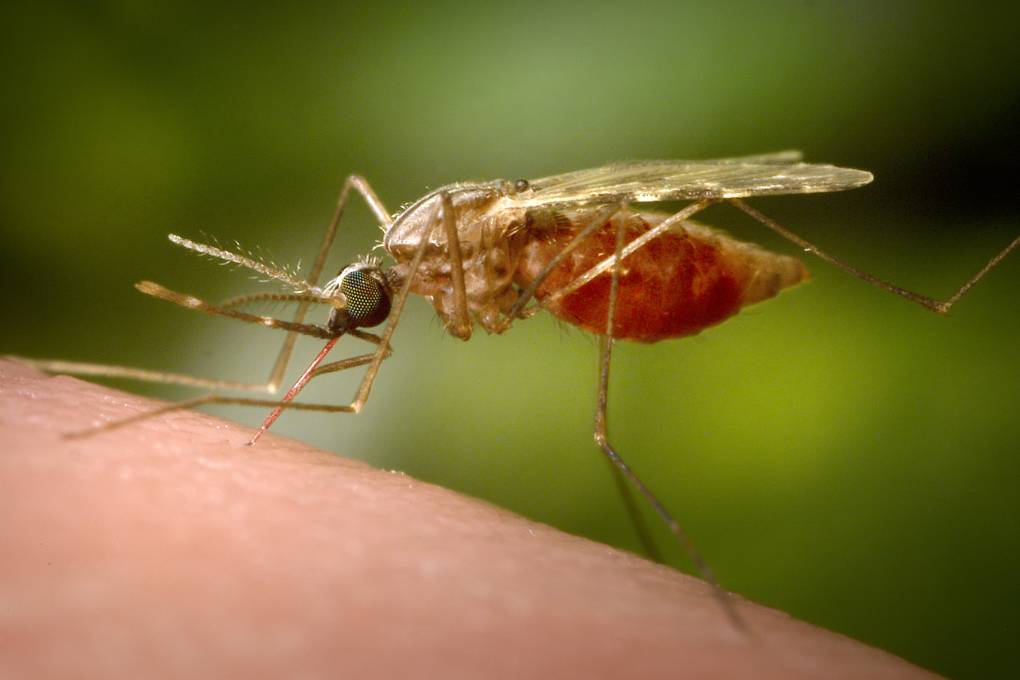
"caption": "Mosquitoes spread malaria. Now researchers hope that a gene drive technology could turn them into malaria fighters. Although not every scientist thinks it's a good idea to genetically modify a wild animal.",
"description": null,
"title": "Mosquitoes",
"credit": "James Gathany/AP",
"status": "inherit",
"altTag": "A close-up of a mosquito on human skin.",
"isLoading": false,
"fetchFailed": false
},
"science_1980417": {
"type": "attachments",
"id": "science_1980417",
"meta": {
"index": "attachments_1716263798",
"site": "science",
"id": "1980417",
"found": true
},
"parent": 1980416,
"imgSizes": {
"twentyfourteen-full-width": {
"file": "https://ww2.kqed.org/app/uploads/sites/35/2022/10/52395730741_fbff73e982_k_custom-b94dfafea1b5caf69b1943bc9f469c079cae3e79-1038x576.jpg",
"width": 1038,
"mimeType": "image/jpeg",
"height": 576
},
"thumbnail": {
"file": "https://ww2.kqed.org/app/uploads/sites/35/2022/10/52395730741_fbff73e982_k_custom-b94dfafea1b5caf69b1943bc9f469c079cae3e79-160x107.jpg",
"width": 160,
"mimeType": "image/jpeg",
"height": 107
},
"post-thumbnail": {
"file": "https://ww2.kqed.org/app/uploads/sites/35/2022/10/52395730741_fbff73e982_k_custom-b94dfafea1b5caf69b1943bc9f469c079cae3e79-672x372.jpg",
"width": 672,
"mimeType": "image/jpeg",
"height": 372
},
"kqedFullSize": {
"file": "https://ww2.kqed.org/app/uploads/sites/35/2022/10/52395730741_fbff73e982_k_custom-b94dfafea1b5caf69b1943bc9f469c079cae3e79.jpg",
"width": 2048,
"height": 1364
},
"large": {
"file": "https://ww2.kqed.org/app/uploads/sites/35/2022/10/52395730741_fbff73e982_k_custom-b94dfafea1b5caf69b1943bc9f469c079cae3e79-1020x679.jpg",
"width": 1020,
"mimeType": "image/jpeg",
"height": 679
},
"1536x1536": {
"file": "https://ww2.kqed.org/app/uploads/sites/35/2022/10/52395730741_fbff73e982_k_custom-b94dfafea1b5caf69b1943bc9f469c079cae3e79-1536x1023.jpg",
"width": 1536,
"mimeType": "image/jpeg",
"height": 1023
},
"full-width": {
"file": "https://ww2.kqed.org/app/uploads/sites/35/2022/10/52395730741_fbff73e982_k_custom-b94dfafea1b5caf69b1943bc9f469c079cae3e79-1920x1279.jpg",
"width": 1920,
"mimeType": "image/jpeg",
"height": 1279
},
"medium": {
"file": "https://ww2.kqed.org/app/uploads/sites/35/2022/10/52395730741_fbff73e982_k_custom-b94dfafea1b5caf69b1943bc9f469c079cae3e79-800x533.jpg",
"width": 800,
"mimeType": "image/jpeg",
"height": 533
},
"medium_large": {
"file": "https://ww2.kqed.org/app/uploads/sites/35/2022/10/52395730741_fbff73e982_k_custom-b94dfafea1b5caf69b1943bc9f469c079cae3e79-768x512.jpg",
"width": 768,
"mimeType": "image/jpeg",
"height": 512
}
},
"publishDate": 1664902716,
"modified": 1664903674,
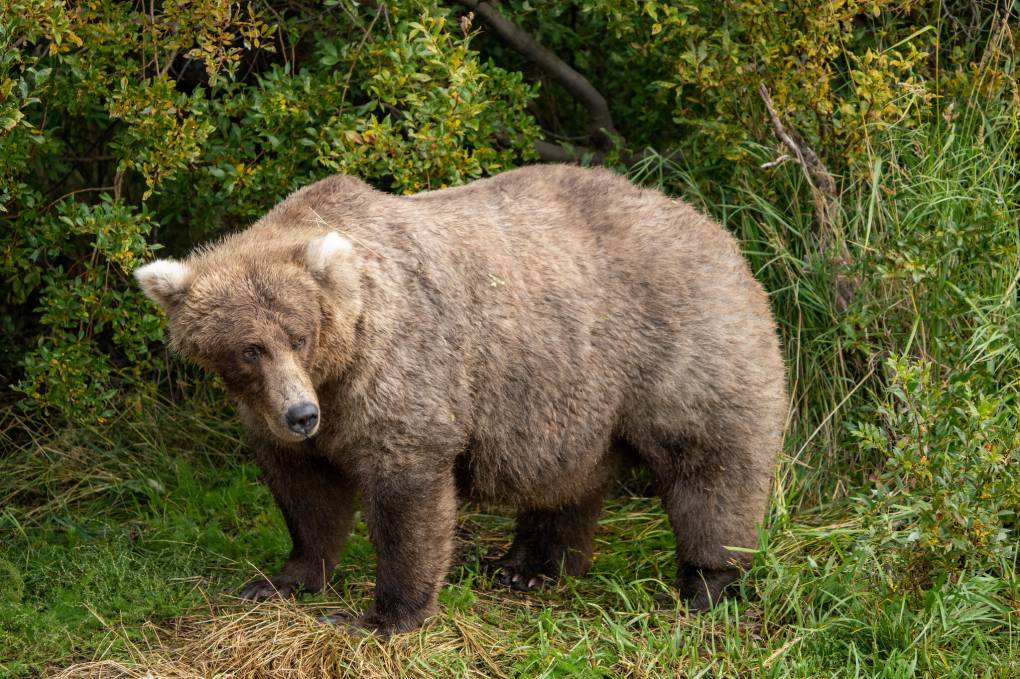
"caption": "Fat Bear candidate 128 Grazer is approximately 17-19 years old. She has a light coat in the spring that darkens in the fall, but she keeps her distinctive fluffy blonde ears.",
"description": "Fat Bear candidate 128 Grazer is approximately 17-19 years old. She has a light coat in the spring that darkens in the fall, but she keeps her distinctive fluffy blonde ears.",
"title": "Fat Bear candidate 128 Grazer is approximately 17-19 years old. She has a light coat in the spring that darkens in the fall, but she keeps her distinctive fluffy blonde ears.",
"credit": "Lian Law/NPS Photo",
"status": "inherit",
"altTag": "Fat Bear candidate 128 Grazer is approximately 17-19 years old. She has a light coat in the spring that darkens in the fall, but she keeps her distinctive fluffy blonde ears.",
"isLoading": false,
"fetchFailed": false
},
"science_1978770": {
"type": "attachments",
"id": "science_1978770",
"meta": {
"index": "attachments_1716263798",
"site": "science",
"id": "1978770",
"found": true
},
"parent": 1978710,
"imgSizes": {
"twentyfourteen-full-width": {
"file": "https://ww2.kqed.org/app/uploads/sites/35/2022/03/RS54214_GettyImages-1314829409-qut-1038x576.jpg",
"width": 1038,
"mimeType": "image/jpeg",
"height": 576
},
"thumbnail": {
"file": "https://ww2.kqed.org/app/uploads/sites/35/2022/03/RS54214_GettyImages-1314829409-qut-160x107.jpg",
"width": 160,
"mimeType": "image/jpeg",
"height": 107
},
"post-thumbnail": {
"file": "https://ww2.kqed.org/app/uploads/sites/35/2022/03/RS54214_GettyImages-1314829409-qut-672x372.jpg",
"width": 672,
"mimeType": "image/jpeg",
"height": 372
},
"kqedFullSize": {
"file": "https://ww2.kqed.org/app/uploads/sites/35/2022/03/RS54214_GettyImages-1314829409-qut.jpg",
"width": 1920,
"height": 1280
},
"large": {
"file": "https://ww2.kqed.org/app/uploads/sites/35/2022/03/RS54214_GettyImages-1314829409-qut-1020x680.jpg",
"width": 1020,
"mimeType": "image/jpeg",
"height": 680
},
"1536x1536": {
"file": "https://ww2.kqed.org/app/uploads/sites/35/2022/03/RS54214_GettyImages-1314829409-qut-1536x1024.jpg",
"width": 1536,
"mimeType": "image/jpeg",
"height": 1024
},
"medium": {
"file": "https://ww2.kqed.org/app/uploads/sites/35/2022/03/RS54214_GettyImages-1314829409-qut-800x533.jpg",
"width": 800,
"mimeType": "image/jpeg",
"height": 533
},
"medium_large": {
"file": "https://ww2.kqed.org/app/uploads/sites/35/2022/03/RS54214_GettyImages-1314829409-qut-768x512.jpg",
"width": 768,
"mimeType": "image/jpeg",
"height": 512
}
},
"publishDate": 1647043562,
"modified": 1647045455,
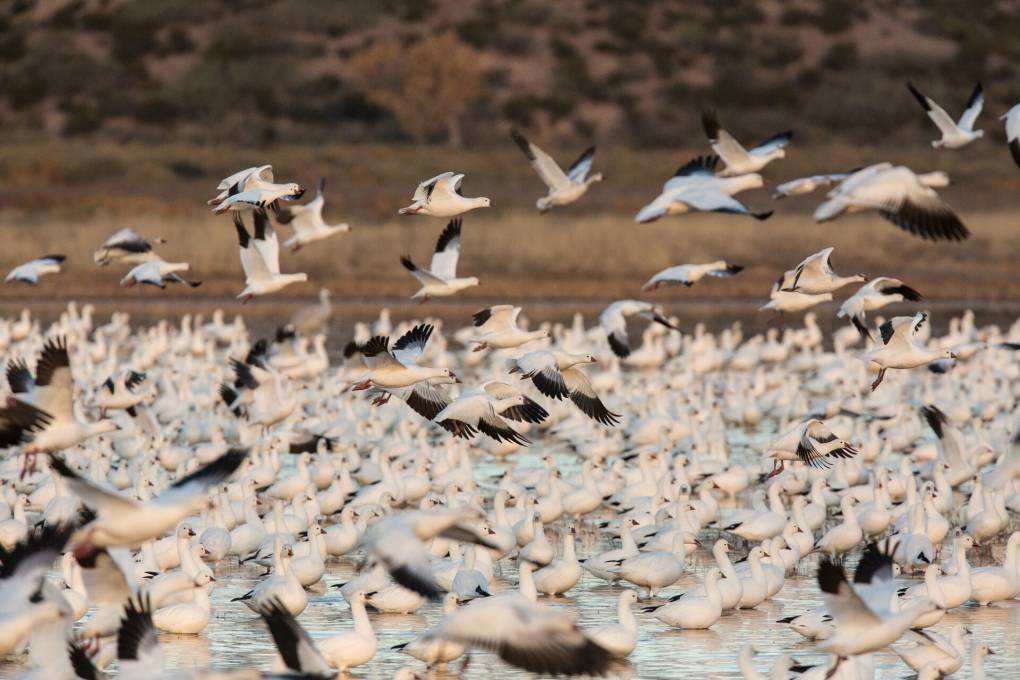
"caption": "A small flock of Ross's geese take off in the early morning from a pond in the Bosque del Apache National Wildlife Refuge in New Mexico. ",
"description": null,
"title": null,
"credit": "Jon G. Fuller/VWPics/Universal Images Group via Getty Images",
"status": "inherit",
"altTag": "White birds with black-tipped wings launch out of a desert pond.",
"isLoading": false,
"fetchFailed": false
},
"science_1977129": {
"type": "attachments",
"id": "science_1977129",
"meta": {
"index": "attachments_1716263798",
"site": "science",
"id": "1977129",
"found": true
},
"parent": 1977127,
"imgSizes": {
"twentyfourteen-full-width": {
"file": "https://ww2.kqed.org/app/uploads/sites/35/2021/10/lasse-kurkela-wildlife-photographer-of-the-year_custom-ed7df5920f98d5ccef4594d618c09f6a5df15b97-1038x576.jpg",
"width": 1038,
"mimeType": "image/jpeg",
"height": 576
},
"thumbnail": {
"file": "https://ww2.kqed.org/app/uploads/sites/35/2021/10/lasse-kurkela-wildlife-photographer-of-the-year_custom-ed7df5920f98d5ccef4594d618c09f6a5df15b97-160x107.jpg",
"width": 160,
"mimeType": "image/jpeg",
"height": 107
},
"post-thumbnail": {
"file": "https://ww2.kqed.org/app/uploads/sites/35/2021/10/lasse-kurkela-wildlife-photographer-of-the-year_custom-ed7df5920f98d5ccef4594d618c09f6a5df15b97-672x372.jpg",
"width": 672,
"mimeType": "image/jpeg",
"height": 372
},
"kqedFullSize": {
"file": "https://ww2.kqed.org/app/uploads/sites/35/2021/10/lasse-kurkela-wildlife-photographer-of-the-year_custom-ed7df5920f98d5ccef4594d618c09f6a5df15b97.jpg",
"width": 1280,
"height": 852
},
"large": {
"file": "https://ww2.kqed.org/app/uploads/sites/35/2021/10/lasse-kurkela-wildlife-photographer-of-the-year_custom-ed7df5920f98d5ccef4594d618c09f6a5df15b97-1020x679.jpg",
"width": 1020,
"mimeType": "image/jpeg",
"height": 679
},
"medium": {
"file": "https://ww2.kqed.org/app/uploads/sites/35/2021/10/lasse-kurkela-wildlife-photographer-of-the-year_custom-ed7df5920f98d5ccef4594d618c09f6a5df15b97-800x533.jpg",
"width": 800,
"mimeType": "image/jpeg",
"height": 533
},
"medium_large": {
"file": "https://ww2.kqed.org/app/uploads/sites/35/2021/10/lasse-kurkela-wildlife-photographer-of-the-year_custom-ed7df5920f98d5ccef4594d618c09f6a5df15b97-768x511.jpg",
"width": 768,
"mimeType": "image/jpeg",
"height": 511
}
},
"publishDate": 1634258553,
"modified": 1634259087,
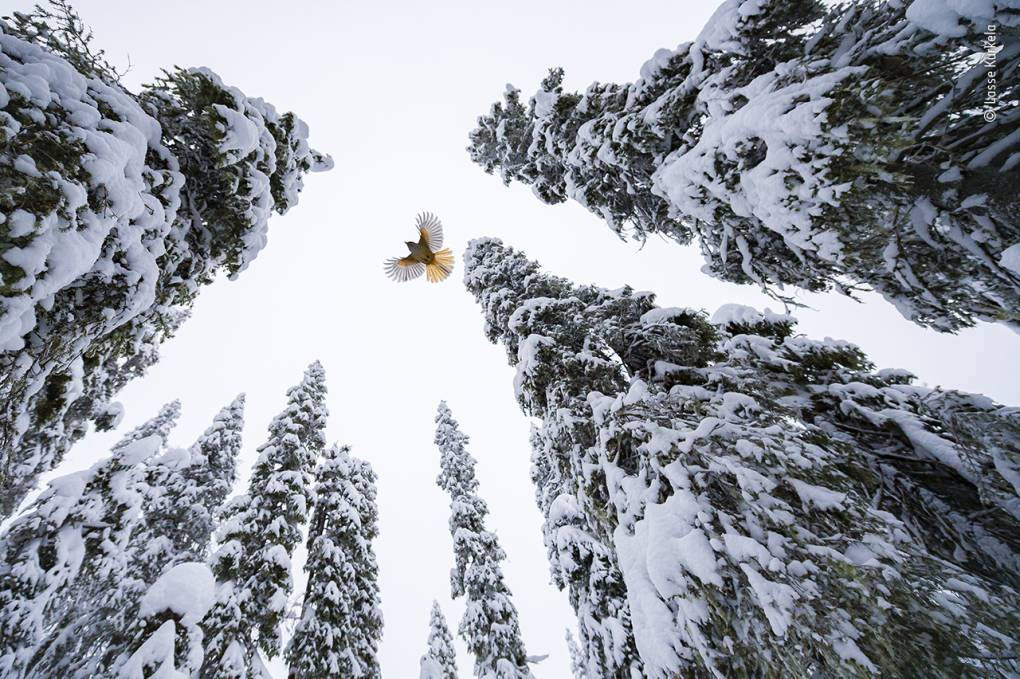
"caption": "High-flying jay, by Lasse Kurkela, Finland, winner, age category: 15-17 years. Kurkela watched a Siberian jay fly to the top of a spruce tree to stash its food. Kurkela wanted to give a sense of scale in his photograph of the Siberian jay, tiny among the old-growth spruce-dominated forest. He used pieces of cheese to get the jays accustomed to his remotely controlled camera.",
"description": null,
"title": "High-flying jay, by Lasse Kurkela, Finland, winner, age category: 15-17 years. Kurkela watched a Siberian jay fly to the top of a spruce tree to stash its food. Kurkela wanted to give a sense of scale in his photograph of the Siberian jay, tiny among the old-growth spruce-dominated forest. He used pieces of cheese to get the jays accustomed to his remotely controlled camera.",
"credit": "Photo: Lasse Kurkela/Wildlife Photographer of the Year",
"status": "inherit",
"altTag": "A Siberian jay flying to the top of a snow-covered spruce tree to stash its food.",
"isLoading": false,
"fetchFailed": false
},
"science_1973502": {
"type": "attachments",
"id": "science_1973502",
"meta": {
"index": "attachments_1716263798",
"site": "science",
"id": "1973502",
"found": true
},
"parent": 1973500,
"imgSizes": {
"twentyfourteen-full-width": {
"file": "https://ww2.kqed.org/app/uploads/sites/35/2021/04/DEEP_807_Leaf_Miner_Fly_Babies_Scribble_All_Over_Your_Salad_KQED-1038x576.jpg",
"width": 1038,
"mimeType": "image/jpeg",
"height": 576
},
"thumbnail": {
"file": "https://ww2.kqed.org/app/uploads/sites/35/2021/04/DEEP_807_Leaf_Miner_Fly_Babies_Scribble_All_Over_Your_Salad_KQED-160x90.jpg",
"width": 160,
"mimeType": "image/jpeg",
"height": 90
},
"post-thumbnail": {
"file": "https://ww2.kqed.org/app/uploads/sites/35/2021/04/DEEP_807_Leaf_Miner_Fly_Babies_Scribble_All_Over_Your_Salad_KQED-672x372.jpg",
"width": 672,
"mimeType": "image/jpeg",
"height": 372
},
"kqedFullSize": {
"file": "https://ww2.kqed.org/app/uploads/sites/35/2021/04/DEEP_807_Leaf_Miner_Fly_Babies_Scribble_All_Over_Your_Salad_KQED.jpg",
"width": 1920,
"height": 1080
},
"large": {
"file": "https://ww2.kqed.org/app/uploads/sites/35/2021/04/DEEP_807_Leaf_Miner_Fly_Babies_Scribble_All_Over_Your_Salad_KQED-1020x574.jpg",
"width": 1020,
"mimeType": "image/jpeg",
"height": 574
},
"1536x1536": {
"file": "https://ww2.kqed.org/app/uploads/sites/35/2021/04/DEEP_807_Leaf_Miner_Fly_Babies_Scribble_All_Over_Your_Salad_KQED-1536x864.jpg",
"width": 1536,
"mimeType": "image/jpeg",
"height": 864
},
"medium": {
"file": "https://ww2.kqed.org/app/uploads/sites/35/2021/04/DEEP_807_Leaf_Miner_Fly_Babies_Scribble_All_Over_Your_Salad_KQED-800x450.jpg",
"width": 800,
"mimeType": "image/jpeg",
"height": 450
},
"medium_large": {
"file": "https://ww2.kqed.org/app/uploads/sites/35/2021/04/DEEP_807_Leaf_Miner_Fly_Babies_Scribble_All_Over_Your_Salad_KQED-768x432.jpg",
"width": 768,
"mimeType": "image/jpeg",
"height": 432
}
},
"publishDate": 1617212358,
"modified": 1617212410,
"caption": "This fly's larvae live in bitter-tasting salad greens like arugula and kale.",
"description": null,
"title": "DEEP_807_Leaf_Miner_Fly_Babies_Scribble_All_Over_Your_Salad_KQED",
"credit": "Josh Cassidy/KQED",
"status": "inherit",
"altTag": null,
"isLoading": false,
"fetchFailed": false
},
"science_1964533": {
"type": "attachments",
"id": "science_1964533",
"meta": {
"index": "attachments_1716263798",
"site": "science",
"id": "1964533",
"found": true
},
"parent": 1964529,
"imgSizes": {
"thumbnail": {
"file": "https://ww2.kqed.org/app/uploads/sites/35/2020/05/Falconsbandedlegs750-160x107.jpg",
"width": 160,
"mimeType": "image/jpeg",
"height": 107
},
"post-thumbnail": {
"file": "https://ww2.kqed.org/app/uploads/sites/35/2020/05/Falconsbandedlegs750-672x372.jpg",
"width": 672,
"mimeType": "image/jpeg",
"height": 372
},
"kqedFullSize": {
"file": "https://ww2.kqed.org/app/uploads/sites/35/2020/05/Falconsbandedlegs750.jpg",
"width": 750,
"height": 500
}
},
"publishDate": 1589834032,
"modified": 1589834059,
"caption": null,
"description": null,
"title": "Falconsbandedlegs750",
"credit": "Mary Malec/UC Berkeley",
"status": "inherit",
"isLoading": false,
"fetchFailed": false
},
"science_1955905": {
"type": "attachments",
"id": "science_1955905",
"meta": {
"index": "attachments_1716263798",
"site": "science",
"id": "1955905",
"found": true
},
"parent": 1955893,
"imgSizes": {
"twentyfourteen-full-width": {
"file": "https://ww2.kqed.org/app/uploads/sites/35/2020/01/RS40759_GettyImages-3223019-qut-1038x576.jpg",
"width": 1038,
"mimeType": "image/jpeg",
"height": 576
},
"thumbnail": {
"file": "https://ww2.kqed.org/app/uploads/sites/35/2020/01/RS40759_GettyImages-3223019-qut-160x101.jpg",
"width": 160,
"mimeType": "image/jpeg",
"height": 101
},
"post-thumbnail": {
"file": "https://ww2.kqed.org/app/uploads/sites/35/2020/01/RS40759_GettyImages-3223019-qut-672x372.jpg",
"width": 672,
"mimeType": "image/jpeg",
"height": 372
},
"kqedFullSize": {
"file": "https://ww2.kqed.org/app/uploads/sites/35/2020/01/RS40759_GettyImages-3223019-qut.jpg",
"width": 1920,
"height": 1216
},
"large": {
"file": "https://ww2.kqed.org/app/uploads/sites/35/2020/01/RS40759_GettyImages-3223019-qut-1020x646.jpg",
"width": 1020,
"mimeType": "image/jpeg",
"height": 646
},
"complete_open_graph": {
"file": "https://ww2.kqed.org/app/uploads/sites/35/2020/01/RS40759_GettyImages-3223019-qut-1200x760.jpg",
"width": 1200,
"mimeType": "image/jpeg",
"height": 760
},
"full-width": {
"file": "https://ww2.kqed.org/app/uploads/sites/35/2020/01/RS40759_GettyImages-3223019-qut-1920x1216.jpg",
"width": 1920,
"mimeType": "image/jpeg",
"height": 1216
},
"medium": {
"file": "https://ww2.kqed.org/app/uploads/sites/35/2020/01/RS40759_GettyImages-3223019-qut-800x507.jpg",
"width": 800,
"mimeType": "image/jpeg",
"height": 507
},
"medium_large": {
"file": "https://ww2.kqed.org/app/uploads/sites/35/2020/01/RS40759_GettyImages-3223019-qut-768x486.jpg",
"width": 768,
"mimeType": "image/jpeg",
"height": 486
}
},
"publishDate": 1579288796,
"modified": 1579288864,
"caption": "Murres gather near Valdez, Alaska. ",
"description": null,
"title": "Exxon Valdez Oil Disaster 15 Years Later",
"credit": "David McNew/Getty Images",
"status": "inherit",
"isLoading": false,
"fetchFailed": false
},
"science_1955563": {
"type": "attachments",
"id": "science_1955563",
"meta": {
"index": "attachments_1716263798",
"site": "science",
"id": "1955563",
"found": true
},
"parent": 1955562,
"imgSizes": {
"twentyfourteen-full-width": {
"file": "https://ww2.kqed.org/app/uploads/sites/35/2020/01/african-greys_enl-205de9a66809da962f9326926d1b7d3af82fe6a7-1038x576.jpg",
"width": 1038,
"mimeType": "image/jpeg",
"height": 576
},
"thumbnail": {
"file": "https://ww2.kqed.org/app/uploads/sites/35/2020/01/african-greys_enl-205de9a66809da962f9326926d1b7d3af82fe6a7-160x107.jpg",
"width": 160,
"mimeType": "image/jpeg",
"height": 107
},
"post-thumbnail": {
"file": "https://ww2.kqed.org/app/uploads/sites/35/2020/01/african-greys_enl-205de9a66809da962f9326926d1b7d3af82fe6a7-672x372.jpg",
"width": 672,
"mimeType": "image/jpeg",
"height": 372
},
"kqedFullSize": {
"file": "https://ww2.kqed.org/app/uploads/sites/35/2020/01/african-greys_enl-205de9a66809da962f9326926d1b7d3af82fe6a7.jpg",
"width": 2000,
"height": 1333
},
"large": {
"file": "https://ww2.kqed.org/app/uploads/sites/35/2020/01/african-greys_enl-205de9a66809da962f9326926d1b7d3af82fe6a7-1020x680.jpg",
"width": 1020,
"mimeType": "image/jpeg",
"height": 680
},
"complete_open_graph": {
"file": "https://ww2.kqed.org/app/uploads/sites/35/2020/01/african-greys_enl-205de9a66809da962f9326926d1b7d3af82fe6a7-1200x800.jpg",
"width": 1200,
"mimeType": "image/jpeg",
"height": 800
},
"full-width": {
"file": "https://ww2.kqed.org/app/uploads/sites/35/2020/01/african-greys_enl-205de9a66809da962f9326926d1b7d3af82fe6a7-1920x1280.jpg",
"width": 1920,
"mimeType": "image/jpeg",
"height": 1280
},
"medium": {
"file": "https://ww2.kqed.org/app/uploads/sites/35/2020/01/african-greys_enl-205de9a66809da962f9326926d1b7d3af82fe6a7-800x533.jpg",
"width": 800,
"mimeType": "image/jpeg",
"height": 533
},
"medium_large": {
"file": "https://ww2.kqed.org/app/uploads/sites/35/2020/01/african-greys_enl-205de9a66809da962f9326926d1b7d3af82fe6a7-768x512.jpg",
"width": 768,
"mimeType": "image/jpeg",
"height": 512
}
},
"publishDate": 1578608295,
"modified": 1578608295,
"caption": null,
"description": "Recent research has explored \"helping\" behavior in species ranging from nonhuman primates to rats and bats. To see whether intelligent birds might help out a feathered pal, scientists did an experiment using African grey parrots like these.",
"title": "Recent research has explored \"helping\" behavior in species ranging from nonhuman primates to rats and bats. To see whether intelligent birds might help out a feathered pal, scientists did an experiment using African grey parrots like these.",
"credit": null,
"status": "inherit",
"isLoading": false,
"fetchFailed": false
},
"science_1951230": {
"type": "attachments",
"id": "science_1951230",
"meta": {
"index": "attachments_1716263798",
"site": "science",
"id": "1951230",
"found": true
},
"parent": 1951205,
"imgSizes": {
"twentyfourteen-full-width": {
"file": "https://ww2.kqed.org/app/uploads/sites/35/2019/12/RS40322__20190326_A_0809_full-qut-1038x576.jpg",
"width": 1038,
"mimeType": "image/jpeg",
"height": 576
},
"thumbnail": {
"file": "https://ww2.kqed.org/app/uploads/sites/35/2019/12/RS40322__20190326_A_0809_full-qut-160x113.jpg",
"width": 160,
"mimeType": "image/jpeg",
"height": 113
},
"post-thumbnail": {
"file": "https://ww2.kqed.org/app/uploads/sites/35/2019/12/RS40322__20190326_A_0809_full-qut-672x372.jpg",
"width": 672,
"mimeType": "image/jpeg",
"height": 372
},
"kqedFullSize": {
"file": "https://ww2.kqed.org/app/uploads/sites/35/2019/12/RS40322__20190326_A_0809_full-qut.jpg",
"width": 1920,
"height": 1355
},
"large": {
"file": "https://ww2.kqed.org/app/uploads/sites/35/2019/12/RS40322__20190326_A_0809_full-qut-1020x720.jpg",
"width": 1020,
"mimeType": "image/jpeg",
"height": 720
},
"complete_open_graph": {
"file": "https://ww2.kqed.org/app/uploads/sites/35/2019/12/RS40322__20190326_A_0809_full-qut-1200x847.jpg",
"width": 1200,
"mimeType": "image/jpeg",
"height": 847
},
"full-width": {
"file": "https://ww2.kqed.org/app/uploads/sites/35/2019/12/RS40322__20190326_A_0809_full-qut-1920x1355.jpg",
"width": 1920,
"mimeType": "image/jpeg",
"height": 1355
},
"medium": {
"file": "https://ww2.kqed.org/app/uploads/sites/35/2019/12/RS40322__20190326_A_0809_full-qut-800x565.jpg",
"width": 800,
"mimeType": "image/jpeg",
"height": 565
},
"medium_large": {
"file": "https://ww2.kqed.org/app/uploads/sites/35/2019/12/RS40322__20190326_A_0809_full-qut-768x542.jpg",
"width": 768,
"mimeType": "image/jpeg",
"height": 542
}
},
"publishDate": 1575498256,
"modified": 1575498323,
"caption": "Carson Jeffries and Jacob Katz examining a salmon fry taken from a cage in the floodplain near Knaggs Ranch on the Sacramento River.",
"description": null,
"title": "RS40322__20190326_A_0809_full-qut",
"credit": "Jak Wonderly/bioGraphic",
"status": "inherit",
"isLoading": false,
"fetchFailed": false
},
"science_1948457": {
"type": "attachments",
"id": "science_1948457",
"meta": {
"index": "attachments_1716263798",
"site": "science",
"id": "1948457",
"found": true
},
"parent": 1948418,
"imgSizes": {
"twentyfourteen-full-width": {
"file": "https://ww2.kqed.org/app/uploads/sites/35/2019/10/48811431232_132a5e9a24_k-1038x576.jpg",
"width": 1038,
"mimeType": "image/jpeg",
"height": 576
},
"thumbnail": {
"file": "https://ww2.kqed.org/app/uploads/sites/35/2019/10/48811431232_132a5e9a24_k-160x120.jpg",
"width": 160,
"mimeType": "image/jpeg",
"height": 120
},
"post-thumbnail": {
"file": "https://ww2.kqed.org/app/uploads/sites/35/2019/10/48811431232_132a5e9a24_k-672x372.jpg",
"width": 672,
"mimeType": "image/jpeg",
"height": 372
},
"kqedFullSize": {
"file": "https://ww2.kqed.org/app/uploads/sites/35/2019/10/48811431232_132a5e9a24_k-e1570057725230.jpg",
"width": 1920,
"height": 1440
},
"large": {
"file": "https://ww2.kqed.org/app/uploads/sites/35/2019/10/48811431232_132a5e9a24_k-1020x765.jpg",
"width": 1020,
"mimeType": "image/jpeg",
"height": 765
},
"complete_open_graph": {
"file": "https://ww2.kqed.org/app/uploads/sites/35/2019/10/48811431232_132a5e9a24_k-1200x900.jpg",
"width": 1200,
"mimeType": "image/jpeg",
"height": 900
},
"full-width": {
"file": "https://ww2.kqed.org/app/uploads/sites/35/2019/10/48811431232_132a5e9a24_k-1920x1440.jpg",
"width": 1920,
"mimeType": "image/jpeg",
"height": 1440
},
"medium": {
"file": "https://ww2.kqed.org/app/uploads/sites/35/2019/10/48811431232_132a5e9a24_k-800x600.jpg",
"width": 800,
"mimeType": "image/jpeg",
"height": 600
},
"medium_large": {
"file": "https://ww2.kqed.org/app/uploads/sites/35/2019/10/48811431232_132a5e9a24_k-768x576.jpg",
"width": 768,
"mimeType": "image/jpeg",
"height": 576
}
},
"publishDate": 1570053107,
"modified": 1570053138,
"caption": "Bear 747 was runner up last year in the competition. ",
"description": null,
"title": "48811431232_132a5e9a24_k",
"credit": "Katmai National Park",
"status": "inherit",
"isLoading": false,
"fetchFailed": false
},
"science_1946692": {
"type": "attachments",
"id": "science_1946692",
"meta": {
"index": "attachments_1716263798",
"site": "science",
"id": "1946692",
"found": true
},
"parent": 1946690,
"imgSizes": {
"twentyfourteen-full-width": {
"file": "https://ww2.kqed.org/app/uploads/sites/35/2019/08/RS8120_wolf-1024x576.jpg",
"width": 1024,
"mimeType": "image/jpeg",
"height": 576
},
"thumbnail": {
"file": "https://ww2.kqed.org/app/uploads/sites/35/2019/08/RS8120_wolf-160x107.jpg",
"width": 160,
"mimeType": "image/jpeg",
"height": 107
},
"post-thumbnail": {
"file": "https://ww2.kqed.org/app/uploads/sites/35/2019/08/RS8120_wolf-672x372.jpg",
"width": 672,
"mimeType": "image/jpeg",
"height": 372
},
"kqedFullSize": {
"file": "https://ww2.kqed.org/app/uploads/sites/35/2019/08/RS8120_wolf.jpg",
"width": 1024,
"height": 684
},
"large": {
"file": "https://ww2.kqed.org/app/uploads/sites/35/2019/08/RS8120_wolf-1020x681.jpg",
"width": 1020,
"mimeType": "image/jpeg",
"height": 681
},
"medium": {
"file": "https://ww2.kqed.org/app/uploads/sites/35/2019/08/RS8120_wolf-800x534.jpg",
"width": 800,
"mimeType": "image/jpeg",
"height": 534
},
"medium_large": {
"file": "https://ww2.kqed.org/app/uploads/sites/35/2019/08/RS8120_wolf-768x513.jpg",
"width": 768,
"mimeType": "image/jpeg",
"height": 513
}
},
"publishDate": 1566491722,
"modified": 1566491768,
"caption": "In March, the U.S. Fish and Wildlife Service announced it would seek to delist grey wolves as an endangered species in most of the lower 48 states.",
"description": null,
"title": "RS8120_wolf",
"credit": "John & Karen Hollingsworth/USFWS",
"status": "inherit",
"isLoading": false,
"fetchFailed": false
},
"science_1945720": {
"type": "attachments",
"id": "science_1945720",
"meta": {
"index": "attachments_1716263798",
"site": "science",
"id": "1945720",
"found": true
},
"parent": 1945690,
"imgSizes": {
"twentyfourteen-full-width": {
"file": "https://ww2.kqed.org/app/uploads/sites/35/2019/07/11_Dietrich_Boneyard-1038x576.png",
"width": 1038,
"mimeType": "image/png",
"height": 576
},
"thumbnail": {
"file": "https://ww2.kqed.org/app/uploads/sites/35/2019/07/11_Dietrich_Boneyard-160x106.png",
"width": 160,
"mimeType": "image/png",
"height": 106
},
"post-thumbnail": {
"file": "https://ww2.kqed.org/app/uploads/sites/35/2019/07/11_Dietrich_Boneyard-672x372.png",
"width": 672,
"mimeType": "image/png",
"height": 372
},
"kqedFullSize": {
"file": "https://ww2.kqed.org/app/uploads/sites/35/2019/07/11_Dietrich_Boneyard-e1564180879313.png",
"width": 1925,
"height": 1281
},
"large": {
"file": "https://ww2.kqed.org/app/uploads/sites/35/2019/07/11_Dietrich_Boneyard-1020x679.png",
"width": 1020,
"mimeType": "image/png",
"height": 679
},
"complete_open_graph": {
"file": "https://ww2.kqed.org/app/uploads/sites/35/2019/07/11_Dietrich_Boneyard-1200x798.png",
"width": 1200,
"mimeType": "image/png",
"height": 798
},
"full-width": {
"file": "https://ww2.kqed.org/app/uploads/sites/35/2019/07/11_Dietrich_Boneyard-1920x1278.png",
"width": 1920,
"mimeType": "image/png",
"height": 1278
},
"medium": {
"file": "https://ww2.kqed.org/app/uploads/sites/35/2019/07/11_Dietrich_Boneyard-800x532.png",
"width": 800,
"mimeType": "image/png",
"height": 532
},
"medium_large": {
"file": "https://ww2.kqed.org/app/uploads/sites/35/2019/07/11_Dietrich_Boneyard-768x511.png",
"width": 768,
"mimeType": "image/png",
"height": 511
}
},
"publishDate": 1564180826,
"modified": 1564181056,
"caption": "Three polar bears walk by a pile of dark whale bones in Kaktovic, Alaska. ",
"description": null,
"title": "11_Dietrich_Boneyard",
"credit": "\"Boneyard Waltz\" by Daniel Dietrich",
"status": "inherit",
"isLoading": false,
"fetchFailed": false
}
},
"audioPlayerReducer": {
"postId": "stream_live",
"isPaused": true,
"isPlaying": false,
"pfsActive": false,
"pledgeModalIsOpen": true,
"playerDrawerIsOpen": false,
"liveAudioPlayStartedAt": 0,
"liveAudioPlayContext": ""
},
"authorsReducer": {
"byline_science_1983569": {
"type": "authors",
"id": "byline_science_1983569",
"meta": {
"override": true
},
"slug": "byline_science_1983569",
"name": "\u003ca href=\"https://www.npr.org/people/279612138/geoff-brumfiel\">Geoff Brumfiel\u003c/a>",
"isLoading": false
},
"byline_science_1980416": {
"type": "authors",
"id": "byline_science_1980416",
"meta": {
"override": true
},
"slug": "byline_science_1980416",
"name": "Bill Chappell",
"isLoading": false
},
"byline_science_1978710": {
"type": "authors",
"id": "byline_science_1978710",
"meta": {
"override": true
},
"slug": "byline_science_1978710",
"name": "Guananí Gómez-Van Cortright ",
"isLoading": false
},
"byline_science_1977127": {
"type": "authors",
"id": "byline_science_1977127",
"meta": {
"override": true
},
"slug": "byline_science_1977127",
"name": "Rachel Treisman and Catie Dull \u003cbr> NPR",
"isLoading": false
},
"byline_science_1955893": {
"type": "authors",
"id": "byline_science_1955893",
"meta": {
"override": true
},
"slug": "byline_science_1955893",
"name": "Sabrina Shankman \u003cbr />InsideClimate News\u003cbr>",
"isLoading": false
},
"byline_science_1955562": {
"type": "authors",
"id": "byline_science_1955562",
"meta": {
"override": true
},
"slug": "byline_science_1955562",
"name": "Nell Greenfieldboyce \u003cbr />NPR\u003cbr>",
"isLoading": false
},
"byline_science_1951205": {
"type": "authors",
"id": "byline_science_1951205",
"meta": {
"override": true
},
"slug": "byline_science_1951205",
"name": " Robin Meadows \u003cbr />bioGraphic\u003cbr>",
"isLoading": false
},
"byline_science_1948418": {
"type": "authors",
"id": "byline_science_1948418",
"meta": {
"override": true
},
"slug": "byline_science_1948418",
"name": "Kevin Stark, Jon Brooks and a Bunch of People Who Need to Get Back to Work ",
"isLoading": false
},
"byline_science_1946690": {
"type": "authors",
"id": "byline_science_1946690",
"meta": {
"override": true
},
"slug": "byline_science_1946690",
"name": "Samantha Maldonado \u003cbr/> Associated Press \u003cbr>",
"isLoading": false
},
"kevinstark": {
"type": "authors",
"id": "11608",
"meta": {
"index": "authors_1716337520",
"id": "11608",
"found": true
},
"name": "Kevin Stark",
"firstName": "Kevin",
"lastName": "Stark",
"slug": "kevinstark",
"email": "kstark@kqed.org",
"display_author_email": true,
"staff_mastheads": [
"science"
],
"title": "Senior Editor",
"bio": "Kevin is a senior editor for KQED Science, managing the station's health and climate desks. His journalism career began in the Pacific Northwest, and he later became a lead reporter for the San Francisco Public Press. His work has appeared in Pacific Standard magazine, the Energy News Network, the Center for Investigative Reporting's Reveal and WBEZ in Chicago. Kevin joined KQED in 2019, and has covered issues related to energy, wildfire, climate change and the environment.",
"avatar": "https://secure.gravatar.com/avatar/365aaa4b597d3a8374f67504ff0facd323d7906e8eb4be0a7efd2427408e802c?s=600&d=blank&r=g",
"twitter": "starkkev",
"bluesky": null,
"facebook": null,
"instagram": null,
"linkedin": null,
"sites": [
{
"site": "",
"roles": [
"editor"
]
},
{
"site": "news",
"roles": [
"editor"
]
},
{
"site": "science",
"roles": [
"administrator"
]
}
],
"headData": {
"title": "Kevin Stark | KQED",
"description": "Senior Editor",
"ogImgSrc": "https://secure.gravatar.com/avatar/365aaa4b597d3a8374f67504ff0facd323d7906e8eb4be0a7efd2427408e802c?s=600&d=blank&r=g",
"twImgSrc": "https://secure.gravatar.com/avatar/365aaa4b597d3a8374f67504ff0facd323d7906e8eb4be0a7efd2427408e802c?s=600&d=blank&r=g"
},
"isLoading": false,
"link": "/author/kevinstark"
},
"msandoval": {
"type": "authors",
"id": "11744",
"meta": {
"index": "authors_1716337520",
"id": "11744",
"found": true
},
"name": "Marissa Sandoval",
"firstName": "Marissa",
"lastName": "Sandoval",
"slug": "msandoval",
"email": "msandoval@KQED.org",
"display_author_email": false,
"staff_mastheads": [],
"title": "KQED Contributor",
"bio": "Marissa Sandoval is an intern with KQED's Deep Look series. She is an entomologist at heart and holds a BS from the University of California, Berkeley.",
"avatar": "https://secure.gravatar.com/avatar/f47ea921ba0da7750bcaac476d284f5c?s=600&d=blank&r=g",
"twitter": "megarhyssamar",
"facebook": null,
"instagram": null,
"linkedin": null,
"sites": [
{
"site": "science",
"roles": [
"editor"
]
}
],
"headData": {
"title": "Marissa Sandoval | KQED",
"description": "KQED Contributor",
"ogImgSrc": "https://secure.gravatar.com/avatar/f47ea921ba0da7750bcaac476d284f5c?s=600&d=blank&r=g",
"twImgSrc": "https://secure.gravatar.com/avatar/f47ea921ba0da7750bcaac476d284f5c?s=600&d=blank&r=g"
},
"isLoading": false,
"link": "/author/msandoval"
}
},
"pagesReducer": {
"science_tag_animals": {
"type": "terms",
"id": "science_1120",
"meta": {
"index": "terms_1716263798",
"site": "science",
"id": "1120",
"score": 8.284223
},
"featImg": null,
"name": "animals",
"description": null,
"taxonomy": "tag",
"headData": {
"twImgId": null,
"twTitle": null,
"ogTitle": null,
"ogImgId": null,
"twDescription": null,
"description": null,
"title": "animals Archives | KQED Science",
"ogDescription": null
},
"ttid": 1128,
"slug": "animals",
"isLoading": false,
"title": "animals",
"pageMeta": {
"site": "science",
"WpPageTemplate": "page-topic-editorial",
"currentPage": 3
},
"blocks": [
{
"blockName": "kqed/post-list",
"attrs": {
"layout": "cardArticle2",
"query": "posts/science?tag=animals",
"seeMore": false,
"paginated": true,
"page": 3
}
},
{
"blockName": "kqed/ad"
}
]
}
},
"pfsSessionReducer": {},
"postsReducer": {
"stream_live": {
"type": "live",
"id": "stream_live",
"audioUrl": "https://streams.kqed.org/kqedradio",
"title": "Live Stream",
"excerpt": "Live Stream information currently unavailable.",
"link": "/radio",
"featImg": "",
"label": {
"name": "KQED Live",
"link": "/"
}
},
"stream_kqedNewscast": {
"type": "posts",
"id": "stream_kqedNewscast",
"audioUrl": "https://www.kqed.org/.stream/anon/radio/RDnews/newscast.mp3?_=1",
"title": "KQED Newscast",
"featImg": "",
"label": {
"name": "88.5 FM",
"link": "/"
}
},
"science_1983569": {
"type": "posts",
"id": "science_1983569",
"meta": {
"index": "posts_1716263798",
"site": "science",
"id": "1983569",
"score": null,
"sort": [
1689937737000
]
},
"parent": 0,
"labelTerm": {
"site": "science"
},
"blocks": [],
"publishDate": 1689937737,
"format": "standard",
"title": "UC Irvine Researchers Use Mosquito ‘Gene Editing’ in Fight Against Malaria",
"headTitle": "UC Irvine Researchers Use Mosquito ‘Gene Editing’ in Fight Against Malaria | KQED",
"content": "\u003cp>Mosquitoes carry malaria, which kills hundreds of thousands of people each year. Now some researchers are trying to use genetic engineering to make the pesky insects into allies in the fight against the disease.\u003c/p>\n\u003cp>The approach is a radical departure from traditional ways of controlling malaria. For years, public health officials have tried to limit the disease by controlling mosquito populations.\u003c/p>\n\u003cp>But that approach is temporary, says \u003ca href=\"https://www.faculty.uci.edu/profile/?facultyId=2154\">Anthony James\u003c/a>, a professor of molecular biology and genetics at the University of California, Irvine. Because mosquitoes are extremely tough little insects, and their populations can quickly rebound.\u003c/p>\n\u003cp>[aside label=\"related coverage\" postID=\"science_1982793\"]\u003c/p>\n\u003cp>“To try to get rid of them, I don’t think it’s possible,” he says. Instead, James and his colleagues want to try a different approach: making mosquitoes themselves into malaria-fighting warriors.\u003c/p>\n\u003cp>To understand how it works, it helps to understand \u003ca href=\"https://www.cdc.gov/malaria/about/biology/index.html\">the life cycle of malaria\u003c/a>. The malaria pathogen is a parasite that grows inside humans. It’s transmitted via mosquitoes that flit from person to person, sucking blood (the parasites also reproduce inside the guts of skeeters).\u003c/p>\n\u003cp>“If we can make the mosquitoes inhospitable to the pathogens, you know, we can eliminate the threat of getting the disease,” he says.\u003c/p>\n\u003cp>But making mosquitoes uninviting to malaria is a tough job. The malaria parasite doesn’t make mosquitoes sick, so mosquito immune systems don’t fight it.\u003c/p>\n\u003cp>To get around the problem, the team used a gene-editing technique called CRISPR. They started with genes from mice, whose immune systems do fight human malaria.\u003c/p>\n\u003cp>“What we did then was engineer those [genes], and give them to the mosquitos,” he says.\u003c/p>\n\u003cp>The results were \u003ca href=\"https://www.pnas.org/doi/10.1073/pnas.2221118120\">published this month\u003c/a> in the Proceedings of the National Academy of Sciences. Sure enough, the gene-edited mosquitos produced malaria-fighting antibodies.\u003c/p>\n\u003cp>Those antibodies “worked very well,” says James. “They reduce the number of parasites in the mosquito, most importantly in the salivary gland, which is where they would be before they were transmitted to a human host.”\u003c/p>\n\u003cp>This technique also allows the researchers to make the genes spread quickly. That means, rather than having to release swarms of gene-edited mosquitos, they could put out a smaller number. The engineered mosquitoes mate, pass on their genetic code, and that code rapidly fans out across the wild population.\u003c/p>\n\u003cp>[ad fullwidth]\u003c/p>\n\u003cp>But genetically altering wild animals does not sit well with environmentalists.\u003c/p>\n\u003cp>“There’s no need to engineer a mosquito,” says Dana Perls, senior program manager for the emerging technology program at the non-profit Friends of the Earth. Perls points out that naturally occurring methods for reducing malaria appear to be showing promise, as does a new vaccine against the disease.\u003c/p>\n\u003cp>“Why take unnecessary risks and release a manipulated species that can’t be recalled once it’s released into the wild?” she asks.\u003c/p>\n\u003cp>Anthony James believes the risks would be very low. The mosquitoes are already part of the ecosystem, and the gene alterations wouldn’t affect much other than their response to malaria, he says. Moreover, it’s better than sprays and treatments that control mosquitoes temporarily.\u003c/p>\n\u003cp>“This is potentially a much more sustainable technology,” he says.\u003c/p>\n\u003cp>His lab is now working on planning a field trial, which he hopes could be conducted on an island or in another isolated location.\u003c/p>\n\u003cdiv class=\"fullattribution\">Copyright 2023 NPR. To see more, visit https://www.npr.org.\u003cimg decoding=\"async\" src=\"https://www.google-analytics.com/__utm.gif?utmac=UA-5828686-4&utmdt=Mosquitoes+spread+malaria.+These+researchers+want+them+to+fight+it+instead&utme=8(APIKey)9(MDAxOTAwOTE4MDEyMTkxMDAzNjczZDljZA004)\">\u003c/div>\n\u003cdiv>\u003c/div>\n\u003cp>\u003c/p>\n",
"stats": {
"hasVideo": false,
"hasChartOrMap": false,
"hasAudio": false,
"hasPolis": false,
"wordCount": 586,
"hasGoogleForm": false,
"hasGallery": false,
"hasHearkenModule": false,
"iframeSrcs": [],
"paragraphCount": 21
},
"modified": 1704845952,
"excerpt": "Scientists have used a gene-editing technique to make mosquitos allies in the fight against malaria. Environmentalists are troubled by the idea of genetically modifying wild animals.",
"headData": {
"twImgId": "",
"twTitle": "",
"ogTitle": "",
"ogImgId": "",
"twDescription": "",
"description": "Scientists have used a gene-editing technique to make mosquitos allies in the fight against malaria. Environmentalists are troubled by the idea of genetically modifying wild animals.",
"title": "UC Irvine Researchers Use Mosquito ‘Gene Editing’ in Fight Against Malaria | KQED",
"ogDescription": "",
"schema": {
"@context": "https://schema.org",
"@type": "Article",
"headline": "UC Irvine Researchers Use Mosquito ‘Gene Editing’ in Fight Against Malaria",
"datePublished": "2023-07-21T04:08:57-07:00",
"dateModified": "2024-01-09T16:19:12-08:00",
"image": "https://cdn.kqed.org/wp-content/uploads/2020/02/KQED-OG-Image@1x.png"
}
},
"guestAuthors": [],
"slug": "uc-irvine-researchers-use-mosquito-gene-editing-in-fight-against-malaria",
"status": "publish",
"nprApiLink": "http://api.npr.org/query?id=1188631213&apiKey=MDAxOTAwOTE4MDEyMTkxMDAzNjczZDljZA004",
"nprStoryDate": "Thu, 20 Jul 2023 05:03:15 -0400",
"excludeFromSiteSearch": "Include",
"nprLastModifiedDate": "Thu, 20 Jul 2023 05:03:15 -0400",
"nprHtmlLink": "https://www.npr.org/sections/goatsandsoda/2023/07/20/1188631213/mosquitoes-spread-malaria-these-researchers-want-them-to-fight-it-instead?ft=nprml&f=1188631213",
"nprAudio": "https://ondemand.npr.org/anon.npr-mp3/npr/me/2023/07/20230720_me_mosquitoes_spread_malaria_these_researchers_want_them_to_fight_it_instead.mp3?orgId=1&topicId=1031&d=173&p=3&story=1188631213&ft=nprml&f=1188631213",
"nprImageAgency": "AP",
"nprAudioM3u": "http://api.npr.org/m3u/11188869698-82f4e3.m3u?orgId=1&topicId=1031&d=173&p=3&story=1188631213&ft=nprml&f=1188631213",
"nprStoryId": "1188631213",
"nprByline": "\u003ca href=\"https://www.npr.org/people/279612138/geoff-brumfiel\">Geoff Brumfiel\u003c/a>",
"sticky": false,
"nprImageCredit": "James Gathany",
"showOnAuthorArchivePages": "No",
"articleAge": "0",
"nprRetrievedStory": "1",
"nprPubDate": "Thu, 20 Jul 2023 07:02:00 -0400",
"path": "/science/1983569/uc-irvine-researchers-use-mosquito-gene-editing-in-fight-against-malaria",
"audioUrl": "https://ondemand.npr.org/anon.npr-mp3/npr/me/2023/07/20230720_me_mosquitoes_spread_malaria_these_researchers_want_them_to_fight_it_instead.mp3?orgId=1&topicId=1031&d=173&p=3&story=1188631213&ft=nprml&f=1188631213",
"audioTrackLength": null,
"parsedContent": [
{
"type": "contentString",
"content": "\u003cdiv class=\"post-body\">\u003cp>\u003cp>Mosquitoes carry malaria, which kills hundreds of thousands of people each year. Now some researchers are trying to use genetic engineering to make the pesky insects into allies in the fight against the disease.\u003c/p>\n\u003cp>The approach is a radical departure from traditional ways of controlling malaria. For years, public health officials have tried to limit the disease by controlling mosquito populations.\u003c/p>\n\u003cp>But that approach is temporary, says \u003ca href=\"https://www.faculty.uci.edu/profile/?facultyId=2154\">Anthony James\u003c/a>, a professor of molecular biology and genetics at the University of California, Irvine. Because mosquitoes are extremely tough little insects, and their populations can quickly rebound.\u003c/p>\n\u003cp>\u003c/p>\u003c/div>",
"attributes": {
"named": {},
"numeric": []
}
},
{
"type": "component",
"content": "",
"name": "aside",
"attributes": {
"named": {
"label": "related coverage ",
"postid": "science_1982793"
},
"numeric": []
}
},
{
"type": "contentString",
"content": "\u003cdiv class=\"post-body\">\u003cp>\u003c/p>\n\u003cp>“To try to get rid of them, I don’t think it’s possible,” he says. Instead, James and his colleagues want to try a different approach: making mosquitoes themselves into malaria-fighting warriors.\u003c/p>\n\u003cp>To understand how it works, it helps to understand \u003ca href=\"https://www.cdc.gov/malaria/about/biology/index.html\">the life cycle of malaria\u003c/a>. The malaria pathogen is a parasite that grows inside humans. It’s transmitted via mosquitoes that flit from person to person, sucking blood (the parasites also reproduce inside the guts of skeeters).\u003c/p>\n\u003cp>“If we can make the mosquitoes inhospitable to the pathogens, you know, we can eliminate the threat of getting the disease,” he says.\u003c/p>\n\u003cp>But making mosquitoes uninviting to malaria is a tough job. The malaria parasite doesn’t make mosquitoes sick, so mosquito immune systems don’t fight it.\u003c/p>\n\u003cp>To get around the problem, the team used a gene-editing technique called CRISPR. They started with genes from mice, whose immune systems do fight human malaria.\u003c/p>\n\u003cp>“What we did then was engineer those [genes], and give them to the mosquitos,” he says.\u003c/p>\n\u003cp>The results were \u003ca href=\"https://www.pnas.org/doi/10.1073/pnas.2221118120\">published this month\u003c/a> in the Proceedings of the National Academy of Sciences. Sure enough, the gene-edited mosquitos produced malaria-fighting antibodies.\u003c/p>\n\u003cp>Those antibodies “worked very well,” says James. “They reduce the number of parasites in the mosquito, most importantly in the salivary gland, which is where they would be before they were transmitted to a human host.”\u003c/p>\n\u003cp>This technique also allows the researchers to make the genes spread quickly. That means, rather than having to release swarms of gene-edited mosquitos, they could put out a smaller number. The engineered mosquitoes mate, pass on their genetic code, and that code rapidly fans out across the wild population.\u003c/p>\n\u003cp>\u003c/p>\u003c/div>",
"attributes": {
"named": {},
"numeric": []
}
},
{
"type": "component",
"content": "",
"name": "ad",
"attributes": {
"named": {
"label": "fullwidth"
},
"numeric": [
"fullwidth"
]
}
},
{
"type": "contentString",
"content": "\u003cdiv class=\"post-body\">\u003cp>\u003c/p>\n\u003cp>But genetically altering wild animals does not sit well with environmentalists.\u003c/p>\n\u003cp>“There’s no need to engineer a mosquito,” says Dana Perls, senior program manager for the emerging technology program at the non-profit Friends of the Earth. Perls points out that naturally occurring methods for reducing malaria appear to be showing promise, as does a new vaccine against the disease.\u003c/p>\n\u003cp>“Why take unnecessary risks and release a manipulated species that can’t be recalled once it’s released into the wild?” she asks.\u003c/p>\n\u003cp>Anthony James believes the risks would be very low. The mosquitoes are already part of the ecosystem, and the gene alterations wouldn’t affect much other than their response to malaria, he says. Moreover, it’s better than sprays and treatments that control mosquitoes temporarily.\u003c/p>\n\u003cp>“This is potentially a much more sustainable technology,” he says.\u003c/p>\n\u003cp>His lab is now working on planning a field trial, which he hopes could be conducted on an island or in another isolated location.\u003c/p>\n\u003cdiv class=\"fullattribution\">Copyright 2023 NPR. To see more, visit https://www.npr.org.\u003cimg decoding=\"async\" src=\"https://www.google-analytics.com/__utm.gif?utmac=UA-5828686-4&utmdt=Mosquitoes+spread+malaria.+These+researchers+want+them+to+fight+it+instead&utme=8(APIKey)9(MDAxOTAwOTE4MDEyMTkxMDAzNjczZDljZA004)\">\u003c/div>\n\u003cdiv>\u003c/div>\n\u003cp>\u003c/p>\n\u003c/div>\u003c/p>",
"attributes": {
"named": {},
"numeric": []
}
}
],
"link": "/science/1983569/uc-irvine-researchers-use-mosquito-gene-editing-in-fight-against-malaria",
"authors": [
"byline_science_1983569"
],
"categories": [
"science_2874",
"science_40",
"science_4450"
],
"tags": [
"science_1120",
"science_5196",
"science_1759"
],
"featImg": "science_1983570",
"label": "science"
},
"science_1980416": {
"type": "posts",
"id": "science_1980416",
"meta": {
"index": "posts_1716263798",
"site": "science",
"id": "1980416",
"score": null,
"sort": [
1664904312000
]
},
"parent": 0,
"labelTerm": {},
"blocks": [],
"publishDate": 1664904312,
"format": "standard",
"title": "In Alaska’s Fat Bear Week Election, There’s No Party Like a Salmon Party",
"headTitle": "In Alaska’s Fat Bear Week Election, There’s No Party Like a Salmon Party | KQED",
"content": "\u003cp>In many ways, it’s a model election. The campaign runs for only one week, and all the candidates are well-grounded and devoid of hypocrisy.\u003c/p>\n\u003cp>In fact, all the candidates are enthusiastically out for themselves — because they are bears, after all, embracing the ursine urge to eat like there’s no tomorrow and fortify themselves for winter hibernation.\u003c/p>\n\u003cp>Fat Bear Week officially starts on Wednesday, celebrating the hard work bears do to survive, and giving all the rest of us a reason to gawk at massive animals and spawning salmon in their home in Katmai National Park in Alaska.\u003c/p>\n\u003ch3>How Fat Bear Week works\u003c/h3>\n\u003cp>The 12 brown bears are \u003ca href=\"https://www.nps.gov/katm/learn/fat-bear-week-2022.htm\">placed into a bracket\u003c/a>, where voters decide who should advance from each matchup. Voting opens each day at 12 p.m. ET, running from Oct. 5 through Oct. 11.\u003c/p>\n\u003cp>The contest highlights the amazing transformation bears must make after they emerge from hibernation, emaciated and hungry. From the middle of summer to the fall, an average male adult can go from weighing 600-900 pounds to well over 1,000 pounds, according to the \u003ca href=\"https://www.nps.gov/katm/learn/photosmultimedia/brown-bear-frequently-asked-questions.htm#13\">Katmai website\u003c/a>.\u003c/p>\n\u003cfigure id=\"attachment_1980438\" class=\"wp-caption alignnone\" style=\"max-width: 800px\">\u003cimg loading=\"lazy\" decoding=\"async\" class=\"size-medium wp-image-1980438\" src=\"https://ww2.kqed.org/app/uploads/sites/35/2022/10/FBW-BRACKET-2022-800x621.png\" alt=\"Your guide to Fat Bear Week, an election where voters actually like every candidate (National Park Service)\" width=\"800\" height=\"621\" srcset=\"https://cdn.kqed.org/wp-content/uploads/sites/35/2022/10/FBW-BRACKET-2022-800x621.png 800w, https://cdn.kqed.org/wp-content/uploads/sites/35/2022/10/FBW-BRACKET-2022-1020x792.png 1020w, https://cdn.kqed.org/wp-content/uploads/sites/35/2022/10/FBW-BRACKET-2022-160x124.png 160w, https://cdn.kqed.org/wp-content/uploads/sites/35/2022/10/FBW-BRACKET-2022-768x596.png 768w, https://cdn.kqed.org/wp-content/uploads/sites/35/2022/10/FBW-BRACKET-2022-1536x1192.png 1536w, https://cdn.kqed.org/wp-content/uploads/sites/35/2022/10/FBW-BRACKET-2022-2048x1589.png 2048w, https://cdn.kqed.org/wp-content/uploads/sites/35/2022/10/FBW-BRACKET-2022-1920x1490.png 1920w\" sizes=\"(max-width: 800px) 100vw, 800px\">\u003cfigcaption class=\"wp-caption-text\">Your guide to Fat Bear Week, an election where voters actually like every candidate (National Park Service) \u003ccite>(National Park Service)\u003c/cite>\u003c/figcaption>\u003c/figure>\n\u003cp>Contestants are tracked by their numbers, but veteran animals are known by names like the large male Chunk, or the blond-eared female Holly. Then there’s 747 — who doesn’t need a nickname because his number and size both echo the famous jumbo jet.\u003c/p>\n\u003cp>[ad fullwidth]\u003c/p>\n\u003cp>This year’s defending champ, Otis, also won the first Fat Bear contest eight years ago.\u003c/p>\n\u003cp>Fans often follow their favorite bears on \u003ca href=\"https://www.youtube.com/watch?v=mphg2feuAPo\">webcams in the park\u003c/a>, watching as they try to extract sockeye salmon from rapids and waterfalls along the Brooks River.\u003c/p>\n\u003ch3>It helps to be a big bear with a big personality\u003c/h3>\n\u003cp>While the competition favors girth, bears often become sentimental favorites, thanks to personal stories experts have gleaned from years of observation.\u003c/p>\n\u003cp>Take Holly, aka 435, who has guided several cubs on difficult paths to becoming successful adults — including 503, whom she adopted after he was left alone as a yearling cub.\u003c/p>\n\u003cfigure id=\"attachment_1980439\" class=\"wp-caption alignnone\" style=\"max-width: 800px\">\u003cimg loading=\"lazy\" decoding=\"async\" class=\"size-medium wp-image-1980439\" src=\"https://ww2.kqed.org/app/uploads/sites/35/2022/10/435-Fat-Photo-courtesy-E.-Johnston-099A9884-Use-Me-800x533.jpg\" alt=\"Fat Bear candidate 435 Holly is in her mid to late 20s, making her one of the older bears to use Brooks River. She has a light-colored coat reminiscent of a toasted marshmallow, and is known for adopting several orphaned cubs. \" width=\"800\" height=\"533\" srcset=\"https://cdn.kqed.org/wp-content/uploads/sites/35/2022/10/435-Fat-Photo-courtesy-E.-Johnston-099A9884-Use-Me-800x533.jpg 800w, https://cdn.kqed.org/wp-content/uploads/sites/35/2022/10/435-Fat-Photo-courtesy-E.-Johnston-099A9884-Use-Me-1020x680.jpg 1020w, https://cdn.kqed.org/wp-content/uploads/sites/35/2022/10/435-Fat-Photo-courtesy-E.-Johnston-099A9884-Use-Me-160x107.jpg 160w, https://cdn.kqed.org/wp-content/uploads/sites/35/2022/10/435-Fat-Photo-courtesy-E.-Johnston-099A9884-Use-Me-768x512.jpg 768w, https://cdn.kqed.org/wp-content/uploads/sites/35/2022/10/435-Fat-Photo-courtesy-E.-Johnston-099A9884-Use-Me-1536x1024.jpg 1536w, https://cdn.kqed.org/wp-content/uploads/sites/35/2022/10/435-Fat-Photo-courtesy-E.-Johnston-099A9884-Use-Me-2048x1365.jpg 2048w, https://cdn.kqed.org/wp-content/uploads/sites/35/2022/10/435-Fat-Photo-courtesy-E.-Johnston-099A9884-Use-Me-1920x1280.jpg 1920w\" sizes=\"(max-width: 800px) 100vw, 800px\">\u003cfigcaption class=\"wp-caption-text\">Fat Bear candidate 435 Holly is in her mid to late 20s, making her one of the older bears to use Brooks River. She has a light-colored coat reminiscent of a toasted marshmallow, and is known for adopting several orphaned cubs. \u003ccite>(E. Johnston/NPS Photo)\u003c/cite>\u003c/figcaption>\u003c/figure>\n\u003cp>“A bachelorette’s life this summer afforded her the opportunity to concentrate on her own needs,” according to the Fat Bear Week site at \u003ca href=\"https://explore.org/meet-the-bears\">Explore.org\u003c/a>.\u003c/p>\n\u003cp>Female adult brown bears usually weigh about a third less than males.\u003c/p>\n\u003cp>If you need bear analysis, park staff and naturalist Mike Fitz of Explore.org recently discussed the 2022 field \u003ca href=\"https://www.youtube.com/watch?v=caElTmCqM6Q&t=1379s\">in a video\u003c/a>.\u003c/p>\n\u003ch3>Who you got in 2022?\u003c/h3>\n\u003cp>\u003ciframe loading=\"lazy\" title=\"Fat Bear Week Bracket Reveal | Brooks Live Chat\" width=\"500\" height=\"281\" src=\"https://www.youtube.com/embed/caElTmCqM6Q?start=1380&feature=oembed\" frameborder=\"0\" allow=\"accelerometer; autoplay; clipboard-write; encrypted-media; gyroscope; picture-in-picture; web-share\" allowfullscreen>\u003c/iframe>\u003c/p>\n\u003cp>While incumbents often enjoy an advantage, insurgent newcomers add spice to this year’s mix.\u003c/p>\n\u003cp>One of the youngest bears in the bracket is a female subadult dubbed 335, who is Holly’s daughter.\u003c/p>\n\u003cp>“Subadults are essentially the teenagers of the bear world,” from around 2 and a half to 5 years old, Katmai Park Ranger Lian Law said, describing how they’re blocked from the best fishing spots and learn to live away from their mothers for the first time.\u003c/p>\n\u003cp>\u003c/p>\n\u003cp>As that narrative suggests, the bears’ backstories are a great way for the park to educate the public about the wide range of bear behaviors, from their fishing and survival strategies to how they interact with other animals.\u003c/p>\n\u003cdiv class=\"fullattribution\">Copyright 2022 NPR. To see more, visit https://www.npr.org.\u003cimg decoding=\"async\" src=\"https://www.google-analytics.com/__utm.gif?utmac=UA-5828686-4&utmdt=In+Alaska%27s+Fat+Bear+Week+election%2C+there%27s+no+party+like+a+salmon+party+&utme=8(APIKey)9(MDAxOTAwOTE4MDEyMTkxMDAzNjczZDljZA004)\">\u003c/div>\n\n",
"stats": {
"hasVideo": true,
"hasChartOrMap": false,
"hasAudio": false,
"hasPolis": false,
"wordCount": 616,
"hasGoogleForm": false,
"hasGallery": false,
"hasHearkenModule": false,
"iframeSrcs": [],
"paragraphCount": 20
},
"modified": 1704846181,
"excerpt": "If hypocrisy in politics turns you off, the election you need is in Alaska, where the candidates are voraciously out for themselves. You can vote beginning Wednesday.",
"headData": {
"twImgId": "",
"twTitle": "",
"ogTitle": "",
"ogImgId": "",
"twDescription": "",
"description": "If hypocrisy in politics turns you off, the election you need is in Alaska, where the candidates are voraciously out for themselves. You can vote beginning Wednesday.",
"title": "In Alaska’s Fat Bear Week Election, There’s No Party Like a Salmon Party | KQED",
"ogDescription": "",
"schema": {
"@context": "https://schema.org",
"@type": "Article",
"headline": "In Alaska’s Fat Bear Week Election, There’s No Party Like a Salmon Party",
"datePublished": "2022-10-04T10:25:12-07:00",
"dateModified": "2024-01-09T16:23:01-08:00",
"image": "https://cdn.kqed.org/wp-content/uploads/2020/02/KQED-OG-Image@1x.png"
}
},
"guestAuthors": [],
"slug": "in-alaskas-fat-bear-week-election-theres-no-party-like-a-salmon-party",
"status": "publish",
"nprApiLink": "http://api.npr.org/query?id=1126698174&apiKey=MDAxOTAwOTE4MDEyMTkxMDAzNjczZDljZA004",
"nprStoryDate": "Tue, 04 Oct 2022 11:26:09 -0400",
"excludeFromSiteSearch": "Include",
"nprLastModifiedDate": "Tue, 04 Oct 2022 11:30:04 -0400",
"nprHtmlLink": "https://www.npr.org/2022/10/04/1126698174/fat-bear-week-alaska?ft=nprml&f=1126698174",
"nprImageAgency": "NPS Photo",
"source": "NPR",
"nprStoryId": "1126698174",
"nprByline": "Bill Chappell",
"sticky": false,
"nprImageCredit": "Lian Law",
"showOnAuthorArchivePages": "No",
"nprRetrievedStory": "1",
"nprPubDate": "Tue, 04 Oct 2022 11:30:00 -0400",
"path": "/science/1980416/in-alaskas-fat-bear-week-election-theres-no-party-like-a-salmon-party",
"audioTrackLength": null,
"parsedContent": [
{
"type": "contentString",
"content": "\u003cdiv class=\"post-body\">\u003cp>\u003cp>In many ways, it’s a model election. The campaign runs for only one week, and all the candidates are well-grounded and devoid of hypocrisy.\u003c/p>\n\u003cp>In fact, all the candidates are enthusiastically out for themselves — because they are bears, after all, embracing the ursine urge to eat like there’s no tomorrow and fortify themselves for winter hibernation.\u003c/p>\n\u003cp>Fat Bear Week officially starts on Wednesday, celebrating the hard work bears do to survive, and giving all the rest of us a reason to gawk at massive animals and spawning salmon in their home in Katmai National Park in Alaska.\u003c/p>\n\u003ch3>How Fat Bear Week works\u003c/h3>\n\u003cp>The 12 brown bears are \u003ca href=\"https://www.nps.gov/katm/learn/fat-bear-week-2022.htm\">placed into a bracket\u003c/a>, where voters decide who should advance from each matchup. Voting opens each day at 12 p.m. ET, running from Oct. 5 through Oct. 11.\u003c/p>\n\u003cp>The contest highlights the amazing transformation bears must make after they emerge from hibernation, emaciated and hungry. From the middle of summer to the fall, an average male adult can go from weighing 600-900 pounds to well over 1,000 pounds, according to the \u003ca href=\"https://www.nps.gov/katm/learn/photosmultimedia/brown-bear-frequently-asked-questions.htm#13\">Katmai website\u003c/a>.\u003c/p>\n\u003cfigure id=\"attachment_1980438\" class=\"wp-caption alignnone\" style=\"max-width: 800px\">\u003cimg loading=\"lazy\" decoding=\"async\" class=\"size-medium wp-image-1980438\" src=\"https://ww2.kqed.org/app/uploads/sites/35/2022/10/FBW-BRACKET-2022-800x621.png\" alt=\"Your guide to Fat Bear Week, an election where voters actually like every candidate (National Park Service)\" width=\"800\" height=\"621\" srcset=\"https://cdn.kqed.org/wp-content/uploads/sites/35/2022/10/FBW-BRACKET-2022-800x621.png 800w, https://cdn.kqed.org/wp-content/uploads/sites/35/2022/10/FBW-BRACKET-2022-1020x792.png 1020w, https://cdn.kqed.org/wp-content/uploads/sites/35/2022/10/FBW-BRACKET-2022-160x124.png 160w, https://cdn.kqed.org/wp-content/uploads/sites/35/2022/10/FBW-BRACKET-2022-768x596.png 768w, https://cdn.kqed.org/wp-content/uploads/sites/35/2022/10/FBW-BRACKET-2022-1536x1192.png 1536w, https://cdn.kqed.org/wp-content/uploads/sites/35/2022/10/FBW-BRACKET-2022-2048x1589.png 2048w, https://cdn.kqed.org/wp-content/uploads/sites/35/2022/10/FBW-BRACKET-2022-1920x1490.png 1920w\" sizes=\"(max-width: 800px) 100vw, 800px\">\u003cfigcaption class=\"wp-caption-text\">Your guide to Fat Bear Week, an election where voters actually like every candidate (National Park Service) \u003ccite>(National Park Service)\u003c/cite>\u003c/figcaption>\u003c/figure>\n\u003cp>Contestants are tracked by their numbers, but veteran animals are known by names like the large male Chunk, or the blond-eared female Holly. Then there’s 747 — who doesn’t need a nickname because his number and size both echo the famous jumbo jet.\u003c/p>\n\u003cp>\u003c/p>\u003c/div>",
"attributes": {
"named": {},
"numeric": []
}
},
{
"type": "component",
"content": "",
"name": "ad",
"attributes": {
"named": {
"label": "fullwidth"
},
"numeric": [
"fullwidth"
]
}
},
{
"type": "contentString",
"content": "\u003cdiv class=\"post-body\">\u003cp>\u003c/p>\n\u003cp>This year’s defending champ, Otis, also won the first Fat Bear contest eight years ago.\u003c/p>\n\u003cp>Fans often follow their favorite bears on \u003ca href=\"https://www.youtube.com/watch?v=mphg2feuAPo\">webcams in the park\u003c/a>, watching as they try to extract sockeye salmon from rapids and waterfalls along the Brooks River.\u003c/p>\n\u003ch3>It helps to be a big bear with a big personality\u003c/h3>\n\u003cp>While the competition favors girth, bears often become sentimental favorites, thanks to personal stories experts have gleaned from years of observation.\u003c/p>\n\u003cp>Take Holly, aka 435, who has guided several cubs on difficult paths to becoming successful adults — including 503, whom she adopted after he was left alone as a yearling cub.\u003c/p>\n\u003cfigure id=\"attachment_1980439\" class=\"wp-caption alignnone\" style=\"max-width: 800px\">\u003cimg loading=\"lazy\" decoding=\"async\" class=\"size-medium wp-image-1980439\" src=\"https://ww2.kqed.org/app/uploads/sites/35/2022/10/435-Fat-Photo-courtesy-E.-Johnston-099A9884-Use-Me-800x533.jpg\" alt=\"Fat Bear candidate 435 Holly is in her mid to late 20s, making her one of the older bears to use Brooks River. She has a light-colored coat reminiscent of a toasted marshmallow, and is known for adopting several orphaned cubs. \" width=\"800\" height=\"533\" srcset=\"https://cdn.kqed.org/wp-content/uploads/sites/35/2022/10/435-Fat-Photo-courtesy-E.-Johnston-099A9884-Use-Me-800x533.jpg 800w, https://cdn.kqed.org/wp-content/uploads/sites/35/2022/10/435-Fat-Photo-courtesy-E.-Johnston-099A9884-Use-Me-1020x680.jpg 1020w, https://cdn.kqed.org/wp-content/uploads/sites/35/2022/10/435-Fat-Photo-courtesy-E.-Johnston-099A9884-Use-Me-160x107.jpg 160w, https://cdn.kqed.org/wp-content/uploads/sites/35/2022/10/435-Fat-Photo-courtesy-E.-Johnston-099A9884-Use-Me-768x512.jpg 768w, https://cdn.kqed.org/wp-content/uploads/sites/35/2022/10/435-Fat-Photo-courtesy-E.-Johnston-099A9884-Use-Me-1536x1024.jpg 1536w, https://cdn.kqed.org/wp-content/uploads/sites/35/2022/10/435-Fat-Photo-courtesy-E.-Johnston-099A9884-Use-Me-2048x1365.jpg 2048w, https://cdn.kqed.org/wp-content/uploads/sites/35/2022/10/435-Fat-Photo-courtesy-E.-Johnston-099A9884-Use-Me-1920x1280.jpg 1920w\" sizes=\"(max-width: 800px) 100vw, 800px\">\u003cfigcaption class=\"wp-caption-text\">Fat Bear candidate 435 Holly is in her mid to late 20s, making her one of the older bears to use Brooks River. She has a light-colored coat reminiscent of a toasted marshmallow, and is known for adopting several orphaned cubs. \u003ccite>(E. Johnston/NPS Photo)\u003c/cite>\u003c/figcaption>\u003c/figure>\n\u003cp>“A bachelorette’s life this summer afforded her the opportunity to concentrate on her own needs,” according to the Fat Bear Week site at \u003ca href=\"https://explore.org/meet-the-bears\">Explore.org\u003c/a>.\u003c/p>\n\u003cp>Female adult brown bears usually weigh about a third less than males.\u003c/p>\n\u003cp>If you need bear analysis, park staff and naturalist Mike Fitz of Explore.org recently discussed the 2022 field \u003ca href=\"https://www.youtube.com/watch?v=caElTmCqM6Q&t=1379s\">in a video\u003c/a>.\u003c/p>\n\u003ch3>Who you got in 2022?\u003c/h3>\n\u003cp>\u003ciframe loading=\"lazy\" title=\"Fat Bear Week Bracket Reveal | Brooks Live Chat\" width=\"500\" height=\"281\" src=\"https://www.youtube.com/embed/caElTmCqM6Q?start=1380&feature=oembed\" frameborder=\"0\" allow=\"accelerometer; autoplay; clipboard-write; encrypted-media; gyroscope; picture-in-picture; web-share\" allowfullscreen>\u003c/iframe>\u003c/p>\n\u003cp>While incumbents often enjoy an advantage, insurgent newcomers add spice to this year’s mix.\u003c/p>\n\u003cp>One of the youngest bears in the bracket is a female subadult dubbed 335, who is Holly’s daughter.\u003c/p>\n\u003cp>“Subadults are essentially the teenagers of the bear world,” from around 2 and a half to 5 years old, Katmai Park Ranger Lian Law said, describing how they’re blocked from the best fishing spots and learn to live away from their mothers for the first time.\u003c/p>\n\u003cp>\u003c/p>\n\u003cp>As that narrative suggests, the bears’ backstories are a great way for the park to educate the public about the wide range of bear behaviors, from their fishing and survival strategies to how they interact with other animals.\u003c/p>\n\u003cdiv class=\"fullattribution\">Copyright 2022 NPR. To see more, visit https://www.npr.org.\u003cimg decoding=\"async\" src=\"https://www.google-analytics.com/__utm.gif?utmac=UA-5828686-4&utmdt=In+Alaska%27s+Fat+Bear+Week+election%2C+there%27s+no+party+like+a+salmon+party+&utme=8(APIKey)9(MDAxOTAwOTE4MDEyMTkxMDAzNjczZDljZA004)\">\u003c/div>\n\n\u003c/div>\u003c/p>",
"attributes": {
"named": {},
"numeric": []
}
}
],
"link": "/science/1980416/in-alaskas-fat-bear-week-election-theres-no-party-like-a-salmon-party",
"authors": [
"byline_science_1980416"
],
"categories": [
"science_40",
"science_4450"
],
"tags": [
"science_1120",
"science_4414"
],
"featImg": "science_1980417",
"label": "source_science_1980416"
},
"science_1978710": {
"type": "posts",
"id": "science_1978710",
"meta": {
"index": "posts_1716263798",
"site": "science",
"id": "1978710",
"score": null,
"sort": [
1647262847000
]
},
"parent": 0,
"labelTerm": {},
"blocks": [],
"publishDate": 1647262847,
"format": "standard",
"title": "Here's What We Gain From Preserving Nature's Sounds",
"headTitle": "Here’s What We Gain From Preserving Nature’s Sounds | KQED",
"content": "\u003cp>From birdsong and crashing waves to the whisper of the wind in the trees, the natural world is brimming with diverse soundscapes. But according to author and biologist David George Haskell, many of Earth’s soundscapes are in danger.\u003c/p>\n\u003cp>Noise pollution from mining and industrial shipping in the oceans has become so loud that aquatic creatures struggle to communicate with each other. Birds and insects that fill the night with chirps and caws are steadily decreasing. Scientists talk about biodiversity of species all the time, but what about sonic diversity?\u003c/p>\n\u003cp>In his new book, “\u003ca href=\"https://dghaskell.com/sounds-wild-and-broken/\" target=\"_blank\" rel=\"noopener noreferrer\">Sounds Wild and Broken: Sonic Marvels, Evolution’s Creativity, and the Crisis of Sensory Extinction\u003c/a>,” Haskell writes that the world’s soundscapes are at risk, threatened by human noise pollution and habitat destruction.\u003c/p>\n\u003cp>He warns that if people continue to ignore, destroy and smother the world’s sounds, we threaten our ability to connect with the natural world, as well as endangering even more species.\u003c/p>\n\u003cp>KQED’s Mina Kim spoke with Haskell, a biology professor at Sewanee in Tennessee, about his book, the acoustic crisis and the power of listening closely to our own neighborhoods.\u003c/p>\n\u003cp>[ad fullwidth]\u003c/p>\n\u003cp>\u003cem>This conversation has been lightly edited for length and clarity. You can \u003ca href=\"https://www.kqed.org/forum/2010101888111/david-george-haskell-on-preserving-the-earths-sonic-diversity\" target=\"_blank\" rel=\"noopener noreferrer\">listen to the full Forum segment\u003c/a>. \u003c/em>\u003c/p>\n\u003cp>\u003cstrong>MINA KIM\u003c/strong>: One of the things I was really struck by as I was reading your book, and also hearing the examples given to us by listeners, was how many people said that their favorite sounds were made by birds.\u003c/p>\n\u003cp>But as you remind us in the book, a third of North American songbirds have disappeared in the last half century. And so this is in part what you mean, when you say the diverse sounds of the world are now in crisis?\u003c/p>\n\u003cp>\u003cstrong>DAVID GEORGE HASKELL\u003c/strong>: Birds are a good way into this. Certainly, in my own journey, I started listening to birds and identifying species, and then individuals, and then came to understand all the nuances of the landscape and the seasons through them. Many people have this connection. Birds are very much like us in their sensory systems. They’re acoustic and visual, and listening to them, of course, brings us great joy.\u003c/p>\n\u003cp>But it also teaches us that we live in an age of diminishment. Listening is a way of discerning that decline. For example, when scientists go out to survey birds, almost 90% — and in tropical areas, it’s more like 99% — of the birds that you would count in your survey you get through your ears, because you’re in, for example, dense forest, where you can’t see the birds.\u003c/p>\n\u003cp>\u003cstrong>You’ve said if there’s an acoustic hell, it’s in today’s oceans. Why do you say that?\u003c/strong>\u003c/p>\n\u003cp>The oceans live in this place that is beyond our senses. If you’re standing on the ocean shore, you won’t hear it unless it’s very, very loud. Most sound waves that come up from the deep ocean hit the surface and bounce back.\u003c/p>\n\u003cp>Even when we are close to the ocean, we have a sensory disconnection from what’s happening below the waves. And over the last several decades, shipping noise has vastly increased — [there’s] lots of sonar, particularly from military vessels, and also seismic exploration of the oceans, where air guns are used. They blast off every few seconds, over weeks and months, and turn the ocean into this tumult of sound that is almost unsurpassed in any terrestrial environment.\u003c/p>\n\u003cp>And the particular problem for ocean creatures is that this isn’t just annoying, or an inconvenience. This destroys their ability to communicate with one another. And sometimes the sound is loud enough that it’s actually destroying them from the inside physiologically, because sound in the ocean flows through the skin into the watery bodies of creatures.\u003c/p>\n\u003cp>\u003cstrong>If we care about maintaining and expanding sonic diversity at this stage, where Earth is rapidly changing, what can we do?\u003c/strong>\u003c/p>\n\u003cp>There are a number of things we can do. One of the things I tried to do with my students over the years is open our senses to the stories that are present around us every day.\u003c/p>\n\u003cp>Sound is an invitation into appreciation of the diversity of life, the many voices of other species. It’s also a great teacher about problems of environmental injustice and environmental racism. Why is it that certain neighborhoods and cities have highways routed through them, and are exposed to higher levels of urban noise and traffic noise and air pollution than others? By listening to our own neighborhoods — both for the beauty, but also the brokenness around us — we can get a sense of, “What can my gifts and talents do to mesh with the world to produce productive change in my own community?”\u003c/p>\n\u003cp>\u003cstrong>You talk about how sound has the power to evoke memories and emotions, but you also say that sound is generative. Can you explain what you mean by that?\u003c/strong>\u003c/p>\n\u003cp>One thing that stunned me while researching for this book: going back in time and realizing how much sonic connection from one creature to another — or from one nonliving entity to another — has been a creative force in biological evolution and cultural change. But also in the makeup of the universe.\u003c/p>\n\u003cp>The very first sound waves passed through the hot plasma of the universe when it was a compact, blazing little ball of heat. As the universe expanded, the plasma cooled, and those sound waves still run through the universe today as the microwave background radiation that astronomers can pick up with … their instruments. The peaks of those little sound waves became the first clusters of atoms around which the stars and galaxies formed.\u003c/p>\n\u003cp>The first sound waves of the universe seeded the stars and the galaxies.\u003c/p>\n\u003cp>\u003c/p>\n\u003cp>Once life evolved on planet Earth, sound became a way for creatures to connect. All sorts of amazing beauty and diversity emerges because of the sonic connection from one being to another.\u003c/p>\n\n",
"stats": {
"hasVideo": false,
"hasChartOrMap": false,
"hasAudio": false,
"hasPolis": false,
"wordCount": 1031,
"hasGoogleForm": false,
"hasGallery": false,
"hasHearkenModule": false,
"iframeSrcs": [],
"paragraphCount": 24
},
"modified": 1704846300,
"excerpt": "Soundscapes around the world are at risk from noise pollution and habitat destruction.",
"headData": {
"twImgId": "",
"twTitle": "",
"ogTitle": "",
"ogImgId": "",
"twDescription": "",
"description": "Soundscapes around the world are at risk from noise pollution and habitat destruction.",
"title": "Here's What We Gain From Preserving Nature's Sounds | KQED",
"ogDescription": "",
"schema": {
"@context": "https://schema.org",
"@type": "Article",
"headline": "Here's What We Gain From Preserving Nature's Sounds",
"datePublished": "2022-03-14T06:00:47-07:00",
"dateModified": "2024-01-09T16:25:00-08:00",
"image": "https://cdn.kqed.org/wp-content/uploads/2020/02/KQED-OG-Image@1x.png"
}
},
"guestAuthors": [],
"slug": "heres-what-we-gain-from-preserving-natures-sounds",
"status": "publish",
"nprByline": "Guananí Gómez-Van Cortright ",
"excludeFromSiteSearch": "Include",
"sticky": false,
"source": "Environment",
"showOnAuthorArchivePages": "No",
"path": "/science/1978710/heres-what-we-gain-from-preserving-natures-sounds",
"audioTrackLength": null,
"parsedContent": [
{
"type": "contentString",
"content": "\u003cdiv class=\"post-body\">\u003cp>\u003cp>From birdsong and crashing waves to the whisper of the wind in the trees, the natural world is brimming with diverse soundscapes. But according to author and biologist David George Haskell, many of Earth’s soundscapes are in danger.\u003c/p>\n\u003cp>Noise pollution from mining and industrial shipping in the oceans has become so loud that aquatic creatures struggle to communicate with each other. Birds and insects that fill the night with chirps and caws are steadily decreasing. Scientists talk about biodiversity of species all the time, but what about sonic diversity?\u003c/p>\n\u003cp>In his new book, “\u003ca href=\"https://dghaskell.com/sounds-wild-and-broken/\" target=\"_blank\" rel=\"noopener noreferrer\">Sounds Wild and Broken: Sonic Marvels, Evolution’s Creativity, and the Crisis of Sensory Extinction\u003c/a>,” Haskell writes that the world’s soundscapes are at risk, threatened by human noise pollution and habitat destruction.\u003c/p>\n\u003cp>He warns that if people continue to ignore, destroy and smother the world’s sounds, we threaten our ability to connect with the natural world, as well as endangering even more species.\u003c/p>\n\u003cp>KQED’s Mina Kim spoke with Haskell, a biology professor at Sewanee in Tennessee, about his book, the acoustic crisis and the power of listening closely to our own neighborhoods.\u003c/p>\n\u003cp>\u003c/p>\u003c/div>",
"attributes": {
"named": {},
"numeric": []
}
},
{
"type": "component",
"content": "",
"name": "ad",
"attributes": {
"named": {
"label": "fullwidth"
},
"numeric": [
"fullwidth"
]
}
},
{
"type": "contentString",
"content": "\u003cdiv class=\"post-body\">\u003cp>\u003c/p>\n\u003cp>\u003cem>This conversation has been lightly edited for length and clarity. You can \u003ca href=\"https://www.kqed.org/forum/2010101888111/david-george-haskell-on-preserving-the-earths-sonic-diversity\" target=\"_blank\" rel=\"noopener noreferrer\">listen to the full Forum segment\u003c/a>. \u003c/em>\u003c/p>\n\u003cp>\u003cstrong>MINA KIM\u003c/strong>: One of the things I was really struck by as I was reading your book, and also hearing the examples given to us by listeners, was how many people said that their favorite sounds were made by birds.\u003c/p>\n\u003cp>But as you remind us in the book, a third of North American songbirds have disappeared in the last half century. And so this is in part what you mean, when you say the diverse sounds of the world are now in crisis?\u003c/p>\n\u003cp>\u003cstrong>DAVID GEORGE HASKELL\u003c/strong>: Birds are a good way into this. Certainly, in my own journey, I started listening to birds and identifying species, and then individuals, and then came to understand all the nuances of the landscape and the seasons through them. Many people have this connection. Birds are very much like us in their sensory systems. They’re acoustic and visual, and listening to them, of course, brings us great joy.\u003c/p>\n\u003cp>But it also teaches us that we live in an age of diminishment. Listening is a way of discerning that decline. For example, when scientists go out to survey birds, almost 90% — and in tropical areas, it’s more like 99% — of the birds that you would count in your survey you get through your ears, because you’re in, for example, dense forest, where you can’t see the birds.\u003c/p>\n\u003cp>\u003cstrong>You’ve said if there’s an acoustic hell, it’s in today’s oceans. Why do you say that?\u003c/strong>\u003c/p>\n\u003cp>The oceans live in this place that is beyond our senses. If you’re standing on the ocean shore, you won’t hear it unless it’s very, very loud. Most sound waves that come up from the deep ocean hit the surface and bounce back.\u003c/p>\n\u003cp>Even when we are close to the ocean, we have a sensory disconnection from what’s happening below the waves. And over the last several decades, shipping noise has vastly increased — [there’s] lots of sonar, particularly from military vessels, and also seismic exploration of the oceans, where air guns are used. They blast off every few seconds, over weeks and months, and turn the ocean into this tumult of sound that is almost unsurpassed in any terrestrial environment.\u003c/p>\n\u003cp>And the particular problem for ocean creatures is that this isn’t just annoying, or an inconvenience. This destroys their ability to communicate with one another. And sometimes the sound is loud enough that it’s actually destroying them from the inside physiologically, because sound in the ocean flows through the skin into the watery bodies of creatures.\u003c/p>\n\u003cp>\u003cstrong>If we care about maintaining and expanding sonic diversity at this stage, where Earth is rapidly changing, what can we do?\u003c/strong>\u003c/p>\n\u003cp>There are a number of things we can do. One of the things I tried to do with my students over the years is open our senses to the stories that are present around us every day.\u003c/p>\n\u003cp>Sound is an invitation into appreciation of the diversity of life, the many voices of other species. It’s also a great teacher about problems of environmental injustice and environmental racism. Why is it that certain neighborhoods and cities have highways routed through them, and are exposed to higher levels of urban noise and traffic noise and air pollution than others? By listening to our own neighborhoods — both for the beauty, but also the brokenness around us — we can get a sense of, “What can my gifts and talents do to mesh with the world to produce productive change in my own community?”\u003c/p>\n\u003cp>\u003cstrong>You talk about how sound has the power to evoke memories and emotions, but you also say that sound is generative. Can you explain what you mean by that?\u003c/strong>\u003c/p>\n\u003cp>One thing that stunned me while researching for this book: going back in time and realizing how much sonic connection from one creature to another — or from one nonliving entity to another — has been a creative force in biological evolution and cultural change. But also in the makeup of the universe.\u003c/p>\n\u003cp>The very first sound waves passed through the hot plasma of the universe when it was a compact, blazing little ball of heat. As the universe expanded, the plasma cooled, and those sound waves still run through the universe today as the microwave background radiation that astronomers can pick up with … their instruments. The peaks of those little sound waves became the first clusters of atoms around which the stars and galaxies formed.\u003c/p>\n\u003cp>The first sound waves of the universe seeded the stars and the galaxies.\u003c/p>\n\u003cp>\u003c/p>\n\u003cp>Once life evolved on planet Earth, sound became a way for creatures to connect. All sorts of amazing beauty and diversity emerges because of the sonic connection from one being to another.\u003c/p>\n\n\u003c/div>\u003c/p>",
"attributes": {
"named": {},
"numeric": []
}
}
],
"link": "/science/1978710/heres-what-we-gain-from-preserving-natures-sounds",
"authors": [
"byline_science_1978710"
],
"categories": [
"science_2874",
"science_28",
"science_40",
"science_4450"
],
"tags": [
"science_1120",
"science_5196",
"science_260",
"science_4414"
],
"featImg": "science_1978770",
"label": "source_science_1978710"
},
"science_1977127": {
"type": "posts",
"id": "science_1977127",
"meta": {
"index": "posts_1716263798",
"site": "science",
"id": "1977127",
"score": null,
"sort": [
1634324364000
]
},
"parent": 0,
"labelTerm": {},
"blocks": [],
"publishDate": 1634324364,
"format": "image",
"title": "Immerse Yourself in Nature with These 2021 Wildlife Photographer of the Year Images",
"headTitle": "Immerse Yourself in Nature with These 2021 Wildlife Photographer of the Year Images | KQED",
"content": "\u003cp>The winning images of the 2021 \u003ca href=\"https://www.nhm.ac.uk/wpy/\">Wildlife Photographer of the Year\u003c/a> competition are here, and they’re enthralling.\u003c/p>\n\u003cp>The annual competition is organized by London’s Natural History Museum and is recognized as the world’s longest-running and most prestigious nature photography competition. In \u003ca href=\"https://www.nhm.ac.uk/press-office/Wildlife-Photographer-of-the-Year/first-wildlife-photographer-of-the-year-2020-images-revealed11.html\">announcing the winners\u003c/a> on Tuesday, the museum said it had received more than 50,000 submissions from 95 countries.\u003c/p>\n\u003cp>The entries in this year’s competition — the 57th edition — were judged anonymously by a \u003ca href=\"https://www.nhm.ac.uk/press-office/Wildlife-Photographer-of-the-Year/wildlife-photographer-of-the-year-announces-international-jury-a.html\">panel of international experts\u003c/a> for “originality, narrative, technical excellence and ethical practice.”\u003c/p>\n\u003cp>“The two Grand Title winners were selected from 19 category winners that celebrate the captivating beauty of our natural world with rich habitats, enthralling animal behaviour and extraordinary species,” the museum explained.\u003c/p>\n\u003cp>The newest Wildlife Photographer of the Year is French underwater photographer and biologist Laurent Ballesta, whose first-place image was actually years in the making.\u003c/p>\n\u003cp>[ad fullwidth]\u003c/p>\n\u003cp>It’s called Creation, and it captures camouflage groupers exiting a milky cloud of eggs and sperm in a biosphere reserve in Fakarava, French Polynesia. The museum said that Ballesta and his team returned to the lagoon every year for five years, “diving day and night so as not to miss the annual spawning that only takes place around the full moon in July.\u003c/p>\n\u003cfigure id=\"attachment_1977151\" class=\"wp-caption aligncenter\" style=\"max-width: 1760px\">\u003cimg loading=\"lazy\" decoding=\"async\" class=\"size-full wp-image-1977151\" src=\"https://ww2.kqed.org/app/uploads/sites/35/2021/10/npr.brightspotcdn.jpg\" alt=\"\" width=\"1760\" height=\"1172\" srcset=\"https://cdn.kqed.org/wp-content/uploads/sites/35/2021/10/npr.brightspotcdn.jpg 1760w, https://cdn.kqed.org/wp-content/uploads/sites/35/2021/10/npr.brightspotcdn-800x533.jpg 800w, https://cdn.kqed.org/wp-content/uploads/sites/35/2021/10/npr.brightspotcdn-1020x679.jpg 1020w, https://cdn.kqed.org/wp-content/uploads/sites/35/2021/10/npr.brightspotcdn-160x107.jpg 160w, https://cdn.kqed.org/wp-content/uploads/sites/35/2021/10/npr.brightspotcdn-768x511.jpg 768w, https://cdn.kqed.org/wp-content/uploads/sites/35/2021/10/npr.brightspotcdn-1536x1023.jpg 1536w\" sizes=\"(max-width: 1760px) 100vw, 1760px\">\u003cfigcaption class=\"wp-caption-text\">Creation, by Laurent Ballesta, France, winner, category: underwater. Ballesta peered into the depths as a trio of camouflage groupers exited its milky cloud of eggs and sperm. For five years Ballesta and his team returned to this lagoon, diving day and night to see the annual spawning of camouflage groupers. They were joined after dark by reef sharks that were hunting the fish.\u003c/figcaption>\u003c/figure>\n\u003cp>Camouflage groupers as a species are endangered by overfishing, the museum noted, though these particular fish are protected within the reserve.\u003c/p>\n\u003cp>“This year’s Grand Title winner reveals a hidden underwater world, a fleeting moment of fascinating animal behaviour that very few have witnessed,” said Doug Gurr, the museum’s director, in a statement. “In what could be a pivotal year for the planet, with vital discussions taking place at COP15 and COP26, Laurent Ballesta’s Creation is a compelling reminder of what we stand to lose if we do not address humanity’s impact on our planet. The protection provided to this endangered species by the biosphere reserve highlights the positive difference we can make.”\u003c/p>\n\u003cp>The top award in the 17-and-under category (Young Wildlife Photographer of the Year) went to 10-year-old Vidyun R Hebbar of Bengaluru, India.\u003c/p>\n\u003cp>His image shows a tent spider upside down in a web, against the bright colors of a passing tuk-tuk in the background. The museum said Vidyun loves to photograph the “often-over looked creatures that live in the streets and parks near his home” and was first featured in the competition at age 8.\u003c/p>\n\u003cp>“The jury loved this photo from the beginning of the judging process,” said Natalie Cooper, a jury member and National History Museum researcher, in a statement. “It is a great reminder to look more closely at the small animals we live with every day, and to take your camera with you everywhere. You never know where that award winning image is going to come from.”\u003c/p>\n\u003cp>One hundred images from the competition — contextualized with insights from scientists and other experts — will be showcased in lightbox displays at a \u003ca href=\"https://www.nhm.ac.uk/visit/exhibitions/wildlife-photographer-of-the-year.html\">special Natural History Museum exhibit\u003c/a>. It will open in London on Friday and will travel to venues in the U.K., Australia, Belgium, Canada, Denmark, Germany and the U.S. in the coming months.\u003c/p>\n\u003cp>And for any curious wildlife photographers reading this: The 2022 competition will accept entries starting Monday, with a close date of Dec. 9.\u003c/p>\n\u003cp>[ad floatright]\u003c/p>\n\u003cp>Check out some of the stunning images from contest winners below.\u003c/p>\n\u003cfigure id=\"attachment_1977157\" class=\"wp-caption aligncenter\" style=\"max-width: 1760px\">\u003cimg loading=\"lazy\" decoding=\"async\" class=\"size-full wp-image-1977157\" src=\"https://ww2.kqed.org/app/uploads/sites/35/2021/10/Frog.jpeg\" alt=\"\" width=\"1760\" height=\"1306\" srcset=\"https://cdn.kqed.org/wp-content/uploads/sites/35/2021/10/Frog.jpeg 1760w, https://cdn.kqed.org/wp-content/uploads/sites/35/2021/10/Frog-800x594.jpeg 800w, https://cdn.kqed.org/wp-content/uploads/sites/35/2021/10/Frog-1020x757.jpeg 1020w, https://cdn.kqed.org/wp-content/uploads/sites/35/2021/10/Frog-160x119.jpeg 160w, https://cdn.kqed.org/wp-content/uploads/sites/35/2021/10/Frog-768x570.jpeg 768w, https://cdn.kqed.org/wp-content/uploads/sites/35/2021/10/Frog-1536x1140.jpeg 1536w\" sizes=\"(max-width: 1760px) 100vw, 1760px\">\u003cfigcaption class=\"wp-caption-text\">Where the giant newts breed, by João Rodrigues, Portugal, winner, behaviour: amphibians and reptiles category. Rodrigues was surprised by a pair of courting sharp-ribbed salamanders in this flooded forest. It was Rodrigues’ first chance in five years to dive into this lake, as it emerges only in winters of exceptionally heavy rainfall, when underground rivers overflow.\u003c/figcaption>\u003c/figure>\n\u003cfigure id=\"attachment_1977155\" class=\"wp-caption aligncenter\" style=\"max-width: 1760px\">\u003cimg loading=\"lazy\" decoding=\"async\" class=\"size-full wp-image-1977155\" src=\"https://ww2.kqed.org/app/uploads/sites/35/2021/10/Elephant.jpeg\" alt=\"\" width=\"1760\" height=\"1174\" srcset=\"https://cdn.kqed.org/wp-content/uploads/sites/35/2021/10/Elephant.jpeg 1760w, https://cdn.kqed.org/wp-content/uploads/sites/35/2021/10/Elephant-800x534.jpeg 800w, https://cdn.kqed.org/wp-content/uploads/sites/35/2021/10/Elephant-1020x680.jpeg 1020w, https://cdn.kqed.org/wp-content/uploads/sites/35/2021/10/Elephant-160x107.jpeg 160w, https://cdn.kqed.org/wp-content/uploads/sites/35/2021/10/Elephant-768x512.jpeg 768w, https://cdn.kqed.org/wp-content/uploads/sites/35/2021/10/Elephant-1536x1025.jpeg 1536w\" sizes=\"(max-width: 1760px) 100vw, 1760px\">\u003cfigcaption class=\"wp-caption-text\">Elephant in the room, by Adam Oswell, Australia, winner, category: photojournalism. Oswell draws attention to zoo visitors watching a young elephant perform underwater.\u003c/figcaption>\u003c/figure>\n\u003cfigure id=\"attachment_1977153\" class=\"wp-caption aligncenter\" style=\"max-width: 1760px\">\u003cimg loading=\"lazy\" decoding=\"async\" class=\"size-full wp-image-1977153\" src=\"https://ww2.kqed.org/app/uploads/sites/35/2021/10/Buck.jpeg\" alt=\"\" width=\"1760\" height=\"1172\" srcset=\"https://cdn.kqed.org/wp-content/uploads/sites/35/2021/10/Buck.jpeg 1760w, https://cdn.kqed.org/wp-content/uploads/sites/35/2021/10/Buck-800x533.jpeg 800w, https://cdn.kqed.org/wp-content/uploads/sites/35/2021/10/Buck-1020x679.jpeg 1020w, https://cdn.kqed.org/wp-content/uploads/sites/35/2021/10/Buck-160x107.jpeg 160w, https://cdn.kqed.org/wp-content/uploads/sites/35/2021/10/Buck-768x511.jpeg 768w, https://cdn.kqed.org/wp-content/uploads/sites/35/2021/10/Buck-1536x1023.jpeg 1536w\" sizes=\"(max-width: 1760px) 100vw, 1760px\">\u003cfigcaption class=\"wp-caption-text\">Head to head, by Stefano Unterthiner, Italy, winner, behaviour: mammals category. Unterthiner watched two Svalbard reindeer battle for control of a harem. Unterthiner followed these reindeer during the rutting season. Watching the fight, he felt immersed in “the smell, the noise, the fatigue and the pain.” The reindeer clashed antlers until the dominant male (left) chased its rival away.\u003c/figcaption>\u003c/figure>\n\u003cfigure id=\"attachment_1977152\" class=\"wp-caption aligncenter\" style=\"max-width: 1704px\">\u003cimg loading=\"lazy\" decoding=\"async\" class=\"size-full wp-image-1977152\" src=\"https://ww2.kqed.org/app/uploads/sites/35/2021/10/Bedazzled-scaled.jpeg\" alt=\"\" width=\"1704\" height=\"2560\" srcset=\"https://cdn.kqed.org/wp-content/uploads/sites/35/2021/10/Bedazzled-scaled.jpeg 1704w, https://cdn.kqed.org/wp-content/uploads/sites/35/2021/10/Bedazzled-800x1202.jpeg 800w, https://cdn.kqed.org/wp-content/uploads/sites/35/2021/10/Bedazzled-1020x1532.jpeg 1020w, https://cdn.kqed.org/wp-content/uploads/sites/35/2021/10/Bedazzled-160x240.jpeg 160w, https://cdn.kqed.org/wp-content/uploads/sites/35/2021/10/Bedazzled-768x1154.jpeg 768w, https://cdn.kqed.org/wp-content/uploads/sites/35/2021/10/Bedazzled-1022x1536.jpeg 1022w, https://cdn.kqed.org/wp-content/uploads/sites/35/2021/10/Bedazzled-1363x2048.jpeg 1363w\" sizes=\"(max-width: 1704px) 100vw, 1704px\">\u003cfigcaption class=\"wp-caption-text\">Bedazzled, by Alex Mustard, U.K., winner, category: natural artistry. Mustard found a ghost pipefish hiding among the arms of a feather star. Mustard had always wanted to capture such an image of a juvenile ghost pipefish but usually found only darker adults on matching feather stars.\u003c/figcaption>\u003c/figure>\n\u003cfigure id=\"attachment_1977158\" class=\"wp-caption aligncenter\" style=\"max-width: 1704px\">\u003cimg loading=\"lazy\" decoding=\"async\" class=\"size-full wp-image-1977158\" src=\"https://ww2.kqed.org/app/uploads/sites/35/2021/10/Gorilla-scaled.jpeg\" alt=\"\" width=\"1704\" height=\"2560\" srcset=\"https://cdn.kqed.org/wp-content/uploads/sites/35/2021/10/Gorilla-scaled.jpeg 1704w, https://cdn.kqed.org/wp-content/uploads/sites/35/2021/10/Gorilla-800x1202.jpeg 800w, https://cdn.kqed.org/wp-content/uploads/sites/35/2021/10/Gorilla-1020x1532.jpeg 1020w, https://cdn.kqed.org/wp-content/uploads/sites/35/2021/10/Gorilla-160x240.jpeg 160w, https://cdn.kqed.org/wp-content/uploads/sites/35/2021/10/Gorilla-768x1154.jpeg 768w, https://cdn.kqed.org/wp-content/uploads/sites/35/2021/10/Gorilla-1022x1536.jpeg 1022w, https://cdn.kqed.org/wp-content/uploads/sites/35/2021/10/Gorilla-1363x2048.jpeg 1363w\" sizes=\"(max-width: 1704px) 100vw, 1704px\">\u003cfigcaption class=\"wp-caption-text\">Reflection, by Majed Ali, Kuwait, winner, category: animal portraits. Ali glimpsed the moment a mountain gorilla closed its eyes in the rain. Ali trekked for four hours to meet Kibande, an almost-40-year-old mountain gorilla. “The more we climbed, the hotter and more humid it got,” Ali recalls. As cooling rain began to fall, Kibande remained in the open, seeming to enjoy the shower.\u003c/figcaption>\u003c/figure>\n\u003cfigure id=\"attachment_1977156\" class=\"wp-caption aligncenter\" style=\"max-width: 1760px\">\u003cimg loading=\"lazy\" decoding=\"async\" class=\"size-full wp-image-1977156\" src=\"https://ww2.kqed.org/app/uploads/sites/35/2021/10/Fish.jpeg\" alt=\"\" width=\"1760\" height=\"1174\" srcset=\"https://cdn.kqed.org/wp-content/uploads/sites/35/2021/10/Fish.jpeg 1760w, https://cdn.kqed.org/wp-content/uploads/sites/35/2021/10/Fish-800x534.jpeg 800w, https://cdn.kqed.org/wp-content/uploads/sites/35/2021/10/Fish-1020x680.jpeg 1020w, https://cdn.kqed.org/wp-content/uploads/sites/35/2021/10/Fish-160x107.jpeg 160w, https://cdn.kqed.org/wp-content/uploads/sites/35/2021/10/Fish-768x512.jpeg 768w, https://cdn.kqed.org/wp-content/uploads/sites/35/2021/10/Fish-1536x1025.jpeg 1536w\" sizes=\"(max-width: 1760px) 100vw, 1760px\">\u003cfigcaption class=\"wp-caption-text\">Face-off, from the “Cichlids of Planet Tanganyika” portfolio by Angel Fitor, Spain, winner, Portfolio Award. Fitor provides an intimate look at cichlid fishes in Africa’s Lake Tanganyika. Two male cichlid fish fight jaw to jaw over a snail shell. Inside the half-buried shell is a female ready to lay eggs. For three weeks, Fitor monitored the lake bed looking for such disputes.\u003c/figcaption>\u003c/figure>\n\u003cfigure id=\"attachment_1977159\" class=\"wp-caption aligncenter\" style=\"max-width: 1760px\">\u003cimg loading=\"lazy\" decoding=\"async\" class=\"size-full wp-image-1977159\" src=\"https://ww2.kqed.org/app/uploads/sites/35/2021/10/Melt.jpeg\" alt=\"\" width=\"1760\" height=\"1172\" srcset=\"https://cdn.kqed.org/wp-content/uploads/sites/35/2021/10/Melt.jpeg 1760w, https://cdn.kqed.org/wp-content/uploads/sites/35/2021/10/Melt-800x533.jpeg 800w, https://cdn.kqed.org/wp-content/uploads/sites/35/2021/10/Melt-1020x679.jpeg 1020w, https://cdn.kqed.org/wp-content/uploads/sites/35/2021/10/Melt-160x107.jpeg 160w, https://cdn.kqed.org/wp-content/uploads/sites/35/2021/10/Melt-768x511.jpeg 768w, https://cdn.kqed.org/wp-content/uploads/sites/35/2021/10/Melt-1536x1023.jpeg 1536w\" sizes=\"(max-width: 1760px) 100vw, 1760px\">\u003cfigcaption class=\"wp-caption-text\">Nursery meltdown, by Jennifer Hayes, U.S., winner, Oceans – The Bigger Picture category. Hayes recorded harp seals, seal pups and the blood of birth against melting sea ice. Following a storm, it took hours of searching by helicopter to find this fractured sea ice used as a birthing platform by harp seals. “It was a pulse of life that took your breath away,” says Hayes.\u003c/figcaption>\u003c/figure>\n\u003cfigure id=\"attachment_1977160\" class=\"wp-caption aligncenter\" style=\"max-width: 1760px\">\u003cimg loading=\"lazy\" decoding=\"async\" class=\"size-full wp-image-1977160\" src=\"https://ww2.kqed.org/app/uploads/sites/35/2021/10/Polar-.jpeg\" alt=\"\" width=\"1760\" height=\"952\" srcset=\"https://cdn.kqed.org/wp-content/uploads/sites/35/2021/10/Polar-.jpeg 1760w, https://cdn.kqed.org/wp-content/uploads/sites/35/2021/10/Polar--800x433.jpeg 800w, https://cdn.kqed.org/wp-content/uploads/sites/35/2021/10/Polar--1020x552.jpeg 1020w, https://cdn.kqed.org/wp-content/uploads/sites/35/2021/10/Polar--160x87.jpeg 160w, https://cdn.kqed.org/wp-content/uploads/sites/35/2021/10/Polar--768x415.jpeg 768w, https://cdn.kqed.org/wp-content/uploads/sites/35/2021/10/Polar--1536x831.jpeg 1536w\" sizes=\"(max-width: 1760px) 100vw, 1760px\">\u003cfigcaption class=\"wp-caption-text\">Cool time, from “Land time for sea bears” portfolio, by Martin Gregus, Canada/Slovakia, winner, Rising Star Portfolio Award. Gregus shows polar bears in a different light as they come ashore in summer. On a hot summer’s day, two female polar bears took to the shallow intertidal waters to cool off and play. Gregus used a drone to capture this moment.\u003c/figcaption>\u003c/figure>\n\u003cfigure id=\"attachment_1977154\" class=\"wp-caption aligncenter\" style=\"max-width: 1760px\">\u003cimg loading=\"lazy\" decoding=\"async\" class=\"size-full wp-image-1977154\" src=\"https://ww2.kqed.org/app/uploads/sites/35/2021/10/Crow.jpeg\" alt=\"\" width=\"1760\" height=\"1172\" srcset=\"https://cdn.kqed.org/wp-content/uploads/sites/35/2021/10/Crow.jpeg 1760w, https://cdn.kqed.org/wp-content/uploads/sites/35/2021/10/Crow-800x533.jpeg 800w, https://cdn.kqed.org/wp-content/uploads/sites/35/2021/10/Crow-1020x679.jpeg 1020w, https://cdn.kqed.org/wp-content/uploads/sites/35/2021/10/Crow-160x107.jpeg 160w, https://cdn.kqed.org/wp-content/uploads/sites/35/2021/10/Crow-768x511.jpeg 768w, https://cdn.kqed.org/wp-content/uploads/sites/35/2021/10/Crow-1536x1023.jpeg 1536w\" sizes=\"(max-width: 1760px) 100vw, 1760px\">\u003cfigcaption class=\"wp-caption-text\">The intimate touch, by Shane Kalyn, Canada, winner, behaviour: birds category. Kalyn watched a raven courtship display. It was midwinter, the start of the ravens’ breeding season. Kalyn lay on the frozen ground and used the muted light to capture the ravens’ iridescent plumage against the contrasting snow to reveal this intimate moment when their thick black bills came together.\u003c/figcaption>\u003c/figure>\n\u003cfigure id=\"attachment_1977161\" class=\"wp-caption aligncenter\" style=\"max-width: 1760px\">\u003cimg loading=\"lazy\" decoding=\"async\" class=\"size-full wp-image-1977161\" src=\"https://ww2.kqed.org/app/uploads/sites/35/2021/10/Road.jpeg\" alt=\"\" width=\"1760\" height=\"1172\" srcset=\"https://cdn.kqed.org/wp-content/uploads/sites/35/2021/10/Road.jpeg 1760w, https://cdn.kqed.org/wp-content/uploads/sites/35/2021/10/Road-800x533.jpeg 800w, https://cdn.kqed.org/wp-content/uploads/sites/35/2021/10/Road-1020x679.jpeg 1020w, https://cdn.kqed.org/wp-content/uploads/sites/35/2021/10/Road-160x107.jpeg 160w, https://cdn.kqed.org/wp-content/uploads/sites/35/2021/10/Road-768x511.jpeg 768w, https://cdn.kqed.org/wp-content/uploads/sites/35/2021/10/Road-1536x1023.jpeg 1536w\" sizes=\"(max-width: 1760px) 100vw, 1760px\">\u003cfigcaption class=\"wp-caption-text\">Road to ruin, by Javier Lafuente, Spain, winner, category: Wetlands – The Bigger Picture. Lafuente shows the stark, straight line of a road slicing through the curves of a wetland landscape. By maneuvering his drone and inclining the camera, Lafuente dealt with the challenges of sunlight reflected by the water and ever-changing light conditions.\u003c/figcaption>\u003c/figure>\n\u003cdiv class=\"fullattribution\">Copyright 2021 NPR. To see more, visit https://www.npr.org.\u003cimg decoding=\"async\" src=\"https://www.google-analytics.com/__utm.gif?utmac=UA-5828686-4&utmdt=Immerse+yourself+in+nature+with+these+2021+Wildlife+Photographer+of+the+Year+images&utme=8(APIKey)9(MDAxOTAwOTE4MDEyMTkxMDAzNjczZDljZA004)\">\u003c/div>\n\n",
"stats": {
"hasVideo": false,
"hasChartOrMap": false,
"hasAudio": false,
"hasPolis": false,
"wordCount": 1247,
"hasGoogleForm": false,
"hasGallery": false,
"hasHearkenModule": false,
"iframeSrcs": [],
"paragraphCount": 16
},
"modified": 1704846403,
"excerpt": "The top two winners of the 2021 Wildlife Photographer of the Year competition were selected from more than 50,000 entries worldwide. They are a biologist from France and a 10-year-old from India.",
"headData": {
"twImgId": "",
"twTitle": "",
"ogTitle": "",
"ogImgId": "",
"twDescription": "",
"description": "The top two winners of the 2021 Wildlife Photographer of the Year competition were selected from more than 50,000 entries worldwide. They are a biologist from France and a 10-year-old from India.",
"title": "Immerse Yourself in Nature with These 2021 Wildlife Photographer of the Year Images | KQED",
"ogDescription": "",
"schema": {
"@context": "https://schema.org",
"@type": "Article",
"headline": "Immerse Yourself in Nature with These 2021 Wildlife Photographer of the Year Images",
"datePublished": "2021-10-15T11:59:24-07:00",
"dateModified": "2024-01-09T16:26:43-08:00",
"image": "https://cdn.kqed.org/wp-content/uploads/2020/02/KQED-OG-Image@1x.png"
}
},
"guestAuthors": [],
"slug": "immerse-yourself-in-nature-with-these-2021-wildlife-photographer-of-the-year-images",
"status": "publish",
"nprApiLink": "http://api.npr.org/query?id=1045692906&apiKey=MDAxOTAwOTE4MDEyMTkxMDAzNjczZDljZA004",
"nprByline": "Rachel Treisman and Catie Dull \u003cbr> NPR",
"nprStoryDate": "Wed, 13 Oct 2021 17:24:27 -0400",
"nprLastModifiedDate": "Thu, 14 Oct 2021 16:29:43 -0400",
"sticky": false,
"nprHtmlLink": "https://www.npr.org/sections/pictureshow/2021/10/13/1045692906/wildlife-photographer-of-the-year-2021-winners?ft=nprml&f=1045692906",
"nprImageAgency": "Wildlife Photographer of the Year",
"nprImageCredit": "Vidyun R Hebbar",
"source": "NPR",
"nprStoryId": "1045692906",
"nprRetrievedStory": "1",
"nprPubDate": "Thu, 14 Oct 2021 16:29:00 -0400",
"path": "/science/1977127/immerse-yourself-in-nature-with-these-2021-wildlife-photographer-of-the-year-images",
"audioTrackLength": null,
"parsedContent": [
{
"type": "contentString",
"content": "\u003cdiv class=\"post-body\">\u003cp>\u003cp>The winning images of the 2021 \u003ca href=\"https://www.nhm.ac.uk/wpy/\">Wildlife Photographer of the Year\u003c/a> competition are here, and they’re enthralling.\u003c/p>\n\u003cp>The annual competition is organized by London’s Natural History Museum and is recognized as the world’s longest-running and most prestigious nature photography competition. In \u003ca href=\"https://www.nhm.ac.uk/press-office/Wildlife-Photographer-of-the-Year/first-wildlife-photographer-of-the-year-2020-images-revealed11.html\">announcing the winners\u003c/a> on Tuesday, the museum said it had received more than 50,000 submissions from 95 countries.\u003c/p>\n\u003cp>The entries in this year’s competition — the 57th edition — were judged anonymously by a \u003ca href=\"https://www.nhm.ac.uk/press-office/Wildlife-Photographer-of-the-Year/wildlife-photographer-of-the-year-announces-international-jury-a.html\">panel of international experts\u003c/a> for “originality, narrative, technical excellence and ethical practice.”\u003c/p>\n\u003cp>“The two Grand Title winners were selected from 19 category winners that celebrate the captivating beauty of our natural world with rich habitats, enthralling animal behaviour and extraordinary species,” the museum explained.\u003c/p>\n\u003cp>The newest Wildlife Photographer of the Year is French underwater photographer and biologist Laurent Ballesta, whose first-place image was actually years in the making.\u003c/p>\n\u003cp>\u003c/p>\u003c/div>",
"attributes": {
"named": {},
"numeric": []
}
},
{
"type": "component",
"content": "",
"name": "ad",
"attributes": {
"named": {
"label": "fullwidth"
},
"numeric": [
"fullwidth"
]
}
},
{
"type": "contentString",
"content": "\u003cdiv class=\"post-body\">\u003cp>\u003c/p>\n\u003cp>It’s called Creation, and it captures camouflage groupers exiting a milky cloud of eggs and sperm in a biosphere reserve in Fakarava, French Polynesia. The museum said that Ballesta and his team returned to the lagoon every year for five years, “diving day and night so as not to miss the annual spawning that only takes place around the full moon in July.\u003c/p>\n\u003cfigure id=\"attachment_1977151\" class=\"wp-caption aligncenter\" style=\"max-width: 1760px\">\u003cimg loading=\"lazy\" decoding=\"async\" class=\"size-full wp-image-1977151\" src=\"https://ww2.kqed.org/app/uploads/sites/35/2021/10/npr.brightspotcdn.jpg\" alt=\"\" width=\"1760\" height=\"1172\" srcset=\"https://cdn.kqed.org/wp-content/uploads/sites/35/2021/10/npr.brightspotcdn.jpg 1760w, https://cdn.kqed.org/wp-content/uploads/sites/35/2021/10/npr.brightspotcdn-800x533.jpg 800w, https://cdn.kqed.org/wp-content/uploads/sites/35/2021/10/npr.brightspotcdn-1020x679.jpg 1020w, https://cdn.kqed.org/wp-content/uploads/sites/35/2021/10/npr.brightspotcdn-160x107.jpg 160w, https://cdn.kqed.org/wp-content/uploads/sites/35/2021/10/npr.brightspotcdn-768x511.jpg 768w, https://cdn.kqed.org/wp-content/uploads/sites/35/2021/10/npr.brightspotcdn-1536x1023.jpg 1536w\" sizes=\"(max-width: 1760px) 100vw, 1760px\">\u003cfigcaption class=\"wp-caption-text\">Creation, by Laurent Ballesta, France, winner, category: underwater. Ballesta peered into the depths as a trio of camouflage groupers exited its milky cloud of eggs and sperm. For five years Ballesta and his team returned to this lagoon, diving day and night to see the annual spawning of camouflage groupers. They were joined after dark by reef sharks that were hunting the fish.\u003c/figcaption>\u003c/figure>\n\u003cp>Camouflage groupers as a species are endangered by overfishing, the museum noted, though these particular fish are protected within the reserve.\u003c/p>\n\u003cp>“This year’s Grand Title winner reveals a hidden underwater world, a fleeting moment of fascinating animal behaviour that very few have witnessed,” said Doug Gurr, the museum’s director, in a statement. “In what could be a pivotal year for the planet, with vital discussions taking place at COP15 and COP26, Laurent Ballesta’s Creation is a compelling reminder of what we stand to lose if we do not address humanity’s impact on our planet. The protection provided to this endangered species by the biosphere reserve highlights the positive difference we can make.”\u003c/p>\n\u003cp>The top award in the 17-and-under category (Young Wildlife Photographer of the Year) went to 10-year-old Vidyun R Hebbar of Bengaluru, India.\u003c/p>\n\u003cp>His image shows a tent spider upside down in a web, against the bright colors of a passing tuk-tuk in the background. The museum said Vidyun loves to photograph the “often-over looked creatures that live in the streets and parks near his home” and was first featured in the competition at age 8.\u003c/p>\n\u003cp>“The jury loved this photo from the beginning of the judging process,” said Natalie Cooper, a jury member and National History Museum researcher, in a statement. “It is a great reminder to look more closely at the small animals we live with every day, and to take your camera with you everywhere. You never know where that award winning image is going to come from.”\u003c/p>\n\u003cp>One hundred images from the competition — contextualized with insights from scientists and other experts — will be showcased in lightbox displays at a \u003ca href=\"https://www.nhm.ac.uk/visit/exhibitions/wildlife-photographer-of-the-year.html\">special Natural History Museum exhibit\u003c/a>. It will open in London on Friday and will travel to venues in the U.K., Australia, Belgium, Canada, Denmark, Germany and the U.S. in the coming months.\u003c/p>\n\u003cp>And for any curious wildlife photographers reading this: The 2022 competition will accept entries starting Monday, with a close date of Dec. 9.\u003c/p>\n\u003cp>\u003c/p>\u003c/div>",
"attributes": {
"named": {},
"numeric": []
}
},
{
"type": "component",
"content": "",
"name": "ad",
"attributes": {
"named": {
"label": "floatright"
},
"numeric": [
"floatright"
]
}
},
{
"type": "contentString",
"content": "\u003cdiv class=\"post-body\">\u003cp>\u003c/p>\n\u003cp>Check out some of the stunning images from contest winners below.\u003c/p>\n\u003cfigure id=\"attachment_1977157\" class=\"wp-caption aligncenter\" style=\"max-width: 1760px\">\u003cimg loading=\"lazy\" decoding=\"async\" class=\"size-full wp-image-1977157\" src=\"https://ww2.kqed.org/app/uploads/sites/35/2021/10/Frog.jpeg\" alt=\"\" width=\"1760\" height=\"1306\" srcset=\"https://cdn.kqed.org/wp-content/uploads/sites/35/2021/10/Frog.jpeg 1760w, https://cdn.kqed.org/wp-content/uploads/sites/35/2021/10/Frog-800x594.jpeg 800w, https://cdn.kqed.org/wp-content/uploads/sites/35/2021/10/Frog-1020x757.jpeg 1020w, https://cdn.kqed.org/wp-content/uploads/sites/35/2021/10/Frog-160x119.jpeg 160w, https://cdn.kqed.org/wp-content/uploads/sites/35/2021/10/Frog-768x570.jpeg 768w, https://cdn.kqed.org/wp-content/uploads/sites/35/2021/10/Frog-1536x1140.jpeg 1536w\" sizes=\"(max-width: 1760px) 100vw, 1760px\">\u003cfigcaption class=\"wp-caption-text\">Where the giant newts breed, by João Rodrigues, Portugal, winner, behaviour: amphibians and reptiles category. Rodrigues was surprised by a pair of courting sharp-ribbed salamanders in this flooded forest. It was Rodrigues’ first chance in five years to dive into this lake, as it emerges only in winters of exceptionally heavy rainfall, when underground rivers overflow.\u003c/figcaption>\u003c/figure>\n\u003cfigure id=\"attachment_1977155\" class=\"wp-caption aligncenter\" style=\"max-width: 1760px\">\u003cimg loading=\"lazy\" decoding=\"async\" class=\"size-full wp-image-1977155\" src=\"https://ww2.kqed.org/app/uploads/sites/35/2021/10/Elephant.jpeg\" alt=\"\" width=\"1760\" height=\"1174\" srcset=\"https://cdn.kqed.org/wp-content/uploads/sites/35/2021/10/Elephant.jpeg 1760w, https://cdn.kqed.org/wp-content/uploads/sites/35/2021/10/Elephant-800x534.jpeg 800w, https://cdn.kqed.org/wp-content/uploads/sites/35/2021/10/Elephant-1020x680.jpeg 1020w, https://cdn.kqed.org/wp-content/uploads/sites/35/2021/10/Elephant-160x107.jpeg 160w, https://cdn.kqed.org/wp-content/uploads/sites/35/2021/10/Elephant-768x512.jpeg 768w, https://cdn.kqed.org/wp-content/uploads/sites/35/2021/10/Elephant-1536x1025.jpeg 1536w\" sizes=\"(max-width: 1760px) 100vw, 1760px\">\u003cfigcaption class=\"wp-caption-text\">Elephant in the room, by Adam Oswell, Australia, winner, category: photojournalism. Oswell draws attention to zoo visitors watching a young elephant perform underwater.\u003c/figcaption>\u003c/figure>\n\u003cfigure id=\"attachment_1977153\" class=\"wp-caption aligncenter\" style=\"max-width: 1760px\">\u003cimg loading=\"lazy\" decoding=\"async\" class=\"size-full wp-image-1977153\" src=\"https://ww2.kqed.org/app/uploads/sites/35/2021/10/Buck.jpeg\" alt=\"\" width=\"1760\" height=\"1172\" srcset=\"https://cdn.kqed.org/wp-content/uploads/sites/35/2021/10/Buck.jpeg 1760w, https://cdn.kqed.org/wp-content/uploads/sites/35/2021/10/Buck-800x533.jpeg 800w, https://cdn.kqed.org/wp-content/uploads/sites/35/2021/10/Buck-1020x679.jpeg 1020w, https://cdn.kqed.org/wp-content/uploads/sites/35/2021/10/Buck-160x107.jpeg 160w, https://cdn.kqed.org/wp-content/uploads/sites/35/2021/10/Buck-768x511.jpeg 768w, https://cdn.kqed.org/wp-content/uploads/sites/35/2021/10/Buck-1536x1023.jpeg 1536w\" sizes=\"(max-width: 1760px) 100vw, 1760px\">\u003cfigcaption class=\"wp-caption-text\">Head to head, by Stefano Unterthiner, Italy, winner, behaviour: mammals category. Unterthiner watched two Svalbard reindeer battle for control of a harem. Unterthiner followed these reindeer during the rutting season. Watching the fight, he felt immersed in “the smell, the noise, the fatigue and the pain.” The reindeer clashed antlers until the dominant male (left) chased its rival away.\u003c/figcaption>\u003c/figure>\n\u003cfigure id=\"attachment_1977152\" class=\"wp-caption aligncenter\" style=\"max-width: 1704px\">\u003cimg loading=\"lazy\" decoding=\"async\" class=\"size-full wp-image-1977152\" src=\"https://ww2.kqed.org/app/uploads/sites/35/2021/10/Bedazzled-scaled.jpeg\" alt=\"\" width=\"1704\" height=\"2560\" srcset=\"https://cdn.kqed.org/wp-content/uploads/sites/35/2021/10/Bedazzled-scaled.jpeg 1704w, https://cdn.kqed.org/wp-content/uploads/sites/35/2021/10/Bedazzled-800x1202.jpeg 800w, https://cdn.kqed.org/wp-content/uploads/sites/35/2021/10/Bedazzled-1020x1532.jpeg 1020w, https://cdn.kqed.org/wp-content/uploads/sites/35/2021/10/Bedazzled-160x240.jpeg 160w, https://cdn.kqed.org/wp-content/uploads/sites/35/2021/10/Bedazzled-768x1154.jpeg 768w, https://cdn.kqed.org/wp-content/uploads/sites/35/2021/10/Bedazzled-1022x1536.jpeg 1022w, https://cdn.kqed.org/wp-content/uploads/sites/35/2021/10/Bedazzled-1363x2048.jpeg 1363w\" sizes=\"(max-width: 1704px) 100vw, 1704px\">\u003cfigcaption class=\"wp-caption-text\">Bedazzled, by Alex Mustard, U.K., winner, category: natural artistry. Mustard found a ghost pipefish hiding among the arms of a feather star. Mustard had always wanted to capture such an image of a juvenile ghost pipefish but usually found only darker adults on matching feather stars.\u003c/figcaption>\u003c/figure>\n\u003cfigure id=\"attachment_1977158\" class=\"wp-caption aligncenter\" style=\"max-width: 1704px\">\u003cimg loading=\"lazy\" decoding=\"async\" class=\"size-full wp-image-1977158\" src=\"https://ww2.kqed.org/app/uploads/sites/35/2021/10/Gorilla-scaled.jpeg\" alt=\"\" width=\"1704\" height=\"2560\" srcset=\"https://cdn.kqed.org/wp-content/uploads/sites/35/2021/10/Gorilla-scaled.jpeg 1704w, https://cdn.kqed.org/wp-content/uploads/sites/35/2021/10/Gorilla-800x1202.jpeg 800w, https://cdn.kqed.org/wp-content/uploads/sites/35/2021/10/Gorilla-1020x1532.jpeg 1020w, https://cdn.kqed.org/wp-content/uploads/sites/35/2021/10/Gorilla-160x240.jpeg 160w, https://cdn.kqed.org/wp-content/uploads/sites/35/2021/10/Gorilla-768x1154.jpeg 768w, https://cdn.kqed.org/wp-content/uploads/sites/35/2021/10/Gorilla-1022x1536.jpeg 1022w, https://cdn.kqed.org/wp-content/uploads/sites/35/2021/10/Gorilla-1363x2048.jpeg 1363w\" sizes=\"(max-width: 1704px) 100vw, 1704px\">\u003cfigcaption class=\"wp-caption-text\">Reflection, by Majed Ali, Kuwait, winner, category: animal portraits. Ali glimpsed the moment a mountain gorilla closed its eyes in the rain. Ali trekked for four hours to meet Kibande, an almost-40-year-old mountain gorilla. “The more we climbed, the hotter and more humid it got,” Ali recalls. As cooling rain began to fall, Kibande remained in the open, seeming to enjoy the shower.\u003c/figcaption>\u003c/figure>\n\u003cfigure id=\"attachment_1977156\" class=\"wp-caption aligncenter\" style=\"max-width: 1760px\">\u003cimg loading=\"lazy\" decoding=\"async\" class=\"size-full wp-image-1977156\" src=\"https://ww2.kqed.org/app/uploads/sites/35/2021/10/Fish.jpeg\" alt=\"\" width=\"1760\" height=\"1174\" srcset=\"https://cdn.kqed.org/wp-content/uploads/sites/35/2021/10/Fish.jpeg 1760w, https://cdn.kqed.org/wp-content/uploads/sites/35/2021/10/Fish-800x534.jpeg 800w, https://cdn.kqed.org/wp-content/uploads/sites/35/2021/10/Fish-1020x680.jpeg 1020w, https://cdn.kqed.org/wp-content/uploads/sites/35/2021/10/Fish-160x107.jpeg 160w, https://cdn.kqed.org/wp-content/uploads/sites/35/2021/10/Fish-768x512.jpeg 768w, https://cdn.kqed.org/wp-content/uploads/sites/35/2021/10/Fish-1536x1025.jpeg 1536w\" sizes=\"(max-width: 1760px) 100vw, 1760px\">\u003cfigcaption class=\"wp-caption-text\">Face-off, from the “Cichlids of Planet Tanganyika” portfolio by Angel Fitor, Spain, winner, Portfolio Award. Fitor provides an intimate look at cichlid fishes in Africa’s Lake Tanganyika. Two male cichlid fish fight jaw to jaw over a snail shell. Inside the half-buried shell is a female ready to lay eggs. For three weeks, Fitor monitored the lake bed looking for such disputes.\u003c/figcaption>\u003c/figure>\n\u003cfigure id=\"attachment_1977159\" class=\"wp-caption aligncenter\" style=\"max-width: 1760px\">\u003cimg loading=\"lazy\" decoding=\"async\" class=\"size-full wp-image-1977159\" src=\"https://ww2.kqed.org/app/uploads/sites/35/2021/10/Melt.jpeg\" alt=\"\" width=\"1760\" height=\"1172\" srcset=\"https://cdn.kqed.org/wp-content/uploads/sites/35/2021/10/Melt.jpeg 1760w, https://cdn.kqed.org/wp-content/uploads/sites/35/2021/10/Melt-800x533.jpeg 800w, https://cdn.kqed.org/wp-content/uploads/sites/35/2021/10/Melt-1020x679.jpeg 1020w, https://cdn.kqed.org/wp-content/uploads/sites/35/2021/10/Melt-160x107.jpeg 160w, https://cdn.kqed.org/wp-content/uploads/sites/35/2021/10/Melt-768x511.jpeg 768w, https://cdn.kqed.org/wp-content/uploads/sites/35/2021/10/Melt-1536x1023.jpeg 1536w\" sizes=\"(max-width: 1760px) 100vw, 1760px\">\u003cfigcaption class=\"wp-caption-text\">Nursery meltdown, by Jennifer Hayes, U.S., winner, Oceans – The Bigger Picture category. Hayes recorded harp seals, seal pups and the blood of birth against melting sea ice. Following a storm, it took hours of searching by helicopter to find this fractured sea ice used as a birthing platform by harp seals. “It was a pulse of life that took your breath away,” says Hayes.\u003c/figcaption>\u003c/figure>\n\u003cfigure id=\"attachment_1977160\" class=\"wp-caption aligncenter\" style=\"max-width: 1760px\">\u003cimg loading=\"lazy\" decoding=\"async\" class=\"size-full wp-image-1977160\" src=\"https://ww2.kqed.org/app/uploads/sites/35/2021/10/Polar-.jpeg\" alt=\"\" width=\"1760\" height=\"952\" srcset=\"https://cdn.kqed.org/wp-content/uploads/sites/35/2021/10/Polar-.jpeg 1760w, https://cdn.kqed.org/wp-content/uploads/sites/35/2021/10/Polar--800x433.jpeg 800w, https://cdn.kqed.org/wp-content/uploads/sites/35/2021/10/Polar--1020x552.jpeg 1020w, https://cdn.kqed.org/wp-content/uploads/sites/35/2021/10/Polar--160x87.jpeg 160w, https://cdn.kqed.org/wp-content/uploads/sites/35/2021/10/Polar--768x415.jpeg 768w, https://cdn.kqed.org/wp-content/uploads/sites/35/2021/10/Polar--1536x831.jpeg 1536w\" sizes=\"(max-width: 1760px) 100vw, 1760px\">\u003cfigcaption class=\"wp-caption-text\">Cool time, from “Land time for sea bears” portfolio, by Martin Gregus, Canada/Slovakia, winner, Rising Star Portfolio Award. Gregus shows polar bears in a different light as they come ashore in summer. On a hot summer’s day, two female polar bears took to the shallow intertidal waters to cool off and play. Gregus used a drone to capture this moment.\u003c/figcaption>\u003c/figure>\n\u003cfigure id=\"attachment_1977154\" class=\"wp-caption aligncenter\" style=\"max-width: 1760px\">\u003cimg loading=\"lazy\" decoding=\"async\" class=\"size-full wp-image-1977154\" src=\"https://ww2.kqed.org/app/uploads/sites/35/2021/10/Crow.jpeg\" alt=\"\" width=\"1760\" height=\"1172\" srcset=\"https://cdn.kqed.org/wp-content/uploads/sites/35/2021/10/Crow.jpeg 1760w, https://cdn.kqed.org/wp-content/uploads/sites/35/2021/10/Crow-800x533.jpeg 800w, https://cdn.kqed.org/wp-content/uploads/sites/35/2021/10/Crow-1020x679.jpeg 1020w, https://cdn.kqed.org/wp-content/uploads/sites/35/2021/10/Crow-160x107.jpeg 160w, https://cdn.kqed.org/wp-content/uploads/sites/35/2021/10/Crow-768x511.jpeg 768w, https://cdn.kqed.org/wp-content/uploads/sites/35/2021/10/Crow-1536x1023.jpeg 1536w\" sizes=\"(max-width: 1760px) 100vw, 1760px\">\u003cfigcaption class=\"wp-caption-text\">The intimate touch, by Shane Kalyn, Canada, winner, behaviour: birds category. Kalyn watched a raven courtship display. It was midwinter, the start of the ravens’ breeding season. Kalyn lay on the frozen ground and used the muted light to capture the ravens’ iridescent plumage against the contrasting snow to reveal this intimate moment when their thick black bills came together.\u003c/figcaption>\u003c/figure>\n\u003cfigure id=\"attachment_1977161\" class=\"wp-caption aligncenter\" style=\"max-width: 1760px\">\u003cimg loading=\"lazy\" decoding=\"async\" class=\"size-full wp-image-1977161\" src=\"https://ww2.kqed.org/app/uploads/sites/35/2021/10/Road.jpeg\" alt=\"\" width=\"1760\" height=\"1172\" srcset=\"https://cdn.kqed.org/wp-content/uploads/sites/35/2021/10/Road.jpeg 1760w, https://cdn.kqed.org/wp-content/uploads/sites/35/2021/10/Road-800x533.jpeg 800w, https://cdn.kqed.org/wp-content/uploads/sites/35/2021/10/Road-1020x679.jpeg 1020w, https://cdn.kqed.org/wp-content/uploads/sites/35/2021/10/Road-160x107.jpeg 160w, https://cdn.kqed.org/wp-content/uploads/sites/35/2021/10/Road-768x511.jpeg 768w, https://cdn.kqed.org/wp-content/uploads/sites/35/2021/10/Road-1536x1023.jpeg 1536w\" sizes=\"(max-width: 1760px) 100vw, 1760px\">\u003cfigcaption class=\"wp-caption-text\">Road to ruin, by Javier Lafuente, Spain, winner, category: Wetlands – The Bigger Picture. Lafuente shows the stark, straight line of a road slicing through the curves of a wetland landscape. By maneuvering his drone and inclining the camera, Lafuente dealt with the challenges of sunlight reflected by the water and ever-changing light conditions.\u003c/figcaption>\u003c/figure>\n\u003cdiv class=\"fullattribution\">Copyright 2021 NPR. To see more, visit https://www.npr.org.\u003cimg decoding=\"async\" src=\"https://www.google-analytics.com/__utm.gif?utmac=UA-5828686-4&utmdt=Immerse+yourself+in+nature+with+these+2021+Wildlife+Photographer+of+the+Year+images&utme=8(APIKey)9(MDAxOTAwOTE4MDEyMTkxMDAzNjczZDljZA004)\">\u003c/div>\n\n\u003c/div>\u003c/p>",
"attributes": {
"named": {},
"numeric": []
}
}
],
"link": "/science/1977127/immerse-yourself-in-nature-with-these-2021-wildlife-photographer-of-the-year-images",
"authors": [
"byline_science_1977127"
],
"categories": [
"science_40",
"science_4450"
],
"tags": [
"science_1120",
"science_4414",
"science_179",
"science_309",
"science_804"
],
"featImg": "science_1977129",
"label": "source_science_1977127"
},
"science_1973500": {
"type": "posts",
"id": "science_1973500",
"meta": {
"index": "posts_1716263798",
"site": "science",
"id": "1973500",
"score": null,
"sort": [
1617714029000
]
},
"guestAuthors": [],
"slug": "leaf-miner-fly-babies-scribble-all-over-your-salad",
"title": "Leaf Miner Fly Babies Scribble All Over Your Salad",
"publishDate": 1617714029,
"format": "video",
"headTitle": "Leaf Miner Fly Babies Scribble All Over Your Salad | KQED",
"labelTerm": {
"term": 1935,
"site": "science"
},
"content": "\u003cp>[dl_subscribe]If you have a green thumb, spring in the Bay Area marks the harvesting of lemons and oranges, onions and garlic, and greens like arugula, kale and mustard.\u003c/p>\n\u003cp>But what are those squiggly marks crisscrossing your arugula and lemon tree leaves?\u003c/p>\n\u003cfigure id=\"attachment_1973522\" class=\"wp-caption aligncenter\" style=\"max-width: 1919px\">\u003ca href=\"https://ww2.kqed.org/app/uploads/sites/35/2021/04/DL807_Mine_in_leaf_1920.jpg\">\u003cimg loading=\"lazy\" decoding=\"async\" class=\"size-full wp-image-1973522\" src=\"https://ww2.kqed.org/app/uploads/sites/35/2021/04/DL807_Mine_in_leaf_1920.jpg\" alt=\"\" width=\"1919\" height=\"1080\" srcset=\"https://cdn.kqed.org/wp-content/uploads/sites/35/2021/04/DL807_Mine_in_leaf_1920.jpg 1919w, https://cdn.kqed.org/wp-content/uploads/sites/35/2021/04/DL807_Mine_in_leaf_1920-800x450.jpg 800w, https://cdn.kqed.org/wp-content/uploads/sites/35/2021/04/DL807_Mine_in_leaf_1920-1020x574.jpg 1020w, https://cdn.kqed.org/wp-content/uploads/sites/35/2021/04/DL807_Mine_in_leaf_1920-160x90.jpg 160w, https://cdn.kqed.org/wp-content/uploads/sites/35/2021/04/DL807_Mine_in_leaf_1920-768x432.jpg 768w, https://cdn.kqed.org/wp-content/uploads/sites/35/2021/04/DL807_Mine_in_leaf_1920-1536x864.jpg 1536w\" sizes=\"auto, (max-width: 1919px) 100vw, 1919px\">\u003c/a>\u003cfigcaption class=\"wp-caption-text\">The mining from a \u003cem>Scaptomyza\u003c/em> fly larva leaves a pattern of discoloration in a wild mustard leaf growing at UC Berkeley. \u003ccite>(Josh Cassidy/KQED)\u003c/cite>\u003c/figcaption>\u003c/figure>\n\u003cp>Those curlicues are the work of leaf miners, tiny insect larvae that tunnel through leaves. The mines they carve out might be a whitish tan or light gray. They can be neatly serpentine or converge and have a blotch-like appearance, depending on what insect made them. Many different flies, butterflies and moths lay eggs on the leaves of citrus, vegetables and ornamental plants that grow into leaf miners.\u003c/p>\n\u003cp>“They’re ubiquitous in the Bay Area,” said James Farr, a \u003ca href=\"http://acmg.ucanr.edu/Contact_Us/\">master gardener\u003c/a> with Alameda County who answers residents’ home gardening questions. “Every year we have leaf miners on my citrus.”\u003c/p>\n\u003cp>The mines that appear in May and June on the lemon, lime and orange trees he grows in his home near Pleasanton are created by the larvae of moths that lay their eggs on the citrus leaves. The trails can appear as early as April if the weather is warm enough.\u003c/p>\n\u003cfigure id=\"attachment_1973581\" class=\"wp-caption aligncenter\" style=\"max-width: 1920px\">\u003ca href=\"https://ww2.kqed.org/app/uploads/sites/35/2021/04/Jack_Kelly_Clark_UC_I-LP-PCIT-LV.005_1920.jpg\">\u003cimg loading=\"lazy\" decoding=\"async\" src=\"https://ww2.kqed.org/app/uploads/sites/35/2021/04/Jack_Kelly_Clark_UC_I-LP-PCIT-LV.005_1920.jpg\" alt=\"\" width=\"1920\" height=\"1080\" class=\"size-full wp-image-1973581\" srcset=\"https://cdn.kqed.org/wp-content/uploads/sites/35/2021/04/Jack_Kelly_Clark_UC_I-LP-PCIT-LV.005_1920.jpg 1920w, https://cdn.kqed.org/wp-content/uploads/sites/35/2021/04/Jack_Kelly_Clark_UC_I-LP-PCIT-LV.005_1920-800x450.jpg 800w, https://cdn.kqed.org/wp-content/uploads/sites/35/2021/04/Jack_Kelly_Clark_UC_I-LP-PCIT-LV.005_1920-1020x574.jpg 1020w, https://cdn.kqed.org/wp-content/uploads/sites/35/2021/04/Jack_Kelly_Clark_UC_I-LP-PCIT-LV.005_1920-160x90.jpg 160w, https://cdn.kqed.org/wp-content/uploads/sites/35/2021/04/Jack_Kelly_Clark_UC_I-LP-PCIT-LV.005_1920-768x432.jpg 768w, https://cdn.kqed.org/wp-content/uploads/sites/35/2021/04/Jack_Kelly_Clark_UC_I-LP-PCIT-LV.005_1920-1536x864.jpg 1536w\" sizes=\"auto, (max-width: 1920px) 100vw, 1920px\">\u003c/a>\u003cfigcaption class=\"wp-caption-text\">A citrus leaf miner left a trail of poop behind as it ate inside a lemon leaf. \u003ccite>(Jack Kelly Clark/UC Statewide IPM Program)\u003c/cite>\u003c/figcaption>\u003c/figure>\n\u003cp>If you were to pull back the outermost layer of a leaf, you’d see a translucent larva about a fourth of an inch long tunneling through the leaf’s spongy layer. Their mines, shiny films with a neat, dark stripe of poop inside, might be the best evidence that moths are living in a garden. Leaf miner adults can be infamously elusive.\u003c/p>\n\u003cp>[ad fullwidth]\u003c/p>\n\u003cp>“I’ve been growing for 20 years,” he said, “and I can’t say that I’ve ever seen the adult moth, just the tracks.”\u003c/p>\n\u003cp>Leaf miners rarely do enough damage to even come close to killing a plant, but they make individual leaves inedible. If given enough time, however, a leaf miner can be particularly damaging to vegetables that are harvested specifically for their leaves. But don’t worry if you mistakenly eat a larva — it won’t make you sick.\u003c/p>\n\u003cfigure id=\"attachment_1973528\" class=\"wp-caption aligncenter\" style=\"max-width: 500px\">\u003ca href=\"https://ww2.kqed.org/app/uploads/sites/35/2021/04/DL807_Scaptomyza_larva_tunnels_into_leaf_1.gif\">\u003cimg loading=\"lazy\" decoding=\"async\" class=\"size-full wp-image-1973528\" src=\"https://ww2.kqed.org/app/uploads/sites/35/2021/04/DL807_Scaptomyza_larva_tunnels_into_leaf_1.gif\" alt=\"\" width=\"500\" height=\"281\">\u003c/a>\u003cfigcaption class=\"wp-caption-text\">Munch, munch, munch … a fly larva begins tunneling into a leaf with its mouthparts. \u003ccite>(Josh Cassidy/KQED)\u003c/cite>\u003c/figcaption>\u003c/figure>\n\u003cp>For leafy greens, which can be grown during most of the year in the Bay Area, miners can show up anytime a plant has enough mature leaves.\u003c/p>\n\u003cp>Among crops that will be ready to harvest in the summer, like tomatoes, beans, chard and squashes, leaf miner larvae may start appearing in late May. The same goes for ornamental plants like verbena, begonias and impatiens.\u003c/p>\n\u003cp>Most backyard gardeners only need to remove the damaged leaves by hand. Farr warns against using insecticides on these pests. Since leaf miners are tucked inside the leaf, chemicals aren’t very effective and can hurt beneficial pest predators like wasps, spiders and ladybugs.\u003c/p>\n\u003cp>Gardeners with a greenhouse or large numbers of plants can use parasitic wasps to control the leaf miners. The female wasp will inject her eggs into the larvae. Once hatched, the young wasps feed on the leaf miners from the inside out, utterly wiping out a miner infestation.\u003c/p>\n\u003cp>“They’re voracious killers of larvae,” Farr said.\u003c/p>\n\u003cp>One leaf miner that Bay Area gardeners might find in their arugula is the larva of a fly called \u003cem>Scaptomyza\u003c/em>. It’s related to — and looks a lot like — the fruit fly you might find buzzing around your ripe bananas.\u003c/p>\n\u003cp>But where the common fruit fly in our kitchen sucks the vinegary liquid produced by decaying fruit and plants, \u003cem>Scaptomyza\u003c/em> flies feed on fresh, bitter-tasting leafy plants like arugula and kale.\u003c/p>\n\u003cfigure id=\"attachment_1973525\" class=\"wp-caption aligncenter\" style=\"max-width: 1921px\">\u003ca href=\"https://ww2.kqed.org/app/uploads/sites/35/2021/04/DL807_Scaptomyza_fly_on_Arabidopsis_leaf_1920.jpg\">\u003cimg loading=\"lazy\" decoding=\"async\" class=\"size-full wp-image-1973525\" src=\"https://ww2.kqed.org/app/uploads/sites/35/2021/04/DL807_Scaptomyza_fly_on_Arabidopsis_leaf_1920.jpg\" alt=\"\" width=\"1921\" height=\"1080\" srcset=\"https://cdn.kqed.org/wp-content/uploads/sites/35/2021/04/DL807_Scaptomyza_fly_on_Arabidopsis_leaf_1920.jpg 1921w, https://cdn.kqed.org/wp-content/uploads/sites/35/2021/04/DL807_Scaptomyza_fly_on_Arabidopsis_leaf_1920-800x450.jpg 800w, https://cdn.kqed.org/wp-content/uploads/sites/35/2021/04/DL807_Scaptomyza_fly_on_Arabidopsis_leaf_1920-1020x573.jpg 1020w, https://cdn.kqed.org/wp-content/uploads/sites/35/2021/04/DL807_Scaptomyza_fly_on_Arabidopsis_leaf_1920-160x90.jpg 160w, https://cdn.kqed.org/wp-content/uploads/sites/35/2021/04/DL807_Scaptomyza_fly_on_Arabidopsis_leaf_1920-768x432.jpg 768w, https://cdn.kqed.org/wp-content/uploads/sites/35/2021/04/DL807_Scaptomyza_fly_on_Arabidopsis_leaf_1920-1536x864.jpg 1536w\" sizes=\"auto, (max-width: 1921px) 100vw, 1921px\">\u003c/a>\u003cfigcaption class=\"wp-caption-text\">A \u003cem>Scaptomyza\u003c/em> fly sits on an \u003cem>Arabidopsis\u003c/em> leaf at UC Berkeley. Researchers there keep their flies on \u003cem>Arabidopsis\u003c/em> because it is a simple plant that has been studied in detail and is well suited for experiments. And the fly larvae love feeding on its small, soft leaves. \u003ccite>(Josh Cassidy/KQED)\u003c/cite>\u003c/figcaption>\u003c/figure>\n\u003cp>The chemicals that give these leafy greens their bitter taste are precisely their defense mechanism against insects. The characteristic peppery taste that some of us love in arugula is a result of compounds called isothiocyanates, which are toxic to most insects.\u003c/p>\n\u003cfigure id=\"attachment_1973527\" class=\"wp-caption aligncenter\" style=\"max-width: 500px\">\u003ca href=\"https://ww2.kqed.org/app/uploads/sites/35/2021/04/DL807_Scaptomyza_larva_tunnels_inside_leaf.gif\">\u003cimg loading=\"lazy\" decoding=\"async\" class=\"size-full wp-image-1973527\" src=\"https://ww2.kqed.org/app/uploads/sites/35/2021/04/DL807_Scaptomyza_larva_tunnels_inside_leaf.gif\" alt=\"\" width=\"500\" height=\"281\">\u003c/a>\u003cfigcaption class=\"wp-caption-text\">Surrounded on all sides by its food, a \u003cem>Scaptomyza\u003c/em> larva crawls inside its mine. \u003ccite>(Josh Cassidy/KQED)\u003c/cite>\u003c/figcaption>\u003c/figure>\n\u003cp>\u003cem>Scaptomyza\u003c/em> flies have evolved to tolerate low levels of these toxic chemicals. As a result, they have the plants practically to themselves. But this comes at a cost. Over the past 14 million years, the flies have had to develop better and better defenses to thwart the plants’ stronger and stronger toxins. Flies and plants are in an “evolutionary arms race” with each other, said \u003ca href=\"http://www.noahwhiteman.org/\">Noah Whiteman\u003c/a>, a professor of evolutionary biology at UC Berkeley.\u003c/p>\n\u003cp>“Losing one’s footing in the battle means you go extinct,” he said, “so everyone’s running to stay in the same place.”\u003c/p>\n\u003cp>Whiteman and his colleagues are studying how \u003cem>Scaptomyza\u003c/em> larvae are able to survive inside leaves that are toxic to other insects. As a biology student at UC Berkeley in 2019, I helped maintain the \u003cem>Scaptomyza\u003c/em> fly colonies in Whiteman’s lab.\u003c/p>\n\u003cp>One way in which the flies deal with the plant’s toxic chemicals is by laying their eggs on the parts of the plant that are the least toxic. To do this, female flies perform a taste test.\u003c/p>\n\u003cfigure id=\"attachment_1973524\" class=\"wp-caption aligncenter\" style=\"max-width: 500px\">\u003ca href=\"https://ww2.kqed.org/app/uploads/sites/35/2021/04/DL807_Scaptomyza_fly_finishes_making_hole_w_ovipositor.gif\">\u003cimg loading=\"lazy\" decoding=\"async\" class=\"size-full wp-image-1973524\" src=\"https://ww2.kqed.org/app/uploads/sites/35/2021/04/DL807_Scaptomyza_fly_finishes_making_hole_w_ovipositor.gif\" alt=\"\" width=\"500\" height=\"281\">\u003c/a>\u003cfigcaption class=\"wp-caption-text\">Before she lays an egg in a leaf, a female \u003cem>Scaptomyza\u003c/em> fly digs a hole into it to taste the sap. \u003ccite>(Julianne Peláez/UC Berkeley)\u003c/cite>\u003c/figcaption>\u003c/figure>\n\u003cp>A female fly digs into a leaf using her saw-toothed reproductive organ, called an ovipositor, and makes a hole known as a stipple. Sap pools into the stipple and the fly sucks it up with her mouthparts. She is drinking to feed herself, but also to test how much toxin is in the leaf. If the concentration of toxin isn’t too high, she will lay a single egg in the leaf. If not, she’ll continue sampling on this leaf or move on to a new leaf until she finds one that is suitable for her offspring.\u003c/p>\n\u003cfigure id=\"attachment_1973523\" class=\"wp-caption aligncenter\" style=\"max-width: 500px\">\u003ca href=\"https://ww2.kqed.org/app/uploads/sites/35/2021/04/DL807_Scaptomyza_fly_drinks_sap_from_stipple.gif\">\u003cimg loading=\"lazy\" decoding=\"async\" class=\"size-full wp-image-1973523\" src=\"https://ww2.kqed.org/app/uploads/sites/35/2021/04/DL807_Scaptomyza_fly_drinks_sap_from_stipple.gif\" alt=\"\" width=\"500\" height=\"281\">\u003c/a>\u003cfigcaption class=\"wp-caption-text\">A female fly samples the sap that’s pooled in the hole she just dug, which is called a stipple. Researchers believe this taste test helps her find the least toxic spot for her offspring. \u003ccite>(Julianne Peláez/UC Berkeley)\u003c/cite>\u003c/figcaption>\u003c/figure>\n\u003cp>When Whiteman looked at which leaves the flies were laying eggs on, he found that the flies chose older leaves, which contain lower levels of toxins compared to new leaves. The plant puts more energy into protecting its new leaves from pests by pumping more toxins into them.\u003c/p>\n\u003cp>“Because the toxins are expensive to make,” Whiteman said, “the plant invests more in the new leaves.”\u003c/p>\n\u003cp>Since older leaves deteriorate with age, younger ones are especially valuable. They may become the primary leaves through which the plant transforms the rays of the sun into food.\u003c/p>\n\u003cfigure id=\"attachment_1973526\" class=\"wp-caption aligncenter\" style=\"max-width: 1920px\">\u003ca href=\"https://ww2.kqed.org/app/uploads/sites/35/2021/04/DL807_Scaptomyza_larva_on_top_of_leaf_1920.jpg\">\u003cimg loading=\"lazy\" decoding=\"async\" class=\"size-full wp-image-1973526\" src=\"https://ww2.kqed.org/app/uploads/sites/35/2021/04/DL807_Scaptomyza_larva_on_top_of_leaf_1920.jpg\" alt=\"\" width=\"1920\" height=\"1080\" srcset=\"https://cdn.kqed.org/wp-content/uploads/sites/35/2021/04/DL807_Scaptomyza_larva_on_top_of_leaf_1920.jpg 1920w, https://cdn.kqed.org/wp-content/uploads/sites/35/2021/04/DL807_Scaptomyza_larva_on_top_of_leaf_1920-800x450.jpg 800w, https://cdn.kqed.org/wp-content/uploads/sites/35/2021/04/DL807_Scaptomyza_larva_on_top_of_leaf_1920-1020x574.jpg 1020w, https://cdn.kqed.org/wp-content/uploads/sites/35/2021/04/DL807_Scaptomyza_larva_on_top_of_leaf_1920-160x90.jpg 160w, https://cdn.kqed.org/wp-content/uploads/sites/35/2021/04/DL807_Scaptomyza_larva_on_top_of_leaf_1920-768x432.jpg 768w, https://cdn.kqed.org/wp-content/uploads/sites/35/2021/04/DL807_Scaptomyza_larva_on_top_of_leaf_1920-1536x864.jpg 1536w\" sizes=\"auto, (max-width: 1920px) 100vw, 1920px\">\u003c/a>\u003cfigcaption class=\"wp-caption-text\">This larva will have to turn over a new leaf! Often when leaves are small and close to each other, a larva can move to a new one once it has eaten through the first one. \u003ccite>(Josh Cassidy/KQED)\u003c/cite>\u003c/figcaption>\u003c/figure>\n\u003cp>A few days after an egg is laid, a larva hatches and begins to tunnel through the leaf. It munches on the abundant plant tissue surrounding it. It grows as it mines along the length of the leaf, eventually reaching the size of a sesame seed, leaving a hollowed-out trail in its path.\u003c/p>\n\u003cp>[ad floatright]\u003c/p>\n\u003cp>So it’s best to harvest your leafy greens early, lest the flies beat you to it — unless you’re looking for a little extra protein in your salad.\u003c/p>\n\n",
"blocks": [],
"excerpt": "This fly’s larvae tunnel inside bitter-tasting greens like arugula and kale, leaving squiggly marks behind. The plants fight back with toxic chemicals. So before laying her eggs, the fly mom digs into a leaf and slurps its sap – a taste test to find the least toxic spot for her offspring.",
"status": "publish",
"parent": 0,
"modified": 1738860995,
"stats": {
"hasAudio": false,
"hasVideo": false,
"hasChartOrMap": false,
"iframeSrcs": [],
"hasGoogleForm": false,
"hasGallery": false,
"hasHearkenModule": false,
"hasPolis": false,
"paragraphCount": 28,
"wordCount": 1358
},
"headData": {
"title": "Leaf Miner Fly Babies Scribble All Over Your Salad | KQED",
"description": "This fly’s larvae tunnel inside bitter-tasting greens like arugula and kale, leaving squiggly marks behind. The plants fight back with toxic chemicals. So before laying her eggs, the fly mom digs into a leaf and slurps its sap – a taste test to find the least toxic spot for her offspring.",
"ogTitle": "",
"ogDescription": "",
"ogImgId": "",
"twTitle": "",
"twDescription": "",
"twImgId": "",
"schema": {
"@context": "https://schema.org",
"@type": "Article",
"headline": "Leaf Miner Fly Babies Scribble All Over Your Salad",
"datePublished": "2021-04-06T06:00:29-07:00",
"dateModified": "2025-02-06T08:56:35-08:00",
"image": "https://cdn.kqed.org/wp-content/uploads/2020/02/KQED-OG-Image@1x.png"
}
},
"videoEmbed": "https://youtu.be/QtbjUB4AnLI",
"pbsMediaId": "3053834894",
"sticky": false,
"excludeFromSiteSearch": "Include",
"articleAge": "0",
"path": "/science/1973500/leaf-miner-fly-babies-scribble-all-over-your-salad",
"audioTrackLength": null,
"parsedContent": [
{
"type": "contentString",
"content": "\u003cdiv class=\"post-body\">\u003cp>\u003cp>\u003c/p>\u003c/div>",
"attributes": {
"named": {},
"numeric": []
}
},
{
"type": "component",
"content": "",
"name": "dl_subscribe",
"attributes": {
"named": {
"label": ""
},
"numeric": []
}
},
{
"type": "contentString",
"content": "\u003cdiv class=\"post-body\">\u003cp>If you have a green thumb, spring in the Bay Area marks the harvesting of lemons and oranges, onions and garlic, and greens like arugula, kale and mustard.\u003c/p>\n\u003cp>But what are those squiggly marks crisscrossing your arugula and lemon tree leaves?\u003c/p>\n\u003cfigure id=\"attachment_1973522\" class=\"wp-caption aligncenter\" style=\"max-width: 1919px\">\u003ca href=\"https://ww2.kqed.org/app/uploads/sites/35/2021/04/DL807_Mine_in_leaf_1920.jpg\">\u003cimg loading=\"lazy\" decoding=\"async\" class=\"size-full wp-image-1973522\" src=\"https://ww2.kqed.org/app/uploads/sites/35/2021/04/DL807_Mine_in_leaf_1920.jpg\" alt=\"\" width=\"1919\" height=\"1080\" srcset=\"https://cdn.kqed.org/wp-content/uploads/sites/35/2021/04/DL807_Mine_in_leaf_1920.jpg 1919w, https://cdn.kqed.org/wp-content/uploads/sites/35/2021/04/DL807_Mine_in_leaf_1920-800x450.jpg 800w, https://cdn.kqed.org/wp-content/uploads/sites/35/2021/04/DL807_Mine_in_leaf_1920-1020x574.jpg 1020w, https://cdn.kqed.org/wp-content/uploads/sites/35/2021/04/DL807_Mine_in_leaf_1920-160x90.jpg 160w, https://cdn.kqed.org/wp-content/uploads/sites/35/2021/04/DL807_Mine_in_leaf_1920-768x432.jpg 768w, https://cdn.kqed.org/wp-content/uploads/sites/35/2021/04/DL807_Mine_in_leaf_1920-1536x864.jpg 1536w\" sizes=\"auto, (max-width: 1919px) 100vw, 1919px\">\u003c/a>\u003cfigcaption class=\"wp-caption-text\">The mining from a \u003cem>Scaptomyza\u003c/em> fly larva leaves a pattern of discoloration in a wild mustard leaf growing at UC Berkeley. \u003ccite>(Josh Cassidy/KQED)\u003c/cite>\u003c/figcaption>\u003c/figure>\n\u003cp>Those curlicues are the work of leaf miners, tiny insect larvae that tunnel through leaves. The mines they carve out might be a whitish tan or light gray. They can be neatly serpentine or converge and have a blotch-like appearance, depending on what insect made them. Many different flies, butterflies and moths lay eggs on the leaves of citrus, vegetables and ornamental plants that grow into leaf miners.\u003c/p>\n\u003cp>“They’re ubiquitous in the Bay Area,” said James Farr, a \u003ca href=\"http://acmg.ucanr.edu/Contact_Us/\">master gardener\u003c/a> with Alameda County who answers residents’ home gardening questions. “Every year we have leaf miners on my citrus.”\u003c/p>\n\u003cp>The mines that appear in May and June on the lemon, lime and orange trees he grows in his home near Pleasanton are created by the larvae of moths that lay their eggs on the citrus leaves. The trails can appear as early as April if the weather is warm enough.\u003c/p>\n\u003cfigure id=\"attachment_1973581\" class=\"wp-caption aligncenter\" style=\"max-width: 1920px\">\u003ca href=\"https://ww2.kqed.org/app/uploads/sites/35/2021/04/Jack_Kelly_Clark_UC_I-LP-PCIT-LV.005_1920.jpg\">\u003cimg loading=\"lazy\" decoding=\"async\" src=\"https://ww2.kqed.org/app/uploads/sites/35/2021/04/Jack_Kelly_Clark_UC_I-LP-PCIT-LV.005_1920.jpg\" alt=\"\" width=\"1920\" height=\"1080\" class=\"size-full wp-image-1973581\" srcset=\"https://cdn.kqed.org/wp-content/uploads/sites/35/2021/04/Jack_Kelly_Clark_UC_I-LP-PCIT-LV.005_1920.jpg 1920w, https://cdn.kqed.org/wp-content/uploads/sites/35/2021/04/Jack_Kelly_Clark_UC_I-LP-PCIT-LV.005_1920-800x450.jpg 800w, https://cdn.kqed.org/wp-content/uploads/sites/35/2021/04/Jack_Kelly_Clark_UC_I-LP-PCIT-LV.005_1920-1020x574.jpg 1020w, https://cdn.kqed.org/wp-content/uploads/sites/35/2021/04/Jack_Kelly_Clark_UC_I-LP-PCIT-LV.005_1920-160x90.jpg 160w, https://cdn.kqed.org/wp-content/uploads/sites/35/2021/04/Jack_Kelly_Clark_UC_I-LP-PCIT-LV.005_1920-768x432.jpg 768w, https://cdn.kqed.org/wp-content/uploads/sites/35/2021/04/Jack_Kelly_Clark_UC_I-LP-PCIT-LV.005_1920-1536x864.jpg 1536w\" sizes=\"auto, (max-width: 1920px) 100vw, 1920px\">\u003c/a>\u003cfigcaption class=\"wp-caption-text\">A citrus leaf miner left a trail of poop behind as it ate inside a lemon leaf. \u003ccite>(Jack Kelly Clark/UC Statewide IPM Program)\u003c/cite>\u003c/figcaption>\u003c/figure>\n\u003cp>If you were to pull back the outermost layer of a leaf, you’d see a translucent larva about a fourth of an inch long tunneling through the leaf’s spongy layer. Their mines, shiny films with a neat, dark stripe of poop inside, might be the best evidence that moths are living in a garden. Leaf miner adults can be infamously elusive.\u003c/p>\n\u003cp>\u003c/p>\u003c/div>",
"attributes": {
"named": {},
"numeric": []
}
},
{
"type": "component",
"content": "",
"name": "ad",
"attributes": {
"named": {
"label": "fullwidth"
},
"numeric": [
"fullwidth"
]
}
},
{
"type": "contentString",
"content": "\u003cdiv class=\"post-body\">\u003cp>\u003c/p>\n\u003cp>“I’ve been growing for 20 years,” he said, “and I can’t say that I’ve ever seen the adult moth, just the tracks.”\u003c/p>\n\u003cp>Leaf miners rarely do enough damage to even come close to killing a plant, but they make individual leaves inedible. If given enough time, however, a leaf miner can be particularly damaging to vegetables that are harvested specifically for their leaves. But don’t worry if you mistakenly eat a larva — it won’t make you sick.\u003c/p>\n\u003cfigure id=\"attachment_1973528\" class=\"wp-caption aligncenter\" style=\"max-width: 500px\">\u003ca href=\"https://ww2.kqed.org/app/uploads/sites/35/2021/04/DL807_Scaptomyza_larva_tunnels_into_leaf_1.gif\">\u003cimg loading=\"lazy\" decoding=\"async\" class=\"size-full wp-image-1973528\" src=\"https://ww2.kqed.org/app/uploads/sites/35/2021/04/DL807_Scaptomyza_larva_tunnels_into_leaf_1.gif\" alt=\"\" width=\"500\" height=\"281\">\u003c/a>\u003cfigcaption class=\"wp-caption-text\">Munch, munch, munch … a fly larva begins tunneling into a leaf with its mouthparts. \u003ccite>(Josh Cassidy/KQED)\u003c/cite>\u003c/figcaption>\u003c/figure>\n\u003cp>For leafy greens, which can be grown during most of the year in the Bay Area, miners can show up anytime a plant has enough mature leaves.\u003c/p>\n\u003cp>Among crops that will be ready to harvest in the summer, like tomatoes, beans, chard and squashes, leaf miner larvae may start appearing in late May. The same goes for ornamental plants like verbena, begonias and impatiens.\u003c/p>\n\u003cp>Most backyard gardeners only need to remove the damaged leaves by hand. Farr warns against using insecticides on these pests. Since leaf miners are tucked inside the leaf, chemicals aren’t very effective and can hurt beneficial pest predators like wasps, spiders and ladybugs.\u003c/p>\n\u003cp>Gardeners with a greenhouse or large numbers of plants can use parasitic wasps to control the leaf miners. The female wasp will inject her eggs into the larvae. Once hatched, the young wasps feed on the leaf miners from the inside out, utterly wiping out a miner infestation.\u003c/p>\n\u003cp>“They’re voracious killers of larvae,” Farr said.\u003c/p>\n\u003cp>One leaf miner that Bay Area gardeners might find in their arugula is the larva of a fly called \u003cem>Scaptomyza\u003c/em>. It’s related to — and looks a lot like — the fruit fly you might find buzzing around your ripe bananas.\u003c/p>\n\u003cp>But where the common fruit fly in our kitchen sucks the vinegary liquid produced by decaying fruit and plants, \u003cem>Scaptomyza\u003c/em> flies feed on fresh, bitter-tasting leafy plants like arugula and kale.\u003c/p>\n\u003cfigure id=\"attachment_1973525\" class=\"wp-caption aligncenter\" style=\"max-width: 1921px\">\u003ca href=\"https://ww2.kqed.org/app/uploads/sites/35/2021/04/DL807_Scaptomyza_fly_on_Arabidopsis_leaf_1920.jpg\">\u003cimg loading=\"lazy\" decoding=\"async\" class=\"size-full wp-image-1973525\" src=\"https://ww2.kqed.org/app/uploads/sites/35/2021/04/DL807_Scaptomyza_fly_on_Arabidopsis_leaf_1920.jpg\" alt=\"\" width=\"1921\" height=\"1080\" srcset=\"https://cdn.kqed.org/wp-content/uploads/sites/35/2021/04/DL807_Scaptomyza_fly_on_Arabidopsis_leaf_1920.jpg 1921w, https://cdn.kqed.org/wp-content/uploads/sites/35/2021/04/DL807_Scaptomyza_fly_on_Arabidopsis_leaf_1920-800x450.jpg 800w, https://cdn.kqed.org/wp-content/uploads/sites/35/2021/04/DL807_Scaptomyza_fly_on_Arabidopsis_leaf_1920-1020x573.jpg 1020w, https://cdn.kqed.org/wp-content/uploads/sites/35/2021/04/DL807_Scaptomyza_fly_on_Arabidopsis_leaf_1920-160x90.jpg 160w, https://cdn.kqed.org/wp-content/uploads/sites/35/2021/04/DL807_Scaptomyza_fly_on_Arabidopsis_leaf_1920-768x432.jpg 768w, https://cdn.kqed.org/wp-content/uploads/sites/35/2021/04/DL807_Scaptomyza_fly_on_Arabidopsis_leaf_1920-1536x864.jpg 1536w\" sizes=\"auto, (max-width: 1921px) 100vw, 1921px\">\u003c/a>\u003cfigcaption class=\"wp-caption-text\">A \u003cem>Scaptomyza\u003c/em> fly sits on an \u003cem>Arabidopsis\u003c/em> leaf at UC Berkeley. Researchers there keep their flies on \u003cem>Arabidopsis\u003c/em> because it is a simple plant that has been studied in detail and is well suited for experiments. And the fly larvae love feeding on its small, soft leaves. \u003ccite>(Josh Cassidy/KQED)\u003c/cite>\u003c/figcaption>\u003c/figure>\n\u003cp>The chemicals that give these leafy greens their bitter taste are precisely their defense mechanism against insects. The characteristic peppery taste that some of us love in arugula is a result of compounds called isothiocyanates, which are toxic to most insects.\u003c/p>\n\u003cfigure id=\"attachment_1973527\" class=\"wp-caption aligncenter\" style=\"max-width: 500px\">\u003ca href=\"https://ww2.kqed.org/app/uploads/sites/35/2021/04/DL807_Scaptomyza_larva_tunnels_inside_leaf.gif\">\u003cimg loading=\"lazy\" decoding=\"async\" class=\"size-full wp-image-1973527\" src=\"https://ww2.kqed.org/app/uploads/sites/35/2021/04/DL807_Scaptomyza_larva_tunnels_inside_leaf.gif\" alt=\"\" width=\"500\" height=\"281\">\u003c/a>\u003cfigcaption class=\"wp-caption-text\">Surrounded on all sides by its food, a \u003cem>Scaptomyza\u003c/em> larva crawls inside its mine. \u003ccite>(Josh Cassidy/KQED)\u003c/cite>\u003c/figcaption>\u003c/figure>\n\u003cp>\u003cem>Scaptomyza\u003c/em> flies have evolved to tolerate low levels of these toxic chemicals. As a result, they have the plants practically to themselves. But this comes at a cost. Over the past 14 million years, the flies have had to develop better and better defenses to thwart the plants’ stronger and stronger toxins. Flies and plants are in an “evolutionary arms race” with each other, said \u003ca href=\"http://www.noahwhiteman.org/\">Noah Whiteman\u003c/a>, a professor of evolutionary biology at UC Berkeley.\u003c/p>\n\u003cp>“Losing one’s footing in the battle means you go extinct,” he said, “so everyone’s running to stay in the same place.”\u003c/p>\n\u003cp>Whiteman and his colleagues are studying how \u003cem>Scaptomyza\u003c/em> larvae are able to survive inside leaves that are toxic to other insects. As a biology student at UC Berkeley in 2019, I helped maintain the \u003cem>Scaptomyza\u003c/em> fly colonies in Whiteman’s lab.\u003c/p>\n\u003cp>One way in which the flies deal with the plant’s toxic chemicals is by laying their eggs on the parts of the plant that are the least toxic. To do this, female flies perform a taste test.\u003c/p>\n\u003cfigure id=\"attachment_1973524\" class=\"wp-caption aligncenter\" style=\"max-width: 500px\">\u003ca href=\"https://ww2.kqed.org/app/uploads/sites/35/2021/04/DL807_Scaptomyza_fly_finishes_making_hole_w_ovipositor.gif\">\u003cimg loading=\"lazy\" decoding=\"async\" class=\"size-full wp-image-1973524\" src=\"https://ww2.kqed.org/app/uploads/sites/35/2021/04/DL807_Scaptomyza_fly_finishes_making_hole_w_ovipositor.gif\" alt=\"\" width=\"500\" height=\"281\">\u003c/a>\u003cfigcaption class=\"wp-caption-text\">Before she lays an egg in a leaf, a female \u003cem>Scaptomyza\u003c/em> fly digs a hole into it to taste the sap. \u003ccite>(Julianne Peláez/UC Berkeley)\u003c/cite>\u003c/figcaption>\u003c/figure>\n\u003cp>A female fly digs into a leaf using her saw-toothed reproductive organ, called an ovipositor, and makes a hole known as a stipple. Sap pools into the stipple and the fly sucks it up with her mouthparts. She is drinking to feed herself, but also to test how much toxin is in the leaf. If the concentration of toxin isn’t too high, she will lay a single egg in the leaf. If not, she’ll continue sampling on this leaf or move on to a new leaf until she finds one that is suitable for her offspring.\u003c/p>\n\u003cfigure id=\"attachment_1973523\" class=\"wp-caption aligncenter\" style=\"max-width: 500px\">\u003ca href=\"https://ww2.kqed.org/app/uploads/sites/35/2021/04/DL807_Scaptomyza_fly_drinks_sap_from_stipple.gif\">\u003cimg loading=\"lazy\" decoding=\"async\" class=\"size-full wp-image-1973523\" src=\"https://ww2.kqed.org/app/uploads/sites/35/2021/04/DL807_Scaptomyza_fly_drinks_sap_from_stipple.gif\" alt=\"\" width=\"500\" height=\"281\">\u003c/a>\u003cfigcaption class=\"wp-caption-text\">A female fly samples the sap that’s pooled in the hole she just dug, which is called a stipple. Researchers believe this taste test helps her find the least toxic spot for her offspring. \u003ccite>(Julianne Peláez/UC Berkeley)\u003c/cite>\u003c/figcaption>\u003c/figure>\n\u003cp>When Whiteman looked at which leaves the flies were laying eggs on, he found that the flies chose older leaves, which contain lower levels of toxins compared to new leaves. The plant puts more energy into protecting its new leaves from pests by pumping more toxins into them.\u003c/p>\n\u003cp>“Because the toxins are expensive to make,” Whiteman said, “the plant invests more in the new leaves.”\u003c/p>\n\u003cp>Since older leaves deteriorate with age, younger ones are especially valuable. They may become the primary leaves through which the plant transforms the rays of the sun into food.\u003c/p>\n\u003cfigure id=\"attachment_1973526\" class=\"wp-caption aligncenter\" style=\"max-width: 1920px\">\u003ca href=\"https://ww2.kqed.org/app/uploads/sites/35/2021/04/DL807_Scaptomyza_larva_on_top_of_leaf_1920.jpg\">\u003cimg loading=\"lazy\" decoding=\"async\" class=\"size-full wp-image-1973526\" src=\"https://ww2.kqed.org/app/uploads/sites/35/2021/04/DL807_Scaptomyza_larva_on_top_of_leaf_1920.jpg\" alt=\"\" width=\"1920\" height=\"1080\" srcset=\"https://cdn.kqed.org/wp-content/uploads/sites/35/2021/04/DL807_Scaptomyza_larva_on_top_of_leaf_1920.jpg 1920w, https://cdn.kqed.org/wp-content/uploads/sites/35/2021/04/DL807_Scaptomyza_larva_on_top_of_leaf_1920-800x450.jpg 800w, https://cdn.kqed.org/wp-content/uploads/sites/35/2021/04/DL807_Scaptomyza_larva_on_top_of_leaf_1920-1020x574.jpg 1020w, https://cdn.kqed.org/wp-content/uploads/sites/35/2021/04/DL807_Scaptomyza_larva_on_top_of_leaf_1920-160x90.jpg 160w, https://cdn.kqed.org/wp-content/uploads/sites/35/2021/04/DL807_Scaptomyza_larva_on_top_of_leaf_1920-768x432.jpg 768w, https://cdn.kqed.org/wp-content/uploads/sites/35/2021/04/DL807_Scaptomyza_larva_on_top_of_leaf_1920-1536x864.jpg 1536w\" sizes=\"auto, (max-width: 1920px) 100vw, 1920px\">\u003c/a>\u003cfigcaption class=\"wp-caption-text\">This larva will have to turn over a new leaf! Often when leaves are small and close to each other, a larva can move to a new one once it has eaten through the first one. \u003ccite>(Josh Cassidy/KQED)\u003c/cite>\u003c/figcaption>\u003c/figure>\n\u003cp>A few days after an egg is laid, a larva hatches and begins to tunnel through the leaf. It munches on the abundant plant tissue surrounding it. It grows as it mines along the length of the leaf, eventually reaching the size of a sesame seed, leaving a hollowed-out trail in its path.\u003c/p>\n\u003cp>\u003c/p>\u003c/div>",
"attributes": {
"named": {},
"numeric": []
}
},
{
"type": "component",
"content": "",
"name": "ad",
"attributes": {
"named": {
"label": "floatright"
},
"numeric": [
"floatright"
]
}
},
{
"type": "contentString",
"content": "\u003cdiv class=\"post-body\">\u003cp>\u003c/p>\n\u003cp>So it’s best to harvest your leafy greens early, lest the flies beat you to it — unless you’re looking for a little extra protein in your salad.\u003c/p>\n\n\u003c/div>\u003c/p>",
"attributes": {
"named": {},
"numeric": []
}
}
],
"link": "/science/1973500/leaf-miner-fly-babies-scribble-all-over-your-salad",
"authors": [
"11744"
],
"series": [
"science_1935"
],
"categories": [
"science_2874",
"science_40",
"science_4450",
"science_86"
],
"tags": [
"science_392",
"science_1120"
],
"featImg": "science_1973502",
"label": "science_1935"
},
"science_1964529": {
"type": "posts",
"id": "science_1964529",
"meta": {
"index": "posts_1716263798",
"site": "science",
"id": "1964529",
"score": null,
"sort": [
1589837885000
]
},
"parent": 0,
"labelTerm": {},
"blocks": [],
"publishDate": 1589837885,
"format": "aside",
"title": "Voting Is Open To Name Three Peregrine Falcon Chicks at Cal",
"headTitle": "Voting Is Open To Name Three Peregrine Falcon Chicks at Cal | KQED",
"content": "\u003cp>https://www.youtube.com/watch?v=k_ghtsndkf4&feature=youtu.be\u003c/p>\n\u003cp class=\"p1\">Among the finalists in UC Berkeley’s annual competition to name peregrine falcon chicks born atop the Campanile are noteworthy California medical pioneers, iconic state flora, some of the tallest peaks in the Bay Area, and the three spell-casting heroes of Harry Potter.\u003c/p>\n\u003cp>UC Berkeley crowdsourced name ideas using social media accounts set up to promote Annie and Grinnell, the peregrine falcons who made a home on the Campanile in 2016 and began raising chicks there the following year.\u003c/p>\n\u003cp class=\"p1\">In April, two male chicks and one female hatched — every chirp and wing flap captured by Cal Falcon \u003ca href=\"https://calfalcons.berkeley.edu/webcams/\">\u003cspan class=\"s1\">webcams\u003c/span>\u003c/a>, the popular live streaming video cameras trained on the falcons.\u003c/p>\n\u003cp>https://twitter.com/CalFalconCam/status/1262205712689586176?s=20\u003c/p>\n\u003cp>[ad fullwidth]\u003c/p>\n\u003cp class=\"p1\">“It’s pretty much the Chick Show at the tower,” said Sean Peterson, a Berkeley Ph.D. student who runs the \u003ca href=\"https://calfalcons.berkeley.edu/\">\u003cspan class=\"s2\">Cal Falcons social media project\u003c/span>\u003c/a> with Lynn Schofield, in a release. “Annie and Grinnell are both there and keeping their eye on the chicks, but because the chicks aggressively ask for food, even if they’ve eaten, the parents sometimes hide.”\u003c/p>\n\u003cp class=\"p1\">You can vote for your favorite names until noon on Tuesday, May 19 \u003ca href=\"https://calfalcons.berkeley.edu/names/\">\u003cspan class=\"s1\">here\u003c/span>\u003c/a>; the winner will be announced later in the day.\u003c/p>\n\u003cp>\u003c/p>\n\u003cp class=\"p1\">Here are more details on the names, from a university \u003ca href=\"https://news.berkeley.edu/2020/05/15/naming-contest-for-uc-berkeleys-peregrine-falcon-chicks-starts-tomorrow/\">\u003cspan class=\"s1\">release\u003c/span>\u003c/a>:\u003c/p>\n\u003cul class=\"ul1\">\n\u003cli class=\"li5\">\u003cb>Doe, Moffitt and Koshland,\u003c/b> after the campus libraries named for San Francisco financier and philanthropist Charles F. Doe, UC alumnus and Regent James K. Moffitt and immunologist and educator Marian Koshland.\u003c/li>\n\u003cli class=\"li5\">\u003cb>Poppy, Sequoia and Redwood\u003c/b>, for the state flower, the perennial California poppy, and the two official state trees. In 1951, to settle confusion over the California Legislature’s decision in 1937 to name the native redwood as the official state tree, California’s attorney general ruled that Sequoia \u003cem>sempervirens\u003c/em> (coast redwood) and \u003cem>Sequoiadendron giganteum\u003c/em> (giant Sequoia) both qualified for the title.\u003c/li>\n\u003cli class=\"li5\">\u003cb>Ron, Harry and Hermione\u003c/b>, good friends in J.K. Rowling’s Harry Potter series. These names received the top vote among suggestions from children.\u003c/li>\n\u003cli class=\"li5\">\u003cb>Hamilton, Tamalpais and Diablo\u003c/b>, after the three main peaks that surround the Bay Area — Mount Tamalpais to the north, in Marin County; Mount Diablo to the east, in the Diablo Range in Contra Costa County; and Mount Hamilton, to the south, in the Diablo Range in Santa Clara County.\u003c/li>\n\u003cli class=\"li5\">\u003cb>Morgan, Scrivner and Diamond\u003c/b>. Several of these names were suggested by multiple people, as Berkeley is celebrating the 150th anniversary of women being admitted to the university. In 1904, alumna and architect Julia Morgan became the first female licensed architect in California; Rosa Scrivner, Cal’s first female graduate, received her Bachelor of Philosophy in agriculture in 1874; and Marian Diamond, a founder of modern neuroscience and the first to show that the brain can change with experience and improve with enrichment. She was a Berkeley professor emerita when she died in 2017.\u003c/li>\n\u003cli class=\"li5\">\u003cb>Hippocrates, Edward and Florence\u003c/b>, for the Greek physician known as the founder of medicine; Dr. Edward Jenner, founder of the field of virology and a pioneer of the smallpox vaccine; and Florence Nightingale, a nurse and social reformer who raised standards for nursing and educating nurses.\u003c/li>\n\u003c/ul>\n\n",
"stats": {
"hasVideo": true,
"hasChartOrMap": false,
"hasAudio": false,
"hasPolis": false,
"wordCount": 543,
"hasGoogleForm": false,
"hasGallery": false,
"hasHearkenModule": false,
"iframeSrcs": [],
"paragraphCount": 3
},
"modified": 1704847411,
"excerpt": "Poppy, Sequoia, and Redwood? Vote for your favorite names until noon on Tuesday, May 19.",
"headData": {
"twImgId": "",
"twTitle": "",
"ogTitle": "",
"ogImgId": "",
"twDescription": "",
"description": "Poppy, Sequoia, and Redwood? Vote for your favorite names until noon on Tuesday, May 19.",
"title": "Voting Is Open To Name Three Peregrine Falcon Chicks at Cal | KQED",
"ogDescription": "",
"schema": {
"@context": "https://schema.org",
"@type": "Article",
"headline": "Voting Is Open To Name Three Peregrine Falcon Chicks at Cal",
"datePublished": "2020-05-18T14:38:05-07:00",
"dateModified": "2024-01-09T16:43:31-08:00",
"image": "https://cdn.kqed.org/wp-content/uploads/2020/02/KQED-OG-Image@1x.png"
}
},
"guestAuthors": [],
"slug": "voting-is-open-to-name-three-peregrine-falcon-chicks-at-cal",
"status": "publish",
"sticky": false,
"source": "Animals",
"path": "/science/1964529/voting-is-open-to-name-three-peregrine-falcon-chicks-at-cal",
"audioTrackLength": null,
"parsedContent": [
{
"type": "contentString",
"content": "\u003cdiv class=\"post-body\">\u003cp>\u003c/p>\u003cp>\u003cspan class='utils-parseShortcode-shortcodes-__youtubeShortcode__embedYoutube'>\n \u003cspan class='utils-parseShortcode-shortcodes-__youtubeShortcode__embedYoutubeInside'>\n \u003ciframe\n loading='lazy'\n class='utils-parseShortcode-shortcodes-__youtubeShortcode__youtubePlayer'\n type='text/html'\n src='//www.youtube.com/embed/k_ghtsndkf4'\n title='//www.youtube.com/embed/k_ghtsndkf4'\n allowfullscreen='true'\n style='border:0;'>\u003c/iframe>\n \u003c/span>\n \u003c/span>\u003c/p>\u003cp>\u003cp class=\"p1\">Among the finalists in UC Berkeley’s annual competition to name peregrine falcon chicks born atop the Campanile are noteworthy California medical pioneers, iconic state flora, some of the tallest peaks in the Bay Area, and the three spell-casting heroes of Harry Potter.\u003c/p>\n\u003cp>UC Berkeley crowdsourced name ideas using social media accounts set up to promote Annie and Grinnell, the peregrine falcons who made a home on the Campanile in 2016 and began raising chicks there the following year.\u003c/p>\n\u003cp class=\"p1\">In April, two male chicks and one female hatched — every chirp and wing flap captured by Cal Falcon \u003ca href=\"https://calfalcons.berkeley.edu/webcams/\">\u003cspan class=\"s1\">webcams\u003c/span>\u003c/a>, the popular live streaming video cameras trained on the falcons.\u003c/p>\u003c/p>\u003c/div>",
"attributes": {
"named": {},
"numeric": []
}
},
{
"type": "component",
"content": "",
"name": "singleTwitterStatus",
"attributes": {
"named": {
"id": "1262205712689586176"
},
"numeric": []
}
},
{
"type": "contentString",
"content": "\u003cdiv class=\"post-body\">\u003cp>\n\u003cp>\u003c/p>\u003c/div>",
"attributes": {
"named": {},
"numeric": []
}
},
{
"type": "component",
"content": "",
"name": "ad",
"attributes": {
"named": {
"label": "fullwidth"
},
"numeric": [
"fullwidth"
]
}
},
{
"type": "contentString",
"content": "\u003cdiv class=\"post-body\">\u003cp>\u003c/p>\n\u003cp class=\"p1\">“It’s pretty much the Chick Show at the tower,” said Sean Peterson, a Berkeley Ph.D. student who runs the \u003ca href=\"https://calfalcons.berkeley.edu/\">\u003cspan class=\"s2\">Cal Falcons social media project\u003c/span>\u003c/a> with Lynn Schofield, in a release. “Annie and Grinnell are both there and keeping their eye on the chicks, but because the chicks aggressively ask for food, even if they’ve eaten, the parents sometimes hide.”\u003c/p>\n\u003cp class=\"p1\">You can vote for your favorite names until noon on Tuesday, May 19 \u003ca href=\"https://calfalcons.berkeley.edu/names/\">\u003cspan class=\"s1\">here\u003c/span>\u003c/a>; the winner will be announced later in the day.\u003c/p>\n\u003cp>\u003c/p>\n\u003cp class=\"p1\">Here are more details on the names, from a university \u003ca href=\"https://news.berkeley.edu/2020/05/15/naming-contest-for-uc-berkeleys-peregrine-falcon-chicks-starts-tomorrow/\">\u003cspan class=\"s1\">release\u003c/span>\u003c/a>:\u003c/p>\n\u003cul class=\"ul1\">\n\u003cli class=\"li5\">\u003cb>Doe, Moffitt and Koshland,\u003c/b> after the campus libraries named for San Francisco financier and philanthropist Charles F. Doe, UC alumnus and Regent James K. Moffitt and immunologist and educator Marian Koshland.\u003c/li>\n\u003cli class=\"li5\">\u003cb>Poppy, Sequoia and Redwood\u003c/b>, for the state flower, the perennial California poppy, and the two official state trees. In 1951, to settle confusion over the California Legislature’s decision in 1937 to name the native redwood as the official state tree, California’s attorney general ruled that Sequoia \u003cem>sempervirens\u003c/em> (coast redwood) and \u003cem>Sequoiadendron giganteum\u003c/em> (giant Sequoia) both qualified for the title.\u003c/li>\n\u003cli class=\"li5\">\u003cb>Ron, Harry and Hermione\u003c/b>, good friends in J.K. Rowling’s Harry Potter series. These names received the top vote among suggestions from children.\u003c/li>\n\u003cli class=\"li5\">\u003cb>Hamilton, Tamalpais and Diablo\u003c/b>, after the three main peaks that surround the Bay Area — Mount Tamalpais to the north, in Marin County; Mount Diablo to the east, in the Diablo Range in Contra Costa County; and Mount Hamilton, to the south, in the Diablo Range in Santa Clara County.\u003c/li>\n\u003cli class=\"li5\">\u003cb>Morgan, Scrivner and Diamond\u003c/b>. Several of these names were suggested by multiple people, as Berkeley is celebrating the 150th anniversary of women being admitted to the university. In 1904, alumna and architect Julia Morgan became the first female licensed architect in California; Rosa Scrivner, Cal’s first female graduate, received her Bachelor of Philosophy in agriculture in 1874; and Marian Diamond, a founder of modern neuroscience and the first to show that the brain can change with experience and improve with enrichment. She was a Berkeley professor emerita when she died in 2017.\u003c/li>\n\u003cli class=\"li5\">\u003cb>Hippocrates, Edward and Florence\u003c/b>, for the Greek physician known as the founder of medicine; Dr. Edward Jenner, founder of the field of virology and a pioneer of the smallpox vaccine; and Florence Nightingale, a nurse and social reformer who raised standards for nursing and educating nurses.\u003c/li>\n\u003c/ul>\n\n\u003c/div>\u003c/p>",
"attributes": {
"named": {},
"numeric": []
}
}
],
"link": "/science/1964529/voting-is-open-to-name-three-peregrine-falcon-chicks-at-cal",
"authors": [
"11608"
],
"categories": [
"science_2874",
"science_35",
"science_40",
"science_4450"
],
"tags": [
"science_1120"
],
"featImg": "science_1964533",
"label": "source_science_1964529"
},
"science_1955893": {
"type": "posts",
"id": "science_1955893",
"meta": {
"index": "posts_1716263798",
"site": "science",
"id": "1955893",
"score": null,
"sort": [
1579295061000
]
},
"parent": 0,
"labelTerm": {},
"blocks": [],
"publishDate": 1579295061,
"format": "standard",
"title": "Thousands of Dead Birds, Washed Up on Pacific Coast, Linked to Ocean Heat Wave",
"headTitle": "Thousands of Dead Birds, Washed Up on Pacific Coast, Linked to Ocean Heat Wave | KQED",
"content": "\u003cp>David Irons was driving past a beach in Whittier, Alaska, on New Year’s Day four years ago when something caught his eye. It was an endless line of white lumps near the water’s edge—piles of something that shouldn’t be there.\u003c/p>\n\u003cp>They were dead sea birds, and the bodies were everywhere. “I just couldn’t believe it,” said Irons, a recently retired biologist with the U.S. Fish and Wildlife Service. “We started counting them, and we just counted a section and we got to 1,500.”\u003c/p>\n\u003cp>In all, he and his wife, son and a friend found 8,000 dead birds on a beach about a mile long. A dead zone of common murres—a species known for its resilience.\u003c/p>\n\u003cp>For almost a year, people had been reporting finding dead common murres up and down the Pacific coastline, from California to Alaska. From the summer of 2015 through the spring of 2016, about 62,000 washed ashore, part of a mass species die-off that scientists are attributing to an extreme marine heat wave.\u003c/p>\n\u003cfigure id=\"attachment_1955900\" class=\"wp-caption alignright\" style=\"max-width: 648px\">\u003cimg loading=\"lazy\" decoding=\"async\" class=\"size-full wp-image-1955900\" src=\"https://ww2.kqed.org/app/uploads/sites/35/2020/01/common-murre-die-off-700_david-irons-1.jpg\" alt=\"\" width=\"648\" height=\"864\" srcset=\"https://cdn.kqed.org/wp-content/uploads/sites/35/2020/01/common-murre-die-off-700_david-irons-1.jpg 648w, https://cdn.kqed.org/wp-content/uploads/sites/35/2020/01/common-murre-die-off-700_david-irons-1-160x213.jpg 160w\" sizes=\"(max-width: 648px) 100vw, 648px\">\u003cfigcaption class=\"wp-caption-text\">David Irons found about 8,000 common murres dead on a beach in Whittier, Alaska, in 2016. The ordinarily highly adaptive and resilient birds had starved to death. \u003ccite>(David Irons)\u003c/cite>\u003c/figcaption>\u003c/figure>\n\u003cp>In a \u003ca href=\"https://journals.plos.org/plosone/article?id=10.1371/journal.pone.0226087\">study\u003c/a> published Wednesday in the journal PLOS ONE, a group of scientists from various state and federal agencies, universities and bird rescue organizations documented the die-off and concluded from the data that it was caused by a record-breaking ocean heat wave in 2014 through 2016 that triggered systemic changes throughout the ocean ecosystem.\u003c/p>\n\u003cp>[ad fullwidth]\u003c/p>\n\u003cp>The authors estimate that 1 million common murres died during the period, an event they called “unprecedented and astounding.”\u003c/p>\n\u003cp>The common murres weren’t the only species to experience mass die-offs during this time—\u003cu>\u003ca href=\"https://insideclimatenews.org/news/29052019/puffin-deaths-arctic-climate-change-alaska-wildlife-biodiversity\" target=\"_blank\" rel=\"noopener noreferrer\">tufted puffins\u003c/a>\u003c/u>, Cassin’s auklets, sea lions and baleen whales died, too. But what the scientists document is by far the largest die-off, one they say was caused by disturbances rippling across the food web, a result in part of ocean warming from \u003ca href=\"https://insideclimatenews.org/topic/climate-change\" target=\"_blank\" rel=\"noopener noreferrer\">climate change\u003c/a>.\u003c/p>\n\u003cp>Oceans are warming at a rapidly increasing pace, \u003cu>\u003ca href=\"https://insideclimatenews.org/news/14012020/ocean-heat-2019-warmest-year-argo-hurricanes-corals-marine-animals-heatwaves\" target=\"_blank\" rel=\"noopener noreferrer\">a study\u003c/a>\u003c/u> published earlier this week showed, and last year registered the hottest ocean temperatures on record. As that heat builds up, it’s having devastating consequences.\u003c/p>\n\u003cp>“When I heard the numbers of birds being killed in California and Oregon and Washington and many areas of Alaska, as that unfolded, it was biblical to me,” said John Piatt, a biologist with the U.S. Geological Survey who was the lead author of the new paper on the bird deaths and has been studying common murres for 40 years.\u003c/p>\n\u003cp>“This bird doesn’t fail unless there aren’t enough high density patches of food to serve their high demand needs. And that’s rare,” Piatt said.\u003c/p>\n\u003cp>\u003cstrong>The Death Toll Grows\u003c/strong>\u003c/p>\n\u003cp>So what happened?\u003c/p>\n\u003cp>As reports came in from up and down the Pacific coast, Piatt was perplexed. Common murres are known for their ability to adapt. “Murres are the ultimate predator—they’re extremely well adapted, they can dive to 200 meters, and they live on the Continental Shelf,” he said. “Anywhere along there is their domain. And they’re the fastest flying sea bird.”\u003c/p>\n\u003cp>Yet murres were washing in with the tides—sometimes 10 birds at a time, sometimes 100.\u003c/p>\n\u003cp>After Irons’ discovery on New Year’s Day, everything changed, said Julia Parrish, a biologist at the University of Washington who leads the Coastal Observation and Seabird Survey Team and was a co-author of the study. Federal agencies started to get involved and were able to fly along the coastline and send more people to conduct surveys.\u003cimg loading=\"lazy\" decoding=\"async\" class=\"size-full wp-image-1955899 alignleft\" src=\"https://ww2.kqed.org/app/uploads/sites/35/2020/01/Common-Murre-Populations.png\" alt=\"\" width=\"529\" height=\"770\" srcset=\"https://cdn.kqed.org/wp-content/uploads/sites/35/2020/01/Common-Murre-Populations.png 529w, https://cdn.kqed.org/wp-content/uploads/sites/35/2020/01/Common-Murre-Populations-160x233.png 160w\" sizes=\"(max-width: 529px) 100vw, 529px\">\u003c/p>\n\u003cp>Surveys in the Gulf of Alaska conducted by the Interior Department turned up more than 20,000 dead murres, and the public reported 21,435 more to the department.\u003c/p>\n\u003cp>The scientists reached out to bird and rehabilitation centers from southern California to Alaska and found that, out of 66 that responded, 37 reported receiving injured or dead murres—a total of 3,365 birds. The body count ticked higher.\u003c/p>\n\u003cp>\u003cstrong>The Investigation\u003c/strong>\u003c/p>\n\u003cp>The first thing the scientists needed to know was whether these deaths indicated a danger for human health. Were the birds carrying a disease? A toxin?\u003c/p>\n\u003cp>Carcasses were shipped to the U.S. Geological Survey’s National Wildlife Health Center in Madison, Wisconsin. “They did all sorts of analyses for viral and bacterial diseases, toxins in the tissues,” Parrish said. “We’re trying to eliminate smoking guns. But all of those things—not found. No parasites, nothing we can hang our hat on. But there was lots of emaciation.”\u003c/p>\n\u003cp>Like many of his peers, Piatt was aware that these deaths were happening at the same time that the ocean was experiencing a record high heat wave, exacerbated by a ridge of high pressure on the West Coast that scientists were calling “the Blob.” But still, he wondered, “What could account for a decline in the food supply from California to the Bering Sea all at the same time?”\u003c/p>\n\u003cp>To get the answer, the scientists started ruling things out.\u003c/p>\n\u003cp>The first question: Could the fish that the murres eat have moved elsewhere in response to the warmer water? It’s well understood that fish respond in specific ways when the ocean temperature changes, sometimes moving north, south or deeper down. “But the thing is, murres can go anywhere in a matter of hours,” Piatt said.\u003c/p>\n\u003cp>The researchers also looked into whether overfishing could be the answer, but that didn’t hold water, either.\u003c/p>\n\u003cp>Next, they investigated whether the fish were surviving from egg to larvae. Some juvenile stock were failing, sure, but not enough to explain the large number of starving birds.\u003c/p>\n\u003cp>[ad floatright]\u003c/p>\n\u003cp>As Piatt kept looking into it, he said he got pushback from some in the field who wanted to know how, in the absence of a clear explanation, he could still believe it was a single event that caused the birds to starve to death. But Piatt said, “There has never been such a thing. You really think that it’s a coincidence that they’re dying down there and dying up here? It’s connected.”\u003c/p>\n\u003cdiv class=\"media media-element-container media-image_centered_medium\">\u003cstrong>\u003cstrong>Finally, Some Answers\u003c/strong>\u003c/strong>\u003c/div>\n\u003cdiv>\u003c/div>\n\u003cdiv class=\"media media-element-container media-image_centered_medium\">Piatt began researching how water temperature can change the food supply. He started looking from the bottom up: What were the food sources that the fish were eating? He found that as the water had warmed, phytoplankton and zooplankton, the smallest ocean organisms that provide the base of the food web, had changed.\u003c/div>\n\u003cdiv class=\"media media-element-container media-image_centered_medium\">\n\u003cp>“The older, fatter, nutritionally richer zooplankton were replaced by southerly or offshore species that weren’t as big and nutritionally rich,” Piatt said. “This was observed in the Gulf of Alaska and off California and in various studies.”\u003c/p>\n\u003cp>At the same time, Piatt dove into studies that found that when water gets hotter, fish like cod, flounder, pollock and hake respond by increasing their metabolism. “If you turn up the temperature by a couple degrees, they have to double their food intake,” Piatt said. “It’s a huge deal.”\u003c/p>\n\u003cp>It turns out that those fish feed on the same prey as the murres.\u003c/p>\n\u003cp>And the murres have an Achilles heel: They have to eat more than half their body mass every day. Based on their normal diet in Alaska, that’s typically 60-120 fatty forage fish every day—double that, if only leaner prey is available. By comparison, cod of similar size to a murre would only need to eat about 0.4-1.5 percent of their body mass per day—just 1 to 3 fatty fish.\u003c/p>\n\u003cp>The double-whammy caused by warming waters—less nutritionally rich food sources and more competition for the food available—is what Piatt and his co-authors hypothesize led to the common murres deaths.\u003c/p>\n\u003cp>If murres can’t fully meet their food demand every day, their body condition begins to decline quickly. “If they can’t find \u003cem>any\u003c/em> food for 3-5 days, they will die of starvation,” the authors write in the new study.\u003c/p>\n\u003cp>\u003cstrong>What Caused the Marine Heat Wave\u003c/strong>\u003c/p>\n\u003cp>The extreme heat in the ocean from 2014-2016 was a result of several factors. Piatt describes it like a step ladder:\u003c/p>\n\u003cul>\n\u003cli>At the base is the ocean getting warmer due to global warming. Global warming contributed about 25 percent of the warming in the heat wave.\u003c/li>\n\u003cli>Next, the Pacific Decadal Oscillation, a recurring pattern of ocean-atmosphere climate variability that leads to periods of warming in the mid-latitude Pacific—that contributed about 35 percent of the heat.\u003c/li>\n\u003cli>As part of that, there was a strong El Niño from 2015-2016, which led to warming from California’s coast up to Alaska’s.\u003c/li>\n\u003c/ul>\n\u003cp>“If you remove all those signals you’ll see about a quarter of the heat is still unaccounted for, said Piatt. “That’s the Blob.” The Blob developed when a ridge of high pressure formed over the land on the northwestern coast of North America and blocked airflow from the Pacific to the interior, trapping heat over the ocean.\u003c/p>\n\u003cp>“It was the biggest marine heat wave so far on record,” said Thomas Frölicher, a climate scientist at the University of Bern in Switzerland who was not involved in the new study. “Usually, we are used to heat waves over land. They are much smaller in size, and they do not last as long. In the ocean, this heat wave lasted two or three years.”\u003c/p>\n\u003cp>In the past 35 years, marine heat waves have doubled in frequency, Frölicher said. And as global temperatures continue to rise, they will become even more commonplace.\u003c/p>\n\u003cp>“If we follow a high-greenhouse-gas-emissions scenario, these heat waves will become \u003ca href=\"https://www.nature.com/articles/s41586-018-0383-9\" target=\"_blank\" rel=\"noopener noreferrer\">50 times more frequent\u003c/a> than preindustrial times” by 2100, Frölicher said. A low-emissions scenario, consistent with the \u003ca href=\"https://insideclimatenews.org/tags/paris-climate-agreement\" target=\"_blank\" rel=\"noopener noreferrer\">Paris climate agreement\u003c/a>, would still see 20 times more heat waves, he said.\u003c/p>\n\u003cp>“What that means is that in some regions, they will become permanent heat waves,” he said. The mass deaths of common murres suggests what that may look like. “This gives us some insight into the future.”\u003c/p>\n\u003c/div>\n\n",
"stats": {
"hasVideo": false,
"hasChartOrMap": false,
"hasAudio": false,
"hasPolis": false,
"wordCount": 1793,
"hasGoogleForm": false,
"hasGallery": false,
"hasHearkenModule": false,
"iframeSrcs": [],
"paragraphCount": 41
},
"modified": 1704847891,
"excerpt": "A new study unravels the mystery of what caused so many of these normally resilient seabirds to starve amid an ocean heat wave fueled in part by global warming.",
"headData": {
"twImgId": "",
"twTitle": "",
"ogTitle": "",
"ogImgId": "",
"twDescription": "",
"description": "A new study unravels the mystery of what caused so many of these normally resilient seabirds to starve amid an ocean heat wave fueled in part by global warming.",
"title": "Thousands of Dead Birds, Washed Up on Pacific Coast, Linked to Ocean Heat Wave | KQED",
"ogDescription": "",
"schema": {
"@context": "https://schema.org",
"@type": "Article",
"headline": "Thousands of Dead Birds, Washed Up on Pacific Coast, Linked to Ocean Heat Wave",
"datePublished": "2020-01-17T13:04:21-08:00",
"dateModified": "2024-01-09T16:51:31-08:00",
"image": "https://cdn.kqed.org/wp-content/uploads/2020/02/KQED-OG-Image@1x.png"
}
},
"guestAuthors": [],
"slug": "thousands-of-dead-birds-washed-up-on-pacific-coast-linked-to-ocean-heat-wave",
"status": "publish",
"nprByline": "Sabrina Shankman \u003cbr />InsideClimate News\u003cbr>",
"sticky": false,
"source": "InsideClimate News",
"path": "/science/1955893/thousands-of-dead-birds-washed-up-on-pacific-coast-linked-to-ocean-heat-wave",
"audioTrackLength": null,
"parsedContent": [
{
"type": "contentString",
"content": "\u003cdiv class=\"post-body\">\u003cp>\u003cp>David Irons was driving past a beach in Whittier, Alaska, on New Year’s Day four years ago when something caught his eye. It was an endless line of white lumps near the water’s edge—piles of something that shouldn’t be there.\u003c/p>\n\u003cp>They were dead sea birds, and the bodies were everywhere. “I just couldn’t believe it,” said Irons, a recently retired biologist with the U.S. Fish and Wildlife Service. “We started counting them, and we just counted a section and we got to 1,500.”\u003c/p>\n\u003cp>In all, he and his wife, son and a friend found 8,000 dead birds on a beach about a mile long. A dead zone of common murres—a species known for its resilience.\u003c/p>\n\u003cp>For almost a year, people had been reporting finding dead common murres up and down the Pacific coastline, from California to Alaska. From the summer of 2015 through the spring of 2016, about 62,000 washed ashore, part of a mass species die-off that scientists are attributing to an extreme marine heat wave.\u003c/p>\n\u003cfigure id=\"attachment_1955900\" class=\"wp-caption alignright\" style=\"max-width: 648px\">\u003cimg loading=\"lazy\" decoding=\"async\" class=\"size-full wp-image-1955900\" src=\"https://ww2.kqed.org/app/uploads/sites/35/2020/01/common-murre-die-off-700_david-irons-1.jpg\" alt=\"\" width=\"648\" height=\"864\" srcset=\"https://cdn.kqed.org/wp-content/uploads/sites/35/2020/01/common-murre-die-off-700_david-irons-1.jpg 648w, https://cdn.kqed.org/wp-content/uploads/sites/35/2020/01/common-murre-die-off-700_david-irons-1-160x213.jpg 160w\" sizes=\"(max-width: 648px) 100vw, 648px\">\u003cfigcaption class=\"wp-caption-text\">David Irons found about 8,000 common murres dead on a beach in Whittier, Alaska, in 2016. The ordinarily highly adaptive and resilient birds had starved to death. \u003ccite>(David Irons)\u003c/cite>\u003c/figcaption>\u003c/figure>\n\u003cp>In a \u003ca href=\"https://journals.plos.org/plosone/article?id=10.1371/journal.pone.0226087\">study\u003c/a> published Wednesday in the journal PLOS ONE, a group of scientists from various state and federal agencies, universities and bird rescue organizations documented the die-off and concluded from the data that it was caused by a record-breaking ocean heat wave in 2014 through 2016 that triggered systemic changes throughout the ocean ecosystem.\u003c/p>\n\u003cp>\u003c/p>\u003c/div>",
"attributes": {
"named": {},
"numeric": []
}
},
{
"type": "component",
"content": "",
"name": "ad",
"attributes": {
"named": {
"label": "fullwidth"
},
"numeric": [
"fullwidth"
]
}
},
{
"type": "contentString",
"content": "\u003cdiv class=\"post-body\">\u003cp>\u003c/p>\n\u003cp>The authors estimate that 1 million common murres died during the period, an event they called “unprecedented and astounding.”\u003c/p>\n\u003cp>The common murres weren’t the only species to experience mass die-offs during this time—\u003cu>\u003ca href=\"https://insideclimatenews.org/news/29052019/puffin-deaths-arctic-climate-change-alaska-wildlife-biodiversity\" target=\"_blank\" rel=\"noopener noreferrer\">tufted puffins\u003c/a>\u003c/u>, Cassin’s auklets, sea lions and baleen whales died, too. But what the scientists document is by far the largest die-off, one they say was caused by disturbances rippling across the food web, a result in part of ocean warming from \u003ca href=\"https://insideclimatenews.org/topic/climate-change\" target=\"_blank\" rel=\"noopener noreferrer\">climate change\u003c/a>.\u003c/p>\n\u003cp>Oceans are warming at a rapidly increasing pace, \u003cu>\u003ca href=\"https://insideclimatenews.org/news/14012020/ocean-heat-2019-warmest-year-argo-hurricanes-corals-marine-animals-heatwaves\" target=\"_blank\" rel=\"noopener noreferrer\">a study\u003c/a>\u003c/u> published earlier this week showed, and last year registered the hottest ocean temperatures on record. As that heat builds up, it’s having devastating consequences.\u003c/p>\n\u003cp>“When I heard the numbers of birds being killed in California and Oregon and Washington and many areas of Alaska, as that unfolded, it was biblical to me,” said John Piatt, a biologist with the U.S. Geological Survey who was the lead author of the new paper on the bird deaths and has been studying common murres for 40 years.\u003c/p>\n\u003cp>“This bird doesn’t fail unless there aren’t enough high density patches of food to serve their high demand needs. And that’s rare,” Piatt said.\u003c/p>\n\u003cp>\u003cstrong>The Death Toll Grows\u003c/strong>\u003c/p>\n\u003cp>So what happened?\u003c/p>\n\u003cp>As reports came in from up and down the Pacific coast, Piatt was perplexed. Common murres are known for their ability to adapt. “Murres are the ultimate predator—they’re extremely well adapted, they can dive to 200 meters, and they live on the Continental Shelf,” he said. “Anywhere along there is their domain. And they’re the fastest flying sea bird.”\u003c/p>\n\u003cp>Yet murres were washing in with the tides—sometimes 10 birds at a time, sometimes 100.\u003c/p>\n\u003cp>After Irons’ discovery on New Year’s Day, everything changed, said Julia Parrish, a biologist at the University of Washington who leads the Coastal Observation and Seabird Survey Team and was a co-author of the study. Federal agencies started to get involved and were able to fly along the coastline and send more people to conduct surveys.\u003cimg loading=\"lazy\" decoding=\"async\" class=\"size-full wp-image-1955899 alignleft\" src=\"https://ww2.kqed.org/app/uploads/sites/35/2020/01/Common-Murre-Populations.png\" alt=\"\" width=\"529\" height=\"770\" srcset=\"https://cdn.kqed.org/wp-content/uploads/sites/35/2020/01/Common-Murre-Populations.png 529w, https://cdn.kqed.org/wp-content/uploads/sites/35/2020/01/Common-Murre-Populations-160x233.png 160w\" sizes=\"(max-width: 529px) 100vw, 529px\">\u003c/p>\n\u003cp>Surveys in the Gulf of Alaska conducted by the Interior Department turned up more than 20,000 dead murres, and the public reported 21,435 more to the department.\u003c/p>\n\u003cp>The scientists reached out to bird and rehabilitation centers from southern California to Alaska and found that, out of 66 that responded, 37 reported receiving injured or dead murres—a total of 3,365 birds. The body count ticked higher.\u003c/p>\n\u003cp>\u003cstrong>The Investigation\u003c/strong>\u003c/p>\n\u003cp>The first thing the scientists needed to know was whether these deaths indicated a danger for human health. Were the birds carrying a disease? A toxin?\u003c/p>\n\u003cp>Carcasses were shipped to the U.S. Geological Survey’s National Wildlife Health Center in Madison, Wisconsin. “They did all sorts of analyses for viral and bacterial diseases, toxins in the tissues,” Parrish said. “We’re trying to eliminate smoking guns. But all of those things—not found. No parasites, nothing we can hang our hat on. But there was lots of emaciation.”\u003c/p>\n\u003cp>Like many of his peers, Piatt was aware that these deaths were happening at the same time that the ocean was experiencing a record high heat wave, exacerbated by a ridge of high pressure on the West Coast that scientists were calling “the Blob.” But still, he wondered, “What could account for a decline in the food supply from California to the Bering Sea all at the same time?”\u003c/p>\n\u003cp>To get the answer, the scientists started ruling things out.\u003c/p>\n\u003cp>The first question: Could the fish that the murres eat have moved elsewhere in response to the warmer water? It’s well understood that fish respond in specific ways when the ocean temperature changes, sometimes moving north, south or deeper down. “But the thing is, murres can go anywhere in a matter of hours,” Piatt said.\u003c/p>\n\u003cp>The researchers also looked into whether overfishing could be the answer, but that didn’t hold water, either.\u003c/p>\n\u003cp>Next, they investigated whether the fish were surviving from egg to larvae. Some juvenile stock were failing, sure, but not enough to explain the large number of starving birds.\u003c/p>\n\u003cp>\u003c/p>\u003c/div>",
"attributes": {
"named": {},
"numeric": []
}
},
{
"type": "component",
"content": "",
"name": "ad",
"attributes": {
"named": {
"label": "floatright"
},
"numeric": [
"floatright"
]
}
},
{
"type": "contentString",
"content": "\u003cdiv class=\"post-body\">\u003cp>\u003c/p>\n\u003cp>As Piatt kept looking into it, he said he got pushback from some in the field who wanted to know how, in the absence of a clear explanation, he could still believe it was a single event that caused the birds to starve to death. But Piatt said, “There has never been such a thing. You really think that it’s a coincidence that they’re dying down there and dying up here? It’s connected.”\u003c/p>\n\u003cdiv class=\"media media-element-container media-image_centered_medium\">\u003cstrong>\u003cstrong>Finally, Some Answers\u003c/strong>\u003c/strong>\u003c/div>\n\u003cdiv>\u003c/div>\n\u003cdiv class=\"media media-element-container media-image_centered_medium\">Piatt began researching how water temperature can change the food supply. He started looking from the bottom up: What were the food sources that the fish were eating? He found that as the water had warmed, phytoplankton and zooplankton, the smallest ocean organisms that provide the base of the food web, had changed.\u003c/div>\n\u003cdiv class=\"media media-element-container media-image_centered_medium\">\n\u003cp>“The older, fatter, nutritionally richer zooplankton were replaced by southerly or offshore species that weren’t as big and nutritionally rich,” Piatt said. “This was observed in the Gulf of Alaska and off California and in various studies.”\u003c/p>\n\u003cp>At the same time, Piatt dove into studies that found that when water gets hotter, fish like cod, flounder, pollock and hake respond by increasing their metabolism. “If you turn up the temperature by a couple degrees, they have to double their food intake,” Piatt said. “It’s a huge deal.”\u003c/p>\n\u003cp>It turns out that those fish feed on the same prey as the murres.\u003c/p>\n\u003cp>And the murres have an Achilles heel: They have to eat more than half their body mass every day. Based on their normal diet in Alaska, that’s typically 60-120 fatty forage fish every day—double that, if only leaner prey is available. By comparison, cod of similar size to a murre would only need to eat about 0.4-1.5 percent of their body mass per day—just 1 to 3 fatty fish.\u003c/p>\n\u003cp>The double-whammy caused by warming waters—less nutritionally rich food sources and more competition for the food available—is what Piatt and his co-authors hypothesize led to the common murres deaths.\u003c/p>\n\u003cp>If murres can’t fully meet their food demand every day, their body condition begins to decline quickly. “If they can’t find \u003cem>any\u003c/em> food for 3-5 days, they will die of starvation,” the authors write in the new study.\u003c/p>\n\u003cp>\u003cstrong>What Caused the Marine Heat Wave\u003c/strong>\u003c/p>\n\u003cp>The extreme heat in the ocean from 2014-2016 was a result of several factors. Piatt describes it like a step ladder:\u003c/p>\n\u003cul>\n\u003cli>At the base is the ocean getting warmer due to global warming. Global warming contributed about 25 percent of the warming in the heat wave.\u003c/li>\n\u003cli>Next, the Pacific Decadal Oscillation, a recurring pattern of ocean-atmosphere climate variability that leads to periods of warming in the mid-latitude Pacific—that contributed about 35 percent of the heat.\u003c/li>\n\u003cli>As part of that, there was a strong El Niño from 2015-2016, which led to warming from California’s coast up to Alaska’s.\u003c/li>\n\u003c/ul>\n\u003cp>“If you remove all those signals you’ll see about a quarter of the heat is still unaccounted for, said Piatt. “That’s the Blob.” The Blob developed when a ridge of high pressure formed over the land on the northwestern coast of North America and blocked airflow from the Pacific to the interior, trapping heat over the ocean.\u003c/p>\n\u003cp>“It was the biggest marine heat wave so far on record,” said Thomas Frölicher, a climate scientist at the University of Bern in Switzerland who was not involved in the new study. “Usually, we are used to heat waves over land. They are much smaller in size, and they do not last as long. In the ocean, this heat wave lasted two or three years.”\u003c/p>\n\u003cp>In the past 35 years, marine heat waves have doubled in frequency, Frölicher said. And as global temperatures continue to rise, they will become even more commonplace.\u003c/p>\n\u003cp>“If we follow a high-greenhouse-gas-emissions scenario, these heat waves will become \u003ca href=\"https://www.nature.com/articles/s41586-018-0383-9\" target=\"_blank\" rel=\"noopener noreferrer\">50 times more frequent\u003c/a> than preindustrial times” by 2100, Frölicher said. A low-emissions scenario, consistent with the \u003ca href=\"https://insideclimatenews.org/tags/paris-climate-agreement\" target=\"_blank\" rel=\"noopener noreferrer\">Paris climate agreement\u003c/a>, would still see 20 times more heat waves, he said.\u003c/p>\n\u003cp>“What that means is that in some regions, they will become permanent heat waves,” he said. The mass deaths of common murres suggests what that may look like. “This gives us some insight into the future.”\u003c/p>\n\u003c/div>\n\n\u003c/div>\u003c/p>",
"attributes": {
"named": {},
"numeric": []
}
}
],
"link": "/science/1955893/thousands-of-dead-birds-washed-up-on-pacific-coast-linked-to-ocean-heat-wave",
"authors": [
"byline_science_1955893"
],
"categories": [
"science_2874",
"science_31",
"science_35"
],
"tags": [
"science_1120",
"science_163",
"science_194",
"science_3838",
"science_4122"
],
"featImg": "science_1955905",
"label": "source_science_1955893"
},
"science_1955562": {
"type": "posts",
"id": "science_1955562",
"meta": {
"index": "posts_1716263798",
"site": "science",
"id": "1955562",
"score": null,
"sort": [
1578610220000
]
},
"parent": 0,
"labelTerm": {},
"blocks": [],
"publishDate": 1578610220,
"format": "standard",
"title": "Parrots Can Perform Simple Acts Of Kindness, Scientists Found",
"headTitle": "Parrots Can Perform Simple Acts Of Kindness, Scientists Found | KQED",
"content": "\u003cp>Parrots can perform impressive feats of intelligence, and a new study suggests that some of these “feathered apes” may also practice acts of kindness.\u003c/p>\n\u003cp>African grey parrots voluntarily helped a partner get a food reward by giving the other bird a valuable metal token that could be exchanged for a walnut, according to a \u003ca href=\"https://www.cell.com/current-biology/fulltext/S0960-9822(19)31469-1\">newly published report\u003c/a> in the journal \u003cem>Current Biology\u003c/em>.\u003c/p>\n\u003cp>“This was really surprising that they did this so spontaneously and so readily,” says \u003ca href=\"https://usys.ethz.ch/en/people/profile.MjU4ODg3.TGlzdC82MzcsMzIwMTk3MjIy.html\">Désirée Brucks\u003c/a>, a biologist at ETH Zürich in Switzerland who is interested in the evolution of altruism.\u003c/p>\n\u003cp>Children as young as 1 seem highly\u003ca href=\"https://www.ncbi.nlm.nih.gov/pmc/articles/PMC3088085/\"> motivated\u003c/a> to help others, and scientists used to think this kind of prosocial behavior was uniquely human. More recent research has explored “helping” behavior in other species, everything from \u003ca href=\"https://www.npr.org/sections/health-shots/2018/01/04/575424040/unlike-humans-bonobos-shun-helpers-and-befriend-the-bullies\">nonhuman primates\u003c/a> to \u003ca href=\"https://www.npr.org/2011/12/09/143304206/cagebreak-rats-will-work-to-free-a-trapped-pal\">rats\u003c/a> and \u003ca href=\"https://www.npr.org/2019/10/31/774358215/for-these-vampires-a-shared-blood-meal-lets-friendship-take-flight\">bats\u003c/a>.\u003c/p>\n\u003cp>To see whether intelligent birds might help out a feathered pal, Brucks and \u003ca href=\"https://www.orn.mpg.de/person/53863/3738843\">Auguste von Bayern\u003c/a> of the Max Planck Institute for Ornithology in Germany tested African grey parrots. They used parrots that had previously been trained to understand that specific tokens, in the form of small metal rings, could be traded for a food treat through an exchange window.\u003c/p>\n\u003cp>[ad fullwidth]\u003c/p>\n\u003cp>In their experiment, this exchange window was covered up and closed on one bird’s cage, making it impossible for that bird to trade. The bird had a pile of tokens in its cage but no way to use them. Meanwhile, its neighbor in an adjacent cage had an open exchange window — but no tokens for food.\u003c/p>\n\u003cp>After sizing up the situation, the token-rich bird would help out its pal by passing tokens through an opening between the two bird enclosures. And the bird shared even though it didn’t partake in the walnut payoff.\u003c/p>\n\u003cp>“The African greys gave the token beak-to-beak with their partner,” Brucks says. “It was not just one token. Many of them transferred all 10 tokens, one after the other, always watching how their partner got the food for it, whereas they themselves did not get anything.”\u003c/p>\n\u003cp>Later, scientists reversed birds’ roles to see if the recipient of this generosity would pay back those favors. And the birds did.\u003c/p>\n\u003cp>“In the very first trial, they could not have known that the roles would be reversed afterward,” says Brucks, who notes that the parrots seemed to have an intrinsic desire to help out their partner. The eight birds tested all knew each other and lived in the same social group.\u003c/p>\n\u003cp>It seems that the birds weren’t just being playful with the tokens, but really understood when and why the token was needed. That’s because the birds would rarely pass a token over if the neighbor bird’s exchange window was closed up.\u003c/p>\n\u003cp>This study is a starting point to explore what exactly is going on in the birds’ minds, Brucks says.\u003c/p>\n\u003cp>A similar study in \u003ca href=\"https://www.ncbi.nlm.nih.gov/pmc/articles/PMC4484978/\">ravens\u003c/a> did not find this effect. And when Brucks tested blue-headed macaws, they weren’t helpful either. The macaws tried to bring the tokens as close as possible to the experimenter but did not transfer the token to the partner, Brucks says.\u003c/p>\n\u003cp>“We are really interested in this topic, and it’s an important topic. The problem is it’s very, very hard to design an experiment to truly demonstrate what is truly going on with these animals,” says \u003ca href=\"https://projects.iq.harvard.edu/animals/people/irene-m-pepperberg\">Irene Pepperberg\u003c/a>, a Harvard researcher whose work with a famous African grey parrot named Alex helped reveal the sophisticated cognitive abilities of these birds.\u003c/p>\n\u003cp>Pepperberg has also done \u003ca href=\"https://www.academia.edu/25811313/A_study_of_sharing_and_reciprocity_in_grey_parrots_Psittacus_erithacus_\">experiments\u003c/a> to test African greys’ willingness to help, using a different setup, and found that one parrot appeared to have some understanding of sharing — but it didn’t seem like the parrots were spontaneously super-altruistic.\u003c/p>\n\u003cp>Still, \u003ca href=\"https://news.uchicago.edu/profile/peggy-mason\">Peggy Mason\u003c/a> of the University of Chicago believes that this new study in parrots is striking.\u003c/p>\n\u003cp>\u003c/p>\n\u003cp>“When they gave the token, the other bird was getting the food and they were not,” Mason says. “I think they had the sense that this was a useful token, and that this token would turn into food for the other bird. It’s very shocking. It’s surprisingly giving, just because the only thing the bird doing it gets is that warm glow of helping.”\u003c/p>\n\u003cdiv class=\"fullattribution\">Copyright 2020 NPR. To see more, visit https://www.npr.org.\u003cimg decoding=\"async\" src=\"https://www.google-analytics.com/__utm.gif?utmac=UA-5828686-4&utmdt=Polly+Share+A+Cracker%3F+Parrots+Can+Practice+Acts+Of+Kindness%2C+Study+Finds&utme=8(APIKey)9(MDAxOTAwOTE4MDEyMTkxMDAzNjczZDljZA004)\">\u003c/div>\n\n",
"stats": {
"hasVideo": false,
"hasChartOrMap": false,
"hasAudio": false,
"hasPolis": false,
"wordCount": 758,
"hasGoogleForm": false,
"hasGallery": false,
"hasHearkenModule": false,
"iframeSrcs": [],
"paragraphCount": 19
},
"modified": 1704847929,
"excerpt": "Researchers found that African grey parrots voluntarily helped a partner get a food reward by giving the other bird a valuable metal token that could be exchanged for a walnut.",
"headData": {
"twImgId": "",
"twTitle": "",
"ogTitle": "",
"ogImgId": "",
"twDescription": "",
"description": "Researchers found that African grey parrots voluntarily helped a partner get a food reward by giving the other bird a valuable metal token that could be exchanged for a walnut.",
"title": "Parrots Can Perform Simple Acts Of Kindness, Scientists Found | KQED",
"ogDescription": "",
"schema": {
"@context": "https://schema.org",
"@type": "Article",
"headline": "Parrots Can Perform Simple Acts Of Kindness, Scientists Found",
"datePublished": "2020-01-09T14:50:20-08:00",
"dateModified": "2024-01-09T16:52:09-08:00",
"image": "https://cdn.kqed.org/wp-content/uploads/2020/02/KQED-OG-Image@1x.png"
}
},
"guestAuthors": [],
"slug": "parrots-can-perform-simple-acts-of-kindness-scientists-found",
"status": "publish",
"nprApiLink": "http://api.npr.org/query?id=794867653&apiKey=MDAxOTAwOTE4MDEyMTkxMDAzNjczZDljZA004",
"nprStoryDate": "Thu, 09 Jan 2020 11:12:00 -0500",
"nprLastModifiedDate": "Thu, 09 Jan 2020 16:38:58 -0500",
"nprHtmlLink": "https://www.npr.org/2020/01/09/794867653/polly-share-a-cracker-parrots-can-practice-acts-of-kindness-study-finds?ft=nprml&f=794867653",
"nprAudio": "https://ondemand.npr.org/anon.npr-mp3/npr/atc/2020/01/20200109_atc_polly_share_a_cracker_parrots_can_practice_acts_of_kindness_study_finds.mp3?orgId=1&topicId=1007&d=109&p=2&story=794867653&ft=nprml&f=794867653",
"nprImageAgency": "Getty Images",
"source": "NPR",
"nprAudioM3u": "http://api.npr.org/m3u/1795002149-c61fa0.m3u?orgId=1&topicId=1007&d=109&p=2&story=794867653&ft=nprml&f=794867653",
"nprStoryId": "794867653",
"nprByline": "Nell Greenfieldboyce \u003cbr />NPR\u003cbr>",
"sticky": false,
"audioTrackLength": 109,
"nprImageCredit": "Henry Lok/EyeEm",
"nprRetrievedStory": "1",
"nprPubDate": "Thu, 09 Jan 2020 16:36:00 -0500",
"path": "/science/1955562/parrots-can-perform-simple-acts-of-kindness-scientists-found",
"audioUrl": "https://ondemand.npr.org/anon.npr-mp3/npr/atc/2020/01/20200109_atc_polly_share_a_cracker_parrots_can_practice_acts_of_kindness_study_finds.mp3?orgId=1&topicId=1007&d=109&p=2&story=794867653&ft=nprml&f=794867653",
"parsedContent": [
{
"type": "contentString",
"content": "\u003cdiv class=\"post-body\">\u003cp>\u003cp>Parrots can perform impressive feats of intelligence, and a new study suggests that some of these “feathered apes” may also practice acts of kindness.\u003c/p>\n\u003cp>African grey parrots voluntarily helped a partner get a food reward by giving the other bird a valuable metal token that could be exchanged for a walnut, according to a \u003ca href=\"https://www.cell.com/current-biology/fulltext/S0960-9822(19)31469-1\">newly published report\u003c/a> in the journal \u003cem>Current Biology\u003c/em>.\u003c/p>\n\u003cp>“This was really surprising that they did this so spontaneously and so readily,” says \u003ca href=\"https://usys.ethz.ch/en/people/profile.MjU4ODg3.TGlzdC82MzcsMzIwMTk3MjIy.html\">Désirée Brucks\u003c/a>, a biologist at ETH Zürich in Switzerland who is interested in the evolution of altruism.\u003c/p>\n\u003cp>Children as young as 1 seem highly\u003ca href=\"https://www.ncbi.nlm.nih.gov/pmc/articles/PMC3088085/\"> motivated\u003c/a> to help others, and scientists used to think this kind of prosocial behavior was uniquely human. More recent research has explored “helping” behavior in other species, everything from \u003ca href=\"https://www.npr.org/sections/health-shots/2018/01/04/575424040/unlike-humans-bonobos-shun-helpers-and-befriend-the-bullies\">nonhuman primates\u003c/a> to \u003ca href=\"https://www.npr.org/2011/12/09/143304206/cagebreak-rats-will-work-to-free-a-trapped-pal\">rats\u003c/a> and \u003ca href=\"https://www.npr.org/2019/10/31/774358215/for-these-vampires-a-shared-blood-meal-lets-friendship-take-flight\">bats\u003c/a>.\u003c/p>\n\u003cp>To see whether intelligent birds might help out a feathered pal, Brucks and \u003ca href=\"https://www.orn.mpg.de/person/53863/3738843\">Auguste von Bayern\u003c/a> of the Max Planck Institute for Ornithology in Germany tested African grey parrots. They used parrots that had previously been trained to understand that specific tokens, in the form of small metal rings, could be traded for a food treat through an exchange window.\u003c/p>\n\u003cp>\u003c/p>\u003c/div>",
"attributes": {
"named": {},
"numeric": []
}
},
{
"type": "component",
"content": "",
"name": "ad",
"attributes": {
"named": {
"label": "fullwidth"
},
"numeric": [
"fullwidth"
]
}
},
{
"type": "contentString",
"content": "\u003cdiv class=\"post-body\">\u003cp>\u003c/p>\n\u003cp>In their experiment, this exchange window was covered up and closed on one bird’s cage, making it impossible for that bird to trade. The bird had a pile of tokens in its cage but no way to use them. Meanwhile, its neighbor in an adjacent cage had an open exchange window — but no tokens for food.\u003c/p>\n\u003cp>After sizing up the situation, the token-rich bird would help out its pal by passing tokens through an opening between the two bird enclosures. And the bird shared even though it didn’t partake in the walnut payoff.\u003c/p>\n\u003cp>“The African greys gave the token beak-to-beak with their partner,” Brucks says. “It was not just one token. Many of them transferred all 10 tokens, one after the other, always watching how their partner got the food for it, whereas they themselves did not get anything.”\u003c/p>\n\u003cp>Later, scientists reversed birds’ roles to see if the recipient of this generosity would pay back those favors. And the birds did.\u003c/p>\n\u003cp>“In the very first trial, they could not have known that the roles would be reversed afterward,” says Brucks, who notes that the parrots seemed to have an intrinsic desire to help out their partner. The eight birds tested all knew each other and lived in the same social group.\u003c/p>\n\u003cp>It seems that the birds weren’t just being playful with the tokens, but really understood when and why the token was needed. That’s because the birds would rarely pass a token over if the neighbor bird’s exchange window was closed up.\u003c/p>\n\u003cp>This study is a starting point to explore what exactly is going on in the birds’ minds, Brucks says.\u003c/p>\n\u003cp>A similar study in \u003ca href=\"https://www.ncbi.nlm.nih.gov/pmc/articles/PMC4484978/\">ravens\u003c/a> did not find this effect. And when Brucks tested blue-headed macaws, they weren’t helpful either. The macaws tried to bring the tokens as close as possible to the experimenter but did not transfer the token to the partner, Brucks says.\u003c/p>\n\u003cp>“We are really interested in this topic, and it’s an important topic. The problem is it’s very, very hard to design an experiment to truly demonstrate what is truly going on with these animals,” says \u003ca href=\"https://projects.iq.harvard.edu/animals/people/irene-m-pepperberg\">Irene Pepperberg\u003c/a>, a Harvard researcher whose work with a famous African grey parrot named Alex helped reveal the sophisticated cognitive abilities of these birds.\u003c/p>\n\u003cp>Pepperberg has also done \u003ca href=\"https://www.academia.edu/25811313/A_study_of_sharing_and_reciprocity_in_grey_parrots_Psittacus_erithacus_\">experiments\u003c/a> to test African greys’ willingness to help, using a different setup, and found that one parrot appeared to have some understanding of sharing — but it didn’t seem like the parrots were spontaneously super-altruistic.\u003c/p>\n\u003cp>Still, \u003ca href=\"https://news.uchicago.edu/profile/peggy-mason\">Peggy Mason\u003c/a> of the University of Chicago believes that this new study in parrots is striking.\u003c/p>\n\u003cp>\u003c/p>\n\u003cp>“When they gave the token, the other bird was getting the food and they were not,” Mason says. “I think they had the sense that this was a useful token, and that this token would turn into food for the other bird. It’s very shocking. It’s surprisingly giving, just because the only thing the bird doing it gets is that warm glow of helping.”\u003c/p>\n\u003cdiv class=\"fullattribution\">Copyright 2020 NPR. To see more, visit https://www.npr.org.\u003cimg decoding=\"async\" src=\"https://www.google-analytics.com/__utm.gif?utmac=UA-5828686-4&utmdt=Polly+Share+A+Cracker%3F+Parrots+Can+Practice+Acts+Of+Kindness%2C+Study+Finds&utme=8(APIKey)9(MDAxOTAwOTE4MDEyMTkxMDAzNjczZDljZA004)\">\u003c/div>\n\n\u003c/div>\u003c/p>",
"attributes": {
"named": {},
"numeric": []
}
}
],
"link": "/science/1955562/parrots-can-perform-simple-acts-of-kindness-scientists-found",
"authors": [
"byline_science_1955562"
],
"categories": [
"science_2874",
"science_40"
],
"tags": [
"science_1120",
"science_3838",
"science_2936"
],
"featImg": "science_1955563",
"label": "source_science_1955562"
},
"science_1951205": {
"type": "posts",
"id": "science_1951205",
"meta": {
"index": "posts_1716263798",
"site": "science",
"id": "1951205",
"score": null,
"sort": [
1575584913000
]
},
"parent": 0,
"labelTerm": {},
"blocks": [],
"publishDate": 1575584913,
"format": "video",
"title": "Farmers Flood Fields to Give Beleaguered Salmon a Boost",
"headTitle": "Farmers Flood Fields to Give Beleaguered Salmon a Boost | KQED",
"content": "\u003cp>\u003cem>This story originally appeared in \u003ca href=\"https://protect-us.mimecast.com/s/XRVyCNk8PyfNj41KT4udQM?domain=biographic.com\">bioGraphic\u003c/a>, an online magazine about nature and sustainability powered by the California Academy of Sciences.\u003c/em>\u003c/p>\n\u003cp>Snow geese erupt against a blue sky trimmed with fresh, white clouds. The air is so clear you can see for miles, east to the distant peaks of the Sierra Nevada and west to the gentle slopes of the Coast Ranges. But Carson Jeffres and Jacob Katz are less interested in the view above them than the one at their feet. Standing knee-deep in a flooded field at Knaggs Ranch, a rice farm near Sacramento, they peer into a floating cage made of PVC pipe and mesh and prepare to check on its unusual inhabitants.\u003c/p>\n\u003cp>Jeffres opens the top of the cage and dips in a small net. When he pulls it out, a pair of plump fish, each the size of a pinky finger, wriggle inside. These are young Chinook salmon—a species imperiled in California. He holds up his catch for Katz to admire.\u003c/p>\n\u003cp>The two men are fish ecologists—Jeffres at the University of California, Davis, and Katz at the conservation-based non-profit California Trout—and they are testing a wild idea. To help save the Chinook, they are using rice fields as winter nurseries for young salmon migrating from their natal streams to the ocean.\u003c/p>\n\u003cp>Over the last century, water agencies have built levees along most of the state’s rivers to control floods and supply water to communities and farmers alike. But these levees also bar young Chinook from the floodplains that historically provided safe, food-rich places to grow on their journey to the Pacific. Today, more than half a million acres of these former floodplains in California’s immense interior valley are occupied by rice farms. Repurposing them as surrogate floodplains during the months they would otherwise lie fallow could be key to restoring endangered populations of wild-spawning Chinook.\u003c/p>\n\u003cp>[ad fullwidth]\u003c/p>\n\u003cp>“We can’t restore those floodplains,” says Rene Henery, California science director for the conservation non-profit Trout Unlimited, “but we can recover the functionality that the fish evolved with.”\u003c/p>\n\u003cp>California’s Central Valley is a flat expanse, flanked on either side by mountain ranges, that extends 400 miles down the middle of the state. Salmon once flourished in the streams and rivers that course through it. “One or two million came back every year,” says Peter Moyle, a fish ecologist at UC Davis. “They were up to 60 pounds and close to a meter long.”\u003c/p>\n\u003cp>For millennia, adult Chinook in California returned to spawn in the upper reaches of waterways that flow down from mountains surrounding the valley. Then, when the winter rainy season caused their natal streams to swell, the next generation of young fish would all swim downstream toward the sea, taking advantage of the many floodplains along the way.\u003c/p>\n\u003cp>The final stretch of their long journey would begin when the fish hit the Sacramento-San Joaquin River Delta, where the water slows, twisting and turning around the Delta’s many islands. Migrating young salmon have to navigate these braided waterways before making their way across the San Francisco Bay and through the Golden Gate Strait, the iconic narrow opening spanned by the Golden Gate Bridge that leads to the ocean.\u003c/p>\n\u003cfigure id=\"attachment_1951349\" class=\"wp-caption alignnone\" style=\"max-width: 640px\">\u003cimg loading=\"lazy\" decoding=\"async\" class=\"wp-image-1951349 size-complete_open_graph\" src=\"https://ww2.kqed.org/app/uploads/sites/35/2019/12/20190326_A_0785_full-1200x800.jpg\" alt=\"\" width=\"640\" height=\"427\">\u003cfigcaption class=\"wp-caption-text\">Jacob Katz examining the siphon after collecting a water sample to measure zooplankton in the floodplain near the Sacramento River. \u003ccite>(Jak Wonderly/bioGraphic)\u003c/cite>\u003c/figcaption>\u003c/figure>\n\u003cp>\u003cstrong>Habitat Loss\u003c/strong>\u003c/p>\n\u003cp>Today, few Central Valley salmon spawn in the wild. The region’s waterways have been completely remade into a system that includes 20 major dams and more than 1,600 miles of riverbank levees. While this engineered set-up tames flooding and supplies drinking and irrigation water, these benefits to people come at a cost to salmon. Dams block entry to the mountain streams where the fish once spawned, and levees block access to the valley-floor floodplains where young salmon once found plentiful food and shelter.\u003c/p>\n\u003cp>Across their range, Central Valley Chinook are all classified as a single species, but for management purposes the fish are divided into four runs according to the season when adults return from the Pacific Ocean to spawn. Two of those runs are listed under the federal Endangered Species Act, while the other two are considered federal populations of concern.\u003c/p>\n\u003cp>Engineered rivers are almost completely to blame. “Just as we’ve lost almost all the floodplain habitat, we’ve also lost pretty much all of the spawning habitat,” says Brian Ellrott, the Central Valley salmon recovery coordinator at the National Oceanic and Atmospheric Administration (NOAA), which leads the efforts to restore populations of these fish.\u003c/p>\n\u003cp>“They’re just straggling along right now,” Jeffres says. “They’re propped up by hatcheries.” State hatcheries release more than 32 million young salmon annually, and these fish dominate all four runs of Central Valley Chinook.\u003c/p>\n\u003cp>The best way to restore Chinook salmon, fish biologists say, is to give them back some of what they’ve lost. To provide more spawning grounds, NOAA plans to start transporting migrating adults past Central Valley dams―from the downstream side to the upstream reaches―as is done by wildlife agencies in the states of Washington and Oregon.\u003c/p>\n\u003cp>Restoration of degraded spawning grounds below dams will also be critical to their recovery. While most salmon return to their natal waters to spawn, a few stray in search of new homes. This penchant for exploration allows them to revisit waterways where they had previously been extinct for decades. Recent restoration efforts are starting to pay off: After an absence of 70 years, Chinook now return by the hundreds to spawn in Putah Creek, a tributary of the Sacramento River. Likewise, for the first time in more than half a century, a couple dozen Chinook have found their way back to historical spawning grounds in the San Joaquin River, which flows from the Sierra Nevada to the Delta.[pullquote align='right' citation='Jacob Katz, fish ecologist']‘Fish abundance equals water security. It doesn’t have to be fish versus farms―it can be fish and farms.’[/pullquote]\u003c/p>\n\u003cp>Restoring floodplain nurseries is a harder problem to solve, since this habitat has been more dramatically altered and requires changes on a much larger scale. Repurposing rice fields in the off-season may be a big part of the answer, and NOAA is supportive of the effort. “We’re pushing to make that happen,” Ellrott says. “Salmon are really resilient―I’m optimistic that if we give them the right nudge, we can restore them in the valley.”\u003c/p>\n\u003cp>Restorationists have good reason to think that prime nursery grounds are vital to the long-term survival of the region’s salmon. The most robust population of spring-run Chinook originates in Butte Creek, which runs along a wildlife refuge that contains some of the valley’s few remaining floodplains. The Butte Creek salmon population is wild-spawning and self-sustaining. “It’s the one successful population of spring-run salmon,” Jeffres says. Young salmon here are more likely to make it out to sea, and the adults more likely to return and spawn.\u003c/p>\n\u003cp>A probable reason for Butte Creek’s success is that it gives Chinook a place to grow and thrive. The creek’s young fish are larger than those elsewhere in the valley, and being bigger presumably boosts survival. “It makes the salmon more resilient,” Katz says, just like packing lunch before a long trip.\u003c/p>\n\u003cfigure id=\"attachment_1951231\" class=\"wp-caption aligncenter\" style=\"max-width: 540px\">\u003cimg loading=\"lazy\" decoding=\"async\" class=\"size-full wp-image-1951231\" src=\"https://ww2.kqed.org/app/uploads/sites/35/2019/12/RS40320__20190311_dji_0341_full-sfi.jpg\" alt=\"\" width=\"540\" height=\"360\" srcset=\"https://cdn.kqed.org/wp-content/uploads/sites/35/2019/12/RS40320__20190311_dji_0341_full-sfi.jpg 540w, https://cdn.kqed.org/wp-content/uploads/sites/35/2019/12/RS40320__20190311_dji_0341_full-sfi-160x107.jpg 160w\" sizes=\"(max-width: 540px) 100vw, 540px\">\u003cfigcaption class=\"wp-caption-text\">Restored wetlands from the air. This area is adjacent to the sample area. \u003ccite>(Jak Wonderly/bioGraphic)\u003c/cite>\u003c/figcaption>\u003c/figure>\n\u003cp>[ad floatright]\u003c/p>\n\u003cp>\u003cstrong>Understanding Floodplain Value\u003c/strong>\u003c/p>\n\u003cdiv class=\"et_pb_section et_pb_section_13 et_pb_section_parallax et_pb_with_background et_section_regular\">\n\u003cdiv class=\"et_pb_row et_pb_row_14 text_row\">\n\u003cdiv class=\"et_pb_column et_pb_column_1_2 et_pb_column_23 text_column align_text_bottom_of_bg_image et_pb_css_mix_blend_mode_passthrough\">\n\u003cdiv class=\"et_pb_module et_pb_text et_pb_text_12 et_pb_text_align_left et_pb_bg_layout_light\">\n\u003cdiv class=\"et_pb_text_inner\">\n\u003cp>Before researchers understood the value of floodplains, they considered them risky for fish. “Wildlife biologists thought floodplains were bad for salmon because they stranded them, and that levees were good for salmon because they kept them in the river,” Moyle says. “It was pretty much unquestioned.”\u003c/p>\n\u003cp>It’s only in the last two decades that this conventional wisdom has been overturned. The first evidence came from scientists looking at the fate of young salmon in the Yolo Bypass. Built to contain a floodplain of the Sacramento River, the Bypass is an enormous flood control structure—about 40 miles long and two miles wide—that shunts water from the Sacramento River around the City of Sacramento. It’s bounded on either side by colossal, earthen levees that are more than 20 feet high and wide enough to drive on. When the river runs high, it overtops a weir at the north end of the levees. Water spills down inside the bypass, flooding it, then rejoins the river at the south end of the levees.\u003c/p>\n\u003c/div>\n\u003c/div>\n\u003c/div>\n\u003c/div>\n\u003c/div>\n\u003cdiv class=\"et_pb_section et_pb_section_14 text_section et_section_regular\">\n\u003cdiv class=\"et_pb_row et_pb_row_15 text_row et_pb_equal_columns\">\n\u003cdiv class=\"et_pb_column et_pb_column_1_2 et_pb_column_25 vertical-align-in-column text_column et_pb_css_mix_blend_mode_passthrough\">\n\u003cdiv class=\"et_pb_module et_pb_text et_pb_text_13 et_pb_text_align_left et_pb_bg_layout_light\">\n\u003cdiv class=\"et_pb_text_inner\">\n\u003cp>The Yolo Bypass only fills during the winter, and, when it does, some of the young salmon migrating downstream come along for the ride. During particularly wet winters, the bypass is so full it looks like an inland sea. “The floodplains are still there,” Katz says. “They’re just used differently, as bypasses.” A 1998 study concluded that salmon swept into the bypass grew faster than those that remained in the river.\u003c/p>\n\u003cp>Jeffres got similar results when he looked at fish in the Cosumnes, one of the state’s rare, free-flowing rivers that still has remnants of natural floodplains. In 2004, he found that young salmon in a floodplain grew faster than those in the Cosumnes River itself.\u003c/p>\n\u003cp>In 2009, the California Department of Water Resources decided to give salmon about 20,000 acres of floodplain habitat―one-third of the total acreage―in the Yolo Bypass. Most of the land there is privately owned and farmed for rice during the summer growing season. That decision caught the attention of rice farmer John Brennan, who wanted to keep fields in production in the Yolo Bypass.\u003c/p>\n\u003cp>Water is in short supply during the hot, dry Central Valley summers, especially during the state’s periodic severe droughts. Historically, the fight over this constrained resource has pitted growers against environmental laws that require allocating water for endangered fish like Chinook. Rather than playing this zero-sum game, Brennan has been looking for ways to integrate conservation with agriculture. “If you’re in the rice business, you’re in the water business―and if you’re in the water business, you’re in the fish business,” he says.\u003c/p>\n\u003cp>Katz puts it this way: “Fish abundance equals water security. It doesn’t have to be fish versus farms―it can be fish \u003cem>and\u003c/em> farms.”\u003c/p>\n\u003cdiv class=\"et_pb_section et_pb_section_18 text_section et_section_regular\">\n\u003cdiv class=\"et_pb_row et_pb_row_20 text_row et_pb_equal_columns\">\n\u003cdiv class=\"et_pb_column et_pb_column_1_2 et_pb_column_33 vertical-align-in-column text_column et_pb_css_mix_blend_mode_passthrough\">\n\u003cdiv class=\"et_pb_module et_pb_text et_pb_text_15 et_pb_text_align_left et_pb_bg_layout_light\">\n\u003cdiv class=\"et_pb_text_inner\">\n\u003cp>In 2010, Brennan joined forces with two environmentalists to see if rice fields in the bypass could be used as salmon nurseries during the winter, when the fields are dormant and fish are migrating downstream. After scouting the Yolo Bypass for available properties, Brennan and his partners settled on the rice fields of Knaggs Ranch as a chance to put their plan into practice. They bought the ranch and assembled a research team, starting with Jacob Katz since his father is one of Brennan’s partners. Katz invited Jeffres to join him, and the pair has collaborated ever since.\u003c/p>\n\u003cp>In the winter of 2012, the researchers flooded a five-acre corner of the ranch and released 10,000 young hatchery salmon in the fallow field. “When we first started, lots of farmers laughed and said it was the stupidest thing they’d ever heard,’” Jeffres says. He and Katz had their doubts, too. “It didn’t look like fish habitat,” Jeffres says, pointing across the ranch to their original test site. Flat brown fields stretch in all directions, and tidy mud berms divide the land into a patchwork of close-packed rice paddies. “We thought it might be the dumbest thing we’d ever done.”\u003c/p>\n\u003c/div>\n\u003c/div>\n\u003c/div>\n\u003c/div>\n\u003c/div>\n\u003cdiv class=\"et_pb_section et_pb_section_19 article_text_section et_section_regular\">\n\u003cdiv class=\"et_pb_row et_pb_row_21 text_row et_pb_equal_columns\">\n\u003cdiv class=\"et_pb_column et_pb_column_1_2 et_pb_column_35 text_column et_pb_css_mix_blend_mode_passthrough\">\n\u003cdiv class=\"et_pb_module et_pb_text et_pb_text_16 et_pb_text_align_left et_pb_bg_layout_light\">\n\u003cdiv class=\"et_pb_text_inner\">\n\u003cp>They worried they’d end up with a field full of dead fish. They weren’t concerned about residual pesticides, which are applied months earlier and break down relatively quickly in the environment, but they fretted about a host of other potential pitfalls. They thought the stagnant, shallow water in the field might get too warm for fish or make them easy prey for hungry birds. And they didn’t know whether the decomposition of rice stubble, which is left on the fields after the fall harvest, would deplete oxygen levels in the water.\u003c/p>\n\u003cp>At first the researchers couldn’t tell whether anything was happening. “Out in the fields in mid-winter it looks like a mud puddle. We couldn’t see the fish,” Katz says. “Then we ran a net through the water and caught fish with little potbellies. It was amazing.”\u003c/p>\n\u003cp>Their rice-field test subjects did far more than survive. They thrived, growing five-fold―from 1 gram to more than 5―in just six weeks. “They grew at the highest rates recorded in the Central Valley,” Jeffres says.\u003c/p>\n\u003cp>Ultimately, the scientists envision that the young salmon, instead of being introduced into rice fields by humans, will leave their natal waters and migrate downstream and into the bypass on their own. To make that journey possible even if the weir hasn’t overflowed, the California Department of Water Resources wants to add gates that can be opened to let salmon swim in and out of the rice fields on their way to the ocean.\u003c/p>\n\u003cp>While there are still some barriers left to remove, the possibility of wild-spawning, self-sustaining Chinook runs raised on rice farms is no longer just a pipe dream. In the years since they launched their pilot project, Jeffres and Katz have expanded their effort to encompass 20 acres and 50,000 fish, proving that it can work on a real-world scale. They have also found that, on average, salmon reared in these rice-field nurseries weigh 12 times more than those that grow up in the Sacramento River. The reason for this, Jeffres says, is that there’s so much more for them to eat.\u003c/p>\n\u003cfigure id=\"attachment_1951234\" class=\"wp-caption aligncenter\" style=\"max-width: 540px\">\u003cimg loading=\"lazy\" decoding=\"async\" class=\"size-full wp-image-1951234\" src=\"https://ww2.kqed.org/app/uploads/sites/35/2019/12/RS40324__20190419_A_1200_full-2-sfi.jpg\" alt=\"\" width=\"540\" height=\"360\" srcset=\"https://cdn.kqed.org/wp-content/uploads/sites/35/2019/12/RS40324__20190419_A_1200_full-2-sfi.jpg 540w, https://cdn.kqed.org/wp-content/uploads/sites/35/2019/12/RS40324__20190419_A_1200_full-2-sfi-160x107.jpg 160w\" sizes=\"(max-width: 540px) 100vw, 540px\">\u003cfigcaption class=\"wp-caption-text\">Hundreds of chinook salmon fry in a tank at the UC Davis Marine Laboratory. \u003ccite>(Jak Wonderly/bioGraphic)\u003c/cite>\u003c/figcaption>\u003c/figure>\n\u003cp>\u003cstrong>Back at Knaggs Ranch\u003c/strong>\u003c/p>\n\u003cp>Jeffres wants to know just how much more food the rice fields contain. He casts a long, white net across the shallow water of a rice field then draws it back carefully, keeping clear of the mud. Katz tips the contents into a plastic bag and lifts it high so they can both see.\u003c/p>\n\u003cp>“Holy shit! Holy shit! Holy moly!” Katz exclaims. “I am totally astonished.”\u003c/p>\n\u003cp>Jeffres is equally jazzed. “That’s insane!”\u003c/p>\n\u003cp>Inside the plastic bag, tiny freshwater crustaceans―or “bugs,” as the researchers call them―dart back and forth in constant motion. The water is so thick with them that it looks like a whirling cloud of pink.\u003c/p>\n\u003cp>These small crustaceans are the perfect food for young fish, and this haul is the best Katz and Jeffres have ever seen. Most of the bugs they netted belong to the genus \u003cem>Daphnia\u003c/em>, often dubbed water fleas for the way they swim in short hops. They’re here in such abundance because they thrive in shallow, algae-rich waters, from puddles to flooded fields to floodplains. “It’s magic when water slows down and spreads across a floodplain,” Katz says. “It’s liquid protein.”\u003c/p>\n\u003cp>Pickings are far slimmer in rivers. Katz holds up another bag, this one netted about an hour earlier from the Sacramento River. Just a few crustaceans scoot around inside it. “There’s basically nothing here,” he says. “By building levees, we’ve created rivers that are essentially food deserts.”\u003c/p>\n\u003cp>The Sacramento River has several flood control bypasses, and Katz estimates that, altogether, they contain up to 150,000 acres of rice fields that could be used as bug-rich salmon nurseries. Another 500,000 acres of rice farms lie along the Sacramento River but outside bypasses―and he thinks they may be able to help salmon, too.\u003c/p>\n\u003cp>One of these is River Garden Farms, which lies a short stretch upriver from Knaggs Ranch and is managed by Roger Cornwell. Like Brennan, Cornwell wondered if his fields could benefit salmon, despite the fact that the land is not in a bypass. “I met Jacob Katz and started talking to him about what we could do,” he says. Katz proposed another wild idea, one that could solve the food-desert problem: bug farming.\u003c/p>\n\u003cp>They wanted to know, Jeffres says, “If we can’t bring the fish to the floodplain, can we bring the floodplain to the fish?”\u003c/p>\n\u003cp>River Garden Farms is separated from the Sacramento River by a levee, atop which sits the Rough and Ready Pumping Plant, which was installed in 1915 to irrigate fields. The plant houses five glossy, black, massive pumps—each about six feet tall—which fill the pump house with a low roar. This past winter, the team took advantage of the setup and flooded a fallow rice field to raise bugs, then pumped the food-rich water into the Sacramento River to feed young fish as they swam through.\u003c/p>\n\u003cp>To test whether the bugs would reach their intended recipients, the researchers placed cages of young salmon at intervals along a mile or so of the river. The Rough and Ready pumps delivered bugs starting in late February, and Jacob Montgomery and Jennifer Kronk of California Trout took weekly measurements of the caged fish. By late March, when we visit, all the bugs have been pumped off the field. The field crew pulls on their waders and heads out to the river to see if the experiment worked.\u003c/p>\n\u003cp>They start at a site upstream of the pumping plant, where the caged fish didn’t get any field-raised bugs. Montgomery and Kronk wrestle a cage to the river’s muddy bank. Montgomery hefts the cage above the water, revealing young salmon that flash silver as they flip back and forth in distress. The team works fast so as to get the fish back to the river as soon as possible. Montgomery places each fish in a tray with a ruler, splashing it with water to keep it calm and still, and calls out the length for Kronk to record. Then he passes it to her for weighing. When the measuring is done, he estimates that the upstream fish averaged about 55 millimeters long and weighed around 2 grams.\u003c/p>\n\u003cp>Moving downstream to the next site, Kronk scoops up a fish collected right by the pump outfall. This site got the most bugs delivered from the rice field―if the experiment works, they’ll see it here.\u003c/p>\n\u003cp>“Oh, he’s fat,” Kronk says.\u003c/p>\n\u003cp>She lays it in the measuring tray. It’s 65 millimeters and 2.5 grams, considerably bigger than the upstream average. The next fish is even fatter, at 66 mm and just over 3 g, and the one after that is fatter still, at 71 mm and 4 g.\u003c/p>\n\u003cp>“Wow, look at these guys. They’re doing great,” Montgomery says.\u003c/p>\n\u003cp>Although supplying bugs to fish in a free-flowing river doesn’t guarantee delivery, a system that monitors migrating salmon is already in place―so the researchers will know when to expect the fish and can serve them food from the fields at just the right time. “We can pump bugs into the river when fish are passing by,” Katz says. By spring, the salmon will have completed their journey, and the rice fields will be drained and ready for planting.\u003c/p>\n\u003cfigure id=\"attachment_1951235\" class=\"wp-caption aligncenter\" style=\"max-width: 540px\">\u003cimg loading=\"lazy\" decoding=\"async\" class=\"size-full wp-image-1951235\" src=\"https://ww2.kqed.org/app/uploads/sites/35/2019/12/RS40325__20190424_2341_full-sfi.jpg\" alt=\"\" width=\"540\" height=\"360\" srcset=\"https://cdn.kqed.org/wp-content/uploads/sites/35/2019/12/RS40325__20190424_2341_full-sfi.jpg 540w, https://cdn.kqed.org/wp-content/uploads/sites/35/2019/12/RS40325__20190424_2341_full-sfi-160x107.jpg 160w\" sizes=\"(max-width: 540px) 100vw, 540px\">\u003cfigcaption class=\"wp-caption-text\">Rachelle Tallman, UC Davis Graduate student, creating an incision in a salmon fry after inserting a tracking tag. \u003ccite>(Jak Wonderly/bioGraphic)\u003c/cite>\u003c/figcaption>\u003c/figure>\n\u003cp>Fish biologists have long assumed that the larger young salmon are when they navigate the Delta, the faster they can swim and the better their chances of survival. “It’s a really dangerous place,” Trout Unlimited’s Rene Henery says. “There are lots of introduced predatory fish.” To date, however, there is no direct evidence that size is important to survival.\u003c/p>\n\u003cp>“In the fish world, we say bigger fish are more likely to make it to the ocean. But no one has actually looked at survival,” says Rachelle Tallman, a graduate student in fish ecology at UC Davis. Tallman is now heading up a project to do just that.\u003c/p>\n\u003cp>The project is part of an effort by the California Rice Commission to incentivize farmers to manage their rice fields in a way that benefits local wildlife. Paul Buttner, who manages environmental affairs for the commission, currently pays farmers to flood their fields for water birds migrating along the Pacific Flyway. He hopes to launch a similar program for salmon that would compensate farmers for creating floodplain nurseries for young, migrating fish. But first he needs solid proof that it works.\u003c/p>\n\u003cp>“How many salmon from fields survive and go out the Golden Gate?” Buttner asks. “More than those that grow up in the river?”\u003c/p>\n\u003cp>While the Rough and Ready plant was pumping bugs into the Sacramento River, Tallman was setting up a different experiment to assess how size affects a salmon’s success. She reared two sets of young salmon: some in a laboratory tank and others in rice fields in the Yolo Bypass. Now, on a warm April day near the edge of the bypass, she’s pulling fish from the rice fields and equipping them with acoustic tags so she can compare survival rates as they swim out to, and beyond, the Golden Gate.\u003c/p>\n\u003cp>Tallman stands at a fish-surgery station sheltered by a white tent. As she slips a young salmon into a bucket of anesthetic, she alerts her team that a surgery is in progress. “Dope!” she calls out. A minute later the fish has stopped wriggling and Tallman springs into action. In rapid succession, she weighs it, measures it, and places it on a foam block. Cool water streams across the fish, which lies motionless apart from flapping gills.\u003c/p>\n\u003cp>Surgical scissors in hand, Tallman cuts a small opening in its belly and pushes a centimeter-long tag inside. She closes the wound with a single stitch and knots both ends. “Fish out of surgery,” she calls. A crew member collects the salmon and puts it in a recovery bucket. The whole operation, including anesthesia, takes just two minutes. Then Tallman picks up another fish and starts the process anew. “Dope!” she says.\u003c/p>\n\u003cp>Back at the lab, another crew tags tank-reared fish. Collectively, the team tags more than 750 salmon.\u003c/p>\n\u003cp>A day after the surgeries, Tallman releases her tagged salmon into the wild, sending some into the Sacramento River and some into the Yolo Bypass, which drains into the Sacramento. About 200 underwater acoustic receivers will track their progress.\u003c/p>\n\u003cp>By early May, the first tagged fish have navigated the perils of the Delta. Now, they must traverse the San Francisco Bay—a huge body of water that covers more than 500 square miles. But this part of their journey is less risky. Once they’ve gotten this far, most young salmon readily find their way across the Bay and swim through its narrow opening beneath the Golden Gate Bridge, out into the Pacific Ocean. It will likely be December before Tallman can crunch all the data and tell Buttner whether—and how much—the rice field nurseries boost survival rates for the salmon. While the final verdict is still out, Buttner says they’re all hoping for a nice Christmas present.\u003c/p>\n\u003cp>The fish in Tallman’s study that do make it to the Pacific and survive in the open ocean will eventually attempt to return as adults to spawn in the Central Valley’s extensive but highly altered river system. It’s a journey the scientists hope will become at least slightly less challenging in the years to come. “We’re not going to get back what we once had,” Jeffres says. “But we can mimic it.” He and Katz envision waterways that are managed for flood control and farming but also for Chinook survival, ones with rice-field nurseries and bug farms to help restore self-sustaining salmon populations.\u003c/p>\n\u003cp>“It’s about welcoming the wild back into human landscapes in a way that makes sense,” Katz says. “We’re reimagining the system to work with nature.”\u003c/p>\n\u003c/div>\n\u003c/div>\n\u003c/div>\n\u003c/div>\n\u003c/div>\n\u003c/div>\n\u003c/div>\n\u003c/div>\n\u003c/div>\n\u003c/div>\n\n",
"stats": {
"hasVideo": false,
"hasChartOrMap": false,
"hasAudio": false,
"hasPolis": false,
"wordCount": 4200,
"hasGoogleForm": false,
"hasGallery": false,
"hasHearkenModule": false,
"iframeSrcs": [],
"paragraphCount": 66
},
"modified": 1704848061,
"excerpt": "California’s Chinook salmon have been losing habitat to agriculture for decades. Now, the fish are getting some much-needed help.",
"headData": {
"twImgId": "",
"twTitle": "",
"ogTitle": "",
"ogImgId": "",
"twDescription": "",
"description": "California’s Chinook salmon have been losing habitat to agriculture for decades. Now, the fish are getting some much-needed help.",
"title": "Farmers Flood Fields to Give Beleaguered Salmon a Boost | KQED",
"ogDescription": "",
"schema": {
"@context": "https://schema.org",
"@type": "Article",
"headline": "Farmers Flood Fields to Give Beleaguered Salmon a Boost",
"datePublished": "2019-12-05T14:28:33-08:00",
"dateModified": "2024-01-09T16:54:21-08:00",
"image": "https://cdn.kqed.org/wp-content/uploads/2020/02/KQED-OG-Image@1x.png"
}
},
"guestAuthors": [],
"slug": "farmers-give-beleaguered-salmon-a-boost-by-flooding-fields",
"status": "publish",
"videoEmbed": "https://youtu.be/jAJR03u248c",
"nprByline": " Robin Meadows \u003cbr />bioGraphic\u003cbr>",
"sticky": false,
"source": "bioGraphic",
"path": "/science/1951205/farmers-give-beleaguered-salmon-a-boost-by-flooding-fields",
"audioTrackLength": null,
"parsedContent": [
{
"type": "contentString",
"content": "\u003cdiv class=\"post-body\">\u003cp>\u003cp>\u003cem>This story originally appeared in \u003ca href=\"https://protect-us.mimecast.com/s/XRVyCNk8PyfNj41KT4udQM?domain=biographic.com\">bioGraphic\u003c/a>, an online magazine about nature and sustainability powered by the California Academy of Sciences.\u003c/em>\u003c/p>\n\u003cp>Snow geese erupt against a blue sky trimmed with fresh, white clouds. The air is so clear you can see for miles, east to the distant peaks of the Sierra Nevada and west to the gentle slopes of the Coast Ranges. But Carson Jeffres and Jacob Katz are less interested in the view above them than the one at their feet. Standing knee-deep in a flooded field at Knaggs Ranch, a rice farm near Sacramento, they peer into a floating cage made of PVC pipe and mesh and prepare to check on its unusual inhabitants.\u003c/p>\n\u003cp>Jeffres opens the top of the cage and dips in a small net. When he pulls it out, a pair of plump fish, each the size of a pinky finger, wriggle inside. These are young Chinook salmon—a species imperiled in California. He holds up his catch for Katz to admire.\u003c/p>\n\u003cp>The two men are fish ecologists—Jeffres at the University of California, Davis, and Katz at the conservation-based non-profit California Trout—and they are testing a wild idea. To help save the Chinook, they are using rice fields as winter nurseries for young salmon migrating from their natal streams to the ocean.\u003c/p>\n\u003cp>Over the last century, water agencies have built levees along most of the state’s rivers to control floods and supply water to communities and farmers alike. But these levees also bar young Chinook from the floodplains that historically provided safe, food-rich places to grow on their journey to the Pacific. Today, more than half a million acres of these former floodplains in California’s immense interior valley are occupied by rice farms. Repurposing them as surrogate floodplains during the months they would otherwise lie fallow could be key to restoring endangered populations of wild-spawning Chinook.\u003c/p>\n\u003cp>\u003c/p>\u003c/div>",
"attributes": {
"named": {},
"numeric": []
}
},
{
"type": "component",
"content": "",
"name": "ad",
"attributes": {
"named": {
"label": "fullwidth"
},
"numeric": [
"fullwidth"
]
}
},
{
"type": "contentString",
"content": "\u003cdiv class=\"post-body\">\u003cp>\u003c/p>\n\u003cp>“We can’t restore those floodplains,” says Rene Henery, California science director for the conservation non-profit Trout Unlimited, “but we can recover the functionality that the fish evolved with.”\u003c/p>\n\u003cp>California’s Central Valley is a flat expanse, flanked on either side by mountain ranges, that extends 400 miles down the middle of the state. Salmon once flourished in the streams and rivers that course through it. “One or two million came back every year,” says Peter Moyle, a fish ecologist at UC Davis. “They were up to 60 pounds and close to a meter long.”\u003c/p>\n\u003cp>For millennia, adult Chinook in California returned to spawn in the upper reaches of waterways that flow down from mountains surrounding the valley. Then, when the winter rainy season caused their natal streams to swell, the next generation of young fish would all swim downstream toward the sea, taking advantage of the many floodplains along the way.\u003c/p>\n\u003cp>The final stretch of their long journey would begin when the fish hit the Sacramento-San Joaquin River Delta, where the water slows, twisting and turning around the Delta’s many islands. Migrating young salmon have to navigate these braided waterways before making their way across the San Francisco Bay and through the Golden Gate Strait, the iconic narrow opening spanned by the Golden Gate Bridge that leads to the ocean.\u003c/p>\n\u003cfigure id=\"attachment_1951349\" class=\"wp-caption alignnone\" style=\"max-width: 640px\">\u003cimg loading=\"lazy\" decoding=\"async\" class=\"wp-image-1951349 size-complete_open_graph\" src=\"https://ww2.kqed.org/app/uploads/sites/35/2019/12/20190326_A_0785_full-1200x800.jpg\" alt=\"\" width=\"640\" height=\"427\">\u003cfigcaption class=\"wp-caption-text\">Jacob Katz examining the siphon after collecting a water sample to measure zooplankton in the floodplain near the Sacramento River. \u003ccite>(Jak Wonderly/bioGraphic)\u003c/cite>\u003c/figcaption>\u003c/figure>\n\u003cp>\u003cstrong>Habitat Loss\u003c/strong>\u003c/p>\n\u003cp>Today, few Central Valley salmon spawn in the wild. The region’s waterways have been completely remade into a system that includes 20 major dams and more than 1,600 miles of riverbank levees. While this engineered set-up tames flooding and supplies drinking and irrigation water, these benefits to people come at a cost to salmon. Dams block entry to the mountain streams where the fish once spawned, and levees block access to the valley-floor floodplains where young salmon once found plentiful food and shelter.\u003c/p>\n\u003cp>Across their range, Central Valley Chinook are all classified as a single species, but for management purposes the fish are divided into four runs according to the season when adults return from the Pacific Ocean to spawn. Two of those runs are listed under the federal Endangered Species Act, while the other two are considered federal populations of concern.\u003c/p>\n\u003cp>Engineered rivers are almost completely to blame. “Just as we’ve lost almost all the floodplain habitat, we’ve also lost pretty much all of the spawning habitat,” says Brian Ellrott, the Central Valley salmon recovery coordinator at the National Oceanic and Atmospheric Administration (NOAA), which leads the efforts to restore populations of these fish.\u003c/p>\n\u003cp>“They’re just straggling along right now,” Jeffres says. “They’re propped up by hatcheries.” State hatcheries release more than 32 million young salmon annually, and these fish dominate all four runs of Central Valley Chinook.\u003c/p>\n\u003cp>The best way to restore Chinook salmon, fish biologists say, is to give them back some of what they’ve lost. To provide more spawning grounds, NOAA plans to start transporting migrating adults past Central Valley dams―from the downstream side to the upstream reaches―as is done by wildlife agencies in the states of Washington and Oregon.\u003c/p>\n\u003cp>Restoration of degraded spawning grounds below dams will also be critical to their recovery. While most salmon return to their natal waters to spawn, a few stray in search of new homes. This penchant for exploration allows them to revisit waterways where they had previously been extinct for decades. Recent restoration efforts are starting to pay off: After an absence of 70 years, Chinook now return by the hundreds to spawn in Putah Creek, a tributary of the Sacramento River. Likewise, for the first time in more than half a century, a couple dozen Chinook have found their way back to historical spawning grounds in the San Joaquin River, which flows from the Sierra Nevada to the Delta.\u003c/p>\u003c/div>",
"attributes": {
"named": {},
"numeric": []
}
},
{
"type": "component",
"content": "‘Fish abundance equals water security. It doesn’t have to be fish versus farms―it can be fish and farms.’",
"name": "pullquote",
"attributes": {
"named": {
"align": "right",
"citation": "Jacob Katz, fish ecologist",
"label": ""
},
"numeric": []
}
},
{
"type": "contentString",
"content": "\u003cdiv class=\"post-body\">\u003cp>\u003c/p>\n\u003cp>Restoring floodplain nurseries is a harder problem to solve, since this habitat has been more dramatically altered and requires changes on a much larger scale. Repurposing rice fields in the off-season may be a big part of the answer, and NOAA is supportive of the effort. “We’re pushing to make that happen,” Ellrott says. “Salmon are really resilient―I’m optimistic that if we give them the right nudge, we can restore them in the valley.”\u003c/p>\n\u003cp>Restorationists have good reason to think that prime nursery grounds are vital to the long-term survival of the region’s salmon. The most robust population of spring-run Chinook originates in Butte Creek, which runs along a wildlife refuge that contains some of the valley’s few remaining floodplains. The Butte Creek salmon population is wild-spawning and self-sustaining. “It’s the one successful population of spring-run salmon,” Jeffres says. Young salmon here are more likely to make it out to sea, and the adults more likely to return and spawn.\u003c/p>\n\u003cp>A probable reason for Butte Creek’s success is that it gives Chinook a place to grow and thrive. The creek’s young fish are larger than those elsewhere in the valley, and being bigger presumably boosts survival. “It makes the salmon more resilient,” Katz says, just like packing lunch before a long trip.\u003c/p>\n\u003cfigure id=\"attachment_1951231\" class=\"wp-caption aligncenter\" style=\"max-width: 540px\">\u003cimg loading=\"lazy\" decoding=\"async\" class=\"size-full wp-image-1951231\" src=\"https://ww2.kqed.org/app/uploads/sites/35/2019/12/RS40320__20190311_dji_0341_full-sfi.jpg\" alt=\"\" width=\"540\" height=\"360\" srcset=\"https://cdn.kqed.org/wp-content/uploads/sites/35/2019/12/RS40320__20190311_dji_0341_full-sfi.jpg 540w, https://cdn.kqed.org/wp-content/uploads/sites/35/2019/12/RS40320__20190311_dji_0341_full-sfi-160x107.jpg 160w\" sizes=\"(max-width: 540px) 100vw, 540px\">\u003cfigcaption class=\"wp-caption-text\">Restored wetlands from the air. This area is adjacent to the sample area. \u003ccite>(Jak Wonderly/bioGraphic)\u003c/cite>\u003c/figcaption>\u003c/figure>\n\u003cp>\u003c/p>\u003c/div>",
"attributes": {
"named": {},
"numeric": []
}
},
{
"type": "component",
"content": "",
"name": "ad",
"attributes": {
"named": {
"label": "floatright"
},
"numeric": [
"floatright"
]
}
},
{
"type": "contentString",
"content": "\u003cdiv class=\"post-body\">\u003cp>\u003c/p>\n\u003cp>\u003cstrong>Understanding Floodplain Value\u003c/strong>\u003c/p>\n\u003cdiv class=\"et_pb_section et_pb_section_13 et_pb_section_parallax et_pb_with_background et_section_regular\">\n\u003cdiv class=\"et_pb_row et_pb_row_14 text_row\">\n\u003cdiv class=\"et_pb_column et_pb_column_1_2 et_pb_column_23 text_column align_text_bottom_of_bg_image et_pb_css_mix_blend_mode_passthrough\">\n\u003cdiv class=\"et_pb_module et_pb_text et_pb_text_12 et_pb_text_align_left et_pb_bg_layout_light\">\n\u003cdiv class=\"et_pb_text_inner\">\n\u003cp>Before researchers understood the value of floodplains, they considered them risky for fish. “Wildlife biologists thought floodplains were bad for salmon because they stranded them, and that levees were good for salmon because they kept them in the river,” Moyle says. “It was pretty much unquestioned.”\u003c/p>\n\u003cp>It’s only in the last two decades that this conventional wisdom has been overturned. The first evidence came from scientists looking at the fate of young salmon in the Yolo Bypass. Built to contain a floodplain of the Sacramento River, the Bypass is an enormous flood control structure—about 40 miles long and two miles wide—that shunts water from the Sacramento River around the City of Sacramento. It’s bounded on either side by colossal, earthen levees that are more than 20 feet high and wide enough to drive on. When the river runs high, it overtops a weir at the north end of the levees. Water spills down inside the bypass, flooding it, then rejoins the river at the south end of the levees.\u003c/p>\n\u003c/div>\n\u003c/div>\n\u003c/div>\n\u003c/div>\n\u003c/div>\n\u003cdiv class=\"et_pb_section et_pb_section_14 text_section et_section_regular\">\n\u003cdiv class=\"et_pb_row et_pb_row_15 text_row et_pb_equal_columns\">\n\u003cdiv class=\"et_pb_column et_pb_column_1_2 et_pb_column_25 vertical-align-in-column text_column et_pb_css_mix_blend_mode_passthrough\">\n\u003cdiv class=\"et_pb_module et_pb_text et_pb_text_13 et_pb_text_align_left et_pb_bg_layout_light\">\n\u003cdiv class=\"et_pb_text_inner\">\n\u003cp>The Yolo Bypass only fills during the winter, and, when it does, some of the young salmon migrating downstream come along for the ride. During particularly wet winters, the bypass is so full it looks like an inland sea. “The floodplains are still there,” Katz says. “They’re just used differently, as bypasses.” A 1998 study concluded that salmon swept into the bypass grew faster than those that remained in the river.\u003c/p>\n\u003cp>Jeffres got similar results when he looked at fish in the Cosumnes, one of the state’s rare, free-flowing rivers that still has remnants of natural floodplains. In 2004, he found that young salmon in a floodplain grew faster than those in the Cosumnes River itself.\u003c/p>\n\u003cp>In 2009, the California Department of Water Resources decided to give salmon about 20,000 acres of floodplain habitat―one-third of the total acreage―in the Yolo Bypass. Most of the land there is privately owned and farmed for rice during the summer growing season. That decision caught the attention of rice farmer John Brennan, who wanted to keep fields in production in the Yolo Bypass.\u003c/p>\n\u003cp>Water is in short supply during the hot, dry Central Valley summers, especially during the state’s periodic severe droughts. Historically, the fight over this constrained resource has pitted growers against environmental laws that require allocating water for endangered fish like Chinook. Rather than playing this zero-sum game, Brennan has been looking for ways to integrate conservation with agriculture. “If you’re in the rice business, you’re in the water business―and if you’re in the water business, you’re in the fish business,” he says.\u003c/p>\n\u003cp>Katz puts it this way: “Fish abundance equals water security. It doesn’t have to be fish versus farms―it can be fish \u003cem>and\u003c/em> farms.”\u003c/p>\n\u003cdiv class=\"et_pb_section et_pb_section_18 text_section et_section_regular\">\n\u003cdiv class=\"et_pb_row et_pb_row_20 text_row et_pb_equal_columns\">\n\u003cdiv class=\"et_pb_column et_pb_column_1_2 et_pb_column_33 vertical-align-in-column text_column et_pb_css_mix_blend_mode_passthrough\">\n\u003cdiv class=\"et_pb_module et_pb_text et_pb_text_15 et_pb_text_align_left et_pb_bg_layout_light\">\n\u003cdiv class=\"et_pb_text_inner\">\n\u003cp>In 2010, Brennan joined forces with two environmentalists to see if rice fields in the bypass could be used as salmon nurseries during the winter, when the fields are dormant and fish are migrating downstream. After scouting the Yolo Bypass for available properties, Brennan and his partners settled on the rice fields of Knaggs Ranch as a chance to put their plan into practice. They bought the ranch and assembled a research team, starting with Jacob Katz since his father is one of Brennan’s partners. Katz invited Jeffres to join him, and the pair has collaborated ever since.\u003c/p>\n\u003cp>In the winter of 2012, the researchers flooded a five-acre corner of the ranch and released 10,000 young hatchery salmon in the fallow field. “When we first started, lots of farmers laughed and said it was the stupidest thing they’d ever heard,’” Jeffres says. He and Katz had their doubts, too. “It didn’t look like fish habitat,” Jeffres says, pointing across the ranch to their original test site. Flat brown fields stretch in all directions, and tidy mud berms divide the land into a patchwork of close-packed rice paddies. “We thought it might be the dumbest thing we’d ever done.”\u003c/p>\n\u003c/div>\n\u003c/div>\n\u003c/div>\n\u003c/div>\n\u003c/div>\n\u003cdiv class=\"et_pb_section et_pb_section_19 article_text_section et_section_regular\">\n\u003cdiv class=\"et_pb_row et_pb_row_21 text_row et_pb_equal_columns\">\n\u003cdiv class=\"et_pb_column et_pb_column_1_2 et_pb_column_35 text_column et_pb_css_mix_blend_mode_passthrough\">\n\u003cdiv class=\"et_pb_module et_pb_text et_pb_text_16 et_pb_text_align_left et_pb_bg_layout_light\">\n\u003cdiv class=\"et_pb_text_inner\">\n\u003cp>They worried they’d end up with a field full of dead fish. They weren’t concerned about residual pesticides, which are applied months earlier and break down relatively quickly in the environment, but they fretted about a host of other potential pitfalls. They thought the stagnant, shallow water in the field might get too warm for fish or make them easy prey for hungry birds. And they didn’t know whether the decomposition of rice stubble, which is left on the fields after the fall harvest, would deplete oxygen levels in the water.\u003c/p>\n\u003cp>At first the researchers couldn’t tell whether anything was happening. “Out in the fields in mid-winter it looks like a mud puddle. We couldn’t see the fish,” Katz says. “Then we ran a net through the water and caught fish with little potbellies. It was amazing.”\u003c/p>\n\u003cp>Their rice-field test subjects did far more than survive. They thrived, growing five-fold―from 1 gram to more than 5―in just six weeks. “They grew at the highest rates recorded in the Central Valley,” Jeffres says.\u003c/p>\n\u003cp>Ultimately, the scientists envision that the young salmon, instead of being introduced into rice fields by humans, will leave their natal waters and migrate downstream and into the bypass on their own. To make that journey possible even if the weir hasn’t overflowed, the California Department of Water Resources wants to add gates that can be opened to let salmon swim in and out of the rice fields on their way to the ocean.\u003c/p>\n\u003cp>While there are still some barriers left to remove, the possibility of wild-spawning, self-sustaining Chinook runs raised on rice farms is no longer just a pipe dream. In the years since they launched their pilot project, Jeffres and Katz have expanded their effort to encompass 20 acres and 50,000 fish, proving that it can work on a real-world scale. They have also found that, on average, salmon reared in these rice-field nurseries weigh 12 times more than those that grow up in the Sacramento River. The reason for this, Jeffres says, is that there’s so much more for them to eat.\u003c/p>\n\u003cfigure id=\"attachment_1951234\" class=\"wp-caption aligncenter\" style=\"max-width: 540px\">\u003cimg loading=\"lazy\" decoding=\"async\" class=\"size-full wp-image-1951234\" src=\"https://ww2.kqed.org/app/uploads/sites/35/2019/12/RS40324__20190419_A_1200_full-2-sfi.jpg\" alt=\"\" width=\"540\" height=\"360\" srcset=\"https://cdn.kqed.org/wp-content/uploads/sites/35/2019/12/RS40324__20190419_A_1200_full-2-sfi.jpg 540w, https://cdn.kqed.org/wp-content/uploads/sites/35/2019/12/RS40324__20190419_A_1200_full-2-sfi-160x107.jpg 160w\" sizes=\"(max-width: 540px) 100vw, 540px\">\u003cfigcaption class=\"wp-caption-text\">Hundreds of chinook salmon fry in a tank at the UC Davis Marine Laboratory. \u003ccite>(Jak Wonderly/bioGraphic)\u003c/cite>\u003c/figcaption>\u003c/figure>\n\u003cp>\u003cstrong>Back at Knaggs Ranch\u003c/strong>\u003c/p>\n\u003cp>Jeffres wants to know just how much more food the rice fields contain. He casts a long, white net across the shallow water of a rice field then draws it back carefully, keeping clear of the mud. Katz tips the contents into a plastic bag and lifts it high so they can both see.\u003c/p>\n\u003cp>“Holy shit! Holy shit! Holy moly!” Katz exclaims. “I am totally astonished.”\u003c/p>\n\u003cp>Jeffres is equally jazzed. “That’s insane!”\u003c/p>\n\u003cp>Inside the plastic bag, tiny freshwater crustaceans―or “bugs,” as the researchers call them―dart back and forth in constant motion. The water is so thick with them that it looks like a whirling cloud of pink.\u003c/p>\n\u003cp>These small crustaceans are the perfect food for young fish, and this haul is the best Katz and Jeffres have ever seen. Most of the bugs they netted belong to the genus \u003cem>Daphnia\u003c/em>, often dubbed water fleas for the way they swim in short hops. They’re here in such abundance because they thrive in shallow, algae-rich waters, from puddles to flooded fields to floodplains. “It’s magic when water slows down and spreads across a floodplain,” Katz says. “It’s liquid protein.”\u003c/p>\n\u003cp>Pickings are far slimmer in rivers. Katz holds up another bag, this one netted about an hour earlier from the Sacramento River. Just a few crustaceans scoot around inside it. “There’s basically nothing here,” he says. “By building levees, we’ve created rivers that are essentially food deserts.”\u003c/p>\n\u003cp>The Sacramento River has several flood control bypasses, and Katz estimates that, altogether, they contain up to 150,000 acres of rice fields that could be used as bug-rich salmon nurseries. Another 500,000 acres of rice farms lie along the Sacramento River but outside bypasses―and he thinks they may be able to help salmon, too.\u003c/p>\n\u003cp>One of these is River Garden Farms, which lies a short stretch upriver from Knaggs Ranch and is managed by Roger Cornwell. Like Brennan, Cornwell wondered if his fields could benefit salmon, despite the fact that the land is not in a bypass. “I met Jacob Katz and started talking to him about what we could do,” he says. Katz proposed another wild idea, one that could solve the food-desert problem: bug farming.\u003c/p>\n\u003cp>They wanted to know, Jeffres says, “If we can’t bring the fish to the floodplain, can we bring the floodplain to the fish?”\u003c/p>\n\u003cp>River Garden Farms is separated from the Sacramento River by a levee, atop which sits the Rough and Ready Pumping Plant, which was installed in 1915 to irrigate fields. The plant houses five glossy, black, massive pumps—each about six feet tall—which fill the pump house with a low roar. This past winter, the team took advantage of the setup and flooded a fallow rice field to raise bugs, then pumped the food-rich water into the Sacramento River to feed young fish as they swam through.\u003c/p>\n\u003cp>To test whether the bugs would reach their intended recipients, the researchers placed cages of young salmon at intervals along a mile or so of the river. The Rough and Ready pumps delivered bugs starting in late February, and Jacob Montgomery and Jennifer Kronk of California Trout took weekly measurements of the caged fish. By late March, when we visit, all the bugs have been pumped off the field. The field crew pulls on their waders and heads out to the river to see if the experiment worked.\u003c/p>\n\u003cp>They start at a site upstream of the pumping plant, where the caged fish didn’t get any field-raised bugs. Montgomery and Kronk wrestle a cage to the river’s muddy bank. Montgomery hefts the cage above the water, revealing young salmon that flash silver as they flip back and forth in distress. The team works fast so as to get the fish back to the river as soon as possible. Montgomery places each fish in a tray with a ruler, splashing it with water to keep it calm and still, and calls out the length for Kronk to record. Then he passes it to her for weighing. When the measuring is done, he estimates that the upstream fish averaged about 55 millimeters long and weighed around 2 grams.\u003c/p>\n\u003cp>Moving downstream to the next site, Kronk scoops up a fish collected right by the pump outfall. This site got the most bugs delivered from the rice field―if the experiment works, they’ll see it here.\u003c/p>\n\u003cp>“Oh, he’s fat,” Kronk says.\u003c/p>\n\u003cp>She lays it in the measuring tray. It’s 65 millimeters and 2.5 grams, considerably bigger than the upstream average. The next fish is even fatter, at 66 mm and just over 3 g, and the one after that is fatter still, at 71 mm and 4 g.\u003c/p>\n\u003cp>“Wow, look at these guys. They’re doing great,” Montgomery says.\u003c/p>\n\u003cp>Although supplying bugs to fish in a free-flowing river doesn’t guarantee delivery, a system that monitors migrating salmon is already in place―so the researchers will know when to expect the fish and can serve them food from the fields at just the right time. “We can pump bugs into the river when fish are passing by,” Katz says. By spring, the salmon will have completed their journey, and the rice fields will be drained and ready for planting.\u003c/p>\n\u003cfigure id=\"attachment_1951235\" class=\"wp-caption aligncenter\" style=\"max-width: 540px\">\u003cimg loading=\"lazy\" decoding=\"async\" class=\"size-full wp-image-1951235\" src=\"https://ww2.kqed.org/app/uploads/sites/35/2019/12/RS40325__20190424_2341_full-sfi.jpg\" alt=\"\" width=\"540\" height=\"360\" srcset=\"https://cdn.kqed.org/wp-content/uploads/sites/35/2019/12/RS40325__20190424_2341_full-sfi.jpg 540w, https://cdn.kqed.org/wp-content/uploads/sites/35/2019/12/RS40325__20190424_2341_full-sfi-160x107.jpg 160w\" sizes=\"(max-width: 540px) 100vw, 540px\">\u003cfigcaption class=\"wp-caption-text\">Rachelle Tallman, UC Davis Graduate student, creating an incision in a salmon fry after inserting a tracking tag. \u003ccite>(Jak Wonderly/bioGraphic)\u003c/cite>\u003c/figcaption>\u003c/figure>\n\u003cp>Fish biologists have long assumed that the larger young salmon are when they navigate the Delta, the faster they can swim and the better their chances of survival. “It’s a really dangerous place,” Trout Unlimited’s Rene Henery says. “There are lots of introduced predatory fish.” To date, however, there is no direct evidence that size is important to survival.\u003c/p>\n\u003cp>“In the fish world, we say bigger fish are more likely to make it to the ocean. But no one has actually looked at survival,” says Rachelle Tallman, a graduate student in fish ecology at UC Davis. Tallman is now heading up a project to do just that.\u003c/p>\n\u003cp>The project is part of an effort by the California Rice Commission to incentivize farmers to manage their rice fields in a way that benefits local wildlife. Paul Buttner, who manages environmental affairs for the commission, currently pays farmers to flood their fields for water birds migrating along the Pacific Flyway. He hopes to launch a similar program for salmon that would compensate farmers for creating floodplain nurseries for young, migrating fish. But first he needs solid proof that it works.\u003c/p>\n\u003cp>“How many salmon from fields survive and go out the Golden Gate?” Buttner asks. “More than those that grow up in the river?”\u003c/p>\n\u003cp>While the Rough and Ready plant was pumping bugs into the Sacramento River, Tallman was setting up a different experiment to assess how size affects a salmon’s success. She reared two sets of young salmon: some in a laboratory tank and others in rice fields in the Yolo Bypass. Now, on a warm April day near the edge of the bypass, she’s pulling fish from the rice fields and equipping them with acoustic tags so she can compare survival rates as they swim out to, and beyond, the Golden Gate.\u003c/p>\n\u003cp>Tallman stands at a fish-surgery station sheltered by a white tent. As she slips a young salmon into a bucket of anesthetic, she alerts her team that a surgery is in progress. “Dope!” she calls out. A minute later the fish has stopped wriggling and Tallman springs into action. In rapid succession, she weighs it, measures it, and places it on a foam block. Cool water streams across the fish, which lies motionless apart from flapping gills.\u003c/p>\n\u003cp>Surgical scissors in hand, Tallman cuts a small opening in its belly and pushes a centimeter-long tag inside. She closes the wound with a single stitch and knots both ends. “Fish out of surgery,” she calls. A crew member collects the salmon and puts it in a recovery bucket. The whole operation, including anesthesia, takes just two minutes. Then Tallman picks up another fish and starts the process anew. “Dope!” she says.\u003c/p>\n\u003cp>Back at the lab, another crew tags tank-reared fish. Collectively, the team tags more than 750 salmon.\u003c/p>\n\u003cp>A day after the surgeries, Tallman releases her tagged salmon into the wild, sending some into the Sacramento River and some into the Yolo Bypass, which drains into the Sacramento. About 200 underwater acoustic receivers will track their progress.\u003c/p>\n\u003cp>By early May, the first tagged fish have navigated the perils of the Delta. Now, they must traverse the San Francisco Bay—a huge body of water that covers more than 500 square miles. But this part of their journey is less risky. Once they’ve gotten this far, most young salmon readily find their way across the Bay and swim through its narrow opening beneath the Golden Gate Bridge, out into the Pacific Ocean. It will likely be December before Tallman can crunch all the data and tell Buttner whether—and how much—the rice field nurseries boost survival rates for the salmon. While the final verdict is still out, Buttner says they’re all hoping for a nice Christmas present.\u003c/p>\n\u003cp>The fish in Tallman’s study that do make it to the Pacific and survive in the open ocean will eventually attempt to return as adults to spawn in the Central Valley’s extensive but highly altered river system. It’s a journey the scientists hope will become at least slightly less challenging in the years to come. “We’re not going to get back what we once had,” Jeffres says. “But we can mimic it.” He and Katz envision waterways that are managed for flood control and farming but also for Chinook survival, ones with rice-field nurseries and bug farms to help restore self-sustaining salmon populations.\u003c/p>\n\u003cp>“It’s about welcoming the wild back into human landscapes in a way that makes sense,” Katz says. “We’re reimagining the system to work with nature.”\u003c/p>\n\u003c/div>\n\u003c/div>\n\u003c/div>\n\u003c/div>\n\u003c/div>\n\u003c/div>\n\u003c/div>\n\u003c/div>\n\u003c/div>\n\u003c/div>\n\n\u003c/div>\u003c/p>",
"attributes": {
"named": {},
"numeric": []
}
}
],
"link": "/science/1951205/farmers-give-beleaguered-salmon-a-boost-by-flooding-fields",
"authors": [
"byline_science_1951205"
],
"categories": [
"science_2874",
"science_35",
"science_40",
"science_98"
],
"tags": [
"science_1120",
"science_5178",
"science_205",
"science_3370",
"science_248",
"science_3838",
"science_201"
],
"featImg": "science_1951230",
"label": "source_science_1951205"
},
"science_1948418": {
"type": "posts",
"id": "science_1948418",
"meta": {
"index": "posts_1716263798",
"site": "science",
"id": "1948418",
"score": null,
"sort": [
1570633809000
]
},
"parent": 0,
"labelTerm": {},
"blocks": [],
"publishDate": 1570633809,
"format": "aside",
"title": "And the Fat Bear Week Champion Is ...",
"headTitle": "And the Fat Bear Week Champion Is … | KQED",
"content": "\u003cp>\u003cstrong>Update Wednesday, Oct 9\u003c/strong>\u003c/p>\n\u003cp>Do we even need to say it? Was it ever in doubt? \u003c/p>\n\u003cp>The winner of Fat Bear Week, a contest held by Katmai National Park in Alaska to find the fattest-looking brown bear on the Brooks River, is …\u003c/p>\n\u003cp>\u003ciframe loading=\"lazy\" src=\"https://www.facebook.com/plugins/post.php?href=https%3A%2F%2Fwww.facebook.com%2FKatmaiNPP%2Fphotos%2Fa.569562089735260%2F2750828098275304%2F%3Ftype%3D3&width=500\" width=\"500\" height=\"430\" style=\"border:none;overflow:hidden\" scrolling=\"no\" frameborder=\"0\" allowtransparency=\"true\" allow=\"encrypted-media\">\u003c/iframe>\u003c/p>\n\u003cp>Here’s Holly before the competition began, immersed in her rigorous training regime…\u003c/p>\n\u003cp>https://twitter.com/exploreorg/status/1178765565273559041?s=20\u003c/p>\n\u003cp>How did she do it? Well, in October, Brooks Falls acts as a temporary barrier for migrating sockeye salmon as they swim upstream to spawn. That means the river is like a veritable brown bear all-you-can-eat buffet of big, delicious fish, and Holly, apparently, went at it like the ursine glutton she is. \u003c/p>\n\u003cp>We’ll be back in October 2020 for another round of coverage, when Lefty, Grazer, Chunk and the gang will all be looking to supplant Holly as the salmon-chomping champion of Fat Bear Week. \u003c/p>\n\u003cp>See you then, everybody!\u003c/p>\n\u003cp>\u003cstrong>Update Tuesday, Oct 8\u003c/strong>\u003c/p>\n\u003cp>We are still waiting for a resolution to the one question that has riveted the nation over the last week:\u003c/p>\n\u003cp>Who is the fattest bear in Alaska’s Katmai National Park?\u003c/p>\n\u003cp>The finalists in the annual March Madness-style \u003ca href=\"https://www.facebook.com/KatmaiNPP/posts/2748312638526850?__xts__%5B0%5D=68.ARC_ECXhZDhm2OZXg5-nrubXF1Jzi8TRm8TSfBiIuvK0p5OrEkC57_wUXNugG6QmVscpRYs2Nlc3Oogpug5oQBVkGJyNfZ6H28h12BQfDJXrS6iuL92jTmfVPzGOjomAmHASoI6p8JUvCfbZ30T4_H99zorMwqmdaGaR-P2bv-ayzT7glkrjmP25IHQ-rnivWYOaRrE8bDVTs95JgBg5bd1bM2AHLIQaU6hSQ-r_eZtDho-9q1zN8QqZTarrvSZqfZToSXYOjw8Ng605libqorXQB7g3jsi6sqIwloO4dfUYoht4Agf0V52uPlpiTrVCQdfpv_xy55e9kmqboHOOJI71Mg&__tn__=-R\" rel=\"noopener noreferrer\" target=\"_blank\">competition\u003c/a> to find the fattest-looking brown bear on the Brooks River are Lefty and Holly. Peruse the paunchy pair’s before-and-after and decide for yourself …\u003c/p>\n\u003cp>\u003cimg loading=\"lazy\" decoding=\"async\" class=\"alignleft size-full wp-image-1948744\" src=\"https://ww2.kqed.org/science/wp-content/uploads/sites/35/2019/10/Fat-Bear-Lefty.jpg\" alt=\"\" width=\"960\" height=\"308\" srcset=\"https://cdn.kqed.org/wp-content/uploads/sites/35/2019/10/Fat-Bear-Lefty.jpg 960w, https://cdn.kqed.org/wp-content/uploads/sites/35/2019/10/Fat-Bear-Lefty-160x51.jpg 160w, https://cdn.kqed.org/wp-content/uploads/sites/35/2019/10/Fat-Bear-Lefty-800x257.jpg 800w, https://cdn.kqed.org/wp-content/uploads/sites/35/2019/10/Fat-Bear-Lefty-768x246.jpg 768w\" sizes=\"(max-width: 960px) 100vw, 960px\">\u003c/p>\n\u003cp>\u003cimg loading=\"lazy\" decoding=\"async\" class=\"alignleft size-full wp-image-1948742\" src=\"https://ww2.kqed.org/science/wp-content/uploads/sites/35/2019/10/Holly-Fat-Bear.jpg\" alt=\"\" width=\"960\" height=\"308\" srcset=\"https://cdn.kqed.org/wp-content/uploads/sites/35/2019/10/Holly-Fat-Bear.jpg 960w, https://cdn.kqed.org/wp-content/uploads/sites/35/2019/10/Holly-Fat-Bear-160x51.jpg 160w, https://cdn.kqed.org/wp-content/uploads/sites/35/2019/10/Holly-Fat-Bear-800x257.jpg 800w, https://cdn.kqed.org/wp-content/uploads/sites/35/2019/10/Holly-Fat-Bear-768x246.jpg 768w\" sizes=\"(max-width: 960px) 100vw, 960px\">\u003c/p>\n\u003cp>Underdog Lefty had to go through 32 Chunk and Bear 747 to win the right to face off against fan favorite Holly, who got a bye in the first round because she is “really fat,” according to the National Park Service. But Katmai has also assessed her opponent Lefty as “astonishingly obese,” so it’s going to be a barn-burner, folks.\u003c/p>\n\u003cp>How did the bears get so portly? Well, in October, Brooks Falls acts as a temporary barrier for migrating sockeye salmon as they swim upstream to spawn. That means the river is like a veritable brown bear all-you-can-eat buffet of big, delicious fish.\u003c/p>\n\u003cp>We have devoted the entire resources of the KQED Science unit to following the competition. Who will be this year’s top Alaskan ursine glutton? Stay tuned …\u003c/p>\n\u003cp>\u003cstrong>Original post:\u003c/strong>\u003c/p>\n\u003cp>https://www.youtube.com/watch?v=c4C1c4z8hTQ\u003c/p>\n\u003cp>The National Park Service on Wednesday began its annual March Madness-style competition to find the fattest-looking brown bear on the Brooks River in Alaska’s Katmai National Park.\u003c/p>\n\u003cp>While there are many worthy contenders, there can be only one.\u003c/p>\n\u003cp>Will it be Otis? Good technique, and a strong social media presence…\u003c/p>\n\u003cp>https://twitter.com/exploreorg/status/1179454843313934336?s=20\u003c/p>\n\u003cp>This is the fifth time the bear has competed, and the park describes him as a “zen-master” whose strategy is to “move less, eat more.” Yep, smart bear.\u003c/p>\n\u003cp>The Ursine Glutton, however, is facing massive competition. Katmai National Park has one of the largest concentrations of brown bears in the world. Adult male brown bears in the park routinely weigh more than 1,000 pounds.\u003c/p>\n\u003cp>Like, there’s Holly — she’s gonna be tough…\u003c/p>\n\u003cp>https://twitter.com/exploreorg/status/1178765565273559041?s=20\u003c/p>\n\u003cp>In October, Brooks Falls acts as a temporary barrier for migrating sockeye salmon as they swim upstream to spawn. That means the river is like a veritable brown bear all-you-can eat buffet of big, delicious fish.\u003c/p>\n\u003cp>Lucky for us — and if you’ve put money on the tourney, this goes double — the park also has sophisticated live streaming \u003ca href=\"https://explore.org/livecams/brown-bears/brooks-falls-brown-bears-low\" target=\"_blank\" rel=\"noopener noreferrer\">webcams\u003c/a> pointed at the river’s best fishing spots, where you’ll frequently see multiple bears wrestling, doing belly flops and gorging on sweet, sweet salmon.\u003c/p>\n\u003cp>They even have a camera underwater, so you can see the fish without whose participation “Fat Bear Week” would need a name change.\u003c/p>\n\u003cp>https://www.youtube.com/watch?v=d0aI0kMwZMs\u003c/p>\n\u003cp>Let’s go the highlight reel …\u003c/p>\n\u003cp>https://www.youtube.com/watch?v=3SC_htZ0afI\u003c/p>\n\u003cp>The competition’s first round pits 480 Otis against 775 Lefty. Meanwhile, 854 Divot goes up against Bear 402.\u003c/p>\n\u003cp>Bears that received byes into Friday’s second round are 32 Chunk, Bear 747, Bear 503 and Holly\u003cstrong>.\u003c/strong> (Some bears only get a number, apparently — that’s gotta be emotionally hurtful.)\u003c/p>\n\u003cp>But why do some bears get a bye?\u003c/p>\n\u003cp>“The bears got a bye into the second round because they are really fat,” said Naomi Boak, a spokeswoman for the park whose job seems really cool. “They worked hard for their fatness. Plus, they are fan favorites.”\u003c/p>\n\u003cp>Last year’s winning bear was 409 Beadnose, who “declined to participate by not showing up this year,” Boak said.\u003c/p>\n\u003cp>Pretty lame, 409 Beadnose. Pret-ty pret-ty, lame.\u003c/p>\n\u003cp>\u003c!-- iframe plugin v.4.3 wordpress.org/plugins/iframe/ -->\u003cbr>\n\u003ciframe loading=\"lazy\" src=\"https://www.facebook.com/plugins/post.php?href=https%3A%2F%2Fwww.facebook.com%2FKatmaiNPP%2Fposts%2F2733044030053711&\" width=\"100%\" height=\"500\" scrolling=\"yes\" class=\"iframe-class\" frameborder=\"0\">\u003c/iframe>\u003c/p>\n\u003cp>In its fifth year, the competition is decided by bearcam viewers who choose the bear that looks the heaviest, an indication of “good health and strong chances of survival,” according to a Park Service release.\u003c/p>\n\u003cp>“During winter hibernation, which can last for up to half of the year in their den, a bear could lose up to one third of its body mass,” the release said. “In preparation, the bears are entering hyperphagia this time of year, a state in which they eat nearly nonstop.”\u003c/p>\n\u003cp>You can — nay, should — cast your vote on the park’s Facebook \u003ca href=\"https://www.facebook.com/KatmaiNPP/\" target=\"_blank\" rel=\"noopener noreferrer\">page\u003c/a>.\u003c/p>\n\u003cp>The bear with the most likes advances to the next round, and the winner will be announced on Oct. 8, which the Park Service calls “Fat Bear Tuesday,” and we call “Check to See Who Won Fat Bear Tuesday Tuesday.”\u003c/p>\n\u003cp>Coverage to ensue …\u003c/p>\n\u003cp>\u003cimg loading=\"lazy\" decoding=\"async\" class=\"alignnone size-medium wp-image-1948442\" src=\"https://ww2.kqed.org/science/wp-content/uploads/sites/35/2019/10/2019-Fat-Bear-Bracket-6-960px-800x556.jpg\" alt=\"\" width=\"800\" height=\"556\" srcset=\"https://cdn.kqed.org/wp-content/uploads/sites/35/2019/10/2019-Fat-Bear-Bracket-6-960px-800x556.jpg 800w, https://cdn.kqed.org/wp-content/uploads/sites/35/2019/10/2019-Fat-Bear-Bracket-6-960px-160x111.jpg 160w, https://cdn.kqed.org/wp-content/uploads/sites/35/2019/10/2019-Fat-Bear-Bracket-6-960px-768x534.jpg 768w, https://cdn.kqed.org/wp-content/uploads/sites/35/2019/10/2019-Fat-Bear-Bracket-6-960px.jpg 960w\" sizes=\"(max-width: 800px) 100vw, 800px\">\u003c/p>\n\u003cp>[ad fullwidth]\u003c/p>\n\u003cp>\u003c/p>\n",
"stats": {
"hasVideo": true,
"hasChartOrMap": false,
"hasAudio": false,
"hasPolis": false,
"wordCount": 978,
"hasGoogleForm": false,
"hasGallery": false,
"hasHearkenModule": false,
"iframeSrcs": [],
"paragraphCount": 43
},
"modified": 1704848244,
"excerpt": "The winner of Katmai National Park's fattest bear contest has been announced. ",
"headData": {
"twImgId": "",
"twTitle": "",
"ogTitle": "",
"ogImgId": "",
"twDescription": "",
"description": "The winner of Katmai National Park's fattest bear contest has been announced. ",
"title": "And the Fat Bear Week Champion Is ... | KQED",
"ogDescription": "",
"schema": {
"@context": "https://schema.org",
"@type": "Article",
"headline": "And the Fat Bear Week Champion Is ...",
"datePublished": "2019-10-09T08:10:09-07:00",
"dateModified": "2024-01-09T16:57:24-08:00",
"image": "https://cdn.kqed.org/wp-content/uploads/2020/02/KQED-OG-Image@1x.png"
}
},
"guestAuthors": [],
"slug": "whos-the-fairest-fattest-bear-of-all-watch-via-webcam-and-vote",
"status": "publish",
"nprByline": "Kevin Stark, Jon Brooks and a Bunch of People Who Need to Get Back to Work ",
"sticky": false,
"source": "Animals",
"path": "/science/1948418/whos-the-fairest-fattest-bear-of-all-watch-via-webcam-and-vote",
"audioTrackLength": null,
"parsedContent": [
{
"type": "contentString",
"content": "\u003cdiv class=\"post-body\">\u003cp>\u003cp>\u003cstrong>Update Wednesday, Oct 9\u003c/strong>\u003c/p>\n\u003cp>Do we even need to say it? Was it ever in doubt? \u003c/p>\n\u003cp>The winner of Fat Bear Week, a contest held by Katmai National Park in Alaska to find the fattest-looking brown bear on the Brooks River, is …\u003c/p>\n\u003cp>\u003ciframe loading=\"lazy\" src=\"https://www.facebook.com/plugins/post.php?href=https%3A%2F%2Fwww.facebook.com%2FKatmaiNPP%2Fphotos%2Fa.569562089735260%2F2750828098275304%2F%3Ftype%3D3&width=500\" width=\"500\" height=\"430\" style=\"border:none;overflow:hidden\" scrolling=\"no\" frameborder=\"0\" allowtransparency=\"true\" allow=\"encrypted-media\">\u003c/iframe>\u003c/p>\n\u003cp>Here’s Holly before the competition began, immersed in her rigorous training regime…\u003c/p>\u003c/p>\u003c/div>",
"attributes": {
"named": {},
"numeric": []
}
},
{
"type": "component",
"content": "",
"name": "singleTwitterStatus",
"attributes": {
"named": {
"id": "1178765565273559041"
},
"numeric": []
}
},
{
"type": "contentString",
"content": "\u003cdiv class=\"post-body\">\u003cp>\n\u003cp>How did she do it? Well, in October, Brooks Falls acts as a temporary barrier for migrating sockeye salmon as they swim upstream to spawn. That means the river is like a veritable brown bear all-you-can-eat buffet of big, delicious fish, and Holly, apparently, went at it like the ursine glutton she is. \u003c/p>\n\u003cp>We’ll be back in October 2020 for another round of coverage, when Lefty, Grazer, Chunk and the gang will all be looking to supplant Holly as the salmon-chomping champion of Fat Bear Week. \u003c/p>\n\u003cp>See you then, everybody!\u003c/p>\n\u003cp>\u003cstrong>Update Tuesday, Oct 8\u003c/strong>\u003c/p>\n\u003cp>We are still waiting for a resolution to the one question that has riveted the nation over the last week:\u003c/p>\n\u003cp>Who is the fattest bear in Alaska’s Katmai National Park?\u003c/p>\n\u003cp>The finalists in the annual March Madness-style \u003ca href=\"https://www.facebook.com/KatmaiNPP/posts/2748312638526850?__xts__%5B0%5D=68.ARC_ECXhZDhm2OZXg5-nrubXF1Jzi8TRm8TSfBiIuvK0p5OrEkC57_wUXNugG6QmVscpRYs2Nlc3Oogpug5oQBVkGJyNfZ6H28h12BQfDJXrS6iuL92jTmfVPzGOjomAmHASoI6p8JUvCfbZ30T4_H99zorMwqmdaGaR-P2bv-ayzT7glkrjmP25IHQ-rnivWYOaRrE8bDVTs95JgBg5bd1bM2AHLIQaU6hSQ-r_eZtDho-9q1zN8QqZTarrvSZqfZToSXYOjw8Ng605libqorXQB7g3jsi6sqIwloO4dfUYoht4Agf0V52uPlpiTrVCQdfpv_xy55e9kmqboHOOJI71Mg&__tn__=-R\" rel=\"noopener noreferrer\" target=\"_blank\">competition\u003c/a> to find the fattest-looking brown bear on the Brooks River are Lefty and Holly. Peruse the paunchy pair’s before-and-after and decide for yourself …\u003c/p>\n\u003cp>\u003cimg loading=\"lazy\" decoding=\"async\" class=\"alignleft size-full wp-image-1948744\" src=\"https://ww2.kqed.org/science/wp-content/uploads/sites/35/2019/10/Fat-Bear-Lefty.jpg\" alt=\"\" width=\"960\" height=\"308\" srcset=\"https://cdn.kqed.org/wp-content/uploads/sites/35/2019/10/Fat-Bear-Lefty.jpg 960w, https://cdn.kqed.org/wp-content/uploads/sites/35/2019/10/Fat-Bear-Lefty-160x51.jpg 160w, https://cdn.kqed.org/wp-content/uploads/sites/35/2019/10/Fat-Bear-Lefty-800x257.jpg 800w, https://cdn.kqed.org/wp-content/uploads/sites/35/2019/10/Fat-Bear-Lefty-768x246.jpg 768w\" sizes=\"(max-width: 960px) 100vw, 960px\">\u003c/p>\n\u003cp>\u003cimg loading=\"lazy\" decoding=\"async\" class=\"alignleft size-full wp-image-1948742\" src=\"https://ww2.kqed.org/science/wp-content/uploads/sites/35/2019/10/Holly-Fat-Bear.jpg\" alt=\"\" width=\"960\" height=\"308\" srcset=\"https://cdn.kqed.org/wp-content/uploads/sites/35/2019/10/Holly-Fat-Bear.jpg 960w, https://cdn.kqed.org/wp-content/uploads/sites/35/2019/10/Holly-Fat-Bear-160x51.jpg 160w, https://cdn.kqed.org/wp-content/uploads/sites/35/2019/10/Holly-Fat-Bear-800x257.jpg 800w, https://cdn.kqed.org/wp-content/uploads/sites/35/2019/10/Holly-Fat-Bear-768x246.jpg 768w\" sizes=\"(max-width: 960px) 100vw, 960px\">\u003c/p>\n\u003cp>Underdog Lefty had to go through 32 Chunk and Bear 747 to win the right to face off against fan favorite Holly, who got a bye in the first round because she is “really fat,” according to the National Park Service. But Katmai has also assessed her opponent Lefty as “astonishingly obese,” so it’s going to be a barn-burner, folks.\u003c/p>\n\u003cp>How did the bears get so portly? Well, in October, Brooks Falls acts as a temporary barrier for migrating sockeye salmon as they swim upstream to spawn. That means the river is like a veritable brown bear all-you-can-eat buffet of big, delicious fish.\u003c/p>\n\u003cp>We have devoted the entire resources of the KQED Science unit to following the competition. Who will be this year’s top Alaskan ursine glutton? Stay tuned …\u003c/p>\n\u003cp>\u003cstrong>Original post:\u003c/strong>\u003c/p>\u003c/p>\u003cp>\u003cspan class='utils-parseShortcode-shortcodes-__youtubeShortcode__embedYoutube'>\n \u003cspan class='utils-parseShortcode-shortcodes-__youtubeShortcode__embedYoutubeInside'>\n \u003ciframe\n loading='lazy'\n class='utils-parseShortcode-shortcodes-__youtubeShortcode__youtubePlayer'\n type='text/html'\n src='//www.youtube.com/embed/c4C1c4z8hTQ'\n title='//www.youtube.com/embed/c4C1c4z8hTQ'\n allowfullscreen='true'\n style='border:0;'>\u003c/iframe>\n \u003c/span>\n \u003c/span>\u003c/p>\u003cp>\u003cp>The National Park Service on Wednesday began its annual March Madness-style competition to find the fattest-looking brown bear on the Brooks River in Alaska’s Katmai National Park.\u003c/p>\n\u003cp>While there are many worthy contenders, there can be only one.\u003c/p>\n\u003cp>Will it be Otis? Good technique, and a strong social media presence…\u003c/p>\u003c/p>\u003c/div>",
"attributes": {
"named": {},
"numeric": []
}
},
{
"type": "component",
"content": "",
"name": "singleTwitterStatus",
"attributes": {
"named": {
"id": "1179454843313934336"
},
"numeric": []
}
},
{
"type": "contentString",
"content": "\u003cdiv class=\"post-body\">\u003cp>\n\u003cp>This is the fifth time the bear has competed, and the park describes him as a “zen-master” whose strategy is to “move less, eat more.” Yep, smart bear.\u003c/p>\n\u003cp>The Ursine Glutton, however, is facing massive competition. Katmai National Park has one of the largest concentrations of brown bears in the world. Adult male brown bears in the park routinely weigh more than 1,000 pounds.\u003c/p>\n\u003cp>Like, there’s Holly — she’s gonna be tough…\u003c/p>\u003c/p>\u003c/div>",
"attributes": {
"named": {},
"numeric": []
}
},
{
"type": "component",
"content": "",
"name": "singleTwitterStatus",
"attributes": {
"named": {
"id": "1178765565273559041"
},
"numeric": []
}
},
{
"type": "contentString",
"content": "\u003cdiv class=\"post-body\">\u003cp>\n\u003cp>In October, Brooks Falls acts as a temporary barrier for migrating sockeye salmon as they swim upstream to spawn. That means the river is like a veritable brown bear all-you-can eat buffet of big, delicious fish.\u003c/p>\n\u003cp>Lucky for us — and if you’ve put money on the tourney, this goes double — the park also has sophisticated live streaming \u003ca href=\"https://explore.org/livecams/brown-bears/brooks-falls-brown-bears-low\" target=\"_blank\" rel=\"noopener noreferrer\">webcams\u003c/a> pointed at the river’s best fishing spots, where you’ll frequently see multiple bears wrestling, doing belly flops and gorging on sweet, sweet salmon.\u003c/p>\n\u003cp>They even have a camera underwater, so you can see the fish without whose participation “Fat Bear Week” would need a name change.\u003c/p>\u003c/p>\u003cp>\u003cspan class='utils-parseShortcode-shortcodes-__youtubeShortcode__embedYoutube'>\n \u003cspan class='utils-parseShortcode-shortcodes-__youtubeShortcode__embedYoutubeInside'>\n \u003ciframe\n loading='lazy'\n class='utils-parseShortcode-shortcodes-__youtubeShortcode__youtubePlayer'\n type='text/html'\n src='//www.youtube.com/embed/d0aI0kMwZMs'\n title='//www.youtube.com/embed/d0aI0kMwZMs'\n allowfullscreen='true'\n style='border:0;'>\u003c/iframe>\n \u003c/span>\n \u003c/span>\u003c/p>\u003cp>\u003cp>Let’s go the highlight reel …\u003c/p>\u003c/p>\u003cp>\u003cspan class='utils-parseShortcode-shortcodes-__youtubeShortcode__embedYoutube'>\n \u003cspan class='utils-parseShortcode-shortcodes-__youtubeShortcode__embedYoutubeInside'>\n \u003ciframe\n loading='lazy'\n class='utils-parseShortcode-shortcodes-__youtubeShortcode__youtubePlayer'\n type='text/html'\n src='//www.youtube.com/embed/3SC_htZ0afI'\n title='//www.youtube.com/embed/3SC_htZ0afI'\n allowfullscreen='true'\n style='border:0;'>\u003c/iframe>\n \u003c/span>\n \u003c/span>\u003c/p>\u003cp>\u003cp>The competition’s first round pits 480 Otis against 775 Lefty. Meanwhile, 854 Divot goes up against Bear 402.\u003c/p>\n\u003cp>Bears that received byes into Friday’s second round are 32 Chunk, Bear 747, Bear 503 and Holly\u003cstrong>.\u003c/strong> (Some bears only get a number, apparently — that’s gotta be emotionally hurtful.)\u003c/p>\n\u003cp>But why do some bears get a bye?\u003c/p>\n\u003cp>“The bears got a bye into the second round because they are really fat,” said Naomi Boak, a spokeswoman for the park whose job seems really cool. “They worked hard for their fatness. Plus, they are fan favorites.”\u003c/p>\n\u003cp>Last year’s winning bear was 409 Beadnose, who “declined to participate by not showing up this year,” Boak said.\u003c/p>\n\u003cp>Pretty lame, 409 Beadnose. Pret-ty pret-ty, lame.\u003c/p>\n\u003cp>\u003c!-- iframe plugin v.4.3 wordpress.org/plugins/iframe/ -->\u003cbr>\n\u003ciframe loading=\"lazy\" src=\"https://www.facebook.com/plugins/post.php?href=https%3A%2F%2Fwww.facebook.com%2FKatmaiNPP%2Fposts%2F2733044030053711&\" width=\"100%\" height=\"500\" scrolling=\"yes\" class=\"iframe-class\" frameborder=\"0\">\u003c/iframe>\u003c/p>\n\u003cp>In its fifth year, the competition is decided by bearcam viewers who choose the bear that looks the heaviest, an indication of “good health and strong chances of survival,” according to a Park Service release.\u003c/p>\n\u003cp>“During winter hibernation, which can last for up to half of the year in their den, a bear could lose up to one third of its body mass,” the release said. “In preparation, the bears are entering hyperphagia this time of year, a state in which they eat nearly nonstop.”\u003c/p>\n\u003cp>You can — nay, should — cast your vote on the park’s Facebook \u003ca href=\"https://www.facebook.com/KatmaiNPP/\" target=\"_blank\" rel=\"noopener noreferrer\">page\u003c/a>.\u003c/p>\n\u003cp>The bear with the most likes advances to the next round, and the winner will be announced on Oct. 8, which the Park Service calls “Fat Bear Tuesday,” and we call “Check to See Who Won Fat Bear Tuesday Tuesday.”\u003c/p>\n\u003cp>Coverage to ensue …\u003c/p>\n\u003cp>\u003cimg loading=\"lazy\" decoding=\"async\" class=\"alignnone size-medium wp-image-1948442\" src=\"https://ww2.kqed.org/science/wp-content/uploads/sites/35/2019/10/2019-Fat-Bear-Bracket-6-960px-800x556.jpg\" alt=\"\" width=\"800\" height=\"556\" srcset=\"https://cdn.kqed.org/wp-content/uploads/sites/35/2019/10/2019-Fat-Bear-Bracket-6-960px-800x556.jpg 800w, https://cdn.kqed.org/wp-content/uploads/sites/35/2019/10/2019-Fat-Bear-Bracket-6-960px-160x111.jpg 160w, https://cdn.kqed.org/wp-content/uploads/sites/35/2019/10/2019-Fat-Bear-Bracket-6-960px-768x534.jpg 768w, https://cdn.kqed.org/wp-content/uploads/sites/35/2019/10/2019-Fat-Bear-Bracket-6-960px.jpg 960w\" sizes=\"(max-width: 800px) 100vw, 800px\">\u003c/p>\n\u003cp>\u003c/p>\u003c/div>",
"attributes": {
"named": {},
"numeric": []
}
},
{
"type": "component",
"content": "",
"name": "ad",
"attributes": {
"named": {
"label": "fullwidth"
},
"numeric": [
"fullwidth"
]
}
},
{
"type": "contentString",
"content": "\u003cdiv class=\"post-body\">\u003cp>\u003c/p>\n\u003cp>\u003c/p>\n\u003c/div>\u003c/p>",
"attributes": {
"named": {},
"numeric": []
}
}
],
"link": "/science/1948418/whos-the-fairest-fattest-bear-of-all-watch-via-webcam-and-vote",
"authors": [
"byline_science_1948418"
],
"categories": [
"science_2874",
"science_35",
"science_4450"
],
"tags": [
"science_1120",
"science_3840",
"science_1349",
"science_3674"
],
"featImg": "science_1948457",
"label": "source_science_1948418"
},
"science_1946690": {
"type": "posts",
"id": "science_1946690",
"meta": {
"index": "posts_1716263798",
"site": "science",
"id": "1946690",
"score": null,
"sort": [
1566493707000
]
},
"parent": 0,
"labelTerm": {},
"blocks": [],
"publishDate": 1566493707,
"format": "standard",
"title": "Environmental Groups File First Suit Over Trump's Endangered Species Act Rollback",
"headTitle": "Environmental Groups File First Suit Over Trump’s Endangered Species Act Rollback | KQED",
"content": "\u003cp>Seven environmental and animal protection groups teamed up to file the first lawsuit challenging the Trump administration’s rollback of the Endangered Species Act.\u003c/p>\n\u003cp>The environmental law nonprofit Earthjustice filed the lawsuit Wednesday on behalf of the Center for Biological Diversity, Defenders of Wildlife, Sierra Club, Natural Resources Defense Council, National Parks Conservation Association, WildEarth Guardians and the Humane Society of the United States. The lawsuit comes after the federal government earlier this month announced a series of \u003ca href=\"https://www.apnews.com/9bf4541d89e6444783814e53302ce479\">changes\u003c/a> to weaken the Endangered Species Act.\u003c/p>\n\u003cp>In a \u003ca href=\"https://www.documentcloud.org/documents/6310713-ESA-Complaint-FINAL.html\">filing\u003c/a> , the groups argue that the Trump administration violated the National Environmental Policy Act by failing to analyze the effects of the new rules. They also charge that the administration unreasonably changed requirements to comply with part of the Endangered Species Act that would have prevented any changes that could threaten the existence or habitat of any listed species.\u003c/p>\n\u003cp>“In the midst of an unprecedented extinction crisis, the Trump administration is eviscerating our most effective wildlife protection law,” Rebecca Riley, legal director of the nature program at the Natural Resources Defense Council, said in a statement. “These regulatory changes will place vulnerable species in immediate danger — all to line the pockets of industry. We are counting on the courts to step in before it’s too late.”\u003c/p>\n\u003cp>Nicholas Goodwin, a spokesman for the U.S. Department of the Interior, criticized the lawsuit.\u003c/p>\n\u003cp>[ad fullwidth]\u003c/p>\n\u003cp>“It is unsurprising that those who repeatedly seek to weaponize the Endangered Species Act — instead of use it as a means to recover imperiled species — would choose to sue,” Goodwin said. “We will see them in court, and we will be steadfast in our implementation of this important act with the unchanging goal of conserving and recovering species.”\u003c/p>\n\u003cp>Christina Meister, a spokeswoman for the U.S. Fish and Wildlife Service, declined to comment. Spokespeople for the National Marine Fisheries Service did not immediately respond to requests for comment.\u003c/p>\n\u003cp>Under the enforcement changes, officials for the first time will be able to publicly attach a cost to saving an animal or plant. Blanket protections for creatures newly listed as threatened will be removed. Among several other changes, the action could allow the government to disregard the possible impact of climate change, which conservation groups call a major and growing threat to wildlife.\u003c/p>\n\u003cp>A United Nations report released in May warned that more than 1 million plants and animals globally face extinction, some within decades, because of human influence, climate change and other threats.\u003c/p>\n\u003cp>The Endangered Species Act is credited with helping save the bald eagle, California condor and scores of other animals and plants from extinction since President Richard Nixon signed it into law in 1973. The act currently protects more than 1,600 species in the United States and its territories.\u003c/p>\n\u003cp>But the act has also led to legal and political fights between animal protectors and industries and opponents. Republicans have long pushed to change the law.\u003c/p>\n\u003cp>\u003c/p>\n\u003cp>The states of California and Massachusetts have also vowed to sue to block changes in the law.\u003c/p>\n\n",
"stats": {
"hasVideo": false,
"hasChartOrMap": false,
"hasAudio": false,
"hasPolis": false,
"wordCount": 522,
"hasGoogleForm": false,
"hasGallery": false,
"hasHearkenModule": false,
"iframeSrcs": [],
"paragraphCount": 14
},
"modified": 1704848381,
"excerpt": "The groups argue that the Trump administration violated the National Environmental Policy Act by failing to analyze the effects of the new rules.",
"headData": {
"twImgId": "",
"twTitle": "",
"ogTitle": "",
"ogImgId": "",
"twDescription": "",
"description": "The groups argue that the Trump administration violated the National Environmental Policy Act by failing to analyze the effects of the new rules.",
"title": "Environmental Groups File First Suit Over Trump's Endangered Species Act Rollback | KQED",
"ogDescription": "",
"schema": {
"@context": "https://schema.org",
"@type": "Article",
"headline": "Environmental Groups File First Suit Over Trump's Endangered Species Act Rollback",
"datePublished": "2019-08-22T10:08:27-07:00",
"dateModified": "2024-01-09T16:59:41-08:00",
"image": "https://cdn.kqed.org/wp-content/uploads/2020/02/KQED-OG-Image@1x.png"
}
},
"guestAuthors": [],
"slug": "environmental-groups-file-first-suit-over-trumps-endangered-species-act-rollback",
"status": "publish",
"audioUrl": "https://www.kqed.org/.stream/anon/radio/RDnews/2019/08/ESAcs.mp3",
"nprByline": "Samantha Maldonado \u003cbr/> Associated Press \u003cbr>",
"sticky": false,
"source": "Associated Press",
"path": "/science/1946690/environmental-groups-file-first-suit-over-trumps-endangered-species-act-rollback",
"audioTrackLength": null,
"parsedContent": [
{
"type": "contentString",
"content": "\u003cdiv class=\"post-body\">\u003cp>\u003cp>Seven environmental and animal protection groups teamed up to file the first lawsuit challenging the Trump administration’s rollback of the Endangered Species Act.\u003c/p>\n\u003cp>The environmental law nonprofit Earthjustice filed the lawsuit Wednesday on behalf of the Center for Biological Diversity, Defenders of Wildlife, Sierra Club, Natural Resources Defense Council, National Parks Conservation Association, WildEarth Guardians and the Humane Society of the United States. The lawsuit comes after the federal government earlier this month announced a series of \u003ca href=\"https://www.apnews.com/9bf4541d89e6444783814e53302ce479\">changes\u003c/a> to weaken the Endangered Species Act.\u003c/p>\n\u003cp>In a \u003ca href=\"https://www.documentcloud.org/documents/6310713-ESA-Complaint-FINAL.html\">filing\u003c/a> , the groups argue that the Trump administration violated the National Environmental Policy Act by failing to analyze the effects of the new rules. They also charge that the administration unreasonably changed requirements to comply with part of the Endangered Species Act that would have prevented any changes that could threaten the existence or habitat of any listed species.\u003c/p>\n\u003cp>“In the midst of an unprecedented extinction crisis, the Trump administration is eviscerating our most effective wildlife protection law,” Rebecca Riley, legal director of the nature program at the Natural Resources Defense Council, said in a statement. “These regulatory changes will place vulnerable species in immediate danger — all to line the pockets of industry. We are counting on the courts to step in before it’s too late.”\u003c/p>\n\u003cp>Nicholas Goodwin, a spokesman for the U.S. Department of the Interior, criticized the lawsuit.\u003c/p>\n\u003cp>\u003c/p>\u003c/div>",
"attributes": {
"named": {},
"numeric": []
}
},
{
"type": "component",
"content": "",
"name": "ad",
"attributes": {
"named": {
"label": "fullwidth"
},
"numeric": [
"fullwidth"
]
}
},
{
"type": "contentString",
"content": "\u003cdiv class=\"post-body\">\u003cp>\u003c/p>\n\u003cp>“It is unsurprising that those who repeatedly seek to weaponize the Endangered Species Act — instead of use it as a means to recover imperiled species — would choose to sue,” Goodwin said. “We will see them in court, and we will be steadfast in our implementation of this important act with the unchanging goal of conserving and recovering species.”\u003c/p>\n\u003cp>Christina Meister, a spokeswoman for the U.S. Fish and Wildlife Service, declined to comment. Spokespeople for the National Marine Fisheries Service did not immediately respond to requests for comment.\u003c/p>\n\u003cp>Under the enforcement changes, officials for the first time will be able to publicly attach a cost to saving an animal or plant. Blanket protections for creatures newly listed as threatened will be removed. Among several other changes, the action could allow the government to disregard the possible impact of climate change, which conservation groups call a major and growing threat to wildlife.\u003c/p>\n\u003cp>A United Nations report released in May warned that more than 1 million plants and animals globally face extinction, some within decades, because of human influence, climate change and other threats.\u003c/p>\n\u003cp>The Endangered Species Act is credited with helping save the bald eagle, California condor and scores of other animals and plants from extinction since President Richard Nixon signed it into law in 1973. The act currently protects more than 1,600 species in the United States and its territories.\u003c/p>\n\u003cp>But the act has also led to legal and political fights between animal protectors and industries and opponents. Republicans have long pushed to change the law.\u003c/p>\n\u003cp>\u003c/p>\n\u003cp>The states of California and Massachusetts have also vowed to sue to block changes in the law.\u003c/p>\n\n\u003c/div>\u003c/p>",
"attributes": {
"named": {},
"numeric": []
}
}
],
"link": "/science/1946690/environmental-groups-file-first-suit-over-trumps-endangered-species-act-rollback",
"authors": [
"byline_science_1946690"
],
"categories": [
"science_2874",
"science_35",
"science_40"
],
"tags": [
"science_1120",
"science_4081",
"science_1119",
"science_3838",
"science_3514"
],
"featImg": "science_1946692",
"label": "source_science_1946690"
},
"science_1945690": {
"type": "posts",
"id": "science_1945690",
"meta": {
"index": "posts_1716263798",
"site": "science",
"id": "1945690",
"score": null,
"sort": [
1564188460000
]
},
"parent": 0,
"labelTerm": {},
"blocks": [],
"publishDate": 1564188460,
"format": "standard",
"title": "PHOTOS: Here Are Winning Photos From Cal Academy's New Show",
"headTitle": "PHOTOS: Here Are Winning Photos From Cal Academy’s New Show | KQED",
"content": "\u003cp>The winners of the California Academy of Sciences’ annual nature photography competition are available to see in an exhibit that opened today in San Francisco.\u003c/p>\n\u003cp>Now in its sixth year, the \u003ca class=\"offsite\" href=\"https://www.bigpicturecompetition.org/\" target=\"_blank\" rel=\"noopener\">BigPicture: Natural World Photography Competition, \u003c/a>solicits pro and amateur photography from around the world. The hope is to elevate global images of nature, wildlife, and conservation.\u003c/p>\n\u003cp>With this year’s theme of “Pushing the Limits,” the exhibit highlights the edge of nature, and adventure through remote and intense landscapes.\u003c/p>\n\u003cp>Rhonda Rubinstein, the Academy’s creative director and founder of the competition, said that this year’s show is different from other years. She sees more personality in the creatures and demonstrations of unusual behavior.\u003c/p>\n\u003cp>She pointed to “The Human Touch,” taken by James Gifford, who captured an orphaned gorilla embracing its human caretaker in Virunga National Park in Democratic Republic of the Congo.\u003c/p>\n\u003cfigure id=\"attachment_1945719\" class=\"wp-caption alignnone\" style=\"max-width: 800px\">\u003cimg loading=\"lazy\" decoding=\"async\" class=\"size-medium wp-image-1945719\" src=\"https://ww2.kqed.org/science/wp-content/uploads/sites/35/2019/07/12_Gifford_The_Human_Touch-1-800x533.png\" alt=\"\" width=\"800\" height=\"533\">\u003cfigcaption class=\"wp-caption-text\">André Bauma, the head caretaker at the Senkwekwe Center for orphaned gorillas in Virunga National Park. \u003ccite>('The Human Touch' by James Gifford)\u003c/cite>\u003c/figcaption>\u003c/figure>\n\u003cp>The show includes some ominous images like “Boneyard Waltz” (at the top of the story) by Daniel Dietrich, who photographed three polar bears, their white muzzles stained red with blood from a recent meal, walking past a dark pile of whale bones.\u003c/p>\n\u003cp>[ad fullwidth]\u003c/p>\n\u003cp>Some photos show the beauty and wonder of world’s most distinct landscapes, like Chiara Salvadori’s “Clouds of Salt,” a picture of one of the world’s largest salt pans located in northwestern Argentina.\u003c/p>\n\u003cfigure id=\"attachment_1945724\" class=\"wp-caption alignnone\" style=\"max-width: 800px\">\u003cimg loading=\"lazy\" decoding=\"async\" class=\"size-medium wp-image-1945724\" src=\"https://ww2.kqed.org/science/wp-content/uploads/sites/35/2019/07/1_Salvadori_Clouds_of_Salt-800x535.png\" alt=\"\" width=\"800\" height=\"535\" srcset=\"https://cdn.kqed.org/wp-content/uploads/sites/35/2019/07/1_Salvadori_Clouds_of_Salt-800x535.png 800w, https://cdn.kqed.org/wp-content/uploads/sites/35/2019/07/1_Salvadori_Clouds_of_Salt-160x107.png 160w, https://cdn.kqed.org/wp-content/uploads/sites/35/2019/07/1_Salvadori_Clouds_of_Salt-768x514.png 768w, https://cdn.kqed.org/wp-content/uploads/sites/35/2019/07/1_Salvadori_Clouds_of_Salt-1020x682.png 1020w, https://cdn.kqed.org/wp-content/uploads/sites/35/2019/07/1_Salvadori_Clouds_of_Salt-1200x803.png 1200w, https://cdn.kqed.org/wp-content/uploads/sites/35/2019/07/1_Salvadori_Clouds_of_Salt-1920x1284.png 1920w, https://cdn.kqed.org/wp-content/uploads/sites/35/2019/07/1_Salvadori_Clouds_of_Salt.png 2048w\" sizes=\"(max-width: 800px) 100vw, 800px\">\u003cfigcaption class=\"wp-caption-text\">Salar de Antofalla, Argentina \u003ccite>('Clouds of Salt' by Chiara Salvadori)\u003c/cite>\u003c/figcaption>\u003c/figure>\n\u003cp>Photographer Audun Rikardsen nabbed this year’s grand prize with “Taking Center Stage,” a photo of Norway’s northern coastline from the perch of a black grouse.\u003c/p>\n\u003cfigure id=\"attachment_1945706\" class=\"wp-caption alignnone\" style=\"max-width: 800px\">\u003cimg loading=\"lazy\" decoding=\"async\" class=\"size-medium wp-image-1945706\" src=\"https://ww2.kqed.org/science/wp-content/uploads/sites/35/2019/07/1_Rikardsen_Black_Grouse-800x532.png\" alt=\"\" width=\"800\" height=\"532\">\u003cfigcaption class=\"wp-caption-text\">View of Norway’s northern coastline from the perch of a male black grouse. \u003ccite>('Taking Center Stage' by Audun Rikardsen)\u003c/cite>\u003c/figcaption>\u003c/figure>\n\u003cp>“People can expect to see mind-blowing images,” Rubinstein said in her email. “Photographs that are not what you think they are, or maybe you can’t even imagine what it is. Photos taken up high from drones or up close with microscopes. Or just a paw’s length away from a brown bear.”\u003c/p>\n\u003cp>You can view more of the winning photographs \u003ca href=\"https://www.bigpicturecompetition.org/2019-winners\" target=\"_blank\" rel=\"noopener\">here\u003c/a>. The exhibit includes 50 photos.\u003c/p>\n\u003cp>Photographers representing 67 countries submitted more than 6,500 images, according to a museum release.\u003c/p>\n\u003cp>BigPicture is chaired by California-based wildlife photographer \u003ca href=\"https://www.suzieszterhas.com/index\">Suzi Eszterhas\u003c/a>.\u003c/p>\n\u003cp>The exhibit, which is free with \u003ca href=\"https://www.calacademy.org/hours-admission\" target=\"_blank\" rel=\"noopener\">admission\u003c/a>, will be open from July 26 through October 20.\u003c/p>\n\u003cp>\u003cem>These images originally appeared on \u003ca href=\"https://www.biographic.com/posts/sto/the-big-picture-2019\">bioGraphic\u003c/a>, an online magazine about science and sustainability and the official media sponsor for the California Academy of Sciences’ \u003ca href=\"https://www.bigpicturecompetition.org/\">BigPicture: Natural World Photography Competition\u003c/a>.\u003c/em>\u003c/p>\n\u003cp> \u003c/p>\n\u003cp>\u003c/p>\n\u003cp> \u003c/p>\n\n",
"stats": {
"hasVideo": false,
"hasChartOrMap": false,
"hasAudio": false,
"hasPolis": false,
"wordCount": 486,
"hasGoogleForm": false,
"hasGallery": false,
"hasHearkenModule": false,
"iframeSrcs": [],
"paragraphCount": 16
},
"modified": 1704848465,
"excerpt": "The photography exhibit will be on display from July 26 through October 20.",
"headData": {
"twImgId": "",
"twTitle": "",
"ogTitle": "",
"ogImgId": "",
"twDescription": "",
"description": "The photography exhibit will be on display from July 26 through October 20.",
"title": "PHOTOS: Here Are Winning Photos From Cal Academy's New Show | KQED",
"ogDescription": "",
"schema": {
"@context": "https://schema.org",
"@type": "Article",
"headline": "PHOTOS: Here Are Winning Photos From Cal Academy's New Show",
"datePublished": "2019-07-26T17:47:40-07:00",
"dateModified": "2024-01-09T17:01:05-08:00",
"image": "https://cdn.kqed.org/wp-content/uploads/2020/02/KQED-OG-Image@1x.png"
}
},
"guestAuthors": [],
"slug": "photos-here-are-winning-photos-from-cal-academys-new-show",
"status": "publish",
"sticky": false,
"source": "California Academy of Sciences",
"path": "/science/1945690/photos-here-are-winning-photos-from-cal-academys-new-show",
"audioTrackLength": null,
"parsedContent": [
{
"type": "contentString",
"content": "\u003cdiv class=\"post-body\">\u003cp>\u003cp>The winners of the California Academy of Sciences’ annual nature photography competition are available to see in an exhibit that opened today in San Francisco.\u003c/p>\n\u003cp>Now in its sixth year, the \u003ca class=\"offsite\" href=\"https://www.bigpicturecompetition.org/\" target=\"_blank\" rel=\"noopener\">BigPicture: Natural World Photography Competition, \u003c/a>solicits pro and amateur photography from around the world. The hope is to elevate global images of nature, wildlife, and conservation.\u003c/p>\n\u003cp>With this year’s theme of “Pushing the Limits,” the exhibit highlights the edge of nature, and adventure through remote and intense landscapes.\u003c/p>\n\u003cp>Rhonda Rubinstein, the Academy’s creative director and founder of the competition, said that this year’s show is different from other years. She sees more personality in the creatures and demonstrations of unusual behavior.\u003c/p>\n\u003cp>She pointed to “The Human Touch,” taken by James Gifford, who captured an orphaned gorilla embracing its human caretaker in Virunga National Park in Democratic Republic of the Congo.\u003c/p>\n\u003cfigure id=\"attachment_1945719\" class=\"wp-caption alignnone\" style=\"max-width: 800px\">\u003cimg loading=\"lazy\" decoding=\"async\" class=\"size-medium wp-image-1945719\" src=\"https://ww2.kqed.org/science/wp-content/uploads/sites/35/2019/07/12_Gifford_The_Human_Touch-1-800x533.png\" alt=\"\" width=\"800\" height=\"533\">\u003cfigcaption class=\"wp-caption-text\">André Bauma, the head caretaker at the Senkwekwe Center for orphaned gorillas in Virunga National Park. \u003ccite>('The Human Touch' by James Gifford)\u003c/cite>\u003c/figcaption>\u003c/figure>\n\u003cp>The show includes some ominous images like “Boneyard Waltz” (at the top of the story) by Daniel Dietrich, who photographed three polar bears, their white muzzles stained red with blood from a recent meal, walking past a dark pile of whale bones.\u003c/p>\n\u003cp>\u003c/p>\u003c/div>",
"attributes": {
"named": {},
"numeric": []
}
},
{
"type": "component",
"content": "",
"name": "ad",
"attributes": {
"named": {
"label": "fullwidth"
},
"numeric": [
"fullwidth"
]
}
},
{
"type": "contentString",
"content": "\u003cdiv class=\"post-body\">\u003cp>\u003c/p>\n\u003cp>Some photos show the beauty and wonder of world’s most distinct landscapes, like Chiara Salvadori’s “Clouds of Salt,” a picture of one of the world’s largest salt pans located in northwestern Argentina.\u003c/p>\n\u003cfigure id=\"attachment_1945724\" class=\"wp-caption alignnone\" style=\"max-width: 800px\">\u003cimg loading=\"lazy\" decoding=\"async\" class=\"size-medium wp-image-1945724\" src=\"https://ww2.kqed.org/science/wp-content/uploads/sites/35/2019/07/1_Salvadori_Clouds_of_Salt-800x535.png\" alt=\"\" width=\"800\" height=\"535\" srcset=\"https://cdn.kqed.org/wp-content/uploads/sites/35/2019/07/1_Salvadori_Clouds_of_Salt-800x535.png 800w, https://cdn.kqed.org/wp-content/uploads/sites/35/2019/07/1_Salvadori_Clouds_of_Salt-160x107.png 160w, https://cdn.kqed.org/wp-content/uploads/sites/35/2019/07/1_Salvadori_Clouds_of_Salt-768x514.png 768w, https://cdn.kqed.org/wp-content/uploads/sites/35/2019/07/1_Salvadori_Clouds_of_Salt-1020x682.png 1020w, https://cdn.kqed.org/wp-content/uploads/sites/35/2019/07/1_Salvadori_Clouds_of_Salt-1200x803.png 1200w, https://cdn.kqed.org/wp-content/uploads/sites/35/2019/07/1_Salvadori_Clouds_of_Salt-1920x1284.png 1920w, https://cdn.kqed.org/wp-content/uploads/sites/35/2019/07/1_Salvadori_Clouds_of_Salt.png 2048w\" sizes=\"(max-width: 800px) 100vw, 800px\">\u003cfigcaption class=\"wp-caption-text\">Salar de Antofalla, Argentina \u003ccite>('Clouds of Salt' by Chiara Salvadori)\u003c/cite>\u003c/figcaption>\u003c/figure>\n\u003cp>Photographer Audun Rikardsen nabbed this year’s grand prize with “Taking Center Stage,” a photo of Norway’s northern coastline from the perch of a black grouse.\u003c/p>\n\u003cfigure id=\"attachment_1945706\" class=\"wp-caption alignnone\" style=\"max-width: 800px\">\u003cimg loading=\"lazy\" decoding=\"async\" class=\"size-medium wp-image-1945706\" src=\"https://ww2.kqed.org/science/wp-content/uploads/sites/35/2019/07/1_Rikardsen_Black_Grouse-800x532.png\" alt=\"\" width=\"800\" height=\"532\">\u003cfigcaption class=\"wp-caption-text\">View of Norway’s northern coastline from the perch of a male black grouse. \u003ccite>('Taking Center Stage' by Audun Rikardsen)\u003c/cite>\u003c/figcaption>\u003c/figure>\n\u003cp>“People can expect to see mind-blowing images,” Rubinstein said in her email. “Photographs that are not what you think they are, or maybe you can’t even imagine what it is. Photos taken up high from drones or up close with microscopes. Or just a paw’s length away from a brown bear.”\u003c/p>\n\u003cp>You can view more of the winning photographs \u003ca href=\"https://www.bigpicturecompetition.org/2019-winners\" target=\"_blank\" rel=\"noopener\">here\u003c/a>. The exhibit includes 50 photos.\u003c/p>\n\u003cp>Photographers representing 67 countries submitted more than 6,500 images, according to a museum release.\u003c/p>\n\u003cp>BigPicture is chaired by California-based wildlife photographer \u003ca href=\"https://www.suzieszterhas.com/index\">Suzi Eszterhas\u003c/a>.\u003c/p>\n\u003cp>The exhibit, which is free with \u003ca href=\"https://www.calacademy.org/hours-admission\" target=\"_blank\" rel=\"noopener\">admission\u003c/a>, will be open from July 26 through October 20.\u003c/p>\n\u003cp>\u003cem>These images originally appeared on \u003ca href=\"https://www.biographic.com/posts/sto/the-big-picture-2019\">bioGraphic\u003c/a>, an online magazine about science and sustainability and the official media sponsor for the California Academy of Sciences’ \u003ca href=\"https://www.bigpicturecompetition.org/\">BigPicture: Natural World Photography Competition\u003c/a>.\u003c/em>\u003c/p>\n\u003cp> \u003c/p>\n\u003cp>\u003c/p>\n\u003cp> \u003c/p>\n\n\u003c/div>\u003c/p>",
"attributes": {
"named": {},
"numeric": []
}
}
],
"link": "/science/1945690/photos-here-are-winning-photos-from-cal-academys-new-show",
"authors": [
"11608"
],
"categories": [
"science_2874",
"science_35",
"science_40",
"science_2873",
"science_98"
],
"tags": [
"science_1120",
"science_986",
"science_633",
"science_3830"
],
"featImg": "science_1945720",
"label": "source_science_1945690"
}
},
"podcastsReducer": {
"isFetching": false,
"fetchFailed": false,
"hasFetched": false,
"podcasts": {}
},
"radioProgramsReducer": {
"isFetching": false,
"fetchFailed": false,
"hasFetched": false,
"radioPrograms": {}
},
"radioSearchSegmentsReducer": {},
"programsReducer": {
"all-things-considered": {
"id": "all-things-considered",
"title": "All Things Considered",
"info": "Every weekday, \u003cem>All Things Considered\u003c/em> hosts Robert Siegel, Audie Cornish, Ari Shapiro, and Kelly McEvers present the program's trademark mix of news, interviews, commentaries, reviews, and offbeat features. Michel Martin hosts on the weekends.",
"airtime": "MON-FRI 1pm-2pm, 4:30pm-6:30pm\u003cbr />SAT-SUN 5pm-6pm",
"imageSrc": "https://cdn.kqed.org/wp-content/uploads/2024/04/All-Things-Considered-Podcast-Tile-360x360-1.jpg",
"officialWebsiteLink": "https://www.npr.org/programs/all-things-considered/",
"meta": {
"site": "news",
"source": "npr"
},
"link": "/radio/program/all-things-considered"
},
"american-suburb-podcast": {
"id": "american-suburb-podcast",
"title": "American Suburb: The Podcast",
"tagline": "The flip side of gentrification, told through one town",
"info": "Gentrification is changing cities across America, forcing people from neighborhoods they have long called home. Call them the displaced. Now those priced out of the Bay Area are looking for a better life in an unlikely place. American Suburb follows this migration to one California town along the Delta, 45 miles from San Francisco. But is this once sleepy suburb ready for them?",
"imageSrc": "https://cdn.kqed.org/wp-content/uploads/2024/04/American-Suburb-Podcast-Tile-703x703-1.jpg",
"officialWebsiteLink": "/news/series/american-suburb-podcast",
"meta": {
"site": "news",
"source": "kqed",
"order": 19
},
"link": "/news/series/american-suburb-podcast/",
"subscribe": {
"npr": "https://rpb3r.app.goo.gl/RBrW",
"apple": "https://itunes.apple.com/WebObjects/MZStore.woa/wa/viewPodcast?mt=2&id=1287748328",
"tuneIn": "https://tunein.com/radio/American-Suburb-p1086805/",
"rss": "https://ww2.kqed.org/news/series/american-suburb-podcast/feed/podcast",
"google": "https://podcasts.google.com/feed/aHR0cHM6Ly9mZWVkcy5tZWdhcGhvbmUuZm0vS1FJTkMzMDExODgxNjA5"
}
},
"baycurious": {
"id": "baycurious",
"title": "Bay Curious",
"tagline": "Exploring the Bay Area, one question at a time",
"info": "KQED’s new podcast, Bay Curious, gets to the bottom of the mysteries — both profound and peculiar — that give the Bay Area its unique identity. And we’ll do it with your help! You ask the questions. You decide what Bay Curious investigates. And you join us on the journey to find the answers.",
"imageSrc": "https://cdn.kqed.org/wp-content/uploads/2024/04/Bay-Curious-Podcast-Tile-703x703-1.jpg",
"imageAlt": "KQED Bay Curious",
"officialWebsiteLink": "/news/series/baycurious",
"meta": {
"site": "news",
"source": "kqed",
"order": 3
},
"link": "/podcasts/baycurious",
"subscribe": {
"apple": "https://podcasts.apple.com/us/podcast/bay-curious/id1172473406",
"npr": "https://www.npr.org/podcasts/500557090/bay-curious",
"rss": "https://ww2.kqed.org/news/category/bay-curious-podcast/feed/podcast",
"amazon": "https://music.amazon.com/podcasts/9a90d476-aa04-455d-9a4c-0871ed6216d4/bay-curious",
"stitcher": "https://www.stitcher.com/podcast/kqed/bay-curious",
"spotify": "https://open.spotify.com/show/6O76IdmhixfijmhTZLIJ8k"
}
},
"bbc-world-service": {
"id": "bbc-world-service",
"title": "BBC World Service",
"info": "The day's top stories from BBC News compiled twice daily in the week, once at weekends.",
"airtime": "MON-FRI 9pm-10pm, TUE-FRI 1am-2am",
"imageSrc": "https://cdn.kqed.org/wp-content/uploads/2024/04/BBC-World-Service-Podcast-Tile-360x360-1.jpg",
"officialWebsiteLink": "https://www.bbc.co.uk/sounds/play/live:bbc_world_service",
"meta": {
"site": "news",
"source": "BBC World Service"
},
"link": "/radio/program/bbc-world-service",
"subscribe": {
"apple": "https://itunes.apple.com/us/podcast/global-news-podcast/id135067274?mt=2",
"tuneIn": "https://tunein.com/radio/BBC-World-Service-p455581/",
"rss": "https://podcasts.files.bbci.co.uk/p02nq0gn.rss"
}
},
"californiareport": {
"id": "californiareport",
"title": "The California Report",
"tagline": "California, day by day",
"info": "KQED’s statewide radio news program providing daily coverage of issues, trends and public policy decisions.",
"imageSrc": "https://cdn.kqed.org/wp-content/uploads/2024/04/The-California-Report-Podcast-Tile-703x703-1.jpg",
"imageAlt": "KQED The California Report",
"officialWebsiteLink": "/californiareport",
"meta": {
"site": "news",
"source": "kqed",
"order": 8
},
"link": "/californiareport",
"subscribe": {
"apple": "https://podcasts.apple.com/us/podcast/kqeds-the-california-report/id79681292",
"amazon": "https://music.amazon.com/podcasts/26099305-72af-4542-9dde-ac1807fe36d5/kqed-s-the-california-report",
"npr": "https://www.npr.org/podcasts/432285393/the-california-report",
"stitcher": "https://www.stitcher.com/podcast/kqedfm-kqeds-the-california-report-podcast-8838",
"rss": "https://ww2.kqed.org/news/tag/tcram/feed/podcast"
}
},
"californiareportmagazine": {
"id": "californiareportmagazine",
"title": "The California Report Magazine",
"tagline": "Your state, your stories",
"info": "Every week, The California Report Magazine takes you on a road trip for the ears: to visit the places and meet the people who make California unique. The in-depth storytelling podcast from the California Report.",
"airtime": "FRI 4:30pm-5pm, 6:30pm-7pm, 11pm-11:30pm",
"imageSrc": "https://cdn.kqed.org/wp-content/uploads/2024/04/The-California-Report-Magazine-Podcast-Tile-703x703-1.jpg",
"imageAlt": "KQED The California Report Magazine",
"officialWebsiteLink": "/californiareportmagazine",
"meta": {
"site": "news",
"source": "kqed",
"order": 10
},
"link": "/californiareportmagazine",
"subscribe": {
"apple": "https://podcasts.apple.com/us/podcast/the-california-report-magazine/id1314750545",
"google": "https://podcasts.google.com/feed/aHR0cHM6Ly9mZWVkcy5tZWdhcGhvbmUuZm0vS1FJTkM3NjkwNjk1OTAz",
"npr": "https://www.npr.org/podcasts/564733126/the-california-report-magazine",
"stitcher": "https://www.stitcher.com/podcast/kqed/the-california-report-magazine",
"rss": "https://ww2.kqed.org/news/tag/tcrmag/feed/podcast"
}
},
"city-arts": {
"id": "city-arts",
"title": "City Arts & Lectures",
"info": "A one-hour radio program to hear celebrated writers, artists and thinkers address contemporary ideas and values, often discussing the creative process. Please note: tapes or transcripts are not available",
"imageSrc": "https://ww2.kqed.org/radio/wp-content/uploads/sites/50/2018/05/cityartsandlecture-300x300.jpg",
"officialWebsiteLink": "https://www.cityarts.net/",
"airtime": "SUN 1pm-2pm, TUE 10pm, WED 1am",
"meta": {
"site": "news",
"source": "City Arts & Lectures"
},
"link": "https://www.cityarts.net",
"subscribe": {
"tuneIn": "https://tunein.com/radio/City-Arts-and-Lectures-p692/",
"rss": "https://www.cityarts.net/feed/"
}
},
"closealltabs": {
"id": "closealltabs",
"title": "Close All Tabs",
"tagline": "Your irreverent guide to the trends redefining our world",
"info": "Close All Tabs breaks down how digital culture shapes our world through thoughtful insights and irreverent humor.",
"imageSrc": "https://cdn.kqed.org/wp-content/uploads/2025/02/CAT_2_Tile-scaled.jpg",
"imageAlt": "KQED Close All Tabs",
"officialWebsiteLink": "/podcasts/closealltabs",
"meta": {
"site": "news",
"source": "kqed",
"order": 1
},
"link": "/podcasts/closealltabs",
"subscribe": {
"apple": "https://podcasts.apple.com/us/podcast/close-all-tabs/id214663465",
"rss": "https://feeds.megaphone.fm/KQINC6993880386",
"amazon": "https://music.amazon.com/podcasts/92d9d4ac-67a3-4eed-b10a-fb45d45b1ef2/close-all-tabs",
"spotify": "https://open.spotify.com/show/6LAJFHnGK1pYXYzv6SIol6?si=deb0cae19813417c"
}
},
"code-switch-life-kit": {
"id": "code-switch-life-kit",
"title": "Code Switch / Life Kit",
"info": "\u003cem>Code Switch\u003c/em>, which listeners will hear in the first part of the hour, has fearless and much-needed conversations about race. Hosted by journalists of color, the show tackles the subject of race head-on, exploring how it impacts every part of society — from politics and pop culture to history, sports and more.\u003cbr />\u003cbr />\u003cem>Life Kit\u003c/em>, which will be in the second part of the hour, guides you through spaces and feelings no one prepares you for — from finances to mental health, from workplace microaggressions to imposter syndrome, from relationships to parenting. The show features experts with real world experience and shares their knowledge. Because everyone needs a little help being human.\u003cbr />\u003cbr />\u003ca href=\"https://www.npr.org/podcasts/510312/codeswitch\">\u003cem>Code Switch\u003c/em> offical site and podcast\u003c/a>\u003cbr />\u003ca href=\"https://www.npr.org/lifekit\">\u003cem>Life Kit\u003c/em> offical site and podcast\u003c/a>\u003cbr />",
"airtime": "SUN 9pm-10pm",
"imageSrc": "https://cdn.kqed.org/wp-content/uploads/2024/04/Code-Switch-Life-Kit-Podcast-Tile-360x360-1.jpg",
"meta": {
"site": "radio",
"source": "npr"
},
"link": "/radio/program/code-switch-life-kit",
"subscribe": {
"apple": "https://podcasts.apple.com/podcast/1112190608?mt=2&at=11l79Y&ct=nprdirectory",
"google": "https://podcasts.google.com/feed/aHR0cHM6Ly93d3cubnByLm9yZy9yc3MvcG9kY2FzdC5waHA_aWQ9NTEwMzEy",
"spotify": "https://open.spotify.com/show/3bExJ9JQpkwNhoHvaIIuyV",
"rss": "https://feeds.npr.org/510312/podcast.xml"
}
},
"commonwealth-club": {
"id": "commonwealth-club",
"title": "Commonwealth Club of California Podcast",
"info": "The Commonwealth Club of California is the nation's oldest and largest public affairs forum. As a non-partisan forum, The Club brings to the public airwaves diverse viewpoints on important topics. The Club's weekly radio broadcast - the oldest in the U.S., dating back to 1924 - is carried across the nation on public radio stations and is now podcasting. Our website archive features audio of our recent programs, as well as selected speeches from our long and distinguished history. This podcast feed is usually updated twice a week and is always un-edited.",
"airtime": "THU 10pm, FRI 1am",
"imageSrc": "https://cdn.kqed.org/wp-content/uploads/2024/04/Commonwealth-Club-Podcast-Tile-360x360-1.jpg",
"officialWebsiteLink": "https://www.commonwealthclub.org/podcasts",
"meta": {
"site": "news",
"source": "Commonwealth Club of California"
},
"link": "/radio/program/commonwealth-club",
"subscribe": {
"apple": "https://itunes.apple.com/us/podcast/commonwealth-club-of-california-podcast/id976334034?mt=2",
"google": "https://podcasts.google.com/feed/aHR0cDovL3d3dy5jb21tb253ZWFsdGhjbHViLm9yZy9hdWRpby9wb2RjYXN0L3dlZWtseS54bWw",
"tuneIn": "https://tunein.com/radio/Commonwealth-Club-of-California-p1060/"
}
},
"forum": {
"id": "forum",
"title": "Forum",
"tagline": "The conversation starts here",
"info": "KQED’s live call-in program discussing local, state, national and international issues, as well as in-depth interviews.",
"airtime": "MON-FRI 9am-11am, 10pm-11pm",
"imageSrc": "https://cdn.kqed.org/wp-content/uploads/2024/04/Forum-Podcast-Tile-703x703-1.jpg",
"imageAlt": "KQED Forum with Mina Kim and Alexis Madrigal",
"officialWebsiteLink": "/forum",
"meta": {
"site": "news",
"source": "kqed",
"order": 9
},
"link": "/forum",
"subscribe": {
"apple": "https://podcasts.apple.com/us/podcast/kqeds-forum/id73329719",
"google": "https://podcasts.google.com/feed/aHR0cHM6Ly9mZWVkcy5tZWdhcGhvbmUuZm0vS1FJTkM5NTU3MzgxNjMz",
"npr": "https://www.npr.org/podcasts/432307980/forum",
"stitcher": "https://www.stitcher.com/podcast/kqedfm-kqeds-forum-podcast",
"rss": "https://feeds.megaphone.fm/KQINC9557381633"
}
},
"freakonomics-radio": {
"id": "freakonomics-radio",
"title": "Freakonomics Radio",
"info": "Freakonomics Radio is a one-hour award-winning podcast and public-radio project hosted by Stephen Dubner, with co-author Steve Levitt as a regular guest. It is produced in partnership with WNYC.",
"imageSrc": "https://ww2.kqed.org/news/wp-content/uploads/sites/10/2018/05/freakonomicsRadio.png",
"officialWebsiteLink": "http://freakonomics.com/",
"airtime": "SUN 1am-2am, SAT 3pm-4pm",
"meta": {
"site": "radio",
"source": "WNYC"
},
"link": "/radio/program/freakonomics-radio",
"subscribe": {
"npr": "https://rpb3r.app.goo.gl/4s8b",
"apple": "https://itunes.apple.com/us/podcast/freakonomics-radio/id354668519",
"tuneIn": "https://tunein.com/podcasts/WNYC-Podcasts/Freakonomics-Radio-p272293/",
"rss": "https://feeds.feedburner.com/freakonomicsradio"
}
},
"fresh-air": {
"id": "fresh-air",
"title": "Fresh Air",
"info": "Hosted by Terry Gross, \u003cem>Fresh Air from WHYY\u003c/em> is the Peabody Award-winning weekday magazine of contemporary arts and issues. One of public radio's most popular programs, Fresh Air features intimate conversations with today's biggest luminaries.",
"airtime": "MON-FRI 7pm-8pm",
"imageSrc": "https://cdn.kqed.org/wp-content/uploads/2024/04/Fresh-Air-Podcast-Tile-360x360-1.jpg",
"officialWebsiteLink": "https://www.npr.org/programs/fresh-air/",
"meta": {
"site": "radio",
"source": "npr"
},
"link": "/radio/program/fresh-air",
"subscribe": {
"npr": "https://rpb3r.app.goo.gl/4s8b",
"apple": "https://itunes.apple.com/WebObjects/MZStore.woa/wa/viewPodcast?s=143441&mt=2&id=214089682&at=11l79Y&ct=nprdirectory",
"tuneIn": "https://tunein.com/radio/Fresh-Air-p17/",
"rss": "https://feeds.npr.org/381444908/podcast.xml"
}
},
"here-and-now": {
"id": "here-and-now",
"title": "Here & Now",
"info": "A live production of NPR and WBUR Boston, in collaboration with stations across the country, Here & Now reflects the fluid world of news as it's happening in the middle of the day, with timely, in-depth news, interviews and conversation. Hosted by Robin Young, Jeremy Hobson and Tonya Mosley.",
"airtime": "MON-THU 11am-12pm",
"imageSrc": "https://cdn.kqed.org/wp-content/uploads/2024/04/Here-And-Now-Podcast-Tile-360x360-1.jpg",
"officialWebsiteLink": "http://www.wbur.org/hereandnow",
"meta": {
"site": "news",
"source": "npr"
},
"link": "/radio/program/here-and-now",
"subsdcribe": {
"apple": "https://itunes.apple.com/WebObjects/MZStore.woa/wa/viewPodcast?mt=2&id=426698661",
"tuneIn": "https://tunein.com/radio/Here--Now-p211/",
"rss": "https://feeds.npr.org/510051/podcast.xml"
}
},
"hidden-brain": {
"id": "hidden-brain",
"title": "Hidden Brain",
"info": "Shankar Vedantam uses science and storytelling to reveal the unconscious patterns that drive human behavior, shape our choices and direct our relationships.",
"imageSrc": "https://ww2.kqed.org/radio/wp-content/uploads/sites/50/2018/05/hiddenbrain.jpg",
"officialWebsiteLink": "https://www.npr.org/series/423302056/hidden-brain",
"airtime": "SUN 7pm-8pm",
"meta": {
"site": "news",
"source": "NPR"
},
"link": "/radio/program/hidden-brain",
"subscribe": {
"apple": "https://itunes.apple.com/us/podcast/hidden-brain/id1028908750?mt=2",
"tuneIn": "https://tunein.com/podcasts/Science-Podcasts/Hidden-Brain-p787503/",
"rss": "https://feeds.npr.org/510308/podcast.xml"
}
},
"how-i-built-this": {
"id": "how-i-built-this",
"title": "How I Built This with Guy Raz",
"info": "Guy Raz dives into the stories behind some of the world's best known companies. How I Built This weaves a narrative journey about innovators, entrepreneurs and idealists—and the movements they built.",
"imageSrc": "https://ww2.kqed.org/news/wp-content/uploads/sites/10/2018/05/howIBuiltThis.png",
"officialWebsiteLink": "https://www.npr.org/podcasts/510313/how-i-built-this",
"airtime": "SUN 7:30pm-8pm",
"meta": {
"site": "news",
"source": "npr"
},
"link": "/radio/program/how-i-built-this",
"subscribe": {
"npr": "https://rpb3r.app.goo.gl/3zxy",
"apple": "https://itunes.apple.com/us/podcast/how-i-built-this-with-guy-raz/id1150510297?mt=2",
"tuneIn": "https://tunein.com/podcasts/Arts--Culture-Podcasts/How-I-Built-This-p910896/",
"rss": "https://feeds.npr.org/510313/podcast.xml"
}
},
"hyphenacion": {
"id": "hyphenacion",
"title": "Hyphenación",
"tagline": "Where conversation and cultura meet",
"info": "What kind of no sabo word is Hyphenación? For us, it’s about living within a hyphenation. Like being a third-gen Mexican-American from the Texas border now living that Bay Area Chicano life. Like Xorje! Each week we bring together a couple of hyphenated Latinos to talk all about personal life choices: family, careers, relationships, belonging … everything is on the table. ",
"imageSrc": "https://cdn.kqed.org/wp-content/uploads/2025/03/Hyphenacion_FinalAssets_PodcastTile.png",
"imageAlt": "KQED Hyphenación",
"officialWebsiteLink": "/podcasts/hyphenacion",
"meta": {
"site": "news",
"source": "kqed",
"order": 15
},
"link": "/podcasts/hyphenacion",
"subscribe": {
"apple": "https://podcasts.apple.com/us/podcast/hyphenaci%C3%B3n/id1191591838",
"spotify": "https://open.spotify.com/show/2p3Fifq96nw9BPcmFdIq0o?si=39209f7b25774f38",
"youtube": "https://www.youtube.com/c/kqedarts",
"amazon": "https://music.amazon.com/podcasts/6c3dd23c-93fb-4aab-97ba-1725fa6315f1/hyphenaci%C3%B3n",
"rss": "https://feeds.megaphone.fm/KQINC2275451163"
}
},
"jerrybrown": {
"id": "jerrybrown",
"title": "The Political Mind of Jerry Brown",
"tagline": "Lessons from a lifetime in politics",
"info": "The Political Mind of Jerry Brown brings listeners the wisdom of the former Governor, Mayor, and presidential candidate. Scott Shafer interviewed Brown for more than 40 hours, covering the former governor's life and half-century in the political game – and Brown has some lessons he'd like to share. ",
"imageSrc": "https://cdn.kqed.org/wp-content/uploads/2024/04/The-Political-Mind-of-Jerry-Brown-Podcast-Tile-703x703-1.jpg",
"imageAlt": "KQED The Political Mind of Jerry Brown",
"officialWebsiteLink": "/podcasts/jerrybrown",
"meta": {
"site": "news",
"source": "kqed",
"order": 18
},
"link": "/podcasts/jerrybrown",
"subscribe": {
"npr": "https://www.npr.org/podcasts/790253322/the-political-mind-of-jerry-brown",
"apple": "https://itunes.apple.com/us/podcast/id1492194549",
"rss": "https://ww2.kqed.org/news/series/jerrybrown/feed/podcast/",
"tuneIn": "http://tun.in/pjGcK",
"stitcher": "https://www.stitcher.com/podcast/kqed/the-political-mind-of-jerry-brown",
"spotify": "https://open.spotify.com/show/54C1dmuyFyKMFttY6X2j6r?si=K8SgRCoISNK6ZbjpXrX5-w",
"amazon": "https://music.amazon.com/podcasts/44420f75-3b0e-4301-ab3b-16da6b09e543/the-political-mind-of-jerry-brown"
}
},
"latino-usa": {
"id": "latino-usa",
"title": "Latino USA",
"airtime": "MON 1am-2am, SUN 6pm-7pm",
"info": "Latino USA, the radio journal of news and culture, is the only national, English-language radio program produced from a Latino perspective.",
"imageSrc": "https://ww2.kqed.org/radio/wp-content/uploads/sites/50/2018/04/latinoUsa.jpg",
"officialWebsiteLink": "http://latinousa.org/",
"meta": {
"site": "news",
"source": "npr"
},
"link": "/radio/program/latino-usa",
"subscribe": {
"npr": "https://rpb3r.app.goo.gl/xtTd",
"apple": "https://itunes.apple.com/WebObjects/MZStore.woa/wa/viewPodcast?s=143441&mt=2&id=79681317&at=11l79Y&ct=nprdirectory",
"tuneIn": "https://tunein.com/radio/Latino-USA-p621/",
"rss": "https://feeds.npr.org/510016/podcast.xml"
}
},
"marketplace": {
"id": "marketplace",
"title": "Marketplace",
"info": "Our flagship program, helmed by Kai Ryssdal, examines what the day in money delivered, through stories, conversations, newsworthy numbers and more. Updated Monday through Friday at about 3:30 p.m. PT.",
"airtime": "MON-FRI 4pm-4:30pm, MON-WED 6:30pm-7pm",
"imageSrc": "https://cdn.kqed.org/wp-content/uploads/2024/04/Marketplace-Podcast-Tile-360x360-1.jpg",
"officialWebsiteLink": "https://www.marketplace.org/",
"meta": {
"site": "news",
"source": "American Public Media"
},
"link": "/radio/program/marketplace",
"subscribe": {
"apple": "https://itunes.apple.com/WebObjects/MZStore.woa/wa/viewPodcast?s=143441&mt=2&id=201853034&at=11l79Y&ct=nprdirectory",
"tuneIn": "https://tunein.com/radio/APM-Marketplace-p88/",
"rss": "https://feeds.publicradio.org/public_feeds/marketplace-pm/rss/rss"
}
},
"masters-of-scale": {
"id": "masters-of-scale",
"title": "Masters of Scale",
"info": "Masters of Scale is an original podcast in which LinkedIn co-founder and Greylock Partner Reid Hoffman sets out to describe and prove theories that explain how great entrepreneurs take their companies from zero to a gazillion in ingenious fashion.",
"airtime": "Every other Wednesday June 12 through October 16 at 8pm (repeats Thursdays at 2am)",
"imageSrc": "https://cdn.kqed.org/wp-content/uploads/2024/04/Masters-of-Scale-Podcast-Tile-360x360-1.jpg",
"officialWebsiteLink": "https://mastersofscale.com/",
"meta": {
"site": "radio",
"source": "WaitWhat"
},
"link": "/radio/program/masters-of-scale",
"subscribe": {
"apple": "http://mastersofscale.app.link/",
"rss": "https://rss.art19.com/masters-of-scale"
}
},
"mindshift": {
"id": "mindshift",
"title": "MindShift",
"tagline": "A podcast about the future of learning and how we raise our kids",
"info": "The MindShift podcast explores the innovations in education that are shaping how kids learn. Hosts Ki Sung and Katrina Schwartz introduce listeners to educators, researchers, parents and students who are developing effective ways to improve how kids learn. We cover topics like how fed-up administrators are developing surprising tactics to deal with classroom disruptions; how listening to podcasts are helping kids develop reading skills; the consequences of overparenting; and why interdisciplinary learning can engage students on all ends of the traditional achievement spectrum. This podcast is part of the MindShift education site, a division of KQED News. KQED is an NPR/PBS member station based in San Francisco. You can also visit the MindShift website for episodes and supplemental blog posts or tweet us \u003ca href=\"https://twitter.com/MindShiftKQED\">@MindShiftKQED\u003c/a> or visit us at \u003ca href=\"/mindshift\">MindShift.KQED.org\u003c/a>",
"imageSrc": "https://cdn.kqed.org/wp-content/uploads/2024/04/Mindshift-Podcast-Tile-703x703-1.jpg",
"imageAlt": "KQED MindShift: How We Will Learn",
"officialWebsiteLink": "/mindshift/",
"meta": {
"site": "news",
"source": "kqed",
"order": 12
},
"link": "/podcasts/mindshift",
"subscribe": {
"apple": "https://podcasts.apple.com/us/podcast/mindshift-podcast/id1078765985",
"google": "https://podcasts.google.com/feed/aHR0cHM6Ly9mZWVkcy5tZWdhcGhvbmUuZm0vS1FJTkM1NzY0NjAwNDI5",
"npr": "https://www.npr.org/podcasts/464615685/mind-shift-podcast",
"stitcher": "https://www.stitcher.com/podcast/kqed/stories-teachers-share",
"spotify": "https://open.spotify.com/show/0MxSpNYZKNprFLCl7eEtyx"
}
},
"morning-edition": {
"id": "morning-edition",
"title": "Morning Edition",
"info": "\u003cem>Morning Edition\u003c/em> takes listeners around the country and the world with multi-faceted stories and commentaries every weekday. Hosts Steve Inskeep, David Greene and Rachel Martin bring you the latest breaking news and features to prepare you for the day.",
"airtime": "MON-FRI 3am-9am",
"imageSrc": "https://cdn.kqed.org/wp-content/uploads/2024/04/Morning-Edition-Podcast-Tile-360x360-1.jpg",
"officialWebsiteLink": "https://www.npr.org/programs/morning-edition/",
"meta": {
"site": "news",
"source": "npr"
},
"link": "/radio/program/morning-edition"
},
"onourwatch": {
"id": "onourwatch",
"title": "On Our Watch",
"tagline": "Deeply-reported investigative journalism",
"info": "For decades, the process for how police police themselves has been inconsistent – if not opaque. In some states, like California, these proceedings were completely hidden. After a new police transparency law unsealed scores of internal affairs files, our reporters set out to examine these cases and the shadow world of police discipline. On Our Watch brings listeners into the rooms where officers are questioned and witnesses are interrogated to find out who this system is really protecting. Is it the officers, or the public they've sworn to serve?",
"imageSrc": "https://cdn.kqed.org/wp-content/uploads/2024/04/On-Our-Watch-Podcast-Tile-703x703-1.jpg",
"imageAlt": "On Our Watch from NPR and KQED",
"officialWebsiteLink": "/podcasts/onourwatch",
"meta": {
"site": "news",
"source": "kqed",
"order": 11
},
"link": "/podcasts/onourwatch",
"subscribe": {
"apple": "https://podcasts.apple.com/podcast/id1567098962",
"google": "https://podcasts.google.com/feed/aHR0cHM6Ly9mZWVkcy5ucHIub3JnLzUxMDM2MC9wb2RjYXN0LnhtbD9zYz1nb29nbGVwb2RjYXN0cw",
"npr": "https://rpb3r.app.goo.gl/onourwatch",
"spotify": "https://open.spotify.com/show/0OLWoyizopu6tY1XiuX70x",
"tuneIn": "https://tunein.com/radio/On-Our-Watch-p1436229/",
"stitcher": "https://www.stitcher.com/show/on-our-watch",
"rss": "https://feeds.npr.org/510360/podcast.xml"
}
},
"on-the-media": {
"id": "on-the-media",
"title": "On The Media",
"info": "Our weekly podcast explores how the media 'sausage' is made, casts an incisive eye on fluctuations in the marketplace of ideas, and examines threats to the freedom of information and expression in America and abroad. For one hour a week, the show tries to lift the veil from the process of \"making media,\" especially news media, because it's through that lens that we see the world and the world sees us",
"airtime": "SUN 2pm-3pm, MON 12am-1am",
"imageSrc": "https://ww2.kqed.org/radio/wp-content/uploads/sites/50/2018/04/onTheMedia.png",
"officialWebsiteLink": "https://www.wnycstudios.org/shows/otm",
"meta": {
"site": "news",
"source": "wnyc"
},
"link": "/radio/program/on-the-media",
"subscribe": {
"apple": "https://itunes.apple.com/us/podcast/on-the-media/id73330715?mt=2",
"tuneIn": "https://tunein.com/radio/On-the-Media-p69/",
"rss": "http://feeds.wnyc.org/onthemedia"
}
},
"pbs-newshour": {
"id": "pbs-newshour",
"title": "PBS NewsHour",
"info": "Analysis, background reports and updates from the PBS NewsHour putting today's news in context.",
"airtime": "MON-FRI 3pm-4pm",
"imageSrc": "https://cdn.kqed.org/wp-content/uploads/2024/04/PBS-News-Hour-Podcast-Tile-360x360-1.jpg",
"officialWebsiteLink": "https://www.pbs.org/newshour/",
"meta": {
"site": "news",
"source": "pbs"
},
"link": "/radio/program/pbs-newshour",
"subscribe": {
"apple": "https://itunes.apple.com/us/podcast/pbs-newshour-full-show/id394432287?mt=2",
"tuneIn": "https://tunein.com/radio/PBS-NewsHour---Full-Show-p425698/",
"rss": "https://www.pbs.org/newshour/feeds/rss/podcasts/show"
}
},
"perspectives": {
"id": "perspectives",
"title": "Perspectives",
"tagline": "KQED's series of daily listener commentaries since 1991",
"info": "KQED's series of daily listener commentaries since 1991.",
"imageSrc": "https://cdn.kqed.org/wp-content/uploads/2025/01/Perspectives_Tile_Final.jpg",
"imageAlt": "KQED Perspectives",
"officialWebsiteLink": "/perspectives/",
"meta": {
"site": "radio",
"source": "kqed",
"order": 14
},
"link": "/perspectives",
"subscribe": {
"apple": "https://podcasts.apple.com/us/podcast/id73801135",
"npr": "https://www.npr.org/podcasts/432309616/perspectives",
"rss": "https://ww2.kqed.org/perspectives/category/perspectives/feed/",
"google": "https://podcasts.google.com/feed/aHR0cHM6Ly93dzIua3FlZC5vcmcvcGVyc3BlY3RpdmVzL2NhdGVnb3J5L3BlcnNwZWN0aXZlcy9mZWVkLw"
}
},
"planet-money": {
"id": "planet-money",
"title": "Planet Money",
"info": "The economy explained. Imagine you could call up a friend and say, Meet me at the bar and tell me what's going on with the economy. Now imagine that's actually a fun evening.",
"airtime": "SUN 3pm-4pm",
"imageSrc": "https://ww2.kqed.org/radio/wp-content/uploads/sites/50/2018/04/planetmoney.jpg",
"officialWebsiteLink": "https://www.npr.org/sections/money/",
"meta": {
"site": "news",
"source": "npr"
},
"link": "/radio/program/planet-money",
"subscribe": {
"npr": "https://rpb3r.app.goo.gl/M4f5",
"apple": "https://itunes.apple.com/us/podcast/planet-money/id290783428?mt=2",
"tuneIn": "https://tunein.com/podcasts/Business--Economics-Podcasts/Planet-Money-p164680/",
"rss": "https://feeds.npr.org/510289/podcast.xml"
}
},
"politicalbreakdown": {
"id": "politicalbreakdown",
"title": "Political Breakdown",
"tagline": "Politics from a personal perspective",
"info": "Political Breakdown is a new series that explores the political intersection of California and the nation. Each week hosts Scott Shafer and Marisa Lagos are joined with a new special guest to unpack politics -- with personality — and offer an insider’s glimpse at how politics happens.",
"airtime": "THU 6:30pm-7pm",
"imageSrc": "https://cdn.kqed.org/wp-content/uploads/2024/04/Political-Breakdown-2024-Podcast-Tile-703x703-1.jpg",
"imageAlt": "KQED Political Breakdown",
"officialWebsiteLink": "/podcasts/politicalbreakdown",
"meta": {
"site": "radio",
"source": "kqed",
"order": 5
},
"link": "/podcasts/politicalbreakdown",
"subscribe": {
"apple": "https://podcasts.apple.com/us/podcast/political-breakdown/id1327641087",
"amazon": "https://music.amazon.com/podcasts/e0c2d153-ad36-4c8d-901d-f1da6a724824/political-breakdown",
"npr": "https://www.npr.org/podcasts/572155894/political-breakdown",
"stitcher": "https://www.stitcher.com/podcast/kqed/political-breakdown",
"spotify": "https://open.spotify.com/show/07RVyIjIdk2WDuVehvBMoN",
"rss": "https://ww2.kqed.org/news/tag/political-breakdown/feed/podcast"
}
},
"possible": {
"id": "possible",
"title": "Possible",
"info": "Possible is hosted by entrepreneur Reid Hoffman and writer Aria Finger. Together in Possible, Hoffman and Finger lead enlightening discussions about building a brighter collective future. The show features interviews with visionary guests like Trevor Noah, Sam Altman and Janette Sadik-Khan. Possible paints an optimistic portrait of the world we can create through science, policy, business, art and our shared humanity. It asks: What if everything goes right for once? How can we get there? Each episode also includes a short fiction story generated by advanced AI GPT-4, serving as a thought-provoking springboard to speculate how humanity could leverage technology for good.",
"airtime": "SUN 2pm",
"imageSrc": "https://cdn.kqed.org/wp-content/uploads/2024/04/Possible-Podcast-Tile-360x360-1.jpg",
"officialWebsiteLink": "https://www.possible.fm/",
"meta": {
"site": "news",
"source": "Possible"
},
"link": "/radio/program/possible",
"subscribe": {
"apple": "https://podcasts.apple.com/us/podcast/possible/id1677184070",
"spotify": "https://open.spotify.com/show/730YpdUSNlMyPQwNnyjp4k"
}
},
"pri-the-world": {
"id": "pri-the-world",
"title": "PRI's The World: Latest Edition",
"info": "Each weekday, host Marco Werman and his team of producers bring you the world's most interesting stories in an hour of radio that reminds us just how small our planet really is.",
"airtime": "MON-FRI 2pm-3pm",
"imageSrc": "https://cdn.kqed.org/wp-content/uploads/2024/04/The-World-Podcast-Tile-360x360-1.jpg",
"officialWebsiteLink": "https://www.pri.org/programs/the-world",
"meta": {
"site": "news",
"source": "PRI"
},
"link": "/radio/program/pri-the-world",
"subscribe": {
"apple": "https://itunes.apple.com/us/podcast/pris-the-world-latest-edition/id278196007?mt=2",
"tuneIn": "https://tunein.com/podcasts/News--Politics-Podcasts/PRIs-The-World-p24/",
"rss": "http://feeds.feedburner.com/pri/theworld"
}
},
"radiolab": {
"id": "radiolab",
"title": "Radiolab",
"info": "A two-time Peabody Award-winner, Radiolab is an investigation told through sounds and stories, and centered around one big idea. In the Radiolab world, information sounds like music and science and culture collide. Hosted by Jad Abumrad and Robert Krulwich, the show is designed for listeners who demand skepticism, but appreciate wonder. WNYC Studios is the producer of other leading podcasts including Freakonomics Radio, Death, Sex & Money, On the Media and many more.",
"airtime": "SUN 12am-1am, SAT 2pm-3pm",
"imageSrc": "https://ww2.kqed.org/radio/wp-content/uploads/sites/50/2018/04/radiolab1400.png",
"officialWebsiteLink": "https://www.wnycstudios.org/shows/radiolab/",
"meta": {
"site": "science",
"source": "WNYC"
},
"link": "/radio/program/radiolab",
"subscribe": {
"apple": "https://itunes.apple.com/us/podcast/radiolab/id152249110?mt=2",
"tuneIn": "https://tunein.com/radio/RadioLab-p68032/",
"rss": "https://feeds.wnyc.org/radiolab"
}
},
"reveal": {
"id": "reveal",
"title": "Reveal",
"info": "Created by The Center for Investigative Reporting and PRX, Reveal is public radios first one-hour weekly radio show and podcast dedicated to investigative reporting. Credible, fact based and without a partisan agenda, Reveal combines the power and artistry of driveway moment storytelling with data-rich reporting on critically important issues. The result is stories that inform and inspire, arming our listeners with information to right injustices, hold the powerful accountable and improve lives.Reveal is hosted by Al Letson and showcases the award-winning work of CIR and newsrooms large and small across the nation. In a radio and podcast market crowded with choices, Reveal focuses on important and often surprising stories that illuminate the world for our listeners.",
"airtime": "SAT 4pm-5pm",
"imageSrc": "https://ww2.kqed.org/radio/wp-content/uploads/sites/50/2018/04/reveal300px.png",
"officialWebsiteLink": "https://www.revealnews.org/episodes/",
"meta": {
"site": "news",
"source": "npr"
},
"link": "/radio/program/reveal",
"subscribe": {
"apple": "https://itunes.apple.com/us/podcast/reveal/id886009669",
"tuneIn": "https://tunein.com/radio/Reveal-p679597/",
"rss": "http://feeds.revealradio.org/revealpodcast"
}
},
"rightnowish": {
"id": "rightnowish",
"title": "Rightnowish",
"tagline": "Art is where you find it",
"info": "Rightnowish digs into life in the Bay Area right now… ish. Journalist Pendarvis Harshaw takes us to galleries painted on the sides of liquor stores in West Oakland. We'll dance in warehouses in the Bayview, make smoothies with kids in South Berkeley, and listen to classical music in a 1984 Cutlass Supreme in Richmond. Every week, Pen talks to movers and shakers about how the Bay Area shapes what they create, and how they shape the place we call home.",
"imageSrc": "https://cdn.kqed.org/wp-content/uploads/2024/04/Rightnowish-Podcast-Tile-500x500-1.jpg",
"imageAlt": "KQED Rightnowish with Pendarvis Harshaw",
"officialWebsiteLink": "/podcasts/rightnowish",
"meta": {
"site": "arts",
"source": "kqed",
"order": 16
},
"link": "/podcasts/rightnowish",
"subscribe": {
"npr": "https://www.npr.org/podcasts/721590300/rightnowish",
"rss": "https://ww2.kqed.org/arts/programs/rightnowish/feed/podcast",
"apple": "https://podcasts.apple.com/us/podcast/rightnowish/id1482187648",
"stitcher": "https://www.stitcher.com/podcast/kqed/rightnowish",
"google": "https://podcasts.google.com/feed/aHR0cHM6Ly9mZWVkcy5tZWdhcGhvbmUuZm0vS1FJTkMxMjU5MTY3NDc4",
"spotify": "https://open.spotify.com/show/7kEJuafTzTVan7B78ttz1I"
}
},
"science-friday": {
"id": "science-friday",
"title": "Science Friday",
"info": "Science Friday is a weekly science talk show, broadcast live over public radio stations nationwide. Each week, the show focuses on science topics that are in the news and tries to bring an educated, balanced discussion to bear on the scientific issues at hand. Panels of expert guests join host Ira Flatow, a veteran science journalist, to discuss science and to take questions from listeners during the call-in portion of the program.",
"airtime": "FRI 11am-1pm",
"imageSrc": "https://cdn.kqed.org/wp-content/uploads/2024/04/Science-Friday-Podcast-Tile-360x360-1.jpg",
"officialWebsiteLink": "https://www.wnycstudios.org/shows/science-friday",
"meta": {
"site": "news",
"source": "npr"
},
"link": "/radio/program/science-friday",
"subscribe": {
"apple": "https://itunes.apple.com/WebObjects/MZStore.woa/wa/viewPodcast?s=143441&mt=2&id=73329284&at=11l79Y&ct=nprdirectory",
"tuneIn": "https://tunein.com/radio/Science-Friday-p394/",
"rss": "http://feeds.wnyc.org/science-friday"
}
},
"snap-judgment": {
"id": "snap-judgment",
"title": "Snap Judgment",
"tagline": "Real stories with killer beats",
"info": "The Snap Judgment radio show and podcast mixes real stories with killer beats to produce cinematic, dramatic radio. Snap's musical brand of storytelling dares listeners to see the world through the eyes of another. This is storytelling... with a BEAT!! Snap first aired on public radio stations nationwide in July 2010. Today, Snap Judgment airs on over 450 public radio stations and is brought to the airwaves by KQED & PRX.",
"airtime": "SAT 1pm-2pm, 9pm-10pm",
"imageSrc": "https://cdn.kqed.org/wp-content/uploads/2024/05/Snap-Judgment-Podcast-Tile-703x703-1.jpg",
"imageAlt": "KQED Snap Judgment",
"officialWebsiteLink": "https://snapjudgment.org",
"meta": {
"site": "arts",
"source": "kqed",
"order": 4
},
"link": "https://snapjudgment.org",
"subscribe": {
"apple": "https://podcasts.apple.com/us/podcast/snap-judgment/id283657561",
"npr": "https://www.npr.org/podcasts/449018144/snap-judgment",
"stitcher": "https://www.pandora.com/podcast/snap-judgment/PC:241?source=stitcher-sunset",
"spotify": "https://open.spotify.com/show/3Cct7ZWmxHNAtLgBTqjC5v",
"rss": "https://snap.feed.snapjudgment.org/"
}
},
"soldout": {
"id": "soldout",
"title": "SOLD OUT: Rethinking Housing in America",
"tagline": "A new future for housing",
"info": "Sold Out: Rethinking Housing in America",
"imageSrc": "https://cdn.kqed.org/wp-content/uploads/2024/04/Sold-Out-Podcast-Tile-703x703-1.jpg",
"imageAlt": "KQED Sold Out: Rethinking Housing in America",
"officialWebsiteLink": "/podcasts/soldout",
"meta": {
"site": "news",
"source": "kqed",
"order": 13
},
"link": "/podcasts/soldout",
"subscribe": {
"npr": "https://www.npr.org/podcasts/911586047/s-o-l-d-o-u-t-a-new-future-for-housing",
"apple": "https://podcasts.apple.com/us/podcast/introducing-sold-out-rethinking-housing-in-america/id1531354937",
"rss": "https://feeds.megaphone.fm/soldout",
"spotify": "https://open.spotify.com/show/38dTBSk2ISFoPiyYNoKn1X",
"stitcher": "https://www.stitcher.com/podcast/kqed/sold-out-rethinking-housing-in-america",
"tunein": "https://tunein.com/radio/SOLD-OUT-Rethinking-Housing-in-America-p1365871/"
}
},
"spooked": {
"id": "spooked",
"title": "Spooked",
"tagline": "True-life supernatural stories",
"info": "",
"imageSrc": "https://cdn.kqed.org/wp-content/uploads/2024/10/Spooked-Podcast-Tile-703x703-1.jpg",
"imageAlt": "KQED Spooked",
"officialWebsiteLink": "https://spookedpodcast.org/",
"meta": {
"site": "news",
"source": "kqed",
"order": 7
},
"link": "https://spookedpodcast.org/",
"subscribe": {
"apple": "https://podcasts.apple.com/us/podcast/spooked/id1279361017",
"npr": "https://www.npr.org/podcasts/549547848/snap-judgment-presents-spooked",
"spotify": "https://open.spotify.com/show/76571Rfl3m7PLJQZKQIGCT",
"rss": "https://feeds.simplecast.com/TBotaapn"
}
},
"tech-nation": {
"id": "tech-nation",
"title": "Tech Nation Radio Podcast",
"info": "Tech Nation is a weekly public radio program, hosted by Dr. Moira Gunn. Founded in 1993, it has grown from a simple interview show to a multi-faceted production, featuring conversations with noted technology and science leaders, and a weekly science and technology-related commentary.",
"airtime": "FRI 10pm",
"imageSrc": "https://cdn.kqed.org/wp-content/uploads/2024/04/Tech-Nation-Radio-Podcast-Tile-360x360-1.jpg",
"officialWebsiteLink": "http://technation.podomatic.com/",
"meta": {
"site": "science",
"source": "Tech Nation Media"
},
"link": "/radio/program/tech-nation",
"subscribe": {
"rss": "https://technation.podomatic.com/rss2.xml"
}
},
"ted-radio-hour": {
"id": "ted-radio-hour",
"title": "TED Radio Hour",
"info": "The TED Radio Hour is a journey through fascinating ideas, astonishing inventions, fresh approaches to old problems, and new ways to think and create.",
"airtime": "SUN 3pm-4pm, SAT 10pm-11pm",
"imageSrc": "https://ww2.kqed.org/radio/wp-content/uploads/sites/50/2018/04/tedRadioHour.jpg",
"officialWebsiteLink": "https://www.npr.org/programs/ted-radio-hour/?showDate=2018-06-22",
"meta": {
"site": "news",
"source": "npr"
},
"link": "/radio/program/ted-radio-hour",
"subscribe": {
"npr": "https://rpb3r.app.goo.gl/8vsS",
"apple": "https://itunes.apple.com/WebObjects/MZStore.woa/wa/viewPodcast?s=143441&mt=2&id=523121474&at=11l79Y&ct=nprdirectory",
"tuneIn": "https://tunein.com/radio/TED-Radio-Hour-p418021/",
"rss": "https://feeds.npr.org/510298/podcast.xml"
}
},
"thebay": {
"id": "thebay",
"title": "The Bay",
"tagline": "Local news to keep you rooted",
"info": "Host Devin Katayama walks you through the biggest story of the day with reporters and newsmakers.",
"imageSrc": "https://cdn.kqed.org/wp-content/uploads/2024/04/The-Bay-Podcast-Tile-703x703-1.jpg",
"imageAlt": "KQED The Bay",
"officialWebsiteLink": "/podcasts/thebay",
"meta": {
"site": "radio",
"source": "kqed",
"order": 2
},
"link": "/podcasts/thebay",
"subscribe": {
"apple": "https://podcasts.apple.com/us/podcast/the-bay/id1350043452",
"amazon": "https://music.amazon.com/podcasts/d800ea4c-7a2c-42f2-b861-edaf78a5db0b/the-bay",
"npr": "https://www.npr.org/podcasts/586725995/the-bay",
"stitcher": "https://www.stitcher.com/podcast/kqed/the-bay",
"spotify": "https://open.spotify.com/show/4BIKBKIujizLHlIlBNaAqQ",
"rss": "https://feeds.megaphone.fm/KQINC8259786327"
}
},
"thelatest": {
"id": "thelatest",
"title": "The Latest",
"tagline": "Trusted local news in real time",
"info": "",
"imageSrc": "https://cdn.kqed.org/wp-content/uploads/2025/05/The-Latest-2025-Podcast-Tile-703x703-1.jpg",
"imageAlt": "KQED The Latest",
"officialWebsiteLink": "/thelatest",
"meta": {
"site": "news",
"source": "kqed",
"order": 6
},
"link": "/thelatest",
"subscribe": {
"apple": "https://podcasts.apple.com/us/podcast/the-latest-from-kqed/id1197721799",
"npr": "https://www.npr.org/podcasts/1257949365/the-latest-from-k-q-e-d",
"spotify": "https://open.spotify.com/show/5KIIXMgM9GTi5AepwOYvIZ?si=bd3053fec7244dba",
"rss": "https://feeds.megaphone.fm/KQINC9137121918"
}
},
"theleap": {
"id": "theleap",
"title": "The Leap",
"tagline": "What if you closed your eyes, and jumped?",
"info": "Stories about people making dramatic, risky changes, told by award-winning public radio reporter Judy Campbell.",
"imageSrc": "https://cdn.kqed.org/wp-content/uploads/2024/04/The-Leap-Podcast-Tile-703x703-1.jpg",
"imageAlt": "KQED The Leap",
"officialWebsiteLink": "/podcasts/theleap",
"meta": {
"site": "news",
"source": "kqed",
"order": 17
},
"link": "/podcasts/theleap",
"subscribe": {
"apple": "https://podcasts.apple.com/us/podcast/the-leap/id1046668171",
"npr": "https://www.npr.org/podcasts/447248267/the-leap",
"stitcher": "https://www.stitcher.com/podcast/kqed/the-leap",
"spotify": "https://open.spotify.com/show/3sSlVHHzU0ytLwuGs1SD1U",
"rss": "https://ww2.kqed.org/news/programs/the-leap/feed/podcast"
}
},
"the-moth-radio-hour": {
"id": "the-moth-radio-hour",
"title": "The Moth Radio Hour",
"info": "Since its launch in 1997, The Moth has presented thousands of true stories, told live and without notes, to standing-room-only crowds worldwide. Moth storytellers stand alone, under a spotlight, with only a microphone and a roomful of strangers. The storyteller and the audience embark on a high-wire act of shared experience which is both terrifying and exhilarating. Since 2008, The Moth podcast has featured many of our favorite stories told live on Moth stages around the country. For information on all of our programs and live events, visit themoth.org.",
"airtime": "SAT 8pm-9pm and SUN 11am-12pm",
"imageSrc": "https://ww2.kqed.org/radio/wp-content/uploads/sites/50/2018/04/theMoth.jpg",
"officialWebsiteLink": "https://themoth.org/",
"meta": {
"site": "arts",
"source": "prx"
},
"link": "/radio/program/the-moth-radio-hour",
"subscribe": {
"apple": "https://itunes.apple.com/us/podcast/the-moth-podcast/id275699983?mt=2",
"tuneIn": "https://tunein.com/radio/The-Moth-p273888/",
"rss": "http://feeds.themoth.org/themothpodcast"
}
},
"the-new-yorker-radio-hour": {
"id": "the-new-yorker-radio-hour",
"title": "The New Yorker Radio Hour",
"info": "The New Yorker Radio Hour is a weekly program presented by the magazine's editor, David Remnick, and produced by WNYC Studios and The New Yorker. Each episode features a diverse mix of interviews, profiles, storytelling, and an occasional burst of humor inspired by the magazine, and shaped by its writers, artists, and editors. This isn't a radio version of a magazine, but something all its own, reflecting the rich possibilities of audio storytelling and conversation. Theme music for the show was composed and performed by Merrill Garbus of tUnE-YArDs.",
"airtime": "SAT 10am-11am",
"imageSrc": "https://cdn.kqed.org/wp-content/uploads/2024/04/The-New-Yorker-Podcast-Tile-360x360-1.jpg",
"officialWebsiteLink": "https://www.wnycstudios.org/shows/tnyradiohour",
"meta": {
"site": "arts",
"source": "WNYC"
},
"link": "/radio/program/the-new-yorker-radio-hour",
"subscribe": {
"apple": "https://itunes.apple.com/us/podcast/id1050430296",
"tuneIn": "https://tunein.com/podcasts/WNYC-Podcasts/New-Yorker-Radio-Hour-p803804/",
"rss": "https://feeds.feedburner.com/newyorkerradiohour"
}
},
"the-sam-sanders-show": {
"id": "the-sam-sanders-show",
"title": "The Sam Sanders Show",
"info": "One of public radio's most dynamic voices, Sam Sanders helped launch The NPR Politics Podcast and hosted NPR's hit show It's Been A Minute. Now, the award-winning host returns with something brand new, The Sam Sanders Show. Every week, Sam Sanders and friends dig into the culture that shapes our lives: what's driving the biggest trends, how artists really think, and even the memes you can't stop scrolling past. Sam is beloved for his way of unpacking the world and bringing you up close to fresh currents and engaging conversations. The Sam Sanders Show is smart, funny and always a good time.",
"airtime": "FRI 12-1pm AND SAT 11am-12pm",
"imageSrc": "https://cdn.kqed.org/wp-content/uploads/2025/11/The-Sam-Sanders-Show-Podcast-Tile-400x400-1.jpg",
"officialWebsiteLink": "https://www.kcrw.com/shows/the-sam-sanders-show/latest",
"meta": {
"site": "arts",
"source": "KCRW"
},
"link": "https://www.kcrw.com/shows/the-sam-sanders-show/latest",
"subscribe": {
"rss": "https://feed.cdnstream1.com/zjb/feed/download/ac/28/59/ac28594c-e1d0-4231-8728-61865cdc80e8.xml"
}
},
"the-splendid-table": {
"id": "the-splendid-table",
"title": "The Splendid Table",
"info": "\u003cem>The Splendid Table\u003c/em> hosts our nation's conversations about cooking, sustainability and food culture.",
"imageSrc": "https://cdn.kqed.org/wp-content/uploads/2024/04/The-Splendid-Table-Podcast-Tile-360x360-1.jpg",
"officialWebsiteLink": "https://www.splendidtable.org/",
"airtime": "SUN 10-11 pm",
"meta": {
"site": "radio",
"source": "npr"
},
"link": "/radio/program/the-splendid-table"
},
"this-american-life": {
"id": "this-american-life",
"title": "This American Life",
"info": "This American Life is a weekly public radio show, heard by 2.2 million people on more than 500 stations. Another 2.5 million people download the weekly podcast. It is hosted by Ira Glass, produced in collaboration with Chicago Public Media, delivered to stations by PRX The Public Radio Exchange, and has won all of the major broadcasting awards.",
"airtime": "SAT 12pm-1pm, 7pm-8pm",
"imageSrc": "https://ww2.kqed.org/radio/wp-content/uploads/sites/50/2018/04/thisAmericanLife.png",
"officialWebsiteLink": "https://www.thisamericanlife.org/",
"meta": {
"site": "news",
"source": "wbez"
},
"link": "/radio/program/this-american-life",
"subscribe": {
"apple": "https://itunes.apple.com/WebObjects/MZStore.woa/wa/viewPodcast?s=143441&mt=2&id=201671138&at=11l79Y&ct=nprdirectory",
"rss": "https://www.thisamericanlife.org/podcast/rss.xml"
}
},
"tinydeskradio": {
"id": "tinydeskradio",
"title": "Tiny Desk Radio",
"info": "We're bringing the best of Tiny Desk to the airwaves, only on public radio.",
"airtime": "SUN 8pm and SAT 9pm",
"imageSrc": "https://cdn.kqed.org/wp-content/uploads/2025/04/300x300-For-Member-Station-Logo-Tiny-Desk-Radio-@2x.png",
"officialWebsiteLink": "https://www.npr.org/series/g-s1-52030/tiny-desk-radio",
"meta": {
"site": "news",
"source": "npr"
},
"link": "/radio/program/tinydeskradio",
"subscribe": {
"rss": "https://feeds.npr.org/g-s1-52030/rss.xml"
}
},
"wait-wait-dont-tell-me": {
"id": "wait-wait-dont-tell-me",
"title": "Wait Wait... Don't Tell Me!",
"info": "Peter Sagal and Bill Kurtis host the weekly NPR News quiz show alongside some of the best and brightest news and entertainment personalities.",
"airtime": "SUN 10am-11am, SAT 11am-12pm, SAT 6pm-7pm",
"imageSrc": "https://cdn.kqed.org/wp-content/uploads/2024/04/Wait-Wait-Podcast-Tile-300x300-1.jpg",
"officialWebsiteLink": "https://www.npr.org/programs/wait-wait-dont-tell-me/",
"meta": {
"site": "news",
"source": "npr"
},
"link": "/radio/program/wait-wait-dont-tell-me",
"subscribe": {
"npr": "https://rpb3r.app.goo.gl/Xogv",
"apple": "https://itunes.apple.com/WebObjects/MZStore.woa/wa/viewPodcast?s=143441&mt=2&id=121493804&at=11l79Y&ct=nprdirectory",
"tuneIn": "https://tunein.com/radio/Wait-Wait-Dont-Tell-Me-p46/",
"rss": "https://feeds.npr.org/344098539/podcast.xml"
}
},
"weekend-edition-saturday": {
"id": "weekend-edition-saturday",
"title": "Weekend Edition Saturday",
"info": "Weekend Edition Saturday wraps up the week's news and offers a mix of analysis and features on a wide range of topics, including arts, sports, entertainment, and human interest stories. The two-hour program is hosted by NPR's Peabody Award-winning Scott Simon.",
"airtime": "SAT 5am-10am",
"imageSrc": "https://cdn.kqed.org/wp-content/uploads/2024/04/Weekend-Edition-Podcast-Tile-360x360-1.jpg",
"officialWebsiteLink": "https://www.npr.org/programs/weekend-edition-saturday/",
"meta": {
"site": "news",
"source": "npr"
},
"link": "/radio/program/weekend-edition-saturday"
},
"weekend-edition-sunday": {
"id": "weekend-edition-sunday",
"title": "Weekend Edition Sunday",
"info": "Weekend Edition Sunday features interviews with newsmakers, artists, scientists, politicians, musicians, writers, theologians and historians. The program has covered news events from Nelson Mandela's 1990 release from a South African prison to the capture of Saddam Hussein.",
"airtime": "SUN 5am-10am",
"imageSrc": "https://cdn.kqed.org/wp-content/uploads/2024/04/Weekend-Edition-Podcast-Tile-360x360-1.jpg",
"officialWebsiteLink": "https://www.npr.org/programs/weekend-edition-sunday/",
"meta": {
"site": "news",
"source": "npr"
},
"link": "/radio/program/weekend-edition-sunday"
}
},
"racesReducer": {},
"racesGenElectionReducer": {},
"racesGenElection2026Reducer": {},
"racesGenElection2026PresidentialReducer": {},
"radioSchedulesReducer": {},
"listsReducer": {
"posts/science?tag=animals": {
"isFetching": false,
"latestQuery": {
"from": 24,
"size": 12
},
"vitalsOnly": false,
"totalRequested": 12,
"isLoading": false,
"isLoadingMore": true,
"total": {
"value": 80,
"relation": "eq"
},
"items": [
"science_1983569",
"science_1980416",
"science_1978710",
"science_1977127",
"science_1973500",
"science_1964529",
"science_1955893",
"science_1955562",
"science_1951205",
"science_1948418",
"science_1946690",
"science_1945690"
],
"complete": true
}
},
"recallGuideReducer": {
"intros": {},
"policy": {},
"candidates": {}
},
"savedArticleReducer": {
"articles": [],
"status": {}
},
"newslettersReducer": {
"isFetching": false,
"fetchFailed": false,
"hasFetched": false,
"newsletters": {},
"isSubscribing": false,
"isUnsubscribing": false,
"subscribedNewsletters": {}
},
"termsReducer": {
"about": {
"name": "About",
"type": "terms",
"id": "about",
"slug": "about",
"link": "/about",
"taxonomy": "site"
},
"arts": {
"name": "Arts & Culture",
"grouping": [
"arts",
"pop",
"trulyca"
],
"description": "KQED Arts provides daily in-depth coverage of the Bay Area's music, art, film, performing arts, literature and arts news, as well as cultural commentary and criticism.",
"type": "terms",
"id": "arts",
"slug": "arts",
"link": "/arts",
"taxonomy": "site"
},
"artschool": {
"name": "Art School",
"parent": "arts",
"type": "terms",
"id": "artschool",
"slug": "artschool",
"link": "/artschool",
"taxonomy": "site"
},
"bayareabites": {
"name": "KQED food",
"grouping": [
"food",
"bayareabites",
"checkplease"
],
"parent": "food",
"type": "terms",
"id": "bayareabites",
"slug": "bayareabites",
"link": "/food",
"taxonomy": "site"
},
"bayareahiphop": {
"name": "Bay Area Hiphop",
"type": "terms",
"id": "bayareahiphop",
"slug": "bayareahiphop",
"link": "/bayareahiphop",
"taxonomy": "site"
},
"campaign21": {
"name": "Campaign 21",
"type": "terms",
"id": "campaign21",
"slug": "campaign21",
"link": "/campaign21",
"taxonomy": "site"
},
"careers": {
"name": "Careers",
"type": "terms",
"id": "careers",
"slug": "careers",
"link": "/careers",
"taxonomy": "site"
},
"checkplease": {
"name": "KQED food",
"grouping": [
"food",
"bayareabites",
"checkplease"
],
"parent": "food",
"type": "terms",
"id": "checkplease",
"slug": "checkplease",
"link": "/food",
"taxonomy": "site"
},
"education": {
"name": "Education",
"grouping": [
"education"
],
"type": "terms",
"id": "education",
"slug": "education",
"link": "/education",
"taxonomy": "site"
},
"elections": {
"name": "Elections",
"type": "terms",
"id": "elections",
"slug": "elections",
"link": "/elections",
"taxonomy": "site"
},
"events": {
"name": "Events",
"type": "terms",
"id": "events",
"slug": "events",
"link": "/events",
"taxonomy": "site"
},
"event": {
"name": "Event",
"alias": "events",
"type": "terms",
"id": "event",
"slug": "event",
"link": "/event",
"taxonomy": "site"
},
"filmschoolshorts": {
"name": "Film School Shorts",
"type": "terms",
"id": "filmschoolshorts",
"slug": "filmschoolshorts",
"link": "/filmschoolshorts",
"taxonomy": "site"
},
"food": {
"name": "KQED food",
"grouping": [
"food",
"bayareabites",
"checkplease"
],
"type": "terms",
"id": "food",
"slug": "food",
"link": "/food",
"taxonomy": "site"
},
"forum": {
"name": "Forum",
"relatedContentQuery": "posts/forum?",
"parent": "news",
"type": "terms",
"id": "forum",
"slug": "forum",
"link": "/forum",
"taxonomy": "site"
},
"futureofyou": {
"name": "Future of You",
"grouping": [
"science",
"futureofyou"
],
"parent": "science",
"type": "terms",
"id": "futureofyou",
"slug": "futureofyou",
"link": "/futureofyou",
"taxonomy": "site"
},
"jpepinheart": {
"name": "KQED food",
"relatedContentQuery": "posts/food,bayareabites,checkplease",
"parent": "food",
"type": "terms",
"id": "jpepinheart",
"slug": "jpepinheart",
"link": "/food",
"taxonomy": "site"
},
"liveblog": {
"name": "Live Blog",
"type": "terms",
"id": "liveblog",
"slug": "liveblog",
"link": "/liveblog",
"taxonomy": "site"
},
"livetv": {
"name": "Live TV",
"parent": "tv",
"type": "terms",
"id": "livetv",
"slug": "livetv",
"link": "/livetv",
"taxonomy": "site"
},
"lowdown": {
"name": "The Lowdown",
"relatedContentQuery": "posts/lowdown?",
"parent": "news",
"type": "terms",
"id": "lowdown",
"slug": "lowdown",
"link": "/lowdown",
"taxonomy": "site"
},
"mindshift": {
"name": "Mindshift",
"parent": "news",
"description": "MindShift explores the future of education by highlighting the innovative – and sometimes counterintuitive – ways educators and parents are helping all children succeed.",
"type": "terms",
"id": "mindshift",
"slug": "mindshift",
"link": "/mindshift",
"taxonomy": "site"
},
"news": {
"name": "News",
"grouping": [
"news",
"forum"
],
"type": "terms",
"id": "news",
"slug": "news",
"link": "/news",
"taxonomy": "site"
},
"newsletters": {
"name": "newsletters",
"type": "terms",
"id": "newsletters",
"slug": "newsletters",
"link": "/newsletters",
"taxonomy": "site"
},
"perspectives": {
"name": "Perspectives",
"parent": "radio",
"type": "terms",
"id": "perspectives",
"slug": "perspectives",
"link": "/perspectives",
"taxonomy": "site"
},
"podcasts": {
"name": "Podcasts",
"type": "terms",
"id": "podcasts",
"slug": "podcasts",
"link": "/podcasts",
"taxonomy": "site"
},
"pop": {
"name": "Pop",
"parent": "arts",
"type": "terms",
"id": "pop",
"slug": "pop",
"link": "/pop",
"taxonomy": "site"
},
"pressroom": {
"name": "Pressroom",
"type": "terms",
"id": "pressroom",
"slug": "pressroom",
"link": "/pressroom",
"taxonomy": "site"
},
"quest": {
"name": "Quest",
"parent": "science",
"type": "terms",
"id": "quest",
"slug": "quest",
"link": "/quest",
"taxonomy": "site"
},
"radio": {
"name": "Radio",
"grouping": [
"forum",
"perspectives"
],
"description": "Listen to KQED Public Radio – home of Forum and The California Report – on 88.5 FM in San Francisco, 89.3 FM in Sacramento, 88.3 FM in Santa Rosa and 88.1 FM in Martinez.",
"type": "terms",
"id": "radio",
"slug": "radio",
"link": "/radio",
"taxonomy": "site"
},
"root": {
"name": "KQED",
"image": "https://ww2.kqed.org/app/uploads/2020/02/KQED-OG-Image@1x.png",
"imageWidth": 1200,
"imageHeight": 630,
"headData": {
"title": "KQED | News, Radio, Podcasts, TV | Public Media for Northern California",
"description": "KQED provides public radio, television, and independent reporting on issues that matter to the Bay Area. We’re the NPR and PBS member station for Northern California."
},
"type": "terms",
"id": "root",
"slug": "root",
"link": "/root",
"taxonomy": "site"
},
"science": {
"name": "Science",
"grouping": [
"science",
"futureofyou"
],
"description": "KQED Science brings you award-winning science and environment coverage from the Bay Area and beyond.",
"type": "terms",
"id": "science",
"slug": "science",
"link": "/science",
"taxonomy": "site"
},
"stateofhealth": {
"name": "State of Health",
"parent": "science",
"type": "terms",
"id": "stateofhealth",
"slug": "stateofhealth",
"link": "/stateofhealth",
"taxonomy": "site"
},
"support": {
"name": "Support",
"type": "terms",
"id": "support",
"slug": "support",
"link": "/support",
"taxonomy": "site"
},
"thedolist": {
"name": "The Do List",
"parent": "arts",
"type": "terms",
"id": "thedolist",
"slug": "thedolist",
"link": "/thedolist",
"taxonomy": "site"
},
"trulyca": {
"name": "Truly CA",
"grouping": [
"arts",
"pop",
"trulyca"
],
"parent": "arts",
"type": "terms",
"id": "trulyca",
"slug": "trulyca",
"link": "/trulyca",
"taxonomy": "site"
},
"tv": {
"name": "TV",
"type": "terms",
"id": "tv",
"slug": "tv",
"link": "/tv",
"taxonomy": "site"
},
"voterguide": {
"name": "Voter Guide",
"parent": "elections",
"alias": "elections",
"type": "terms",
"id": "voterguide",
"slug": "voterguide",
"link": "/voterguide",
"taxonomy": "site"
},
"guiaelectoral": {
"name": "Guia Electoral",
"parent": "elections",
"alias": "elections",
"type": "terms",
"id": "guiaelectoral",
"slug": "guiaelectoral",
"link": "/guiaelectoral",
"taxonomy": "site"
},
"science_tag_animals": {
"isLoading": true
},
"science_1120": {
"type": "terms",
"id": "science_1120",
"meta": {
"index": "terms_1716263798",
"site": "science",
"id": "1120",
"found": true
},
"relationships": {},
"featImg": null,
"name": "animals",
"description": null,
"taxonomy": "tag",
"headData": {
"twImgId": null,
"twTitle": null,
"ogTitle": null,
"ogImgId": null,
"twDescription": null,
"description": null,
"title": "animals Archives | KQED Science",
"ogDescription": null
},
"ttid": 1128,
"slug": "animals",
"isLoading": false,
"link": "/science/tag/animals"
},
"source_science_1980416": {
"type": "terms",
"id": "source_science_1980416",
"meta": {
"override": true
},
"name": "NPR",
"isLoading": false
},
"source_science_1978710": {
"type": "terms",
"id": "source_science_1978710",
"meta": {
"override": true
},
"name": "Environment",
"isLoading": false
},
"source_science_1977127": {
"type": "terms",
"id": "source_science_1977127",
"meta": {
"override": true
},
"name": "NPR",
"isLoading": false
},
"source_science_1964529": {
"type": "terms",
"id": "source_science_1964529",
"meta": {
"override": true
},
"name": "Animals",
"isLoading": false
},
"source_science_1955893": {
"type": "terms",
"id": "source_science_1955893",
"meta": {
"override": true
},
"name": "InsideClimate News",
"isLoading": false
},
"source_science_1955562": {
"type": "terms",
"id": "source_science_1955562",
"meta": {
"override": true
},
"name": "NPR",
"isLoading": false
},
"source_science_1951205": {
"type": "terms",
"id": "source_science_1951205",
"meta": {
"override": true
},
"name": "bioGraphic",
"isLoading": false
},
"source_science_1948418": {
"type": "terms",
"id": "source_science_1948418",
"meta": {
"override": true
},
"name": "Animals",
"isLoading": false
},
"source_science_1946690": {
"type": "terms",
"id": "source_science_1946690",
"meta": {
"override": true
},
"name": "Associated Press",
"isLoading": false
},
"source_science_1945690": {
"type": "terms",
"id": "source_science_1945690",
"meta": {
"override": true
},
"name": "California Academy of Sciences",
"isLoading": false
},
"science_2874": {
"type": "terms",
"id": "science_2874",
"meta": {
"index": "terms_1716263798",
"site": "science",
"id": "2874",
"found": true
},
"relationships": {},
"featImg": null,
"name": "Animals",
"description": null,
"taxonomy": "category",
"headData": {
"twImgId": null,
"twTitle": null,
"ogTitle": null,
"ogImgId": null,
"twDescription": null,
"description": null,
"title": "Animals Archives | KQED Science",
"ogDescription": null
},
"ttid": 2874,
"slug": "animals",
"isLoading": false,
"link": "/science/category/animals"
},
"science_40": {
"type": "terms",
"id": "science_40",
"meta": {
"index": "terms_1716263798",
"site": "science",
"id": "40",
"found": true
},
"relationships": {},
"featImg": null,
"name": "News",
"description": null,
"taxonomy": "category",
"headData": {
"twImgId": null,
"twTitle": null,
"ogTitle": null,
"ogImgId": null,
"twDescription": null,
"description": null,
"title": "News Archives | KQED Science",
"ogDescription": null
},
"ttid": 42,
"slug": "news",
"isLoading": false,
"link": "/science/category/news"
},
"science_4450": {
"type": "terms",
"id": "science_4450",
"meta": {
"index": "terms_1716263798",
"site": "science",
"id": "4450",
"found": true
},
"relationships": {},
"featImg": null,
"name": "Science",
"description": null,
"taxonomy": "category",
"headData": {
"twImgId": null,
"twTitle": null,
"ogTitle": null,
"ogImgId": null,
"twDescription": null,
"description": null,
"title": "Science Archives | KQED Science",
"ogDescription": null
},
"ttid": 4450,
"slug": "science",
"isLoading": false,
"link": "/science/category/science"
},
"science_5196": {
"type": "terms",
"id": "science_5196",
"meta": {
"index": "terms_1716263798",
"site": "science",
"id": "5196",
"found": true
},
"relationships": {},
"featImg": null,
"name": "biology",
"description": null,
"taxonomy": "tag",
"headData": {
"twImgId": null,
"twTitle": null,
"ogTitle": null,
"ogImgId": null,
"twDescription": null,
"description": null,
"title": "biology Archives | KQED Science",
"ogDescription": null
},
"ttid": 5196,
"slug": "biology",
"isLoading": false,
"link": "/science/tag/biology"
},
"science_1759": {
"type": "terms",
"id": "science_1759",
"meta": {
"index": "terms_1716263798",
"site": "science",
"id": "1759",
"found": true
},
"relationships": {},
"featImg": null,
"name": "mosquito",
"description": null,
"taxonomy": "tag",
"headData": {
"twImgId": null,
"twTitle": null,
"ogTitle": null,
"ogImgId": null,
"twDescription": null,
"description": null,
"title": "mosquito Archives | KQED Science",
"ogDescription": null
},
"ttid": 1769,
"slug": "mosquito",
"isLoading": false,
"link": "/science/tag/mosquito"
},
"science_4414": {
"type": "terms",
"id": "science_4414",
"meta": {
"index": "terms_1716263798",
"site": "science",
"id": "4414",
"found": true
},
"relationships": {},
"featImg": null,
"name": "featured-science",
"description": null,
"taxonomy": "tag",
"headData": {
"twImgId": null,
"twTitle": null,
"ogTitle": null,
"ogImgId": null,
"twDescription": null,
"description": null,
"title": "featured-science Archives | KQED Science",
"ogDescription": null
},
"ttid": 4414,
"slug": "featured-science",
"isLoading": false,
"link": "/science/tag/featured-science"
},
"science_28": {
"type": "terms",
"id": "science_28",
"meta": {
"index": "terms_1716263798",
"site": "science",
"id": "28",
"found": true
},
"relationships": {},
"featImg": null,
"name": "Astronomy",
"description": "Explore the universe with KQED Science! Dive into the latest astronomy news, discover celestial events, and unravel the mysteries of outer space.",
"taxonomy": "category",
"headData": {
"twImgId": null,
"twTitle": null,
"ogTitle": null,
"ogImgId": null,
"twDescription": null,
"description": "Explore the universe with KQED Science! Dive into the latest astronomy news, discover celestial events, and unravel the mysteries of outer space.",
"title": "Astronomy Articles | KQED Science",
"ogDescription": null
},
"ttid": 30,
"slug": "astronomy",
"isLoading": false,
"link": "/science/category/astronomy"
},
"science_260": {
"type": "terms",
"id": "science_260",
"meta": {
"index": "terms_1716263798",
"site": "science",
"id": "260",
"found": true
},
"relationships": {},
"featImg": null,
"name": "extinction",
"description": null,
"taxonomy": "tag",
"headData": {
"twImgId": null,
"twTitle": null,
"ogTitle": null,
"ogImgId": null,
"twDescription": null,
"description": null,
"title": "extinction Archives | KQED Science",
"ogDescription": null
},
"ttid": 264,
"slug": "extinction",
"isLoading": false,
"link": "/science/tag/extinction"
},
"science_179": {
"type": "terms",
"id": "science_179",
"meta": {
"index": "terms_1716263798",
"site": "science",
"id": "179",
"found": true
},
"relationships": {},
"featImg": null,
"name": "nature",
"description": null,
"taxonomy": "tag",
"headData": {
"twImgId": null,
"twTitle": null,
"ogTitle": null,
"ogImgId": null,
"twDescription": null,
"description": null,
"title": "nature Archives | KQED Science",
"ogDescription": null
},
"ttid": 183,
"slug": "nature",
"isLoading": false,
"link": "/science/tag/nature"
},
"science_309": {
"type": "terms",
"id": "science_309",
"meta": {
"index": "terms_1716263798",
"site": "science",
"id": "309",
"found": true
},
"relationships": {},
"featImg": null,
"name": "science",
"description": null,
"taxonomy": "tag",
"headData": {
"twImgId": null,
"twTitle": null,
"ogTitle": null,
"ogImgId": null,
"twDescription": null,
"description": null,
"title": "science Archives | KQED Science",
"ogDescription": null
},
"ttid": 314,
"slug": "science",
"isLoading": false,
"link": "/science/tag/science"
},
"science_804": {
"type": "terms",
"id": "science_804",
"meta": {
"index": "terms_1716263798",
"site": "science",
"id": "804",
"found": true
},
"relationships": {},
"featImg": null,
"name": "wildlife",
"description": null,
"taxonomy": "tag",
"headData": {
"twImgId": null,
"twTitle": null,
"ogTitle": null,
"ogImgId": null,
"twDescription": null,
"description": null,
"title": "wildlife Archives | KQED Science",
"ogDescription": null
},
"ttid": 811,
"slug": "wildlife",
"isLoading": false,
"link": "/science/tag/wildlife"
},
"science_1935": {
"type": "terms",
"id": "science_1935",
"meta": {
"index": "terms_1716263798",
"site": "science",
"id": "1935",
"found": true
},
"relationships": {},
"featImg": null,
"name": "Deep Look",
"description": "[youtube https://www.youtube.com/watch?v=mpAc7SyETD4?rel=0&w=640&h=360]\r\n\r\n\u003cbr/>\r\n\r\n\u003ch2>About Deep Look\u003c/h2>\r\n\r\n[dl_subscribe]\r\n\r\n\u003cp>See the unseen at the very edge of our visible world. Get a new perspective on our place in the universe and meet extraordinary new friends. Explore big scientific mysteries by going incredibly small with Deep Look, a new ultra-HD (4K) short video series created by KQED San Francisco and presented by PBS Digital Studios.\u003c/p>\r\n\r\n\u003cp>Don't miss an episode! \u003ca href=\"http://goo.gl/8NwXqt\">SUBSCRIBE to Deep Look on YouTube.\u003c/a>\u003c/p>\r\n",
"taxonomy": "series",
"headData": {
"twImgId": null,
"twTitle": null,
"ogTitle": null,
"ogImgId": null,
"twDescription": null,
"description": "[youtube https://www.youtube.com/watch?v=mpAc7SyETD4?rel=0&w=640&h=360] About Deep Look [dl_subscribe] See the unseen at the very edge of our visible world. Get a new perspective on our place in the universe and meet extraordinary new friends. Explore big scientific mysteries by going incredibly small with Deep Look, a new ultra-HD (4K) short video series created by KQED San Francisco and presented by PBS Digital Studios. Don't miss an episode! SUBSCRIBE to Deep Look on YouTube.",
"title": "Deep Look Archives | KQED Science",
"ogDescription": null
},
"ttid": 1946,
"slug": "deep-look",
"isLoading": false,
"link": "/science/series/deep-look"
},
"science_86": {
"type": "terms",
"id": "science_86",
"meta": {
"index": "terms_1716263798",
"site": "science",
"id": "86",
"found": true
},
"relationships": {},
"featImg": null,
"name": "Video",
"description": null,
"taxonomy": "category",
"headData": {
"twImgId": null,
"twTitle": null,
"ogTitle": null,
"ogImgId": null,
"twDescription": null,
"description": null,
"title": "Video Archives | KQED Science",
"ogDescription": null
},
"ttid": 89,
"slug": "video",
"isLoading": false,
"link": "/science/category/video"
},
"science_392": {
"type": "terms",
"id": "science_392",
"meta": {
"index": "terms_1716263798",
"site": "science",
"id": "392",
"found": true
},
"relationships": {},
"featImg": null,
"name": "agriculture",
"description": null,
"taxonomy": "tag",
"headData": {
"twImgId": null,
"twTitle": null,
"ogTitle": null,
"ogImgId": null,
"twDescription": null,
"description": null,
"title": "agriculture Archives | KQED Science",
"ogDescription": null
},
"ttid": 398,
"slug": "agriculture",
"isLoading": false,
"link": "/science/tag/agriculture"
},
"science_35": {
"type": "terms",
"id": "science_35",
"meta": {
"index": "terms_1716263798",
"site": "science",
"id": "35",
"found": true
},
"relationships": {},
"featImg": null,
"name": "Environment",
"description": null,
"taxonomy": "category",
"headData": {
"twImgId": null,
"twTitle": null,
"ogTitle": null,
"ogImgId": null,
"twDescription": null,
"description": null,
"title": "Environment Archives | KQED Science",
"ogDescription": null
},
"ttid": 37,
"slug": "environment",
"isLoading": false,
"link": "/science/category/environment"
},
"science_31": {
"type": "terms",
"id": "science_31",
"meta": {
"index": "terms_1716263798",
"site": "science",
"id": "31",
"found": true
},
"relationships": {},
"featImg": null,
"name": "Climate",
"description": null,
"taxonomy": "category",
"headData": {
"twImgId": null,
"twTitle": null,
"ogTitle": null,
"ogImgId": null,
"twDescription": null,
"description": null,
"title": "Climate Archives | KQED Science",
"ogDescription": null
},
"ttid": 33,
"slug": "climate",
"isLoading": false,
"link": "/science/category/climate"
},
"science_163": {
"type": "terms",
"id": "science_163",
"meta": {
"index": "terms_1716263798",
"site": "science",
"id": "163",
"found": true
},
"relationships": {},
"featImg": null,
"name": "birds",
"description": null,
"taxonomy": "tag",
"headData": {
"twImgId": null,
"twTitle": null,
"ogTitle": null,
"ogImgId": null,
"twDescription": null,
"description": null,
"title": "birds Archives | KQED Science",
"ogDescription": null
},
"ttid": 167,
"slug": "birds",
"isLoading": false,
"link": "/science/tag/birds"
},
"science_194": {
"type": "terms",
"id": "science_194",
"meta": {
"index": "terms_1716263798",
"site": "science",
"id": "194",
"found": true
},
"relationships": {},
"featImg": null,
"name": "climate change",
"description": null,
"taxonomy": "tag",
"headData": {
"twImgId": null,
"twTitle": null,
"ogTitle": null,
"ogImgId": null,
"twDescription": null,
"description": null,
"title": "climate change Archives | KQED Science",
"ogDescription": null
},
"ttid": 198,
"slug": "climate-change",
"isLoading": false,
"link": "/science/tag/climate-change"
},
"science_3838": {
"type": "terms",
"id": "science_3838",
"meta": {
"index": "terms_1716263798",
"site": "science",
"id": "3838",
"found": true
},
"relationships": {},
"featImg": null,
"name": "ingest",
"description": null,
"taxonomy": "tag",
"headData": {
"twImgId": null,
"twTitle": null,
"ogTitle": null,
"ogImgId": null,
"twDescription": null,
"description": null,
"title": "ingest Archives | KQED Science",
"ogDescription": null
},
"ttid": 3838,
"slug": "ingest",
"isLoading": false,
"link": "/science/tag/ingest"
},
"science_4122": {
"type": "terms",
"id": "science_4122",
"meta": {
"index": "terms_1716263798",
"site": "science",
"id": "4122",
"found": true
},
"relationships": {},
"featImg": null,
"name": "InsideClimate News",
"description": null,
"taxonomy": "tag",
"headData": {
"twImgId": null,
"twTitle": null,
"ogTitle": null,
"ogImgId": null,
"twDescription": null,
"description": null,
"title": "InsideClimate News Archives | KQED Science",
"ogDescription": null
},
"ttid": 4122,
"slug": "insideclimate-news",
"isLoading": false,
"link": "/science/tag/insideclimate-news"
},
"science_2936": {
"type": "terms",
"id": "science_2936",
"meta": {
"index": "terms_1716263798",
"site": "science",
"id": "2936",
"found": true
},
"relationships": {},
"featImg": null,
"name": "NPR",
"description": null,
"taxonomy": "tag",
"headData": {
"twImgId": null,
"twTitle": null,
"ogTitle": null,
"ogImgId": null,
"twDescription": null,
"description": null,
"title": "NPR Archives | KQED Science",
"ogDescription": null
},
"ttid": 2936,
"slug": "npr",
"isLoading": false,
"link": "/science/tag/npr"
},
"science_98": {
"type": "terms",
"id": "science_98",
"meta": {
"index": "terms_1716263798",
"site": "science",
"id": "98",
"found": true
},
"relationships": {},
"featImg": null,
"name": "Water",
"description": null,
"taxonomy": "category",
"headData": {
"twImgId": null,
"twTitle": null,
"ogTitle": null,
"ogImgId": null,
"twDescription": null,
"description": null,
"title": "Water Archives | KQED Science",
"ogDescription": null
},
"ttid": 102,
"slug": "water",
"isLoading": false,
"link": "/science/category/water"
},
"science_5178": {
"type": "terms",
"id": "science_5178",
"meta": {
"index": "terms_1716263798",
"site": "science",
"id": "5178",
"found": true
},
"relationships": {},
"featImg": null,
"name": "California",
"description": null,
"taxonomy": "tag",
"headData": {
"twImgId": null,
"twTitle": null,
"ogTitle": null,
"ogImgId": null,
"twDescription": null,
"description": null,
"title": "California Archives | KQED Science",
"ogDescription": null
},
"ttid": 5178,
"slug": "california",
"isLoading": false,
"link": "/science/tag/california"
},
"science_205": {
"type": "terms",
"id": "science_205",
"meta": {
"index": "terms_1716263798",
"site": "science",
"id": "205",
"found": true
},
"relationships": {},
"featImg": null,
"name": "conservation",
"description": null,
"taxonomy": "tag",
"headData": {
"twImgId": null,
"twTitle": null,
"ogTitle": null,
"ogImgId": null,
"twDescription": null,
"description": null,
"title": "conservation Archives | KQED Science",
"ogDescription": null
},
"ttid": 209,
"slug": "conservation",
"isLoading": false,
"link": "/science/tag/conservation"
},
"science_3370": {
"type": "terms",
"id": "science_3370",
"meta": {
"index": "terms_1716263798",
"site": "science",
"id": "3370",
"found": true
},
"relationships": {},
"featImg": null,
"name": "featured",
"description": null,
"taxonomy": "tag",
"headData": {
"twImgId": null,
"twTitle": null,
"ogTitle": null,
"ogImgId": null,
"twDescription": null,
"description": null,
"title": "featured Archives | KQED Science",
"ogDescription": null
},
"ttid": 3370,
"slug": "featured",
"isLoading": false,
"link": "/science/tag/featured"
},
"science_248": {
"type": "terms",
"id": "science_248",
"meta": {
"index": "terms_1716263798",
"site": "science",
"id": "248",
"found": true
},
"relationships": {},
"featImg": null,
"name": "fish",
"description": null,
"taxonomy": "tag",
"headData": {
"twImgId": null,
"twTitle": null,
"ogTitle": null,
"ogImgId": null,
"twDescription": null,
"description": null,
"title": "fish Archives | KQED Science",
"ogDescription": null
},
"ttid": 252,
"slug": "fish",
"isLoading": false,
"link": "/science/tag/fish"
},
"science_201": {
"type": "terms",
"id": "science_201",
"meta": {
"index": "terms_1716263798",
"site": "science",
"id": "201",
"found": true
},
"relationships": {},
"featImg": null,
"name": "water",
"description": null,
"taxonomy": "tag",
"headData": {
"twImgId": null,
"twTitle": null,
"ogTitle": null,
"ogImgId": null,
"twDescription": null,
"description": null,
"title": "water Archives | KQED Science",
"ogDescription": null
},
"ttid": 205,
"slug": "water-2",
"isLoading": false,
"link": "/science/tag/water-2"
},
"science_3840": {
"type": "terms",
"id": "science_3840",
"meta": {
"index": "terms_1716263798",
"site": "science",
"id": "3840",
"found": true
},
"relationships": {},
"featImg": null,
"name": "daily",
"description": null,
"taxonomy": "tag",
"headData": {
"twImgId": null,
"twTitle": null,
"ogTitle": null,
"ogImgId": null,
"twDescription": null,
"description": null,
"title": "daily Archives | KQED Science",
"ogDescription": null
},
"ttid": 3840,
"slug": "daily",
"isLoading": false,
"link": "/science/tag/daily"
},
"science_1349": {
"type": "terms",
"id": "science_1349",
"meta": {
"index": "terms_1716263798",
"site": "science",
"id": "1349",
"found": true
},
"relationships": {},
"featImg": null,
"name": "national parks",
"description": null,
"taxonomy": "tag",
"headData": {
"twImgId": null,
"twTitle": null,
"ogTitle": null,
"ogImgId": null,
"twDescription": null,
"description": null,
"title": "national parks Archives | KQED Science",
"ogDescription": null
},
"ttid": 1358,
"slug": "national-parks",
"isLoading": false,
"link": "/science/tag/national-parks"
},
"science_3674": {
"type": "terms",
"id": "science_3674",
"meta": {
"index": "terms_1716263798",
"site": "science",
"id": "3674",
"found": true
},
"relationships": {},
"featImg": null,
"name": "video",
"description": null,
"taxonomy": "tag",
"headData": {
"twImgId": null,
"twTitle": null,
"ogTitle": null,
"ogImgId": null,
"twDescription": null,
"description": null,
"title": "video Archives | KQED Science",
"ogDescription": null
},
"ttid": 3674,
"slug": "video",
"isLoading": false,
"link": "/science/tag/video"
},
"science_4081": {
"type": "terms",
"id": "science_4081",
"meta": {
"index": "terms_1716263798",
"site": "science",
"id": "4081",
"found": true
},
"relationships": {},
"featImg": null,
"name": "Associated Press",
"description": null,
"taxonomy": "tag",
"headData": {
"twImgId": null,
"twTitle": null,
"ogTitle": null,
"ogImgId": null,
"twDescription": null,
"description": null,
"title": "Associated Press Archives | KQED Science",
"ogDescription": null
},
"ttid": 4081,
"slug": "associated-press",
"isLoading": false,
"link": "/science/tag/associated-press"
},
"science_1119": {
"type": "terms",
"id": "science_1119",
"meta": {
"index": "terms_1716263798",
"site": "science",
"id": "1119",
"found": true
},
"relationships": {},
"featImg": null,
"name": "endangered species act",
"description": null,
"taxonomy": "tag",
"headData": {
"twImgId": null,
"twTitle": null,
"ogTitle": null,
"ogImgId": null,
"twDescription": null,
"description": null,
"title": "endangered species act Archives | KQED Science",
"ogDescription": null
},
"ttid": 1127,
"slug": "endangered-species-act",
"isLoading": false,
"link": "/science/tag/endangered-species-act"
},
"science_3514": {
"type": "terms",
"id": "science_3514",
"meta": {
"index": "terms_1716263798",
"site": "science",
"id": "3514",
"found": true
},
"relationships": {},
"featImg": null,
"name": "Trump Administration",
"description": null,
"taxonomy": "tag",
"headData": {
"twImgId": null,
"twTitle": null,
"ogTitle": null,
"ogImgId": null,
"twDescription": null,
"description": null,
"title": "Trump Administration Archives | KQED Science",
"ogDescription": null
},
"ttid": 3514,
"slug": "trump-administration",
"isLoading": false,
"link": "/science/tag/trump-administration"
},
"science_2873": {
"type": "terms",
"id": "science_2873",
"meta": {
"index": "terms_1716263798",
"site": "science",
"id": "2873",
"found": true
},
"relationships": {},
"featImg": null,
"name": "Oceans",
"description": null,
"taxonomy": "category",
"headData": {
"twImgId": null,
"twTitle": null,
"ogTitle": null,
"ogImgId": null,
"twDescription": null,
"description": null,
"title": "Oceans Archives | KQED Science",
"ogDescription": null
},
"ttid": 2873,
"slug": "oceans",
"isLoading": false,
"link": "/science/category/oceans"
},
"science_986": {
"type": "terms",
"id": "science_986",
"meta": {
"index": "terms_1716263798",
"site": "science",
"id": "986",
"found": true
},
"relationships": {},
"featImg": null,
"name": "california academy of sciences",
"description": null,
"taxonomy": "tag",
"headData": {
"twImgId": null,
"twTitle": null,
"ogTitle": null,
"ogImgId": null,
"twDescription": null,
"description": null,
"title": "california academy of sciences Archives | KQED Science",
"ogDescription": null
},
"ttid": 993,
"slug": "california-academy-of-sciences",
"isLoading": false,
"link": "/science/tag/california-academy-of-sciences"
},
"science_633": {
"type": "terms",
"id": "science_633",
"meta": {
"index": "terms_1716263798",
"site": "science",
"id": "633",
"found": true
},
"relationships": {},
"featImg": null,
"name": "photography",
"description": null,
"taxonomy": "tag",
"headData": {
"twImgId": null,
"twTitle": null,
"ogTitle": null,
"ogImgId": null,
"twDescription": null,
"description": null,
"title": "photography Archives | KQED Science",
"ogDescription": null
},
"ttid": 639,
"slug": "photography",
"isLoading": false,
"link": "/science/tag/photography"
},
"science_3830": {
"type": "terms",
"id": "science_3830",
"meta": {
"index": "terms_1716263798",
"site": "science",
"id": "3830",
"found": true
},
"relationships": {},
"featImg": null,
"name": "Staff",
"description": null,
"taxonomy": "tag",
"headData": {
"twImgId": null,
"twTitle": null,
"ogTitle": null,
"ogImgId": null,
"twDescription": null,
"description": null,
"title": "Staff Archives | KQED Science",
"ogDescription": null
},
"ttid": 3830,
"slug": "staff",
"isLoading": false,
"link": "/science/tag/staff"
}
},
"userPermissionsReducer": {
"wpLoggedIn": false
},
"eventsReducer": {},
"fssReducer": {},
"tvDailyScheduleReducer": {},
"tvWeeklyScheduleReducer": {},
"tvPrimetimeScheduleReducer": {},
"tvMonthlyScheduleReducer": {},
"userAccountReducer": {
"user": {
"email": null,
"emailStatus": "EMAIL_UNVALIDATED",
"loggedStatus": "LOGGED_OUT",
"loggingChecked": false,
"articles": [],
"firstName": null,
"lastName": null,
"phoneNumber": null,
"fetchingMembership": false,
"membershipError": false,
"memberships": [
{
"id": null,
"startDate": null,
"firstName": null,
"lastName": null,
"familyNumber": null,
"memberNumber": null,
"memberSince": null,
"expirationDate": null,
"pfsEligible": false,
"isSustaining": false,
"membershipLevel": "Prospect",
"membershipStatus": "Non Member",
"lastGiftDate": null,
"renewalDate": null,
"lastDonationAmount": null
}
]
},
"authModal": {
"isOpen": false,
"view": "LANDING_VIEW"
},
"error": null
},
"youthMediaReducer": {},
"checkPleaseReducer": {
"filterData": {
"region": {
"key": "Restaurant Region",
"filters": [
"Any Region"
]
},
"cuisine": {
"key": "Restaurant Cuisine",
"filters": [
"Any Cuisine"
]
}
},
"restaurantDataById": {},
"restaurantIdsSorted": [],
"error": null
},
"userAgentReducer": {
"userAgent": "Mozilla/5.0 AppleWebKit/537.36 (KHTML, like Gecko; compatible; ClaudeBot/1.0; +claudebot@anthropic.com)",
"isBot": true
},
"requestOutcomesReducer": {
"notFound": []
}
}