window.__IS_SSR__=true
window.__INITIAL_STATE__={
"attachmentsReducer": {
"audio_0": {
"type": "attachments",
"id": "audio_0",
"imgSizes": {
"kqedFullSize": {
"file": "https://ww2.kqed.org/news/wp-content/themes/KQED-unified/img/audio_bgs/background0.jpg"
}
}
},
"audio_1": {
"type": "attachments",
"id": "audio_1",
"imgSizes": {
"kqedFullSize": {
"file": "https://ww2.kqed.org/news/wp-content/themes/KQED-unified/img/audio_bgs/background1.jpg"
}
}
},
"audio_2": {
"type": "attachments",
"id": "audio_2",
"imgSizes": {
"kqedFullSize": {
"file": "https://ww2.kqed.org/news/wp-content/themes/KQED-unified/img/audio_bgs/background2.jpg"
}
}
},
"audio_3": {
"type": "attachments",
"id": "audio_3",
"imgSizes": {
"kqedFullSize": {
"file": "https://ww2.kqed.org/news/wp-content/themes/KQED-unified/img/audio_bgs/background3.jpg"
}
}
},
"audio_4": {
"type": "attachments",
"id": "audio_4",
"imgSizes": {
"kqedFullSize": {
"file": "https://ww2.kqed.org/news/wp-content/themes/KQED-unified/img/audio_bgs/background4.jpg"
}
}
},
"placeholder": {
"type": "attachments",
"id": "placeholder",
"imgSizes": {
"thumbnail": {
"file": "https://cdn.kqed.org/wp-content/uploads/2024/12/KQED-Default-Image-816638274-2000x1333-1-160x107.jpg",
"width": 160,
"height": 107,
"mimeType": "image/jpeg"
},
"medium": {
"file": "https://cdn.kqed.org/wp-content/uploads/2024/12/KQED-Default-Image-816638274-2000x1333-1-800x533.jpg",
"width": 800,
"height": 533,
"mimeType": "image/jpeg"
},
"medium_large": {
"file": "https://cdn.kqed.org/wp-content/uploads/2024/12/KQED-Default-Image-816638274-2000x1333-1-768x512.jpg",
"width": 768,
"height": 512,
"mimeType": "image/jpeg"
},
"large": {
"file": "https://cdn.kqed.org/wp-content/uploads/2024/12/KQED-Default-Image-816638274-2000x1333-1-1020x680.jpg",
"width": 1020,
"height": 680,
"mimeType": "image/jpeg"
},
"1536x1536": {
"file": "https://cdn.kqed.org/wp-content/uploads/2024/12/KQED-Default-Image-816638274-2000x1333-1-1536x1024.jpg",
"width": 1536,
"height": 1024,
"mimeType": "image/jpeg"
},
"fd-lrg": {
"file": "https://cdn.kqed.org/wp-content/uploads/2024/12/KQED-Default-Image-816638274-2000x1333-1-1536x1024.jpg",
"width": 1536,
"height": 1024,
"mimeType": "image/jpeg"
},
"fd-med": {
"file": "https://cdn.kqed.org/wp-content/uploads/2024/12/KQED-Default-Image-816638274-2000x1333-1-1020x680.jpg",
"width": 1020,
"height": 680,
"mimeType": "image/jpeg"
},
"fd-sm": {
"file": "https://cdn.kqed.org/wp-content/uploads/2024/12/KQED-Default-Image-816638274-2000x1333-1-800x533.jpg",
"width": 800,
"height": 533,
"mimeType": "image/jpeg"
},
"post-thumbnail": {
"file": "https://cdn.kqed.org/wp-content/uploads/2024/12/KQED-Default-Image-816638274-2000x1333-1-672x372.jpg",
"width": 672,
"height": 372,
"mimeType": "image/jpeg"
},
"twentyfourteen-full-width": {
"file": "https://cdn.kqed.org/wp-content/uploads/2024/12/KQED-Default-Image-816638274-2000x1333-1-1038x576.jpg",
"width": 1038,
"height": 576,
"mimeType": "image/jpeg"
},
"xxsmall": {
"file": "https://cdn.kqed.org/wp-content/uploads/2024/12/KQED-Default-Image-816638274-2000x1333-1-160x107.jpg",
"width": 160,
"height": 107,
"mimeType": "image/jpeg"
},
"xsmall": {
"file": "https://cdn.kqed.org/wp-content/uploads/2024/12/KQED-Default-Image-816638274-2000x1333-1-672x372.jpg",
"width": 672,
"height": 372,
"mimeType": "image/jpeg"
},
"small": {
"file": "https://cdn.kqed.org/wp-content/uploads/2024/12/KQED-Default-Image-816638274-2000x1333-1-672x372.jpg",
"width": 672,
"height": 372,
"mimeType": "image/jpeg"
},
"xlarge": {
"file": "https://cdn.kqed.org/wp-content/uploads/2024/12/KQED-Default-Image-816638274-2000x1333-1-1020x680.jpg",
"width": 1020,
"height": 680,
"mimeType": "image/jpeg"
},
"full-width": {
"file": "https://cdn.kqed.org/wp-content/uploads/2024/12/KQED-Default-Image-816638274-2000x1333-1-1920x1280.jpg",
"width": 1920,
"height": 1280,
"mimeType": "image/jpeg"
},
"guest-author-32": {
"file": "https://cdn.kqed.org/wp-content/uploads/2025/01/KQED-Default-Image-816638274-1333x1333-1-160x160.jpg",
"width": 32,
"height": 32,
"mimeType": "image/jpeg"
},
"guest-author-50": {
"file": "https://cdn.kqed.org/wp-content/uploads/2025/01/KQED-Default-Image-816638274-1333x1333-1-160x160.jpg",
"width": 50,
"height": 50,
"mimeType": "image/jpeg"
},
"guest-author-64": {
"file": "https://cdn.kqed.org/wp-content/uploads/2025/01/KQED-Default-Image-816638274-1333x1333-1-160x160.jpg",
"width": 64,
"height": 64,
"mimeType": "image/jpeg"
},
"guest-author-96": {
"file": "https://cdn.kqed.org/wp-content/uploads/2025/01/KQED-Default-Image-816638274-1333x1333-1-160x160.jpg",
"width": 96,
"height": 96,
"mimeType": "image/jpeg"
},
"guest-author-128": {
"file": "https://cdn.kqed.org/wp-content/uploads/2025/01/KQED-Default-Image-816638274-1333x1333-1-160x160.jpg",
"width": 128,
"height": 128,
"mimeType": "image/jpeg"
},
"detail": {
"file": "https://cdn.kqed.org/wp-content/uploads/2025/01/KQED-Default-Image-816638274-1333x1333-1-160x160.jpg",
"width": 160,
"height": 160,
"mimeType": "image/jpeg"
},
"kqedFullSize": {
"file": "https://cdn.kqed.org/wp-content/uploads/2024/12/KQED-Default-Image-816638274-2000x1333-1.jpg",
"width": 2000,
"height": 1333
}
}
},
"news_11878523": {
"type": "attachments",
"id": "news_11878523",
"meta": {
"index": "attachments_1716263798",
"site": "news",
"id": "11878523",
"found": true
},
"parent": 11878490,
"imgSizes": {
"twentyfourteen-full-width": {
"file": "https://ww2.kqed.org/app/uploads/sites/10/2021/06/Getty-workplacemasks-1038x576.jpg",
"width": 1038,
"mimeType": "image/jpeg",
"height": 576
},
"thumbnail": {
"file": "https://ww2.kqed.org/app/uploads/sites/10/2021/06/Getty-workplacemasks-160x98.jpg",
"width": 160,
"mimeType": "image/jpeg",
"height": 98
},
"post-thumbnail": {
"file": "https://ww2.kqed.org/app/uploads/sites/10/2021/06/Getty-workplacemasks-672x372.jpg",
"width": 672,
"mimeType": "image/jpeg",
"height": 372
},
"kqedFullSize": {
"file": "https://ww2.kqed.org/app/uploads/sites/10/2021/06/Getty-workplacemasks.jpg",
"width": 1080,
"height": 662
},
"large": {
"file": "https://ww2.kqed.org/app/uploads/sites/10/2021/06/Getty-workplacemasks-1020x625.jpg",
"width": 1020,
"mimeType": "image/jpeg",
"height": 625
},
"medium": {
"file": "https://ww2.kqed.org/app/uploads/sites/10/2021/06/Getty-workplacemasks-800x490.jpg",
"width": 800,
"mimeType": "image/jpeg",
"height": 490
}
},
"publishDate": 1623969831,
"modified": 1623975326,
"caption": "Kitchen staff prepare breakfast at the reopening of Langer's Delicatessen-Restaurant in Los Angeles on June 15, 2021, as California re-opens, lifting its COVID-19 restrictions. ",
"description": "Kitchen staff prepare breakfast at the reopening of Langer's Delicatessen-Restaurant in Los Angeles on June 15, 2021, as California re-opens, lifting its COVID-19 restrictions. ",
"title": "Getty-workplacemasks",
"credit": "Frederic J. Brown/AFP via Getty Images",
"status": "inherit",
"altTag": "Restaurant kitchen staff wear masks while they serve a plat of food.",
"isLoading": false,
"fetchFailed": false
},
"news_11877960": {
"type": "attachments",
"id": "news_11877960",
"meta": {
"index": "attachments_1716263798",
"site": "news",
"id": "11877960",
"found": true
},
"parent": 11877838,
"imgSizes": {
"twentyfourteen-full-width": {
"file": "https://ww2.kqed.org/app/uploads/sites/10/2021/06/GettyImages-508048704-1038x576.jpg",
"width": 1038,
"mimeType": "image/jpeg",
"height": 576
},
"thumbnail": {
"file": "https://ww2.kqed.org/app/uploads/sites/10/2021/06/GettyImages-508048704-160x109.jpg",
"width": 160,
"mimeType": "image/jpeg",
"height": 109
},
"post-thumbnail": {
"file": "https://ww2.kqed.org/app/uploads/sites/10/2021/06/GettyImages-508048704-672x372.jpg",
"width": 672,
"mimeType": "image/jpeg",
"height": 372
},
"kqedFullSize": {
"file": "https://ww2.kqed.org/app/uploads/sites/10/2021/06/GettyImages-508048704.jpg",
"width": 1920,
"height": 1309
},
"large": {
"file": "https://ww2.kqed.org/app/uploads/sites/10/2021/06/GettyImages-508048704-1020x695.jpg",
"width": 1020,
"mimeType": "image/jpeg",
"height": 695
},
"1536x1536": {
"file": "https://ww2.kqed.org/app/uploads/sites/10/2021/06/GettyImages-508048704-1536x1047.jpg",
"width": 1536,
"mimeType": "image/jpeg",
"height": 1047
},
"medium": {
"file": "https://ww2.kqed.org/app/uploads/sites/10/2021/06/GettyImages-508048704-800x545.jpg",
"width": 800,
"mimeType": "image/jpeg",
"height": 545
}
},
"publishDate": 1623716446,
"modified": 1623786200,
"caption": "'We have a workforce who is essential to not only the families they support, but their own families and communities,' said National Domestic Workers Alliance Director Ai-jen Poo. Pictured on stage at a Conference February 2, 2016 in Rancho Palos Verdes, California.",
"description": "'We have a workforce who is essential to not only the families they support, but their own families and communities,' said National Domestic Workers Alliance Director Ai-jen Poo. Pictured on stage at a Conference February 2, 2016 in Rancho Palos Verdes, California.",
"title": "GettyImages-508048704",
"credit": "Jonathan Leibson/Getty Images for AOL",
"status": "inherit",
"altTag": null,
"isLoading": false,
"fetchFailed": false
},
"news_11877547": {
"type": "attachments",
"id": "news_11877547",
"meta": {
"index": "attachments_1716263798",
"site": "news",
"id": "11877547",
"found": true
},
"parent": 11877530,
"imgSizes": {
"twentyfourteen-full-width": {
"file": "https://ww2.kqed.org/app/uploads/sites/10/2021/06/RS49759_GettyImages-1231460281-qut-1038x576.jpg",
"width": 1038,
"mimeType": "image/jpeg",
"height": 576
},
"thumbnail": {
"file": "https://ww2.kqed.org/app/uploads/sites/10/2021/06/RS49759_GettyImages-1231460281-qut-160x96.jpg",
"width": 160,
"mimeType": "image/jpeg",
"height": 96
},
"post-thumbnail": {
"file": "https://ww2.kqed.org/app/uploads/sites/10/2021/06/RS49759_GettyImages-1231460281-qut-672x372.jpg",
"width": 672,
"mimeType": "image/jpeg",
"height": 372
},
"kqedFullSize": {
"file": "https://ww2.kqed.org/app/uploads/sites/10/2021/06/RS49759_GettyImages-1231460281-qut.jpg",
"width": 1920,
"height": 1153
},
"large": {
"file": "https://ww2.kqed.org/app/uploads/sites/10/2021/06/RS49759_GettyImages-1231460281-qut-1020x613.jpg",
"width": 1020,
"mimeType": "image/jpeg",
"height": 613
},
"1536x1536": {
"file": "https://ww2.kqed.org/app/uploads/sites/10/2021/06/RS49759_GettyImages-1231460281-qut-1536x922.jpg",
"width": 1536,
"mimeType": "image/jpeg",
"height": 922
},
"medium": {
"file": "https://ww2.kqed.org/app/uploads/sites/10/2021/06/RS49759_GettyImages-1231460281-qut-800x480.jpg",
"width": 800,
"mimeType": "image/jpeg",
"height": 480
}
},
"publishDate": 1623345165,
"modified": 1623351599,
"caption": "Cal/OSHA's decision late Wednesday to withdraw a worksite mask rule before it goes into effect will allow it to consider changes at its June 17 meeting.",
"description": "Cal/OSHA's decision late Wednesday to withdraw a worksite mask rule before it goes into effect will allow it to consider changes at its June 17 meeting.",
"title": "US-HEALTH-VIRUS-RESTAURANT",
"credit": "Frederic J. Brown/AFP via Getty Images",
"status": "inherit",
"altTag": null,
"isLoading": false,
"fetchFailed": false
},
"news_11867959": {
"type": "attachments",
"id": "news_11867959",
"meta": {
"index": "attachments_1716263798",
"site": "news",
"id": "11867959",
"found": true
},
"parent": 11867881,
"imgSizes": {
"twentyfourteen-full-width": {
"file": "https://ww2.kqed.org/app/uploads/sites/10/2021/04/RS47864_018_Oakland_03112021-qut-1038x576.jpg",
"width": 1038,
"mimeType": "image/jpeg",
"height": 576
},
"thumbnail": {
"file": "https://ww2.kqed.org/app/uploads/sites/10/2021/04/RS47864_018_Oakland_03112021-qut-160x107.jpg",
"width": 160,
"mimeType": "image/jpeg",
"height": 107
},
"post-thumbnail": {
"file": "https://ww2.kqed.org/app/uploads/sites/10/2021/04/RS47864_018_Oakland_03112021-qut-672x372.jpg",
"width": 672,
"mimeType": "image/jpeg",
"height": 372
},
"kqedFullSize": {
"file": "https://ww2.kqed.org/app/uploads/sites/10/2021/04/RS47864_018_Oakland_03112021-qut.jpg",
"width": 1920,
"height": 1280
},
"large": {
"file": "https://ww2.kqed.org/app/uploads/sites/10/2021/04/RS47864_018_Oakland_03112021-qut-1020x680.jpg",
"width": 1020,
"mimeType": "image/jpeg",
"height": 680
},
"1536x1536": {
"file": "https://ww2.kqed.org/app/uploads/sites/10/2021/04/RS47864_018_Oakland_03112021-qut-1536x1024.jpg",
"width": 1536,
"mimeType": "image/jpeg",
"height": 1024
},
"medium": {
"file": "https://ww2.kqed.org/app/uploads/sites/10/2021/04/RS47864_018_Oakland_03112021-qut-800x533.jpg",
"width": 800,
"mimeType": "image/jpeg",
"height": 533
}
},
"publishDate": 1617419116,
"modified": 1617419217,
"caption": "The Fox Theater in Oakland on March 11, 2021. The city is the latest to host a guaranteed income pilot program. ",
"description": null,
"title": "RS47864_018_Oakland_03112021-qut",
"credit": "Beth LaBerge/KQED",
"status": "inherit",
"altTag": null,
"isLoading": false,
"fetchFailed": false
},
"news_11876313": {
"type": "attachments",
"id": "news_11876313",
"meta": {
"index": "attachments_1716263798",
"site": "news",
"id": "11876313",
"found": true
},
"parent": 11876312,
"imgSizes": {
"twentyfourteen-full-width": {
"file": "https://ww2.kqed.org/app/uploads/sites/10/2021/06/IMG_1938-1038x576.jpeg",
"width": 1038,
"mimeType": "image/jpeg",
"height": 576
},
"thumbnail": {
"file": "https://ww2.kqed.org/app/uploads/sites/10/2021/06/IMG_1938-160x107.jpeg",
"width": 160,
"mimeType": "image/jpeg",
"height": 107
},
"post-thumbnail": {
"file": "https://ww2.kqed.org/app/uploads/sites/10/2021/06/IMG_1938-672x372.jpeg",
"width": 672,
"mimeType": "image/jpeg",
"height": 372
},
"kqedFullSize": {
"file": "https://ww2.kqed.org/app/uploads/sites/10/2021/06/IMG_1938.jpeg",
"width": 1620,
"height": 1080
},
"large": {
"file": "https://ww2.kqed.org/app/uploads/sites/10/2021/06/IMG_1938-1020x680.jpeg",
"width": 1020,
"mimeType": "image/jpeg",
"height": 680
},
"1536x1536": {
"file": "https://ww2.kqed.org/app/uploads/sites/10/2021/06/IMG_1938-1536x1024.jpeg",
"width": 1536,
"mimeType": "image/jpeg",
"height": 1024
},
"medium": {
"file": "https://ww2.kqed.org/app/uploads/sites/10/2021/06/IMG_1938-800x533.jpeg",
"width": 800,
"mimeType": "image/jpeg",
"height": 533
}
},
"publishDate": 1622658997,
"modified": 1622659296,
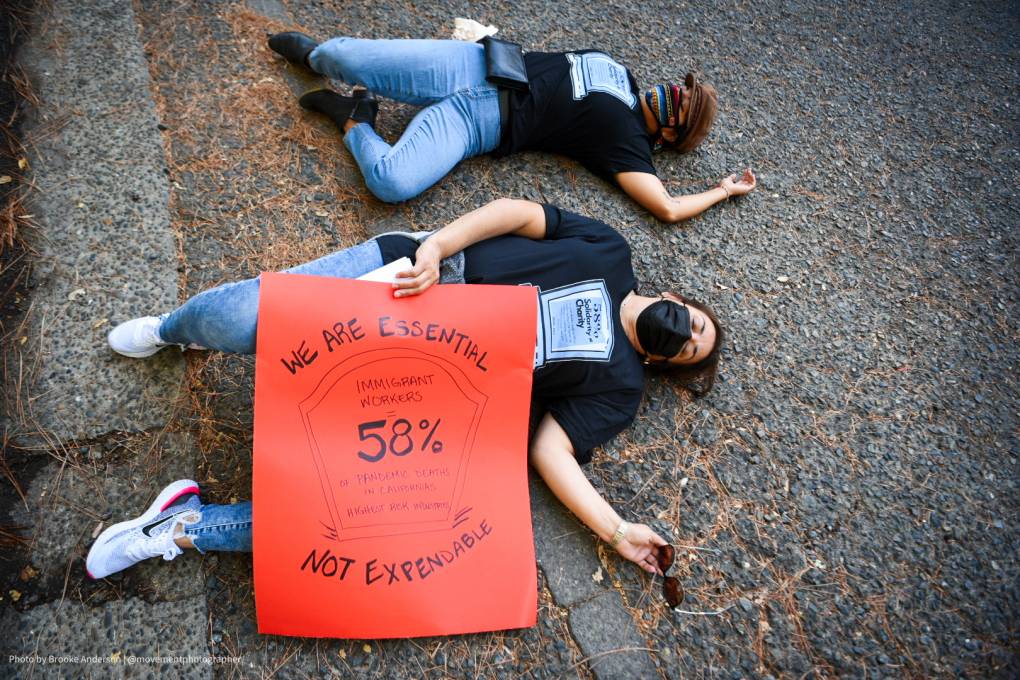
"caption": "Activists from across California staged a 'die-in' at Gov. Gavin Newsom's home to bring attention to what they see as a lack of equitable COVID-19 relief for immigrant workers.",
"description": null,
"title": "IMG_1938",
"credit": "Courtesy of Brooke Anderson (@MovementPhotographer)",
"status": "inherit",
"altTag": null,
"isLoading": false,
"fetchFailed": false
},
"news_11876305": {
"type": "attachments",
"id": "news_11876305",
"meta": {
"index": "attachments_1716263798",
"site": "news",
"id": "11876305",
"found": true
},
"parent": 11874325,
"imgSizes": {
"twentyfourteen-full-width": {
"file": "https://ww2.kqed.org/app/uploads/sites/10/2021/06/organizinghistory-1038x576.jpg",
"width": 1038,
"mimeType": "image/jpeg",
"height": 576
},
"thumbnail": {
"file": "https://ww2.kqed.org/app/uploads/sites/10/2021/06/organizinghistory-160x107.jpg",
"width": 160,
"mimeType": "image/jpeg",
"height": 107
},
"post-thumbnail": {
"file": "https://ww2.kqed.org/app/uploads/sites/10/2021/06/organizinghistory-672x372.jpg",
"width": 672,
"mimeType": "image/jpeg",
"height": 372
},
"kqedFullSize": {
"file": "https://ww2.kqed.org/app/uploads/sites/10/2021/06/organizinghistory.jpg",
"width": 1920,
"height": 1279
},
"large": {
"file": "https://ww2.kqed.org/app/uploads/sites/10/2021/06/organizinghistory-1020x679.jpg",
"width": 1020,
"mimeType": "image/jpeg",
"height": 679
},
"1536x1536": {
"file": "https://ww2.kqed.org/app/uploads/sites/10/2021/06/organizinghistory-1536x1023.jpg",
"width": 1536,
"mimeType": "image/jpeg",
"height": 1023
},
"medium": {
"file": "https://ww2.kqed.org/app/uploads/sites/10/2021/06/organizinghistory-800x533.jpg",
"width": 800,
"mimeType": "image/jpeg",
"height": 533
}
},
"publishDate": 1622652157,
"modified": 1622749371,
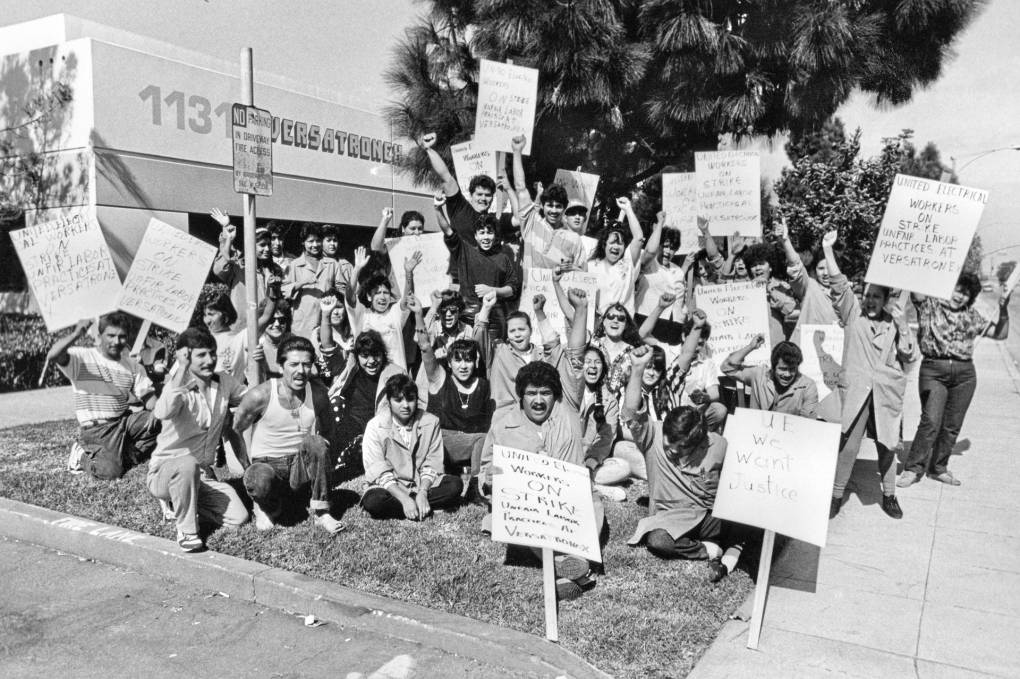
"caption": "In 1992, women and people of color led a strike at the Silicon Valley chip manufacturing plant, Versatronex.",
"description": null,
"title": "organizinghistory",
"credit": "Courtesy David Bacon",
"status": "inherit",
"altTag": null,
"isLoading": false,
"fetchFailed": false
},
"news_11876348": {
"type": "attachments",
"id": "news_11876348",
"meta": {
"index": "attachments_1716263798",
"site": "news",
"id": "11876348",
"found": true
},
"parent": 11875988,
"imgSizes": {
"twentyfourteen-full-width": {
"file": "https://ww2.kqed.org/app/uploads/sites/10/2021/06/RS49630_GettyImages-1231067411-qut-1038x576.jpg",
"width": 1038,
"mimeType": "image/jpeg",
"height": 576
},
"thumbnail": {
"file": "https://ww2.kqed.org/app/uploads/sites/10/2021/06/RS49630_GettyImages-1231067411-qut-160x94.jpg",
"width": 160,
"mimeType": "image/jpeg",
"height": 94
},
"post-thumbnail": {
"file": "https://ww2.kqed.org/app/uploads/sites/10/2021/06/RS49630_GettyImages-1231067411-qut-672x372.jpg",
"width": 672,
"mimeType": "image/jpeg",
"height": 372
},
"kqedFullSize": {
"file": "https://ww2.kqed.org/app/uploads/sites/10/2021/06/RS49630_GettyImages-1231067411-qut.jpg",
"width": 1920,
"height": 1130
},
"large": {
"file": "https://ww2.kqed.org/app/uploads/sites/10/2021/06/RS49630_GettyImages-1231067411-qut-1020x600.jpg",
"width": 1020,
"mimeType": "image/jpeg",
"height": 600
},
"1536x1536": {
"file": "https://ww2.kqed.org/app/uploads/sites/10/2021/06/RS49630_GettyImages-1231067411-qut-1536x904.jpg",
"width": 1536,
"mimeType": "image/jpeg",
"height": 904
},
"medium": {
"file": "https://ww2.kqed.org/app/uploads/sites/10/2021/06/RS49630_GettyImages-1231067411-qut-800x471.jpg",
"width": 800,
"mimeType": "image/jpeg",
"height": 471
}
},
"publishDate": 1622665917,
"modified": 1622666197,
"caption": "A demonstrator joins fast-food workers and their supporters on Feb. 9, 2021 in Los Angeles to protest unsafe working conditions and campaigns of intimidation against workers who call out their employers due to job safety concerns during the coronavirus pandemic. ",
"description": "A demonstrator joins fast-food workers and their supporters on Feb. 9, 2021 in Los Angeles to protest unsafe working conditions and campaigns of intimidation against workers who call out their employers due to job safety concerns during the coronavirus pandemic. ",
"title": "US-HEALTH-VIRUS-STRIKE",
"credit": "FREDERIC J. BROWN/AFP via Getty Images",
"status": "inherit",
"altTag": null,
"isLoading": false,
"fetchFailed": false
},
"news_11873075": {
"type": "attachments",
"id": "news_11873075",
"meta": {
"index": "attachments_1716263798",
"site": "news",
"id": "11873075",
"found": true
},
"parent": 11872984,
"imgSizes": {
"twentyfourteen-full-width": {
"file": "https://ww2.kqed.org/app/uploads/sites/10/2021/05/RS48902_002_SanFrancisco_CCSFRally_05062021-qut-1-1038x576.jpg",
"width": 1038,
"mimeType": "image/jpeg",
"height": 576
},
"thumbnail": {
"file": "https://ww2.kqed.org/app/uploads/sites/10/2021/05/RS48902_002_SanFrancisco_CCSFRally_05062021-qut-1-160x107.jpg",
"width": 160,
"mimeType": "image/jpeg",
"height": 107
},
"post-thumbnail": {
"file": "https://ww2.kqed.org/app/uploads/sites/10/2021/05/RS48902_002_SanFrancisco_CCSFRally_05062021-qut-1-672x372.jpg",
"width": 672,
"mimeType": "image/jpeg",
"height": 372
},
"kqedFullSize": {
"file": "https://ww2.kqed.org/app/uploads/sites/10/2021/05/RS48902_002_SanFrancisco_CCSFRally_05062021-qut-1.jpg",
"width": 1920,
"height": 1280
},
"large": {
"file": "https://ww2.kqed.org/app/uploads/sites/10/2021/05/RS48902_002_SanFrancisco_CCSFRally_05062021-qut-1-1020x680.jpg",
"width": 1020,
"mimeType": "image/jpeg",
"height": 680
},
"1536x1536": {
"file": "https://ww2.kqed.org/app/uploads/sites/10/2021/05/RS48902_002_SanFrancisco_CCSFRally_05062021-qut-1-1536x1024.jpg",
"width": 1536,
"mimeType": "image/jpeg",
"height": 1024
},
"medium": {
"file": "https://ww2.kqed.org/app/uploads/sites/10/2021/05/RS48902_002_SanFrancisco_CCSFRally_05062021-qut-1-800x533.jpg",
"width": 800,
"mimeType": "image/jpeg",
"height": 533
}
},
"publishDate": 1620695034,
"modified": 1647906028,
"caption": "Demonstrator Akeylah Hernandez holds a sign that says, 'Save City College,' during a rally outside Mission High School in San Francisco on May 6, 2021, to demand trustees cancel planned layoffs to CCSF faculty. ",
"description": "Demonstrator Akeylah Hernandez holds a sign that says, 'Save City College' during a rally outside of Mission High School in San Francisco on May 6, 2021, to demand trustees cancel planned layoffs to CCSF faculty. ",
"title": "RS48902_002_SanFrancisco_CCSFRally_05062021-qut (1)",
"credit": "Beth LaBerge/KQED",
"status": "inherit",
"altTag": "A person in an orange sweatshirt holds wearing a mask holds up a cardboard sign that says \"Save City College\" on a sunny day.",
"isLoading": false,
"fetchFailed": false
},
"news_11872738": {
"type": "attachments",
"id": "news_11872738",
"meta": {
"index": "attachments_1716263798",
"site": "news",
"id": "11872738",
"found": true
},
"parent": 11872330,
"imgSizes": {
"twentyfourteen-full-width": {
"file": "https://ww2.kqed.org/app/uploads/sites/10/2021/05/SaveCCSFRally1-1038x576.jpg",
"width": 1038,
"mimeType": "image/jpeg",
"height": 576
},
"thumbnail": {
"file": "https://ww2.kqed.org/app/uploads/sites/10/2021/05/SaveCCSFRally1-160x107.jpg",
"width": 160,
"mimeType": "image/jpeg",
"height": 107
},
"post-thumbnail": {
"file": "https://ww2.kqed.org/app/uploads/sites/10/2021/05/SaveCCSFRally1-672x372.jpg",
"width": 672,
"mimeType": "image/jpeg",
"height": 372
},
"kqedFullSize": {
"file": "https://ww2.kqed.org/app/uploads/sites/10/2021/05/SaveCCSFRally1.jpg",
"width": 1920,
"height": 1278
},
"large": {
"file": "https://ww2.kqed.org/app/uploads/sites/10/2021/05/SaveCCSFRally1-1020x679.jpg",
"width": 1020,
"mimeType": "image/jpeg",
"height": 679
},
"1536x1536": {
"file": "https://ww2.kqed.org/app/uploads/sites/10/2021/05/SaveCCSFRally1-1536x1022.jpg",
"width": 1536,
"mimeType": "image/jpeg",
"height": 1022
},
"medium": {
"file": "https://ww2.kqed.org/app/uploads/sites/10/2021/05/SaveCCSFRally1-800x533.jpg",
"width": 800,
"mimeType": "image/jpeg",
"height": 533
}
},
"publishDate": 1620412624,
"modified": 1620413151,
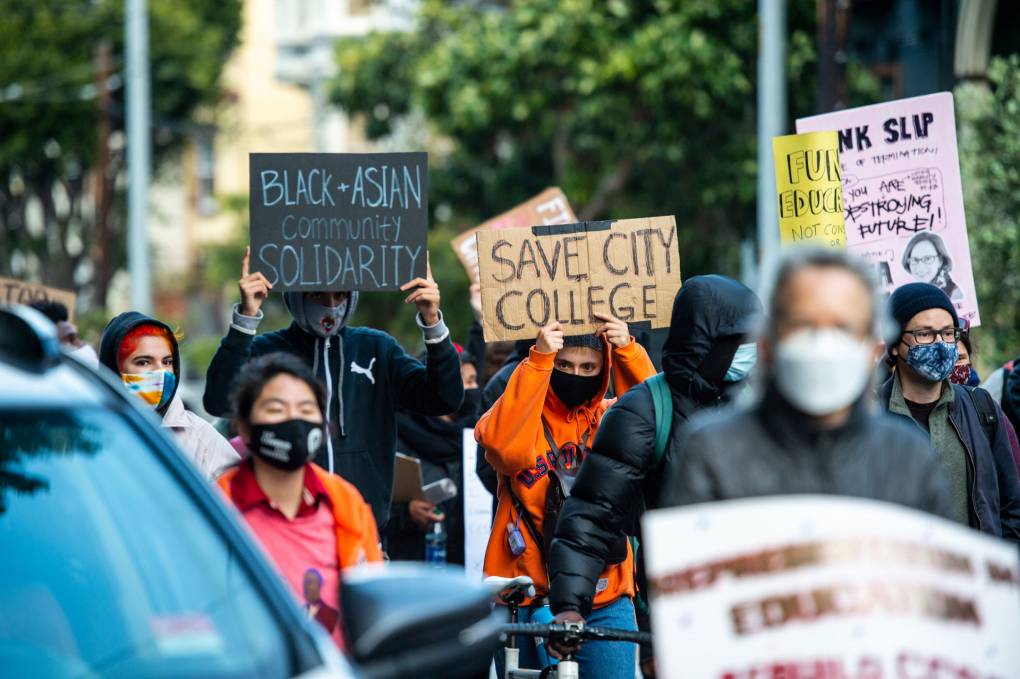
"caption": "Demonstrators march through the Castro neighborhood during a rally in San Francisco on May 6, 2021, to protest layoffs and cuts at City College of San Francisco.",
"description": "Demonstrators march through the Castro neighborhood during a rally in San Francisco on May 6, 2021, to protest layoffs and cuts at City College of San Francisco.",
"title": "SaveCCSFRally1",
"credit": "Beth LaBerge/KQED",
"status": "inherit",
"altTag": null,
"isLoading": false,
"fetchFailed": false
},
"news_11872636": {
"type": "attachments",
"id": "news_11872636",
"meta": {
"index": "attachments_1716263798",
"site": "news",
"id": "11872636",
"found": true
},
"parent": 11872571,
"imgSizes": {
"twentyfourteen-full-width": {
"file": "https://ww2.kqed.org/app/uploads/sites/10/2021/05/courtesy_tiktok_01-1020x673-1-1010x576.jpeg",
"width": 1010,
"mimeType": "image/jpeg",
"height": 576
},
"thumbnail": {
"file": "https://ww2.kqed.org/app/uploads/sites/10/2021/05/courtesy_tiktok_01-1020x673-1-160x107.jpeg",
"width": 160,
"mimeType": "image/jpeg",
"height": 107
},
"post-thumbnail": {
"file": "https://ww2.kqed.org/app/uploads/sites/10/2021/05/courtesy_tiktok_01-1020x673-1-672x372.jpeg",
"width": 672,
"mimeType": "image/jpeg",
"height": 372
},
"kqedFullSize": {
"file": "https://ww2.kqed.org/app/uploads/sites/10/2021/05/courtesy_tiktok_01-1020x673-1.jpeg",
"width": 1010,
"height": 673
},
"medium": {
"file": "https://ww2.kqed.org/app/uploads/sites/10/2021/05/courtesy_tiktok_01-1020x673-1-800x533.jpeg",
"width": 800,
"mimeType": "image/jpeg",
"height": 533
}
},
"publishDate": 1620339965,
"modified": 1620340474,
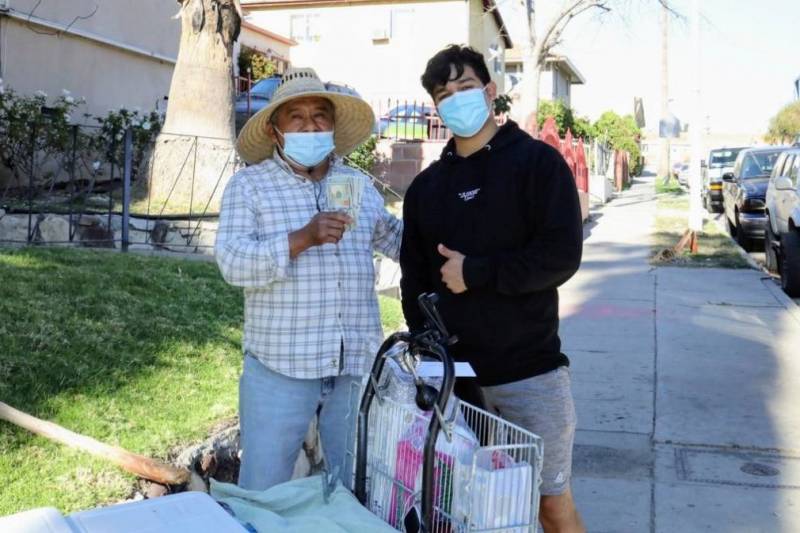
"caption": "Jesús Morales, influencer de TikTok, ha proporcionado más de $90 mil a vendedores ambulantes en el sur de California desde que comienzó la pandemia.",
"description": "Una imagen de Jesús Morales, influencer de TikTok, y un vendedor ambulante. El vendedor lleva puesto un sombrero para protegerse del sol y en sus manos unos billetes que Morales le dio.",
"title": "courtesy_tiktok_01-1020x673",
"credit": "Cortesía de Jesús Morales",
"status": "inherit",
"altTag": "Una imagen de Jesús Morales, influencer de TikTok, y un vendedor ambulante. El vendedor lleva puesto un sombrero para protegerse del sol y en sus manos unos billetes que Morales le dio.",
"isLoading": false,
"fetchFailed": false
},
"news_11872545": {
"type": "attachments",
"id": "news_11872545",
"meta": {
"index": "attachments_1716263798",
"site": "news",
"id": "11872545",
"found": true
},
"parent": 11872529,
"imgSizes": {
"twentyfourteen-full-width": {
"file": "https://ww2.kqed.org/app/uploads/sites/10/2021/05/courtesy_tiktok_02-1038x576.jpg",
"width": 1038,
"mimeType": "image/jpeg",
"height": 576
},
"thumbnail": {
"file": "https://ww2.kqed.org/app/uploads/sites/10/2021/05/courtesy_tiktok_02-160x90.jpg",
"width": 160,
"mimeType": "image/jpeg",
"height": 90
},
"post-thumbnail": {
"file": "https://ww2.kqed.org/app/uploads/sites/10/2021/05/courtesy_tiktok_02-672x372.jpg",
"width": 672,
"mimeType": "image/jpeg",
"height": 372
},
"kqedFullSize": {
"file": "https://ww2.kqed.org/app/uploads/sites/10/2021/05/courtesy_tiktok_02.jpg",
"width": 1920,
"height": 1080
},
"large": {
"file": "https://ww2.kqed.org/app/uploads/sites/10/2021/05/courtesy_tiktok_02-1020x574.jpg",
"width": 1020,
"mimeType": "image/jpeg",
"height": 574
},
"1536x1536": {
"file": "https://ww2.kqed.org/app/uploads/sites/10/2021/05/courtesy_tiktok_02-1536x864.jpg",
"width": 1536,
"mimeType": "image/jpeg",
"height": 864
},
"medium": {
"file": "https://ww2.kqed.org/app/uploads/sites/10/2021/05/courtesy_tiktok_02-800x450.jpg",
"width": 800,
"mimeType": "image/jpeg",
"height": 450
}
},
"publishDate": 1620326435,
"modified": 1620326464,
"caption": "TikTok influencer Jesus Morales has provided more than $90,000 to street vendors since the beginning of the pandemic.",
"description": null,
"title": "courtesy_tiktok_02",
"credit": "Photo courtesy of Jesus Morales",
"status": "inherit",
"altTag": null,
"isLoading": false,
"fetchFailed": false
},
"news_11871486": {
"type": "attachments",
"id": "news_11871486",
"meta": {
"index": "attachments_1716263798",
"site": "news",
"id": "11871486",
"found": true
},
"parent": 11871482,
"imgSizes": {
"twentyfourteen-full-width": {
"file": "https://ww2.kqed.org/app/uploads/sites/10/2021/04/1920_GettyImages-1203684608-1038x576.jpg",
"width": 1038,
"mimeType": "image/jpeg",
"height": 576
},
"thumbnail": {
"file": "https://ww2.kqed.org/app/uploads/sites/10/2021/04/1920_GettyImages-1203684608-160x90.jpg",
"width": 160,
"mimeType": "image/jpeg",
"height": 90
},
"post-thumbnail": {
"file": "https://ww2.kqed.org/app/uploads/sites/10/2021/04/1920_GettyImages-1203684608-672x372.jpg",
"width": 672,
"mimeType": "image/jpeg",
"height": 372
},
"kqedFullSize": {
"file": "https://ww2.kqed.org/app/uploads/sites/10/2021/04/1920_GettyImages-1203684608-scaled.jpg",
"width": 2560,
"height": 1440
},
"2048x2048": {
"file": "https://ww2.kqed.org/app/uploads/sites/10/2021/04/1920_GettyImages-1203684608-2048x1152.jpg",
"width": 2048,
"mimeType": "image/jpeg",
"height": 1152
},
"large": {
"file": "https://ww2.kqed.org/app/uploads/sites/10/2021/04/1920_GettyImages-1203684608-1020x574.jpg",
"width": 1020,
"mimeType": "image/jpeg",
"height": 574
},
"1536x1536": {
"file": "https://ww2.kqed.org/app/uploads/sites/10/2021/04/1920_GettyImages-1203684608-1536x864.jpg",
"width": 1536,
"mimeType": "image/jpeg",
"height": 864
},
"full-width": {
"file": "https://ww2.kqed.org/app/uploads/sites/10/2021/04/1920_GettyImages-1203684608-1920x1080.jpg",
"width": 1920,
"mimeType": "image/jpeg",
"height": 1080
},
"medium": {
"file": "https://ww2.kqed.org/app/uploads/sites/10/2021/04/1920_GettyImages-1203684608-800x450.jpg",
"width": 800,
"mimeType": "image/jpeg",
"height": 450
}
},
"publishDate": 1619635051,
"modified": 1627927353,
"caption": "Drivers are striking against San Francisco-based DoorDash.",
"description": null,
"title": "US-IT-LIFESTYLE-FOOD-DOORDASH",
"credit": "Eric Baradat/AFP via Getty Images",
"status": "inherit",
"altTag": null,
"isLoading": false,
"fetchFailed": false
}
},
"audioPlayerReducer": {
"postId": "stream_live",
"isPaused": true,
"isPlaying": false,
"pfsActive": false,
"pledgeModalIsOpen": true,
"playerDrawerIsOpen": false,
"liveAudioPlayStartedAt": 0,
"liveAudioPlayContext": ""
},
"authorsReducer": {
"byline_news_11878490": {
"type": "authors",
"id": "byline_news_11878490",
"meta": {
"override": true
},
"slug": "byline_news_11878490",
"name": "Don Thompson",
"isLoading": false
},
"byline_news_11872571": {
"type": "authors",
"id": "byline_news_11872571",
"meta": {
"override": true
},
"slug": "byline_news_11872571",
"name": "\u003ca href=\"https://calmatters.org/author/jacqueline-garcia/\">Jacqueline García\u003c/a>",
"isLoading": false
},
"byline_news_11872529": {
"type": "authors",
"id": "byline_news_11872529",
"meta": {
"override": true
},
"slug": "byline_news_11872529",
"name": "Jacqueline Garcia",
"isLoading": false
},
"byline_news_11871482": {
"type": "authors",
"id": "byline_news_11871482",
"meta": {
"override": true
},
"slug": "byline_news_11871482",
"name": "Dee-Ann Durbin \u003cbr> Associated Press",
"isLoading": false
},
"dmarks": {
"type": "authors",
"id": "182",
"meta": {
"index": "authors_1716337520",
"id": "182",
"found": true
},
"name": "David Marks",
"firstName": "David",
"lastName": "Marks",
"slug": "dmarks",
"email": "dmarks@kqed.org",
"display_author_email": false,
"staff_mastheads": [],
"title": "KQED Editor",
"bio": "David Marks is a senior digital editor for KQED News. \u003c/a>Reach him at dmarks@kqed.org.",
"avatar": "https://secure.gravatar.com/avatar/b88bd6227ce6cb96ae33fefaf42b2a29?s=600&d=mm&r=g",
"twitter": "divadskram",
"facebook": null,
"instagram": null,
"linkedin": null,
"sites": [
{
"site": "news",
"roles": []
},
{
"site": "science",
"roles": []
},
{
"site": "perspectives",
"roles": []
},
{
"site": "liveblog",
"roles": []
}
],
"headData": {
"title": "David Marks | KQED",
"description": "KQED Editor",
"ogImgSrc": "https://secure.gravatar.com/avatar/b88bd6227ce6cb96ae33fefaf42b2a29?s=600&d=mm&r=g",
"twImgSrc": "https://secure.gravatar.com/avatar/b88bd6227ce6cb96ae33fefaf42b2a29?s=600&d=mm&r=g"
},
"isLoading": false,
"link": "/author/dmarks"
},
"jmcevoy": {
"type": "authors",
"id": "231",
"meta": {
"index": "authors_1716337520",
"id": "231",
"found": true
},
"name": "Julia McEvoy",
"firstName": "Julia",
"lastName": "McEvoy",
"slug": "jmcevoy",
"email": "jmcevoy@KQED.org",
"display_author_email": true,
"staff_mastheads": [
"news"
],
"title": "KQED Senior Editor",
"bio": "Julia McEvoy is KQED's Senior Editor, Education Equity.\r\n\r\nJulia heads KQED’s education coverage examining inequities students face in Bay Area and California schools, and reports on what it will take to educate the next generation.\r\n\r\nJulia's editorial work has received a Peabody Award, a Casey Medal for Coverage of Children and Families, several Edward R. Murrow awards, as well as awards from the Public Radio News Directors Inc. and the Society for Professional Journalists.",
"avatar": "https://secure.gravatar.com/avatar/aec3ce21abe02b302fd33638abd56a22?s=600&d=blank&r=g",
"twitter": "juliamcevoy1",
"facebook": null,
"instagram": null,
"linkedin": null,
"sites": [
{
"site": "news",
"roles": []
},
{
"site": "stateofhealth",
"roles": [
"author"
]
}
],
"headData": {
"title": "Julia McEvoy | KQED",
"description": "KQED Senior Editor",
"ogImgSrc": "https://secure.gravatar.com/avatar/aec3ce21abe02b302fd33638abd56a22?s=600&d=blank&r=g",
"twImgSrc": "https://secure.gravatar.com/avatar/aec3ce21abe02b302fd33638abd56a22?s=600&d=blank&r=g"
},
"isLoading": false,
"link": "/author/jmcevoy"
},
"kqednewsstaffandwires": {
"type": "authors",
"id": "237",
"meta": {
"index": "authors_1716337520",
"id": "237",
"found": true
},
"name": "KQED News Staff and Wires",
"firstName": "KQED News Staff and Wires",
"lastName": null,
"slug": "kqednewsstaffandwires",
"email": "onlinenewsstaff@kqed.org",
"display_author_email": false,
"staff_mastheads": [],
"title": null,
"bio": null,
"avatar": "https://secure.gravatar.com/avatar/72295af8ebbfbd19a4948f5271285664?s=600&d=blank&r=g",
"twitter": null,
"facebook": null,
"instagram": null,
"linkedin": null,
"sites": [
{
"site": "arts",
"roles": [
"contributor"
]
},
{
"site": "news",
"roles": [
"contributor"
]
},
{
"site": "lowdown",
"roles": [
"author"
]
},
{
"site": "stateofhealth",
"roles": [
"contributor"
]
},
{
"site": "food",
"roles": [
"author"
]
}
],
"headData": {
"title": "KQED News Staff and Wires | KQED",
"description": null,
"ogImgSrc": "https://secure.gravatar.com/avatar/72295af8ebbfbd19a4948f5271285664?s=600&d=blank&r=g",
"twImgSrc": "https://secure.gravatar.com/avatar/72295af8ebbfbd19a4948f5271285664?s=600&d=blank&r=g"
},
"isLoading": false,
"link": "/author/kqednewsstaffandwires"
},
"minakim": {
"type": "authors",
"id": "243",
"meta": {
"index": "authors_1716337520",
"id": "243",
"found": true
},
"name": "Mina Kim",
"firstName": "Mina",
"lastName": "Kim",
"slug": "minakim",
"email": "mkim@kqed.org",
"display_author_email": false,
"staff_mastheads": [
"news"
],
"title": "Host, Forum",
"bio": "Mina Kim is host of the 10 a.m. statewide hour of Forum; a live daily talk show for curious Californians on issues that matter to the state and nation, with a particular emphasis on race and equity.\r\n\r\nBefore joining the Forum team, Mina was KQED’s evening news anchor, and health reporter for The California Report. Her award-winning work has included natural disasters in Napa and gun violence in Oakland. Mina grew up in St. John’s, Newfoundland.",
"avatar": "https://secure.gravatar.com/avatar/145ce657a2d08cb86d93686beb958982?s=600&d=blank&r=g",
"twitter": "mkimreporter",
"facebook": null,
"instagram": null,
"linkedin": null,
"sites": [
{
"site": "news",
"roles": [
"contributor"
]
},
{
"site": "stateofhealth",
"roles": [
"author"
]
},
{
"site": "forum",
"roles": [
"editor"
]
}
],
"headData": {
"title": "Mina Kim | KQED",
"description": "Host, Forum",
"ogImgSrc": "https://secure.gravatar.com/avatar/145ce657a2d08cb86d93686beb958982?s=600&d=blank&r=g",
"twImgSrc": "https://secure.gravatar.com/avatar/145ce657a2d08cb86d93686beb958982?s=600&d=blank&r=g"
},
"isLoading": false,
"link": "/author/minakim"
},
"samharnett": {
"type": "authors",
"id": "253",
"meta": {
"index": "authors_1716337520",
"id": "253",
"found": true
},
"name": "Sam Harnett",
"firstName": "Sam",
"lastName": "Harnett",
"slug": "samharnett",
"email": "samharnett@gmail.com",
"display_author_email": false,
"staff_mastheads": [],
"title": "KQED Contributor",
"bio": "Sam Harnett covered tech and work at KQED. He is the co-creator of \u003cem>\u003ca href=\"http://www.theworldaccordingtosound.org\">The World According to Sound\u003c/a>,\u003c/em> a 90-second podcast that features different sounds and the stories behind them.\r\n\r\nBefore coming to KQED, Sam worked as an independent reporter who contributed regularly to \u003cem>The California Report, Marketplace,\u003c/em> \u003cem>The World \u003c/em>and NPR.",
"avatar": "https://secure.gravatar.com/avatar/2538b972ac02f2b9546c7a6c59a0f3d0?s=600&d=blank&r=g",
"twitter": "Samwharnett",
"facebook": null,
"instagram": null,
"linkedin": null,
"sites": [
{
"site": "news",
"roles": [
"edit_others_posts",
"subscriber"
]
},
{
"site": "stateofhealth",
"roles": [
"author"
]
},
{
"site": "science",
"roles": [
"editor"
]
},
{
"site": "quest",
"roles": [
"subscriber"
]
}
],
"headData": {
"title": "Sam Harnett | KQED",
"description": "KQED Contributor",
"ogImgSrc": "https://secure.gravatar.com/avatar/2538b972ac02f2b9546c7a6c59a0f3d0?s=600&d=blank&r=g",
"twImgSrc": "https://secure.gravatar.com/avatar/2538b972ac02f2b9546c7a6c59a0f3d0?s=600&d=blank&r=g"
},
"isLoading": false,
"link": "/author/samharnett"
},
"fjhabvala": {
"type": "authors",
"id": "8659",
"meta": {
"index": "authors_1716337520",
"id": "8659",
"found": true
},
"name": "Farida Jhabvala Romero",
"firstName": "Farida",
"lastName": "Jhabvala Romero",
"slug": "fjhabvala",
"email": "fjhabvala@kqed.org",
"display_author_email": true,
"staff_mastheads": [
"news"
],
"title": "KQED Contributor",
"bio": "Farida Jhabvala Romero is a Labor Correspondent for KQED. She previously covered immigration. Farida was \u003ca href=\"https://www.ccnma.org/2022-most-influential-latina-journalists\">named\u003c/a> one of the 10 Most Influential Latina Journalists in California in 2022 by the California Chicano News Media Association. Her work has won awards from the Society of Professional Journalists (Northern California), as well as a national and regional Edward M. Murrow Award for the collaborative reporting projects “Dangerous Air” and “Graying California.” Before joining KQED, Farida worked as a producer at Radio Bilingüe, a national public radio network. Farida earned her master’s degree in journalism from Stanford University.",
"avatar": "https://secure.gravatar.com/avatar/f9f022d4e2609741874222a1e9d41f48fea74011aa7c615eef91d9a50c944ebe?s=600&d=blank&r=g",
"twitter": "FaridaJhabvala",
"bluesky": null,
"facebook": null,
"instagram": null,
"linkedin": "https://www.linkedin.com/in/faridajhabvala/",
"sites": [
{
"site": "news",
"roles": [
"editor"
]
},
{
"site": "stateofhealth",
"roles": [
"author"
]
},
{
"site": "liveblog",
"roles": [
"author"
]
}
],
"headData": {
"title": "Farida Jhabvala Romero | KQED",
"description": "KQED Contributor",
"ogImgSrc": "https://secure.gravatar.com/avatar/f9f022d4e2609741874222a1e9d41f48fea74011aa7c615eef91d9a50c944ebe?s=600&d=blank&r=g",
"twImgSrc": "https://secure.gravatar.com/avatar/f9f022d4e2609741874222a1e9d41f48fea74011aa7c615eef91d9a50c944ebe?s=600&d=blank&r=g"
},
"isLoading": false,
"link": "/author/fjhabvala"
},
"lsarah": {
"type": "authors",
"id": "11626",
"meta": {
"index": "authors_1716337520",
"id": "11626",
"found": true
},
"name": "Lakshmi Sarah",
"firstName": "Lakshmi",
"lastName": "Sarah",
"slug": "lsarah",
"email": "lsarah@kqed.org",
"display_author_email": false,
"staff_mastheads": [],
"title": "Digital Producer",
"bio": "Lakshmi Sarah is an educator, author and journalist with a focus on innovative storytelling. She has worked with newspapers, radio and magazines from Ahmedabad, India to Los Angeles, California. She has written and produced for Die Zeit, Global Voices, AJ+, KQED, Fusion Media Group and the New York Times.",
"avatar": "https://secure.gravatar.com/avatar/652dcaecd8b28826fc17a8b2d6bb4e93?s=600&d=blank&r=g",
"twitter": "lakitalki",
"facebook": null,
"instagram": "https://www.instagram.com/laki.talki/",
"linkedin": "https://www.linkedin.com/in/lakisarah/",
"sites": [
{
"site": "arts",
"roles": []
},
{
"site": "news",
"roles": []
},
{
"site": "bayareabites",
"roles": []
},
{
"site": "science",
"roles": []
}
],
"headData": {
"title": "Lakshmi Sarah | KQED",
"description": "Digital Producer",
"ogImgSrc": "https://secure.gravatar.com/avatar/652dcaecd8b28826fc17a8b2d6bb4e93?s=600&d=blank&r=g",
"twImgSrc": "https://secure.gravatar.com/avatar/652dcaecd8b28826fc17a8b2d6bb4e93?s=600&d=blank&r=g"
},
"isLoading": false,
"link": "/author/lsarah"
},
"jrodriguez": {
"type": "authors",
"id": "11690",
"meta": {
"index": "authors_1716337520",
"id": "11690",
"found": true
},
"name": "Joe Fitzgerald Rodriguez",
"firstName": "Joe",
"lastName": "Fitzgerald Rodriguez",
"slug": "jrodriguez",
"email": "jrodriguez@kqed.org",
"display_author_email": true,
"staff_mastheads": [
"news"
],
"title": "Reporter and Producer",
"bio": "Joe Fitzgerald Rodriguez is a reporter and digital producer for KQED covering politics. Joe most recently wrote for the \u003cem>San Francisco Examiner\u003c/em> as a political columnist covering The City. He was raised in San Francisco and has spent his reporting career in his beloved, foggy, city by the bay. Joe was 12-years-old when he conducted his first interview in journalism, grilling former San Francisco Mayor Willie Brown for the Marina Middle School newspaper, \u003cem>The Penguin Press, \u003c/em>and he continues to report on the San Francisco Bay Area to this day.",
"avatar": "https://secure.gravatar.com/avatar/2247beb0564c1e9c62228d5649d2edac?s=600&d=blank&r=g",
"twitter": "FitztheReporter",
"facebook": null,
"instagram": "https://www.instagram.com/fitzthereporter/",
"linkedin": null,
"sites": [
{
"site": "",
"roles": [
"editor"
]
},
{
"site": "arts",
"roles": [
"editor"
]
},
{
"site": "news",
"roles": [
"editor"
]
},
{
"site": "science",
"roles": [
"editor"
]
},
{
"site": "elections",
"roles": [
"editor"
]
},
{
"site": "liveblog",
"roles": [
"editor"
]
}
],
"headData": {
"title": "Joe Fitzgerald Rodriguez | KQED",
"description": "Reporter and Producer",
"ogImgSrc": "https://secure.gravatar.com/avatar/2247beb0564c1e9c62228d5649d2edac?s=600&d=blank&r=g",
"twImgSrc": "https://secure.gravatar.com/avatar/2247beb0564c1e9c62228d5649d2edac?s=600&d=blank&r=g"
},
"isLoading": false,
"link": "/author/jrodriguez"
},
"ccabreralomeli": {
"type": "authors",
"id": "11708",
"meta": {
"index": "authors_1716337520",
"id": "11708",
"found": true
},
"name": "Carlos Cabrera-Lomelí",
"firstName": "Carlos",
"lastName": "Cabrera-Lomelí",
"slug": "ccabreralomeli",
"email": "ccabreralomeli@KQED.org",
"display_author_email": true,
"staff_mastheads": [
"news"
],
"title": "Community Reporter",
"bio": "Carlos Cabrera-Lomelí is a community reporter with KQED's digital engagement team. He also reports and co-produces for KQED's bilingual news hub KQED en Español. He grew up in San Francisco's Mission District and has previously worked with Univision, 48 Hills and REFORMA in Mexico City.",
"avatar": "https://secure.gravatar.com/avatar/c309be9665e484f887b818c89e273ecc673004f426f36b24d00a4d813a2e0518?s=600&d=blank&r=g",
"twitter": "@LomeliCabrera",
"bluesky": null,
"facebook": null,
"instagram": null,
"linkedin": null,
"sites": [
{
"site": "arts",
"roles": [
"editor"
]
},
{
"site": "news",
"roles": [
"editor"
]
},
{
"site": "about",
"roles": [
"editor"
]
},
{
"site": "science",
"roles": [
"editor"
]
},
{
"site": "perspectives",
"roles": [
"editor"
]
},
{
"site": "elections",
"roles": [
"editor"
]
},
{
"site": "liveblog",
"roles": [
"contributor"
]
}
],
"headData": {
"title": "Carlos Cabrera-Lomelí | KQED",
"description": "Community Reporter",
"ogImgSrc": "https://secure.gravatar.com/avatar/c309be9665e484f887b818c89e273ecc673004f426f36b24d00a4d813a2e0518?s=600&d=blank&r=g",
"twImgSrc": "https://secure.gravatar.com/avatar/c309be9665e484f887b818c89e273ecc673004f426f36b24d00a4d813a2e0518?s=600&d=blank&r=g"
},
"isLoading": false,
"link": "/author/ccabreralomeli"
}
},
"pagesReducer": {
"news_tag_labor": {
"type": "terms",
"id": "news_19904",
"meta": {
"index": "terms_1716263798",
"site": "news",
"id": "19904",
"score": 8.558112
},
"name": "Labor",
"slug": "labor",
"taxonomy": "tag",
"description": null,
"featImg": null,
"headData": {
"title": "Labor | KQED News",
"description": null,
"ogTitle": null,
"ogDescription": null,
"ogImgId": null,
"twTitle": null,
"twDescription": null,
"twImgId": null
},
"ttid": 19921,
"isLoading": false,
"title": "Labor",
"pageMeta": {
"site": "news",
"WpPageTemplate": "page-topic-editorial",
"currentPage": 47
},
"blocks": [
{
"blockName": "kqed/post-list",
"attrs": {
"layout": "cardArticle2",
"query": "posts/news?tag=labor",
"seeMore": false,
"paginated": true,
"page": 47
}
},
{
"blockName": "kqed/ad"
}
]
}
},
"pfsSessionReducer": {},
"postsReducer": {
"stream_live": {
"type": "live",
"id": "stream_live",
"audioUrl": "https://streams.kqed.org/kqedradio",
"title": "Live Stream",
"excerpt": "Live Stream information currently unavailable.",
"link": "/radio",
"featImg": "",
"label": {
"name": "KQED Live",
"link": "/"
}
},
"stream_kqedNewscast": {
"type": "posts",
"id": "stream_kqedNewscast",
"audioUrl": "https://www.kqed.org/.stream/anon/radio/RDnews/newscast.mp3?_=1",
"title": "KQED Newscast",
"featImg": "",
"label": {
"name": "88.5 FM",
"link": "/"
}
},
"news_11878490": {
"type": "posts",
"id": "news_11878490",
"meta": {
"index": "posts_1716263798",
"site": "news",
"id": "11878490",
"score": null,
"sort": [
1623970260000
]
},
"guestAuthors": [],
"slug": "california-drops-workplace-mask-rule-for-vaccinated-workers",
"title": "Cal/OSHA Ditches Workplace Mask Mandate for Vaccinated Workers",
"publishDate": 1623970260,
"format": "standard",
"headTitle": "Cal/OSHA Ditches Workplace Mask Mandate for Vaccinated Workers | KQED",
"labelTerm": {},
"content": "\u003cp>California regulators on Thursday approved revised workplace pandemic rules that allow employees who are fully vaccinated against the coronavirus the same freedoms as when they are off the job, including ending most mask requirements.\u003c/p>\n\u003cp>The revised regulations approved by the governor-appointed California Occupational Safety & Health Standards Board come after weeks of confusion. The rules adopted in a 5-1 vote now conform with general state guidelines that took effect Tuesday by ending most mask rules for vaccinated people.\u003c/p>\n\u003cp>Gov. Gavin Newsom immediately issued an executive order waiving the usual 10-day legal review. The new rules will take effect as soon as they are filed with the secretary of state.\u003c/p>\n\u003cp>“I have a draft executive order ready to go immediately after they vote to make clarifications public and to provide more certainty,” Newsom said.\u003c/p>\n\u003cp>The rules apply in almost every workplace in the state, including offices, factories and retailers.\u003c/p>\n\u003cp>[ad fullwidth]\u003c/p>\n\u003cp>They are intended to ensure that workers are protected while businesses resume normal or near-normal activity, Eric Berg, deputy chief of research and standards for California’s Division of Occupational Safety and Health, known as Cal/OSHA, told the board.\u003c/p>\n\u003cp>Business groups had sought the changes, arguing that rules for businesses should conform with state guidelines patterned after the latest federal Centers for Disease Control and Prevention recommendations.\u003c/p>\n\u003cp>Board member Laura Stock, an occupational safety expert who cast the lone opposition vote, said that even though people are tired of restrictions, the pandemic is not over.\u003c/p>\n\u003cp>“This has real consequences that people can get sick and die due to exposure in the workplace,” Stock said.\u003c/p>\n\u003cp>She said the rules go too far by eliminating physical distancing and workplace partitions and allowing workers to self-report their vaccination status.\u003c/p>\n\u003cp>Mitch Steiger, a legislative advocate for the California Labor Federation, AFL-CIO, similarly objected that the measures “essentially pretend that the pandemic is over.”\u003c/p>\n\u003cp>David Thomas, the board’s chair, thanked who spoke in support or opposition to the rules and acknowledged that coming with up with latest iteration of the guidelines has not been easy.\u003c/p>\n\u003cp>“I do appreciate the time and concern and hours we’ve spent in these meetings to get to this conclusion, but I’d be remiss if I didn’t thank you guys, it’s a lot of work, and a lot of responsibility,” said Thomas.\u003c/p>\n\u003cp>[aside label=\"More coverage\" tag=\"face-masks\"]\u003c/p>\n\u003cp>The move comes after the board did a double-twisting backflip in recent weeks when it first postponed, then rejected, then adopted, then rescinded rules that would have allowed workers to forgo masks only if every employee in a room was fully vaccinated against the coronavirus.\u003c/p>\n\u003cp>Fully vaccinated employees will not need to wear masks, except in locations like mass transit and classrooms, where they are required for everyone, or in the event of outbreaks.\u003c/p>\n\u003cp>Physical distancing also will end except for certain workers during major outbreaks. Vaccinated employees won’t need to be tested or quarantine unless they show symptoms, even if they have close contact with an infected person.\u003c/p>\n\u003cp>Employers must document that workers who skip masks indoors are indeed fully vaccinated. But employers have the choice of requiring workers to show proof of vaccination or allowing employees to self-report their status, with the employer keeping a record of who does the latter.\u003c/p>\n\u003cp>They also could decide to require everyone to remain masked — vaccinated or not. And vaccinated employees will still be able to wear masks if they choose without facing retaliation.\u003c/p>\n\u003cp>The governor’s office released a statement saying the workplace regulations, initially implemented in November 2020, “remain an important component of the state’s ongoing response, providing balanced worker protections that support California’s continued progress in recovering from the pandemic.”\u003c/p>\n\u003cp>Rob Lapsley, president of the California Business Roundtable, said the rules don’t fully conform to the state’s other standards. Others argued that they still will cause confusion.\u003c/p>\n\u003cp>That’s because of the requirement that employers provide masks and keep track of employees’ vaccination status, record-keeping that he and others said could create liability and privacy issues.\u003c/p>\n\u003cp>“They do remain a significant barrier to fully reopening the economy,” Lapsley said.\u003c/p>\n\u003cp>Katie Hansen, senior legislative director for the California Restaurant Association, said it is unrealistic to expect unvaccinated employees to remain masked until emergency work rules expire early next year, while others generally drop their face coverings.\u003c/p>\n\u003cp>The California Chamber of Commerce took a milder approach, thanking Newsom for eliminating confusion by pledging to conform workplace rules with the state’s loosened pandemic precautions.\u003c/p>\n\u003cp>That includes immediately ending social distancing obligations instead of waiting until July 31, as Cal/OSHA had initially proposed.\u003c/p>\n\u003cp>The chamber also praised a rule change that will require employers to provide the most effective N95 masks for free to unvaccinated employees upon request.\u003c/p>\n\u003cp>But others objected that the rule still will require employers to stockpile masks and compete with health care workers, despite Newsom’s promise to provide a one-month supply of the masks.\u003c/p>\n\u003cp>There were 700 California workplace outbreaks and more than 10,000 infections in the last 30 days, Cal/OSHA’s Berg said, but he said the N95s are the best alternative as other protections wane.\u003c/p>\n\u003cp>Robert Moutrie, a chamber of commerce policy advocate, called the latest proposal a “measured step” that opens too quickly for some businesses and not quickly enough for others.\u003c/p>\n\u003cp>”But we do think that this is a good step in that direction,” Moutrie said.\u003c/p>\n\u003cp>\u003c/p>\n\u003cp>\u003cem>KQED’s Alex Hall contributed to this report.\u003c/em>\u003c/p>\n\n",
"blocks": [],
"excerpt": "After weeks of confusion, the new workplace rules now conform with general state guidelines ending most mask rules for vaccinated people.",
"status": "publish",
"parent": 0,
"modified": 1726006329,
"stats": {
"hasAudio": false,
"hasVideo": false,
"hasChartOrMap": false,
"iframeSrcs": [],
"hasGoogleForm": false,
"hasGallery": false,
"hasHearkenModule": false,
"hasPolis": false,
"paragraphCount": 34,
"wordCount": 958
},
"headData": {
"title": "Cal/OSHA Ditches Workplace Mask Mandate for Vaccinated Workers | KQED",
"description": "After weeks of confusion, the new workplace rules now conform with general state guidelines ending most mask rules for vaccinated people.",
"ogTitle": "",
"ogDescription": "",
"ogImgId": "",
"twTitle": "",
"twDescription": "",
"twImgId": "",
"schema": {
"@context": "https://schema.org",
"@type": "NewsArticle",
"headline": "Cal/OSHA Ditches Workplace Mask Mandate for Vaccinated Workers",
"datePublished": "2021-06-17T15:51:00-07:00",
"dateModified": "2024-09-10T15:12:09-07:00",
"image": "https://cdn.kqed.org/wp-content/uploads/2020/02/KQED-OG-Image@1x.png",
"isAccessibleForFree": "True",
"publisher": {
"@type": "NewsMediaOrganization",
"@id": "https://www.kqed.org/#organization",
"name": "KQED",
"logo": "https://cdn.kqed.org/wp-content/uploads/2020/02/KQED-OG-Image@1x.png",
"url": "https://www.kqed.org",
"sameAs": [
"https://www.facebook.com/KQED",
"https://twitter.com/KQED",
"https://www.instagram.com/kqed/",
"https://www.tiktok.com/@kqedofficial",
"https://www.linkedin.com/company/kqed",
"https://www.youtube.com/channel/UCeC0IOo7i1P_61zVUWbJ4nw"
]
}
}
},
"source": "The Associated Press",
"sourceUrl": "https://newsroom.ap.org/detail/Californiadropsworkplacemaskruleforvaccinatedworkers/ab4712705c675d031867d9816c0f484f/text?Query=CAL%2FOSHA&mediaType=text&sortBy=arrivaldatetime:desc&dateRange=Anytime&totalCount=9¤tItemNo=0",
"sticky": false,
"nprByline": "Don Thompson",
"path": "/news/11878490/california-drops-workplace-mask-rule-for-vaccinated-workers",
"audioTrackLength": null,
"parsedContent": [
{
"type": "contentString",
"content": "\u003cdiv class=\"post-body\">\u003cp>\u003cp>California regulators on Thursday approved revised workplace pandemic rules that allow employees who are fully vaccinated against the coronavirus the same freedoms as when they are off the job, including ending most mask requirements.\u003c/p>\n\u003cp>The revised regulations approved by the governor-appointed California Occupational Safety & Health Standards Board come after weeks of confusion. The rules adopted in a 5-1 vote now conform with general state guidelines that took effect Tuesday by ending most mask rules for vaccinated people.\u003c/p>\n\u003cp>Gov. Gavin Newsom immediately issued an executive order waiving the usual 10-day legal review. The new rules will take effect as soon as they are filed with the secretary of state.\u003c/p>\n\u003cp>“I have a draft executive order ready to go immediately after they vote to make clarifications public and to provide more certainty,” Newsom said.\u003c/p>\n\u003cp>The rules apply in almost every workplace in the state, including offices, factories and retailers.\u003c/p>\n\u003cp>\u003c/p>\u003c/div>",
"attributes": {
"named": {},
"numeric": []
}
},
{
"type": "component",
"content": "",
"name": "ad",
"attributes": {
"named": {
"label": "fullwidth"
},
"numeric": [
"fullwidth"
]
}
},
{
"type": "contentString",
"content": "\u003cdiv class=\"post-body\">\u003cp>\u003c/p>\n\u003cp>They are intended to ensure that workers are protected while businesses resume normal or near-normal activity, Eric Berg, deputy chief of research and standards for California’s Division of Occupational Safety and Health, known as Cal/OSHA, told the board.\u003c/p>\n\u003cp>Business groups had sought the changes, arguing that rules for businesses should conform with state guidelines patterned after the latest federal Centers for Disease Control and Prevention recommendations.\u003c/p>\n\u003cp>Board member Laura Stock, an occupational safety expert who cast the lone opposition vote, said that even though people are tired of restrictions, the pandemic is not over.\u003c/p>\n\u003cp>“This has real consequences that people can get sick and die due to exposure in the workplace,” Stock said.\u003c/p>\n\u003cp>She said the rules go too far by eliminating physical distancing and workplace partitions and allowing workers to self-report their vaccination status.\u003c/p>\n\u003cp>Mitch Steiger, a legislative advocate for the California Labor Federation, AFL-CIO, similarly objected that the measures “essentially pretend that the pandemic is over.”\u003c/p>\n\u003cp>David Thomas, the board’s chair, thanked who spoke in support or opposition to the rules and acknowledged that coming with up with latest iteration of the guidelines has not been easy.\u003c/p>\n\u003cp>“I do appreciate the time and concern and hours we’ve spent in these meetings to get to this conclusion, but I’d be remiss if I didn’t thank you guys, it’s a lot of work, and a lot of responsibility,” said Thomas.\u003c/p>\n\u003cp>\u003c/p>\u003c/div>",
"attributes": {
"named": {},
"numeric": []
}
},
{
"type": "component",
"content": "",
"name": "aside",
"attributes": {
"named": {
"label": "More coverage ",
"tag": "face-masks"
},
"numeric": []
}
},
{
"type": "contentString",
"content": "\u003cdiv class=\"post-body\">\u003cp>\u003c/p>\n\u003cp>The move comes after the board did a double-twisting backflip in recent weeks when it first postponed, then rejected, then adopted, then rescinded rules that would have allowed workers to forgo masks only if every employee in a room was fully vaccinated against the coronavirus.\u003c/p>\n\u003cp>Fully vaccinated employees will not need to wear masks, except in locations like mass transit and classrooms, where they are required for everyone, or in the event of outbreaks.\u003c/p>\n\u003cp>Physical distancing also will end except for certain workers during major outbreaks. Vaccinated employees won’t need to be tested or quarantine unless they show symptoms, even if they have close contact with an infected person.\u003c/p>\n\u003cp>Employers must document that workers who skip masks indoors are indeed fully vaccinated. But employers have the choice of requiring workers to show proof of vaccination or allowing employees to self-report their status, with the employer keeping a record of who does the latter.\u003c/p>\n\u003cp>They also could decide to require everyone to remain masked — vaccinated or not. And vaccinated employees will still be able to wear masks if they choose without facing retaliation.\u003c/p>\n\u003cp>The governor’s office released a statement saying the workplace regulations, initially implemented in November 2020, “remain an important component of the state’s ongoing response, providing balanced worker protections that support California’s continued progress in recovering from the pandemic.”\u003c/p>\n\u003cp>Rob Lapsley, president of the California Business Roundtable, said the rules don’t fully conform to the state’s other standards. Others argued that they still will cause confusion.\u003c/p>\n\u003cp>That’s because of the requirement that employers provide masks and keep track of employees’ vaccination status, record-keeping that he and others said could create liability and privacy issues.\u003c/p>\n\u003cp>“They do remain a significant barrier to fully reopening the economy,” Lapsley said.\u003c/p>\n\u003cp>Katie Hansen, senior legislative director for the California Restaurant Association, said it is unrealistic to expect unvaccinated employees to remain masked until emergency work rules expire early next year, while others generally drop their face coverings.\u003c/p>\n\u003cp>The California Chamber of Commerce took a milder approach, thanking Newsom for eliminating confusion by pledging to conform workplace rules with the state’s loosened pandemic precautions.\u003c/p>\n\u003cp>That includes immediately ending social distancing obligations instead of waiting until July 31, as Cal/OSHA had initially proposed.\u003c/p>\n\u003cp>The chamber also praised a rule change that will require employers to provide the most effective N95 masks for free to unvaccinated employees upon request.\u003c/p>\n\u003cp>But others objected that the rule still will require employers to stockpile masks and compete with health care workers, despite Newsom’s promise to provide a one-month supply of the masks.\u003c/p>\n\u003cp>There were 700 California workplace outbreaks and more than 10,000 infections in the last 30 days, Cal/OSHA’s Berg said, but he said the N95s are the best alternative as other protections wane.\u003c/p>\n\u003cp>Robert Moutrie, a chamber of commerce policy advocate, called the latest proposal a “measured step” that opens too quickly for some businesses and not quickly enough for others.\u003c/p>\n\u003cp>”But we do think that this is a good step in that direction,” Moutrie said.\u003c/p>\n\u003cp>\u003c/p>\n\u003cp>\u003cem>KQED’s Alex Hall contributed to this report.\u003c/em>\u003c/p>\n\n\u003c/div>\u003c/p>",
"attributes": {
"named": {},
"numeric": []
}
}
],
"link": "/news/11878490/california-drops-workplace-mask-rule-for-vaccinated-workers",
"authors": [
"byline_news_11878490"
],
"categories": [
"news_457",
"news_8"
],
"tags": [
"news_6145",
"news_23922",
"news_29593",
"news_5043",
"news_23099",
"news_27804",
"news_16",
"news_18543",
"news_19904",
"news_29535"
],
"featImg": "news_11878523",
"label": "source_news_11878490"
},
"news_11877838": {
"type": "posts",
"id": "news_11877838",
"meta": {
"index": "posts_1716263798",
"site": "news",
"id": "11877838",
"score": null,
"sort": [
1623787834000
]
},
"guestAuthors": [],
"slug": "the-work-that-makes-all-other-work-possible-ai-jen-poo-on-why-home-care-workers-are-infrastructure-workers",
"title": "'The Work That Makes All Other Work Possible': Ai-jen Poo on Why Home Care Workers Are Infrastructure Workers",
"publishDate": 1623787834,
"format": "audio",
"headTitle": "‘The Work That Makes All Other Work Possible’: Ai-jen Poo on Why Home Care Workers Are Infrastructure Workers | KQED",
"labelTerm": {
"site": "news"
},
"content": "\u003cp>The COVID-19 pandemic put a spotlight on the importance of child care, in-home care and support for the elderly as well as for members of the disability community across the nation. Now, one of the most contentious parts of negotiations with Republicans over President Biden’s infrastructure plan has to do with the administration’s inclusion of \u003ca href=\"https://www.theatlantic.com/ideas/archive/2021/04/why-care-work-infrastructure/618588/\" target=\"_blank\" rel=\"noopener noreferrer\">$400 billion in spending for at-home care for the elderly and people with disabilities\u003c/a>, with the administration arguing that such domestic work is as essential to a functioning economy as roads and bridges.\u003c/p>\n\u003cp>KQED’s Mina Kim spoke with \u003ca href=\"https://www.pbs.org/newshour/brief/375509/ai-jen-poo\" target=\"_blank\" rel=\"noopener noreferrer\">Ai-jen Poo\u003c/a>, director of the \u003ca href=\"https://www.domesticworkers.org/press/spokespersons/ai-jen-poo/\" target=\"_blank\" rel=\"noopener noreferrer\">National Domestic Workers Alliance\u003c/a>, about domestic workers and what it means to include this work in the infrastructure plan.\u003c/p>\n\u003cp>\u003cem>The following interview has been edited for length and clarity.\u003c/em>\u003c/p>\n\u003ch3>\u003cstrong>Why Care Work Is Best Described as Infrastructure\u003c/strong>\u003c/h3>\n\u003cp>\u003cstrong>Ai-jen Poo:\u003c/strong> We’ve always talked about how domestic work, the work that happens inside of our homes to take care of our family members, our children, our loved ones with disabilities, our aging loved ones, really is the work that makes all other work possible. Having access to care makes it possible for all of us to go out into the world and do what we do every single day.[pullquote size=\"medium\" align=\"right\" citation=\"Ai-jen Poo, director of the National Domestic Workers Alliance\"]‘If you think about the definition of infrastructure, it’s really that which enables society and the economy to function. And what could be more fundamental than having the ability to take care of your loved ones as you prepare to work and participate in our workforce and economy?’[/pullquote]\u003c/p>\n\u003cp>If you think about the definition of infrastructure, it’s really that which enables society and the economy to function. And what could be more fundamental than having the ability to take care of your loved ones as you prepare to work and participate in our workforce and economy?\u003c/p>\n\u003cp>Even if you think about the traditional definition of infrastructure, roads, bridges, tunnels, all of the people who are rebuilding our bridges and fixing our tunnels, they need care, too. So maybe it’s the first form of infrastructure before anything else.\u003c/p>\n\u003ch3>‘Single Greatest Opportunity in Generations’\u003c/h3>\n\u003cp>\u003cem>What do you think about the fact that care work is now in a presidential infrastructure bill?\u003c/em>\u003c/p>\n\u003cp>\u003cstrong>Ai-jen Poo:\u003c/strong> I think it’s the single greatest opportunity we’ve had in generations to establish the kind of policies and programs we need to support our ability to care for our families as we work. It’s necessary.\u003c/p>\n\u003cp>[ad fullwidth]\u003c/p>\n\u003cp>Even before the pandemic, many of us were simmering in a care crisis. We have a situation where the baby boom generation is aging into retirement at a rate of 10,000 people per day, turning 65 every 8 seconds. We’ve basically added an entire generation onto our lifespan and we haven’t adopted any of our systems or policy to support a quality of life and the care we need as we live longer. On both ends of the generational spectrum, we need more care than ever before at a time when we have less of it. Our default care infrastructure in previous generations was just expecting that women will stay home and be full-time family caregivers.\u003c/p>\n\u003cp>[pullquote size=\"medium\" align=\"right\" citation=\"Ai-jen Poo, director of the National Domestic Workers Alliance\"]‘The fact that the work as a profession has always been associated with women of color has profoundly shaped the way that we’ve treated this work in law, policy and in culture.’[/pullquote]We need programs, policies, systems and a strong care workforce to support us. There are over 2.5 million [care workers], and they’re overwhelmingly women — 92% women and majority women of color, including many immigrant women. This is actually the part of the economy with the highest concentration of undocumented immigrants of any workforce. They are also majority primary income earners for their families and majority mothers of small children.\u003c/p>\n\u003cp>We have a workforce who is essential not only to the families they support, but their own families and communities. And it’s also a workforce that has always been majority women of color. Some of the first domestic workers in the U.S. were enslaved Black women. And the fact that the work as a profession has always been associated with women of color has profoundly shaped the way that we’ve treated this work in law, policy and in culture.\u003c/p>\n\u003cp>Starting in the 1930s, when we were putting our foundational labor laws into place, this workforce was excluded intentionally as a result of racism and the legacy of slavery in our country. And it created a situation of extreme insecurity when domestic workers entered a crisis like a pandemic — it just became incredibly exacerbated.\u003c/p>\n\u003cfigure id=\"attachment_11877959\" class=\"wp-caption aligncenter\" style=\"max-width: 1355px\">\u003cimg loading=\"lazy\" decoding=\"async\" src=\"https://ww2.kqed.org/app/uploads/sites/10/2021/06/RS49609_015_SanFrancisco_AlexPadillaMissionKids_06012021-qut.jpg\" alt=\"\" width=\"1355\" height=\"1003\" class=\"size-full wp-image-11877959\" srcset=\"https://cdn.kqed.org/wp-content/uploads/sites/10/2021/06/RS49609_015_SanFrancisco_AlexPadillaMissionKids_06012021-qut.jpg 1355w, https://cdn.kqed.org/wp-content/uploads/sites/10/2021/06/RS49609_015_SanFrancisco_AlexPadillaMissionKids_06012021-qut-800x592.jpg 800w, https://cdn.kqed.org/wp-content/uploads/sites/10/2021/06/RS49609_015_SanFrancisco_AlexPadillaMissionKids_06012021-qut-1020x755.jpg 1020w, https://cdn.kqed.org/wp-content/uploads/sites/10/2021/06/RS49609_015_SanFrancisco_AlexPadillaMissionKids_06012021-qut-160x118.jpg 160w\" sizes=\"auto, (max-width: 1355px) 100vw, 1355px\">\u003cfigcaption class=\"wp-caption-text\">Sen. Alex Padilla speaks with children during a visit to Mission Kids Preschool in San Francisco on June 1, 2021. The visit was part of Padilla’s ‘Infrastructure Listening Tour.’ \u003ccite>(Beth LaBerge/KQED)\u003c/cite>\u003c/figcaption>\u003c/figure>\n\u003ch3>Structural Problems in Pay and Working Conditions\u003c/h3>\n\u003cp>\u003cem>Could you talk a little bit more about some of the more common structural problems that you see regarding pay and working conditions?\u003c/em>\u003c/p>\n\u003cp>\u003cstrong>Ai-jen Poo:\u003c/strong> Eighty-two percent of domestic workers didn’t have a single paid sick day. When the second stay-at-home orders came down, you saw dramatic losses in jobs and income because there’s no job security, there’s no contract or work agreement. The wages are essentially poverty wages. \u003c/p>\n\u003cp>So most domestic workers didn’t have the savings to be able to fall back on. I remember in March of 2020, in the first weeks of the pandemic, we held a meeting on Zoom with some of our members and one of them held her phone up to the Zoom screen to show us that she literally had 1 cent left in her bank account.\u003c/p>\n\u003ch3>What Investing in the Care Economy Looks Like\u003c/h3>\n\u003cp>\u003cem>When you say investment in care workers and the care economy, what does it look like?\u003c/em>\u003c/p>\n\u003cp>\u003cstrong>Ai-jen Poo:\u003c/strong> The Biden \u003ca href=\"https://www.whitehouse.gov/briefing-room/statements-releases/2021/03/31/fact-sheet-the-american-jobs-plan/\" target=\"_blank\" rel=\"noopener noreferrer\">American Jobs Plan\u003c/a> proposed a $400 billion investment in Medicaid, home and community-based care. What that money would do is expand access to home and community-based services and care for the elderly, and people with disabilities. And it would support raising wages and access to benefits for the workforce.\u003c/p>\n\u003cp>Right now, the average annual income of a home care worker is $17,000 per year. I don’t know a single community where that is sustainable, let alone enough to raise a family on. \u003c/p>\n\u003cp>[pullquote size=\"medium\" align=\"right\" citation=\"Ai-jen Poo, director of the National Domestic Workers Alliance\"]‘If you’re a parent or you’re a primary caregiver for a family member who needs assistance with activities of daily life, you know that it’s an impossible choice between work and family members who need you for their basic human needs.’[/pullquote]What we end up seeing is high rates of turnover because people simply cannot survive and sustain themselves doing this work … because the wages are so poor and the conditions are so tough, we have huge parts of this country that we call home care deserts or direct care deserts because people can’t get the support that they need in order to live in their communities. They end up either having to go into a nursing home or having to rely on overstretched family caregivers who have to make impossible choices about whether or not they can work. The money to Medicaid would specifically raise wages for the home care workforce and strengthen that workforce so that they can stay and sustain themselves doing this work.\u003c/p>\n\u003cp>It would expand access to the services for over 800,000 people who are on waiting lists and the millions more who don’t even know there’s a waiting list to wait on.\u003c/p>\n\u003ch3>A Cultural Shift\u003c/h3>\n\u003cp>\u003cem>What evidence do you have that there is a tangible cultural shift happening here?\u003c/em>\u003c/p>\n\u003cp>\u003cstrong>Ai-jen Poo:\u003c/strong> I do feel this incredible rage, we call it the “mom’s rage,” that incredible frustration that moms are feeling and have felt throughout the pandemic. \u003c/p>\n\u003cp>If you’re a parent or you’re a primary caregiver for a family member who needs assistance with activities of daily life, you know that it’s an impossible choice between work and family members who need you for their basic human needs.\u003c/p>\n\u003cp>The kind of rage that I’m feeling, especially from women who disproportionately bear the brunt of caregiving responsibilities in our country, and especially women of color who’ve been pushed out of the workforce by the millions, almost 5 million women pushed out of the workforce in the pandemic because of caregiving challenges. That is an indicator that something is very broken.\u003c/p>\n\u003cp>If we are to pull ourselves back from the regression to 1988 women’s workforce participation levels, we’re going to have to rebuild and build something really different. I think people know that in their guts. This cultural norm that we have around care being an individual responsibility and a responsibility of individual families is one that is very deep. It’s not like we’re going to move past it overnight. And it’s not that it isn’t the responsibility of women and families and individuals, but it is about what is our responsibility collectively to each other as a society to ensure that we have real choices and real agency when it comes to the people we love.\u003c/p>\n\u003ch3>\u003cstrong>Protections for Undocumented Domestic Workers\u003c/strong>\u003c/h3>\n\u003cp>\u003cem>Can you comment on protections for undocumented domestic workers?\u003c/em>\u003c/p>\n\u003cp>\u003cstrong>Ai-jen Poo:\u003c/strong> There are a tremendous number of undocumented workers — essential workers in this industry. [aside tag=\"undocumented\" label=\"Related Stories\"] We’ve been working really hard to make sure that we seize upon this moment as we’re imagining an economic recovery that is inclusive and supportive of essential workers and includes undocumented domestic workers and care workers that have kept us safe through the pandemic.\u003c/p>\n\u003cp>Sen. Alex Padilla from California has introduced legislation to create a path to citizenship for the 5 million essential workers across industries through this time of crisis, and so we are very busy trying to get support for that legislation. \u003c/p>\n\u003cp>It could be really transformative and it would be inclusive of domestic workers, so let the senator know that you really support his efforts and help us get people signed on to that bill.\u003c/p>\n\u003cp>[ad floatright]\u003c/p>\n",
"blocks": [],
"excerpt": "The Biden administration infrastructure bill includes $400 billion for home care work. Ai-jen Poo of the National Domestic Workers Alliance says it's a huge opportunity to establish much-needed support for workers and the families they care for.",
"status": "publish",
"parent": 0,
"modified": 1740182306,
"stats": {
"hasAudio": false,
"hasVideo": false,
"hasChartOrMap": false,
"iframeSrcs": [],
"hasGoogleForm": false,
"hasGallery": false,
"hasHearkenModule": false,
"hasPolis": false,
"paragraphCount": 31,
"wordCount": 1823
},
"headData": {
"title": "'The Work That Makes All Other Work Possible': Ai-jen Poo on Why Home Care Workers Are Infrastructure Workers | KQED",
"description": "The Biden administration infrastructure bill includes $400 billion for home care work. Ai-jen Poo of the National Domestic Workers Alliance says it's a huge opportunity to establish much-needed support for workers and the families they care for.",
"ogTitle": "",
"ogDescription": "",
"ogImgId": "",
"twTitle": "",
"twDescription": "",
"twImgId": "",
"schema": {
"@context": "https://schema.org",
"@type": "NewsArticle",
"headline": "'The Work That Makes All Other Work Possible': Ai-jen Poo on Why Home Care Workers Are Infrastructure Workers",
"datePublished": "2021-06-15T13:10:34-07:00",
"dateModified": "2025-02-21T15:58:26-08:00",
"image": "https://cdn.kqed.org/wp-content/uploads/2020/02/KQED-OG-Image@1x.png",
"isAccessibleForFree": "True",
"publisher": {
"@type": "NewsMediaOrganization",
"@id": "https://www.kqed.org/#organization",
"name": "KQED",
"logo": "https://cdn.kqed.org/wp-content/uploads/2020/02/KQED-OG-Image@1x.png",
"url": "https://www.kqed.org",
"sameAs": [
"https://www.facebook.com/KQED",
"https://twitter.com/KQED",
"https://www.instagram.com/kqed/",
"https://www.tiktok.com/@kqedofficial",
"https://www.linkedin.com/company/kqed",
"https://www.youtube.com/channel/UCeC0IOo7i1P_61zVUWbJ4nw"
]
}
}
},
"audioUrl": "https://www.podtrac.com/pts/redirect.mp3/traffic.megaphone.fm/KQINC9745267305.mp3",
"sticky": false,
"path": "/news/11877838/the-work-that-makes-all-other-work-possible-ai-jen-poo-on-why-home-care-workers-are-infrastructure-workers",
"audioTrackLength": null,
"parsedContent": [
{
"type": "contentString",
"content": "\u003cdiv class=\"post-body\">\u003cp>\u003cp>The COVID-19 pandemic put a spotlight on the importance of child care, in-home care and support for the elderly as well as for members of the disability community across the nation. Now, one of the most contentious parts of negotiations with Republicans over President Biden’s infrastructure plan has to do with the administration’s inclusion of \u003ca href=\"https://www.theatlantic.com/ideas/archive/2021/04/why-care-work-infrastructure/618588/\" target=\"_blank\" rel=\"noopener noreferrer\">$400 billion in spending for at-home care for the elderly and people with disabilities\u003c/a>, with the administration arguing that such domestic work is as essential to a functioning economy as roads and bridges.\u003c/p>\n\u003cp>KQED’s Mina Kim spoke with \u003ca href=\"https://www.pbs.org/newshour/brief/375509/ai-jen-poo\" target=\"_blank\" rel=\"noopener noreferrer\">Ai-jen Poo\u003c/a>, director of the \u003ca href=\"https://www.domesticworkers.org/press/spokespersons/ai-jen-poo/\" target=\"_blank\" rel=\"noopener noreferrer\">National Domestic Workers Alliance\u003c/a>, about domestic workers and what it means to include this work in the infrastructure plan.\u003c/p>\n\u003cp>\u003cem>The following interview has been edited for length and clarity.\u003c/em>\u003c/p>\n\u003ch3>\u003cstrong>Why Care Work Is Best Described as Infrastructure\u003c/strong>\u003c/h3>\n\u003cp>\u003cstrong>Ai-jen Poo:\u003c/strong> We’ve always talked about how domestic work, the work that happens inside of our homes to take care of our family members, our children, our loved ones with disabilities, our aging loved ones, really is the work that makes all other work possible. Having access to care makes it possible for all of us to go out into the world and do what we do every single day.\u003c/p>\u003c/div>",
"attributes": {
"named": {},
"numeric": []
}
},
{
"type": "component",
"content": "‘If you think about the definition of infrastructure, it’s really that which enables society and the economy to function. And what could be more fundamental than having the ability to take care of your loved ones as you prepare to work and participate in our workforce and economy?’",
"name": "pullquote",
"attributes": {
"named": {
"size": "medium",
"align": "right",
"citation": "Ai-jen Poo, director of the National Domestic Workers Alliance",
"label": ""
},
"numeric": []
}
},
{
"type": "contentString",
"content": "\u003cdiv class=\"post-body\">\u003cp>\u003c/p>\n\u003cp>If you think about the definition of infrastructure, it’s really that which enables society and the economy to function. And what could be more fundamental than having the ability to take care of your loved ones as you prepare to work and participate in our workforce and economy?\u003c/p>\n\u003cp>Even if you think about the traditional definition of infrastructure, roads, bridges, tunnels, all of the people who are rebuilding our bridges and fixing our tunnels, they need care, too. So maybe it’s the first form of infrastructure before anything else.\u003c/p>\n\u003ch3>‘Single Greatest Opportunity in Generations’\u003c/h3>\n\u003cp>\u003cem>What do you think about the fact that care work is now in a presidential infrastructure bill?\u003c/em>\u003c/p>\n\u003cp>\u003cstrong>Ai-jen Poo:\u003c/strong> I think it’s the single greatest opportunity we’ve had in generations to establish the kind of policies and programs we need to support our ability to care for our families as we work. It’s necessary.\u003c/p>\n\u003cp>\u003c/p>\u003c/div>",
"attributes": {
"named": {},
"numeric": []
}
},
{
"type": "component",
"content": "",
"name": "ad",
"attributes": {
"named": {
"label": "fullwidth"
},
"numeric": [
"fullwidth"
]
}
},
{
"type": "contentString",
"content": "\u003cdiv class=\"post-body\">\u003cp>\u003c/p>\n\u003cp>Even before the pandemic, many of us were simmering in a care crisis. We have a situation where the baby boom generation is aging into retirement at a rate of 10,000 people per day, turning 65 every 8 seconds. We’ve basically added an entire generation onto our lifespan and we haven’t adopted any of our systems or policy to support a quality of life and the care we need as we live longer. On both ends of the generational spectrum, we need more care than ever before at a time when we have less of it. Our default care infrastructure in previous generations was just expecting that women will stay home and be full-time family caregivers.\u003c/p>\n\u003cp>\u003c/p>\u003c/div>",
"attributes": {
"named": {},
"numeric": []
}
},
{
"type": "component",
"content": "‘The fact that the work as a profession has always been associated with women of color has profoundly shaped the way that we’ve treated this work in law, policy and in culture.’",
"name": "pullquote",
"attributes": {
"named": {
"size": "medium",
"align": "right",
"citation": "Ai-jen Poo, director of the National Domestic Workers Alliance",
"label": ""
},
"numeric": []
}
},
{
"type": "contentString",
"content": "\u003cdiv class=\"post-body\">\u003cp>We need programs, policies, systems and a strong care workforce to support us. There are over 2.5 million [care workers], and they’re overwhelmingly women — 92% women and majority women of color, including many immigrant women. This is actually the part of the economy with the highest concentration of undocumented immigrants of any workforce. They are also majority primary income earners for their families and majority mothers of small children.\u003c/p>\n\u003cp>We have a workforce who is essential not only to the families they support, but their own families and communities. And it’s also a workforce that has always been majority women of color. Some of the first domestic workers in the U.S. were enslaved Black women. And the fact that the work as a profession has always been associated with women of color has profoundly shaped the way that we’ve treated this work in law, policy and in culture.\u003c/p>\n\u003cp>Starting in the 1930s, when we were putting our foundational labor laws into place, this workforce was excluded intentionally as a result of racism and the legacy of slavery in our country. And it created a situation of extreme insecurity when domestic workers entered a crisis like a pandemic — it just became incredibly exacerbated.\u003c/p>\n\u003cfigure id=\"attachment_11877959\" class=\"wp-caption aligncenter\" style=\"max-width: 1355px\">\u003cimg loading=\"lazy\" decoding=\"async\" src=\"https://ww2.kqed.org/app/uploads/sites/10/2021/06/RS49609_015_SanFrancisco_AlexPadillaMissionKids_06012021-qut.jpg\" alt=\"\" width=\"1355\" height=\"1003\" class=\"size-full wp-image-11877959\" srcset=\"https://cdn.kqed.org/wp-content/uploads/sites/10/2021/06/RS49609_015_SanFrancisco_AlexPadillaMissionKids_06012021-qut.jpg 1355w, https://cdn.kqed.org/wp-content/uploads/sites/10/2021/06/RS49609_015_SanFrancisco_AlexPadillaMissionKids_06012021-qut-800x592.jpg 800w, https://cdn.kqed.org/wp-content/uploads/sites/10/2021/06/RS49609_015_SanFrancisco_AlexPadillaMissionKids_06012021-qut-1020x755.jpg 1020w, https://cdn.kqed.org/wp-content/uploads/sites/10/2021/06/RS49609_015_SanFrancisco_AlexPadillaMissionKids_06012021-qut-160x118.jpg 160w\" sizes=\"auto, (max-width: 1355px) 100vw, 1355px\">\u003cfigcaption class=\"wp-caption-text\">Sen. Alex Padilla speaks with children during a visit to Mission Kids Preschool in San Francisco on June 1, 2021. The visit was part of Padilla’s ‘Infrastructure Listening Tour.’ \u003ccite>(Beth LaBerge/KQED)\u003c/cite>\u003c/figcaption>\u003c/figure>\n\u003ch3>Structural Problems in Pay and Working Conditions\u003c/h3>\n\u003cp>\u003cem>Could you talk a little bit more about some of the more common structural problems that you see regarding pay and working conditions?\u003c/em>\u003c/p>\n\u003cp>\u003cstrong>Ai-jen Poo:\u003c/strong> Eighty-two percent of domestic workers didn’t have a single paid sick day. When the second stay-at-home orders came down, you saw dramatic losses in jobs and income because there’s no job security, there’s no contract or work agreement. The wages are essentially poverty wages. \u003c/p>\n\u003cp>So most domestic workers didn’t have the savings to be able to fall back on. I remember in March of 2020, in the first weeks of the pandemic, we held a meeting on Zoom with some of our members and one of them held her phone up to the Zoom screen to show us that she literally had 1 cent left in her bank account.\u003c/p>\n\u003ch3>What Investing in the Care Economy Looks Like\u003c/h3>\n\u003cp>\u003cem>When you say investment in care workers and the care economy, what does it look like?\u003c/em>\u003c/p>\n\u003cp>\u003cstrong>Ai-jen Poo:\u003c/strong> The Biden \u003ca href=\"https://www.whitehouse.gov/briefing-room/statements-releases/2021/03/31/fact-sheet-the-american-jobs-plan/\" target=\"_blank\" rel=\"noopener noreferrer\">American Jobs Plan\u003c/a> proposed a $400 billion investment in Medicaid, home and community-based care. What that money would do is expand access to home and community-based services and care for the elderly, and people with disabilities. And it would support raising wages and access to benefits for the workforce.\u003c/p>\n\u003cp>Right now, the average annual income of a home care worker is $17,000 per year. I don’t know a single community where that is sustainable, let alone enough to raise a family on. \u003c/p>\n\u003cp>\u003c/p>\u003c/div>",
"attributes": {
"named": {},
"numeric": []
}
},
{
"type": "component",
"content": "‘If you’re a parent or you’re a primary caregiver for a family member who needs assistance with activities of daily life, you know that it’s an impossible choice between work and family members who need you for their basic human needs.’",
"name": "pullquote",
"attributes": {
"named": {
"size": "medium",
"align": "right",
"citation": "Ai-jen Poo, director of the National Domestic Workers Alliance",
"label": ""
},
"numeric": []
}
},
{
"type": "contentString",
"content": "\u003cdiv class=\"post-body\">\u003cp>What we end up seeing is high rates of turnover because people simply cannot survive and sustain themselves doing this work … because the wages are so poor and the conditions are so tough, we have huge parts of this country that we call home care deserts or direct care deserts because people can’t get the support that they need in order to live in their communities. They end up either having to go into a nursing home or having to rely on overstretched family caregivers who have to make impossible choices about whether or not they can work. The money to Medicaid would specifically raise wages for the home care workforce and strengthen that workforce so that they can stay and sustain themselves doing this work.\u003c/p>\n\u003cp>It would expand access to the services for over 800,000 people who are on waiting lists and the millions more who don’t even know there’s a waiting list to wait on.\u003c/p>\n\u003ch3>A Cultural Shift\u003c/h3>\n\u003cp>\u003cem>What evidence do you have that there is a tangible cultural shift happening here?\u003c/em>\u003c/p>\n\u003cp>\u003cstrong>Ai-jen Poo:\u003c/strong> I do feel this incredible rage, we call it the “mom’s rage,” that incredible frustration that moms are feeling and have felt throughout the pandemic. \u003c/p>\n\u003cp>If you’re a parent or you’re a primary caregiver for a family member who needs assistance with activities of daily life, you know that it’s an impossible choice between work and family members who need you for their basic human needs.\u003c/p>\n\u003cp>The kind of rage that I’m feeling, especially from women who disproportionately bear the brunt of caregiving responsibilities in our country, and especially women of color who’ve been pushed out of the workforce by the millions, almost 5 million women pushed out of the workforce in the pandemic because of caregiving challenges. That is an indicator that something is very broken.\u003c/p>\n\u003cp>If we are to pull ourselves back from the regression to 1988 women’s workforce participation levels, we’re going to have to rebuild and build something really different. I think people know that in their guts. This cultural norm that we have around care being an individual responsibility and a responsibility of individual families is one that is very deep. It’s not like we’re going to move past it overnight. And it’s not that it isn’t the responsibility of women and families and individuals, but it is about what is our responsibility collectively to each other as a society to ensure that we have real choices and real agency when it comes to the people we love.\u003c/p>\n\u003ch3>\u003cstrong>Protections for Undocumented Domestic Workers\u003c/strong>\u003c/h3>\n\u003cp>\u003cem>Can you comment on protections for undocumented domestic workers?\u003c/em>\u003c/p>\n\u003cp>\u003cstrong>Ai-jen Poo:\u003c/strong> There are a tremendous number of undocumented workers — essential workers in this industry. \u003c/p>\u003c/div>",
"attributes": {
"named": {},
"numeric": []
}
},
{
"type": "component",
"content": "",
"name": "aside",
"attributes": {
"named": {
"tag": "undocumented",
"label": "Related Stories "
},
"numeric": []
}
},
{
"type": "contentString",
"content": "\u003cdiv class=\"post-body\">\u003cp> We’ve been working really hard to make sure that we seize upon this moment as we’re imagining an economic recovery that is inclusive and supportive of essential workers and includes undocumented domestic workers and care workers that have kept us safe through the pandemic.\u003c/p>\n\u003cp>Sen. Alex Padilla from California has introduced legislation to create a path to citizenship for the 5 million essential workers across industries through this time of crisis, and so we are very busy trying to get support for that legislation. \u003c/p>\n\u003cp>It could be really transformative and it would be inclusive of domestic workers, so let the senator know that you really support his efforts and help us get people signed on to that bill.\u003c/p>\n\u003cp>\u003c/p>\u003c/div>",
"attributes": {
"named": {},
"numeric": []
}
},
{
"type": "component",
"content": "",
"name": "ad",
"attributes": {
"named": {
"label": "floatright"
},
"numeric": [
"floatright"
]
}
},
{
"type": "contentString",
"content": "\u003cdiv class=\"post-body\">\u003cp>\u003c/p>\n\u003c/div>\u003c/p>",
"attributes": {
"named": {},
"numeric": []
}
}
],
"link": "/news/11877838/the-work-that-makes-all-other-work-possible-ai-jen-poo-on-why-home-care-workers-are-infrastructure-workers",
"authors": [
"243",
"11626"
],
"categories": [
"news_1758",
"news_457",
"news_34551",
"news_8"
],
"tags": [
"news_18538",
"news_27989",
"news_27504",
"news_26115",
"news_18543",
"news_1730",
"news_717",
"news_5946",
"news_19904"
],
"featImg": "news_11877960",
"label": "news"
},
"news_11877530": {
"type": "posts",
"id": "news_11877530",
"meta": {
"index": "posts_1716263798",
"site": "news",
"id": "11877530",
"score": null,
"sort": [
1623345489000
]
},
"parent": 0,
"labelTerm": {
"site": "news"
},
"blocks": [],
"publishDate": 1623345489,
"format": "standard",
"disqusTitle": "In Another Reversal, California Regulators Withdraw Controversial Workplace Mask Rules",
"title": "In Another Reversal, California Regulators Withdraw Controversial Workplace Mask Rules",
"headTitle": "KQED News",
"content": "\u003cp>California's workplace regulators have withdrawn a controversial pending mask regulation while they consider a rule that more closely aligns with Gov. Gavin Newsom's promise that the state will fully reopen from the pandemic on Tuesday.\u003c/p>\n\u003cp>The California Occupational Safety and Health Standards Board's revised rule, \u003ca href=\"https://www.kqed.org/news/11876529/californians-may-need-masks-at-work-unless-all-employees-are-vaccinated\">adopted last week after it was initially rejected\u003c/a>, would have allowed workers to forego masks only if every employee in a room is fully vaccinated against the coronavirus. \u003c/p>\n\u003cp>That contrasts with the state's broader plan to do away with virtually all masking and social distancing requirements for vaccinated people in concert with the latest recommendations from the Centers for Disease Control and Prevention.\u003c/p>\n\u003cp>The board's decision late Wednesday to withdraw that worksite rule before it goes into effect allows the board to consider changes at its June 17 meeting and potentially have them go into effect by month's end.\u003c/p>\n\u003cp>[aside postID=news_11877048 hero='https://ww2.kqed.org/app/uploads/sites/10/2021/06/GettyImages-1210618045-1-1020x680.jpg']But some business leaders on Wednesday kept up their pressure on Newsom to override the board. \u003c/p>\n\u003cp>\"After the confusion and lack of clarity on reopening guidelines at the Cal/OSHA hearing tonight, the statewide business community must once again request the governor issue an Executive Order before June 15 to provide all employers with the consistency and certainty in guidelines,\" Rob Lapsley, president of the California Business Roundtable, said in a statement after the vote. That, he said, \"will be the catalyst for a full economic reopening and create a powerful incentive to get even more Californians vaccinated.\" \u003c/p>\n\u003cp>The goal of the unanimous vote, said board Chairman David Thomas, is to change the workplace regulation \"so that it matches up with the CDC and the California Department of Public Health, so that we're all on the same page. That's what this is about, so we're not out of step with everybody else.\"\u003c/p>\n\u003cp>The safety board's staff was not specific on what changes it will recommend next week, other than it will try to more closely conform the workplace rules with public health guidelines.\u003c/p>\n\u003cp>But Eric Berg, deputy chief of health for Cal/OSHA, said the public health guidelines generally allow anyone who is vaccinated to skip wearing a mask indoors. Under those rules, he said, \"a vaccinated person would not have to wear a mask at work.\"\u003c/p>\n\u003cp>The reversal came after State Health Officer Dr. Tomás Aragón reiterated to board members at a hastily scheduled special meeting that the state next week will end most masking rules for people who are vaccinated, while continuing to require face coverings for unvaccinated people in indoor public settings and businesses.\u003c/p>\n\u003cp>Exceptions where everyone must remain masked include public transit, indoor school classes, in health care and correctional facilities, and in places like homeless shelters and cooling centers, Aragón said. Individual businesses are also free to require everyone to remain masked under the general rules, he said.\u003c/p>\n\u003cp>[ad fullwidth]\u003c/p>\n\u003ch3>'Employers Cannot Plan'\u003c/h3>\n\u003cp>Helen Cleary, director of the Phylmar Regulatory Roundtable, a coalition of large businesses with major California operations, was among numerous business representatives urging the board to conform its rule with public health requirements.\u003c/p>\n\u003cp>\"Employers cannot plan with this high level of uncertainty,\" she said. \"We are disappointed and frustrated with the confusion, the process, the substance and the lack of leadership.\"\u003c/p>\n\u003cp>The workplace board's more restrictive approach puts Newsom in an awkward position as he battles a pending recall election, though he was reluctant to override a board that he appoints.\u003c/p>\n\u003cp>\"The public doesn't draw a distinction between this board and the rest of the Newsom administration,\" Michael Miiller, California Association of Winegrape Growers government relations director, told board members before the vote. \"What they hear is the Newsom administration say that wearing masks at work may be here to stay.\" \u003c/p>\n\u003cp>Pressure on the board built before the meeting when a dozen business groups, including the California Retailers Association and organizations representing manufacturers, farmers, tourism interests and other industries, sent a letter to Newsom asking him to rescind the board's regulations.\u003c/p>\n\u003cp>Requiring masks unless all are vaccinated in a workplace would \"create yet another barrier to rehiring and reopening\" at a time when \"we need to be providing incentives to bring people back,\" they said. Moreover, they said requiring masks for people who are fully inoculated could lead the public to believe the vaccine isn't really effective. \u003c/p>\n\u003ch3>'Outbreaks Are Still Occurring'\u003c/h3>\n\u003cp>Board member Laura Stock said it is important to keep protecting employees who don't have a realistic choice but to go to work. \u003c/p>\n\u003cp>For instance, state data show that in the retail sector in the last 30 days \"there were 70 outbreaks, more than two a day,\" said Stock, who directs the Labor Occupational Health Program at UC Berkeley. \"Outbreaks are still occurring.\"\u003c/p>\n\u003cp>The idea of a continued workplace mask mandate has also been broadly supported by a range of unions representing teamsters, nurses, machinists, utility workers, engineers and school employees. Many advocates have stressed that the pandemic is not over, and that low-wage front-line workers have been \u003ca href=\"https://www.kqed.org/news/11875988/minimal-to-non-existent-safety-inspector-shortage-worsened-in-pandemic-leaving-california-workers-vulnerable\">disproportionately impacted\u003c/a>.\u003c/p>\n\u003cp>[aside postID=news_11875988 hero='https://ww2.kqed.org/app/uploads/sites/10/2021/06/RS49630_GettyImages-1231067411-qut-1020x600.jpg']As COVID-19 cases, and deaths, spiked across the state last fall and winter, Cal/OSHA received thousands of worker complaints related to the virus. Yet the vacancy rate for field inspectors doubled to 26% as of late February, compared to 13% two years earlier.\u003c/p>\n\u003cp>\"The workplace is not the same as deciding to go to a dinner party or the gym or go to a movie,\" said Maggie Robbins, an occupational health specialist with Worksafe Inc., an Oakland-based worker-advocacy group. \"There’s a lot of work to be done before we have a substantially immune population where we can relax more of the controls.\"\u003c/p>\n\u003cp>Liz Ortega, executive secretary-treasurer of the Alameda Labor Council, told KQED last week the workers she advocates for have put themselves at risk for the last year and a half, \"making sure the rest of us could survive during the pandemic.\"\u003c/p>\n\u003cp>\"We’ve spent the last 18 months fighting for and winning worker safety, hazard pay, and sick leave,\" Ortega said in an email. \"We aren’t going to now criticize Cal/OSHA for proceeding with caution.\"\u003c/p>\n\u003cp>Business groups also want the board to withdraw its proposal to require employers to start providing the most effective N95 masks for voluntary use by employees who work indoors or at large outdoor events and are not fully vaccinated, starting July 31. That would be costly and compete with the needs of health care workers, they said.\u003c/p>\n\u003cp>But \"the N95 is the one that checked all of those boxes\" for safety, Stock said.\u003c/p>\n\u003cp>The Cal/OSHA board's regulations apply in almost every workplace in the state, including workers in offices, factories and retail. Its pandemic rules apply to all employees except those working from home or where there is a single employee who does not have contact with other people.\u003c/p>\n\u003cp>Even prior to Wednesday's vote, board members emphasized that their revised rules were temporary, and they appointed a subcommittee to continue working on revisions.\u003c/p>\n\u003cp>\u003cem>This post includes reporting from Don Thompson of The Associated Press and KQED's Matthew Green.\u003c/em>\u003c/p>\n\u003cp>[ad floatright]\u003c/p>\n",
"disqusIdentifier": "11877530 https://ww2.kqed.org/news/?p=11877530",
"disqusUrl": "https://ww2.kqed.org/news/2021/06/10/in-another-reversal-california-regulators-withdraw-controversial-workplace-mask-rules/",
"stats": {
"hasVideo": false,
"hasChartOrMap": false,
"hasAudio": false,
"hasPolis": false,
"wordCount": 1236,
"hasGoogleForm": false,
"hasGallery": false,
"hasHearkenModule": false,
"iframeSrcs": [],
"paragraphCount": 31
},
"modified": 1623351747,
"excerpt": "Cal/OSHA has withdrawn a controversial pending mask regulation while it considers a rule that more closely aligns with Gov. Newsom's promise that the state will fully reopen from the pandemic on Tuesday.",
"headData": {
"twImgId": "",
"twTitle": "",
"ogTitle": "",
"ogImgId": "",
"twDescription": "",
"description": "Cal/OSHA has withdrawn a controversial pending mask regulation while it considers a rule that more closely aligns with Gov. Newsom's promise that the state will fully reopen from the pandemic on Tuesday.",
"title": "In Another Reversal, California Regulators Withdraw Controversial Workplace Mask Rules | KQED",
"ogDescription": "",
"schema": {
"@context": "https://schema.org",
"@type": "NewsArticle",
"headline": "In Another Reversal, California Regulators Withdraw Controversial Workplace Mask Rules",
"datePublished": "2021-06-10T10:18:09-07:00",
"dateModified": "2021-06-10T12:02:27-07:00",
"image": "https://cdn.kqed.org/wp-content/uploads/2020/02/KQED-OG-Image@1x.png",
"isAccessibleForFree": "True",
"publisher": {
"@type": "NewsMediaOrganization",
"@id": "https://www.kqed.org/#organization",
"name": "KQED",
"logo": "https://cdn.kqed.org/wp-content/uploads/2020/02/KQED-OG-Image@1x.png",
"url": "https://www.kqed.org",
"sameAs": [
"https://www.facebook.com/KQED",
"https://twitter.com/KQED",
"https://www.instagram.com/kqed/",
"https://www.tiktok.com/@kqedofficial",
"https://www.linkedin.com/company/kqed",
"https://www.youtube.com/channel/UCeC0IOo7i1P_61zVUWbJ4nw"
]
}
}
},
"guestAuthors": [],
"slug": "in-another-reversal-california-regulators-withdraw-controversial-workplace-mask-rules",
"status": "publish",
"path": "/news/11877530/in-another-reversal-california-regulators-withdraw-controversial-workplace-mask-rules",
"audioTrackLength": null,
"parsedContent": [
{
"type": "contentString",
"content": "\u003cdiv class=\"post-body\">\u003cp>\u003cp>California's workplace regulators have withdrawn a controversial pending mask regulation while they consider a rule that more closely aligns with Gov. Gavin Newsom's promise that the state will fully reopen from the pandemic on Tuesday.\u003c/p>\n\u003cp>The California Occupational Safety and Health Standards Board's revised rule, \u003ca href=\"https://www.kqed.org/news/11876529/californians-may-need-masks-at-work-unless-all-employees-are-vaccinated\">adopted last week after it was initially rejected\u003c/a>, would have allowed workers to forego masks only if every employee in a room is fully vaccinated against the coronavirus. \u003c/p>\n\u003cp>That contrasts with the state's broader plan to do away with virtually all masking and social distancing requirements for vaccinated people in concert with the latest recommendations from the Centers for Disease Control and Prevention.\u003c/p>\n\u003cp>The board's decision late Wednesday to withdraw that worksite rule before it goes into effect allows the board to consider changes at its June 17 meeting and potentially have them go into effect by month's end.\u003c/p>\n\u003cp>\u003c/p>\u003c/div>",
"attributes": {
"named": {},
"numeric": []
}
},
{
"type": "component",
"content": "",
"name": "aside",
"attributes": {
"named": {
"postid": "news_11877048",
"hero": "https://ww2.kqed.org/app/uploads/sites/10/2021/06/GettyImages-1210618045-1-1020x680.jpg",
"label": ""
},
"numeric": []
}
},
{
"type": "contentString",
"content": "\u003cdiv class=\"post-body\">\u003cp>But some business leaders on Wednesday kept up their pressure on Newsom to override the board. \u003c/p>\n\u003cp>\"After the confusion and lack of clarity on reopening guidelines at the Cal/OSHA hearing tonight, the statewide business community must once again request the governor issue an Executive Order before June 15 to provide all employers with the consistency and certainty in guidelines,\" Rob Lapsley, president of the California Business Roundtable, said in a statement after the vote. That, he said, \"will be the catalyst for a full economic reopening and create a powerful incentive to get even more Californians vaccinated.\" \u003c/p>\n\u003cp>The goal of the unanimous vote, said board Chairman David Thomas, is to change the workplace regulation \"so that it matches up with the CDC and the California Department of Public Health, so that we're all on the same page. That's what this is about, so we're not out of step with everybody else.\"\u003c/p>\n\u003cp>The safety board's staff was not specific on what changes it will recommend next week, other than it will try to more closely conform the workplace rules with public health guidelines.\u003c/p>\n\u003cp>But Eric Berg, deputy chief of health for Cal/OSHA, said the public health guidelines generally allow anyone who is vaccinated to skip wearing a mask indoors. Under those rules, he said, \"a vaccinated person would not have to wear a mask at work.\"\u003c/p>\n\u003cp>The reversal came after State Health Officer Dr. Tomás Aragón reiterated to board members at a hastily scheduled special meeting that the state next week will end most masking rules for people who are vaccinated, while continuing to require face coverings for unvaccinated people in indoor public settings and businesses.\u003c/p>\n\u003cp>Exceptions where everyone must remain masked include public transit, indoor school classes, in health care and correctional facilities, and in places like homeless shelters and cooling centers, Aragón said. Individual businesses are also free to require everyone to remain masked under the general rules, he said.\u003c/p>\n\u003cp>\u003c/p>\u003c/div>",
"attributes": {
"named": {},
"numeric": []
}
},
{
"type": "component",
"content": "",
"name": "ad",
"attributes": {
"named": {
"label": "fullwidth"
},
"numeric": [
"fullwidth"
]
}
},
{
"type": "contentString",
"content": "\u003cdiv class=\"post-body\">\u003cp>\u003c/p>\n\u003ch3>'Employers Cannot Plan'\u003c/h3>\n\u003cp>Helen Cleary, director of the Phylmar Regulatory Roundtable, a coalition of large businesses with major California operations, was among numerous business representatives urging the board to conform its rule with public health requirements.\u003c/p>\n\u003cp>\"Employers cannot plan with this high level of uncertainty,\" she said. \"We are disappointed and frustrated with the confusion, the process, the substance and the lack of leadership.\"\u003c/p>\n\u003cp>The workplace board's more restrictive approach puts Newsom in an awkward position as he battles a pending recall election, though he was reluctant to override a board that he appoints.\u003c/p>\n\u003cp>\"The public doesn't draw a distinction between this board and the rest of the Newsom administration,\" Michael Miiller, California Association of Winegrape Growers government relations director, told board members before the vote. \"What they hear is the Newsom administration say that wearing masks at work may be here to stay.\" \u003c/p>\n\u003cp>Pressure on the board built before the meeting when a dozen business groups, including the California Retailers Association and organizations representing manufacturers, farmers, tourism interests and other industries, sent a letter to Newsom asking him to rescind the board's regulations.\u003c/p>\n\u003cp>Requiring masks unless all are vaccinated in a workplace would \"create yet another barrier to rehiring and reopening\" at a time when \"we need to be providing incentives to bring people back,\" they said. Moreover, they said requiring masks for people who are fully inoculated could lead the public to believe the vaccine isn't really effective. \u003c/p>\n\u003ch3>'Outbreaks Are Still Occurring'\u003c/h3>\n\u003cp>Board member Laura Stock said it is important to keep protecting employees who don't have a realistic choice but to go to work. \u003c/p>\n\u003cp>For instance, state data show that in the retail sector in the last 30 days \"there were 70 outbreaks, more than two a day,\" said Stock, who directs the Labor Occupational Health Program at UC Berkeley. \"Outbreaks are still occurring.\"\u003c/p>\n\u003cp>The idea of a continued workplace mask mandate has also been broadly supported by a range of unions representing teamsters, nurses, machinists, utility workers, engineers and school employees. Many advocates have stressed that the pandemic is not over, and that low-wage front-line workers have been \u003ca href=\"https://www.kqed.org/news/11875988/minimal-to-non-existent-safety-inspector-shortage-worsened-in-pandemic-leaving-california-workers-vulnerable\">disproportionately impacted\u003c/a>.\u003c/p>\n\u003cp>\u003c/p>\u003c/div>",
"attributes": {
"named": {},
"numeric": []
}
},
{
"type": "component",
"content": "",
"name": "aside",
"attributes": {
"named": {
"postid": "news_11875988",
"hero": "https://ww2.kqed.org/app/uploads/sites/10/2021/06/RS49630_GettyImages-1231067411-qut-1020x600.jpg",
"label": ""
},
"numeric": []
}
},
{
"type": "contentString",
"content": "\u003cdiv class=\"post-body\">\u003cp>As COVID-19 cases, and deaths, spiked across the state last fall and winter, Cal/OSHA received thousands of worker complaints related to the virus. Yet the vacancy rate for field inspectors doubled to 26% as of late February, compared to 13% two years earlier.\u003c/p>\n\u003cp>\"The workplace is not the same as deciding to go to a dinner party or the gym or go to a movie,\" said Maggie Robbins, an occupational health specialist with Worksafe Inc., an Oakland-based worker-advocacy group. \"There’s a lot of work to be done before we have a substantially immune population where we can relax more of the controls.\"\u003c/p>\n\u003cp>Liz Ortega, executive secretary-treasurer of the Alameda Labor Council, told KQED last week the workers she advocates for have put themselves at risk for the last year and a half, \"making sure the rest of us could survive during the pandemic.\"\u003c/p>\n\u003cp>\"We’ve spent the last 18 months fighting for and winning worker safety, hazard pay, and sick leave,\" Ortega said in an email. \"We aren’t going to now criticize Cal/OSHA for proceeding with caution.\"\u003c/p>\n\u003cp>Business groups also want the board to withdraw its proposal to require employers to start providing the most effective N95 masks for voluntary use by employees who work indoors or at large outdoor events and are not fully vaccinated, starting July 31. That would be costly and compete with the needs of health care workers, they said.\u003c/p>\n\u003cp>But \"the N95 is the one that checked all of those boxes\" for safety, Stock said.\u003c/p>\n\u003cp>The Cal/OSHA board's regulations apply in almost every workplace in the state, including workers in offices, factories and retail. Its pandemic rules apply to all employees except those working from home or where there is a single employee who does not have contact with other people.\u003c/p>\n\u003cp>Even prior to Wednesday's vote, board members emphasized that their revised rules were temporary, and they appointed a subcommittee to continue working on revisions.\u003c/p>\n\u003cp>\u003cem>This post includes reporting from Don Thompson of The Associated Press and KQED's Matthew Green.\u003c/em>\u003c/p>\n\u003cp>\u003c/p>\u003c/div>",
"attributes": {
"named": {},
"numeric": []
}
},
{
"type": "component",
"content": "",
"name": "ad",
"attributes": {
"named": {
"label": "floatright"
},
"numeric": [
"floatright"
]
}
},
{
"type": "contentString",
"content": "\u003cdiv class=\"post-body\">\u003cp>\u003c/p>\n\u003c/div>\u003c/p>",
"attributes": {
"named": {},
"numeric": []
}
}
],
"link": "/news/11877530/in-another-reversal-california-regulators-withdraw-controversial-workplace-mask-rules",
"authors": [
"237"
],
"categories": [
"news_457",
"news_8"
],
"tags": [
"news_18538",
"news_5043",
"news_27350",
"news_27804",
"news_19904",
"news_29535",
"news_27651"
],
"featImg": "news_11877547",
"label": "news"
},
"news_11877187": {
"type": "posts",
"id": "news_11877187",
"meta": {
"index": "posts_1716263798",
"site": "news",
"id": "11877187",
"score": null,
"sort": [
1623186366000
]
},
"guestAuthors": [],
"slug": "how-to-apply-for-oaklands-universal-basic-income-pilot-program",
"title": "How to Apply for Oakland's Guaranteed Basic Income Pilot Program",
"publishDate": 1623186366,
"format": "standard",
"headTitle": "How to Apply for Oakland’s Guaranteed Basic Income Pilot Program | KQED",
"labelTerm": {
"site": "news"
},
"content": "\u003cp>Applications opened Tuesday for East Oakland residents to apply to receive $500 a month for 18 months as part of Oakland’s new guaranteed income program. It is the latest experiment in a nationwide movement to aid low-income families by providing direct cash payments with no strings attached.\u003c/p>\n\u003cp>Three hundred residents will be selected for the Oakland Resilient Families program \u003ca href=\"https://data.oaklandca.gov/stories/s/Financial-Health/2z9b-x57f\">which prioritizes Black, Indigenous and people of color who are making less than $60,650 annually for a family of three\u003c/a>. The program will expand to 300 more families citywide this summer in other parts of Oakland and is open to undocumented residents.\u003c/p>\n\u003cp>Applicants will need to upload a file that demonstrates proof of residence, like a driver’s license or other state ID, during the application process. Bills or paycheck stubs can also substitute for IDs. Applicants will also need to share information about annual household income to determine if they’re eligible for the program.\u003c/p>\n\u003cp>\u003ca href=\"https://fund.uptogether.org/eastoakland\">Visit the Oakland Resilient Families website to apply.\u003c/a>\u003c/p>\n\u003cp>“Poverty is not a personal failure, it is a policy failure,” Oakland Mayor Libby Schaaf said at a press conference. “And the policy of guaranteed income is one that is designed to lift up the dignity of individuals and chart their own path to self-sufficiency.”\u003c/p>\n\u003cp>[ad fullwidth]\u003c/p>\n\u003cp>A key premise of the basic income experiments is to let residents use the payments however they see fit, bucking the post-welfare reform trend of placing requirements or restrictions around government aid.\u003c/p>\n\u003cp>\u003ca href=\"https://www.kqed.org/news/11867881/oakland-guaranteed-income-program-now-says-its-not-exclusively-for-people-of-color\">The city initially asked exclusively for applicants of color\u003c/a>, however, its website now states all residents who meet the program’s criteria are welcome to apply, regardless of race.\u003c/p>\n\u003cp>District 6 City Councilmember Loren Taylor, whose district serves East Oakland, said the city will start outreach on Saturday into the one-block radius of East Oakland initially being targeted by the demonstration project, in partnership with 200 nonprofit organizations that are helping to get the word out.\u003c/p>\n\u003cp>Taylor said some 9,000 people have already subscribed to the email list to be notified when applications become available.\u003c/p>\n\u003cp>”We’ve got a lot of work ahead of ourselves over the next 22 days as we get as many of the eligible families as possible to complete the applications for phase one,” Taylor said. “Our focused outreach is to focus on the roughly one square mile between Havenscourt to 94th Avenue and between International and MacArthur Boulevard.”\u003c/p>\n\u003cp>The program is one of several guaranteed income programs throughout the Bay Area. Santa Clara began one a year ago, and \u003ca href=\"https://www.kqed.org/news/11866002/following-stocktons-lead-guaranteed-income-programs-to-launch-in-oakland-and-marin-county\">Marin began one last month\u003c/a>. \u003ca href=\"https://www.sfchronicle.com/projects/2021/bay-area-guaranteed-income-programs/\">Others in San Francisco are also underway\u003c/a>.\u003c/p>\n\u003cp>In Stockton, which completed \u003ca href=\"https://www.npr.org/2021/03/04/973653719/california-program-giving-500-no-strings-attached-stipends-pays-off-study-finds\">its program\u003c/a> in February of last year, \u003ca href=\"https://static1.squarespace.com/static/6039d612b17d055cac14070f/t/603ef1194c474b329f33c329/1614737690661/SEED_Preliminary+Analysis-SEEDs+First+Year_Final+Report_Individual+Pages+-2.pdf\">initial results\u003c/a> showed that families who got the stipends were more likely to get jobs, be able to afford child care, and the cash helped them cover unexpected expenses with most of it being spent on basic necessities.\u003c/p>\n\u003cp>Oakland’s program doesn’t quite meet the threshold of a true “universal” basic income program, the program’s operators said. UBI, as opposed to guaranteed income, is meant to go to everyone and provide enough of a payment to cover \u003cem>all\u003c/em> basic needs. By contrast, a \u003cem>guaranteed\u003c/em> income is meant to provide an income floor but not meant to be a replacement for wages, and can also be targeted to those who most need it, according to Oakland’s guaranteed basic income website.\u003c/p>\n\u003cp>Treva Reid, District 7 councilmember also serving East Oakland, said the Oakland neighborhood is disproportionately impacted by economic inequities, and that the weight of “multiple pandemics and systemic challenges” has only further harmed many of the residents.\u003c/p>\n\u003cp>“For many of our low-income residents in East Oakland, an additional $500 means having much-needed money to maintain their housing, to pay their rent, to pay for child care, to secure resources that not only will help economically support their families,” Reid said, adding that the program could help stabilize these families to prevent them from being pushed out of Oakland.\u003c/p>\n\u003cp>\u003c/p>\n\u003cp>\u003cem>KQED’s Guy Marzorati contributed to this story.\u003c/em>\u003c/p>\n\n",
"blocks": [],
"excerpt": "The program will prioritize East Oakland residents and initially be open to only 300 people, but will expand to 300 more families citywide this summer in other parts of Oakland, and is open to undocumented residents.",
"status": "publish",
"parent": 0,
"modified": 1721129745,
"stats": {
"hasAudio": false,
"hasVideo": false,
"hasChartOrMap": false,
"iframeSrcs": [],
"hasGoogleForm": false,
"hasGallery": false,
"hasHearkenModule": false,
"hasPolis": false,
"paragraphCount": 18,
"wordCount": 700
},
"headData": {
"title": "How to Apply for Oakland's Guaranteed Basic Income Pilot Program | KQED",
"description": "The program will prioritize East Oakland residents and initially be open to only 300 people, but will expand to 300 more families citywide this summer in other parts of Oakland, and is open to undocumented residents.",
"ogTitle": "",
"ogDescription": "",
"ogImgId": "",
"twTitle": "",
"twDescription": "",
"twImgId": "",
"schema": {
"@context": "https://schema.org",
"@type": "NewsArticle",
"headline": "How to Apply for Oakland's Guaranteed Basic Income Pilot Program",
"datePublished": "2021-06-08T14:06:06-07:00",
"dateModified": "2024-07-16T04:35:45-07:00",
"image": "https://cdn.kqed.org/wp-content/uploads/2020/02/KQED-OG-Image@1x.png",
"isAccessibleForFree": "True",
"publisher": {
"@type": "NewsMediaOrganization",
"@id": "https://www.kqed.org/#organization",
"name": "KQED",
"logo": "https://cdn.kqed.org/wp-content/uploads/2020/02/KQED-OG-Image@1x.png",
"url": "https://www.kqed.org",
"sameAs": [
"https://www.facebook.com/KQED",
"https://twitter.com/KQED",
"https://www.instagram.com/kqed/",
"https://www.tiktok.com/@kqedofficial",
"https://www.linkedin.com/company/kqed",
"https://www.youtube.com/channel/UCeC0IOo7i1P_61zVUWbJ4nw"
]
}
}
},
"sticky": false,
"path": "/news/11877187/how-to-apply-for-oaklands-universal-basic-income-pilot-program",
"audioTrackLength": null,
"parsedContent": [
{
"type": "contentString",
"content": "\u003cdiv class=\"post-body\">\u003cp>\u003cp>Applications opened Tuesday for East Oakland residents to apply to receive $500 a month for 18 months as part of Oakland’s new guaranteed income program. It is the latest experiment in a nationwide movement to aid low-income families by providing direct cash payments with no strings attached.\u003c/p>\n\u003cp>Three hundred residents will be selected for the Oakland Resilient Families program \u003ca href=\"https://data.oaklandca.gov/stories/s/Financial-Health/2z9b-x57f\">which prioritizes Black, Indigenous and people of color who are making less than $60,650 annually for a family of three\u003c/a>. The program will expand to 300 more families citywide this summer in other parts of Oakland and is open to undocumented residents.\u003c/p>\n\u003cp>Applicants will need to upload a file that demonstrates proof of residence, like a driver’s license or other state ID, during the application process. Bills or paycheck stubs can also substitute for IDs. Applicants will also need to share information about annual household income to determine if they’re eligible for the program.\u003c/p>\n\u003cp>\u003ca href=\"https://fund.uptogether.org/eastoakland\">Visit the Oakland Resilient Families website to apply.\u003c/a>\u003c/p>\n\u003cp>“Poverty is not a personal failure, it is a policy failure,” Oakland Mayor Libby Schaaf said at a press conference. “And the policy of guaranteed income is one that is designed to lift up the dignity of individuals and chart their own path to self-sufficiency.”\u003c/p>\n\u003cp>\u003c/p>\u003c/div>",
"attributes": {
"named": {},
"numeric": []
}
},
{
"type": "component",
"content": "",
"name": "ad",
"attributes": {
"named": {
"label": "fullwidth"
},
"numeric": [
"fullwidth"
]
}
},
{
"type": "contentString",
"content": "\u003cdiv class=\"post-body\">\u003cp>\u003c/p>\n\u003cp>A key premise of the basic income experiments is to let residents use the payments however they see fit, bucking the post-welfare reform trend of placing requirements or restrictions around government aid.\u003c/p>\n\u003cp>\u003ca href=\"https://www.kqed.org/news/11867881/oakland-guaranteed-income-program-now-says-its-not-exclusively-for-people-of-color\">The city initially asked exclusively for applicants of color\u003c/a>, however, its website now states all residents who meet the program’s criteria are welcome to apply, regardless of race.\u003c/p>\n\u003cp>District 6 City Councilmember Loren Taylor, whose district serves East Oakland, said the city will start outreach on Saturday into the one-block radius of East Oakland initially being targeted by the demonstration project, in partnership with 200 nonprofit organizations that are helping to get the word out.\u003c/p>\n\u003cp>Taylor said some 9,000 people have already subscribed to the email list to be notified when applications become available.\u003c/p>\n\u003cp>”We’ve got a lot of work ahead of ourselves over the next 22 days as we get as many of the eligible families as possible to complete the applications for phase one,” Taylor said. “Our focused outreach is to focus on the roughly one square mile between Havenscourt to 94th Avenue and between International and MacArthur Boulevard.”\u003c/p>\n\u003cp>The program is one of several guaranteed income programs throughout the Bay Area. Santa Clara began one a year ago, and \u003ca href=\"https://www.kqed.org/news/11866002/following-stocktons-lead-guaranteed-income-programs-to-launch-in-oakland-and-marin-county\">Marin began one last month\u003c/a>. \u003ca href=\"https://www.sfchronicle.com/projects/2021/bay-area-guaranteed-income-programs/\">Others in San Francisco are also underway\u003c/a>.\u003c/p>\n\u003cp>In Stockton, which completed \u003ca href=\"https://www.npr.org/2021/03/04/973653719/california-program-giving-500-no-strings-attached-stipends-pays-off-study-finds\">its program\u003c/a> in February of last year, \u003ca href=\"https://static1.squarespace.com/static/6039d612b17d055cac14070f/t/603ef1194c474b329f33c329/1614737690661/SEED_Preliminary+Analysis-SEEDs+First+Year_Final+Report_Individual+Pages+-2.pdf\">initial results\u003c/a> showed that families who got the stipends were more likely to get jobs, be able to afford child care, and the cash helped them cover unexpected expenses with most of it being spent on basic necessities.\u003c/p>\n\u003cp>Oakland’s program doesn’t quite meet the threshold of a true “universal” basic income program, the program’s operators said. UBI, as opposed to guaranteed income, is meant to go to everyone and provide enough of a payment to cover \u003cem>all\u003c/em> basic needs. By contrast, a \u003cem>guaranteed\u003c/em> income is meant to provide an income floor but not meant to be a replacement for wages, and can also be targeted to those who most need it, according to Oakland’s guaranteed basic income website.\u003c/p>\n\u003cp>Treva Reid, District 7 councilmember also serving East Oakland, said the Oakland neighborhood is disproportionately impacted by economic inequities, and that the weight of “multiple pandemics and systemic challenges” has only further harmed many of the residents.\u003c/p>\n\u003cp>“For many of our low-income residents in East Oakland, an additional $500 means having much-needed money to maintain their housing, to pay their rent, to pay for child care, to secure resources that not only will help economically support their families,” Reid said, adding that the program could help stabilize these families to prevent them from being pushed out of Oakland.\u003c/p>\n\u003cp>\u003c/p>\n\u003cp>\u003cem>KQED’s Guy Marzorati contributed to this story.\u003c/em>\u003c/p>\n\n\u003c/div>\u003c/p>",
"attributes": {
"named": {},
"numeric": []
}
}
],
"link": "/news/11877187/how-to-apply-for-oaklands-universal-basic-income-pilot-program",
"authors": [
"231"
],
"categories": [
"news_8"
],
"tags": [
"news_20013",
"news_19904",
"news_6905",
"news_19961"
],
"featImg": "news_11867959",
"label": "news"
},
"news_11876312": {
"type": "posts",
"id": "news_11876312",
"meta": {
"index": "posts_1716263798",
"site": "news",
"id": "11876312",
"score": null,
"sort": [
1622679459000
]
},
"guestAuthors": [],
"slug": "activists-stage-die-in-at-newsom-residence-to-demand-more-relief-for-immigrant-workers",
"title": "Activists Stage 'Die-in' at Newsom Residence to Demand More Relief for Immigrant Workers",
"publishDate": 1622679459,
"format": "standard",
"headTitle": "Activists Stage ‘Die-in’ at Newsom Residence to Demand More Relief for Immigrant Workers | KQED",
"labelTerm": {
"site": "news"
},
"content": "\u003cp>Activists held a die-in on the street in front of Gov. Gavin Newsom’s Sacramento home early Wednesday to demand COVID-19 relief for undocumented workers who they say are largely excluded from unemployment benefits.\u003c/p>\n\u003cp>Fifty-eight people, mostly immigrant workers and activists from across California, laid down in the street to bring attention to the disproportionate share of pandemic-related deaths borne by workers and their families in sectors the state identified as the most high-risk for COVID-19 spread, including agriculture, warehouses and restaurants.\u003c/p>\n\u003cp>In 10 industries in California, the first 10 months of the pandemic \u003ca href=\"https://clc.ucmerced.edu/sites/clc.ucmerced.edu/files/page/documents/fact_sheet_-_the_pandemics_toll_on_california_workers_in_high_risk_industries.pdf\">saw a 30% increase in deaths\u003c/a> of essential workers in those industries compared to the previous year, according to a study from the UC Merced Community and Labor Center.\u003c/p>\n\u003cp>[pullquote size=\"medium\" align=\"right\" citation=\"Mirna Bueso, undocumented worker\"]‘We are not asking for charity, we are asking to get back what we have given to this state.’[/pullquote]\u003c/p>\n\u003cp>“As an immigrant, I’ve seen how we’ve been excluded from all the benefits the government has provided to workers,” said Mirna Bueso, 45, who worked two part-time jobs, one at a warehouse and one at a restaurant before losing both jobs during the pandemic. Bueso, who lives in San Francisco, was unemployed for eight months but did not qualify for assistance because she is undocumented. Through an employment agency she was eventually able to find work a couple of days a week, but work is still unstable.\u003c/p>\n\u003cp>Bueso said she is not afraid of identifying herself as undocumented, because she contributes to the state and federal governments by paying her taxes.\u003c/p>\n\u003cp>“We are also part of this state. We pay taxes. We pay them in each of our paychecks,” she said. “Even if they don’t let us qualify for certain benefits.”\u003c/p>\n\u003cp>“Every week, charges are taxed on our income for unemployment, disability benefits and social security … but we don’t get to see that. We are not asking for charity, we are asking to get back what we have given to this state.”\u003c/p>\n\u003cp>[ad fullwidth]\u003c/p>\n\u003cp>Bueso has been volunteering at food banks as a way to feed her family. Last year, she received $1,000 from a nonprofit organization providing assistance to undocumented immigrant workers, but given the cost of living in San Francisco, the money hasn’t gone far.\u003c/p>\n\u003cp>“We [essential immigrant workers] should not be feeling so unprotected as we are now. We don’t have a guarantee … if we lose our employment, we are practically left with nothing, in the streets, because many of us have been evicted from the places we live because we owe more than eight months in rent,” Bueso said.\u003c/p>\n\u003cp>The state Legislature is currently in the final stages of deciding how to spend a $75 billion budget surplus. Some believe the surplus should include more support for immigrant workers.\u003c/p>\n\u003cp>“The issue of political will is always a question, but financially it’s viable,” said Lucas Zucker, policy and communications director for Central Coast Alliance United for a Sustainable Economy, which organized the protest. “The rich have gotten richer in this pandemic.”\u003c/p>\n\u003cp>[aside postID=news_11862122]Zucker said the state of New York has shown leadership on the issue with its establishment of an \u003ca href=\"https://access.nyc.gov/programs/excluded-workers-fund/\" target=\"_blank\" rel=\"noopener noreferrer\">excluded workers fund\u003c/a>, which is a direct payment for low-income workers who don’t qualify for other benefits. Zucker said he’d like to see that same kind of leadership in California.\u003c/p>\n\u003cp>“In terms of the recovery, California’s recovery won’t be complete if families are still left behind,” he said.\u003c/p>\n\u003cp>Bueso said that through today’s action, she would like to see the inclusion of immigrant workers in the state budget “because we are essential parts in the state’s economy.” The current plan doesn’t include workers like Bueso, she said, even though “we are a fundamental part of the state’s economy.”\u003c/p>\n\u003cp>Gov. Gavin Newsom’s office did not respond to a request for comment.\u003c/p>\n\u003cp>This year, undocumented workers were for the first time eligible for the California Earned Income Tax Credit, a tax credit for Californians who earn up to $30,000 and which may provide as much as $3,027 depending on the number of dependents in a family. But since those benefits are dependent on an undocumented worker filing taxes with an Individual Taxpayer Identification Number (ITIN), and since getting one \u003ca href=\"https://www.kqed.org/news/11874637/the-stimulus-gap-why-many-undocumented-immigrants-arent-getting-the-golden-state-stimulus-theyre-entitled-to\">can itself be an ordeal\u003c/a>, advocates say this means an unknown number of undocumented workers are still left out of California’s current stimulus plan.\u003c/p>\n\u003cp>“Too many of our families lost our entire life savings, went thousands of dollars in debt, or risked our lives in deadly jobs to make ends meet, while the rich continued to get richer,” said Jennifer Alejo of Trabajadores Unidos Workers United, who helped lead the die-in.\u003c/p>\n\u003cp>\u003c/p>\n",
"blocks": [],
"excerpt": "'We pay taxes ... We are not asking for charity, we are asking to get back what we have given to this state,' said one undocumented worker.",
"status": "publish",
"parent": 0,
"modified": 1739493729,
"stats": {
"hasAudio": false,
"hasVideo": false,
"hasChartOrMap": false,
"iframeSrcs": [],
"hasGoogleForm": false,
"hasGallery": false,
"hasHearkenModule": false,
"hasPolis": false,
"paragraphCount": 20,
"wordCount": 849
},
"headData": {
"title": "Activists Stage 'Die-in' at Newsom Residence to Demand More Relief for Immigrant Workers | KQED",
"description": "'We pay taxes ... We are not asking for charity, we are asking to get back what we have given to this state,' said one undocumented worker.",
"ogTitle": "",
"ogDescription": "",
"ogImgId": "",
"twTitle": "",
"twDescription": "",
"twImgId": "",
"schema": {
"@context": "https://schema.org",
"@type": "NewsArticle",
"headline": "Activists Stage 'Die-in' at Newsom Residence to Demand More Relief for Immigrant Workers",
"datePublished": "2021-06-02T17:17:39-07:00",
"dateModified": "2025-02-13T16:42:09-08:00",
"image": "https://cdn.kqed.org/wp-content/uploads/2020/02/KQED-OG-Image@1x.png",
"isAccessibleForFree": "True",
"publisher": {
"@type": "NewsMediaOrganization",
"@id": "https://www.kqed.org/#organization",
"name": "KQED",
"logo": "https://cdn.kqed.org/wp-content/uploads/2020/02/KQED-OG-Image@1x.png",
"url": "https://www.kqed.org",
"sameAs": [
"https://www.facebook.com/KQED",
"https://twitter.com/KQED",
"https://www.instagram.com/kqed/",
"https://www.tiktok.com/@kqedofficial",
"https://www.linkedin.com/company/kqed",
"https://www.youtube.com/channel/UCeC0IOo7i1P_61zVUWbJ4nw"
]
}
}
},
"sticky": false,
"path": "/news/11876312/activists-stage-die-in-at-newsom-residence-to-demand-more-relief-for-immigrant-workers",
"audioTrackLength": null,
"parsedContent": [
{
"type": "contentString",
"content": "\u003cdiv class=\"post-body\">\u003cp>\u003cp>Activists held a die-in on the street in front of Gov. Gavin Newsom’s Sacramento home early Wednesday to demand COVID-19 relief for undocumented workers who they say are largely excluded from unemployment benefits.\u003c/p>\n\u003cp>Fifty-eight people, mostly immigrant workers and activists from across California, laid down in the street to bring attention to the disproportionate share of pandemic-related deaths borne by workers and their families in sectors the state identified as the most high-risk for COVID-19 spread, including agriculture, warehouses and restaurants.\u003c/p>\n\u003cp>In 10 industries in California, the first 10 months of the pandemic \u003ca href=\"https://clc.ucmerced.edu/sites/clc.ucmerced.edu/files/page/documents/fact_sheet_-_the_pandemics_toll_on_california_workers_in_high_risk_industries.pdf\">saw a 30% increase in deaths\u003c/a> of essential workers in those industries compared to the previous year, according to a study from the UC Merced Community and Labor Center.\u003c/p>\n\u003cp>\u003c/p>\u003c/div>",
"attributes": {
"named": {},
"numeric": []
}
},
{
"type": "component",
"content": "‘We are not asking for charity, we are asking to get back what we have given to this state.’",
"name": "pullquote",
"attributes": {
"named": {
"size": "medium",
"align": "right",
"citation": "Mirna Bueso, undocumented worker",
"label": ""
},
"numeric": []
}
},
{
"type": "contentString",
"content": "\u003cdiv class=\"post-body\">\u003cp>\u003c/p>\n\u003cp>“As an immigrant, I’ve seen how we’ve been excluded from all the benefits the government has provided to workers,” said Mirna Bueso, 45, who worked two part-time jobs, one at a warehouse and one at a restaurant before losing both jobs during the pandemic. Bueso, who lives in San Francisco, was unemployed for eight months but did not qualify for assistance because she is undocumented. Through an employment agency she was eventually able to find work a couple of days a week, but work is still unstable.\u003c/p>\n\u003cp>Bueso said she is not afraid of identifying herself as undocumented, because she contributes to the state and federal governments by paying her taxes.\u003c/p>\n\u003cp>“We are also part of this state. We pay taxes. We pay them in each of our paychecks,” she said. “Even if they don’t let us qualify for certain benefits.”\u003c/p>\n\u003cp>“Every week, charges are taxed on our income for unemployment, disability benefits and social security … but we don’t get to see that. We are not asking for charity, we are asking to get back what we have given to this state.”\u003c/p>\n\u003cp>\u003c/p>\u003c/div>",
"attributes": {
"named": {},
"numeric": []
}
},
{
"type": "component",
"content": "",
"name": "ad",
"attributes": {
"named": {
"label": "fullwidth"
},
"numeric": [
"fullwidth"
]
}
},
{
"type": "contentString",
"content": "\u003cdiv class=\"post-body\">\u003cp>\u003c/p>\n\u003cp>Bueso has been volunteering at food banks as a way to feed her family. Last year, she received $1,000 from a nonprofit organization providing assistance to undocumented immigrant workers, but given the cost of living in San Francisco, the money hasn’t gone far.\u003c/p>\n\u003cp>“We [essential immigrant workers] should not be feeling so unprotected as we are now. We don’t have a guarantee … if we lose our employment, we are practically left with nothing, in the streets, because many of us have been evicted from the places we live because we owe more than eight months in rent,” Bueso said.\u003c/p>\n\u003cp>The state Legislature is currently in the final stages of deciding how to spend a $75 billion budget surplus. Some believe the surplus should include more support for immigrant workers.\u003c/p>\n\u003cp>“The issue of political will is always a question, but financially it’s viable,” said Lucas Zucker, policy and communications director for Central Coast Alliance United for a Sustainable Economy, which organized the protest. “The rich have gotten richer in this pandemic.”\u003c/p>\n\u003cp>\u003c/p>\u003c/div>",
"attributes": {
"named": {},
"numeric": []
}
},
{
"type": "component",
"content": "",
"name": "aside",
"attributes": {
"named": {
"postid": "news_11862122",
"label": ""
},
"numeric": []
}
},
{
"type": "contentString",
"content": "\u003cdiv class=\"post-body\">\u003cp>Zucker said the state of New York has shown leadership on the issue with its establishment of an \u003ca href=\"https://access.nyc.gov/programs/excluded-workers-fund/\" target=\"_blank\" rel=\"noopener noreferrer\">excluded workers fund\u003c/a>, which is a direct payment for low-income workers who don’t qualify for other benefits. Zucker said he’d like to see that same kind of leadership in California.\u003c/p>\n\u003cp>“In terms of the recovery, California’s recovery won’t be complete if families are still left behind,” he said.\u003c/p>\n\u003cp>Bueso said that through today’s action, she would like to see the inclusion of immigrant workers in the state budget “because we are essential parts in the state’s economy.” The current plan doesn’t include workers like Bueso, she said, even though “we are a fundamental part of the state’s economy.”\u003c/p>\n\u003cp>Gov. Gavin Newsom’s office did not respond to a request for comment.\u003c/p>\n\u003cp>This year, undocumented workers were for the first time eligible for the California Earned Income Tax Credit, a tax credit for Californians who earn up to $30,000 and which may provide as much as $3,027 depending on the number of dependents in a family. But since those benefits are dependent on an undocumented worker filing taxes with an Individual Taxpayer Identification Number (ITIN), and since getting one \u003ca href=\"https://www.kqed.org/news/11874637/the-stimulus-gap-why-many-undocumented-immigrants-arent-getting-the-golden-state-stimulus-theyre-entitled-to\">can itself be an ordeal\u003c/a>, advocates say this means an unknown number of undocumented workers are still left out of California’s current stimulus plan.\u003c/p>\n\u003cp>“Too many of our families lost our entire life savings, went thousands of dollars in debt, or risked our lives in deadly jobs to make ends meet, while the rich continued to get richer,” said Jennifer Alejo of Trabajadores Unidos Workers United, who helped lead the die-in.\u003c/p>\n\u003cp>\u003c/p>\n\u003c/div>\u003c/p>",
"attributes": {
"named": {},
"numeric": []
}
}
],
"link": "/news/11876312/activists-stage-die-in-at-newsom-residence-to-demand-more-relief-for-immigrant-workers",
"authors": [
"11626",
"11708"
],
"categories": [
"news_1758",
"news_457",
"news_1169",
"news_34551",
"news_8",
"news_13"
],
"tags": [
"news_18538",
"news_27350",
"news_27504",
"news_16",
"news_20611",
"news_20202",
"news_19904",
"news_17968",
"news_244",
"news_631"
],
"featImg": "news_11876313",
"label": "news"
},
"news_11874325": {
"type": "posts",
"id": "news_11874325",
"meta": {
"index": "posts_1716263798",
"site": "news",
"id": "11874325",
"score": null,
"sort": [
1622668337000
]
},
"guestAuthors": [],
"slug": "tech-worker-organizing-is-nothing-new-but-actually-forming-unions-is",
"title": "Tech Workers Organizing Is Nothing New ... But Them Actually Forming Unions Is",
"publishDate": 1622668337,
"format": "audio",
"headTitle": "Tech Workers Organizing Is Nothing New … But Them Actually Forming Unions Is | KQED",
"labelTerm": {
"site": "news"
},
"content": "\u003cp>Some \u003ca href=\"https://www.census.gov/newsroom/press-releases/2016/cb16-139.html\">5 million Americans today work in information technology, \u003c/a>based on the latest U.S. Census Bureau count.\u003c/p>\n\u003cp>That marks a growth of more than 35% over the last two decades, and doesn’t even factor in the many millions of workers in other industries whose jobs have become increasingly tech-focused.\u003c/p>\n\u003cp>[pullquote align=\"right\" size=\"medium\" citation=\"Marcus Courtney, former Microsoft contractor\"]‘Your actual personal experience as a tech worker is very different than the perception that’s been shaped in the popular culture and media.’[/pullquote]Despite the rapid growth of its workforce, the tech sector is still among the least unionized major industries in the country. But that’s not for lack of trying.\u003c/p>\n\u003cp>\u003ca href=\"https://web.archive.org/web/20200318140849/https://digitalcommons.ilr.cornell.edu/cgi/viewcontent.cgi?referer=&httpsredir=1&article=1071&context=lrr\">For decades\u003c/a>, tech workers have faced consistent hurdles to organizing: lack of power on the job, workforces spread across the world, false narratives about working conditions, and staunch resistance from management.\u003c/p>\n\u003cp>Robert Noyce, co-founder of Intel, \u003ca href=\"https://books.google.com/books?id=GGQLLFDTudIC&pg=PA155&lpg=PA155&dq=remaining+non-union+is+an+essential+for+survival+for+most+of+our+companies.+If+we+had+the+work+rules+that+unionized+companies+have,+we%27d+all+go+out+of+business.+noyce&source=bl&ots=hCegxKzk0m&sig=efIv11ybFeTj6nqLgC3mlIeqgdA&hl=en&sa=X&ved=0ahUKEwiMntDJw-jSAhUG1mMKHZfgCysQ6AEIHDAA#v=onepage&q=remaining%20non-union%20is%20an%20essential%20for%20survival%20for%20most%20of%20our%20companies.%20If%20we%20had%20the%20work%20rules%20that%20unionized%20companies%20have%2C%20we'd%20all%20go%20out%20of%20business.%20noyce&f=false\">once reportedly argued\u003c/a> that “remaining non-union is essential for survival for most of our companies. If we had the work rules that unionized companies have, we’d all go out of business.”\u003c/p>\n\u003cp>Despite staunch opposition, tech workers decades ago tried to build solidarity, first in high-tech manufacturing and then IT work.\u003ca href=\"https://truthout.org/articles/up-against-the-open-shop-the-hidden-story-of-silicon-valley-s-high-tech-workers-2/\"> In the 1970s\u003c/a>, organizing in Silicon Valley was led by largely underpaid women and people of color at semiconductor plants in Silicon Valley, like Fairchild Semiconductor and National Semiconductor. \u003ca href=\"https://www.fastcompany.com/40787/permatemps-contretemps\">In the 1990s,\u003c/a> there was another surge of organizing among IT workers at software companies like Microsoft and then-nascent online retailers like Amazon.\u003c/p>\n\u003cp>[aside label=\"related coverage\" tag=\"tech-industry\"]More recently, labor organizers have succeeded at unionizing tech workers at a handful of companies, like \u003ca href=\"https://www.kqed.org/news/11839817/how-a-scrappy-group-of-tech-workers-formed-one-of-the-only-unions-in-the-industry\">Kickstarter \u003c/a>and \u003ca href=\"https://www.kqed.org/news/11873927/they-work-for-an-app-they-deliver-groceries-and-now-they-have-a-union\" target=\"_blank\" rel=\"noopener noreferrer\">Imperfect Foods\u003c/a>.\u003c/p>\n\u003cp>But organizing efforts are also running into many of the same historical roadblocks — along with some new ones.\u003c/p>\n\u003ch3>Organizing in the CD-ROM Era\u003c/h3>\n\u003cp>Marcus Courtney got an intimate look at the wave of tech worker organizing efforts in the 1990s. At the time, he was a test engineer at Microsoft, working on “mail products,” and a bunch of applications that now sound ancient.\u003c/p>\n\u003cp>Courtney said that, like today, many people then thought they’d be set for life if they got a job working on cutting edge technology at a place like Microsoft. But similar to many modern tech workers, Courtney was a Microsoft contractor, not an employee, so he didn’t enjoy the benefits, relatively high salaries or stock options of some of the people he worked alongside.\u003c/p>\n\u003cp>“Your actual personal experience as a tech worker is very different than the perception that’s been shaped in the popular culture and media,” Courtney said. “And I think that’s why we decided it was time to take action.”\u003c/p>\n\u003cp>Courtney and other contractors formed a group called Washington Alliance of Technology Workers, or\u003ca href=\"https://www.researchgate.net/publication/227538285_Collective_Representation_Among_High-Tech_Workers_at_Microsoft_and_Beyond_Lessons_from_WashTechCWA\"> WashTech\u003c/a>, with help from the Communications Workers of America union. Around the same time, several hundred IBM workers created a group called \u003ca href=\"https://www.postbulletin.com/news/business/alliance-ibm-dissolves-after-years/article_a1724fe8-a672-5442-986a-77a3259fd951.html\">Alliance@IBM\u003c/a>.\u003c/p>\n\u003cp>But these union organizing efforts fell far short of recruiting the large percentage of workers required for recognition by the National Labor Relations Board. And most of these group are now long since defunct.\u003cstrong> \u003c/strong>\u003c/p>\n\u003ch3>Myth of the Pampered Tech Worker\u003c/h3>\n\u003cp>Following the dot-com bust in 2000, a wave of new tech companies promised more power and autonomy for their workers. The general pitch: These startups wouldn’t have standard top-down corporate hierarchies. Instead they would be “flat organizations,” where anyone with a good idea could be heard and rewarded with perks and pay. Meritocracy would rule.\u003c/p>\n\u003cp>Media outlets ate up and amplified this narrative for years, running stories that marveled at the gilded conditions of a relatively small group of elite workers at Silicon Valley companies like Google and Facebook.\u003c/p>\n\u003cp>https://youtu.be/_QqT38QRA84\u003c/p>\n\u003cp>“The media portrays tech workers as being in a position of power and control — the world is their oyster. They can switch jobs if they want and they have huge bargaining power,” said Ronil Hira, a political science professor at Howard University who has followed the tech labor market for two decades. “In reality, most tech workers are on the receiving end. They don’t have much control over their employment situation.”\u003c/p>\n\u003cp>This stereotype of privilege and power has long obscured the realities of the tech workforce, he said.\u003c/p>\n\u003cp>Hira notes that a majority of tech workers are not even located in Silicon Valley; they can more often be found in the back offices of insurance agencies, banks, and media organizations around the country.\u003c/p>\n\u003cp>And unlike the common depiction of pampered engineers in Silicon Valley, he adds, many tech workers face the same labor issues as those in other industries: stagnant pay, temporary contracts, the threat of outsourcing, and little say over working conditions.\u003c/p>\n\u003ch3>Changing Attitudes on Unions\u003c/h3>\n\u003cp>After some initial scrutiny in the 1990s, federal labor regulators largely let up on the tech industry after the dot-com bust, taking a generally light-handed approach to ongoing concerns like its heavy reliance on long-term temporary workers and outsourcing.\u003c/p>\n\u003cp>But even as labor issues persisted, there still wasn’t much appetite among workers to unionize. While tech workers in the U.S. shied away from unions, those in other countries more commonly adopted them, a contrast that \u003ca href=\"https://engagedscholarship.csuohio.edu/cgi/viewcontent.cgi?article=1043&context=clsoc_crim_facpub\">prompted a string of studies\u003c/a>\u003ca href=\"https://engagedscholarship.csuohio.edu/cgi/viewcontent.cgi?article=1043&context=clsoc_crim_facpub\"> \u003c/a>detailing various tech worker organizing efforts.\u003c/p>\n\u003cp>[pullquote align=\"right\" size=\"medium\" citation=\"Jennifer Dorning, Department for Professional Employees\"]There was a general belief in the early 2000s that folks felt they could do better on their own and that they didn’t need a union.’[/pullquote]“There was a general belief in the early 2000s that folks felt they could do better on their own and that they didn’t need a union,” said Jennifer Dorning, president of the Department for Professional Employees, AFL-CIO\u003c/p>\n\u003cp>But in the late 2000s and early 2010s, as a new class of tech startups took off, Dorning said attitudes among rank-and-file workers began shifting. In the early 2000s the AFL-CIO Department for Professional Employees started conducting survey of tech workers across the country found. In 2004, the survey showed that just 33% supported unionizing their workplace. By 2016, that had grown to 59%.\u003c/p>\n\u003ch3>Top-Down Organizing\u003c/h3>\n\u003cp>Tech workers at places \u003ca href=\"https://current.org/2021/04/npr-plans-to-recognize-digital-staffers-union/\">like NPR\u003c/a> and the \u003ca href=\"https://techcrunch.com/2021/03/02/following-unionization-glitch-signs-collective-bargaining-agreement/\">software collaboration company Glitch\u003c/a> have since unionized. And at The New York Times, a group of over 650 IT workers are currently \u003ca href=\"https://www.kqed.org/news/11869185/the-biggest-tech-unionization-effort-is-happening-at-the-new-york-times\">trying to join the union\u003c/a> that represents their journalist peers.\u003c/p>\n\u003cp>Alexander Peterson is a software engineer trying to \u003ca href=\"https://www.kqed.org/news/11854528/new-google-union-triples-in-size-in-first-week-but-faces-formidable-challenges\">organize his co-workers at Alphabet-owned Google\u003c/a>. “We really want to save Alphabet from itself,” he said, to “stop it from becoming just another one of these huge, inhuman, faceless entities that just bulldozes humanity for the sake of profit.”\u003c/p>\n\u003cp>[ad fullwidth]That’s language former Microsoft contractor Marcus Courtney said he can’t imagine programmers using back when he was on the frontlines.\u003c/p>\n\u003cp>“Now, you have programmers and these coders that are at the top of the pyramid — they are actually leading the organizing,” he said. “That’s one of the reasons why it’s been more successful. They are empowering workers who don’t feel they have as much leverage to step up and join them.”\u003c/p>\n\u003cp>Despite this shift, tech workers still face enormous organizing challenges, often having to face off against some of the largest, most powerful companies in the country. All of which suggests that further unionizing the industry will remain an uphill battle for the foreseeable future.\u003c/p>\n\u003cp>[ad floatright]\u003c/p>\n",
"blocks": [],
"excerpt": "Despite the rapid growth of its workforce, the tech sector is still among the least unionized major industries in the country. But that's not for lack of trying.",
"status": "publish",
"parent": 0,
"modified": 1729027884,
"stats": {
"hasAudio": false,
"hasVideo": false,
"hasChartOrMap": false,
"iframeSrcs": [],
"hasGoogleForm": false,
"hasGallery": false,
"hasHearkenModule": false,
"hasPolis": false,
"paragraphCount": 29,
"wordCount": 1304
},
"headData": {
"title": "Tech Workers Organizing Is Nothing New ... But Them Actually Forming Unions Is | KQED",
"description": "Despite the rapid growth of its workforce, the tech sector is still among the least unionized major industries in the country. But that's not for lack of trying.",
"ogTitle": "",
"ogDescription": "",
"ogImgId": "",
"twTitle": "",
"twDescription": "",
"twImgId": "",
"schema": {
"@context": "https://schema.org",
"@type": "NewsArticle",
"headline": "Tech Workers Organizing Is Nothing New ... But Them Actually Forming Unions Is",
"datePublished": "2021-06-02T14:12:17-07:00",
"dateModified": "2024-10-15T14:31:24-07:00",
"image": "https://cdn.kqed.org/wp-content/uploads/2020/02/KQED-OG-Image@1x.png",
"isAccessibleForFree": "True",
"publisher": {
"@type": "NewsMediaOrganization",
"@id": "https://www.kqed.org/#organization",
"name": "KQED",
"logo": "https://cdn.kqed.org/wp-content/uploads/2020/02/KQED-OG-Image@1x.png",
"url": "https://www.kqed.org",
"sameAs": [
"https://www.facebook.com/KQED",
"https://twitter.com/KQED",
"https://www.instagram.com/kqed/",
"https://www.tiktok.com/@kqedofficial",
"https://www.linkedin.com/company/kqed",
"https://www.youtube.com/channel/UCeC0IOo7i1P_61zVUWbJ4nw"
]
}
}
},
"audioUrl": "https://traffic.omny.fm/d/clips/0af137ef-751e-4b19-a055-aaef00d2d578/ffca7e9f-6831-41c5-bcaf-aaef00f5a073/ab42f327-2700-4d9c-84f1-ad340121239f/audio.mp3",
"sticky": false,
"path": "/news/11874325/tech-worker-organizing-is-nothing-new-but-actually-forming-unions-is",
"audioTrackLength": null,
"parsedContent": [
{
"type": "contentString",
"content": "\u003cdiv class=\"post-body\">\u003cp>\u003cp>Some \u003ca href=\"https://www.census.gov/newsroom/press-releases/2016/cb16-139.html\">5 million Americans today work in information technology, \u003c/a>based on the latest U.S. Census Bureau count.\u003c/p>\n\u003cp>That marks a growth of more than 35% over the last two decades, and doesn’t even factor in the many millions of workers in other industries whose jobs have become increasingly tech-focused.\u003c/p>\n\u003cp>\u003c/p>\u003c/div>",
"attributes": {
"named": {},
"numeric": []
}
},
{
"type": "component",
"content": "‘Your actual personal experience as a tech worker is very different than the perception that’s been shaped in the popular culture and media.’",
"name": "pullquote",
"attributes": {
"named": {
"align": "right",
"size": "medium",
"citation": "Marcus Courtney, former Microsoft contractor",
"label": ""
},
"numeric": []
}
},
{
"type": "contentString",
"content": "\u003cdiv class=\"post-body\">\u003cp>Despite the rapid growth of its workforce, the tech sector is still among the least unionized major industries in the country. But that’s not for lack of trying.\u003c/p>\n\u003cp>\u003ca href=\"https://web.archive.org/web/20200318140849/https://digitalcommons.ilr.cornell.edu/cgi/viewcontent.cgi?referer=&httpsredir=1&article=1071&context=lrr\">For decades\u003c/a>, tech workers have faced consistent hurdles to organizing: lack of power on the job, workforces spread across the world, false narratives about working conditions, and staunch resistance from management.\u003c/p>\n\u003cp>Robert Noyce, co-founder of Intel, \u003ca href=\"https://books.google.com/books?id=GGQLLFDTudIC&pg=PA155&lpg=PA155&dq=remaining+non-union+is+an+essential+for+survival+for+most+of+our+companies.+If+we+had+the+work+rules+that+unionized+companies+have,+we%27d+all+go+out+of+business.+noyce&source=bl&ots=hCegxKzk0m&sig=efIv11ybFeTj6nqLgC3mlIeqgdA&hl=en&sa=X&ved=0ahUKEwiMntDJw-jSAhUG1mMKHZfgCysQ6AEIHDAA#v=onepage&q=remaining%20non-union%20is%20an%20essential%20for%20survival%20for%20most%20of%20our%20companies.%20If%20we%20had%20the%20work%20rules%20that%20unionized%20companies%20have%2C%20we'd%20all%20go%20out%20of%20business.%20noyce&f=false\">once reportedly argued\u003c/a> that “remaining non-union is essential for survival for most of our companies. If we had the work rules that unionized companies have, we’d all go out of business.”\u003c/p>\n\u003cp>Despite staunch opposition, tech workers decades ago tried to build solidarity, first in high-tech manufacturing and then IT work.\u003ca href=\"https://truthout.org/articles/up-against-the-open-shop-the-hidden-story-of-silicon-valley-s-high-tech-workers-2/\"> In the 1970s\u003c/a>, organizing in Silicon Valley was led by largely underpaid women and people of color at semiconductor plants in Silicon Valley, like Fairchild Semiconductor and National Semiconductor. \u003ca href=\"https://www.fastcompany.com/40787/permatemps-contretemps\">In the 1990s,\u003c/a> there was another surge of organizing among IT workers at software companies like Microsoft and then-nascent online retailers like Amazon.\u003c/p>\n\u003cp>\u003c/p>\u003c/div>",
"attributes": {
"named": {},
"numeric": []
}
},
{
"type": "component",
"content": "",
"name": "aside",
"attributes": {
"named": {
"label": "related coverage ",
"tag": "tech-industry"
},
"numeric": []
}
},
{
"type": "contentString",
"content": "\u003cdiv class=\"post-body\">\u003cp>More recently, labor organizers have succeeded at unionizing tech workers at a handful of companies, like \u003ca href=\"https://www.kqed.org/news/11839817/how-a-scrappy-group-of-tech-workers-formed-one-of-the-only-unions-in-the-industry\">Kickstarter \u003c/a>and \u003ca href=\"https://www.kqed.org/news/11873927/they-work-for-an-app-they-deliver-groceries-and-now-they-have-a-union\" target=\"_blank\" rel=\"noopener noreferrer\">Imperfect Foods\u003c/a>.\u003c/p>\n\u003cp>But organizing efforts are also running into many of the same historical roadblocks — along with some new ones.\u003c/p>\n\u003ch3>Organizing in the CD-ROM Era\u003c/h3>\n\u003cp>Marcus Courtney got an intimate look at the wave of tech worker organizing efforts in the 1990s. At the time, he was a test engineer at Microsoft, working on “mail products,” and a bunch of applications that now sound ancient.\u003c/p>\n\u003cp>Courtney said that, like today, many people then thought they’d be set for life if they got a job working on cutting edge technology at a place like Microsoft. But similar to many modern tech workers, Courtney was a Microsoft contractor, not an employee, so he didn’t enjoy the benefits, relatively high salaries or stock options of some of the people he worked alongside.\u003c/p>\n\u003cp>“Your actual personal experience as a tech worker is very different than the perception that’s been shaped in the popular culture and media,” Courtney said. “And I think that’s why we decided it was time to take action.”\u003c/p>\n\u003cp>Courtney and other contractors formed a group called Washington Alliance of Technology Workers, or\u003ca href=\"https://www.researchgate.net/publication/227538285_Collective_Representation_Among_High-Tech_Workers_at_Microsoft_and_Beyond_Lessons_from_WashTechCWA\"> WashTech\u003c/a>, with help from the Communications Workers of America union. Around the same time, several hundred IBM workers created a group called \u003ca href=\"https://www.postbulletin.com/news/business/alliance-ibm-dissolves-after-years/article_a1724fe8-a672-5442-986a-77a3259fd951.html\">Alliance@IBM\u003c/a>.\u003c/p>\n\u003cp>But these union organizing efforts fell far short of recruiting the large percentage of workers required for recognition by the National Labor Relations Board. And most of these group are now long since defunct.\u003cstrong> \u003c/strong>\u003c/p>\n\u003ch3>Myth of the Pampered Tech Worker\u003c/h3>\n\u003cp>Following the dot-com bust in 2000, a wave of new tech companies promised more power and autonomy for their workers. The general pitch: These startups wouldn’t have standard top-down corporate hierarchies. Instead they would be “flat organizations,” where anyone with a good idea could be heard and rewarded with perks and pay. Meritocracy would rule.\u003c/p>\n\u003cp>Media outlets ate up and amplified this narrative for years, running stories that marveled at the gilded conditions of a relatively small group of elite workers at Silicon Valley companies like Google and Facebook.\u003c/p>\u003c/p>\u003cp>\u003cspan class='utils-parseShortcode-shortcodes-__youtubeShortcode__embedYoutube'>\n \u003cspan class='utils-parseShortcode-shortcodes-__youtubeShortcode__embedYoutubeInside'>\n \u003ciframe\n loading='lazy'\n class='utils-parseShortcode-shortcodes-__youtubeShortcode__youtubePlayer'\n type='text/html'\n src='//www.youtube.com/embed/_QqT38QRA84'\n title='//www.youtube.com/embed/_QqT38QRA84'\n allowfullscreen='true'\n style='border:0;'>\u003c/iframe>\n \u003c/span>\n \u003c/span>\u003c/p>\u003cp>\u003cp>“The media portrays tech workers as being in a position of power and control — the world is their oyster. They can switch jobs if they want and they have huge bargaining power,” said Ronil Hira, a political science professor at Howard University who has followed the tech labor market for two decades. “In reality, most tech workers are on the receiving end. They don’t have much control over their employment situation.”\u003c/p>\n\u003cp>This stereotype of privilege and power has long obscured the realities of the tech workforce, he said.\u003c/p>\n\u003cp>Hira notes that a majority of tech workers are not even located in Silicon Valley; they can more often be found in the back offices of insurance agencies, banks, and media organizations around the country.\u003c/p>\n\u003cp>And unlike the common depiction of pampered engineers in Silicon Valley, he adds, many tech workers face the same labor issues as those in other industries: stagnant pay, temporary contracts, the threat of outsourcing, and little say over working conditions.\u003c/p>\n\u003ch3>Changing Attitudes on Unions\u003c/h3>\n\u003cp>After some initial scrutiny in the 1990s, federal labor regulators largely let up on the tech industry after the dot-com bust, taking a generally light-handed approach to ongoing concerns like its heavy reliance on long-term temporary workers and outsourcing.\u003c/p>\n\u003cp>But even as labor issues persisted, there still wasn’t much appetite among workers to unionize. While tech workers in the U.S. shied away from unions, those in other countries more commonly adopted them, a contrast that \u003ca href=\"https://engagedscholarship.csuohio.edu/cgi/viewcontent.cgi?article=1043&context=clsoc_crim_facpub\">prompted a string of studies\u003c/a>\u003ca href=\"https://engagedscholarship.csuohio.edu/cgi/viewcontent.cgi?article=1043&context=clsoc_crim_facpub\"> \u003c/a>detailing various tech worker organizing efforts.\u003c/p>\n\u003cp>\u003c/p>\u003c/div>",
"attributes": {
"named": {},
"numeric": []
}
},
{
"type": "component",
"content": "There was a general belief in the early 2000s that folks felt they could do better on their own and that they didn’t need a union.’",
"name": "pullquote",
"attributes": {
"named": {
"align": "right",
"size": "medium",
"citation": "Jennifer Dorning, Department for Professional Employees",
"label": ""
},
"numeric": []
}
},
{
"type": "contentString",
"content": "\u003cdiv class=\"post-body\">\u003cp>“There was a general belief in the early 2000s that folks felt they could do better on their own and that they didn’t need a union,” said Jennifer Dorning, president of the Department for Professional Employees, AFL-CIO\u003c/p>\n\u003cp>But in the late 2000s and early 2010s, as a new class of tech startups took off, Dorning said attitudes among rank-and-file workers began shifting. In the early 2000s the AFL-CIO Department for Professional Employees started conducting survey of tech workers across the country found. In 2004, the survey showed that just 33% supported unionizing their workplace. By 2016, that had grown to 59%.\u003c/p>\n\u003ch3>Top-Down Organizing\u003c/h3>\n\u003cp>Tech workers at places \u003ca href=\"https://current.org/2021/04/npr-plans-to-recognize-digital-staffers-union/\">like NPR\u003c/a> and the \u003ca href=\"https://techcrunch.com/2021/03/02/following-unionization-glitch-signs-collective-bargaining-agreement/\">software collaboration company Glitch\u003c/a> have since unionized. And at The New York Times, a group of over 650 IT workers are currently \u003ca href=\"https://www.kqed.org/news/11869185/the-biggest-tech-unionization-effort-is-happening-at-the-new-york-times\">trying to join the union\u003c/a> that represents their journalist peers.\u003c/p>\n\u003cp>Alexander Peterson is a software engineer trying to \u003ca href=\"https://www.kqed.org/news/11854528/new-google-union-triples-in-size-in-first-week-but-faces-formidable-challenges\">organize his co-workers at Alphabet-owned Google\u003c/a>. “We really want to save Alphabet from itself,” he said, to “stop it from becoming just another one of these huge, inhuman, faceless entities that just bulldozes humanity for the sake of profit.”\u003c/p>\n\u003cp>\u003c/p>\u003c/div>",
"attributes": {
"named": {},
"numeric": []
}
},
{
"type": "component",
"content": "",
"name": "ad",
"attributes": {
"named": {
"label": "fullwidth"
},
"numeric": [
"fullwidth"
]
}
},
{
"type": "contentString",
"content": "\u003cdiv class=\"post-body\">\u003cp>That’s language former Microsoft contractor Marcus Courtney said he can’t imagine programmers using back when he was on the frontlines.\u003c/p>\n\u003cp>“Now, you have programmers and these coders that are at the top of the pyramid — they are actually leading the organizing,” he said. “That’s one of the reasons why it’s been more successful. They are empowering workers who don’t feel they have as much leverage to step up and join them.”\u003c/p>\n\u003cp>Despite this shift, tech workers still face enormous organizing challenges, often having to face off against some of the largest, most powerful companies in the country. All of which suggests that further unionizing the industry will remain an uphill battle for the foreseeable future.\u003c/p>\n\u003cp>\u003c/p>\u003c/div>",
"attributes": {
"named": {},
"numeric": []
}
},
{
"type": "component",
"content": "",
"name": "ad",
"attributes": {
"named": {
"label": "floatright"
},
"numeric": [
"floatright"
]
}
},
{
"type": "contentString",
"content": "\u003cdiv class=\"post-body\">\u003cp>\u003c/p>\n\u003c/div>\u003c/p>",
"attributes": {
"named": {},
"numeric": []
}
}
],
"link": "/news/11874325/tech-worker-organizing-is-nothing-new-but-actually-forming-unions-is",
"authors": [
"253"
],
"categories": [
"news_1758",
"news_34551",
"news_8",
"news_248"
],
"tags": [
"news_1611",
"news_93",
"news_512",
"news_18341",
"news_19904",
"news_20482",
"news_3952",
"news_420",
"news_22800",
"news_1631",
"news_794"
],
"featImg": "news_11876305",
"label": "news"
},
"news_11875988": {
"type": "posts",
"id": "news_11875988",
"meta": {
"index": "posts_1716263798",
"site": "news",
"id": "11875988",
"score": null,
"sort": [
1622667528000
]
},
"guestAuthors": [],
"slug": "minimal-to-non-existent-safety-inspector-shortage-worsened-in-pandemic-leaving-california-workers-vulnerable",
"title": "'Minimal to Non-Existent': Safety Inspector Shortage Worsened in Pandemic, Leaving California Workers Vulnerable",
"publishDate": 1622667528,
"format": "audio",
"headTitle": "‘Minimal to Non-Existent’: Safety Inspector Shortage Worsened in Pandemic, Leaving California Workers Vulnerable | KQED",
"labelTerm": {
"term": 72,
"site": "news"
},
"content": "\u003cp>Last summer, Imelda Arroyo and a co-worker at an Oakland fast food restaurant filed a complaint with the California agency in charge of enforcing health and safety regulations in the workplace. Colleagues had been diagnosed with COVID-19, but their boss hadn’t notified staff and had failed to ensure all employees and customers wore face masks, Arroyo said.\u003c/p>\n\u003cp>“I felt like they were putting us and customers at too great of a risk,” she said, in Spanish. “I was afraid. I knew that at any moment I could get sick at work, and get my family sick.”\u003c/p>\n\u003cp>The mother of three worried about bringing the coronavirus home to her kids and a diabetic sister with a higher risk of severe illness. Arroyo wanted state inspectors from Cal/OSHA to come investigate quickly and make her workplace safer.\u003c/p>\n\u003cp>But in the months that followed, her employers at the restaurant still failed to follow state \u003ca href=\"https://www.dir.ca.gov/dosh/dosh_publications/COVIDOnePageFS.pdf\">rules\u003c/a> to prevent exposure to the virus, and more co-workers got infected, she said.\u003c/p>\n\u003cp>[pullquote size=\"medium\" align=\"right\" citation=\"Imelda Arroyo, Oakland fast food worker\"]‘I was asking for protection. But they didn’t listen to me, and they took too long.’[/pullquote]“I was asking for protection,” Arroyo said. She submitted her complaint to Cal/OSHA in June 2020 after trying unsuccessfully to get her manager to address the concerns. “But they didn’t listen to me, and they took too long.”\u003c/p>\n\u003cp>When Arroyo finally heard back from Cal/OSHA nine months later, on Feb. 22, 2021, officials said their inspection had found no violations at the restaurant. Yet no Cal/OSHA inspector had ever interviewed her, she said.\u003c/p>\n\u003cp>For years, Cal/OSHA, more formally known as the Division of Occupational Safety and Health, has been understaffed. But vacancies in the ranks of field inspectors, who conduct investigations, only worsened during the pandemic, crippling the agency’s ability to protect millions of workers who faced new risks from COVID-19.\u003c/p>\n\u003cp>Now, as the head of Cal/OSHA and the state’s labor secretary are in line for top positions in the Biden administration, the lack of enforcement in California is facing new scrutiny.\u003c/p>\n\u003cp>“Enforcement of health and safety regulations has been minimal to non-existent due to the lack of occupational health inspectors,” staffers of a California Senate committee wrote in a February 2021 \u003ca href=\"https://assets.documentcloud.org/documents/20792875/02252021_sub-5-agenda-final.pdf\">report on Cal/OSHA\u003c/a>. “As a result, workers in California continue to be exposed to COVID-related and other health hazards, and sustain serious illnesses and injuries, including death.”\u003c/p>\n\u003cp>[ad fullwidth]\u003c/p>\n\u003cp>The federal government has also identified deficiencies. The U.S. Occupational Safety and Health Administration has long criticized low staffing levels at Cal/OSHA which have resulted in delays in issuing citations for violations, according to the same report by the California Senate Committee on Budget and Fiscal Review.\u003c/p>\n\u003cp>As COVID-19 cases, and deaths, spiked across the state last fall and winter, Cal/OSHA received thousands of worker complaints related to the virus. Yet the vacancy rate for field inspectors doubled to 26% as of late February, compared to 13% two years earlier.\u003c/p>\n\u003cp>[pullquote size=\"medium\" align=\"right\" citation=\"Garrett Brown, former Cal/OSHA field inspector\"]‘It’s a very sad situation. It has never been this bad.’[/pullquote]In recent months, the agency has hired some new inspectors, but others have left, and 52 positions — 22% of the total — remained vacant statewide as of April 30, according to officials with the Department of Industrial Relations, which oversees Cal/OSHA.\u003c/p>\n\u003cp>“It’s a very sad situation. It has never been this bad,” said Garrett Brown, a former field inspector who worked for more than two decades at Cal/OSHA, and who has been \u003ca href=\"https://insidecalosha.org/staffing/\">tracking\u003c/a> low staffing levels at the agency since the 1990s. “And it has just a tremendously adverse, harmful impact on the health, safety and rights of workers in California.”\u003c/p>\n\u003cp>Since the pandemic began, Cal/OSHA has received 13,000 complaints related to COVID-19, out of about 18,500 complaints overall. The agency conducted on-site, workplace inspections in 18% of the coronavirus cases, while responding to the rest with letters requiring employers to address safety and health concerns. As of May 20, the agency had issued \u003ca href=\"https://www.dir.ca.gov/dosh/COVID19citations.html\">citations\u003c/a> for 550 violations, assessing $5.1 million in proposed penalties.\u003c/p>\n\u003cp>A spokeswoman with the Department of Industrial Relations said both agencies “have been working hard” to find qualified candidates for field inspector positions.\u003c/p>\n\u003cp>“Over the past several months, we have conducted a nationwide recruitment campaign in order to fill industrial hygienist and safety engineer positions,” DIR spokeswoman Erika Monterroza said, in a statement. “Cal/OSHA’s goal is to fill all enforcement positions as quickly as possible.”\u003c/p>\n\u003cp>But for most of the last two years, the hiring process has been slower than normal, in part because the Department of Industrial Relations lost its authority to make hires directly due to a nepotism \u003ca href=\"https://www.sfchronicle.com/business/networth/article/Major-California-labor-official-accused-of-13728257.php\">scandal\u003c/a> involving former director Christine Baker, who retired in 2018. From April 2019 to March 2021, DIR required pre-approval from the California Human Resources Department to hire staffers, Monterroza said.\u003c/p>\n\u003cp>[aside label='Related Coverage' tag='calosha']Brown, the former Cal/OSHA inspector, said the dysfunction in hiring dates back many years. He faulted the current agency director, Doug Parker, and especially state Labor Secretary Julie Su, who previously served as state \u003ca href=\"https://www.dir.ca.gov/dlse/\">labor commissioner\u003c/a>, for not doing more to solve it. Both officials could soon leave their positions, Parker to head federal OSHA and Su to become deputy secretary at the U.S. Department of Labor.\u003c/p>\n\u003cp>“It’s very disappointing, is all I can say,” said Brown. “Julie Su had quite a successful record of protecting worker rights as labor commissioner, but as labor secretary, she presided over the hollowing out of Cal/OSHA.”\u003c/p>\n\u003cp>Through her special assistant, Colton Stadtmiller, Su declined to comment.\u003c/p>\n\u003cp>But Assemblymember Ash Kalra, D-San Jose, who heads the state Assembly Committee on Labor and Employment, was less critical of Su and Parker.\u003c/p>\n\u003cp>“I don’t think this falls necessarily with one individual including the department heads, I think this is something that has been long-standing,” said Kalra.\u003c/p>\n\u003cp>Kalra said the pandemic has made hiring a challenge for all sorts of employers, and it’s difficult to recruit qualified personnel to inspector positions. But he is hopeful that Cal/OSHA can begin to do a better job of enforcing safety and health regulations, because worker protection is getting fresh attention from the governor.\u003c/p>\n\u003cp>Gov. Gavin Newsom has \u003ca href=\"https://esd.dof.ca.gov/Documents/bcp/2122/FY2122_ORG7350_BCP4475.pdf\">proposed\u003c/a> to increase funding for the agency to create 70 new positions, including 33 inspectors, with potentially more in coming years.\u003c/p>\n\u003cp>“That’s a great sign,” Kalra said. “If that’s the governor’s intention…I think it gives us momentum to fill these positions.”\u003c/p>\n\u003cp>As Cal/OSHA staffs up, he said, it should hire inspectors who speak different languages, because many of the state’s nearly 6 million frontline workers are immigrants.\u003c/p>\n\u003cp>[ad floatright]\u003c/p>\n",
"blocks": [],
"excerpt": "Cal/OSHA got thousands of worker complaints as COVID deaths spiked last year, but it had fewer field inspectors than just two years earlier.",
"status": "publish",
"parent": 0,
"modified": 1740182309,
"stats": {
"hasAudio": false,
"hasVideo": false,
"hasChartOrMap": false,
"iframeSrcs": [],
"hasGoogleForm": false,
"hasGallery": false,
"hasHearkenModule": false,
"hasPolis": false,
"paragraphCount": 28,
"wordCount": 1209
},
"headData": {
"title": "'Minimal to Non-Existent': Safety Inspector Shortage Worsened in Pandemic, Leaving California Workers Vulnerable | KQED",
"description": "Cal/OSHA got thousands of worker complaints as COVID deaths spiked last year – but it had fewer field inspectors than just two years earlier.",
"ogTitle": "",
"ogDescription": "",
"ogImgId": "",
"twTitle": "",
"twDescription": "",
"twImgId": "",
"socialDescription": "Cal/OSHA got thousands of worker complaints as COVID deaths spiked last year – but it had fewer field inspectors than just two years earlier.",
"schema": {
"@context": "https://schema.org",
"@type": "NewsArticle",
"headline": "'Minimal to Non-Existent': Safety Inspector Shortage Worsened in Pandemic, Leaving California Workers Vulnerable",
"datePublished": "2021-06-02T13:58:48-07:00",
"dateModified": "2025-02-21T15:58:29-08:00",
"image": "https://cdn.kqed.org/wp-content/uploads/2020/02/KQED-OG-Image@1x.png",
"isAccessibleForFree": "True",
"publisher": {
"@type": "NewsMediaOrganization",
"@id": "https://www.kqed.org/#organization",
"name": "KQED",
"logo": "https://cdn.kqed.org/wp-content/uploads/2020/02/KQED-OG-Image@1x.png",
"url": "https://www.kqed.org",
"sameAs": [
"https://www.facebook.com/KQED",
"https://twitter.com/KQED",
"https://www.instagram.com/kqed/",
"https://www.tiktok.com/@kqedofficial",
"https://www.linkedin.com/company/kqed",
"https://www.youtube.com/channel/UCeC0IOo7i1P_61zVUWbJ4nw"
]
}
}
},
"audioUrl": "https://traffic.omny.fm/d/clips/0af137ef-751e-4b19-a055-aaef00d2d578/ffca7e9f-6831-41c5-bcaf-aaef00f5a073/64b85073-0479-4a62-a7b4-ad3b0100ec66/audio.mp3",
"sticky": false,
"path": "/news/11875988/minimal-to-non-existent-safety-inspector-shortage-worsened-in-pandemic-leaving-california-workers-vulnerable",
"audioTrackLength": null,
"parsedContent": [
{
"type": "contentString",
"content": "\u003cdiv class=\"post-body\">\u003cp>\u003cp>Last summer, Imelda Arroyo and a co-worker at an Oakland fast food restaurant filed a complaint with the California agency in charge of enforcing health and safety regulations in the workplace. Colleagues had been diagnosed with COVID-19, but their boss hadn’t notified staff and had failed to ensure all employees and customers wore face masks, Arroyo said.\u003c/p>\n\u003cp>“I felt like they were putting us and customers at too great of a risk,” she said, in Spanish. “I was afraid. I knew that at any moment I could get sick at work, and get my family sick.”\u003c/p>\n\u003cp>The mother of three worried about bringing the coronavirus home to her kids and a diabetic sister with a higher risk of severe illness. Arroyo wanted state inspectors from Cal/OSHA to come investigate quickly and make her workplace safer.\u003c/p>\n\u003cp>But in the months that followed, her employers at the restaurant still failed to follow state \u003ca href=\"https://www.dir.ca.gov/dosh/dosh_publications/COVIDOnePageFS.pdf\">rules\u003c/a> to prevent exposure to the virus, and more co-workers got infected, she said.\u003c/p>\n\u003cp>\u003c/p>\u003c/div>",
"attributes": {
"named": {},
"numeric": []
}
},
{
"type": "component",
"content": "‘I was asking for protection. But they didn’t listen to me, and they took too long.’",
"name": "pullquote",
"attributes": {
"named": {
"size": "medium",
"align": "right",
"citation": "Imelda Arroyo, Oakland fast food worker",
"label": ""
},
"numeric": []
}
},
{
"type": "contentString",
"content": "\u003cdiv class=\"post-body\">\u003cp>“I was asking for protection,” Arroyo said. She submitted her complaint to Cal/OSHA in June 2020 after trying unsuccessfully to get her manager to address the concerns. “But they didn’t listen to me, and they took too long.”\u003c/p>\n\u003cp>When Arroyo finally heard back from Cal/OSHA nine months later, on Feb. 22, 2021, officials said their inspection had found no violations at the restaurant. Yet no Cal/OSHA inspector had ever interviewed her, she said.\u003c/p>\n\u003cp>For years, Cal/OSHA, more formally known as the Division of Occupational Safety and Health, has been understaffed. But vacancies in the ranks of field inspectors, who conduct investigations, only worsened during the pandemic, crippling the agency’s ability to protect millions of workers who faced new risks from COVID-19.\u003c/p>\n\u003cp>Now, as the head of Cal/OSHA and the state’s labor secretary are in line for top positions in the Biden administration, the lack of enforcement in California is facing new scrutiny.\u003c/p>\n\u003cp>“Enforcement of health and safety regulations has been minimal to non-existent due to the lack of occupational health inspectors,” staffers of a California Senate committee wrote in a February 2021 \u003ca href=\"https://assets.documentcloud.org/documents/20792875/02252021_sub-5-agenda-final.pdf\">report on Cal/OSHA\u003c/a>. “As a result, workers in California continue to be exposed to COVID-related and other health hazards, and sustain serious illnesses and injuries, including death.”\u003c/p>\n\u003cp>\u003c/p>\u003c/div>",
"attributes": {
"named": {},
"numeric": []
}
},
{
"type": "component",
"content": "",
"name": "ad",
"attributes": {
"named": {
"label": "fullwidth"
},
"numeric": [
"fullwidth"
]
}
},
{
"type": "contentString",
"content": "\u003cdiv class=\"post-body\">\u003cp>\u003c/p>\n\u003cp>The federal government has also identified deficiencies. The U.S. Occupational Safety and Health Administration has long criticized low staffing levels at Cal/OSHA which have resulted in delays in issuing citations for violations, according to the same report by the California Senate Committee on Budget and Fiscal Review.\u003c/p>\n\u003cp>As COVID-19 cases, and deaths, spiked across the state last fall and winter, Cal/OSHA received thousands of worker complaints related to the virus. Yet the vacancy rate for field inspectors doubled to 26% as of late February, compared to 13% two years earlier.\u003c/p>\n\u003cp>\u003c/p>\u003c/div>",
"attributes": {
"named": {},
"numeric": []
}
},
{
"type": "component",
"content": "‘It’s a very sad situation. It has never been this bad.’",
"name": "pullquote",
"attributes": {
"named": {
"size": "medium",
"align": "right",
"citation": "Garrett Brown, former Cal/OSHA field inspector",
"label": ""
},
"numeric": []
}
},
{
"type": "contentString",
"content": "\u003cdiv class=\"post-body\">\u003cp>In recent months, the agency has hired some new inspectors, but others have left, and 52 positions — 22% of the total — remained vacant statewide as of April 30, according to officials with the Department of Industrial Relations, which oversees Cal/OSHA.\u003c/p>\n\u003cp>“It’s a very sad situation. It has never been this bad,” said Garrett Brown, a former field inspector who worked for more than two decades at Cal/OSHA, and who has been \u003ca href=\"https://insidecalosha.org/staffing/\">tracking\u003c/a> low staffing levels at the agency since the 1990s. “And it has just a tremendously adverse, harmful impact on the health, safety and rights of workers in California.”\u003c/p>\n\u003cp>Since the pandemic began, Cal/OSHA has received 13,000 complaints related to COVID-19, out of about 18,500 complaints overall. The agency conducted on-site, workplace inspections in 18% of the coronavirus cases, while responding to the rest with letters requiring employers to address safety and health concerns. As of May 20, the agency had issued \u003ca href=\"https://www.dir.ca.gov/dosh/COVID19citations.html\">citations\u003c/a> for 550 violations, assessing $5.1 million in proposed penalties.\u003c/p>\n\u003cp>A spokeswoman with the Department of Industrial Relations said both agencies “have been working hard” to find qualified candidates for field inspector positions.\u003c/p>\n\u003cp>“Over the past several months, we have conducted a nationwide recruitment campaign in order to fill industrial hygienist and safety engineer positions,” DIR spokeswoman Erika Monterroza said, in a statement. “Cal/OSHA’s goal is to fill all enforcement positions as quickly as possible.”\u003c/p>\n\u003cp>But for most of the last two years, the hiring process has been slower than normal, in part because the Department of Industrial Relations lost its authority to make hires directly due to a nepotism \u003ca href=\"https://www.sfchronicle.com/business/networth/article/Major-California-labor-official-accused-of-13728257.php\">scandal\u003c/a> involving former director Christine Baker, who retired in 2018. From April 2019 to March 2021, DIR required pre-approval from the California Human Resources Department to hire staffers, Monterroza said.\u003c/p>\n\u003cp>\u003c/p>\u003c/div>",
"attributes": {
"named": {},
"numeric": []
}
},
{
"type": "component",
"content": "",
"name": "aside",
"attributes": {
"named": {
"label": "Related Coverage ",
"tag": "calosha"
},
"numeric": []
}
},
{
"type": "contentString",
"content": "\u003cdiv class=\"post-body\">\u003cp>Brown, the former Cal/OSHA inspector, said the dysfunction in hiring dates back many years. He faulted the current agency director, Doug Parker, and especially state Labor Secretary Julie Su, who previously served as state \u003ca href=\"https://www.dir.ca.gov/dlse/\">labor commissioner\u003c/a>, for not doing more to solve it. Both officials could soon leave their positions, Parker to head federal OSHA and Su to become deputy secretary at the U.S. Department of Labor.\u003c/p>\n\u003cp>“It’s very disappointing, is all I can say,” said Brown. “Julie Su had quite a successful record of protecting worker rights as labor commissioner, but as labor secretary, she presided over the hollowing out of Cal/OSHA.”\u003c/p>\n\u003cp>Through her special assistant, Colton Stadtmiller, Su declined to comment.\u003c/p>\n\u003cp>But Assemblymember Ash Kalra, D-San Jose, who heads the state Assembly Committee on Labor and Employment, was less critical of Su and Parker.\u003c/p>\n\u003cp>“I don’t think this falls necessarily with one individual including the department heads, I think this is something that has been long-standing,” said Kalra.\u003c/p>\n\u003cp>Kalra said the pandemic has made hiring a challenge for all sorts of employers, and it’s difficult to recruit qualified personnel to inspector positions. But he is hopeful that Cal/OSHA can begin to do a better job of enforcing safety and health regulations, because worker protection is getting fresh attention from the governor.\u003c/p>\n\u003cp>Gov. Gavin Newsom has \u003ca href=\"https://esd.dof.ca.gov/Documents/bcp/2122/FY2122_ORG7350_BCP4475.pdf\">proposed\u003c/a> to increase funding for the agency to create 70 new positions, including 33 inspectors, with potentially more in coming years.\u003c/p>\n\u003cp>“That’s a great sign,” Kalra said. “If that’s the governor’s intention…I think it gives us momentum to fill these positions.”\u003c/p>\n\u003cp>As Cal/OSHA staffs up, he said, it should hire inspectors who speak different languages, because many of the state’s nearly 6 million frontline workers are immigrants.\u003c/p>\n\u003cp>\u003c/p>\u003c/div>",
"attributes": {
"named": {},
"numeric": []
}
},
{
"type": "component",
"content": "",
"name": "ad",
"attributes": {
"named": {
"label": "floatright"
},
"numeric": [
"floatright"
]
}
},
{
"type": "contentString",
"content": "\u003cdiv class=\"post-body\">\u003cp>\u003c/p>\n\u003c/div>\u003c/p>",
"attributes": {
"named": {},
"numeric": []
}
}
],
"link": "/news/11875988/minimal-to-non-existent-safety-inspector-shortage-worsened-in-pandemic-leaving-california-workers-vulnerable",
"authors": [
"8659"
],
"programs": [
"news_72"
],
"categories": [
"news_457",
"news_1169",
"news_34551",
"news_8",
"news_33520"
],
"tags": [
"news_6145",
"news_18538",
"news_5043",
"news_27350",
"news_27626",
"news_20202",
"news_19904",
"news_23063"
],
"featImg": "news_11876348",
"label": "news_72"
},
"news_11872984": {
"type": "posts",
"id": "news_11872984",
"meta": {
"index": "posts_1716263798",
"site": "news",
"id": "11872984",
"score": null,
"sort": [
1620701593000
]
},
"guestAuthors": [],
"slug": "ccsf-approves-plan-to-avoid-layoffs-sf-mulls-permanent-fund-for-threatened-classes",
"title": "CCSF Approves Plan to Avoid Layoffs — SF Mulls Permanent Fund for Threatened Classes",
"publishDate": 1620701593,
"format": "standard",
"headTitle": "CCSF Approves Plan to Avoid Layoffs — SF Mulls Permanent Fund for Threatened Classes | KQED",
"labelTerm": {
"site": "news"
},
"content": "\u003cp>City College of San Francisco has averted 163 layoffs and hundreds more potential job losses — for now.\u003c/p>\n\u003cp>In a special meeting Monday, CCSF’s board of trustees voted to approve a \u003ca href=\"https://www.kqed.org/news/11872868/ccsf-faculty-may-trade-layoffs-for-across-the-board-salary-cuts\">contract\u003c/a> with its teachers for the 2021-2022 school year that would cut faculty pay across the board.\u003c/p>\n\u003cp>The trustees said they were thankful for teachers’ sacrifice, which will see their pay slashed by as much as 11%. However, the alternative would mean broad cuts to vital classes, administrators had argued, from car mechanic training to English as second language classes used by thousands of new immigrants annually.\u003c/p>\n\u003cp>State funding would likely not rescue the college, board of trustees President Shanell Williams said at the meeting. Instead, state leaders want to see the college change who it focuses on.\u003c/p>\n\u003cp>“I just want to be very candid, we heard very clearly from our federal leaders, our state leaders, that they want to see that structural change at our college,” she said. “They were not really receptive to providing funding in that way.”\u003c/p>\n\u003cp>[ad fullwidth]\u003c/p>\n\u003cp>The contract’s approval also means fewer changes to class schedules and programs, preserving courses \u003ca href=\"https://www.kqed.org/news/11872330/my-heart-dropped-ccsf-students-rally-to-protest-cuts-that-threaten-to-transform-college\">the community rallied for last week to see preserved\u003c/a>.\u003c/p>\n\u003cp>Students were particularly fearful to lose Cantonese-language courses, vital to train the local workforce to communicate with monolingual Chinese communities at a time of rising racist violence and COVID-19 concerns.\u003c/p>\n\u003cp>[aside postID=\"news_11872868\" label=\"CCSF Teachers Threatened With Layoffs\"]\u003c/p>\n\u003cp>Student Lauren Chinn told the trustees that taking Cantonese at City College helped her get Cantonese speakers counted in the census.\u003c/p>\n\u003cp>“Taking Cantonese at City College has been a way for me to reconnect with my roots,” she said.\u003c/p>\n\u003cp>Faculty pay cuts were approved by teachers themselves in a vote earlier Monday afternoon by CCSF members of the American Federation of Teachers Local 2121. Out of 732 faculty who voted, 603 said yes to the pay cuts.\u003c/p>\n\u003cp>Layoff notices were \u003ca href=\"https://www.sfexaminer.com/news/ccsf-community-outraged-over-proposed-cuts-layoffs/\">sent to 163 faculty by college administrators in March\u003c/a> as the school faced a $33 million budget shortfall amid historic declining enrollment. Failing to meet its financial needs may lead to a state takeover of the school, the trustees have warned.\u003c/p>\n\u003cp>The class cuts at CCSF are forcing a fork-in-the-road moment, the union and San Francisco leaders say: Should the college focus its dwindling dollars on younger two-year transfer students who are bound to universities? Or maintain its historic broader mission of serving older and returning students, workforce training and English as second language courses aimed at newcomer immigrants?\u003c/p>\n\u003cp>In some ways, the college’s hand has been guided to the former choice by the state under a funding scheme called the “\u003ca href=\"https://www.cccco.edu/About-Us/Chancellors-Office/Divisions/College-Finance-and-Facilities-Planning/Student-Centered-Funding-Formula\">Student Centered Funding Formula\u003c/a>” first implemented in 2019 that prioritizes funding not only by enrollment, as was the case previously, but also calculations including “student success” as measured by certificates, associate degrees or students transferring to four-year colleges and universities.\u003c/p>\n\u003cp>CCSF was given a reprieve from mandates to meet that formula until 2023 — but the college is now tasked with streamlining classes to ready itself for that date.\u003c/p>\n\u003cp>While the vote Monday saved jobs, for now, the state funding formula is a structural issue the college still needs to solve, trustee Alan Wong told the public.\u003c/p>\n\u003cp>[pullquote size=\"medium\" align=\"right\" citation=\"Lauren Chinn, CCSF student\"]‘Taking Cantonese at City College has been a way for me to reconnect with my roots.’[/pullquote]\u003c/p>\n\u003cp>“This is a one-year deal. And City College will continue to have a structural budget deficit and funding gap,” Wong said. “Immediately after approving this tentative agreement, we must turn our attention to long-term funding.”\u003c/p>\n\u003cp>While state leaders aren’t receptive to funding the vision some locally have for CCSF, San Francisco elected officials are working behind the scenes to find new funding to pay for classes that California government won’t foot the bill for.\u003c/p>\n\u003ch3>SF Supes Support Stepping in for CCSF\u003c/h3>\n\u003cp>San Francisco Supervisors Gordon Mar and Hillary Ronen view the binary of serving younger students and the broader workforce as a false choice. They’re seeking city funding to pay for classes they think buttress the city’s economy and its culture.\u003c/p>\n\u003cp>Mar said the funding will likely come from his previous legislation, the Workforce Education and Recovery Fund.\u003c/p>\n\u003cp>“I’m hopeful my colleagues and Mayor [London] Breed will support a significant expansion of WERF as an investment in City College and economic opportunity for residents and communities impacted by the pandemic,” Mar told KQED in a statement. “I continue to discuss the best way to accomplish this with City College leadership and other City officials and hope to bring a proposal forward in the coming weeks.”\u003c/p>\n\u003cp>The mayor’s office said they are in conversations with the college’s administration to “better understand the long-term health and needs” of City College.\u003c/p>\n\u003cp>Ronen framed her support for City College as sorely needed for San Francisco’s economic recovery from the pandemic.\u003c/p>\n\u003cp>“As the city prepares for a long road to recovery ahead, our city government, our local businesses, and our residents alike will rely on City College’s workforce training and professional development programs more than ever before,” she said in a statement. “It is in the City’s own best interest to preserve these programs in order to fill our most urgent workforce needs and provide thousands of marginally employed San Franciscans with reliable pathways to job opportunities and financial stability.”\u003c/p>\n\u003cp>There seems to be broad support at the Board of Supervisors to aid City College. Supervisors Rafael Mandelman, Aaron Peskin, Dean Preston, Connie Chan and Matt Haney all told KQED they support funding CCSF to maintain classes to some degree, though all mentioned a need to suss out either particular funding sources, or to what degree they’d fund CCSF classes.\u003c/p>\n\u003cp>“We need to get down to brass tacks. What do we need City College to do that the state doesn’t? And how much do we need to pay for that?” Mandelman said.\u003c/p>\n\u003cp>Mandelman said that unlike the state, San Francisco believes City College should be a place for older and returning students, and that maintaining a large number of campuses across San Francisco’s many diverse neighborhoods (another frequent target of state officials’ desire to slash CCSF resources) may also be a need.\u003c/p>\n\u003cp>But, Mandelman said, “Somebody’s gotta pay for it,” and the city needs to “expect more from City College” in terms of managing its resources better.\u003c/p>\n\u003cp>Haney said it’s \u003ca href=\"https://missionlocal.org/2020/06/breaking-state-will-not-retroactively-claw-back-hundreds-of-millions-of-dollars-from-san-francisco-other-counties/\">possible future tax windfalls\u003c/a> could help pay for City College classes San Francisco wants to maintain. A property transfer tax earmarked for City College may need to be better put to use to maintain classes as well, he said. “City College has not received most of that money,” Haney said. “It just goes into the city general fund.”\u003c/p>\n\u003cp>And Peskin said he feels the state needs to change its tune on its priorities for City College.\u003c/p>\n\u003cp>[aside postID=\"news_11872330\" label=\"Students Worry for Cantonese Classes\"]\u003c/p>\n\u003cp>“I’m willing to spend some city money, but the state needs to step up to the plate, too,” he said, specifically calling for San Francisco Assemblymembers Phil Ting and David Chiu, as well as state Sen. Scott Wiener, D-San Francisco, to continue advocacy on behalf of City College.\u003c/p>\n\u003cp>One supervisor who has a \u003cem>conditional\u003c/em> stance on City College is Supervisor Shamann Walton, who wants assurances that a new campus will be built in the southeast side of the city before he’ll commit any funds to CCSF.\u003c/p>\n\u003cp>“I’m not going to support them getting millions of dollars from the city and county of San Francisco if they’re going to rip off the southeast sector,” Walton \u003ca href=\"https://www.sfexaminer.com/news/ccsf-seeks-city-funding-as-cuts-state-takeover-loom/\">told The San Francisco Examiner a week ago\u003c/a>. Walton told KQED his comments stand.\u003c/p>\n\u003cp>Supervisor Myrna Melgar joined Walton in that feeling. She told KQED, of a CCSF funding effort, “I would vote for it if there is a solid plan” for accountability, and also “for promises kept to the Bayview for investments in that campus from the bond approved last year.”\u003c/p>\n\u003cp>That hiccup aside, the number of city leaders indicating support for CCSF may mean San Francisco will put its money where its mouth is and fund the classes its city leaders have said for years its residents need.\u003c/p>\n\u003cp>[ad floatright]\u003c/p>\n\u003cp>\u003cem>KQED’s Erika Kelly contributed to this story. \u003c/em>\u003c/p>\n\n",
"blocks": [],
"excerpt": "In a special meeting Monday, CCSF's board of trustees voted to approve a contract with its teachers for the 2021-2022 school year that would cut faculty pay across the board.",
"status": "publish",
"parent": 0,
"modified": 1721104506,
"stats": {
"hasAudio": false,
"hasVideo": false,
"hasChartOrMap": false,
"iframeSrcs": [],
"hasGoogleForm": false,
"hasGallery": false,
"hasHearkenModule": false,
"hasPolis": false,
"paragraphCount": 40,
"wordCount": 1468
},
"headData": {
"title": "CCSF Approves Plan to Avoid Layoffs — SF Mulls Permanent Fund for Threatened Classes | KQED",
"description": "In a special meeting Monday, CCSF's board of trustees voted to approve a contract with its teachers for the 2021-2022 school year that would cut faculty pay across the board.",
"ogTitle": "",
"ogDescription": "",
"ogImgId": "",
"twTitle": "",
"twDescription": "",
"twImgId": "",
"schema": {
"@context": "https://schema.org",
"@type": "NewsArticle",
"headline": "CCSF Approves Plan to Avoid Layoffs — SF Mulls Permanent Fund for Threatened Classes",
"datePublished": "2021-05-10T19:53:13-07:00",
"dateModified": "2024-07-15T21:35:06-07:00",
"image": "https://cdn.kqed.org/wp-content/uploads/2020/02/KQED-OG-Image@1x.png",
"isAccessibleForFree": "True",
"publisher": {
"@type": "NewsMediaOrganization",
"@id": "https://www.kqed.org/#organization",
"name": "KQED",
"logo": "https://cdn.kqed.org/wp-content/uploads/2020/02/KQED-OG-Image@1x.png",
"url": "https://www.kqed.org",
"sameAs": [
"https://www.facebook.com/KQED",
"https://twitter.com/KQED",
"https://www.instagram.com/kqed/",
"https://www.tiktok.com/@kqedofficial",
"https://www.linkedin.com/company/kqed",
"https://www.youtube.com/channel/UCeC0IOo7i1P_61zVUWbJ4nw"
]
}
}
},
"audioUrl": "https://ww2.kqed.org/app/uploads/sites/10/2021/05/KellyCityCollegeFunding20210511.mp3",
"sticky": false,
"path": "/news/11872984/ccsf-approves-plan-to-avoid-layoffs-sf-mulls-permanent-fund-for-threatened-classes",
"audioTrackLength": null,
"parsedContent": [
{
"type": "contentString",
"content": "\u003cdiv class=\"post-body\">\u003cp>\u003cp>City College of San Francisco has averted 163 layoffs and hundreds more potential job losses — for now.\u003c/p>\n\u003cp>In a special meeting Monday, CCSF’s board of trustees voted to approve a \u003ca href=\"https://www.kqed.org/news/11872868/ccsf-faculty-may-trade-layoffs-for-across-the-board-salary-cuts\">contract\u003c/a> with its teachers for the 2021-2022 school year that would cut faculty pay across the board.\u003c/p>\n\u003cp>The trustees said they were thankful for teachers’ sacrifice, which will see their pay slashed by as much as 11%. However, the alternative would mean broad cuts to vital classes, administrators had argued, from car mechanic training to English as second language classes used by thousands of new immigrants annually.\u003c/p>\n\u003cp>State funding would likely not rescue the college, board of trustees President Shanell Williams said at the meeting. Instead, state leaders want to see the college change who it focuses on.\u003c/p>\n\u003cp>“I just want to be very candid, we heard very clearly from our federal leaders, our state leaders, that they want to see that structural change at our college,” she said. “They were not really receptive to providing funding in that way.”\u003c/p>\n\u003cp>\u003c/p>\u003c/div>",
"attributes": {
"named": {},
"numeric": []
}
},
{
"type": "component",
"content": "",
"name": "ad",
"attributes": {
"named": {
"label": "fullwidth"
},
"numeric": [
"fullwidth"
]
}
},
{
"type": "contentString",
"content": "\u003cdiv class=\"post-body\">\u003cp>\u003c/p>\n\u003cp>The contract’s approval also means fewer changes to class schedules and programs, preserving courses \u003ca href=\"https://www.kqed.org/news/11872330/my-heart-dropped-ccsf-students-rally-to-protest-cuts-that-threaten-to-transform-college\">the community rallied for last week to see preserved\u003c/a>.\u003c/p>\n\u003cp>Students were particularly fearful to lose Cantonese-language courses, vital to train the local workforce to communicate with monolingual Chinese communities at a time of rising racist violence and COVID-19 concerns.\u003c/p>\n\u003cp>\u003c/p>\u003c/div>",
"attributes": {
"named": {},
"numeric": []
}
},
{
"type": "component",
"content": "",
"name": "aside",
"attributes": {
"named": {
"postid": "news_11872868",
"label": "CCSF Teachers Threatened With Layoffs "
},
"numeric": []
}
},
{
"type": "contentString",
"content": "\u003cdiv class=\"post-body\">\u003cp>\u003c/p>\n\u003cp>Student Lauren Chinn told the trustees that taking Cantonese at City College helped her get Cantonese speakers counted in the census.\u003c/p>\n\u003cp>“Taking Cantonese at City College has been a way for me to reconnect with my roots,” she said.\u003c/p>\n\u003cp>Faculty pay cuts were approved by teachers themselves in a vote earlier Monday afternoon by CCSF members of the American Federation of Teachers Local 2121. Out of 732 faculty who voted, 603 said yes to the pay cuts.\u003c/p>\n\u003cp>Layoff notices were \u003ca href=\"https://www.sfexaminer.com/news/ccsf-community-outraged-over-proposed-cuts-layoffs/\">sent to 163 faculty by college administrators in March\u003c/a> as the school faced a $33 million budget shortfall amid historic declining enrollment. Failing to meet its financial needs may lead to a state takeover of the school, the trustees have warned.\u003c/p>\n\u003cp>The class cuts at CCSF are forcing a fork-in-the-road moment, the union and San Francisco leaders say: Should the college focus its dwindling dollars on younger two-year transfer students who are bound to universities? Or maintain its historic broader mission of serving older and returning students, workforce training and English as second language courses aimed at newcomer immigrants?\u003c/p>\n\u003cp>In some ways, the college’s hand has been guided to the former choice by the state under a funding scheme called the “\u003ca href=\"https://www.cccco.edu/About-Us/Chancellors-Office/Divisions/College-Finance-and-Facilities-Planning/Student-Centered-Funding-Formula\">Student Centered Funding Formula\u003c/a>” first implemented in 2019 that prioritizes funding not only by enrollment, as was the case previously, but also calculations including “student success” as measured by certificates, associate degrees or students transferring to four-year colleges and universities.\u003c/p>\n\u003cp>CCSF was given a reprieve from mandates to meet that formula until 2023 — but the college is now tasked with streamlining classes to ready itself for that date.\u003c/p>\n\u003cp>While the vote Monday saved jobs, for now, the state funding formula is a structural issue the college still needs to solve, trustee Alan Wong told the public.\u003c/p>\n\u003cp>\u003c/p>\u003c/div>",
"attributes": {
"named": {},
"numeric": []
}
},
{
"type": "component",
"content": "‘Taking Cantonese at City College has been a way for me to reconnect with my roots.’",
"name": "pullquote",
"attributes": {
"named": {
"size": "medium",
"align": "right",
"citation": "Lauren Chinn, CCSF student",
"label": ""
},
"numeric": []
}
},
{
"type": "contentString",
"content": "\u003cdiv class=\"post-body\">\u003cp>\u003c/p>\n\u003cp>“This is a one-year deal. And City College will continue to have a structural budget deficit and funding gap,” Wong said. “Immediately after approving this tentative agreement, we must turn our attention to long-term funding.”\u003c/p>\n\u003cp>While state leaders aren’t receptive to funding the vision some locally have for CCSF, San Francisco elected officials are working behind the scenes to find new funding to pay for classes that California government won’t foot the bill for.\u003c/p>\n\u003ch3>SF Supes Support Stepping in for CCSF\u003c/h3>\n\u003cp>San Francisco Supervisors Gordon Mar and Hillary Ronen view the binary of serving younger students and the broader workforce as a false choice. They’re seeking city funding to pay for classes they think buttress the city’s economy and its culture.\u003c/p>\n\u003cp>Mar said the funding will likely come from his previous legislation, the Workforce Education and Recovery Fund.\u003c/p>\n\u003cp>“I’m hopeful my colleagues and Mayor [London] Breed will support a significant expansion of WERF as an investment in City College and economic opportunity for residents and communities impacted by the pandemic,” Mar told KQED in a statement. “I continue to discuss the best way to accomplish this with City College leadership and other City officials and hope to bring a proposal forward in the coming weeks.”\u003c/p>\n\u003cp>The mayor’s office said they are in conversations with the college’s administration to “better understand the long-term health and needs” of City College.\u003c/p>\n\u003cp>Ronen framed her support for City College as sorely needed for San Francisco’s economic recovery from the pandemic.\u003c/p>\n\u003cp>“As the city prepares for a long road to recovery ahead, our city government, our local businesses, and our residents alike will rely on City College’s workforce training and professional development programs more than ever before,” she said in a statement. “It is in the City’s own best interest to preserve these programs in order to fill our most urgent workforce needs and provide thousands of marginally employed San Franciscans with reliable pathways to job opportunities and financial stability.”\u003c/p>\n\u003cp>There seems to be broad support at the Board of Supervisors to aid City College. Supervisors Rafael Mandelman, Aaron Peskin, Dean Preston, Connie Chan and Matt Haney all told KQED they support funding CCSF to maintain classes to some degree, though all mentioned a need to suss out either particular funding sources, or to what degree they’d fund CCSF classes.\u003c/p>\n\u003cp>“We need to get down to brass tacks. What do we need City College to do that the state doesn’t? And how much do we need to pay for that?” Mandelman said.\u003c/p>\n\u003cp>Mandelman said that unlike the state, San Francisco believes City College should be a place for older and returning students, and that maintaining a large number of campuses across San Francisco’s many diverse neighborhoods (another frequent target of state officials’ desire to slash CCSF resources) may also be a need.\u003c/p>\n\u003cp>But, Mandelman said, “Somebody’s gotta pay for it,” and the city needs to “expect more from City College” in terms of managing its resources better.\u003c/p>\n\u003cp>Haney said it’s \u003ca href=\"https://missionlocal.org/2020/06/breaking-state-will-not-retroactively-claw-back-hundreds-of-millions-of-dollars-from-san-francisco-other-counties/\">possible future tax windfalls\u003c/a> could help pay for City College classes San Francisco wants to maintain. A property transfer tax earmarked for City College may need to be better put to use to maintain classes as well, he said. “City College has not received most of that money,” Haney said. “It just goes into the city general fund.”\u003c/p>\n\u003cp>And Peskin said he feels the state needs to change its tune on its priorities for City College.\u003c/p>\n\u003cp>\u003c/p>\u003c/div>",
"attributes": {
"named": {},
"numeric": []
}
},
{
"type": "component",
"content": "",
"name": "aside",
"attributes": {
"named": {
"postid": "news_11872330",
"label": "Students Worry for Cantonese Classes "
},
"numeric": []
}
},
{
"type": "contentString",
"content": "\u003cdiv class=\"post-body\">\u003cp>\u003c/p>\n\u003cp>“I’m willing to spend some city money, but the state needs to step up to the plate, too,” he said, specifically calling for San Francisco Assemblymembers Phil Ting and David Chiu, as well as state Sen. Scott Wiener, D-San Francisco, to continue advocacy on behalf of City College.\u003c/p>\n\u003cp>One supervisor who has a \u003cem>conditional\u003c/em> stance on City College is Supervisor Shamann Walton, who wants assurances that a new campus will be built in the southeast side of the city before he’ll commit any funds to CCSF.\u003c/p>\n\u003cp>“I’m not going to support them getting millions of dollars from the city and county of San Francisco if they’re going to rip off the southeast sector,” Walton \u003ca href=\"https://www.sfexaminer.com/news/ccsf-seeks-city-funding-as-cuts-state-takeover-loom/\">told The San Francisco Examiner a week ago\u003c/a>. Walton told KQED his comments stand.\u003c/p>\n\u003cp>Supervisor Myrna Melgar joined Walton in that feeling. She told KQED, of a CCSF funding effort, “I would vote for it if there is a solid plan” for accountability, and also “for promises kept to the Bayview for investments in that campus from the bond approved last year.”\u003c/p>\n\u003cp>That hiccup aside, the number of city leaders indicating support for CCSF may mean San Francisco will put its money where its mouth is and fund the classes its city leaders have said for years its residents need.\u003c/p>\n\u003cp>\u003c/p>\u003c/div>",
"attributes": {
"named": {},
"numeric": []
}
},
{
"type": "component",
"content": "",
"name": "ad",
"attributes": {
"named": {
"label": "floatright"
},
"numeric": [
"floatright"
]
}
},
{
"type": "contentString",
"content": "\u003cdiv class=\"post-body\">\u003cp>\u003c/p>\n\u003cp>\u003cem>KQED’s Erika Kelly contributed to this story. \u003c/em>\u003c/p>\n\n\u003c/div>\u003c/p>",
"attributes": {
"named": {},
"numeric": []
}
}
],
"link": "/news/11872984/ccsf-approves-plan-to-avoid-layoffs-sf-mulls-permanent-fund-for-threatened-classes",
"authors": [
"11690"
],
"categories": [
"news_18540",
"news_8"
],
"tags": [
"news_29437",
"news_2863",
"news_18085",
"news_20013",
"news_27626",
"news_19904",
"news_38",
"news_2044"
],
"featImg": "news_11873075",
"label": "news"
},
"news_11872330": {
"type": "posts",
"id": "news_11872330",
"meta": {
"index": "posts_1716263798",
"site": "news",
"id": "11872330",
"score": null,
"sort": [
1620427752000
]
},
"parent": 0,
"labelTerm": {
"site": "news"
},
"blocks": [],
"publishDate": 1620427752,
"format": "image",
"disqusTitle": "'My Heart Dropped': CCSF Students Rally to Protest Cuts That Threaten to Transform College",
"title": "'My Heart Dropped': CCSF Students Rally to Protest Cuts That Threaten to Transform College",
"headTitle": "KQED News",
"content": "\u003cp>Classes and jobs are on the chopping block at City College of San Francisco, as nearly 200 faculty and staff members may be laid off pending an upcoming vote of the college's Board of Trustees slated for Monday.\u003c/p>\n\u003cp>The school, which faces a $33 million budget shortfall for the upcoming 2021-2022 academic year, \u003ca href=\"https://www.sfexaminer.com/news/ccsf-community-outraged-over-proposed-cuts-layoffs/\">sent preliminary layoff notices to 163 faculty members and 34 administrators\u003c/a> in early March. Monday's vote by the trustees could begin the process of sending finalized layoff notices.\u003c/p>\n\u003cp>College administrators \u003ca href=\"https://www.sfexaminer.com/news/ccsf-seeks-city-funding-as-cuts-state-takeover-loom/\">have said the cuts are necessary to stave off a state takeover\u003c/a> should City College not meet its fiscal responsibilities. In a time of financial uncertainty, they've argued publicly, the college must focus its mission on who it can best serve. According to the American Federation of Teachers 2121, the union that represents CCSF faculty, the cuts could also affect hundreds of additional part-time workers, which would bring total layoffs to between 500 and 600 people.\u003c/p>\n\u003cp>Classes in nearly every subject the school teaches may be affected, from auto repair to astronomy, LGBT studies, photography, aircraft maintenance, health education and more.\u003c/p>\n\u003cp>[pullquote size=\"medium\" align=\"right\" citation=\"Julia Quon, health worker and CCSF student\"]'When I heard that the Cantonese program was going to be defunded permanently, my heart dropped. Cantonese classes are necessary in fighting anti-Asian hate because this language is spoken by so many residents in San Francisco.'[/pullquote]\u003c/p>\n\u003cp>The union framed the cuts as a winnowing of the school's mission to a focus only on university transfer students instead of serving a broader community of older and returning students, or people training for new careers.\u003c/p>\n\u003cp>\"City College is the economic and jobs engine that students of color, low-income, and immigrants need to recover from the COVID-19 pandemic,\" the union wrote in an April 29 \u003ca href=\"https://www.aft2121.org/2021/04/what-will-your-ccsf-legacy-be-an-open-letter-to-the-ccsf-trustees/\">open letter\u003c/a> to CCSF trustees. \"Yet the District plans to rob over 30,000 students every semester of the educational opportunities they need.\"\u003c/p>\n\u003cp>An emergency bargaining session between the union and CCSF is scheduled for Saturday.\u003c/p>\n\u003cp>At a \"Fight Back for CCSF\" rally Thursday evening in San Francisco, which was organized as an AAPI and Black solidarity action by the student-led \u003ca href=\"https://www.instagram.com/ccsfcollective/\">CCSF Collective\u003c/a>, speakers demanded CCSF trustees cancel planned layoffs. They also turned the spotlight on the harm that class cuts may have on the city's immigrant communities in a time of rising anti-Asian hate, from Cantonese courses that train workers who help the city's Chinese community to some English as a Second Language classes considered crucial for new immigrants.\u003c/p>\n\u003cfigure id=\"attachment_11872789\" class=\"wp-caption aligncenter\" style=\"max-width: 1920px\">\u003cimg class=\"size-full wp-image-11872789\" src=\"https://ww2.kqed.org/app/uploads/sites/10/2021/05/RS48914_015_SanFrancisco_CCSFRally_05062021-qut.jpg\" alt=\"\" width=\"1920\" height=\"1278\" srcset=\"https://ww2.kqed.org/app/uploads/sites/10/2021/05/RS48914_015_SanFrancisco_CCSFRally_05062021-qut.jpg 1920w, https://ww2.kqed.org/app/uploads/sites/10/2021/05/RS48914_015_SanFrancisco_CCSFRally_05062021-qut-800x533.jpg 800w, https://ww2.kqed.org/app/uploads/sites/10/2021/05/RS48914_015_SanFrancisco_CCSFRally_05062021-qut-1020x679.jpg 1020w, https://ww2.kqed.org/app/uploads/sites/10/2021/05/RS48914_015_SanFrancisco_CCSFRally_05062021-qut-160x107.jpg 160w, https://ww2.kqed.org/app/uploads/sites/10/2021/05/RS48914_015_SanFrancisco_CCSFRally_05062021-qut-1536x1022.jpg 1536w\" sizes=\"(max-width: 1920px) 100vw, 1920px\">\u003cfigcaption class=\"wp-caption-text\">Julia Quon, who organized a Save Cantonese at CCSF group with her fellow classmates, speaks at a Fight for City College rally outside of Mission High School in San Francisco on May 6, 2021. \u003ccite>(Beth LaBerge/KQED)\u003c/cite>\u003c/figcaption>\u003c/figure>\n\u003cp>\"When I heard that the Cantonese program was going to be defunded permanently, my heart dropped,\" said Julia Quon, a doula and birth worker who was raised in the Sunset District, at Thursday's rally. \"These Cantonese classes were not only a way for me to connect with my heritage, but also to connect with the families that I work with.\"\u003c/p>\n\u003cp>Quon, who started a \"Save Cantonese at CCSF\" group with a group of her classmates, told KQED earlier this week that it shocked her to learn City College may no longer offer Cantonese — especially in light of ongoing attacks against Asians.\u003c/p>\n\u003cp>\"Cantonese classes are necessary in fighting anti-Asian hate because this language is spoken by so many residents in San Francisco,\" she said. \"If people are able to communicate with these victims and survivors in their own language, it helps give people a voice. Imagine being attacked, and going to the authorities, and every single person there has no idea what you're saying.\"\u003c/p>\n\u003cfigure id=\"attachment_11872791\" class=\"wp-caption aligncenter\" style=\"max-width: 1920px\">\u003cimg class=\"size-full wp-image-11872791\" src=\"https://ww2.kqed.org/app/uploads/sites/10/2021/05/RS48910_010_SanFrancisco_CCSFRally_05062021-qut.jpg\" alt=\"\" width=\"1920\" height=\"1278\" srcset=\"https://ww2.kqed.org/app/uploads/sites/10/2021/05/RS48910_010_SanFrancisco_CCSFRally_05062021-qut.jpg 1920w, https://ww2.kqed.org/app/uploads/sites/10/2021/05/RS48910_010_SanFrancisco_CCSFRally_05062021-qut-800x533.jpg 800w, https://ww2.kqed.org/app/uploads/sites/10/2021/05/RS48910_010_SanFrancisco_CCSFRally_05062021-qut-1020x679.jpg 1020w, https://ww2.kqed.org/app/uploads/sites/10/2021/05/RS48910_010_SanFrancisco_CCSFRally_05062021-qut-160x107.jpg 160w, https://ww2.kqed.org/app/uploads/sites/10/2021/05/RS48910_010_SanFrancisco_CCSFRally_05062021-qut-1536x1022.jpg 1536w\" sizes=\"(max-width: 1920px) 100vw, 1920px\">\u003cfigcaption class=\"wp-caption-text\">Uncle Damien Posey, founder of Us 4 Us Bay Area, speaks during a Fight for City College rally outside of Mission High School in San Francisco on May 6, 2021. \u003ccite>(Beth LaBerge/KQED)\u003c/cite>\u003c/figcaption>\u003c/figure>\n\u003cp>Uncle Damien Posey, community organizer and founder of \u003ca href=\"https://www.us4usbayarea.org/\">Us 4 Us Bay Area\u003c/a>, discussed his own personal history as someone who was formerly incarcerated, and described CCSF as being there for him when he needed it most.\u003c/p>\n\u003cp>\"When I came home from doing 10 years, you know who was there for me? City College,\" Posey said at Thursday's rally. \"City College was there for me ... Access to education is absolutely the last thing that should be cut.\"\u003c/p>\n\u003cp>The class cuts at CCSF are designed to bring the college in line with a state funding scheme called the \"\u003ca href=\"https://www.cccco.edu/About-Us/Chancellors-Office/Divisions/College-Finance-and-Facilities-Planning/Student-Centered-Funding-Formula\">Student-Centered Funding Formula\u003c/a>\" first implemented in 2019 that prioritizes funding not only by enrollment, as was the case previously, but also calculations including \"student success\" as measured by certificates, associate degrees or students transferring to four-year colleges and universities.\u003c/p>\n\u003cp>CCSF was given a reprieve from mandates to meet that formula until 2023 — but the college is now tasked with streamlining classes to ready itself for that date.\u003c/p>\n\u003cp>\"The state sees the school as a school that should not have more than 180 full-time faculty, but the school has 555 full-time faculty,\" Dr. Rajen Vurdien, interim chancellor of CCSF, said in a Zoom town hall meeting in March, which AFT 2121 tweeted in a video. \"I have had multiple conversations with the state chancellor, with the department of the treasury, they've all said exactly the same thing: City College will learn to live within its means.\"\u003c/p>\n\u003cp>Left out in that restructuring, opponents argue, are those who explore City College's vast offering of courses, trying to figure out their future careers by sampling a bit of this, and a bit of that, college faculty argue. Noncredit courses that focus on workforce training, which the state's community college system does not broadly offer to the same degree as City College, also face cuts.\u003c/p>\n\u003cfigure id=\"attachment_11872807\" class=\"wp-caption aligncenter\" style=\"max-width: 1920px\">\u003cimg class=\"size-full wp-image-11872807\" src=\"https://ww2.kqed.org/app/uploads/sites/10/2021/05/RS48913_013_SanFrancisco_CCSFRally_05062021-qut.jpg\" alt=\"students hold rally signs\" width=\"1920\" height=\"1278\" srcset=\"https://ww2.kqed.org/app/uploads/sites/10/2021/05/RS48913_013_SanFrancisco_CCSFRally_05062021-qut.jpg 1920w, https://ww2.kqed.org/app/uploads/sites/10/2021/05/RS48913_013_SanFrancisco_CCSFRally_05062021-qut-800x533.jpg 800w, https://ww2.kqed.org/app/uploads/sites/10/2021/05/RS48913_013_SanFrancisco_CCSFRally_05062021-qut-1020x679.jpg 1020w, https://ww2.kqed.org/app/uploads/sites/10/2021/05/RS48913_013_SanFrancisco_CCSFRally_05062021-qut-160x107.jpg 160w, https://ww2.kqed.org/app/uploads/sites/10/2021/05/RS48913_013_SanFrancisco_CCSFRally_05062021-qut-1536x1022.jpg 1536w\" sizes=\"(max-width: 1920px) 100vw, 1920px\">\u003cfigcaption class=\"wp-caption-text\">A demonstrator holds a sign that says, 'Fight for City College' during a rally outside Mission High School in San Francisco on May 6, 2021. \u003ccite>(Beth LaBerge/KQED)\u003c/cite>\u003c/figcaption>\u003c/figure>\n\u003cp>These changes are similar to ones that \u003ca href=\"https://www.nytimes.com/2014/07/15/upshot/city-college-of-san-francisco-survives.html\">accreditors wanted CCSF to make when they threatened the school with closure in 2012\u003c/a>, a threat that very nearly toppled the institution. The City Attorney's Office successfully won against those accreditors in court in 2014, ensuring the college's survival.\u003c/p>\n\u003cp>Since then, however, circumstances may have led the college to commit those same cuts itself.\u003c/p>\n\u003cp>The college has also faced declining enrollment, said Rosie Zepeda, a City College spokesperson. Its population peaked around 2009 at 100,000 students, but a subsequent threat to the college's accreditation, demographic changes in San Francisco itself and, finally, the pandemic, led to a decline in enrollment by tens of thousands, Zepeda said.\u003c/p>\n\u003cp>[ad fullwidth]\u003c/p>\n\u003cp>One of the shrinking groups is the number of San Franciscans who said, in the U.S. Census Bureau's most recent American Community Survey, that they speak English \"less than very well,\" \u003ca href=\"https://www.ccsf.edu/sites/default/files/2020/document/Multi-Year-Budget-and-Enrollment-Plan-Draft-2020-10-25-ADA.pdf\">according to a report by the college in November last year\u003c/a>.\u003c/p>\n\u003cp>\"We've been operating with an overblown schedule which eventually led to over-expenditures in faculty salaries,\" Zepeda said. \"And so given the number of students that we have now, which has been going down so drastically, so greatly impacted by the pandemic ... We have to operate within that headcount.\"\u003c/p>\n\u003cp>The college has tried the \"build it and they will come\" approach, Zepeda said, after San Francisco began offering Free City College. They offered robust classes, but students just weren't taking them.\u003c/p>\n\u003cp>\"That didn't come to fruition at all,\" she said. And now the college may shrink.\u003c/p>\n\u003cp>But the proposed layoffs could reduce the number of ethnic studies and ESL classes being offered.\u003c/p>\n\u003cfigure id=\"attachment_11872809\" class=\"wp-caption aligncenter\" style=\"max-width: 1920px\">\u003cimg class=\"size-full wp-image-11872809\" src=\"https://ww2.kqed.org/app/uploads/sites/10/2021/05/RS48906_006_SanFrancisco_CCSFRally_05062021-qut.jpg\" alt=\"\" width=\"1920\" height=\"1280\" srcset=\"https://ww2.kqed.org/app/uploads/sites/10/2021/05/RS48906_006_SanFrancisco_CCSFRally_05062021-qut.jpg 1920w, https://ww2.kqed.org/app/uploads/sites/10/2021/05/RS48906_006_SanFrancisco_CCSFRally_05062021-qut-800x533.jpg 800w, https://ww2.kqed.org/app/uploads/sites/10/2021/05/RS48906_006_SanFrancisco_CCSFRally_05062021-qut-1020x680.jpg 1020w, https://ww2.kqed.org/app/uploads/sites/10/2021/05/RS48906_006_SanFrancisco_CCSFRally_05062021-qut-160x107.jpg 160w, https://ww2.kqed.org/app/uploads/sites/10/2021/05/RS48906_006_SanFrancisco_CCSFRally_05062021-qut-1536x1024.jpg 1536w\" sizes=\"(max-width: 1920px) 100vw, 1920px\">\u003cfigcaption class=\"wp-caption-text\">A demonstrator holds a 'Fight for City College' sign during a rally outside Mission High School in San Francisco on May 6, 2021. \u003ccite>(Beth LaBerge/KQED)\u003c/cite>\u003c/figcaption>\u003c/figure>\n\u003cp>Faculty like Dr. Lily Ann Villaraza, who is among those who received layoff notices in March, are worried about the long-term impact on certain departments. She chairs the Philippine Studies Department, whose classes, she says, offer more than academic support.\u003c/p>\n\u003cp>“It’s the conversations that we have students who are struggling with their identities, who are trying to find their space,” she said during a May 3 news conference organized by AFT 2121. “I get the privilege of hearing students tell me, you know what, I feel better about who I am and where I’m going.”\u003c/p>\n\u003cp>That sentiment was borne out at Thursday's rally.\u003c/p>\n\u003cp>\"As a Filipino American student at CCSF, the Philippine Studies department has given me an opportunity to rediscover and reconnect with my Filipino roots... And has given me more reason and purpose to serve my community,\" said Joemar Olit, CCSF student and member of Anakbayan SF, a student organization for democracy in the Philippines.\u003c/p>\n\u003cp>\"As a Filipino who was born in America, I did not know much about my Filipino background. Taking the classes offered by the Philippine Studies department has given me a better understanding of who I am. As a Filipino. As a Filipino American.\"\u003c/p>\n\u003cp>Among other concerns is the future of ESL classes, which typically serve as a lifeline for many folks who are starting a new life in the U.S.\u003c/p>\n\u003cp>“The ESL program is critical for immigrants who need our support acquiring language skills,” said Fanny Law, an ESL instructor who also received a layoff notice in March, during the May 3 news conference.\u003c/p>\n\u003cp>Maria Rivera benefited from that program. An immigrant from El Salvador, she said taking English courses at City College’s Mission campus launched her path in higher education.\u003c/p>\n\u003cp>“All the departments that helped me a lot — ESL, Transitional Studies and Latino Services — they were key to my success,” she said during the May 3 news conference. “ESL classes are important because immigrants, we need to speak the language of the city to be able to give back.”\u003c/p>\n\u003cp>Rivera said City College staff guided her as she worked to earn her high school degree and complete the requirements to transfer to a four-year institution. She’s now studying math at UC Berkeley to become a math teacher.\u003c/p>\n\u003cp>“The city needs to fund these classes,” Rivera said, urging city officials and City College trustees against making the proposed cuts. “If you educate parents and the community, the future generations are gonna be educated, and that’s where the future of the city is.”\u003c/p>\n\u003cp>[ad floatright]\u003c/p>\n",
"disqusIdentifier": "11872330 https://ww2.kqed.org/news/?p=11872330",
"disqusUrl": "https://ww2.kqed.org/news/2021/05/07/my-heart-dropped-ccsf-students-rally-to-protest-cuts-that-threaten-to-transform-college/",
"stats": {
"hasVideo": false,
"hasChartOrMap": false,
"hasAudio": false,
"hasPolis": false,
"wordCount": 1778,
"hasGoogleForm": false,
"hasGallery": false,
"hasHearkenModule": false,
"iframeSrcs": [],
"paragraphCount": 39
},
"modified": 1620497209,
"excerpt": "Speakers at Thursday's SF rally demanded City College trustees cancel planned layoffs and warned cuts could harm the city's immigrant communities in a time of rising anti-Asian hate.",
"headData": {
"twImgId": "",
"twTitle": "",
"ogTitle": "",
"ogImgId": "",
"twDescription": "",
"description": "Speakers at Thursday's SF rally demanded City College trustees cancel planned layoffs and warned cuts could harm the city's immigrant communities in a time of rising anti-Asian hate.",
"title": "'My Heart Dropped': CCSF Students Rally to Protest Cuts That Threaten to Transform College | KQED",
"ogDescription": "",
"schema": {
"@context": "https://schema.org",
"@type": "NewsArticle",
"headline": "'My Heart Dropped': CCSF Students Rally to Protest Cuts That Threaten to Transform College",
"datePublished": "2021-05-07T15:49:12-07:00",
"dateModified": "2021-05-08T11:06:49-07:00",
"image": "https://cdn.kqed.org/wp-content/uploads/2020/02/KQED-OG-Image@1x.png",
"isAccessibleForFree": "True",
"publisher": {
"@type": "NewsMediaOrganization",
"@id": "https://www.kqed.org/#organization",
"name": "KQED",
"logo": "https://cdn.kqed.org/wp-content/uploads/2020/02/KQED-OG-Image@1x.png",
"url": "https://www.kqed.org",
"sameAs": [
"https://www.facebook.com/KQED",
"https://twitter.com/KQED",
"https://www.instagram.com/kqed/",
"https://www.tiktok.com/@kqedofficial",
"https://www.linkedin.com/company/kqed",
"https://www.youtube.com/channel/UCeC0IOo7i1P_61zVUWbJ4nw"
]
}
}
},
"guestAuthors": [],
"slug": "my-heart-dropped-ccsf-students-rally-to-protest-cuts-that-threaten-to-transform-college",
"status": "publish",
"path": "/news/11872330/my-heart-dropped-ccsf-students-rally-to-protest-cuts-that-threaten-to-transform-college",
"audioTrackLength": null,
"parsedContent": [
{
"type": "contentString",
"content": "\u003cdiv class=\"post-body\">\u003cp>\u003cp>Classes and jobs are on the chopping block at City College of San Francisco, as nearly 200 faculty and staff members may be laid off pending an upcoming vote of the college's Board of Trustees slated for Monday.\u003c/p>\n\u003cp>The school, which faces a $33 million budget shortfall for the upcoming 2021-2022 academic year, \u003ca href=\"https://www.sfexaminer.com/news/ccsf-community-outraged-over-proposed-cuts-layoffs/\">sent preliminary layoff notices to 163 faculty members and 34 administrators\u003c/a> in early March. Monday's vote by the trustees could begin the process of sending finalized layoff notices.\u003c/p>\n\u003cp>College administrators \u003ca href=\"https://www.sfexaminer.com/news/ccsf-seeks-city-funding-as-cuts-state-takeover-loom/\">have said the cuts are necessary to stave off a state takeover\u003c/a> should City College not meet its fiscal responsibilities. In a time of financial uncertainty, they've argued publicly, the college must focus its mission on who it can best serve. According to the American Federation of Teachers 2121, the union that represents CCSF faculty, the cuts could also affect hundreds of additional part-time workers, which would bring total layoffs to between 500 and 600 people.\u003c/p>\n\u003cp>Classes in nearly every subject the school teaches may be affected, from auto repair to astronomy, LGBT studies, photography, aircraft maintenance, health education and more.\u003c/p>\n\u003cp>\u003c/p>\u003c/div>",
"attributes": {
"named": {},
"numeric": []
}
},
{
"type": "component",
"content": "'When I heard that the Cantonese program was going to be defunded permanently, my heart dropped. Cantonese classes are necessary in fighting anti-Asian hate because this language is spoken by so many residents in San Francisco.'",
"name": "pullquote",
"attributes": {
"named": {
"size": "medium",
"align": "right",
"citation": "Julia Quon, health worker and CCSF student",
"label": ""
},
"numeric": []
}
},
{
"type": "contentString",
"content": "\u003cdiv class=\"post-body\">\u003cp>\u003c/p>\n\u003cp>The union framed the cuts as a winnowing of the school's mission to a focus only on university transfer students instead of serving a broader community of older and returning students, or people training for new careers.\u003c/p>\n\u003cp>\"City College is the economic and jobs engine that students of color, low-income, and immigrants need to recover from the COVID-19 pandemic,\" the union wrote in an April 29 \u003ca href=\"https://www.aft2121.org/2021/04/what-will-your-ccsf-legacy-be-an-open-letter-to-the-ccsf-trustees/\">open letter\u003c/a> to CCSF trustees. \"Yet the District plans to rob over 30,000 students every semester of the educational opportunities they need.\"\u003c/p>\n\u003cp>An emergency bargaining session between the union and CCSF is scheduled for Saturday.\u003c/p>\n\u003cp>At a \"Fight Back for CCSF\" rally Thursday evening in San Francisco, which was organized as an AAPI and Black solidarity action by the student-led \u003ca href=\"https://www.instagram.com/ccsfcollective/\">CCSF Collective\u003c/a>, speakers demanded CCSF trustees cancel planned layoffs. They also turned the spotlight on the harm that class cuts may have on the city's immigrant communities in a time of rising anti-Asian hate, from Cantonese courses that train workers who help the city's Chinese community to some English as a Second Language classes considered crucial for new immigrants.\u003c/p>\n\u003cfigure id=\"attachment_11872789\" class=\"wp-caption aligncenter\" style=\"max-width: 1920px\">\u003cimg class=\"size-full wp-image-11872789\" src=\"https://ww2.kqed.org/app/uploads/sites/10/2021/05/RS48914_015_SanFrancisco_CCSFRally_05062021-qut.jpg\" alt=\"\" width=\"1920\" height=\"1278\" srcset=\"https://ww2.kqed.org/app/uploads/sites/10/2021/05/RS48914_015_SanFrancisco_CCSFRally_05062021-qut.jpg 1920w, https://ww2.kqed.org/app/uploads/sites/10/2021/05/RS48914_015_SanFrancisco_CCSFRally_05062021-qut-800x533.jpg 800w, https://ww2.kqed.org/app/uploads/sites/10/2021/05/RS48914_015_SanFrancisco_CCSFRally_05062021-qut-1020x679.jpg 1020w, https://ww2.kqed.org/app/uploads/sites/10/2021/05/RS48914_015_SanFrancisco_CCSFRally_05062021-qut-160x107.jpg 160w, https://ww2.kqed.org/app/uploads/sites/10/2021/05/RS48914_015_SanFrancisco_CCSFRally_05062021-qut-1536x1022.jpg 1536w\" sizes=\"(max-width: 1920px) 100vw, 1920px\">\u003cfigcaption class=\"wp-caption-text\">Julia Quon, who organized a Save Cantonese at CCSF group with her fellow classmates, speaks at a Fight for City College rally outside of Mission High School in San Francisco on May 6, 2021. \u003ccite>(Beth LaBerge/KQED)\u003c/cite>\u003c/figcaption>\u003c/figure>\n\u003cp>\"When I heard that the Cantonese program was going to be defunded permanently, my heart dropped,\" said Julia Quon, a doula and birth worker who was raised in the Sunset District, at Thursday's rally. \"These Cantonese classes were not only a way for me to connect with my heritage, but also to connect with the families that I work with.\"\u003c/p>\n\u003cp>Quon, who started a \"Save Cantonese at CCSF\" group with a group of her classmates, told KQED earlier this week that it shocked her to learn City College may no longer offer Cantonese — especially in light of ongoing attacks against Asians.\u003c/p>\n\u003cp>\"Cantonese classes are necessary in fighting anti-Asian hate because this language is spoken by so many residents in San Francisco,\" she said. \"If people are able to communicate with these victims and survivors in their own language, it helps give people a voice. Imagine being attacked, and going to the authorities, and every single person there has no idea what you're saying.\"\u003c/p>\n\u003cfigure id=\"attachment_11872791\" class=\"wp-caption aligncenter\" style=\"max-width: 1920px\">\u003cimg class=\"size-full wp-image-11872791\" src=\"https://ww2.kqed.org/app/uploads/sites/10/2021/05/RS48910_010_SanFrancisco_CCSFRally_05062021-qut.jpg\" alt=\"\" width=\"1920\" height=\"1278\" srcset=\"https://ww2.kqed.org/app/uploads/sites/10/2021/05/RS48910_010_SanFrancisco_CCSFRally_05062021-qut.jpg 1920w, https://ww2.kqed.org/app/uploads/sites/10/2021/05/RS48910_010_SanFrancisco_CCSFRally_05062021-qut-800x533.jpg 800w, https://ww2.kqed.org/app/uploads/sites/10/2021/05/RS48910_010_SanFrancisco_CCSFRally_05062021-qut-1020x679.jpg 1020w, https://ww2.kqed.org/app/uploads/sites/10/2021/05/RS48910_010_SanFrancisco_CCSFRally_05062021-qut-160x107.jpg 160w, https://ww2.kqed.org/app/uploads/sites/10/2021/05/RS48910_010_SanFrancisco_CCSFRally_05062021-qut-1536x1022.jpg 1536w\" sizes=\"(max-width: 1920px) 100vw, 1920px\">\u003cfigcaption class=\"wp-caption-text\">Uncle Damien Posey, founder of Us 4 Us Bay Area, speaks during a Fight for City College rally outside of Mission High School in San Francisco on May 6, 2021. \u003ccite>(Beth LaBerge/KQED)\u003c/cite>\u003c/figcaption>\u003c/figure>\n\u003cp>Uncle Damien Posey, community organizer and founder of \u003ca href=\"https://www.us4usbayarea.org/\">Us 4 Us Bay Area\u003c/a>, discussed his own personal history as someone who was formerly incarcerated, and described CCSF as being there for him when he needed it most.\u003c/p>\n\u003cp>\"When I came home from doing 10 years, you know who was there for me? City College,\" Posey said at Thursday's rally. \"City College was there for me ... Access to education is absolutely the last thing that should be cut.\"\u003c/p>\n\u003cp>The class cuts at CCSF are designed to bring the college in line with a state funding scheme called the \"\u003ca href=\"https://www.cccco.edu/About-Us/Chancellors-Office/Divisions/College-Finance-and-Facilities-Planning/Student-Centered-Funding-Formula\">Student-Centered Funding Formula\u003c/a>\" first implemented in 2019 that prioritizes funding not only by enrollment, as was the case previously, but also calculations including \"student success\" as measured by certificates, associate degrees or students transferring to four-year colleges and universities.\u003c/p>\n\u003cp>CCSF was given a reprieve from mandates to meet that formula until 2023 — but the college is now tasked with streamlining classes to ready itself for that date.\u003c/p>\n\u003cp>\"The state sees the school as a school that should not have more than 180 full-time faculty, but the school has 555 full-time faculty,\" Dr. Rajen Vurdien, interim chancellor of CCSF, said in a Zoom town hall meeting in March, which AFT 2121 tweeted in a video. \"I have had multiple conversations with the state chancellor, with the department of the treasury, they've all said exactly the same thing: City College will learn to live within its means.\"\u003c/p>\n\u003cp>Left out in that restructuring, opponents argue, are those who explore City College's vast offering of courses, trying to figure out their future careers by sampling a bit of this, and a bit of that, college faculty argue. Noncredit courses that focus on workforce training, which the state's community college system does not broadly offer to the same degree as City College, also face cuts.\u003c/p>\n\u003cfigure id=\"attachment_11872807\" class=\"wp-caption aligncenter\" style=\"max-width: 1920px\">\u003cimg class=\"size-full wp-image-11872807\" src=\"https://ww2.kqed.org/app/uploads/sites/10/2021/05/RS48913_013_SanFrancisco_CCSFRally_05062021-qut.jpg\" alt=\"students hold rally signs\" width=\"1920\" height=\"1278\" srcset=\"https://ww2.kqed.org/app/uploads/sites/10/2021/05/RS48913_013_SanFrancisco_CCSFRally_05062021-qut.jpg 1920w, https://ww2.kqed.org/app/uploads/sites/10/2021/05/RS48913_013_SanFrancisco_CCSFRally_05062021-qut-800x533.jpg 800w, https://ww2.kqed.org/app/uploads/sites/10/2021/05/RS48913_013_SanFrancisco_CCSFRally_05062021-qut-1020x679.jpg 1020w, https://ww2.kqed.org/app/uploads/sites/10/2021/05/RS48913_013_SanFrancisco_CCSFRally_05062021-qut-160x107.jpg 160w, https://ww2.kqed.org/app/uploads/sites/10/2021/05/RS48913_013_SanFrancisco_CCSFRally_05062021-qut-1536x1022.jpg 1536w\" sizes=\"(max-width: 1920px) 100vw, 1920px\">\u003cfigcaption class=\"wp-caption-text\">A demonstrator holds a sign that says, 'Fight for City College' during a rally outside Mission High School in San Francisco on May 6, 2021. \u003ccite>(Beth LaBerge/KQED)\u003c/cite>\u003c/figcaption>\u003c/figure>\n\u003cp>These changes are similar to ones that \u003ca href=\"https://www.nytimes.com/2014/07/15/upshot/city-college-of-san-francisco-survives.html\">accreditors wanted CCSF to make when they threatened the school with closure in 2012\u003c/a>, a threat that very nearly toppled the institution. The City Attorney's Office successfully won against those accreditors in court in 2014, ensuring the college's survival.\u003c/p>\n\u003cp>Since then, however, circumstances may have led the college to commit those same cuts itself.\u003c/p>\n\u003cp>The college has also faced declining enrollment, said Rosie Zepeda, a City College spokesperson. Its population peaked around 2009 at 100,000 students, but a subsequent threat to the college's accreditation, demographic changes in San Francisco itself and, finally, the pandemic, led to a decline in enrollment by tens of thousands, Zepeda said.\u003c/p>\n\u003cp>\u003c/p>\u003c/div>",
"attributes": {
"named": {},
"numeric": []
}
},
{
"type": "component",
"content": "",
"name": "ad",
"attributes": {
"named": {
"label": "fullwidth"
},
"numeric": [
"fullwidth"
]
}
},
{
"type": "contentString",
"content": "\u003cdiv class=\"post-body\">\u003cp>\u003c/p>\n\u003cp>One of the shrinking groups is the number of San Franciscans who said, in the U.S. Census Bureau's most recent American Community Survey, that they speak English \"less than very well,\" \u003ca href=\"https://www.ccsf.edu/sites/default/files/2020/document/Multi-Year-Budget-and-Enrollment-Plan-Draft-2020-10-25-ADA.pdf\">according to a report by the college in November last year\u003c/a>.\u003c/p>\n\u003cp>\"We've been operating with an overblown schedule which eventually led to over-expenditures in faculty salaries,\" Zepeda said. \"And so given the number of students that we have now, which has been going down so drastically, so greatly impacted by the pandemic ... We have to operate within that headcount.\"\u003c/p>\n\u003cp>The college has tried the \"build it and they will come\" approach, Zepeda said, after San Francisco began offering Free City College. They offered robust classes, but students just weren't taking them.\u003c/p>\n\u003cp>\"That didn't come to fruition at all,\" she said. And now the college may shrink.\u003c/p>\n\u003cp>But the proposed layoffs could reduce the number of ethnic studies and ESL classes being offered.\u003c/p>\n\u003cfigure id=\"attachment_11872809\" class=\"wp-caption aligncenter\" style=\"max-width: 1920px\">\u003cimg class=\"size-full wp-image-11872809\" src=\"https://ww2.kqed.org/app/uploads/sites/10/2021/05/RS48906_006_SanFrancisco_CCSFRally_05062021-qut.jpg\" alt=\"\" width=\"1920\" height=\"1280\" srcset=\"https://ww2.kqed.org/app/uploads/sites/10/2021/05/RS48906_006_SanFrancisco_CCSFRally_05062021-qut.jpg 1920w, https://ww2.kqed.org/app/uploads/sites/10/2021/05/RS48906_006_SanFrancisco_CCSFRally_05062021-qut-800x533.jpg 800w, https://ww2.kqed.org/app/uploads/sites/10/2021/05/RS48906_006_SanFrancisco_CCSFRally_05062021-qut-1020x680.jpg 1020w, https://ww2.kqed.org/app/uploads/sites/10/2021/05/RS48906_006_SanFrancisco_CCSFRally_05062021-qut-160x107.jpg 160w, https://ww2.kqed.org/app/uploads/sites/10/2021/05/RS48906_006_SanFrancisco_CCSFRally_05062021-qut-1536x1024.jpg 1536w\" sizes=\"(max-width: 1920px) 100vw, 1920px\">\u003cfigcaption class=\"wp-caption-text\">A demonstrator holds a 'Fight for City College' sign during a rally outside Mission High School in San Francisco on May 6, 2021. \u003ccite>(Beth LaBerge/KQED)\u003c/cite>\u003c/figcaption>\u003c/figure>\n\u003cp>Faculty like Dr. Lily Ann Villaraza, who is among those who received layoff notices in March, are worried about the long-term impact on certain departments. She chairs the Philippine Studies Department, whose classes, she says, offer more than academic support.\u003c/p>\n\u003cp>“It’s the conversations that we have students who are struggling with their identities, who are trying to find their space,” she said during a May 3 news conference organized by AFT 2121. “I get the privilege of hearing students tell me, you know what, I feel better about who I am and where I’m going.”\u003c/p>\n\u003cp>That sentiment was borne out at Thursday's rally.\u003c/p>\n\u003cp>\"As a Filipino American student at CCSF, the Philippine Studies department has given me an opportunity to rediscover and reconnect with my Filipino roots... And has given me more reason and purpose to serve my community,\" said Joemar Olit, CCSF student and member of Anakbayan SF, a student organization for democracy in the Philippines.\u003c/p>\n\u003cp>\"As a Filipino who was born in America, I did not know much about my Filipino background. Taking the classes offered by the Philippine Studies department has given me a better understanding of who I am. As a Filipino. As a Filipino American.\"\u003c/p>\n\u003cp>Among other concerns is the future of ESL classes, which typically serve as a lifeline for many folks who are starting a new life in the U.S.\u003c/p>\n\u003cp>“The ESL program is critical for immigrants who need our support acquiring language skills,” said Fanny Law, an ESL instructor who also received a layoff notice in March, during the May 3 news conference.\u003c/p>\n\u003cp>Maria Rivera benefited from that program. An immigrant from El Salvador, she said taking English courses at City College’s Mission campus launched her path in higher education.\u003c/p>\n\u003cp>“All the departments that helped me a lot — ESL, Transitional Studies and Latino Services — they were key to my success,” she said during the May 3 news conference. “ESL classes are important because immigrants, we need to speak the language of the city to be able to give back.”\u003c/p>\n\u003cp>Rivera said City College staff guided her as she worked to earn her high school degree and complete the requirements to transfer to a four-year institution. She’s now studying math at UC Berkeley to become a math teacher.\u003c/p>\n\u003cp>“The city needs to fund these classes,” Rivera said, urging city officials and City College trustees against making the proposed cuts. “If you educate parents and the community, the future generations are gonna be educated, and that’s where the future of the city is.”\u003c/p>\n\u003cp>\u003c/p>\u003c/div>",
"attributes": {
"named": {},
"numeric": []
}
},
{
"type": "component",
"content": "",
"name": "ad",
"attributes": {
"named": {
"label": "floatright"
},
"numeric": [
"floatright"
]
}
},
{
"type": "contentString",
"content": "\u003cdiv class=\"post-body\">\u003cp>\u003c/p>\n\u003c/div>\u003c/p>",
"attributes": {
"named": {},
"numeric": []
}
}
],
"link": "/news/11872330/my-heart-dropped-ccsf-students-rally-to-protest-cuts-that-threaten-to-transform-college",
"authors": [
"11690",
"182"
],
"categories": [
"news_18540",
"news_8"
],
"tags": [
"news_29437",
"news_2863",
"news_27504",
"news_20013",
"news_27626",
"news_19904",
"news_29434",
"news_38"
],
"featImg": "news_11872738",
"label": "news"
},
"news_11872571": {
"type": "posts",
"id": "news_11872571",
"meta": {
"index": "posts_1716263798",
"site": "news",
"id": "11872571",
"score": null,
"sort": [
1620342287000
]
},
"guestAuthors": [],
"slug": "conoce-al-angel-de-tiktok-de-los-vendedores-ambulantes",
"title": "Conoce al ángel de TikTok de los vendedores ambulantes",
"publishDate": 1620342287,
"format": "standard",
"headTitle": "Conoce al ángel de TikTok de los vendedores ambulantes | KQED",
"labelTerm": {},
"content": "\u003cp>\u003cem>\u003ca href=\"https://www.kqed.org/news/11872529/meet-the-tiktok-angel-of-street-vendors\">Read in English\u003c/a>\u003c/em>\u003c/p>\n\u003cp>Cuando TikTok comenzó a ganar popularidad, Jesús Morales, como muchos otros jóvenes, decidió crear contenido original para publicar en esa plataforma.[pullquote size=\"right\" align=\"right\" citation=\"Jesús Morales, @Juixxe en Tiktok \"]‘Nunca en mi vida me hubiera imaginado que estaría haciendo TikTok para sobrevivir…la interacción con los vendedores no tarda mucho y puedo editar el vídeo en unos 20 o 30 minutos.’[/pullquote]\u003c/p>\n\u003cp>Lo que no esperaba es que en muy poco tiempo se convertiría en \u003cem>influencer\u003c/em> y ángel de la guarda para muchos vendedores ambulantes en California.\u003c/p>\n\u003cp>El joven de 24 años dijo que después de ser despedido de su trabajo a principios de la pandemia en el 2020, decidió usar su tiempo libre para crear vídeos divertidos. El número de sus seguidores aumentó, pero los resultados realmente no lo hicieron feliz. Sintió que faltaba algo.\u003c/p>\n\u003cp>Luego comenzó a ver otros vídeos de TikTok con un propósito: personas que dejaban grandes cantidades de propinas en restaurantes y otro vídeo que mostraba a una joven dando dinero a los vendedores ambulantes. Los influencers indicaron que el dinero provenía principalmente de donaciones de sus seguidores.\u003c/p>\n\u003cp>“Hice un vídeo pidiendo donaciones para ayudar a las personas sin hogar”, dijo Morales, cuyo nombre en las redes sociales es \u003ca href=\"https://www.tiktok.com/@juixxe\">@Juixxe\u003c/a>, un juego de palabras de su apodo ‘Juice’.\u003c/p>\n\u003cfigure id=\"attachment_11872641\" class=\"wp-caption alignnone\" style=\"max-width: 861px\">\u003cimg loading=\"lazy\" decoding=\"async\" class=\"size-full wp-image-11872641\" src=\"https://ww2.kqed.org/app/uploads/sites/10/2021/05/courtesy_tiktok_02-1020x574-1.jpg\" alt=\"Una imagen de Jesús Morales, parado ante la cámara, portando un abrigo de color negro.\" width=\"861\" height=\"574\" srcset=\"https://cdn.kqed.org/wp-content/uploads/sites/10/2021/05/courtesy_tiktok_02-1020x574-1.jpg 861w, https://cdn.kqed.org/wp-content/uploads/sites/10/2021/05/courtesy_tiktok_02-1020x574-1-800x533.jpg 800w, https://cdn.kqed.org/wp-content/uploads/sites/10/2021/05/courtesy_tiktok_02-1020x574-1-160x107.jpg 160w\" sizes=\"(max-width: 861px) 100vw, 861px\">\u003cfigcaption class=\"wp-caption-text\">Jesús Morales, quien se hace llamar Juixxe en TikTok, recauda donaciones de seguidores que comparte con vendedores ambulantes en Los Ángeles. \u003ccite>(Cortesía de Jesus Morales)\u003c/cite>\u003c/figcaption>\u003c/figure>\n\u003cp>Y funcionó. Recibió algunas donaciones, que utilizó para comprar comida y agua para las personas sin hogar.[aside label ='Historias Relacionadas' tag='kqed-en-espanol']\u003c/p>\n\u003cp>Su objetivo, sin embargo, era la comunidad de inmigrantes latinos.\u003c/p>\n\u003cp>Morales, hijo de inmigrantes mexicanos, nació y se crió en Illinois y se mudó a San Diego hace unos años. Vivió en Los Ángeles durante un año y notó una gran cantidad de vendedores ambulantes.\u003c/p>\n\u003cp>La mayoría de ellos son mayores de edad e indocumentados, recordó Morales. Esto realmente lo impacto a un nivel personal al recordar las luchas diarias de sus padres.\u003c/p>\n\u003cp>“Mi papá tenía varios trabajos y mi mamá era mesera y me decía que a veces la gente le daba unos centavos como propina”, dijo Morales.\u003c/p>\n\u003cp>Para honrar el arduo trabajo de los inmigrantes, comenzó a producir vídeos con un propósito: el dinero recaudado de sus seguidores se lo daría a vendedores ambulantes que encontraría en las calles al azar.\u003c/p>\n\u003cblockquote class=\"tiktok-embed\" style=\"max-width: 605px;min-width: 325px\" cite=\"https://www.tiktok.com/@juixxe/video/6895084234248162566\" data-video-id=\"6895084234248162566\">\n\u003csection>\u003ca title=\"@juixxe\" href=\"https://www.tiktok.com/@juixxe\" target=\"_blank\" rel=\"noopener noreferrer\">@juixxe\u003c/a>Always supporting our street vendors! 🙏🏽 \u003ca title=\"juixxe\" href=\"https://www.tiktok.com/tag/juixxe\" target=\"_blank\" rel=\"noopener noreferrer\">#Juixxe\u003c/a> \u003ca title=\"streetvendor\" href=\"https://www.tiktok.com/tag/streetvendor\" target=\"_blank\" rel=\"noopener noreferrer\">#StreetVendor\u003c/a> \u003ca title=\"giveback\" href=\"https://www.tiktok.com/tag/giveback\" target=\"_blank\" rel=\"noopener noreferrer\">#Giveback\u003c/a>\u003ca title=\"♬ original sound - Jesús\" href=\"https://www.tiktok.com/music/original-sound-6895084249473469190\" target=\"_blank\" rel=\"noopener noreferrer\">♬ original sound – Jesús\u003c/a>\u003c/section>\n\u003c/blockquote>\n\u003cp>[tiktok]\u003cbr>\n\u003cem>Un vídeo de la cuenta deTikTok de Jesús Morales, o ‘@juixxe’, que demuestra una interacción entre Morales y un vendedor ambulante. La descripción del vídeo dice, “¡Siempre apoyando a nuestros vendedores ambulantes!”.\u003c/em>\u003c/p>\n\u003ch3>Bendiciones de desconocidos\u003c/h3>\n\u003cp>Morales ha distribuido más de $90 mil en donaciones a vendedores ambulantes en todo California, pero principalmente en Los Ángeles. Dijo que sus seguidores han donado desde unos pocos dólares hasta mil dólares en una sola transacción.\u003c/p>\n\u003cp>Juixxe distribuye el dinero una o dos veces por semana, dependiendo de la cantidad que logre recaudar.\u003c/p>\n\u003cp>Tiene una forma peculiar de entregar el dinero. Pide comprar toda su mercancía o comida que venden y cuando los vendedores aceptan, Morales les ofrece dinero. Por lo general, les entrega mil dólares en un sobre y les dice que se queden con la mercancía.\u003c/p>\n\u003cp>Es muy común ver en los vídeos a vendedores ambulantes impactados con la noticia, eventualmente agradeciéndole el gesto y enviando bendiciones a sus seguidores.\u003c/p>\n\u003cp>Algunos incluso se arrodillan asombrados.\u003c/p>\n\u003cp>Morales dijo que este tipo de vídeos lo han llenado de una alegría inexplicable.\u003c/p>\n\u003cp>“No conozco (a los vendedores) ni sé por lo que están pasando”, dijo Morales, “no diría que vengo en un momento perfecto, pero es una visita con un propósito”.\u003c/p>\n\u003cblockquote class=\"tiktok-embed\" style=\"max-width: 605px;min-width: 325px\" cite=\"https://www.tiktok.com/@juixxe/video/6921152988044070150\" data-video-id=\"6921152988044070150\">\n\u003csection>\u003ca title=\"@juixxe\" href=\"https://www.tiktok.com/@juixxe\" target=\"_blank\" rel=\"noopener noreferrer\">@juixxe\u003c/a>They were only expecting $8 🥺 \u003ca title=\"juixxe\" href=\"https://www.tiktok.com/tag/juixxe\" target=\"_blank\" rel=\"noopener noreferrer\">#juixxe\u003c/a>\u003ca title=\"♬ оригинальный звук - nlaims\" href=\"https://www.tiktok.com/music/%D0%BE%D1%80%D0%B8%D0%B3%D0%B8%D0%BD%D0%B0%D0%BB%D1%8C%D0%BD%D1%8B%D0%B9-%D0%B7%D0%B2%D1%83%D0%BA-6865193361293216517\" target=\"_blank\" rel=\"noopener noreferrer\">♬ оригинальный звук – nlaims\u003c/a>\u003c/section>\n\u003c/blockquote>\n\u003cp>[tiktok]\u003cbr>\n\u003cem>Otro vídeo de la cuenta de TikTok de Jesús Morales, o ‘@juixxe’, que demuestra una interacción entre Morales y una pareja que vende churros en la calle. La descripción del vídeo dice, “Sólo esperaban recibir $8”.\u003c/em>\u003cbr>\n[ad fullwidth]\u003c/p>\n\u003ch3>Un trabajo de tiempo completo\u003c/h3>\n\u003cp>Unos meses después de crear su primer vídeo de TikTok, Juixxe convirtió su labor en las redes sociales en su trabajo de tiempo completo. Ahora tiene más de un millón de seguidores y sus vídeos tienen miles de visitas. A causa de tantas reproducciones de sus vídeos, Morales recibe un salario, así como de patrocinadores.\u003c/p>\n\u003cp>“Nunca en mi vida me hubiera imaginado que estaría haciendo TikTok para sobrevivir”, dijo Morales. “La interacción con los vendedores no tarda mucho y puedo editar el vídeo en unos 20 o 30 minutos”.\u003c/p>\n\u003cp>[aside tag=\"tiktok\" label=\"Cobertura relacionada en inglés\"]Morales dijo que después de entregar la donación a los vendedores, espera unos días o semanas para publicar el vídeo en las redes sociales. También se asegura de tapar los rostros de los vendedores ambulantes que aparecen en los vídeos. Todo esto se hace por su seguridad.\u003c/p>\n\u003cp>“Odiaría que cualquier vendedor ambulante fuera atacado y robado”, dijo Juixxe, quien viaja una o dos veces por semana desde San Diego a Los Ángeles para entregar los fondos a los más necesitados.\u003c/p>\n\u003cp>Morales siempre ha querido hacer este tipo de vídeos pero tuvo que superar su miedo al fracaso.\u003c/p>\n\u003cp>“Sabes que tienes que fracasar para tener éxito”, dijo, “y he fracasado muchas veces en mi vida. Esto es lo único que puedo decir que no he fallado “.\u003c/p>\n\u003chr>\n\u003cp>\u003cem>Este artículo forma parte de \u003ca href=\"https://calmatters.org/projects/california-divide/\">California Divide\u003c/a>, una colaboración entre redacciones que examina la desigualdad de ingresos y la supervivencia económica en California.\u003c/em>\u003c/p>\n\u003cp>\u003cem>\u003ca href=\"https://calmatters.org/\">CalMatters.org\u003c/a> es una organización de medios de comunicación sin fines de lucro, no partidista, que explica las políticas públicas y los temas políticos de California.\u003c/em>\u003cbr>\n[ad fullwidth]\u003c/p>\n\u003cp>[ad floatright]\u003c/p>\n",
"blocks": [],
"excerpt": "Un joven latino ayuda a decenas de vendedores ambulantes en el sur de California, usando a TikTok para recaudar donaciones para regalar a quienes venden en la calle.",
"status": "publish",
"parent": 0,
"modified": 1721156203,
"stats": {
"hasAudio": false,
"hasVideo": false,
"hasChartOrMap": false,
"iframeSrcs": [],
"hasGoogleForm": false,
"hasGallery": false,
"hasHearkenModule": false,
"hasPolis": false,
"paragraphCount": 30,
"wordCount": 1194
},
"headData": {
"title": "Conoce al ángel de TikTok de los vendedores ambulantes | KQED",
"description": "Un joven latino ayuda a decenas de vendedores ambulantes en el sur de California, usando a TikTok para recaudar donaciones para regalar a quienes venden en la calle.",
"ogTitle": "",
"ogDescription": "",
"ogImgId": "",
"twTitle": "",
"twDescription": "",
"twImgId": "",
"schema": {
"@context": "https://schema.org",
"@type": "NewsArticle",
"headline": "Conoce al ángel de TikTok de los vendedores ambulantes",
"datePublished": "2021-05-06T16:04:47-07:00",
"dateModified": "2024-07-16T11:56:43-07:00",
"image": "https://cdn.kqed.org/wp-content/uploads/2020/02/KQED-OG-Image@1x.png",
"isAccessibleForFree": "True",
"publisher": {
"@type": "NewsMediaOrganization",
"@id": "https://www.kqed.org/#organization",
"name": "KQED",
"logo": "https://cdn.kqed.org/wp-content/uploads/2020/02/KQED-OG-Image@1x.png",
"url": "https://www.kqed.org",
"sameAs": [
"https://www.facebook.com/KQED",
"https://twitter.com/KQED",
"https://www.instagram.com/kqed/",
"https://www.tiktok.com/@kqedofficial",
"https://www.linkedin.com/company/kqed",
"https://www.youtube.com/channel/UCeC0IOo7i1P_61zVUWbJ4nw"
]
}
}
},
"source": "KQED en Español",
"sourceUrl": "https://www.kqed.org/kqedenespanol",
"sticky": false,
"nprByline": "\u003ca href=\"https://calmatters.org/author/jacqueline-garcia/\">Jacqueline García\u003c/a>",
"path": "/news/11872571/conoce-al-angel-de-tiktok-de-los-vendedores-ambulantes",
"audioTrackLength": null,
"parsedContent": [
{
"type": "contentString",
"content": "\u003cdiv class=\"post-body\">\u003cp>\u003cp>\u003cem>\u003ca href=\"https://www.kqed.org/news/11872529/meet-the-tiktok-angel-of-street-vendors\">Read in English\u003c/a>\u003c/em>\u003c/p>\n\u003cp>Cuando TikTok comenzó a ganar popularidad, Jesús Morales, como muchos otros jóvenes, decidió crear contenido original para publicar en esa plataforma.\u003c/p>\u003c/div>",
"attributes": {
"named": {},
"numeric": []
}
},
{
"type": "component",
"content": "‘Nunca en mi vida me hubiera imaginado que estaría haciendo TikTok para sobrevivir…la interacción con los vendedores no tarda mucho y puedo editar el vídeo en unos 20 o 30 minutos.’",
"name": "pullquote",
"attributes": {
"named": {
"size": "right",
"align": "right",
"citation": "Jesús Morales, @Juixxe en Tiktok ",
"label": ""
},
"numeric": []
}
},
{
"type": "contentString",
"content": "\u003cdiv class=\"post-body\">\u003cp>\u003c/p>\n\u003cp>Lo que no esperaba es que en muy poco tiempo se convertiría en \u003cem>influencer\u003c/em> y ángel de la guarda para muchos vendedores ambulantes en California.\u003c/p>\n\u003cp>El joven de 24 años dijo que después de ser despedido de su trabajo a principios de la pandemia en el 2020, decidió usar su tiempo libre para crear vídeos divertidos. El número de sus seguidores aumentó, pero los resultados realmente no lo hicieron feliz. Sintió que faltaba algo.\u003c/p>\n\u003cp>Luego comenzó a ver otros vídeos de TikTok con un propósito: personas que dejaban grandes cantidades de propinas en restaurantes y otro vídeo que mostraba a una joven dando dinero a los vendedores ambulantes. Los influencers indicaron que el dinero provenía principalmente de donaciones de sus seguidores.\u003c/p>\n\u003cp>“Hice un vídeo pidiendo donaciones para ayudar a las personas sin hogar”, dijo Morales, cuyo nombre en las redes sociales es \u003ca href=\"https://www.tiktok.com/@juixxe\">@Juixxe\u003c/a>, un juego de palabras de su apodo ‘Juice’.\u003c/p>\n\u003cfigure id=\"attachment_11872641\" class=\"wp-caption alignnone\" style=\"max-width: 861px\">\u003cimg loading=\"lazy\" decoding=\"async\" class=\"size-full wp-image-11872641\" src=\"https://ww2.kqed.org/app/uploads/sites/10/2021/05/courtesy_tiktok_02-1020x574-1.jpg\" alt=\"Una imagen de Jesús Morales, parado ante la cámara, portando un abrigo de color negro.\" width=\"861\" height=\"574\" srcset=\"https://cdn.kqed.org/wp-content/uploads/sites/10/2021/05/courtesy_tiktok_02-1020x574-1.jpg 861w, https://cdn.kqed.org/wp-content/uploads/sites/10/2021/05/courtesy_tiktok_02-1020x574-1-800x533.jpg 800w, https://cdn.kqed.org/wp-content/uploads/sites/10/2021/05/courtesy_tiktok_02-1020x574-1-160x107.jpg 160w\" sizes=\"(max-width: 861px) 100vw, 861px\">\u003cfigcaption class=\"wp-caption-text\">Jesús Morales, quien se hace llamar Juixxe en TikTok, recauda donaciones de seguidores que comparte con vendedores ambulantes en Los Ángeles. \u003ccite>(Cortesía de Jesus Morales)\u003c/cite>\u003c/figcaption>\u003c/figure>\n\u003cp>Y funcionó. Recibió algunas donaciones, que utilizó para comprar comida y agua para las personas sin hogar.\u003c/p>\u003c/div>",
"attributes": {
"named": {},
"numeric": []
}
},
{
"type": "component",
"content": "",
"name": "aside",
"attributes": {
"named": {
"label": "Historias Relacionadas ",
"tag": "kqed-en-espanol"
},
"numeric": []
}
},
{
"type": "contentString",
"content": "\u003cdiv class=\"post-body\">\u003cp>\u003c/p>\n\u003cp>Su objetivo, sin embargo, era la comunidad de inmigrantes latinos.\u003c/p>\n\u003cp>Morales, hijo de inmigrantes mexicanos, nació y se crió en Illinois y se mudó a San Diego hace unos años. Vivió en Los Ángeles durante un año y notó una gran cantidad de vendedores ambulantes.\u003c/p>\n\u003cp>La mayoría de ellos son mayores de edad e indocumentados, recordó Morales. Esto realmente lo impacto a un nivel personal al recordar las luchas diarias de sus padres.\u003c/p>\n\u003cp>“Mi papá tenía varios trabajos y mi mamá era mesera y me decía que a veces la gente le daba unos centavos como propina”, dijo Morales.\u003c/p>\n\u003cp>Para honrar el arduo trabajo de los inmigrantes, comenzó a producir vídeos con un propósito: el dinero recaudado de sus seguidores se lo daría a vendedores ambulantes que encontraría en las calles al azar.\u003c/p>\n\u003cblockquote class=\"tiktok-embed\" style=\"max-width: 605px;min-width: 325px\" cite=\"https://www.tiktok.com/@juixxe/video/6895084234248162566\" data-video-id=\"6895084234248162566\">\n\u003csection>\u003ca title=\"@juixxe\" href=\"https://www.tiktok.com/@juixxe\" target=\"_blank\" rel=\"noopener noreferrer\">@juixxe\u003c/a>Always supporting our street vendors! 🙏🏽 \u003ca title=\"juixxe\" href=\"https://www.tiktok.com/tag/juixxe\" target=\"_blank\" rel=\"noopener noreferrer\">#Juixxe\u003c/a> \u003ca title=\"streetvendor\" href=\"https://www.tiktok.com/tag/streetvendor\" target=\"_blank\" rel=\"noopener noreferrer\">#StreetVendor\u003c/a> \u003ca title=\"giveback\" href=\"https://www.tiktok.com/tag/giveback\" target=\"_blank\" rel=\"noopener noreferrer\">#Giveback\u003c/a>\u003ca title=\"♬ original sound - Jesús\" href=\"https://www.tiktok.com/music/original-sound-6895084249473469190\" target=\"_blank\" rel=\"noopener noreferrer\">♬ original sound – Jesús\u003c/a>\u003c/section>\n\u003c/blockquote>\n\u003cp>\u003c/p>\u003c/div>",
"attributes": {
"named": {},
"numeric": []
}
},
{
"type": "component",
"content": "",
"name": "tiktok",
"attributes": {
"named": {
"label": ""
},
"numeric": []
}
},
{
"type": "contentString",
"content": "\u003cdiv class=\"post-body\">\u003cp>\u003cbr>\n\u003cem>Un vídeo de la cuenta deTikTok de Jesús Morales, o ‘@juixxe’, que demuestra una interacción entre Morales y un vendedor ambulante. La descripción del vídeo dice, “¡Siempre apoyando a nuestros vendedores ambulantes!”.\u003c/em>\u003c/p>\n\u003ch3>Bendiciones de desconocidos\u003c/h3>\n\u003cp>Morales ha distribuido más de $90 mil en donaciones a vendedores ambulantes en todo California, pero principalmente en Los Ángeles. Dijo que sus seguidores han donado desde unos pocos dólares hasta mil dólares en una sola transacción.\u003c/p>\n\u003cp>Juixxe distribuye el dinero una o dos veces por semana, dependiendo de la cantidad que logre recaudar.\u003c/p>\n\u003cp>Tiene una forma peculiar de entregar el dinero. Pide comprar toda su mercancía o comida que venden y cuando los vendedores aceptan, Morales les ofrece dinero. Por lo general, les entrega mil dólares en un sobre y les dice que se queden con la mercancía.\u003c/p>\n\u003cp>Es muy común ver en los vídeos a vendedores ambulantes impactados con la noticia, eventualmente agradeciéndole el gesto y enviando bendiciones a sus seguidores.\u003c/p>\n\u003cp>Algunos incluso se arrodillan asombrados.\u003c/p>\n\u003cp>Morales dijo que este tipo de vídeos lo han llenado de una alegría inexplicable.\u003c/p>\n\u003cp>“No conozco (a los vendedores) ni sé por lo que están pasando”, dijo Morales, “no diría que vengo en un momento perfecto, pero es una visita con un propósito”.\u003c/p>\n\u003cblockquote class=\"tiktok-embed\" style=\"max-width: 605px;min-width: 325px\" cite=\"https://www.tiktok.com/@juixxe/video/6921152988044070150\" data-video-id=\"6921152988044070150\">\n\u003csection>\u003ca title=\"@juixxe\" href=\"https://www.tiktok.com/@juixxe\" target=\"_blank\" rel=\"noopener noreferrer\">@juixxe\u003c/a>They were only expecting $8 🥺 \u003ca title=\"juixxe\" href=\"https://www.tiktok.com/tag/juixxe\" target=\"_blank\" rel=\"noopener noreferrer\">#juixxe\u003c/a>\u003ca title=\"♬ оригинальный звук - nlaims\" href=\"https://www.tiktok.com/music/%D0%BE%D1%80%D0%B8%D0%B3%D0%B8%D0%BD%D0%B0%D0%BB%D1%8C%D0%BD%D1%8B%D0%B9-%D0%B7%D0%B2%D1%83%D0%BA-6865193361293216517\" target=\"_blank\" rel=\"noopener noreferrer\">♬ оригинальный звук – nlaims\u003c/a>\u003c/section>\n\u003c/blockquote>\n\u003cp>\u003c/p>\u003c/div>",
"attributes": {
"named": {},
"numeric": []
}
},
{
"type": "component",
"content": "",
"name": "tiktok",
"attributes": {
"named": {
"label": ""
},
"numeric": []
}
},
{
"type": "contentString",
"content": "\u003cdiv class=\"post-body\">\u003cp>\u003cbr>\n\u003cem>Otro vídeo de la cuenta de TikTok de Jesús Morales, o ‘@juixxe’, que demuestra una interacción entre Morales y una pareja que vende churros en la calle. La descripción del vídeo dice, “Sólo esperaban recibir $8”.\u003c/em>\u003cbr>\n\u003c/p>\u003c/div>",
"attributes": {
"named": {},
"numeric": []
}
},
{
"type": "component",
"content": "",
"name": "ad",
"attributes": {
"named": {
"label": "fullwidth"
},
"numeric": [
"fullwidth"
]
}
},
{
"type": "contentString",
"content": "\u003cdiv class=\"post-body\">\u003cp>\u003c/p>\n\u003ch3>Un trabajo de tiempo completo\u003c/h3>\n\u003cp>Unos meses después de crear su primer vídeo de TikTok, Juixxe convirtió su labor en las redes sociales en su trabajo de tiempo completo. Ahora tiene más de un millón de seguidores y sus vídeos tienen miles de visitas. A causa de tantas reproducciones de sus vídeos, Morales recibe un salario, así como de patrocinadores.\u003c/p>\n\u003cp>“Nunca en mi vida me hubiera imaginado que estaría haciendo TikTok para sobrevivir”, dijo Morales. “La interacción con los vendedores no tarda mucho y puedo editar el vídeo en unos 20 o 30 minutos”.\u003c/p>\n\u003cp>\u003c/p>\u003c/div>",
"attributes": {
"named": {},
"numeric": []
}
},
{
"type": "component",
"content": "",
"name": "aside",
"attributes": {
"named": {
"tag": "tiktok",
"label": "Cobertura relacionada en inglés "
},
"numeric": []
}
},
{
"type": "contentString",
"content": "\u003cdiv class=\"post-body\">\u003cp>Morales dijo que después de entregar la donación a los vendedores, espera unos días o semanas para publicar el vídeo en las redes sociales. También se asegura de tapar los rostros de los vendedores ambulantes que aparecen en los vídeos. Todo esto se hace por su seguridad.\u003c/p>\n\u003cp>“Odiaría que cualquier vendedor ambulante fuera atacado y robado”, dijo Juixxe, quien viaja una o dos veces por semana desde San Diego a Los Ángeles para entregar los fondos a los más necesitados.\u003c/p>\n\u003cp>Morales siempre ha querido hacer este tipo de vídeos pero tuvo que superar su miedo al fracaso.\u003c/p>\n\u003cp>“Sabes que tienes que fracasar para tener éxito”, dijo, “y he fracasado muchas veces en mi vida. Esto es lo único que puedo decir que no he fallado “.\u003c/p>\n\u003chr>\n\u003cp>\u003cem>Este artículo forma parte de \u003ca href=\"https://calmatters.org/projects/california-divide/\">California Divide\u003c/a>, una colaboración entre redacciones que examina la desigualdad de ingresos y la supervivencia económica en California.\u003c/em>\u003c/p>\n\u003cp>\u003cem>\u003ca href=\"https://calmatters.org/\">CalMatters.org\u003c/a> es una organización de medios de comunicación sin fines de lucro, no partidista, que explica las políticas públicas y los temas políticos de California.\u003c/em>\u003cbr>\n\u003c/p>\u003c/div>",
"attributes": {
"named": {},
"numeric": []
}
},
{
"type": "component",
"content": "",
"name": "ad",
"attributes": {
"named": {
"label": "fullwidth"
},
"numeric": [
"fullwidth"
]
}
},
{
"type": "contentString",
"content": "\u003cdiv class=\"post-body\">\u003cp>\u003c/p>\n\u003cp>\u003c/p>\u003c/div>",
"attributes": {
"named": {},
"numeric": []
}
},
{
"type": "component",
"content": "",
"name": "ad",
"attributes": {
"named": {
"label": "floatright"
},
"numeric": [
"floatright"
]
}
},
{
"type": "contentString",
"content": "\u003cdiv class=\"post-body\">\u003cp>\u003c/p>\n\u003c/div>\u003c/p>",
"attributes": {
"named": {},
"numeric": []
}
}
],
"link": "/news/11872571/conoce-al-angel-de-tiktok-de-los-vendedores-ambulantes",
"authors": [
"byline_news_11872571"
],
"categories": [
"news_28523"
],
"tags": [
"news_18538",
"news_27735",
"news_28586",
"news_20202",
"news_28535",
"news_27775",
"news_28444",
"news_19904",
"news_4",
"news_28508",
"news_29435"
],
"featImg": "news_11872636",
"label": "source_news_11872571"
},
"news_11872529": {
"type": "posts",
"id": "news_11872529",
"meta": {
"index": "posts_1716263798",
"site": "news",
"id": "11872529",
"score": null,
"sort": [
1620328371000
]
},
"guestAuthors": [],
"slug": "meet-the-tiktok-angel-of-street-vendors",
"title": "Meet the TikTok Angel of Street Vendors",
"publishDate": 1620328371,
"format": "standard",
"headTitle": "Meet the TikTok Angel of Street Vendors | KQED",
"labelTerm": {},
"content": "\u003cp>\u003ca href=\"https://www.kqed.org/news/11872571/conoce-al-angel-de-tiktok-de-los-vendedores-ambulantes\">\u003cem>Leer en español\u003c/em>\u003c/a>\u003c/p>\n\u003cp>When TikTok started gaining popularity, Jesus Morales, like many other young people, decided to create original content to post on the social media platform. [pullquote size=\"right\" align=\"right\" citation=\"Jesus Morales, @Juixxe on Tiktok \"]‘Never in my life would I have imagined that I would be doing TikTok for a living. The interaction with the sellers takes a little time and I can do the editing of the video in about 20 or 30 minutes.’[/pullquote]\u003c/p>\n\u003cp>What he did not expect is that in a very short time he would become an influencer and a guardian angel for many street vendors in California.\u003c/p>\n\u003cp>The 24-year-old said that after being fired from his job at the beginning of the pandemic in 2020, he decided to use his free time to create funny videos. His followers increased, but the results didn’t really make him happy.\u003c/p>\n\u003cp>He felt something was missing.\u003c/p>\n\u003cfigure id=\"attachment_11872537\" class=\"wp-caption alignnone\" style=\"max-width: 800px\">\u003cimg loading=\"lazy\" decoding=\"async\" class=\"size-medium wp-image-11872537\" src=\"https://ww2.kqed.org/app/uploads/sites/10/2021/05/courtesy_tiktok_01-800x528.jpeg\" alt=\"\" width=\"800\" height=\"528\" srcset=\"https://cdn.kqed.org/wp-content/uploads/sites/10/2021/05/courtesy_tiktok_01-800x528.jpeg 800w, https://cdn.kqed.org/wp-content/uploads/sites/10/2021/05/courtesy_tiktok_01-1020x673.jpeg 1020w, https://cdn.kqed.org/wp-content/uploads/sites/10/2021/05/courtesy_tiktok_01-160x106.jpeg 160w, https://cdn.kqed.org/wp-content/uploads/sites/10/2021/05/courtesy_tiktok_01.jpeg 1024w\" sizes=\"(max-width: 800px) 100vw, 800px\">\u003cfigcaption class=\"wp-caption-text\">Jesus Moralez, who goes by Juixxe on TikTok, raises donations from followers that he shares with street vendors in Los Angeles. \u003ccite>(Photo courtesy of Jesus Morales)\u003c/cite>\u003c/figcaption>\u003c/figure>\n\u003cp>Then he started watching other TikTok videos with a purpose: people leaving large amounts of tips in restaurants and another showing a young woman giving money to street vendors. The influencers indicated that the money was mainly from donations from their followers.\u003c/p>\n\u003cp>[ad fullwidth]\u003c/p>\n\u003cp>“I made a video asking for donations to help the homeless,” said Morales, whose name on social media is @Juixxe, a play on his nickname Juice.\u003c/p>\n\u003cp>And it worked. He received some donations, which he used to buy food and water for the homeless. [aside tag=\"tiktok\" label=\"More Related Stories\"]\u003c/p>\n\u003cp>His target, however, was the Latino immigrant community.\u003c/p>\n\u003cp>Morales, who is the son of Mexican immigrants, was born and raised in Illinois and moved to San Diego a few years ago. He lived in Los Angeles for a year and noticed a high number of street vendors.\u003c/p>\n\u003cp>Most of them are older and undocumented, he recalled. This really hit close to home as he remembered the daily struggles of his parents.\u003c/p>\n\u003cp>“My dad worked multiple jobs and my mom was a server and she would tell me that sometimes people would tip her pennies,” Morales said.\u003c/p>\n\u003cp>To honor the hard work of immigrants he began working on videos with a purpose: the money raised from his followers would be used to search for random street vendors to give it to them.\u003c/p>\n\u003cblockquote class=\"tiktok-embed\" style=\"max-width: 605px;min-width: 325px\" cite=\"https://www.tiktok.com/@juixxe/video/6895084234248162566\" data-video-id=\"6895084234248162566\">\n\u003csection>\u003ca title=\"@juixxe\" href=\"https://www.tiktok.com/@juixxe\" target=\"_blank\" rel=\"noopener noreferrer\">@juixxe\u003c/a>Always supporting our street vendors! 🙏🏽 \u003ca title=\"juixxe\" href=\"https://www.tiktok.com/tag/juixxe\" target=\"_blank\" rel=\"noopener noreferrer\">#Juixxe\u003c/a> \u003ca title=\"streetvendor\" href=\"https://www.tiktok.com/tag/streetvendor\" target=\"_blank\" rel=\"noopener noreferrer\">#StreetVendor\u003c/a> \u003ca title=\"giveback\" href=\"https://www.tiktok.com/tag/giveback\" target=\"_blank\" rel=\"noopener noreferrer\">#Giveback\u003c/a>\n\u003cp>\u003ca title=\"♬ original sound - Jesús\" href=\"https://www.tiktok.com/music/original-sound-6895084249473469190\" target=\"_blank\" rel=\"noopener noreferrer\">♬ original sound – Jesús\u003c/a>\u003c/p>\n\u003c/section>\n\u003c/blockquote>\n\u003cp>[tiktok]\u003c/p>\n\u003ch3>Blessings from strangers\u003c/h3>\n\u003cp>Morales has distributed more than $90,000 in donations to street vendors throughout California but primarily in Los Angeles. He said his followers have donated anywhere from a few dollars to $1,000 in a single transaction.\u003c/p>\n\u003cp>Juixxe distributes the money once or twice a week, depending on the amount he collects.\u003c/p>\n\u003cp>He has a peculiar way of delivering the money. He asks to buy all their merchandise and when the sellers accept, Morales offers them money. He usually hands them $1,000 in an envelope and tells them to keep the merchandise.\u003c/p>\n\u003cp>It is very common to see on the videos street vendors shocked with the news, eventually thanking him for the gesture and sending blessings to his followers.\u003c/p>\n\u003cp>Some even kneel in amazement.\u003c/p>\n\u003cp>Morales said that these types of videos have filled him with inexplicable joy.\u003c/p>\n\u003cp>“I do not know (the sellers) nor do I know what they are going through,” Morales said, “I would not say that I come at a perfect time, but it is a visit with a purpose.”\u003c/p>\n\u003cblockquote class=\"tiktok-embed\" style=\"max-width: 605px;min-width: 325px\" cite=\"https://www.tiktok.com/@juixxe/video/6921152988044070150\" data-video-id=\"6921152988044070150\">\n\u003csection>\u003ca title=\"@juixxe\" href=\"https://www.tiktok.com/@juixxe\" target=\"_blank\" rel=\"noopener noreferrer\">@juixxe\u003c/a>They were only expecting $8 🥺 \u003ca title=\"juixxe\" href=\"https://www.tiktok.com/tag/juixxe\" target=\"_blank\" rel=\"noopener noreferrer\">#juixxe\u003c/a>\n\u003cp>\u003ca title=\"♬ оригинальный звук - nlaims\" href=\"https://www.tiktok.com/music/%D0%BE%D1%80%D0%B8%D0%B3%D0%B8%D0%BD%D0%B0%D0%BB%D1%8C%D0%BD%D1%8B%D0%B9-%D0%B7%D0%B2%D1%83%D0%BA-6865193361293216517\" target=\"_blank\" rel=\"noopener noreferrer\">♬ оригинальный звук – nlaims\u003c/a>\u003c/p>\n\u003c/section>\n\u003c/blockquote>\n\u003cp>[tiktok]\u003c/p>\n\u003ch3>A full-time job\u003c/h3>\n\u003cp>A few months into the TikTok video creating, Juixxe made it his full-time job. Now he has more than a million followers and his videos have thousands of views. It is from these views that he receives his salary as well as from sponsors.\u003c/p>\n\u003cp>“Never in my life would I have imagined that I would be doing TikTok for a living,” Morales said. “The interaction with the sellers takes a little time and I can do the editing of the video in about 20 or 30 minutes.”\u003c/p>\n\u003cp>Morales said after handing over the donation to the sellers, he waits a few days or weeks to post the video on social media. He also makes sure to cover the faces of the street vendors who appear in the videos. All of this is done for their safety.\u003c/p>\n\u003cp>“I would hate any street vendor to be targeted and be robbed,” said Juixxe, who travels once or twice a week from San Diego to Los Angeles to deliver to those most in need.\u003c/p>\n\u003cp>Morales has always wanted to make these kinds of videos but had to overcome his fear of failure.\u003c/p>\n\u003cp>“You know you have to fail to be successful,” he said, “and I have failed many times in my life. This is the only thing I can say that I have not failed.”\u003c/p>\n\u003cp> \u003c/p>\n\u003cp>\u003c/p>\n\u003cp>\u003cem>This article is part of the \u003ca href=\"https://calmatters.org/projects/california-divide/\" target=\"_blank\" rel=\"noopener noreferrer\">California Divide\u003c/a>, a collaboration among newsrooms examining income inequality and economic survival in California.\u003c/em>\u003c/p>\n\n",
"blocks": [],
"excerpt": "With a million followers donating thousands of dollars, one Tiktok creator is making videos to raise money for Los Angeles street vendors.",
"status": "publish",
"parent": 0,
"modified": 1721129417,
"stats": {
"hasAudio": false,
"hasVideo": false,
"hasChartOrMap": false,
"iframeSrcs": [],
"hasGoogleForm": false,
"hasGallery": false,
"hasHearkenModule": false,
"hasPolis": false,
"paragraphCount": 33,
"wordCount": 899
},
"headData": {
"title": "Meet the TikTok Angel of Street Vendors | KQED",
"description": "With a million followers donating thousands of dollars, one Tiktok creator is making videos to raise money for Los Angeles street vendors.",
"ogTitle": "",
"ogDescription": "",
"ogImgId": "",
"twTitle": "",
"twDescription": "",
"twImgId": "",
"schema": {
"@context": "https://schema.org",
"@type": "NewsArticle",
"headline": "Meet the TikTok Angel of Street Vendors",
"datePublished": "2021-05-06T12:12:51-07:00",
"dateModified": "2024-07-16T04:30:17-07:00",
"image": "https://cdn.kqed.org/wp-content/uploads/2020/02/KQED-OG-Image@1x.png",
"isAccessibleForFree": "True",
"publisher": {
"@type": "NewsMediaOrganization",
"@id": "https://www.kqed.org/#organization",
"name": "KQED",
"logo": "https://cdn.kqed.org/wp-content/uploads/2020/02/KQED-OG-Image@1x.png",
"url": "https://www.kqed.org",
"sameAs": [
"https://www.facebook.com/KQED",
"https://twitter.com/KQED",
"https://www.instagram.com/kqed/",
"https://www.tiktok.com/@kqedofficial",
"https://www.linkedin.com/company/kqed",
"https://www.youtube.com/channel/UCeC0IOo7i1P_61zVUWbJ4nw"
]
}
}
},
"source": "CalMatters",
"sourceUrl": "https://calmatters.org/",
"sticky": false,
"nprByline": "Jacqueline Garcia",
"path": "/news/11872529/meet-the-tiktok-angel-of-street-vendors",
"audioTrackLength": null,
"parsedContent": [
{
"type": "contentString",
"content": "\u003cdiv class=\"post-body\">\u003cp>\u003cp>\u003ca href=\"https://www.kqed.org/news/11872571/conoce-al-angel-de-tiktok-de-los-vendedores-ambulantes\">\u003cem>Leer en español\u003c/em>\u003c/a>\u003c/p>\n\u003cp>When TikTok started gaining popularity, Jesus Morales, like many other young people, decided to create original content to post on the social media platform. \u003c/p>\u003c/div>",
"attributes": {
"named": {},
"numeric": []
}
},
{
"type": "component",
"content": "‘Never in my life would I have imagined that I would be doing TikTok for a living. The interaction with the sellers takes a little time and I can do the editing of the video in about 20 or 30 minutes.’",
"name": "pullquote",
"attributes": {
"named": {
"size": "right",
"align": "right",
"citation": "Jesus Morales, @Juixxe on Tiktok ",
"label": ""
},
"numeric": []
}
},
{
"type": "contentString",
"content": "\u003cdiv class=\"post-body\">\u003cp>\u003c/p>\n\u003cp>What he did not expect is that in a very short time he would become an influencer and a guardian angel for many street vendors in California.\u003c/p>\n\u003cp>The 24-year-old said that after being fired from his job at the beginning of the pandemic in 2020, he decided to use his free time to create funny videos. His followers increased, but the results didn’t really make him happy.\u003c/p>\n\u003cp>He felt something was missing.\u003c/p>\n\u003cfigure id=\"attachment_11872537\" class=\"wp-caption alignnone\" style=\"max-width: 800px\">\u003cimg loading=\"lazy\" decoding=\"async\" class=\"size-medium wp-image-11872537\" src=\"https://ww2.kqed.org/app/uploads/sites/10/2021/05/courtesy_tiktok_01-800x528.jpeg\" alt=\"\" width=\"800\" height=\"528\" srcset=\"https://cdn.kqed.org/wp-content/uploads/sites/10/2021/05/courtesy_tiktok_01-800x528.jpeg 800w, https://cdn.kqed.org/wp-content/uploads/sites/10/2021/05/courtesy_tiktok_01-1020x673.jpeg 1020w, https://cdn.kqed.org/wp-content/uploads/sites/10/2021/05/courtesy_tiktok_01-160x106.jpeg 160w, https://cdn.kqed.org/wp-content/uploads/sites/10/2021/05/courtesy_tiktok_01.jpeg 1024w\" sizes=\"(max-width: 800px) 100vw, 800px\">\u003cfigcaption class=\"wp-caption-text\">Jesus Moralez, who goes by Juixxe on TikTok, raises donations from followers that he shares with street vendors in Los Angeles. \u003ccite>(Photo courtesy of Jesus Morales)\u003c/cite>\u003c/figcaption>\u003c/figure>\n\u003cp>Then he started watching other TikTok videos with a purpose: people leaving large amounts of tips in restaurants and another showing a young woman giving money to street vendors. The influencers indicated that the money was mainly from donations from their followers.\u003c/p>\n\u003cp>\u003c/p>\u003c/div>",
"attributes": {
"named": {},
"numeric": []
}
},
{
"type": "component",
"content": "",
"name": "ad",
"attributes": {
"named": {
"label": "fullwidth"
},
"numeric": [
"fullwidth"
]
}
},
{
"type": "contentString",
"content": "\u003cdiv class=\"post-body\">\u003cp>\u003c/p>\n\u003cp>“I made a video asking for donations to help the homeless,” said Morales, whose name on social media is @Juixxe, a play on his nickname Juice.\u003c/p>\n\u003cp>And it worked. He received some donations, which he used to buy food and water for the homeless. \u003c/p>\u003c/div>",
"attributes": {
"named": {},
"numeric": []
}
},
{
"type": "component",
"content": "",
"name": "aside",
"attributes": {
"named": {
"tag": "tiktok",
"label": "More Related Stories "
},
"numeric": []
}
},
{
"type": "contentString",
"content": "\u003cdiv class=\"post-body\">\u003cp>\u003c/p>\n\u003cp>His target, however, was the Latino immigrant community.\u003c/p>\n\u003cp>Morales, who is the son of Mexican immigrants, was born and raised in Illinois and moved to San Diego a few years ago. He lived in Los Angeles for a year and noticed a high number of street vendors.\u003c/p>\n\u003cp>Most of them are older and undocumented, he recalled. This really hit close to home as he remembered the daily struggles of his parents.\u003c/p>\n\u003cp>“My dad worked multiple jobs and my mom was a server and she would tell me that sometimes people would tip her pennies,” Morales said.\u003c/p>\n\u003cp>To honor the hard work of immigrants he began working on videos with a purpose: the money raised from his followers would be used to search for random street vendors to give it to them.\u003c/p>\n\u003cblockquote class=\"tiktok-embed\" style=\"max-width: 605px;min-width: 325px\" cite=\"https://www.tiktok.com/@juixxe/video/6895084234248162566\" data-video-id=\"6895084234248162566\">\n\u003csection>\u003ca title=\"@juixxe\" href=\"https://www.tiktok.com/@juixxe\" target=\"_blank\" rel=\"noopener noreferrer\">@juixxe\u003c/a>Always supporting our street vendors! 🙏🏽 \u003ca title=\"juixxe\" href=\"https://www.tiktok.com/tag/juixxe\" target=\"_blank\" rel=\"noopener noreferrer\">#Juixxe\u003c/a> \u003ca title=\"streetvendor\" href=\"https://www.tiktok.com/tag/streetvendor\" target=\"_blank\" rel=\"noopener noreferrer\">#StreetVendor\u003c/a> \u003ca title=\"giveback\" href=\"https://www.tiktok.com/tag/giveback\" target=\"_blank\" rel=\"noopener noreferrer\">#Giveback\u003c/a>\n\u003cp>\u003ca title=\"♬ original sound - Jesús\" href=\"https://www.tiktok.com/music/original-sound-6895084249473469190\" target=\"_blank\" rel=\"noopener noreferrer\">♬ original sound – Jesús\u003c/a>\u003c/p>\n\u003c/section>\n\u003c/blockquote>\n\u003cp>\u003c/p>\u003c/div>",
"attributes": {
"named": {},
"numeric": []
}
},
{
"type": "component",
"content": "",
"name": "tiktok",
"attributes": {
"named": {
"label": ""
},
"numeric": []
}
},
{
"type": "contentString",
"content": "\u003cdiv class=\"post-body\">\u003cp>\u003c/p>\n\u003ch3>Blessings from strangers\u003c/h3>\n\u003cp>Morales has distributed more than $90,000 in donations to street vendors throughout California but primarily in Los Angeles. He said his followers have donated anywhere from a few dollars to $1,000 in a single transaction.\u003c/p>\n\u003cp>Juixxe distributes the money once or twice a week, depending on the amount he collects.\u003c/p>\n\u003cp>He has a peculiar way of delivering the money. He asks to buy all their merchandise and when the sellers accept, Morales offers them money. He usually hands them $1,000 in an envelope and tells them to keep the merchandise.\u003c/p>\n\u003cp>It is very common to see on the videos street vendors shocked with the news, eventually thanking him for the gesture and sending blessings to his followers.\u003c/p>\n\u003cp>Some even kneel in amazement.\u003c/p>\n\u003cp>Morales said that these types of videos have filled him with inexplicable joy.\u003c/p>\n\u003cp>“I do not know (the sellers) nor do I know what they are going through,” Morales said, “I would not say that I come at a perfect time, but it is a visit with a purpose.”\u003c/p>\n\u003cblockquote class=\"tiktok-embed\" style=\"max-width: 605px;min-width: 325px\" cite=\"https://www.tiktok.com/@juixxe/video/6921152988044070150\" data-video-id=\"6921152988044070150\">\n\u003csection>\u003ca title=\"@juixxe\" href=\"https://www.tiktok.com/@juixxe\" target=\"_blank\" rel=\"noopener noreferrer\">@juixxe\u003c/a>They were only expecting $8 🥺 \u003ca title=\"juixxe\" href=\"https://www.tiktok.com/tag/juixxe\" target=\"_blank\" rel=\"noopener noreferrer\">#juixxe\u003c/a>\n\u003cp>\u003ca title=\"♬ оригинальный звук - nlaims\" href=\"https://www.tiktok.com/music/%D0%BE%D1%80%D0%B8%D0%B3%D0%B8%D0%BD%D0%B0%D0%BB%D1%8C%D0%BD%D1%8B%D0%B9-%D0%B7%D0%B2%D1%83%D0%BA-6865193361293216517\" target=\"_blank\" rel=\"noopener noreferrer\">♬ оригинальный звук – nlaims\u003c/a>\u003c/p>\n\u003c/section>\n\u003c/blockquote>\n\u003cp>\u003c/p>\u003c/div>",
"attributes": {
"named": {},
"numeric": []
}
},
{
"type": "component",
"content": "",
"name": "tiktok",
"attributes": {
"named": {
"label": ""
},
"numeric": []
}
},
{
"type": "contentString",
"content": "\u003cdiv class=\"post-body\">\u003cp>\u003c/p>\n\u003ch3>A full-time job\u003c/h3>\n\u003cp>A few months into the TikTok video creating, Juixxe made it his full-time job. Now he has more than a million followers and his videos have thousands of views. It is from these views that he receives his salary as well as from sponsors.\u003c/p>\n\u003cp>“Never in my life would I have imagined that I would be doing TikTok for a living,” Morales said. “The interaction with the sellers takes a little time and I can do the editing of the video in about 20 or 30 minutes.”\u003c/p>\n\u003cp>Morales said after handing over the donation to the sellers, he waits a few days or weeks to post the video on social media. He also makes sure to cover the faces of the street vendors who appear in the videos. All of this is done for their safety.\u003c/p>\n\u003cp>“I would hate any street vendor to be targeted and be robbed,” said Juixxe, who travels once or twice a week from San Diego to Los Angeles to deliver to those most in need.\u003c/p>\n\u003cp>Morales has always wanted to make these kinds of videos but had to overcome his fear of failure.\u003c/p>\n\u003cp>“You know you have to fail to be successful,” he said, “and I have failed many times in my life. This is the only thing I can say that I have not failed.”\u003c/p>\n\u003cp> \u003c/p>\n\u003cp>\u003c/p>\n\u003cp>\u003cem>This article is part of the \u003ca href=\"https://calmatters.org/projects/california-divide/\" target=\"_blank\" rel=\"noopener noreferrer\">California Divide\u003c/a>, a collaboration among newsrooms examining income inequality and economic survival in California.\u003c/em>\u003c/p>\n\n\u003c/div>\u003c/p>",
"attributes": {
"named": {},
"numeric": []
}
}
],
"link": "/news/11872529/meet-the-tiktok-angel-of-street-vendors",
"authors": [
"byline_news_11872529"
],
"categories": [
"news_223",
"news_8"
],
"tags": [
"news_18538",
"news_19904",
"news_4",
"news_29435"
],
"featImg": "news_11872545",
"label": "source_news_11872529"
},
"news_11871482": {
"type": "posts",
"id": "news_11871482",
"meta": {
"index": "posts_1716263798",
"site": "news",
"id": "11871482",
"score": null,
"sort": [
1619636194000
]
},
"guestAuthors": [],
"slug": "doordash-offers-lower-priced-delivery-plans-amid-criticism",
"title": "DoorDash Offers Lower-Priced Delivery Plans Amid Criticism",
"publishDate": 1619636194,
"format": "standard",
"headTitle": "DoorDash Offers Lower-Priced Delivery Plans Amid Criticism | KQED",
"labelTerm": {
"site": "news"
},
"content": "\u003cp>DoorDash is launching lower-priced delivery options for U.S. restaurants, responding to criticism that the commissions it charges are too high for the beleaguered industry.\u003c/p>\n\u003cp>The company said Tuesday it will offer a new basic plan that will charge restaurants 15% per order for delivery, or around half the cost of previous plans. That plan will limit the delivery area and shift more delivery costs to customers — they might pay $4.99 instead of $2.99, for example.\u003c/p>\n\u003cp>Restaurants can pay more — commissions of 25% or 30% — for other plans if they want a larger delivery area, more visibility in DoorDash’s app or lower customer delivery fees.\u003c/p>\n\u003cp>DoorDash said local restaurants and chains with less than 75 locations are eligible for the new rates. The company wouldn’t say how many of its partner restaurants meet that criteria. But DoorDash delivers from nearly 400,000 restaurants using a network of 1 million freelance drivers, or gig workers.\u003c/p>\n\u003cp>Even before the pandemic, DoorDash, Grubhub and other delivery companies had a rocky relationship with restaurants, who criticized their high fees, lack of transparency and sometimes spotty service. That relationship was further tested by the pandemic, which closed dining rooms, greatly expanded customer demand for delivery and forced many restaurants to shift to carryout and delivery to survive.\u003c/p>\n\u003cp>[ad fullwidth]\u003c/p>\n\u003cp>Sympathetic lawmakers temporarily capped delivery companies’ commission fees — generally at 15% — in dozens of cities and states during the pandemic in an effort to help restaurants. In those cities, DoorDash said, the new rates will go into place once those caps expire.\u003c/p>\n\u003cp>But DoorDash insisted the caps weren’t the reason it changed its fees. Instead, the company said it was acting in response to restaurant owners who wanted more options. DoorDash Chief Operating Officer Christopher Payne said the company spent the last six months developing a plan that would help restaurants but still ensure drivers — and DoorDash itself — can make money.\u003c/p>\n\u003cp>“One size fits all really doesn’t work with restaurants,” Payne said.\u003c/p>\n\u003cp>Payne said restaurants can change their plans depending on their needs at any given time. A new restaurant that wants to boost traffic and visibility might elect a plan with a higher commission fee, while an established restaurant that doesn’t rely much on delivery might choose a lower-cost plan. [aside tag=\"doordash, gig, gig-economy\" label=\"More Related Stories\"]\u003c/p>\n\u003cp>DoorDash said it’s also dropping its commission fee for pickup orders — which customers place through the DoorDash app but pick up themselves — to 6% from 15%.\u003c/p>\n\u003cp>DoorDash rival Uber Eats has also been experimenting with lower-priced plans in recent months. A light plan — with a 5% commission fee — lets restaurants use their own drivers, for example.\u003c/p>\n\u003cp>Some restaurant owners remain wary. David Singh, who owns Mesa Pizza Co. in Santa Barbara, California, said he would welcome a plan with a 15% commission. But he is concerned there will be hidden fees attached.\u003c/p>\n\u003cp>Singh partnered with Grubhub early in the pandemic but quickly found he was losing money on every order. Grubhub was not only charging him a 30% commission, but also a credit card processing fee, and customers were getting charged a raft of service fees on top of that.\u003c/p>\n\u003cp>Now, Singh does his own delivery, but the liability is expensive, so he’d gladly hand that off if he could.\u003c/p>\n\u003cp>\u003c/p>\n\u003cp>“Fifteen percent I would do, as long as there are no hidden costs and they take care of my customers,” he said.\u003c/p>\n\n",
"blocks": [],
"excerpt": "The company said it will offer a new basic plan that will charge restaurants 15% per order for delivery — around half the cost of previous plans. However, the plan will limit the delivery area and shift more delivery costs to customers.",
"status": "publish",
"parent": 0,
"modified": 1729027911,
"stats": {
"hasAudio": false,
"hasVideo": false,
"hasChartOrMap": false,
"iframeSrcs": [],
"hasGoogleForm": false,
"hasGallery": false,
"hasHearkenModule": false,
"hasPolis": false,
"paragraphCount": 17,
"wordCount": 602
},
"headData": {
"title": "DoorDash Offers Lower-Priced Delivery Plans Amid Criticism | KQED",
"description": "The company said it will offer a new basic plan that will charge restaurants 15% per order for delivery — around half the cost of previous plans. However, the plan will limit the delivery area and shift more delivery costs to customers.",
"ogTitle": "",
"ogDescription": "",
"ogImgId": "",
"twTitle": "",
"twDescription": "",
"twImgId": "",
"schema": {
"@context": "https://schema.org",
"@type": "NewsArticle",
"headline": "DoorDash Offers Lower-Priced Delivery Plans Amid Criticism",
"datePublished": "2021-04-28T11:56:34-07:00",
"dateModified": "2024-10-15T14:31:51-07:00",
"image": "https://cdn.kqed.org/wp-content/uploads/2020/02/KQED-OG-Image@1x.png",
"isAccessibleForFree": "True",
"publisher": {
"@type": "NewsMediaOrganization",
"@id": "https://www.kqed.org/#organization",
"name": "KQED",
"logo": "https://cdn.kqed.org/wp-content/uploads/2020/02/KQED-OG-Image@1x.png",
"url": "https://www.kqed.org",
"sameAs": [
"https://www.facebook.com/KQED",
"https://twitter.com/KQED",
"https://www.instagram.com/kqed/",
"https://www.tiktok.com/@kqedofficial",
"https://www.linkedin.com/company/kqed",
"https://www.youtube.com/channel/UCeC0IOo7i1P_61zVUWbJ4nw"
]
}
}
},
"sticky": false,
"nprByline": "Dee-Ann Durbin \u003cbr> Associated Press",
"path": "/news/11871482/doordash-offers-lower-priced-delivery-plans-amid-criticism",
"audioTrackLength": null,
"parsedContent": [
{
"type": "contentString",
"content": "\u003cdiv class=\"post-body\">\u003cp>\u003cp>DoorDash is launching lower-priced delivery options for U.S. restaurants, responding to criticism that the commissions it charges are too high for the beleaguered industry.\u003c/p>\n\u003cp>The company said Tuesday it will offer a new basic plan that will charge restaurants 15% per order for delivery, or around half the cost of previous plans. That plan will limit the delivery area and shift more delivery costs to customers — they might pay $4.99 instead of $2.99, for example.\u003c/p>\n\u003cp>Restaurants can pay more — commissions of 25% or 30% — for other plans if they want a larger delivery area, more visibility in DoorDash’s app or lower customer delivery fees.\u003c/p>\n\u003cp>DoorDash said local restaurants and chains with less than 75 locations are eligible for the new rates. The company wouldn’t say how many of its partner restaurants meet that criteria. But DoorDash delivers from nearly 400,000 restaurants using a network of 1 million freelance drivers, or gig workers.\u003c/p>\n\u003cp>Even before the pandemic, DoorDash, Grubhub and other delivery companies had a rocky relationship with restaurants, who criticized their high fees, lack of transparency and sometimes spotty service. That relationship was further tested by the pandemic, which closed dining rooms, greatly expanded customer demand for delivery and forced many restaurants to shift to carryout and delivery to survive.\u003c/p>\n\u003cp>\u003c/p>\u003c/div>",
"attributes": {
"named": {},
"numeric": []
}
},
{
"type": "component",
"content": "",
"name": "ad",
"attributes": {
"named": {
"label": "fullwidth"
},
"numeric": [
"fullwidth"
]
}
},
{
"type": "contentString",
"content": "\u003cdiv class=\"post-body\">\u003cp>\u003c/p>\n\u003cp>Sympathetic lawmakers temporarily capped delivery companies’ commission fees — generally at 15% — in dozens of cities and states during the pandemic in an effort to help restaurants. In those cities, DoorDash said, the new rates will go into place once those caps expire.\u003c/p>\n\u003cp>But DoorDash insisted the caps weren’t the reason it changed its fees. Instead, the company said it was acting in response to restaurant owners who wanted more options. DoorDash Chief Operating Officer Christopher Payne said the company spent the last six months developing a plan that would help restaurants but still ensure drivers — and DoorDash itself — can make money.\u003c/p>\n\u003cp>“One size fits all really doesn’t work with restaurants,” Payne said.\u003c/p>\n\u003cp>Payne said restaurants can change their plans depending on their needs at any given time. A new restaurant that wants to boost traffic and visibility might elect a plan with a higher commission fee, while an established restaurant that doesn’t rely much on delivery might choose a lower-cost plan. \u003c/p>\u003c/div>",
"attributes": {
"named": {},
"numeric": []
}
},
{
"type": "component",
"content": "",
"name": "aside",
"attributes": {
"named": {
"tag": "doordash, gig, gig-economy",
"label": "More Related Stories "
},
"numeric": []
}
},
{
"type": "contentString",
"content": "\u003cdiv class=\"post-body\">\u003cp>\u003c/p>\n\u003cp>DoorDash said it’s also dropping its commission fee for pickup orders — which customers place through the DoorDash app but pick up themselves — to 6% from 15%.\u003c/p>\n\u003cp>DoorDash rival Uber Eats has also been experimenting with lower-priced plans in recent months. A light plan — with a 5% commission fee — lets restaurants use their own drivers, for example.\u003c/p>\n\u003cp>Some restaurant owners remain wary. David Singh, who owns Mesa Pizza Co. in Santa Barbara, California, said he would welcome a plan with a 15% commission. But he is concerned there will be hidden fees attached.\u003c/p>\n\u003cp>Singh partnered with Grubhub early in the pandemic but quickly found he was losing money on every order. Grubhub was not only charging him a 30% commission, but also a credit card processing fee, and customers were getting charged a raft of service fees on top of that.\u003c/p>\n\u003cp>Now, Singh does his own delivery, but the liability is expensive, so he’d gladly hand that off if he could.\u003c/p>\n\u003cp>\u003c/p>\n\u003cp>“Fifteen percent I would do, as long as there are no hidden costs and they take care of my customers,” he said.\u003c/p>\n\n\u003c/div>\u003c/p>",
"attributes": {
"named": {},
"numeric": []
}
}
],
"link": "/news/11871482/doordash-offers-lower-priced-delivery-plans-amid-criticism",
"authors": [
"byline_news_11871482"
],
"categories": [
"news_1758",
"news_34551",
"news_8",
"news_248"
],
"tags": [
"news_26532",
"news_19904",
"news_1631"
],
"featImg": "news_11871486",
"label": "news"
}
},
"podcastsReducer": {
"isFetching": false,
"fetchFailed": false,
"hasFetched": false,
"podcasts": {}
},
"radioProgramsReducer": {
"isFetching": false,
"fetchFailed": false,
"hasFetched": false,
"radioPrograms": {}
},
"radioSearchSegmentsReducer": {},
"programsReducer": {
"all-things-considered": {
"id": "all-things-considered",
"title": "All Things Considered",
"info": "Every weekday, \u003cem>All Things Considered\u003c/em> hosts Robert Siegel, Audie Cornish, Ari Shapiro, and Kelly McEvers present the program's trademark mix of news, interviews, commentaries, reviews, and offbeat features. Michel Martin hosts on the weekends.",
"airtime": "MON-FRI 1pm-2pm, 4:30pm-6:30pm\u003cbr />SAT-SUN 5pm-6pm",
"imageSrc": "https://cdn.kqed.org/wp-content/uploads/2024/04/All-Things-Considered-Podcast-Tile-360x360-1.jpg",
"officialWebsiteLink": "https://www.npr.org/programs/all-things-considered/",
"meta": {
"site": "news",
"source": "npr"
},
"link": "/radio/program/all-things-considered"
},
"american-suburb-podcast": {
"id": "american-suburb-podcast",
"title": "American Suburb: The Podcast",
"tagline": "The flip side of gentrification, told through one town",
"info": "Gentrification is changing cities across America, forcing people from neighborhoods they have long called home. Call them the displaced. Now those priced out of the Bay Area are looking for a better life in an unlikely place. American Suburb follows this migration to one California town along the Delta, 45 miles from San Francisco. But is this once sleepy suburb ready for them?",
"imageSrc": "https://cdn.kqed.org/wp-content/uploads/2024/04/American-Suburb-Podcast-Tile-703x703-1.jpg",
"officialWebsiteLink": "/news/series/american-suburb-podcast",
"meta": {
"site": "news",
"source": "kqed",
"order": 19
},
"link": "/news/series/american-suburb-podcast/",
"subscribe": {
"npr": "https://rpb3r.app.goo.gl/RBrW",
"apple": "https://itunes.apple.com/WebObjects/MZStore.woa/wa/viewPodcast?mt=2&id=1287748328",
"tuneIn": "https://tunein.com/radio/American-Suburb-p1086805/",
"rss": "https://ww2.kqed.org/news/series/american-suburb-podcast/feed/podcast",
"google": "https://podcasts.google.com/feed/aHR0cHM6Ly9mZWVkcy5tZWdhcGhvbmUuZm0vS1FJTkMzMDExODgxNjA5"
}
},
"baycurious": {
"id": "baycurious",
"title": "Bay Curious",
"tagline": "Exploring the Bay Area, one question at a time",
"info": "KQED’s new podcast, Bay Curious, gets to the bottom of the mysteries — both profound and peculiar — that give the Bay Area its unique identity. And we’ll do it with your help! You ask the questions. You decide what Bay Curious investigates. And you join us on the journey to find the answers.",
"imageSrc": "https://cdn.kqed.org/wp-content/uploads/2024/04/Bay-Curious-Podcast-Tile-703x703-1.jpg",
"imageAlt": "KQED Bay Curious",
"officialWebsiteLink": "/news/series/baycurious",
"meta": {
"site": "news",
"source": "kqed",
"order": 3
},
"link": "/podcasts/baycurious",
"subscribe": {
"apple": "https://podcasts.apple.com/us/podcast/bay-curious/id1172473406",
"npr": "https://www.npr.org/podcasts/500557090/bay-curious",
"rss": "https://ww2.kqed.org/news/category/bay-curious-podcast/feed/podcast",
"amazon": "https://music.amazon.com/podcasts/9a90d476-aa04-455d-9a4c-0871ed6216d4/bay-curious",
"stitcher": "https://www.stitcher.com/podcast/kqed/bay-curious",
"spotify": "https://open.spotify.com/show/6O76IdmhixfijmhTZLIJ8k"
}
},
"bbc-world-service": {
"id": "bbc-world-service",
"title": "BBC World Service",
"info": "The day's top stories from BBC News compiled twice daily in the week, once at weekends.",
"airtime": "MON-FRI 9pm-10pm, TUE-FRI 1am-2am",
"imageSrc": "https://cdn.kqed.org/wp-content/uploads/2024/04/BBC-World-Service-Podcast-Tile-360x360-1.jpg",
"officialWebsiteLink": "https://www.bbc.co.uk/sounds/play/live:bbc_world_service",
"meta": {
"site": "news",
"source": "BBC World Service"
},
"link": "/radio/program/bbc-world-service",
"subscribe": {
"apple": "https://itunes.apple.com/us/podcast/global-news-podcast/id135067274?mt=2",
"tuneIn": "https://tunein.com/radio/BBC-World-Service-p455581/",
"rss": "https://podcasts.files.bbci.co.uk/p02nq0gn.rss"
}
},
"californiareport": {
"id": "californiareport",
"title": "The California Report",
"tagline": "California, day by day",
"info": "KQED’s statewide radio news program providing daily coverage of issues, trends and public policy decisions.",
"imageSrc": "https://cdn.kqed.org/wp-content/uploads/2024/04/The-California-Report-Podcast-Tile-703x703-1.jpg",
"imageAlt": "KQED The California Report",
"officialWebsiteLink": "/californiareport",
"meta": {
"site": "news",
"source": "kqed",
"order": 8
},
"link": "/californiareport",
"subscribe": {
"apple": "https://podcasts.apple.com/us/podcast/kqeds-the-california-report/id79681292",
"amazon": "https://music.amazon.com/podcasts/26099305-72af-4542-9dde-ac1807fe36d5/kqed-s-the-california-report",
"npr": "https://www.npr.org/podcasts/432285393/the-california-report",
"stitcher": "https://www.stitcher.com/podcast/kqedfm-kqeds-the-california-report-podcast-8838",
"rss": "https://ww2.kqed.org/news/tag/tcram/feed/podcast"
}
},
"californiareportmagazine": {
"id": "californiareportmagazine",
"title": "The California Report Magazine",
"tagline": "Your state, your stories",
"info": "Every week, The California Report Magazine takes you on a road trip for the ears: to visit the places and meet the people who make California unique. The in-depth storytelling podcast from the California Report.",
"airtime": "FRI 4:30pm-5pm, 6:30pm-7pm, 11pm-11:30pm",
"imageSrc": "https://cdn.kqed.org/wp-content/uploads/2024/04/The-California-Report-Magazine-Podcast-Tile-703x703-1.jpg",
"imageAlt": "KQED The California Report Magazine",
"officialWebsiteLink": "/californiareportmagazine",
"meta": {
"site": "news",
"source": "kqed",
"order": 10
},
"link": "/californiareportmagazine",
"subscribe": {
"apple": "https://podcasts.apple.com/us/podcast/the-california-report-magazine/id1314750545",
"google": "https://podcasts.google.com/feed/aHR0cHM6Ly9mZWVkcy5tZWdhcGhvbmUuZm0vS1FJTkM3NjkwNjk1OTAz",
"npr": "https://www.npr.org/podcasts/564733126/the-california-report-magazine",
"stitcher": "https://www.stitcher.com/podcast/kqed/the-california-report-magazine",
"rss": "https://ww2.kqed.org/news/tag/tcrmag/feed/podcast"
}
},
"city-arts": {
"id": "city-arts",
"title": "City Arts & Lectures",
"info": "A one-hour radio program to hear celebrated writers, artists and thinkers address contemporary ideas and values, often discussing the creative process. Please note: tapes or transcripts are not available",
"imageSrc": "https://ww2.kqed.org/radio/wp-content/uploads/sites/50/2018/05/cityartsandlecture-300x300.jpg",
"officialWebsiteLink": "https://www.cityarts.net/",
"airtime": "SUN 1pm-2pm, TUE 10pm, WED 1am",
"meta": {
"site": "news",
"source": "City Arts & Lectures"
},
"link": "https://www.cityarts.net",
"subscribe": {
"tuneIn": "https://tunein.com/radio/City-Arts-and-Lectures-p692/",
"rss": "https://www.cityarts.net/feed/"
}
},
"closealltabs": {
"id": "closealltabs",
"title": "Close All Tabs",
"tagline": "Your irreverent guide to the trends redefining our world",
"info": "Close All Tabs breaks down how digital culture shapes our world through thoughtful insights and irreverent humor.",
"imageSrc": "https://cdn.kqed.org/wp-content/uploads/2025/02/CAT_2_Tile-scaled.jpg",
"imageAlt": "KQED Close All Tabs",
"officialWebsiteLink": "/podcasts/closealltabs",
"meta": {
"site": "news",
"source": "kqed",
"order": 1
},
"link": "/podcasts/closealltabs",
"subscribe": {
"apple": "https://podcasts.apple.com/us/podcast/close-all-tabs/id214663465",
"rss": "https://feeds.megaphone.fm/KQINC6993880386",
"amazon": "https://music.amazon.com/podcasts/92d9d4ac-67a3-4eed-b10a-fb45d45b1ef2/close-all-tabs",
"spotify": "https://open.spotify.com/show/6LAJFHnGK1pYXYzv6SIol6?si=deb0cae19813417c"
}
},
"code-switch-life-kit": {
"id": "code-switch-life-kit",
"title": "Code Switch / Life Kit",
"info": "\u003cem>Code Switch\u003c/em>, which listeners will hear in the first part of the hour, has fearless and much-needed conversations about race. Hosted by journalists of color, the show tackles the subject of race head-on, exploring how it impacts every part of society — from politics and pop culture to history, sports and more.\u003cbr />\u003cbr />\u003cem>Life Kit\u003c/em>, which will be in the second part of the hour, guides you through spaces and feelings no one prepares you for — from finances to mental health, from workplace microaggressions to imposter syndrome, from relationships to parenting. The show features experts with real world experience and shares their knowledge. Because everyone needs a little help being human.\u003cbr />\u003cbr />\u003ca href=\"https://www.npr.org/podcasts/510312/codeswitch\">\u003cem>Code Switch\u003c/em> offical site and podcast\u003c/a>\u003cbr />\u003ca href=\"https://www.npr.org/lifekit\">\u003cem>Life Kit\u003c/em> offical site and podcast\u003c/a>\u003cbr />",
"airtime": "SUN 9pm-10pm",
"imageSrc": "https://cdn.kqed.org/wp-content/uploads/2024/04/Code-Switch-Life-Kit-Podcast-Tile-360x360-1.jpg",
"meta": {
"site": "radio",
"source": "npr"
},
"link": "/radio/program/code-switch-life-kit",
"subscribe": {
"apple": "https://podcasts.apple.com/podcast/1112190608?mt=2&at=11l79Y&ct=nprdirectory",
"google": "https://podcasts.google.com/feed/aHR0cHM6Ly93d3cubnByLm9yZy9yc3MvcG9kY2FzdC5waHA_aWQ9NTEwMzEy",
"spotify": "https://open.spotify.com/show/3bExJ9JQpkwNhoHvaIIuyV",
"rss": "https://feeds.npr.org/510312/podcast.xml"
}
},
"commonwealth-club": {
"id": "commonwealth-club",
"title": "Commonwealth Club of California Podcast",
"info": "The Commonwealth Club of California is the nation's oldest and largest public affairs forum. As a non-partisan forum, The Club brings to the public airwaves diverse viewpoints on important topics. The Club's weekly radio broadcast - the oldest in the U.S., dating back to 1924 - is carried across the nation on public radio stations and is now podcasting. Our website archive features audio of our recent programs, as well as selected speeches from our long and distinguished history. This podcast feed is usually updated twice a week and is always un-edited.",
"airtime": "THU 10pm, FRI 1am",
"imageSrc": "https://cdn.kqed.org/wp-content/uploads/2024/04/Commonwealth-Club-Podcast-Tile-360x360-1.jpg",
"officialWebsiteLink": "https://www.commonwealthclub.org/podcasts",
"meta": {
"site": "news",
"source": "Commonwealth Club of California"
},
"link": "/radio/program/commonwealth-club",
"subscribe": {
"apple": "https://itunes.apple.com/us/podcast/commonwealth-club-of-california-podcast/id976334034?mt=2",
"google": "https://podcasts.google.com/feed/aHR0cDovL3d3dy5jb21tb253ZWFsdGhjbHViLm9yZy9hdWRpby9wb2RjYXN0L3dlZWtseS54bWw",
"tuneIn": "https://tunein.com/radio/Commonwealth-Club-of-California-p1060/"
}
},
"forum": {
"id": "forum",
"title": "Forum",
"tagline": "The conversation starts here",
"info": "KQED’s live call-in program discussing local, state, national and international issues, as well as in-depth interviews.",
"airtime": "MON-FRI 9am-11am, 10pm-11pm",
"imageSrc": "https://cdn.kqed.org/wp-content/uploads/2024/04/Forum-Podcast-Tile-703x703-1.jpg",
"imageAlt": "KQED Forum with Mina Kim and Alexis Madrigal",
"officialWebsiteLink": "/forum",
"meta": {
"site": "news",
"source": "kqed",
"order": 9
},
"link": "/forum",
"subscribe": {
"apple": "https://podcasts.apple.com/us/podcast/kqeds-forum/id73329719",
"google": "https://podcasts.google.com/feed/aHR0cHM6Ly9mZWVkcy5tZWdhcGhvbmUuZm0vS1FJTkM5NTU3MzgxNjMz",
"npr": "https://www.npr.org/podcasts/432307980/forum",
"stitcher": "https://www.stitcher.com/podcast/kqedfm-kqeds-forum-podcast",
"rss": "https://feeds.megaphone.fm/KQINC9557381633"
}
},
"freakonomics-radio": {
"id": "freakonomics-radio",
"title": "Freakonomics Radio",
"info": "Freakonomics Radio is a one-hour award-winning podcast and public-radio project hosted by Stephen Dubner, with co-author Steve Levitt as a regular guest. It is produced in partnership with WNYC.",
"imageSrc": "https://ww2.kqed.org/news/wp-content/uploads/sites/10/2018/05/freakonomicsRadio.png",
"officialWebsiteLink": "http://freakonomics.com/",
"airtime": "SUN 1am-2am, SAT 3pm-4pm",
"meta": {
"site": "radio",
"source": "WNYC"
},
"link": "/radio/program/freakonomics-radio",
"subscribe": {
"npr": "https://rpb3r.app.goo.gl/4s8b",
"apple": "https://itunes.apple.com/us/podcast/freakonomics-radio/id354668519",
"tuneIn": "https://tunein.com/podcasts/WNYC-Podcasts/Freakonomics-Radio-p272293/",
"rss": "https://feeds.feedburner.com/freakonomicsradio"
}
},
"fresh-air": {
"id": "fresh-air",
"title": "Fresh Air",
"info": "Hosted by Terry Gross, \u003cem>Fresh Air from WHYY\u003c/em> is the Peabody Award-winning weekday magazine of contemporary arts and issues. One of public radio's most popular programs, Fresh Air features intimate conversations with today's biggest luminaries.",
"airtime": "MON-FRI 7pm-8pm",
"imageSrc": "https://cdn.kqed.org/wp-content/uploads/2024/04/Fresh-Air-Podcast-Tile-360x360-1.jpg",
"officialWebsiteLink": "https://www.npr.org/programs/fresh-air/",
"meta": {
"site": "radio",
"source": "npr"
},
"link": "/radio/program/fresh-air",
"subscribe": {
"npr": "https://rpb3r.app.goo.gl/4s8b",
"apple": "https://itunes.apple.com/WebObjects/MZStore.woa/wa/viewPodcast?s=143441&mt=2&id=214089682&at=11l79Y&ct=nprdirectory",
"tuneIn": "https://tunein.com/radio/Fresh-Air-p17/",
"rss": "https://feeds.npr.org/381444908/podcast.xml"
}
},
"here-and-now": {
"id": "here-and-now",
"title": "Here & Now",
"info": "A live production of NPR and WBUR Boston, in collaboration with stations across the country, Here & Now reflects the fluid world of news as it's happening in the middle of the day, with timely, in-depth news, interviews and conversation. Hosted by Robin Young, Jeremy Hobson and Tonya Mosley.",
"airtime": "MON-THU 11am-12pm",
"imageSrc": "https://cdn.kqed.org/wp-content/uploads/2024/04/Here-And-Now-Podcast-Tile-360x360-1.jpg",
"officialWebsiteLink": "http://www.wbur.org/hereandnow",
"meta": {
"site": "news",
"source": "npr"
},
"link": "/radio/program/here-and-now",
"subsdcribe": {
"apple": "https://itunes.apple.com/WebObjects/MZStore.woa/wa/viewPodcast?mt=2&id=426698661",
"tuneIn": "https://tunein.com/radio/Here--Now-p211/",
"rss": "https://feeds.npr.org/510051/podcast.xml"
}
},
"hidden-brain": {
"id": "hidden-brain",
"title": "Hidden Brain",
"info": "Shankar Vedantam uses science and storytelling to reveal the unconscious patterns that drive human behavior, shape our choices and direct our relationships.",
"imageSrc": "https://ww2.kqed.org/radio/wp-content/uploads/sites/50/2018/05/hiddenbrain.jpg",
"officialWebsiteLink": "https://www.npr.org/series/423302056/hidden-brain",
"airtime": "SUN 7pm-8pm",
"meta": {
"site": "news",
"source": "NPR"
},
"link": "/radio/program/hidden-brain",
"subscribe": {
"apple": "https://itunes.apple.com/us/podcast/hidden-brain/id1028908750?mt=2",
"tuneIn": "https://tunein.com/podcasts/Science-Podcasts/Hidden-Brain-p787503/",
"rss": "https://feeds.npr.org/510308/podcast.xml"
}
},
"how-i-built-this": {
"id": "how-i-built-this",
"title": "How I Built This with Guy Raz",
"info": "Guy Raz dives into the stories behind some of the world's best known companies. How I Built This weaves a narrative journey about innovators, entrepreneurs and idealists—and the movements they built.",
"imageSrc": "https://ww2.kqed.org/news/wp-content/uploads/sites/10/2018/05/howIBuiltThis.png",
"officialWebsiteLink": "https://www.npr.org/podcasts/510313/how-i-built-this",
"airtime": "SUN 7:30pm-8pm",
"meta": {
"site": "news",
"source": "npr"
},
"link": "/radio/program/how-i-built-this",
"subscribe": {
"npr": "https://rpb3r.app.goo.gl/3zxy",
"apple": "https://itunes.apple.com/us/podcast/how-i-built-this-with-guy-raz/id1150510297?mt=2",
"tuneIn": "https://tunein.com/podcasts/Arts--Culture-Podcasts/How-I-Built-This-p910896/",
"rss": "https://feeds.npr.org/510313/podcast.xml"
}
},
"hyphenacion": {
"id": "hyphenacion",
"title": "Hyphenación",
"tagline": "Where conversation and cultura meet",
"info": "What kind of no sabo word is Hyphenación? For us, it’s about living within a hyphenation. Like being a third-gen Mexican-American from the Texas border now living that Bay Area Chicano life. Like Xorje! Each week we bring together a couple of hyphenated Latinos to talk all about personal life choices: family, careers, relationships, belonging … everything is on the table. ",
"imageSrc": "https://cdn.kqed.org/wp-content/uploads/2025/03/Hyphenacion_FinalAssets_PodcastTile.png",
"imageAlt": "KQED Hyphenación",
"officialWebsiteLink": "/podcasts/hyphenacion",
"meta": {
"site": "news",
"source": "kqed",
"order": 15
},
"link": "/podcasts/hyphenacion",
"subscribe": {
"apple": "https://podcasts.apple.com/us/podcast/hyphenaci%C3%B3n/id1191591838",
"spotify": "https://open.spotify.com/show/2p3Fifq96nw9BPcmFdIq0o?si=39209f7b25774f38",
"youtube": "https://www.youtube.com/c/kqedarts",
"amazon": "https://music.amazon.com/podcasts/6c3dd23c-93fb-4aab-97ba-1725fa6315f1/hyphenaci%C3%B3n",
"rss": "https://feeds.megaphone.fm/KQINC2275451163"
}
},
"jerrybrown": {
"id": "jerrybrown",
"title": "The Political Mind of Jerry Brown",
"tagline": "Lessons from a lifetime in politics",
"info": "The Political Mind of Jerry Brown brings listeners the wisdom of the former Governor, Mayor, and presidential candidate. Scott Shafer interviewed Brown for more than 40 hours, covering the former governor's life and half-century in the political game – and Brown has some lessons he'd like to share. ",
"imageSrc": "https://cdn.kqed.org/wp-content/uploads/2024/04/The-Political-Mind-of-Jerry-Brown-Podcast-Tile-703x703-1.jpg",
"imageAlt": "KQED The Political Mind of Jerry Brown",
"officialWebsiteLink": "/podcasts/jerrybrown",
"meta": {
"site": "news",
"source": "kqed",
"order": 18
},
"link": "/podcasts/jerrybrown",
"subscribe": {
"npr": "https://www.npr.org/podcasts/790253322/the-political-mind-of-jerry-brown",
"apple": "https://itunes.apple.com/us/podcast/id1492194549",
"rss": "https://ww2.kqed.org/news/series/jerrybrown/feed/podcast/",
"tuneIn": "http://tun.in/pjGcK",
"stitcher": "https://www.stitcher.com/podcast/kqed/the-political-mind-of-jerry-brown",
"spotify": "https://open.spotify.com/show/54C1dmuyFyKMFttY6X2j6r?si=K8SgRCoISNK6ZbjpXrX5-w",
"amazon": "https://music.amazon.com/podcasts/44420f75-3b0e-4301-ab3b-16da6b09e543/the-political-mind-of-jerry-brown"
}
},
"latino-usa": {
"id": "latino-usa",
"title": "Latino USA",
"airtime": "MON 1am-2am, SUN 6pm-7pm",
"info": "Latino USA, the radio journal of news and culture, is the only national, English-language radio program produced from a Latino perspective.",
"imageSrc": "https://ww2.kqed.org/radio/wp-content/uploads/sites/50/2018/04/latinoUsa.jpg",
"officialWebsiteLink": "http://latinousa.org/",
"meta": {
"site": "news",
"source": "npr"
},
"link": "/radio/program/latino-usa",
"subscribe": {
"npr": "https://rpb3r.app.goo.gl/xtTd",
"apple": "https://itunes.apple.com/WebObjects/MZStore.woa/wa/viewPodcast?s=143441&mt=2&id=79681317&at=11l79Y&ct=nprdirectory",
"tuneIn": "https://tunein.com/radio/Latino-USA-p621/",
"rss": "https://feeds.npr.org/510016/podcast.xml"
}
},
"marketplace": {
"id": "marketplace",
"title": "Marketplace",
"info": "Our flagship program, helmed by Kai Ryssdal, examines what the day in money delivered, through stories, conversations, newsworthy numbers and more. Updated Monday through Friday at about 3:30 p.m. PT.",
"airtime": "MON-FRI 4pm-4:30pm, MON-WED 6:30pm-7pm",
"imageSrc": "https://cdn.kqed.org/wp-content/uploads/2024/04/Marketplace-Podcast-Tile-360x360-1.jpg",
"officialWebsiteLink": "https://www.marketplace.org/",
"meta": {
"site": "news",
"source": "American Public Media"
},
"link": "/radio/program/marketplace",
"subscribe": {
"apple": "https://itunes.apple.com/WebObjects/MZStore.woa/wa/viewPodcast?s=143441&mt=2&id=201853034&at=11l79Y&ct=nprdirectory",
"tuneIn": "https://tunein.com/radio/APM-Marketplace-p88/",
"rss": "https://feeds.publicradio.org/public_feeds/marketplace-pm/rss/rss"
}
},
"masters-of-scale": {
"id": "masters-of-scale",
"title": "Masters of Scale",
"info": "Masters of Scale is an original podcast in which LinkedIn co-founder and Greylock Partner Reid Hoffman sets out to describe and prove theories that explain how great entrepreneurs take their companies from zero to a gazillion in ingenious fashion.",
"airtime": "Every other Wednesday June 12 through October 16 at 8pm (repeats Thursdays at 2am)",
"imageSrc": "https://cdn.kqed.org/wp-content/uploads/2024/04/Masters-of-Scale-Podcast-Tile-360x360-1.jpg",
"officialWebsiteLink": "https://mastersofscale.com/",
"meta": {
"site": "radio",
"source": "WaitWhat"
},
"link": "/radio/program/masters-of-scale",
"subscribe": {
"apple": "http://mastersofscale.app.link/",
"rss": "https://rss.art19.com/masters-of-scale"
}
},
"mindshift": {
"id": "mindshift",
"title": "MindShift",
"tagline": "A podcast about the future of learning and how we raise our kids",
"info": "The MindShift podcast explores the innovations in education that are shaping how kids learn. Hosts Ki Sung and Katrina Schwartz introduce listeners to educators, researchers, parents and students who are developing effective ways to improve how kids learn. We cover topics like how fed-up administrators are developing surprising tactics to deal with classroom disruptions; how listening to podcasts are helping kids develop reading skills; the consequences of overparenting; and why interdisciplinary learning can engage students on all ends of the traditional achievement spectrum. This podcast is part of the MindShift education site, a division of KQED News. KQED is an NPR/PBS member station based in San Francisco. You can also visit the MindShift website for episodes and supplemental blog posts or tweet us \u003ca href=\"https://twitter.com/MindShiftKQED\">@MindShiftKQED\u003c/a> or visit us at \u003ca href=\"/mindshift\">MindShift.KQED.org\u003c/a>",
"imageSrc": "https://cdn.kqed.org/wp-content/uploads/2024/04/Mindshift-Podcast-Tile-703x703-1.jpg",
"imageAlt": "KQED MindShift: How We Will Learn",
"officialWebsiteLink": "/mindshift/",
"meta": {
"site": "news",
"source": "kqed",
"order": 12
},
"link": "/podcasts/mindshift",
"subscribe": {
"apple": "https://podcasts.apple.com/us/podcast/mindshift-podcast/id1078765985",
"google": "https://podcasts.google.com/feed/aHR0cHM6Ly9mZWVkcy5tZWdhcGhvbmUuZm0vS1FJTkM1NzY0NjAwNDI5",
"npr": "https://www.npr.org/podcasts/464615685/mind-shift-podcast",
"stitcher": "https://www.stitcher.com/podcast/kqed/stories-teachers-share",
"spotify": "https://open.spotify.com/show/0MxSpNYZKNprFLCl7eEtyx"
}
},
"morning-edition": {
"id": "morning-edition",
"title": "Morning Edition",
"info": "\u003cem>Morning Edition\u003c/em> takes listeners around the country and the world with multi-faceted stories and commentaries every weekday. Hosts Steve Inskeep, David Greene and Rachel Martin bring you the latest breaking news and features to prepare you for the day.",
"airtime": "MON-FRI 3am-9am",
"imageSrc": "https://cdn.kqed.org/wp-content/uploads/2024/04/Morning-Edition-Podcast-Tile-360x360-1.jpg",
"officialWebsiteLink": "https://www.npr.org/programs/morning-edition/",
"meta": {
"site": "news",
"source": "npr"
},
"link": "/radio/program/morning-edition"
},
"onourwatch": {
"id": "onourwatch",
"title": "On Our Watch",
"tagline": "Deeply-reported investigative journalism",
"info": "For decades, the process for how police police themselves has been inconsistent – if not opaque. In some states, like California, these proceedings were completely hidden. After a new police transparency law unsealed scores of internal affairs files, our reporters set out to examine these cases and the shadow world of police discipline. On Our Watch brings listeners into the rooms where officers are questioned and witnesses are interrogated to find out who this system is really protecting. Is it the officers, or the public they've sworn to serve?",
"imageSrc": "https://cdn.kqed.org/wp-content/uploads/2024/04/On-Our-Watch-Podcast-Tile-703x703-1.jpg",
"imageAlt": "On Our Watch from NPR and KQED",
"officialWebsiteLink": "/podcasts/onourwatch",
"meta": {
"site": "news",
"source": "kqed",
"order": 11
},
"link": "/podcasts/onourwatch",
"subscribe": {
"apple": "https://podcasts.apple.com/podcast/id1567098962",
"google": "https://podcasts.google.com/feed/aHR0cHM6Ly9mZWVkcy5ucHIub3JnLzUxMDM2MC9wb2RjYXN0LnhtbD9zYz1nb29nbGVwb2RjYXN0cw",
"npr": "https://rpb3r.app.goo.gl/onourwatch",
"spotify": "https://open.spotify.com/show/0OLWoyizopu6tY1XiuX70x",
"tuneIn": "https://tunein.com/radio/On-Our-Watch-p1436229/",
"stitcher": "https://www.stitcher.com/show/on-our-watch",
"rss": "https://feeds.npr.org/510360/podcast.xml"
}
},
"on-the-media": {
"id": "on-the-media",
"title": "On The Media",
"info": "Our weekly podcast explores how the media 'sausage' is made, casts an incisive eye on fluctuations in the marketplace of ideas, and examines threats to the freedom of information and expression in America and abroad. For one hour a week, the show tries to lift the veil from the process of \"making media,\" especially news media, because it's through that lens that we see the world and the world sees us",
"airtime": "SUN 2pm-3pm, MON 12am-1am",
"imageSrc": "https://ww2.kqed.org/radio/wp-content/uploads/sites/50/2018/04/onTheMedia.png",
"officialWebsiteLink": "https://www.wnycstudios.org/shows/otm",
"meta": {
"site": "news",
"source": "wnyc"
},
"link": "/radio/program/on-the-media",
"subscribe": {
"apple": "https://itunes.apple.com/us/podcast/on-the-media/id73330715?mt=2",
"tuneIn": "https://tunein.com/radio/On-the-Media-p69/",
"rss": "http://feeds.wnyc.org/onthemedia"
}
},
"pbs-newshour": {
"id": "pbs-newshour",
"title": "PBS NewsHour",
"info": "Analysis, background reports and updates from the PBS NewsHour putting today's news in context.",
"airtime": "MON-FRI 3pm-4pm",
"imageSrc": "https://cdn.kqed.org/wp-content/uploads/2024/04/PBS-News-Hour-Podcast-Tile-360x360-1.jpg",
"officialWebsiteLink": "https://www.pbs.org/newshour/",
"meta": {
"site": "news",
"source": "pbs"
},
"link": "/radio/program/pbs-newshour",
"subscribe": {
"apple": "https://itunes.apple.com/us/podcast/pbs-newshour-full-show/id394432287?mt=2",
"tuneIn": "https://tunein.com/radio/PBS-NewsHour---Full-Show-p425698/",
"rss": "https://www.pbs.org/newshour/feeds/rss/podcasts/show"
}
},
"perspectives": {
"id": "perspectives",
"title": "Perspectives",
"tagline": "KQED's series of daily listener commentaries since 1991",
"info": "KQED's series of daily listener commentaries since 1991.",
"imageSrc": "https://cdn.kqed.org/wp-content/uploads/2025/01/Perspectives_Tile_Final.jpg",
"imageAlt": "KQED Perspectives",
"officialWebsiteLink": "/perspectives/",
"meta": {
"site": "radio",
"source": "kqed",
"order": 14
},
"link": "/perspectives",
"subscribe": {
"apple": "https://podcasts.apple.com/us/podcast/id73801135",
"npr": "https://www.npr.org/podcasts/432309616/perspectives",
"rss": "https://ww2.kqed.org/perspectives/category/perspectives/feed/",
"google": "https://podcasts.google.com/feed/aHR0cHM6Ly93dzIua3FlZC5vcmcvcGVyc3BlY3RpdmVzL2NhdGVnb3J5L3BlcnNwZWN0aXZlcy9mZWVkLw"
}
},
"planet-money": {
"id": "planet-money",
"title": "Planet Money",
"info": "The economy explained. Imagine you could call up a friend and say, Meet me at the bar and tell me what's going on with the economy. Now imagine that's actually a fun evening.",
"airtime": "SUN 3pm-4pm",
"imageSrc": "https://ww2.kqed.org/radio/wp-content/uploads/sites/50/2018/04/planetmoney.jpg",
"officialWebsiteLink": "https://www.npr.org/sections/money/",
"meta": {
"site": "news",
"source": "npr"
},
"link": "/radio/program/planet-money",
"subscribe": {
"npr": "https://rpb3r.app.goo.gl/M4f5",
"apple": "https://itunes.apple.com/us/podcast/planet-money/id290783428?mt=2",
"tuneIn": "https://tunein.com/podcasts/Business--Economics-Podcasts/Planet-Money-p164680/",
"rss": "https://feeds.npr.org/510289/podcast.xml"
}
},
"politicalbreakdown": {
"id": "politicalbreakdown",
"title": "Political Breakdown",
"tagline": "Politics from a personal perspective",
"info": "Political Breakdown is a new series that explores the political intersection of California and the nation. Each week hosts Scott Shafer and Marisa Lagos are joined with a new special guest to unpack politics -- with personality — and offer an insider’s glimpse at how politics happens.",
"airtime": "THU 6:30pm-7pm",
"imageSrc": "https://cdn.kqed.org/wp-content/uploads/2024/04/Political-Breakdown-2024-Podcast-Tile-703x703-1.jpg",
"imageAlt": "KQED Political Breakdown",
"officialWebsiteLink": "/podcasts/politicalbreakdown",
"meta": {
"site": "radio",
"source": "kqed",
"order": 5
},
"link": "/podcasts/politicalbreakdown",
"subscribe": {
"apple": "https://podcasts.apple.com/us/podcast/political-breakdown/id1327641087",
"amazon": "https://music.amazon.com/podcasts/e0c2d153-ad36-4c8d-901d-f1da6a724824/political-breakdown",
"npr": "https://www.npr.org/podcasts/572155894/political-breakdown",
"stitcher": "https://www.stitcher.com/podcast/kqed/political-breakdown",
"spotify": "https://open.spotify.com/show/07RVyIjIdk2WDuVehvBMoN",
"rss": "https://ww2.kqed.org/news/tag/political-breakdown/feed/podcast"
}
},
"possible": {
"id": "possible",
"title": "Possible",
"info": "Possible is hosted by entrepreneur Reid Hoffman and writer Aria Finger. Together in Possible, Hoffman and Finger lead enlightening discussions about building a brighter collective future. The show features interviews with visionary guests like Trevor Noah, Sam Altman and Janette Sadik-Khan. Possible paints an optimistic portrait of the world we can create through science, policy, business, art and our shared humanity. It asks: What if everything goes right for once? How can we get there? Each episode also includes a short fiction story generated by advanced AI GPT-4, serving as a thought-provoking springboard to speculate how humanity could leverage technology for good.",
"airtime": "SUN 2pm",
"imageSrc": "https://cdn.kqed.org/wp-content/uploads/2024/04/Possible-Podcast-Tile-360x360-1.jpg",
"officialWebsiteLink": "https://www.possible.fm/",
"meta": {
"site": "news",
"source": "Possible"
},
"link": "/radio/program/possible",
"subscribe": {
"apple": "https://podcasts.apple.com/us/podcast/possible/id1677184070",
"spotify": "https://open.spotify.com/show/730YpdUSNlMyPQwNnyjp4k"
}
},
"pri-the-world": {
"id": "pri-the-world",
"title": "PRI's The World: Latest Edition",
"info": "Each weekday, host Marco Werman and his team of producers bring you the world's most interesting stories in an hour of radio that reminds us just how small our planet really is.",
"airtime": "MON-FRI 2pm-3pm",
"imageSrc": "https://cdn.kqed.org/wp-content/uploads/2024/04/The-World-Podcast-Tile-360x360-1.jpg",
"officialWebsiteLink": "https://www.pri.org/programs/the-world",
"meta": {
"site": "news",
"source": "PRI"
},
"link": "/radio/program/pri-the-world",
"subscribe": {
"apple": "https://itunes.apple.com/us/podcast/pris-the-world-latest-edition/id278196007?mt=2",
"tuneIn": "https://tunein.com/podcasts/News--Politics-Podcasts/PRIs-The-World-p24/",
"rss": "http://feeds.feedburner.com/pri/theworld"
}
},
"radiolab": {
"id": "radiolab",
"title": "Radiolab",
"info": "A two-time Peabody Award-winner, Radiolab is an investigation told through sounds and stories, and centered around one big idea. In the Radiolab world, information sounds like music and science and culture collide. Hosted by Jad Abumrad and Robert Krulwich, the show is designed for listeners who demand skepticism, but appreciate wonder. WNYC Studios is the producer of other leading podcasts including Freakonomics Radio, Death, Sex & Money, On the Media and many more.",
"airtime": "SUN 12am-1am, SAT 2pm-3pm",
"imageSrc": "https://ww2.kqed.org/radio/wp-content/uploads/sites/50/2018/04/radiolab1400.png",
"officialWebsiteLink": "https://www.wnycstudios.org/shows/radiolab/",
"meta": {
"site": "science",
"source": "WNYC"
},
"link": "/radio/program/radiolab",
"subscribe": {
"apple": "https://itunes.apple.com/us/podcast/radiolab/id152249110?mt=2",
"tuneIn": "https://tunein.com/radio/RadioLab-p68032/",
"rss": "https://feeds.wnyc.org/radiolab"
}
},
"reveal": {
"id": "reveal",
"title": "Reveal",
"info": "Created by The Center for Investigative Reporting and PRX, Reveal is public radios first one-hour weekly radio show and podcast dedicated to investigative reporting. Credible, fact based and without a partisan agenda, Reveal combines the power and artistry of driveway moment storytelling with data-rich reporting on critically important issues. The result is stories that inform and inspire, arming our listeners with information to right injustices, hold the powerful accountable and improve lives.Reveal is hosted by Al Letson and showcases the award-winning work of CIR and newsrooms large and small across the nation. In a radio and podcast market crowded with choices, Reveal focuses on important and often surprising stories that illuminate the world for our listeners.",
"airtime": "SAT 4pm-5pm",
"imageSrc": "https://ww2.kqed.org/radio/wp-content/uploads/sites/50/2018/04/reveal300px.png",
"officialWebsiteLink": "https://www.revealnews.org/episodes/",
"meta": {
"site": "news",
"source": "npr"
},
"link": "/radio/program/reveal",
"subscribe": {
"apple": "https://itunes.apple.com/us/podcast/reveal/id886009669",
"tuneIn": "https://tunein.com/radio/Reveal-p679597/",
"rss": "http://feeds.revealradio.org/revealpodcast"
}
},
"rightnowish": {
"id": "rightnowish",
"title": "Rightnowish",
"tagline": "Art is where you find it",
"info": "Rightnowish digs into life in the Bay Area right now… ish. Journalist Pendarvis Harshaw takes us to galleries painted on the sides of liquor stores in West Oakland. We'll dance in warehouses in the Bayview, make smoothies with kids in South Berkeley, and listen to classical music in a 1984 Cutlass Supreme in Richmond. Every week, Pen talks to movers and shakers about how the Bay Area shapes what they create, and how they shape the place we call home.",
"imageSrc": "https://cdn.kqed.org/wp-content/uploads/2024/04/Rightnowish-Podcast-Tile-500x500-1.jpg",
"imageAlt": "KQED Rightnowish with Pendarvis Harshaw",
"officialWebsiteLink": "/podcasts/rightnowish",
"meta": {
"site": "arts",
"source": "kqed",
"order": 16
},
"link": "/podcasts/rightnowish",
"subscribe": {
"npr": "https://www.npr.org/podcasts/721590300/rightnowish",
"rss": "https://ww2.kqed.org/arts/programs/rightnowish/feed/podcast",
"apple": "https://podcasts.apple.com/us/podcast/rightnowish/id1482187648",
"stitcher": "https://www.stitcher.com/podcast/kqed/rightnowish",
"google": "https://podcasts.google.com/feed/aHR0cHM6Ly9mZWVkcy5tZWdhcGhvbmUuZm0vS1FJTkMxMjU5MTY3NDc4",
"spotify": "https://open.spotify.com/show/7kEJuafTzTVan7B78ttz1I"
}
},
"science-friday": {
"id": "science-friday",
"title": "Science Friday",
"info": "Science Friday is a weekly science talk show, broadcast live over public radio stations nationwide. Each week, the show focuses on science topics that are in the news and tries to bring an educated, balanced discussion to bear on the scientific issues at hand. Panels of expert guests join host Ira Flatow, a veteran science journalist, to discuss science and to take questions from listeners during the call-in portion of the program.",
"airtime": "FRI 11am-1pm",
"imageSrc": "https://cdn.kqed.org/wp-content/uploads/2024/04/Science-Friday-Podcast-Tile-360x360-1.jpg",
"officialWebsiteLink": "https://www.wnycstudios.org/shows/science-friday",
"meta": {
"site": "news",
"source": "npr"
},
"link": "/radio/program/science-friday",
"subscribe": {
"apple": "https://itunes.apple.com/WebObjects/MZStore.woa/wa/viewPodcast?s=143441&mt=2&id=73329284&at=11l79Y&ct=nprdirectory",
"tuneIn": "https://tunein.com/radio/Science-Friday-p394/",
"rss": "http://feeds.wnyc.org/science-friday"
}
},
"snap-judgment": {
"id": "snap-judgment",
"title": "Snap Judgment",
"tagline": "Real stories with killer beats",
"info": "The Snap Judgment radio show and podcast mixes real stories with killer beats to produce cinematic, dramatic radio. Snap's musical brand of storytelling dares listeners to see the world through the eyes of another. This is storytelling... with a BEAT!! Snap first aired on public radio stations nationwide in July 2010. Today, Snap Judgment airs on over 450 public radio stations and is brought to the airwaves by KQED & PRX.",
"airtime": "SAT 1pm-2pm, 9pm-10pm",
"imageSrc": "https://cdn.kqed.org/wp-content/uploads/2024/05/Snap-Judgment-Podcast-Tile-703x703-1.jpg",
"imageAlt": "KQED Snap Judgment",
"officialWebsiteLink": "https://snapjudgment.org",
"meta": {
"site": "arts",
"source": "kqed",
"order": 4
},
"link": "https://snapjudgment.org",
"subscribe": {
"apple": "https://podcasts.apple.com/us/podcast/snap-judgment/id283657561",
"npr": "https://www.npr.org/podcasts/449018144/snap-judgment",
"stitcher": "https://www.pandora.com/podcast/snap-judgment/PC:241?source=stitcher-sunset",
"spotify": "https://open.spotify.com/show/3Cct7ZWmxHNAtLgBTqjC5v",
"rss": "https://snap.feed.snapjudgment.org/"
}
},
"soldout": {
"id": "soldout",
"title": "SOLD OUT: Rethinking Housing in America",
"tagline": "A new future for housing",
"info": "Sold Out: Rethinking Housing in America",
"imageSrc": "https://cdn.kqed.org/wp-content/uploads/2024/04/Sold-Out-Podcast-Tile-703x703-1.jpg",
"imageAlt": "KQED Sold Out: Rethinking Housing in America",
"officialWebsiteLink": "/podcasts/soldout",
"meta": {
"site": "news",
"source": "kqed",
"order": 13
},
"link": "/podcasts/soldout",
"subscribe": {
"npr": "https://www.npr.org/podcasts/911586047/s-o-l-d-o-u-t-a-new-future-for-housing",
"apple": "https://podcasts.apple.com/us/podcast/introducing-sold-out-rethinking-housing-in-america/id1531354937",
"rss": "https://feeds.megaphone.fm/soldout",
"spotify": "https://open.spotify.com/show/38dTBSk2ISFoPiyYNoKn1X",
"stitcher": "https://www.stitcher.com/podcast/kqed/sold-out-rethinking-housing-in-america",
"tunein": "https://tunein.com/radio/SOLD-OUT-Rethinking-Housing-in-America-p1365871/"
}
},
"spooked": {
"id": "spooked",
"title": "Spooked",
"tagline": "True-life supernatural stories",
"info": "",
"imageSrc": "https://cdn.kqed.org/wp-content/uploads/2024/10/Spooked-Podcast-Tile-703x703-1.jpg",
"imageAlt": "KQED Spooked",
"officialWebsiteLink": "https://spookedpodcast.org/",
"meta": {
"site": "news",
"source": "kqed",
"order": 7
},
"link": "https://spookedpodcast.org/",
"subscribe": {
"apple": "https://podcasts.apple.com/us/podcast/spooked/id1279361017",
"npr": "https://www.npr.org/podcasts/549547848/snap-judgment-presents-spooked",
"spotify": "https://open.spotify.com/show/76571Rfl3m7PLJQZKQIGCT",
"rss": "https://feeds.simplecast.com/TBotaapn"
}
},
"tech-nation": {
"id": "tech-nation",
"title": "Tech Nation Radio Podcast",
"info": "Tech Nation is a weekly public radio program, hosted by Dr. Moira Gunn. Founded in 1993, it has grown from a simple interview show to a multi-faceted production, featuring conversations with noted technology and science leaders, and a weekly science and technology-related commentary.",
"airtime": "FRI 10pm",
"imageSrc": "https://cdn.kqed.org/wp-content/uploads/2024/04/Tech-Nation-Radio-Podcast-Tile-360x360-1.jpg",
"officialWebsiteLink": "http://technation.podomatic.com/",
"meta": {
"site": "science",
"source": "Tech Nation Media"
},
"link": "/radio/program/tech-nation",
"subscribe": {
"rss": "https://technation.podomatic.com/rss2.xml"
}
},
"ted-radio-hour": {
"id": "ted-radio-hour",
"title": "TED Radio Hour",
"info": "The TED Radio Hour is a journey through fascinating ideas, astonishing inventions, fresh approaches to old problems, and new ways to think and create.",
"airtime": "SUN 3pm-4pm, SAT 10pm-11pm",
"imageSrc": "https://ww2.kqed.org/radio/wp-content/uploads/sites/50/2018/04/tedRadioHour.jpg",
"officialWebsiteLink": "https://www.npr.org/programs/ted-radio-hour/?showDate=2018-06-22",
"meta": {
"site": "news",
"source": "npr"
},
"link": "/radio/program/ted-radio-hour",
"subscribe": {
"npr": "https://rpb3r.app.goo.gl/8vsS",
"apple": "https://itunes.apple.com/WebObjects/MZStore.woa/wa/viewPodcast?s=143441&mt=2&id=523121474&at=11l79Y&ct=nprdirectory",
"tuneIn": "https://tunein.com/radio/TED-Radio-Hour-p418021/",
"rss": "https://feeds.npr.org/510298/podcast.xml"
}
},
"thebay": {
"id": "thebay",
"title": "The Bay",
"tagline": "Local news to keep you rooted",
"info": "Host Devin Katayama walks you through the biggest story of the day with reporters and newsmakers.",
"imageSrc": "https://cdn.kqed.org/wp-content/uploads/2024/04/The-Bay-Podcast-Tile-703x703-1.jpg",
"imageAlt": "KQED The Bay",
"officialWebsiteLink": "/podcasts/thebay",
"meta": {
"site": "radio",
"source": "kqed",
"order": 2
},
"link": "/podcasts/thebay",
"subscribe": {
"apple": "https://podcasts.apple.com/us/podcast/the-bay/id1350043452",
"amazon": "https://music.amazon.com/podcasts/d800ea4c-7a2c-42f2-b861-edaf78a5db0b/the-bay",
"npr": "https://www.npr.org/podcasts/586725995/the-bay",
"stitcher": "https://www.stitcher.com/podcast/kqed/the-bay",
"spotify": "https://open.spotify.com/show/4BIKBKIujizLHlIlBNaAqQ",
"rss": "https://feeds.megaphone.fm/KQINC8259786327"
}
},
"thelatest": {
"id": "thelatest",
"title": "The Latest",
"tagline": "Trusted local news in real time",
"info": "",
"imageSrc": "https://cdn.kqed.org/wp-content/uploads/2025/05/The-Latest-2025-Podcast-Tile-703x703-1.jpg",
"imageAlt": "KQED The Latest",
"officialWebsiteLink": "/thelatest",
"meta": {
"site": "news",
"source": "kqed",
"order": 6
},
"link": "/thelatest",
"subscribe": {
"apple": "https://podcasts.apple.com/us/podcast/the-latest-from-kqed/id1197721799",
"npr": "https://www.npr.org/podcasts/1257949365/the-latest-from-k-q-e-d",
"spotify": "https://open.spotify.com/show/5KIIXMgM9GTi5AepwOYvIZ?si=bd3053fec7244dba",
"rss": "https://feeds.megaphone.fm/KQINC9137121918"
}
},
"theleap": {
"id": "theleap",
"title": "The Leap",
"tagline": "What if you closed your eyes, and jumped?",
"info": "Stories about people making dramatic, risky changes, told by award-winning public radio reporter Judy Campbell.",
"imageSrc": "https://cdn.kqed.org/wp-content/uploads/2024/04/The-Leap-Podcast-Tile-703x703-1.jpg",
"imageAlt": "KQED The Leap",
"officialWebsiteLink": "/podcasts/theleap",
"meta": {
"site": "news",
"source": "kqed",
"order": 17
},
"link": "/podcasts/theleap",
"subscribe": {
"apple": "https://podcasts.apple.com/us/podcast/the-leap/id1046668171",
"npr": "https://www.npr.org/podcasts/447248267/the-leap",
"stitcher": "https://www.stitcher.com/podcast/kqed/the-leap",
"spotify": "https://open.spotify.com/show/3sSlVHHzU0ytLwuGs1SD1U",
"rss": "https://ww2.kqed.org/news/programs/the-leap/feed/podcast"
}
},
"the-moth-radio-hour": {
"id": "the-moth-radio-hour",
"title": "The Moth Radio Hour",
"info": "Since its launch in 1997, The Moth has presented thousands of true stories, told live and without notes, to standing-room-only crowds worldwide. Moth storytellers stand alone, under a spotlight, with only a microphone and a roomful of strangers. The storyteller and the audience embark on a high-wire act of shared experience which is both terrifying and exhilarating. Since 2008, The Moth podcast has featured many of our favorite stories told live on Moth stages around the country. For information on all of our programs and live events, visit themoth.org.",
"airtime": "SAT 8pm-9pm and SUN 11am-12pm",
"imageSrc": "https://ww2.kqed.org/radio/wp-content/uploads/sites/50/2018/04/theMoth.jpg",
"officialWebsiteLink": "https://themoth.org/",
"meta": {
"site": "arts",
"source": "prx"
},
"link": "/radio/program/the-moth-radio-hour",
"subscribe": {
"apple": "https://itunes.apple.com/us/podcast/the-moth-podcast/id275699983?mt=2",
"tuneIn": "https://tunein.com/radio/The-Moth-p273888/",
"rss": "http://feeds.themoth.org/themothpodcast"
}
},
"the-new-yorker-radio-hour": {
"id": "the-new-yorker-radio-hour",
"title": "The New Yorker Radio Hour",
"info": "The New Yorker Radio Hour is a weekly program presented by the magazine's editor, David Remnick, and produced by WNYC Studios and The New Yorker. Each episode features a diverse mix of interviews, profiles, storytelling, and an occasional burst of humor inspired by the magazine, and shaped by its writers, artists, and editors. This isn't a radio version of a magazine, but something all its own, reflecting the rich possibilities of audio storytelling and conversation. Theme music for the show was composed and performed by Merrill Garbus of tUnE-YArDs.",
"airtime": "SAT 10am-11am",
"imageSrc": "https://cdn.kqed.org/wp-content/uploads/2024/04/The-New-Yorker-Podcast-Tile-360x360-1.jpg",
"officialWebsiteLink": "https://www.wnycstudios.org/shows/tnyradiohour",
"meta": {
"site": "arts",
"source": "WNYC"
},
"link": "/radio/program/the-new-yorker-radio-hour",
"subscribe": {
"apple": "https://itunes.apple.com/us/podcast/id1050430296",
"tuneIn": "https://tunein.com/podcasts/WNYC-Podcasts/New-Yorker-Radio-Hour-p803804/",
"rss": "https://feeds.feedburner.com/newyorkerradiohour"
}
},
"the-sam-sanders-show": {
"id": "the-sam-sanders-show",
"title": "The Sam Sanders Show",
"info": "One of public radio's most dynamic voices, Sam Sanders helped launch The NPR Politics Podcast and hosted NPR's hit show It's Been A Minute. Now, the award-winning host returns with something brand new, The Sam Sanders Show. Every week, Sam Sanders and friends dig into the culture that shapes our lives: what's driving the biggest trends, how artists really think, and even the memes you can't stop scrolling past. Sam is beloved for his way of unpacking the world and bringing you up close to fresh currents and engaging conversations. The Sam Sanders Show is smart, funny and always a good time.",
"airtime": "FRI 12-1pm AND SAT 11am-12pm",
"imageSrc": "https://cdn.kqed.org/wp-content/uploads/2025/11/The-Sam-Sanders-Show-Podcast-Tile-400x400-1.jpg",
"officialWebsiteLink": "https://www.kcrw.com/shows/the-sam-sanders-show/latest",
"meta": {
"site": "arts",
"source": "KCRW"
},
"link": "https://www.kcrw.com/shows/the-sam-sanders-show/latest",
"subscribe": {
"rss": "https://feed.cdnstream1.com/zjb/feed/download/ac/28/59/ac28594c-e1d0-4231-8728-61865cdc80e8.xml"
}
},
"the-splendid-table": {
"id": "the-splendid-table",
"title": "The Splendid Table",
"info": "\u003cem>The Splendid Table\u003c/em> hosts our nation's conversations about cooking, sustainability and food culture.",
"imageSrc": "https://cdn.kqed.org/wp-content/uploads/2024/04/The-Splendid-Table-Podcast-Tile-360x360-1.jpg",
"officialWebsiteLink": "https://www.splendidtable.org/",
"airtime": "SUN 10-11 pm",
"meta": {
"site": "radio",
"source": "npr"
},
"link": "/radio/program/the-splendid-table"
},
"this-american-life": {
"id": "this-american-life",
"title": "This American Life",
"info": "This American Life is a weekly public radio show, heard by 2.2 million people on more than 500 stations. Another 2.5 million people download the weekly podcast. It is hosted by Ira Glass, produced in collaboration with Chicago Public Media, delivered to stations by PRX The Public Radio Exchange, and has won all of the major broadcasting awards.",
"airtime": "SAT 12pm-1pm, 7pm-8pm",
"imageSrc": "https://ww2.kqed.org/radio/wp-content/uploads/sites/50/2018/04/thisAmericanLife.png",
"officialWebsiteLink": "https://www.thisamericanlife.org/",
"meta": {
"site": "news",
"source": "wbez"
},
"link": "/radio/program/this-american-life",
"subscribe": {
"apple": "https://itunes.apple.com/WebObjects/MZStore.woa/wa/viewPodcast?s=143441&mt=2&id=201671138&at=11l79Y&ct=nprdirectory",
"rss": "https://www.thisamericanlife.org/podcast/rss.xml"
}
},
"tinydeskradio": {
"id": "tinydeskradio",
"title": "Tiny Desk Radio",
"info": "We're bringing the best of Tiny Desk to the airwaves, only on public radio.",
"airtime": "SUN 8pm and SAT 9pm",
"imageSrc": "https://cdn.kqed.org/wp-content/uploads/2025/04/300x300-For-Member-Station-Logo-Tiny-Desk-Radio-@2x.png",
"officialWebsiteLink": "https://www.npr.org/series/g-s1-52030/tiny-desk-radio",
"meta": {
"site": "news",
"source": "npr"
},
"link": "/radio/program/tinydeskradio",
"subscribe": {
"rss": "https://feeds.npr.org/g-s1-52030/rss.xml"
}
},
"wait-wait-dont-tell-me": {
"id": "wait-wait-dont-tell-me",
"title": "Wait Wait... Don't Tell Me!",
"info": "Peter Sagal and Bill Kurtis host the weekly NPR News quiz show alongside some of the best and brightest news and entertainment personalities.",
"airtime": "SUN 10am-11am, SAT 11am-12pm, SAT 6pm-7pm",
"imageSrc": "https://cdn.kqed.org/wp-content/uploads/2024/04/Wait-Wait-Podcast-Tile-300x300-1.jpg",
"officialWebsiteLink": "https://www.npr.org/programs/wait-wait-dont-tell-me/",
"meta": {
"site": "news",
"source": "npr"
},
"link": "/radio/program/wait-wait-dont-tell-me",
"subscribe": {
"npr": "https://rpb3r.app.goo.gl/Xogv",
"apple": "https://itunes.apple.com/WebObjects/MZStore.woa/wa/viewPodcast?s=143441&mt=2&id=121493804&at=11l79Y&ct=nprdirectory",
"tuneIn": "https://tunein.com/radio/Wait-Wait-Dont-Tell-Me-p46/",
"rss": "https://feeds.npr.org/344098539/podcast.xml"
}
},
"weekend-edition-saturday": {
"id": "weekend-edition-saturday",
"title": "Weekend Edition Saturday",
"info": "Weekend Edition Saturday wraps up the week's news and offers a mix of analysis and features on a wide range of topics, including arts, sports, entertainment, and human interest stories. The two-hour program is hosted by NPR's Peabody Award-winning Scott Simon.",
"airtime": "SAT 5am-10am",
"imageSrc": "https://cdn.kqed.org/wp-content/uploads/2024/04/Weekend-Edition-Podcast-Tile-360x360-1.jpg",
"officialWebsiteLink": "https://www.npr.org/programs/weekend-edition-saturday/",
"meta": {
"site": "news",
"source": "npr"
},
"link": "/radio/program/weekend-edition-saturday"
},
"weekend-edition-sunday": {
"id": "weekend-edition-sunday",
"title": "Weekend Edition Sunday",
"info": "Weekend Edition Sunday features interviews with newsmakers, artists, scientists, politicians, musicians, writers, theologians and historians. The program has covered news events from Nelson Mandela's 1990 release from a South African prison to the capture of Saddam Hussein.",
"airtime": "SUN 5am-10am",
"imageSrc": "https://cdn.kqed.org/wp-content/uploads/2024/04/Weekend-Edition-Podcast-Tile-360x360-1.jpg",
"officialWebsiteLink": "https://www.npr.org/programs/weekend-edition-sunday/",
"meta": {
"site": "news",
"source": "npr"
},
"link": "/radio/program/weekend-edition-sunday"
}
},
"racesReducer": {},
"racesGenElectionReducer": {},
"racesGenElection2026Reducer": {},
"radioSchedulesReducer": {},
"listsReducer": {
"posts/news?tag=labor": {
"isFetching": false,
"latestQuery": {
"from": 552,
"size": 12
},
"vitalsOnly": false,
"totalRequested": 12,
"isLoading": false,
"isLoadingMore": true,
"total": {
"value": 1073,
"relation": "eq"
},
"items": [
"news_11878490",
"news_11877838",
"news_11877530",
"news_11877187",
"news_11876312",
"news_11874325",
"news_11875988",
"news_11872984",
"news_11872330",
"news_11872571",
"news_11872529",
"news_11871482"
],
"complete": true
}
},
"recallGuideReducer": {
"intros": {},
"policy": {},
"candidates": {}
},
"savedArticleReducer": {
"articles": [],
"status": {}
},
"newslettersReducer": {
"isFetching": false,
"fetchFailed": false,
"hasFetched": false,
"newsletters": {},
"isSubscribing": false,
"isUnsubscribing": false,
"subscribedNewsletters": {}
},
"termsReducer": {
"about": {
"name": "About",
"type": "terms",
"id": "about",
"slug": "about",
"link": "/about",
"taxonomy": "site"
},
"arts": {
"name": "Arts & Culture",
"grouping": [
"arts",
"pop",
"trulyca"
],
"description": "KQED Arts provides daily in-depth coverage of the Bay Area's music, art, film, performing arts, literature and arts news, as well as cultural commentary and criticism.",
"type": "terms",
"id": "arts",
"slug": "arts",
"link": "/arts",
"taxonomy": "site"
},
"artschool": {
"name": "Art School",
"parent": "arts",
"type": "terms",
"id": "artschool",
"slug": "artschool",
"link": "/artschool",
"taxonomy": "site"
},
"bayareabites": {
"name": "KQED food",
"grouping": [
"food",
"bayareabites",
"checkplease"
],
"parent": "food",
"type": "terms",
"id": "bayareabites",
"slug": "bayareabites",
"link": "/food",
"taxonomy": "site"
},
"bayareahiphop": {
"name": "Bay Area Hiphop",
"type": "terms",
"id": "bayareahiphop",
"slug": "bayareahiphop",
"link": "/bayareahiphop",
"taxonomy": "site"
},
"campaign21": {
"name": "Campaign 21",
"type": "terms",
"id": "campaign21",
"slug": "campaign21",
"link": "/campaign21",
"taxonomy": "site"
},
"careers": {
"name": "Careers",
"type": "terms",
"id": "careers",
"slug": "careers",
"link": "/careers",
"taxonomy": "site"
},
"checkplease": {
"name": "KQED food",
"grouping": [
"food",
"bayareabites",
"checkplease"
],
"parent": "food",
"type": "terms",
"id": "checkplease",
"slug": "checkplease",
"link": "/food",
"taxonomy": "site"
},
"education": {
"name": "Education",
"grouping": [
"education"
],
"type": "terms",
"id": "education",
"slug": "education",
"link": "/education",
"taxonomy": "site"
},
"elections": {
"name": "Elections",
"type": "terms",
"id": "elections",
"slug": "elections",
"link": "/elections",
"taxonomy": "site"
},
"events": {
"name": "Events",
"type": "terms",
"id": "events",
"slug": "events",
"link": "/events",
"taxonomy": "site"
},
"event": {
"name": "Event",
"alias": "events",
"type": "terms",
"id": "event",
"slug": "event",
"link": "/event",
"taxonomy": "site"
},
"filmschoolshorts": {
"name": "Film School Shorts",
"type": "terms",
"id": "filmschoolshorts",
"slug": "filmschoolshorts",
"link": "/filmschoolshorts",
"taxonomy": "site"
},
"food": {
"name": "KQED food",
"grouping": [
"food",
"bayareabites",
"checkplease"
],
"type": "terms",
"id": "food",
"slug": "food",
"link": "/food",
"taxonomy": "site"
},
"forum": {
"name": "Forum",
"relatedContentQuery": "posts/forum?",
"parent": "news",
"type": "terms",
"id": "forum",
"slug": "forum",
"link": "/forum",
"taxonomy": "site"
},
"futureofyou": {
"name": "Future of You",
"grouping": [
"science",
"futureofyou"
],
"parent": "science",
"type": "terms",
"id": "futureofyou",
"slug": "futureofyou",
"link": "/futureofyou",
"taxonomy": "site"
},
"jpepinheart": {
"name": "KQED food",
"relatedContentQuery": "posts/food,bayareabites,checkplease",
"parent": "food",
"type": "terms",
"id": "jpepinheart",
"slug": "jpepinheart",
"link": "/food",
"taxonomy": "site"
},
"liveblog": {
"name": "Live Blog",
"type": "terms",
"id": "liveblog",
"slug": "liveblog",
"link": "/liveblog",
"taxonomy": "site"
},
"livetv": {
"name": "Live TV",
"parent": "tv",
"type": "terms",
"id": "livetv",
"slug": "livetv",
"link": "/livetv",
"taxonomy": "site"
},
"lowdown": {
"name": "The Lowdown",
"relatedContentQuery": "posts/lowdown?",
"parent": "news",
"type": "terms",
"id": "lowdown",
"slug": "lowdown",
"link": "/lowdown",
"taxonomy": "site"
},
"mindshift": {
"name": "Mindshift",
"parent": "news",
"description": "MindShift explores the future of education by highlighting the innovative – and sometimes counterintuitive – ways educators and parents are helping all children succeed.",
"type": "terms",
"id": "mindshift",
"slug": "mindshift",
"link": "/mindshift",
"taxonomy": "site"
},
"news": {
"name": "News",
"grouping": [
"news",
"forum"
],
"type": "terms",
"id": "news",
"slug": "news",
"link": "/news",
"taxonomy": "site"
},
"newsletters": {
"name": "newsletters",
"type": "terms",
"id": "newsletters",
"slug": "newsletters",
"link": "/newsletters",
"taxonomy": "site"
},
"perspectives": {
"name": "Perspectives",
"parent": "radio",
"type": "terms",
"id": "perspectives",
"slug": "perspectives",
"link": "/perspectives",
"taxonomy": "site"
},
"podcasts": {
"name": "Podcasts",
"type": "terms",
"id": "podcasts",
"slug": "podcasts",
"link": "/podcasts",
"taxonomy": "site"
},
"pop": {
"name": "Pop",
"parent": "arts",
"type": "terms",
"id": "pop",
"slug": "pop",
"link": "/pop",
"taxonomy": "site"
},
"pressroom": {
"name": "Pressroom",
"type": "terms",
"id": "pressroom",
"slug": "pressroom",
"link": "/pressroom",
"taxonomy": "site"
},
"quest": {
"name": "Quest",
"parent": "science",
"type": "terms",
"id": "quest",
"slug": "quest",
"link": "/quest",
"taxonomy": "site"
},
"radio": {
"name": "Radio",
"grouping": [
"forum",
"perspectives"
],
"description": "Listen to KQED Public Radio – home of Forum and The California Report – on 88.5 FM in San Francisco, 89.3 FM in Sacramento, 88.3 FM in Santa Rosa and 88.1 FM in Martinez.",
"type": "terms",
"id": "radio",
"slug": "radio",
"link": "/radio",
"taxonomy": "site"
},
"root": {
"name": "KQED",
"image": "https://ww2.kqed.org/app/uploads/2020/02/KQED-OG-Image@1x.png",
"imageWidth": 1200,
"imageHeight": 630,
"headData": {
"title": "KQED | News, Radio, Podcasts, TV | Public Media for Northern California",
"description": "KQED provides public radio, television, and independent reporting on issues that matter to the Bay Area. We’re the NPR and PBS member station for Northern California."
},
"type": "terms",
"id": "root",
"slug": "root",
"link": "/root",
"taxonomy": "site"
},
"science": {
"name": "Science",
"grouping": [
"science",
"futureofyou"
],
"description": "KQED Science brings you award-winning science and environment coverage from the Bay Area and beyond.",
"type": "terms",
"id": "science",
"slug": "science",
"link": "/science",
"taxonomy": "site"
},
"stateofhealth": {
"name": "State of Health",
"parent": "science",
"type": "terms",
"id": "stateofhealth",
"slug": "stateofhealth",
"link": "/stateofhealth",
"taxonomy": "site"
},
"support": {
"name": "Support",
"type": "terms",
"id": "support",
"slug": "support",
"link": "/support",
"taxonomy": "site"
},
"thedolist": {
"name": "The Do List",
"parent": "arts",
"type": "terms",
"id": "thedolist",
"slug": "thedolist",
"link": "/thedolist",
"taxonomy": "site"
},
"trulyca": {
"name": "Truly CA",
"grouping": [
"arts",
"pop",
"trulyca"
],
"parent": "arts",
"type": "terms",
"id": "trulyca",
"slug": "trulyca",
"link": "/trulyca",
"taxonomy": "site"
},
"tv": {
"name": "TV",
"type": "terms",
"id": "tv",
"slug": "tv",
"link": "/tv",
"taxonomy": "site"
},
"voterguide": {
"name": "Voter Guide",
"parent": "elections",
"alias": "elections",
"type": "terms",
"id": "voterguide",
"slug": "voterguide",
"link": "/voterguide",
"taxonomy": "site"
},
"guiaelectoral": {
"name": "Guia Electoral",
"parent": "elections",
"alias": "elections",
"type": "terms",
"id": "guiaelectoral",
"slug": "guiaelectoral",
"link": "/guiaelectoral",
"taxonomy": "site"
},
"news_tag_labor": {
"isLoading": true
},
"news_19904": {
"type": "terms",
"id": "news_19904",
"meta": {
"index": "terms_1716263798",
"site": "news",
"id": "19904",
"found": true
},
"relationships": {},
"name": "Labor",
"slug": "labor",
"taxonomy": "tag",
"description": null,
"featImg": null,
"headData": {
"title": "Labor | KQED News",
"description": null,
"ogTitle": null,
"ogDescription": null,
"ogImgId": null,
"twTitle": null,
"twDescription": null,
"twImgId": null
},
"ttid": 19921,
"isLoading": false,
"link": "/news/tag/labor"
},
"source_news_11878490": {
"type": "terms",
"id": "source_news_11878490",
"meta": {
"override": true
},
"name": "The Associated Press",
"link": "https://newsroom.ap.org/detail/Californiadropsworkplacemaskruleforvaccinatedworkers/ab4712705c675d031867d9816c0f484f/text?Query=CAL%2FOSHA&mediaType=text&sortBy=arrivaldatetime:desc&dateRange=Anytime&totalCount=9¤tItemNo=0",
"isLoading": false
},
"source_news_11872571": {
"type": "terms",
"id": "source_news_11872571",
"meta": {
"override": true
},
"name": "KQED en Español",
"link": "https://www.kqed.org/kqedenespanol",
"isLoading": false
},
"source_news_11872529": {
"type": "terms",
"id": "source_news_11872529",
"meta": {
"override": true
},
"name": "CalMatters",
"link": "https://calmatters.org/",
"isLoading": false
},
"news_457": {
"type": "terms",
"id": "news_457",
"meta": {
"index": "terms_1716263798",
"site": "news",
"id": "457",
"found": true
},
"relationships": {},
"featImg": null,
"name": "Health",
"description": null,
"taxonomy": "category",
"headData": {
"twImgId": null,
"twTitle": null,
"ogTitle": null,
"ogImgId": null,
"twDescription": null,
"description": null,
"title": "Health Archives | KQED News",
"ogDescription": null
},
"ttid": 16998,
"slug": "health",
"isLoading": false,
"link": "/news/category/health"
},
"news_8": {
"type": "terms",
"id": "news_8",
"meta": {
"index": "terms_1716263798",
"site": "news",
"id": "8",
"found": true
},
"relationships": {},
"featImg": null,
"name": "News",
"description": null,
"taxonomy": "category",
"headData": {
"twImgId": null,
"twTitle": null,
"ogTitle": null,
"ogImgId": null,
"twDescription": null,
"description": null,
"title": "News Archives | KQED News",
"ogDescription": null
},
"ttid": 8,
"slug": "news",
"isLoading": false,
"link": "/news/category/news"
},
"news_6145": {
"type": "terms",
"id": "news_6145",
"meta": {
"index": "terms_1716263798",
"site": "news",
"id": "6145",
"found": true
},
"relationships": {},
"featImg": null,
"name": "Cal-OSHA",
"description": null,
"taxonomy": "tag",
"headData": {
"twImgId": null,
"twTitle": null,
"ogTitle": null,
"ogImgId": null,
"twDescription": null,
"description": null,
"title": "Cal-OSHA Archives | KQED News",
"ogDescription": null
},
"ttid": 6169,
"slug": "cal-osha",
"isLoading": false,
"link": "/news/tag/cal-osha"
},
"news_23922": {
"type": "terms",
"id": "news_23922",
"meta": {
"index": "terms_1716263798",
"site": "news",
"id": "23922",
"found": true
},
"relationships": {},
"featImg": null,
"name": "California Chamber of Commerce",
"description": null,
"taxonomy": "tag",
"headData": {
"twImgId": null,
"twTitle": null,
"ogTitle": null,
"ogImgId": null,
"twDescription": null,
"description": null,
"title": "California Chamber of Commerce Archives | KQED News",
"ogDescription": null
},
"ttid": 23939,
"slug": "california-chamber-of-commerce",
"isLoading": false,
"link": "/news/tag/california-chamber-of-commerce"
},
"news_29593": {
"type": "terms",
"id": "news_29593",
"meta": {
"index": "terms_1716263798",
"site": "news",
"id": "29593",
"found": true
},
"relationships": {},
"name": "California Occupational Safety and Health Standards Board",
"slug": "california-occupational-safety-and-health-standards-board",
"taxonomy": "tag",
"description": null,
"featImg": null,
"headData": {
"title": "California Occupational Safety and Health Standards Board | KQED News",
"description": null,
"ogTitle": null,
"ogDescription": null,
"ogImgId": null,
"twTitle": null,
"twDescription": null,
"twImgId": null,
"metaRobotsNoIndex": "noindex"
},
"ttid": 29610,
"isLoading": false,
"link": "/news/tag/california-occupational-safety-and-health-standards-board"
},
"news_5043": {
"type": "terms",
"id": "news_5043",
"meta": {
"index": "terms_1716263798",
"site": "news",
"id": "5043",
"found": true
},
"relationships": {},
"featImg": null,
"name": "CalOSHA",
"description": null,
"taxonomy": "tag",
"headData": {
"twImgId": null,
"twTitle": null,
"ogTitle": null,
"ogImgId": null,
"twDescription": null,
"description": null,
"title": "CalOSHA Archives | KQED News",
"ogDescription": null
},
"ttid": 5063,
"slug": "calosha",
"isLoading": false,
"link": "/news/tag/calosha"
},
"news_23099": {
"type": "terms",
"id": "news_23099",
"meta": {
"index": "terms_1716263798",
"site": "news",
"id": "23099",
"found": true
},
"relationships": {},
"featImg": null,
"name": "Centers for Disease Control and Prevention",
"description": null,
"taxonomy": "tag",
"headData": {
"twImgId": null,
"twTitle": null,
"ogTitle": null,
"ogImgId": null,
"twDescription": null,
"description": null,
"title": "Centers for Disease Control and Prevention Archives | KQED News",
"ogDescription": null
},
"ttid": 23116,
"slug": "centers-for-disease-control-and-prevention",
"isLoading": false,
"link": "/news/tag/centers-for-disease-control-and-prevention"
},
"news_27804": {
"type": "terms",
"id": "news_27804",
"meta": {
"index": "terms_1716263798",
"site": "news",
"id": "27804",
"found": true
},
"relationships": {},
"featImg": null,
"name": "face masks",
"description": null,
"taxonomy": "tag",
"headData": {
"twImgId": null,
"twTitle": null,
"ogTitle": null,
"ogImgId": null,
"twDescription": null,
"description": null,
"title": "face masks Archives | KQED News",
"ogDescription": null
},
"ttid": 27821,
"slug": "face-masks",
"isLoading": false,
"link": "/news/tag/face-masks"
},
"news_16": {
"type": "terms",
"id": "news_16",
"meta": {
"index": "terms_1716263798",
"site": "news",
"id": "16",
"found": true
},
"relationships": {},
"featImg": null,
"name": "Gavin Newsom",
"description": null,
"taxonomy": "tag",
"headData": {
"twImgId": null,
"twTitle": null,
"ogTitle": null,
"ogImgId": null,
"twDescription": null,
"description": null,
"title": "Gavin Newsom Archives | KQED News",
"ogDescription": null
},
"ttid": 16,
"slug": "gavin-newsom",
"isLoading": false,
"link": "/news/tag/gavin-newsom"
},
"news_18543": {
"type": "terms",
"id": "news_18543",
"meta": {
"index": "terms_1716263798",
"site": "news",
"id": "18543",
"found": true
},
"relationships": {},
"featImg": null,
"name": "Health",
"description": null,
"taxonomy": "tag",
"headData": {
"twImgId": null,
"twTitle": null,
"ogTitle": null,
"ogImgId": null,
"twDescription": null,
"description": null,
"title": "Health Archives | KQED News",
"ogDescription": null
},
"ttid": 466,
"slug": "health",
"isLoading": false,
"link": "/news/tag/health"
},
"news_29535": {
"type": "terms",
"id": "news_29535",
"meta": {
"index": "terms_1716263798",
"site": "news",
"id": "29535",
"found": true
},
"relationships": {},
"featImg": null,
"name": "mask mandate",
"description": null,
"taxonomy": "tag",
"headData": {
"twImgId": null,
"twTitle": null,
"ogTitle": null,
"ogImgId": null,
"twDescription": null,
"description": null,
"title": "mask mandate Archives | KQED News",
"ogDescription": null
},
"ttid": 29552,
"slug": "mask-mandate",
"isLoading": false,
"link": "/news/tag/mask-mandate"
},
"news_1758": {
"type": "terms",
"id": "news_1758",
"meta": {
"index": "terms_1716263798",
"site": "news",
"id": "1758",
"found": true
},
"relationships": {},
"featImg": null,
"name": "Economy",
"description": null,
"taxonomy": "category",
"headData": {
"twImgId": null,
"twTitle": null,
"ogTitle": null,
"ogImgId": null,
"twDescription": null,
"description": "Full coverage of the economy",
"title": "Economy Archives | KQED News",
"ogDescription": null
},
"ttid": 2648,
"slug": "economy",
"isLoading": false,
"link": "/news/category/economy"
},
"news_34551": {
"type": "terms",
"id": "news_34551",
"meta": {
"index": "terms_1716263798",
"site": "news",
"id": "34551",
"found": true
},
"relationships": {},
"name": "Labor",
"slug": "labor",
"taxonomy": "category",
"description": "We examine worker safety, workplace regulation, employment trends and union organizing.",
"featImg": null,
"headData": {
"title": "Labor | KQED News",
"description": "We examine worker safety, workplace regulation, employment trends and union organizing.",
"ogTitle": null,
"ogDescription": null,
"ogImgId": null,
"twTitle": null,
"twDescription": null,
"twImgId": null
},
"ttid": 34568,
"isLoading": false,
"link": "/news/category/labor"
},
"news_18538": {
"type": "terms",
"id": "news_18538",
"meta": {
"index": "terms_1716263798",
"site": "news",
"id": "18538",
"found": true
},
"relationships": {},
"featImg": null,
"name": "California",
"description": null,
"taxonomy": "tag",
"headData": {
"twImgId": null,
"twTitle": null,
"ogTitle": null,
"ogImgId": null,
"twDescription": null,
"description": null,
"title": "California Archives | KQED News",
"ogDescription": null
},
"ttid": 31,
"slug": "california",
"isLoading": false,
"link": "/news/tag/california"
},
"news_27989": {
"type": "terms",
"id": "news_27989",
"meta": {
"index": "terms_1716263798",
"site": "news",
"id": "27989",
"found": true
},
"relationships": {},
"featImg": null,
"name": "covid",
"description": null,
"taxonomy": "tag",
"headData": {
"twImgId": null,
"twTitle": null,
"ogTitle": null,
"ogImgId": null,
"twDescription": null,
"description": null,
"title": "covid Archives | KQED News",
"ogDescription": null
},
"ttid": 28006,
"slug": "covid",
"isLoading": false,
"link": "/news/tag/covid"
},
"news_27504": {
"type": "terms",
"id": "news_27504",
"meta": {
"index": "terms_1716263798",
"site": "news",
"id": "27504",
"found": true
},
"relationships": {},
"featImg": null,
"name": "covid-19",
"description": null,
"taxonomy": "tag",
"headData": {
"twImgId": null,
"twTitle": null,
"ogTitle": null,
"ogImgId": null,
"twDescription": null,
"description": null,
"title": "covid-19 Archives | KQED News",
"ogDescription": null
},
"ttid": 27521,
"slug": "covid-19",
"isLoading": false,
"link": "/news/tag/covid-19"
},
"news_26115": {
"type": "terms",
"id": "news_26115",
"meta": {
"index": "terms_1716263798",
"site": "news",
"id": "26115",
"found": true
},
"relationships": {},
"featImg": null,
"name": "domestic workers",
"description": null,
"taxonomy": "tag",
"headData": {
"twImgId": null,
"twTitle": null,
"ogTitle": null,
"ogImgId": null,
"twDescription": null,
"description": null,
"title": "domestic workers Archives | KQED News",
"ogDescription": null
},
"ttid": 26132,
"slug": "domestic-workers",
"isLoading": false,
"link": "/news/tag/domestic-workers"
},
"news_1730": {
"type": "terms",
"id": "news_1730",
"meta": {
"index": "terms_1716263798",
"site": "news",
"id": "1730",
"found": true
},
"relationships": {},
"featImg": null,
"name": "infrastructure",
"description": null,
"taxonomy": "tag",
"headData": {
"twImgId": null,
"twTitle": null,
"ogTitle": null,
"ogImgId": null,
"twDescription": null,
"description": null,
"title": "infrastructure Archives | KQED News",
"ogDescription": null
},
"ttid": 1742,
"slug": "infrastructure",
"isLoading": false,
"link": "/news/tag/infrastructure"
},
"news_717": {
"type": "terms",
"id": "news_717",
"meta": {
"index": "terms_1716263798",
"site": "news",
"id": "717",
"found": true
},
"relationships": {},
"featImg": null,
"name": "Joe Biden",
"description": null,
"taxonomy": "tag",
"headData": {
"twImgId": null,
"twTitle": null,
"ogTitle": null,
"ogImgId": null,
"twDescription": null,
"description": null,
"title": "Joe Biden Archives | KQED News",
"ogDescription": null
},
"ttid": 726,
"slug": "joe-biden",
"isLoading": false,
"link": "/news/tag/joe-biden"
},
"news_5946": {
"type": "terms",
"id": "news_5946",
"meta": {
"index": "terms_1716263798",
"site": "news",
"id": "5946",
"found": true
},
"relationships": {},
"featImg": null,
"name": "KQED Forum",
"description": null,
"taxonomy": "tag",
"headData": {
"twImgId": null,
"twTitle": null,
"ogTitle": null,
"ogImgId": null,
"twDescription": null,
"description": null,
"title": "KQED Forum Archives | KQED News",
"ogDescription": null
},
"ttid": 5970,
"slug": "kqed-forum",
"isLoading": false,
"link": "/news/tag/kqed-forum"
},
"news_27350": {
"type": "terms",
"id": "news_27350",
"meta": {
"index": "terms_1716263798",
"site": "news",
"id": "27350",
"found": true
},
"relationships": {},
"featImg": null,
"name": "coronavirus",
"description": null,
"taxonomy": "tag",
"headData": {
"twImgId": null,
"twTitle": null,
"ogTitle": null,
"ogImgId": null,
"twDescription": null,
"description": null,
"title": "coronavirus Archives | KQED News",
"ogDescription": null
},
"ttid": 27367,
"slug": "coronavirus",
"isLoading": false,
"link": "/news/tag/coronavirus"
},
"news_27651": {
"type": "terms",
"id": "news_27651",
"meta": {
"index": "terms_1716263798",
"site": "news",
"id": "27651",
"found": true
},
"relationships": {},
"featImg": null,
"name": "masks",
"description": null,
"taxonomy": "tag",
"headData": {
"twImgId": null,
"twTitle": null,
"ogTitle": null,
"ogImgId": null,
"twDescription": null,
"description": null,
"title": "masks Archives | KQED News",
"ogDescription": null
},
"ttid": 27668,
"slug": "masks",
"isLoading": false,
"link": "/news/tag/masks"
},
"news_20013": {
"type": "terms",
"id": "news_20013",
"meta": {
"index": "terms_1716263798",
"site": "news",
"id": "20013",
"found": true
},
"relationships": {},
"featImg": null,
"name": "education",
"description": null,
"taxonomy": "tag",
"headData": {
"twImgId": null,
"twTitle": null,
"ogTitle": null,
"ogImgId": null,
"twDescription": null,
"description": null,
"title": "education Archives | KQED News",
"ogDescription": null
},
"ttid": 20030,
"slug": "education",
"isLoading": false,
"link": "/news/tag/education"
},
"news_6905": {
"type": "terms",
"id": "news_6905",
"meta": {
"index": "terms_1716263798",
"site": "news",
"id": "6905",
"found": true
},
"relationships": {},
"featImg": null,
"name": "Libby Schaaf",
"description": null,
"taxonomy": "tag",
"headData": {
"twImgId": null,
"twTitle": null,
"ogTitle": null,
"ogImgId": null,
"twDescription": null,
"description": null,
"title": "Libby Schaaf Archives | KQED News",
"ogDescription": null
},
"ttid": 6929,
"slug": "libby-schaaf",
"isLoading": false,
"link": "/news/tag/libby-schaaf"
},
"news_19961": {
"type": "terms",
"id": "news_19961",
"meta": {
"index": "terms_1716263798",
"site": "news",
"id": "19961",
"found": true
},
"relationships": {},
"featImg": null,
"name": "universal basic income",
"description": null,
"taxonomy": "tag",
"headData": {
"twImgId": null,
"twTitle": null,
"ogTitle": null,
"ogImgId": null,
"twDescription": null,
"description": null,
"title": "universal basic income Archives | KQED News",
"ogDescription": null
},
"ttid": 19978,
"slug": "universal-basic-income",
"isLoading": false,
"link": "/news/tag/universal-basic-income"
},
"news_1169": {
"type": "terms",
"id": "news_1169",
"meta": {
"index": "terms_1716263798",
"site": "news",
"id": "1169",
"found": true
},
"relationships": {},
"featImg": null,
"name": "Immigration",
"description": null,
"taxonomy": "category",
"headData": {
"twImgId": null,
"twTitle": null,
"ogTitle": null,
"ogImgId": null,
"twDescription": null,
"description": null,
"title": "Immigration Archives | KQED News",
"ogDescription": null
},
"ttid": 1180,
"slug": "immigration",
"isLoading": false,
"link": "/news/category/immigration"
},
"news_13": {
"type": "terms",
"id": "news_13",
"meta": {
"index": "terms_1716263798",
"site": "news",
"id": "13",
"found": true
},
"relationships": {},
"name": "Politics",
"slug": "politics",
"taxonomy": "category",
"description": null,
"featImg": null,
"headData": {
"title": "Politics | KQED News",
"description": null,
"ogTitle": null,
"ogDescription": null,
"ogImgId": null,
"twTitle": null,
"twDescription": null,
"twImgId": null
},
"ttid": 13,
"isLoading": false,
"link": "/news/category/politics"
},
"news_20611": {
"type": "terms",
"id": "news_20611",
"meta": {
"index": "terms_1716263798",
"site": "news",
"id": "20611",
"found": true
},
"relationships": {},
"featImg": null,
"name": "immigrant",
"description": null,
"taxonomy": "tag",
"headData": {
"twImgId": null,
"twTitle": null,
"ogTitle": null,
"ogImgId": null,
"twDescription": null,
"description": null,
"title": "immigrant Archives | KQED News",
"ogDescription": null
},
"ttid": 20628,
"slug": "immigrant",
"isLoading": false,
"link": "/news/tag/immigrant"
},
"news_20202": {
"type": "terms",
"id": "news_20202",
"meta": {
"index": "terms_1716263798",
"site": "news",
"id": "20202",
"found": true
},
"relationships": {},
"featImg": null,
"name": "immigration",
"description": null,
"taxonomy": "tag",
"headData": {
"twImgId": null,
"twTitle": null,
"ogTitle": null,
"ogImgId": null,
"twDescription": null,
"description": null,
"title": "immigration Archives | KQED News",
"ogDescription": null
},
"ttid": 20219,
"slug": "immigration",
"isLoading": false,
"link": "/news/tag/immigration"
},
"news_17968": {
"type": "terms",
"id": "news_17968",
"meta": {
"index": "terms_1716263798",
"site": "news",
"id": "17968",
"found": true
},
"relationships": {},
"name": "Politics",
"slug": "politics",
"taxonomy": "tag",
"description": null,
"featImg": null,
"headData": {
"title": "Politics | KQED News",
"description": null,
"ogTitle": null,
"ogDescription": null,
"ogImgId": null,
"twTitle": null,
"twDescription": null,
"twImgId": null
},
"ttid": 18002,
"isLoading": false,
"link": "/news/tag/politics"
},
"news_244": {
"type": "terms",
"id": "news_244",
"meta": {
"index": "terms_1716263798",
"site": "news",
"id": "244",
"found": true
},
"relationships": {},
"featImg": null,
"name": "undocumented immigrants",
"description": null,
"taxonomy": "tag",
"headData": {
"twImgId": null,
"twTitle": null,
"ogTitle": null,
"ogImgId": null,
"twDescription": null,
"description": null,
"title": "undocumented immigrants Archives | KQED News",
"ogDescription": null
},
"ttid": 252,
"slug": "undocumented-immigrants",
"isLoading": false,
"link": "/news/tag/undocumented-immigrants"
},
"news_631": {
"type": "terms",
"id": "news_631",
"meta": {
"index": "terms_1716263798",
"site": "news",
"id": "631",
"found": true
},
"relationships": {},
"featImg": null,
"name": "unemployment",
"description": null,
"taxonomy": "tag",
"headData": {
"twImgId": null,
"twTitle": null,
"ogTitle": null,
"ogImgId": null,
"twDescription": null,
"description": null,
"title": "unemployment Archives | KQED News",
"ogDescription": null
},
"ttid": 640,
"slug": "unemployment",
"isLoading": false,
"link": "/news/tag/unemployment"
},
"news_248": {
"type": "terms",
"id": "news_248",
"meta": {
"index": "terms_1716263798",
"site": "news",
"id": "248",
"found": true
},
"relationships": {},
"featImg": null,
"name": "Technology",
"description": null,
"taxonomy": "category",
"headData": {
"twImgId": null,
"twTitle": null,
"ogTitle": null,
"ogImgId": null,
"twDescription": null,
"description": null,
"title": "Technology Archives | KQED News",
"ogDescription": null
},
"ttid": 256,
"slug": "technology",
"isLoading": false,
"link": "/news/category/technology"
},
"news_1611": {
"type": "terms",
"id": "news_1611",
"meta": {
"index": "terms_1716263798",
"site": "news",
"id": "1611",
"found": true
},
"relationships": {},
"featImg": null,
"name": "Amazon",
"description": null,
"taxonomy": "tag",
"headData": {
"twImgId": null,
"twTitle": null,
"ogTitle": null,
"ogImgId": null,
"twDescription": null,
"description": null,
"title": "Amazon Archives | KQED News",
"ogDescription": null
},
"ttid": 1623,
"slug": "amazon",
"isLoading": false,
"link": "/news/tag/amazon"
},
"news_93": {
"type": "terms",
"id": "news_93",
"meta": {
"index": "terms_1716263798",
"site": "news",
"id": "93",
"found": true
},
"relationships": {},
"featImg": null,
"name": "Google",
"description": null,
"taxonomy": "tag",
"headData": {
"twImgId": null,
"twTitle": null,
"ogTitle": null,
"ogImgId": null,
"twDescription": null,
"description": null,
"title": "Google Archives | KQED News",
"ogDescription": null
},
"ttid": 96,
"slug": "google",
"isLoading": false,
"link": "/news/tag/google"
},
"news_512": {
"type": "terms",
"id": "news_512",
"meta": {
"index": "terms_1716263798",
"site": "news",
"id": "512",
"found": true
},
"relationships": {},
"name": "IBM",
"slug": "ibm",
"taxonomy": "tag",
"description": null,
"featImg": null,
"headData": {
"title": "IBM | KQED News",
"description": null,
"ogTitle": null,
"ogDescription": null,
"ogImgId": null,
"twTitle": null,
"twDescription": null,
"twImgId": null,
"metaRobotsNoIndex": "noindex"
},
"ttid": 521,
"isLoading": false,
"link": "/news/tag/ibm"
},
"news_18341": {
"type": "terms",
"id": "news_18341",
"meta": {
"index": "terms_1716263798",
"site": "news",
"id": "18341",
"found": true
},
"relationships": {},
"featImg": null,
"name": "Intel",
"description": null,
"taxonomy": "tag",
"headData": {
"twImgId": null,
"twTitle": null,
"ogTitle": null,
"ogImgId": null,
"twDescription": null,
"description": null,
"title": "Intel Archives | KQED News",
"ogDescription": null
},
"ttid": 18375,
"slug": "intel",
"isLoading": false,
"link": "/news/tag/intel"
},
"news_20482": {
"type": "terms",
"id": "news_20482",
"meta": {
"index": "terms_1716263798",
"site": "news",
"id": "20482",
"found": true
},
"relationships": {},
"featImg": null,
"name": "labor unions",
"description": null,
"taxonomy": "tag",
"headData": {
"twImgId": null,
"twTitle": null,
"ogTitle": null,
"ogImgId": null,
"twDescription": null,
"description": null,
"title": "labor unions Archives | KQED News",
"ogDescription": null
},
"ttid": 20499,
"slug": "labor-unions",
"isLoading": false,
"link": "/news/tag/labor-unions"
},
"news_3952": {
"type": "terms",
"id": "news_3952",
"meta": {
"index": "terms_1716263798",
"site": "news",
"id": "3952",
"found": true
},
"relationships": {},
"featImg": null,
"name": "Microsoft",
"description": null,
"taxonomy": "tag",
"headData": {
"twImgId": null,
"twTitle": null,
"ogTitle": null,
"ogImgId": null,
"twDescription": null,
"description": null,
"title": "Microsoft Archives | KQED News",
"ogDescription": null
},
"ttid": 3971,
"slug": "microsoft",
"isLoading": false,
"link": "/news/tag/microsoft"
},
"news_420": {
"type": "terms",
"id": "news_420",
"meta": {
"index": "terms_1716263798",
"site": "news",
"id": "420",
"found": true
},
"relationships": {},
"name": "NLRB",
"slug": "nlrb",
"taxonomy": "tag",
"description": null,
"featImg": null,
"headData": {
"title": "NLRB | KQED News",
"description": null,
"ogTitle": null,
"ogDescription": null,
"ogImgId": null,
"twTitle": null,
"twDescription": null,
"twImgId": null,
"metaRobotsNoIndex": "noindex"
},
"ttid": 429,
"isLoading": false,
"link": "/news/tag/nlrb"
},
"news_22800": {
"type": "terms",
"id": "news_22800",
"meta": {
"index": "terms_1716263798",
"site": "news",
"id": "22800",
"found": true
},
"relationships": {},
"featImg": null,
"name": "Sam Harnett",
"description": null,
"taxonomy": "tag",
"headData": {
"twImgId": null,
"twTitle": null,
"ogTitle": null,
"ogImgId": null,
"twDescription": null,
"description": null,
"title": "Sam Harnett Archives | KQED News",
"ogDescription": null
},
"ttid": 22817,
"slug": "sam-harnett",
"isLoading": false,
"link": "/news/tag/sam-harnett"
},
"news_1631": {
"type": "terms",
"id": "news_1631",
"meta": {
"index": "terms_1716263798",
"site": "news",
"id": "1631",
"found": true
},
"relationships": {},
"name": "Technology",
"slug": "technology",
"taxonomy": "tag",
"description": null,
"featImg": null,
"headData": {
"title": "Technology | KQED News",
"description": null,
"ogTitle": null,
"ogDescription": null,
"ogImgId": null,
"twTitle": null,
"twDescription": null,
"twImgId": null
},
"ttid": 1643,
"isLoading": false,
"link": "/news/tag/technology"
},
"news_794": {
"type": "terms",
"id": "news_794",
"meta": {
"index": "terms_1716263798",
"site": "news",
"id": "794",
"found": true
},
"relationships": {},
"name": "Unions",
"slug": "unions",
"taxonomy": "tag",
"description": null,
"featImg": null,
"headData": {
"title": "Unions | KQED News",
"description": null,
"ogTitle": null,
"ogDescription": null,
"ogImgId": null,
"twTitle": null,
"twDescription": null,
"twImgId": null
},
"ttid": 804,
"isLoading": false,
"link": "/news/tag/unions"
},
"news_72": {
"type": "terms",
"id": "news_72",
"meta": {
"index": "terms_1716263798",
"site": "news",
"id": "72",
"found": true
},
"relationships": {},
"featImg": "https://ww2.kqed.org/app/uploads/sites/10/2014/10/TCR-2-Logo-Web-Banners-03.png",
"name": "The California Report",
"description": null,
"taxonomy": "program",
"headData": {
"twImgId": null,
"twTitle": null,
"ogTitle": null,
"ogImgId": null,
"twDescription": null,
"description": null,
"title": "The California Report Archives | KQED News",
"ogDescription": null
},
"ttid": 6969,
"slug": "the-california-report",
"isLoading": false,
"link": "/news/program/the-california-report"
},
"news_33520": {
"type": "terms",
"id": "news_33520",
"meta": {
"index": "terms_1716263798",
"site": "news",
"id": "33520",
"found": true
},
"relationships": {},
"featImg": null,
"name": "Podcast",
"description": null,
"taxonomy": "category",
"headData": {
"twImgId": null,
"twTitle": null,
"ogTitle": null,
"ogImgId": null,
"twDescription": null,
"description": null,
"title": "Podcast Archives | KQED News",
"ogDescription": null
},
"ttid": 33537,
"slug": "podcast",
"isLoading": false,
"link": "/news/category/podcast"
},
"news_27626": {
"type": "terms",
"id": "news_27626",
"meta": {
"index": "terms_1716263798",
"site": "news",
"id": "27626",
"found": true
},
"relationships": {},
"featImg": null,
"name": "featured-news",
"description": null,
"taxonomy": "tag",
"headData": {
"twImgId": null,
"twTitle": null,
"ogTitle": null,
"ogImgId": null,
"twDescription": null,
"description": null,
"title": "featured-news Archives | KQED News",
"ogDescription": null
},
"ttid": 27643,
"slug": "featured-news",
"isLoading": false,
"link": "/news/tag/featured-news"
},
"news_23063": {
"type": "terms",
"id": "news_23063",
"meta": {
"index": "terms_1716263798",
"site": "news",
"id": "23063",
"found": true
},
"relationships": {},
"featImg": null,
"name": "workplace safety",
"description": null,
"taxonomy": "tag",
"headData": {
"twImgId": null,
"twTitle": null,
"ogTitle": null,
"ogImgId": null,
"twDescription": null,
"description": null,
"title": "workplace safety Archives | KQED News",
"ogDescription": null
},
"ttid": 23080,
"slug": "workplace-safety",
"isLoading": false,
"link": "/news/tag/workplace-safety"
},
"news_18540": {
"type": "terms",
"id": "news_18540",
"meta": {
"index": "terms_1716263798",
"site": "news",
"id": "18540",
"found": true
},
"relationships": {},
"featImg": null,
"name": "Education",
"description": null,
"taxonomy": "category",
"headData": {
"twImgId": null,
"twTitle": null,
"ogTitle": null,
"ogImgId": null,
"twDescription": null,
"description": null,
"title": "Education Archives | KQED News",
"ogDescription": null
},
"ttid": 2595,
"slug": "education",
"isLoading": false,
"link": "/news/category/education"
},
"news_29437": {
"type": "terms",
"id": "news_29437",
"meta": {
"index": "terms_1716263798",
"site": "news",
"id": "29437",
"found": true
},
"relationships": {},
"name": "ccsf",
"slug": "ccsf",
"taxonomy": "tag",
"description": null,
"featImg": null,
"headData": {
"title": "ccsf | KQED News",
"description": null,
"ogTitle": null,
"ogDescription": null,
"ogImgId": null,
"twTitle": null,
"twDescription": null,
"twImgId": null,
"metaRobotsNoIndex": "noindex"
},
"ttid": 29454,
"isLoading": false,
"link": "/news/tag/ccsf"
},
"news_2863": {
"type": "terms",
"id": "news_2863",
"meta": {
"index": "terms_1716263798",
"site": "news",
"id": "2863",
"found": true
},
"relationships": {},
"featImg": null,
"name": "City College of San Francisco",
"description": null,
"taxonomy": "tag",
"headData": {
"twImgId": null,
"twTitle": null,
"ogTitle": null,
"ogImgId": null,
"twDescription": null,
"description": null,
"title": "City College of San Francisco Archives | KQED News",
"ogDescription": null
},
"ttid": 2881,
"slug": "city-college-of-san-francisco",
"isLoading": false,
"link": "/news/tag/city-college-of-san-francisco"
},
"news_18085": {
"type": "terms",
"id": "news_18085",
"meta": {
"index": "terms_1716263798",
"site": "news",
"id": "18085",
"found": true
},
"relationships": {},
"name": "College",
"slug": "college",
"taxonomy": "tag",
"description": null,
"featImg": null,
"headData": {
"title": "College | KQED News",
"description": null,
"ogTitle": null,
"ogDescription": null,
"ogImgId": null,
"twTitle": null,
"twDescription": null,
"twImgId": null
},
"ttid": 18119,
"isLoading": false,
"link": "/news/tag/college"
},
"news_38": {
"type": "terms",
"id": "news_38",
"meta": {
"index": "terms_1716263798",
"site": "news",
"id": "38",
"found": true
},
"relationships": {},
"featImg": null,
"name": "San Francisco",
"description": null,
"taxonomy": "tag",
"headData": {
"twImgId": null,
"twTitle": null,
"ogTitle": null,
"ogImgId": null,
"twDescription": null,
"description": null,
"title": "San Francisco Archives | KQED News",
"ogDescription": null
},
"ttid": 58,
"slug": "san-francisco",
"isLoading": false,
"link": "/news/tag/san-francisco"
},
"news_2044": {
"type": "terms",
"id": "news_2044",
"meta": {
"index": "terms_1716263798",
"site": "news",
"id": "2044",
"found": true
},
"relationships": {},
"featImg": null,
"name": "teachers",
"description": null,
"taxonomy": "tag",
"headData": {
"twImgId": null,
"twTitle": null,
"ogTitle": null,
"ogImgId": null,
"twDescription": null,
"description": null,
"title": "teachers Archives | KQED News",
"ogDescription": null
},
"ttid": 2059,
"slug": "teachers",
"isLoading": false,
"link": "/news/tag/teachers"
},
"news_28523": {
"type": "terms",
"id": "news_28523",
"meta": {
"index": "terms_1716263798",
"site": "news",
"id": "28523",
"found": true
},
"relationships": {},
"featImg": null,
"name": "KQED en Español",
"description": null,
"taxonomy": "category",
"headData": {
"twImgId": null,
"twTitle": null,
"ogTitle": null,
"ogImgId": null,
"twDescription": null,
"description": null,
"title": "KQED en Español Archives | KQED News",
"ogDescription": null
},
"ttid": 28540,
"slug": "kqed-en-espanol",
"isLoading": false,
"link": "/news/category/kqed-en-espanol"
},
"news_27735": {
"type": "terms",
"id": "news_27735",
"meta": {
"index": "terms_1716263798",
"site": "news",
"id": "27735",
"found": true
},
"relationships": {},
"featImg": null,
"name": "elcoronavirus",
"description": null,
"taxonomy": "tag",
"headData": {
"twImgId": null,
"twTitle": null,
"ogTitle": null,
"ogImgId": null,
"twDescription": null,
"description": null,
"title": "elcoronavirus Archives | KQED News",
"ogDescription": null
},
"ttid": 27752,
"slug": "elcoronavirus",
"isLoading": false,
"link": "/news/tag/elcoronavirus"
},
"news_28586": {
"type": "terms",
"id": "news_28586",
"meta": {
"index": "terms_1716263798",
"site": "news",
"id": "28586",
"found": true
},
"relationships": {},
"featImg": null,
"name": "en español",
"description": null,
"taxonomy": "tag",
"headData": {
"twImgId": null,
"twTitle": null,
"ogTitle": null,
"ogImgId": null,
"twDescription": null,
"description": null,
"title": "en español Archives | KQED News",
"ogDescription": null
},
"ttid": 28603,
"slug": "en-espanol",
"isLoading": false,
"link": "/news/tag/en-espanol"
},
"news_28535": {
"type": "terms",
"id": "news_28535",
"meta": {
"index": "terms_1716263798",
"site": "news",
"id": "28535",
"found": true
},
"relationships": {},
"featImg": null,
"name": "inmigración",
"description": null,
"taxonomy": "tag",
"headData": {
"twImgId": null,
"twTitle": null,
"ogTitle": null,
"ogImgId": null,
"twDescription": null,
"description": null,
"title": "inmigración Archives | KQED News",
"ogDescription": null
},
"ttid": 28552,
"slug": "inmigracion",
"isLoading": false,
"link": "/news/tag/inmigracion"
},
"news_27775": {
"type": "terms",
"id": "news_27775",
"meta": {
"index": "terms_1716263798",
"site": "news",
"id": "27775",
"found": true
},
"relationships": {},
"featImg": null,
"name": "kqed en español",
"description": null,
"taxonomy": "tag",
"headData": {
"twImgId": null,
"twTitle": null,
"ogTitle": null,
"ogImgId": null,
"twDescription": null,
"description": null,
"title": "kqed en español Archives | KQED News",
"ogDescription": null
},
"ttid": 27792,
"slug": "kqed-en-espanol",
"isLoading": false,
"link": "/news/tag/kqed-en-espanol"
},
"news_28444": {
"type": "terms",
"id": "news_28444",
"meta": {
"index": "terms_1716263798",
"site": "news",
"id": "28444",
"found": true
},
"relationships": {},
"featImg": null,
"name": "kqedenespanol",
"description": null,
"taxonomy": "tag",
"headData": {
"twImgId": null,
"twTitle": null,
"ogTitle": null,
"ogImgId": null,
"twDescription": null,
"description": null,
"title": "kqedenespanol Archives | KQED News",
"ogDescription": null
},
"ttid": 28461,
"slug": "kqedenespanol",
"isLoading": false,
"link": "/news/tag/kqedenespanol"
},
"news_4": {
"type": "terms",
"id": "news_4",
"meta": {
"index": "terms_1716263798",
"site": "news",
"id": "4",
"found": true
},
"relationships": {},
"featImg": null,
"name": "los angeles",
"description": null,
"taxonomy": "tag",
"headData": {
"twImgId": null,
"twTitle": null,
"ogTitle": null,
"ogImgId": null,
"twDescription": null,
"description": null,
"title": "los angeles Archives | KQED News",
"ogDescription": null
},
"ttid": 4,
"slug": "los-angeles",
"isLoading": false,
"link": "/news/tag/los-angeles"
},
"news_28508": {
"type": "terms",
"id": "news_28508",
"meta": {
"index": "terms_1716263798",
"site": "news",
"id": "28508",
"found": true
},
"relationships": {},
"featImg": null,
"name": "mutual aid",
"description": null,
"taxonomy": "tag",
"headData": {
"twImgId": null,
"twTitle": null,
"ogTitle": null,
"ogImgId": null,
"twDescription": null,
"description": null,
"title": "mutual aid Archives | KQED News",
"ogDescription": null
},
"ttid": 28525,
"slug": "mutual-aid",
"isLoading": false,
"link": "/news/tag/mutual-aid"
},
"news_29435": {
"type": "terms",
"id": "news_29435",
"meta": {
"index": "terms_1716263798",
"site": "news",
"id": "29435",
"found": true
},
"relationships": {},
"featImg": null,
"name": "tiktok",
"description": null,
"taxonomy": "tag",
"headData": {
"twImgId": null,
"twTitle": null,
"ogTitle": null,
"ogImgId": null,
"twDescription": null,
"description": null,
"title": "tiktok Archives | KQED News",
"ogDescription": null
},
"ttid": 29452,
"slug": "tiktok",
"isLoading": false,
"link": "/news/tag/tiktok"
},
"news_223": {
"type": "terms",
"id": "news_223",
"meta": {
"index": "terms_1716263798",
"site": "news",
"id": "223",
"found": true
},
"relationships": {},
"featImg": null,
"name": "Arts and Culture",
"description": null,
"taxonomy": "category",
"headData": {
"twImgId": null,
"twTitle": null,
"ogTitle": null,
"ogImgId": null,
"twDescription": null,
"description": null,
"title": "Arts and Culture Archives | KQED News",
"ogDescription": null
},
"ttid": 231,
"slug": "arts-and-culture",
"isLoading": false,
"link": "/news/category/arts-and-culture"
},
"news_26532": {
"type": "terms",
"id": "news_26532",
"meta": {
"index": "terms_1716263798",
"site": "news",
"id": "26532",
"found": true
},
"relationships": {},
"featImg": null,
"name": "doordash",
"description": null,
"taxonomy": "tag",
"headData": {
"twImgId": null,
"twTitle": null,
"ogTitle": null,
"ogImgId": null,
"twDescription": null,
"description": null,
"title": "doordash Archives | KQED News",
"ogDescription": null
},
"ttid": 26549,
"slug": "doordash",
"isLoading": false,
"link": "/news/tag/doordash"
}
},
"userPermissionsReducer": {
"wpLoggedIn": false
},
"eventsReducer": {},
"fssReducer": {},
"tvDailyScheduleReducer": {},
"tvWeeklyScheduleReducer": {},
"tvPrimetimeScheduleReducer": {},
"tvMonthlyScheduleReducer": {},
"userAccountReducer": {
"user": {
"email": null,
"emailStatus": "EMAIL_UNVALIDATED",
"loggedStatus": "LOGGED_OUT",
"loggingChecked": false,
"articles": [],
"firstName": null,
"lastName": null,
"phoneNumber": null,
"fetchingMembership": false,
"membershipError": false,
"memberships": [
{
"id": null,
"startDate": null,
"firstName": null,
"lastName": null,
"familyNumber": null,
"memberNumber": null,
"memberSince": null,
"expirationDate": null,
"pfsEligible": false,
"isSustaining": false,
"membershipLevel": "Prospect",
"membershipStatus": "Non Member",
"lastGiftDate": null,
"renewalDate": null,
"lastDonationAmount": null
}
]
},
"authModal": {
"isOpen": false,
"view": "LANDING_VIEW"
},
"error": null
},
"youthMediaReducer": {},
"checkPleaseReducer": {
"filterData": {
"region": {
"key": "Restaurant Region",
"filters": [
"Any Region"
]
},
"cuisine": {
"key": "Restaurant Cuisine",
"filters": [
"Any Cuisine"
]
}
},
"restaurantDataById": {},
"restaurantIdsSorted": [],
"error": null
},
"userAgentReducer": {
"userAgent": "Mozilla/5.0 AppleWebKit/537.36 (KHTML, like Gecko; compatible; ClaudeBot/1.0; +claudebot@anthropic.com)",
"isBot": true
},
"requestOutcomesReducer": {
"notFound": []
}
}