window.__IS_SSR__=true
window.__INITIAL_STATE__={
"attachmentsReducer": {
"audio_0": {
"type": "attachments",
"id": "audio_0",
"imgSizes": {
"kqedFullSize": {
"file": "https://ww2.kqed.org/news/wp-content/themes/KQED-unified/img/audio_bgs/background0.jpg"
}
}
},
"audio_1": {
"type": "attachments",
"id": "audio_1",
"imgSizes": {
"kqedFullSize": {
"file": "https://ww2.kqed.org/news/wp-content/themes/KQED-unified/img/audio_bgs/background1.jpg"
}
}
},
"audio_2": {
"type": "attachments",
"id": "audio_2",
"imgSizes": {
"kqedFullSize": {
"file": "https://ww2.kqed.org/news/wp-content/themes/KQED-unified/img/audio_bgs/background2.jpg"
}
}
},
"audio_3": {
"type": "attachments",
"id": "audio_3",
"imgSizes": {
"kqedFullSize": {
"file": "https://ww2.kqed.org/news/wp-content/themes/KQED-unified/img/audio_bgs/background3.jpg"
}
}
},
"audio_4": {
"type": "attachments",
"id": "audio_4",
"imgSizes": {
"kqedFullSize": {
"file": "https://ww2.kqed.org/news/wp-content/themes/KQED-unified/img/audio_bgs/background4.jpg"
}
}
},
"placeholder": {
"type": "attachments",
"id": "placeholder",
"imgSizes": {
"thumbnail": {
"file": "https://cdn.kqed.org/wp-content/uploads/2024/12/KQED-Default-Image-816638274-2000x1333-1-160x107.jpg",
"width": 160,
"height": 107,
"mimeType": "image/jpeg"
},
"medium": {
"file": "https://cdn.kqed.org/wp-content/uploads/2024/12/KQED-Default-Image-816638274-2000x1333-1-800x533.jpg",
"width": 800,
"height": 533,
"mimeType": "image/jpeg"
},
"medium_large": {
"file": "https://cdn.kqed.org/wp-content/uploads/2024/12/KQED-Default-Image-816638274-2000x1333-1-768x512.jpg",
"width": 768,
"height": 512,
"mimeType": "image/jpeg"
},
"large": {
"file": "https://cdn.kqed.org/wp-content/uploads/2024/12/KQED-Default-Image-816638274-2000x1333-1-1020x680.jpg",
"width": 1020,
"height": 680,
"mimeType": "image/jpeg"
},
"1536x1536": {
"file": "https://cdn.kqed.org/wp-content/uploads/2024/12/KQED-Default-Image-816638274-2000x1333-1-1536x1024.jpg",
"width": 1536,
"height": 1024,
"mimeType": "image/jpeg"
},
"fd-lrg": {
"file": "https://cdn.kqed.org/wp-content/uploads/2024/12/KQED-Default-Image-816638274-2000x1333-1-1536x1024.jpg",
"width": 1536,
"height": 1024,
"mimeType": "image/jpeg"
},
"fd-med": {
"file": "https://cdn.kqed.org/wp-content/uploads/2024/12/KQED-Default-Image-816638274-2000x1333-1-1020x680.jpg",
"width": 1020,
"height": 680,
"mimeType": "image/jpeg"
},
"fd-sm": {
"file": "https://cdn.kqed.org/wp-content/uploads/2024/12/KQED-Default-Image-816638274-2000x1333-1-800x533.jpg",
"width": 800,
"height": 533,
"mimeType": "image/jpeg"
},
"post-thumbnail": {
"file": "https://cdn.kqed.org/wp-content/uploads/2024/12/KQED-Default-Image-816638274-2000x1333-1-672x372.jpg",
"width": 672,
"height": 372,
"mimeType": "image/jpeg"
},
"twentyfourteen-full-width": {
"file": "https://cdn.kqed.org/wp-content/uploads/2024/12/KQED-Default-Image-816638274-2000x1333-1-1038x576.jpg",
"width": 1038,
"height": 576,
"mimeType": "image/jpeg"
},
"xxsmall": {
"file": "https://cdn.kqed.org/wp-content/uploads/2024/12/KQED-Default-Image-816638274-2000x1333-1-160x107.jpg",
"width": 160,
"height": 107,
"mimeType": "image/jpeg"
},
"xsmall": {
"file": "https://cdn.kqed.org/wp-content/uploads/2024/12/KQED-Default-Image-816638274-2000x1333-1-672x372.jpg",
"width": 672,
"height": 372,
"mimeType": "image/jpeg"
},
"small": {
"file": "https://cdn.kqed.org/wp-content/uploads/2024/12/KQED-Default-Image-816638274-2000x1333-1-672x372.jpg",
"width": 672,
"height": 372,
"mimeType": "image/jpeg"
},
"xlarge": {
"file": "https://cdn.kqed.org/wp-content/uploads/2024/12/KQED-Default-Image-816638274-2000x1333-1-1020x680.jpg",
"width": 1020,
"height": 680,
"mimeType": "image/jpeg"
},
"full-width": {
"file": "https://cdn.kqed.org/wp-content/uploads/2024/12/KQED-Default-Image-816638274-2000x1333-1-1920x1280.jpg",
"width": 1920,
"height": 1280,
"mimeType": "image/jpeg"
},
"guest-author-32": {
"file": "https://cdn.kqed.org/wp-content/uploads/2025/01/KQED-Default-Image-816638274-1333x1333-1-160x160.jpg",
"width": 32,
"height": 32,
"mimeType": "image/jpeg"
},
"guest-author-50": {
"file": "https://cdn.kqed.org/wp-content/uploads/2025/01/KQED-Default-Image-816638274-1333x1333-1-160x160.jpg",
"width": 50,
"height": 50,
"mimeType": "image/jpeg"
},
"guest-author-64": {
"file": "https://cdn.kqed.org/wp-content/uploads/2025/01/KQED-Default-Image-816638274-1333x1333-1-160x160.jpg",
"width": 64,
"height": 64,
"mimeType": "image/jpeg"
},
"guest-author-96": {
"file": "https://cdn.kqed.org/wp-content/uploads/2025/01/KQED-Default-Image-816638274-1333x1333-1-160x160.jpg",
"width": 96,
"height": 96,
"mimeType": "image/jpeg"
},
"guest-author-128": {
"file": "https://cdn.kqed.org/wp-content/uploads/2025/01/KQED-Default-Image-816638274-1333x1333-1-160x160.jpg",
"width": 128,
"height": 128,
"mimeType": "image/jpeg"
},
"detail": {
"file": "https://cdn.kqed.org/wp-content/uploads/2025/01/KQED-Default-Image-816638274-1333x1333-1-160x160.jpg",
"width": 160,
"height": 160,
"mimeType": "image/jpeg"
},
"kqedFullSize": {
"file": "https://cdn.kqed.org/wp-content/uploads/2024/12/KQED-Default-Image-816638274-2000x1333-1.jpg",
"width": 2000,
"height": 1333
}
}
},
"news_11957506": {
"type": "attachments",
"id": "news_11957506",
"meta": {
"index": "attachments_1716263798",
"site": "news",
"id": "11957506",
"found": true
},
"parent": 11957505,
"imgSizes": {
"twentyfourteen-full-width": {
"file": "https://ww2.kqed.org/app/uploads/sites/10/2023/08/farmworker-lady-and-supporters-1020x576.jpg",
"width": 1020,
"mimeType": "image/jpeg",
"height": 576
},
"thumbnail": {
"file": "https://ww2.kqed.org/app/uploads/sites/10/2023/08/farmworker-lady-and-supporters-160x107.jpg",
"width": 160,
"mimeType": "image/jpeg",
"height": 107
},
"post-thumbnail": {
"file": "https://ww2.kqed.org/app/uploads/sites/10/2023/08/farmworker-lady-and-supporters-672x372.jpg",
"width": 672,
"mimeType": "image/jpeg",
"height": 372
},
"kqedFullSize": {
"file": "https://ww2.kqed.org/app/uploads/sites/10/2023/08/farmworker-lady-and-supporters.jpg",
"width": 1020,
"height": 680
},
"medium": {
"file": "https://ww2.kqed.org/app/uploads/sites/10/2023/08/farmworker-lady-and-supporters-800x533.jpg",
"width": 800,
"mimeType": "image/jpeg",
"height": 533
}
},
"publishDate": 1691215775,
"modified": 1694506565,
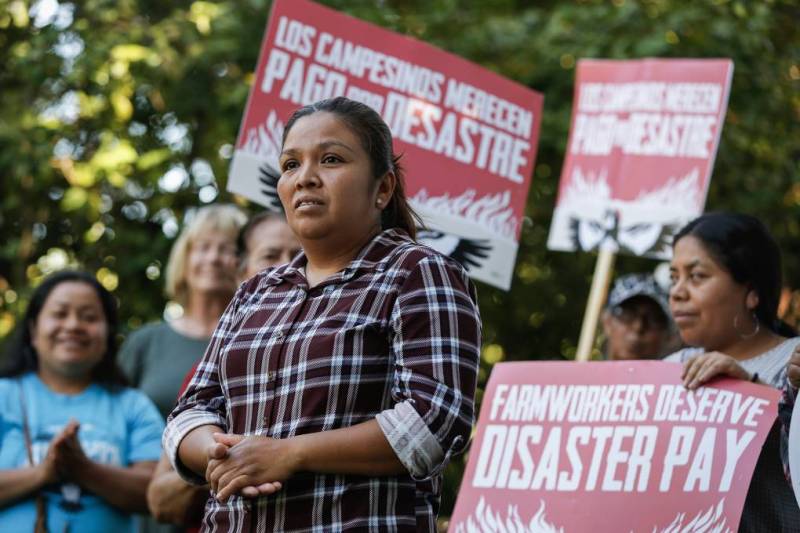
"caption": "La trabajadora agrícola Sandra de León asiste a una conferencia de prensa en la plaza central de Healdsburg, en el condado de Sonoma, el lunes 24 de julio de 2023. Trabajadores agrícolas y defensores del grupo de derechos laborales North Bay Jobs With Justice se reunieron en la plaza para celebrar la resolución de una demanda con Mauritson Farms Inc. después de presentar una demanda por prácticas laborales injustas ante los reguladores de California.",
"description": null,
"title": "farmworker lady and supporters",
"credit": " (Juliana Yamada/KQED)",
"status": "inherit",
"altTag": null,
"isLoading": false,
"fetchFailed": false
},
"news_11958774": {
"type": "attachments",
"id": "news_11958774",
"meta": {
"index": "attachments_1716263798",
"site": "news",
"id": "11958774",
"found": true
},
"parent": 0,
"imgSizes": {
"twentyfourteen-full-width": {
"file": "https://ww2.kqed.org/app/uploads/sites/10/2023/08/CMFarmworkers01-1038x576.jpg",
"width": 1038,
"mimeType": "image/jpeg",
"height": 576
},
"thumbnail": {
"file": "https://ww2.kqed.org/app/uploads/sites/10/2023/08/CMFarmworkers01-160x107.jpg",
"width": 160,
"mimeType": "image/jpeg",
"height": 107
},
"post-thumbnail": {
"file": "https://ww2.kqed.org/app/uploads/sites/10/2023/08/CMFarmworkers01-672x372.jpg",
"width": 672,
"mimeType": "image/jpeg",
"height": 372
},
"kqedFullSize": {
"file": "https://ww2.kqed.org/app/uploads/sites/10/2023/08/CMFarmworkers01.jpg",
"width": 2000,
"height": 1334
},
"large": {
"file": "https://ww2.kqed.org/app/uploads/sites/10/2023/08/CMFarmworkers01-1020x680.jpg",
"width": 1020,
"mimeType": "image/jpeg",
"height": 680
},
"1536x1536": {
"file": "https://ww2.kqed.org/app/uploads/sites/10/2023/08/CMFarmworkers01-1536x1025.jpg",
"width": 1536,
"mimeType": "image/jpeg",
"height": 1025
},
"full-width": {
"file": "https://ww2.kqed.org/app/uploads/sites/10/2023/08/CMFarmworkers01-1920x1281.jpg",
"width": 1920,
"mimeType": "image/jpeg",
"height": 1281
},
"medium": {
"file": "https://ww2.kqed.org/app/uploads/sites/10/2023/08/CMFarmworkers01-800x534.jpg",
"width": 800,
"mimeType": "image/jpeg",
"height": 534
}
},
"publishDate": 1692726230,
"modified": 1692733809,
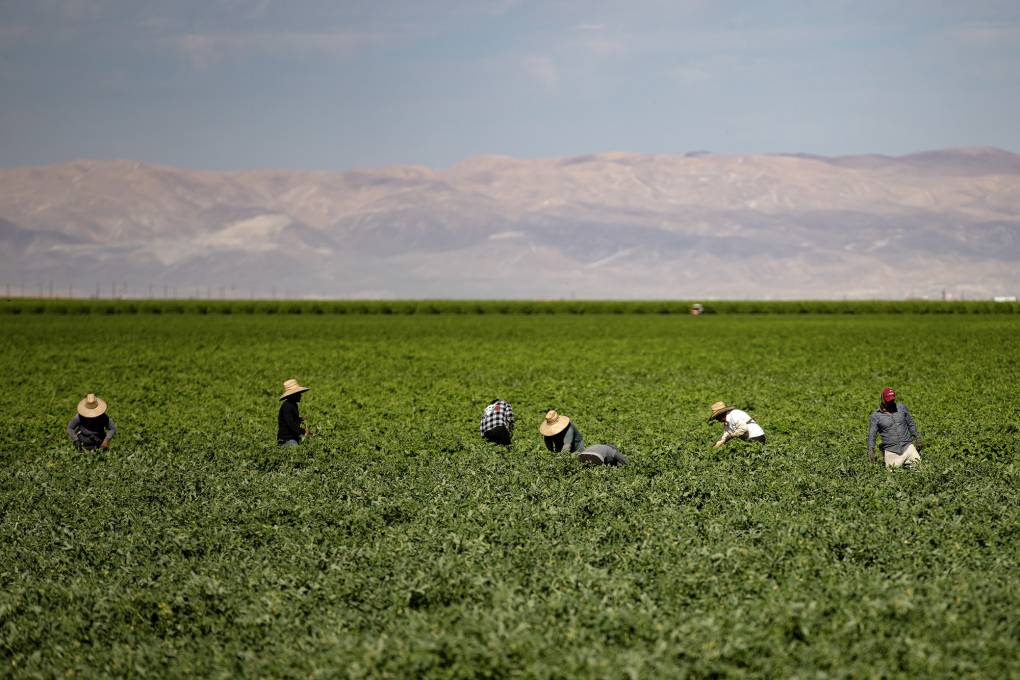
"caption": "Farmworkers work on a field outside of Bakersfield in Kern County on July 25, 2023. ",
"description": null,
"title": "CMFarmworkers01",
"credit": "Larry Valenzuela/CalMatters via CatchLight Local",
"status": "inherit",
"altTag": "Seven farmworkers are seen bent over in a field of green produce that comes up to their waists. It's a bright, sunny day. Many of the workers are wearing large, straw hats and long-sleeved clothing.",
"isLoading": false,
"fetchFailed": false
},
"news_11956739": {
"type": "attachments",
"id": "news_11956739",
"meta": {
"index": "attachments_1716263798",
"site": "news",
"id": "11956739",
"found": true
},
"parent": 0,
"imgSizes": {
"twentyfourteen-full-width": {
"file": "https://ww2.kqed.org/app/uploads/sites/10/2023/07/GettyImages-1252130093-KQED-1038x576.jpg",
"width": 1038,
"mimeType": "image/jpeg",
"height": 576
},
"thumbnail": {
"file": "https://ww2.kqed.org/app/uploads/sites/10/2023/07/GettyImages-1252130093-KQED-160x107.jpg",
"width": 160,
"mimeType": "image/jpeg",
"height": 107
},
"post-thumbnail": {
"file": "https://ww2.kqed.org/app/uploads/sites/10/2023/07/GettyImages-1252130093-KQED-672x372.jpg",
"width": 672,
"mimeType": "image/jpeg",
"height": 372
},
"kqedFullSize": {
"file": "https://ww2.kqed.org/app/uploads/sites/10/2023/07/GettyImages-1252130093-KQED.jpg",
"width": 2000,
"height": 1333
},
"large": {
"file": "https://ww2.kqed.org/app/uploads/sites/10/2023/07/GettyImages-1252130093-KQED-1020x680.jpg",
"width": 1020,
"mimeType": "image/jpeg",
"height": 680
},
"1536x1536": {
"file": "https://ww2.kqed.org/app/uploads/sites/10/2023/07/GettyImages-1252130093-KQED-1536x1024.jpg",
"width": 1536,
"mimeType": "image/jpeg",
"height": 1024
},
"full-width": {
"file": "https://ww2.kqed.org/app/uploads/sites/10/2023/07/GettyImages-1252130093-KQED-1920x1280.jpg",
"width": 1920,
"mimeType": "image/jpeg",
"height": 1280
},
"medium": {
"file": "https://ww2.kqed.org/app/uploads/sites/10/2023/07/GettyImages-1252130093-KQED-800x533.jpg",
"width": 800,
"mimeType": "image/jpeg",
"height": 533
}
},
"publishDate": 1690498613,
"modified": 1690911421,
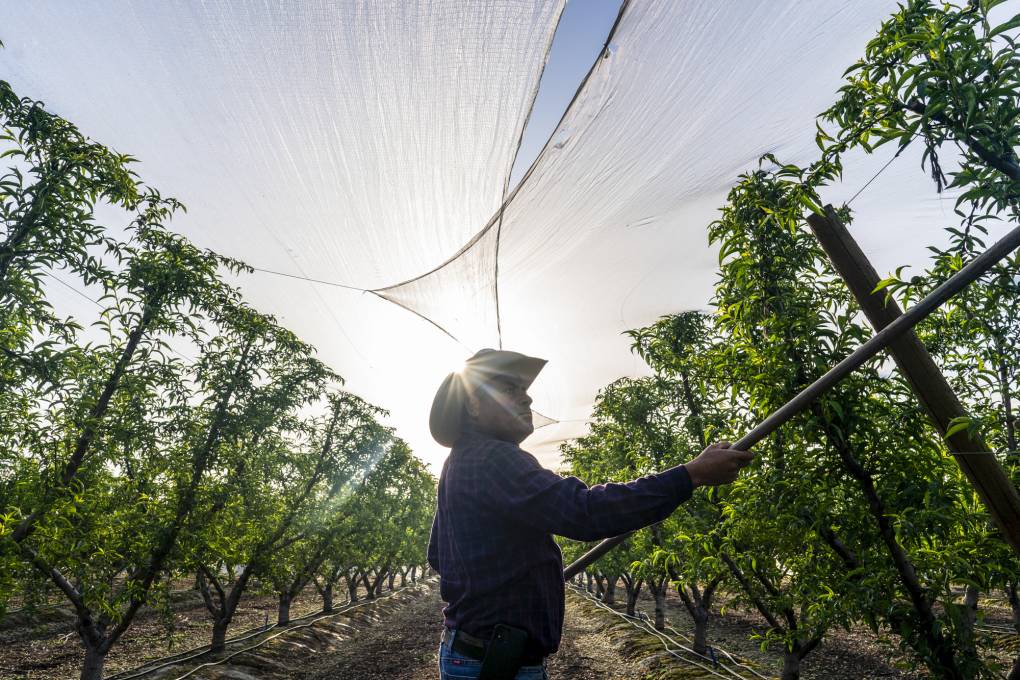
"caption": "A farmworker thins peach trees in Cutler, Tulare County. A new state advisory committee is set to use data on heat-related workplace injuries as a roadmap to protect workers.",
"description": null,
"title": "CUTLER, CALIFORNIA - APRIL 14, 2023: On 6th generation Michael",
"credit": "Melina Mara/The Washington Post via Getty Images",
"status": "inherit",
"altTag": "A man wearing a cowboy hat holds a long pole between two rows of manicured trees.",
"isLoading": false,
"fetchFailed": false
},
"news_11956456": {
"type": "attachments",
"id": "news_11956456",
"meta": {
"index": "attachments_1716263798",
"site": "news",
"id": "11956456",
"found": true
},
"parent": 0,
"imgSizes": {
"twentyfourteen-full-width": {
"file": "https://ww2.kqed.org/app/uploads/sites/10/2023/07/RS67229_20230724-NBJWJPresser-08-JY-KQED-1-1038x576.jpg",
"width": 1038,
"mimeType": "image/jpeg",
"height": 576
},
"thumbnail": {
"file": "https://ww2.kqed.org/app/uploads/sites/10/2023/07/RS67229_20230724-NBJWJPresser-08-JY-KQED-1-160x107.jpg",
"width": 160,
"mimeType": "image/jpeg",
"height": 107
},
"post-thumbnail": {
"file": "https://ww2.kqed.org/app/uploads/sites/10/2023/07/RS67229_20230724-NBJWJPresser-08-JY-KQED-1-672x372.jpg",
"width": 672,
"mimeType": "image/jpeg",
"height": 372
},
"kqedFullSize": {
"file": "https://ww2.kqed.org/app/uploads/sites/10/2023/07/RS67229_20230724-NBJWJPresser-08-JY-KQED-1.jpg",
"width": 2000,
"height": 1333
},
"large": {
"file": "https://ww2.kqed.org/app/uploads/sites/10/2023/07/RS67229_20230724-NBJWJPresser-08-JY-KQED-1-1020x680.jpg",
"width": 1020,
"mimeType": "image/jpeg",
"height": 680
},
"1536x1536": {
"file": "https://ww2.kqed.org/app/uploads/sites/10/2023/07/RS67229_20230724-NBJWJPresser-08-JY-KQED-1-1536x1024.jpg",
"width": 1536,
"mimeType": "image/jpeg",
"height": 1024
},
"full-width": {
"file": "https://ww2.kqed.org/app/uploads/sites/10/2023/07/RS67229_20230724-NBJWJPresser-08-JY-KQED-1-1920x1280.jpg",
"width": 1920,
"mimeType": "image/jpeg",
"height": 1280
},
"medium": {
"file": "https://ww2.kqed.org/app/uploads/sites/10/2023/07/RS67229_20230724-NBJWJPresser-08-JY-KQED-1-800x533.jpg",
"width": 800,
"mimeType": "image/jpeg",
"height": 533
}
},
"publishDate": 1690306440,
"modified": 1690311797,
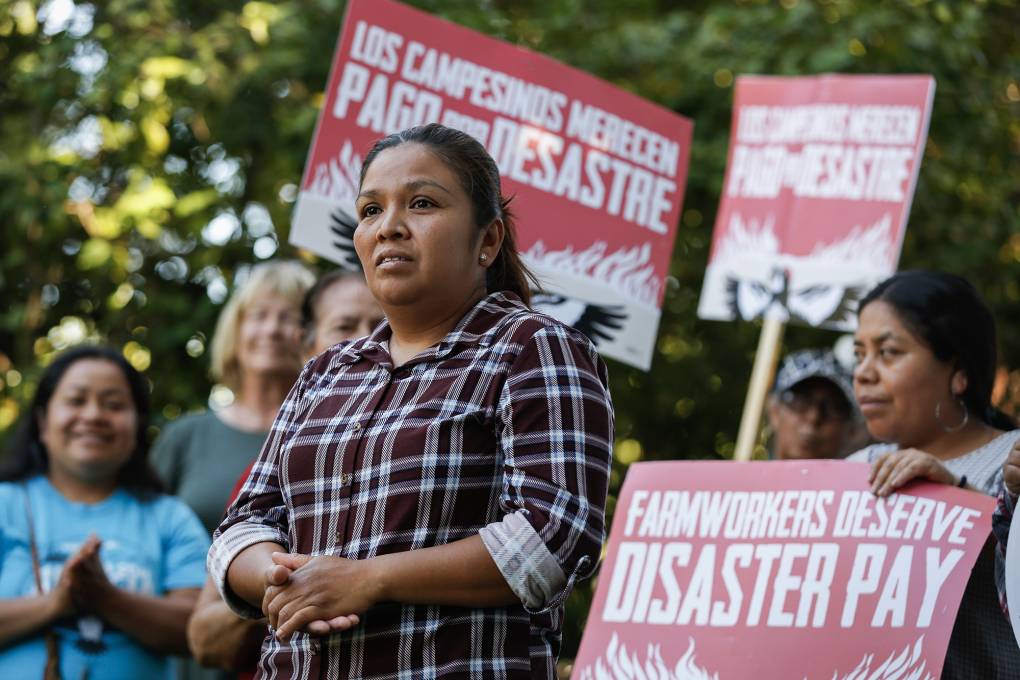
"caption": "Farmworker Sandra de Leon attends a press conference at Healdsburg Plaza in Healdsburg, Sonoma County, on Monday, July 24, 2023. Farmworkers and advocates with the labor rights group North Bay Jobs With Justice gathered in the plaza to celebrate settling a lawsuit with Mauritson Farms Inc. after filing an unfair labor practices claim with California regulators.",
"description": null,
"title": "RS67229_20230724-NBJWJPresser-08-JY-KQED-1",
"credit": "Juliana Yamada/KQED",
"status": "inherit",
"altTag": "A person with long hair and a plaid shirt stands in front of others holding signs reading \"Farmworkers Deserve Disaster Pay\" in an outdoor setting.",
"isLoading": false,
"fetchFailed": false
},
"news_11878990": {
"type": "attachments",
"id": "news_11878990",
"meta": {
"index": "attachments_1716263798",
"site": "news",
"id": "11878990",
"found": true
},
"parent": 11878989,
"imgSizes": {
"thumbnail": {
"file": "https://ww2.kqed.org/app/uploads/sites/10/2021/06/gettyimages-1231093862_wide-4195c57f825738c502a8a11e343c9df96ca71caf-160x90.jpg",
"width": 160,
"mimeType": "image/jpeg",
"height": 90
},
"post-thumbnail": {
"file": "https://ww2.kqed.org/app/uploads/sites/10/2021/06/gettyimages-1231093862_wide-4195c57f825738c502a8a11e343c9df96ca71caf-672x372.jpg",
"width": 672,
"mimeType": "image/jpeg",
"height": 372
},
"kqedFullSize": {
"file": "https://ww2.kqed.org/app/uploads/sites/10/2021/06/gettyimages-1231093862_wide-4195c57f825738c502a8a11e343c9df96ca71caf.jpg",
"width": 1024,
"height": 576
},
"large": {
"file": "https://ww2.kqed.org/app/uploads/sites/10/2021/06/gettyimages-1231093862_wide-4195c57f825738c502a8a11e343c9df96ca71caf-1020x574.jpg",
"width": 1020,
"mimeType": "image/jpeg",
"height": 574
},
"medium": {
"file": "https://ww2.kqed.org/app/uploads/sites/10/2021/06/gettyimages-1231093862_wide-4195c57f825738c502a8a11e343c9df96ca71caf-800x450.jpg",
"width": 800,
"mimeType": "image/jpeg",
"height": 450
}
},
"publishDate": 1624465271,
"modified": 1690220476,
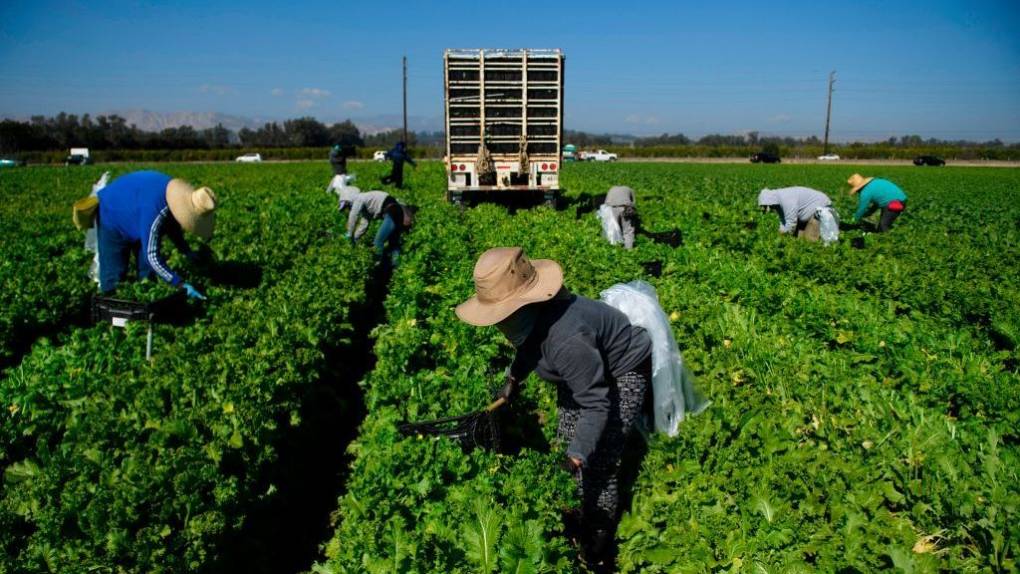
"caption": "Farmworkers harvest curly mustard in a field on Feb. 10, 2021 in Ventura County. ",
"description": "Farmworkers harvest curly mustard in a field on Feb. 10 in Ventura County. The Supreme Court handed the farmworkers union a loss Wednesday in a ruling about union organizers' access to farm property.",
"title": "Farmworkers harvest curly mustard in a field on Feb. 10 in Ventura County, Calif. The Supreme Court handed the farmworkers union a loss Wednesday in a ruling about union organizers' access to farm property.",
"credit": "Patrick T. Fallon/AFP via Getty Images",
"status": "inherit",
"altTag": "People bent over in a large field filled with rows of vegetables with a large vehicle in the background.",
"isLoading": false,
"fetchFailed": false
},
"news_11953851": {
"type": "attachments",
"id": "news_11953851",
"meta": {
"index": "attachments_1716263798",
"site": "news",
"id": "11953851",
"found": true
},
"parent": 0,
"imgSizes": {
"twentyfourteen-full-width": {
"file": "https://ww2.kqed.org/app/uploads/sites/10/2023/06/RS66528_230621-CentralValleyClimateChange-55-BL-KQED-1038x576.jpg",
"width": 1038,
"mimeType": "image/jpeg",
"height": 576
},
"thumbnail": {
"file": "https://ww2.kqed.org/app/uploads/sites/10/2023/06/RS66528_230621-CentralValleyClimateChange-55-BL-KQED-160x107.jpg",
"width": 160,
"mimeType": "image/jpeg",
"height": 107
},
"post-thumbnail": {
"file": "https://ww2.kqed.org/app/uploads/sites/10/2023/06/RS66528_230621-CentralValleyClimateChange-55-BL-KQED-672x372.jpg",
"width": 672,
"mimeType": "image/jpeg",
"height": 372
},
"kqedFullSize": {
"file": "https://ww2.kqed.org/app/uploads/sites/10/2023/06/RS66528_230621-CentralValleyClimateChange-55-BL-KQED.jpg",
"width": 2000,
"height": 1333
},
"large": {
"file": "https://ww2.kqed.org/app/uploads/sites/10/2023/06/RS66528_230621-CentralValleyClimateChange-55-BL-KQED-1020x680.jpg",
"width": 1020,
"mimeType": "image/jpeg",
"height": 680
},
"1536x1536": {
"file": "https://ww2.kqed.org/app/uploads/sites/10/2023/06/RS66528_230621-CentralValleyClimateChange-55-BL-KQED-1536x1024.jpg",
"width": 1536,
"mimeType": "image/jpeg",
"height": 1024
},
"full-width": {
"file": "https://ww2.kqed.org/app/uploads/sites/10/2023/06/RS66528_230621-CentralValleyClimateChange-55-BL-KQED-1920x1280.jpg",
"width": 1920,
"mimeType": "image/jpeg",
"height": 1280
},
"medium": {
"file": "https://ww2.kqed.org/app/uploads/sites/10/2023/06/RS66528_230621-CentralValleyClimateChange-55-BL-KQED-800x533.jpg",
"width": 800,
"mimeType": "image/jpeg",
"height": 533
}
},
"publishDate": 1687537810,
"modified": 1688696809,
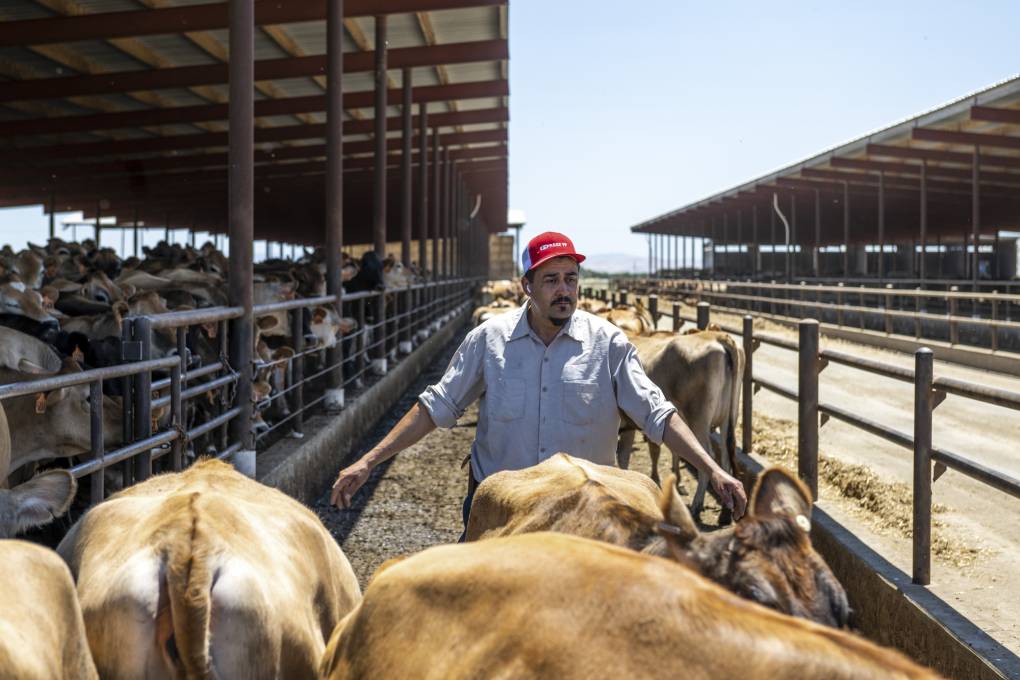
"caption": "José Federico Sierra herds pregnant cows toward a trailer at the farm where he works in Gustine, on June 21, 2023.",
"description": null,
"title": "RS66528_230621-CentralValleyClimateChange-55-BL-KQED",
"credit": "Beth LaBerge/KQED",
"status": "inherit",
"altTag": "A man in a red hat with arms outstretched stands among rows of cows in pens seemingly ushering them forward towards the camera.",
"isLoading": false,
"fetchFailed": false
},
"news_11954145": {
"type": "attachments",
"id": "news_11954145",
"meta": {
"index": "attachments_1716263798",
"site": "news",
"id": "11954145",
"found": true
},
"parent": 11954144,
"imgSizes": {
"twentyfourteen-full-width": {
"file": "https://ww2.kqed.org/app/uploads/sites/10/2023/06/GettyImages-1459869831-1038x576.jpg",
"width": 1038,
"mimeType": "image/jpeg",
"height": 576
},
"thumbnail": {
"file": "https://ww2.kqed.org/app/uploads/sites/10/2023/06/GettyImages-1459869831-160x108.jpg",
"width": 160,
"mimeType": "image/jpeg",
"height": 108
},
"post-thumbnail": {
"file": "https://ww2.kqed.org/app/uploads/sites/10/2023/06/GettyImages-1459869831-672x372.jpg",
"width": 672,
"mimeType": "image/jpeg",
"height": 372
},
"kqedFullSize": {
"file": "https://ww2.kqed.org/app/uploads/sites/10/2023/06/GettyImages-1459869831.jpg",
"width": 1960,
"height": 1328
},
"large": {
"file": "https://ww2.kqed.org/app/uploads/sites/10/2023/06/GettyImages-1459869831-1020x691.jpg",
"width": 1020,
"mimeType": "image/jpeg",
"height": 691
},
"1536x1536": {
"file": "https://ww2.kqed.org/app/uploads/sites/10/2023/06/GettyImages-1459869831-1536x1041.jpg",
"width": 1536,
"mimeType": "image/jpeg",
"height": 1041
},
"full-width": {
"file": "https://ww2.kqed.org/app/uploads/sites/10/2023/06/GettyImages-1459869831-1920x1301.jpg",
"width": 1920,
"mimeType": "image/jpeg",
"height": 1301
},
"medium": {
"file": "https://ww2.kqed.org/app/uploads/sites/10/2023/06/GettyImages-1459869831-800x542.jpg",
"width": 800,
"mimeType": "image/jpeg",
"height": 542
}
},
"publishDate": 1687821297,
"modified": 1687822785,
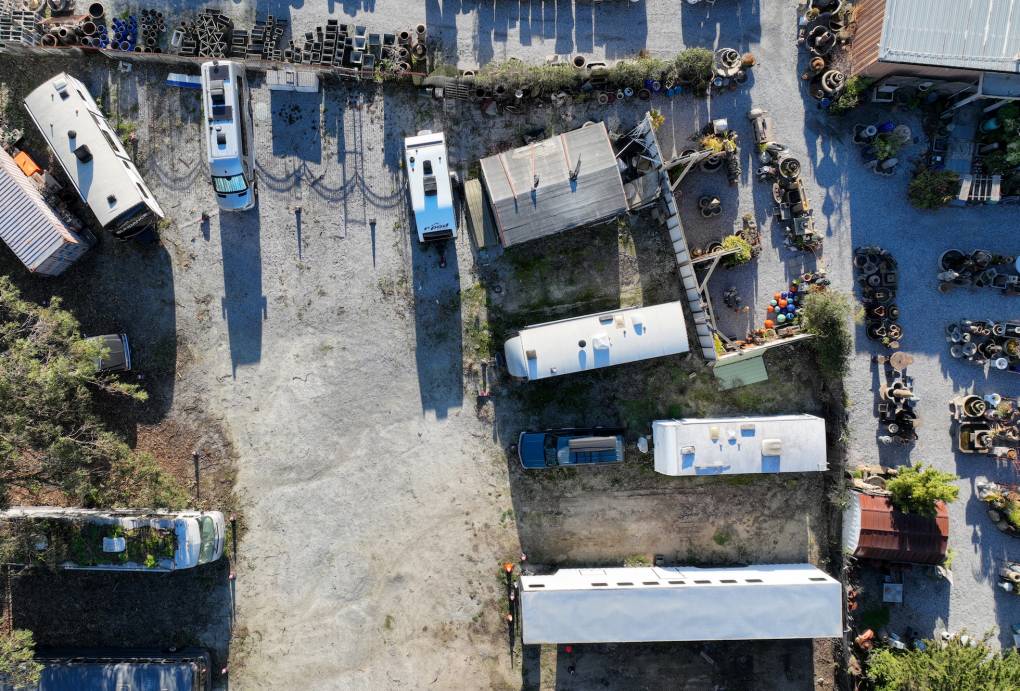
"caption": "Trailers are seen from above at the California Terra Gardens mushroom farm just after the mass shooting in January 2023.",
"description": null,
"title": "California Terra Gardens Mushroom Farm Mass Shooting",
"credit": "Jane Tyska/Digital First Media/East Bay Times via Getty Images",
"status": "inherit",
"altTag": null,
"isLoading": false,
"fetchFailed": false
},
"news_11943763": {
"type": "attachments",
"id": "news_11943763",
"meta": {
"index": "attachments_1716263798",
"site": "news",
"id": "11943763",
"found": true
},
"title": "A vineyard worker for a Napa Valley wine",
"publishDate": 1678994729,
"status": "inherit",
"parent": 11943742,
"modified": 1679008303,
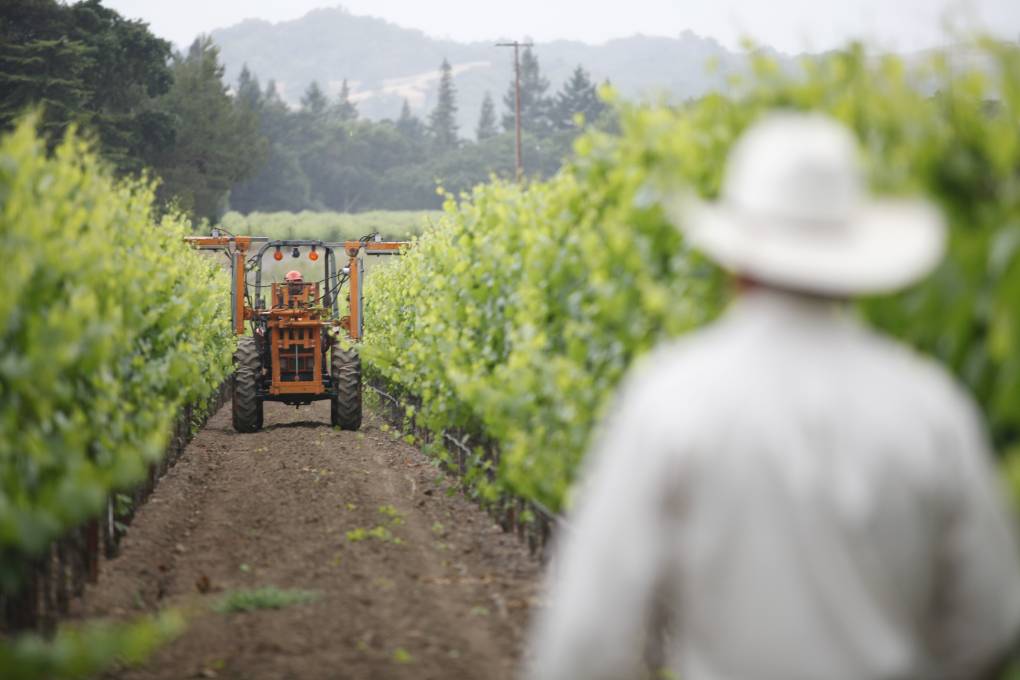
"caption": "A vineyard worker for Napa Valley winemaker Hill Family Estate looks at a tractor trimming grapevine branches on June 4, 2012.",
"credit": "Kimihiro Hoshino/AFP via Getty Images",
"altTag": "A man wearing a white cowboy hat stands in between green grapevines with his back facing the camera. He looks toward an orange tractor coming down the dirt row as it trims grapevines.",
"description": null,
"imgSizes": {
"medium": {
"file": "https://cdn.kqed.org/wp-content/uploads/sites/10/2023/03/RS4055_tractor20120920-800x533.jpg",
"width": 800,
"height": 533,
"mimeType": "image/jpeg"
},
"large": {
"file": "https://cdn.kqed.org/wp-content/uploads/sites/10/2023/03/RS4055_tractor20120920-1020x680.jpg",
"width": 1020,
"height": 680,
"mimeType": "image/jpeg"
},
"thumbnail": {
"file": "https://cdn.kqed.org/wp-content/uploads/sites/10/2023/03/RS4055_tractor20120920-160x107.jpg",
"width": 160,
"height": 107,
"mimeType": "image/jpeg"
},
"1536x1536": {
"file": "https://cdn.kqed.org/wp-content/uploads/sites/10/2023/03/RS4055_tractor20120920-1536x1024.jpg",
"width": 1536,
"height": 1024,
"mimeType": "image/jpeg"
},
"2048x2048": {
"file": "https://cdn.kqed.org/wp-content/uploads/sites/10/2023/03/RS4055_tractor20120920-2048x1365.jpg",
"width": 2048,
"height": 1365,
"mimeType": "image/jpeg"
},
"post-thumbnail": {
"file": "https://cdn.kqed.org/wp-content/uploads/sites/10/2023/03/RS4055_tractor20120920-672x372.jpg",
"width": 672,
"height": 372,
"mimeType": "image/jpeg"
},
"twentyfourteen-full-width": {
"file": "https://cdn.kqed.org/wp-content/uploads/sites/10/2023/03/RS4055_tractor20120920-1038x576.jpg",
"width": 1038,
"height": 576,
"mimeType": "image/jpeg"
},
"full-width": {
"file": "https://cdn.kqed.org/wp-content/uploads/sites/10/2023/03/RS4055_tractor20120920-1920x1280.jpg",
"width": 1920,
"height": 1280,
"mimeType": "image/jpeg"
},
"kqedFullSize": {
"file": "https://cdn.kqed.org/wp-content/uploads/sites/10/2023/03/RS4055_tractor20120920-scaled-e1738628659957.jpg",
"width": 2000,
"height": 1334
}
},
"isLoading": false,
"fetchFailed": false
},
"news_11943867": {
"type": "attachments",
"id": "news_11943867",
"meta": {
"index": "attachments_1716263798",
"site": "news",
"id": "11943867",
"found": true
},
"parent": 11943845,
"imgSizes": {
"twentyfourteen-full-width": {
"file": "https://ww2.kqed.org/app/uploads/sites/10/2023/03/GettyImages-1248040257-1024x576.jpg",
"width": 1024,
"mimeType": "image/jpeg",
"height": 576
},
"thumbnail": {
"file": "https://ww2.kqed.org/app/uploads/sites/10/2023/03/GettyImages-1248040257-160x92.jpg",
"width": 160,
"mimeType": "image/jpeg",
"height": 92
},
"post-thumbnail": {
"file": "https://ww2.kqed.org/app/uploads/sites/10/2023/03/GettyImages-1248040257-672x372.jpg",
"width": 672,
"mimeType": "image/jpeg",
"height": 372
},
"kqedFullSize": {
"file": "https://ww2.kqed.org/app/uploads/sites/10/2023/03/GettyImages-1248040257.jpg",
"width": 1024,
"height": 588
},
"large": {
"file": "https://ww2.kqed.org/app/uploads/sites/10/2023/03/GettyImages-1248040257-1020x586.jpg",
"width": 1020,
"mimeType": "image/jpeg",
"height": 586
},
"medium": {
"file": "https://ww2.kqed.org/app/uploads/sites/10/2023/03/GettyImages-1248040257-800x459.jpg",
"width": 800,
"mimeType": "image/jpeg",
"height": 459
}
},
"publishDate": 1679013326,
"modified": 1679015391,
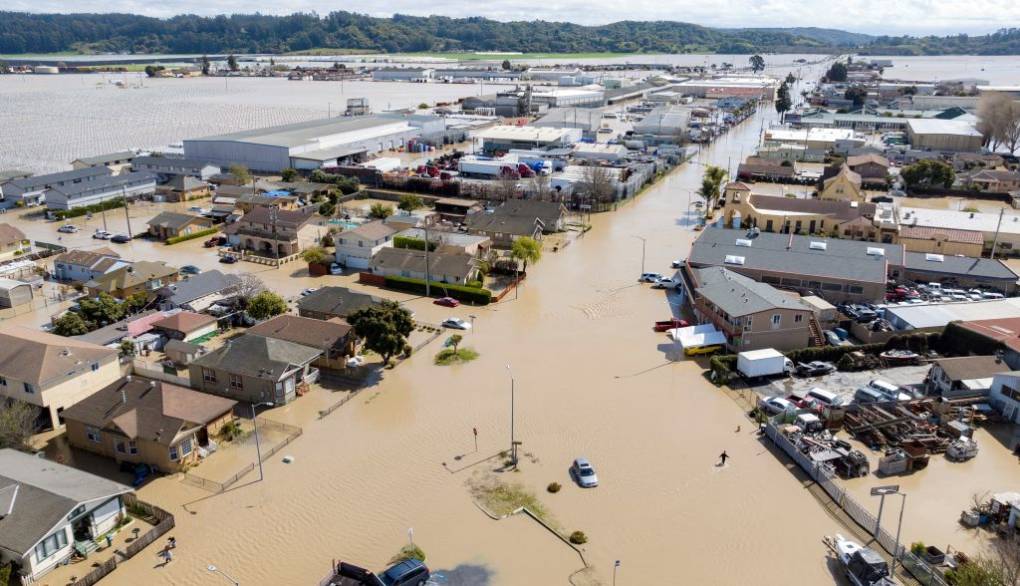
"caption": "An aerial view shows a flooded neighborhood in the unincorporated community of Pajaro in Watsonville, on March 11, 2023. Residents were forced to evacuate in the middle of the night after an atmospheric river surge broke the Pajaro levee and sent floodwaters flowing into the community.",
"description": null,
"title": "US-WEATHER-CALIFORNIA-FLOOD",
"credit": "Josh Edelson/AFP via Getty Images",
"status": "inherit",
"altTag": "An aerial image of a flooded town with partially submerged houses and cars in brown flood waters.",
"isLoading": false,
"fetchFailed": false
},
"news_11943666": {
"type": "attachments",
"id": "news_11943666",
"meta": {
"index": "attachments_1716263798",
"site": "news",
"id": "11943666",
"found": true
},
"parent": 0,
"imgSizes": {
"twentyfourteen-full-width": {
"file": "https://ww2.kqed.org/app/uploads/sites/10/2023/03/CalMatters_01-1038x576.jpg",
"width": 1038,
"mimeType": "image/jpeg",
"height": 576
},
"thumbnail": {
"file": "https://ww2.kqed.org/app/uploads/sites/10/2023/03/CalMatters_01-160x107.jpg",
"width": 160,
"mimeType": "image/jpeg",
"height": 107
},
"post-thumbnail": {
"file": "https://ww2.kqed.org/app/uploads/sites/10/2023/03/CalMatters_01-672x372.jpg",
"width": 672,
"mimeType": "image/jpeg",
"height": 372
},
"kqedFullSize": {
"file": "https://ww2.kqed.org/app/uploads/sites/10/2023/03/CalMatters_01.jpg",
"width": 2000,
"height": 1333
},
"large": {
"file": "https://ww2.kqed.org/app/uploads/sites/10/2023/03/CalMatters_01-1020x680.jpg",
"width": 1020,
"mimeType": "image/jpeg",
"height": 680
},
"1536x1536": {
"file": "https://ww2.kqed.org/app/uploads/sites/10/2023/03/CalMatters_01-1536x1024.jpg",
"width": 1536,
"mimeType": "image/jpeg",
"height": 1024
},
"full-width": {
"file": "https://ww2.kqed.org/app/uploads/sites/10/2023/03/CalMatters_01-1920x1280.jpg",
"width": 1920,
"mimeType": "image/jpeg",
"height": 1280
},
"medium": {
"file": "https://ww2.kqed.org/app/uploads/sites/10/2023/03/CalMatters_01-800x533.jpg",
"width": 800,
"mimeType": "image/jpeg",
"height": 533
}
},
"publishDate": 1678924556,
"modified": 1678989288,
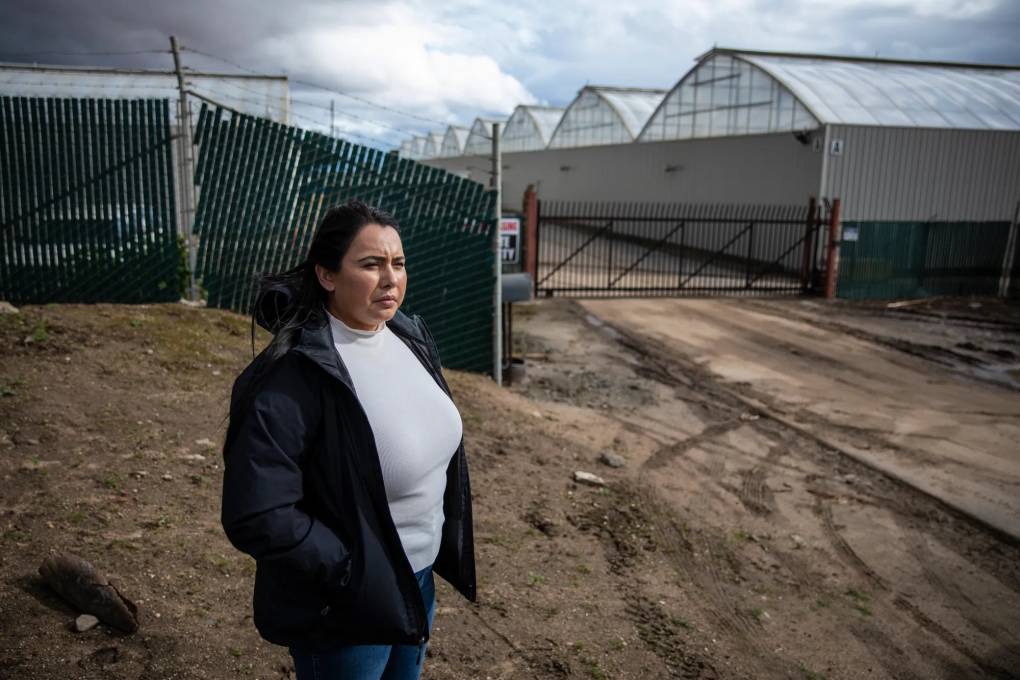
"caption": "Michelle Hackett at the entrance to Riverview Farms in Salinas, which flooded in the mid-March storms.",
"description": null,
"title": "CalMatters_01",
"credit": "Martin do Nascimento/CalMatters",
"status": "inherit",
"altTag": "A woman with dark hair, a black jacket, gray blouse and jeans stands in front of a dirt road that leads to a gateway entrance of a farm. She looks concerned as greenhouses can be seen in the background.",
"isLoading": false,
"fetchFailed": false
},
"news_11941742": {
"type": "attachments",
"id": "news_11941742",
"meta": {
"index": "attachments_1716263798",
"site": "news",
"id": "11941742",
"found": true
},
"parent": 11941716,
"imgSizes": {
"twentyfourteen-full-width": {
"file": "https://ww2.kqed.org/app/uploads/sites/10/2023/02/IMG_2540-1-1038x576.jpeg",
"width": 1038,
"mimeType": "image/jpeg",
"height": 576
},
"thumbnail": {
"file": "https://ww2.kqed.org/app/uploads/sites/10/2023/02/IMG_2540-1-160x120.jpeg",
"width": 160,
"mimeType": "image/jpeg",
"height": 120
},
"post-thumbnail": {
"file": "https://ww2.kqed.org/app/uploads/sites/10/2023/02/IMG_2540-1-672x372.jpeg",
"width": 672,
"mimeType": "image/jpeg",
"height": 372
},
"kqedFullSize": {
"file": "https://ww2.kqed.org/app/uploads/sites/10/2023/02/IMG_2540-1-scaled.jpeg",
"width": 2560,
"height": 1920
},
"2048x2048": {
"file": "https://ww2.kqed.org/app/uploads/sites/10/2023/02/IMG_2540-1-2048x1536.jpeg",
"width": 2048,
"mimeType": "image/jpeg",
"height": 1536
},
"large": {
"file": "https://ww2.kqed.org/app/uploads/sites/10/2023/02/IMG_2540-1-1020x765.jpeg",
"width": 1020,
"mimeType": "image/jpeg",
"height": 765
},
"1536x1536": {
"file": "https://ww2.kqed.org/app/uploads/sites/10/2023/02/IMG_2540-1-1536x1152.jpeg",
"width": 1536,
"mimeType": "image/jpeg",
"height": 1152
},
"full-width": {
"file": "https://ww2.kqed.org/app/uploads/sites/10/2023/02/IMG_2540-1-1920x1440.jpeg",
"width": 1920,
"mimeType": "image/jpeg",
"height": 1440
},
"medium": {
"file": "https://ww2.kqed.org/app/uploads/sites/10/2023/02/IMG_2540-1-800x600.jpeg",
"width": 800,
"mimeType": "image/jpeg",
"height": 600
}
},
"publishDate": 1677205605,
"modified": 1677284999,
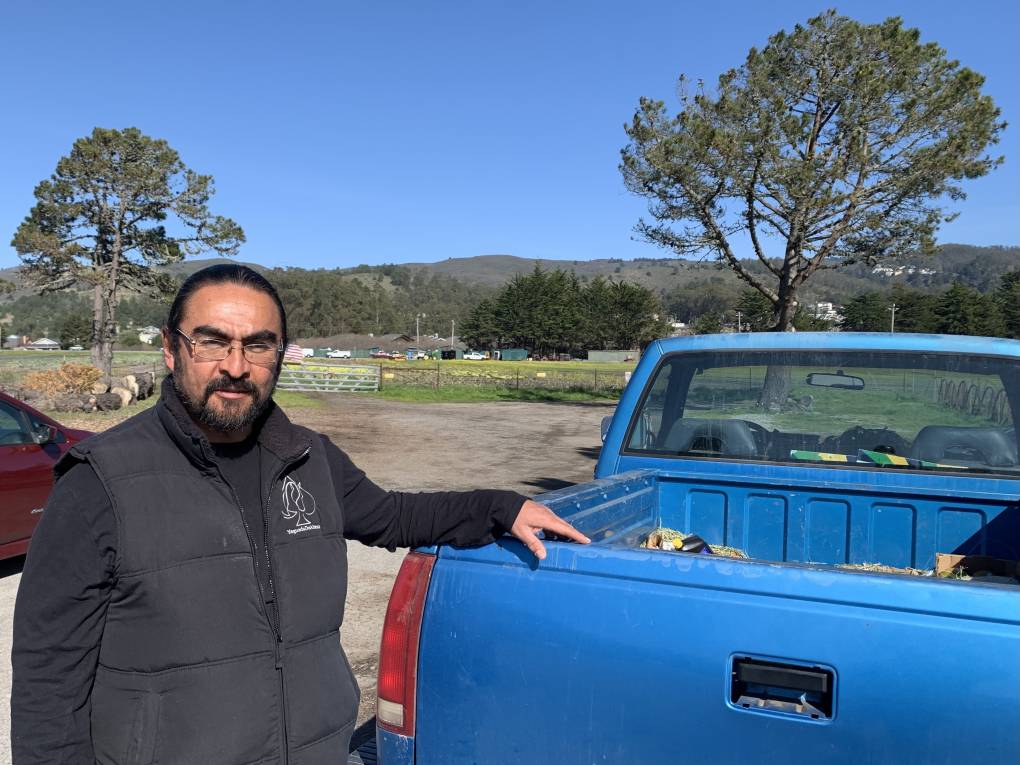
"caption": "Joaquín Jiménez Ureña, 49, delivers donated food and supplies to farmworkers on two dozen Coastside San Mateo farms in his '92 Chevy pickup, 'Big Blue.' Jimenez Ureña runs the farmworker program for a local nonprofit group, Ayudando Latinos a Soñar, or ALAS, and he's also Half Moon Bay's vice mayor. In this dual role, he's focused on the critical need for affordable housing for workers in San Mateo's $100 million agricultural economy.",
"description": null,
"title": "IMG_2540 (1)",
"credit": "Reid Cramer/KQED",
"status": "inherit",
"altTag": "A Latino man with beard and glasses rests his hand on the back of a blue pickup truck as he smiles to the camera with trees and hills in the background.",
"isLoading": false,
"fetchFailed": false
},
"news_11940325": {
"type": "attachments",
"id": "news_11940325",
"meta": {
"index": "attachments_1716263798",
"site": "news",
"id": "11940325",
"found": true
},
"parent": 11940316,
"imgSizes": {
"twentyfourteen-full-width": {
"file": "https://ww2.kqed.org/app/uploads/sites/10/2023/02/GettyImages-1456240028-1024x576.jpg",
"width": 1024,
"mimeType": "image/jpeg",
"height": 576
},
"thumbnail": {
"file": "https://ww2.kqed.org/app/uploads/sites/10/2023/02/GettyImages-1456240028-160x103.jpg",
"width": 160,
"mimeType": "image/jpeg",
"height": 103
},
"post-thumbnail": {
"file": "https://ww2.kqed.org/app/uploads/sites/10/2023/02/GettyImages-1456240028-672x372.jpg",
"width": 672,
"mimeType": "image/jpeg",
"height": 372
},
"kqedFullSize": {
"file": "https://ww2.kqed.org/app/uploads/sites/10/2023/02/GettyImages-1456240028.jpg",
"width": 1024,
"height": 659
},
"large": {
"file": "https://ww2.kqed.org/app/uploads/sites/10/2023/02/GettyImages-1456240028-1020x656.jpg",
"width": 1020,
"mimeType": "image/jpeg",
"height": 656
},
"medium": {
"file": "https://ww2.kqed.org/app/uploads/sites/10/2023/02/GettyImages-1456240028-800x515.jpg",
"width": 800,
"mimeType": "image/jpeg",
"height": 515
}
},
"publishDate": 1675794925,
"modified": 1675795094,
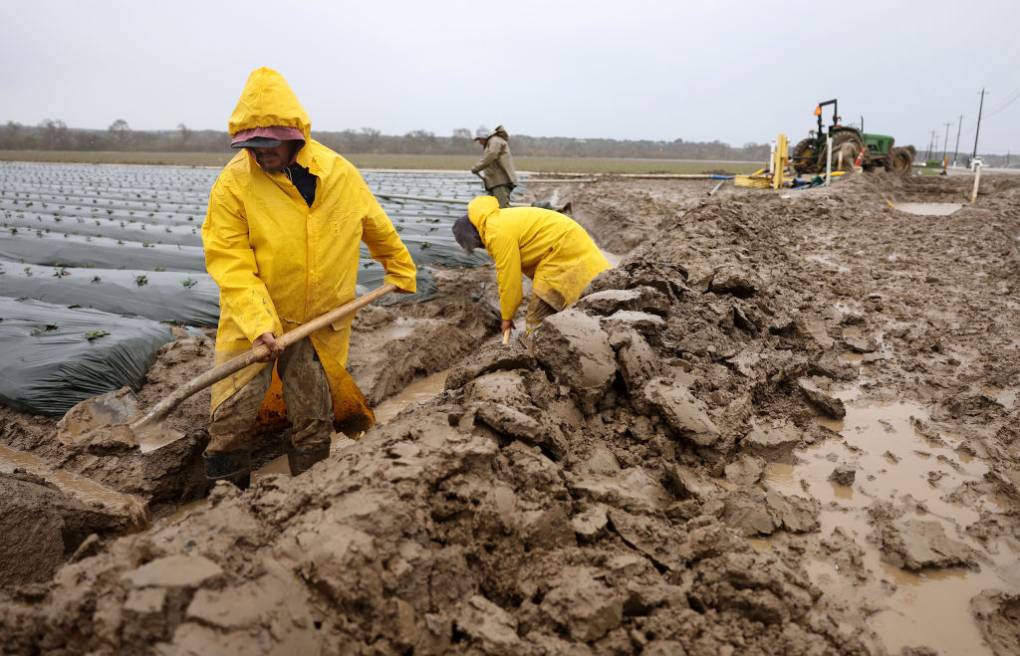
"caption": "Farmworkers dig an irrigation canal around a field of strawberries as the Salinas River begins to overflow its banks on Jan. 13, 2023, in Salinas.",
"description": null,
"title": "Multiple Storms Batter California With Flooding Rains",
"credit": "Justin Sullivan/Getty Images",
"status": "inherit",
"altTag": "Farmworkers in yellow rainsuits dig a ditch on the edge of a field.",
"isLoading": false,
"fetchFailed": false
}
},
"audioPlayerReducer": {
"postId": "stream_live",
"isPaused": true,
"isPlaying": false,
"pfsActive": false,
"pledgeModalIsOpen": true,
"playerDrawerIsOpen": false,
"liveAudioPlayStartedAt": 0,
"liveAudioPlayContext": ""
},
"authorsReducer": {
"byline_news_11958764": {
"type": "authors",
"id": "byline_news_11958764",
"meta": {
"override": true
},
"slug": "byline_news_11958764",
"name": "\u003ca href=\"https://calmatters.org/author/nicole-foy/\">Nicole Foy\u003c/a>",
"isLoading": false
},
"byline_news_11956922": {
"type": "authors",
"id": "byline_news_11956922",
"meta": {
"override": true
},
"slug": "byline_news_11956922",
"name": "Nicole Foy",
"isLoading": false
},
"byline_news_11956315": {
"type": "authors",
"id": "byline_news_11956315",
"meta": {
"override": true
},
"slug": "byline_news_11956315",
"name": "\u003ca href=\"https://calmatters.org/author/nicole-foy/\">Nicole Foy\u003c/a>",
"isLoading": false
},
"byline_news_11943742": {
"type": "authors",
"id": "byline_news_11943742",
"meta": {
"override": true
},
"slug": "byline_news_11943742",
"name": "\u003ca href=\"https://www.kqed.org/author/dcronin\">Dana Cronin\u003c/a>",
"isLoading": false
},
"byline_news_11943845": {
"type": "authors",
"id": "byline_news_11943845",
"meta": {
"override": true
},
"slug": "byline_news_11943845",
"name": "\u003ca href=\"https://www.kazu.org/people/jerimiah-oetting\">Jerimiah Oetting\u003c/a>, \u003ca href=\"https://www.kazu.org/\">KAZU\u003c/a>",
"isLoading": false
},
"byline_news_11943590": {
"type": "authors",
"id": "byline_news_11943590",
"meta": {
"override": true
},
"slug": "byline_news_11943590",
"name": "\u003ca href=\"https://calmatters.org/author/laurenhepler/\">Lauren Hepler\u003c/a>, \u003ca href=\"https://calmatters.org/author/nicole-foy/\">Nicole Foy \u003c/a>, \u003ca href=\"https://calmatters.org/author/wendy-fry/\">Wendy Fry\u003c/a>",
"isLoading": false
},
"tychehendricks": {
"type": "authors",
"id": "259",
"meta": {
"index": "authors_1716337520",
"id": "259",
"found": true
},
"name": "Tyche Hendricks",
"firstName": "Tyche",
"lastName": "Hendricks",
"slug": "tychehendricks",
"email": "thendricks@kqed.org",
"display_author_email": true,
"staff_mastheads": [
"news"
],
"title": "KQED Senior Editor, Immigration",
"bio": "\u003cspan style=\"font-weight: 400;\">Tyche Hendricks is KQED’s senior editor for immigration, leading coverage of the policy and politics that affect California’s immigrant communities. Her work for KQED’s radio and online audiences is also carried on NPR and other national outlets. She has been recognized with awards from the Radio and Television News Directors Association, the Society for Professional Journalists; the Education Writers Association; the Best of the West and the National Federation of Community Broadcasters. Before joining KQED in 2010, Tyche spent more than a dozen years as a newspaper reporter, notably at the \u003c/span>\u003ci>\u003cspan style=\"font-weight: 400;\">San Francisco Chronicle\u003c/span>\u003c/i>\u003cspan style=\"font-weight: 400;\">. At different times she has covered criminal justice, government and politics and urban planning. Tyche has taught in the MFA Creative Writing program at the University of San Francisco and at UC Berkeley’s Graduate School of Journalism, where she was co-director of a national immigration symposium for professional journalists. She is the author of \u003c/span>\u003ci>\u003cspan style=\"font-weight: 400;\">The Wind Doesn't Need a Passport: Stories from the U.S.-Mexico Borderlands\u003c/span>\u003c/i>\u003cspan style=\"font-weight: 400;\"> (University of California Press). \u003c/span>",
"avatar": "https://secure.gravatar.com/avatar/b8ee458e2731c2d43df86882ce17267e?s=600&d=blank&r=g",
"twitter": "tychehendricks",
"facebook": null,
"instagram": null,
"linkedin": null,
"sites": [
{
"site": "news",
"roles": [
"editor"
]
},
{
"site": "stateofhealth",
"roles": [
"editor"
]
}
],
"headData": {
"title": "Tyche Hendricks | KQED",
"description": "KQED Senior Editor, Immigration",
"ogImgSrc": "https://secure.gravatar.com/avatar/b8ee458e2731c2d43df86882ce17267e?s=600&d=blank&r=g",
"twImgSrc": "https://secure.gravatar.com/avatar/b8ee458e2731c2d43df86882ce17267e?s=600&d=blank&r=g"
},
"isLoading": false,
"link": "/author/tychehendricks"
},
"ccabreralomeli": {
"type": "authors",
"id": "11708",
"meta": {
"index": "authors_1716337520",
"id": "11708",
"found": true
},
"name": "Carlos Cabrera-Lomelí",
"firstName": "Carlos",
"lastName": "Cabrera-Lomelí",
"slug": "ccabreralomeli",
"email": "ccabreralomeli@KQED.org",
"display_author_email": true,
"staff_mastheads": [
"news"
],
"title": "Community Reporter",
"bio": "Carlos Cabrera-Lomelí is a community reporter with KQED's digital engagement team. He also reports and co-produces for KQED's bilingual news hub KQED en Español. He grew up in San Francisco's Mission District and has previously worked with Univision, 48 Hills and REFORMA in Mexico City.",
"avatar": "https://secure.gravatar.com/avatar/e95ff80bb2eaf18a8f2af4dcf7ffb54b?s=600&d=mm&r=g",
"twitter": "@LomeliCabrera",
"facebook": null,
"instagram": null,
"linkedin": null,
"sites": [
{
"site": "arts",
"roles": [
"editor"
]
},
{
"site": "news",
"roles": [
"editor"
]
},
{
"site": "about",
"roles": [
"editor"
]
},
{
"site": "science",
"roles": [
"editor"
]
},
{
"site": "perspectives",
"roles": [
"editor"
]
},
{
"site": "elections",
"roles": [
"editor"
]
},
{
"site": "liveblog",
"roles": [
"contributor"
]
}
],
"headData": {
"title": "Carlos Cabrera-Lomelí | KQED",
"description": "Community Reporter",
"ogImgSrc": "https://secure.gravatar.com/avatar/e95ff80bb2eaf18a8f2af4dcf7ffb54b?s=600&d=mm&r=g",
"twImgSrc": "https://secure.gravatar.com/avatar/e95ff80bb2eaf18a8f2af4dcf7ffb54b?s=600&d=mm&r=g"
},
"isLoading": false,
"link": "/author/ccabreralomeli"
},
"sjohnson": {
"type": "authors",
"id": "11840",
"meta": {
"index": "authors_1716337520",
"id": "11840",
"found": true
},
"name": "Sydney Johnson",
"firstName": "Sydney",
"lastName": "Johnson",
"slug": "sjohnson",
"email": "sjohnson@kqed.org",
"display_author_email": false,
"staff_mastheads": [
"news"
],
"title": "KQED Reporter",
"bio": "Sydney Johnson is a general assignment reporter at KQED. She previously reported on public health and city government at the San Francisco Examiner, and before that, she covered statewide education policy for EdSource. Her reporting has won multiple local, state and national awards. Sydney is a graduate of the University of California, Berkeley and lives in San Francisco.",
"avatar": "https://secure.gravatar.com/avatar/97855f2719b72ad6190b7c535fe642c8?s=600&d=blank&r=g",
"twitter": "sydneyfjohnson",
"facebook": null,
"instagram": null,
"linkedin": null,
"sites": [
{
"site": "news",
"roles": [
"editor"
]
}
],
"headData": {
"title": "Sydney Johnson | KQED",
"description": "KQED Reporter",
"ogImgSrc": "https://secure.gravatar.com/avatar/97855f2719b72ad6190b7c535fe642c8?s=600&d=blank&r=g",
"twImgSrc": "https://secure.gravatar.com/avatar/97855f2719b72ad6190b7c535fe642c8?s=600&d=blank&r=g"
},
"isLoading": false,
"link": "/author/sjohnson"
}
},
"pagesReducer": {
"news_tag_farmworkers": {
"type": "terms",
"id": "news_18269",
"meta": {
"index": "terms_1716263798",
"site": "news",
"id": "18269",
"score": 8.934682
},
"featImg": null,
"name": "farmworkers",
"description": null,
"taxonomy": "tag",
"headData": {
"twImgId": null,
"twTitle": null,
"ogTitle": null,
"ogImgId": null,
"twDescription": null,
"description": null,
"title": "farmworkers Archives | KQED News",
"ogDescription": null
},
"ttid": 18303,
"slug": "farmworkers",
"isLoading": false,
"title": "farmworkers",
"pageMeta": {
"site": "news",
"WpPageTemplate": "page-topic-editorial",
"currentPage": 6
},
"blocks": [
{
"blockName": "kqed/post-list",
"attrs": {
"layout": "cardArticle2",
"query": "posts/news?tag=farmworkers",
"seeMore": false,
"paginated": true,
"page": 6
}
},
{
"blockName": "kqed/ad"
}
]
}
},
"pfsSessionReducer": {},
"postsReducer": {
"stream_live": {
"type": "live",
"id": "stream_live",
"audioUrl": "https://streams.kqed.org/kqedradio",
"title": "Live Stream",
"excerpt": "Live Stream information currently unavailable.",
"link": "/radio",
"featImg": "",
"label": {
"name": "KQED Live",
"link": "/"
}
},
"stream_kqedNewscast": {
"type": "posts",
"id": "stream_kqedNewscast",
"audioUrl": "https://www.kqed.org/.stream/anon/radio/RDnews/newscast.mp3?_=1",
"title": "KQED Newscast",
"featImg": "",
"label": {
"name": "88.5 FM",
"link": "/"
}
},
"news_11957505": {
"type": "posts",
"id": "news_11957505",
"meta": {
"index": "posts_1716263798",
"site": "news",
"id": "11957505",
"score": null,
"sort": [
1694516454000
]
},
"guestAuthors": [],
"slug": "campesinos-denunciaron-a-un-vinedo-por-abusos-laborales-y-ganaron",
"title": "Cómo un grupo de campesinos denunció a un viñedo por abusos laborales y ganó",
"publishDate": 1694516454,
"format": "standard",
"headTitle": "Cómo un grupo de campesinos denunció a un viñedo por abusos laborales y ganó | KQED",
"labelTerm": {},
"content": "\u003cp>\u003ca href=\"https://www.kqed.org/news/11956413/how-california-farmworkers-took-on-a-sonoma-winery-over-abuses-and-won\">\u003cem>Read in English\u003c/em>\u003c/a>\u003c/p>\n\u003cp>Mauritson Farms Inc. en el condado de Sonoma pagará 328 mil 077 dólares a \u003ca href=\"https://www.kqed.org/news/11919450/trabajar-con-una-visa-h-2a-en-estados-unidos-represalias-derechos\">21 de sus ex empleados\u003c/a> como parte de un \u003ca href=\"https://s3.documentcloud.org/documents/23885712/settlement-agreement-june-2023.pdf\">acuerdo legal\u003c/a> con la Junta de Relaciones Laborales Agrícolas de California (ALRB, por sus siglas en inglés), el mayor acuerdo monetario que se ha visto en la oficina de Santa Rosa de esta dependencia. Funcionarios de la ALRB, junto con decenas de activistas laborales y trabajadores agrícolas, anunciaron el acuerdo en una conferencia de prensa el lunes 24 de julio de 2023 en Healdsburg.\u003c/p>\n\u003cp>Mauritson Farms Inc, que gestiona los viñedos, es una empresa independiente y distinta de Mauritson Wines. Ambas empresas son propiedad de la familia Mauritson.\u003c/p>\n\u003cp>Tras una investigación impulsada por las quejas de los trabajadores agrícolas, los funcionarios del ALRB determinaron que Mauritson Farms tomó represalias contra el equipo entero de antiguos empleados porque algunos de ellos se organizaron a finales de la temporada de cultivo de 2021 para denunciar las condiciones de trabajo inseguras en los viñedos de Mauritson.\u003c/p>\n\u003cp>“Debemos reconocer que se trata de una victoria iniciada por los trabajadores para defender no sólo sus derechos, sino también su dignidad”, dijo el activista Davin Cárdenas en una conferencia que se llevó a cabo el pasado 24 de julio. Cárdenas es el director de la organización North Bay Jobs With Justice (NBJWJ, por sus siglas en inglés), un grupo de derechos laborales que apoyó a los trabajadores en su denuncia.\u003c/p>\n\u003cp>“Se trata de un caso que establece un precedente para otros trabajadores de la región”, afirmó Cárdenas.[pullquote align=\"right\" size=\"medium\" citation=\"Miguel Ángel Bravo Silva, uno de los seis trabajadores que denunciaron el trato recibido en Mauritson\"]‘Después de tantos abusos, creo que es justo que se respeten nuestros derechos y se nos respete por lo que somos.’[/pullquote]Los trabajadores implicados eran inmigrantes mexicanos, originarios del estado de Oaxaca, y se encontraban en los Estados Unidos con la visa H-2A, que permite a los trabajadores agrícolas permanecer en el país por períodos limitados.\u003c/p>\n\u003cp>KQED r\u003ca href=\"https://www.kqed.org/news/11919450/trabajar-con-una-visa-h-2a-en-estados-unidos-represalias-derechos\">eportó por vez primera el año pasado\u003c/a> que ninguno de los trabajadores oaxaqueños que denunciaron los hechos en 2021 fueron recontratados para la temporada de cultivo de 2022, pese a las promesas que hizo la dirección de la empresa. En su denuncia presentada contra Mauritson el pasado mes de marzo, el ALRB \u003ca href=\"https://s3.documentcloud.org/documents/23885711/alrb-complaint-march-2023.pdf\">determinó que el hecho de que Mauritson no volviera a contratar a estos trabajadores representa una violación de sus derechos laborales\u003c/a>.\u003c/p>\n\u003cp>“Cuando recibí la noticia, agradecí a Dios que se ganó porque no fue nada fácil. Teníamos mucho miedo de hablar. Fue un proceso complicado, pero hay que quitarse ese miedo”, dijo Martín Sandoval Rivera, uno de los trabajadores que denunció las condiciones en Mauritson Farms. Actualmente se encuentra en Oaxaca, con varios trabajos para mantener a su familia.\u003cbr>\n[ad fullwidth]\u003cbr>\nSandoval Rivera y sus compañeros dijeron que sufrieron acoso verbal por parte de su supervisor, que se les negó sombra mientras trabajaban en los campos cuando las temperaturas superaban los 90 grados Fahrenheit (equivalente a 32 centígrados) y que no recibieron sus períodos de descanso y almuerzo en algunas ocasiones. Todo esto viola las regulaciones laborales de California.\u003c/p>\n\u003cp>Seis de los trabajadores, incluido Sandoval Rivera, buscaron el apoyo del grupo de derechos laborales NBJWJ para mediar en la situación. NBJWJ organizó una reunión con los trabajadores y los directivos de la empresa en octubre de 2021.\u003c/p>\n\u003cp>En esa reunión, el director del viñedo, Cameron Mauritson, prometió que las condiciones en los campos mejorarían y \u003ca href=\"https://www.kqed.org/news/11919450/trabajar-con-una-visa-h-2a-en-estados-unidos-represalias-derechos\">aseguró a los trabajadores que volvería a contratarlos en 2022\u003c/a>, aliviando así la mayor preocupación de los trabajadores: que se les fuera a negar empleo en el futuro por haber pedido mejoras laborales. Después de esa plática, Mauritson Farms, que según los trabajadores previamente gestionaba el proceso de contratación a través de las redes sociales, contrató a CIERTO Global, una empresa multinacional que busca mano de obra en el extranjero para el sector agrícola de Estados Unidos.[aside postID=\"news_11919450\" hero=\"https://ww2.kqed.org/app/uploads/sites/10/2022/07/FarmworkersIlloVignet-1020x659-1.jpg\"]Mauritson Farms pide a CIERTO Global que busque a trabajadores para la temporada de 2022, y por ende le cierra la puerta a los campesinos oaxaqueños. Según la denuncia del ALRB, para las empresas de cultivo de uva, CIERTO Global sólo recluta a trabajadores que viven en el estado mexicano de Baja California, no en Oaxaca.\u003c/p>\n\u003cp>Además, las capturas de pantalla de un grupo de Facebook que los trabajadores oaxaqueños compartieron con KQED mostraron que los directivos de Mauritson compartieron información incorrecta sobre cómo debían ponerse en contacto los trabajadores con CIERTO para ser considerados para la temporada de 2022. Representantes de CIERTO confirmaron a KQED que esas instrucciones eran falsas.\u003c/p>\n\u003cp>“Estas instrucciones no reflejan nuestras prácticas con ninguno de los trabajadores a los que atendemos”, respondió por correo electrónico un representante de CIERTO. “Las instrucciones de Mauritson no fueron autorizadas ni difundidas por CIERTO”.\u003c/p>\n\u003cp>Cuando los trabajadores se dieron cuenta de lo que estaba ocurriendo, alertaron al grupo NBJWJ. En febrero de 2022, los activistas \u003ca href=\"https://www.kqed.org/news/11919450/trabajar-con-una-visa-h-2a-en-estados-unidos-represalias-derechos\">presentaron una demanda ante el ALRB en nombre de los seis trabajadores que asistieron a la reunión con Mauritson\u003c/a>. Inicialmente, seis de ellos hablaron, pero en su investigación, el ALRB descubrió que Mauritson había tomado represalias contra todo la cuadrilla de 21 personas al que pertenecían los seis trabajadores.\u003c/p>\n\u003cp>El acuerdo de 328 mil 077 dólares que beneficiará a los 21 trabajadores representa lo que los trabajadores perdieron en ingresos por haber sido excluidos de la temporada de 2022, según los cálculos del ALRB. Una audiencia con un juez ya había sido programada para finales de este verano, pero el acuerdo entre la empresa y el ALRB concluye este proceso.\u003c/p>\n\u003cp>En una declaración enviada por correo electrónico a KQED, Mauritson Farms declaró que “cree firmemente que [no estaba] en ninguna violación de la Ley de Relaciones Laborales Agrícolas (ALRA). Este acuerdo es estrictamente una decisión empresarial que nos permite resolver este asunto sin necesidad de más litigios”.\u003c/p>\n\u003cfigure id=\"attachment_11957507\" class=\"wp-caption aligncenter\" style=\"max-width: 1920px\">\u003cimg loading=\"lazy\" decoding=\"async\" class=\"wp-image-11957507 size-full\" src=\"https://ww2.kqed.org/app/uploads/sites/10/2023/08/LA-UNION-HACE-LA-FUERZA-BANNERS.jpg\" alt='Varias personas de distintas edades sostienen letreros con consignas. Algunos letreros dicen, \"La unión hace la fuerza\".' width=\"1920\" height=\"1280\" srcset=\"https://cdn.kqed.org/wp-content/uploads/sites/10/2023/08/LA-UNION-HACE-LA-FUERZA-BANNERS.jpg 1920w, https://cdn.kqed.org/wp-content/uploads/sites/10/2023/08/LA-UNION-HACE-LA-FUERZA-BANNERS-800x533.jpg 800w, https://cdn.kqed.org/wp-content/uploads/sites/10/2023/08/LA-UNION-HACE-LA-FUERZA-BANNERS-1020x680.jpg 1020w, https://cdn.kqed.org/wp-content/uploads/sites/10/2023/08/LA-UNION-HACE-LA-FUERZA-BANNERS-160x107.jpg 160w, https://cdn.kqed.org/wp-content/uploads/sites/10/2023/08/LA-UNION-HACE-LA-FUERZA-BANNERS-1536x1024.jpg 1536w\" sizes=\"(max-width: 1920px) 100vw, 1920px\">\u003cfigcaption class=\"wp-caption-text\">Los trabajadores agrícolas Antonio Flores (izquierda) y su hijo Mateo, Rosalba Gutiérrez (centro) y Valentina Sosa (derecha) se sientan en la conferencia de prensa organizada por el grupo de derechos laborales NBJWJ, donde se dio a conocer el acuerdo con Mauritson Farms en la plaza central de Healdsburg el lunes 24 de julio de 2023. \u003ccite>(Juliana Yamada/KQED)\u003c/cite>\u003c/figcaption>\u003c/figure>\n\u003cp>“Después de tantos abusos, creo que es justo que se respeten nuestros derechos y se nos respete por lo que somos”, dijo Miguel Ángel Bravo Silva, uno de los seis trabajadores que se reunieron con Mauritson. Durante el último año y medio, ha buscado cualquier trabajo en su comunidad rural de Oaxaca para mantener a su esposa y sus dos hijos y, al mismo tiempo, se ha mantenido en contacto con funcionarios del ALRB que investigaban la situación.\u003c/p>\n\u003cp>Durante meses, el ALRB trabajó para localizar a los 21 trabajadores que no fueron recontratados. Una vez finalizada la temporada de 2021, muchos regresaron a pueblos remotos de Oaxaca, donde el acceso al internet y la cobertura de telefonía móvil son extremadamente limitados y, para algunos, inexistentes. Localizar a la gente fue uno de los retos, dijo la directora regional de ALRB, Jessica Arciniega. El otro era establecer confianza.\u003c/p>\n\u003cp>“En muchos casos, resulta difícil mantener la comunicación con los trabajadores”, explica. “Pueden no estar familiarizados con nuestro proceso, con nosotros como agencia gubernamental y con lo que realmente hacemos. Así que puede que no siempre se sientan 100% preparados o cómodos de compartir toda esta información”.[pullquote align=\"right\" size=\"medium\" citation=\"Ana Salgado, antigua trabajadora agrícola y miembro de la junta de NBJWJ\"]‘Muchos [trabajadores H-2A] tienen miedo de perder la oportunidad que tienen \u003cspan style=\"font-weight: 400\">… \u003c/span> Pueden estar sufriendo muchos abusos, pero no quieren decir nada porque temen perder lo que consideran un privilegio.’[/pullquote]Los trabajadores no sólo temen sufrir más represalias del mismo empleador, sino que, \u003ca href=\"https://www.kqed.org/news/11919450/trabajar-con-una-visa-h-2a-en-estados-unidos-represalias-derechos\">como informó KQED el año pasado, muchos empleadores utilizan una red de reclutadores para impedir que los trabajadores que denuncian encuentren otro empleo en el futuro\u003c/a>. En ese mismo reportaje, KQED compartió la historia de Kevin y Samuel, dos ex empleados de Mauritson que estaban entre los seis que hicieron la primera denuncia.\u003c/p>\n\u003cp>Kevin y Samuel eran en realidad los alias de Sandoval Rivera y Bravo Silva, respectivamente.\u003c/p>\n\u003cp>En aquel momento, ambos hombres tenían mucho miedo de las repercusiones que podría tener el compartir públicamente sus identidades durante la investigación del ALRB. A medida la investigación se hacía más larga, Sandoval Rivera sentía cada vez menos confianza en que hubiera una respuesta por parte de las autoridades, especialmente a medida que empeoraba la situación económica de su familia. “La necesidad te hace pensar muchas cosas”, dijo.\u003c/p>\n\u003cp>Sin embargo, él y Bravo Silva se alegran de haber esperado los resultados de la investigación y el acuerdo. Esto no sólo les beneficiará a ellos, dice Bravo Silva, “sino también a los trabajadores inmigrantes que ahora trabajan en esa empresa, para que se les respete más y no se sientan solos. Hay leyes que protegen a los trabajadores agrícolas”.\u003c/p>\n\u003ch3>\u003cstrong>Celebrando una difícil victoria\u003c/strong>\u003c/h3>\n\u003cp>Con pancartas y carteles, muchos de ellos con la frase de Emiliano Zapata, como “La tierra es de quien la trabaja”, decenas de trabajadores agrícolas y activistas con NBJWJ llenaron parte de la plaza principal de Healdsburg para la conferencia de prensa que se realizó el pasado 24 de julio.\u003c/p>\n\u003cp>“Ustedes representan a los trabajadores agrícolas que no pueden estar hoy aquí, pero cuya valentía nos ha dejado este legado, que luchando y encontrando aliados, los trabajadores podemos lograr muchas cosas”, dijo Ana Salgado, quien anteriormente era una trabajadora agrícola y ahora es una activista comunitaria y forma parte de la junta directiva de NBJWJ.\u003c/p>\n\u003cfigure id=\"attachment_11957508\" class=\"wp-caption aligncenter\" style=\"max-width: 1920px\">\u003cimg loading=\"lazy\" decoding=\"async\" class=\"wp-image-11957508 size-full\" src=\"https://ww2.kqed.org/app/uploads/sites/10/2023/08/healdsburg-plaza-farm-workers-rally.jpg\" alt=\"Una mujer habla enfrente de una multitud. Muchos en la multitud sostienen letreros y pancartas con lemas de justicia labora.\" width=\"1920\" height=\"1280\" srcset=\"https://cdn.kqed.org/wp-content/uploads/sites/10/2023/08/healdsburg-plaza-farm-workers-rally.jpg 1920w, https://cdn.kqed.org/wp-content/uploads/sites/10/2023/08/healdsburg-plaza-farm-workers-rally-800x533.jpg 800w, https://cdn.kqed.org/wp-content/uploads/sites/10/2023/08/healdsburg-plaza-farm-workers-rally-1020x680.jpg 1020w, https://cdn.kqed.org/wp-content/uploads/sites/10/2023/08/healdsburg-plaza-farm-workers-rally-160x107.jpg 160w, https://cdn.kqed.org/wp-content/uploads/sites/10/2023/08/healdsburg-plaza-farm-workers-rally-1536x1024.jpg 1536w\" sizes=\"(max-width: 1920px) 100vw, 1920px\">\u003cfigcaption class=\"wp-caption-text\">Ana Salgado (centro), ex trabajadora agrícola y miembro de la junta directiva de NBJWJ, habla en la rueda de prensa del lunes, 24 de julio de 2023, en la plaza central de Healdsburg. \u003ccite>(Juliana Yamada/KQED)\u003c/cite>\u003c/figcaption>\u003c/figure>\n\u003cp>A pocas calles de esa plaza se encuentra el centro comunitario donde Salgado conoció a varios de los hombres que entonces trabajaban para Mauritson. Recuerda las primeras conversaciones que mantuvo con los trabajadores.\u003c/p>\n\u003cp>“Miré a uno de ellos y vi la preocupación en su cara”, dijo, “tomé su mano y le dije ‘ya puedes abrirte, estás en un espacio seguro'”.\u003c/p>\n\u003cp>“Tantos trabajadores que tienen la visa H-2A temen perder la oportunidad que tienen porque los empleadores les dicen que es un privilegio ser traídos de México con una visa”, explicó. “Pueden estar sufriendo muchos abusos, pero no quieren decir nada porque tienen miedo de perder lo que consideran un privilegio”.\u003c/p>\n\u003ch3>\u003cstrong>‘Leyes que no se cumplen’\u003c/strong>\u003c/h3>\n\u003cp>El programa de visados H-2A es el sucesor del Programa Bracero, \u003ca href=\"https://www.npr.org/sections/thesalt/2018/07/31/634442195/when-the-u-s-government-tried-to-replace-migrant-farmworkers-with-high-schoolers\">que trajo trabajadores mexicanos a los campos agrícolas de Estados Unidos durante la década de 1940\u003c/a>. El actual sistema H-2A ahora trae a trabajadores de todo el mundo para trabajar en Estados Unidos y, como parte del programa, los empleadores deben proporcionar alojamiento, transporte y comidas, lo que da a las empresas un increíble poder sobre la vida personal de sus trabajadores.\u003c/p>\n\u003cp>Y al igual que el Programa Bracero, \u003ca href=\"https://prismreports.org/2023/04/14/h2a-visa-wage-theft-exploitation/\">el sistema H-2A está plagado de robo de salarios, abuso físico y mental a los empleados, y represalias por parte de los empleadores hacia los trabajadores que denuncian\u003c/a> las condiciones laborales, esto según una investigación de 18 meses publicada en abril por las agencias de noticias Prism, Futuro Investigates y Latino USA.\u003c/p>\n\u003cfigure id=\"attachment_11957509\" class=\"wp-caption aligncenter\" style=\"max-width: 1920px\">\u003cimg loading=\"lazy\" decoding=\"async\" class=\"wp-image-11957509 size-full\" src=\"https://ww2.kqed.org/app/uploads/sites/10/2023/08/davin-cardenas-with-migrant-workers-at-rally.jpg\" alt=\"Un hombre da un discurso ante una multitud. Muchos de los asistentes sostienen pancartas con consignas de protesta. El grupo se encuentra en un parque.\" width=\"1920\" height=\"1280\" srcset=\"https://cdn.kqed.org/wp-content/uploads/sites/10/2023/08/davin-cardenas-with-migrant-workers-at-rally.jpg 1920w, https://cdn.kqed.org/wp-content/uploads/sites/10/2023/08/davin-cardenas-with-migrant-workers-at-rally-800x533.jpg 800w, https://cdn.kqed.org/wp-content/uploads/sites/10/2023/08/davin-cardenas-with-migrant-workers-at-rally-1020x680.jpg 1020w, https://cdn.kqed.org/wp-content/uploads/sites/10/2023/08/davin-cardenas-with-migrant-workers-at-rally-160x107.jpg 160w, https://cdn.kqed.org/wp-content/uploads/sites/10/2023/08/davin-cardenas-with-migrant-workers-at-rally-1536x1024.jpg 1536w\" sizes=\"(max-width: 1920px) 100vw, 1920px\">\u003cfigcaption class=\"wp-caption-text\">Davin Cárdenas, director del grupo de derechos laborales NBJWJ, habla en la rueda de prensa del 24 de agosto en la plaza central de Healdsburg. \u003ccite>(Juliana Yamada/KQED)\u003c/cite>\u003c/figcaption>\u003c/figure>\n\u003cp>Tanto el gobierno federal como el de California han reforzado sus leyes laborales desde la década de 1940, así que ¿por qué persiste el abuso de los trabajadores H-2A?\u003c/p>\n\u003cp>Una de las razones es que las dependencias regulatorias necesitan más personal y recursos para hacer cumplir las normas laborales, dice Josephine Weinberg, abogada de California Rural Legal Assistance (CRLA, por sus siglas en inglés), un bufete de abogados sin fines de lucro que representa a campesinos que han sufrido represalias y abusos en el lugar de trabajo.\u003c/p>\n\u003cp>“Contamos con las dependencias. Contamos con normas. Pero faltan los mecanismos para hacer cumplir las leyes y monitorear los campos. Así que lo que nos toca no es más que leyes simbólicas'”, dijo.\u003c/p>\n\u003cp>Aproximadamente 1 de cada 3 puestos sigue vacante en la Oficina del Comisionado Laboral de California, uno de los organismos encargados de investigar el robo de sueldos y las represalias en todas las industrias en el estado. La escasez de empleados en esta dependencia deja al personal actual sobrecargado de casos, lo que significa que quienes presentan una denuncia a menudo tienen que esperar años para obtener un resultado. Decenas de empleados de esta agencia mandaron una carta a legisladores estatales a principios de julio, argumentando que ellos están “fracasando en nuestra misión si no podemos contratar y retener al personal necesario”.\u003c/p>\n\u003cp>En el ALRB, la directora regional Jessica Arciniega señala que su agencia tiene cinco oficinas repartidas por varias regiones agrícolas del estado, “pero California es un estado inmenso y hay muchos trabajadores agrícolas en todo el estado”.\u003c/p>\n\u003cp>“No tenemos oficinas en todas las regiones agrícolas”, dice, “así que hacemos lo que podemos en este enorme estado para cubrir dondequiera que estén los trabajadores”. Añade que el departamento colabora estrechamente con organizaciones comunitarias y sindicales, como NBJWJ, para conectar con más obreros.\u003c/p>\n\u003cp>Pero activistas laborales insisten en que hay que hacer más para aplicar mejor las normas laborales y mejorar el programa H-2A en su conjunto. Weinberg, de CRLA, añade que los reguladores deben vigilar más de cerca los campos agrícolas, con visitas aleatorias durante la temporada de cultivo. Y por otro lado, los empleadores deben facilitar que las agencias y los grupos laborales hablen con los campesinos sin restricciones.\u003c/p>\n\u003cp>La forma en que se diseñó el programa H-2A, en el que las empresas tienen un control directo sobre el alojamiento, el transporte, la situación migratoria e incluso la alimentación de sus empleados, dificulta enormemente que los trabajadores puedan hablar libremente.\u003c/p>\n\u003cp>“No tienen acceso a un lugar donde sientan que pueden hablar confidencialmente o de forma anónima sobre lo que está pasando”, dijo Weinberg.[aside label='Más en español' tag='kqed-en-espanol']El 19 de julio, el gobernador Gavin Newsom \u003ca href=\"https://www.kqed.org/news/11956315/some-migrant-farmworkers-to-get-free-legal-help-with-immigration\">anunció un programa piloto de 4.5 millones de dólares para proporcionar servicios legales gratuitos de inmigración a los trabajadores agrícolas que están involucrados en investigaciones laborales estatales\u003c/a>. Esto incluiría servicios de revisión de casos, asesoramiento jurídico y representación por un abogado a los trabajadores en California que tienen un caso pendiente ya sea con el ALRB, la Oficina del Comisionado Laboral o Cal/OSHA.\u003c/p>\n\u003cp>El objetivo de este programa, según los funcionarios, es abordar uno de los temores que impiden a los empleados hablar, que es el miedo a perder su visado o a no volver a ser contratado, poniéndolos en contacto con expertos en inmigración que podrían ayudarles a encontrar formas de permanecer en este país. Y a principios de este año, \u003ca href=\"https://www.kqed.org/news/11941448/que-es-el-programa-de-accion-diferida-de-la-administracion-biden-para-trabajadores-indocumentados\">el gobierno del presidente Biden presentó una nueva y simplificada iniciativa de “acción diferida”\u003c/a> que permite a los trabajadores solicitar un permiso de trabajo y dos años de protección frente a la deportación si cooperan con una investigación sobre derechos laborales.\u003c/p>\n\u003cp>Pero, por encima de todo, afirma Salgado de NBJWJ, lo que realmente ayuda a la gente a sentirse con la seguridad de hablar es saber que hay casos en los que el sistema funciona a favor de los trabajadores. “Sin duda, el resultado del caso Mauritson, reafirma la fe entre nosotros, pero también la credibilidad del trabajo que hacemos cuando salimos a hablar con los trabajadores”.\u003c/p>\n\u003cp>\u003cem>Nota del editor: La versión original de este reportaje describió de manera errónea a Mauritson Farms como una bodega vinícola, en vez de una empresa de viñedos. Este reportaje ha sido actualizado para aclarar la relación entre Mauritson Farms, Inc. y Mauritson Wines.\u003c/em>\u003c/p>\n\u003chr>\n\u003cp>\u003cem>Este artículo incluye información de las periodistas Farida Jhabvala Romero y Tyche Hendricks, de KQED. Además fue traducido por \u003ca href=\"https://www.kqed.org/author/mpena/\">María Peña\u003c/a> y editado por \u003ca href=\"https://www.kqed.org/author/ccabreralomeli\">Carlos Cabrera-Lomelí\u003c/a>\u003c/em>\u003c/p>\n\u003cp>[ad fullwidth]\u003c/p>\n\u003cp>[ad floatright]\u003c/p>\n",
"blocks": [],
"excerpt": "El viñedo Mauritson Farms Inc. ubicado en California, pagará $328,077 a 21 de sus ex empleados, quienes trabajaron por varios años por este empleador con una visa H-2A y reportaron faltas a sus derechos laborales.",
"status": "publish",
"parent": 0,
"modified": 1721146013,
"stats": {
"hasAudio": false,
"hasVideo": false,
"hasChartOrMap": false,
"iframeSrcs": [],
"hasGoogleForm": false,
"hasGallery": false,
"hasHearkenModule": false,
"hasPolis": false,
"paragraphCount": 43,
"wordCount": 3143
},
"headData": {
"title": "Cómo un grupo de campesinos denunció a un viñedo por abusos laborales y ganó | KQED",
"description": "El viñedo Mauritson Farms Inc. ubicado en California, pagará $328,077 a 21 de sus ex empleados, quienes trabajaron por varios años por este empleador con una visa H-2A y reportaron faltas a sus derechos laborales.",
"ogTitle": "",
"ogDescription": "",
"ogImgId": "",
"twTitle": "",
"twDescription": "",
"twImgId": "",
"schema": {
"@context": "https://schema.org",
"@type": "NewsArticle",
"headline": "Cómo un grupo de campesinos denunció a un viñedo por abusos laborales y ganó",
"datePublished": "2023-09-12T04:00:54-07:00",
"dateModified": "2024-07-16T09:06:53-07:00",
"image": "https://cdn.kqed.org/wp-content/uploads/2020/02/KQED-OG-Image@1x.png",
"isAccessibleForFree": "True",
"publisher": {
"@type": "NewsMediaOrganization",
"@id": "https://www.kqed.org/#organization",
"name": "KQED",
"logo": "https://cdn.kqed.org/wp-content/uploads/2020/02/KQED-OG-Image@1x.png",
"url": "https://www.kqed.org",
"sameAs": [
"https://www.facebook.com/KQED",
"https://twitter.com/KQED",
"https://www.instagram.com/kqed/",
"https://www.tiktok.com/@kqedofficial",
"https://www.linkedin.com/company/kqed",
"https://www.youtube.com/channel/UCeC0IOo7i1P_61zVUWbJ4nw"
]
}
}
},
"source": "KQED en Español",
"sourceUrl": "https://www.kqed.org/kqedenespanol",
"audioUrl": "https://traffic.omny.fm/d/clips/0af137ef-751e-4b19-a055-aaef00d2d578/ffca7e9f-6831-41c5-bcaf-aaef00f5a073/4479236b-6b94-45b8-aea6-b05301139438/audio.mp3",
"sticky": false,
"excludeFromSiteSearch": "Include",
"articleAge": "0",
"path": "/news/11957505/campesinos-denunciaron-a-un-vinedo-por-abusos-laborales-y-ganaron",
"audioTrackLength": null,
"parsedContent": [
{
"type": "contentString",
"content": "\u003cdiv class=\"post-body\">\u003cp>\u003cp>\u003ca href=\"https://www.kqed.org/news/11956413/how-california-farmworkers-took-on-a-sonoma-winery-over-abuses-and-won\">\u003cem>Read in English\u003c/em>\u003c/a>\u003c/p>\n\u003cp>Mauritson Farms Inc. en el condado de Sonoma pagará 328 mil 077 dólares a \u003ca href=\"https://www.kqed.org/news/11919450/trabajar-con-una-visa-h-2a-en-estados-unidos-represalias-derechos\">21 de sus ex empleados\u003c/a> como parte de un \u003ca href=\"https://s3.documentcloud.org/documents/23885712/settlement-agreement-june-2023.pdf\">acuerdo legal\u003c/a> con la Junta de Relaciones Laborales Agrícolas de California (ALRB, por sus siglas en inglés), el mayor acuerdo monetario que se ha visto en la oficina de Santa Rosa de esta dependencia. Funcionarios de la ALRB, junto con decenas de activistas laborales y trabajadores agrícolas, anunciaron el acuerdo en una conferencia de prensa el lunes 24 de julio de 2023 en Healdsburg.\u003c/p>\n\u003cp>Mauritson Farms Inc, que gestiona los viñedos, es una empresa independiente y distinta de Mauritson Wines. Ambas empresas son propiedad de la familia Mauritson.\u003c/p>\n\u003cp>Tras una investigación impulsada por las quejas de los trabajadores agrícolas, los funcionarios del ALRB determinaron que Mauritson Farms tomó represalias contra el equipo entero de antiguos empleados porque algunos de ellos se organizaron a finales de la temporada de cultivo de 2021 para denunciar las condiciones de trabajo inseguras en los viñedos de Mauritson.\u003c/p>\n\u003cp>“Debemos reconocer que se trata de una victoria iniciada por los trabajadores para defender no sólo sus derechos, sino también su dignidad”, dijo el activista Davin Cárdenas en una conferencia que se llevó a cabo el pasado 24 de julio. Cárdenas es el director de la organización North Bay Jobs With Justice (NBJWJ, por sus siglas en inglés), un grupo de derechos laborales que apoyó a los trabajadores en su denuncia.\u003c/p>\n\u003cp>“Se trata de un caso que establece un precedente para otros trabajadores de la región”, afirmó Cárdenas.\u003c/p>\u003c/div>",
"attributes": {
"named": {},
"numeric": []
}
},
{
"type": "component",
"content": "‘Después de tantos abusos, creo que es justo que se respeten nuestros derechos y se nos respete por lo que somos.’",
"name": "pullquote",
"attributes": {
"named": {
"align": "right",
"size": "medium",
"citation": "Miguel Ángel Bravo Silva, uno de los seis trabajadores que denunciaron el trato recibido en Mauritson",
"label": ""
},
"numeric": []
}
},
{
"type": "contentString",
"content": "\u003cdiv class=\"post-body\">\u003cp>Los trabajadores implicados eran inmigrantes mexicanos, originarios del estado de Oaxaca, y se encontraban en los Estados Unidos con la visa H-2A, que permite a los trabajadores agrícolas permanecer en el país por períodos limitados.\u003c/p>\n\u003cp>KQED r\u003ca href=\"https://www.kqed.org/news/11919450/trabajar-con-una-visa-h-2a-en-estados-unidos-represalias-derechos\">eportó por vez primera el año pasado\u003c/a> que ninguno de los trabajadores oaxaqueños que denunciaron los hechos en 2021 fueron recontratados para la temporada de cultivo de 2022, pese a las promesas que hizo la dirección de la empresa. En su denuncia presentada contra Mauritson el pasado mes de marzo, el ALRB \u003ca href=\"https://s3.documentcloud.org/documents/23885711/alrb-complaint-march-2023.pdf\">determinó que el hecho de que Mauritson no volviera a contratar a estos trabajadores representa una violación de sus derechos laborales\u003c/a>.\u003c/p>\n\u003cp>“Cuando recibí la noticia, agradecí a Dios que se ganó porque no fue nada fácil. Teníamos mucho miedo de hablar. Fue un proceso complicado, pero hay que quitarse ese miedo”, dijo Martín Sandoval Rivera, uno de los trabajadores que denunció las condiciones en Mauritson Farms. Actualmente se encuentra en Oaxaca, con varios trabajos para mantener a su familia.\u003cbr>\n\u003c/p>\u003c/div>",
"attributes": {
"named": {},
"numeric": []
}
},
{
"type": "component",
"content": "",
"name": "ad",
"attributes": {
"named": {
"label": "fullwidth"
},
"numeric": [
"fullwidth"
]
}
},
{
"type": "contentString",
"content": "\u003cdiv class=\"post-body\">\u003cp>\u003cbr>\nSandoval Rivera y sus compañeros dijeron que sufrieron acoso verbal por parte de su supervisor, que se les negó sombra mientras trabajaban en los campos cuando las temperaturas superaban los 90 grados Fahrenheit (equivalente a 32 centígrados) y que no recibieron sus períodos de descanso y almuerzo en algunas ocasiones. Todo esto viola las regulaciones laborales de California.\u003c/p>\n\u003cp>Seis de los trabajadores, incluido Sandoval Rivera, buscaron el apoyo del grupo de derechos laborales NBJWJ para mediar en la situación. NBJWJ organizó una reunión con los trabajadores y los directivos de la empresa en octubre de 2021.\u003c/p>\n\u003cp>En esa reunión, el director del viñedo, Cameron Mauritson, prometió que las condiciones en los campos mejorarían y \u003ca href=\"https://www.kqed.org/news/11919450/trabajar-con-una-visa-h-2a-en-estados-unidos-represalias-derechos\">aseguró a los trabajadores que volvería a contratarlos en 2022\u003c/a>, aliviando así la mayor preocupación de los trabajadores: que se les fuera a negar empleo en el futuro por haber pedido mejoras laborales. Después de esa plática, Mauritson Farms, que según los trabajadores previamente gestionaba el proceso de contratación a través de las redes sociales, contrató a CIERTO Global, una empresa multinacional que busca mano de obra en el extranjero para el sector agrícola de Estados Unidos.\u003c/p>\u003c/div>",
"attributes": {
"named": {},
"numeric": []
}
},
{
"type": "component",
"content": "",
"name": "aside",
"attributes": {
"named": {
"postid": "news_11919450",
"hero": "https://ww2.kqed.org/app/uploads/sites/10/2022/07/FarmworkersIlloVignet-1020x659-1.jpg",
"label": ""
},
"numeric": []
}
},
{
"type": "contentString",
"content": "\u003cdiv class=\"post-body\">\u003cp>Mauritson Farms pide a CIERTO Global que busque a trabajadores para la temporada de 2022, y por ende le cierra la puerta a los campesinos oaxaqueños. Según la denuncia del ALRB, para las empresas de cultivo de uva, CIERTO Global sólo recluta a trabajadores que viven en el estado mexicano de Baja California, no en Oaxaca.\u003c/p>\n\u003cp>Además, las capturas de pantalla de un grupo de Facebook que los trabajadores oaxaqueños compartieron con KQED mostraron que los directivos de Mauritson compartieron información incorrecta sobre cómo debían ponerse en contacto los trabajadores con CIERTO para ser considerados para la temporada de 2022. Representantes de CIERTO confirmaron a KQED que esas instrucciones eran falsas.\u003c/p>\n\u003cp>“Estas instrucciones no reflejan nuestras prácticas con ninguno de los trabajadores a los que atendemos”, respondió por correo electrónico un representante de CIERTO. “Las instrucciones de Mauritson no fueron autorizadas ni difundidas por CIERTO”.\u003c/p>\n\u003cp>Cuando los trabajadores se dieron cuenta de lo que estaba ocurriendo, alertaron al grupo NBJWJ. En febrero de 2022, los activistas \u003ca href=\"https://www.kqed.org/news/11919450/trabajar-con-una-visa-h-2a-en-estados-unidos-represalias-derechos\">presentaron una demanda ante el ALRB en nombre de los seis trabajadores que asistieron a la reunión con Mauritson\u003c/a>. Inicialmente, seis de ellos hablaron, pero en su investigación, el ALRB descubrió que Mauritson había tomado represalias contra todo la cuadrilla de 21 personas al que pertenecían los seis trabajadores.\u003c/p>\n\u003cp>El acuerdo de 328 mil 077 dólares que beneficiará a los 21 trabajadores representa lo que los trabajadores perdieron en ingresos por haber sido excluidos de la temporada de 2022, según los cálculos del ALRB. Una audiencia con un juez ya había sido programada para finales de este verano, pero el acuerdo entre la empresa y el ALRB concluye este proceso.\u003c/p>\n\u003cp>En una declaración enviada por correo electrónico a KQED, Mauritson Farms declaró que “cree firmemente que [no estaba] en ninguna violación de la Ley de Relaciones Laborales Agrícolas (ALRA). Este acuerdo es estrictamente una decisión empresarial que nos permite resolver este asunto sin necesidad de más litigios”.\u003c/p>\n\u003cfigure id=\"attachment_11957507\" class=\"wp-caption aligncenter\" style=\"max-width: 1920px\">\u003cimg loading=\"lazy\" decoding=\"async\" class=\"wp-image-11957507 size-full\" src=\"https://ww2.kqed.org/app/uploads/sites/10/2023/08/LA-UNION-HACE-LA-FUERZA-BANNERS.jpg\" alt='Varias personas de distintas edades sostienen letreros con consignas. Algunos letreros dicen, \"La unión hace la fuerza\".' width=\"1920\" height=\"1280\" srcset=\"https://cdn.kqed.org/wp-content/uploads/sites/10/2023/08/LA-UNION-HACE-LA-FUERZA-BANNERS.jpg 1920w, https://cdn.kqed.org/wp-content/uploads/sites/10/2023/08/LA-UNION-HACE-LA-FUERZA-BANNERS-800x533.jpg 800w, https://cdn.kqed.org/wp-content/uploads/sites/10/2023/08/LA-UNION-HACE-LA-FUERZA-BANNERS-1020x680.jpg 1020w, https://cdn.kqed.org/wp-content/uploads/sites/10/2023/08/LA-UNION-HACE-LA-FUERZA-BANNERS-160x107.jpg 160w, https://cdn.kqed.org/wp-content/uploads/sites/10/2023/08/LA-UNION-HACE-LA-FUERZA-BANNERS-1536x1024.jpg 1536w\" sizes=\"(max-width: 1920px) 100vw, 1920px\">\u003cfigcaption class=\"wp-caption-text\">Los trabajadores agrícolas Antonio Flores (izquierda) y su hijo Mateo, Rosalba Gutiérrez (centro) y Valentina Sosa (derecha) se sientan en la conferencia de prensa organizada por el grupo de derechos laborales NBJWJ, donde se dio a conocer el acuerdo con Mauritson Farms en la plaza central de Healdsburg el lunes 24 de julio de 2023. \u003ccite>(Juliana Yamada/KQED)\u003c/cite>\u003c/figcaption>\u003c/figure>\n\u003cp>“Después de tantos abusos, creo que es justo que se respeten nuestros derechos y se nos respete por lo que somos”, dijo Miguel Ángel Bravo Silva, uno de los seis trabajadores que se reunieron con Mauritson. Durante el último año y medio, ha buscado cualquier trabajo en su comunidad rural de Oaxaca para mantener a su esposa y sus dos hijos y, al mismo tiempo, se ha mantenido en contacto con funcionarios del ALRB que investigaban la situación.\u003c/p>\n\u003cp>Durante meses, el ALRB trabajó para localizar a los 21 trabajadores que no fueron recontratados. Una vez finalizada la temporada de 2021, muchos regresaron a pueblos remotos de Oaxaca, donde el acceso al internet y la cobertura de telefonía móvil son extremadamente limitados y, para algunos, inexistentes. Localizar a la gente fue uno de los retos, dijo la directora regional de ALRB, Jessica Arciniega. El otro era establecer confianza.\u003c/p>\n\u003cp>“En muchos casos, resulta difícil mantener la comunicación con los trabajadores”, explica. “Pueden no estar familiarizados con nuestro proceso, con nosotros como agencia gubernamental y con lo que realmente hacemos. Así que puede que no siempre se sientan 100% preparados o cómodos de compartir toda esta información”.\u003c/p>\u003c/div>",
"attributes": {
"named": {},
"numeric": []
}
},
{
"type": "component",
"content": "‘Muchos [trabajadores H-2A] tienen miedo de perder la oportunidad que tienen \u003cspan style=\"font-weight: 400\">… \u003c/span> Pueden estar sufriendo muchos abusos, pero no quieren decir nada porque temen perder lo que consideran un privilegio.’",
"name": "pullquote",
"attributes": {
"named": {
"align": "right",
"size": "medium",
"citation": "Ana Salgado, antigua trabajadora agrícola y miembro de la junta de NBJWJ",
"label": ""
},
"numeric": []
}
},
{
"type": "contentString",
"content": "\u003cdiv class=\"post-body\">\u003cp>Los trabajadores no sólo temen sufrir más represalias del mismo empleador, sino que, \u003ca href=\"https://www.kqed.org/news/11919450/trabajar-con-una-visa-h-2a-en-estados-unidos-represalias-derechos\">como informó KQED el año pasado, muchos empleadores utilizan una red de reclutadores para impedir que los trabajadores que denuncian encuentren otro empleo en el futuro\u003c/a>. En ese mismo reportaje, KQED compartió la historia de Kevin y Samuel, dos ex empleados de Mauritson que estaban entre los seis que hicieron la primera denuncia.\u003c/p>\n\u003cp>Kevin y Samuel eran en realidad los alias de Sandoval Rivera y Bravo Silva, respectivamente.\u003c/p>\n\u003cp>En aquel momento, ambos hombres tenían mucho miedo de las repercusiones que podría tener el compartir públicamente sus identidades durante la investigación del ALRB. A medida la investigación se hacía más larga, Sandoval Rivera sentía cada vez menos confianza en que hubiera una respuesta por parte de las autoridades, especialmente a medida que empeoraba la situación económica de su familia. “La necesidad te hace pensar muchas cosas”, dijo.\u003c/p>\n\u003cp>Sin embargo, él y Bravo Silva se alegran de haber esperado los resultados de la investigación y el acuerdo. Esto no sólo les beneficiará a ellos, dice Bravo Silva, “sino también a los trabajadores inmigrantes que ahora trabajan en esa empresa, para que se les respete más y no se sientan solos. Hay leyes que protegen a los trabajadores agrícolas”.\u003c/p>\n\u003ch3>\u003cstrong>Celebrando una difícil victoria\u003c/strong>\u003c/h3>\n\u003cp>Con pancartas y carteles, muchos de ellos con la frase de Emiliano Zapata, como “La tierra es de quien la trabaja”, decenas de trabajadores agrícolas y activistas con NBJWJ llenaron parte de la plaza principal de Healdsburg para la conferencia de prensa que se realizó el pasado 24 de julio.\u003c/p>\n\u003cp>“Ustedes representan a los trabajadores agrícolas que no pueden estar hoy aquí, pero cuya valentía nos ha dejado este legado, que luchando y encontrando aliados, los trabajadores podemos lograr muchas cosas”, dijo Ana Salgado, quien anteriormente era una trabajadora agrícola y ahora es una activista comunitaria y forma parte de la junta directiva de NBJWJ.\u003c/p>\n\u003cfigure id=\"attachment_11957508\" class=\"wp-caption aligncenter\" style=\"max-width: 1920px\">\u003cimg loading=\"lazy\" decoding=\"async\" class=\"wp-image-11957508 size-full\" src=\"https://ww2.kqed.org/app/uploads/sites/10/2023/08/healdsburg-plaza-farm-workers-rally.jpg\" alt=\"Una mujer habla enfrente de una multitud. Muchos en la multitud sostienen letreros y pancartas con lemas de justicia labora.\" width=\"1920\" height=\"1280\" srcset=\"https://cdn.kqed.org/wp-content/uploads/sites/10/2023/08/healdsburg-plaza-farm-workers-rally.jpg 1920w, https://cdn.kqed.org/wp-content/uploads/sites/10/2023/08/healdsburg-plaza-farm-workers-rally-800x533.jpg 800w, https://cdn.kqed.org/wp-content/uploads/sites/10/2023/08/healdsburg-plaza-farm-workers-rally-1020x680.jpg 1020w, https://cdn.kqed.org/wp-content/uploads/sites/10/2023/08/healdsburg-plaza-farm-workers-rally-160x107.jpg 160w, https://cdn.kqed.org/wp-content/uploads/sites/10/2023/08/healdsburg-plaza-farm-workers-rally-1536x1024.jpg 1536w\" sizes=\"(max-width: 1920px) 100vw, 1920px\">\u003cfigcaption class=\"wp-caption-text\">Ana Salgado (centro), ex trabajadora agrícola y miembro de la junta directiva de NBJWJ, habla en la rueda de prensa del lunes, 24 de julio de 2023, en la plaza central de Healdsburg. \u003ccite>(Juliana Yamada/KQED)\u003c/cite>\u003c/figcaption>\u003c/figure>\n\u003cp>A pocas calles de esa plaza se encuentra el centro comunitario donde Salgado conoció a varios de los hombres que entonces trabajaban para Mauritson. Recuerda las primeras conversaciones que mantuvo con los trabajadores.\u003c/p>\n\u003cp>“Miré a uno de ellos y vi la preocupación en su cara”, dijo, “tomé su mano y le dije ‘ya puedes abrirte, estás en un espacio seguro'”.\u003c/p>\n\u003cp>“Tantos trabajadores que tienen la visa H-2A temen perder la oportunidad que tienen porque los empleadores les dicen que es un privilegio ser traídos de México con una visa”, explicó. “Pueden estar sufriendo muchos abusos, pero no quieren decir nada porque tienen miedo de perder lo que consideran un privilegio”.\u003c/p>\n\u003ch3>\u003cstrong>‘Leyes que no se cumplen’\u003c/strong>\u003c/h3>\n\u003cp>El programa de visados H-2A es el sucesor del Programa Bracero, \u003ca href=\"https://www.npr.org/sections/thesalt/2018/07/31/634442195/when-the-u-s-government-tried-to-replace-migrant-farmworkers-with-high-schoolers\">que trajo trabajadores mexicanos a los campos agrícolas de Estados Unidos durante la década de 1940\u003c/a>. El actual sistema H-2A ahora trae a trabajadores de todo el mundo para trabajar en Estados Unidos y, como parte del programa, los empleadores deben proporcionar alojamiento, transporte y comidas, lo que da a las empresas un increíble poder sobre la vida personal de sus trabajadores.\u003c/p>\n\u003cp>Y al igual que el Programa Bracero, \u003ca href=\"https://prismreports.org/2023/04/14/h2a-visa-wage-theft-exploitation/\">el sistema H-2A está plagado de robo de salarios, abuso físico y mental a los empleados, y represalias por parte de los empleadores hacia los trabajadores que denuncian\u003c/a> las condiciones laborales, esto según una investigación de 18 meses publicada en abril por las agencias de noticias Prism, Futuro Investigates y Latino USA.\u003c/p>\n\u003cfigure id=\"attachment_11957509\" class=\"wp-caption aligncenter\" style=\"max-width: 1920px\">\u003cimg loading=\"lazy\" decoding=\"async\" class=\"wp-image-11957509 size-full\" src=\"https://ww2.kqed.org/app/uploads/sites/10/2023/08/davin-cardenas-with-migrant-workers-at-rally.jpg\" alt=\"Un hombre da un discurso ante una multitud. Muchos de los asistentes sostienen pancartas con consignas de protesta. El grupo se encuentra en un parque.\" width=\"1920\" height=\"1280\" srcset=\"https://cdn.kqed.org/wp-content/uploads/sites/10/2023/08/davin-cardenas-with-migrant-workers-at-rally.jpg 1920w, https://cdn.kqed.org/wp-content/uploads/sites/10/2023/08/davin-cardenas-with-migrant-workers-at-rally-800x533.jpg 800w, https://cdn.kqed.org/wp-content/uploads/sites/10/2023/08/davin-cardenas-with-migrant-workers-at-rally-1020x680.jpg 1020w, https://cdn.kqed.org/wp-content/uploads/sites/10/2023/08/davin-cardenas-with-migrant-workers-at-rally-160x107.jpg 160w, https://cdn.kqed.org/wp-content/uploads/sites/10/2023/08/davin-cardenas-with-migrant-workers-at-rally-1536x1024.jpg 1536w\" sizes=\"(max-width: 1920px) 100vw, 1920px\">\u003cfigcaption class=\"wp-caption-text\">Davin Cárdenas, director del grupo de derechos laborales NBJWJ, habla en la rueda de prensa del 24 de agosto en la plaza central de Healdsburg. \u003ccite>(Juliana Yamada/KQED)\u003c/cite>\u003c/figcaption>\u003c/figure>\n\u003cp>Tanto el gobierno federal como el de California han reforzado sus leyes laborales desde la década de 1940, así que ¿por qué persiste el abuso de los trabajadores H-2A?\u003c/p>\n\u003cp>Una de las razones es que las dependencias regulatorias necesitan más personal y recursos para hacer cumplir las normas laborales, dice Josephine Weinberg, abogada de California Rural Legal Assistance (CRLA, por sus siglas en inglés), un bufete de abogados sin fines de lucro que representa a campesinos que han sufrido represalias y abusos en el lugar de trabajo.\u003c/p>\n\u003cp>“Contamos con las dependencias. Contamos con normas. Pero faltan los mecanismos para hacer cumplir las leyes y monitorear los campos. Así que lo que nos toca no es más que leyes simbólicas'”, dijo.\u003c/p>\n\u003cp>Aproximadamente 1 de cada 3 puestos sigue vacante en la Oficina del Comisionado Laboral de California, uno de los organismos encargados de investigar el robo de sueldos y las represalias en todas las industrias en el estado. La escasez de empleados en esta dependencia deja al personal actual sobrecargado de casos, lo que significa que quienes presentan una denuncia a menudo tienen que esperar años para obtener un resultado. Decenas de empleados de esta agencia mandaron una carta a legisladores estatales a principios de julio, argumentando que ellos están “fracasando en nuestra misión si no podemos contratar y retener al personal necesario”.\u003c/p>\n\u003cp>En el ALRB, la directora regional Jessica Arciniega señala que su agencia tiene cinco oficinas repartidas por varias regiones agrícolas del estado, “pero California es un estado inmenso y hay muchos trabajadores agrícolas en todo el estado”.\u003c/p>\n\u003cp>“No tenemos oficinas en todas las regiones agrícolas”, dice, “así que hacemos lo que podemos en este enorme estado para cubrir dondequiera que estén los trabajadores”. Añade que el departamento colabora estrechamente con organizaciones comunitarias y sindicales, como NBJWJ, para conectar con más obreros.\u003c/p>\n\u003cp>Pero activistas laborales insisten en que hay que hacer más para aplicar mejor las normas laborales y mejorar el programa H-2A en su conjunto. Weinberg, de CRLA, añade que los reguladores deben vigilar más de cerca los campos agrícolas, con visitas aleatorias durante la temporada de cultivo. Y por otro lado, los empleadores deben facilitar que las agencias y los grupos laborales hablen con los campesinos sin restricciones.\u003c/p>\n\u003cp>La forma en que se diseñó el programa H-2A, en el que las empresas tienen un control directo sobre el alojamiento, el transporte, la situación migratoria e incluso la alimentación de sus empleados, dificulta enormemente que los trabajadores puedan hablar libremente.\u003c/p>\n\u003cp>“No tienen acceso a un lugar donde sientan que pueden hablar confidencialmente o de forma anónima sobre lo que está pasando”, dijo Weinberg.\u003c/p>\u003c/div>",
"attributes": {
"named": {},
"numeric": []
}
},
{
"type": "component",
"content": "",
"name": "aside",
"attributes": {
"named": {
"label": "Más en español ",
"tag": "kqed-en-espanol"
},
"numeric": []
}
},
{
"type": "contentString",
"content": "\u003cdiv class=\"post-body\">\u003cp>El 19 de julio, el gobernador Gavin Newsom \u003ca href=\"https://www.kqed.org/news/11956315/some-migrant-farmworkers-to-get-free-legal-help-with-immigration\">anunció un programa piloto de 4.5 millones de dólares para proporcionar servicios legales gratuitos de inmigración a los trabajadores agrícolas que están involucrados en investigaciones laborales estatales\u003c/a>. Esto incluiría servicios de revisión de casos, asesoramiento jurídico y representación por un abogado a los trabajadores en California que tienen un caso pendiente ya sea con el ALRB, la Oficina del Comisionado Laboral o Cal/OSHA.\u003c/p>\n\u003cp>El objetivo de este programa, según los funcionarios, es abordar uno de los temores que impiden a los empleados hablar, que es el miedo a perder su visado o a no volver a ser contratado, poniéndolos en contacto con expertos en inmigración que podrían ayudarles a encontrar formas de permanecer en este país. Y a principios de este año, \u003ca href=\"https://www.kqed.org/news/11941448/que-es-el-programa-de-accion-diferida-de-la-administracion-biden-para-trabajadores-indocumentados\">el gobierno del presidente Biden presentó una nueva y simplificada iniciativa de “acción diferida”\u003c/a> que permite a los trabajadores solicitar un permiso de trabajo y dos años de protección frente a la deportación si cooperan con una investigación sobre derechos laborales.\u003c/p>\n\u003cp>Pero, por encima de todo, afirma Salgado de NBJWJ, lo que realmente ayuda a la gente a sentirse con la seguridad de hablar es saber que hay casos en los que el sistema funciona a favor de los trabajadores. “Sin duda, el resultado del caso Mauritson, reafirma la fe entre nosotros, pero también la credibilidad del trabajo que hacemos cuando salimos a hablar con los trabajadores”.\u003c/p>\n\u003cp>\u003cem>Nota del editor: La versión original de este reportaje describió de manera errónea a Mauritson Farms como una bodega vinícola, en vez de una empresa de viñedos. Este reportaje ha sido actualizado para aclarar la relación entre Mauritson Farms, Inc. y Mauritson Wines.\u003c/em>\u003c/p>\n\u003chr>\n\u003cp>\u003cem>Este artículo incluye información de las periodistas Farida Jhabvala Romero y Tyche Hendricks, de KQED. Además fue traducido por \u003ca href=\"https://www.kqed.org/author/mpena/\">María Peña\u003c/a> y editado por \u003ca href=\"https://www.kqed.org/author/ccabreralomeli\">Carlos Cabrera-Lomelí\u003c/a>\u003c/em>\u003c/p>\n\u003cp>\u003c/p>\u003c/div>",
"attributes": {
"named": {},
"numeric": []
}
},
{
"type": "component",
"content": "",
"name": "ad",
"attributes": {
"named": {
"label": "fullwidth"
},
"numeric": [
"fullwidth"
]
}
},
{
"type": "contentString",
"content": "\u003cdiv class=\"post-body\">\u003cp>\u003c/p>\n\u003cp>\u003c/p>\u003c/div>",
"attributes": {
"named": {},
"numeric": []
}
},
{
"type": "component",
"content": "",
"name": "ad",
"attributes": {
"named": {
"label": "floatright"
},
"numeric": [
"floatright"
]
}
},
{
"type": "contentString",
"content": "\u003cdiv class=\"post-body\">\u003cp>\u003c/p>\n\u003c/div>\u003c/p>",
"attributes": {
"named": {},
"numeric": []
}
}
],
"link": "/news/11957505/campesinos-denunciaron-a-un-vinedo-por-abusos-laborales-y-ganaron",
"authors": [
"11708"
],
"categories": [
"news_31795",
"news_1169",
"news_28523"
],
"tags": [
"news_28586",
"news_18269",
"news_4338",
"news_32889",
"news_20202",
"news_27775",
"news_28444",
"news_19904",
"news_29865",
"news_31269",
"news_31275",
"news_4981",
"news_244",
"news_31320",
"news_18208"
],
"featImg": "news_11957506",
"label": "source_news_11957505"
},
"news_11958764": {
"type": "posts",
"id": "news_11958764",
"meta": {
"index": "posts_1716263798",
"site": "news",
"id": "11958764",
"score": null,
"sort": [
1692734565000
]
},
"guestAuthors": [],
"slug": "farmworker-death-california-heat-ufw-padilla-urging-major-changes-protections",
"title": "A Farmworker Death in California Heat Has UFW, Padilla Urging Major Changes",
"publishDate": 1692734565,
"format": "standard",
"headTitle": "A Farmworker Death in California Heat Has UFW, Padilla Urging Major Changes | KQED",
"labelTerm": {
"term": 18481,
"site": "news"
},
"content": "\u003cp>As Fresno-area temperatures sizzled around 100 recently, a 59-year-old tomatillo field worker collapsed and died. The coroner listed the cause of death as cardiovascular disease caused by cholesterol buildup; the farmworkers’ union blamed it on working in such heat.\u003c/p>\n\u003cp>“Elidio Hernández should not have died,” said United Farm Workers President Teresa Romero at a Friday press conference in Delano. “Elidio had two young daughters who now don’t have a father.”\u003c/p>\n\u003cp>The case shines a spotlight on the effectiveness of a California law designed to protect workers laboring outdoors in searing temperatures — and it took center stage at a press conference called by U.S. Sen. Alex Padilla to push federal legislation that would impose stronger federal heat protections in workplaces.\u003c/p>\n\u003cp>[ad fullwidth]\u003c/p>\n\u003cp>Romero said the 59-year-old father of two, whose full name is Elidio Hernández Gómez, reported feeling ill to his supervisor but did not receive help. After he collapsed, his supervisor and coworkers did not report the incident, she said, but his coworkers were told to take him to a hospital.\u003c/p>\n\u003cp>National weather services reported temperatures in the Fresno area around 100 degrees on Aug. 8. A coroner’s report said he was pronounced dead at 1:44 p.m.\u003c/p>\n\u003cp>The coroner’s report says Hernández Gómez’s death was due to atherosclerotic cardiovascular disease, which is when cholesterol plaque builds up in arteries, obstructing blood flow.[pullquote size=\"medium\" align=\"right\" citation=\"Teresa Romero, president, United Farm Workers\"]‘Elidio Hernández should not have died. Elidio had two young daughters who now don’t have a father.’[/pullquote]There was no evidence showing whether heat played a role in his death, said Tony Botti, spokesperson for the Fresno County Coroner’s office.\u003c/p>\n\u003cp>Romero did not disclose the names of the employer or the workers. CalMatters has been unable to identify Hernández Gómez’s employer or to speak to his family members or coworkers.\u003c/p>\n\u003cp>Romero said the union and the United Farmworkers Foundation are assisting the family but family members fear retaliation. Hernández Gómez’s sister-in-law, Ana Navarro, \u003ca href=\"https://www.fresnobee.com/article278374474.html\">told the \u003cem>Fresno Bee\u003c/em>\u003c/a> the family is still searching for answers and just wants to “know what really happened.”\u003c/p>\n\u003cp>Some of Hernández Gómez’s relatives have organized a GoFundMe page to raise money to send his body back to his native Guanajuato in Mexico. The page says Hernández Gómez died from a heart attack caused by working in the heat.\u003c/p>\n\u003cp>A staffer at the Fresno district office of the California Division of Occupational Safety and Health told CalMatters Thursday the office has not received a report of the farmworker’s death.\u003c/p>\n\u003cp>Cal/OSHA asked UFW officials for information about the incident Friday, Romero said.\u003c/p>\n\u003cp>A Cal/OSHA statement said the agency is “gathering facts to determine whether to conduct an inspection.”\u003c/p>\n\u003cp>The announcement places a spotlight on California because it is one of the few states with an outdoor heat standard that is supposed to protect farmworkers. The state often is cited as an example by lawmakers pushing for tougher federal workplace standards — although California still does not have heat rules for indoor workplaces.\u003c/p>\n\u003cfigure id=\"attachment_11958775\" class=\"wp-caption aligncenter\" style=\"max-width: 2000px\">\u003cimg loading=\"lazy\" decoding=\"async\" class=\"size-full wp-image-11958775\" src=\"https://ww2.kqed.org/app/uploads/sites/10/2023/08/CMFarmworkers02.jpg\" alt=\"A group of men and women some in business attire, many in red T-shirts, sit around a large group of tables discussing a serious matter as many wear solemn faces. They're inside a conference room that has many framed pictures on the walls and a fireplace is pictured in the background.\" width=\"2000\" height=\"1334\" srcset=\"https://cdn.kqed.org/wp-content/uploads/sites/10/2023/08/CMFarmworkers02.jpg 2000w, https://cdn.kqed.org/wp-content/uploads/sites/10/2023/08/CMFarmworkers02-800x534.jpg 800w, https://cdn.kqed.org/wp-content/uploads/sites/10/2023/08/CMFarmworkers02-1020x680.jpg 1020w, https://cdn.kqed.org/wp-content/uploads/sites/10/2023/08/CMFarmworkers02-160x107.jpg 160w, https://cdn.kqed.org/wp-content/uploads/sites/10/2023/08/CMFarmworkers02-1536x1025.jpg 1536w, https://cdn.kqed.org/wp-content/uploads/sites/10/2023/08/CMFarmworkers02-1920x1281.jpg 1920w\" sizes=\"(max-width: 2000px) 100vw, 2000px\">\u003cfigcaption class=\"wp-caption-text\">Sen. Alex Padilla during a roundtable discussion with local organizers and farmworkers in Delano, Kern County, on Aug. 18, 2023. \u003ccite>(Julie Leopo-Bermudez/CalMatters)\u003c/cite>\u003c/figcaption>\u003c/figure>\n\u003cp>Any state investigation into Hernández Gómez’s death could also test two new initiatives Gov. Gavin Newsom’s administration recently touted as tools for protecting workers.\u003c/p>\n\u003cp>One is the recent establishment of temporary regional offices by Cal/OSHA, announced on Aug. 10, in several parts of the state — including Fresno — where there has been increased demand for services from workers and advocates seeking responses to complaints, accidents and requests for proactive high-heat inspections.[aside label='More on California Farmworkers' tag='farmworkers']The other state tool involves administrative actions to protect immigrant workers.\u003c/p>\n\u003cp>California labor department officials earlier this year said they have begun supporting undocumented workers’ requests for “prosecutorial discretion” or “deferred action” from federal immigration officials so that undocumented workers would not be deported or detained if the workers are involved in state labor investigations.\u003c/p>\n\u003cp>Newsom’s office took it a step further in July, announcing plans to refer and pay for \u003ca href=\"https://calmatters.org/california-divide/2023/07/farmworker-labor-california/\">immigration legal services\u003c/a> for undocumented workers assisting the state with labor investigations, whether as victims or witnesses.\u003c/p>\n\u003cp>At least 112 federal lawmakers recently signed a \u003ca href=\"https://casar.house.gov/sites/evo-subsites/casar.house.gov/files/evo-media-document/congressional-letter-to-biden-administration-on-extreme-heat.pdf\">letter (PDF)\u003c/a> pushing President Joe Biden to take administrative actions to better protect workers from too-hot workplaces.\u003c/p>\n\u003cp>Padilla also recently cosponsored the \u003ca href=\"https://www.padilla.senate.gov/newsroom/press-releases/padilla-introduces-legislation-to-protect-workers-from-extreme-heat/\">Asunción Valdivia Heat, Illness, Injury and Fatality Prevention Act\u003c/a>, which refers to a California farmworker who died of heat illness in 2004. The subsequent deaths of several other farmworkers the following year led to California adopting such outdoor heat standards as requiring employers to provide water and shade breaks for workers and emergency response and transportation for workers sickened by heat.[pullquote size=\"medium\" align=\"right\" citation=\"Teresa Romero, president, United Farm Workers\"]‘The law on the books is not the same as the law in the fields.’[/pullquote]The bill recently went to the Senate Committee on Health, Education, Labor, and Pensions. It has 18 cosponsors in the Senate and 35 in the House of Representatives.\u003c/p>\n\u003cp>Romero said California’s outdoor heat standard has saved lives, but employers have to know there will be legal consequences if they don’t take action when their employees show signs of heat illness.\u003c/p>\n\u003cp>“The law on the books is not the same as the law in the fields,” she said.\u003c/p>\n\u003cp>\u003c/p>\n",
"blocks": [],
"excerpt": "US Sen. Alex Padilla and the United Farm Workers union say a recent death in a tomatillo field was due to heat, but a coroner’s report doesn’t back that up.",
"status": "publish",
"parent": 0,
"modified": 1721146017,
"stats": {
"hasAudio": false,
"hasVideo": false,
"hasChartOrMap": false,
"iframeSrcs": [],
"hasGoogleForm": false,
"hasGallery": false,
"hasHearkenModule": false,
"hasPolis": false,
"paragraphCount": 23,
"wordCount": 989
},
"headData": {
"title": "A Farmworker Death in California Heat Has UFW, Padilla Urging Major Changes | KQED",
"description": "US Sen. Alex Padilla and the United Farm Workers union say a recent death in a tomatillo field was due to heat, but a coroner’s report doesn’t back that up.",
"ogTitle": "",
"ogDescription": "",
"ogImgId": "",
"twTitle": "",
"twDescription": "",
"twImgId": "",
"schema": {
"@context": "https://schema.org",
"@type": "NewsArticle",
"headline": "A Farmworker Death in California Heat Has UFW, Padilla Urging Major Changes",
"datePublished": "2023-08-22T13:02:45-07:00",
"dateModified": "2024-07-16T09:06:57-07:00",
"image": "https://cdn.kqed.org/wp-content/uploads/2020/02/KQED-OG-Image@1x.png",
"isAccessibleForFree": "True",
"publisher": {
"@type": "NewsMediaOrganization",
"@id": "https://www.kqed.org/#organization",
"name": "KQED",
"logo": "https://cdn.kqed.org/wp-content/uploads/2020/02/KQED-OG-Image@1x.png",
"url": "https://www.kqed.org",
"sameAs": [
"https://www.facebook.com/KQED",
"https://twitter.com/KQED",
"https://www.instagram.com/kqed/",
"https://www.tiktok.com/@kqedofficial",
"https://www.linkedin.com/company/kqed",
"https://www.youtube.com/channel/UCeC0IOo7i1P_61zVUWbJ4nw"
]
}
}
},
"sticky": false,
"nprByline": "\u003ca href=\"https://calmatters.org/author/nicole-foy/\">Nicole Foy\u003c/a>",
"excludeFromSiteSearch": "Include",
"showOnAuthorArchivePages": "No",
"articleAge": "0",
"path": "/news/11958764/farmworker-death-california-heat-ufw-padilla-urging-major-changes-protections",
"audioTrackLength": null,
"parsedContent": [
{
"type": "contentString",
"content": "\u003cdiv class=\"post-body\">\u003cp>\u003cp>As Fresno-area temperatures sizzled around 100 recently, a 59-year-old tomatillo field worker collapsed and died. The coroner listed the cause of death as cardiovascular disease caused by cholesterol buildup; the farmworkers’ union blamed it on working in such heat.\u003c/p>\n\u003cp>“Elidio Hernández should not have died,” said United Farm Workers President Teresa Romero at a Friday press conference in Delano. “Elidio had two young daughters who now don’t have a father.”\u003c/p>\n\u003cp>The case shines a spotlight on the effectiveness of a California law designed to protect workers laboring outdoors in searing temperatures — and it took center stage at a press conference called by U.S. Sen. Alex Padilla to push federal legislation that would impose stronger federal heat protections in workplaces.\u003c/p>\n\u003cp>\u003c/p>\u003c/div>",
"attributes": {
"named": {},
"numeric": []
}
},
{
"type": "component",
"content": "",
"name": "ad",
"attributes": {
"named": {
"label": "fullwidth"
},
"numeric": [
"fullwidth"
]
}
},
{
"type": "contentString",
"content": "\u003cdiv class=\"post-body\">\u003cp>\u003c/p>\n\u003cp>Romero said the 59-year-old father of two, whose full name is Elidio Hernández Gómez, reported feeling ill to his supervisor but did not receive help. After he collapsed, his supervisor and coworkers did not report the incident, she said, but his coworkers were told to take him to a hospital.\u003c/p>\n\u003cp>National weather services reported temperatures in the Fresno area around 100 degrees on Aug. 8. A coroner’s report said he was pronounced dead at 1:44 p.m.\u003c/p>\n\u003cp>The coroner’s report says Hernández Gómez’s death was due to atherosclerotic cardiovascular disease, which is when cholesterol plaque builds up in arteries, obstructing blood flow.\u003c/p>\u003c/div>",
"attributes": {
"named": {},
"numeric": []
}
},
{
"type": "component",
"content": "‘Elidio Hernández should not have died. Elidio had two young daughters who now don’t have a father.’",
"name": "pullquote",
"attributes": {
"named": {
"size": "medium",
"align": "right",
"citation": "Teresa Romero, president, United Farm Workers",
"label": ""
},
"numeric": []
}
},
{
"type": "contentString",
"content": "\u003cdiv class=\"post-body\">\u003cp>There was no evidence showing whether heat played a role in his death, said Tony Botti, spokesperson for the Fresno County Coroner’s office.\u003c/p>\n\u003cp>Romero did not disclose the names of the employer or the workers. CalMatters has been unable to identify Hernández Gómez’s employer or to speak to his family members or coworkers.\u003c/p>\n\u003cp>Romero said the union and the United Farmworkers Foundation are assisting the family but family members fear retaliation. Hernández Gómez’s sister-in-law, Ana Navarro, \u003ca href=\"https://www.fresnobee.com/article278374474.html\">told the \u003cem>Fresno Bee\u003c/em>\u003c/a> the family is still searching for answers and just wants to “know what really happened.”\u003c/p>\n\u003cp>Some of Hernández Gómez’s relatives have organized a GoFundMe page to raise money to send his body back to his native Guanajuato in Mexico. The page says Hernández Gómez died from a heart attack caused by working in the heat.\u003c/p>\n\u003cp>A staffer at the Fresno district office of the California Division of Occupational Safety and Health told CalMatters Thursday the office has not received a report of the farmworker’s death.\u003c/p>\n\u003cp>Cal/OSHA asked UFW officials for information about the incident Friday, Romero said.\u003c/p>\n\u003cp>A Cal/OSHA statement said the agency is “gathering facts to determine whether to conduct an inspection.”\u003c/p>\n\u003cp>The announcement places a spotlight on California because it is one of the few states with an outdoor heat standard that is supposed to protect farmworkers. The state often is cited as an example by lawmakers pushing for tougher federal workplace standards — although California still does not have heat rules for indoor workplaces.\u003c/p>\n\u003cfigure id=\"attachment_11958775\" class=\"wp-caption aligncenter\" style=\"max-width: 2000px\">\u003cimg loading=\"lazy\" decoding=\"async\" class=\"size-full wp-image-11958775\" src=\"https://ww2.kqed.org/app/uploads/sites/10/2023/08/CMFarmworkers02.jpg\" alt=\"A group of men and women some in business attire, many in red T-shirts, sit around a large group of tables discussing a serious matter as many wear solemn faces. They're inside a conference room that has many framed pictures on the walls and a fireplace is pictured in the background.\" width=\"2000\" height=\"1334\" srcset=\"https://cdn.kqed.org/wp-content/uploads/sites/10/2023/08/CMFarmworkers02.jpg 2000w, https://cdn.kqed.org/wp-content/uploads/sites/10/2023/08/CMFarmworkers02-800x534.jpg 800w, https://cdn.kqed.org/wp-content/uploads/sites/10/2023/08/CMFarmworkers02-1020x680.jpg 1020w, https://cdn.kqed.org/wp-content/uploads/sites/10/2023/08/CMFarmworkers02-160x107.jpg 160w, https://cdn.kqed.org/wp-content/uploads/sites/10/2023/08/CMFarmworkers02-1536x1025.jpg 1536w, https://cdn.kqed.org/wp-content/uploads/sites/10/2023/08/CMFarmworkers02-1920x1281.jpg 1920w\" sizes=\"(max-width: 2000px) 100vw, 2000px\">\u003cfigcaption class=\"wp-caption-text\">Sen. Alex Padilla during a roundtable discussion with local organizers and farmworkers in Delano, Kern County, on Aug. 18, 2023. \u003ccite>(Julie Leopo-Bermudez/CalMatters)\u003c/cite>\u003c/figcaption>\u003c/figure>\n\u003cp>Any state investigation into Hernández Gómez’s death could also test two new initiatives Gov. Gavin Newsom’s administration recently touted as tools for protecting workers.\u003c/p>\n\u003cp>One is the recent establishment of temporary regional offices by Cal/OSHA, announced on Aug. 10, in several parts of the state — including Fresno — where there has been increased demand for services from workers and advocates seeking responses to complaints, accidents and requests for proactive high-heat inspections.\u003c/p>\u003c/div>",
"attributes": {
"named": {},
"numeric": []
}
},
{
"type": "component",
"content": "",
"name": "aside",
"attributes": {
"named": {
"label": "More on California Farmworkers ",
"tag": "farmworkers"
},
"numeric": []
}
},
{
"type": "contentString",
"content": "\u003cdiv class=\"post-body\">\u003cp>The other state tool involves administrative actions to protect immigrant workers.\u003c/p>\n\u003cp>California labor department officials earlier this year said they have begun supporting undocumented workers’ requests for “prosecutorial discretion” or “deferred action” from federal immigration officials so that undocumented workers would not be deported or detained if the workers are involved in state labor investigations.\u003c/p>\n\u003cp>Newsom’s office took it a step further in July, announcing plans to refer and pay for \u003ca href=\"https://calmatters.org/california-divide/2023/07/farmworker-labor-california/\">immigration legal services\u003c/a> for undocumented workers assisting the state with labor investigations, whether as victims or witnesses.\u003c/p>\n\u003cp>At least 112 federal lawmakers recently signed a \u003ca href=\"https://casar.house.gov/sites/evo-subsites/casar.house.gov/files/evo-media-document/congressional-letter-to-biden-administration-on-extreme-heat.pdf\">letter (PDF)\u003c/a> pushing President Joe Biden to take administrative actions to better protect workers from too-hot workplaces.\u003c/p>\n\u003cp>Padilla also recently cosponsored the \u003ca href=\"https://www.padilla.senate.gov/newsroom/press-releases/padilla-introduces-legislation-to-protect-workers-from-extreme-heat/\">Asunción Valdivia Heat, Illness, Injury and Fatality Prevention Act\u003c/a>, which refers to a California farmworker who died of heat illness in 2004. The subsequent deaths of several other farmworkers the following year led to California adopting such outdoor heat standards as requiring employers to provide water and shade breaks for workers and emergency response and transportation for workers sickened by heat.\u003c/p>\u003c/div>",
"attributes": {
"named": {},
"numeric": []
}
},
{
"type": "component",
"content": "‘The law on the books is not the same as the law in the fields.’",
"name": "pullquote",
"attributes": {
"named": {
"size": "medium",
"align": "right",
"citation": "Teresa Romero, president, United Farm Workers",
"label": ""
},
"numeric": []
}
},
{
"type": "contentString",
"content": "\u003cdiv class=\"post-body\">\u003cp>The bill recently went to the Senate Committee on Health, Education, Labor, and Pensions. It has 18 cosponsors in the Senate and 35 in the House of Representatives.\u003c/p>\n\u003cp>Romero said California’s outdoor heat standard has saved lives, but employers have to know there will be legal consequences if they don’t take action when their employees show signs of heat illness.\u003c/p>\n\u003cp>“The law on the books is not the same as the law in the fields,” she said.\u003c/p>\n\u003cp>\u003c/p>\n\u003c/div>\u003c/p>",
"attributes": {
"named": {},
"numeric": []
}
}
],
"link": "/news/11958764/farmworker-death-california-heat-ufw-padilla-urging-major-changes-protections",
"authors": [
"byline_news_11958764"
],
"categories": [
"news_8"
],
"tags": [
"news_19112",
"news_18538",
"news_29593",
"news_5043",
"news_18269",
"news_2929",
"news_31551",
"news_1602"
],
"affiliates": [
"news_18481"
],
"featImg": "news_11958774",
"label": "news_18481"
},
"news_11956922": {
"type": "posts",
"id": "news_11956922",
"meta": {
"index": "posts_1716263798",
"site": "news",
"id": "11956922",
"score": null,
"sort": [
1690894865000
]
},
"guestAuthors": [],
"slug": "hot-workplaces-have-a-hidden-cost-20000-job-injuries-a-year-in-california",
"title": "Hot Workplaces Have a Hidden Cost: 20,000 Job Injuries a Year in California",
"publishDate": 1690894865,
"format": "standard",
"headTitle": "Hot Workplaces Have a Hidden Cost: 20,000 Job Injuries a Year in California | KQED",
"labelTerm": {
"term": 18481,
"site": "news"
},
"content": "\u003cp>With more heat waves expected this summer, California officials are trying to assess the long-term economic impact on workers and businesses — \u003ca href=\"https://www.kqed.org/news/11956715/democratic-lawmakers-push-for-national-heat-related-worker-protections-amid-scorching-temperatures\">and what more can be done to protect workers bearing the brunt of extreme temperatures\u003c/a>.\u003c/p>\n\u003cp>Although \u003ca href=\"https://www.kqed.org/news/11886628/feeling-the-heat-how-workers-can-advocate-for-safer-working-conditions-under-the-sun\">California is one of the few states with heat standards protecting outdoor workers\u003c/a>, advocates and workers say enforcement is still a struggle. Meanwhile the state has been trying for years to create indoor workplace heat rules.\u003c/p>\n\u003cp>A 2021 study of California worker compensation data by a left-leaning economic research nonprofit shows hot days lead to increased workplace accidents across California. The \u003ca href=\"https://equitablegrowth.org/working-papers/temperature-workplace-safety-and-labor-market-inequality/\">Washington Center for Equitable Growth study\u003c/a> estimates hot temperatures have caused at least 360,000 workplace injuries in California from 2001 to 2018, or about 20,000 injuries a year.\u003c/p>\n\u003cp>Researchers examined California workers compensation data and tracked daily temperatures down to the zip code. They compared the number of worker injuries and illnesses on 85-to-105-degree days to days when temperatures hovered around 60 degrees.\u003c/p>\n\u003cp>A new state \u003ca href=\"https://www.dir.ca.gov/dosh/doshreg/Heat-Advisory-Committee/\">advisory committee\u003c/a> is set to use this data as a roadmap to tackle hot workplace issues. The group of state agency staffers and scholars will examine persistent problems with underreported heat-related illness and injuries, as well as gaps in data collection and the financial toll on workers and businesses when temperatures rise and production falls.\u003c/p>\n\u003ch2>Young workers at risk\u003c/h2>\n\u003cp>A day above 100 degrees can lead to a 10–15% increase in same-day injuries on the job, the study says, with injuries hitting low-wage workers hardest. And recovering from a heat-related injury or illness costs the average worker $35,000, including health care and long-term wage impact.\u003c/p>\n\u003cp>“This implies that the welfare impacts associated with heat-related workplace injuries may be on the order of $525 million to $875 million per year in California alone,” the study authors wrote.\u003c/p>\n\u003cp>[ad fullwidth]\u003c/p>\n\u003cp>The study says workplace injuries include incidents not usually linked to heat, such as falling from heights, getting struck by a vehicle or mishandling dangerous machinery. Research links high temperatures to reduced cognitive performance and decision-making.\u003c/p>\n\u003cp>The lead author of the study, University of Pennsylvania professor \u003ca href=\"https://www.sp2.upenn.edu/person/r-jisung-park/\">R. Jisung Park\u003c/a>, is a member of the advisory committee. He and his coauthors found that low-wage workers, especially young men, face the greatest risks of heat injuries, even in mostly indoor workplaces like restaurants or warehouses.\u003c/p>\n\u003cp>The state’s advisory committee met for the first time at the end of June. Its mandate is part of a \u003ca href=\"https://resources.ca.gov/-/media/CNRA-Website/Files/Initiatives/Climate-Resilience/2022-Final-Extreme-Heat-Action-Plan.pdf\">package of heat-related\u003c/a> legislation passed last year.\u003c/p>\n\u003cp>Gov. Gavin Newsom in September \u003ca href=\"https://www.gov.ca.gov/2022/09/09/as-record-heat-wave-continues-governor-newsom-signs-legislation-to-protect-californians-from-extreme-heat/\">signed several bills\u003c/a> creating the first \u003ca href=\"https://www.latimes.com/california/story/2022-09-09/newsom-signs-bills-california-extreme-heat-warning-system\">extreme heat warning and ranking system\u003c/a> in the nation, directing the California Department of Public Health to study the impact of extreme heat on pregnant workers and encouraging local governments to invest in protections against extreme heat and other climate effects.\u003c/p>\n\u003cp>“There are certain sectors that are going to be heavily influenced of course, including food production,” said Daniel Sumner, an advisory committee member who is an agricultural and labor economist at UC Davis. “I think we’d be remiss not to try to think through impacts that directly affect workers’ lower productivity, raise danger for workers, and as a consequence raise food prices.”\u003c/p>\n\u003ch2>Are California workers protected from heat?\u003c/h2>\n\u003cp>California is one of a few states with laws that mandate employers provide water breaks, shade and rest for outdoor workers once temperatures reach certain levels.\u003c/p>\n\u003cp>The state implemented its outdoor heat standard in 2005, after \u003ca href=\"https://www.washingtonpost.com/sf/brand-connect/ucdavis/protecting-californias-farmworkers-as-temperatures-climb/#:~:text=California%20passed%20the%20nation's%20most,water%2C%20shade%20and%20rest%20breaks.\">several farmworkers\u003c/a>\u003cstrong> —\u003c/strong> three in \u003ca href=\"https://www.latimes.com/archives/la-xpm-2005-aug-03-me-farmworkers3-story.html\">Kern County\u003c/a> and one in Fresno County — died due to heat exposure. After the 2008 \u003ca href=\"https://www.kcra.com/article/farm-workers-rights-pregnant-17-year-old-death-2008-maria-isavel-vasquez-jimenez/40950637#:~:text=Mar%C3%ADa%20was%2017%20years%20old,when%20tragedy%20struck%20the%20family.\">death of a pregnant \u003c/a>teen working in a Central Valley vineyard\u003cstrong> \u003c/strong>drew national outrage, state officials frantically tried to strengthen and enforce the heat protections.\u003c/p>\n\u003cp>[aside postID=news_11886628 hero='https://ww2.kqed.org/app/uploads/sites/10/2021/08/RS50596_019_SanFrancisco_HeatWaveImpacts_08062021-qut-1020x680.jpg']The Washington Center study found occupational heat-related injuries in California declined by about 30% since the standards took effect in 2005.\u003c/p>\n\u003cp>There still are \u003ca href=\"https://www.npr.org/2023/07/10/1185766013/farm-workers-extreme-heat-protection-farmers-safety\">no heat-related federal workplace protections\u003c/a>, even for outdoor workers, although the Occupational Health and Safety Administration announced two years ago it was \u003ca href=\"https://www.npr.org/2023/07/01/1185623467/the-federal-government-wants-to-protect-people-who-work-outdoors-from-wildfire-s\">developing heat rules\u003c/a> for outdoor and indoor workers.\u003c/p>\n\u003cp>There’s currently little relief for California’s indoor workers. The state has been considering proposals for heat rules for employees in indoor settings like restaurants or warehouses for nearly seven years, missing a \u003ca href=\"https://leginfo.legislature.ca.gov/faces/billTextClient.xhtml?bill_id=201520160SB1167\">2019 deadline\u003c/a> the Legislature set.\u003c/p>\n\u003cp>Last summer, a 24-year-old United Parcel Service driver died after collapsing from the heat during deliveries in Pasadena.\u003c/p>\n\u003cp>The 340,000-strong union representing the UPS workers has been seeking heat rules that would cover its California members. The union reached a “\u003ca href=\"https://twitter.com/Teamsters/status/1683867683845021697?s=20\">historic\u003c/a>” contract agreement with the company July 25 after threatening a strike, \u003ca href=\"https://www.vice.com/en/article/v7b3z8/teamsters-ups-union-wins-historic-contract-avoids-gigantic-strike\">securing a deal\u003c/a> with higher wages and more heat protections.\u003c/p>\n\u003cp>Jassy Grewal, a lobbyist for the United Food and Commercial Workers Western States Council and a member of the state’s heat advisory committee, said workers in high-intensity environments, or those who don’t have a cool place at home, are especially vulnerable without indoor heat rules.\u003c/p>\n\u003cp>“What type of pressures from employers, like work quotas, contribute to heat-related illness,” Grewal asked during\u003cstrong> \u003c/strong>the first committee meeting. “And how does the intensity of work and how physically demanding it is relate to the impact of heat exposure while at work and while not at work?”\u003c/p>\n\u003ch2>Gaps in job protections\u003c/h2>\n\u003cp>Unions and worker advocates have sued the state in the past to enforce heat-related regulations, and they say the state needs to hold employers accountable.\u003c/p>\n\u003cp>Advocacy groups warn that despite progress, the greatest risk to workers lies with the state’s troubled enforcement record.\u003c/p>\n\u003cp>Some experts say it’s as simple as better outreach, informing workers about heat risks and their rights.\u003c/p>\n\u003cp>“It’s all implementation and ensuring that these workers actually get the benefits of these laws,” said Michael Méndez, environmental policy professor at UC Irvine, “and having a culturally and linguistically appropriate messaging on the risk and severity of these heat waves.”\u003c/p>\n\u003cp>[aside label='Related Stories' tag='heat']“I think for any population it’s confusing to understand how our climate is changing and how much risk they could have. So ensuring that we have trusted messengers and doing it in a culturally and linguistically appropriate way matters.”\u003c/p>\n\u003cp>The United Farm Workers sued the Cal/OSHA in 2012\u003cstrong> \u003c/strong>to compel the state to enforce heat rules for farmworkers. In 2015 the state \u003ca href=\"https://www.latimes.com/business/la-fi-cal-osha-farm-workers-20150612-story.html\">settled\u003c/a> a suit the union brought on behalf of five farmworkers who alleged Cal/OSHA was systematically neglecting its duty to enforce the 2005 law.\u003c/p>\n\u003cp>UFW spokesperson Antonio de Loera-Brust told CalMatters “people died to win” California’s enforcement standards.\u003c/p>\n\u003cp>“We expect state agencies to be out in full strength across California to make sure employers are being compliant with the state heat rules,” De Loera-Brust said. “Heat is still a deadly hazard.”\u003c/p>\n\u003ch2>Farmworker health\u003c/h2>\n\u003cp>A February \u003ca href=\"https://calmatters.org/california-divide/2023/02/farmworkers-conditions-california-report/\">study on California farmworker health\u003c/a> and safety by the \u003ca href=\"https://clc.ucmerced.edu/\">UC Merced Community and Labor Center\u003c/a> found that only a third of farm laborers could recognize the symptoms of a heat-related illness.\u003c/p>\n\u003cp>Only half of the roughly 1,500 farmworkers surveyed said their employers always provide shade mandated by California law when it hits 80 degrees, while a quarter said their employers never or rarely provide the required shade.\u003c/p>\n\u003cp>The \u003ca href=\"https://clc.ucmerced.edu/farmworker-health-study/farmworker-health-study-data-dashboard\">study\u003c/a>, which surveyed farmworkers in six languages, also found:\u003c/p>\n\u003cul>\n\u003cli>About 22% of farmworkers said their employer “never” monitors for heat illness. A slightly higher percentage in the Imperial Valley, where scorching temperatures are common, said the same.\u003c/li>\n\u003cli>82% of farmworkers in the San Joaquin Valley said they have received heat-related illness training.\u003c/li>\n\u003cli>About 43% of farmworkers statewide, including two-thirds of Central Coast farmworkers, said their employers never had a written heat illness protection plan.\u003c/li>\n\u003c/ul>\n\u003cp>Some farm employers still don’t comply with state rules about providing water, shade and rest, the survey shows.\u003c/p>\n\u003cul>\n\u003cli>55% of farmworkers across the state said their employers always monitored the temperature on hot days — 76% said it in the Imperial Valley, but 46% did in Napa Valley and Sonoma areas.\u003c/li>\n\u003cli>75% of farmworkers said their employers provide clean drinking water every time.\u003c/li>\n\u003cli>Barely half of farmworkers reported their employers always provide a 10-minute cool down rest, while 21% said their employers “never” did.\u003c/li>\n\u003c/ul>\n\u003cp>\u003ca href=\"https://clc.ucmerced.edu/content/alice-berliner\">Alice Berliner\u003c/a>, worker health and safety program director at the community and labor center, said it’s clear some workers aren’t getting safety information or training in Spanish when they need it.\u003c/p>\n\u003cp>“We know heat-related deaths are going up,” she said. “If we want to prevent future deaths from happening, we really need to ensure workers are protected at work.”\u003c/p>\n\u003cp>State officials taking preventive measures, such as conducting heat sweeps ahead of heat waves, has helped, she added.\u003c/p>\n\u003ch2>What will the state committee do?\u003c/h2>\n\u003cp>Assembly Speaker \u003ca href=\"https://calmatters.org/legislator-tracker/robert-rivas-1980/\">Robert Rivas\u003c/a>, who authored legislation creating the advisory committee last year, called the \u003ca href=\"https://www.dir.ca.gov/dosh/doshreg/Heat-Advisory-Committee/\">panel of 13\u003c/a> a “solid first step.” He said he will work with the Legislature to do more for workers.\u003c/p>\n\u003cp>“Climate change is accelerating, and extreme heat and heat-related illnesses are on the rise,” the Salinas Democrat said in a statement. “California is committed to protecting workers’ health and quality of life during extreme heat waves.”\u003c/p>\n\u003cp>Despite near-universal consensus among state officials and advocates that heat reform work is urgent, and despite recent record shattering temperatures, the committee has been given a 2026 deadline to report results to the Legislature.\u003c/p>\n\u003cp>The committee is set to meet quarterly. The next session is September 19. Members indicated they’ll likely commission a study to guide the committee’s work.\u003c/p>\n\u003cp>“I have no doubt the work this committee will do will save lives,” said Cal/OSHA chief Jeff Killip at the meeting.\u003c/p>\n\u003cp>[ad floatright]\u003c/p>\n",
"blocks": [],
"excerpt": "Just 1 day above 100 degrees can cause 15% more workplace accidents, according to a study. A new advisory panel may help California improve its heat-related work rules.",
"status": "publish",
"parent": 0,
"modified": 1721117928,
"stats": {
"hasAudio": false,
"hasVideo": false,
"hasChartOrMap": false,
"iframeSrcs": [],
"hasGoogleForm": false,
"hasGallery": false,
"hasHearkenModule": false,
"hasPolis": false,
"paragraphCount": 43,
"wordCount": 1740
},
"headData": {
"title": "Hot Workplaces Have a Hidden Cost: 20,000 Job Injuries a Year in California | KQED",
"description": "Just 1 day above 100 degrees can cause 15% more workplace accidents, according to a study. A new advisory panel may help California improve its heat-related work rules.",
"ogTitle": "",
"ogDescription": "",
"ogImgId": "",
"twTitle": "",
"twDescription": "",
"twImgId": "",
"schema": {
"@context": "https://schema.org",
"@type": "NewsArticle",
"headline": "Hot Workplaces Have a Hidden Cost: 20,000 Job Injuries a Year in California",
"datePublished": "2023-08-01T06:01:05-07:00",
"dateModified": "2024-07-16T01:18:48-07:00",
"image": "https://cdn.kqed.org/wp-content/uploads/2020/02/KQED-OG-Image@1x.png",
"isAccessibleForFree": "True",
"publisher": {
"@type": "NewsMediaOrganization",
"@id": "https://www.kqed.org/#organization",
"name": "KQED",
"logo": "https://cdn.kqed.org/wp-content/uploads/2020/02/KQED-OG-Image@1x.png",
"url": "https://www.kqed.org",
"sameAs": [
"https://www.facebook.com/KQED",
"https://twitter.com/KQED",
"https://www.instagram.com/kqed/",
"https://www.tiktok.com/@kqedofficial",
"https://www.linkedin.com/company/kqed",
"https://www.youtube.com/channel/UCeC0IOo7i1P_61zVUWbJ4nw"
]
}
}
},
"sticky": false,
"nprByline": "Nicole Foy",
"excludeFromSiteSearch": "Include",
"showOnAuthorArchivePages": "No",
"articleAge": "0",
"path": "/news/11956922/hot-workplaces-have-a-hidden-cost-20000-job-injuries-a-year-in-california",
"audioTrackLength": null,
"parsedContent": [
{
"type": "contentString",
"content": "\u003cdiv class=\"post-body\">\u003cp>\u003cp>With more heat waves expected this summer, California officials are trying to assess the long-term economic impact on workers and businesses — \u003ca href=\"https://www.kqed.org/news/11956715/democratic-lawmakers-push-for-national-heat-related-worker-protections-amid-scorching-temperatures\">and what more can be done to protect workers bearing the brunt of extreme temperatures\u003c/a>.\u003c/p>\n\u003cp>Although \u003ca href=\"https://www.kqed.org/news/11886628/feeling-the-heat-how-workers-can-advocate-for-safer-working-conditions-under-the-sun\">California is one of the few states with heat standards protecting outdoor workers\u003c/a>, advocates and workers say enforcement is still a struggle. Meanwhile the state has been trying for years to create indoor workplace heat rules.\u003c/p>\n\u003cp>A 2021 study of California worker compensation data by a left-leaning economic research nonprofit shows hot days lead to increased workplace accidents across California. The \u003ca href=\"https://equitablegrowth.org/working-papers/temperature-workplace-safety-and-labor-market-inequality/\">Washington Center for Equitable Growth study\u003c/a> estimates hot temperatures have caused at least 360,000 workplace injuries in California from 2001 to 2018, or about 20,000 injuries a year.\u003c/p>\n\u003cp>Researchers examined California workers compensation data and tracked daily temperatures down to the zip code. They compared the number of worker injuries and illnesses on 85-to-105-degree days to days when temperatures hovered around 60 degrees.\u003c/p>\n\u003cp>A new state \u003ca href=\"https://www.dir.ca.gov/dosh/doshreg/Heat-Advisory-Committee/\">advisory committee\u003c/a> is set to use this data as a roadmap to tackle hot workplace issues. The group of state agency staffers and scholars will examine persistent problems with underreported heat-related illness and injuries, as well as gaps in data collection and the financial toll on workers and businesses when temperatures rise and production falls.\u003c/p>\n\u003ch2>Young workers at risk\u003c/h2>\n\u003cp>A day above 100 degrees can lead to a 10–15% increase in same-day injuries on the job, the study says, with injuries hitting low-wage workers hardest. And recovering from a heat-related injury or illness costs the average worker $35,000, including health care and long-term wage impact.\u003c/p>\n\u003cp>“This implies that the welfare impacts associated with heat-related workplace injuries may be on the order of $525 million to $875 million per year in California alone,” the study authors wrote.\u003c/p>\n\u003cp>\u003c/p>\u003c/div>",
"attributes": {
"named": {},
"numeric": []
}
},
{
"type": "component",
"content": "",
"name": "ad",
"attributes": {
"named": {
"label": "fullwidth"
},
"numeric": [
"fullwidth"
]
}
},
{
"type": "contentString",
"content": "\u003cdiv class=\"post-body\">\u003cp>\u003c/p>\n\u003cp>The study says workplace injuries include incidents not usually linked to heat, such as falling from heights, getting struck by a vehicle or mishandling dangerous machinery. Research links high temperatures to reduced cognitive performance and decision-making.\u003c/p>\n\u003cp>The lead author of the study, University of Pennsylvania professor \u003ca href=\"https://www.sp2.upenn.edu/person/r-jisung-park/\">R. Jisung Park\u003c/a>, is a member of the advisory committee. He and his coauthors found that low-wage workers, especially young men, face the greatest risks of heat injuries, even in mostly indoor workplaces like restaurants or warehouses.\u003c/p>\n\u003cp>The state’s advisory committee met for the first time at the end of June. Its mandate is part of a \u003ca href=\"https://resources.ca.gov/-/media/CNRA-Website/Files/Initiatives/Climate-Resilience/2022-Final-Extreme-Heat-Action-Plan.pdf\">package of heat-related\u003c/a> legislation passed last year.\u003c/p>\n\u003cp>Gov. Gavin Newsom in September \u003ca href=\"https://www.gov.ca.gov/2022/09/09/as-record-heat-wave-continues-governor-newsom-signs-legislation-to-protect-californians-from-extreme-heat/\">signed several bills\u003c/a> creating the first \u003ca href=\"https://www.latimes.com/california/story/2022-09-09/newsom-signs-bills-california-extreme-heat-warning-system\">extreme heat warning and ranking system\u003c/a> in the nation, directing the California Department of Public Health to study the impact of extreme heat on pregnant workers and encouraging local governments to invest in protections against extreme heat and other climate effects.\u003c/p>\n\u003cp>“There are certain sectors that are going to be heavily influenced of course, including food production,” said Daniel Sumner, an advisory committee member who is an agricultural and labor economist at UC Davis. “I think we’d be remiss not to try to think through impacts that directly affect workers’ lower productivity, raise danger for workers, and as a consequence raise food prices.”\u003c/p>\n\u003ch2>Are California workers protected from heat?\u003c/h2>\n\u003cp>California is one of a few states with laws that mandate employers provide water breaks, shade and rest for outdoor workers once temperatures reach certain levels.\u003c/p>\n\u003cp>The state implemented its outdoor heat standard in 2005, after \u003ca href=\"https://www.washingtonpost.com/sf/brand-connect/ucdavis/protecting-californias-farmworkers-as-temperatures-climb/#:~:text=California%20passed%20the%20nation's%20most,water%2C%20shade%20and%20rest%20breaks.\">several farmworkers\u003c/a>\u003cstrong> —\u003c/strong> three in \u003ca href=\"https://www.latimes.com/archives/la-xpm-2005-aug-03-me-farmworkers3-story.html\">Kern County\u003c/a> and one in Fresno County — died due to heat exposure. After the 2008 \u003ca href=\"https://www.kcra.com/article/farm-workers-rights-pregnant-17-year-old-death-2008-maria-isavel-vasquez-jimenez/40950637#:~:text=Mar%C3%ADa%20was%2017%20years%20old,when%20tragedy%20struck%20the%20family.\">death of a pregnant \u003c/a>teen working in a Central Valley vineyard\u003cstrong> \u003c/strong>drew national outrage, state officials frantically tried to strengthen and enforce the heat protections.\u003c/p>\n\u003cp>\u003c/p>\u003c/div>",
"attributes": {
"named": {},
"numeric": []
}
},
{
"type": "component",
"content": "",
"name": "aside",
"attributes": {
"named": {
"postid": "news_11886628",
"hero": "https://ww2.kqed.org/app/uploads/sites/10/2021/08/RS50596_019_SanFrancisco_HeatWaveImpacts_08062021-qut-1020x680.jpg",
"label": ""
},
"numeric": []
}
},
{
"type": "contentString",
"content": "\u003cdiv class=\"post-body\">\u003cp>The Washington Center study found occupational heat-related injuries in California declined by about 30% since the standards took effect in 2005.\u003c/p>\n\u003cp>There still are \u003ca href=\"https://www.npr.org/2023/07/10/1185766013/farm-workers-extreme-heat-protection-farmers-safety\">no heat-related federal workplace protections\u003c/a>, even for outdoor workers, although the Occupational Health and Safety Administration announced two years ago it was \u003ca href=\"https://www.npr.org/2023/07/01/1185623467/the-federal-government-wants-to-protect-people-who-work-outdoors-from-wildfire-s\">developing heat rules\u003c/a> for outdoor and indoor workers.\u003c/p>\n\u003cp>There’s currently little relief for California’s indoor workers. The state has been considering proposals for heat rules for employees in indoor settings like restaurants or warehouses for nearly seven years, missing a \u003ca href=\"https://leginfo.legislature.ca.gov/faces/billTextClient.xhtml?bill_id=201520160SB1167\">2019 deadline\u003c/a> the Legislature set.\u003c/p>\n\u003cp>Last summer, a 24-year-old United Parcel Service driver died after collapsing from the heat during deliveries in Pasadena.\u003c/p>\n\u003cp>The 340,000-strong union representing the UPS workers has been seeking heat rules that would cover its California members. The union reached a “\u003ca href=\"https://twitter.com/Teamsters/status/1683867683845021697?s=20\">historic\u003c/a>” contract agreement with the company July 25 after threatening a strike, \u003ca href=\"https://www.vice.com/en/article/v7b3z8/teamsters-ups-union-wins-historic-contract-avoids-gigantic-strike\">securing a deal\u003c/a> with higher wages and more heat protections.\u003c/p>\n\u003cp>Jassy Grewal, a lobbyist for the United Food and Commercial Workers Western States Council and a member of the state’s heat advisory committee, said workers in high-intensity environments, or those who don’t have a cool place at home, are especially vulnerable without indoor heat rules.\u003c/p>\n\u003cp>“What type of pressures from employers, like work quotas, contribute to heat-related illness,” Grewal asked during\u003cstrong> \u003c/strong>the first committee meeting. “And how does the intensity of work and how physically demanding it is relate to the impact of heat exposure while at work and while not at work?”\u003c/p>\n\u003ch2>Gaps in job protections\u003c/h2>\n\u003cp>Unions and worker advocates have sued the state in the past to enforce heat-related regulations, and they say the state needs to hold employers accountable.\u003c/p>\n\u003cp>Advocacy groups warn that despite progress, the greatest risk to workers lies with the state’s troubled enforcement record.\u003c/p>\n\u003cp>Some experts say it’s as simple as better outreach, informing workers about heat risks and their rights.\u003c/p>\n\u003cp>“It’s all implementation and ensuring that these workers actually get the benefits of these laws,” said Michael Méndez, environmental policy professor at UC Irvine, “and having a culturally and linguistically appropriate messaging on the risk and severity of these heat waves.”\u003c/p>\n\u003cp>\u003c/p>\u003c/div>",
"attributes": {
"named": {},
"numeric": []
}
},
{
"type": "component",
"content": "",
"name": "aside",
"attributes": {
"named": {
"label": "Related Stories ",
"tag": "heat"
},
"numeric": []
}
},
{
"type": "contentString",
"content": "\u003cdiv class=\"post-body\">\u003cp>“I think for any population it’s confusing to understand how our climate is changing and how much risk they could have. So ensuring that we have trusted messengers and doing it in a culturally and linguistically appropriate way matters.”\u003c/p>\n\u003cp>The United Farm Workers sued the Cal/OSHA in 2012\u003cstrong> \u003c/strong>to compel the state to enforce heat rules for farmworkers. In 2015 the state \u003ca href=\"https://www.latimes.com/business/la-fi-cal-osha-farm-workers-20150612-story.html\">settled\u003c/a> a suit the union brought on behalf of five farmworkers who alleged Cal/OSHA was systematically neglecting its duty to enforce the 2005 law.\u003c/p>\n\u003cp>UFW spokesperson Antonio de Loera-Brust told CalMatters “people died to win” California’s enforcement standards.\u003c/p>\n\u003cp>“We expect state agencies to be out in full strength across California to make sure employers are being compliant with the state heat rules,” De Loera-Brust said. “Heat is still a deadly hazard.”\u003c/p>\n\u003ch2>Farmworker health\u003c/h2>\n\u003cp>A February \u003ca href=\"https://calmatters.org/california-divide/2023/02/farmworkers-conditions-california-report/\">study on California farmworker health\u003c/a> and safety by the \u003ca href=\"https://clc.ucmerced.edu/\">UC Merced Community and Labor Center\u003c/a> found that only a third of farm laborers could recognize the symptoms of a heat-related illness.\u003c/p>\n\u003cp>Only half of the roughly 1,500 farmworkers surveyed said their employers always provide shade mandated by California law when it hits 80 degrees, while a quarter said their employers never or rarely provide the required shade.\u003c/p>\n\u003cp>The \u003ca href=\"https://clc.ucmerced.edu/farmworker-health-study/farmworker-health-study-data-dashboard\">study\u003c/a>, which surveyed farmworkers in six languages, also found:\u003c/p>\n\u003cul>\n\u003cli>About 22% of farmworkers said their employer “never” monitors for heat illness. A slightly higher percentage in the Imperial Valley, where scorching temperatures are common, said the same.\u003c/li>\n\u003cli>82% of farmworkers in the San Joaquin Valley said they have received heat-related illness training.\u003c/li>\n\u003cli>About 43% of farmworkers statewide, including two-thirds of Central Coast farmworkers, said their employers never had a written heat illness protection plan.\u003c/li>\n\u003c/ul>\n\u003cp>Some farm employers still don’t comply with state rules about providing water, shade and rest, the survey shows.\u003c/p>\n\u003cul>\n\u003cli>55% of farmworkers across the state said their employers always monitored the temperature on hot days — 76% said it in the Imperial Valley, but 46% did in Napa Valley and Sonoma areas.\u003c/li>\n\u003cli>75% of farmworkers said their employers provide clean drinking water every time.\u003c/li>\n\u003cli>Barely half of farmworkers reported their employers always provide a 10-minute cool down rest, while 21% said their employers “never” did.\u003c/li>\n\u003c/ul>\n\u003cp>\u003ca href=\"https://clc.ucmerced.edu/content/alice-berliner\">Alice Berliner\u003c/a>, worker health and safety program director at the community and labor center, said it’s clear some workers aren’t getting safety information or training in Spanish when they need it.\u003c/p>\n\u003cp>“We know heat-related deaths are going up,” she said. “If we want to prevent future deaths from happening, we really need to ensure workers are protected at work.”\u003c/p>\n\u003cp>State officials taking preventive measures, such as conducting heat sweeps ahead of heat waves, has helped, she added.\u003c/p>\n\u003ch2>What will the state committee do?\u003c/h2>\n\u003cp>Assembly Speaker \u003ca href=\"https://calmatters.org/legislator-tracker/robert-rivas-1980/\">Robert Rivas\u003c/a>, who authored legislation creating the advisory committee last year, called the \u003ca href=\"https://www.dir.ca.gov/dosh/doshreg/Heat-Advisory-Committee/\">panel of 13\u003c/a> a “solid first step.” He said he will work with the Legislature to do more for workers.\u003c/p>\n\u003cp>“Climate change is accelerating, and extreme heat and heat-related illnesses are on the rise,” the Salinas Democrat said in a statement. “California is committed to protecting workers’ health and quality of life during extreme heat waves.”\u003c/p>\n\u003cp>Despite near-universal consensus among state officials and advocates that heat reform work is urgent, and despite recent record shattering temperatures, the committee has been given a 2026 deadline to report results to the Legislature.\u003c/p>\n\u003cp>The committee is set to meet quarterly. The next session is September 19. Members indicated they’ll likely commission a study to guide the committee’s work.\u003c/p>\n\u003cp>“I have no doubt the work this committee will do will save lives,” said Cal/OSHA chief Jeff Killip at the meeting.\u003c/p>\n\u003cp>\u003c/p>\u003c/div>",
"attributes": {
"named": {},
"numeric": []
}
},
{
"type": "component",
"content": "",
"name": "ad",
"attributes": {
"named": {
"label": "floatright"
},
"numeric": [
"floatright"
]
}
},
{
"type": "contentString",
"content": "\u003cdiv class=\"post-body\">\u003cp>\u003c/p>\n\u003c/div>\u003c/p>",
"attributes": {
"named": {},
"numeric": []
}
}
],
"link": "/news/11956922/hot-workplaces-have-a-hidden-cost-20000-job-injuries-a-year-in-california",
"authors": [
"byline_news_11956922"
],
"categories": [
"news_19906",
"news_457",
"news_8",
"news_13"
],
"tags": [
"news_18538",
"news_5043",
"news_18269",
"news_2929",
"news_32954",
"news_18578",
"news_19904",
"news_19377",
"news_24100"
],
"affiliates": [
"news_18481"
],
"featImg": "news_11956739",
"label": "news_18481"
},
"news_11956413": {
"type": "posts",
"id": "news_11956413",
"meta": {
"index": "posts_1716263798",
"site": "news",
"id": "11956413",
"score": null,
"sort": [
1690282871000
]
},
"guestAuthors": [],
"slug": "how-california-farmworkers-took-on-a-sonoma-winery-over-abuses-and-won",
"title": "How Workers Took on a Sonoma County Vineyard Company Over Abuses — and Won",
"publishDate": 1690282871,
"format": "standard",
"headTitle": "How Workers Took on a Sonoma County Vineyard Company Over Abuses — and Won | KQED",
"labelTerm": {
"site": "news"
},
"content": "\u003cp>\u003cem>\u003ca href=\"https://www.kqed.org/news/11957505/campesinos-denunciaron-a-un-vinedo-por-abusos-laborales-y-ganaron\">Leer en español\u003c/a>\u003c/em>\u003c/p>\n\u003cp>\u003cem>\u003ca href=\"#correction\">This story contains a correction.\u003c/a>\u003c/em>\u003c/p>\n\u003cp>[dropcap]M[/dropcap]auritson Farms Inc. in Sonoma County will pay $328,077 to \u003ca href=\"https://www.kqed.org/news/11918317/blacklisted-for-speaking-up-how-california-farmworkers-fighting-abuses-are-vulnerable-to-retaliation\">21 of its former workers\u003c/a> as part of a \u003ca href=\"https://s3.documentcloud.org/documents/23885712/settlement-agreement-june-2023.pdf\">settlement\u003c/a> with the California Agricultural Labor Relations Board (ALRB) — the largest monetary settlement the agency has reached at its Santa Rosa office. ALRB officials, along with dozens of labor advocates and farmworkers, announced the settlement at a press conference Monday evening in Healdsburg.\u003c/p>\n\u003cp>Mauritson Farms Inc., which manages vineyards, is a separate and distinct business from \u003ca href=\"https://www.mauritsonwines.com/About-Us/Our-Team\">Mauritson Wines\u003c/a>. Both businesses are owned by the Mauritson family.\u003c/p>\n\u003cp>Following an investigation spurred by the farmworkers’ complaints, ALRB officials determined that Mauritson Farms retaliated against an entire crew of former employees because some of them organized at the end of the 2021 growing season to speak out against unsafe working conditions in Mauritson’s vineyards.\u003c/p>\n\u003cp>“We must recognize that this is a victory started by workers to defend not just their rights, but their dignity as well,” said organizer Davin Cárdenas at Monday’s conference. Cárdenas is the director of organizing at North Bay Jobs With Justice (NBJWJ), a labor rights group that supported the former Mauritson employees through the ALRB investigation.\u003c/p>\n\u003cp>“This is a case that sets a precedent for other workers in the region,” he said.\u003c/p>\n\u003cp>[pullquote size=\"medium\" align=\"right\" citation=\"Miguel Ángel Bravo Silva, one of the six laborers who spoke up about their treatment at Mauritson\"]‘After so much abuse, I think it’s fair that our rights are respected and we are respected for who we are.’[/pullquote]The workers involved were immigrants from Oaxaca, Mexico, and were in the country on an H-2A visa, which lets agricultural workers stay in the U.S. for limited periods of time. KQED first reported last year that despite promises from company leadership, \u003ca href=\"https://www.kqed.org/news/11918317/blacklisted-for-speaking-up-how-california-farmworkers-fighting-abuses-are-vulnerable-to-retaliation\">none of the workers who spoke out were called back from Oaxaca for the 2022 season\u003c/a>. In its complaint filed against Mauritson this past March, the ALRB \u003ca href=\"https://s3.documentcloud.org/documents/23885711/alrb-complaint-march-2023.pdf\">determined that Mauritson not rehiring these laborers constituted an illegal labor practice\u003c/a>.\u003c/p>\n\u003cp>“When I got the news, I thanked God it went this way, because this was not at all easy. We were very afraid to speak up. It was a complicated process but you have to let go of that fear,” said Martín Sandoval Rivera, one of the workers who spoke up against the conditions at Mauritson Farms. He’s currently in Oaxaca, working several jobs to support his wife who is expecting their first child.\u003c/p>\n\u003cp>[ad fullwidth]\u003c/p>\n\u003cp>Sandoval Rivera and his colleagues said they experienced verbal harassment from their supervisor, were denied shade while working in the fields on days hotter than 90 degrees and did not receive their break and lunch periods on a few occasions — all of which violates California labor regulations. Six of the workers, including Sandoval Rivera, sought the support of labor rights group North Bay Jobs With Justice (NBJWJ) to mediate the situation. NBJWJ arranged a meeting with the workers and company higher-ups in October 2021.\u003c/p>\n\u003cp>At that meeting, vineyard manager Cameron Mauritson promised that conditions would improve and assured the workers that he would hire them again in 2022 — relieving the workers’ biggest worry: being denied future employment for speaking up. Then the company — which workers said had previously handled the recruitment process directly using social media — chose to contract with a third-party recruiter, CIERTO Global, to handle hiring for the 2022 season.\u003c/p>\n\u003cp>The group from Oaxaca never had a real chance to come back. According to the ALRB complaint, CIERTO Global recruits exclusively from a completely different state in Mexico for grape-growing companies. On top of that, screengrabs from a Facebook group the Oaxacan workers shared with KQED showed that Mauritson management shared incorrect information on how workers should contact CIERTO for future employment. CIERTO representatives confirmed to KQED that Mauritson’s instructions to either submit a form at a specific location on CIERTO’s website or to email a given email address were false.\u003c/p>\n\u003cp>“These instructions do not reflect our practices involving any of the workers we serve,” a CIERTO representative said in an emailed response. “Mauritson’s instructions were not cleared or disseminated by CIERTO.”\u003c/p>\n\u003cp>[aside postID=news_11918317]When the workers realized what was happening, they alerted NBJWJ. In February 2022, organizers filed a claim with the ALRB on behalf of the six workers who attended the meeting with Mauritson. Six initially spoke up — but in its investigation, the ALRB found that Mauritson retaliated against the entire 21-person team the six workers belonged to.\u003c/p>\n\u003cp>The $328,077 settlement, which will benefit all 21 laborers, represents what the workers lost by missing the 2022 growing season, according to calculations from the ALRB. A hearing with an administrative law judge had been scheduled for later this summer, but the settlement concludes this process.\u003c/p>\n\u003cp>In a statement emailed to KQED, Mauritson Farms declared that it “strongly believes that [it was] not in any violation of the Agricultural Labor Relations Act (ALRA). This settlement is strictly a business decision that allows us to resolve this issue without the need for further litigation.”\u003c/p>\n\u003cfigure id=\"attachment_11956408\" class=\"wp-caption aligncenter\" style=\"max-width: 2000px\">\u003cimg loading=\"lazy\" decoding=\"async\" class=\"size-full wp-image-11956408\" src=\"https://ww2.kqed.org/app/uploads/sites/10/2023/07/RS67230_20230724-NBJWJPresser-10-JY-KQED.jpg\" alt='A group of people sit together holding signs reading \"La Unión Hace La Fuerza\" in an outdoor setting.' width=\"2000\" height=\"1333\" srcset=\"https://cdn.kqed.org/wp-content/uploads/sites/10/2023/07/RS67230_20230724-NBJWJPresser-10-JY-KQED.jpg 2000w, https://cdn.kqed.org/wp-content/uploads/sites/10/2023/07/RS67230_20230724-NBJWJPresser-10-JY-KQED-800x533.jpg 800w, https://cdn.kqed.org/wp-content/uploads/sites/10/2023/07/RS67230_20230724-NBJWJPresser-10-JY-KQED-1020x680.jpg 1020w, https://cdn.kqed.org/wp-content/uploads/sites/10/2023/07/RS67230_20230724-NBJWJPresser-10-JY-KQED-160x107.jpg 160w, https://cdn.kqed.org/wp-content/uploads/sites/10/2023/07/RS67230_20230724-NBJWJPresser-10-JY-KQED-1536x1024.jpg 1536w, https://cdn.kqed.org/wp-content/uploads/sites/10/2023/07/RS67230_20230724-NBJWJPresser-10-JY-KQED-1920x1280.jpg 1920w\" sizes=\"(max-width: 2000px) 100vw, 2000px\">\u003cfigcaption class=\"wp-caption-text\">Farmworkers Antonio Flores (left) and his son Mateo, Rosalba Gutierrez (center) and Valentina Sosa (right) sit at the NBJWJ press conference announcing the settlement with Mauritson at Healdsburg Plaza on Monday. \u003ccite>(Juliana Yamada/KQED)\u003c/cite>\u003c/figcaption>\u003c/figure>\n\u003cp>“After so much abuse, I think it’s fair that our rights are respected and we are respected for who we are,” said Miguel Ángel Bravo Silva, one of the six laborers who met with Mauritson. During the past year and a half, he’s hustled to work any job he can find in his rural Oaxacan community to support his wife and two children, and at the same time, kept in touch with ALRB officials who were investigating the situation.\u003c/p>\n\u003cp>For months, the ALRB worked to track down the 21 workers who were not rehired. After the 2021 season ended, many returned to remote villages in Oaxaca, where access to the internet and cell phone reception is extremely limited and for some, non-existent. Tracking folks down was one challenge, said ALRB regional director Jessica Arciniega. The other was establishing trust.\u003c/p>\n\u003cp>“With many of our cases, there’s challenges in maintaining communication with workers,” she said. “They [could be] unfamiliar with our process, they [could be] unfamiliar with us, as a government agency. and what we actually do. So they may not always feel 100% ready or comfortable to share all of this information.”\u003c/p>\n\u003cp>[pullquote size=\"medium\" align=\"right\" citation=\"Ana Salgado, former farmworker and member of the NBJWJ board\"]‘So many [H-2A laborers] are afraid of losing the opportunity they have… They may be experiencing many abuses but they do not want to say anything because they are afraid of losing what they consider to be a privilege.’[/pullquote]Workers are not just afraid of experiencing further retaliation from the same employer, but \u003ca href=\"https://www.kqed.org/news/11918317/blacklisted-for-speaking-up-how-california-farmworkers-fighting-abuses-are-vulnerable-to-retaliation\">as KQED reported last year, many H-2A employers use a network of recruiters to block workers who speak up from finding a job\u003c/a> in other agricultural industries. In that same story, KQED shared the story of Kevin and Samuel, two former Mauritson employees who were among the six that initially spoke up.\u003c/p>\n\u003cp>Kevin and Samuel were actually aliases for Sandoval Rivera and Bravo Silva, respectively.\u003c/p>\n\u003cp>At the time, both men were very afraid of what the repercussions would be if they shared their identities publicly during the ALRB investigation. As weeks turned into months, Sandoval Rivera felt less and less confident that there would be an answer from officials, especially as his family’s economic situation worsened. “Necessity makes you think many things,” he said.\u003c/p>\n\u003cp>Nevertheless, he and Bravo Silva are glad they waited for the results of the investigation and the settlement. This won’t just benefit them, Bravo Silva says, “but also the immigrant workers who are now working at that company, so that they are respected more and they don’t feel alone. There are laws that protect agricultural workers.”\u003c/p>\n\u003ch2>Celebrating a hard-won victory\u003c/h2>\n\u003cp>With banners and signs — many of them emblazoned with Emiliano Zapata’s quote “La tierra es de quien la trabaja,” or “The land belongs to those who work it with their hands” — farmworkers and NBJWJ organizers filled up part of Healdsburg’s main plaza for Monday’s press conference.\u003c/p>\n\u003cp>“You represent the farmworkers who are not able to be here today but whose courage has left us this legacy: that by fighting and finding allies, we, as workers, can achieve many things,” said Ana Salgado former farmworker, community organizer and member of the NBJWJ board.\u003c/p>\n\u003cfigure id=\"attachment_11956412\" class=\"wp-caption aligncenter\" style=\"max-width: 2000px\">\u003cimg loading=\"lazy\" decoding=\"async\" class=\"size-full wp-image-11956412\" src=\"https://ww2.kqed.org/app/uploads/sites/10/2023/07/RS67238_20230724-NBJWJPresser-16-JY-KQED.jpg\" alt='A person wearing earrings speaks in front of others holding signs reading \"La Unión Hace la Fuerza\" and \"Farmworkers Deserve Disaster Pay\" in an outdoor setting.' width=\"2000\" height=\"1333\" srcset=\"https://cdn.kqed.org/wp-content/uploads/sites/10/2023/07/RS67238_20230724-NBJWJPresser-16-JY-KQED.jpg 2000w, https://cdn.kqed.org/wp-content/uploads/sites/10/2023/07/RS67238_20230724-NBJWJPresser-16-JY-KQED-800x533.jpg 800w, https://cdn.kqed.org/wp-content/uploads/sites/10/2023/07/RS67238_20230724-NBJWJPresser-16-JY-KQED-1020x680.jpg 1020w, https://cdn.kqed.org/wp-content/uploads/sites/10/2023/07/RS67238_20230724-NBJWJPresser-16-JY-KQED-160x107.jpg 160w, https://cdn.kqed.org/wp-content/uploads/sites/10/2023/07/RS67238_20230724-NBJWJPresser-16-JY-KQED-1536x1024.jpg 1536w, https://cdn.kqed.org/wp-content/uploads/sites/10/2023/07/RS67238_20230724-NBJWJPresser-16-JY-KQED-1920x1280.jpg 1920w\" sizes=\"(max-width: 2000px) 100vw, 2000px\">\u003cfigcaption class=\"wp-caption-text\">NBJWJ board member and former farmworker Ana Salgado (center) speaks at Monday’s press conference at Healdsburg Plaza. \u003ccite>(Juliana Yamada/KQED)\u003c/cite>\u003c/figcaption>\u003c/figure>\n\u003cp>Only a few blocks away from that plaza is the community center where Salgado originally met several of the men then working for Mauritson. She remembers the first conversations she had with the laborers.\u003c/p>\n\u003cp>“I looked at one of them and saw the worry in his face,” she said in Spanish, “I reached out to hold his hands and told him, ‘you can open up now, you’re in a safe space.’”\u003c/p>\n\u003cp>“So many [H-2A laborers] are afraid of losing the opportunity they have because employers tell them that it is a privilege to be brought from Mexico with a visa,” she explained. “They may be experiencing many abuses but they do not want to say anything because they are afraid of losing what they consider to be a privilege.”\u003c/p>\n\u003ch2>‘Just law on paper’\u003c/h2>\n\u003cp>The H-2A visa program is the successor of the Bracero Program, \u003ca href=\"https://www.npr.org/sections/thesalt/2018/07/31/634442195/when-the-u-s-government-tried-to-replace-migrant-farmworkers-with-high-schoolers\">which brought Mexican workers to American farms during the 1940s\u003c/a>. The current H-2A system now brings laborers from all over the world to work in the U.S. and as part of the program, employers must provide housing, transportation and meals — giving businesses an incredible amount of power over the personal lives of their workers.\u003c/p>\n\u003cp>And just like the Bracero Program, \u003ca href=\"https://prismreports.org/2023/04/14/h2a-visa-wage-theft-exploitation/\">the H-2A system is rife with wage theft, physical and mental abuse of employees and retaliation from employers for workers who speak up\u003c/a>, according to an 18-month investigation by Prism, Futuro Investigates, and Latino USA published in April.\u003c/p>\n\u003cfigure id=\"attachment_11956409\" class=\"wp-caption aligncenter\" style=\"max-width: 2000px\">\u003cimg loading=\"lazy\" decoding=\"async\" class=\"size-full wp-image-11956409\" src=\"https://ww2.kqed.org/app/uploads/sites/10/2023/07/RS67234_20230724-NBJWJPresser-13-JY-KQED.jpg\" alt='A person with a shaved head speaks in front of others holding signs reading \"Farmworkers Deserve Disaster Pay\" in an outdoor setting.' width=\"2000\" height=\"1333\" srcset=\"https://cdn.kqed.org/wp-content/uploads/sites/10/2023/07/RS67234_20230724-NBJWJPresser-13-JY-KQED.jpg 2000w, https://cdn.kqed.org/wp-content/uploads/sites/10/2023/07/RS67234_20230724-NBJWJPresser-13-JY-KQED-800x533.jpg 800w, https://cdn.kqed.org/wp-content/uploads/sites/10/2023/07/RS67234_20230724-NBJWJPresser-13-JY-KQED-1020x680.jpg 1020w, https://cdn.kqed.org/wp-content/uploads/sites/10/2023/07/RS67234_20230724-NBJWJPresser-13-JY-KQED-160x107.jpg 160w, https://cdn.kqed.org/wp-content/uploads/sites/10/2023/07/RS67234_20230724-NBJWJPresser-13-JY-KQED-1536x1024.jpg 1536w, https://cdn.kqed.org/wp-content/uploads/sites/10/2023/07/RS67234_20230724-NBJWJPresser-13-JY-KQED-1920x1280.jpg 1920w\" sizes=\"(max-width: 2000px) 100vw, 2000px\">\u003cfigcaption class=\"wp-caption-text\">NBJWJ Director Davin Cárdenas speaks at Monday’s press conference at Healdsburg Plaza. \u003ccite>(Juliana Yamada/KQED)\u003c/cite>\u003c/figcaption>\u003c/figure>\n\u003cp>Both the federal government and California have beefed up their labor laws since the 1940s, so why does abuse of H-2A laborers persist?\u003c/p>\n\u003cp>One reason is that regulatory agencies need more personnel and resources to enforce labor standards, says Josephine Weinberg, attorney with California Rural Legal Assistance (CRLA), a nonprofit law firm that represents farmworkers who have experienced retaliation and workplace abuse.\u003c/p>\n\u003cp>“We have agencies in place. We have a lot of the rules in place. But the mechanisms to really enforce those rules and monitor are really lacking. So it really is just law on paper,” she said.\u003c/p>\n\u003cp>About 1 in 3 positions remain vacant at the California Labor Commissioner’s Office, one of the agencies tasked with investigating wage theft and retaliation across all industries in the state. Such understaffing leaves current staff overburdened with cases, which means workers who file a complaint often have to wait years for a result. \u003ca href=\"https://www.kqed.org/news/11955920/california-wage-theft-investigators-staffing-crisis\">Dozens of agency employees implored lawmakers to take action in a letter obtained by KQED earlier this month\u003c/a>, arguing that “we are failing in our mission if we cannot hire and retain the necessary staff.”\u003c/p>\n\u003cp>[aside postID=news_11955920]Over at the ALRB, regional director Arciniega points out that her agency has five offices spread over several agricultural regions, “but California is a humongous state and there’s a lot of farmworkers throughout the state.”\u003c/p>\n\u003cp>“We don’t have offices in all of the agricultural regions,” she said, “so we do our best in this large state to cover wherever workers are.” She adds that the department works closely with community and labor organizations, like NBJWJ, to connect with laborers.\u003c/p>\n\u003cp>But labor advocates insist that more must be done to better enforce labor standards and improve the H-2A program as a whole. Weinberg with the CRLA adds that regulators need to monitor farms more closely, with randomized visits during the growing season. And on the flip side, employers must make it easier for agencies and labor groups to speak to farmworkers in an unrestricted manner.\u003c/p>\n\u003cp>The way the H-2A program was designed, where businesses have direct control over their employees’ housing, transportation, immigration status and even food, makes it incredibly difficult for laborers to speak freely.\u003c/p>\n\u003cp>“They don’t have access to a place where they feel that they can speak confidentially or anonymously about what’s going on,” Weinberg said.\u003c/p>\n\u003cp>On July 19, Gov. Gavin Newsom \u003ca href=\"https://www.kqed.org/news/11956315/some-migrant-farmworkers-to-get-free-legal-help-with-immigration\">announced a $4.5 million pilot program to provide free immigration legal services to farmworkers who are involved in state labor investigations\u003c/a>. This would include case review services, legal advice and representation by an attorney to laborers in California who have a pending case with either the ALRB, the Labor Commissioner’s Office or Cal/OSHA.\u003c/p>\n\u003cp>[aside postID=news_11956315]The goal of this program, officials say, is to address one of the fears that prevents employees from speaking up — the fear of losing their visa or not being rehired — by connecting them to immigration experts who could help them find ways to stay in this country. And earlier this year, \u003ca href=\"https://www.kqed.org/news/11940316/fear-of-deportation-keeps-some-workers-from-reporting-labor-abuses-a-new-biden-program-aims-to-change-that\">the Biden administration unveiled a new, streamlined “deferred action” initiative\u003c/a> that allows workers to apply for a work permit and two years of protection from deportation, if they are cooperating with a labor rights investigation.\u003c/p>\n\u003cp>But above all, what really helps folks feel safe enough to speak up, Salgado from NBJWJ says, is knowing that there are cases when the system works in favor of workers. “Without a doubt, the outcome from the Mauritson case, reaffirms the faith amongst ourselves, but also the credibility of the work we do when we go out to talk to the workers.”\u003c/p>\n\u003cp>\u003cem>\u003ca id=\"correction\">\u003c/a>Editor’s note: The original version of this story mischaracterized Mauritson Farms, Inc. as a winery. The story has been updated to clarify the relationship between Mauritson Farms, Inc. and Mauritson Wines.\u003c/em>\u003c/p>\n\u003cp>\u003cem>This story includes reporting from KQED’s Farida Jhabvala Romero and Tyche Hendricks.\u003c/em>\u003c/p>\n\u003cp>[ad floatright]\u003c/p>\n",
"blocks": [],
"excerpt": "Mauritson Farms Inc. will pay $328,077 to 21 former workers from Oaxaca after California regulators found the Healdsburg company retaliated against them.",
"status": "publish",
"parent": 0,
"modified": 1721133787,
"stats": {
"hasAudio": false,
"hasVideo": false,
"hasChartOrMap": false,
"iframeSrcs": [],
"hasGoogleForm": false,
"hasGallery": false,
"hasHearkenModule": false,
"hasPolis": false,
"paragraphCount": 46,
"wordCount": 2496
},
"headData": {
"title": "How Workers Took on a Sonoma County Vineyard Company Over Abuses — and Won | KQED",
"description": "Mauritson Farms Inc. will pay $328,077 to 21 former workers from Oaxaca after California regulators found the Healdsburg company retaliated against them.",
"ogTitle": "",
"ogDescription": "",
"ogImgId": "",
"twTitle": "",
"twDescription": "",
"twImgId": "",
"schema": {
"@context": "https://schema.org",
"@type": "NewsArticle",
"headline": "How Workers Took on a Sonoma County Vineyard Company Over Abuses — and Won",
"datePublished": "2023-07-25T04:01:11-07:00",
"dateModified": "2024-07-16T05:43:07-07:00",
"image": "https://cdn.kqed.org/wp-content/uploads/2020/02/KQED-OG-Image@1x.png",
"isAccessibleForFree": "True",
"publisher": {
"@type": "NewsMediaOrganization",
"@id": "https://www.kqed.org/#organization",
"name": "KQED",
"logo": "https://cdn.kqed.org/wp-content/uploads/2020/02/KQED-OG-Image@1x.png",
"url": "https://www.kqed.org",
"sameAs": [
"https://www.facebook.com/KQED",
"https://twitter.com/KQED",
"https://www.instagram.com/kqed/",
"https://www.tiktok.com/@kqedofficial",
"https://www.linkedin.com/company/kqed",
"https://www.youtube.com/channel/UCeC0IOo7i1P_61zVUWbJ4nw"
]
}
}
},
"sticky": false,
"excludeFromSiteSearch": "Include",
"articleAge": "0",
"path": "/news/11956413/how-california-farmworkers-took-on-a-sonoma-winery-over-abuses-and-won",
"audioTrackLength": null,
"parsedContent": [
{
"type": "contentString",
"content": "\u003cdiv class=\"post-body\">\u003cp>\u003cp>\u003cem>\u003ca href=\"https://www.kqed.org/news/11957505/campesinos-denunciaron-a-un-vinedo-por-abusos-laborales-y-ganaron\">Leer en español\u003c/a>\u003c/em>\u003c/p>\n\u003cp>\u003cem>\u003ca href=\"#correction\">This story contains a correction.\u003c/a>\u003c/em>\u003c/p>\n\u003cp>\u003c/p>\u003cp>\u003cspan class=\"utils-parseShortcode-shortcodes-__dropcapShortcode__dropcap\">M\u003c/span>\u003c/p>\u003cp>auritson Farms Inc. in Sonoma County will pay $328,077 to \u003ca href=\"https://www.kqed.org/news/11918317/blacklisted-for-speaking-up-how-california-farmworkers-fighting-abuses-are-vulnerable-to-retaliation\">21 of its former workers\u003c/a> as part of a \u003ca href=\"https://s3.documentcloud.org/documents/23885712/settlement-agreement-june-2023.pdf\">settlement\u003c/a> with the California Agricultural Labor Relations Board (ALRB) — the largest monetary settlement the agency has reached at its Santa Rosa office. ALRB officials, along with dozens of labor advocates and farmworkers, announced the settlement at a press conference Monday evening in Healdsburg.\u003c/p>\n\u003cp>Mauritson Farms Inc., which manages vineyards, is a separate and distinct business from \u003ca href=\"https://www.mauritsonwines.com/About-Us/Our-Team\">Mauritson Wines\u003c/a>. Both businesses are owned by the Mauritson family.\u003c/p>\n\u003cp>Following an investigation spurred by the farmworkers’ complaints, ALRB officials determined that Mauritson Farms retaliated against an entire crew of former employees because some of them organized at the end of the 2021 growing season to speak out against unsafe working conditions in Mauritson’s vineyards.\u003c/p>\n\u003cp>“We must recognize that this is a victory started by workers to defend not just their rights, but their dignity as well,” said organizer Davin Cárdenas at Monday’s conference. Cárdenas is the director of organizing at North Bay Jobs With Justice (NBJWJ), a labor rights group that supported the former Mauritson employees through the ALRB investigation.\u003c/p>\n\u003cp>“This is a case that sets a precedent for other workers in the region,” he said.\u003c/p>\n\u003cp>\u003c/p>\u003c/div>",
"attributes": {
"named": {},
"numeric": []
}
},
{
"type": "component",
"content": "‘After so much abuse, I think it’s fair that our rights are respected and we are respected for who we are.’",
"name": "pullquote",
"attributes": {
"named": {
"size": "medium",
"align": "right",
"citation": "Miguel Ángel Bravo Silva, one of the six laborers who spoke up about their treatment at Mauritson",
"label": ""
},
"numeric": []
}
},
{
"type": "contentString",
"content": "\u003cdiv class=\"post-body\">\u003cp>The workers involved were immigrants from Oaxaca, Mexico, and were in the country on an H-2A visa, which lets agricultural workers stay in the U.S. for limited periods of time. KQED first reported last year that despite promises from company leadership, \u003ca href=\"https://www.kqed.org/news/11918317/blacklisted-for-speaking-up-how-california-farmworkers-fighting-abuses-are-vulnerable-to-retaliation\">none of the workers who spoke out were called back from Oaxaca for the 2022 season\u003c/a>. In its complaint filed against Mauritson this past March, the ALRB \u003ca href=\"https://s3.documentcloud.org/documents/23885711/alrb-complaint-march-2023.pdf\">determined that Mauritson not rehiring these laborers constituted an illegal labor practice\u003c/a>.\u003c/p>\n\u003cp>“When I got the news, I thanked God it went this way, because this was not at all easy. We were very afraid to speak up. It was a complicated process but you have to let go of that fear,” said Martín Sandoval Rivera, one of the workers who spoke up against the conditions at Mauritson Farms. He’s currently in Oaxaca, working several jobs to support his wife who is expecting their first child.\u003c/p>\n\u003cp>\u003c/p>\u003c/div>",
"attributes": {
"named": {},
"numeric": []
}
},
{
"type": "component",
"content": "",
"name": "ad",
"attributes": {
"named": {
"label": "fullwidth"
},
"numeric": [
"fullwidth"
]
}
},
{
"type": "contentString",
"content": "\u003cdiv class=\"post-body\">\u003cp>\u003c/p>\n\u003cp>Sandoval Rivera and his colleagues said they experienced verbal harassment from their supervisor, were denied shade while working in the fields on days hotter than 90 degrees and did not receive their break and lunch periods on a few occasions — all of which violates California labor regulations. Six of the workers, including Sandoval Rivera, sought the support of labor rights group North Bay Jobs With Justice (NBJWJ) to mediate the situation. NBJWJ arranged a meeting with the workers and company higher-ups in October 2021.\u003c/p>\n\u003cp>At that meeting, vineyard manager Cameron Mauritson promised that conditions would improve and assured the workers that he would hire them again in 2022 — relieving the workers’ biggest worry: being denied future employment for speaking up. Then the company — which workers said had previously handled the recruitment process directly using social media — chose to contract with a third-party recruiter, CIERTO Global, to handle hiring for the 2022 season.\u003c/p>\n\u003cp>The group from Oaxaca never had a real chance to come back. According to the ALRB complaint, CIERTO Global recruits exclusively from a completely different state in Mexico for grape-growing companies. On top of that, screengrabs from a Facebook group the Oaxacan workers shared with KQED showed that Mauritson management shared incorrect information on how workers should contact CIERTO for future employment. CIERTO representatives confirmed to KQED that Mauritson’s instructions to either submit a form at a specific location on CIERTO’s website or to email a given email address were false.\u003c/p>\n\u003cp>“These instructions do not reflect our practices involving any of the workers we serve,” a CIERTO representative said in an emailed response. “Mauritson’s instructions were not cleared or disseminated by CIERTO.”\u003c/p>\n\u003cp>\u003c/p>\u003c/div>",
"attributes": {
"named": {},
"numeric": []
}
},
{
"type": "component",
"content": "",
"name": "aside",
"attributes": {
"named": {
"postid": "news_11918317",
"label": ""
},
"numeric": []
}
},
{
"type": "contentString",
"content": "\u003cdiv class=\"post-body\">\u003cp>When the workers realized what was happening, they alerted NBJWJ. In February 2022, organizers filed a claim with the ALRB on behalf of the six workers who attended the meeting with Mauritson. Six initially spoke up — but in its investigation, the ALRB found that Mauritson retaliated against the entire 21-person team the six workers belonged to.\u003c/p>\n\u003cp>The $328,077 settlement, which will benefit all 21 laborers, represents what the workers lost by missing the 2022 growing season, according to calculations from the ALRB. A hearing with an administrative law judge had been scheduled for later this summer, but the settlement concludes this process.\u003c/p>\n\u003cp>In a statement emailed to KQED, Mauritson Farms declared that it “strongly believes that [it was] not in any violation of the Agricultural Labor Relations Act (ALRA). This settlement is strictly a business decision that allows us to resolve this issue without the need for further litigation.”\u003c/p>\n\u003cfigure id=\"attachment_11956408\" class=\"wp-caption aligncenter\" style=\"max-width: 2000px\">\u003cimg loading=\"lazy\" decoding=\"async\" class=\"size-full wp-image-11956408\" src=\"https://ww2.kqed.org/app/uploads/sites/10/2023/07/RS67230_20230724-NBJWJPresser-10-JY-KQED.jpg\" alt='A group of people sit together holding signs reading \"La Unión Hace La Fuerza\" in an outdoor setting.' width=\"2000\" height=\"1333\" srcset=\"https://cdn.kqed.org/wp-content/uploads/sites/10/2023/07/RS67230_20230724-NBJWJPresser-10-JY-KQED.jpg 2000w, https://cdn.kqed.org/wp-content/uploads/sites/10/2023/07/RS67230_20230724-NBJWJPresser-10-JY-KQED-800x533.jpg 800w, https://cdn.kqed.org/wp-content/uploads/sites/10/2023/07/RS67230_20230724-NBJWJPresser-10-JY-KQED-1020x680.jpg 1020w, https://cdn.kqed.org/wp-content/uploads/sites/10/2023/07/RS67230_20230724-NBJWJPresser-10-JY-KQED-160x107.jpg 160w, https://cdn.kqed.org/wp-content/uploads/sites/10/2023/07/RS67230_20230724-NBJWJPresser-10-JY-KQED-1536x1024.jpg 1536w, https://cdn.kqed.org/wp-content/uploads/sites/10/2023/07/RS67230_20230724-NBJWJPresser-10-JY-KQED-1920x1280.jpg 1920w\" sizes=\"(max-width: 2000px) 100vw, 2000px\">\u003cfigcaption class=\"wp-caption-text\">Farmworkers Antonio Flores (left) and his son Mateo, Rosalba Gutierrez (center) and Valentina Sosa (right) sit at the NBJWJ press conference announcing the settlement with Mauritson at Healdsburg Plaza on Monday. \u003ccite>(Juliana Yamada/KQED)\u003c/cite>\u003c/figcaption>\u003c/figure>\n\u003cp>“After so much abuse, I think it’s fair that our rights are respected and we are respected for who we are,” said Miguel Ángel Bravo Silva, one of the six laborers who met with Mauritson. During the past year and a half, he’s hustled to work any job he can find in his rural Oaxacan community to support his wife and two children, and at the same time, kept in touch with ALRB officials who were investigating the situation.\u003c/p>\n\u003cp>For months, the ALRB worked to track down the 21 workers who were not rehired. After the 2021 season ended, many returned to remote villages in Oaxaca, where access to the internet and cell phone reception is extremely limited and for some, non-existent. Tracking folks down was one challenge, said ALRB regional director Jessica Arciniega. The other was establishing trust.\u003c/p>\n\u003cp>“With many of our cases, there’s challenges in maintaining communication with workers,” she said. “They [could be] unfamiliar with our process, they [could be] unfamiliar with us, as a government agency. and what we actually do. So they may not always feel 100% ready or comfortable to share all of this information.”\u003c/p>\n\u003cp>\u003c/p>\u003c/div>",
"attributes": {
"named": {},
"numeric": []
}
},
{
"type": "component",
"content": "‘So many [H-2A laborers] are afraid of losing the opportunity they have… They may be experiencing many abuses but they do not want to say anything because they are afraid of losing what they consider to be a privilege.’",
"name": "pullquote",
"attributes": {
"named": {
"size": "medium",
"align": "right",
"citation": "Ana Salgado, former farmworker and member of the NBJWJ board",
"label": ""
},
"numeric": []
}
},
{
"type": "contentString",
"content": "\u003cdiv class=\"post-body\">\u003cp>Workers are not just afraid of experiencing further retaliation from the same employer, but \u003ca href=\"https://www.kqed.org/news/11918317/blacklisted-for-speaking-up-how-california-farmworkers-fighting-abuses-are-vulnerable-to-retaliation\">as KQED reported last year, many H-2A employers use a network of recruiters to block workers who speak up from finding a job\u003c/a> in other agricultural industries. In that same story, KQED shared the story of Kevin and Samuel, two former Mauritson employees who were among the six that initially spoke up.\u003c/p>\n\u003cp>Kevin and Samuel were actually aliases for Sandoval Rivera and Bravo Silva, respectively.\u003c/p>\n\u003cp>At the time, both men were very afraid of what the repercussions would be if they shared their identities publicly during the ALRB investigation. As weeks turned into months, Sandoval Rivera felt less and less confident that there would be an answer from officials, especially as his family’s economic situation worsened. “Necessity makes you think many things,” he said.\u003c/p>\n\u003cp>Nevertheless, he and Bravo Silva are glad they waited for the results of the investigation and the settlement. This won’t just benefit them, Bravo Silva says, “but also the immigrant workers who are now working at that company, so that they are respected more and they don’t feel alone. There are laws that protect agricultural workers.”\u003c/p>\n\u003ch2>Celebrating a hard-won victory\u003c/h2>\n\u003cp>With banners and signs — many of them emblazoned with Emiliano Zapata’s quote “La tierra es de quien la trabaja,” or “The land belongs to those who work it with their hands” — farmworkers and NBJWJ organizers filled up part of Healdsburg’s main plaza for Monday’s press conference.\u003c/p>\n\u003cp>“You represent the farmworkers who are not able to be here today but whose courage has left us this legacy: that by fighting and finding allies, we, as workers, can achieve many things,” said Ana Salgado former farmworker, community organizer and member of the NBJWJ board.\u003c/p>\n\u003cfigure id=\"attachment_11956412\" class=\"wp-caption aligncenter\" style=\"max-width: 2000px\">\u003cimg loading=\"lazy\" decoding=\"async\" class=\"size-full wp-image-11956412\" src=\"https://ww2.kqed.org/app/uploads/sites/10/2023/07/RS67238_20230724-NBJWJPresser-16-JY-KQED.jpg\" alt='A person wearing earrings speaks in front of others holding signs reading \"La Unión Hace la Fuerza\" and \"Farmworkers Deserve Disaster Pay\" in an outdoor setting.' width=\"2000\" height=\"1333\" srcset=\"https://cdn.kqed.org/wp-content/uploads/sites/10/2023/07/RS67238_20230724-NBJWJPresser-16-JY-KQED.jpg 2000w, https://cdn.kqed.org/wp-content/uploads/sites/10/2023/07/RS67238_20230724-NBJWJPresser-16-JY-KQED-800x533.jpg 800w, https://cdn.kqed.org/wp-content/uploads/sites/10/2023/07/RS67238_20230724-NBJWJPresser-16-JY-KQED-1020x680.jpg 1020w, https://cdn.kqed.org/wp-content/uploads/sites/10/2023/07/RS67238_20230724-NBJWJPresser-16-JY-KQED-160x107.jpg 160w, https://cdn.kqed.org/wp-content/uploads/sites/10/2023/07/RS67238_20230724-NBJWJPresser-16-JY-KQED-1536x1024.jpg 1536w, https://cdn.kqed.org/wp-content/uploads/sites/10/2023/07/RS67238_20230724-NBJWJPresser-16-JY-KQED-1920x1280.jpg 1920w\" sizes=\"(max-width: 2000px) 100vw, 2000px\">\u003cfigcaption class=\"wp-caption-text\">NBJWJ board member and former farmworker Ana Salgado (center) speaks at Monday’s press conference at Healdsburg Plaza. \u003ccite>(Juliana Yamada/KQED)\u003c/cite>\u003c/figcaption>\u003c/figure>\n\u003cp>Only a few blocks away from that plaza is the community center where Salgado originally met several of the men then working for Mauritson. She remembers the first conversations she had with the laborers.\u003c/p>\n\u003cp>“I looked at one of them and saw the worry in his face,” she said in Spanish, “I reached out to hold his hands and told him, ‘you can open up now, you’re in a safe space.’”\u003c/p>\n\u003cp>“So many [H-2A laborers] are afraid of losing the opportunity they have because employers tell them that it is a privilege to be brought from Mexico with a visa,” she explained. “They may be experiencing many abuses but they do not want to say anything because they are afraid of losing what they consider to be a privilege.”\u003c/p>\n\u003ch2>‘Just law on paper’\u003c/h2>\n\u003cp>The H-2A visa program is the successor of the Bracero Program, \u003ca href=\"https://www.npr.org/sections/thesalt/2018/07/31/634442195/when-the-u-s-government-tried-to-replace-migrant-farmworkers-with-high-schoolers\">which brought Mexican workers to American farms during the 1940s\u003c/a>. The current H-2A system now brings laborers from all over the world to work in the U.S. and as part of the program, employers must provide housing, transportation and meals — giving businesses an incredible amount of power over the personal lives of their workers.\u003c/p>\n\u003cp>And just like the Bracero Program, \u003ca href=\"https://prismreports.org/2023/04/14/h2a-visa-wage-theft-exploitation/\">the H-2A system is rife with wage theft, physical and mental abuse of employees and retaliation from employers for workers who speak up\u003c/a>, according to an 18-month investigation by Prism, Futuro Investigates, and Latino USA published in April.\u003c/p>\n\u003cfigure id=\"attachment_11956409\" class=\"wp-caption aligncenter\" style=\"max-width: 2000px\">\u003cimg loading=\"lazy\" decoding=\"async\" class=\"size-full wp-image-11956409\" src=\"https://ww2.kqed.org/app/uploads/sites/10/2023/07/RS67234_20230724-NBJWJPresser-13-JY-KQED.jpg\" alt='A person with a shaved head speaks in front of others holding signs reading \"Farmworkers Deserve Disaster Pay\" in an outdoor setting.' width=\"2000\" height=\"1333\" srcset=\"https://cdn.kqed.org/wp-content/uploads/sites/10/2023/07/RS67234_20230724-NBJWJPresser-13-JY-KQED.jpg 2000w, https://cdn.kqed.org/wp-content/uploads/sites/10/2023/07/RS67234_20230724-NBJWJPresser-13-JY-KQED-800x533.jpg 800w, https://cdn.kqed.org/wp-content/uploads/sites/10/2023/07/RS67234_20230724-NBJWJPresser-13-JY-KQED-1020x680.jpg 1020w, https://cdn.kqed.org/wp-content/uploads/sites/10/2023/07/RS67234_20230724-NBJWJPresser-13-JY-KQED-160x107.jpg 160w, https://cdn.kqed.org/wp-content/uploads/sites/10/2023/07/RS67234_20230724-NBJWJPresser-13-JY-KQED-1536x1024.jpg 1536w, https://cdn.kqed.org/wp-content/uploads/sites/10/2023/07/RS67234_20230724-NBJWJPresser-13-JY-KQED-1920x1280.jpg 1920w\" sizes=\"(max-width: 2000px) 100vw, 2000px\">\u003cfigcaption class=\"wp-caption-text\">NBJWJ Director Davin Cárdenas speaks at Monday’s press conference at Healdsburg Plaza. \u003ccite>(Juliana Yamada/KQED)\u003c/cite>\u003c/figcaption>\u003c/figure>\n\u003cp>Both the federal government and California have beefed up their labor laws since the 1940s, so why does abuse of H-2A laborers persist?\u003c/p>\n\u003cp>One reason is that regulatory agencies need more personnel and resources to enforce labor standards, says Josephine Weinberg, attorney with California Rural Legal Assistance (CRLA), a nonprofit law firm that represents farmworkers who have experienced retaliation and workplace abuse.\u003c/p>\n\u003cp>“We have agencies in place. We have a lot of the rules in place. But the mechanisms to really enforce those rules and monitor are really lacking. So it really is just law on paper,” she said.\u003c/p>\n\u003cp>About 1 in 3 positions remain vacant at the California Labor Commissioner’s Office, one of the agencies tasked with investigating wage theft and retaliation across all industries in the state. Such understaffing leaves current staff overburdened with cases, which means workers who file a complaint often have to wait years for a result. \u003ca href=\"https://www.kqed.org/news/11955920/california-wage-theft-investigators-staffing-crisis\">Dozens of agency employees implored lawmakers to take action in a letter obtained by KQED earlier this month\u003c/a>, arguing that “we are failing in our mission if we cannot hire and retain the necessary staff.”\u003c/p>\n\u003cp>\u003c/p>\u003c/div>",
"attributes": {
"named": {},
"numeric": []
}
},
{
"type": "component",
"content": "",
"name": "aside",
"attributes": {
"named": {
"postid": "news_11955920",
"label": ""
},
"numeric": []
}
},
{
"type": "contentString",
"content": "\u003cdiv class=\"post-body\">\u003cp>Over at the ALRB, regional director Arciniega points out that her agency has five offices spread over several agricultural regions, “but California is a humongous state and there’s a lot of farmworkers throughout the state.”\u003c/p>\n\u003cp>“We don’t have offices in all of the agricultural regions,” she said, “so we do our best in this large state to cover wherever workers are.” She adds that the department works closely with community and labor organizations, like NBJWJ, to connect with laborers.\u003c/p>\n\u003cp>But labor advocates insist that more must be done to better enforce labor standards and improve the H-2A program as a whole. Weinberg with the CRLA adds that regulators need to monitor farms more closely, with randomized visits during the growing season. And on the flip side, employers must make it easier for agencies and labor groups to speak to farmworkers in an unrestricted manner.\u003c/p>\n\u003cp>The way the H-2A program was designed, where businesses have direct control over their employees’ housing, transportation, immigration status and even food, makes it incredibly difficult for laborers to speak freely.\u003c/p>\n\u003cp>“They don’t have access to a place where they feel that they can speak confidentially or anonymously about what’s going on,” Weinberg said.\u003c/p>\n\u003cp>On July 19, Gov. Gavin Newsom \u003ca href=\"https://www.kqed.org/news/11956315/some-migrant-farmworkers-to-get-free-legal-help-with-immigration\">announced a $4.5 million pilot program to provide free immigration legal services to farmworkers who are involved in state labor investigations\u003c/a>. This would include case review services, legal advice and representation by an attorney to laborers in California who have a pending case with either the ALRB, the Labor Commissioner’s Office or Cal/OSHA.\u003c/p>\n\u003cp>\u003c/p>\u003c/div>",
"attributes": {
"named": {},
"numeric": []
}
},
{
"type": "component",
"content": "",
"name": "aside",
"attributes": {
"named": {
"postid": "news_11956315",
"label": ""
},
"numeric": []
}
},
{
"type": "contentString",
"content": "\u003cdiv class=\"post-body\">\u003cp>The goal of this program, officials say, is to address one of the fears that prevents employees from speaking up — the fear of losing their visa or not being rehired — by connecting them to immigration experts who could help them find ways to stay in this country. And earlier this year, \u003ca href=\"https://www.kqed.org/news/11940316/fear-of-deportation-keeps-some-workers-from-reporting-labor-abuses-a-new-biden-program-aims-to-change-that\">the Biden administration unveiled a new, streamlined “deferred action” initiative\u003c/a> that allows workers to apply for a work permit and two years of protection from deportation, if they are cooperating with a labor rights investigation.\u003c/p>\n\u003cp>But above all, what really helps folks feel safe enough to speak up, Salgado from NBJWJ says, is knowing that there are cases when the system works in favor of workers. “Without a doubt, the outcome from the Mauritson case, reaffirms the faith amongst ourselves, but also the credibility of the work we do when we go out to talk to the workers.”\u003c/p>\n\u003cp>\u003cem>\u003ca id=\"correction\">\u003c/a>Editor’s note: The original version of this story mischaracterized Mauritson Farms, Inc. as a winery. The story has been updated to clarify the relationship between Mauritson Farms, Inc. and Mauritson Wines.\u003c/em>\u003c/p>\n\u003cp>\u003cem>This story includes reporting from KQED’s Farida Jhabvala Romero and Tyche Hendricks.\u003c/em>\u003c/p>\n\u003cp>\u003c/p>\u003c/div>",
"attributes": {
"named": {},
"numeric": []
}
},
{
"type": "component",
"content": "",
"name": "ad",
"attributes": {
"named": {
"label": "floatright"
},
"numeric": [
"floatright"
]
}
},
{
"type": "contentString",
"content": "\u003cdiv class=\"post-body\">\u003cp>\u003c/p>\n\u003c/div>\u003c/p>",
"attributes": {
"named": {},
"numeric": []
}
}
],
"link": "/news/11956413/how-california-farmworkers-took-on-a-sonoma-winery-over-abuses-and-won",
"authors": [
"11708"
],
"categories": [
"news_31795",
"news_1169",
"news_8"
],
"tags": [
"news_18269",
"news_27626",
"news_20202",
"news_19904",
"news_31269",
"news_4981",
"news_244",
"news_31320",
"news_18208"
],
"featImg": "news_11956456",
"label": "news"
},
"news_11956315": {
"type": "posts",
"id": "news_11956315",
"meta": {
"index": "posts_1716263798",
"site": "news",
"id": "11956315",
"score": null,
"sort": [
1690227639000
]
},
"parent": 0,
"labelTerm": {},
"blocks": [],
"publishDate": 1690227639,
"format": "standard",
"title": "Some Migrant Farmworkers to Get Free Legal Help With Immigration",
"headTitle": "Some Migrant Farmworkers to Get Free Legal Help With Immigration | KQED",
"content": "\u003cp>California will begin paying for free legal help with immigration for undocumented farmworkers who are involved in state investigations of wage theft or other labor violations, Gov. Gavin Newsom’s office announced last week.\u003c/p>\n\u003cp>The $4.5 million pilot program will provide qualifying farmworkers with referrals for legal help with their immigration status. \u003c/p>\n\u003cp>Roughly half of California’s farmworker population is believed to be undocumented. Fear of deportation and difficulties finding jobs \u003ca href=\"https://www.kqed.org/news/11918317/blacklisted-for-speaking-up-how-california-farmworkers-fighting-abuses-are-vulnerable-to-retaliation\">can discourage workers from filing labor complaints\u003c/a> or serving as witnesses in cases alleging unsafe work temperatures, wage theft, or employer retaliation for unionizing, officials said. \u003c/p>\n\u003cp>[pullquote size=\"medium\" align=\"right\" citation=\"Maria Elena De La Garza, executive director, Community Action Board of Santa Cruz County\"]‘The time is now for us to ensure that immigrant labor rights are upheld and respected.’[/pullquote]“Farmworkers are the backbone of our economy, and we won’t stand by as bad actors use the threat of deportation as a form of exploitation,” Newsom \u003ca href=\"https://www.gov.ca.gov/2023/07/19/california-providing-free-legal-services-for-undocumented-farmworkers/\">said in a press release\u003c/a>. “In the absence of Congress modernizing our broken, outdated immigration system, California continues our efforts to support immigrant families.”\u003c/p>\n\u003cp>State labor investigations into wage theft and other violations often take years to resolve, a \u003ca href=\"https://calmatters.org/california-divide/2022/11/california-wage-theft-workers/?series=unpaid-wages-california-workers\">CalMatters investigation revealed last year\u003c/a>. \u003c/p>\n\u003cp>Sometimes workers give up the battle.\u003c/p>\n\u003cp>[ad fullwidth]\u003c/p>\n\u003ch2>Respecting immigrant rights\u003c/h2>\n\u003cp>Farmworkers in labor investigations who qualify for the new state program will receive a direct referral to legal services organizations that already offer immigration services, such as the Community Action Board of Santa Cruz County or the United Farm Workers Foundation, which spoke in support of the program. \u003c/p>\n\u003cp>[aside postID=news_11918317 hero='https://ww2.kqed.org/app/uploads/sites/10/2022/06/FarmworkersIlloVignet-1020x659.jpg']The free legal services workers could receive include case review, legal advice and representation by an attorney, according to Newsom’s office.\u003c/p>\n\u003cp>“The time is now for us to ensure that immigrant labor rights are upheld and respected,” said Maria Elena De La Garza, executive director of the Community Action Board of Santa Cruz County. “We commend the state for supporting this pilot, which will help ensure that legal services are available and accessible through partnerships with trusted community-based organizations across California.”\u003c/p>\n\u003cp>State officials did not answer questions about when the program would begin this year, which community organizations it would partner with, or how many cases the pilot program is expected to process.\u003c/p>\n\u003cp>Funding for the pilot program will come from the $45 million the state annually allocates for immigration services from the California Department of Social Services, said Erin Hickey, spokesperson for the California Labor & Workforce Development Agency. The state is still completing contracts with selected immigration service providers, she said. \u003c/p>\n\u003ch2>Deferred deportation\u003c/h2>\n\u003cp>State officials said the pilot program aligns with a \u003ca href=\"https://www.dhs.gov/news/2023/01/13/dhs-announces-process-enhancements-supporting-labor-enforcement-investigations\">new Biden administration policy\u003c/a> that makes it easier for undocumented workers who are victims of labor rights violations to request deferred action from deportation. Because the federal Department of Homeland Security can’t respond to all immigration violations, it exercises “prosecutorial discretion” to decide who to try to deport.\u003c/p>\n\u003cp>\u003ca href=\"https://www.dir.ca.gov/dlse/dhs_deferred_action_FAQ.htm\">State officials said\u003c/a> they won’t ask for workers’ immigration status, but noncitizens granted this deferred action may be eligible for work authorization.\u003c/p>\n\u003cp>[aside postID=\"news_11955359,news_11955083,news_11940316\" label=\"Related Stories\"]This year, California labor department officials \u003ca href=\"https://www.dir.ca.gov/dlse/dhs_deferred_action_FAQ.htm\">began supporting\u003c/a> undocumented workers’ \u003ca href=\"https://www.dhs.gov/news/2023/01/13/dhs-announces-process-enhancements-supporting-labor-enforcement-investigations\">requests for prosecutorial discretion\u003c/a> or deferred action from federal immigration officials, including when employers threaten workers with immigration enforcement to prevent workers from cooperating with state investigators. \u003c/p>\n\u003cp>“The Department of Industrial Relations’ Labor Commissioner’s Office … was the first state agency to request deferred action from DHS for employees in an active investigation, and that request was successful,” Hickey said. “This is an important process for undocumented workers to be aware of.” \u003c/p>\n\u003cp>A point person assigned to the pilot program will help connect farmworkers with legal service providers. Other state labor agencies already have staffers working with federal immigration officials on prosecutorial discretion cases.\u003c/p>\n\u003cp>Assemblymember \u003ca href=\"https://calmatters.org/legislator-tracker/esmeralda-soria-1982/\">Esmerelda Soria\u003c/a>, a Merced Democrat and new chairperson of the Assembly Agriculture Committee, said this is a welcome way to ensure farmworkers among her Central Valley constituents won’t be exploited. Although other organizations serving farmworkers provide similar types of legal aid, she said, funding rarely matches the need.\u003c/p>\n\u003cp>“I think that in the absence of comprehensive immigration reform, California acknowledges that we have a broken system,” Soria told CalMatters. “Especially in the region that I represent, farmworkers are really the backbone of one of the largest agricultural economies in the country.”\u003c/p>\n\u003cp>\u003c/p>\n",
"stats": {
"hasVideo": false,
"hasChartOrMap": false,
"hasAudio": false,
"hasPolis": false,
"wordCount": 777,
"hasGoogleForm": false,
"hasGallery": false,
"hasHearkenModule": false,
"iframeSrcs": [],
"paragraphCount": 20
},
"modified": 1701974436,
"excerpt": "Gov. Gavin Newsom said the state will spend $4.5 million on free legal services for undocumented workers involved in state investigations of wage theft or other labor violations.",
"headData": {
"twImgId": "",
"twTitle": "",
"ogTitle": "",
"ogImgId": "",
"twDescription": "",
"description": "Gov. Gavin Newsom said the state will spend $4.5 million on free legal services for undocumented workers involved in state investigations of wage theft or other labor violations.",
"title": "Some Migrant Farmworkers to Get Free Legal Help With Immigration | KQED",
"ogDescription": "",
"schema": {
"@context": "https://schema.org",
"@type": "NewsArticle",
"headline": "Some Migrant Farmworkers to Get Free Legal Help With Immigration",
"datePublished": "2023-07-24T12:40:39-07:00",
"dateModified": "2023-12-07T10:40:36-08:00",
"image": "https://cdn.kqed.org/wp-content/uploads/2020/02/KQED-OG-Image@1x.png",
"isAccessibleForFree": "True",
"publisher": {
"@type": "NewsMediaOrganization",
"@id": "https://www.kqed.org/#organization",
"name": "KQED",
"logo": "https://cdn.kqed.org/wp-content/uploads/2020/02/KQED-OG-Image@1x.png",
"url": "https://www.kqed.org",
"sameAs": [
"https://www.facebook.com/KQED",
"https://twitter.com/KQED",
"https://www.instagram.com/kqed/",
"https://www.tiktok.com/@kqedofficial",
"https://www.linkedin.com/company/kqed",
"https://www.youtube.com/channel/UCeC0IOo7i1P_61zVUWbJ4nw"
]
}
}
},
"guestAuthors": [],
"slug": "some-migrant-farmworkers-to-get-free-legal-help-with-immigration",
"status": "publish",
"sourceUrl": "https://calmatters.org/",
"nprByline": "\u003ca href=\"https://calmatters.org/author/nicole-foy/\">Nicole Foy\u003c/a>",
"excludeFromSiteSearch": "Include",
"sticky": false,
"source": "Calmatters",
"showOnAuthorArchivePages": "No",
"articleAge": "0",
"path": "/news/11956315/some-migrant-farmworkers-to-get-free-legal-help-with-immigration",
"audioTrackLength": null,
"parsedContent": [
{
"type": "contentString",
"content": "\u003cdiv class=\"post-body\">\u003cp>\u003cp>California will begin paying for free legal help with immigration for undocumented farmworkers who are involved in state investigations of wage theft or other labor violations, Gov. Gavin Newsom’s office announced last week.\u003c/p>\n\u003cp>The $4.5 million pilot program will provide qualifying farmworkers with referrals for legal help with their immigration status. \u003c/p>\n\u003cp>Roughly half of California’s farmworker population is believed to be undocumented. Fear of deportation and difficulties finding jobs \u003ca href=\"https://www.kqed.org/news/11918317/blacklisted-for-speaking-up-how-california-farmworkers-fighting-abuses-are-vulnerable-to-retaliation\">can discourage workers from filing labor complaints\u003c/a> or serving as witnesses in cases alleging unsafe work temperatures, wage theft, or employer retaliation for unionizing, officials said. \u003c/p>\n\u003cp>\u003c/p>\u003c/div>",
"attributes": {
"named": {},
"numeric": []
}
},
{
"type": "component",
"content": "‘The time is now for us to ensure that immigrant labor rights are upheld and respected.’",
"name": "pullquote",
"attributes": {
"named": {
"size": "medium",
"align": "right",
"citation": "Maria Elena De La Garza, executive director, Community Action Board of Santa Cruz County",
"label": ""
},
"numeric": []
}
},
{
"type": "contentString",
"content": "\u003cdiv class=\"post-body\">\u003cp>“Farmworkers are the backbone of our economy, and we won’t stand by as bad actors use the threat of deportation as a form of exploitation,” Newsom \u003ca href=\"https://www.gov.ca.gov/2023/07/19/california-providing-free-legal-services-for-undocumented-farmworkers/\">said in a press release\u003c/a>. “In the absence of Congress modernizing our broken, outdated immigration system, California continues our efforts to support immigrant families.”\u003c/p>\n\u003cp>State labor investigations into wage theft and other violations often take years to resolve, a \u003ca href=\"https://calmatters.org/california-divide/2022/11/california-wage-theft-workers/?series=unpaid-wages-california-workers\">CalMatters investigation revealed last year\u003c/a>. \u003c/p>\n\u003cp>Sometimes workers give up the battle.\u003c/p>\n\u003cp>\u003c/p>\u003c/div>",
"attributes": {
"named": {},
"numeric": []
}
},
{
"type": "component",
"content": "",
"name": "ad",
"attributes": {
"named": {
"label": "fullwidth"
},
"numeric": [
"fullwidth"
]
}
},
{
"type": "contentString",
"content": "\u003cdiv class=\"post-body\">\u003cp>\u003c/p>\n\u003ch2>Respecting immigrant rights\u003c/h2>\n\u003cp>Farmworkers in labor investigations who qualify for the new state program will receive a direct referral to legal services organizations that already offer immigration services, such as the Community Action Board of Santa Cruz County or the United Farm Workers Foundation, which spoke in support of the program. \u003c/p>\n\u003cp>\u003c/p>\u003c/div>",
"attributes": {
"named": {},
"numeric": []
}
},
{
"type": "component",
"content": "",
"name": "aside",
"attributes": {
"named": {
"postid": "news_11918317",
"hero": "https://ww2.kqed.org/app/uploads/sites/10/2022/06/FarmworkersIlloVignet-1020x659.jpg",
"label": ""
},
"numeric": []
}
},
{
"type": "contentString",
"content": "\u003cdiv class=\"post-body\">\u003cp>The free legal services workers could receive include case review, legal advice and representation by an attorney, according to Newsom’s office.\u003c/p>\n\u003cp>“The time is now for us to ensure that immigrant labor rights are upheld and respected,” said Maria Elena De La Garza, executive director of the Community Action Board of Santa Cruz County. “We commend the state for supporting this pilot, which will help ensure that legal services are available and accessible through partnerships with trusted community-based organizations across California.”\u003c/p>\n\u003cp>State officials did not answer questions about when the program would begin this year, which community organizations it would partner with, or how many cases the pilot program is expected to process.\u003c/p>\n\u003cp>Funding for the pilot program will come from the $45 million the state annually allocates for immigration services from the California Department of Social Services, said Erin Hickey, spokesperson for the California Labor & Workforce Development Agency. The state is still completing contracts with selected immigration service providers, she said. \u003c/p>\n\u003ch2>Deferred deportation\u003c/h2>\n\u003cp>State officials said the pilot program aligns with a \u003ca href=\"https://www.dhs.gov/news/2023/01/13/dhs-announces-process-enhancements-supporting-labor-enforcement-investigations\">new Biden administration policy\u003c/a> that makes it easier for undocumented workers who are victims of labor rights violations to request deferred action from deportation. Because the federal Department of Homeland Security can’t respond to all immigration violations, it exercises “prosecutorial discretion” to decide who to try to deport.\u003c/p>\n\u003cp>\u003ca href=\"https://www.dir.ca.gov/dlse/dhs_deferred_action_FAQ.htm\">State officials said\u003c/a> they won’t ask for workers’ immigration status, but noncitizens granted this deferred action may be eligible for work authorization.\u003c/p>\n\u003cp>\u003c/p>\u003c/div>",
"attributes": {
"named": {},
"numeric": []
}
},
{
"type": "component",
"content": "",
"name": "aside",
"attributes": {
"named": {
"postid": "news_11955359,news_11955083,news_11940316",
"label": "Related Stories "
},
"numeric": []
}
},
{
"type": "contentString",
"content": "\u003cdiv class=\"post-body\">\u003cp>This year, California labor department officials \u003ca href=\"https://www.dir.ca.gov/dlse/dhs_deferred_action_FAQ.htm\">began supporting\u003c/a> undocumented workers’ \u003ca href=\"https://www.dhs.gov/news/2023/01/13/dhs-announces-process-enhancements-supporting-labor-enforcement-investigations\">requests for prosecutorial discretion\u003c/a> or deferred action from federal immigration officials, including when employers threaten workers with immigration enforcement to prevent workers from cooperating with state investigators. \u003c/p>\n\u003cp>“The Department of Industrial Relations’ Labor Commissioner’s Office … was the first state agency to request deferred action from DHS for employees in an active investigation, and that request was successful,” Hickey said. “This is an important process for undocumented workers to be aware of.” \u003c/p>\n\u003cp>A point person assigned to the pilot program will help connect farmworkers with legal service providers. Other state labor agencies already have staffers working with federal immigration officials on prosecutorial discretion cases.\u003c/p>\n\u003cp>Assemblymember \u003ca href=\"https://calmatters.org/legislator-tracker/esmeralda-soria-1982/\">Esmerelda Soria\u003c/a>, a Merced Democrat and new chairperson of the Assembly Agriculture Committee, said this is a welcome way to ensure farmworkers among her Central Valley constituents won’t be exploited. Although other organizations serving farmworkers provide similar types of legal aid, she said, funding rarely matches the need.\u003c/p>\n\u003cp>“I think that in the absence of comprehensive immigration reform, California acknowledges that we have a broken system,” Soria told CalMatters. “Especially in the region that I represent, farmworkers are really the backbone of one of the largest agricultural economies in the country.”\u003c/p>\n\u003cp>\u003c/p>\n\u003c/div>\u003c/p>",
"attributes": {
"named": {},
"numeric": []
}
}
],
"link": "/news/11956315/some-migrant-farmworkers-to-get-free-legal-help-with-immigration",
"authors": [
"byline_news_11956315"
],
"categories": [
"news_8",
"news_13"
],
"tags": [
"news_18269",
"news_27626",
"news_16",
"news_19904",
"news_17968",
"news_32944",
"news_32380",
"news_18208"
],
"affiliates": [
"news_18481"
],
"featImg": "news_11878990",
"label": "source_news_11956315"
},
"news_11955083": {
"type": "posts",
"id": "news_11955083",
"meta": {
"index": "posts_1716263798",
"site": "news",
"id": "11955083",
"score": null,
"sort": [
1688986824000
]
},
"guestAuthors": [],
"slug": "californias-farmworkers-are-on-the-front-lines-of-climate-change",
"title": "California's Farmworkers Are on the Front Lines of Climate Change",
"publishDate": 1688986824,
"format": "standard",
"headTitle": "California’s Farmworkers Are on the Front Lines of Climate Change | KQED",
"labelTerm": {
"term": 72,
"site": "news"
},
"content": "\u003cp>\u003cspan style=\"font-weight: 400\">José Federico Sierra remembers the summer when ash rained down like snow and clouds of wildfire smoke reddened the sky and choked his lungs. \u003c/span>\u003c/p>\n\u003cp>That was three years ago, as the SCU Lightning Complex Fire raged across hundreds of thousands of acres just a few miles west of Gustine, the San Joaquin Valley town where Sierra works at a large dairy farm.[pullquote size=\"medium\" align=\"right\" citation=\"Antonia Sierra Martínez, community health worker, Valley Onward\"]‘How is it possible that we’re living through such a drastic increase in heat?’[/pullquote]Fires were bad the next year, too. And no matter what, Sierra said, his job keeps him outdoors.\u003c/p>\n\u003cp>“You can’t change your work if you’re caring for livestock every day,” he said. “You just have to put on a mask and take care of yourself the best you can.”\u003c/p>\n\u003cp>On a recent sunny day, Sierra was wrangling pregnant cows onto a livestock trailer to transport them to another part of the dairy, where they would give birth. But he hopped down from his pickup truck and greeted his sister Antonia Sierra Martínez, 45, a community health worker with a local nonprofit, Valley Onward.\u003c/p>\n\u003cfigure id=\"attachment_11953850\" class=\"wp-caption aligncenter\" style=\"max-width: 800px\">\u003ca href=\"https://ww2.kqed.org/app/uploads/sites/10/2023/06/RS66521_230621-CentralValleyClimateChange-43-BL-KQED.jpg\">\u003cimg loading=\"lazy\" decoding=\"async\" class=\"size-medium wp-image-11953850\" src=\"https://ww2.kqed.org/app/uploads/sites/10/2023/06/RS66521_230621-CentralValleyClimateChange-43-BL-KQED-800x533.jpg\" alt=\"Cows stand in rows of outdoor pens, some shaded and others in the sun.\" width=\"800\" height=\"533\" srcset=\"https://cdn.kqed.org/wp-content/uploads/sites/10/2023/06/RS66521_230621-CentralValleyClimateChange-43-BL-KQED-800x533.jpg 800w, https://cdn.kqed.org/wp-content/uploads/sites/10/2023/06/RS66521_230621-CentralValleyClimateChange-43-BL-KQED-1020x680.jpg 1020w, https://cdn.kqed.org/wp-content/uploads/sites/10/2023/06/RS66521_230621-CentralValleyClimateChange-43-BL-KQED-160x107.jpg 160w, https://cdn.kqed.org/wp-content/uploads/sites/10/2023/06/RS66521_230621-CentralValleyClimateChange-43-BL-KQED-1536x1024.jpg 1536w, https://cdn.kqed.org/wp-content/uploads/sites/10/2023/06/RS66521_230621-CentralValleyClimateChange-43-BL-KQED-1920x1280.jpg 1920w, https://cdn.kqed.org/wp-content/uploads/sites/10/2023/06/RS66521_230621-CentralValleyClimateChange-43-BL-KQED.jpg 2000w\" sizes=\"(max-width: 800px) 100vw, 800px\">\u003c/a>\u003cfigcaption class=\"wp-caption-text\">Cows stand in a barn in Gustine on June 21, 2023. \u003ccite>(Beth LaBerge/KQED)\u003c/cite>\u003c/figcaption>\u003c/figure>\n\u003cp>Though California has been spared major fires so far this year, Sierra Martínez and another community advocate were out surveying farmworkers for a state public health study about the effects of wildfire smoke. Her brother agreed to be interviewed.\u003c/p>\n\u003cp>[ad fullwidth]\u003c/p>\n\u003cp>In California’s Central Valley, climate change is making conditions increasingly dangerous for the state’s farmworkers, whose jobs keep them outdoors all day. Even as summer temperatures hit triple digits and the threat of wildfires is ever present, some rural communities are still recovering from last winter’s catastrophic floods.\u003c/p>\n\u003cfigure id=\"attachment_11953848\" class=\"wp-caption aligncenter\" style=\"max-width: 800px\">\u003ca href=\"https://ww2.kqed.org/app/uploads/sites/10/2023/06/RS66507_230621-CentralValleyClimateChange-20-BL-KQED.jpg\">\u003cimg loading=\"lazy\" decoding=\"async\" class=\"wp-image-11953848 size-medium\" src=\"https://ww2.kqed.org/app/uploads/sites/10/2023/06/RS66507_230621-CentralValleyClimateChange-20-BL-KQED-800x533.jpg\" alt=\"Two women in black polo shirts smile together with a man and a teenager in front of a large white pick-up truck with a hitch attached to it.\" width=\"800\" height=\"533\" srcset=\"https://cdn.kqed.org/wp-content/uploads/sites/10/2023/06/RS66507_230621-CentralValleyClimateChange-20-BL-KQED-800x533.jpg 800w, https://cdn.kqed.org/wp-content/uploads/sites/10/2023/06/RS66507_230621-CentralValleyClimateChange-20-BL-KQED-1020x680.jpg 1020w, https://cdn.kqed.org/wp-content/uploads/sites/10/2023/06/RS66507_230621-CentralValleyClimateChange-20-BL-KQED-160x107.jpg 160w, https://cdn.kqed.org/wp-content/uploads/sites/10/2023/06/RS66507_230621-CentralValleyClimateChange-20-BL-KQED-1536x1024.jpg 1536w, https://cdn.kqed.org/wp-content/uploads/sites/10/2023/06/RS66507_230621-CentralValleyClimateChange-20-BL-KQED-1920x1280.jpg 1920w, https://cdn.kqed.org/wp-content/uploads/sites/10/2023/06/RS66507_230621-CentralValleyClimateChange-20-BL-KQED.jpg 2000w\" sizes=\"(max-width: 800px) 100vw, 800px\">\u003c/a>\u003cfigcaption class=\"wp-caption-text\">Valley Onward employees Antonia Sierra Martínez (center) and Maria Alapizco (right) speak with José Federico Sierra (far right) at the farm where he works in Gustine while his son, Axel, 12, listens. \u003ccite>(Beth LaBerge/KQED)\u003c/cite>\u003c/figcaption>\u003c/figure>\n\u003cp>“Yes, my asthma — my breathing — was most affected,” said Sierra, recalling the fire in 2020. “It felt like I was gasping for air inside a plastic bag.”\u003c/p>\n\u003cp>“How did you track whether the air quality was getting better or worse?” Sierra Martínez asked. “For example, did you listen to the radio or use an app?”\u003c/p>\n\u003cp>“My symptoms told me,” said her brother. “I felt better when the air was cleaner — and when it was harder to breathe, I knew the air was more polluted.”\u003c/p>\n\u003ch2>Rising temperatures, rising risks\u003c/h2>\n\u003cp>[aside postID=\"news_11940316,news_11952059,news_11944295\" label=\"Related Posts\"]Sierra Martínez told me that she’d developed asthma, too, after moving to Gustine from Mexico to be with her farmworker husband.\u003c/p>\n\u003cp>Even without wildfires, the San Joaquin Valley has \u003ca href=\"https://www.csustan.edu/sites/default/files/groups/Geography/Images/airpe.pdf\">some of the worst pollution in the nation (PDF)\u003c/a>. And as the weather heats up, the air quality gets worse.\u003c/p>\n\u003cp>Climate change from carbon emissions is \u003ca href=\"https://www.energy.ca.gov/sites/default/files/2022-01/CA4_CCA_SJ_Region_Eng_ada.pdf\">making the valley hotter (PDF)\u003c/a>. In 2021, Fresno had a \u003ca href=\"https://www.fresnobee.com/fresnoland/article264860474.html\">record-breaking\u003c/a> 69 days where temperatures exceeded 100 degrees.\u003c/p>\n\u003cp>“How is it possible that we’re living through such a drastic increase in heat?” asked Sierra Martínez. “It’s sad, because here in the valley, most of our people work outside in the fields. They’re exposed to these temperatures from sunup to sundown.”\u003c/p>\n\u003cfigure id=\"attachment_11953844\" class=\"wp-caption aligncenter\" style=\"max-width: 800px\">\u003ca href=\"https://ww2.kqed.org/app/uploads/sites/10/2023/06/RS66492_230621-CentralValleyClimateChange-01-BL-KQED.jpg\">\u003cimg loading=\"lazy\" decoding=\"async\" class=\"wp-image-11953844 size-medium\" src=\"https://ww2.kqed.org/app/uploads/sites/10/2023/06/RS66492_230621-CentralValleyClimateChange-01-BL-KQED-800x533.jpg\" alt=\"Two women walk down a sidewalk wearing black polo shirts and baseball caps in a residential neighborhood under bright sun.\" width=\"800\" height=\"533\" srcset=\"https://cdn.kqed.org/wp-content/uploads/sites/10/2023/06/RS66492_230621-CentralValleyClimateChange-01-BL-KQED-800x533.jpg 800w, https://cdn.kqed.org/wp-content/uploads/sites/10/2023/06/RS66492_230621-CentralValleyClimateChange-01-BL-KQED-1020x680.jpg 1020w, https://cdn.kqed.org/wp-content/uploads/sites/10/2023/06/RS66492_230621-CentralValleyClimateChange-01-BL-KQED-160x107.jpg 160w, https://cdn.kqed.org/wp-content/uploads/sites/10/2023/06/RS66492_230621-CentralValleyClimateChange-01-BL-KQED-1536x1024.jpg 1536w, https://cdn.kqed.org/wp-content/uploads/sites/10/2023/06/RS66492_230621-CentralValleyClimateChange-01-BL-KQED-1920x1280.jpg 1920w, https://cdn.kqed.org/wp-content/uploads/sites/10/2023/06/RS66492_230621-CentralValleyClimateChange-01-BL-KQED.jpg 2000w\" sizes=\"(max-width: 800px) 100vw, 800px\">\u003c/a>\u003cfigcaption class=\"wp-caption-text\">Valley Onward employees Maria Alapizco (left) and Antonia Sierra Martínez walk to a home in Gustine to speak with a resident. They interview residents about working conditions and their health as it relates to pollution and toxins they are exposed to in their community and at work. \u003ccite>(Beth LaBerge/KQED)\u003c/cite>\u003c/figcaption>\u003c/figure>\n\u003cp>California — unlike the federal government — does require employers to provide outdoor workers with \u003ca href=\"https://www.dir.ca.gov/dosh/heatillnessinfo.html\">shade, water and rest breaks\u003c/a>. The state also has \u003ca href=\"https://www.dir.ca.gov/dosh/wildfire/Worker-Protection-from-Wildfire-Smoke.html\">standards to protect workers from wildfire smoke\u003c/a>. But Sierra Martínez says some bosses are better than others.\u003c/p>\n\u003cp>“If your supervisor tells you to keep working when you know you need a break, don’t obey him. Just go! Get in the shade!” she tells field-workers.\u003c/p>\n\u003cp>In California, \u003ca href=\"https://www.dol.gov/sites/dolgov/files/ETA/naws/pdfs/NAWS%20Research%20Report%2015.pdf\">90% of farmworkers are immigrants (PDF)\u003c/a>, most from Mexico. More than half are undocumented. Though most have worked in agriculture here for decades, their tenuous immigration status leaves many afraid to challenge their bosses, for fear they could be fired or deported, said Sierra Martínez.\u003c/p>\n\u003cp>Michael Méndez, a UC Irvine professor of environmental policy, has studied disaster response efforts and the marginalization of unauthorized immigrants, most of whom have no pathway to legal immigration status in the U.S.\u003c/p>\n\u003cp>“No other population has experienced this great California climate displacement more than undocumented immigrants, farmworkers and migrant communities,” he said. “From drought that spiraled into extreme wildfire events, to heat waves … to this hydroclimatic whiplash, where we’ve gone from too much dryness to too much wetness, and individuals are being inundated from these extreme storms and failure in our infrastructure and our levees.”\u003c/p>\n\u003cp>And, \u003cspan style=\"font-weight: 400\">Méndez \u003c/span> says, that power imbalance is no accident. Political decisions have left many immigrants, especially unauthorized workers, out of the social safety net, even when they are growing the food that supports the state’s population. Undocumented immigrants don’t qualify for disaster assistance or most other forms of federal aid.\u003c/p>\n\u003cp>“These disparate, disproportionate impacts have been baked into our infrastructure, into our disaster policies that essentially have been withholding vital resources from these communities for decades, if not centuries,” he said.\u003c/p>\n\u003ch2>Shut out from flood relief\u003c/h2>\n\u003cp>On the east side of Merced County, those impacts played out dramatically last January when a levee on an irrigation canal ruptured in a storm, and \u003ca href=\"https://www.kqed.org/news/11940221/undocumented-residents-in-planada-struggle-to-get-help-they-need-after-storms\">flooded hundreds of farmworker families\u003c/a> in the town of Planada. Residents say the canal was choked with trash and the levee had been neglected.\u003c/p>\n\u003cp>One recent day, Miriam Herrera Ceja, 28, showed me the flood damage in her rented house, where the floors are buckling and the doors are stuck.\u003c/p>\n\u003cp>A mother of three and wife of a dairy worker, Herrera Ceja said the flood left her family with a mountain of unexpected expenses. Sewage-laced water ruined the car, as well as the fridge, the oven, the washer and dryer, the furniture and the children’s clothes.\u003c/p>\n\u003cfigure id=\"attachment_11954665\" class=\"wp-caption aligncenter\" style=\"max-width: 800px\">\u003ca href=\"https://ww2.kqed.org/app/uploads/sites/10/2023/06/RS66656_20230621-PlanadaFlooding-012-TH-KQED.jpg\">\u003cimg loading=\"lazy\" decoding=\"async\" class=\"wp-image-11954665 size-medium\" src=\"https://ww2.kqed.org/app/uploads/sites/10/2023/06/RS66656_20230621-PlanadaFlooding-012-TH-KQED-800x572.jpg\" alt=\"A woman wearing a dark t-shirt holds a baby wearing a camouflage shirt while a small child wearing a grey shirt with blue jeans sits on a swing to the left holding food in their hand.\" width=\"800\" height=\"572\" srcset=\"https://cdn.kqed.org/wp-content/uploads/sites/10/2023/06/RS66656_20230621-PlanadaFlooding-012-TH-KQED-800x572.jpg 800w, https://cdn.kqed.org/wp-content/uploads/sites/10/2023/06/RS66656_20230621-PlanadaFlooding-012-TH-KQED-1020x729.jpg 1020w, https://cdn.kqed.org/wp-content/uploads/sites/10/2023/06/RS66656_20230621-PlanadaFlooding-012-TH-KQED-160x114.jpg 160w, https://cdn.kqed.org/wp-content/uploads/sites/10/2023/06/RS66656_20230621-PlanadaFlooding-012-TH-KQED-1536x1097.jpg 1536w, https://cdn.kqed.org/wp-content/uploads/sites/10/2023/06/RS66656_20230621-PlanadaFlooding-012-TH-KQED-1920x1372.jpg 1920w, https://cdn.kqed.org/wp-content/uploads/sites/10/2023/06/RS66656_20230621-PlanadaFlooding-012-TH-KQED.jpg 2000w\" sizes=\"(max-width: 800px) 100vw, 800px\">\u003c/a>\u003cfigcaption class=\"wp-caption-text\">Miriam Herrera Ceja, 28, holds her toddler, Adriel, while her son Axel, 8, plays on a swing at her home in Planada, on June 20, 2023. She and her farmworker husband have faced severe financial struggles since the January floods in Planada. \u003ccite>(Tyche Hendricks/KQED)\u003c/cite>\u003c/figcaption>\u003c/figure>\n\u003cp>[pullquote size=\"medium\" align=\"right\" citation=\"Miriam Herrera Ceja, Planada resident\"]‘I think everyone in the Planada community was set back. But we won’t let it break us.’[/pullquote]With her 1-year-old son, Adriel, on her hip, Herrera Ceja leafed through a stack of medical bills on the kitchen table, amounting to nearly $4,000 she owes for a hospital visit in January, when the baby got sick at the evacuation center.\u003c/p>\n\u003cp>“We all got sick from the dampness, but the little one had it the worst,” she said. “He couldn’t breathe, and the people at the shelter sent us straight to the hospital.”\u003c/p>\n\u003cp>Herrera Ceja and her family had settled in Planada a year and a half before the storm hit. They were admitted to the U.S. to seek asylum after her husband was shot, and nearly killed, by members of a criminal organization in their home state of Michoacán, Mexico, she said.\u003c/p>\n\u003cp>“I was so scared. And the government couldn’t protect us. We had to get out of there,” she said. “Here we were building a new life, starting over from zero. Now we’re left with nothing again.”\u003c/p>\n\u003cp>In Planada, Herrera Ceja says they feel safe from violence. And she and her husband had saved up a little money to hire an immigration attorney for their asylum case. But now, that money has been spent on a replacement car so he can get to work. And since they don’t have asylum yet, the family was turned down for \u003ca href=\"https://www.fema.gov/assistance/individual/program/citizenship-immigration-status\">aid from the Federal Emergency Management Agency\u003c/a>.\u003c/p>\n\u003cp>Sitting on her front stoop as her oldest child, 8-year-old Axel, played on a swing in the front yard, Herrera Ceja said she knows her family is not the only one suffering.\u003c/p>\n\u003cp>“I think everyone in the Planada community was set back,” she said. Then with a wry smile, she added, “But we won’t let it break us. We’ve got to keep moving forward.”\u003c/p>\n\u003cfigure id=\"attachment_11954661\" class=\"wp-caption aligncenter\" style=\"max-width: 800px\">\u003ca href=\"https://ww2.kqed.org/app/uploads/sites/10/2023/06/RS66646_20230621-PlanadaFlooding-005-TH-KQED.jpg\">\u003cimg loading=\"lazy\" decoding=\"async\" class=\"wp-image-11954661 size-medium\" src=\"https://ww2.kqed.org/app/uploads/sites/10/2023/06/RS66646_20230621-PlanadaFlooding-005-TH-KQED-800x572.jpg\" alt=\"An older Latino man wearing a white t-shirt and black shorts stands in front of a house with a garden, pipe materials and a vehicle on the right.\" width=\"800\" height=\"572\" srcset=\"https://cdn.kqed.org/wp-content/uploads/sites/10/2023/06/RS66646_20230621-PlanadaFlooding-005-TH-KQED-800x572.jpg 800w, https://cdn.kqed.org/wp-content/uploads/sites/10/2023/06/RS66646_20230621-PlanadaFlooding-005-TH-KQED-1020x729.jpg 1020w, https://cdn.kqed.org/wp-content/uploads/sites/10/2023/06/RS66646_20230621-PlanadaFlooding-005-TH-KQED-160x114.jpg 160w, https://cdn.kqed.org/wp-content/uploads/sites/10/2023/06/RS66646_20230621-PlanadaFlooding-005-TH-KQED-1536x1097.jpg 1536w, https://cdn.kqed.org/wp-content/uploads/sites/10/2023/06/RS66646_20230621-PlanadaFlooding-005-TH-KQED-1920x1372.jpg 1920w, https://cdn.kqed.org/wp-content/uploads/sites/10/2023/06/RS66646_20230621-PlanadaFlooding-005-TH-KQED.jpg 2000w\" sizes=\"(max-width: 800px) 100vw, 800px\">\u003c/a>\u003cfigcaption class=\"wp-caption-text\">Anastacio Rosales, 70, stands outside his home in Planada, which flooded with 3 feet of water after a levee on an irrigation canal ruptured six months earlier on Jan. 9, 2023. \u003ccite>(Tyche Hendricks/KQED)\u003c/cite>\u003c/figcaption>\u003c/figure>\n\u003cp>Even Planada residents with more resources have struggled. Anastacio Rosales, 70, is a U.S. citizen and did get some help from FEMA. But though he’s a homeowner, he wasn’t carrying flood insurance. After water pooled 3 feet deep inside his house, he depended on volunteers to help tear out the sodden Sheetrock so he could rebuild the walls from the studs.\u003c/p>\n\u003cp>Six months after the floodwaters receded, Rosales is still slowly salvaging and disinfecting his belongings, which are stacked shoulder-high under tarps on his back patio. And, Rosales said, the crop cycle has been thrown off. A semi-retired farmworker, he said he hasn’t been able to get work in the sweet potato fields this year.\u003c/p>\n\u003cp>“There was so much water in the fields,” he said. “The planting happened really late. So now there’s very little work.”\u003c/p>\n\u003cp>And many of Rosales’ neighbors who are undocumented immigrants — and also lost jobs due to the storms — are not eligible for federal unemployment insurance. The state \u003ca href=\"https://www.kqed.org/news/11946661/ive-been-contributing-undocumented-workers-are-key-to-californias-economy-a-new-bill-would-give-them-unemployment-benefits\">Legislature is considering a bill\u003c/a> to create a state safety net program for these workers, but Gov. Gavin Newsom vetoed a similar measure last year, citing fiscal concerns.\u003c/p>\n\u003ch2>A glimmer of hope\u003c/h2>\n\u003cp>Advocates say the flooding in Planada and elsewhere — including the Salinas Valley town of Pajaro, which was swamped after a levee break in March — was preventable, if infrastructure had been properly maintained.\u003c/p>\n\u003cfigure id=\"attachment_11954994\" class=\"wp-caption aligncenter\" style=\"max-width: 800px\">\u003ca href=\"https://ww2.kqed.org/app/uploads/sites/10/2023/07/070523-PLANADA-FLOODING-GettyImages-JS-KQED.jpg\">\u003cimg loading=\"lazy\" decoding=\"async\" class=\"size-medium wp-image-11954994\" src=\"https://ww2.kqed.org/app/uploads/sites/10/2023/07/070523-PLANADA-FLOODING-GettyImages-JS-KQED-800x533.jpg\" alt=\"Cars sit in floodwaters in a residential neighborhood.\" width=\"800\" height=\"533\" srcset=\"https://cdn.kqed.org/wp-content/uploads/sites/10/2023/07/070523-PLANADA-FLOODING-GettyImages-JS-KQED-800x533.jpg 800w, https://cdn.kqed.org/wp-content/uploads/sites/10/2023/07/070523-PLANADA-FLOODING-GettyImages-JS-KQED-1020x680.jpg 1020w, https://cdn.kqed.org/wp-content/uploads/sites/10/2023/07/070523-PLANADA-FLOODING-GettyImages-JS-KQED-160x107.jpg 160w, https://cdn.kqed.org/wp-content/uploads/sites/10/2023/07/070523-PLANADA-FLOODING-GettyImages-JS-KQED-1536x1024.jpg 1536w, https://cdn.kqed.org/wp-content/uploads/sites/10/2023/07/070523-PLANADA-FLOODING-GettyImages-JS-KQED-1920x1280.jpg 1920w, https://cdn.kqed.org/wp-content/uploads/sites/10/2023/07/070523-PLANADA-FLOODING-GettyImages-JS-KQED.jpg 2000w\" sizes=\"(max-width: 800px) 100vw, 800px\">\u003c/a>\u003cfigcaption class=\"wp-caption-text\">Cars sit in floodwaters in Planada on Jan. 11, 2023. \u003ccite>(Justin Sullivan/Getty Images)\u003c/cite>\u003c/figcaption>\u003c/figure>\n\u003cp>“It was just a nightmare this winter, watching this play out first in Planada and then in other communities,” said Madeline Harris of the Leadership Counsel for Justice and Accountability, a Central Valley group that advocates for the rights of rural, lower-income communities. “It was a similar story every time, of a predominantly Latino, farmworker, disadvantaged community that flooded. If their communities had not been neglected for years, this never would have happened.”\u003c/p>\n\u003cp>But now there is a glimmer of hope for Planada residents like Rosales and Herrera Ceja.\u003c/p>\n\u003cp>This spring, researchers from the UC Merced Community and Labor Center, partnering with community members and advocates from the Leadership Counsel and other nonprofits, \u003ca href=\"https://clc.ucmerced.edu/sites/clc.ucmerced.edu/files/page/documents/disaster_response_0.pdf\">conducted a survey (PDF)\u003c/a> to capture the scope of the losses in Planada. The figure they reached to restore the town: $20 million.\u003c/p>\n\u003cp>And some lawmakers were listening, including Planada’s state Senator Anna Caballero and Assemblymember Esmeralda Soria.\u003c/p>\n\u003cfigure id=\"attachment_11953847\" class=\"wp-caption aligncenter\" style=\"max-width: 800px\">\u003ca href=\"https://ww2.kqed.org/app/uploads/sites/10/2023/06/RS66505_230621-CentralValleyClimateChange-18-BL-KQED.jpg\">\u003cimg loading=\"lazy\" decoding=\"async\" class=\"wp-image-11953847 size-medium\" src=\"https://ww2.kqed.org/app/uploads/sites/10/2023/06/RS66505_230621-CentralValleyClimateChange-18-BL-KQED-800x533.jpg\" alt=\"Rows of trees in an orchard line the right hand side of a rural road as seen through the windshield of a car.\" width=\"800\" height=\"533\" srcset=\"https://cdn.kqed.org/wp-content/uploads/sites/10/2023/06/RS66505_230621-CentralValleyClimateChange-18-BL-KQED-800x533.jpg 800w, https://cdn.kqed.org/wp-content/uploads/sites/10/2023/06/RS66505_230621-CentralValleyClimateChange-18-BL-KQED-1020x680.jpg 1020w, https://cdn.kqed.org/wp-content/uploads/sites/10/2023/06/RS66505_230621-CentralValleyClimateChange-18-BL-KQED-160x107.jpg 160w, https://cdn.kqed.org/wp-content/uploads/sites/10/2023/06/RS66505_230621-CentralValleyClimateChange-18-BL-KQED-1536x1024.jpg 1536w, https://cdn.kqed.org/wp-content/uploads/sites/10/2023/06/RS66505_230621-CentralValleyClimateChange-18-BL-KQED-1920x1280.jpg 1920w, https://cdn.kqed.org/wp-content/uploads/sites/10/2023/06/RS66505_230621-CentralValleyClimateChange-18-BL-KQED.jpg 2000w\" sizes=\"(max-width: 800px) 100vw, 800px\">\u003c/a>\u003cfigcaption class=\"wp-caption-text\">Valley Onward employees Antonia Sierra Martínez and Maria Alapizco drive to speak with a resident in Gustine on June 21, 2023. Valley Onward is a nonprofit centered on health equity and empowering women and people of color in Merced County. \u003ccite>(Beth LaBerge/KQED)\u003c/cite>\u003c/figcaption>\u003c/figure>\n\u003cp>Working with lawmakers from the Pajaro area, they were able to ensure that this year’s state budget includes \u003ca href=\"https://sd14.senate.ca.gov/news/press-release/central-valley-secures-120-million-vital-funding-flood-recovery-and-restoration\">$20 million for Planada,\u003c/a> plus another $20 million for Pajaro, to help residents — regardless of immigration status — recover. The funds were approved as part of a larger package to improve flood resilience statewide — in spite of a $31 billion budget gap that lawmakers had to close.\u003c/p>\n\u003cp>“Placing a line item on the state budget … for the exact amount that we had estimated was needed. This is incredible,” said Edward Flores, co-director of the UC Merced labor center, who conducted the survey.\u003c/p>\n\u003cp>But Flores says the disaster in Planada — and the magnitude of climate-driven impacts hitting California farmworkers — raise a much bigger question.\u003c/p>\n\u003cp>[ad floatright]\u003c/p>\n\u003cp>“So many workers are excluded from policies that are designed to protect people during times of need,” he said. “And if we’re facing increasing disasters and there’s a gap in our policy that’s not supporting those low-wage workers, then how do we need to change our policies in order to close that gap, to support those workers that are the most vulnerable during these times?”\u003c/p>\n\n",
"blocks": [],
"excerpt": "Farmworkers in the Central Valley face excessive heat and the threat of wildfires, in jobs that keep them outdoors all day. And many are still recovering from last winter's flooding, with little federal aid to support them.",
"status": "publish",
"parent": 0,
"modified": 1726000666,
"stats": {
"hasAudio": false,
"hasVideo": false,
"hasChartOrMap": false,
"iframeSrcs": [],
"hasGoogleForm": false,
"hasGallery": false,
"hasHearkenModule": false,
"hasPolis": false,
"paragraphCount": 45,
"wordCount": 2214
},
"headData": {
"title": "California's Farmworkers Are on the Front Lines of Climate Change | KQED",
"description": "Farmworkers in the Central Valley face excessive heat and the threat of wildfires, in jobs that keep them outdoors all day. And many are still recovering from last winter's flooding, with little federal aid to support them.",
"ogTitle": "",
"ogDescription": "",
"ogImgId": "",
"twTitle": "",
"twDescription": "",
"twImgId": "",
"schema": {
"@context": "https://schema.org",
"@type": "NewsArticle",
"headline": "California's Farmworkers Are on the Front Lines of Climate Change",
"datePublished": "2023-07-10T04:00:24-07:00",
"dateModified": "2024-09-10T13:37:46-07:00",
"image": "https://cdn.kqed.org/wp-content/uploads/2020/02/KQED-OG-Image@1x.png",
"isAccessibleForFree": "True",
"publisher": {
"@type": "NewsMediaOrganization",
"@id": "https://www.kqed.org/#organization",
"name": "KQED",
"logo": "https://cdn.kqed.org/wp-content/uploads/2020/02/KQED-OG-Image@1x.png",
"url": "https://www.kqed.org",
"sameAs": [
"https://www.facebook.com/KQED",
"https://twitter.com/KQED",
"https://www.instagram.com/kqed/",
"https://www.tiktok.com/@kqedofficial",
"https://www.linkedin.com/company/kqed",
"https://www.youtube.com/channel/UCeC0IOo7i1P_61zVUWbJ4nw"
]
}
}
},
"audioUrl": "https://traffic.omny.fm/d/clips/0af137ef-751e-4b19-a055-aaef00d2d578/ffca7e9f-6831-41c5-bcaf-aaef00f5a073/d2579070-8443-4aa0-8cc4-b036010eb766/audio.mp3",
"sticky": false,
"excludeFromSiteSearch": "Include",
"articleAge": "0",
"path": "/news/11955083/californias-farmworkers-are-on-the-front-lines-of-climate-change",
"audioTrackLength": null,
"parsedContent": [
{
"type": "contentString",
"content": "\u003cdiv class=\"post-body\">\u003cp>\u003cp>\u003cspan style=\"font-weight: 400\">José Federico Sierra remembers the summer when ash rained down like snow and clouds of wildfire smoke reddened the sky and choked his lungs. \u003c/span>\u003c/p>\n\u003cp>That was three years ago, as the SCU Lightning Complex Fire raged across hundreds of thousands of acres just a few miles west of Gustine, the San Joaquin Valley town where Sierra works at a large dairy farm.\u003c/p>\u003c/div>",
"attributes": {
"named": {},
"numeric": []
}
},
{
"type": "component",
"content": "‘How is it possible that we’re living through such a drastic increase in heat?’",
"name": "pullquote",
"attributes": {
"named": {
"size": "medium",
"align": "right",
"citation": "Antonia Sierra Martínez, community health worker, Valley Onward",
"label": ""
},
"numeric": []
}
},
{
"type": "contentString",
"content": "\u003cdiv class=\"post-body\">\u003cp>Fires were bad the next year, too. And no matter what, Sierra said, his job keeps him outdoors.\u003c/p>\n\u003cp>“You can’t change your work if you’re caring for livestock every day,” he said. “You just have to put on a mask and take care of yourself the best you can.”\u003c/p>\n\u003cp>On a recent sunny day, Sierra was wrangling pregnant cows onto a livestock trailer to transport them to another part of the dairy, where they would give birth. But he hopped down from his pickup truck and greeted his sister Antonia Sierra Martínez, 45, a community health worker with a local nonprofit, Valley Onward.\u003c/p>\n\u003cfigure id=\"attachment_11953850\" class=\"wp-caption aligncenter\" style=\"max-width: 800px\">\u003ca href=\"https://ww2.kqed.org/app/uploads/sites/10/2023/06/RS66521_230621-CentralValleyClimateChange-43-BL-KQED.jpg\">\u003cimg loading=\"lazy\" decoding=\"async\" class=\"size-medium wp-image-11953850\" src=\"https://ww2.kqed.org/app/uploads/sites/10/2023/06/RS66521_230621-CentralValleyClimateChange-43-BL-KQED-800x533.jpg\" alt=\"Cows stand in rows of outdoor pens, some shaded and others in the sun.\" width=\"800\" height=\"533\" srcset=\"https://cdn.kqed.org/wp-content/uploads/sites/10/2023/06/RS66521_230621-CentralValleyClimateChange-43-BL-KQED-800x533.jpg 800w, https://cdn.kqed.org/wp-content/uploads/sites/10/2023/06/RS66521_230621-CentralValleyClimateChange-43-BL-KQED-1020x680.jpg 1020w, https://cdn.kqed.org/wp-content/uploads/sites/10/2023/06/RS66521_230621-CentralValleyClimateChange-43-BL-KQED-160x107.jpg 160w, https://cdn.kqed.org/wp-content/uploads/sites/10/2023/06/RS66521_230621-CentralValleyClimateChange-43-BL-KQED-1536x1024.jpg 1536w, https://cdn.kqed.org/wp-content/uploads/sites/10/2023/06/RS66521_230621-CentralValleyClimateChange-43-BL-KQED-1920x1280.jpg 1920w, https://cdn.kqed.org/wp-content/uploads/sites/10/2023/06/RS66521_230621-CentralValleyClimateChange-43-BL-KQED.jpg 2000w\" sizes=\"(max-width: 800px) 100vw, 800px\">\u003c/a>\u003cfigcaption class=\"wp-caption-text\">Cows stand in a barn in Gustine on June 21, 2023. \u003ccite>(Beth LaBerge/KQED)\u003c/cite>\u003c/figcaption>\u003c/figure>\n\u003cp>Though California has been spared major fires so far this year, Sierra Martínez and another community advocate were out surveying farmworkers for a state public health study about the effects of wildfire smoke. Her brother agreed to be interviewed.\u003c/p>\n\u003cp>\u003c/p>\u003c/div>",
"attributes": {
"named": {},
"numeric": []
}
},
{
"type": "component",
"content": "",
"name": "ad",
"attributes": {
"named": {
"label": "fullwidth"
},
"numeric": [
"fullwidth"
]
}
},
{
"type": "contentString",
"content": "\u003cdiv class=\"post-body\">\u003cp>\u003c/p>\n\u003cp>In California’s Central Valley, climate change is making conditions increasingly dangerous for the state’s farmworkers, whose jobs keep them outdoors all day. Even as summer temperatures hit triple digits and the threat of wildfires is ever present, some rural communities are still recovering from last winter’s catastrophic floods.\u003c/p>\n\u003cfigure id=\"attachment_11953848\" class=\"wp-caption aligncenter\" style=\"max-width: 800px\">\u003ca href=\"https://ww2.kqed.org/app/uploads/sites/10/2023/06/RS66507_230621-CentralValleyClimateChange-20-BL-KQED.jpg\">\u003cimg loading=\"lazy\" decoding=\"async\" class=\"wp-image-11953848 size-medium\" src=\"https://ww2.kqed.org/app/uploads/sites/10/2023/06/RS66507_230621-CentralValleyClimateChange-20-BL-KQED-800x533.jpg\" alt=\"Two women in black polo shirts smile together with a man and a teenager in front of a large white pick-up truck with a hitch attached to it.\" width=\"800\" height=\"533\" srcset=\"https://cdn.kqed.org/wp-content/uploads/sites/10/2023/06/RS66507_230621-CentralValleyClimateChange-20-BL-KQED-800x533.jpg 800w, https://cdn.kqed.org/wp-content/uploads/sites/10/2023/06/RS66507_230621-CentralValleyClimateChange-20-BL-KQED-1020x680.jpg 1020w, https://cdn.kqed.org/wp-content/uploads/sites/10/2023/06/RS66507_230621-CentralValleyClimateChange-20-BL-KQED-160x107.jpg 160w, https://cdn.kqed.org/wp-content/uploads/sites/10/2023/06/RS66507_230621-CentralValleyClimateChange-20-BL-KQED-1536x1024.jpg 1536w, https://cdn.kqed.org/wp-content/uploads/sites/10/2023/06/RS66507_230621-CentralValleyClimateChange-20-BL-KQED-1920x1280.jpg 1920w, https://cdn.kqed.org/wp-content/uploads/sites/10/2023/06/RS66507_230621-CentralValleyClimateChange-20-BL-KQED.jpg 2000w\" sizes=\"(max-width: 800px) 100vw, 800px\">\u003c/a>\u003cfigcaption class=\"wp-caption-text\">Valley Onward employees Antonia Sierra Martínez (center) and Maria Alapizco (right) speak with José Federico Sierra (far right) at the farm where he works in Gustine while his son, Axel, 12, listens. \u003ccite>(Beth LaBerge/KQED)\u003c/cite>\u003c/figcaption>\u003c/figure>\n\u003cp>“Yes, my asthma — my breathing — was most affected,” said Sierra, recalling the fire in 2020. “It felt like I was gasping for air inside a plastic bag.”\u003c/p>\n\u003cp>“How did you track whether the air quality was getting better or worse?” Sierra Martínez asked. “For example, did you listen to the radio or use an app?”\u003c/p>\n\u003cp>“My symptoms told me,” said her brother. “I felt better when the air was cleaner — and when it was harder to breathe, I knew the air was more polluted.”\u003c/p>\n\u003ch2>Rising temperatures, rising risks\u003c/h2>\n\u003cp>\u003c/p>\u003c/div>",
"attributes": {
"named": {},
"numeric": []
}
},
{
"type": "component",
"content": "",
"name": "aside",
"attributes": {
"named": {
"postid": "news_11940316,news_11952059,news_11944295",
"label": "Related Posts "
},
"numeric": []
}
},
{
"type": "contentString",
"content": "\u003cdiv class=\"post-body\">\u003cp>Sierra Martínez told me that she’d developed asthma, too, after moving to Gustine from Mexico to be with her farmworker husband.\u003c/p>\n\u003cp>Even without wildfires, the San Joaquin Valley has \u003ca href=\"https://www.csustan.edu/sites/default/files/groups/Geography/Images/airpe.pdf\">some of the worst pollution in the nation (PDF)\u003c/a>. And as the weather heats up, the air quality gets worse.\u003c/p>\n\u003cp>Climate change from carbon emissions is \u003ca href=\"https://www.energy.ca.gov/sites/default/files/2022-01/CA4_CCA_SJ_Region_Eng_ada.pdf\">making the valley hotter (PDF)\u003c/a>. In 2021, Fresno had a \u003ca href=\"https://www.fresnobee.com/fresnoland/article264860474.html\">record-breaking\u003c/a> 69 days where temperatures exceeded 100 degrees.\u003c/p>\n\u003cp>“How is it possible that we’re living through such a drastic increase in heat?” asked Sierra Martínez. “It’s sad, because here in the valley, most of our people work outside in the fields. They’re exposed to these temperatures from sunup to sundown.”\u003c/p>\n\u003cfigure id=\"attachment_11953844\" class=\"wp-caption aligncenter\" style=\"max-width: 800px\">\u003ca href=\"https://ww2.kqed.org/app/uploads/sites/10/2023/06/RS66492_230621-CentralValleyClimateChange-01-BL-KQED.jpg\">\u003cimg loading=\"lazy\" decoding=\"async\" class=\"wp-image-11953844 size-medium\" src=\"https://ww2.kqed.org/app/uploads/sites/10/2023/06/RS66492_230621-CentralValleyClimateChange-01-BL-KQED-800x533.jpg\" alt=\"Two women walk down a sidewalk wearing black polo shirts and baseball caps in a residential neighborhood under bright sun.\" width=\"800\" height=\"533\" srcset=\"https://cdn.kqed.org/wp-content/uploads/sites/10/2023/06/RS66492_230621-CentralValleyClimateChange-01-BL-KQED-800x533.jpg 800w, https://cdn.kqed.org/wp-content/uploads/sites/10/2023/06/RS66492_230621-CentralValleyClimateChange-01-BL-KQED-1020x680.jpg 1020w, https://cdn.kqed.org/wp-content/uploads/sites/10/2023/06/RS66492_230621-CentralValleyClimateChange-01-BL-KQED-160x107.jpg 160w, https://cdn.kqed.org/wp-content/uploads/sites/10/2023/06/RS66492_230621-CentralValleyClimateChange-01-BL-KQED-1536x1024.jpg 1536w, https://cdn.kqed.org/wp-content/uploads/sites/10/2023/06/RS66492_230621-CentralValleyClimateChange-01-BL-KQED-1920x1280.jpg 1920w, https://cdn.kqed.org/wp-content/uploads/sites/10/2023/06/RS66492_230621-CentralValleyClimateChange-01-BL-KQED.jpg 2000w\" sizes=\"(max-width: 800px) 100vw, 800px\">\u003c/a>\u003cfigcaption class=\"wp-caption-text\">Valley Onward employees Maria Alapizco (left) and Antonia Sierra Martínez walk to a home in Gustine to speak with a resident. They interview residents about working conditions and their health as it relates to pollution and toxins they are exposed to in their community and at work. \u003ccite>(Beth LaBerge/KQED)\u003c/cite>\u003c/figcaption>\u003c/figure>\n\u003cp>California — unlike the federal government — does require employers to provide outdoor workers with \u003ca href=\"https://www.dir.ca.gov/dosh/heatillnessinfo.html\">shade, water and rest breaks\u003c/a>. The state also has \u003ca href=\"https://www.dir.ca.gov/dosh/wildfire/Worker-Protection-from-Wildfire-Smoke.html\">standards to protect workers from wildfire smoke\u003c/a>. But Sierra Martínez says some bosses are better than others.\u003c/p>\n\u003cp>“If your supervisor tells you to keep working when you know you need a break, don’t obey him. Just go! Get in the shade!” she tells field-workers.\u003c/p>\n\u003cp>In California, \u003ca href=\"https://www.dol.gov/sites/dolgov/files/ETA/naws/pdfs/NAWS%20Research%20Report%2015.pdf\">90% of farmworkers are immigrants (PDF)\u003c/a>, most from Mexico. More than half are undocumented. Though most have worked in agriculture here for decades, their tenuous immigration status leaves many afraid to challenge their bosses, for fear they could be fired or deported, said Sierra Martínez.\u003c/p>\n\u003cp>Michael Méndez, a UC Irvine professor of environmental policy, has studied disaster response efforts and the marginalization of unauthorized immigrants, most of whom have no pathway to legal immigration status in the U.S.\u003c/p>\n\u003cp>“No other population has experienced this great California climate displacement more than undocumented immigrants, farmworkers and migrant communities,” he said. “From drought that spiraled into extreme wildfire events, to heat waves … to this hydroclimatic whiplash, where we’ve gone from too much dryness to too much wetness, and individuals are being inundated from these extreme storms and failure in our infrastructure and our levees.”\u003c/p>\n\u003cp>And, \u003cspan style=\"font-weight: 400\">Méndez \u003c/span> says, that power imbalance is no accident. Political decisions have left many immigrants, especially unauthorized workers, out of the social safety net, even when they are growing the food that supports the state’s population. Undocumented immigrants don’t qualify for disaster assistance or most other forms of federal aid.\u003c/p>\n\u003cp>“These disparate, disproportionate impacts have been baked into our infrastructure, into our disaster policies that essentially have been withholding vital resources from these communities for decades, if not centuries,” he said.\u003c/p>\n\u003ch2>Shut out from flood relief\u003c/h2>\n\u003cp>On the east side of Merced County, those impacts played out dramatically last January when a levee on an irrigation canal ruptured in a storm, and \u003ca href=\"https://www.kqed.org/news/11940221/undocumented-residents-in-planada-struggle-to-get-help-they-need-after-storms\">flooded hundreds of farmworker families\u003c/a> in the town of Planada. Residents say the canal was choked with trash and the levee had been neglected.\u003c/p>\n\u003cp>One recent day, Miriam Herrera Ceja, 28, showed me the flood damage in her rented house, where the floors are buckling and the doors are stuck.\u003c/p>\n\u003cp>A mother of three and wife of a dairy worker, Herrera Ceja said the flood left her family with a mountain of unexpected expenses. Sewage-laced water ruined the car, as well as the fridge, the oven, the washer and dryer, the furniture and the children’s clothes.\u003c/p>\n\u003cfigure id=\"attachment_11954665\" class=\"wp-caption aligncenter\" style=\"max-width: 800px\">\u003ca href=\"https://ww2.kqed.org/app/uploads/sites/10/2023/06/RS66656_20230621-PlanadaFlooding-012-TH-KQED.jpg\">\u003cimg loading=\"lazy\" decoding=\"async\" class=\"wp-image-11954665 size-medium\" src=\"https://ww2.kqed.org/app/uploads/sites/10/2023/06/RS66656_20230621-PlanadaFlooding-012-TH-KQED-800x572.jpg\" alt=\"A woman wearing a dark t-shirt holds a baby wearing a camouflage shirt while a small child wearing a grey shirt with blue jeans sits on a swing to the left holding food in their hand.\" width=\"800\" height=\"572\" srcset=\"https://cdn.kqed.org/wp-content/uploads/sites/10/2023/06/RS66656_20230621-PlanadaFlooding-012-TH-KQED-800x572.jpg 800w, https://cdn.kqed.org/wp-content/uploads/sites/10/2023/06/RS66656_20230621-PlanadaFlooding-012-TH-KQED-1020x729.jpg 1020w, https://cdn.kqed.org/wp-content/uploads/sites/10/2023/06/RS66656_20230621-PlanadaFlooding-012-TH-KQED-160x114.jpg 160w, https://cdn.kqed.org/wp-content/uploads/sites/10/2023/06/RS66656_20230621-PlanadaFlooding-012-TH-KQED-1536x1097.jpg 1536w, https://cdn.kqed.org/wp-content/uploads/sites/10/2023/06/RS66656_20230621-PlanadaFlooding-012-TH-KQED-1920x1372.jpg 1920w, https://cdn.kqed.org/wp-content/uploads/sites/10/2023/06/RS66656_20230621-PlanadaFlooding-012-TH-KQED.jpg 2000w\" sizes=\"(max-width: 800px) 100vw, 800px\">\u003c/a>\u003cfigcaption class=\"wp-caption-text\">Miriam Herrera Ceja, 28, holds her toddler, Adriel, while her son Axel, 8, plays on a swing at her home in Planada, on June 20, 2023. She and her farmworker husband have faced severe financial struggles since the January floods in Planada. \u003ccite>(Tyche Hendricks/KQED)\u003c/cite>\u003c/figcaption>\u003c/figure>\n\u003cp>\u003c/p>\u003c/div>",
"attributes": {
"named": {},
"numeric": []
}
},
{
"type": "component",
"content": "‘I think everyone in the Planada community was set back. But we won’t let it break us.’",
"name": "pullquote",
"attributes": {
"named": {
"size": "medium",
"align": "right",
"citation": "Miriam Herrera Ceja, Planada resident",
"label": ""
},
"numeric": []
}
},
{
"type": "contentString",
"content": "\u003cdiv class=\"post-body\">\u003cp>With her 1-year-old son, Adriel, on her hip, Herrera Ceja leafed through a stack of medical bills on the kitchen table, amounting to nearly $4,000 she owes for a hospital visit in January, when the baby got sick at the evacuation center.\u003c/p>\n\u003cp>“We all got sick from the dampness, but the little one had it the worst,” she said. “He couldn’t breathe, and the people at the shelter sent us straight to the hospital.”\u003c/p>\n\u003cp>Herrera Ceja and her family had settled in Planada a year and a half before the storm hit. They were admitted to the U.S. to seek asylum after her husband was shot, and nearly killed, by members of a criminal organization in their home state of Michoacán, Mexico, she said.\u003c/p>\n\u003cp>“I was so scared. And the government couldn’t protect us. We had to get out of there,” she said. “Here we were building a new life, starting over from zero. Now we’re left with nothing again.”\u003c/p>\n\u003cp>In Planada, Herrera Ceja says they feel safe from violence. And she and her husband had saved up a little money to hire an immigration attorney for their asylum case. But now, that money has been spent on a replacement car so he can get to work. And since they don’t have asylum yet, the family was turned down for \u003ca href=\"https://www.fema.gov/assistance/individual/program/citizenship-immigration-status\">aid from the Federal Emergency Management Agency\u003c/a>.\u003c/p>\n\u003cp>Sitting on her front stoop as her oldest child, 8-year-old Axel, played on a swing in the front yard, Herrera Ceja said she knows her family is not the only one suffering.\u003c/p>\n\u003cp>“I think everyone in the Planada community was set back,” she said. Then with a wry smile, she added, “But we won’t let it break us. We’ve got to keep moving forward.”\u003c/p>\n\u003cfigure id=\"attachment_11954661\" class=\"wp-caption aligncenter\" style=\"max-width: 800px\">\u003ca href=\"https://ww2.kqed.org/app/uploads/sites/10/2023/06/RS66646_20230621-PlanadaFlooding-005-TH-KQED.jpg\">\u003cimg loading=\"lazy\" decoding=\"async\" class=\"wp-image-11954661 size-medium\" src=\"https://ww2.kqed.org/app/uploads/sites/10/2023/06/RS66646_20230621-PlanadaFlooding-005-TH-KQED-800x572.jpg\" alt=\"An older Latino man wearing a white t-shirt and black shorts stands in front of a house with a garden, pipe materials and a vehicle on the right.\" width=\"800\" height=\"572\" srcset=\"https://cdn.kqed.org/wp-content/uploads/sites/10/2023/06/RS66646_20230621-PlanadaFlooding-005-TH-KQED-800x572.jpg 800w, https://cdn.kqed.org/wp-content/uploads/sites/10/2023/06/RS66646_20230621-PlanadaFlooding-005-TH-KQED-1020x729.jpg 1020w, https://cdn.kqed.org/wp-content/uploads/sites/10/2023/06/RS66646_20230621-PlanadaFlooding-005-TH-KQED-160x114.jpg 160w, https://cdn.kqed.org/wp-content/uploads/sites/10/2023/06/RS66646_20230621-PlanadaFlooding-005-TH-KQED-1536x1097.jpg 1536w, https://cdn.kqed.org/wp-content/uploads/sites/10/2023/06/RS66646_20230621-PlanadaFlooding-005-TH-KQED-1920x1372.jpg 1920w, https://cdn.kqed.org/wp-content/uploads/sites/10/2023/06/RS66646_20230621-PlanadaFlooding-005-TH-KQED.jpg 2000w\" sizes=\"(max-width: 800px) 100vw, 800px\">\u003c/a>\u003cfigcaption class=\"wp-caption-text\">Anastacio Rosales, 70, stands outside his home in Planada, which flooded with 3 feet of water after a levee on an irrigation canal ruptured six months earlier on Jan. 9, 2023. \u003ccite>(Tyche Hendricks/KQED)\u003c/cite>\u003c/figcaption>\u003c/figure>\n\u003cp>Even Planada residents with more resources have struggled. Anastacio Rosales, 70, is a U.S. citizen and did get some help from FEMA. But though he’s a homeowner, he wasn’t carrying flood insurance. After water pooled 3 feet deep inside his house, he depended on volunteers to help tear out the sodden Sheetrock so he could rebuild the walls from the studs.\u003c/p>\n\u003cp>Six months after the floodwaters receded, Rosales is still slowly salvaging and disinfecting his belongings, which are stacked shoulder-high under tarps on his back patio. And, Rosales said, the crop cycle has been thrown off. A semi-retired farmworker, he said he hasn’t been able to get work in the sweet potato fields this year.\u003c/p>\n\u003cp>“There was so much water in the fields,” he said. “The planting happened really late. So now there’s very little work.”\u003c/p>\n\u003cp>And many of Rosales’ neighbors who are undocumented immigrants — and also lost jobs due to the storms — are not eligible for federal unemployment insurance. The state \u003ca href=\"https://www.kqed.org/news/11946661/ive-been-contributing-undocumented-workers-are-key-to-californias-economy-a-new-bill-would-give-them-unemployment-benefits\">Legislature is considering a bill\u003c/a> to create a state safety net program for these workers, but Gov. Gavin Newsom vetoed a similar measure last year, citing fiscal concerns.\u003c/p>\n\u003ch2>A glimmer of hope\u003c/h2>\n\u003cp>Advocates say the flooding in Planada and elsewhere — including the Salinas Valley town of Pajaro, which was swamped after a levee break in March — was preventable, if infrastructure had been properly maintained.\u003c/p>\n\u003cfigure id=\"attachment_11954994\" class=\"wp-caption aligncenter\" style=\"max-width: 800px\">\u003ca href=\"https://ww2.kqed.org/app/uploads/sites/10/2023/07/070523-PLANADA-FLOODING-GettyImages-JS-KQED.jpg\">\u003cimg loading=\"lazy\" decoding=\"async\" class=\"size-medium wp-image-11954994\" src=\"https://ww2.kqed.org/app/uploads/sites/10/2023/07/070523-PLANADA-FLOODING-GettyImages-JS-KQED-800x533.jpg\" alt=\"Cars sit in floodwaters in a residential neighborhood.\" width=\"800\" height=\"533\" srcset=\"https://cdn.kqed.org/wp-content/uploads/sites/10/2023/07/070523-PLANADA-FLOODING-GettyImages-JS-KQED-800x533.jpg 800w, https://cdn.kqed.org/wp-content/uploads/sites/10/2023/07/070523-PLANADA-FLOODING-GettyImages-JS-KQED-1020x680.jpg 1020w, https://cdn.kqed.org/wp-content/uploads/sites/10/2023/07/070523-PLANADA-FLOODING-GettyImages-JS-KQED-160x107.jpg 160w, https://cdn.kqed.org/wp-content/uploads/sites/10/2023/07/070523-PLANADA-FLOODING-GettyImages-JS-KQED-1536x1024.jpg 1536w, https://cdn.kqed.org/wp-content/uploads/sites/10/2023/07/070523-PLANADA-FLOODING-GettyImages-JS-KQED-1920x1280.jpg 1920w, https://cdn.kqed.org/wp-content/uploads/sites/10/2023/07/070523-PLANADA-FLOODING-GettyImages-JS-KQED.jpg 2000w\" sizes=\"(max-width: 800px) 100vw, 800px\">\u003c/a>\u003cfigcaption class=\"wp-caption-text\">Cars sit in floodwaters in Planada on Jan. 11, 2023. \u003ccite>(Justin Sullivan/Getty Images)\u003c/cite>\u003c/figcaption>\u003c/figure>\n\u003cp>“It was just a nightmare this winter, watching this play out first in Planada and then in other communities,” said Madeline Harris of the Leadership Counsel for Justice and Accountability, a Central Valley group that advocates for the rights of rural, lower-income communities. “It was a similar story every time, of a predominantly Latino, farmworker, disadvantaged community that flooded. If their communities had not been neglected for years, this never would have happened.”\u003c/p>\n\u003cp>But now there is a glimmer of hope for Planada residents like Rosales and Herrera Ceja.\u003c/p>\n\u003cp>This spring, researchers from the UC Merced Community and Labor Center, partnering with community members and advocates from the Leadership Counsel and other nonprofits, \u003ca href=\"https://clc.ucmerced.edu/sites/clc.ucmerced.edu/files/page/documents/disaster_response_0.pdf\">conducted a survey (PDF)\u003c/a> to capture the scope of the losses in Planada. The figure they reached to restore the town: $20 million.\u003c/p>\n\u003cp>And some lawmakers were listening, including Planada’s state Senator Anna Caballero and Assemblymember Esmeralda Soria.\u003c/p>\n\u003cfigure id=\"attachment_11953847\" class=\"wp-caption aligncenter\" style=\"max-width: 800px\">\u003ca href=\"https://ww2.kqed.org/app/uploads/sites/10/2023/06/RS66505_230621-CentralValleyClimateChange-18-BL-KQED.jpg\">\u003cimg loading=\"lazy\" decoding=\"async\" class=\"wp-image-11953847 size-medium\" src=\"https://ww2.kqed.org/app/uploads/sites/10/2023/06/RS66505_230621-CentralValleyClimateChange-18-BL-KQED-800x533.jpg\" alt=\"Rows of trees in an orchard line the right hand side of a rural road as seen through the windshield of a car.\" width=\"800\" height=\"533\" srcset=\"https://cdn.kqed.org/wp-content/uploads/sites/10/2023/06/RS66505_230621-CentralValleyClimateChange-18-BL-KQED-800x533.jpg 800w, https://cdn.kqed.org/wp-content/uploads/sites/10/2023/06/RS66505_230621-CentralValleyClimateChange-18-BL-KQED-1020x680.jpg 1020w, https://cdn.kqed.org/wp-content/uploads/sites/10/2023/06/RS66505_230621-CentralValleyClimateChange-18-BL-KQED-160x107.jpg 160w, https://cdn.kqed.org/wp-content/uploads/sites/10/2023/06/RS66505_230621-CentralValleyClimateChange-18-BL-KQED-1536x1024.jpg 1536w, https://cdn.kqed.org/wp-content/uploads/sites/10/2023/06/RS66505_230621-CentralValleyClimateChange-18-BL-KQED-1920x1280.jpg 1920w, https://cdn.kqed.org/wp-content/uploads/sites/10/2023/06/RS66505_230621-CentralValleyClimateChange-18-BL-KQED.jpg 2000w\" sizes=\"(max-width: 800px) 100vw, 800px\">\u003c/a>\u003cfigcaption class=\"wp-caption-text\">Valley Onward employees Antonia Sierra Martínez and Maria Alapizco drive to speak with a resident in Gustine on June 21, 2023. Valley Onward is a nonprofit centered on health equity and empowering women and people of color in Merced County. \u003ccite>(Beth LaBerge/KQED)\u003c/cite>\u003c/figcaption>\u003c/figure>\n\u003cp>Working with lawmakers from the Pajaro area, they were able to ensure that this year’s state budget includes \u003ca href=\"https://sd14.senate.ca.gov/news/press-release/central-valley-secures-120-million-vital-funding-flood-recovery-and-restoration\">$20 million for Planada,\u003c/a> plus another $20 million for Pajaro, to help residents — regardless of immigration status — recover. The funds were approved as part of a larger package to improve flood resilience statewide — in spite of a $31 billion budget gap that lawmakers had to close.\u003c/p>\n\u003cp>“Placing a line item on the state budget … for the exact amount that we had estimated was needed. This is incredible,” said Edward Flores, co-director of the UC Merced labor center, who conducted the survey.\u003c/p>\n\u003cp>But Flores says the disaster in Planada — and the magnitude of climate-driven impacts hitting California farmworkers — raise a much bigger question.\u003c/p>\n\u003cp>\u003c/p>\u003c/div>",
"attributes": {
"named": {},
"numeric": []
}
},
{
"type": "component",
"content": "",
"name": "ad",
"attributes": {
"named": {
"label": "floatright"
},
"numeric": [
"floatright"
]
}
},
{
"type": "contentString",
"content": "\u003cdiv class=\"post-body\">\u003cp>\u003c/p>\n\u003cp>“So many workers are excluded from policies that are designed to protect people during times of need,” he said. “And if we’re facing increasing disasters and there’s a gap in our policy that’s not supporting those low-wage workers, then how do we need to change our policies in order to close that gap, to support those workers that are the most vulnerable during these times?”\u003c/p>\n\n\u003c/div>\u003c/p>",
"attributes": {
"named": {},
"numeric": []
}
}
],
"link": "/news/11955083/californias-farmworkers-are-on-the-front-lines-of-climate-change",
"authors": [
"259"
],
"programs": [
"news_72"
],
"categories": [
"news_34165",
"news_19906",
"news_457",
"news_8"
],
"tags": [
"news_255",
"news_18269",
"news_27626",
"news_3431",
"news_5525",
"news_32889",
"news_4463"
],
"featImg": "news_11953851",
"label": "news_72"
},
"news_11954144": {
"type": "posts",
"id": "news_11954144",
"meta": {
"index": "posts_1716263798",
"site": "news",
"id": "11954144",
"score": null,
"sort": [
1687824647000
]
},
"guestAuthors": [],
"slug": "serious-workplace-violations-found-at-2-half-moon-bay-farms-where-mass-shooting-took-place",
"title": "Serious Workplace Violations Found at 2 Half Moon Bay Farms Where Mass Shooting Took Place",
"publishDate": 1687824647,
"format": "standard",
"headTitle": "Serious Workplace Violations Found at 2 Half Moon Bay Farms Where Mass Shooting Took Place | KQED",
"labelTerm": {
"site": "news"
},
"content": "\u003cp>Employees at two Half Moon Bay farms, \u003ca href=\"https://www.kqed.org/news/11939361/im-afraid-half-moon-bay-shootings-may-have-been-extreme-case-of-workplace-violence\">where a gunman shot and killed seven of his coworkers in January\u003c/a>, lived in unpermitted and dilapidated worker housing, according to results of a state investigation announced Monday.\u003c/p>\n\u003cp>The California Division of Occupational Safety and Health \u003ca href=\"https://www.dir.ca.gov/DIRNews/2023/2023-46.html\">announced\u003c/a> today it is citing California Terra Garden, Inc. and Concord Farms Inc., both sites of a mass shooting on Jan. 23, for lacking a safety plan and for failing to “train workers in a language they can understand” — for example, offering training in Spanish and Chinese. Both employers were also cited for failure to secure labor camp permits for onsite worker housing.[aside postID=news_11939361,news_11939470,news_11940176,news_11940017 label='More on the Half Moon Bay Shooting']A former employee of Terra Garden, Chunli Zhao, is accused of shooting and killing four of his coworkers and then driving to nearby Concord Farms and killing three workers there. Zhao also previously worked at Concord Farms.\u003c/p>\n\u003cp>California Terra Garden is charged with 22 violations, \u003ca href=\"https://www.dir.ca.gov/DIRNews/2023/CA-Terra-Garden-Inc-Citations.pdf\">totaling fines of $113,800 (PDF)\u003c/a>, including for failing to have a plan “to immediately notify employees of an active shooter threat and instruct them to seek shelter,” according to a Cal/OSHA press release.\u003c/p>\n\u003cp>Citations also show the farm failed to investigate one employee’s back injury and failed to provide handwashing stations at toilets, among numerous other safety violations.\u003c/p>\n\u003cp>Concord Farms Inc. was cited for 19 penalties, \u003ca href=\"https://www.dir.ca.gov/DIRNews/2023/Concord-Farms-Citations.pdf\">totaling fines of $51,770 (PDF)\u003c/a>. The violations include failure to “address previous incidents of workplace violence and develop procedures to correct and prevent this hazard,” the announcement reads.\u003c/p>\n\u003cp>Employers at Concord Farms were also cited for insects and rodents found in the workplace, water leakage in farmworker housing, and for failing to have proper precautions around heat exhaustion for employees.\u003c/p>\n\u003cp>The majority — 60% — of California’s agricultural workforce is made up of undocumented immigrants, according to \u003ca href=\"https://www.dol.gov/agencies/eta/national-agricultural-workers-survey/research/data-tables\">data from the U.S. Department of Labor\u003c/a>. For many, speaking out about inadequate or even dangerous work conditions can be difficult due to fear of deportation or other forms of retaliation in the workplace.\u003c/p>\n\u003cp>Shortly after the shooting, local and state leaders \u003ca href=\"https://www.kqed.org/news/11939470/deplorable-heartbreaking-officials-pledge-to-investigate-labor-conditions-at-mushroom-farms-targeted-in-half-moon-bay-shootings\">called out the unsafe conditions that farmworkers endure in California\u003c/a>, including at the site of the mass shooting, which prompted workplace safety investigations.\u003c/p>\n\u003cp>“Some of you should see where these folks are living, the conditions they are living in, in shipping containers. Folks getting $9 an hour with no health care, no support, no services,” Gov. Gavin Newsom told reporters in January. “But they’re taking care of our health and providing a service to us each and every day.”\u003c/p>\n\u003cp>Zhao admitted to the shooting, and told investigators that just prior to it his supervisor demanded he pay $100 of his own money to repair a forklift at work, \u003ca href=\"https://www.mercurynews.com/2023/01/27/half-moon-bay-da-confirms-report-that-shooter-was-triggered-by-100-equipment-bill/\">the Bay Area News Group reported\u003c/a>.\u003c/p>\n\u003cp>“The workers were living in very, very poor conditions. Some were in very old trailers and others were living in shacks without running water or electricity,” San Mateo District Attorney Steve Wagstaffe told KQED in January after the shooting. “Really a type of living circumstance that I don’t think any of us think should exist in this country.”\u003c/p>\n\u003cp>As of Monday, neither employer had yet appealed the citations. They have 15 days to file an appeal with the Appeals Board and 10 days to contact Cal/OSHA regarding an informal conference.\u003c/p>\n\u003cp>State-led investigations into the farms are ongoing and additional enforcement actions could follow.\u003c/p>\n\u003cp>[ad fullwidth]\u003c/p>\n\u003cp>\u003c/p>\n",
"blocks": [],
"excerpt": "California Terra Farm and Concord Farms are both being cited for failing to provide safe working and living conditions for employees. ",
"status": "publish",
"parent": 0,
"modified": 1721145994,
"stats": {
"hasAudio": false,
"hasVideo": false,
"hasChartOrMap": false,
"iframeSrcs": [],
"hasGoogleForm": false,
"hasGallery": false,
"hasHearkenModule": false,
"hasPolis": false,
"paragraphCount": 15,
"wordCount": 598
},
"headData": {
"title": "Serious Workplace Violations Found at 2 Half Moon Bay Farms Where Mass Shooting Took Place | KQED",
"description": "California Terra Farm and Concord Farms are both being cited for failing to provide safe working and living conditions for employees. ",
"ogTitle": "",
"ogDescription": "",
"ogImgId": "",
"twTitle": "",
"twDescription": "",
"twImgId": "",
"schema": {
"@context": "https://schema.org",
"@type": "NewsArticle",
"headline": "Serious Workplace Violations Found at 2 Half Moon Bay Farms Where Mass Shooting Took Place",
"datePublished": "2023-06-26T17:10:47-07:00",
"dateModified": "2024-07-16T09:06:34-07:00",
"image": "https://cdn.kqed.org/wp-content/uploads/2020/02/KQED-OG-Image@1x.png",
"isAccessibleForFree": "True",
"publisher": {
"@type": "NewsMediaOrganization",
"@id": "https://www.kqed.org/#organization",
"name": "KQED",
"logo": "https://cdn.kqed.org/wp-content/uploads/2020/02/KQED-OG-Image@1x.png",
"url": "https://www.kqed.org",
"sameAs": [
"https://www.facebook.com/KQED",
"https://twitter.com/KQED",
"https://www.instagram.com/kqed/",
"https://www.tiktok.com/@kqedofficial",
"https://www.linkedin.com/company/kqed",
"https://www.youtube.com/channel/UCeC0IOo7i1P_61zVUWbJ4nw"
]
}
}
},
"sticky": false,
"excludeFromSiteSearch": "Include",
"articleAge": "0",
"path": "/news/11954144/serious-workplace-violations-found-at-2-half-moon-bay-farms-where-mass-shooting-took-place",
"audioTrackLength": null,
"parsedContent": [
{
"type": "contentString",
"content": "\u003cdiv class=\"post-body\">\u003cp>\u003cp>Employees at two Half Moon Bay farms, \u003ca href=\"https://www.kqed.org/news/11939361/im-afraid-half-moon-bay-shootings-may-have-been-extreme-case-of-workplace-violence\">where a gunman shot and killed seven of his coworkers in January\u003c/a>, lived in unpermitted and dilapidated worker housing, according to results of a state investigation announced Monday.\u003c/p>\n\u003cp>The California Division of Occupational Safety and Health \u003ca href=\"https://www.dir.ca.gov/DIRNews/2023/2023-46.html\">announced\u003c/a> today it is citing California Terra Garden, Inc. and Concord Farms Inc., both sites of a mass shooting on Jan. 23, for lacking a safety plan and for failing to “train workers in a language they can understand” — for example, offering training in Spanish and Chinese. Both employers were also cited for failure to secure labor camp permits for onsite worker housing.\u003c/p>\u003c/div>",
"attributes": {
"named": {},
"numeric": []
}
},
{
"type": "component",
"content": "",
"name": "aside",
"attributes": {
"named": {
"postid": "news_11939361,news_11939470,news_11940176,news_11940017",
"label": "More on the Half Moon Bay Shooting "
},
"numeric": []
}
},
{
"type": "contentString",
"content": "\u003cdiv class=\"post-body\">\u003cp>A former employee of Terra Garden, Chunli Zhao, is accused of shooting and killing four of his coworkers and then driving to nearby Concord Farms and killing three workers there. Zhao also previously worked at Concord Farms.\u003c/p>\n\u003cp>California Terra Garden is charged with 22 violations, \u003ca href=\"https://www.dir.ca.gov/DIRNews/2023/CA-Terra-Garden-Inc-Citations.pdf\">totaling fines of $113,800 (PDF)\u003c/a>, including for failing to have a plan “to immediately notify employees of an active shooter threat and instruct them to seek shelter,” according to a Cal/OSHA press release.\u003c/p>\n\u003cp>Citations also show the farm failed to investigate one employee’s back injury and failed to provide handwashing stations at toilets, among numerous other safety violations.\u003c/p>\n\u003cp>Concord Farms Inc. was cited for 19 penalties, \u003ca href=\"https://www.dir.ca.gov/DIRNews/2023/Concord-Farms-Citations.pdf\">totaling fines of $51,770 (PDF)\u003c/a>. The violations include failure to “address previous incidents of workplace violence and develop procedures to correct and prevent this hazard,” the announcement reads.\u003c/p>\n\u003cp>Employers at Concord Farms were also cited for insects and rodents found in the workplace, water leakage in farmworker housing, and for failing to have proper precautions around heat exhaustion for employees.\u003c/p>\n\u003cp>The majority — 60% — of California’s agricultural workforce is made up of undocumented immigrants, according to \u003ca href=\"https://www.dol.gov/agencies/eta/national-agricultural-workers-survey/research/data-tables\">data from the U.S. Department of Labor\u003c/a>. For many, speaking out about inadequate or even dangerous work conditions can be difficult due to fear of deportation or other forms of retaliation in the workplace.\u003c/p>\n\u003cp>Shortly after the shooting, local and state leaders \u003ca href=\"https://www.kqed.org/news/11939470/deplorable-heartbreaking-officials-pledge-to-investigate-labor-conditions-at-mushroom-farms-targeted-in-half-moon-bay-shootings\">called out the unsafe conditions that farmworkers endure in California\u003c/a>, including at the site of the mass shooting, which prompted workplace safety investigations.\u003c/p>\n\u003cp>“Some of you should see where these folks are living, the conditions they are living in, in shipping containers. Folks getting $9 an hour with no health care, no support, no services,” Gov. Gavin Newsom told reporters in January. “But they’re taking care of our health and providing a service to us each and every day.”\u003c/p>\n\u003cp>Zhao admitted to the shooting, and told investigators that just prior to it his supervisor demanded he pay $100 of his own money to repair a forklift at work, \u003ca href=\"https://www.mercurynews.com/2023/01/27/half-moon-bay-da-confirms-report-that-shooter-was-triggered-by-100-equipment-bill/\">the Bay Area News Group reported\u003c/a>.\u003c/p>\n\u003cp>“The workers were living in very, very poor conditions. Some were in very old trailers and others were living in shacks without running water or electricity,” San Mateo District Attorney Steve Wagstaffe told KQED in January after the shooting. “Really a type of living circumstance that I don’t think any of us think should exist in this country.”\u003c/p>\n\u003cp>As of Monday, neither employer had yet appealed the citations. They have 15 days to file an appeal with the Appeals Board and 10 days to contact Cal/OSHA regarding an informal conference.\u003c/p>\n\u003cp>State-led investigations into the farms are ongoing and additional enforcement actions could follow.\u003c/p>\n\u003cp>\u003c/p>\u003c/div>",
"attributes": {
"named": {},
"numeric": []
}
},
{
"type": "component",
"content": "",
"name": "ad",
"attributes": {
"named": {
"label": "fullwidth"
},
"numeric": [
"fullwidth"
]
}
},
{
"type": "contentString",
"content": "\u003cdiv class=\"post-body\">\u003cp>\u003c/p>\n\u003cp>\u003c/p>\n\u003c/div>\u003c/p>",
"attributes": {
"named": {},
"numeric": []
}
}
],
"link": "/news/11954144/serious-workplace-violations-found-at-2-half-moon-bay-farms-where-mass-shooting-took-place",
"authors": [
"11840"
],
"categories": [
"news_8"
],
"tags": [
"news_6145",
"news_18269",
"news_1164",
"news_32332"
],
"featImg": "news_11954145",
"label": "news"
},
"news_11943742": {
"type": "posts",
"id": "news_11943742",
"meta": {
"index": "posts_1716263798",
"site": "news",
"id": "11943742",
"score": null,
"sort": [
1679058001000
]
},
"guestAuthors": [],
"slug": "its-not-just-tech-californias-wine-industry-is-frazzled-after-silicon-valley-bank-collapse",
"title": "It's Not Just Tech — California's Wine Industry Is Frazzled After Silicon Valley Bank Collapse",
"publishDate": 1679058001,
"format": "standard",
"headTitle": "It’s Not Just Tech — California’s Wine Industry Is Frazzled After Silicon Valley Bank Collapse | KQED",
"labelTerm": {},
"content": "\u003cp>In the aftermath of \u003ca href=\"https://www.kqed.org/news/11943215/us-seizes-silicon-valley-bank-as-stocks-tumble-depositors-scramble-to-withdraw-funds\">Silicon Valley Bank’s abrupt collapse\u003c/a> last week, California’s wine industry is in a state of uncertainty.\u003c/p>\n\u003cp>SVB was one of the primary banks for the industry and, since 1994, has loaned more than $4 billion for things like vineyard acquisitions and wine-making equipment. According to its most recent earnings report, \u003ca href=\"https://s201.q4cdn.com/589201576/files/doc_financials/2022/q4/4Q22-SIVB-Earnings-Release-Final.pdf\">SVB has approximately $1.2 billion in outstanding loans (PDF)\u003c/a> to the wine industry.\u003c/p>\n\u003cp>[pullquote size=\"medium\" align=\"right\" citation=\"Adam Lee, founder and winemaker, Clarice Wine Company\"]‘To me, Silicon Valley Bank was never on the list of banks that I was terribly concerned about. Perhaps I was naive.’[/pullquote]\u003c/p>\n\u003cp>Its collapse came as a shock to Bay Area vintners like Adam Lee.\u003c/p>\n\u003cp>“To me, Silicon Valley Bank was never on the list of banks that I was terribly concerned about,” he said. “Perhaps I was naive.”\u003c/p>\n\u003cp>Lee is the founder and winemaker at \u003ca href=\"https://claricewinecompany.com/\">Clarice Wine Company\u003c/a>, based in Santa Rosa. He’s been a customer with SVB since 1997, and in addition to his account, he has a line of credit open at the bank, on which he owes tens of thousands of dollars. Immediately after the bank’s closure last week, Lee was locked out of those accounts for nearly three days. His sole employee happened to receive her paycheck Friday morning — just a few hours before the bank’s collapse.\u003c/p>\n\u003cfigure id=\"attachment_11943773\" class=\"wp-caption aligncenter\" style=\"max-width: 2560px\">\u003cimg loading=\"lazy\" decoding=\"async\" class=\"size-full wp-image-11943773\" src=\"https://ww2.kqed.org/app/uploads/sites/10/2023/03/GettyImages-1248009084-scaled.jpg\" alt=\"The exterior signage of Silicon Valley Bank with white letters on a gray building.\" width=\"2560\" height=\"1707\" srcset=\"https://cdn.kqed.org/wp-content/uploads/sites/10/2023/03/GettyImages-1248009084-scaled.jpg 2560w, https://cdn.kqed.org/wp-content/uploads/sites/10/2023/03/GettyImages-1248009084-800x533.jpg 800w, https://cdn.kqed.org/wp-content/uploads/sites/10/2023/03/GettyImages-1248009084-1020x680.jpg 1020w, https://cdn.kqed.org/wp-content/uploads/sites/10/2023/03/GettyImages-1248009084-160x107.jpg 160w, https://cdn.kqed.org/wp-content/uploads/sites/10/2023/03/GettyImages-1248009084-1536x1024.jpg 1536w, https://cdn.kqed.org/wp-content/uploads/sites/10/2023/03/GettyImages-1248009084-2048x1365.jpg 2048w, https://cdn.kqed.org/wp-content/uploads/sites/10/2023/03/GettyImages-1248009084-1920x1280.jpg 1920w\" sizes=\"auto, (max-width: 2560px) 100vw, 2560px\">\u003cfigcaption class=\"wp-caption-text\">Silicon Valley Bank headquarters is seen in Santa Clara on March 10, 2023. US regulators have shut down SVB amid its sudden collapse, the Federal Deposit Insurance Corporation announced in a statement on Friday. \u003ccite>(Tayfun Coskun/Anadolu Agency via Getty Images)\u003c/cite>\u003c/figcaption>\u003c/figure>\n\u003cp>With less than $250,000 in his account, Lee was never concerned about financial loss, since the Federal Deposit Insurance Corporation (FDIC) immediately announced it would cover up to that amount (and has since \u003ca href=\"https://www.fdic.gov/news/press-releases/2023/pr23019.html\">agreed to cover all deposits\u003c/a>).\u003c/p>\n\u003cp>[ad fullwidth]\u003c/p>\n\u003cp>But others weren’t so calm.\u003c/p>\n\u003cp>“Some couldn’t make payroll, the apps didn’t work, loans couldn’t be made, some couldn’t get advances. It’s clearly frustrating, and I don’t blame them for being angry,” said Rob McMillan, founder and former executive vice president of SVB’s wine division.\u003c/p>\n\u003cp>McMillan added that he was also shocked at the sudden downfall of the bank, where he has worked for more than 30 years.[aside label=\"More California Coverage\" tag=\"silicon-valley\"]“The wine industry is not part of this. We had nothing to do with it. Our clients are in fine shape. The portfolios are in fine shape,” he said.\u003c/p>\n\u003cp>Still, his clients are in a state of uncertainty. “It’s fear of the unknown,” he said. The bank is currently operating under the auspices of the federal government, and McMillan said there are several buyers potentially interested in acquiring \u003ca href=\"https://www.svb.com/industry-solutions/premium-wine-banking\">SVB’s wine division\u003c/a>.\u003c/p>\n\u003cp>In the meantime, though, wineries are dealing with a financial disruption that likely rippled out to their most vulnerable workforce: farmworkers.\u003c/p>\n\u003cp>“If payday was during that period of time and they didn’t get their paycheck, they’re going to be hurting,” said Rosaura Segura, an immigration services provider and farmworker advocate in St. Helena.\u003c/p>\n\u003cp>She’s also worried about the long-term impacts of the bank’s collapse, considering its financial support of the vineyard workforce. SVB was a major sponsor of an \u003ca href=\"https://cincogolf.com/\">annual golf tournament\u003c/a> in Napa Valley that raises money for migrant farmworker housing and other basic needs.\u003c/p>\n\u003cfigure id=\"attachment_11943762\" class=\"wp-caption aligncenter\" style=\"max-width: 2560px\">\u003cimg loading=\"lazy\" decoding=\"async\" class=\"size-full wp-image-11943762\" src=\"https://ww2.kqed.org/app/uploads/sites/10/2023/03/RS29229_GettyImages-143709552-scaled.jpg\" alt=\"Dark purple grapes hang from a grapevine with sun-kissed leaves.\" width=\"2560\" height=\"1707\" srcset=\"https://cdn.kqed.org/wp-content/uploads/sites/10/2023/03/RS29229_GettyImages-143709552-scaled.jpg 2560w, https://cdn.kqed.org/wp-content/uploads/sites/10/2023/03/RS29229_GettyImages-143709552-800x533.jpg 800w, https://cdn.kqed.org/wp-content/uploads/sites/10/2023/03/RS29229_GettyImages-143709552-1020x680.jpg 1020w, https://cdn.kqed.org/wp-content/uploads/sites/10/2023/03/RS29229_GettyImages-143709552-160x107.jpg 160w, https://cdn.kqed.org/wp-content/uploads/sites/10/2023/03/RS29229_GettyImages-143709552-1536x1024.jpg 1536w, https://cdn.kqed.org/wp-content/uploads/sites/10/2023/03/RS29229_GettyImages-143709552-2048x1365.jpg 2048w, https://cdn.kqed.org/wp-content/uploads/sites/10/2023/03/RS29229_GettyImages-143709552-1920x1280.jpg 1920w\" sizes=\"auto, (max-width: 2560px) 100vw, 2560px\">\u003cfigcaption class=\"wp-caption-text\">Pinot noir grapes just before harvest at the Byron Vineyard and Winery in Santa Maria. \u003ccite>(Robyn Beck/AFP via Getty Images)\u003c/cite>\u003c/figcaption>\u003c/figure>\n\u003cp>“Those funds are for bedding, for kitchen supplies, for food. So, yeah, we’re going to feel their absence,” Segura said.\u003c/p>\n\u003cp>As will the wine industry as a whole. In addition to lending money, SVB’s McMillan compiled a \u003ca href=\"https://www.svb.com/trends-insights/reports/wine-report\">yearly benchmark report\u003c/a> for the wine industry, which provided a data-driven economic review and forecast for wineries and garnered worldwide readership. McMillan said he’s unsure he’ll be able to continue producing the report.\u003c/p>\n\u003cp>“Silicon Valley Bank has a truly unique understanding of the wine business,” said Clarice Wine Company’s Lee.\u003c/p>\n\u003cp>For now, Lee said, he’s sticking with SVB — or whatever becomes of it — especially now that he has the backing of the FDIC.\u003c/p>\n\u003cp>“In an ironic way, Silicon Valley Bank is the safest place right now to put your money,” he said.\u003c/p>\n\u003cp>\u003c/p>\n",
"blocks": [],
"excerpt": "Silicon Valley Bank’s (SVB) abrupt collapse last week impacts more than just big tech companies. California’s wine industry is also in a state of uncertainty.",
"status": "publish",
"parent": 0,
"modified": 1740181955,
"stats": {
"hasAudio": false,
"hasVideo": false,
"hasChartOrMap": false,
"iframeSrcs": [],
"hasGoogleForm": false,
"hasGallery": false,
"hasHearkenModule": false,
"hasPolis": false,
"paragraphCount": 21,
"wordCount": 776
},
"headData": {
"title": "It's Not Just Tech — California's Wine Industry Is Frazzled After Silicon Valley Bank Collapse | KQED",
"description": "Silicon Valley Bank’s (SVB) abrupt collapse last week impacts more than just big tech companies. California’s wine industry is also in a state of uncertainty.",
"ogTitle": "",
"ogDescription": "",
"ogImgId": "",
"twTitle": "",
"twDescription": "",
"twImgId": "",
"schema": {
"@context": "https://schema.org",
"@type": "NewsArticle",
"headline": "It's Not Just Tech — California's Wine Industry Is Frazzled After Silicon Valley Bank Collapse",
"datePublished": "2023-03-17T06:00:01-07:00",
"dateModified": "2025-02-21T15:52:35-08:00",
"image": "https://cdn.kqed.org/wp-content/uploads/2020/02/KQED-OG-Image@1x.png",
"isAccessibleForFree": "True",
"publisher": {
"@type": "NewsMediaOrganization",
"@id": "https://www.kqed.org/#organization",
"name": "KQED",
"logo": "https://cdn.kqed.org/wp-content/uploads/2020/02/KQED-OG-Image@1x.png",
"url": "https://www.kqed.org",
"sameAs": [
"https://www.facebook.com/KQED",
"https://twitter.com/KQED",
"https://www.instagram.com/kqed/",
"https://www.tiktok.com/@kqedofficial",
"https://www.linkedin.com/company/kqed",
"https://www.youtube.com/channel/UCeC0IOo7i1P_61zVUWbJ4nw"
]
}
}
},
"source": "Food",
"sourceUrl": "/food/",
"audioUrl": "https://traffic.omny.fm/d/clips/0af137ef-751e-4b19-a055-aaef00d2d578/ffca7e9f-6831-4[…]f-aaef00f5a073/44671585-3e14-4167-bd23-afc8011e388e/audio.mp3",
"sticky": false,
"nprByline": "\u003ca href=\"https://www.kqed.org/author/dcronin\">Dana Cronin\u003c/a>",
"excludeFromSiteSearch": "Include",
"showOnAuthorArchivePages": "No",
"articleAge": "0",
"path": "/news/11943742/its-not-just-tech-californias-wine-industry-is-frazzled-after-silicon-valley-bank-collapse",
"audioTrackLength": null,
"parsedContent": [
{
"type": "contentString",
"content": "\u003cdiv class=\"post-body\">\u003cp>\u003cp>In the aftermath of \u003ca href=\"https://www.kqed.org/news/11943215/us-seizes-silicon-valley-bank-as-stocks-tumble-depositors-scramble-to-withdraw-funds\">Silicon Valley Bank’s abrupt collapse\u003c/a> last week, California’s wine industry is in a state of uncertainty.\u003c/p>\n\u003cp>SVB was one of the primary banks for the industry and, since 1994, has loaned more than $4 billion for things like vineyard acquisitions and wine-making equipment. According to its most recent earnings report, \u003ca href=\"https://s201.q4cdn.com/589201576/files/doc_financials/2022/q4/4Q22-SIVB-Earnings-Release-Final.pdf\">SVB has approximately $1.2 billion in outstanding loans (PDF)\u003c/a> to the wine industry.\u003c/p>\n\u003cp>\u003c/p>\u003c/div>",
"attributes": {
"named": {},
"numeric": []
}
},
{
"type": "component",
"content": "‘To me, Silicon Valley Bank was never on the list of banks that I was terribly concerned about. Perhaps I was naive.’",
"name": "pullquote",
"attributes": {
"named": {
"size": "medium",
"align": "right",
"citation": "Adam Lee, founder and winemaker, Clarice Wine Company",
"label": ""
},
"numeric": []
}
},
{
"type": "contentString",
"content": "\u003cdiv class=\"post-body\">\u003cp>\u003c/p>\n\u003cp>Its collapse came as a shock to Bay Area vintners like Adam Lee.\u003c/p>\n\u003cp>“To me, Silicon Valley Bank was never on the list of banks that I was terribly concerned about,” he said. “Perhaps I was naive.”\u003c/p>\n\u003cp>Lee is the founder and winemaker at \u003ca href=\"https://claricewinecompany.com/\">Clarice Wine Company\u003c/a>, based in Santa Rosa. He’s been a customer with SVB since 1997, and in addition to his account, he has a line of credit open at the bank, on which he owes tens of thousands of dollars. Immediately after the bank’s closure last week, Lee was locked out of those accounts for nearly three days. His sole employee happened to receive her paycheck Friday morning — just a few hours before the bank’s collapse.\u003c/p>\n\u003cfigure id=\"attachment_11943773\" class=\"wp-caption aligncenter\" style=\"max-width: 2560px\">\u003cimg loading=\"lazy\" decoding=\"async\" class=\"size-full wp-image-11943773\" src=\"https://ww2.kqed.org/app/uploads/sites/10/2023/03/GettyImages-1248009084-scaled.jpg\" alt=\"The exterior signage of Silicon Valley Bank with white letters on a gray building.\" width=\"2560\" height=\"1707\" srcset=\"https://cdn.kqed.org/wp-content/uploads/sites/10/2023/03/GettyImages-1248009084-scaled.jpg 2560w, https://cdn.kqed.org/wp-content/uploads/sites/10/2023/03/GettyImages-1248009084-800x533.jpg 800w, https://cdn.kqed.org/wp-content/uploads/sites/10/2023/03/GettyImages-1248009084-1020x680.jpg 1020w, https://cdn.kqed.org/wp-content/uploads/sites/10/2023/03/GettyImages-1248009084-160x107.jpg 160w, https://cdn.kqed.org/wp-content/uploads/sites/10/2023/03/GettyImages-1248009084-1536x1024.jpg 1536w, https://cdn.kqed.org/wp-content/uploads/sites/10/2023/03/GettyImages-1248009084-2048x1365.jpg 2048w, https://cdn.kqed.org/wp-content/uploads/sites/10/2023/03/GettyImages-1248009084-1920x1280.jpg 1920w\" sizes=\"auto, (max-width: 2560px) 100vw, 2560px\">\u003cfigcaption class=\"wp-caption-text\">Silicon Valley Bank headquarters is seen in Santa Clara on March 10, 2023. US regulators have shut down SVB amid its sudden collapse, the Federal Deposit Insurance Corporation announced in a statement on Friday. \u003ccite>(Tayfun Coskun/Anadolu Agency via Getty Images)\u003c/cite>\u003c/figcaption>\u003c/figure>\n\u003cp>With less than $250,000 in his account, Lee was never concerned about financial loss, since the Federal Deposit Insurance Corporation (FDIC) immediately announced it would cover up to that amount (and has since \u003ca href=\"https://www.fdic.gov/news/press-releases/2023/pr23019.html\">agreed to cover all deposits\u003c/a>).\u003c/p>\n\u003cp>\u003c/p>\u003c/div>",
"attributes": {
"named": {},
"numeric": []
}
},
{
"type": "component",
"content": "",
"name": "ad",
"attributes": {
"named": {
"label": "fullwidth"
},
"numeric": [
"fullwidth"
]
}
},
{
"type": "contentString",
"content": "\u003cdiv class=\"post-body\">\u003cp>\u003c/p>\n\u003cp>But others weren’t so calm.\u003c/p>\n\u003cp>“Some couldn’t make payroll, the apps didn’t work, loans couldn’t be made, some couldn’t get advances. It’s clearly frustrating, and I don’t blame them for being angry,” said Rob McMillan, founder and former executive vice president of SVB’s wine division.\u003c/p>\n\u003cp>McMillan added that he was also shocked at the sudden downfall of the bank, where he has worked for more than 30 years.\u003c/p>\u003c/div>",
"attributes": {
"named": {},
"numeric": []
}
},
{
"type": "component",
"content": "",
"name": "aside",
"attributes": {
"named": {
"label": "More California Coverage ",
"tag": "silicon-valley"
},
"numeric": []
}
},
{
"type": "contentString",
"content": "\u003cdiv class=\"post-body\">\u003cp>“The wine industry is not part of this. We had nothing to do with it. Our clients are in fine shape. The portfolios are in fine shape,” he said.\u003c/p>\n\u003cp>Still, his clients are in a state of uncertainty. “It’s fear of the unknown,” he said. The bank is currently operating under the auspices of the federal government, and McMillan said there are several buyers potentially interested in acquiring \u003ca href=\"https://www.svb.com/industry-solutions/premium-wine-banking\">SVB’s wine division\u003c/a>.\u003c/p>\n\u003cp>In the meantime, though, wineries are dealing with a financial disruption that likely rippled out to their most vulnerable workforce: farmworkers.\u003c/p>\n\u003cp>“If payday was during that period of time and they didn’t get their paycheck, they’re going to be hurting,” said Rosaura Segura, an immigration services provider and farmworker advocate in St. Helena.\u003c/p>\n\u003cp>She’s also worried about the long-term impacts of the bank’s collapse, considering its financial support of the vineyard workforce. SVB was a major sponsor of an \u003ca href=\"https://cincogolf.com/\">annual golf tournament\u003c/a> in Napa Valley that raises money for migrant farmworker housing and other basic needs.\u003c/p>\n\u003cfigure id=\"attachment_11943762\" class=\"wp-caption aligncenter\" style=\"max-width: 2560px\">\u003cimg loading=\"lazy\" decoding=\"async\" class=\"size-full wp-image-11943762\" src=\"https://ww2.kqed.org/app/uploads/sites/10/2023/03/RS29229_GettyImages-143709552-scaled.jpg\" alt=\"Dark purple grapes hang from a grapevine with sun-kissed leaves.\" width=\"2560\" height=\"1707\" srcset=\"https://cdn.kqed.org/wp-content/uploads/sites/10/2023/03/RS29229_GettyImages-143709552-scaled.jpg 2560w, https://cdn.kqed.org/wp-content/uploads/sites/10/2023/03/RS29229_GettyImages-143709552-800x533.jpg 800w, https://cdn.kqed.org/wp-content/uploads/sites/10/2023/03/RS29229_GettyImages-143709552-1020x680.jpg 1020w, https://cdn.kqed.org/wp-content/uploads/sites/10/2023/03/RS29229_GettyImages-143709552-160x107.jpg 160w, https://cdn.kqed.org/wp-content/uploads/sites/10/2023/03/RS29229_GettyImages-143709552-1536x1024.jpg 1536w, https://cdn.kqed.org/wp-content/uploads/sites/10/2023/03/RS29229_GettyImages-143709552-2048x1365.jpg 2048w, https://cdn.kqed.org/wp-content/uploads/sites/10/2023/03/RS29229_GettyImages-143709552-1920x1280.jpg 1920w\" sizes=\"auto, (max-width: 2560px) 100vw, 2560px\">\u003cfigcaption class=\"wp-caption-text\">Pinot noir grapes just before harvest at the Byron Vineyard and Winery in Santa Maria. \u003ccite>(Robyn Beck/AFP via Getty Images)\u003c/cite>\u003c/figcaption>\u003c/figure>\n\u003cp>“Those funds are for bedding, for kitchen supplies, for food. So, yeah, we’re going to feel their absence,” Segura said.\u003c/p>\n\u003cp>As will the wine industry as a whole. In addition to lending money, SVB’s McMillan compiled a \u003ca href=\"https://www.svb.com/trends-insights/reports/wine-report\">yearly benchmark report\u003c/a> for the wine industry, which provided a data-driven economic review and forecast for wineries and garnered worldwide readership. McMillan said he’s unsure he’ll be able to continue producing the report.\u003c/p>\n\u003cp>“Silicon Valley Bank has a truly unique understanding of the wine business,” said Clarice Wine Company’s Lee.\u003c/p>\n\u003cp>For now, Lee said, he’s sticking with SVB — or whatever becomes of it — especially now that he has the backing of the FDIC.\u003c/p>\n\u003cp>“In an ironic way, Silicon Valley Bank is the safest place right now to put your money,” he said.\u003c/p>\n\u003cp>\u003c/p>\n\u003c/div>\u003c/p>",
"attributes": {
"named": {},
"numeric": []
}
}
],
"link": "/news/11943742/its-not-just-tech-californias-wine-industry-is-frazzled-after-silicon-valley-bank-collapse",
"authors": [
"byline_news_11943742"
],
"categories": [
"news_31795",
"news_1758",
"news_24114",
"news_8"
],
"tags": [
"news_69",
"news_18538",
"news_18545",
"news_18269",
"news_1631",
"news_3800",
"news_1275",
"news_21765",
"news_6926",
"news_21991"
],
"featImg": "news_11943763",
"label": "source_news_11943742"
},
"news_11943845": {
"type": "posts",
"id": "news_11943845",
"meta": {
"index": "posts_1716263798",
"site": "news",
"id": "11943845",
"score": null,
"sort": [
1679015463000
]
},
"guestAuthors": [],
"slug": "gov-newsom-touts-42-million-in-aid-for-flooded-farmworkers-turns-out-its-months-old-covid-funding",
"title": "Newsom's $42 Million in Aid for Flooded Farmworkers Is Actually Old COVID Funding",
"publishDate": 1679015463,
"format": "standard",
"headTitle": "Newsom’s $42 Million in Aid for Flooded Farmworkers Is Actually Old COVID Funding | KQED",
"labelTerm": {
"site": "news"
},
"content": "\u003cp>At a press conference in the flood-stricken Monterey County town of Pajaro on Wednesday, Gov. Gavin Newsom talked up a plan, paid for by the U.S. Department of Agriculture and managed by United Way, to provide financial aid to farmworkers affected by floods and recent winter storms.\u003c/p>\n\u003cp>“There’s not a state in America, not one state, no other state that does more for farmworkers than the state of California,” Newsom said. “I want folks to know … it’s important to reinforce today, March 15th, the United Way was able to get $42 million from USDA, and they’re starting to send out $600 checks for farmworkers, regardless of their immigration status.”\u003c/p>\n\u003cp>Newsom was not referring to a new program for farmworkers who are in financial straits due to recent flooding and severe weather. Rather, as KAZU, KQED and The California Newsroom have learned, Newsom was referring to a $42 million farmworker grant managed by United Way that was announced in October of 2022, and has nothing to do with economic hardships due to recent storms.\u003c/p>\n\u003cfigure id=\"attachment_11943858\" class=\"wp-caption alignright\" style=\"max-width: 800px\">\u003cimg loading=\"lazy\" decoding=\"async\" class=\"size-medium wp-image-11943858\" src=\"https://ww2.kqed.org/app/uploads/sites/10/2023/03/GettyImages-1248353374-800x534.jpg\" alt=\"A white middle-aged man stands in front of press microphones with various uniformed officials standing behind him and a river in the background, with the far banks of the river visible in the distance.\" width=\"800\" height=\"534\" srcset=\"https://cdn.kqed.org/wp-content/uploads/sites/10/2023/03/GettyImages-1248353374-800x534.jpg 800w, https://cdn.kqed.org/wp-content/uploads/sites/10/2023/03/GettyImages-1248353374-1020x680.jpg 1020w, https://cdn.kqed.org/wp-content/uploads/sites/10/2023/03/GettyImages-1248353374-160x107.jpg 160w, https://cdn.kqed.org/wp-content/uploads/sites/10/2023/03/GettyImages-1248353374.jpg 1024w\" sizes=\"(max-width: 800px) 100vw, 800px\">\u003cfigcaption class=\"wp-caption-text\">Gov. Gavin Newsom holds a press conference near Pajaro flooding after he toured damaged areas in Pajaro of Monterey County, on March 15, 2023, as atmospheric river storms hit California. \u003ccite>(Tayfun Coskun/Anadolu Agency via Getty Images)\u003c/cite>\u003c/figcaption>\u003c/figure>\n\u003cp>The existing $42 million grant was created to provide “a one-time direct relief payment of $600 … to qualifying frontline farm, grocery, and meatpacking workers for expenses incurred due to the COVID-19 pandemic,” according to the USDA’s website.\u003c/p>\n\u003cp>Newsom’s office confirmed the $42 million he referred to in the press conference was in fact from the Farm and Food Workers Relief Grant Program, which is funded under the \u003ca href=\"https://www.congress.gov/bill/116th-congress/house-bill/133/text\">Consolidated Appropriations Act of 2021\u003c/a>.\u003c/p>\n\u003cp>When asked whether waivers would be granted to flood-stricken farmworkers who do not meet the pandemic hardship requirements, USDA spokesperson Marissa Perry reiterated that the FFWR program was specific to those suffering COVID-related economic hardship.\u003c/p>\n\u003cp>At the press conference yesterday, Newsom also said money from the $42 million in aid would be available immediately. “Those dollars start going out today,” he said.\u003c/p>\n\u003cp>According to Katy Castagna, president of United Way Monterey County, the application is not yet open in Monterey. And, of the $42 million, $300,000 has been allocated to Monterey County, which would amount to 500 cash cards worth $600 each.[aside label=\"Related Stories\" postID=\"news_11943590,news_11943316,news_11943713\"]In a Zoom meeting on Thursday, Castagna addressed questions about Newsom’s reference to FFWR funds being available to storm victims. The $42 million grant, she confirmed, “completely predated the current winter storm situation.”\u003c/p>\n\u003cp>However, she acknowledged that there is likely significant overlap between flood-stricken farmworkers and those experiencing pandemic-related hardships. “The good news about this really is I think it’s a pretty broad qualification for COVID impact,” she said.\u003c/p>\n\u003cp>When asked for comment, a spokesperson for Newsom said, “The administration is also pursuing additional supports for individuals recovering from January storms who are ineligible for FEMA assistance due to immigration status.”\u003c/p>\n\u003cp>Monterey County Supervisor Luis Alejo described the community of Pajaro as “mostly Latino, low-income farmworkers and immigrants.”\u003c/p>\n\u003cp>Nearly a week after the county issued evacuation notices due to the failing Pajaro levee, residents are still unable to return home.\u003c/p>\n\u003cp>“We still have a packed shelter full of Pajaro evacuees,” Alejo said.[pullquote align=\"right\" size=\"medium\" citation=\"Katy Castagna, president, United Way Monterey County\"]‘The good news about this really is I think it’s a pretty broad qualification for COVID impact.’[/pullquote]The displaced residents weren’t just forced out of their homes — they may be out of work, too: Tens of thousands of acres of farmland have been flooded in the Salinas and Pajaro valleys. Alejo says the fields will need to remain fallow for at least 60 days due to potential contamination from floodwaters.\u003c/p>\n\u003cp>“It’s going to take months to regrow harvests on these fields,” Alejo said. “So we also need to get resources for those who don’t have any other means to pay the rent, put food on the table and provide for their families.”\u003c/p>\n\u003cp>The town of Pajaro has a population of under 3,000 and is mostly Hispanic, according to 2020 census figures.\u003c/p>\n\u003cp>Alejo described area residents as “people who are salt of the earth, but the people who have the most to lose here. They have so little but have lost so much,” he said.\u003c/p>\n\u003cp>\u003cem>This story includes additional reporting by KQED’s Farida Jhabvala Romero.\u003c/em>\u003c/p>\n\u003cp>[ad fullwidth]\u003c/p>\n\u003cp>\u003c/p>\n",
"blocks": [],
"excerpt": "Newsom's announcement raised questions as to whether — and how — farmworkers affected by recent storms and flooding would be eligible for the USDA funds that have been explicitly set aside for 'expenses incurred due to the COVID-19 pandemic.'",
"status": "publish",
"parent": 0,
"modified": 1721146369,
"stats": {
"hasAudio": false,
"hasVideo": false,
"hasChartOrMap": false,
"iframeSrcs": [],
"hasGoogleForm": false,
"hasGallery": false,
"hasHearkenModule": false,
"hasPolis": false,
"paragraphCount": 19,
"wordCount": 798
},
"headData": {
"title": "Newsom's $42 Million in Aid for Flooded Farmworkers Is Actually Old COVID Funding | KQED",
"description": "Newsom's announcement raised questions as to whether — and how — farmworkers affected by recent storms and flooding would be eligible for the USDA funds that have been explicitly set aside for 'expenses incurred due to the COVID-19 pandemic.'",
"ogTitle": "",
"ogDescription": "",
"ogImgId": "",
"twTitle": "",
"twDescription": "",
"twImgId": "",
"schema": {
"@context": "https://schema.org",
"@type": "NewsArticle",
"headline": "Newsom's $42 Million in Aid for Flooded Farmworkers Is Actually Old COVID Funding",
"datePublished": "2023-03-16T18:11:03-07:00",
"dateModified": "2024-07-16T09:12:49-07:00",
"image": "https://cdn.kqed.org/wp-content/uploads/2020/02/KQED-OG-Image@1x.png",
"isAccessibleForFree": "True",
"publisher": {
"@type": "NewsMediaOrganization",
"@id": "https://www.kqed.org/#organization",
"name": "KQED",
"logo": "https://cdn.kqed.org/wp-content/uploads/2020/02/KQED-OG-Image@1x.png",
"url": "https://www.kqed.org",
"sameAs": [
"https://www.facebook.com/KQED",
"https://twitter.com/KQED",
"https://www.instagram.com/kqed/",
"https://www.tiktok.com/@kqedofficial",
"https://www.linkedin.com/company/kqed",
"https://www.youtube.com/channel/UCeC0IOo7i1P_61zVUWbJ4nw"
]
}
}
},
"sticky": false,
"nprByline": "\u003ca href=\"https://www.kazu.org/people/jerimiah-oetting\">Jerimiah Oetting\u003c/a>, \u003ca href=\"https://www.kazu.org/\">KAZU\u003c/a>",
"excludeFromSiteSearch": "Include",
"showOnAuthorArchivePages": "No",
"articleAge": "0",
"path": "/news/11943845/gov-newsom-touts-42-million-in-aid-for-flooded-farmworkers-turns-out-its-months-old-covid-funding",
"audioTrackLength": null,
"parsedContent": [
{
"type": "contentString",
"content": "\u003cdiv class=\"post-body\">\u003cp>\u003cp>At a press conference in the flood-stricken Monterey County town of Pajaro on Wednesday, Gov. Gavin Newsom talked up a plan, paid for by the U.S. Department of Agriculture and managed by United Way, to provide financial aid to farmworkers affected by floods and recent winter storms.\u003c/p>\n\u003cp>“There’s not a state in America, not one state, no other state that does more for farmworkers than the state of California,” Newsom said. “I want folks to know … it’s important to reinforce today, March 15th, the United Way was able to get $42 million from USDA, and they’re starting to send out $600 checks for farmworkers, regardless of their immigration status.”\u003c/p>\n\u003cp>Newsom was not referring to a new program for farmworkers who are in financial straits due to recent flooding and severe weather. Rather, as KAZU, KQED and The California Newsroom have learned, Newsom was referring to a $42 million farmworker grant managed by United Way that was announced in October of 2022, and has nothing to do with economic hardships due to recent storms.\u003c/p>\n\u003cfigure id=\"attachment_11943858\" class=\"wp-caption alignright\" style=\"max-width: 800px\">\u003cimg loading=\"lazy\" decoding=\"async\" class=\"size-medium wp-image-11943858\" src=\"https://ww2.kqed.org/app/uploads/sites/10/2023/03/GettyImages-1248353374-800x534.jpg\" alt=\"A white middle-aged man stands in front of press microphones with various uniformed officials standing behind him and a river in the background, with the far banks of the river visible in the distance.\" width=\"800\" height=\"534\" srcset=\"https://cdn.kqed.org/wp-content/uploads/sites/10/2023/03/GettyImages-1248353374-800x534.jpg 800w, https://cdn.kqed.org/wp-content/uploads/sites/10/2023/03/GettyImages-1248353374-1020x680.jpg 1020w, https://cdn.kqed.org/wp-content/uploads/sites/10/2023/03/GettyImages-1248353374-160x107.jpg 160w, https://cdn.kqed.org/wp-content/uploads/sites/10/2023/03/GettyImages-1248353374.jpg 1024w\" sizes=\"(max-width: 800px) 100vw, 800px\">\u003cfigcaption class=\"wp-caption-text\">Gov. Gavin Newsom holds a press conference near Pajaro flooding after he toured damaged areas in Pajaro of Monterey County, on March 15, 2023, as atmospheric river storms hit California. \u003ccite>(Tayfun Coskun/Anadolu Agency via Getty Images)\u003c/cite>\u003c/figcaption>\u003c/figure>\n\u003cp>The existing $42 million grant was created to provide “a one-time direct relief payment of $600 … to qualifying frontline farm, grocery, and meatpacking workers for expenses incurred due to the COVID-19 pandemic,” according to the USDA’s website.\u003c/p>\n\u003cp>Newsom’s office confirmed the $42 million he referred to in the press conference was in fact from the Farm and Food Workers Relief Grant Program, which is funded under the \u003ca href=\"https://www.congress.gov/bill/116th-congress/house-bill/133/text\">Consolidated Appropriations Act of 2021\u003c/a>.\u003c/p>\n\u003cp>When asked whether waivers would be granted to flood-stricken farmworkers who do not meet the pandemic hardship requirements, USDA spokesperson Marissa Perry reiterated that the FFWR program was specific to those suffering COVID-related economic hardship.\u003c/p>\n\u003cp>At the press conference yesterday, Newsom also said money from the $42 million in aid would be available immediately. “Those dollars start going out today,” he said.\u003c/p>\n\u003cp>According to Katy Castagna, president of United Way Monterey County, the application is not yet open in Monterey. And, of the $42 million, $300,000 has been allocated to Monterey County, which would amount to 500 cash cards worth $600 each.\u003c/p>\u003c/div>",
"attributes": {
"named": {},
"numeric": []
}
},
{
"type": "component",
"content": "",
"name": "aside",
"attributes": {
"named": {
"label": "Related Stories ",
"postid": "news_11943590,news_11943316,news_11943713"
},
"numeric": []
}
},
{
"type": "contentString",
"content": "\u003cdiv class=\"post-body\">\u003cp>In a Zoom meeting on Thursday, Castagna addressed questions about Newsom’s reference to FFWR funds being available to storm victims. The $42 million grant, she confirmed, “completely predated the current winter storm situation.”\u003c/p>\n\u003cp>However, she acknowledged that there is likely significant overlap between flood-stricken farmworkers and those experiencing pandemic-related hardships. “The good news about this really is I think it’s a pretty broad qualification for COVID impact,” she said.\u003c/p>\n\u003cp>When asked for comment, a spokesperson for Newsom said, “The administration is also pursuing additional supports for individuals recovering from January storms who are ineligible for FEMA assistance due to immigration status.”\u003c/p>\n\u003cp>Monterey County Supervisor Luis Alejo described the community of Pajaro as “mostly Latino, low-income farmworkers and immigrants.”\u003c/p>\n\u003cp>Nearly a week after the county issued evacuation notices due to the failing Pajaro levee, residents are still unable to return home.\u003c/p>\n\u003cp>“We still have a packed shelter full of Pajaro evacuees,” Alejo said.\u003c/p>\u003c/div>",
"attributes": {
"named": {},
"numeric": []
}
},
{
"type": "component",
"content": "‘The good news about this really is I think it’s a pretty broad qualification for COVID impact.’",
"name": "pullquote",
"attributes": {
"named": {
"align": "right",
"size": "medium",
"citation": "Katy Castagna, president, United Way Monterey County",
"label": ""
},
"numeric": []
}
},
{
"type": "contentString",
"content": "\u003cdiv class=\"post-body\">\u003cp>The displaced residents weren’t just forced out of their homes — they may be out of work, too: Tens of thousands of acres of farmland have been flooded in the Salinas and Pajaro valleys. Alejo says the fields will need to remain fallow for at least 60 days due to potential contamination from floodwaters.\u003c/p>\n\u003cp>“It’s going to take months to regrow harvests on these fields,” Alejo said. “So we also need to get resources for those who don’t have any other means to pay the rent, put food on the table and provide for their families.”\u003c/p>\n\u003cp>The town of Pajaro has a population of under 3,000 and is mostly Hispanic, according to 2020 census figures.\u003c/p>\n\u003cp>Alejo described area residents as “people who are salt of the earth, but the people who have the most to lose here. They have so little but have lost so much,” he said.\u003c/p>\n\u003cp>\u003cem>This story includes additional reporting by KQED’s Farida Jhabvala Romero.\u003c/em>\u003c/p>\n\u003cp>\u003c/p>\u003c/div>",
"attributes": {
"named": {},
"numeric": []
}
},
{
"type": "component",
"content": "",
"name": "ad",
"attributes": {
"named": {
"label": "fullwidth"
},
"numeric": [
"fullwidth"
]
}
},
{
"type": "contentString",
"content": "\u003cdiv class=\"post-body\">\u003cp>\u003c/p>\n\u003cp>\u003c/p>\n\u003c/div>\u003c/p>",
"attributes": {
"named": {},
"numeric": []
}
}
],
"link": "/news/11943845/gov-newsom-touts-42-million-in-aid-for-flooded-farmworkers-turns-out-its-months-old-covid-funding",
"authors": [
"byline_news_11943845"
],
"categories": [
"news_31795",
"news_19906",
"news_1169",
"news_8",
"news_13"
],
"tags": [
"news_18538",
"news_27504",
"news_18269",
"news_333",
"news_16",
"news_4084",
"news_32519"
],
"featImg": "news_11943867",
"label": "news"
},
"news_11943590": {
"type": "posts",
"id": "news_11943590",
"meta": {
"index": "posts_1716263798",
"site": "news",
"id": "11943590",
"score": null,
"sort": [
1678971642000
]
},
"guestAuthors": [],
"slug": "thousands-of-californians-arent-eligible-for-federal-aid-after-storms-heres-why",
"title": "Thousands of Californians Aren't Eligible for Federal Aid After Storms. Here's Why",
"publishDate": 1678971642,
"format": "standard",
"headTitle": "Thousands of Californians Aren’t Eligible for Federal Aid After Storms. Here’s Why | KQED",
"labelTerm": {
"term": 18481,
"site": "news"
},
"content": "\u003cp>It was late Friday morning when muddy, brown water started rushing onto Michelle Hackett’s Salinas Valley farms.\u003c/p>\n\u003cp>On one side of her family’s Riverview Farms cannabis business, a county-mandated retention pond overflowed. Next door, a farm abandoned by another grower — one of \u003ca href=\"https://calmatters.org/politics/2023/02/emerald-triangle-cannabis-communities/\">dozens of cannabis businesses to shut down in Monterey County\u003c/a> in recent years — spawned another small river headed straight for Hackett and her skeleton crew.\u003c/p>\n\u003cp>“The water completely stopped and backed up,” Hackett said. “I thought, ‘Holy s—, this is going to flood our greenhouses.’”\u003c/p>\n\u003cp>Cannabis businesses like Hackett’s — along with thousands of undocumented farmworkers and the area’s unhoused residents — fear they’ll be left to fend for themselves as yet another winter storm batters California’s Central Coast, local officials and advocates say.\u003c/p>\n\u003cp>[ad fullwidth]\u003c/p>\n\u003cp>Undocumented workers and cannabis businesses are, by law, ineligible for federally funded programs such as unemployment or aid from the Federal Emergency Management Agency.\u003c/p>\n\u003cp>Now — after days of wind and rain and a Pajaro River levee failure flooded the area, displacing hundreds of people in Monterey County alone — details are lacking about how state officials would respond to calls to direct state funds and other disaster relief to these communities in the region known as \u003ca href=\"https://asmith.ucdavis.edu/news/whither-salinas-valley#:~:text=Salinas%20Valley%20grows%20almost%20half,over%2080%25%20of%20its%20artichokes.\">America’s salad bowl\u003c/a>.\u003c/p>\n\u003cp>California has stepped into the breach before, offering some \u003ca href=\"https://www.gov.ca.gov/2020/04/15/governor-newsom-announces-new-initiatives-to-support-california-workers-impacted-by-covid-19/\">support to undocumented workers\u003c/a> during the height of the \u003ca href=\"https://calmatters.org/california-divide/2022/04/california-undocumented-immigrants/\">COVID-19 pandemic\u003c/a>, and to some cannabis farmers whose crops were \u003ca href=\"https://cannabis.ca.gov/resources/disaster-relief-programs/\">damaged in wildfires\u003c/a>.\u003c/p>\n\u003cp>It’s an issue complicated by competing political priorities and a projected \u003ca href=\"https://calmatters.org/california-divide/2022/12/california-budget-deficit-safety-net/\">$24 billion state budget deficit\u003c/a> for the coming year.\u003c/p>\n\u003cp>Gov. Gavin Newsom is scheduled to survey flood and storm damage in Monterey County on March 15, including the inundated farmworker town of Pajaro. He will be getting an update from local officials, a spokesperson said.\u003c/p>\n\u003cp>As Newsom planned his visit, many officials and advocates said they hope to hear how the state will help. A few lawmakers said they’re exploring legislative options.\u003c/p>\n\u003cfigure id=\"attachment_11943670\" class=\"wp-caption aligncenter\" style=\"max-width: 2560px\">\u003cimg loading=\"lazy\" decoding=\"async\" class=\"size-full wp-image-11943670\" src=\"https://ww2.kqed.org/app/uploads/sites/10/2023/03/GettyImages-1248040438-scaled.jpg\" alt=\"An aerial view shows many buildings, homes, streets and cars flooded with brown water.\" width=\"2560\" height=\"1430\" srcset=\"https://cdn.kqed.org/wp-content/uploads/sites/10/2023/03/GettyImages-1248040438-scaled.jpg 2560w, https://cdn.kqed.org/wp-content/uploads/sites/10/2023/03/GettyImages-1248040438-800x447.jpg 800w, https://cdn.kqed.org/wp-content/uploads/sites/10/2023/03/GettyImages-1248040438-1020x570.jpg 1020w, https://cdn.kqed.org/wp-content/uploads/sites/10/2023/03/GettyImages-1248040438-160x89.jpg 160w, https://cdn.kqed.org/wp-content/uploads/sites/10/2023/03/GettyImages-1248040438-1536x858.jpg 1536w, https://cdn.kqed.org/wp-content/uploads/sites/10/2023/03/GettyImages-1248040438-2048x1144.jpg 2048w, https://cdn.kqed.org/wp-content/uploads/sites/10/2023/03/GettyImages-1248040438-1920x1072.jpg 1920w\" sizes=\"auto, (max-width: 2560px) 100vw, 2560px\">\u003cfigcaption class=\"wp-caption-text\">An aerial view shows a flooded neighborhood in the unincorporated community of Pajaro in Watsonville, on March 11, 2023. Residents were forced to evacuate in the middle of the night after an atmospheric river storm surge broke the Pajaro levee and sent floodwaters flowing into the community. \u003ccite>(Josh Edelson/Getty Images)\u003c/cite>\u003c/figcaption>\u003c/figure>\n\u003cp>“I think we need to step up our efforts to help those who are undocumented and can’t earn a paycheck because of the current rains and floods,” said Assemblymember Miguel Santiago, a Democrat representing Los Angeles.\u003c/p>\n\u003cp>He is co-sponsoring \u003ca href=\"https://leginfo.legislature.ca.gov/faces/billTextClient.xhtml?bill_id=202320240SB227\">Senate Bill 227\u003c/a> to provide \u003ca href=\"https://calmatters.org/california-divide/2023/02/california-safety-net/\">unemployment benefits\u003c/a> to undocumented Californians. About \u003ca href=\"https://clc.ucmerced.edu/sites/clc.ucmerced.edu/files/page/documents/fwhs_report_2.2.2383.pdf?_gl=1*pc2ynm*_ga*MTQ2ODM4OTYwMC4xNjc1Mzg4NTc3*_ga_TSE2LSBDQZ*MTY3ODg0OTMxNC4zLjEuMTY3ODg0OTMyMS41My4wLjA.\">6 in 10 farmworkers are not eligible for unemployment benefits (PDF)\u003c/a>, according to studies.\u003c/p>\n\u003cp>Santiago said the current situation is frustrating because he has advocated for years for more safety-net programs that could have helped families hurt by the flooding. If such legislation were in place, he said, “we’d be able to have a place where we could go get people some financial relief.”\u003c/p>\n\u003cp>[pullquote size=\"medium\" align=\"right\" citation=\"Assemblymember Miguel Santiago (D-Los Angeles)\"]‘I think we need to step up our efforts to help those who are undocumented and can’t earn a paycheck because of the current rains and floods.’[/pullquote]\u003c/p>\n\u003cp>Assemblymember Robert Rivas of Salinas, chosen by his fellow Democrats to be the next Assembly Speaker, noted in a statement to CalMatters that undocumented workers typically don’t qualify for federal assistance funds for emergency housing, home repairs, personal property loss, funeral expenses and other aid.\u003c/p>\n\u003cp>“My office, in collaboration with other legislative offices, is exploring immediate legislative and budget action to provide relief for these vulnerable communities,” Rivas said, noting that the workers also had been ineligible for many COVID-19 relief programs.\u003c/p>\n\u003cp>The state began filling some of that gap during the pandemic. Undocumented workers were eligible for $1,700 in state funds: a $500 COVID-19 disaster relief prepaid card and $1,200 from the Golden State Stimulus Fund.\u003c/p>\n\u003cp>Tuesday afternoon, groups of people remained in tents along the flooded Pajaro River. Despite large federal and state housing budgets, many of those people don’t have homes.\u003c/p>\n\u003cp>Many farmworker families in the flooded region are undocumented, from Indigenous groups, and don’t speak either English or Spanish well, said Eloy Ortiz, board member for the Watsonville-based \u003ca href=\"https://farmworkerfamily.org/board-of-directors\">Center for Farmworker Families\u003c/a>.\u003c/p>\n\u003cp>That complicates attempts to apply for assistance on behalf of the legal residents in their household. Some were rejected when they applied for aid in January, Ortiz said.\u003c/p>\n\u003cp>“The folks who have been flooded out, if it were a normal year, they’d be starting to go back to the fields to work right now,” Ortiz said. “And now they will probably not be able to go back for months.”\u003c/p>\n\u003cp>[aside label='California Storm Coverage' tag='california-storm']\u003c/p>\n\u003cp>More than 20,000 acres of agricultural land in Monterey County will likely sit fallow because of stormwater contamination, noted Monterey County Supervisor Luis Alejo, a former Assembly member from Watsonville, in a tweet.\u003c/p>\n\u003cp>“These are low-income Latino families, and the start of the harvest season for strawberries, raspberries and other crops is in March. Now farmworkers will be out of work,” he wrote Tuesday.\u003c/p>\n\u003cp>“I urge our state leaders to provide aid in the state budget for undocumented flood victims who do not qualify for FEMA assistance & additional relief for farmworkers who will be out of work due to flooded ag fields and not qualifying for unemployment insurance,” he wrote.\u003c/p>\n\u003cp>“The financial pain they will face will be severe & prolonged!”\u003c/p>\n\u003cp>As many as 8,500 people were under flood evacuation warnings in Monterey County over the weekend. The California Governor’s Office of Emergency Services \u003ca href=\"https://news.caloes.ca.gov/shelters-available-for-residents-impacted-by-march-storms-03-14-23/\">reported that more than 300 people had stayed in five shelters across Santa Cruz and Monterey counties\u003c/a> Monday night, the vast majority taking shelter at the Santa Cruz County Fairgrounds.\u003c/p>\n\u003cp>https://twitter.com/SupervisorAlejo/status/1635917913394937857\u003c/p>\n\u003cp>In Salinas, Hackett, 32, said her choice was simple as the storm bore down: save herself, or say goodbye to a crop that has already weathered a steep drop in prices and other industry pressures. At least 56 cannabis businesses have closed in Monterey County in recent years, according to a recent estimate.\u003c/p>\n\u003cp>As the water rose Friday morning, Hackett and her team who normally would be busy trimming plants or readying retail products instead shut down early to reinforce storm ditches and forge cement slabs into an impromptu flood wall.\u003c/p>\n\u003cp>On Tuesday, as another storm knocked out power at her two adjacent 10-acre farms, Hackett said she is unaware of any aid available for cannabis businesses affected by flooding.\u003c/p>\n\u003cp>“Ideally if we were any other business, we would have immediately had help,” Hackett said. “Whether it be the county, whether it be the state — someone needs to be held accountable.”\u003c/p>\n\u003cp>Longer term, Hackett said she fears climate change and economic obstacles will point her industry toward the same downward trajectory that wiped out many of the flower growers who once thrived in the same Monterey County greenhouses.\u003c/p>\n\u003cfigure id=\"attachment_11943673\" class=\"wp-caption aligncenter\" style=\"max-width: 2560px\">\u003cimg loading=\"lazy\" decoding=\"async\" class=\"size-full wp-image-11943673\" src=\"https://ww2.kqed.org/app/uploads/sites/10/2023/03/RS21243_Grow-scaled.jpg\" alt=\"Rows of bright green cannabis plants inside a greenhouse during the daytime.\" width=\"2560\" height=\"1920\" srcset=\"https://cdn.kqed.org/wp-content/uploads/sites/10/2023/03/RS21243_Grow-scaled.jpg 2560w, https://cdn.kqed.org/wp-content/uploads/sites/10/2023/03/RS21243_Grow-800x600.jpg 800w, https://cdn.kqed.org/wp-content/uploads/sites/10/2023/03/RS21243_Grow-1020x765.jpg 1020w, https://cdn.kqed.org/wp-content/uploads/sites/10/2023/03/RS21243_Grow-160x120.jpg 160w, https://cdn.kqed.org/wp-content/uploads/sites/10/2023/03/RS21243_Grow-1536x1152.jpg 1536w, https://cdn.kqed.org/wp-content/uploads/sites/10/2023/03/RS21243_Grow-2048x1536.jpg 2048w, https://cdn.kqed.org/wp-content/uploads/sites/10/2023/03/RS21243_Grow-1920x1440.jpg 1920w\" sizes=\"auto, (max-width: 2560px) 100vw, 2560px\">\u003cfigcaption class=\"wp-caption-text\">The inside of a cannabis greenhouse. \u003ccite>(Sam Harnett/KQED)\u003c/cite>\u003c/figcaption>\u003c/figure>\n\u003cp>She isn’t alone in her frustrations.\u003c/p>\n\u003cp>Joey Espinoza, a Salinas-raised cannabis compliance consultant, said several of his clients were directly affected by floodwaters, including one grower who had to evacuate plants from a flooded greenhouse. Even while the ground was still muddy, he said, many cannabis farmers have turned their attention to other pressing challenges in the industry.\u003c/p>\n\u003cp>As cannabis remains illegal at the national level, Espinoza said, local growers shut out of federal financial aid are now confronting storm damage after a collapse in cannabis prices and while facing a tight deadline to apply for new state licenses by the end of the year.\u003c/p>\n\u003cp>Industry advocates say\u003ca href=\"https://calmatters.org/politics/2023/02/emerald-triangle-cannabis-communities/\"> the economic turmoil\u003c/a> stems from a mix of overproduction of legal and illegal cannabis, as well as ever-changing taxes and regulations.\u003c/p>\n\u003cp>“There’s layers of issues with all of this,” Espinoza said. “And the thing to remember is, there’s not gonna be a lot of relief for cannabis in terms of FEMA and things like that.”\u003c/p>\n\u003cp>It was unclear exactly what the state might do.\u003c/p>\n\u003cp>The California Department of Cannabis Control told CalMatters that, under current state law, \u003ca href=\"https://cannabis.ca.gov/resources/disaster-relief-programs/\">cannabis businesses affected by disasters may apply for temporary waivers of license requirements\u003c/a> if they become unable to meet regulatory requirements. State \u003ca href=\"https://cannabis.ca.gov/applicants/application-resources/\">licensing rules\u003c/a> govern everything from sometimes-costly infrastructure requirements to the way products are transported and secured.\u003c/p>\n\u003cp>“All requests are reviewed on a case-by-case basis and aim to provide regulatory relief to licensees for impacts related to issues including flooding,” said David Hafner, department spokesperson.\u003c/p>\n\u003cp>In the past the \u003ca href=\"https://cannabis.ca.gov/2021/09/disaster-relief-for-cannabis-businesses-affected-by-fires/\">department has offered support for cannabis growers\u003c/a> affected by wildfires.\u003c/p>\n\u003cp>Few lawmakers voiced ideas.\u003c/p>\n\u003cp>In the meantime, some residents took matters into their own hands.\u003c/p>\n\u003cp>Gabino Orozco Avila was getting ready to serve dinner to neighbors gathered on a walkway above the rushing Pajaro River late Tuesday afternoon, a stone’s throw from his daughter’s home in Pajaro. While his daughter remained evacuated, Avila, owner of a longtime food business, Tacos Los Jacona — a nod to his Michoacán hometown — had prepared carne asada, rice and beans for the community that had long supported him.\u003c/p>\n\u003cp>“Now that people need me,” he said in Spanish, “I’ll be here.”\u003c/p>\n\u003cp>[ad floatright]\u003c/p>\n",
"blocks": [],
"excerpt": "Many cannabis farms and undocumented farmworkers lost their homes and livelihoods, yet they won't qualify for federal help. Will legislators and Gov. Gavin Newsom, who's expected to visit flooded areas on March 15, commit state funds to remedy that?",
"status": "publish",
"parent": 0,
"modified": 1738793692,
"stats": {
"hasAudio": false,
"hasVideo": false,
"hasChartOrMap": false,
"iframeSrcs": [],
"hasGoogleForm": false,
"hasGallery": false,
"hasHearkenModule": false,
"hasPolis": false,
"paragraphCount": 47,
"wordCount": 1630
},
"headData": {
"title": "Thousands of Californians Aren't Eligible for Federal Aid After Storms. Here's Why | KQED",
"description": "Many cannabis farms and undocumented farmworkers lost their homes and livelihoods, yet they won't qualify for federal help. Will legislators and Gov. Gavin Newsom, who's expected to visit flooded areas on March 15, commit state funds to remedy that?",
"ogTitle": "",
"ogDescription": "",
"ogImgId": "",
"twTitle": "",
"twDescription": "",
"twImgId": "",
"schema": {
"@context": "https://schema.org",
"@type": "NewsArticle",
"headline": "Thousands of Californians Aren't Eligible for Federal Aid After Storms. Here's Why",
"datePublished": "2023-03-16T06:00:42-07:00",
"dateModified": "2025-02-05T14:14:52-08:00",
"image": "https://cdn.kqed.org/wp-content/uploads/2020/02/KQED-OG-Image@1x.png",
"isAccessibleForFree": "True",
"publisher": {
"@type": "NewsMediaOrganization",
"@id": "https://www.kqed.org/#organization",
"name": "KQED",
"logo": "https://cdn.kqed.org/wp-content/uploads/2020/02/KQED-OG-Image@1x.png",
"url": "https://www.kqed.org",
"sameAs": [
"https://www.facebook.com/KQED",
"https://twitter.com/KQED",
"https://www.instagram.com/kqed/",
"https://www.tiktok.com/@kqedofficial",
"https://www.linkedin.com/company/kqed",
"https://www.youtube.com/channel/UCeC0IOo7i1P_61zVUWbJ4nw"
]
}
}
},
"sticky": false,
"nprByline": "\u003ca href=\"https://calmatters.org/author/laurenhepler/\">Lauren Hepler\u003c/a>, \u003ca href=\"https://calmatters.org/author/nicole-foy/\">Nicole Foy \u003c/a>, \u003ca href=\"https://calmatters.org/author/wendy-fry/\">Wendy Fry\u003c/a>",
"excludeFromSiteSearch": "Include",
"showOnAuthorArchivePages": "No",
"articleAge": "0",
"path": "/news/11943590/thousands-of-californians-arent-eligible-for-federal-aid-after-storms-heres-why",
"audioTrackLength": null,
"parsedContent": [
{
"type": "contentString",
"content": "\u003cdiv class=\"post-body\">\u003cp>\u003cp>It was late Friday morning when muddy, brown water started rushing onto Michelle Hackett’s Salinas Valley farms.\u003c/p>\n\u003cp>On one side of her family’s Riverview Farms cannabis business, a county-mandated retention pond overflowed. Next door, a farm abandoned by another grower — one of \u003ca href=\"https://calmatters.org/politics/2023/02/emerald-triangle-cannabis-communities/\">dozens of cannabis businesses to shut down in Monterey County\u003c/a> in recent years — spawned another small river headed straight for Hackett and her skeleton crew.\u003c/p>\n\u003cp>“The water completely stopped and backed up,” Hackett said. “I thought, ‘Holy s—, this is going to flood our greenhouses.’”\u003c/p>\n\u003cp>Cannabis businesses like Hackett’s — along with thousands of undocumented farmworkers and the area’s unhoused residents — fear they’ll be left to fend for themselves as yet another winter storm batters California’s Central Coast, local officials and advocates say.\u003c/p>\n\u003cp>\u003c/p>\u003c/div>",
"attributes": {
"named": {},
"numeric": []
}
},
{
"type": "component",
"content": "",
"name": "ad",
"attributes": {
"named": {
"label": "fullwidth"
},
"numeric": [
"fullwidth"
]
}
},
{
"type": "contentString",
"content": "\u003cdiv class=\"post-body\">\u003cp>\u003c/p>\n\u003cp>Undocumented workers and cannabis businesses are, by law, ineligible for federally funded programs such as unemployment or aid from the Federal Emergency Management Agency.\u003c/p>\n\u003cp>Now — after days of wind and rain and a Pajaro River levee failure flooded the area, displacing hundreds of people in Monterey County alone — details are lacking about how state officials would respond to calls to direct state funds and other disaster relief to these communities in the region known as \u003ca href=\"https://asmith.ucdavis.edu/news/whither-salinas-valley#:~:text=Salinas%20Valley%20grows%20almost%20half,over%2080%25%20of%20its%20artichokes.\">America’s salad bowl\u003c/a>.\u003c/p>\n\u003cp>California has stepped into the breach before, offering some \u003ca href=\"https://www.gov.ca.gov/2020/04/15/governor-newsom-announces-new-initiatives-to-support-california-workers-impacted-by-covid-19/\">support to undocumented workers\u003c/a> during the height of the \u003ca href=\"https://calmatters.org/california-divide/2022/04/california-undocumented-immigrants/\">COVID-19 pandemic\u003c/a>, and to some cannabis farmers whose crops were \u003ca href=\"https://cannabis.ca.gov/resources/disaster-relief-programs/\">damaged in wildfires\u003c/a>.\u003c/p>\n\u003cp>It’s an issue complicated by competing political priorities and a projected \u003ca href=\"https://calmatters.org/california-divide/2022/12/california-budget-deficit-safety-net/\">$24 billion state budget deficit\u003c/a> for the coming year.\u003c/p>\n\u003cp>Gov. Gavin Newsom is scheduled to survey flood and storm damage in Monterey County on March 15, including the inundated farmworker town of Pajaro. He will be getting an update from local officials, a spokesperson said.\u003c/p>\n\u003cp>As Newsom planned his visit, many officials and advocates said they hope to hear how the state will help. A few lawmakers said they’re exploring legislative options.\u003c/p>\n\u003cfigure id=\"attachment_11943670\" class=\"wp-caption aligncenter\" style=\"max-width: 2560px\">\u003cimg loading=\"lazy\" decoding=\"async\" class=\"size-full wp-image-11943670\" src=\"https://ww2.kqed.org/app/uploads/sites/10/2023/03/GettyImages-1248040438-scaled.jpg\" alt=\"An aerial view shows many buildings, homes, streets and cars flooded with brown water.\" width=\"2560\" height=\"1430\" srcset=\"https://cdn.kqed.org/wp-content/uploads/sites/10/2023/03/GettyImages-1248040438-scaled.jpg 2560w, https://cdn.kqed.org/wp-content/uploads/sites/10/2023/03/GettyImages-1248040438-800x447.jpg 800w, https://cdn.kqed.org/wp-content/uploads/sites/10/2023/03/GettyImages-1248040438-1020x570.jpg 1020w, https://cdn.kqed.org/wp-content/uploads/sites/10/2023/03/GettyImages-1248040438-160x89.jpg 160w, https://cdn.kqed.org/wp-content/uploads/sites/10/2023/03/GettyImages-1248040438-1536x858.jpg 1536w, https://cdn.kqed.org/wp-content/uploads/sites/10/2023/03/GettyImages-1248040438-2048x1144.jpg 2048w, https://cdn.kqed.org/wp-content/uploads/sites/10/2023/03/GettyImages-1248040438-1920x1072.jpg 1920w\" sizes=\"auto, (max-width: 2560px) 100vw, 2560px\">\u003cfigcaption class=\"wp-caption-text\">An aerial view shows a flooded neighborhood in the unincorporated community of Pajaro in Watsonville, on March 11, 2023. Residents were forced to evacuate in the middle of the night after an atmospheric river storm surge broke the Pajaro levee and sent floodwaters flowing into the community. \u003ccite>(Josh Edelson/Getty Images)\u003c/cite>\u003c/figcaption>\u003c/figure>\n\u003cp>“I think we need to step up our efforts to help those who are undocumented and can’t earn a paycheck because of the current rains and floods,” said Assemblymember Miguel Santiago, a Democrat representing Los Angeles.\u003c/p>\n\u003cp>He is co-sponsoring \u003ca href=\"https://leginfo.legislature.ca.gov/faces/billTextClient.xhtml?bill_id=202320240SB227\">Senate Bill 227\u003c/a> to provide \u003ca href=\"https://calmatters.org/california-divide/2023/02/california-safety-net/\">unemployment benefits\u003c/a> to undocumented Californians. About \u003ca href=\"https://clc.ucmerced.edu/sites/clc.ucmerced.edu/files/page/documents/fwhs_report_2.2.2383.pdf?_gl=1*pc2ynm*_ga*MTQ2ODM4OTYwMC4xNjc1Mzg4NTc3*_ga_TSE2LSBDQZ*MTY3ODg0OTMxNC4zLjEuMTY3ODg0OTMyMS41My4wLjA.\">6 in 10 farmworkers are not eligible for unemployment benefits (PDF)\u003c/a>, according to studies.\u003c/p>\n\u003cp>Santiago said the current situation is frustrating because he has advocated for years for more safety-net programs that could have helped families hurt by the flooding. If such legislation were in place, he said, “we’d be able to have a place where we could go get people some financial relief.”\u003c/p>\n\u003cp>\u003c/p>\u003c/div>",
"attributes": {
"named": {},
"numeric": []
}
},
{
"type": "component",
"content": "‘I think we need to step up our efforts to help those who are undocumented and can’t earn a paycheck because of the current rains and floods.’",
"name": "pullquote",
"attributes": {
"named": {
"size": "medium",
"align": "right",
"citation": "Assemblymember Miguel Santiago (D-Los Angeles)",
"label": ""
},
"numeric": []
}
},
{
"type": "contentString",
"content": "\u003cdiv class=\"post-body\">\u003cp>\u003c/p>\n\u003cp>Assemblymember Robert Rivas of Salinas, chosen by his fellow Democrats to be the next Assembly Speaker, noted in a statement to CalMatters that undocumented workers typically don’t qualify for federal assistance funds for emergency housing, home repairs, personal property loss, funeral expenses and other aid.\u003c/p>\n\u003cp>“My office, in collaboration with other legislative offices, is exploring immediate legislative and budget action to provide relief for these vulnerable communities,” Rivas said, noting that the workers also had been ineligible for many COVID-19 relief programs.\u003c/p>\n\u003cp>The state began filling some of that gap during the pandemic. Undocumented workers were eligible for $1,700 in state funds: a $500 COVID-19 disaster relief prepaid card and $1,200 from the Golden State Stimulus Fund.\u003c/p>\n\u003cp>Tuesday afternoon, groups of people remained in tents along the flooded Pajaro River. Despite large federal and state housing budgets, many of those people don’t have homes.\u003c/p>\n\u003cp>Many farmworker families in the flooded region are undocumented, from Indigenous groups, and don’t speak either English or Spanish well, said Eloy Ortiz, board member for the Watsonville-based \u003ca href=\"https://farmworkerfamily.org/board-of-directors\">Center for Farmworker Families\u003c/a>.\u003c/p>\n\u003cp>That complicates attempts to apply for assistance on behalf of the legal residents in their household. Some were rejected when they applied for aid in January, Ortiz said.\u003c/p>\n\u003cp>“The folks who have been flooded out, if it were a normal year, they’d be starting to go back to the fields to work right now,” Ortiz said. “And now they will probably not be able to go back for months.”\u003c/p>\n\u003cp>\u003c/p>\u003c/div>",
"attributes": {
"named": {},
"numeric": []
}
},
{
"type": "component",
"content": "",
"name": "aside",
"attributes": {
"named": {
"label": "California Storm Coverage ",
"tag": "california-storm"
},
"numeric": []
}
},
{
"type": "contentString",
"content": "\u003cdiv class=\"post-body\">\u003cp>\u003c/p>\n\u003cp>More than 20,000 acres of agricultural land in Monterey County will likely sit fallow because of stormwater contamination, noted Monterey County Supervisor Luis Alejo, a former Assembly member from Watsonville, in a tweet.\u003c/p>\n\u003cp>“These are low-income Latino families, and the start of the harvest season for strawberries, raspberries and other crops is in March. Now farmworkers will be out of work,” he wrote Tuesday.\u003c/p>\n\u003cp>“I urge our state leaders to provide aid in the state budget for undocumented flood victims who do not qualify for FEMA assistance & additional relief for farmworkers who will be out of work due to flooded ag fields and not qualifying for unemployment insurance,” he wrote.\u003c/p>\n\u003cp>“The financial pain they will face will be severe & prolonged!”\u003c/p>\n\u003cp>As many as 8,500 people were under flood evacuation warnings in Monterey County over the weekend. The California Governor’s Office of Emergency Services \u003ca href=\"https://news.caloes.ca.gov/shelters-available-for-residents-impacted-by-march-storms-03-14-23/\">reported that more than 300 people had stayed in five shelters across Santa Cruz and Monterey counties\u003c/a> Monday night, the vast majority taking shelter at the Santa Cruz County Fairgrounds.\u003c/p>\u003c/p>\u003c/div>",
"attributes": {
"named": {},
"numeric": []
}
},
{
"type": "component",
"content": "",
"name": "singleTwitterStatus",
"attributes": {
"named": {
"id": "1635917913394937857"
},
"numeric": []
}
},
{
"type": "contentString",
"content": "\u003cdiv class=\"post-body\">\u003cp>\n\u003cp>In Salinas, Hackett, 32, said her choice was simple as the storm bore down: save herself, or say goodbye to a crop that has already weathered a steep drop in prices and other industry pressures. At least 56 cannabis businesses have closed in Monterey County in recent years, according to a recent estimate.\u003c/p>\n\u003cp>As the water rose Friday morning, Hackett and her team who normally would be busy trimming plants or readying retail products instead shut down early to reinforce storm ditches and forge cement slabs into an impromptu flood wall.\u003c/p>\n\u003cp>On Tuesday, as another storm knocked out power at her two adjacent 10-acre farms, Hackett said she is unaware of any aid available for cannabis businesses affected by flooding.\u003c/p>\n\u003cp>“Ideally if we were any other business, we would have immediately had help,” Hackett said. “Whether it be the county, whether it be the state — someone needs to be held accountable.”\u003c/p>\n\u003cp>Longer term, Hackett said she fears climate change and economic obstacles will point her industry toward the same downward trajectory that wiped out many of the flower growers who once thrived in the same Monterey County greenhouses.\u003c/p>\n\u003cfigure id=\"attachment_11943673\" class=\"wp-caption aligncenter\" style=\"max-width: 2560px\">\u003cimg loading=\"lazy\" decoding=\"async\" class=\"size-full wp-image-11943673\" src=\"https://ww2.kqed.org/app/uploads/sites/10/2023/03/RS21243_Grow-scaled.jpg\" alt=\"Rows of bright green cannabis plants inside a greenhouse during the daytime.\" width=\"2560\" height=\"1920\" srcset=\"https://cdn.kqed.org/wp-content/uploads/sites/10/2023/03/RS21243_Grow-scaled.jpg 2560w, https://cdn.kqed.org/wp-content/uploads/sites/10/2023/03/RS21243_Grow-800x600.jpg 800w, https://cdn.kqed.org/wp-content/uploads/sites/10/2023/03/RS21243_Grow-1020x765.jpg 1020w, https://cdn.kqed.org/wp-content/uploads/sites/10/2023/03/RS21243_Grow-160x120.jpg 160w, https://cdn.kqed.org/wp-content/uploads/sites/10/2023/03/RS21243_Grow-1536x1152.jpg 1536w, https://cdn.kqed.org/wp-content/uploads/sites/10/2023/03/RS21243_Grow-2048x1536.jpg 2048w, https://cdn.kqed.org/wp-content/uploads/sites/10/2023/03/RS21243_Grow-1920x1440.jpg 1920w\" sizes=\"auto, (max-width: 2560px) 100vw, 2560px\">\u003cfigcaption class=\"wp-caption-text\">The inside of a cannabis greenhouse. \u003ccite>(Sam Harnett/KQED)\u003c/cite>\u003c/figcaption>\u003c/figure>\n\u003cp>She isn’t alone in her frustrations.\u003c/p>\n\u003cp>Joey Espinoza, a Salinas-raised cannabis compliance consultant, said several of his clients were directly affected by floodwaters, including one grower who had to evacuate plants from a flooded greenhouse. Even while the ground was still muddy, he said, many cannabis farmers have turned their attention to other pressing challenges in the industry.\u003c/p>\n\u003cp>As cannabis remains illegal at the national level, Espinoza said, local growers shut out of federal financial aid are now confronting storm damage after a collapse in cannabis prices and while facing a tight deadline to apply for new state licenses by the end of the year.\u003c/p>\n\u003cp>Industry advocates say\u003ca href=\"https://calmatters.org/politics/2023/02/emerald-triangle-cannabis-communities/\"> the economic turmoil\u003c/a> stems from a mix of overproduction of legal and illegal cannabis, as well as ever-changing taxes and regulations.\u003c/p>\n\u003cp>“There’s layers of issues with all of this,” Espinoza said. “And the thing to remember is, there’s not gonna be a lot of relief for cannabis in terms of FEMA and things like that.”\u003c/p>\n\u003cp>It was unclear exactly what the state might do.\u003c/p>\n\u003cp>The California Department of Cannabis Control told CalMatters that, under current state law, \u003ca href=\"https://cannabis.ca.gov/resources/disaster-relief-programs/\">cannabis businesses affected by disasters may apply for temporary waivers of license requirements\u003c/a> if they become unable to meet regulatory requirements. State \u003ca href=\"https://cannabis.ca.gov/applicants/application-resources/\">licensing rules\u003c/a> govern everything from sometimes-costly infrastructure requirements to the way products are transported and secured.\u003c/p>\n\u003cp>“All requests are reviewed on a case-by-case basis and aim to provide regulatory relief to licensees for impacts related to issues including flooding,” said David Hafner, department spokesperson.\u003c/p>\n\u003cp>In the past the \u003ca href=\"https://cannabis.ca.gov/2021/09/disaster-relief-for-cannabis-businesses-affected-by-fires/\">department has offered support for cannabis growers\u003c/a> affected by wildfires.\u003c/p>\n\u003cp>Few lawmakers voiced ideas.\u003c/p>\n\u003cp>In the meantime, some residents took matters into their own hands.\u003c/p>\n\u003cp>Gabino Orozco Avila was getting ready to serve dinner to neighbors gathered on a walkway above the rushing Pajaro River late Tuesday afternoon, a stone’s throw from his daughter’s home in Pajaro. While his daughter remained evacuated, Avila, owner of a longtime food business, Tacos Los Jacona — a nod to his Michoacán hometown — had prepared carne asada, rice and beans for the community that had long supported him.\u003c/p>\n\u003cp>“Now that people need me,” he said in Spanish, “I’ll be here.”\u003c/p>\n\u003cp>\u003c/p>\u003c/div>",
"attributes": {
"named": {},
"numeric": []
}
},
{
"type": "component",
"content": "",
"name": "ad",
"attributes": {
"named": {
"label": "floatright"
},
"numeric": [
"floatright"
]
}
},
{
"type": "contentString",
"content": "\u003cdiv class=\"post-body\">\u003cp>\u003c/p>\n\u003c/div>\u003c/p>",
"attributes": {
"named": {},
"numeric": []
}
}
],
"link": "/news/11943590/thousands-of-californians-arent-eligible-for-federal-aid-after-storms-heres-why",
"authors": [
"byline_news_11943590"
],
"categories": [
"news_8"
],
"tags": [
"news_4092",
"news_20061",
"news_18538",
"news_31961",
"news_19963",
"news_18269",
"news_3431",
"news_16",
"news_102",
"news_32519",
"news_32380"
],
"affiliates": [
"news_18481"
],
"featImg": "news_11943666",
"label": "news_18481"
},
"news_11941716": {
"type": "posts",
"id": "news_11941716",
"meta": {
"index": "posts_1716263798",
"site": "news",
"id": "11941716",
"score": null,
"sort": [
1677272852000
]
},
"parent": 0,
"labelTerm": {
"site": "news"
},
"blocks": [],
"publishDate": 1677272852,
"format": "standard",
"title": "'We Have a Moment Here': An Urgent Push for Farmworker Housing in Wake of Half Moon Bay Tragedy",
"headTitle": "KQED News",
"content": "\u003cp>When Joaquín Jiménez Ureña climbs into the cab of his 1992 Chevrolet pickup truck, he’s often heading out to one of the farms along the San Mateo County coast — to talk with farmworkers and deliver donations of food, rain gear or blankets. But on a recent sunny morning, Jiménez Ureña was setting off for a meeting of local business leaders concerned with a growing sense of crisis over farmworker housing.[pullquote align=\"right\" size=\"medium\" citation=\"David Canepa, supervisor, San Mateo County\"]'This is a systemic, generational problem, not unique to San Mateo County, and one that can only be solved with state and federal help. We owe it to the victims of this tragedy to improve the conditions under which they live for the betterment of our farmworkers.'[/pullquote]In the month since the Jan. 23 mass shooting — in which seven workers at a pair of mushroom farms in Half Moon Bay were shot and killed, allegedly by a 66-year-old co-worker — farmworker housing has been a central concern here. And Jiménez Ureña and other community leaders — as well as farmworkers themselves — are aiming to transform the tragedy into urgently needed investments in decent, affordable housing.\u003c/p>\n\u003cp>When Gov. Gavin Newsom arrived after the shooting rampage to console survivors, only to discover that some were living in uninsulated shipping containers, he expressed outrage and vowed investigations. The next day, San Mateo County Supervisor Ray Mueller, who toured the shooting scenes, \u003ca href=\"https://twitter.com/Ray_Mueller_/status/1618694092506152960\">tweeted photos\u003c/a> of what he called “deplorable, heartbreaking living conditions.”\u003c/p>\n\u003cp>Jiménez Ureña knows how hard life can be for the estimated 2,000 farmworkers who power the county’s \u003ca href=\"https://www.smcgov.org/agwm/agricultural-crop-report\">$100 million agriculture industry\u003c/a>. He’s vice mayor of Half Moon Bay. But he also runs the farmworker outreach program for \u003ca href=\"https://www.alasdreams.com\">Ayudando Latinos a Soñar\u003c/a>, or ALAS, a local nonprofit serving the Latino community.\u003c/p>\n\u003cp>When Jiménez Ureña and his team make visits on a couple of dozen farms along this region known as the Coastside, he said they not only bring donations in the pickup truck, known as Big Blue, but they teach farmworkers about their rights and connect them with health services and other resources. In the process, they hear about the financial stresses workers face.\u003c/p>\n\u003cp>“We had a group of farmworkers that actually were sleeping in their cars,” he said. “They couldn’t find housing, so they moved on, migrated to other farming communities.”\u003c/p>\n\u003cfigure id=\"attachment_11941740\" class=\"wp-caption alignnone\" style=\"max-width: 800px\">\u003cimg decoding=\"async\" loading=\"lazy\" class=\"size-medium wp-image-11941740\" src=\"https://ww2.kqed.org/app/uploads/sites/10/2023/02/IMG_2498-800x600.jpeg\" alt=\"A yellow painted house with a porch, a man walking in.\" width=\"800\" height=\"600\" srcset=\"https://ww2.kqed.org/app/uploads/sites/10/2023/02/IMG_2498-800x600.jpeg 800w, https://ww2.kqed.org/app/uploads/sites/10/2023/02/IMG_2498-1020x765.jpeg 1020w, https://ww2.kqed.org/app/uploads/sites/10/2023/02/IMG_2498-160x120.jpeg 160w, https://ww2.kqed.org/app/uploads/sites/10/2023/02/IMG_2498-1536x1152.jpeg 1536w, https://ww2.kqed.org/app/uploads/sites/10/2023/02/IMG_2498-2048x1536.jpeg 2048w, https://ww2.kqed.org/app/uploads/sites/10/2023/02/IMG_2498-1920x1440.jpeg 1920w\" sizes=\"(max-width: 800px) 100vw, 800px\">\u003cfigcaption class=\"wp-caption-text\">Joaquín Jiménez Ureña walks into the offices of Ayudando Latinos a Sonar, or ALAS, a Half Moon Bay nonprofit group where he runs the farmworker program, on Feb. 8, 2023. \u003ccite>(Reid Cramer/KQED)\u003c/cite>\u003c/figcaption>\u003c/figure>\n\u003cp>Most farmworkers here in the Coastside earn little more than the minimum wage of $15.50/hour, said Jiménez Ureña. But in San Mateo County, a \u003ca href=\"https://livingwage.mit.edu\">living wage\u003c/a> that covers the basics can be well over twice that, depending on how many children a worker is supporting.\u003c/p>\n\u003cp>Unlike other agricultural regions of the state, which have housing challenges of their own, San Mateo’s farming communities are smack in the middle of the expensive Bay Area, just over the hill from Silicon Valley and tucked between beachfront homes and luxury resorts, making the affordability crisis especially acute.\u003c/p>\n\u003ch2>Growing up in crowded housing\u003c/h2>\n\u003cp>Jiménez Ureña, 49, has lived in Half Moon Bay for 34 years. His family left a small town in Jalisco, Mexico, when he was in middle school. And his parents settled the family here and found work in one of the local plant nurseries.\u003c/p>\n\u003cp>He says his family coped with high rents the way many families do, by sharing costs — and living space — with others.\u003c/p>\n\u003cp>“I remember one year during my high school years, we had a three-bedroom house, one bathroom, and there were 21 of us,” he said. “So I know what it feels like to be in a crowded home.”[aside postID=news_11940316 hero='https://ww2.kqed.org/app/uploads/sites/10/2023/02/GettyImages-1456240028-1020x656.jpg']As a teenager, Jiménez Ureña says, he managed by building a life for himself outside the house: playing sports, working an after-school job, studying at the library and even showering at the school gym.\u003c/p>\n\u003cp>“At home there was really not much space to do anything,” he recalled. “I had a place on the floor in the living room to sleep, and a closet where I could keep some of my clothes and my books.”\u003c/p>\n\u003cp>Jiménez Ureña went off to college, then came back home to work as a teacher, in juvenile probation, and eventually as director of the ALAS farmworker program. In 2020 he was elected as the first Latino on the Half Moon Bay City Council.\u003c/p>\n\u003ch2>'Our essential workers can't afford to live here'\u003c/h2>\n\u003cp>On this day, he strode into the Mezza Luna Italian Restaurant in ranch boots and jeans for a Coastside Chamber of Commerce lunch meeting, settling in the back as Half Moon Bay Mayor Deborah Penrose addressed the audience.\u003c/p>\n\u003cp>“It’s been a hell of a month,” she said. “Each and every one of you has suffered the loss of those seven lives … I get it. I’m in pain, too.”\u003c/p>\n\u003cp>And, Penrose said, the deplorable conditions the mushroom workers were living in served as a reminder of a much larger problem: “It has put back into the spotlight the lack of affordable housing — period — on the coast. The fact that our essential workers can't afford to live here and we are losing them.”\u003c/p>\n\u003cp>She said county officials have pledged to work with Half Moon Bay to try to purchase land to build housing for farmworkers and others. The local economy also depends on the labor of low-wage hospitality workers at the area’s many hotels and restaurants.\u003c/p>\n\u003cp>For now, the 38 workers who were displaced from the two mushroom farms recently moved into Airbnb lodging — donated for a month. And officials are scrambling to find a more permanent solution.\u003c/p>\n\u003cp>Last week the San Mateo County Board of Supervisors voted to spend $750,000 of federal pandemic relief funds from the American Rescue Plan toward housing the survivors of the shooting for the coming year. And county officials said they hope those dollars will be matched with philanthropic donations.[aside label=\"Related Stories\" postID=\"news_11939603,forum_2010101892120,news_11939470\"]During the meeting, Supervisor David Canepa said the county has also committed another $3.3 million over two years for farmworker housing. And he pointed to a county loan program for farm owners to build or repair homes for workers. But he said the county can’t do it alone.\u003c/p>\n\u003cp>“This is a systemic, generational problem, not unique to San Mateo County, and one that can only be solved with state and federal help,” said Canepa. “We owe it to the victims of this tragedy to improve the conditions under which they live for the betterment of our farmworkers.”\u003c/p>\n\u003cp>Last week the Newsom administration announced \u003ca href=\"https://www.smcgov.org/ceo/news/state-awards-428-million-spur-local-affordable-housing-including-farmworkers\">grants totaling $42.8 million to three housing developers\u003c/a> to build more than 200 affordable units across San Mateo County — though just 18 of them are reserved for farmworkers.\u003c/p>\n\u003cp>Supervisor Ray Mueller said he has been meeting with multiple state agencies, as well as state legislators and members of Congress, to discuss additional solutions for farmworker housing, though he didn’t share details.\u003c/p>\n\u003cp>“We have a moment here in San Mateo County to really do something that will strengthen our agricultural economy, that will treat farmworkers with the respect and dignity that they deserve and hopefully be a beacon to the rest of the state of what can be accomplished coming out of a tragedy like this,” he said.\u003c/p>\n\u003ch2>A stable year-round home\u003c/h2>\n\u003cp>Yesenia García has worked at Cabrillo Farms for over a decade, planting, harvesting and packing Brussels sprouts, artichokes, fava beans and peas.\u003c/p>\n\u003cp>She counts herself lucky, because her employer provides good housing. She and her husband and two kids share a four-bedroom home on the farm with her in-laws. They are 11 in all, she said, but comfortable enough, with two bathrooms and their own laundry.\u003c/p>\n\u003cp>And García — the daughter of migrant farmworkers, who grew up following the ripening crops up and down California — values the fact that she has a stable, year-round home. She said when work on the farm dries up for a couple of months each year, her boss encourages the crew to stay on and take temporary jobs nearby.\u003c/p>\n\u003cfigure id=\"attachment_11941741\" class=\"wp-caption alignnone\" style=\"max-width: 800px\">\u003cimg decoding=\"async\" loading=\"lazy\" class=\"size-medium wp-image-11941741\" src=\"https://ww2.kqed.org/app/uploads/sites/10/2023/02/IMG_2525-1-800x600.jpeg\" alt=\"A Latina woman with a pink hoodie smiles at the camera while working on a farm.\" width=\"800\" height=\"600\" srcset=\"https://ww2.kqed.org/app/uploads/sites/10/2023/02/IMG_2525-1-800x600.jpeg 800w, https://ww2.kqed.org/app/uploads/sites/10/2023/02/IMG_2525-1-1020x765.jpeg 1020w, https://ww2.kqed.org/app/uploads/sites/10/2023/02/IMG_2525-1-160x120.jpeg 160w, https://ww2.kqed.org/app/uploads/sites/10/2023/02/IMG_2525-1-1536x1152.jpeg 1536w, https://ww2.kqed.org/app/uploads/sites/10/2023/02/IMG_2525-1-2048x1536.jpeg 2048w, https://ww2.kqed.org/app/uploads/sites/10/2023/02/IMG_2525-1-1920x1440.jpeg 1920w\" sizes=\"(max-width: 800px) 100vw, 800px\">\u003cfigcaption class=\"wp-caption-text\">Yesenia García, 29, packs vegetables at Cabrillo Farms just north of Half Moon Bay. García counts herself lucky that her employer provides housing on the farm for her family and many others. As a member of San Mateo County's Farmworker Advisory Commission, she knows how tough it is for low-wage agricultural workers to afford housing in such an expensive Bay Area county. \u003ccite>(Reid Cramer/KQED)\u003c/cite>\u003c/figcaption>\u003c/figure>\n\u003cp>“We all come back … He's always there for us, and we are always there for him,” García said. “But I see other farms. They don't have good housing.”\u003c/p>\n\u003cp>Cabrillo Farms owner David Lea didn’t return KQED’s requests for comment. But Jiménez Ureña said Lea provides the kind of farmworker housing that could be a model for growers.\u003c/p>\n\u003cp>García sits on the county’s new \u003ca href=\"https://www.smcgov.org/ceo/farmworker-advisory-commission\">Farmworker Advisory Commission\u003c/a>, established last fall. She says housing on the San Mateo coast costs so much, it has forced people she knows to move away and take agricultural jobs in the Central Valley.\u003c/p>\n\u003cp>“Most of my friends have already left because they couldn't afford it,” she said.\u003c/p>\n\u003cp>And she says when workers find themselves in unsafe or unsanitary conditions, they’re often afraid to speak up.\u003c/p>\n\u003cp>“Some of them, they’re just scared, they don't want to say anything,” she said. “Probably the immigration status and all that. They don't want to get in trouble.”\u003c/p>\n\u003cp>\u003ca href=\"https://www.dol.gov/agencies/eta/national-agricultural-workers-survey/research/data-tables\">Nearly 60% of the state’s agricultural workers are undocumented immigrants\u003c/a>, according to the latest federal data.\u003c/p>\n\u003ch2>When housing is tied to employment\u003c/h2>\n\u003cp>Complaining about substandard housing can mean risking one’s job, says Lucia Lin, an organizer with the Chinese Progressive Association in San Francisco who has been helping the Mandarin-speaking farmworkers who survived the attack at the Half Moon Bay mushroom farms.\u003c/p>\n\u003cp>She says workers told her that when they saw the jobs listed in Bay Area Chinese newspapers, the fact that lodging was included made the positions appealing. But the shooting exposed how tricky it can be for workers when their housing is tied to their employment.[pullquote align=\"right\" size=\"medium\" citation=\"Joaquín Jiménez Ureña, vice mayor, Half Moon Bay\"]'The county can reach out to all the farms, all the places that offer housing and check them. But you also have to think about what can happen to the people that live there if that place gets red-tagged. Where are they going to go?'[/pullquote]“They're afraid to not go to work because that also means maybe they wouldn't have that job and then maybe they wouldn't have housing,” said Lin. “So there are all of these big things when you have all your eggs in one basket.”\u003c/p>\n\u003cp>Meanwhile, San Mateo County officials are \u003ca href=\"https://www.smcgov.org/ceo/news/county-launches-task-force-improve-living-conditions-farm-laborers\">launching an inspection task force\u003c/a>, to force farmers to upgrade housing that doesn’t meet building codes or health and safety regulations. County Executive Mike Callagy said the multiagency team will work with farm owners to bring housing into compliance, but they will get tough on bad actors.\u003c/p>\n\u003cp>“To the extent that we do find conditions that are not conducive to healthy, dignified living, we will take action,” he told county supervisors.\u003c/p>\n\u003cp>Jiménez Ureña applauded the effort but worries that a crackdown could leave workers homeless. He said he’s seen too many cases where landlords ignore problems until they get complaints, then force the tenants out, renovate the units and put them back on the market at double the rent.\u003c/p>\n\u003cp>“The county can reach out to all the farms, all the places that offer housing and check them,” he said. “But you also have to think about what can happen to the people that live there if that place gets red-tagged. Where are they going to go?”\u003c/p>\n\u003cp>But Jiménez Ureña believes that the attention the shooting has brought to the needs of farmworkers has the potential to unlock the resources and political will to create more decent housing that agricultural workers can afford, in Half Moon Bay and beyond.\u003c/p>\n\u003cp>Jiménez Ureña said he was proud that his boss, ALAS Executive Director Belinda Hernandez-Arriaga, was the guest of U.S. Rep. Anna Eshoo at President Joe Biden’s State of the Union address at the U.S. Capitol earlier this month.\u003c/p>\n\u003cp>“She doesn’t represent just Half Moon Bay. She represents the farmworkers across the United States because it is the same thing happening [everywhere],” he said. “And this is going to put a spotlight on the farmworkers.”\u003c/p>\n\u003cp>Better conditions are essential, Jiménez Ureña said, not just for farmworkers and their families, but for the larger economy. Over the years, he said, he’s seen at least 1,000 acres of Coastside farmland go out of production, as the workforce dwindles.\u003c/p>\n\u003cp>“I personally like corn chips. I don't like computer chips to eat,” he laughed. “Right now everybody's focused on healthy eating, you know? Fresh salads, organic eggs. Think about it: Who do you think is producing that? A farmer can only do so much. So the farmer needs working hands, the farmworkers.”\u003c/p>\n\u003cp>[ad fullwidth]\u003c/p>\n\u003cp>[ad floatright]\u003c/p>\n",
"stats": {
"hasVideo": false,
"hasChartOrMap": false,
"hasAudio": false,
"hasPolis": false,
"wordCount": 2418,
"hasGoogleForm": false,
"hasGallery": false,
"hasHearkenModule": false,
"iframeSrcs": [],
"paragraphCount": 45
},
"modified": 1677285576,
"excerpt": "A month after the mass shooting at two Half Moon Bay mushroom farms focused a spotlight on 'deplorable' living conditions, community leaders — and farmworkers themselves — aim to use the attention to spur funding and building long-needed affordable housing.",
"headData": {
"twImgId": "",
"twTitle": "",
"ogTitle": "",
"ogImgId": "",
"twDescription": "",
"description": "A month after the mass shooting at two Half Moon Bay mushroom farms focused a spotlight on 'deplorable' living conditions, community leaders — and farmworkers themselves — aim to use the attention to spur funding and building long-needed affordable housing.",
"title": "'We Have a Moment Here': An Urgent Push for Farmworker Housing in Wake of Half Moon Bay Tragedy | KQED",
"ogDescription": "",
"schema": {
"@context": "https://schema.org",
"@type": "NewsArticle",
"headline": "'We Have a Moment Here': An Urgent Push for Farmworker Housing in Wake of Half Moon Bay Tragedy",
"datePublished": "2023-02-24T13:07:32-08:00",
"dateModified": "2023-02-24T16:39:36-08:00",
"image": "https://cdn.kqed.org/wp-content/uploads/2020/02/KQED-OG-Image@1x.png",
"isAccessibleForFree": "True",
"publisher": {
"@type": "NewsMediaOrganization",
"@id": "https://www.kqed.org/#organization",
"name": "KQED",
"logo": "https://cdn.kqed.org/wp-content/uploads/2020/02/KQED-OG-Image@1x.png",
"url": "https://www.kqed.org",
"sameAs": [
"https://www.facebook.com/KQED",
"https://twitter.com/KQED",
"https://www.instagram.com/kqed/",
"https://www.tiktok.com/@kqedofficial",
"https://www.linkedin.com/company/kqed",
"https://www.youtube.com/channel/UCeC0IOo7i1P_61zVUWbJ4nw"
]
}
}
},
"guestAuthors": [],
"slug": "we-have-a-moment-here-an-urgent-push-for-farmworker-housing-in-wake-of-half-moon-bay-tragedy",
"status": "publish",
"audioUrl": "https://traffic.omny.fm/d/clips/0af137ef-751e-4b19-a055-aaef00d2d578/ffca7e9f-6831-4[…]f-aaef00f5a073/f0fa1f69-32c4-46c3-8e61-afb20133b17c/audio.mp3",
"excludeFromSiteSearch": "Include",
"articleAge": "0",
"path": "/news/11941716/we-have-a-moment-here-an-urgent-push-for-farmworker-housing-in-wake-of-half-moon-bay-tragedy",
"audioTrackLength": null,
"parsedContent": [
{
"type": "contentString",
"content": "\u003cdiv class=\"post-body\">\u003cp>\u003cp>When Joaquín Jiménez Ureña climbs into the cab of his 1992 Chevrolet pickup truck, he’s often heading out to one of the farms along the San Mateo County coast — to talk with farmworkers and deliver donations of food, rain gear or blankets. But on a recent sunny morning, Jiménez Ureña was setting off for a meeting of local business leaders concerned with a growing sense of crisis over farmworker housing.\u003c/p>\u003c/div>",
"attributes": {
"named": {},
"numeric": []
}
},
{
"type": "component",
"content": "'This is a systemic, generational problem, not unique to San Mateo County, and one that can only be solved with state and federal help. We owe it to the victims of this tragedy to improve the conditions under which they live for the betterment of our farmworkers.'",
"name": "pullquote",
"attributes": {
"named": {
"align": "right",
"size": "medium",
"citation": "David Canepa, supervisor, San Mateo County",
"label": ""
},
"numeric": []
}
},
{
"type": "contentString",
"content": "\u003cdiv class=\"post-body\">\u003cp>In the month since the Jan. 23 mass shooting — in which seven workers at a pair of mushroom farms in Half Moon Bay were shot and killed, allegedly by a 66-year-old co-worker — farmworker housing has been a central concern here. And Jiménez Ureña and other community leaders — as well as farmworkers themselves — are aiming to transform the tragedy into urgently needed investments in decent, affordable housing.\u003c/p>\n\u003cp>When Gov. Gavin Newsom arrived after the shooting rampage to console survivors, only to discover that some were living in uninsulated shipping containers, he expressed outrage and vowed investigations. The next day, San Mateo County Supervisor Ray Mueller, who toured the shooting scenes, \u003ca href=\"https://twitter.com/Ray_Mueller_/status/1618694092506152960\">tweeted photos\u003c/a> of what he called “deplorable, heartbreaking living conditions.”\u003c/p>\n\u003cp>Jiménez Ureña knows how hard life can be for the estimated 2,000 farmworkers who power the county’s \u003ca href=\"https://www.smcgov.org/agwm/agricultural-crop-report\">$100 million agriculture industry\u003c/a>. He’s vice mayor of Half Moon Bay. But he also runs the farmworker outreach program for \u003ca href=\"https://www.alasdreams.com\">Ayudando Latinos a Soñar\u003c/a>, or ALAS, a local nonprofit serving the Latino community.\u003c/p>\n\u003cp>When Jiménez Ureña and his team make visits on a couple of dozen farms along this region known as the Coastside, he said they not only bring donations in the pickup truck, known as Big Blue, but they teach farmworkers about their rights and connect them with health services and other resources. In the process, they hear about the financial stresses workers face.\u003c/p>\n\u003cp>“We had a group of farmworkers that actually were sleeping in their cars,” he said. “They couldn’t find housing, so they moved on, migrated to other farming communities.”\u003c/p>\n\u003cfigure id=\"attachment_11941740\" class=\"wp-caption alignnone\" style=\"max-width: 800px\">\u003cimg decoding=\"async\" loading=\"lazy\" class=\"size-medium wp-image-11941740\" src=\"https://ww2.kqed.org/app/uploads/sites/10/2023/02/IMG_2498-800x600.jpeg\" alt=\"A yellow painted house with a porch, a man walking in.\" width=\"800\" height=\"600\" srcset=\"https://ww2.kqed.org/app/uploads/sites/10/2023/02/IMG_2498-800x600.jpeg 800w, https://ww2.kqed.org/app/uploads/sites/10/2023/02/IMG_2498-1020x765.jpeg 1020w, https://ww2.kqed.org/app/uploads/sites/10/2023/02/IMG_2498-160x120.jpeg 160w, https://ww2.kqed.org/app/uploads/sites/10/2023/02/IMG_2498-1536x1152.jpeg 1536w, https://ww2.kqed.org/app/uploads/sites/10/2023/02/IMG_2498-2048x1536.jpeg 2048w, https://ww2.kqed.org/app/uploads/sites/10/2023/02/IMG_2498-1920x1440.jpeg 1920w\" sizes=\"(max-width: 800px) 100vw, 800px\">\u003cfigcaption class=\"wp-caption-text\">Joaquín Jiménez Ureña walks into the offices of Ayudando Latinos a Sonar, or ALAS, a Half Moon Bay nonprofit group where he runs the farmworker program, on Feb. 8, 2023. \u003ccite>(Reid Cramer/KQED)\u003c/cite>\u003c/figcaption>\u003c/figure>\n\u003cp>Most farmworkers here in the Coastside earn little more than the minimum wage of $15.50/hour, said Jiménez Ureña. But in San Mateo County, a \u003ca href=\"https://livingwage.mit.edu\">living wage\u003c/a> that covers the basics can be well over twice that, depending on how many children a worker is supporting.\u003c/p>\n\u003cp>Unlike other agricultural regions of the state, which have housing challenges of their own, San Mateo’s farming communities are smack in the middle of the expensive Bay Area, just over the hill from Silicon Valley and tucked between beachfront homes and luxury resorts, making the affordability crisis especially acute.\u003c/p>\n\u003ch2>Growing up in crowded housing\u003c/h2>\n\u003cp>Jiménez Ureña, 49, has lived in Half Moon Bay for 34 years. His family left a small town in Jalisco, Mexico, when he was in middle school. And his parents settled the family here and found work in one of the local plant nurseries.\u003c/p>\n\u003cp>He says his family coped with high rents the way many families do, by sharing costs — and living space — with others.\u003c/p>\n\u003cp>“I remember one year during my high school years, we had a three-bedroom house, one bathroom, and there were 21 of us,” he said. “So I know what it feels like to be in a crowded home.”\u003c/p>\u003c/div>",
"attributes": {
"named": {},
"numeric": []
}
},
{
"type": "component",
"content": "",
"name": "aside",
"attributes": {
"named": {
"postid": "news_11940316",
"hero": "https://ww2.kqed.org/app/uploads/sites/10/2023/02/GettyImages-1456240028-1020x656.jpg",
"label": ""
},
"numeric": []
}
},
{
"type": "contentString",
"content": "\u003cdiv class=\"post-body\">\u003cp>As a teenager, Jiménez Ureña says, he managed by building a life for himself outside the house: playing sports, working an after-school job, studying at the library and even showering at the school gym.\u003c/p>\n\u003cp>“At home there was really not much space to do anything,” he recalled. “I had a place on the floor in the living room to sleep, and a closet where I could keep some of my clothes and my books.”\u003c/p>\n\u003cp>Jiménez Ureña went off to college, then came back home to work as a teacher, in juvenile probation, and eventually as director of the ALAS farmworker program. In 2020 he was elected as the first Latino on the Half Moon Bay City Council.\u003c/p>\n\u003ch2>'Our essential workers can't afford to live here'\u003c/h2>\n\u003cp>On this day, he strode into the Mezza Luna Italian Restaurant in ranch boots and jeans for a Coastside Chamber of Commerce lunch meeting, settling in the back as Half Moon Bay Mayor Deborah Penrose addressed the audience.\u003c/p>\n\u003cp>“It’s been a hell of a month,” she said. “Each and every one of you has suffered the loss of those seven lives … I get it. I’m in pain, too.”\u003c/p>\n\u003cp>And, Penrose said, the deplorable conditions the mushroom workers were living in served as a reminder of a much larger problem: “It has put back into the spotlight the lack of affordable housing — period — on the coast. The fact that our essential workers can't afford to live here and we are losing them.”\u003c/p>\n\u003cp>She said county officials have pledged to work with Half Moon Bay to try to purchase land to build housing for farmworkers and others. The local economy also depends on the labor of low-wage hospitality workers at the area’s many hotels and restaurants.\u003c/p>\n\u003cp>For now, the 38 workers who were displaced from the two mushroom farms recently moved into Airbnb lodging — donated for a month. And officials are scrambling to find a more permanent solution.\u003c/p>\n\u003cp>Last week the San Mateo County Board of Supervisors voted to spend $750,000 of federal pandemic relief funds from the American Rescue Plan toward housing the survivors of the shooting for the coming year. And county officials said they hope those dollars will be matched with philanthropic donations.\u003c/p>\u003c/div>",
"attributes": {
"named": {},
"numeric": []
}
},
{
"type": "component",
"content": "",
"name": "aside",
"attributes": {
"named": {
"label": "Related Stories ",
"postid": "news_11939603,forum_2010101892120,news_11939470"
},
"numeric": []
}
},
{
"type": "contentString",
"content": "\u003cdiv class=\"post-body\">\u003cp>During the meeting, Supervisor David Canepa said the county has also committed another $3.3 million over two years for farmworker housing. And he pointed to a county loan program for farm owners to build or repair homes for workers. But he said the county can’t do it alone.\u003c/p>\n\u003cp>“This is a systemic, generational problem, not unique to San Mateo County, and one that can only be solved with state and federal help,” said Canepa. “We owe it to the victims of this tragedy to improve the conditions under which they live for the betterment of our farmworkers.”\u003c/p>\n\u003cp>Last week the Newsom administration announced \u003ca href=\"https://www.smcgov.org/ceo/news/state-awards-428-million-spur-local-affordable-housing-including-farmworkers\">grants totaling $42.8 million to three housing developers\u003c/a> to build more than 200 affordable units across San Mateo County — though just 18 of them are reserved for farmworkers.\u003c/p>\n\u003cp>Supervisor Ray Mueller said he has been meeting with multiple state agencies, as well as state legislators and members of Congress, to discuss additional solutions for farmworker housing, though he didn’t share details.\u003c/p>\n\u003cp>“We have a moment here in San Mateo County to really do something that will strengthen our agricultural economy, that will treat farmworkers with the respect and dignity that they deserve and hopefully be a beacon to the rest of the state of what can be accomplished coming out of a tragedy like this,” he said.\u003c/p>\n\u003ch2>A stable year-round home\u003c/h2>\n\u003cp>Yesenia García has worked at Cabrillo Farms for over a decade, planting, harvesting and packing Brussels sprouts, artichokes, fava beans and peas.\u003c/p>\n\u003cp>She counts herself lucky, because her employer provides good housing. She and her husband and two kids share a four-bedroom home on the farm with her in-laws. They are 11 in all, she said, but comfortable enough, with two bathrooms and their own laundry.\u003c/p>\n\u003cp>And García — the daughter of migrant farmworkers, who grew up following the ripening crops up and down California — values the fact that she has a stable, year-round home. She said when work on the farm dries up for a couple of months each year, her boss encourages the crew to stay on and take temporary jobs nearby.\u003c/p>\n\u003cfigure id=\"attachment_11941741\" class=\"wp-caption alignnone\" style=\"max-width: 800px\">\u003cimg decoding=\"async\" loading=\"lazy\" class=\"size-medium wp-image-11941741\" src=\"https://ww2.kqed.org/app/uploads/sites/10/2023/02/IMG_2525-1-800x600.jpeg\" alt=\"A Latina woman with a pink hoodie smiles at the camera while working on a farm.\" width=\"800\" height=\"600\" srcset=\"https://ww2.kqed.org/app/uploads/sites/10/2023/02/IMG_2525-1-800x600.jpeg 800w, https://ww2.kqed.org/app/uploads/sites/10/2023/02/IMG_2525-1-1020x765.jpeg 1020w, https://ww2.kqed.org/app/uploads/sites/10/2023/02/IMG_2525-1-160x120.jpeg 160w, https://ww2.kqed.org/app/uploads/sites/10/2023/02/IMG_2525-1-1536x1152.jpeg 1536w, https://ww2.kqed.org/app/uploads/sites/10/2023/02/IMG_2525-1-2048x1536.jpeg 2048w, https://ww2.kqed.org/app/uploads/sites/10/2023/02/IMG_2525-1-1920x1440.jpeg 1920w\" sizes=\"(max-width: 800px) 100vw, 800px\">\u003cfigcaption class=\"wp-caption-text\">Yesenia García, 29, packs vegetables at Cabrillo Farms just north of Half Moon Bay. García counts herself lucky that her employer provides housing on the farm for her family and many others. As a member of San Mateo County's Farmworker Advisory Commission, she knows how tough it is for low-wage agricultural workers to afford housing in such an expensive Bay Area county. \u003ccite>(Reid Cramer/KQED)\u003c/cite>\u003c/figcaption>\u003c/figure>\n\u003cp>“We all come back … He's always there for us, and we are always there for him,” García said. “But I see other farms. They don't have good housing.”\u003c/p>\n\u003cp>Cabrillo Farms owner David Lea didn’t return KQED’s requests for comment. But Jiménez Ureña said Lea provides the kind of farmworker housing that could be a model for growers.\u003c/p>\n\u003cp>García sits on the county’s new \u003ca href=\"https://www.smcgov.org/ceo/farmworker-advisory-commission\">Farmworker Advisory Commission\u003c/a>, established last fall. She says housing on the San Mateo coast costs so much, it has forced people she knows to move away and take agricultural jobs in the Central Valley.\u003c/p>\n\u003cp>“Most of my friends have already left because they couldn't afford it,” she said.\u003c/p>\n\u003cp>And she says when workers find themselves in unsafe or unsanitary conditions, they’re often afraid to speak up.\u003c/p>\n\u003cp>“Some of them, they’re just scared, they don't want to say anything,” she said. “Probably the immigration status and all that. They don't want to get in trouble.”\u003c/p>\n\u003cp>\u003ca href=\"https://www.dol.gov/agencies/eta/national-agricultural-workers-survey/research/data-tables\">Nearly 60% of the state’s agricultural workers are undocumented immigrants\u003c/a>, according to the latest federal data.\u003c/p>\n\u003ch2>When housing is tied to employment\u003c/h2>\n\u003cp>Complaining about substandard housing can mean risking one’s job, says Lucia Lin, an organizer with the Chinese Progressive Association in San Francisco who has been helping the Mandarin-speaking farmworkers who survived the attack at the Half Moon Bay mushroom farms.\u003c/p>\n\u003cp>She says workers told her that when they saw the jobs listed in Bay Area Chinese newspapers, the fact that lodging was included made the positions appealing. But the shooting exposed how tricky it can be for workers when their housing is tied to their employment.\u003c/p>\u003c/div>",
"attributes": {
"named": {},
"numeric": []
}
},
{
"type": "component",
"content": "'The county can reach out to all the farms, all the places that offer housing and check them. But you also have to think about what can happen to the people that live there if that place gets red-tagged. Where are they going to go?'",
"name": "pullquote",
"attributes": {
"named": {
"align": "right",
"size": "medium",
"citation": "Joaquín Jiménez Ureña, vice mayor, Half Moon Bay",
"label": ""
},
"numeric": []
}
},
{
"type": "contentString",
"content": "\u003cdiv class=\"post-body\">\u003cp>“They're afraid to not go to work because that also means maybe they wouldn't have that job and then maybe they wouldn't have housing,” said Lin. “So there are all of these big things when you have all your eggs in one basket.”\u003c/p>\n\u003cp>Meanwhile, San Mateo County officials are \u003ca href=\"https://www.smcgov.org/ceo/news/county-launches-task-force-improve-living-conditions-farm-laborers\">launching an inspection task force\u003c/a>, to force farmers to upgrade housing that doesn’t meet building codes or health and safety regulations. County Executive Mike Callagy said the multiagency team will work with farm owners to bring housing into compliance, but they will get tough on bad actors.\u003c/p>\n\u003cp>“To the extent that we do find conditions that are not conducive to healthy, dignified living, we will take action,” he told county supervisors.\u003c/p>\n\u003cp>Jiménez Ureña applauded the effort but worries that a crackdown could leave workers homeless. He said he’s seen too many cases where landlords ignore problems until they get complaints, then force the tenants out, renovate the units and put them back on the market at double the rent.\u003c/p>\n\u003cp>“The county can reach out to all the farms, all the places that offer housing and check them,” he said. “But you also have to think about what can happen to the people that live there if that place gets red-tagged. Where are they going to go?”\u003c/p>\n\u003cp>But Jiménez Ureña believes that the attention the shooting has brought to the needs of farmworkers has the potential to unlock the resources and political will to create more decent housing that agricultural workers can afford, in Half Moon Bay and beyond.\u003c/p>\n\u003cp>Jiménez Ureña said he was proud that his boss, ALAS Executive Director Belinda Hernandez-Arriaga, was the guest of U.S. Rep. Anna Eshoo at President Joe Biden’s State of the Union address at the U.S. Capitol earlier this month.\u003c/p>\n\u003cp>“She doesn’t represent just Half Moon Bay. She represents the farmworkers across the United States because it is the same thing happening [everywhere],” he said. “And this is going to put a spotlight on the farmworkers.”\u003c/p>\n\u003cp>Better conditions are essential, Jiménez Ureña said, not just for farmworkers and their families, but for the larger economy. Over the years, he said, he’s seen at least 1,000 acres of Coastside farmland go out of production, as the workforce dwindles.\u003c/p>\n\u003cp>“I personally like corn chips. I don't like computer chips to eat,” he laughed. “Right now everybody's focused on healthy eating, you know? Fresh salads, organic eggs. Think about it: Who do you think is producing that? A farmer can only do so much. So the farmer needs working hands, the farmworkers.”\u003c/p>\n\u003cp>\u003c/p>\u003c/div>",
"attributes": {
"named": {},
"numeric": []
}
},
{
"type": "component",
"content": "",
"name": "ad",
"attributes": {
"named": {
"label": "fullwidth"
},
"numeric": [
"fullwidth"
]
}
},
{
"type": "contentString",
"content": "\u003cdiv class=\"post-body\">\u003cp>\u003c/p>\n\u003cp>\u003c/p>\u003c/div>",
"attributes": {
"named": {},
"numeric": []
}
},
{
"type": "component",
"content": "",
"name": "ad",
"attributes": {
"named": {
"label": "floatright"
},
"numeric": [
"floatright"
]
}
},
{
"type": "contentString",
"content": "\u003cdiv class=\"post-body\">\u003cp>\u003c/p>\n\u003c/div>\u003c/p>",
"attributes": {
"named": {},
"numeric": []
}
}
],
"link": "/news/11941716/we-have-a-moment-here-an-urgent-push-for-farmworker-housing-in-wake-of-half-moon-bay-tragedy",
"authors": [
"259"
],
"categories": [
"news_1169",
"news_8"
],
"tags": [
"news_18269",
"news_1164",
"news_32436",
"news_20202"
],
"featImg": "news_11941742",
"label": "news"
},
"news_11940316": {
"type": "posts",
"id": "news_11940316",
"meta": {
"index": "posts_1716263798",
"site": "news",
"id": "11940316",
"score": null,
"sort": [
1675808998000
]
},
"guestAuthors": [],
"slug": "fear-of-deportation-keeps-some-workers-from-reporting-labor-abuses-a-new-biden-program-aims-to-change-that",
"title": "Fear of Deportation Keeps Some Workers From Reporting Labor Abuses. A New Biden Program Aims to Change That",
"publishDate": 1675808998,
"format": "standard",
"headTitle": "Fear of Deportation Keeps Some Workers From Reporting Labor Abuses. A New Biden Program Aims to Change That | KQED",
"labelTerm": {
"site": "news"
},
"content": "\u003cul>\n\u003cli>\u003cstrong>Jump to: \u003ca href=\"#anchor\">How applying for deferred action works\u003c/a>\u003c/strong>\u003c/li>\n\u003c/ul>\n\u003cp>\u003ca href=\"https://www.kqed.org/news/11941448/que-es-el-programa-de-accion-diferida-de-la-administracion-biden-para-trabajadores-indocumentados\">\u003cem>Leer en español\u003c/em>\u003c/a>\u003c/p>\n\u003cp>With investigations underway into possible labor violations at the two Half Moon Bay mushroom farms where a mass shooting occurred last month, Bay Area immigration and employment lawyers say they’re trying to get the word out about new federal protections — recently announced by the Biden administration — that could shield undocumented workers from deportation if they speak up about workplace abuses.\u003c/p>\n\u003cp>When Gov. Gavin Newsom visited Half Moon Bay after the Jan. 23 rampage, which took the lives of seven immigrant farmworkers, he expressed shock that employees were living in shipping containers and said some had told him they were earning just $9 an hour.[pullquote align=\"right\" size=\"medium\" citation=\"Patricia Ortiz, immigration program legal director, California Rural Legal Assistance\"]‘Farmworkers specifically are just in a very vulnerable situation. They’re in rural areas, where maybe they’re isolated from information that people in other parts of the state have access to, in terms of their rights and what recourse they have to enforce those rights.’[/pullquote]“You want to verify the California minimum wage? It’s not $9 an hour,” Newsom said. “No health care, no support, no services. But taking care of our health. Providing a service to each and every one of us, every single day.”\u003c/p>\n\u003cp>State officials immediately began gathering information on California Terra Garden and Concord Farms, the two worksites attacked, and gained entry two hours after law enforcement reopened the sites on Jan. 25, according to Peter Melton, spokesperson for the state Department of Industrial Relations. He confirmed that his agency is investigating both companies for potential workplace violations.\u003c/p>\n\u003cp>Melton emphasized that the agency does not request or track the immigration status of workers, adding: “In California, workers in agriculture and most other industries are protected by California’s labor laws and workplace safety and health regulations, regardless of their immigration status.”\u003c/p>\n\u003cp>[ad fullwidth]\u003c/p>\n\u003cp>As a matter of policy, the U.S. Department of Labor would not confirm whether it is also investigating the farms. But Half Moon Bay Vice Mayor Joaquín Jiménez Ureña said federal investigators were in town last week.\u003c/p>\n\u003cp>“I had the opportunity to meet with them,” he said. “They shared with me what they’re investigating. They want to collaborate with us to make sure the farmworkers are well taken care of with wages and housing, and that any incidents happening on the farms are reported to them.”\u003c/p>\n\u003ch2>Vulnerable to exploitation\u003c/h2>\n\u003cp>Despite California’s labor protections, immigrant workers are often afraid to speak out, fearing retaliation by employers and the threat of deportation, advocates say.\u003c/p>\n\u003cp>\u003ca href=\"https://www.dol.gov/agencies/eta/national-agricultural-workers-survey/research/data-tables\">Nearly 60% of the state’s agricultural workers are undocumented immigrants\u003c/a>, according to the latest data from the U.S. Department of Labor.\u003c/p>\n\u003cp>Even farmworkers who are working legally, on\u003ca href=\"https://www.dol.gov/agencies/whd/agriculture/h2a\"> temporary H-2A agricultural visas\u003c/a>, can be hesitant to make waves because they are dependent on their employers to maintain their work visas. And for undocumented immigrants, the fear is even more acute, says Patricia Ortiz, immigration program legal director with the nonprofit California Rural Legal Assistance.\u003c/p>\n\u003cp>“Farmworkers specifically are just in a very vulnerable situation,” said Ortiz. “They’re in rural areas, where maybe they’re isolated from information that people in other parts of the state have access to, in terms of their rights and what recourse they have to enforce those rights.”\u003c/p>\n\u003cp>But a \u003ca href=\"https://www.dhs.gov/news/2023/01/13/dhs-announces-process-enhancements-supporting-labor-enforcement-investigations\">new, streamlined “deferred action” program\u003c/a>, meant to help the government crack down on abusive employers, could encourage more undocumented workers to come forward about unfair or unsafe conditions, Ortiz said.\u003c/p>\n\u003cp>Workers who show they are cooperating with a labor investigation can apply for a work permit and two years of protection from deportation through an expedited process announced last month by Homeland Security Secretary Alejandro Mayorkas. The protection, to be granted on a case-by-case basis, expands on an October \u003ca href=\"https://www.dhs.gov/sites/default/files/publications/memo_from_secretary_mayorkas_on_worksite_enforcement.pdf\">policy memo outlining DHS’s worksite enforcement strategy (PDF)\u003c/a>.\u003c/p>\n\u003cp>“Unscrupulous employers who prey on the vulnerability of noncitizen workers harm all workers and disadvantage businesses who play by the rules,” said Mayorkas, in announcing the new program last month. “We will hold these predatory actors accountable by encouraging all workers to assert their rights.”\u003c/p>\n\u003ch2>Spreading the word\u003c/h2>\n\u003cp>Ortiz says immigrant advocacy groups like hers have been hastily arranging trainings and webinars to inform other legal service providers who work with immigrants about the program.[aside postID=\"news_11939470\" hero='https://ww2.kqed.org/app/uploads/sites/10/2023/01/GettyImages-1246581187-1020x765.jpg']But Jiménez Ureña, Half Moon Bay’s vice mayor, who also leads a farmworker labor project at a local nonprofit known as ALAS or Ayudando Latinos a Soñar, said he was unaware of the federal initiative.\u003c/p>\n\u003cp>In the wake of the mass shooting — and possible labor violations — at the mushroom farms, the Newsom administration’s Labor and Workforce Development Agency has begun sharing information about the new program.\u003c/p>\n\u003cp>“The Administration has been in close contact with San Mateo County and community organizations regarding immigration assistance and the new DHS guidance on potential immigration relief for workers who have suffered workplace violations,” Erin Hickey, spokesperson for the agency, said in an email.\u003c/p>\n\u003cp>California \u003ca href=\"https://twitter.com/californialabor/status/1622309222150213632?s=10&t=hPNuyq373F6dAJ4Q1eAEfg\">labor leaders plan to hold a training\u003c/a> on the new program this week in Los Angeles. And a group of Bay Area attorneys have scheduled a video call to discuss how the protections might benefit their clients.\u003c/p>\n\u003ch2>‘A complete 180’\u003c/h2>\n\u003cp>Sergio Benavides, a Hayward immigration lawyer who plans to join that call, said the Biden administration’s approach to labor protections for immigrants is long overdue.\u003c/p>\n\u003cp>“To me it represents a complete 180 from the Trump era,” he said. “The Biden administration is saying, ‘Hey, workers, we want to help you. We want to protect you. We want to investigate violations of the law. Please come out of the woodwork.’”\u003c/p>\n\u003cp>But Benavides cautioned that deferred action is only temporary, and said immigrants should first consult a lawyer to decide whether it would benefit them to apply.\u003c/p>\n\u003cp>There are other forms of immigration relief that could be more durable for undocumented immigrants, including those at the Half Moon Bay mushroom farms, he said. One of those, a\u003ca href=\"https://www.uscis.gov/humanitarian/victims-of-human-trafficking-and-other-crimes/victims-of-criminal-activity-u-nonimmigrant-status\"> U visa\u003c/a>, can lead to a green card and eventually citizenship for victims of certain crimes who cooperate with law enforcement or government investigators.\u003c/p>\n\u003cp>And how useful the new federal program proves to be will depend on how well it’s administered, Benavides said. Though DHS says the application process will be “streamlined and expedited,” other immigration applications are often delayed, he noted.\u003c/p>\n\u003cp>“People may qualify for benefits and they apply for them, but it takes years and there are these huge backlogs,” he said. “They’re going to try to fast-track it. But what does that mean? I don’t know that the Biden administration has the manpower to make sure that these applications are processed faster.”\u003cbr>\n\u003ca id=\"anchor\">\u003c/a>\u003c/p>\n\u003ch2>How it works\u003c/h2>\n\u003cp>If you’re thinking of applying for deferred action on deportation, here are some details to know:\u003c/p>\n\u003cul>\n\u003cli>An immigration lawyer can help you decide whether it would benefit you to apply. They can also tell you whether there are other forms of immigration relief you may qualify for, including more permanent protections.\u003c/li>\n\u003cli>To apply, you need to submit, among other forms:\n\u003cul>\n\u003cli>A signed request explaining your claim and that you are participating in a labor agency investigation.\u003c/li>\n\u003cli>A letter of support from the labor agency.\u003c/li>\n\u003cli>Documents to prove your employment.\u003c/li>\n\u003cli>Proof of your identity and nationality.\u003c/li>\n\u003cli>Biographical information.\u003c/li>\n\u003cli>An application for a work permit.\u003c/li>\n\u003c/ul>\n\u003c/li>\n\u003cli>The protection from deportation is temporary: up to two years. It may be renewed if the labor investigation is ongoing. Please note that DHS says it can terminate deferred action “at any time, at its discretion.”\u003c/li>\n\u003cli>If your request is approved — and you can prove “economic necessity” — you can also get a work permit.\u003c/li>\n\u003cli>In some cases, USCIS may forward applications to U.S. Immigration and Customs Enforcement, especially if you are in deportation proceedings. They may ask ICE to help decide whether to grant you deferred action.\u003c/li>\n\u003cli>U.S. Citizenship and Information Services has set up an office to handle requests on an expedited basis.\u003c/li>\n\u003c/ul>\n\u003cp>[ad floatright]\u003c/p>\n\u003cp>\u003ca class=\"c-link\" href=\"https://www.dhs.gov/enforcement-labor-and-employment-laws\" target=\"_blank\" rel=\"noopener noreferrer\" data-stringify-link=\"https://www.dhs.gov/enforcement-labor-and-employment-laws\" data-sk=\"tooltip_parent\" data-remove-tab-index=\"true\">Full information about the application process is available here, in Spanish and English.\u003c/a>\u003c/p>\n\n",
"blocks": [],
"excerpt": "Immigrant workers who cooperate with labor investigations can apply for temporary protection from deportation and a work permit. California advocates are hustling to get the word out — including to Half Moon Bay farmworkers.",
"status": "publish",
"parent": 0,
"modified": 1721146071,
"stats": {
"hasAudio": false,
"hasVideo": false,
"hasChartOrMap": false,
"iframeSrcs": [],
"hasGoogleForm": false,
"hasGallery": false,
"hasHearkenModule": false,
"hasPolis": false,
"paragraphCount": 28,
"wordCount": 1452
},
"headData": {
"title": "Fear of Deportation Keeps Some Workers From Reporting Labor Abuses. A New Biden Program Aims to Change That | KQED",
"description": "Immigrant workers who cooperate with labor investigations can apply for temporary protection from deportation and a work permit. California advocates are hustling to get the word out — including to Half Moon Bay farmworkers.",
"ogTitle": "",
"ogDescription": "",
"ogImgId": "",
"twTitle": "",
"twDescription": "",
"twImgId": "",
"schema": {
"@context": "https://schema.org",
"@type": "NewsArticle",
"headline": "Fear of Deportation Keeps Some Workers From Reporting Labor Abuses. A New Biden Program Aims to Change That",
"datePublished": "2023-02-07T14:29:58-08:00",
"dateModified": "2024-07-16T09:07:51-07:00",
"image": "https://cdn.kqed.org/wp-content/uploads/2020/02/KQED-OG-Image@1x.png",
"isAccessibleForFree": "True",
"publisher": {
"@type": "NewsMediaOrganization",
"@id": "https://www.kqed.org/#organization",
"name": "KQED",
"logo": "https://cdn.kqed.org/wp-content/uploads/2020/02/KQED-OG-Image@1x.png",
"url": "https://www.kqed.org",
"sameAs": [
"https://www.facebook.com/KQED",
"https://twitter.com/KQED",
"https://www.instagram.com/kqed/",
"https://www.tiktok.com/@kqedofficial",
"https://www.linkedin.com/company/kqed",
"https://www.youtube.com/channel/UCeC0IOo7i1P_61zVUWbJ4nw"
]
}
}
},
"audioUrl": "https://traffic.omny.fm/d/clips/0af137ef-751e-4b19-a055-aaef00d2d578/ffca7e9f-6831-41c5-bcaf-aaef00f5a073/0ad19c4a-dfb5-47ee-afc8-afa20108ea97/audio.mp3",
"sticky": false,
"excludeFromSiteSearch": "Include",
"articleAge": "0",
"path": "/news/11940316/fear-of-deportation-keeps-some-workers-from-reporting-labor-abuses-a-new-biden-program-aims-to-change-that",
"audioTrackLength": null,
"parsedContent": [
{
"type": "contentString",
"content": "\u003cdiv class=\"post-body\">\u003cp>\u003cul>\n\u003cli>\u003cstrong>Jump to: \u003ca href=\"#anchor\">How applying for deferred action works\u003c/a>\u003c/strong>\u003c/li>\n\u003c/ul>\n\u003cp>\u003ca href=\"https://www.kqed.org/news/11941448/que-es-el-programa-de-accion-diferida-de-la-administracion-biden-para-trabajadores-indocumentados\">\u003cem>Leer en español\u003c/em>\u003c/a>\u003c/p>\n\u003cp>With investigations underway into possible labor violations at the two Half Moon Bay mushroom farms where a mass shooting occurred last month, Bay Area immigration and employment lawyers say they’re trying to get the word out about new federal protections — recently announced by the Biden administration — that could shield undocumented workers from deportation if they speak up about workplace abuses.\u003c/p>\n\u003cp>When Gov. Gavin Newsom visited Half Moon Bay after the Jan. 23 rampage, which took the lives of seven immigrant farmworkers, he expressed shock that employees were living in shipping containers and said some had told him they were earning just $9 an hour.\u003c/p>\u003c/div>",
"attributes": {
"named": {},
"numeric": []
}
},
{
"type": "component",
"content": "‘Farmworkers specifically are just in a very vulnerable situation. They’re in rural areas, where maybe they’re isolated from information that people in other parts of the state have access to, in terms of their rights and what recourse they have to enforce those rights.’",
"name": "pullquote",
"attributes": {
"named": {
"align": "right",
"size": "medium",
"citation": "Patricia Ortiz, immigration program legal director, California Rural Legal Assistance",
"label": ""
},
"numeric": []
}
},
{
"type": "contentString",
"content": "\u003cdiv class=\"post-body\">\u003cp>“You want to verify the California minimum wage? It’s not $9 an hour,” Newsom said. “No health care, no support, no services. But taking care of our health. Providing a service to each and every one of us, every single day.”\u003c/p>\n\u003cp>State officials immediately began gathering information on California Terra Garden and Concord Farms, the two worksites attacked, and gained entry two hours after law enforcement reopened the sites on Jan. 25, according to Peter Melton, spokesperson for the state Department of Industrial Relations. He confirmed that his agency is investigating both companies for potential workplace violations.\u003c/p>\n\u003cp>Melton emphasized that the agency does not request or track the immigration status of workers, adding: “In California, workers in agriculture and most other industries are protected by California’s labor laws and workplace safety and health regulations, regardless of their immigration status.”\u003c/p>\n\u003cp>\u003c/p>\u003c/div>",
"attributes": {
"named": {},
"numeric": []
}
},
{
"type": "component",
"content": "",
"name": "ad",
"attributes": {
"named": {
"label": "fullwidth"
},
"numeric": [
"fullwidth"
]
}
},
{
"type": "contentString",
"content": "\u003cdiv class=\"post-body\">\u003cp>\u003c/p>\n\u003cp>As a matter of policy, the U.S. Department of Labor would not confirm whether it is also investigating the farms. But Half Moon Bay Vice Mayor Joaquín Jiménez Ureña said federal investigators were in town last week.\u003c/p>\n\u003cp>“I had the opportunity to meet with them,” he said. “They shared with me what they’re investigating. They want to collaborate with us to make sure the farmworkers are well taken care of with wages and housing, and that any incidents happening on the farms are reported to them.”\u003c/p>\n\u003ch2>Vulnerable to exploitation\u003c/h2>\n\u003cp>Despite California’s labor protections, immigrant workers are often afraid to speak out, fearing retaliation by employers and the threat of deportation, advocates say.\u003c/p>\n\u003cp>\u003ca href=\"https://www.dol.gov/agencies/eta/national-agricultural-workers-survey/research/data-tables\">Nearly 60% of the state’s agricultural workers are undocumented immigrants\u003c/a>, according to the latest data from the U.S. Department of Labor.\u003c/p>\n\u003cp>Even farmworkers who are working legally, on\u003ca href=\"https://www.dol.gov/agencies/whd/agriculture/h2a\"> temporary H-2A agricultural visas\u003c/a>, can be hesitant to make waves because they are dependent on their employers to maintain their work visas. And for undocumented immigrants, the fear is even more acute, says Patricia Ortiz, immigration program legal director with the nonprofit California Rural Legal Assistance.\u003c/p>\n\u003cp>“Farmworkers specifically are just in a very vulnerable situation,” said Ortiz. “They’re in rural areas, where maybe they’re isolated from information that people in other parts of the state have access to, in terms of their rights and what recourse they have to enforce those rights.”\u003c/p>\n\u003cp>But a \u003ca href=\"https://www.dhs.gov/news/2023/01/13/dhs-announces-process-enhancements-supporting-labor-enforcement-investigations\">new, streamlined “deferred action” program\u003c/a>, meant to help the government crack down on abusive employers, could encourage more undocumented workers to come forward about unfair or unsafe conditions, Ortiz said.\u003c/p>\n\u003cp>Workers who show they are cooperating with a labor investigation can apply for a work permit and two years of protection from deportation through an expedited process announced last month by Homeland Security Secretary Alejandro Mayorkas. The protection, to be granted on a case-by-case basis, expands on an October \u003ca href=\"https://www.dhs.gov/sites/default/files/publications/memo_from_secretary_mayorkas_on_worksite_enforcement.pdf\">policy memo outlining DHS’s worksite enforcement strategy (PDF)\u003c/a>.\u003c/p>\n\u003cp>“Unscrupulous employers who prey on the vulnerability of noncitizen workers harm all workers and disadvantage businesses who play by the rules,” said Mayorkas, in announcing the new program last month. “We will hold these predatory actors accountable by encouraging all workers to assert their rights.”\u003c/p>\n\u003ch2>Spreading the word\u003c/h2>\n\u003cp>Ortiz says immigrant advocacy groups like hers have been hastily arranging trainings and webinars to inform other legal service providers who work with immigrants about the program.\u003c/p>\u003c/div>",
"attributes": {
"named": {},
"numeric": []
}
},
{
"type": "component",
"content": "",
"name": "aside",
"attributes": {
"named": {
"postid": "news_11939470",
"hero": "https://ww2.kqed.org/app/uploads/sites/10/2023/01/GettyImages-1246581187-1020x765.jpg",
"label": ""
},
"numeric": []
}
},
{
"type": "contentString",
"content": "\u003cdiv class=\"post-body\">\u003cp>But Jiménez Ureña, Half Moon Bay’s vice mayor, who also leads a farmworker labor project at a local nonprofit known as ALAS or Ayudando Latinos a Soñar, said he was unaware of the federal initiative.\u003c/p>\n\u003cp>In the wake of the mass shooting — and possible labor violations — at the mushroom farms, the Newsom administration’s Labor and Workforce Development Agency has begun sharing information about the new program.\u003c/p>\n\u003cp>“The Administration has been in close contact with San Mateo County and community organizations regarding immigration assistance and the new DHS guidance on potential immigration relief for workers who have suffered workplace violations,” Erin Hickey, spokesperson for the agency, said in an email.\u003c/p>\n\u003cp>California \u003ca href=\"https://twitter.com/californialabor/status/1622309222150213632?s=10&t=hPNuyq373F6dAJ4Q1eAEfg\">labor leaders plan to hold a training\u003c/a> on the new program this week in Los Angeles. And a group of Bay Area attorneys have scheduled a video call to discuss how the protections might benefit their clients.\u003c/p>\n\u003ch2>‘A complete 180’\u003c/h2>\n\u003cp>Sergio Benavides, a Hayward immigration lawyer who plans to join that call, said the Biden administration’s approach to labor protections for immigrants is long overdue.\u003c/p>\n\u003cp>“To me it represents a complete 180 from the Trump era,” he said. “The Biden administration is saying, ‘Hey, workers, we want to help you. We want to protect you. We want to investigate violations of the law. Please come out of the woodwork.’”\u003c/p>\n\u003cp>But Benavides cautioned that deferred action is only temporary, and said immigrants should first consult a lawyer to decide whether it would benefit them to apply.\u003c/p>\n\u003cp>There are other forms of immigration relief that could be more durable for undocumented immigrants, including those at the Half Moon Bay mushroom farms, he said. One of those, a\u003ca href=\"https://www.uscis.gov/humanitarian/victims-of-human-trafficking-and-other-crimes/victims-of-criminal-activity-u-nonimmigrant-status\"> U visa\u003c/a>, can lead to a green card and eventually citizenship for victims of certain crimes who cooperate with law enforcement or government investigators.\u003c/p>\n\u003cp>And how useful the new federal program proves to be will depend on how well it’s administered, Benavides said. Though DHS says the application process will be “streamlined and expedited,” other immigration applications are often delayed, he noted.\u003c/p>\n\u003cp>“People may qualify for benefits and they apply for them, but it takes years and there are these huge backlogs,” he said. “They’re going to try to fast-track it. But what does that mean? I don’t know that the Biden administration has the manpower to make sure that these applications are processed faster.”\u003cbr>\n\u003ca id=\"anchor\">\u003c/a>\u003c/p>\n\u003ch2>How it works\u003c/h2>\n\u003cp>If you’re thinking of applying for deferred action on deportation, here are some details to know:\u003c/p>\n\u003cul>\n\u003cli>An immigration lawyer can help you decide whether it would benefit you to apply. They can also tell you whether there are other forms of immigration relief you may qualify for, including more permanent protections.\u003c/li>\n\u003cli>To apply, you need to submit, among other forms:\n\u003cul>\n\u003cli>A signed request explaining your claim and that you are participating in a labor agency investigation.\u003c/li>\n\u003cli>A letter of support from the labor agency.\u003c/li>\n\u003cli>Documents to prove your employment.\u003c/li>\n\u003cli>Proof of your identity and nationality.\u003c/li>\n\u003cli>Biographical information.\u003c/li>\n\u003cli>An application for a work permit.\u003c/li>\n\u003c/ul>\n\u003c/li>\n\u003cli>The protection from deportation is temporary: up to two years. It may be renewed if the labor investigation is ongoing. Please note that DHS says it can terminate deferred action “at any time, at its discretion.”\u003c/li>\n\u003cli>If your request is approved — and you can prove “economic necessity” — you can also get a work permit.\u003c/li>\n\u003cli>In some cases, USCIS may forward applications to U.S. Immigration and Customs Enforcement, especially if you are in deportation proceedings. They may ask ICE to help decide whether to grant you deferred action.\u003c/li>\n\u003cli>U.S. Citizenship and Information Services has set up an office to handle requests on an expedited basis.\u003c/li>\n\u003c/ul>\n\u003cp>\u003c/p>\u003c/div>",
"attributes": {
"named": {},
"numeric": []
}
},
{
"type": "component",
"content": "",
"name": "ad",
"attributes": {
"named": {
"label": "floatright"
},
"numeric": [
"floatright"
]
}
},
{
"type": "contentString",
"content": "\u003cdiv class=\"post-body\">\u003cp>\u003c/p>\n\u003cp>\u003ca class=\"c-link\" href=\"https://www.dhs.gov/enforcement-labor-and-employment-laws\" target=\"_blank\" rel=\"noopener noreferrer\" data-stringify-link=\"https://www.dhs.gov/enforcement-labor-and-employment-laws\" data-sk=\"tooltip_parent\" data-remove-tab-index=\"true\">Full information about the application process is available here, in Spanish and English.\u003c/a>\u003c/p>\n\n\u003c/div>\u003c/p>",
"attributes": {
"named": {},
"numeric": []
}
}
],
"link": "/news/11940316/fear-of-deportation-keeps-some-workers-from-reporting-labor-abuses-a-new-biden-program-aims-to-change-that",
"authors": [
"259"
],
"categories": [
"news_8"
],
"tags": [
"news_29052",
"news_18269",
"news_27626",
"news_20202",
"news_32377",
"news_244",
"news_32380",
"news_794"
],
"featImg": "news_11940325",
"label": "news"
}
},
"podcastsReducer": {
"isFetching": false,
"fetchFailed": false,
"hasFetched": false,
"podcasts": {}
},
"radioProgramsReducer": {
"isFetching": false,
"fetchFailed": false,
"hasFetched": false,
"radioPrograms": {}
},
"programsReducer": {
"all-things-considered": {
"id": "all-things-considered",
"title": "All Things Considered",
"info": "Every weekday, \u003cem>All Things Considered\u003c/em> hosts Robert Siegel, Audie Cornish, Ari Shapiro, and Kelly McEvers present the program's trademark mix of news, interviews, commentaries, reviews, and offbeat features. Michel Martin hosts on the weekends.",
"airtime": "MON-FRI 1pm-2pm, 4:30pm-6:30pm\u003cbr />SAT-SUN 5pm-6pm",
"imageSrc": "https://cdn.kqed.org/wp-content/uploads/2024/04/All-Things-Considered-Podcast-Tile-360x360-1.jpg",
"officialWebsiteLink": "https://www.npr.org/programs/all-things-considered/",
"meta": {
"site": "news",
"source": "npr"
},
"link": "/radio/program/all-things-considered"
},
"american-suburb-podcast": {
"id": "american-suburb-podcast",
"title": "American Suburb: The Podcast",
"tagline": "The flip side of gentrification, told through one town",
"info": "Gentrification is changing cities across America, forcing people from neighborhoods they have long called home. Call them the displaced. Now those priced out of the Bay Area are looking for a better life in an unlikely place. American Suburb follows this migration to one California town along the Delta, 45 miles from San Francisco. But is this once sleepy suburb ready for them?",
"imageSrc": "https://cdn.kqed.org/wp-content/uploads/2024/04/American-Suburb-Podcast-Tile-703x703-1.jpg",
"officialWebsiteLink": "/news/series/american-suburb-podcast",
"meta": {
"site": "news",
"source": "kqed",
"order": 19
},
"link": "/news/series/american-suburb-podcast/",
"subscribe": {
"npr": "https://rpb3r.app.goo.gl/RBrW",
"apple": "https://itunes.apple.com/WebObjects/MZStore.woa/wa/viewPodcast?mt=2&id=1287748328",
"tuneIn": "https://tunein.com/radio/American-Suburb-p1086805/",
"rss": "https://ww2.kqed.org/news/series/american-suburb-podcast/feed/podcast",
"google": "https://podcasts.google.com/feed/aHR0cHM6Ly9mZWVkcy5tZWdhcGhvbmUuZm0vS1FJTkMzMDExODgxNjA5"
}
},
"baycurious": {
"id": "baycurious",
"title": "Bay Curious",
"tagline": "Exploring the Bay Area, one question at a time",
"info": "KQED’s new podcast, Bay Curious, gets to the bottom of the mysteries — both profound and peculiar — that give the Bay Area its unique identity. And we’ll do it with your help! You ask the questions. You decide what Bay Curious investigates. And you join us on the journey to find the answers.",
"imageSrc": "https://cdn.kqed.org/wp-content/uploads/2024/04/Bay-Curious-Podcast-Tile-703x703-1.jpg",
"imageAlt": "KQED Bay Curious",
"officialWebsiteLink": "/news/series/baycurious",
"meta": {
"site": "news",
"source": "kqed",
"order": 3
},
"link": "/podcasts/baycurious",
"subscribe": {
"apple": "https://podcasts.apple.com/us/podcast/bay-curious/id1172473406",
"npr": "https://www.npr.org/podcasts/500557090/bay-curious",
"rss": "https://ww2.kqed.org/news/category/bay-curious-podcast/feed/podcast",
"amazon": "https://music.amazon.com/podcasts/9a90d476-aa04-455d-9a4c-0871ed6216d4/bay-curious",
"stitcher": "https://www.stitcher.com/podcast/kqed/bay-curious",
"spotify": "https://open.spotify.com/show/6O76IdmhixfijmhTZLIJ8k"
}
},
"bbc-world-service": {
"id": "bbc-world-service",
"title": "BBC World Service",
"info": "The day's top stories from BBC News compiled twice daily in the week, once at weekends.",
"airtime": "MON-FRI 9pm-10pm, TUE-FRI 1am-2am",
"imageSrc": "https://cdn.kqed.org/wp-content/uploads/2024/04/BBC-World-Service-Podcast-Tile-360x360-1.jpg",
"officialWebsiteLink": "https://www.bbc.co.uk/sounds/play/live:bbc_world_service",
"meta": {
"site": "news",
"source": "BBC World Service"
},
"link": "/radio/program/bbc-world-service",
"subscribe": {
"apple": "https://itunes.apple.com/us/podcast/global-news-podcast/id135067274?mt=2",
"tuneIn": "https://tunein.com/radio/BBC-World-Service-p455581/",
"rss": "https://podcasts.files.bbci.co.uk/p02nq0gn.rss"
}
},
"californiareport": {
"id": "californiareport",
"title": "The California Report",
"tagline": "California, day by day",
"info": "KQED’s statewide radio news program providing daily coverage of issues, trends and public policy decisions.",
"imageSrc": "https://cdn.kqed.org/wp-content/uploads/2024/04/The-California-Report-Podcast-Tile-703x703-1.jpg",
"imageAlt": "KQED The California Report",
"officialWebsiteLink": "/californiareport",
"meta": {
"site": "news",
"source": "kqed",
"order": 8
},
"link": "/californiareport",
"subscribe": {
"apple": "https://podcasts.apple.com/us/podcast/kqeds-the-california-report/id79681292",
"amazon": "https://music.amazon.com/podcasts/26099305-72af-4542-9dde-ac1807fe36d5/kqed-s-the-california-report",
"npr": "https://www.npr.org/podcasts/432285393/the-california-report",
"stitcher": "https://www.stitcher.com/podcast/kqedfm-kqeds-the-california-report-podcast-8838",
"rss": "https://ww2.kqed.org/news/tag/tcram/feed/podcast"
}
},
"californiareportmagazine": {
"id": "californiareportmagazine",
"title": "The California Report Magazine",
"tagline": "Your state, your stories",
"info": "Every week, The California Report Magazine takes you on a road trip for the ears: to visit the places and meet the people who make California unique. The in-depth storytelling podcast from the California Report.",
"airtime": "FRI 4:30pm-5pm, 6:30pm-7pm, 11pm-11:30pm",
"imageSrc": "https://cdn.kqed.org/wp-content/uploads/2024/04/The-California-Report-Magazine-Podcast-Tile-703x703-1.jpg",
"imageAlt": "KQED The California Report Magazine",
"officialWebsiteLink": "/californiareportmagazine",
"meta": {
"site": "news",
"source": "kqed",
"order": 10
},
"link": "/californiareportmagazine",
"subscribe": {
"apple": "https://podcasts.apple.com/us/podcast/the-california-report-magazine/id1314750545",
"google": "https://podcasts.google.com/feed/aHR0cHM6Ly9mZWVkcy5tZWdhcGhvbmUuZm0vS1FJTkM3NjkwNjk1OTAz",
"npr": "https://www.npr.org/podcasts/564733126/the-california-report-magazine",
"stitcher": "https://www.stitcher.com/podcast/kqed/the-california-report-magazine",
"rss": "https://ww2.kqed.org/news/tag/tcrmag/feed/podcast"
}
},
"city-arts": {
"id": "city-arts",
"title": "City Arts & Lectures",
"info": "A one-hour radio program to hear celebrated writers, artists and thinkers address contemporary ideas and values, often discussing the creative process. Please note: tapes or transcripts are not available",
"imageSrc": "https://ww2.kqed.org/radio/wp-content/uploads/sites/50/2018/05/cityartsandlecture-300x300.jpg",
"officialWebsiteLink": "https://www.cityarts.net/",
"airtime": "SUN 1pm-2pm, TUE 10pm, WED 1am",
"meta": {
"site": "news",
"source": "City Arts & Lectures"
},
"link": "https://www.cityarts.net",
"subscribe": {
"tuneIn": "https://tunein.com/radio/City-Arts-and-Lectures-p692/",
"rss": "https://www.cityarts.net/feed/"
}
},
"closealltabs": {
"id": "closealltabs",
"title": "Close All Tabs",
"tagline": "Your irreverent guide to the trends redefining our world",
"info": "Close All Tabs breaks down how digital culture shapes our world through thoughtful insights and irreverent humor.",
"imageSrc": "https://cdn.kqed.org/wp-content/uploads/2025/02/CAT_2_Tile-scaled.jpg",
"imageAlt": "KQED Close All Tabs",
"officialWebsiteLink": "/podcasts/closealltabs",
"meta": {
"site": "news",
"source": "kqed",
"order": 1
},
"link": "/podcasts/closealltabs",
"subscribe": {
"apple": "https://podcasts.apple.com/us/podcast/close-all-tabs/id214663465",
"rss": "https://feeds.megaphone.fm/KQINC6993880386",
"amazon": "https://music.amazon.com/podcasts/92d9d4ac-67a3-4eed-b10a-fb45d45b1ef2/close-all-tabs",
"spotify": "https://open.spotify.com/show/6LAJFHnGK1pYXYzv6SIol6?si=deb0cae19813417c"
}
},
"code-switch-life-kit": {
"id": "code-switch-life-kit",
"title": "Code Switch / Life Kit",
"info": "\u003cem>Code Switch\u003c/em>, which listeners will hear in the first part of the hour, has fearless and much-needed conversations about race. Hosted by journalists of color, the show tackles the subject of race head-on, exploring how it impacts every part of society — from politics and pop culture to history, sports and more.\u003cbr />\u003cbr />\u003cem>Life Kit\u003c/em>, which will be in the second part of the hour, guides you through spaces and feelings no one prepares you for — from finances to mental health, from workplace microaggressions to imposter syndrome, from relationships to parenting. The show features experts with real world experience and shares their knowledge. Because everyone needs a little help being human.\u003cbr />\u003cbr />\u003ca href=\"https://www.npr.org/podcasts/510312/codeswitch\">\u003cem>Code Switch\u003c/em> offical site and podcast\u003c/a>\u003cbr />\u003ca href=\"https://www.npr.org/lifekit\">\u003cem>Life Kit\u003c/em> offical site and podcast\u003c/a>\u003cbr />",
"airtime": "SUN 9pm-10pm",
"imageSrc": "https://cdn.kqed.org/wp-content/uploads/2024/04/Code-Switch-Life-Kit-Podcast-Tile-360x360-1.jpg",
"meta": {
"site": "radio",
"source": "npr"
},
"link": "/radio/program/code-switch-life-kit",
"subscribe": {
"apple": "https://podcasts.apple.com/podcast/1112190608?mt=2&at=11l79Y&ct=nprdirectory",
"google": "https://podcasts.google.com/feed/aHR0cHM6Ly93d3cubnByLm9yZy9yc3MvcG9kY2FzdC5waHA_aWQ9NTEwMzEy",
"spotify": "https://open.spotify.com/show/3bExJ9JQpkwNhoHvaIIuyV",
"rss": "https://feeds.npr.org/510312/podcast.xml"
}
},
"commonwealth-club": {
"id": "commonwealth-club",
"title": "Commonwealth Club of California Podcast",
"info": "The Commonwealth Club of California is the nation's oldest and largest public affairs forum. As a non-partisan forum, The Club brings to the public airwaves diverse viewpoints on important topics. The Club's weekly radio broadcast - the oldest in the U.S., dating back to 1924 - is carried across the nation on public radio stations and is now podcasting. Our website archive features audio of our recent programs, as well as selected speeches from our long and distinguished history. This podcast feed is usually updated twice a week and is always un-edited.",
"airtime": "THU 10pm, FRI 1am",
"imageSrc": "https://cdn.kqed.org/wp-content/uploads/2024/04/Commonwealth-Club-Podcast-Tile-360x360-1.jpg",
"officialWebsiteLink": "https://www.commonwealthclub.org/podcasts",
"meta": {
"site": "news",
"source": "Commonwealth Club of California"
},
"link": "/radio/program/commonwealth-club",
"subscribe": {
"apple": "https://itunes.apple.com/us/podcast/commonwealth-club-of-california-podcast/id976334034?mt=2",
"google": "https://podcasts.google.com/feed/aHR0cDovL3d3dy5jb21tb253ZWFsdGhjbHViLm9yZy9hdWRpby9wb2RjYXN0L3dlZWtseS54bWw",
"tuneIn": "https://tunein.com/radio/Commonwealth-Club-of-California-p1060/"
}
},
"forum": {
"id": "forum",
"title": "Forum",
"tagline": "The conversation starts here",
"info": "KQED’s live call-in program discussing local, state, national and international issues, as well as in-depth interviews.",
"airtime": "MON-FRI 9am-11am, 10pm-11pm",
"imageSrc": "https://cdn.kqed.org/wp-content/uploads/2024/04/Forum-Podcast-Tile-703x703-1.jpg",
"imageAlt": "KQED Forum with Mina Kim and Alexis Madrigal",
"officialWebsiteLink": "/forum",
"meta": {
"site": "news",
"source": "kqed",
"order": 9
},
"link": "/forum",
"subscribe": {
"apple": "https://podcasts.apple.com/us/podcast/kqeds-forum/id73329719",
"google": "https://podcasts.google.com/feed/aHR0cHM6Ly9mZWVkcy5tZWdhcGhvbmUuZm0vS1FJTkM5NTU3MzgxNjMz",
"npr": "https://www.npr.org/podcasts/432307980/forum",
"stitcher": "https://www.stitcher.com/podcast/kqedfm-kqeds-forum-podcast",
"rss": "https://feeds.megaphone.fm/KQINC9557381633"
}
},
"freakonomics-radio": {
"id": "freakonomics-radio",
"title": "Freakonomics Radio",
"info": "Freakonomics Radio is a one-hour award-winning podcast and public-radio project hosted by Stephen Dubner, with co-author Steve Levitt as a regular guest. It is produced in partnership with WNYC.",
"imageSrc": "https://ww2.kqed.org/news/wp-content/uploads/sites/10/2018/05/freakonomicsRadio.png",
"officialWebsiteLink": "http://freakonomics.com/",
"airtime": "SUN 1am-2am, SAT 3pm-4pm",
"meta": {
"site": "radio",
"source": "WNYC"
},
"link": "/radio/program/freakonomics-radio",
"subscribe": {
"npr": "https://rpb3r.app.goo.gl/4s8b",
"apple": "https://itunes.apple.com/us/podcast/freakonomics-radio/id354668519",
"tuneIn": "https://tunein.com/podcasts/WNYC-Podcasts/Freakonomics-Radio-p272293/",
"rss": "https://feeds.feedburner.com/freakonomicsradio"
}
},
"fresh-air": {
"id": "fresh-air",
"title": "Fresh Air",
"info": "Hosted by Terry Gross, \u003cem>Fresh Air from WHYY\u003c/em> is the Peabody Award-winning weekday magazine of contemporary arts and issues. One of public radio's most popular programs, Fresh Air features intimate conversations with today's biggest luminaries.",
"airtime": "MON-FRI 7pm-8pm",
"imageSrc": "https://cdn.kqed.org/wp-content/uploads/2024/04/Fresh-Air-Podcast-Tile-360x360-1.jpg",
"officialWebsiteLink": "https://www.npr.org/programs/fresh-air/",
"meta": {
"site": "radio",
"source": "npr"
},
"link": "/radio/program/fresh-air",
"subscribe": {
"npr": "https://rpb3r.app.goo.gl/4s8b",
"apple": "https://itunes.apple.com/WebObjects/MZStore.woa/wa/viewPodcast?s=143441&mt=2&id=214089682&at=11l79Y&ct=nprdirectory",
"tuneIn": "https://tunein.com/radio/Fresh-Air-p17/",
"rss": "https://feeds.npr.org/381444908/podcast.xml"
}
},
"here-and-now": {
"id": "here-and-now",
"title": "Here & Now",
"info": "A live production of NPR and WBUR Boston, in collaboration with stations across the country, Here & Now reflects the fluid world of news as it's happening in the middle of the day, with timely, in-depth news, interviews and conversation. Hosted by Robin Young, Jeremy Hobson and Tonya Mosley.",
"airtime": "MON-THU 11am-12pm",
"imageSrc": "https://cdn.kqed.org/wp-content/uploads/2024/04/Here-And-Now-Podcast-Tile-360x360-1.jpg",
"officialWebsiteLink": "http://www.wbur.org/hereandnow",
"meta": {
"site": "news",
"source": "npr"
},
"link": "/radio/program/here-and-now",
"subsdcribe": {
"apple": "https://itunes.apple.com/WebObjects/MZStore.woa/wa/viewPodcast?mt=2&id=426698661",
"tuneIn": "https://tunein.com/radio/Here--Now-p211/",
"rss": "https://feeds.npr.org/510051/podcast.xml"
}
},
"hidden-brain": {
"id": "hidden-brain",
"title": "Hidden Brain",
"info": "Shankar Vedantam uses science and storytelling to reveal the unconscious patterns that drive human behavior, shape our choices and direct our relationships.",
"imageSrc": "https://ww2.kqed.org/radio/wp-content/uploads/sites/50/2018/05/hiddenbrain.jpg",
"officialWebsiteLink": "https://www.npr.org/series/423302056/hidden-brain",
"airtime": "SUN 7pm-8pm",
"meta": {
"site": "news",
"source": "NPR"
},
"link": "/radio/program/hidden-brain",
"subscribe": {
"apple": "https://itunes.apple.com/us/podcast/hidden-brain/id1028908750?mt=2",
"tuneIn": "https://tunein.com/podcasts/Science-Podcasts/Hidden-Brain-p787503/",
"rss": "https://feeds.npr.org/510308/podcast.xml"
}
},
"how-i-built-this": {
"id": "how-i-built-this",
"title": "How I Built This with Guy Raz",
"info": "Guy Raz dives into the stories behind some of the world's best known companies. How I Built This weaves a narrative journey about innovators, entrepreneurs and idealists—and the movements they built.",
"imageSrc": "https://ww2.kqed.org/news/wp-content/uploads/sites/10/2018/05/howIBuiltThis.png",
"officialWebsiteLink": "https://www.npr.org/podcasts/510313/how-i-built-this",
"airtime": "SUN 7:30pm-8pm",
"meta": {
"site": "news",
"source": "npr"
},
"link": "/radio/program/how-i-built-this",
"subscribe": {
"npr": "https://rpb3r.app.goo.gl/3zxy",
"apple": "https://itunes.apple.com/us/podcast/how-i-built-this-with-guy-raz/id1150510297?mt=2",
"tuneIn": "https://tunein.com/podcasts/Arts--Culture-Podcasts/How-I-Built-This-p910896/",
"rss": "https://feeds.npr.org/510313/podcast.xml"
}
},
"hyphenacion": {
"id": "hyphenacion",
"title": "Hyphenación",
"tagline": "Where conversation and cultura meet",
"info": "What kind of no sabo word is Hyphenación? For us, it’s about living within a hyphenation. Like being a third-gen Mexican-American from the Texas border now living that Bay Area Chicano life. Like Xorje! Each week we bring together a couple of hyphenated Latinos to talk all about personal life choices: family, careers, relationships, belonging … everything is on the table. ",
"imageSrc": "https://cdn.kqed.org/wp-content/uploads/2025/03/Hyphenacion_FinalAssets_PodcastTile.png",
"imageAlt": "KQED Hyphenación",
"officialWebsiteLink": "/podcasts/hyphenacion",
"meta": {
"site": "news",
"source": "kqed",
"order": 15
},
"link": "/podcasts/hyphenacion",
"subscribe": {
"apple": "https://podcasts.apple.com/us/podcast/hyphenaci%C3%B3n/id1191591838",
"spotify": "https://open.spotify.com/show/2p3Fifq96nw9BPcmFdIq0o?si=39209f7b25774f38",
"youtube": "https://www.youtube.com/c/kqedarts",
"amazon": "https://music.amazon.com/podcasts/6c3dd23c-93fb-4aab-97ba-1725fa6315f1/hyphenaci%C3%B3n",
"rss": "https://feeds.megaphone.fm/KQINC2275451163"
}
},
"jerrybrown": {
"id": "jerrybrown",
"title": "The Political Mind of Jerry Brown",
"tagline": "Lessons from a lifetime in politics",
"info": "The Political Mind of Jerry Brown brings listeners the wisdom of the former Governor, Mayor, and presidential candidate. Scott Shafer interviewed Brown for more than 40 hours, covering the former governor's life and half-century in the political game – and Brown has some lessons he'd like to share. ",
"imageSrc": "https://cdn.kqed.org/wp-content/uploads/2024/04/The-Political-Mind-of-Jerry-Brown-Podcast-Tile-703x703-1.jpg",
"imageAlt": "KQED The Political Mind of Jerry Brown",
"officialWebsiteLink": "/podcasts/jerrybrown",
"meta": {
"site": "news",
"source": "kqed",
"order": 18
},
"link": "/podcasts/jerrybrown",
"subscribe": {
"npr": "https://www.npr.org/podcasts/790253322/the-political-mind-of-jerry-brown",
"apple": "https://itunes.apple.com/us/podcast/id1492194549",
"rss": "https://ww2.kqed.org/news/series/jerrybrown/feed/podcast/",
"tuneIn": "http://tun.in/pjGcK",
"stitcher": "https://www.stitcher.com/podcast/kqed/the-political-mind-of-jerry-brown",
"spotify": "https://open.spotify.com/show/54C1dmuyFyKMFttY6X2j6r?si=K8SgRCoISNK6ZbjpXrX5-w",
"amazon": "https://music.amazon.com/podcasts/44420f75-3b0e-4301-ab3b-16da6b09e543/the-political-mind-of-jerry-brown"
}
},
"latino-usa": {
"id": "latino-usa",
"title": "Latino USA",
"airtime": "MON 1am-2am, SUN 6pm-7pm",
"info": "Latino USA, the radio journal of news and culture, is the only national, English-language radio program produced from a Latino perspective.",
"imageSrc": "https://ww2.kqed.org/radio/wp-content/uploads/sites/50/2018/04/latinoUsa.jpg",
"officialWebsiteLink": "http://latinousa.org/",
"meta": {
"site": "news",
"source": "npr"
},
"link": "/radio/program/latino-usa",
"subscribe": {
"npr": "https://rpb3r.app.goo.gl/xtTd",
"apple": "https://itunes.apple.com/WebObjects/MZStore.woa/wa/viewPodcast?s=143441&mt=2&id=79681317&at=11l79Y&ct=nprdirectory",
"tuneIn": "https://tunein.com/radio/Latino-USA-p621/",
"rss": "https://feeds.npr.org/510016/podcast.xml"
}
},
"marketplace": {
"id": "marketplace",
"title": "Marketplace",
"info": "Our flagship program, helmed by Kai Ryssdal, examines what the day in money delivered, through stories, conversations, newsworthy numbers and more. Updated Monday through Friday at about 3:30 p.m. PT.",
"airtime": "MON-FRI 4pm-4:30pm, MON-WED 6:30pm-7pm",
"imageSrc": "https://cdn.kqed.org/wp-content/uploads/2024/04/Marketplace-Podcast-Tile-360x360-1.jpg",
"officialWebsiteLink": "https://www.marketplace.org/",
"meta": {
"site": "news",
"source": "American Public Media"
},
"link": "/radio/program/marketplace",
"subscribe": {
"apple": "https://itunes.apple.com/WebObjects/MZStore.woa/wa/viewPodcast?s=143441&mt=2&id=201853034&at=11l79Y&ct=nprdirectory",
"tuneIn": "https://tunein.com/radio/APM-Marketplace-p88/",
"rss": "https://feeds.publicradio.org/public_feeds/marketplace-pm/rss/rss"
}
},
"masters-of-scale": {
"id": "masters-of-scale",
"title": "Masters of Scale",
"info": "Masters of Scale is an original podcast in which LinkedIn co-founder and Greylock Partner Reid Hoffman sets out to describe and prove theories that explain how great entrepreneurs take their companies from zero to a gazillion in ingenious fashion.",
"airtime": "Every other Wednesday June 12 through October 16 at 8pm (repeats Thursdays at 2am)",
"imageSrc": "https://cdn.kqed.org/wp-content/uploads/2024/04/Masters-of-Scale-Podcast-Tile-360x360-1.jpg",
"officialWebsiteLink": "https://mastersofscale.com/",
"meta": {
"site": "radio",
"source": "WaitWhat"
},
"link": "/radio/program/masters-of-scale",
"subscribe": {
"apple": "http://mastersofscale.app.link/",
"rss": "https://rss.art19.com/masters-of-scale"
}
},
"mindshift": {
"id": "mindshift",
"title": "MindShift",
"tagline": "A podcast about the future of learning and how we raise our kids",
"info": "The MindShift podcast explores the innovations in education that are shaping how kids learn. Hosts Ki Sung and Katrina Schwartz introduce listeners to educators, researchers, parents and students who are developing effective ways to improve how kids learn. We cover topics like how fed-up administrators are developing surprising tactics to deal with classroom disruptions; how listening to podcasts are helping kids develop reading skills; the consequences of overparenting; and why interdisciplinary learning can engage students on all ends of the traditional achievement spectrum. This podcast is part of the MindShift education site, a division of KQED News. KQED is an NPR/PBS member station based in San Francisco. You can also visit the MindShift website for episodes and supplemental blog posts or tweet us \u003ca href=\"https://twitter.com/MindShiftKQED\">@MindShiftKQED\u003c/a> or visit us at \u003ca href=\"/mindshift\">MindShift.KQED.org\u003c/a>",
"imageSrc": "https://cdn.kqed.org/wp-content/uploads/2024/04/Mindshift-Podcast-Tile-703x703-1.jpg",
"imageAlt": "KQED MindShift: How We Will Learn",
"officialWebsiteLink": "/mindshift/",
"meta": {
"site": "news",
"source": "kqed",
"order": 12
},
"link": "/podcasts/mindshift",
"subscribe": {
"apple": "https://podcasts.apple.com/us/podcast/mindshift-podcast/id1078765985",
"google": "https://podcasts.google.com/feed/aHR0cHM6Ly9mZWVkcy5tZWdhcGhvbmUuZm0vS1FJTkM1NzY0NjAwNDI5",
"npr": "https://www.npr.org/podcasts/464615685/mind-shift-podcast",
"stitcher": "https://www.stitcher.com/podcast/kqed/stories-teachers-share",
"spotify": "https://open.spotify.com/show/0MxSpNYZKNprFLCl7eEtyx"
}
},
"morning-edition": {
"id": "morning-edition",
"title": "Morning Edition",
"info": "\u003cem>Morning Edition\u003c/em> takes listeners around the country and the world with multi-faceted stories and commentaries every weekday. Hosts Steve Inskeep, David Greene and Rachel Martin bring you the latest breaking news and features to prepare you for the day.",
"airtime": "MON-FRI 3am-9am",
"imageSrc": "https://cdn.kqed.org/wp-content/uploads/2024/04/Morning-Edition-Podcast-Tile-360x360-1.jpg",
"officialWebsiteLink": "https://www.npr.org/programs/morning-edition/",
"meta": {
"site": "news",
"source": "npr"
},
"link": "/radio/program/morning-edition"
},
"onourwatch": {
"id": "onourwatch",
"title": "On Our Watch",
"tagline": "Deeply-reported investigative journalism",
"info": "For decades, the process for how police police themselves has been inconsistent – if not opaque. In some states, like California, these proceedings were completely hidden. After a new police transparency law unsealed scores of internal affairs files, our reporters set out to examine these cases and the shadow world of police discipline. On Our Watch brings listeners into the rooms where officers are questioned and witnesses are interrogated to find out who this system is really protecting. Is it the officers, or the public they've sworn to serve?",
"imageSrc": "https://cdn.kqed.org/wp-content/uploads/2024/04/On-Our-Watch-Podcast-Tile-703x703-1.jpg",
"imageAlt": "On Our Watch from NPR and KQED",
"officialWebsiteLink": "/podcasts/onourwatch",
"meta": {
"site": "news",
"source": "kqed",
"order": 11
},
"link": "/podcasts/onourwatch",
"subscribe": {
"apple": "https://podcasts.apple.com/podcast/id1567098962",
"google": "https://podcasts.google.com/feed/aHR0cHM6Ly9mZWVkcy5ucHIub3JnLzUxMDM2MC9wb2RjYXN0LnhtbD9zYz1nb29nbGVwb2RjYXN0cw",
"npr": "https://rpb3r.app.goo.gl/onourwatch",
"spotify": "https://open.spotify.com/show/0OLWoyizopu6tY1XiuX70x",
"tuneIn": "https://tunein.com/radio/On-Our-Watch-p1436229/",
"stitcher": "https://www.stitcher.com/show/on-our-watch",
"rss": "https://feeds.npr.org/510360/podcast.xml"
}
},
"on-the-media": {
"id": "on-the-media",
"title": "On The Media",
"info": "Our weekly podcast explores how the media 'sausage' is made, casts an incisive eye on fluctuations in the marketplace of ideas, and examines threats to the freedom of information and expression in America and abroad. For one hour a week, the show tries to lift the veil from the process of \"making media,\" especially news media, because it's through that lens that we see the world and the world sees us",
"airtime": "SUN 2pm-3pm, MON 12am-1am",
"imageSrc": "https://ww2.kqed.org/radio/wp-content/uploads/sites/50/2018/04/onTheMedia.png",
"officialWebsiteLink": "https://www.wnycstudios.org/shows/otm",
"meta": {
"site": "news",
"source": "wnyc"
},
"link": "/radio/program/on-the-media",
"subscribe": {
"apple": "https://itunes.apple.com/us/podcast/on-the-media/id73330715?mt=2",
"tuneIn": "https://tunein.com/radio/On-the-Media-p69/",
"rss": "http://feeds.wnyc.org/onthemedia"
}
},
"pbs-newshour": {
"id": "pbs-newshour",
"title": "PBS NewsHour",
"info": "Analysis, background reports and updates from the PBS NewsHour putting today's news in context.",
"airtime": "MON-FRI 3pm-4pm",
"imageSrc": "https://cdn.kqed.org/wp-content/uploads/2024/04/PBS-News-Hour-Podcast-Tile-360x360-1.jpg",
"officialWebsiteLink": "https://www.pbs.org/newshour/",
"meta": {
"site": "news",
"source": "pbs"
},
"link": "/radio/program/pbs-newshour",
"subscribe": {
"apple": "https://itunes.apple.com/us/podcast/pbs-newshour-full-show/id394432287?mt=2",
"tuneIn": "https://tunein.com/radio/PBS-NewsHour---Full-Show-p425698/",
"rss": "https://www.pbs.org/newshour/feeds/rss/podcasts/show"
}
},
"perspectives": {
"id": "perspectives",
"title": "Perspectives",
"tagline": "KQED's series of daily listener commentaries since 1991",
"info": "KQED's series of daily listener commentaries since 1991.",
"imageSrc": "https://cdn.kqed.org/wp-content/uploads/2025/01/Perspectives_Tile_Final.jpg",
"imageAlt": "KQED Perspectives",
"officialWebsiteLink": "/perspectives/",
"meta": {
"site": "radio",
"source": "kqed",
"order": 14
},
"link": "/perspectives",
"subscribe": {
"apple": "https://podcasts.apple.com/us/podcast/id73801135",
"npr": "https://www.npr.org/podcasts/432309616/perspectives",
"rss": "https://ww2.kqed.org/perspectives/category/perspectives/feed/",
"google": "https://podcasts.google.com/feed/aHR0cHM6Ly93dzIua3FlZC5vcmcvcGVyc3BlY3RpdmVzL2NhdGVnb3J5L3BlcnNwZWN0aXZlcy9mZWVkLw"
}
},
"planet-money": {
"id": "planet-money",
"title": "Planet Money",
"info": "The economy explained. Imagine you could call up a friend and say, Meet me at the bar and tell me what's going on with the economy. Now imagine that's actually a fun evening.",
"airtime": "SUN 3pm-4pm",
"imageSrc": "https://ww2.kqed.org/radio/wp-content/uploads/sites/50/2018/04/planetmoney.jpg",
"officialWebsiteLink": "https://www.npr.org/sections/money/",
"meta": {
"site": "news",
"source": "npr"
},
"link": "/radio/program/planet-money",
"subscribe": {
"npr": "https://rpb3r.app.goo.gl/M4f5",
"apple": "https://itunes.apple.com/us/podcast/planet-money/id290783428?mt=2",
"tuneIn": "https://tunein.com/podcasts/Business--Economics-Podcasts/Planet-Money-p164680/",
"rss": "https://feeds.npr.org/510289/podcast.xml"
}
},
"politicalbreakdown": {
"id": "politicalbreakdown",
"title": "Political Breakdown",
"tagline": "Politics from a personal perspective",
"info": "Political Breakdown is a new series that explores the political intersection of California and the nation. Each week hosts Scott Shafer and Marisa Lagos are joined with a new special guest to unpack politics -- with personality — and offer an insider’s glimpse at how politics happens.",
"airtime": "THU 6:30pm-7pm",
"imageSrc": "https://cdn.kqed.org/wp-content/uploads/2024/04/Political-Breakdown-2024-Podcast-Tile-703x703-1.jpg",
"imageAlt": "KQED Political Breakdown",
"officialWebsiteLink": "/podcasts/politicalbreakdown",
"meta": {
"site": "radio",
"source": "kqed",
"order": 5
},
"link": "/podcasts/politicalbreakdown",
"subscribe": {
"apple": "https://podcasts.apple.com/us/podcast/political-breakdown/id1327641087",
"amazon": "https://music.amazon.com/podcasts/e0c2d153-ad36-4c8d-901d-f1da6a724824/political-breakdown",
"npr": "https://www.npr.org/podcasts/572155894/political-breakdown",
"stitcher": "https://www.stitcher.com/podcast/kqed/political-breakdown",
"spotify": "https://open.spotify.com/show/07RVyIjIdk2WDuVehvBMoN",
"rss": "https://ww2.kqed.org/news/tag/political-breakdown/feed/podcast"
}
},
"possible": {
"id": "possible",
"title": "Possible",
"info": "Possible is hosted by entrepreneur Reid Hoffman and writer Aria Finger. Together in Possible, Hoffman and Finger lead enlightening discussions about building a brighter collective future. The show features interviews with visionary guests like Trevor Noah, Sam Altman and Janette Sadik-Khan. Possible paints an optimistic portrait of the world we can create through science, policy, business, art and our shared humanity. It asks: What if everything goes right for once? How can we get there? Each episode also includes a short fiction story generated by advanced AI GPT-4, serving as a thought-provoking springboard to speculate how humanity could leverage technology for good.",
"airtime": "SUN 2pm",
"imageSrc": "https://cdn.kqed.org/wp-content/uploads/2024/04/Possible-Podcast-Tile-360x360-1.jpg",
"officialWebsiteLink": "https://www.possible.fm/",
"meta": {
"site": "news",
"source": "Possible"
},
"link": "/radio/program/possible",
"subscribe": {
"apple": "https://podcasts.apple.com/us/podcast/possible/id1677184070",
"spotify": "https://open.spotify.com/show/730YpdUSNlMyPQwNnyjp4k"
}
},
"pri-the-world": {
"id": "pri-the-world",
"title": "PRI's The World: Latest Edition",
"info": "Each weekday, host Marco Werman and his team of producers bring you the world's most interesting stories in an hour of radio that reminds us just how small our planet really is.",
"airtime": "MON-FRI 2pm-3pm",
"imageSrc": "https://cdn.kqed.org/wp-content/uploads/2024/04/The-World-Podcast-Tile-360x360-1.jpg",
"officialWebsiteLink": "https://www.pri.org/programs/the-world",
"meta": {
"site": "news",
"source": "PRI"
},
"link": "/radio/program/pri-the-world",
"subscribe": {
"apple": "https://itunes.apple.com/us/podcast/pris-the-world-latest-edition/id278196007?mt=2",
"tuneIn": "https://tunein.com/podcasts/News--Politics-Podcasts/PRIs-The-World-p24/",
"rss": "http://feeds.feedburner.com/pri/theworld"
}
},
"radiolab": {
"id": "radiolab",
"title": "Radiolab",
"info": "A two-time Peabody Award-winner, Radiolab is an investigation told through sounds and stories, and centered around one big idea. In the Radiolab world, information sounds like music and science and culture collide. Hosted by Jad Abumrad and Robert Krulwich, the show is designed for listeners who demand skepticism, but appreciate wonder. WNYC Studios is the producer of other leading podcasts including Freakonomics Radio, Death, Sex & Money, On the Media and many more.",
"airtime": "SUN 12am-1am, SAT 2pm-3pm",
"imageSrc": "https://ww2.kqed.org/radio/wp-content/uploads/sites/50/2018/04/radiolab1400.png",
"officialWebsiteLink": "https://www.wnycstudios.org/shows/radiolab/",
"meta": {
"site": "science",
"source": "WNYC"
},
"link": "/radio/program/radiolab",
"subscribe": {
"apple": "https://itunes.apple.com/us/podcast/radiolab/id152249110?mt=2",
"tuneIn": "https://tunein.com/radio/RadioLab-p68032/",
"rss": "https://feeds.wnyc.org/radiolab"
}
},
"reveal": {
"id": "reveal",
"title": "Reveal",
"info": "Created by The Center for Investigative Reporting and PRX, Reveal is public radios first one-hour weekly radio show and podcast dedicated to investigative reporting. Credible, fact based and without a partisan agenda, Reveal combines the power and artistry of driveway moment storytelling with data-rich reporting on critically important issues. The result is stories that inform and inspire, arming our listeners with information to right injustices, hold the powerful accountable and improve lives.Reveal is hosted by Al Letson and showcases the award-winning work of CIR and newsrooms large and small across the nation. In a radio and podcast market crowded with choices, Reveal focuses on important and often surprising stories that illuminate the world for our listeners.",
"airtime": "SAT 4pm-5pm",
"imageSrc": "https://ww2.kqed.org/radio/wp-content/uploads/sites/50/2018/04/reveal300px.png",
"officialWebsiteLink": "https://www.revealnews.org/episodes/",
"meta": {
"site": "news",
"source": "npr"
},
"link": "/radio/program/reveal",
"subscribe": {
"apple": "https://itunes.apple.com/us/podcast/reveal/id886009669",
"tuneIn": "https://tunein.com/radio/Reveal-p679597/",
"rss": "http://feeds.revealradio.org/revealpodcast"
}
},
"rightnowish": {
"id": "rightnowish",
"title": "Rightnowish",
"tagline": "Art is where you find it",
"info": "Rightnowish digs into life in the Bay Area right now… ish. Journalist Pendarvis Harshaw takes us to galleries painted on the sides of liquor stores in West Oakland. We'll dance in warehouses in the Bayview, make smoothies with kids in South Berkeley, and listen to classical music in a 1984 Cutlass Supreme in Richmond. Every week, Pen talks to movers and shakers about how the Bay Area shapes what they create, and how they shape the place we call home.",
"imageSrc": "https://cdn.kqed.org/wp-content/uploads/2024/04/Rightnowish-Podcast-Tile-500x500-1.jpg",
"imageAlt": "KQED Rightnowish with Pendarvis Harshaw",
"officialWebsiteLink": "/podcasts/rightnowish",
"meta": {
"site": "arts",
"source": "kqed",
"order": 16
},
"link": "/podcasts/rightnowish",
"subscribe": {
"npr": "https://www.npr.org/podcasts/721590300/rightnowish",
"rss": "https://ww2.kqed.org/arts/programs/rightnowish/feed/podcast",
"apple": "https://podcasts.apple.com/us/podcast/rightnowish/id1482187648",
"stitcher": "https://www.stitcher.com/podcast/kqed/rightnowish",
"google": "https://podcasts.google.com/feed/aHR0cHM6Ly9mZWVkcy5tZWdhcGhvbmUuZm0vS1FJTkMxMjU5MTY3NDc4",
"spotify": "https://open.spotify.com/show/7kEJuafTzTVan7B78ttz1I"
}
},
"science-friday": {
"id": "science-friday",
"title": "Science Friday",
"info": "Science Friday is a weekly science talk show, broadcast live over public radio stations nationwide. Each week, the show focuses on science topics that are in the news and tries to bring an educated, balanced discussion to bear on the scientific issues at hand. Panels of expert guests join host Ira Flatow, a veteran science journalist, to discuss science and to take questions from listeners during the call-in portion of the program.",
"airtime": "FRI 11am-1pm",
"imageSrc": "https://cdn.kqed.org/wp-content/uploads/2024/04/Science-Friday-Podcast-Tile-360x360-1.jpg",
"officialWebsiteLink": "https://www.wnycstudios.org/shows/science-friday",
"meta": {
"site": "news",
"source": "npr"
},
"link": "/radio/program/science-friday",
"subscribe": {
"apple": "https://itunes.apple.com/WebObjects/MZStore.woa/wa/viewPodcast?s=143441&mt=2&id=73329284&at=11l79Y&ct=nprdirectory",
"tuneIn": "https://tunein.com/radio/Science-Friday-p394/",
"rss": "http://feeds.wnyc.org/science-friday"
}
},
"snap-judgment": {
"id": "snap-judgment",
"title": "Snap Judgment",
"tagline": "Real stories with killer beats",
"info": "The Snap Judgment radio show and podcast mixes real stories with killer beats to produce cinematic, dramatic radio. Snap's musical brand of storytelling dares listeners to see the world through the eyes of another. This is storytelling... with a BEAT!! Snap first aired on public radio stations nationwide in July 2010. Today, Snap Judgment airs on over 450 public radio stations and is brought to the airwaves by KQED & PRX.",
"airtime": "SAT 1pm-2pm, 9pm-10pm",
"imageSrc": "https://cdn.kqed.org/wp-content/uploads/2024/05/Snap-Judgment-Podcast-Tile-703x703-1.jpg",
"imageAlt": "KQED Snap Judgment",
"officialWebsiteLink": "https://snapjudgment.org",
"meta": {
"site": "arts",
"source": "kqed",
"order": 4
},
"link": "https://snapjudgment.org",
"subscribe": {
"apple": "https://podcasts.apple.com/us/podcast/snap-judgment/id283657561",
"npr": "https://www.npr.org/podcasts/449018144/snap-judgment",
"stitcher": "https://www.pandora.com/podcast/snap-judgment/PC:241?source=stitcher-sunset",
"spotify": "https://open.spotify.com/show/3Cct7ZWmxHNAtLgBTqjC5v",
"rss": "https://snap.feed.snapjudgment.org/"
}
},
"soldout": {
"id": "soldout",
"title": "SOLD OUT: Rethinking Housing in America",
"tagline": "A new future for housing",
"info": "Sold Out: Rethinking Housing in America",
"imageSrc": "https://cdn.kqed.org/wp-content/uploads/2024/04/Sold-Out-Podcast-Tile-703x703-1.jpg",
"imageAlt": "KQED Sold Out: Rethinking Housing in America",
"officialWebsiteLink": "/podcasts/soldout",
"meta": {
"site": "news",
"source": "kqed",
"order": 13
},
"link": "/podcasts/soldout",
"subscribe": {
"npr": "https://www.npr.org/podcasts/911586047/s-o-l-d-o-u-t-a-new-future-for-housing",
"apple": "https://podcasts.apple.com/us/podcast/introducing-sold-out-rethinking-housing-in-america/id1531354937",
"rss": "https://feeds.megaphone.fm/soldout",
"spotify": "https://open.spotify.com/show/38dTBSk2ISFoPiyYNoKn1X",
"stitcher": "https://www.stitcher.com/podcast/kqed/sold-out-rethinking-housing-in-america",
"tunein": "https://tunein.com/radio/SOLD-OUT-Rethinking-Housing-in-America-p1365871/"
}
},
"spooked": {
"id": "spooked",
"title": "Spooked",
"tagline": "True-life supernatural stories",
"info": "",
"imageSrc": "https://cdn.kqed.org/wp-content/uploads/2024/10/Spooked-Podcast-Tile-703x703-1.jpg",
"imageAlt": "KQED Spooked",
"officialWebsiteLink": "https://spookedpodcast.org/",
"meta": {
"site": "news",
"source": "kqed",
"order": 7
},
"link": "https://spookedpodcast.org/",
"subscribe": {
"apple": "https://podcasts.apple.com/us/podcast/spooked/id1279361017",
"npr": "https://www.npr.org/podcasts/549547848/snap-judgment-presents-spooked",
"spotify": "https://open.spotify.com/show/76571Rfl3m7PLJQZKQIGCT",
"rss": "https://feeds.simplecast.com/TBotaapn"
}
},
"tech-nation": {
"id": "tech-nation",
"title": "Tech Nation Radio Podcast",
"info": "Tech Nation is a weekly public radio program, hosted by Dr. Moira Gunn. Founded in 1993, it has grown from a simple interview show to a multi-faceted production, featuring conversations with noted technology and science leaders, and a weekly science and technology-related commentary.",
"airtime": "FRI 10pm",
"imageSrc": "https://cdn.kqed.org/wp-content/uploads/2024/04/Tech-Nation-Radio-Podcast-Tile-360x360-1.jpg",
"officialWebsiteLink": "http://technation.podomatic.com/",
"meta": {
"site": "science",
"source": "Tech Nation Media"
},
"link": "/radio/program/tech-nation",
"subscribe": {
"rss": "https://technation.podomatic.com/rss2.xml"
}
},
"ted-radio-hour": {
"id": "ted-radio-hour",
"title": "TED Radio Hour",
"info": "The TED Radio Hour is a journey through fascinating ideas, astonishing inventions, fresh approaches to old problems, and new ways to think and create.",
"airtime": "SUN 3pm-4pm, SAT 10pm-11pm",
"imageSrc": "https://ww2.kqed.org/radio/wp-content/uploads/sites/50/2018/04/tedRadioHour.jpg",
"officialWebsiteLink": "https://www.npr.org/programs/ted-radio-hour/?showDate=2018-06-22",
"meta": {
"site": "news",
"source": "npr"
},
"link": "/radio/program/ted-radio-hour",
"subscribe": {
"npr": "https://rpb3r.app.goo.gl/8vsS",
"apple": "https://itunes.apple.com/WebObjects/MZStore.woa/wa/viewPodcast?s=143441&mt=2&id=523121474&at=11l79Y&ct=nprdirectory",
"tuneIn": "https://tunein.com/radio/TED-Radio-Hour-p418021/",
"rss": "https://feeds.npr.org/510298/podcast.xml"
}
},
"thebay": {
"id": "thebay",
"title": "The Bay",
"tagline": "Local news to keep you rooted",
"info": "Host Devin Katayama walks you through the biggest story of the day with reporters and newsmakers.",
"imageSrc": "https://cdn.kqed.org/wp-content/uploads/2024/04/The-Bay-Podcast-Tile-703x703-1.jpg",
"imageAlt": "KQED The Bay",
"officialWebsiteLink": "/podcasts/thebay",
"meta": {
"site": "radio",
"source": "kqed",
"order": 2
},
"link": "/podcasts/thebay",
"subscribe": {
"apple": "https://podcasts.apple.com/us/podcast/the-bay/id1350043452",
"amazon": "https://music.amazon.com/podcasts/d800ea4c-7a2c-42f2-b861-edaf78a5db0b/the-bay",
"npr": "https://www.npr.org/podcasts/586725995/the-bay",
"stitcher": "https://www.stitcher.com/podcast/kqed/the-bay",
"spotify": "https://open.spotify.com/show/4BIKBKIujizLHlIlBNaAqQ",
"rss": "https://feeds.megaphone.fm/KQINC8259786327"
}
},
"thelatest": {
"id": "thelatest",
"title": "The Latest",
"tagline": "Trusted local news in real time",
"info": "",
"imageSrc": "https://cdn.kqed.org/wp-content/uploads/2025/05/The-Latest-2025-Podcast-Tile-703x703-1.jpg",
"imageAlt": "KQED The Latest",
"officialWebsiteLink": "/thelatest",
"meta": {
"site": "news",
"source": "kqed",
"order": 6
},
"link": "/thelatest",
"subscribe": {
"apple": "https://podcasts.apple.com/us/podcast/the-latest-from-kqed/id1197721799",
"npr": "https://www.npr.org/podcasts/1257949365/the-latest-from-k-q-e-d",
"spotify": "https://open.spotify.com/show/5KIIXMgM9GTi5AepwOYvIZ?si=bd3053fec7244dba",
"rss": "https://feeds.megaphone.fm/KQINC9137121918"
}
},
"theleap": {
"id": "theleap",
"title": "The Leap",
"tagline": "What if you closed your eyes, and jumped?",
"info": "Stories about people making dramatic, risky changes, told by award-winning public radio reporter Judy Campbell.",
"imageSrc": "https://cdn.kqed.org/wp-content/uploads/2024/04/The-Leap-Podcast-Tile-703x703-1.jpg",
"imageAlt": "KQED The Leap",
"officialWebsiteLink": "/podcasts/theleap",
"meta": {
"site": "news",
"source": "kqed",
"order": 17
},
"link": "/podcasts/theleap",
"subscribe": {
"apple": "https://podcasts.apple.com/us/podcast/the-leap/id1046668171",
"npr": "https://www.npr.org/podcasts/447248267/the-leap",
"stitcher": "https://www.stitcher.com/podcast/kqed/the-leap",
"spotify": "https://open.spotify.com/show/3sSlVHHzU0ytLwuGs1SD1U",
"rss": "https://ww2.kqed.org/news/programs/the-leap/feed/podcast"
}
},
"the-moth-radio-hour": {
"id": "the-moth-radio-hour",
"title": "The Moth Radio Hour",
"info": "Since its launch in 1997, The Moth has presented thousands of true stories, told live and without notes, to standing-room-only crowds worldwide. Moth storytellers stand alone, under a spotlight, with only a microphone and a roomful of strangers. The storyteller and the audience embark on a high-wire act of shared experience which is both terrifying and exhilarating. Since 2008, The Moth podcast has featured many of our favorite stories told live on Moth stages around the country. For information on all of our programs and live events, visit themoth.org.",
"airtime": "SAT 8pm-9pm and SUN 11am-12pm",
"imageSrc": "https://ww2.kqed.org/radio/wp-content/uploads/sites/50/2018/04/theMoth.jpg",
"officialWebsiteLink": "https://themoth.org/",
"meta": {
"site": "arts",
"source": "prx"
},
"link": "/radio/program/the-moth-radio-hour",
"subscribe": {
"apple": "https://itunes.apple.com/us/podcast/the-moth-podcast/id275699983?mt=2",
"tuneIn": "https://tunein.com/radio/The-Moth-p273888/",
"rss": "http://feeds.themoth.org/themothpodcast"
}
},
"the-new-yorker-radio-hour": {
"id": "the-new-yorker-radio-hour",
"title": "The New Yorker Radio Hour",
"info": "The New Yorker Radio Hour is a weekly program presented by the magazine's editor, David Remnick, and produced by WNYC Studios and The New Yorker. Each episode features a diverse mix of interviews, profiles, storytelling, and an occasional burst of humor inspired by the magazine, and shaped by its writers, artists, and editors. This isn't a radio version of a magazine, but something all its own, reflecting the rich possibilities of audio storytelling and conversation. Theme music for the show was composed and performed by Merrill Garbus of tUnE-YArDs.",
"airtime": "SAT 10am-11am",
"imageSrc": "https://cdn.kqed.org/wp-content/uploads/2024/04/The-New-Yorker-Podcast-Tile-360x360-1.jpg",
"officialWebsiteLink": "https://www.wnycstudios.org/shows/tnyradiohour",
"meta": {
"site": "arts",
"source": "WNYC"
},
"link": "/radio/program/the-new-yorker-radio-hour",
"subscribe": {
"apple": "https://itunes.apple.com/us/podcast/id1050430296",
"tuneIn": "https://tunein.com/podcasts/WNYC-Podcasts/New-Yorker-Radio-Hour-p803804/",
"rss": "https://feeds.feedburner.com/newyorkerradiohour"
}
},
"the-sam-sanders-show": {
"id": "the-sam-sanders-show",
"title": "The Sam Sanders Show",
"info": "One of public radio's most dynamic voices, Sam Sanders helped launch The NPR Politics Podcast and hosted NPR's hit show It's Been A Minute. Now, the award-winning host returns with something brand new, The Sam Sanders Show. Every week, Sam Sanders and friends dig into the culture that shapes our lives: what's driving the biggest trends, how artists really think, and even the memes you can't stop scrolling past. Sam is beloved for his way of unpacking the world and bringing you up close to fresh currents and engaging conversations. The Sam Sanders Show is smart, funny and always a good time.",
"airtime": "FRI 12-1pm AND SAT 11am-12pm",
"imageSrc": "https://cdn.kqed.org/wp-content/uploads/2025/11/The-Sam-Sanders-Show-Podcast-Tile-400x400-1.jpg",
"officialWebsiteLink": "https://www.kcrw.com/shows/the-sam-sanders-show/latest",
"meta": {
"site": "arts",
"source": "KCRW"
},
"link": "https://www.kcrw.com/shows/the-sam-sanders-show/latest",
"subscribe": {
"rss": "https://feed.cdnstream1.com/zjb/feed/download/ac/28/59/ac28594c-e1d0-4231-8728-61865cdc80e8.xml"
}
},
"the-splendid-table": {
"id": "the-splendid-table",
"title": "The Splendid Table",
"info": "\u003cem>The Splendid Table\u003c/em> hosts our nation's conversations about cooking, sustainability and food culture.",
"imageSrc": "https://cdn.kqed.org/wp-content/uploads/2024/04/The-Splendid-Table-Podcast-Tile-360x360-1.jpg",
"officialWebsiteLink": "https://www.splendidtable.org/",
"airtime": "SUN 10-11 pm",
"meta": {
"site": "radio",
"source": "npr"
},
"link": "/radio/program/the-splendid-table"
},
"this-american-life": {
"id": "this-american-life",
"title": "This American Life",
"info": "This American Life is a weekly public radio show, heard by 2.2 million people on more than 500 stations. Another 2.5 million people download the weekly podcast. It is hosted by Ira Glass, produced in collaboration with Chicago Public Media, delivered to stations by PRX The Public Radio Exchange, and has won all of the major broadcasting awards.",
"airtime": "SAT 12pm-1pm, 7pm-8pm",
"imageSrc": "https://ww2.kqed.org/radio/wp-content/uploads/sites/50/2018/04/thisAmericanLife.png",
"officialWebsiteLink": "https://www.thisamericanlife.org/",
"meta": {
"site": "news",
"source": "wbez"
},
"link": "/radio/program/this-american-life",
"subscribe": {
"apple": "https://itunes.apple.com/WebObjects/MZStore.woa/wa/viewPodcast?s=143441&mt=2&id=201671138&at=11l79Y&ct=nprdirectory",
"rss": "https://www.thisamericanlife.org/podcast/rss.xml"
}
},
"tinydeskradio": {
"id": "tinydeskradio",
"title": "Tiny Desk Radio",
"info": "We're bringing the best of Tiny Desk to the airwaves, only on public radio.",
"airtime": "SUN 8pm and SAT 9pm",
"imageSrc": "https://cdn.kqed.org/wp-content/uploads/2025/04/300x300-For-Member-Station-Logo-Tiny-Desk-Radio-@2x.png",
"officialWebsiteLink": "https://www.npr.org/series/g-s1-52030/tiny-desk-radio",
"meta": {
"site": "news",
"source": "npr"
},
"link": "/radio/program/tinydeskradio",
"subscribe": {
"rss": "https://feeds.npr.org/g-s1-52030/rss.xml"
}
},
"wait-wait-dont-tell-me": {
"id": "wait-wait-dont-tell-me",
"title": "Wait Wait... Don't Tell Me!",
"info": "Peter Sagal and Bill Kurtis host the weekly NPR News quiz show alongside some of the best and brightest news and entertainment personalities.",
"airtime": "SUN 10am-11am, SAT 11am-12pm, SAT 6pm-7pm",
"imageSrc": "https://cdn.kqed.org/wp-content/uploads/2024/04/Wait-Wait-Podcast-Tile-300x300-1.jpg",
"officialWebsiteLink": "https://www.npr.org/programs/wait-wait-dont-tell-me/",
"meta": {
"site": "news",
"source": "npr"
},
"link": "/radio/program/wait-wait-dont-tell-me",
"subscribe": {
"npr": "https://rpb3r.app.goo.gl/Xogv",
"apple": "https://itunes.apple.com/WebObjects/MZStore.woa/wa/viewPodcast?s=143441&mt=2&id=121493804&at=11l79Y&ct=nprdirectory",
"tuneIn": "https://tunein.com/radio/Wait-Wait-Dont-Tell-Me-p46/",
"rss": "https://feeds.npr.org/344098539/podcast.xml"
}
},
"weekend-edition-saturday": {
"id": "weekend-edition-saturday",
"title": "Weekend Edition Saturday",
"info": "Weekend Edition Saturday wraps up the week's news and offers a mix of analysis and features on a wide range of topics, including arts, sports, entertainment, and human interest stories. The two-hour program is hosted by NPR's Peabody Award-winning Scott Simon.",
"airtime": "SAT 5am-10am",
"imageSrc": "https://cdn.kqed.org/wp-content/uploads/2024/04/Weekend-Edition-Podcast-Tile-360x360-1.jpg",
"officialWebsiteLink": "https://www.npr.org/programs/weekend-edition-saturday/",
"meta": {
"site": "news",
"source": "npr"
},
"link": "/radio/program/weekend-edition-saturday"
},
"weekend-edition-sunday": {
"id": "weekend-edition-sunday",
"title": "Weekend Edition Sunday",
"info": "Weekend Edition Sunday features interviews with newsmakers, artists, scientists, politicians, musicians, writers, theologians and historians. The program has covered news events from Nelson Mandela's 1990 release from a South African prison to the capture of Saddam Hussein.",
"airtime": "SUN 5am-10am",
"imageSrc": "https://cdn.kqed.org/wp-content/uploads/2024/04/Weekend-Edition-Podcast-Tile-360x360-1.jpg",
"officialWebsiteLink": "https://www.npr.org/programs/weekend-edition-sunday/",
"meta": {
"site": "news",
"source": "npr"
},
"link": "/radio/program/weekend-edition-sunday"
}
},
"racesReducer": {},
"racesGenElectionReducer": {},
"racesGenElection2026Reducer": {},
"radioSchedulesReducer": {},
"listsReducer": {
"posts/news?tag=farmworkers": {
"isFetching": false,
"latestQuery": {
"from": 60,
"size": 12
},
"vitalsOnly": false,
"totalRequested": 12,
"isLoading": false,
"isLoadingMore": true,
"total": {
"value": 155,
"relation": "eq"
},
"items": [
"news_11957505",
"news_11958764",
"news_11956922",
"news_11956413",
"news_11956315",
"news_11955083",
"news_11954144",
"news_11943742",
"news_11943845",
"news_11943590",
"news_11941716",
"news_11940316"
],
"complete": true
}
},
"recallGuideReducer": {
"intros": {},
"policy": {},
"candidates": {}
},
"savedArticleReducer": {
"articles": [],
"status": {}
},
"newslettersReducer": {
"isFetching": false,
"fetchFailed": false,
"hasFetched": false,
"newsletters": {},
"isSubscribing": false,
"isUnsubscribing": false,
"subscribedNewsletters": {}
},
"termsReducer": {
"about": {
"name": "About",
"type": "terms",
"id": "about",
"slug": "about",
"link": "/about",
"taxonomy": "site"
},
"arts": {
"name": "Arts & Culture",
"grouping": [
"arts",
"pop",
"trulyca"
],
"description": "KQED Arts provides daily in-depth coverage of the Bay Area's music, art, film, performing arts, literature and arts news, as well as cultural commentary and criticism.",
"type": "terms",
"id": "arts",
"slug": "arts",
"link": "/arts",
"taxonomy": "site"
},
"artschool": {
"name": "Art School",
"parent": "arts",
"type": "terms",
"id": "artschool",
"slug": "artschool",
"link": "/artschool",
"taxonomy": "site"
},
"bayareabites": {
"name": "KQED food",
"grouping": [
"food",
"bayareabites",
"checkplease"
],
"parent": "food",
"type": "terms",
"id": "bayareabites",
"slug": "bayareabites",
"link": "/food",
"taxonomy": "site"
},
"bayareahiphop": {
"name": "Bay Area Hiphop",
"type": "terms",
"id": "bayareahiphop",
"slug": "bayareahiphop",
"link": "/bayareahiphop",
"taxonomy": "site"
},
"campaign21": {
"name": "Campaign 21",
"type": "terms",
"id": "campaign21",
"slug": "campaign21",
"link": "/campaign21",
"taxonomy": "site"
},
"careers": {
"name": "Careers",
"type": "terms",
"id": "careers",
"slug": "careers",
"link": "/careers",
"taxonomy": "site"
},
"checkplease": {
"name": "KQED food",
"grouping": [
"food",
"bayareabites",
"checkplease"
],
"parent": "food",
"type": "terms",
"id": "checkplease",
"slug": "checkplease",
"link": "/food",
"taxonomy": "site"
},
"education": {
"name": "Education",
"grouping": [
"education"
],
"type": "terms",
"id": "education",
"slug": "education",
"link": "/education",
"taxonomy": "site"
},
"elections": {
"name": "Elections",
"type": "terms",
"id": "elections",
"slug": "elections",
"link": "/elections",
"taxonomy": "site"
},
"events": {
"name": "Events",
"type": "terms",
"id": "events",
"slug": "events",
"link": "/events",
"taxonomy": "site"
},
"event": {
"name": "Event",
"alias": "events",
"type": "terms",
"id": "event",
"slug": "event",
"link": "/event",
"taxonomy": "site"
},
"filmschoolshorts": {
"name": "Film School Shorts",
"type": "terms",
"id": "filmschoolshorts",
"slug": "filmschoolshorts",
"link": "/filmschoolshorts",
"taxonomy": "site"
},
"food": {
"name": "KQED food",
"grouping": [
"food",
"bayareabites",
"checkplease"
],
"type": "terms",
"id": "food",
"slug": "food",
"link": "/food",
"taxonomy": "site"
},
"forum": {
"name": "Forum",
"relatedContentQuery": "posts/forum?",
"parent": "news",
"type": "terms",
"id": "forum",
"slug": "forum",
"link": "/forum",
"taxonomy": "site"
},
"futureofyou": {
"name": "Future of You",
"grouping": [
"science",
"futureofyou"
],
"parent": "science",
"type": "terms",
"id": "futureofyou",
"slug": "futureofyou",
"link": "/futureofyou",
"taxonomy": "site"
},
"jpepinheart": {
"name": "KQED food",
"relatedContentQuery": "posts/food,bayareabites,checkplease",
"parent": "food",
"type": "terms",
"id": "jpepinheart",
"slug": "jpepinheart",
"link": "/food",
"taxonomy": "site"
},
"liveblog": {
"name": "Live Blog",
"type": "terms",
"id": "liveblog",
"slug": "liveblog",
"link": "/liveblog",
"taxonomy": "site"
},
"livetv": {
"name": "Live TV",
"parent": "tv",
"type": "terms",
"id": "livetv",
"slug": "livetv",
"link": "/livetv",
"taxonomy": "site"
},
"lowdown": {
"name": "The Lowdown",
"relatedContentQuery": "posts/lowdown?",
"parent": "news",
"type": "terms",
"id": "lowdown",
"slug": "lowdown",
"link": "/lowdown",
"taxonomy": "site"
},
"mindshift": {
"name": "Mindshift",
"parent": "news",
"description": "MindShift explores the future of education by highlighting the innovative – and sometimes counterintuitive – ways educators and parents are helping all children succeed.",
"type": "terms",
"id": "mindshift",
"slug": "mindshift",
"link": "/mindshift",
"taxonomy": "site"
},
"news": {
"name": "News",
"grouping": [
"news",
"forum"
],
"type": "terms",
"id": "news",
"slug": "news",
"link": "/news",
"taxonomy": "site"
},
"newsletters": {
"name": "newsletters",
"type": "terms",
"id": "newsletters",
"slug": "newsletters",
"link": "/newsletters",
"taxonomy": "site"
},
"perspectives": {
"name": "Perspectives",
"parent": "radio",
"type": "terms",
"id": "perspectives",
"slug": "perspectives",
"link": "/perspectives",
"taxonomy": "site"
},
"podcasts": {
"name": "Podcasts",
"type": "terms",
"id": "podcasts",
"slug": "podcasts",
"link": "/podcasts",
"taxonomy": "site"
},
"pop": {
"name": "Pop",
"parent": "arts",
"type": "terms",
"id": "pop",
"slug": "pop",
"link": "/pop",
"taxonomy": "site"
},
"pressroom": {
"name": "Pressroom",
"type": "terms",
"id": "pressroom",
"slug": "pressroom",
"link": "/pressroom",
"taxonomy": "site"
},
"quest": {
"name": "Quest",
"parent": "science",
"type": "terms",
"id": "quest",
"slug": "quest",
"link": "/quest",
"taxonomy": "site"
},
"radio": {
"name": "Radio",
"grouping": [
"forum",
"perspectives"
],
"description": "Listen to KQED Public Radio – home of Forum and The California Report – on 88.5 FM in San Francisco, 89.3 FM in Sacramento, 88.3 FM in Santa Rosa and 88.1 FM in Martinez.",
"type": "terms",
"id": "radio",
"slug": "radio",
"link": "/radio",
"taxonomy": "site"
},
"root": {
"name": "KQED",
"image": "https://ww2.kqed.org/app/uploads/2020/02/KQED-OG-Image@1x.png",
"imageWidth": 1200,
"imageHeight": 630,
"headData": {
"title": "KQED | News, Radio, Podcasts, TV | Public Media for Northern California",
"description": "KQED provides public radio, television, and independent reporting on issues that matter to the Bay Area. We’re the NPR and PBS member station for Northern California."
},
"type": "terms",
"id": "root",
"slug": "root",
"link": "/root",
"taxonomy": "site"
},
"science": {
"name": "Science",
"grouping": [
"science",
"futureofyou"
],
"description": "KQED Science brings you award-winning science and environment coverage from the Bay Area and beyond.",
"type": "terms",
"id": "science",
"slug": "science",
"link": "/science",
"taxonomy": "site"
},
"stateofhealth": {
"name": "State of Health",
"parent": "science",
"type": "terms",
"id": "stateofhealth",
"slug": "stateofhealth",
"link": "/stateofhealth",
"taxonomy": "site"
},
"support": {
"name": "Support",
"type": "terms",
"id": "support",
"slug": "support",
"link": "/support",
"taxonomy": "site"
},
"thedolist": {
"name": "The Do List",
"parent": "arts",
"type": "terms",
"id": "thedolist",
"slug": "thedolist",
"link": "/thedolist",
"taxonomy": "site"
},
"trulyca": {
"name": "Truly CA",
"grouping": [
"arts",
"pop",
"trulyca"
],
"parent": "arts",
"type": "terms",
"id": "trulyca",
"slug": "trulyca",
"link": "/trulyca",
"taxonomy": "site"
},
"tv": {
"name": "TV",
"type": "terms",
"id": "tv",
"slug": "tv",
"link": "/tv",
"taxonomy": "site"
},
"voterguide": {
"name": "Voter Guide",
"parent": "elections",
"alias": "elections",
"type": "terms",
"id": "voterguide",
"slug": "voterguide",
"link": "/voterguide",
"taxonomy": "site"
},
"guiaelectoral": {
"name": "Guia Electoral",
"parent": "elections",
"alias": "elections",
"type": "terms",
"id": "guiaelectoral",
"slug": "guiaelectoral",
"link": "/guiaelectoral",
"taxonomy": "site"
},
"news_tag_farmworkers": {
"isLoading": true
},
"news_18269": {
"type": "terms",
"id": "news_18269",
"meta": {
"index": "terms_1716263798",
"site": "news",
"id": "18269",
"found": true
},
"relationships": {},
"featImg": null,
"name": "farmworkers",
"description": null,
"taxonomy": "tag",
"headData": {
"twImgId": null,
"twTitle": null,
"ogTitle": null,
"ogImgId": null,
"twDescription": null,
"description": null,
"title": "farmworkers Archives | KQED News",
"ogDescription": null
},
"ttid": 18303,
"slug": "farmworkers",
"isLoading": false,
"link": "/news/tag/farmworkers"
},
"source_news_11957505": {
"type": "terms",
"id": "source_news_11957505",
"meta": {
"override": true
},
"name": "KQED en Español",
"link": "https://www.kqed.org/kqedenespanol",
"isLoading": false
},
"source_news_11956315": {
"type": "terms",
"id": "source_news_11956315",
"meta": {
"override": true
},
"name": "Calmatters",
"link": "https://calmatters.org/",
"isLoading": false
},
"source_news_11943742": {
"type": "terms",
"id": "source_news_11943742",
"meta": {
"override": true
},
"name": "Food",
"link": "/food/",
"isLoading": false
},
"news_31795": {
"type": "terms",
"id": "news_31795",
"meta": {
"index": "terms_1716263798",
"site": "news",
"id": "31795",
"found": true
},
"relationships": {},
"featImg": null,
"name": "California",
"description": null,
"taxonomy": "category",
"headData": {
"twImgId": null,
"twTitle": null,
"ogTitle": null,
"ogImgId": null,
"twDescription": null,
"description": null,
"title": "California Archives | KQED News",
"ogDescription": null
},
"ttid": 31812,
"slug": "california",
"isLoading": false,
"link": "/news/category/california"
},
"news_1169": {
"type": "terms",
"id": "news_1169",
"meta": {
"index": "terms_1716263798",
"site": "news",
"id": "1169",
"found": true
},
"relationships": {},
"featImg": null,
"name": "Immigration",
"description": null,
"taxonomy": "category",
"headData": {
"twImgId": null,
"twTitle": null,
"ogTitle": null,
"ogImgId": null,
"twDescription": null,
"description": null,
"title": "Immigration Archives | KQED News",
"ogDescription": null
},
"ttid": 1180,
"slug": "immigration",
"isLoading": false,
"link": "/news/category/immigration"
},
"news_28523": {
"type": "terms",
"id": "news_28523",
"meta": {
"index": "terms_1716263798",
"site": "news",
"id": "28523",
"found": true
},
"relationships": {},
"featImg": null,
"name": "KQED en Español",
"description": null,
"taxonomy": "category",
"headData": {
"twImgId": null,
"twTitle": null,
"ogTitle": null,
"ogImgId": null,
"twDescription": null,
"description": null,
"title": "KQED en Español Archives | KQED News",
"ogDescription": null
},
"ttid": 28540,
"slug": "kqed-en-espanol",
"isLoading": false,
"link": "/news/category/kqed-en-espanol"
},
"news_28586": {
"type": "terms",
"id": "news_28586",
"meta": {
"index": "terms_1716263798",
"site": "news",
"id": "28586",
"found": true
},
"relationships": {},
"featImg": null,
"name": "en español",
"description": null,
"taxonomy": "tag",
"headData": {
"twImgId": null,
"twTitle": null,
"ogTitle": null,
"ogImgId": null,
"twDescription": null,
"description": null,
"title": "en español Archives | KQED News",
"ogDescription": null
},
"ttid": 28603,
"slug": "en-espanol",
"isLoading": false,
"link": "/news/tag/en-espanol"
},
"news_4338": {
"type": "terms",
"id": "news_4338",
"meta": {
"index": "terms_1716263798",
"site": "news",
"id": "4338",
"found": true
},
"relationships": {},
"featImg": null,
"name": "Healdsburg",
"description": null,
"taxonomy": "tag",
"headData": {
"twImgId": null,
"twTitle": null,
"ogTitle": null,
"ogImgId": null,
"twDescription": null,
"description": null,
"title": "Healdsburg Archives | KQED News",
"ogDescription": null
},
"ttid": 4357,
"slug": "healdsburg",
"isLoading": false,
"link": "/news/tag/healdsburg"
},
"news_32889": {
"type": "terms",
"id": "news_32889",
"meta": {
"index": "terms_1716263798",
"site": "news",
"id": "32889",
"found": true
},
"relationships": {},
"featImg": null,
"name": "immigrant farmworkers",
"description": null,
"taxonomy": "tag",
"headData": {
"twImgId": null,
"twTitle": null,
"ogTitle": null,
"ogImgId": null,
"twDescription": null,
"description": null,
"title": "immigrant farmworkers Archives | KQED News",
"ogDescription": null
},
"ttid": 32906,
"slug": "immigrant-farmworkers",
"isLoading": false,
"link": "/news/tag/immigrant-farmworkers"
},
"news_20202": {
"type": "terms",
"id": "news_20202",
"meta": {
"index": "terms_1716263798",
"site": "news",
"id": "20202",
"found": true
},
"relationships": {},
"featImg": null,
"name": "immigration",
"description": null,
"taxonomy": "tag",
"headData": {
"twImgId": null,
"twTitle": null,
"ogTitle": null,
"ogImgId": null,
"twDescription": null,
"description": null,
"title": "immigration Archives | KQED News",
"ogDescription": null
},
"ttid": 20219,
"slug": "immigration",
"isLoading": false,
"link": "/news/tag/immigration"
},
"news_27775": {
"type": "terms",
"id": "news_27775",
"meta": {
"index": "terms_1716263798",
"site": "news",
"id": "27775",
"found": true
},
"relationships": {},
"featImg": null,
"name": "kqed en español",
"description": null,
"taxonomy": "tag",
"headData": {
"twImgId": null,
"twTitle": null,
"ogTitle": null,
"ogImgId": null,
"twDescription": null,
"description": null,
"title": "kqed en español Archives | KQED News",
"ogDescription": null
},
"ttid": 27792,
"slug": "kqed-en-espanol",
"isLoading": false,
"link": "/news/tag/kqed-en-espanol"
},
"news_28444": {
"type": "terms",
"id": "news_28444",
"meta": {
"index": "terms_1716263798",
"site": "news",
"id": "28444",
"found": true
},
"relationships": {},
"featImg": null,
"name": "kqedenespanol",
"description": null,
"taxonomy": "tag",
"headData": {
"twImgId": null,
"twTitle": null,
"ogTitle": null,
"ogImgId": null,
"twDescription": null,
"description": null,
"title": "kqedenespanol Archives | KQED News",
"ogDescription": null
},
"ttid": 28461,
"slug": "kqedenespanol",
"isLoading": false,
"link": "/news/tag/kqedenespanol"
},
"news_19904": {
"type": "terms",
"id": "news_19904",
"meta": {
"index": "terms_1716263798",
"site": "news",
"id": "19904",
"found": true
},
"relationships": {},
"name": "Labor",
"slug": "labor",
"taxonomy": "tag",
"description": null,
"featImg": null,
"headData": {
"title": "Labor | KQED News",
"description": null,
"ogTitle": null,
"ogDescription": null,
"ogImgId": null,
"twTitle": null,
"twDescription": null,
"twImgId": null
},
"ttid": 19921,
"isLoading": false,
"link": "/news/tag/labor"
},
"news_29865": {
"type": "terms",
"id": "news_29865",
"meta": {
"index": "terms_1716263798",
"site": "news",
"id": "29865",
"found": true
},
"relationships": {},
"featImg": null,
"name": "labor rights",
"description": null,
"taxonomy": "tag",
"headData": {
"twImgId": null,
"twTitle": null,
"ogTitle": null,
"ogImgId": null,
"twDescription": null,
"description": null,
"title": "labor rights Archives | KQED News",
"ogDescription": null
},
"ttid": 29882,
"slug": "labor-rights",
"isLoading": false,
"link": "/news/tag/labor-rights"
},
"news_31269": {
"type": "terms",
"id": "news_31269",
"meta": {
"index": "terms_1716263798",
"site": "news",
"id": "31269",
"found": true
},
"relationships": {},
"name": "Mauritson Wines",
"slug": "mauritson-wines",
"taxonomy": "tag",
"description": null,
"featImg": null,
"headData": {
"title": "Mauritson Wines | KQED News",
"description": null,
"ogTitle": null,
"ogDescription": null,
"ogImgId": null,
"twTitle": null,
"twDescription": null,
"twImgId": null,
"metaRobotsNoIndex": "noindex"
},
"ttid": 31286,
"isLoading": false,
"link": "/news/tag/mauritson-wines"
},
"news_31275": {
"type": "terms",
"id": "news_31275",
"meta": {
"index": "terms_1716263798",
"site": "news",
"id": "31275",
"found": true
},
"relationships": {},
"featImg": null,
"name": "retaliation",
"description": null,
"taxonomy": "tag",
"headData": {
"twImgId": null,
"twTitle": null,
"ogTitle": null,
"ogImgId": null,
"twDescription": null,
"description": null,
"title": "retaliation Archives | KQED News",
"ogDescription": null
},
"ttid": 31292,
"slug": "retaliation",
"isLoading": false,
"link": "/news/tag/retaliation"
},
"news_4981": {
"type": "terms",
"id": "news_4981",
"meta": {
"index": "terms_1716263798",
"site": "news",
"id": "4981",
"found": true
},
"relationships": {},
"featImg": null,
"name": "Sonoma County",
"description": null,
"taxonomy": "tag",
"headData": {
"twImgId": null,
"twTitle": null,
"ogTitle": null,
"ogImgId": null,
"twDescription": null,
"description": null,
"title": "Sonoma County Archives | KQED News",
"ogDescription": null
},
"ttid": 5000,
"slug": "sonoma-county",
"isLoading": false,
"link": "/news/tag/sonoma-county"
},
"news_244": {
"type": "terms",
"id": "news_244",
"meta": {
"index": "terms_1716263798",
"site": "news",
"id": "244",
"found": true
},
"relationships": {},
"featImg": null,
"name": "undocumented immigrants",
"description": null,
"taxonomy": "tag",
"headData": {
"twImgId": null,
"twTitle": null,
"ogTitle": null,
"ogImgId": null,
"twDescription": null,
"description": null,
"title": "undocumented immigrants Archives | KQED News",
"ogDescription": null
},
"ttid": 252,
"slug": "undocumented-immigrants",
"isLoading": false,
"link": "/news/tag/undocumented-immigrants"
},
"news_31320": {
"type": "terms",
"id": "news_31320",
"meta": {
"index": "terms_1716263798",
"site": "news",
"id": "31320",
"found": true
},
"relationships": {},
"name": "visa H-2A",
"slug": "visa-h-2a",
"taxonomy": "tag",
"description": null,
"featImg": null,
"headData": {
"title": "visa H-2A | KQED News",
"description": null,
"ogTitle": null,
"ogDescription": null,
"ogImgId": null,
"twTitle": null,
"twDescription": null,
"twImgId": null,
"metaRobotsNoIndex": "noindex"
},
"ttid": 31337,
"isLoading": false,
"link": "/news/tag/visa-h-2a"
},
"news_18208": {
"type": "terms",
"id": "news_18208",
"meta": {
"index": "terms_1716263798",
"site": "news",
"id": "18208",
"found": true
},
"relationships": {},
"featImg": null,
"name": "wage theft",
"description": null,
"taxonomy": "tag",
"headData": {
"twImgId": null,
"twTitle": null,
"ogTitle": null,
"ogImgId": null,
"twDescription": null,
"description": null,
"title": "wage theft Archives | KQED News",
"ogDescription": null
},
"ttid": 18242,
"slug": "wage-theft",
"isLoading": false,
"link": "/news/tag/wage-theft"
},
"news_8": {
"type": "terms",
"id": "news_8",
"meta": {
"index": "terms_1716263798",
"site": "news",
"id": "8",
"found": true
},
"relationships": {},
"featImg": null,
"name": "News",
"description": null,
"taxonomy": "category",
"headData": {
"twImgId": null,
"twTitle": null,
"ogTitle": null,
"ogImgId": null,
"twDescription": null,
"description": null,
"title": "News Archives | KQED News",
"ogDescription": null
},
"ttid": 8,
"slug": "news",
"isLoading": false,
"link": "/news/category/news"
},
"news_19112": {
"type": "terms",
"id": "news_19112",
"meta": {
"index": "terms_1716263798",
"site": "news",
"id": "19112",
"found": true
},
"relationships": {},
"featImg": null,
"name": "Alex Padilla",
"description": null,
"taxonomy": "tag",
"headData": {
"twImgId": null,
"twTitle": null,
"ogTitle": null,
"ogImgId": null,
"twDescription": null,
"description": null,
"title": "Alex Padilla Archives | KQED News",
"ogDescription": null
},
"ttid": 19129,
"slug": "alex-padilla",
"isLoading": false,
"link": "/news/tag/alex-padilla"
},
"news_18538": {
"type": "terms",
"id": "news_18538",
"meta": {
"index": "terms_1716263798",
"site": "news",
"id": "18538",
"found": true
},
"relationships": {},
"featImg": null,
"name": "California",
"description": null,
"taxonomy": "tag",
"headData": {
"twImgId": null,
"twTitle": null,
"ogTitle": null,
"ogImgId": null,
"twDescription": null,
"description": null,
"title": "California Archives | KQED News",
"ogDescription": null
},
"ttid": 31,
"slug": "california",
"isLoading": false,
"link": "/news/tag/california"
},
"news_29593": {
"type": "terms",
"id": "news_29593",
"meta": {
"index": "terms_1716263798",
"site": "news",
"id": "29593",
"found": true
},
"relationships": {},
"name": "California Occupational Safety and Health Standards Board",
"slug": "california-occupational-safety-and-health-standards-board",
"taxonomy": "tag",
"description": null,
"featImg": null,
"headData": {
"title": "California Occupational Safety and Health Standards Board | KQED News",
"description": null,
"ogTitle": null,
"ogDescription": null,
"ogImgId": null,
"twTitle": null,
"twDescription": null,
"twImgId": null,
"metaRobotsNoIndex": "noindex"
},
"ttid": 29610,
"isLoading": false,
"link": "/news/tag/california-occupational-safety-and-health-standards-board"
},
"news_5043": {
"type": "terms",
"id": "news_5043",
"meta": {
"index": "terms_1716263798",
"site": "news",
"id": "5043",
"found": true
},
"relationships": {},
"featImg": null,
"name": "CalOSHA",
"description": null,
"taxonomy": "tag",
"headData": {
"twImgId": null,
"twTitle": null,
"ogTitle": null,
"ogImgId": null,
"twDescription": null,
"description": null,
"title": "CalOSHA Archives | KQED News",
"ogDescription": null
},
"ttid": 5063,
"slug": "calosha",
"isLoading": false,
"link": "/news/tag/calosha"
},
"news_2929": {
"type": "terms",
"id": "news_2929",
"meta": {
"index": "terms_1716263798",
"site": "news",
"id": "2929",
"found": true
},
"relationships": {},
"featImg": null,
"name": "heat",
"description": null,
"taxonomy": "tag",
"headData": {
"twImgId": null,
"twTitle": null,
"ogTitle": null,
"ogImgId": null,
"twDescription": null,
"description": null,
"title": "heat Archives | KQED News",
"ogDescription": null
},
"ttid": 2947,
"slug": "heat",
"isLoading": false,
"link": "/news/tag/heat"
},
"news_31551": {
"type": "terms",
"id": "news_31551",
"meta": {
"index": "terms_1716263798",
"site": "news",
"id": "31551",
"found": true
},
"relationships": {},
"featImg": null,
"name": "heat illness",
"description": null,
"taxonomy": "tag",
"headData": {
"twImgId": null,
"twTitle": null,
"ogTitle": null,
"ogImgId": null,
"twDescription": null,
"description": null,
"title": "heat illness Archives | KQED News",
"ogDescription": null
},
"ttid": 31568,
"slug": "heat-illness",
"isLoading": false,
"link": "/news/tag/heat-illness"
},
"news_1602": {
"type": "terms",
"id": "news_1602",
"meta": {
"index": "terms_1716263798",
"site": "news",
"id": "1602",
"found": true
},
"relationships": {},
"featImg": null,
"name": "united farm workers",
"description": null,
"taxonomy": "tag",
"headData": {
"twImgId": null,
"twTitle": null,
"ogTitle": null,
"ogImgId": null,
"twDescription": null,
"description": null,
"title": "united farm workers Archives | KQED News",
"ogDescription": null
},
"ttid": 1614,
"slug": "united-farm-workers",
"isLoading": false,
"link": "/news/tag/united-farm-workers"
},
"news_18481": {
"type": "terms",
"id": "news_18481",
"meta": {
"index": "terms_1716263798",
"site": "news",
"id": "18481",
"found": true
},
"relationships": {},
"featImg": null,
"name": "CALmatters",
"description": null,
"taxonomy": "affiliate",
"headData": {
"twImgId": null,
"twTitle": null,
"ogTitle": null,
"ogImgId": null,
"twDescription": null,
"description": null,
"title": "CALmatters Archives | KQED Arts",
"ogDescription": null
},
"ttid": 18515,
"slug": "calmatters",
"isLoading": false,
"link": "/news/affiliate/calmatters"
},
"news_19906": {
"type": "terms",
"id": "news_19906",
"meta": {
"index": "terms_1716263798",
"site": "news",
"id": "19906",
"found": true
},
"relationships": {},
"featImg": null,
"name": "Environment",
"description": null,
"taxonomy": "category",
"headData": {
"twImgId": null,
"twTitle": null,
"ogTitle": null,
"ogImgId": null,
"twDescription": null,
"description": null,
"title": "Environment Archives | KQED News",
"ogDescription": null
},
"ttid": 19923,
"slug": "environment",
"isLoading": false,
"link": "/news/category/environment"
},
"news_457": {
"type": "terms",
"id": "news_457",
"meta": {
"index": "terms_1716263798",
"site": "news",
"id": "457",
"found": true
},
"relationships": {},
"featImg": null,
"name": "Health",
"description": null,
"taxonomy": "category",
"headData": {
"twImgId": null,
"twTitle": null,
"ogTitle": null,
"ogImgId": null,
"twDescription": null,
"description": null,
"title": "Health Archives | KQED News",
"ogDescription": null
},
"ttid": 16998,
"slug": "health",
"isLoading": false,
"link": "/news/category/health"
},
"news_13": {
"type": "terms",
"id": "news_13",
"meta": {
"index": "terms_1716263798",
"site": "news",
"id": "13",
"found": true
},
"relationships": {},
"name": "Politics",
"slug": "politics",
"taxonomy": "category",
"description": null,
"featImg": null,
"headData": {
"title": "Politics | KQED News",
"description": null,
"ogTitle": null,
"ogDescription": null,
"ogImgId": null,
"twTitle": null,
"twDescription": null,
"twImgId": null
},
"ttid": 13,
"isLoading": false,
"link": "/news/category/politics"
},
"news_32954": {
"type": "terms",
"id": "news_32954",
"meta": {
"index": "terms_1716263798",
"site": "news",
"id": "32954",
"found": true
},
"relationships": {},
"name": "heat stress",
"slug": "heat-stress",
"taxonomy": "tag",
"description": null,
"featImg": null,
"headData": {
"title": "heat stress | KQED News",
"description": null,
"ogTitle": null,
"ogDescription": null,
"ogImgId": null,
"twTitle": null,
"twDescription": null,
"twImgId": null,
"metaRobotsNoIndex": "noindex"
},
"ttid": 32971,
"isLoading": false,
"link": "/news/tag/heat-stress"
},
"news_18578": {
"type": "terms",
"id": "news_18578",
"meta": {
"index": "terms_1716263798",
"site": "news",
"id": "18578",
"found": true
},
"relationships": {},
"featImg": null,
"name": "heat wave",
"description": null,
"taxonomy": "tag",
"headData": {
"twImgId": null,
"twTitle": null,
"ogTitle": null,
"ogImgId": null,
"twDescription": null,
"description": null,
"title": "heat wave Archives | KQED News",
"ogDescription": null
},
"ttid": 18595,
"slug": "heat-wave",
"isLoading": false,
"link": "/news/tag/heat-wave"
},
"news_19377": {
"type": "terms",
"id": "news_19377",
"meta": {
"index": "terms_1716263798",
"site": "news",
"id": "19377",
"found": true
},
"relationships": {},
"featImg": null,
"name": "workers comp",
"description": null,
"taxonomy": "tag",
"headData": {
"twImgId": null,
"twTitle": null,
"ogTitle": null,
"ogImgId": null,
"twDescription": null,
"description": null,
"title": "workers comp Archives | KQED News",
"ogDescription": null
},
"ttid": 19394,
"slug": "workers-comp",
"isLoading": false,
"link": "/news/tag/workers-comp"
},
"news_24100": {
"type": "terms",
"id": "news_24100",
"meta": {
"index": "terms_1716263798",
"site": "news",
"id": "24100",
"found": true
},
"relationships": {},
"featImg": null,
"name": "workers' compensation",
"description": null,
"taxonomy": "tag",
"headData": {
"twImgId": null,
"twTitle": null,
"ogTitle": null,
"ogImgId": null,
"twDescription": null,
"description": null,
"title": "workers' compensation Archives | KQED News",
"ogDescription": null
},
"ttid": 24117,
"slug": "workers-compensation",
"isLoading": false,
"link": "/news/tag/workers-compensation"
},
"news_27626": {
"type": "terms",
"id": "news_27626",
"meta": {
"index": "terms_1716263798",
"site": "news",
"id": "27626",
"found": true
},
"relationships": {},
"featImg": null,
"name": "featured-news",
"description": null,
"taxonomy": "tag",
"headData": {
"twImgId": null,
"twTitle": null,
"ogTitle": null,
"ogImgId": null,
"twDescription": null,
"description": null,
"title": "featured-news Archives | KQED News",
"ogDescription": null
},
"ttid": 27643,
"slug": "featured-news",
"isLoading": false,
"link": "/news/tag/featured-news"
},
"news_16": {
"type": "terms",
"id": "news_16",
"meta": {
"index": "terms_1716263798",
"site": "news",
"id": "16",
"found": true
},
"relationships": {},
"featImg": null,
"name": "Gavin Newsom",
"description": null,
"taxonomy": "tag",
"headData": {
"twImgId": null,
"twTitle": null,
"ogTitle": null,
"ogImgId": null,
"twDescription": null,
"description": null,
"title": "Gavin Newsom Archives | KQED News",
"ogDescription": null
},
"ttid": 16,
"slug": "gavin-newsom",
"isLoading": false,
"link": "/news/tag/gavin-newsom"
},
"news_17968": {
"type": "terms",
"id": "news_17968",
"meta": {
"index": "terms_1716263798",
"site": "news",
"id": "17968",
"found": true
},
"relationships": {},
"name": "Politics",
"slug": "politics",
"taxonomy": "tag",
"description": null,
"featImg": null,
"headData": {
"title": "Politics | KQED News",
"description": null,
"ogTitle": null,
"ogDescription": null,
"ogImgId": null,
"twTitle": null,
"twDescription": null,
"twImgId": null
},
"ttid": 18002,
"isLoading": false,
"link": "/news/tag/politics"
},
"news_32380": {
"type": "terms",
"id": "news_32380",
"meta": {
"index": "terms_1716263798",
"site": "news",
"id": "32380",
"found": true
},
"relationships": {},
"featImg": null,
"name": "undocumented workers",
"description": null,
"taxonomy": "tag",
"headData": {
"twImgId": null,
"twTitle": null,
"ogTitle": null,
"ogImgId": null,
"twDescription": null,
"description": null,
"title": "undocumented workers Archives | KQED News",
"ogDescription": null
},
"ttid": 32397,
"slug": "undocumented-workers",
"isLoading": false,
"link": "/news/tag/undocumented-workers"
},
"news_72": {
"type": "terms",
"id": "news_72",
"meta": {
"index": "terms_1716263798",
"site": "news",
"id": "72",
"found": true
},
"relationships": {},
"featImg": "https://ww2.kqed.org/app/uploads/sites/10/2014/10/TCR-2-Logo-Web-Banners-03.png",
"name": "The California Report",
"description": null,
"taxonomy": "program",
"headData": {
"twImgId": null,
"twTitle": null,
"ogTitle": null,
"ogImgId": null,
"twDescription": null,
"description": null,
"title": "The California Report Archives | KQED News",
"ogDescription": null
},
"ttid": 6969,
"slug": "the-california-report",
"isLoading": false,
"link": "/news/program/the-california-report"
},
"news_34165": {
"type": "terms",
"id": "news_34165",
"meta": {
"index": "terms_1716263798",
"site": "news",
"id": "34165",
"found": true
},
"relationships": {},
"name": "Climate",
"slug": "climate",
"taxonomy": "category",
"description": null,
"featImg": null,
"headData": {
"title": "Climate Archives | KQED News",
"description": null,
"ogTitle": null,
"ogDescription": null,
"ogImgId": null,
"twTitle": null,
"twDescription": null,
"twImgId": null
},
"ttid": 34182,
"isLoading": false,
"link": "/news/category/climate"
},
"news_255": {
"type": "terms",
"id": "news_255",
"meta": {
"index": "terms_1716263798",
"site": "news",
"id": "255",
"found": true
},
"relationships": {},
"featImg": null,
"name": "climate change",
"description": null,
"taxonomy": "tag",
"headData": {
"twImgId": null,
"twTitle": null,
"ogTitle": null,
"ogImgId": null,
"twDescription": null,
"description": null,
"title": "climate change Archives | KQED News",
"ogDescription": null
},
"ttid": 263,
"slug": "climate-change",
"isLoading": false,
"link": "/news/tag/climate-change"
},
"news_3431": {
"type": "terms",
"id": "news_3431",
"meta": {
"index": "terms_1716263798",
"site": "news",
"id": "3431",
"found": true
},
"relationships": {},
"name": "Flooding",
"slug": "flooding",
"taxonomy": "tag",
"description": null,
"featImg": null,
"headData": {
"title": "Flooding | KQED News",
"description": null,
"ogTitle": null,
"ogDescription": null,
"ogImgId": null,
"twTitle": null,
"twDescription": null,
"twImgId": null
},
"ttid": 3449,
"isLoading": false,
"link": "/news/tag/flooding"
},
"news_5525": {
"type": "terms",
"id": "news_5525",
"meta": {
"index": "terms_1716263798",
"site": "news",
"id": "5525",
"found": true
},
"relationships": {},
"name": "high temperatures",
"slug": "high-temperatures",
"taxonomy": "tag",
"description": null,
"featImg": null,
"headData": {
"title": "high temperatures | KQED News",
"description": null,
"ogTitle": null,
"ogDescription": null,
"ogImgId": null,
"twTitle": null,
"twDescription": null,
"twImgId": null,
"metaRobotsNoIndex": "noindex"
},
"ttid": 5548,
"isLoading": false,
"link": "/news/tag/high-temperatures"
},
"news_4463": {
"type": "terms",
"id": "news_4463",
"meta": {
"index": "terms_1716263798",
"site": "news",
"id": "4463",
"found": true
},
"relationships": {},
"featImg": null,
"name": "wildfires",
"description": null,
"taxonomy": "tag",
"headData": {
"twImgId": null,
"twTitle": null,
"ogTitle": null,
"ogImgId": null,
"twDescription": null,
"description": null,
"title": "wildfires Archives | KQED News",
"ogDescription": null
},
"ttid": 4482,
"slug": "wildfires",
"isLoading": false,
"link": "/news/tag/wildfires"
},
"news_6145": {
"type": "terms",
"id": "news_6145",
"meta": {
"index": "terms_1716263798",
"site": "news",
"id": "6145",
"found": true
},
"relationships": {},
"featImg": null,
"name": "Cal-OSHA",
"description": null,
"taxonomy": "tag",
"headData": {
"twImgId": null,
"twTitle": null,
"ogTitle": null,
"ogImgId": null,
"twDescription": null,
"description": null,
"title": "Cal-OSHA Archives | KQED News",
"ogDescription": null
},
"ttid": 6169,
"slug": "cal-osha",
"isLoading": false,
"link": "/news/tag/cal-osha"
},
"news_1164": {
"type": "terms",
"id": "news_1164",
"meta": {
"index": "terms_1716263798",
"site": "news",
"id": "1164",
"found": true
},
"relationships": {},
"featImg": null,
"name": "Half Moon Bay",
"description": null,
"taxonomy": "tag",
"headData": {
"twImgId": null,
"twTitle": null,
"ogTitle": null,
"ogImgId": null,
"twDescription": null,
"description": null,
"title": "Half Moon Bay Archives | KQED News",
"ogDescription": null
},
"ttid": 1175,
"slug": "half-moon-bay",
"isLoading": false,
"link": "/news/tag/half-moon-bay"
},
"news_32332": {
"type": "terms",
"id": "news_32332",
"meta": {
"index": "terms_1716263798",
"site": "news",
"id": "32332",
"found": true
},
"relationships": {},
"featImg": null,
"name": "half moon bay shooting",
"description": null,
"taxonomy": "tag",
"headData": {
"twImgId": null,
"twTitle": null,
"ogTitle": null,
"ogImgId": null,
"twDescription": null,
"description": null,
"title": "half moon bay shooting Archives | KQED News",
"ogDescription": null
},
"ttid": 32349,
"slug": "half-moon-bay-shooting",
"isLoading": false,
"link": "/news/tag/half-moon-bay-shooting"
},
"news_1758": {
"type": "terms",
"id": "news_1758",
"meta": {
"index": "terms_1716263798",
"site": "news",
"id": "1758",
"found": true
},
"relationships": {},
"featImg": null,
"name": "Economy",
"description": null,
"taxonomy": "category",
"headData": {
"twImgId": null,
"twTitle": null,
"ogTitle": null,
"ogImgId": null,
"twDescription": null,
"description": "Full coverage of the economy",
"title": "Economy Archives | KQED News",
"ogDescription": null
},
"ttid": 2648,
"slug": "economy",
"isLoading": false,
"link": "/news/category/economy"
},
"news_24114": {
"type": "terms",
"id": "news_24114",
"meta": {
"index": "terms_1716263798",
"site": "news",
"id": "24114",
"found": true
},
"relationships": {},
"featImg": null,
"name": "Food",
"description": null,
"taxonomy": "category",
"headData": {
"twImgId": null,
"twTitle": null,
"ogTitle": null,
"ogImgId": null,
"twDescription": null,
"description": null,
"title": "Food Archives | KQED News",
"ogDescription": null
},
"ttid": 24131,
"slug": "food",
"isLoading": false,
"link": "/news/category/food"
},
"news_69": {
"type": "terms",
"id": "news_69",
"meta": {
"index": "terms_1716263798",
"site": "news",
"id": "69",
"found": true
},
"relationships": {},
"name": "Banks",
"slug": "banks",
"taxonomy": "tag",
"description": null,
"featImg": null,
"headData": {
"title": "Banks | KQED News",
"description": null,
"ogTitle": null,
"ogDescription": null,
"ogImgId": null,
"twTitle": null,
"twDescription": null,
"twImgId": null
},
"ttid": 70,
"isLoading": false,
"link": "/news/tag/banks"
},
"news_18545": {
"type": "terms",
"id": "news_18545",
"meta": {
"index": "terms_1716263798",
"site": "news",
"id": "18545",
"found": true
},
"relationships": {},
"featImg": null,
"name": "Economy",
"description": null,
"taxonomy": "tag",
"headData": {
"twImgId": null,
"twTitle": null,
"ogTitle": null,
"ogImgId": null,
"twDescription": null,
"description": null,
"title": "Economy Archives | KQED News",
"ogDescription": null
},
"ttid": 1771,
"slug": "economy",
"isLoading": false,
"link": "/news/tag/economy"
},
"news_1631": {
"type": "terms",
"id": "news_1631",
"meta": {
"index": "terms_1716263798",
"site": "news",
"id": "1631",
"found": true
},
"relationships": {},
"name": "Technology",
"slug": "technology",
"taxonomy": "tag",
"description": null,
"featImg": null,
"headData": {
"title": "Technology | KQED News",
"description": null,
"ogTitle": null,
"ogDescription": null,
"ogImgId": null,
"twTitle": null,
"twDescription": null,
"twImgId": null
},
"ttid": 1643,
"isLoading": false,
"link": "/news/tag/technology"
},
"news_3800": {
"type": "terms",
"id": "news_3800",
"meta": {
"index": "terms_1716263798",
"site": "news",
"id": "3800",
"found": true
},
"relationships": {},
"featImg": null,
"name": "vineyards",
"description": null,
"taxonomy": "tag",
"headData": {
"twImgId": null,
"twTitle": null,
"ogTitle": null,
"ogImgId": null,
"twDescription": null,
"description": null,
"title": "vineyards Archives | KQED News",
"ogDescription": null
},
"ttid": 3819,
"slug": "vineyards",
"isLoading": false,
"link": "/news/tag/vineyards"
},
"news_1275": {
"type": "terms",
"id": "news_1275",
"meta": {
"index": "terms_1716263798",
"site": "news",
"id": "1275",
"found": true
},
"relationships": {},
"featImg": null,
"name": "wine",
"description": null,
"taxonomy": "tag",
"headData": {
"twImgId": null,
"twTitle": null,
"ogTitle": null,
"ogImgId": null,
"twDescription": null,
"description": null,
"title": "wine Archives | KQED News",
"ogDescription": null
},
"ttid": 1287,
"slug": "wine",
"isLoading": false,
"link": "/news/tag/wine"
},
"news_21765": {
"type": "terms",
"id": "news_21765",
"meta": {
"index": "terms_1716263798",
"site": "news",
"id": "21765",
"found": true
},
"relationships": {},
"featImg": null,
"name": "wine country",
"description": null,
"taxonomy": "tag",
"headData": {
"twImgId": null,
"twTitle": null,
"ogTitle": null,
"ogImgId": null,
"twDescription": null,
"description": null,
"title": "wine country Archives | KQED News",
"ogDescription": null
},
"ttid": 21782,
"slug": "wine-country",
"isLoading": false,
"link": "/news/tag/wine-country"
},
"news_6926": {
"type": "terms",
"id": "news_6926",
"meta": {
"index": "terms_1716263798",
"site": "news",
"id": "6926",
"found": true
},
"relationships": {},
"featImg": null,
"name": "wine industry",
"description": null,
"taxonomy": "tag",
"headData": {
"twImgId": null,
"twTitle": null,
"ogTitle": null,
"ogImgId": null,
"twDescription": null,
"description": null,
"title": "wine industry Archives | KQED News",
"ogDescription": null
},
"ttid": 6950,
"slug": "wine-industry",
"isLoading": false,
"link": "/news/tag/wine-industry"
},
"news_21991": {
"type": "terms",
"id": "news_21991",
"meta": {
"index": "terms_1716263798",
"site": "news",
"id": "21991",
"found": true
},
"relationships": {},
"featImg": null,
"name": "wineries",
"description": null,
"taxonomy": "tag",
"headData": {
"twImgId": null,
"twTitle": null,
"ogTitle": null,
"ogImgId": null,
"twDescription": null,
"description": null,
"title": "wineries Archives | KQED News",
"ogDescription": null
},
"ttid": 22008,
"slug": "wineries",
"isLoading": false,
"link": "/news/tag/wineries"
},
"news_27504": {
"type": "terms",
"id": "news_27504",
"meta": {
"index": "terms_1716263798",
"site": "news",
"id": "27504",
"found": true
},
"relationships": {},
"featImg": null,
"name": "covid-19",
"description": null,
"taxonomy": "tag",
"headData": {
"twImgId": null,
"twTitle": null,
"ogTitle": null,
"ogImgId": null,
"twDescription": null,
"description": null,
"title": "covid-19 Archives | KQED News",
"ogDescription": null
},
"ttid": 27521,
"slug": "covid-19",
"isLoading": false,
"link": "/news/tag/covid-19"
},
"news_333": {
"type": "terms",
"id": "news_333",
"meta": {
"index": "terms_1716263798",
"site": "news",
"id": "333",
"found": true
},
"relationships": {},
"featImg": null,
"name": "Food",
"description": null,
"taxonomy": "tag",
"headData": {
"twImgId": null,
"twTitle": null,
"ogTitle": null,
"ogImgId": null,
"twDescription": null,
"description": null,
"title": "Food Archives | KQED News",
"ogDescription": null
},
"ttid": 341,
"slug": "food",
"isLoading": false,
"link": "/news/tag/food"
},
"news_4084": {
"type": "terms",
"id": "news_4084",
"meta": {
"index": "terms_1716263798",
"site": "news",
"id": "4084",
"found": true
},
"relationships": {},
"featImg": null,
"name": "Monterey County",
"description": null,
"taxonomy": "tag",
"headData": {
"twImgId": null,
"twTitle": null,
"ogTitle": null,
"ogImgId": null,
"twDescription": null,
"description": null,
"title": "Monterey County Archives | KQED News",
"ogDescription": null
},
"ttid": 4103,
"slug": "monterey-county",
"isLoading": false,
"link": "/news/tag/monterey-county"
},
"news_32519": {
"type": "terms",
"id": "news_32519",
"meta": {
"index": "terms_1716263798",
"site": "news",
"id": "32519",
"found": true
},
"relationships": {},
"featImg": null,
"name": "pajaro",
"description": null,
"taxonomy": "tag",
"headData": {
"twImgId": null,
"twTitle": null,
"ogTitle": null,
"ogImgId": null,
"twDescription": null,
"description": null,
"title": "pajaro Archives | KQED News",
"ogDescription": null
},
"ttid": 32536,
"slug": "pajaro",
"isLoading": false,
"link": "/news/tag/pajaro"
},
"news_4092": {
"type": "terms",
"id": "news_4092",
"meta": {
"index": "terms_1716263798",
"site": "news",
"id": "4092",
"found": true
},
"relationships": {},
"featImg": null,
"name": "agriculture",
"description": null,
"taxonomy": "tag",
"headData": {
"twImgId": null,
"twTitle": null,
"ogTitle": null,
"ogImgId": null,
"twDescription": null,
"description": null,
"title": "agriculture Archives | KQED News",
"ogDescription": null
},
"ttid": 4111,
"slug": "agriculture-2",
"isLoading": false,
"link": "/news/tag/agriculture-2"
},
"news_20061": {
"type": "terms",
"id": "news_20061",
"meta": {
"index": "terms_1716263798",
"site": "news",
"id": "20061",
"found": true
},
"relationships": {},
"featImg": null,
"name": "Atmospheric River",
"description": null,
"taxonomy": "tag",
"headData": {
"twImgId": null,
"twTitle": null,
"ogTitle": null,
"ogImgId": null,
"twDescription": null,
"description": null,
"title": "Atmospheric River Archives | KQED News",
"ogDescription": null
},
"ttid": 20078,
"slug": "atmospheric-river",
"isLoading": false,
"link": "/news/tag/atmospheric-river"
},
"news_31961": {
"type": "terms",
"id": "news_31961",
"meta": {
"index": "terms_1716263798",
"site": "news",
"id": "31961",
"found": true
},
"relationships": {},
"featImg": null,
"name": "California storm",
"description": null,
"taxonomy": "tag",
"headData": {
"twImgId": null,
"twTitle": null,
"ogTitle": null,
"ogImgId": null,
"twDescription": null,
"description": null,
"title": "California storm Archives | KQED News",
"ogDescription": null
},
"ttid": 31978,
"slug": "california-storm",
"isLoading": false,
"link": "/news/tag/california-storm"
},
"news_19963": {
"type": "terms",
"id": "news_19963",
"meta": {
"index": "terms_1716263798",
"site": "news",
"id": "19963",
"found": true
},
"relationships": {},
"featImg": null,
"name": "Cannabis",
"description": null,
"taxonomy": "tag",
"headData": {
"twImgId": null,
"twTitle": null,
"ogTitle": null,
"ogImgId": null,
"twDescription": null,
"description": null,
"title": "Cannabis Archives | KQED News",
"ogDescription": null
},
"ttid": 19980,
"slug": "cannabis",
"isLoading": false,
"link": "/news/tag/cannabis"
},
"news_102": {
"type": "terms",
"id": "news_102",
"meta": {
"index": "terms_1716263798",
"site": "news",
"id": "102",
"found": true
},
"relationships": {},
"featImg": null,
"name": "marijuana",
"description": null,
"taxonomy": "tag",
"headData": {
"twImgId": null,
"twTitle": null,
"ogTitle": null,
"ogImgId": null,
"twDescription": null,
"description": null,
"title": "marijuana Archives | KQED News",
"ogDescription": null
},
"ttid": 106,
"slug": "marijuana",
"isLoading": false,
"link": "/news/tag/marijuana"
},
"news_29052": {
"type": "terms",
"id": "news_29052",
"meta": {
"index": "terms_1716263798",
"site": "news",
"id": "29052",
"found": true
},
"relationships": {},
"featImg": null,
"name": "biden administration",
"description": null,
"taxonomy": "tag",
"headData": {
"twImgId": null,
"twTitle": null,
"ogTitle": null,
"ogImgId": null,
"twDescription": null,
"description": null,
"title": "biden administration Archives | KQED News",
"ogDescription": null
},
"ttid": 29069,
"slug": "biden-administration",
"isLoading": false,
"link": "/news/tag/biden-administration"
},
"news_32377": {
"type": "terms",
"id": "news_32377",
"meta": {
"index": "terms_1716263798",
"site": "news",
"id": "32377",
"found": true
},
"relationships": {},
"featImg": null,
"name": "labor laws",
"description": null,
"taxonomy": "tag",
"headData": {
"twImgId": null,
"twTitle": null,
"ogTitle": null,
"ogImgId": null,
"twDescription": null,
"description": null,
"title": "labor laws Archives | KQED News",
"ogDescription": null
},
"ttid": 32394,
"slug": "labor-laws",
"isLoading": false,
"link": "/news/tag/labor-laws"
},
"news_794": {
"type": "terms",
"id": "news_794",
"meta": {
"index": "terms_1716263798",
"site": "news",
"id": "794",
"found": true
},
"relationships": {},
"name": "Unions",
"slug": "unions",
"taxonomy": "tag",
"description": null,
"featImg": null,
"headData": {
"title": "Unions | KQED News",
"description": null,
"ogTitle": null,
"ogDescription": null,
"ogImgId": null,
"twTitle": null,
"twDescription": null,
"twImgId": null
},
"ttid": 804,
"isLoading": false,
"link": "/news/tag/unions"
}
},
"userPermissionsReducer": {
"wpLoggedIn": false
},
"eventsReducer": {},
"fssReducer": {},
"tvDailyScheduleReducer": {},
"tvWeeklyScheduleReducer": {},
"tvPrimetimeScheduleReducer": {},
"tvMonthlyScheduleReducer": {},
"userAccountReducer": {
"user": {
"email": null,
"emailStatus": "EMAIL_UNVALIDATED",
"loggedStatus": "LOGGED_OUT",
"loggingChecked": false,
"articles": [],
"firstName": null,
"lastName": null,
"phoneNumber": null,
"fetchingMembership": false,
"membershipError": false,
"memberships": [
{
"id": null,
"startDate": null,
"firstName": null,
"lastName": null,
"familyNumber": null,
"memberNumber": null,
"memberSince": null,
"expirationDate": null,
"pfsEligible": false,
"isSustaining": false,
"membershipLevel": "Prospect",
"membershipStatus": "Non Member",
"lastGiftDate": null,
"renewalDate": null,
"lastDonationAmount": null
}
]
},
"authModal": {
"isOpen": false,
"view": "LANDING_VIEW"
},
"error": null
},
"youthMediaReducer": {},
"checkPleaseReducer": {
"filterData": {
"region": {
"key": "Restaurant Region",
"filters": [
"Any Region"
]
},
"cuisine": {
"key": "Restaurant Cuisine",
"filters": [
"Any Cuisine"
]
}
},
"restaurantDataById": {},
"restaurantIdsSorted": [],
"error": null
},
"userAgentReducer": {
"userAgent": "Mozilla/5.0 AppleWebKit/537.36 (KHTML, like Gecko; compatible; ClaudeBot/1.0; +claudebot@anthropic.com)",
"isBot": true
}
}