window.__IS_SSR__=true
window.__INITIAL_STATE__={
"attachmentsReducer": {
"audio_0": {
"type": "attachments",
"id": "audio_0",
"imgSizes": {
"kqedFullSize": {
"file": "https://ww2.kqed.org/news/wp-content/themes/KQED-unified/img/audio_bgs/background0.jpg"
}
}
},
"audio_1": {
"type": "attachments",
"id": "audio_1",
"imgSizes": {
"kqedFullSize": {
"file": "https://ww2.kqed.org/news/wp-content/themes/KQED-unified/img/audio_bgs/background1.jpg"
}
}
},
"audio_2": {
"type": "attachments",
"id": "audio_2",
"imgSizes": {
"kqedFullSize": {
"file": "https://ww2.kqed.org/news/wp-content/themes/KQED-unified/img/audio_bgs/background2.jpg"
}
}
},
"audio_3": {
"type": "attachments",
"id": "audio_3",
"imgSizes": {
"kqedFullSize": {
"file": "https://ww2.kqed.org/news/wp-content/themes/KQED-unified/img/audio_bgs/background3.jpg"
}
}
},
"audio_4": {
"type": "attachments",
"id": "audio_4",
"imgSizes": {
"kqedFullSize": {
"file": "https://ww2.kqed.org/news/wp-content/themes/KQED-unified/img/audio_bgs/background4.jpg"
}
}
},
"placeholder": {
"type": "attachments",
"id": "placeholder",
"imgSizes": {
"thumbnail": {
"file": "https://cdn.kqed.org/wp-content/uploads/2024/12/KQED-Default-Image-816638274-2000x1333-1-160x107.jpg",
"width": 160,
"height": 107,
"mimeType": "image/jpeg"
},
"medium": {
"file": "https://cdn.kqed.org/wp-content/uploads/2024/12/KQED-Default-Image-816638274-2000x1333-1-800x533.jpg",
"width": 800,
"height": 533,
"mimeType": "image/jpeg"
},
"medium_large": {
"file": "https://cdn.kqed.org/wp-content/uploads/2024/12/KQED-Default-Image-816638274-2000x1333-1-768x512.jpg",
"width": 768,
"height": 512,
"mimeType": "image/jpeg"
},
"large": {
"file": "https://cdn.kqed.org/wp-content/uploads/2024/12/KQED-Default-Image-816638274-2000x1333-1-1020x680.jpg",
"width": 1020,
"height": 680,
"mimeType": "image/jpeg"
},
"1536x1536": {
"file": "https://cdn.kqed.org/wp-content/uploads/2024/12/KQED-Default-Image-816638274-2000x1333-1-1536x1024.jpg",
"width": 1536,
"height": 1024,
"mimeType": "image/jpeg"
},
"fd-lrg": {
"file": "https://cdn.kqed.org/wp-content/uploads/2024/12/KQED-Default-Image-816638274-2000x1333-1-1536x1024.jpg",
"width": 1536,
"height": 1024,
"mimeType": "image/jpeg"
},
"fd-med": {
"file": "https://cdn.kqed.org/wp-content/uploads/2024/12/KQED-Default-Image-816638274-2000x1333-1-1020x680.jpg",
"width": 1020,
"height": 680,
"mimeType": "image/jpeg"
},
"fd-sm": {
"file": "https://cdn.kqed.org/wp-content/uploads/2024/12/KQED-Default-Image-816638274-2000x1333-1-800x533.jpg",
"width": 800,
"height": 533,
"mimeType": "image/jpeg"
},
"post-thumbnail": {
"file": "https://cdn.kqed.org/wp-content/uploads/2024/12/KQED-Default-Image-816638274-2000x1333-1-672x372.jpg",
"width": 672,
"height": 372,
"mimeType": "image/jpeg"
},
"twentyfourteen-full-width": {
"file": "https://cdn.kqed.org/wp-content/uploads/2024/12/KQED-Default-Image-816638274-2000x1333-1-1038x576.jpg",
"width": 1038,
"height": 576,
"mimeType": "image/jpeg"
},
"xxsmall": {
"file": "https://cdn.kqed.org/wp-content/uploads/2024/12/KQED-Default-Image-816638274-2000x1333-1-160x107.jpg",
"width": 160,
"height": 107,
"mimeType": "image/jpeg"
},
"xsmall": {
"file": "https://cdn.kqed.org/wp-content/uploads/2024/12/KQED-Default-Image-816638274-2000x1333-1-672x372.jpg",
"width": 672,
"height": 372,
"mimeType": "image/jpeg"
},
"small": {
"file": "https://cdn.kqed.org/wp-content/uploads/2024/12/KQED-Default-Image-816638274-2000x1333-1-672x372.jpg",
"width": 672,
"height": 372,
"mimeType": "image/jpeg"
},
"xlarge": {
"file": "https://cdn.kqed.org/wp-content/uploads/2024/12/KQED-Default-Image-816638274-2000x1333-1-1020x680.jpg",
"width": 1020,
"height": 680,
"mimeType": "image/jpeg"
},
"full-width": {
"file": "https://cdn.kqed.org/wp-content/uploads/2024/12/KQED-Default-Image-816638274-2000x1333-1-1920x1280.jpg",
"width": 1920,
"height": 1280,
"mimeType": "image/jpeg"
},
"guest-author-32": {
"file": "https://cdn.kqed.org/wp-content/uploads/2025/01/KQED-Default-Image-816638274-1333x1333-1-160x160.jpg",
"width": 32,
"height": 32,
"mimeType": "image/jpeg"
},
"guest-author-50": {
"file": "https://cdn.kqed.org/wp-content/uploads/2025/01/KQED-Default-Image-816638274-1333x1333-1-160x160.jpg",
"width": 50,
"height": 50,
"mimeType": "image/jpeg"
},
"guest-author-64": {
"file": "https://cdn.kqed.org/wp-content/uploads/2025/01/KQED-Default-Image-816638274-1333x1333-1-160x160.jpg",
"width": 64,
"height": 64,
"mimeType": "image/jpeg"
},
"guest-author-96": {
"file": "https://cdn.kqed.org/wp-content/uploads/2025/01/KQED-Default-Image-816638274-1333x1333-1-160x160.jpg",
"width": 96,
"height": 96,
"mimeType": "image/jpeg"
},
"guest-author-128": {
"file": "https://cdn.kqed.org/wp-content/uploads/2025/01/KQED-Default-Image-816638274-1333x1333-1-160x160.jpg",
"width": 128,
"height": 128,
"mimeType": "image/jpeg"
},
"detail": {
"file": "https://cdn.kqed.org/wp-content/uploads/2025/01/KQED-Default-Image-816638274-1333x1333-1-160x160.jpg",
"width": 160,
"height": 160,
"mimeType": "image/jpeg"
},
"kqedFullSize": {
"file": "https://cdn.kqed.org/wp-content/uploads/2024/12/KQED-Default-Image-816638274-2000x1333-1.jpg",
"width": 2000,
"height": 1333
}
}
},
"news_11850292": {
"type": "attachments",
"id": "news_11850292",
"meta": {
"index": "attachments_1716263798",
"site": "news",
"id": "11850292",
"found": true
},
"parent": 11850203,
"imgSizes": {
"apple_news_ca_landscape_5_5": {
"file": "https://ww2.kqed.org/app/uploads/sites/10/2020/12/Vernon-1044x783.jpeg",
"width": 1044,
"mimeType": "image/jpeg",
"height": 783
},
"apple_news_ca_square_4_0": {
"file": "https://ww2.kqed.org/app/uploads/sites/10/2020/12/Vernon-470x470.jpeg",
"width": 470,
"mimeType": "image/jpeg",
"height": 470
},
"twentyfourteen-full-width": {
"file": "https://ww2.kqed.org/app/uploads/sites/10/2020/12/Vernon-1038x576.jpeg",
"width": 1038,
"mimeType": "image/jpeg",
"height": 576
},
"thumbnail": {
"file": "https://ww2.kqed.org/app/uploads/sites/10/2020/12/Vernon-160x107.jpeg",
"width": 160,
"mimeType": "image/jpeg",
"height": 107
},
"post-thumbnail": {
"file": "https://ww2.kqed.org/app/uploads/sites/10/2020/12/Vernon-672x372.jpeg",
"width": 672,
"mimeType": "image/jpeg",
"height": 372
},
"kqedFullSize": {
"file": "https://ww2.kqed.org/app/uploads/sites/10/2020/12/Vernon.jpeg",
"width": 1280,
"height": 854
},
"apple_news_ca_landscape_4_7": {
"file": "https://ww2.kqed.org/app/uploads/sites/10/2020/12/Vernon-632x474.jpeg",
"width": 632,
"mimeType": "image/jpeg",
"height": 474
},
"large": {
"file": "https://ww2.kqed.org/app/uploads/sites/10/2020/12/Vernon-1020x681.jpeg",
"width": 1020,
"mimeType": "image/jpeg",
"height": 681
},
"apple_news_ca_landscape_4_0": {
"file": "https://ww2.kqed.org/app/uploads/sites/10/2020/12/Vernon-536x402.jpeg",
"width": 536,
"mimeType": "image/jpeg",
"height": 402
},
"apple_news_ca_portrait_12_9": {
"file": "https://ww2.kqed.org/app/uploads/sites/10/2020/12/Vernon-1122x854.jpeg",
"width": 1122,
"mimeType": "image/jpeg",
"height": 854
},
"medium": {
"file": "https://ww2.kqed.org/app/uploads/sites/10/2020/12/Vernon-800x534.jpeg",
"width": 800,
"mimeType": "image/jpeg",
"height": 534
},
"apple_news_ca_portrait_4_0": {
"file": "https://ww2.kqed.org/app/uploads/sites/10/2020/12/Vernon-354x472.jpeg",
"width": 354,
"mimeType": "image/jpeg",
"height": 472
},
"apple_news_ca_portrait_9_7": {
"file": "https://ww2.kqed.org/app/uploads/sites/10/2020/12/Vernon-840x854.jpeg",
"width": 840,
"mimeType": "image/jpeg",
"height": 854
},
"apple_news_ca_square_9_7": {
"file": "https://ww2.kqed.org/app/uploads/sites/10/2020/12/Vernon-1104x854.jpeg",
"width": 1104,
"mimeType": "image/jpeg",
"height": 854
},
"apple_news_ca_portrait_4_7": {
"file": "https://ww2.kqed.org/app/uploads/sites/10/2020/12/Vernon-414x552.jpeg",
"width": 414,
"mimeType": "image/jpeg",
"height": 552
},
"apple_news_ca_portrait_5_5": {
"file": "https://ww2.kqed.org/app/uploads/sites/10/2020/12/Vernon-687x854.jpeg",
"width": 687,
"mimeType": "image/jpeg",
"height": 854
},
"apple_news_ca_square_4_7": {
"file": "https://ww2.kqed.org/app/uploads/sites/10/2020/12/Vernon-550x550.jpeg",
"width": 550,
"mimeType": "image/jpeg",
"height": 550
},
"apple_news_ca_square_5_5": {
"file": "https://ww2.kqed.org/app/uploads/sites/10/2020/12/Vernon-912x854.jpeg",
"width": 912,
"mimeType": "image/jpeg",
"height": 854
}
},
"publishDate": 1607464546,
"modified": 1607475512,
"caption": "Construction work observed in December 2020 at Light Tree Apartments in East Palo Alto, financed in part by Facebook's Catalyst Housing Fund, an earlier foray by the tech giant into affordable housing finance. The Light Tree Project by Eden Housing and EPACANDO rehabilitates 94 affordable housing units, and adds 91 new ones.",
"description": "Construction work observed in December, 2020 at Light Tree Apartments in East Palo Alto, financed in part by Facebook's Catalyst Fund, an earlier foray by the tech giant into affordable housing finance. The Light Tree Project by Eden Housing and EPACANDO rehabilitates 94 affordable housing units, and adds 91 new ones.",
"title": null,
"credit": "Courtesy of Facebook",
"status": "inherit",
"altTag": "Man wearing mask observing construction work",
"isLoading": false,
"fetchFailed": false
},
"news_11847581": {
"type": "attachments",
"id": "news_11847581",
"meta": {
"index": "attachments_1716263798",
"site": "news",
"id": "11847581",
"found": true
},
"parent": 11847579,
"imgSizes": {
"apple_news_ca_landscape_5_5": {
"file": "https://ww2.kqed.org/app/uploads/sites/10/2020/11/GettyImages-1229620807-1044x783.jpg",
"width": 1044,
"mimeType": "image/jpeg",
"height": 783
},
"apple_news_ca_square_4_0": {
"file": "https://ww2.kqed.org/app/uploads/sites/10/2020/11/GettyImages-1229620807-470x470.jpg",
"width": 470,
"mimeType": "image/jpeg",
"height": 470
},
"twentyfourteen-full-width": {
"file": "https://ww2.kqed.org/app/uploads/sites/10/2020/11/GettyImages-1229620807-1038x576.jpg",
"width": 1038,
"mimeType": "image/jpeg",
"height": 576
},
"thumbnail": {
"file": "https://ww2.kqed.org/app/uploads/sites/10/2020/11/GettyImages-1229620807-160x109.jpg",
"width": 160,
"mimeType": "image/jpeg",
"height": 109
},
"post-thumbnail": {
"file": "https://ww2.kqed.org/app/uploads/sites/10/2020/11/GettyImages-1229620807-672x372.jpg",
"width": 672,
"mimeType": "image/jpeg",
"height": 372
},
"kqedFullSize": {
"file": "https://ww2.kqed.org/app/uploads/sites/10/2020/11/GettyImages-1229620807-scaled-e1605555370678.jpg",
"width": 1920,
"height": 1311
},
"2048x2048": {
"file": "https://ww2.kqed.org/app/uploads/sites/10/2020/11/GettyImages-1229620807-2048x1398.jpg",
"width": 2048,
"mimeType": "image/jpeg",
"height": 1398
},
"apple_news_ca_landscape_4_7": {
"file": "https://ww2.kqed.org/app/uploads/sites/10/2020/11/GettyImages-1229620807-632x474.jpg",
"width": 632,
"mimeType": "image/jpeg",
"height": 474
},
"large": {
"file": "https://ww2.kqed.org/app/uploads/sites/10/2020/11/GettyImages-1229620807-1020x696.jpg",
"width": 1020,
"mimeType": "image/jpeg",
"height": 696
},
"apple_news_ca_landscape_4_0": {
"file": "https://ww2.kqed.org/app/uploads/sites/10/2020/11/GettyImages-1229620807-536x402.jpg",
"width": 536,
"mimeType": "image/jpeg",
"height": 402
},
"apple_news_ca_portrait_12_9": {
"file": "https://ww2.kqed.org/app/uploads/sites/10/2020/11/GettyImages-1229620807-1122x1496.jpg",
"width": 1122,
"mimeType": "image/jpeg",
"height": 1496
},
"medium": {
"file": "https://ww2.kqed.org/app/uploads/sites/10/2020/11/GettyImages-1229620807-800x546.jpg",
"width": 800,
"mimeType": "image/jpeg",
"height": 546
},
"apple_news_ca_portrait_4_0": {
"file": "https://ww2.kqed.org/app/uploads/sites/10/2020/11/GettyImages-1229620807-354x472.jpg",
"width": 354,
"mimeType": "image/jpeg",
"height": 472
},
"apple_news_ca_portrait_9_7": {
"file": "https://ww2.kqed.org/app/uploads/sites/10/2020/11/GettyImages-1229620807-840x1120.jpg",
"width": 840,
"mimeType": "image/jpeg",
"height": 1120
},
"apple_news_ca_landscape_12_9": {
"file": "https://ww2.kqed.org/app/uploads/sites/10/2020/11/GettyImages-1229620807-1832x1374.jpg",
"width": 1832,
"mimeType": "image/jpeg",
"height": 1374
},
"apple_news_ca_square_9_7": {
"file": "https://ww2.kqed.org/app/uploads/sites/10/2020/11/GettyImages-1229620807-1104x1104.jpg",
"width": 1104,
"mimeType": "image/jpeg",
"height": 1104
},
"1536x1536": {
"file": "https://ww2.kqed.org/app/uploads/sites/10/2020/11/GettyImages-1229620807-1536x1049.jpg",
"width": 1536,
"mimeType": "image/jpeg",
"height": 1049
},
"apple_news_ca_portrait_4_7": {
"file": "https://ww2.kqed.org/app/uploads/sites/10/2020/11/GettyImages-1229620807-414x552.jpg",
"width": 414,
"mimeType": "image/jpeg",
"height": 552
},
"apple_news_ca_square_12_9": {
"file": "https://ww2.kqed.org/app/uploads/sites/10/2020/11/GettyImages-1229620807-1472x1472.jpg",
"width": 1472,
"mimeType": "image/jpeg",
"height": 1472
},
"apple_news_ca_portrait_5_5": {
"file": "https://ww2.kqed.org/app/uploads/sites/10/2020/11/GettyImages-1229620807-687x916.jpg",
"width": 687,
"mimeType": "image/jpeg",
"height": 916
},
"full-width": {
"file": "https://ww2.kqed.org/app/uploads/sites/10/2020/11/GettyImages-1229620807-1920x1311.jpg",
"width": 1920,
"mimeType": "image/jpeg",
"height": 1311
},
"apple_news_ca_square_4_7": {
"file": "https://ww2.kqed.org/app/uploads/sites/10/2020/11/GettyImages-1229620807-550x550.jpg",
"width": 550,
"mimeType": "image/jpeg",
"height": 550
},
"apple_news_ca_landscape_9_7": {
"file": "https://ww2.kqed.org/app/uploads/sites/10/2020/11/GettyImages-1229620807-1376x1032.jpg",
"width": 1376,
"mimeType": "image/jpeg",
"height": 1032
},
"apple_news_ca_square_5_5": {
"file": "https://ww2.kqed.org/app/uploads/sites/10/2020/11/GettyImages-1229620807-912x912.jpg",
"width": 912,
"mimeType": "image/jpeg",
"height": 912
}
},
"publishDate": 1605447577,
"modified": 1605561134,
"caption": "Supporters of President Trump rally at the U.S. Capitol on Nov. 14, 2020.",
"description": "Supporters of President Donald Trump rally at the US Capitol on Nov. 14, 2020.",
"title": "TOPSHOT-US-politics-vote-RALLY",
"credit": "Olivier Douliery/AFP via Getty Images",
"status": "inherit",
"isLoading": false,
"fetchFailed": false
},
"news_11846047": {
"type": "attachments",
"id": "news_11846047",
"meta": {
"index": "attachments_1716263798",
"site": "news",
"id": "11846047",
"found": true
},
"parent": 11846005,
"imgSizes": {
"apple_news_ca_landscape_5_5": {
"file": "https://ww2.kqed.org/app/uploads/sites/10/2020/11/RS45696_GettyImages-1284102408-qut-1044x783.jpg",
"width": 1044,
"mimeType": "image/jpeg",
"height": 783
},
"apple_news_ca_square_4_0": {
"file": "https://ww2.kqed.org/app/uploads/sites/10/2020/11/RS45696_GettyImages-1284102408-qut-470x470.jpg",
"width": 470,
"mimeType": "image/jpeg",
"height": 470
},
"twentyfourteen-full-width": {
"file": "https://ww2.kqed.org/app/uploads/sites/10/2020/11/RS45696_GettyImages-1284102408-qut-1038x576.jpg",
"width": 1038,
"mimeType": "image/jpeg",
"height": 576
},
"thumbnail": {
"file": "https://ww2.kqed.org/app/uploads/sites/10/2020/11/RS45696_GettyImages-1284102408-qut-160x107.jpg",
"width": 160,
"mimeType": "image/jpeg",
"height": 107
},
"post-thumbnail": {
"file": "https://ww2.kqed.org/app/uploads/sites/10/2020/11/RS45696_GettyImages-1284102408-qut-672x372.jpg",
"width": 672,
"mimeType": "image/jpeg",
"height": 372
},
"kqedFullSize": {
"file": "https://ww2.kqed.org/app/uploads/sites/10/2020/11/RS45696_GettyImages-1284102408-qut.jpg",
"width": 1920,
"height": 1280
},
"apple_news_ca_landscape_4_7": {
"file": "https://ww2.kqed.org/app/uploads/sites/10/2020/11/RS45696_GettyImages-1284102408-qut-632x474.jpg",
"width": 632,
"mimeType": "image/jpeg",
"height": 474
},
"large": {
"file": "https://ww2.kqed.org/app/uploads/sites/10/2020/11/RS45696_GettyImages-1284102408-qut-1020x680.jpg",
"width": 1020,
"mimeType": "image/jpeg",
"height": 680
},
"apple_news_ca_landscape_4_0": {
"file": "https://ww2.kqed.org/app/uploads/sites/10/2020/11/RS45696_GettyImages-1284102408-qut-536x402.jpg",
"width": 536,
"mimeType": "image/jpeg",
"height": 402
},
"apple_news_ca_portrait_12_9": {
"file": "https://ww2.kqed.org/app/uploads/sites/10/2020/11/RS45696_GettyImages-1284102408-qut-1122x1280.jpg",
"width": 1122,
"mimeType": "image/jpeg",
"height": 1280
},
"medium": {
"file": "https://ww2.kqed.org/app/uploads/sites/10/2020/11/RS45696_GettyImages-1284102408-qut-800x533.jpg",
"width": 800,
"mimeType": "image/jpeg",
"height": 533
},
"apple_news_ca_portrait_4_0": {
"file": "https://ww2.kqed.org/app/uploads/sites/10/2020/11/RS45696_GettyImages-1284102408-qut-354x472.jpg",
"width": 354,
"mimeType": "image/jpeg",
"height": 472
},
"apple_news_ca_portrait_9_7": {
"file": "https://ww2.kqed.org/app/uploads/sites/10/2020/11/RS45696_GettyImages-1284102408-qut-840x1120.jpg",
"width": 840,
"mimeType": "image/jpeg",
"height": 1120
},
"apple_news_ca_landscape_12_9": {
"file": "https://ww2.kqed.org/app/uploads/sites/10/2020/11/RS45696_GettyImages-1284102408-qut-1832x1280.jpg",
"width": 1832,
"mimeType": "image/jpeg",
"height": 1280
},
"apple_news_ca_square_9_7": {
"file": "https://ww2.kqed.org/app/uploads/sites/10/2020/11/RS45696_GettyImages-1284102408-qut-1104x1104.jpg",
"width": 1104,
"mimeType": "image/jpeg",
"height": 1104
},
"1536x1536": {
"file": "https://ww2.kqed.org/app/uploads/sites/10/2020/11/RS45696_GettyImages-1284102408-qut-1536x1024.jpg",
"width": 1536,
"mimeType": "image/jpeg",
"height": 1024
},
"apple_news_ca_portrait_4_7": {
"file": "https://ww2.kqed.org/app/uploads/sites/10/2020/11/RS45696_GettyImages-1284102408-qut-414x552.jpg",
"width": 414,
"mimeType": "image/jpeg",
"height": 552
},
"apple_news_ca_square_12_9": {
"file": "https://ww2.kqed.org/app/uploads/sites/10/2020/11/RS45696_GettyImages-1284102408-qut-1472x1280.jpg",
"width": 1472,
"mimeType": "image/jpeg",
"height": 1280
},
"apple_news_ca_portrait_5_5": {
"file": "https://ww2.kqed.org/app/uploads/sites/10/2020/11/RS45696_GettyImages-1284102408-qut-687x916.jpg",
"width": 687,
"mimeType": "image/jpeg",
"height": 916
},
"apple_news_ca_square_4_7": {
"file": "https://ww2.kqed.org/app/uploads/sites/10/2020/11/RS45696_GettyImages-1284102408-qut-550x550.jpg",
"width": 550,
"mimeType": "image/jpeg",
"height": 550
},
"apple_news_ca_landscape_9_7": {
"file": "https://ww2.kqed.org/app/uploads/sites/10/2020/11/RS45696_GettyImages-1284102408-qut-1376x1032.jpg",
"width": 1376,
"mimeType": "image/jpeg",
"height": 1032
},
"apple_news_ca_square_5_5": {
"file": "https://ww2.kqed.org/app/uploads/sites/10/2020/11/RS45696_GettyImages-1284102408-qut-912x912.jpg",
"width": 912,
"mimeType": "image/jpeg",
"height": 912
}
},
"publishDate": 1604620331,
"modified": 1604623914,
"caption": "Dozens of Trump supporters call for stopping the vote count in Pennsylvania following the president's baseless allegations that the mail-in vote process has been tainted and is illegitimate.",
"description": "Dozens of Trump supporters call for stopping the vote count in Pennsylvania following the president's baseless allegations that the mail-in vote process has been tainted and is illegitimate.",
"title": "Trump Supporters Hold \"Stop The Steal\" Protest At Pennsylvania State Capitol",
"credit": "Spencer Platt/Getty Images",
"status": "inherit",
"isLoading": false,
"fetchFailed": false
},
"news_11637256": {
"type": "attachments",
"id": "news_11637256",
"meta": {
"index": "attachments_1716263798",
"site": "news",
"id": "11637256",
"found": true
},
"title": "ScottWiener",
"publishDate": 1513305232,
"status": "inherit",
"parent": 11637200,
"modified": 1721158462,
"caption": "Senate Bill 145, signed into law by Gov. Gavin Newsom in early September, is intended to reform the state’s sex offender registry to be fairer to young LGBT adults. The bill's author, state Sen. Scott Wiener, has received hundreds of death threats from people who believe the bill legalizes pedophilia in California.",
"credit": "Michelle Gachet/KQED",
"altTag": "Senate Bill 145, signed into law by Gov. Gavin Newsom in early September, is intended to reform the state’s sex offender registry to be fairer to young LGBT adults. The bill's author, state Sen. Scott Wiener, has received hundreds of death threats from people who believe the bill legalizes pedophilia in California.",
"description": "Senate Bill 145, signed into law by Gov. Gavin Newsom in early September, is intended to reform the state’s sex offender registry to be fairer to young LGBTQ adults. The bill's author, state Sen. Scott Wiener, has received hundreds of death threats from people who believe the bill legalizes pedophilia in California.",
"imgSizes": {
"thumbnail": {
"file": "https://cdn.kqed.org/wp-content/uploads/sites/10/2017/12/ScottWiener-160x107.jpg",
"width": 160,
"height": 107,
"mimeType": "image/jpeg"
},
"medium": {
"file": "https://cdn.kqed.org/wp-content/uploads/sites/10/2017/12/ScottWiener-800x533.jpg",
"width": 800,
"height": 533,
"mimeType": "image/jpeg"
},
"large": {
"file": "https://cdn.kqed.org/wp-content/uploads/sites/10/2017/12/ScottWiener-1020x680.jpg",
"width": 1020,
"height": 680,
"mimeType": "image/jpeg"
},
"fd-lrg": {
"file": "https://cdn.kqed.org/wp-content/uploads/sites/10/2017/12/ScottWiener-1920x1280.jpg",
"width": 1920,
"height": 1280,
"mimeType": "image/jpeg"
},
"fd-med": {
"file": "https://cdn.kqed.org/wp-content/uploads/sites/10/2017/12/ScottWiener-1180x787.jpg",
"width": 1180,
"height": 787,
"mimeType": "image/jpeg"
},
"fd-sm": {
"file": "https://cdn.kqed.org/wp-content/uploads/sites/10/2017/12/ScottWiener-960x640.jpg",
"width": 960,
"height": 640,
"mimeType": "image/jpeg"
},
"post-thumbnail": {
"file": "https://cdn.kqed.org/wp-content/uploads/sites/10/2017/12/ScottWiener-672x372.jpg",
"width": 672,
"height": 372,
"mimeType": "image/jpeg"
},
"twentyfourteen-full-width": {
"file": "https://cdn.kqed.org/wp-content/uploads/sites/10/2017/12/ScottWiener-1038x576.jpg",
"width": 1038,
"height": 576,
"mimeType": "image/jpeg"
},
"xxsmall": {
"file": "https://cdn.kqed.org/wp-content/uploads/sites/10/2017/12/ScottWiener-240x160.jpg",
"width": 240,
"height": 160,
"mimeType": "image/jpeg"
},
"xsmall": {
"file": "https://cdn.kqed.org/wp-content/uploads/sites/10/2017/12/ScottWiener-375x250.jpg",
"width": 375,
"height": 250,
"mimeType": "image/jpeg"
},
"small": {
"file": "https://cdn.kqed.org/wp-content/uploads/sites/10/2017/12/ScottWiener-520x347.jpg",
"width": 520,
"height": 347,
"mimeType": "image/jpeg"
},
"xlarge": {
"file": "https://cdn.kqed.org/wp-content/uploads/sites/10/2017/12/ScottWiener-1180x787.jpg",
"width": 1180,
"height": 787,
"mimeType": "image/jpeg"
},
"full-width": {
"file": "https://cdn.kqed.org/wp-content/uploads/sites/10/2017/12/ScottWiener-1920x1280.jpg",
"width": 1920,
"height": 1280,
"mimeType": "image/jpeg"
},
"guest-author-32": {
"file": "https://cdn.kqed.org/wp-content/uploads/sites/10/2017/12/ScottWiener-32x32.jpg",
"width": 32,
"height": 32,
"mimeType": "image/jpeg"
},
"guest-author-50": {
"file": "https://cdn.kqed.org/wp-content/uploads/sites/10/2017/12/ScottWiener-50x50.jpg",
"width": 50,
"height": 50,
"mimeType": "image/jpeg"
},
"guest-author-64": {
"file": "https://cdn.kqed.org/wp-content/uploads/sites/10/2017/12/ScottWiener-64x64.jpg",
"width": 64,
"height": 64,
"mimeType": "image/jpeg"
},
"guest-author-96": {
"file": "https://cdn.kqed.org/wp-content/uploads/sites/10/2017/12/ScottWiener-96x96.jpg",
"width": 96,
"height": 96,
"mimeType": "image/jpeg"
},
"guest-author-128": {
"file": "https://cdn.kqed.org/wp-content/uploads/sites/10/2017/12/ScottWiener-128x128.jpg",
"width": 128,
"height": 128,
"mimeType": "image/jpeg"
},
"detail": {
"file": "https://cdn.kqed.org/wp-content/uploads/sites/10/2017/12/ScottWiener-150x150.jpg",
"width": 150,
"height": 150,
"mimeType": "image/jpeg"
},
"kqedFullSize": {
"file": "https://cdn.kqed.org/wp-content/uploads/sites/10/2017/12/ScottWiener.jpg",
"width": 1920,
"height": 1280
}
},
"isLoading": false,
"fetchFailed": false
},
"news_11831090": {
"type": "attachments",
"id": "news_11831090",
"meta": {
"index": "attachments_1716263798",
"site": "news",
"id": "11831090",
"found": true
},
"parent": 11831082,
"imgSizes": {
"apple_news_ca_landscape_5_5": {
"file": "https://ww2.kqed.org/app/uploads/sites/10/2020/07/powerful_072920_final-1044x783.png",
"width": 1044,
"mimeType": "image/png",
"height": 783
},
"apple_news_ca_square_4_0": {
"file": "https://ww2.kqed.org/app/uploads/sites/10/2020/07/powerful_072920_final-470x470.png",
"width": 470,
"mimeType": "image/png",
"height": 470
},
"twentyfourteen-full-width": {
"file": "https://ww2.kqed.org/app/uploads/sites/10/2020/07/powerful_072920_final-1038x576.png",
"width": 1038,
"mimeType": "image/png",
"height": 576
},
"thumbnail": {
"file": "https://ww2.kqed.org/app/uploads/sites/10/2020/07/powerful_072920_final-160x111.png",
"width": 160,
"mimeType": "image/png",
"height": 111
},
"post-thumbnail": {
"file": "https://ww2.kqed.org/app/uploads/sites/10/2020/07/powerful_072920_final-672x372.png",
"width": 672,
"mimeType": "image/png",
"height": 372
},
"kqedFullSize": {
"file": "https://ww2.kqed.org/app/uploads/sites/10/2020/07/powerful_072920_final.png",
"width": 1920,
"height": 1331
},
"apple_news_ca_landscape_4_7": {
"file": "https://ww2.kqed.org/app/uploads/sites/10/2020/07/powerful_072920_final-632x474.png",
"width": 632,
"mimeType": "image/png",
"height": 474
},
"large": {
"file": "https://ww2.kqed.org/app/uploads/sites/10/2020/07/powerful_072920_final-1020x707.png",
"width": 1020,
"mimeType": "image/png",
"height": 707
},
"apple_news_ca_landscape_4_0": {
"file": "https://ww2.kqed.org/app/uploads/sites/10/2020/07/powerful_072920_final-536x402.png",
"width": 536,
"mimeType": "image/png",
"height": 402
},
"apple_news_ca_portrait_12_9": {
"file": "https://ww2.kqed.org/app/uploads/sites/10/2020/07/powerful_072920_final-1122x1331.png",
"width": 1122,
"mimeType": "image/png",
"height": 1331
},
"medium": {
"file": "https://ww2.kqed.org/app/uploads/sites/10/2020/07/powerful_072920_final-800x555.png",
"width": 800,
"mimeType": "image/png",
"height": 555
},
"apple_news_ca_portrait_4_0": {
"file": "https://ww2.kqed.org/app/uploads/sites/10/2020/07/powerful_072920_final-354x472.png",
"width": 354,
"mimeType": "image/png",
"height": 472
},
"apple_news_ca_portrait_9_7": {
"file": "https://ww2.kqed.org/app/uploads/sites/10/2020/07/powerful_072920_final-840x1120.png",
"width": 840,
"mimeType": "image/png",
"height": 1120
},
"apple_news_ca_landscape_12_9": {
"file": "https://ww2.kqed.org/app/uploads/sites/10/2020/07/powerful_072920_final-1832x1331.png",
"width": 1832,
"mimeType": "image/png",
"height": 1331
},
"apple_news_ca_square_9_7": {
"file": "https://ww2.kqed.org/app/uploads/sites/10/2020/07/powerful_072920_final-1104x1104.png",
"width": 1104,
"mimeType": "image/png",
"height": 1104
},
"1536x1536": {
"file": "https://ww2.kqed.org/app/uploads/sites/10/2020/07/powerful_072920_final-1536x1065.png",
"width": 1536,
"mimeType": "image/png",
"height": 1065
},
"apple_news_ca_portrait_4_7": {
"file": "https://ww2.kqed.org/app/uploads/sites/10/2020/07/powerful_072920_final-414x552.png",
"width": 414,
"mimeType": "image/png",
"height": 552
},
"apple_news_ca_square_12_9": {
"file": "https://ww2.kqed.org/app/uploads/sites/10/2020/07/powerful_072920_final-1472x1331.png",
"width": 1472,
"mimeType": "image/png",
"height": 1331
},
"apple_news_ca_portrait_5_5": {
"file": "https://ww2.kqed.org/app/uploads/sites/10/2020/07/powerful_072920_final-687x916.png",
"width": 687,
"mimeType": "image/png",
"height": 916
},
"apple_news_ca_square_4_7": {
"file": "https://ww2.kqed.org/app/uploads/sites/10/2020/07/powerful_072920_final-550x550.png",
"width": 550,
"mimeType": "image/png",
"height": 550
},
"apple_news_ca_landscape_9_7": {
"file": "https://ww2.kqed.org/app/uploads/sites/10/2020/07/powerful_072920_final-1376x1032.png",
"width": 1376,
"mimeType": "image/png",
"height": 1032
},
"apple_news_ca_square_5_5": {
"file": "https://ww2.kqed.org/app/uploads/sites/10/2020/07/powerful_072920_final-912x912.png",
"width": 912,
"mimeType": "image/png",
"height": 912
}
},
"publishDate": 1596060562,
"modified": 1596060603,
"caption": null,
"description": null,
"title": "powerful_072920_final",
"credit": null,
"status": "inherit",
"isLoading": false,
"fetchFailed": false
},
"news_11830975": {
"type": "attachments",
"id": "news_11830975",
"meta": {
"index": "attachments_1716263798",
"site": "news",
"id": "11830975",
"found": true
},
"parent": 11830974,
"imgSizes": {
"apple_news_ca_landscape_5_5": {
"file": "https://ww2.kqed.org/app/uploads/sites/10/2020/07/gettyimages-1227678555_enl-4521fe83b29587fac5abe2509c20d4bad3035364-1044x783.jpg",
"width": 1044,
"mimeType": "image/jpeg",
"height": 783
},
"apple_news_ca_square_4_0": {
"file": "https://ww2.kqed.org/app/uploads/sites/10/2020/07/gettyimages-1227678555_enl-4521fe83b29587fac5abe2509c20d4bad3035364-470x470.jpg",
"width": 470,
"mimeType": "image/jpeg",
"height": 470
},
"twentyfourteen-full-width": {
"file": "https://ww2.kqed.org/app/uploads/sites/10/2020/07/gettyimages-1227678555_enl-4521fe83b29587fac5abe2509c20d4bad3035364-1038x576.jpg",
"width": 1038,
"mimeType": "image/jpeg",
"height": 576
},
"thumbnail": {
"file": "https://ww2.kqed.org/app/uploads/sites/10/2020/07/gettyimages-1227678555_enl-4521fe83b29587fac5abe2509c20d4bad3035364-160x60.jpg",
"width": 160,
"mimeType": "image/jpeg",
"height": 60
},
"post-thumbnail": {
"file": "https://ww2.kqed.org/app/uploads/sites/10/2020/07/gettyimages-1227678555_enl-4521fe83b29587fac5abe2509c20d4bad3035364-672x372.jpg",
"width": 672,
"mimeType": "image/jpeg",
"height": 372
},
"kqedFullSize": {
"file": "https://ww2.kqed.org/app/uploads/sites/10/2020/07/gettyimages-1227678555_enl-4521fe83b29587fac5abe2509c20d4bad3035364-scaled.jpg",
"width": 2560,
"height": 960
},
"2048x2048": {
"file": "https://ww2.kqed.org/app/uploads/sites/10/2020/07/gettyimages-1227678555_enl-4521fe83b29587fac5abe2509c20d4bad3035364-2048x768.jpg",
"width": 2048,
"mimeType": "image/jpeg",
"height": 768
},
"apple_news_ca_landscape_4_7": {
"file": "https://ww2.kqed.org/app/uploads/sites/10/2020/07/gettyimages-1227678555_enl-4521fe83b29587fac5abe2509c20d4bad3035364-632x474.jpg",
"width": 632,
"mimeType": "image/jpeg",
"height": 474
},
"large": {
"file": "https://ww2.kqed.org/app/uploads/sites/10/2020/07/gettyimages-1227678555_enl-4521fe83b29587fac5abe2509c20d4bad3035364-1020x383.jpg",
"width": 1020,
"mimeType": "image/jpeg",
"height": 383
},
"apple_news_ca_landscape_4_0": {
"file": "https://ww2.kqed.org/app/uploads/sites/10/2020/07/gettyimages-1227678555_enl-4521fe83b29587fac5abe2509c20d4bad3035364-536x402.jpg",
"width": 536,
"mimeType": "image/jpeg",
"height": 402
},
"apple_news_ca_portrait_12_9": {
"file": "https://ww2.kqed.org/app/uploads/sites/10/2020/07/gettyimages-1227678555_enl-4521fe83b29587fac5abe2509c20d4bad3035364-1122x1496.jpg",
"width": 1122,
"mimeType": "image/jpeg",
"height": 1496
},
"medium": {
"file": "https://ww2.kqed.org/app/uploads/sites/10/2020/07/gettyimages-1227678555_enl-4521fe83b29587fac5abe2509c20d4bad3035364-800x300.jpg",
"width": 800,
"mimeType": "image/jpeg",
"height": 300
},
"apple_news_ca_portrait_4_0": {
"file": "https://ww2.kqed.org/app/uploads/sites/10/2020/07/gettyimages-1227678555_enl-4521fe83b29587fac5abe2509c20d4bad3035364-354x472.jpg",
"width": 354,
"mimeType": "image/jpeg",
"height": 472
},
"apple_news_ca_portrait_9_7": {
"file": "https://ww2.kqed.org/app/uploads/sites/10/2020/07/gettyimages-1227678555_enl-4521fe83b29587fac5abe2509c20d4bad3035364-840x1120.jpg",
"width": 840,
"mimeType": "image/jpeg",
"height": 1120
},
"apple_news_ca_landscape_12_9": {
"file": "https://ww2.kqed.org/app/uploads/sites/10/2020/07/gettyimages-1227678555_enl-4521fe83b29587fac5abe2509c20d4bad3035364-1832x1374.jpg",
"width": 1832,
"mimeType": "image/jpeg",
"height": 1374
},
"apple_news_ca_square_9_7": {
"file": "https://ww2.kqed.org/app/uploads/sites/10/2020/07/gettyimages-1227678555_enl-4521fe83b29587fac5abe2509c20d4bad3035364-1104x1104.jpg",
"width": 1104,
"mimeType": "image/jpeg",
"height": 1104
},
"1536x1536": {
"file": "https://ww2.kqed.org/app/uploads/sites/10/2020/07/gettyimages-1227678555_enl-4521fe83b29587fac5abe2509c20d4bad3035364-1536x576.jpg",
"width": 1536,
"mimeType": "image/jpeg",
"height": 576
},
"apple_news_ca_portrait_4_7": {
"file": "https://ww2.kqed.org/app/uploads/sites/10/2020/07/gettyimages-1227678555_enl-4521fe83b29587fac5abe2509c20d4bad3035364-414x552.jpg",
"width": 414,
"mimeType": "image/jpeg",
"height": 552
},
"apple_news_ca_square_12_9": {
"file": "https://ww2.kqed.org/app/uploads/sites/10/2020/07/gettyimages-1227678555_enl-4521fe83b29587fac5abe2509c20d4bad3035364-1472x1472.jpg",
"width": 1472,
"mimeType": "image/jpeg",
"height": 1472
},
"apple_news_ca_portrait_5_5": {
"file": "https://ww2.kqed.org/app/uploads/sites/10/2020/07/gettyimages-1227678555_enl-4521fe83b29587fac5abe2509c20d4bad3035364-687x916.jpg",
"width": 687,
"mimeType": "image/jpeg",
"height": 916
},
"full-width": {
"file": "https://ww2.kqed.org/app/uploads/sites/10/2020/07/gettyimages-1227678555_enl-4521fe83b29587fac5abe2509c20d4bad3035364-1920x720.jpg",
"width": 1920,
"mimeType": "image/jpeg",
"height": 720
},
"apple_news_ca_square_4_7": {
"file": "https://ww2.kqed.org/app/uploads/sites/10/2020/07/gettyimages-1227678555_enl-4521fe83b29587fac5abe2509c20d4bad3035364-550x550.jpg",
"width": 550,
"mimeType": "image/jpeg",
"height": 550
},
"apple_news_ca_landscape_9_7": {
"file": "https://ww2.kqed.org/app/uploads/sites/10/2020/07/gettyimages-1227678555_enl-4521fe83b29587fac5abe2509c20d4bad3035364-1376x1032.jpg",
"width": 1376,
"mimeType": "image/jpeg",
"height": 1032
},
"apple_news_ca_square_5_5": {
"file": "https://ww2.kqed.org/app/uploads/sites/10/2020/07/gettyimages-1227678555_enl-4521fe83b29587fac5abe2509c20d4bad3035364-912x912.jpg",
"width": 912,
"mimeType": "image/jpeg",
"height": 912
}
},
"publishDate": 1596043099,
"modified": 1596043099,
"caption": null,
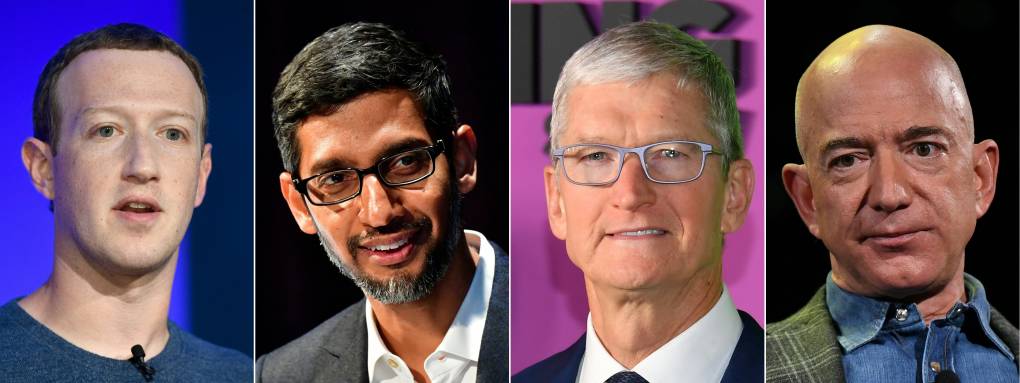
"description": "(COMBO) This combination of pictures created on July 07, 2020 shows (L-R) Facebook CEO Mark Zuckerberg in Paris on May 23, 2018, Google CEO Sundar Pichai Berlin on January 22, 2019, Apple CEO Tim Cook on October 28, 2019 in New York and Amazon Founder and CEO Jeff Bezos in Las Vegas, Nevada on June 6, 2019. (Photos by AFP) (Photo by BERTRAND GUAY,TOBIAS SCHWARZ,ANGELA WEISS,MARK RALSTON/AFP via Getty Images)",
"title": "Facebook CEO Mark Zuckerberg (from left), Google CEO Sundar Pichai, Apple CEO Tim Cook and Amazon CEO Jeff Bezos are scheduled to testify before a House Judiciary subcommittee.",
"credit": null,
"status": "inherit",
"isLoading": false,
"fetchFailed": false
},
"news_11827909": {
"type": "attachments",
"id": "news_11827909",
"meta": {
"index": "attachments_1716263798",
"site": "news",
"id": "11827909",
"found": true
},
"parent": 11827903,
"imgSizes": {
"apple_news_ca_landscape_5_5": {
"file": "https://ww2.kqed.org/app/uploads/sites/10/2020/07/betterplace_070820_final-1044x783.png",
"width": 1044,
"mimeType": "image/png",
"height": 783
},
"apple_news_ca_square_4_0": {
"file": "https://ww2.kqed.org/app/uploads/sites/10/2020/07/betterplace_070820_final-470x470.png",
"width": 470,
"mimeType": "image/png",
"height": 470
},
"twentyfourteen-full-width": {
"file": "https://ww2.kqed.org/app/uploads/sites/10/2020/07/betterplace_070820_final-1038x576.png",
"width": 1038,
"mimeType": "image/png",
"height": 576
},
"thumbnail": {
"file": "https://ww2.kqed.org/app/uploads/sites/10/2020/07/betterplace_070820_final-160x115.png",
"width": 160,
"mimeType": "image/png",
"height": 115
},
"post-thumbnail": {
"file": "https://ww2.kqed.org/app/uploads/sites/10/2020/07/betterplace_070820_final-672x372.png",
"width": 672,
"mimeType": "image/png",
"height": 372
},
"kqedFullSize": {
"file": "https://ww2.kqed.org/app/uploads/sites/10/2020/07/betterplace_070820_final.png",
"width": 1920,
"height": 1374
},
"apple_news_ca_landscape_4_7": {
"file": "https://ww2.kqed.org/app/uploads/sites/10/2020/07/betterplace_070820_final-632x474.png",
"width": 632,
"mimeType": "image/png",
"height": 474
},
"large": {
"file": "https://ww2.kqed.org/app/uploads/sites/10/2020/07/betterplace_070820_final-1020x730.png",
"width": 1020,
"mimeType": "image/png",
"height": 730
},
"apple_news_ca_landscape_4_0": {
"file": "https://ww2.kqed.org/app/uploads/sites/10/2020/07/betterplace_070820_final-536x402.png",
"width": 536,
"mimeType": "image/png",
"height": 402
},
"apple_news_ca_portrait_12_9": {
"file": "https://ww2.kqed.org/app/uploads/sites/10/2020/07/betterplace_070820_final-1122x1374.png",
"width": 1122,
"mimeType": "image/png",
"height": 1374
},
"medium": {
"file": "https://ww2.kqed.org/app/uploads/sites/10/2020/07/betterplace_070820_final-800x573.png",
"width": 800,
"mimeType": "image/png",
"height": 573
},
"apple_news_ca_portrait_4_0": {
"file": "https://ww2.kqed.org/app/uploads/sites/10/2020/07/betterplace_070820_final-354x472.png",
"width": 354,
"mimeType": "image/png",
"height": 472
},
"apple_news_ca_portrait_9_7": {
"file": "https://ww2.kqed.org/app/uploads/sites/10/2020/07/betterplace_070820_final-840x1120.png",
"width": 840,
"mimeType": "image/png",
"height": 1120
},
"apple_news_ca_landscape_12_9": {
"file": "https://ww2.kqed.org/app/uploads/sites/10/2020/07/betterplace_070820_final-1832x1374.png",
"width": 1832,
"mimeType": "image/png",
"height": 1374
},
"apple_news_ca_square_9_7": {
"file": "https://ww2.kqed.org/app/uploads/sites/10/2020/07/betterplace_070820_final-1104x1104.png",
"width": 1104,
"mimeType": "image/png",
"height": 1104
},
"1536x1536": {
"file": "https://ww2.kqed.org/app/uploads/sites/10/2020/07/betterplace_070820_final-1536x1099.png",
"width": 1536,
"mimeType": "image/png",
"height": 1099
},
"apple_news_ca_portrait_4_7": {
"file": "https://ww2.kqed.org/app/uploads/sites/10/2020/07/betterplace_070820_final-414x552.png",
"width": 414,
"mimeType": "image/png",
"height": 552
},
"apple_news_ca_square_12_9": {
"file": "https://ww2.kqed.org/app/uploads/sites/10/2020/07/betterplace_070820_final-1472x1374.png",
"width": 1472,
"mimeType": "image/png",
"height": 1374
},
"apple_news_ca_portrait_5_5": {
"file": "https://ww2.kqed.org/app/uploads/sites/10/2020/07/betterplace_070820_final-687x916.png",
"width": 687,
"mimeType": "image/png",
"height": 916
},
"apple_news_ca_square_4_7": {
"file": "https://ww2.kqed.org/app/uploads/sites/10/2020/07/betterplace_070820_final-550x550.png",
"width": 550,
"mimeType": "image/png",
"height": 550
},
"apple_news_ca_landscape_9_7": {
"file": "https://ww2.kqed.org/app/uploads/sites/10/2020/07/betterplace_070820_final-1376x1032.png",
"width": 1376,
"mimeType": "image/png",
"height": 1032
},
"apple_news_ca_square_5_5": {
"file": "https://ww2.kqed.org/app/uploads/sites/10/2020/07/betterplace_070820_final-912x912.png",
"width": 912,
"mimeType": "image/png",
"height": 912
}
},
"publishDate": 1594238503,
"modified": 1594238538,
"caption": null,
"description": null,
"title": "betterplace_070820_final",
"credit": null,
"status": "inherit",
"isLoading": false,
"fetchFailed": false
},
"news_11827852": {
"type": "attachments",
"id": "news_11827852",
"meta": {
"index": "attachments_1716263798",
"site": "news",
"id": "11827852",
"found": true
},
"parent": 11827831,
"imgSizes": {
"apple_news_ca_landscape_5_5": {
"file": "https://ww2.kqed.org/app/uploads/sites/10/2020/07/RS43868_GettyImages-1201476988-qut-1044x783.jpg",
"width": 1044,
"mimeType": "image/jpeg",
"height": 783
},
"apple_news_ca_square_4_0": {
"file": "https://ww2.kqed.org/app/uploads/sites/10/2020/07/RS43868_GettyImages-1201476988-qut-470x470.jpg",
"width": 470,
"mimeType": "image/jpeg",
"height": 470
},
"twentyfourteen-full-width": {
"file": "https://ww2.kqed.org/app/uploads/sites/10/2020/07/RS43868_GettyImages-1201476988-qut-1038x576.jpg",
"width": 1038,
"mimeType": "image/jpeg",
"height": 576
},
"thumbnail": {
"file": "https://ww2.kqed.org/app/uploads/sites/10/2020/07/RS43868_GettyImages-1201476988-qut-160x107.jpg",
"width": 160,
"mimeType": "image/jpeg",
"height": 107
},
"post-thumbnail": {
"file": "https://ww2.kqed.org/app/uploads/sites/10/2020/07/RS43868_GettyImages-1201476988-qut-672x372.jpg",
"width": 672,
"mimeType": "image/jpeg",
"height": 372
},
"kqedFullSize": {
"file": "https://ww2.kqed.org/app/uploads/sites/10/2020/07/RS43868_GettyImages-1201476988-qut.jpg",
"width": 1920,
"height": 1280
},
"apple_news_ca_landscape_4_7": {
"file": "https://ww2.kqed.org/app/uploads/sites/10/2020/07/RS43868_GettyImages-1201476988-qut-632x474.jpg",
"width": 632,
"mimeType": "image/jpeg",
"height": 474
},
"large": {
"file": "https://ww2.kqed.org/app/uploads/sites/10/2020/07/RS43868_GettyImages-1201476988-qut-1020x680.jpg",
"width": 1020,
"mimeType": "image/jpeg",
"height": 680
},
"apple_news_ca_landscape_4_0": {
"file": "https://ww2.kqed.org/app/uploads/sites/10/2020/07/RS43868_GettyImages-1201476988-qut-536x402.jpg",
"width": 536,
"mimeType": "image/jpeg",
"height": 402
},
"apple_news_ca_portrait_12_9": {
"file": "https://ww2.kqed.org/app/uploads/sites/10/2020/07/RS43868_GettyImages-1201476988-qut-1122x1280.jpg",
"width": 1122,
"mimeType": "image/jpeg",
"height": 1280
},
"medium": {
"file": "https://ww2.kqed.org/app/uploads/sites/10/2020/07/RS43868_GettyImages-1201476988-qut-800x533.jpg",
"width": 800,
"mimeType": "image/jpeg",
"height": 533
},
"apple_news_ca_portrait_4_0": {
"file": "https://ww2.kqed.org/app/uploads/sites/10/2020/07/RS43868_GettyImages-1201476988-qut-354x472.jpg",
"width": 354,
"mimeType": "image/jpeg",
"height": 472
},
"apple_news_ca_portrait_9_7": {
"file": "https://ww2.kqed.org/app/uploads/sites/10/2020/07/RS43868_GettyImages-1201476988-qut-840x1120.jpg",
"width": 840,
"mimeType": "image/jpeg",
"height": 1120
},
"apple_news_ca_landscape_12_9": {
"file": "https://ww2.kqed.org/app/uploads/sites/10/2020/07/RS43868_GettyImages-1201476988-qut-1832x1280.jpg",
"width": 1832,
"mimeType": "image/jpeg",
"height": 1280
},
"apple_news_ca_square_9_7": {
"file": "https://ww2.kqed.org/app/uploads/sites/10/2020/07/RS43868_GettyImages-1201476988-qut-1104x1104.jpg",
"width": 1104,
"mimeType": "image/jpeg",
"height": 1104
},
"1536x1536": {
"file": "https://ww2.kqed.org/app/uploads/sites/10/2020/07/RS43868_GettyImages-1201476988-qut-1536x1024.jpg",
"width": 1536,
"mimeType": "image/jpeg",
"height": 1024
},
"apple_news_ca_portrait_4_7": {
"file": "https://ww2.kqed.org/app/uploads/sites/10/2020/07/RS43868_GettyImages-1201476988-qut-414x552.jpg",
"width": 414,
"mimeType": "image/jpeg",
"height": 552
},
"apple_news_ca_square_12_9": {
"file": "https://ww2.kqed.org/app/uploads/sites/10/2020/07/RS43868_GettyImages-1201476988-qut-1472x1280.jpg",
"width": 1472,
"mimeType": "image/jpeg",
"height": 1280
},
"apple_news_ca_portrait_5_5": {
"file": "https://ww2.kqed.org/app/uploads/sites/10/2020/07/RS43868_GettyImages-1201476988-qut-687x916.jpg",
"width": 687,
"mimeType": "image/jpeg",
"height": 916
},
"apple_news_ca_square_4_7": {
"file": "https://ww2.kqed.org/app/uploads/sites/10/2020/07/RS43868_GettyImages-1201476988-qut-550x550.jpg",
"width": 550,
"mimeType": "image/jpeg",
"height": 550
},
"apple_news_ca_landscape_9_7": {
"file": "https://ww2.kqed.org/app/uploads/sites/10/2020/07/RS43868_GettyImages-1201476988-qut-1376x1032.jpg",
"width": 1376,
"mimeType": "image/jpeg",
"height": 1032
},
"apple_news_ca_square_5_5": {
"file": "https://ww2.kqed.org/app/uploads/sites/10/2020/07/RS43868_GettyImages-1201476988-qut-912x912.jpg",
"width": 912,
"mimeType": "image/jpeg",
"height": 912
}
},
"publishDate": 1594179608,
"modified": 1594181513,
"caption": "Civil rights and activist groups blasted Facebook CEO Mark Zuckerberg and other executives after meeting with them to discuss the #StopHateForProfit advertiser boycott that now includes close to 1,000 brands.",
"description": "Civil rights and activist groups blasted Facebook CEO Mark Zuckerberg and other executives after meeting with them to discuss the #StopHateForProfit advertiser boycott that now includes close to 1,000 brands.",
"title": "BELGIUM-EU-TECH-COMPUTERS-LAW-REGULATION-INTERNET-DIPLOMACY",
"credit": "Kenzo Tribouillard /AFP via Getty Images",
"status": "inherit",
"isLoading": false,
"fetchFailed": false
},
"news_11827514": {
"type": "attachments",
"id": "news_11827514",
"meta": {
"index": "attachments_1716263798",
"site": "news",
"id": "11827514",
"found": true
},
"parent": 11827513,
"imgSizes": {
"apple_news_ca_landscape_5_5": {
"file": "https://ww2.kqed.org/app/uploads/sites/10/2020/07/1920_port-1044x783.jpg",
"width": 1044,
"mimeType": "image/jpeg",
"height": 783
},
"apple_news_ca_square_4_0": {
"file": "https://ww2.kqed.org/app/uploads/sites/10/2020/07/1920_port-470x470.jpg",
"width": 470,
"mimeType": "image/jpeg",
"height": 470
},
"twentyfourteen-full-width": {
"file": "https://ww2.kqed.org/app/uploads/sites/10/2020/07/1920_port-1038x576.jpg",
"width": 1038,
"mimeType": "image/jpeg",
"height": 576
},
"thumbnail": {
"file": "https://ww2.kqed.org/app/uploads/sites/10/2020/07/1920_port-160x90.jpg",
"width": 160,
"mimeType": "image/jpeg",
"height": 90
},
"post-thumbnail": {
"file": "https://ww2.kqed.org/app/uploads/sites/10/2020/07/1920_port-672x372.jpg",
"width": 672,
"mimeType": "image/jpeg",
"height": 372
},
"kqedFullSize": {
"file": "https://ww2.kqed.org/app/uploads/sites/10/2020/07/1920_port.jpg",
"width": 1526,
"height": 858
},
"apple_news_ca_landscape_4_7": {
"file": "https://ww2.kqed.org/app/uploads/sites/10/2020/07/1920_port-632x474.jpg",
"width": 632,
"mimeType": "image/jpeg",
"height": 474
},
"large": {
"file": "https://ww2.kqed.org/app/uploads/sites/10/2020/07/1920_port-1020x573.jpg",
"width": 1020,
"mimeType": "image/jpeg",
"height": 573
},
"apple_news_ca_landscape_4_0": {
"file": "https://ww2.kqed.org/app/uploads/sites/10/2020/07/1920_port-536x402.jpg",
"width": 536,
"mimeType": "image/jpeg",
"height": 402
},
"apple_news_ca_portrait_12_9": {
"file": "https://ww2.kqed.org/app/uploads/sites/10/2020/07/1920_port-1122x858.jpg",
"width": 1122,
"mimeType": "image/jpeg",
"height": 858
},
"medium": {
"file": "https://ww2.kqed.org/app/uploads/sites/10/2020/07/1920_port-800x450.jpg",
"width": 800,
"mimeType": "image/jpeg",
"height": 450
},
"apple_news_ca_portrait_4_0": {
"file": "https://ww2.kqed.org/app/uploads/sites/10/2020/07/1920_port-354x472.jpg",
"width": 354,
"mimeType": "image/jpeg",
"height": 472
},
"apple_news_ca_portrait_9_7": {
"file": "https://ww2.kqed.org/app/uploads/sites/10/2020/07/1920_port-840x858.jpg",
"width": 840,
"mimeType": "image/jpeg",
"height": 858
},
"apple_news_ca_square_9_7": {
"file": "https://ww2.kqed.org/app/uploads/sites/10/2020/07/1920_port-1104x858.jpg",
"width": 1104,
"mimeType": "image/jpeg",
"height": 858
},
"apple_news_ca_portrait_4_7": {
"file": "https://ww2.kqed.org/app/uploads/sites/10/2020/07/1920_port-414x552.jpg",
"width": 414,
"mimeType": "image/jpeg",
"height": 552
},
"apple_news_ca_square_12_9": {
"file": "https://ww2.kqed.org/app/uploads/sites/10/2020/07/1920_port-1472x858.jpg",
"width": 1472,
"mimeType": "image/jpeg",
"height": 858
},
"apple_news_ca_portrait_5_5": {
"file": "https://ww2.kqed.org/app/uploads/sites/10/2020/07/1920_port-687x858.jpg",
"width": 687,
"mimeType": "image/jpeg",
"height": 858
},
"apple_news_ca_square_4_7": {
"file": "https://ww2.kqed.org/app/uploads/sites/10/2020/07/1920_port-550x550.jpg",
"width": 550,
"mimeType": "image/jpeg",
"height": 550
},
"apple_news_ca_landscape_9_7": {
"file": "https://ww2.kqed.org/app/uploads/sites/10/2020/07/1920_port-1376x858.jpg",
"width": 1376,
"mimeType": "image/jpeg",
"height": 858
},
"apple_news_ca_square_5_5": {
"file": "https://ww2.kqed.org/app/uploads/sites/10/2020/07/1920_port-912x858.jpg",
"width": 912,
"mimeType": "image/jpeg",
"height": 858
}
},
"publishDate": 1593966812,
"modified": 1593966835,
"caption": "Adrianna Mitchell (center) and Akilah Walker march from the Port of Oakland to Downtown during a Juneteenth rally on June 19, 2020.",
"description": null,
"title": "1920_port",
"credit": "Beth LaBerge/KQED",
"status": "inherit",
"isLoading": false,
"fetchFailed": false
},
"news_11827322": {
"type": "attachments",
"id": "news_11827322",
"meta": {
"index": "attachments_1716263798",
"site": "news",
"id": "11827322",
"found": true
},
"parent": 11827321,
"imgSizes": {
"apple_news_ca_landscape_5_5": {
"file": "https://ww2.kqed.org/app/uploads/sites/10/2020/07/ap_20105791221655-b2fe1c29f2b76a48ad0d236e30a72c48ca8cc6cc-1044x783.jpg",
"width": 1044,
"mimeType": "image/jpeg",
"height": 783
},
"apple_news_ca_square_4_0": {
"file": "https://ww2.kqed.org/app/uploads/sites/10/2020/07/ap_20105791221655-b2fe1c29f2b76a48ad0d236e30a72c48ca8cc6cc-470x470.jpg",
"width": 470,
"mimeType": "image/jpeg",
"height": 470
},
"twentyfourteen-full-width": {
"file": "https://ww2.kqed.org/app/uploads/sites/10/2020/07/ap_20105791221655-b2fe1c29f2b76a48ad0d236e30a72c48ca8cc6cc-1038x576.jpg",
"width": 1038,
"mimeType": "image/jpeg",
"height": 576
},
"thumbnail": {
"file": "https://ww2.kqed.org/app/uploads/sites/10/2020/07/ap_20105791221655-b2fe1c29f2b76a48ad0d236e30a72c48ca8cc6cc-160x120.jpg",
"width": 160,
"mimeType": "image/jpeg",
"height": 120
},
"post-thumbnail": {
"file": "https://ww2.kqed.org/app/uploads/sites/10/2020/07/ap_20105791221655-b2fe1c29f2b76a48ad0d236e30a72c48ca8cc6cc-672x372.jpg",
"width": 672,
"mimeType": "image/jpeg",
"height": 372
},
"kqedFullSize": {
"file": "https://ww2.kqed.org/app/uploads/sites/10/2020/07/ap_20105791221655-b2fe1c29f2b76a48ad0d236e30a72c48ca8cc6cc-scaled-e1593728939404.jpg",
"width": 1920,
"height": 1440
},
"2048x2048": {
"file": "https://ww2.kqed.org/app/uploads/sites/10/2020/07/ap_20105791221655-b2fe1c29f2b76a48ad0d236e30a72c48ca8cc6cc-2048x1536.jpg",
"width": 2048,
"mimeType": "image/jpeg",
"height": 1536
},
"apple_news_ca_landscape_4_7": {
"file": "https://ww2.kqed.org/app/uploads/sites/10/2020/07/ap_20105791221655-b2fe1c29f2b76a48ad0d236e30a72c48ca8cc6cc-632x474.jpg",
"width": 632,
"mimeType": "image/jpeg",
"height": 474
},
"large": {
"file": "https://ww2.kqed.org/app/uploads/sites/10/2020/07/ap_20105791221655-b2fe1c29f2b76a48ad0d236e30a72c48ca8cc6cc-1020x765.jpg",
"width": 1020,
"mimeType": "image/jpeg",
"height": 765
},
"apple_news_ca_landscape_4_0": {
"file": "https://ww2.kqed.org/app/uploads/sites/10/2020/07/ap_20105791221655-b2fe1c29f2b76a48ad0d236e30a72c48ca8cc6cc-536x402.jpg",
"width": 536,
"mimeType": "image/jpeg",
"height": 402
},
"apple_news_ca_portrait_12_9": {
"file": "https://ww2.kqed.org/app/uploads/sites/10/2020/07/ap_20105791221655-b2fe1c29f2b76a48ad0d236e30a72c48ca8cc6cc-1122x1496.jpg",
"width": 1122,
"mimeType": "image/jpeg",
"height": 1496
},
"medium": {
"file": "https://ww2.kqed.org/app/uploads/sites/10/2020/07/ap_20105791221655-b2fe1c29f2b76a48ad0d236e30a72c48ca8cc6cc-800x600.jpg",
"width": 800,
"mimeType": "image/jpeg",
"height": 600
},
"apple_news_ca_portrait_4_0": {
"file": "https://ww2.kqed.org/app/uploads/sites/10/2020/07/ap_20105791221655-b2fe1c29f2b76a48ad0d236e30a72c48ca8cc6cc-354x472.jpg",
"width": 354,
"mimeType": "image/jpeg",
"height": 472
},
"apple_news_ca_portrait_9_7": {
"file": "https://ww2.kqed.org/app/uploads/sites/10/2020/07/ap_20105791221655-b2fe1c29f2b76a48ad0d236e30a72c48ca8cc6cc-840x1120.jpg",
"width": 840,
"mimeType": "image/jpeg",
"height": 1120
},
"apple_news_ca_landscape_12_9": {
"file": "https://ww2.kqed.org/app/uploads/sites/10/2020/07/ap_20105791221655-b2fe1c29f2b76a48ad0d236e30a72c48ca8cc6cc-1832x1374.jpg",
"width": 1832,
"mimeType": "image/jpeg",
"height": 1374
},
"apple_news_ca_square_9_7": {
"file": "https://ww2.kqed.org/app/uploads/sites/10/2020/07/ap_20105791221655-b2fe1c29f2b76a48ad0d236e30a72c48ca8cc6cc-1104x1104.jpg",
"width": 1104,
"mimeType": "image/jpeg",
"height": 1104
},
"1536x1536": {
"file": "https://ww2.kqed.org/app/uploads/sites/10/2020/07/ap_20105791221655-b2fe1c29f2b76a48ad0d236e30a72c48ca8cc6cc-1536x1152.jpg",
"width": 1536,
"mimeType": "image/jpeg",
"height": 1152
},
"apple_news_ca_portrait_4_7": {
"file": "https://ww2.kqed.org/app/uploads/sites/10/2020/07/ap_20105791221655-b2fe1c29f2b76a48ad0d236e30a72c48ca8cc6cc-414x552.jpg",
"width": 414,
"mimeType": "image/jpeg",
"height": 552
},
"apple_news_ca_square_12_9": {
"file": "https://ww2.kqed.org/app/uploads/sites/10/2020/07/ap_20105791221655-b2fe1c29f2b76a48ad0d236e30a72c48ca8cc6cc-1472x1472.jpg",
"width": 1472,
"mimeType": "image/jpeg",
"height": 1472
},
"apple_news_ca_portrait_5_5": {
"file": "https://ww2.kqed.org/app/uploads/sites/10/2020/07/ap_20105791221655-b2fe1c29f2b76a48ad0d236e30a72c48ca8cc6cc-687x916.jpg",
"width": 687,
"mimeType": "image/jpeg",
"height": 916
},
"full-width": {
"file": "https://ww2.kqed.org/app/uploads/sites/10/2020/07/ap_20105791221655-b2fe1c29f2b76a48ad0d236e30a72c48ca8cc6cc-1920x1440.jpg",
"width": 1920,
"mimeType": "image/jpeg",
"height": 1440
},
"apple_news_ca_square_4_7": {
"file": "https://ww2.kqed.org/app/uploads/sites/10/2020/07/ap_20105791221655-b2fe1c29f2b76a48ad0d236e30a72c48ca8cc6cc-550x550.jpg",
"width": 550,
"mimeType": "image/jpeg",
"height": 550
},
"apple_news_ca_landscape_9_7": {
"file": "https://ww2.kqed.org/app/uploads/sites/10/2020/07/ap_20105791221655-b2fe1c29f2b76a48ad0d236e30a72c48ca8cc6cc-1376x1032.jpg",
"width": 1376,
"mimeType": "image/jpeg",
"height": 1032
},
"apple_news_ca_square_5_5": {
"file": "https://ww2.kqed.org/app/uploads/sites/10/2020/07/ap_20105791221655-b2fe1c29f2b76a48ad0d236e30a72c48ca8cc6cc-912x912.jpg",
"width": 912,
"mimeType": "image/jpeg",
"height": 912
}
},
"publishDate": 1593728601,
"modified": 1593728955,
"caption": "The complaint echoes earlier criticism of Facebook from Black employees who have long been frustrated at its lack of diversity.",
"description": "The complaint echoes earlier criticism of Facebook from Black employees who have long been frustrated at its lack of diversity.",
"title": "The complaint echoes earlier criticism of Facebook from Black employees who have long been frustrated at its lack of diversity.",
"credit": "Jeff Chiu/AP",
"status": "inherit",
"isLoading": false,
"fetchFailed": false
},
"news_11826920": {
"type": "attachments",
"id": "news_11826920",
"meta": {
"index": "attachments_1716263798",
"site": "news",
"id": "11826920",
"found": true
},
"parent": 11826864,
"imgSizes": {
"apple_news_ca_landscape_5_5": {
"file": "https://ww2.kqed.org/app/uploads/sites/10/2020/06/RS43845_GettyImages-1216297280-qut-1044x783.jpg",
"width": 1044,
"mimeType": "image/jpeg",
"height": 783
},
"apple_news_ca_square_4_0": {
"file": "https://ww2.kqed.org/app/uploads/sites/10/2020/06/RS43845_GettyImages-1216297280-qut-470x470.jpg",
"width": 470,
"mimeType": "image/jpeg",
"height": 470
},
"twentyfourteen-full-width": {
"file": "https://ww2.kqed.org/app/uploads/sites/10/2020/06/RS43845_GettyImages-1216297280-qut-1038x576.jpg",
"width": 1038,
"mimeType": "image/jpeg",
"height": 576
},
"thumbnail": {
"file": "https://ww2.kqed.org/app/uploads/sites/10/2020/06/RS43845_GettyImages-1216297280-qut-160x107.jpg",
"width": 160,
"mimeType": "image/jpeg",
"height": 107
},
"post-thumbnail": {
"file": "https://ww2.kqed.org/app/uploads/sites/10/2020/06/RS43845_GettyImages-1216297280-qut-672x372.jpg",
"width": 672,
"mimeType": "image/jpeg",
"height": 372
},
"kqedFullSize": {
"file": "https://ww2.kqed.org/app/uploads/sites/10/2020/06/RS43845_GettyImages-1216297280-qut.jpg",
"width": 1920,
"height": 1280
},
"apple_news_ca_landscape_4_7": {
"file": "https://ww2.kqed.org/app/uploads/sites/10/2020/06/RS43845_GettyImages-1216297280-qut-632x474.jpg",
"width": 632,
"mimeType": "image/jpeg",
"height": 474
},
"large": {
"file": "https://ww2.kqed.org/app/uploads/sites/10/2020/06/RS43845_GettyImages-1216297280-qut-1020x680.jpg",
"width": 1020,
"mimeType": "image/jpeg",
"height": 680
},
"apple_news_ca_landscape_4_0": {
"file": "https://ww2.kqed.org/app/uploads/sites/10/2020/06/RS43845_GettyImages-1216297280-qut-536x402.jpg",
"width": 536,
"mimeType": "image/jpeg",
"height": 402
},
"apple_news_ca_portrait_12_9": {
"file": "https://ww2.kqed.org/app/uploads/sites/10/2020/06/RS43845_GettyImages-1216297280-qut-1122x1280.jpg",
"width": 1122,
"mimeType": "image/jpeg",
"height": 1280
},
"medium": {
"file": "https://ww2.kqed.org/app/uploads/sites/10/2020/06/RS43845_GettyImages-1216297280-qut-800x533.jpg",
"width": 800,
"mimeType": "image/jpeg",
"height": 533
},
"apple_news_ca_portrait_4_0": {
"file": "https://ww2.kqed.org/app/uploads/sites/10/2020/06/RS43845_GettyImages-1216297280-qut-354x472.jpg",
"width": 354,
"mimeType": "image/jpeg",
"height": 472
},
"apple_news_ca_portrait_9_7": {
"file": "https://ww2.kqed.org/app/uploads/sites/10/2020/06/RS43845_GettyImages-1216297280-qut-840x1120.jpg",
"width": 840,
"mimeType": "image/jpeg",
"height": 1120
},
"apple_news_ca_landscape_12_9": {
"file": "https://ww2.kqed.org/app/uploads/sites/10/2020/06/RS43845_GettyImages-1216297280-qut-1832x1280.jpg",
"width": 1832,
"mimeType": "image/jpeg",
"height": 1280
},
"apple_news_ca_square_9_7": {
"file": "https://ww2.kqed.org/app/uploads/sites/10/2020/06/RS43845_GettyImages-1216297280-qut-1104x1104.jpg",
"width": 1104,
"mimeType": "image/jpeg",
"height": 1104
},
"1536x1536": {
"file": "https://ww2.kqed.org/app/uploads/sites/10/2020/06/RS43845_GettyImages-1216297280-qut-1536x1024.jpg",
"width": 1536,
"mimeType": "image/jpeg",
"height": 1024
},
"apple_news_ca_portrait_4_7": {
"file": "https://ww2.kqed.org/app/uploads/sites/10/2020/06/RS43845_GettyImages-1216297280-qut-414x552.jpg",
"width": 414,
"mimeType": "image/jpeg",
"height": 552
},
"apple_news_ca_square_12_9": {
"file": "https://ww2.kqed.org/app/uploads/sites/10/2020/06/RS43845_GettyImages-1216297280-qut-1472x1280.jpg",
"width": 1472,
"mimeType": "image/jpeg",
"height": 1280
},
"apple_news_ca_portrait_5_5": {
"file": "https://ww2.kqed.org/app/uploads/sites/10/2020/06/RS43845_GettyImages-1216297280-qut-687x916.jpg",
"width": 687,
"mimeType": "image/jpeg",
"height": 916
},
"apple_news_ca_square_4_7": {
"file": "https://ww2.kqed.org/app/uploads/sites/10/2020/06/RS43845_GettyImages-1216297280-qut-550x550.jpg",
"width": 550,
"mimeType": "image/jpeg",
"height": 550
},
"apple_news_ca_landscape_9_7": {
"file": "https://ww2.kqed.org/app/uploads/sites/10/2020/06/RS43845_GettyImages-1216297280-qut-1376x1032.jpg",
"width": 1376,
"mimeType": "image/jpeg",
"height": 1032
},
"apple_news_ca_square_5_5": {
"file": "https://ww2.kqed.org/app/uploads/sites/10/2020/06/RS43845_GettyImages-1216297280-qut-912x912.jpg",
"width": 912,
"mimeType": "image/jpeg",
"height": 912
}
},
"publishDate": 1593564291,
"modified": 1593574326,
"caption": "A member of the far-right militia, Boogaloo Bois, walks next to protestors demonstrating outside Charlotte Mecklenburg Police Department Metro Division 2 just outside of downtown Charlotte, North Carolina, on May 29, 2020. ",
"description": "A member of the far-right militia, Boogaloo Bois, walks next to protestors demonstrating outside Charlotte Mecklenburg Police Department Metro Division 2 just outside of downtown Charlotte, North Carolina, on May 29, 2020. ",
"title": "US-POLITICS-POLICE-JUSTICE-RACISM",
"credit": "Logan Cyrus/AFP",
"status": "inherit",
"isLoading": false,
"fetchFailed": false
},
"news_11826757": {
"type": "attachments",
"id": "news_11826757",
"meta": {
"index": "attachments_1716263798",
"site": "news",
"id": "11826757",
"found": true
},
"parent": 11826756,
"imgSizes": {
"apple_news_ca_landscape_5_5": {
"file": "https://ww2.kqed.org/app/uploads/sites/10/2020/06/san-jose-police-3-d7196fcc9cd58f98e9e0fe799d85919fd9978760-1044x783.jpg",
"width": 1044,
"mimeType": "image/jpeg",
"height": 783
},
"apple_news_ca_square_4_0": {
"file": "https://ww2.kqed.org/app/uploads/sites/10/2020/06/san-jose-police-3-d7196fcc9cd58f98e9e0fe799d85919fd9978760-470x470.jpg",
"width": 470,
"mimeType": "image/jpeg",
"height": 470
},
"twentyfourteen-full-width": {
"file": "https://ww2.kqed.org/app/uploads/sites/10/2020/06/san-jose-police-3-d7196fcc9cd58f98e9e0fe799d85919fd9978760-1038x576.jpg",
"width": 1038,
"mimeType": "image/jpeg",
"height": 576
},
"thumbnail": {
"file": "https://ww2.kqed.org/app/uploads/sites/10/2020/06/san-jose-police-3-d7196fcc9cd58f98e9e0fe799d85919fd9978760-160x120.jpg",
"width": 160,
"mimeType": "image/jpeg",
"height": 120
},
"post-thumbnail": {
"file": "https://ww2.kqed.org/app/uploads/sites/10/2020/06/san-jose-police-3-d7196fcc9cd58f98e9e0fe799d85919fd9978760-672x372.jpg",
"width": 672,
"mimeType": "image/jpeg",
"height": 372
},
"kqedFullSize": {
"file": "https://ww2.kqed.org/app/uploads/sites/10/2020/06/san-jose-police-3-d7196fcc9cd58f98e9e0fe799d85919fd9978760-scaled-e1593475827310.jpg",
"width": 1920,
"height": 1439
},
"2048x2048": {
"file": "https://ww2.kqed.org/app/uploads/sites/10/2020/06/san-jose-police-3-d7196fcc9cd58f98e9e0fe799d85919fd9978760-2048x1534.jpg",
"width": 2048,
"mimeType": "image/jpeg",
"height": 1534
},
"apple_news_ca_landscape_4_7": {
"file": "https://ww2.kqed.org/app/uploads/sites/10/2020/06/san-jose-police-3-d7196fcc9cd58f98e9e0fe799d85919fd9978760-632x474.jpg",
"width": 632,
"mimeType": "image/jpeg",
"height": 474
},
"large": {
"file": "https://ww2.kqed.org/app/uploads/sites/10/2020/06/san-jose-police-3-d7196fcc9cd58f98e9e0fe799d85919fd9978760-1020x764.jpg",
"width": 1020,
"mimeType": "image/jpeg",
"height": 764
},
"apple_news_ca_landscape_4_0": {
"file": "https://ww2.kqed.org/app/uploads/sites/10/2020/06/san-jose-police-3-d7196fcc9cd58f98e9e0fe799d85919fd9978760-536x402.jpg",
"width": 536,
"mimeType": "image/jpeg",
"height": 402
},
"apple_news_ca_portrait_12_9": {
"file": "https://ww2.kqed.org/app/uploads/sites/10/2020/06/san-jose-police-3-d7196fcc9cd58f98e9e0fe799d85919fd9978760-1122x1496.jpg",
"width": 1122,
"mimeType": "image/jpeg",
"height": 1496
},
"medium": {
"file": "https://ww2.kqed.org/app/uploads/sites/10/2020/06/san-jose-police-3-d7196fcc9cd58f98e9e0fe799d85919fd9978760-800x599.jpg",
"width": 800,
"mimeType": "image/jpeg",
"height": 599
},
"apple_news_ca_portrait_4_0": {
"file": "https://ww2.kqed.org/app/uploads/sites/10/2020/06/san-jose-police-3-d7196fcc9cd58f98e9e0fe799d85919fd9978760-354x472.jpg",
"width": 354,
"mimeType": "image/jpeg",
"height": 472
},
"apple_news_ca_portrait_9_7": {
"file": "https://ww2.kqed.org/app/uploads/sites/10/2020/06/san-jose-police-3-d7196fcc9cd58f98e9e0fe799d85919fd9978760-840x1120.jpg",
"width": 840,
"mimeType": "image/jpeg",
"height": 1120
},
"apple_news_ca_landscape_12_9": {
"file": "https://ww2.kqed.org/app/uploads/sites/10/2020/06/san-jose-police-3-d7196fcc9cd58f98e9e0fe799d85919fd9978760-1832x1374.jpg",
"width": 1832,
"mimeType": "image/jpeg",
"height": 1374
},
"apple_news_ca_square_9_7": {
"file": "https://ww2.kqed.org/app/uploads/sites/10/2020/06/san-jose-police-3-d7196fcc9cd58f98e9e0fe799d85919fd9978760-1104x1104.jpg",
"width": 1104,
"mimeType": "image/jpeg",
"height": 1104
},
"1536x1536": {
"file": "https://ww2.kqed.org/app/uploads/sites/10/2020/06/san-jose-police-3-d7196fcc9cd58f98e9e0fe799d85919fd9978760-1536x1151.jpg",
"width": 1536,
"mimeType": "image/jpeg",
"height": 1151
},
"apple_news_ca_portrait_4_7": {
"file": "https://ww2.kqed.org/app/uploads/sites/10/2020/06/san-jose-police-3-d7196fcc9cd58f98e9e0fe799d85919fd9978760-414x552.jpg",
"width": 414,
"mimeType": "image/jpeg",
"height": 552
},
"apple_news_ca_square_12_9": {
"file": "https://ww2.kqed.org/app/uploads/sites/10/2020/06/san-jose-police-3-d7196fcc9cd58f98e9e0fe799d85919fd9978760-1472x1472.jpg",
"width": 1472,
"mimeType": "image/jpeg",
"height": 1472
},
"apple_news_ca_portrait_5_5": {
"file": "https://ww2.kqed.org/app/uploads/sites/10/2020/06/san-jose-police-3-d7196fcc9cd58f98e9e0fe799d85919fd9978760-687x916.jpg",
"width": 687,
"mimeType": "image/jpeg",
"height": 916
},
"full-width": {
"file": "https://ww2.kqed.org/app/uploads/sites/10/2020/06/san-jose-police-3-d7196fcc9cd58f98e9e0fe799d85919fd9978760-1920x1438.jpg",
"width": 1920,
"mimeType": "image/jpeg",
"height": 1438
},
"apple_news_ca_square_4_7": {
"file": "https://ww2.kqed.org/app/uploads/sites/10/2020/06/san-jose-police-3-d7196fcc9cd58f98e9e0fe799d85919fd9978760-550x550.jpg",
"width": 550,
"mimeType": "image/jpeg",
"height": 550
},
"apple_news_ca_landscape_9_7": {
"file": "https://ww2.kqed.org/app/uploads/sites/10/2020/06/san-jose-police-3-d7196fcc9cd58f98e9e0fe799d85919fd9978760-1376x1032.jpg",
"width": 1376,
"mimeType": "image/jpeg",
"height": 1032
},
"apple_news_ca_square_5_5": {
"file": "https://ww2.kqed.org/app/uploads/sites/10/2020/06/san-jose-police-3-d7196fcc9cd58f98e9e0fe799d85919fd9978760-912x912.jpg",
"width": 912,
"mimeType": "image/jpeg",
"height": 912
}
},
"publishDate": 1593475655,
"modified": 1594426404,
"caption": "San Jose Mayor Sam Liccardo's plan to reform the city's police department follows criticism for SJPD's handling of the Black Lives Matter protests. Four officers have been placed on administrative leave after allegations that they posted racist and anti-Muslim messages to social media.",
"description": "San Jose Mayor Sam Liccardo's plan to reform the city's police department follows criticism for SJPD's handling of the Black Lives Matter protests. Four officers have been placed on administrative leave after allegations that they posted racist and anti-Muslim messages to social media.",
"title": "San Jose Mayor Sam Liccardo's plan to reform the city's police department follows criticism for SJPD's handling of the Black Lives Matter protests. Four officers have been placed on administrative leave after allegations that they posted racist and anti-Muslim messages to social media.",
"credit": "Ben Margot/AP",
"status": "inherit",
"isLoading": false,
"fetchFailed": false
}
},
"audioPlayerReducer": {
"postId": "stream_live",
"isPaused": true,
"isPlaying": false,
"pfsActive": false,
"pledgeModalIsOpen": true,
"playerDrawerIsOpen": false,
"liveAudioPlayStartedAt": 0,
"liveAudioPlayContext": ""
},
"authorsReducer": {
"byline_news_11830974": {
"type": "authors",
"id": "byline_news_11830974",
"meta": {
"override": true
},
"slug": "byline_news_11830974",
"name": "Alina Selyukh",
"isLoading": false
},
"byline_news_11827513": {
"type": "authors",
"id": "byline_news_11827513",
"meta": {
"override": true
},
"slug": "byline_news_11827513",
"name": "Amanda Seitz \u003cbr> Associated Press ",
"isLoading": false
},
"byline_news_11827321": {
"type": "authors",
"id": "byline_news_11827321",
"meta": {
"override": true
},
"slug": "byline_news_11827321",
"name": "\u003ca href=\"https://www.npr.org/people/763523701/shannon-bond\">Shannon Bond\u003c/a>",
"isLoading": false
},
"byline_news_11826864": {
"type": "authors",
"id": "byline_news_11826864",
"meta": {
"override": true
},
"slug": "byline_news_11826864",
"name": "Barbara Ortutay \u003cbr> Associated Press",
"isLoading": false
},
"byline_news_11826756": {
"type": "authors",
"id": "byline_news_11826756",
"meta": {
"override": true
},
"slug": "byline_news_11826756",
"name": "\u003ca href=\"https://www.npr.org/people/348744480/brakkton-booker\">Brakkton Booker\u003c/a>",
"isLoading": false
},
"rachael-myrow": {
"type": "authors",
"id": "251",
"meta": {
"index": "authors_1716337520",
"id": "251",
"found": true
},
"name": "Rachael Myrow",
"firstName": "Rachael",
"lastName": "Myrow",
"slug": "rachael-myrow",
"email": "rmyrow@kqed.org",
"display_author_email": true,
"staff_mastheads": [
"news"
],
"title": "Senior Editor of KQED's Silicon Valley News Desk",
"bio": "• I write and edit stories about how Silicon Valley power and policies shape everyday life in California. I’m also passionate about making Bay Area history and culture more accessible to a broad public. • I’ve been a journalist for most of my life, starting in high school with The Franklin Press in Los Angeles, where I grew up. While earning my first degree in English at UC Berkeley, I got my start in public radio at KALX-FM. After completing a second degree in journalism at Cal, I landed my first professional job at Marketplace, then moved on to KPCC (now LAist), and then KQED, where I hosted The California Report for more than seven years. • My reporting has appeared on NPR, The World, WBUR’s \u003ci>Here & Now\u003c/i>, and the BBC. I also guest host for KQED’s \u003ci>Forum\u003c/i>, as well as the Commonwealth Club in San Francisco. • I speak periodically on media, democracy and technology issues, and do voiceover work for documentaries and educational video projects. • Outside of the studio, you'll find me hiking Bay Area trails and whipping up Insta-ready meals in my kitchen. • I do not accept gifts, money, or favors from anyone connected to my reporting, I don't pay people for information, and I do not support or donate to political causes. • I strive to treat the people I report on with fairness, honesty, and respect. I also recognize there are often multiple sides to a story and work to verify information through multiple sources and documentation. If I get something wrong, I correct it.",
"avatar": "https://secure.gravatar.com/avatar/3ed8a3c5f26025e4a805ba634cda8cd764906b97438a6d9ce216b044e340da4e?s=600&d=blank&r=g",
"twitter": "rachaelmyrow",
"bluesky": null,
"facebook": null,
"instagram": null,
"linkedin": "https://www.linkedin.com/in/rachaelmyrow/",
"sites": [
{
"site": "arts",
"roles": [
"administrator"
]
},
{
"site": "news",
"roles": [
"edit_others_posts",
"editor"
]
},
{
"site": "futureofyou",
"roles": [
"editor"
]
},
{
"site": "bayareabites",
"roles": [
"editor"
]
},
{
"site": "stateofhealth",
"roles": [
"editor"
]
},
{
"site": "science",
"roles": [
"editor"
]
},
{
"site": "food",
"roles": [
"editor"
]
},
{
"site": "forum",
"roles": [
"editor"
]
},
{
"site": "liveblog",
"roles": [
"author"
]
}
],
"headData": {
"title": "Rachael Myrow | KQED",
"description": "Senior Editor of KQED's Silicon Valley News Desk",
"ogImgSrc": "https://secure.gravatar.com/avatar/3ed8a3c5f26025e4a805ba634cda8cd764906b97438a6d9ce216b044e340da4e?s=600&d=blank&r=g",
"twImgSrc": "https://secure.gravatar.com/avatar/3ed8a3c5f26025e4a805ba634cda8cd764906b97438a6d9ce216b044e340da4e?s=600&d=blank&r=g"
},
"isLoading": false,
"link": "/author/rachael-myrow"
},
"markfiore": {
"type": "authors",
"id": "3236",
"meta": {
"index": "authors_1716337520",
"id": "3236",
"found": true
},
"name": "Mark Fiore",
"firstName": "Mark",
"lastName": "Fiore",
"slug": "markfiore",
"email": "mark@markfiore.com",
"display_author_email": false,
"staff_mastheads": [
"news"
],
"title": "KQED News Cartoonist",
"bio": "\u003ca href=\"http://www.MarkFiore.com\">MarkFiore.com\u003c/a> | \u003ca href=\"https://twitter.com/markfiore\">Follow on Twitter\u003c/a> | \u003ca href=\"https://www.facebook.com/pages/Mark-Fiore-Animated-Political-Cartoons/94451707396?ref=bookmarks\">Facebook\u003c/a> | \u003ca href=\"mailto:mark@markfiore.com\">email\u003c/a>\r\n\r\nPulitzer Prize-winner, Mark Fiore, who the Wall Street Journal has called “the undisputed guru of the form,” creates animated political cartoons in San Francisco, where his work has been featured regularly on the San Francisco Chronicle’s web site, SFGate.com. His work has appeared on Newsweek.com, Slate.com, CBSNews.com, MotherJones.com, DailyKos.com and NPR’s web site. Fiore’s political animation has appeared on CNN, Frontline, Bill Moyers Journal, Salon.com and cable and broadcast outlets across the globe.\r\n\r\nBeginning his professional life by drawing traditional political cartoons for newspapers, Fiore’s work appeared in publications ranging from the Washington Post to the Los Angeles Times. In the late 1990s, he began to experiment with animating political cartoons and, after a short stint at the San Jose Mercury News as their staff cartoonist, Fiore devoted all his energies to animation.\r\nGrowing up in California, Fiore also spent a good portion of his life in the backwoods of Idaho. It was this combination that shaped him politically. Mark majored in political science at Colorado College, where, in a perfect send-off for a cartoonist, he received his diploma in 1991 as commencement speaker Dick Cheney smiled approvingly.\r\nMark Fiore was awarded the Pulitzer Prize for political cartooning in 2010, a Robert F. Kennedy Journalism Award in 2004 and has twice received an Online Journalism Award for commentary from the Online News Association (2002, 2008). Fiore has received two awards for his work in new media from the National Cartoonists Society (2001, 2002), and in 2006 received The James Madison Freedom of Information Award from The Society of Professional Journalists.",
"avatar": "https://secure.gravatar.com/avatar/fc4e2a612b15b67bad0c6f0e1db4ca9b?s=600&d=blank&r=g",
"twitter": "MarkFiore",
"facebook": null,
"instagram": "https://www.instagram.com/markfiore/?hl=en",
"linkedin": null,
"sites": [
{
"site": "arts",
"roles": [
"contributor"
]
},
{
"site": "news",
"roles": [
"editor"
]
},
{
"site": "futureofyou",
"roles": [
"editor"
]
},
{
"site": "science",
"roles": [
"editor"
]
}
],
"headData": {
"title": "Mark Fiore | KQED",
"description": "KQED News Cartoonist",
"ogImgSrc": "https://secure.gravatar.com/avatar/fc4e2a612b15b67bad0c6f0e1db4ca9b?s=600&d=blank&r=g",
"twImgSrc": "https://secure.gravatar.com/avatar/fc4e2a612b15b67bad0c6f0e1db4ca9b?s=600&d=blank&r=g"
},
"isLoading": false,
"link": "/author/markfiore"
}
},
"pagesReducer": {
"news_tag_facebook": {
"type": "terms",
"id": "news_249",
"meta": {
"index": "terms_1716263798",
"site": "news",
"id": "249",
"score": 8.457276
},
"featImg": null,
"name": "Facebook",
"description": null,
"taxonomy": "tag",
"headData": {
"twImgId": null,
"twTitle": null,
"ogTitle": null,
"ogImgId": null,
"twDescription": null,
"description": null,
"title": "Facebook Archives | KQED News",
"ogDescription": null
},
"ttid": 257,
"slug": "facebook",
"isLoading": false,
"title": "Facebook",
"pageMeta": {
"site": "news",
"WpPageTemplate": "page-topic-editorial",
"currentPage": 4
},
"blocks": [
{
"blockName": "kqed/post-list",
"attrs": {
"layout": "cardArticle2",
"query": "posts/news?tag=facebook",
"seeMore": false,
"paginated": true,
"page": 4
}
},
{
"blockName": "kqed/ad"
}
]
}
},
"pfsSessionReducer": {},
"postsReducer": {
"stream_live": {
"type": "live",
"id": "stream_live",
"audioUrl": "https://streams.kqed.org/kqedradio",
"title": "Live Stream",
"excerpt": "Live Stream information currently unavailable.",
"link": "/radio",
"featImg": "",
"label": {
"name": "KQED Live",
"link": "/"
}
},
"stream_kqedNewscast": {
"type": "posts",
"id": "stream_kqedNewscast",
"audioUrl": "https://www.kqed.org/.stream/anon/radio/RDnews/newscast.mp3?_=1",
"title": "KQED Newscast",
"featImg": "",
"label": {
"name": "88.5 FM",
"link": "/"
}
},
"news_11850203": {
"type": "posts",
"id": "news_11850203",
"meta": {
"index": "posts_1716263798",
"site": "news",
"id": "11850203",
"score": null,
"sort": [
1607522412000
]
},
"guestAuthors": [],
"slug": "facebook-pledges-150-million-to-build-affordable-housing-in-the-bay-area",
"title": "Facebook Pledges $150 Million to Build Affordable Housing in the Bay Area",
"publishDate": 1607522412,
"format": "audio",
"headTitle": "Facebook Pledges $150 Million to Build Affordable Housing in the Bay Area | KQED",
"labelTerm": {
"site": "news"
},
"content": "\u003cp>Facebook will focus $150 million to build 2,000 units of extremely low-income housing as part of the social media company’s pledge in October 2019 to spend \u003ca href=\"https://about.fb.com/news/2019/10/facebook-commits-1-billion-to-address-housing-affordability/\" target=\"_blank\" rel=\"noopener noreferrer\">$1 billion\u003c/a> on affordable housing in the San Francisco Bay Area. Facebook says this new Community Housing Fund would be the largest of its kind in California.\u003c/p>\n\u003cp>Facebook, Apple and Google have each invested hundreds of millions of dollars in the past year alone to finance the restoration and construction of affordable housing in the Bay Area, after pledging last year to spend billions.\u003c/p>\n\u003cp>Google was first to pledge $1 billion in June of 2019, and while Apple was the last of the three with an announcement in November of that year, it upped the ante significantly by pledging $2.5 billion. All three tech titans employ tens of thousands of employees, and tens of thousands more through subcontractors. The latter especially struggle to afford to live anywhere in the region, let alone in San Mateo or Santa Clara counties.\u003c/p>\n\u003cp>In a time when phrase “\u003ca href=\"https://www.prnewswire.com/news-releases/the-world-in-2018-from-the-economist-highlights-key-global-themes-to-watch-for-next-year-300558659.html\" target=\"_blank\" rel=\"noopener noreferrer\">tech lash\u003c/a>” was gaining currency in publications across the globe, the companies were also sensitive to growing criticism at home that the booming tech sector was responsible in large part for the housing crisis here. [ad fullwidth]\u003c/p>\n\u003ch2>Pledging Big Money Just the Beginning\u003c/h2>\n\u003cp>Step one for all the tech titans has been to sit down with stakeholders in the Bay Area affordable housing world, including other financiers, local governments, community activists and organizations like \u003ca href=\"https://destinationhomesv.org\" target=\"_blank\" rel=\"noopener noreferrer\">Destination: Home\u003c/a>, a public-private partnership fighting homelessness in Santa Clara County, which is contributing an additional $5 million to Facebook’s \u003ca href=\"https://about.fb.com/news/2020/12/facebook-invests-150-million-in-affordable-housing-for-the-bay-area/\" target=\"_blank\" rel=\"noopener noreferrer\">Community Housing Fund\u003c/a>.\u003c/p>\n\u003cp>“The folks that have the expertise are the folks that have boots on the ground, right? Where is it where we can play a role? It takes partnerships,” said Juan Salazar, director of local policy and community engagement at Facebook.\u003c/p>\n\u003cfigure id=\"attachment_11850415\" class=\"wp-caption aligncenter\" style=\"max-width: 692px\">\u003cimg loading=\"lazy\" decoding=\"async\" class=\"size-full wp-image-11850415\" src=\"https://ww2.kqed.org/app/uploads/sites/10/2020/12/2e456227-41a1-4352-848e-9464128aec15.png\" alt=\"The shortage of extremely low-income housing is higher than for any other income group in the San Jose metro area, with just 34 affordable and available homes for every 100 extremely low income households, according to the National Low Income Housing Coalition.\" width=\"692\" height=\"167\" srcset=\"https://cdn.kqed.org/wp-content/uploads/sites/10/2020/12/2e456227-41a1-4352-848e-9464128aec15.png 692w, https://cdn.kqed.org/wp-content/uploads/sites/10/2020/12/2e456227-41a1-4352-848e-9464128aec15-160x39.png 160w, https://cdn.kqed.org/wp-content/uploads/sites/10/2020/12/2e456227-41a1-4352-848e-9464128aec15-687x167.png 687w\" sizes=\"auto, (max-width: 692px) 100vw, 692px\">\u003cfigcaption class=\"wp-caption-text\">The shortage of extremely low-income housing is higher than for any other income group in the San Jose metro area, with just 34 affordable and available homes for every 100 extremely low income households, according to the National Low Income Housing Coalition. \u003ccite>(Courtesy of Destination: Home)\u003c/cite>\u003c/figcaption>\u003c/figure>\n\u003cp>Destination: Home CEO Jennifer Loving says that, for her, the most exciting part of Facebook’s latest housing announcement is the fact it’s focused on extremely low-income individuals and families making less than 30% of a region’s median income. For example, in the Bay Area, a family of four making under $45,000 a year or less would meet that threshold.\u003c/p>\n\u003cp>[aside tag=\"housing\" label=\"more coverage\"]\u003c/p>\n\u003cp>“It’s families who are minimum wage employed. It’s seniors on fixed income, individuals on disability. They might be paying 60, 70, 80, 90 percent of their income just on rent every single month, which puts them in a ridiculously precarious position of becoming homeless, and we’re seeing that now more than ever with the effects of COVID,” Loving said.\u003c/p>\n\u003cp>She added that any entity trying to build affordable housing faces an uphill battle given the housing market in the Bay Area. Despite the exodus of locals fleeing high rents in recent years, the Bay Area is undersupplied by 699,000 housing units and needs to build 2.2 million more by 2070, according to a \u003ca href=\"https://www.spur.org/sites/default/files/publications_pdfs/what_it_will_really_take_to_create_an_affordable_bay_area.pdf\" target=\"_blank\" rel=\"noopener noreferrer\">study\u003c/a> published in March by the San Francisco Bay Area Planning and Urban Research Association (SPUR). And experts don’t anticipate the current exodus of locals fleeing COVID-19 will budge those numbers much.\u003c/p>\n\u003cp>“The market will never create solutions for individuals and families with extremely low income. So the willingness [of tech firms] to use their positional power to say that this housing has to be for the most vulnerable people, that are disproportionately families of color that are really struggling in the Bay. That is the kind of leadership that frankly we need a lot more of,” Loving said.\u003c/p>\n\u003cp>Facebook’s Community Housing Fund will be managed by the Local Initiatives Support Corporation, the largest community development organization in the country.\u003c/p>\n\u003cp>“The size of the investment says that this is real. For these affordable housing developers that we work with, the more that one source of money can do more for their project, the faster they can get to construction,” said Cindy Wu, executive director of \u003ca href=\"https://www.lisc.org/bay-area/\" target=\"_blank\" rel=\"noopener noreferrer\">LISC Bay Area\u003c/a>.\u003c/p>\n\u003cp>One-third of the funding will be dedicated to Santa Clara County through Destination: Home, but projects from Alameda, Contra Costa, San Francisco and San Mateo counties are also eligible to apply. The $150 million is expected to fund at least six projects by 2026.\u003c/p>\n\u003cp>Even before Facebook joined its corporate colleagues in making a billion-dollar pledge, the company began to demonstrate a commitment to building local affordable housing with its \u003ca href=\"https://about.fb.com/news/2017/08/a-step-to-catalyze-affordable-housing-in-the-community/\" target=\"_blank\" rel=\"noopener noreferrer\">Catalyst Housing Fund\u003c/a>, launched in 2016. Facebook has also invested in local companies, like \u003ca href=\"https://factoryos.com/press/factory_os-joins-forces-with-technology-and-finance-leaders-to-solve-the-housing-crisis/\" target=\"_blank\" rel=\"noopener noreferrer\">Factory_OS\u003c/a>, which builds modular housing.\u003c/p>\n\u003cfigure id=\"attachment_11850296\" class=\"wp-caption aligncenter\" style=\"max-width: 1960px\">\u003cimg loading=\"lazy\" decoding=\"async\" class=\"size-full wp-image-11850296\" src=\"https://ww2.kqed.org/app/uploads/sites/10/2020/12/apple_housing-initiative-update_page-street-housing_07132020_big.jpg.large_2x.jpg\" alt=\"Apple is allocating more than $400 million toward affordable housing projects and homeowner assistance programs in California this year, including this Charities Housing Development Corporation project in San Jose, financed in partnership with Housing Trust Silicon Valley.\" width=\"1960\" height=\"1308\" srcset=\"https://cdn.kqed.org/wp-content/uploads/sites/10/2020/12/apple_housing-initiative-update_page-street-housing_07132020_big.jpg.large_2x.jpg 1960w, https://cdn.kqed.org/wp-content/uploads/sites/10/2020/12/apple_housing-initiative-update_page-street-housing_07132020_big.jpg.large_2x-800x534.jpg 800w, https://cdn.kqed.org/wp-content/uploads/sites/10/2020/12/apple_housing-initiative-update_page-street-housing_07132020_big.jpg.large_2x-1020x681.jpg 1020w, https://cdn.kqed.org/wp-content/uploads/sites/10/2020/12/apple_housing-initiative-update_page-street-housing_07132020_big.jpg.large_2x-160x107.jpg 160w, https://cdn.kqed.org/wp-content/uploads/sites/10/2020/12/apple_housing-initiative-update_page-street-housing_07132020_big.jpg.large_2x-1536x1025.jpg 1536w, https://cdn.kqed.org/wp-content/uploads/sites/10/2020/12/apple_housing-initiative-update_page-street-housing_07132020_big.jpg.large_2x-1920x1281.jpg 1920w\" sizes=\"auto, (max-width: 1960px) 100vw, 1960px\">\u003cfigcaption class=\"wp-caption-text\">Apple is allocating more than $400 million toward affordable housing projects and homeowner assistance programs in California this year, including this Charities Housing Development Corporation project in San Jose, financed in partnership with Housing Trust Silicon Valley. \u003ccite>(Courtesy of Apple)\u003c/cite>\u003c/figcaption>\u003c/figure>\n\u003ch2>Apple, Google and Cisco Spending, Too\u003c/h2>\n\u003cp>So far, Apple has allocated more than \u003ca href=\"https://www.apple.com/newsroom/2020/07/apple-allocates-more-than-400-million-to-combat-california-housing-crisis/\">$500 million\u003c/a> toward building affordable housing of the \u003ca href=\"https://www.kqed.org/news/11784720/apple-pledges-2-5-billion-to-fight-housing-crisis-in-california\">$2.5 billion\u003c/a> it pledged to fight the housing crisis in 2019. Its portfolio of investments also includes homelessness prevention efforts and a partnership with the California Housing Finance Agency to provide down payment and mortgage assistance for hundreds of first-time home buyers.\u003c/p>\n\u003cp>“As communities face unprecedented challenges this year and many housing projects have been put on hold, we are proud to have been able to accelerate our work to bring more affordable housing options for people in need across California,” wrote Kristina Raspe, Apple’s vice president for Global Real Estate and Facilities.\u003c/p>\n\u003cp>Google has spent $115 million of the \u003ca href=\"https://www.kqed.org/news/11755545/google-pledges-1-billion-to-help-fight-bay-area-housing-crisis-it-helped-create\" target=\"_blank\" rel=\"noopener noreferrer\">$1 billion commitment\u003c/a> it made last year, including $100 million in low-cost funding for housing developers and an investment in the aforementioned Factory_OS, to help it build a second factory.\u003c/p>\n\u003cp>“[Housing] is going to take things like policy reform and zoning regulations to change in order for us to really change this at scale,” said Jacquelline Fuller, who leads Google’s philanthropic arm, Google.org. “But in the meantime, we can … help contribute to affordable housing financing.”\u003c/p>\n\u003cp>Community housing activists say it’s hard to find fault with the prospect of tens of thousands of affordable housing units coming online over the next 15 years or so.\u003c/p>\n\u003cp>But if there is a complaint, it’s that the tech companies are looking to get a return in the form of rents and tax credits. Geoff Morgan, president and CEO of the nonprofit affordable housing developer \u003ca href=\"https://www.firstcommunityhousing.org\" target=\"_blank\" rel=\"noopener noreferrer\">First Community Housing\u003c/a>, would like to see the tech giants offer more outright grants than low-cost loans to affordable-housing developers.\u003c/p>\n\u003cp>“Don’t get me wrong, I don’t want to bite the hand that feeds me. There’s some high-tech companies that, what they are doing is the reason why we’re able to move forward on a lot of our projects. I just think [grants] would mean we could get deeper levels of affordability for the people that need it most — and we could build more housing units,” Morgan said.\u003c/p>\n\u003cp>[pullquote size='medium' align='right' citation='Leslye Corsiglia, executive director of \u003ca href=\"https://siliconvalleyathome.org\" target=\"_blank\" rel=\"noopener noreferrer\">Silicon Valley at Home\u003c/a>']‘Our communities are not places we want to live and where employees want to to locate if we don’t have housing for everybody.’[/pullquote]\u003c/p>\n\u003cp>In contrast, Morgan praises another tech giant, San Jose-based networking hardware maker Cisco Systems, both because the company was one of the first to commit substantial resources to help solve the housing crisis, and because it’s done so with direct donations.\u003c/p>\n\u003cp>“We worked with Cisco Systems to create \u003ca href=\"https://www.kqed.org/news/10761651/a-year-after-the-jungle-san-joses-new-approach-to-homelessness\" target=\"_blank\" rel=\"noopener noreferrer\">Second Street Studios\u003c/a>. That property is the very first 100% permanent supportive housing for the chronically homeless in San Jose,” Morgan said. “Cisco really led the way and perhaps encouraged a lot of other high-tech companies by their actions to publicly donate even more funds.”\u003c/p>\n\u003cp>Not that he isn’t excited about the multifarious commitments from Apple, Facebook and Google rolling out this year. “You just can’t ignore that. That’s a phenomenal accomplishment for them to have the will to do it,” he said.\u003c/p>\n\u003cp>But there’s also a selfish reason that corporations might be interested in making these commitments, said Leslye Corsiglia, executive director of \u003ca href=\"https://siliconvalleyathome.org\" target=\"_blank\" rel=\"noopener noreferrer\">Silicon Valley at Home (SV@Home).\u003c/a>\u003c/p>\n\u003cp>“Our communities are not places we want to live and where employees want to to locate if we don’t have housing for everybody,” Corsiglia said.\u003c/p>\n\u003cp>[ad floatright]\u003c/p>\n",
"blocks": [],
"excerpt": "Facebook, Apple and Google have been making good on their multibillion dollar pledges last year to finance housing projects.",
"status": "publish",
"parent": 0,
"modified": 1740520257,
"stats": {
"hasAudio": false,
"hasVideo": false,
"hasChartOrMap": false,
"iframeSrcs": [],
"hasGoogleForm": false,
"hasGallery": false,
"hasHearkenModule": false,
"hasPolis": false,
"paragraphCount": 29,
"wordCount": 1521
},
"headData": {
"title": "Facebook Pledges $150 Million to Build Affordable Housing in the Bay Area | KQED",
"description": "Facebook, Apple and Google have been making good on their multibillion dollar pledges last year to finance housing projects.",
"ogTitle": "",
"ogDescription": "",
"ogImgId": "",
"twTitle": "",
"twDescription": "",
"twImgId": "",
"schema": {
"@context": "https://schema.org",
"@type": "NewsArticle",
"headline": "Facebook Pledges $150 Million to Build Affordable Housing in the Bay Area",
"datePublished": "2020-12-09T06:00:12-08:00",
"dateModified": "2025-02-25T13:50:57-08:00",
"image": "https://cdn.kqed.org/wp-content/uploads/2020/02/KQED-OG-Image@1x.png",
"isAccessibleForFree": "True",
"publisher": {
"@type": "NewsMediaOrganization",
"@id": "https://www.kqed.org/#organization",
"name": "KQED",
"logo": "https://cdn.kqed.org/wp-content/uploads/2020/02/KQED-OG-Image@1x.png",
"url": "https://www.kqed.org",
"sameAs": [
"https://www.facebook.com/KQED",
"https://twitter.com/KQED",
"https://www.instagram.com/kqed/",
"https://www.tiktok.com/@kqedofficial",
"https://www.linkedin.com/company/kqed",
"https://www.youtube.com/channel/UCeC0IOo7i1P_61zVUWbJ4nw"
]
}
}
},
"audioUrl": "https://traffic.omny.fm/d/clips/0af137ef-751e-4b19-a055-aaef00d2d578/ffca7e9f-6831-4[…]f-aaef00f5a073/3d1185fe-dc19-40bd-a658-ac8c0137d58a/audio.mp3",
"sticky": false,
"path": "/news/11850203/facebook-pledges-150-million-to-build-affordable-housing-in-the-bay-area",
"audioTrackLength": null,
"parsedContent": [
{
"type": "contentString",
"content": "\u003cdiv class=\"post-body\">\u003cp>\u003cp>Facebook will focus $150 million to build 2,000 units of extremely low-income housing as part of the social media company’s pledge in October 2019 to spend \u003ca href=\"https://about.fb.com/news/2019/10/facebook-commits-1-billion-to-address-housing-affordability/\" target=\"_blank\" rel=\"noopener noreferrer\">$1 billion\u003c/a> on affordable housing in the San Francisco Bay Area. Facebook says this new Community Housing Fund would be the largest of its kind in California.\u003c/p>\n\u003cp>Facebook, Apple and Google have each invested hundreds of millions of dollars in the past year alone to finance the restoration and construction of affordable housing in the Bay Area, after pledging last year to spend billions.\u003c/p>\n\u003cp>Google was first to pledge $1 billion in June of 2019, and while Apple was the last of the three with an announcement in November of that year, it upped the ante significantly by pledging $2.5 billion. All three tech titans employ tens of thousands of employees, and tens of thousands more through subcontractors. The latter especially struggle to afford to live anywhere in the region, let alone in San Mateo or Santa Clara counties.\u003c/p>\n\u003cp>In a time when phrase “\u003ca href=\"https://www.prnewswire.com/news-releases/the-world-in-2018-from-the-economist-highlights-key-global-themes-to-watch-for-next-year-300558659.html\" target=\"_blank\" rel=\"noopener noreferrer\">tech lash\u003c/a>” was gaining currency in publications across the globe, the companies were also sensitive to growing criticism at home that the booming tech sector was responsible in large part for the housing crisis here. \u003c/p>\u003c/div>",
"attributes": {
"named": {},
"numeric": []
}
},
{
"type": "component",
"content": "",
"name": "ad",
"attributes": {
"named": {
"label": "fullwidth"
},
"numeric": [
"fullwidth"
]
}
},
{
"type": "contentString",
"content": "\u003cdiv class=\"post-body\">\u003cp>\u003c/p>\n\u003ch2>Pledging Big Money Just the Beginning\u003c/h2>\n\u003cp>Step one for all the tech titans has been to sit down with stakeholders in the Bay Area affordable housing world, including other financiers, local governments, community activists and organizations like \u003ca href=\"https://destinationhomesv.org\" target=\"_blank\" rel=\"noopener noreferrer\">Destination: Home\u003c/a>, a public-private partnership fighting homelessness in Santa Clara County, which is contributing an additional $5 million to Facebook’s \u003ca href=\"https://about.fb.com/news/2020/12/facebook-invests-150-million-in-affordable-housing-for-the-bay-area/\" target=\"_blank\" rel=\"noopener noreferrer\">Community Housing Fund\u003c/a>.\u003c/p>\n\u003cp>“The folks that have the expertise are the folks that have boots on the ground, right? Where is it where we can play a role? It takes partnerships,” said Juan Salazar, director of local policy and community engagement at Facebook.\u003c/p>\n\u003cfigure id=\"attachment_11850415\" class=\"wp-caption aligncenter\" style=\"max-width: 692px\">\u003cimg loading=\"lazy\" decoding=\"async\" class=\"size-full wp-image-11850415\" src=\"https://ww2.kqed.org/app/uploads/sites/10/2020/12/2e456227-41a1-4352-848e-9464128aec15.png\" alt=\"The shortage of extremely low-income housing is higher than for any other income group in the San Jose metro area, with just 34 affordable and available homes for every 100 extremely low income households, according to the National Low Income Housing Coalition.\" width=\"692\" height=\"167\" srcset=\"https://cdn.kqed.org/wp-content/uploads/sites/10/2020/12/2e456227-41a1-4352-848e-9464128aec15.png 692w, https://cdn.kqed.org/wp-content/uploads/sites/10/2020/12/2e456227-41a1-4352-848e-9464128aec15-160x39.png 160w, https://cdn.kqed.org/wp-content/uploads/sites/10/2020/12/2e456227-41a1-4352-848e-9464128aec15-687x167.png 687w\" sizes=\"auto, (max-width: 692px) 100vw, 692px\">\u003cfigcaption class=\"wp-caption-text\">The shortage of extremely low-income housing is higher than for any other income group in the San Jose metro area, with just 34 affordable and available homes for every 100 extremely low income households, according to the National Low Income Housing Coalition. \u003ccite>(Courtesy of Destination: Home)\u003c/cite>\u003c/figcaption>\u003c/figure>\n\u003cp>Destination: Home CEO Jennifer Loving says that, for her, the most exciting part of Facebook’s latest housing announcement is the fact it’s focused on extremely low-income individuals and families making less than 30% of a region’s median income. For example, in the Bay Area, a family of four making under $45,000 a year or less would meet that threshold.\u003c/p>\n\u003cp>\u003c/p>\u003c/div>",
"attributes": {
"named": {},
"numeric": []
}
},
{
"type": "component",
"content": "",
"name": "aside",
"attributes": {
"named": {
"tag": "housing",
"label": "more coverage "
},
"numeric": []
}
},
{
"type": "contentString",
"content": "\u003cdiv class=\"post-body\">\u003cp>\u003c/p>\n\u003cp>“It’s families who are minimum wage employed. It’s seniors on fixed income, individuals on disability. They might be paying 60, 70, 80, 90 percent of their income just on rent every single month, which puts them in a ridiculously precarious position of becoming homeless, and we’re seeing that now more than ever with the effects of COVID,” Loving said.\u003c/p>\n\u003cp>She added that any entity trying to build affordable housing faces an uphill battle given the housing market in the Bay Area. Despite the exodus of locals fleeing high rents in recent years, the Bay Area is undersupplied by 699,000 housing units and needs to build 2.2 million more by 2070, according to a \u003ca href=\"https://www.spur.org/sites/default/files/publications_pdfs/what_it_will_really_take_to_create_an_affordable_bay_area.pdf\" target=\"_blank\" rel=\"noopener noreferrer\">study\u003c/a> published in March by the San Francisco Bay Area Planning and Urban Research Association (SPUR). And experts don’t anticipate the current exodus of locals fleeing COVID-19 will budge those numbers much.\u003c/p>\n\u003cp>“The market will never create solutions for individuals and families with extremely low income. So the willingness [of tech firms] to use their positional power to say that this housing has to be for the most vulnerable people, that are disproportionately families of color that are really struggling in the Bay. That is the kind of leadership that frankly we need a lot more of,” Loving said.\u003c/p>\n\u003cp>Facebook’s Community Housing Fund will be managed by the Local Initiatives Support Corporation, the largest community development organization in the country.\u003c/p>\n\u003cp>“The size of the investment says that this is real. For these affordable housing developers that we work with, the more that one source of money can do more for their project, the faster they can get to construction,” said Cindy Wu, executive director of \u003ca href=\"https://www.lisc.org/bay-area/\" target=\"_blank\" rel=\"noopener noreferrer\">LISC Bay Area\u003c/a>.\u003c/p>\n\u003cp>One-third of the funding will be dedicated to Santa Clara County through Destination: Home, but projects from Alameda, Contra Costa, San Francisco and San Mateo counties are also eligible to apply. The $150 million is expected to fund at least six projects by 2026.\u003c/p>\n\u003cp>Even before Facebook joined its corporate colleagues in making a billion-dollar pledge, the company began to demonstrate a commitment to building local affordable housing with its \u003ca href=\"https://about.fb.com/news/2017/08/a-step-to-catalyze-affordable-housing-in-the-community/\" target=\"_blank\" rel=\"noopener noreferrer\">Catalyst Housing Fund\u003c/a>, launched in 2016. Facebook has also invested in local companies, like \u003ca href=\"https://factoryos.com/press/factory_os-joins-forces-with-technology-and-finance-leaders-to-solve-the-housing-crisis/\" target=\"_blank\" rel=\"noopener noreferrer\">Factory_OS\u003c/a>, which builds modular housing.\u003c/p>\n\u003cfigure id=\"attachment_11850296\" class=\"wp-caption aligncenter\" style=\"max-width: 1960px\">\u003cimg loading=\"lazy\" decoding=\"async\" class=\"size-full wp-image-11850296\" src=\"https://ww2.kqed.org/app/uploads/sites/10/2020/12/apple_housing-initiative-update_page-street-housing_07132020_big.jpg.large_2x.jpg\" alt=\"Apple is allocating more than $400 million toward affordable housing projects and homeowner assistance programs in California this year, including this Charities Housing Development Corporation project in San Jose, financed in partnership with Housing Trust Silicon Valley.\" width=\"1960\" height=\"1308\" srcset=\"https://cdn.kqed.org/wp-content/uploads/sites/10/2020/12/apple_housing-initiative-update_page-street-housing_07132020_big.jpg.large_2x.jpg 1960w, https://cdn.kqed.org/wp-content/uploads/sites/10/2020/12/apple_housing-initiative-update_page-street-housing_07132020_big.jpg.large_2x-800x534.jpg 800w, https://cdn.kqed.org/wp-content/uploads/sites/10/2020/12/apple_housing-initiative-update_page-street-housing_07132020_big.jpg.large_2x-1020x681.jpg 1020w, https://cdn.kqed.org/wp-content/uploads/sites/10/2020/12/apple_housing-initiative-update_page-street-housing_07132020_big.jpg.large_2x-160x107.jpg 160w, https://cdn.kqed.org/wp-content/uploads/sites/10/2020/12/apple_housing-initiative-update_page-street-housing_07132020_big.jpg.large_2x-1536x1025.jpg 1536w, https://cdn.kqed.org/wp-content/uploads/sites/10/2020/12/apple_housing-initiative-update_page-street-housing_07132020_big.jpg.large_2x-1920x1281.jpg 1920w\" sizes=\"auto, (max-width: 1960px) 100vw, 1960px\">\u003cfigcaption class=\"wp-caption-text\">Apple is allocating more than $400 million toward affordable housing projects and homeowner assistance programs in California this year, including this Charities Housing Development Corporation project in San Jose, financed in partnership with Housing Trust Silicon Valley. \u003ccite>(Courtesy of Apple)\u003c/cite>\u003c/figcaption>\u003c/figure>\n\u003ch2>Apple, Google and Cisco Spending, Too\u003c/h2>\n\u003cp>So far, Apple has allocated more than \u003ca href=\"https://www.apple.com/newsroom/2020/07/apple-allocates-more-than-400-million-to-combat-california-housing-crisis/\">$500 million\u003c/a> toward building affordable housing of the \u003ca href=\"https://www.kqed.org/news/11784720/apple-pledges-2-5-billion-to-fight-housing-crisis-in-california\">$2.5 billion\u003c/a> it pledged to fight the housing crisis in 2019. Its portfolio of investments also includes homelessness prevention efforts and a partnership with the California Housing Finance Agency to provide down payment and mortgage assistance for hundreds of first-time home buyers.\u003c/p>\n\u003cp>“As communities face unprecedented challenges this year and many housing projects have been put on hold, we are proud to have been able to accelerate our work to bring more affordable housing options for people in need across California,” wrote Kristina Raspe, Apple’s vice president for Global Real Estate and Facilities.\u003c/p>\n\u003cp>Google has spent $115 million of the \u003ca href=\"https://www.kqed.org/news/11755545/google-pledges-1-billion-to-help-fight-bay-area-housing-crisis-it-helped-create\" target=\"_blank\" rel=\"noopener noreferrer\">$1 billion commitment\u003c/a> it made last year, including $100 million in low-cost funding for housing developers and an investment in the aforementioned Factory_OS, to help it build a second factory.\u003c/p>\n\u003cp>“[Housing] is going to take things like policy reform and zoning regulations to change in order for us to really change this at scale,” said Jacquelline Fuller, who leads Google’s philanthropic arm, Google.org. “But in the meantime, we can … help contribute to affordable housing financing.”\u003c/p>\n\u003cp>Community housing activists say it’s hard to find fault with the prospect of tens of thousands of affordable housing units coming online over the next 15 years or so.\u003c/p>\n\u003cp>But if there is a complaint, it’s that the tech companies are looking to get a return in the form of rents and tax credits. Geoff Morgan, president and CEO of the nonprofit affordable housing developer \u003ca href=\"https://www.firstcommunityhousing.org\" target=\"_blank\" rel=\"noopener noreferrer\">First Community Housing\u003c/a>, would like to see the tech giants offer more outright grants than low-cost loans to affordable-housing developers.\u003c/p>\n\u003cp>“Don’t get me wrong, I don’t want to bite the hand that feeds me. There’s some high-tech companies that, what they are doing is the reason why we’re able to move forward on a lot of our projects. I just think [grants] would mean we could get deeper levels of affordability for the people that need it most — and we could build more housing units,” Morgan said.\u003c/p>\n\u003cp>\u003c/p>\u003c/div>",
"attributes": {
"named": {},
"numeric": []
}
},
{
"type": "component",
"content": "‘Our communities are not places we want to live and where employees want to to locate if we don’t have housing for everybody.’",
"name": "pullquote",
"attributes": {
"named": {
"size": "medium",
"align": "right",
"citation": "Leslye Corsiglia, executive director of \u003ca href=\"https://siliconvalleyathome.org\" target=\"_blank\" rel=\"noopener noreferrer\">Silicon Valley at Home\u003c/a>",
"label": ""
},
"numeric": []
}
},
{
"type": "contentString",
"content": "\u003cdiv class=\"post-body\">\u003cp>\u003c/p>\n\u003cp>In contrast, Morgan praises another tech giant, San Jose-based networking hardware maker Cisco Systems, both because the company was one of the first to commit substantial resources to help solve the housing crisis, and because it’s done so with direct donations.\u003c/p>\n\u003cp>“We worked with Cisco Systems to create \u003ca href=\"https://www.kqed.org/news/10761651/a-year-after-the-jungle-san-joses-new-approach-to-homelessness\" target=\"_blank\" rel=\"noopener noreferrer\">Second Street Studios\u003c/a>. That property is the very first 100% permanent supportive housing for the chronically homeless in San Jose,” Morgan said. “Cisco really led the way and perhaps encouraged a lot of other high-tech companies by their actions to publicly donate even more funds.”\u003c/p>\n\u003cp>Not that he isn’t excited about the multifarious commitments from Apple, Facebook and Google rolling out this year. “You just can’t ignore that. That’s a phenomenal accomplishment for them to have the will to do it,” he said.\u003c/p>\n\u003cp>But there’s also a selfish reason that corporations might be interested in making these commitments, said Leslye Corsiglia, executive director of \u003ca href=\"https://siliconvalleyathome.org\" target=\"_blank\" rel=\"noopener noreferrer\">Silicon Valley at Home (SV@Home).\u003c/a>\u003c/p>\n\u003cp>“Our communities are not places we want to live and where employees want to to locate if we don’t have housing for everybody,” Corsiglia said.\u003c/p>\n\u003cp>\u003c/p>\u003c/div>",
"attributes": {
"named": {},
"numeric": []
}
},
{
"type": "component",
"content": "",
"name": "ad",
"attributes": {
"named": {
"label": "floatright"
},
"numeric": [
"floatright"
]
}
},
{
"type": "contentString",
"content": "\u003cdiv class=\"post-body\">\u003cp>\u003c/p>\n\u003c/div>\u003c/p>",
"attributes": {
"named": {},
"numeric": []
}
}
],
"link": "/news/11850203/facebook-pledges-150-million-to-build-affordable-housing-in-the-bay-area",
"authors": [
"251"
],
"categories": [
"news_1758",
"news_6266",
"news_8",
"news_248"
],
"tags": [
"news_3921",
"news_24805",
"news_19182",
"news_1702",
"news_249",
"news_93",
"news_4020",
"news_21358",
"news_638",
"news_2011",
"news_18541",
"news_1631"
],
"featImg": "news_11850292",
"label": "news"
},
"news_11847579": {
"type": "posts",
"id": "news_11847579",
"meta": {
"index": "posts_1716263798",
"site": "news",
"id": "11847579",
"score": null,
"sort": [
1605557860000
]
},
"guestAuthors": [],
"slug": "claiming-censorship-conservatives-head-to-alternative-social-media-sites-post-election",
"title": "Claiming Censorship, Conservatives Head to Alternative Social Media Sites Post-Election",
"publishDate": 1605557860,
"format": "audio",
"headTitle": "Claiming Censorship, Conservatives Head to Alternative Social Media Sites Post-Election | KQED",
"labelTerm": {
"site": "news"
},
"content": "\u003cp>It started with President Trump and his supporters \u003ca href=\"https://www.kqed.org/news/11846005/how-the-anti-defamation-league-is-fighting-election-misinformation-online\" target=\"_blank\" rel=\"noopener noreferrer\">posting misinformation\u003c/a> disputing the legitimacy of the election. Among other things, Twitter \u003ca href=\"https://www.theverge.com/2020/11/4/21548736/twitter-facebook-throttle-trump-tweet-election-theft\">applied warning labels\u003c/a> to the president’s tweets and permanently suspended an account belonging to former White House chief strategist \u003ca href=\"https://www.cnn.com/2020/11/05/tech/steve-bannon-twitter-permanent-suspension/index.html\" target=\"_blank\" rel=\"noopener noreferrer\">Steve Bannon\u003c/a>. Facebook decided to \u003ca href=\"https://www.washingtonpost.com/technology/2020/11/05/facebook-trump-protests/\" target=\"_blank\" rel=\"noopener noreferrer\">remove\u003c/a> the #StoptheSteal campaign altogether.\u003c/p>\n\u003cp>Now, what was a trickle of high-profile conservatives creating accounts on relatively unknown platforms like Parler, Gab and MeWe has become a flood. In recent weeks, Parler, a Twitter-like app that touts its commitment to free speech (a stance often viewed as code for welcoming far-right viewpoints), claims its membership doubled from 4 million to 8 million users.\u003c/p>\n\u003cp>Gab, a platform \u003ca href=\"https://www.latimes.com/nation/la-na-gab-white-nationalists-20181028-story.html\">favored by white nationalists for years\u003c/a>, reportedly grew to 3.7 million users. \u003c/p>\n\u003cp>“Gab is a sleeping new media giant that is only now beginning to awaken,” wrote CEO Andrew Torba in a company \u003ca href=\"https://news.gab.com/2020/11/10/gab-com-the-home-of-free-speech-online-sees-record-growth-after-big-tech-election-interference/\">blog post\u003c/a> last week.\u003c/p>\n\u003cp>MeWe, owned by a Culver City company, “currently has about 11 million users and is growing rapidly,” at the rate of 300,000 new accounts a day, according to spokesman David Westreich.\u003c/p>\n\u003cp>[ad fullwidth]\u003c/p>\n\u003cp>“Which is, yeah, an enormous increase,” said Alex Goldenberg, lead intelligence analyst with the \u003ca href=\"https://ncri.io\" target=\"_blank\" rel=\"noopener noreferrer\">Network Contagion Research Institute\u003c/a>, a nonpartisan nonprofit that tracks hate speech.\u003c/p>\n\u003cp>The \u003ca href=\"https://www.kqed.org/news/11702239/why-its-so-hard-to-scrub-hate-speech-off-social-media\" target=\"_blank\" rel=\"noopener noreferrer\">last time Gab made national headlines\u003c/a>, one of its users opened fire in a Pittsburgh synagogue in 2018, killing 11 people. Violent incidents like that one have prompted major platforms like Facebook and YouTube to come under increasing public pressure to crack down on misinformation, disinformation and hate speech.\u003c/p>\n\u003cp>“These are private platforms, and they can exercise their terms of services how they’d like. While you have freedom of speech, you don’t always have freedom of amplification,” Goldenberg said.\u003c/p>\n\u003cfigure id=\"attachment_11847664\" class=\"wp-caption aligncenter\" style=\"max-width: 1200px\">\u003cimg loading=\"lazy\" decoding=\"async\" class=\"size-full wp-image-11847664\" src=\"https://ww2.kqed.org/app/uploads/sites/10/2020/11/Screen-Shot-2020-11-16-at-12.00.30-PM.png\" alt=\"\" width=\"1200\" height=\"496\" srcset=\"https://cdn.kqed.org/wp-content/uploads/sites/10/2020/11/Screen-Shot-2020-11-16-at-12.00.30-PM.png 1200w, https://cdn.kqed.org/wp-content/uploads/sites/10/2020/11/Screen-Shot-2020-11-16-at-12.00.30-PM-800x331.png 800w, https://cdn.kqed.org/wp-content/uploads/sites/10/2020/11/Screen-Shot-2020-11-16-at-12.00.30-PM-1020x422.png 1020w, https://cdn.kqed.org/wp-content/uploads/sites/10/2020/11/Screen-Shot-2020-11-16-at-12.00.30-PM-160x66.png 160w\" sizes=\"(max-width: 1200px) 100vw, 1200px\">\u003cfigcaption class=\"wp-caption-text\">“This claim about election fraud is disputed,” reads a label Twitter applied to a tweet from President Trump on Monday. \u003ccite>(Twitter)\u003c/cite>\u003c/figcaption>\u003c/figure>\n\u003cp>But attempts by major social media platforms to dampen right-wing propaganda have led to cries of censorship from Republican politicians and pundits who are \u003ca href=\"https://www.colorado.edu/today/2020/06/17/who-shares-most-fake-news-new-study-sheds-light\" target=\"_blank\" rel=\"noopener noreferrer\">more likely to post and share\u003c/a> information that gets flagged, labeled, algorithmically muted or deleted than are Democrats.\u003c/p>\n\u003cp>In hearing after hearing on Capitol Hill, conservatives have called for changes to Section 230 of the Communications Decency Act, which protects Silicon Valley platforms from lawsuits over content.\u003c/p>\n\u003cp>“We have had for several years, a growing problem with big tech censorship,” Sen. Ted Cruz, R-Texas, a few weeks ago told \u003ca href=\"https://youtu.be/thum10e7B2Q\">Fox’s Maria Bartiromo\u003c/a>, who has hundred of thousands of followers herself on Parler. “A handful of Silicon Valley billionaire are now telling media companies they get to decide what stories you can write and what stories the American people can read,” Cruz said.\u003c/p>\n\u003cp>[aside tag=\"election-2020\" label=\"election coverage\"]This week, Twitter CEO Jack Dorsey and Facebook CEO Mark Zuckerberg are expected to testify at a congressional hearing called by Republican lawmakers upset that the platforms limited the reach of an unsubstantiated New York Post article critical of Hunter Biden, the son of President-elect Joe Biden.\u003c/p>\n\u003cp>“It seems like where we’re heading is two competing social media ecosystems if leaders from across the political spectrum and across civil society don’t restore public trust,” Goldenberg said. “Because if there’s no public trust in our institutions, people are going to look elsewhere for answers, and where they find those answers could be very dark places.”\u003c/p>\n\u003cp>So, if labeling certain posts as being disputed or potentially containing misinformation is pushing users toward these third-party sites, should Facebook, Twitter and YouTube stop doing it?\u003c/p>\n\u003cp>“I still think that they need to do what they’re doing,” said professor Jenn Daskal, who directs the Tech, Law and Security Program at American University Washington College of Law. “Adding labels to speech that is clearly blatant misinformation is good, adding friction to the platforms to reduce virality of conspiracy theories and other forms of misinformation is helpful.”\u003c/p>\n\u003cp>She added, “It ought to be where all political persuasions can communicate and interact as long as they are doing so in ways that are not purposefully disseminating blatantly false information. As long as they are not engaging in ways that are inciting violence. And that seems to me to be the right set of rules.”\u003c/p>\n\u003cp>Cable TV’s fractured universe of news and talk filtered through partisan lenses suggests the future of social media, as Daskal sees it.\u003c/p>\n\u003cp>“The risk is that people end up on closed sites where everyone agrees with them. But the benefit is that it’s harder to reach a broader audience as a result,” Daskal said.\u003c/p>\n\u003cp>That may not be a problem for extremists banned from the major platforms, like talk-show host Alex Jones or the neo-fascist Proud Boys, both of which have established large followings on Parler.\u003c/p>\n\u003cp>But it’s worth noting Facebook and Twitter rarely go so far as to delete the accounts of prominent conservatives like Ted Cruz and Rand Paul, R-Kentucky — and most of them have not deleted their accounts on the big platforms. Bartiromo, for example, has publicly decried Twitter in recent weeks, but she \u003ca href=\"https://twitter.com/MariaBartiromo/status/1327297733225484288?s=20\" target=\"_blank\" rel=\"noopener noreferrer\">continues to tweet\u003c/a> even as she commonly includes the copy, “On Parler @Mariabartiromotv.”\u003c/p>\n\u003cp>It’s not hard to imagine why Bartiromo stays. Twitter has more than 300 million active users, a number that dwarfs those seen on any “free speech” alternative platform.\u003c/p>\n\u003cp>\u003c/p>\n\u003cp>Then there’s Facebook, which claims more than \u003ca href=\"https://about.fb.com/company-info/\" target=\"_blank\" rel=\"noopener noreferrer\">3 billion users\u003c/a> across its three core platforms, including Instagram and WhatsApp. #MassExitOffFacebook? Not likely.\u003c/p>\n\n",
"blocks": [],
"excerpt": "Platforms that don't moderate misinformation like Gab and Parler see a spike in users – but many prominent users haven't deleted their Facebook and Twitter accounts yet.",
"status": "publish",
"parent": 0,
"modified": 1729028038,
"stats": {
"hasAudio": false,
"hasVideo": false,
"hasChartOrMap": false,
"iframeSrcs": [],
"hasGoogleForm": false,
"hasGallery": false,
"hasHearkenModule": false,
"hasPolis": false,
"paragraphCount": 24,
"wordCount": 973
},
"headData": {
"title": "Claiming Censorship, Conservatives Head to Alternative Social Media Sites Post-Election | KQED",
"description": "Platforms that don't moderate misinformation like Gab and Parler see a spike in users – but many prominent users haven't deleted their Facebook and Twitter accounts yet.",
"ogTitle": "",
"ogDescription": "",
"ogImgId": "",
"twTitle": "",
"twDescription": "",
"twImgId": "",
"schema": {
"@context": "https://schema.org",
"@type": "NewsArticle",
"headline": "Claiming Censorship, Conservatives Head to Alternative Social Media Sites Post-Election",
"datePublished": "2020-11-16T12:17:40-08:00",
"dateModified": "2024-10-15T14:33:58-07:00",
"image": "https://cdn.kqed.org/wp-content/uploads/2020/02/KQED-OG-Image@1x.png",
"isAccessibleForFree": "True",
"publisher": {
"@type": "NewsMediaOrganization",
"@id": "https://www.kqed.org/#organization",
"name": "KQED",
"logo": "https://cdn.kqed.org/wp-content/uploads/2020/02/KQED-OG-Image@1x.png",
"url": "https://www.kqed.org",
"sameAs": [
"https://www.facebook.com/KQED",
"https://twitter.com/KQED",
"https://www.instagram.com/kqed/",
"https://www.tiktok.com/@kqedofficial",
"https://www.linkedin.com/company/kqed",
"https://www.youtube.com/channel/UCeC0IOo7i1P_61zVUWbJ4nw"
]
}
}
},
"audioUrl": "https://traffic.omny.fm/d/clips/0af137ef-751e-4b19-a055-aaef00d2d578/ffca7e9f-6831-41c5-bcaf-aaef00f5a073/56ea1b80-c429-47b3-a78a-ac75013569c6/audio.mp3",
"sticky": false,
"subhead": "Millions seek fact-check free universe on platforms like Parler, Gab and MeWe",
"path": "/news/11847579/claiming-censorship-conservatives-head-to-alternative-social-media-sites-post-election",
"audioTrackLength": null,
"parsedContent": [
{
"type": "contentString",
"content": "\u003cdiv class=\"post-body\">\u003cp>\u003cp>It started with President Trump and his supporters \u003ca href=\"https://www.kqed.org/news/11846005/how-the-anti-defamation-league-is-fighting-election-misinformation-online\" target=\"_blank\" rel=\"noopener noreferrer\">posting misinformation\u003c/a> disputing the legitimacy of the election. Among other things, Twitter \u003ca href=\"https://www.theverge.com/2020/11/4/21548736/twitter-facebook-throttle-trump-tweet-election-theft\">applied warning labels\u003c/a> to the president’s tweets and permanently suspended an account belonging to former White House chief strategist \u003ca href=\"https://www.cnn.com/2020/11/05/tech/steve-bannon-twitter-permanent-suspension/index.html\" target=\"_blank\" rel=\"noopener noreferrer\">Steve Bannon\u003c/a>. Facebook decided to \u003ca href=\"https://www.washingtonpost.com/technology/2020/11/05/facebook-trump-protests/\" target=\"_blank\" rel=\"noopener noreferrer\">remove\u003c/a> the #StoptheSteal campaign altogether.\u003c/p>\n\u003cp>Now, what was a trickle of high-profile conservatives creating accounts on relatively unknown platforms like Parler, Gab and MeWe has become a flood. In recent weeks, Parler, a Twitter-like app that touts its commitment to free speech (a stance often viewed as code for welcoming far-right viewpoints), claims its membership doubled from 4 million to 8 million users.\u003c/p>\n\u003cp>Gab, a platform \u003ca href=\"https://www.latimes.com/nation/la-na-gab-white-nationalists-20181028-story.html\">favored by white nationalists for years\u003c/a>, reportedly grew to 3.7 million users. \u003c/p>\n\u003cp>“Gab is a sleeping new media giant that is only now beginning to awaken,” wrote CEO Andrew Torba in a company \u003ca href=\"https://news.gab.com/2020/11/10/gab-com-the-home-of-free-speech-online-sees-record-growth-after-big-tech-election-interference/\">blog post\u003c/a> last week.\u003c/p>\n\u003cp>MeWe, owned by a Culver City company, “currently has about 11 million users and is growing rapidly,” at the rate of 300,000 new accounts a day, according to spokesman David Westreich.\u003c/p>\n\u003cp>\u003c/p>\u003c/div>",
"attributes": {
"named": {},
"numeric": []
}
},
{
"type": "component",
"content": "",
"name": "ad",
"attributes": {
"named": {
"label": "fullwidth"
},
"numeric": [
"fullwidth"
]
}
},
{
"type": "contentString",
"content": "\u003cdiv class=\"post-body\">\u003cp>\u003c/p>\n\u003cp>“Which is, yeah, an enormous increase,” said Alex Goldenberg, lead intelligence analyst with the \u003ca href=\"https://ncri.io\" target=\"_blank\" rel=\"noopener noreferrer\">Network Contagion Research Institute\u003c/a>, a nonpartisan nonprofit that tracks hate speech.\u003c/p>\n\u003cp>The \u003ca href=\"https://www.kqed.org/news/11702239/why-its-so-hard-to-scrub-hate-speech-off-social-media\" target=\"_blank\" rel=\"noopener noreferrer\">last time Gab made national headlines\u003c/a>, one of its users opened fire in a Pittsburgh synagogue in 2018, killing 11 people. Violent incidents like that one have prompted major platforms like Facebook and YouTube to come under increasing public pressure to crack down on misinformation, disinformation and hate speech.\u003c/p>\n\u003cp>“These are private platforms, and they can exercise their terms of services how they’d like. While you have freedom of speech, you don’t always have freedom of amplification,” Goldenberg said.\u003c/p>\n\u003cfigure id=\"attachment_11847664\" class=\"wp-caption aligncenter\" style=\"max-width: 1200px\">\u003cimg loading=\"lazy\" decoding=\"async\" class=\"size-full wp-image-11847664\" src=\"https://ww2.kqed.org/app/uploads/sites/10/2020/11/Screen-Shot-2020-11-16-at-12.00.30-PM.png\" alt=\"\" width=\"1200\" height=\"496\" srcset=\"https://cdn.kqed.org/wp-content/uploads/sites/10/2020/11/Screen-Shot-2020-11-16-at-12.00.30-PM.png 1200w, https://cdn.kqed.org/wp-content/uploads/sites/10/2020/11/Screen-Shot-2020-11-16-at-12.00.30-PM-800x331.png 800w, https://cdn.kqed.org/wp-content/uploads/sites/10/2020/11/Screen-Shot-2020-11-16-at-12.00.30-PM-1020x422.png 1020w, https://cdn.kqed.org/wp-content/uploads/sites/10/2020/11/Screen-Shot-2020-11-16-at-12.00.30-PM-160x66.png 160w\" sizes=\"(max-width: 1200px) 100vw, 1200px\">\u003cfigcaption class=\"wp-caption-text\">“This claim about election fraud is disputed,” reads a label Twitter applied to a tweet from President Trump on Monday. \u003ccite>(Twitter)\u003c/cite>\u003c/figcaption>\u003c/figure>\n\u003cp>But attempts by major social media platforms to dampen right-wing propaganda have led to cries of censorship from Republican politicians and pundits who are \u003ca href=\"https://www.colorado.edu/today/2020/06/17/who-shares-most-fake-news-new-study-sheds-light\" target=\"_blank\" rel=\"noopener noreferrer\">more likely to post and share\u003c/a> information that gets flagged, labeled, algorithmically muted or deleted than are Democrats.\u003c/p>\n\u003cp>In hearing after hearing on Capitol Hill, conservatives have called for changes to Section 230 of the Communications Decency Act, which protects Silicon Valley platforms from lawsuits over content.\u003c/p>\n\u003cp>“We have had for several years, a growing problem with big tech censorship,” Sen. Ted Cruz, R-Texas, a few weeks ago told \u003ca href=\"https://youtu.be/thum10e7B2Q\">Fox’s Maria Bartiromo\u003c/a>, who has hundred of thousands of followers herself on Parler. “A handful of Silicon Valley billionaire are now telling media companies they get to decide what stories you can write and what stories the American people can read,” Cruz said.\u003c/p>\n\u003cp>\u003c/p>\u003c/div>",
"attributes": {
"named": {},
"numeric": []
}
},
{
"type": "component",
"content": "",
"name": "aside",
"attributes": {
"named": {
"tag": "election-2020",
"label": "election coverage "
},
"numeric": []
}
},
{
"type": "contentString",
"content": "\u003cdiv class=\"post-body\">\u003cp>This week, Twitter CEO Jack Dorsey and Facebook CEO Mark Zuckerberg are expected to testify at a congressional hearing called by Republican lawmakers upset that the platforms limited the reach of an unsubstantiated New York Post article critical of Hunter Biden, the son of President-elect Joe Biden.\u003c/p>\n\u003cp>“It seems like where we’re heading is two competing social media ecosystems if leaders from across the political spectrum and across civil society don’t restore public trust,” Goldenberg said. “Because if there’s no public trust in our institutions, people are going to look elsewhere for answers, and where they find those answers could be very dark places.”\u003c/p>\n\u003cp>So, if labeling certain posts as being disputed or potentially containing misinformation is pushing users toward these third-party sites, should Facebook, Twitter and YouTube stop doing it?\u003c/p>\n\u003cp>“I still think that they need to do what they’re doing,” said professor Jenn Daskal, who directs the Tech, Law and Security Program at American University Washington College of Law. “Adding labels to speech that is clearly blatant misinformation is good, adding friction to the platforms to reduce virality of conspiracy theories and other forms of misinformation is helpful.”\u003c/p>\n\u003cp>She added, “It ought to be where all political persuasions can communicate and interact as long as they are doing so in ways that are not purposefully disseminating blatantly false information. As long as they are not engaging in ways that are inciting violence. And that seems to me to be the right set of rules.”\u003c/p>\n\u003cp>Cable TV’s fractured universe of news and talk filtered through partisan lenses suggests the future of social media, as Daskal sees it.\u003c/p>\n\u003cp>“The risk is that people end up on closed sites where everyone agrees with them. But the benefit is that it’s harder to reach a broader audience as a result,” Daskal said.\u003c/p>\n\u003cp>That may not be a problem for extremists banned from the major platforms, like talk-show host Alex Jones or the neo-fascist Proud Boys, both of which have established large followings on Parler.\u003c/p>\n\u003cp>But it’s worth noting Facebook and Twitter rarely go so far as to delete the accounts of prominent conservatives like Ted Cruz and Rand Paul, R-Kentucky — and most of them have not deleted their accounts on the big platforms. Bartiromo, for example, has publicly decried Twitter in recent weeks, but she \u003ca href=\"https://twitter.com/MariaBartiromo/status/1327297733225484288?s=20\" target=\"_blank\" rel=\"noopener noreferrer\">continues to tweet\u003c/a> even as she commonly includes the copy, “On Parler @Mariabartiromotv.”\u003c/p>\n\u003cp>It’s not hard to imagine why Bartiromo stays. Twitter has more than 300 million active users, a number that dwarfs those seen on any “free speech” alternative platform.\u003c/p>\n\u003cp>\u003c/p>\n\u003cp>Then there’s Facebook, which claims more than \u003ca href=\"https://about.fb.com/company-info/\" target=\"_blank\" rel=\"noopener noreferrer\">3 billion users\u003c/a> across its three core platforms, including Instagram and WhatsApp. #MassExitOffFacebook? Not likely.\u003c/p>\n\n\u003c/div>\u003c/p>",
"attributes": {
"named": {},
"numeric": []
}
}
],
"link": "/news/11847579/claiming-censorship-conservatives-head-to-alternative-social-media-sites-post-election",
"authors": [
"251"
],
"categories": [
"news_8",
"news_248"
],
"tags": [
"news_23879",
"news_20759",
"news_26706",
"news_1323",
"news_28756",
"news_249",
"news_21319",
"news_26264",
"news_17968",
"news_2011",
"news_3301",
"news_1631",
"news_346"
],
"featImg": "news_11847581",
"label": "news"
},
"news_11846005": {
"type": "posts",
"id": "news_11846005",
"meta": {
"index": "posts_1716263798",
"site": "news",
"id": "11846005",
"score": null,
"sort": [
1604681410000
]
},
"guestAuthors": [],
"slug": "how-the-anti-defamation-league-is-fighting-election-misinformation-online",
"title": "How the Anti-Defamation League Is Fighting Election Misinformation Online",
"publishDate": 1604681410,
"format": "standard",
"headTitle": "How the Anti-Defamation League Is Fighting Election Misinformation Online | KQED",
"labelTerm": {
"site": "news"
},
"content": "\u003cp>If you’ve been worried about disinformation or even violence threatening the legitimacy of this presidential election, you’re not alone. Hate speech watchers like the \u003ca href=\"https://www.adl.org\" target=\"_blank\" rel=\"noopener noreferrer\">Anti-Defamation League\u003c/a> are on high alert.\u003c/p>\n\u003cp>As several critical battleground states continue to count ballots, President Trump and some of his supporters continue to circulate misinformation about the election — lies which resulted in Twitter \u003ca href=\"https://www.theverge.com/2020/11/4/21548736/twitter-facebook-throttle-trump-tweet-election-theft\">applying warning labels\u003c/a> to the president’s tweets and permanently suspending an account belonging to former White House chief strategist \u003ca href=\"https://www.cnn.com/2020/11/05/tech/steve-bannon-twitter-permanent-suspension/index.html\" target=\"_blank\" rel=\"noopener noreferrer\">Steve Bannon\u003c/a>. Facebook decided to \u003ca href=\"https://www.washingtonpost.com/technology/2020/11/05/facebook-trump-protests/\" target=\"_blank\" rel=\"noopener noreferrer\">remove the\u003c/a> #StoptheSteal campaign altogether.\u003c/p>\n\u003cp>But the lies are not just burning in the crispy underbrush of Twitter and Facebook.\u003c/p>\n\u003cp>“[They’re also moving] on TikTok, Parler and Telegram. Think of how many platforms you are aware of. Multiply that by 10,” said Oren Segal, vice president of ADL’s Center on Extremism.\u003c/p>\n\u003cp>Take, for example, Twitch, best known as a streaming site for video gamers and the people who like to watch them play and talk. Segal reports some of that talk during election season has been political. When that political talk veers into hate, harassment and misinformation, ADL representatives say they reach out to the Amazon-owned company’s trust and safety team to make sure they’re aware of what’s happening and taking steps to address it.\u003c/p>\n\u003cp>[aside tag=\"election-2020\" label=\"election coverage\"]\u003c/p>\n\u003cp>“Where do you go when you want to understand where the threats of extremism are coming from? There’s 50 to 100 answers, but they’re all online platforms,” Segal said.\u003c/p>\n\u003cp>Are the bigger platforms we’re all familiar with enforcing the election season policies they’ve put into place? To varying degrees of effectiveness.\u003c/p>\n\u003cp>Dave Sifry, vice president of the ADL’s Center for Technology and Society, said that some YouTube channels — including ones with more than 1 million subscribers — live-streamed fake election results to tens of thousands of people on Election Day.\u003c/p>\n\u003cp>“Some of those channels were even able to make money from ads,” he said.\u003c/p>\n\u003cp>Sifry took issue with another YouTube election season policy regarding the labeling of potential misinformation.\u003c/p>\n\u003cp>“Even when they take the ads off, [the label] says things like ‘Results may not be final. See the latest on Google,’ ” he said, steering viewers to the search engine owned by YouTube’s parent company. That’s in contrast with other platforms that link directly to election results, or company statements about misleading and inaccurate information.\u003c/p>\n\u003cp>A YouTube spokeswoman responded that the platform takes down livestreams that violate its community guidelines, in accordance with established policies \u003ca href=\"https://support.google.com/youtube/answer/2801973?hl=en\">prohibiting spam, deceptive practices and scams\u003c/a>.\u003c/p>\n\u003cp>“All search results and videos about this election are accompanied by an information panel noting that election results may not be final and linking to Google’s election results feature. The language is similar to what other companies are using,” wrote YouTube’s Ivy Choi. “The vast majority of elections-related queries are surfacing authoritative sources and the majority of time, borderline content and harmful misinformation are not widely recommended by our systems.”\u003c/p>\n\u003cp>But what happens when a company fails to address flagged misinformation? Or fails to address it comprehensively?\u003c/p>\n\u003cp>[ad fullwidth]\u003c/p>\n\u003cp>Since the polls opened on Tuesday, Twitter has seen a flurry conspiracy-charged hashtags related to mail-in ballots.\u003c/p>\n\u003cp>“Now, while we definitely saw Twitter taking action, labeling misleading or false information relating to the election on various prominent accounts, we found 152 tweets for which no action had been taken,” Sifry said. “I’m not talking about small accounts that have few followers. We’re talking about 84 different, high-visibility accounts with a combined total of 118.8 million followers.”\u003c/p>\n\u003cp>Around the time the ADL initially alerted Twitter to the tweets, they’d received nearly 2 million engagements (retweets, likes, etc.)\u003c/p>\n\u003cp>[pullquote size=\"medium\" align=\"right\" citation=\"Dave Sifry, vice president of ADL's Center for Technology and Society\"]‘We are in some sense in the business of finding needles in haystacks.’[/pullquote]“Upon rechecking [the following morning], 67 of those 152 tweets had been labeled as misinformation or annotated with election security information. But the 85 tweets to which Twitter did not respond received an additional 350,000 engagements,” Sifry said.\u003c/p>\n\u003cp>Twitter spokesman Trenton Kennedy responded, “Our teams are reviewing all the Tweets referenced … and will take enforcement action if they find violative content, in line with the Twitter Rules and our Civic Integrity Policy.”\u003c/p>\n\u003cp>As for misinformation spreading via search engines, ADL Senior Vice President of Policy Eileen Hershenov said the organization is tracking keywords related to things like violent militia groups and known conspiracy theories.\u003c/p>\n\u003cp>“The top 10 states where we’re seeing this: Arizona, Texas, Nevada, Idaho, Washington, Wisconsin, Arkansas, California, Oregon and West Virginia,” Hershenov said\u003c/p>\n\u003cp>Hershenov added that individuals who spot troubling conversations can either go directly to law enforcement agencies and social media platforms like the ADL does, or \u003ca href=\"https://www.adl.org/reportincident\" target=\"_blank\" rel=\"noopener noreferrer\">direct their concerns to the ADL\u003c/a> as a middle man.\u003c/p>\n\u003cp>“There are a lot of people blowing off steam, right?” Sifry said. “That’s totally OK. So we are in some sense in the business of finding needles in haystacks.”\u003c/p>\n\u003cp>And what happens after we do know the final outcome of the election? For the White House and other races, too?\u003c/p>\n\u003cp>“You know, this is not a time to let our guard down,” Segal said, warning that people inclined to concoct conspiracy theories will keep at it, long after the rest of us have moved on with our lives.\u003c/p>\n\u003cp>Especially known conspiracy theorists \u003ca href=\"https://www.nytimes.com/2020/11/03/us/politics/qanon-candidates-marjorie-taylor-greene.html\">just elected to Congress\u003c/a>, Hershenov added. The ADL, she said, sent a letter to congressional leaders on the issue.\u003c/p>\n\u003cp>“Look, we have free speech. They can say what they want. They can the assemble and associate with who they want. But we should not give them a platform in Congress. You should not put them in leadership positions, in committees, in caucuses,” Hershenov said.\u003c/p>\n\u003cp>\u003c/p>\n",
"blocks": [],
"excerpt": "As social media platforms self-regulate hate speech control, nonprofits like the ADL are taking it upon themselves to hold companies to their pledges to control election season disinformation.",
"status": "publish",
"parent": 0,
"modified": 1729028048,
"stats": {
"hasAudio": false,
"hasVideo": false,
"hasChartOrMap": false,
"iframeSrcs": [],
"hasGoogleForm": false,
"hasGallery": false,
"hasHearkenModule": false,
"hasPolis": false,
"paragraphCount": 30,
"wordCount": 1043
},
"headData": {
"title": "How the Anti-Defamation League Is Fighting Election Misinformation Online | KQED",
"description": "As social media platforms self-regulate hate speech control, nonprofits like the ADL are taking it upon themselves to hold companies to their pledges to control election season disinformation.",
"ogTitle": "",
"ogDescription": "",
"ogImgId": "",
"twTitle": "",
"twDescription": "",
"twImgId": "",
"schema": {
"@context": "https://schema.org",
"@type": "NewsArticle",
"headline": "How the Anti-Defamation League Is Fighting Election Misinformation Online",
"datePublished": "2020-11-06T08:50:10-08:00",
"dateModified": "2024-10-15T14:34:08-07:00",
"image": "https://cdn.kqed.org/wp-content/uploads/2020/02/KQED-OG-Image@1x.png",
"isAccessibleForFree": "True",
"publisher": {
"@type": "NewsMediaOrganization",
"@id": "https://www.kqed.org/#organization",
"name": "KQED",
"logo": "https://cdn.kqed.org/wp-content/uploads/2020/02/KQED-OG-Image@1x.png",
"url": "https://www.kqed.org",
"sameAs": [
"https://www.facebook.com/KQED",
"https://twitter.com/KQED",
"https://www.instagram.com/kqed/",
"https://www.tiktok.com/@kqedofficial",
"https://www.linkedin.com/company/kqed",
"https://www.youtube.com/channel/UCeC0IOo7i1P_61zVUWbJ4nw"
]
}
}
},
"sticky": false,
"path": "/news/11846005/how-the-anti-defamation-league-is-fighting-election-misinformation-online",
"audioTrackLength": null,
"parsedContent": [
{
"type": "contentString",
"content": "\u003cdiv class=\"post-body\">\u003cp>\u003cp>If you’ve been worried about disinformation or even violence threatening the legitimacy of this presidential election, you’re not alone. Hate speech watchers like the \u003ca href=\"https://www.adl.org\" target=\"_blank\" rel=\"noopener noreferrer\">Anti-Defamation League\u003c/a> are on high alert.\u003c/p>\n\u003cp>As several critical battleground states continue to count ballots, President Trump and some of his supporters continue to circulate misinformation about the election — lies which resulted in Twitter \u003ca href=\"https://www.theverge.com/2020/11/4/21548736/twitter-facebook-throttle-trump-tweet-election-theft\">applying warning labels\u003c/a> to the president’s tweets and permanently suspending an account belonging to former White House chief strategist \u003ca href=\"https://www.cnn.com/2020/11/05/tech/steve-bannon-twitter-permanent-suspension/index.html\" target=\"_blank\" rel=\"noopener noreferrer\">Steve Bannon\u003c/a>. Facebook decided to \u003ca href=\"https://www.washingtonpost.com/technology/2020/11/05/facebook-trump-protests/\" target=\"_blank\" rel=\"noopener noreferrer\">remove the\u003c/a> #StoptheSteal campaign altogether.\u003c/p>\n\u003cp>But the lies are not just burning in the crispy underbrush of Twitter and Facebook.\u003c/p>\n\u003cp>“[They’re also moving] on TikTok, Parler and Telegram. Think of how many platforms you are aware of. Multiply that by 10,” said Oren Segal, vice president of ADL’s Center on Extremism.\u003c/p>\n\u003cp>Take, for example, Twitch, best known as a streaming site for video gamers and the people who like to watch them play and talk. Segal reports some of that talk during election season has been political. When that political talk veers into hate, harassment and misinformation, ADL representatives say they reach out to the Amazon-owned company’s trust and safety team to make sure they’re aware of what’s happening and taking steps to address it.\u003c/p>\n\u003cp>\u003c/p>\u003c/div>",
"attributes": {
"named": {},
"numeric": []
}
},
{
"type": "component",
"content": "",
"name": "aside",
"attributes": {
"named": {
"tag": "election-2020",
"label": "election coverage "
},
"numeric": []
}
},
{
"type": "contentString",
"content": "\u003cdiv class=\"post-body\">\u003cp>\u003c/p>\n\u003cp>“Where do you go when you want to understand where the threats of extremism are coming from? There’s 50 to 100 answers, but they’re all online platforms,” Segal said.\u003c/p>\n\u003cp>Are the bigger platforms we’re all familiar with enforcing the election season policies they’ve put into place? To varying degrees of effectiveness.\u003c/p>\n\u003cp>Dave Sifry, vice president of the ADL’s Center for Technology and Society, said that some YouTube channels — including ones with more than 1 million subscribers — live-streamed fake election results to tens of thousands of people on Election Day.\u003c/p>\n\u003cp>“Some of those channels were even able to make money from ads,” he said.\u003c/p>\n\u003cp>Sifry took issue with another YouTube election season policy regarding the labeling of potential misinformation.\u003c/p>\n\u003cp>“Even when they take the ads off, [the label] says things like ‘Results may not be final. See the latest on Google,’ ” he said, steering viewers to the search engine owned by YouTube’s parent company. That’s in contrast with other platforms that link directly to election results, or company statements about misleading and inaccurate information.\u003c/p>\n\u003cp>A YouTube spokeswoman responded that the platform takes down livestreams that violate its community guidelines, in accordance with established policies \u003ca href=\"https://support.google.com/youtube/answer/2801973?hl=en\">prohibiting spam, deceptive practices and scams\u003c/a>.\u003c/p>\n\u003cp>“All search results and videos about this election are accompanied by an information panel noting that election results may not be final and linking to Google’s election results feature. The language is similar to what other companies are using,” wrote YouTube’s Ivy Choi. “The vast majority of elections-related queries are surfacing authoritative sources and the majority of time, borderline content and harmful misinformation are not widely recommended by our systems.”\u003c/p>\n\u003cp>But what happens when a company fails to address flagged misinformation? Or fails to address it comprehensively?\u003c/p>\n\u003cp>\u003c/p>\u003c/div>",
"attributes": {
"named": {},
"numeric": []
}
},
{
"type": "component",
"content": "",
"name": "ad",
"attributes": {
"named": {
"label": "fullwidth"
},
"numeric": [
"fullwidth"
]
}
},
{
"type": "contentString",
"content": "\u003cdiv class=\"post-body\">\u003cp>\u003c/p>\n\u003cp>Since the polls opened on Tuesday, Twitter has seen a flurry conspiracy-charged hashtags related to mail-in ballots.\u003c/p>\n\u003cp>“Now, while we definitely saw Twitter taking action, labeling misleading or false information relating to the election on various prominent accounts, we found 152 tweets for which no action had been taken,” Sifry said. “I’m not talking about small accounts that have few followers. We’re talking about 84 different, high-visibility accounts with a combined total of 118.8 million followers.”\u003c/p>\n\u003cp>Around the time the ADL initially alerted Twitter to the tweets, they’d received nearly 2 million engagements (retweets, likes, etc.)\u003c/p>\n\u003cp>\u003c/p>\u003c/div>",
"attributes": {
"named": {},
"numeric": []
}
},
{
"type": "component",
"content": "‘We are in some sense in the business of finding needles in haystacks.’",
"name": "pullquote",
"attributes": {
"named": {
"size": "medium",
"align": "right",
"citation": "Dave Sifry, vice president of ADL's Center for Technology and Society",
"label": ""
},
"numeric": []
}
},
{
"type": "contentString",
"content": "\u003cdiv class=\"post-body\">\u003cp>“Upon rechecking [the following morning], 67 of those 152 tweets had been labeled as misinformation or annotated with election security information. But the 85 tweets to which Twitter did not respond received an additional 350,000 engagements,” Sifry said.\u003c/p>\n\u003cp>Twitter spokesman Trenton Kennedy responded, “Our teams are reviewing all the Tweets referenced … and will take enforcement action if they find violative content, in line with the Twitter Rules and our Civic Integrity Policy.”\u003c/p>\n\u003cp>As for misinformation spreading via search engines, ADL Senior Vice President of Policy Eileen Hershenov said the organization is tracking keywords related to things like violent militia groups and known conspiracy theories.\u003c/p>\n\u003cp>“The top 10 states where we’re seeing this: Arizona, Texas, Nevada, Idaho, Washington, Wisconsin, Arkansas, California, Oregon and West Virginia,” Hershenov said\u003c/p>\n\u003cp>Hershenov added that individuals who spot troubling conversations can either go directly to law enforcement agencies and social media platforms like the ADL does, or \u003ca href=\"https://www.adl.org/reportincident\" target=\"_blank\" rel=\"noopener noreferrer\">direct their concerns to the ADL\u003c/a> as a middle man.\u003c/p>\n\u003cp>“There are a lot of people blowing off steam, right?” Sifry said. “That’s totally OK. So we are in some sense in the business of finding needles in haystacks.”\u003c/p>\n\u003cp>And what happens after we do know the final outcome of the election? For the White House and other races, too?\u003c/p>\n\u003cp>“You know, this is not a time to let our guard down,” Segal said, warning that people inclined to concoct conspiracy theories will keep at it, long after the rest of us have moved on with our lives.\u003c/p>\n\u003cp>Especially known conspiracy theorists \u003ca href=\"https://www.nytimes.com/2020/11/03/us/politics/qanon-candidates-marjorie-taylor-greene.html\">just elected to Congress\u003c/a>, Hershenov added. The ADL, she said, sent a letter to congressional leaders on the issue.\u003c/p>\n\u003cp>“Look, we have free speech. They can say what they want. They can the assemble and associate with who they want. But we should not give them a platform in Congress. You should not put them in leadership positions, in committees, in caucuses,” Hershenov said.\u003c/p>\n\u003cp>\u003c/p>\n\u003c/div>\u003c/p>",
"attributes": {
"named": {},
"numeric": []
}
}
],
"link": "/news/11846005/how-the-anti-defamation-league-is-fighting-election-misinformation-online",
"authors": [
"251"
],
"categories": [
"news_8",
"news_13",
"news_248"
],
"tags": [
"news_24414",
"news_1323",
"news_28756",
"news_249",
"news_2011",
"news_1631",
"news_346",
"news_22585"
],
"featImg": "news_11846047",
"label": "news"
},
"news_11837862": {
"type": "posts",
"id": "news_11837862",
"meta": {
"index": "posts_1716263798",
"site": "news",
"id": "11837862",
"score": null,
"sort": [
1600174842000
]
},
"guestAuthors": [],
"slug": "qanon-followers-attack-sfs-scott-wiener-over-sex-offender-law",
"title": "QAnon Followers Attack SF's Scott Wiener Over Sex Offender Law",
"publishDate": 1600174842,
"format": "audio",
"headTitle": "QAnon Followers Attack SF’s Scott Wiener Over Sex Offender Law | KQED",
"labelTerm": {
"site": "news"
},
"content": "\u003cp>You might think the claim that California has legalized pedophilia wouldn’t pass the smell test with most people. Not in 2020, when certain Republican politicians have seized on the passage of a law regarding sex offenders as an opportunity to rally QAnon believers, a growing and active group of conspiracy theorists.\u003c/p>\n\u003cp>First, a little back story.\u003c/p>\n\u003cp>Think about high school: Not all teen sex is pedophilia. Today, the average American loses their virginity around the age of 17. So California law provides for judicial review of certain cases as a backstop to overzealous prosecutors keen to put someone on a sex offender registry who possibly shouldn’t be there — like an 18 year old caught having consensual sex with a 16 year old.\u003c/p>\n\u003cp>But the penal code, which dates back to 1944, included only vaginal sex. \u003ca href=\"https://leginfo.legislature.ca.gov/faces/billNavClient.xhtml?bill_id=201920200SB145\">Senate Bill 145\u003c/a>, signed into law last week, extends the backstop to other forms of sex, including that which could happen between homosexual or transgender individuals.\u003c/p>\n\u003cp>The new law does not legalize statutory rape. It also does not give judges discretion to keep adults off the registry who victimized a child under the age of 14 or adults who engaged in sex with a teenager more than 10 years their junior.\u003c/p>\n\u003cp>[ad fullwidth]\u003c/p>\n\u003cp>“It is a righteous bill,” said its author, state Sen. Scott Wiener, a Democrat from San Francisco. “It is supported by civil rights organizations and law enforcement and sexual assault survivor organizations. And it’s a bill that will address an inequity that is destroying the lives of LGBTQ people.”\u003c/p>\n\u003cp>The bill was \u003cem>sponsored\u003c/em> by the Los Angeles County District Attorney’s Office. Nonetheless, state lawmakers on both sides of the aisle expressed concern the bill could make it easier for someone committing statutory rape to get away with it or face fewer consequences.\u003c/p>\n\u003cp>State Senate Minority Leader Shannon Grove, who represents parts of the Central Valley and High Desert, posted a series of tweets earlier this month that both politicized the bill and digitally winked at QAnon believers with the hashtag #SaveOurChildren.\u003c/p>\n\u003cp>https://twitter.com/ShannonGroveCA/status/1300956261454757888\u003c/p>\n\u003cp>Pedophilia is a triggering concept to most people, but for those who believe in QAnon, it lies at the heart of a loose collection of conspiracy theories clustered around the basic premise that President Trump is trying to save the nation from an elite ring of satanic pedophiles, many of whom are in positions of power, like in government.\u003c/p>\n\u003cp>Tag any post with #SaveTheChildren or #Pedo, and you blow a dog whistle to QAnon followers who are likely to be so appalled by the charge that they fail to investigate the credibility of the assertion. Given that a larger percentage of \u003ca href=\"https://civiqs.com/reports/2020/9/2/report-americans-pessimistic-on-time-frame-for-coronavirus-recovery\">QAnon believers identify as Republican\u003c/a>, tagging a Democrat as a pedophile can prove fruitful for right-leaning politicians and pundits. Grove was hardly the only Republican to take advantage of this fact.\u003c/p>\n\u003cp>https://twitter.com/DonaldJTrumpJr/status/1305488429745139713\u003c/p>\n\u003cp>Wiener quickly found himself on the receiving end of a wave of angry tweets, Instagram messages, death threats, doxxing (digital publication of his home address and similar information) and insulting memes.\u003c/p>\n\u003cp>“Democrats, liberals, anyone who disagrees with them, they proclaim a pedophile,” said Wiener, who along with his communications director has been posting some of the worst attacks he’s received on Twitter to publicize the fact he’s being targeted. These include \u003ca href=\"https://twitter.com/catrionastew/status/1301977918000701440\">luridly anti-Semitic memes (warning: this content may be upsetting)\u003c/a> designed to stoke a variety of prejudices, along with rage over pedophilia.\u003c/p>\n\u003cp>“The people who are spreading misinformation, people who are obsessed with fake conspiracy theories, they’re the ones with no boundaries. They don’t care. They’ll say anything about anyone,” said Wiener, who estimates he’s received more than 500 death threats since he introduced SB 145.\u003c/p>\n\u003cp>Wiener said one person threatened to decapitate him and send his head to his mother. Wiener said he informed law enforcement and contacted Instagram and Facebook to take down offending posts and accounts, but to little effect. \u003ca href=\"https://www.kqed.org/news/11702239/why-its-so-hard-to-scrub-hate-speech-off-social-media\">Hate speech policing\u003c/a> is a game of whack-a-mole, and in recent weeks, the threats have moved to Reddit.\u003c/p>\n\u003cp>https://twitter.com/Scott_Wiener/status/1291406903684157441\u003c/p>\n\u003cp>For that matter, fact-checking misinformation is also a game of whack-a-mole. Those likely to read a correction of the public discourse in \u003ca href=\"https://www.reuters.com/article/uk-factcheck-sb-145-does-not-legalize-pe/fact-check-california-bill-does-not-legalize-pedophilia-idUSKBN25V222\" target=\"_blank\" rel=\"noopener noreferrer\">Reuters\u003c/a> are unlikely to be the same people sharing or otherwise reacting to vitriolic attacks on social media platforms.\u003c/p>\n\u003cp>“An elected official — it’s sort of part and parcel of the job to be subjected to some form of critique. But severe harassment, threats of violence, death threats — in American society, that’s not something that we should learn to tolerate and accept,” said Seth Brysk, a regional director for the \u003ca href=\"https://www.adl.org\" target=\"_blank\" rel=\"noopener noreferrer\">Anti-Defamation League\u003c/a>, which closely follows all types of hate speech.\u003c/p>\n\u003cp>Brysk said Wiener would be a target of QAnon even if he weren’t a gay, Jewish Democrat running for reelection in San Francisco, although it does figure in to the heinous language and imagery aimed at Wiener online.\u003c/p>\n\u003cp>The larger problem, Brysk said, is the normalization of violence in political discourse.\u003c/p>\n\u003cp>\u003c/p>\n\u003cp>Wiener isn’t the first California lawmaker to find himself the target of weaponized misinformation. State Sen. Richard Pan of Sacramento was \u003ca href=\"https://www.kqed.org/news/11768991/anti-vaccine-activist-assaults-state-sen-richard-pan-posts-video-to-facebook\" target=\"_blank\" rel=\"noopener noreferrer\">attacked by anti-vaxxers\u003c/a> who resent his efforts to tighten vaccination mandates in recent years. Pan didn’t back down, and Wiener said he won’t either.\u003c/p>\n\n",
"blocks": [],
"excerpt": "State Sen. Scott Wiener’s bill doesn't legalize pedophilia, but conspiracy theorists are mischaracterizing it as such.",
"status": "publish",
"parent": 0,
"modified": 1729028096,
"stats": {
"hasAudio": false,
"hasVideo": false,
"hasChartOrMap": false,
"iframeSrcs": [],
"hasGoogleForm": false,
"hasGallery": false,
"hasHearkenModule": false,
"hasPolis": false,
"paragraphCount": 21,
"wordCount": 932
},
"headData": {
"title": "QAnon Followers Attack SF's Scott Wiener Over Sex Offender Law | KQED",
"description": "State Sen. Scott Wiener’s bill doesn't legalize pedophilia, but conspiracy theorists are mischaracterizing it as such.",
"ogTitle": "",
"ogDescription": "",
"ogImgId": "",
"twTitle": "",
"twDescription": "",
"twImgId": "",
"schema": {
"@context": "https://schema.org",
"@type": "NewsArticle",
"headline": "QAnon Followers Attack SF's Scott Wiener Over Sex Offender Law",
"datePublished": "2020-09-15T06:00:42-07:00",
"dateModified": "2024-10-15T14:34:56-07:00",
"image": "https://cdn.kqed.org/wp-content/uploads/2020/02/KQED-OG-Image@1x.png",
"isAccessibleForFree": "True",
"publisher": {
"@type": "NewsMediaOrganization",
"@id": "https://www.kqed.org/#organization",
"name": "KQED",
"logo": "https://cdn.kqed.org/wp-content/uploads/2020/02/KQED-OG-Image@1x.png",
"url": "https://www.kqed.org",
"sameAs": [
"https://www.facebook.com/KQED",
"https://twitter.com/KQED",
"https://www.instagram.com/kqed/",
"https://www.tiktok.com/@kqedofficial",
"https://www.linkedin.com/company/kqed",
"https://www.youtube.com/channel/UCeC0IOo7i1P_61zVUWbJ4nw"
]
}
}
},
"audioUrl": "https://traffic.omny.fm/d/clips/0af137ef-751e-4b19-a055-aaef00d2d578/ffca7e9f-6831-41c5-bcaf-aaef00f5a073/fed76214-28e2-4763-a4bd-ac3701102a9e/audio.mp3",
"sticky": false,
"path": "/news/11837862/qanon-followers-attack-sfs-scott-wiener-over-sex-offender-law",
"audioTrackLength": null,
"parsedContent": [
{
"type": "contentString",
"content": "\u003cdiv class=\"post-body\">\u003cp>\u003cp>You might think the claim that California has legalized pedophilia wouldn’t pass the smell test with most people. Not in 2020, when certain Republican politicians have seized on the passage of a law regarding sex offenders as an opportunity to rally QAnon believers, a growing and active group of conspiracy theorists.\u003c/p>\n\u003cp>First, a little back story.\u003c/p>\n\u003cp>Think about high school: Not all teen sex is pedophilia. Today, the average American loses their virginity around the age of 17. So California law provides for judicial review of certain cases as a backstop to overzealous prosecutors keen to put someone on a sex offender registry who possibly shouldn’t be there — like an 18 year old caught having consensual sex with a 16 year old.\u003c/p>\n\u003cp>But the penal code, which dates back to 1944, included only vaginal sex. \u003ca href=\"https://leginfo.legislature.ca.gov/faces/billNavClient.xhtml?bill_id=201920200SB145\">Senate Bill 145\u003c/a>, signed into law last week, extends the backstop to other forms of sex, including that which could happen between homosexual or transgender individuals.\u003c/p>\n\u003cp>The new law does not legalize statutory rape. It also does not give judges discretion to keep adults off the registry who victimized a child under the age of 14 or adults who engaged in sex with a teenager more than 10 years their junior.\u003c/p>\n\u003cp>\u003c/p>\u003c/div>",
"attributes": {
"named": {},
"numeric": []
}
},
{
"type": "component",
"content": "",
"name": "ad",
"attributes": {
"named": {
"label": "fullwidth"
},
"numeric": [
"fullwidth"
]
}
},
{
"type": "contentString",
"content": "\u003cdiv class=\"post-body\">\u003cp>\u003c/p>\n\u003cp>“It is a righteous bill,” said its author, state Sen. Scott Wiener, a Democrat from San Francisco. “It is supported by civil rights organizations and law enforcement and sexual assault survivor organizations. And it’s a bill that will address an inequity that is destroying the lives of LGBTQ people.”\u003c/p>\n\u003cp>The bill was \u003cem>sponsored\u003c/em> by the Los Angeles County District Attorney’s Office. Nonetheless, state lawmakers on both sides of the aisle expressed concern the bill could make it easier for someone committing statutory rape to get away with it or face fewer consequences.\u003c/p>\n\u003cp>State Senate Minority Leader Shannon Grove, who represents parts of the Central Valley and High Desert, posted a series of tweets earlier this month that both politicized the bill and digitally winked at QAnon believers with the hashtag #SaveOurChildren.\u003c/p>\u003c/p>\u003c/div>",
"attributes": {
"named": {},
"numeric": []
}
},
{
"type": "component",
"content": "",
"name": "singleTwitterStatus",
"attributes": {
"named": {
"id": "1300956261454757888"
},
"numeric": []
}
},
{
"type": "contentString",
"content": "\u003cdiv class=\"post-body\">\u003cp>\n\u003cp>Pedophilia is a triggering concept to most people, but for those who believe in QAnon, it lies at the heart of a loose collection of conspiracy theories clustered around the basic premise that President Trump is trying to save the nation from an elite ring of satanic pedophiles, many of whom are in positions of power, like in government.\u003c/p>\n\u003cp>Tag any post with #SaveTheChildren or #Pedo, and you blow a dog whistle to QAnon followers who are likely to be so appalled by the charge that they fail to investigate the credibility of the assertion. Given that a larger percentage of \u003ca href=\"https://civiqs.com/reports/2020/9/2/report-americans-pessimistic-on-time-frame-for-coronavirus-recovery\">QAnon believers identify as Republican\u003c/a>, tagging a Democrat as a pedophile can prove fruitful for right-leaning politicians and pundits. Grove was hardly the only Republican to take advantage of this fact.\u003c/p>\u003c/p>\u003c/div>",
"attributes": {
"named": {},
"numeric": []
}
},
{
"type": "component",
"content": "",
"name": "singleTwitterStatus",
"attributes": {
"named": {
"id": "1305488429745139713"
},
"numeric": []
}
},
{
"type": "contentString",
"content": "\u003cdiv class=\"post-body\">\u003cp>\n\u003cp>Wiener quickly found himself on the receiving end of a wave of angry tweets, Instagram messages, death threats, doxxing (digital publication of his home address and similar information) and insulting memes.\u003c/p>\n\u003cp>“Democrats, liberals, anyone who disagrees with them, they proclaim a pedophile,” said Wiener, who along with his communications director has been posting some of the worst attacks he’s received on Twitter to publicize the fact he’s being targeted. These include \u003ca href=\"https://twitter.com/catrionastew/status/1301977918000701440\">luridly anti-Semitic memes (warning: this content may be upsetting)\u003c/a> designed to stoke a variety of prejudices, along with rage over pedophilia.\u003c/p>\n\u003cp>“The people who are spreading misinformation, people who are obsessed with fake conspiracy theories, they’re the ones with no boundaries. They don’t care. They’ll say anything about anyone,” said Wiener, who estimates he’s received more than 500 death threats since he introduced SB 145.\u003c/p>\n\u003cp>Wiener said one person threatened to decapitate him and send his head to his mother. Wiener said he informed law enforcement and contacted Instagram and Facebook to take down offending posts and accounts, but to little effect. \u003ca href=\"https://www.kqed.org/news/11702239/why-its-so-hard-to-scrub-hate-speech-off-social-media\">Hate speech policing\u003c/a> is a game of whack-a-mole, and in recent weeks, the threats have moved to Reddit.\u003c/p>\u003c/p>\u003c/div>",
"attributes": {
"named": {},
"numeric": []
}
},
{
"type": "component",
"content": "",
"name": "singleTwitterStatus",
"attributes": {
"named": {
"id": "1291406903684157441"
},
"numeric": []
}
},
{
"type": "contentString",
"content": "\u003cdiv class=\"post-body\">\u003cp>\n\u003cp>For that matter, fact-checking misinformation is also a game of whack-a-mole. Those likely to read a correction of the public discourse in \u003ca href=\"https://www.reuters.com/article/uk-factcheck-sb-145-does-not-legalize-pe/fact-check-california-bill-does-not-legalize-pedophilia-idUSKBN25V222\" target=\"_blank\" rel=\"noopener noreferrer\">Reuters\u003c/a> are unlikely to be the same people sharing or otherwise reacting to vitriolic attacks on social media platforms.\u003c/p>\n\u003cp>“An elected official — it’s sort of part and parcel of the job to be subjected to some form of critique. But severe harassment, threats of violence, death threats — in American society, that’s not something that we should learn to tolerate and accept,” said Seth Brysk, a regional director for the \u003ca href=\"https://www.adl.org\" target=\"_blank\" rel=\"noopener noreferrer\">Anti-Defamation League\u003c/a>, which closely follows all types of hate speech.\u003c/p>\n\u003cp>Brysk said Wiener would be a target of QAnon even if he weren’t a gay, Jewish Democrat running for reelection in San Francisco, although it does figure in to the heinous language and imagery aimed at Wiener online.\u003c/p>\n\u003cp>The larger problem, Brysk said, is the normalization of violence in political discourse.\u003c/p>\n\u003cp>\u003c/p>\n\u003cp>Wiener isn’t the first California lawmaker to find himself the target of weaponized misinformation. State Sen. Richard Pan of Sacramento was \u003ca href=\"https://www.kqed.org/news/11768991/anti-vaccine-activist-assaults-state-sen-richard-pan-posts-video-to-facebook\" target=\"_blank\" rel=\"noopener noreferrer\">attacked by anti-vaxxers\u003c/a> who resent his efforts to tighten vaccination mandates in recent years. Pan didn’t back down, and Wiener said he won’t either.\u003c/p>\n\n\u003c/div>\u003c/p>",
"attributes": {
"named": {},
"numeric": []
}
}
],
"link": "/news/11837862/qanon-followers-attack-sfs-scott-wiener-over-sex-offender-law",
"authors": [
"251"
],
"categories": [
"news_8",
"news_13",
"news_248"
],
"tags": [
"news_24414",
"news_24276",
"news_1323",
"news_249",
"news_21319",
"news_2451",
"news_26264",
"news_17968",
"news_2011",
"news_3301",
"news_5831",
"news_38",
"news_1217",
"news_1631"
],
"featImg": "news_11637256",
"label": "news"
},
"news_11831082": {
"type": "posts",
"id": "news_11831082",
"meta": {
"index": "posts_1716263798",
"site": "news",
"id": "11831082",
"score": null,
"sort": [
1596061505000
]
},
"guestAuthors": [],
"slug": "tech-titans-testify-theyre-not-that-big",
"title": "Tech Titans Testify They're Not THAT Big",
"publishDate": 1596061505,
"format": "standard",
"headTitle": "Tech Titans Testify They’re Not THAT Big | KQED",
"labelTerm": {
"term": 18515,
"site": "news"
},
"content": "\u003cp>The heads of Apple, Amazon, Google and Facebook \u003ca href=\"https://bit.ly/fioretechhearing\">testified Wednesday\u003c/a> at a House Judiciary Committee hearing covering everything from anti-competitive behavior to political bias.\u003c/p>\n\u003cp>Even though the main focus of the hearing was on the amount of power and market share accumulated by just four companies, it was unavoidable that the hearing veered into many other ways the tech behemoths impact our lives.\u003c/p>\n\u003cp>From undermining democracy to putting children at risk, technology is so entwined in our world that these executives should be ordered to testify for two weeks.\u003c/p>\n\u003cp>Keep in mind that the combined net worth of the four companies is around $5 trillion (\u003ca href=\"https://www.usatoday.com/story/tech/talkingtech/2018/08/02/how-comprehend-trillion-dollars/890715002/\">yes, that’s a “t”\u003c/a>) and Amazon’s Jeff Bezos is the \u003ca href=\"https://qz.com/1884213/how-much-the-ceos-attending-the-antitrust-hearings-are-worth/\">world’s richest man\u003c/a>.\u003c/p>\n\u003cp>[ad fullwidth]\u003c/p>\n\u003cp>\u003c/p>\n",
"blocks": [],
"excerpt": "The heads of Apple, Amazon, Google and Facebook testified Wednesday at a House Judiciary Committee hearing covering everything from anticompetitive behavior to political bias.",
"status": "publish",
"parent": 0,
"modified": 1721122318,
"stats": {
"hasAudio": false,
"hasVideo": false,
"hasChartOrMap": false,
"iframeSrcs": [],
"hasGoogleForm": false,
"hasGallery": false,
"hasHearkenModule": false,
"hasPolis": false,
"paragraphCount": 6,
"wordCount": 129
},
"headData": {
"title": "Tech Titans Testify They're Not THAT Big | KQED",
"description": "The heads of Apple, Amazon, Google and Facebook testified Wednesday at a House Judiciary Committee hearing covering everything from anticompetitive behavior to political bias.",
"ogTitle": "",
"ogDescription": "",
"ogImgId": "",
"twTitle": "",
"twDescription": "",
"twImgId": "",
"schema": {
"@context": "https://schema.org",
"@type": "NewsArticle",
"headline": "Tech Titans Testify They're Not THAT Big",
"datePublished": "2020-07-29T15:25:05-07:00",
"dateModified": "2024-07-16T02:31:58-07:00",
"image": "https://cdn.kqed.org/wp-content/uploads/2020/02/KQED-OG-Image@1x.png",
"isAccessibleForFree": "True",
"publisher": {
"@type": "NewsMediaOrganization",
"@id": "https://www.kqed.org/#organization",
"name": "KQED",
"logo": "https://cdn.kqed.org/wp-content/uploads/2020/02/KQED-OG-Image@1x.png",
"url": "https://www.kqed.org",
"sameAs": [
"https://www.facebook.com/KQED",
"https://twitter.com/KQED",
"https://www.instagram.com/kqed/",
"https://www.tiktok.com/@kqedofficial",
"https://www.linkedin.com/company/kqed",
"https://www.youtube.com/channel/UCeC0IOo7i1P_61zVUWbJ4nw"
]
}
}
},
"sticky": false,
"path": "/news/11831082/tech-titans-testify-theyre-not-that-big",
"audioTrackLength": null,
"parsedContent": [
{
"type": "contentString",
"content": "\u003cdiv class=\"post-body\">\u003cp>\u003cp>The heads of Apple, Amazon, Google and Facebook \u003ca href=\"https://bit.ly/fioretechhearing\">testified Wednesday\u003c/a> at a House Judiciary Committee hearing covering everything from anti-competitive behavior to political bias.\u003c/p>\n\u003cp>Even though the main focus of the hearing was on the amount of power and market share accumulated by just four companies, it was unavoidable that the hearing veered into many other ways the tech behemoths impact our lives.\u003c/p>\n\u003cp>From undermining democracy to putting children at risk, technology is so entwined in our world that these executives should be ordered to testify for two weeks.\u003c/p>\n\u003cp>Keep in mind that the combined net worth of the four companies is around $5 trillion (\u003ca href=\"https://www.usatoday.com/story/tech/talkingtech/2018/08/02/how-comprehend-trillion-dollars/890715002/\">yes, that’s a “t”\u003c/a>) and Amazon’s Jeff Bezos is the \u003ca href=\"https://qz.com/1884213/how-much-the-ceos-attending-the-antitrust-hearings-are-worth/\">world’s richest man\u003c/a>.\u003c/p>\n\u003cp>\u003c/p>\u003c/div>",
"attributes": {
"named": {},
"numeric": []
}
},
{
"type": "component",
"content": "",
"name": "ad",
"attributes": {
"named": {
"label": "fullwidth"
},
"numeric": [
"fullwidth"
]
}
},
{
"type": "contentString",
"content": "\u003cdiv class=\"post-body\">\u003cp>\u003c/p>\n\u003cp>\u003c/p>\n\u003c/div>\u003c/p>",
"attributes": {
"named": {},
"numeric": []
}
}
],
"link": "/news/11831082/tech-titans-testify-theyre-not-that-big",
"authors": [
"3236"
],
"series": [
"news_18515"
],
"categories": [
"news_6188",
"news_13",
"news_248"
],
"tags": [
"news_24027",
"news_1611",
"news_23736",
"news_19182",
"news_249",
"news_93",
"news_20949",
"news_17968"
],
"featImg": "news_11831090",
"label": "news_18515"
},
"news_11830974": {
"type": "posts",
"id": "news_11830974",
"meta": {
"index": "posts_1716263798",
"site": "news",
"id": "11830974",
"score": null,
"sort": [
1596043940000
]
},
"guestAuthors": [],
"slug": "watch-heads-of-amazon-apple-facebook-and-google-testify-on-big-techs-power",
"title": "Heads Of Amazon, Apple, Facebook And Google Testify On Big Tech's Power",
"publishDate": 1596043940,
"format": "standard",
"headTitle": "Heads Of Amazon, Apple, Facebook And Google Testify On Big Tech’s Power | KQED",
"labelTerm": {},
"content": "\u003cp>\u003cstrong>Updated at 6:35 p.m. ET\u003c/strong>\u003c/p>\n\u003cp>Are Facebook, Google, Amazon and Apple “emperors of the online economy” that stifle competition and hurt consumers? Not surprisingly, the tech giants’ chief executives told Congress: absolutely not. The concern that too much power is concentrated in too few companies is unfounded, they said Wednesday.\u003c/p>\n\u003cp>\u003cstrong>Does Apple punish its rivals on the App Store to score more customers?\u003c/strong>\u003c/p>\n\u003cp>Democratic Rep. Lucy McBath of Georgia drew attention to Apple’s Screen Time app, a service allowing parents to limit their kids’ phone use.\u003c/p>\n\u003cp>When Apple introduced the app in 2018, competing parental control apps, such as OurPact, were booted from the App Store for not meeting Apple’s safety requirements.\u003c/p>\n\u003cp>[ad fullwidth]\u003c/p>\n\u003cp>Apple CEO Tim Cook told McBath those fears were justified.\u003c/p>\n\u003cp>https://youtu.be/RRB1-6nMcIU\u003c/p>\n\u003cp>“We were concerned, Congresswoman, about the privacy and security of kids,” Cook said, noting the app was vulnerable to third-party takeovers. “So we were worried about their safety.”\u003c/p>\n\u003cp>But McBath said House investigators discovered that rival parental control apps that were kicked out of the App Store were readmitted six months later without making significant privacy overhauls.\u003c/p>\n\u003cp>“Of course, six months is truly an eternity for small businesses to be shut down, even worse if all the while a larger competitor is actually taking away customers,” she said.\u003c/p>\n\u003cp>McBath pointed to \u003ca href=\"https://twitter.com/HouseJudiciary/status/1288585817670201353?s=20\">an email\u003c/a> in which an Apple employee responds to a mother complaining about the removal of parental control apps. The Apple representative suggested that the mother download Apple’s Screen Time.\u003c/p>\n\u003cp>Cook said “there are many reasons why” an app may not meet the App Store’s guidelines, dismissing the suggestion that Apple squashed its competition to favor its own service.\u003c/p>\n\u003cp>\u003c!-- iframe plugin v.4.3 wordpress.org/plugins/iframe/ -->\u003cbr>\n\u003ciframe loading=\"lazy\" src=\"https://omny.fm/shows/kqed-segmented-audio/tech-titans-to-dial-in-to-congressional-antitrust/embed\" width=\"100%\" height=\"180\" frameborder=\"0\" title=\"Tech Titans to Dial in to Congressional Antitrust Hearing\" scrolling=\"yes\" class=\"iframe-class\">\u003c/iframe>\u003c/p>\n\u003cp>McBath referenced a second example involving the publisher Random House, which says Apple held back the introduction of its app as Apple pushed its own similar product.\u003c/p>\n\u003cp>“Even some of the largest companies in the country fear your power. Our evidence suggests that your company has used its power to harm your rivals and boost your own business,” McBath said. “This is fundamentally unfair,” she said. “Ultimately, it reduces the competition and the choices made to consumers and that’s a great concern to all of us.”\u003c/p>\n\u003cp>\u003cem>— Bobby Allyn \u003c/em>\u003c/p>\n\u003cp>\u003cstrong>CEO vows Google won’t play favorites in 2020 election\u003c/strong>\u003c/p>\n\u003cp>Google CEO Sundar Pichai faced a barrage of questions from Rep. Jim Jordan. The Ohio Republican said he’s concerned that Google will tailor its search engine to give a leg up to presumed Democratic presidential nominee Joe Biden over President Trump in searches related to the November election.\u003c/p>\n\u003cp>When Jordan asked Pichai for a promise to Americans that Google will not favor Biden in the 2020 election, Pichai said “we don’t do any work to politically tilt anything one way or another.”\u003c/p>\n\u003cp>Jordan persisted with the same question.\u003c/p>\n\u003cp>Pichai, eventually, agreed to make a commitment that Google will not tilt its features to help Biden and that the search engine will not be used to silence conservatives.\u003c/p>\n\u003cp>[aside label=\"more big tech coverage\" tag=\"tech-companies\"]“Yeah, you have my commitment. It’s always been true and we’ll continue to conduct ourselves in a neutral way,” Pichai said.\u003c/p>\n\u003cp>It’s a line of inquiry that is far afield from the purpose of the hearing, noted Pennsylvania Democrat Mary Gay Scanlon, saying she’d like to turn the focus back to antitrust, rather than “fringe conspiracy theories.”\u003c/p>\n\u003cp>This incited Jordan, who interrupted Scanlon, launching a screaming match between Jordan and Democratic leadership about following the rules of the hearing.\u003c/p>\n\u003cp>“When someone comes after my motives for asking questions,” shouted Jordan, “I should get a chance to respond.”\u003c/p>\n\u003cp>\u003cem>— Bobby Allyn \u003c/em>\u003c/p>\n\u003cp>\u003cstrong>Does Amazon use sellers’ data to help itself?\u003c/strong>\u003c/p>\n\u003cp>The first inquiry for Amazon CEO Jeff Bezos finally arrived from Rep. Pramila Jayapal, D-Wash., some two hours into the hearing. Jayapal zeroed in on the subcommittee’s central concern about Amazon: Does the company use the data it collects from other sellers on the platform for its benefit?\u003c/p>\n\u003cp>“I can’t answer that questions yes or no,” Bezos said. “We have a policy against using seller-specific data to aid our private label business, but I can’t guarantee you that that policy has never been violated.”\u003c/p>\n\u003cp>Committee lawmakers have previously accused Amazon of “\u003ca href=\"https://judiciary.house.gov/news/documentsingle.aspx?DocumentID=2931\">lack of candor\u003c/a>” about how it \u003ca href=\"https://www.wsj.com/articles/amazon-scooped-up-data-from-its-own-sellers-to-launch-competing-products-11587650015\">might be using\u003c/a> other sellers’ data to give an edge its own business, something Amazon executives have, until now, denied was happening.\u003c/p>\n\u003cp>Critics have \u003ca href=\"https://www.wsj.com/articles/amazon-scooped-up-data-from-its-own-sellers-to-launch-competing-products-11587650015\">made the case\u003c/a> that Amazon employees may have used such data to create the retailer’s own private-label products, which Bezos told lawmakers the company was still investigating.\u003c/p>\n\u003cp>Jayapal noted that Amazon has access to information about consumer habits, sellers’ pricing and inventory data, a trove of details that could be ripe for abuse if used to make business decisions about Amazon’s own products.\u003c/p>\n\u003cp>“You can set the rules of the game for your competitors, but not actually follow those same rules for yourself,” Jayapal said.\u003c/p>\n\u003cp>“You have access to data that your competitors do not have,” she continued, adding that if Amazon was “continuously monitoring” such data to make sure that other sellers “are never going to get big enough that they can compete with you — that is actually the concern that the committee has,” she said.\u003c/p>\n\u003cp>\u003cem>–Alina Selyukh\u003c/em>\u003c/p>\n\u003cp>\u003cstrong>Google’s Pichai is pressed on being “the gateway to the Internet”\u003c/strong>\u003c/p>\n\u003cp>Subcommittee Chairman Cicilline spent all of his first 5-minute block of questions on Google — the company at most immediate risk of actual antitrust action. The Department of Justice is reportedly preparing to sue the company over its advertising business, and could be joined by state attorneys general who have also been investigating Google.\u003c/p>\n\u003cp>Cicilline pressed CEO Sundar Pichai on whether Google’s business model presents a conflict of interest, because it has an incentive to give search results that keep users on its own site rather than anywhere else on the Internet.\u003c/p>\n\u003cp>“As Google became the gateway to the Internet, it began to abuse its power,” Cicilline said.\u003c/p>\n\u003cp>Pichai responded that Google “always focuses on providing users the most relevant information.” Cicilline appeared annoyed at Pichai’s answers, cutting him off several times to move to another question.\u003c/p>\n\u003cp>\u003cem>–Shannon Bond\u003c/em>\u003c/p>\n\u003cp>\u003cstrong>Still waiting for questions for Jeff Bezos\u003c/strong>\u003c/p>\n\u003cp>Over an hour-and-a-half into the hearing, Jeff Bezos — appearing in Congress for the first time, whose company employs a million workers and has over 150 million paying subscribers — has yet to receive a single question.\u003c/p>\n\u003cp>His presence was slated to become a powerful accomplishment of the House Judiciary Committee, but the questioning so far has left him muted on the live video feed, reaching for some snacks.\u003c/p>\n\u003cp>The hearing, meanwhile, is taking a 10-minute break to fix a technical problem “with one of our witnesses.”\u003c/p>\n\u003cp>\u003cem>–Alina Selyukh\u003c/em>\u003c/p>\n\u003cp>\u003cstrong>Did Facebook buy Instagram to neutralize a competitor?\u003c/strong>\u003c/p>\n\u003cp>Judiciary Committee Chairman Jerry Nadler, D-N.Y., pressed Facebook’s Zuckerberg on exactly why his company bought Instagram for $1 billion back in 2012. That’s a key part of competition questions facing the social media giant. Critics accuse Facebook of buying or copying rivals — like Instagram and WhatsApp — to squash competition.\u003c/p>\n\u003cp>Nadler said in its investigation, the committee got documents from Facebook in which Zuckerberg discussed \u003ca href=\"https://twitter.com/HouseJudiciary/status/1288540745637474306?s=20\">“neutralizing a competitor”\u003c/a> as a reason to pursue Instagram.\u003c/p>\n\u003cp>“Facebook saw Instagram as a threat that could potentially siphon business away from Facebook. And so rather than compete with it, Facebook bought it,” Nadler said.\u003c/p>\n\u003cp>Zuckerberg points out that the Federal Trade Commission okayed the merger at the time. “With hindsight it probably looks obvious that Instagram would have reached the scale that it has today, but at the time it was far from obvious,” he said.\u003c/p>\n\u003cp>Cicilline interjected to say that the “failures” of the FTC in 2012 do not mean it was not a violation of antitrust law.\u003c/p>\n\u003cp>\u003cem>–Shannon Bond\u003c/em>\u003c/p>\n\u003cp>\u003cstrong>Panel chairman: Under coronavirus, big tech “likely to emerge stronger and more powerful” \u003c/strong>\u003c/p>\n\u003cp>Up first is Rhode Island Democrat David Cicilline, chairman of the antitrust subcommittee that’s holding this hearing. He is the driving force behind the year-long investigation of big tech.\u003c/p>\n\u003cp>In his \u003ca href=\"https://judiciary.house.gov/news/documentsingle.aspx?DocumentID=3200\">opening remarks\u003c/a>, he describes the dominance of each company: Amazon in online shopping, Apple in smartphones and apps, Facebook in social media and Google in search and ads. And he points out that thanks to the coronavirus pandemic, all four “are likely to emerge stronger and more powerful than ever before.”\u003c/p>\n\u003cp>“As American families shift more of their work, shopping, and communication online, these giants stand to profit. Locally owned businesses, meanwhile —mom and pop stores on Main Street — face an economic crisis unlike any in recent history,” Cicilline said.\u003c/p>\n\u003cp>The committee’s investigation has turned up a pattern among the tech giants, he said. They control access to information and marketplaces, use that control to “surveil” rivals and protect their power, and favor their own businesses.\u003c/p>\n\u003cp>“Simply put: They have too much power,” Cicilline said. For consumers, he said, this is reminiscent of previous American monopolies: railroads, oil and telephone companies, and even another tech giant — Microsoft.\u003c/p>\n\u003cp>“This investigation also goes to the heart of whether we, as a people, govern ourselves, or whether we let ourselves be governed by private monopolies,” he said. “Our founders would not bow before a king. Nor should we bow before the emperors of the online economy.”\u003c/p>\n\u003cp>\u003cem>–Shannon Bond\u003c/em>\u003c/p>\n\u003cp>\u003cstrong>Republican Jim Jordan: “Big Tech is out to get conservatives”\u003c/strong>\u003c/p>\n\u003cp>Wednesday’s hearing is supposed to be about Big Tech’s power and market dominance. But Republicans are already trying to make it about something else: accusations that online platforms are biased against conservatives.\u003c/p>\n\u003cp>“Big Tech is out to get conservatives,” said Rep. Jim Jordan, R-Ohio, in his fiery opening statement.\u003c/p>\n\u003cp>Jordan then rapidly read aloud headlines making claims that conservative-leaning publications and voices have been suppressed or censored on Facebook and Google.\u003c/p>\n\u003cp>He also mentioned Twitter, even though it is not part of the hearing. Jordan said conservative members of Congress were “shadow banned” on Twitter. He said Twitter’s CEO Jack Dorsey said it was a glitch.\u003c/p>\n\u003cp>“If I had a nickel for every time I heard it was just a glitch, I wouldn’t be as wealthy as our witnesses, but I’d be doing right,” Jordan said.\u003c/p>\n\u003cp>“We all think the free market is great. We think competition is great. We love the fact that these are American companies. But what’s not great is censoring people, censoring conservatives and trying to impact election,” Jordan said. “”If it doesn’t end, there has to be consequences.”\u003c/p>\n\u003cp>Before Jordan’s remarks, Wisconsin Republican Jim Sensenbrenner also mentioned the belief, strongly contested by large tech companies, that conservatives do not get a fair shake by the online platforms, calling reports of conservative censorship troubling.\u003c/p>\n\u003cp>“Conservatives are consumers, too, and they need the protection of antitrust laws,” Sensenbrenner said.\u003c/p>\n\u003cp>The hearing erupted in chaos after Jordan asked that Rep. Mike Johnson of the House Judiciary’s Constitution subcommittee be allowed to participate in the hearing. The request was denied.\u003c/p>\n\u003cp>Jordan then repeatedly interrupted antitrust subcommittee Chairman David Cicilline, who was attempting to introduce Amazon CEO Jeff Bezos.\u003c/p>\n\u003cp>“We’re talking about peoples’ liberties here,” Jordan said over Cicilline.\u003c/p>\n\u003cp>“Put your mask on,” Jordan was told.\u003c/p>\n\u003cp>\u003cem>–Bobby Allyn\u003c/em>\u003c/p>\n\u003cp>\u003cstrong>Trump tweets: ‘Bring fairness to Big Tech’\u003c/strong>\u003c/p>\n\u003cp>The hearing has gotten underway, after an hour-long delay. First up, we will get opening statements from the top members of the committee and the four CEOs. Then lawmakers will each get five minutes to question Jeff Bezos, Tim Cook, Sundar Pichai and Mark Zuckerberg. All four will be joining remotely, via video.\u003c/p>\n\u003cp>The focus of the hearing, and the committee’s investigation, is competition — but expect lawmakers to be unable to resist bringing up other complaints about tech companies, from election security and the spread of misinformation to alleged anti-conservative bias.\u003c/p>\n\u003cp>That’s also the message coming from the White House, where President Trump has repeatedly accused tech companies of treating him unfairly. Shortly after noon, he \u003ca href=\"https://twitter.com/realDonaldTrump/status/1288506554585505793\">tweeted\u003c/a>: “If Congress doesn’t bring fairness to Big Tech, which they should have done years ago, I will do it myself with Executive Orders. In Washington, it has been ALL TALK and NO ACTION for years, and the people of our Country are sick and tired of it!”\u003c/p>\n\u003cp>\u003cem>–Shannon Bond\u003c/em>\u003c/p>\n\u003cp>\u003cstrong>Our original story by Bobby Allyn continues:\u003c/strong>\u003c/p>\n\u003cp>Amid a time of rising tensions with China, some of the powerful CEOs will suggest that too much regulation could provide an opportunity for Chinese tech firms to gain a global toehold, according to opening remarks from the tech leaders \u003ca href=\"https://docs.house.gov/Committee/Calendar/ByEvent.aspx?EventID=110883\">released by\u003c/a> the House Judiciary antitrust subcommittee.\u003c/p>\n\u003cp>“We believe in values — democracy, competition, inclusion and free expression — that the American economy was built on,” Facebook’s Mark Zuckerberg will tell lawmakers, according to his prepared \u003ca href=\"https://assets.documentcloud.org/documents/7009144/Mark-Zuckerberg-Written-Testimony.pdf\">opening statement\u003c/a>. “China is building its own version of the internet focused on very different ideas, and they are exporting their vision to other countries.”\u003c/p>\n\u003cp>Amazon’s Jeff Bezos, the world’s richest person who will be making his first-ever appearance in front of Congress, will bring in \u003ca href=\"https://www.npr.org/2020/07/28/896500557/jeff-bezos-to-washington-my-dad-s-name-is-miguel-he-adopted-me-when-i-was-4\">his personal story \u003c/a>of being adopted by an immigrant father when he was 4 years old and spending his summers on his grandparents’ ranch in Texas, saying his upbringing instilled in him a work ethic that has helped Amazon prosper.\u003c/p>\n\u003cp>Amazon’s rise to becoming the largest online retailer, Bezos will say, is an achievement only made possible in America. But Walmart, he will point out, is still twice the size of Amazon.\u003c/p>\n\u003cp>“We did not start out as the largest marketplace — eBay was many times our size. It was only by focusing on supporting sellers and giving them the best tools we could invent that we were able to succeed and eventually surpass eBay,” Bezos says in his \u003ca href=\"https://assets.documentcloud.org/documents/7009139/Jeff-Bezos-Written-Testimony.pdf\">released testimony\u003c/a>.\u003c/p>\n\u003cp>Google’s Sundar Pichai will steer attention to the other ways people navigate the online world, even though 90% of Internet searches happen on Google.\u003c/p>\n\u003cp>“People have more ways to search for information than ever before — and increasingly this is happening outside the context of only a search engine,” Pichai \u003ca href=\"https://assets.documentcloud.org/documents/7009142/Sundar-Pichai-Written-Testimony.pdf\">plans to tell\u003c/a> the House panel. “You can ask Alexa a question from your kitchen; read your news on Twitter; ask friends for information via WhatsApp; and get recommendations on Snapchat or Pinterest.”\u003c/p>\n\u003cp>Apple’s Tim Cook will echo the appeals to patriotism raised among the other tech CEOs by touting how Apple’s strength, becoming the most valuable company in the world, represents success “only possible in this country.”\u003c/p>\n\u003cp>He will also join the other tech leaders by arguing that Apple has plenty of competition.\u003c/p>\n\u003cp>“The smartphone market is fiercely competitive, and companies like Samsung, LG, Huawei and Google have built very successful smartphone businesses offering different approaches,” Cook will say in \u003ca href=\"https://assets.documentcloud.org/documents/7009148/Tim-Cook-Written-Testimony.pdf\">his opening statement\u003c/a> to lawmakers.\u003c/p>\n\u003cp>Whether members of the House Judiciary Committee’s antitrust subcommittee buy these arguments over the course of what is set to be an hourslong spectacle is another matter.\u003c/p>\n\u003cp>And it remains to be seen if the public will gain new insight into the tech companies, and whether lawmakers can pin down answers from the typically cautious technology executives.\u003c/p>\n\u003cp>The CEOs will be testifying via video at the same time, rather than one by one, a format seen as taking the heat off any individual executive and something the companies requested.\u003c/p>\n\u003cp>While \u003ca href=\"https://www.npr.org/2020/07/28/894834512/big-tech-in-washingtons-hot-seat-what-you-need-to-know\">the hearing\u003c/a> centers on questions around market dominance, lawmakers are free to pepper the executives with questions about any topic.\u003c/p>\n\u003cp>The anything-goes format will likely divert the hearing away from antitrust and delve into issues like perceived anti-conservative bias on social media platforms, a common Republican refrain. And Democrats, often raising concern about foreign election meddling, may inquire about possible efforts to influence the vote online ahead of the November election.\u003c/p>\n\u003cp>More on-topic probing could involve issues like acquisitions that have grown the reach of Big Tech.\u003c/p>\n\u003cp>For instance, Facebook \u003ca href=\"https://www.crunchbase.com/search/acquisitions/field/organizations/num_acquisitions/facebook\">has acquired\u003c/a> nearly 90 companies, including Instagram, WhatsApp and more recently, Giphy, a tool for creating animated images.\u003c/p>\n\u003cp>How ever it goes, one thing is certain: It will be a day for the history books.\u003c/p>\n\u003cp>The hearing is the first time all four technology leaders have testified together, as scrutiny over the companies’ nearly $5 trillion market power draws intensifying scrutiny in Washington.\u003c/p>\n\u003cp>The CEOs will be on the defensive as House lawmakers grill them about whether the business empire each company has created has resulted in monopoly-like dominance that distorts the marketplace in their favor.\u003c/p>\n\u003cp>After enjoying more than a decade virtually free of federal regulation, House lawmakers are expected to make the case that it’s time for the technology behemoths to be held to account.\u003c/p>\n\u003cp>The hearing caps a more than year-long House investigation into the Big Tech companies, which has probed whether the industry leaders box out competition, discourage innovation and pose larger threats to society and American democracy.\u003c/p>\n\u003cp>If Washington can keep the bipartisan focus on Silicon Valley, the hearing could set the stage for historic regulations, but the tech CEOs will be making the case to lawmakers that laws aimed at reining in the scale and power of each company are not necessary, contending that competition among rivals has not been squashed and that consumers have benefited from the technology sector’s success.\u003c/p>\n\u003cp>“You earn trust slowly, over time, by doing hard things well — delivering on time; offering everyday low prices; making promises and keeping them; making principled decisions, even when they’re unpopular,” Bezos will tell the subcommittee.\u003c/p>\n\u003cp>[ad floatright]\u003c/p>\n\u003cp>Unpopular among the four tech giants: the argument that the power each company has amassed over the years is being abused and needs to be held accountable by Washington.\u003c/p>\n\u003cdiv class=\"fullattribution\">Copyright 2020 NPR. To see more, visit https://www.npr.org.\u003cimg decoding=\"async\" src=\"https://www.google-analytics.com/__utm.gif?utmac=UA-5828686-4&utmdt=Heads+Of+Amazon%2C+Apple%2C+Facebook+And+Google+Testify+On+Big+Tech%27s+Power&utme=8(APIKey)9(MDAxOTAwOTE4MDEyMTkxMDAzNjczZDljZA004)\">\u003c/div>\n\n",
"blocks": [],
"excerpt": "The CEOs tell Congress that the giant American tech companies do not stifle competition, saying the concern that too much power is concentrated in too few companies is unfounded.",
"status": "publish",
"parent": 0,
"modified": 1740180489,
"stats": {
"hasAudio": false,
"hasVideo": false,
"hasChartOrMap": false,
"iframeSrcs": [],
"hasGoogleForm": false,
"hasGallery": false,
"hasHearkenModule": false,
"hasPolis": false,
"paragraphCount": 107,
"wordCount": 3173
},
"headData": {
"title": "Heads Of Amazon, Apple, Facebook And Google Testify On Big Tech's Power | KQED",
"description": "The CEOs tell Congress that the giant American tech companies do not stifle competition, saying the concern that too much power is concentrated in too few companies is unfounded.",
"ogTitle": "",
"ogDescription": "",
"ogImgId": "",
"twTitle": "",
"twDescription": "",
"twImgId": "",
"canonicalUrl": "https://www.npr.org/2020/07/29/894802424/watch-heads-of-amazon-apple-facebook-and-google-testify-on-big-techs-power",
"schema": {
"@context": "https://schema.org",
"@type": "NewsArticle",
"headline": "Heads Of Amazon, Apple, Facebook And Google Testify On Big Tech's Power",
"datePublished": "2020-07-29T10:32:20-07:00",
"dateModified": "2025-02-21T15:28:09-08:00",
"image": "https://cdn.kqed.org/wp-content/uploads/2020/02/KQED-OG-Image@1x.png",
"isAccessibleForFree": "True",
"publisher": {
"@type": "NewsMediaOrganization",
"@id": "https://www.kqed.org/#organization",
"name": "KQED",
"logo": "https://cdn.kqed.org/wp-content/uploads/2020/02/KQED-OG-Image@1x.png",
"url": "https://www.kqed.org",
"sameAs": [
"https://www.facebook.com/KQED",
"https://twitter.com/KQED",
"https://www.instagram.com/kqed/",
"https://www.tiktok.com/@kqedofficial",
"https://www.linkedin.com/company/kqed",
"https://www.youtube.com/channel/UCeC0IOo7i1P_61zVUWbJ4nw"
]
}
}
},
"videoEmbed": "https://youtu.be/RRB1-6nMcIU",
"source": "NPR",
"sourceUrl": "https://www.npr.org/",
"sticky": false,
"nprImageCredit": "Bertrand Guay, Tobias Schwarz, Angela Weiss, Mark Ralston",
"nprByline": "Alina Selyukh",
"nprImageAgency": "AFP via Getty Images",
"nprStoryId": "894802424",
"nprApiLink": "http://api.npr.org/query?id=894802424&apiKey=MDAxOTAwOTE4MDEyMTkxMDAzNjczZDljZA004",
"nprHtmlLink": "https://www.npr.org/2020/07/29/894802424/watch-heads-of-amazon-apple-facebook-and-google-testify-on-big-techs-power?ft=nprml&f=894802424",
"nprRetrievedStory": "1",
"nprPubDate": "Wed, 29 Jul 2020 19:00:00 -0400",
"nprStoryDate": "Wed, 29 Jul 2020 10:32:20 -0400",
"nprLastModifiedDate": "Wed, 29 Jul 2020 19:00:10 -0400",
"path": "https://www.npr.org/2020/07/29/894802424/watch-heads-of-amazon-apple-facebook-and-google-testify-on-big-techs-power",
"redirect": {
"type": "external",
"url": "https://www.npr.org/2020/07/29/894802424/watch-heads-of-amazon-apple-facebook-and-google-testify-on-big-techs-power"
},
"audioTrackLength": null,
"parsedContent": [
{
"type": "contentString",
"content": "\u003cdiv class=\"post-body\">\u003cp>\u003cp>\u003cstrong>Updated at 6:35 p.m. ET\u003c/strong>\u003c/p>\n\u003cp>Are Facebook, Google, Amazon and Apple “emperors of the online economy” that stifle competition and hurt consumers? Not surprisingly, the tech giants’ chief executives told Congress: absolutely not. The concern that too much power is concentrated in too few companies is unfounded, they said Wednesday.\u003c/p>\n\u003cp>\u003cstrong>Does Apple punish its rivals on the App Store to score more customers?\u003c/strong>\u003c/p>\n\u003cp>Democratic Rep. Lucy McBath of Georgia drew attention to Apple’s Screen Time app, a service allowing parents to limit their kids’ phone use.\u003c/p>\n\u003cp>When Apple introduced the app in 2018, competing parental control apps, such as OurPact, were booted from the App Store for not meeting Apple’s safety requirements.\u003c/p>\n\u003cp>\u003c/p>\u003c/div>",
"attributes": {
"named": {},
"numeric": []
}
},
{
"type": "component",
"content": "",
"name": "ad",
"attributes": {
"named": {
"label": "fullwidth"
},
"numeric": [
"fullwidth"
]
}
},
{
"type": "contentString",
"content": "\u003cdiv class=\"post-body\">\u003cp>\u003c/p>\n\u003cp>Apple CEO Tim Cook told McBath those fears were justified.\u003c/p>\u003c/p>\u003cp>\u003cspan class='utils-parseShortcode-shortcodes-__youtubeShortcode__embedYoutube'>\n \u003cspan class='utils-parseShortcode-shortcodes-__youtubeShortcode__embedYoutubeInside'>\n \u003ciframe\n loading='lazy'\n class='utils-parseShortcode-shortcodes-__youtubeShortcode__youtubePlayer'\n type='text/html'\n src='//www.youtube.com/embed/RRB1-6nMcIU'\n title='//www.youtube.com/embed/RRB1-6nMcIU'\n allowfullscreen='true'\n style='border:0;'>\u003c/iframe>\n \u003c/span>\n \u003c/span>\u003c/p>\u003cp>\u003cp>“We were concerned, Congresswoman, about the privacy and security of kids,” Cook said, noting the app was vulnerable to third-party takeovers. “So we were worried about their safety.”\u003c/p>\n\u003cp>But McBath said House investigators discovered that rival parental control apps that were kicked out of the App Store were readmitted six months later without making significant privacy overhauls.\u003c/p>\n\u003cp>“Of course, six months is truly an eternity for small businesses to be shut down, even worse if all the while a larger competitor is actually taking away customers,” she said.\u003c/p>\n\u003cp>McBath pointed to \u003ca href=\"https://twitter.com/HouseJudiciary/status/1288585817670201353?s=20\">an email\u003c/a> in which an Apple employee responds to a mother complaining about the removal of parental control apps. The Apple representative suggested that the mother download Apple’s Screen Time.\u003c/p>\n\u003cp>Cook said “there are many reasons why” an app may not meet the App Store’s guidelines, dismissing the suggestion that Apple squashed its competition to favor its own service.\u003c/p>\n\u003cp>\u003c!-- iframe plugin v.4.3 wordpress.org/plugins/iframe/ -->\u003cbr>\n\u003ciframe loading=\"lazy\" src=\"https://omny.fm/shows/kqed-segmented-audio/tech-titans-to-dial-in-to-congressional-antitrust/embed\" width=\"100%\" height=\"180\" frameborder=\"0\" title=\"Tech Titans to Dial in to Congressional Antitrust Hearing\" scrolling=\"yes\" class=\"iframe-class\">\u003c/iframe>\u003c/p>\n\u003cp>McBath referenced a second example involving the publisher Random House, which says Apple held back the introduction of its app as Apple pushed its own similar product.\u003c/p>\n\u003cp>“Even some of the largest companies in the country fear your power. Our evidence suggests that your company has used its power to harm your rivals and boost your own business,” McBath said. “This is fundamentally unfair,” she said. “Ultimately, it reduces the competition and the choices made to consumers and that’s a great concern to all of us.”\u003c/p>\n\u003cp>\u003cem>— Bobby Allyn \u003c/em>\u003c/p>\n\u003cp>\u003cstrong>CEO vows Google won’t play favorites in 2020 election\u003c/strong>\u003c/p>\n\u003cp>Google CEO Sundar Pichai faced a barrage of questions from Rep. Jim Jordan. The Ohio Republican said he’s concerned that Google will tailor its search engine to give a leg up to presumed Democratic presidential nominee Joe Biden over President Trump in searches related to the November election.\u003c/p>\n\u003cp>When Jordan asked Pichai for a promise to Americans that Google will not favor Biden in the 2020 election, Pichai said “we don’t do any work to politically tilt anything one way or another.”\u003c/p>\n\u003cp>Jordan persisted with the same question.\u003c/p>\n\u003cp>Pichai, eventually, agreed to make a commitment that Google will not tilt its features to help Biden and that the search engine will not be used to silence conservatives.\u003c/p>\n\u003cp>\u003c/p>\u003c/div>",
"attributes": {
"named": {},
"numeric": []
}
},
{
"type": "component",
"content": "",
"name": "aside",
"attributes": {
"named": {
"label": "more big tech coverage ",
"tag": "tech-companies"
},
"numeric": []
}
},
{
"type": "contentString",
"content": "\u003cdiv class=\"post-body\">\u003cp>“Yeah, you have my commitment. It’s always been true and we’ll continue to conduct ourselves in a neutral way,” Pichai said.\u003c/p>\n\u003cp>It’s a line of inquiry that is far afield from the purpose of the hearing, noted Pennsylvania Democrat Mary Gay Scanlon, saying she’d like to turn the focus back to antitrust, rather than “fringe conspiracy theories.”\u003c/p>\n\u003cp>This incited Jordan, who interrupted Scanlon, launching a screaming match between Jordan and Democratic leadership about following the rules of the hearing.\u003c/p>\n\u003cp>“When someone comes after my motives for asking questions,” shouted Jordan, “I should get a chance to respond.”\u003c/p>\n\u003cp>\u003cem>— Bobby Allyn \u003c/em>\u003c/p>\n\u003cp>\u003cstrong>Does Amazon use sellers’ data to help itself?\u003c/strong>\u003c/p>\n\u003cp>The first inquiry for Amazon CEO Jeff Bezos finally arrived from Rep. Pramila Jayapal, D-Wash., some two hours into the hearing. Jayapal zeroed in on the subcommittee’s central concern about Amazon: Does the company use the data it collects from other sellers on the platform for its benefit?\u003c/p>\n\u003cp>“I can’t answer that questions yes or no,” Bezos said. “We have a policy against using seller-specific data to aid our private label business, but I can’t guarantee you that that policy has never been violated.”\u003c/p>\n\u003cp>Committee lawmakers have previously accused Amazon of “\u003ca href=\"https://judiciary.house.gov/news/documentsingle.aspx?DocumentID=2931\">lack of candor\u003c/a>” about how it \u003ca href=\"https://www.wsj.com/articles/amazon-scooped-up-data-from-its-own-sellers-to-launch-competing-products-11587650015\">might be using\u003c/a> other sellers’ data to give an edge its own business, something Amazon executives have, until now, denied was happening.\u003c/p>\n\u003cp>Critics have \u003ca href=\"https://www.wsj.com/articles/amazon-scooped-up-data-from-its-own-sellers-to-launch-competing-products-11587650015\">made the case\u003c/a> that Amazon employees may have used such data to create the retailer’s own private-label products, which Bezos told lawmakers the company was still investigating.\u003c/p>\n\u003cp>Jayapal noted that Amazon has access to information about consumer habits, sellers’ pricing and inventory data, a trove of details that could be ripe for abuse if used to make business decisions about Amazon’s own products.\u003c/p>\n\u003cp>“You can set the rules of the game for your competitors, but not actually follow those same rules for yourself,” Jayapal said.\u003c/p>\n\u003cp>“You have access to data that your competitors do not have,” she continued, adding that if Amazon was “continuously monitoring” such data to make sure that other sellers “are never going to get big enough that they can compete with you — that is actually the concern that the committee has,” she said.\u003c/p>\n\u003cp>\u003cem>–Alina Selyukh\u003c/em>\u003c/p>\n\u003cp>\u003cstrong>Google’s Pichai is pressed on being “the gateway to the Internet”\u003c/strong>\u003c/p>\n\u003cp>Subcommittee Chairman Cicilline spent all of his first 5-minute block of questions on Google — the company at most immediate risk of actual antitrust action. The Department of Justice is reportedly preparing to sue the company over its advertising business, and could be joined by state attorneys general who have also been investigating Google.\u003c/p>\n\u003cp>Cicilline pressed CEO Sundar Pichai on whether Google’s business model presents a conflict of interest, because it has an incentive to give search results that keep users on its own site rather than anywhere else on the Internet.\u003c/p>\n\u003cp>“As Google became the gateway to the Internet, it began to abuse its power,” Cicilline said.\u003c/p>\n\u003cp>Pichai responded that Google “always focuses on providing users the most relevant information.” Cicilline appeared annoyed at Pichai’s answers, cutting him off several times to move to another question.\u003c/p>\n\u003cp>\u003cem>–Shannon Bond\u003c/em>\u003c/p>\n\u003cp>\u003cstrong>Still waiting for questions for Jeff Bezos\u003c/strong>\u003c/p>\n\u003cp>Over an hour-and-a-half into the hearing, Jeff Bezos — appearing in Congress for the first time, whose company employs a million workers and has over 150 million paying subscribers — has yet to receive a single question.\u003c/p>\n\u003cp>His presence was slated to become a powerful accomplishment of the House Judiciary Committee, but the questioning so far has left him muted on the live video feed, reaching for some snacks.\u003c/p>\n\u003cp>The hearing, meanwhile, is taking a 10-minute break to fix a technical problem “with one of our witnesses.”\u003c/p>\n\u003cp>\u003cem>–Alina Selyukh\u003c/em>\u003c/p>\n\u003cp>\u003cstrong>Did Facebook buy Instagram to neutralize a competitor?\u003c/strong>\u003c/p>\n\u003cp>Judiciary Committee Chairman Jerry Nadler, D-N.Y., pressed Facebook’s Zuckerberg on exactly why his company bought Instagram for $1 billion back in 2012. That’s a key part of competition questions facing the social media giant. Critics accuse Facebook of buying or copying rivals — like Instagram and WhatsApp — to squash competition.\u003c/p>\n\u003cp>Nadler said in its investigation, the committee got documents from Facebook in which Zuckerberg discussed \u003ca href=\"https://twitter.com/HouseJudiciary/status/1288540745637474306?s=20\">“neutralizing a competitor”\u003c/a> as a reason to pursue Instagram.\u003c/p>\n\u003cp>“Facebook saw Instagram as a threat that could potentially siphon business away from Facebook. And so rather than compete with it, Facebook bought it,” Nadler said.\u003c/p>\n\u003cp>Zuckerberg points out that the Federal Trade Commission okayed the merger at the time. “With hindsight it probably looks obvious that Instagram would have reached the scale that it has today, but at the time it was far from obvious,” he said.\u003c/p>\n\u003cp>Cicilline interjected to say that the “failures” of the FTC in 2012 do not mean it was not a violation of antitrust law.\u003c/p>\n\u003cp>\u003cem>–Shannon Bond\u003c/em>\u003c/p>\n\u003cp>\u003cstrong>Panel chairman: Under coronavirus, big tech “likely to emerge stronger and more powerful” \u003c/strong>\u003c/p>\n\u003cp>Up first is Rhode Island Democrat David Cicilline, chairman of the antitrust subcommittee that’s holding this hearing. He is the driving force behind the year-long investigation of big tech.\u003c/p>\n\u003cp>In his \u003ca href=\"https://judiciary.house.gov/news/documentsingle.aspx?DocumentID=3200\">opening remarks\u003c/a>, he describes the dominance of each company: Amazon in online shopping, Apple in smartphones and apps, Facebook in social media and Google in search and ads. And he points out that thanks to the coronavirus pandemic, all four “are likely to emerge stronger and more powerful than ever before.”\u003c/p>\n\u003cp>“As American families shift more of their work, shopping, and communication online, these giants stand to profit. Locally owned businesses, meanwhile —mom and pop stores on Main Street — face an economic crisis unlike any in recent history,” Cicilline said.\u003c/p>\n\u003cp>The committee’s investigation has turned up a pattern among the tech giants, he said. They control access to information and marketplaces, use that control to “surveil” rivals and protect their power, and favor their own businesses.\u003c/p>\n\u003cp>“Simply put: They have too much power,” Cicilline said. For consumers, he said, this is reminiscent of previous American monopolies: railroads, oil and telephone companies, and even another tech giant — Microsoft.\u003c/p>\n\u003cp>“This investigation also goes to the heart of whether we, as a people, govern ourselves, or whether we let ourselves be governed by private monopolies,” he said. “Our founders would not bow before a king. Nor should we bow before the emperors of the online economy.”\u003c/p>\n\u003cp>\u003cem>–Shannon Bond\u003c/em>\u003c/p>\n\u003cp>\u003cstrong>Republican Jim Jordan: “Big Tech is out to get conservatives”\u003c/strong>\u003c/p>\n\u003cp>Wednesday’s hearing is supposed to be about Big Tech’s power and market dominance. But Republicans are already trying to make it about something else: accusations that online platforms are biased against conservatives.\u003c/p>\n\u003cp>“Big Tech is out to get conservatives,” said Rep. Jim Jordan, R-Ohio, in his fiery opening statement.\u003c/p>\n\u003cp>Jordan then rapidly read aloud headlines making claims that conservative-leaning publications and voices have been suppressed or censored on Facebook and Google.\u003c/p>\n\u003cp>He also mentioned Twitter, even though it is not part of the hearing. Jordan said conservative members of Congress were “shadow banned” on Twitter. He said Twitter’s CEO Jack Dorsey said it was a glitch.\u003c/p>\n\u003cp>“If I had a nickel for every time I heard it was just a glitch, I wouldn’t be as wealthy as our witnesses, but I’d be doing right,” Jordan said.\u003c/p>\n\u003cp>“We all think the free market is great. We think competition is great. We love the fact that these are American companies. But what’s not great is censoring people, censoring conservatives and trying to impact election,” Jordan said. “”If it doesn’t end, there has to be consequences.”\u003c/p>\n\u003cp>Before Jordan’s remarks, Wisconsin Republican Jim Sensenbrenner also mentioned the belief, strongly contested by large tech companies, that conservatives do not get a fair shake by the online platforms, calling reports of conservative censorship troubling.\u003c/p>\n\u003cp>“Conservatives are consumers, too, and they need the protection of antitrust laws,” Sensenbrenner said.\u003c/p>\n\u003cp>The hearing erupted in chaos after Jordan asked that Rep. Mike Johnson of the House Judiciary’s Constitution subcommittee be allowed to participate in the hearing. The request was denied.\u003c/p>\n\u003cp>Jordan then repeatedly interrupted antitrust subcommittee Chairman David Cicilline, who was attempting to introduce Amazon CEO Jeff Bezos.\u003c/p>\n\u003cp>“We’re talking about peoples’ liberties here,” Jordan said over Cicilline.\u003c/p>\n\u003cp>“Put your mask on,” Jordan was told.\u003c/p>\n\u003cp>\u003cem>–Bobby Allyn\u003c/em>\u003c/p>\n\u003cp>\u003cstrong>Trump tweets: ‘Bring fairness to Big Tech’\u003c/strong>\u003c/p>\n\u003cp>The hearing has gotten underway, after an hour-long delay. First up, we will get opening statements from the top members of the committee and the four CEOs. Then lawmakers will each get five minutes to question Jeff Bezos, Tim Cook, Sundar Pichai and Mark Zuckerberg. All four will be joining remotely, via video.\u003c/p>\n\u003cp>The focus of the hearing, and the committee’s investigation, is competition — but expect lawmakers to be unable to resist bringing up other complaints about tech companies, from election security and the spread of misinformation to alleged anti-conservative bias.\u003c/p>\n\u003cp>That’s also the message coming from the White House, where President Trump has repeatedly accused tech companies of treating him unfairly. Shortly after noon, he \u003ca href=\"https://twitter.com/realDonaldTrump/status/1288506554585505793\">tweeted\u003c/a>: “If Congress doesn’t bring fairness to Big Tech, which they should have done years ago, I will do it myself with Executive Orders. In Washington, it has been ALL TALK and NO ACTION for years, and the people of our Country are sick and tired of it!”\u003c/p>\n\u003cp>\u003cem>–Shannon Bond\u003c/em>\u003c/p>\n\u003cp>\u003cstrong>Our original story by Bobby Allyn continues:\u003c/strong>\u003c/p>\n\u003cp>Amid a time of rising tensions with China, some of the powerful CEOs will suggest that too much regulation could provide an opportunity for Chinese tech firms to gain a global toehold, according to opening remarks from the tech leaders \u003ca href=\"https://docs.house.gov/Committee/Calendar/ByEvent.aspx?EventID=110883\">released by\u003c/a> the House Judiciary antitrust subcommittee.\u003c/p>\n\u003cp>“We believe in values — democracy, competition, inclusion and free expression — that the American economy was built on,” Facebook’s Mark Zuckerberg will tell lawmakers, according to his prepared \u003ca href=\"https://assets.documentcloud.org/documents/7009144/Mark-Zuckerberg-Written-Testimony.pdf\">opening statement\u003c/a>. “China is building its own version of the internet focused on very different ideas, and they are exporting their vision to other countries.”\u003c/p>\n\u003cp>Amazon’s Jeff Bezos, the world’s richest person who will be making his first-ever appearance in front of Congress, will bring in \u003ca href=\"https://www.npr.org/2020/07/28/896500557/jeff-bezos-to-washington-my-dad-s-name-is-miguel-he-adopted-me-when-i-was-4\">his personal story \u003c/a>of being adopted by an immigrant father when he was 4 years old and spending his summers on his grandparents’ ranch in Texas, saying his upbringing instilled in him a work ethic that has helped Amazon prosper.\u003c/p>\n\u003cp>Amazon’s rise to becoming the largest online retailer, Bezos will say, is an achievement only made possible in America. But Walmart, he will point out, is still twice the size of Amazon.\u003c/p>\n\u003cp>“We did not start out as the largest marketplace — eBay was many times our size. It was only by focusing on supporting sellers and giving them the best tools we could invent that we were able to succeed and eventually surpass eBay,” Bezos says in his \u003ca href=\"https://assets.documentcloud.org/documents/7009139/Jeff-Bezos-Written-Testimony.pdf\">released testimony\u003c/a>.\u003c/p>\n\u003cp>Google’s Sundar Pichai will steer attention to the other ways people navigate the online world, even though 90% of Internet searches happen on Google.\u003c/p>\n\u003cp>“People have more ways to search for information than ever before — and increasingly this is happening outside the context of only a search engine,” Pichai \u003ca href=\"https://assets.documentcloud.org/documents/7009142/Sundar-Pichai-Written-Testimony.pdf\">plans to tell\u003c/a> the House panel. “You can ask Alexa a question from your kitchen; read your news on Twitter; ask friends for information via WhatsApp; and get recommendations on Snapchat or Pinterest.”\u003c/p>\n\u003cp>Apple’s Tim Cook will echo the appeals to patriotism raised among the other tech CEOs by touting how Apple’s strength, becoming the most valuable company in the world, represents success “only possible in this country.”\u003c/p>\n\u003cp>He will also join the other tech leaders by arguing that Apple has plenty of competition.\u003c/p>\n\u003cp>“The smartphone market is fiercely competitive, and companies like Samsung, LG, Huawei and Google have built very successful smartphone businesses offering different approaches,” Cook will say in \u003ca href=\"https://assets.documentcloud.org/documents/7009148/Tim-Cook-Written-Testimony.pdf\">his opening statement\u003c/a> to lawmakers.\u003c/p>\n\u003cp>Whether members of the House Judiciary Committee’s antitrust subcommittee buy these arguments over the course of what is set to be an hourslong spectacle is another matter.\u003c/p>\n\u003cp>And it remains to be seen if the public will gain new insight into the tech companies, and whether lawmakers can pin down answers from the typically cautious technology executives.\u003c/p>\n\u003cp>The CEOs will be testifying via video at the same time, rather than one by one, a format seen as taking the heat off any individual executive and something the companies requested.\u003c/p>\n\u003cp>While \u003ca href=\"https://www.npr.org/2020/07/28/894834512/big-tech-in-washingtons-hot-seat-what-you-need-to-know\">the hearing\u003c/a> centers on questions around market dominance, lawmakers are free to pepper the executives with questions about any topic.\u003c/p>\n\u003cp>The anything-goes format will likely divert the hearing away from antitrust and delve into issues like perceived anti-conservative bias on social media platforms, a common Republican refrain. And Democrats, often raising concern about foreign election meddling, may inquire about possible efforts to influence the vote online ahead of the November election.\u003c/p>\n\u003cp>More on-topic probing could involve issues like acquisitions that have grown the reach of Big Tech.\u003c/p>\n\u003cp>For instance, Facebook \u003ca href=\"https://www.crunchbase.com/search/acquisitions/field/organizations/num_acquisitions/facebook\">has acquired\u003c/a> nearly 90 companies, including Instagram, WhatsApp and more recently, Giphy, a tool for creating animated images.\u003c/p>\n\u003cp>How ever it goes, one thing is certain: It will be a day for the history books.\u003c/p>\n\u003cp>The hearing is the first time all four technology leaders have testified together, as scrutiny over the companies’ nearly $5 trillion market power draws intensifying scrutiny in Washington.\u003c/p>\n\u003cp>The CEOs will be on the defensive as House lawmakers grill them about whether the business empire each company has created has resulted in monopoly-like dominance that distorts the marketplace in their favor.\u003c/p>\n\u003cp>After enjoying more than a decade virtually free of federal regulation, House lawmakers are expected to make the case that it’s time for the technology behemoths to be held to account.\u003c/p>\n\u003cp>The hearing caps a more than year-long House investigation into the Big Tech companies, which has probed whether the industry leaders box out competition, discourage innovation and pose larger threats to society and American democracy.\u003c/p>\n\u003cp>If Washington can keep the bipartisan focus on Silicon Valley, the hearing could set the stage for historic regulations, but the tech CEOs will be making the case to lawmakers that laws aimed at reining in the scale and power of each company are not necessary, contending that competition among rivals has not been squashed and that consumers have benefited from the technology sector’s success.\u003c/p>\n\u003cp>“You earn trust slowly, over time, by doing hard things well — delivering on time; offering everyday low prices; making promises and keeping them; making principled decisions, even when they’re unpopular,” Bezos will tell the subcommittee.\u003c/p>\n\u003cp>\u003c/p>\u003c/div>",
"attributes": {
"named": {},
"numeric": []
}
},
{
"type": "component",
"content": "",
"name": "ad",
"attributes": {
"named": {
"label": "floatright"
},
"numeric": [
"floatright"
]
}
},
{
"type": "contentString",
"content": "\u003cdiv class=\"post-body\">\u003cp>\u003c/p>\n\u003cp>Unpopular among the four tech giants: the argument that the power each company has amassed over the years is being abused and needs to be held accountable by Washington.\u003c/p>\n\u003cdiv class=\"fullattribution\">Copyright 2020 NPR. To see more, visit https://www.npr.org.\u003cimg decoding=\"async\" src=\"https://www.google-analytics.com/__utm.gif?utmac=UA-5828686-4&utmdt=Heads+Of+Amazon%2C+Apple%2C+Facebook+And+Google+Testify+On+Big+Tech%27s+Power&utme=8(APIKey)9(MDAxOTAwOTE4MDEyMTkxMDAzNjczZDljZA004)\">\u003c/div>\n\n\u003c/div>\u003c/p>",
"attributes": {
"named": {},
"numeric": []
}
}
],
"link": "https://www.npr.org/2020/07/29/894802424/watch-heads-of-amazon-apple-facebook-and-google-testify-on-big-techs-power",
"authors": [
"byline_news_11830974"
],
"categories": [
"news_8",
"news_248"
],
"tags": [
"news_1611",
"news_19182",
"news_249",
"news_93",
"news_1631"
],
"featImg": "news_11830975",
"label": "source_news_11830974"
},
"news_11827903": {
"type": "posts",
"id": "news_11827903",
"meta": {
"index": "posts_1716263798",
"site": "news",
"id": "11827903",
"score": null,
"sort": [
1594240989000
]
},
"guestAuthors": [],
"slug": "a-better-echo-chamber-than-before",
"title": "A Better Echo Chamber Than Before?",
"publishDate": 1594240989,
"format": "standard",
"headTitle": "A Better Echo Chamber Than Before? | KQED",
"labelTerm": {
"term": 18515,
"site": "news"
},
"content": "\u003cp>One day after Facebook executives \u003ca href=\"https://bit.ly/fiorefacebookaudit\">met with leaders of an advertising boycott\u003c/a>, the huge tech company’s own internal civil rights auditors released a \u003ca href=\"https://www.npr.org/sections/live-updates-protests-for-racial-justice/2020/07/08/888888476/report-slams-facebook-for-vexing-and-heartbreaking-decisions-on-political-speech\">scathing report\u003c/a>.\u003c/p>\n\u003cp>In a \u003ca href=\"https://about.fb.com/news/2020/07/civil-rights-audit-report/\">statement issued\u003c/a> in response to the report, Chief Operating Officer Sheryl Sandberg said, “we believe we are in a better place today than we were two years ago.”\u003c/p>\n\u003cp>Yikes. It must have been really, really bad two years ago because Facebook sure seems like a hate and misinformation-filled cesspool right now.\u003c/p>\n\u003cp>Nearly 1,000 companies are \u003ca href=\"https://www.stophateforprofit.org/\">participating in the boycott\u003c/a> that is attempting to stop Facebook from profiting from distributing misinformation and hate speech on its platform.\u003c/p>\n\u003cp>The internal civil rights audit warned of Facebook’s “self-reinforcing echo chambers of extremism.”\u003c/p>\n\u003cp>Couldn’t have said it better myself.\u003c/p>\n\u003cp>[ad fullwidth]\u003c/p>\n\u003cp>\u003c/p>\n",
"blocks": [],
"excerpt": "One day after Facebook executives met with leaders of an advertising boycott, the huge tech company's own internal civil rights auditors released a scathing report.",
"status": "publish",
"parent": 0,
"modified": 1721115326,
"stats": {
"hasAudio": false,
"hasVideo": false,
"hasChartOrMap": false,
"iframeSrcs": [],
"hasGoogleForm": false,
"hasGallery": false,
"hasHearkenModule": false,
"hasPolis": false,
"paragraphCount": 8,
"wordCount": 137
},
"headData": {
"title": "A Better Echo Chamber Than Before? | KQED",
"description": "One day after Facebook executives met with leaders of an advertising boycott, the huge tech company's own internal civil rights auditors released a scathing report.",
"ogTitle": "",
"ogDescription": "",
"ogImgId": "",
"twTitle": "",
"twDescription": "",
"twImgId": "",
"schema": {
"@context": "https://schema.org",
"@type": "NewsArticle",
"headline": "A Better Echo Chamber Than Before?",
"datePublished": "2020-07-08T13:43:09-07:00",
"dateModified": "2024-07-16T00:35:26-07:00",
"image": "https://cdn.kqed.org/wp-content/uploads/2020/02/KQED-OG-Image@1x.png",
"isAccessibleForFree": "True",
"publisher": {
"@type": "NewsMediaOrganization",
"@id": "https://www.kqed.org/#organization",
"name": "KQED",
"logo": "https://cdn.kqed.org/wp-content/uploads/2020/02/KQED-OG-Image@1x.png",
"url": "https://www.kqed.org",
"sameAs": [
"https://www.facebook.com/KQED",
"https://twitter.com/KQED",
"https://www.instagram.com/kqed/",
"https://www.tiktok.com/@kqedofficial",
"https://www.linkedin.com/company/kqed",
"https://www.youtube.com/channel/UCeC0IOo7i1P_61zVUWbJ4nw"
]
}
}
},
"sticky": false,
"path": "/news/11827903/a-better-echo-chamber-than-before",
"audioTrackLength": null,
"parsedContent": [
{
"type": "contentString",
"content": "\u003cdiv class=\"post-body\">\u003cp>\u003cp>One day after Facebook executives \u003ca href=\"https://bit.ly/fiorefacebookaudit\">met with leaders of an advertising boycott\u003c/a>, the huge tech company’s own internal civil rights auditors released a \u003ca href=\"https://www.npr.org/sections/live-updates-protests-for-racial-justice/2020/07/08/888888476/report-slams-facebook-for-vexing-and-heartbreaking-decisions-on-political-speech\">scathing report\u003c/a>.\u003c/p>\n\u003cp>In a \u003ca href=\"https://about.fb.com/news/2020/07/civil-rights-audit-report/\">statement issued\u003c/a> in response to the report, Chief Operating Officer Sheryl Sandberg said, “we believe we are in a better place today than we were two years ago.”\u003c/p>\n\u003cp>Yikes. It must have been really, really bad two years ago because Facebook sure seems like a hate and misinformation-filled cesspool right now.\u003c/p>\n\u003cp>Nearly 1,000 companies are \u003ca href=\"https://www.stophateforprofit.org/\">participating in the boycott\u003c/a> that is attempting to stop Facebook from profiting from distributing misinformation and hate speech on its platform.\u003c/p>\n\u003cp>The internal civil rights audit warned of Facebook’s “self-reinforcing echo chambers of extremism.”\u003c/p>\n\u003cp>Couldn’t have said it better myself.\u003c/p>\n\u003cp>\u003c/p>\u003c/div>",
"attributes": {
"named": {},
"numeric": []
}
},
{
"type": "component",
"content": "",
"name": "ad",
"attributes": {
"named": {
"label": "fullwidth"
},
"numeric": [
"fullwidth"
]
}
},
{
"type": "contentString",
"content": "\u003cdiv class=\"post-body\">\u003cp>\u003c/p>\n\u003cp>\u003c/p>\n\u003c/div>\u003c/p>",
"attributes": {
"named": {},
"numeric": []
}
}
],
"link": "/news/11827903/a-better-echo-chamber-than-before",
"authors": [
"3236"
],
"series": [
"news_18515"
],
"categories": [
"news_6188",
"news_13",
"news_248"
],
"tags": [
"news_4750",
"news_249",
"news_21719",
"news_21319",
"news_250",
"news_20949",
"news_1631"
],
"featImg": "news_11827909",
"label": "news_18515"
},
"news_11827831": {
"type": "posts",
"id": "news_11827831",
"meta": {
"index": "posts_1716263798",
"site": "news",
"id": "11827831",
"score": null,
"sort": [
1594209612000
]
},
"guestAuthors": [],
"slug": "ad-boycott-organizers-decry-facebooks-inertia-on-hate-speech",
"title": "Ad Boycott Organizers Decry Facebook's Inertia on Hate Speech",
"publishDate": 1594209612,
"format": "standard",
"headTitle": "Ad Boycott Organizers Decry Facebook’s Inertia on Hate Speech | KQED",
"labelTerm": {},
"content": "\u003cp>Facebook executives met Tuesday with civil rights leaders leading the “\u003ca href=\"https://www.stophateforprofit.org\" target=\"_blank\" rel=\"noopener noreferrer\">Stop Hate for Profit\u003c/a>” campaign, but failed to convince them the company is fully committed to clearing its platforms of toxic hate speech and misinformation.\u003c/p>\n\u003cp>Since the movement launched June 17, nearly \u003ca href=\"https://docs.google.com/spreadsheets/u/1/d/1VSGhDwXm18yFf2BVCz0QJYFjCHrPhDuO-m5rCo0zoqI/htmlview?pru=AAABc07IqRo*rpmBjw36Hv_y33bbDhRLUw\" target=\"_blank\" rel=\"noopener noreferrer\">1,000 advertisers\u003c/a> from Blue Bottle Coffee to Blue Shield of California are boycotting the platform this month. That won campaign organizers a Zoom meeting with top brass at Facebook, but little else.\u003c/p>\n\u003cp>“The meeting we just left was a disappointment. Facebook has had our demands in multiple ways and they showed up to the meeting expecting an ‘A’ for attendance,” said Rashad Robinson of the nonprofit \u003ca href=\"https://colorofchange.org\" target=\"_blank\" rel=\"noopener noreferrer\">Color of Change\u003c/a>.\u003c/p>\n\u003cp>“We got no details, no clarity and no result,” said Jonathan Greenblatt, the national director of the \u003ca href=\"https://www.adl.org\" target=\"_blank\" rel=\"noopener noreferrer\">Anti-Defamation League\u003c/a>. “Facebook should have a zero tolerance policy on intolerance, like every other company in America.”\u003c/p>\n\u003ch2>The Coalition Outlined 10 Asks:\u003c/h2>\n\u003cp class=\"font_8\">\u003cstrong>Accountability\u003c/strong>\u003c/p>\n\u003cp>[ad fullwidth]\u003c/p>\n\u003cp class=\"font_8\">1. Establish and empower permanent civil rights infrastructure, including C-suite level executive with civil rights expertise to evaluate products and policies for discrimination, bias and hate.\u003c/p>\n\u003cp class=\"font_8\">2. Submit to regular, third party, independent audits of identity-based hate and misinformation with summary results published on a publicly accessible website.\u003c/p>\n\u003cp class=\"font_8\">3. Provide audit of and refund to advertisers whose ads were shown next to content that was later removed for violations of terms of service.\u003c/p>\n\u003cp class=\"font_8\">\u003cstrong>Decency\u003c/strong>\u003c/p>\n\u003cp class=\"font_8\">4. Find and remove public and private groups focused on white supremacy, militia, anti-Semitism, violent conspiracies, Holocaust denialism, vaccine misinformation and climate denialism.\u003c/p>\n\u003cp class=\"font_8\">5. Adopting common-sense \u003ca href=\"https://www.changetheterms.org/\" target=\"_blank\" rel=\"noopener noreferrer\" data-content=\"https://www.changetheterms.org/\" data-type=\"external\">changes to their policies\u003c/a> that will help stem radicalization and hate on the platform.\u003c/p>\n\u003cp class=\"font_8\">6. Stop recommending or otherwise amplifying groups or content from groups associated with hate, misinformation or conspiracies to users.\u003c/p>\n\u003cp class=\"font_8\">7. Create an internal mechanism to automatically flag hateful content in private groups for human review.\u003c/p>\n\u003cp class=\"font_8\">8. Ensure accuracy in political and voting matters by eliminating the politician exemption; removing misinformation related to voting; and prohibiting calls to violence by politicians in any format.\u003c/p>\n\u003cp class=\"font_8\">\u003cstrong>Support\u003c/strong>\u003c/p>\n\u003cp class=\"font_8\">9. Create expert teams to review submissions of identity-based hate and harassment.\u003c/p>\n\u003cp class=\"font_8\">10. Enable individuals facing severe hate and harassment to connect with a live Facebook employee.\u003c/p>\n\u003ch3>Growing Public Pressure\u003c/h3>\n\u003cp>For years, the social network has faced public pressure from activists, academics and politicians urging it to tackle toxic speech and misinformation, even when those inflammatory posts come from President Trump.\u003c/p>\n\u003cp>Despite a string of public apologies, it remains unclear whether Facebook’s various investments in hate speech control are simply ineffectual, or purposely designed to fend off criticism while profiting from the popularity of incendiary communication.\u003c/p>\n\u003cp>Facebook watchers widely blame the global social media giant for failing to respond in time to warnings about posts that \u003ca href=\"https://www.nytimes.com/2018/11/06/technology/myanmar-facebook.html\">led to the genocide against the Rohingya people in Myanmar\u003c/a>, and then encouraging \u003ca href=\"https://www.vox.com/policy-and-politics/2016/10/26/13413292/social-media-disrupting-politics\">political polarization in the lead-up to the 2016 U.S. presidential election.\u003c/a>.\u003c/p>\n\u003cp>Even now, ostensibly sensitized to the danger of extremist groups egging members on to violence, the company only moved to crack down on the \u003ca href=\"https://www.vox.com/recode/2020/6/30/21307529/facebook-hate-speech-boogaloo-ban-moderation-boycott\">boogaloo movement \u003c/a>after the deaths of a law enforcement officer in Santa Cruz and a security officer in Oakland in June.\u003c/p>\n\u003cp>In a statement, Facebook responded: “This meeting was an opportunity for us to hear from the campaign organizers and reaffirm our commitment to combating hate on our platform,” the statement said. “They want Facebook to be free of hate speech and so do we. That’s why it’s so important that we work to get this right. As a company, we have agreed to an independent civil rights audit.”\u003c/p>\n\u003cp>Facebook also noted the company has “invested billions” both people and technology to keep hate off of the platform.\u003c/p>\n\u003cp>While that 100-page civil rights \u003ca href=\"https://about.fb.com/wp-content/uploads/2020/07/Civil-Rights-Audit-Final-Report.pdf\" target=\"_blank\" rel=\"noopener noreferrer\">audit\u003c/a> found “some significant improvements in the platform, we have also watched the company make painful decisions over the last nine months with real world consequences that are serious setbacks for civil rights.”\u003c/p>\n\u003cp>The auditors go on to warn, “Facebook has made policy and enforcement choices that leave our election exposed to interference by the President and others who seek to use misinformation to sow confusion and suppress voting.”\u003c/p>\n\u003cp>Even before its release, Robinson expressed doubts the release would lead to any concrete change at Facebook. “We’ve been working with them for years, and we know there are a lot of good, well-intentioned people at Facebook, but the company is functionally flawed,” he said.\u003c/p>\n\u003cfigure id=\"attachment_11661473\" class=\"wp-caption aligncenter\" style=\"max-width: 800px\">\u003cimg loading=\"lazy\" decoding=\"async\" class=\"size-full wp-image-11661473\" src=\"https://ww2.kqed.org/app/uploads/sites/10/2018/04/RS17635_sandberg-qut.jpg\" alt=\"In a Facebook post Tuesday morning, COO Sheryl Sandberg said the company would release on Wednesday the final report in a two-year-long civil rights audit of the company.\" width=\"800\" height=\"450\" srcset=\"https://cdn.kqed.org/wp-content/uploads/sites/10/2018/04/RS17635_sandberg-qut.jpg 800w, https://cdn.kqed.org/wp-content/uploads/sites/10/2018/04/RS17635_sandberg-qut-160x90.jpg 160w, https://cdn.kqed.org/wp-content/uploads/sites/10/2018/04/RS17635_sandberg-qut-240x135.jpg 240w, https://cdn.kqed.org/wp-content/uploads/sites/10/2018/04/RS17635_sandberg-qut-375x211.jpg 375w, https://cdn.kqed.org/wp-content/uploads/sites/10/2018/04/RS17635_sandberg-qut-520x293.jpg 520w\" sizes=\"(max-width: 800px) 100vw, 800px\">\u003cfigcaption class=\"wp-caption-text\">In a Facebook post Tuesday morning, COO Sheryl Sandberg said the company would release on Wednesday the final report in a two-year-long civil rights audit of the company. \u003ccite>(Getty Images)\u003c/cite>\u003c/figcaption>\u003c/figure>\n\u003cp>Jessica González, CEO of the media reform advocacy group \u003ca href=\"https://www.freepress.net\" target=\"_blank\" rel=\"noopener noreferrer\">Free Press\u003c/a>, added she feels a sense of urgency in this political moment. “We’re tired of the dialogue because the stakes are so incredibly high for our communities as we get closer to the 2020 election — as we face COVID-19 and the impact that’s having in our communities, particularly the disproportionate death rates in Black and Latinx communities,” she said. “We’re seeing Facebook fail to meet the moment. Here we see Facebook directly profiting off of political ads that dehumanize immigrants and brown people.”\u003c/p>\n\u003cp>Facebook spokespeople point to the company’s global network of 70 fact-checking partners that review and rate content in more than 50 languages. “Once a piece of content is rated false by fact-checkers, we reduce it’s [sic] distribution and show warning labels with more context.”\u003c/p>\n\u003cp>Greenblatt noted Zuckerberg boasted in their meeting that Facebook’s artificial intelligence software captures 89 percent of the hate content. “All right. They’ve given us something of a numerator, but we don’t know the denominator. Because they never made public the full extent of the hate content on the platform. So we are unable to judge the progress they’ve really made,” Greenblatt said. [aside tag=\"tech, facebook\" label=\"More Related Coverage\"]\u003c/p>\n\u003cp>The activists acknowledged other social media platforms like Twitter and YouTube also struggle to identify and block hate speech, but noted they’re focused on Facebook because of its unmatched size.\u003c/p>\n\u003cp>“It has a customer base like no other. Facebook is not just not serving the civil rights community with this. They’re not serving the general public. They’re not serving their [advertising] customers because businesses don’t want their brands published alongside horrible, hateful, divisive content,” Greenblatt said.\u003c/p>\n\u003cp>[ad floatright]\u003c/p>\n\u003cp>But given the fact many advertisers are expected to return to Facebook after the boycott ends with the advent of August, it’s not clear how effective the campaign will be in forcing the social media giant to make lasting changes. In a private meeting last week with employees, Zuckerberg reportedly said, “My guess is that all these advertisers will be back on the platform soon enough.”\u003c/p>\n\n",
"blocks": [],
"excerpt": "‘The meeting we just left was a disappointment,’ said Rashad Robinson head of the nonprofit Color of Change after meeting with Facebook. Nearly 1,000 advertisers have joined the the boycott movement since June.",
"status": "publish",
"parent": 0,
"modified": 1729028133,
"stats": {
"hasAudio": false,
"hasVideo": false,
"hasChartOrMap": false,
"iframeSrcs": [],
"hasGoogleForm": false,
"hasGallery": false,
"hasHearkenModule": false,
"hasPolis": false,
"paragraphCount": 21,
"wordCount": 1197
},
"headData": {
"title": "Ad Boycott Organizers Decry Facebook's Inertia on Hate Speech | KQED",
"description": "‘The meeting we just left was a disappointment,’ said Rashad Robinson head of the nonprofit Color of Change after meeting with Facebook. Nearly 1,000 advertisers have joined the the boycott movement since June.",
"ogTitle": "",
"ogDescription": "",
"ogImgId": "",
"twTitle": "",
"twDescription": "",
"twImgId": "",
"schema": {
"@context": "https://schema.org",
"@type": "NewsArticle",
"headline": "Ad Boycott Organizers Decry Facebook's Inertia on Hate Speech",
"datePublished": "2020-07-08T05:00:12-07:00",
"dateModified": "2024-10-15T14:35:33-07:00",
"image": "https://cdn.kqed.org/wp-content/uploads/2020/02/KQED-OG-Image@1x.png",
"isAccessibleForFree": "True",
"publisher": {
"@type": "NewsMediaOrganization",
"@id": "https://www.kqed.org/#organization",
"name": "KQED",
"logo": "https://cdn.kqed.org/wp-content/uploads/2020/02/KQED-OG-Image@1x.png",
"url": "https://www.kqed.org",
"sameAs": [
"https://www.facebook.com/KQED",
"https://twitter.com/KQED",
"https://www.instagram.com/kqed/",
"https://www.tiktok.com/@kqedofficial",
"https://www.linkedin.com/company/kqed",
"https://www.youtube.com/channel/UCeC0IOo7i1P_61zVUWbJ4nw"
]
}
}
},
"source": "News",
"sourceUrl": "http://kqed.org/",
"sticky": false,
"path": "/news/11827831/ad-boycott-organizers-decry-facebooks-inertia-on-hate-speech",
"audioTrackLength": null,
"parsedContent": [
{
"type": "contentString",
"content": "\u003cdiv class=\"post-body\">\u003cp>\u003cp>Facebook executives met Tuesday with civil rights leaders leading the “\u003ca href=\"https://www.stophateforprofit.org\" target=\"_blank\" rel=\"noopener noreferrer\">Stop Hate for Profit\u003c/a>” campaign, but failed to convince them the company is fully committed to clearing its platforms of toxic hate speech and misinformation.\u003c/p>\n\u003cp>Since the movement launched June 17, nearly \u003ca href=\"https://docs.google.com/spreadsheets/u/1/d/1VSGhDwXm18yFf2BVCz0QJYFjCHrPhDuO-m5rCo0zoqI/htmlview?pru=AAABc07IqRo*rpmBjw36Hv_y33bbDhRLUw\" target=\"_blank\" rel=\"noopener noreferrer\">1,000 advertisers\u003c/a> from Blue Bottle Coffee to Blue Shield of California are boycotting the platform this month. That won campaign organizers a Zoom meeting with top brass at Facebook, but little else.\u003c/p>\n\u003cp>“The meeting we just left was a disappointment. Facebook has had our demands in multiple ways and they showed up to the meeting expecting an ‘A’ for attendance,” said Rashad Robinson of the nonprofit \u003ca href=\"https://colorofchange.org\" target=\"_blank\" rel=\"noopener noreferrer\">Color of Change\u003c/a>.\u003c/p>\n\u003cp>“We got no details, no clarity and no result,” said Jonathan Greenblatt, the national director of the \u003ca href=\"https://www.adl.org\" target=\"_blank\" rel=\"noopener noreferrer\">Anti-Defamation League\u003c/a>. “Facebook should have a zero tolerance policy on intolerance, like every other company in America.”\u003c/p>\n\u003ch2>The Coalition Outlined 10 Asks:\u003c/h2>\n\u003cp class=\"font_8\">\u003cstrong>Accountability\u003c/strong>\u003c/p>\n\u003cp>\u003c/p>\u003c/div>",
"attributes": {
"named": {},
"numeric": []
}
},
{
"type": "component",
"content": "",
"name": "ad",
"attributes": {
"named": {
"label": "fullwidth"
},
"numeric": [
"fullwidth"
]
}
},
{
"type": "contentString",
"content": "\u003cdiv class=\"post-body\">\u003cp>\u003c/p>\n\u003cp class=\"font_8\">1. Establish and empower permanent civil rights infrastructure, including C-suite level executive with civil rights expertise to evaluate products and policies for discrimination, bias and hate.\u003c/p>\n\u003cp class=\"font_8\">2. Submit to regular, third party, independent audits of identity-based hate and misinformation with summary results published on a publicly accessible website.\u003c/p>\n\u003cp class=\"font_8\">3. Provide audit of and refund to advertisers whose ads were shown next to content that was later removed for violations of terms of service.\u003c/p>\n\u003cp class=\"font_8\">\u003cstrong>Decency\u003c/strong>\u003c/p>\n\u003cp class=\"font_8\">4. Find and remove public and private groups focused on white supremacy, militia, anti-Semitism, violent conspiracies, Holocaust denialism, vaccine misinformation and climate denialism.\u003c/p>\n\u003cp class=\"font_8\">5. Adopting common-sense \u003ca href=\"https://www.changetheterms.org/\" target=\"_blank\" rel=\"noopener noreferrer\" data-content=\"https://www.changetheterms.org/\" data-type=\"external\">changes to their policies\u003c/a> that will help stem radicalization and hate on the platform.\u003c/p>\n\u003cp class=\"font_8\">6. Stop recommending or otherwise amplifying groups or content from groups associated with hate, misinformation or conspiracies to users.\u003c/p>\n\u003cp class=\"font_8\">7. Create an internal mechanism to automatically flag hateful content in private groups for human review.\u003c/p>\n\u003cp class=\"font_8\">8. Ensure accuracy in political and voting matters by eliminating the politician exemption; removing misinformation related to voting; and prohibiting calls to violence by politicians in any format.\u003c/p>\n\u003cp class=\"font_8\">\u003cstrong>Support\u003c/strong>\u003c/p>\n\u003cp class=\"font_8\">9. Create expert teams to review submissions of identity-based hate and harassment.\u003c/p>\n\u003cp class=\"font_8\">10. Enable individuals facing severe hate and harassment to connect with a live Facebook employee.\u003c/p>\n\u003ch3>Growing Public Pressure\u003c/h3>\n\u003cp>For years, the social network has faced public pressure from activists, academics and politicians urging it to tackle toxic speech and misinformation, even when those inflammatory posts come from President Trump.\u003c/p>\n\u003cp>Despite a string of public apologies, it remains unclear whether Facebook’s various investments in hate speech control are simply ineffectual, or purposely designed to fend off criticism while profiting from the popularity of incendiary communication.\u003c/p>\n\u003cp>Facebook watchers widely blame the global social media giant for failing to respond in time to warnings about posts that \u003ca href=\"https://www.nytimes.com/2018/11/06/technology/myanmar-facebook.html\">led to the genocide against the Rohingya people in Myanmar\u003c/a>, and then encouraging \u003ca href=\"https://www.vox.com/policy-and-politics/2016/10/26/13413292/social-media-disrupting-politics\">political polarization in the lead-up to the 2016 U.S. presidential election.\u003c/a>.\u003c/p>\n\u003cp>Even now, ostensibly sensitized to the danger of extremist groups egging members on to violence, the company only moved to crack down on the \u003ca href=\"https://www.vox.com/recode/2020/6/30/21307529/facebook-hate-speech-boogaloo-ban-moderation-boycott\">boogaloo movement \u003c/a>after the deaths of a law enforcement officer in Santa Cruz and a security officer in Oakland in June.\u003c/p>\n\u003cp>In a statement, Facebook responded: “This meeting was an opportunity for us to hear from the campaign organizers and reaffirm our commitment to combating hate on our platform,” the statement said. “They want Facebook to be free of hate speech and so do we. That’s why it’s so important that we work to get this right. As a company, we have agreed to an independent civil rights audit.”\u003c/p>\n\u003cp>Facebook also noted the company has “invested billions” both people and technology to keep hate off of the platform.\u003c/p>\n\u003cp>While that 100-page civil rights \u003ca href=\"https://about.fb.com/wp-content/uploads/2020/07/Civil-Rights-Audit-Final-Report.pdf\" target=\"_blank\" rel=\"noopener noreferrer\">audit\u003c/a> found “some significant improvements in the platform, we have also watched the company make painful decisions over the last nine months with real world consequences that are serious setbacks for civil rights.”\u003c/p>\n\u003cp>The auditors go on to warn, “Facebook has made policy and enforcement choices that leave our election exposed to interference by the President and others who seek to use misinformation to sow confusion and suppress voting.”\u003c/p>\n\u003cp>Even before its release, Robinson expressed doubts the release would lead to any concrete change at Facebook. “We’ve been working with them for years, and we know there are a lot of good, well-intentioned people at Facebook, but the company is functionally flawed,” he said.\u003c/p>\n\u003cfigure id=\"attachment_11661473\" class=\"wp-caption aligncenter\" style=\"max-width: 800px\">\u003cimg loading=\"lazy\" decoding=\"async\" class=\"size-full wp-image-11661473\" src=\"https://ww2.kqed.org/app/uploads/sites/10/2018/04/RS17635_sandberg-qut.jpg\" alt=\"In a Facebook post Tuesday morning, COO Sheryl Sandberg said the company would release on Wednesday the final report in a two-year-long civil rights audit of the company.\" width=\"800\" height=\"450\" srcset=\"https://cdn.kqed.org/wp-content/uploads/sites/10/2018/04/RS17635_sandberg-qut.jpg 800w, https://cdn.kqed.org/wp-content/uploads/sites/10/2018/04/RS17635_sandberg-qut-160x90.jpg 160w, https://cdn.kqed.org/wp-content/uploads/sites/10/2018/04/RS17635_sandberg-qut-240x135.jpg 240w, https://cdn.kqed.org/wp-content/uploads/sites/10/2018/04/RS17635_sandberg-qut-375x211.jpg 375w, https://cdn.kqed.org/wp-content/uploads/sites/10/2018/04/RS17635_sandberg-qut-520x293.jpg 520w\" sizes=\"(max-width: 800px) 100vw, 800px\">\u003cfigcaption class=\"wp-caption-text\">In a Facebook post Tuesday morning, COO Sheryl Sandberg said the company would release on Wednesday the final report in a two-year-long civil rights audit of the company. \u003ccite>(Getty Images)\u003c/cite>\u003c/figcaption>\u003c/figure>\n\u003cp>Jessica González, CEO of the media reform advocacy group \u003ca href=\"https://www.freepress.net\" target=\"_blank\" rel=\"noopener noreferrer\">Free Press\u003c/a>, added she feels a sense of urgency in this political moment. “We’re tired of the dialogue because the stakes are so incredibly high for our communities as we get closer to the 2020 election — as we face COVID-19 and the impact that’s having in our communities, particularly the disproportionate death rates in Black and Latinx communities,” she said. “We’re seeing Facebook fail to meet the moment. Here we see Facebook directly profiting off of political ads that dehumanize immigrants and brown people.”\u003c/p>\n\u003cp>Facebook spokespeople point to the company’s global network of 70 fact-checking partners that review and rate content in more than 50 languages. “Once a piece of content is rated false by fact-checkers, we reduce it’s [sic] distribution and show warning labels with more context.”\u003c/p>\n\u003cp>Greenblatt noted Zuckerberg boasted in their meeting that Facebook’s artificial intelligence software captures 89 percent of the hate content. “All right. They’ve given us something of a numerator, but we don’t know the denominator. Because they never made public the full extent of the hate content on the platform. So we are unable to judge the progress they’ve really made,” Greenblatt said. \u003c/p>\u003c/div>",
"attributes": {
"named": {},
"numeric": []
}
},
{
"type": "component",
"content": "",
"name": "aside",
"attributes": {
"named": {
"tag": "tech, facebook",
"label": "More Related Coverage "
},
"numeric": []
}
},
{
"type": "contentString",
"content": "\u003cdiv class=\"post-body\">\u003cp>\u003c/p>\n\u003cp>The activists acknowledged other social media platforms like Twitter and YouTube also struggle to identify and block hate speech, but noted they’re focused on Facebook because of its unmatched size.\u003c/p>\n\u003cp>“It has a customer base like no other. Facebook is not just not serving the civil rights community with this. They’re not serving the general public. They’re not serving their [advertising] customers because businesses don’t want their brands published alongside horrible, hateful, divisive content,” Greenblatt said.\u003c/p>\n\u003cp>\u003c/p>\u003c/div>",
"attributes": {
"named": {},
"numeric": []
}
},
{
"type": "component",
"content": "",
"name": "ad",
"attributes": {
"named": {
"label": "floatright"
},
"numeric": [
"floatright"
]
}
},
{
"type": "contentString",
"content": "\u003cdiv class=\"post-body\">\u003cp>\u003c/p>\n\u003cp>But given the fact many advertisers are expected to return to Facebook after the boycott ends with the advent of August, it’s not clear how effective the campaign will be in forcing the social media giant to make lasting changes. In a private meeting last week with employees, Zuckerberg reportedly said, “My guess is that all these advertisers will be back on the platform soon enough.”\u003c/p>\n\n\u003c/div>\u003c/p>",
"attributes": {
"named": {},
"numeric": []
}
}
],
"link": "/news/11827831/ad-boycott-organizers-decry-facebooks-inertia-on-hate-speech",
"authors": [
"251"
],
"categories": [
"news_8",
"news_248"
],
"tags": [
"news_24414",
"news_28182",
"news_249",
"news_27626",
"news_250",
"news_2011",
"news_1631"
],
"featImg": "news_11827852",
"label": "source_news_11827831"
},
"news_11827513": {
"type": "posts",
"id": "news_11827513",
"meta": {
"index": "posts_1716263798",
"site": "news",
"id": "11827513",
"score": null,
"sort": [
1593967201000
]
},
"guestAuthors": [],
"slug": "facebook-groups-pivot-to-attacks-on-black-lives-matter",
"title": "Facebook Groups Pivot to Attacks on Black Lives Matter",
"publishDate": 1593967201,
"format": "standard",
"headTitle": "Facebook Groups Pivot to Attacks on Black Lives Matter | KQED",
"labelTerm": {},
"content": "\u003cp>A loose network of Facebook groups that took root across the country in April to organize protests over coronavirus stay-at-home orders has become a hub of misinformation and conspiracy theories that have pivoted to a variety of new targets. Their latest: Black Lives Matter and the nationwide protests of racial injustice.\u003c/p>\n\u003cp>These groups, which now boast a collective audience of more than 1 million members, are still thriving after most states started lifting virus restrictions.\u003c/p>\n\u003cp>And many have expanded their focus.\u003c/p>\n\u003cp>One group transformed itself last month from “Reopen California” to “California Patriots Pro Law & Order,” with recent posts mocking Black Lives Matter or changing the slogan to “White Lives Matter.” Members have used profane slurs to refer to Black people and protesters, calling them “animals,” “racist” and “thugs”— a direct violation of Facebook’s hate speech standards.\u003c/p>\n\u003cp>Others have become gathering grounds for promoting conspiracy theories about the protests, suggesting protesters were paid to go to demonstrations and that even the death of George Floyd, an unarmed Black man who died in the custody of Minneapolis police, was staged.\u003c/p>\n\u003cp>[ad fullwidth]\u003c/p>\n\u003cp>An Associated Press review of the most recent posts in 40 of these Facebook groups — most of which were launched by conservative groups or pro-gun activists — found the conversations largely shifted last month to attacking the nationwide protests over the killing of Black men and women after Floyd’s death.\u003c/p>\n\u003cp>Facebook users in some of these groups post hundreds of times a day in threads often seen by members only and shielded from public view.\u003c/p>\n\u003cp>“Unless Facebook is actively looking for disinformation in those spaces, they will go unnoticed for a long time and they will grow,” said Joan Donovan, the research director at the Harvard Kennedy School’s Shorenstein Center on Media, Politics, and Public Policy. “Over time, people will drag other people into them and they will continue to organize.”\u003c/p>\n\u003cp>Facebook said it is aware of the collection of reopen groups, and is using technology as well as relying on users to identify problematic posts. The company has vowed in the past to look for material that violates its rules in private groups as well as in public places on its site. But the platform has not always been able to deliver on that promise.\u003c/p>\n\u003cp>Shortly after the groups were formed, they were rife with coronavirus misinformation and conspiracy theories, including assertions that masks are “useless,” the U.S. government intends to forcibly vaccinate people and that COVID-19 is a hoax intended to hurt President Donald Trump’s re-election chances this fall.\u003c/p>\n\u003cp>Posts in these private groups are less likely to be scrutinized by Facebook or its independent fact-checkers, said Donovan. Facebook enlists media outlets around the world, including The Associated Press, to fact check claims on its site. Members in these private groups have created an echo chamber and tend to agree with the posts, so are therefore less likely to flag them for Facebook or fact-checkers to review, Donovan added.\u003c/p>\n\u003cp>At least one Facebook group, ReOpen PA, asked its 105,000 members to keep the conversation focused on reopening businesses and schools in Pennsylvania, and implemented rules to forbid posts about the racial justice protests as well as conspiracy theories about the efficacy of masks.\u003c/p>\n\u003cp>But most others have not moderated their pages as closely.\u003c/p>\n\u003cp>For example, some groups in New Jersey, Texas and Ohio have labeled systemic racism a hoax. A member of the California Facebook group posted a widely debunked flyer that says “White men, women and children, you are the enemy,” which was falsely attributed to Black Lives Matter. Another \u003ca href=\"https://apnews.com/afs:Content:9096430371\" target=\"_blank\" rel=\"noopener noreferrer\">falsely claimed\u003c/a> that a Black man was brandishing a gun outside the St. Louis mansion where a white couple confronted protesters with firearms. Dozens of users in several of the groups have pushed an \u003ca href=\"https://apnews.com/f01f3c405985f4e3477e4e4ac27986e5\" target=\"_blank\" rel=\"noopener noreferrer\">unsubstantiated theory\u003c/a> that liberal billionaire George Soros is paying crowds to attend racial justice protests.\u003c/p>\n\u003cp>Facebook members in two groups — Wisconsinites Against Excessive Quarantine and Ohioans Against Excessive Quarantine — also regularly refer to protesters as “animals,” “thugs,” or “paid” looters.\u003c/p>\n\u003cp>In the Ohio group, one user wrote on May 31: “The focus is shifted from the voice of free people rising up against tyranny … to lawless thugs from a well known racist group causing violence and upheaval of lives.”\u003c/p>\n\u003cp>Those two pages are part of a network of groups in Ohio, Wisconsin, Minnesota, New York and Pennsylvania created by conservative activist Ben Dorr, who has for years raised money to lobby on hot-button conservative issues like abortion or gun rights. Their latest cause — pushing for governors to reopen their states — has attracted hundreds of thousands of followers in the private Facebook groups they launched.\u003c/p>\n\u003cp>Private groups that balloon to that size, with little oversight, are like “creepy basements” where extremist views and misinformation can lurk, said disinformation researcher Nina Jankowicz, a fellow at the nonpartisan Wilson Center, a Washington, D.C., think tank.\u003c/p>\n\u003cp>“It’s sort of a way that the platforms are enabling some of the worst actors to stay on it,” said Jankowicz. “Rather than being de-platformed — they can organize.”\u003c/p>\n\u003cp>\u003c/p>\n\u003cp>\u003cem>Associated Press technology writer Barbara Ortutay in Oakland, California, contributed.\u003c/em>\u003c/p>\n\n",
"blocks": [],
"excerpt": "A network of Facebook groups that began in April to organize protests over coronavirus stay-at-home orders has become a hub of misinformation — now pivoting to attack Black Lives Matter.",
"status": "publish",
"parent": 0,
"modified": 1729028136,
"stats": {
"hasAudio": false,
"hasVideo": false,
"hasChartOrMap": false,
"iframeSrcs": [],
"hasGoogleForm": false,
"hasGallery": false,
"hasHearkenModule": false,
"hasPolis": false,
"paragraphCount": 22,
"wordCount": 913
},
"headData": {
"title": "Facebook Groups Pivot to Attacks on Black Lives Matter | KQED",
"description": "A network of Facebook groups that began in April to organize protests over coronavirus stay-at-home orders has become a hub of misinformation — now pivoting to attack Black Lives Matter.",
"ogTitle": "",
"ogDescription": "",
"ogImgId": "",
"twTitle": "",
"twDescription": "",
"twImgId": "",
"schema": {
"@context": "https://schema.org",
"@type": "NewsArticle",
"headline": "Facebook Groups Pivot to Attacks on Black Lives Matter",
"datePublished": "2020-07-05T09:40:01-07:00",
"dateModified": "2024-10-15T14:35:36-07:00",
"image": "https://cdn.kqed.org/wp-content/uploads/2020/02/KQED-OG-Image@1x.png",
"isAccessibleForFree": "True",
"publisher": {
"@type": "NewsMediaOrganization",
"@id": "https://www.kqed.org/#organization",
"name": "KQED",
"logo": "https://cdn.kqed.org/wp-content/uploads/2020/02/KQED-OG-Image@1x.png",
"url": "https://www.kqed.org",
"sameAs": [
"https://www.facebook.com/KQED",
"https://twitter.com/KQED",
"https://www.instagram.com/kqed/",
"https://www.tiktok.com/@kqedofficial",
"https://www.linkedin.com/company/kqed",
"https://www.youtube.com/channel/UCeC0IOo7i1P_61zVUWbJ4nw"
]
}
}
},
"source": "News",
"sourceUrl": "http://kqed.org/",
"sticky": false,
"nprByline": "Amanda Seitz \u003cbr> Associated Press ",
"path": "/news/11827513/facebook-groups-pivot-to-attacks-on-black-lives-matter",
"audioTrackLength": null,
"parsedContent": [
{
"type": "contentString",
"content": "\u003cdiv class=\"post-body\">\u003cp>\u003cp>A loose network of Facebook groups that took root across the country in April to organize protests over coronavirus stay-at-home orders has become a hub of misinformation and conspiracy theories that have pivoted to a variety of new targets. Their latest: Black Lives Matter and the nationwide protests of racial injustice.\u003c/p>\n\u003cp>These groups, which now boast a collective audience of more than 1 million members, are still thriving after most states started lifting virus restrictions.\u003c/p>\n\u003cp>And many have expanded their focus.\u003c/p>\n\u003cp>One group transformed itself last month from “Reopen California” to “California Patriots Pro Law & Order,” with recent posts mocking Black Lives Matter or changing the slogan to “White Lives Matter.” Members have used profane slurs to refer to Black people and protesters, calling them “animals,” “racist” and “thugs”— a direct violation of Facebook’s hate speech standards.\u003c/p>\n\u003cp>Others have become gathering grounds for promoting conspiracy theories about the protests, suggesting protesters were paid to go to demonstrations and that even the death of George Floyd, an unarmed Black man who died in the custody of Minneapolis police, was staged.\u003c/p>\n\u003cp>\u003c/p>\u003c/div>",
"attributes": {
"named": {},
"numeric": []
}
},
{
"type": "component",
"content": "",
"name": "ad",
"attributes": {
"named": {
"label": "fullwidth"
},
"numeric": [
"fullwidth"
]
}
},
{
"type": "contentString",
"content": "\u003cdiv class=\"post-body\">\u003cp>\u003c/p>\n\u003cp>An Associated Press review of the most recent posts in 40 of these Facebook groups — most of which were launched by conservative groups or pro-gun activists — found the conversations largely shifted last month to attacking the nationwide protests over the killing of Black men and women after Floyd’s death.\u003c/p>\n\u003cp>Facebook users in some of these groups post hundreds of times a day in threads often seen by members only and shielded from public view.\u003c/p>\n\u003cp>“Unless Facebook is actively looking for disinformation in those spaces, they will go unnoticed for a long time and they will grow,” said Joan Donovan, the research director at the Harvard Kennedy School’s Shorenstein Center on Media, Politics, and Public Policy. “Over time, people will drag other people into them and they will continue to organize.”\u003c/p>\n\u003cp>Facebook said it is aware of the collection of reopen groups, and is using technology as well as relying on users to identify problematic posts. The company has vowed in the past to look for material that violates its rules in private groups as well as in public places on its site. But the platform has not always been able to deliver on that promise.\u003c/p>\n\u003cp>Shortly after the groups were formed, they were rife with coronavirus misinformation and conspiracy theories, including assertions that masks are “useless,” the U.S. government intends to forcibly vaccinate people and that COVID-19 is a hoax intended to hurt President Donald Trump’s re-election chances this fall.\u003c/p>\n\u003cp>Posts in these private groups are less likely to be scrutinized by Facebook or its independent fact-checkers, said Donovan. Facebook enlists media outlets around the world, including The Associated Press, to fact check claims on its site. Members in these private groups have created an echo chamber and tend to agree with the posts, so are therefore less likely to flag them for Facebook or fact-checkers to review, Donovan added.\u003c/p>\n\u003cp>At least one Facebook group, ReOpen PA, asked its 105,000 members to keep the conversation focused on reopening businesses and schools in Pennsylvania, and implemented rules to forbid posts about the racial justice protests as well as conspiracy theories about the efficacy of masks.\u003c/p>\n\u003cp>But most others have not moderated their pages as closely.\u003c/p>\n\u003cp>For example, some groups in New Jersey, Texas and Ohio have labeled systemic racism a hoax. A member of the California Facebook group posted a widely debunked flyer that says “White men, women and children, you are the enemy,” which was falsely attributed to Black Lives Matter. Another \u003ca href=\"https://apnews.com/afs:Content:9096430371\" target=\"_blank\" rel=\"noopener noreferrer\">falsely claimed\u003c/a> that a Black man was brandishing a gun outside the St. Louis mansion where a white couple confronted protesters with firearms. Dozens of users in several of the groups have pushed an \u003ca href=\"https://apnews.com/f01f3c405985f4e3477e4e4ac27986e5\" target=\"_blank\" rel=\"noopener noreferrer\">unsubstantiated theory\u003c/a> that liberal billionaire George Soros is paying crowds to attend racial justice protests.\u003c/p>\n\u003cp>Facebook members in two groups — Wisconsinites Against Excessive Quarantine and Ohioans Against Excessive Quarantine — also regularly refer to protesters as “animals,” “thugs,” or “paid” looters.\u003c/p>\n\u003cp>In the Ohio group, one user wrote on May 31: “The focus is shifted from the voice of free people rising up against tyranny … to lawless thugs from a well known racist group causing violence and upheaval of lives.”\u003c/p>\n\u003cp>Those two pages are part of a network of groups in Ohio, Wisconsin, Minnesota, New York and Pennsylvania created by conservative activist Ben Dorr, who has for years raised money to lobby on hot-button conservative issues like abortion or gun rights. Their latest cause — pushing for governors to reopen their states — has attracted hundreds of thousands of followers in the private Facebook groups they launched.\u003c/p>\n\u003cp>Private groups that balloon to that size, with little oversight, are like “creepy basements” where extremist views and misinformation can lurk, said disinformation researcher Nina Jankowicz, a fellow at the nonpartisan Wilson Center, a Washington, D.C., think tank.\u003c/p>\n\u003cp>“It’s sort of a way that the platforms are enabling some of the worst actors to stay on it,” said Jankowicz. “Rather than being de-platformed — they can organize.”\u003c/p>\n\u003cp>\u003c/p>\n\u003cp>\u003cem>Associated Press technology writer Barbara Ortutay in Oakland, California, contributed.\u003c/em>\u003c/p>\n\n\u003c/div>\u003c/p>",
"attributes": {
"named": {},
"numeric": []
}
}
],
"link": "/news/11827513/facebook-groups-pivot-to-attacks-on-black-lives-matter",
"authors": [
"byline_news_11827513"
],
"categories": [
"news_8",
"news_248"
],
"tags": [
"news_19971",
"news_249",
"news_27626",
"news_28211",
"news_1631"
],
"featImg": "news_11827514",
"label": "source_news_11827513"
},
"news_11827321": {
"type": "posts",
"id": "news_11827321",
"meta": {
"index": "posts_1716263798",
"site": "news",
"id": "11827321",
"score": null,
"sort": [
1593729502000
]
},
"parent": 0,
"labelTerm": {},
"blocks": [],
"publishDate": 1593729502,
"format": "standard",
"disqusTitle": "'We Have a Black People Problem': Facebook Worker Claims Racial Discrimination",
"title": "'We Have a Black People Problem': Facebook Worker Claims Racial Discrimination",
"headTitle": "KQED News",
"content": "\u003cp>A Black Facebook employee is accusing his employer of racial discrimination.\u003c/p>\n\u003cp>In a complaint filed Thursday with the Equal Employment Opportunity Commission, Oscar Veneszee Jr. said the social network does not give Black workers equal opportunities in their careers.\u003c/p>\n\u003cp>\"We have a Black people problem,\" Veneszee told NPR. Veneszee is a Navy veteran who recruits other veterans and people of color as part of diversity initiatives at Facebook's infrastructure division. \"We've set goals to increase diversity at the company, but we've failed to create a culture at the company that finds, grows and keeps Black people at the company.\"\u003c/p>\n\u003cp>Veneszee, who has worked for Facebook since 2017, filed the employment discrimination charge along with Howard Winns Jr., and Jazsmin Smith — both of whom Veneszee recruited — who said they applied to work at Facebook but had not been hired, they alleged, because they are Black. The claim, they said, was filed on behalf of \"all Black Facebook employees and applicants to Facebook.\" [pullquote size='medium' align='right' citation='Oscar Veneszee Jr.']'We've set goals to increase diversity at the company, but we've failed to create a culture at the company that finds, grows and keeps Black people at the company.'[/pullquote]\u003c/p>\n\u003cp>A spokesman for Facebook said: \"We believe it is essential to provide all employees with a respectful and safe working environment. We take any allegations of discrimination seriously and investigate every case.\"\u003c/p>\n\u003cp>The complaint echoes earlier criticism of Facebook from Black employees who have long been frustrated at its lack of diversity. Facebook's 48,000-strong workforce is largely white and Asian like most of its Silicon Valley peers. Just under 4% of the U.S.-based staff is Black, and that drops to 3% among senior leadership, according to the company's most recent\u003ca href=\"https://diversity.fb.com/read-report/\"> diversity report\u003c/a>.\u003c/p>\n\u003cp>Veneszee alleged in the complaint that while he has been lauded as a \"natural leader\" and a \"powerhouse\" by his manager, he has never received an evaluation that would allow him to be promoted within the company. That lack of promotion had cost him the opportunity to earn \"tens of thousands of dollars more\" in salary as well as a higher bonus and more stock options, the complaint claimed. [ad fullwidth]\u003c/p>\n\u003cp>Veneszee also alleged that he faced \"significant challenges, racial discrimination and hostility at Facebook, which has limited his career advancement at the company.\"\u003c/p>\n\u003cp>\"Internally they should be transparent about where we are falling short and take a look at every Black employee that's currently working at the company to make sure that they have properly valued their contribution to the company,\" he told NPR.\u003c/p>\n\u003cp>His complaint, which was filed with the federal agency that enforces civil rights laws relating to workplace discrimination, alleged that Facebook violates federal and state law by discriminating against Black workers and applicants \"in hiring, evaluations, promotions and pay\" and by creating a \"hostile work environment.\" [aside tag=\"facebook\" label=\"related coverage\"]\u003c/p>\n\u003cp>It said the company's policies \"adversely affect the opportunities of Black workers and applicants,\" through practices such as considering \"cultural fit\" in hiring and promotions, relying on peer review to evaluate employees and requiring employees to bring claims of racial discrimination and harassment in confidential arbitration.\u003c/p>\n\u003cp>One former employee, Mark Luckie, wrote a\u003ca href=\"https://www.facebook.com/notes/mark-s-luckie/facebook-is-failing-its-black-employees-and-its-black-users/1931075116975013/\"> memo\u003c/a> when he left in 2018 accusing the company of \"failing its Black employees and its Black users.\" Luckie, who is Black, was hired to build relationships with influencers from underrepresented communities but says he encountered exclusion and discrimination during his time at Facebook.\u003c/p>\n\u003cp>Last November, a dozen anonymous current and former employees published their own \u003ca href=\"https://medium.com/@blindfb2020/facebook-empowers-racism-against-its-employees-of-color-fbbfaf55ab76\">memo\u003c/a> detailing experiences of racism at the company.\u003c/p>\n\u003cp>\u003ca href=\"https://www.npr.org/2020/06/11/874424898/critics-slam-facebook-but-zuckerberg-resists-blocking-trumps-posts?utm_medium=RSS&utm_campaign=storiesfromnpr\">Employees' concerns\u003c/a> over diversity have gained traction again in recent weeks amid the national reckoning over racism and the protests against police brutality. Many employees were particularly dismayed that a decision to leave up an inflammatory post by President Trump about the protests was made by a group that included only one Black member, Chief Diversity Officer Maxine Williams.\u003c/p>\n\u003cp>An EEOC charge is the first step toward a potential class action lawsuit against Facebook. The agency will conduct an investigation into the claims to determine whether or not there was discrimination. If discrimination is found, Facebook may settle, or the complainants may take their claims to court.\u003c/p>\n\u003cp>\u003cem>\u003cstrong>Editor's note:\u003c/strong>\u003c/em>\u003cem> Facebook is among NPR's financial supporters.\u003c/em>\u003c/p>\n\u003cdiv class=\"fullattribution\">Copyright 2020 NPR. To see more, visit https://www.npr.org.\u003cimg src=\"https://www.google-analytics.com/__utm.gif?utmac=UA-5828686-4&utmdt=%27We+Have+A+Black+People+Problem%27%3A+Facebook+Worker+Claims+Racial+Discrimination&utme=8(APIKey)9(MDAxOTAwOTE4MDEyMTkxMDAzNjczZDljZA004)\">\u003c/div>\n\u003cp>\u003c/p>\n",
"disqusIdentifier": "11827321 https://ww2.kqed.org/news/?p=11827321",
"disqusUrl": "https://ww2.kqed.org/news/2020/07/02/we-have-a-black-people-problem-facebook-worker-claims-racial-discrimination/",
"stats": {
"hasVideo": false,
"hasChartOrMap": false,
"hasAudio": false,
"hasPolis": false,
"wordCount": 739,
"hasGoogleForm": false,
"hasGallery": false,
"hasHearkenModule": false,
"iframeSrcs": [],
"paragraphCount": 17
},
"modified": 1593809159,
"excerpt": "The complaint alleges a hostile environment for Black workers, echoing longstanding criticism of the tech company's lack of diversity.",
"headData": {
"twImgId": "",
"twTitle": "",
"ogTitle": "",
"ogImgId": "",
"twDescription": "",
"description": "The complaint alleges a hostile environment for Black workers, echoing longstanding criticism of the tech company's lack of diversity.",
"title": "'We Have a Black People Problem': Facebook Worker Claims Racial Discrimination | KQED",
"ogDescription": "",
"schema": {
"@context": "https://schema.org",
"@type": "NewsArticle",
"headline": "'We Have a Black People Problem': Facebook Worker Claims Racial Discrimination",
"datePublished": "2020-07-02T15:38:22-07:00",
"dateModified": "2020-07-03T13:45:59-07:00",
"image": "https://cdn.kqed.org/wp-content/uploads/2020/02/KQED-OG-Image@1x.png",
"isAccessibleForFree": "True",
"publisher": {
"@type": "NewsMediaOrganization",
"@id": "https://www.kqed.org/#organization",
"name": "KQED",
"logo": "https://cdn.kqed.org/wp-content/uploads/2020/02/KQED-OG-Image@1x.png",
"url": "https://www.kqed.org",
"sameAs": [
"https://www.facebook.com/KQED",
"https://twitter.com/KQED",
"https://www.instagram.com/kqed/",
"https://www.tiktok.com/@kqedofficial",
"https://www.linkedin.com/company/kqed",
"https://www.youtube.com/channel/UCeC0IOo7i1P_61zVUWbJ4nw"
]
}
}
},
"guestAuthors": [],
"slug": "we-have-a-black-people-problem-facebook-worker-claims-racial-discrimination",
"status": "publish",
"sourceUrl": "https://www.npr.org",
"nprApiLink": "http://api.npr.org/query?id=886544638&apiKey=MDAxOTAwOTE4MDEyMTkxMDAzNjczZDljZA004",
"nprByline": "\u003ca href=\"https://www.npr.org/people/763523701/shannon-bond\">Shannon Bond\u003c/a>",
"nprStoryDate": "Thu, 02 Jul 2020 12:51:10 -0400",
"nprLastModifiedDate": "Thu, 02 Jul 2020 15:19:34 -0400",
"nprHtmlLink": "https://www.npr.org/2020/07/02/886544638/we-have-a-black-people-problem-facebook-worker-claims-racial-discrimination?ft=nprml&f=886544638",
"nprImageAgency": "AP",
"nprImageCredit": "Jeff Chiu",
"source": "NPR",
"nprStoryId": "886544638",
"nprRetrievedStory": "1",
"nprPubDate": "Thu, 02 Jul 2020 15:19:00 -0400",
"path": "/news/11827321/we-have-a-black-people-problem-facebook-worker-claims-racial-discrimination",
"audioTrackLength": null,
"parsedContent": [
{
"type": "contentString",
"content": "\u003cdiv class=\"post-body\">\u003cp>\u003cp>A Black Facebook employee is accusing his employer of racial discrimination.\u003c/p>\n\u003cp>In a complaint filed Thursday with the Equal Employment Opportunity Commission, Oscar Veneszee Jr. said the social network does not give Black workers equal opportunities in their careers.\u003c/p>\n\u003cp>\"We have a Black people problem,\" Veneszee told NPR. Veneszee is a Navy veteran who recruits other veterans and people of color as part of diversity initiatives at Facebook's infrastructure division. \"We've set goals to increase diversity at the company, but we've failed to create a culture at the company that finds, grows and keeps Black people at the company.\"\u003c/p>\n\u003cp>Veneszee, who has worked for Facebook since 2017, filed the employment discrimination charge along with Howard Winns Jr., and Jazsmin Smith — both of whom Veneszee recruited — who said they applied to work at Facebook but had not been hired, they alleged, because they are Black. The claim, they said, was filed on behalf of \"all Black Facebook employees and applicants to Facebook.\" \u003c/p>\u003c/div>",
"attributes": {
"named": {},
"numeric": []
}
},
{
"type": "component",
"content": "'We've set goals to increase diversity at the company, but we've failed to create a culture at the company that finds, grows and keeps Black people at the company.'",
"name": "pullquote",
"attributes": {
"named": {
"size": "medium",
"align": "right",
"citation": "Oscar Veneszee Jr.",
"label": ""
},
"numeric": []
}
},
{
"type": "contentString",
"content": "\u003cdiv class=\"post-body\">\u003cp>\u003c/p>\n\u003cp>A spokesman for Facebook said: \"We believe it is essential to provide all employees with a respectful and safe working environment. We take any allegations of discrimination seriously and investigate every case.\"\u003c/p>\n\u003cp>The complaint echoes earlier criticism of Facebook from Black employees who have long been frustrated at its lack of diversity. Facebook's 48,000-strong workforce is largely white and Asian like most of its Silicon Valley peers. Just under 4% of the U.S.-based staff is Black, and that drops to 3% among senior leadership, according to the company's most recent\u003ca href=\"https://diversity.fb.com/read-report/\"> diversity report\u003c/a>.\u003c/p>\n\u003cp>Veneszee alleged in the complaint that while he has been lauded as a \"natural leader\" and a \"powerhouse\" by his manager, he has never received an evaluation that would allow him to be promoted within the company. That lack of promotion had cost him the opportunity to earn \"tens of thousands of dollars more\" in salary as well as a higher bonus and more stock options, the complaint claimed. \u003c/p>\u003c/div>",
"attributes": {
"named": {},
"numeric": []
}
},
{
"type": "component",
"content": "",
"name": "ad",
"attributes": {
"named": {
"label": "fullwidth"
},
"numeric": [
"fullwidth"
]
}
},
{
"type": "contentString",
"content": "\u003cdiv class=\"post-body\">\u003cp>\u003c/p>\n\u003cp>Veneszee also alleged that he faced \"significant challenges, racial discrimination and hostility at Facebook, which has limited his career advancement at the company.\"\u003c/p>\n\u003cp>\"Internally they should be transparent about where we are falling short and take a look at every Black employee that's currently working at the company to make sure that they have properly valued their contribution to the company,\" he told NPR.\u003c/p>\n\u003cp>His complaint, which was filed with the federal agency that enforces civil rights laws relating to workplace discrimination, alleged that Facebook violates federal and state law by discriminating against Black workers and applicants \"in hiring, evaluations, promotions and pay\" and by creating a \"hostile work environment.\" \u003c/p>\u003c/div>",
"attributes": {
"named": {},
"numeric": []
}
},
{
"type": "component",
"content": "",
"name": "aside",
"attributes": {
"named": {
"tag": "facebook",
"label": "related coverage "
},
"numeric": []
}
},
{
"type": "contentString",
"content": "\u003cdiv class=\"post-body\">\u003cp>\u003c/p>\n\u003cp>It said the company's policies \"adversely affect the opportunities of Black workers and applicants,\" through practices such as considering \"cultural fit\" in hiring and promotions, relying on peer review to evaluate employees and requiring employees to bring claims of racial discrimination and harassment in confidential arbitration.\u003c/p>\n\u003cp>One former employee, Mark Luckie, wrote a\u003ca href=\"https://www.facebook.com/notes/mark-s-luckie/facebook-is-failing-its-black-employees-and-its-black-users/1931075116975013/\"> memo\u003c/a> when he left in 2018 accusing the company of \"failing its Black employees and its Black users.\" Luckie, who is Black, was hired to build relationships with influencers from underrepresented communities but says he encountered exclusion and discrimination during his time at Facebook.\u003c/p>\n\u003cp>Last November, a dozen anonymous current and former employees published their own \u003ca href=\"https://medium.com/@blindfb2020/facebook-empowers-racism-against-its-employees-of-color-fbbfaf55ab76\">memo\u003c/a> detailing experiences of racism at the company.\u003c/p>\n\u003cp>\u003ca href=\"https://www.npr.org/2020/06/11/874424898/critics-slam-facebook-but-zuckerberg-resists-blocking-trumps-posts?utm_medium=RSS&utm_campaign=storiesfromnpr\">Employees' concerns\u003c/a> over diversity have gained traction again in recent weeks amid the national reckoning over racism and the protests against police brutality. Many employees were particularly dismayed that a decision to leave up an inflammatory post by President Trump about the protests was made by a group that included only one Black member, Chief Diversity Officer Maxine Williams.\u003c/p>\n\u003cp>An EEOC charge is the first step toward a potential class action lawsuit against Facebook. The agency will conduct an investigation into the claims to determine whether or not there was discrimination. If discrimination is found, Facebook may settle, or the complainants may take their claims to court.\u003c/p>\n\u003cp>\u003cem>\u003cstrong>Editor's note:\u003c/strong>\u003c/em>\u003cem> Facebook is among NPR's financial supporters.\u003c/em>\u003c/p>\n\u003cdiv class=\"fullattribution\">Copyright 2020 NPR. To see more, visit https://www.npr.org.\u003cimg src=\"https://www.google-analytics.com/__utm.gif?utmac=UA-5828686-4&utmdt=%27We+Have+A+Black+People+Problem%27%3A+Facebook+Worker+Claims+Racial+Discrimination&utme=8(APIKey)9(MDAxOTAwOTE4MDEyMTkxMDAzNjczZDljZA004)\">\u003c/div>\n\u003cp>\u003c/p>\n\u003c/div>\u003c/p>",
"attributes": {
"named": {},
"numeric": []
}
}
],
"link": "/news/11827321/we-have-a-black-people-problem-facebook-worker-claims-racial-discrimination",
"authors": [
"byline_news_11827321"
],
"categories": [
"news_8",
"news_248"
],
"tags": [
"news_21405",
"news_249",
"news_28180"
],
"featImg": "news_11827322",
"label": "source_news_11827321"
},
"news_11826864": {
"type": "posts",
"id": "news_11826864",
"meta": {
"index": "posts_1716263798",
"site": "news",
"id": "11826864",
"score": null,
"sort": [
1593604821000
]
},
"parent": 0,
"labelTerm": {
"site": "news"
},
"blocks": [],
"publishDate": 1593604821,
"format": "standard",
"disqusTitle": "Facebook Bans Violent 'Boogaloo' Groups, Not the Term Itself",
"title": "Facebook Bans Violent 'Boogaloo' Groups, Not the Term Itself",
"headTitle": "KQED News",
"content": "\u003cp>Facebook has banned an extremist anti-government network loosely associated with the broader “boogaloo” movement, a slang term supporters use to refer to a second Civil War or a collapse of civilization.\u003c/p>\n\u003cp>But the platform didn't try to name the group, underscoring the difficulty of grappling with an amorphous network linked to a string of domestic terror plots that appears to obfuscate its existence. Among other complications, its internet-savvy members tend to keep their distance from one another, frequently change their symbols and catch phrases and mask their intentions with sarcasm.\u003c/p>\n\u003cp>The move by Facebook designates this group as a dangerous organization — similar to the Islamic State group and white supremacists, both of which are already banned from its service. The social network is not banning all references to “boogaloo\" and said it is only removing groups, accounts and pages when they have a “clear connection to violence or a credible threat to public safety.\"\u003cbr>\n[ad fullwidth]\u003c/p>\n\u003cp>The loose movement is named after “Breakin’ 2: Electric Boogaloo,” a 1984 sequel to a movie about breakdancing. “Boogaloo” supporters have shown up at protests over COVID-19 lockdown orders, carrying rifles and wearing tactical gear over Hawaiian shirts — themselves a reference to “big luau,” a homophone for “boogaloo” sometimes favored by group members. Facebook said the movement dates back to 2012 and that it has been tracking it closely since last year.\u003c/p>\n\u003cp>\u003ca href=\"https://www.kqed.org/news/11824604/man-charged-in-killings-of-oakland-federal-officer-santa-cruz-deputy-linked-to-right-wing-extremist-group\">Earlier in June, Steven Carrillo\u003c/a>, an Air Force sergeant with ties to the boogaloo movement, fatally shot a federal security officer and wounded his partner outside a U.S. courthouse, ambushed and killed a California sheriff’s deputy and injured four other officers in Oakland, California. According to the criminal complaint, \u003ca href=\"https://apnews.com/269a890489b06811514848f4e08dbff1\">Carrillo posted in a Facebook group\u003c/a>, “It’s on our coast now, this needs to be nationwide. It’s a great opportunity to target the specialty soup bois. Keep that energy going.”\u003c/p>\n\u003cp>[aside tag=\"steven-carrillo\" label=\"related coverage\"]\u003c/p>\n\u003cp>The statement was followed by two fire emojis and a link to a YouTube video showing a large crowd attacking two California Highway Patrol vehicles. According to the FBI “soup bois” may be a term that followers of the boogaloo movement used to refer to federal law enforcement agents.\u003c/p>\n\u003cp>While the “boogaloo'\" term has been embraced by white supremacist groups and other far-right extremists, many supporters insist they aren’t racist or truly advocating for violence.\u003c/p>\n\u003cp>Violent and extremist groups are increasingly turning to encrypted communications networks and fringe social platforms with no content moderation to congregate, which makes them more difficult to track.\u003c/p>\n\u003cp>As part of Tuesday's announcement, Facebook said it has removed 220 Facebook accounts, 95 Instagram accounts, 28 Pages and 106 groups that that comprise the violent Boogaloo-affiliated network. It also took down 400 other groups and 100 pages that hosted similar content as the violent network but were maintained by accounts outside of it.\u003c/p>\n\u003cp>The company said it has so far found no evidence of foreign actors amplifying “boogaloo\"-related material.\u003c/p>\n\u003cp>Social media companies are facing a reckoning over hate speech on their platforms. Reddit, an online comment forum that is one of the world’s most popular websites, on Monday banned a forum that supported President Donald Trump as part of a crackdown on hate speech.\u003c/p>\n\u003cp>Live-streaming site Twitch, which is owned by Amazon, also temporarily suspended Trump’s campaign account for violating its hateful conduct rules. YouTube, meanwhile, banned several prominent white nationalist figures from its platform, including Stefan Molyneux, David Duke and Richard Spencer.\u003c/p>\n\u003cp>Civil rights groups have called on large advertisers to stop Facebook ad campaigns during July, saying the social network isn’t doing enough to curtail racist and violent content on its platform and several major advertisers have signed on to the boycott.\u003c/p>\n\u003cp>\u003cem>Associated Press Writer Michael Kunzelman contributed to this story from Silver Spring, Md.\u003c/em>\u003c/p>\n\u003cp>\u003c/p>\n",
"disqusIdentifier": "11826864 https://ww2.kqed.org/news/?p=11826864",
"disqusUrl": "https://ww2.kqed.org/news/2020/07/01/facebook-bans-violent-boogaloo-groups-not-the-term-itself/",
"stats": {
"hasVideo": false,
"hasChartOrMap": false,
"hasAudio": false,
"hasPolis": false,
"wordCount": 671,
"hasGoogleForm": false,
"hasGallery": false,
"hasHearkenModule": false,
"iframeSrcs": [],
"paragraphCount": 16
},
"modified": 1593574544,
"excerpt": "Facebook has banned an extremist anti-government network loosely associated with the broader “boogaloo” movement, a slang term supporters use to refer to a second Civil War or a collapse of civilization. ",
"headData": {
"twImgId": "",
"twTitle": "",
"ogTitle": "",
"ogImgId": "",
"twDescription": "",
"description": "Facebook has banned an extremist anti-government network loosely associated with the broader “boogaloo” movement, a slang term supporters use to refer to a second Civil War or a collapse of civilization. ",
"title": "Facebook Bans Violent 'Boogaloo' Groups, Not the Term Itself | KQED",
"ogDescription": "",
"schema": {
"@context": "https://schema.org",
"@type": "NewsArticle",
"headline": "Facebook Bans Violent 'Boogaloo' Groups, Not the Term Itself",
"datePublished": "2020-07-01T05:00:21-07:00",
"dateModified": "2020-06-30T20:35:44-07:00",
"image": "https://cdn.kqed.org/wp-content/uploads/2020/02/KQED-OG-Image@1x.png",
"isAccessibleForFree": "True",
"publisher": {
"@type": "NewsMediaOrganization",
"@id": "https://www.kqed.org/#organization",
"name": "KQED",
"logo": "https://cdn.kqed.org/wp-content/uploads/2020/02/KQED-OG-Image@1x.png",
"url": "https://www.kqed.org",
"sameAs": [
"https://www.facebook.com/KQED",
"https://twitter.com/KQED",
"https://www.instagram.com/kqed/",
"https://www.tiktok.com/@kqedofficial",
"https://www.linkedin.com/company/kqed",
"https://www.youtube.com/channel/UCeC0IOo7i1P_61zVUWbJ4nw"
]
}
}
},
"guestAuthors": [],
"slug": "facebook-bans-violent-boogaloo-groups-not-the-term-itself",
"status": "publish",
"nprByline": "Barbara Ortutay \u003cbr> Associated Press",
"path": "/news/11826864/facebook-bans-violent-boogaloo-groups-not-the-term-itself",
"audioTrackLength": null,
"parsedContent": [
{
"type": "contentString",
"content": "\u003cdiv class=\"post-body\">\u003cp>\u003cp>Facebook has banned an extremist anti-government network loosely associated with the broader “boogaloo” movement, a slang term supporters use to refer to a second Civil War or a collapse of civilization.\u003c/p>\n\u003cp>But the platform didn't try to name the group, underscoring the difficulty of grappling with an amorphous network linked to a string of domestic terror plots that appears to obfuscate its existence. Among other complications, its internet-savvy members tend to keep their distance from one another, frequently change their symbols and catch phrases and mask their intentions with sarcasm.\u003c/p>\n\u003cp>The move by Facebook designates this group as a dangerous organization — similar to the Islamic State group and white supremacists, both of which are already banned from its service. The social network is not banning all references to “boogaloo\" and said it is only removing groups, accounts and pages when they have a “clear connection to violence or a credible threat to public safety.\"\u003cbr>\n\u003c/p>\u003c/div>",
"attributes": {
"named": {},
"numeric": []
}
},
{
"type": "component",
"content": "",
"name": "ad",
"attributes": {
"named": {
"label": "fullwidth"
},
"numeric": [
"fullwidth"
]
}
},
{
"type": "contentString",
"content": "\u003cdiv class=\"post-body\">\u003cp>\u003c/p>\n\u003cp>The loose movement is named after “Breakin’ 2: Electric Boogaloo,” a 1984 sequel to a movie about breakdancing. “Boogaloo” supporters have shown up at protests over COVID-19 lockdown orders, carrying rifles and wearing tactical gear over Hawaiian shirts — themselves a reference to “big luau,” a homophone for “boogaloo” sometimes favored by group members. Facebook said the movement dates back to 2012 and that it has been tracking it closely since last year.\u003c/p>\n\u003cp>\u003ca href=\"https://www.kqed.org/news/11824604/man-charged-in-killings-of-oakland-federal-officer-santa-cruz-deputy-linked-to-right-wing-extremist-group\">Earlier in June, Steven Carrillo\u003c/a>, an Air Force sergeant with ties to the boogaloo movement, fatally shot a federal security officer and wounded his partner outside a U.S. courthouse, ambushed and killed a California sheriff’s deputy and injured four other officers in Oakland, California. According to the criminal complaint, \u003ca href=\"https://apnews.com/269a890489b06811514848f4e08dbff1\">Carrillo posted in a Facebook group\u003c/a>, “It’s on our coast now, this needs to be nationwide. It’s a great opportunity to target the specialty soup bois. Keep that energy going.”\u003c/p>\n\u003cp>\u003c/p>\u003c/div>",
"attributes": {
"named": {},
"numeric": []
}
},
{
"type": "component",
"content": "",
"name": "aside",
"attributes": {
"named": {
"tag": "steven-carrillo",
"label": "related coverage "
},
"numeric": []
}
},
{
"type": "contentString",
"content": "\u003cdiv class=\"post-body\">\u003cp>\u003c/p>\n\u003cp>The statement was followed by two fire emojis and a link to a YouTube video showing a large crowd attacking two California Highway Patrol vehicles. According to the FBI “soup bois” may be a term that followers of the boogaloo movement used to refer to federal law enforcement agents.\u003c/p>\n\u003cp>While the “boogaloo'\" term has been embraced by white supremacist groups and other far-right extremists, many supporters insist they aren’t racist or truly advocating for violence.\u003c/p>\n\u003cp>Violent and extremist groups are increasingly turning to encrypted communications networks and fringe social platforms with no content moderation to congregate, which makes them more difficult to track.\u003c/p>\n\u003cp>As part of Tuesday's announcement, Facebook said it has removed 220 Facebook accounts, 95 Instagram accounts, 28 Pages and 106 groups that that comprise the violent Boogaloo-affiliated network. It also took down 400 other groups and 100 pages that hosted similar content as the violent network but were maintained by accounts outside of it.\u003c/p>\n\u003cp>The company said it has so far found no evidence of foreign actors amplifying “boogaloo\"-related material.\u003c/p>\n\u003cp>Social media companies are facing a reckoning over hate speech on their platforms. Reddit, an online comment forum that is one of the world’s most popular websites, on Monday banned a forum that supported President Donald Trump as part of a crackdown on hate speech.\u003c/p>\n\u003cp>Live-streaming site Twitch, which is owned by Amazon, also temporarily suspended Trump’s campaign account for violating its hateful conduct rules. YouTube, meanwhile, banned several prominent white nationalist figures from its platform, including Stefan Molyneux, David Duke and Richard Spencer.\u003c/p>\n\u003cp>Civil rights groups have called on large advertisers to stop Facebook ad campaigns during July, saying the social network isn’t doing enough to curtail racist and violent content on its platform and several major advertisers have signed on to the boycott.\u003c/p>\n\u003cp>\u003cem>Associated Press Writer Michael Kunzelman contributed to this story from Silver Spring, Md.\u003c/em>\u003c/p>\n\u003cp>\u003c/p>\n\u003c/div>\u003c/p>",
"attributes": {
"named": {},
"numeric": []
}
}
],
"link": "/news/11826864/facebook-bans-violent-boogaloo-groups-not-the-term-itself",
"authors": [
"byline_news_11826864"
],
"categories": [
"news_8",
"news_248"
],
"tags": [
"news_28182",
"news_249",
"news_28118"
],
"featImg": "news_11826920",
"label": "news"
},
"news_11826756": {
"type": "posts",
"id": "news_11826756",
"meta": {
"index": "posts_1716263798",
"site": "news",
"id": "11826756",
"score": null,
"sort": [
1593476314000
]
},
"parent": 0,
"labelTerm": {},
"blocks": [],
"publishDate": 1593476314,
"format": "standard",
"disqusTitle": "4 San Jose Police Officers Put on Leave After Racist Social Media Posts Surface",
"title": "4 San Jose Police Officers Put on Leave After Racist Social Media Posts Surface",
"headTitle": "KQED News",
"content": "\u003cp>The San Jose Police Department said it has placed four police officers on administrative leave. It is investigating allegations that they posted racist and anti-Muslim messages in a private Facebook group. \u003c/p>\n\u003cp>\"We have no place for this,\" SJPD chief Eddie Garcia said in a written statement. A spokesperson for the police department did not identify the officers.\u003c/p>\n\u003cp>\"While I have no control over what former employees post online, I can voice my outrage after hearing about these comments made online. Any current employee involved with bigoted activity online will promptly be investigated and held accountable to the fullest extent in my power,\" he said. \u003c/p>\n\u003cp>An FBI official told NPR that the bureau is in contact with the SJPD and is aware of the investigation into the officers' reported comments on social media. \u003c/p>\n\u003cp>\"If in the course of the local investigation, information comes to light of a potential federal crime, the FBI is prepared to investigate,\" the FBI official said. \u003c/p>\n\u003ch3>Allegations in Medium post\u003c/h3>\n\u003cp>The allegations against the San Francisco Bay Area officers stem from an anonymous article on the website \u003ca href=\"https://medium.com/@charliepaulsen5/racism-and-hate-behind-the-blue-wall-exposing-secret-law-enforcement-facebook-groups-6cf23a596a98\">Medium\u003c/a>. \u003c/p>\n\u003cp>The author, identified only as the partner of an active law enforcement officer in the area, detailed how retired and current officers in the San Jose Police Department allegedly use the private group called 10-7ODSJ to \"freely express their true thoughts and ideas.\"\u003c/p>\n\u003cp>The name \"10-7ODSJ\" is a reference to the police code for off duty, \u003ca href=\"https://www.mercurynews.com/2020/06/26/san-jose-police-officers-racist-facebook-posts-exposed-by-blogger/\">The Mercury News\u003c/a> reported. \u003c/p>\n\u003cp>\"In closely reading their posts, it is very disturbing to find how much hate, prejudice and racism they harbor,\" the author of the Medium post said. \u003c/p>\n\u003cp>For example, the article flagged a comment from a current SJPD motor officer reportedly saying that \"Black lives don't really matter.\" \u003c/p>\n\u003cp>That same officer allegedly wrote an anti-Muslim comment about a woman who filed a lawsuit against the \u003ca href=\"https://www.latimes.com/local/lanow/la-me-ln-ventura-county-hijab-lawsuit-20180507-story.html\">Ventura County Sheriff's Office\u003c/a> saying that deputies forced her to remove her hijab while in custody. \u003c/p>\n\u003cp>\"Hell, I would have pulled it over her face,\" the officer wrote, according to the Medium article.\u003c/p>\n\u003cp>[ad fullwidth]\u003c/p>\n\u003cp>A retired officer reportedly added, \"I say re-purpose the hijabs into nooses.\" That officer also posted an offensive image of a fake advertisement for a \"Sharia Barbie,\" with a line saying \"stoning accessories available.\"\u003c/p>\n\u003cp>The Medium post also alleged that an officer currently assigned to SJPD's training unit posted a message in 2015 \"that racially profiles and stereotypes all Muslims as being terrorists.\" The training unit is responsible for instruction combating race-bias policing, according to the post. \u003c/p>\n\u003ch3>Police Union Says 'No Place... for Racists or Bigots'\u003c/h3>\n\u003cp>The local police union is taking steps to distance itself from the reported comments in the private group.\u003c/p>\n\u003cp>\"There is no place in our police department or our union for racists or bigots or those that enable them by not speaking up,\" Paul Kelly, the president of the San Jose Police Officers' Association, said \u003ca href=\"https://www.youtube.com/watch?v=6e8qmIwX95o&feature=emb_err_woyt\">in a video statement\u003c/a>. \u003c/p>\n\u003cp>He added that the association will provide \"no shelter, no protection\" to any current officers who took part in the Facebook group. \u003c/p>\n\u003cp>[aside label='Related Coverage' tag='criminal-justice']San Jose Mayor Sam Liccardo is calling for an investigation, and said that if current officers are found to have made such comments, they should be fired. \u003c/p>\n\u003cp>\"I demand and expect a full investigation, and further expect that racist, anti-Muslim or menacing comments expressed by any current SJPD Officer will be met with termination,\" Liccardo \u003ca href=\"https://www.sanjoseca.gov/Home/Components/News/News/1507/4959\">said in a statement\u003c/a>. \u003c/p>\n\u003cp>The mayor recently unveiled a \u003ca href=\"https://medium.com/@SamLiccardo/fulfilling-the-promise-of-the-14th-amendment-our-next-steps-to-enhancing-police-accountability-in-7398bead42ff\">nine-point plan\u003c/a> for enhancing police accountability, which include proposals for making the arbitration process of firing and disciplining officers more transparent, broadening the authority of the independent police auditor in use-of-force allegations against officers and calling for a public audit of police expenditures. \u003c/p>\n\u003cp>Community activists in San Jose want the changes to go even further. \u003c/p>\n\u003cp>Raj Jayadev, the co-coordinator of the social justice group Silicon Valley De-Bug, said racism is \"deeply ingrained\" in the police department's culture. His group is \u003ca href=\"https://www.siliconvalleydebug.org/stories/a-call-for-public-safety-in-san-jose-remove-all-san-jose-police-officers-dismantle-the-sjpd-and-re-imagine-public-safety-without-that-racist-institution\">calling for dismantling\u003c/a> of the police department. \u003c/p>\n\u003cdiv class=\"fullattribution\">Copyright 2020 NPR. To see more, visit \u003ca href=\"https://www.npr.org\">NPR.org\u003c/a>.\u003cimg src=\"https://www.google-analytics.com/__utm.gif?utmac=UA-5828686-4&utmdt=4+Officers+In+San+Jose%2C+Calif.%2C+Put+On+Leave+After+Racist+Social+Media+Posts+Surface&utme=8(APIKey)9(MDAxOTAwOTE4MDEyMTkxMDAzNjczZDljZA004)\">\u003c/div>\n\u003cp>\u003c/p>\n",
"disqusIdentifier": "11826756 https://ww2.kqed.org/news/?p=11826756",
"disqusUrl": "https://ww2.kqed.org/news/2020/06/29/4-san-jose-police-officers-put-on-leave-after-racist-social-media-posts-surface/",
"stats": {
"hasVideo": false,
"hasChartOrMap": false,
"hasAudio": false,
"hasPolis": false,
"wordCount": 689,
"hasGoogleForm": false,
"hasGallery": false,
"hasHearkenModule": false,
"iframeSrcs": [],
"paragraphCount": 24
},
"modified": 1593476314,
"excerpt": "The police department is investigating allegations that surfaced in an anonymous blog post. It details current and retired San Jose officers posting racist messages in a private Facebook group.",
"headData": {
"twImgId": "",
"twTitle": "",
"ogTitle": "",
"ogImgId": "",
"twDescription": "",
"description": "The police department is investigating allegations that surfaced in an anonymous blog post. It details current and retired San Jose officers posting racist messages in a private Facebook group.",
"title": "4 San Jose Police Officers Put on Leave After Racist Social Media Posts Surface | KQED",
"ogDescription": "",
"schema": {
"@context": "https://schema.org",
"@type": "NewsArticle",
"headline": "4 San Jose Police Officers Put on Leave After Racist Social Media Posts Surface",
"datePublished": "2020-06-29T17:18:34-07:00",
"dateModified": "2020-06-29T17:18:34-07:00",
"image": "https://cdn.kqed.org/wp-content/uploads/2020/02/KQED-OG-Image@1x.png",
"isAccessibleForFree": "True",
"publisher": {
"@type": "NewsMediaOrganization",
"@id": "https://www.kqed.org/#organization",
"name": "KQED",
"logo": "https://cdn.kqed.org/wp-content/uploads/2020/02/KQED-OG-Image@1x.png",
"url": "https://www.kqed.org",
"sameAs": [
"https://www.facebook.com/KQED",
"https://twitter.com/KQED",
"https://www.instagram.com/kqed/",
"https://www.tiktok.com/@kqedofficial",
"https://www.linkedin.com/company/kqed",
"https://www.youtube.com/channel/UCeC0IOo7i1P_61zVUWbJ4nw"
]
}
}
},
"guestAuthors": [],
"slug": "4-san-jose-police-officers-put-on-leave-after-racist-social-media-posts-surface",
"status": "publish",
"sourceUrl": "https://www.npr.org/",
"nprApiLink": "http://api.npr.org/query?id=884622197&apiKey=MDAxOTAwOTE4MDEyMTkxMDAzNjczZDljZA004",
"nprByline": "\u003ca href=\"https://www.npr.org/people/348744480/brakkton-booker\">Brakkton Booker\u003c/a>",
"nprStoryDate": "Mon, 29 Jun 2020 16:18:05 -0400",
"nprLastModifiedDate": "Mon, 29 Jun 2020 16:18:27 -0400",
"nprHtmlLink": "https://www.npr.org/sections/live-updates-protests-for-racial-justice/2020/06/29/884622197/4-officers-in-san-jose-calif-put-on-leave-after-racist-social-media-posts-surfac?ft=nprml&f=884622197",
"nprImageAgency": "AP",
"nprImageCredit": "Ben Margot",
"source": "NPR",
"nprStoryId": "884622197",
"nprRetrievedStory": "1",
"nprPubDate": "Mon, 29 Jun 2020 16:18:00 -0400",
"path": "/news/11826756/4-san-jose-police-officers-put-on-leave-after-racist-social-media-posts-surface",
"audioTrackLength": null,
"parsedContent": [
{
"type": "contentString",
"content": "\u003cdiv class=\"post-body\">\u003cp>\u003cp>The San Jose Police Department said it has placed four police officers on administrative leave. It is investigating allegations that they posted racist and anti-Muslim messages in a private Facebook group. \u003c/p>\n\u003cp>\"We have no place for this,\" SJPD chief Eddie Garcia said in a written statement. A spokesperson for the police department did not identify the officers.\u003c/p>\n\u003cp>\"While I have no control over what former employees post online, I can voice my outrage after hearing about these comments made online. Any current employee involved with bigoted activity online will promptly be investigated and held accountable to the fullest extent in my power,\" he said. \u003c/p>\n\u003cp>An FBI official told NPR that the bureau is in contact with the SJPD and is aware of the investigation into the officers' reported comments on social media. \u003c/p>\n\u003cp>\"If in the course of the local investigation, information comes to light of a potential federal crime, the FBI is prepared to investigate,\" the FBI official said. \u003c/p>\n\u003ch3>Allegations in Medium post\u003c/h3>\n\u003cp>The allegations against the San Francisco Bay Area officers stem from an anonymous article on the website \u003ca href=\"https://medium.com/@charliepaulsen5/racism-and-hate-behind-the-blue-wall-exposing-secret-law-enforcement-facebook-groups-6cf23a596a98\">Medium\u003c/a>. \u003c/p>\n\u003cp>The author, identified only as the partner of an active law enforcement officer in the area, detailed how retired and current officers in the San Jose Police Department allegedly use the private group called 10-7ODSJ to \"freely express their true thoughts and ideas.\"\u003c/p>\n\u003cp>The name \"10-7ODSJ\" is a reference to the police code for off duty, \u003ca href=\"https://www.mercurynews.com/2020/06/26/san-jose-police-officers-racist-facebook-posts-exposed-by-blogger/\">The Mercury News\u003c/a> reported. \u003c/p>\n\u003cp>\"In closely reading their posts, it is very disturbing to find how much hate, prejudice and racism they harbor,\" the author of the Medium post said. \u003c/p>\n\u003cp>For example, the article flagged a comment from a current SJPD motor officer reportedly saying that \"Black lives don't really matter.\" \u003c/p>\n\u003cp>That same officer allegedly wrote an anti-Muslim comment about a woman who filed a lawsuit against the \u003ca href=\"https://www.latimes.com/local/lanow/la-me-ln-ventura-county-hijab-lawsuit-20180507-story.html\">Ventura County Sheriff's Office\u003c/a> saying that deputies forced her to remove her hijab while in custody. \u003c/p>\n\u003cp>\"Hell, I would have pulled it over her face,\" the officer wrote, according to the Medium article.\u003c/p>\n\u003cp>\u003c/p>\u003c/div>",
"attributes": {
"named": {},
"numeric": []
}
},
{
"type": "component",
"content": "",
"name": "ad",
"attributes": {
"named": {
"label": "fullwidth"
},
"numeric": [
"fullwidth"
]
}
},
{
"type": "contentString",
"content": "\u003cdiv class=\"post-body\">\u003cp>\u003c/p>\n\u003cp>A retired officer reportedly added, \"I say re-purpose the hijabs into nooses.\" That officer also posted an offensive image of a fake advertisement for a \"Sharia Barbie,\" with a line saying \"stoning accessories available.\"\u003c/p>\n\u003cp>The Medium post also alleged that an officer currently assigned to SJPD's training unit posted a message in 2015 \"that racially profiles and stereotypes all Muslims as being terrorists.\" The training unit is responsible for instruction combating race-bias policing, according to the post. \u003c/p>\n\u003ch3>Police Union Says 'No Place... for Racists or Bigots'\u003c/h3>\n\u003cp>The local police union is taking steps to distance itself from the reported comments in the private group.\u003c/p>\n\u003cp>\"There is no place in our police department or our union for racists or bigots or those that enable them by not speaking up,\" Paul Kelly, the president of the San Jose Police Officers' Association, said \u003ca href=\"https://www.youtube.com/watch?v=6e8qmIwX95o&feature=emb_err_woyt\">in a video statement\u003c/a>. \u003c/p>\n\u003cp>He added that the association will provide \"no shelter, no protection\" to any current officers who took part in the Facebook group. \u003c/p>\n\u003cp>\u003c/p>\u003c/div>",
"attributes": {
"named": {},
"numeric": []
}
},
{
"type": "component",
"content": "",
"name": "aside",
"attributes": {
"named": {
"label": "Related Coverage ",
"tag": "criminal-justice"
},
"numeric": []
}
},
{
"type": "contentString",
"content": "\u003cdiv class=\"post-body\">\u003cp>San Jose Mayor Sam Liccardo is calling for an investigation, and said that if current officers are found to have made such comments, they should be fired. \u003c/p>\n\u003cp>\"I demand and expect a full investigation, and further expect that racist, anti-Muslim or menacing comments expressed by any current SJPD Officer will be met with termination,\" Liccardo \u003ca href=\"https://www.sanjoseca.gov/Home/Components/News/News/1507/4959\">said in a statement\u003c/a>. \u003c/p>\n\u003cp>The mayor recently unveiled a \u003ca href=\"https://medium.com/@SamLiccardo/fulfilling-the-promise-of-the-14th-amendment-our-next-steps-to-enhancing-police-accountability-in-7398bead42ff\">nine-point plan\u003c/a> for enhancing police accountability, which include proposals for making the arbitration process of firing and disciplining officers more transparent, broadening the authority of the independent police auditor in use-of-force allegations against officers and calling for a public audit of police expenditures. \u003c/p>\n\u003cp>Community activists in San Jose want the changes to go even further. \u003c/p>\n\u003cp>Raj Jayadev, the co-coordinator of the social justice group Silicon Valley De-Bug, said racism is \"deeply ingrained\" in the police department's culture. His group is \u003ca href=\"https://www.siliconvalleydebug.org/stories/a-call-for-public-safety-in-san-jose-remove-all-san-jose-police-officers-dismantle-the-sjpd-and-re-imagine-public-safety-without-that-racist-institution\">calling for dismantling\u003c/a> of the police department. \u003c/p>\n\u003cdiv class=\"fullattribution\">Copyright 2020 NPR. To see more, visit \u003ca href=\"https://www.npr.org\">NPR.org\u003c/a>.\u003cimg src=\"https://www.google-analytics.com/__utm.gif?utmac=UA-5828686-4&utmdt=4+Officers+In+San+Jose%2C+Calif.%2C+Put+On+Leave+After+Racist+Social+Media+Posts+Surface&utme=8(APIKey)9(MDAxOTAwOTE4MDEyMTkxMDAzNjczZDljZA004)\">\u003c/div>\n\u003cp>\u003c/p>\n\u003c/div>\u003c/p>",
"attributes": {
"named": {},
"numeric": []
}
}
],
"link": "/news/11826756/4-san-jose-police-officers-put-on-leave-after-racist-social-media-posts-surface",
"authors": [
"byline_news_11826756"
],
"categories": [
"news_6188",
"news_8",
"news_13"
],
"tags": [
"news_19971",
"news_17725",
"news_249",
"news_116",
"news_18541",
"news_1089"
],
"featImg": "news_11826757",
"label": "source_news_11826756"
}
},
"podcastsReducer": {
"isFetching": false,
"fetchFailed": false,
"hasFetched": false,
"podcasts": {}
},
"radioProgramsReducer": {
"isFetching": false,
"fetchFailed": false,
"hasFetched": false,
"radioPrograms": {}
},
"radioSearchSegmentsReducer": {},
"programsReducer": {
"all-things-considered": {
"id": "all-things-considered",
"title": "All Things Considered",
"info": "Every weekday, \u003cem>All Things Considered\u003c/em> hosts Robert Siegel, Audie Cornish, Ari Shapiro, and Kelly McEvers present the program's trademark mix of news, interviews, commentaries, reviews, and offbeat features. Michel Martin hosts on the weekends.",
"airtime": "MON-FRI 1pm-2pm, 4:30pm-6:30pm\u003cbr />SAT-SUN 5pm-6pm",
"imageSrc": "https://cdn.kqed.org/wp-content/uploads/2024/04/All-Things-Considered-Podcast-Tile-360x360-1.jpg",
"officialWebsiteLink": "https://www.npr.org/programs/all-things-considered/",
"meta": {
"site": "news",
"source": "npr"
},
"link": "/radio/program/all-things-considered"
},
"american-suburb-podcast": {
"id": "american-suburb-podcast",
"title": "American Suburb: The Podcast",
"tagline": "The flip side of gentrification, told through one town",
"info": "Gentrification is changing cities across America, forcing people from neighborhoods they have long called home. Call them the displaced. Now those priced out of the Bay Area are looking for a better life in an unlikely place. American Suburb follows this migration to one California town along the Delta, 45 miles from San Francisco. But is this once sleepy suburb ready for them?",
"imageSrc": "https://cdn.kqed.org/wp-content/uploads/2024/04/American-Suburb-Podcast-Tile-703x703-1.jpg",
"officialWebsiteLink": "/news/series/american-suburb-podcast",
"meta": {
"site": "news",
"source": "kqed",
"order": 19
},
"link": "/news/series/american-suburb-podcast/",
"subscribe": {
"npr": "https://rpb3r.app.goo.gl/RBrW",
"apple": "https://itunes.apple.com/WebObjects/MZStore.woa/wa/viewPodcast?mt=2&id=1287748328",
"tuneIn": "https://tunein.com/radio/American-Suburb-p1086805/",
"rss": "https://ww2.kqed.org/news/series/american-suburb-podcast/feed/podcast",
"google": "https://podcasts.google.com/feed/aHR0cHM6Ly9mZWVkcy5tZWdhcGhvbmUuZm0vS1FJTkMzMDExODgxNjA5"
}
},
"baycurious": {
"id": "baycurious",
"title": "Bay Curious",
"tagline": "Exploring the Bay Area, one question at a time",
"info": "KQED’s new podcast, Bay Curious, gets to the bottom of the mysteries — both profound and peculiar — that give the Bay Area its unique identity. And we’ll do it with your help! You ask the questions. You decide what Bay Curious investigates. And you join us on the journey to find the answers.",
"imageSrc": "https://cdn.kqed.org/wp-content/uploads/2024/04/Bay-Curious-Podcast-Tile-703x703-1.jpg",
"imageAlt": "KQED Bay Curious",
"officialWebsiteLink": "/news/series/baycurious",
"meta": {
"site": "news",
"source": "kqed",
"order": 3
},
"link": "/podcasts/baycurious",
"subscribe": {
"apple": "https://podcasts.apple.com/us/podcast/bay-curious/id1172473406",
"npr": "https://www.npr.org/podcasts/500557090/bay-curious",
"rss": "https://ww2.kqed.org/news/category/bay-curious-podcast/feed/podcast",
"amazon": "https://music.amazon.com/podcasts/9a90d476-aa04-455d-9a4c-0871ed6216d4/bay-curious",
"stitcher": "https://www.stitcher.com/podcast/kqed/bay-curious",
"spotify": "https://open.spotify.com/show/6O76IdmhixfijmhTZLIJ8k"
}
},
"bbc-world-service": {
"id": "bbc-world-service",
"title": "BBC World Service",
"info": "The day's top stories from BBC News compiled twice daily in the week, once at weekends.",
"airtime": "MON-FRI 9pm-10pm, TUE-FRI 1am-2am",
"imageSrc": "https://cdn.kqed.org/wp-content/uploads/2024/04/BBC-World-Service-Podcast-Tile-360x360-1.jpg",
"officialWebsiteLink": "https://www.bbc.co.uk/sounds/play/live:bbc_world_service",
"meta": {
"site": "news",
"source": "BBC World Service"
},
"link": "/radio/program/bbc-world-service",
"subscribe": {
"apple": "https://itunes.apple.com/us/podcast/global-news-podcast/id135067274?mt=2",
"tuneIn": "https://tunein.com/radio/BBC-World-Service-p455581/",
"rss": "https://podcasts.files.bbci.co.uk/p02nq0gn.rss"
}
},
"californiareport": {
"id": "californiareport",
"title": "The California Report",
"tagline": "California, day by day",
"info": "KQED’s statewide radio news program providing daily coverage of issues, trends and public policy decisions.",
"imageSrc": "https://cdn.kqed.org/wp-content/uploads/2024/04/The-California-Report-Podcast-Tile-703x703-1.jpg",
"imageAlt": "KQED The California Report",
"officialWebsiteLink": "/californiareport",
"meta": {
"site": "news",
"source": "kqed",
"order": 8
},
"link": "/californiareport",
"subscribe": {
"apple": "https://podcasts.apple.com/us/podcast/kqeds-the-california-report/id79681292",
"amazon": "https://music.amazon.com/podcasts/26099305-72af-4542-9dde-ac1807fe36d5/kqed-s-the-california-report",
"npr": "https://www.npr.org/podcasts/432285393/the-california-report",
"stitcher": "https://www.stitcher.com/podcast/kqedfm-kqeds-the-california-report-podcast-8838",
"rss": "https://ww2.kqed.org/news/tag/tcram/feed/podcast"
}
},
"californiareportmagazine": {
"id": "californiareportmagazine",
"title": "The California Report Magazine",
"tagline": "Your state, your stories",
"info": "Every week, The California Report Magazine takes you on a road trip for the ears: to visit the places and meet the people who make California unique. The in-depth storytelling podcast from the California Report.",
"airtime": "FRI 4:30pm-5pm, 6:30pm-7pm, 11pm-11:30pm",
"imageSrc": "https://cdn.kqed.org/wp-content/uploads/2024/04/The-California-Report-Magazine-Podcast-Tile-703x703-1.jpg",
"imageAlt": "KQED The California Report Magazine",
"officialWebsiteLink": "/californiareportmagazine",
"meta": {
"site": "news",
"source": "kqed",
"order": 10
},
"link": "/californiareportmagazine",
"subscribe": {
"apple": "https://podcasts.apple.com/us/podcast/the-california-report-magazine/id1314750545",
"google": "https://podcasts.google.com/feed/aHR0cHM6Ly9mZWVkcy5tZWdhcGhvbmUuZm0vS1FJTkM3NjkwNjk1OTAz",
"npr": "https://www.npr.org/podcasts/564733126/the-california-report-magazine",
"stitcher": "https://www.stitcher.com/podcast/kqed/the-california-report-magazine",
"rss": "https://ww2.kqed.org/news/tag/tcrmag/feed/podcast"
}
},
"city-arts": {
"id": "city-arts",
"title": "City Arts & Lectures",
"info": "A one-hour radio program to hear celebrated writers, artists and thinkers address contemporary ideas and values, often discussing the creative process. Please note: tapes or transcripts are not available",
"imageSrc": "https://ww2.kqed.org/radio/wp-content/uploads/sites/50/2018/05/cityartsandlecture-300x300.jpg",
"officialWebsiteLink": "https://www.cityarts.net/",
"airtime": "SUN 1pm-2pm, TUE 10pm, WED 1am",
"meta": {
"site": "news",
"source": "City Arts & Lectures"
},
"link": "https://www.cityarts.net",
"subscribe": {
"tuneIn": "https://tunein.com/radio/City-Arts-and-Lectures-p692/",
"rss": "https://www.cityarts.net/feed/"
}
},
"closealltabs": {
"id": "closealltabs",
"title": "Close All Tabs",
"tagline": "Your irreverent guide to the trends redefining our world",
"info": "Close All Tabs breaks down how digital culture shapes our world through thoughtful insights and irreverent humor.",
"imageSrc": "https://cdn.kqed.org/wp-content/uploads/2025/02/CAT_2_Tile-scaled.jpg",
"imageAlt": "KQED Close All Tabs",
"officialWebsiteLink": "/podcasts/closealltabs",
"meta": {
"site": "news",
"source": "kqed",
"order": 1
},
"link": "/podcasts/closealltabs",
"subscribe": {
"apple": "https://podcasts.apple.com/us/podcast/close-all-tabs/id214663465",
"rss": "https://feeds.megaphone.fm/KQINC6993880386",
"amazon": "https://music.amazon.com/podcasts/92d9d4ac-67a3-4eed-b10a-fb45d45b1ef2/close-all-tabs",
"spotify": "https://open.spotify.com/show/6LAJFHnGK1pYXYzv6SIol6?si=deb0cae19813417c"
}
},
"code-switch-life-kit": {
"id": "code-switch-life-kit",
"title": "Code Switch / Life Kit",
"info": "\u003cem>Code Switch\u003c/em>, which listeners will hear in the first part of the hour, has fearless and much-needed conversations about race. Hosted by journalists of color, the show tackles the subject of race head-on, exploring how it impacts every part of society — from politics and pop culture to history, sports and more.\u003cbr />\u003cbr />\u003cem>Life Kit\u003c/em>, which will be in the second part of the hour, guides you through spaces and feelings no one prepares you for — from finances to mental health, from workplace microaggressions to imposter syndrome, from relationships to parenting. The show features experts with real world experience and shares their knowledge. Because everyone needs a little help being human.\u003cbr />\u003cbr />\u003ca href=\"https://www.npr.org/podcasts/510312/codeswitch\">\u003cem>Code Switch\u003c/em> offical site and podcast\u003c/a>\u003cbr />\u003ca href=\"https://www.npr.org/lifekit\">\u003cem>Life Kit\u003c/em> offical site and podcast\u003c/a>\u003cbr />",
"airtime": "SUN 9pm-10pm",
"imageSrc": "https://cdn.kqed.org/wp-content/uploads/2024/04/Code-Switch-Life-Kit-Podcast-Tile-360x360-1.jpg",
"meta": {
"site": "radio",
"source": "npr"
},
"link": "/radio/program/code-switch-life-kit",
"subscribe": {
"apple": "https://podcasts.apple.com/podcast/1112190608?mt=2&at=11l79Y&ct=nprdirectory",
"google": "https://podcasts.google.com/feed/aHR0cHM6Ly93d3cubnByLm9yZy9yc3MvcG9kY2FzdC5waHA_aWQ9NTEwMzEy",
"spotify": "https://open.spotify.com/show/3bExJ9JQpkwNhoHvaIIuyV",
"rss": "https://feeds.npr.org/510312/podcast.xml"
}
},
"commonwealth-club": {
"id": "commonwealth-club",
"title": "Commonwealth Club of California Podcast",
"info": "The Commonwealth Club of California is the nation's oldest and largest public affairs forum. As a non-partisan forum, The Club brings to the public airwaves diverse viewpoints on important topics. The Club's weekly radio broadcast - the oldest in the U.S., dating back to 1924 - is carried across the nation on public radio stations and is now podcasting. Our website archive features audio of our recent programs, as well as selected speeches from our long and distinguished history. This podcast feed is usually updated twice a week and is always un-edited.",
"airtime": "THU 10pm, FRI 1am",
"imageSrc": "https://cdn.kqed.org/wp-content/uploads/2024/04/Commonwealth-Club-Podcast-Tile-360x360-1.jpg",
"officialWebsiteLink": "https://www.commonwealthclub.org/podcasts",
"meta": {
"site": "news",
"source": "Commonwealth Club of California"
},
"link": "/radio/program/commonwealth-club",
"subscribe": {
"apple": "https://itunes.apple.com/us/podcast/commonwealth-club-of-california-podcast/id976334034?mt=2",
"google": "https://podcasts.google.com/feed/aHR0cDovL3d3dy5jb21tb253ZWFsdGhjbHViLm9yZy9hdWRpby9wb2RjYXN0L3dlZWtseS54bWw",
"tuneIn": "https://tunein.com/radio/Commonwealth-Club-of-California-p1060/"
}
},
"forum": {
"id": "forum",
"title": "Forum",
"tagline": "The conversation starts here",
"info": "KQED’s live call-in program discussing local, state, national and international issues, as well as in-depth interviews.",
"airtime": "MON-FRI 9am-11am, 10pm-11pm",
"imageSrc": "https://cdn.kqed.org/wp-content/uploads/2024/04/Forum-Podcast-Tile-703x703-1.jpg",
"imageAlt": "KQED Forum with Mina Kim and Alexis Madrigal",
"officialWebsiteLink": "/forum",
"meta": {
"site": "news",
"source": "kqed",
"order": 9
},
"link": "/forum",
"subscribe": {
"apple": "https://podcasts.apple.com/us/podcast/kqeds-forum/id73329719",
"google": "https://podcasts.google.com/feed/aHR0cHM6Ly9mZWVkcy5tZWdhcGhvbmUuZm0vS1FJTkM5NTU3MzgxNjMz",
"npr": "https://www.npr.org/podcasts/432307980/forum",
"stitcher": "https://www.stitcher.com/podcast/kqedfm-kqeds-forum-podcast",
"rss": "https://feeds.megaphone.fm/KQINC9557381633"
}
},
"freakonomics-radio": {
"id": "freakonomics-radio",
"title": "Freakonomics Radio",
"info": "Freakonomics Radio is a one-hour award-winning podcast and public-radio project hosted by Stephen Dubner, with co-author Steve Levitt as a regular guest. It is produced in partnership with WNYC.",
"imageSrc": "https://ww2.kqed.org/news/wp-content/uploads/sites/10/2018/05/freakonomicsRadio.png",
"officialWebsiteLink": "http://freakonomics.com/",
"airtime": "SUN 1am-2am, SAT 3pm-4pm",
"meta": {
"site": "radio",
"source": "WNYC"
},
"link": "/radio/program/freakonomics-radio",
"subscribe": {
"npr": "https://rpb3r.app.goo.gl/4s8b",
"apple": "https://itunes.apple.com/us/podcast/freakonomics-radio/id354668519",
"tuneIn": "https://tunein.com/podcasts/WNYC-Podcasts/Freakonomics-Radio-p272293/",
"rss": "https://feeds.feedburner.com/freakonomicsradio"
}
},
"fresh-air": {
"id": "fresh-air",
"title": "Fresh Air",
"info": "Hosted by Terry Gross, \u003cem>Fresh Air from WHYY\u003c/em> is the Peabody Award-winning weekday magazine of contemporary arts and issues. One of public radio's most popular programs, Fresh Air features intimate conversations with today's biggest luminaries.",
"airtime": "MON-FRI 7pm-8pm",
"imageSrc": "https://cdn.kqed.org/wp-content/uploads/2024/04/Fresh-Air-Podcast-Tile-360x360-1.jpg",
"officialWebsiteLink": "https://www.npr.org/programs/fresh-air/",
"meta": {
"site": "radio",
"source": "npr"
},
"link": "/radio/program/fresh-air",
"subscribe": {
"npr": "https://rpb3r.app.goo.gl/4s8b",
"apple": "https://itunes.apple.com/WebObjects/MZStore.woa/wa/viewPodcast?s=143441&mt=2&id=214089682&at=11l79Y&ct=nprdirectory",
"tuneIn": "https://tunein.com/radio/Fresh-Air-p17/",
"rss": "https://feeds.npr.org/381444908/podcast.xml"
}
},
"here-and-now": {
"id": "here-and-now",
"title": "Here & Now",
"info": "A live production of NPR and WBUR Boston, in collaboration with stations across the country, Here & Now reflects the fluid world of news as it's happening in the middle of the day, with timely, in-depth news, interviews and conversation. Hosted by Robin Young, Jeremy Hobson and Tonya Mosley.",
"airtime": "MON-THU 11am-12pm",
"imageSrc": "https://cdn.kqed.org/wp-content/uploads/2024/04/Here-And-Now-Podcast-Tile-360x360-1.jpg",
"officialWebsiteLink": "http://www.wbur.org/hereandnow",
"meta": {
"site": "news",
"source": "npr"
},
"link": "/radio/program/here-and-now",
"subsdcribe": {
"apple": "https://itunes.apple.com/WebObjects/MZStore.woa/wa/viewPodcast?mt=2&id=426698661",
"tuneIn": "https://tunein.com/radio/Here--Now-p211/",
"rss": "https://feeds.npr.org/510051/podcast.xml"
}
},
"hidden-brain": {
"id": "hidden-brain",
"title": "Hidden Brain",
"info": "Shankar Vedantam uses science and storytelling to reveal the unconscious patterns that drive human behavior, shape our choices and direct our relationships.",
"imageSrc": "https://ww2.kqed.org/radio/wp-content/uploads/sites/50/2018/05/hiddenbrain.jpg",
"officialWebsiteLink": "https://www.npr.org/series/423302056/hidden-brain",
"airtime": "SUN 7pm-8pm",
"meta": {
"site": "news",
"source": "NPR"
},
"link": "/radio/program/hidden-brain",
"subscribe": {
"apple": "https://itunes.apple.com/us/podcast/hidden-brain/id1028908750?mt=2",
"tuneIn": "https://tunein.com/podcasts/Science-Podcasts/Hidden-Brain-p787503/",
"rss": "https://feeds.npr.org/510308/podcast.xml"
}
},
"how-i-built-this": {
"id": "how-i-built-this",
"title": "How I Built This with Guy Raz",
"info": "Guy Raz dives into the stories behind some of the world's best known companies. How I Built This weaves a narrative journey about innovators, entrepreneurs and idealists—and the movements they built.",
"imageSrc": "https://ww2.kqed.org/news/wp-content/uploads/sites/10/2018/05/howIBuiltThis.png",
"officialWebsiteLink": "https://www.npr.org/podcasts/510313/how-i-built-this",
"airtime": "SUN 7:30pm-8pm",
"meta": {
"site": "news",
"source": "npr"
},
"link": "/radio/program/how-i-built-this",
"subscribe": {
"npr": "https://rpb3r.app.goo.gl/3zxy",
"apple": "https://itunes.apple.com/us/podcast/how-i-built-this-with-guy-raz/id1150510297?mt=2",
"tuneIn": "https://tunein.com/podcasts/Arts--Culture-Podcasts/How-I-Built-This-p910896/",
"rss": "https://feeds.npr.org/510313/podcast.xml"
}
},
"hyphenacion": {
"id": "hyphenacion",
"title": "Hyphenación",
"tagline": "Where conversation and cultura meet",
"info": "What kind of no sabo word is Hyphenación? For us, it’s about living within a hyphenation. Like being a third-gen Mexican-American from the Texas border now living that Bay Area Chicano life. Like Xorje! Each week we bring together a couple of hyphenated Latinos to talk all about personal life choices: family, careers, relationships, belonging … everything is on the table. ",
"imageSrc": "https://cdn.kqed.org/wp-content/uploads/2025/03/Hyphenacion_FinalAssets_PodcastTile.png",
"imageAlt": "KQED Hyphenación",
"officialWebsiteLink": "/podcasts/hyphenacion",
"meta": {
"site": "news",
"source": "kqed",
"order": 15
},
"link": "/podcasts/hyphenacion",
"subscribe": {
"apple": "https://podcasts.apple.com/us/podcast/hyphenaci%C3%B3n/id1191591838",
"spotify": "https://open.spotify.com/show/2p3Fifq96nw9BPcmFdIq0o?si=39209f7b25774f38",
"youtube": "https://www.youtube.com/c/kqedarts",
"amazon": "https://music.amazon.com/podcasts/6c3dd23c-93fb-4aab-97ba-1725fa6315f1/hyphenaci%C3%B3n",
"rss": "https://feeds.megaphone.fm/KQINC2275451163"
}
},
"jerrybrown": {
"id": "jerrybrown",
"title": "The Political Mind of Jerry Brown",
"tagline": "Lessons from a lifetime in politics",
"info": "The Political Mind of Jerry Brown brings listeners the wisdom of the former Governor, Mayor, and presidential candidate. Scott Shafer interviewed Brown for more than 40 hours, covering the former governor's life and half-century in the political game – and Brown has some lessons he'd like to share. ",
"imageSrc": "https://cdn.kqed.org/wp-content/uploads/2024/04/The-Political-Mind-of-Jerry-Brown-Podcast-Tile-703x703-1.jpg",
"imageAlt": "KQED The Political Mind of Jerry Brown",
"officialWebsiteLink": "/podcasts/jerrybrown",
"meta": {
"site": "news",
"source": "kqed",
"order": 18
},
"link": "/podcasts/jerrybrown",
"subscribe": {
"npr": "https://www.npr.org/podcasts/790253322/the-political-mind-of-jerry-brown",
"apple": "https://itunes.apple.com/us/podcast/id1492194549",
"rss": "https://ww2.kqed.org/news/series/jerrybrown/feed/podcast/",
"tuneIn": "http://tun.in/pjGcK",
"stitcher": "https://www.stitcher.com/podcast/kqed/the-political-mind-of-jerry-brown",
"spotify": "https://open.spotify.com/show/54C1dmuyFyKMFttY6X2j6r?si=K8SgRCoISNK6ZbjpXrX5-w",
"amazon": "https://music.amazon.com/podcasts/44420f75-3b0e-4301-ab3b-16da6b09e543/the-political-mind-of-jerry-brown"
}
},
"latino-usa": {
"id": "latino-usa",
"title": "Latino USA",
"airtime": "MON 1am-2am, SUN 6pm-7pm",
"info": "Latino USA, the radio journal of news and culture, is the only national, English-language radio program produced from a Latino perspective.",
"imageSrc": "https://ww2.kqed.org/radio/wp-content/uploads/sites/50/2018/04/latinoUsa.jpg",
"officialWebsiteLink": "http://latinousa.org/",
"meta": {
"site": "news",
"source": "npr"
},
"link": "/radio/program/latino-usa",
"subscribe": {
"npr": "https://rpb3r.app.goo.gl/xtTd",
"apple": "https://itunes.apple.com/WebObjects/MZStore.woa/wa/viewPodcast?s=143441&mt=2&id=79681317&at=11l79Y&ct=nprdirectory",
"tuneIn": "https://tunein.com/radio/Latino-USA-p621/",
"rss": "https://feeds.npr.org/510016/podcast.xml"
}
},
"marketplace": {
"id": "marketplace",
"title": "Marketplace",
"info": "Our flagship program, helmed by Kai Ryssdal, examines what the day in money delivered, through stories, conversations, newsworthy numbers and more. Updated Monday through Friday at about 3:30 p.m. PT.",
"airtime": "MON-FRI 4pm-4:30pm, MON-WED 6:30pm-7pm",
"imageSrc": "https://cdn.kqed.org/wp-content/uploads/2024/04/Marketplace-Podcast-Tile-360x360-1.jpg",
"officialWebsiteLink": "https://www.marketplace.org/",
"meta": {
"site": "news",
"source": "American Public Media"
},
"link": "/radio/program/marketplace",
"subscribe": {
"apple": "https://itunes.apple.com/WebObjects/MZStore.woa/wa/viewPodcast?s=143441&mt=2&id=201853034&at=11l79Y&ct=nprdirectory",
"tuneIn": "https://tunein.com/radio/APM-Marketplace-p88/",
"rss": "https://feeds.publicradio.org/public_feeds/marketplace-pm/rss/rss"
}
},
"masters-of-scale": {
"id": "masters-of-scale",
"title": "Masters of Scale",
"info": "Masters of Scale is an original podcast in which LinkedIn co-founder and Greylock Partner Reid Hoffman sets out to describe and prove theories that explain how great entrepreneurs take their companies from zero to a gazillion in ingenious fashion.",
"airtime": "Every other Wednesday June 12 through October 16 at 8pm (repeats Thursdays at 2am)",
"imageSrc": "https://cdn.kqed.org/wp-content/uploads/2024/04/Masters-of-Scale-Podcast-Tile-360x360-1.jpg",
"officialWebsiteLink": "https://mastersofscale.com/",
"meta": {
"site": "radio",
"source": "WaitWhat"
},
"link": "/radio/program/masters-of-scale",
"subscribe": {
"apple": "http://mastersofscale.app.link/",
"rss": "https://rss.art19.com/masters-of-scale"
}
},
"mindshift": {
"id": "mindshift",
"title": "MindShift",
"tagline": "A podcast about the future of learning and how we raise our kids",
"info": "The MindShift podcast explores the innovations in education that are shaping how kids learn. Hosts Ki Sung and Katrina Schwartz introduce listeners to educators, researchers, parents and students who are developing effective ways to improve how kids learn. We cover topics like how fed-up administrators are developing surprising tactics to deal with classroom disruptions; how listening to podcasts are helping kids develop reading skills; the consequences of overparenting; and why interdisciplinary learning can engage students on all ends of the traditional achievement spectrum. This podcast is part of the MindShift education site, a division of KQED News. KQED is an NPR/PBS member station based in San Francisco. You can also visit the MindShift website for episodes and supplemental blog posts or tweet us \u003ca href=\"https://twitter.com/MindShiftKQED\">@MindShiftKQED\u003c/a> or visit us at \u003ca href=\"/mindshift\">MindShift.KQED.org\u003c/a>",
"imageSrc": "https://cdn.kqed.org/wp-content/uploads/2024/04/Mindshift-Podcast-Tile-703x703-1.jpg",
"imageAlt": "KQED MindShift: How We Will Learn",
"officialWebsiteLink": "/mindshift/",
"meta": {
"site": "news",
"source": "kqed",
"order": 12
},
"link": "/podcasts/mindshift",
"subscribe": {
"apple": "https://podcasts.apple.com/us/podcast/mindshift-podcast/id1078765985",
"google": "https://podcasts.google.com/feed/aHR0cHM6Ly9mZWVkcy5tZWdhcGhvbmUuZm0vS1FJTkM1NzY0NjAwNDI5",
"npr": "https://www.npr.org/podcasts/464615685/mind-shift-podcast",
"stitcher": "https://www.stitcher.com/podcast/kqed/stories-teachers-share",
"spotify": "https://open.spotify.com/show/0MxSpNYZKNprFLCl7eEtyx"
}
},
"morning-edition": {
"id": "morning-edition",
"title": "Morning Edition",
"info": "\u003cem>Morning Edition\u003c/em> takes listeners around the country and the world with multi-faceted stories and commentaries every weekday. Hosts Steve Inskeep, David Greene and Rachel Martin bring you the latest breaking news and features to prepare you for the day.",
"airtime": "MON-FRI 3am-9am",
"imageSrc": "https://cdn.kqed.org/wp-content/uploads/2024/04/Morning-Edition-Podcast-Tile-360x360-1.jpg",
"officialWebsiteLink": "https://www.npr.org/programs/morning-edition/",
"meta": {
"site": "news",
"source": "npr"
},
"link": "/radio/program/morning-edition"
},
"onourwatch": {
"id": "onourwatch",
"title": "On Our Watch",
"tagline": "Deeply-reported investigative journalism",
"info": "For decades, the process for how police police themselves has been inconsistent – if not opaque. In some states, like California, these proceedings were completely hidden. After a new police transparency law unsealed scores of internal affairs files, our reporters set out to examine these cases and the shadow world of police discipline. On Our Watch brings listeners into the rooms where officers are questioned and witnesses are interrogated to find out who this system is really protecting. Is it the officers, or the public they've sworn to serve?",
"imageSrc": "https://cdn.kqed.org/wp-content/uploads/2024/04/On-Our-Watch-Podcast-Tile-703x703-1.jpg",
"imageAlt": "On Our Watch from NPR and KQED",
"officialWebsiteLink": "/podcasts/onourwatch",
"meta": {
"site": "news",
"source": "kqed",
"order": 11
},
"link": "/podcasts/onourwatch",
"subscribe": {
"apple": "https://podcasts.apple.com/podcast/id1567098962",
"google": "https://podcasts.google.com/feed/aHR0cHM6Ly9mZWVkcy5ucHIub3JnLzUxMDM2MC9wb2RjYXN0LnhtbD9zYz1nb29nbGVwb2RjYXN0cw",
"npr": "https://rpb3r.app.goo.gl/onourwatch",
"spotify": "https://open.spotify.com/show/0OLWoyizopu6tY1XiuX70x",
"tuneIn": "https://tunein.com/radio/On-Our-Watch-p1436229/",
"stitcher": "https://www.stitcher.com/show/on-our-watch",
"rss": "https://feeds.npr.org/510360/podcast.xml"
}
},
"on-the-media": {
"id": "on-the-media",
"title": "On The Media",
"info": "Our weekly podcast explores how the media 'sausage' is made, casts an incisive eye on fluctuations in the marketplace of ideas, and examines threats to the freedom of information and expression in America and abroad. For one hour a week, the show tries to lift the veil from the process of \"making media,\" especially news media, because it's through that lens that we see the world and the world sees us",
"airtime": "SUN 2pm-3pm, MON 12am-1am",
"imageSrc": "https://ww2.kqed.org/radio/wp-content/uploads/sites/50/2018/04/onTheMedia.png",
"officialWebsiteLink": "https://www.wnycstudios.org/shows/otm",
"meta": {
"site": "news",
"source": "wnyc"
},
"link": "/radio/program/on-the-media",
"subscribe": {
"apple": "https://itunes.apple.com/us/podcast/on-the-media/id73330715?mt=2",
"tuneIn": "https://tunein.com/radio/On-the-Media-p69/",
"rss": "http://feeds.wnyc.org/onthemedia"
}
},
"pbs-newshour": {
"id": "pbs-newshour",
"title": "PBS NewsHour",
"info": "Analysis, background reports and updates from the PBS NewsHour putting today's news in context.",
"airtime": "MON-FRI 3pm-4pm",
"imageSrc": "https://cdn.kqed.org/wp-content/uploads/2024/04/PBS-News-Hour-Podcast-Tile-360x360-1.jpg",
"officialWebsiteLink": "https://www.pbs.org/newshour/",
"meta": {
"site": "news",
"source": "pbs"
},
"link": "/radio/program/pbs-newshour",
"subscribe": {
"apple": "https://itunes.apple.com/us/podcast/pbs-newshour-full-show/id394432287?mt=2",
"tuneIn": "https://tunein.com/radio/PBS-NewsHour---Full-Show-p425698/",
"rss": "https://www.pbs.org/newshour/feeds/rss/podcasts/show"
}
},
"perspectives": {
"id": "perspectives",
"title": "Perspectives",
"tagline": "KQED's series of daily listener commentaries since 1991",
"info": "KQED's series of daily listener commentaries since 1991.",
"imageSrc": "https://cdn.kqed.org/wp-content/uploads/2025/01/Perspectives_Tile_Final.jpg",
"imageAlt": "KQED Perspectives",
"officialWebsiteLink": "/perspectives/",
"meta": {
"site": "radio",
"source": "kqed",
"order": 14
},
"link": "/perspectives",
"subscribe": {
"apple": "https://podcasts.apple.com/us/podcast/id73801135",
"npr": "https://www.npr.org/podcasts/432309616/perspectives",
"rss": "https://ww2.kqed.org/perspectives/category/perspectives/feed/",
"google": "https://podcasts.google.com/feed/aHR0cHM6Ly93dzIua3FlZC5vcmcvcGVyc3BlY3RpdmVzL2NhdGVnb3J5L3BlcnNwZWN0aXZlcy9mZWVkLw"
}
},
"planet-money": {
"id": "planet-money",
"title": "Planet Money",
"info": "The economy explained. Imagine you could call up a friend and say, Meet me at the bar and tell me what's going on with the economy. Now imagine that's actually a fun evening.",
"airtime": "SUN 3pm-4pm",
"imageSrc": "https://ww2.kqed.org/radio/wp-content/uploads/sites/50/2018/04/planetmoney.jpg",
"officialWebsiteLink": "https://www.npr.org/sections/money/",
"meta": {
"site": "news",
"source": "npr"
},
"link": "/radio/program/planet-money",
"subscribe": {
"npr": "https://rpb3r.app.goo.gl/M4f5",
"apple": "https://itunes.apple.com/us/podcast/planet-money/id290783428?mt=2",
"tuneIn": "https://tunein.com/podcasts/Business--Economics-Podcasts/Planet-Money-p164680/",
"rss": "https://feeds.npr.org/510289/podcast.xml"
}
},
"politicalbreakdown": {
"id": "politicalbreakdown",
"title": "Political Breakdown",
"tagline": "Politics from a personal perspective",
"info": "Political Breakdown is a new series that explores the political intersection of California and the nation. Each week hosts Scott Shafer and Marisa Lagos are joined with a new special guest to unpack politics -- with personality — and offer an insider’s glimpse at how politics happens.",
"airtime": "THU 6:30pm-7pm",
"imageSrc": "https://cdn.kqed.org/wp-content/uploads/2024/04/Political-Breakdown-2024-Podcast-Tile-703x703-1.jpg",
"imageAlt": "KQED Political Breakdown",
"officialWebsiteLink": "/podcasts/politicalbreakdown",
"meta": {
"site": "radio",
"source": "kqed",
"order": 5
},
"link": "/podcasts/politicalbreakdown",
"subscribe": {
"apple": "https://podcasts.apple.com/us/podcast/political-breakdown/id1327641087",
"amazon": "https://music.amazon.com/podcasts/e0c2d153-ad36-4c8d-901d-f1da6a724824/political-breakdown",
"npr": "https://www.npr.org/podcasts/572155894/political-breakdown",
"stitcher": "https://www.stitcher.com/podcast/kqed/political-breakdown",
"spotify": "https://open.spotify.com/show/07RVyIjIdk2WDuVehvBMoN",
"rss": "https://ww2.kqed.org/news/tag/political-breakdown/feed/podcast"
}
},
"possible": {
"id": "possible",
"title": "Possible",
"info": "Possible is hosted by entrepreneur Reid Hoffman and writer Aria Finger. Together in Possible, Hoffman and Finger lead enlightening discussions about building a brighter collective future. The show features interviews with visionary guests like Trevor Noah, Sam Altman and Janette Sadik-Khan. Possible paints an optimistic portrait of the world we can create through science, policy, business, art and our shared humanity. It asks: What if everything goes right for once? How can we get there? Each episode also includes a short fiction story generated by advanced AI GPT-4, serving as a thought-provoking springboard to speculate how humanity could leverage technology for good.",
"airtime": "SUN 2pm",
"imageSrc": "https://cdn.kqed.org/wp-content/uploads/2024/04/Possible-Podcast-Tile-360x360-1.jpg",
"officialWebsiteLink": "https://www.possible.fm/",
"meta": {
"site": "news",
"source": "Possible"
},
"link": "/radio/program/possible",
"subscribe": {
"apple": "https://podcasts.apple.com/us/podcast/possible/id1677184070",
"spotify": "https://open.spotify.com/show/730YpdUSNlMyPQwNnyjp4k"
}
},
"pri-the-world": {
"id": "pri-the-world",
"title": "PRI's The World: Latest Edition",
"info": "Each weekday, host Marco Werman and his team of producers bring you the world's most interesting stories in an hour of radio that reminds us just how small our planet really is.",
"airtime": "MON-FRI 2pm-3pm",
"imageSrc": "https://cdn.kqed.org/wp-content/uploads/2024/04/The-World-Podcast-Tile-360x360-1.jpg",
"officialWebsiteLink": "https://www.pri.org/programs/the-world",
"meta": {
"site": "news",
"source": "PRI"
},
"link": "/radio/program/pri-the-world",
"subscribe": {
"apple": "https://itunes.apple.com/us/podcast/pris-the-world-latest-edition/id278196007?mt=2",
"tuneIn": "https://tunein.com/podcasts/News--Politics-Podcasts/PRIs-The-World-p24/",
"rss": "http://feeds.feedburner.com/pri/theworld"
}
},
"radiolab": {
"id": "radiolab",
"title": "Radiolab",
"info": "A two-time Peabody Award-winner, Radiolab is an investigation told through sounds and stories, and centered around one big idea. In the Radiolab world, information sounds like music and science and culture collide. Hosted by Jad Abumrad and Robert Krulwich, the show is designed for listeners who demand skepticism, but appreciate wonder. WNYC Studios is the producer of other leading podcasts including Freakonomics Radio, Death, Sex & Money, On the Media and many more.",
"airtime": "SUN 12am-1am, SAT 2pm-3pm",
"imageSrc": "https://ww2.kqed.org/radio/wp-content/uploads/sites/50/2018/04/radiolab1400.png",
"officialWebsiteLink": "https://www.wnycstudios.org/shows/radiolab/",
"meta": {
"site": "science",
"source": "WNYC"
},
"link": "/radio/program/radiolab",
"subscribe": {
"apple": "https://itunes.apple.com/us/podcast/radiolab/id152249110?mt=2",
"tuneIn": "https://tunein.com/radio/RadioLab-p68032/",
"rss": "https://feeds.wnyc.org/radiolab"
}
},
"reveal": {
"id": "reveal",
"title": "Reveal",
"info": "Created by The Center for Investigative Reporting and PRX, Reveal is public radios first one-hour weekly radio show and podcast dedicated to investigative reporting. Credible, fact based and without a partisan agenda, Reveal combines the power and artistry of driveway moment storytelling with data-rich reporting on critically important issues. The result is stories that inform and inspire, arming our listeners with information to right injustices, hold the powerful accountable and improve lives.Reveal is hosted by Al Letson and showcases the award-winning work of CIR and newsrooms large and small across the nation. In a radio and podcast market crowded with choices, Reveal focuses on important and often surprising stories that illuminate the world for our listeners.",
"airtime": "SAT 4pm-5pm",
"imageSrc": "https://ww2.kqed.org/radio/wp-content/uploads/sites/50/2018/04/reveal300px.png",
"officialWebsiteLink": "https://www.revealnews.org/episodes/",
"meta": {
"site": "news",
"source": "npr"
},
"link": "/radio/program/reveal",
"subscribe": {
"apple": "https://itunes.apple.com/us/podcast/reveal/id886009669",
"tuneIn": "https://tunein.com/radio/Reveal-p679597/",
"rss": "http://feeds.revealradio.org/revealpodcast"
}
},
"rightnowish": {
"id": "rightnowish",
"title": "Rightnowish",
"tagline": "Art is where you find it",
"info": "Rightnowish digs into life in the Bay Area right now… ish. Journalist Pendarvis Harshaw takes us to galleries painted on the sides of liquor stores in West Oakland. We'll dance in warehouses in the Bayview, make smoothies with kids in South Berkeley, and listen to classical music in a 1984 Cutlass Supreme in Richmond. Every week, Pen talks to movers and shakers about how the Bay Area shapes what they create, and how they shape the place we call home.",
"imageSrc": "https://cdn.kqed.org/wp-content/uploads/2024/04/Rightnowish-Podcast-Tile-500x500-1.jpg",
"imageAlt": "KQED Rightnowish with Pendarvis Harshaw",
"officialWebsiteLink": "/podcasts/rightnowish",
"meta": {
"site": "arts",
"source": "kqed",
"order": 16
},
"link": "/podcasts/rightnowish",
"subscribe": {
"npr": "https://www.npr.org/podcasts/721590300/rightnowish",
"rss": "https://ww2.kqed.org/arts/programs/rightnowish/feed/podcast",
"apple": "https://podcasts.apple.com/us/podcast/rightnowish/id1482187648",
"stitcher": "https://www.stitcher.com/podcast/kqed/rightnowish",
"google": "https://podcasts.google.com/feed/aHR0cHM6Ly9mZWVkcy5tZWdhcGhvbmUuZm0vS1FJTkMxMjU5MTY3NDc4",
"spotify": "https://open.spotify.com/show/7kEJuafTzTVan7B78ttz1I"
}
},
"science-friday": {
"id": "science-friday",
"title": "Science Friday",
"info": "Science Friday is a weekly science talk show, broadcast live over public radio stations nationwide. Each week, the show focuses on science topics that are in the news and tries to bring an educated, balanced discussion to bear on the scientific issues at hand. Panels of expert guests join host Ira Flatow, a veteran science journalist, to discuss science and to take questions from listeners during the call-in portion of the program.",
"airtime": "FRI 11am-1pm",
"imageSrc": "https://cdn.kqed.org/wp-content/uploads/2024/04/Science-Friday-Podcast-Tile-360x360-1.jpg",
"officialWebsiteLink": "https://www.wnycstudios.org/shows/science-friday",
"meta": {
"site": "news",
"source": "npr"
},
"link": "/radio/program/science-friday",
"subscribe": {
"apple": "https://itunes.apple.com/WebObjects/MZStore.woa/wa/viewPodcast?s=143441&mt=2&id=73329284&at=11l79Y&ct=nprdirectory",
"tuneIn": "https://tunein.com/radio/Science-Friday-p394/",
"rss": "http://feeds.wnyc.org/science-friday"
}
},
"snap-judgment": {
"id": "snap-judgment",
"title": "Snap Judgment",
"tagline": "Real stories with killer beats",
"info": "The Snap Judgment radio show and podcast mixes real stories with killer beats to produce cinematic, dramatic radio. Snap's musical brand of storytelling dares listeners to see the world through the eyes of another. This is storytelling... with a BEAT!! Snap first aired on public radio stations nationwide in July 2010. Today, Snap Judgment airs on over 450 public radio stations and is brought to the airwaves by KQED & PRX.",
"airtime": "SAT 1pm-2pm, 9pm-10pm",
"imageSrc": "https://cdn.kqed.org/wp-content/uploads/2024/05/Snap-Judgment-Podcast-Tile-703x703-1.jpg",
"imageAlt": "KQED Snap Judgment",
"officialWebsiteLink": "https://snapjudgment.org",
"meta": {
"site": "arts",
"source": "kqed",
"order": 4
},
"link": "https://snapjudgment.org",
"subscribe": {
"apple": "https://podcasts.apple.com/us/podcast/snap-judgment/id283657561",
"npr": "https://www.npr.org/podcasts/449018144/snap-judgment",
"stitcher": "https://www.pandora.com/podcast/snap-judgment/PC:241?source=stitcher-sunset",
"spotify": "https://open.spotify.com/show/3Cct7ZWmxHNAtLgBTqjC5v",
"rss": "https://snap.feed.snapjudgment.org/"
}
},
"soldout": {
"id": "soldout",
"title": "SOLD OUT: Rethinking Housing in America",
"tagline": "A new future for housing",
"info": "Sold Out: Rethinking Housing in America",
"imageSrc": "https://cdn.kqed.org/wp-content/uploads/2024/04/Sold-Out-Podcast-Tile-703x703-1.jpg",
"imageAlt": "KQED Sold Out: Rethinking Housing in America",
"officialWebsiteLink": "/podcasts/soldout",
"meta": {
"site": "news",
"source": "kqed",
"order": 13
},
"link": "/podcasts/soldout",
"subscribe": {
"npr": "https://www.npr.org/podcasts/911586047/s-o-l-d-o-u-t-a-new-future-for-housing",
"apple": "https://podcasts.apple.com/us/podcast/introducing-sold-out-rethinking-housing-in-america/id1531354937",
"rss": "https://feeds.megaphone.fm/soldout",
"spotify": "https://open.spotify.com/show/38dTBSk2ISFoPiyYNoKn1X",
"stitcher": "https://www.stitcher.com/podcast/kqed/sold-out-rethinking-housing-in-america",
"tunein": "https://tunein.com/radio/SOLD-OUT-Rethinking-Housing-in-America-p1365871/"
}
},
"spooked": {
"id": "spooked",
"title": "Spooked",
"tagline": "True-life supernatural stories",
"info": "",
"imageSrc": "https://cdn.kqed.org/wp-content/uploads/2024/10/Spooked-Podcast-Tile-703x703-1.jpg",
"imageAlt": "KQED Spooked",
"officialWebsiteLink": "https://spookedpodcast.org/",
"meta": {
"site": "news",
"source": "kqed",
"order": 7
},
"link": "https://spookedpodcast.org/",
"subscribe": {
"apple": "https://podcasts.apple.com/us/podcast/spooked/id1279361017",
"npr": "https://www.npr.org/podcasts/549547848/snap-judgment-presents-spooked",
"spotify": "https://open.spotify.com/show/76571Rfl3m7PLJQZKQIGCT",
"rss": "https://feeds.simplecast.com/TBotaapn"
}
},
"tech-nation": {
"id": "tech-nation",
"title": "Tech Nation Radio Podcast",
"info": "Tech Nation is a weekly public radio program, hosted by Dr. Moira Gunn. Founded in 1993, it has grown from a simple interview show to a multi-faceted production, featuring conversations with noted technology and science leaders, and a weekly science and technology-related commentary.",
"airtime": "FRI 10pm",
"imageSrc": "https://cdn.kqed.org/wp-content/uploads/2024/04/Tech-Nation-Radio-Podcast-Tile-360x360-1.jpg",
"officialWebsiteLink": "http://technation.podomatic.com/",
"meta": {
"site": "science",
"source": "Tech Nation Media"
},
"link": "/radio/program/tech-nation",
"subscribe": {
"rss": "https://technation.podomatic.com/rss2.xml"
}
},
"ted-radio-hour": {
"id": "ted-radio-hour",
"title": "TED Radio Hour",
"info": "The TED Radio Hour is a journey through fascinating ideas, astonishing inventions, fresh approaches to old problems, and new ways to think and create.",
"airtime": "SUN 3pm-4pm, SAT 10pm-11pm",
"imageSrc": "https://ww2.kqed.org/radio/wp-content/uploads/sites/50/2018/04/tedRadioHour.jpg",
"officialWebsiteLink": "https://www.npr.org/programs/ted-radio-hour/?showDate=2018-06-22",
"meta": {
"site": "news",
"source": "npr"
},
"link": "/radio/program/ted-radio-hour",
"subscribe": {
"npr": "https://rpb3r.app.goo.gl/8vsS",
"apple": "https://itunes.apple.com/WebObjects/MZStore.woa/wa/viewPodcast?s=143441&mt=2&id=523121474&at=11l79Y&ct=nprdirectory",
"tuneIn": "https://tunein.com/radio/TED-Radio-Hour-p418021/",
"rss": "https://feeds.npr.org/510298/podcast.xml"
}
},
"thebay": {
"id": "thebay",
"title": "The Bay",
"tagline": "Local news to keep you rooted",
"info": "Host Devin Katayama walks you through the biggest story of the day with reporters and newsmakers.",
"imageSrc": "https://cdn.kqed.org/wp-content/uploads/2024/04/The-Bay-Podcast-Tile-703x703-1.jpg",
"imageAlt": "KQED The Bay",
"officialWebsiteLink": "/podcasts/thebay",
"meta": {
"site": "radio",
"source": "kqed",
"order": 2
},
"link": "/podcasts/thebay",
"subscribe": {
"apple": "https://podcasts.apple.com/us/podcast/the-bay/id1350043452",
"amazon": "https://music.amazon.com/podcasts/d800ea4c-7a2c-42f2-b861-edaf78a5db0b/the-bay",
"npr": "https://www.npr.org/podcasts/586725995/the-bay",
"stitcher": "https://www.stitcher.com/podcast/kqed/the-bay",
"spotify": "https://open.spotify.com/show/4BIKBKIujizLHlIlBNaAqQ",
"rss": "https://feeds.megaphone.fm/KQINC8259786327"
}
},
"thelatest": {
"id": "thelatest",
"title": "The Latest",
"tagline": "Trusted local news in real time",
"info": "",
"imageSrc": "https://cdn.kqed.org/wp-content/uploads/2025/05/The-Latest-2025-Podcast-Tile-703x703-1.jpg",
"imageAlt": "KQED The Latest",
"officialWebsiteLink": "/thelatest",
"meta": {
"site": "news",
"source": "kqed",
"order": 6
},
"link": "/thelatest",
"subscribe": {
"apple": "https://podcasts.apple.com/us/podcast/the-latest-from-kqed/id1197721799",
"npr": "https://www.npr.org/podcasts/1257949365/the-latest-from-k-q-e-d",
"spotify": "https://open.spotify.com/show/5KIIXMgM9GTi5AepwOYvIZ?si=bd3053fec7244dba",
"rss": "https://feeds.megaphone.fm/KQINC9137121918"
}
},
"theleap": {
"id": "theleap",
"title": "The Leap",
"tagline": "What if you closed your eyes, and jumped?",
"info": "Stories about people making dramatic, risky changes, told by award-winning public radio reporter Judy Campbell.",
"imageSrc": "https://cdn.kqed.org/wp-content/uploads/2024/04/The-Leap-Podcast-Tile-703x703-1.jpg",
"imageAlt": "KQED The Leap",
"officialWebsiteLink": "/podcasts/theleap",
"meta": {
"site": "news",
"source": "kqed",
"order": 17
},
"link": "/podcasts/theleap",
"subscribe": {
"apple": "https://podcasts.apple.com/us/podcast/the-leap/id1046668171",
"npr": "https://www.npr.org/podcasts/447248267/the-leap",
"stitcher": "https://www.stitcher.com/podcast/kqed/the-leap",
"spotify": "https://open.spotify.com/show/3sSlVHHzU0ytLwuGs1SD1U",
"rss": "https://ww2.kqed.org/news/programs/the-leap/feed/podcast"
}
},
"the-moth-radio-hour": {
"id": "the-moth-radio-hour",
"title": "The Moth Radio Hour",
"info": "Since its launch in 1997, The Moth has presented thousands of true stories, told live and without notes, to standing-room-only crowds worldwide. Moth storytellers stand alone, under a spotlight, with only a microphone and a roomful of strangers. The storyteller and the audience embark on a high-wire act of shared experience which is both terrifying and exhilarating. Since 2008, The Moth podcast has featured many of our favorite stories told live on Moth stages around the country. For information on all of our programs and live events, visit themoth.org.",
"airtime": "SAT 8pm-9pm and SUN 11am-12pm",
"imageSrc": "https://ww2.kqed.org/radio/wp-content/uploads/sites/50/2018/04/theMoth.jpg",
"officialWebsiteLink": "https://themoth.org/",
"meta": {
"site": "arts",
"source": "prx"
},
"link": "/radio/program/the-moth-radio-hour",
"subscribe": {
"apple": "https://itunes.apple.com/us/podcast/the-moth-podcast/id275699983?mt=2",
"tuneIn": "https://tunein.com/radio/The-Moth-p273888/",
"rss": "http://feeds.themoth.org/themothpodcast"
}
},
"the-new-yorker-radio-hour": {
"id": "the-new-yorker-radio-hour",
"title": "The New Yorker Radio Hour",
"info": "The New Yorker Radio Hour is a weekly program presented by the magazine's editor, David Remnick, and produced by WNYC Studios and The New Yorker. Each episode features a diverse mix of interviews, profiles, storytelling, and an occasional burst of humor inspired by the magazine, and shaped by its writers, artists, and editors. This isn't a radio version of a magazine, but something all its own, reflecting the rich possibilities of audio storytelling and conversation. Theme music for the show was composed and performed by Merrill Garbus of tUnE-YArDs.",
"airtime": "SAT 10am-11am",
"imageSrc": "https://cdn.kqed.org/wp-content/uploads/2024/04/The-New-Yorker-Podcast-Tile-360x360-1.jpg",
"officialWebsiteLink": "https://www.wnycstudios.org/shows/tnyradiohour",
"meta": {
"site": "arts",
"source": "WNYC"
},
"link": "/radio/program/the-new-yorker-radio-hour",
"subscribe": {
"apple": "https://itunes.apple.com/us/podcast/id1050430296",
"tuneIn": "https://tunein.com/podcasts/WNYC-Podcasts/New-Yorker-Radio-Hour-p803804/",
"rss": "https://feeds.feedburner.com/newyorkerradiohour"
}
},
"the-sam-sanders-show": {
"id": "the-sam-sanders-show",
"title": "The Sam Sanders Show",
"info": "One of public radio's most dynamic voices, Sam Sanders helped launch The NPR Politics Podcast and hosted NPR's hit show It's Been A Minute. Now, the award-winning host returns with something brand new, The Sam Sanders Show. Every week, Sam Sanders and friends dig into the culture that shapes our lives: what's driving the biggest trends, how artists really think, and even the memes you can't stop scrolling past. Sam is beloved for his way of unpacking the world and bringing you up close to fresh currents and engaging conversations. The Sam Sanders Show is smart, funny and always a good time.",
"airtime": "FRI 12-1pm AND SAT 11am-12pm",
"imageSrc": "https://cdn.kqed.org/wp-content/uploads/2025/11/The-Sam-Sanders-Show-Podcast-Tile-400x400-1.jpg",
"officialWebsiteLink": "https://www.kcrw.com/shows/the-sam-sanders-show/latest",
"meta": {
"site": "arts",
"source": "KCRW"
},
"link": "https://www.kcrw.com/shows/the-sam-sanders-show/latest",
"subscribe": {
"rss": "https://feed.cdnstream1.com/zjb/feed/download/ac/28/59/ac28594c-e1d0-4231-8728-61865cdc80e8.xml"
}
},
"the-splendid-table": {
"id": "the-splendid-table",
"title": "The Splendid Table",
"info": "\u003cem>The Splendid Table\u003c/em> hosts our nation's conversations about cooking, sustainability and food culture.",
"imageSrc": "https://cdn.kqed.org/wp-content/uploads/2024/04/The-Splendid-Table-Podcast-Tile-360x360-1.jpg",
"officialWebsiteLink": "https://www.splendidtable.org/",
"airtime": "SUN 10-11 pm",
"meta": {
"site": "radio",
"source": "npr"
},
"link": "/radio/program/the-splendid-table"
},
"this-american-life": {
"id": "this-american-life",
"title": "This American Life",
"info": "This American Life is a weekly public radio show, heard by 2.2 million people on more than 500 stations. Another 2.5 million people download the weekly podcast. It is hosted by Ira Glass, produced in collaboration with Chicago Public Media, delivered to stations by PRX The Public Radio Exchange, and has won all of the major broadcasting awards.",
"airtime": "SAT 12pm-1pm, 7pm-8pm",
"imageSrc": "https://ww2.kqed.org/radio/wp-content/uploads/sites/50/2018/04/thisAmericanLife.png",
"officialWebsiteLink": "https://www.thisamericanlife.org/",
"meta": {
"site": "news",
"source": "wbez"
},
"link": "/radio/program/this-american-life",
"subscribe": {
"apple": "https://itunes.apple.com/WebObjects/MZStore.woa/wa/viewPodcast?s=143441&mt=2&id=201671138&at=11l79Y&ct=nprdirectory",
"rss": "https://www.thisamericanlife.org/podcast/rss.xml"
}
},
"tinydeskradio": {
"id": "tinydeskradio",
"title": "Tiny Desk Radio",
"info": "We're bringing the best of Tiny Desk to the airwaves, only on public radio.",
"airtime": "SUN 8pm and SAT 9pm",
"imageSrc": "https://cdn.kqed.org/wp-content/uploads/2025/04/300x300-For-Member-Station-Logo-Tiny-Desk-Radio-@2x.png",
"officialWebsiteLink": "https://www.npr.org/series/g-s1-52030/tiny-desk-radio",
"meta": {
"site": "news",
"source": "npr"
},
"link": "/radio/program/tinydeskradio",
"subscribe": {
"rss": "https://feeds.npr.org/g-s1-52030/rss.xml"
}
},
"wait-wait-dont-tell-me": {
"id": "wait-wait-dont-tell-me",
"title": "Wait Wait... Don't Tell Me!",
"info": "Peter Sagal and Bill Kurtis host the weekly NPR News quiz show alongside some of the best and brightest news and entertainment personalities.",
"airtime": "SUN 10am-11am, SAT 11am-12pm, SAT 6pm-7pm",
"imageSrc": "https://cdn.kqed.org/wp-content/uploads/2024/04/Wait-Wait-Podcast-Tile-300x300-1.jpg",
"officialWebsiteLink": "https://www.npr.org/programs/wait-wait-dont-tell-me/",
"meta": {
"site": "news",
"source": "npr"
},
"link": "/radio/program/wait-wait-dont-tell-me",
"subscribe": {
"npr": "https://rpb3r.app.goo.gl/Xogv",
"apple": "https://itunes.apple.com/WebObjects/MZStore.woa/wa/viewPodcast?s=143441&mt=2&id=121493804&at=11l79Y&ct=nprdirectory",
"tuneIn": "https://tunein.com/radio/Wait-Wait-Dont-Tell-Me-p46/",
"rss": "https://feeds.npr.org/344098539/podcast.xml"
}
},
"weekend-edition-saturday": {
"id": "weekend-edition-saturday",
"title": "Weekend Edition Saturday",
"info": "Weekend Edition Saturday wraps up the week's news and offers a mix of analysis and features on a wide range of topics, including arts, sports, entertainment, and human interest stories. The two-hour program is hosted by NPR's Peabody Award-winning Scott Simon.",
"airtime": "SAT 5am-10am",
"imageSrc": "https://cdn.kqed.org/wp-content/uploads/2024/04/Weekend-Edition-Podcast-Tile-360x360-1.jpg",
"officialWebsiteLink": "https://www.npr.org/programs/weekend-edition-saturday/",
"meta": {
"site": "news",
"source": "npr"
},
"link": "/radio/program/weekend-edition-saturday"
},
"weekend-edition-sunday": {
"id": "weekend-edition-sunday",
"title": "Weekend Edition Sunday",
"info": "Weekend Edition Sunday features interviews with newsmakers, artists, scientists, politicians, musicians, writers, theologians and historians. The program has covered news events from Nelson Mandela's 1990 release from a South African prison to the capture of Saddam Hussein.",
"airtime": "SUN 5am-10am",
"imageSrc": "https://cdn.kqed.org/wp-content/uploads/2024/04/Weekend-Edition-Podcast-Tile-360x360-1.jpg",
"officialWebsiteLink": "https://www.npr.org/programs/weekend-edition-sunday/",
"meta": {
"site": "news",
"source": "npr"
},
"link": "/radio/program/weekend-edition-sunday"
}
},
"racesReducer": {},
"racesGenElectionReducer": {},
"racesGenElection2026Reducer": {},
"radioSchedulesReducer": {},
"listsReducer": {
"posts/news?tag=facebook": {
"isFetching": false,
"latestQuery": {
"from": 36,
"size": 12
},
"vitalsOnly": false,
"totalRequested": 12,
"isLoading": false,
"isLoadingMore": true,
"total": {
"value": 358,
"relation": "eq"
},
"items": [
"news_11850203",
"news_11847579",
"news_11846005",
"news_11837862",
"news_11831082",
"news_11830974",
"news_11827903",
"news_11827831",
"news_11827513",
"news_11827321",
"news_11826864",
"news_11826756"
],
"complete": true
}
},
"recallGuideReducer": {
"intros": {},
"policy": {},
"candidates": {}
},
"savedArticleReducer": {
"articles": [],
"status": {}
},
"newslettersReducer": {
"isFetching": false,
"fetchFailed": false,
"hasFetched": false,
"newsletters": {},
"isSubscribing": false,
"isUnsubscribing": false,
"subscribedNewsletters": {}
},
"termsReducer": {
"about": {
"name": "About",
"type": "terms",
"id": "about",
"slug": "about",
"link": "/about",
"taxonomy": "site"
},
"arts": {
"name": "Arts & Culture",
"grouping": [
"arts",
"pop",
"trulyca"
],
"description": "KQED Arts provides daily in-depth coverage of the Bay Area's music, art, film, performing arts, literature and arts news, as well as cultural commentary and criticism.",
"type": "terms",
"id": "arts",
"slug": "arts",
"link": "/arts",
"taxonomy": "site"
},
"artschool": {
"name": "Art School",
"parent": "arts",
"type": "terms",
"id": "artschool",
"slug": "artschool",
"link": "/artschool",
"taxonomy": "site"
},
"bayareabites": {
"name": "KQED food",
"grouping": [
"food",
"bayareabites",
"checkplease"
],
"parent": "food",
"type": "terms",
"id": "bayareabites",
"slug": "bayareabites",
"link": "/food",
"taxonomy": "site"
},
"bayareahiphop": {
"name": "Bay Area Hiphop",
"type": "terms",
"id": "bayareahiphop",
"slug": "bayareahiphop",
"link": "/bayareahiphop",
"taxonomy": "site"
},
"campaign21": {
"name": "Campaign 21",
"type": "terms",
"id": "campaign21",
"slug": "campaign21",
"link": "/campaign21",
"taxonomy": "site"
},
"careers": {
"name": "Careers",
"type": "terms",
"id": "careers",
"slug": "careers",
"link": "/careers",
"taxonomy": "site"
},
"checkplease": {
"name": "KQED food",
"grouping": [
"food",
"bayareabites",
"checkplease"
],
"parent": "food",
"type": "terms",
"id": "checkplease",
"slug": "checkplease",
"link": "/food",
"taxonomy": "site"
},
"education": {
"name": "Education",
"grouping": [
"education"
],
"type": "terms",
"id": "education",
"slug": "education",
"link": "/education",
"taxonomy": "site"
},
"elections": {
"name": "Elections",
"type": "terms",
"id": "elections",
"slug": "elections",
"link": "/elections",
"taxonomy": "site"
},
"events": {
"name": "Events",
"type": "terms",
"id": "events",
"slug": "events",
"link": "/events",
"taxonomy": "site"
},
"event": {
"name": "Event",
"alias": "events",
"type": "terms",
"id": "event",
"slug": "event",
"link": "/event",
"taxonomy": "site"
},
"filmschoolshorts": {
"name": "Film School Shorts",
"type": "terms",
"id": "filmschoolshorts",
"slug": "filmschoolshorts",
"link": "/filmschoolshorts",
"taxonomy": "site"
},
"food": {
"name": "KQED food",
"grouping": [
"food",
"bayareabites",
"checkplease"
],
"type": "terms",
"id": "food",
"slug": "food",
"link": "/food",
"taxonomy": "site"
},
"forum": {
"name": "Forum",
"relatedContentQuery": "posts/forum?",
"parent": "news",
"type": "terms",
"id": "forum",
"slug": "forum",
"link": "/forum",
"taxonomy": "site"
},
"futureofyou": {
"name": "Future of You",
"grouping": [
"science",
"futureofyou"
],
"parent": "science",
"type": "terms",
"id": "futureofyou",
"slug": "futureofyou",
"link": "/futureofyou",
"taxonomy": "site"
},
"jpepinheart": {
"name": "KQED food",
"relatedContentQuery": "posts/food,bayareabites,checkplease",
"parent": "food",
"type": "terms",
"id": "jpepinheart",
"slug": "jpepinheart",
"link": "/food",
"taxonomy": "site"
},
"liveblog": {
"name": "Live Blog",
"type": "terms",
"id": "liveblog",
"slug": "liveblog",
"link": "/liveblog",
"taxonomy": "site"
},
"livetv": {
"name": "Live TV",
"parent": "tv",
"type": "terms",
"id": "livetv",
"slug": "livetv",
"link": "/livetv",
"taxonomy": "site"
},
"lowdown": {
"name": "The Lowdown",
"relatedContentQuery": "posts/lowdown?",
"parent": "news",
"type": "terms",
"id": "lowdown",
"slug": "lowdown",
"link": "/lowdown",
"taxonomy": "site"
},
"mindshift": {
"name": "Mindshift",
"parent": "news",
"description": "MindShift explores the future of education by highlighting the innovative – and sometimes counterintuitive – ways educators and parents are helping all children succeed.",
"type": "terms",
"id": "mindshift",
"slug": "mindshift",
"link": "/mindshift",
"taxonomy": "site"
},
"news": {
"name": "News",
"grouping": [
"news",
"forum"
],
"type": "terms",
"id": "news",
"slug": "news",
"link": "/news",
"taxonomy": "site"
},
"newsletters": {
"name": "newsletters",
"type": "terms",
"id": "newsletters",
"slug": "newsletters",
"link": "/newsletters",
"taxonomy": "site"
},
"perspectives": {
"name": "Perspectives",
"parent": "radio",
"type": "terms",
"id": "perspectives",
"slug": "perspectives",
"link": "/perspectives",
"taxonomy": "site"
},
"podcasts": {
"name": "Podcasts",
"type": "terms",
"id": "podcasts",
"slug": "podcasts",
"link": "/podcasts",
"taxonomy": "site"
},
"pop": {
"name": "Pop",
"parent": "arts",
"type": "terms",
"id": "pop",
"slug": "pop",
"link": "/pop",
"taxonomy": "site"
},
"pressroom": {
"name": "Pressroom",
"type": "terms",
"id": "pressroom",
"slug": "pressroom",
"link": "/pressroom",
"taxonomy": "site"
},
"quest": {
"name": "Quest",
"parent": "science",
"type": "terms",
"id": "quest",
"slug": "quest",
"link": "/quest",
"taxonomy": "site"
},
"radio": {
"name": "Radio",
"grouping": [
"forum",
"perspectives"
],
"description": "Listen to KQED Public Radio – home of Forum and The California Report – on 88.5 FM in San Francisco, 89.3 FM in Sacramento, 88.3 FM in Santa Rosa and 88.1 FM in Martinez.",
"type": "terms",
"id": "radio",
"slug": "radio",
"link": "/radio",
"taxonomy": "site"
},
"root": {
"name": "KQED",
"image": "https://ww2.kqed.org/app/uploads/2020/02/KQED-OG-Image@1x.png",
"imageWidth": 1200,
"imageHeight": 630,
"headData": {
"title": "KQED | News, Radio, Podcasts, TV | Public Media for Northern California",
"description": "KQED provides public radio, television, and independent reporting on issues that matter to the Bay Area. We’re the NPR and PBS member station for Northern California."
},
"type": "terms",
"id": "root",
"slug": "root",
"link": "/root",
"taxonomy": "site"
},
"science": {
"name": "Science",
"grouping": [
"science",
"futureofyou"
],
"description": "KQED Science brings you award-winning science and environment coverage from the Bay Area and beyond.",
"type": "terms",
"id": "science",
"slug": "science",
"link": "/science",
"taxonomy": "site"
},
"stateofhealth": {
"name": "State of Health",
"parent": "science",
"type": "terms",
"id": "stateofhealth",
"slug": "stateofhealth",
"link": "/stateofhealth",
"taxonomy": "site"
},
"support": {
"name": "Support",
"type": "terms",
"id": "support",
"slug": "support",
"link": "/support",
"taxonomy": "site"
},
"thedolist": {
"name": "The Do List",
"parent": "arts",
"type": "terms",
"id": "thedolist",
"slug": "thedolist",
"link": "/thedolist",
"taxonomy": "site"
},
"trulyca": {
"name": "Truly CA",
"grouping": [
"arts",
"pop",
"trulyca"
],
"parent": "arts",
"type": "terms",
"id": "trulyca",
"slug": "trulyca",
"link": "/trulyca",
"taxonomy": "site"
},
"tv": {
"name": "TV",
"type": "terms",
"id": "tv",
"slug": "tv",
"link": "/tv",
"taxonomy": "site"
},
"voterguide": {
"name": "Voter Guide",
"parent": "elections",
"alias": "elections",
"type": "terms",
"id": "voterguide",
"slug": "voterguide",
"link": "/voterguide",
"taxonomy": "site"
},
"guiaelectoral": {
"name": "Guia Electoral",
"parent": "elections",
"alias": "elections",
"type": "terms",
"id": "guiaelectoral",
"slug": "guiaelectoral",
"link": "/guiaelectoral",
"taxonomy": "site"
},
"news_tag_facebook": {
"isLoading": true
},
"news_249": {
"type": "terms",
"id": "news_249",
"meta": {
"index": "terms_1716263798",
"site": "news",
"id": "249",
"found": true
},
"relationships": {},
"featImg": null,
"name": "Facebook",
"description": null,
"taxonomy": "tag",
"headData": {
"twImgId": null,
"twTitle": null,
"ogTitle": null,
"ogImgId": null,
"twDescription": null,
"description": null,
"title": "Facebook Archives | KQED News",
"ogDescription": null
},
"ttid": 257,
"slug": "facebook",
"isLoading": false,
"link": "/news/tag/facebook"
},
"source_news_11830974": {
"type": "terms",
"id": "source_news_11830974",
"meta": {
"override": true
},
"name": "NPR",
"link": "https://www.npr.org/",
"isLoading": false
},
"source_news_11827831": {
"type": "terms",
"id": "source_news_11827831",
"meta": {
"override": true
},
"name": "News",
"link": "http://kqed.org/",
"isLoading": false
},
"source_news_11827513": {
"type": "terms",
"id": "source_news_11827513",
"meta": {
"override": true
},
"name": "News",
"link": "http://kqed.org/",
"isLoading": false
},
"source_news_11827321": {
"type": "terms",
"id": "source_news_11827321",
"meta": {
"override": true
},
"name": "NPR",
"link": "https://www.npr.org",
"isLoading": false
},
"source_news_11826756": {
"type": "terms",
"id": "source_news_11826756",
"meta": {
"override": true
},
"name": "NPR",
"link": "https://www.npr.org/",
"isLoading": false
},
"news_1758": {
"type": "terms",
"id": "news_1758",
"meta": {
"index": "terms_1716263798",
"site": "news",
"id": "1758",
"found": true
},
"relationships": {},
"featImg": null,
"name": "Economy",
"description": null,
"taxonomy": "category",
"headData": {
"twImgId": null,
"twTitle": null,
"ogTitle": null,
"ogImgId": null,
"twDescription": null,
"description": "Full coverage of the economy",
"title": "Economy Archives | KQED News",
"ogDescription": null
},
"ttid": 2648,
"slug": "economy",
"isLoading": false,
"link": "/news/category/economy"
},
"news_6266": {
"type": "terms",
"id": "news_6266",
"meta": {
"index": "terms_1716263798",
"site": "news",
"id": "6266",
"found": true
},
"relationships": {},
"featImg": null,
"name": "Housing",
"description": null,
"taxonomy": "category",
"headData": {
"twImgId": null,
"twTitle": null,
"ogTitle": null,
"ogImgId": null,
"twDescription": null,
"description": null,
"title": "Housing Archives | KQED News",
"ogDescription": null
},
"ttid": 6290,
"slug": "housing",
"isLoading": false,
"link": "/news/category/housing"
},
"news_8": {
"type": "terms",
"id": "news_8",
"meta": {
"index": "terms_1716263798",
"site": "news",
"id": "8",
"found": true
},
"relationships": {},
"featImg": null,
"name": "News",
"description": null,
"taxonomy": "category",
"headData": {
"twImgId": null,
"twTitle": null,
"ogTitle": null,
"ogImgId": null,
"twDescription": null,
"description": null,
"title": "News Archives | KQED News",
"ogDescription": null
},
"ttid": 8,
"slug": "news",
"isLoading": false,
"link": "/news/category/news"
},
"news_248": {
"type": "terms",
"id": "news_248",
"meta": {
"index": "terms_1716263798",
"site": "news",
"id": "248",
"found": true
},
"relationships": {},
"featImg": null,
"name": "Technology",
"description": null,
"taxonomy": "category",
"headData": {
"twImgId": null,
"twTitle": null,
"ogTitle": null,
"ogImgId": null,
"twDescription": null,
"description": null,
"title": "Technology Archives | KQED News",
"ogDescription": null
},
"ttid": 256,
"slug": "technology",
"isLoading": false,
"link": "/news/category/technology"
},
"news_3921": {
"type": "terms",
"id": "news_3921",
"meta": {
"index": "terms_1716263798",
"site": "news",
"id": "3921",
"found": true
},
"relationships": {},
"featImg": null,
"name": "affordable housing",
"description": null,
"taxonomy": "tag",
"headData": {
"twImgId": null,
"twTitle": null,
"ogTitle": null,
"ogImgId": null,
"twDescription": null,
"description": null,
"title": "affordable housing Archives | KQED News",
"ogDescription": null
},
"ttid": 3940,
"slug": "affordable-housing",
"isLoading": false,
"link": "/news/tag/affordable-housing"
},
"news_24805": {
"type": "terms",
"id": "news_24805",
"meta": {
"index": "terms_1716263798",
"site": "news",
"id": "24805",
"found": true
},
"relationships": {},
"featImg": null,
"name": "affordable housing crisis",
"description": null,
"taxonomy": "tag",
"headData": {
"twImgId": null,
"twTitle": null,
"ogTitle": null,
"ogImgId": null,
"twDescription": null,
"description": null,
"title": "affordable housing crisis Archives | KQED News",
"ogDescription": null
},
"ttid": 24822,
"slug": "affordable-housing-crisis",
"isLoading": false,
"link": "/news/tag/affordable-housing-crisis"
},
"news_19182": {
"type": "terms",
"id": "news_19182",
"meta": {
"index": "terms_1716263798",
"site": "news",
"id": "19182",
"found": true
},
"relationships": {},
"featImg": null,
"name": "Apple",
"description": null,
"taxonomy": "tag",
"headData": {
"twImgId": null,
"twTitle": null,
"ogTitle": null,
"ogImgId": null,
"twDescription": null,
"description": null,
"title": "Apple Archives | KQED News",
"ogDescription": null
},
"ttid": 19199,
"slug": "apple",
"isLoading": false,
"link": "/news/tag/apple"
},
"news_1702": {
"type": "terms",
"id": "news_1702",
"meta": {
"index": "terms_1716263798",
"site": "news",
"id": "1702",
"found": true
},
"relationships": {},
"featImg": null,
"name": "Cisco",
"description": null,
"taxonomy": "tag",
"headData": {
"twImgId": null,
"twTitle": null,
"ogTitle": null,
"ogImgId": null,
"twDescription": null,
"description": null,
"title": "Cisco Archives | KQED News",
"ogDescription": null
},
"ttid": 1714,
"slug": "cisco",
"isLoading": false,
"link": "/news/tag/cisco"
},
"news_93": {
"type": "terms",
"id": "news_93",
"meta": {
"index": "terms_1716263798",
"site": "news",
"id": "93",
"found": true
},
"relationships": {},
"featImg": null,
"name": "Google",
"description": null,
"taxonomy": "tag",
"headData": {
"twImgId": null,
"twTitle": null,
"ogTitle": null,
"ogImgId": null,
"twDescription": null,
"description": null,
"title": "Google Archives | KQED News",
"ogDescription": null
},
"ttid": 96,
"slug": "google",
"isLoading": false,
"link": "/news/tag/google"
},
"news_4020": {
"type": "terms",
"id": "news_4020",
"meta": {
"index": "terms_1716263798",
"site": "news",
"id": "4020",
"found": true
},
"relationships": {},
"name": "Homelessness",
"slug": "homelessness",
"taxonomy": "tag",
"description": null,
"featImg": null,
"headData": {
"title": "Homelessness | KQED News",
"description": null,
"ogTitle": null,
"ogDescription": null,
"ogImgId": null,
"twTitle": null,
"twDescription": null,
"twImgId": null,
"metaRobotsNoIndex": "index"
},
"ttid": 4039,
"isLoading": false,
"link": "/news/tag/homelessness"
},
"news_21358": {
"type": "terms",
"id": "news_21358",
"meta": {
"index": "terms_1716263798",
"site": "news",
"id": "21358",
"found": true
},
"relationships": {},
"featImg": null,
"name": "housing crisis",
"description": null,
"taxonomy": "tag",
"headData": {
"twImgId": null,
"twTitle": null,
"ogTitle": null,
"ogImgId": null,
"twDescription": null,
"description": null,
"title": "housing crisis Archives | KQED News",
"ogDescription": null
},
"ttid": 21375,
"slug": "housing-crisis",
"isLoading": false,
"link": "/news/tag/housing-crisis"
},
"news_638": {
"type": "terms",
"id": "news_638",
"meta": {
"index": "terms_1716263798",
"site": "news",
"id": "638",
"found": true
},
"relationships": {},
"featImg": null,
"name": "Mountain View",
"description": null,
"taxonomy": "tag",
"headData": {
"twImgId": null,
"twTitle": null,
"ogTitle": null,
"ogImgId": null,
"twDescription": null,
"description": null,
"title": "Mountain View Archives | KQED News",
"ogDescription": null
},
"ttid": 647,
"slug": "mountain-view",
"isLoading": false,
"link": "/news/tag/mountain-view"
},
"news_2011": {
"type": "terms",
"id": "news_2011",
"meta": {
"index": "terms_1716263798",
"site": "news",
"id": "2011",
"found": true
},
"relationships": {},
"featImg": null,
"name": "Rachael Myrow",
"description": null,
"taxonomy": "tag",
"headData": {
"twImgId": null,
"twTitle": null,
"ogTitle": null,
"ogImgId": null,
"twDescription": null,
"description": null,
"title": "Rachael Myrow Archives | KQED News",
"ogDescription": null
},
"ttid": 2026,
"slug": "rachael-myrow-2",
"isLoading": false,
"link": "/news/tag/rachael-myrow-2"
},
"news_18541": {
"type": "terms",
"id": "news_18541",
"meta": {
"index": "terms_1716263798",
"site": "news",
"id": "18541",
"found": true
},
"relationships": {},
"featImg": null,
"name": "San Jose",
"description": null,
"taxonomy": "tag",
"headData": {
"twImgId": null,
"twTitle": null,
"ogTitle": null,
"ogImgId": null,
"twDescription": null,
"description": null,
"title": "San Jose Archives | KQED News",
"ogDescription": null
},
"ttid": 91,
"slug": "san-jose",
"isLoading": false,
"link": "/news/tag/san-jose"
},
"news_1631": {
"type": "terms",
"id": "news_1631",
"meta": {
"index": "terms_1716263798",
"site": "news",
"id": "1631",
"found": true
},
"relationships": {},
"name": "Technology",
"slug": "technology",
"taxonomy": "tag",
"description": null,
"featImg": null,
"headData": {
"title": "Technology | KQED News",
"description": null,
"ogTitle": null,
"ogDescription": null,
"ogImgId": null,
"twTitle": null,
"twDescription": null,
"twImgId": null
},
"ttid": 1643,
"isLoading": false,
"link": "/news/tag/technology"
},
"news_23879": {
"type": "terms",
"id": "news_23879",
"meta": {
"index": "terms_1716263798",
"site": "news",
"id": "23879",
"found": true
},
"relationships": {},
"name": "alex jones",
"slug": "alex-jones",
"taxonomy": "tag",
"description": null,
"featImg": null,
"headData": {
"title": "alex jones | KQED News",
"description": null,
"ogTitle": null,
"ogDescription": null,
"ogImgId": null,
"twTitle": null,
"twDescription": null,
"twImgId": null,
"metaRobotsNoIndex": "noindex"
},
"ttid": 23896,
"isLoading": false,
"link": "/news/tag/alex-jones"
},
"news_20759": {
"type": "terms",
"id": "news_20759",
"meta": {
"index": "terms_1716263798",
"site": "news",
"id": "20759",
"found": true
},
"relationships": {},
"featImg": null,
"name": "censorship",
"description": null,
"taxonomy": "tag",
"headData": {
"twImgId": null,
"twTitle": null,
"ogTitle": null,
"ogImgId": null,
"twDescription": null,
"description": null,
"title": "censorship Archives | KQED News",
"ogDescription": null
},
"ttid": 20776,
"slug": "censorship",
"isLoading": false,
"link": "/news/tag/censorship"
},
"news_26706": {
"type": "terms",
"id": "news_26706",
"meta": {
"index": "terms_1716263798",
"site": "news",
"id": "26706",
"found": true
},
"relationships": {},
"featImg": null,
"name": "disinformation",
"description": null,
"taxonomy": "tag",
"headData": {
"twImgId": null,
"twTitle": null,
"ogTitle": null,
"ogImgId": null,
"twDescription": null,
"description": null,
"title": "disinformation Archives | KQED News",
"ogDescription": null
},
"ttid": 26723,
"slug": "disinformation",
"isLoading": false,
"link": "/news/tag/disinformation"
},
"news_1323": {
"type": "terms",
"id": "news_1323",
"meta": {
"index": "terms_1716263798",
"site": "news",
"id": "1323",
"found": true
},
"relationships": {},
"featImg": null,
"name": "Donald Trump",
"description": null,
"taxonomy": "tag",
"headData": {
"twImgId": null,
"twTitle": null,
"ogTitle": null,
"ogImgId": null,
"twDescription": null,
"description": null,
"title": "Donald Trump Archives | KQED News",
"ogDescription": null
},
"ttid": 1335,
"slug": "donald-trump",
"isLoading": false,
"link": "/news/tag/donald-trump"
},
"news_28756": {
"type": "terms",
"id": "news_28756",
"meta": {
"index": "terms_1716263798",
"site": "news",
"id": "28756",
"found": true
},
"relationships": {},
"name": "Election 2020",
"slug": "election-2020",
"taxonomy": "tag",
"description": null,
"featImg": null,
"headData": {
"title": "Election 2020 | KQED News",
"description": null,
"ogTitle": null,
"ogDescription": null,
"ogImgId": null,
"twTitle": null,
"twDescription": null,
"twImgId": null
},
"ttid": 28773,
"isLoading": false,
"link": "/news/tag/election-2020"
},
"news_21319": {
"type": "terms",
"id": "news_21319",
"meta": {
"index": "terms_1716263798",
"site": "news",
"id": "21319",
"found": true
},
"relationships": {},
"featImg": null,
"name": "hate speech",
"description": null,
"taxonomy": "tag",
"headData": {
"twImgId": null,
"twTitle": null,
"ogTitle": null,
"ogImgId": null,
"twDescription": null,
"description": null,
"title": "hate speech Archives | KQED News",
"ogDescription": null
},
"ttid": 21336,
"slug": "hate-speech",
"isLoading": false,
"link": "/news/tag/hate-speech"
},
"news_26264": {
"type": "terms",
"id": "news_26264",
"meta": {
"index": "terms_1716263798",
"site": "news",
"id": "26264",
"found": true
},
"relationships": {},
"featImg": null,
"name": "misinformation",
"description": null,
"taxonomy": "tag",
"headData": {
"twImgId": null,
"twTitle": null,
"ogTitle": null,
"ogImgId": null,
"twDescription": null,
"description": null,
"title": "misinformation Archives | KQED News",
"ogDescription": null
},
"ttid": 26281,
"slug": "misinformation",
"isLoading": false,
"link": "/news/tag/misinformation"
},
"news_17968": {
"type": "terms",
"id": "news_17968",
"meta": {
"index": "terms_1716263798",
"site": "news",
"id": "17968",
"found": true
},
"relationships": {},
"name": "Politics",
"slug": "politics",
"taxonomy": "tag",
"description": null,
"featImg": null,
"headData": {
"title": "Politics | KQED News",
"description": null,
"ogTitle": null,
"ogDescription": null,
"ogImgId": null,
"twTitle": null,
"twDescription": null,
"twImgId": null
},
"ttid": 18002,
"isLoading": false,
"link": "/news/tag/politics"
},
"news_3301": {
"type": "terms",
"id": "news_3301",
"meta": {
"index": "terms_1716263798",
"site": "news",
"id": "3301",
"found": true
},
"relationships": {},
"featImg": null,
"name": "Reddit",
"description": null,
"taxonomy": "tag",
"headData": {
"twImgId": null,
"twTitle": null,
"ogTitle": null,
"ogImgId": null,
"twDescription": null,
"description": null,
"title": "Reddit Archives | KQED News",
"ogDescription": null
},
"ttid": 3319,
"slug": "reddit",
"isLoading": false,
"link": "/news/tag/reddit"
},
"news_346": {
"type": "terms",
"id": "news_346",
"meta": {
"index": "terms_1716263798",
"site": "news",
"id": "346",
"found": true
},
"relationships": {},
"featImg": null,
"name": "Twitter",
"description": null,
"taxonomy": "tag",
"headData": {
"twImgId": null,
"twTitle": null,
"ogTitle": null,
"ogImgId": null,
"twDescription": null,
"description": null,
"title": "Twitter Archives | KQED News",
"ogDescription": null
},
"ttid": 354,
"slug": "twitter",
"isLoading": false,
"link": "/news/tag/twitter"
},
"news_13": {
"type": "terms",
"id": "news_13",
"meta": {
"index": "terms_1716263798",
"site": "news",
"id": "13",
"found": true
},
"relationships": {},
"name": "Politics",
"slug": "politics",
"taxonomy": "category",
"description": null,
"featImg": null,
"headData": {
"title": "Politics | KQED News",
"description": null,
"ogTitle": null,
"ogDescription": null,
"ogImgId": null,
"twTitle": null,
"twDescription": null,
"twImgId": null
},
"ttid": 13,
"isLoading": false,
"link": "/news/category/politics"
},
"news_24414": {
"type": "terms",
"id": "news_24414",
"meta": {
"index": "terms_1716263798",
"site": "news",
"id": "24414",
"found": true
},
"relationships": {},
"featImg": null,
"name": "Anti-Defamation League",
"description": null,
"taxonomy": "tag",
"headData": {
"twImgId": null,
"twTitle": null,
"ogTitle": null,
"ogImgId": null,
"twDescription": null,
"description": null,
"title": "Anti-Defamation League Archives | KQED News",
"ogDescription": null
},
"ttid": 24431,
"slug": "anti-defamation-league",
"isLoading": false,
"link": "/news/tag/anti-defamation-league"
},
"news_22585": {
"type": "terms",
"id": "news_22585",
"meta": {
"index": "terms_1716263798",
"site": "news",
"id": "22585",
"found": true
},
"relationships": {},
"featImg": null,
"name": "YouTube",
"description": null,
"taxonomy": "tag",
"headData": {
"twImgId": null,
"twTitle": null,
"ogTitle": null,
"ogImgId": null,
"twDescription": null,
"description": null,
"title": "YouTube Archives | KQED News",
"ogDescription": null
},
"ttid": 22602,
"slug": "youtube",
"isLoading": false,
"link": "/news/tag/youtube"
},
"news_24276": {
"type": "terms",
"id": "news_24276",
"meta": {
"index": "terms_1716263798",
"site": "news",
"id": "24276",
"found": true
},
"relationships": {},
"featImg": null,
"name": "Anti-Semitism",
"description": null,
"taxonomy": "tag",
"headData": {
"twImgId": null,
"twTitle": null,
"ogTitle": null,
"ogImgId": null,
"twDescription": null,
"description": null,
"title": "Anti-Semitism Archives | KQED News",
"ogDescription": null
},
"ttid": 24293,
"slug": "anti-semitism",
"isLoading": false,
"link": "/news/tag/anti-semitism"
},
"news_2451": {
"type": "terms",
"id": "news_2451",
"meta": {
"index": "terms_1716263798",
"site": "news",
"id": "2451",
"found": true
},
"relationships": {},
"featImg": null,
"name": "Instagram",
"description": null,
"taxonomy": "tag",
"headData": {
"twImgId": null,
"twTitle": null,
"ogTitle": null,
"ogImgId": null,
"twDescription": null,
"description": null,
"title": "Instagram Archives | KQED News",
"ogDescription": null
},
"ttid": 2466,
"slug": "instagram",
"isLoading": false,
"link": "/news/tag/instagram"
},
"news_5831": {
"type": "terms",
"id": "news_5831",
"meta": {
"index": "terms_1716263798",
"site": "news",
"id": "5831",
"found": true
},
"relationships": {},
"featImg": null,
"name": "Richard Pan",
"description": null,
"taxonomy": "tag",
"headData": {
"twImgId": null,
"twTitle": null,
"ogTitle": null,
"ogImgId": null,
"twDescription": null,
"description": null,
"title": "Richard Pan Archives | KQED News",
"ogDescription": null
},
"ttid": 5855,
"slug": "richard-pan",
"isLoading": false,
"link": "/news/tag/richard-pan"
},
"news_38": {
"type": "terms",
"id": "news_38",
"meta": {
"index": "terms_1716263798",
"site": "news",
"id": "38",
"found": true
},
"relationships": {},
"featImg": null,
"name": "San Francisco",
"description": null,
"taxonomy": "tag",
"headData": {
"twImgId": null,
"twTitle": null,
"ogTitle": null,
"ogImgId": null,
"twDescription": null,
"description": null,
"title": "San Francisco Archives | KQED News",
"ogDescription": null
},
"ttid": 58,
"slug": "san-francisco",
"isLoading": false,
"link": "/news/tag/san-francisco"
},
"news_1217": {
"type": "terms",
"id": "news_1217",
"meta": {
"index": "terms_1716263798",
"site": "news",
"id": "1217",
"found": true
},
"relationships": {},
"featImg": null,
"name": "Scott Wiener",
"description": null,
"taxonomy": "tag",
"headData": {
"twImgId": null,
"twTitle": null,
"ogTitle": null,
"ogImgId": null,
"twDescription": null,
"description": null,
"title": "Scott Wiener Archives | KQED News",
"ogDescription": null
},
"ttid": 1229,
"slug": "scott-wiener",
"isLoading": false,
"link": "/news/tag/scott-wiener"
},
"news_18515": {
"type": "terms",
"id": "news_18515",
"meta": {
"index": "terms_1716263798",
"site": "news",
"id": "18515",
"found": true
},
"relationships": {},
"featImg": "https://ww2.kqed.org/app/uploads/sites/10/2015/09/DrawnBayHeader.jpg",
"name": "Mark Fiore: Drawn to the Bay",
"description": "\"Mark Fiore: Drawn to the Bay\" is a look at the Bay Area through the eyes of a longtime local cartoonist. Sometimes current, sometimes quirky, always interesting and engaging, you can find Drawn to the Bay here and on KQED’s Facebook, Twitter and Instagram feeds Monday through Friday. Mark Fiore is a Pulitzer Prize-winning political animator and cartoonist who hatched in California before the Intertubes were even invented.\r\n",
"taxonomy": "series",
"headData": {
"twImgId": null,
"twTitle": null,
"ogTitle": null,
"ogImgId": null,
"twDescription": null,
"description": "\"Mark Fiore: Drawn to the Bay\" is a look at the Bay Area through the eyes of a longtime local cartoonist. Sometimes current, sometimes quirky, always interesting and engaging, you can find Drawn to the Bay here and on KQED’s Facebook, Twitter and Instagram feeds Monday through Friday. Mark Fiore is a Pulitzer Prize-winning political animator and cartoonist who hatched in California before the Intertubes were even invented.",
"title": "Mark Fiore: Drawn to the Bay Archives | KQED News",
"ogDescription": null
},
"ttid": 18549,
"slug": "mark-fiore-drawn-to-the-bay",
"isLoading": false,
"link": "/news/series/mark-fiore-drawn-to-the-bay"
},
"news_6188": {
"type": "terms",
"id": "news_6188",
"meta": {
"index": "terms_1716263798",
"site": "news",
"id": "6188",
"found": true
},
"relationships": {},
"featImg": null,
"name": "Law and Justice",
"description": null,
"taxonomy": "category",
"headData": {
"twImgId": null,
"twTitle": null,
"ogTitle": null,
"ogImgId": null,
"twDescription": null,
"description": null,
"title": "Law and Justice Archives | KQED News",
"ogDescription": null
},
"ttid": 6212,
"slug": "law-and-justice",
"isLoading": false,
"link": "/news/category/law-and-justice"
},
"news_24027": {
"type": "terms",
"id": "news_24027",
"meta": {
"index": "terms_1716263798",
"site": "news",
"id": "24027",
"found": true
},
"relationships": {},
"featImg": null,
"name": "Alphabet",
"description": null,
"taxonomy": "tag",
"headData": {
"twImgId": null,
"twTitle": null,
"ogTitle": null,
"ogImgId": null,
"twDescription": null,
"description": null,
"title": "Alphabet Archives | KQED News",
"ogDescription": null
},
"ttid": 24044,
"slug": "alphabet",
"isLoading": false,
"link": "/news/tag/alphabet"
},
"news_1611": {
"type": "terms",
"id": "news_1611",
"meta": {
"index": "terms_1716263798",
"site": "news",
"id": "1611",
"found": true
},
"relationships": {},
"featImg": null,
"name": "Amazon",
"description": null,
"taxonomy": "tag",
"headData": {
"twImgId": null,
"twTitle": null,
"ogTitle": null,
"ogImgId": null,
"twDescription": null,
"description": null,
"title": "Amazon Archives | KQED News",
"ogDescription": null
},
"ttid": 1623,
"slug": "amazon",
"isLoading": false,
"link": "/news/tag/amazon"
},
"news_23736": {
"type": "terms",
"id": "news_23736",
"meta": {
"index": "terms_1716263798",
"site": "news",
"id": "23736",
"found": true
},
"relationships": {},
"featImg": null,
"name": "antitrust",
"description": null,
"taxonomy": "tag",
"headData": {
"twImgId": null,
"twTitle": null,
"ogTitle": null,
"ogImgId": null,
"twDescription": null,
"description": null,
"title": "antitrust Archives | KQED News",
"ogDescription": null
},
"ttid": 23753,
"slug": "antitrust",
"isLoading": false,
"link": "/news/tag/antitrust"
},
"news_20949": {
"type": "terms",
"id": "news_20949",
"meta": {
"index": "terms_1716263798",
"site": "news",
"id": "20949",
"found": true
},
"relationships": {},
"featImg": null,
"name": "mark-fiore-drawn-to-the-bay-featured",
"description": null,
"taxonomy": "tag",
"headData": {
"twImgId": null,
"twTitle": null,
"ogTitle": null,
"ogImgId": null,
"twDescription": null,
"description": null,
"title": "mark-fiore-drawn-to-the-bay-featured Archives | KQED News",
"ogDescription": null
},
"ttid": 20966,
"slug": "mark-fiore-drawn-to-the-bay-featured",
"isLoading": false,
"link": "/news/tag/mark-fiore-drawn-to-the-bay-featured"
},
"news_4750": {
"type": "terms",
"id": "news_4750",
"meta": {
"index": "terms_1716263798",
"site": "news",
"id": "4750",
"found": true
},
"relationships": {},
"featImg": null,
"name": "civil rights",
"description": null,
"taxonomy": "tag",
"headData": {
"twImgId": null,
"twTitle": null,
"ogTitle": null,
"ogImgId": null,
"twDescription": null,
"description": null,
"title": "civil rights Archives | KQED News",
"ogDescription": null
},
"ttid": 4769,
"slug": "civil-rights",
"isLoading": false,
"link": "/news/tag/civil-rights"
},
"news_21719": {
"type": "terms",
"id": "news_21719",
"meta": {
"index": "terms_1716263798",
"site": "news",
"id": "21719",
"found": true
},
"relationships": {},
"featImg": null,
"name": "Facebook ads",
"description": null,
"taxonomy": "tag",
"headData": {
"twImgId": null,
"twTitle": null,
"ogTitle": null,
"ogImgId": null,
"twDescription": null,
"description": null,
"title": "Facebook ads Archives | KQED News",
"ogDescription": null
},
"ttid": 21736,
"slug": "facebook-ads",
"isLoading": false,
"link": "/news/tag/facebook-ads"
},
"news_250": {
"type": "terms",
"id": "news_250",
"meta": {
"index": "terms_1716263798",
"site": "news",
"id": "250",
"found": true
},
"relationships": {},
"featImg": null,
"name": "Mark Zuckerberg",
"description": null,
"taxonomy": "tag",
"headData": {
"twImgId": null,
"twTitle": null,
"ogTitle": null,
"ogImgId": null,
"twDescription": null,
"description": null,
"title": "Mark Zuckerberg Archives | KQED News",
"ogDescription": null
},
"ttid": 258,
"slug": "mark-zuckerberg",
"isLoading": false,
"link": "/news/tag/mark-zuckerberg"
},
"news_28182": {
"type": "terms",
"id": "news_28182",
"meta": {
"index": "terms_1716263798",
"site": "news",
"id": "28182",
"found": true
},
"relationships": {},
"featImg": null,
"name": "boogaloo",
"description": null,
"taxonomy": "tag",
"headData": {
"twImgId": null,
"twTitle": null,
"ogTitle": null,
"ogImgId": null,
"twDescription": null,
"description": null,
"title": "boogaloo Archives | KQED News",
"ogDescription": null
},
"ttid": 28199,
"slug": "boogaloo",
"isLoading": false,
"link": "/news/tag/boogaloo"
},
"news_27626": {
"type": "terms",
"id": "news_27626",
"meta": {
"index": "terms_1716263798",
"site": "news",
"id": "27626",
"found": true
},
"relationships": {},
"featImg": null,
"name": "featured-news",
"description": null,
"taxonomy": "tag",
"headData": {
"twImgId": null,
"twTitle": null,
"ogTitle": null,
"ogImgId": null,
"twDescription": null,
"description": null,
"title": "featured-news Archives | KQED News",
"ogDescription": null
},
"ttid": 27643,
"slug": "featured-news",
"isLoading": false,
"link": "/news/tag/featured-news"
},
"news_19971": {
"type": "terms",
"id": "news_19971",
"meta": {
"index": "terms_1716263798",
"site": "news",
"id": "19971",
"found": true
},
"relationships": {},
"featImg": null,
"name": "black lives matter",
"description": null,
"taxonomy": "tag",
"headData": {
"twImgId": null,
"twTitle": null,
"ogTitle": null,
"ogImgId": null,
"twDescription": null,
"description": null,
"title": "black lives matter Archives | KQED News",
"ogDescription": null
},
"ttid": 19988,
"slug": "black-lives-matter",
"isLoading": false,
"link": "/news/tag/black-lives-matter"
},
"news_28211": {
"type": "terms",
"id": "news_28211",
"meta": {
"index": "terms_1716263798",
"site": "news",
"id": "28211",
"found": true
},
"relationships": {},
"featImg": null,
"name": "racial justice",
"description": null,
"taxonomy": "tag",
"headData": {
"twImgId": null,
"twTitle": null,
"ogTitle": null,
"ogImgId": null,
"twDescription": null,
"description": null,
"title": "racial justice Archives | KQED News",
"ogDescription": null
},
"ttid": 28228,
"slug": "racial-justice",
"isLoading": false,
"link": "/news/tag/racial-justice"
},
"news_21405": {
"type": "terms",
"id": "news_21405",
"meta": {
"index": "terms_1716263798",
"site": "news",
"id": "21405",
"found": true
},
"relationships": {},
"featImg": null,
"name": "equity",
"description": null,
"taxonomy": "tag",
"headData": {
"twImgId": null,
"twTitle": null,
"ogTitle": null,
"ogImgId": null,
"twDescription": null,
"description": null,
"title": "equity Archives | KQED News",
"ogDescription": null
},
"ttid": 21422,
"slug": "equity",
"isLoading": false,
"link": "/news/tag/equity"
},
"news_28180": {
"type": "terms",
"id": "news_28180",
"meta": {
"index": "terms_1716263798",
"site": "news",
"id": "28180",
"found": true
},
"relationships": {},
"featImg": null,
"name": "racial discrimination",
"description": null,
"taxonomy": "tag",
"headData": {
"twImgId": null,
"twTitle": null,
"ogTitle": null,
"ogImgId": null,
"twDescription": null,
"description": null,
"title": "racial discrimination Archives | KQED News",
"ogDescription": null
},
"ttid": 28197,
"slug": "racial-discrimination",
"isLoading": false,
"link": "/news/tag/racial-discrimination"
},
"news_28118": {
"type": "terms",
"id": "news_28118",
"meta": {
"index": "terms_1716263798",
"site": "news",
"id": "28118",
"found": true
},
"relationships": {},
"featImg": null,
"name": "steven carrillo",
"description": null,
"taxonomy": "tag",
"headData": {
"twImgId": null,
"twTitle": null,
"ogTitle": null,
"ogImgId": null,
"twDescription": null,
"description": null,
"title": "steven carrillo Archives | KQED News",
"ogDescription": null
},
"ttid": 28135,
"slug": "steven-carrillo",
"isLoading": false,
"link": "/news/tag/steven-carrillo"
},
"news_17725": {
"type": "terms",
"id": "news_17725",
"meta": {
"index": "terms_1716263798",
"site": "news",
"id": "17725",
"found": true
},
"relationships": {},
"featImg": null,
"name": "criminal justice",
"description": null,
"taxonomy": "tag",
"headData": {
"twImgId": null,
"twTitle": null,
"ogTitle": null,
"ogImgId": null,
"twDescription": null,
"description": null,
"title": "criminal justice Archives | KQED News",
"ogDescription": null
},
"ttid": 17759,
"slug": "criminal-justice",
"isLoading": false,
"link": "/news/tag/criminal-justice"
},
"news_116": {
"type": "terms",
"id": "news_116",
"meta": {
"index": "terms_1716263798",
"site": "news",
"id": "116",
"found": true
},
"relationships": {},
"featImg": null,
"name": "police",
"description": null,
"taxonomy": "tag",
"headData": {
"twImgId": null,
"twTitle": null,
"ogTitle": null,
"ogImgId": null,
"twDescription": null,
"description": null,
"title": "police Archives | KQED News",
"ogDescription": null
},
"ttid": 120,
"slug": "police",
"isLoading": false,
"link": "/news/tag/police"
},
"news_1089": {
"type": "terms",
"id": "news_1089",
"meta": {
"index": "terms_1716263798",
"site": "news",
"id": "1089",
"found": true
},
"relationships": {},
"featImg": null,
"name": "social media",
"description": null,
"taxonomy": "tag",
"headData": {
"twImgId": null,
"twTitle": null,
"ogTitle": null,
"ogImgId": null,
"twDescription": null,
"description": null,
"title": "social media Archives | KQED News",
"ogDescription": null
},
"ttid": 1100,
"slug": "social-media",
"isLoading": false,
"link": "/news/tag/social-media"
}
},
"userPermissionsReducer": {
"wpLoggedIn": false
},
"eventsReducer": {},
"fssReducer": {},
"tvDailyScheduleReducer": {},
"tvWeeklyScheduleReducer": {},
"tvPrimetimeScheduleReducer": {},
"tvMonthlyScheduleReducer": {},
"userAccountReducer": {
"user": {
"email": null,
"emailStatus": "EMAIL_UNVALIDATED",
"loggedStatus": "LOGGED_OUT",
"loggingChecked": false,
"articles": [],
"firstName": null,
"lastName": null,
"phoneNumber": null,
"fetchingMembership": false,
"membershipError": false,
"memberships": [
{
"id": null,
"startDate": null,
"firstName": null,
"lastName": null,
"familyNumber": null,
"memberNumber": null,
"memberSince": null,
"expirationDate": null,
"pfsEligible": false,
"isSustaining": false,
"membershipLevel": "Prospect",
"membershipStatus": "Non Member",
"lastGiftDate": null,
"renewalDate": null,
"lastDonationAmount": null
}
]
},
"authModal": {
"isOpen": false,
"view": "LANDING_VIEW"
},
"error": null
},
"youthMediaReducer": {},
"checkPleaseReducer": {
"filterData": {
"region": {
"key": "Restaurant Region",
"filters": [
"Any Region"
]
},
"cuisine": {
"key": "Restaurant Cuisine",
"filters": [
"Any Cuisine"
]
}
},
"restaurantDataById": {},
"restaurantIdsSorted": [],
"error": null
},
"userAgentReducer": {
"userAgent": "Mozilla/5.0 AppleWebKit/537.36 (KHTML, like Gecko; compatible; ClaudeBot/1.0; +claudebot@anthropic.com)",
"isBot": true
},
"requestOutcomesReducer": {
"notFound": []
}
}