window.__IS_SSR__=true
window.__INITIAL_STATE__={
"attachmentsReducer": {
"audio_0": {
"type": "attachments",
"id": "audio_0",
"imgSizes": {
"kqedFullSize": {
"file": "https://ww2.kqed.org/news/wp-content/themes/KQED-unified/img/audio_bgs/background0.jpg"
}
}
},
"audio_1": {
"type": "attachments",
"id": "audio_1",
"imgSizes": {
"kqedFullSize": {
"file": "https://ww2.kqed.org/news/wp-content/themes/KQED-unified/img/audio_bgs/background1.jpg"
}
}
},
"audio_2": {
"type": "attachments",
"id": "audio_2",
"imgSizes": {
"kqedFullSize": {
"file": "https://ww2.kqed.org/news/wp-content/themes/KQED-unified/img/audio_bgs/background2.jpg"
}
}
},
"audio_3": {
"type": "attachments",
"id": "audio_3",
"imgSizes": {
"kqedFullSize": {
"file": "https://ww2.kqed.org/news/wp-content/themes/KQED-unified/img/audio_bgs/background3.jpg"
}
}
},
"audio_4": {
"type": "attachments",
"id": "audio_4",
"imgSizes": {
"kqedFullSize": {
"file": "https://ww2.kqed.org/news/wp-content/themes/KQED-unified/img/audio_bgs/background4.jpg"
}
}
},
"placeholder": {
"type": "attachments",
"id": "placeholder",
"imgSizes": {
"thumbnail": {
"file": "https://cdn.kqed.org/wp-content/uploads/2024/12/KQED-Default-Image-816638274-2000x1333-1-160x107.jpg",
"width": 160,
"height": 107,
"mimeType": "image/jpeg"
},
"medium": {
"file": "https://cdn.kqed.org/wp-content/uploads/2024/12/KQED-Default-Image-816638274-2000x1333-1-800x533.jpg",
"width": 800,
"height": 533,
"mimeType": "image/jpeg"
},
"medium_large": {
"file": "https://cdn.kqed.org/wp-content/uploads/2024/12/KQED-Default-Image-816638274-2000x1333-1-768x512.jpg",
"width": 768,
"height": 512,
"mimeType": "image/jpeg"
},
"large": {
"file": "https://cdn.kqed.org/wp-content/uploads/2024/12/KQED-Default-Image-816638274-2000x1333-1-1020x680.jpg",
"width": 1020,
"height": 680,
"mimeType": "image/jpeg"
},
"1536x1536": {
"file": "https://cdn.kqed.org/wp-content/uploads/2024/12/KQED-Default-Image-816638274-2000x1333-1-1536x1024.jpg",
"width": 1536,
"height": 1024,
"mimeType": "image/jpeg"
},
"fd-lrg": {
"file": "https://cdn.kqed.org/wp-content/uploads/2024/12/KQED-Default-Image-816638274-2000x1333-1-1536x1024.jpg",
"width": 1536,
"height": 1024,
"mimeType": "image/jpeg"
},
"fd-med": {
"file": "https://cdn.kqed.org/wp-content/uploads/2024/12/KQED-Default-Image-816638274-2000x1333-1-1020x680.jpg",
"width": 1020,
"height": 680,
"mimeType": "image/jpeg"
},
"fd-sm": {
"file": "https://cdn.kqed.org/wp-content/uploads/2024/12/KQED-Default-Image-816638274-2000x1333-1-800x533.jpg",
"width": 800,
"height": 533,
"mimeType": "image/jpeg"
},
"post-thumbnail": {
"file": "https://cdn.kqed.org/wp-content/uploads/2024/12/KQED-Default-Image-816638274-2000x1333-1-672x372.jpg",
"width": 672,
"height": 372,
"mimeType": "image/jpeg"
},
"twentyfourteen-full-width": {
"file": "https://cdn.kqed.org/wp-content/uploads/2024/12/KQED-Default-Image-816638274-2000x1333-1-1038x576.jpg",
"width": 1038,
"height": 576,
"mimeType": "image/jpeg"
},
"xxsmall": {
"file": "https://cdn.kqed.org/wp-content/uploads/2024/12/KQED-Default-Image-816638274-2000x1333-1-160x107.jpg",
"width": 160,
"height": 107,
"mimeType": "image/jpeg"
},
"xsmall": {
"file": "https://cdn.kqed.org/wp-content/uploads/2024/12/KQED-Default-Image-816638274-2000x1333-1-672x372.jpg",
"width": 672,
"height": 372,
"mimeType": "image/jpeg"
},
"small": {
"file": "https://cdn.kqed.org/wp-content/uploads/2024/12/KQED-Default-Image-816638274-2000x1333-1-672x372.jpg",
"width": 672,
"height": 372,
"mimeType": "image/jpeg"
},
"xlarge": {
"file": "https://cdn.kqed.org/wp-content/uploads/2024/12/KQED-Default-Image-816638274-2000x1333-1-1020x680.jpg",
"width": 1020,
"height": 680,
"mimeType": "image/jpeg"
},
"full-width": {
"file": "https://cdn.kqed.org/wp-content/uploads/2024/12/KQED-Default-Image-816638274-2000x1333-1-1920x1280.jpg",
"width": 1920,
"height": 1280,
"mimeType": "image/jpeg"
},
"guest-author-32": {
"file": "https://cdn.kqed.org/wp-content/uploads/2025/01/KQED-Default-Image-816638274-1333x1333-1-160x160.jpg",
"width": 32,
"height": 32,
"mimeType": "image/jpeg"
},
"guest-author-50": {
"file": "https://cdn.kqed.org/wp-content/uploads/2025/01/KQED-Default-Image-816638274-1333x1333-1-160x160.jpg",
"width": 50,
"height": 50,
"mimeType": "image/jpeg"
},
"guest-author-64": {
"file": "https://cdn.kqed.org/wp-content/uploads/2025/01/KQED-Default-Image-816638274-1333x1333-1-160x160.jpg",
"width": 64,
"height": 64,
"mimeType": "image/jpeg"
},
"guest-author-96": {
"file": "https://cdn.kqed.org/wp-content/uploads/2025/01/KQED-Default-Image-816638274-1333x1333-1-160x160.jpg",
"width": 96,
"height": 96,
"mimeType": "image/jpeg"
},
"guest-author-128": {
"file": "https://cdn.kqed.org/wp-content/uploads/2025/01/KQED-Default-Image-816638274-1333x1333-1-160x160.jpg",
"width": 128,
"height": 128,
"mimeType": "image/jpeg"
},
"detail": {
"file": "https://cdn.kqed.org/wp-content/uploads/2025/01/KQED-Default-Image-816638274-1333x1333-1-160x160.jpg",
"width": 160,
"height": 160,
"mimeType": "image/jpeg"
},
"kqedFullSize": {
"file": "https://cdn.kqed.org/wp-content/uploads/2024/12/KQED-Default-Image-816638274-2000x1333-1.jpg",
"width": 2000,
"height": 1333
}
}
},
"news_11893762": {
"type": "attachments",
"id": "news_11893762",
"meta": {
"index": "attachments_1716263798",
"site": "news",
"id": "11893762",
"found": true
},
"parent": 11893761,
"imgSizes": {
"twentyfourteen-full-width": {
"file": "https://ww2.kqed.org/app/uploads/sites/10/2021/10/gettyimages-944827400-8f9e40d45a9bee38cd054e91a2577577d226ae30-1038x576.jpg",
"width": 1038,
"mimeType": "image/jpeg",
"height": 576
},
"thumbnail": {
"file": "https://ww2.kqed.org/app/uploads/sites/10/2021/10/gettyimages-944827400-8f9e40d45a9bee38cd054e91a2577577d226ae30-160x120.jpg",
"width": 160,
"mimeType": "image/jpeg",
"height": 120
},
"post-thumbnail": {
"file": "https://ww2.kqed.org/app/uploads/sites/10/2021/10/gettyimages-944827400-8f9e40d45a9bee38cd054e91a2577577d226ae30-672x372.jpg",
"width": 672,
"mimeType": "image/jpeg",
"height": 372
},
"kqedFullSize": {
"file": "https://ww2.kqed.org/app/uploads/sites/10/2021/10/gettyimages-944827400-8f9e40d45a9bee38cd054e91a2577577d226ae30-scaled.jpg",
"width": 2560,
"height": 1920
},
"2048x2048": {
"file": "https://ww2.kqed.org/app/uploads/sites/10/2021/10/gettyimages-944827400-8f9e40d45a9bee38cd054e91a2577577d226ae30-2048x1536.jpg",
"width": 2048,
"mimeType": "image/jpeg",
"height": 1536
},
"large": {
"file": "https://ww2.kqed.org/app/uploads/sites/10/2021/10/gettyimages-944827400-8f9e40d45a9bee38cd054e91a2577577d226ae30-1020x765.jpg",
"width": 1020,
"mimeType": "image/jpeg",
"height": 765
},
"1536x1536": {
"file": "https://ww2.kqed.org/app/uploads/sites/10/2021/10/gettyimages-944827400-8f9e40d45a9bee38cd054e91a2577577d226ae30-1536x1152.jpg",
"width": 1536,
"mimeType": "image/jpeg",
"height": 1152
},
"full-width": {
"file": "https://ww2.kqed.org/app/uploads/sites/10/2021/10/gettyimages-944827400-8f9e40d45a9bee38cd054e91a2577577d226ae30-1920x1440.jpg",
"width": 1920,
"mimeType": "image/jpeg",
"height": 1440
},
"medium": {
"file": "https://ww2.kqed.org/app/uploads/sites/10/2021/10/gettyimages-944827400-8f9e40d45a9bee38cd054e91a2577577d226ae30-800x600.jpg",
"width": 800,
"mimeType": "image/jpeg",
"height": 600
}
},
"publishDate": 1635268879,
"modified": 1635288892,
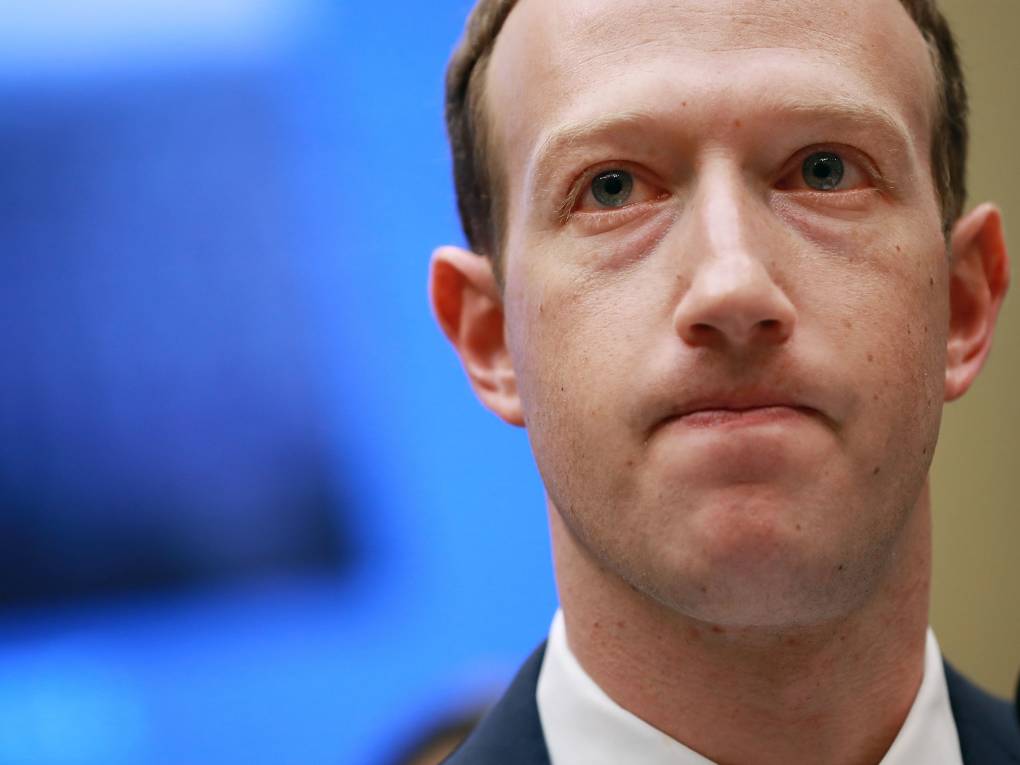
"caption": "Facebook CEO Mark Zuckerberg testifies on Capitol Hill in April 2018. A trove of insider documents known as the Facebook Papers has the company facing backlash over its effects on society and politics.",
"description": "WASHINGTON, DC - APRIL 11: Facebook co-founder, Chairman and CEO Mark Zuckerberg testifies before the House Energy and Commerce Committee in the Rayburn House Office Building on Capitol Hill April 11, 2018 in Washington, DC. This is the second day of testimony before Congress by Zuckerberg, 33, after it was reported that 87 million Facebook users had their personal information harvested by Cambridge Analytica, a British political consulting firm linked to the Trump campaign. (Photo by Chip Somodevilla/Getty Images)",
"title": "Facebook CEO Mark Zuckerberg testifies on Capitol Hill in April 2018. A trove of insider documents known as the Facebook Papers has the company facing backlash over its effects on society and politics.",
"credit": "Chip Somodevilla/Getty Images",
"status": "inherit",
"altTag": "A closeup of Mark Zuckerberg with his lips pressed together.",
"isLoading": false,
"fetchFailed": false
},
"news_11891131": {
"type": "attachments",
"id": "news_11891131",
"meta": {
"index": "attachments_1716263798",
"site": "news",
"id": "11891131",
"found": true
},
"parent": 11891116,
"imgSizes": {
"twentyfourteen-full-width": {
"file": "https://ww2.kqed.org/app/uploads/sites/10/2021/10/restart_100521_final-1038x576.png",
"width": 1038,
"mimeType": "image/png",
"height": 576
},
"thumbnail": {
"file": "https://ww2.kqed.org/app/uploads/sites/10/2021/10/restart_100521_final-160x113.png",
"width": 160,
"mimeType": "image/png",
"height": 113
},
"post-thumbnail": {
"file": "https://ww2.kqed.org/app/uploads/sites/10/2021/10/restart_100521_final-672x372.png",
"width": 672,
"mimeType": "image/png",
"height": 372
},
"kqedFullSize": {
"file": "https://ww2.kqed.org/app/uploads/sites/10/2021/10/restart_100521_final.png",
"width": 1920,
"height": 1350
},
"large": {
"file": "https://ww2.kqed.org/app/uploads/sites/10/2021/10/restart_100521_final-1020x717.png",
"width": 1020,
"mimeType": "image/png",
"height": 717
},
"1536x1536": {
"file": "https://ww2.kqed.org/app/uploads/sites/10/2021/10/restart_100521_final-1536x1080.png",
"width": 1536,
"mimeType": "image/png",
"height": 1080
},
"medium": {
"file": "https://ww2.kqed.org/app/uploads/sites/10/2021/10/restart_100521_final-800x563.png",
"width": 800,
"mimeType": "image/png",
"height": 563
}
},
"publishDate": 1633471984,
"modified": 1633475919,
"caption": null,
"description": null,
"title": "restart_100521_final",
"credit": null,
"status": "inherit",
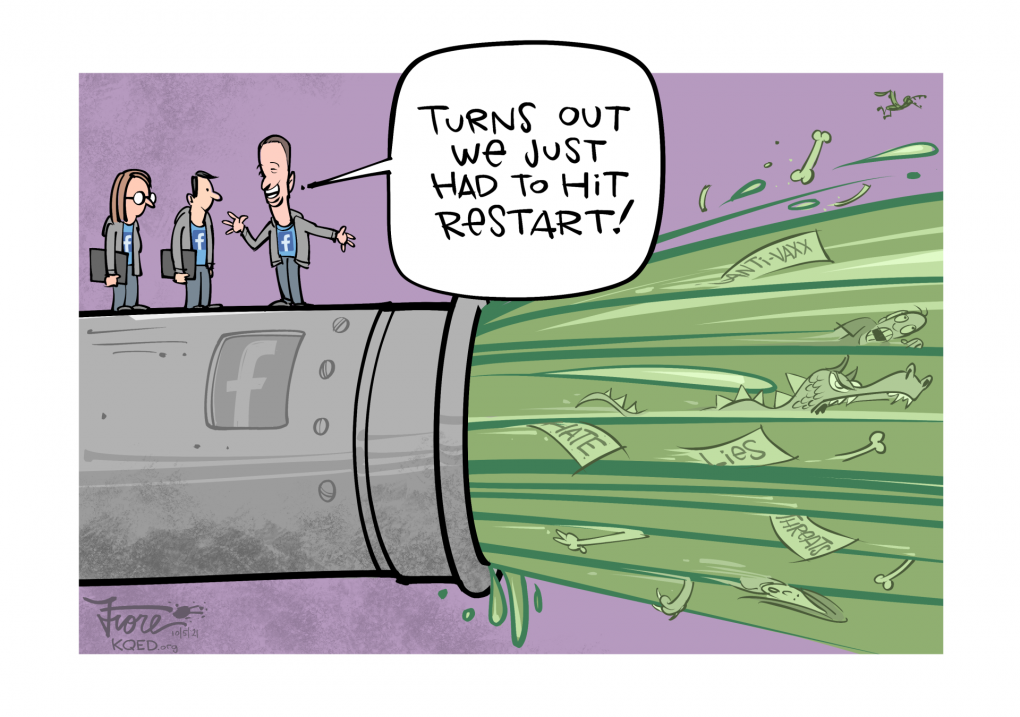
"altTag": "Cartoon: Facebook's Mark Zuckerberg and two workers stand on a sewer pipe spewing a mess as Zuckerberg says, \"turns out we just had to hit restart!\"",
"isLoading": false,
"fetchFailed": false
},
"news_11891077": {
"type": "attachments",
"id": "news_11891077",
"meta": {
"index": "attachments_1716263798",
"site": "news",
"id": "11891077",
"found": true
},
"parent": 11891063,
"imgSizes": {
"twentyfourteen-full-width": {
"file": "https://ww2.kqed.org/app/uploads/sites/10/2021/10/GettyImages-1235713578-1038x576.jpg",
"width": 1038,
"mimeType": "image/jpeg",
"height": 576
},
"thumbnail": {
"file": "https://ww2.kqed.org/app/uploads/sites/10/2021/10/GettyImages-1235713578-160x108.jpg",
"width": 160,
"mimeType": "image/jpeg",
"height": 108
},
"post-thumbnail": {
"file": "https://ww2.kqed.org/app/uploads/sites/10/2021/10/GettyImages-1235713578-672x372.jpg",
"width": 672,
"mimeType": "image/jpeg",
"height": 372
},
"kqedFullSize": {
"file": "https://ww2.kqed.org/app/uploads/sites/10/2021/10/GettyImages-1235713578-scaled.jpg",
"width": 2560,
"height": 1720
},
"2048x2048": {
"file": "https://ww2.kqed.org/app/uploads/sites/10/2021/10/GettyImages-1235713578-2048x1376.jpg",
"width": 2048,
"mimeType": "image/jpeg",
"height": 1376
},
"large": {
"file": "https://ww2.kqed.org/app/uploads/sites/10/2021/10/GettyImages-1235713578-1020x685.jpg",
"width": 1020,
"mimeType": "image/jpeg",
"height": 685
},
"1536x1536": {
"file": "https://ww2.kqed.org/app/uploads/sites/10/2021/10/GettyImages-1235713578-1536x1032.jpg",
"width": 1536,
"mimeType": "image/jpeg",
"height": 1032
},
"full-width": {
"file": "https://ww2.kqed.org/app/uploads/sites/10/2021/10/GettyImages-1235713578-1920x1290.jpg",
"width": 1920,
"mimeType": "image/jpeg",
"height": 1290
},
"medium": {
"file": "https://ww2.kqed.org/app/uploads/sites/10/2021/10/GettyImages-1235713578-800x538.jpg",
"width": 800,
"mimeType": "image/jpeg",
"height": 538
}
},
"publishDate": 1633460376,
"modified": 1633460486,
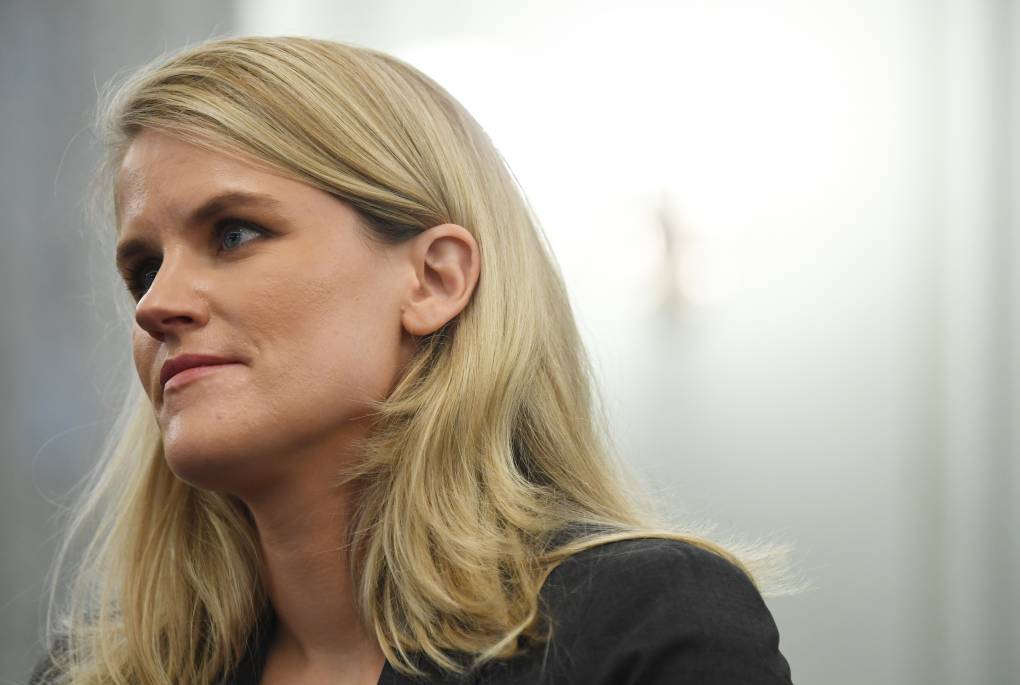
"caption": "Frances Haugen, former Facebook employee, appears before the Senate Commerce, Science, and Transportation Subcommittee during a hearing entitled 'Protecting Kids Online: Testimony from a Facebook Whistleblower' at the Russell Senate Office Building on October 05, 2021 in Washington, D.C.",
"description": "Frances Haugen, former Facebook employee, appears before the Senate Commerce, Science, and Transportation Subcommittee during a hearing entitled 'Protecting Kids Online: Testimony from a Facebook Whistleblower' at the Russell Senate Office Building on October 05, 2021 in Washington, D.C.",
"title": "Facebook Whistle Blower Frances Haugen Testifies To Senate Committee",
"credit": "Matt McClain-Pool/Getty Images",
"status": "inherit",
"altTag": "Close-up of Frances Haugen, who is looking away from the camera.",
"isLoading": false,
"fetchFailed": false
},
"news_11789507": {
"type": "attachments",
"id": "news_11789507",
"meta": {
"index": "attachments_1716263798",
"site": "news",
"id": "11789507",
"found": true
},
"title": "A close-up of a mobile phone screen, with app icons for Facebook, Instagram, WhatsApp, Snapchat, Facebook Messenger, and Twitter.",
"publishDate": 1575486209,
"status": "inherit",
"parent": 11789488,
"modified": 1786479738,
"caption": "California, Colorado, Kentucky and New Jersey argue Meta built features it knew would hook young users, and kept children under 13 on its platforms because they were valuable future customers, while claiming otherwise to parents and regulators. ",
"credit": "Chandan Khanna/AFP via Getty Images",
"altTag": null,
"description": "A photo taken on March 22, 2018, shows apps for Facebook, Instagram, Twitter and other social networks.",
"imgSizes": {
"thumbnail": {
"file": "https://cdn.kqed.org/wp-content/uploads/sites/10/2019/12/cellphone-1920-160x107.jpg",
"width": 160,
"height": 107,
"mimeType": "image/jpeg"
},
"medium": {
"file": "https://cdn.kqed.org/wp-content/uploads/sites/10/2019/12/cellphone-1920-800x534.jpg",
"width": 800,
"height": 534,
"mimeType": "image/jpeg"
},
"large": {
"file": "https://cdn.kqed.org/wp-content/uploads/sites/10/2019/12/cellphone-1920-1020x681.jpg",
"width": 1020,
"height": 681,
"mimeType": "image/jpeg"
},
"complete_open_graph": {
"file": "https://cdn.kqed.org/wp-content/uploads/sites/10/2019/12/cellphone-1920-1200x801.jpg",
"width": 1200,
"height": 801,
"mimeType": "image/jpeg"
},
"post-thumbnail": {
"file": "https://cdn.kqed.org/wp-content/uploads/sites/10/2019/12/cellphone-1920-672x372.jpg",
"width": 672,
"height": 372,
"mimeType": "image/jpeg"
},
"twentyfourteen-full-width": {
"file": "https://cdn.kqed.org/wp-content/uploads/sites/10/2019/12/cellphone-1920-1038x576.jpg",
"width": 1038,
"height": 576,
"mimeType": "image/jpeg"
},
"full-width": {
"file": "https://cdn.kqed.org/wp-content/uploads/sites/10/2019/12/cellphone-1920-1920x1281.jpg",
"width": 1920,
"height": 1281,
"mimeType": "image/jpeg"
},
"apple_news_ca_landscape_12_9": {
"file": "https://cdn.kqed.org/wp-content/uploads/sites/10/2019/12/cellphone-1920-1832x1281.jpg",
"width": 1832,
"height": 1281,
"mimeType": "image/jpeg"
},
"apple_news_ca_landscape_9_7": {
"file": "https://cdn.kqed.org/wp-content/uploads/sites/10/2019/12/cellphone-1920-1376x1032.jpg",
"width": 1376,
"height": 1032,
"mimeType": "image/jpeg"
},
"apple_news_ca_landscape_5_5": {
"file": "https://cdn.kqed.org/wp-content/uploads/sites/10/2019/12/cellphone-1920-1044x783.jpg",
"width": 1044,
"height": 783,
"mimeType": "image/jpeg"
},
"apple_news_ca_landscape_4_7": {
"file": "https://cdn.kqed.org/wp-content/uploads/sites/10/2019/12/cellphone-1920-632x474.jpg",
"width": 632,
"height": 474,
"mimeType": "image/jpeg"
},
"apple_news_ca_landscape_4_0": {
"file": "https://cdn.kqed.org/wp-content/uploads/sites/10/2019/12/cellphone-1920-536x402.jpg",
"width": 536,
"height": 402,
"mimeType": "image/jpeg"
},
"apple_news_ca_portrait_12_9": {
"file": "https://cdn.kqed.org/wp-content/uploads/sites/10/2019/12/cellphone-1920-1122x1281.jpg",
"width": 1122,
"height": 1281,
"mimeType": "image/jpeg"
},
"apple_news_ca_portrait_9_7": {
"file": "https://cdn.kqed.org/wp-content/uploads/sites/10/2019/12/cellphone-1920-840x1120.jpg",
"width": 840,
"height": 1120,
"mimeType": "image/jpeg"
},
"apple_news_ca_portrait_5_5": {
"file": "https://cdn.kqed.org/wp-content/uploads/sites/10/2019/12/cellphone-1920-687x916.jpg",
"width": 687,
"height": 916,
"mimeType": "image/jpeg"
},
"apple_news_ca_portrait_4_7": {
"file": "https://cdn.kqed.org/wp-content/uploads/sites/10/2019/12/cellphone-1920-414x552.jpg",
"width": 414,
"height": 552,
"mimeType": "image/jpeg"
},
"apple_news_ca_portrait_4_0": {
"file": "https://cdn.kqed.org/wp-content/uploads/sites/10/2019/12/cellphone-1920-354x472.jpg",
"width": 354,
"height": 472,
"mimeType": "image/jpeg"
},
"apple_news_ca_square_12_9": {
"file": "https://cdn.kqed.org/wp-content/uploads/sites/10/2019/12/cellphone-1920-1472x1281.jpg",
"width": 1472,
"height": 1281,
"mimeType": "image/jpeg"
},
"apple_news_ca_square_9_7": {
"file": "https://cdn.kqed.org/wp-content/uploads/sites/10/2019/12/cellphone-1920-1104x1104.jpg",
"width": 1104,
"height": 1104,
"mimeType": "image/jpeg"
},
"apple_news_ca_square_5_5": {
"file": "https://cdn.kqed.org/wp-content/uploads/sites/10/2019/12/cellphone-1920-912x912.jpg",
"width": 912,
"height": 912,
"mimeType": "image/jpeg"
},
"apple_news_ca_square_4_7": {
"file": "https://cdn.kqed.org/wp-content/uploads/sites/10/2019/12/cellphone-1920-550x550.jpg",
"width": 550,
"height": 550,
"mimeType": "image/jpeg"
},
"apple_news_ca_square_4_0": {
"file": "https://cdn.kqed.org/wp-content/uploads/sites/10/2019/12/cellphone-1920-470x470.jpg",
"width": 470,
"height": 470,
"mimeType": "image/jpeg"
},
"kqedFullSize": {
"file": "https://cdn.kqed.org/wp-content/uploads/sites/10/2019/12/cellphone-1920.jpg",
"width": 1920,
"height": 1281
}
},
"isLoading": false,
"fetchFailed": false
},
"news_11890953": {
"type": "attachments",
"id": "news_11890953",
"meta": {
"index": "attachments_1716263798",
"site": "news",
"id": "11890953",
"found": true
},
"parent": 11890948,
"imgSizes": {
"twentyfourteen-full-width": {
"file": "https://ww2.kqed.org/app/uploads/sites/10/2021/10/GettyImages-1344804031-1024x576.jpg",
"width": 1024,
"mimeType": "image/jpeg",
"height": 576
},
"thumbnail": {
"file": "https://ww2.kqed.org/app/uploads/sites/10/2021/10/GettyImages-1344804031-160x110.jpg",
"width": 160,
"mimeType": "image/jpeg",
"height": 110
},
"post-thumbnail": {
"file": "https://ww2.kqed.org/app/uploads/sites/10/2021/10/GettyImages-1344804031-672x372.jpg",
"width": 672,
"mimeType": "image/jpeg",
"height": 372
},
"kqedFullSize": {
"file": "https://ww2.kqed.org/app/uploads/sites/10/2021/10/GettyImages-1344804031.jpg",
"width": 1024,
"height": 705
},
"large": {
"file": "https://ww2.kqed.org/app/uploads/sites/10/2021/10/GettyImages-1344804031-1020x702.jpg",
"width": 1020,
"mimeType": "image/jpeg",
"height": 702
},
"medium": {
"file": "https://ww2.kqed.org/app/uploads/sites/10/2021/10/GettyImages-1344804031-800x551.jpg",
"width": 800,
"mimeType": "image/jpeg",
"height": 551
}
},
"publishDate": 1633381485,
"modified": 1633455158,
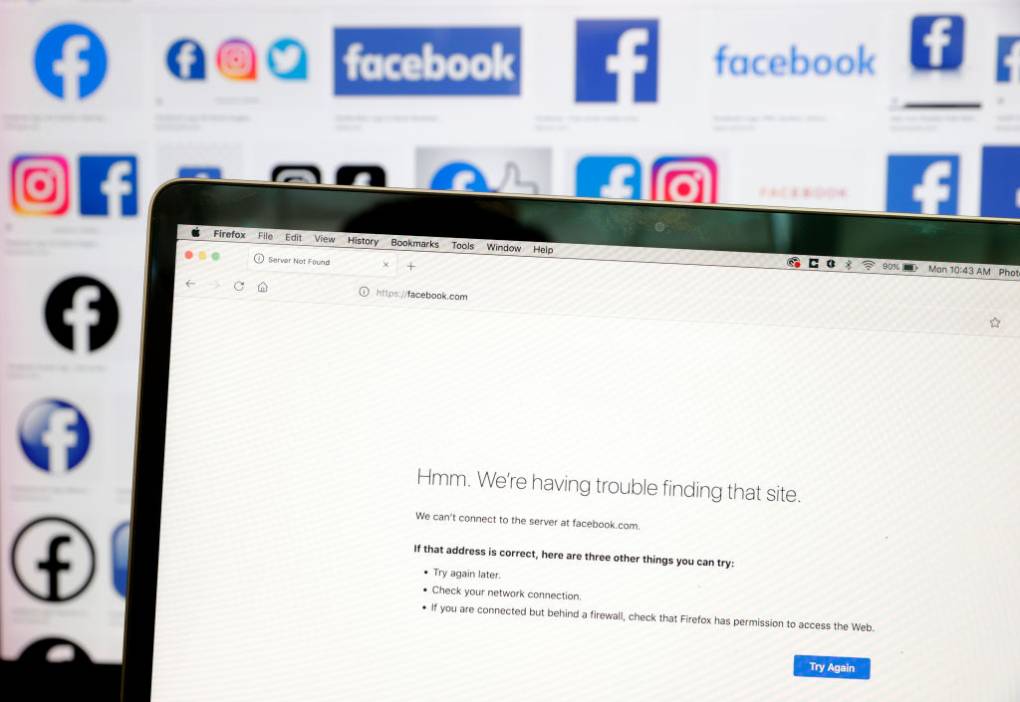
"caption": "Facebook's logo displayed on Oct. 4, 2021, next to a screen showing that the social media site is temporarily down.",
"description": null,
"title": "Facebook,Instagram And WhatsApp Experience Global Outage",
"credit": "Justin Sullivan/Getty Images",
"status": "inherit",
"altTag": null,
"isLoading": false,
"fetchFailed": false
},
"news_11889355": {
"type": "attachments",
"id": "news_11889355",
"meta": {
"index": "attachments_1716263798",
"site": "news",
"id": "11889355",
"found": true
},
"parent": 11889347,
"imgSizes": {
"twentyfourteen-full-width": {
"file": "https://ww2.kqed.org/app/uploads/sites/10/2021/09/RS51554_GettyImages-1235407516-qut-1038x576.jpg",
"width": 1038,
"mimeType": "image/jpeg",
"height": 576
},
"thumbnail": {
"file": "https://ww2.kqed.org/app/uploads/sites/10/2021/09/RS51554_GettyImages-1235407516-qut-160x107.jpg",
"width": 160,
"mimeType": "image/jpeg",
"height": 107
},
"post-thumbnail": {
"file": "https://ww2.kqed.org/app/uploads/sites/10/2021/09/RS51554_GettyImages-1235407516-qut-672x372.jpg",
"width": 672,
"mimeType": "image/jpeg",
"height": 372
},
"kqedFullSize": {
"file": "https://ww2.kqed.org/app/uploads/sites/10/2021/09/RS51554_GettyImages-1235407516-qut.jpg",
"width": 1920,
"height": 1280
},
"large": {
"file": "https://ww2.kqed.org/app/uploads/sites/10/2021/09/RS51554_GettyImages-1235407516-qut-1020x680.jpg",
"width": 1020,
"mimeType": "image/jpeg",
"height": 680
},
"1536x1536": {
"file": "https://ww2.kqed.org/app/uploads/sites/10/2021/09/RS51554_GettyImages-1235407516-qut-1536x1024.jpg",
"width": 1536,
"mimeType": "image/jpeg",
"height": 1024
},
"medium": {
"file": "https://ww2.kqed.org/app/uploads/sites/10/2021/09/RS51554_GettyImages-1235407516-qut-800x533.jpg",
"width": 800,
"mimeType": "image/jpeg",
"height": 533
}
},
"publishDate": 1632273095,
"modified": 1632334456,
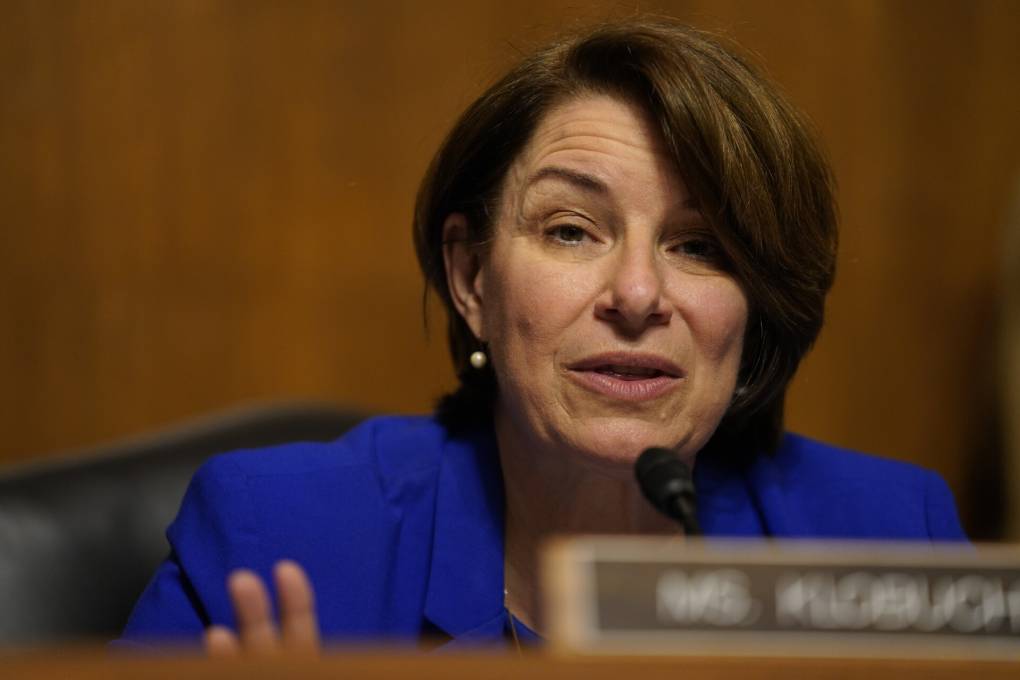
"caption": "Sen. Amy Klobuchar (D-Minn.), chair of the Senate Judiciary Subcommittee on Competition Policy, Antitrust, and Consumer Rights, led a hearing on Sept. 21, 2021 in Washington, D.C. The hearing was titled Big Data, Big Questions: Implications for Competition and Consumers.",
"description": "Sen. Amy Klobuchar (D-Minn.), chair of the Senate Judiciary Subcommittee on Competition Policy, Antitrust, and Consumer Rights, led a hearing on Sept. 21, 2021 in Washington, D.C. The hearing was titled Big Data, Big Questions: Implications for Competition and Consumers.",
"title": "Senate Judiciary Hears Testimony From Tech Executives On Competition For Consumers",
"credit": "Ting Shen-Pool/Getty Images",
"status": "inherit",
"altTag": "Sen. Amy Klobuchar (D-MI) and chair of the Senate Judiciary Subcommittee on Competition Policy, Antitrust, and Consumer Rights, chaired a hearing on September 21, 2021 in Washington, D.C. The hearing was titled Big Data, Big Questions: Implications for Competition and Consumers.",
"isLoading": false,
"fetchFailed": false
},
"news_11882688": {
"type": "attachments",
"id": "news_11882688",
"meta": {
"index": "attachments_1716263798",
"site": "news",
"id": "11882688",
"found": true
},
"parent": 11882577,
"imgSizes": {
"twentyfourteen-full-width": {
"file": "https://ww2.kqed.org/app/uploads/sites/10/2021/07/GNma2FZU-1038x576.jpeg",
"width": 1038,
"mimeType": "image/jpeg",
"height": 576
},
"thumbnail": {
"file": "https://ww2.kqed.org/app/uploads/sites/10/2021/07/GNma2FZU-160x107.jpeg",
"width": 160,
"mimeType": "image/jpeg",
"height": 107
},
"post-thumbnail": {
"file": "https://ww2.kqed.org/app/uploads/sites/10/2021/07/GNma2FZU-672x372.jpeg",
"width": 672,
"mimeType": "image/jpeg",
"height": 372
},
"kqedFullSize": {
"file": "https://ww2.kqed.org/app/uploads/sites/10/2021/07/GNma2FZU.jpeg",
"width": 1200,
"height": 800
},
"large": {
"file": "https://ww2.kqed.org/app/uploads/sites/10/2021/07/GNma2FZU-1020x680.jpeg",
"width": 1020,
"mimeType": "image/jpeg",
"height": 680
},
"medium": {
"file": "https://ww2.kqed.org/app/uploads/sites/10/2021/07/GNma2FZU-800x533.jpeg",
"width": 800,
"mimeType": "image/jpeg",
"height": 533
}
},
"publishDate": 1627426381,
"modified": 1627426480,
"caption": "The South Bay shoreline.",
"description": null,
"title": "GNma2FZU",
"credit": "NPR",
"status": "inherit",
"altTag": null,
"isLoading": false,
"fetchFailed": false
},
"news_11843542": {
"type": "attachments",
"id": "news_11843542",
"meta": {
"index": "attachments_1716263798",
"site": "news",
"id": "11843542",
"found": true
},
"parent": 11841767,
"imgSizes": {
"apple_news_ca_landscape_5_5": {
"file": "https://ww2.kqed.org/app/uploads/sites/10/2020/10/RS43436_026_KQED_Oakland_GeorgeFloydProtest_05292020-qut-1044x783.jpg",
"width": 1044,
"mimeType": "image/jpeg",
"height": 783
},
"apple_news_ca_square_4_0": {
"file": "https://ww2.kqed.org/app/uploads/sites/10/2020/10/RS43436_026_KQED_Oakland_GeorgeFloydProtest_05292020-qut-470x470.jpg",
"width": 470,
"mimeType": "image/jpeg",
"height": 470
},
"twentyfourteen-full-width": {
"file": "https://ww2.kqed.org/app/uploads/sites/10/2020/10/RS43436_026_KQED_Oakland_GeorgeFloydProtest_05292020-qut-1038x576.jpg",
"width": 1038,
"mimeType": "image/jpeg",
"height": 576
},
"thumbnail": {
"file": "https://ww2.kqed.org/app/uploads/sites/10/2020/10/RS43436_026_KQED_Oakland_GeorgeFloydProtest_05292020-qut-160x107.jpg",
"width": 160,
"mimeType": "image/jpeg",
"height": 107
},
"post-thumbnail": {
"file": "https://ww2.kqed.org/app/uploads/sites/10/2020/10/RS43436_026_KQED_Oakland_GeorgeFloydProtest_05292020-qut-672x372.jpg",
"width": 672,
"mimeType": "image/jpeg",
"height": 372
},
"kqedFullSize": {
"file": "https://ww2.kqed.org/app/uploads/sites/10/2020/10/RS43436_026_KQED_Oakland_GeorgeFloydProtest_05292020-qut.jpg",
"width": 1920,
"height": 1280
},
"apple_news_ca_landscape_4_7": {
"file": "https://ww2.kqed.org/app/uploads/sites/10/2020/10/RS43436_026_KQED_Oakland_GeorgeFloydProtest_05292020-qut-632x474.jpg",
"width": 632,
"mimeType": "image/jpeg",
"height": 474
},
"large": {
"file": "https://ww2.kqed.org/app/uploads/sites/10/2020/10/RS43436_026_KQED_Oakland_GeorgeFloydProtest_05292020-qut-1020x680.jpg",
"width": 1020,
"mimeType": "image/jpeg",
"height": 680
},
"apple_news_ca_landscape_4_0": {
"file": "https://ww2.kqed.org/app/uploads/sites/10/2020/10/RS43436_026_KQED_Oakland_GeorgeFloydProtest_05292020-qut-536x402.jpg",
"width": 536,
"mimeType": "image/jpeg",
"height": 402
},
"apple_news_ca_portrait_12_9": {
"file": "https://ww2.kqed.org/app/uploads/sites/10/2020/10/RS43436_026_KQED_Oakland_GeorgeFloydProtest_05292020-qut-1122x1280.jpg",
"width": 1122,
"mimeType": "image/jpeg",
"height": 1280
},
"medium": {
"file": "https://ww2.kqed.org/app/uploads/sites/10/2020/10/RS43436_026_KQED_Oakland_GeorgeFloydProtest_05292020-qut-800x533.jpg",
"width": 800,
"mimeType": "image/jpeg",
"height": 533
},
"apple_news_ca_portrait_4_0": {
"file": "https://ww2.kqed.org/app/uploads/sites/10/2020/10/RS43436_026_KQED_Oakland_GeorgeFloydProtest_05292020-qut-354x472.jpg",
"width": 354,
"mimeType": "image/jpeg",
"height": 472
},
"apple_news_ca_portrait_9_7": {
"file": "https://ww2.kqed.org/app/uploads/sites/10/2020/10/RS43436_026_KQED_Oakland_GeorgeFloydProtest_05292020-qut-840x1120.jpg",
"width": 840,
"mimeType": "image/jpeg",
"height": 1120
},
"apple_news_ca_landscape_12_9": {
"file": "https://ww2.kqed.org/app/uploads/sites/10/2020/10/RS43436_026_KQED_Oakland_GeorgeFloydProtest_05292020-qut-1832x1280.jpg",
"width": 1832,
"mimeType": "image/jpeg",
"height": 1280
},
"apple_news_ca_square_9_7": {
"file": "https://ww2.kqed.org/app/uploads/sites/10/2020/10/RS43436_026_KQED_Oakland_GeorgeFloydProtest_05292020-qut-1104x1104.jpg",
"width": 1104,
"mimeType": "image/jpeg",
"height": 1104
},
"1536x1536": {
"file": "https://ww2.kqed.org/app/uploads/sites/10/2020/10/RS43436_026_KQED_Oakland_GeorgeFloydProtest_05292020-qut-1536x1024.jpg",
"width": 1536,
"mimeType": "image/jpeg",
"height": 1024
},
"apple_news_ca_portrait_4_7": {
"file": "https://ww2.kqed.org/app/uploads/sites/10/2020/10/RS43436_026_KQED_Oakland_GeorgeFloydProtest_05292020-qut-414x552.jpg",
"width": 414,
"mimeType": "image/jpeg",
"height": 552
},
"apple_news_ca_square_12_9": {
"file": "https://ww2.kqed.org/app/uploads/sites/10/2020/10/RS43436_026_KQED_Oakland_GeorgeFloydProtest_05292020-qut-1472x1280.jpg",
"width": 1472,
"mimeType": "image/jpeg",
"height": 1280
},
"apple_news_ca_portrait_5_5": {
"file": "https://ww2.kqed.org/app/uploads/sites/10/2020/10/RS43436_026_KQED_Oakland_GeorgeFloydProtest_05292020-qut-687x916.jpg",
"width": 687,
"mimeType": "image/jpeg",
"height": 916
},
"apple_news_ca_square_4_7": {
"file": "https://ww2.kqed.org/app/uploads/sites/10/2020/10/RS43436_026_KQED_Oakland_GeorgeFloydProtest_05292020-qut-550x550.jpg",
"width": 550,
"mimeType": "image/jpeg",
"height": 550
},
"apple_news_ca_landscape_9_7": {
"file": "https://ww2.kqed.org/app/uploads/sites/10/2020/10/RS43436_026_KQED_Oakland_GeorgeFloydProtest_05292020-qut-1376x1032.jpg",
"width": 1376,
"mimeType": "image/jpeg",
"height": 1032
},
"apple_news_ca_square_5_5": {
"file": "https://ww2.kqed.org/app/uploads/sites/10/2020/10/RS43436_026_KQED_Oakland_GeorgeFloydProtest_05292020-qut-912x912.jpg",
"width": 912,
"mimeType": "image/jpeg",
"height": 912
}
},
"publishDate": 1603489217,
"modified": 1603489413,
"caption": "Demonstrators face a police line on May 29, 2020 in Oakland during protests following the police killing of George Floyd in Minneapolis.",
"description": "Demonstrators face a police line on May 29, 2020 in Oakland during protests following the police killing of George Floyd in Minneapolis.",
"title": "RS43436_026_KQED_Oakland_GeorgeFloydProtest_05292020-qut",
"credit": "Beth LaBerge/KQED",
"status": "inherit",
"isLoading": false,
"fetchFailed": false
},
"news_11866401": {
"type": "attachments",
"id": "news_11866401",
"meta": {
"index": "attachments_1716263798",
"site": "news",
"id": "11866401",
"found": true
},
"parent": 11866331,
"imgSizes": {
"twentyfourteen-full-width": {
"file": "https://ww2.kqed.org/app/uploads/sites/10/2021/03/GettyImages-1230040552-1038x576.jpg",
"width": 1038,
"mimeType": "image/jpeg",
"height": 576
},
"thumbnail": {
"file": "https://ww2.kqed.org/app/uploads/sites/10/2021/03/GettyImages-1230040552-160x107.jpg",
"width": 160,
"mimeType": "image/jpeg",
"height": 107
},
"post-thumbnail": {
"file": "https://ww2.kqed.org/app/uploads/sites/10/2021/03/GettyImages-1230040552-672x372.jpg",
"width": 672,
"mimeType": "image/jpeg",
"height": 372
},
"kqedFullSize": {
"file": "https://ww2.kqed.org/app/uploads/sites/10/2021/03/GettyImages-1230040552-scaled.jpg",
"width": 2560,
"height": 1707
},
"2048x2048": {
"file": "https://ww2.kqed.org/app/uploads/sites/10/2021/03/GettyImages-1230040552-2048x1365.jpg",
"width": 2048,
"mimeType": "image/jpeg",
"height": 1365
},
"large": {
"file": "https://ww2.kqed.org/app/uploads/sites/10/2021/03/GettyImages-1230040552-1020x680.jpg",
"width": 1020,
"mimeType": "image/jpeg",
"height": 680
},
"1536x1536": {
"file": "https://ww2.kqed.org/app/uploads/sites/10/2021/03/GettyImages-1230040552-1536x1024.jpg",
"width": 1536,
"mimeType": "image/jpeg",
"height": 1024
},
"full-width": {
"file": "https://ww2.kqed.org/app/uploads/sites/10/2021/03/GettyImages-1230040552-1920x1280.jpg",
"width": 1920,
"mimeType": "image/jpeg",
"height": 1280
},
"medium": {
"file": "https://ww2.kqed.org/app/uploads/sites/10/2021/03/GettyImages-1230040552-800x533.jpg",
"width": 800,
"mimeType": "image/jpeg",
"height": 533
}
},
"publishDate": 1616684110,
"modified": 1616712868,
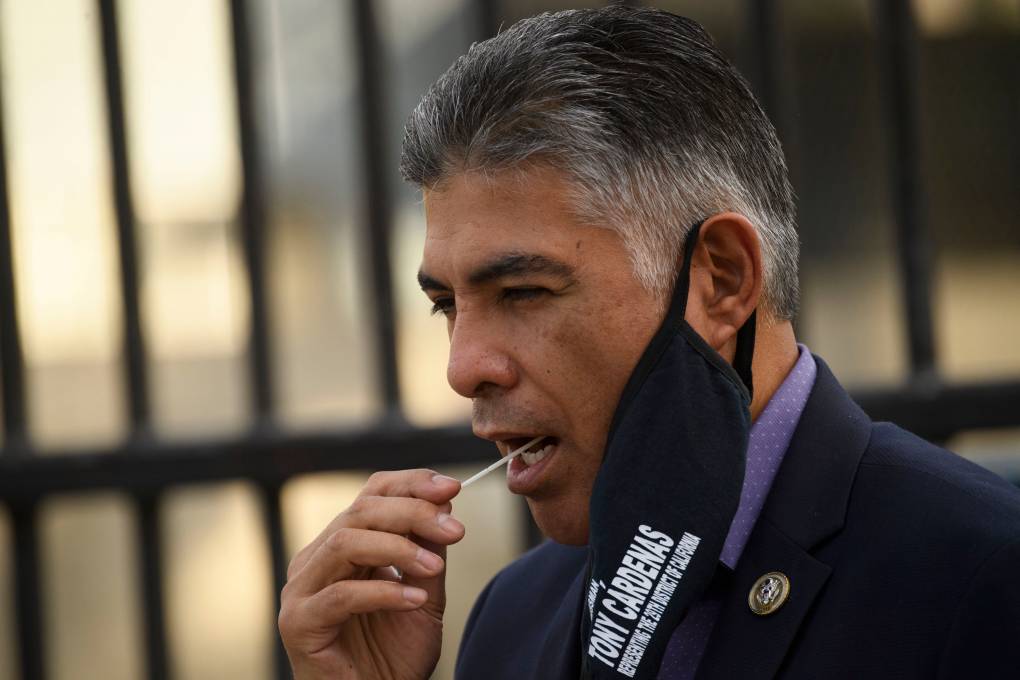
"caption": "U.S. Rep. Tony Cárdenas, D-Los Angeles, takes a COVID-19 oral swab test at a pop-up community testing site in Panorama City on Dec. 9, 2020. Cárdenas is leading calls for social media companies to do a better job of screening misinformation in Spanish and other languages.",
"description": "US Rep. Tony Cardenas takes a Covid-19 oral swab test at a pop-up community testing site in Panorama City on December 9, 2020. Cardenas is leading calls for social media companies to do a better job of screening misinformation in Spanish.",
"title": "US-VIRUS-HEALTH",
"credit": "Patrick T. Fallon/AFP via Getty Images",
"status": "inherit",
"altTag": "US Rep. Tony Cardenas takes a Covid-19 oral swab test at a pop-up community testing site in Panorama City on December 9, 2020. Cardenas is leading calls for social media companies to do a better job of screening misinformation in Spanish.",
"isLoading": false,
"fetchFailed": false
},
"news_11855410": {
"type": "attachments",
"id": "news_11855410",
"meta": {
"index": "attachments_1716263798",
"site": "news",
"id": "11855410",
"found": true
},
"parent": 11855408,
"imgSizes": {
"apple_news_ca_square_4_0": {
"file": "https://ww2.kqed.org/app/uploads/sites/10/2021/01/GettyImages-1215626690-470x470.jpg",
"width": 470,
"mimeType": "image/jpeg",
"height": 470
},
"twentyfourteen-full-width": {
"file": "https://ww2.kqed.org/app/uploads/sites/10/2021/01/GettyImages-1215626690-1024x576.jpg",
"width": 1024,
"mimeType": "image/jpeg",
"height": 576
},
"thumbnail": {
"file": "https://ww2.kqed.org/app/uploads/sites/10/2021/01/GettyImages-1215626690-160x109.jpg",
"width": 160,
"mimeType": "image/jpeg",
"height": 109
},
"post-thumbnail": {
"file": "https://ww2.kqed.org/app/uploads/sites/10/2021/01/GettyImages-1215626690-672x372.jpg",
"width": 672,
"mimeType": "image/jpeg",
"height": 372
},
"kqedFullSize": {
"file": "https://ww2.kqed.org/app/uploads/sites/10/2021/01/GettyImages-1215626690.jpg",
"width": 1024,
"height": 695
},
"apple_news_ca_landscape_4_7": {
"file": "https://ww2.kqed.org/app/uploads/sites/10/2021/01/GettyImages-1215626690-632x474.jpg",
"width": 632,
"mimeType": "image/jpeg",
"height": 474
},
"large": {
"file": "https://ww2.kqed.org/app/uploads/sites/10/2021/01/GettyImages-1215626690-1020x692.jpg",
"width": 1020,
"mimeType": "image/jpeg",
"height": 692
},
"apple_news_ca_landscape_4_0": {
"file": "https://ww2.kqed.org/app/uploads/sites/10/2021/01/GettyImages-1215626690-536x402.jpg",
"width": 536,
"mimeType": "image/jpeg",
"height": 402
},
"medium": {
"file": "https://ww2.kqed.org/app/uploads/sites/10/2021/01/GettyImages-1215626690-800x543.jpg",
"width": 800,
"mimeType": "image/jpeg",
"height": 543
},
"apple_news_ca_portrait_4_0": {
"file": "https://ww2.kqed.org/app/uploads/sites/10/2021/01/GettyImages-1215626690-354x472.jpg",
"width": 354,
"mimeType": "image/jpeg",
"height": 472
},
"apple_news_ca_portrait_9_7": {
"file": "https://ww2.kqed.org/app/uploads/sites/10/2021/01/GettyImages-1215626690-840x695.jpg",
"width": 840,
"mimeType": "image/jpeg",
"height": 695
},
"apple_news_ca_portrait_4_7": {
"file": "https://ww2.kqed.org/app/uploads/sites/10/2021/01/GettyImages-1215626690-414x552.jpg",
"width": 414,
"mimeType": "image/jpeg",
"height": 552
},
"apple_news_ca_portrait_5_5": {
"file": "https://ww2.kqed.org/app/uploads/sites/10/2021/01/GettyImages-1215626690-687x695.jpg",
"width": 687,
"mimeType": "image/jpeg",
"height": 695
},
"apple_news_ca_square_4_7": {
"file": "https://ww2.kqed.org/app/uploads/sites/10/2021/01/GettyImages-1215626690-550x550.jpg",
"width": 550,
"mimeType": "image/jpeg",
"height": 550
},
"apple_news_ca_square_5_5": {
"file": "https://ww2.kqed.org/app/uploads/sites/10/2021/01/GettyImages-1215626690-912x695.jpg",
"width": 912,
"mimeType": "image/jpeg",
"height": 695
}
},
"publishDate": 1610657882,
"modified": 1610657882,
"caption": "In this photo illustration, a Twitter logo is displayed on a mobile phone with President Trump's Twitter page shown in the background on May 27, 2020, in Arlington, Virginia. - US President Donald Trump threatened Wednesday to shutter social media platforms after Twitter for the first time acted against his false tweets, prompting the enraged Republican to double down on unsubstantiated claims and conspiracy theories. Twitter tagged two of Trump's tweets in which he claimed that more mail-in voting would lead to what he called a \"Rigged Election\" this November. (Photo by Olivier DOULIERY / AFP) (Photo by OLIVIER DOULIERY/AFP via Getty Images)",
"description": null,
"title": "US-POLITICS-TRUMP]-TWITTER",
"credit": null,
"status": "inherit",
"altTag": null,
"isLoading": false,
"fetchFailed": false
},
"news_11854286": {
"type": "attachments",
"id": "news_11854286",
"meta": {
"index": "attachments_1716263798",
"site": "news",
"id": "11854286",
"found": true
},
"parent": 11854273,
"imgSizes": {
"apple_news_ca_landscape_5_5": {
"file": "https://ww2.kqed.org/app/uploads/sites/10/2021/01/things_010721_final-1044x783.png",
"width": 1044,
"mimeType": "image/png",
"height": 783
},
"apple_news_ca_square_4_0": {
"file": "https://ww2.kqed.org/app/uploads/sites/10/2021/01/things_010721_final-470x470.png",
"width": 470,
"mimeType": "image/png",
"height": 470
},
"twentyfourteen-full-width": {
"file": "https://ww2.kqed.org/app/uploads/sites/10/2021/01/things_010721_final-1038x576.png",
"width": 1038,
"mimeType": "image/png",
"height": 576
},
"thumbnail": {
"file": "https://ww2.kqed.org/app/uploads/sites/10/2021/01/things_010721_final-160x102.png",
"width": 160,
"mimeType": "image/png",
"height": 102
},
"post-thumbnail": {
"file": "https://ww2.kqed.org/app/uploads/sites/10/2021/01/things_010721_final-672x372.png",
"width": 672,
"mimeType": "image/png",
"height": 372
},
"kqedFullSize": {
"file": "https://ww2.kqed.org/app/uploads/sites/10/2021/01/things_010721_final.png",
"width": 1920,
"height": 1229
},
"apple_news_ca_landscape_4_7": {
"file": "https://ww2.kqed.org/app/uploads/sites/10/2021/01/things_010721_final-632x474.png",
"width": 632,
"mimeType": "image/png",
"height": 474
},
"large": {
"file": "https://ww2.kqed.org/app/uploads/sites/10/2021/01/things_010721_final-1020x653.png",
"width": 1020,
"mimeType": "image/png",
"height": 653
},
"apple_news_ca_landscape_4_0": {
"file": "https://ww2.kqed.org/app/uploads/sites/10/2021/01/things_010721_final-536x402.png",
"width": 536,
"mimeType": "image/png",
"height": 402
},
"apple_news_ca_portrait_12_9": {
"file": "https://ww2.kqed.org/app/uploads/sites/10/2021/01/things_010721_final-1122x1229.png",
"width": 1122,
"mimeType": "image/png",
"height": 1229
},
"medium": {
"file": "https://ww2.kqed.org/app/uploads/sites/10/2021/01/things_010721_final-800x512.png",
"width": 800,
"mimeType": "image/png",
"height": 512
},
"apple_news_ca_portrait_4_0": {
"file": "https://ww2.kqed.org/app/uploads/sites/10/2021/01/things_010721_final-354x472.png",
"width": 354,
"mimeType": "image/png",
"height": 472
},
"apple_news_ca_portrait_9_7": {
"file": "https://ww2.kqed.org/app/uploads/sites/10/2021/01/things_010721_final-840x1120.png",
"width": 840,
"mimeType": "image/png",
"height": 1120
},
"apple_news_ca_landscape_12_9": {
"file": "https://ww2.kqed.org/app/uploads/sites/10/2021/01/things_010721_final-1832x1229.png",
"width": 1832,
"mimeType": "image/png",
"height": 1229
},
"apple_news_ca_square_9_7": {
"file": "https://ww2.kqed.org/app/uploads/sites/10/2021/01/things_010721_final-1104x1104.png",
"width": 1104,
"mimeType": "image/png",
"height": 1104
},
"1536x1536": {
"file": "https://ww2.kqed.org/app/uploads/sites/10/2021/01/things_010721_final-1536x983.png",
"width": 1536,
"mimeType": "image/png",
"height": 983
},
"apple_news_ca_portrait_4_7": {
"file": "https://ww2.kqed.org/app/uploads/sites/10/2021/01/things_010721_final-414x552.png",
"width": 414,
"mimeType": "image/png",
"height": 552
},
"apple_news_ca_square_12_9": {
"file": "https://ww2.kqed.org/app/uploads/sites/10/2021/01/things_010721_final-1472x1229.png",
"width": 1472,
"mimeType": "image/png",
"height": 1229
},
"apple_news_ca_portrait_5_5": {
"file": "https://ww2.kqed.org/app/uploads/sites/10/2021/01/things_010721_final-687x916.png",
"width": 687,
"mimeType": "image/png",
"height": 916
},
"apple_news_ca_square_4_7": {
"file": "https://ww2.kqed.org/app/uploads/sites/10/2021/01/things_010721_final-550x550.png",
"width": 550,
"mimeType": "image/png",
"height": 550
},
"apple_news_ca_landscape_9_7": {
"file": "https://ww2.kqed.org/app/uploads/sites/10/2021/01/things_010721_final-1376x1032.png",
"width": 1376,
"mimeType": "image/png",
"height": 1032
},
"apple_news_ca_square_5_5": {
"file": "https://ww2.kqed.org/app/uploads/sites/10/2021/01/things_010721_final-912x912.png",
"width": 912,
"mimeType": "image/png",
"height": 912
}
},
"publishDate": 1610063463,
"modified": 1610063554,
"caption": null,
"description": null,
"title": "things_010721_final",
"credit": null,
"status": "inherit",
"altTag": "A Mark Fiore cartoon showing social media that Trump is blocked from using versus all the levers of power he can still use as president.",
"isLoading": false,
"fetchFailed": false
},
"news_11852071": {
"type": "attachments",
"id": "news_11852071",
"meta": {
"index": "attachments_1716263798",
"site": "news",
"id": "11852071",
"found": true
},
"parent": 11851695,
"imgSizes": {
"apple_news_ca_landscape_5_5": {
"file": "https://ww2.kqed.org/app/uploads/sites/10/2020/12/RS46438_pexels-kaboompics-com-6111-qut-1044x783.jpg",
"width": 1044,
"mimeType": "image/jpeg",
"height": 783
},
"apple_news_ca_square_4_0": {
"file": "https://ww2.kqed.org/app/uploads/sites/10/2020/12/RS46438_pexels-kaboompics-com-6111-qut-470x470.jpg",
"width": 470,
"mimeType": "image/jpeg",
"height": 470
},
"twentyfourteen-full-width": {
"file": "https://ww2.kqed.org/app/uploads/sites/10/2020/12/RS46438_pexels-kaboompics-com-6111-qut-1038x576.jpg",
"width": 1038,
"mimeType": "image/jpeg",
"height": 576
},
"thumbnail": {
"file": "https://ww2.kqed.org/app/uploads/sites/10/2020/12/RS46438_pexels-kaboompics-com-6111-qut-160x107.jpg",
"width": 160,
"mimeType": "image/jpeg",
"height": 107
},
"post-thumbnail": {
"file": "https://ww2.kqed.org/app/uploads/sites/10/2020/12/RS46438_pexels-kaboompics-com-6111-qut-672x372.jpg",
"width": 672,
"mimeType": "image/jpeg",
"height": 372
},
"kqedFullSize": {
"file": "https://ww2.kqed.org/app/uploads/sites/10/2020/12/RS46438_pexels-kaboompics-com-6111-qut.jpg",
"width": 1920,
"height": 1280
},
"apple_news_ca_landscape_4_7": {
"file": "https://ww2.kqed.org/app/uploads/sites/10/2020/12/RS46438_pexels-kaboompics-com-6111-qut-632x474.jpg",
"width": 632,
"mimeType": "image/jpeg",
"height": 474
},
"large": {
"file": "https://ww2.kqed.org/app/uploads/sites/10/2020/12/RS46438_pexels-kaboompics-com-6111-qut-1020x680.jpg",
"width": 1020,
"mimeType": "image/jpeg",
"height": 680
},
"apple_news_ca_landscape_4_0": {
"file": "https://ww2.kqed.org/app/uploads/sites/10/2020/12/RS46438_pexels-kaboompics-com-6111-qut-536x402.jpg",
"width": 536,
"mimeType": "image/jpeg",
"height": 402
},
"apple_news_ca_portrait_12_9": {
"file": "https://ww2.kqed.org/app/uploads/sites/10/2020/12/RS46438_pexels-kaboompics-com-6111-qut-1122x1280.jpg",
"width": 1122,
"mimeType": "image/jpeg",
"height": 1280
},
"medium": {
"file": "https://ww2.kqed.org/app/uploads/sites/10/2020/12/RS46438_pexels-kaboompics-com-6111-qut-800x533.jpg",
"width": 800,
"mimeType": "image/jpeg",
"height": 533
},
"apple_news_ca_portrait_4_0": {
"file": "https://ww2.kqed.org/app/uploads/sites/10/2020/12/RS46438_pexels-kaboompics-com-6111-qut-354x472.jpg",
"width": 354,
"mimeType": "image/jpeg",
"height": 472
},
"apple_news_ca_portrait_9_7": {
"file": "https://ww2.kqed.org/app/uploads/sites/10/2020/12/RS46438_pexels-kaboompics-com-6111-qut-840x1120.jpg",
"width": 840,
"mimeType": "image/jpeg",
"height": 1120
},
"apple_news_ca_landscape_12_9": {
"file": "https://ww2.kqed.org/app/uploads/sites/10/2020/12/RS46438_pexels-kaboompics-com-6111-qut-1832x1280.jpg",
"width": 1832,
"mimeType": "image/jpeg",
"height": 1280
},
"apple_news_ca_square_9_7": {
"file": "https://ww2.kqed.org/app/uploads/sites/10/2020/12/RS46438_pexels-kaboompics-com-6111-qut-1104x1104.jpg",
"width": 1104,
"mimeType": "image/jpeg",
"height": 1104
},
"1536x1536": {
"file": "https://ww2.kqed.org/app/uploads/sites/10/2020/12/RS46438_pexels-kaboompics-com-6111-qut-1536x1024.jpg",
"width": 1536,
"mimeType": "image/jpeg",
"height": 1024
},
"apple_news_ca_portrait_4_7": {
"file": "https://ww2.kqed.org/app/uploads/sites/10/2020/12/RS46438_pexels-kaboompics-com-6111-qut-414x552.jpg",
"width": 414,
"mimeType": "image/jpeg",
"height": 552
},
"apple_news_ca_square_12_9": {
"file": "https://ww2.kqed.org/app/uploads/sites/10/2020/12/RS46438_pexels-kaboompics-com-6111-qut-1472x1280.jpg",
"width": 1472,
"mimeType": "image/jpeg",
"height": 1280
},
"apple_news_ca_portrait_5_5": {
"file": "https://ww2.kqed.org/app/uploads/sites/10/2020/12/RS46438_pexels-kaboompics-com-6111-qut-687x916.jpg",
"width": 687,
"mimeType": "image/jpeg",
"height": 916
},
"apple_news_ca_square_4_7": {
"file": "https://ww2.kqed.org/app/uploads/sites/10/2020/12/RS46438_pexels-kaboompics-com-6111-qut-550x550.jpg",
"width": 550,
"mimeType": "image/jpeg",
"height": 550
},
"apple_news_ca_landscape_9_7": {
"file": "https://ww2.kqed.org/app/uploads/sites/10/2020/12/RS46438_pexels-kaboompics-com-6111-qut-1376x1032.jpg",
"width": 1376,
"mimeType": "image/jpeg",
"height": 1032
},
"apple_news_ca_square_5_5": {
"file": "https://ww2.kqed.org/app/uploads/sites/10/2020/12/RS46438_pexels-kaboompics-com-6111-qut-912x912.jpg",
"width": 912,
"mimeType": "image/jpeg",
"height": 912
}
},
"publishDate": 1608338755,
"modified": 1608585622,
"caption": "Back in August, Facebook conducted a preelection misinformation sweep and deleted a bunch of groups.",
"description": "Back in August, Facebook conducted a pre-election misinformation sweep and deleted a bunch of groups.",
"title": "RS46438_pexels-kaboompics-com-6111-qut",
"credit": "Kaboompics/Pexels",
"status": "inherit",
"altTag": "Cellphone in hands",
"isLoading": false,
"fetchFailed": false
}
},
"audioPlayerReducer": {
"postId": "stream_live",
"isPaused": true,
"isPlaying": false,
"pfsActive": false,
"pledgeModalIsOpen": true,
"playerDrawerIsOpen": false,
"liveAudioPlayStartedAt": 0,
"liveAudioPlayContext": ""
},
"authorsReducer": {
"byline_news_11893761": {
"type": "authors",
"id": "byline_news_11893761",
"meta": {
"override": true
},
"slug": "byline_news_11893761",
"name": "Bill Chappell",
"isLoading": false
},
"byline_news_11891063": {
"type": "authors",
"id": "byline_news_11891063",
"meta": {
"override": true
},
"slug": "byline_news_11891063",
"name": "Marcy Gordon \u003cbr> The Associated Press",
"isLoading": false
},
"byline_news_11891045": {
"type": "authors",
"id": "byline_news_11891045",
"meta": {
"override": true
},
"slug": "byline_news_11891045",
"name": "\u003ca href=\"https://www.npr.org/people/1019412563/jonathan-franklin\">Jonathan Franklin\u003c/a>, \u003ca href=\"https://www.npr.org/people/14562108/bill-chappell\">Bill Chappell\u003c/a>",
"isLoading": false
},
"byline_news_11890948": {
"type": "authors",
"id": "byline_news_11890948",
"meta": {
"override": true
},
"slug": "byline_news_11890948",
"name": "Frank Bajak and Barbara Ortutay\u003cbr>The Associated Press",
"isLoading": false
},
"byline_news_11882577": {
"type": "authors",
"id": "byline_news_11882577",
"meta": {
"override": true
},
"slug": "byline_news_11882577",
"name": "Lauren Sommer",
"isLoading": false
},
"rachael-myrow": {
"type": "authors",
"id": "251",
"meta": {
"index": "authors_1716337520",
"id": "251",
"found": true
},
"name": "Rachael Myrow",
"firstName": "Rachael",
"lastName": "Myrow",
"slug": "rachael-myrow",
"email": "rmyrow@kqed.org",
"display_author_email": true,
"staff_mastheads": [
"news"
],
"title": "Senior Editor of KQED's Silicon Valley News Desk",
"bio": "• I write and edit stories about how Silicon Valley power and policies shape everyday life in California. I’m also passionate about making Bay Area history and culture more accessible to a broad public. • I’ve been a journalist for most of my life, starting in high school with The Franklin Press in Los Angeles, where I grew up. While earning my first degree in English at UC Berkeley, I got my start in public radio at KALX-FM. After completing a second degree in journalism at Cal, I landed my first professional job at Marketplace, then moved on to KPCC (now LAist), and then KQED, where I hosted The California Report for more than seven years. • My reporting has appeared on NPR, The World, WBUR’s \u003ci>Here & Now\u003c/i>, and the BBC. I also guest host for KQED’s \u003ci>Forum\u003c/i>, as well as the Commonwealth Club in San Francisco. • I speak periodically on media, democracy and technology issues, and do voiceover work for documentaries and educational video projects. • Outside of the studio, you'll find me hiking Bay Area trails and whipping up Insta-ready meals in my kitchen. • I do not accept gifts, money, or favors from anyone connected to my reporting, I don't pay people for information, and I do not support or donate to political causes. • I strive to treat the people I report on with fairness, honesty, and respect. I also recognize there are often multiple sides to a story and work to verify information through multiple sources and documentation. If I get something wrong, I correct it.",
"avatar": "https://secure.gravatar.com/avatar/3ed8a3c5f26025e4a805ba634cda8cd764906b97438a6d9ce216b044e340da4e?s=600&d=blank&r=g",
"twitter": "rachaelmyrow",
"bluesky": null,
"facebook": null,
"instagram": null,
"linkedin": "https://www.linkedin.com/in/rachaelmyrow/",
"sites": [
{
"site": "arts",
"roles": [
"administrator"
]
},
{
"site": "news",
"roles": [
"edit_others_posts",
"editor"
]
},
{
"site": "futureofyou",
"roles": [
"editor"
]
},
{
"site": "bayareabites",
"roles": [
"editor"
]
},
{
"site": "stateofhealth",
"roles": [
"editor"
]
},
{
"site": "science",
"roles": [
"editor"
]
},
{
"site": "food",
"roles": [
"editor"
]
},
{
"site": "forum",
"roles": [
"editor"
]
},
{
"site": "liveblog",
"roles": [
"author"
]
}
],
"headData": {
"title": "Rachael Myrow | KQED",
"description": "Senior Editor of KQED's Silicon Valley News Desk",
"ogImgSrc": "https://secure.gravatar.com/avatar/3ed8a3c5f26025e4a805ba634cda8cd764906b97438a6d9ce216b044e340da4e?s=600&d=blank&r=g",
"twImgSrc": "https://secure.gravatar.com/avatar/3ed8a3c5f26025e4a805ba634cda8cd764906b97438a6d9ce216b044e340da4e?s=600&d=blank&r=g"
},
"isLoading": false,
"link": "/author/rachael-myrow"
},
"markfiore": {
"type": "authors",
"id": "3236",
"meta": {
"index": "authors_1716337520",
"id": "3236",
"found": true
},
"name": "Mark Fiore",
"firstName": "Mark",
"lastName": "Fiore",
"slug": "markfiore",
"email": "mark@markfiore.com",
"display_author_email": false,
"staff_mastheads": [
"news"
],
"title": "KQED News Cartoonist",
"bio": "\u003ca href=\"http://www.MarkFiore.com\">MarkFiore.com\u003c/a> | \u003ca href=\"https://twitter.com/markfiore\">Follow on Twitter\u003c/a> | \u003ca href=\"https://www.facebook.com/pages/Mark-Fiore-Animated-Political-Cartoons/94451707396?ref=bookmarks\">Facebook\u003c/a> | \u003ca href=\"mailto:mark@markfiore.com\">email\u003c/a>\r\n\r\nPulitzer Prize-winner, Mark Fiore, who the Wall Street Journal has called “the undisputed guru of the form,” creates animated political cartoons in San Francisco, where his work has been featured regularly on the San Francisco Chronicle’s web site, SFGate.com. His work has appeared on Newsweek.com, Slate.com, CBSNews.com, MotherJones.com, DailyKos.com and NPR’s web site. Fiore’s political animation has appeared on CNN, Frontline, Bill Moyers Journal, Salon.com and cable and broadcast outlets across the globe.\r\n\r\nBeginning his professional life by drawing traditional political cartoons for newspapers, Fiore’s work appeared in publications ranging from the Washington Post to the Los Angeles Times. In the late 1990s, he began to experiment with animating political cartoons and, after a short stint at the San Jose Mercury News as their staff cartoonist, Fiore devoted all his energies to animation.\r\nGrowing up in California, Fiore also spent a good portion of his life in the backwoods of Idaho. It was this combination that shaped him politically. Mark majored in political science at Colorado College, where, in a perfect send-off for a cartoonist, he received his diploma in 1991 as commencement speaker Dick Cheney smiled approvingly.\r\nMark Fiore was awarded the Pulitzer Prize for political cartooning in 2010, a Robert F. Kennedy Journalism Award in 2004 and has twice received an Online Journalism Award for commentary from the Online News Association (2002, 2008). Fiore has received two awards for his work in new media from the National Cartoonists Society (2001, 2002), and in 2006 received The James Madison Freedom of Information Award from The Society of Professional Journalists.",
"avatar": "https://secure.gravatar.com/avatar/fc4e2a612b15b67bad0c6f0e1db4ca9b?s=600&d=blank&r=g",
"twitter": "MarkFiore",
"facebook": null,
"instagram": "https://www.instagram.com/markfiore/?hl=en",
"linkedin": null,
"sites": [
{
"site": "arts",
"roles": [
"contributor"
]
},
{
"site": "news",
"roles": [
"editor"
]
},
{
"site": "futureofyou",
"roles": [
"editor"
]
},
{
"site": "science",
"roles": [
"editor"
]
}
],
"headData": {
"title": "Mark Fiore | KQED",
"description": "KQED News Cartoonist",
"ogImgSrc": "https://secure.gravatar.com/avatar/fc4e2a612b15b67bad0c6f0e1db4ca9b?s=600&d=blank&r=g",
"twImgSrc": "https://secure.gravatar.com/avatar/fc4e2a612b15b67bad0c6f0e1db4ca9b?s=600&d=blank&r=g"
},
"isLoading": false,
"link": "/author/markfiore"
},
"dkatayama": {
"type": "authors",
"id": "7240",
"meta": {
"index": "authors_1716337520",
"id": "7240",
"found": true
},
"name": "Devin Katayama",
"firstName": "Devin",
"lastName": "Katayama",
"slug": "dkatayama",
"email": "dkatayama@kqed.org",
"display_author_email": true,
"staff_mastheads": [
"news"
],
"title": "Editor of Talent and Development",
"bio": "Devin Katayama is former Editor of Talent and Development for KQED. He supported our internship program and on-call staff by looking for equitable opportunities to improve the newsroom.\r\n\r\nHe previously hosted The Bay and American Suburb podcasts from KQED News. Prior to returning to the Bay Area in 2015, Devin was the education reporter for WFPL in Louisville and worked as a producer with radio stations in Chicago and Portland, OR. His work has appeared on NPR’s \u003cem>Morning Edition, All Things Considered, The Takeaway\u003c/em> and \u003cem>Here and Now.\u003c/em>\r\n\r\nDevin earned his MA in Journalism from Columbia College Chicago, where he was a Follett Fellow and the recipient of the 2011 Studs Terkel Community Media Workshop Scholarship for his story on Chicago's homeless youth. He won WBUR's 2014 Daniel Schorr award and a regional RTNDA Edward R. Murrow Award for his documentary \"At Risk\" that looked at issues facing some of Louisville's students. Devin has also received numerous local awards from the Associated Press and the Society of Professional Journalists.",
"avatar": "https://secure.gravatar.com/avatar/d0d2978a31002fb2de107921a8e18405?s=600&d=blank&r=g",
"twitter": "RadioDevin",
"facebook": null,
"instagram": null,
"linkedin": null,
"sites": [
{
"site": "arts",
"roles": []
},
{
"site": "news",
"roles": [
"author"
]
},
{
"site": "stateofhealth",
"roles": [
"author"
]
},
{
"site": "forum",
"roles": [
"editor"
]
},
{
"site": "perspectives",
"roles": [
"editor"
]
}
],
"headData": {
"title": "Devin Katayama | KQED",
"description": "Editor of Talent and Development",
"ogImgSrc": "https://secure.gravatar.com/avatar/d0d2978a31002fb2de107921a8e18405?s=600&d=blank&r=g",
"twImgSrc": "https://secure.gravatar.com/avatar/d0d2978a31002fb2de107921a8e18405?s=600&d=blank&r=g"
},
"isLoading": false,
"link": "/author/dkatayama"
},
"ecruzguevarra": {
"type": "authors",
"id": "8654",
"meta": {
"index": "authors_1716337520",
"id": "8654",
"found": true
},
"name": "Ericka Cruz Guevarra",
"firstName": "Ericka",
"lastName": "Cruz Guevarra",
"slug": "ecruzguevarra",
"email": "ecruzguevarra@kqed.org",
"display_author_email": true,
"staff_mastheads": [
"news"
],
"title": "Producer, The Bay Podcast",
"bio": "Ericka Cruz Guevarra is host of \u003ca href=\"https://www.kqed.org/podcasts/thebay\">\u003cem>The Bay\u003c/em>\u003c/a> podcast at KQED. Before host, she was the show’s producer. Her work in that capacity includes a three-part reported series on policing in Vallejo, which won a 2020 excellence in journalism award from the Society of Professional Journalists. Ericka has worked as a breaking news reporter at Oregon Public Broadcasting, helped produce the Code Switch podcast, and was KQED’s inaugural Raul Ramirez Diversity Fund intern. She’s also an alumna of NPR’s Next Generation Radio program. Send her an email if you have strong feelings about whether Fairfield and Suisun City are the Bay. Ericka is represented by SAG-AFTRA.",
"avatar": "https://secure.gravatar.com/avatar/accefc1de4bafc7e234b69bcb9b6f6536c130fd84709bc3069ef11a78787e1bb?s=600&d=blank&r=g",
"twitter": "NotoriousECG",
"bluesky": null,
"facebook": null,
"instagram": null,
"linkedin": null,
"sites": [
{
"site": "arts",
"roles": [
"subscriber"
]
},
{
"site": "news",
"roles": [
"editor",
"manage_categories"
]
},
{
"site": "futureofyou",
"roles": [
"subscriber"
]
},
{
"site": "stateofhealth",
"roles": [
"subscriber"
]
},
{
"site": "science",
"roles": [
"editor"
]
},
{
"site": "forum",
"roles": [
"subscriber"
]
}
],
"headData": {
"title": "Ericka Cruz Guevarra | KQED",
"description": "Producer, The Bay Podcast",
"ogImgSrc": "https://secure.gravatar.com/avatar/accefc1de4bafc7e234b69bcb9b6f6536c130fd84709bc3069ef11a78787e1bb?s=600&d=blank&r=g",
"twImgSrc": "https://secure.gravatar.com/avatar/accefc1de4bafc7e234b69bcb9b6f6536c130fd84709bc3069ef11a78787e1bb?s=600&d=blank&r=g"
},
"isLoading": false,
"link": "/author/ecruzguevarra"
},
"kmoghadam": {
"type": "authors",
"id": "11637",
"meta": {
"index": "authors_1716337520",
"id": "11637",
"found": true
},
"name": "Kyana Moghadam",
"firstName": "Kyana",
"lastName": "Moghadam",
"slug": "kmoghadam",
"email": "kmoghadam@kqed.org",
"display_author_email": false,
"staff_mastheads": [
"news"
],
"title": "Senior Producer ",
"bio": "Kyana Moghadam is a senior producer at KQED. Prior to joining KQED, she was an audio producer and editor with Al Jazeera, Jetty Studios, VOX Media, Democracy Now!, and Global Press.",
"avatar": "https://secure.gravatar.com/avatar/cdbd6cb0b9e99deaa9eb618abdba56f265d374a2c614710aebeb4e58decbc5f0?s=600&d=blank&r=g",
"twitter": null,
"bluesky": null,
"facebook": null,
"instagram": null,
"linkedin": "https://www.linkedin.com/in/kyanamoghadam/",
"sites": [
{
"site": "",
"roles": [
"editor"
]
},
{
"site": "arts",
"roles": [
"editor"
]
},
{
"site": "news",
"roles": [
"administrator"
]
},
{
"site": "pop",
"roles": [
"editor"
]
},
{
"site": "about",
"roles": [
"editor"
]
},
{
"site": "forum",
"roles": [
"editor"
]
},
{
"site": "perspectives",
"roles": [
"editor"
]
},
{
"site": "podcasts",
"roles": [
"administrator"
]
}
],
"headData": {
"title": "Kyana Moghadam | KQED",
"description": "Senior Producer ",
"ogImgSrc": "https://secure.gravatar.com/avatar/cdbd6cb0b9e99deaa9eb618abdba56f265d374a2c614710aebeb4e58decbc5f0?s=600&d=blank&r=g",
"twImgSrc": "https://secure.gravatar.com/avatar/cdbd6cb0b9e99deaa9eb618abdba56f265d374a2c614710aebeb4e58decbc5f0?s=600&d=blank&r=g"
},
"isLoading": false,
"link": "/author/kmoghadam"
},
"amontecillo": {
"type": "authors",
"id": "11649",
"meta": {
"index": "authors_1716337520",
"id": "11649",
"found": true
},
"name": "Alan Montecillo",
"firstName": "Alan",
"lastName": "Montecillo",
"slug": "amontecillo",
"email": "amontecillo@kqed.org",
"display_author_email": false,
"staff_mastheads": [
"news"
],
"title": "KQED Contributor",
"bio": "Alan Montecillo is the senior editor of \u003cem>\u003ca href=\"http://kqed.org/thebay\">The Bay\u003c/a>, \u003c/em> KQED's local news podcast. Before moving to the Bay Area, he worked as a senior talk show producer for WILL in Champaign-Urbana, Illinois and at Oregon Public Broadcasting in Portland, Oregon. He has won journalism awards from the Society of Professional Journalists Northern California, the Public Media Journalists Association, The Signal Awards, and has also received a regional Edward R. Murrow award. Alan is a Filipino American from Hong Kong and a graduate of Reed College.",
"avatar": "https://secure.gravatar.com/avatar/268f53a2066899ea9efdd8a5900218b17c822d9862cbc9326cccec53ef41d349?s=600&d=blank&r=g",
"twitter": "alanmontecillo",
"bluesky": null,
"facebook": null,
"instagram": null,
"linkedin": null,
"sites": [
{
"site": "",
"roles": [
"editor"
]
},
{
"site": "news",
"roles": [
"editor",
"manage_categories"
]
}
],
"headData": {
"title": "Alan Montecillo | KQED",
"description": "KQED Contributor",
"ogImgSrc": "https://secure.gravatar.com/avatar/268f53a2066899ea9efdd8a5900218b17c822d9862cbc9326cccec53ef41d349?s=600&d=blank&r=g",
"twImgSrc": "https://secure.gravatar.com/avatar/268f53a2066899ea9efdd8a5900218b17c822d9862cbc9326cccec53ef41d349?s=600&d=blank&r=g"
},
"isLoading": false,
"link": "/author/amontecillo"
}
},
"pagesReducer": {
"news_tag_facebook": {
"type": "terms",
"id": "news_249",
"meta": {
"index": "terms_1716263798",
"site": "news",
"id": "249",
"score": 8.457276
},
"featImg": null,
"name": "Facebook",
"description": null,
"taxonomy": "tag",
"headData": {
"twImgId": null,
"twTitle": null,
"ogTitle": null,
"ogImgId": null,
"twDescription": null,
"description": null,
"title": "Facebook Archives | KQED News",
"ogDescription": null
},
"ttid": 257,
"slug": "facebook",
"isLoading": false,
"title": "Facebook",
"pageMeta": {
"site": "news",
"WpPageTemplate": "page-topic-editorial",
"currentPage": 3
},
"blocks": [
{
"blockName": "kqed/post-list",
"attrs": {
"layout": "cardArticle2",
"query": "posts/news?tag=facebook",
"seeMore": false,
"paginated": true,
"page": 3
}
},
{
"blockName": "kqed/ad"
}
]
}
},
"pfsSessionReducer": {},
"postsReducer": {
"stream_live": {
"type": "live",
"id": "stream_live",
"audioUrl": "https://streams.kqed.org/kqedradio",
"title": "Live Stream",
"excerpt": "Live Stream information currently unavailable.",
"link": "/radio",
"featImg": "",
"label": {
"name": "KQED Live",
"link": "/"
}
},
"stream_kqedNewscast": {
"type": "posts",
"id": "stream_kqedNewscast",
"audioUrl": "https://www.kqed.org/.stream/anon/radio/RDnews/newscast.mp3?_=1",
"title": "KQED Newscast",
"featImg": "",
"label": {
"name": "88.5 FM",
"link": "/"
}
},
"news_11893761": {
"type": "posts",
"id": "news_11893761",
"meta": {
"index": "posts_1716263798",
"site": "news",
"id": "11893761",
"score": null,
"sort": [
1635272343000
]
},
"guestAuthors": [],
"slug": "the-facebook-papers-what-you-need-to-know-about-the-trove-of-insider-documents",
"title": "The Facebook Papers: What You Need to Know About the Trove of Insider Documents",
"publishDate": 1635272343,
"format": "standard",
"headTitle": "The Facebook Papers: What You Need to Know About the Trove of Insider Documents | KQED",
"labelTerm": {},
"content": "\u003cp>Facebook’s rank-and-file employees warned their leaders about the company’s effects on society and politics in the U.S. — and its inability to effectively moderate content in other countries magnified those dangers. Those are two of the main takeaways from thousands of internal Facebook documents that NPR and other news outlets have reviewed.\u003c/p>\n\u003cp>The documents, known collectively as the Facebook Papers, were shared in redacted form with Congress after whistleblower Frances Haugen, a former Facebook product manager, disclosed them to the Securities and Exchange Commission.\u003c/p>\n\u003cp>Haugen alleges that the trove of statements and data prove that Facebook’s leaders have repeatedly and knowingly put the company’s image and profitability ahead of the public good — even at the risk of violence and other harm.\u003c/p>\n\u003cp>Some of the internal documents initially emerged last month in \u003ca href=\"https://www.wsj.com/articles/the-facebook-files-11631713039\">\u003cem>The Wall Street Journal\u003c/em>\u003c/a>\u003cem>. \u003c/em>They include internal research findings and internal audits that the company performed on its own practices.\u003c/p>\n\u003cp>Here are four main takeaways from news outlets’ review of the documents:\u003c/p>\n\u003ch3>1. Facebook employees hotly debated its policies, especially after Jan. 6.\u003c/h3>\n\u003cp>When then-President Donald Trump’s supporters mounted an insurrection at the U.S. Capitol on Jan. 6, Facebook rushed to take technical measures that aimed to clamp down on misinformation and content that might incite further violence. The next day, \u003ca href=\"https://www.npr.org/sections/insurrection-at-the-capitol/2021/01/07/954453630/facebook-bans-president-trump-from-posting-for-the-rest-of-his-presidency\">it banned Trump from the platform\u003c/a> — at first temporarily, but then permanently.\u003c/p>\n\u003cp>[ad fullwidth]\u003c/p>\n\u003cp>In the weeks leading up to the violence, Facebook worked to defuse vitriol and conspiracy theories from Trump voters who refused to accept his defeat. As NPR’s Shannon Bond and Bobby Allyn have reported, \u003ca href=\"https://www.npr.org/2021/10/22/1048543513/facebook-groups-jan-6-insurrection\">the company repeatedly shut down groups affiliated with the Stop the Steal movement\u003c/a>. But those groups were attracting hundreds of thousands of users, and Facebook was unable to keep pace as the conspiracy theorists regrouped.\u003c/p>\n\u003cp>The post-election turmoil put a quick end to the relief that many at Facebook felt on Nov. 3, when the U.S. election played out mostly peacefully and without inklings of foreign meddling.\u003c/p>\n\u003cp>But then came Jan. 6 — and as the assault on the Capitol riveted and horrified audiences in the U.S. and elsewhere, Facebook employees aired their frustration and anger.\u003c/p>\n\u003cp>“We’ve been fueling this fire for a long time and we shouldn’t be surprised it’s now out of control,” one employee wrote on an internal message board, the documents show.\u003c/p>\n\u003cp>“Hang in there everyone,” Mike Schroepfer, Facebook’s chief technology officer, wrote on a message board, calling for calm as he explained the company’s approach to the riot, according to the documents.\u003c/p>\n\u003cp>In response to Schroepfer’s message, Facebook employees said it was too little too late.\u003c/p>\n\u003cp>“I came here hoping to effect change and improve society, but all I’ve seen is atrophy and abdication of responsibility,” one commenter said, according to the documents.\u003c/p>\n\u003cp>In a statement to NPR, Facebook spokesperson Andy Stone said Facebook did not bear responsibility for the Capitol siege.\u003c/p>\n\u003cp>“The responsibility for the violence that occurred on January 6 lies with those who attacked our Capitol and those who encouraged them,” Stone said.\u003c/p>\n\u003ch3>2. Content standards were contorted, often out of fear of riling high-profile accounts.\u003c/h3>\n\u003cp>One of the earliest revelations from the internal documents is the detail they provide about \u003ca href=\"https://www.wsj.com/articles/facebook-files-xcheck-zuckerberg-elite-rules-11631541353\">Facebook’s separate set of content standards for high-profile accounts\u003c/a>, such as those for Trump, or for celebrities.[aside postID=news_11891063,news_11890948 label='Related Posts']\u003c/p>\n\u003cp>During Trump’s presidency, he regularly made false and inflammatory statements about a wide range of matters. But only a small handful were removed by Facebook, as when the then-president made dangerous claims like saying COVID-19 was less dangerous than the flu or stating that children were \u003ca href=\"https://www.npr.org/2020/08/05/899558311/facebook-removes-trump-post-over-false-claim-about-children-and-covid-19\">“almost immune from this disease.”\u003c/a>\u003c/p>\n\u003cp>Facebook has previously defended its approach to such controversial and misleading statements, saying politicians like Trump should be allowed to say what they believe so the public knows what they think. Facebook CEO Mark Zuckerberg has also repeatedly insisted that Facebook is merely a platform, not the “arbiter of truth.”\u003c/p>\n\u003cp>But the documents suggest Facebook’s policy of treating influential people differently — codified in a VIP system called \u003ca href=\"https://apnews.com/article/technology-business-2c39adedde98be43e1c4084bba36b479\">XCheck\u003c/a> — was created in large part to prevent a public relations backlash from celebrities and other high-profile users.\u003c/p>\n\u003cp>The \u003ca href=\"https://www.npr.org/2021/09/23/1040081678/what-leaked-internal-documents-reveal-about-the-damage-facebook-has-caused\">entire premise of the XCheck system\u003c/a>, the Journal’s Jeff Horwitz told NPR in September, “is to never publicly tangle with anyone who is influential enough to do you harm.”\u003c/p>\n\u003cp>\u003ca href=\"https://www.npr.org/2021/10/21/1047928585/oversight-board-slams-facebook-for-giving-special-treatment-to-vip-users\">Facebook’s own oversight board sharply criticized the program\u003c/a> last week, saying the company has not been forthcoming enough about its varying standards for content moderation.\u003c/p>\n\u003cp>A Facebook spokesperson told NPR in a statement that the company asked the board to review the program because it aims “to be clearer in our explanations to them going forward.”\u003c/p>\n\u003ch3>3. Young people see Facebook content as “boring, misleading, and negative.”\u003c/h3>\n\u003cp>For much of the past decade, older people have been the fastest-growing U.S. demographic on Facebook — a dramatic turnabout for a company whose founding mystique rests on the image of a hoodie-wearing coder creating a space for college kids to connect.\u003c/p>\n\u003cp>During the same time span, Facebook has seen \u003ca href=\"https://www.forbes.com/sites/niallmccarthy/2019/03/08/is-facebook-becoming-social-medias-retirement-home-infographic/?sh=1a33e3d51ba9\">younger people become less likely to join the site\u003c/a>. It’s a worrying trend for the company — Facebook insiders got an update on that trend this year, in an internal presentation that is reflected in the documents.\u003c/p>\n\u003cp>\u003ca href=\"https://www.theverge.com/22743744/facebook-teen-usage-decline-frances-haugen-leaks\">“Most young adults perceive Facebook as a place for people in their 40s and 50s,”\u003c/a> the company’s researchers said, according to The Verge. “Young adults perceive content as boring, misleading, and negative. They often have to get past irrelevant content to get to what matters.”\u003c/p>\n\u003cp>Along with that stumbling block, young users were found to have negative views of Facebook due to privacy concerns and its potential “impact to their wellbeing,” The Verge reports.\u003c/p>\n\u003cp>Haugen previously leaked a Facebook study that found that \u003ca href=\"https://s.wsj.net/public/resources/documents/teen-mental-health-deep-dive.pdf\">13.5% of British teen girls in a survey said their suicidal thoughts became more frequent after they joined Instagram\u003c/a>.\u003c/p>\n\u003cp>In addition to its namesake platform, Facebook owns Instagram and WhatsApp.\u003c/p>\n\u003cp>“It is clear that Facebook prioritizes profit over the well-being of children and all users,” Sen. Marsha Blackburn, R-Tenn., said during a Senate hearing this month in which Haugen testified.\u003c/p>\n\u003ch3>4. Facebook’s global reach exceeds its grasp.\u003c/h3>\n\u003cp>While much of the focus on Facebook in the U.S. has to do with its role in enabling and intensifying political divisions, the documents also fault the company for its activities in numerous other countries.\u003c/p>\n\u003cp>The documents portray Facebook as failing to deal with a number of social and language complexities stemming from its more than 2.8 billion users worldwide. The results have been especially dangerous and harmful in countries where unrest or rights abuses are common, the documents state.\u003c/p>\n\u003cp>“Two years ago, \u003ca href=\"https://www.pbs.org/newshour/world/apple-threatened-to-pull-facebook-and-instagram-from-its-app-store-over-maid-abuse\">Apple threatened to pull Facebook and Instagram from its app store over concerns about the platform being used as a tool to trade and sell maids in the Mideast\u003c/a>,” The Associated Press reports.\u003c/p>\n\u003cp>The company routinely struggles with posts and comments in Arabic, both on its main platform and on Instagram, according to the documents. Arabic is one of the world’s most widely spoken languages, but its many dialects are highly distinct from each another.\u003c/p>\n\u003cp>Facebook “doesn’t have anyone who can speak most of them or can understand most of them in terms of sort of the vernacular,” Horwitz told NPR. “And it also doesn’t have a system to route content in those dialects to the right people.”\u003c/p>\n\u003cp>The problem extends beyond Arabic and has a wide range of effects.\u003c/p>\n\u003cp>“In countries like Afghanistan and Myanmar, these \u003ca href=\"https://apnews.com/article/the-facebook-papers-language-moderation-problems-392cb2d065f81980713f37384d07e61f\">loopholes have allowed inflammatory language to flourish\u003c/a> on the platform,” the AP reports, “while in Syria and the Palestinian territories, Facebook suppresses ordinary speech, imposing blanket bans on common words.”\u003c/p>\n\u003cp>As similar stories emerged over the weekend about India and Ethiopia, \u003ca href=\"https://about.fb.com/news/2021/10/approach-to-countries-at-risk/\">Facebook said that it has more than 40,000 people “working on safety and security\u003c/a>, including global content review teams in over 20 sites around the world reviewing content in over 70 languages.”\u003c/p>\n\u003cp>[ad floatright]\u003c/p>\n\u003cp>\u003cstrong>\u003cem>Editor’s note: Facebook is among NPR’s recent financial supporters.\u003c/em>\u003c/strong>\u003c/p>\n\u003cdiv class=\"fullattribution\">Copyright 2021 NPR. To see more, visit npr.org.\u003cimg decoding=\"async\" src=\"https://www.google-analytics.com/__utm.gif?utmac=UA-5828686-4&utmdt=The+Facebook+Papers%3A+What+you+need+to+know+about+the+trove+of+insider+documents&utme=8(APIKey)9(MDAxOTAwOTE4MDEyMTkxMDAzNjczZDljZA004)\">\u003c/div>\n\n",
"blocks": [],
"excerpt": "\"We've been fueling this fire for a long time and we shouldn't be surprised it's now out of control,\" an employee reportedly wrote on an internal message board.",
"status": "publish",
"parent": 0,
"modified": 1729027812,
"stats": {
"hasAudio": false,
"hasVideo": false,
"hasChartOrMap": false,
"iframeSrcs": [],
"hasGoogleForm": false,
"hasGallery": false,
"hasHearkenModule": false,
"hasPolis": false,
"paragraphCount": 40,
"wordCount": 1453
},
"headData": {
"title": "The Facebook Papers: What You Need to Know About the Trove of Insider Documents | KQED",
"description": ""We've been fueling this fire for a long time and we shouldn't be surprised it's now out of control," an employee reportedly wrote on an internal message board.",
"ogTitle": "",
"ogDescription": "",
"ogImgId": "",
"twTitle": "",
"twDescription": "",
"twImgId": "",
"schema": {
"@context": "https://schema.org",
"@type": "NewsArticle",
"headline": "The Facebook Papers: What You Need to Know About the Trove of Insider Documents",
"datePublished": "2021-10-26T11:19:03-07:00",
"dateModified": "2024-10-15T14:30:12-07:00",
"image": "https://cdn.kqed.org/wp-content/uploads/2020/02/KQED-OG-Image@1x.png",
"isAccessibleForFree": "True",
"publisher": {
"@type": "NewsMediaOrganization",
"@id": "https://www.kqed.org/#organization",
"name": "KQED",
"logo": "https://cdn.kqed.org/wp-content/uploads/2020/02/KQED-OG-Image@1x.png",
"url": "https://www.kqed.org",
"sameAs": [
"https://www.facebook.com/KQED",
"https://twitter.com/KQED",
"https://www.instagram.com/kqed/",
"https://www.tiktok.com/@kqedofficial",
"https://www.linkedin.com/company/kqed",
"https://www.youtube.com/channel/UCeC0IOo7i1P_61zVUWbJ4nw"
]
}
}
},
"source": "NPR",
"sourceUrl": "https://www.npr.org",
"sticky": false,
"nprImageCredit": "Chip Somodevilla",
"nprByline": "Bill Chappell",
"nprImageAgency": "Getty Images",
"nprStoryId": "1049015366",
"nprApiLink": "http://api.npr.org/query?id=1049015366&apiKey=MDAxOTAwOTE4MDEyMTkxMDAzNjczZDljZA004",
"nprHtmlLink": "https://www.npr.org/2021/10/25/1049015366/the-facebook-papers-what-you-need-to-know?ft=nprml&f=1049015366",
"nprRetrievedStory": "1",
"nprPubDate": "Mon, 25 Oct 2021 18:56:00 -0400",
"nprStoryDate": "Mon, 25 Oct 2021 16:55:00 -0400",
"nprLastModifiedDate": "Mon, 25 Oct 2021 18:56:06 -0400",
"path": "/news/11893761/the-facebook-papers-what-you-need-to-know-about-the-trove-of-insider-documents",
"audioTrackLength": null,
"parsedContent": [
{
"type": "contentString",
"content": "\u003cdiv class=\"post-body\">\u003cp>\u003cp>Facebook’s rank-and-file employees warned their leaders about the company’s effects on society and politics in the U.S. — and its inability to effectively moderate content in other countries magnified those dangers. Those are two of the main takeaways from thousands of internal Facebook documents that NPR and other news outlets have reviewed.\u003c/p>\n\u003cp>The documents, known collectively as the Facebook Papers, were shared in redacted form with Congress after whistleblower Frances Haugen, a former Facebook product manager, disclosed them to the Securities and Exchange Commission.\u003c/p>\n\u003cp>Haugen alleges that the trove of statements and data prove that Facebook’s leaders have repeatedly and knowingly put the company’s image and profitability ahead of the public good — even at the risk of violence and other harm.\u003c/p>\n\u003cp>Some of the internal documents initially emerged last month in \u003ca href=\"https://www.wsj.com/articles/the-facebook-files-11631713039\">\u003cem>The Wall Street Journal\u003c/em>\u003c/a>\u003cem>. \u003c/em>They include internal research findings and internal audits that the company performed on its own practices.\u003c/p>\n\u003cp>Here are four main takeaways from news outlets’ review of the documents:\u003c/p>\n\u003ch3>1. Facebook employees hotly debated its policies, especially after Jan. 6.\u003c/h3>\n\u003cp>When then-President Donald Trump’s supporters mounted an insurrection at the U.S. Capitol on Jan. 6, Facebook rushed to take technical measures that aimed to clamp down on misinformation and content that might incite further violence. The next day, \u003ca href=\"https://www.npr.org/sections/insurrection-at-the-capitol/2021/01/07/954453630/facebook-bans-president-trump-from-posting-for-the-rest-of-his-presidency\">it banned Trump from the platform\u003c/a> — at first temporarily, but then permanently.\u003c/p>\n\u003cp>\u003c/p>\u003c/div>",
"attributes": {
"named": {},
"numeric": []
}
},
{
"type": "component",
"content": "",
"name": "ad",
"attributes": {
"named": {
"label": "fullwidth"
},
"numeric": [
"fullwidth"
]
}
},
{
"type": "contentString",
"content": "\u003cdiv class=\"post-body\">\u003cp>\u003c/p>\n\u003cp>In the weeks leading up to the violence, Facebook worked to defuse vitriol and conspiracy theories from Trump voters who refused to accept his defeat. As NPR’s Shannon Bond and Bobby Allyn have reported, \u003ca href=\"https://www.npr.org/2021/10/22/1048543513/facebook-groups-jan-6-insurrection\">the company repeatedly shut down groups affiliated with the Stop the Steal movement\u003c/a>. But those groups were attracting hundreds of thousands of users, and Facebook was unable to keep pace as the conspiracy theorists regrouped.\u003c/p>\n\u003cp>The post-election turmoil put a quick end to the relief that many at Facebook felt on Nov. 3, when the U.S. election played out mostly peacefully and without inklings of foreign meddling.\u003c/p>\n\u003cp>But then came Jan. 6 — and as the assault on the Capitol riveted and horrified audiences in the U.S. and elsewhere, Facebook employees aired their frustration and anger.\u003c/p>\n\u003cp>“We’ve been fueling this fire for a long time and we shouldn’t be surprised it’s now out of control,” one employee wrote on an internal message board, the documents show.\u003c/p>\n\u003cp>“Hang in there everyone,” Mike Schroepfer, Facebook’s chief technology officer, wrote on a message board, calling for calm as he explained the company’s approach to the riot, according to the documents.\u003c/p>\n\u003cp>In response to Schroepfer’s message, Facebook employees said it was too little too late.\u003c/p>\n\u003cp>“I came here hoping to effect change and improve society, but all I’ve seen is atrophy and abdication of responsibility,” one commenter said, according to the documents.\u003c/p>\n\u003cp>In a statement to NPR, Facebook spokesperson Andy Stone said Facebook did not bear responsibility for the Capitol siege.\u003c/p>\n\u003cp>“The responsibility for the violence that occurred on January 6 lies with those who attacked our Capitol and those who encouraged them,” Stone said.\u003c/p>\n\u003ch3>2. Content standards were contorted, often out of fear of riling high-profile accounts.\u003c/h3>\n\u003cp>One of the earliest revelations from the internal documents is the detail they provide about \u003ca href=\"https://www.wsj.com/articles/facebook-files-xcheck-zuckerberg-elite-rules-11631541353\">Facebook’s separate set of content standards for high-profile accounts\u003c/a>, such as those for Trump, or for celebrities.\u003c/p>\u003c/div>",
"attributes": {
"named": {},
"numeric": []
}
},
{
"type": "component",
"content": "",
"name": "aside",
"attributes": {
"named": {
"postid": "news_11891063,news_11890948",
"label": "Related Posts "
},
"numeric": []
}
},
{
"type": "contentString",
"content": "\u003cdiv class=\"post-body\">\u003cp>\u003c/p>\n\u003cp>During Trump’s presidency, he regularly made false and inflammatory statements about a wide range of matters. But only a small handful were removed by Facebook, as when the then-president made dangerous claims like saying COVID-19 was less dangerous than the flu or stating that children were \u003ca href=\"https://www.npr.org/2020/08/05/899558311/facebook-removes-trump-post-over-false-claim-about-children-and-covid-19\">“almost immune from this disease.”\u003c/a>\u003c/p>\n\u003cp>Facebook has previously defended its approach to such controversial and misleading statements, saying politicians like Trump should be allowed to say what they believe so the public knows what they think. Facebook CEO Mark Zuckerberg has also repeatedly insisted that Facebook is merely a platform, not the “arbiter of truth.”\u003c/p>\n\u003cp>But the documents suggest Facebook’s policy of treating influential people differently — codified in a VIP system called \u003ca href=\"https://apnews.com/article/technology-business-2c39adedde98be43e1c4084bba36b479\">XCheck\u003c/a> — was created in large part to prevent a public relations backlash from celebrities and other high-profile users.\u003c/p>\n\u003cp>The \u003ca href=\"https://www.npr.org/2021/09/23/1040081678/what-leaked-internal-documents-reveal-about-the-damage-facebook-has-caused\">entire premise of the XCheck system\u003c/a>, the Journal’s Jeff Horwitz told NPR in September, “is to never publicly tangle with anyone who is influential enough to do you harm.”\u003c/p>\n\u003cp>\u003ca href=\"https://www.npr.org/2021/10/21/1047928585/oversight-board-slams-facebook-for-giving-special-treatment-to-vip-users\">Facebook’s own oversight board sharply criticized the program\u003c/a> last week, saying the company has not been forthcoming enough about its varying standards for content moderation.\u003c/p>\n\u003cp>A Facebook spokesperson told NPR in a statement that the company asked the board to review the program because it aims “to be clearer in our explanations to them going forward.”\u003c/p>\n\u003ch3>3. Young people see Facebook content as “boring, misleading, and negative.”\u003c/h3>\n\u003cp>For much of the past decade, older people have been the fastest-growing U.S. demographic on Facebook — a dramatic turnabout for a company whose founding mystique rests on the image of a hoodie-wearing coder creating a space for college kids to connect.\u003c/p>\n\u003cp>During the same time span, Facebook has seen \u003ca href=\"https://www.forbes.com/sites/niallmccarthy/2019/03/08/is-facebook-becoming-social-medias-retirement-home-infographic/?sh=1a33e3d51ba9\">younger people become less likely to join the site\u003c/a>. It’s a worrying trend for the company — Facebook insiders got an update on that trend this year, in an internal presentation that is reflected in the documents.\u003c/p>\n\u003cp>\u003ca href=\"https://www.theverge.com/22743744/facebook-teen-usage-decline-frances-haugen-leaks\">“Most young adults perceive Facebook as a place for people in their 40s and 50s,”\u003c/a> the company’s researchers said, according to The Verge. “Young adults perceive content as boring, misleading, and negative. They often have to get past irrelevant content to get to what matters.”\u003c/p>\n\u003cp>Along with that stumbling block, young users were found to have negative views of Facebook due to privacy concerns and its potential “impact to their wellbeing,” The Verge reports.\u003c/p>\n\u003cp>Haugen previously leaked a Facebook study that found that \u003ca href=\"https://s.wsj.net/public/resources/documents/teen-mental-health-deep-dive.pdf\">13.5% of British teen girls in a survey said their suicidal thoughts became more frequent after they joined Instagram\u003c/a>.\u003c/p>\n\u003cp>In addition to its namesake platform, Facebook owns Instagram and WhatsApp.\u003c/p>\n\u003cp>“It is clear that Facebook prioritizes profit over the well-being of children and all users,” Sen. Marsha Blackburn, R-Tenn., said during a Senate hearing this month in which Haugen testified.\u003c/p>\n\u003ch3>4. Facebook’s global reach exceeds its grasp.\u003c/h3>\n\u003cp>While much of the focus on Facebook in the U.S. has to do with its role in enabling and intensifying political divisions, the documents also fault the company for its activities in numerous other countries.\u003c/p>\n\u003cp>The documents portray Facebook as failing to deal with a number of social and language complexities stemming from its more than 2.8 billion users worldwide. The results have been especially dangerous and harmful in countries where unrest or rights abuses are common, the documents state.\u003c/p>\n\u003cp>“Two years ago, \u003ca href=\"https://www.pbs.org/newshour/world/apple-threatened-to-pull-facebook-and-instagram-from-its-app-store-over-maid-abuse\">Apple threatened to pull Facebook and Instagram from its app store over concerns about the platform being used as a tool to trade and sell maids in the Mideast\u003c/a>,” The Associated Press reports.\u003c/p>\n\u003cp>The company routinely struggles with posts and comments in Arabic, both on its main platform and on Instagram, according to the documents. Arabic is one of the world’s most widely spoken languages, but its many dialects are highly distinct from each another.\u003c/p>\n\u003cp>Facebook “doesn’t have anyone who can speak most of them or can understand most of them in terms of sort of the vernacular,” Horwitz told NPR. “And it also doesn’t have a system to route content in those dialects to the right people.”\u003c/p>\n\u003cp>The problem extends beyond Arabic and has a wide range of effects.\u003c/p>\n\u003cp>“In countries like Afghanistan and Myanmar, these \u003ca href=\"https://apnews.com/article/the-facebook-papers-language-moderation-problems-392cb2d065f81980713f37384d07e61f\">loopholes have allowed inflammatory language to flourish\u003c/a> on the platform,” the AP reports, “while in Syria and the Palestinian territories, Facebook suppresses ordinary speech, imposing blanket bans on common words.”\u003c/p>\n\u003cp>As similar stories emerged over the weekend about India and Ethiopia, \u003ca href=\"https://about.fb.com/news/2021/10/approach-to-countries-at-risk/\">Facebook said that it has more than 40,000 people “working on safety and security\u003c/a>, including global content review teams in over 20 sites around the world reviewing content in over 70 languages.”\u003c/p>\n\u003cp>\u003c/p>\u003c/div>",
"attributes": {
"named": {},
"numeric": []
}
},
{
"type": "component",
"content": "",
"name": "ad",
"attributes": {
"named": {
"label": "floatright"
},
"numeric": [
"floatright"
]
}
},
{
"type": "contentString",
"content": "\u003cdiv class=\"post-body\">\u003cp>\u003c/p>\n\u003cp>\u003cstrong>\u003cem>Editor’s note: Facebook is among NPR’s recent financial supporters.\u003c/em>\u003c/strong>\u003c/p>\n\u003cdiv class=\"fullattribution\">Copyright 2021 NPR. To see more, visit npr.org.\u003cimg decoding=\"async\" src=\"https://www.google-analytics.com/__utm.gif?utmac=UA-5828686-4&utmdt=The+Facebook+Papers%3A+What+you+need+to+know+about+the+trove+of+insider+documents&utme=8(APIKey)9(MDAxOTAwOTE4MDEyMTkxMDAzNjczZDljZA004)\">\u003c/div>\n\n\u003c/div>\u003c/p>",
"attributes": {
"named": {},
"numeric": []
}
}
],
"link": "/news/11893761/the-facebook-papers-what-you-need-to-know-about-the-trove-of-insider-documents",
"authors": [
"byline_news_11893761"
],
"categories": [
"news_8",
"news_248"
],
"tags": [
"news_249",
"news_250",
"news_1631"
],
"featImg": "news_11893762",
"label": "source_news_11893761"
},
"news_11891116": {
"type": "posts",
"id": "news_11891116",
"meta": {
"index": "posts_1716263798",
"site": "news",
"id": "11891116",
"score": null,
"sort": [
1633475619000
]
},
"parent": 0,
"labelTerm": {
"site": "news",
"term": 18515
},
"blocks": [],
"publishDate": 1633475619,
"format": "aside",
"disqusTitle": "It Was Nice While It Lasted ...",
"title": "It Was Nice While It Lasted ...",
"headTitle": "Mark Fiore: Drawn to the Bay | KQED News",
"content": "\u003cp>\u003ca href=\"https://ww2.kqed.org/app/uploads/sites/10/2021/10/restart_100521_final.png\">\u003cimg class=\"alignnone size-full wp-image-11891131\" src=\"https://ww2.kqed.org/app/uploads/sites/10/2021/10/restart_100521_final.png\" alt=\"Cartoon: Facebook's Mark Zuckerberg and two other Facebook workers standing on a huge sewer pipe spewing a mess as Zuckerberg says, "turns out we just had to hit restart!"\" width=\"1920\" height=\"1350\" srcset=\"https://ww2.kqed.org/app/uploads/sites/10/2021/10/restart_100521_final.png 1920w, https://ww2.kqed.org/app/uploads/sites/10/2021/10/restart_100521_final-800x563.png 800w, https://ww2.kqed.org/app/uploads/sites/10/2021/10/restart_100521_final-1020x717.png 1020w, https://ww2.kqed.org/app/uploads/sites/10/2021/10/restart_100521_final-160x113.png 160w, https://ww2.kqed.org/app/uploads/sites/10/2021/10/restart_100521_final-1536x1080.png 1536w\" sizes=\"(max-width: 1920px) 100vw, 1920px\">\u003c/a>\u003c/p>\n\u003cp>One day after Facebook experienced an outage lasting several hours, \u003ca href=\"https://bit.ly/fiorefacebookwhistleblower\">a whistleblower testified before a Senate subcommittee\u003c/a>, saying the social network's products \"harm children, stoke division and weaken our democracy.\"\u003c/p>\n\u003cp>Monday's outage no doubt \u003ca href=\"https://www.nytimes.com/2021/10/05/technology/facebook-down-ig-down-whatsapp-down.html\">kept plenty of people from using Facebook, Instagram and WhatsApp\u003c/a> — all owned by the company — for commerce and essential communication between friends and family.\u003c/p>\n\u003cp>During the outage, though, I definitely wasn't the only one to revel in the fact that the firehose of anti-vaccine diatribes, hate and addictive clicking was temporarily stopped.\u003c/p>\n\u003cp>[ad fullwidth]\u003c/p>\u003cp>\u003c/p>\n",
"disqusIdentifier": "11891116 https://ww2.kqed.org/news/?p=11891116",
"disqusUrl": "https://ww2.kqed.org/news/2021/10/05/it-was-nice-while-it-lasted/",
"stats": {
"hasVideo": false,
"hasChartOrMap": false,
"hasAudio": false,
"hasPolis": false,
"wordCount": 94,
"hasGoogleForm": false,
"hasGallery": false,
"hasHearkenModule": false,
"iframeSrcs": [],
"paragraphCount": 6
},
"modified": 1633475922,
"excerpt": "One day after Facebook experienced an outage lasting several hours, a whistleblower testified before a Senate subcommittee, saying the social network's products \"harm children, stoke division and weaken our democracy.\" ",
"headData": {
"twImgId": "",
"twTitle": "",
"ogTitle": "",
"ogImgId": "",
"twDescription": "",
"description": "One day after Facebook experienced an outage lasting several hours, a whistleblower testified before a Senate subcommittee, saying the social network's products "harm children, stoke division and weaken our democracy." ",
"title": "It Was Nice While It Lasted ... | KQED",
"ogDescription": "",
"schema": {
"@context": "https://schema.org",
"@type": "NewsArticle",
"headline": "It Was Nice While It Lasted ...",
"datePublished": "2021-10-05T16:13:39-07:00",
"dateModified": "2021-10-05T16:18:42-07:00",
"image": "https://cdn.kqed.org/wp-content/uploads/2020/02/KQED-OG-Image@1x.png",
"isAccessibleForFree": "True",
"publisher": {
"@type": "NewsMediaOrganization",
"@id": "https://www.kqed.org/#organization",
"name": "KQED",
"logo": "https://cdn.kqed.org/wp-content/uploads/2020/02/KQED-OG-Image@1x.png",
"url": "https://www.kqed.org",
"sameAs": [
"https://www.facebook.com/KQED",
"https://twitter.com/KQED",
"https://www.instagram.com/kqed/",
"https://www.tiktok.com/@kqedofficial",
"https://www.linkedin.com/company/kqed",
"https://www.youtube.com/channel/UCeC0IOo7i1P_61zVUWbJ4nw"
]
}
}
},
"guestAuthors": [],
"slug": "it-was-nice-while-it-lasted",
"status": "publish",
"path": "/news/11891116/it-was-nice-while-it-lasted",
"audioTrackLength": null,
"parsedContent": [
{
"type": "contentString",
"content": "\u003cdiv class=\"post-body\">\u003cp>\u003cp>\u003ca href=\"https://ww2.kqed.org/app/uploads/sites/10/2021/10/restart_100521_final.png\">\u003cimg class=\"alignnone size-full wp-image-11891131\" src=\"https://ww2.kqed.org/app/uploads/sites/10/2021/10/restart_100521_final.png\" alt=\"Cartoon: Facebook's Mark Zuckerberg and two other Facebook workers standing on a huge sewer pipe spewing a mess as Zuckerberg says, "turns out we just had to hit restart!"\" width=\"1920\" height=\"1350\" srcset=\"https://ww2.kqed.org/app/uploads/sites/10/2021/10/restart_100521_final.png 1920w, https://ww2.kqed.org/app/uploads/sites/10/2021/10/restart_100521_final-800x563.png 800w, https://ww2.kqed.org/app/uploads/sites/10/2021/10/restart_100521_final-1020x717.png 1020w, https://ww2.kqed.org/app/uploads/sites/10/2021/10/restart_100521_final-160x113.png 160w, https://ww2.kqed.org/app/uploads/sites/10/2021/10/restart_100521_final-1536x1080.png 1536w\" sizes=\"(max-width: 1920px) 100vw, 1920px\">\u003c/a>\u003c/p>\n\u003cp>One day after Facebook experienced an outage lasting several hours, \u003ca href=\"https://bit.ly/fiorefacebookwhistleblower\">a whistleblower testified before a Senate subcommittee\u003c/a>, saying the social network's products \"harm children, stoke division and weaken our democracy.\"\u003c/p>\n\u003cp>Monday's outage no doubt \u003ca href=\"https://www.nytimes.com/2021/10/05/technology/facebook-down-ig-down-whatsapp-down.html\">kept plenty of people from using Facebook, Instagram and WhatsApp\u003c/a> — all owned by the company — for commerce and essential communication between friends and family.\u003c/p>\n\u003cp>During the outage, though, I definitely wasn't the only one to revel in the fact that the firehose of anti-vaccine diatribes, hate and addictive clicking was temporarily stopped.\u003c/p>\n\u003cp>\u003c/p>\u003c/div>",
"attributes": {
"named": {},
"numeric": []
}
},
{
"type": "component",
"content": "",
"name": "ad",
"attributes": {
"named": {
"label": "fullwidth"
},
"numeric": [
"fullwidth"
]
}
},
{
"type": "contentString",
"content": "\u003cdiv class=\"post-body\">\u003cp>\u003c/p>\u003cp>\u003c/p>\n\u003c/div>\u003c/p>",
"attributes": {
"named": {},
"numeric": []
}
}
],
"link": "/news/11891116/it-was-nice-while-it-lasted",
"authors": [
"3236"
],
"series": [
"news_18515"
],
"categories": [
"news_457",
"news_6188",
"news_8",
"news_13"
],
"tags": [
"news_249",
"news_21719",
"news_20949",
"news_1089"
],
"featImg": "news_11891131",
"label": "news_18515"
},
"news_11891063": {
"type": "posts",
"id": "news_11891063",
"meta": {
"index": "posts_1716263798",
"site": "news",
"id": "11891063",
"score": null,
"sort": [
1633460706000
]
},
"guestAuthors": [],
"slug": "repeatedly-misled-the-public-facebook-whistleblower-frances-haugen-details-how-network-hurt-kids-fuels-division",
"title": "'Repeatedly Misled the Public': Facebook Whistleblower Frances Haugen Details How Network Hurts Kids, Fuels Division",
"publishDate": 1633460706,
"format": "standard",
"headTitle": "‘Repeatedly Misled the Public’: Facebook Whistleblower Frances Haugen Details How Network Hurts Kids, Fuels Division | KQED",
"labelTerm": {
"site": "news"
},
"content": "\u003cp>A former Facebook data scientist told Congress on Tuesday that the social network giant’s products harm children and fuel polarization in the U.S. while its executives refuse to change because they elevate profits over safety. And she laid responsibility with the company’s CEO Mark Zuckerberg.\u003c/p>\n\u003cp>[pullquote align=\"right\" size=\"medium\" citation=\"Frances Haugen, former Facebook employee\"]‘The company’s leadership knows how to make Facebook and Instagram safer but won’t make the necessary changes because they have put their astronomical profits before people.’[/pullquote]Frances Haugen testified to the Senate Commerce Subcommittee on Consumer Protection, Product Safety, and Data Security. Speaking confidently at a charged hearing, she \u003ca href=\"https://www.npr.org/2021/10/05/1043207218/whistleblower-to-congress-facebook-products-harm-children-and-weaken-democracy\">accused the company\u003c/a> of being aware of apparent harm to some teens from Instagram and being dishonest in its public fight against hate and misinformation.\u003c/p>\n\u003cp>“Facebook’s products harm children, stoke division and weaken our democracy,” Haugen said. “The company’s leadership knows how to make Facebook and Instagram safer but won’t make the necessary changes because they have put their astronomical profits before people.”\u003c/p>\n\u003cp>“Congressional action is needed,” she said. “They won’t solve this crisis without your help.”\u003c/p>\n\u003cp>The former employee challenging the social network giant with 2.8 billion users worldwide and nearly $1 trillion in market value is a 37-year-old data expert from Iowa with a degree in computer engineering and a master’s degree in business from Harvard. Prior to being recruited by Facebook in 2019, she worked for 15 years at tech companies including Google, Pinterest and Yelp.\u003c/p>\n\u003cp>Haugen said the company has acknowledged publicly that integrity controls were crucially needed for its systems that stoke the engagement of users, but then it disabled some of those controls.\u003c/p>\n\u003cp>In dialogue with receptive senators of both parties, Haugen, who focused on algorithm products in her work at Facebook, explained the importance to the company of algorithms that govern what shows up on users’ news feeds. She said a 2018 change to the content flow contributed to more divisiveness and ill will in a network ostensibly created to bring people closer together.\u003c/p>\n\u003cp>Despite the enmity that the new algorithms were feeding, she said Facebook found that they helped keep people coming back — a pattern that helped the social media giant sell more of the digital ads that generate most of its revenue.\u003c/p>\n\u003cp>Senators agreed.\u003c/p>\n\u003cp>“It has profited off spreading misinformation and disinformation and sowing hate,” said Democratic Sen. Richard Blumenthal of Connecticut, the panel’s chair. “Facebook’s answers to Facebook’s destructive impact always seems to be more Facebook, we need more Facebook — which means more pain, and more money for Facebook.”\u003c/p>\n\u003cfigure id=\"attachment_11891071\" class=\"wp-caption alignnone\" style=\"max-width: 2560px\">\u003cimg loading=\"lazy\" decoding=\"async\" class=\"wp-image-11891071 size-full\" src=\"https://ww2.kqed.org/app/uploads/sites/10/2021/10/GettyImages-1235711393-1-scaled.jpg\" alt=\"In the foreground is the back of Frances Haugen's out-of-focus head, and seated beyond her, and in focus, are Senators Marsha Blackburn and Richard Blumenthal on either side of her head.\" width=\"2560\" height=\"1644\" srcset=\"https://cdn.kqed.org/wp-content/uploads/sites/10/2021/10/GettyImages-1235711393-1-scaled.jpg 2560w, https://cdn.kqed.org/wp-content/uploads/sites/10/2021/10/GettyImages-1235711393-1-800x514.jpg 800w, https://cdn.kqed.org/wp-content/uploads/sites/10/2021/10/GettyImages-1235711393-1-1020x655.jpg 1020w, https://cdn.kqed.org/wp-content/uploads/sites/10/2021/10/GettyImages-1235711393-1-160x103.jpg 160w, https://cdn.kqed.org/wp-content/uploads/sites/10/2021/10/GettyImages-1235711393-1-1536x986.jpg 1536w, https://cdn.kqed.org/wp-content/uploads/sites/10/2021/10/GettyImages-1235711393-1-2048x1315.jpg 2048w, https://cdn.kqed.org/wp-content/uploads/sites/10/2021/10/GettyImages-1235711393-1-1920x1233.jpg 1920w\" sizes=\"auto, (max-width: 2560px) 100vw, 2560px\">\u003cfigcaption class=\"wp-caption-text\">Senators Marsha Blackburn (R-Tenn.), left, and Richard Blumenthal (D-Conn.) listen as former Facebook employee and whistleblower Frances Haugen testifies before the Senate Committee on Commerce, Science, and Transportation on Capitol Hill, Oct. 5, 2021, in Washington, D.C. \u003ccite>(Drew Angerer/Pool/ AFP/via Getty Images)\u003c/cite>\u003c/figcaption>\u003c/figure>\n\u003cp>Haugen said she believed Facebook didn’t set out to build a destructive platform. But “in the end, the buck stops with Mark,” she said referring to Zuckerberg, who controls more than 50% of Facebook’s voting shares. “There is no one currently holding Mark accountable but himself.”\u003c/p>\n\u003cp>[pullquote align=\"right\" size=\"medium\" citation=\"Sen. Richard Blumenthal (D-Conn.)\"]‘Facebook’s answers to Facebook’s destructive impact always seems to be more Facebook.’[/pullquote]Haugen said she believed that Zuckerberg was familiar with some of the internal research showing concerns for potential negative impacts of Instagram.\u003c/p>\n\u003cp>The government needs to step in with stricter oversight of the company, Haugen said.\u003c/p>\n\u003cp>Like fellow tech giants Google, Amazon and Apple, Facebook has enjoyed minimal regulation. A number of bipartisan legislative proposals for the tech industry address data privacy, protection of young people and anti-competitive conduct. But getting new laws through Congress is a heavy slog. The Federal Trade Commission has adopted a stricter stance recently toward Facebook and other companies.\u003cbr>\n[ad fullwidth]\u003cbr>\nThe subcommittee is examining Facebook’s use of information from its own researchers on Instagram that could indicate potential harm for some of its young users, especially girls, while it publicly downplayed the negative impacts\u003c/p>\n\u003cp>For some of the teens devoted to Instagram, the peer pressure generated by the visually focused platform has \u003ca href=\"https://www.kqed.org/arts/13897329/facebook-calls-links-to-depression-inconclusive-these-researchers-disagree\">led to mental health and body-image problems\u003c/a> and, in some cases, eating disorders and suicidal thoughts, the research leaked by Haugen showed.\u003c/p>\n\u003cp>One internal study cited 13.5% of teen girls saying Instagram makes thoughts of suicide worse and 17% of teen girls saying it makes eating disorders worse.\u003c/p>\n\u003cp>Because of the drive for user engagement, Haugen testified, “Facebook knows that they are leading young users to anorexia content … It’s just like cigarettes. Teenagers don’t have any self-regulation. We need to protect the kids.”\u003c/p>\n\u003cp>[aside postID=\"news_11891045\" hero=\"https://ww2.kqed.org/app/uploads/sites/10/2019/12/cellphone-1920-1020x681.jpg\"]Haugen has come forward with a wide-ranging condemnation of Facebook, buttressed with tens of thousands of pages of internal research documents she secretly copied before leaving her job in the company’s civic integrity unit. She also has filed complaints with federal authorities alleging that Facebook’s own research shows that it amplifies hate, misinformation and political unrest but the company hides what it knows.\u003c/p>\n\u003cp>“The company intentionally hides vital information from the public, from the U.S. government and from governments around the world,” Haugen said. “The documents I have provided to Congress prove that Facebook has repeatedly misled the public about what its own research reveals about the safety of children, the efficacy of its artificial intelligence systems and its role in spreading divisive and extreme messages.”\u003c/p>\n\u003cp>After recent reports in The Wall Street Journal based on documents she leaked to the newspaper raised a public outcry, Haugen revealed her identity in a CBS “60 Minutes” interview aired Sunday night.\u003c/p>\n\u003cp>As the public relations debacle over the Instagram research grew last week, Facebook put on hold its work on a kids’ version of Instagram, which the company says is meant mainly for tweens age 10 to 12.\u003c/p>\n\u003cp>Haugen said that Facebook prematurely turned off safeguards designed to thwart misinformation and incitement to violence after Joe Biden defeated Donald Trump last year, alleging that contributed to the deadly Jan. 6 assault on the U.S. Capitol.\u003c/p>\n\u003cp>After the November election, Facebook dissolved the civic integrity unit where Haugen had been working. That, she says, was the moment she realized “I don’t trust that they’re willing to actually invest what needs to be invested to keep Facebook from being dangerous.”\u003c/p>\n\u003cp>[aside label ='More Stories' tag='silicon-valley']Haugen says she told Facebook executives when they recruited her that she wanted to work in an area of the company that fights misinformation, because she had lost a friend to online conspiracy theories.\u003c/p>\n\u003cp>Facebook maintains that Haugen’s allegations are misleading and insists there is no evidence to support the premise that it is the primary cause of social polarization.\u003c/p>\n\u003cp>“Even with the most sophisticated technology, which I believe we deploy, even with the tens of thousands of people that we employ to try and maintain safety and integrity on our platform, we’re never going to be absolutely on top of this 100% of the time,” Nick Clegg, Facebook’s vice president of policy and global affairs, said Sunday on CNN’s “Reliable Sources.”\u003c/p>\n\u003cp>That’s because of the “instantaneous and spontaneous form of communication” on Facebook, Clegg said, adding, “I think we do more than any reasonable person can expect to.”\u003cbr>\n[ad fullwidth]\u003c/p>\n\u003cp>[ad floatright]\u003c/p>\n",
"blocks": [],
"excerpt": "Like fellow tech giants Google, Amazon and Apple, Facebook has enjoyed minimal regulation. Whistleblower Frances Haugen told senators on Tuesday that lawmakers need to step in.",
"status": "publish",
"parent": 0,
"modified": 1740178544,
"stats": {
"hasAudio": false,
"hasVideo": false,
"hasChartOrMap": false,
"iframeSrcs": [],
"hasGoogleForm": false,
"hasGallery": false,
"hasHearkenModule": false,
"hasPolis": false,
"paragraphCount": 28,
"wordCount": 1338
},
"headData": {
"title": "Facebook Whistleblower Frances Haugen Details How Company Hurt Kids, Fuels Division | KQED",
"description": "Like fellow tech giants Google, Amazon and Apple, Facebook has enjoyed minimal regulation. Whistleblower Frances Haugen told senators on Tuesday that lawmakers need to step in.",
"ogTitle": "",
"ogDescription": "",
"ogImgId": "",
"twTitle": "",
"twDescription": "",
"twImgId": "",
"socialTitle": "Facebook Whistleblower Frances Haugen Details How Company Hurt Kids, Fuels Division %%sep%% KQED",
"schema": {
"@context": "https://schema.org",
"@type": "NewsArticle",
"headline": "'Repeatedly Misled the Public': Facebook Whistleblower Frances Haugen Details How Network Hurts Kids, Fuels Division",
"datePublished": "2021-10-05T12:05:06-07:00",
"dateModified": "2025-02-21T14:55:44-08:00",
"image": "https://cdn.kqed.org/wp-content/uploads/2020/02/KQED-OG-Image@1x.png",
"isAccessibleForFree": "True",
"publisher": {
"@type": "NewsMediaOrganization",
"@id": "https://www.kqed.org/#organization",
"name": "KQED",
"logo": "https://cdn.kqed.org/wp-content/uploads/2020/02/KQED-OG-Image@1x.png",
"url": "https://www.kqed.org",
"sameAs": [
"https://www.facebook.com/KQED",
"https://twitter.com/KQED",
"https://www.instagram.com/kqed/",
"https://www.tiktok.com/@kqedofficial",
"https://www.linkedin.com/company/kqed",
"https://www.youtube.com/channel/UCeC0IOo7i1P_61zVUWbJ4nw"
]
}
}
},
"sticky": false,
"nprByline": "Marcy Gordon \u003cbr> The Associated Press",
"templateType": "standard",
"featuredImageType": "standard",
"path": "/news/11891063/repeatedly-misled-the-public-facebook-whistleblower-frances-haugen-details-how-network-hurt-kids-fuels-division",
"audioTrackLength": null,
"parsedContent": [
{
"type": "contentString",
"content": "\u003cdiv class=\"post-body\">\u003cp>\u003cp>A former Facebook data scientist told Congress on Tuesday that the social network giant’s products harm children and fuel polarization in the U.S. while its executives refuse to change because they elevate profits over safety. And she laid responsibility with the company’s CEO Mark Zuckerberg.\u003c/p>\n\u003cp>\u003c/p>\u003c/div>",
"attributes": {
"named": {},
"numeric": []
}
},
{
"type": "component",
"content": "‘The company’s leadership knows how to make Facebook and Instagram safer but won’t make the necessary changes because they have put their astronomical profits before people.’",
"name": "pullquote",
"attributes": {
"named": {
"align": "right",
"size": "medium",
"citation": "Frances Haugen, former Facebook employee",
"label": ""
},
"numeric": []
}
},
{
"type": "contentString",
"content": "\u003cdiv class=\"post-body\">\u003cp>Frances Haugen testified to the Senate Commerce Subcommittee on Consumer Protection, Product Safety, and Data Security. Speaking confidently at a charged hearing, she \u003ca href=\"https://www.npr.org/2021/10/05/1043207218/whistleblower-to-congress-facebook-products-harm-children-and-weaken-democracy\">accused the company\u003c/a> of being aware of apparent harm to some teens from Instagram and being dishonest in its public fight against hate and misinformation.\u003c/p>\n\u003cp>“Facebook’s products harm children, stoke division and weaken our democracy,” Haugen said. “The company’s leadership knows how to make Facebook and Instagram safer but won’t make the necessary changes because they have put their astronomical profits before people.”\u003c/p>\n\u003cp>“Congressional action is needed,” she said. “They won’t solve this crisis without your help.”\u003c/p>\n\u003cp>The former employee challenging the social network giant with 2.8 billion users worldwide and nearly $1 trillion in market value is a 37-year-old data expert from Iowa with a degree in computer engineering and a master’s degree in business from Harvard. Prior to being recruited by Facebook in 2019, she worked for 15 years at tech companies including Google, Pinterest and Yelp.\u003c/p>\n\u003cp>Haugen said the company has acknowledged publicly that integrity controls were crucially needed for its systems that stoke the engagement of users, but then it disabled some of those controls.\u003c/p>\n\u003cp>In dialogue with receptive senators of both parties, Haugen, who focused on algorithm products in her work at Facebook, explained the importance to the company of algorithms that govern what shows up on users’ news feeds. She said a 2018 change to the content flow contributed to more divisiveness and ill will in a network ostensibly created to bring people closer together.\u003c/p>\n\u003cp>Despite the enmity that the new algorithms were feeding, she said Facebook found that they helped keep people coming back — a pattern that helped the social media giant sell more of the digital ads that generate most of its revenue.\u003c/p>\n\u003cp>Senators agreed.\u003c/p>\n\u003cp>“It has profited off spreading misinformation and disinformation and sowing hate,” said Democratic Sen. Richard Blumenthal of Connecticut, the panel’s chair. “Facebook’s answers to Facebook’s destructive impact always seems to be more Facebook, we need more Facebook — which means more pain, and more money for Facebook.”\u003c/p>\n\u003cfigure id=\"attachment_11891071\" class=\"wp-caption alignnone\" style=\"max-width: 2560px\">\u003cimg loading=\"lazy\" decoding=\"async\" class=\"wp-image-11891071 size-full\" src=\"https://ww2.kqed.org/app/uploads/sites/10/2021/10/GettyImages-1235711393-1-scaled.jpg\" alt=\"In the foreground is the back of Frances Haugen's out-of-focus head, and seated beyond her, and in focus, are Senators Marsha Blackburn and Richard Blumenthal on either side of her head.\" width=\"2560\" height=\"1644\" srcset=\"https://cdn.kqed.org/wp-content/uploads/sites/10/2021/10/GettyImages-1235711393-1-scaled.jpg 2560w, https://cdn.kqed.org/wp-content/uploads/sites/10/2021/10/GettyImages-1235711393-1-800x514.jpg 800w, https://cdn.kqed.org/wp-content/uploads/sites/10/2021/10/GettyImages-1235711393-1-1020x655.jpg 1020w, https://cdn.kqed.org/wp-content/uploads/sites/10/2021/10/GettyImages-1235711393-1-160x103.jpg 160w, https://cdn.kqed.org/wp-content/uploads/sites/10/2021/10/GettyImages-1235711393-1-1536x986.jpg 1536w, https://cdn.kqed.org/wp-content/uploads/sites/10/2021/10/GettyImages-1235711393-1-2048x1315.jpg 2048w, https://cdn.kqed.org/wp-content/uploads/sites/10/2021/10/GettyImages-1235711393-1-1920x1233.jpg 1920w\" sizes=\"auto, (max-width: 2560px) 100vw, 2560px\">\u003cfigcaption class=\"wp-caption-text\">Senators Marsha Blackburn (R-Tenn.), left, and Richard Blumenthal (D-Conn.) listen as former Facebook employee and whistleblower Frances Haugen testifies before the Senate Committee on Commerce, Science, and Transportation on Capitol Hill, Oct. 5, 2021, in Washington, D.C. \u003ccite>(Drew Angerer/Pool/ AFP/via Getty Images)\u003c/cite>\u003c/figcaption>\u003c/figure>\n\u003cp>Haugen said she believed Facebook didn’t set out to build a destructive platform. But “in the end, the buck stops with Mark,” she said referring to Zuckerberg, who controls more than 50% of Facebook’s voting shares. “There is no one currently holding Mark accountable but himself.”\u003c/p>\n\u003cp>\u003c/p>\u003c/div>",
"attributes": {
"named": {},
"numeric": []
}
},
{
"type": "component",
"content": "‘Facebook’s answers to Facebook’s destructive impact always seems to be more Facebook.’",
"name": "pullquote",
"attributes": {
"named": {
"align": "right",
"size": "medium",
"citation": "Sen. Richard Blumenthal (D-Conn.)",
"label": ""
},
"numeric": []
}
},
{
"type": "contentString",
"content": "\u003cdiv class=\"post-body\">\u003cp>Haugen said she believed that Zuckerberg was familiar with some of the internal research showing concerns for potential negative impacts of Instagram.\u003c/p>\n\u003cp>The government needs to step in with stricter oversight of the company, Haugen said.\u003c/p>\n\u003cp>Like fellow tech giants Google, Amazon and Apple, Facebook has enjoyed minimal regulation. A number of bipartisan legislative proposals for the tech industry address data privacy, protection of young people and anti-competitive conduct. But getting new laws through Congress is a heavy slog. The Federal Trade Commission has adopted a stricter stance recently toward Facebook and other companies.\u003cbr>\n\u003c/p>\u003c/div>",
"attributes": {
"named": {},
"numeric": []
}
},
{
"type": "component",
"content": "",
"name": "ad",
"attributes": {
"named": {
"label": "fullwidth"
},
"numeric": [
"fullwidth"
]
}
},
{
"type": "contentString",
"content": "\u003cdiv class=\"post-body\">\u003cp>\u003cbr>\nThe subcommittee is examining Facebook’s use of information from its own researchers on Instagram that could indicate potential harm for some of its young users, especially girls, while it publicly downplayed the negative impacts\u003c/p>\n\u003cp>For some of the teens devoted to Instagram, the peer pressure generated by the visually focused platform has \u003ca href=\"https://www.kqed.org/arts/13897329/facebook-calls-links-to-depression-inconclusive-these-researchers-disagree\">led to mental health and body-image problems\u003c/a> and, in some cases, eating disorders and suicidal thoughts, the research leaked by Haugen showed.\u003c/p>\n\u003cp>One internal study cited 13.5% of teen girls saying Instagram makes thoughts of suicide worse and 17% of teen girls saying it makes eating disorders worse.\u003c/p>\n\u003cp>Because of the drive for user engagement, Haugen testified, “Facebook knows that they are leading young users to anorexia content … It’s just like cigarettes. Teenagers don’t have any self-regulation. We need to protect the kids.”\u003c/p>\n\u003cp>\u003c/p>\u003c/div>",
"attributes": {
"named": {},
"numeric": []
}
},
{
"type": "component",
"content": "",
"name": "aside",
"attributes": {
"named": {
"postid": "news_11891045",
"hero": "https://ww2.kqed.org/app/uploads/sites/10/2019/12/cellphone-1920-1020x681.jpg",
"label": ""
},
"numeric": []
}
},
{
"type": "contentString",
"content": "\u003cdiv class=\"post-body\">\u003cp>Haugen has come forward with a wide-ranging condemnation of Facebook, buttressed with tens of thousands of pages of internal research documents she secretly copied before leaving her job in the company’s civic integrity unit. She also has filed complaints with federal authorities alleging that Facebook’s own research shows that it amplifies hate, misinformation and political unrest but the company hides what it knows.\u003c/p>\n\u003cp>“The company intentionally hides vital information from the public, from the U.S. government and from governments around the world,” Haugen said. “The documents I have provided to Congress prove that Facebook has repeatedly misled the public about what its own research reveals about the safety of children, the efficacy of its artificial intelligence systems and its role in spreading divisive and extreme messages.”\u003c/p>\n\u003cp>After recent reports in The Wall Street Journal based on documents she leaked to the newspaper raised a public outcry, Haugen revealed her identity in a CBS “60 Minutes” interview aired Sunday night.\u003c/p>\n\u003cp>As the public relations debacle over the Instagram research grew last week, Facebook put on hold its work on a kids’ version of Instagram, which the company says is meant mainly for tweens age 10 to 12.\u003c/p>\n\u003cp>Haugen said that Facebook prematurely turned off safeguards designed to thwart misinformation and incitement to violence after Joe Biden defeated Donald Trump last year, alleging that contributed to the deadly Jan. 6 assault on the U.S. Capitol.\u003c/p>\n\u003cp>After the November election, Facebook dissolved the civic integrity unit where Haugen had been working. That, she says, was the moment she realized “I don’t trust that they’re willing to actually invest what needs to be invested to keep Facebook from being dangerous.”\u003c/p>\n\u003cp>\u003c/p>\u003c/div>",
"attributes": {
"named": {},
"numeric": []
}
},
{
"type": "component",
"content": "",
"name": "aside",
"attributes": {
"named": {
"label": "More Stories ",
"tag": "silicon-valley"
},
"numeric": []
}
},
{
"type": "contentString",
"content": "\u003cdiv class=\"post-body\">\u003cp>Haugen says she told Facebook executives when they recruited her that she wanted to work in an area of the company that fights misinformation, because she had lost a friend to online conspiracy theories.\u003c/p>\n\u003cp>Facebook maintains that Haugen’s allegations are misleading and insists there is no evidence to support the premise that it is the primary cause of social polarization.\u003c/p>\n\u003cp>“Even with the most sophisticated technology, which I believe we deploy, even with the tens of thousands of people that we employ to try and maintain safety and integrity on our platform, we’re never going to be absolutely on top of this 100% of the time,” Nick Clegg, Facebook’s vice president of policy and global affairs, said Sunday on CNN’s “Reliable Sources.”\u003c/p>\n\u003cp>That’s because of the “instantaneous and spontaneous form of communication” on Facebook, Clegg said, adding, “I think we do more than any reasonable person can expect to.”\u003cbr>\n\u003c/p>\u003c/div>",
"attributes": {
"named": {},
"numeric": []
}
},
{
"type": "component",
"content": "",
"name": "ad",
"attributes": {
"named": {
"label": "fullwidth"
},
"numeric": [
"fullwidth"
]
}
},
{
"type": "contentString",
"content": "\u003cdiv class=\"post-body\">\u003cp>\u003c/p>\n\u003cp>\u003c/p>\u003c/div>",
"attributes": {
"named": {},
"numeric": []
}
},
{
"type": "component",
"content": "",
"name": "ad",
"attributes": {
"named": {
"label": "floatright"
},
"numeric": [
"floatright"
]
}
},
{
"type": "contentString",
"content": "\u003cdiv class=\"post-body\">\u003cp>\u003c/p>\n\u003c/div>\u003c/p>",
"attributes": {
"named": {},
"numeric": []
}
}
],
"link": "/news/11891063/repeatedly-misled-the-public-facebook-whistleblower-frances-haugen-details-how-network-hurt-kids-fuels-division",
"authors": [
"byline_news_11891063"
],
"categories": [
"news_29992",
"news_223",
"news_6188",
"news_8",
"news_13",
"news_248"
],
"tags": [
"news_20149",
"news_249",
"news_2451",
"news_2109",
"news_1631",
"news_5800"
],
"featImg": "news_11891077",
"label": "news"
},
"news_11891045": {
"type": "posts",
"id": "news_11891045",
"meta": {
"index": "posts_1716263798",
"site": "news",
"id": "11891045",
"score": null,
"sort": [
1633456072000
]
},
"parent": 0,
"labelTerm": {
"site": "news",
"term": 253
},
"blocks": [],
"publishDate": 1633456072,
"format": "standard",
"disqusTitle": "Why Facebook, Instagram and WhatsApp Went Down for Hours on Monday",
"title": "Why Facebook, Instagram and WhatsApp Went Down for Hours on Monday",
"headTitle": "NPR | KQED News",
"content": "\u003cp>When Facebook suffered an outage of about six hours on Monday, businesses suffered along with it. The platform and its Instagram and WhatsApp siblings play key roles in commerce, with some companies relying on Facebook's network instead of their own websites.\u003c/p>\n\u003cp>But on Monday, that network came crashing down. It wasn't a hack, Facebook said, but rather a self-inflicted problem.\u003c/p>\n\u003cp>An update to Facebook's routers that coordinate network traffic went wrong, sending a wave of disruptions rippling through its systems. As a result, all things Facebook were effectively shut down, worldwide.\u003cbr>\n[ad fullwidth]\u003c/p>\n\u003ch3>So, what happened?\u003c/h3>\n\u003cp>This week's outage struck around 11:40 a.m. ET. At about 6:30 p.m. ET, the company announced that it had resolved the problem and was bringing services back online.\u003c/p>\n\u003cp>[aside postID=\"news_11890948\" hero=\"https://ww2.kqed.org/app/uploads/sites/10/2021/10/GettyImages-1344804031-1020x702.jpg\"]In an update on the outage, Facebook said that \"[c]onfiguration changes on the backbone routers that coordinate network traffic between our data centers\" blocked their ability to communicate and set off a cascade of network failures.\u003c/p>\n\u003cp>That explanation suggests the problem arose between Facebook and the Border Gateway Protocol, a vital tool underlying the internet.\u003c/p>\n\u003cp>Border Gateway Protocol is often compared with the GPS system or the Postal Service. Similar to ideas like map coordinates or ZIP codes, the system tells the rest of the world where to route traffic and information.\u003c/p>\n\u003cp>When a company can't use the gateway protocol, it's as if their online domains simply don't exist. But that didn't stop webpages, searches and messages from looking for Facebook's properties. And that, in turn, led to other problems.\u003c/p>\n\u003cp>\"Many organizations saw network disruptions and slowness thanks to billions of devices constantly asking for the current coordinates of facebook.com, instagram.com and whatsapp.com,\" tech expert Brian Krebs noted.\u003c/p>\n\u003cp>The outage came as Facebook faces intense scrutiny over its products and policies — including a whistleblower who is testifying before a Senate subcommittee on Tuesday — prompting some to wonder whether the company had been hacked. But the company said it was simply \"a faulty configuration change.\"\u003c/p>\n\u003cp>Facebook also stressed that there is \"no evidence that user data was compromised as a result of this downtime.\"\u003c/p>\n\u003ch3>Why did the outage last so long?\u003c/h3>\n\u003cp>The problem was made worse — and its solution more elusive — because the outage also whacked Facebook's own internal systems and tools that it relies on for daily operations. Employees also reportedly faced difficulty in physically reaching the space where the routers are housed.\u003c/p>\n\u003cp>\"From a technical perspective, they're going to have to review what they do and how they've designed things,\" cybersecurity expert Barrett Lyon said in an interview with NPR.\u003c/p>\n\u003cp>The outage cost the company tens of millions of dollars, MarketWatch says, comparing the company's lost hours with its most recent revenue report.\u003c/p>\n\u003cp>The disruption stands as one of Facebook's worst setbacks since a 2019 incident that took the platform offline for nearly 24 hours — an outage that, like Monday's, was attributed to a change in Facebook's server configuration.\u003c/p>\n\u003cp>Yesterday's Facebook outage lasted nearly an entire working day, leaving some businesses rattled and online habits frustrated.\u003c/p>\n\u003cp>Many people use Facebook, Instagram and WhatsApp to share photos and videos with their family and friends, but many businesses use the platforms as a primary tool, using them to advertise, connect with customers and sell products and services.\u003c/p>\n\u003cp>[aside label ='Related Coverage' tag='tech']Christopher Sumner, the owner of Lowcountry Overstock, a small clothing store based in South Carolina, says that while Monday's outage didn't severely impact sales, his main concern was losing touch with customers.\u003c/p>\n\u003cp>\"We've had longer periods when we've been locked out of Facebook completely, but our main concern was customer relations and not being able to communicate with customers,\" Sumner told NPR.\u003c/p>\n\u003cp>Sumner said they regularly make sales on Facebook Marketplace, the website's ecommerce platform. Despite Monday's disruption, Sumner says the recent outage isn't enough to make him take his business completely off Facebook.\u003c/p>\n\u003cp>\"While yes, there's been a few operational problems from the beginning with Facebook Marketplace, we wouldn't move our entire business or any portion of it, just because the sales are so good,\" Sumner said.\u003c/p>\n\u003cp>\u003cem>\u003cstrong>Editor's note\u003c/strong>: Facebook is among NPR's financial supporters.\u003c/em>\u003cbr>\n[ad fullwidth]\u003c/p>\n\u003cp>\u003c/p>\n",
"disqusIdentifier": "11891045 https://ww2.kqed.org/news/?p=11891045",
"disqusUrl": "https://ww2.kqed.org/news/2021/10/05/why-facebook-instagram-and-whatsapp-went-down-for-hours-on-monday/",
"stats": {
"hasVideo": false,
"hasChartOrMap": false,
"hasAudio": false,
"hasPolis": false,
"wordCount": 744,
"hasGoogleForm": false,
"hasGallery": false,
"hasHearkenModule": false,
"iframeSrcs": [],
"paragraphCount": 23
},
"modified": 1633471156,
"excerpt": "An update to Facebook's routers that coordinate network traffic went wrong. As a result, all things Facebook were effectively shut down worldwide.",
"headData": {
"twImgId": "",
"twTitle": "",
"ogTitle": "",
"ogImgId": "",
"twDescription": "",
"description": "An update to Facebook's routers that coordinate network traffic went wrong. As a result, all things Facebook were effectively shut down worldwide.",
"title": "Why Facebook, Instagram and WhatsApp Went Down for Hours on Monday | KQED",
"ogDescription": "",
"schema": {
"@context": "https://schema.org",
"@type": "NewsArticle",
"headline": "Why Facebook, Instagram and WhatsApp Went Down for Hours on Monday",
"datePublished": "2021-10-05T10:47:52-07:00",
"dateModified": "2021-10-05T14:59:16-07:00",
"image": "https://cdn.kqed.org/wp-content/uploads/2020/02/KQED-OG-Image@1x.png",
"isAccessibleForFree": "True",
"publisher": {
"@type": "NewsMediaOrganization",
"@id": "https://www.kqed.org/#organization",
"name": "KQED",
"logo": "https://cdn.kqed.org/wp-content/uploads/2020/02/KQED-OG-Image@1x.png",
"url": "https://www.kqed.org",
"sameAs": [
"https://www.facebook.com/KQED",
"https://twitter.com/KQED",
"https://www.instagram.com/kqed/",
"https://www.tiktok.com/@kqedofficial",
"https://www.linkedin.com/company/kqed",
"https://www.youtube.com/channel/UCeC0IOo7i1P_61zVUWbJ4nw"
]
}
}
},
"guestAuthors": [],
"slug": "why-facebook-instagram-and-whatsapp-went-down-for-hours-on-monday",
"status": "publish",
"nprByline": "\u003ca href=\"https://www.npr.org/people/1019412563/jonathan-franklin\">Jonathan Franklin\u003c/a>, \u003ca href=\"https://www.npr.org/people/14562108/bill-chappell\">Bill Chappell\u003c/a>",
"path": "/news/11891045/why-facebook-instagram-and-whatsapp-went-down-for-hours-on-monday",
"audioTrackLength": null,
"parsedContent": [
{
"type": "contentString",
"content": "\u003cdiv class=\"post-body\">\u003cp>\u003cp>When Facebook suffered an outage of about six hours on Monday, businesses suffered along with it. The platform and its Instagram and WhatsApp siblings play key roles in commerce, with some companies relying on Facebook's network instead of their own websites.\u003c/p>\n\u003cp>But on Monday, that network came crashing down. It wasn't a hack, Facebook said, but rather a self-inflicted problem.\u003c/p>\n\u003cp>An update to Facebook's routers that coordinate network traffic went wrong, sending a wave of disruptions rippling through its systems. As a result, all things Facebook were effectively shut down, worldwide.\u003cbr>\n\u003c/p>\u003c/div>",
"attributes": {
"named": {},
"numeric": []
}
},
{
"type": "component",
"content": "",
"name": "ad",
"attributes": {
"named": {
"label": "fullwidth"
},
"numeric": [
"fullwidth"
]
}
},
{
"type": "contentString",
"content": "\u003cdiv class=\"post-body\">\u003cp>\u003c/p>\n\u003ch3>So, what happened?\u003c/h3>\n\u003cp>This week's outage struck around 11:40 a.m. ET. At about 6:30 p.m. ET, the company announced that it had resolved the problem and was bringing services back online.\u003c/p>\n\u003cp>\u003c/p>\u003c/div>",
"attributes": {
"named": {},
"numeric": []
}
},
{
"type": "component",
"content": "",
"name": "aside",
"attributes": {
"named": {
"postid": "news_11890948",
"hero": "https://ww2.kqed.org/app/uploads/sites/10/2021/10/GettyImages-1344804031-1020x702.jpg",
"label": ""
},
"numeric": []
}
},
{
"type": "contentString",
"content": "\u003cdiv class=\"post-body\">\u003cp>In an update on the outage, Facebook said that \"[c]onfiguration changes on the backbone routers that coordinate network traffic between our data centers\" blocked their ability to communicate and set off a cascade of network failures.\u003c/p>\n\u003cp>That explanation suggests the problem arose between Facebook and the Border Gateway Protocol, a vital tool underlying the internet.\u003c/p>\n\u003cp>Border Gateway Protocol is often compared with the GPS system or the Postal Service. Similar to ideas like map coordinates or ZIP codes, the system tells the rest of the world where to route traffic and information.\u003c/p>\n\u003cp>When a company can't use the gateway protocol, it's as if their online domains simply don't exist. But that didn't stop webpages, searches and messages from looking for Facebook's properties. And that, in turn, led to other problems.\u003c/p>\n\u003cp>\"Many organizations saw network disruptions and slowness thanks to billions of devices constantly asking for the current coordinates of facebook.com, instagram.com and whatsapp.com,\" tech expert Brian Krebs noted.\u003c/p>\n\u003cp>The outage came as Facebook faces intense scrutiny over its products and policies — including a whistleblower who is testifying before a Senate subcommittee on Tuesday — prompting some to wonder whether the company had been hacked. But the company said it was simply \"a faulty configuration change.\"\u003c/p>\n\u003cp>Facebook also stressed that there is \"no evidence that user data was compromised as a result of this downtime.\"\u003c/p>\n\u003ch3>Why did the outage last so long?\u003c/h3>\n\u003cp>The problem was made worse — and its solution more elusive — because the outage also whacked Facebook's own internal systems and tools that it relies on for daily operations. Employees also reportedly faced difficulty in physically reaching the space where the routers are housed.\u003c/p>\n\u003cp>\"From a technical perspective, they're going to have to review what they do and how they've designed things,\" cybersecurity expert Barrett Lyon said in an interview with NPR.\u003c/p>\n\u003cp>The outage cost the company tens of millions of dollars, MarketWatch says, comparing the company's lost hours with its most recent revenue report.\u003c/p>\n\u003cp>The disruption stands as one of Facebook's worst setbacks since a 2019 incident that took the platform offline for nearly 24 hours — an outage that, like Monday's, was attributed to a change in Facebook's server configuration.\u003c/p>\n\u003cp>Yesterday's Facebook outage lasted nearly an entire working day, leaving some businesses rattled and online habits frustrated.\u003c/p>\n\u003cp>Many people use Facebook, Instagram and WhatsApp to share photos and videos with their family and friends, but many businesses use the platforms as a primary tool, using them to advertise, connect with customers and sell products and services.\u003c/p>\n\u003cp>\u003c/p>\u003c/div>",
"attributes": {
"named": {},
"numeric": []
}
},
{
"type": "component",
"content": "",
"name": "aside",
"attributes": {
"named": {
"label": "Related Coverage ",
"tag": "tech"
},
"numeric": []
}
},
{
"type": "contentString",
"content": "\u003cdiv class=\"post-body\">\u003cp>Christopher Sumner, the owner of Lowcountry Overstock, a small clothing store based in South Carolina, says that while Monday's outage didn't severely impact sales, his main concern was losing touch with customers.\u003c/p>\n\u003cp>\"We've had longer periods when we've been locked out of Facebook completely, but our main concern was customer relations and not being able to communicate with customers,\" Sumner told NPR.\u003c/p>\n\u003cp>Sumner said they regularly make sales on Facebook Marketplace, the website's ecommerce platform. Despite Monday's disruption, Sumner says the recent outage isn't enough to make him take his business completely off Facebook.\u003c/p>\n\u003cp>\"While yes, there's been a few operational problems from the beginning with Facebook Marketplace, we wouldn't move our entire business or any portion of it, just because the sales are so good,\" Sumner said.\u003c/p>\n\u003cp>\u003cem>\u003cstrong>Editor's note\u003c/strong>: Facebook is among NPR's financial supporters.\u003c/em>\u003cbr>\n\u003c/p>\u003c/div>",
"attributes": {
"named": {},
"numeric": []
}
},
{
"type": "component",
"content": "",
"name": "ad",
"attributes": {
"named": {
"label": "fullwidth"
},
"numeric": [
"fullwidth"
]
}
},
{
"type": "contentString",
"content": "\u003cdiv class=\"post-body\">\u003cp>\u003c/p>\n\u003cp>\u003c/p>\n\u003c/div>\u003c/p>",
"attributes": {
"named": {},
"numeric": []
}
}
],
"link": "/news/11891045/why-facebook-instagram-and-whatsapp-went-down-for-hours-on-monday",
"authors": [
"byline_news_11891045"
],
"categories": [
"news_223",
"news_8",
"news_248"
],
"tags": [
"news_19133",
"news_29989",
"news_249",
"news_2451",
"news_250",
"news_5800"
],
"affiliates": [
"news_253"
],
"featImg": "news_11789507",
"label": "news_253"
},
"news_11890948": {
"type": "posts",
"id": "news_11890948",
"meta": {
"index": "posts_1716263798",
"site": "news",
"id": "11890948",
"score": null,
"sort": [
1633381629000
]
},
"parent": 0,
"labelTerm": {
"site": "news"
},
"blocks": [],
"publishDate": 1633381629,
"format": "standard",
"disqusTitle": "Facebook, WhatsApp and Instagram Go Down in Major, Worldwide Outage",
"title": "Facebook, WhatsApp and Instagram Go Down in Major, Worldwide Outage",
"headTitle": "KQED News",
"content": "\u003cp>Facebook and its Instagram and WhatsApp platforms suffered a worldwide outage that has extended for more than three hours on Monday. Facebook's internal systems used by employees also went down. Service had still not been restored as of 2 p.m.\u003c/p>\n\u003cp>The company did not say what might be causing the outage, which began around 8:40 a.m. PT. Websites and apps often suffer outages of varying size and duration, but hours-long global disruptions are rare.\u003c/p>\n\u003cp>\"This is epic,\" said Doug Madory, director of internet analysis for Kentik Inc. The \u003ca href=\"https://apnews.com/article/software-technology-business-71e6096a8fae0c44e988d3eefe9bca8e\">last major internet outage\u003c/a>, which knocked many of the world's top websites offline in June, lasted less than an hour. The stricken content-delivery company in that case, Fastly, blamed it on a software bug triggered by a customer who changed a setting.\u003c/p>\n\u003cp>Facebook's only public comment so far was a tweet in which it acknowledged that \"some people are having trouble accessing [the] Facebook app\" and that it was working on restoring access. Regarding the internal failures, Instagram head Adam Mosseri tweeted that it feels like a \"snow day.\"\u003c/p>\n\u003cp>So many people are reliant on Facebook, WhatsApp or Instagram as a primary mode of communication that losing access for so long can make them vulnerable to criminals taking advantage of the outage, said Rachel Tobac, a hacker and CEO of SocialProof Security.\u003c/p>\n\u003cp>[ad fullwidth]\u003c/p>\n\u003cp>\"They don't know how to contact the people in their lives without it,\" she said. \"They're more susceptible to social engineering because they're so desperate to communicate.\" Tobac said that during previous outages, some people received emails promising to restore their social media account if they would click on a malicious link that would expose their personal data.\u003c/p>\n\u003cp>The cause of the outage remains unclear. Madory said it appears that Facebook withdrew \"authoritative DNS routes\" that let the rest of the internet communicate with its properties.\u003c/p>\n\u003cp>[aside label=\"related coverage\" tag=\"facebook\"]Such routes are part of the internet's domain name system, or DNS, a key structure that determines where web traffic needs to go. DNS translates an address like \"facebook.com\" to an IP address like 123.45.67.890. If Facebook's DNS records disappeared, apps and web addresses would be unable to locate it.\u003c/p>\n\u003cp>Jake Williams, chief technical officer of the cybersecurity firm BreachQuest, said that while foul play cannot be completely ruled out, chances are good that the outage is \"an operational issue\" caused by human error.\u003c/p>\n\u003cp>Madory said there was no sign that anyone but Facebook was responsible, and discounted the possibility that another major internet player, such as a telecom company, might have inadvertently rewritten major routing tables that affect Facebook. \"No one else announced these routes,\" said Madory.\u003c/p>\n\u003cp>Twitter, meanwhile, chimed in from the company's main Twitter account, posting \"hello literally everyone\" as jokes and memes about the Facebook outage flooded the platform. Later, as an unverified screenshot suggesting that the facebook.com address was for sale circulated, Twitter CEO Jack Dorsey tweeted, \"how much?\"\u003c/p>\n\u003cp>The outage comes as Facebook faces a separate major crisis after whistleblower Frances Haugen, a former Facebook product manager, provided The Wall Street Journal with internal documents that exposed the company's awareness of harms caused by its products and decisions. \u003ca href=\"https://apnews.com/article/facebook-whistleblower-frances-haugen-4a3640440769d9a241c47670facac213\">Haugen went public on \"60 Minutes\"\u003c/a> on Sunday and is scheduled to testify before a Senate subcommittee on Tuesday.\u003c/p>\n\u003cp>Haugen also had anonymously filed complaints with federal law enforcement alleging that Facebook's own research shows how it magnifies hate and misinformation and leads to increased polarization, and how Instagram, which it owns, specifically can harm teenage girls' mental health.\u003c/p>\n\u003cp>\u003c/p>\n\u003cp>The Journal's stories, called \"The Facebook Files,\" painted a picture of a company focused on growth and its own interests over the public good. Facebook has tried to play down the research. Nick Clegg, the company's vice president of policy and global affairs, wrote to Facebook employees in a memo Friday that \"social media has had a big impact on society in recent years, and Facebook is often a place where much of this debate plays out.\"\u003c/p>\n\n",
"disqusIdentifier": "11890948 https://ww2.kqed.org/news/?p=11890948",
"disqusUrl": "https://ww2.kqed.org/news/2021/10/04/facebook-whatsapp-and-instagram-go-down-in-major-worldwide-outage/",
"stats": {
"hasVideo": false,
"hasChartOrMap": false,
"hasAudio": false,
"hasPolis": false,
"wordCount": 687,
"hasGoogleForm": false,
"hasGallery": false,
"hasHearkenModule": false,
"iframeSrcs": [],
"paragraphCount": 16
},
"modified": 1633455160,
"excerpt": "The company said it was \"aware that some people are having trouble accessing [the] Facebook app\" and was working on restoring access. But it did not say what may be causing the 3-plus-hour outage. ",
"headData": {
"twImgId": "",
"twTitle": "",
"ogTitle": "",
"ogImgId": "",
"twDescription": "",
"description": "The company said it was "aware that some people are having trouble accessing Facebook app" and was working on restoring access. But it did not say what may be causing the 3-plus-hour outage. ",
"title": "Facebook, WhatsApp and Instagram Go Down in Major, Worldwide Outage | KQED",
"ogDescription": "",
"schema": {
"@context": "https://schema.org",
"@type": "NewsArticle",
"headline": "Facebook, WhatsApp and Instagram Go Down in Major, Worldwide Outage",
"datePublished": "2021-10-04T14:07:09-07:00",
"dateModified": "2021-10-05T10:32:40-07:00",
"image": "https://cdn.kqed.org/wp-content/uploads/2020/02/KQED-OG-Image@1x.png",
"isAccessibleForFree": "True",
"publisher": {
"@type": "NewsMediaOrganization",
"@id": "https://www.kqed.org/#organization",
"name": "KQED",
"logo": "https://cdn.kqed.org/wp-content/uploads/2020/02/KQED-OG-Image@1x.png",
"url": "https://www.kqed.org",
"sameAs": [
"https://www.facebook.com/KQED",
"https://twitter.com/KQED",
"https://www.instagram.com/kqed/",
"https://www.tiktok.com/@kqedofficial",
"https://www.linkedin.com/company/kqed",
"https://www.youtube.com/channel/UCeC0IOo7i1P_61zVUWbJ4nw"
]
}
}
},
"guestAuthors": [],
"slug": "facebook-whatsapp-and-instagram-go-down-in-major-worldwide-outage",
"status": "publish",
"nprApiLink": "http://api.npr.org/query?id=1043098635&apiKey=MDAxOTAwOTE4MDEyMTkxMDAzNjczZDljZA004",
"nprByline": "Frank Bajak and Barbara Ortutay\u003cbr>The Associated Press",
"nprStoryDate": "Mon, 04 Oct 2021 14:22:53 -0400",
"nprLastModifiedDate": "Mon, 04 Oct 2021 16:12:19 -0400",
"nprHtmlLink": "https://www.npr.org/2021/10/04/1043098635/facebook-whatsapp-instagram-outage?ft=nprml&f=1043098635",
"nprImageAgency": "AP",
"nprImageCredit": "Richard Drew",
"nprStoryId": "1043098635",
"nprRetrievedStory": "1",
"nprPubDate": "Mon, 04 Oct 2021 16:12:00 -0400",
"path": "/news/11890948/facebook-whatsapp-and-instagram-go-down-in-major-worldwide-outage",
"audioTrackLength": null,
"parsedContent": [
{
"type": "contentString",
"content": "\u003cdiv class=\"post-body\">\u003cp>\u003cp>Facebook and its Instagram and WhatsApp platforms suffered a worldwide outage that has extended for more than three hours on Monday. Facebook's internal systems used by employees also went down. Service had still not been restored as of 2 p.m.\u003c/p>\n\u003cp>The company did not say what might be causing the outage, which began around 8:40 a.m. PT. Websites and apps often suffer outages of varying size and duration, but hours-long global disruptions are rare.\u003c/p>\n\u003cp>\"This is epic,\" said Doug Madory, director of internet analysis for Kentik Inc. The \u003ca href=\"https://apnews.com/article/software-technology-business-71e6096a8fae0c44e988d3eefe9bca8e\">last major internet outage\u003c/a>, which knocked many of the world's top websites offline in June, lasted less than an hour. The stricken content-delivery company in that case, Fastly, blamed it on a software bug triggered by a customer who changed a setting.\u003c/p>\n\u003cp>Facebook's only public comment so far was a tweet in which it acknowledged that \"some people are having trouble accessing [the] Facebook app\" and that it was working on restoring access. Regarding the internal failures, Instagram head Adam Mosseri tweeted that it feels like a \"snow day.\"\u003c/p>\n\u003cp>So many people are reliant on Facebook, WhatsApp or Instagram as a primary mode of communication that losing access for so long can make them vulnerable to criminals taking advantage of the outage, said Rachel Tobac, a hacker and CEO of SocialProof Security.\u003c/p>\n\u003cp>\u003c/p>\u003c/div>",
"attributes": {
"named": {},
"numeric": []
}
},
{
"type": "component",
"content": "",
"name": "ad",
"attributes": {
"named": {
"label": "fullwidth"
},
"numeric": [
"fullwidth"
]
}
},
{
"type": "contentString",
"content": "\u003cdiv class=\"post-body\">\u003cp>\u003c/p>\n\u003cp>\"They don't know how to contact the people in their lives without it,\" she said. \"They're more susceptible to social engineering because they're so desperate to communicate.\" Tobac said that during previous outages, some people received emails promising to restore their social media account if they would click on a malicious link that would expose their personal data.\u003c/p>\n\u003cp>The cause of the outage remains unclear. Madory said it appears that Facebook withdrew \"authoritative DNS routes\" that let the rest of the internet communicate with its properties.\u003c/p>\n\u003cp>\u003c/p>\u003c/div>",
"attributes": {
"named": {},
"numeric": []
}
},
{
"type": "component",
"content": "",
"name": "aside",
"attributes": {
"named": {
"label": "related coverage ",
"tag": "facebook"
},
"numeric": []
}
},
{
"type": "contentString",
"content": "\u003cdiv class=\"post-body\">\u003cp>Such routes are part of the internet's domain name system, or DNS, a key structure that determines where web traffic needs to go. DNS translates an address like \"facebook.com\" to an IP address like 123.45.67.890. If Facebook's DNS records disappeared, apps and web addresses would be unable to locate it.\u003c/p>\n\u003cp>Jake Williams, chief technical officer of the cybersecurity firm BreachQuest, said that while foul play cannot be completely ruled out, chances are good that the outage is \"an operational issue\" caused by human error.\u003c/p>\n\u003cp>Madory said there was no sign that anyone but Facebook was responsible, and discounted the possibility that another major internet player, such as a telecom company, might have inadvertently rewritten major routing tables that affect Facebook. \"No one else announced these routes,\" said Madory.\u003c/p>\n\u003cp>Twitter, meanwhile, chimed in from the company's main Twitter account, posting \"hello literally everyone\" as jokes and memes about the Facebook outage flooded the platform. Later, as an unverified screenshot suggesting that the facebook.com address was for sale circulated, Twitter CEO Jack Dorsey tweeted, \"how much?\"\u003c/p>\n\u003cp>The outage comes as Facebook faces a separate major crisis after whistleblower Frances Haugen, a former Facebook product manager, provided The Wall Street Journal with internal documents that exposed the company's awareness of harms caused by its products and decisions. \u003ca href=\"https://apnews.com/article/facebook-whistleblower-frances-haugen-4a3640440769d9a241c47670facac213\">Haugen went public on \"60 Minutes\"\u003c/a> on Sunday and is scheduled to testify before a Senate subcommittee on Tuesday.\u003c/p>\n\u003cp>Haugen also had anonymously filed complaints with federal law enforcement alleging that Facebook's own research shows how it magnifies hate and misinformation and leads to increased polarization, and how Instagram, which it owns, specifically can harm teenage girls' mental health.\u003c/p>\n\u003cp>\u003c/p>\n\u003cp>The Journal's stories, called \"The Facebook Files,\" painted a picture of a company focused on growth and its own interests over the public good. Facebook has tried to play down the research. Nick Clegg, the company's vice president of policy and global affairs, wrote to Facebook employees in a memo Friday that \"social media has had a big impact on society in recent years, and Facebook is often a place where much of this debate plays out.\"\u003c/p>\n\n\u003c/div>\u003c/p>",
"attributes": {
"named": {},
"numeric": []
}
}
],
"link": "/news/11890948/facebook-whatsapp-and-instagram-go-down-in-major-worldwide-outage",
"authors": [
"byline_news_11890948"
],
"categories": [
"news_8"
],
"tags": [
"news_249",
"news_2451",
"news_1089",
"news_5800"
],
"featImg": "news_11890953",
"label": "news"
},
"news_11889347": {
"type": "posts",
"id": "news_11889347",
"meta": {
"index": "posts_1716263798",
"site": "news",
"id": "11889347",
"score": null,
"sort": [
1632338544000
]
},
"guestAuthors": [],
"slug": "senate-antitrust-panel-appears-ready-to-tussle-with-big-tech",
"title": "Senate Antitrust Panel Appears Ready to Tussle With Big Tech",
"publishDate": 1632338544,
"format": "standard",
"headTitle": "Senate Antitrust Panel Appears Ready to Tussle With Big Tech | KQED",
"labelTerm": {
"term": 72,
"site": "news"
},
"content": "\u003cp>U.S. Sen. Mike Lee, a Republican from Utah and ranking member of the Senate Judiciary Subcommittee on Competition Policy, Antitrust, and Consumer Rights, was engaged in a testy exchange with Facebook Privacy and Public Policy Vice President Steve Satterfield at Tuesday’s \u003ca href=\"https://www.judiciary.senate.gov/meetings/big-data-big-questions-implications-for-competition-and-consumers\" target=\"_blank\" rel=\"noopener noreferrer\">hearing\u003c/a>, the latest to put Big Tech executives on the spot.\u003c/p>\n\u003cp>Lee brought up a \u003ca href=\"https://www.wsj.com/articles/the-facebook-files-11631713039\" target=\"_blank\" rel=\"noopener noreferrer\">“series of bombshell reports” about Facebook\u003c/a> he read in the Wall Street Journal last week. The series argues Facebook knows “in acute detail that its platforms are riddled with flaws that cause harm, often in ways only the company fully understands.” \u003c/p>\n\u003cp>[aside postID=\"forum_2010101882161,forum_2010101885579,news_11888891\" label=\"Related Coverage\"]Satterfield countered that Facebook’s internal research, leaked to the WSJ, reflects the way “we think that’s an important way of encouraging free and frank discussion within the company.” The report, he said, had “missed the mark” in its depictions of the company’s internal workings.\u003c/p>\n\u003cp>This provoked Lee, who yelled, “How does it miss the mark? How does it miss the mark, any more than revelations years ago about tobacco companies concealing the dangers of tobacco? … And what tobacco companies knew about what they were doing to their own users?”\u003c/p>\n\u003cp>If there was any concern the antitrust crackdown on Silicon Valley stalled in Washington, D.C., over the summer, Tuesday’s hearing seemed to indicate lawmakers on both sides of the aisle smell blood in the water and feel there’s much to be gained politically by pursuing Big Tech — and not just in front of the cameras.\u003c/p>\n\u003cp>Lee’s remark about tobacco was one of several references of the day made about companies and industries that lawmakers on Capitol Hill have dismantled in the 20th century. And while numerous hearings on Big Tech in the last two decades have featured pearl-clutching grandstanding followed by little to no antitrust legislation, the mood appears to have shifted.\u003c/p>\n\u003cp>[ad fullwidth]\u003c/p>\n\u003cp>To start, the Biden administration has been installing \u003ca href=\"https://www.npr.org/2021/07/01/1011907383/new-ftc-chair-lina-khan-wants-to-redefine-monopoly-power-for-the-age-of-big-tech\" target=\"_blank\" rel=\"noopener noreferrer\">antitrust hawks in key regulatory agencies\u003c/a> like the Federal Trade Commission.\u003c/p>\n\u003cp>Numerous bills are also being proposed, like the \u003ca href=\"https://www.congress.gov/bill/117th-congress/senate-bill/225?q=%7B%22search%22%3A%5B%22%5C%22Klobuchar%5C%22%22%5D%7D&s=1&r=94\" target=\"_blank\" rel=\"noopener noreferrer\">Competition and Antitrust Law Enforcement Reform Act\u003c/a> put forward by U.S. Sen. Amy Klobuchar of Minnesota, the Democrat who \u003ca href=\"https://www.youtube.com/watch?v=9QRsM9G4yAQ\" target=\"_blank\" rel=\"noopener noreferrer\">chairs the U.S. Senate antitrust panel\u003c/a>.\u003c/p>\n\u003cp>“When big data inhibits competition by allowing those who have it to block access to markets for those who do not, we need to step in and fix it. This means enforcing our existing antitrust laws to their fullest extent to protect competition. It means updating our antitrust laws for the modern economy, just as we’ve done centuries past,” Klobuchar said in her opening remarks.\u003c/p>\n\u003cp>There’s also the \u003ca href=\"https://www.congress.gov/bill/117th-congress/senate-bill/2710/text?q=%7B%22search%22%3A%5B%22senate+app+stores%22%5D%7D&r=1&s=2\" target=\"_blank\" rel=\"noopener noreferrer\">Open App Markets Act\u003c/a>, from Connecticut Democratic Sen. Richard Blumenthal on the panel, which targets Apple and Google’s control of their app stores. Plus, companion Senate legislation is reported to be on the wing to match five bipartisan bills from the House Antitrust Subcommittee that openly target Amazon, Apple, Facebook and Google.\u003c/p>\n\u003cul>\n\u003cli>\u003ca href=\"https://cicilline.house.gov/sites/cicilline.house.gov/files/documents/American%20Innovation%20and%20Choice%20Online%20Act%20-%20Bill%20Text.pdf\">The American Innovation and Choice Online Act\u003c/a> would prohibit discriminatory conduct by dominant platforms, including a ban on self-preferencing a company’s own products and services.\u003c/li>\n\u003cli>\u003ca href=\"https://cicilline.house.gov/sites/cicilline.house.gov/files/documents/Platform%20Competition%20and%20Opportunity%20Act%20-%20Bill%20Text%20%281%29.pdf\">The Platform Competition and Opportunity Act\u003c/a> prohibits acquisitions of competitive threats by dominant platforms, as well as acquisitions that entrench the market power of online platforms.\u003c/li>\n\u003cli>\u003ca href=\"https://cicilline.house.gov/sites/cicilline.house.gov/files/documents/Ending%20Platform%20Monopolies%20-%20Bill%20Text.pdf\">The Ending Platform Monopolies Act\u003c/a> attacks the ability of dominant platforms to leverage their control across multiple business lines.\u003c/li>\n\u003cli>\u003ca href=\"https://cicilline.house.gov/sites/cicilline.house.gov/files/documents/ACCESS%20Act%20-%20Bill%20Text%20%281%29.pdf\">The Augmenting Compatibility and Competition by Enabling Service Switching (ACCESS) Act\u003c/a> promotes competition online by insisting on interoperability and data portability.\u003c/li>\n\u003cli>\u003ca href=\"https://cicilline.house.gov/sites/cicilline.house.gov/files/documents/Merger%20Filing%20Fee%20Modernization%20Act%20of%202021%20-%20Bill%20Text%20%281%29.pdf\">The Merger Filing Fee Modernization Act\u003c/a> updates filing fees for mergers for the first time in two decades to boost the budgets of the Department of Justice and Federal Trade Commission.\u003c/li>\n\u003c/ul>\n\u003cp>Last, but not least, the bills have the support of a bipartisan coalition of 32 attorneys general, who sent a \u003ca href=\"https://ag.ny.gov/sites/default/files/antitrust_package_support_letter_.pdf\" target=\"_blank\" rel=\"noopener noreferrer\">letter\u003c/a> Monday to Democratic and Republican leaders of the House and the Senate, as well as their respective judiciary committees. \u003c/p>\n\u003cp>“We stand ready and willing to share our experience with members of Congress, including how our antitrust enforcement efforts have met inappropriate skepticism in the courts,” the coalition wrote.\u003c/p>\n\u003cp>[pullquote size=\"medium\" align=\"right\" citation=\"Charlotte Slaiman, competition policy director at Public Knowledge\"]‘For decades, Washington has taken the perspective that we need to let digital businesses run wild to see what great innovations they might come up with. But today, unscrupulous data practices and consolidated power have led us to a place that isn’t anyone’s dream of what the internet was supposed to be.’[/pullquote]“Modernization of our antitrust laws is long overdue and broadly supported,” said \u003ca href=\"https://oag.ca.gov/news/press-releases/attorney-general-bonta-joins-bipartisan-coalition-support-congressional-efforts\" target=\"_blank\" rel=\"noopener noreferrer\">California Attorney General Rob Bonta in a press release announcing his support of the coalition\u003c/a>. “The last time Congress passed a comprehensive update to federal antitrust laws was many decades ago – before tech companies like Facebook or Google even existed.”\u003c/p>\n\u003cp>But are the bills on the table the right ones to tamp down monopolistic behavior without dealing death blows to the American companies that have come to dominate much of the nation’s economic landscape? Tech industry lobbyists have been hotly contesting much of the language behind the scenes. Still, the executives testifying Tuesday made pains to avoid any remarks that might be perceived as aggressive or aggrieved.\u003c/p>\n\u003cp>“Data by itself does not guarantee better or more successful products,” Google Vice President Markham Erickson told lawmakers in his prepared remarks. “Rather, it is the investment, innovation and method that matters, not just the amount of data a company may have.”\u003c/p>\n\u003cp>Charlotte Slaiman, competition policy director of the advocacy group Public Knowledge, offered a kind of blessing for the variety of laws under consideration during her remarks at the hearing. \u003c/p>\n\u003cp>“For decades, Washington has taken the perspective that we need to let digital businesses run wild to see what great innovations they might come up with. But today, unscrupulous data practices and consolidated power have led us to a place that isn’t anyone’s dream of what the internet was supposed to be,” Slaiman said.\u003c/p>\n\u003cp>She added, “Congress has already done the laudable work of introducing a series of bills to combat these harms. The best time to pass them was 10 years ago, but the second-best time is now.”\u003c/p>\n\u003cp>[ad floatright]\u003c/p>\n",
"blocks": [],
"excerpt": "Federal lawmakers are poised to pursue data privacy and antitrust legislation, as well as more funding for regulatory agencies.",
"status": "publish",
"parent": 0,
"modified": 1740178547,
"stats": {
"hasAudio": false,
"hasVideo": false,
"hasChartOrMap": false,
"iframeSrcs": [],
"hasGoogleForm": false,
"hasGallery": false,
"hasHearkenModule": false,
"hasPolis": false,
"paragraphCount": 20,
"wordCount": 1102
},
"headData": {
"title": "Senate Antitrust Panel Appears Ready to Tussle With Big Tech | KQED",
"description": "Federal lawmakers are poised to pursue data privacy and antitrust legislation, as well as more funding for regulatory agencies.",
"ogTitle": "",
"ogDescription": "",
"ogImgId": "",
"twTitle": "",
"twDescription": "",
"twImgId": "",
"schema": {
"@context": "https://schema.org",
"@type": "NewsArticle",
"headline": "Senate Antitrust Panel Appears Ready to Tussle With Big Tech",
"datePublished": "2021-09-22T12:22:24-07:00",
"dateModified": "2025-02-21T14:55:47-08:00",
"image": "https://cdn.kqed.org/wp-content/uploads/2020/02/KQED-OG-Image@1x.png",
"isAccessibleForFree": "True",
"publisher": {
"@type": "NewsMediaOrganization",
"@id": "https://www.kqed.org/#organization",
"name": "KQED",
"logo": "https://cdn.kqed.org/wp-content/uploads/2020/02/KQED-OG-Image@1x.png",
"url": "https://www.kqed.org",
"sameAs": [
"https://www.facebook.com/KQED",
"https://twitter.com/KQED",
"https://www.instagram.com/kqed/",
"https://www.tiktok.com/@kqedofficial",
"https://www.linkedin.com/company/kqed",
"https://www.youtube.com/channel/UCeC0IOo7i1P_61zVUWbJ4nw"
]
}
}
},
"sticky": false,
"path": "/news/11889347/senate-antitrust-panel-appears-ready-to-tussle-with-big-tech",
"audioTrackLength": null,
"parsedContent": [
{
"type": "contentString",
"content": "\u003cdiv class=\"post-body\">\u003cp>\u003cp>U.S. Sen. Mike Lee, a Republican from Utah and ranking member of the Senate Judiciary Subcommittee on Competition Policy, Antitrust, and Consumer Rights, was engaged in a testy exchange with Facebook Privacy and Public Policy Vice President Steve Satterfield at Tuesday’s \u003ca href=\"https://www.judiciary.senate.gov/meetings/big-data-big-questions-implications-for-competition-and-consumers\" target=\"_blank\" rel=\"noopener noreferrer\">hearing\u003c/a>, the latest to put Big Tech executives on the spot.\u003c/p>\n\u003cp>Lee brought up a \u003ca href=\"https://www.wsj.com/articles/the-facebook-files-11631713039\" target=\"_blank\" rel=\"noopener noreferrer\">“series of bombshell reports” about Facebook\u003c/a> he read in the Wall Street Journal last week. The series argues Facebook knows “in acute detail that its platforms are riddled with flaws that cause harm, often in ways only the company fully understands.” \u003c/p>\n\u003cp>\u003c/p>\u003c/div>",
"attributes": {
"named": {},
"numeric": []
}
},
{
"type": "component",
"content": "",
"name": "aside",
"attributes": {
"named": {
"postid": "forum_2010101882161,forum_2010101885579,news_11888891",
"label": "Related Coverage "
},
"numeric": []
}
},
{
"type": "contentString",
"content": "\u003cdiv class=\"post-body\">\u003cp>Satterfield countered that Facebook’s internal research, leaked to the WSJ, reflects the way “we think that’s an important way of encouraging free and frank discussion within the company.” The report, he said, had “missed the mark” in its depictions of the company’s internal workings.\u003c/p>\n\u003cp>This provoked Lee, who yelled, “How does it miss the mark? How does it miss the mark, any more than revelations years ago about tobacco companies concealing the dangers of tobacco? … And what tobacco companies knew about what they were doing to their own users?”\u003c/p>\n\u003cp>If there was any concern the antitrust crackdown on Silicon Valley stalled in Washington, D.C., over the summer, Tuesday’s hearing seemed to indicate lawmakers on both sides of the aisle smell blood in the water and feel there’s much to be gained politically by pursuing Big Tech — and not just in front of the cameras.\u003c/p>\n\u003cp>Lee’s remark about tobacco was one of several references of the day made about companies and industries that lawmakers on Capitol Hill have dismantled in the 20th century. And while numerous hearings on Big Tech in the last two decades have featured pearl-clutching grandstanding followed by little to no antitrust legislation, the mood appears to have shifted.\u003c/p>\n\u003cp>\u003c/p>\u003c/div>",
"attributes": {
"named": {},
"numeric": []
}
},
{
"type": "component",
"content": "",
"name": "ad",
"attributes": {
"named": {
"label": "fullwidth"
},
"numeric": [
"fullwidth"
]
}
},
{
"type": "contentString",
"content": "\u003cdiv class=\"post-body\">\u003cp>\u003c/p>\n\u003cp>To start, the Biden administration has been installing \u003ca href=\"https://www.npr.org/2021/07/01/1011907383/new-ftc-chair-lina-khan-wants-to-redefine-monopoly-power-for-the-age-of-big-tech\" target=\"_blank\" rel=\"noopener noreferrer\">antitrust hawks in key regulatory agencies\u003c/a> like the Federal Trade Commission.\u003c/p>\n\u003cp>Numerous bills are also being proposed, like the \u003ca href=\"https://www.congress.gov/bill/117th-congress/senate-bill/225?q=%7B%22search%22%3A%5B%22%5C%22Klobuchar%5C%22%22%5D%7D&s=1&r=94\" target=\"_blank\" rel=\"noopener noreferrer\">Competition and Antitrust Law Enforcement Reform Act\u003c/a> put forward by U.S. Sen. Amy Klobuchar of Minnesota, the Democrat who \u003ca href=\"https://www.youtube.com/watch?v=9QRsM9G4yAQ\" target=\"_blank\" rel=\"noopener noreferrer\">chairs the U.S. Senate antitrust panel\u003c/a>.\u003c/p>\n\u003cp>“When big data inhibits competition by allowing those who have it to block access to markets for those who do not, we need to step in and fix it. This means enforcing our existing antitrust laws to their fullest extent to protect competition. It means updating our antitrust laws for the modern economy, just as we’ve done centuries past,” Klobuchar said in her opening remarks.\u003c/p>\n\u003cp>There’s also the \u003ca href=\"https://www.congress.gov/bill/117th-congress/senate-bill/2710/text?q=%7B%22search%22%3A%5B%22senate+app+stores%22%5D%7D&r=1&s=2\" target=\"_blank\" rel=\"noopener noreferrer\">Open App Markets Act\u003c/a>, from Connecticut Democratic Sen. Richard Blumenthal on the panel, which targets Apple and Google’s control of their app stores. Plus, companion Senate legislation is reported to be on the wing to match five bipartisan bills from the House Antitrust Subcommittee that openly target Amazon, Apple, Facebook and Google.\u003c/p>\n\u003cul>\n\u003cli>\u003ca href=\"https://cicilline.house.gov/sites/cicilline.house.gov/files/documents/American%20Innovation%20and%20Choice%20Online%20Act%20-%20Bill%20Text.pdf\">The American Innovation and Choice Online Act\u003c/a> would prohibit discriminatory conduct by dominant platforms, including a ban on self-preferencing a company’s own products and services.\u003c/li>\n\u003cli>\u003ca href=\"https://cicilline.house.gov/sites/cicilline.house.gov/files/documents/Platform%20Competition%20and%20Opportunity%20Act%20-%20Bill%20Text%20%281%29.pdf\">The Platform Competition and Opportunity Act\u003c/a> prohibits acquisitions of competitive threats by dominant platforms, as well as acquisitions that entrench the market power of online platforms.\u003c/li>\n\u003cli>\u003ca href=\"https://cicilline.house.gov/sites/cicilline.house.gov/files/documents/Ending%20Platform%20Monopolies%20-%20Bill%20Text.pdf\">The Ending Platform Monopolies Act\u003c/a> attacks the ability of dominant platforms to leverage their control across multiple business lines.\u003c/li>\n\u003cli>\u003ca href=\"https://cicilline.house.gov/sites/cicilline.house.gov/files/documents/ACCESS%20Act%20-%20Bill%20Text%20%281%29.pdf\">The Augmenting Compatibility and Competition by Enabling Service Switching (ACCESS) Act\u003c/a> promotes competition online by insisting on interoperability and data portability.\u003c/li>\n\u003cli>\u003ca href=\"https://cicilline.house.gov/sites/cicilline.house.gov/files/documents/Merger%20Filing%20Fee%20Modernization%20Act%20of%202021%20-%20Bill%20Text%20%281%29.pdf\">The Merger Filing Fee Modernization Act\u003c/a> updates filing fees for mergers for the first time in two decades to boost the budgets of the Department of Justice and Federal Trade Commission.\u003c/li>\n\u003c/ul>\n\u003cp>Last, but not least, the bills have the support of a bipartisan coalition of 32 attorneys general, who sent a \u003ca href=\"https://ag.ny.gov/sites/default/files/antitrust_package_support_letter_.pdf\" target=\"_blank\" rel=\"noopener noreferrer\">letter\u003c/a> Monday to Democratic and Republican leaders of the House and the Senate, as well as their respective judiciary committees. \u003c/p>\n\u003cp>“We stand ready and willing to share our experience with members of Congress, including how our antitrust enforcement efforts have met inappropriate skepticism in the courts,” the coalition wrote.\u003c/p>\n\u003cp>\u003c/p>\u003c/div>",
"attributes": {
"named": {},
"numeric": []
}
},
{
"type": "component",
"content": "‘For decades, Washington has taken the perspective that we need to let digital businesses run wild to see what great innovations they might come up with. But today, unscrupulous data practices and consolidated power have led us to a place that isn’t anyone’s dream of what the internet was supposed to be.’",
"name": "pullquote",
"attributes": {
"named": {
"size": "medium",
"align": "right",
"citation": "Charlotte Slaiman, competition policy director at Public Knowledge",
"label": ""
},
"numeric": []
}
},
{
"type": "contentString",
"content": "\u003cdiv class=\"post-body\">\u003cp>“Modernization of our antitrust laws is long overdue and broadly supported,” said \u003ca href=\"https://oag.ca.gov/news/press-releases/attorney-general-bonta-joins-bipartisan-coalition-support-congressional-efforts\" target=\"_blank\" rel=\"noopener noreferrer\">California Attorney General Rob Bonta in a press release announcing his support of the coalition\u003c/a>. “The last time Congress passed a comprehensive update to federal antitrust laws was many decades ago – before tech companies like Facebook or Google even existed.”\u003c/p>\n\u003cp>But are the bills on the table the right ones to tamp down monopolistic behavior without dealing death blows to the American companies that have come to dominate much of the nation’s economic landscape? Tech industry lobbyists have been hotly contesting much of the language behind the scenes. Still, the executives testifying Tuesday made pains to avoid any remarks that might be perceived as aggressive or aggrieved.\u003c/p>\n\u003cp>“Data by itself does not guarantee better or more successful products,” Google Vice President Markham Erickson told lawmakers in his prepared remarks. “Rather, it is the investment, innovation and method that matters, not just the amount of data a company may have.”\u003c/p>\n\u003cp>Charlotte Slaiman, competition policy director of the advocacy group Public Knowledge, offered a kind of blessing for the variety of laws under consideration during her remarks at the hearing. \u003c/p>\n\u003cp>“For decades, Washington has taken the perspective that we need to let digital businesses run wild to see what great innovations they might come up with. But today, unscrupulous data practices and consolidated power have led us to a place that isn’t anyone’s dream of what the internet was supposed to be,” Slaiman said.\u003c/p>\n\u003cp>She added, “Congress has already done the laudable work of introducing a series of bills to combat these harms. The best time to pass them was 10 years ago, but the second-best time is now.”\u003c/p>\n\u003cp>\u003c/p>\u003c/div>",
"attributes": {
"named": {},
"numeric": []
}
},
{
"type": "component",
"content": "",
"name": "ad",
"attributes": {
"named": {
"label": "floatright"
},
"numeric": [
"floatright"
]
}
},
{
"type": "contentString",
"content": "\u003cdiv class=\"post-body\">\u003cp>\u003c/p>\n\u003c/div>\u003c/p>",
"attributes": {
"named": {},
"numeric": []
}
}
],
"link": "/news/11889347/senate-antitrust-panel-appears-ready-to-tussle-with-big-tech",
"authors": [
"251"
],
"programs": [
"news_72"
],
"categories": [
"news_1758",
"news_8",
"news_33520",
"news_13",
"news_248"
],
"tags": [
"news_1611",
"news_23736",
"news_19182",
"news_249",
"news_3655",
"news_93",
"news_2011",
"news_3674",
"news_1631",
"news_17628"
],
"featImg": "news_11889355",
"label": "news_72"
},
"news_11882577": {
"type": "posts",
"id": "news_11882577",
"meta": {
"index": "posts_1716263798",
"site": "news",
"id": "11882577",
"score": null,
"sort": [
1627411701000
]
},
"guestAuthors": [],
"slug": "who-will-pay-to-protect-silicon-valleys-tech-giants-from-rising-seas",
"title": "Who Will Pay to Protect Silicon Valley's Tech Giants From Rising Seas?",
"publishDate": 1627411701,
"format": "aside",
"headTitle": "Who Will Pay to Protect Silicon Valley’s Tech Giants From Rising Seas? | KQED",
"labelTerm": {},
"content": "\u003cdiv style=\"width: 100%\">\n\u003c!-- iframe plugin v.4.3 wordpress.org/plugins/iframe/ -->\u003cbr>\n\u003ciframe loading=\"lazy\" src=\"https://apps.npr.org/sea-level-rise-silicon-valley/\" width=\"100%\" height=\"800\" scrolling=\"yes\" class=\"iframe-class\" frameborder=\"0\">\u003c/iframe>\n\u003c/div>\n\u003cp>[ad fullwidth]\u003c/p>\u003cp>\u003c/p>\n",
"blocks": [],
"excerpt": "Coastal cities need billions of dollars to build defenses against sea level rise, and tensions are growing over where that funding will come from: taxpayers or rich private companies — like Facebook and Google — with vulnerable waterfront properties?",
"status": "publish",
"parent": 0,
"modified": 1729027872,
"stats": {
"hasAudio": false,
"hasVideo": false,
"hasChartOrMap": true,
"iframeSrcs": [
"https://apps.npr.org/sea-level-rise-silicon-valley/"
],
"hasGoogleForm": false,
"hasGallery": false,
"hasHearkenModule": false,
"hasPolis": false,
"paragraphCount": 2,
"wordCount": 2
},
"headData": {
"title": "Who Will Pay to Protect Silicon Valley's Tech Giants From Rising Seas? | KQED",
"description": "Coastal cities need billions of dollars to build defenses against sea level rise, and tensions are growing over where that funding will come from: taxpayers or rich private companies — like Facebook and Google — with vulnerable waterfront properties?",
"ogTitle": "",
"ogDescription": "",
"ogImgId": "",
"twTitle": "",
"twDescription": "",
"twImgId": "",
"schema": {
"@context": "https://schema.org",
"@type": "NewsArticle",
"headline": "Who Will Pay to Protect Silicon Valley's Tech Giants From Rising Seas?",
"datePublished": "2021-07-27T11:48:21-07:00",
"dateModified": "2024-10-15T14:31:12-07:00",
"image": "https://cdn.kqed.org/wp-content/uploads/2020/02/KQED-OG-Image@1x.png",
"isAccessibleForFree": "True",
"publisher": {
"@type": "NewsMediaOrganization",
"@id": "https://www.kqed.org/#organization",
"name": "KQED",
"logo": "https://cdn.kqed.org/wp-content/uploads/2020/02/KQED-OG-Image@1x.png",
"url": "https://www.kqed.org",
"sameAs": [
"https://www.facebook.com/KQED",
"https://twitter.com/KQED",
"https://www.instagram.com/kqed/",
"https://www.tiktok.com/@kqedofficial",
"https://www.linkedin.com/company/kqed",
"https://www.youtube.com/channel/UCeC0IOo7i1P_61zVUWbJ4nw"
]
}
}
},
"source": "NPR",
"sourceUrl": "https://www.npr.org/",
"audioUrl": "https://ondemand.npr.org/anon.npr-mp3/npr/atc/2021/07/20210727_atc_big_tech_rising_seas_-_part_2.mp3?orgId=1&topicId=1025&d=370&p=2&story=1021373017&dl=1&sc=siteplayer&siteplayer=true&size=5925870&dl=1",
"sticky": false,
"nprByline": "Lauren Sommer",
"path": "/news/11882577/who-will-pay-to-protect-silicon-valleys-tech-giants-from-rising-seas",
"audioTrackLength": null,
"parsedContent": [
{
"type": "contentString",
"content": "\u003cdiv class=\"post-body\">\u003cp>\u003cdiv style=\"width: 100%\">\n\u003c!-- iframe plugin v.4.3 wordpress.org/plugins/iframe/ -->\u003cbr>\n\u003ciframe loading=\"lazy\" src=\"https://apps.npr.org/sea-level-rise-silicon-valley/\" width=\"100%\" height=\"800\" scrolling=\"yes\" class=\"iframe-class\" frameborder=\"0\">\u003c/iframe>\n\u003c/div>\n\u003cp>\u003c/p>\u003c/div>",
"attributes": {
"named": {},
"numeric": []
}
},
{
"type": "component",
"content": "",
"name": "ad",
"attributes": {
"named": {
"label": "fullwidth"
},
"numeric": [
"fullwidth"
]
}
},
{
"type": "contentString",
"content": "\u003cdiv class=\"post-body\">\u003cp>\u003c/p>\u003cp>\u003c/p>\n\u003c/div>\u003c/p>",
"attributes": {
"named": {},
"numeric": []
}
}
],
"link": "/news/11882577/who-will-pay-to-protect-silicon-valleys-tech-giants-from-rising-seas",
"authors": [
"byline_news_11882577"
],
"categories": [
"news_19906",
"news_8",
"news_356",
"news_248"
],
"tags": [
"news_249",
"news_28199",
"news_93",
"news_2181",
"news_1631"
],
"featImg": "news_11882688",
"label": "source_news_11882577"
},
"news_11870344": {
"type": "posts",
"id": "news_11870344",
"meta": {
"index": "posts_1716263798",
"site": "news",
"id": "11870344",
"score": null,
"sort": [
1618948809000
]
},
"guestAuthors": [],
"slug": "ahead-of-chauvin-verdict-facebook-says-it-will-scrub-posts-that-incite-violence",
"title": "Facebook Says It Will Scrub Posts That Incite Violence in Derek Chauvin Verdict",
"publishDate": 1618948809,
"format": "standard",
"headTitle": "Facebook Says It Will Scrub Posts That Incite Violence in Derek Chauvin Verdict | KQED",
"labelTerm": {
"site": "news"
},
"content": "\u003cp>Leading up to the verdict in the trial of Derek Chauvin, the former Minneapolis police officer \u003ca href=\"https://www.kqed.org/news/11870396/court-says-jury-has-reached-verdict-in-derek-chauvins-murder-trial\">convicted of murdering George Floyd\u003c/a>, Facebook announced its efforts to prevent online content from leading to offline harm.\u003c/p>\n\u003cp>[aside postID=\"news_11870396\" label=\"The Derek Chauvin Verdict\"]\u003cbr>\nIn a \u003ca href=\"https://about.fb.com/news/2021/04/preparing-for-a-verdict-in-the-trial-of-derek-chauvin/\" target=\"_blank\" rel=\"noopener noreferrer\">blog post\u003c/a>, Facebook Vice President of Content Policy Monika Bickert wrote teams are removing calls to violence in Minneapolis, but not other locations. Notably, George Floyd’s death last year prompted protests nationwide.\u003c/p>\n\u003cp>That geographic limitation, however, could change. “We will continue to monitor events on the ground to determine if additional locations will be deemed as temporary, high-risk locations,” Bickert wrote.\u003c/p>\n\u003cp>She added, “We want to strike the right balance between allowing people to speak about the trial and what the verdict means, while still doing our part to protect everyone’s safety.”\u003c/p>\n\u003cp>Facebook and Instagram posters will be allowed to discuss the trial without seeing their posts erased, since the social media giant considers Derek Chauvin a public figure. Facebook considers Floyd an involuntarily public figure, so praise, celebration or mockery of his death will be removed. In addition, content that Facebook’s screeners consider graphic will be marked as disturbing or sensitive.\u003c/p>\n\u003cp>[ad fullwidth]\u003c/p>\n\u003cp>This is not the first time in recent months Facebook has openly declared war on a topical subject that attracts misinformation (defined typically as unwittingly inaccurate posts or sharing) and disinformation (defined typically as intentional and/or coordinated by political actors). Consider the company’s efforts \u003ca href=\"https://www.theguardian.com/us-news/2020/nov/05/facebook-trump-stop-the-steal-group-removed\">to protect the integrity of the U.S. presidential election last November\u003c/a>, and protect public health during the coronavirus pandemic.\u003c/p>\n\u003cp>“There are some who believe that we have a financial interest in turning a blind eye to misinformation,” Facebook VP of Integrity Guy Rosen wrote in\u003ca href=\"https://about.fb.com/news/2021/03/how-were-tackling-misinformation-across-our-apps/\" target=\"_blank\" rel=\"noopener noreferrer\"> late March\u003c/a>. “The opposite is true. We have every motivation to keep misinformation off of our apps and we’ve taken many steps to do so at the expense of user growth and engagement.”\u003c/p>\n\u003cp>Facebook, directly and indirectly, employs \u003ca href=\"https://www.kqed.org/news/11855408/social-media-giants-banned-trump-but-they-still-have-lots-of-problems\" target=\"_blank\" rel=\"noopener noreferrer\">tens of thousands\u003c/a> of content screeners, not to mention \u003ca href=\"https://www.businessinsider.com/zuckerberg-nuances-content-moderation-ai-misinformation-hearing-2021-3\" target=\"_blank\" rel=\"noopener noreferrer\">artificial intelligence\u003c/a>.\u003c/p>\n\u003cp>But outside research has found the company’s efforts often \u003ca href=\"https://www.newyorker.com/magazine/2020/10/19/why-facebook-cant-fix-itself\" target=\"_blank\" rel=\"noopener noreferrer\">undercut at the highest levels\u003c/a> of management, as well as \u003ca href=\"https://www.kqed.org/news/11866331/tech-giants-urged-to-clamp-down-on-misinformation-in-spanish-and-other-languages\" target=\"_blank\" rel=\"noopener noreferrer\">inconsistent\u003c/a> and slow. A study out this week from the nonprofit advocacy group \u003ca href=\"https://secure.avaaz.org/campaign/en/facebook_neglect_europe_infodemic/\" target=\"_blank\" rel=\"noopener noreferrer\">Avaaz\u003c/a> noted COVID-19 related misinformation — in English, in the U.S., which is to say the arena where Facebook’s content moderation is at its best — took the company the better part of a month to address.\u003c/p>\n\u003cp>\u003c/p>\n\u003cp>\u003cem>This post was updated at 3:20 p.m. \u003ca href=\"https://www.kqed.org/news/11870396/court-says-jury-has-reached-verdict-in-derek-chauvins-murder-trial\">to reflect the conviction of Derek Chauvin\u003c/a>. \u003c/em>\u003c/p>\n\n",
"blocks": [],
"excerpt": "The social media giant announced it will limit or remove content that could lead to 'civil unrest or violence' in Minneapolis. ",
"status": "publish",
"parent": 0,
"modified": 1729027913,
"stats": {
"hasAudio": false,
"hasVideo": false,
"hasChartOrMap": false,
"iframeSrcs": [],
"hasGoogleForm": false,
"hasGallery": false,
"hasHearkenModule": false,
"hasPolis": false,
"paragraphCount": 12,
"wordCount": 450
},
"headData": {
"title": "Facebook Says It Will Scrub Posts That Incite Violence in Derek Chauvin Verdict | KQED",
"description": "The social media giant announced it will limit or remove content that could lead to 'civil unrest or violence' in Minneapolis. ",
"ogTitle": "",
"ogDescription": "",
"ogImgId": "",
"twTitle": "",
"twDescription": "",
"twImgId": "",
"schema": {
"@context": "https://schema.org",
"@type": "NewsArticle",
"headline": "Facebook Says It Will Scrub Posts That Incite Violence in Derek Chauvin Verdict",
"datePublished": "2021-04-20T13:00:09-07:00",
"dateModified": "2024-10-15T14:31:53-07:00",
"image": "https://cdn.kqed.org/wp-content/uploads/2020/02/KQED-OG-Image@1x.png",
"isAccessibleForFree": "True",
"publisher": {
"@type": "NewsMediaOrganization",
"@id": "https://www.kqed.org/#organization",
"name": "KQED",
"logo": "https://cdn.kqed.org/wp-content/uploads/2020/02/KQED-OG-Image@1x.png",
"url": "https://www.kqed.org",
"sameAs": [
"https://www.facebook.com/KQED",
"https://twitter.com/KQED",
"https://www.instagram.com/kqed/",
"https://www.tiktok.com/@kqedofficial",
"https://www.linkedin.com/company/kqed",
"https://www.youtube.com/channel/UCeC0IOo7i1P_61zVUWbJ4nw"
]
}
}
},
"sticky": false,
"path": "/news/11870344/ahead-of-chauvin-verdict-facebook-says-it-will-scrub-posts-that-incite-violence",
"audioTrackLength": null,
"parsedContent": [
{
"type": "contentString",
"content": "\u003cdiv class=\"post-body\">\u003cp>\u003cp>Leading up to the verdict in the trial of Derek Chauvin, the former Minneapolis police officer \u003ca href=\"https://www.kqed.org/news/11870396/court-says-jury-has-reached-verdict-in-derek-chauvins-murder-trial\">convicted of murdering George Floyd\u003c/a>, Facebook announced its efforts to prevent online content from leading to offline harm.\u003c/p>\n\u003cp>\u003c/p>\u003c/div>",
"attributes": {
"named": {},
"numeric": []
}
},
{
"type": "component",
"content": "",
"name": "aside",
"attributes": {
"named": {
"postid": "news_11870396",
"label": "The Derek Chauvin Verdict "
},
"numeric": []
}
},
{
"type": "contentString",
"content": "\u003cdiv class=\"post-body\">\u003cp>\u003cbr>\nIn a \u003ca href=\"https://about.fb.com/news/2021/04/preparing-for-a-verdict-in-the-trial-of-derek-chauvin/\" target=\"_blank\" rel=\"noopener noreferrer\">blog post\u003c/a>, Facebook Vice President of Content Policy Monika Bickert wrote teams are removing calls to violence in Minneapolis, but not other locations. Notably, George Floyd’s death last year prompted protests nationwide.\u003c/p>\n\u003cp>That geographic limitation, however, could change. “We will continue to monitor events on the ground to determine if additional locations will be deemed as temporary, high-risk locations,” Bickert wrote.\u003c/p>\n\u003cp>She added, “We want to strike the right balance between allowing people to speak about the trial and what the verdict means, while still doing our part to protect everyone’s safety.”\u003c/p>\n\u003cp>Facebook and Instagram posters will be allowed to discuss the trial without seeing their posts erased, since the social media giant considers Derek Chauvin a public figure. Facebook considers Floyd an involuntarily public figure, so praise, celebration or mockery of his death will be removed. In addition, content that Facebook’s screeners consider graphic will be marked as disturbing or sensitive.\u003c/p>\n\u003cp>\u003c/p>\u003c/div>",
"attributes": {
"named": {},
"numeric": []
}
},
{
"type": "component",
"content": "",
"name": "ad",
"attributes": {
"named": {
"label": "fullwidth"
},
"numeric": [
"fullwidth"
]
}
},
{
"type": "contentString",
"content": "\u003cdiv class=\"post-body\">\u003cp>\u003c/p>\n\u003cp>This is not the first time in recent months Facebook has openly declared war on a topical subject that attracts misinformation (defined typically as unwittingly inaccurate posts or sharing) and disinformation (defined typically as intentional and/or coordinated by political actors). Consider the company’s efforts \u003ca href=\"https://www.theguardian.com/us-news/2020/nov/05/facebook-trump-stop-the-steal-group-removed\">to protect the integrity of the U.S. presidential election last November\u003c/a>, and protect public health during the coronavirus pandemic.\u003c/p>\n\u003cp>“There are some who believe that we have a financial interest in turning a blind eye to misinformation,” Facebook VP of Integrity Guy Rosen wrote in\u003ca href=\"https://about.fb.com/news/2021/03/how-were-tackling-misinformation-across-our-apps/\" target=\"_blank\" rel=\"noopener noreferrer\"> late March\u003c/a>. “The opposite is true. We have every motivation to keep misinformation off of our apps and we’ve taken many steps to do so at the expense of user growth and engagement.”\u003c/p>\n\u003cp>Facebook, directly and indirectly, employs \u003ca href=\"https://www.kqed.org/news/11855408/social-media-giants-banned-trump-but-they-still-have-lots-of-problems\" target=\"_blank\" rel=\"noopener noreferrer\">tens of thousands\u003c/a> of content screeners, not to mention \u003ca href=\"https://www.businessinsider.com/zuckerberg-nuances-content-moderation-ai-misinformation-hearing-2021-3\" target=\"_blank\" rel=\"noopener noreferrer\">artificial intelligence\u003c/a>.\u003c/p>\n\u003cp>But outside research has found the company’s efforts often \u003ca href=\"https://www.newyorker.com/magazine/2020/10/19/why-facebook-cant-fix-itself\" target=\"_blank\" rel=\"noopener noreferrer\">undercut at the highest levels\u003c/a> of management, as well as \u003ca href=\"https://www.kqed.org/news/11866331/tech-giants-urged-to-clamp-down-on-misinformation-in-spanish-and-other-languages\" target=\"_blank\" rel=\"noopener noreferrer\">inconsistent\u003c/a> and slow. A study out this week from the nonprofit advocacy group \u003ca href=\"https://secure.avaaz.org/campaign/en/facebook_neglect_europe_infodemic/\" target=\"_blank\" rel=\"noopener noreferrer\">Avaaz\u003c/a> noted COVID-19 related misinformation — in English, in the U.S., which is to say the arena where Facebook’s content moderation is at its best — took the company the better part of a month to address.\u003c/p>\n\u003cp>\u003c/p>\n\u003cp>\u003cem>This post was updated at 3:20 p.m. \u003ca href=\"https://www.kqed.org/news/11870396/court-says-jury-has-reached-verdict-in-derek-chauvins-murder-trial\">to reflect the conviction of Derek Chauvin\u003c/a>. \u003c/em>\u003c/p>\n\n\u003c/div>\u003c/p>",
"attributes": {
"named": {},
"numeric": []
}
}
],
"link": "/news/11870344/ahead-of-chauvin-verdict-facebook-says-it-will-scrub-posts-that-incite-violence",
"authors": [
"251"
],
"categories": [
"news_8",
"news_248"
],
"tags": [
"news_25184",
"news_26706",
"news_249",
"news_28031",
"news_28248",
"news_26264",
"news_2011",
"news_1631"
],
"featImg": "news_11843542",
"label": "news"
},
"news_11866331": {
"type": "posts",
"id": "news_11866331",
"meta": {
"index": "posts_1716263798",
"site": "news",
"id": "11866331",
"score": null,
"sort": [
1616706041000
]
},
"guestAuthors": [],
"slug": "tech-giants-urged-to-clamp-down-on-misinformation-in-spanish-and-other-languages",
"title": "Tech Giants Urged to Clamp Down on Misinformation in Spanish and Other Languages",
"publishDate": 1616706041,
"format": "standard",
"headTitle": "Tech Giants Urged to Clamp Down on Misinformation in Spanish and Other Languages | KQED",
"labelTerm": {
"site": "news"
},
"content": "\u003cp>When the Big Three, which is to say, the CEOs of Facebook, Google and Twitter, testify before a U.S. Senate or \u003ca href=\"https://youtu.be/dw6wJ7dFiPs\" target=\"_blank\" rel=\"noopener noreferrer\">House committee\u003c/a> — as they do again on Thursday — they will face an increasingly familiar litany of challenges from lawmakers.\u003c/p>\n\u003cp>Top among them: Why do these companies, among the wealthiest and most technologically sophisticated in the world, have such trouble scrubbing their platforms of misinformation, disinformation and hate speech?\u003c/p>\n\u003cp>Some lawmakers are also asking: Why do these companies have such trouble scrubbing their platforms of objectionable material in languages other than English?\u003c/p>\n\u003cp>https://youtu.be/dw6wJ7dFiPs\u003c/p>\n\u003cp>“Think Facebook is failing with disinformation in English? You won’t believe what’s happening in Spanish.” So says a \u003ca href=\"https://youtu.be/NqpIAJdz2c0\" target=\"_blank\" rel=\"noopener noreferrer\">video\u003c/a> launched recently as part of a campaign called #YaBastaFacebook, or “Enough Already.”\u003c/p>\n\u003ch3>Mounting Pressure\u003c/h3>\n\u003cp>The campaign is organized by a coalition of advocacy groups, including the \u003ca href=\"https://www.americanprogress.org\" target=\"_blank\" rel=\"noopener noreferrer\">Center for American Progress\u003c/a>, \u003ca href=\"https://www.freepress.net\" target=\"_blank\" rel=\"noopener noreferrer\">Free Press\u003c/a>, the \u003ca href=\"https://www.nhmc.org\" target=\"_blank\" rel=\"noopener noreferrer\">National Hispanic Media Coalition\u003c/a> and the \u003ca href=\"https://the-citizens.com/real-facebook-oversight/\" target=\"_blank\" rel=\"noopener noreferrer\">Real Facebook Oversight Board\u003c/a>, a British-based group of journalists, filmmakers and others critical of \u003ca href=\"https://oversightboard.com\" target=\"_blank\" rel=\"noopener noreferrer\">Facebook\u003c/a>.\u003c/p>\n\u003cp>[pullquote align=\"right\" size=\"medium\" citation= \"U.S. Rep. Tony Cárdenas, D-Los Angeles\"]‘My mother-in-law is saying, ‘Is it true that there’s some kind of an electronic thing that they’re going to put in your body?’ ‘[/pullquote]Collectively, they claim Facebook’s efforts to scrub Spanish-language content of political and health-related misinformation and disinformation have been underwhelming.\u003c/p>\n\u003cp>U.S. Rep. Tony Cárdenas, D-Los Angeles, is on board with the campaign, because, he says, this issue is as personal to him as his 78-year-old mother-in-law.\u003c/p>\n\u003cp>“My mother-in-law is saying, ‘Is it true that there’s some kind of an electronic thing that they’re going to put in your body?” he said during a \u003ca href=\"https://youtu.be/uQtcbfUKRcQ\" target=\"_blank\" rel=\"noopener noreferrer\">press conference\u003c/a> the coalition held last week.\u003c/p>\n\u003cp>Cárdenas was referring to one of the most popular myths that has spread across the internet, in multiple languages: that the COVID-19 vaccine contains a microchip that allows the government to track people. Cárdenas says Facebook — by far the largest social media company, which owns three popular platforms, including WhatsApp and Instagram — has the money to do more, and should do more, before federal lawmakers force it to do more.\u003c/p>\n\u003cp>“It should not be left to the not-for-profits and to the community at large to do the job Facebook admits that they actually do in English. I’m not saying that they do a good job in English, but the job that they’re doing in Spanish and in other languages is almost nonexistent by comparison,” Cárdenas said.\u003c/p>\n\u003cp>According to \u003ca href=\"https://secure.avaaz.org/campaign/en/facebook_coronavirus_misinformation/\" target=\"_blank\" rel=\"noopener noreferrer\">a recent study\u003c/a> published last year by the human rights nonprofit Avaaz, just 29% of misinformation in Spanish is flagged on Facebook, compared to 70% of comparable material in English.\u003c/p>\n\u003cp>The study found, for example, that it took 22 days for Facebook to flag a \u003ca href=\"http://archive.vn/vP4fB\" target=\"_blank\" rel=\"noopener noreferrer\">video in Spanish \u003c/a>that falsely claimed the virus was deliberately created in a lab at the Institute of Virology in Wuhan. It took nine days for the video to be fact-checked and another 13 days for the company to add the misinformation warning.\u003c/p>\n\u003cp>By that time, the video had already been viewed 33 million times.\u003c/p>\n\u003ch3>‘Aggressive’ Steps\u003c/h3>\n\u003cp>Facebook spokeswoman Dani Lever told KQED in an email that the social media giant is taking “aggressive” human and automated steps to fight misinformation in Spanish and dozens of other languages, including by removing millions of pieces of misleading content related to COVID-19 and the vaccine.\u003c/p>\n\u003cp>The company, she added, wants “to continue our dialogue with these [advocacy] groups to strengthen our approach.”\u003c/p>\n\u003cp>Representatives from YouTube and Twitter said much the same thing.\u003c/p>\n\u003cp>“Our community guidelines and approach to misinformation apply to all content in any language. And we have reviewers and raters in all relevant languages, looking at e.g. Spanish videos when flagged,” said Elena Hernandez, a spokeswoman for Google, whose parent company owns YouTube, said in an email.\u003c/p>\n\u003cp>Twitter spokesman Trenton Kennedy wrote that his company’s goal was to eventually use both automated and human review to address content that violates its COVID-19 vaccine misinformation rules.\u003c/p>\n\u003cp>“Machine learning and automated language processing takes time to be effective,” he wrote. “As such, we will begin with English-language content first and use this same process as we work to expand to other languages and cultural contexts over time.”\u003c/p>\n\u003cp>[aside label=\"related coverage\" tag=\"misinformation\"]But as a growing list of incidents around election tampering, racially motivated attacks and COVID-19 vaccine hesitancy clog news headlines worldwide, the heat is on Silicon Valley companies to up their game substantially.\u003c/p>\n\u003cp>Increasingly, social media giants face \u003ca href=\"https://www.theguardian.com/technology/2021/mar/23/facebook-lawsuit-deceptive-practices-disinformation\" target=\"_blank\" rel=\"noopener noreferrer\">litigation\u003c/a>, \u003ca href=\"https://www.congress.gov/bill/116th-congress/house-bill/8636/text\" target=\"_blank\" rel=\"noopener noreferrer\">legislation\u003c/a> and \u003ca href=\"https://www.cnbc.com/2021/03/25/big-tech-how-europe-became-the-worlds-top-regulator.html\" target=\"_blank\" rel=\"noopener noreferrer\">regulation\u003c/a> across the globe. Critics argue that, at best, platforms aren’t doing enough to moderate toxic content. At worst, they say, platforms are intentionally amplifying toxic content to profit off of the advertising revenue it brings in, a process they’ve dubbed the “hate-for-profit” economic model.\u003c/p>\n\u003cp>That growing backlash comes even as these platforms, which treat much of their data as proprietary intellectual property, make it difficult for journalists, academic researchers and advocacy groups to keep track of problematic content and efforts to control it.\u003c/p>\n\u003cp>“We are unable to say how significant the harms are, and therefore, whether there is enough being done to combat them,” said Ivan Sigal, executive director of \u003ca href=\"https://globalvoices.org\" target=\"_blank\" rel=\"noopener noreferrer\">Global Voices\u003c/a>, a citizen media network that operates in about 40 languages. “We do not have visibility into the companies.”\u003c/p>\n\u003ch3>Reaching Across Borders\u003c/h3>\n\u003cp>Global Voices conducted an in-depth, international study of popular COVID-19 content in a dozen different languages. One takeaway: The success of a narrative that started in the U.S. is often directly correlated to local political and cultural dynamics in other countries.\u003cbr>\n[ad fullwidth]\u003c/p>\n\u003cp>“It’s hard to isolate or just say that a certain kind of misinformation exists only in a single country and in a single language,” Sigal said.\u003c/p>\n\u003cp>He offers examples from Bolivia, where one of the most popular coronavirus-related disinformation messages on social media is the scientifically disproven suggestion, proliferated by former President Donald Trump, that people take the drug hydroxychloroquine to protect themselves from the virus.\u003c/p>\n\u003cp>“It was entangled in a very interesting way, in the political tensions between the traditional right-wing political parties in Bolivia, and the indigenous communities that were actively the source of those kind of natural healing approaches,” Sigal said. “And it all hinged on the mistrust between those two communities. And it was happening both in Spanish, in Aymara and in other indigenous languages.”\u003c/p>\n\u003cp>[ad floatright]\u003c/p>\n",
"blocks": [],
"excerpt": "Critics argue social media platforms are amplifying toxic content in a wide variety of languages to profit off of the advertising revenue it brings in.",
"status": "publish",
"parent": 0,
"modified": 1740614474,
"stats": {
"hasAudio": false,
"hasVideo": false,
"hasChartOrMap": false,
"iframeSrcs": [],
"hasGoogleForm": false,
"hasGallery": false,
"hasHearkenModule": false,
"hasPolis": false,
"paragraphCount": 28,
"wordCount": 1169
},
"headData": {
"title": "Tech Giants Urged to Clamp Down on Misinformation in Spanish and Other Languages | KQED",
"description": "Critics argue social media platforms are amplifying toxic content in a wide variety of languages to profit off of the advertising revenue it brings in.",
"ogTitle": "",
"ogDescription": "",
"ogImgId": "",
"twTitle": "",
"twDescription": "",
"twImgId": "",
"schema": {
"@context": "https://schema.org",
"@type": "NewsArticle",
"headline": "Tech Giants Urged to Clamp Down on Misinformation in Spanish and Other Languages",
"datePublished": "2021-03-25T14:00:41-07:00",
"dateModified": "2025-02-26T16:01:14-08:00",
"image": "https://cdn.kqed.org/wp-content/uploads/2020/02/KQED-OG-Image@1x.png",
"isAccessibleForFree": "True",
"publisher": {
"@type": "NewsMediaOrganization",
"@id": "https://www.kqed.org/#organization",
"name": "KQED",
"logo": "https://cdn.kqed.org/wp-content/uploads/2020/02/KQED-OG-Image@1x.png",
"url": "https://www.kqed.org",
"sameAs": [
"https://www.facebook.com/KQED",
"https://twitter.com/KQED",
"https://www.instagram.com/kqed/",
"https://www.tiktok.com/@kqedofficial",
"https://www.linkedin.com/company/kqed",
"https://www.youtube.com/channel/UCeC0IOo7i1P_61zVUWbJ4nw"
]
}
}
},
"audioUrl": "https://traffic.omny.fm/d/clips/0af137ef-751e-4b19-a055-aaef00d2d578/ffca7e9f-6831-41c5-bcaf-aaef00f5a073/dc3c7a2c-c6d9-4feb-9058-acf6012a2d89/audio.mp3",
"sticky": false,
"path": "/news/11866331/tech-giants-urged-to-clamp-down-on-misinformation-in-spanish-and-other-languages",
"audioTrackLength": null,
"parsedContent": [
{
"type": "contentString",
"content": "\u003cdiv class=\"post-body\">\u003cp>\u003cp>When the Big Three, which is to say, the CEOs of Facebook, Google and Twitter, testify before a U.S. Senate or \u003ca href=\"https://youtu.be/dw6wJ7dFiPs\" target=\"_blank\" rel=\"noopener noreferrer\">House committee\u003c/a> — as they do again on Thursday — they will face an increasingly familiar litany of challenges from lawmakers.\u003c/p>\n\u003cp>Top among them: Why do these companies, among the wealthiest and most technologically sophisticated in the world, have such trouble scrubbing their platforms of misinformation, disinformation and hate speech?\u003c/p>\n\u003cp>Some lawmakers are also asking: Why do these companies have such trouble scrubbing their platforms of objectionable material in languages other than English?\u003c/p>\u003c/p>\u003cp>\u003cspan class='utils-parseShortcode-shortcodes-__youtubeShortcode__embedYoutube'>\n \u003cspan class='utils-parseShortcode-shortcodes-__youtubeShortcode__embedYoutubeInside'>\n \u003ciframe\n loading='lazy'\n class='utils-parseShortcode-shortcodes-__youtubeShortcode__youtubePlayer'\n type='text/html'\n src='//www.youtube.com/embed/dw6wJ7dFiPs'\n title='//www.youtube.com/embed/dw6wJ7dFiPs'\n allowfullscreen='true'\n style='border:0;'>\u003c/iframe>\n \u003c/span>\n \u003c/span>\u003c/p>\u003cp>\u003cp>“Think Facebook is failing with disinformation in English? You won’t believe what’s happening in Spanish.” So says a \u003ca href=\"https://youtu.be/NqpIAJdz2c0\" target=\"_blank\" rel=\"noopener noreferrer\">video\u003c/a> launched recently as part of a campaign called #YaBastaFacebook, or “Enough Already.”\u003c/p>\n\u003ch3>Mounting Pressure\u003c/h3>\n\u003cp>The campaign is organized by a coalition of advocacy groups, including the \u003ca href=\"https://www.americanprogress.org\" target=\"_blank\" rel=\"noopener noreferrer\">Center for American Progress\u003c/a>, \u003ca href=\"https://www.freepress.net\" target=\"_blank\" rel=\"noopener noreferrer\">Free Press\u003c/a>, the \u003ca href=\"https://www.nhmc.org\" target=\"_blank\" rel=\"noopener noreferrer\">National Hispanic Media Coalition\u003c/a> and the \u003ca href=\"https://the-citizens.com/real-facebook-oversight/\" target=\"_blank\" rel=\"noopener noreferrer\">Real Facebook Oversight Board\u003c/a>, a British-based group of journalists, filmmakers and others critical of \u003ca href=\"https://oversightboard.com\" target=\"_blank\" rel=\"noopener noreferrer\">Facebook\u003c/a>.\u003c/p>\n\u003cp>\u003c/p>\u003c/div>",
"attributes": {
"named": {},
"numeric": []
}
},
{
"type": "component",
"content": "‘My mother-in-law is saying, ‘Is it true that there’s some kind of an electronic thing that they’re going to put in your body?’ ‘",
"name": "pullquote",
"attributes": {
"named": {
"align": "right",
"size": "medium",
"citation": "U.S. Rep. Tony Cárdenas, D-Los Angeles",
"label": ""
},
"numeric": []
}
},
{
"type": "contentString",
"content": "\u003cdiv class=\"post-body\">\u003cp>Collectively, they claim Facebook’s efforts to scrub Spanish-language content of political and health-related misinformation and disinformation have been underwhelming.\u003c/p>\n\u003cp>U.S. Rep. Tony Cárdenas, D-Los Angeles, is on board with the campaign, because, he says, this issue is as personal to him as his 78-year-old mother-in-law.\u003c/p>\n\u003cp>“My mother-in-law is saying, ‘Is it true that there’s some kind of an electronic thing that they’re going to put in your body?” he said during a \u003ca href=\"https://youtu.be/uQtcbfUKRcQ\" target=\"_blank\" rel=\"noopener noreferrer\">press conference\u003c/a> the coalition held last week.\u003c/p>\n\u003cp>Cárdenas was referring to one of the most popular myths that has spread across the internet, in multiple languages: that the COVID-19 vaccine contains a microchip that allows the government to track people. Cárdenas says Facebook — by far the largest social media company, which owns three popular platforms, including WhatsApp and Instagram — has the money to do more, and should do more, before federal lawmakers force it to do more.\u003c/p>\n\u003cp>“It should not be left to the not-for-profits and to the community at large to do the job Facebook admits that they actually do in English. I’m not saying that they do a good job in English, but the job that they’re doing in Spanish and in other languages is almost nonexistent by comparison,” Cárdenas said.\u003c/p>\n\u003cp>According to \u003ca href=\"https://secure.avaaz.org/campaign/en/facebook_coronavirus_misinformation/\" target=\"_blank\" rel=\"noopener noreferrer\">a recent study\u003c/a> published last year by the human rights nonprofit Avaaz, just 29% of misinformation in Spanish is flagged on Facebook, compared to 70% of comparable material in English.\u003c/p>\n\u003cp>The study found, for example, that it took 22 days for Facebook to flag a \u003ca href=\"http://archive.vn/vP4fB\" target=\"_blank\" rel=\"noopener noreferrer\">video in Spanish \u003c/a>that falsely claimed the virus was deliberately created in a lab at the Institute of Virology in Wuhan. It took nine days for the video to be fact-checked and another 13 days for the company to add the misinformation warning.\u003c/p>\n\u003cp>By that time, the video had already been viewed 33 million times.\u003c/p>\n\u003ch3>‘Aggressive’ Steps\u003c/h3>\n\u003cp>Facebook spokeswoman Dani Lever told KQED in an email that the social media giant is taking “aggressive” human and automated steps to fight misinformation in Spanish and dozens of other languages, including by removing millions of pieces of misleading content related to COVID-19 and the vaccine.\u003c/p>\n\u003cp>The company, she added, wants “to continue our dialogue with these [advocacy] groups to strengthen our approach.”\u003c/p>\n\u003cp>Representatives from YouTube and Twitter said much the same thing.\u003c/p>\n\u003cp>“Our community guidelines and approach to misinformation apply to all content in any language. And we have reviewers and raters in all relevant languages, looking at e.g. Spanish videos when flagged,” said Elena Hernandez, a spokeswoman for Google, whose parent company owns YouTube, said in an email.\u003c/p>\n\u003cp>Twitter spokesman Trenton Kennedy wrote that his company’s goal was to eventually use both automated and human review to address content that violates its COVID-19 vaccine misinformation rules.\u003c/p>\n\u003cp>“Machine learning and automated language processing takes time to be effective,” he wrote. “As such, we will begin with English-language content first and use this same process as we work to expand to other languages and cultural contexts over time.”\u003c/p>\n\u003cp>\u003c/p>\u003c/div>",
"attributes": {
"named": {},
"numeric": []
}
},
{
"type": "component",
"content": "",
"name": "aside",
"attributes": {
"named": {
"label": "related coverage ",
"tag": "misinformation"
},
"numeric": []
}
},
{
"type": "contentString",
"content": "\u003cdiv class=\"post-body\">\u003cp>But as a growing list of incidents around election tampering, racially motivated attacks and COVID-19 vaccine hesitancy clog news headlines worldwide, the heat is on Silicon Valley companies to up their game substantially.\u003c/p>\n\u003cp>Increasingly, social media giants face \u003ca href=\"https://www.theguardian.com/technology/2021/mar/23/facebook-lawsuit-deceptive-practices-disinformation\" target=\"_blank\" rel=\"noopener noreferrer\">litigation\u003c/a>, \u003ca href=\"https://www.congress.gov/bill/116th-congress/house-bill/8636/text\" target=\"_blank\" rel=\"noopener noreferrer\">legislation\u003c/a> and \u003ca href=\"https://www.cnbc.com/2021/03/25/big-tech-how-europe-became-the-worlds-top-regulator.html\" target=\"_blank\" rel=\"noopener noreferrer\">regulation\u003c/a> across the globe. Critics argue that, at best, platforms aren’t doing enough to moderate toxic content. At worst, they say, platforms are intentionally amplifying toxic content to profit off of the advertising revenue it brings in, a process they’ve dubbed the “hate-for-profit” economic model.\u003c/p>\n\u003cp>That growing backlash comes even as these platforms, which treat much of their data as proprietary intellectual property, make it difficult for journalists, academic researchers and advocacy groups to keep track of problematic content and efforts to control it.\u003c/p>\n\u003cp>“We are unable to say how significant the harms are, and therefore, whether there is enough being done to combat them,” said Ivan Sigal, executive director of \u003ca href=\"https://globalvoices.org\" target=\"_blank\" rel=\"noopener noreferrer\">Global Voices\u003c/a>, a citizen media network that operates in about 40 languages. “We do not have visibility into the companies.”\u003c/p>\n\u003ch3>Reaching Across Borders\u003c/h3>\n\u003cp>Global Voices conducted an in-depth, international study of popular COVID-19 content in a dozen different languages. One takeaway: The success of a narrative that started in the U.S. is often directly correlated to local political and cultural dynamics in other countries.\u003cbr>\n\u003c/p>\u003c/div>",
"attributes": {
"named": {},
"numeric": []
}
},
{
"type": "component",
"content": "",
"name": "ad",
"attributes": {
"named": {
"label": "fullwidth"
},
"numeric": [
"fullwidth"
]
}
},
{
"type": "contentString",
"content": "\u003cdiv class=\"post-body\">\u003cp>\u003c/p>\n\u003cp>“It’s hard to isolate or just say that a certain kind of misinformation exists only in a single country and in a single language,” Sigal said.\u003c/p>\n\u003cp>He offers examples from Bolivia, where one of the most popular coronavirus-related disinformation messages on social media is the scientifically disproven suggestion, proliferated by former President Donald Trump, that people take the drug hydroxychloroquine to protect themselves from the virus.\u003c/p>\n\u003cp>“It was entangled in a very interesting way, in the political tensions between the traditional right-wing political parties in Bolivia, and the indigenous communities that were actively the source of those kind of natural healing approaches,” Sigal said. “And it all hinged on the mistrust between those two communities. And it was happening both in Spanish, in Aymara and in other indigenous languages.”\u003c/p>\n\u003cp>\u003c/p>\u003c/div>",
"attributes": {
"named": {},
"numeric": []
}
},
{
"type": "component",
"content": "",
"name": "ad",
"attributes": {
"named": {
"label": "floatright"
},
"numeric": [
"floatright"
]
}
},
{
"type": "contentString",
"content": "\u003cdiv class=\"post-body\">\u003cp>\u003c/p>\n\u003c/div>\u003c/p>",
"attributes": {
"named": {},
"numeric": []
}
}
],
"link": "/news/11866331/tech-giants-urged-to-clamp-down-on-misinformation-in-spanish-and-other-languages",
"authors": [
"251"
],
"categories": [
"news_8",
"news_248"
],
"tags": [
"news_28801",
"news_27504",
"news_26706",
"news_249",
"news_20261",
"news_2451",
"news_25409",
"news_26264",
"news_2011",
"news_1631",
"news_346",
"news_5800",
"news_22585"
],
"featImg": "news_11866401",
"label": "news"
},
"news_11855408": {
"type": "posts",
"id": "news_11855408",
"meta": {
"index": "posts_1716263798",
"site": "news",
"id": "11855408",
"score": null,
"sort": [
1610708404000
]
},
"guestAuthors": [],
"slug": "social-media-giants-banned-trump-but-they-still-have-lots-of-problems",
"title": "Social Media Giants Banned Trump, But They Still Have Lots of Problems",
"publishDate": 1610708404,
"format": "audio",
"headTitle": "Social Media Giants Banned Trump, But They Still Have Lots of Problems | KQED",
"labelTerm": {},
"content": "\u003cp>Silicon Valley giants like Facebook, Twitter and Google have long struggled to deal with violent language and misinformation on their platforms.\u003c/p>\n\u003cp>But after the attack on the U.S. Capitol last week, a line was crossed — and these companies banned or restricted President Trump, along with some of his supporters who have incited violence.\u003c/p>\n\u003cp>So what took these companies so long to take action? And how should we feel about their continued role in how we communicate?\u003c/p>\n\u003cp>\u003cstrong>Guest\u003c/strong>: \u003ca href=\"https://twitter.com/rachaelmyrow\">Rachael Myrow\u003c/a>, KQED Silicon Valley senior editor\u003c/p>\n\u003ch5 id=\"embed-code\" class=\"inconsolata\">\n\u003c!-- iframe plugin v.4.3 wordpress.org/plugins/iframe/ -->\u003cbr>\n\u003ciframe loading=\"lazy\" frameborder=\"0\" height=\"200\" scrolling=\"no\" src=\"https://playlist.megaphone.fm?e=KQINC6325646407&light=true\" width=\"100%\" class=\"iframe-class\">\u003c/iframe>\u003cbr>\n\u003c/h5>\n\u003cp>Read the transcript \u003ca href=\"http://bit.ly/3qnp8By\" target=\"_blank\" rel=\"noopener noreferrer\">here\u003c/a>.\u003c/p>\n\u003cp>[ad fullwidth]\u003c/p>\u003cp>\u003c/p>\n",
"blocks": [],
"excerpt": null,
"status": "publish",
"parent": 0,
"modified": 1740179016,
"stats": {
"hasAudio": true,
"hasVideo": false,
"hasChartOrMap": false,
"iframeSrcs": [],
"hasGoogleForm": false,
"hasGallery": false,
"hasHearkenModule": false,
"hasPolis": false,
"paragraphCount": 7,
"wordCount": 92
},
"headData": {
"title": "Social Media Giants Banned Trump, But They Still Have Lots of Problems | KQED",
"description": "Silicon Valley giants like Facebook, Twitter and Google have long struggled to deal with violent language and misinformation on their platforms. But after the attack on the U.S. Capitol last week, a line was crossed — and these companies banned or restricted President Trump, along with some of his supporters who have incited violence. So what took these companies so long to take action? And how should we feel about their continued role in how we communicate? Guest: Rachael Myrow, KQED Silicon Valley senior editor Read the transcript here.",
"ogTitle": "",
"ogDescription": "",
"ogImgId": "",
"twTitle": "",
"twDescription": "",
"twImgId": "",
"schema": {
"@context": "https://schema.org",
"@type": "NewsArticle",
"headline": "Social Media Giants Banned Trump, But They Still Have Lots of Problems",
"datePublished": "2021-01-15T03:00:04-08:00",
"dateModified": "2025-02-21T15:03:36-08:00",
"image": "https://cdn.kqed.org/wp-content/uploads/2020/02/KQED-OG-Image@1x.png",
"isAccessibleForFree": "True",
"publisher": {
"@type": "NewsMediaOrganization",
"@id": "https://www.kqed.org/#organization",
"name": "KQED",
"logo": "https://cdn.kqed.org/wp-content/uploads/2020/02/KQED-OG-Image@1x.png",
"url": "https://www.kqed.org",
"sameAs": [
"https://www.facebook.com/KQED",
"https://twitter.com/KQED",
"https://www.instagram.com/kqed/",
"https://www.tiktok.com/@kqedofficial",
"https://www.linkedin.com/company/kqed",
"https://www.youtube.com/channel/UCeC0IOo7i1P_61zVUWbJ4nw"
]
}
}
},
"source": "The Bay",
"sourceUrl": "https://www.kqed.org/podcasts/thebay",
"audioUrl": "https://www.podtrac.com/pts/redirect.mp3/traffic.megaphone.fm/KQINC6325646407.mp3",
"sticky": false,
"path": "/news/11855408/social-media-giants-banned-trump-but-they-still-have-lots-of-problems",
"audioTrackLength": null,
"parsedContent": [
{
"type": "contentString",
"content": "\u003cdiv class=\"post-body\">\u003cp>\u003cp>Silicon Valley giants like Facebook, Twitter and Google have long struggled to deal with violent language and misinformation on their platforms.\u003c/p>\n\u003cp>But after the attack on the U.S. Capitol last week, a line was crossed — and these companies banned or restricted President Trump, along with some of his supporters who have incited violence.\u003c/p>\n\u003cp>So what took these companies so long to take action? And how should we feel about their continued role in how we communicate?\u003c/p>\n\u003cp>\u003cstrong>Guest\u003c/strong>: \u003ca href=\"https://twitter.com/rachaelmyrow\">Rachael Myrow\u003c/a>, KQED Silicon Valley senior editor\u003c/p>\n\u003ch5 id=\"embed-code\" class=\"inconsolata\">\n\u003c!-- iframe plugin v.4.3 wordpress.org/plugins/iframe/ -->\u003cbr>\n\u003ciframe loading=\"lazy\" frameborder=\"0\" height=\"200\" scrolling=\"no\" src=\"https://playlist.megaphone.fm?e=KQINC6325646407&light=true\" width=\"100%\" class=\"iframe-class\">\u003c/iframe>\u003cbr>\n\u003c/h5>\n\u003cp>Read the transcript \u003ca href=\"http://bit.ly/3qnp8By\" target=\"_blank\" rel=\"noopener noreferrer\">here\u003c/a>.\u003c/p>\n\u003cp>\u003c/p>\u003c/div>",
"attributes": {
"named": {},
"numeric": []
}
},
{
"type": "component",
"content": "",
"name": "ad",
"attributes": {
"named": {
"label": "fullwidth"
},
"numeric": [
"fullwidth"
]
}
},
{
"type": "contentString",
"content": "\u003cdiv class=\"post-body\">\u003cp>\u003c/p>\u003cp>\u003c/p>\n\u003c/div>\u003c/p>",
"attributes": {
"named": {},
"numeric": []
}
}
],
"link": "/news/11855408/social-media-giants-banned-trump-but-they-still-have-lots-of-problems",
"authors": [
"7240",
"251",
"8654",
"11637",
"11649"
],
"programs": [
"news_28779"
],
"categories": [
"news_8",
"news_33520",
"news_248"
],
"tags": [
"news_1323",
"news_249",
"news_93",
"news_1631",
"news_22598",
"news_346"
],
"featImg": "news_11855410",
"label": "source_news_11855408"
},
"news_11854273": {
"type": "posts",
"id": "news_11854273",
"meta": {
"index": "posts_1716263798",
"site": "news",
"id": "11854273",
"score": null,
"sort": [
1610064365000
]
},
"parent": 0,
"labelTerm": {
"site": "news",
"term": 18515
},
"blocks": [],
"publishDate": 1610064365,
"format": "standard",
"disqusTitle": "If He Can't Be Trusted With Social Media, Maybe ...",
"title": "If He Can't Be Trusted With Social Media, Maybe ...",
"headTitle": "Mark Fiore: Drawn to the Bay | KQED News",
"content": "\u003cp>Democratic leaders have called for President Trump to be \u003ca href=\"http://bit.ly/trump25thamendment\">removed from office\u003c/a> using the 25th Amendment as Facebook and Instagram \u003ca href=\"https://www.npr.org/sections/congress-electoral-college-tally-live-updates/2021/01/07/954453630/facebook-bans-president-trump-from-posting-for-the-rest-of-his-presidency\">block him\u003c/a> from using their platforms.\u003c/p>\n\u003cp>Twitter temporarily banned Trump from using his account after the president issued numerous false tweets and further incited violent pro-Trump insurrectionists on the day they \u003ca href=\"https://www.kqed.org/news/11853921/u-s-capitol-locked-down-as-far-right-protesters-enter-the-building\">stormed the U.S. Capitol building\u003c/a>.\u003c/p>\n\u003cp>I think it's great Trump is finally losing access to his social media megaphone. Now how about those other levers of power?\u003c/p>\n\u003cp>After Wednesday of this week, Jan. 21 seems a long, long way away.\u003c/p>\n\u003cp>[ad fullwidth]\u003c/p>\n\u003cp>\u003c/p>\n",
"disqusIdentifier": "11854273 https://ww2.kqed.org/news/?p=11854273",
"disqusUrl": "https://ww2.kqed.org/news/2021/01/07/if-he-cant-be-trusted-with-social-media-maybe/",
"stats": {
"hasVideo": false,
"hasChartOrMap": false,
"hasAudio": false,
"hasPolis": false,
"wordCount": 96,
"hasGoogleForm": false,
"hasGallery": false,
"hasHearkenModule": false,
"iframeSrcs": [],
"paragraphCount": 6
},
"modified": 1610065291,
"excerpt": "Democratic leaders have called for President Trump to be removed from office using the 25th Amendment as Facebook and Instagram block him from using their platforms.",
"headData": {
"twImgId": "",
"twTitle": "",
"ogTitle": "",
"ogImgId": "",
"twDescription": "",
"description": "Democratic leaders have called for President Trump to be removed from office using the 25th Amendment as Facebook and Instagram block him from using their platforms.",
"title": "If He Can't Be Trusted With Social Media, Maybe ... | KQED",
"ogDescription": "",
"schema": {
"@context": "https://schema.org",
"@type": "NewsArticle",
"headline": "If He Can't Be Trusted With Social Media, Maybe ...",
"datePublished": "2021-01-07T16:06:05-08:00",
"dateModified": "2021-01-07T16:21:31-08:00",
"image": "https://cdn.kqed.org/wp-content/uploads/2020/02/KQED-OG-Image@1x.png",
"isAccessibleForFree": "True",
"publisher": {
"@type": "NewsMediaOrganization",
"@id": "https://www.kqed.org/#organization",
"name": "KQED",
"logo": "https://cdn.kqed.org/wp-content/uploads/2020/02/KQED-OG-Image@1x.png",
"url": "https://www.kqed.org",
"sameAs": [
"https://www.facebook.com/KQED",
"https://twitter.com/KQED",
"https://www.instagram.com/kqed/",
"https://www.tiktok.com/@kqedofficial",
"https://www.linkedin.com/company/kqed",
"https://www.youtube.com/channel/UCeC0IOo7i1P_61zVUWbJ4nw"
]
}
}
},
"guestAuthors": [],
"slug": "if-he-cant-be-trusted-with-social-media-maybe",
"status": "publish",
"path": "/news/11854273/if-he-cant-be-trusted-with-social-media-maybe",
"audioTrackLength": null,
"parsedContent": [
{
"type": "contentString",
"content": "\u003cdiv class=\"post-body\">\u003cp>\u003cp>Democratic leaders have called for President Trump to be \u003ca href=\"http://bit.ly/trump25thamendment\">removed from office\u003c/a> using the 25th Amendment as Facebook and Instagram \u003ca href=\"https://www.npr.org/sections/congress-electoral-college-tally-live-updates/2021/01/07/954453630/facebook-bans-president-trump-from-posting-for-the-rest-of-his-presidency\">block him\u003c/a> from using their platforms.\u003c/p>\n\u003cp>Twitter temporarily banned Trump from using his account after the president issued numerous false tweets and further incited violent pro-Trump insurrectionists on the day they \u003ca href=\"https://www.kqed.org/news/11853921/u-s-capitol-locked-down-as-far-right-protesters-enter-the-building\">stormed the U.S. Capitol building\u003c/a>.\u003c/p>\n\u003cp>I think it's great Trump is finally losing access to his social media megaphone. Now how about those other levers of power?\u003c/p>\n\u003cp>After Wednesday of this week, Jan. 21 seems a long, long way away.\u003c/p>\n\u003cp>\u003c/p>\u003c/div>",
"attributes": {
"named": {},
"numeric": []
}
},
{
"type": "component",
"content": "",
"name": "ad",
"attributes": {
"named": {
"label": "fullwidth"
},
"numeric": [
"fullwidth"
]
}
},
{
"type": "contentString",
"content": "\u003cdiv class=\"post-body\">\u003cp>\u003c/p>\n\u003cp>\u003c/p>\n\u003c/div>\u003c/p>",
"attributes": {
"named": {},
"numeric": []
}
}
],
"link": "/news/11854273/if-he-cant-be-trusted-with-social-media-maybe",
"authors": [
"3236"
],
"series": [
"news_18515"
],
"categories": [
"news_6188",
"news_13",
"news_248"
],
"tags": [
"news_1323",
"news_249",
"news_2451",
"news_28987",
"news_20949",
"news_1089",
"news_346",
"news_28983"
],
"featImg": "news_11854286",
"label": "news_18515"
},
"news_11851695": {
"type": "posts",
"id": "news_11851695",
"meta": {
"index": "posts_1716263798",
"site": "news",
"id": "11851695",
"score": null,
"sort": [
1608559242000
]
},
"guestAuthors": [],
"slug": "facebook-deleted-your-account-good-luck-retrieving-your-data",
"title": "Facebook Deleted Your Account? Good Luck Retrieving Your Data",
"publishDate": 1608559242,
"format": "audio",
"headTitle": "Facebook Deleted Your Account? Good Luck Retrieving Your Data | KQED",
"labelTerm": {
"site": "news"
},
"content": "\u003cp>With some 2.7 billion monthly active users, Facebook deletes accounts all the time, including fake accounts and accounts linked to hate speech, terrorism or misinformation. It’s hard to shed any tears for professional political operatives or people who write bot software, but when there’s a real human behind the account, you’d think they could reach somebody in customer service for an explanation and their data.\u003c/p>\n\u003cp>Back in August, Facebook conducted a \u003ca href=\"https://www.nytimes.com/2020/09/03/technology/facebook-election-chaos-november.html\" target=\"_blank\" rel=\"noopener noreferrer\">preelection misinformation sweep\u003c/a>. The social media giant deleted a bunch of groups, including a group that Rheba Estante of Walnut Creek was an administrator for.\u003c/p>\n\u003cp>[pullquote size='medium' align='right' citation='Rheba Estante of Walnut Creek']‘Private company. You have a right to kick me off. You have a right to ban me. It’s not a constitutional right to have a Facebook account.’[/pullquote]\u003c/p>\n\u003cp>“A lot of the stuff that I posted came from OANN — One America News [Network],” she said, naming a far-right, pro-Trump cable TV channel. Far-right, pro-Trump news outlets and politicians have more \u003ca href=\"https://www.kqed.org/news/11847579/claiming-censorship-conservatives-head-to-alternative-social-media-sites-post-election\" target=\"_blank\" rel=\"noopener noreferrer\">commonly been flagged\u003c/a> for posting misinformation this year, but Estante says it’s a mistake to presume she was always posting in agreement with the articles.\u003c/p>\n\u003cp>“There was a big thing with the QAnon. I did not like it. I think I even posted a Newsweek article about the kind of psychological need that this kind of conspiracy thing was feeding,” she said.\u003c/p>\n\u003cp>Facebook did not respond to requests for comment on this story, so it’s not possible to confirm exactly why Estante’s group was deactivated, but she suspects artificial intelligence software flagged the group because its admins and roughly 2,000 members posted a lot of links about hot-button topics, like QAnon. [ad fullwidth]\u003c/p>\n\u003cp>Fair enough, she thought at first. “Private company. You have a right to kick me off. You have a right to ban me. It’s not a constitutional right to have a Facebook account.”\u003c/p>\n\u003cp>She was even sanguine about the fact Facebook deleted the group’s administrators, too. But then Estante discovered she was blocked from 13 years worth of photos she posted on Facebook — many of them her only copies.\u003c/p>\n\u003cp>“I want my grandmothers’ photos, actually. I didn’t have certain photos of her that were on my account on the anniversary of her death,” she said, adding she’s also lost access to photos of her dead German Shepherd/Doberman mix, Benji. “That dog was my companion everywhere. I’m pretty heartbroken.”\u003c/p>\n\u003cfigure id=\"attachment_11851744\" class=\"wp-caption alignright\" style=\"max-width: 653px\">\u003cimg loading=\"lazy\" decoding=\"async\" class=\"size-full wp-image-11851744\" src=\"https://ww2.kqed.org/app/uploads/sites/10/2020/12/D1DF5A56-02BD-4C62-ABB1-98D0FD40DF02-2.jpeg\" alt=\"A screenshot from one of Rheba Estante's politically conservative friends on social media. Estante estimates she knows of 10 who have had their accounts deleted in the months leading up to the election in November. \" width=\"653\" height=\"764\" srcset=\"https://cdn.kqed.org/wp-content/uploads/sites/10/2020/12/D1DF5A56-02BD-4C62-ABB1-98D0FD40DF02-2.jpeg 653w, https://cdn.kqed.org/wp-content/uploads/sites/10/2020/12/D1DF5A56-02BD-4C62-ABB1-98D0FD40DF02-2-160x187.jpeg 160w\" sizes=\"(max-width: 653px) 100vw, 653px\">\u003cfigcaption class=\"wp-caption-text\">A screenshot from one of Rheba Estante’s politically conservative friends on social media. Estante estimates she knows of 10 who have had their accounts deleted in the months leading up to the election in November. \u003ccite>(Courtesy of Rheba Estante)\u003c/cite>\u003c/figcaption>\u003c/figure>\n\u003cp>She’s also upset on behalf of fellow administrators, some of them grandmothers and great-grandmothers, who lost years of family photos as well as personal contact information for friends and family members. “I honestly just wanted my mom’s pictures, as she is gone and I can’t get those memories back,” wrote one friend of Estante’s, Tiffanie Skibicki of Minnesota.\u003c/p>\n\u003cp>It’s not that hard to download your profile data on Facebook, and even move your photos to competing platforms — if your account hasn’t been deleted.\u003c/p>\n\u003cp>Estante is a health care events producer now, but she’s worked in public relations before and figures she’s fairly savvy about advocating for herself as a consumer. She contacted Facebook customer support. She looked up Facebook executives on LinkedIn and contacted them directly. She opened a dispute with \u003ca href=\"https://trustarc.com\" target=\"_blank\" rel=\"noopener noreferrer\">TrustArc\u003c/a>, a privacy compliance company that contracts with Facebook. She sent both companies copies of her driver’s license and passport, repeatedly.\u003c/p>\n\u003cp>“This has been going on since, you know, mid-August. It should not be this herculean task. Literally, let me just download it, and buh-bye,” Estante said.\u003c/p>\n\u003cp>She feels the same way about her Instagram account, deleted one week after the election, though she says she sticks to New York Times links on Instagram during election years.\u003c/p>\n\u003cp>Estante even tried to line up a lawyer, but according to the state attorney general’s office, neither the \u003ca href=\"https://www.npr.org/2019/12/30/791190150/california-rings-in-the-new-year-with-a-new-data-privacy-law\" target=\"_blank\" rel=\"noopener noreferrer\">California Consumer Privacy Act\u003c/a> or the \u003ca href=\"https://www.kqed.org/news/11844163/proposition-24-californians-say-yes-to-expanding-on-nations-toughest-data-privacy-law\" target=\"_blank\" rel=\"noopener noreferrer\">Privacy Rights Act\u003c/a> voters just approved would prohibit a company from deleting data or disabling accounts.\u003c/p>\n\u003cp>Perhaps more to the point, neither law provides consumers with a private right of action if a business does not comply with a consumer’s requests, wrote a spokesperson for the office, adding, “We encourage any Californian who believes they have been wronged to \u003ca href=\"http://www.oag.ca.gov/report\" target=\"_blank\" rel=\"noopener noreferrer\">file a complaint\u003c/a> with our office.” That said, there is no promise to follow up on any individual complaint, and no threshold number of complaints that will trigger an investigation.\u003c/p>\n\u003cp>[aside tag=\"misinformation\" label=\"More Coverage\"]“Any service with 2 billion users is going to make mistakes, right?” said University of New Hampshire law professor Roger Ford, who studies privacy and social media platforms.\u003c/p>\n\u003cp>Ford added, “We want them to be taking down bad content, and so the law assumes that you’re going to want to immunize people who are doing that, because we don’t want people to worry about getting sued for making those mistakes. And so they don’t have a lot of legal incentive to make it easy to fix them.”\u003c/p>\n\u003cp>That’s an idea perhaps more vexing to political activists and journalists than private citizens like Estante, who says she doesn’t care if she ever gets back on Facebook or Instagram.\u003c/p>\n\u003cp>Much noise has been made by lawmakers about the social media giants’ monopolies of late. Is there any hope the tech backlash we’re seeing in Washington, D.C. will make tech giants more responsive to consumer concerns?\u003c/p>\n\u003cp>“I could see the platforms deciding that because of that scrutiny they need to step up their content moderation and step up their customer service and step up their public relations a bit, but the likelihood that anything significant is going to come out of Congress or the FTC [Federal Trade Commission] or state attorney generals about the content moderation specifically is very low,” Ford said.\u003c/p>\n\u003cp>In short, Estante and her friends have learned the hard way that no social media platform is a safe space for personal data archiving.\u003c/p>\n\u003cp>[ad floatright]\u003c/p>\n",
"blocks": [],
"excerpt": "A Bay Area woman learned the hard way that social media platforms are not required to give deleted account holders access to their own data.",
"status": "publish",
"parent": 0,
"modified": 1729028005,
"stats": {
"hasAudio": false,
"hasVideo": false,
"hasChartOrMap": false,
"iframeSrcs": [],
"hasGoogleForm": false,
"hasGallery": false,
"hasHearkenModule": false,
"hasPolis": false,
"paragraphCount": 23,
"wordCount": 1113
},
"headData": {
"title": "Facebook Deleted Your Account? Good Luck Retrieving Your Data | KQED",
"description": "A Bay Area woman learned the hard way that social media platforms are not required to give deleted account holders access to their own data.",
"ogTitle": "",
"ogDescription": "",
"ogImgId": "",
"twTitle": "",
"twDescription": "",
"twImgId": "",
"schema": {
"@context": "https://schema.org",
"@type": "NewsArticle",
"headline": "Facebook Deleted Your Account? Good Luck Retrieving Your Data",
"datePublished": "2020-12-21T06:00:42-08:00",
"dateModified": "2024-10-15T14:33:25-07:00",
"image": "https://cdn.kqed.org/wp-content/uploads/2020/02/KQED-OG-Image@1x.png",
"isAccessibleForFree": "True",
"publisher": {
"@type": "NewsMediaOrganization",
"@id": "https://www.kqed.org/#organization",
"name": "KQED",
"logo": "https://cdn.kqed.org/wp-content/uploads/2020/02/KQED-OG-Image@1x.png",
"url": "https://www.kqed.org",
"sameAs": [
"https://www.facebook.com/KQED",
"https://twitter.com/KQED",
"https://www.instagram.com/kqed/",
"https://www.tiktok.com/@kqedofficial",
"https://www.linkedin.com/company/kqed",
"https://www.youtube.com/channel/UCeC0IOo7i1P_61zVUWbJ4nw"
]
}
}
},
"audioUrl": "https://traffic.omny.fm/d/clips/0af137ef-751e-4b19-a055-aaef00d2d578/ffca7e9f-6831-4[…]f-aaef00f5a073/e8d7099d-5842-462f-8c87-ac98011aea2b/audio.mp3",
"sticky": false,
"path": "/news/11851695/facebook-deleted-your-account-good-luck-retrieving-your-data",
"audioTrackLength": null,
"parsedContent": [
{
"type": "contentString",
"content": "\u003cdiv class=\"post-body\">\u003cp>\u003cp>With some 2.7 billion monthly active users, Facebook deletes accounts all the time, including fake accounts and accounts linked to hate speech, terrorism or misinformation. It’s hard to shed any tears for professional political operatives or people who write bot software, but when there’s a real human behind the account, you’d think they could reach somebody in customer service for an explanation and their data.\u003c/p>\n\u003cp>Back in August, Facebook conducted a \u003ca href=\"https://www.nytimes.com/2020/09/03/technology/facebook-election-chaos-november.html\" target=\"_blank\" rel=\"noopener noreferrer\">preelection misinformation sweep\u003c/a>. The social media giant deleted a bunch of groups, including a group that Rheba Estante of Walnut Creek was an administrator for.\u003c/p>\n\u003cp>\u003c/p>\u003c/div>",
"attributes": {
"named": {},
"numeric": []
}
},
{
"type": "component",
"content": "‘Private company. You have a right to kick me off. You have a right to ban me. It’s not a constitutional right to have a Facebook account.’",
"name": "pullquote",
"attributes": {
"named": {
"size": "medium",
"align": "right",
"citation": "Rheba Estante of Walnut Creek",
"label": ""
},
"numeric": []
}
},
{
"type": "contentString",
"content": "\u003cdiv class=\"post-body\">\u003cp>\u003c/p>\n\u003cp>“A lot of the stuff that I posted came from OANN — One America News [Network],” she said, naming a far-right, pro-Trump cable TV channel. Far-right, pro-Trump news outlets and politicians have more \u003ca href=\"https://www.kqed.org/news/11847579/claiming-censorship-conservatives-head-to-alternative-social-media-sites-post-election\" target=\"_blank\" rel=\"noopener noreferrer\">commonly been flagged\u003c/a> for posting misinformation this year, but Estante says it’s a mistake to presume she was always posting in agreement with the articles.\u003c/p>\n\u003cp>“There was a big thing with the QAnon. I did not like it. I think I even posted a Newsweek article about the kind of psychological need that this kind of conspiracy thing was feeding,” she said.\u003c/p>\n\u003cp>Facebook did not respond to requests for comment on this story, so it’s not possible to confirm exactly why Estante’s group was deactivated, but she suspects artificial intelligence software flagged the group because its admins and roughly 2,000 members posted a lot of links about hot-button topics, like QAnon. \u003c/p>\u003c/div>",
"attributes": {
"named": {},
"numeric": []
}
},
{
"type": "component",
"content": "",
"name": "ad",
"attributes": {
"named": {
"label": "fullwidth"
},
"numeric": [
"fullwidth"
]
}
},
{
"type": "contentString",
"content": "\u003cdiv class=\"post-body\">\u003cp>\u003c/p>\n\u003cp>Fair enough, she thought at first. “Private company. You have a right to kick me off. You have a right to ban me. It’s not a constitutional right to have a Facebook account.”\u003c/p>\n\u003cp>She was even sanguine about the fact Facebook deleted the group’s administrators, too. But then Estante discovered she was blocked from 13 years worth of photos she posted on Facebook — many of them her only copies.\u003c/p>\n\u003cp>“I want my grandmothers’ photos, actually. I didn’t have certain photos of her that were on my account on the anniversary of her death,” she said, adding she’s also lost access to photos of her dead German Shepherd/Doberman mix, Benji. “That dog was my companion everywhere. I’m pretty heartbroken.”\u003c/p>\n\u003cfigure id=\"attachment_11851744\" class=\"wp-caption alignright\" style=\"max-width: 653px\">\u003cimg loading=\"lazy\" decoding=\"async\" class=\"size-full wp-image-11851744\" src=\"https://ww2.kqed.org/app/uploads/sites/10/2020/12/D1DF5A56-02BD-4C62-ABB1-98D0FD40DF02-2.jpeg\" alt=\"A screenshot from one of Rheba Estante's politically conservative friends on social media. Estante estimates she knows of 10 who have had their accounts deleted in the months leading up to the election in November. \" width=\"653\" height=\"764\" srcset=\"https://cdn.kqed.org/wp-content/uploads/sites/10/2020/12/D1DF5A56-02BD-4C62-ABB1-98D0FD40DF02-2.jpeg 653w, https://cdn.kqed.org/wp-content/uploads/sites/10/2020/12/D1DF5A56-02BD-4C62-ABB1-98D0FD40DF02-2-160x187.jpeg 160w\" sizes=\"(max-width: 653px) 100vw, 653px\">\u003cfigcaption class=\"wp-caption-text\">A screenshot from one of Rheba Estante’s politically conservative friends on social media. Estante estimates she knows of 10 who have had their accounts deleted in the months leading up to the election in November. \u003ccite>(Courtesy of Rheba Estante)\u003c/cite>\u003c/figcaption>\u003c/figure>\n\u003cp>She’s also upset on behalf of fellow administrators, some of them grandmothers and great-grandmothers, who lost years of family photos as well as personal contact information for friends and family members. “I honestly just wanted my mom’s pictures, as she is gone and I can’t get those memories back,” wrote one friend of Estante’s, Tiffanie Skibicki of Minnesota.\u003c/p>\n\u003cp>It’s not that hard to download your profile data on Facebook, and even move your photos to competing platforms — if your account hasn’t been deleted.\u003c/p>\n\u003cp>Estante is a health care events producer now, but she’s worked in public relations before and figures she’s fairly savvy about advocating for herself as a consumer. She contacted Facebook customer support. She looked up Facebook executives on LinkedIn and contacted them directly. She opened a dispute with \u003ca href=\"https://trustarc.com\" target=\"_blank\" rel=\"noopener noreferrer\">TrustArc\u003c/a>, a privacy compliance company that contracts with Facebook. She sent both companies copies of her driver’s license and passport, repeatedly.\u003c/p>\n\u003cp>“This has been going on since, you know, mid-August. It should not be this herculean task. Literally, let me just download it, and buh-bye,” Estante said.\u003c/p>\n\u003cp>She feels the same way about her Instagram account, deleted one week after the election, though she says she sticks to New York Times links on Instagram during election years.\u003c/p>\n\u003cp>Estante even tried to line up a lawyer, but according to the state attorney general’s office, neither the \u003ca href=\"https://www.npr.org/2019/12/30/791190150/california-rings-in-the-new-year-with-a-new-data-privacy-law\" target=\"_blank\" rel=\"noopener noreferrer\">California Consumer Privacy Act\u003c/a> or the \u003ca href=\"https://www.kqed.org/news/11844163/proposition-24-californians-say-yes-to-expanding-on-nations-toughest-data-privacy-law\" target=\"_blank\" rel=\"noopener noreferrer\">Privacy Rights Act\u003c/a> voters just approved would prohibit a company from deleting data or disabling accounts.\u003c/p>\n\u003cp>Perhaps more to the point, neither law provides consumers with a private right of action if a business does not comply with a consumer’s requests, wrote a spokesperson for the office, adding, “We encourage any Californian who believes they have been wronged to \u003ca href=\"http://www.oag.ca.gov/report\" target=\"_blank\" rel=\"noopener noreferrer\">file a complaint\u003c/a> with our office.” That said, there is no promise to follow up on any individual complaint, and no threshold number of complaints that will trigger an investigation.\u003c/p>\n\u003cp>\u003c/p>\u003c/div>",
"attributes": {
"named": {},
"numeric": []
}
},
{
"type": "component",
"content": "",
"name": "aside",
"attributes": {
"named": {
"tag": "misinformation",
"label": "More Coverage "
},
"numeric": []
}
},
{
"type": "contentString",
"content": "\u003cdiv class=\"post-body\">\u003cp>“Any service with 2 billion users is going to make mistakes, right?” said University of New Hampshire law professor Roger Ford, who studies privacy and social media platforms.\u003c/p>\n\u003cp>Ford added, “We want them to be taking down bad content, and so the law assumes that you’re going to want to immunize people who are doing that, because we don’t want people to worry about getting sued for making those mistakes. And so they don’t have a lot of legal incentive to make it easy to fix them.”\u003c/p>\n\u003cp>That’s an idea perhaps more vexing to political activists and journalists than private citizens like Estante, who says she doesn’t care if she ever gets back on Facebook or Instagram.\u003c/p>\n\u003cp>Much noise has been made by lawmakers about the social media giants’ monopolies of late. Is there any hope the tech backlash we’re seeing in Washington, D.C. will make tech giants more responsive to consumer concerns?\u003c/p>\n\u003cp>“I could see the platforms deciding that because of that scrutiny they need to step up their content moderation and step up their customer service and step up their public relations a bit, but the likelihood that anything significant is going to come out of Congress or the FTC [Federal Trade Commission] or state attorney generals about the content moderation specifically is very low,” Ford said.\u003c/p>\n\u003cp>In short, Estante and her friends have learned the hard way that no social media platform is a safe space for personal data archiving.\u003c/p>\n\u003cp>\u003c/p>\u003c/div>",
"attributes": {
"named": {},
"numeric": []
}
},
{
"type": "component",
"content": "",
"name": "ad",
"attributes": {
"named": {
"label": "floatright"
},
"numeric": [
"floatright"
]
}
},
{
"type": "contentString",
"content": "\u003cdiv class=\"post-body\">\u003cp>\u003c/p>\n\u003c/div>\u003c/p>",
"attributes": {
"named": {},
"numeric": []
}
}
],
"link": "/news/11851695/facebook-deleted-your-account-good-luck-retrieving-your-data",
"authors": [
"251"
],
"categories": [
"news_8",
"news_13",
"news_248"
],
"tags": [
"news_22845",
"news_249",
"news_2451",
"news_17968",
"news_2011",
"news_1631"
],
"featImg": "news_11852071",
"label": "news"
}
},
"podcastsReducer": {
"isFetching": false,
"fetchFailed": false,
"hasFetched": false,
"podcasts": {}
},
"radioProgramsReducer": {
"isFetching": false,
"fetchFailed": false,
"hasFetched": false,
"radioPrograms": {}
},
"radioSearchSegmentsReducer": {},
"programsReducer": {
"all-things-considered": {
"id": "all-things-considered",
"title": "All Things Considered",
"info": "Every weekday, \u003cem>All Things Considered\u003c/em> hosts Robert Siegel, Audie Cornish, Ari Shapiro, and Kelly McEvers present the program's trademark mix of news, interviews, commentaries, reviews, and offbeat features. Michel Martin hosts on the weekends.",
"airtime": "MON-FRI 1pm-2pm, 4:30pm-6:30pm\u003cbr />SAT-SUN 5pm-6pm",
"imageSrc": "https://cdn.kqed.org/wp-content/uploads/2024/04/All-Things-Considered-Podcast-Tile-360x360-1.jpg",
"officialWebsiteLink": "https://www.npr.org/programs/all-things-considered/",
"meta": {
"site": "news",
"source": "npr"
},
"link": "/radio/program/all-things-considered"
},
"american-suburb-podcast": {
"id": "american-suburb-podcast",
"title": "American Suburb: The Podcast",
"tagline": "The flip side of gentrification, told through one town",
"info": "Gentrification is changing cities across America, forcing people from neighborhoods they have long called home. Call them the displaced. Now those priced out of the Bay Area are looking for a better life in an unlikely place. American Suburb follows this migration to one California town along the Delta, 45 miles from San Francisco. But is this once sleepy suburb ready for them?",
"imageSrc": "https://cdn.kqed.org/wp-content/uploads/2024/04/American-Suburb-Podcast-Tile-703x703-1.jpg",
"officialWebsiteLink": "/news/series/american-suburb-podcast",
"meta": {
"site": "news",
"source": "kqed",
"order": 19
},
"link": "/news/series/american-suburb-podcast/",
"subscribe": {
"npr": "https://rpb3r.app.goo.gl/RBrW",
"apple": "https://itunes.apple.com/WebObjects/MZStore.woa/wa/viewPodcast?mt=2&id=1287748328",
"tuneIn": "https://tunein.com/radio/American-Suburb-p1086805/",
"rss": "https://ww2.kqed.org/news/series/american-suburb-podcast/feed/podcast",
"google": "https://podcasts.google.com/feed/aHR0cHM6Ly9mZWVkcy5tZWdhcGhvbmUuZm0vS1FJTkMzMDExODgxNjA5"
}
},
"baycurious": {
"id": "baycurious",
"title": "Bay Curious",
"tagline": "Exploring the Bay Area, one question at a time",
"info": "KQED’s new podcast, Bay Curious, gets to the bottom of the mysteries — both profound and peculiar — that give the Bay Area its unique identity. And we’ll do it with your help! You ask the questions. You decide what Bay Curious investigates. And you join us on the journey to find the answers.",
"imageSrc": "https://cdn.kqed.org/wp-content/uploads/2024/04/Bay-Curious-Podcast-Tile-703x703-1.jpg",
"imageAlt": "KQED Bay Curious",
"officialWebsiteLink": "/news/series/baycurious",
"meta": {
"site": "news",
"source": "kqed",
"order": 3
},
"link": "/podcasts/baycurious",
"subscribe": {
"apple": "https://podcasts.apple.com/us/podcast/bay-curious/id1172473406",
"npr": "https://www.npr.org/podcasts/500557090/bay-curious",
"rss": "https://ww2.kqed.org/news/category/bay-curious-podcast/feed/podcast",
"amazon": "https://music.amazon.com/podcasts/9a90d476-aa04-455d-9a4c-0871ed6216d4/bay-curious",
"stitcher": "https://www.stitcher.com/podcast/kqed/bay-curious",
"spotify": "https://open.spotify.com/show/6O76IdmhixfijmhTZLIJ8k"
}
},
"bbc-world-service": {
"id": "bbc-world-service",
"title": "BBC World Service",
"info": "The day's top stories from BBC News compiled twice daily in the week, once at weekends.",
"airtime": "MON-FRI 9pm-10pm, TUE-FRI 1am-2am",
"imageSrc": "https://cdn.kqed.org/wp-content/uploads/2024/04/BBC-World-Service-Podcast-Tile-360x360-1.jpg",
"officialWebsiteLink": "https://www.bbc.co.uk/sounds/play/live:bbc_world_service",
"meta": {
"site": "news",
"source": "BBC World Service"
},
"link": "/radio/program/bbc-world-service",
"subscribe": {
"apple": "https://itunes.apple.com/us/podcast/global-news-podcast/id135067274?mt=2",
"tuneIn": "https://tunein.com/radio/BBC-World-Service-p455581/",
"rss": "https://podcasts.files.bbci.co.uk/p02nq0gn.rss"
}
},
"californiareport": {
"id": "californiareport",
"title": "The California Report",
"tagline": "California, day by day",
"info": "KQED’s statewide radio news program providing daily coverage of issues, trends and public policy decisions.",
"imageSrc": "https://cdn.kqed.org/wp-content/uploads/2024/04/The-California-Report-Podcast-Tile-703x703-1.jpg",
"imageAlt": "KQED The California Report",
"officialWebsiteLink": "/californiareport",
"meta": {
"site": "news",
"source": "kqed",
"order": 8
},
"link": "/californiareport",
"subscribe": {
"apple": "https://podcasts.apple.com/us/podcast/kqeds-the-california-report/id79681292",
"amazon": "https://music.amazon.com/podcasts/26099305-72af-4542-9dde-ac1807fe36d5/kqed-s-the-california-report",
"npr": "https://www.npr.org/podcasts/432285393/the-california-report",
"stitcher": "https://www.stitcher.com/podcast/kqedfm-kqeds-the-california-report-podcast-8838",
"rss": "https://ww2.kqed.org/news/tag/tcram/feed/podcast"
}
},
"californiareportmagazine": {
"id": "californiareportmagazine",
"title": "The California Report Magazine",
"tagline": "Your state, your stories",
"info": "Every week, The California Report Magazine takes you on a road trip for the ears: to visit the places and meet the people who make California unique. The in-depth storytelling podcast from the California Report.",
"airtime": "FRI 4:30pm-5pm, 6:30pm-7pm, 11pm-11:30pm",
"imageSrc": "https://cdn.kqed.org/wp-content/uploads/2024/04/The-California-Report-Magazine-Podcast-Tile-703x703-1.jpg",
"imageAlt": "KQED The California Report Magazine",
"officialWebsiteLink": "/californiareportmagazine",
"meta": {
"site": "news",
"source": "kqed",
"order": 10
},
"link": "/californiareportmagazine",
"subscribe": {
"apple": "https://podcasts.apple.com/us/podcast/the-california-report-magazine/id1314750545",
"google": "https://podcasts.google.com/feed/aHR0cHM6Ly9mZWVkcy5tZWdhcGhvbmUuZm0vS1FJTkM3NjkwNjk1OTAz",
"npr": "https://www.npr.org/podcasts/564733126/the-california-report-magazine",
"stitcher": "https://www.stitcher.com/podcast/kqed/the-california-report-magazine",
"rss": "https://ww2.kqed.org/news/tag/tcrmag/feed/podcast"
}
},
"city-arts": {
"id": "city-arts",
"title": "City Arts & Lectures",
"info": "A one-hour radio program to hear celebrated writers, artists and thinkers address contemporary ideas and values, often discussing the creative process. Please note: tapes or transcripts are not available",
"imageSrc": "https://ww2.kqed.org/radio/wp-content/uploads/sites/50/2018/05/cityartsandlecture-300x300.jpg",
"officialWebsiteLink": "https://www.cityarts.net/",
"airtime": "SUN 1pm-2pm, TUE 10pm, WED 1am",
"meta": {
"site": "news",
"source": "City Arts & Lectures"
},
"link": "https://www.cityarts.net",
"subscribe": {
"tuneIn": "https://tunein.com/radio/City-Arts-and-Lectures-p692/",
"rss": "https://www.cityarts.net/feed/"
}
},
"closealltabs": {
"id": "closealltabs",
"title": "Close All Tabs",
"tagline": "Your irreverent guide to the trends redefining our world",
"info": "Close All Tabs breaks down how digital culture shapes our world through thoughtful insights and irreverent humor.",
"imageSrc": "https://cdn.kqed.org/wp-content/uploads/2025/02/CAT_2_Tile-scaled.jpg",
"imageAlt": "KQED Close All Tabs",
"officialWebsiteLink": "/podcasts/closealltabs",
"meta": {
"site": "news",
"source": "kqed",
"order": 1
},
"link": "/podcasts/closealltabs",
"subscribe": {
"apple": "https://podcasts.apple.com/us/podcast/close-all-tabs/id214663465",
"rss": "https://feeds.megaphone.fm/KQINC6993880386",
"amazon": "https://music.amazon.com/podcasts/92d9d4ac-67a3-4eed-b10a-fb45d45b1ef2/close-all-tabs",
"spotify": "https://open.spotify.com/show/6LAJFHnGK1pYXYzv6SIol6?si=deb0cae19813417c"
}
},
"code-switch-life-kit": {
"id": "code-switch-life-kit",
"title": "Code Switch / Life Kit",
"info": "\u003cem>Code Switch\u003c/em>, which listeners will hear in the first part of the hour, has fearless and much-needed conversations about race. Hosted by journalists of color, the show tackles the subject of race head-on, exploring how it impacts every part of society — from politics and pop culture to history, sports and more.\u003cbr />\u003cbr />\u003cem>Life Kit\u003c/em>, which will be in the second part of the hour, guides you through spaces and feelings no one prepares you for — from finances to mental health, from workplace microaggressions to imposter syndrome, from relationships to parenting. The show features experts with real world experience and shares their knowledge. Because everyone needs a little help being human.\u003cbr />\u003cbr />\u003ca href=\"https://www.npr.org/podcasts/510312/codeswitch\">\u003cem>Code Switch\u003c/em> offical site and podcast\u003c/a>\u003cbr />\u003ca href=\"https://www.npr.org/lifekit\">\u003cem>Life Kit\u003c/em> offical site and podcast\u003c/a>\u003cbr />",
"airtime": "SUN 9pm-10pm",
"imageSrc": "https://cdn.kqed.org/wp-content/uploads/2024/04/Code-Switch-Life-Kit-Podcast-Tile-360x360-1.jpg",
"meta": {
"site": "radio",
"source": "npr"
},
"link": "/radio/program/code-switch-life-kit",
"subscribe": {
"apple": "https://podcasts.apple.com/podcast/1112190608?mt=2&at=11l79Y&ct=nprdirectory",
"google": "https://podcasts.google.com/feed/aHR0cHM6Ly93d3cubnByLm9yZy9yc3MvcG9kY2FzdC5waHA_aWQ9NTEwMzEy",
"spotify": "https://open.spotify.com/show/3bExJ9JQpkwNhoHvaIIuyV",
"rss": "https://feeds.npr.org/510312/podcast.xml"
}
},
"commonwealth-club": {
"id": "commonwealth-club",
"title": "Commonwealth Club of California Podcast",
"info": "The Commonwealth Club of California is the nation's oldest and largest public affairs forum. As a non-partisan forum, The Club brings to the public airwaves diverse viewpoints on important topics. The Club's weekly radio broadcast - the oldest in the U.S., dating back to 1924 - is carried across the nation on public radio stations and is now podcasting. Our website archive features audio of our recent programs, as well as selected speeches from our long and distinguished history. This podcast feed is usually updated twice a week and is always un-edited.",
"airtime": "THU 10pm, FRI 1am",
"imageSrc": "https://cdn.kqed.org/wp-content/uploads/2024/04/Commonwealth-Club-Podcast-Tile-360x360-1.jpg",
"officialWebsiteLink": "https://www.commonwealthclub.org/podcasts",
"meta": {
"site": "news",
"source": "Commonwealth Club of California"
},
"link": "/radio/program/commonwealth-club",
"subscribe": {
"apple": "https://itunes.apple.com/us/podcast/commonwealth-club-of-california-podcast/id976334034?mt=2",
"google": "https://podcasts.google.com/feed/aHR0cDovL3d3dy5jb21tb253ZWFsdGhjbHViLm9yZy9hdWRpby9wb2RjYXN0L3dlZWtseS54bWw",
"tuneIn": "https://tunein.com/radio/Commonwealth-Club-of-California-p1060/"
}
},
"forum": {
"id": "forum",
"title": "Forum",
"tagline": "The conversation starts here",
"info": "KQED’s live call-in program discussing local, state, national and international issues, as well as in-depth interviews.",
"airtime": "MON-FRI 9am-11am, 10pm-11pm",
"imageSrc": "https://cdn.kqed.org/wp-content/uploads/2024/04/Forum-Podcast-Tile-703x703-1.jpg",
"imageAlt": "KQED Forum with Mina Kim and Alexis Madrigal",
"officialWebsiteLink": "/forum",
"meta": {
"site": "news",
"source": "kqed",
"order": 9
},
"link": "/forum",
"subscribe": {
"apple": "https://podcasts.apple.com/us/podcast/kqeds-forum/id73329719",
"google": "https://podcasts.google.com/feed/aHR0cHM6Ly9mZWVkcy5tZWdhcGhvbmUuZm0vS1FJTkM5NTU3MzgxNjMz",
"npr": "https://www.npr.org/podcasts/432307980/forum",
"stitcher": "https://www.stitcher.com/podcast/kqedfm-kqeds-forum-podcast",
"rss": "https://feeds.megaphone.fm/KQINC9557381633"
}
},
"freakonomics-radio": {
"id": "freakonomics-radio",
"title": "Freakonomics Radio",
"info": "Freakonomics Radio is a one-hour award-winning podcast and public-radio project hosted by Stephen Dubner, with co-author Steve Levitt as a regular guest. It is produced in partnership with WNYC.",
"imageSrc": "https://ww2.kqed.org/news/wp-content/uploads/sites/10/2018/05/freakonomicsRadio.png",
"officialWebsiteLink": "http://freakonomics.com/",
"airtime": "SUN 1am-2am, SAT 3pm-4pm",
"meta": {
"site": "radio",
"source": "WNYC"
},
"link": "/radio/program/freakonomics-radio",
"subscribe": {
"npr": "https://rpb3r.app.goo.gl/4s8b",
"apple": "https://itunes.apple.com/us/podcast/freakonomics-radio/id354668519",
"tuneIn": "https://tunein.com/podcasts/WNYC-Podcasts/Freakonomics-Radio-p272293/",
"rss": "https://feeds.feedburner.com/freakonomicsradio"
}
},
"fresh-air": {
"id": "fresh-air",
"title": "Fresh Air",
"info": "Hosted by Terry Gross, \u003cem>Fresh Air from WHYY\u003c/em> is the Peabody Award-winning weekday magazine of contemporary arts and issues. One of public radio's most popular programs, Fresh Air features intimate conversations with today's biggest luminaries.",
"airtime": "MON-FRI 7pm-8pm",
"imageSrc": "https://cdn.kqed.org/wp-content/uploads/2024/04/Fresh-Air-Podcast-Tile-360x360-1.jpg",
"officialWebsiteLink": "https://www.npr.org/programs/fresh-air/",
"meta": {
"site": "radio",
"source": "npr"
},
"link": "/radio/program/fresh-air",
"subscribe": {
"npr": "https://rpb3r.app.goo.gl/4s8b",
"apple": "https://itunes.apple.com/WebObjects/MZStore.woa/wa/viewPodcast?s=143441&mt=2&id=214089682&at=11l79Y&ct=nprdirectory",
"tuneIn": "https://tunein.com/radio/Fresh-Air-p17/",
"rss": "https://feeds.npr.org/381444908/podcast.xml"
}
},
"here-and-now": {
"id": "here-and-now",
"title": "Here & Now",
"info": "A live production of NPR and WBUR Boston, in collaboration with stations across the country, Here & Now reflects the fluid world of news as it's happening in the middle of the day, with timely, in-depth news, interviews and conversation. Hosted by Robin Young, Jeremy Hobson and Tonya Mosley.",
"airtime": "MON-THU 11am-12pm",
"imageSrc": "https://cdn.kqed.org/wp-content/uploads/2024/04/Here-And-Now-Podcast-Tile-360x360-1.jpg",
"officialWebsiteLink": "http://www.wbur.org/hereandnow",
"meta": {
"site": "news",
"source": "npr"
},
"link": "/radio/program/here-and-now",
"subsdcribe": {
"apple": "https://itunes.apple.com/WebObjects/MZStore.woa/wa/viewPodcast?mt=2&id=426698661",
"tuneIn": "https://tunein.com/radio/Here--Now-p211/",
"rss": "https://feeds.npr.org/510051/podcast.xml"
}
},
"hidden-brain": {
"id": "hidden-brain",
"title": "Hidden Brain",
"info": "Shankar Vedantam uses science and storytelling to reveal the unconscious patterns that drive human behavior, shape our choices and direct our relationships.",
"imageSrc": "https://ww2.kqed.org/radio/wp-content/uploads/sites/50/2018/05/hiddenbrain.jpg",
"officialWebsiteLink": "https://www.npr.org/series/423302056/hidden-brain",
"airtime": "SUN 7pm-8pm",
"meta": {
"site": "news",
"source": "NPR"
},
"link": "/radio/program/hidden-brain",
"subscribe": {
"apple": "https://itunes.apple.com/us/podcast/hidden-brain/id1028908750?mt=2",
"tuneIn": "https://tunein.com/podcasts/Science-Podcasts/Hidden-Brain-p787503/",
"rss": "https://feeds.npr.org/510308/podcast.xml"
}
},
"how-i-built-this": {
"id": "how-i-built-this",
"title": "How I Built This with Guy Raz",
"info": "Guy Raz dives into the stories behind some of the world's best known companies. How I Built This weaves a narrative journey about innovators, entrepreneurs and idealists—and the movements they built.",
"imageSrc": "https://ww2.kqed.org/news/wp-content/uploads/sites/10/2018/05/howIBuiltThis.png",
"officialWebsiteLink": "https://www.npr.org/podcasts/510313/how-i-built-this",
"airtime": "SUN 7:30pm-8pm",
"meta": {
"site": "news",
"source": "npr"
},
"link": "/radio/program/how-i-built-this",
"subscribe": {
"npr": "https://rpb3r.app.goo.gl/3zxy",
"apple": "https://itunes.apple.com/us/podcast/how-i-built-this-with-guy-raz/id1150510297?mt=2",
"tuneIn": "https://tunein.com/podcasts/Arts--Culture-Podcasts/How-I-Built-This-p910896/",
"rss": "https://feeds.npr.org/510313/podcast.xml"
}
},
"hyphenacion": {
"id": "hyphenacion",
"title": "Hyphenación",
"tagline": "Where conversation and cultura meet",
"info": "What kind of no sabo word is Hyphenación? For us, it’s about living within a hyphenation. Like being a third-gen Mexican-American from the Texas border now living that Bay Area Chicano life. Like Xorje! Each week we bring together a couple of hyphenated Latinos to talk all about personal life choices: family, careers, relationships, belonging … everything is on the table. ",
"imageSrc": "https://cdn.kqed.org/wp-content/uploads/2025/03/Hyphenacion_FinalAssets_PodcastTile.png",
"imageAlt": "KQED Hyphenación",
"officialWebsiteLink": "/podcasts/hyphenacion",
"meta": {
"site": "news",
"source": "kqed",
"order": 15
},
"link": "/podcasts/hyphenacion",
"subscribe": {
"apple": "https://podcasts.apple.com/us/podcast/hyphenaci%C3%B3n/id1191591838",
"spotify": "https://open.spotify.com/show/2p3Fifq96nw9BPcmFdIq0o?si=39209f7b25774f38",
"youtube": "https://www.youtube.com/c/kqedarts",
"amazon": "https://music.amazon.com/podcasts/6c3dd23c-93fb-4aab-97ba-1725fa6315f1/hyphenaci%C3%B3n",
"rss": "https://feeds.megaphone.fm/KQINC2275451163"
}
},
"jerrybrown": {
"id": "jerrybrown",
"title": "The Political Mind of Jerry Brown",
"tagline": "Lessons from a lifetime in politics",
"info": "The Political Mind of Jerry Brown brings listeners the wisdom of the former Governor, Mayor, and presidential candidate. Scott Shafer interviewed Brown for more than 40 hours, covering the former governor's life and half-century in the political game – and Brown has some lessons he'd like to share. ",
"imageSrc": "https://cdn.kqed.org/wp-content/uploads/2024/04/The-Political-Mind-of-Jerry-Brown-Podcast-Tile-703x703-1.jpg",
"imageAlt": "KQED The Political Mind of Jerry Brown",
"officialWebsiteLink": "/podcasts/jerrybrown",
"meta": {
"site": "news",
"source": "kqed",
"order": 18
},
"link": "/podcasts/jerrybrown",
"subscribe": {
"npr": "https://www.npr.org/podcasts/790253322/the-political-mind-of-jerry-brown",
"apple": "https://itunes.apple.com/us/podcast/id1492194549",
"rss": "https://ww2.kqed.org/news/series/jerrybrown/feed/podcast/",
"tuneIn": "http://tun.in/pjGcK",
"stitcher": "https://www.stitcher.com/podcast/kqed/the-political-mind-of-jerry-brown",
"spotify": "https://open.spotify.com/show/54C1dmuyFyKMFttY6X2j6r?si=K8SgRCoISNK6ZbjpXrX5-w",
"amazon": "https://music.amazon.com/podcasts/44420f75-3b0e-4301-ab3b-16da6b09e543/the-political-mind-of-jerry-brown"
}
},
"latino-usa": {
"id": "latino-usa",
"title": "Latino USA",
"airtime": "MON 1am-2am, SUN 6pm-7pm",
"info": "Latino USA, the radio journal of news and culture, is the only national, English-language radio program produced from a Latino perspective.",
"imageSrc": "https://ww2.kqed.org/radio/wp-content/uploads/sites/50/2018/04/latinoUsa.jpg",
"officialWebsiteLink": "http://latinousa.org/",
"meta": {
"site": "news",
"source": "npr"
},
"link": "/radio/program/latino-usa",
"subscribe": {
"npr": "https://rpb3r.app.goo.gl/xtTd",
"apple": "https://itunes.apple.com/WebObjects/MZStore.woa/wa/viewPodcast?s=143441&mt=2&id=79681317&at=11l79Y&ct=nprdirectory",
"tuneIn": "https://tunein.com/radio/Latino-USA-p621/",
"rss": "https://feeds.npr.org/510016/podcast.xml"
}
},
"marketplace": {
"id": "marketplace",
"title": "Marketplace",
"info": "Our flagship program, helmed by Kai Ryssdal, examines what the day in money delivered, through stories, conversations, newsworthy numbers and more. Updated Monday through Friday at about 3:30 p.m. PT.",
"airtime": "MON-FRI 4pm-4:30pm, MON-WED 6:30pm-7pm",
"imageSrc": "https://cdn.kqed.org/wp-content/uploads/2024/04/Marketplace-Podcast-Tile-360x360-1.jpg",
"officialWebsiteLink": "https://www.marketplace.org/",
"meta": {
"site": "news",
"source": "American Public Media"
},
"link": "/radio/program/marketplace",
"subscribe": {
"apple": "https://itunes.apple.com/WebObjects/MZStore.woa/wa/viewPodcast?s=143441&mt=2&id=201853034&at=11l79Y&ct=nprdirectory",
"tuneIn": "https://tunein.com/radio/APM-Marketplace-p88/",
"rss": "https://feeds.publicradio.org/public_feeds/marketplace-pm/rss/rss"
}
},
"masters-of-scale": {
"id": "masters-of-scale",
"title": "Masters of Scale",
"info": "Masters of Scale is an original podcast in which LinkedIn co-founder and Greylock Partner Reid Hoffman sets out to describe and prove theories that explain how great entrepreneurs take their companies from zero to a gazillion in ingenious fashion.",
"airtime": "Every other Wednesday June 12 through October 16 at 8pm (repeats Thursdays at 2am)",
"imageSrc": "https://cdn.kqed.org/wp-content/uploads/2024/04/Masters-of-Scale-Podcast-Tile-360x360-1.jpg",
"officialWebsiteLink": "https://mastersofscale.com/",
"meta": {
"site": "radio",
"source": "WaitWhat"
},
"link": "/radio/program/masters-of-scale",
"subscribe": {
"apple": "http://mastersofscale.app.link/",
"rss": "https://rss.art19.com/masters-of-scale"
}
},
"mindshift": {
"id": "mindshift",
"title": "MindShift",
"tagline": "A podcast about the future of learning and how we raise our kids",
"info": "The MindShift podcast explores the innovations in education that are shaping how kids learn. Hosts Ki Sung and Katrina Schwartz introduce listeners to educators, researchers, parents and students who are developing effective ways to improve how kids learn. We cover topics like how fed-up administrators are developing surprising tactics to deal with classroom disruptions; how listening to podcasts are helping kids develop reading skills; the consequences of overparenting; and why interdisciplinary learning can engage students on all ends of the traditional achievement spectrum. This podcast is part of the MindShift education site, a division of KQED News. KQED is an NPR/PBS member station based in San Francisco. You can also visit the MindShift website for episodes and supplemental blog posts or tweet us \u003ca href=\"https://twitter.com/MindShiftKQED\">@MindShiftKQED\u003c/a> or visit us at \u003ca href=\"/mindshift\">MindShift.KQED.org\u003c/a>",
"imageSrc": "https://cdn.kqed.org/wp-content/uploads/2024/04/Mindshift-Podcast-Tile-703x703-1.jpg",
"imageAlt": "KQED MindShift: How We Will Learn",
"officialWebsiteLink": "/mindshift/",
"meta": {
"site": "news",
"source": "kqed",
"order": 12
},
"link": "/podcasts/mindshift",
"subscribe": {
"apple": "https://podcasts.apple.com/us/podcast/mindshift-podcast/id1078765985",
"google": "https://podcasts.google.com/feed/aHR0cHM6Ly9mZWVkcy5tZWdhcGhvbmUuZm0vS1FJTkM1NzY0NjAwNDI5",
"npr": "https://www.npr.org/podcasts/464615685/mind-shift-podcast",
"stitcher": "https://www.stitcher.com/podcast/kqed/stories-teachers-share",
"spotify": "https://open.spotify.com/show/0MxSpNYZKNprFLCl7eEtyx"
}
},
"morning-edition": {
"id": "morning-edition",
"title": "Morning Edition",
"info": "\u003cem>Morning Edition\u003c/em> takes listeners around the country and the world with multi-faceted stories and commentaries every weekday. Hosts Steve Inskeep, David Greene and Rachel Martin bring you the latest breaking news and features to prepare you for the day.",
"airtime": "MON-FRI 3am-9am",
"imageSrc": "https://cdn.kqed.org/wp-content/uploads/2024/04/Morning-Edition-Podcast-Tile-360x360-1.jpg",
"officialWebsiteLink": "https://www.npr.org/programs/morning-edition/",
"meta": {
"site": "news",
"source": "npr"
},
"link": "/radio/program/morning-edition"
},
"onourwatch": {
"id": "onourwatch",
"title": "On Our Watch",
"tagline": "Deeply-reported investigative journalism",
"info": "For decades, the process for how police police themselves has been inconsistent – if not opaque. In some states, like California, these proceedings were completely hidden. After a new police transparency law unsealed scores of internal affairs files, our reporters set out to examine these cases and the shadow world of police discipline. On Our Watch brings listeners into the rooms where officers are questioned and witnesses are interrogated to find out who this system is really protecting. Is it the officers, or the public they've sworn to serve?",
"imageSrc": "https://cdn.kqed.org/wp-content/uploads/2024/04/On-Our-Watch-Podcast-Tile-703x703-1.jpg",
"imageAlt": "On Our Watch from NPR and KQED",
"officialWebsiteLink": "/podcasts/onourwatch",
"meta": {
"site": "news",
"source": "kqed",
"order": 11
},
"link": "/podcasts/onourwatch",
"subscribe": {
"apple": "https://podcasts.apple.com/podcast/id1567098962",
"google": "https://podcasts.google.com/feed/aHR0cHM6Ly9mZWVkcy5ucHIub3JnLzUxMDM2MC9wb2RjYXN0LnhtbD9zYz1nb29nbGVwb2RjYXN0cw",
"npr": "https://rpb3r.app.goo.gl/onourwatch",
"spotify": "https://open.spotify.com/show/0OLWoyizopu6tY1XiuX70x",
"tuneIn": "https://tunein.com/radio/On-Our-Watch-p1436229/",
"stitcher": "https://www.stitcher.com/show/on-our-watch",
"rss": "https://feeds.npr.org/510360/podcast.xml"
}
},
"on-the-media": {
"id": "on-the-media",
"title": "On The Media",
"info": "Our weekly podcast explores how the media 'sausage' is made, casts an incisive eye on fluctuations in the marketplace of ideas, and examines threats to the freedom of information and expression in America and abroad. For one hour a week, the show tries to lift the veil from the process of \"making media,\" especially news media, because it's through that lens that we see the world and the world sees us",
"airtime": "SUN 2pm-3pm, MON 12am-1am",
"imageSrc": "https://ww2.kqed.org/radio/wp-content/uploads/sites/50/2018/04/onTheMedia.png",
"officialWebsiteLink": "https://www.wnycstudios.org/shows/otm",
"meta": {
"site": "news",
"source": "wnyc"
},
"link": "/radio/program/on-the-media",
"subscribe": {
"apple": "https://itunes.apple.com/us/podcast/on-the-media/id73330715?mt=2",
"tuneIn": "https://tunein.com/radio/On-the-Media-p69/",
"rss": "http://feeds.wnyc.org/onthemedia"
}
},
"pbs-newshour": {
"id": "pbs-newshour",
"title": "PBS NewsHour",
"info": "Analysis, background reports and updates from the PBS NewsHour putting today's news in context.",
"airtime": "MON-FRI 3pm-4pm",
"imageSrc": "https://cdn.kqed.org/wp-content/uploads/2024/04/PBS-News-Hour-Podcast-Tile-360x360-1.jpg",
"officialWebsiteLink": "https://www.pbs.org/newshour/",
"meta": {
"site": "news",
"source": "pbs"
},
"link": "/radio/program/pbs-newshour",
"subscribe": {
"apple": "https://itunes.apple.com/us/podcast/pbs-newshour-full-show/id394432287?mt=2",
"tuneIn": "https://tunein.com/radio/PBS-NewsHour---Full-Show-p425698/",
"rss": "https://www.pbs.org/newshour/feeds/rss/podcasts/show"
}
},
"perspectives": {
"id": "perspectives",
"title": "Perspectives",
"tagline": "KQED's series of daily listener commentaries since 1991",
"info": "KQED's series of daily listener commentaries since 1991.",
"imageSrc": "https://cdn.kqed.org/wp-content/uploads/2025/01/Perspectives_Tile_Final.jpg",
"imageAlt": "KQED Perspectives",
"officialWebsiteLink": "/perspectives/",
"meta": {
"site": "radio",
"source": "kqed",
"order": 14
},
"link": "/perspectives",
"subscribe": {
"apple": "https://podcasts.apple.com/us/podcast/id73801135",
"npr": "https://www.npr.org/podcasts/432309616/perspectives",
"rss": "https://ww2.kqed.org/perspectives/category/perspectives/feed/",
"google": "https://podcasts.google.com/feed/aHR0cHM6Ly93dzIua3FlZC5vcmcvcGVyc3BlY3RpdmVzL2NhdGVnb3J5L3BlcnNwZWN0aXZlcy9mZWVkLw"
}
},
"planet-money": {
"id": "planet-money",
"title": "Planet Money",
"info": "The economy explained. Imagine you could call up a friend and say, Meet me at the bar and tell me what's going on with the economy. Now imagine that's actually a fun evening.",
"airtime": "SUN 3pm-4pm",
"imageSrc": "https://ww2.kqed.org/radio/wp-content/uploads/sites/50/2018/04/planetmoney.jpg",
"officialWebsiteLink": "https://www.npr.org/sections/money/",
"meta": {
"site": "news",
"source": "npr"
},
"link": "/radio/program/planet-money",
"subscribe": {
"npr": "https://rpb3r.app.goo.gl/M4f5",
"apple": "https://itunes.apple.com/us/podcast/planet-money/id290783428?mt=2",
"tuneIn": "https://tunein.com/podcasts/Business--Economics-Podcasts/Planet-Money-p164680/",
"rss": "https://feeds.npr.org/510289/podcast.xml"
}
},
"politicalbreakdown": {
"id": "politicalbreakdown",
"title": "Political Breakdown",
"tagline": "Politics from a personal perspective",
"info": "Political Breakdown is a new series that explores the political intersection of California and the nation. Each week hosts Scott Shafer and Marisa Lagos are joined with a new special guest to unpack politics -- with personality — and offer an insider’s glimpse at how politics happens.",
"airtime": "THU 6:30pm-7pm",
"imageSrc": "https://cdn.kqed.org/wp-content/uploads/2024/04/Political-Breakdown-2024-Podcast-Tile-703x703-1.jpg",
"imageAlt": "KQED Political Breakdown",
"officialWebsiteLink": "/podcasts/politicalbreakdown",
"meta": {
"site": "radio",
"source": "kqed",
"order": 5
},
"link": "/podcasts/politicalbreakdown",
"subscribe": {
"apple": "https://podcasts.apple.com/us/podcast/political-breakdown/id1327641087",
"amazon": "https://music.amazon.com/podcasts/e0c2d153-ad36-4c8d-901d-f1da6a724824/political-breakdown",
"npr": "https://www.npr.org/podcasts/572155894/political-breakdown",
"stitcher": "https://www.stitcher.com/podcast/kqed/political-breakdown",
"spotify": "https://open.spotify.com/show/07RVyIjIdk2WDuVehvBMoN",
"rss": "https://ww2.kqed.org/news/tag/political-breakdown/feed/podcast"
}
},
"possible": {
"id": "possible",
"title": "Possible",
"info": "Possible is hosted by entrepreneur Reid Hoffman and writer Aria Finger. Together in Possible, Hoffman and Finger lead enlightening discussions about building a brighter collective future. The show features interviews with visionary guests like Trevor Noah, Sam Altman and Janette Sadik-Khan. Possible paints an optimistic portrait of the world we can create through science, policy, business, art and our shared humanity. It asks: What if everything goes right for once? How can we get there? Each episode also includes a short fiction story generated by advanced AI GPT-4, serving as a thought-provoking springboard to speculate how humanity could leverage technology for good.",
"airtime": "SUN 2pm",
"imageSrc": "https://cdn.kqed.org/wp-content/uploads/2024/04/Possible-Podcast-Tile-360x360-1.jpg",
"officialWebsiteLink": "https://www.possible.fm/",
"meta": {
"site": "news",
"source": "Possible"
},
"link": "/radio/program/possible",
"subscribe": {
"apple": "https://podcasts.apple.com/us/podcast/possible/id1677184070",
"spotify": "https://open.spotify.com/show/730YpdUSNlMyPQwNnyjp4k"
}
},
"pri-the-world": {
"id": "pri-the-world",
"title": "PRI's The World: Latest Edition",
"info": "Each weekday, host Marco Werman and his team of producers bring you the world's most interesting stories in an hour of radio that reminds us just how small our planet really is.",
"airtime": "MON-FRI 2pm-3pm",
"imageSrc": "https://cdn.kqed.org/wp-content/uploads/2024/04/The-World-Podcast-Tile-360x360-1.jpg",
"officialWebsiteLink": "https://www.pri.org/programs/the-world",
"meta": {
"site": "news",
"source": "PRI"
},
"link": "/radio/program/pri-the-world",
"subscribe": {
"apple": "https://itunes.apple.com/us/podcast/pris-the-world-latest-edition/id278196007?mt=2",
"tuneIn": "https://tunein.com/podcasts/News--Politics-Podcasts/PRIs-The-World-p24/",
"rss": "http://feeds.feedburner.com/pri/theworld"
}
},
"radiolab": {
"id": "radiolab",
"title": "Radiolab",
"info": "A two-time Peabody Award-winner, Radiolab is an investigation told through sounds and stories, and centered around one big idea. In the Radiolab world, information sounds like music and science and culture collide. Hosted by Jad Abumrad and Robert Krulwich, the show is designed for listeners who demand skepticism, but appreciate wonder. WNYC Studios is the producer of other leading podcasts including Freakonomics Radio, Death, Sex & Money, On the Media and many more.",
"airtime": "SUN 12am-1am, SAT 2pm-3pm",
"imageSrc": "https://ww2.kqed.org/radio/wp-content/uploads/sites/50/2018/04/radiolab1400.png",
"officialWebsiteLink": "https://www.wnycstudios.org/shows/radiolab/",
"meta": {
"site": "science",
"source": "WNYC"
},
"link": "/radio/program/radiolab",
"subscribe": {
"apple": "https://itunes.apple.com/us/podcast/radiolab/id152249110?mt=2",
"tuneIn": "https://tunein.com/radio/RadioLab-p68032/",
"rss": "https://feeds.wnyc.org/radiolab"
}
},
"reveal": {
"id": "reveal",
"title": "Reveal",
"info": "Created by The Center for Investigative Reporting and PRX, Reveal is public radios first one-hour weekly radio show and podcast dedicated to investigative reporting. Credible, fact based and without a partisan agenda, Reveal combines the power and artistry of driveway moment storytelling with data-rich reporting on critically important issues. The result is stories that inform and inspire, arming our listeners with information to right injustices, hold the powerful accountable and improve lives.Reveal is hosted by Al Letson and showcases the award-winning work of CIR and newsrooms large and small across the nation. In a radio and podcast market crowded with choices, Reveal focuses on important and often surprising stories that illuminate the world for our listeners.",
"airtime": "SAT 4pm-5pm",
"imageSrc": "https://ww2.kqed.org/radio/wp-content/uploads/sites/50/2018/04/reveal300px.png",
"officialWebsiteLink": "https://www.revealnews.org/episodes/",
"meta": {
"site": "news",
"source": "npr"
},
"link": "/radio/program/reveal",
"subscribe": {
"apple": "https://itunes.apple.com/us/podcast/reveal/id886009669",
"tuneIn": "https://tunein.com/radio/Reveal-p679597/",
"rss": "http://feeds.revealradio.org/revealpodcast"
}
},
"rightnowish": {
"id": "rightnowish",
"title": "Rightnowish",
"tagline": "Art is where you find it",
"info": "Rightnowish digs into life in the Bay Area right now… ish. Journalist Pendarvis Harshaw takes us to galleries painted on the sides of liquor stores in West Oakland. We'll dance in warehouses in the Bayview, make smoothies with kids in South Berkeley, and listen to classical music in a 1984 Cutlass Supreme in Richmond. Every week, Pen talks to movers and shakers about how the Bay Area shapes what they create, and how they shape the place we call home.",
"imageSrc": "https://cdn.kqed.org/wp-content/uploads/2024/04/Rightnowish-Podcast-Tile-500x500-1.jpg",
"imageAlt": "KQED Rightnowish with Pendarvis Harshaw",
"officialWebsiteLink": "/podcasts/rightnowish",
"meta": {
"site": "arts",
"source": "kqed",
"order": 16
},
"link": "/podcasts/rightnowish",
"subscribe": {
"npr": "https://www.npr.org/podcasts/721590300/rightnowish",
"rss": "https://ww2.kqed.org/arts/programs/rightnowish/feed/podcast",
"apple": "https://podcasts.apple.com/us/podcast/rightnowish/id1482187648",
"stitcher": "https://www.stitcher.com/podcast/kqed/rightnowish",
"google": "https://podcasts.google.com/feed/aHR0cHM6Ly9mZWVkcy5tZWdhcGhvbmUuZm0vS1FJTkMxMjU5MTY3NDc4",
"spotify": "https://open.spotify.com/show/7kEJuafTzTVan7B78ttz1I"
}
},
"science-friday": {
"id": "science-friday",
"title": "Science Friday",
"info": "Science Friday is a weekly science talk show, broadcast live over public radio stations nationwide. Each week, the show focuses on science topics that are in the news and tries to bring an educated, balanced discussion to bear on the scientific issues at hand. Panels of expert guests join host Ira Flatow, a veteran science journalist, to discuss science and to take questions from listeners during the call-in portion of the program.",
"airtime": "FRI 11am-1pm",
"imageSrc": "https://cdn.kqed.org/wp-content/uploads/2024/04/Science-Friday-Podcast-Tile-360x360-1.jpg",
"officialWebsiteLink": "https://www.wnycstudios.org/shows/science-friday",
"meta": {
"site": "news",
"source": "npr"
},
"link": "/radio/program/science-friday",
"subscribe": {
"apple": "https://itunes.apple.com/WebObjects/MZStore.woa/wa/viewPodcast?s=143441&mt=2&id=73329284&at=11l79Y&ct=nprdirectory",
"tuneIn": "https://tunein.com/radio/Science-Friday-p394/",
"rss": "http://feeds.wnyc.org/science-friday"
}
},
"snap-judgment": {
"id": "snap-judgment",
"title": "Snap Judgment",
"tagline": "Real stories with killer beats",
"info": "The Snap Judgment radio show and podcast mixes real stories with killer beats to produce cinematic, dramatic radio. Snap's musical brand of storytelling dares listeners to see the world through the eyes of another. This is storytelling... with a BEAT!! Snap first aired on public radio stations nationwide in July 2010. Today, Snap Judgment airs on over 450 public radio stations and is brought to the airwaves by KQED & PRX.",
"airtime": "SAT 1pm-2pm, 9pm-10pm",
"imageSrc": "https://cdn.kqed.org/wp-content/uploads/2024/05/Snap-Judgment-Podcast-Tile-703x703-1.jpg",
"imageAlt": "KQED Snap Judgment",
"officialWebsiteLink": "https://snapjudgment.org",
"meta": {
"site": "arts",
"source": "kqed",
"order": 4
},
"link": "https://snapjudgment.org",
"subscribe": {
"apple": "https://podcasts.apple.com/us/podcast/snap-judgment/id283657561",
"npr": "https://www.npr.org/podcasts/449018144/snap-judgment",
"stitcher": "https://www.pandora.com/podcast/snap-judgment/PC:241?source=stitcher-sunset",
"spotify": "https://open.spotify.com/show/3Cct7ZWmxHNAtLgBTqjC5v",
"rss": "https://snap.feed.snapjudgment.org/"
}
},
"soldout": {
"id": "soldout",
"title": "SOLD OUT: Rethinking Housing in America",
"tagline": "A new future for housing",
"info": "Sold Out: Rethinking Housing in America",
"imageSrc": "https://cdn.kqed.org/wp-content/uploads/2024/04/Sold-Out-Podcast-Tile-703x703-1.jpg",
"imageAlt": "KQED Sold Out: Rethinking Housing in America",
"officialWebsiteLink": "/podcasts/soldout",
"meta": {
"site": "news",
"source": "kqed",
"order": 13
},
"link": "/podcasts/soldout",
"subscribe": {
"npr": "https://www.npr.org/podcasts/911586047/s-o-l-d-o-u-t-a-new-future-for-housing",
"apple": "https://podcasts.apple.com/us/podcast/introducing-sold-out-rethinking-housing-in-america/id1531354937",
"rss": "https://feeds.megaphone.fm/soldout",
"spotify": "https://open.spotify.com/show/38dTBSk2ISFoPiyYNoKn1X",
"stitcher": "https://www.stitcher.com/podcast/kqed/sold-out-rethinking-housing-in-america",
"tunein": "https://tunein.com/radio/SOLD-OUT-Rethinking-Housing-in-America-p1365871/"
}
},
"spooked": {
"id": "spooked",
"title": "Spooked",
"tagline": "True-life supernatural stories",
"info": "",
"imageSrc": "https://cdn.kqed.org/wp-content/uploads/2024/10/Spooked-Podcast-Tile-703x703-1.jpg",
"imageAlt": "KQED Spooked",
"officialWebsiteLink": "https://spookedpodcast.org/",
"meta": {
"site": "news",
"source": "kqed",
"order": 7
},
"link": "https://spookedpodcast.org/",
"subscribe": {
"apple": "https://podcasts.apple.com/us/podcast/spooked/id1279361017",
"npr": "https://www.npr.org/podcasts/549547848/snap-judgment-presents-spooked",
"spotify": "https://open.spotify.com/show/76571Rfl3m7PLJQZKQIGCT",
"rss": "https://feeds.simplecast.com/TBotaapn"
}
},
"tech-nation": {
"id": "tech-nation",
"title": "Tech Nation Radio Podcast",
"info": "Tech Nation is a weekly public radio program, hosted by Dr. Moira Gunn. Founded in 1993, it has grown from a simple interview show to a multi-faceted production, featuring conversations with noted technology and science leaders, and a weekly science and technology-related commentary.",
"airtime": "FRI 10pm",
"imageSrc": "https://cdn.kqed.org/wp-content/uploads/2024/04/Tech-Nation-Radio-Podcast-Tile-360x360-1.jpg",
"officialWebsiteLink": "http://technation.podomatic.com/",
"meta": {
"site": "science",
"source": "Tech Nation Media"
},
"link": "/radio/program/tech-nation",
"subscribe": {
"rss": "https://technation.podomatic.com/rss2.xml"
}
},
"ted-radio-hour": {
"id": "ted-radio-hour",
"title": "TED Radio Hour",
"info": "The TED Radio Hour is a journey through fascinating ideas, astonishing inventions, fresh approaches to old problems, and new ways to think and create.",
"airtime": "SUN 3pm-4pm, SAT 10pm-11pm",
"imageSrc": "https://ww2.kqed.org/radio/wp-content/uploads/sites/50/2018/04/tedRadioHour.jpg",
"officialWebsiteLink": "https://www.npr.org/programs/ted-radio-hour/?showDate=2018-06-22",
"meta": {
"site": "news",
"source": "npr"
},
"link": "/radio/program/ted-radio-hour",
"subscribe": {
"npr": "https://rpb3r.app.goo.gl/8vsS",
"apple": "https://itunes.apple.com/WebObjects/MZStore.woa/wa/viewPodcast?s=143441&mt=2&id=523121474&at=11l79Y&ct=nprdirectory",
"tuneIn": "https://tunein.com/radio/TED-Radio-Hour-p418021/",
"rss": "https://feeds.npr.org/510298/podcast.xml"
}
},
"thebay": {
"id": "thebay",
"title": "The Bay",
"tagline": "Local news to keep you rooted",
"info": "Host Devin Katayama walks you through the biggest story of the day with reporters and newsmakers.",
"imageSrc": "https://cdn.kqed.org/wp-content/uploads/2024/04/The-Bay-Podcast-Tile-703x703-1.jpg",
"imageAlt": "KQED The Bay",
"officialWebsiteLink": "/podcasts/thebay",
"meta": {
"site": "radio",
"source": "kqed",
"order": 2
},
"link": "/podcasts/thebay",
"subscribe": {
"apple": "https://podcasts.apple.com/us/podcast/the-bay/id1350043452",
"amazon": "https://music.amazon.com/podcasts/d800ea4c-7a2c-42f2-b861-edaf78a5db0b/the-bay",
"npr": "https://www.npr.org/podcasts/586725995/the-bay",
"stitcher": "https://www.stitcher.com/podcast/kqed/the-bay",
"spotify": "https://open.spotify.com/show/4BIKBKIujizLHlIlBNaAqQ",
"rss": "https://feeds.megaphone.fm/KQINC8259786327"
}
},
"thelatest": {
"id": "thelatest",
"title": "The Latest",
"tagline": "Trusted local news in real time",
"info": "",
"imageSrc": "https://cdn.kqed.org/wp-content/uploads/2025/05/The-Latest-2025-Podcast-Tile-703x703-1.jpg",
"imageAlt": "KQED The Latest",
"officialWebsiteLink": "/thelatest",
"meta": {
"site": "news",
"source": "kqed",
"order": 6
},
"link": "/thelatest",
"subscribe": {
"apple": "https://podcasts.apple.com/us/podcast/the-latest-from-kqed/id1197721799",
"npr": "https://www.npr.org/podcasts/1257949365/the-latest-from-k-q-e-d",
"spotify": "https://open.spotify.com/show/5KIIXMgM9GTi5AepwOYvIZ?si=bd3053fec7244dba",
"rss": "https://feeds.megaphone.fm/KQINC9137121918"
}
},
"theleap": {
"id": "theleap",
"title": "The Leap",
"tagline": "What if you closed your eyes, and jumped?",
"info": "Stories about people making dramatic, risky changes, told by award-winning public radio reporter Judy Campbell.",
"imageSrc": "https://cdn.kqed.org/wp-content/uploads/2024/04/The-Leap-Podcast-Tile-703x703-1.jpg",
"imageAlt": "KQED The Leap",
"officialWebsiteLink": "/podcasts/theleap",
"meta": {
"site": "news",
"source": "kqed",
"order": 17
},
"link": "/podcasts/theleap",
"subscribe": {
"apple": "https://podcasts.apple.com/us/podcast/the-leap/id1046668171",
"npr": "https://www.npr.org/podcasts/447248267/the-leap",
"stitcher": "https://www.stitcher.com/podcast/kqed/the-leap",
"spotify": "https://open.spotify.com/show/3sSlVHHzU0ytLwuGs1SD1U",
"rss": "https://ww2.kqed.org/news/programs/the-leap/feed/podcast"
}
},
"the-moth-radio-hour": {
"id": "the-moth-radio-hour",
"title": "The Moth Radio Hour",
"info": "Since its launch in 1997, The Moth has presented thousands of true stories, told live and without notes, to standing-room-only crowds worldwide. Moth storytellers stand alone, under a spotlight, with only a microphone and a roomful of strangers. The storyteller and the audience embark on a high-wire act of shared experience which is both terrifying and exhilarating. Since 2008, The Moth podcast has featured many of our favorite stories told live on Moth stages around the country. For information on all of our programs and live events, visit themoth.org.",
"airtime": "SAT 8pm-9pm and SUN 11am-12pm",
"imageSrc": "https://ww2.kqed.org/radio/wp-content/uploads/sites/50/2018/04/theMoth.jpg",
"officialWebsiteLink": "https://themoth.org/",
"meta": {
"site": "arts",
"source": "prx"
},
"link": "/radio/program/the-moth-radio-hour",
"subscribe": {
"apple": "https://itunes.apple.com/us/podcast/the-moth-podcast/id275699983?mt=2",
"tuneIn": "https://tunein.com/radio/The-Moth-p273888/",
"rss": "http://feeds.themoth.org/themothpodcast"
}
},
"the-new-yorker-radio-hour": {
"id": "the-new-yorker-radio-hour",
"title": "The New Yorker Radio Hour",
"info": "The New Yorker Radio Hour is a weekly program presented by the magazine's editor, David Remnick, and produced by WNYC Studios and The New Yorker. Each episode features a diverse mix of interviews, profiles, storytelling, and an occasional burst of humor inspired by the magazine, and shaped by its writers, artists, and editors. This isn't a radio version of a magazine, but something all its own, reflecting the rich possibilities of audio storytelling and conversation. Theme music for the show was composed and performed by Merrill Garbus of tUnE-YArDs.",
"airtime": "SAT 10am-11am",
"imageSrc": "https://cdn.kqed.org/wp-content/uploads/2024/04/The-New-Yorker-Podcast-Tile-360x360-1.jpg",
"officialWebsiteLink": "https://www.wnycstudios.org/shows/tnyradiohour",
"meta": {
"site": "arts",
"source": "WNYC"
},
"link": "/radio/program/the-new-yorker-radio-hour",
"subscribe": {
"apple": "https://itunes.apple.com/us/podcast/id1050430296",
"tuneIn": "https://tunein.com/podcasts/WNYC-Podcasts/New-Yorker-Radio-Hour-p803804/",
"rss": "https://feeds.feedburner.com/newyorkerradiohour"
}
},
"the-sam-sanders-show": {
"id": "the-sam-sanders-show",
"title": "The Sam Sanders Show",
"info": "One of public radio's most dynamic voices, Sam Sanders helped launch The NPR Politics Podcast and hosted NPR's hit show It's Been A Minute. Now, the award-winning host returns with something brand new, The Sam Sanders Show. Every week, Sam Sanders and friends dig into the culture that shapes our lives: what's driving the biggest trends, how artists really think, and even the memes you can't stop scrolling past. Sam is beloved for his way of unpacking the world and bringing you up close to fresh currents and engaging conversations. The Sam Sanders Show is smart, funny and always a good time.",
"airtime": "FRI 12-1pm AND SAT 11am-12pm",
"imageSrc": "https://cdn.kqed.org/wp-content/uploads/2025/11/The-Sam-Sanders-Show-Podcast-Tile-400x400-1.jpg",
"officialWebsiteLink": "https://www.kcrw.com/shows/the-sam-sanders-show/latest",
"meta": {
"site": "arts",
"source": "KCRW"
},
"link": "https://www.kcrw.com/shows/the-sam-sanders-show/latest",
"subscribe": {
"rss": "https://feed.cdnstream1.com/zjb/feed/download/ac/28/59/ac28594c-e1d0-4231-8728-61865cdc80e8.xml"
}
},
"the-splendid-table": {
"id": "the-splendid-table",
"title": "The Splendid Table",
"info": "\u003cem>The Splendid Table\u003c/em> hosts our nation's conversations about cooking, sustainability and food culture.",
"imageSrc": "https://cdn.kqed.org/wp-content/uploads/2024/04/The-Splendid-Table-Podcast-Tile-360x360-1.jpg",
"officialWebsiteLink": "https://www.splendidtable.org/",
"airtime": "SUN 10-11 pm",
"meta": {
"site": "radio",
"source": "npr"
},
"link": "/radio/program/the-splendid-table"
},
"this-american-life": {
"id": "this-american-life",
"title": "This American Life",
"info": "This American Life is a weekly public radio show, heard by 2.2 million people on more than 500 stations. Another 2.5 million people download the weekly podcast. It is hosted by Ira Glass, produced in collaboration with Chicago Public Media, delivered to stations by PRX The Public Radio Exchange, and has won all of the major broadcasting awards.",
"airtime": "SAT 12pm-1pm, 7pm-8pm",
"imageSrc": "https://ww2.kqed.org/radio/wp-content/uploads/sites/50/2018/04/thisAmericanLife.png",
"officialWebsiteLink": "https://www.thisamericanlife.org/",
"meta": {
"site": "news",
"source": "wbez"
},
"link": "/radio/program/this-american-life",
"subscribe": {
"apple": "https://itunes.apple.com/WebObjects/MZStore.woa/wa/viewPodcast?s=143441&mt=2&id=201671138&at=11l79Y&ct=nprdirectory",
"rss": "https://www.thisamericanlife.org/podcast/rss.xml"
}
},
"tinydeskradio": {
"id": "tinydeskradio",
"title": "Tiny Desk Radio",
"info": "We're bringing the best of Tiny Desk to the airwaves, only on public radio.",
"airtime": "SUN 8pm and SAT 9pm",
"imageSrc": "https://cdn.kqed.org/wp-content/uploads/2025/04/300x300-For-Member-Station-Logo-Tiny-Desk-Radio-@2x.png",
"officialWebsiteLink": "https://www.npr.org/series/g-s1-52030/tiny-desk-radio",
"meta": {
"site": "news",
"source": "npr"
},
"link": "/radio/program/tinydeskradio",
"subscribe": {
"rss": "https://feeds.npr.org/g-s1-52030/rss.xml"
}
},
"wait-wait-dont-tell-me": {
"id": "wait-wait-dont-tell-me",
"title": "Wait Wait... Don't Tell Me!",
"info": "Peter Sagal and Bill Kurtis host the weekly NPR News quiz show alongside some of the best and brightest news and entertainment personalities.",
"airtime": "SUN 10am-11am, SAT 11am-12pm, SAT 6pm-7pm",
"imageSrc": "https://cdn.kqed.org/wp-content/uploads/2024/04/Wait-Wait-Podcast-Tile-300x300-1.jpg",
"officialWebsiteLink": "https://www.npr.org/programs/wait-wait-dont-tell-me/",
"meta": {
"site": "news",
"source": "npr"
},
"link": "/radio/program/wait-wait-dont-tell-me",
"subscribe": {
"npr": "https://rpb3r.app.goo.gl/Xogv",
"apple": "https://itunes.apple.com/WebObjects/MZStore.woa/wa/viewPodcast?s=143441&mt=2&id=121493804&at=11l79Y&ct=nprdirectory",
"tuneIn": "https://tunein.com/radio/Wait-Wait-Dont-Tell-Me-p46/",
"rss": "https://feeds.npr.org/344098539/podcast.xml"
}
},
"weekend-edition-saturday": {
"id": "weekend-edition-saturday",
"title": "Weekend Edition Saturday",
"info": "Weekend Edition Saturday wraps up the week's news and offers a mix of analysis and features on a wide range of topics, including arts, sports, entertainment, and human interest stories. The two-hour program is hosted by NPR's Peabody Award-winning Scott Simon.",
"airtime": "SAT 5am-10am",
"imageSrc": "https://cdn.kqed.org/wp-content/uploads/2024/04/Weekend-Edition-Podcast-Tile-360x360-1.jpg",
"officialWebsiteLink": "https://www.npr.org/programs/weekend-edition-saturday/",
"meta": {
"site": "news",
"source": "npr"
},
"link": "/radio/program/weekend-edition-saturday"
},
"weekend-edition-sunday": {
"id": "weekend-edition-sunday",
"title": "Weekend Edition Sunday",
"info": "Weekend Edition Sunday features interviews with newsmakers, artists, scientists, politicians, musicians, writers, theologians and historians. The program has covered news events from Nelson Mandela's 1990 release from a South African prison to the capture of Saddam Hussein.",
"airtime": "SUN 5am-10am",
"imageSrc": "https://cdn.kqed.org/wp-content/uploads/2024/04/Weekend-Edition-Podcast-Tile-360x360-1.jpg",
"officialWebsiteLink": "https://www.npr.org/programs/weekend-edition-sunday/",
"meta": {
"site": "news",
"source": "npr"
},
"link": "/radio/program/weekend-edition-sunday"
}
},
"racesReducer": {},
"racesGenElectionReducer": {},
"racesGenElection2026Reducer": {},
"radioSchedulesReducer": {},
"listsReducer": {
"posts/news?tag=facebook": {
"isFetching": false,
"latestQuery": {
"from": 24,
"size": 12
},
"vitalsOnly": false,
"totalRequested": 12,
"isLoading": false,
"isLoadingMore": true,
"total": {
"value": 358,
"relation": "eq"
},
"items": [
"news_11893761",
"news_11891116",
"news_11891063",
"news_11891045",
"news_11890948",
"news_11889347",
"news_11882577",
"news_11870344",
"news_11866331",
"news_11855408",
"news_11854273",
"news_11851695"
],
"complete": true
}
},
"recallGuideReducer": {
"intros": {},
"policy": {},
"candidates": {}
},
"savedArticleReducer": {
"articles": [],
"status": {}
},
"newslettersReducer": {
"isFetching": false,
"fetchFailed": false,
"hasFetched": false,
"newsletters": {},
"isSubscribing": false,
"isUnsubscribing": false,
"subscribedNewsletters": {}
},
"termsReducer": {
"about": {
"name": "About",
"type": "terms",
"id": "about",
"slug": "about",
"link": "/about",
"taxonomy": "site"
},
"arts": {
"name": "Arts & Culture",
"grouping": [
"arts",
"pop",
"trulyca"
],
"description": "KQED Arts provides daily in-depth coverage of the Bay Area's music, art, film, performing arts, literature and arts news, as well as cultural commentary and criticism.",
"type": "terms",
"id": "arts",
"slug": "arts",
"link": "/arts",
"taxonomy": "site"
},
"artschool": {
"name": "Art School",
"parent": "arts",
"type": "terms",
"id": "artschool",
"slug": "artschool",
"link": "/artschool",
"taxonomy": "site"
},
"bayareabites": {
"name": "KQED food",
"grouping": [
"food",
"bayareabites",
"checkplease"
],
"parent": "food",
"type": "terms",
"id": "bayareabites",
"slug": "bayareabites",
"link": "/food",
"taxonomy": "site"
},
"bayareahiphop": {
"name": "Bay Area Hiphop",
"type": "terms",
"id": "bayareahiphop",
"slug": "bayareahiphop",
"link": "/bayareahiphop",
"taxonomy": "site"
},
"campaign21": {
"name": "Campaign 21",
"type": "terms",
"id": "campaign21",
"slug": "campaign21",
"link": "/campaign21",
"taxonomy": "site"
},
"careers": {
"name": "Careers",
"type": "terms",
"id": "careers",
"slug": "careers",
"link": "/careers",
"taxonomy": "site"
},
"checkplease": {
"name": "KQED food",
"grouping": [
"food",
"bayareabites",
"checkplease"
],
"parent": "food",
"type": "terms",
"id": "checkplease",
"slug": "checkplease",
"link": "/food",
"taxonomy": "site"
},
"education": {
"name": "Education",
"grouping": [
"education"
],
"type": "terms",
"id": "education",
"slug": "education",
"link": "/education",
"taxonomy": "site"
},
"elections": {
"name": "Elections",
"type": "terms",
"id": "elections",
"slug": "elections",
"link": "/elections",
"taxonomy": "site"
},
"events": {
"name": "Events",
"type": "terms",
"id": "events",
"slug": "events",
"link": "/events",
"taxonomy": "site"
},
"event": {
"name": "Event",
"alias": "events",
"type": "terms",
"id": "event",
"slug": "event",
"link": "/event",
"taxonomy": "site"
},
"filmschoolshorts": {
"name": "Film School Shorts",
"type": "terms",
"id": "filmschoolshorts",
"slug": "filmschoolshorts",
"link": "/filmschoolshorts",
"taxonomy": "site"
},
"food": {
"name": "KQED food",
"grouping": [
"food",
"bayareabites",
"checkplease"
],
"type": "terms",
"id": "food",
"slug": "food",
"link": "/food",
"taxonomy": "site"
},
"forum": {
"name": "Forum",
"relatedContentQuery": "posts/forum?",
"parent": "news",
"type": "terms",
"id": "forum",
"slug": "forum",
"link": "/forum",
"taxonomy": "site"
},
"futureofyou": {
"name": "Future of You",
"grouping": [
"science",
"futureofyou"
],
"parent": "science",
"type": "terms",
"id": "futureofyou",
"slug": "futureofyou",
"link": "/futureofyou",
"taxonomy": "site"
},
"jpepinheart": {
"name": "KQED food",
"relatedContentQuery": "posts/food,bayareabites,checkplease",
"parent": "food",
"type": "terms",
"id": "jpepinheart",
"slug": "jpepinheart",
"link": "/food",
"taxonomy": "site"
},
"liveblog": {
"name": "Live Blog",
"type": "terms",
"id": "liveblog",
"slug": "liveblog",
"link": "/liveblog",
"taxonomy": "site"
},
"livetv": {
"name": "Live TV",
"parent": "tv",
"type": "terms",
"id": "livetv",
"slug": "livetv",
"link": "/livetv",
"taxonomy": "site"
},
"lowdown": {
"name": "The Lowdown",
"relatedContentQuery": "posts/lowdown?",
"parent": "news",
"type": "terms",
"id": "lowdown",
"slug": "lowdown",
"link": "/lowdown",
"taxonomy": "site"
},
"mindshift": {
"name": "Mindshift",
"parent": "news",
"description": "MindShift explores the future of education by highlighting the innovative – and sometimes counterintuitive – ways educators and parents are helping all children succeed.",
"type": "terms",
"id": "mindshift",
"slug": "mindshift",
"link": "/mindshift",
"taxonomy": "site"
},
"news": {
"name": "News",
"grouping": [
"news",
"forum"
],
"type": "terms",
"id": "news",
"slug": "news",
"link": "/news",
"taxonomy": "site"
},
"newsletters": {
"name": "newsletters",
"type": "terms",
"id": "newsletters",
"slug": "newsletters",
"link": "/newsletters",
"taxonomy": "site"
},
"perspectives": {
"name": "Perspectives",
"parent": "radio",
"type": "terms",
"id": "perspectives",
"slug": "perspectives",
"link": "/perspectives",
"taxonomy": "site"
},
"podcasts": {
"name": "Podcasts",
"type": "terms",
"id": "podcasts",
"slug": "podcasts",
"link": "/podcasts",
"taxonomy": "site"
},
"pop": {
"name": "Pop",
"parent": "arts",
"type": "terms",
"id": "pop",
"slug": "pop",
"link": "/pop",
"taxonomy": "site"
},
"pressroom": {
"name": "Pressroom",
"type": "terms",
"id": "pressroom",
"slug": "pressroom",
"link": "/pressroom",
"taxonomy": "site"
},
"quest": {
"name": "Quest",
"parent": "science",
"type": "terms",
"id": "quest",
"slug": "quest",
"link": "/quest",
"taxonomy": "site"
},
"radio": {
"name": "Radio",
"grouping": [
"forum",
"perspectives"
],
"description": "Listen to KQED Public Radio – home of Forum and The California Report – on 88.5 FM in San Francisco, 89.3 FM in Sacramento, 88.3 FM in Santa Rosa and 88.1 FM in Martinez.",
"type": "terms",
"id": "radio",
"slug": "radio",
"link": "/radio",
"taxonomy": "site"
},
"root": {
"name": "KQED",
"image": "https://ww2.kqed.org/app/uploads/2020/02/KQED-OG-Image@1x.png",
"imageWidth": 1200,
"imageHeight": 630,
"headData": {
"title": "KQED | News, Radio, Podcasts, TV | Public Media for Northern California",
"description": "KQED provides public radio, television, and independent reporting on issues that matter to the Bay Area. We’re the NPR and PBS member station for Northern California."
},
"type": "terms",
"id": "root",
"slug": "root",
"link": "/root",
"taxonomy": "site"
},
"science": {
"name": "Science",
"grouping": [
"science",
"futureofyou"
],
"description": "KQED Science brings you award-winning science and environment coverage from the Bay Area and beyond.",
"type": "terms",
"id": "science",
"slug": "science",
"link": "/science",
"taxonomy": "site"
},
"stateofhealth": {
"name": "State of Health",
"parent": "science",
"type": "terms",
"id": "stateofhealth",
"slug": "stateofhealth",
"link": "/stateofhealth",
"taxonomy": "site"
},
"support": {
"name": "Support",
"type": "terms",
"id": "support",
"slug": "support",
"link": "/support",
"taxonomy": "site"
},
"thedolist": {
"name": "The Do List",
"parent": "arts",
"type": "terms",
"id": "thedolist",
"slug": "thedolist",
"link": "/thedolist",
"taxonomy": "site"
},
"trulyca": {
"name": "Truly CA",
"grouping": [
"arts",
"pop",
"trulyca"
],
"parent": "arts",
"type": "terms",
"id": "trulyca",
"slug": "trulyca",
"link": "/trulyca",
"taxonomy": "site"
},
"tv": {
"name": "TV",
"type": "terms",
"id": "tv",
"slug": "tv",
"link": "/tv",
"taxonomy": "site"
},
"voterguide": {
"name": "Voter Guide",
"parent": "elections",
"alias": "elections",
"type": "terms",
"id": "voterguide",
"slug": "voterguide",
"link": "/voterguide",
"taxonomy": "site"
},
"guiaelectoral": {
"name": "Guia Electoral",
"parent": "elections",
"alias": "elections",
"type": "terms",
"id": "guiaelectoral",
"slug": "guiaelectoral",
"link": "/guiaelectoral",
"taxonomy": "site"
},
"news_tag_facebook": {
"isLoading": true
},
"news_249": {
"type": "terms",
"id": "news_249",
"meta": {
"index": "terms_1716263798",
"site": "news",
"id": "249",
"found": true
},
"relationships": {},
"featImg": null,
"name": "Facebook",
"description": null,
"taxonomy": "tag",
"headData": {
"twImgId": null,
"twTitle": null,
"ogTitle": null,
"ogImgId": null,
"twDescription": null,
"description": null,
"title": "Facebook Archives | KQED News",
"ogDescription": null
},
"ttid": 257,
"slug": "facebook",
"isLoading": false,
"link": "/news/tag/facebook"
},
"source_news_11893761": {
"type": "terms",
"id": "source_news_11893761",
"meta": {
"override": true
},
"name": "NPR",
"link": "https://www.npr.org",
"isLoading": false
},
"source_news_11882577": {
"type": "terms",
"id": "source_news_11882577",
"meta": {
"override": true
},
"name": "NPR",
"link": "https://www.npr.org/",
"isLoading": false
},
"source_news_11855408": {
"type": "terms",
"id": "source_news_11855408",
"meta": {
"override": true
},
"name": "The Bay",
"link": "https://www.kqed.org/podcasts/thebay",
"isLoading": false
},
"news_8": {
"type": "terms",
"id": "news_8",
"meta": {
"index": "terms_1716263798",
"site": "news",
"id": "8",
"found": true
},
"relationships": {},
"featImg": null,
"name": "News",
"description": null,
"taxonomy": "category",
"headData": {
"twImgId": null,
"twTitle": null,
"ogTitle": null,
"ogImgId": null,
"twDescription": null,
"description": null,
"title": "News Archives | KQED News",
"ogDescription": null
},
"ttid": 8,
"slug": "news",
"isLoading": false,
"link": "/news/category/news"
},
"news_248": {
"type": "terms",
"id": "news_248",
"meta": {
"index": "terms_1716263798",
"site": "news",
"id": "248",
"found": true
},
"relationships": {},
"featImg": null,
"name": "Technology",
"description": null,
"taxonomy": "category",
"headData": {
"twImgId": null,
"twTitle": null,
"ogTitle": null,
"ogImgId": null,
"twDescription": null,
"description": null,
"title": "Technology Archives | KQED News",
"ogDescription": null
},
"ttid": 256,
"slug": "technology",
"isLoading": false,
"link": "/news/category/technology"
},
"news_250": {
"type": "terms",
"id": "news_250",
"meta": {
"index": "terms_1716263798",
"site": "news",
"id": "250",
"found": true
},
"relationships": {},
"featImg": null,
"name": "Mark Zuckerberg",
"description": null,
"taxonomy": "tag",
"headData": {
"twImgId": null,
"twTitle": null,
"ogTitle": null,
"ogImgId": null,
"twDescription": null,
"description": null,
"title": "Mark Zuckerberg Archives | KQED News",
"ogDescription": null
},
"ttid": 258,
"slug": "mark-zuckerberg",
"isLoading": false,
"link": "/news/tag/mark-zuckerberg"
},
"news_1631": {
"type": "terms",
"id": "news_1631",
"meta": {
"index": "terms_1716263798",
"site": "news",
"id": "1631",
"found": true
},
"relationships": {},
"name": "Technology",
"slug": "technology",
"taxonomy": "tag",
"description": null,
"featImg": null,
"headData": {
"title": "Technology | KQED News",
"description": null,
"ogTitle": null,
"ogDescription": null,
"ogImgId": null,
"twTitle": null,
"twDescription": null,
"twImgId": null
},
"ttid": 1643,
"isLoading": false,
"link": "/news/tag/technology"
},
"news_18515": {
"type": "terms",
"id": "news_18515",
"meta": {
"index": "terms_1716263798",
"site": "news",
"id": "18515",
"found": true
},
"relationships": {},
"featImg": "https://ww2.kqed.org/app/uploads/sites/10/2015/09/DrawnBayHeader.jpg",
"name": "Mark Fiore: Drawn to the Bay",
"description": "\"Mark Fiore: Drawn to the Bay\" is a look at the Bay Area through the eyes of a longtime local cartoonist. Sometimes current, sometimes quirky, always interesting and engaging, you can find Drawn to the Bay here and on KQED’s Facebook, Twitter and Instagram feeds Monday through Friday. Mark Fiore is a Pulitzer Prize-winning political animator and cartoonist who hatched in California before the Intertubes were even invented.\r\n",
"taxonomy": "series",
"headData": {
"twImgId": null,
"twTitle": null,
"ogTitle": null,
"ogImgId": null,
"twDescription": null,
"description": "\"Mark Fiore: Drawn to the Bay\" is a look at the Bay Area through the eyes of a longtime local cartoonist. Sometimes current, sometimes quirky, always interesting and engaging, you can find Drawn to the Bay here and on KQED’s Facebook, Twitter and Instagram feeds Monday through Friday. Mark Fiore is a Pulitzer Prize-winning political animator and cartoonist who hatched in California before the Intertubes were even invented.",
"title": "Mark Fiore: Drawn to the Bay Archives | KQED News",
"ogDescription": null
},
"ttid": 18549,
"slug": "mark-fiore-drawn-to-the-bay",
"isLoading": false,
"link": "/news/series/mark-fiore-drawn-to-the-bay"
},
"news_457": {
"type": "terms",
"id": "news_457",
"meta": {
"index": "terms_1716263798",
"site": "news",
"id": "457",
"found": true
},
"relationships": {},
"featImg": null,
"name": "Health",
"description": null,
"taxonomy": "category",
"headData": {
"twImgId": null,
"twTitle": null,
"ogTitle": null,
"ogImgId": null,
"twDescription": null,
"description": null,
"title": "Health Archives | KQED News",
"ogDescription": null
},
"ttid": 16998,
"slug": "health",
"isLoading": false,
"link": "/news/category/health"
},
"news_6188": {
"type": "terms",
"id": "news_6188",
"meta": {
"index": "terms_1716263798",
"site": "news",
"id": "6188",
"found": true
},
"relationships": {},
"featImg": null,
"name": "Law and Justice",
"description": null,
"taxonomy": "category",
"headData": {
"twImgId": null,
"twTitle": null,
"ogTitle": null,
"ogImgId": null,
"twDescription": null,
"description": null,
"title": "Law and Justice Archives | KQED News",
"ogDescription": null
},
"ttid": 6212,
"slug": "law-and-justice",
"isLoading": false,
"link": "/news/category/law-and-justice"
},
"news_13": {
"type": "terms",
"id": "news_13",
"meta": {
"index": "terms_1716263798",
"site": "news",
"id": "13",
"found": true
},
"relationships": {},
"name": "Politics",
"slug": "politics",
"taxonomy": "category",
"description": null,
"featImg": null,
"headData": {
"title": "Politics | KQED News",
"description": null,
"ogTitle": null,
"ogDescription": null,
"ogImgId": null,
"twTitle": null,
"twDescription": null,
"twImgId": null
},
"ttid": 13,
"isLoading": false,
"link": "/news/category/politics"
},
"news_21719": {
"type": "terms",
"id": "news_21719",
"meta": {
"index": "terms_1716263798",
"site": "news",
"id": "21719",
"found": true
},
"relationships": {},
"featImg": null,
"name": "Facebook ads",
"description": null,
"taxonomy": "tag",
"headData": {
"twImgId": null,
"twTitle": null,
"ogTitle": null,
"ogImgId": null,
"twDescription": null,
"description": null,
"title": "Facebook ads Archives | KQED News",
"ogDescription": null
},
"ttid": 21736,
"slug": "facebook-ads",
"isLoading": false,
"link": "/news/tag/facebook-ads"
},
"news_20949": {
"type": "terms",
"id": "news_20949",
"meta": {
"index": "terms_1716263798",
"site": "news",
"id": "20949",
"found": true
},
"relationships": {},
"featImg": null,
"name": "mark-fiore-drawn-to-the-bay-featured",
"description": null,
"taxonomy": "tag",
"headData": {
"twImgId": null,
"twTitle": null,
"ogTitle": null,
"ogImgId": null,
"twDescription": null,
"description": null,
"title": "mark-fiore-drawn-to-the-bay-featured Archives | KQED News",
"ogDescription": null
},
"ttid": 20966,
"slug": "mark-fiore-drawn-to-the-bay-featured",
"isLoading": false,
"link": "/news/tag/mark-fiore-drawn-to-the-bay-featured"
},
"news_1089": {
"type": "terms",
"id": "news_1089",
"meta": {
"index": "terms_1716263798",
"site": "news",
"id": "1089",
"found": true
},
"relationships": {},
"featImg": null,
"name": "social media",
"description": null,
"taxonomy": "tag",
"headData": {
"twImgId": null,
"twTitle": null,
"ogTitle": null,
"ogImgId": null,
"twDescription": null,
"description": null,
"title": "social media Archives | KQED News",
"ogDescription": null
},
"ttid": 1100,
"slug": "social-media",
"isLoading": false,
"link": "/news/tag/social-media"
},
"news_29992": {
"type": "terms",
"id": "news_29992",
"meta": {
"index": "terms_1716263798",
"site": "news",
"id": "29992",
"found": true
},
"relationships": {},
"featImg": null,
"name": "Arts",
"description": null,
"taxonomy": "category",
"headData": {
"twImgId": null,
"twTitle": null,
"ogTitle": null,
"ogImgId": null,
"twDescription": null,
"description": null,
"title": "Arts Archives | KQED News",
"ogDescription": null
},
"ttid": 30009,
"slug": "arts",
"isLoading": false,
"link": "/news/category/arts"
},
"news_223": {
"type": "terms",
"id": "news_223",
"meta": {
"index": "terms_1716263798",
"site": "news",
"id": "223",
"found": true
},
"relationships": {},
"featImg": null,
"name": "Arts and Culture",
"description": null,
"taxonomy": "category",
"headData": {
"twImgId": null,
"twTitle": null,
"ogTitle": null,
"ogImgId": null,
"twDescription": null,
"description": null,
"title": "Arts and Culture Archives | KQED News",
"ogDescription": null
},
"ttid": 231,
"slug": "arts-and-culture",
"isLoading": false,
"link": "/news/category/arts-and-culture"
},
"news_20149": {
"type": "terms",
"id": "news_20149",
"meta": {
"index": "terms_1716263798",
"site": "news",
"id": "20149",
"found": true
},
"relationships": {},
"featImg": null,
"name": "Congress",
"description": null,
"taxonomy": "tag",
"headData": {
"twImgId": null,
"twTitle": null,
"ogTitle": null,
"ogImgId": null,
"twDescription": null,
"description": null,
"title": "Congress Archives | KQED News",
"ogDescription": null
},
"ttid": 20166,
"slug": "congress",
"isLoading": false,
"link": "/news/tag/congress"
},
"news_2451": {
"type": "terms",
"id": "news_2451",
"meta": {
"index": "terms_1716263798",
"site": "news",
"id": "2451",
"found": true
},
"relationships": {},
"featImg": null,
"name": "Instagram",
"description": null,
"taxonomy": "tag",
"headData": {
"twImgId": null,
"twTitle": null,
"ogTitle": null,
"ogImgId": null,
"twDescription": null,
"description": null,
"title": "Instagram Archives | KQED News",
"ogDescription": null
},
"ttid": 2466,
"slug": "instagram",
"isLoading": false,
"link": "/news/tag/instagram"
},
"news_2109": {
"type": "terms",
"id": "news_2109",
"meta": {
"index": "terms_1716263798",
"site": "news",
"id": "2109",
"found": true
},
"relationships": {},
"featImg": null,
"name": "mental health",
"description": null,
"taxonomy": "tag",
"headData": {
"twImgId": null,
"twTitle": null,
"ogTitle": null,
"ogImgId": null,
"twDescription": null,
"description": null,
"title": "mental health Archives | KQED News",
"ogDescription": null
},
"ttid": 2124,
"slug": "mental-health",
"isLoading": false,
"link": "/news/tag/mental-health"
},
"news_5800": {
"type": "terms",
"id": "news_5800",
"meta": {
"index": "terms_1716263798",
"site": "news",
"id": "5800",
"found": true
},
"relationships": {},
"featImg": null,
"name": "Whatsapp",
"description": null,
"taxonomy": "tag",
"headData": {
"twImgId": null,
"twTitle": null,
"ogTitle": null,
"ogImgId": null,
"twDescription": null,
"description": null,
"title": "Whatsapp Archives | KQED News",
"ogDescription": null
},
"ttid": 5824,
"slug": "whatsapp",
"isLoading": false,
"link": "/news/tag/whatsapp"
},
"news_19133": {
"type": "terms",
"id": "news_19133",
"meta": {
"index": "terms_1716263798",
"site": "news",
"id": "19133",
"found": true
},
"relationships": {},
"featImg": null,
"name": "Arts",
"description": null,
"taxonomy": "tag",
"headData": {
"twImgId": null,
"twTitle": null,
"ogTitle": null,
"ogImgId": null,
"twDescription": null,
"description": null,
"title": "Arts Archives | KQED News",
"ogDescription": null
},
"ttid": 19150,
"slug": "arts",
"isLoading": false,
"link": "/news/tag/arts"
},
"news_253": {
"type": "terms",
"id": "news_253",
"meta": {
"index": "terms_1716263798",
"site": "news",
"id": "253",
"found": true
},
"relationships": {},
"featImg": null,
"name": "NPR",
"description": null,
"taxonomy": "affiliate",
"headData": {
"twImgId": null,
"twTitle": null,
"ogTitle": null,
"ogImgId": null,
"twDescription": null,
"description": "KQED is the NPR station for the Bay Area, providing award-winning news, programming, and community engagement.",
"title": "NPR Archives - Get the Latest News and Reports from California | KQED",
"ogDescription": null
},
"ttid": 7083,
"slug": "npr",
"isLoading": false,
"link": "/news/affiliate/npr"
},
"news_72": {
"type": "terms",
"id": "news_72",
"meta": {
"index": "terms_1716263798",
"site": "news",
"id": "72",
"found": true
},
"relationships": {},
"featImg": "https://ww2.kqed.org/app/uploads/sites/10/2014/10/TCR-2-Logo-Web-Banners-03.png",
"name": "The California Report",
"description": null,
"taxonomy": "program",
"headData": {
"twImgId": null,
"twTitle": null,
"ogTitle": null,
"ogImgId": null,
"twDescription": null,
"description": null,
"title": "The California Report Archives | KQED News",
"ogDescription": null
},
"ttid": 6969,
"slug": "the-california-report",
"isLoading": false,
"link": "/news/program/the-california-report"
},
"news_1758": {
"type": "terms",
"id": "news_1758",
"meta": {
"index": "terms_1716263798",
"site": "news",
"id": "1758",
"found": true
},
"relationships": {},
"featImg": null,
"name": "Economy",
"description": null,
"taxonomy": "category",
"headData": {
"twImgId": null,
"twTitle": null,
"ogTitle": null,
"ogImgId": null,
"twDescription": null,
"description": "Full coverage of the economy",
"title": "Economy Archives | KQED News",
"ogDescription": null
},
"ttid": 2648,
"slug": "economy",
"isLoading": false,
"link": "/news/category/economy"
},
"news_33520": {
"type": "terms",
"id": "news_33520",
"meta": {
"index": "terms_1716263798",
"site": "news",
"id": "33520",
"found": true
},
"relationships": {},
"featImg": null,
"name": "Podcast",
"description": null,
"taxonomy": "category",
"headData": {
"twImgId": null,
"twTitle": null,
"ogTitle": null,
"ogImgId": null,
"twDescription": null,
"description": null,
"title": "Podcast Archives | KQED News",
"ogDescription": null
},
"ttid": 33537,
"slug": "podcast",
"isLoading": false,
"link": "/news/category/podcast"
},
"news_1611": {
"type": "terms",
"id": "news_1611",
"meta": {
"index": "terms_1716263798",
"site": "news",
"id": "1611",
"found": true
},
"relationships": {},
"featImg": null,
"name": "Amazon",
"description": null,
"taxonomy": "tag",
"headData": {
"twImgId": null,
"twTitle": null,
"ogTitle": null,
"ogImgId": null,
"twDescription": null,
"description": null,
"title": "Amazon Archives | KQED News",
"ogDescription": null
},
"ttid": 1623,
"slug": "amazon",
"isLoading": false,
"link": "/news/tag/amazon"
},
"news_23736": {
"type": "terms",
"id": "news_23736",
"meta": {
"index": "terms_1716263798",
"site": "news",
"id": "23736",
"found": true
},
"relationships": {},
"featImg": null,
"name": "antitrust",
"description": null,
"taxonomy": "tag",
"headData": {
"twImgId": null,
"twTitle": null,
"ogTitle": null,
"ogImgId": null,
"twDescription": null,
"description": null,
"title": "antitrust Archives | KQED News",
"ogDescription": null
},
"ttid": 23753,
"slug": "antitrust",
"isLoading": false,
"link": "/news/tag/antitrust"
},
"news_19182": {
"type": "terms",
"id": "news_19182",
"meta": {
"index": "terms_1716263798",
"site": "news",
"id": "19182",
"found": true
},
"relationships": {},
"featImg": null,
"name": "Apple",
"description": null,
"taxonomy": "tag",
"headData": {
"twImgId": null,
"twTitle": null,
"ogTitle": null,
"ogImgId": null,
"twDescription": null,
"description": null,
"title": "Apple Archives | KQED News",
"ogDescription": null
},
"ttid": 19199,
"slug": "apple",
"isLoading": false,
"link": "/news/tag/apple"
},
"news_3655": {
"type": "terms",
"id": "news_3655",
"meta": {
"index": "terms_1716263798",
"site": "news",
"id": "3655",
"found": true
},
"relationships": {},
"featImg": null,
"name": "FTC",
"description": null,
"taxonomy": "tag",
"headData": {
"twImgId": null,
"twTitle": null,
"ogTitle": null,
"ogImgId": null,
"twDescription": null,
"description": null,
"title": "FTC Archives | KQED News",
"ogDescription": null
},
"ttid": 3673,
"slug": "ftc",
"isLoading": false,
"link": "/news/tag/ftc"
},
"news_93": {
"type": "terms",
"id": "news_93",
"meta": {
"index": "terms_1716263798",
"site": "news",
"id": "93",
"found": true
},
"relationships": {},
"featImg": null,
"name": "Google",
"description": null,
"taxonomy": "tag",
"headData": {
"twImgId": null,
"twTitle": null,
"ogTitle": null,
"ogImgId": null,
"twDescription": null,
"description": null,
"title": "Google Archives | KQED News",
"ogDescription": null
},
"ttid": 96,
"slug": "google",
"isLoading": false,
"link": "/news/tag/google"
},
"news_2011": {
"type": "terms",
"id": "news_2011",
"meta": {
"index": "terms_1716263798",
"site": "news",
"id": "2011",
"found": true
},
"relationships": {},
"featImg": null,
"name": "Rachael Myrow",
"description": null,
"taxonomy": "tag",
"headData": {
"twImgId": null,
"twTitle": null,
"ogTitle": null,
"ogImgId": null,
"twDescription": null,
"description": null,
"title": "Rachael Myrow Archives | KQED News",
"ogDescription": null
},
"ttid": 2026,
"slug": "rachael-myrow-2",
"isLoading": false,
"link": "/news/tag/rachael-myrow-2"
},
"news_3674": {
"type": "terms",
"id": "news_3674",
"meta": {
"index": "terms_1716263798",
"site": "news",
"id": "3674",
"found": true
},
"relationships": {},
"featImg": null,
"name": "Rob Bonta",
"description": null,
"taxonomy": "tag",
"headData": {
"twImgId": null,
"twTitle": null,
"ogTitle": null,
"ogImgId": null,
"twDescription": null,
"description": null,
"title": "Rob Bonta Archives | KQED News",
"ogDescription": null
},
"ttid": 3692,
"slug": "rob-bonta",
"isLoading": false,
"link": "/news/tag/rob-bonta"
},
"news_17628": {
"type": "terms",
"id": "news_17628",
"meta": {
"index": "terms_1716263798",
"site": "news",
"id": "17628",
"found": true
},
"relationships": {},
"featImg": null,
"name": "U.S. Senate",
"description": null,
"taxonomy": "tag",
"headData": {
"twImgId": null,
"twTitle": null,
"ogTitle": null,
"ogImgId": null,
"twDescription": null,
"description": null,
"title": "U.S. Senate Archives | KQED News",
"ogDescription": null
},
"ttid": 17662,
"slug": "u-s-senate",
"isLoading": false,
"link": "/news/tag/u-s-senate"
},
"news_19906": {
"type": "terms",
"id": "news_19906",
"meta": {
"index": "terms_1716263798",
"site": "news",
"id": "19906",
"found": true
},
"relationships": {},
"featImg": null,
"name": "Environment",
"description": null,
"taxonomy": "category",
"headData": {
"twImgId": null,
"twTitle": null,
"ogTitle": null,
"ogImgId": null,
"twDescription": null,
"description": null,
"title": "Environment Archives | KQED News",
"ogDescription": null
},
"ttid": 19923,
"slug": "environment",
"isLoading": false,
"link": "/news/category/environment"
},
"news_356": {
"type": "terms",
"id": "news_356",
"meta": {
"index": "terms_1716263798",
"site": "news",
"id": "356",
"found": true
},
"relationships": {},
"featImg": null,
"name": "Science",
"description": null,
"taxonomy": "category",
"headData": {
"twImgId": null,
"twTitle": null,
"ogTitle": null,
"ogImgId": null,
"twDescription": null,
"description": null,
"title": "Science Archives | KQED News",
"ogDescription": null
},
"ttid": 364,
"slug": "science",
"isLoading": false,
"link": "/news/category/science"
},
"news_28199": {
"type": "terms",
"id": "news_28199",
"meta": {
"index": "terms_1716263798",
"site": "news",
"id": "28199",
"found": true
},
"relationships": {},
"featImg": null,
"name": "featured-science",
"description": null,
"taxonomy": "tag",
"headData": {
"twImgId": null,
"twTitle": null,
"ogTitle": null,
"ogImgId": null,
"twDescription": null,
"description": null,
"title": "featured-science Archives | KQED News",
"ogDescription": null
},
"ttid": 28216,
"slug": "featured-science",
"isLoading": false,
"link": "/news/tag/featured-science"
},
"news_2181": {
"type": "terms",
"id": "news_2181",
"meta": {
"index": "terms_1716263798",
"site": "news",
"id": "2181",
"found": true
},
"relationships": {},
"featImg": null,
"name": "sea-level rise",
"description": null,
"taxonomy": "tag",
"headData": {
"twImgId": null,
"twTitle": null,
"ogTitle": null,
"ogImgId": null,
"twDescription": null,
"description": null,
"title": "sea-level rise Archives | KQED News",
"ogDescription": null
},
"ttid": 2196,
"slug": "sea-level-rise",
"isLoading": false,
"link": "/news/tag/sea-level-rise"
},
"news_25184": {
"type": "terms",
"id": "news_25184",
"meta": {
"index": "terms_1716263798",
"site": "news",
"id": "25184",
"found": true
},
"relationships": {},
"featImg": null,
"name": "AI",
"description": null,
"taxonomy": "tag",
"headData": {
"twImgId": null,
"twTitle": null,
"ogTitle": null,
"ogImgId": null,
"twDescription": null,
"description": null,
"title": "AI Archives | KQED News",
"ogDescription": null
},
"ttid": 25201,
"slug": "ai",
"isLoading": false,
"link": "/news/tag/ai"
},
"news_26706": {
"type": "terms",
"id": "news_26706",
"meta": {
"index": "terms_1716263798",
"site": "news",
"id": "26706",
"found": true
},
"relationships": {},
"featImg": null,
"name": "disinformation",
"description": null,
"taxonomy": "tag",
"headData": {
"twImgId": null,
"twTitle": null,
"ogTitle": null,
"ogImgId": null,
"twDescription": null,
"description": null,
"title": "disinformation Archives | KQED News",
"ogDescription": null
},
"ttid": 26723,
"slug": "disinformation",
"isLoading": false,
"link": "/news/tag/disinformation"
},
"news_28031": {
"type": "terms",
"id": "news_28031",
"meta": {
"index": "terms_1716263798",
"site": "news",
"id": "28031",
"found": true
},
"relationships": {},
"featImg": null,
"name": "George Floyd",
"description": null,
"taxonomy": "tag",
"headData": {
"twImgId": null,
"twTitle": null,
"ogTitle": null,
"ogImgId": null,
"twDescription": null,
"description": null,
"title": "George Floyd Archives | KQED News",
"ogDescription": null
},
"ttid": 28048,
"slug": "george-floyd",
"isLoading": false,
"link": "/news/tag/george-floyd"
},
"news_28248": {
"type": "terms",
"id": "news_28248",
"meta": {
"index": "terms_1716263798",
"site": "news",
"id": "28248",
"found": true
},
"relationships": {},
"featImg": null,
"name": "George Floyd Protests",
"description": null,
"taxonomy": "tag",
"headData": {
"twImgId": null,
"twTitle": null,
"ogTitle": null,
"ogImgId": null,
"twDescription": null,
"description": null,
"title": "George Floyd Protests Archives | KQED News",
"ogDescription": null
},
"ttid": 28265,
"slug": "george-floyd-protests",
"isLoading": false,
"link": "/news/tag/george-floyd-protests"
},
"news_26264": {
"type": "terms",
"id": "news_26264",
"meta": {
"index": "terms_1716263798",
"site": "news",
"id": "26264",
"found": true
},
"relationships": {},
"featImg": null,
"name": "misinformation",
"description": null,
"taxonomy": "tag",
"headData": {
"twImgId": null,
"twTitle": null,
"ogTitle": null,
"ogImgId": null,
"twDescription": null,
"description": null,
"title": "misinformation Archives | KQED News",
"ogDescription": null
},
"ttid": 26281,
"slug": "misinformation",
"isLoading": false,
"link": "/news/tag/misinformation"
},
"news_28801": {
"type": "terms",
"id": "news_28801",
"meta": {
"index": "terms_1716263798",
"site": "news",
"id": "28801",
"found": true
},
"relationships": {},
"name": "COVID vaccines",
"slug": "covid-vaccines",
"taxonomy": "tag",
"description": null,
"featImg": null,
"headData": {
"title": "COVID vaccines | KQED News",
"description": null,
"ogTitle": null,
"ogDescription": null,
"ogImgId": null,
"twTitle": null,
"twDescription": null,
"twImgId": null
},
"ttid": 28818,
"isLoading": false,
"link": "/news/tag/covid-vaccines"
},
"news_27504": {
"type": "terms",
"id": "news_27504",
"meta": {
"index": "terms_1716263798",
"site": "news",
"id": "27504",
"found": true
},
"relationships": {},
"featImg": null,
"name": "covid-19",
"description": null,
"taxonomy": "tag",
"headData": {
"twImgId": null,
"twTitle": null,
"ogTitle": null,
"ogImgId": null,
"twDescription": null,
"description": null,
"title": "covid-19 Archives | KQED News",
"ogDescription": null
},
"ttid": 27521,
"slug": "covid-19",
"isLoading": false,
"link": "/news/tag/covid-19"
},
"news_20261": {
"type": "terms",
"id": "news_20261",
"meta": {
"index": "terms_1716263798",
"site": "news",
"id": "20261",
"found": true
},
"relationships": {},
"featImg": null,
"name": "fake news",
"description": null,
"taxonomy": "tag",
"headData": {
"twImgId": null,
"twTitle": null,
"ogTitle": null,
"ogImgId": null,
"twDescription": null,
"description": null,
"title": "fake news Archives | KQED News",
"ogDescription": null
},
"ttid": 20278,
"slug": "fake-news",
"isLoading": false,
"link": "/news/tag/fake-news"
},
"news_25409": {
"type": "terms",
"id": "news_25409",
"meta": {
"index": "terms_1716263798",
"site": "news",
"id": "25409",
"found": true
},
"relationships": {},
"featImg": null,
"name": "Latinx",
"description": null,
"taxonomy": "tag",
"headData": {
"twImgId": null,
"twTitle": null,
"ogTitle": null,
"ogImgId": null,
"twDescription": null,
"description": null,
"title": "Latinx Archives | KQED News",
"ogDescription": null
},
"ttid": 25426,
"slug": "latinx",
"isLoading": false,
"link": "/news/tag/latinx"
},
"news_346": {
"type": "terms",
"id": "news_346",
"meta": {
"index": "terms_1716263798",
"site": "news",
"id": "346",
"found": true
},
"relationships": {},
"featImg": null,
"name": "Twitter",
"description": null,
"taxonomy": "tag",
"headData": {
"twImgId": null,
"twTitle": null,
"ogTitle": null,
"ogImgId": null,
"twDescription": null,
"description": null,
"title": "Twitter Archives | KQED News",
"ogDescription": null
},
"ttid": 354,
"slug": "twitter",
"isLoading": false,
"link": "/news/tag/twitter"
},
"news_22585": {
"type": "terms",
"id": "news_22585",
"meta": {
"index": "terms_1716263798",
"site": "news",
"id": "22585",
"found": true
},
"relationships": {},
"featImg": null,
"name": "YouTube",
"description": null,
"taxonomy": "tag",
"headData": {
"twImgId": null,
"twTitle": null,
"ogTitle": null,
"ogImgId": null,
"twDescription": null,
"description": null,
"title": "YouTube Archives | KQED News",
"ogDescription": null
},
"ttid": 22602,
"slug": "youtube",
"isLoading": false,
"link": "/news/tag/youtube"
},
"news_28779": {
"type": "terms",
"id": "news_28779",
"meta": {
"index": "terms_1716263798",
"site": "news",
"id": "28779",
"found": true
},
"relationships": {},
"featImg": null,
"name": "The Bay",
"description": null,
"taxonomy": "program",
"headData": {
"twImgId": null,
"twTitle": null,
"ogTitle": null,
"ogImgId": null,
"twDescription": null,
"description": "The Bay is a daily news and culture program from KQED that covers the latest headlines, trends, and stories that matter to the Bay Area.",
"title": "The Bay Area Archives | KQED",
"ogDescription": null
},
"ttid": 28796,
"slug": "the-bay",
"isLoading": false,
"link": "/news/program/the-bay"
},
"news_1323": {
"type": "terms",
"id": "news_1323",
"meta": {
"index": "terms_1716263798",
"site": "news",
"id": "1323",
"found": true
},
"relationships": {},
"featImg": null,
"name": "Donald Trump",
"description": null,
"taxonomy": "tag",
"headData": {
"twImgId": null,
"twTitle": null,
"ogTitle": null,
"ogImgId": null,
"twDescription": null,
"description": null,
"title": "Donald Trump Archives | KQED News",
"ogDescription": null
},
"ttid": 1335,
"slug": "donald-trump",
"isLoading": false,
"link": "/news/tag/donald-trump"
},
"news_22598": {
"type": "terms",
"id": "news_22598",
"meta": {
"index": "terms_1716263798",
"site": "news",
"id": "22598",
"found": true
},
"relationships": {},
"featImg": null,
"name": "The Bay",
"description": "\u003cimg class=\"alignnone size-medium wp-image-11638190\" src=\"https://ww2.kqed.org/news/wp-content/uploads/sites/10/2018/02/TheBay_1200x6301.png\" alt=\"\" />\r\n\u003cbr/>\r\n\r\nEvery good story starts local. So that’s where we start. \u003ci>The Bay\u003c/i> is storytelling for daily news. KQED host Devin Katayama talks with reporters to help us make sense of what’s happening in the Bay Area. One story. One conversation. One idea.\r\n\r\n\u003cstrong>Subscribe to The Bay:\u003c/strong>\r\n\r\n\u003ca href=\"https://itunes.apple.com/us/podcast/the-bay/id1350043452?mt=2\">\u003cimg src=\"https://ww2.kqed.org/news/wp-content/uploads/sites/10/2018/01/Listen_on_Apple_Podcasts_sRGB_US-e1515635079510.png\" />\u003c/a>",
"taxonomy": "tag",
"headData": {
"twImgId": null,
"twTitle": null,
"ogTitle": null,
"ogImgId": null,
"twDescription": null,
"description": "Every good story starts local. So that’s where we start. The Bay is storytelling for daily news. KQED host Devin Katayama talks with reporters to help us make sense of what’s happening in the Bay Area. One story. One conversation. One idea. Subscribe to The Bay:",
"title": "The Bay Archives | KQED News",
"ogDescription": null
},
"ttid": 22615,
"slug": "the-bay",
"isLoading": false,
"link": "/news/tag/the-bay"
},
"news_28987": {
"type": "terms",
"id": "news_28987",
"meta": {
"index": "terms_1716263798",
"site": "news",
"id": "28987",
"found": true
},
"relationships": {},
"featImg": null,
"name": "insurrection",
"description": null,
"taxonomy": "tag",
"headData": {
"twImgId": null,
"twTitle": null,
"ogTitle": null,
"ogImgId": null,
"twDescription": null,
"description": null,
"title": "insurrection Archives | KQED News",
"ogDescription": null
},
"ttid": 29004,
"slug": "insurrection",
"isLoading": false,
"link": "/news/tag/insurrection"
},
"news_28983": {
"type": "terms",
"id": "news_28983",
"meta": {
"index": "terms_1716263798",
"site": "news",
"id": "28983",
"found": true
},
"relationships": {},
"featImg": null,
"name": "U.S. Capitol",
"description": null,
"taxonomy": "tag",
"headData": {
"twImgId": null,
"twTitle": null,
"ogTitle": null,
"ogImgId": null,
"twDescription": null,
"description": null,
"title": "U.S. Capitol Archives | KQED News",
"ogDescription": null
},
"ttid": 29000,
"slug": "u-s-capitol",
"isLoading": false,
"link": "/news/tag/u-s-capitol"
},
"news_22845": {
"type": "terms",
"id": "news_22845",
"meta": {
"index": "terms_1716263798",
"site": "news",
"id": "22845",
"found": true
},
"relationships": {},
"featImg": null,
"name": "California Consumer Privacy Act",
"description": null,
"taxonomy": "tag",
"headData": {
"twImgId": null,
"twTitle": null,
"ogTitle": null,
"ogImgId": null,
"twDescription": null,
"description": null,
"title": "California Consumer Privacy Act Archives | KQED News",
"ogDescription": null
},
"ttid": 22862,
"slug": "california-consumer-privacy-act",
"isLoading": false,
"link": "/news/tag/california-consumer-privacy-act"
},
"news_17968": {
"type": "terms",
"id": "news_17968",
"meta": {
"index": "terms_1716263798",
"site": "news",
"id": "17968",
"found": true
},
"relationships": {},
"name": "Politics",
"slug": "politics",
"taxonomy": "tag",
"description": null,
"featImg": null,
"headData": {
"title": "Politics | KQED News",
"description": null,
"ogTitle": null,
"ogDescription": null,
"ogImgId": null,
"twTitle": null,
"twDescription": null,
"twImgId": null
},
"ttid": 18002,
"isLoading": false,
"link": "/news/tag/politics"
}
},
"userPermissionsReducer": {
"wpLoggedIn": false
},
"eventsReducer": {},
"fssReducer": {},
"tvDailyScheduleReducer": {},
"tvWeeklyScheduleReducer": {},
"tvPrimetimeScheduleReducer": {},
"tvMonthlyScheduleReducer": {},
"userAccountReducer": {
"user": {
"email": null,
"emailStatus": "EMAIL_UNVALIDATED",
"loggedStatus": "LOGGED_OUT",
"loggingChecked": false,
"articles": [],
"firstName": null,
"lastName": null,
"phoneNumber": null,
"fetchingMembership": false,
"membershipError": false,
"memberships": [
{
"id": null,
"startDate": null,
"firstName": null,
"lastName": null,
"familyNumber": null,
"memberNumber": null,
"memberSince": null,
"expirationDate": null,
"pfsEligible": false,
"isSustaining": false,
"membershipLevel": "Prospect",
"membershipStatus": "Non Member",
"lastGiftDate": null,
"renewalDate": null,
"lastDonationAmount": null
}
]
},
"authModal": {
"isOpen": false,
"view": "LANDING_VIEW"
},
"error": null
},
"youthMediaReducer": {},
"checkPleaseReducer": {
"filterData": {
"region": {
"key": "Restaurant Region",
"filters": [
"Any Region"
]
},
"cuisine": {
"key": "Restaurant Cuisine",
"filters": [
"Any Cuisine"
]
}
},
"restaurantDataById": {},
"restaurantIdsSorted": [],
"error": null
},
"userAgentReducer": {
"userAgent": "Mozilla/5.0 AppleWebKit/537.36 (KHTML, like Gecko; compatible; ClaudeBot/1.0; +claudebot@anthropic.com)",
"isBot": true
},
"requestOutcomesReducer": {
"notFound": []
}
}