window.__IS_SSR__=true
window.__INITIAL_STATE__={
"attachmentsReducer": {
"audio_0": {
"type": "attachments",
"id": "audio_0",
"imgSizes": {
"kqedFullSize": {
"file": "https://ww2.kqed.org/news/wp-content/themes/KQED-unified/img/audio_bgs/background0.jpg"
}
}
},
"audio_1": {
"type": "attachments",
"id": "audio_1",
"imgSizes": {
"kqedFullSize": {
"file": "https://ww2.kqed.org/news/wp-content/themes/KQED-unified/img/audio_bgs/background1.jpg"
}
}
},
"audio_2": {
"type": "attachments",
"id": "audio_2",
"imgSizes": {
"kqedFullSize": {
"file": "https://ww2.kqed.org/news/wp-content/themes/KQED-unified/img/audio_bgs/background2.jpg"
}
}
},
"audio_3": {
"type": "attachments",
"id": "audio_3",
"imgSizes": {
"kqedFullSize": {
"file": "https://ww2.kqed.org/news/wp-content/themes/KQED-unified/img/audio_bgs/background3.jpg"
}
}
},
"audio_4": {
"type": "attachments",
"id": "audio_4",
"imgSizes": {
"kqedFullSize": {
"file": "https://ww2.kqed.org/news/wp-content/themes/KQED-unified/img/audio_bgs/background4.jpg"
}
}
},
"placeholder": {
"type": "attachments",
"id": "placeholder",
"imgSizes": {
"thumbnail": {
"file": "https://cdn.kqed.org/wp-content/uploads/2024/12/KQED-Default-Image-816638274-2000x1333-1-160x107.jpg",
"width": 160,
"height": 107,
"mimeType": "image/jpeg"
},
"medium": {
"file": "https://cdn.kqed.org/wp-content/uploads/2024/12/KQED-Default-Image-816638274-2000x1333-1-800x533.jpg",
"width": 800,
"height": 533,
"mimeType": "image/jpeg"
},
"medium_large": {
"file": "https://cdn.kqed.org/wp-content/uploads/2024/12/KQED-Default-Image-816638274-2000x1333-1-768x512.jpg",
"width": 768,
"height": 512,
"mimeType": "image/jpeg"
},
"large": {
"file": "https://cdn.kqed.org/wp-content/uploads/2024/12/KQED-Default-Image-816638274-2000x1333-1-1020x680.jpg",
"width": 1020,
"height": 680,
"mimeType": "image/jpeg"
},
"1536x1536": {
"file": "https://cdn.kqed.org/wp-content/uploads/2024/12/KQED-Default-Image-816638274-2000x1333-1-1536x1024.jpg",
"width": 1536,
"height": 1024,
"mimeType": "image/jpeg"
},
"fd-lrg": {
"file": "https://cdn.kqed.org/wp-content/uploads/2024/12/KQED-Default-Image-816638274-2000x1333-1-1536x1024.jpg",
"width": 1536,
"height": 1024,
"mimeType": "image/jpeg"
},
"fd-med": {
"file": "https://cdn.kqed.org/wp-content/uploads/2024/12/KQED-Default-Image-816638274-2000x1333-1-1020x680.jpg",
"width": 1020,
"height": 680,
"mimeType": "image/jpeg"
},
"fd-sm": {
"file": "https://cdn.kqed.org/wp-content/uploads/2024/12/KQED-Default-Image-816638274-2000x1333-1-800x533.jpg",
"width": 800,
"height": 533,
"mimeType": "image/jpeg"
},
"post-thumbnail": {
"file": "https://cdn.kqed.org/wp-content/uploads/2024/12/KQED-Default-Image-816638274-2000x1333-1-672x372.jpg",
"width": 672,
"height": 372,
"mimeType": "image/jpeg"
},
"twentyfourteen-full-width": {
"file": "https://cdn.kqed.org/wp-content/uploads/2024/12/KQED-Default-Image-816638274-2000x1333-1-1038x576.jpg",
"width": 1038,
"height": 576,
"mimeType": "image/jpeg"
},
"xxsmall": {
"file": "https://cdn.kqed.org/wp-content/uploads/2024/12/KQED-Default-Image-816638274-2000x1333-1-160x107.jpg",
"width": 160,
"height": 107,
"mimeType": "image/jpeg"
},
"xsmall": {
"file": "https://cdn.kqed.org/wp-content/uploads/2024/12/KQED-Default-Image-816638274-2000x1333-1-672x372.jpg",
"width": 672,
"height": 372,
"mimeType": "image/jpeg"
},
"small": {
"file": "https://cdn.kqed.org/wp-content/uploads/2024/12/KQED-Default-Image-816638274-2000x1333-1-672x372.jpg",
"width": 672,
"height": 372,
"mimeType": "image/jpeg"
},
"xlarge": {
"file": "https://cdn.kqed.org/wp-content/uploads/2024/12/KQED-Default-Image-816638274-2000x1333-1-1020x680.jpg",
"width": 1020,
"height": 680,
"mimeType": "image/jpeg"
},
"full-width": {
"file": "https://cdn.kqed.org/wp-content/uploads/2024/12/KQED-Default-Image-816638274-2000x1333-1-1920x1280.jpg",
"width": 1920,
"height": 1280,
"mimeType": "image/jpeg"
},
"guest-author-32": {
"file": "https://cdn.kqed.org/wp-content/uploads/2025/01/KQED-Default-Image-816638274-1333x1333-1-160x160.jpg",
"width": 32,
"height": 32,
"mimeType": "image/jpeg"
},
"guest-author-50": {
"file": "https://cdn.kqed.org/wp-content/uploads/2025/01/KQED-Default-Image-816638274-1333x1333-1-160x160.jpg",
"width": 50,
"height": 50,
"mimeType": "image/jpeg"
},
"guest-author-64": {
"file": "https://cdn.kqed.org/wp-content/uploads/2025/01/KQED-Default-Image-816638274-1333x1333-1-160x160.jpg",
"width": 64,
"height": 64,
"mimeType": "image/jpeg"
},
"guest-author-96": {
"file": "https://cdn.kqed.org/wp-content/uploads/2025/01/KQED-Default-Image-816638274-1333x1333-1-160x160.jpg",
"width": 96,
"height": 96,
"mimeType": "image/jpeg"
},
"guest-author-128": {
"file": "https://cdn.kqed.org/wp-content/uploads/2025/01/KQED-Default-Image-816638274-1333x1333-1-160x160.jpg",
"width": 128,
"height": 128,
"mimeType": "image/jpeg"
},
"detail": {
"file": "https://cdn.kqed.org/wp-content/uploads/2025/01/KQED-Default-Image-816638274-1333x1333-1-160x160.jpg",
"width": 160,
"height": 160,
"mimeType": "image/jpeg"
},
"kqedFullSize": {
"file": "https://cdn.kqed.org/wp-content/uploads/2024/12/KQED-Default-Image-816638274-2000x1333-1.jpg",
"width": 2000,
"height": 1333
}
}
},
"news_11947316": {
"type": "attachments",
"id": "news_11947316",
"meta": {
"index": "attachments_1716263798",
"site": "news",
"id": "11947316",
"found": true
},
"parent": 0,
"imgSizes": {
"twentyfourteen-full-width": {
"file": "https://ww2.kqed.org/app/uploads/sites/10/2023/04/GettyImages-1329149031-1038x576.jpg",
"width": 1038,
"mimeType": "image/jpeg",
"height": 576
},
"thumbnail": {
"file": "https://ww2.kqed.org/app/uploads/sites/10/2023/04/GettyImages-1329149031-160x107.jpg",
"width": 160,
"mimeType": "image/jpeg",
"height": 107
},
"post-thumbnail": {
"file": "https://ww2.kqed.org/app/uploads/sites/10/2023/04/GettyImages-1329149031-672x372.jpg",
"width": 672,
"mimeType": "image/jpeg",
"height": 372
},
"kqedFullSize": {
"file": "https://ww2.kqed.org/app/uploads/sites/10/2023/04/GettyImages-1329149031.jpg",
"width": 1920,
"height": 1280
},
"large": {
"file": "https://ww2.kqed.org/app/uploads/sites/10/2023/04/GettyImages-1329149031-1020x680.jpg",
"width": 1020,
"mimeType": "image/jpeg",
"height": 680
},
"1536x1536": {
"file": "https://ww2.kqed.org/app/uploads/sites/10/2023/04/GettyImages-1329149031-1536x1024.jpg",
"width": 1536,
"mimeType": "image/jpeg",
"height": 1024
},
"medium": {
"file": "https://ww2.kqed.org/app/uploads/sites/10/2023/04/GettyImages-1329149031-800x533.jpg",
"width": 800,
"mimeType": "image/jpeg",
"height": 533
}
},
"publishDate": 1682107149,
"modified": 1682118007,
"caption": "A 10-year-old fan cheers during the MLB game between the Oakland Athletics and the Cleveland Indians at RingCentral Coliseum, Friday, July 16, 2021, in Oakland.",
"description": null,
"title": "SFChronicleAsFans",
"credit": "Scott Strazzante/The San Francisco Chronicle via Getty Images",
"status": "inherit",
"altTag": "A 10-year-old boy wearing an Oakland A's baseball cap and a green and yellow baseball shirt cheers loudly alongside a huge crowd of baseball fans at a stadium.",
"isLoading": false,
"fetchFailed": false
},
"news_11947217": {
"type": "attachments",
"id": "news_11947217",
"meta": {
"index": "attachments_1716263798",
"site": "news",
"id": "11947217",
"found": true
},
"title": "RS54992_005_KQED_BaseballFanEvent_04062022-qut",
"publishDate": 1682010674,
"status": "inherit",
"parent": 11947211,
"modified": 1743111198,
"caption": "An Oakland A's fan holds a book chronicling 50 years of the team during a fan event in San Francisco on April 6, 2022. ",
"credit": "Beth LaBerge/KQED",
"altTag": "An Oakland A's baseball fan holds a special green and yellow book that chronicles 50 years of the team. She is wearing a white and blue floral top.",
"description": null,
"imgSizes": {
"medium": {
"file": "https://cdn.kqed.org/wp-content/uploads/sites/10/2023/04/RS54992_005_KQED_BaseballFanEvent_04062022-qut-800x533.jpg",
"width": 800,
"height": 533,
"mimeType": "image/jpeg"
},
"large": {
"file": "https://cdn.kqed.org/wp-content/uploads/sites/10/2023/04/RS54992_005_KQED_BaseballFanEvent_04062022-qut-1020x680.jpg",
"width": 1020,
"height": 680,
"mimeType": "image/jpeg"
},
"thumbnail": {
"file": "https://cdn.kqed.org/wp-content/uploads/sites/10/2023/04/RS54992_005_KQED_BaseballFanEvent_04062022-qut-160x107.jpg",
"width": 160,
"height": 107,
"mimeType": "image/jpeg"
},
"1536x1536": {
"file": "https://cdn.kqed.org/wp-content/uploads/sites/10/2023/04/RS54992_005_KQED_BaseballFanEvent_04062022-qut-1536x1024.jpg",
"width": 1536,
"height": 1024,
"mimeType": "image/jpeg"
},
"post-thumbnail": {
"file": "https://cdn.kqed.org/wp-content/uploads/sites/10/2023/04/RS54992_005_KQED_BaseballFanEvent_04062022-qut-672x372.jpg",
"width": 672,
"height": 372,
"mimeType": "image/jpeg"
},
"twentyfourteen-full-width": {
"file": "https://cdn.kqed.org/wp-content/uploads/sites/10/2023/04/RS54992_005_KQED_BaseballFanEvent_04062022-qut-1038x576.jpg",
"width": 1038,
"height": 576,
"mimeType": "image/jpeg"
},
"kqedFullSize": {
"file": "https://cdn.kqed.org/wp-content/uploads/sites/10/2023/04/RS54992_005_KQED_BaseballFanEvent_04062022-qut.jpg",
"width": 1920,
"height": 1280
}
},
"isLoading": false,
"fetchFailed": false
},
"news_11946891": {
"type": "attachments",
"id": "news_11946891",
"meta": {
"index": "attachments_1716263798",
"site": "news",
"id": "11946891",
"found": true
},
"parent": 11946523,
"imgSizes": {
"twentyfourteen-full-width": {
"file": "https://ww2.kqed.org/app/uploads/sites/10/2025/04/RS64496_OaklandHighSchoolBasketballParade-4_16_23-KQED-35-qut-1038x576.jpg",
"width": 1038,
"mimeType": "image/jpeg",
"height": 576
},
"thumbnail": {
"file": "https://ww2.kqed.org/app/uploads/sites/10/2025/04/RS64496_OaklandHighSchoolBasketballParade-4_16_23-KQED-35-qut-160x107.jpg",
"width": 160,
"mimeType": "image/jpeg",
"height": 107
},
"post-thumbnail": {
"file": "https://ww2.kqed.org/app/uploads/sites/10/2025/04/RS64496_OaklandHighSchoolBasketballParade-4_16_23-KQED-35-qut-672x372.jpg",
"width": 672,
"mimeType": "image/jpeg",
"height": 372
},
"kqedFullSize": {
"file": "https://ww2.kqed.org/app/uploads/sites/10/2025/04/RS64496_OaklandHighSchoolBasketballParade-4_16_23-KQED-35-qut.jpg",
"width": 1920,
"height": 1280
},
"large": {
"file": "https://ww2.kqed.org/app/uploads/sites/10/2025/04/RS64496_OaklandHighSchoolBasketballParade-4_16_23-KQED-35-qut-1020x680.jpg",
"width": 1020,
"mimeType": "image/jpeg",
"height": 680
},
"1536x1536": {
"file": "https://ww2.kqed.org/app/uploads/sites/10/2025/04/RS64496_OaklandHighSchoolBasketballParade-4_16_23-KQED-35-qut-1536x1024.jpg",
"width": 1536,
"mimeType": "image/jpeg",
"height": 1024
},
"medium": {
"file": "https://ww2.kqed.org/app/uploads/sites/10/2025/04/RS64496_OaklandHighSchoolBasketballParade-4_16_23-KQED-35-qut-800x533.jpg",
"width": 800,
"mimeType": "image/jpeg",
"height": 533
}
},
"publishDate": 1681699578,
"modified": 1681756634,
"caption": "The Oakland Tech girls basketball team show off their championship trophy during a parade and rally with Oakland High's boys basketball team to celebrate their dual 2023 California Interscholastic Federation State Basketball Championships, in Oakland on Sunday, April 16, 2023.",
"description": null,
"title": "RS64496_OaklandHighSchoolBasketballParade-4_16_23-KQED-35-qut",
"credit": "Raphael Timmons/KQED",
"status": "inherit",
"altTag": "A group of young women wearing purple clothing stand on a bus waving with one person holding a trophy above their head.",
"isLoading": false,
"fetchFailed": false
},
"news_11946744": {
"type": "attachments",
"id": "news_11946744",
"meta": {
"index": "attachments_1716263798",
"site": "news",
"id": "11946744",
"found": true
},
"parent": 0,
"imgSizes": {
"twentyfourteen-full-width": {
"file": "https://ww2.kqed.org/app/uploads/sites/10/2023/04/CMUndergrads01-1038x576.jpg",
"width": 1038,
"mimeType": "image/jpeg",
"height": 576
},
"thumbnail": {
"file": "https://ww2.kqed.org/app/uploads/sites/10/2023/04/CMUndergrads01-160x107.jpg",
"width": 160,
"mimeType": "image/jpeg",
"height": 107
},
"post-thumbnail": {
"file": "https://ww2.kqed.org/app/uploads/sites/10/2023/04/CMUndergrads01-672x372.jpg",
"width": 672,
"mimeType": "image/jpeg",
"height": 372
},
"kqedFullSize": {
"file": "https://ww2.kqed.org/app/uploads/sites/10/2023/04/CMUndergrads01.jpg",
"width": 1920,
"height": 1280
},
"large": {
"file": "https://ww2.kqed.org/app/uploads/sites/10/2023/04/CMUndergrads01-1020x680.jpg",
"width": 1020,
"mimeType": "image/jpeg",
"height": 680
},
"1536x1536": {
"file": "https://ww2.kqed.org/app/uploads/sites/10/2023/04/CMUndergrads01-1536x1024.jpg",
"width": 1536,
"mimeType": "image/jpeg",
"height": 1024
},
"medium": {
"file": "https://ww2.kqed.org/app/uploads/sites/10/2023/04/CMUndergrads01-800x533.jpg",
"width": 800,
"mimeType": "image/jpeg",
"height": 533
}
},
"publishDate": 1681491084,
"modified": 1681505059,
"caption": "Delilah Mays-Triplett, 19, works from her workstation as a student assistant inside the Love Library Addition at San Diego State University in San Diego on April 12, 2023.",
"description": null,
"title": "CMUndergrads01",
"credit": "Pablo Unzueta/CalMatters",
"status": "inherit",
"altTag": "A young college student with long, brown hair and a black jacket sits at her desk inside an office. She is staring down at her silver laptop. Behind the laptop, is another adjustable computer screen and keyboard. In the background, a print and other office equipment are pictured. A wooden door is also ajar revealing another office space with gray filing cabinets stacked.",
"isLoading": false,
"fetchFailed": false
},
"news_11946633": {
"type": "attachments",
"id": "news_11946633",
"meta": {
"index": "attachments_1716263798",
"site": "news",
"id": "11946633",
"found": true
},
"parent": 0,
"imgSizes": {
"twentyfourteen-full-width": {
"file": "https://ww2.kqed.org/app/uploads/sites/10/2023/04/RS34524_GettyImages-494862297-qut-1038x576.jpg",
"width": 1038,
"mimeType": "image/jpeg",
"height": 576
},
"thumbnail": {
"file": "https://ww2.kqed.org/app/uploads/sites/10/2023/04/RS34524_GettyImages-494862297-qut-160x107.jpg",
"width": 160,
"mimeType": "image/jpeg",
"height": 107
},
"post-thumbnail": {
"file": "https://ww2.kqed.org/app/uploads/sites/10/2023/04/RS34524_GettyImages-494862297-qut-672x372.jpg",
"width": 672,
"mimeType": "image/jpeg",
"height": 372
},
"kqedFullSize": {
"file": "https://ww2.kqed.org/app/uploads/sites/10/2023/04/RS34524_GettyImages-494862297-qut.jpg",
"width": 1920,
"height": 1280
},
"large": {
"file": "https://ww2.kqed.org/app/uploads/sites/10/2023/04/RS34524_GettyImages-494862297-qut-1020x680.jpg",
"width": 1020,
"mimeType": "image/jpeg",
"height": 680
},
"1536x1536": {
"file": "https://ww2.kqed.org/app/uploads/sites/10/2023/04/RS34524_GettyImages-494862297-qut-1536x1024.jpg",
"width": 1536,
"mimeType": "image/jpeg",
"height": 1024
},
"medium": {
"file": "https://ww2.kqed.org/app/uploads/sites/10/2023/04/RS34524_GettyImages-494862297-qut-800x533.jpg",
"width": 800,
"mimeType": "image/jpeg",
"height": 533
}
},
"publishDate": 1681418691,
"modified": 1681423234,
"caption": "Students at a graduation ceremony at the David Geffen School of Medicine at UCLA on May 30, 2014, in Westwood.",
"description": null,
"title": "David Geffen Receives UCLA Medal Of Honor At David Geffen School Of Medicine At UCLA Graduation",
"credit": "Imeh Akpanudosen/Getty Images for UCLA",
"status": "inherit",
"altTag": "A sea of graduating college students have their back to the camera as they sit looking forward. They wear black caps and gowns with green sashes.",
"isLoading": false,
"fetchFailed": false
},
"news_11946503": {
"type": "attachments",
"id": "news_11946503",
"meta": {
"index": "attachments_1716263798",
"site": "news",
"id": "11946503",
"found": true
},
"parent": 0,
"imgSizes": {
"twentyfourteen-full-width": {
"file": "https://ww2.kqed.org/app/uploads/sites/10/2023/04/RS6260_76754171-1038x576.jpg",
"width": 1038,
"mimeType": "image/jpeg",
"height": 576
},
"thumbnail": {
"file": "https://ww2.kqed.org/app/uploads/sites/10/2023/04/RS6260_76754171-160x107.jpg",
"width": 160,
"mimeType": "image/jpeg",
"height": 107
},
"post-thumbnail": {
"file": "https://ww2.kqed.org/app/uploads/sites/10/2023/04/RS6260_76754171-672x372.jpg",
"width": 672,
"mimeType": "image/jpeg",
"height": 372
},
"kqedFullSize": {
"file": "https://ww2.kqed.org/app/uploads/sites/10/2023/04/RS6260_76754171.jpg",
"width": 1920,
"height": 1280
},
"large": {
"file": "https://ww2.kqed.org/app/uploads/sites/10/2023/04/RS6260_76754171-1020x680.jpg",
"width": 1020,
"mimeType": "image/jpeg",
"height": 680
},
"1536x1536": {
"file": "https://ww2.kqed.org/app/uploads/sites/10/2023/04/RS6260_76754171-1536x1024.jpg",
"width": 1536,
"mimeType": "image/jpeg",
"height": 1024
},
"medium": {
"file": "https://ww2.kqed.org/app/uploads/sites/10/2023/04/RS6260_76754171-800x533.jpg",
"width": 800,
"mimeType": "image/jpeg",
"height": 533
}
},
"publishDate": 1681329479,
"modified": 1681329594,
"caption": "TK",
"description": null,
"title": "RS6260_76754171",
"credit": "Creatas/Getty Images",
"status": "inherit",
"altTag": "A small child's hand is raised in a classroom setting and is seen in focus. Blurred students are pictured behind the raised hand.",
"isLoading": false,
"fetchFailed": false
},
"news_11946233": {
"type": "attachments",
"id": "news_11946233",
"meta": {
"index": "attachments_1716263798",
"site": "news",
"id": "11946233",
"found": true
},
"parent": 11970292,
"imgSizes": {
"twentyfourteen-full-width": {
"file": "https://cdn.kqed.org/wp-content/uploads/sites/10/2023/04/029_KQED_WoodStreetCommonsEviction_04102023-1038x576.jpg",
"width": 1038,
"mimeType": "image/jpeg",
"height": 576
},
"thumbnail": {
"file": "https://cdn.kqed.org/wp-content/uploads/sites/10/2023/04/029_KQED_WoodStreetCommonsEviction_04102023-160x107.jpg",
"width": 160,
"mimeType": "image/jpeg",
"height": 107
},
"post-thumbnail": {
"file": "https://cdn.kqed.org/wp-content/uploads/sites/10/2023/04/029_KQED_WoodStreetCommonsEviction_04102023-672x372.jpg",
"width": 672,
"mimeType": "image/jpeg",
"height": 372
},
"kqedFullSize": {
"file": "https://cdn.kqed.org/wp-content/uploads/sites/10/2023/04/029_KQED_WoodStreetCommonsEviction_04102023.jpg",
"width": 1920,
"height": 1280
},
"large": {
"file": "https://cdn.kqed.org/wp-content/uploads/sites/10/2023/04/029_KQED_WoodStreetCommonsEviction_04102023-1020x680.jpg",
"width": 1020,
"mimeType": "image/jpeg",
"height": 680
},
"1536x1536": {
"file": "https://cdn.kqed.org/wp-content/uploads/sites/10/2023/04/029_KQED_WoodStreetCommonsEviction_04102023-1536x1024.jpg",
"width": 1536,
"mimeType": "image/jpeg",
"height": 1024
},
"medium": {
"file": "https://cdn.kqed.org/wp-content/uploads/sites/10/2023/04/029_KQED_WoodStreetCommonsEviction_04102023-800x533.jpg",
"width": 800,
"mimeType": "image/jpeg",
"height": 533
}
},
"publishDate": 1681156545,
"modified": 1702927311,
"caption": "Wood Street resident Mayana Sparks cries while watching the city of Oakland begin to evict the encampment in West Oakland on April 10, 2023.",
"description": null,
"title": "029_KQED_WoodStreetCommonsEviction_04102023",
"credit": "Beth LaBerge/KQED",
"status": "inherit",
"altTag": "A woman with short, black hair and a purple bandana tied around her forehead looks distraught as tears stream down her cheeks. A crowd of blurred faces are in the background.",
"isLoading": false,
"fetchFailed": false
},
"news_11945430": {
"type": "attachments",
"id": "news_11945430",
"meta": {
"index": "attachments_1716263798",
"site": "news",
"id": "11945430",
"found": true
},
"parent": 11945422,
"imgSizes": {
"twentyfourteen-full-width": {
"file": "https://ww2.kqed.org/app/uploads/sites/10/2023/03/IMG_4577-1038x576.jpg",
"width": 1038,
"mimeType": "image/jpeg",
"height": 576
},
"thumbnail": {
"file": "https://ww2.kqed.org/app/uploads/sites/10/2023/03/IMG_4577-160x120.jpg",
"width": 160,
"mimeType": "image/jpeg",
"height": 120
},
"post-thumbnail": {
"file": "https://ww2.kqed.org/app/uploads/sites/10/2023/03/IMG_4577-672x372.jpg",
"width": 672,
"mimeType": "image/jpeg",
"height": 372
},
"kqedFullSize": {
"file": "https://ww2.kqed.org/app/uploads/sites/10/2023/03/IMG_4577-scaled.jpg",
"width": 2560,
"height": 1920
},
"2048x2048": {
"file": "https://ww2.kqed.org/app/uploads/sites/10/2023/03/IMG_4577-2048x1536.jpg",
"width": 2048,
"mimeType": "image/jpeg",
"height": 1536
},
"large": {
"file": "https://ww2.kqed.org/app/uploads/sites/10/2023/03/IMG_4577-1020x765.jpg",
"width": 1020,
"mimeType": "image/jpeg",
"height": 765
},
"1536x1536": {
"file": "https://ww2.kqed.org/app/uploads/sites/10/2023/03/IMG_4577-1536x1152.jpg",
"width": 1536,
"mimeType": "image/jpeg",
"height": 1152
},
"full-width": {
"file": "https://ww2.kqed.org/app/uploads/sites/10/2023/03/IMG_4577-1920x1440.jpg",
"width": 1920,
"mimeType": "image/jpeg",
"height": 1440
},
"medium": {
"file": "https://ww2.kqed.org/app/uploads/sites/10/2023/03/IMG_4577-800x600.jpg",
"width": 800,
"mimeType": "image/jpeg",
"height": 600
}
},
"publishDate": 1680312640,
"modified": 1680312988,
"caption": "Wood Street Commons resident John Janosko records a live video to Instagram announcing that the eviction notices had been posted, on March 30, 2023.",
"description": null,
"title": "IMG_4577",
"credit": "Erin Baldassari/KQED",
"status": "inherit",
"altTag": "An African American man with a yellow rain jacket and dreadlocks records an eviction notice with his phone.",
"isLoading": false,
"fetchFailed": false
},
"news_11945429": {
"type": "attachments",
"id": "news_11945429",
"meta": {
"index": "attachments_1716263798",
"site": "news",
"id": "11945429",
"found": true
},
"parent": 11945422,
"imgSizes": {
"twentyfourteen-full-width": {
"file": "https://ww2.kqed.org/app/uploads/sites/10/2023/03/RS62561_IMG_7009A-qut-1038x576.jpg",
"width": 1038,
"mimeType": "image/jpeg",
"height": 576
},
"thumbnail": {
"file": "https://ww2.kqed.org/app/uploads/sites/10/2023/03/RS62561_IMG_7009A-qut-160x107.jpg",
"width": 160,
"mimeType": "image/jpeg",
"height": 107
},
"post-thumbnail": {
"file": "https://ww2.kqed.org/app/uploads/sites/10/2023/03/RS62561_IMG_7009A-qut-672x372.jpg",
"width": 672,
"mimeType": "image/jpeg",
"height": 372
},
"kqedFullSize": {
"file": "https://ww2.kqed.org/app/uploads/sites/10/2023/03/RS62561_IMG_7009A-qut.jpg",
"width": 1920,
"height": 1280
},
"large": {
"file": "https://ww2.kqed.org/app/uploads/sites/10/2023/03/RS62561_IMG_7009A-qut-1020x680.jpg",
"width": 1020,
"mimeType": "image/jpeg",
"height": 680
},
"1536x1536": {
"file": "https://ww2.kqed.org/app/uploads/sites/10/2023/03/RS62561_IMG_7009A-qut-1536x1024.jpg",
"width": 1536,
"mimeType": "image/jpeg",
"height": 1024
},
"medium": {
"file": "https://ww2.kqed.org/app/uploads/sites/10/2023/03/RS62561_IMG_7009A-qut-800x533.jpg",
"width": 800,
"mimeType": "image/jpeg",
"height": 533
}
},
"publishDate": 1680312384,
"modified": 1680544424,
"caption": "John Janosko (left), LaMonte Ford (center) and Jaz Colbrini (right) listen to a court hearing, via Zoom, at the Wood Street Commons, Friday, Feb. 2, 2023. A federal district judge said he would allow the city of Oakland to begin evicting residents at the Commons.",
"description": null,
"title": "RS62561_IMG_7009A-qut",
"credit": "Erin Baldassari/KQED",
"status": "inherit",
"altTag": "Two African American men and a white man watch a screen with sullen, sad expressions",
"isLoading": false,
"fetchFailed": false
},
"news_11945396": {
"type": "attachments",
"id": "news_11945396",
"meta": {
"index": "attachments_1716263798",
"site": "news",
"id": "11945396",
"found": true
},
"parent": 11945355,
"imgSizes": {
"twentyfourteen-full-width": {
"file": "https://ww2.kqed.org/app/uploads/sites/10/2023/03/ethnic-studies-01-103123-1038x576.png",
"width": 1038,
"mimeType": "image/png",
"height": 576
},
"thumbnail": {
"file": "https://ww2.kqed.org/app/uploads/sites/10/2023/03/ethnic-studies-01-103123-160x107.png",
"width": 160,
"mimeType": "image/png",
"height": 107
},
"post-thumbnail": {
"file": "https://ww2.kqed.org/app/uploads/sites/10/2023/03/ethnic-studies-01-103123-672x372.png",
"width": 672,
"mimeType": "image/png",
"height": 372
},
"kqedFullSize": {
"file": "https://ww2.kqed.org/app/uploads/sites/10/2023/03/ethnic-studies-01-103123.png",
"width": 1920,
"height": 1280
},
"large": {
"file": "https://ww2.kqed.org/app/uploads/sites/10/2023/03/ethnic-studies-01-103123-1020x680.png",
"width": 1020,
"mimeType": "image/png",
"height": 680
},
"1536x1536": {
"file": "https://ww2.kqed.org/app/uploads/sites/10/2023/03/ethnic-studies-01-103123-1536x1024.png",
"width": 1536,
"mimeType": "image/png",
"height": 1024
},
"medium": {
"file": "https://ww2.kqed.org/app/uploads/sites/10/2023/03/ethnic-studies-01-103123-800x533.png",
"width": 800,
"mimeType": "image/png",
"height": 533
}
},
"publishDate": 1680300966,
"modified": 1680551754,
"caption": "Marisa Silvestri listens to her student Oscar de la Torre during her ethnic studies class at Santa Monica High School in Los Angeles on March 28, 2023.",
"description": null,
"title": "ethnic-studies-01-103123",
"credit": "Lauren Justice/CalMatters",
"status": "inherit",
"altTag": "A woman crouches down next to a young man at a table. He has a laptop open and is typing something.",
"isLoading": false,
"fetchFailed": false
},
"news_11945196": {
"type": "attachments",
"id": "news_11945196",
"meta": {
"index": "attachments_1716263798",
"site": "news",
"id": "11945196",
"found": true
},
"parent": 0,
"imgSizes": {
"twentyfourteen-full-width": {
"file": "https://ww2.kqed.org/app/uploads/sites/10/2023/03/CMTeachers01-1038x576.jpg",
"width": 1038,
"mimeType": "image/jpeg",
"height": 576
},
"thumbnail": {
"file": "https://ww2.kqed.org/app/uploads/sites/10/2023/03/CMTeachers01-160x107.jpg",
"width": 160,
"mimeType": "image/jpeg",
"height": 107
},
"post-thumbnail": {
"file": "https://ww2.kqed.org/app/uploads/sites/10/2023/03/CMTeachers01-672x372.jpg",
"width": 672,
"mimeType": "image/jpeg",
"height": 372
},
"kqedFullSize": {
"file": "https://ww2.kqed.org/app/uploads/sites/10/2023/03/CMTeachers01.jpg",
"width": 2000,
"height": 1334
},
"large": {
"file": "https://ww2.kqed.org/app/uploads/sites/10/2023/03/CMTeachers01-1020x680.jpg",
"width": 1020,
"mimeType": "image/jpeg",
"height": 680
},
"1536x1536": {
"file": "https://ww2.kqed.org/app/uploads/sites/10/2023/03/CMTeachers01-1536x1025.jpg",
"width": 1536,
"mimeType": "image/jpeg",
"height": 1025
},
"full-width": {
"file": "https://ww2.kqed.org/app/uploads/sites/10/2023/03/CMTeachers01-1920x1281.jpg",
"width": 1920,
"mimeType": "image/jpeg",
"height": 1281
},
"medium": {
"file": "https://ww2.kqed.org/app/uploads/sites/10/2023/03/CMTeachers01-800x534.jpg",
"width": 800,
"mimeType": "image/jpeg",
"height": 534
}
},
"publishDate": 1680196156,
"modified": 1680216916,
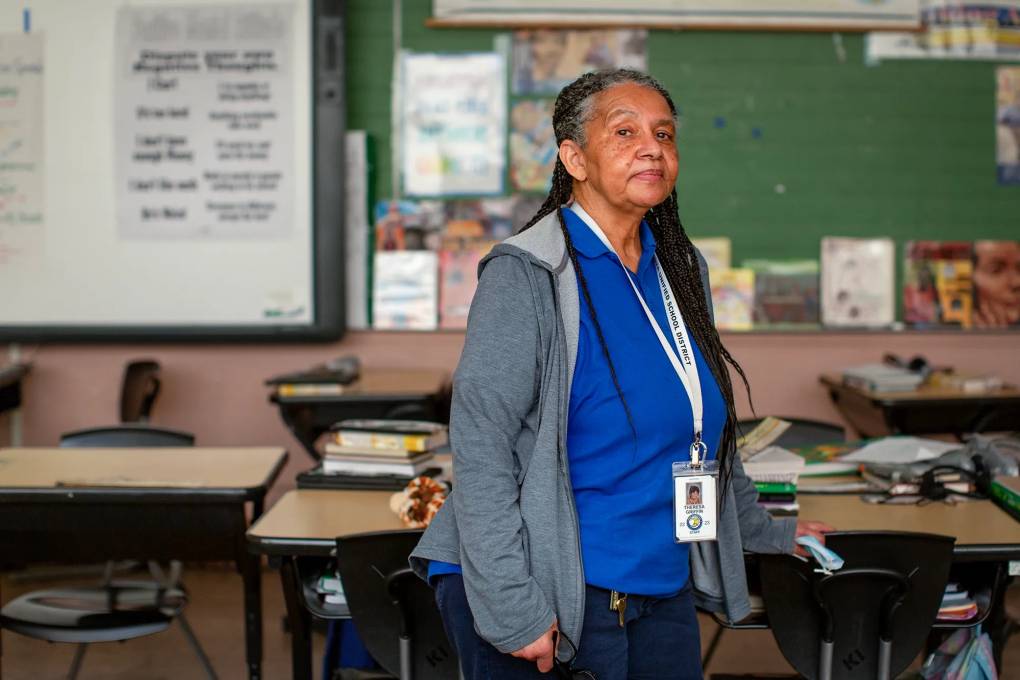
"caption": "Theresa Griffin, a sixth grade teacher at Stege Elementary School in Richmond, on Feb. 6, 2023.",
"description": null,
"title": "CMTeachers01",
"credit": "Shelby Knowles/CalMatters",
"status": "inherit",
"altTag": "A woman with long, brown and gray braids stands tall in a classroom. She's wearing a gray, zip-up sweatshirt and a blue T-shirt. A lanyard with her name and photo lies around her neck. Rows of desks and chairs are in the background as well as chalkboards and school posters.",
"isLoading": false,
"fetchFailed": false
},
"news_11944835": {
"type": "attachments",
"id": "news_11944835",
"meta": {
"index": "attachments_1716263798",
"site": "news",
"id": "11944835",
"found": true
},
"parent": 11944829,
"imgSizes": {
"twentyfourteen-full-width": {
"file": "https://ww2.kqed.org/app/uploads/sites/10/2023/03/GettyImages-159231967-e1679869924960-1038x576.jpg",
"width": 1038,
"mimeType": "image/jpeg",
"height": 576
},
"thumbnail": {
"file": "https://ww2.kqed.org/app/uploads/sites/10/2023/03/GettyImages-159231967-e1679869924960-160x107.jpg",
"width": 160,
"mimeType": "image/jpeg",
"height": 107
},
"post-thumbnail": {
"file": "https://ww2.kqed.org/app/uploads/sites/10/2023/03/GettyImages-159231967-e1679869924960-672x372.jpg",
"width": 672,
"mimeType": "image/jpeg",
"height": 372
},
"kqedFullSize": {
"file": "https://ww2.kqed.org/app/uploads/sites/10/2023/03/GettyImages-159231967-e1679869924960.jpg",
"width": 1620,
"height": 1080
},
"2048x2048": {
"file": "https://ww2.kqed.org/app/uploads/sites/10/2023/03/GettyImages-159231967-2048x1365.jpg",
"width": 2048,
"mimeType": "image/jpeg",
"height": 1365
},
"large": {
"file": "https://ww2.kqed.org/app/uploads/sites/10/2023/03/GettyImages-159231967-e1679869924960-1020x680.jpg",
"width": 1020,
"mimeType": "image/jpeg",
"height": 680
},
"1536x1536": {
"file": "https://ww2.kqed.org/app/uploads/sites/10/2023/03/GettyImages-159231967-e1679869924960-1536x1024.jpg",
"width": 1536,
"mimeType": "image/jpeg",
"height": 1024
},
"full-width": {
"file": "https://ww2.kqed.org/app/uploads/sites/10/2023/03/GettyImages-159231967-1920x1280.jpg",
"width": 1920,
"mimeType": "image/jpeg",
"height": 1280
},
"medium": {
"file": "https://ww2.kqed.org/app/uploads/sites/10/2023/03/GettyImages-159231967-e1679869924960-800x533.jpg",
"width": 800,
"mimeType": "image/jpeg",
"height": 533
}
},
"publishDate": 1679794589,
"modified": 1679951313,
"caption": "California aims to improve the number of third graders at reading level by 2026.",
"description": null,
"title": "close up boys fingers pointing to words in book",
"credit": "Gary John Norman/Getty Images",
"status": "inherit",
"altTag": "A child reads an open book, pointing at words on a page.",
"isLoading": false,
"fetchFailed": false
}
},
"audioPlayerReducer": {
"postId": "stream_live",
"isPaused": true,
"isPlaying": false,
"pfsActive": false,
"pledgeModalIsOpen": true,
"playerDrawerIsOpen": false,
"liveAudioPlayStartedAt": 0,
"liveAudioPlayContext": ""
},
"authorsReducer": {
"byline_news_11947211": {
"type": "authors",
"id": "byline_news_11947211",
"meta": {
"override": true
},
"slug": "byline_news_11947211",
"name": "\u003ca href=\"https://twitter.com/JoshDubowAP\">Josh Dubow\u003c/a>\u003cbr>The Associated Press",
"isLoading": false
},
"byline_news_11946741": {
"type": "authors",
"id": "byline_news_11946741",
"meta": {
"override": true
},
"slug": "byline_news_11946741",
"name": "\u003ca href=\"https://calmatters.org/author/rocky-walker/\">Rocky Walker\u003c/a>",
"isLoading": false
},
"byline_news_11946600": {
"type": "authors",
"id": "byline_news_11946600",
"meta": {
"override": true
},
"slug": "byline_news_11946600",
"name": "\u003ca href=\"https://calmatters.org/author/adam-echelman/\">Adam Echelman\u003c/a>",
"isLoading": false
},
"byline_news_11946471": {
"type": "authors",
"id": "byline_news_11946471",
"meta": {
"override": true
},
"slug": "byline_news_11946471",
"name": "\u003ca href=\"https://twitter.com/sophieadanna\">Sophie Austin\u003c/a>\u003cbr> The Associated Press",
"isLoading": false
},
"byline_news_11945355": {
"type": "authors",
"id": "byline_news_11945355",
"meta": {
"override": true
},
"slug": "byline_news_11945355",
"name": "\u003ca href=\"https://calmatters.org/author/megan-tagami/\">Megan Tagami\u003c/a>",
"isLoading": false
},
"byline_news_11945189": {
"type": "authors",
"id": "byline_news_11945189",
"meta": {
"override": true
},
"slug": "byline_news_11945189",
"name": "\u003ca href=\"https://calmatters.org/author/joe-hong/\">Joe Hong\u003c/a>, \u003ca href=\"https://calmatters.org/author/ericayee/\">Erica Yee\u003c/a>",
"isLoading": false
},
"byline_news_11944829": {
"type": "authors",
"id": "byline_news_11944829",
"meta": {
"override": true
},
"slug": "byline_news_11944829",
"name": "\u003ca href=\"https://edsource.org/author/kdsouza\">Karen D'Souza\u003c/a>",
"isLoading": false
},
"ecruzguevarra": {
"type": "authors",
"id": "8654",
"meta": {
"index": "authors_1716337520",
"id": "8654",
"found": true
},
"name": "Ericka Cruz Guevarra",
"firstName": "Ericka",
"lastName": "Cruz Guevarra",
"slug": "ecruzguevarra",
"email": "ecruzguevarra@kqed.org",
"display_author_email": true,
"staff_mastheads": [
"news"
],
"title": "Producer, The Bay Podcast",
"bio": "Ericka Cruz Guevarra is host of \u003ca href=\"https://www.kqed.org/podcasts/thebay\">\u003cem>The Bay\u003c/em>\u003c/a> podcast at KQED. Before host, she was the show’s producer. Her work in that capacity includes a three-part reported series on policing in Vallejo, which won a 2020 excellence in journalism award from the Society of Professional Journalists. Ericka has worked as a breaking news reporter at Oregon Public Broadcasting, helped produce the Code Switch podcast, and was KQED’s inaugural Raul Ramirez Diversity Fund intern. She’s also an alumna of NPR’s Next Generation Radio program. Send her an email if you have strong feelings about whether Fairfield and Suisun City are the Bay. Ericka is represented by SAG-AFTRA.",
"avatar": "https://secure.gravatar.com/avatar/accefc1de4bafc7e234b69bcb9b6f6536c130fd84709bc3069ef11a78787e1bb?s=600&d=blank&r=g",
"twitter": "NotoriousECG",
"bluesky": null,
"facebook": null,
"instagram": null,
"linkedin": null,
"sites": [
{
"site": "arts",
"roles": [
"subscriber"
]
},
{
"site": "news",
"roles": [
"editor",
"manage_categories"
]
},
{
"site": "futureofyou",
"roles": [
"subscriber"
]
},
{
"site": "stateofhealth",
"roles": [
"subscriber"
]
},
{
"site": "science",
"roles": [
"editor"
]
},
{
"site": "forum",
"roles": [
"subscriber"
]
}
],
"headData": {
"title": "Ericka Cruz Guevarra | KQED",
"description": "Producer, The Bay Podcast",
"ogImgSrc": "https://secure.gravatar.com/avatar/accefc1de4bafc7e234b69bcb9b6f6536c130fd84709bc3069ef11a78787e1bb?s=600&d=blank&r=g",
"twImgSrc": "https://secure.gravatar.com/avatar/accefc1de4bafc7e234b69bcb9b6f6536c130fd84709bc3069ef11a78787e1bb?s=600&d=blank&r=g"
},
"isLoading": false,
"link": "/author/ecruzguevarra"
},
"jasminegarnett": {
"type": "authors",
"id": "11530",
"meta": {
"index": "authors_1716337520",
"id": "11530",
"found": true
},
"name": "Jasmine Garnett",
"firstName": "Jasmine",
"lastName": "Garnett",
"slug": "jasminegarnett",
"email": "JGarnett@KQED.org",
"display_author_email": false,
"staff_mastheads": [
"news"
],
"title": "Senior Engagement Platforms Producer",
"bio": "Jasmine is a Senior Engagement Platforms Producer on the KQED News team. She is also a freelance writer, with work appearing in KQED, Bitch Media, and Kotaku among others. Jasmine graduated from UC Berkeley with a degree in Media Studies, where she was also an Arts and Entertainment reporter at the Daily Californian.",
"avatar": "https://secure.gravatar.com/avatar/a6ea8b0641874311533b7401bee15c8e?s=600&d=blank&r=g",
"twitter": "JFLGarnett",
"facebook": null,
"instagram": null,
"linkedin": null,
"sites": [
{
"site": "arts",
"roles": [
"author"
]
},
{
"site": "news",
"roles": [
"editor"
]
},
{
"site": "about",
"roles": [
"editor"
]
},
{
"site": "science",
"roles": [
"editor"
]
},
{
"site": "forum",
"roles": [
"editor"
]
},
{
"site": "pressroom",
"roles": [
"editor"
]
}
],
"headData": {
"title": "Jasmine Garnett | KQED",
"description": "Senior Engagement Platforms Producer",
"ogImgSrc": "https://secure.gravatar.com/avatar/a6ea8b0641874311533b7401bee15c8e?s=600&d=blank&r=g",
"twImgSrc": "https://secure.gravatar.com/avatar/a6ea8b0641874311533b7401bee15c8e?s=600&d=blank&r=g"
},
"isLoading": false,
"link": "/author/jasminegarnett"
},
"amontecillo": {
"type": "authors",
"id": "11649",
"meta": {
"index": "authors_1716337520",
"id": "11649",
"found": true
},
"name": "Alan Montecillo",
"firstName": "Alan",
"lastName": "Montecillo",
"slug": "amontecillo",
"email": "amontecillo@kqed.org",
"display_author_email": false,
"staff_mastheads": [
"news"
],
"title": "KQED Contributor",
"bio": "Alan Montecillo is the senior editor of \u003cem>\u003ca href=\"http://kqed.org/thebay\">The Bay\u003c/a>, \u003c/em> KQED's local news podcast. Before moving to the Bay Area, he worked as a senior talk show producer for WILL in Champaign-Urbana, Illinois and at Oregon Public Broadcasting in Portland, Oregon. He has won journalism awards from the Society of Professional Journalists Northern California, the Public Media Journalists Association, The Signal Awards, and has also received a regional Edward R. Murrow award. Alan is a Filipino American from Hong Kong and a graduate of Reed College.",
"avatar": "https://secure.gravatar.com/avatar/268f53a2066899ea9efdd8a5900218b17c822d9862cbc9326cccec53ef41d349?s=600&d=blank&r=g",
"twitter": "alanmontecillo",
"bluesky": null,
"facebook": null,
"instagram": null,
"linkedin": null,
"sites": [
{
"site": "",
"roles": [
"editor"
]
},
{
"site": "news",
"roles": [
"editor",
"manage_categories"
]
}
],
"headData": {
"title": "Alan Montecillo | KQED",
"description": "KQED Contributor",
"ogImgSrc": "https://secure.gravatar.com/avatar/268f53a2066899ea9efdd8a5900218b17c822d9862cbc9326cccec53ef41d349?s=600&d=blank&r=g",
"twImgSrc": "https://secure.gravatar.com/avatar/268f53a2066899ea9efdd8a5900218b17c822d9862cbc9326cccec53ef41d349?s=600&d=blank&r=g"
},
"isLoading": false,
"link": "/author/amontecillo"
},
"ebaldassari": {
"type": "authors",
"id": "11652",
"meta": {
"index": "authors_1716337520",
"id": "11652",
"found": true
},
"name": "Erin Baldassari",
"firstName": "Erin",
"lastName": "Baldassari",
"slug": "ebaldassari",
"email": "ebaldassari@KQED.org",
"display_author_email": true,
"staff_mastheads": [
"news"
],
"title": "Staff Writer",
"bio": "Erin Baldassari covers housing for KQED. She's a former print journalist and most recently worked as the transportation reporter for the \u003cem>Mercury News\u003c/em> and \u003cem>East Bay Times. \u003c/em>There, she focused on how the Bay Area’s housing shortage has changed the way people move around the region. She also served on the \u003cem>East Bay Times\u003c/em>’ 2017 Pulitzer Prize-winning team for coverage of the Ghost Ship Fire in Oakland. Prior to that, Erin worked as a breaking news and general assignment reporter for a variety of outlets in the Bay Area and the greater Boston area. A Tufts University alumna, Erin grew up in the foothills of the Sierra Nevada mountains and in Sonoma County. She is a life-long KQED listener.",
"avatar": "https://secure.gravatar.com/avatar/5e95cad64a8ca08288082212e199d2b0cbeb4fd8e8ef5339395f361032bbe005?s=600&d=blank&r=g",
"twitter": "e_baldi",
"bluesky": null,
"facebook": null,
"instagram": null,
"linkedin": null,
"sites": [
{
"site": "news",
"roles": [
"edit_others_posts",
"editor"
]
},
{
"site": "science",
"roles": [
"editor"
]
},
{
"site": "liveblog",
"roles": [
"editor"
]
}
],
"headData": {
"title": "Erin Baldassari | KQED",
"description": "Staff Writer",
"ogImgSrc": "https://secure.gravatar.com/avatar/5e95cad64a8ca08288082212e199d2b0cbeb4fd8e8ef5339395f361032bbe005?s=600&d=blank&r=g",
"twImgSrc": "https://secure.gravatar.com/avatar/5e95cad64a8ca08288082212e199d2b0cbeb4fd8e8ef5339395f361032bbe005?s=600&d=blank&r=g"
},
"isLoading": false,
"link": "/author/ebaldassari"
},
"swhitney": {
"type": "authors",
"id": "11784",
"meta": {
"index": "authors_1716337520",
"id": "11784",
"found": true
},
"name": "Spencer Whitney",
"firstName": "Spencer",
"lastName": "Whitney",
"slug": "swhitney",
"email": "swhitney@kqed.org",
"display_author_email": false,
"staff_mastheads": [],
"title": "KQED Digital Editor",
"bio": "Spencer Whitney is currently a Digital Editor for KQED News. Prior to joining KQED News, Spencer worked as the Multimedia Editor at the Oakland Post and an Assistant Editor in the Editorial department at the San Francisco Chronicle. He attended Howard University as an undergraduate and interned with SiriusXM. He also attended UC Berkeley's Graduate School of Journalism and had the opportunity to write for the hyperlocal news sites Richmond Confidential and Oakland North.",
"avatar": "https://secure.gravatar.com/avatar/e33ff4fd8b8f0d2796f36472fb32607ca8fc46ef5e537dcfdbdee688d8ea5b80?s=600&d=mm&r=g",
"twitter": null,
"bluesky": null,
"facebook": null,
"instagram": null,
"linkedin": null,
"sites": [
{
"site": "arts",
"roles": [
"editor"
]
},
{
"site": "news",
"roles": [
"editor"
]
},
{
"site": "science",
"roles": [
"editor"
]
},
{
"site": "perspectives",
"roles": [
"editor"
]
}
],
"headData": {
"title": "Spencer Whitney | KQED",
"description": "KQED Digital Editor",
"ogImgSrc": "https://secure.gravatar.com/avatar/e33ff4fd8b8f0d2796f36472fb32607ca8fc46ef5e537dcfdbdee688d8ea5b80?s=600&d=mm&r=g",
"twImgSrc": "https://secure.gravatar.com/avatar/e33ff4fd8b8f0d2796f36472fb32607ca8fc46ef5e537dcfdbdee688d8ea5b80?s=600&d=mm&r=g"
},
"isLoading": false,
"link": "/author/swhitney"
},
"mesquinca": {
"type": "authors",
"id": "11802",
"meta": {
"index": "authors_1716337520",
"id": "11802",
"found": true
},
"name": "Maria Esquinca",
"firstName": "Maria",
"lastName": "Esquinca",
"slug": "mesquinca",
"email": "mesquinca@kqed.org",
"display_author_email": false,
"staff_mastheads": [],
"title": "Producer, The Bay",
"bio": "María Esquinca is a producer of The Bay. Before that, she was a New York Women’s Foundation IGNITE Fellow at Latino USA. She worked at Radio Bilingue where she covered the San Joaquin Valley. Maria has interned at WLRN, News 21, The New York Times Student Journalism Institute and at Crain’s Detroit Business as a Dow Jones News Fund Business Reporting Intern. She is an MFA graduate from the University of Miami. In 2017, she graduated from the Walter Cronkite School of Journalism and Mass Communication with a Master of Mass Communication. A fronteriza, she was born in Ciudad Juárez, Chihuahua, Mexico and grew up in El Paso, Texas.",
"avatar": "https://secure.gravatar.com/avatar/77cedba18aae91da775038ba06dcd8d0?s=600&d=blank&r=g",
"twitter": "@m_esquinca",
"facebook": null,
"instagram": null,
"linkedin": null,
"sites": [
{
"site": "news",
"roles": []
}
],
"headData": {
"title": "Maria Esquinca | KQED",
"description": "Producer, The Bay",
"ogImgSrc": "https://secure.gravatar.com/avatar/77cedba18aae91da775038ba06dcd8d0?s=600&d=blank&r=g",
"twImgSrc": "https://secure.gravatar.com/avatar/77cedba18aae91da775038ba06dcd8d0?s=600&d=blank&r=g"
},
"isLoading": false,
"link": "/author/mesquinca"
},
"srodriguez": {
"type": "authors",
"id": "11852",
"meta": {
"index": "authors_1716337520",
"id": "11852",
"found": true
},
"name": "Steph Rodriguez",
"firstName": "Steph",
"lastName": "Rodriguez",
"slug": "srodriguez",
"email": "srodriguez@KQED.org",
"display_author_email": true,
"staff_mastheads": [
"news"
],
"title": "KQED Contributor",
"bio": "Steph Rodriguez is an award-winning editor and journalist who specializes in writing stories about food and music, arts and culture. She’s currently a Digital Editor for KQED News in San Francisco. Her past professional experience includes Food Editor for SFGATE as well as Managing Editor and Dining Editor for the Sacramento News & Review. She has roots in Bakersfield and Sacramento California and currently lives in Oakland with her family.",
"avatar": "https://secure.gravatar.com/avatar/5220c101baf7d495ca871563de9b8653e5863afdbd5f55ea5db0dda0732db3a2?s=600&d=blank&r=g",
"twitter": "wordstospill",
"bluesky": null,
"facebook": null,
"instagram": null,
"linkedin": null,
"sites": [
{
"site": "",
"roles": [
"administrator"
]
},
{
"site": "arts",
"roles": [
"administrator"
]
},
{
"site": "news",
"roles": [
"administrator"
]
},
{
"site": "science",
"roles": [
"administrator"
]
}
],
"headData": {
"title": "Steph Rodriguez | KQED",
"description": "KQED Contributor",
"ogImgSrc": "https://secure.gravatar.com/avatar/5220c101baf7d495ca871563de9b8653e5863afdbd5f55ea5db0dda0732db3a2?s=600&d=blank&r=g",
"twImgSrc": "https://secure.gravatar.com/avatar/5220c101baf7d495ca871563de9b8653e5863afdbd5f55ea5db0dda0732db3a2?s=600&d=blank&r=g"
},
"isLoading": false,
"link": "/author/srodriguez"
}
},
"pagesReducer": {
"news_tag_education": {
"type": "terms",
"id": "news_20013",
"meta": {
"index": "terms_1716263798",
"site": "news",
"id": "20013",
"score": 6.9701543
},
"featImg": null,
"name": "education",
"description": null,
"taxonomy": "tag",
"headData": {
"twImgId": null,
"twTitle": null,
"ogTitle": null,
"ogImgId": null,
"twDescription": null,
"description": null,
"title": "education Archives | KQED News",
"ogDescription": null
},
"ttid": 20030,
"slug": "education",
"isLoading": false,
"title": "education",
"pageMeta": {
"site": "news",
"WpPageTemplate": "page-topic-editorial",
"currentPage": 58
},
"blocks": [
{
"blockName": "kqed/post-list",
"attrs": {
"layout": "cardArticle2",
"query": "posts/news?tag=education",
"seeMore": false,
"paginated": true,
"page": 58
}
},
{
"blockName": "kqed/ad"
}
]
}
},
"pfsSessionReducer": {},
"postsReducer": {
"stream_live": {
"type": "live",
"id": "stream_live",
"audioUrl": "https://streams.kqed.org/kqedradio",
"title": "Live Stream",
"excerpt": "Live Stream information currently unavailable.",
"link": "/radio",
"featImg": "",
"label": {
"name": "KQED Live",
"link": "/"
}
},
"stream_kqedNewscast": {
"type": "posts",
"id": "stream_kqedNewscast",
"audioUrl": "https://www.kqed.org/.stream/anon/radio/RDnews/newscast.mp3?_=1",
"title": "KQED Newscast",
"featImg": "",
"label": {
"name": "88.5 FM",
"link": "/"
}
},
"news_11947286": {
"type": "posts",
"id": "news_11947286",
"meta": {
"index": "posts_1716263798",
"site": "news",
"id": "11947286",
"score": null,
"sort": [
1682112037000
]
},
"guestAuthors": [],
"slug": "devastated-oakland-as-fans-react-to-teams-vegas-move",
"title": "'Devastated' Oakland A's Fans React to Team's Vegas Move",
"publishDate": 1682112037,
"format": "standard",
"headTitle": "‘Devastated’ Oakland A’s Fans React to Team’s Vegas Move | KQED",
"labelTerm": {
"site": "news"
},
"content": "\u003cp>A sports team is nothing without a community that supports it. Many Oakland A’s fans are still processing the news that their beloved team \u003ca href=\"https://www.kqed.org/news/11947211/oakland-mayor-says-as-fans-deserve-better-after-team-announces-deal-to-buy-vegas-stadium\">signed a deal\u003c/a> to build a new stadium near the Las Vegas Strip. If all these plans go through, it seems like the A’s could leave their hometown altogether.\u003c/p>\n\u003cp>Die-hard fans told KQED that they believed A’s leadership when it boasted its #RootedInOakland campaign. Now, many say they feel betrayed. There are fans who grew up going to the ballpark and who introduced their children to the excitement of baseball. Some have even proposed to their partners at the Coliseum. As Oakland stands to lose yet another sports team to Las Vegas, A’s fans share their heartfelt reactions and genuine memories of what the team has meant to The Town for more than five decades.\u003c/p>\n\u003cp>[ad fullwidth]\u003c/p>\n\u003cp>In 2006 during Game 3 of the opening round of the American League playoffs, Sean McKissick remembers, the A’s absolutely dismantled the Minnesota Twins and advanced to the next round of the playoffs. He said it’s one of his top memories next to the birth of his children. But it was one of those electrifying games that was made better by being part of a roaring crowd alongside his wife, his brothers and his parents.[pullquote size=\"medium\" align=\"right\" citation=\"Sean McKissick, longtime Oakland A’s fan\"]‘You’ve got such a fan base here. You’ve got such a history here. It’s the home of Rickey Henderson. How do the A’s leave the town where Rickey Henderson grew up?’[/pullquote]“I remember being in that crowd … we’ve already got the lead, but the bases are loaded for Marco Scutaro. He clears the bases with a double. The entire crowd, 50,000 strong, is chanting Scu-ta-ro, Scu-ta-ro,” McKissick said. “It was a high. I won’t say it’s better than the birth of my kids, but if you put that aside, it’s pretty high up on my most treasured memories.”\u003c/p>\n\u003cp>McKissick grew up in the East Bay and said he spent his infancy in the Coliseum cheering on the A’s. He now lives in Fair Oaks, a suburb of Sacramento. But despite the distance, he was still making the drive to Oakland to attend A’s games with his family. He said being at the ballpark over the last 40 years truly shaped a significant part of his life. Now that the team is leaving, he’s unsure how to feel.\u003c/p>\n\u003cp>“It just didn’t make sense to me. You’ve got such a fan base here. You’ve got such a history here. It’s the home of Rickey Henderson. How do the A’s leave the town where Rickey Henderson grew up?” he said.\u003c/p>\n\u003cfigure id=\"attachment_11947301\" class=\"wp-caption aligncenter\" style=\"max-width: 2560px\">\u003cimg loading=\"lazy\" decoding=\"async\" class=\"size-full wp-image-11947301\" src=\"https://ww2.kqed.org/app/uploads/sites/10/2023/04/Courtesy-Michael-Garcia-scaled.jpg\" alt=\"A family of four stand with Oakland A's mascot Stomper.\" width=\"2560\" height=\"1928\" srcset=\"https://cdn.kqed.org/wp-content/uploads/sites/10/2023/04/Courtesy-Michael-Garcia-scaled.jpg 2560w, https://cdn.kqed.org/wp-content/uploads/sites/10/2023/04/Courtesy-Michael-Garcia-800x602.jpg 800w, https://cdn.kqed.org/wp-content/uploads/sites/10/2023/04/Courtesy-Michael-Garcia-1020x768.jpg 1020w, https://cdn.kqed.org/wp-content/uploads/sites/10/2023/04/Courtesy-Michael-Garcia-160x120.jpg 160w, https://cdn.kqed.org/wp-content/uploads/sites/10/2023/04/Courtesy-Michael-Garcia-1536x1157.jpg 1536w, https://cdn.kqed.org/wp-content/uploads/sites/10/2023/04/Courtesy-Michael-Garcia-2048x1542.jpg 2048w, https://cdn.kqed.org/wp-content/uploads/sites/10/2023/04/Courtesy-Michael-Garcia-1920x1446.jpg 1920w\" sizes=\"(max-width: 2560px) 100vw, 2560px\">\u003cfigcaption class=\"wp-caption-text\">Oakland A’s fan Michael Garcia (far right) poses with (from left) his father, nephew and niece with A’s mascot Stomper. The family attended a game against the Kansas City Royals on June 17, 2022 — the first-ever MLB game Garcia’s niece and nephew attended. \u003ccite>(Courtesy Michael Garcia)\u003c/cite>\u003c/figcaption>\u003c/figure>\n\u003cp>Michael Garcia, an application developer, said he has been going to the Coliseum for 20 years with his dad and still can’t believe the news.\u003c/p>\n\u003cp>“We have experienced countless heartbreaks. Whether it was our favorite players getting traded or tolerating where all we could hope for was having at least a .500 season, we’ve been through it all.[pullquote size=\"medium\" align=\"right\" citation=\"Michael Garcia, longtime A’s fan\"]‘Despite the sadness and frustration that I feel, I am still thankful for all the wonderful memories that the A’s have given us over the years. Those are the memories that I will continue to cherish, even when we are no longer the Oakland Athletics.’[/pullquote]“The recent news regarding the A’s moving to Las Vegas was the biggest heartbreak by far. Despite the sadness and frustration that I feel, I am still thankful for all the wonderful memories that the A’s have given us over the years. Those are the memories that I will continue to cherish, even when we are no longer the Oakland Athletics.”\u003c/p>\n\u003cp>John Medina, a former military member, said there were times during his service when he followed A’s games even when he had little to no reception. He kept up with the team because he cared about the sport and loved the A’s that much.\u003c/p>\n\u003cp>“I’ve been an A’s fan my entire life, but after this decision, I simply can’t watch or support them anymore,” he said. “It’s as if we’ve been backstabbed by a team that pushed the ‘Rooted in Oakland’ narrative. My family and friends were in utter shock by this decision because they were more than a team to us. They were a part of Oakland and our lives, and like the roots they claimed were there, they simply dug them out and chose to put them somewhere else and didn’t even bother to cover up the hole.”\u003c/p>\n\u003cp>Longtime fan Brice Robinson-Wasley told KQED he cheered on the A’s from his small town in the Sierra Nevada foothills.\u003c/p>\n\u003cp>“When I was a boy in the ’90s, the Giants were looking to relocate to Tampa. I was in Little League and the Giants were doing zero outreach to the community. The A’s, however, had every intention of staying. They had a Little League day where we got to watch a game, walk on the field, have the experience of a lifetime. I certainly have remembered it all my life.\u003c/p>\n\u003cp>“I have been an A’s fan ever since. It occurs to me that the roles have been reversed: The Giants are now [the] ones with no intention to move and the A’s are the team looking for a way out (and they’ve gotten it). Even if by some miracle they do stay, who are the A’s building as lifelong fans like they did 25–30 years ago?”\u003c/p>\n\u003cfigure id=\"attachment_11947298\" class=\"wp-caption aligncenter\" style=\"max-width: 1500px\">\u003cimg loading=\"lazy\" decoding=\"async\" class=\"size-full wp-image-11947298\" src=\"https://ww2.kqed.org/app/uploads/sites/10/2023/04/CourtesyOaklandAs.jpg\" alt=\"Two men wearing green and gold baseball jerseys along with green baseball hats, smile from behind the golden Oakland A's 1972 World Champions trophy.\" width=\"1500\" height=\"2000\" srcset=\"https://cdn.kqed.org/wp-content/uploads/sites/10/2023/04/CourtesyOaklandAs.jpg 1500w, https://cdn.kqed.org/wp-content/uploads/sites/10/2023/04/CourtesyOaklandAs-800x1067.jpg 800w, https://cdn.kqed.org/wp-content/uploads/sites/10/2023/04/CourtesyOaklandAs-1020x1360.jpg 1020w, https://cdn.kqed.org/wp-content/uploads/sites/10/2023/04/CourtesyOaklandAs-160x213.jpg 160w, https://cdn.kqed.org/wp-content/uploads/sites/10/2023/04/CourtesyOaklandAs-1152x1536.jpg 1152w\" sizes=\"(max-width: 1500px) 100vw, 1500px\">\u003cfigcaption class=\"wp-caption-text\">Michael Strat (left) and Jacob Vides met at an A’s game and became best buds. \u003ccite>(Courtesy Jacob Vides)\u003c/cite>\u003c/figcaption>\u003c/figure>\n\u003cp>Jacob Vides said the Oakland Coliseum is a place where fellow A’s fans bond over their team pride and become lifelong friends.\u003c/p>\n\u003cp>“[Michael and I] became best friends after we met at an A’s game in 2016. And have attended many more games together since. We have Oakland to thank for many great and fun memories,” Vides said. “We are devastated to learn about the potential move and feel let down by the A’s and to a lesser degree the city of Oakland. Our message is owners should veto this move, and MLB Commissioner Manfred should not waive the $2 billion relocation fee.”\u003c/p>\n\u003cp>While Vides weighed Oakland’s loss, other fans such as Michael Melland, an Oakland resident since 1988, say good riddance.\u003c/p>\n\u003cp>“See ya. Wouldn’t want to be ya. They’ve destroyed this baseball team. They’ve insulted all of the fans. The owner is a billionaire … it’s like, OK, go ahead. We don’t want you here. … He ruined a whole brand here. I mean, look at these guys. What have they won? Three games and it’s already the last half of April. It’s terrible.\u003c/p>\n\u003cp>“Why should the poor taxpayers of Oakland who can’t even keep the schools, or the police, or health care going, why should they have to pony up just so he can make even more money? It’s insane.”\u003c/p>\n\u003cp>https://twitter.com/pquinton99/status/1649160482866233354\u003c/p>\n\u003cp>As a dedicated A’s fan for more than 30 years, Connie Voss said she’s hurt just like everyone else, but looks forward to the upcoming soccer season and women’s sports.\u003c/p>\n\u003cp>“I’m hurt that they’re leaving us. The way they’re leaving us. I was devastated … It really, really, really hurt. We kind of thought they were going to leave us, but hoping they weren’t,” she said. “But I’m trying to think positive and deal with the new kinds of sports that are coming: the soccer games and the women’s teams. I’m looking forward to all of that. I don’t want to live in the past. I want to move to the future.”[pullquote size=\"medium\" align=\"right\" citation=\"Mumin Abuzaid, longtime A’s fan\"]‘That whole ‘Rooted in Oakland’ thing is kind of like a slap in the face when you use that as a marketing strategy to promote your brand and, of course, that got you money, but now where’s that whole philosophy?’[/pullquote]Mumin Abuzaid, 23, was born in San Francisco, but lives in Alameda and grew up attending A’s games. He said he’s sad that the team’s president, Dave Kaval, would be willing to take money from a city that has a long list of immediate needs.\u003c/p>\n\u003cp>“It’s a bit weird for a billion-dollar franchise to be asking that of a city when they already support you more than they really should, as you haven’t been winning as much as other teams. It’s a bit entitled, if you ask me.\u003c/p>\n\u003cp>“That whole ‘Rooted in Oakland’ thing is kind of like a slap in the face when you use that as a marketing strategy to promote your brand and, of course, that got you money, but now where’s that whole philosophy? Hearing [that] the Warriors, the Raiders and now the A’s are going to be leaving Oakland, it’s a bit of a slap in the face to a community who always stood behind their teams through rough, rough times. Now they’re gone.”\u003c/p>\n\u003cfigure id=\"attachment_11947322\" class=\"wp-caption aligncenter\" style=\"max-width: 1920px\">\u003cimg loading=\"lazy\" decoding=\"async\" class=\"size-full wp-image-11947322\" src=\"https://ww2.kqed.org/app/uploads/sites/10/2023/04/RS54998_012_KQED_BaseballFanEvent_04062022-qut.jpg\" alt=\"An Oakland Athletics baseball fan wears the team's green and gold jersey. The fan poses for a photo with their back toward the camera and is standing next to the team's mascot, Stomper, who is wearing a baseball uniform. Stomper is an elephant.\" width=\"1920\" height=\"1280\" srcset=\"https://cdn.kqed.org/wp-content/uploads/sites/10/2023/04/RS54998_012_KQED_BaseballFanEvent_04062022-qut.jpg 1920w, https://cdn.kqed.org/wp-content/uploads/sites/10/2023/04/RS54998_012_KQED_BaseballFanEvent_04062022-qut-800x533.jpg 800w, https://cdn.kqed.org/wp-content/uploads/sites/10/2023/04/RS54998_012_KQED_BaseballFanEvent_04062022-qut-1020x680.jpg 1020w, https://cdn.kqed.org/wp-content/uploads/sites/10/2023/04/RS54998_012_KQED_BaseballFanEvent_04062022-qut-160x107.jpg 160w, https://cdn.kqed.org/wp-content/uploads/sites/10/2023/04/RS54998_012_KQED_BaseballFanEvent_04062022-qut-1536x1024.jpg 1536w\" sizes=\"(max-width: 1920px) 100vw, 1920px\">\u003cfigcaption class=\"wp-caption-text\">A fan poses for a photo with Oakland Athletics mascot Stomper during a fan event in San Francisco on April 6, 2022. \u003ccite>(Beth LaBerge/KQED)\u003c/cite>\u003c/figcaption>\u003c/figure>\n\u003cp>Chris Parker’s grandparents moved to the Bay four years before the A’s started as an Oakland team back in 1968. His family have been die-hard fans ever since.\u003c/p>\n\u003cp>“It’s been something each generation’s been proud of and had in common. We’ve gone to games for years — some of my earliest memories are at the Coliseum hearing Dick Callahan’s voice. My grandpa especially watched nearly every game he could on TV until he passed this December. If he was still around, I know he’d be madder than he usually got watching what he would say [A’s owner John] Fisher thinks passes for a franchise these days and what Manfred enables in the league.\u003c/p>\n\u003cp>“When I helped Dave Kaval and others with their live Q&A sessions they held on our subreddit, and whenever he’d speak to the media for the past few years, the A’s leadership would always stress how they were ‘#RootedInOakland’ and committed to the community, fans, and working to get a deal. After today, it seems the only commitment the organization has is to driving the franchise into the ground …\u003c/p>\n\u003cp>“A’s fans are generally a hardy lot, and range from overly forgiving to very fickle, but I think it’s safe to say that almost everyone is going to be unified on feeling betrayed and hurt on this one. Personally, I don’t know if I’m going to be able to watch the game after this … and it won’t necessarily be as simple as ‘pick another team.’”\u003c/p>\n\u003cp>\u003cem>This story includes reporting from KQED’s \u003ca href=\"https://twitter.com/pquinton99\">Phoebe Quinton\u003c/a>, \u003ca href=\"https://www.kqed.org/author/fjhabvala\">Farida Jhabvala Romero\u003c/a>, \u003ca href=\"https://www.kqed.org/author/bwatt\">Brian Watt\u003c/a> and \u003ca href=\"https://www.kqed.org/author/agonzalez\">Alexander Gonzalez\u003c/a>.\u003c/em>\u003c/p>\n\u003cp>[ad floatright]\u003c/p>\n",
"blocks": [],
"excerpt": "As the Oakland A's announced the team finalized a deal to build a new stadium near the Las Vegas Strip, fans react to the news and reflect on their memories attending games at the Coliseum.",
"status": "publish",
"parent": 0,
"modified": 1723061928,
"stats": {
"hasAudio": false,
"hasVideo": false,
"hasChartOrMap": false,
"iframeSrcs": [],
"hasGoogleForm": false,
"hasGallery": false,
"hasHearkenModule": false,
"hasPolis": false,
"paragraphCount": 28,
"wordCount": 2100
},
"headData": {
"title": "'Devastated' Oakland A's Fans React to Team's Vegas Move | KQED",
"description": "As the Oakland A's announced the team finalized a deal to build a new stadium near the Las Vegas Strip, fans react to the news and reflect on their memories attending games at the Coliseum.",
"ogTitle": "",
"ogDescription": "",
"ogImgId": "",
"twTitle": "",
"twDescription": "",
"twImgId": "",
"schema": {
"@context": "https://schema.org",
"@type": "NewsArticle",
"headline": "'Devastated' Oakland A's Fans React to Team's Vegas Move",
"datePublished": "2023-04-21T14:20:37-07:00",
"dateModified": "2024-08-07T13:18:48-07:00",
"image": "https://cdn.kqed.org/wp-content/uploads/2020/02/KQED-OG-Image@1x.png",
"isAccessibleForFree": "True",
"publisher": {
"@type": "NewsMediaOrganization",
"@id": "https://www.kqed.org/#organization",
"name": "KQED",
"logo": "https://cdn.kqed.org/wp-content/uploads/2020/02/KQED-OG-Image@1x.png",
"url": "https://www.kqed.org",
"sameAs": [
"https://www.facebook.com/KQED",
"https://twitter.com/KQED",
"https://www.instagram.com/kqed/",
"https://www.tiktok.com/@kqedofficial",
"https://www.linkedin.com/company/kqed",
"https://www.youtube.com/channel/UCeC0IOo7i1P_61zVUWbJ4nw"
]
}
}
},
"sticky": false,
"excludeFromSiteSearch": "Include",
"articleAge": "0",
"path": "/news/11947286/devastated-oakland-as-fans-react-to-teams-vegas-move",
"audioTrackLength": null,
"parsedContent": [
{
"type": "contentString",
"content": "\u003cdiv class=\"post-body\">\u003cp>\u003cp>A sports team is nothing without a community that supports it. Many Oakland A’s fans are still processing the news that their beloved team \u003ca href=\"https://www.kqed.org/news/11947211/oakland-mayor-says-as-fans-deserve-better-after-team-announces-deal-to-buy-vegas-stadium\">signed a deal\u003c/a> to build a new stadium near the Las Vegas Strip. If all these plans go through, it seems like the A’s could leave their hometown altogether.\u003c/p>\n\u003cp>Die-hard fans told KQED that they believed A’s leadership when it boasted its #RootedInOakland campaign. Now, many say they feel betrayed. There are fans who grew up going to the ballpark and who introduced their children to the excitement of baseball. Some have even proposed to their partners at the Coliseum. As Oakland stands to lose yet another sports team to Las Vegas, A’s fans share their heartfelt reactions and genuine memories of what the team has meant to The Town for more than five decades.\u003c/p>\n\u003cp>\u003c/p>\u003c/div>",
"attributes": {
"named": {},
"numeric": []
}
},
{
"type": "component",
"content": "",
"name": "ad",
"attributes": {
"named": {
"label": "fullwidth"
},
"numeric": [
"fullwidth"
]
}
},
{
"type": "contentString",
"content": "\u003cdiv class=\"post-body\">\u003cp>\u003c/p>\n\u003cp>In 2006 during Game 3 of the opening round of the American League playoffs, Sean McKissick remembers, the A’s absolutely dismantled the Minnesota Twins and advanced to the next round of the playoffs. He said it’s one of his top memories next to the birth of his children. But it was one of those electrifying games that was made better by being part of a roaring crowd alongside his wife, his brothers and his parents.\u003c/p>\u003c/div>",
"attributes": {
"named": {},
"numeric": []
}
},
{
"type": "component",
"content": "‘You’ve got such a fan base here. You’ve got such a history here. It’s the home of Rickey Henderson. How do the A’s leave the town where Rickey Henderson grew up?’",
"name": "pullquote",
"attributes": {
"named": {
"size": "medium",
"align": "right",
"citation": "Sean McKissick, longtime Oakland A’s fan",
"label": ""
},
"numeric": []
}
},
{
"type": "contentString",
"content": "\u003cdiv class=\"post-body\">\u003cp>“I remember being in that crowd … we’ve already got the lead, but the bases are loaded for Marco Scutaro. He clears the bases with a double. The entire crowd, 50,000 strong, is chanting Scu-ta-ro, Scu-ta-ro,” McKissick said. “It was a high. I won’t say it’s better than the birth of my kids, but if you put that aside, it’s pretty high up on my most treasured memories.”\u003c/p>\n\u003cp>McKissick grew up in the East Bay and said he spent his infancy in the Coliseum cheering on the A’s. He now lives in Fair Oaks, a suburb of Sacramento. But despite the distance, he was still making the drive to Oakland to attend A’s games with his family. He said being at the ballpark over the last 40 years truly shaped a significant part of his life. Now that the team is leaving, he’s unsure how to feel.\u003c/p>\n\u003cp>“It just didn’t make sense to me. You’ve got such a fan base here. You’ve got such a history here. It’s the home of Rickey Henderson. How do the A’s leave the town where Rickey Henderson grew up?” he said.\u003c/p>\n\u003cfigure id=\"attachment_11947301\" class=\"wp-caption aligncenter\" style=\"max-width: 2560px\">\u003cimg loading=\"lazy\" decoding=\"async\" class=\"size-full wp-image-11947301\" src=\"https://ww2.kqed.org/app/uploads/sites/10/2023/04/Courtesy-Michael-Garcia-scaled.jpg\" alt=\"A family of four stand with Oakland A's mascot Stomper.\" width=\"2560\" height=\"1928\" srcset=\"https://cdn.kqed.org/wp-content/uploads/sites/10/2023/04/Courtesy-Michael-Garcia-scaled.jpg 2560w, https://cdn.kqed.org/wp-content/uploads/sites/10/2023/04/Courtesy-Michael-Garcia-800x602.jpg 800w, https://cdn.kqed.org/wp-content/uploads/sites/10/2023/04/Courtesy-Michael-Garcia-1020x768.jpg 1020w, https://cdn.kqed.org/wp-content/uploads/sites/10/2023/04/Courtesy-Michael-Garcia-160x120.jpg 160w, https://cdn.kqed.org/wp-content/uploads/sites/10/2023/04/Courtesy-Michael-Garcia-1536x1157.jpg 1536w, https://cdn.kqed.org/wp-content/uploads/sites/10/2023/04/Courtesy-Michael-Garcia-2048x1542.jpg 2048w, https://cdn.kqed.org/wp-content/uploads/sites/10/2023/04/Courtesy-Michael-Garcia-1920x1446.jpg 1920w\" sizes=\"(max-width: 2560px) 100vw, 2560px\">\u003cfigcaption class=\"wp-caption-text\">Oakland A’s fan Michael Garcia (far right) poses with (from left) his father, nephew and niece with A’s mascot Stomper. The family attended a game against the Kansas City Royals on June 17, 2022 — the first-ever MLB game Garcia’s niece and nephew attended. \u003ccite>(Courtesy Michael Garcia)\u003c/cite>\u003c/figcaption>\u003c/figure>\n\u003cp>Michael Garcia, an application developer, said he has been going to the Coliseum for 20 years with his dad and still can’t believe the news.\u003c/p>\n\u003cp>“We have experienced countless heartbreaks. Whether it was our favorite players getting traded or tolerating where all we could hope for was having at least a .500 season, we’ve been through it all.\u003c/p>\u003c/div>",
"attributes": {
"named": {},
"numeric": []
}
},
{
"type": "component",
"content": "‘Despite the sadness and frustration that I feel, I am still thankful for all the wonderful memories that the A’s have given us over the years. Those are the memories that I will continue to cherish, even when we are no longer the Oakland Athletics.’",
"name": "pullquote",
"attributes": {
"named": {
"size": "medium",
"align": "right",
"citation": "Michael Garcia, longtime A’s fan",
"label": ""
},
"numeric": []
}
},
{
"type": "contentString",
"content": "\u003cdiv class=\"post-body\">\u003cp>“The recent news regarding the A’s moving to Las Vegas was the biggest heartbreak by far. Despite the sadness and frustration that I feel, I am still thankful for all the wonderful memories that the A’s have given us over the years. Those are the memories that I will continue to cherish, even when we are no longer the Oakland Athletics.”\u003c/p>\n\u003cp>John Medina, a former military member, said there were times during his service when he followed A’s games even when he had little to no reception. He kept up with the team because he cared about the sport and loved the A’s that much.\u003c/p>\n\u003cp>“I’ve been an A’s fan my entire life, but after this decision, I simply can’t watch or support them anymore,” he said. “It’s as if we’ve been backstabbed by a team that pushed the ‘Rooted in Oakland’ narrative. My family and friends were in utter shock by this decision because they were more than a team to us. They were a part of Oakland and our lives, and like the roots they claimed were there, they simply dug them out and chose to put them somewhere else and didn’t even bother to cover up the hole.”\u003c/p>\n\u003cp>Longtime fan Brice Robinson-Wasley told KQED he cheered on the A’s from his small town in the Sierra Nevada foothills.\u003c/p>\n\u003cp>“When I was a boy in the ’90s, the Giants were looking to relocate to Tampa. I was in Little League and the Giants were doing zero outreach to the community. The A’s, however, had every intention of staying. They had a Little League day where we got to watch a game, walk on the field, have the experience of a lifetime. I certainly have remembered it all my life.\u003c/p>\n\u003cp>“I have been an A’s fan ever since. It occurs to me that the roles have been reversed: The Giants are now [the] ones with no intention to move and the A’s are the team looking for a way out (and they’ve gotten it). Even if by some miracle they do stay, who are the A’s building as lifelong fans like they did 25–30 years ago?”\u003c/p>\n\u003cfigure id=\"attachment_11947298\" class=\"wp-caption aligncenter\" style=\"max-width: 1500px\">\u003cimg loading=\"lazy\" decoding=\"async\" class=\"size-full wp-image-11947298\" src=\"https://ww2.kqed.org/app/uploads/sites/10/2023/04/CourtesyOaklandAs.jpg\" alt=\"Two men wearing green and gold baseball jerseys along with green baseball hats, smile from behind the golden Oakland A's 1972 World Champions trophy.\" width=\"1500\" height=\"2000\" srcset=\"https://cdn.kqed.org/wp-content/uploads/sites/10/2023/04/CourtesyOaklandAs.jpg 1500w, https://cdn.kqed.org/wp-content/uploads/sites/10/2023/04/CourtesyOaklandAs-800x1067.jpg 800w, https://cdn.kqed.org/wp-content/uploads/sites/10/2023/04/CourtesyOaklandAs-1020x1360.jpg 1020w, https://cdn.kqed.org/wp-content/uploads/sites/10/2023/04/CourtesyOaklandAs-160x213.jpg 160w, https://cdn.kqed.org/wp-content/uploads/sites/10/2023/04/CourtesyOaklandAs-1152x1536.jpg 1152w\" sizes=\"(max-width: 1500px) 100vw, 1500px\">\u003cfigcaption class=\"wp-caption-text\">Michael Strat (left) and Jacob Vides met at an A’s game and became best buds. \u003ccite>(Courtesy Jacob Vides)\u003c/cite>\u003c/figcaption>\u003c/figure>\n\u003cp>Jacob Vides said the Oakland Coliseum is a place where fellow A’s fans bond over their team pride and become lifelong friends.\u003c/p>\n\u003cp>“[Michael and I] became best friends after we met at an A’s game in 2016. And have attended many more games together since. We have Oakland to thank for many great and fun memories,” Vides said. “We are devastated to learn about the potential move and feel let down by the A’s and to a lesser degree the city of Oakland. Our message is owners should veto this move, and MLB Commissioner Manfred should not waive the $2 billion relocation fee.”\u003c/p>\n\u003cp>While Vides weighed Oakland’s loss, other fans such as Michael Melland, an Oakland resident since 1988, say good riddance.\u003c/p>\n\u003cp>“See ya. Wouldn’t want to be ya. They’ve destroyed this baseball team. They’ve insulted all of the fans. The owner is a billionaire … it’s like, OK, go ahead. We don’t want you here. … He ruined a whole brand here. I mean, look at these guys. What have they won? Three games and it’s already the last half of April. It’s terrible.\u003c/p>\n\u003cp>“Why should the poor taxpayers of Oakland who can’t even keep the schools, or the police, or health care going, why should they have to pony up just so he can make even more money? It’s insane.”\u003c/p>\u003c/p>\u003c/div>",
"attributes": {
"named": {},
"numeric": []
}
},
{
"type": "component",
"content": "",
"name": "singleTwitterStatus",
"attributes": {
"named": {
"id": "1649160482866233354"
},
"numeric": []
}
},
{
"type": "contentString",
"content": "\u003cdiv class=\"post-body\">\u003cp>\n\u003cp>As a dedicated A’s fan for more than 30 years, Connie Voss said she’s hurt just like everyone else, but looks forward to the upcoming soccer season and women’s sports.\u003c/p>\n\u003cp>“I’m hurt that they’re leaving us. The way they’re leaving us. I was devastated … It really, really, really hurt. We kind of thought they were going to leave us, but hoping they weren’t,” she said. “But I’m trying to think positive and deal with the new kinds of sports that are coming: the soccer games and the women’s teams. I’m looking forward to all of that. I don’t want to live in the past. I want to move to the future.”\u003c/p>\u003c/div>",
"attributes": {
"named": {},
"numeric": []
}
},
{
"type": "component",
"content": "‘That whole ‘Rooted in Oakland’ thing is kind of like a slap in the face when you use that as a marketing strategy to promote your brand and, of course, that got you money, but now where’s that whole philosophy?’",
"name": "pullquote",
"attributes": {
"named": {
"size": "medium",
"align": "right",
"citation": "Mumin Abuzaid, longtime A’s fan",
"label": ""
},
"numeric": []
}
},
{
"type": "contentString",
"content": "\u003cdiv class=\"post-body\">\u003cp>Mumin Abuzaid, 23, was born in San Francisco, but lives in Alameda and grew up attending A’s games. He said he’s sad that the team’s president, Dave Kaval, would be willing to take money from a city that has a long list of immediate needs.\u003c/p>\n\u003cp>“It’s a bit weird for a billion-dollar franchise to be asking that of a city when they already support you more than they really should, as you haven’t been winning as much as other teams. It’s a bit entitled, if you ask me.\u003c/p>\n\u003cp>“That whole ‘Rooted in Oakland’ thing is kind of like a slap in the face when you use that as a marketing strategy to promote your brand and, of course, that got you money, but now where’s that whole philosophy? Hearing [that] the Warriors, the Raiders and now the A’s are going to be leaving Oakland, it’s a bit of a slap in the face to a community who always stood behind their teams through rough, rough times. Now they’re gone.”\u003c/p>\n\u003cfigure id=\"attachment_11947322\" class=\"wp-caption aligncenter\" style=\"max-width: 1920px\">\u003cimg loading=\"lazy\" decoding=\"async\" class=\"size-full wp-image-11947322\" src=\"https://ww2.kqed.org/app/uploads/sites/10/2023/04/RS54998_012_KQED_BaseballFanEvent_04062022-qut.jpg\" alt=\"An Oakland Athletics baseball fan wears the team's green and gold jersey. The fan poses for a photo with their back toward the camera and is standing next to the team's mascot, Stomper, who is wearing a baseball uniform. Stomper is an elephant.\" width=\"1920\" height=\"1280\" srcset=\"https://cdn.kqed.org/wp-content/uploads/sites/10/2023/04/RS54998_012_KQED_BaseballFanEvent_04062022-qut.jpg 1920w, https://cdn.kqed.org/wp-content/uploads/sites/10/2023/04/RS54998_012_KQED_BaseballFanEvent_04062022-qut-800x533.jpg 800w, https://cdn.kqed.org/wp-content/uploads/sites/10/2023/04/RS54998_012_KQED_BaseballFanEvent_04062022-qut-1020x680.jpg 1020w, https://cdn.kqed.org/wp-content/uploads/sites/10/2023/04/RS54998_012_KQED_BaseballFanEvent_04062022-qut-160x107.jpg 160w, https://cdn.kqed.org/wp-content/uploads/sites/10/2023/04/RS54998_012_KQED_BaseballFanEvent_04062022-qut-1536x1024.jpg 1536w\" sizes=\"(max-width: 1920px) 100vw, 1920px\">\u003cfigcaption class=\"wp-caption-text\">A fan poses for a photo with Oakland Athletics mascot Stomper during a fan event in San Francisco on April 6, 2022. \u003ccite>(Beth LaBerge/KQED)\u003c/cite>\u003c/figcaption>\u003c/figure>\n\u003cp>Chris Parker’s grandparents moved to the Bay four years before the A’s started as an Oakland team back in 1968. His family have been die-hard fans ever since.\u003c/p>\n\u003cp>“It’s been something each generation’s been proud of and had in common. We’ve gone to games for years — some of my earliest memories are at the Coliseum hearing Dick Callahan’s voice. My grandpa especially watched nearly every game he could on TV until he passed this December. If he was still around, I know he’d be madder than he usually got watching what he would say [A’s owner John] Fisher thinks passes for a franchise these days and what Manfred enables in the league.\u003c/p>\n\u003cp>“When I helped Dave Kaval and others with their live Q&A sessions they held on our subreddit, and whenever he’d speak to the media for the past few years, the A’s leadership would always stress how they were ‘#RootedInOakland’ and committed to the community, fans, and working to get a deal. After today, it seems the only commitment the organization has is to driving the franchise into the ground …\u003c/p>\n\u003cp>“A’s fans are generally a hardy lot, and range from overly forgiving to very fickle, but I think it’s safe to say that almost everyone is going to be unified on feeling betrayed and hurt on this one. Personally, I don’t know if I’m going to be able to watch the game after this … and it won’t necessarily be as simple as ‘pick another team.’”\u003c/p>\n\u003cp>\u003cem>This story includes reporting from KQED’s \u003ca href=\"https://twitter.com/pquinton99\">Phoebe Quinton\u003c/a>, \u003ca href=\"https://www.kqed.org/author/fjhabvala\">Farida Jhabvala Romero\u003c/a>, \u003ca href=\"https://www.kqed.org/author/bwatt\">Brian Watt\u003c/a> and \u003ca href=\"https://www.kqed.org/author/agonzalez\">Alexander Gonzalez\u003c/a>.\u003c/em>\u003c/p>\n\u003cp>\u003c/p>\u003c/div>",
"attributes": {
"named": {},
"numeric": []
}
},
{
"type": "component",
"content": "",
"name": "ad",
"attributes": {
"named": {
"label": "floatright"
},
"numeric": [
"floatright"
]
}
},
{
"type": "contentString",
"content": "\u003cdiv class=\"post-body\">\u003cp>\u003c/p>\n\u003c/div>\u003c/p>",
"attributes": {
"named": {},
"numeric": []
}
}
],
"link": "/news/11947286/devastated-oakland-as-fans-react-to-teams-vegas-move",
"authors": [
"11852",
"11530"
],
"categories": [
"news_8",
"news_10"
],
"tags": [
"news_18203",
"news_20013",
"news_27626",
"news_4694",
"news_2540",
"news_161",
"news_34078"
],
"featImg": "news_11947316",
"label": "news"
},
"news_11947211": {
"type": "posts",
"id": "news_11947211",
"meta": {
"index": "posts_1716263798",
"site": "news",
"id": "11947211",
"score": null,
"sort": [
1682014360000
]
},
"guestAuthors": [],
"slug": "oakland-mayor-says-as-fans-deserve-better-after-team-announces-deal-to-buy-vegas-stadium",
"title": "Oakland Mayor Says A's Fans 'Deserve Better' After Team Announces Vegas Stadium Deal",
"publishDate": 1682014360,
"format": "standard",
"headTitle": "Oakland Mayor Says A’s Fans ‘Deserve Better’ After Team Announces Vegas Stadium Deal | KQED",
"labelTerm": {
"site": "news"
},
"content": "\u003cp>The Oakland Athletics have signed a binding agreement to purchase land for a new retractable-roof ballpark in Las Vegas after being unable to build a new venue in the Bay Area.\u003c/p>\n\u003cp>Team President Dave Kaval said Wednesday night the team finalized a deal last week to buy the 49-acre site close to the Las Vegas Strip, where the A’s plan to build the stadium with a seating capacity of 30,000 to 35,000.\u003c/p>\n\u003cp>The A’s will work with Nevada and Clark County on a public-private partnership to fund the stadium. Kaval said the A’s hope to break ground by next year and hope to move to their new home by 2027.\u003c/p>\n\u003cp>“It’s obviously a very big milestone for us,” Kaval said. “We spent almost two years working in Las Vegas to try to determine a location that works for a long-term home. To identify a site and have a purchase agreement is a big step.”\u003c/p>\n\u003cp>[ad fullwidth]\u003c/p>\n\u003cp>The A’s had been looking for a new home for years to replace the outdated and run-down Oakland Coliseum, where the team has played since arriving from Kansas City for the 1968 season. They had sought to build a stadium in Fremont and San José before shifting their attention to the Oakland waterfront.\u003c/p>\n\u003cp>Las Vegas would be the fourth home for a franchise that started as the Philadelphia Athletics in 1901, lasting until 1954.\u003c/p>\n\u003cp>“We’re turning our full attention to Las Vegas,” Kaval said. “We were on parallel paths before. But we’re focused really on Las Vegas as our path to find a future home for the A’s.”\u003c/p>\n\u003cp>Commissioner Rob Manfred said in December the A’s would not have to pay a relocation fee if the team moved to Las Vegas.\u003c/p>\n\u003cp>“We’re past any reasonable timeline for the situation in Oakland to be resolved,” Manfred said then.\u003c/p>\n\u003cp>At a press conference on Thursday, Oakland Mayor Sheng Thao said she realized the A’s were using the city of Oakland as leverage early Wednesday evening when she received a phone call from Kaval.\u003c/p>\n\u003cp>“I want to be very clear, this announcement happened mid-negotiations and it shows that they had no interest in reaching a deal with Oakland at all,” Thao said. “Oakland is not interested in being used as leverage in the A’s negotiations with Las Vegas, and it is disrespectful to our residents and our fans to string the city along this way.”\u003c/p>\n\u003cp>In a statement released late Wednesday, Thao said she was disappointed the A’s didn’t negotiate with the city as a “true partner.”\u003c/p>\n\u003cp>[pullquote size=\"medium\" align=\"right\" citation=\"Oakland Mayor Sheng Thao\"]‘I am not interested in continuing to play that game — the fans and our residents deserve better.’[/pullquote]\u003c/p>\n\u003cp>“The city has gone above and beyond in our attempts to arrive at mutually beneficial terms to keep the A’s in Oakland,” Thao said in the statement. “In the last three months, we’ve made significant strides to close the deal. Yet, it is clear to me that the A’s have no intention of staying in Oakland and have simply been using this process to try to extract a better deal out of Las Vegas. I am not interested in continuing to play that game — the fans and our residents deserve better.\u003c/p>\n\u003cp>“I am incredibly proud of what we have accomplished as a City, including securing a fully entitled site and over $375 million in new infrastructure investment that will benefit Oakland and its Port for generations to come. In a time of budget deficits, I refuse to compromise the safety and well-being of our residents. Given these realities, we are ceasing negotiations and moving forward on alternatives for the redevelopment of Howard Terminal.”\u003c/p>\n\u003cfigure id=\"attachment_11947216\" class=\"wp-caption aligncenter\" style=\"max-width: 1920px\">\u003cimg loading=\"lazy\" decoding=\"async\" class=\"size-full wp-image-11947216\" src=\"https://ww2.kqed.org/app/uploads/sites/10/2023/04/RS2890_Oakland-Coliseum_-Getty-Images.jpg\" alt=\"A baseball stadium is seen in the distance from a parking lot. Two, large stadium light poles stick out and a line of baseball fans line up.\" width=\"1920\" height=\"1280\" srcset=\"https://cdn.kqed.org/wp-content/uploads/sites/10/2023/04/RS2890_Oakland-Coliseum_-Getty-Images.jpg 1920w, https://cdn.kqed.org/wp-content/uploads/sites/10/2023/04/RS2890_Oakland-Coliseum_-Getty-Images-800x533.jpg 800w, https://cdn.kqed.org/wp-content/uploads/sites/10/2023/04/RS2890_Oakland-Coliseum_-Getty-Images-1020x680.jpg 1020w, https://cdn.kqed.org/wp-content/uploads/sites/10/2023/04/RS2890_Oakland-Coliseum_-Getty-Images-160x107.jpg 160w, https://cdn.kqed.org/wp-content/uploads/sites/10/2023/04/RS2890_Oakland-Coliseum_-Getty-Images-1536x1024.jpg 1536w\" sizes=\"(max-width: 1920px) 100vw, 1920px\">\u003cfigcaption class=\"wp-caption-text\">The view outside the Oakland Coliseum before a game between the Seattle Mariners and the Oakland Athletics in Oakland, on April 6, 2012. \u003ccite>(Thearon W. Henderson/Getty Images)\u003c/cite>\u003c/figcaption>\u003c/figure>\n\u003cp>The A’s would be only the second MLB team to change cities in more than a half-century. Since the Washington Senators became the Texas Rangers in 1972, the only team to relocate was the Montreal Expos, who became the Washington Nationals in 2005.\u003c/p>\n\u003cp>The A’s lease at the Coliseum expires after the 2024 season. The team has struggled to draw fans to the stadium in recent years as owner John Fisher slashed payroll and many of the team’s most recognizable stars were traded away.\u003c/p>\n\u003cp>Oakland had the lowest opening day payroll in baseball at $58 million — less than the combined salaries of Mets pitchers Max Scherzer and Justin Verlander, who tied for the major league high of $43.3 million.\u003c/p>\n\u003cp>[pullquote size=\"medium\" align=\"right\" citation=\"Dave Kaval, president, Oakland Athletic’s\"]‘Obviously we’re grateful for all the hard work that went into the waterfront. But we have been unable to achieve success or make enough progress.’[/pullquote]\u003c/p>\n\u003cp>The team is 3–16 this season and has been outscored by 86 runs — the worst mark through 19 games since 1899. The average attendance through 12 home games this season is 11,027 for the lowest mark in the majors and less than half of the league average of about 27,800. The A’s haven’t drawn 2 million fans at home since 2014 — their only year reaching the mark since 2005.\u003c/p>\n\u003cp>If the A’s leave Oakland, the city with a rich sports tradition would have no major pro sports teams, with the NFL’s Raiders having moved to Las Vegas in 2020 and the NBA’s Warriors moving across the bay to San Francisco in 2019.\u003c/p>\n\u003cp>[pullquote size=\"medium\" align=\"right\" citation=\"Oakland Mayor Sheng Thao\"]‘I don’t believe that this city is defined by Major League Baseball. I think that this city is defined by its great people, its great culture …’[/pullquote]\u003c/p>\n\u003cp>“We know it’s a difficult message for our folks in Oakland,” Kaval said. “Obviously we’re grateful for all the hard work that went into the waterfront. But we have been unable to achieve success or make enough progress.”\u003c/p>\n\u003cp>Las Vegas is quickly becoming a sports mecca after years of being considered a pariah because of ties to the gambling industry. With gambling legalized in much of the country, the city now could have a baseball team to join the NHL’s Golden Knights, who began as an expansion team in 2017, and the Raiders.\u003c/p>\n\u003cp>“I don’t believe that this city is defined by Major League Baseball. I think that this city is defined by its great people, its great culture, its great weather, and many other things,” Thao said at the Thursday press event. “We’re not going to sell out the residents and the businesses in the city of Oakland and give all the money that we do not have to one Major League Baseball team.”\u003c/p>\n\u003cp>\u003cem>This story includes reporting from KQED’s Phoebe Quinton and Steph Rodriguez.\u003c/em>\u003c/p>\n\u003cp>\u003cem>This story has been updated. \u003c/em>\u003c/p>\n\u003cp>[ad floatright]\u003c/p>\n",
"blocks": [],
"excerpt": "'I don't believe that this city is defined by Major League Baseball. I think that this city is defined by its great people, its great culture,' said Mayor Sheng Thao of the Oakland A's plans to move to Las Vegas.",
"status": "publish",
"parent": 0,
"modified": 1723061935,
"stats": {
"hasAudio": false,
"hasVideo": false,
"hasChartOrMap": false,
"iframeSrcs": [],
"hasGoogleForm": false,
"hasGallery": false,
"hasHearkenModule": false,
"hasPolis": false,
"paragraphCount": 29,
"wordCount": 1253
},
"headData": {
"title": "Oakland Mayor Says A's Fans 'Deserve Better' After Team Announces Vegas Stadium Deal | KQED",
"description": "'I don't believe that this city is defined by Major League Baseball. I think that this city is defined by its great people, its great culture,' said Mayor Sheng Thao of the Oakland A's plans to move to Las Vegas.",
"ogTitle": "",
"ogDescription": "",
"ogImgId": "",
"twTitle": "",
"twDescription": "",
"twImgId": "",
"schema": {
"@context": "https://schema.org",
"@type": "NewsArticle",
"headline": "Oakland Mayor Says A's Fans 'Deserve Better' After Team Announces Vegas Stadium Deal",
"datePublished": "2023-04-20T11:12:40-07:00",
"dateModified": "2024-08-07T13:18:55-07:00",
"image": "https://cdn.kqed.org/wp-content/uploads/2020/02/KQED-OG-Image@1x.png",
"isAccessibleForFree": "True",
"publisher": {
"@type": "NewsMediaOrganization",
"@id": "https://www.kqed.org/#organization",
"name": "KQED",
"logo": "https://cdn.kqed.org/wp-content/uploads/2020/02/KQED-OG-Image@1x.png",
"url": "https://www.kqed.org",
"sameAs": [
"https://www.facebook.com/KQED",
"https://twitter.com/KQED",
"https://www.instagram.com/kqed/",
"https://www.tiktok.com/@kqedofficial",
"https://www.linkedin.com/company/kqed",
"https://www.youtube.com/channel/UCeC0IOo7i1P_61zVUWbJ4nw"
]
}
}
},
"sticky": false,
"nprByline": "\u003ca href=\"https://twitter.com/JoshDubowAP\">Josh Dubow\u003c/a>\u003cbr>The Associated Press",
"excludeFromSiteSearch": "Include",
"showOnAuthorArchivePages": "No",
"articleAge": "0",
"path": "/news/11947211/oakland-mayor-says-as-fans-deserve-better-after-team-announces-deal-to-buy-vegas-stadium",
"audioTrackLength": null,
"parsedContent": [
{
"type": "contentString",
"content": "\u003cdiv class=\"post-body\">\u003cp>\u003cp>The Oakland Athletics have signed a binding agreement to purchase land for a new retractable-roof ballpark in Las Vegas after being unable to build a new venue in the Bay Area.\u003c/p>\n\u003cp>Team President Dave Kaval said Wednesday night the team finalized a deal last week to buy the 49-acre site close to the Las Vegas Strip, where the A’s plan to build the stadium with a seating capacity of 30,000 to 35,000.\u003c/p>\n\u003cp>The A’s will work with Nevada and Clark County on a public-private partnership to fund the stadium. Kaval said the A’s hope to break ground by next year and hope to move to their new home by 2027.\u003c/p>\n\u003cp>“It’s obviously a very big milestone for us,” Kaval said. “We spent almost two years working in Las Vegas to try to determine a location that works for a long-term home. To identify a site and have a purchase agreement is a big step.”\u003c/p>\n\u003cp>\u003c/p>\u003c/div>",
"attributes": {
"named": {},
"numeric": []
}
},
{
"type": "component",
"content": "",
"name": "ad",
"attributes": {
"named": {
"label": "fullwidth"
},
"numeric": [
"fullwidth"
]
}
},
{
"type": "contentString",
"content": "\u003cdiv class=\"post-body\">\u003cp>\u003c/p>\n\u003cp>The A’s had been looking for a new home for years to replace the outdated and run-down Oakland Coliseum, where the team has played since arriving from Kansas City for the 1968 season. They had sought to build a stadium in Fremont and San José before shifting their attention to the Oakland waterfront.\u003c/p>\n\u003cp>Las Vegas would be the fourth home for a franchise that started as the Philadelphia Athletics in 1901, lasting until 1954.\u003c/p>\n\u003cp>“We’re turning our full attention to Las Vegas,” Kaval said. “We were on parallel paths before. But we’re focused really on Las Vegas as our path to find a future home for the A’s.”\u003c/p>\n\u003cp>Commissioner Rob Manfred said in December the A’s would not have to pay a relocation fee if the team moved to Las Vegas.\u003c/p>\n\u003cp>“We’re past any reasonable timeline for the situation in Oakland to be resolved,” Manfred said then.\u003c/p>\n\u003cp>At a press conference on Thursday, Oakland Mayor Sheng Thao said she realized the A’s were using the city of Oakland as leverage early Wednesday evening when she received a phone call from Kaval.\u003c/p>\n\u003cp>“I want to be very clear, this announcement happened mid-negotiations and it shows that they had no interest in reaching a deal with Oakland at all,” Thao said. “Oakland is not interested in being used as leverage in the A’s negotiations with Las Vegas, and it is disrespectful to our residents and our fans to string the city along this way.”\u003c/p>\n\u003cp>In a statement released late Wednesday, Thao said she was disappointed the A’s didn’t negotiate with the city as a “true partner.”\u003c/p>\n\u003cp>\u003c/p>\u003c/div>",
"attributes": {
"named": {},
"numeric": []
}
},
{
"type": "component",
"content": "‘I am not interested in continuing to play that game — the fans and our residents deserve better.’",
"name": "pullquote",
"attributes": {
"named": {
"size": "medium",
"align": "right",
"citation": "Oakland Mayor Sheng Thao",
"label": ""
},
"numeric": []
}
},
{
"type": "contentString",
"content": "\u003cdiv class=\"post-body\">\u003cp>\u003c/p>\n\u003cp>“The city has gone above and beyond in our attempts to arrive at mutually beneficial terms to keep the A’s in Oakland,” Thao said in the statement. “In the last three months, we’ve made significant strides to close the deal. Yet, it is clear to me that the A’s have no intention of staying in Oakland and have simply been using this process to try to extract a better deal out of Las Vegas. I am not interested in continuing to play that game — the fans and our residents deserve better.\u003c/p>\n\u003cp>“I am incredibly proud of what we have accomplished as a City, including securing a fully entitled site and over $375 million in new infrastructure investment that will benefit Oakland and its Port for generations to come. In a time of budget deficits, I refuse to compromise the safety and well-being of our residents. Given these realities, we are ceasing negotiations and moving forward on alternatives for the redevelopment of Howard Terminal.”\u003c/p>\n\u003cfigure id=\"attachment_11947216\" class=\"wp-caption aligncenter\" style=\"max-width: 1920px\">\u003cimg loading=\"lazy\" decoding=\"async\" class=\"size-full wp-image-11947216\" src=\"https://ww2.kqed.org/app/uploads/sites/10/2023/04/RS2890_Oakland-Coliseum_-Getty-Images.jpg\" alt=\"A baseball stadium is seen in the distance from a parking lot. Two, large stadium light poles stick out and a line of baseball fans line up.\" width=\"1920\" height=\"1280\" srcset=\"https://cdn.kqed.org/wp-content/uploads/sites/10/2023/04/RS2890_Oakland-Coliseum_-Getty-Images.jpg 1920w, https://cdn.kqed.org/wp-content/uploads/sites/10/2023/04/RS2890_Oakland-Coliseum_-Getty-Images-800x533.jpg 800w, https://cdn.kqed.org/wp-content/uploads/sites/10/2023/04/RS2890_Oakland-Coliseum_-Getty-Images-1020x680.jpg 1020w, https://cdn.kqed.org/wp-content/uploads/sites/10/2023/04/RS2890_Oakland-Coliseum_-Getty-Images-160x107.jpg 160w, https://cdn.kqed.org/wp-content/uploads/sites/10/2023/04/RS2890_Oakland-Coliseum_-Getty-Images-1536x1024.jpg 1536w\" sizes=\"(max-width: 1920px) 100vw, 1920px\">\u003cfigcaption class=\"wp-caption-text\">The view outside the Oakland Coliseum before a game between the Seattle Mariners and the Oakland Athletics in Oakland, on April 6, 2012. \u003ccite>(Thearon W. Henderson/Getty Images)\u003c/cite>\u003c/figcaption>\u003c/figure>\n\u003cp>The A’s would be only the second MLB team to change cities in more than a half-century. Since the Washington Senators became the Texas Rangers in 1972, the only team to relocate was the Montreal Expos, who became the Washington Nationals in 2005.\u003c/p>\n\u003cp>The A’s lease at the Coliseum expires after the 2024 season. The team has struggled to draw fans to the stadium in recent years as owner John Fisher slashed payroll and many of the team’s most recognizable stars were traded away.\u003c/p>\n\u003cp>Oakland had the lowest opening day payroll in baseball at $58 million — less than the combined salaries of Mets pitchers Max Scherzer and Justin Verlander, who tied for the major league high of $43.3 million.\u003c/p>\n\u003cp>\u003c/p>\u003c/div>",
"attributes": {
"named": {},
"numeric": []
}
},
{
"type": "component",
"content": "‘Obviously we’re grateful for all the hard work that went into the waterfront. But we have been unable to achieve success or make enough progress.’",
"name": "pullquote",
"attributes": {
"named": {
"size": "medium",
"align": "right",
"citation": "Dave Kaval, president, Oakland Athletic’s",
"label": ""
},
"numeric": []
}
},
{
"type": "contentString",
"content": "\u003cdiv class=\"post-body\">\u003cp>\u003c/p>\n\u003cp>The team is 3–16 this season and has been outscored by 86 runs — the worst mark through 19 games since 1899. The average attendance through 12 home games this season is 11,027 for the lowest mark in the majors and less than half of the league average of about 27,800. The A’s haven’t drawn 2 million fans at home since 2014 — their only year reaching the mark since 2005.\u003c/p>\n\u003cp>If the A’s leave Oakland, the city with a rich sports tradition would have no major pro sports teams, with the NFL’s Raiders having moved to Las Vegas in 2020 and the NBA’s Warriors moving across the bay to San Francisco in 2019.\u003c/p>\n\u003cp>\u003c/p>\u003c/div>",
"attributes": {
"named": {},
"numeric": []
}
},
{
"type": "component",
"content": "‘I don’t believe that this city is defined by Major League Baseball. I think that this city is defined by its great people, its great culture …’",
"name": "pullquote",
"attributes": {
"named": {
"size": "medium",
"align": "right",
"citation": "Oakland Mayor Sheng Thao",
"label": ""
},
"numeric": []
}
},
{
"type": "contentString",
"content": "\u003cdiv class=\"post-body\">\u003cp>\u003c/p>\n\u003cp>“We know it’s a difficult message for our folks in Oakland,” Kaval said. “Obviously we’re grateful for all the hard work that went into the waterfront. But we have been unable to achieve success or make enough progress.”\u003c/p>\n\u003cp>Las Vegas is quickly becoming a sports mecca after years of being considered a pariah because of ties to the gambling industry. With gambling legalized in much of the country, the city now could have a baseball team to join the NHL’s Golden Knights, who began as an expansion team in 2017, and the Raiders.\u003c/p>\n\u003cp>“I don’t believe that this city is defined by Major League Baseball. I think that this city is defined by its great people, its great culture, its great weather, and many other things,” Thao said at the Thursday press event. “We’re not going to sell out the residents and the businesses in the city of Oakland and give all the money that we do not have to one Major League Baseball team.”\u003c/p>\n\u003cp>\u003cem>This story includes reporting from KQED’s Phoebe Quinton and Steph Rodriguez.\u003c/em>\u003c/p>\n\u003cp>\u003cem>This story has been updated. \u003c/em>\u003c/p>\n\u003cp>\u003c/p>\u003c/div>",
"attributes": {
"named": {},
"numeric": []
}
},
{
"type": "component",
"content": "",
"name": "ad",
"attributes": {
"named": {
"label": "floatright"
},
"numeric": [
"floatright"
]
}
},
{
"type": "contentString",
"content": "\u003cdiv class=\"post-body\">\u003cp>\u003c/p>\n\u003c/div>\u003c/p>",
"attributes": {
"named": {},
"numeric": []
}
}
],
"link": "/news/11947211/oakland-mayor-says-as-fans-deserve-better-after-team-announces-deal-to-buy-vegas-stadium",
"authors": [
"byline_news_11947211"
],
"categories": [
"news_8",
"news_10"
],
"tags": [
"news_18203",
"news_20013",
"news_27626",
"news_4694",
"news_2540",
"news_161"
],
"featImg": "news_11947217",
"label": "news"
},
"news_11946523": {
"type": "posts",
"id": "news_11946523",
"meta": {
"index": "posts_1716263798",
"site": "news",
"id": "11946523",
"score": null,
"sort": [
1681702257000
]
},
"guestAuthors": [],
"slug": "oaklands-state-championship-winning-high-school-basketball-teams-celebrate-in-downtown-parade-and-rally",
"title": "Oakland's State Championship-Winning High School Basketball Teams Celebrate in Downtown Parade and Rally",
"publishDate": 1681702257,
"format": "standard",
"headTitle": "Oakland’s State Championship-Winning High School Basketball Teams Celebrate in Downtown Parade and Rally | KQED",
"labelTerm": {
"site": "news"
},
"content": "\u003cp>On Sunday morning, fans of the Oakland Technical High School’s girls and Oakland High School’s boys varsity basketball teams filled the streets at a downtown parade and rally to celebrate both winning state championships.\u003c/p>\n\u003cfigure id=\"attachment_11946895\" class=\"wp-caption aligncenter\" style=\"max-width: 800px\">\u003ca href=\"https://ww2.kqed.org/app/uploads/sites/10/2025/04/RS64506_OaklandHighSchoolBasketballParade-4_16_23-KQED-46-qut.jpg\">\u003cimg loading=\"lazy\" decoding=\"async\" class=\"size-medium wp-image-11946895\" src=\"https://ww2.kqed.org/app/uploads/sites/10/2025/04/RS64506_OaklandHighSchoolBasketballParade-4_16_23-KQED-46-qut-800x533.jpg\" alt=\"A young Black woman points to rings on her fingers while another young Black woman holds a trophy with several medals around her neck, surrounded by people.\" width=\"800\" height=\"533\" srcset=\"https://cdn.kqed.org/wp-content/uploads/sites/10/2025/04/RS64506_OaklandHighSchoolBasketballParade-4_16_23-KQED-46-qut-800x533.jpg 800w, https://cdn.kqed.org/wp-content/uploads/sites/10/2025/04/RS64506_OaklandHighSchoolBasketballParade-4_16_23-KQED-46-qut-1020x680.jpg 1020w, https://cdn.kqed.org/wp-content/uploads/sites/10/2025/04/RS64506_OaklandHighSchoolBasketballParade-4_16_23-KQED-46-qut-160x107.jpg 160w, https://cdn.kqed.org/wp-content/uploads/sites/10/2025/04/RS64506_OaklandHighSchoolBasketballParade-4_16_23-KQED-46-qut-1536x1024.jpg 1536w, https://cdn.kqed.org/wp-content/uploads/sites/10/2025/04/RS64506_OaklandHighSchoolBasketballParade-4_16_23-KQED-46-qut.jpg 1920w\" sizes=\"auto, (max-width: 800px) 100vw, 800px\">\u003c/a>\u003cfigcaption class=\"wp-caption-text\">Jada Williams (left) and Erin Sellers (right) carry the California Interscholastic Federation DI girls state championship trophy. \u003ccite>(Raphael Timmons/KQED)\u003c/cite>\u003c/figcaption>\u003c/figure>\n\u003cp>It was the first-ever state title for the Oakland High School boys, as the Wildcats sealed a 59–43 victory over Buena High School of Ventura in the California Interscholastic Federation (CIF) Division III championship game at the Golden 1 Center in Sacramento on March 10. On the very same night, Oakland Tech’s Lady Bulldogs secured their third consecutive championship — this time in Division I — after a 75–52 win over Santiago High School of Corona.\u003c/p>\n\u003cfigure id=\"attachment_11946893\" class=\"wp-caption aligncenter\" style=\"max-width: 800px\">\u003ca href=\"https://ww2.kqed.org/app/uploads/sites/10/2025/04/RS64499_OaklandHighSchoolBasketballParade-4_16_23-KQED-40-qut.jpg\">\u003cimg loading=\"lazy\" decoding=\"async\" class=\"wp-image-11946893 size-medium\" src=\"https://ww2.kqed.org/app/uploads/sites/10/2025/04/RS64499_OaklandHighSchoolBasketballParade-4_16_23-KQED-40-qut-800x533.jpg\" alt=\"Four Black male teenagers wearing blue clothing look around and at their phones on top of a bus.\" width=\"800\" height=\"533\" srcset=\"https://cdn.kqed.org/wp-content/uploads/sites/10/2025/04/RS64499_OaklandHighSchoolBasketballParade-4_16_23-KQED-40-qut-800x533.jpg 800w, https://cdn.kqed.org/wp-content/uploads/sites/10/2025/04/RS64499_OaklandHighSchoolBasketballParade-4_16_23-KQED-40-qut-1020x680.jpg 1020w, https://cdn.kqed.org/wp-content/uploads/sites/10/2025/04/RS64499_OaklandHighSchoolBasketballParade-4_16_23-KQED-40-qut-160x107.jpg 160w, https://cdn.kqed.org/wp-content/uploads/sites/10/2025/04/RS64499_OaklandHighSchoolBasketballParade-4_16_23-KQED-40-qut-1536x1024.jpg 1536w, https://cdn.kqed.org/wp-content/uploads/sites/10/2025/04/RS64499_OaklandHighSchoolBasketballParade-4_16_23-KQED-40-qut.jpg 1920w\" sizes=\"auto, (max-width: 800px) 100vw, 800px\">\u003c/a>\u003cfigcaption class=\"wp-caption-text\">From left, Money Williams, Couraji West, Ja’shaun Jackson and Anthony Lacy stand atop the parade bus. \u003ccite>(Raphael Timmons/KQED)\u003c/cite>\u003c/figcaption>\u003c/figure>\n\u003cp>“Ever since we won, it just feels like a movie,” said Wildcats co-captain Josh Clark. “It means a lot, because for us to see how we started our first year of varsity and the whole organization change from going 5–23 [in the 2018–2019 season] to win a state championship, it just means that we put in the hard work, effort and dedication.”\u003c/p>\n\u003cp>Around 11:30 a.m., the parade started at 699 Bellevue Avenue by Children’s Fairyland and continued east around Lake Merritt past the Lakeview Branch Library, making a right onto Lakeshore Avenue and eventually turning left on 14th Street to City Hall on Frank H. Ogawa Plaza. The rally featured live music, food trucks and games that lasted until 3 p.m.\u003c/p>\n\u003cfigure id=\"attachment_11946892\" class=\"wp-caption aligncenter\" style=\"max-width: 800px\">\u003ca href=\"https://ww2.kqed.org/app/uploads/sites/10/2025/04/RS64497_OaklandHighSchoolBasketballParade-4_16_23-KQED-39-qut.jpg\">\u003cimg loading=\"lazy\" decoding=\"async\" class=\"wp-image-11946892 size-medium\" src=\"https://ww2.kqed.org/app/uploads/sites/10/2025/04/RS64497_OaklandHighSchoolBasketballParade-4_16_23-KQED-39-qut-800x533.jpg\" alt=\"A group of teenage girls wearing purple and white stand on the top of a red double-decker bus driving down a city street, with parked cars and trees in the background.\" width=\"800\" height=\"533\" srcset=\"https://cdn.kqed.org/wp-content/uploads/sites/10/2025/04/RS64497_OaklandHighSchoolBasketballParade-4_16_23-KQED-39-qut-800x533.jpg 800w, https://cdn.kqed.org/wp-content/uploads/sites/10/2025/04/RS64497_OaklandHighSchoolBasketballParade-4_16_23-KQED-39-qut-1020x680.jpg 1020w, https://cdn.kqed.org/wp-content/uploads/sites/10/2025/04/RS64497_OaklandHighSchoolBasketballParade-4_16_23-KQED-39-qut-160x107.jpg 160w, https://cdn.kqed.org/wp-content/uploads/sites/10/2025/04/RS64497_OaklandHighSchoolBasketballParade-4_16_23-KQED-39-qut-1536x1024.jpg 1536w, https://cdn.kqed.org/wp-content/uploads/sites/10/2025/04/RS64497_OaklandHighSchoolBasketballParade-4_16_23-KQED-39-qut.jpg 1920w\" sizes=\"auto, (max-width: 800px) 100vw, 800px\">\u003c/a>\u003cfigcaption class=\"wp-caption-text\">Oakland Tech’s girls and Oakland High’s boys basketball teams celebrate with a parade bus driving down Lakeshore Avenue. \u003ccite>(Raphael Timmons/KQED)\u003c/cite>\u003c/figcaption>\u003c/figure>\n\u003cp>“We do this for the city of Oakland, so for them to support us like that, it means everything to us,” said Lady Bulldogs co-captain Mari Somvichian. “I have not been [on a doubler-decker bus]. It was crazy, I almost got hit by a couple of tree branches, almost fell off a couple times. But these are the stories that we’re going to tell our kids. So it means a lot.”\u003c/p>\n\u003cp>Somvichian is a senior and has committed to play at Loyola Marymount University. She says she hopes her team continues the tradition of winning.\u003c/p>\n\u003cfigure id=\"attachment_11946898\" class=\"wp-caption aligncenter\" style=\"max-width: 800px\">\u003ca href=\"https://ww2.kqed.org/app/uploads/sites/10/2025/04/RS64511_OaklandHighSchoolBasketballParade-4_16_23-KQED-51-qut.jpg\">\u003cimg loading=\"lazy\" decoding=\"async\" class=\"size-medium wp-image-11946898\" src=\"https://ww2.kqed.org/app/uploads/sites/10/2025/04/RS64511_OaklandHighSchoolBasketballParade-4_16_23-KQED-51-qut-800x533.jpg\" alt=\"A young Black teenager wearing blue clothing and a streak of blue in his hair holds a necklace with a medal in his right hand.\" width=\"800\" height=\"533\" srcset=\"https://cdn.kqed.org/wp-content/uploads/sites/10/2025/04/RS64511_OaklandHighSchoolBasketballParade-4_16_23-KQED-51-qut-800x533.jpg 800w, https://cdn.kqed.org/wp-content/uploads/sites/10/2025/04/RS64511_OaklandHighSchoolBasketballParade-4_16_23-KQED-51-qut-1020x680.jpg 1020w, https://cdn.kqed.org/wp-content/uploads/sites/10/2025/04/RS64511_OaklandHighSchoolBasketballParade-4_16_23-KQED-51-qut-160x107.jpg 160w, https://cdn.kqed.org/wp-content/uploads/sites/10/2025/04/RS64511_OaklandHighSchoolBasketballParade-4_16_23-KQED-51-qut-1536x1024.jpg 1536w, https://cdn.kqed.org/wp-content/uploads/sites/10/2025/04/RS64511_OaklandHighSchoolBasketballParade-4_16_23-KQED-51-qut.jpg 1920w\" sizes=\"auto, (max-width: 800px) 100vw, 800px\">\u003c/a>\u003cfigcaption class=\"wp-caption-text\">Zaymani Mitchell dances his way through Frank H. Ogawa Plaza in Oakland. \u003ccite>(Raphael Timmons/KQED)\u003c/cite>\u003c/figcaption>\u003c/figure>\n\u003cp>Players from both teams rode on a double-decker bus and received a police escort through downtown Oakland, followed closely by cheerleader teams and local politicians including Oakland Mayor Sheng Thao. Former WNBA Phoenix Mercury and Cal player Alexis Gray-Lawson was also in attendance and congratulated the teams on their wins.\u003c/p>\n\u003cfigure id=\"attachment_11946897\" class=\"wp-caption aligncenter\" style=\"max-width: 800px\">\u003ca href=\"https://ww2.kqed.org/app/uploads/sites/10/2025/04/RS64514_OaklandHighSchoolBasketballParade-4_16_23-KQED-55-qut.jpg\">\u003cimg loading=\"lazy\" decoding=\"async\" class=\"size-medium wp-image-11946897\" src=\"https://ww2.kqed.org/app/uploads/sites/10/2025/04/RS64514_OaklandHighSchoolBasketballParade-4_16_23-KQED-55-qut-800x533.jpg\" alt=\"\" width=\"800\" height=\"533\" srcset=\"https://cdn.kqed.org/wp-content/uploads/sites/10/2025/04/RS64514_OaklandHighSchoolBasketballParade-4_16_23-KQED-55-qut-800x533.jpg 800w, https://cdn.kqed.org/wp-content/uploads/sites/10/2025/04/RS64514_OaklandHighSchoolBasketballParade-4_16_23-KQED-55-qut-1020x680.jpg 1020w, https://cdn.kqed.org/wp-content/uploads/sites/10/2025/04/RS64514_OaklandHighSchoolBasketballParade-4_16_23-KQED-55-qut-160x107.jpg 160w, https://cdn.kqed.org/wp-content/uploads/sites/10/2025/04/RS64514_OaklandHighSchoolBasketballParade-4_16_23-KQED-55-qut-1536x1024.jpg 1536w, https://cdn.kqed.org/wp-content/uploads/sites/10/2025/04/RS64514_OaklandHighSchoolBasketballParade-4_16_23-KQED-55-qut.jpg 1920w\" sizes=\"auto, (max-width: 800px) 100vw, 800px\">\u003c/a>\u003cfigcaption class=\"wp-caption-text\">From left, California state Senator Nancy Skinner, Taliyah Logwood, Oakland Mayor Sheng Thao and Assemblymember Mia Bonta on stage at Frank H. Ogawa Plaza. \u003ccite>(Raphael Timmons/KQED)\u003c/cite>\u003c/figcaption>\u003c/figure>\n\u003cp>“Growing up with nothing, I know what it means to have to be celebrated for the little things that we do win,” said Oakland Mayor Sheng Thao. “And it’s huge. There are winners on the court and off the court, so I want this to be their special day. If the Warriors could have a parade, my babies are going to have a parade, too.”\u003c/p>\n\u003cp>https://www.instagram.com/p/CrHrxDmL9WQ/?hl=en\u003c/p>\n\u003cp>“We’re living in a time where it seems like everything is in chaos, especially in the city of Oakland, where we’re facing some of the most challenging aspects of governance that we’ve ever seen,” said Oakland District 3 Councilmember Carroll Fife. “I’m excited that so many elected officials are out here, the mayor, City Council members, school district members, to lift up what is hopeful about the city. And that’s about our young people.”\u003c/p>\n\u003cfigure id=\"attachment_11946896\" class=\"wp-caption aligncenter\" style=\"max-width: 800px\">\u003ca href=\"https://ww2.kqed.org/app/uploads/sites/10/2025/04/RS64513_OaklandHighSchoolBasketballParade-4_16_23-KQED-56-qut.jpg\">\u003cimg loading=\"lazy\" decoding=\"async\" class=\"wp-image-11946896 size-medium\" src=\"https://ww2.kqed.org/app/uploads/sites/10/2025/04/RS64513_OaklandHighSchoolBasketballParade-4_16_23-KQED-56-qut-800x533.jpg\" alt=\"A large group of people of all ages sit in an outdoor amphitheater amid high-rise buildings.\" width=\"800\" height=\"533\" srcset=\"https://cdn.kqed.org/wp-content/uploads/sites/10/2025/04/RS64513_OaklandHighSchoolBasketballParade-4_16_23-KQED-56-qut-800x533.jpg 800w, https://cdn.kqed.org/wp-content/uploads/sites/10/2025/04/RS64513_OaklandHighSchoolBasketballParade-4_16_23-KQED-56-qut-1020x680.jpg 1020w, https://cdn.kqed.org/wp-content/uploads/sites/10/2025/04/RS64513_OaklandHighSchoolBasketballParade-4_16_23-KQED-56-qut-160x107.jpg 160w, https://cdn.kqed.org/wp-content/uploads/sites/10/2025/04/RS64513_OaklandHighSchoolBasketballParade-4_16_23-KQED-56-qut-1536x1024.jpg 1536w, https://cdn.kqed.org/wp-content/uploads/sites/10/2025/04/RS64513_OaklandHighSchoolBasketballParade-4_16_23-KQED-56-qut.jpg 1920w\" sizes=\"auto, (max-width: 800px) 100vw, 800px\">\u003c/a>\u003cfigcaption class=\"wp-caption-text\">Spectators, families and fans seated at Frank H. Ogawa Plaza. \u003ccite>(Raphael Timmons/KQED)\u003c/cite>\u003c/figcaption>\u003c/figure>\n\u003cp>In 2019, Oakland Tech and Oakland High shared a downtown parade after each won girls basketball state titles, Oakland Tech in Division IV and Oakland High in Division III.\u003c/p>\n\u003cp>“Our pride is at a whole new level,” said Lady Bulldogs coach Leroy Hurt. “Honestly, a lot of bad comes out of Oakland and we don’t celebrate the good. So I think that makes me more proud than anything that when I go somewhere, [someone says], ‘You’re the coach at Oakland Tech.’ I always got on my purple … it’s no better place to do it at home.” [aside postID=\"news_11943132,news_11941158\" label=\"Related Posts\"]\u003c/p>\n\u003cp>Seniors at Oakland Tech have never lost a CIF postseason game and have secured three state crowns and three Northern California titles. The Lady Bulldogs have won an astonishing 25 playoff games in a row since 2019, and are considered a \u003ca href=\"https://oaklandside.org/2023/03/11/oakland-tech-girls-win-third-consecutive-basketball-state-championship-cif-2023/\">dynasty team\u003c/a>. They won the DIV title in 2019, and after the pandemic shutdown in 2020 (when their championship game was heartbreakingly canceled) and a total season shutdown in 2021, they came back to win the DIII title in 2022, and are now the reigning DI champions.\u003c/p>\n\u003cfigure id=\"attachment_11946894\" class=\"wp-caption aligncenter\" style=\"max-width: 800px\">\u003ca href=\"https://ww2.kqed.org/app/uploads/sites/10/2025/04/RS64504_OaklandHighSchoolBasketballParade-4_16_23-KQED-49-qut.jpg\">\u003cimg loading=\"lazy\" decoding=\"async\" class=\"wp-image-11946894 size-medium\" src=\"https://ww2.kqed.org/app/uploads/sites/10/2025/04/RS64504_OaklandHighSchoolBasketballParade-4_16_23-KQED-49-qut-800x533.jpg\" alt=\"A closeup of multiple medals around a young woman's neck, which she holds with a hand that sports a championship ring, against a bright purple varsity jacket with white sleeves.\" width=\"800\" height=\"533\" srcset=\"https://cdn.kqed.org/wp-content/uploads/sites/10/2025/04/RS64504_OaklandHighSchoolBasketballParade-4_16_23-KQED-49-qut-800x533.jpg 800w, https://cdn.kqed.org/wp-content/uploads/sites/10/2025/04/RS64504_OaklandHighSchoolBasketballParade-4_16_23-KQED-49-qut-1020x680.jpg 1020w, https://cdn.kqed.org/wp-content/uploads/sites/10/2025/04/RS64504_OaklandHighSchoolBasketballParade-4_16_23-KQED-49-qut-160x107.jpg 160w, https://cdn.kqed.org/wp-content/uploads/sites/10/2025/04/RS64504_OaklandHighSchoolBasketballParade-4_16_23-KQED-49-qut-1536x1024.jpg 1536w, https://cdn.kqed.org/wp-content/uploads/sites/10/2025/04/RS64504_OaklandHighSchoolBasketballParade-4_16_23-KQED-49-qut.jpg 1920w\" sizes=\"auto, (max-width: 800px) 100vw, 800px\">\u003c/a>\u003cfigcaption class=\"wp-caption-text\">Sophia Askew-Goncalves shows off her numerous basketball medals. \u003ccite>(Raphael Timmons/KQED)\u003c/cite>\u003c/figcaption>\u003c/figure>\n\u003cp>In the boys DIII, Oakland High had three losses to Oakland Tech, including one in the Oakland Section championship game. However, the team was able to overcome Oakland Tech in their fourth matchup during the semifinals, leading them to the championship and eventual win against Buena High School of Ventura.\u003c/p>\n\u003cp>In recent weeks, the teams have received attention from NBA stars, including legendary player and civil rights activist Kareem Abdul-Jabbar, who congratulated the players on their championship wins. Damian Lillard, NBA All-Star and Portland Trail Blazers point guard from Oakland, also reached out to Oakland High players before they played in the state title game. The Golden State Warriors honored both teams before their games against the New Orleans Pelicans and San Antonio Spurs. And after Oakland Tech’s girls won the 2022 DIII title, the Warriors’ Klay Thompson came to the ring ceremony, and teammate Stephen Curry sent the team a congratulatory video for their banner ceremony. NFL star and Oakland Tech alum \u003ca href=\"https://oaklandside.org/2023/01/24/oakland-tech-high-school-honors-inaugural-sports-hall-of-fame/\">Marshawn Lynch is a regular visitor\u003c/a> at the school gym, as are some 49ers.\u003c/p>\n\u003cfigure id=\"attachment_11946900\" class=\"wp-caption aligncenter\" style=\"max-width: 800px\">\u003ca href=\"https://ww2.kqed.org/app/uploads/sites/10/2025/04/RS64498_OaklandHighSchoolBasketballParade-4_16_23-KQED-44-qut.jpg\">\u003cimg loading=\"lazy\" decoding=\"async\" class=\"wp-image-11946900 size-medium\" src=\"https://ww2.kqed.org/app/uploads/sites/10/2025/04/RS64498_OaklandHighSchoolBasketballParade-4_16_23-KQED-44-qut-800x533.jpg\" alt=\"A group of female teenagers, all or mostly Black, stand with hands raised on the top of a red double decker bus, wearing purple T-shirts and varsity jackets and smiling.\" width=\"800\" height=\"533\" srcset=\"https://cdn.kqed.org/wp-content/uploads/sites/10/2025/04/RS64498_OaklandHighSchoolBasketballParade-4_16_23-KQED-44-qut-800x533.jpg 800w, https://cdn.kqed.org/wp-content/uploads/sites/10/2025/04/RS64498_OaklandHighSchoolBasketballParade-4_16_23-KQED-44-qut-1020x680.jpg 1020w, https://cdn.kqed.org/wp-content/uploads/sites/10/2025/04/RS64498_OaklandHighSchoolBasketballParade-4_16_23-KQED-44-qut-160x107.jpg 160w, https://cdn.kqed.org/wp-content/uploads/sites/10/2025/04/RS64498_OaklandHighSchoolBasketballParade-4_16_23-KQED-44-qut-1536x1024.jpg 1536w, https://cdn.kqed.org/wp-content/uploads/sites/10/2025/04/RS64498_OaklandHighSchoolBasketballParade-4_16_23-KQED-44-qut.jpg 1920w\" sizes=\"auto, (max-width: 800px) 100vw, 800px\">\u003c/a>\u003cfigcaption class=\"wp-caption-text\">Oakland Tech’s girls and Oakland High’s boys basketball teams celebrate their 2023 CIF State Basketball Championships with a parade and rally in downtown Oakland.\u003c/figcaption>\u003c/figure>\n\u003cp>“It was good to see [the Bulldogs] just get better, build their chemistry as new players started to come in, and it was fun to see that they get to be celebrated as much as the boys do,” said Anisa Walden, who plays point guard and guard for the Lady Bulldogs’ junior varsity team. “Hopefully, I’m able to fill the big shoes that they fill in and we can be here again next year. ”\u003c/p>\n\u003cp>\u003cem>This story includes reporting by KQED’s Annelise Finney, Raphael Timmons, Attila Pelit and Lakshmi Sarah.\u003c/em>\u003c/p>\n\u003cp>[ad fullwidth]\u003c/p>\n\u003cp>[ad floatright]\u003c/p>\n",
"blocks": [],
"excerpt": "On Sunday morning, fans of the Oakland High School boys and Oakland Technical High School's girls varsity basketball teams filled the streets at a downtown parade and rally to celebrate both winning state championships.",
"status": "publish",
"parent": 0,
"modified": 1740180158,
"stats": {
"hasAudio": false,
"hasVideo": false,
"hasChartOrMap": false,
"iframeSrcs": [],
"hasGoogleForm": false,
"hasGallery": false,
"hasHearkenModule": false,
"hasPolis": false,
"paragraphCount": 18,
"wordCount": 1227
},
"headData": {
"title": "Oakland's State Championship-Winning High School Basketball Teams Celebrate in Downtown Parade and Rally | KQED",
"description": "On Sunday morning, fans of the Oakland High School boys and Oakland Technical High School's girls varsity basketball teams filled the streets at a downtown parade and rally to celebrate both winning state championships.",
"ogTitle": "",
"ogDescription": "",
"ogImgId": "",
"twTitle": "",
"twDescription": "",
"twImgId": "",
"schema": {
"@context": "https://schema.org",
"@type": "NewsArticle",
"headline": "Oakland's State Championship-Winning High School Basketball Teams Celebrate in Downtown Parade and Rally",
"datePublished": "2023-04-16T20:30:57-07:00",
"dateModified": "2025-02-21T15:22:38-08:00",
"image": "https://cdn.kqed.org/wp-content/uploads/2020/02/KQED-OG-Image@1x.png",
"isAccessibleForFree": "True",
"publisher": {
"@type": "NewsMediaOrganization",
"@id": "https://www.kqed.org/#organization",
"name": "KQED",
"logo": "https://cdn.kqed.org/wp-content/uploads/2020/02/KQED-OG-Image@1x.png",
"url": "https://www.kqed.org",
"sameAs": [
"https://www.facebook.com/KQED",
"https://twitter.com/KQED",
"https://www.instagram.com/kqed/",
"https://www.tiktok.com/@kqedofficial",
"https://www.linkedin.com/company/kqed",
"https://www.youtube.com/channel/UCeC0IOo7i1P_61zVUWbJ4nw"
]
}
}
},
"audioUrl": "https://traffic.omny.fm/d/clips/0af137ef-751e-4b19-a055-aaef00d2d578/ffca7e9f-6831-4[…]f-aaef00f5a073/2c682120-4a3f-49c0-a96d-afe700038c8c/audio.mp3",
"sticky": false,
"excludeFromSiteSearch": "Include",
"articleAge": "0",
"path": "/news/11946523/oaklands-state-championship-winning-high-school-basketball-teams-celebrate-in-downtown-parade-and-rally",
"audioTrackLength": null,
"parsedContent": [
{
"type": "contentString",
"content": "\u003cdiv class=\"post-body\">\u003cp>\u003cp>On Sunday morning, fans of the Oakland Technical High School’s girls and Oakland High School’s boys varsity basketball teams filled the streets at a downtown parade and rally to celebrate both winning state championships.\u003c/p>\n\u003cfigure id=\"attachment_11946895\" class=\"wp-caption aligncenter\" style=\"max-width: 800px\">\u003ca href=\"https://ww2.kqed.org/app/uploads/sites/10/2025/04/RS64506_OaklandHighSchoolBasketballParade-4_16_23-KQED-46-qut.jpg\">\u003cimg loading=\"lazy\" decoding=\"async\" class=\"size-medium wp-image-11946895\" src=\"https://ww2.kqed.org/app/uploads/sites/10/2025/04/RS64506_OaklandHighSchoolBasketballParade-4_16_23-KQED-46-qut-800x533.jpg\" alt=\"A young Black woman points to rings on her fingers while another young Black woman holds a trophy with several medals around her neck, surrounded by people.\" width=\"800\" height=\"533\" srcset=\"https://cdn.kqed.org/wp-content/uploads/sites/10/2025/04/RS64506_OaklandHighSchoolBasketballParade-4_16_23-KQED-46-qut-800x533.jpg 800w, https://cdn.kqed.org/wp-content/uploads/sites/10/2025/04/RS64506_OaklandHighSchoolBasketballParade-4_16_23-KQED-46-qut-1020x680.jpg 1020w, https://cdn.kqed.org/wp-content/uploads/sites/10/2025/04/RS64506_OaklandHighSchoolBasketballParade-4_16_23-KQED-46-qut-160x107.jpg 160w, https://cdn.kqed.org/wp-content/uploads/sites/10/2025/04/RS64506_OaklandHighSchoolBasketballParade-4_16_23-KQED-46-qut-1536x1024.jpg 1536w, https://cdn.kqed.org/wp-content/uploads/sites/10/2025/04/RS64506_OaklandHighSchoolBasketballParade-4_16_23-KQED-46-qut.jpg 1920w\" sizes=\"auto, (max-width: 800px) 100vw, 800px\">\u003c/a>\u003cfigcaption class=\"wp-caption-text\">Jada Williams (left) and Erin Sellers (right) carry the California Interscholastic Federation DI girls state championship trophy. \u003ccite>(Raphael Timmons/KQED)\u003c/cite>\u003c/figcaption>\u003c/figure>\n\u003cp>It was the first-ever state title for the Oakland High School boys, as the Wildcats sealed a 59–43 victory over Buena High School of Ventura in the California Interscholastic Federation (CIF) Division III championship game at the Golden 1 Center in Sacramento on March 10. On the very same night, Oakland Tech’s Lady Bulldogs secured their third consecutive championship — this time in Division I — after a 75–52 win over Santiago High School of Corona.\u003c/p>\n\u003cfigure id=\"attachment_11946893\" class=\"wp-caption aligncenter\" style=\"max-width: 800px\">\u003ca href=\"https://ww2.kqed.org/app/uploads/sites/10/2025/04/RS64499_OaklandHighSchoolBasketballParade-4_16_23-KQED-40-qut.jpg\">\u003cimg loading=\"lazy\" decoding=\"async\" class=\"wp-image-11946893 size-medium\" src=\"https://ww2.kqed.org/app/uploads/sites/10/2025/04/RS64499_OaklandHighSchoolBasketballParade-4_16_23-KQED-40-qut-800x533.jpg\" alt=\"Four Black male teenagers wearing blue clothing look around and at their phones on top of a bus.\" width=\"800\" height=\"533\" srcset=\"https://cdn.kqed.org/wp-content/uploads/sites/10/2025/04/RS64499_OaklandHighSchoolBasketballParade-4_16_23-KQED-40-qut-800x533.jpg 800w, https://cdn.kqed.org/wp-content/uploads/sites/10/2025/04/RS64499_OaklandHighSchoolBasketballParade-4_16_23-KQED-40-qut-1020x680.jpg 1020w, https://cdn.kqed.org/wp-content/uploads/sites/10/2025/04/RS64499_OaklandHighSchoolBasketballParade-4_16_23-KQED-40-qut-160x107.jpg 160w, https://cdn.kqed.org/wp-content/uploads/sites/10/2025/04/RS64499_OaklandHighSchoolBasketballParade-4_16_23-KQED-40-qut-1536x1024.jpg 1536w, https://cdn.kqed.org/wp-content/uploads/sites/10/2025/04/RS64499_OaklandHighSchoolBasketballParade-4_16_23-KQED-40-qut.jpg 1920w\" sizes=\"auto, (max-width: 800px) 100vw, 800px\">\u003c/a>\u003cfigcaption class=\"wp-caption-text\">From left, Money Williams, Couraji West, Ja’shaun Jackson and Anthony Lacy stand atop the parade bus. \u003ccite>(Raphael Timmons/KQED)\u003c/cite>\u003c/figcaption>\u003c/figure>\n\u003cp>“Ever since we won, it just feels like a movie,” said Wildcats co-captain Josh Clark. “It means a lot, because for us to see how we started our first year of varsity and the whole organization change from going 5–23 [in the 2018–2019 season] to win a state championship, it just means that we put in the hard work, effort and dedication.”\u003c/p>\n\u003cp>Around 11:30 a.m., the parade started at 699 Bellevue Avenue by Children’s Fairyland and continued east around Lake Merritt past the Lakeview Branch Library, making a right onto Lakeshore Avenue and eventually turning left on 14th Street to City Hall on Frank H. Ogawa Plaza. The rally featured live music, food trucks and games that lasted until 3 p.m.\u003c/p>\n\u003cfigure id=\"attachment_11946892\" class=\"wp-caption aligncenter\" style=\"max-width: 800px\">\u003ca href=\"https://ww2.kqed.org/app/uploads/sites/10/2025/04/RS64497_OaklandHighSchoolBasketballParade-4_16_23-KQED-39-qut.jpg\">\u003cimg loading=\"lazy\" decoding=\"async\" class=\"wp-image-11946892 size-medium\" src=\"https://ww2.kqed.org/app/uploads/sites/10/2025/04/RS64497_OaklandHighSchoolBasketballParade-4_16_23-KQED-39-qut-800x533.jpg\" alt=\"A group of teenage girls wearing purple and white stand on the top of a red double-decker bus driving down a city street, with parked cars and trees in the background.\" width=\"800\" height=\"533\" srcset=\"https://cdn.kqed.org/wp-content/uploads/sites/10/2025/04/RS64497_OaklandHighSchoolBasketballParade-4_16_23-KQED-39-qut-800x533.jpg 800w, https://cdn.kqed.org/wp-content/uploads/sites/10/2025/04/RS64497_OaklandHighSchoolBasketballParade-4_16_23-KQED-39-qut-1020x680.jpg 1020w, https://cdn.kqed.org/wp-content/uploads/sites/10/2025/04/RS64497_OaklandHighSchoolBasketballParade-4_16_23-KQED-39-qut-160x107.jpg 160w, https://cdn.kqed.org/wp-content/uploads/sites/10/2025/04/RS64497_OaklandHighSchoolBasketballParade-4_16_23-KQED-39-qut-1536x1024.jpg 1536w, https://cdn.kqed.org/wp-content/uploads/sites/10/2025/04/RS64497_OaklandHighSchoolBasketballParade-4_16_23-KQED-39-qut.jpg 1920w\" sizes=\"auto, (max-width: 800px) 100vw, 800px\">\u003c/a>\u003cfigcaption class=\"wp-caption-text\">Oakland Tech’s girls and Oakland High’s boys basketball teams celebrate with a parade bus driving down Lakeshore Avenue. \u003ccite>(Raphael Timmons/KQED)\u003c/cite>\u003c/figcaption>\u003c/figure>\n\u003cp>“We do this for the city of Oakland, so for them to support us like that, it means everything to us,” said Lady Bulldogs co-captain Mari Somvichian. “I have not been [on a doubler-decker bus]. It was crazy, I almost got hit by a couple of tree branches, almost fell off a couple times. But these are the stories that we’re going to tell our kids. So it means a lot.”\u003c/p>\n\u003cp>Somvichian is a senior and has committed to play at Loyola Marymount University. She says she hopes her team continues the tradition of winning.\u003c/p>\n\u003cfigure id=\"attachment_11946898\" class=\"wp-caption aligncenter\" style=\"max-width: 800px\">\u003ca href=\"https://ww2.kqed.org/app/uploads/sites/10/2025/04/RS64511_OaklandHighSchoolBasketballParade-4_16_23-KQED-51-qut.jpg\">\u003cimg loading=\"lazy\" decoding=\"async\" class=\"size-medium wp-image-11946898\" src=\"https://ww2.kqed.org/app/uploads/sites/10/2025/04/RS64511_OaklandHighSchoolBasketballParade-4_16_23-KQED-51-qut-800x533.jpg\" alt=\"A young Black teenager wearing blue clothing and a streak of blue in his hair holds a necklace with a medal in his right hand.\" width=\"800\" height=\"533\" srcset=\"https://cdn.kqed.org/wp-content/uploads/sites/10/2025/04/RS64511_OaklandHighSchoolBasketballParade-4_16_23-KQED-51-qut-800x533.jpg 800w, https://cdn.kqed.org/wp-content/uploads/sites/10/2025/04/RS64511_OaklandHighSchoolBasketballParade-4_16_23-KQED-51-qut-1020x680.jpg 1020w, https://cdn.kqed.org/wp-content/uploads/sites/10/2025/04/RS64511_OaklandHighSchoolBasketballParade-4_16_23-KQED-51-qut-160x107.jpg 160w, https://cdn.kqed.org/wp-content/uploads/sites/10/2025/04/RS64511_OaklandHighSchoolBasketballParade-4_16_23-KQED-51-qut-1536x1024.jpg 1536w, https://cdn.kqed.org/wp-content/uploads/sites/10/2025/04/RS64511_OaklandHighSchoolBasketballParade-4_16_23-KQED-51-qut.jpg 1920w\" sizes=\"auto, (max-width: 800px) 100vw, 800px\">\u003c/a>\u003cfigcaption class=\"wp-caption-text\">Zaymani Mitchell dances his way through Frank H. Ogawa Plaza in Oakland. \u003ccite>(Raphael Timmons/KQED)\u003c/cite>\u003c/figcaption>\u003c/figure>\n\u003cp>Players from both teams rode on a double-decker bus and received a police escort through downtown Oakland, followed closely by cheerleader teams and local politicians including Oakland Mayor Sheng Thao. Former WNBA Phoenix Mercury and Cal player Alexis Gray-Lawson was also in attendance and congratulated the teams on their wins.\u003c/p>\n\u003cfigure id=\"attachment_11946897\" class=\"wp-caption aligncenter\" style=\"max-width: 800px\">\u003ca href=\"https://ww2.kqed.org/app/uploads/sites/10/2025/04/RS64514_OaklandHighSchoolBasketballParade-4_16_23-KQED-55-qut.jpg\">\u003cimg loading=\"lazy\" decoding=\"async\" class=\"size-medium wp-image-11946897\" src=\"https://ww2.kqed.org/app/uploads/sites/10/2025/04/RS64514_OaklandHighSchoolBasketballParade-4_16_23-KQED-55-qut-800x533.jpg\" alt=\"\" width=\"800\" height=\"533\" srcset=\"https://cdn.kqed.org/wp-content/uploads/sites/10/2025/04/RS64514_OaklandHighSchoolBasketballParade-4_16_23-KQED-55-qut-800x533.jpg 800w, https://cdn.kqed.org/wp-content/uploads/sites/10/2025/04/RS64514_OaklandHighSchoolBasketballParade-4_16_23-KQED-55-qut-1020x680.jpg 1020w, https://cdn.kqed.org/wp-content/uploads/sites/10/2025/04/RS64514_OaklandHighSchoolBasketballParade-4_16_23-KQED-55-qut-160x107.jpg 160w, https://cdn.kqed.org/wp-content/uploads/sites/10/2025/04/RS64514_OaklandHighSchoolBasketballParade-4_16_23-KQED-55-qut-1536x1024.jpg 1536w, https://cdn.kqed.org/wp-content/uploads/sites/10/2025/04/RS64514_OaklandHighSchoolBasketballParade-4_16_23-KQED-55-qut.jpg 1920w\" sizes=\"auto, (max-width: 800px) 100vw, 800px\">\u003c/a>\u003cfigcaption class=\"wp-caption-text\">From left, California state Senator Nancy Skinner, Taliyah Logwood, Oakland Mayor Sheng Thao and Assemblymember Mia Bonta on stage at Frank H. Ogawa Plaza. \u003ccite>(Raphael Timmons/KQED)\u003c/cite>\u003c/figcaption>\u003c/figure>\n\u003cp>“Growing up with nothing, I know what it means to have to be celebrated for the little things that we do win,” said Oakland Mayor Sheng Thao. “And it’s huge. There are winners on the court and off the court, so I want this to be their special day. If the Warriors could have a parade, my babies are going to have a parade, too.”\u003c/p>\u003c/p>\u003c/div>",
"attributes": {
"named": {},
"numeric": []
}
},
{
"type": "component",
"content": "",
"name": "instagramLink",
"attributes": {
"named": {
"instagramUrl": "https://www.instagram.com/p/CrHrxDmL9WQ/?hl=en"
},
"numeric": []
}
},
{
"type": "contentString",
"content": "\u003cdiv class=\"post-body\">\u003cp>\u003cp>“We’re living in a time where it seems like everything is in chaos, especially in the city of Oakland, where we’re facing some of the most challenging aspects of governance that we’ve ever seen,” said Oakland District 3 Councilmember Carroll Fife. “I’m excited that so many elected officials are out here, the mayor, City Council members, school district members, to lift up what is hopeful about the city. And that’s about our young people.”\u003c/p>\n\u003cfigure id=\"attachment_11946896\" class=\"wp-caption aligncenter\" style=\"max-width: 800px\">\u003ca href=\"https://ww2.kqed.org/app/uploads/sites/10/2025/04/RS64513_OaklandHighSchoolBasketballParade-4_16_23-KQED-56-qut.jpg\">\u003cimg loading=\"lazy\" decoding=\"async\" class=\"wp-image-11946896 size-medium\" src=\"https://ww2.kqed.org/app/uploads/sites/10/2025/04/RS64513_OaklandHighSchoolBasketballParade-4_16_23-KQED-56-qut-800x533.jpg\" alt=\"A large group of people of all ages sit in an outdoor amphitheater amid high-rise buildings.\" width=\"800\" height=\"533\" srcset=\"https://cdn.kqed.org/wp-content/uploads/sites/10/2025/04/RS64513_OaklandHighSchoolBasketballParade-4_16_23-KQED-56-qut-800x533.jpg 800w, https://cdn.kqed.org/wp-content/uploads/sites/10/2025/04/RS64513_OaklandHighSchoolBasketballParade-4_16_23-KQED-56-qut-1020x680.jpg 1020w, https://cdn.kqed.org/wp-content/uploads/sites/10/2025/04/RS64513_OaklandHighSchoolBasketballParade-4_16_23-KQED-56-qut-160x107.jpg 160w, https://cdn.kqed.org/wp-content/uploads/sites/10/2025/04/RS64513_OaklandHighSchoolBasketballParade-4_16_23-KQED-56-qut-1536x1024.jpg 1536w, https://cdn.kqed.org/wp-content/uploads/sites/10/2025/04/RS64513_OaklandHighSchoolBasketballParade-4_16_23-KQED-56-qut.jpg 1920w\" sizes=\"auto, (max-width: 800px) 100vw, 800px\">\u003c/a>\u003cfigcaption class=\"wp-caption-text\">Spectators, families and fans seated at Frank H. Ogawa Plaza. \u003ccite>(Raphael Timmons/KQED)\u003c/cite>\u003c/figcaption>\u003c/figure>\n\u003cp>In 2019, Oakland Tech and Oakland High shared a downtown parade after each won girls basketball state titles, Oakland Tech in Division IV and Oakland High in Division III.\u003c/p>\n\u003cp>“Our pride is at a whole new level,” said Lady Bulldogs coach Leroy Hurt. “Honestly, a lot of bad comes out of Oakland and we don’t celebrate the good. So I think that makes me more proud than anything that when I go somewhere, [someone says], ‘You’re the coach at Oakland Tech.’ I always got on my purple … it’s no better place to do it at home.” \u003c/p>\u003c/div>",
"attributes": {
"named": {},
"numeric": []
}
},
{
"type": "component",
"content": "",
"name": "aside",
"attributes": {
"named": {
"postid": "news_11943132,news_11941158",
"label": "Related Posts "
},
"numeric": []
}
},
{
"type": "contentString",
"content": "\u003cdiv class=\"post-body\">\u003cp>\u003c/p>\n\u003cp>Seniors at Oakland Tech have never lost a CIF postseason game and have secured three state crowns and three Northern California titles. The Lady Bulldogs have won an astonishing 25 playoff games in a row since 2019, and are considered a \u003ca href=\"https://oaklandside.org/2023/03/11/oakland-tech-girls-win-third-consecutive-basketball-state-championship-cif-2023/\">dynasty team\u003c/a>. They won the DIV title in 2019, and after the pandemic shutdown in 2020 (when their championship game was heartbreakingly canceled) and a total season shutdown in 2021, they came back to win the DIII title in 2022, and are now the reigning DI champions.\u003c/p>\n\u003cfigure id=\"attachment_11946894\" class=\"wp-caption aligncenter\" style=\"max-width: 800px\">\u003ca href=\"https://ww2.kqed.org/app/uploads/sites/10/2025/04/RS64504_OaklandHighSchoolBasketballParade-4_16_23-KQED-49-qut.jpg\">\u003cimg loading=\"lazy\" decoding=\"async\" class=\"wp-image-11946894 size-medium\" src=\"https://ww2.kqed.org/app/uploads/sites/10/2025/04/RS64504_OaklandHighSchoolBasketballParade-4_16_23-KQED-49-qut-800x533.jpg\" alt=\"A closeup of multiple medals around a young woman's neck, which she holds with a hand that sports a championship ring, against a bright purple varsity jacket with white sleeves.\" width=\"800\" height=\"533\" srcset=\"https://cdn.kqed.org/wp-content/uploads/sites/10/2025/04/RS64504_OaklandHighSchoolBasketballParade-4_16_23-KQED-49-qut-800x533.jpg 800w, https://cdn.kqed.org/wp-content/uploads/sites/10/2025/04/RS64504_OaklandHighSchoolBasketballParade-4_16_23-KQED-49-qut-1020x680.jpg 1020w, https://cdn.kqed.org/wp-content/uploads/sites/10/2025/04/RS64504_OaklandHighSchoolBasketballParade-4_16_23-KQED-49-qut-160x107.jpg 160w, https://cdn.kqed.org/wp-content/uploads/sites/10/2025/04/RS64504_OaklandHighSchoolBasketballParade-4_16_23-KQED-49-qut-1536x1024.jpg 1536w, https://cdn.kqed.org/wp-content/uploads/sites/10/2025/04/RS64504_OaklandHighSchoolBasketballParade-4_16_23-KQED-49-qut.jpg 1920w\" sizes=\"auto, (max-width: 800px) 100vw, 800px\">\u003c/a>\u003cfigcaption class=\"wp-caption-text\">Sophia Askew-Goncalves shows off her numerous basketball medals. \u003ccite>(Raphael Timmons/KQED)\u003c/cite>\u003c/figcaption>\u003c/figure>\n\u003cp>In the boys DIII, Oakland High had three losses to Oakland Tech, including one in the Oakland Section championship game. However, the team was able to overcome Oakland Tech in their fourth matchup during the semifinals, leading them to the championship and eventual win against Buena High School of Ventura.\u003c/p>\n\u003cp>In recent weeks, the teams have received attention from NBA stars, including legendary player and civil rights activist Kareem Abdul-Jabbar, who congratulated the players on their championship wins. Damian Lillard, NBA All-Star and Portland Trail Blazers point guard from Oakland, also reached out to Oakland High players before they played in the state title game. The Golden State Warriors honored both teams before their games against the New Orleans Pelicans and San Antonio Spurs. And after Oakland Tech’s girls won the 2022 DIII title, the Warriors’ Klay Thompson came to the ring ceremony, and teammate Stephen Curry sent the team a congratulatory video for their banner ceremony. NFL star and Oakland Tech alum \u003ca href=\"https://oaklandside.org/2023/01/24/oakland-tech-high-school-honors-inaugural-sports-hall-of-fame/\">Marshawn Lynch is a regular visitor\u003c/a> at the school gym, as are some 49ers.\u003c/p>\n\u003cfigure id=\"attachment_11946900\" class=\"wp-caption aligncenter\" style=\"max-width: 800px\">\u003ca href=\"https://ww2.kqed.org/app/uploads/sites/10/2025/04/RS64498_OaklandHighSchoolBasketballParade-4_16_23-KQED-44-qut.jpg\">\u003cimg loading=\"lazy\" decoding=\"async\" class=\"wp-image-11946900 size-medium\" src=\"https://ww2.kqed.org/app/uploads/sites/10/2025/04/RS64498_OaklandHighSchoolBasketballParade-4_16_23-KQED-44-qut-800x533.jpg\" alt=\"A group of female teenagers, all or mostly Black, stand with hands raised on the top of a red double decker bus, wearing purple T-shirts and varsity jackets and smiling.\" width=\"800\" height=\"533\" srcset=\"https://cdn.kqed.org/wp-content/uploads/sites/10/2025/04/RS64498_OaklandHighSchoolBasketballParade-4_16_23-KQED-44-qut-800x533.jpg 800w, https://cdn.kqed.org/wp-content/uploads/sites/10/2025/04/RS64498_OaklandHighSchoolBasketballParade-4_16_23-KQED-44-qut-1020x680.jpg 1020w, https://cdn.kqed.org/wp-content/uploads/sites/10/2025/04/RS64498_OaklandHighSchoolBasketballParade-4_16_23-KQED-44-qut-160x107.jpg 160w, https://cdn.kqed.org/wp-content/uploads/sites/10/2025/04/RS64498_OaklandHighSchoolBasketballParade-4_16_23-KQED-44-qut-1536x1024.jpg 1536w, https://cdn.kqed.org/wp-content/uploads/sites/10/2025/04/RS64498_OaklandHighSchoolBasketballParade-4_16_23-KQED-44-qut.jpg 1920w\" sizes=\"auto, (max-width: 800px) 100vw, 800px\">\u003c/a>\u003cfigcaption class=\"wp-caption-text\">Oakland Tech’s girls and Oakland High’s boys basketball teams celebrate their 2023 CIF State Basketball Championships with a parade and rally in downtown Oakland.\u003c/figcaption>\u003c/figure>\n\u003cp>“It was good to see [the Bulldogs] just get better, build their chemistry as new players started to come in, and it was fun to see that they get to be celebrated as much as the boys do,” said Anisa Walden, who plays point guard and guard for the Lady Bulldogs’ junior varsity team. “Hopefully, I’m able to fill the big shoes that they fill in and we can be here again next year. ”\u003c/p>\n\u003cp>\u003cem>This story includes reporting by KQED’s Annelise Finney, Raphael Timmons, Attila Pelit and Lakshmi Sarah.\u003c/em>\u003c/p>\n\u003cp>\u003c/p>\u003c/div>",
"attributes": {
"named": {},
"numeric": []
}
},
{
"type": "component",
"content": "",
"name": "ad",
"attributes": {
"named": {
"label": "fullwidth"
},
"numeric": [
"fullwidth"
]
}
},
{
"type": "contentString",
"content": "\u003cdiv class=\"post-body\">\u003cp>\u003c/p>\n\u003cp>\u003c/p>\u003c/div>",
"attributes": {
"named": {},
"numeric": []
}
},
{
"type": "component",
"content": "",
"name": "ad",
"attributes": {
"named": {
"label": "floatright"
},
"numeric": [
"floatright"
]
}
},
{
"type": "contentString",
"content": "\u003cdiv class=\"post-body\">\u003cp>\u003c/p>\n\u003c/div>\u003c/p>",
"attributes": {
"named": {},
"numeric": []
}
}
],
"link": "/news/11946523/oaklands-state-championship-winning-high-school-basketball-teams-celebrate-in-downtown-parade-and-rally",
"authors": [
"11784"
],
"categories": [
"news_31795",
"news_18540",
"news_8",
"news_10"
],
"tags": [
"news_18058",
"news_18538",
"news_20013",
"news_27626",
"news_935",
"news_34078"
],
"featImg": "news_11946891",
"label": "news"
},
"news_11946741": {
"type": "posts",
"id": "news_11946741",
"meta": {
"index": "posts_1716263798",
"site": "news",
"id": "11946741",
"score": null,
"sort": [
1681505180000
]
},
"guestAuthors": [],
"slug": "cal-state-undergrad-workers-pursue-union-representation-for-higher-wages-paid-sick-time",
"title": "Cal State Undergrad Workers Pursue Union Representation for Higher Wages, Paid Sick Time",
"publishDate": 1681505180,
"format": "standard",
"headTitle": "Cal State Undergrad Workers Pursue Union Representation for Higher Wages, Paid Sick Time | KQED",
"labelTerm": {},
"content": "\u003cp>California State University is the largest public university system in the country, so when sophomore Delilah Mays-Triplett decided that working on the San Diego State University campus as a library assistant would be the best thing for her education, she didn’t expect to be paid less than the local minimum wage.\u003c/p>\n\u003cp>But when Mays-Triplett’s check came, she saw she was paid $15.50 per hour, nearly a dollar lower than the San Diego minimum wage of $16.30.\u003c/p>\n\u003cp>That reason, paired with others, is why Mays-Triplett decided to sign a union authorization card when organizers approached her. Undergraduate student assistants at the university are mounting a union-organizing campaign, calling for more work hours, paid sick time and higher wages. The campaign could potentially affect thousands of library assistants, clerical workers and other nonacademic student employees and comes at a time of heightened labor activism on university campuses.\u003c/p>\n\u003cp>[ad fullwidth]\u003c/p>\n\u003cp>“There’s a lot of things that are kind of unfair about our job,” she said. “So just being able to organize and address some of those issues would be really helpful.” Mays-Triplett added that she finds power in “just being able to have a voice.”\u003c/p>\n\u003cp>The \u003ca href=\"https://www.csueu.org/\">California State University Employees Union\u003c/a>, which represents non-student workers in similar roles, \u003ca href=\"https://calmatters.org/wp-content/uploads/2022/06/HEERA_STATEMENT_OF_INTEREST_v3-1.pdf\">filed petitions (PDF)\u003c/a> with the state’s Public Employment Relations Board in 2021 to add student assistants to its existing bargaining units, and has been working with student organizers to collect union authorization cards since last fall.\u003c/p>\n\u003cp>“Thousands of student assistants signed union cards. You’re almost ready to file for an election!” organizers texted student supporters April 8. Union spokesperson Khanh Weinberg declined to make leaders available for an interview.\u003c/p>\n\u003cp>Cal State has disputed the union’s claim that student workers have enough in common with other university support staff to be folded into existing bargaining units. “The Student Assistants’ primary role is that of a student and not a traditional employee,” Timothy Yeung, lawyer for the university, \u003ca href=\"https://calmatters.org/wp-content/uploads/2022/06/CSU_Statement_of_Issues.pdf\">wrote in December to the administrative law judge handling the case (PDF)\u003c/a>.\u003c/p>\n\u003cp>[aside label='More Stories on Education' tag='education']\u003c/p>\n\u003cp>“We don’t have anything else to add on the matter,” Cal State spokesperson Mike Uhlenkamp wrote in response to an interview request.\u003c/p>\n\u003cp>But Grace Dearborn, another San Diego State student, said she deserves the same benefits as any other employee. Dearborn said she caught COVID last semester. While her supervisor allowed her to make up the hours she missed, she felt she should have gotten the paid COVID-related leave that California at the time required businesses to give full-time workers.\u003c/p>\n\u003cp>“This is a real job for a lot of students,” Dearborn said. “We get paid and we use that pay for bills and our personal expenses … if you’re expecting for it to be a real job, but not receive sick pay, I think that that’s really weird.”\u003c/p>\n\u003cp>Several cited the discrepancy between Cal State’s minimum wage and local minimum wages as part of their motivation. University attorney Marc Mootchnik told San Diego State’s student newspaper, The Daily Aztec, in 2016 that because Cal State is a state agency, it \u003ca href=\"https://thedailyaztec.com/80394/news/city-minimum-wage-does-not-apply-at-sdsu/\">is not required to comply\u003c/a> with local minimum wage laws.\u003c/p>\n\u003cp>Emma Galloway, a commuter student at \u003cspan style=\"font-weight: 400\">California State University, Northridge\u003c/span>, said receiving at least the Los Angeles minimum wage of $16.50 for her work as a student assistant in the journalism department office would help her save money to move out of her parents’ house.\u003c/p>\n\u003cp>“I have a very big fear of being homeless, especially with the homeless crisis in Los Angeles,” she said. “I’m really grateful to have my parents and to live under a roof, but that fear kind of lingers a little bit, and I just want to save enough to the point where I can rent a one-bedroom apartment.”\u003c/p>\n\u003cp>“Student assistants are a backbone” for the campus departments where they work, she added.\u003c/p>\n\u003cp>Some 11,000 Cal State teaching assistants and other academic workers already have union representation through the United Auto Workers. But the undergraduates involved in the California State University Employees Union organizing effort are doing work that’s arguably less related to their studies — such as filing office paperwork, helping with print jobs and assisting in checking out books at the library.\u003c/p>\n\u003ch2>More students are organizing\u003c/h2>\n\u003cp>They’re part of a recent wave of campus labor activism that includes the largest higher education strike in history, in which \u003ca href=\"https://calmatters.org/education/higher-education/2023/01/six-takeaways-for-californians-after-the-uc-graduate-student-worker-strike/\">48,000 graduate student workers at the University of California\u003c/a> walked off the job in November, eventually winning raises, transit passes and child care benefits.\u003c/p>\n\u003cfigure id=\"attachment_11946749\" class=\"wp-caption aligncenter\" style=\"max-width: 1920px\">\u003cimg loading=\"lazy\" decoding=\"async\" class=\"size-full wp-image-11946749\" src=\"https://ww2.kqed.org/app/uploads/sites/10/2023/04/RS60139_007_KQED_UCStrike_11152022-qut.jpg\" alt=\"A line of protesters of all ages hold blue and white picket signs as they chant on a college campus.\" width=\"1920\" height=\"1280\" srcset=\"https://cdn.kqed.org/wp-content/uploads/sites/10/2023/04/RS60139_007_KQED_UCStrike_11152022-qut.jpg 1920w, https://cdn.kqed.org/wp-content/uploads/sites/10/2023/04/RS60139_007_KQED_UCStrike_11152022-qut-800x533.jpg 800w, https://cdn.kqed.org/wp-content/uploads/sites/10/2023/04/RS60139_007_KQED_UCStrike_11152022-qut-1020x680.jpg 1020w, https://cdn.kqed.org/wp-content/uploads/sites/10/2023/04/RS60139_007_KQED_UCStrike_11152022-qut-160x107.jpg 160w, https://cdn.kqed.org/wp-content/uploads/sites/10/2023/04/RS60139_007_KQED_UCStrike_11152022-qut-1536x1024.jpg 1536w\" sizes=\"auto, (max-width: 1920px) 100vw, 1920px\">\u003cfigcaption class=\"wp-caption-text\">Staff members during a strike among some 48,000 academic workers across all 10 University of California campuses at the UCSF Mission Bay campus on Nov. 15, 2022. The California State University Employees Union, which represents non-student workers in similar roles, filed petitions with the state’s Public Employment Relations Board in 2021 to add student assistants into its existing bargaining units, and has been working with student organizers to collect union authorization cards since fall 2022. \u003ccite>(Beth LaBerge/KQED)\u003c/cite>\u003c/figcaption>\u003c/figure>\n\u003cp>In February, Dartmouth University \u003ca href=\"https://www.thedartmouth.com/article/2023/02/college-swcd-reach-tentative-agreement-to-21-base-pay-proposal\">agreed to pay its student dining hall workers\u003c/a> a base wage of $21 per hour after they voted to authorize a strike — less than a year after being recognized as a union. And last month, undergraduate residential advisors at the University of Pennsylvania filed for representation with the Office and Professional Employees International Union.\u003c/p>\n\u003cp>“The most fundamental demand that people on college campuses are making right now is honor the principles that you say you are committed to,” said Caroline Luce, labor historian at the UCLA Institute for Research on Labor and Employment and a member of the university’s lecturers’ union. “You say you’re a public-serving institution — it doesn’t make sense to be paying people wages that they can’t live on.”\u003c/p>\n\u003cp>While Cal State undergraduates have been inspired by the gains made by graduate student organizing, Luce said, they face an uphill battle if the university continues to oppose the effort, because of the high turnover in their ranks.[pullquote size=\"medium\" align=\"right\" citation=\"Caroline Luce, labor historian, UCLA Institute for Research on Labor and Employment\"]‘You say you’re a public-serving institution — it doesn’t make sense to be paying people wages that they can’t live on.’[/pullquote]“If [Cal State officials] draw things out, they will win basically because the students who [are organizing] will go on to bigger and better things and it might fall apart,” she said.\u003c/p>\n\u003cp>\u003ca href=\"https://perb.ca.gov/\">Public Employment Relations Board\u003c/a> hearings to determine whether the California State University Employees Union can expand its bargaining units to include student assistants began in March and will resume June 12.\u003c/p>\n\u003cp>Either the union or the university could appeal the judge’s decision to the full board and then to a state court of appeal. If the union prevails, it could then submit cards showing majority support and petition to represent the students, said the board’s general counsel, Felix De La Torre. It could also file to create a new bargaining unit composed of student assistants only.\u003c/p>\n\u003cp>“What makes it more unique than a typical public employee union drive is we’re dealing with individuals who straddle the line between employees and students,” said De La Torre. He cited recent controversies over whether, for example, collegiate athletes should be allowed to organize.\u003c/p>\n\u003cp>“All these cases begin to develop a body of law around this class of workers,” he said. “To that extent, it could be significant if this petition goes up to the board.”\u003c/p>\n\u003cp>[ad floatright]\u003c/p>\n",
"blocks": [],
"excerpt": "California State University undergraduate student assistants are mounting a union-organizing campaign that could affect thousands of library assistants, clerical workers and other nonacademic student employees.",
"status": "publish",
"parent": 0,
"modified": 1740612863,
"stats": {
"hasAudio": false,
"hasVideo": false,
"hasChartOrMap": false,
"iframeSrcs": [],
"hasGoogleForm": false,
"hasGallery": false,
"hasHearkenModule": false,
"hasPolis": false,
"paragraphCount": 26,
"wordCount": 1353
},
"headData": {
"title": "Cal State Undergrad Workers Pursue Union Representation for Higher Wages, Paid Sick Time | KQED",
"description": "California State University undergraduate student assistants are mounting a union-organizing campaign that could affect thousands of library assistants, clerical workers and other nonacademic student employees.",
"ogTitle": "",
"ogDescription": "",
"ogImgId": "",
"twTitle": "",
"twDescription": "",
"twImgId": "",
"schema": {
"@context": "https://schema.org",
"@type": "NewsArticle",
"headline": "Cal State Undergrad Workers Pursue Union Representation for Higher Wages, Paid Sick Time",
"datePublished": "2023-04-14T13:46:20-07:00",
"dateModified": "2025-02-26T15:34:23-08:00",
"image": "https://cdn.kqed.org/wp-content/uploads/2020/02/KQED-OG-Image@1x.png",
"isAccessibleForFree": "True",
"publisher": {
"@type": "NewsMediaOrganization",
"@id": "https://www.kqed.org/#organization",
"name": "KQED",
"logo": "https://cdn.kqed.org/wp-content/uploads/2020/02/KQED-OG-Image@1x.png",
"url": "https://www.kqed.org",
"sameAs": [
"https://www.facebook.com/KQED",
"https://twitter.com/KQED",
"https://www.instagram.com/kqed/",
"https://www.tiktok.com/@kqedofficial",
"https://www.linkedin.com/company/kqed",
"https://www.youtube.com/channel/UCeC0IOo7i1P_61zVUWbJ4nw"
]
}
}
},
"source": "CalMatters",
"sourceUrl": "https://calmatters.org/",
"sticky": false,
"nprByline": "\u003ca href=\"https://calmatters.org/author/rocky-walker/\">Rocky Walker\u003c/a>",
"excludeFromSiteSearch": "Include",
"showOnAuthorArchivePages": "No",
"articleAge": "0",
"path": "/news/11946741/cal-state-undergrad-workers-pursue-union-representation-for-higher-wages-paid-sick-time",
"audioTrackLength": null,
"parsedContent": [
{
"type": "contentString",
"content": "\u003cdiv class=\"post-body\">\u003cp>\u003cp>California State University is the largest public university system in the country, so when sophomore Delilah Mays-Triplett decided that working on the San Diego State University campus as a library assistant would be the best thing for her education, she didn’t expect to be paid less than the local minimum wage.\u003c/p>\n\u003cp>But when Mays-Triplett’s check came, she saw she was paid $15.50 per hour, nearly a dollar lower than the San Diego minimum wage of $16.30.\u003c/p>\n\u003cp>That reason, paired with others, is why Mays-Triplett decided to sign a union authorization card when organizers approached her. Undergraduate student assistants at the university are mounting a union-organizing campaign, calling for more work hours, paid sick time and higher wages. The campaign could potentially affect thousands of library assistants, clerical workers and other nonacademic student employees and comes at a time of heightened labor activism on university campuses.\u003c/p>\n\u003cp>\u003c/p>\u003c/div>",
"attributes": {
"named": {},
"numeric": []
}
},
{
"type": "component",
"content": "",
"name": "ad",
"attributes": {
"named": {
"label": "fullwidth"
},
"numeric": [
"fullwidth"
]
}
},
{
"type": "contentString",
"content": "\u003cdiv class=\"post-body\">\u003cp>\u003c/p>\n\u003cp>“There’s a lot of things that are kind of unfair about our job,” she said. “So just being able to organize and address some of those issues would be really helpful.” Mays-Triplett added that she finds power in “just being able to have a voice.”\u003c/p>\n\u003cp>The \u003ca href=\"https://www.csueu.org/\">California State University Employees Union\u003c/a>, which represents non-student workers in similar roles, \u003ca href=\"https://calmatters.org/wp-content/uploads/2022/06/HEERA_STATEMENT_OF_INTEREST_v3-1.pdf\">filed petitions (PDF)\u003c/a> with the state’s Public Employment Relations Board in 2021 to add student assistants to its existing bargaining units, and has been working with student organizers to collect union authorization cards since last fall.\u003c/p>\n\u003cp>“Thousands of student assistants signed union cards. You’re almost ready to file for an election!” organizers texted student supporters April 8. Union spokesperson Khanh Weinberg declined to make leaders available for an interview.\u003c/p>\n\u003cp>Cal State has disputed the union’s claim that student workers have enough in common with other university support staff to be folded into existing bargaining units. “The Student Assistants’ primary role is that of a student and not a traditional employee,” Timothy Yeung, lawyer for the university, \u003ca href=\"https://calmatters.org/wp-content/uploads/2022/06/CSU_Statement_of_Issues.pdf\">wrote in December to the administrative law judge handling the case (PDF)\u003c/a>.\u003c/p>\n\u003cp>\u003c/p>\u003c/div>",
"attributes": {
"named": {},
"numeric": []
}
},
{
"type": "component",
"content": "",
"name": "aside",
"attributes": {
"named": {
"label": "More Stories on Education ",
"tag": "education"
},
"numeric": []
}
},
{
"type": "contentString",
"content": "\u003cdiv class=\"post-body\">\u003cp>\u003c/p>\n\u003cp>“We don’t have anything else to add on the matter,” Cal State spokesperson Mike Uhlenkamp wrote in response to an interview request.\u003c/p>\n\u003cp>But Grace Dearborn, another San Diego State student, said she deserves the same benefits as any other employee. Dearborn said she caught COVID last semester. While her supervisor allowed her to make up the hours she missed, she felt she should have gotten the paid COVID-related leave that California at the time required businesses to give full-time workers.\u003c/p>\n\u003cp>“This is a real job for a lot of students,” Dearborn said. “We get paid and we use that pay for bills and our personal expenses … if you’re expecting for it to be a real job, but not receive sick pay, I think that that’s really weird.”\u003c/p>\n\u003cp>Several cited the discrepancy between Cal State’s minimum wage and local minimum wages as part of their motivation. University attorney Marc Mootchnik told San Diego State’s student newspaper, The Daily Aztec, in 2016 that because Cal State is a state agency, it \u003ca href=\"https://thedailyaztec.com/80394/news/city-minimum-wage-does-not-apply-at-sdsu/\">is not required to comply\u003c/a> with local minimum wage laws.\u003c/p>\n\u003cp>Emma Galloway, a commuter student at \u003cspan style=\"font-weight: 400\">California State University, Northridge\u003c/span>, said receiving at least the Los Angeles minimum wage of $16.50 for her work as a student assistant in the journalism department office would help her save money to move out of her parents’ house.\u003c/p>\n\u003cp>“I have a very big fear of being homeless, especially with the homeless crisis in Los Angeles,” she said. “I’m really grateful to have my parents and to live under a roof, but that fear kind of lingers a little bit, and I just want to save enough to the point where I can rent a one-bedroom apartment.”\u003c/p>\n\u003cp>“Student assistants are a backbone” for the campus departments where they work, she added.\u003c/p>\n\u003cp>Some 11,000 Cal State teaching assistants and other academic workers already have union representation through the United Auto Workers. But the undergraduates involved in the California State University Employees Union organizing effort are doing work that’s arguably less related to their studies — such as filing office paperwork, helping with print jobs and assisting in checking out books at the library.\u003c/p>\n\u003ch2>More students are organizing\u003c/h2>\n\u003cp>They’re part of a recent wave of campus labor activism that includes the largest higher education strike in history, in which \u003ca href=\"https://calmatters.org/education/higher-education/2023/01/six-takeaways-for-californians-after-the-uc-graduate-student-worker-strike/\">48,000 graduate student workers at the University of California\u003c/a> walked off the job in November, eventually winning raises, transit passes and child care benefits.\u003c/p>\n\u003cfigure id=\"attachment_11946749\" class=\"wp-caption aligncenter\" style=\"max-width: 1920px\">\u003cimg loading=\"lazy\" decoding=\"async\" class=\"size-full wp-image-11946749\" src=\"https://ww2.kqed.org/app/uploads/sites/10/2023/04/RS60139_007_KQED_UCStrike_11152022-qut.jpg\" alt=\"A line of protesters of all ages hold blue and white picket signs as they chant on a college campus.\" width=\"1920\" height=\"1280\" srcset=\"https://cdn.kqed.org/wp-content/uploads/sites/10/2023/04/RS60139_007_KQED_UCStrike_11152022-qut.jpg 1920w, https://cdn.kqed.org/wp-content/uploads/sites/10/2023/04/RS60139_007_KQED_UCStrike_11152022-qut-800x533.jpg 800w, https://cdn.kqed.org/wp-content/uploads/sites/10/2023/04/RS60139_007_KQED_UCStrike_11152022-qut-1020x680.jpg 1020w, https://cdn.kqed.org/wp-content/uploads/sites/10/2023/04/RS60139_007_KQED_UCStrike_11152022-qut-160x107.jpg 160w, https://cdn.kqed.org/wp-content/uploads/sites/10/2023/04/RS60139_007_KQED_UCStrike_11152022-qut-1536x1024.jpg 1536w\" sizes=\"auto, (max-width: 1920px) 100vw, 1920px\">\u003cfigcaption class=\"wp-caption-text\">Staff members during a strike among some 48,000 academic workers across all 10 University of California campuses at the UCSF Mission Bay campus on Nov. 15, 2022. The California State University Employees Union, which represents non-student workers in similar roles, filed petitions with the state’s Public Employment Relations Board in 2021 to add student assistants into its existing bargaining units, and has been working with student organizers to collect union authorization cards since fall 2022. \u003ccite>(Beth LaBerge/KQED)\u003c/cite>\u003c/figcaption>\u003c/figure>\n\u003cp>In February, Dartmouth University \u003ca href=\"https://www.thedartmouth.com/article/2023/02/college-swcd-reach-tentative-agreement-to-21-base-pay-proposal\">agreed to pay its student dining hall workers\u003c/a> a base wage of $21 per hour after they voted to authorize a strike — less than a year after being recognized as a union. And last month, undergraduate residential advisors at the University of Pennsylvania filed for representation with the Office and Professional Employees International Union.\u003c/p>\n\u003cp>“The most fundamental demand that people on college campuses are making right now is honor the principles that you say you are committed to,” said Caroline Luce, labor historian at the UCLA Institute for Research on Labor and Employment and a member of the university’s lecturers’ union. “You say you’re a public-serving institution — it doesn’t make sense to be paying people wages that they can’t live on.”\u003c/p>\n\u003cp>While Cal State undergraduates have been inspired by the gains made by graduate student organizing, Luce said, they face an uphill battle if the university continues to oppose the effort, because of the high turnover in their ranks.\u003c/p>\u003c/div>",
"attributes": {
"named": {},
"numeric": []
}
},
{
"type": "component",
"content": "‘You say you’re a public-serving institution — it doesn’t make sense to be paying people wages that they can’t live on.’",
"name": "pullquote",
"attributes": {
"named": {
"size": "medium",
"align": "right",
"citation": "Caroline Luce, labor historian, UCLA Institute for Research on Labor and Employment",
"label": ""
},
"numeric": []
}
},
{
"type": "contentString",
"content": "\u003cdiv class=\"post-body\">\u003cp>“If [Cal State officials] draw things out, they will win basically because the students who [are organizing] will go on to bigger and better things and it might fall apart,” she said.\u003c/p>\n\u003cp>\u003ca href=\"https://perb.ca.gov/\">Public Employment Relations Board\u003c/a> hearings to determine whether the California State University Employees Union can expand its bargaining units to include student assistants began in March and will resume June 12.\u003c/p>\n\u003cp>Either the union or the university could appeal the judge’s decision to the full board and then to a state court of appeal. If the union prevails, it could then submit cards showing majority support and petition to represent the students, said the board’s general counsel, Felix De La Torre. It could also file to create a new bargaining unit composed of student assistants only.\u003c/p>\n\u003cp>“What makes it more unique than a typical public employee union drive is we’re dealing with individuals who straddle the line between employees and students,” said De La Torre. He cited recent controversies over whether, for example, collegiate athletes should be allowed to organize.\u003c/p>\n\u003cp>“All these cases begin to develop a body of law around this class of workers,” he said. “To that extent, it could be significant if this petition goes up to the board.”\u003c/p>\n\u003cp>\u003c/p>\u003c/div>",
"attributes": {
"named": {},
"numeric": []
}
},
{
"type": "component",
"content": "",
"name": "ad",
"attributes": {
"named": {
"label": "floatright"
},
"numeric": [
"floatright"
]
}
},
{
"type": "contentString",
"content": "\u003cdiv class=\"post-body\">\u003cp>\u003c/p>\n\u003c/div>\u003c/p>",
"attributes": {
"named": {},
"numeric": []
}
}
],
"link": "/news/11946741/cal-state-undergrad-workers-pursue-union-representation-for-higher-wages-paid-sick-time",
"authors": [
"byline_news_11946741"
],
"categories": [
"news_18540",
"news_34551",
"news_8"
],
"tags": [
"news_2776",
"news_18538",
"news_31933",
"news_18085",
"news_20013",
"news_21749",
"news_19904",
"news_3457",
"news_794"
],
"affiliates": [
"news_18481"
],
"featImg": "news_11946744",
"label": "source_news_11946741"
},
"news_11946600": {
"type": "posts",
"id": "news_11946600",
"meta": {
"index": "posts_1716263798",
"site": "news",
"id": "11946600",
"score": null,
"sort": [
1681426271000
]
},
"guestAuthors": [],
"slug": "thousands-of-californians-are-eligible-for-student-aid-under-this-special-clause-but-many-dont-know-it-exists",
"title": "Thousands of Californians Are Eligible for Student Aid Under This Special Clause. But Many Don't Know It Exists",
"publishDate": 1681426271,
"format": "standard",
"headTitle": "Thousands of Californians Are Eligible for Student Aid Under This Special Clause. But Many Don’t Know It Exists | KQED",
"labelTerm": {},
"content": "\u003cp>Thousands of adult Californians without a high school diploma want to take college classes. Unfortunately, those classes aren’t free, and the lack of a high school diploma cuts off access to most financial aid.\u003c/p>\n\u003cp>The good news is, there’s a fix. The bad news is, most students don’t know about the fix, and most college officials don’t understand the laws surrounding it.\u003c/p>\n\u003cp>Federal law has a special clause that allows students lacking a high school diploma to access financial aid money they would otherwise miss. Known as the Ability to Benefit, the provision opens up federal financial aid to adults without high school degrees who enroll in GED and college classes simultaneously.\u003c/p>\n\u003cp>California community colleges also stand to benefit financially from the law because it could allow schools to boost \u003ca href=\"https://calmatters.org/education/higher-education/2022/03/community-college-enrollment/\">enrollment\u003c/a> and the number of students on federal aid, both of which are tied to the state’s new college funding formula.\u003c/p>\n\u003cp>[ad fullwidth]\u003c/p>\n\u003cp>More than 4 million Californians lack a high school degree and roughly 340,000 of those adults were taking some form of adult education in 2021, according to the California Community College Chancellor’s Office.\u003c/p>\n\u003cp>At least that many adults could be eligible for this federal aid, but in 2016, just shy of 58,000 students in California actually received federal grants or loans associated with it. The numbers have dropped every year since, and in 2021, just more than 30,000 California students participated, according to the U.S. Department of Education. That means as many as 90% of eligible adult students weren’t taking advantage of this aid.\u003c/p>\n\u003cp>The decline is the result of a complicated balancing act. On the one hand, the federal government has noted a history of poor oversight and \u003ca href=\"https://www.gao.gov/assets/gao-09-600.pdf\">“abuse” of Ability to Benefit (PDF)\u003c/a>, especially by for-profit colleges. On the other hand, more regulation has left community colleges feeling confused and uninformed.\u003c/p>\n\u003cp>Still, Bradley Custer, senior policy analyst for higher education at the Center for American Progress, said use of the aid has room to grow.\u003c/p>\n\u003cp>“There’s no compelling reason why we couldn’t at least get back to 2016 and prior enrollment,” he said.\u003c/p>\n\u003cp>\u003c!-- iframe plugin v.4.3 wordpress.org/plugins/iframe/ -->\u003cbr>\n\u003ciframe loading=\"lazy\" src=\"https://flo.uri.sh/visualisation/13378870/embed\" title=\"Interactive or visual content\" class=\"flourish-embed-iframe\" frameborder=\"0\" scrolling=\"no\" style=\"width:100%;height:600px;\" sandbox=\"allow-same-origin allow-forms allow-scripts allow-downloads allow-popups allow-popups-to-escape-sandbox allow-top-navigation-by-user-activation\" width=\"100%\" height=\"500\">\u003c/iframe>\u003c/p>\n\u003ch2>Locked out of loans and grants\u003c/h2>\n\u003cp>In California, community college tuition is free for qualifying students with lower incomes who apply, but even for those who get the fee waiver, it’s just a fraction of the many costs related to attending college. Textbooks, transportation and food add an average of roughly $12,000 a year.\u003c/p>\n\u003cp>That’s why the federal government offers flexible aid for college students — and through Ability to Benefit, adults without high school degrees can access that money, too. A federal Pell grant, for instance, currently provides as much as $6,895 a year for qualifying students, money that can be spent on things like child care or rent.\u003c/p>\n\u003cp>Joe Villa, 67, needs that money. He has six children from two marriages, no high school diploma and a criminal record that makes even a simple job interview challenging. But he won’t give up.\u003c/p>\n\u003cp>While serving a 10-year sentence at High Desert State Prison in Susanville, Villa attempted to get his GED, but the program closed before he could finish.\u003c/p>\n\u003cfigure id=\"attachment_11946606\" class=\"wp-caption aligncenter\" style=\"max-width: 1920px\">\u003cimg loading=\"lazy\" decoding=\"async\" class=\"size-full wp-image-11946606\" src=\"https://ww2.kqed.org/app/uploads/sites/10/2023/04/CalMattersStudentLoans01.jpg\" alt=\"An older man with glasses and dark hair stares out a window. The light from the sun illuminating his face. He wears a white, collared shirt and a black sweater wrapped around his shoulders.\" width=\"1920\" height=\"1280\" srcset=\"https://cdn.kqed.org/wp-content/uploads/sites/10/2023/04/CalMattersStudentLoans01.jpg 1920w, https://cdn.kqed.org/wp-content/uploads/sites/10/2023/04/CalMattersStudentLoans01-800x533.jpg 800w, https://cdn.kqed.org/wp-content/uploads/sites/10/2023/04/CalMattersStudentLoans01-1020x680.jpg 1020w, https://cdn.kqed.org/wp-content/uploads/sites/10/2023/04/CalMattersStudentLoans01-160x107.jpg 160w, https://cdn.kqed.org/wp-content/uploads/sites/10/2023/04/CalMattersStudentLoans01-1536x1024.jpg 1536w\" sizes=\"auto, (max-width: 1920px) 100vw, 1920px\">\u003cfigcaption class=\"wp-caption-text\">Joe Villa at Saddleback College in Mission Viejo on April 11, 2023. \u003ccite>(Lauren Justice/CalMatters)\u003c/cite>\u003c/figcaption>\u003c/figure>\n\u003cp>Then in 2019, Villa was standing beside a prison employee when another person incarcerated there charged at the two of them. Villa intervened, saving the employee’s life. Gov. Gavin Newsom commuted Villa’s sentence, and he was released in April 2020 — just weeks after the state locked down due to the COVID-19 pandemic.\u003c/p>\n\u003cp>“There was no employment because of COVID, and I’m thinking, perhaps this is the best time to reeducate myself and get my degree,” he said.\u003c/p>\n\u003cp>Through Saddleback College in Mission Viejo, Villa promptly enrolled in both a GED program and a number of college classes. CalMatters found Villa through a Saddleback administrator reference.\u003c/p>\n\u003cp>He tried to apply for federal student aid, but didn’t get far since he doesn’t have a high school diploma and didn’t know about the Ability to Benefit provision.\u003c/p>\n\u003cp>Qualifying for the Ability to Benefit exception is not easy. A student must first enroll in a program to obtain their high school degree or equivalent and take six credits of college courses. Alternatively, they can pass a special exam.\u003c/p>\n\u003cp>Finally, students who want the federal dollars must receive certain kinds of counseling support and can only take a certain set of courses, as interpreted by their college.\u003c/p>\n\u003cp>Villa checks nearly every box. He is currently enrolled in both a GED class and has already taken more than six credits worth of courses at Saddleback in the hope of getting his associate degree and then transferring to a four-year university to study cinematography.\u003c/p>\n\u003cp>But as of 2020, Saddleback College no longer offers students aid through Ability to Benefit.\u003c/p>\n\u003ch2>Fixing a ‘scam,’ facing consequences\u003c/h2>\n\u003cp>It’s a trend, said Judy Mortrude, senior technical adviser at the National College Transition Network, which is part of World Education and a Boston-based nonprofit that helps community colleges.\u003c/p>\n\u003cp>In 1991, Congress put Ability to Benefit into law and slowly added regulations that explained how students could qualify, like through an exam or by taking six credits. In 2012, Congress cut the funding, only to restore it fully in 2016. Then Congress required that colleges offer counseling and career training to these students and that they restrict them to a certain set of classes and majors that align with the local economy.\u003c/p>\n\u003cp>Whereas the original rule had only been about a student’s eligibility, the 2016 regulations asked colleges to perform certain services, and colleges didn’t know how to interpret it, Mortrude said.\u003c/p>\n\u003cfigure id=\"attachment_11946614\" class=\"wp-caption aligncenter\" style=\"max-width: 1920px\">\u003cimg loading=\"lazy\" decoding=\"async\" class=\"size-full wp-image-11946614\" src=\"https://ww2.kqed.org/app/uploads/sites/10/2023/04/CalMattersStudentLoans02.jpg\" alt=\"A college campus quad area with circular tables with umbrellas are scattered about. Large planters with trees growing inside shade students sitting in pairs chatting between classes.\" width=\"1920\" height=\"1280\" srcset=\"https://cdn.kqed.org/wp-content/uploads/sites/10/2023/04/CalMattersStudentLoans02.jpg 1920w, https://cdn.kqed.org/wp-content/uploads/sites/10/2023/04/CalMattersStudentLoans02-800x533.jpg 800w, https://cdn.kqed.org/wp-content/uploads/sites/10/2023/04/CalMattersStudentLoans02-1020x680.jpg 1020w, https://cdn.kqed.org/wp-content/uploads/sites/10/2023/04/CalMattersStudentLoans02-160x107.jpg 160w, https://cdn.kqed.org/wp-content/uploads/sites/10/2023/04/CalMattersStudentLoans02-1536x1024.jpg 1536w\" sizes=\"auto, (max-width: 1920px) 100vw, 1920px\">\u003cfigcaption class=\"wp-caption-text\">Saddleback College in Mission Viejo on April 11, 2023. \u003ccite>(Lauren Justice/CalMatters)\u003c/cite>\u003c/figcaption>\u003c/figure>\n\u003cp>“The chain of communication is poor,” said Naomi Castro, senior director with the Career Ladders Project, a nonprofit research group founded by the California Community Colleges Board of Governors. She said that many financial aid directors at community colleges didn’t even know that Congress restarted the program in 2016.\u003c/p>\n\u003cp>Saddleback allowed students who enrolled prior to 2012 to get aid at any point, since they qualified through the old law, but the college never implemented the 2016 regulations, meaning students such as Villa have yet to benefit.\u003c/p>\n\u003cp>The challenge, said Karima Feldhus, academic administrator at Saddleback, is that the college lacks “an eligible list of careers” according to the 2016 regulations. As to why the college waited years to adopt the regulations, she said she didn’t know and referred CalMatters to the director of the financial aid office and the dean of enrollment. Neither person responded to requests for comment.\u003c/p>\n\u003cp>Nor did San José City College implement Ability to Benefit when it restarted in 2016, according to Takeo Kubo, financial aid director there.\u003c/p>\n\u003cp>San José City College spokesperson Daniel Garza said the 2016 law required “significant curriculum development efforts,” which he noted can be “quite an undertaking” at any school. He said he was not aware of what efforts the college made to consider making the necessary curriculum changes when the new regulations came out.\u003c/p>\n\u003cp>Some community colleges, including the four Sacramento-area ones in the Los Rios Community College District, did adapt to the new regulations. Those colleges currently have 42 students who receive aid through Ability to Benefit, out of a total 780 students in the system without a high school diploma.\u003c/p>\n\u003cp>\u003c!-- iframe plugin v.4.3 wordpress.org/plugins/iframe/ -->\u003cbr>\n\u003ciframe loading=\"lazy\" src=\"https://flo.uri.sh/visualisation/13379286/embed\" title=\"Interactive or visual content\" class=\"flourish-embed-iframe\" frameborder=\"0\" scrolling=\"no\" style=\"width:100%;height:600px;\" sandbox=\"allow-same-origin allow-forms allow-scripts allow-downloads allow-popups allow-popups-to-escape-sandbox allow-top-navigation-by-user-activation\" width=\"100%\" height=\"500\">\u003c/iframe>\u003c/p>\n\u003cp>While community colleges have increasingly shied away from Ability to Benefit over the years, for-profit colleges have leaned in.\u003c/p>\n\u003cp>Nationally, participation at public and private nonprofit colleges has dropped by more than half since 2016, while usage at private for-profit schools has risen, according to the most recent data from the U.S. Department of Education. The department did not respond to requests for recent statewide data.\u003c/p>\n\u003cp>For-profit and nonprofit colleges use different processes, too. The department data shows that public and private nonprofit colleges generally have students qualify for Ability to Benefit by taking six credits worth of classes. At for-profit colleges, nearly every student qualifies for it through an exam.\u003c/p>\n\u003cp>“It’s sort of a scam how they are getting bucket loads of people to hit a cut score on an exam who somehow couldn’t pass the GED test,” said Mortrude.\u003c/p>\n\u003cp>The department created many of the new regulations to clamp down on such “predatory behavior,” she said.\u003c/p>\n\u003ch2>A third way\u003c/h2>\n\u003cp>While students generally qualify for Ability to Benefit through the two national pathways, federal law also allows states to develop their own processes.\u003c/p>\n\u003cp>In 2019, Mortrude, Castro and other college leaders sent a proposal to the Community Colleges Chancellor’s Office on how California could set its own such process. Illinois, Iowa, Minnesota, Mississippi, Washington and Wisconsin have already done it.\u003c/p>\n\u003cp>[aside label='More Stories on Education' tag='education']\u003c/p>\n\u003cp>In Wisconsin, for example, adult students at some technical colleges can qualify for aid by participating in an orientation and by working with a tutor or academic counselor, among other criteria.\u003c/p>\n\u003cp>The individual community colleges are responsible for implementing the Ability to Benefit provision for students, said Paul Feist, vice chancellor for the California Community Colleges Chancellor’s Office, in a statement.\u003c/p>\n\u003cp>He said the office will explore creating a “state defined process” akin to what other states have done. The office did not provide a timeline for a new state process.\u003c/p>\n\u003cp>This month, a committee of Saddleback administrators came together to figure out the federal regulations with the goal of offering the Ability to Benefit aid this fall.\u003c/p>\n\u003cp>If they succeed, Villa has a list of expenses he hopes his aid can cover. First, he’s late on child support payments. He wants a new apartment, and after putting on some weight during the COVID pandemic, he needs new clothes that fit.\u003c/p>\n\u003cp>[ad floatright]\u003c/p>\n",
"blocks": [],
"excerpt": "Many college students rely on federal student aid to cover expenses, but increasingly complicated laws and poor communication have made those dollars harder to come by for some adult students.",
"status": "publish",
"parent": 0,
"modified": 1740612869,
"stats": {
"hasAudio": false,
"hasVideo": false,
"hasChartOrMap": true,
"iframeSrcs": [
"https://flo.uri.sh/visualisation/13378870/embed",
"https://flo.uri.sh/visualisation/13379286/embed"
],
"hasGoogleForm": false,
"hasGallery": false,
"hasHearkenModule": false,
"hasPolis": false,
"paragraphCount": 47,
"wordCount": 1711
},
"headData": {
"title": "Thousands of Californians Are Eligible for Student Aid Under This Special Clause. But Many Don't Know It Exists | KQED",
"description": "Many college students rely on federal student aid to cover expenses, but increasingly complicated laws and poor communication have made those dollars harder to come by for some adult students.",
"ogTitle": "",
"ogDescription": "",
"ogImgId": "",
"twTitle": "",
"twDescription": "",
"twImgId": "",
"schema": {
"@context": "https://schema.org",
"@type": "NewsArticle",
"headline": "Thousands of Californians Are Eligible for Student Aid Under This Special Clause. But Many Don't Know It Exists",
"datePublished": "2023-04-13T15:51:11-07:00",
"dateModified": "2025-02-26T15:34:29-08:00",
"image": "https://cdn.kqed.org/wp-content/uploads/2020/02/KQED-OG-Image@1x.png",
"isAccessibleForFree": "True",
"publisher": {
"@type": "NewsMediaOrganization",
"@id": "https://www.kqed.org/#organization",
"name": "KQED",
"logo": "https://cdn.kqed.org/wp-content/uploads/2020/02/KQED-OG-Image@1x.png",
"url": "https://www.kqed.org",
"sameAs": [
"https://www.facebook.com/KQED",
"https://twitter.com/KQED",
"https://www.instagram.com/kqed/",
"https://www.tiktok.com/@kqedofficial",
"https://www.linkedin.com/company/kqed",
"https://www.youtube.com/channel/UCeC0IOo7i1P_61zVUWbJ4nw"
]
}
}
},
"source": "CalMatters",
"sourceUrl": "https://calmatters.org/",
"sticky": false,
"nprByline": "\u003ca href=\"https://calmatters.org/author/adam-echelman/\">Adam Echelman\u003c/a>",
"excludeFromSiteSearch": "Include",
"showOnAuthorArchivePages": "No",
"articleAge": "0",
"path": "/news/11946600/thousands-of-californians-are-eligible-for-student-aid-under-this-special-clause-but-many-dont-know-it-exists",
"audioTrackLength": null,
"parsedContent": [
{
"type": "contentString",
"content": "\u003cdiv class=\"post-body\">\u003cp>\u003cp>Thousands of adult Californians without a high school diploma want to take college classes. Unfortunately, those classes aren’t free, and the lack of a high school diploma cuts off access to most financial aid.\u003c/p>\n\u003cp>The good news is, there’s a fix. The bad news is, most students don’t know about the fix, and most college officials don’t understand the laws surrounding it.\u003c/p>\n\u003cp>Federal law has a special clause that allows students lacking a high school diploma to access financial aid money they would otherwise miss. Known as the Ability to Benefit, the provision opens up federal financial aid to adults without high school degrees who enroll in GED and college classes simultaneously.\u003c/p>\n\u003cp>California community colleges also stand to benefit financially from the law because it could allow schools to boost \u003ca href=\"https://calmatters.org/education/higher-education/2022/03/community-college-enrollment/\">enrollment\u003c/a> and the number of students on federal aid, both of which are tied to the state’s new college funding formula.\u003c/p>\n\u003cp>\u003c/p>\u003c/div>",
"attributes": {
"named": {},
"numeric": []
}
},
{
"type": "component",
"content": "",
"name": "ad",
"attributes": {
"named": {
"label": "fullwidth"
},
"numeric": [
"fullwidth"
]
}
},
{
"type": "contentString",
"content": "\u003cdiv class=\"post-body\">\u003cp>\u003c/p>\n\u003cp>More than 4 million Californians lack a high school degree and roughly 340,000 of those adults were taking some form of adult education in 2021, according to the California Community College Chancellor’s Office.\u003c/p>\n\u003cp>At least that many adults could be eligible for this federal aid, but in 2016, just shy of 58,000 students in California actually received federal grants or loans associated with it. The numbers have dropped every year since, and in 2021, just more than 30,000 California students participated, according to the U.S. Department of Education. That means as many as 90% of eligible adult students weren’t taking advantage of this aid.\u003c/p>\n\u003cp>The decline is the result of a complicated balancing act. On the one hand, the federal government has noted a history of poor oversight and \u003ca href=\"https://www.gao.gov/assets/gao-09-600.pdf\">“abuse” of Ability to Benefit (PDF)\u003c/a>, especially by for-profit colleges. On the other hand, more regulation has left community colleges feeling confused and uninformed.\u003c/p>\n\u003cp>Still, Bradley Custer, senior policy analyst for higher education at the Center for American Progress, said use of the aid has room to grow.\u003c/p>\n\u003cp>“There’s no compelling reason why we couldn’t at least get back to 2016 and prior enrollment,” he said.\u003c/p>\n\u003cp>\u003c!-- iframe plugin v.4.3 wordpress.org/plugins/iframe/ -->\u003cbr>\n\u003ciframe loading=\"lazy\" src=\"https://flo.uri.sh/visualisation/13378870/embed\" title=\"Interactive or visual content\" class=\"flourish-embed-iframe\" frameborder=\"0\" scrolling=\"no\" style=\"width:100%;height:600px;\" sandbox=\"allow-same-origin allow-forms allow-scripts allow-downloads allow-popups allow-popups-to-escape-sandbox allow-top-navigation-by-user-activation\" width=\"100%\" height=\"500\">\u003c/iframe>\u003c/p>\n\u003ch2>Locked out of loans and grants\u003c/h2>\n\u003cp>In California, community college tuition is free for qualifying students with lower incomes who apply, but even for those who get the fee waiver, it’s just a fraction of the many costs related to attending college. Textbooks, transportation and food add an average of roughly $12,000 a year.\u003c/p>\n\u003cp>That’s why the federal government offers flexible aid for college students — and through Ability to Benefit, adults without high school degrees can access that money, too. A federal Pell grant, for instance, currently provides as much as $6,895 a year for qualifying students, money that can be spent on things like child care or rent.\u003c/p>\n\u003cp>Joe Villa, 67, needs that money. He has six children from two marriages, no high school diploma and a criminal record that makes even a simple job interview challenging. But he won’t give up.\u003c/p>\n\u003cp>While serving a 10-year sentence at High Desert State Prison in Susanville, Villa attempted to get his GED, but the program closed before he could finish.\u003c/p>\n\u003cfigure id=\"attachment_11946606\" class=\"wp-caption aligncenter\" style=\"max-width: 1920px\">\u003cimg loading=\"lazy\" decoding=\"async\" class=\"size-full wp-image-11946606\" src=\"https://ww2.kqed.org/app/uploads/sites/10/2023/04/CalMattersStudentLoans01.jpg\" alt=\"An older man with glasses and dark hair stares out a window. The light from the sun illuminating his face. He wears a white, collared shirt and a black sweater wrapped around his shoulders.\" width=\"1920\" height=\"1280\" srcset=\"https://cdn.kqed.org/wp-content/uploads/sites/10/2023/04/CalMattersStudentLoans01.jpg 1920w, https://cdn.kqed.org/wp-content/uploads/sites/10/2023/04/CalMattersStudentLoans01-800x533.jpg 800w, https://cdn.kqed.org/wp-content/uploads/sites/10/2023/04/CalMattersStudentLoans01-1020x680.jpg 1020w, https://cdn.kqed.org/wp-content/uploads/sites/10/2023/04/CalMattersStudentLoans01-160x107.jpg 160w, https://cdn.kqed.org/wp-content/uploads/sites/10/2023/04/CalMattersStudentLoans01-1536x1024.jpg 1536w\" sizes=\"auto, (max-width: 1920px) 100vw, 1920px\">\u003cfigcaption class=\"wp-caption-text\">Joe Villa at Saddleback College in Mission Viejo on April 11, 2023. \u003ccite>(Lauren Justice/CalMatters)\u003c/cite>\u003c/figcaption>\u003c/figure>\n\u003cp>Then in 2019, Villa was standing beside a prison employee when another person incarcerated there charged at the two of them. Villa intervened, saving the employee’s life. Gov. Gavin Newsom commuted Villa’s sentence, and he was released in April 2020 — just weeks after the state locked down due to the COVID-19 pandemic.\u003c/p>\n\u003cp>“There was no employment because of COVID, and I’m thinking, perhaps this is the best time to reeducate myself and get my degree,” he said.\u003c/p>\n\u003cp>Through Saddleback College in Mission Viejo, Villa promptly enrolled in both a GED program and a number of college classes. CalMatters found Villa through a Saddleback administrator reference.\u003c/p>\n\u003cp>He tried to apply for federal student aid, but didn’t get far since he doesn’t have a high school diploma and didn’t know about the Ability to Benefit provision.\u003c/p>\n\u003cp>Qualifying for the Ability to Benefit exception is not easy. A student must first enroll in a program to obtain their high school degree or equivalent and take six credits of college courses. Alternatively, they can pass a special exam.\u003c/p>\n\u003cp>Finally, students who want the federal dollars must receive certain kinds of counseling support and can only take a certain set of courses, as interpreted by their college.\u003c/p>\n\u003cp>Villa checks nearly every box. He is currently enrolled in both a GED class and has already taken more than six credits worth of courses at Saddleback in the hope of getting his associate degree and then transferring to a four-year university to study cinematography.\u003c/p>\n\u003cp>But as of 2020, Saddleback College no longer offers students aid through Ability to Benefit.\u003c/p>\n\u003ch2>Fixing a ‘scam,’ facing consequences\u003c/h2>\n\u003cp>It’s a trend, said Judy Mortrude, senior technical adviser at the National College Transition Network, which is part of World Education and a Boston-based nonprofit that helps community colleges.\u003c/p>\n\u003cp>In 1991, Congress put Ability to Benefit into law and slowly added regulations that explained how students could qualify, like through an exam or by taking six credits. In 2012, Congress cut the funding, only to restore it fully in 2016. Then Congress required that colleges offer counseling and career training to these students and that they restrict them to a certain set of classes and majors that align with the local economy.\u003c/p>\n\u003cp>Whereas the original rule had only been about a student’s eligibility, the 2016 regulations asked colleges to perform certain services, and colleges didn’t know how to interpret it, Mortrude said.\u003c/p>\n\u003cfigure id=\"attachment_11946614\" class=\"wp-caption aligncenter\" style=\"max-width: 1920px\">\u003cimg loading=\"lazy\" decoding=\"async\" class=\"size-full wp-image-11946614\" src=\"https://ww2.kqed.org/app/uploads/sites/10/2023/04/CalMattersStudentLoans02.jpg\" alt=\"A college campus quad area with circular tables with umbrellas are scattered about. Large planters with trees growing inside shade students sitting in pairs chatting between classes.\" width=\"1920\" height=\"1280\" srcset=\"https://cdn.kqed.org/wp-content/uploads/sites/10/2023/04/CalMattersStudentLoans02.jpg 1920w, https://cdn.kqed.org/wp-content/uploads/sites/10/2023/04/CalMattersStudentLoans02-800x533.jpg 800w, https://cdn.kqed.org/wp-content/uploads/sites/10/2023/04/CalMattersStudentLoans02-1020x680.jpg 1020w, https://cdn.kqed.org/wp-content/uploads/sites/10/2023/04/CalMattersStudentLoans02-160x107.jpg 160w, https://cdn.kqed.org/wp-content/uploads/sites/10/2023/04/CalMattersStudentLoans02-1536x1024.jpg 1536w\" sizes=\"auto, (max-width: 1920px) 100vw, 1920px\">\u003cfigcaption class=\"wp-caption-text\">Saddleback College in Mission Viejo on April 11, 2023. \u003ccite>(Lauren Justice/CalMatters)\u003c/cite>\u003c/figcaption>\u003c/figure>\n\u003cp>“The chain of communication is poor,” said Naomi Castro, senior director with the Career Ladders Project, a nonprofit research group founded by the California Community Colleges Board of Governors. She said that many financial aid directors at community colleges didn’t even know that Congress restarted the program in 2016.\u003c/p>\n\u003cp>Saddleback allowed students who enrolled prior to 2012 to get aid at any point, since they qualified through the old law, but the college never implemented the 2016 regulations, meaning students such as Villa have yet to benefit.\u003c/p>\n\u003cp>The challenge, said Karima Feldhus, academic administrator at Saddleback, is that the college lacks “an eligible list of careers” according to the 2016 regulations. As to why the college waited years to adopt the regulations, she said she didn’t know and referred CalMatters to the director of the financial aid office and the dean of enrollment. Neither person responded to requests for comment.\u003c/p>\n\u003cp>Nor did San José City College implement Ability to Benefit when it restarted in 2016, according to Takeo Kubo, financial aid director there.\u003c/p>\n\u003cp>San José City College spokesperson Daniel Garza said the 2016 law required “significant curriculum development efforts,” which he noted can be “quite an undertaking” at any school. He said he was not aware of what efforts the college made to consider making the necessary curriculum changes when the new regulations came out.\u003c/p>\n\u003cp>Some community colleges, including the four Sacramento-area ones in the Los Rios Community College District, did adapt to the new regulations. Those colleges currently have 42 students who receive aid through Ability to Benefit, out of a total 780 students in the system without a high school diploma.\u003c/p>\n\u003cp>\u003c!-- iframe plugin v.4.3 wordpress.org/plugins/iframe/ -->\u003cbr>\n\u003ciframe loading=\"lazy\" src=\"https://flo.uri.sh/visualisation/13379286/embed\" title=\"Interactive or visual content\" class=\"flourish-embed-iframe\" frameborder=\"0\" scrolling=\"no\" style=\"width:100%;height:600px;\" sandbox=\"allow-same-origin allow-forms allow-scripts allow-downloads allow-popups allow-popups-to-escape-sandbox allow-top-navigation-by-user-activation\" width=\"100%\" height=\"500\">\u003c/iframe>\u003c/p>\n\u003cp>While community colleges have increasingly shied away from Ability to Benefit over the years, for-profit colleges have leaned in.\u003c/p>\n\u003cp>Nationally, participation at public and private nonprofit colleges has dropped by more than half since 2016, while usage at private for-profit schools has risen, according to the most recent data from the U.S. Department of Education. The department did not respond to requests for recent statewide data.\u003c/p>\n\u003cp>For-profit and nonprofit colleges use different processes, too. The department data shows that public and private nonprofit colleges generally have students qualify for Ability to Benefit by taking six credits worth of classes. At for-profit colleges, nearly every student qualifies for it through an exam.\u003c/p>\n\u003cp>“It’s sort of a scam how they are getting bucket loads of people to hit a cut score on an exam who somehow couldn’t pass the GED test,” said Mortrude.\u003c/p>\n\u003cp>The department created many of the new regulations to clamp down on such “predatory behavior,” she said.\u003c/p>\n\u003ch2>A third way\u003c/h2>\n\u003cp>While students generally qualify for Ability to Benefit through the two national pathways, federal law also allows states to develop their own processes.\u003c/p>\n\u003cp>In 2019, Mortrude, Castro and other college leaders sent a proposal to the Community Colleges Chancellor’s Office on how California could set its own such process. Illinois, Iowa, Minnesota, Mississippi, Washington and Wisconsin have already done it.\u003c/p>\n\u003cp>\u003c/p>\u003c/div>",
"attributes": {
"named": {},
"numeric": []
}
},
{
"type": "component",
"content": "",
"name": "aside",
"attributes": {
"named": {
"label": "More Stories on Education ",
"tag": "education"
},
"numeric": []
}
},
{
"type": "contentString",
"content": "\u003cdiv class=\"post-body\">\u003cp>\u003c/p>\n\u003cp>In Wisconsin, for example, adult students at some technical colleges can qualify for aid by participating in an orientation and by working with a tutor or academic counselor, among other criteria.\u003c/p>\n\u003cp>The individual community colleges are responsible for implementing the Ability to Benefit provision for students, said Paul Feist, vice chancellor for the California Community Colleges Chancellor’s Office, in a statement.\u003c/p>\n\u003cp>He said the office will explore creating a “state defined process” akin to what other states have done. The office did not provide a timeline for a new state process.\u003c/p>\n\u003cp>This month, a committee of Saddleback administrators came together to figure out the federal regulations with the goal of offering the Ability to Benefit aid this fall.\u003c/p>\n\u003cp>If they succeed, Villa has a list of expenses he hopes his aid can cover. First, he’s late on child support payments. He wants a new apartment, and after putting on some weight during the COVID pandemic, he needs new clothes that fit.\u003c/p>\n\u003cp>\u003c/p>\u003c/div>",
"attributes": {
"named": {},
"numeric": []
}
},
{
"type": "component",
"content": "",
"name": "ad",
"attributes": {
"named": {
"label": "floatright"
},
"numeric": [
"floatright"
]
}
},
{
"type": "contentString",
"content": "\u003cdiv class=\"post-body\">\u003cp>\u003c/p>\n\u003c/div>\u003c/p>",
"attributes": {
"named": {},
"numeric": []
}
}
],
"link": "/news/11946600/thousands-of-californians-are-eligible-for-student-aid-under-this-special-clause-but-many-dont-know-it-exists",
"authors": [
"byline_news_11946600"
],
"categories": [
"news_18540",
"news_8"
],
"tags": [
"news_31933",
"news_18085",
"news_22810",
"news_20013",
"news_22697",
"news_25523",
"news_3457"
],
"affiliates": [
"news_18481"
],
"featImg": "news_11946633",
"label": "source_news_11946600"
},
"news_11946471": {
"type": "posts",
"id": "news_11946471",
"meta": {
"index": "posts_1716263798",
"site": "news",
"id": "11946471",
"score": null,
"sort": [
1681341472000
]
},
"guestAuthors": [],
"slug": "as-california-weighs-300-million-proposal-to-improve-outcomes-for-black-students-advocates-say-its-not-enough",
"title": "California Weighs $300 Million Proposal to Improve Outcomes for Black Students. Advocates Say It’s Not Enough",
"publishDate": 1681341472,
"format": "standard",
"headTitle": "California Weighs $300 Million Proposal to Improve Outcomes for Black Students. Advocates Say It’s Not Enough | KQED",
"labelTerm": {
"site": "news"
},
"content": "\u003cp>The California Legislature is weighing a proposal by Gov. Gavin Newsom to set aside $300 million for lower-income schools, but some education advocates say it won’t do enough to improve educational outcomes for Black students.\u003c/p>\n\u003cp>Assemblymember Akilah Weber, a Democrat from San Diego, introduced a bill last year aimed at ensuring more education money reaches \u003ca href=\"https://www.kqed.org/news/11942006/reversal-of-oakland-school-closures-renews-hope-of-reparations-for-black-students\">Black students\u003c/a>. But she pulled the bill after conversations with Newsom, citing concerns that it could violate the state or U.S. Constitution because it focused on one specific racial group, even though it didn’t specifically use the word “Black.”\u003c/p>\n\u003cp>Weber and other members of the Legislative Black Caucus worked with the Democratic governor to instead come up with a new approach that targets money toward schools with higher concentrations of students who qualify for free lunch under a federal program.\u003c/p>\n\u003cp>[ad fullwidth]\u003c/p>\n\u003cp>Weber called the proposal and guidelines to hold districts accountable for using money to improve student outcomes “game changers for closing persistent opportunity and outcome gaps in California.”\u003c/p>\n\u003cp>“This proposal is exactly what our state needs to work toward repairing the longstanding harms of inequity in education and ensuring our schools are more fair and accessible for all students,” she said in a statement.\u003c/p>\n\u003cp>While Newsom’s proposal is racking up support from Weber and other lawmakers, some advocates who backed Weber’s bill from last year say California must come up with a more focused solution to benefit Black students.\u003c/p>\n\u003cfigure id=\"attachment_11946479\" class=\"wp-caption aligncenter\" style=\"max-width: 1920px\">\u003cimg loading=\"lazy\" decoding=\"async\" class=\"wp-image-11946479 size-full\" src=\"https://ww2.kqed.org/app/uploads/sites/10/2023/04/RS63819_003_KQED_TonyGreenClassBishopODowd_03222023-qut.jpg\" alt=\"Dozens of black and white as well as colorful posters depict Black historical figures with inspirational quotes. These line the wall of a classroom where desks are neatly in rows.\" width=\"1920\" height=\"1280\" srcset=\"https://cdn.kqed.org/wp-content/uploads/sites/10/2023/04/RS63819_003_KQED_TonyGreenClassBishopODowd_03222023-qut.jpg 1920w, https://cdn.kqed.org/wp-content/uploads/sites/10/2023/04/RS63819_003_KQED_TonyGreenClassBishopODowd_03222023-qut-800x533.jpg 800w, https://cdn.kqed.org/wp-content/uploads/sites/10/2023/04/RS63819_003_KQED_TonyGreenClassBishopODowd_03222023-qut-1020x680.jpg 1020w, https://cdn.kqed.org/wp-content/uploads/sites/10/2023/04/RS63819_003_KQED_TonyGreenClassBishopODowd_03222023-qut-160x107.jpg 160w, https://cdn.kqed.org/wp-content/uploads/sites/10/2023/04/RS63819_003_KQED_TonyGreenClassBishopODowd_03222023-qut-1536x1024.jpg 1536w\" sizes=\"auto, (max-width: 1920px) 100vw, 1920px\">\u003cfigcaption class=\"wp-caption-text\">Posters hang on a wall inside Tony Green’s African American studies class at Bishop O’Dowd High School in Oakland on March 22, 2023. Bishop O’Dowd is among 60 schools in the US currently piloting the College Board AP African American Studies curriculum, which covers early African societies, the slave trade and the history of resistance and resilience in the US. \u003ccite>(Beth LaBerge/KQED)\u003c/cite>\u003c/figcaption>\u003c/figure>\n\u003cp>They are concerned about the stark disparity between Black students’ academic performance and that of their peers. The Black in School Coalition, which backed Weber’s prior bill, led a rally of thousands of advocates and students outside the Capitol on Tuesday following a legislative hearing on the new proposal.\u003c/p>\n\u003cp>The coalition wants the $300 million to be targeted at schools with a large portion of students who perform poorly on at least two of the following indicators outlined by the Department of Education: academic performance, chronic absenteeism, college or career advancement, English learner progress, graduation rate and suspension rate.\u003c/p>\n\u003cp>“For 10 years, we’ve had a funding formula that has done nothing in particular for Black students, and it’s time for that to change,” said Margaret Fortune, CEO for a network of charter schools aimed at closing the achievement gap for Black students.\u003c/p>\n\u003cp>[aside postID=news_11944699 hero='https://ww2.kqed.org/app/uploads/sites/10/2023/03/IMG_5241-1-1020x765.jpg']\u003c/p>\n\u003cp>Fortune was referring to what is known as the local control funding formula, which dictates how school districts are funded.\u003c/p>\n\u003cp>The educator previously brought the issue to the state’s Reparations Task Force, a group studying how the state can atone for the legacy of slavery and policies that have discriminated against African Americans.\u003c/p>\n\u003cp>About 70% of Black students failed to meet state testing standards for English language arts in the 2021–2022 school year, compared with less than 40% of white students, according to state data. About 84% of Black students didn’t meet math standards, compared with about 50% of white students.\u003c/p>\n\u003cp>Under Newsom’s proposal, the money would go to elementary and middle schools with at least 90% of students qualifying for free meals under the program, and high schools with at least 85% of students qualifying for free meals.\u003c/p>\n\u003cp>“Governor Newsom’s proposal is a monumental shift in California’s longstanding fight to close persistent achievement gaps and deliver on the promise of an equitable education for all students,” Izzy Gardon, spokesperson from Newsom, said in a statement.\u003c/p>\n\u003cp>Students from majority-Black districts would also benefit from the accountability portion of Newsom’s budget proposal, which requires districts to implement strategies to improve academic outcomes, Gardon said.\u003c/p>\n\u003cfigure id=\"attachment_11946510\" class=\"wp-caption aligncenter\" style=\"max-width: 1920px\">\u003cimg loading=\"lazy\" decoding=\"async\" class=\"size-full wp-image-11946510\" src=\"https://ww2.kqed.org/app/uploads/sites/10/2023/04/RS47111_042_SanFrancisco_LowellBSURally_02052021-qut.jpg\" alt=\"Two students stand outdoors on a cement staircase with their backs to the camera and their hands raised in the air amid a crowd of other students and educators protesting at a high school campus.\" width=\"1920\" height=\"1280\" srcset=\"https://cdn.kqed.org/wp-content/uploads/sites/10/2023/04/RS47111_042_SanFrancisco_LowellBSURally_02052021-qut.jpg 1920w, https://cdn.kqed.org/wp-content/uploads/sites/10/2023/04/RS47111_042_SanFrancisco_LowellBSURally_02052021-qut-800x533.jpg 800w, https://cdn.kqed.org/wp-content/uploads/sites/10/2023/04/RS47111_042_SanFrancisco_LowellBSURally_02052021-qut-1020x680.jpg 1020w, https://cdn.kqed.org/wp-content/uploads/sites/10/2023/04/RS47111_042_SanFrancisco_LowellBSURally_02052021-qut-160x107.jpg 160w, https://cdn.kqed.org/wp-content/uploads/sites/10/2023/04/RS47111_042_SanFrancisco_LowellBSURally_02052021-qut-1536x1024.jpg 1536w\" sizes=\"auto, (max-width: 1920px) 100vw, 1920px\">\u003cfigcaption class=\"wp-caption-text\">Hundreds of students and supporters gathered in front of Lowell High School in San Francisco for a Black Students Matter rally held by the Lowell Black Student Union on Feb. 5, 2021, in response to recent racist incidents at the school. \u003ccite>(Beth LaBerge/KQED)\u003c/cite>\u003c/figcaption>\u003c/figure>\n\u003cp>The proposal as it was originally written gives wide latitude to schools on how to spend the money but would require them to report how funds are used to the state.\u003c/p>\n\u003cp>Less than 26% of Black students attend a school that would qualify under the plan, CalMatters reported.\u003c/p>\n\u003cp>Tinsae Birhanu, a student and health ambassador for Black Students of California United, said the state needs to do more to improve outcomes for Black students, including making sure the makeup of teachers is more diverse and combating high expulsion rates.\u003c/p>\n\u003cp>“Our education system should be nothing less than what we deserve,” Birhanu said.\u003c/p>\n\u003cp>At the budget subcommittee hearing, Assemblymember Kevin McCarty, a Democrat representing Sacramento suburbs and the committee’s chair, expressed his support for the proposal but noted that increasing funding for schools isn’t a cure-all for ending academic disparities.[pullquote size=\"medium\" align=\"right\" citation=\"Tinsae Birhanu, student, health ambassador, Black Students of California United\"]‘Our education system should be nothing less than what we deserve.’[/pullquote]“So much of these are outside of the classroom,” he said.\u003c/p>\n\u003cp>He noted other factors that contribute to poorer performance from students, including coming from a family that has experienced intergenerational poverty and is living in an under-resourced neighborhood.\u003c/p>\n\u003cp>Assemblymember Al Muratsuchi, a Democrat who represents the Los Angeles suburbs, questioned the Newsom administration during the hearing about how funding would be used to specifically benefit students and improve their performance in schools, such as by hiring literary coaches or tutors.\u003c/p>\n\u003cp>Representatives from Newsom’s administration didn’t have clear answers. Department of Finance officials said the proposal aims to ensure transparency in how the money is spent.\u003c/p>\n\u003cp>Newsom’s administration released its initial budget proposal in January. As the administration continues to testify before budget subcommittees, they can make changes to the language in the budget. They have until May to continue making changes, and the Legislature must pass a budget by June 15.\u003c/p>\n\u003cp>[ad floatright]\u003c/p>\n",
"blocks": [],
"excerpt": "Gov. Gavin Newsom's $300 million proposal for lower-income schools also promises to improve educational outcomes for Black students. It's being weighed by the California Legislature, but advocates say it's not enough.",
"status": "publish",
"parent": 0,
"modified": 1740612989,
"stats": {
"hasAudio": false,
"hasVideo": false,
"hasChartOrMap": false,
"iframeSrcs": [],
"hasGoogleForm": false,
"hasGallery": false,
"hasHearkenModule": false,
"hasPolis": false,
"paragraphCount": 27,
"wordCount": 1093
},
"headData": {
"title": "California Weighs $300 Million Proposal to Improve Outcomes for Black Students. Advocates Say It’s Not Enough | KQED",
"description": "Gov. Gavin Newsom's $300 million proposal for lower-income schools also promises to improve educational outcomes for Black students. It's being weighed by the California Legislature, but advocates say it's not enough.",
"ogTitle": "",
"ogDescription": "",
"ogImgId": "",
"twTitle": "",
"twDescription": "",
"twImgId": "",
"schema": {
"@context": "https://schema.org",
"@type": "NewsArticle",
"headline": "California Weighs $300 Million Proposal to Improve Outcomes for Black Students. Advocates Say It’s Not Enough",
"datePublished": "2023-04-12T16:17:52-07:00",
"dateModified": "2025-02-26T15:36:29-08:00",
"image": "https://cdn.kqed.org/wp-content/uploads/2020/02/KQED-OG-Image@1x.png",
"isAccessibleForFree": "True",
"publisher": {
"@type": "NewsMediaOrganization",
"@id": "https://www.kqed.org/#organization",
"name": "KQED",
"logo": "https://cdn.kqed.org/wp-content/uploads/2020/02/KQED-OG-Image@1x.png",
"url": "https://www.kqed.org",
"sameAs": [
"https://www.facebook.com/KQED",
"https://twitter.com/KQED",
"https://www.instagram.com/kqed/",
"https://www.tiktok.com/@kqedofficial",
"https://www.linkedin.com/company/kqed",
"https://www.youtube.com/channel/UCeC0IOo7i1P_61zVUWbJ4nw"
]
}
}
},
"sticky": false,
"nprByline": "\u003ca href=\"https://twitter.com/sophieadanna\">Sophie Austin\u003c/a>\u003cbr> The Associated Press",
"excludeFromSiteSearch": "Include",
"showOnAuthorArchivePages": "No",
"articleAge": "0",
"path": "/news/11946471/as-california-weighs-300-million-proposal-to-improve-outcomes-for-black-students-advocates-say-its-not-enough",
"audioTrackLength": null,
"parsedContent": [
{
"type": "contentString",
"content": "\u003cdiv class=\"post-body\">\u003cp>\u003cp>The California Legislature is weighing a proposal by Gov. Gavin Newsom to set aside $300 million for lower-income schools, but some education advocates say it won’t do enough to improve educational outcomes for Black students.\u003c/p>\n\u003cp>Assemblymember Akilah Weber, a Democrat from San Diego, introduced a bill last year aimed at ensuring more education money reaches \u003ca href=\"https://www.kqed.org/news/11942006/reversal-of-oakland-school-closures-renews-hope-of-reparations-for-black-students\">Black students\u003c/a>. But she pulled the bill after conversations with Newsom, citing concerns that it could violate the state or U.S. Constitution because it focused on one specific racial group, even though it didn’t specifically use the word “Black.”\u003c/p>\n\u003cp>Weber and other members of the Legislative Black Caucus worked with the Democratic governor to instead come up with a new approach that targets money toward schools with higher concentrations of students who qualify for free lunch under a federal program.\u003c/p>\n\u003cp>\u003c/p>\u003c/div>",
"attributes": {
"named": {},
"numeric": []
}
},
{
"type": "component",
"content": "",
"name": "ad",
"attributes": {
"named": {
"label": "fullwidth"
},
"numeric": [
"fullwidth"
]
}
},
{
"type": "contentString",
"content": "\u003cdiv class=\"post-body\">\u003cp>\u003c/p>\n\u003cp>Weber called the proposal and guidelines to hold districts accountable for using money to improve student outcomes “game changers for closing persistent opportunity and outcome gaps in California.”\u003c/p>\n\u003cp>“This proposal is exactly what our state needs to work toward repairing the longstanding harms of inequity in education and ensuring our schools are more fair and accessible for all students,” she said in a statement.\u003c/p>\n\u003cp>While Newsom’s proposal is racking up support from Weber and other lawmakers, some advocates who backed Weber’s bill from last year say California must come up with a more focused solution to benefit Black students.\u003c/p>\n\u003cfigure id=\"attachment_11946479\" class=\"wp-caption aligncenter\" style=\"max-width: 1920px\">\u003cimg loading=\"lazy\" decoding=\"async\" class=\"wp-image-11946479 size-full\" src=\"https://ww2.kqed.org/app/uploads/sites/10/2023/04/RS63819_003_KQED_TonyGreenClassBishopODowd_03222023-qut.jpg\" alt=\"Dozens of black and white as well as colorful posters depict Black historical figures with inspirational quotes. These line the wall of a classroom where desks are neatly in rows.\" width=\"1920\" height=\"1280\" srcset=\"https://cdn.kqed.org/wp-content/uploads/sites/10/2023/04/RS63819_003_KQED_TonyGreenClassBishopODowd_03222023-qut.jpg 1920w, https://cdn.kqed.org/wp-content/uploads/sites/10/2023/04/RS63819_003_KQED_TonyGreenClassBishopODowd_03222023-qut-800x533.jpg 800w, https://cdn.kqed.org/wp-content/uploads/sites/10/2023/04/RS63819_003_KQED_TonyGreenClassBishopODowd_03222023-qut-1020x680.jpg 1020w, https://cdn.kqed.org/wp-content/uploads/sites/10/2023/04/RS63819_003_KQED_TonyGreenClassBishopODowd_03222023-qut-160x107.jpg 160w, https://cdn.kqed.org/wp-content/uploads/sites/10/2023/04/RS63819_003_KQED_TonyGreenClassBishopODowd_03222023-qut-1536x1024.jpg 1536w\" sizes=\"auto, (max-width: 1920px) 100vw, 1920px\">\u003cfigcaption class=\"wp-caption-text\">Posters hang on a wall inside Tony Green’s African American studies class at Bishop O’Dowd High School in Oakland on March 22, 2023. Bishop O’Dowd is among 60 schools in the US currently piloting the College Board AP African American Studies curriculum, which covers early African societies, the slave trade and the history of resistance and resilience in the US. \u003ccite>(Beth LaBerge/KQED)\u003c/cite>\u003c/figcaption>\u003c/figure>\n\u003cp>They are concerned about the stark disparity between Black students’ academic performance and that of their peers. The Black in School Coalition, which backed Weber’s prior bill, led a rally of thousands of advocates and students outside the Capitol on Tuesday following a legislative hearing on the new proposal.\u003c/p>\n\u003cp>The coalition wants the $300 million to be targeted at schools with a large portion of students who perform poorly on at least two of the following indicators outlined by the Department of Education: academic performance, chronic absenteeism, college or career advancement, English learner progress, graduation rate and suspension rate.\u003c/p>\n\u003cp>“For 10 years, we’ve had a funding formula that has done nothing in particular for Black students, and it’s time for that to change,” said Margaret Fortune, CEO for a network of charter schools aimed at closing the achievement gap for Black students.\u003c/p>\n\u003cp>\u003c/p>\u003c/div>",
"attributes": {
"named": {},
"numeric": []
}
},
{
"type": "component",
"content": "",
"name": "aside",
"attributes": {
"named": {
"postid": "news_11944699",
"hero": "https://ww2.kqed.org/app/uploads/sites/10/2023/03/IMG_5241-1-1020x765.jpg",
"label": ""
},
"numeric": []
}
},
{
"type": "contentString",
"content": "\u003cdiv class=\"post-body\">\u003cp>\u003c/p>\n\u003cp>Fortune was referring to what is known as the local control funding formula, which dictates how school districts are funded.\u003c/p>\n\u003cp>The educator previously brought the issue to the state’s Reparations Task Force, a group studying how the state can atone for the legacy of slavery and policies that have discriminated against African Americans.\u003c/p>\n\u003cp>About 70% of Black students failed to meet state testing standards for English language arts in the 2021–2022 school year, compared with less than 40% of white students, according to state data. About 84% of Black students didn’t meet math standards, compared with about 50% of white students.\u003c/p>\n\u003cp>Under Newsom’s proposal, the money would go to elementary and middle schools with at least 90% of students qualifying for free meals under the program, and high schools with at least 85% of students qualifying for free meals.\u003c/p>\n\u003cp>“Governor Newsom’s proposal is a monumental shift in California’s longstanding fight to close persistent achievement gaps and deliver on the promise of an equitable education for all students,” Izzy Gardon, spokesperson from Newsom, said in a statement.\u003c/p>\n\u003cp>Students from majority-Black districts would also benefit from the accountability portion of Newsom’s budget proposal, which requires districts to implement strategies to improve academic outcomes, Gardon said.\u003c/p>\n\u003cfigure id=\"attachment_11946510\" class=\"wp-caption aligncenter\" style=\"max-width: 1920px\">\u003cimg loading=\"lazy\" decoding=\"async\" class=\"size-full wp-image-11946510\" src=\"https://ww2.kqed.org/app/uploads/sites/10/2023/04/RS47111_042_SanFrancisco_LowellBSURally_02052021-qut.jpg\" alt=\"Two students stand outdoors on a cement staircase with their backs to the camera and their hands raised in the air amid a crowd of other students and educators protesting at a high school campus.\" width=\"1920\" height=\"1280\" srcset=\"https://cdn.kqed.org/wp-content/uploads/sites/10/2023/04/RS47111_042_SanFrancisco_LowellBSURally_02052021-qut.jpg 1920w, https://cdn.kqed.org/wp-content/uploads/sites/10/2023/04/RS47111_042_SanFrancisco_LowellBSURally_02052021-qut-800x533.jpg 800w, https://cdn.kqed.org/wp-content/uploads/sites/10/2023/04/RS47111_042_SanFrancisco_LowellBSURally_02052021-qut-1020x680.jpg 1020w, https://cdn.kqed.org/wp-content/uploads/sites/10/2023/04/RS47111_042_SanFrancisco_LowellBSURally_02052021-qut-160x107.jpg 160w, https://cdn.kqed.org/wp-content/uploads/sites/10/2023/04/RS47111_042_SanFrancisco_LowellBSURally_02052021-qut-1536x1024.jpg 1536w\" sizes=\"auto, (max-width: 1920px) 100vw, 1920px\">\u003cfigcaption class=\"wp-caption-text\">Hundreds of students and supporters gathered in front of Lowell High School in San Francisco for a Black Students Matter rally held by the Lowell Black Student Union on Feb. 5, 2021, in response to recent racist incidents at the school. \u003ccite>(Beth LaBerge/KQED)\u003c/cite>\u003c/figcaption>\u003c/figure>\n\u003cp>The proposal as it was originally written gives wide latitude to schools on how to spend the money but would require them to report how funds are used to the state.\u003c/p>\n\u003cp>Less than 26% of Black students attend a school that would qualify under the plan, CalMatters reported.\u003c/p>\n\u003cp>Tinsae Birhanu, a student and health ambassador for Black Students of California United, said the state needs to do more to improve outcomes for Black students, including making sure the makeup of teachers is more diverse and combating high expulsion rates.\u003c/p>\n\u003cp>“Our education system should be nothing less than what we deserve,” Birhanu said.\u003c/p>\n\u003cp>At the budget subcommittee hearing, Assemblymember Kevin McCarty, a Democrat representing Sacramento suburbs and the committee’s chair, expressed his support for the proposal but noted that increasing funding for schools isn’t a cure-all for ending academic disparities.\u003c/p>\u003c/div>",
"attributes": {
"named": {},
"numeric": []
}
},
{
"type": "component",
"content": "‘Our education system should be nothing less than what we deserve.’",
"name": "pullquote",
"attributes": {
"named": {
"size": "medium",
"align": "right",
"citation": "Tinsae Birhanu, student, health ambassador, Black Students of California United",
"label": ""
},
"numeric": []
}
},
{
"type": "contentString",
"content": "\u003cdiv class=\"post-body\">\u003cp>“So much of these are outside of the classroom,” he said.\u003c/p>\n\u003cp>He noted other factors that contribute to poorer performance from students, including coming from a family that has experienced intergenerational poverty and is living in an under-resourced neighborhood.\u003c/p>\n\u003cp>Assemblymember Al Muratsuchi, a Democrat who represents the Los Angeles suburbs, questioned the Newsom administration during the hearing about how funding would be used to specifically benefit students and improve their performance in schools, such as by hiring literary coaches or tutors.\u003c/p>\n\u003cp>Representatives from Newsom’s administration didn’t have clear answers. Department of Finance officials said the proposal aims to ensure transparency in how the money is spent.\u003c/p>\n\u003cp>Newsom’s administration released its initial budget proposal in January. As the administration continues to testify before budget subcommittees, they can make changes to the language in the budget. They have until May to continue making changes, and the Legislature must pass a budget by June 15.\u003c/p>\n\u003cp>\u003c/p>\u003c/div>",
"attributes": {
"named": {},
"numeric": []
}
},
{
"type": "component",
"content": "",
"name": "ad",
"attributes": {
"named": {
"label": "floatright"
},
"numeric": [
"floatright"
]
}
},
{
"type": "contentString",
"content": "\u003cdiv class=\"post-body\">\u003cp>\u003c/p>\n\u003c/div>\u003c/p>",
"attributes": {
"named": {},
"numeric": []
}
}
],
"link": "/news/11946471/as-california-weighs-300-million-proposal-to-improve-outcomes-for-black-students-advocates-say-its-not-enough",
"authors": [
"byline_news_11946471"
],
"categories": [
"news_18540",
"news_8"
],
"tags": [
"news_28272",
"news_18538",
"news_25612",
"news_31933",
"news_19655",
"news_20013",
"news_30211",
"news_3457"
],
"featImg": "news_11946503",
"label": "news"
},
"news_11945984": {
"type": "posts",
"id": "news_11945984",
"meta": {
"index": "posts_1716263798",
"site": "news",
"id": "11945984",
"score": null,
"sort": [
1681161300000
]
},
"guestAuthors": [],
"slug": "oakland-begins-evicting-unhoused-residents-at-wood-street-commons",
"title": "Oakland Begins Evicting Unhoused Residents at Wood Street Commons",
"publishDate": 1681161300,
"format": "standard",
"headTitle": "Oakland Begins Evicting Unhoused Residents at Wood Street Commons | KQED",
"labelTerm": {
"site": "news"
},
"content": "\u003cp>With police officers standing by, city workers began on Monday what will be a two-week process of clearing residents and their belongings from the \u003ca href=\"http://www.woodstreetcommons.com/\">Wood Street Commons\u003c/a>, a longstanding community of unhoused people that, until September, was the city’s largest.\u003c/p>\n\u003cp>During a press conference held on-site the same morning, Wood Street residents and activists took turns speaking about the evictions taking place.\u003c/p>\n\u003cp>[pullquote size=\"medium\" align=\"right\" citation=\"LaMonte Ford, Wood Street Commons resident\"]‘We’re just like you. We’re normal people. I have two jobs. I cannot afford the rent. I’ve been here 10 years. You think I can pack it up in two bags?’[/pullquote]\u003c/p>\n\u003cp>“We’re trying. We’re doing the best we can. If we had resources, we’d be a whole lot better,” said LaMonte Ford, 48, a longtime resident and lead organizer at Wood Street. “We’re just like you. We’re normal people. I have two jobs. I cannot afford the rent. I’ve been here 10 years. You think I can pack it up in two bags?”\u003c/p>\n\u003cp>Around 60 people live in RVs and trailers at the site, located at \u003ca href=\"https://www.kqed.org/news/11945682/the-last-residents-of-oaklands-wood-street-encampment\">1707 Wood Street in West Oakland\u003c/a>. Residents have built the space into a resource hub, complete with a communal kitchen, outdoor meeting areas, a free store, space for food and clothing donations, storage facilities and other amenities.\u003c/p>\n\u003cfigure id=\"attachment_11946234\" class=\"wp-caption aligncenter\" style=\"max-width: 1920px\">\u003cimg loading=\"lazy\" decoding=\"async\" class=\"wp-image-11946234 size-full\" src=\"https://ww2.kqed.org/app/uploads/sites/10/2023/04/023_KQED_WoodStreetCommonsEviction_04102023.jpg\" alt=\"A Black man looks through a chain link fence at police officers on the other side of it. The man has a crowd of people behind him as his fingers rest in between the fence coils.\" width=\"1920\" height=\"1280\" srcset=\"https://cdn.kqed.org/wp-content/uploads/sites/10/2023/04/023_KQED_WoodStreetCommonsEviction_04102023.jpg 1920w, https://cdn.kqed.org/wp-content/uploads/sites/10/2023/04/023_KQED_WoodStreetCommonsEviction_04102023-800x533.jpg 800w, https://cdn.kqed.org/wp-content/uploads/sites/10/2023/04/023_KQED_WoodStreetCommonsEviction_04102023-1020x680.jpg 1020w, https://cdn.kqed.org/wp-content/uploads/sites/10/2023/04/023_KQED_WoodStreetCommonsEviction_04102023-160x107.jpg 160w, https://cdn.kqed.org/wp-content/uploads/sites/10/2023/04/023_KQED_WoodStreetCommonsEviction_04102023-1536x1024.jpg 1536w\" sizes=\"auto, (max-width: 1920px) 100vw, 1920px\">\u003cfigcaption class=\"wp-caption-text\">Wood Street resident LaMonte Ford speaks to the police as the city of Oakland begins to evict the Wood Street encampment in Oakland on April 10, 2023. \u003ccite>(Beth LaBerge/KQED)\u003c/cite>\u003c/figcaption>\u003c/figure>\n\u003cp>Jean Walsh, spokesperson for the city, said the city is offering residents beds at a new “cabin community” site a few blocks away, as well as parking spaces at a recently opened RV lot in East Oakland and at shelters throughout the city.\u003c/p>\n\u003cp>As of Monday, Walsh said four residents had agreed to relocate to the new cabin site.\u003c/p>\n\u003cp>“We’re being cattle-rustled from one camp to another camp, and around and around we go,” Wood Street resident Mavin Carter-Griffin said at the press conference.\u003c/p>\n\u003cp>[ad fullwidth]\u003c/p>\n\u003cp>“It’s like, ‘Move over, homeless. We’re going to stomp right through this and we’re going to stick you in some sheds,’” Carter-Griffin continued. “Sheds are so six years ago. There are many different types of unhoused people. We’re not the shed type. That wasn’t good for us. … That’s a prison cell.”\u003c/p>\n\u003cfigure id=\"attachment_11946232\" class=\"wp-caption aligncenter\" style=\"max-width: 1920px\">\u003cimg loading=\"lazy\" decoding=\"async\" class=\"wp-image-11946232 size-full\" src=\"https://ww2.kqed.org/app/uploads/sites/10/2023/04/031_KQED_WoodStreetCommonsEviction_04102023.jpg\" alt=\"A Black police officer is shown standing behind a chain link fence as city workers behind him haul wood and other materials into large garbage trucks.\" width=\"1920\" height=\"1280\" srcset=\"https://cdn.kqed.org/wp-content/uploads/sites/10/2023/04/031_KQED_WoodStreetCommonsEviction_04102023.jpg 1920w, https://cdn.kqed.org/wp-content/uploads/sites/10/2023/04/031_KQED_WoodStreetCommonsEviction_04102023-800x533.jpg 800w, https://cdn.kqed.org/wp-content/uploads/sites/10/2023/04/031_KQED_WoodStreetCommonsEviction_04102023-1020x680.jpg 1020w, https://cdn.kqed.org/wp-content/uploads/sites/10/2023/04/031_KQED_WoodStreetCommonsEviction_04102023-160x107.jpg 160w, https://cdn.kqed.org/wp-content/uploads/sites/10/2023/04/031_KQED_WoodStreetCommonsEviction_04102023-1536x1024.jpg 1536w\" sizes=\"auto, (max-width: 1920px) 100vw, 1920px\">\u003cfigcaption class=\"wp-caption-text\">The city of Oakland works to clear items from the Wood Street encampment in Oakland on April 10, 2023. \u003ccite>(Beth LaBerge/KQED)\u003c/cite>\u003c/figcaption>\u003c/figure>\n\u003cp>[aside label='More Stories on Wood Street Commons' tag='wood-street-commons']\u003c/p>\n\u003cp>The city has long planned to redevelop the formerly vacant lot into affordable housing. It \u003ca href=\"https://oakland.legistar.com/LegislationDetail.aspx?ID=745898&GUID=9A69A99B-2EA1-4B3E-BA84-C0DE1D47F9E0&Options=&Search=\">purchased the property, which is across from Raimondi Park, in 2007 for $8 million\u003c/a> as part of a larger redevelopment of the area that authorized around \u003ca href=\"https://oakland.legistar.com/LegislationDetail.aspx?ID=742328&GUID=6BB49C5D-30C9-4253-85B8-6E66E8499C3A&Options=&Search=\">1,500 new homes and apartments\u003c/a>.\u003c/p>\n\u003cp>But \u003ca href=\"https://oakland.legistar.com/LegislationDetail.aspx?ID=3759867&GUID=ECC644E3-BC09-4E5E-A98E-A04FCE3B7F11&Options=&Search=\">progress at the lot was delayed for more than a decade\u003c/a>, due in part to the 2008 foreclosure crisis and subsequent Great Recession, according to a city report. In 2018, the city selected a developer to build 170 affordable, for-sale and rental apartments at the site.\u003c/p>\n\u003cp>One housed neighbor, Mo, who declined to give his last name, said he’s lived in the area for 16 years and watched the community at the Commons grow from a few trailers into dozens.\u003c/p>\n\u003cp>“Everything has become more and more expensive out here. And, that’s why homeless people cannot afford to live in Oakland and that’s why they are here on the street,” Mo said. “They’ve been here for over ten years, and now they’ve been kicked out so people can build more high rises.”\u003c/p>\n\u003cp>Officials initially scheduled evictions for Jan. 9, so the developer could start assessing the kind of environmental remediation it needs to build housing there. But \u003ca href=\"https://www.kqed.org/news/11940107/judge-to-allow-evictions-at-long-running-oakland-homeless-encampment-residents-vow-to-fight\">residents successfully filed for a temporary restraining order\u003c/a> — citing the onslaught of historic storms and lack of adequate alternative housing as grounds to delay.\u003c/p>\n\u003cp>The city received two state grants last year, totaling \u003ca href=\"https://oakland.legistar.com/LegislationDetail.aspx?ID=5962116&GUID=B467C58E-50EB-4A4C-BE99-496372BE92B6&Options=ID%7CText%7C&Search=%22Wood+Street%22\">$8.3 million, to relocate residents to a new cabin community site\u003c/a> at 2601 Wood Street in Oakland, consisting of 70 “tuff shed” structures with space for 100 beds. But the site hadn’t yet opened when the city issued its eviction orders, and Federal District Judge William Orrick ordered the city to delay evictions until it had.\u003c/p>\n\u003cfigure id=\"attachment_11946238\" class=\"wp-caption aligncenter\" style=\"max-width: 1920px\">\u003cimg loading=\"lazy\" decoding=\"async\" class=\"wp-image-11946238 size-full\" src=\"https://ww2.kqed.org/app/uploads/sites/10/2023/04/002_KQED_WoodStreetCommonsEviction_04102023.jpg\" alt=\"A Black woman with a black headdress and T-shirt looks heartbroken as she stares downward. Two men, one Black and one white-presenting, are pictured behind her.\" width=\"1920\" height=\"1280\" srcset=\"https://cdn.kqed.org/wp-content/uploads/sites/10/2023/04/002_KQED_WoodStreetCommonsEviction_04102023.jpg 1920w, https://cdn.kqed.org/wp-content/uploads/sites/10/2023/04/002_KQED_WoodStreetCommonsEviction_04102023-800x533.jpg 800w, https://cdn.kqed.org/wp-content/uploads/sites/10/2023/04/002_KQED_WoodStreetCommonsEviction_04102023-1020x680.jpg 1020w, https://cdn.kqed.org/wp-content/uploads/sites/10/2023/04/002_KQED_WoodStreetCommonsEviction_04102023-160x107.jpg 160w, https://cdn.kqed.org/wp-content/uploads/sites/10/2023/04/002_KQED_WoodStreetCommonsEviction_04102023-1536x1024.jpg 1536w\" sizes=\"auto, (max-width: 1920px) 100vw, 1920px\">\u003cfigcaption class=\"wp-caption-text\">Wood Street residents John Janosko and Mona Choyce listen to an outreach worker talk about the tuff sheds in Oakland on April 10, 2023, while the city of Oakland begins to evict the encampment. \u003ccite>(Beth LaBerge/KQED)\u003c/cite>\u003c/figcaption>\u003c/figure>\n\u003cp>“Give us some real options. Instead of putting us in the cycle of being housed — get us housed,” said Jessica “Freeway” Blalock, a Wood Street resident, who had a bad experience at a different “community cabin” site in Oakland. “With all of the vacant lots and all the vacant houses that are here, there’s no reason all of us couldn’t be housed — and then some.”\u003c/p>\n\u003cp>In a \u003ca href=\"https://drive.google.com/file/d/14G98PfutiSU4vCEEummva59RGH6XWeNK/view?usp=sharing\">Feb. 24 court filing\u003c/a>, Supervising Deputy City Attorney Jamilah Jefferson wrote that the city had opened the community cabin site and had RV parking spaces available. Orrick lifted the restraining order three days later.\u003c/p>\n\u003cp>On Monday, volunteers and advocates were on site to assist residents with moving. Kelly Thompson, 75, who is himself homeless in Oakland, sat in his truck.\u003c/p>\n\u003cp>“I’m waiting on somebody to say, ‘I need a tow,'” he said. “But where are they supposed to go? Where do they want to go? There’s no place to go.”\u003c/p>\n\u003cp>The Commons is the last remaining portion of the much larger Wood Street settlement, which, until last year, was home to around 300 people. It stretched for more than a mile under Interstate 880 on land owned by Caltrans, BNSF railway, private individuals and the city of Oakland. In September, \u003ca href=\"https://www.kqed.org/news/11925169/residents-activists-decry-evictions-at-oaklands-largest-homeless-encampment\">Caltrans evicted residents\u003c/a> from the land it owns, citing safety concerns, after a fire on July 11 sent plumes of black smoke onto the freeway above, stopping traffic.[pullquote size=\"medium\" align=\"right\" citation=\"Freeway, resident, Wood Street\"]‘The people that are here. The community that’s here. The family that’s here. … That’s not going anywhere.’[/pullquote]Considered one of the \u003ca href=\"https://www.sfchronicle.com/eastbay/article/homeless-wood-street-oakland-17717303.php\">largest encampments in Northern California\u003c/a>, Wood Street grew over the course of a decade. Many residents said that, by at least 2019, city workers and police officers were directing them to Wood Street after they had been evicted from other encampments in the city.\u003c/p>\n\u003cp>“When we asked the cops who were telling us to move where we should go, they said, ‘On the other side of that fence,’ and pointed to the fence that separated where we were from the BNSF lands,” said Matthew Schatzinger, 45, who moved to the settlement in 2019.\u003c/p>\n\u003cp>In an interview that year with KPIX News, \u003ca href=\"https://www.youtube.com/watch?v=Kp_yDu2nqSA\">former Oakland Mayor Libby Schaaf defended the city’s actions\u003c/a>, saying, “We don’t have a permanent place for that encampment yet, so you will see us use interim measures because we don’t have enough beds.”\u003c/p>\n\u003cp>Although Wood Street residents such as Blalock were not removed from the site on Monday, the process will be ongoing during the next two weeks.\u003c/p>\n\u003cp>“Destroying this community, taking down the buildings in this community, is only going to change the scenery,” she said. “The people that are here. The community that’s here. The family that’s here. … That’s not going anywhere.”\u003c/p>\n\u003cp>[ad floatright]\u003c/p>\n",
"blocks": [],
"excerpt": "Workers for the city of Oakland were expected on Monday to begin evicting residents at the Wood Street Commons — the last remaining portion of what was recently the city’s largest settlement of unhoused people.",
"status": "publish",
"parent": 0,
"modified": 1740528363,
"stats": {
"hasAudio": false,
"hasVideo": false,
"hasChartOrMap": false,
"iframeSrcs": [],
"hasGoogleForm": false,
"hasGallery": false,
"hasHearkenModule": false,
"hasPolis": false,
"paragraphCount": 27,
"wordCount": 1347
},
"headData": {
"title": "Oakland Begins Evicting Unhoused Residents at Wood Street Commons | KQED",
"description": "Workers for the city of Oakland were expected on Monday to begin evicting residents at the Wood Street Commons — the last remaining portion of what was recently the city’s largest settlement of unhoused people.",
"ogTitle": "",
"ogDescription": "",
"ogImgId": "",
"twTitle": "",
"twDescription": "",
"twImgId": "",
"schema": {
"@context": "https://schema.org",
"@type": "NewsArticle",
"headline": "Oakland Begins Evicting Unhoused Residents at Wood Street Commons",
"datePublished": "2023-04-10T14:15:00-07:00",
"dateModified": "2025-02-25T16:06:03-08:00",
"image": "https://cdn.kqed.org/wp-content/uploads/2020/02/KQED-OG-Image@1x.png",
"isAccessibleForFree": "True",
"publisher": {
"@type": "NewsMediaOrganization",
"@id": "https://www.kqed.org/#organization",
"name": "KQED",
"logo": "https://cdn.kqed.org/wp-content/uploads/2020/02/KQED-OG-Image@1x.png",
"url": "https://www.kqed.org",
"sameAs": [
"https://www.facebook.com/KQED",
"https://twitter.com/KQED",
"https://www.instagram.com/kqed/",
"https://www.tiktok.com/@kqedofficial",
"https://www.linkedin.com/company/kqed",
"https://www.youtube.com/channel/UCeC0IOo7i1P_61zVUWbJ4nw"
]
}
}
},
"sticky": false,
"excludeFromSiteSearch": "Include",
"articleAge": "0",
"path": "/news/11945984/oakland-begins-evicting-unhoused-residents-at-wood-street-commons",
"audioTrackLength": null,
"parsedContent": [
{
"type": "contentString",
"content": "\u003cdiv class=\"post-body\">\u003cp>\u003cp>With police officers standing by, city workers began on Monday what will be a two-week process of clearing residents and their belongings from the \u003ca href=\"http://www.woodstreetcommons.com/\">Wood Street Commons\u003c/a>, a longstanding community of unhoused people that, until September, was the city’s largest.\u003c/p>\n\u003cp>During a press conference held on-site the same morning, Wood Street residents and activists took turns speaking about the evictions taking place.\u003c/p>\n\u003cp>\u003c/p>\u003c/div>",
"attributes": {
"named": {},
"numeric": []
}
},
{
"type": "component",
"content": "‘We’re just like you. We’re normal people. I have two jobs. I cannot afford the rent. I’ve been here 10 years. You think I can pack it up in two bags?’",
"name": "pullquote",
"attributes": {
"named": {
"size": "medium",
"align": "right",
"citation": "LaMonte Ford, Wood Street Commons resident",
"label": ""
},
"numeric": []
}
},
{
"type": "contentString",
"content": "\u003cdiv class=\"post-body\">\u003cp>\u003c/p>\n\u003cp>“We’re trying. We’re doing the best we can. If we had resources, we’d be a whole lot better,” said LaMonte Ford, 48, a longtime resident and lead organizer at Wood Street. “We’re just like you. We’re normal people. I have two jobs. I cannot afford the rent. I’ve been here 10 years. You think I can pack it up in two bags?”\u003c/p>\n\u003cp>Around 60 people live in RVs and trailers at the site, located at \u003ca href=\"https://www.kqed.org/news/11945682/the-last-residents-of-oaklands-wood-street-encampment\">1707 Wood Street in West Oakland\u003c/a>. Residents have built the space into a resource hub, complete with a communal kitchen, outdoor meeting areas, a free store, space for food and clothing donations, storage facilities and other amenities.\u003c/p>\n\u003cfigure id=\"attachment_11946234\" class=\"wp-caption aligncenter\" style=\"max-width: 1920px\">\u003cimg loading=\"lazy\" decoding=\"async\" class=\"wp-image-11946234 size-full\" src=\"https://ww2.kqed.org/app/uploads/sites/10/2023/04/023_KQED_WoodStreetCommonsEviction_04102023.jpg\" alt=\"A Black man looks through a chain link fence at police officers on the other side of it. The man has a crowd of people behind him as his fingers rest in between the fence coils.\" width=\"1920\" height=\"1280\" srcset=\"https://cdn.kqed.org/wp-content/uploads/sites/10/2023/04/023_KQED_WoodStreetCommonsEviction_04102023.jpg 1920w, https://cdn.kqed.org/wp-content/uploads/sites/10/2023/04/023_KQED_WoodStreetCommonsEviction_04102023-800x533.jpg 800w, https://cdn.kqed.org/wp-content/uploads/sites/10/2023/04/023_KQED_WoodStreetCommonsEviction_04102023-1020x680.jpg 1020w, https://cdn.kqed.org/wp-content/uploads/sites/10/2023/04/023_KQED_WoodStreetCommonsEviction_04102023-160x107.jpg 160w, https://cdn.kqed.org/wp-content/uploads/sites/10/2023/04/023_KQED_WoodStreetCommonsEviction_04102023-1536x1024.jpg 1536w\" sizes=\"auto, (max-width: 1920px) 100vw, 1920px\">\u003cfigcaption class=\"wp-caption-text\">Wood Street resident LaMonte Ford speaks to the police as the city of Oakland begins to evict the Wood Street encampment in Oakland on April 10, 2023. \u003ccite>(Beth LaBerge/KQED)\u003c/cite>\u003c/figcaption>\u003c/figure>\n\u003cp>Jean Walsh, spokesperson for the city, said the city is offering residents beds at a new “cabin community” site a few blocks away, as well as parking spaces at a recently opened RV lot in East Oakland and at shelters throughout the city.\u003c/p>\n\u003cp>As of Monday, Walsh said four residents had agreed to relocate to the new cabin site.\u003c/p>\n\u003cp>“We’re being cattle-rustled from one camp to another camp, and around and around we go,” Wood Street resident Mavin Carter-Griffin said at the press conference.\u003c/p>\n\u003cp>\u003c/p>\u003c/div>",
"attributes": {
"named": {},
"numeric": []
}
},
{
"type": "component",
"content": "",
"name": "ad",
"attributes": {
"named": {
"label": "fullwidth"
},
"numeric": [
"fullwidth"
]
}
},
{
"type": "contentString",
"content": "\u003cdiv class=\"post-body\">\u003cp>\u003c/p>\n\u003cp>“It’s like, ‘Move over, homeless. We’re going to stomp right through this and we’re going to stick you in some sheds,’” Carter-Griffin continued. “Sheds are so six years ago. There are many different types of unhoused people. We’re not the shed type. That wasn’t good for us. … That’s a prison cell.”\u003c/p>\n\u003cfigure id=\"attachment_11946232\" class=\"wp-caption aligncenter\" style=\"max-width: 1920px\">\u003cimg loading=\"lazy\" decoding=\"async\" class=\"wp-image-11946232 size-full\" src=\"https://ww2.kqed.org/app/uploads/sites/10/2023/04/031_KQED_WoodStreetCommonsEviction_04102023.jpg\" alt=\"A Black police officer is shown standing behind a chain link fence as city workers behind him haul wood and other materials into large garbage trucks.\" width=\"1920\" height=\"1280\" srcset=\"https://cdn.kqed.org/wp-content/uploads/sites/10/2023/04/031_KQED_WoodStreetCommonsEviction_04102023.jpg 1920w, https://cdn.kqed.org/wp-content/uploads/sites/10/2023/04/031_KQED_WoodStreetCommonsEviction_04102023-800x533.jpg 800w, https://cdn.kqed.org/wp-content/uploads/sites/10/2023/04/031_KQED_WoodStreetCommonsEviction_04102023-1020x680.jpg 1020w, https://cdn.kqed.org/wp-content/uploads/sites/10/2023/04/031_KQED_WoodStreetCommonsEviction_04102023-160x107.jpg 160w, https://cdn.kqed.org/wp-content/uploads/sites/10/2023/04/031_KQED_WoodStreetCommonsEviction_04102023-1536x1024.jpg 1536w\" sizes=\"auto, (max-width: 1920px) 100vw, 1920px\">\u003cfigcaption class=\"wp-caption-text\">The city of Oakland works to clear items from the Wood Street encampment in Oakland on April 10, 2023. \u003ccite>(Beth LaBerge/KQED)\u003c/cite>\u003c/figcaption>\u003c/figure>\n\u003cp>\u003c/p>\u003c/div>",
"attributes": {
"named": {},
"numeric": []
}
},
{
"type": "component",
"content": "",
"name": "aside",
"attributes": {
"named": {
"label": "More Stories on Wood Street Commons ",
"tag": "wood-street-commons"
},
"numeric": []
}
},
{
"type": "contentString",
"content": "\u003cdiv class=\"post-body\">\u003cp>\u003c/p>\n\u003cp>The city has long planned to redevelop the formerly vacant lot into affordable housing. It \u003ca href=\"https://oakland.legistar.com/LegislationDetail.aspx?ID=745898&GUID=9A69A99B-2EA1-4B3E-BA84-C0DE1D47F9E0&Options=&Search=\">purchased the property, which is across from Raimondi Park, in 2007 for $8 million\u003c/a> as part of a larger redevelopment of the area that authorized around \u003ca href=\"https://oakland.legistar.com/LegislationDetail.aspx?ID=742328&GUID=6BB49C5D-30C9-4253-85B8-6E66E8499C3A&Options=&Search=\">1,500 new homes and apartments\u003c/a>.\u003c/p>\n\u003cp>But \u003ca href=\"https://oakland.legistar.com/LegislationDetail.aspx?ID=3759867&GUID=ECC644E3-BC09-4E5E-A98E-A04FCE3B7F11&Options=&Search=\">progress at the lot was delayed for more than a decade\u003c/a>, due in part to the 2008 foreclosure crisis and subsequent Great Recession, according to a city report. In 2018, the city selected a developer to build 170 affordable, for-sale and rental apartments at the site.\u003c/p>\n\u003cp>One housed neighbor, Mo, who declined to give his last name, said he’s lived in the area for 16 years and watched the community at the Commons grow from a few trailers into dozens.\u003c/p>\n\u003cp>“Everything has become more and more expensive out here. And, that’s why homeless people cannot afford to live in Oakland and that’s why they are here on the street,” Mo said. “They’ve been here for over ten years, and now they’ve been kicked out so people can build more high rises.”\u003c/p>\n\u003cp>Officials initially scheduled evictions for Jan. 9, so the developer could start assessing the kind of environmental remediation it needs to build housing there. But \u003ca href=\"https://www.kqed.org/news/11940107/judge-to-allow-evictions-at-long-running-oakland-homeless-encampment-residents-vow-to-fight\">residents successfully filed for a temporary restraining order\u003c/a> — citing the onslaught of historic storms and lack of adequate alternative housing as grounds to delay.\u003c/p>\n\u003cp>The city received two state grants last year, totaling \u003ca href=\"https://oakland.legistar.com/LegislationDetail.aspx?ID=5962116&GUID=B467C58E-50EB-4A4C-BE99-496372BE92B6&Options=ID%7CText%7C&Search=%22Wood+Street%22\">$8.3 million, to relocate residents to a new cabin community site\u003c/a> at 2601 Wood Street in Oakland, consisting of 70 “tuff shed” structures with space for 100 beds. But the site hadn’t yet opened when the city issued its eviction orders, and Federal District Judge William Orrick ordered the city to delay evictions until it had.\u003c/p>\n\u003cfigure id=\"attachment_11946238\" class=\"wp-caption aligncenter\" style=\"max-width: 1920px\">\u003cimg loading=\"lazy\" decoding=\"async\" class=\"wp-image-11946238 size-full\" src=\"https://ww2.kqed.org/app/uploads/sites/10/2023/04/002_KQED_WoodStreetCommonsEviction_04102023.jpg\" alt=\"A Black woman with a black headdress and T-shirt looks heartbroken as she stares downward. Two men, one Black and one white-presenting, are pictured behind her.\" width=\"1920\" height=\"1280\" srcset=\"https://cdn.kqed.org/wp-content/uploads/sites/10/2023/04/002_KQED_WoodStreetCommonsEviction_04102023.jpg 1920w, https://cdn.kqed.org/wp-content/uploads/sites/10/2023/04/002_KQED_WoodStreetCommonsEviction_04102023-800x533.jpg 800w, https://cdn.kqed.org/wp-content/uploads/sites/10/2023/04/002_KQED_WoodStreetCommonsEviction_04102023-1020x680.jpg 1020w, https://cdn.kqed.org/wp-content/uploads/sites/10/2023/04/002_KQED_WoodStreetCommonsEviction_04102023-160x107.jpg 160w, https://cdn.kqed.org/wp-content/uploads/sites/10/2023/04/002_KQED_WoodStreetCommonsEviction_04102023-1536x1024.jpg 1536w\" sizes=\"auto, (max-width: 1920px) 100vw, 1920px\">\u003cfigcaption class=\"wp-caption-text\">Wood Street residents John Janosko and Mona Choyce listen to an outreach worker talk about the tuff sheds in Oakland on April 10, 2023, while the city of Oakland begins to evict the encampment. \u003ccite>(Beth LaBerge/KQED)\u003c/cite>\u003c/figcaption>\u003c/figure>\n\u003cp>“Give us some real options. Instead of putting us in the cycle of being housed — get us housed,” said Jessica “Freeway” Blalock, a Wood Street resident, who had a bad experience at a different “community cabin” site in Oakland. “With all of the vacant lots and all the vacant houses that are here, there’s no reason all of us couldn’t be housed — and then some.”\u003c/p>\n\u003cp>In a \u003ca href=\"https://drive.google.com/file/d/14G98PfutiSU4vCEEummva59RGH6XWeNK/view?usp=sharing\">Feb. 24 court filing\u003c/a>, Supervising Deputy City Attorney Jamilah Jefferson wrote that the city had opened the community cabin site and had RV parking spaces available. Orrick lifted the restraining order three days later.\u003c/p>\n\u003cp>On Monday, volunteers and advocates were on site to assist residents with moving. Kelly Thompson, 75, who is himself homeless in Oakland, sat in his truck.\u003c/p>\n\u003cp>“I’m waiting on somebody to say, ‘I need a tow,'” he said. “But where are they supposed to go? Where do they want to go? There’s no place to go.”\u003c/p>\n\u003cp>The Commons is the last remaining portion of the much larger Wood Street settlement, which, until last year, was home to around 300 people. It stretched for more than a mile under Interstate 880 on land owned by Caltrans, BNSF railway, private individuals and the city of Oakland. In September, \u003ca href=\"https://www.kqed.org/news/11925169/residents-activists-decry-evictions-at-oaklands-largest-homeless-encampment\">Caltrans evicted residents\u003c/a> from the land it owns, citing safety concerns, after a fire on July 11 sent plumes of black smoke onto the freeway above, stopping traffic.\u003c/p>\u003c/div>",
"attributes": {
"named": {},
"numeric": []
}
},
{
"type": "component",
"content": "‘The people that are here. The community that’s here. The family that’s here. … That’s not going anywhere.’",
"name": "pullquote",
"attributes": {
"named": {
"size": "medium",
"align": "right",
"citation": "Freeway, resident, Wood Street",
"label": ""
},
"numeric": []
}
},
{
"type": "contentString",
"content": "\u003cdiv class=\"post-body\">\u003cp>Considered one of the \u003ca href=\"https://www.sfchronicle.com/eastbay/article/homeless-wood-street-oakland-17717303.php\">largest encampments in Northern California\u003c/a>, Wood Street grew over the course of a decade. Many residents said that, by at least 2019, city workers and police officers were directing them to Wood Street after they had been evicted from other encampments in the city.\u003c/p>\n\u003cp>“When we asked the cops who were telling us to move where we should go, they said, ‘On the other side of that fence,’ and pointed to the fence that separated where we were from the BNSF lands,” said Matthew Schatzinger, 45, who moved to the settlement in 2019.\u003c/p>\n\u003cp>In an interview that year with KPIX News, \u003ca href=\"https://www.youtube.com/watch?v=Kp_yDu2nqSA\">former Oakland Mayor Libby Schaaf defended the city’s actions\u003c/a>, saying, “We don’t have a permanent place for that encampment yet, so you will see us use interim measures because we don’t have enough beds.”\u003c/p>\n\u003cp>Although Wood Street residents such as Blalock were not removed from the site on Monday, the process will be ongoing during the next two weeks.\u003c/p>\n\u003cp>“Destroying this community, taking down the buildings in this community, is only going to change the scenery,” she said. “The people that are here. The community that’s here. The family that’s here. … That’s not going anywhere.”\u003c/p>\n\u003cp>\u003c/p>\u003c/div>",
"attributes": {
"named": {},
"numeric": []
}
},
{
"type": "component",
"content": "",
"name": "ad",
"attributes": {
"named": {
"label": "floatright"
},
"numeric": [
"floatright"
]
}
},
{
"type": "contentString",
"content": "\u003cdiv class=\"post-body\">\u003cp>\u003c/p>\n\u003c/div>\u003c/p>",
"attributes": {
"named": {},
"numeric": []
}
}
],
"link": "/news/11945984/oakland-begins-evicting-unhoused-residents-at-wood-street-commons",
"authors": [
"11652"
],
"categories": [
"news_18540",
"news_457",
"news_6266",
"news_8"
],
"tags": [
"news_18538",
"news_20013",
"news_27626",
"news_18543",
"news_21214",
"news_4020",
"news_1775",
"news_29607",
"news_2318",
"news_31342"
],
"featImg": "news_11946233",
"label": "news"
},
"news_11945682": {
"type": "posts",
"id": "news_11945682",
"meta": {
"index": "posts_1716263798",
"site": "news",
"id": "11945682",
"score": null,
"sort": [
1680688806000
]
},
"guestAuthors": [],
"slug": "the-last-residents-of-oaklands-wood-street-encampment",
"title": "The Last Residents of Oakland’s Wood Street Commons",
"publishDate": 1680688806,
"format": "audio",
"headTitle": "The Last Residents of Oakland’s Wood Street Commons | KQED",
"labelTerm": {},
"content": "\u003cp>\u003cspan style=\"font-weight: 400\">The city of Oakland plans to evict the 60 remaining residents of the Wood Street encampment on Monday, April 10. This comes after months of ramping up sweeps in order to move forward with plans to build 171 affordable housing units.\u003c/span>\u003c/p>\n\u003cp>\u003cspan style=\"font-weight: 400\">At its height, Wood Street was a self-sustaining community of about 300 people and spanned several city blocks. The remaining residents, some of whom have lived there for more than a decade, are feeling an immense sense of loss and uncertainty about whether they can rebuild their community. \u003c/span>\u003c/p>\n\u003cp>\u003ca href=\"https://drive.google.com/file/d/1_r9kwWYTqno5QEdCBVlnWDgSE_r-6wVW/view?usp=share_link\">\u003cem>Episode transcript\u003c/em>\u003c/a>\u003c/p>\n\u003cp>\u003cb>Guest: \u003c/b>\u003cspan style=\"font-weight: 400\">Erin Baldassari,\u003c/span> h\u003cspan style=\"font-weight: 400\">ousing affordability correspondent for KQED\u003c/span>\u003c/p>\n\u003cdiv class=\"card card--enclosed grey\">\n\u003cp id=\"embed-code\" class=\"inconsolata\">\n\u003c!-- iframe plugin v.4.3 wordpress.org/plugins/iframe/ -->\u003cbr>\n\u003ciframe loading=\"lazy\" frameborder=\"0\" height=\"200\" scrolling=\"no\" src=\"https://playlist.megaphone.fm/?e=KQINC6876269233&light=true\" width=\"100%\" class=\"iframe-class\">\u003c/iframe>\n\u003c/p>\n\u003c/div>\n\u003cp>[ad fullwidth]\u003c/p>\u003cp>\u003c/p>\n",
"blocks": [],
"excerpt": "The city of Oakland plans to evict the 60 remaining residents on Monday, April 10.",
"status": "publish",
"parent": 0,
"modified": 1725922384,
"stats": {
"hasAudio": true,
"hasVideo": false,
"hasChartOrMap": false,
"iframeSrcs": [],
"hasGoogleForm": false,
"hasGallery": false,
"hasHearkenModule": false,
"hasPolis": false,
"paragraphCount": 6,
"wordCount": 104
},
"headData": {
"title": "The Last Residents of Oakland’s Wood Street Commons | KQED",
"description": "The city of Oakland plans to evict the 60 remaining residents on Monday, April 10.",
"ogTitle": "",
"ogDescription": "",
"ogImgId": "",
"twTitle": "",
"twDescription": "",
"twImgId": "",
"schema": {
"@context": "https://schema.org",
"@type": "NewsArticle",
"headline": "The Last Residents of Oakland’s Wood Street Commons",
"datePublished": "2023-04-05T03:00:06-07:00",
"dateModified": "2024-09-09T15:53:04-07:00",
"image": "https://cdn.kqed.org/wp-content/uploads/2020/02/KQED-OG-Image@1x.png",
"isAccessibleForFree": "True",
"publisher": {
"@type": "NewsMediaOrganization",
"@id": "https://www.kqed.org/#organization",
"name": "KQED",
"logo": "https://cdn.kqed.org/wp-content/uploads/2020/02/KQED-OG-Image@1x.png",
"url": "https://www.kqed.org",
"sameAs": [
"https://www.facebook.com/KQED",
"https://twitter.com/KQED",
"https://www.instagram.com/kqed/",
"https://www.tiktok.com/@kqedofficial",
"https://www.linkedin.com/company/kqed",
"https://www.youtube.com/channel/UCeC0IOo7i1P_61zVUWbJ4nw"
]
}
}
},
"source": "The Bay",
"sourceUrl": "https://www.kqed.org/podcasts/thebay",
"audioUrl": "https://www.podtrac.com/pts/redirect.mp3/chrt.fm/track/A511B8/traffic.megaphone.fm/KQINC6876269233.mp3?updated=1680644308",
"sticky": false,
"excludeFromSiteSearch": "Include",
"articleAge": "0",
"path": "/news/11945682/the-last-residents-of-oaklands-wood-street-encampment",
"audioTrackLength": null,
"parsedContent": [
{
"type": "contentString",
"content": "\u003cdiv class=\"post-body\">\u003cp>\u003cp>\u003cspan style=\"font-weight: 400\">The city of Oakland plans to evict the 60 remaining residents of the Wood Street encampment on Monday, April 10. This comes after months of ramping up sweeps in order to move forward with plans to build 171 affordable housing units.\u003c/span>\u003c/p>\n\u003cp>\u003cspan style=\"font-weight: 400\">At its height, Wood Street was a self-sustaining community of about 300 people and spanned several city blocks. The remaining residents, some of whom have lived there for more than a decade, are feeling an immense sense of loss and uncertainty about whether they can rebuild their community. \u003c/span>\u003c/p>\n\u003cp>\u003ca href=\"https://drive.google.com/file/d/1_r9kwWYTqno5QEdCBVlnWDgSE_r-6wVW/view?usp=share_link\">\u003cem>Episode transcript\u003c/em>\u003c/a>\u003c/p>\n\u003cp>\u003cb>Guest: \u003c/b>\u003cspan style=\"font-weight: 400\">Erin Baldassari,\u003c/span> h\u003cspan style=\"font-weight: 400\">ousing affordability correspondent for KQED\u003c/span>\u003c/p>\n\u003cdiv class=\"card card--enclosed grey\">\n\u003cp id=\"embed-code\" class=\"inconsolata\">\n\u003c!-- iframe plugin v.4.3 wordpress.org/plugins/iframe/ -->\u003cbr>\n\u003ciframe loading=\"lazy\" frameborder=\"0\" height=\"200\" scrolling=\"no\" src=\"https://playlist.megaphone.fm/?e=KQINC6876269233&light=true\" width=\"100%\" class=\"iframe-class\">\u003c/iframe>\n\u003c/p>\n\u003c/div>\n\u003cp>\u003c/p>\u003c/div>",
"attributes": {
"named": {},
"numeric": []
}
},
{
"type": "component",
"content": "",
"name": "ad",
"attributes": {
"named": {
"label": "fullwidth"
},
"numeric": [
"fullwidth"
]
}
},
{
"type": "contentString",
"content": "\u003cdiv class=\"post-body\">\u003cp>\u003c/p>\u003cp>\u003c/p>\n\u003c/div>\u003c/p>",
"attributes": {
"named": {},
"numeric": []
}
}
],
"link": "/news/11945682/the-last-residents-of-oaklands-wood-street-encampment",
"authors": [
"8654",
"11652",
"11649",
"11802"
],
"programs": [
"news_28779"
],
"categories": [
"news_6266",
"news_8",
"news_33520"
],
"tags": [
"news_20013",
"news_4020",
"news_1775",
"news_22598",
"news_31342"
],
"featImg": "news_11945430",
"label": "source_news_11945682"
},
"news_11945422": {
"type": "posts",
"id": "news_11945422",
"meta": {
"index": "posts_1716263798",
"site": "news",
"id": "11945422",
"score": null,
"sort": [
1680544627000
]
},
"guestAuthors": [],
"slug": "end-of-an-era-last-remaining-unhoused-residents-at-oaklands-wood-street-commons-getting-evicted",
"title": "End of an Era: Last Remaining Unhoused Residents at Oakland's Wood Street Commons Getting Evicted",
"publishDate": 1680544627,
"format": "standard",
"headTitle": "End of an Era: Last Remaining Unhoused Residents at Oakland’s Wood Street Commons Getting Evicted | KQED",
"labelTerm": {
"site": "news"
},
"content": "\u003cp>Around 60 people living in RVs and trailers at the Wood Street Commons — a settlement of unhoused people in West Oakland — will soon have to leave. The city plans to begin evictions April 10.\u003c/p>\n\u003cp>Many residents, some of whom have lived there for more than a decade, described it as a profound loss for Oakland’s unhoused community. Residents at the Commons have built the space into a resource hub, complete with a communal kitchen, outdoor meeting areas, a free store and storage facilities, among other amenities.\u003c/p>\n\u003cp>“I’m afraid of what’s going to happen to people if we’re not here to provide this sanctuary,” said Masoud Saberi, one of the Commons’ earliest residents.\u003c/p>\n\u003cp>[ad fullwidth]\u003c/p>\n\u003cp>After losing his home to foreclosure a decade ago, he found himself living in his car in North Oakland, and later moved to the vacant, city-owned plot of land across from Raimondi Park at 1707 Wood Street, where the Commons is now. He helped build a community there.[aside postID=news_11940107 hero='https://ww2.kqed.org/app/uploads/sites/10/2023/02/RS62562_IMG_4157-qut-1-1020x765.jpg']“I’m thinking back to when I was lost, and when I was looking for that foundation, that comfort,” he said, choking back tears. “I was lucky enough to experience it. So, I pray it’s not lost.”\u003c/p>\n\u003cp>The Commons is the last remaining vestige of the much larger Wood Street settlement, which, until last year, was home to around 300 people. It stretched for more than a mile under Interstate 880 on land owned by Caltrans, BNSF railway, private individuals and the city of Oakland. In September, Caltrans evicted residents from the land it owns, citing safety concerns, after a fire on July 11 sent plumes of black smoke onto the freeway above, stopping traffic.\u003c/p>\n\u003cp>The Commons was spared because it sits on city-owned land. But residents knew their days there were limited. City officials have long planned to build 171 affordable for-sale and rental housing units at 1707 Wood Street.\u003c/p>\n\u003cp>The city purchased the lot in 2007 as part of a larger redevelopment that authorized around 1,500 new homes and apartments in the surrounding area. The 2008 foreclosure crisis slowed the city’s plans to build affordable housing there, and it wasn’t until 2018 that officials entered into an exclusive negotiating agreement with a developer for the lot.[pullquote align=\"right\" size=\"medium\" citation=\"Masoud Saberi, Wood Street Commons resident\"]‘I’m thinking back to when I was lost, and when I was looking for that foundation, that comfort. I was lucky enough to experience it. So, I pray it’s not lost.’[/pullquote]Then, last year, the city secured two grants from the state, totaling $8.3 million, to relocate residents of the Commons to a new temporary shelter a few blocks away. The site, which will ultimately consist of 70 “tuff sheds,” opened in February. City officials have also said residents are being offered spots at a safe RV parking site in East Oakland.\u003c/p>\n\u003cp>But many residents said they didn’t want to live in East Oakland, so far from the community they’ve built at the Commons.\u003c/p>\n\u003cp>“People here have already been pushed out of so many other places,” said Lydia Blumberg, a resident of the Commons. “It’s given us a common kind of passion for community and being part of community.”\u003c/p>\n\u003cp>Other residents expressed concern about going into the tuff sheds, where typical stays are limited to no more than six months. An audit last year of the city’s homelessness services found \u003ca href=\"https://www.oaklandauditor.com/wp-content/uploads/2022/09/20220919_Performance-Audit_The-City-of-Oaklands-Homelessness-Services_Final.pdf\">fewer than a third of the people who went into these tuff sheds got into permanent housing\u003c/a>. The majority remained unhoused.\u003c/p>\n\u003cp>And, going into the tuff sheds means giving up the one stable home many of the residents have come to rely on — their RVs and trailers.\u003c/p>\n\u003cfigure id=\"attachment_11945430\" class=\"wp-caption alignnone\" style=\"max-width: 800px\">\u003cimg loading=\"lazy\" decoding=\"async\" class=\"size-medium wp-image-11945430\" src=\"https://ww2.kqed.org/app/uploads/sites/10/2023/03/IMG_4577-800x600.jpg\" alt=\"An African American man with a yellow rain jacket and dreadlocks records an eviction notice with his phone.\" width=\"800\" height=\"600\" srcset=\"https://cdn.kqed.org/wp-content/uploads/sites/10/2023/03/IMG_4577-800x600.jpg 800w, https://cdn.kqed.org/wp-content/uploads/sites/10/2023/03/IMG_4577-1020x765.jpg 1020w, https://cdn.kqed.org/wp-content/uploads/sites/10/2023/03/IMG_4577-160x120.jpg 160w, https://cdn.kqed.org/wp-content/uploads/sites/10/2023/03/IMG_4577-1536x1152.jpg 1536w, https://cdn.kqed.org/wp-content/uploads/sites/10/2023/03/IMG_4577-2048x1536.jpg 2048w, https://cdn.kqed.org/wp-content/uploads/sites/10/2023/03/IMG_4577-1920x1440.jpg 1920w\" sizes=\"auto, (max-width: 800px) 100vw, 800px\">\u003cfigcaption class=\"wp-caption-text\">Wood Street Commons resident John Janosko records a live video to Instagram announcing that the eviction notices had been posted, on March 30, 2023. \u003ccite>(Erin Baldassari/KQED)\u003c/cite>\u003c/figcaption>\u003c/figure>\n\u003cp>“I could be kicked out, back on the street with a tent,” said Ramona Choyce, who’s lived at Wood Street for around six years. “If I got my trailer, then I’ll be sheltered. I don’t know if they understand that clearly, but it’s important because I hate the cold.”\u003c/p>\n\u003cp>Choyce said that doesn’t mean she would turn down permanent housing; it’s the uncertainty she fears. And, it’s a big reason people don’t want to leave the Commons — they’ve found stability there.\u003c/p>\n\u003cp>“We need stability,” said John Janosko, a resident of the Commons and one of its leaders. “Once you get stability, then you get everything else that comes along with it.”\u003c/p>\n\u003cp>It took residents here a decade to build that stability, he said.\u003c/p>\n\u003cp>“They’re destroying something that took so long [to build],” Janosko said. “All this stuff — these resources, these connections, these people, this caring, this love — that took time.”\u003c/p>\n\u003cp>\u003c/p>\n",
"blocks": [],
"excerpt": "Around 60 people living in RVs and trailers at the Wood Street Commons in West Oakland will soon have to leave. The Commons was part of a much larger settlement stretching for more than a mile and, until this past fall, was home to around 300 people.",
"status": "publish",
"parent": 0,
"modified": 1740516870,
"stats": {
"hasAudio": false,
"hasVideo": false,
"hasChartOrMap": false,
"iframeSrcs": [],
"hasGoogleForm": false,
"hasGallery": false,
"hasHearkenModule": false,
"hasPolis": false,
"paragraphCount": 18,
"wordCount": 892
},
"headData": {
"title": "End of an Era: Last Remaining Unhoused Residents at Oakland's Wood Street Commons Getting Evicted | KQED",
"description": "Around 60 people living in RVs and trailers at the Wood Street Commons in West Oakland will soon have to leave. The Commons was part of a much larger settlement stretching for more than a mile and, until this past fall, was home to around 300 people.",
"ogTitle": "",
"ogDescription": "",
"ogImgId": "",
"twTitle": "",
"twDescription": "",
"twImgId": "",
"schema": {
"@context": "https://schema.org",
"@type": "NewsArticle",
"headline": "End of an Era: Last Remaining Unhoused Residents at Oakland's Wood Street Commons Getting Evicted",
"datePublished": "2023-04-03T10:57:07-07:00",
"dateModified": "2025-02-25T12:54:30-08:00",
"image": "https://cdn.kqed.org/wp-content/uploads/2020/02/KQED-OG-Image@1x.png",
"isAccessibleForFree": "True",
"publisher": {
"@type": "NewsMediaOrganization",
"@id": "https://www.kqed.org/#organization",
"name": "KQED",
"logo": "https://cdn.kqed.org/wp-content/uploads/2020/02/KQED-OG-Image@1x.png",
"url": "https://www.kqed.org",
"sameAs": [
"https://www.facebook.com/KQED",
"https://twitter.com/KQED",
"https://www.instagram.com/kqed/",
"https://www.tiktok.com/@kqedofficial",
"https://www.linkedin.com/company/kqed",
"https://www.youtube.com/channel/UCeC0IOo7i1P_61zVUWbJ4nw"
]
}
}
},
"sticky": false,
"excludeFromSiteSearch": "Include",
"articleAge": "0",
"path": "/news/11945422/end-of-an-era-last-remaining-unhoused-residents-at-oaklands-wood-street-commons-getting-evicted",
"audioTrackLength": null,
"parsedContent": [
{
"type": "contentString",
"content": "\u003cdiv class=\"post-body\">\u003cp>\u003cp>Around 60 people living in RVs and trailers at the Wood Street Commons — a settlement of unhoused people in West Oakland — will soon have to leave. The city plans to begin evictions April 10.\u003c/p>\n\u003cp>Many residents, some of whom have lived there for more than a decade, described it as a profound loss for Oakland’s unhoused community. Residents at the Commons have built the space into a resource hub, complete with a communal kitchen, outdoor meeting areas, a free store and storage facilities, among other amenities.\u003c/p>\n\u003cp>“I’m afraid of what’s going to happen to people if we’re not here to provide this sanctuary,” said Masoud Saberi, one of the Commons’ earliest residents.\u003c/p>\n\u003cp>\u003c/p>\u003c/div>",
"attributes": {
"named": {},
"numeric": []
}
},
{
"type": "component",
"content": "",
"name": "ad",
"attributes": {
"named": {
"label": "fullwidth"
},
"numeric": [
"fullwidth"
]
}
},
{
"type": "contentString",
"content": "\u003cdiv class=\"post-body\">\u003cp>\u003c/p>\n\u003cp>After losing his home to foreclosure a decade ago, he found himself living in his car in North Oakland, and later moved to the vacant, city-owned plot of land across from Raimondi Park at 1707 Wood Street, where the Commons is now. He helped build a community there.\u003c/p>\u003c/div>",
"attributes": {
"named": {},
"numeric": []
}
},
{
"type": "component",
"content": "",
"name": "aside",
"attributes": {
"named": {
"postid": "news_11940107",
"hero": "https://ww2.kqed.org/app/uploads/sites/10/2023/02/RS62562_IMG_4157-qut-1-1020x765.jpg",
"label": ""
},
"numeric": []
}
},
{
"type": "contentString",
"content": "\u003cdiv class=\"post-body\">\u003cp>“I’m thinking back to when I was lost, and when I was looking for that foundation, that comfort,” he said, choking back tears. “I was lucky enough to experience it. So, I pray it’s not lost.”\u003c/p>\n\u003cp>The Commons is the last remaining vestige of the much larger Wood Street settlement, which, until last year, was home to around 300 people. It stretched for more than a mile under Interstate 880 on land owned by Caltrans, BNSF railway, private individuals and the city of Oakland. In September, Caltrans evicted residents from the land it owns, citing safety concerns, after a fire on July 11 sent plumes of black smoke onto the freeway above, stopping traffic.\u003c/p>\n\u003cp>The Commons was spared because it sits on city-owned land. But residents knew their days there were limited. City officials have long planned to build 171 affordable for-sale and rental housing units at 1707 Wood Street.\u003c/p>\n\u003cp>The city purchased the lot in 2007 as part of a larger redevelopment that authorized around 1,500 new homes and apartments in the surrounding area. The 2008 foreclosure crisis slowed the city’s plans to build affordable housing there, and it wasn’t until 2018 that officials entered into an exclusive negotiating agreement with a developer for the lot.\u003c/p>\u003c/div>",
"attributes": {
"named": {},
"numeric": []
}
},
{
"type": "component",
"content": "‘I’m thinking back to when I was lost, and when I was looking for that foundation, that comfort. I was lucky enough to experience it. So, I pray it’s not lost.’",
"name": "pullquote",
"attributes": {
"named": {
"align": "right",
"size": "medium",
"citation": "Masoud Saberi, Wood Street Commons resident",
"label": ""
},
"numeric": []
}
},
{
"type": "contentString",
"content": "\u003cdiv class=\"post-body\">\u003cp>Then, last year, the city secured two grants from the state, totaling $8.3 million, to relocate residents of the Commons to a new temporary shelter a few blocks away. The site, which will ultimately consist of 70 “tuff sheds,” opened in February. City officials have also said residents are being offered spots at a safe RV parking site in East Oakland.\u003c/p>\n\u003cp>But many residents said they didn’t want to live in East Oakland, so far from the community they’ve built at the Commons.\u003c/p>\n\u003cp>“People here have already been pushed out of so many other places,” said Lydia Blumberg, a resident of the Commons. “It’s given us a common kind of passion for community and being part of community.”\u003c/p>\n\u003cp>Other residents expressed concern about going into the tuff sheds, where typical stays are limited to no more than six months. An audit last year of the city’s homelessness services found \u003ca href=\"https://www.oaklandauditor.com/wp-content/uploads/2022/09/20220919_Performance-Audit_The-City-of-Oaklands-Homelessness-Services_Final.pdf\">fewer than a third of the people who went into these tuff sheds got into permanent housing\u003c/a>. The majority remained unhoused.\u003c/p>\n\u003cp>And, going into the tuff sheds means giving up the one stable home many of the residents have come to rely on — their RVs and trailers.\u003c/p>\n\u003cfigure id=\"attachment_11945430\" class=\"wp-caption alignnone\" style=\"max-width: 800px\">\u003cimg loading=\"lazy\" decoding=\"async\" class=\"size-medium wp-image-11945430\" src=\"https://ww2.kqed.org/app/uploads/sites/10/2023/03/IMG_4577-800x600.jpg\" alt=\"An African American man with a yellow rain jacket and dreadlocks records an eviction notice with his phone.\" width=\"800\" height=\"600\" srcset=\"https://cdn.kqed.org/wp-content/uploads/sites/10/2023/03/IMG_4577-800x600.jpg 800w, https://cdn.kqed.org/wp-content/uploads/sites/10/2023/03/IMG_4577-1020x765.jpg 1020w, https://cdn.kqed.org/wp-content/uploads/sites/10/2023/03/IMG_4577-160x120.jpg 160w, https://cdn.kqed.org/wp-content/uploads/sites/10/2023/03/IMG_4577-1536x1152.jpg 1536w, https://cdn.kqed.org/wp-content/uploads/sites/10/2023/03/IMG_4577-2048x1536.jpg 2048w, https://cdn.kqed.org/wp-content/uploads/sites/10/2023/03/IMG_4577-1920x1440.jpg 1920w\" sizes=\"auto, (max-width: 800px) 100vw, 800px\">\u003cfigcaption class=\"wp-caption-text\">Wood Street Commons resident John Janosko records a live video to Instagram announcing that the eviction notices had been posted, on March 30, 2023. \u003ccite>(Erin Baldassari/KQED)\u003c/cite>\u003c/figcaption>\u003c/figure>\n\u003cp>“I could be kicked out, back on the street with a tent,” said Ramona Choyce, who’s lived at Wood Street for around six years. “If I got my trailer, then I’ll be sheltered. I don’t know if they understand that clearly, but it’s important because I hate the cold.”\u003c/p>\n\u003cp>Choyce said that doesn’t mean she would turn down permanent housing; it’s the uncertainty she fears. And, it’s a big reason people don’t want to leave the Commons — they’ve found stability there.\u003c/p>\n\u003cp>“We need stability,” said John Janosko, a resident of the Commons and one of its leaders. “Once you get stability, then you get everything else that comes along with it.”\u003c/p>\n\u003cp>It took residents here a decade to build that stability, he said.\u003c/p>\n\u003cp>“They’re destroying something that took so long [to build],” Janosko said. “All this stuff — these resources, these connections, these people, this caring, this love — that took time.”\u003c/p>\n\u003cp>\u003c/p>\n\u003c/div>\u003c/p>",
"attributes": {
"named": {},
"numeric": []
}
}
],
"link": "/news/11945422/end-of-an-era-last-remaining-unhoused-residents-at-oaklands-wood-street-commons-getting-evicted",
"authors": [
"11652"
],
"categories": [
"news_31795",
"news_18540",
"news_6266",
"news_8"
],
"tags": [
"news_18538",
"news_20013",
"news_21883",
"news_4020",
"news_1775",
"news_29607"
],
"featImg": "news_11945429",
"label": "news"
},
"news_11945355": {
"type": "posts",
"id": "news_11945355",
"meta": {
"index": "posts_1716263798",
"site": "news",
"id": "11945355",
"score": null,
"sort": [
1680357614000
]
},
"parent": 0,
"labelTerm": {},
"blocks": [],
"publishDate": 1680357614,
"format": "standard",
"title": "California Is About to Require Ethnic Studies in High School. Should Teachers Get Special Training to Teach It?",
"headTitle": "KQED News",
"content": "\u003cp>On a rainy Friday afternoon at Santa Monica High School, ethnic studies teacher Marisa Silvestri introduced her class to the rap song \"Kenji.\" As singer Mike Shinoda narrated his family’s experiences in the Japanese American incarceration camps of World War II, Silvestri’s class fell silent. After the last bars of music had filled the room, the class set to work analyzing the song’s lyrics, agreeing that Shinoda humanized a historical event some students previously knew little about.\u003c/p>\n\u003cp>Now in her second year of teaching ethnic studies, Silvestri said she has gone through several iterations of her curriculum — and she expects more changes to come. She has studied California’s ethnic studies model curriculum, attended workshops at local universities and sought the advice of ethnic studies teachers from other school districts.\u003c/p>\n\u003cp>But Silvestri has never received a teaching credential in ethnic studies. Whether that’s important or not is a question California officials are weighing, now that \u003ca href=\"https://calmatters.org/education/k-12-education/2021/10/ethnic-studies-requirement/\">the state has become the first in the nation to require that high school students take at least one semester of ethnic studies\u003c/a> before graduation.\u003c/p>\n\u003cp>California needs more ethnic studies teachers, quickly. Under the new law, passed in 2021, high schools must begin offering ethnic studies courses in the 2025–26 school year, and students in the class of 2030 will be the first ones subject to the graduation requirement. As many high schools expand their course offerings ahead of schedule, universities are grappling with how best to prepare the next generation of teachers.\u003c/p>\n\u003cp>Some advocates and educators have called for the creation of a specific ethnic studies credential authorizing educators to teach the relatively new and politically fraught subject in middle and high schools. They say that without such a credential, the state risks having low-quality classes that can do more harm than good. But others worry that an additional requirement may make it even harder for the schools to find teachers for the subject.\u003c/p>\n\u003cp>[ad fullwidth]\u003c/p>\n\u003cp>State regulations allow teachers with a social science credential to teach ethnic studies, said Jonathon Howard, government relations manager for California’s Commission on Teacher Credentialing. However, when ethnic studies is combined with other subjects, such as reading or art, teachers from other subject areas are also eligible.\u003c/p>\n\u003cp>\"We have all these teachers who have great hearts, who are really social justice-minded, who really want to do ethnic studies because they’re thinking about themselves as, 'I’m a culturally responsive teacher,'\" said Theresa Montaño, professor of Chicana and Chicano studies at \u003cspan style=\"font-weight: 400\">California State University, Northridge\u003c/span>. \"But that isn’t enough to give you the knowledge you need.\"\u003c/p>\n\u003cp>Ideally, Montaño said, teachers should have an undergraduate degree in ethnic studies, plus an ethnic studies credential that would show them how to translate their expertise into classroom curriculum.[aside label=\"Related Stories\" tag=\"ethnic-studies\"]Assemblymember Wendy Carrillo agrees. In February, she \u003ca href=\"https://leginfo.legislature.ca.gov/faces/billTextClient.xhtml?bill_id=202320240AB1255\">introduced legislation requiring the Commission on Teacher Credentialing to begin creating an ethnic studies credential by 2025\u003c/a>.\u003c/p>\n\u003cp>\"The social science credential program does not cover ethnic studies sufficiently,\" Carrillo, a Democrat from Los Angeles, said by email. \"We maintain that at the present time there is no existing credential that sufficiently covers the depth and breadth of the multidisciplinary nature of Ethnic Studies.\"\u003c/p>\n\u003cp>The commission would need authorization from the Legislature to begin developing a new credential, Howard said.\u003c/p>\n\u003cp>However, some school districts say the current flexibility around teacher requirements has worked to their benefit, allowing them to expand their ethnic studies course offerings ahead of schedule.\u003c/p>\n\u003cp>Santa Rosa City Schools has been offering ethnic studies courses since 2020 and will require students in the class of 2025 to have taken a full year of the subject before graduation. Because several classes, from English to dance, incorporate ethnic studies into the course material, all teachers are eligible to teach the subject, said Tim Zalunardo, executive director of educational services. He added that this approach makes it easier for the school to recruit teachers who are excited and willing to teach ethnic studies.\u003c/p>\n\u003cp>\"It provides flexibility on both the students and on the school’s course offerings,\" Zalunardo said.\u003c/p>\n\u003ch2>A controversial subject\u003c/h2>\n\u003cp>Debates around ethnic studies are nothing new.\u003c/p>\n\u003cp>Ethnic studies began at San Francisco State University in the late 1960s as students pushed for the creation of classes dedicated to studying the histories and cultures of people of color. As the subject gained momentum — and criticism — across the nation, advocates began to push for its inclusion in K–12 schools.\u003c/p>\n\u003cp>In 2021, after two years of drafting and heated debate, \u003ca href=\"https://www.cde.ca.gov/ci/cr/cf/documents/esmcpreface.pdf\">the State Board of Education adopted an ethnic studies model curriculum (PDF)\u003c/a> that focuses primarily on the untold \"histories, cultures, struggles, and contributions\" of Black, Latino, Native American and Asian American and Pacific Islander communities. Although districts are not required to use the curriculum, it provides schools with guidance on how to implement the subject and offers sample lessons.\u003c/p>\n\u003cp>Later that year, Gov. Gavin Newsom signed the new graduation requirement into law, even as parents and \u003ca href=\"https://www.latimes.com/california/story/2021-04-28/ethnic-studies-slammed-as-anti-white-in-orange-county\">school board members denounced ethnic studies in Orange County\u003c/a> and other areas of the state. Future teachers still remain divided on the necessity of the subject.\u003c/p>\n\u003cp>Christine Soliva, a graduate student in UC Riverside’s teacher education program, said some of her peers critiqued an ethnic studies class they took in the fall, challenging the importance of incorporating an ethnic studies framework into their math or science courses. She added that while she would pursue an ethnic studies credential if it were available, she is unsure whether other teacher candidates would be equally receptive.\u003c/p>\n\u003cp>\"It really is just like, are educators willing to take that next step to be able to think outside the box and challenge themselves and their ideals to look at curriculum and content through an ethnic studies lens?\" Soliva said.[pullquote size='medium' align='left' citation=\"Christine Soliva, graduate student, UC Riverside\"]'It really is just like, are educators willing to take that next step to be able to think outside the box and challenge themselves and their ideals to look at curriculum and content through an ethnic studies lens?'[/pullquote]Former Assemblymember Jose Medina, who authored the legislation requiring ethnic studies in high schools, said he does not believe the controversy around the subject will prevent state leaders from having necessary conversations about how best to prepare teachers.\u003c/p>\n\u003cp>\"I think, despite the controversy, the state will be well-prepared to have teachers in place by the time of the requirement,\" he said.\u003c/p>\n\u003cp>But not everyone shares Medina’s optimism.\u003c/p>\n\u003cp>As hundreds of high schools begin rolling out new courses in the coming years, the state may face a shortage of ethnic studies teachers, said Lange Luntao, director of external relations at The Education Trust–West, a nonprofit that advocates for educational equity. Ethnic studies graduation requirements are already in effect at some of the state’s large school districts, including Los Angeles Unified, San Diego Unified and Fresno Unified.\u003c/p>\n\u003cp>\"I think one fear is that we’re going to open up enrollment for ethnic studies classes, and not have enough educators who have experience with this content,\" he said.\u003c/p>\n\u003ch2>Preparing future teachers\u003c/h2>\n\u003cp>In the absence of an ethnic studies credential, California’s universities have developed a range of programs preparing students to teach the subject. Some offer classes on ethnic studies teaching methods and curriculum development, while others place students in ethnic studies classrooms to gain firsthand experience.\u003c/p>\n\u003cp>At UC Riverside, \u003ca href=\"https://education.ucr.edu/tep/ethnic-studies\">students earning their teaching credential can pursue an ethnic studies pathway\u003c/a> made up of elective courses dedicated to ethnic studies teaching methods and curricula.\u003c/p>\n\u003cp>Karl Molina, a UC Riverside master’s student earning his social sciences credential through the program, works as a student teacher of high school economics, sociology and government in the Riverside Unified School District. Earlier in the school year, Molina introduced a sociology lesson named after rapper Tupac Shakur’s poem \"The Rose That Grew from Concrete.\" He instructed his students to analyze Shakur’s poem and reflect on how the concepts of social and familial capital applied to their own lives. In discussions, students decided that capital was more than monetary wealth — it included the languages, cultures and aspirations that shaped their lives, Molina said.\u003c/p>\n\u003cp>\"They were really, really into it,\" Molina said. \"I was really excited to get going and move forward.\"\u003c/p>\n\u003cfigure id=\"attachment_11945394\" class=\"wp-caption aligncenter\" style=\"max-width: 1920px\">\u003cimg decoding=\"async\" loading=\"lazy\" class=\"wp-image-11945394 size-full\" src=\"https://ww2.kqed.org/app/uploads/sites/10/2023/03/ethnic-studies-03-103123.png\" alt=\"A young Asian man wearing glasses, with thick black hair that comes to the tops of both ears, wears a dark jacket and white polo shirt as he looks at the camera with a steady gaze. \" width=\"1920\" height=\"1280\" srcset=\"https://ww2.kqed.org/app/uploads/sites/10/2023/03/ethnic-studies-03-103123.png 1920w, https://ww2.kqed.org/app/uploads/sites/10/2023/03/ethnic-studies-03-103123-800x533.png 800w, https://ww2.kqed.org/app/uploads/sites/10/2023/03/ethnic-studies-03-103123-1020x680.png 1020w, https://ww2.kqed.org/app/uploads/sites/10/2023/03/ethnic-studies-03-103123-160x107.png 160w, https://ww2.kqed.org/app/uploads/sites/10/2023/03/ethnic-studies-03-103123-1536x1024.png 1536w\" sizes=\"(max-width: 1920px) 100vw, 1920px\">\u003cfigcaption class=\"wp-caption-text\">Karl Molina, 25, who teaches sociology with an emphasis on ethnic studies, stands near the classroom where he teaches at Ramona High School in Riverside on March 28, 2023. \u003ccite>(Pablo Unzueta/CalMatters)\u003c/cite>\u003c/figcaption>\u003c/figure>\n\u003cp>But as a student teacher, Molina has limited control over the course curriculum and had to cut his lesson short. If he were teaching in an ethnic studies classroom as part of a formal ethnic studies credentialing program, he said, he might have had more freedom to pursue it.\u003c/p>\n\u003cp>\"We’re not indoctrinating these students,\" Molina said. \"We’re just telling them, 'You have so much wealth. Here’s where your wealth is, and here’s what it does for you.'\"\u003c/p>\n\u003cp>At San José State University, some students already have the opportunity to see ethnic studies taught in real time through the \u003ca href=\"https://www.sjsu.edu/teachered/docs/SJSU%20Ethnic%20Studies%20Residency%20Program%20Spring%202022.pdf\">Ethnic Studies Residency Program (PDF)\u003c/a>, which places students into an ethnic studies classroom for a full academic year.\u003c/p>\n\u003cp>In his residency at Evergreen Valley High School, Eduardo Zamora instructs his students to partner up, facing one another in concentric circles. He first asks students to answer a silly icebreaker — for example, \"Would you rather be in the history books or gossip magazines?\" — before moving onto questions about recent lessons. In one instance, he asked students to share one-minute reflections on the documentary \u003cem>Immigration Nation\u003c/em> and how it relates to their discussion on Central American migration and racism in the United States. The circles rotate so students talk to a new partner each time.\u003c/p>\n\u003cp>\"They’re moving, they’re talking and it’s educational,\" said Zamora, a student in SJSU’s teacher education program who is pursuing a social sciences credential.\u003c/p>\n\u003cp>He said he hopes to bring the same activity into his own ethnic studies classroom one day, adding that his residency has shown him the importance of building community and trust among his students.\u003c/p>\n\u003cp>Yet, while Zamora believes his residency program is preparing him well, he said an ethnic studies credential may be necessary for a widespread rollout of ethnic studies courses. Currently, SJSU’s residency program takes only three to four students a year.\u003c/p>\n\u003cp>\"One of the students came up to us saying that our class was very diverse, bringing in perspectives of people of color. And then she mentioned that her history teacher … said it’s easier to teach history just through ‘the normal way,’ I guess the Eurocentric way,\" Zamora said. \"So I think a specific ethnic studies credential is probably needed.\"\u003c/p>\n\u003ch2>Training the current workforce\u003c/h2>\n\u003cp>As universities shape the next generation of ethnic studies teachers, districts are left with the challenge of preparing their current workforce to teach the subject.\u003c/p>\n\u003cp>In Elk Grove Unified School District, high schools have offered ethnic studies courses since 2020. But Robyn Rodriguez, a parent in the district and former Asian American studies professor at UC Davis, said she’s concerned that Sacramento-area schools may be placing social studies teachers in ethnic studies classrooms without adequate preparation for the subject.\u003c/p>\n\u003cp>\"You either see very watered-down versions of ethnic studies, or ethnic studies being very nominally implemented,\" she said.\u003c/p>\n\u003cp>Rodriguez’s son is only in second grade, but she said she is already supplementing his language arts curriculum with other reading because the texts assigned were not from diverse authors. As for what ethnic studies might look like by the time her son reaches high school, Rodriguez said, \"I’m absolutely worried.\"\u003c/p>\n\u003cfigure id=\"attachment_11945395\" class=\"wp-caption aligncenter\" style=\"max-width: 1920px\">\u003cimg decoding=\"async\" loading=\"lazy\" class=\"wp-image-11945395 size-full\" src=\"https://ww2.kqed.org/app/uploads/sites/10/2023/03/ethnic-studies-02-103123.png\" alt=\"A white-presenting woman with long, dark curly hair and wearing a green top gestures with both hands as she stands and talks in front of students.\" width=\"1920\" height=\"1280\" srcset=\"https://ww2.kqed.org/app/uploads/sites/10/2023/03/ethnic-studies-02-103123.png 1920w, https://ww2.kqed.org/app/uploads/sites/10/2023/03/ethnic-studies-02-103123-800x533.png 800w, https://ww2.kqed.org/app/uploads/sites/10/2023/03/ethnic-studies-02-103123-1020x680.png 1020w, https://ww2.kqed.org/app/uploads/sites/10/2023/03/ethnic-studies-02-103123-160x107.png 160w, https://ww2.kqed.org/app/uploads/sites/10/2023/03/ethnic-studies-02-103123-1536x1024.png 1536w\" sizes=\"(max-width: 1920px) 100vw, 1920px\">\u003cfigcaption class=\"wp-caption-text\">Marisa Silvestri talks with students during her ethnic studies class at Santa Monica High School in Los Angeles on March 28, 2023. \u003ccite>(Lauren Justice/CalMatters)\u003c/cite>\u003c/figcaption>\u003c/figure>\n\u003cp>Silvestri, the Santa Monica High School teacher, said she is torn about the necessity of an ethnic studies credential, adding that she would not want it to prevent interested and passionate teachers from teaching the subject. However, she said, the credential could help streamline the professional development opportunities she has needed to seek out independently over the past few years.\u003c/p>\n\u003cp>The University of California’s California History-Social Science Project works to support people like Silvestri who are teaching ethnic studies for the first time. Dominique Williams, the project’s ethnic studies coordinator, offers workshops educating teachers about the history of ethnic studies instruction and shows them how they can teach historical narratives from new perspectives.\u003c/p>\n\u003cp>Williams draws on her own experience transitioning from teaching English and social studies to ethnic studies in the Sacramento City Unified School District.\u003c/p>\n\u003cp>\"In hindsight, I think that there is more training that I could have had, that I’m now trying to make sure that teachers are getting as they start their own journeys,\" Williams said.\u003c/p>\n\u003cp>As the debate surrounding ethnic studies teacher preparation continues, Jayla Johnson-Lake, a sophomore at Santa Monica High School, said a passion for teaching is just as important as any credential. Johnson-Lake said Silvestri’s ethnic studies class has surpassed her expectations, introducing her to new facts, such as the details of Japanese concentration camps and how the Black Codes worked to restrict Black people’s rights in the post-Civil War era.\u003c/p>\n\u003cp>\"I believe it’s important to have a teacher who wants to teach the class,\" Johnson-Lake said.\u003c/p>\n\u003cp>[ad floatright]\u003c/p>\n\u003cp>\u003cem>Megan Tagami is a fellow with the \u003ca href=\"https://calmatters.org/projects/college-journalism-network/\">CalMatters College Journalism Network\u003c/a>, a collaboration between CalMatters and student journalists from across California. This story and other higher education coverage are supported by the College Futures Foundation.\u003c/em>\u003c/p>\n\n",
"stats": {
"hasVideo": false,
"hasChartOrMap": false,
"hasAudio": false,
"hasPolis": false,
"wordCount": 2338,
"hasGoogleForm": false,
"hasGallery": false,
"hasHearkenModule": false,
"iframeSrcs": [],
"paragraphCount": 48
},
"modified": 1680551756,
"excerpt": "California high school students will be required to pass an ethnic studies class to graduate, starting with the class of 2030. That means the state needs lots of new ethnic studies teachers. But do educators need a special credential to teach ethnic studies? Some ethnic studies advocates say allowing any social science teacher to instruct the subject will lead to watered-down and ineffective courses, while school districts argue that flexibility is important if they're going to fill the roles.",
"headData": {
"twImgId": "",
"twTitle": "",
"ogTitle": "",
"ogImgId": "",
"twDescription": "",
"description": "California high school students will be required to pass an ethnic studies class to graduate, starting with the class of 2030. That means the state needs lots of new ethnic studies teachers. But do educators need a special credential to teach ethnic studies? Some ethnic studies advocates say allowing any social science teacher to instruct the subject will lead to watered-down and ineffective courses, while school districts argue that flexibility is important if they're going to fill the roles.",
"title": "California Is About to Require Ethnic Studies in High School. Should Teachers Get Special Training to Teach It? | KQED",
"ogDescription": "",
"schema": {
"@context": "https://schema.org",
"@type": "NewsArticle",
"headline": "California Is About to Require Ethnic Studies in High School. Should Teachers Get Special Training to Teach It?",
"datePublished": "2023-04-01T07:00:14-07:00",
"dateModified": "2023-04-03T12:55:56-07:00",
"image": "https://cdn.kqed.org/wp-content/uploads/2020/02/KQED-OG-Image@1x.png",
"isAccessibleForFree": "True",
"publisher": {
"@type": "NewsMediaOrganization",
"@id": "https://www.kqed.org/#organization",
"name": "KQED",
"logo": "https://cdn.kqed.org/wp-content/uploads/2020/02/KQED-OG-Image@1x.png",
"url": "https://www.kqed.org",
"sameAs": [
"https://www.facebook.com/KQED",
"https://twitter.com/KQED",
"https://www.instagram.com/kqed/",
"https://www.tiktok.com/@kqedofficial",
"https://www.linkedin.com/company/kqed",
"https://www.youtube.com/channel/UCeC0IOo7i1P_61zVUWbJ4nw"
]
}
}
},
"guestAuthors": [],
"slug": "california-is-about-to-require-ethnic-studies-in-high-school-should-teachers-get-special-training-to-teach-it",
"status": "publish",
"sourceUrl": "https://calmatters.org/education/higher-education/college-beat-higher-education/2023/03/california-high-schools-ethnic-studies/",
"nprByline": "\u003ca href=\"https://calmatters.org/author/megan-tagami/\">Megan Tagami\u003c/a>",
"excludeFromSiteSearch": "Include",
"source": "CalMatters",
"showOnAuthorArchivePages": "No",
"articleAge": "0",
"path": "/news/11945355/california-is-about-to-require-ethnic-studies-in-high-school-should-teachers-get-special-training-to-teach-it",
"audioTrackLength": null,
"parsedContent": [
{
"type": "contentString",
"content": "\u003cdiv class=\"post-body\">\u003cp>\u003cp>On a rainy Friday afternoon at Santa Monica High School, ethnic studies teacher Marisa Silvestri introduced her class to the rap song \"Kenji.\" As singer Mike Shinoda narrated his family’s experiences in the Japanese American incarceration camps of World War II, Silvestri’s class fell silent. After the last bars of music had filled the room, the class set to work analyzing the song’s lyrics, agreeing that Shinoda humanized a historical event some students previously knew little about.\u003c/p>\n\u003cp>Now in her second year of teaching ethnic studies, Silvestri said she has gone through several iterations of her curriculum — and she expects more changes to come. She has studied California’s ethnic studies model curriculum, attended workshops at local universities and sought the advice of ethnic studies teachers from other school districts.\u003c/p>\n\u003cp>But Silvestri has never received a teaching credential in ethnic studies. Whether that’s important or not is a question California officials are weighing, now that \u003ca href=\"https://calmatters.org/education/k-12-education/2021/10/ethnic-studies-requirement/\">the state has become the first in the nation to require that high school students take at least one semester of ethnic studies\u003c/a> before graduation.\u003c/p>\n\u003cp>California needs more ethnic studies teachers, quickly. Under the new law, passed in 2021, high schools must begin offering ethnic studies courses in the 2025–26 school year, and students in the class of 2030 will be the first ones subject to the graduation requirement. As many high schools expand their course offerings ahead of schedule, universities are grappling with how best to prepare the next generation of teachers.\u003c/p>\n\u003cp>Some advocates and educators have called for the creation of a specific ethnic studies credential authorizing educators to teach the relatively new and politically fraught subject in middle and high schools. They say that without such a credential, the state risks having low-quality classes that can do more harm than good. But others worry that an additional requirement may make it even harder for the schools to find teachers for the subject.\u003c/p>\n\u003cp>\u003c/p>\u003c/div>",
"attributes": {
"named": {},
"numeric": []
}
},
{
"type": "component",
"content": "",
"name": "ad",
"attributes": {
"named": {
"label": "fullwidth"
},
"numeric": [
"fullwidth"
]
}
},
{
"type": "contentString",
"content": "\u003cdiv class=\"post-body\">\u003cp>\u003c/p>\n\u003cp>State regulations allow teachers with a social science credential to teach ethnic studies, said Jonathon Howard, government relations manager for California’s Commission on Teacher Credentialing. However, when ethnic studies is combined with other subjects, such as reading or art, teachers from other subject areas are also eligible.\u003c/p>\n\u003cp>\"We have all these teachers who have great hearts, who are really social justice-minded, who really want to do ethnic studies because they’re thinking about themselves as, 'I’m a culturally responsive teacher,'\" said Theresa Montaño, professor of Chicana and Chicano studies at \u003cspan style=\"font-weight: 400\">California State University, Northridge\u003c/span>. \"But that isn’t enough to give you the knowledge you need.\"\u003c/p>\n\u003cp>Ideally, Montaño said, teachers should have an undergraduate degree in ethnic studies, plus an ethnic studies credential that would show them how to translate their expertise into classroom curriculum.\u003c/p>\u003c/div>",
"attributes": {
"named": {},
"numeric": []
}
},
{
"type": "component",
"content": "",
"name": "aside",
"attributes": {
"named": {
"label": "Related Stories ",
"tag": "ethnic-studies"
},
"numeric": []
}
},
{
"type": "contentString",
"content": "\u003cdiv class=\"post-body\">\u003cp>Assemblymember Wendy Carrillo agrees. In February, she \u003ca href=\"https://leginfo.legislature.ca.gov/faces/billTextClient.xhtml?bill_id=202320240AB1255\">introduced legislation requiring the Commission on Teacher Credentialing to begin creating an ethnic studies credential by 2025\u003c/a>.\u003c/p>\n\u003cp>\"The social science credential program does not cover ethnic studies sufficiently,\" Carrillo, a Democrat from Los Angeles, said by email. \"We maintain that at the present time there is no existing credential that sufficiently covers the depth and breadth of the multidisciplinary nature of Ethnic Studies.\"\u003c/p>\n\u003cp>The commission would need authorization from the Legislature to begin developing a new credential, Howard said.\u003c/p>\n\u003cp>However, some school districts say the current flexibility around teacher requirements has worked to their benefit, allowing them to expand their ethnic studies course offerings ahead of schedule.\u003c/p>\n\u003cp>Santa Rosa City Schools has been offering ethnic studies courses since 2020 and will require students in the class of 2025 to have taken a full year of the subject before graduation. Because several classes, from English to dance, incorporate ethnic studies into the course material, all teachers are eligible to teach the subject, said Tim Zalunardo, executive director of educational services. He added that this approach makes it easier for the school to recruit teachers who are excited and willing to teach ethnic studies.\u003c/p>\n\u003cp>\"It provides flexibility on both the students and on the school’s course offerings,\" Zalunardo said.\u003c/p>\n\u003ch2>A controversial subject\u003c/h2>\n\u003cp>Debates around ethnic studies are nothing new.\u003c/p>\n\u003cp>Ethnic studies began at San Francisco State University in the late 1960s as students pushed for the creation of classes dedicated to studying the histories and cultures of people of color. As the subject gained momentum — and criticism — across the nation, advocates began to push for its inclusion in K–12 schools.\u003c/p>\n\u003cp>In 2021, after two years of drafting and heated debate, \u003ca href=\"https://www.cde.ca.gov/ci/cr/cf/documents/esmcpreface.pdf\">the State Board of Education adopted an ethnic studies model curriculum (PDF)\u003c/a> that focuses primarily on the untold \"histories, cultures, struggles, and contributions\" of Black, Latino, Native American and Asian American and Pacific Islander communities. Although districts are not required to use the curriculum, it provides schools with guidance on how to implement the subject and offers sample lessons.\u003c/p>\n\u003cp>Later that year, Gov. Gavin Newsom signed the new graduation requirement into law, even as parents and \u003ca href=\"https://www.latimes.com/california/story/2021-04-28/ethnic-studies-slammed-as-anti-white-in-orange-county\">school board members denounced ethnic studies in Orange County\u003c/a> and other areas of the state. Future teachers still remain divided on the necessity of the subject.\u003c/p>\n\u003cp>Christine Soliva, a graduate student in UC Riverside’s teacher education program, said some of her peers critiqued an ethnic studies class they took in the fall, challenging the importance of incorporating an ethnic studies framework into their math or science courses. She added that while she would pursue an ethnic studies credential if it were available, she is unsure whether other teacher candidates would be equally receptive.\u003c/p>\n\u003cp>\"It really is just like, are educators willing to take that next step to be able to think outside the box and challenge themselves and their ideals to look at curriculum and content through an ethnic studies lens?\" Soliva said.\u003c/p>\u003c/div>",
"attributes": {
"named": {},
"numeric": []
}
},
{
"type": "component",
"content": "'It really is just like, are educators willing to take that next step to be able to think outside the box and challenge themselves and their ideals to look at curriculum and content through an ethnic studies lens?'",
"name": "pullquote",
"attributes": {
"named": {
"size": "medium",
"align": "left",
"citation": "Christine Soliva, graduate student, UC Riverside",
"label": ""
},
"numeric": []
}
},
{
"type": "contentString",
"content": "\u003cdiv class=\"post-body\">\u003cp>Former Assemblymember Jose Medina, who authored the legislation requiring ethnic studies in high schools, said he does not believe the controversy around the subject will prevent state leaders from having necessary conversations about how best to prepare teachers.\u003c/p>\n\u003cp>\"I think, despite the controversy, the state will be well-prepared to have teachers in place by the time of the requirement,\" he said.\u003c/p>\n\u003cp>But not everyone shares Medina’s optimism.\u003c/p>\n\u003cp>As hundreds of high schools begin rolling out new courses in the coming years, the state may face a shortage of ethnic studies teachers, said Lange Luntao, director of external relations at The Education Trust–West, a nonprofit that advocates for educational equity. Ethnic studies graduation requirements are already in effect at some of the state’s large school districts, including Los Angeles Unified, San Diego Unified and Fresno Unified.\u003c/p>\n\u003cp>\"I think one fear is that we’re going to open up enrollment for ethnic studies classes, and not have enough educators who have experience with this content,\" he said.\u003c/p>\n\u003ch2>Preparing future teachers\u003c/h2>\n\u003cp>In the absence of an ethnic studies credential, California’s universities have developed a range of programs preparing students to teach the subject. Some offer classes on ethnic studies teaching methods and curriculum development, while others place students in ethnic studies classrooms to gain firsthand experience.\u003c/p>\n\u003cp>At UC Riverside, \u003ca href=\"https://education.ucr.edu/tep/ethnic-studies\">students earning their teaching credential can pursue an ethnic studies pathway\u003c/a> made up of elective courses dedicated to ethnic studies teaching methods and curricula.\u003c/p>\n\u003cp>Karl Molina, a UC Riverside master’s student earning his social sciences credential through the program, works as a student teacher of high school economics, sociology and government in the Riverside Unified School District. Earlier in the school year, Molina introduced a sociology lesson named after rapper Tupac Shakur’s poem \"The Rose That Grew from Concrete.\" He instructed his students to analyze Shakur’s poem and reflect on how the concepts of social and familial capital applied to their own lives. In discussions, students decided that capital was more than monetary wealth — it included the languages, cultures and aspirations that shaped their lives, Molina said.\u003c/p>\n\u003cp>\"They were really, really into it,\" Molina said. \"I was really excited to get going and move forward.\"\u003c/p>\n\u003cfigure id=\"attachment_11945394\" class=\"wp-caption aligncenter\" style=\"max-width: 1920px\">\u003cimg decoding=\"async\" loading=\"lazy\" class=\"wp-image-11945394 size-full\" src=\"https://ww2.kqed.org/app/uploads/sites/10/2023/03/ethnic-studies-03-103123.png\" alt=\"A young Asian man wearing glasses, with thick black hair that comes to the tops of both ears, wears a dark jacket and white polo shirt as he looks at the camera with a steady gaze. \" width=\"1920\" height=\"1280\" srcset=\"https://ww2.kqed.org/app/uploads/sites/10/2023/03/ethnic-studies-03-103123.png 1920w, https://ww2.kqed.org/app/uploads/sites/10/2023/03/ethnic-studies-03-103123-800x533.png 800w, https://ww2.kqed.org/app/uploads/sites/10/2023/03/ethnic-studies-03-103123-1020x680.png 1020w, https://ww2.kqed.org/app/uploads/sites/10/2023/03/ethnic-studies-03-103123-160x107.png 160w, https://ww2.kqed.org/app/uploads/sites/10/2023/03/ethnic-studies-03-103123-1536x1024.png 1536w\" sizes=\"(max-width: 1920px) 100vw, 1920px\">\u003cfigcaption class=\"wp-caption-text\">Karl Molina, 25, who teaches sociology with an emphasis on ethnic studies, stands near the classroom where he teaches at Ramona High School in Riverside on March 28, 2023. \u003ccite>(Pablo Unzueta/CalMatters)\u003c/cite>\u003c/figcaption>\u003c/figure>\n\u003cp>But as a student teacher, Molina has limited control over the course curriculum and had to cut his lesson short. If he were teaching in an ethnic studies classroom as part of a formal ethnic studies credentialing program, he said, he might have had more freedom to pursue it.\u003c/p>\n\u003cp>\"We’re not indoctrinating these students,\" Molina said. \"We’re just telling them, 'You have so much wealth. Here’s where your wealth is, and here’s what it does for you.'\"\u003c/p>\n\u003cp>At San José State University, some students already have the opportunity to see ethnic studies taught in real time through the \u003ca href=\"https://www.sjsu.edu/teachered/docs/SJSU%20Ethnic%20Studies%20Residency%20Program%20Spring%202022.pdf\">Ethnic Studies Residency Program (PDF)\u003c/a>, which places students into an ethnic studies classroom for a full academic year.\u003c/p>\n\u003cp>In his residency at Evergreen Valley High School, Eduardo Zamora instructs his students to partner up, facing one another in concentric circles. He first asks students to answer a silly icebreaker — for example, \"Would you rather be in the history books or gossip magazines?\" — before moving onto questions about recent lessons. In one instance, he asked students to share one-minute reflections on the documentary \u003cem>Immigration Nation\u003c/em> and how it relates to their discussion on Central American migration and racism in the United States. The circles rotate so students talk to a new partner each time.\u003c/p>\n\u003cp>\"They’re moving, they’re talking and it’s educational,\" said Zamora, a student in SJSU’s teacher education program who is pursuing a social sciences credential.\u003c/p>\n\u003cp>He said he hopes to bring the same activity into his own ethnic studies classroom one day, adding that his residency has shown him the importance of building community and trust among his students.\u003c/p>\n\u003cp>Yet, while Zamora believes his residency program is preparing him well, he said an ethnic studies credential may be necessary for a widespread rollout of ethnic studies courses. Currently, SJSU’s residency program takes only three to four students a year.\u003c/p>\n\u003cp>\"One of the students came up to us saying that our class was very diverse, bringing in perspectives of people of color. And then she mentioned that her history teacher … said it’s easier to teach history just through ‘the normal way,’ I guess the Eurocentric way,\" Zamora said. \"So I think a specific ethnic studies credential is probably needed.\"\u003c/p>\n\u003ch2>Training the current workforce\u003c/h2>\n\u003cp>As universities shape the next generation of ethnic studies teachers, districts are left with the challenge of preparing their current workforce to teach the subject.\u003c/p>\n\u003cp>In Elk Grove Unified School District, high schools have offered ethnic studies courses since 2020. But Robyn Rodriguez, a parent in the district and former Asian American studies professor at UC Davis, said she’s concerned that Sacramento-area schools may be placing social studies teachers in ethnic studies classrooms without adequate preparation for the subject.\u003c/p>\n\u003cp>\"You either see very watered-down versions of ethnic studies, or ethnic studies being very nominally implemented,\" she said.\u003c/p>\n\u003cp>Rodriguez’s son is only in second grade, but she said she is already supplementing his language arts curriculum with other reading because the texts assigned were not from diverse authors. As for what ethnic studies might look like by the time her son reaches high school, Rodriguez said, \"I’m absolutely worried.\"\u003c/p>\n\u003cfigure id=\"attachment_11945395\" class=\"wp-caption aligncenter\" style=\"max-width: 1920px\">\u003cimg decoding=\"async\" loading=\"lazy\" class=\"wp-image-11945395 size-full\" src=\"https://ww2.kqed.org/app/uploads/sites/10/2023/03/ethnic-studies-02-103123.png\" alt=\"A white-presenting woman with long, dark curly hair and wearing a green top gestures with both hands as she stands and talks in front of students.\" width=\"1920\" height=\"1280\" srcset=\"https://ww2.kqed.org/app/uploads/sites/10/2023/03/ethnic-studies-02-103123.png 1920w, https://ww2.kqed.org/app/uploads/sites/10/2023/03/ethnic-studies-02-103123-800x533.png 800w, https://ww2.kqed.org/app/uploads/sites/10/2023/03/ethnic-studies-02-103123-1020x680.png 1020w, https://ww2.kqed.org/app/uploads/sites/10/2023/03/ethnic-studies-02-103123-160x107.png 160w, https://ww2.kqed.org/app/uploads/sites/10/2023/03/ethnic-studies-02-103123-1536x1024.png 1536w\" sizes=\"(max-width: 1920px) 100vw, 1920px\">\u003cfigcaption class=\"wp-caption-text\">Marisa Silvestri talks with students during her ethnic studies class at Santa Monica High School in Los Angeles on March 28, 2023. \u003ccite>(Lauren Justice/CalMatters)\u003c/cite>\u003c/figcaption>\u003c/figure>\n\u003cp>Silvestri, the Santa Monica High School teacher, said she is torn about the necessity of an ethnic studies credential, adding that she would not want it to prevent interested and passionate teachers from teaching the subject. However, she said, the credential could help streamline the professional development opportunities she has needed to seek out independently over the past few years.\u003c/p>\n\u003cp>The University of California’s California History-Social Science Project works to support people like Silvestri who are teaching ethnic studies for the first time. Dominique Williams, the project’s ethnic studies coordinator, offers workshops educating teachers about the history of ethnic studies instruction and shows them how they can teach historical narratives from new perspectives.\u003c/p>\n\u003cp>Williams draws on her own experience transitioning from teaching English and social studies to ethnic studies in the Sacramento City Unified School District.\u003c/p>\n\u003cp>\"In hindsight, I think that there is more training that I could have had, that I’m now trying to make sure that teachers are getting as they start their own journeys,\" Williams said.\u003c/p>\n\u003cp>As the debate surrounding ethnic studies teacher preparation continues, Jayla Johnson-Lake, a sophomore at Santa Monica High School, said a passion for teaching is just as important as any credential. Johnson-Lake said Silvestri’s ethnic studies class has surpassed her expectations, introducing her to new facts, such as the details of Japanese concentration camps and how the Black Codes worked to restrict Black people’s rights in the post-Civil War era.\u003c/p>\n\u003cp>\"I believe it’s important to have a teacher who wants to teach the class,\" Johnson-Lake said.\u003c/p>\n\u003cp>\u003c/p>\u003c/div>",
"attributes": {
"named": {},
"numeric": []
}
},
{
"type": "component",
"content": "",
"name": "ad",
"attributes": {
"named": {
"label": "floatright"
},
"numeric": [
"floatright"
]
}
},
{
"type": "contentString",
"content": "\u003cdiv class=\"post-body\">\u003cp>\u003c/p>\n\u003cp>\u003cem>Megan Tagami is a fellow with the \u003ca href=\"https://calmatters.org/projects/college-journalism-network/\">CalMatters College Journalism Network\u003c/a>, a collaboration between CalMatters and student journalists from across California. This story and other higher education coverage are supported by the College Futures Foundation.\u003c/em>\u003c/p>\n\n\u003c/div>\u003c/p>",
"attributes": {
"named": {},
"numeric": []
}
}
],
"link": "/news/11945355/california-is-about-to-require-ethnic-studies-in-high-school-should-teachers-get-special-training-to-teach-it",
"authors": [
"byline_news_11945355"
],
"categories": [
"news_18540",
"news_8"
],
"tags": [
"news_20013",
"news_19203",
"news_16"
],
"featImg": "news_11945396",
"label": "source_news_11945355"
},
"news_11945189": {
"type": "posts",
"id": "news_11945189",
"meta": {
"index": "posts_1716263798",
"site": "news",
"id": "11945189",
"score": null,
"sort": [
1680304014000
]
},
"guestAuthors": [],
"slug": "why-california-teachers-unions-oppose-paying-teachers-higher-wages-to-work-in-underserved-schools",
"title": "Why California Teachers Unions Oppose Paying Teachers Higher Wages to Work in Underserved Schools",
"publishDate": 1680304014,
"format": "standard",
"headTitle": "Why California Teachers Unions Oppose Paying Teachers Higher Wages to Work in Underserved Schools | KQED",
"labelTerm": {
"term": 18481,
"site": "news"
},
"content": "\u003cp>[dropcap]H[/dropcap]alfway through a chilly school day in February, Theresa Griffin’s sixth grade classroom at Stege Elementary is more chaotic than usual. On the white board, Griffin writes the names of talkative students who will be staying behind after the lunch bell rings. A knock on the door interrupts reading instruction.\u003c/p>\n\u003cp>Six younger students need a classroom to work in while their teachers are attending a conference. Griffin spends 10 minutes rearranging tables to make space for them. Griffin is willing to do anything she can to help her colleagues — if she can offer a little support, maybe they’ll stick around at the school where many teachers leave after a few years. At the start of the current school year, Griffin was the only teacher at Stege with more than five years of experience — she’s been teaching at the school 23 years.[aside label='More on Education' tag='education']Located in Richmond just north of Berkeley, Stege serves the highest percentage of students from lower-income households in the West Contra Costa Unified School District but its teachers on average have less experience than all but one other school. And that experience disparity isn’t unique to Stege and West Contra Costa — it plays out in schools throughout California.\u003c/p>\n\u003cp>The \u003ca href=\"https://scholars.unh.edu/cgi/viewcontent.cgi?referer=&httpsredir=1&article=1172&context=carsey\">dearth of experienced teachers\u003c/a> at high-poverty schools contributes to one of the defining traits of public education: the achievement gap between students from lower-income families and their higher-income peers. At schools throughout California, standardized test scores plummet when poverty rates rise. Last school year, 47% of students statewide met English language arts standards and 33% met math standards. At Stege, those rates were far lower, just 11% and 9%, respectively.\u003c/p>\n\u003cp>Over the past several decades, solutions to teacher staffing disparities have swirled within California’s state Legislature, local school boards and among academic researchers. Chief among them: paying teachers more to work at high-poverty schools. But again and again, teachers unions have shot down that idea.\u003c/p>\n\u003cp>[ad fullwidth]\u003c/p>\n\u003cp>The unions’ opposition frustrates some researchers who point to the benefits of what’s called “differentiated pay.” But labor groups point to the complex and fragile ecosystem that can be disrupted by trying to address just one piece of the broader inequality plaguing public education.\u003c/p>\n\u003cfigure id=\"attachment_11945199\" class=\"wp-caption aligncenter\" style=\"max-width: 1200px\">\u003cimg loading=\"lazy\" decoding=\"async\" class=\"size-full wp-image-11945199\" src=\"https://ww2.kqed.org/app/uploads/sites/10/2023/03/CMTeachers02.jpg\" alt=\"A student with long, brown braids wearing a red sweatshirt and a blue mask stands in front of a whiteboard inside a classroom. She writes on the board using a marker with her left hand looking up. In the background, a teacher's desk with a green basket of colorful books on top and an orange globe just behind it. Posters cover the walls with numbers.\" width=\"1200\" height=\"800\" srcset=\"https://cdn.kqed.org/wp-content/uploads/sites/10/2023/03/CMTeachers02.jpg 1200w, https://cdn.kqed.org/wp-content/uploads/sites/10/2023/03/CMTeachers02-800x533.jpg 800w, https://cdn.kqed.org/wp-content/uploads/sites/10/2023/03/CMTeachers02-1020x680.jpg 1020w, https://cdn.kqed.org/wp-content/uploads/sites/10/2023/03/CMTeachers02-160x107.jpg 160w\" sizes=\"(max-width: 1200px) 100vw, 1200px\">\u003cfigcaption class=\"wp-caption-text\">A student writes on a board at Stege Elementary School in Richmond on Feb. 6, 2023. \u003ccite>(Shelby Knowles/CalMatters)\u003c/cite>\u003c/figcaption>\u003c/figure>\n\u003cp>The California Teachers Association codified its opposition to differentiated pay in its policy handbook, which explains that school districts use what is known as a “single salary schedule” to pay all teachers at all schools the same wages based on their experience and education levels. “The model is widely accepted because it is seen as less arbitrary, clearer and more predictable,” the handbook states. “Because of these factors, the single salary schedule will continue to be the foundation of educators’ pay.”\u003c/p>\n\u003cp>Claudia Briggs, a spokesperson for the association, said public school districts should not be using their limited pool of funds to pay certain teachers more than others.\u003c/p>\n\u003cp>“[Differentiated pay] can be very divisive and hard to implement fairly and consistently,” Briggs said. “And it doesn’t get to the root of the problem.”\u003c/p>\n\u003cp>In 2009, the statewide union assailed legislation authored by former state Sen. Darrell Steinberg that would have barred districts from laying off a larger share of teachers from high-poverty schools. School employees are typically laid off based on seniority, with newer teachers being most vulnerable. Steinberg said the state needed to step in to ensure that high-poverty schools could build strong teams of educators. The California Teachers Association argued for local control over layoffs.\u003c/p>\n\u003cp>“[The union] put up billboards saying I wasn’t friendly to education,” Steinberg said. “Some fights are just worth having.”\u003c/p>\n\u003cp>The union also rallied against merit pay in federal programs like Race to the Top that would have required districts to use test scores to evaluate teachers. Under pressure from the union, California lawmakers refused to implement a system of teacher evaluations, weakening their chances of winning a chunk of the $4 billion in competitive grants offered by the Obama administration.\u003c/p>\n\u003cp>Briggs said differentiated pay is a “Band-Aid.” She added that paying higher salaries for teachers at certain schools is a decision for local districts and their unions, but the California Teachers Association opposes it as a statewide policy. State lawmakers should focus on raising salaries and improving working conditions for all teachers, she said.[pullquote size=\"medium\" align=\"right\" citation=\"Claudia Briggs, spokesperson, California Teachers Association\"]‘[Differentiated pay] can be very divisive and hard to implement fairly and consistently. And it doesn’t get to the root of the problem.’[/pullquote]In any conversation about improving teacher retention, union leaders, including those at the California Teachers Association, are likely to mention community schools as a more holistic solution. Community schools partner with local social service, mental health and other medical providers to link students and their families with the help they need. Union leaders say community schools can remedy the hardships facing students, rather than simply paying teachers more to single-handedly address the impacts of poverty.\u003c/p>\n\u003cp>“Paying higher salaries for hard-to-staff schools is a flawed solution,” Briggs said. “It doesn’t address the reasons they’re hard to staff in the first place.”\u003c/p>\n\u003cp>In 2018, State Superintendent of Public Instruction \u003ca href=\"https://elections.calmatters.org/2018/statewide-postings/superintendent-of-public-instruction/2495-2/\">Tony Thurmond told CalMatters\u003c/a> during his election campaign that he believes all teachers should be paid more, and that the focus should be on improving working conditions. Thurmond said the studies on differentiated pay showed mixed results, specifically citing research by the Learning Policy Institute. One study by the research organization found that \u003ca href=\"https://learningpolicyinstitute.org/media/174/download?inline&file=Teacher_Turnover_REPORT.pdf#page=17\">teachers at high-poverty schools were more likely to leave because of the pressures of standardized testing and unhappiness about their administrations, not compensation (PDF)\u003c/a>.\u003c/p>\n\u003cp>Thurmond, who won election and reelection with strong backing from the teachers union, wouldn’t comment for this story, but Deputy Superintendent Malia Vella replied on his behalf and made clear that his opposition to paying teachers more in high-poverty schools hasn’t changed. Instead, Vella said, the solution is raising salaries for all teachers along with smaller class sizes, more mentorship and affordable housing.\u003c/p>\n\u003cp>“A complex problem needs a complex solution,” Vella said. “Yes, raising salaries, but also doing all the things we know will make the system sustainable.”\u003c/p>\n\u003ch2>Statewide snapshot\u003c/h2>\n\u003cp>It’s a \u003ca href=\"https://journals.sagepub.com/doi/abs/10.3102/0162373713500524?journalCode=epaa\">common pattern within the teaching workforce\u003c/a>: young teachers begin their careers in high-poverty schools, put in a few years of service and transfer to a school in a more affluent neighborhood once they acquire a bit of seniority. Schools serving wealthier families tend to have more classroom resources, higher test scores and more involved parents. Teachers feel physically safer and more supported by their principals and administrators.\u003c/p>\n\u003cp>The result is a constant drain on schools with the neediest kids, which serve as training grounds for novice teachers.\u003c/p>\n\u003cfigure id=\"attachment_11945203\" class=\"wp-caption aligncenter\" style=\"max-width: 1920px\">\u003cimg loading=\"lazy\" decoding=\"async\" class=\"size-full wp-image-11945203\" src=\"https://ww2.kqed.org/app/uploads/sites/10/2023/03/RS57716_IMG_0008-qut.jpg\" alt=\"Desks in tidy rows inside an elementary school classroom.\" width=\"1920\" height=\"1440\" srcset=\"https://cdn.kqed.org/wp-content/uploads/sites/10/2023/03/RS57716_IMG_0008-qut.jpg 1920w, https://cdn.kqed.org/wp-content/uploads/sites/10/2023/03/RS57716_IMG_0008-qut-800x600.jpg 800w, https://cdn.kqed.org/wp-content/uploads/sites/10/2023/03/RS57716_IMG_0008-qut-1020x765.jpg 1020w, https://cdn.kqed.org/wp-content/uploads/sites/10/2023/03/RS57716_IMG_0008-qut-160x120.jpg 160w, https://cdn.kqed.org/wp-content/uploads/sites/10/2023/03/RS57716_IMG_0008-qut-1536x1152.jpg 1536w\" sizes=\"(max-width: 1920px) 100vw, 1920px\">\u003cfigcaption class=\"wp-caption-text\">A transitional kindergarten classroom at Jesse G. Sanchez Elementary School in Salinas on July 29, 2022. \u003ccite>(Daisy Nguyen/KQED)\u003c/cite>\u003c/figcaption>\u003c/figure>\n\u003cp>CalMatters analyzed teacher experience data from 35 California school districts and 1,280 schools, including those from urban, suburban and rural communities. The correlation between student poverty and teacher experience is most obvious in large urban districts. In San Diego Unified, the state’s second-largest district, 17% of teachers at the 20 highest-poverty schools have less than five years of experience. At the more affluent schools, just 6% have less than five years of experience.\u003c/p>\n\u003cp>Staffing data from other large urban districts, including Long Beach, Oakland and Sacramento, show a similar trend. These trends align with national research showing that \u003ca href=\"https://learningpolicyinstitute.org/product/crdc-teacher-access-report\">high-poverty communities have the least access to experienced teachers\u003c/a>.\u003c/p>\n\u003cp>The West Contra Costa Unified School District has 64 schools. Among them, the percentage of students qualifying for free or reduced-price meals ranges from 7% at Kensington Elementary to 77% at Stege. In 2022, Stege Elementary was identified as one of the 474 lowest-performing schools in the state.\u003c/p>\n\u003cp>The median years of experience among the 13 teachers at Stege, according to district data from 2022, is three years. Griffin is the one teacher in the school with more than six years of experience, and she believes her consistent presence makes a difference.\u003c/p>\n\u003cp>“When you have kids that come from families where they have a lot of strife going on, they don’t have anybody that is consistent,” Griffin said. “Children like to have consistency, and when you don’t have consistency they don’t know what to do.”\u003c/p>\n\u003cp>\u003c!-- iframe plugin v.4.3 wordpress.org/plugins/iframe/ -->\u003cbr>\n\u003ciframe loading=\"lazy\" title=\"At West Contra Costa, average teacher experience at the lowest-poverty school is much higher than the highest-poverty school.\" aria-label=\"Scatter Plot\" id=\"datawrapper-chart-9EHSI\" src=\"https://datawrapper.dwcdn.net/9EHSI/4/\" scrolling=\"no\" frameborder=\"0\" style=\"width: 0; min-width: 100% !important; border: none;\" height=\"500\" data-external=\"1\" width=\"100%\" class=\"iframe-class\">\u003c/iframe>\u003c/p>\n\u003cp>\u003c!-- iframe plugin v.4.3 wordpress.org/plugins/iframe/ -->\u003cbr>\n\u003ciframe loading=\"lazy\" title=\"Districtwide, higher poverty West Contra Costa Unified schools tend to have lower average teacher experience.\" aria-label=\"Scatter Plot\" id=\"datawrapper-chart-BLx6U\" src=\"https://datawrapper.dwcdn.net/BLx6U/4/\" scrolling=\"no\" frameborder=\"0\" style=\"width: 0; min-width: 100% !important; border: none;\" height=\"400\" data-external=\"1\" width=\"100%\" class=\"iframe-class\">\u003c/iframe>\u003c/p>\n\u003cp>Experience is just one of the ways experts measure the quality of an educator. A teacher’s education level and effect on student test scores are also often factored in.\u003c/p>\n\u003cp>However it’s measured, there’s a large body of research showing that \u003ca href=\"https://journals.sagepub.com/doi/abs/10.3102/0013189X15592622\">teacher quality is more influential than every other factor in a student’s education\u003c/a>. That includes a student’s socioeconomic background, language abilities, school size and class size. At high-poverty schools, where students are more likely to be achieving below grade level, a quality teacher can make an even bigger difference. Andrew Johnston, an economist at UC Merced, said the research makes clear that an effective teacher can have a profound impact on all students.\u003c/p>\n\u003cp>“What’s amazing is that when we randomly assign a kid to a high-quality teacher, not only are they doing better in the years after that, but they’re doing significantly better in adulthood,” Johnston said. “A good teacher increases a student’s future earnings and decreases incarceration rates.”\u003c/p>\n\u003cp>The suggestion of differentiated pay triggers questions about whether money alone can entice the best teachers to work at the highest-needs schools. And that leads to the thornier question of which teachers deserve to be paid more.[aside postID=news_11927544 hero='https://ww2.kqed.org/app/uploads/sites/10/2022/10/GettyImages-1239458034-1020x658.jpg']John Zabala is president of United Teachers of Richmond, the local union for West Contra Costa Unified. He was previously a school psychologist at another high-poverty school in the district. His experience has led him to support the idea of differentiated pay, but he knows that union opposition makes it untenable.\u003c/p>\n\u003cp>“I think we have to be open to things,” he said. “But I can already hear the teachers in other schools being upset that they’re not getting additional pay.”\u003c/p>\n\u003cp>Griffin also thinks teachers at Stege Elementary should be paid more, but she’s in it for the mission more than the money. She said teachers’ compensation is less important than their commitment to maintain high standards for all students. It’s a way of showing love to students who might not have anyone else who believes in them.\u003c/p>\n\u003cp>“I demand excellence, and I will help you get there if you’re willing to get there with me,” Griffin said. “But I’m very strict and sometimes that can be hard on them because they’re not getting that from anywhere else.”\u003c/p>\n\u003cfigure id=\"attachment_11945239\" class=\"wp-caption aligncenter\" style=\"max-width: 1200px\">\u003cimg loading=\"lazy\" decoding=\"async\" class=\"size-full wp-image-11945239\" src=\"https://ww2.kqed.org/app/uploads/sites/10/2023/03/CMTeachers04.jpg\" alt=\"A teacher with long, brown and gray braids helps her students, who sit at desks with open books, with their classwork.\" width=\"1200\" height=\"800\" srcset=\"https://cdn.kqed.org/wp-content/uploads/sites/10/2023/03/CMTeachers04.jpg 1200w, https://cdn.kqed.org/wp-content/uploads/sites/10/2023/03/CMTeachers04-800x533.jpg 800w, https://cdn.kqed.org/wp-content/uploads/sites/10/2023/03/CMTeachers04-1020x680.jpg 1020w, https://cdn.kqed.org/wp-content/uploads/sites/10/2023/03/CMTeachers04-160x107.jpg 160w\" sizes=\"(max-width: 1200px) 100vw, 1200px\">\u003cfigcaption class=\"wp-caption-text\">Theresa Griffin helps students with their class work on Feb. 6, 2023. \u003ccite>(Shelby Knowles/CalMatters)\u003c/cite>\u003c/figcaption>\u003c/figure>\n\u003ch2>Challenges at high-poverty schools\u003c/h2>\n\u003cp>Griffin comes to school dressed in jeans and a blue polo shirt under a gray hoodie. After making copies in the front office, she walks in a steady gait down the long hallway to tidy her classroom before school starts. She declines to share her age, saying her students have been trying to figure out how old she is.\u003c/p>\n\u003cp>She speaks slowly in a soothing voice. As students file into the classroom, Griffin asks them to remove their hats and hoods. She delegates tasks to her students: One oversees the pencil sharpener while another distributes textbooks.\u003c/p>\n\u003cp>As students begin working independently on their iPads, Griffin takes attendance. From the corner of her eye she sees one student chewing gum.\u003c/p>\n\u003cp>“My trash can is lonely,” she tells him without looking up from the class roster.\u003c/p>\n\u003cp>Teaching students who live in poverty is uniquely challenging. They often come to school without having eaten breakfast or dinner the previous night, making it harder for them to focus and easier for them to be disruptive. Those experiencing homelessness or moving frequently have erratic attendance. Students with emotional traumas can require teachers to serve as both therapists and social workers.\u003c/p>\n\u003cp>“At some of the schools where I served, the way they treated kids of color was just horrible in my eyes,” said Griffin, who knows that Black and Latino students are more likely to be living in poverty. “They had very little expectations for their academics.”\u003c/p>\n\u003cp>At Stege, 44% of students are Black compared to 13% districtwide. Among them, 12% met or exceeded standards in English language arts and only 6% met or exceeded standards in math last school year.\u003c/p>\n\u003cfigure id=\"attachment_11945240\" class=\"wp-caption aligncenter\" style=\"max-width: 1200px\">\u003cimg loading=\"lazy\" decoding=\"async\" class=\"size-full wp-image-11945240\" src=\"https://ww2.kqed.org/app/uploads/sites/10/2023/03/CMTeachers05.jpg\" alt=\"A young student with long, brown braids flips through the pages of their mathbook. A pile of school supplies sits on their desk with pencils, erasers and other school books.\" width=\"1200\" height=\"800\" srcset=\"https://cdn.kqed.org/wp-content/uploads/sites/10/2023/03/CMTeachers05.jpg 1200w, https://cdn.kqed.org/wp-content/uploads/sites/10/2023/03/CMTeachers05-800x533.jpg 800w, https://cdn.kqed.org/wp-content/uploads/sites/10/2023/03/CMTeachers05-1020x680.jpg 1020w, https://cdn.kqed.org/wp-content/uploads/sites/10/2023/03/CMTeachers05-160x107.jpg 160w\" sizes=\"(max-width: 1200px) 100vw, 1200px\">\u003cfigcaption class=\"wp-caption-text\">Students complete classwork at Stege Elementary School in Richmond on Feb. 6, 2023. \u003ccite>(Shelby Knowles/CalMatters)\u003c/cite>\u003c/figcaption>\u003c/figure>\n\u003cp>Jeremy, a Black student in Griffin’s sixth grade class, said he likes how Griffin “does it old school.” He admits he’s talkative in class, and so he understands when she scolds him.\u003c/p>\n\u003cp>“She’s more experienced,” Jeremy said. “Other teachers get used. They get played because they don’t know how to control their students.”\u003c/p>\n\u003cp>\u003ca href=\"https://files.eric.ed.gov/fulltext/ED606427.pdf\">Researchers say the benefits of experience usually plateau after five years in the profession (PDF)\u003c/a>, with the steepest learning curves occurring in the first three years.\u003c/p>\n\u003cp>The number of veteran teachers at a school can provide clues to the work environment as well as the job market in the surrounding community. Under most union contracts seniority must be considered when a teacher applies for a job, so more veteran teachers at a school is often an indicator of a less stressful work environment.\u003c/p>\n\u003cp>“When teachers at high-poverty schools get a couple years of experience, they tend to transfer,” said Dan Goldhaber, director at the Center for Analysis of Longitudinal Data in Education Research, which studied \u003ca href=\"https://caldercenter.org/publications/how-did-it-get-way-disentangling-sources-teacher-quality-gaps-through-agent-based\">gaps in teacher quality\u003c/a>.\u003c/p>\n\u003cp>In other words, \u003ca href=\"https://www.tcrecord.org/Content.asp?ContentId=17810\">high-poverty schools see more turnover\u003c/a>, while schools in more affluent areas see more applicants for teacher vacancies.[pullquote size=\"medium\" align=\"right\" citation=\"Mary Patterson, teacher, Longfellow Middle School\"]‘Our job’s harder. It just is. But we teach every kid we get. We’re not a school that complains about our students.’[/pullquote]Mary Patterson is a teacher at Longfellow Middle School in Berkeley Unified. With 62% of students qualifying for free or reduced-price meals, Longfellow has more than double the poverty rate of the other two middle schools in the district. Patterson uses the term “headwinds” to describe the challenges her students face, such as dealing with biases because they are Black or Latino or being from a lower-income or a divorced family.\u003c/p>\n\u003cp>“Our job’s harder. It just is,” she said. “But we teach every kid we get. We’re not a school that complains about our students.”\u003c/p>\n\u003cp>Patterson \u003ca href=\"https://www.ascd.org/el/articles/hazed\">wrote an article almost 20 years ago about reducing turnover among newer teachers\u003c/a>. The piece examines how administrators often require newer teachers to teach more subjects, resulting in longer hours with less pay. Add a high-poverty student body to those working conditions, and you get a work life that’s unsustainable for many educators, Patterson said.\u003c/p>\n\u003ch2 id=\"h-the-salary-solution\" class=\"wp-block-heading\">The salary solution\u003c/h2>\n\u003cp>Over the years \u003ca href=\"https://calmatters.org/wp-content/uploads/2022/06/acepaper_03112023.pdf\">economists as well as education and policy experts have studied the benefits (PDF)\u003c/a> of \u003ca href=\"https://pubs.aeaweb.org/doi/pdfplus/10.1257/pol.20200295\">compensating teachers more to work in more challenging environments (PDF)\u003c/a>. Some researchers say differentiated pay alone isn’t a sustainable solution.\u003c/p>\n\u003cp>“The term ‘combat pay’ has been used in a pejorative way to describe those pay schemes,” said Tara Kini, the director of state policy at the \u003ca href=\"https://learningpolicyinstitute.org/product/leandro-teaching-and-learning-conditions-brief\">Learning Policy Institute\u003c/a>. “But if it’s not paired with strengthening the working environments in those schools, then it doesn’t hold up in the long term.”\u003c/p>\n\u003cp>But experts agree that it’s one method of increasing retention at hard-to-staff schools.\u003c/p>\n\u003cp>“The papers that have come out recently say that \u003ca href=\"https://www.nber.org/system/files/working_papers/w29728/w29728.pdf\">pay flexibility is super useful (PDF)\u003c/a> to schools and students,” said Johnston of UC Merced. “What happens with \u003ca href=\"https://pubs.aeaweb.org/doi/pdfplus/10.1257/0002828041302073\">rigid pay schedules (PDF)\u003c/a> is that the person who’s totally checked out is being paid the same as a person who’s being a real hero for students.”\u003c/p>\n\u003cp>In public school districts in California, administrators negotiate with local teachers unions to agree on a salary schedule, which determines how much educators get paid based on their education level and years of experience. Most, if not all, school districts post their teacher salary schedules on their websites.[pullquote size=\"medium\" align=\"right\" citation=\"Andrew Johnston, economist, UC Merced\"]‘What happens with rigid pay schedules is that the person who’s totally checked out is being paid the same as a person who’s being a real hero for students.’[/pullquote]Teachers know exactly how much they and their colleagues are earning. Union leaders say this transparency is partly an effort to reduce historical pay gaps for women, people of color and other marginalized groups. The salary schedule also helps cultivate solidarity among a teaching force: Educators know they’re all being paid fairly compared to their peers, union leaders say. This lays the groundwork for collective bargaining and teachers’ loyalty to their unions.\u003c/p>\n\u003cp>Union leaders contend that differentiated pay would undermine collective bargaining — that instead, all teachers deserve raises.\u003c/p>\n\u003cp>“I absolutely believe that if we had a way to get teachers who were more effective and assign them to [schools with poorer students], we’d be better off,” said John Roach, executive director of the School Employers Association of California. “But the collective bargaining process does everything it can to avoid identifying teachers as being better than another.”\u003c/p>\n\u003cp>\u003c!-- iframe plugin v.4.3 wordpress.org/plugins/iframe/ -->\u003cbr>\n\u003ciframe loading=\"lazy\" title=\"California public teachers were paid on average $88,508\" aria-label=\"Dot Plot\" id=\"datawrapper-chart-mRDeV\" src=\"https://datawrapper.dwcdn.net/mRDeV/4/\" scrolling=\"no\" frameborder=\"0\" style=\"width: 0; min-width: 100% !important; border: none;\" height=\"264\" data-external=\"1\" width=\"100%\" class=\"iframe-class\">\u003c/iframe>\u003c/p>\n\u003cp>Trying to pay the best teachers more to work in high-poverty schools inches school districts toward an even more fraught conversation about evaluating teacher quality. Experts, teachers unions and policymakers have argued over how to assess teachers for decades. From one perspective, teachers who have a history of raising their students’ test scores are seen as more qualified teachers.\u003c/p>\n\u003cp>Researchers refer to this measure as the “value-added” score assigned to a teacher. Eric Hanushek, a Stanford University economist, championed this way of assessing educators starting in the 1970s.\u003c/p>\n\u003cp>“On average, standardized test scores have shown to be really important,” he said. “This is not the only thing that measures a good teacher, but it’s an important part.”\u003c/p>\n\u003cp>Opponents of the value-added model argue that \u003ca href=\"https://www.aera.net/Portals/38/docs/New%20Logo%20Research%20on%20Teacher%20Evaluation%20AERA-NAE%20Briefing.pdf\">a teacher’s effectiveness can vary widely (PDF)\u003c/a> from year to year depending on the types of students and various other social and economic factors outside the classroom.\u003c/p>\n\u003cp>One policy mechanism has been around for 10 years as part of an effort to close achievement gaps. California’s Local Control Funding Formula, which is the state’s system for funding K–12 schools, sends more money to districts for their foster children, English learners and students from lower-income households. But the intended results of the formula can only be fully realized with differentiated pay, Hanushek said.\u003c/p>\n\u003cp>“If you aren’t allowed to use the money in the best way possible, the whole system is being undermined,” he said.[pullquote size=\"medium\" align=\"right\" citation=\"Eric Hanushek, economist, Stanford University\"]‘If you take [differentiated pay] off the table, there’s not a lot you can do to get really high-quality teachers into poor schools.’[/pullquote]Hanushek also said districts should be able to use test score data to send their most effective teachers to the highest-poverty schools with more pay. This would allow districts to directly target the extra money they receive via the formula, giving in essence a pay bonus to lure the best teachers to work at those schools.\u003c/p>\n\u003cp>But without support from teachers unions, that notion remains a pipe dream. Districts instead rely on the personal passion and commitment of individual teachers to close the achievement gap.\u003c/p>\n\u003cp>“If you take [differentiated pay] off the table, there’s not a lot you can do to get really high-quality teachers into poor schools,” Hanushek said.\u003c/p>\n\u003cp>In California, school districts avoid value-added measures. District officials assess teachers through classroom observations, but tenure protections prevent disciplinary action based on low test scores alone.\u003c/p>\n\u003cp>Policies in other states suggest differentiated pay could make hard-to-hire positions more desirable and more competitive. In Hawaii and Michigan, districts enticed special-education teachers with \u003ca href=\"https://www.npr.org/2022/04/21/1092343446/special-education-teachers-hawaii\">salary increases between $10,000 and $15,000\u003c/a>. One study found that in Georgia, \u003ca href=\"https://cpb-us-w2.wpmucdn.com/sites.gsu.edu/dist/2/298/files/2014/02/The-Effects-of-Differential-Pay-on-Teacher-Recruitment-9b-plus-abstract-2bjl269.pdf\">higher pay for math and science teachers reduced turnover by up to 28% (PDF)\u003c/a>.\u003c/p>\n\u003cfigure id=\"attachment_11945211\" class=\"wp-caption aligncenter\" style=\"max-width: 1920px\">\u003cimg loading=\"lazy\" decoding=\"async\" class=\"size-full wp-image-11945211\" src=\"https://ww2.kqed.org/app/uploads/sites/10/2023/03/RS6260_76754171-3.jpg\" alt=\"A child's small hand is raised in full focus while blurred children also raising their hands are pictured in the background.\" width=\"1920\" height=\"1440\" srcset=\"https://cdn.kqed.org/wp-content/uploads/sites/10/2023/03/RS6260_76754171-3.jpg 1920w, https://cdn.kqed.org/wp-content/uploads/sites/10/2023/03/RS6260_76754171-3-800x600.jpg 800w, https://cdn.kqed.org/wp-content/uploads/sites/10/2023/03/RS6260_76754171-3-1020x765.jpg 1020w, https://cdn.kqed.org/wp-content/uploads/sites/10/2023/03/RS6260_76754171-3-160x120.jpg 160w, https://cdn.kqed.org/wp-content/uploads/sites/10/2023/03/RS6260_76754171-3-1536x1152.jpg 1536w\" sizes=\"(max-width: 1920px) 100vw, 1920px\">\u003cfigcaption class=\"wp-caption-text\">In California, schools with the highest rates of students from lower-income families have fewer experienced teachers. Increasing teacher pay seems to be one way to attract more experienced applicants, but teachers unions keep fighting the idea. \u003ccite>(Getty Images)\u003c/cite>\u003c/figcaption>\u003c/figure>\n\u003cp>Griffin, the teacher at Stege Elementary, said the district once offered a $10,000 stipend for teachers who committed to work at a high-poverty school for two years. But she said most teachers left after fulfilling that commitment.\u003c/p>\n\u003cp>Like the California Teachers Association, local unions are also calling for more community schools. Zabala, union president for West Contra Costa Unified, supports differentiated pay, and believes the community school model is a crucial piece of the needed reform. Since 2021, California lawmakers doled out $4 billion in community schools grants. West Contra Costa Unified is guaranteed a total of $31 million until 2027.\u003c/p>\n\u003cp>“I don’t believe that a stipend or pay differential is sufficient,” Zabala said. “There also needs to be a change in how we conceptualize schooling.”\u003c/p>\n\u003cp>Meanwhile, West Contra Costa Unified’s teachers just narrowly averted a strike last month after negotiating a 7% raise this year and a 7.5% raise next year — raises that will apply equally to teachers at schools with the wealthiest and poorest student bodies. Zabala said these raises will be crucial for attracting teachers to all of West Contra Costa Unified’s schools, especially amid a teacher shortage. He said his bargaining team also asked for one-time $2,500 stipends for teachers working in high-poverty schools, but district officials rejected that proposal.[pullquote size=\"medium\" align=\"right\" citation=\"Theresa Griffin, teacher, Stege Elementary School\"]‘I think you just have to have it in your heart to do what you need to do to help the kids. If it’s not in your heart, it makes it harder to do.’[/pullquote]The situation looks dire at the district, as it needs to cut $20 million this year to afford those teacher raises. Zabala expects much of those reductions to come from after-school and mental-health programs at high-poverty schools.\u003c/p>\n\u003cp>But Griffin said she isn’t overly concerned. If anything, she’s indifferent to the threat of budget cuts. She said she’s going to keep doing what she has always done: focus on her students.\u003c/p>\n\u003cp>After her students leave her class at the end of the day, Griffin begins tidying up her classroom, picking up books and papers her students left behind. She admits she’s tired, but only because she’s a morning person and not because her students were especially rowdy that day.\u003c/p>\n\u003cp>“I think you just have to have it in your heart to do what you need to do to help the kids,” Griffin said. “If it’s not in your heart, it makes it harder to do.”\u003c/p>\n\u003cp>[ad floatright]\u003c/p>\n",
"blocks": [],
"excerpt": "Throughout California, schools with the highest rates of students from lower-income families have fewer experienced teachers. Increasing teacher pay is one way to lure more knowledgeable applicants, but teachers unions keep fighting that idea.",
"status": "publish",
"parent": 0,
"modified": 1721146436,
"stats": {
"hasAudio": false,
"hasVideo": false,
"hasChartOrMap": true,
"iframeSrcs": [
"https://datawrapper.dwcdn.net/9EHSI/4/",
"https://datawrapper.dwcdn.net/BLx6U/4/",
"https://datawrapper.dwcdn.net/mRDeV/4/"
],
"hasGoogleForm": false,
"hasGallery": false,
"hasHearkenModule": false,
"hasPolis": false,
"paragraphCount": 74,
"wordCount": 4115
},
"headData": {
"title": "Why California Teachers Unions Oppose Paying Teachers Higher Wages to Work in Underserved Schools | KQED",
"description": "Throughout California, schools with the highest rates of students from lower-income families have fewer experienced teachers. Increasing teacher pay is one way to lure more knowledgeable applicants, but teachers unions keep fighting that idea.",
"ogTitle": "",
"ogDescription": "",
"ogImgId": "",
"twTitle": "",
"twDescription": "",
"twImgId": "",
"schema": {
"@context": "https://schema.org",
"@type": "NewsArticle",
"headline": "Why California Teachers Unions Oppose Paying Teachers Higher Wages to Work in Underserved Schools",
"datePublished": "2023-03-31T16:06:54-07:00",
"dateModified": "2024-07-16T09:13:56-07:00",
"image": "https://cdn.kqed.org/wp-content/uploads/2020/02/KQED-OG-Image@1x.png",
"isAccessibleForFree": "True",
"publisher": {
"@type": "NewsMediaOrganization",
"@id": "https://www.kqed.org/#organization",
"name": "KQED",
"logo": "https://cdn.kqed.org/wp-content/uploads/2020/02/KQED-OG-Image@1x.png",
"url": "https://www.kqed.org",
"sameAs": [
"https://www.facebook.com/KQED",
"https://twitter.com/KQED",
"https://www.instagram.com/kqed/",
"https://www.tiktok.com/@kqedofficial",
"https://www.linkedin.com/company/kqed",
"https://www.youtube.com/channel/UCeC0IOo7i1P_61zVUWbJ4nw"
]
}
}
},
"sticky": false,
"nprByline": "\u003ca href=\"https://calmatters.org/author/joe-hong/\">Joe Hong\u003c/a>, \u003ca href=\"https://calmatters.org/author/ericayee/\">Erica Yee\u003c/a>",
"excludeFromSiteSearch": "Include",
"showOnAuthorArchivePages": "No",
"articleAge": "0",
"path": "/news/11945189/why-california-teachers-unions-oppose-paying-teachers-higher-wages-to-work-in-underserved-schools",
"audioTrackLength": null,
"parsedContent": [
{
"type": "contentString",
"content": "\u003cdiv class=\"post-body\">\u003cp>\u003cp>\u003c/p>\u003cp>\u003cspan class=\"utils-parseShortcode-shortcodes-__dropcapShortcode__dropcap\">H\u003c/span>\u003c/p>\u003cp>alfway through a chilly school day in February, Theresa Griffin’s sixth grade classroom at Stege Elementary is more chaotic than usual. On the white board, Griffin writes the names of talkative students who will be staying behind after the lunch bell rings. A knock on the door interrupts reading instruction.\u003c/p>\n\u003cp>Six younger students need a classroom to work in while their teachers are attending a conference. Griffin spends 10 minutes rearranging tables to make space for them. Griffin is willing to do anything she can to help her colleagues — if she can offer a little support, maybe they’ll stick around at the school where many teachers leave after a few years. At the start of the current school year, Griffin was the only teacher at Stege with more than five years of experience — she’s been teaching at the school 23 years.\u003c/p>\u003c/div>",
"attributes": {
"named": {},
"numeric": []
}
},
{
"type": "component",
"content": "",
"name": "aside",
"attributes": {
"named": {
"label": "More on Education ",
"tag": "education"
},
"numeric": []
}
},
{
"type": "contentString",
"content": "\u003cdiv class=\"post-body\">\u003cp>Located in Richmond just north of Berkeley, Stege serves the highest percentage of students from lower-income households in the West Contra Costa Unified School District but its teachers on average have less experience than all but one other school. And that experience disparity isn’t unique to Stege and West Contra Costa — it plays out in schools throughout California.\u003c/p>\n\u003cp>The \u003ca href=\"https://scholars.unh.edu/cgi/viewcontent.cgi?referer=&httpsredir=1&article=1172&context=carsey\">dearth of experienced teachers\u003c/a> at high-poverty schools contributes to one of the defining traits of public education: the achievement gap between students from lower-income families and their higher-income peers. At schools throughout California, standardized test scores plummet when poverty rates rise. Last school year, 47% of students statewide met English language arts standards and 33% met math standards. At Stege, those rates were far lower, just 11% and 9%, respectively.\u003c/p>\n\u003cp>Over the past several decades, solutions to teacher staffing disparities have swirled within California’s state Legislature, local school boards and among academic researchers. Chief among them: paying teachers more to work at high-poverty schools. But again and again, teachers unions have shot down that idea.\u003c/p>\n\u003cp>\u003c/p>\u003c/div>",
"attributes": {
"named": {},
"numeric": []
}
},
{
"type": "component",
"content": "",
"name": "ad",
"attributes": {
"named": {
"label": "fullwidth"
},
"numeric": [
"fullwidth"
]
}
},
{
"type": "contentString",
"content": "\u003cdiv class=\"post-body\">\u003cp>\u003c/p>\n\u003cp>The unions’ opposition frustrates some researchers who point to the benefits of what’s called “differentiated pay.” But labor groups point to the complex and fragile ecosystem that can be disrupted by trying to address just one piece of the broader inequality plaguing public education.\u003c/p>\n\u003cfigure id=\"attachment_11945199\" class=\"wp-caption aligncenter\" style=\"max-width: 1200px\">\u003cimg loading=\"lazy\" decoding=\"async\" class=\"size-full wp-image-11945199\" src=\"https://ww2.kqed.org/app/uploads/sites/10/2023/03/CMTeachers02.jpg\" alt=\"A student with long, brown braids wearing a red sweatshirt and a blue mask stands in front of a whiteboard inside a classroom. She writes on the board using a marker with her left hand looking up. In the background, a teacher's desk with a green basket of colorful books on top and an orange globe just behind it. Posters cover the walls with numbers.\" width=\"1200\" height=\"800\" srcset=\"https://cdn.kqed.org/wp-content/uploads/sites/10/2023/03/CMTeachers02.jpg 1200w, https://cdn.kqed.org/wp-content/uploads/sites/10/2023/03/CMTeachers02-800x533.jpg 800w, https://cdn.kqed.org/wp-content/uploads/sites/10/2023/03/CMTeachers02-1020x680.jpg 1020w, https://cdn.kqed.org/wp-content/uploads/sites/10/2023/03/CMTeachers02-160x107.jpg 160w\" sizes=\"(max-width: 1200px) 100vw, 1200px\">\u003cfigcaption class=\"wp-caption-text\">A student writes on a board at Stege Elementary School in Richmond on Feb. 6, 2023. \u003ccite>(Shelby Knowles/CalMatters)\u003c/cite>\u003c/figcaption>\u003c/figure>\n\u003cp>The California Teachers Association codified its opposition to differentiated pay in its policy handbook, which explains that school districts use what is known as a “single salary schedule” to pay all teachers at all schools the same wages based on their experience and education levels. “The model is widely accepted because it is seen as less arbitrary, clearer and more predictable,” the handbook states. “Because of these factors, the single salary schedule will continue to be the foundation of educators’ pay.”\u003c/p>\n\u003cp>Claudia Briggs, a spokesperson for the association, said public school districts should not be using their limited pool of funds to pay certain teachers more than others.\u003c/p>\n\u003cp>“[Differentiated pay] can be very divisive and hard to implement fairly and consistently,” Briggs said. “And it doesn’t get to the root of the problem.”\u003c/p>\n\u003cp>In 2009, the statewide union assailed legislation authored by former state Sen. Darrell Steinberg that would have barred districts from laying off a larger share of teachers from high-poverty schools. School employees are typically laid off based on seniority, with newer teachers being most vulnerable. Steinberg said the state needed to step in to ensure that high-poverty schools could build strong teams of educators. The California Teachers Association argued for local control over layoffs.\u003c/p>\n\u003cp>“[The union] put up billboards saying I wasn’t friendly to education,” Steinberg said. “Some fights are just worth having.”\u003c/p>\n\u003cp>The union also rallied against merit pay in federal programs like Race to the Top that would have required districts to use test scores to evaluate teachers. Under pressure from the union, California lawmakers refused to implement a system of teacher evaluations, weakening their chances of winning a chunk of the $4 billion in competitive grants offered by the Obama administration.\u003c/p>\n\u003cp>Briggs said differentiated pay is a “Band-Aid.” She added that paying higher salaries for teachers at certain schools is a decision for local districts and their unions, but the California Teachers Association opposes it as a statewide policy. State lawmakers should focus on raising salaries and improving working conditions for all teachers, she said.\u003c/p>\u003c/div>",
"attributes": {
"named": {},
"numeric": []
}
},
{
"type": "component",
"content": "‘[Differentiated pay] can be very divisive and hard to implement fairly and consistently. And it doesn’t get to the root of the problem.’",
"name": "pullquote",
"attributes": {
"named": {
"size": "medium",
"align": "right",
"citation": "Claudia Briggs, spokesperson, California Teachers Association",
"label": ""
},
"numeric": []
}
},
{
"type": "contentString",
"content": "\u003cdiv class=\"post-body\">\u003cp>In any conversation about improving teacher retention, union leaders, including those at the California Teachers Association, are likely to mention community schools as a more holistic solution. Community schools partner with local social service, mental health and other medical providers to link students and their families with the help they need. Union leaders say community schools can remedy the hardships facing students, rather than simply paying teachers more to single-handedly address the impacts of poverty.\u003c/p>\n\u003cp>“Paying higher salaries for hard-to-staff schools is a flawed solution,” Briggs said. “It doesn’t address the reasons they’re hard to staff in the first place.”\u003c/p>\n\u003cp>In 2018, State Superintendent of Public Instruction \u003ca href=\"https://elections.calmatters.org/2018/statewide-postings/superintendent-of-public-instruction/2495-2/\">Tony Thurmond told CalMatters\u003c/a> during his election campaign that he believes all teachers should be paid more, and that the focus should be on improving working conditions. Thurmond said the studies on differentiated pay showed mixed results, specifically citing research by the Learning Policy Institute. One study by the research organization found that \u003ca href=\"https://learningpolicyinstitute.org/media/174/download?inline&file=Teacher_Turnover_REPORT.pdf#page=17\">teachers at high-poverty schools were more likely to leave because of the pressures of standardized testing and unhappiness about their administrations, not compensation (PDF)\u003c/a>.\u003c/p>\n\u003cp>Thurmond, who won election and reelection with strong backing from the teachers union, wouldn’t comment for this story, but Deputy Superintendent Malia Vella replied on his behalf and made clear that his opposition to paying teachers more in high-poverty schools hasn’t changed. Instead, Vella said, the solution is raising salaries for all teachers along with smaller class sizes, more mentorship and affordable housing.\u003c/p>\n\u003cp>“A complex problem needs a complex solution,” Vella said. “Yes, raising salaries, but also doing all the things we know will make the system sustainable.”\u003c/p>\n\u003ch2>Statewide snapshot\u003c/h2>\n\u003cp>It’s a \u003ca href=\"https://journals.sagepub.com/doi/abs/10.3102/0162373713500524?journalCode=epaa\">common pattern within the teaching workforce\u003c/a>: young teachers begin their careers in high-poverty schools, put in a few years of service and transfer to a school in a more affluent neighborhood once they acquire a bit of seniority. Schools serving wealthier families tend to have more classroom resources, higher test scores and more involved parents. Teachers feel physically safer and more supported by their principals and administrators.\u003c/p>\n\u003cp>The result is a constant drain on schools with the neediest kids, which serve as training grounds for novice teachers.\u003c/p>\n\u003cfigure id=\"attachment_11945203\" class=\"wp-caption aligncenter\" style=\"max-width: 1920px\">\u003cimg loading=\"lazy\" decoding=\"async\" class=\"size-full wp-image-11945203\" src=\"https://ww2.kqed.org/app/uploads/sites/10/2023/03/RS57716_IMG_0008-qut.jpg\" alt=\"Desks in tidy rows inside an elementary school classroom.\" width=\"1920\" height=\"1440\" srcset=\"https://cdn.kqed.org/wp-content/uploads/sites/10/2023/03/RS57716_IMG_0008-qut.jpg 1920w, https://cdn.kqed.org/wp-content/uploads/sites/10/2023/03/RS57716_IMG_0008-qut-800x600.jpg 800w, https://cdn.kqed.org/wp-content/uploads/sites/10/2023/03/RS57716_IMG_0008-qut-1020x765.jpg 1020w, https://cdn.kqed.org/wp-content/uploads/sites/10/2023/03/RS57716_IMG_0008-qut-160x120.jpg 160w, https://cdn.kqed.org/wp-content/uploads/sites/10/2023/03/RS57716_IMG_0008-qut-1536x1152.jpg 1536w\" sizes=\"(max-width: 1920px) 100vw, 1920px\">\u003cfigcaption class=\"wp-caption-text\">A transitional kindergarten classroom at Jesse G. Sanchez Elementary School in Salinas on July 29, 2022. \u003ccite>(Daisy Nguyen/KQED)\u003c/cite>\u003c/figcaption>\u003c/figure>\n\u003cp>CalMatters analyzed teacher experience data from 35 California school districts and 1,280 schools, including those from urban, suburban and rural communities. The correlation between student poverty and teacher experience is most obvious in large urban districts. In San Diego Unified, the state’s second-largest district, 17% of teachers at the 20 highest-poverty schools have less than five years of experience. At the more affluent schools, just 6% have less than five years of experience.\u003c/p>\n\u003cp>Staffing data from other large urban districts, including Long Beach, Oakland and Sacramento, show a similar trend. These trends align with national research showing that \u003ca href=\"https://learningpolicyinstitute.org/product/crdc-teacher-access-report\">high-poverty communities have the least access to experienced teachers\u003c/a>.\u003c/p>\n\u003cp>The West Contra Costa Unified School District has 64 schools. Among them, the percentage of students qualifying for free or reduced-price meals ranges from 7% at Kensington Elementary to 77% at Stege. In 2022, Stege Elementary was identified as one of the 474 lowest-performing schools in the state.\u003c/p>\n\u003cp>The median years of experience among the 13 teachers at Stege, according to district data from 2022, is three years. Griffin is the one teacher in the school with more than six years of experience, and she believes her consistent presence makes a difference.\u003c/p>\n\u003cp>“When you have kids that come from families where they have a lot of strife going on, they don’t have anybody that is consistent,” Griffin said. “Children like to have consistency, and when you don’t have consistency they don’t know what to do.”\u003c/p>\n\u003cp>\u003c!-- iframe plugin v.4.3 wordpress.org/plugins/iframe/ -->\u003cbr>\n\u003ciframe loading=\"lazy\" title=\"At West Contra Costa, average teacher experience at the lowest-poverty school is much higher than the highest-poverty school.\" aria-label=\"Scatter Plot\" id=\"datawrapper-chart-9EHSI\" src=\"https://datawrapper.dwcdn.net/9EHSI/4/\" scrolling=\"no\" frameborder=\"0\" style=\"width: 0; min-width: 100% !important; border: none;\" height=\"500\" data-external=\"1\" width=\"100%\" class=\"iframe-class\">\u003c/iframe>\u003c/p>\n\u003cp>\u003c!-- iframe plugin v.4.3 wordpress.org/plugins/iframe/ -->\u003cbr>\n\u003ciframe loading=\"lazy\" title=\"Districtwide, higher poverty West Contra Costa Unified schools tend to have lower average teacher experience.\" aria-label=\"Scatter Plot\" id=\"datawrapper-chart-BLx6U\" src=\"https://datawrapper.dwcdn.net/BLx6U/4/\" scrolling=\"no\" frameborder=\"0\" style=\"width: 0; min-width: 100% !important; border: none;\" height=\"400\" data-external=\"1\" width=\"100%\" class=\"iframe-class\">\u003c/iframe>\u003c/p>\n\u003cp>Experience is just one of the ways experts measure the quality of an educator. A teacher’s education level and effect on student test scores are also often factored in.\u003c/p>\n\u003cp>However it’s measured, there’s a large body of research showing that \u003ca href=\"https://journals.sagepub.com/doi/abs/10.3102/0013189X15592622\">teacher quality is more influential than every other factor in a student’s education\u003c/a>. That includes a student’s socioeconomic background, language abilities, school size and class size. At high-poverty schools, where students are more likely to be achieving below grade level, a quality teacher can make an even bigger difference. Andrew Johnston, an economist at UC Merced, said the research makes clear that an effective teacher can have a profound impact on all students.\u003c/p>\n\u003cp>“What’s amazing is that when we randomly assign a kid to a high-quality teacher, not only are they doing better in the years after that, but they’re doing significantly better in adulthood,” Johnston said. “A good teacher increases a student’s future earnings and decreases incarceration rates.”\u003c/p>\n\u003cp>The suggestion of differentiated pay triggers questions about whether money alone can entice the best teachers to work at the highest-needs schools. And that leads to the thornier question of which teachers deserve to be paid more.\u003c/p>\u003c/div>",
"attributes": {
"named": {},
"numeric": []
}
},
{
"type": "component",
"content": "",
"name": "aside",
"attributes": {
"named": {
"postid": "news_11927544",
"hero": "https://ww2.kqed.org/app/uploads/sites/10/2022/10/GettyImages-1239458034-1020x658.jpg",
"label": ""
},
"numeric": []
}
},
{
"type": "contentString",
"content": "\u003cdiv class=\"post-body\">\u003cp>John Zabala is president of United Teachers of Richmond, the local union for West Contra Costa Unified. He was previously a school psychologist at another high-poverty school in the district. His experience has led him to support the idea of differentiated pay, but he knows that union opposition makes it untenable.\u003c/p>\n\u003cp>“I think we have to be open to things,” he said. “But I can already hear the teachers in other schools being upset that they’re not getting additional pay.”\u003c/p>\n\u003cp>Griffin also thinks teachers at Stege Elementary should be paid more, but she’s in it for the mission more than the money. She said teachers’ compensation is less important than their commitment to maintain high standards for all students. It’s a way of showing love to students who might not have anyone else who believes in them.\u003c/p>\n\u003cp>“I demand excellence, and I will help you get there if you’re willing to get there with me,” Griffin said. “But I’m very strict and sometimes that can be hard on them because they’re not getting that from anywhere else.”\u003c/p>\n\u003cfigure id=\"attachment_11945239\" class=\"wp-caption aligncenter\" style=\"max-width: 1200px\">\u003cimg loading=\"lazy\" decoding=\"async\" class=\"size-full wp-image-11945239\" src=\"https://ww2.kqed.org/app/uploads/sites/10/2023/03/CMTeachers04.jpg\" alt=\"A teacher with long, brown and gray braids helps her students, who sit at desks with open books, with their classwork.\" width=\"1200\" height=\"800\" srcset=\"https://cdn.kqed.org/wp-content/uploads/sites/10/2023/03/CMTeachers04.jpg 1200w, https://cdn.kqed.org/wp-content/uploads/sites/10/2023/03/CMTeachers04-800x533.jpg 800w, https://cdn.kqed.org/wp-content/uploads/sites/10/2023/03/CMTeachers04-1020x680.jpg 1020w, https://cdn.kqed.org/wp-content/uploads/sites/10/2023/03/CMTeachers04-160x107.jpg 160w\" sizes=\"(max-width: 1200px) 100vw, 1200px\">\u003cfigcaption class=\"wp-caption-text\">Theresa Griffin helps students with their class work on Feb. 6, 2023. \u003ccite>(Shelby Knowles/CalMatters)\u003c/cite>\u003c/figcaption>\u003c/figure>\n\u003ch2>Challenges at high-poverty schools\u003c/h2>\n\u003cp>Griffin comes to school dressed in jeans and a blue polo shirt under a gray hoodie. After making copies in the front office, she walks in a steady gait down the long hallway to tidy her classroom before school starts. She declines to share her age, saying her students have been trying to figure out how old she is.\u003c/p>\n\u003cp>She speaks slowly in a soothing voice. As students file into the classroom, Griffin asks them to remove their hats and hoods. She delegates tasks to her students: One oversees the pencil sharpener while another distributes textbooks.\u003c/p>\n\u003cp>As students begin working independently on their iPads, Griffin takes attendance. From the corner of her eye she sees one student chewing gum.\u003c/p>\n\u003cp>“My trash can is lonely,” she tells him without looking up from the class roster.\u003c/p>\n\u003cp>Teaching students who live in poverty is uniquely challenging. They often come to school without having eaten breakfast or dinner the previous night, making it harder for them to focus and easier for them to be disruptive. Those experiencing homelessness or moving frequently have erratic attendance. Students with emotional traumas can require teachers to serve as both therapists and social workers.\u003c/p>\n\u003cp>“At some of the schools where I served, the way they treated kids of color was just horrible in my eyes,” said Griffin, who knows that Black and Latino students are more likely to be living in poverty. “They had very little expectations for their academics.”\u003c/p>\n\u003cp>At Stege, 44% of students are Black compared to 13% districtwide. Among them, 12% met or exceeded standards in English language arts and only 6% met or exceeded standards in math last school year.\u003c/p>\n\u003cfigure id=\"attachment_11945240\" class=\"wp-caption aligncenter\" style=\"max-width: 1200px\">\u003cimg loading=\"lazy\" decoding=\"async\" class=\"size-full wp-image-11945240\" src=\"https://ww2.kqed.org/app/uploads/sites/10/2023/03/CMTeachers05.jpg\" alt=\"A young student with long, brown braids flips through the pages of their mathbook. A pile of school supplies sits on their desk with pencils, erasers and other school books.\" width=\"1200\" height=\"800\" srcset=\"https://cdn.kqed.org/wp-content/uploads/sites/10/2023/03/CMTeachers05.jpg 1200w, https://cdn.kqed.org/wp-content/uploads/sites/10/2023/03/CMTeachers05-800x533.jpg 800w, https://cdn.kqed.org/wp-content/uploads/sites/10/2023/03/CMTeachers05-1020x680.jpg 1020w, https://cdn.kqed.org/wp-content/uploads/sites/10/2023/03/CMTeachers05-160x107.jpg 160w\" sizes=\"(max-width: 1200px) 100vw, 1200px\">\u003cfigcaption class=\"wp-caption-text\">Students complete classwork at Stege Elementary School in Richmond on Feb. 6, 2023. \u003ccite>(Shelby Knowles/CalMatters)\u003c/cite>\u003c/figcaption>\u003c/figure>\n\u003cp>Jeremy, a Black student in Griffin’s sixth grade class, said he likes how Griffin “does it old school.” He admits he’s talkative in class, and so he understands when she scolds him.\u003c/p>\n\u003cp>“She’s more experienced,” Jeremy said. “Other teachers get used. They get played because they don’t know how to control their students.”\u003c/p>\n\u003cp>\u003ca href=\"https://files.eric.ed.gov/fulltext/ED606427.pdf\">Researchers say the benefits of experience usually plateau after five years in the profession (PDF)\u003c/a>, with the steepest learning curves occurring in the first three years.\u003c/p>\n\u003cp>The number of veteran teachers at a school can provide clues to the work environment as well as the job market in the surrounding community. Under most union contracts seniority must be considered when a teacher applies for a job, so more veteran teachers at a school is often an indicator of a less stressful work environment.\u003c/p>\n\u003cp>“When teachers at high-poverty schools get a couple years of experience, they tend to transfer,” said Dan Goldhaber, director at the Center for Analysis of Longitudinal Data in Education Research, which studied \u003ca href=\"https://caldercenter.org/publications/how-did-it-get-way-disentangling-sources-teacher-quality-gaps-through-agent-based\">gaps in teacher quality\u003c/a>.\u003c/p>\n\u003cp>In other words, \u003ca href=\"https://www.tcrecord.org/Content.asp?ContentId=17810\">high-poverty schools see more turnover\u003c/a>, while schools in more affluent areas see more applicants for teacher vacancies.\u003c/p>\u003c/div>",
"attributes": {
"named": {},
"numeric": []
}
},
{
"type": "component",
"content": "‘Our job’s harder. It just is. But we teach every kid we get. We’re not a school that complains about our students.’",
"name": "pullquote",
"attributes": {
"named": {
"size": "medium",
"align": "right",
"citation": "Mary Patterson, teacher, Longfellow Middle School",
"label": ""
},
"numeric": []
}
},
{
"type": "contentString",
"content": "\u003cdiv class=\"post-body\">\u003cp>Mary Patterson is a teacher at Longfellow Middle School in Berkeley Unified. With 62% of students qualifying for free or reduced-price meals, Longfellow has more than double the poverty rate of the other two middle schools in the district. Patterson uses the term “headwinds” to describe the challenges her students face, such as dealing with biases because they are Black or Latino or being from a lower-income or a divorced family.\u003c/p>\n\u003cp>“Our job’s harder. It just is,” she said. “But we teach every kid we get. We’re not a school that complains about our students.”\u003c/p>\n\u003cp>Patterson \u003ca href=\"https://www.ascd.org/el/articles/hazed\">wrote an article almost 20 years ago about reducing turnover among newer teachers\u003c/a>. The piece examines how administrators often require newer teachers to teach more subjects, resulting in longer hours with less pay. Add a high-poverty student body to those working conditions, and you get a work life that’s unsustainable for many educators, Patterson said.\u003c/p>\n\u003ch2 id=\"h-the-salary-solution\" class=\"wp-block-heading\">The salary solution\u003c/h2>\n\u003cp>Over the years \u003ca href=\"https://calmatters.org/wp-content/uploads/2022/06/acepaper_03112023.pdf\">economists as well as education and policy experts have studied the benefits (PDF)\u003c/a> of \u003ca href=\"https://pubs.aeaweb.org/doi/pdfplus/10.1257/pol.20200295\">compensating teachers more to work in more challenging environments (PDF)\u003c/a>. Some researchers say differentiated pay alone isn’t a sustainable solution.\u003c/p>\n\u003cp>“The term ‘combat pay’ has been used in a pejorative way to describe those pay schemes,” said Tara Kini, the director of state policy at the \u003ca href=\"https://learningpolicyinstitute.org/product/leandro-teaching-and-learning-conditions-brief\">Learning Policy Institute\u003c/a>. “But if it’s not paired with strengthening the working environments in those schools, then it doesn’t hold up in the long term.”\u003c/p>\n\u003cp>But experts agree that it’s one method of increasing retention at hard-to-staff schools.\u003c/p>\n\u003cp>“The papers that have come out recently say that \u003ca href=\"https://www.nber.org/system/files/working_papers/w29728/w29728.pdf\">pay flexibility is super useful (PDF)\u003c/a> to schools and students,” said Johnston of UC Merced. “What happens with \u003ca href=\"https://pubs.aeaweb.org/doi/pdfplus/10.1257/0002828041302073\">rigid pay schedules (PDF)\u003c/a> is that the person who’s totally checked out is being paid the same as a person who’s being a real hero for students.”\u003c/p>\n\u003cp>In public school districts in California, administrators negotiate with local teachers unions to agree on a salary schedule, which determines how much educators get paid based on their education level and years of experience. Most, if not all, school districts post their teacher salary schedules on their websites.\u003c/p>\u003c/div>",
"attributes": {
"named": {},
"numeric": []
}
},
{
"type": "component",
"content": "‘What happens with rigid pay schedules is that the person who’s totally checked out is being paid the same as a person who’s being a real hero for students.’",
"name": "pullquote",
"attributes": {
"named": {
"size": "medium",
"align": "right",
"citation": "Andrew Johnston, economist, UC Merced",
"label": ""
},
"numeric": []
}
},
{
"type": "contentString",
"content": "\u003cdiv class=\"post-body\">\u003cp>Teachers know exactly how much they and their colleagues are earning. Union leaders say this transparency is partly an effort to reduce historical pay gaps for women, people of color and other marginalized groups. The salary schedule also helps cultivate solidarity among a teaching force: Educators know they’re all being paid fairly compared to their peers, union leaders say. This lays the groundwork for collective bargaining and teachers’ loyalty to their unions.\u003c/p>\n\u003cp>Union leaders contend that differentiated pay would undermine collective bargaining — that instead, all teachers deserve raises.\u003c/p>\n\u003cp>“I absolutely believe that if we had a way to get teachers who were more effective and assign them to [schools with poorer students], we’d be better off,” said John Roach, executive director of the School Employers Association of California. “But the collective bargaining process does everything it can to avoid identifying teachers as being better than another.”\u003c/p>\n\u003cp>\u003c!-- iframe plugin v.4.3 wordpress.org/plugins/iframe/ -->\u003cbr>\n\u003ciframe loading=\"lazy\" title=\"California public teachers were paid on average $88,508\" aria-label=\"Dot Plot\" id=\"datawrapper-chart-mRDeV\" src=\"https://datawrapper.dwcdn.net/mRDeV/4/\" scrolling=\"no\" frameborder=\"0\" style=\"width: 0; min-width: 100% !important; border: none;\" height=\"264\" data-external=\"1\" width=\"100%\" class=\"iframe-class\">\u003c/iframe>\u003c/p>\n\u003cp>Trying to pay the best teachers more to work in high-poverty schools inches school districts toward an even more fraught conversation about evaluating teacher quality. Experts, teachers unions and policymakers have argued over how to assess teachers for decades. From one perspective, teachers who have a history of raising their students’ test scores are seen as more qualified teachers.\u003c/p>\n\u003cp>Researchers refer to this measure as the “value-added” score assigned to a teacher. Eric Hanushek, a Stanford University economist, championed this way of assessing educators starting in the 1970s.\u003c/p>\n\u003cp>“On average, standardized test scores have shown to be really important,” he said. “This is not the only thing that measures a good teacher, but it’s an important part.”\u003c/p>\n\u003cp>Opponents of the value-added model argue that \u003ca href=\"https://www.aera.net/Portals/38/docs/New%20Logo%20Research%20on%20Teacher%20Evaluation%20AERA-NAE%20Briefing.pdf\">a teacher’s effectiveness can vary widely (PDF)\u003c/a> from year to year depending on the types of students and various other social and economic factors outside the classroom.\u003c/p>\n\u003cp>One policy mechanism has been around for 10 years as part of an effort to close achievement gaps. California’s Local Control Funding Formula, which is the state’s system for funding K–12 schools, sends more money to districts for their foster children, English learners and students from lower-income households. But the intended results of the formula can only be fully realized with differentiated pay, Hanushek said.\u003c/p>\n\u003cp>“If you aren’t allowed to use the money in the best way possible, the whole system is being undermined,” he said.\u003c/p>\u003c/div>",
"attributes": {
"named": {},
"numeric": []
}
},
{
"type": "component",
"content": "‘If you take [differentiated pay] off the table, there’s not a lot you can do to get really high-quality teachers into poor schools.’",
"name": "pullquote",
"attributes": {
"named": {
"size": "medium",
"align": "right",
"citation": "Eric Hanushek, economist, Stanford University",
"label": ""
},
"numeric": []
}
},
{
"type": "contentString",
"content": "\u003cdiv class=\"post-body\">\u003cp>Hanushek also said districts should be able to use test score data to send their most effective teachers to the highest-poverty schools with more pay. This would allow districts to directly target the extra money they receive via the formula, giving in essence a pay bonus to lure the best teachers to work at those schools.\u003c/p>\n\u003cp>But without support from teachers unions, that notion remains a pipe dream. Districts instead rely on the personal passion and commitment of individual teachers to close the achievement gap.\u003c/p>\n\u003cp>“If you take [differentiated pay] off the table, there’s not a lot you can do to get really high-quality teachers into poor schools,” Hanushek said.\u003c/p>\n\u003cp>In California, school districts avoid value-added measures. District officials assess teachers through classroom observations, but tenure protections prevent disciplinary action based on low test scores alone.\u003c/p>\n\u003cp>Policies in other states suggest differentiated pay could make hard-to-hire positions more desirable and more competitive. In Hawaii and Michigan, districts enticed special-education teachers with \u003ca href=\"https://www.npr.org/2022/04/21/1092343446/special-education-teachers-hawaii\">salary increases between $10,000 and $15,000\u003c/a>. One study found that in Georgia, \u003ca href=\"https://cpb-us-w2.wpmucdn.com/sites.gsu.edu/dist/2/298/files/2014/02/The-Effects-of-Differential-Pay-on-Teacher-Recruitment-9b-plus-abstract-2bjl269.pdf\">higher pay for math and science teachers reduced turnover by up to 28% (PDF)\u003c/a>.\u003c/p>\n\u003cfigure id=\"attachment_11945211\" class=\"wp-caption aligncenter\" style=\"max-width: 1920px\">\u003cimg loading=\"lazy\" decoding=\"async\" class=\"size-full wp-image-11945211\" src=\"https://ww2.kqed.org/app/uploads/sites/10/2023/03/RS6260_76754171-3.jpg\" alt=\"A child's small hand is raised in full focus while blurred children also raising their hands are pictured in the background.\" width=\"1920\" height=\"1440\" srcset=\"https://cdn.kqed.org/wp-content/uploads/sites/10/2023/03/RS6260_76754171-3.jpg 1920w, https://cdn.kqed.org/wp-content/uploads/sites/10/2023/03/RS6260_76754171-3-800x600.jpg 800w, https://cdn.kqed.org/wp-content/uploads/sites/10/2023/03/RS6260_76754171-3-1020x765.jpg 1020w, https://cdn.kqed.org/wp-content/uploads/sites/10/2023/03/RS6260_76754171-3-160x120.jpg 160w, https://cdn.kqed.org/wp-content/uploads/sites/10/2023/03/RS6260_76754171-3-1536x1152.jpg 1536w\" sizes=\"(max-width: 1920px) 100vw, 1920px\">\u003cfigcaption class=\"wp-caption-text\">In California, schools with the highest rates of students from lower-income families have fewer experienced teachers. Increasing teacher pay seems to be one way to attract more experienced applicants, but teachers unions keep fighting the idea. \u003ccite>(Getty Images)\u003c/cite>\u003c/figcaption>\u003c/figure>\n\u003cp>Griffin, the teacher at Stege Elementary, said the district once offered a $10,000 stipend for teachers who committed to work at a high-poverty school for two years. But she said most teachers left after fulfilling that commitment.\u003c/p>\n\u003cp>Like the California Teachers Association, local unions are also calling for more community schools. Zabala, union president for West Contra Costa Unified, supports differentiated pay, and believes the community school model is a crucial piece of the needed reform. Since 2021, California lawmakers doled out $4 billion in community schools grants. West Contra Costa Unified is guaranteed a total of $31 million until 2027.\u003c/p>\n\u003cp>“I don’t believe that a stipend or pay differential is sufficient,” Zabala said. “There also needs to be a change in how we conceptualize schooling.”\u003c/p>\n\u003cp>Meanwhile, West Contra Costa Unified’s teachers just narrowly averted a strike last month after negotiating a 7% raise this year and a 7.5% raise next year — raises that will apply equally to teachers at schools with the wealthiest and poorest student bodies. Zabala said these raises will be crucial for attracting teachers to all of West Contra Costa Unified’s schools, especially amid a teacher shortage. He said his bargaining team also asked for one-time $2,500 stipends for teachers working in high-poverty schools, but district officials rejected that proposal.\u003c/p>\u003c/div>",
"attributes": {
"named": {},
"numeric": []
}
},
{
"type": "component",
"content": "‘I think you just have to have it in your heart to do what you need to do to help the kids. If it’s not in your heart, it makes it harder to do.’",
"name": "pullquote",
"attributes": {
"named": {
"size": "medium",
"align": "right",
"citation": "Theresa Griffin, teacher, Stege Elementary School",
"label": ""
},
"numeric": []
}
},
{
"type": "contentString",
"content": "\u003cdiv class=\"post-body\">\u003cp>The situation looks dire at the district, as it needs to cut $20 million this year to afford those teacher raises. Zabala expects much of those reductions to come from after-school and mental-health programs at high-poverty schools.\u003c/p>\n\u003cp>But Griffin said she isn’t overly concerned. If anything, she’s indifferent to the threat of budget cuts. She said she’s going to keep doing what she has always done: focus on her students.\u003c/p>\n\u003cp>After her students leave her class at the end of the day, Griffin begins tidying up her classroom, picking up books and papers her students left behind. She admits she’s tired, but only because she’s a morning person and not because her students were especially rowdy that day.\u003c/p>\n\u003cp>“I think you just have to have it in your heart to do what you need to do to help the kids,” Griffin said. “If it’s not in your heart, it makes it harder to do.”\u003c/p>\n\u003cp>\u003c/p>\u003c/div>",
"attributes": {
"named": {},
"numeric": []
}
},
{
"type": "component",
"content": "",
"name": "ad",
"attributes": {
"named": {
"label": "floatright"
},
"numeric": [
"floatright"
]
}
},
{
"type": "contentString",
"content": "\u003cdiv class=\"post-body\">\u003cp>\u003c/p>\n\u003c/div>\u003c/p>",
"attributes": {
"named": {},
"numeric": []
}
}
],
"link": "/news/11945189/why-california-teachers-unions-oppose-paying-teachers-higher-wages-to-work-in-underserved-schools",
"authors": [
"byline_news_11945189"
],
"categories": [
"news_18540",
"news_8"
],
"tags": [
"news_18538",
"news_23778",
"news_25612",
"news_31933",
"news_30911",
"news_18286",
"news_20013"
],
"affiliates": [
"news_18481"
],
"featImg": "news_11945196",
"label": "news_18481"
},
"news_11944829": {
"type": "posts",
"id": "news_11944829",
"meta": {
"index": "posts_1716263798",
"site": "news",
"id": "11944829",
"score": null,
"sort": [
1679868827000
]
},
"guestAuthors": [],
"slug": "amid-growing-literacy-crisis-california-announces-new-literacy-directors",
"title": "Amid Growing Literacy Crisis, California Announces New Literacy Directors",
"publishDate": 1679868827,
"format": "standard",
"headTitle": "Amid Growing Literacy Crisis, California Announces New Literacy Directors | KQED",
"labelTerm": {},
"content": "\u003cp>Amid California’s mounting literacy crisis, State Superintendent of Public Instruction Tony Thurmond named two statewide literacy directors, Nancy Brynelson and Bonnie Garcia, Thursday as part of a push to get more California third graders reading by 2026.\u003c/p>\n\u003cp>“We know that when students learn to read, they can learn to read anything,” said Thurmond during a press conference, “but yet, this milestone has evaded so many in our country for so long, and California is focused on how we’re going to get there.”\u003c/p>\n\u003cp>Brynelson, one of the primary writers of the English Language Arts framework, and Garcia, a dyslexia specialist with a background in structured literacy, will be the new co-directors for statewide literacy at the California Department of Education, helping guide school districts on the best practices of evidenced-based methods grounded in the \u003ca href=\"https://www.nichd.nih.gov/sites/default/files/publications/pubs/nrp/Documents/report.pdf\">science of reading (PDF)\u003c/a>, officials say, but not bound by it.\u003c/p>\n\u003cfigure id=\"attachment_11944837\" class=\"wp-caption aligncenter\" style=\"max-width: 800px\">\u003cimg loading=\"lazy\" decoding=\"async\" class=\"size-medium wp-image-11944837\" src=\"https://ww2.kqed.org/app/uploads/sites/10/2023/03/GettyImages-1397759827-800x573.jpg\" alt=\"An African American man in a suit speaks into a microphone as he gestures with his hand.\" width=\"800\" height=\"573\" srcset=\"https://cdn.kqed.org/wp-content/uploads/sites/10/2023/03/GettyImages-1397759827-800x573.jpg 800w, https://cdn.kqed.org/wp-content/uploads/sites/10/2023/03/GettyImages-1397759827-1020x730.jpg 1020w, https://cdn.kqed.org/wp-content/uploads/sites/10/2023/03/GettyImages-1397759827-160x115.jpg 160w, https://cdn.kqed.org/wp-content/uploads/sites/10/2023/03/GettyImages-1397759827.jpg 1024w\" sizes=\"(max-width: 800px) 100vw, 800px\">\u003cfigcaption class=\"wp-caption-text\">California State Superintendent of Schools Tony Thurmond speaks during a news conference at Nystrom Elementary School on May 17, 2022, in Richmond. \u003ccite>(Justin Sullivan/Getty Images)\u003c/cite>\u003c/figcaption>\u003c/figure>\n\u003cp>“We are not interested in policing pedagogy or orthodoxy,” said Deputy Superintendent of Public Instruction Steve Zimmer, a former teacher. “We are interested in accelerating and expanding what has been proven to work on the ground. There’s an abundance of evidence that shows the critical importance of building foundational skills in the early years.”\u003c/p>\n\u003cp>After a long-standing national debate over reading philosophy, some literacy advocates are pleased that the state is highlighting structured literacy, an approach backed by decades of \u003ca href=\"https://www.nichd.nih.gov/research/supported/nrp\">exhaustive scientific research\u003c/a> that has recently \u003ca href=\"https://edsource.org/2022/a-movement-rises-to-change-the-teaching-of-reading/675989\">gained traction\u003c/a> nationally. Structured literacy stresses explicit lessons on reading fundamentals such as phonics, vocabulary and comprehension.\u003c/p>\n\u003cp>“The most important thing is that they are making early literacy a top priority,” said Todd Collins, a Palo Alto school board member and an organizer of the \u003ca href=\"http://www.careads.org/\">California Reading Coalition\u003c/a>, a literacy advocacy group. “It’s good they are introducing the literacy directors, and it’s nice they are getting some spotlight. If there is legislation, people like this at the CDE can be really helpful in implementing things. In other states, they play a very important role.”\u003c/p>\n\u003cp>These steps are being taken in the wake of the state’s \u003ca href=\"https://edsource.org/2022/how-badly-did-the-pandemic-deepen-californias-early-reading-crisis/680490\">plummeting test scores\u003c/a> and growing awareness of \u003ca href=\"https://edsource.org/2022/a-movement-rises-to-change-the-teaching-of-reading/675989\">literacy as a civil right\u003c/a> that too many children are denied. Last year, almost 60% of California’s third graders, the students most deeply affected by distance learning and other COVID disruptions, could not read at grade level. Although it should be noted that reading scores have long been languishing, in the wake of the pandemic, roughly 70% of students from lower-income families fell short of grade level.[pullquote align=\"right\" size=\"medium\" citation=\"Sanam Jorjani, founding co-director, Oakland Literacy Coalition\"]‘I believe our kids are capable learners and that reading is in reach for all California’s children. They are not broken, and they are not at fault, but they do need support.’[/pullquote]“The reality is, yes, we do have a lot of catch-up work to do,” said Thurmond. “When you look at reading overall in California, you will see less than half of students reading on grade level. You will also see that when you look specifically at subgroups — African American students, English learners, students with disabilities — those numbers drop.”\u003c/p>\n\u003cp>Since reading is a cornerstone skill that lays a foundation for all future learning, including math and science, many regard plunging test scores as cause for alarm.\u003c/p>\n\u003cp>“It is a great tragedy, and I firmly believe a preventable one,” said Sanam Jorjani, founding co-director of the \u003ca href=\"https://oaklandliteracycoalition.org/\">Oakland Literacy Coalition\u003c/a>. “I believe our kids are capable learners and that reading is in reach for all California’s children. They are not broken, and they are not at fault, but they do need support.”\u003c/p>\n\u003cp>Literacy advocates have long made the connection between rising illiteracy rates and lives on the margins of an information economy where the ability to quickly acquire knowledge is a key survival skill.\u003c/p>\n\u003cp>“We know, sadly, that when students don’t learn to read by third grade, they’re at greater risk for not graduating,” said Thurmond. “They’re at greater risk for dropping out of school, and they’re at greater risk for ending up in the criminal justice system.”[aside label=\"Related Stories\" postID=\"forum_2010101890462,news_11932102,mindshift_60585\"]It should be noted that the new statewide co-directors will be helping school districts build their own literacy plans, and not mandating that they follow any one approach. They plan to offer tools and techniques to meet local demands, officials say, ranging from the needs of English learners to dyslexic students.\u003c/p>\n\u003cp>“It’s a great first step, but the rubber hits the road with implementation,” said Jessica Reid Sliwerski, a former teacher and CEO of Ignite Reading, \u003ca href=\"https://edsource.org/2022/qa-teaching-kids-how-to-read-on-zoom/679789\">a Zoom-based reading tutorial\u003c/a>. “You can have a well-meaning policy, but there have to be guardrails around how that policy turns into meaningful action.”\u003c/p>\n\u003cp>Some literacy advocates worry that unless the state imposes requirements on districts regarding how to teach reading, as Mississippi and Tennessee have done, little may change. Each of California’s 1,000 districts is allowed to decide how and what to teach.\u003c/p>\n\u003cp>“We’re talking directly about the science of reading,” said Thurmond. “In California, there’s no state mandate for what districts use. That will require new legislation. Until that should happen, we’ll be working with districts to make sure they get access to all aspects of literacy, including structured literacy.”\u003c/p>\n\u003cp>Many districts espouse \u003ca href=\"https://edsource.org/2022/a-movement-rises-to-change-the-teaching-of-reading/675989\">balanced literacy\u003c/a>, an approach popularized by Lucy Calkins in her influential \u003ca href=\"https://www.nytimes.com/2022/05/22/us/reading-teaching-curriculum-phonics.html\">“Units of Study” curriculum\u003c/a> that often downplays phonics in favor of trying to instill a love of reading, sometimes encouraging children to guess at words using picture clues rather than sound them out.[pullquote align=\"right\" size=\"medium\" citation=\"Jessica Reid Sliwerski, CEO, Ignite Reading\"]‘It’s a great first step, but the rubber hits the road with implementation … You can have a well-meaning policy, but there have to be guardrails around how that policy turns into meaningful action.’[/pullquote]“Unfortunately for students across California, balanced literacy will likely be alive and well for years to come,” said Megan Bacigalupi, co-founder of CA Parent Power, a statewide parent advocacy organization. “Without accountability and mandates, what is going to compel districts to change, when for years we’ve known how kids learn to read, we have seen millions of kids struggle, and few changes have been made.”\u003c/p>\n\u003cp>Thurmond also announced $1 million in grants to expand literacy programs at Freedom Schools, an Afrocentric program of the Children’s Defense Fund. He also launched a series of webinars geared to highlight best practices to boost literacy.\u003c/p>\n\u003cp>“We provide these culturally responsive reading opportunities,” said Kristal Moore Clemons, national director of the Freedom Schools. “Children can’t be what they can’t see.”\u003c/p>\n\u003cp>The co-directors will also lead webinars, help guide the state’s $250 million reading coach and specialist training program and partner with the Commission on Teacher Credentialing to help implement recently adopted \u003ca href=\"https://edsource.org/2022/new-literacy-standards-for-teacher-candidates-could-be-pivotal-to-improving-student-reading-scores/680405\">literacy standards in teacher preparation\u003c/a>.\u003c/p>\n\u003cp>\u003ca href=\"https://edsource.org/2023/amid-californias-mounting-literacy-crisis-state-names-new-literacy-directors/687430\">\u003cem>This story originally appeared in EdSource.\u003c/em>\u003c/a>\u003c/p>\n\u003cp>[ad fullwidth]\u003c/p>\n\u003cp>[ad floatright]\u003c/p>\n",
"blocks": [],
"excerpt": "Only half of California students read at grade level. State Superintendent of Public Instruction Tony Thurmond recently named two statewide literacy directors to increase the number of third graders reading at grade level by 2026.",
"status": "publish",
"parent": 0,
"modified": 1721130640,
"stats": {
"hasAudio": false,
"hasVideo": false,
"hasChartOrMap": false,
"iframeSrcs": [],
"hasGoogleForm": false,
"hasGallery": false,
"hasHearkenModule": false,
"hasPolis": false,
"paragraphCount": 21,
"wordCount": 1294
},
"headData": {
"title": "Amid Growing Literacy Crisis, California Announces New Literacy Directors | KQED",
"description": "Only half of California students read at grade level. State Superintendent of Public Instruction Tony Thurmond recently named two statewide literacy directors to increase the number of third graders reading at grade level by 2026.",
"ogTitle": "",
"ogDescription": "",
"ogImgId": "",
"twTitle": "",
"twDescription": "",
"twImgId": "",
"schema": {
"@context": "https://schema.org",
"@type": "NewsArticle",
"headline": "Amid Growing Literacy Crisis, California Announces New Literacy Directors",
"datePublished": "2023-03-26T15:13:47-07:00",
"dateModified": "2024-07-16T04:50:40-07:00",
"image": "https://cdn.kqed.org/wp-content/uploads/2020/02/KQED-OG-Image@1x.png",
"isAccessibleForFree": "True",
"publisher": {
"@type": "NewsMediaOrganization",
"@id": "https://www.kqed.org/#organization",
"name": "KQED",
"logo": "https://cdn.kqed.org/wp-content/uploads/2020/02/KQED-OG-Image@1x.png",
"url": "https://www.kqed.org",
"sameAs": [
"https://www.facebook.com/KQED",
"https://twitter.com/KQED",
"https://www.instagram.com/kqed/",
"https://www.tiktok.com/@kqedofficial",
"https://www.linkedin.com/company/kqed",
"https://www.youtube.com/channel/UCeC0IOo7i1P_61zVUWbJ4nw"
]
}
}
},
"source": "EdSource",
"sourceUrl": "https://edsource.org/",
"sticky": false,
"nprByline": "\u003ca href=\"https://edsource.org/author/kdsouza\">Karen D'Souza\u003c/a>",
"excludeFromSiteSearch": "Include",
"showOnAuthorArchivePages": "No",
"articleAge": "0",
"path": "/news/11944829/amid-growing-literacy-crisis-california-announces-new-literacy-directors",
"audioTrackLength": null,
"parsedContent": [
{
"type": "contentString",
"content": "\u003cdiv class=\"post-body\">\u003cp>\u003cp>Amid California’s mounting literacy crisis, State Superintendent of Public Instruction Tony Thurmond named two statewide literacy directors, Nancy Brynelson and Bonnie Garcia, Thursday as part of a push to get more California third graders reading by 2026.\u003c/p>\n\u003cp>“We know that when students learn to read, they can learn to read anything,” said Thurmond during a press conference, “but yet, this milestone has evaded so many in our country for so long, and California is focused on how we’re going to get there.”\u003c/p>\n\u003cp>Brynelson, one of the primary writers of the English Language Arts framework, and Garcia, a dyslexia specialist with a background in structured literacy, will be the new co-directors for statewide literacy at the California Department of Education, helping guide school districts on the best practices of evidenced-based methods grounded in the \u003ca href=\"https://www.nichd.nih.gov/sites/default/files/publications/pubs/nrp/Documents/report.pdf\">science of reading (PDF)\u003c/a>, officials say, but not bound by it.\u003c/p>\n\u003cfigure id=\"attachment_11944837\" class=\"wp-caption aligncenter\" style=\"max-width: 800px\">\u003cimg loading=\"lazy\" decoding=\"async\" class=\"size-medium wp-image-11944837\" src=\"https://ww2.kqed.org/app/uploads/sites/10/2023/03/GettyImages-1397759827-800x573.jpg\" alt=\"An African American man in a suit speaks into a microphone as he gestures with his hand.\" width=\"800\" height=\"573\" srcset=\"https://cdn.kqed.org/wp-content/uploads/sites/10/2023/03/GettyImages-1397759827-800x573.jpg 800w, https://cdn.kqed.org/wp-content/uploads/sites/10/2023/03/GettyImages-1397759827-1020x730.jpg 1020w, https://cdn.kqed.org/wp-content/uploads/sites/10/2023/03/GettyImages-1397759827-160x115.jpg 160w, https://cdn.kqed.org/wp-content/uploads/sites/10/2023/03/GettyImages-1397759827.jpg 1024w\" sizes=\"(max-width: 800px) 100vw, 800px\">\u003cfigcaption class=\"wp-caption-text\">California State Superintendent of Schools Tony Thurmond speaks during a news conference at Nystrom Elementary School on May 17, 2022, in Richmond. \u003ccite>(Justin Sullivan/Getty Images)\u003c/cite>\u003c/figcaption>\u003c/figure>\n\u003cp>“We are not interested in policing pedagogy or orthodoxy,” said Deputy Superintendent of Public Instruction Steve Zimmer, a former teacher. “We are interested in accelerating and expanding what has been proven to work on the ground. There’s an abundance of evidence that shows the critical importance of building foundational skills in the early years.”\u003c/p>\n\u003cp>After a long-standing national debate over reading philosophy, some literacy advocates are pleased that the state is highlighting structured literacy, an approach backed by decades of \u003ca href=\"https://www.nichd.nih.gov/research/supported/nrp\">exhaustive scientific research\u003c/a> that has recently \u003ca href=\"https://edsource.org/2022/a-movement-rises-to-change-the-teaching-of-reading/675989\">gained traction\u003c/a> nationally. Structured literacy stresses explicit lessons on reading fundamentals such as phonics, vocabulary and comprehension.\u003c/p>\n\u003cp>“The most important thing is that they are making early literacy a top priority,” said Todd Collins, a Palo Alto school board member and an organizer of the \u003ca href=\"http://www.careads.org/\">California Reading Coalition\u003c/a>, a literacy advocacy group. “It’s good they are introducing the literacy directors, and it’s nice they are getting some spotlight. If there is legislation, people like this at the CDE can be really helpful in implementing things. In other states, they play a very important role.”\u003c/p>\n\u003cp>These steps are being taken in the wake of the state’s \u003ca href=\"https://edsource.org/2022/how-badly-did-the-pandemic-deepen-californias-early-reading-crisis/680490\">plummeting test scores\u003c/a> and growing awareness of \u003ca href=\"https://edsource.org/2022/a-movement-rises-to-change-the-teaching-of-reading/675989\">literacy as a civil right\u003c/a> that too many children are denied. Last year, almost 60% of California’s third graders, the students most deeply affected by distance learning and other COVID disruptions, could not read at grade level. Although it should be noted that reading scores have long been languishing, in the wake of the pandemic, roughly 70% of students from lower-income families fell short of grade level.\u003c/p>\u003c/div>",
"attributes": {
"named": {},
"numeric": []
}
},
{
"type": "component",
"content": "‘I believe our kids are capable learners and that reading is in reach for all California’s children. They are not broken, and they are not at fault, but they do need support.’",
"name": "pullquote",
"attributes": {
"named": {
"align": "right",
"size": "medium",
"citation": "Sanam Jorjani, founding co-director, Oakland Literacy Coalition",
"label": ""
},
"numeric": []
}
},
{
"type": "contentString",
"content": "\u003cdiv class=\"post-body\">\u003cp>“The reality is, yes, we do have a lot of catch-up work to do,” said Thurmond. “When you look at reading overall in California, you will see less than half of students reading on grade level. You will also see that when you look specifically at subgroups — African American students, English learners, students with disabilities — those numbers drop.”\u003c/p>\n\u003cp>Since reading is a cornerstone skill that lays a foundation for all future learning, including math and science, many regard plunging test scores as cause for alarm.\u003c/p>\n\u003cp>“It is a great tragedy, and I firmly believe a preventable one,” said Sanam Jorjani, founding co-director of the \u003ca href=\"https://oaklandliteracycoalition.org/\">Oakland Literacy Coalition\u003c/a>. “I believe our kids are capable learners and that reading is in reach for all California’s children. They are not broken, and they are not at fault, but they do need support.”\u003c/p>\n\u003cp>Literacy advocates have long made the connection between rising illiteracy rates and lives on the margins of an information economy where the ability to quickly acquire knowledge is a key survival skill.\u003c/p>\n\u003cp>“We know, sadly, that when students don’t learn to read by third grade, they’re at greater risk for not graduating,” said Thurmond. “They’re at greater risk for dropping out of school, and they’re at greater risk for ending up in the criminal justice system.”\u003c/p>\u003c/div>",
"attributes": {
"named": {},
"numeric": []
}
},
{
"type": "component",
"content": "",
"name": "aside",
"attributes": {
"named": {
"label": "Related Stories ",
"postid": "forum_2010101890462,news_11932102,mindshift_60585"
},
"numeric": []
}
},
{
"type": "contentString",
"content": "\u003cdiv class=\"post-body\">\u003cp>It should be noted that the new statewide co-directors will be helping school districts build their own literacy plans, and not mandating that they follow any one approach. They plan to offer tools and techniques to meet local demands, officials say, ranging from the needs of English learners to dyslexic students.\u003c/p>\n\u003cp>“It’s a great first step, but the rubber hits the road with implementation,” said Jessica Reid Sliwerski, a former teacher and CEO of Ignite Reading, \u003ca href=\"https://edsource.org/2022/qa-teaching-kids-how-to-read-on-zoom/679789\">a Zoom-based reading tutorial\u003c/a>. “You can have a well-meaning policy, but there have to be guardrails around how that policy turns into meaningful action.”\u003c/p>\n\u003cp>Some literacy advocates worry that unless the state imposes requirements on districts regarding how to teach reading, as Mississippi and Tennessee have done, little may change. Each of California’s 1,000 districts is allowed to decide how and what to teach.\u003c/p>\n\u003cp>“We’re talking directly about the science of reading,” said Thurmond. “In California, there’s no state mandate for what districts use. That will require new legislation. Until that should happen, we’ll be working with districts to make sure they get access to all aspects of literacy, including structured literacy.”\u003c/p>\n\u003cp>Many districts espouse \u003ca href=\"https://edsource.org/2022/a-movement-rises-to-change-the-teaching-of-reading/675989\">balanced literacy\u003c/a>, an approach popularized by Lucy Calkins in her influential \u003ca href=\"https://www.nytimes.com/2022/05/22/us/reading-teaching-curriculum-phonics.html\">“Units of Study” curriculum\u003c/a> that often downplays phonics in favor of trying to instill a love of reading, sometimes encouraging children to guess at words using picture clues rather than sound them out.\u003c/p>\u003c/div>",
"attributes": {
"named": {},
"numeric": []
}
},
{
"type": "component",
"content": "‘It’s a great first step, but the rubber hits the road with implementation … You can have a well-meaning policy, but there have to be guardrails around how that policy turns into meaningful action.’",
"name": "pullquote",
"attributes": {
"named": {
"align": "right",
"size": "medium",
"citation": "Jessica Reid Sliwerski, CEO, Ignite Reading",
"label": ""
},
"numeric": []
}
},
{
"type": "contentString",
"content": "\u003cdiv class=\"post-body\">\u003cp>“Unfortunately for students across California, balanced literacy will likely be alive and well for years to come,” said Megan Bacigalupi, co-founder of CA Parent Power, a statewide parent advocacy organization. “Without accountability and mandates, what is going to compel districts to change, when for years we’ve known how kids learn to read, we have seen millions of kids struggle, and few changes have been made.”\u003c/p>\n\u003cp>Thurmond also announced $1 million in grants to expand literacy programs at Freedom Schools, an Afrocentric program of the Children’s Defense Fund. He also launched a series of webinars geared to highlight best practices to boost literacy.\u003c/p>\n\u003cp>“We provide these culturally responsive reading opportunities,” said Kristal Moore Clemons, national director of the Freedom Schools. “Children can’t be what they can’t see.”\u003c/p>\n\u003cp>The co-directors will also lead webinars, help guide the state’s $250 million reading coach and specialist training program and partner with the Commission on Teacher Credentialing to help implement recently adopted \u003ca href=\"https://edsource.org/2022/new-literacy-standards-for-teacher-candidates-could-be-pivotal-to-improving-student-reading-scores/680405\">literacy standards in teacher preparation\u003c/a>.\u003c/p>\n\u003cp>\u003ca href=\"https://edsource.org/2023/amid-californias-mounting-literacy-crisis-state-names-new-literacy-directors/687430\">\u003cem>This story originally appeared in EdSource.\u003c/em>\u003c/a>\u003c/p>\n\u003cp>\u003c/p>\u003c/div>",
"attributes": {
"named": {},
"numeric": []
}
},
{
"type": "component",
"content": "",
"name": "ad",
"attributes": {
"named": {
"label": "fullwidth"
},
"numeric": [
"fullwidth"
]
}
},
{
"type": "contentString",
"content": "\u003cdiv class=\"post-body\">\u003cp>\u003c/p>\n\u003cp>\u003c/p>\u003c/div>",
"attributes": {
"named": {},
"numeric": []
}
},
{
"type": "component",
"content": "",
"name": "ad",
"attributes": {
"named": {
"label": "floatright"
},
"numeric": [
"floatright"
]
}
},
{
"type": "contentString",
"content": "\u003cdiv class=\"post-body\">\u003cp>\u003c/p>\n\u003c/div>\u003c/p>",
"attributes": {
"named": {},
"numeric": []
}
}
],
"link": "/news/11944829/amid-growing-literacy-crisis-california-announces-new-literacy-directors",
"authors": [
"byline_news_11944829"
],
"categories": [
"news_31795",
"news_18540",
"news_8"
],
"tags": [
"news_31933",
"news_32584",
"news_30911",
"news_20013",
"news_23313"
],
"featImg": "news_11944835",
"label": "source_news_11944829"
}
},
"podcastsReducer": {
"isFetching": false,
"fetchFailed": false,
"hasFetched": false,
"podcasts": {}
},
"radioProgramsReducer": {
"isFetching": false,
"fetchFailed": false,
"hasFetched": false,
"radioPrograms": {}
},
"radioSearchSegmentsReducer": {},
"programsReducer": {
"all-things-considered": {
"id": "all-things-considered",
"title": "All Things Considered",
"info": "Every weekday, \u003cem>All Things Considered\u003c/em> hosts Robert Siegel, Audie Cornish, Ari Shapiro, and Kelly McEvers present the program's trademark mix of news, interviews, commentaries, reviews, and offbeat features. Michel Martin hosts on the weekends.",
"airtime": "MON-FRI 1pm-2pm, 4:30pm-6:30pm\u003cbr />SAT-SUN 5pm-6pm",
"imageSrc": "https://cdn.kqed.org/wp-content/uploads/2024/04/All-Things-Considered-Podcast-Tile-360x360-1.jpg",
"officialWebsiteLink": "https://www.npr.org/programs/all-things-considered/",
"meta": {
"site": "news",
"source": "npr"
},
"link": "/radio/program/all-things-considered"
},
"american-suburb-podcast": {
"id": "american-suburb-podcast",
"title": "American Suburb: The Podcast",
"tagline": "The flip side of gentrification, told through one town",
"info": "Gentrification is changing cities across America, forcing people from neighborhoods they have long called home. Call them the displaced. Now those priced out of the Bay Area are looking for a better life in an unlikely place. American Suburb follows this migration to one California town along the Delta, 45 miles from San Francisco. But is this once sleepy suburb ready for them?",
"imageSrc": "https://cdn.kqed.org/wp-content/uploads/2024/04/American-Suburb-Podcast-Tile-703x703-1.jpg",
"officialWebsiteLink": "/news/series/american-suburb-podcast",
"meta": {
"site": "news",
"source": "kqed",
"order": 19
},
"link": "/news/series/american-suburb-podcast/",
"subscribe": {
"npr": "https://rpb3r.app.goo.gl/RBrW",
"apple": "https://itunes.apple.com/WebObjects/MZStore.woa/wa/viewPodcast?mt=2&id=1287748328",
"tuneIn": "https://tunein.com/radio/American-Suburb-p1086805/",
"rss": "https://ww2.kqed.org/news/series/american-suburb-podcast/feed/podcast",
"google": "https://podcasts.google.com/feed/aHR0cHM6Ly9mZWVkcy5tZWdhcGhvbmUuZm0vS1FJTkMzMDExODgxNjA5"
}
},
"baycurious": {
"id": "baycurious",
"title": "Bay Curious",
"tagline": "Exploring the Bay Area, one question at a time",
"info": "KQED’s new podcast, Bay Curious, gets to the bottom of the mysteries — both profound and peculiar — that give the Bay Area its unique identity. And we’ll do it with your help! You ask the questions. You decide what Bay Curious investigates. And you join us on the journey to find the answers.",
"imageSrc": "https://cdn.kqed.org/wp-content/uploads/2024/04/Bay-Curious-Podcast-Tile-703x703-1.jpg",
"imageAlt": "KQED Bay Curious",
"officialWebsiteLink": "/news/series/baycurious",
"meta": {
"site": "news",
"source": "kqed",
"order": 3
},
"link": "/podcasts/baycurious",
"subscribe": {
"apple": "https://podcasts.apple.com/us/podcast/bay-curious/id1172473406",
"npr": "https://www.npr.org/podcasts/500557090/bay-curious",
"rss": "https://ww2.kqed.org/news/category/bay-curious-podcast/feed/podcast",
"amazon": "https://music.amazon.com/podcasts/9a90d476-aa04-455d-9a4c-0871ed6216d4/bay-curious",
"stitcher": "https://www.stitcher.com/podcast/kqed/bay-curious",
"spotify": "https://open.spotify.com/show/6O76IdmhixfijmhTZLIJ8k"
}
},
"bbc-world-service": {
"id": "bbc-world-service",
"title": "BBC World Service",
"info": "The day's top stories from BBC News compiled twice daily in the week, once at weekends.",
"airtime": "MON-FRI 9pm-10pm, TUE-FRI 1am-2am",
"imageSrc": "https://cdn.kqed.org/wp-content/uploads/2024/04/BBC-World-Service-Podcast-Tile-360x360-1.jpg",
"officialWebsiteLink": "https://www.bbc.co.uk/sounds/play/live:bbc_world_service",
"meta": {
"site": "news",
"source": "BBC World Service"
},
"link": "/radio/program/bbc-world-service",
"subscribe": {
"apple": "https://itunes.apple.com/us/podcast/global-news-podcast/id135067274?mt=2",
"tuneIn": "https://tunein.com/radio/BBC-World-Service-p455581/",
"rss": "https://podcasts.files.bbci.co.uk/p02nq0gn.rss"
}
},
"californiareport": {
"id": "californiareport",
"title": "The California Report",
"tagline": "California, day by day",
"info": "KQED’s statewide radio news program providing daily coverage of issues, trends and public policy decisions.",
"imageSrc": "https://cdn.kqed.org/wp-content/uploads/2024/04/The-California-Report-Podcast-Tile-703x703-1.jpg",
"imageAlt": "KQED The California Report",
"officialWebsiteLink": "/californiareport",
"meta": {
"site": "news",
"source": "kqed",
"order": 8
},
"link": "/californiareport",
"subscribe": {
"apple": "https://podcasts.apple.com/us/podcast/kqeds-the-california-report/id79681292",
"amazon": "https://music.amazon.com/podcasts/26099305-72af-4542-9dde-ac1807fe36d5/kqed-s-the-california-report",
"npr": "https://www.npr.org/podcasts/432285393/the-california-report",
"stitcher": "https://www.stitcher.com/podcast/kqedfm-kqeds-the-california-report-podcast-8838",
"rss": "https://ww2.kqed.org/news/tag/tcram/feed/podcast"
}
},
"californiareportmagazine": {
"id": "californiareportmagazine",
"title": "The California Report Magazine",
"tagline": "Your state, your stories",
"info": "Every week, The California Report Magazine takes you on a road trip for the ears: to visit the places and meet the people who make California unique. The in-depth storytelling podcast from the California Report.",
"airtime": "FRI 4:30pm-5pm, 6:30pm-7pm, 11pm-11:30pm",
"imageSrc": "https://cdn.kqed.org/wp-content/uploads/2024/04/The-California-Report-Magazine-Podcast-Tile-703x703-1.jpg",
"imageAlt": "KQED The California Report Magazine",
"officialWebsiteLink": "/californiareportmagazine",
"meta": {
"site": "news",
"source": "kqed",
"order": 10
},
"link": "/californiareportmagazine",
"subscribe": {
"apple": "https://podcasts.apple.com/us/podcast/the-california-report-magazine/id1314750545",
"google": "https://podcasts.google.com/feed/aHR0cHM6Ly9mZWVkcy5tZWdhcGhvbmUuZm0vS1FJTkM3NjkwNjk1OTAz",
"npr": "https://www.npr.org/podcasts/564733126/the-california-report-magazine",
"stitcher": "https://www.stitcher.com/podcast/kqed/the-california-report-magazine",
"rss": "https://ww2.kqed.org/news/tag/tcrmag/feed/podcast"
}
},
"city-arts": {
"id": "city-arts",
"title": "City Arts & Lectures",
"info": "A one-hour radio program to hear celebrated writers, artists and thinkers address contemporary ideas and values, often discussing the creative process. Please note: tapes or transcripts are not available",
"imageSrc": "https://ww2.kqed.org/radio/wp-content/uploads/sites/50/2018/05/cityartsandlecture-300x300.jpg",
"officialWebsiteLink": "https://www.cityarts.net/",
"airtime": "SUN 1pm-2pm, TUE 10pm, WED 1am",
"meta": {
"site": "news",
"source": "City Arts & Lectures"
},
"link": "https://www.cityarts.net",
"subscribe": {
"tuneIn": "https://tunein.com/radio/City-Arts-and-Lectures-p692/",
"rss": "https://www.cityarts.net/feed/"
}
},
"closealltabs": {
"id": "closealltabs",
"title": "Close All Tabs",
"tagline": "Your irreverent guide to the trends redefining our world",
"info": "Close All Tabs breaks down how digital culture shapes our world through thoughtful insights and irreverent humor.",
"imageSrc": "https://cdn.kqed.org/wp-content/uploads/2025/02/CAT_2_Tile-scaled.jpg",
"imageAlt": "KQED Close All Tabs",
"officialWebsiteLink": "/podcasts/closealltabs",
"meta": {
"site": "news",
"source": "kqed",
"order": 1
},
"link": "/podcasts/closealltabs",
"subscribe": {
"apple": "https://podcasts.apple.com/us/podcast/close-all-tabs/id214663465",
"rss": "https://feeds.megaphone.fm/KQINC6993880386",
"amazon": "https://music.amazon.com/podcasts/92d9d4ac-67a3-4eed-b10a-fb45d45b1ef2/close-all-tabs",
"spotify": "https://open.spotify.com/show/6LAJFHnGK1pYXYzv6SIol6?si=deb0cae19813417c"
}
},
"code-switch-life-kit": {
"id": "code-switch-life-kit",
"title": "Code Switch / Life Kit",
"info": "\u003cem>Code Switch\u003c/em>, which listeners will hear in the first part of the hour, has fearless and much-needed conversations about race. Hosted by journalists of color, the show tackles the subject of race head-on, exploring how it impacts every part of society — from politics and pop culture to history, sports and more.\u003cbr />\u003cbr />\u003cem>Life Kit\u003c/em>, which will be in the second part of the hour, guides you through spaces and feelings no one prepares you for — from finances to mental health, from workplace microaggressions to imposter syndrome, from relationships to parenting. The show features experts with real world experience and shares their knowledge. Because everyone needs a little help being human.\u003cbr />\u003cbr />\u003ca href=\"https://www.npr.org/podcasts/510312/codeswitch\">\u003cem>Code Switch\u003c/em> offical site and podcast\u003c/a>\u003cbr />\u003ca href=\"https://www.npr.org/lifekit\">\u003cem>Life Kit\u003c/em> offical site and podcast\u003c/a>\u003cbr />",
"airtime": "SUN 9pm-10pm",
"imageSrc": "https://cdn.kqed.org/wp-content/uploads/2024/04/Code-Switch-Life-Kit-Podcast-Tile-360x360-1.jpg",
"meta": {
"site": "radio",
"source": "npr"
},
"link": "/radio/program/code-switch-life-kit",
"subscribe": {
"apple": "https://podcasts.apple.com/podcast/1112190608?mt=2&at=11l79Y&ct=nprdirectory",
"google": "https://podcasts.google.com/feed/aHR0cHM6Ly93d3cubnByLm9yZy9yc3MvcG9kY2FzdC5waHA_aWQ9NTEwMzEy",
"spotify": "https://open.spotify.com/show/3bExJ9JQpkwNhoHvaIIuyV",
"rss": "https://feeds.npr.org/510312/podcast.xml"
}
},
"commonwealth-club": {
"id": "commonwealth-club",
"title": "Commonwealth Club of California Podcast",
"info": "The Commonwealth Club of California is the nation's oldest and largest public affairs forum. As a non-partisan forum, The Club brings to the public airwaves diverse viewpoints on important topics. The Club's weekly radio broadcast - the oldest in the U.S., dating back to 1924 - is carried across the nation on public radio stations and is now podcasting. Our website archive features audio of our recent programs, as well as selected speeches from our long and distinguished history. This podcast feed is usually updated twice a week and is always un-edited.",
"airtime": "THU 10pm, FRI 1am",
"imageSrc": "https://cdn.kqed.org/wp-content/uploads/2024/04/Commonwealth-Club-Podcast-Tile-360x360-1.jpg",
"officialWebsiteLink": "https://www.commonwealthclub.org/podcasts",
"meta": {
"site": "news",
"source": "Commonwealth Club of California"
},
"link": "/radio/program/commonwealth-club",
"subscribe": {
"apple": "https://itunes.apple.com/us/podcast/commonwealth-club-of-california-podcast/id976334034?mt=2",
"google": "https://podcasts.google.com/feed/aHR0cDovL3d3dy5jb21tb253ZWFsdGhjbHViLm9yZy9hdWRpby9wb2RjYXN0L3dlZWtseS54bWw",
"tuneIn": "https://tunein.com/radio/Commonwealth-Club-of-California-p1060/"
}
},
"forum": {
"id": "forum",
"title": "Forum",
"tagline": "The conversation starts here",
"info": "KQED’s live call-in program discussing local, state, national and international issues, as well as in-depth interviews.",
"airtime": "MON-FRI 9am-11am, 10pm-11pm",
"imageSrc": "https://cdn.kqed.org/wp-content/uploads/2024/04/Forum-Podcast-Tile-703x703-1.jpg",
"imageAlt": "KQED Forum with Mina Kim and Alexis Madrigal",
"officialWebsiteLink": "/forum",
"meta": {
"site": "news",
"source": "kqed",
"order": 9
},
"link": "/forum",
"subscribe": {
"apple": "https://podcasts.apple.com/us/podcast/kqeds-forum/id73329719",
"google": "https://podcasts.google.com/feed/aHR0cHM6Ly9mZWVkcy5tZWdhcGhvbmUuZm0vS1FJTkM5NTU3MzgxNjMz",
"npr": "https://www.npr.org/podcasts/432307980/forum",
"stitcher": "https://www.stitcher.com/podcast/kqedfm-kqeds-forum-podcast",
"rss": "https://feeds.megaphone.fm/KQINC9557381633"
}
},
"freakonomics-radio": {
"id": "freakonomics-radio",
"title": "Freakonomics Radio",
"info": "Freakonomics Radio is a one-hour award-winning podcast and public-radio project hosted by Stephen Dubner, with co-author Steve Levitt as a regular guest. It is produced in partnership with WNYC.",
"imageSrc": "https://ww2.kqed.org/news/wp-content/uploads/sites/10/2018/05/freakonomicsRadio.png",
"officialWebsiteLink": "http://freakonomics.com/",
"airtime": "SUN 1am-2am, SAT 3pm-4pm",
"meta": {
"site": "radio",
"source": "WNYC"
},
"link": "/radio/program/freakonomics-radio",
"subscribe": {
"npr": "https://rpb3r.app.goo.gl/4s8b",
"apple": "https://itunes.apple.com/us/podcast/freakonomics-radio/id354668519",
"tuneIn": "https://tunein.com/podcasts/WNYC-Podcasts/Freakonomics-Radio-p272293/",
"rss": "https://feeds.feedburner.com/freakonomicsradio"
}
},
"fresh-air": {
"id": "fresh-air",
"title": "Fresh Air",
"info": "Hosted by Terry Gross, \u003cem>Fresh Air from WHYY\u003c/em> is the Peabody Award-winning weekday magazine of contemporary arts and issues. One of public radio's most popular programs, Fresh Air features intimate conversations with today's biggest luminaries.",
"airtime": "MON-FRI 7pm-8pm",
"imageSrc": "https://cdn.kqed.org/wp-content/uploads/2024/04/Fresh-Air-Podcast-Tile-360x360-1.jpg",
"officialWebsiteLink": "https://www.npr.org/programs/fresh-air/",
"meta": {
"site": "radio",
"source": "npr"
},
"link": "/radio/program/fresh-air",
"subscribe": {
"npr": "https://rpb3r.app.goo.gl/4s8b",
"apple": "https://itunes.apple.com/WebObjects/MZStore.woa/wa/viewPodcast?s=143441&mt=2&id=214089682&at=11l79Y&ct=nprdirectory",
"tuneIn": "https://tunein.com/radio/Fresh-Air-p17/",
"rss": "https://feeds.npr.org/381444908/podcast.xml"
}
},
"here-and-now": {
"id": "here-and-now",
"title": "Here & Now",
"info": "A live production of NPR and WBUR Boston, in collaboration with stations across the country, Here & Now reflects the fluid world of news as it's happening in the middle of the day, with timely, in-depth news, interviews and conversation. Hosted by Robin Young, Jeremy Hobson and Tonya Mosley.",
"airtime": "MON-THU 11am-12pm",
"imageSrc": "https://cdn.kqed.org/wp-content/uploads/2024/04/Here-And-Now-Podcast-Tile-360x360-1.jpg",
"officialWebsiteLink": "http://www.wbur.org/hereandnow",
"meta": {
"site": "news",
"source": "npr"
},
"link": "/radio/program/here-and-now",
"subsdcribe": {
"apple": "https://itunes.apple.com/WebObjects/MZStore.woa/wa/viewPodcast?mt=2&id=426698661",
"tuneIn": "https://tunein.com/radio/Here--Now-p211/",
"rss": "https://feeds.npr.org/510051/podcast.xml"
}
},
"hidden-brain": {
"id": "hidden-brain",
"title": "Hidden Brain",
"info": "Shankar Vedantam uses science and storytelling to reveal the unconscious patterns that drive human behavior, shape our choices and direct our relationships.",
"imageSrc": "https://ww2.kqed.org/radio/wp-content/uploads/sites/50/2018/05/hiddenbrain.jpg",
"officialWebsiteLink": "https://www.npr.org/series/423302056/hidden-brain",
"airtime": "SUN 7pm-8pm",
"meta": {
"site": "news",
"source": "NPR"
},
"link": "/radio/program/hidden-brain",
"subscribe": {
"apple": "https://itunes.apple.com/us/podcast/hidden-brain/id1028908750?mt=2",
"tuneIn": "https://tunein.com/podcasts/Science-Podcasts/Hidden-Brain-p787503/",
"rss": "https://feeds.npr.org/510308/podcast.xml"
}
},
"how-i-built-this": {
"id": "how-i-built-this",
"title": "How I Built This with Guy Raz",
"info": "Guy Raz dives into the stories behind some of the world's best known companies. How I Built This weaves a narrative journey about innovators, entrepreneurs and idealists—and the movements they built.",
"imageSrc": "https://ww2.kqed.org/news/wp-content/uploads/sites/10/2018/05/howIBuiltThis.png",
"officialWebsiteLink": "https://www.npr.org/podcasts/510313/how-i-built-this",
"airtime": "SUN 7:30pm-8pm",
"meta": {
"site": "news",
"source": "npr"
},
"link": "/radio/program/how-i-built-this",
"subscribe": {
"npr": "https://rpb3r.app.goo.gl/3zxy",
"apple": "https://itunes.apple.com/us/podcast/how-i-built-this-with-guy-raz/id1150510297?mt=2",
"tuneIn": "https://tunein.com/podcasts/Arts--Culture-Podcasts/How-I-Built-This-p910896/",
"rss": "https://feeds.npr.org/510313/podcast.xml"
}
},
"hyphenacion": {
"id": "hyphenacion",
"title": "Hyphenación",
"tagline": "Where conversation and cultura meet",
"info": "What kind of no sabo word is Hyphenación? For us, it’s about living within a hyphenation. Like being a third-gen Mexican-American from the Texas border now living that Bay Area Chicano life. Like Xorje! Each week we bring together a couple of hyphenated Latinos to talk all about personal life choices: family, careers, relationships, belonging … everything is on the table. ",
"imageSrc": "https://cdn.kqed.org/wp-content/uploads/2025/03/Hyphenacion_FinalAssets_PodcastTile.png",
"imageAlt": "KQED Hyphenación",
"officialWebsiteLink": "/podcasts/hyphenacion",
"meta": {
"site": "news",
"source": "kqed",
"order": 15
},
"link": "/podcasts/hyphenacion",
"subscribe": {
"apple": "https://podcasts.apple.com/us/podcast/hyphenaci%C3%B3n/id1191591838",
"spotify": "https://open.spotify.com/show/2p3Fifq96nw9BPcmFdIq0o?si=39209f7b25774f38",
"youtube": "https://www.youtube.com/c/kqedarts",
"amazon": "https://music.amazon.com/podcasts/6c3dd23c-93fb-4aab-97ba-1725fa6315f1/hyphenaci%C3%B3n",
"rss": "https://feeds.megaphone.fm/KQINC2275451163"
}
},
"jerrybrown": {
"id": "jerrybrown",
"title": "The Political Mind of Jerry Brown",
"tagline": "Lessons from a lifetime in politics",
"info": "The Political Mind of Jerry Brown brings listeners the wisdom of the former Governor, Mayor, and presidential candidate. Scott Shafer interviewed Brown for more than 40 hours, covering the former governor's life and half-century in the political game – and Brown has some lessons he'd like to share. ",
"imageSrc": "https://cdn.kqed.org/wp-content/uploads/2024/04/The-Political-Mind-of-Jerry-Brown-Podcast-Tile-703x703-1.jpg",
"imageAlt": "KQED The Political Mind of Jerry Brown",
"officialWebsiteLink": "/podcasts/jerrybrown",
"meta": {
"site": "news",
"source": "kqed",
"order": 18
},
"link": "/podcasts/jerrybrown",
"subscribe": {
"npr": "https://www.npr.org/podcasts/790253322/the-political-mind-of-jerry-brown",
"apple": "https://itunes.apple.com/us/podcast/id1492194549",
"rss": "https://ww2.kqed.org/news/series/jerrybrown/feed/podcast/",
"tuneIn": "http://tun.in/pjGcK",
"stitcher": "https://www.stitcher.com/podcast/kqed/the-political-mind-of-jerry-brown",
"spotify": "https://open.spotify.com/show/54C1dmuyFyKMFttY6X2j6r?si=K8SgRCoISNK6ZbjpXrX5-w",
"amazon": "https://music.amazon.com/podcasts/44420f75-3b0e-4301-ab3b-16da6b09e543/the-political-mind-of-jerry-brown"
}
},
"latino-usa": {
"id": "latino-usa",
"title": "Latino USA",
"airtime": "MON 1am-2am, SUN 6pm-7pm",
"info": "Latino USA, the radio journal of news and culture, is the only national, English-language radio program produced from a Latino perspective.",
"imageSrc": "https://ww2.kqed.org/radio/wp-content/uploads/sites/50/2018/04/latinoUsa.jpg",
"officialWebsiteLink": "http://latinousa.org/",
"meta": {
"site": "news",
"source": "npr"
},
"link": "/radio/program/latino-usa",
"subscribe": {
"npr": "https://rpb3r.app.goo.gl/xtTd",
"apple": "https://itunes.apple.com/WebObjects/MZStore.woa/wa/viewPodcast?s=143441&mt=2&id=79681317&at=11l79Y&ct=nprdirectory",
"tuneIn": "https://tunein.com/radio/Latino-USA-p621/",
"rss": "https://feeds.npr.org/510016/podcast.xml"
}
},
"marketplace": {
"id": "marketplace",
"title": "Marketplace",
"info": "Our flagship program, helmed by Kai Ryssdal, examines what the day in money delivered, through stories, conversations, newsworthy numbers and more. Updated Monday through Friday at about 3:30 p.m. PT.",
"airtime": "MON-FRI 4pm-4:30pm, MON-WED 6:30pm-7pm",
"imageSrc": "https://cdn.kqed.org/wp-content/uploads/2024/04/Marketplace-Podcast-Tile-360x360-1.jpg",
"officialWebsiteLink": "https://www.marketplace.org/",
"meta": {
"site": "news",
"source": "American Public Media"
},
"link": "/radio/program/marketplace",
"subscribe": {
"apple": "https://itunes.apple.com/WebObjects/MZStore.woa/wa/viewPodcast?s=143441&mt=2&id=201853034&at=11l79Y&ct=nprdirectory",
"tuneIn": "https://tunein.com/radio/APM-Marketplace-p88/",
"rss": "https://feeds.publicradio.org/public_feeds/marketplace-pm/rss/rss"
}
},
"masters-of-scale": {
"id": "masters-of-scale",
"title": "Masters of Scale",
"info": "Masters of Scale is an original podcast in which LinkedIn co-founder and Greylock Partner Reid Hoffman sets out to describe and prove theories that explain how great entrepreneurs take their companies from zero to a gazillion in ingenious fashion.",
"airtime": "Every other Wednesday June 12 through October 16 at 8pm (repeats Thursdays at 2am)",
"imageSrc": "https://cdn.kqed.org/wp-content/uploads/2024/04/Masters-of-Scale-Podcast-Tile-360x360-1.jpg",
"officialWebsiteLink": "https://mastersofscale.com/",
"meta": {
"site": "radio",
"source": "WaitWhat"
},
"link": "/radio/program/masters-of-scale",
"subscribe": {
"apple": "http://mastersofscale.app.link/",
"rss": "https://rss.art19.com/masters-of-scale"
}
},
"mindshift": {
"id": "mindshift",
"title": "MindShift",
"tagline": "A podcast about the future of learning and how we raise our kids",
"info": "The MindShift podcast explores the innovations in education that are shaping how kids learn. Hosts Ki Sung and Katrina Schwartz introduce listeners to educators, researchers, parents and students who are developing effective ways to improve how kids learn. We cover topics like how fed-up administrators are developing surprising tactics to deal with classroom disruptions; how listening to podcasts are helping kids develop reading skills; the consequences of overparenting; and why interdisciplinary learning can engage students on all ends of the traditional achievement spectrum. This podcast is part of the MindShift education site, a division of KQED News. KQED is an NPR/PBS member station based in San Francisco. You can also visit the MindShift website for episodes and supplemental blog posts or tweet us \u003ca href=\"https://twitter.com/MindShiftKQED\">@MindShiftKQED\u003c/a> or visit us at \u003ca href=\"/mindshift\">MindShift.KQED.org\u003c/a>",
"imageSrc": "https://cdn.kqed.org/wp-content/uploads/2024/04/Mindshift-Podcast-Tile-703x703-1.jpg",
"imageAlt": "KQED MindShift: How We Will Learn",
"officialWebsiteLink": "/mindshift/",
"meta": {
"site": "news",
"source": "kqed",
"order": 12
},
"link": "/podcasts/mindshift",
"subscribe": {
"apple": "https://podcasts.apple.com/us/podcast/mindshift-podcast/id1078765985",
"google": "https://podcasts.google.com/feed/aHR0cHM6Ly9mZWVkcy5tZWdhcGhvbmUuZm0vS1FJTkM1NzY0NjAwNDI5",
"npr": "https://www.npr.org/podcasts/464615685/mind-shift-podcast",
"stitcher": "https://www.stitcher.com/podcast/kqed/stories-teachers-share",
"spotify": "https://open.spotify.com/show/0MxSpNYZKNprFLCl7eEtyx"
}
},
"morning-edition": {
"id": "morning-edition",
"title": "Morning Edition",
"info": "\u003cem>Morning Edition\u003c/em> takes listeners around the country and the world with multi-faceted stories and commentaries every weekday. Hosts Steve Inskeep, David Greene and Rachel Martin bring you the latest breaking news and features to prepare you for the day.",
"airtime": "MON-FRI 3am-9am",
"imageSrc": "https://cdn.kqed.org/wp-content/uploads/2024/04/Morning-Edition-Podcast-Tile-360x360-1.jpg",
"officialWebsiteLink": "https://www.npr.org/programs/morning-edition/",
"meta": {
"site": "news",
"source": "npr"
},
"link": "/radio/program/morning-edition"
},
"onourwatch": {
"id": "onourwatch",
"title": "On Our Watch",
"tagline": "Deeply-reported investigative journalism",
"info": "For decades, the process for how police police themselves has been inconsistent – if not opaque. In some states, like California, these proceedings were completely hidden. After a new police transparency law unsealed scores of internal affairs files, our reporters set out to examine these cases and the shadow world of police discipline. On Our Watch brings listeners into the rooms where officers are questioned and witnesses are interrogated to find out who this system is really protecting. Is it the officers, or the public they've sworn to serve?",
"imageSrc": "https://cdn.kqed.org/wp-content/uploads/2024/04/On-Our-Watch-Podcast-Tile-703x703-1.jpg",
"imageAlt": "On Our Watch from NPR and KQED",
"officialWebsiteLink": "/podcasts/onourwatch",
"meta": {
"site": "news",
"source": "kqed",
"order": 11
},
"link": "/podcasts/onourwatch",
"subscribe": {
"apple": "https://podcasts.apple.com/podcast/id1567098962",
"google": "https://podcasts.google.com/feed/aHR0cHM6Ly9mZWVkcy5ucHIub3JnLzUxMDM2MC9wb2RjYXN0LnhtbD9zYz1nb29nbGVwb2RjYXN0cw",
"npr": "https://rpb3r.app.goo.gl/onourwatch",
"spotify": "https://open.spotify.com/show/0OLWoyizopu6tY1XiuX70x",
"tuneIn": "https://tunein.com/radio/On-Our-Watch-p1436229/",
"stitcher": "https://www.stitcher.com/show/on-our-watch",
"rss": "https://feeds.npr.org/510360/podcast.xml"
}
},
"on-the-media": {
"id": "on-the-media",
"title": "On The Media",
"info": "Our weekly podcast explores how the media 'sausage' is made, casts an incisive eye on fluctuations in the marketplace of ideas, and examines threats to the freedom of information and expression in America and abroad. For one hour a week, the show tries to lift the veil from the process of \"making media,\" especially news media, because it's through that lens that we see the world and the world sees us",
"airtime": "SUN 2pm-3pm, MON 12am-1am",
"imageSrc": "https://ww2.kqed.org/radio/wp-content/uploads/sites/50/2018/04/onTheMedia.png",
"officialWebsiteLink": "https://www.wnycstudios.org/shows/otm",
"meta": {
"site": "news",
"source": "wnyc"
},
"link": "/radio/program/on-the-media",
"subscribe": {
"apple": "https://itunes.apple.com/us/podcast/on-the-media/id73330715?mt=2",
"tuneIn": "https://tunein.com/radio/On-the-Media-p69/",
"rss": "http://feeds.wnyc.org/onthemedia"
}
},
"pbs-newshour": {
"id": "pbs-newshour",
"title": "PBS NewsHour",
"info": "Analysis, background reports and updates from the PBS NewsHour putting today's news in context.",
"airtime": "MON-FRI 3pm-4pm",
"imageSrc": "https://cdn.kqed.org/wp-content/uploads/2024/04/PBS-News-Hour-Podcast-Tile-360x360-1.jpg",
"officialWebsiteLink": "https://www.pbs.org/newshour/",
"meta": {
"site": "news",
"source": "pbs"
},
"link": "/radio/program/pbs-newshour",
"subscribe": {
"apple": "https://itunes.apple.com/us/podcast/pbs-newshour-full-show/id394432287?mt=2",
"tuneIn": "https://tunein.com/radio/PBS-NewsHour---Full-Show-p425698/",
"rss": "https://www.pbs.org/newshour/feeds/rss/podcasts/show"
}
},
"perspectives": {
"id": "perspectives",
"title": "Perspectives",
"tagline": "KQED's series of daily listener commentaries since 1991",
"info": "KQED's series of daily listener commentaries since 1991.",
"imageSrc": "https://cdn.kqed.org/wp-content/uploads/2025/01/Perspectives_Tile_Final.jpg",
"imageAlt": "KQED Perspectives",
"officialWebsiteLink": "/perspectives/",
"meta": {
"site": "radio",
"source": "kqed",
"order": 14
},
"link": "/perspectives",
"subscribe": {
"apple": "https://podcasts.apple.com/us/podcast/id73801135",
"npr": "https://www.npr.org/podcasts/432309616/perspectives",
"rss": "https://ww2.kqed.org/perspectives/category/perspectives/feed/",
"google": "https://podcasts.google.com/feed/aHR0cHM6Ly93dzIua3FlZC5vcmcvcGVyc3BlY3RpdmVzL2NhdGVnb3J5L3BlcnNwZWN0aXZlcy9mZWVkLw"
}
},
"planet-money": {
"id": "planet-money",
"title": "Planet Money",
"info": "The economy explained. Imagine you could call up a friend and say, Meet me at the bar and tell me what's going on with the economy. Now imagine that's actually a fun evening.",
"airtime": "SUN 3pm-4pm",
"imageSrc": "https://ww2.kqed.org/radio/wp-content/uploads/sites/50/2018/04/planetmoney.jpg",
"officialWebsiteLink": "https://www.npr.org/sections/money/",
"meta": {
"site": "news",
"source": "npr"
},
"link": "/radio/program/planet-money",
"subscribe": {
"npr": "https://rpb3r.app.goo.gl/M4f5",
"apple": "https://itunes.apple.com/us/podcast/planet-money/id290783428?mt=2",
"tuneIn": "https://tunein.com/podcasts/Business--Economics-Podcasts/Planet-Money-p164680/",
"rss": "https://feeds.npr.org/510289/podcast.xml"
}
},
"politicalbreakdown": {
"id": "politicalbreakdown",
"title": "Political Breakdown",
"tagline": "Politics from a personal perspective",
"info": "Political Breakdown is a new series that explores the political intersection of California and the nation. Each week hosts Scott Shafer and Marisa Lagos are joined with a new special guest to unpack politics -- with personality — and offer an insider’s glimpse at how politics happens.",
"airtime": "THU 6:30pm-7pm",
"imageSrc": "https://cdn.kqed.org/wp-content/uploads/2024/04/Political-Breakdown-2024-Podcast-Tile-703x703-1.jpg",
"imageAlt": "KQED Political Breakdown",
"officialWebsiteLink": "/podcasts/politicalbreakdown",
"meta": {
"site": "radio",
"source": "kqed",
"order": 5
},
"link": "/podcasts/politicalbreakdown",
"subscribe": {
"apple": "https://podcasts.apple.com/us/podcast/political-breakdown/id1327641087",
"amazon": "https://music.amazon.com/podcasts/e0c2d153-ad36-4c8d-901d-f1da6a724824/political-breakdown",
"npr": "https://www.npr.org/podcasts/572155894/political-breakdown",
"stitcher": "https://www.stitcher.com/podcast/kqed/political-breakdown",
"spotify": "https://open.spotify.com/show/07RVyIjIdk2WDuVehvBMoN",
"rss": "https://ww2.kqed.org/news/tag/political-breakdown/feed/podcast"
}
},
"possible": {
"id": "possible",
"title": "Possible",
"info": "Possible is hosted by entrepreneur Reid Hoffman and writer Aria Finger. Together in Possible, Hoffman and Finger lead enlightening discussions about building a brighter collective future. The show features interviews with visionary guests like Trevor Noah, Sam Altman and Janette Sadik-Khan. Possible paints an optimistic portrait of the world we can create through science, policy, business, art and our shared humanity. It asks: What if everything goes right for once? How can we get there? Each episode also includes a short fiction story generated by advanced AI GPT-4, serving as a thought-provoking springboard to speculate how humanity could leverage technology for good.",
"airtime": "SUN 2pm",
"imageSrc": "https://cdn.kqed.org/wp-content/uploads/2024/04/Possible-Podcast-Tile-360x360-1.jpg",
"officialWebsiteLink": "https://www.possible.fm/",
"meta": {
"site": "news",
"source": "Possible"
},
"link": "/radio/program/possible",
"subscribe": {
"apple": "https://podcasts.apple.com/us/podcast/possible/id1677184070",
"spotify": "https://open.spotify.com/show/730YpdUSNlMyPQwNnyjp4k"
}
},
"pri-the-world": {
"id": "pri-the-world",
"title": "PRI's The World: Latest Edition",
"info": "Each weekday, host Marco Werman and his team of producers bring you the world's most interesting stories in an hour of radio that reminds us just how small our planet really is.",
"airtime": "MON-FRI 2pm-3pm",
"imageSrc": "https://cdn.kqed.org/wp-content/uploads/2024/04/The-World-Podcast-Tile-360x360-1.jpg",
"officialWebsiteLink": "https://www.pri.org/programs/the-world",
"meta": {
"site": "news",
"source": "PRI"
},
"link": "/radio/program/pri-the-world",
"subscribe": {
"apple": "https://itunes.apple.com/us/podcast/pris-the-world-latest-edition/id278196007?mt=2",
"tuneIn": "https://tunein.com/podcasts/News--Politics-Podcasts/PRIs-The-World-p24/",
"rss": "http://feeds.feedburner.com/pri/theworld"
}
},
"radiolab": {
"id": "radiolab",
"title": "Radiolab",
"info": "A two-time Peabody Award-winner, Radiolab is an investigation told through sounds and stories, and centered around one big idea. In the Radiolab world, information sounds like music and science and culture collide. Hosted by Jad Abumrad and Robert Krulwich, the show is designed for listeners who demand skepticism, but appreciate wonder. WNYC Studios is the producer of other leading podcasts including Freakonomics Radio, Death, Sex & Money, On the Media and many more.",
"airtime": "SUN 12am-1am, SAT 2pm-3pm",
"imageSrc": "https://ww2.kqed.org/radio/wp-content/uploads/sites/50/2018/04/radiolab1400.png",
"officialWebsiteLink": "https://www.wnycstudios.org/shows/radiolab/",
"meta": {
"site": "science",
"source": "WNYC"
},
"link": "/radio/program/radiolab",
"subscribe": {
"apple": "https://itunes.apple.com/us/podcast/radiolab/id152249110?mt=2",
"tuneIn": "https://tunein.com/radio/RadioLab-p68032/",
"rss": "https://feeds.wnyc.org/radiolab"
}
},
"reveal": {
"id": "reveal",
"title": "Reveal",
"info": "Created by The Center for Investigative Reporting and PRX, Reveal is public radios first one-hour weekly radio show and podcast dedicated to investigative reporting. Credible, fact based and without a partisan agenda, Reveal combines the power and artistry of driveway moment storytelling with data-rich reporting on critically important issues. The result is stories that inform and inspire, arming our listeners with information to right injustices, hold the powerful accountable and improve lives.Reveal is hosted by Al Letson and showcases the award-winning work of CIR and newsrooms large and small across the nation. In a radio and podcast market crowded with choices, Reveal focuses on important and often surprising stories that illuminate the world for our listeners.",
"airtime": "SAT 4pm-5pm",
"imageSrc": "https://ww2.kqed.org/radio/wp-content/uploads/sites/50/2018/04/reveal300px.png",
"officialWebsiteLink": "https://www.revealnews.org/episodes/",
"meta": {
"site": "news",
"source": "npr"
},
"link": "/radio/program/reveal",
"subscribe": {
"apple": "https://itunes.apple.com/us/podcast/reveal/id886009669",
"tuneIn": "https://tunein.com/radio/Reveal-p679597/",
"rss": "http://feeds.revealradio.org/revealpodcast"
}
},
"rightnowish": {
"id": "rightnowish",
"title": "Rightnowish",
"tagline": "Art is where you find it",
"info": "Rightnowish digs into life in the Bay Area right now… ish. Journalist Pendarvis Harshaw takes us to galleries painted on the sides of liquor stores in West Oakland. We'll dance in warehouses in the Bayview, make smoothies with kids in South Berkeley, and listen to classical music in a 1984 Cutlass Supreme in Richmond. Every week, Pen talks to movers and shakers about how the Bay Area shapes what they create, and how they shape the place we call home.",
"imageSrc": "https://cdn.kqed.org/wp-content/uploads/2024/04/Rightnowish-Podcast-Tile-500x500-1.jpg",
"imageAlt": "KQED Rightnowish with Pendarvis Harshaw",
"officialWebsiteLink": "/podcasts/rightnowish",
"meta": {
"site": "arts",
"source": "kqed",
"order": 16
},
"link": "/podcasts/rightnowish",
"subscribe": {
"npr": "https://www.npr.org/podcasts/721590300/rightnowish",
"rss": "https://ww2.kqed.org/arts/programs/rightnowish/feed/podcast",
"apple": "https://podcasts.apple.com/us/podcast/rightnowish/id1482187648",
"stitcher": "https://www.stitcher.com/podcast/kqed/rightnowish",
"google": "https://podcasts.google.com/feed/aHR0cHM6Ly9mZWVkcy5tZWdhcGhvbmUuZm0vS1FJTkMxMjU5MTY3NDc4",
"spotify": "https://open.spotify.com/show/7kEJuafTzTVan7B78ttz1I"
}
},
"science-friday": {
"id": "science-friday",
"title": "Science Friday",
"info": "Science Friday is a weekly science talk show, broadcast live over public radio stations nationwide. Each week, the show focuses on science topics that are in the news and tries to bring an educated, balanced discussion to bear on the scientific issues at hand. Panels of expert guests join host Ira Flatow, a veteran science journalist, to discuss science and to take questions from listeners during the call-in portion of the program.",
"airtime": "FRI 11am-1pm",
"imageSrc": "https://cdn.kqed.org/wp-content/uploads/2024/04/Science-Friday-Podcast-Tile-360x360-1.jpg",
"officialWebsiteLink": "https://www.wnycstudios.org/shows/science-friday",
"meta": {
"site": "news",
"source": "npr"
},
"link": "/radio/program/science-friday",
"subscribe": {
"apple": "https://itunes.apple.com/WebObjects/MZStore.woa/wa/viewPodcast?s=143441&mt=2&id=73329284&at=11l79Y&ct=nprdirectory",
"tuneIn": "https://tunein.com/radio/Science-Friday-p394/",
"rss": "http://feeds.wnyc.org/science-friday"
}
},
"snap-judgment": {
"id": "snap-judgment",
"title": "Snap Judgment",
"tagline": "Real stories with killer beats",
"info": "The Snap Judgment radio show and podcast mixes real stories with killer beats to produce cinematic, dramatic radio. Snap's musical brand of storytelling dares listeners to see the world through the eyes of another. This is storytelling... with a BEAT!! Snap first aired on public radio stations nationwide in July 2010. Today, Snap Judgment airs on over 450 public radio stations and is brought to the airwaves by KQED & PRX.",
"airtime": "SAT 1pm-2pm, 9pm-10pm",
"imageSrc": "https://cdn.kqed.org/wp-content/uploads/2024/05/Snap-Judgment-Podcast-Tile-703x703-1.jpg",
"imageAlt": "KQED Snap Judgment",
"officialWebsiteLink": "https://snapjudgment.org",
"meta": {
"site": "arts",
"source": "kqed",
"order": 4
},
"link": "https://snapjudgment.org",
"subscribe": {
"apple": "https://podcasts.apple.com/us/podcast/snap-judgment/id283657561",
"npr": "https://www.npr.org/podcasts/449018144/snap-judgment",
"stitcher": "https://www.pandora.com/podcast/snap-judgment/PC:241?source=stitcher-sunset",
"spotify": "https://open.spotify.com/show/3Cct7ZWmxHNAtLgBTqjC5v",
"rss": "https://snap.feed.snapjudgment.org/"
}
},
"soldout": {
"id": "soldout",
"title": "SOLD OUT: Rethinking Housing in America",
"tagline": "A new future for housing",
"info": "Sold Out: Rethinking Housing in America",
"imageSrc": "https://cdn.kqed.org/wp-content/uploads/2024/04/Sold-Out-Podcast-Tile-703x703-1.jpg",
"imageAlt": "KQED Sold Out: Rethinking Housing in America",
"officialWebsiteLink": "/podcasts/soldout",
"meta": {
"site": "news",
"source": "kqed",
"order": 13
},
"link": "/podcasts/soldout",
"subscribe": {
"npr": "https://www.npr.org/podcasts/911586047/s-o-l-d-o-u-t-a-new-future-for-housing",
"apple": "https://podcasts.apple.com/us/podcast/introducing-sold-out-rethinking-housing-in-america/id1531354937",
"rss": "https://feeds.megaphone.fm/soldout",
"spotify": "https://open.spotify.com/show/38dTBSk2ISFoPiyYNoKn1X",
"stitcher": "https://www.stitcher.com/podcast/kqed/sold-out-rethinking-housing-in-america",
"tunein": "https://tunein.com/radio/SOLD-OUT-Rethinking-Housing-in-America-p1365871/"
}
},
"spooked": {
"id": "spooked",
"title": "Spooked",
"tagline": "True-life supernatural stories",
"info": "",
"imageSrc": "https://cdn.kqed.org/wp-content/uploads/2024/10/Spooked-Podcast-Tile-703x703-1.jpg",
"imageAlt": "KQED Spooked",
"officialWebsiteLink": "https://spookedpodcast.org/",
"meta": {
"site": "news",
"source": "kqed",
"order": 7
},
"link": "https://spookedpodcast.org/",
"subscribe": {
"apple": "https://podcasts.apple.com/us/podcast/spooked/id1279361017",
"npr": "https://www.npr.org/podcasts/549547848/snap-judgment-presents-spooked",
"spotify": "https://open.spotify.com/show/76571Rfl3m7PLJQZKQIGCT",
"rss": "https://feeds.simplecast.com/TBotaapn"
}
},
"tech-nation": {
"id": "tech-nation",
"title": "Tech Nation Radio Podcast",
"info": "Tech Nation is a weekly public radio program, hosted by Dr. Moira Gunn. Founded in 1993, it has grown from a simple interview show to a multi-faceted production, featuring conversations with noted technology and science leaders, and a weekly science and technology-related commentary.",
"airtime": "FRI 10pm",
"imageSrc": "https://cdn.kqed.org/wp-content/uploads/2024/04/Tech-Nation-Radio-Podcast-Tile-360x360-1.jpg",
"officialWebsiteLink": "http://technation.podomatic.com/",
"meta": {
"site": "science",
"source": "Tech Nation Media"
},
"link": "/radio/program/tech-nation",
"subscribe": {
"rss": "https://technation.podomatic.com/rss2.xml"
}
},
"ted-radio-hour": {
"id": "ted-radio-hour",
"title": "TED Radio Hour",
"info": "The TED Radio Hour is a journey through fascinating ideas, astonishing inventions, fresh approaches to old problems, and new ways to think and create.",
"airtime": "SUN 3pm-4pm, SAT 10pm-11pm",
"imageSrc": "https://ww2.kqed.org/radio/wp-content/uploads/sites/50/2018/04/tedRadioHour.jpg",
"officialWebsiteLink": "https://www.npr.org/programs/ted-radio-hour/?showDate=2018-06-22",
"meta": {
"site": "news",
"source": "npr"
},
"link": "/radio/program/ted-radio-hour",
"subscribe": {
"npr": "https://rpb3r.app.goo.gl/8vsS",
"apple": "https://itunes.apple.com/WebObjects/MZStore.woa/wa/viewPodcast?s=143441&mt=2&id=523121474&at=11l79Y&ct=nprdirectory",
"tuneIn": "https://tunein.com/radio/TED-Radio-Hour-p418021/",
"rss": "https://feeds.npr.org/510298/podcast.xml"
}
},
"thebay": {
"id": "thebay",
"title": "The Bay",
"tagline": "Local news to keep you rooted",
"info": "Host Devin Katayama walks you through the biggest story of the day with reporters and newsmakers.",
"imageSrc": "https://cdn.kqed.org/wp-content/uploads/2024/04/The-Bay-Podcast-Tile-703x703-1.jpg",
"imageAlt": "KQED The Bay",
"officialWebsiteLink": "/podcasts/thebay",
"meta": {
"site": "radio",
"source": "kqed",
"order": 2
},
"link": "/podcasts/thebay",
"subscribe": {
"apple": "https://podcasts.apple.com/us/podcast/the-bay/id1350043452",
"amazon": "https://music.amazon.com/podcasts/d800ea4c-7a2c-42f2-b861-edaf78a5db0b/the-bay",
"npr": "https://www.npr.org/podcasts/586725995/the-bay",
"stitcher": "https://www.stitcher.com/podcast/kqed/the-bay",
"spotify": "https://open.spotify.com/show/4BIKBKIujizLHlIlBNaAqQ",
"rss": "https://feeds.megaphone.fm/KQINC8259786327"
}
},
"thelatest": {
"id": "thelatest",
"title": "The Latest",
"tagline": "Trusted local news in real time",
"info": "",
"imageSrc": "https://cdn.kqed.org/wp-content/uploads/2025/05/The-Latest-2025-Podcast-Tile-703x703-1.jpg",
"imageAlt": "KQED The Latest",
"officialWebsiteLink": "/thelatest",
"meta": {
"site": "news",
"source": "kqed",
"order": 6
},
"link": "/thelatest",
"subscribe": {
"apple": "https://podcasts.apple.com/us/podcast/the-latest-from-kqed/id1197721799",
"npr": "https://www.npr.org/podcasts/1257949365/the-latest-from-k-q-e-d",
"spotify": "https://open.spotify.com/show/5KIIXMgM9GTi5AepwOYvIZ?si=bd3053fec7244dba",
"rss": "https://feeds.megaphone.fm/KQINC9137121918"
}
},
"theleap": {
"id": "theleap",
"title": "The Leap",
"tagline": "What if you closed your eyes, and jumped?",
"info": "Stories about people making dramatic, risky changes, told by award-winning public radio reporter Judy Campbell.",
"imageSrc": "https://cdn.kqed.org/wp-content/uploads/2024/04/The-Leap-Podcast-Tile-703x703-1.jpg",
"imageAlt": "KQED The Leap",
"officialWebsiteLink": "/podcasts/theleap",
"meta": {
"site": "news",
"source": "kqed",
"order": 17
},
"link": "/podcasts/theleap",
"subscribe": {
"apple": "https://podcasts.apple.com/us/podcast/the-leap/id1046668171",
"npr": "https://www.npr.org/podcasts/447248267/the-leap",
"stitcher": "https://www.stitcher.com/podcast/kqed/the-leap",
"spotify": "https://open.spotify.com/show/3sSlVHHzU0ytLwuGs1SD1U",
"rss": "https://ww2.kqed.org/news/programs/the-leap/feed/podcast"
}
},
"the-moth-radio-hour": {
"id": "the-moth-radio-hour",
"title": "The Moth Radio Hour",
"info": "Since its launch in 1997, The Moth has presented thousands of true stories, told live and without notes, to standing-room-only crowds worldwide. Moth storytellers stand alone, under a spotlight, with only a microphone and a roomful of strangers. The storyteller and the audience embark on a high-wire act of shared experience which is both terrifying and exhilarating. Since 2008, The Moth podcast has featured many of our favorite stories told live on Moth stages around the country. For information on all of our programs and live events, visit themoth.org.",
"airtime": "SAT 8pm-9pm and SUN 11am-12pm",
"imageSrc": "https://ww2.kqed.org/radio/wp-content/uploads/sites/50/2018/04/theMoth.jpg",
"officialWebsiteLink": "https://themoth.org/",
"meta": {
"site": "arts",
"source": "prx"
},
"link": "/radio/program/the-moth-radio-hour",
"subscribe": {
"apple": "https://itunes.apple.com/us/podcast/the-moth-podcast/id275699983?mt=2",
"tuneIn": "https://tunein.com/radio/The-Moth-p273888/",
"rss": "http://feeds.themoth.org/themothpodcast"
}
},
"the-new-yorker-radio-hour": {
"id": "the-new-yorker-radio-hour",
"title": "The New Yorker Radio Hour",
"info": "The New Yorker Radio Hour is a weekly program presented by the magazine's editor, David Remnick, and produced by WNYC Studios and The New Yorker. Each episode features a diverse mix of interviews, profiles, storytelling, and an occasional burst of humor inspired by the magazine, and shaped by its writers, artists, and editors. This isn't a radio version of a magazine, but something all its own, reflecting the rich possibilities of audio storytelling and conversation. Theme music for the show was composed and performed by Merrill Garbus of tUnE-YArDs.",
"airtime": "SAT 10am-11am",
"imageSrc": "https://cdn.kqed.org/wp-content/uploads/2024/04/The-New-Yorker-Podcast-Tile-360x360-1.jpg",
"officialWebsiteLink": "https://www.wnycstudios.org/shows/tnyradiohour",
"meta": {
"site": "arts",
"source": "WNYC"
},
"link": "/radio/program/the-new-yorker-radio-hour",
"subscribe": {
"apple": "https://itunes.apple.com/us/podcast/id1050430296",
"tuneIn": "https://tunein.com/podcasts/WNYC-Podcasts/New-Yorker-Radio-Hour-p803804/",
"rss": "https://feeds.feedburner.com/newyorkerradiohour"
}
},
"the-sam-sanders-show": {
"id": "the-sam-sanders-show",
"title": "The Sam Sanders Show",
"info": "One of public radio's most dynamic voices, Sam Sanders helped launch The NPR Politics Podcast and hosted NPR's hit show It's Been A Minute. Now, the award-winning host returns with something brand new, The Sam Sanders Show. Every week, Sam Sanders and friends dig into the culture that shapes our lives: what's driving the biggest trends, how artists really think, and even the memes you can't stop scrolling past. Sam is beloved for his way of unpacking the world and bringing you up close to fresh currents and engaging conversations. The Sam Sanders Show is smart, funny and always a good time.",
"airtime": "FRI 12-1pm AND SAT 11am-12pm",
"imageSrc": "https://cdn.kqed.org/wp-content/uploads/2025/11/The-Sam-Sanders-Show-Podcast-Tile-400x400-1.jpg",
"officialWebsiteLink": "https://www.kcrw.com/shows/the-sam-sanders-show/latest",
"meta": {
"site": "arts",
"source": "KCRW"
},
"link": "https://www.kcrw.com/shows/the-sam-sanders-show/latest",
"subscribe": {
"rss": "https://feed.cdnstream1.com/zjb/feed/download/ac/28/59/ac28594c-e1d0-4231-8728-61865cdc80e8.xml"
}
},
"the-splendid-table": {
"id": "the-splendid-table",
"title": "The Splendid Table",
"info": "\u003cem>The Splendid Table\u003c/em> hosts our nation's conversations about cooking, sustainability and food culture.",
"imageSrc": "https://cdn.kqed.org/wp-content/uploads/2024/04/The-Splendid-Table-Podcast-Tile-360x360-1.jpg",
"officialWebsiteLink": "https://www.splendidtable.org/",
"airtime": "SUN 10-11 pm",
"meta": {
"site": "radio",
"source": "npr"
},
"link": "/radio/program/the-splendid-table"
},
"this-american-life": {
"id": "this-american-life",
"title": "This American Life",
"info": "This American Life is a weekly public radio show, heard by 2.2 million people on more than 500 stations. Another 2.5 million people download the weekly podcast. It is hosted by Ira Glass, produced in collaboration with Chicago Public Media, delivered to stations by PRX The Public Radio Exchange, and has won all of the major broadcasting awards.",
"airtime": "SAT 12pm-1pm, 7pm-8pm",
"imageSrc": "https://ww2.kqed.org/radio/wp-content/uploads/sites/50/2018/04/thisAmericanLife.png",
"officialWebsiteLink": "https://www.thisamericanlife.org/",
"meta": {
"site": "news",
"source": "wbez"
},
"link": "/radio/program/this-american-life",
"subscribe": {
"apple": "https://itunes.apple.com/WebObjects/MZStore.woa/wa/viewPodcast?s=143441&mt=2&id=201671138&at=11l79Y&ct=nprdirectory",
"rss": "https://www.thisamericanlife.org/podcast/rss.xml"
}
},
"tinydeskradio": {
"id": "tinydeskradio",
"title": "Tiny Desk Radio",
"info": "We're bringing the best of Tiny Desk to the airwaves, only on public radio.",
"airtime": "SUN 8pm and SAT 9pm",
"imageSrc": "https://cdn.kqed.org/wp-content/uploads/2025/04/300x300-For-Member-Station-Logo-Tiny-Desk-Radio-@2x.png",
"officialWebsiteLink": "https://www.npr.org/series/g-s1-52030/tiny-desk-radio",
"meta": {
"site": "news",
"source": "npr"
},
"link": "/radio/program/tinydeskradio",
"subscribe": {
"rss": "https://feeds.npr.org/g-s1-52030/rss.xml"
}
},
"wait-wait-dont-tell-me": {
"id": "wait-wait-dont-tell-me",
"title": "Wait Wait... Don't Tell Me!",
"info": "Peter Sagal and Bill Kurtis host the weekly NPR News quiz show alongside some of the best and brightest news and entertainment personalities.",
"airtime": "SUN 10am-11am, SAT 11am-12pm, SAT 6pm-7pm",
"imageSrc": "https://cdn.kqed.org/wp-content/uploads/2024/04/Wait-Wait-Podcast-Tile-300x300-1.jpg",
"officialWebsiteLink": "https://www.npr.org/programs/wait-wait-dont-tell-me/",
"meta": {
"site": "news",
"source": "npr"
},
"link": "/radio/program/wait-wait-dont-tell-me",
"subscribe": {
"npr": "https://rpb3r.app.goo.gl/Xogv",
"apple": "https://itunes.apple.com/WebObjects/MZStore.woa/wa/viewPodcast?s=143441&mt=2&id=121493804&at=11l79Y&ct=nprdirectory",
"tuneIn": "https://tunein.com/radio/Wait-Wait-Dont-Tell-Me-p46/",
"rss": "https://feeds.npr.org/344098539/podcast.xml"
}
},
"weekend-edition-saturday": {
"id": "weekend-edition-saturday",
"title": "Weekend Edition Saturday",
"info": "Weekend Edition Saturday wraps up the week's news and offers a mix of analysis and features on a wide range of topics, including arts, sports, entertainment, and human interest stories. The two-hour program is hosted by NPR's Peabody Award-winning Scott Simon.",
"airtime": "SAT 5am-10am",
"imageSrc": "https://cdn.kqed.org/wp-content/uploads/2024/04/Weekend-Edition-Podcast-Tile-360x360-1.jpg",
"officialWebsiteLink": "https://www.npr.org/programs/weekend-edition-saturday/",
"meta": {
"site": "news",
"source": "npr"
},
"link": "/radio/program/weekend-edition-saturday"
},
"weekend-edition-sunday": {
"id": "weekend-edition-sunday",
"title": "Weekend Edition Sunday",
"info": "Weekend Edition Sunday features interviews with newsmakers, artists, scientists, politicians, musicians, writers, theologians and historians. The program has covered news events from Nelson Mandela's 1990 release from a South African prison to the capture of Saddam Hussein.",
"airtime": "SUN 5am-10am",
"imageSrc": "https://cdn.kqed.org/wp-content/uploads/2024/04/Weekend-Edition-Podcast-Tile-360x360-1.jpg",
"officialWebsiteLink": "https://www.npr.org/programs/weekend-edition-sunday/",
"meta": {
"site": "news",
"source": "npr"
},
"link": "/radio/program/weekend-edition-sunday"
}
},
"racesReducer": {},
"racesGenElectionReducer": {},
"racesGenElection2026Reducer": {},
"racesGenElection2026PresidentialReducer": {},
"radioSchedulesReducer": {},
"listsReducer": {
"posts/news?tag=education": {
"isFetching": false,
"latestQuery": {
"from": 684,
"size": 12
},
"vitalsOnly": false,
"totalRequested": 12,
"isLoading": false,
"isLoadingMore": true,
"total": {
"value": 1523,
"relation": "eq"
},
"items": [
"news_11947286",
"news_11947211",
"news_11946523",
"news_11946741",
"news_11946600",
"news_11946471",
"news_11945984",
"news_11945682",
"news_11945422",
"news_11945355",
"news_11945189",
"news_11944829"
],
"complete": true
}
},
"recallGuideReducer": {
"intros": {},
"policy": {},
"candidates": {}
},
"savedArticleReducer": {
"articles": [],
"status": {}
},
"newslettersReducer": {
"isFetching": false,
"fetchFailed": false,
"hasFetched": false,
"newsletters": {},
"isSubscribing": false,
"isUnsubscribing": false,
"subscribedNewsletters": {}
},
"termsReducer": {
"about": {
"name": "About",
"type": "terms",
"id": "about",
"slug": "about",
"link": "/about",
"taxonomy": "site"
},
"arts": {
"name": "Arts & Culture",
"grouping": [
"arts",
"pop",
"trulyca"
],
"description": "KQED Arts provides daily in-depth coverage of the Bay Area's music, art, film, performing arts, literature and arts news, as well as cultural commentary and criticism.",
"type": "terms",
"id": "arts",
"slug": "arts",
"link": "/arts",
"taxonomy": "site"
},
"artschool": {
"name": "Art School",
"parent": "arts",
"type": "terms",
"id": "artschool",
"slug": "artschool",
"link": "/artschool",
"taxonomy": "site"
},
"bayareabites": {
"name": "KQED food",
"grouping": [
"food",
"bayareabites",
"checkplease"
],
"parent": "food",
"type": "terms",
"id": "bayareabites",
"slug": "bayareabites",
"link": "/food",
"taxonomy": "site"
},
"bayareahiphop": {
"name": "Bay Area Hiphop",
"type": "terms",
"id": "bayareahiphop",
"slug": "bayareahiphop",
"link": "/bayareahiphop",
"taxonomy": "site"
},
"campaign21": {
"name": "Campaign 21",
"type": "terms",
"id": "campaign21",
"slug": "campaign21",
"link": "/campaign21",
"taxonomy": "site"
},
"careers": {
"name": "Careers",
"type": "terms",
"id": "careers",
"slug": "careers",
"link": "/careers",
"taxonomy": "site"
},
"checkplease": {
"name": "KQED food",
"grouping": [
"food",
"bayareabites",
"checkplease"
],
"parent": "food",
"type": "terms",
"id": "checkplease",
"slug": "checkplease",
"link": "/food",
"taxonomy": "site"
},
"education": {
"name": "Education",
"grouping": [
"education"
],
"type": "terms",
"id": "education",
"slug": "education",
"link": "/education",
"taxonomy": "site"
},
"elections": {
"name": "Elections",
"type": "terms",
"id": "elections",
"slug": "elections",
"link": "/elections",
"taxonomy": "site"
},
"events": {
"name": "Events",
"type": "terms",
"id": "events",
"slug": "events",
"link": "/events",
"taxonomy": "site"
},
"event": {
"name": "Event",
"alias": "events",
"type": "terms",
"id": "event",
"slug": "event",
"link": "/event",
"taxonomy": "site"
},
"filmschoolshorts": {
"name": "Film School Shorts",
"type": "terms",
"id": "filmschoolshorts",
"slug": "filmschoolshorts",
"link": "/filmschoolshorts",
"taxonomy": "site"
},
"food": {
"name": "KQED food",
"grouping": [
"food",
"bayareabites",
"checkplease"
],
"type": "terms",
"id": "food",
"slug": "food",
"link": "/food",
"taxonomy": "site"
},
"forum": {
"name": "Forum",
"relatedContentQuery": "posts/forum?",
"parent": "news",
"type": "terms",
"id": "forum",
"slug": "forum",
"link": "/forum",
"taxonomy": "site"
},
"futureofyou": {
"name": "Future of You",
"grouping": [
"science",
"futureofyou"
],
"parent": "science",
"type": "terms",
"id": "futureofyou",
"slug": "futureofyou",
"link": "/futureofyou",
"taxonomy": "site"
},
"jpepinheart": {
"name": "KQED food",
"relatedContentQuery": "posts/food,bayareabites,checkplease",
"parent": "food",
"type": "terms",
"id": "jpepinheart",
"slug": "jpepinheart",
"link": "/food",
"taxonomy": "site"
},
"liveblog": {
"name": "Live Blog",
"type": "terms",
"id": "liveblog",
"slug": "liveblog",
"link": "/liveblog",
"taxonomy": "site"
},
"livetv": {
"name": "Live TV",
"parent": "tv",
"type": "terms",
"id": "livetv",
"slug": "livetv",
"link": "/livetv",
"taxonomy": "site"
},
"lowdown": {
"name": "The Lowdown",
"relatedContentQuery": "posts/lowdown?",
"parent": "news",
"type": "terms",
"id": "lowdown",
"slug": "lowdown",
"link": "/lowdown",
"taxonomy": "site"
},
"mindshift": {
"name": "Mindshift",
"parent": "news",
"description": "MindShift explores the future of education by highlighting the innovative – and sometimes counterintuitive – ways educators and parents are helping all children succeed.",
"type": "terms",
"id": "mindshift",
"slug": "mindshift",
"link": "/mindshift",
"taxonomy": "site"
},
"news": {
"name": "News",
"grouping": [
"news",
"forum"
],
"type": "terms",
"id": "news",
"slug": "news",
"link": "/news",
"taxonomy": "site"
},
"newsletters": {
"name": "newsletters",
"type": "terms",
"id": "newsletters",
"slug": "newsletters",
"link": "/newsletters",
"taxonomy": "site"
},
"perspectives": {
"name": "Perspectives",
"parent": "radio",
"type": "terms",
"id": "perspectives",
"slug": "perspectives",
"link": "/perspectives",
"taxonomy": "site"
},
"podcasts": {
"name": "Podcasts",
"type": "terms",
"id": "podcasts",
"slug": "podcasts",
"link": "/podcasts",
"taxonomy": "site"
},
"pop": {
"name": "Pop",
"parent": "arts",
"type": "terms",
"id": "pop",
"slug": "pop",
"link": "/pop",
"taxonomy": "site"
},
"pressroom": {
"name": "Pressroom",
"type": "terms",
"id": "pressroom",
"slug": "pressroom",
"link": "/pressroom",
"taxonomy": "site"
},
"quest": {
"name": "Quest",
"parent": "science",
"type": "terms",
"id": "quest",
"slug": "quest",
"link": "/quest",
"taxonomy": "site"
},
"radio": {
"name": "Radio",
"grouping": [
"forum",
"perspectives"
],
"description": "Listen to KQED Public Radio – home of Forum and The California Report – on 88.5 FM in San Francisco, 89.3 FM in Sacramento, 88.3 FM in Santa Rosa and 88.1 FM in Martinez.",
"type": "terms",
"id": "radio",
"slug": "radio",
"link": "/radio",
"taxonomy": "site"
},
"root": {
"name": "KQED",
"image": "https://ww2.kqed.org/app/uploads/2020/02/KQED-OG-Image@1x.png",
"imageWidth": 1200,
"imageHeight": 630,
"headData": {
"title": "KQED | News, Radio, Podcasts, TV | Public Media for Northern California",
"description": "KQED provides public radio, television, and independent reporting on issues that matter to the Bay Area. We’re the NPR and PBS member station for Northern California."
},
"type": "terms",
"id": "root",
"slug": "root",
"link": "/root",
"taxonomy": "site"
},
"science": {
"name": "Science",
"grouping": [
"science",
"futureofyou"
],
"description": "KQED Science brings you award-winning science and environment coverage from the Bay Area and beyond.",
"type": "terms",
"id": "science",
"slug": "science",
"link": "/science",
"taxonomy": "site"
},
"stateofhealth": {
"name": "State of Health",
"parent": "science",
"type": "terms",
"id": "stateofhealth",
"slug": "stateofhealth",
"link": "/stateofhealth",
"taxonomy": "site"
},
"support": {
"name": "Support",
"type": "terms",
"id": "support",
"slug": "support",
"link": "/support",
"taxonomy": "site"
},
"thedolist": {
"name": "The Do List",
"parent": "arts",
"type": "terms",
"id": "thedolist",
"slug": "thedolist",
"link": "/thedolist",
"taxonomy": "site"
},
"trulyca": {
"name": "Truly CA",
"grouping": [
"arts",
"pop",
"trulyca"
],
"parent": "arts",
"type": "terms",
"id": "trulyca",
"slug": "trulyca",
"link": "/trulyca",
"taxonomy": "site"
},
"tv": {
"name": "TV",
"type": "terms",
"id": "tv",
"slug": "tv",
"link": "/tv",
"taxonomy": "site"
},
"voterguide": {
"name": "Voter Guide",
"parent": "elections",
"alias": "elections",
"type": "terms",
"id": "voterguide",
"slug": "voterguide",
"link": "/voterguide",
"taxonomy": "site"
},
"guiaelectoral": {
"name": "Guia Electoral",
"parent": "elections",
"alias": "elections",
"type": "terms",
"id": "guiaelectoral",
"slug": "guiaelectoral",
"link": "/guiaelectoral",
"taxonomy": "site"
},
"news_tag_education": {
"isLoading": true
},
"news_20013": {
"type": "terms",
"id": "news_20013",
"meta": {
"index": "terms_1716263798",
"site": "news",
"id": "20013",
"found": true
},
"relationships": {},
"featImg": null,
"name": "education",
"description": null,
"taxonomy": "tag",
"headData": {
"twImgId": null,
"twTitle": null,
"ogTitle": null,
"ogImgId": null,
"twDescription": null,
"description": null,
"title": "education Archives | KQED News",
"ogDescription": null
},
"ttid": 20030,
"slug": "education",
"isLoading": false,
"link": "/news/tag/education"
},
"source_news_11946741": {
"type": "terms",
"id": "source_news_11946741",
"meta": {
"override": true
},
"name": "CalMatters",
"link": "https://calmatters.org/",
"isLoading": false
},
"source_news_11946600": {
"type": "terms",
"id": "source_news_11946600",
"meta": {
"override": true
},
"name": "CalMatters",
"link": "https://calmatters.org/",
"isLoading": false
},
"source_news_11945682": {
"type": "terms",
"id": "source_news_11945682",
"meta": {
"override": true
},
"name": "The Bay",
"link": "https://www.kqed.org/podcasts/thebay",
"isLoading": false
},
"source_news_11945355": {
"type": "terms",
"id": "source_news_11945355",
"meta": {
"override": true
},
"name": "CalMatters",
"link": "https://calmatters.org/education/higher-education/college-beat-higher-education/2023/03/california-high-schools-ethnic-studies/",
"isLoading": false
},
"source_news_11944829": {
"type": "terms",
"id": "source_news_11944829",
"meta": {
"override": true
},
"name": "EdSource",
"link": "https://edsource.org/",
"isLoading": false
},
"news_8": {
"type": "terms",
"id": "news_8",
"meta": {
"index": "terms_1716263798",
"site": "news",
"id": "8",
"found": true
},
"relationships": {},
"featImg": null,
"name": "News",
"description": null,
"taxonomy": "category",
"headData": {
"twImgId": null,
"twTitle": null,
"ogTitle": null,
"ogImgId": null,
"twDescription": null,
"description": null,
"title": "News Archives | KQED News",
"ogDescription": null
},
"ttid": 8,
"slug": "news",
"isLoading": false,
"link": "/news/category/news"
},
"news_10": {
"type": "terms",
"id": "news_10",
"meta": {
"index": "terms_1716263798",
"site": "news",
"id": "10",
"found": true
},
"relationships": {},
"featImg": null,
"name": "Sports",
"description": null,
"taxonomy": "category",
"headData": {
"twImgId": null,
"twTitle": null,
"ogTitle": null,
"ogImgId": null,
"twDescription": null,
"description": null,
"title": "Sports Archives | KQED News",
"ogDescription": null
},
"ttid": 10,
"slug": "sports",
"isLoading": false,
"link": "/news/category/sports"
},
"news_18203": {
"type": "terms",
"id": "news_18203",
"meta": {
"index": "terms_1716263798",
"site": "news",
"id": "18203",
"found": true
},
"relationships": {},
"featImg": null,
"name": "baseball",
"description": null,
"taxonomy": "tag",
"headData": {
"twImgId": null,
"twTitle": null,
"ogTitle": null,
"ogImgId": null,
"twDescription": null,
"description": null,
"title": "baseball Archives | KQED News",
"ogDescription": null
},
"ttid": 18237,
"slug": "baseball",
"isLoading": false,
"link": "/news/tag/baseball"
},
"news_27626": {
"type": "terms",
"id": "news_27626",
"meta": {
"index": "terms_1716263798",
"site": "news",
"id": "27626",
"found": true
},
"relationships": {},
"featImg": null,
"name": "featured-news",
"description": null,
"taxonomy": "tag",
"headData": {
"twImgId": null,
"twTitle": null,
"ogTitle": null,
"ogImgId": null,
"twDescription": null,
"description": null,
"title": "featured-news Archives | KQED News",
"ogDescription": null
},
"ttid": 27643,
"slug": "featured-news",
"isLoading": false,
"link": "/news/tag/featured-news"
},
"news_4694": {
"type": "terms",
"id": "news_4694",
"meta": {
"index": "terms_1716263798",
"site": "news",
"id": "4694",
"found": true
},
"relationships": {},
"featImg": null,
"name": "Major League Baseball",
"description": null,
"taxonomy": "tag",
"headData": {
"twImgId": null,
"twTitle": null,
"ogTitle": null,
"ogImgId": null,
"twDescription": null,
"description": null,
"title": "Major League Baseball Archives | KQED News",
"ogDescription": null
},
"ttid": 4713,
"slug": "major-league-baseball",
"isLoading": false,
"link": "/news/tag/major-league-baseball"
},
"news_2540": {
"type": "terms",
"id": "news_2540",
"meta": {
"index": "terms_1716263798",
"site": "news",
"id": "2540",
"found": true
},
"relationships": {},
"featImg": null,
"name": "MLB",
"description": null,
"taxonomy": "tag",
"headData": {
"twImgId": null,
"twTitle": null,
"ogTitle": null,
"ogImgId": null,
"twDescription": null,
"description": null,
"title": "MLB Archives | KQED News",
"ogDescription": null
},
"ttid": 2555,
"slug": "mlb",
"isLoading": false,
"link": "/news/tag/mlb"
},
"news_161": {
"type": "terms",
"id": "news_161",
"meta": {
"index": "terms_1716263798",
"site": "news",
"id": "161",
"found": true
},
"relationships": {},
"name": "Oakland As",
"slug": "oakland-as",
"taxonomy": "tag",
"description": null,
"featImg": null,
"headData": {
"title": "Oakland As | KQED News",
"description": null,
"ogTitle": null,
"ogDescription": null,
"ogImgId": null,
"twTitle": null,
"twDescription": null,
"twImgId": null
},
"ttid": 168,
"isLoading": false,
"link": "/news/tag/oakland-as"
},
"news_34078": {
"type": "terms",
"id": "news_34078",
"meta": {
"index": "terms_1716263798",
"site": "news",
"id": "34078",
"found": true
},
"relationships": {},
"featImg": null,
"name": "sports",
"description": null,
"taxonomy": "tag",
"headData": {
"twImgId": null,
"twTitle": null,
"ogTitle": null,
"ogImgId": null,
"twDescription": null,
"description": null,
"title": "sports Archives | KQED News",
"ogDescription": null
},
"ttid": 34095,
"slug": "sports",
"isLoading": false,
"link": "/news/tag/sports"
},
"news_31795": {
"type": "terms",
"id": "news_31795",
"meta": {
"index": "terms_1716263798",
"site": "news",
"id": "31795",
"found": true
},
"relationships": {},
"featImg": null,
"name": "California",
"description": null,
"taxonomy": "category",
"headData": {
"twImgId": null,
"twTitle": null,
"ogTitle": null,
"ogImgId": null,
"twDescription": null,
"description": null,
"title": "California Archives | KQED News",
"ogDescription": null
},
"ttid": 31812,
"slug": "california",
"isLoading": false,
"link": "/news/category/california"
},
"news_18540": {
"type": "terms",
"id": "news_18540",
"meta": {
"index": "terms_1716263798",
"site": "news",
"id": "18540",
"found": true
},
"relationships": {},
"featImg": null,
"name": "Education",
"description": null,
"taxonomy": "category",
"headData": {
"twImgId": null,
"twTitle": null,
"ogTitle": null,
"ogImgId": null,
"twDescription": null,
"description": null,
"title": "Education Archives | KQED News",
"ogDescription": null
},
"ttid": 2595,
"slug": "education",
"isLoading": false,
"link": "/news/category/education"
},
"news_18058": {
"type": "terms",
"id": "news_18058",
"meta": {
"index": "terms_1716263798",
"site": "news",
"id": "18058",
"found": true
},
"relationships": {},
"featImg": null,
"name": "basketball",
"description": null,
"taxonomy": "tag",
"headData": {
"twImgId": null,
"twTitle": null,
"ogTitle": null,
"ogImgId": null,
"twDescription": null,
"description": null,
"title": "basketball Archives | KQED News",
"ogDescription": null
},
"ttid": 18092,
"slug": "basketball",
"isLoading": false,
"link": "/news/tag/basketball"
},
"news_18538": {
"type": "terms",
"id": "news_18538",
"meta": {
"index": "terms_1716263798",
"site": "news",
"id": "18538",
"found": true
},
"relationships": {},
"featImg": null,
"name": "California",
"description": null,
"taxonomy": "tag",
"headData": {
"twImgId": null,
"twTitle": null,
"ogTitle": null,
"ogImgId": null,
"twDescription": null,
"description": null,
"title": "California Archives | KQED News",
"ogDescription": null
},
"ttid": 31,
"slug": "california",
"isLoading": false,
"link": "/news/tag/california"
},
"news_935": {
"type": "terms",
"id": "news_935",
"meta": {
"index": "terms_1716263798",
"site": "news",
"id": "935",
"found": true
},
"relationships": {},
"featImg": null,
"name": "golden state warriors",
"description": null,
"taxonomy": "tag",
"headData": {
"twImgId": null,
"twTitle": null,
"ogTitle": null,
"ogImgId": null,
"twDescription": null,
"description": null,
"title": "golden state warriors Archives | KQED News",
"ogDescription": null
},
"ttid": 945,
"slug": "golden-state-warriors",
"isLoading": false,
"link": "/news/tag/golden-state-warriors"
},
"news_34551": {
"type": "terms",
"id": "news_34551",
"meta": {
"index": "terms_1716263798",
"site": "news",
"id": "34551",
"found": true
},
"relationships": {},
"name": "Labor",
"slug": "labor",
"taxonomy": "category",
"description": "We examine worker safety, workplace regulation, employment trends and union organizing.",
"featImg": null,
"headData": {
"title": "Labor | KQED News",
"description": "We examine worker safety, workplace regulation, employment trends and union organizing.",
"ogTitle": null,
"ogDescription": null,
"ogImgId": null,
"twTitle": null,
"twDescription": null,
"twImgId": null
},
"ttid": 34568,
"isLoading": false,
"link": "/news/category/labor"
},
"news_2776": {
"type": "terms",
"id": "news_2776",
"meta": {
"index": "terms_1716263798",
"site": "news",
"id": "2776",
"found": true
},
"relationships": {},
"featImg": null,
"name": "Cal State",
"description": null,
"taxonomy": "tag",
"headData": {
"twImgId": null,
"twTitle": null,
"ogTitle": null,
"ogImgId": null,
"twDescription": null,
"description": null,
"title": "Cal State Archives | KQED News",
"ogDescription": null
},
"ttid": 2794,
"slug": "cal-state",
"isLoading": false,
"link": "/news/tag/cal-state"
},
"news_31933": {
"type": "terms",
"id": "news_31933",
"meta": {
"index": "terms_1716263798",
"site": "news",
"id": "31933",
"found": true
},
"relationships": {},
"featImg": null,
"name": "California education",
"description": null,
"taxonomy": "tag",
"headData": {
"twImgId": null,
"twTitle": null,
"ogTitle": null,
"ogImgId": null,
"twDescription": null,
"description": null,
"title": "California education Archives | KQED News",
"ogDescription": null
},
"ttid": 31950,
"slug": "california-education",
"isLoading": false,
"link": "/news/tag/california-education"
},
"news_18085": {
"type": "terms",
"id": "news_18085",
"meta": {
"index": "terms_1716263798",
"site": "news",
"id": "18085",
"found": true
},
"relationships": {},
"name": "College",
"slug": "college",
"taxonomy": "tag",
"description": null,
"featImg": null,
"headData": {
"title": "College | KQED News",
"description": null,
"ogTitle": null,
"ogDescription": null,
"ogImgId": null,
"twTitle": null,
"twDescription": null,
"twImgId": null
},
"ttid": 18119,
"isLoading": false,
"link": "/news/tag/college"
},
"news_21749": {
"type": "terms",
"id": "news_21749",
"meta": {
"index": "terms_1716263798",
"site": "news",
"id": "21749",
"found": true
},
"relationships": {},
"featImg": null,
"name": "employment",
"description": null,
"taxonomy": "tag",
"headData": {
"twImgId": null,
"twTitle": null,
"ogTitle": null,
"ogImgId": null,
"twDescription": null,
"description": null,
"title": "employment Archives | KQED News",
"ogDescription": null
},
"ttid": 21766,
"slug": "employment",
"isLoading": false,
"link": "/news/tag/employment"
},
"news_19904": {
"type": "terms",
"id": "news_19904",
"meta": {
"index": "terms_1716263798",
"site": "news",
"id": "19904",
"found": true
},
"relationships": {},
"name": "Labor",
"slug": "labor",
"taxonomy": "tag",
"description": null,
"featImg": null,
"headData": {
"title": "Labor | KQED News",
"description": null,
"ogTitle": null,
"ogDescription": null,
"ogImgId": null,
"twTitle": null,
"twDescription": null,
"twImgId": null
},
"ttid": 19921,
"isLoading": false,
"link": "/news/tag/labor"
},
"news_3457": {
"type": "terms",
"id": "news_3457",
"meta": {
"index": "terms_1716263798",
"site": "news",
"id": "3457",
"found": true
},
"relationships": {},
"name": "Students",
"slug": "students",
"taxonomy": "tag",
"description": null,
"featImg": null,
"headData": {
"title": "Students | KQED News",
"description": null,
"ogTitle": null,
"ogDescription": null,
"ogImgId": null,
"twTitle": null,
"twDescription": null,
"twImgId": null
},
"ttid": 3475,
"isLoading": false,
"link": "/news/tag/students"
},
"news_794": {
"type": "terms",
"id": "news_794",
"meta": {
"index": "terms_1716263798",
"site": "news",
"id": "794",
"found": true
},
"relationships": {},
"name": "Unions",
"slug": "unions",
"taxonomy": "tag",
"description": null,
"featImg": null,
"headData": {
"title": "Unions | KQED News",
"description": null,
"ogTitle": null,
"ogDescription": null,
"ogImgId": null,
"twTitle": null,
"twDescription": null,
"twImgId": null
},
"ttid": 804,
"isLoading": false,
"link": "/news/tag/unions"
},
"news_18481": {
"type": "terms",
"id": "news_18481",
"meta": {
"index": "terms_1716263798",
"site": "news",
"id": "18481",
"found": true
},
"relationships": {},
"featImg": null,
"name": "CALmatters",
"description": null,
"taxonomy": "affiliate",
"headData": {
"twImgId": null,
"twTitle": null,
"ogTitle": null,
"ogImgId": null,
"twDescription": null,
"description": null,
"title": "CALmatters Archives | KQED Arts",
"ogDescription": null
},
"ttid": 18515,
"slug": "calmatters",
"isLoading": false,
"link": "/news/affiliate/calmatters"
},
"news_22810": {
"type": "terms",
"id": "news_22810",
"meta": {
"index": "terms_1716263798",
"site": "news",
"id": "22810",
"found": true
},
"relationships": {},
"featImg": null,
"name": "college access",
"description": null,
"taxonomy": "tag",
"headData": {
"twImgId": null,
"twTitle": null,
"ogTitle": null,
"ogImgId": null,
"twDescription": null,
"description": null,
"title": "college access Archives | KQED News",
"ogDescription": null
},
"ttid": 22827,
"slug": "college-access",
"isLoading": false,
"link": "/news/tag/college-access"
},
"news_22697": {
"type": "terms",
"id": "news_22697",
"meta": {
"index": "terms_1716263798",
"site": "news",
"id": "22697",
"found": true
},
"relationships": {},
"featImg": null,
"name": "financial aid",
"description": null,
"taxonomy": "tag",
"headData": {
"twImgId": null,
"twTitle": null,
"ogTitle": null,
"ogImgId": null,
"twDescription": null,
"description": null,
"title": "financial aid Archives | KQED News",
"ogDescription": null
},
"ttid": 22714,
"slug": "financial-aid",
"isLoading": false,
"link": "/news/tag/financial-aid"
},
"news_25523": {
"type": "terms",
"id": "news_25523",
"meta": {
"index": "terms_1716263798",
"site": "news",
"id": "25523",
"found": true
},
"relationships": {},
"featImg": null,
"name": "student loans",
"description": null,
"taxonomy": "tag",
"headData": {
"twImgId": null,
"twTitle": null,
"ogTitle": null,
"ogImgId": null,
"twDescription": null,
"description": null,
"title": "student loans Archives | KQED News",
"ogDescription": null
},
"ttid": 25540,
"slug": "student-loans",
"isLoading": false,
"link": "/news/tag/student-loans"
},
"news_28272": {
"type": "terms",
"id": "news_28272",
"meta": {
"index": "terms_1716263798",
"site": "news",
"id": "28272",
"found": true
},
"relationships": {},
"featImg": null,
"name": "black californians",
"description": null,
"taxonomy": "tag",
"headData": {
"twImgId": null,
"twTitle": null,
"ogTitle": null,
"ogImgId": null,
"twDescription": null,
"description": null,
"title": "black californians Archives | KQED News",
"ogDescription": null
},
"ttid": 28289,
"slug": "black-californians",
"isLoading": false,
"link": "/news/tag/black-californians"
},
"news_25612": {
"type": "terms",
"id": "news_25612",
"meta": {
"index": "terms_1716263798",
"site": "news",
"id": "25612",
"found": true
},
"relationships": {},
"featImg": null,
"name": "California Department of Education",
"description": null,
"taxonomy": "tag",
"headData": {
"twImgId": null,
"twTitle": null,
"ogTitle": null,
"ogImgId": null,
"twDescription": null,
"description": null,
"title": "California Department of Education Archives | KQED News",
"ogDescription": null
},
"ttid": 25629,
"slug": "california-department-of-education",
"isLoading": false,
"link": "/news/tag/california-department-of-education"
},
"news_19655": {
"type": "terms",
"id": "news_19655",
"meta": {
"index": "terms_1716263798",
"site": "news",
"id": "19655",
"found": true
},
"relationships": {},
"featImg": null,
"name": "charter schools",
"description": null,
"taxonomy": "tag",
"headData": {
"twImgId": null,
"twTitle": null,
"ogTitle": null,
"ogImgId": null,
"twDescription": null,
"description": null,
"title": "charter schools Archives | KQED News",
"ogDescription": null
},
"ttid": 19672,
"slug": "charter-schools",
"isLoading": false,
"link": "/news/tag/charter-schools"
},
"news_30211": {
"type": "terms",
"id": "news_30211",
"meta": {
"index": "terms_1716263798",
"site": "news",
"id": "30211",
"found": true
},
"relationships": {},
"featImg": null,
"name": "education equity",
"description": null,
"taxonomy": "tag",
"headData": {
"twImgId": null,
"twTitle": null,
"ogTitle": null,
"ogImgId": null,
"twDescription": null,
"description": null,
"title": "education equity Archives | KQED News",
"ogDescription": null
},
"ttid": 30228,
"slug": "education-equity",
"isLoading": false,
"link": "/news/tag/education-equity"
},
"news_457": {
"type": "terms",
"id": "news_457",
"meta": {
"index": "terms_1716263798",
"site": "news",
"id": "457",
"found": true
},
"relationships": {},
"featImg": null,
"name": "Health",
"description": null,
"taxonomy": "category",
"headData": {
"twImgId": null,
"twTitle": null,
"ogTitle": null,
"ogImgId": null,
"twDescription": null,
"description": null,
"title": "Health Archives | KQED News",
"ogDescription": null
},
"ttid": 16998,
"slug": "health",
"isLoading": false,
"link": "/news/category/health"
},
"news_6266": {
"type": "terms",
"id": "news_6266",
"meta": {
"index": "terms_1716263798",
"site": "news",
"id": "6266",
"found": true
},
"relationships": {},
"featImg": null,
"name": "Housing",
"description": null,
"taxonomy": "category",
"headData": {
"twImgId": null,
"twTitle": null,
"ogTitle": null,
"ogImgId": null,
"twDescription": null,
"description": null,
"title": "Housing Archives | KQED News",
"ogDescription": null
},
"ttid": 6290,
"slug": "housing",
"isLoading": false,
"link": "/news/category/housing"
},
"news_18543": {
"type": "terms",
"id": "news_18543",
"meta": {
"index": "terms_1716263798",
"site": "news",
"id": "18543",
"found": true
},
"relationships": {},
"featImg": null,
"name": "Health",
"description": null,
"taxonomy": "tag",
"headData": {
"twImgId": null,
"twTitle": null,
"ogTitle": null,
"ogImgId": null,
"twDescription": null,
"description": null,
"title": "Health Archives | KQED News",
"ogDescription": null
},
"ttid": 466,
"slug": "health",
"isLoading": false,
"link": "/news/tag/health"
},
"news_21214": {
"type": "terms",
"id": "news_21214",
"meta": {
"index": "terms_1716263798",
"site": "news",
"id": "21214",
"found": true
},
"relationships": {},
"featImg": null,
"name": "homeless encampments",
"description": null,
"taxonomy": "tag",
"headData": {
"twImgId": null,
"twTitle": null,
"ogTitle": null,
"ogImgId": null,
"twDescription": null,
"description": null,
"title": "homeless encampments Archives | KQED News",
"ogDescription": null
},
"ttid": 21231,
"slug": "homeless-encampments",
"isLoading": false,
"link": "/news/tag/homeless-encampments"
},
"news_4020": {
"type": "terms",
"id": "news_4020",
"meta": {
"index": "terms_1716263798",
"site": "news",
"id": "4020",
"found": true
},
"relationships": {},
"name": "Homelessness",
"slug": "homelessness",
"taxonomy": "tag",
"description": null,
"featImg": null,
"headData": {
"title": "Homelessness | KQED News",
"description": null,
"ogTitle": null,
"ogDescription": null,
"ogImgId": null,
"twTitle": null,
"twDescription": null,
"twImgId": null,
"metaRobotsNoIndex": "index"
},
"ttid": 4039,
"isLoading": false,
"link": "/news/tag/homelessness"
},
"news_1775": {
"type": "terms",
"id": "news_1775",
"meta": {
"index": "terms_1716263798",
"site": "news",
"id": "1775",
"found": true
},
"relationships": {},
"featImg": null,
"name": "housing",
"description": null,
"taxonomy": "tag",
"headData": {
"twImgId": null,
"twTitle": null,
"ogTitle": null,
"ogImgId": null,
"twDescription": null,
"description": null,
"title": "housing Archives | KQED News",
"ogDescription": null
},
"ttid": 1790,
"slug": "housing",
"isLoading": false,
"link": "/news/tag/housing"
},
"news_29607": {
"type": "terms",
"id": "news_29607",
"meta": {
"index": "terms_1716263798",
"site": "news",
"id": "29607",
"found": true
},
"relationships": {},
"featImg": null,
"name": "unhoused",
"description": null,
"taxonomy": "tag",
"headData": {
"twImgId": null,
"twTitle": null,
"ogTitle": null,
"ogImgId": null,
"twDescription": null,
"description": null,
"title": "unhoused Archives | KQED News",
"ogDescription": null
},
"ttid": 29624,
"slug": "unhoused",
"isLoading": false,
"link": "/news/tag/unhoused"
},
"news_2318": {
"type": "terms",
"id": "news_2318",
"meta": {
"index": "terms_1716263798",
"site": "news",
"id": "2318",
"found": true
},
"relationships": {},
"featImg": null,
"name": "West Oakland",
"description": null,
"taxonomy": "tag",
"headData": {
"twImgId": null,
"twTitle": null,
"ogTitle": null,
"ogImgId": null,
"twDescription": null,
"description": null,
"title": "West Oakland Archives | KQED News",
"ogDescription": null
},
"ttid": 2333,
"slug": "west-oakland",
"isLoading": false,
"link": "/news/tag/west-oakland"
},
"news_31342": {
"type": "terms",
"id": "news_31342",
"meta": {
"index": "terms_1716263798",
"site": "news",
"id": "31342",
"found": true
},
"relationships": {},
"featImg": null,
"name": "wood street",
"description": null,
"taxonomy": "tag",
"headData": {
"twImgId": null,
"twTitle": null,
"ogTitle": null,
"ogImgId": null,
"twDescription": null,
"description": null,
"title": "wood street Archives | KQED News",
"ogDescription": null
},
"ttid": 31359,
"slug": "wood-street",
"isLoading": false,
"link": "/news/tag/wood-street"
},
"news_28779": {
"type": "terms",
"id": "news_28779",
"meta": {
"index": "terms_1716263798",
"site": "news",
"id": "28779",
"found": true
},
"relationships": {},
"featImg": null,
"name": "The Bay",
"description": null,
"taxonomy": "program",
"headData": {
"twImgId": null,
"twTitle": null,
"ogTitle": null,
"ogImgId": null,
"twDescription": null,
"description": "The Bay is a daily news and culture program from KQED that covers the latest headlines, trends, and stories that matter to the Bay Area.",
"title": "The Bay Area Archives | KQED",
"ogDescription": null
},
"ttid": 28796,
"slug": "the-bay",
"isLoading": false,
"link": "/news/program/the-bay"
},
"news_33520": {
"type": "terms",
"id": "news_33520",
"meta": {
"index": "terms_1716263798",
"site": "news",
"id": "33520",
"found": true
},
"relationships": {},
"featImg": null,
"name": "Podcast",
"description": null,
"taxonomy": "category",
"headData": {
"twImgId": null,
"twTitle": null,
"ogTitle": null,
"ogImgId": null,
"twDescription": null,
"description": null,
"title": "Podcast Archives | KQED News",
"ogDescription": null
},
"ttid": 33537,
"slug": "podcast",
"isLoading": false,
"link": "/news/category/podcast"
},
"news_22598": {
"type": "terms",
"id": "news_22598",
"meta": {
"index": "terms_1716263798",
"site": "news",
"id": "22598",
"found": true
},
"relationships": {},
"featImg": null,
"name": "The Bay",
"description": "\u003cimg class=\"alignnone size-medium wp-image-11638190\" src=\"https://ww2.kqed.org/news/wp-content/uploads/sites/10/2018/02/TheBay_1200x6301.png\" alt=\"\" />\r\n\u003cbr/>\r\n\r\nEvery good story starts local. So that’s where we start. \u003ci>The Bay\u003c/i> is storytelling for daily news. KQED host Devin Katayama talks with reporters to help us make sense of what’s happening in the Bay Area. One story. One conversation. One idea.\r\n\r\n\u003cstrong>Subscribe to The Bay:\u003c/strong>\r\n\r\n\u003ca href=\"https://itunes.apple.com/us/podcast/the-bay/id1350043452?mt=2\">\u003cimg src=\"https://ww2.kqed.org/news/wp-content/uploads/sites/10/2018/01/Listen_on_Apple_Podcasts_sRGB_US-e1515635079510.png\" />\u003c/a>",
"taxonomy": "tag",
"headData": {
"twImgId": null,
"twTitle": null,
"ogTitle": null,
"ogImgId": null,
"twDescription": null,
"description": "Every good story starts local. So that’s where we start. The Bay is storytelling for daily news. KQED host Devin Katayama talks with reporters to help us make sense of what’s happening in the Bay Area. One story. One conversation. One idea. Subscribe to The Bay:",
"title": "The Bay Archives | KQED News",
"ogDescription": null
},
"ttid": 22615,
"slug": "the-bay",
"isLoading": false,
"link": "/news/tag/the-bay"
},
"news_21883": {
"type": "terms",
"id": "news_21883",
"meta": {
"index": "terms_1716263798",
"site": "news",
"id": "21883",
"found": true
},
"relationships": {},
"featImg": null,
"name": "eviction",
"description": null,
"taxonomy": "tag",
"headData": {
"twImgId": null,
"twTitle": null,
"ogTitle": null,
"ogImgId": null,
"twDescription": null,
"description": null,
"title": "eviction Archives | KQED News",
"ogDescription": null
},
"ttid": 21900,
"slug": "eviction",
"isLoading": false,
"link": "/news/tag/eviction"
},
"news_19203": {
"type": "terms",
"id": "news_19203",
"meta": {
"index": "terms_1716263798",
"site": "news",
"id": "19203",
"found": true
},
"relationships": {},
"featImg": null,
"name": "ethnic studies",
"description": null,
"taxonomy": "tag",
"headData": {
"twImgId": null,
"twTitle": null,
"ogTitle": null,
"ogImgId": null,
"twDescription": null,
"description": null,
"title": "ethnic studies Archives | KQED News",
"ogDescription": null
},
"ttid": 19220,
"slug": "ethnic-studies",
"isLoading": false,
"link": "/news/tag/ethnic-studies"
},
"news_16": {
"type": "terms",
"id": "news_16",
"meta": {
"index": "terms_1716263798",
"site": "news",
"id": "16",
"found": true
},
"relationships": {},
"featImg": null,
"name": "Gavin Newsom",
"description": null,
"taxonomy": "tag",
"headData": {
"twImgId": null,
"twTitle": null,
"ogTitle": null,
"ogImgId": null,
"twDescription": null,
"description": null,
"title": "Gavin Newsom Archives | KQED News",
"ogDescription": null
},
"ttid": 16,
"slug": "gavin-newsom",
"isLoading": false,
"link": "/news/tag/gavin-newsom"
},
"news_23778": {
"type": "terms",
"id": "news_23778",
"meta": {
"index": "terms_1716263798",
"site": "news",
"id": "23778",
"found": true
},
"relationships": {},
"featImg": null,
"name": "California Board of Education",
"description": null,
"taxonomy": "tag",
"headData": {
"twImgId": null,
"twTitle": null,
"ogTitle": null,
"ogImgId": null,
"twDescription": null,
"description": null,
"title": "California Board of Education Archives | KQED News",
"ogDescription": null
},
"ttid": 23795,
"slug": "california-board-of-education",
"isLoading": false,
"link": "/news/tag/california-board-of-education"
},
"news_30911": {
"type": "terms",
"id": "news_30911",
"meta": {
"index": "terms_1716263798",
"site": "news",
"id": "30911",
"found": true
},
"relationships": {},
"featImg": null,
"name": "california schools",
"description": null,
"taxonomy": "tag",
"headData": {
"twImgId": null,
"twTitle": null,
"ogTitle": null,
"ogImgId": null,
"twDescription": null,
"description": null,
"title": "california schools Archives | KQED News",
"ogDescription": null
},
"ttid": 30928,
"slug": "california-schools",
"isLoading": false,
"link": "/news/tag/california-schools"
},
"news_18286": {
"type": "terms",
"id": "news_18286",
"meta": {
"index": "terms_1716263798",
"site": "news",
"id": "18286",
"found": true
},
"relationships": {},
"featImg": null,
"name": "California Teachers Association",
"description": null,
"taxonomy": "tag",
"headData": {
"twImgId": null,
"twTitle": null,
"ogTitle": null,
"ogImgId": null,
"twDescription": null,
"description": null,
"title": "California Teachers Association Archives | KQED News",
"ogDescription": null
},
"ttid": 18320,
"slug": "california-teachers-association",
"isLoading": false,
"link": "/news/tag/california-teachers-association"
},
"news_32584": {
"type": "terms",
"id": "news_32584",
"meta": {
"index": "terms_1716263798",
"site": "news",
"id": "32584",
"found": true
},
"relationships": {},
"featImg": null,
"name": "California literacy",
"description": null,
"taxonomy": "tag",
"headData": {
"twImgId": null,
"twTitle": null,
"ogTitle": null,
"ogImgId": null,
"twDescription": null,
"description": null,
"title": "California literacy Archives | KQED News",
"ogDescription": null
},
"ttid": 32601,
"slug": "california-literacy",
"isLoading": false,
"link": "/news/tag/california-literacy"
},
"news_23313": {
"type": "terms",
"id": "news_23313",
"meta": {
"index": "terms_1716263798",
"site": "news",
"id": "23313",
"found": true
},
"relationships": {},
"featImg": null,
"name": "Tony Thurmond",
"description": null,
"taxonomy": "tag",
"headData": {
"twImgId": null,
"twTitle": null,
"ogTitle": null,
"ogImgId": null,
"twDescription": null,
"description": null,
"title": "Tony Thurmond Archives | KQED News",
"ogDescription": null
},
"ttid": 23330,
"slug": "tony-thurmond",
"isLoading": false,
"link": "/news/tag/tony-thurmond"
}
},
"userPermissionsReducer": {
"wpLoggedIn": false
},
"eventsReducer": {},
"fssReducer": {},
"tvDailyScheduleReducer": {},
"tvWeeklyScheduleReducer": {},
"tvPrimetimeScheduleReducer": {},
"tvMonthlyScheduleReducer": {},
"userAccountReducer": {
"user": {
"email": null,
"emailStatus": "EMAIL_UNVALIDATED",
"loggedStatus": "LOGGED_OUT",
"loggingChecked": false,
"articles": [],
"firstName": null,
"lastName": null,
"phoneNumber": null,
"fetchingMembership": false,
"membershipError": false,
"memberships": [
{
"id": null,
"startDate": null,
"firstName": null,
"lastName": null,
"familyNumber": null,
"memberNumber": null,
"memberSince": null,
"expirationDate": null,
"pfsEligible": false,
"isSustaining": false,
"membershipLevel": "Prospect",
"membershipStatus": "Non Member",
"lastGiftDate": null,
"renewalDate": null,
"lastDonationAmount": null
}
]
},
"authModal": {
"isOpen": false,
"view": "LANDING_VIEW"
},
"error": null
},
"youthMediaReducer": {},
"checkPleaseReducer": {
"filterData": {
"region": {
"key": "Restaurant Region",
"filters": [
"Any Region"
]
},
"cuisine": {
"key": "Restaurant Cuisine",
"filters": [
"Any Cuisine"
]
}
},
"restaurantDataById": {},
"restaurantIdsSorted": [],
"error": null
},
"userAgentReducer": {
"userAgent": "Mozilla/5.0 AppleWebKit/537.36 (KHTML, like Gecko; compatible; ClaudeBot/1.0; +claudebot@anthropic.com)",
"isBot": true
},
"requestOutcomesReducer": {
"notFound": []
}
}