window.__IS_SSR__=true
window.__INITIAL_STATE__={
"attachmentsReducer": {
"audio_0": {
"type": "attachments",
"id": "audio_0",
"imgSizes": {
"kqedFullSize": {
"file": "https://ww2.kqed.org/news/wp-content/themes/KQED-unified/img/audio_bgs/background0.jpg"
}
}
},
"audio_1": {
"type": "attachments",
"id": "audio_1",
"imgSizes": {
"kqedFullSize": {
"file": "https://ww2.kqed.org/news/wp-content/themes/KQED-unified/img/audio_bgs/background1.jpg"
}
}
},
"audio_2": {
"type": "attachments",
"id": "audio_2",
"imgSizes": {
"kqedFullSize": {
"file": "https://ww2.kqed.org/news/wp-content/themes/KQED-unified/img/audio_bgs/background2.jpg"
}
}
},
"audio_3": {
"type": "attachments",
"id": "audio_3",
"imgSizes": {
"kqedFullSize": {
"file": "https://ww2.kqed.org/news/wp-content/themes/KQED-unified/img/audio_bgs/background3.jpg"
}
}
},
"audio_4": {
"type": "attachments",
"id": "audio_4",
"imgSizes": {
"kqedFullSize": {
"file": "https://ww2.kqed.org/news/wp-content/themes/KQED-unified/img/audio_bgs/background4.jpg"
}
}
},
"placeholder": {
"type": "attachments",
"id": "placeholder",
"imgSizes": {
"thumbnail": {
"file": "https://cdn.kqed.org/wp-content/uploads/2024/12/KQED-Default-Image-816638274-2000x1333-1-160x107.jpg",
"width": 160,
"height": 107,
"mimeType": "image/jpeg"
},
"medium": {
"file": "https://cdn.kqed.org/wp-content/uploads/2024/12/KQED-Default-Image-816638274-2000x1333-1-800x533.jpg",
"width": 800,
"height": 533,
"mimeType": "image/jpeg"
},
"medium_large": {
"file": "https://cdn.kqed.org/wp-content/uploads/2024/12/KQED-Default-Image-816638274-2000x1333-1-768x512.jpg",
"width": 768,
"height": 512,
"mimeType": "image/jpeg"
},
"large": {
"file": "https://cdn.kqed.org/wp-content/uploads/2024/12/KQED-Default-Image-816638274-2000x1333-1-1020x680.jpg",
"width": 1020,
"height": 680,
"mimeType": "image/jpeg"
},
"1536x1536": {
"file": "https://cdn.kqed.org/wp-content/uploads/2024/12/KQED-Default-Image-816638274-2000x1333-1-1536x1024.jpg",
"width": 1536,
"height": 1024,
"mimeType": "image/jpeg"
},
"fd-lrg": {
"file": "https://cdn.kqed.org/wp-content/uploads/2024/12/KQED-Default-Image-816638274-2000x1333-1-1536x1024.jpg",
"width": 1536,
"height": 1024,
"mimeType": "image/jpeg"
},
"fd-med": {
"file": "https://cdn.kqed.org/wp-content/uploads/2024/12/KQED-Default-Image-816638274-2000x1333-1-1020x680.jpg",
"width": 1020,
"height": 680,
"mimeType": "image/jpeg"
},
"fd-sm": {
"file": "https://cdn.kqed.org/wp-content/uploads/2024/12/KQED-Default-Image-816638274-2000x1333-1-800x533.jpg",
"width": 800,
"height": 533,
"mimeType": "image/jpeg"
},
"post-thumbnail": {
"file": "https://cdn.kqed.org/wp-content/uploads/2024/12/KQED-Default-Image-816638274-2000x1333-1-672x372.jpg",
"width": 672,
"height": 372,
"mimeType": "image/jpeg"
},
"twentyfourteen-full-width": {
"file": "https://cdn.kqed.org/wp-content/uploads/2024/12/KQED-Default-Image-816638274-2000x1333-1-1038x576.jpg",
"width": 1038,
"height": 576,
"mimeType": "image/jpeg"
},
"xxsmall": {
"file": "https://cdn.kqed.org/wp-content/uploads/2024/12/KQED-Default-Image-816638274-2000x1333-1-160x107.jpg",
"width": 160,
"height": 107,
"mimeType": "image/jpeg"
},
"xsmall": {
"file": "https://cdn.kqed.org/wp-content/uploads/2024/12/KQED-Default-Image-816638274-2000x1333-1-672x372.jpg",
"width": 672,
"height": 372,
"mimeType": "image/jpeg"
},
"small": {
"file": "https://cdn.kqed.org/wp-content/uploads/2024/12/KQED-Default-Image-816638274-2000x1333-1-672x372.jpg",
"width": 672,
"height": 372,
"mimeType": "image/jpeg"
},
"xlarge": {
"file": "https://cdn.kqed.org/wp-content/uploads/2024/12/KQED-Default-Image-816638274-2000x1333-1-1020x680.jpg",
"width": 1020,
"height": 680,
"mimeType": "image/jpeg"
},
"full-width": {
"file": "https://cdn.kqed.org/wp-content/uploads/2024/12/KQED-Default-Image-816638274-2000x1333-1-1920x1280.jpg",
"width": 1920,
"height": 1280,
"mimeType": "image/jpeg"
},
"guest-author-32": {
"file": "https://cdn.kqed.org/wp-content/uploads/2025/01/KQED-Default-Image-816638274-1333x1333-1-160x160.jpg",
"width": 32,
"height": 32,
"mimeType": "image/jpeg"
},
"guest-author-50": {
"file": "https://cdn.kqed.org/wp-content/uploads/2025/01/KQED-Default-Image-816638274-1333x1333-1-160x160.jpg",
"width": 50,
"height": 50,
"mimeType": "image/jpeg"
},
"guest-author-64": {
"file": "https://cdn.kqed.org/wp-content/uploads/2025/01/KQED-Default-Image-816638274-1333x1333-1-160x160.jpg",
"width": 64,
"height": 64,
"mimeType": "image/jpeg"
},
"guest-author-96": {
"file": "https://cdn.kqed.org/wp-content/uploads/2025/01/KQED-Default-Image-816638274-1333x1333-1-160x160.jpg",
"width": 96,
"height": 96,
"mimeType": "image/jpeg"
},
"guest-author-128": {
"file": "https://cdn.kqed.org/wp-content/uploads/2025/01/KQED-Default-Image-816638274-1333x1333-1-160x160.jpg",
"width": 128,
"height": 128,
"mimeType": "image/jpeg"
},
"detail": {
"file": "https://cdn.kqed.org/wp-content/uploads/2025/01/KQED-Default-Image-816638274-1333x1333-1-160x160.jpg",
"width": 160,
"height": 160,
"mimeType": "image/jpeg"
},
"kqedFullSize": {
"file": "https://cdn.kqed.org/wp-content/uploads/2024/12/KQED-Default-Image-816638274-2000x1333-1.jpg",
"width": 2000,
"height": 1333
}
}
},
"arts_13868829": {
"type": "attachments",
"id": "arts_13868829",
"meta": {
"index": "attachments_1716263798",
"site": "arts",
"id": "13868829",
"found": true
},
"parent": 13868784,
"imgSizes": {
"twentyfourteen-full-width": {
"file": "https://ww2.kqed.org/app/uploads/sites/2/2019/10/Trio_COVER-1038x576.jpg",
"width": 1038,
"mimeType": "image/jpeg",
"height": 576
},
"thumbnail": {
"file": "https://ww2.kqed.org/app/uploads/sites/2/2019/10/Trio_COVER-160x90.jpg",
"width": 160,
"mimeType": "image/jpeg",
"height": 90
},
"post-thumbnail": {
"file": "https://ww2.kqed.org/app/uploads/sites/2/2019/10/Trio_COVER-672x372.jpg",
"width": 672,
"mimeType": "image/jpeg",
"height": 372
},
"kqedFullSize": {
"file": "https://ww2.kqed.org/app/uploads/sites/2/2019/10/Trio_COVER.jpg",
"width": 1954,
"height": 1099
},
"large": {
"file": "https://ww2.kqed.org/app/uploads/sites/2/2019/10/Trio_COVER-1020x574.jpg",
"width": 1020,
"mimeType": "image/jpeg",
"height": 574
},
"complete_open_graph": {
"file": "https://ww2.kqed.org/app/uploads/sites/2/2019/10/Trio_COVER-1200x675.jpg",
"width": 1200,
"mimeType": "image/jpeg",
"height": 675
},
"full-width": {
"file": "https://ww2.kqed.org/app/uploads/sites/2/2019/10/Trio_COVER-1920x1080.jpg",
"width": 1920,
"mimeType": "image/jpeg",
"height": 1080
},
"medium": {
"file": "https://ww2.kqed.org/app/uploads/sites/2/2019/10/Trio_COVER-800x450.jpg",
"width": 800,
"mimeType": "image/jpeg",
"height": 450
},
"medium_large": {
"file": "https://ww2.kqed.org/app/uploads/sites/2/2019/10/Trio_COVER-768x432.jpg",
"width": 768,
"mimeType": "image/jpeg",
"height": 432
}
},
"publishDate": 1571949738,
"modified": 1571949805,
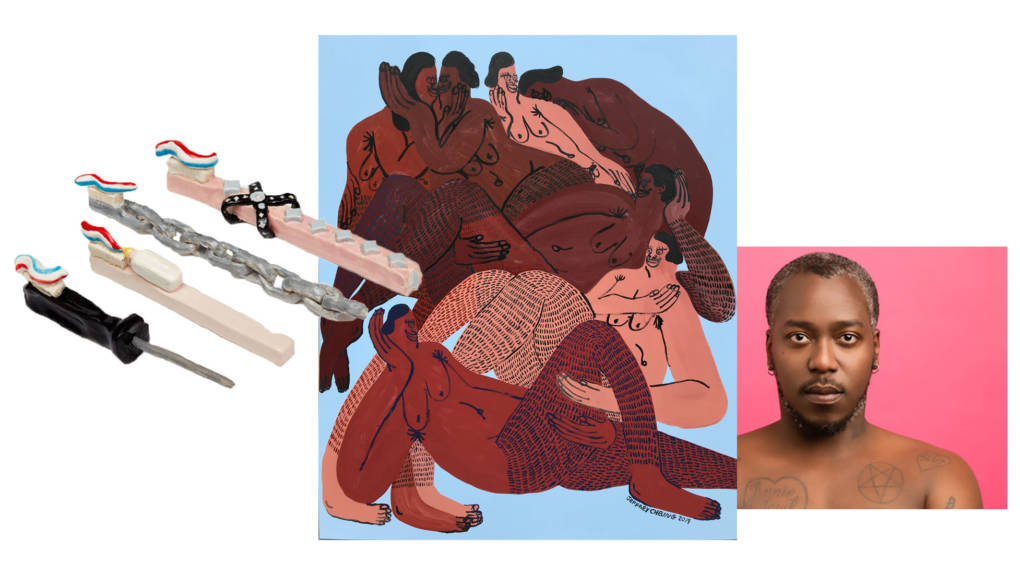
"caption": "L to R: Ceramic work by Seth Bogart, painting by Jeffrey Cheung, and Brontez Purnell.",
"description": "L to R: Ceramic work by Seth Bogart, painting by Jeffrey Cheung, and Brontez Purnell.",
"title": "Trio_COVER",
"credit": "Courtesy of Johansson Projects",
"status": "inherit",
"isLoading": false,
"fetchFailed": false
},
"arts_13867941": {
"type": "attachments",
"id": "arts_13867941",
"meta": {
"index": "attachments_1716263798",
"site": "arts",
"id": "13867941",
"found": true
},
"parent": 13867938,
"imgSizes": {
"twentyfourteen-full-width": {
"file": "https://ww2.kqed.org/app/uploads/sites/2/2019/10/LRG__DSC6034-1038x576.jpg",
"width": 1038,
"mimeType": "image/jpeg",
"height": 576
},
"thumbnail": {
"file": "https://ww2.kqed.org/app/uploads/sites/2/2019/10/LRG__DSC6034-160x107.jpg",
"width": 160,
"mimeType": "image/jpeg",
"height": 107
},
"post-thumbnail": {
"file": "https://ww2.kqed.org/app/uploads/sites/2/2019/10/LRG__DSC6034-672x372.jpg",
"width": 672,
"mimeType": "image/jpeg",
"height": 372
},
"kqedFullSize": {
"file": "https://ww2.kqed.org/app/uploads/sites/2/2019/10/LRG__DSC6034.jpg",
"width": 1616,
"height": 1080
},
"large": {
"file": "https://ww2.kqed.org/app/uploads/sites/2/2019/10/LRG__DSC6034-1020x682.jpg",
"width": 1020,
"mimeType": "image/jpeg",
"height": 682
},
"complete_open_graph": {
"file": "https://ww2.kqed.org/app/uploads/sites/2/2019/10/LRG__DSC6034-1200x802.jpg",
"width": 1200,
"mimeType": "image/jpeg",
"height": 802
},
"medium": {
"file": "https://ww2.kqed.org/app/uploads/sites/2/2019/10/LRG__DSC6034-800x535.jpg",
"width": 800,
"mimeType": "image/jpeg",
"height": 535
},
"medium_large": {
"file": "https://ww2.kqed.org/app/uploads/sites/2/2019/10/LRG__DSC6034-768x513.jpg",
"width": 768,
"mimeType": "image/jpeg",
"height": 513
}
},
"publishDate": 1570637446,
"modified": 1570637503,
"caption": "Rico G",
"description": "Rico G",
"title": "Rico G",
"credit": "Pendarvis Harshaw",
"status": "inherit",
"isLoading": false,
"fetchFailed": false
},
"arts_13856520": {
"type": "attachments",
"id": "arts_13856520",
"meta": {
"index": "attachments_1716263798",
"site": "arts",
"id": "13856520",
"found": true
},
"parent": 13856498,
"imgSizes": {
"twentyfourteen-full-width": {
"file": "https://ww2.kqed.org/app/uploads/sites/2/2019/05/AlphabetRockers-1038x576.jpg",
"width": 1038,
"mimeType": "image/jpeg",
"height": 576
},
"thumbnail": {
"file": "https://ww2.kqed.org/app/uploads/sites/2/2019/05/AlphabetRockers-160x90.jpg",
"width": 160,
"mimeType": "image/jpeg",
"height": 90
},
"post-thumbnail": {
"file": "https://ww2.kqed.org/app/uploads/sites/2/2019/05/AlphabetRockers-672x372.jpg",
"width": 672,
"mimeType": "image/jpeg",
"height": 372
},
"kqedFullSize": {
"file": "https://ww2.kqed.org/app/uploads/sites/2/2019/05/AlphabetRockers.jpg",
"width": 1920,
"height": 1080
},
"large": {
"file": "https://ww2.kqed.org/app/uploads/sites/2/2019/05/AlphabetRockers-1020x574.jpg",
"width": 1020,
"mimeType": "image/jpeg",
"height": 574
},
"complete_open_graph": {
"file": "https://ww2.kqed.org/app/uploads/sites/2/2019/05/AlphabetRockers-1200x675.jpg",
"width": 1200,
"mimeType": "image/jpeg",
"height": 675
},
"full-width": {
"file": "https://ww2.kqed.org/app/uploads/sites/2/2019/05/AlphabetRockers-1920x1080.jpg",
"width": 1920,
"mimeType": "image/jpeg",
"height": 1080
},
"medium": {
"file": "https://ww2.kqed.org/app/uploads/sites/2/2019/05/AlphabetRockers-800x450.jpg",
"width": 800,
"mimeType": "image/jpeg",
"height": 450
},
"medium_large": {
"file": "https://ww2.kqed.org/app/uploads/sites/2/2019/05/AlphabetRockers-768x432.jpg",
"width": 768,
"mimeType": "image/jpeg",
"height": 432
}
},
"publishDate": 1556910278,
"modified": 1556910315,
"caption": "The Alphabet Rockers, with a cross-section of their all-ages listeners.",
"description": "The Alphabet Rockers, with a cross-section of their all-ages listeners.",
"title": "AlphabetRockers",
"credit": "Courtesy Alphabet Rockers",
"status": "inherit",
"isLoading": false,
"fetchFailed": false
},
"arts_13867349": {
"type": "attachments",
"id": "arts_13867349",
"meta": {
"index": "attachments_1716263798",
"site": "arts",
"id": "13867349",
"found": true
},
"parent": 13867337,
"imgSizes": {
"twentyfourteen-full-width": {
"file": "https://ww2.kqed.org/app/uploads/sites/2/2019/09/0-1038x576.jpg",
"width": 1038,
"mimeType": "image/jpeg",
"height": 576
},
"thumbnail": {
"file": "https://ww2.kqed.org/app/uploads/sites/2/2019/09/0-160x107.jpg",
"width": 160,
"mimeType": "image/jpeg",
"height": 107
},
"post-thumbnail": {
"file": "https://ww2.kqed.org/app/uploads/sites/2/2019/09/0-672x372.jpg",
"width": 672,
"mimeType": "image/jpeg",
"height": 372
},
"kqedFullSize": {
"file": "https://ww2.kqed.org/app/uploads/sites/2/2019/09/0.jpg",
"width": 1616,
"height": 1080
},
"large": {
"file": "https://ww2.kqed.org/app/uploads/sites/2/2019/09/0-1020x682.jpg",
"width": 1020,
"mimeType": "image/jpeg",
"height": 682
},
"complete_open_graph": {
"file": "https://ww2.kqed.org/app/uploads/sites/2/2019/09/0-1200x802.jpg",
"width": 1200,
"mimeType": "image/jpeg",
"height": 802
},
"medium": {
"file": "https://ww2.kqed.org/app/uploads/sites/2/2019/09/0-800x535.jpg",
"width": 800,
"mimeType": "image/jpeg",
"height": 535
},
"medium_large": {
"file": "https://ww2.kqed.org/app/uploads/sites/2/2019/09/0-768x513.jpg",
"width": 768,
"mimeType": "image/jpeg",
"height": 513
}
},
"publishDate": 1569873381,
"modified": 1569873405,
"caption": "Billy X Jennings",
"description": "Billy X Jennings",
"title": "Billy X Jennings",
"credit": "Pendarvis Harshaw",
"status": "inherit",
"isLoading": false,
"fetchFailed": false
},
"arts_13867389": {
"type": "attachments",
"id": "arts_13867389",
"meta": {
"index": "attachments_1716263798",
"site": "arts",
"id": "13867389",
"found": true
},
"parent": 13867290,
"imgSizes": {
"twentyfourteen-full-width": {
"file": "https://ww2.kqed.org/app/uploads/sites/2/2019/09/copyslut-1038x576.jpg",
"width": 1038,
"mimeType": "image/jpeg",
"height": 576
},
"thumbnail": {
"file": "https://ww2.kqed.org/app/uploads/sites/2/2019/09/copyslut-160x90.jpg",
"width": 160,
"mimeType": "image/jpeg",
"height": 90
},
"post-thumbnail": {
"file": "https://ww2.kqed.org/app/uploads/sites/2/2019/09/copyslut-672x372.jpg",
"width": 672,
"mimeType": "image/jpeg",
"height": 372
},
"kqedFullSize": {
"file": "https://ww2.kqed.org/app/uploads/sites/2/2019/09/copyslut.jpg",
"width": 1920,
"height": 1080
},
"large": {
"file": "https://ww2.kqed.org/app/uploads/sites/2/2019/09/copyslut-1020x574.jpg",
"width": 1020,
"mimeType": "image/jpeg",
"height": 574
},
"complete_open_graph": {
"file": "https://ww2.kqed.org/app/uploads/sites/2/2019/09/copyslut-1200x675.jpg",
"width": 1200,
"mimeType": "image/jpeg",
"height": 675
},
"full-width": {
"file": "https://ww2.kqed.org/app/uploads/sites/2/2019/09/copyslut-1920x1080.jpg",
"width": 1920,
"mimeType": "image/jpeg",
"height": 1080
},
"medium": {
"file": "https://ww2.kqed.org/app/uploads/sites/2/2019/09/copyslut-800x450.jpg",
"width": 800,
"mimeType": "image/jpeg",
"height": 450
},
"medium_large": {
"file": "https://ww2.kqed.org/app/uploads/sites/2/2019/09/copyslut-768x432.jpg",
"width": 768,
"mimeType": "image/jpeg",
"height": 432
}
},
"publishDate": 1569890523,
"modified": 1569974617,
"caption": "Eli Maliwan, Ray Zamora and Chatz (left to right) are Copyslut. They've played rallies and benefits, and published an educational zine. Now, Copyslut is working on their debut album. ",
"description": "Eli Maliwan, Ray Zamora and Chatz (left to right) are Copyslut, an Oakland rock band advocating for sex workers' rights.",
"title": "copyslut",
"credit": "Nastia Voynovskaya",
"status": "inherit",
"isLoading": false,
"fetchFailed": false
},
"arts_13867498": {
"type": "attachments",
"id": "arts_13867498",
"meta": {
"index": "attachments_1716263798",
"site": "arts",
"id": "13867498",
"found": true
},
"parent": 13867030,
"imgSizes": {
"thumbnail": {
"file": "https://ww2.kqed.org/app/uploads/sites/2/2019/09/SIdeshow.Stockton.MAIN_-160x90.jpg",
"width": 160,
"mimeType": "image/jpeg",
"height": 90
},
"post-thumbnail": {
"file": "https://ww2.kqed.org/app/uploads/sites/2/2019/09/SIdeshow.Stockton.MAIN_-672x372.jpg",
"width": 672,
"mimeType": "image/jpeg",
"height": 372
},
"kqedFullSize": {
"file": "https://ww2.kqed.org/app/uploads/sites/2/2019/09/SIdeshow.Stockton.MAIN_.jpg",
"width": 1020,
"height": 574
},
"large": {
"file": "https://ww2.kqed.org/app/uploads/sites/2/2019/09/SIdeshow.Stockton.MAIN_-1020x574.jpg",
"width": 1020,
"mimeType": "image/jpeg",
"height": 574
},
"medium": {
"file": "https://ww2.kqed.org/app/uploads/sites/2/2019/09/SIdeshow.Stockton.MAIN_-800x450.jpg",
"width": 800,
"mimeType": "image/jpeg",
"height": 450
},
"medium_large": {
"file": "https://ww2.kqed.org/app/uploads/sites/2/2019/09/SIdeshow.Stockton.MAIN_-768x432.jpg",
"width": 768,
"mimeType": "image/jpeg",
"height": 432
}
},
"publishDate": 1570037758,
"modified": 1570037779,
"caption": "RedLine Truck at Wettfest in Stockton. ",
"description": "RedLine Truck at Wettfest in Stockton. ",
"title": "SIdeshow.Stockton.MAIN",
"credit": "Talyah Cole",
"status": "inherit",
"isLoading": false,
"fetchFailed": false
},
"arts_13867128": {
"type": "attachments",
"id": "arts_13867128",
"meta": {
"index": "attachments_1716263798",
"site": "arts",
"id": "13867128",
"found": true
},
"parent": 13866776,
"imgSizes": {
"twentyfourteen-full-width": {
"file": "https://ww2.kqed.org/app/uploads/sites/2/2019/09/NotUrBaby-1038x576.jpg",
"width": 1038,
"mimeType": "image/jpeg",
"height": 576
},
"thumbnail": {
"file": "https://ww2.kqed.org/app/uploads/sites/2/2019/09/NotUrBaby-160x90.jpg",
"width": 160,
"mimeType": "image/jpeg",
"height": 90
},
"post-thumbnail": {
"file": "https://ww2.kqed.org/app/uploads/sites/2/2019/09/NotUrBaby-672x372.jpg",
"width": 672,
"mimeType": "image/jpeg",
"height": 372
},
"kqedFullSize": {
"file": "https://ww2.kqed.org/app/uploads/sites/2/2019/09/NotUrBaby.jpg",
"width": 1764,
"height": 992
},
"large": {
"file": "https://ww2.kqed.org/app/uploads/sites/2/2019/09/NotUrBaby-1020x574.jpg",
"width": 1020,
"mimeType": "image/jpeg",
"height": 574
},
"complete_open_graph": {
"file": "https://ww2.kqed.org/app/uploads/sites/2/2019/09/NotUrBaby-1200x675.jpg",
"width": 1200,
"mimeType": "image/jpeg",
"height": 675
},
"medium": {
"file": "https://ww2.kqed.org/app/uploads/sites/2/2019/09/NotUrBaby-800x450.jpg",
"width": 800,
"mimeType": "image/jpeg",
"height": 450
},
"medium_large": {
"file": "https://ww2.kqed.org/app/uploads/sites/2/2019/09/NotUrBaby-768x432.jpg",
"width": 768,
"mimeType": "image/jpeg",
"height": 432
}
},
"publishDate": 1569438422,
"modified": 1569438973,
"caption": "A scene from 'Not Ur Baby.'",
"description": "A scene from 'Not Ur Baby.'",
"title": "NotUrBaby",
"credit": null,
"status": "inherit",
"isLoading": false,
"fetchFailed": false
},
"arts_13825169": {
"type": "attachments",
"id": "arts_13825169",
"meta": {
"index": "attachments_1716263798",
"site": "arts",
"id": "13825169",
"found": true
},
"parent": 13825157,
"imgSizes": {
"small": {
"file": "https://ww2.kqed.org/app/uploads/sites/2/2018/02/astu-520x293.jpg",
"width": 520,
"mimeType": "image/jpeg",
"height": 293
},
"twentyfourteen-full-width": {
"file": "https://ww2.kqed.org/app/uploads/sites/2/2018/02/astu-1038x576.jpg",
"width": 1038,
"mimeType": "image/jpeg",
"height": 576
},
"thumbnail": {
"file": "https://ww2.kqed.org/app/uploads/sites/2/2018/02/astu-160x90.jpg",
"width": 160,
"mimeType": "image/jpeg",
"height": 90
},
"fd-sm": {
"file": "https://ww2.kqed.org/app/uploads/sites/2/2018/02/astu-960x540.jpg",
"width": 960,
"mimeType": "image/jpeg",
"height": 540
},
"post-thumbnail": {
"file": "https://ww2.kqed.org/app/uploads/sites/2/2018/02/astu-672x372.jpg",
"width": 672,
"mimeType": "image/jpeg",
"height": 372
},
"xsmall": {
"file": "https://ww2.kqed.org/app/uploads/sites/2/2018/02/astu-375x211.jpg",
"width": 375,
"mimeType": "image/jpeg",
"height": 211
},
"kqedFullSize": {
"file": "https://ww2.kqed.org/app/uploads/sites/2/2018/02/astu.jpg",
"width": 1920,
"height": 1080
},
"large": {
"file": "https://ww2.kqed.org/app/uploads/sites/2/2018/02/astu-1020x574.jpg",
"width": 1020,
"mimeType": "image/jpeg",
"height": 574
},
"xlarge": {
"file": "https://ww2.kqed.org/app/uploads/sites/2/2018/02/astu-1180x664.jpg",
"width": 1180,
"mimeType": "image/jpeg",
"height": 664
},
"guest-author-50": {
"file": "https://ww2.kqed.org/app/uploads/sites/2/2018/02/astu-50x50.jpg",
"width": 50,
"mimeType": "image/jpeg",
"height": 50
},
"guest-author-96": {
"file": "https://ww2.kqed.org/app/uploads/sites/2/2018/02/astu-96x96.jpg",
"width": 96,
"mimeType": "image/jpeg",
"height": 96
},
"medium": {
"file": "https://ww2.kqed.org/app/uploads/sites/2/2018/02/astu-800x450.jpg",
"width": 800,
"mimeType": "image/jpeg",
"height": 450
},
"guest-author-64": {
"file": "https://ww2.kqed.org/app/uploads/sites/2/2018/02/astu-64x64.jpg",
"width": 64,
"mimeType": "image/jpeg",
"height": 64
},
"guest-author-32": {
"file": "https://ww2.kqed.org/app/uploads/sites/2/2018/02/astu-32x32.jpg",
"width": 32,
"mimeType": "image/jpeg",
"height": 32
},
"fd-lrg": {
"file": "https://ww2.kqed.org/app/uploads/sites/2/2018/02/astu-1920x1080.jpg",
"width": 1920,
"mimeType": "image/jpeg",
"height": 1080
},
"fd-med": {
"file": "https://ww2.kqed.org/app/uploads/sites/2/2018/02/astu-1180x664.jpg",
"width": 1180,
"mimeType": "image/jpeg",
"height": 664
},
"full-width": {
"file": "https://ww2.kqed.org/app/uploads/sites/2/2018/02/astu-1920x1080.jpg",
"width": 1920,
"mimeType": "image/jpeg",
"height": 1080
},
"detail": {
"file": "https://ww2.kqed.org/app/uploads/sites/2/2018/02/astu-150x150.jpg",
"width": 150,
"mimeType": "image/jpeg",
"height": 150
},
"medium_large": {
"file": "https://ww2.kqed.org/app/uploads/sites/2/2018/02/astu-768x432.jpg",
"width": 768,
"mimeType": "image/jpeg",
"height": 432
},
"guest-author-128": {
"file": "https://ww2.kqed.org/app/uploads/sites/2/2018/02/astu-128x128.jpg",
"width": 128,
"mimeType": "image/jpeg",
"height": 128
},
"xxsmall": {
"file": "https://ww2.kqed.org/app/uploads/sites/2/2018/02/astu-240x135.jpg",
"width": 240,
"mimeType": "image/jpeg",
"height": 135
}
},
"publishDate": 1519247089,
"modified": 1519256798,
"caption": "Oakland singer Astu left her life as a preacher behind, finding herself in music instead.",
"description": "Oakland singer Astu left her life as a preacher behind, finding herself in music instead.",
"title": "astu",
"credit": "Pablo Circa",
"status": "inherit",
"isLoading": false,
"fetchFailed": false
},
"arts_13865969": {
"type": "attachments",
"id": "arts_13865969",
"meta": {
"index": "attachments_1716263798",
"site": "arts",
"id": "13865969",
"found": true
},
"parent": 13865954,
"imgSizes": {
"twentyfourteen-full-width": {
"file": "https://ww2.kqed.org/app/uploads/sites/2/2019/09/0-1-1038x576.jpg",
"width": 1038,
"mimeType": "image/jpeg",
"height": 576
},
"thumbnail": {
"file": "https://ww2.kqed.org/app/uploads/sites/2/2019/09/0-1-160x67.jpg",
"width": 160,
"mimeType": "image/jpeg",
"height": 67
},
"post-thumbnail": {
"file": "https://ww2.kqed.org/app/uploads/sites/2/2019/09/0-1-672x372.jpg",
"width": 672,
"mimeType": "image/jpeg",
"height": 372
},
"kqedFullSize": {
"file": "https://ww2.kqed.org/app/uploads/sites/2/2019/09/0-1.jpg",
"width": 2048,
"height": 858
},
"large": {
"file": "https://ww2.kqed.org/app/uploads/sites/2/2019/09/0-1-1020x427.jpg",
"width": 1020,
"mimeType": "image/jpeg",
"height": 427
},
"complete_open_graph": {
"file": "https://ww2.kqed.org/app/uploads/sites/2/2019/09/0-1-1200x503.jpg",
"width": 1200,
"mimeType": "image/jpeg",
"height": 503
},
"full-width": {
"file": "https://ww2.kqed.org/app/uploads/sites/2/2019/09/0-1-1920x804.jpg",
"width": 1920,
"mimeType": "image/jpeg",
"height": 804
},
"medium": {
"file": "https://ww2.kqed.org/app/uploads/sites/2/2019/09/0-1-800x335.jpg",
"width": 800,
"mimeType": "image/jpeg",
"height": 335
},
"medium_large": {
"file": "https://ww2.kqed.org/app/uploads/sites/2/2019/09/0-1-768x322.jpg",
"width": 768,
"mimeType": "image/jpeg",
"height": 322
}
},
"publishDate": 1568043527,
"modified": 1568323663,
"caption": "A still from the film, Akasha (Directed by Hajooj Kuka).",
"description": "A still from the film, Akasha (Directed by Hajooj Kuka).",
"title": "A still from the film 'aKasha,' directed by Hajooj Kuka.",
"credit": "Oakland International Film Festival",
"status": "inherit",
"isLoading": false,
"fetchFailed": false
},
"arts_11453051": {
"type": "attachments",
"id": "arts_11453051",
"meta": {
"index": "attachments_1716263798",
"site": "arts",
"id": "11453051",
"found": true
},
"parent": 11449791,
"imgSizes": {
"thumbnail": {
"file": "https://ww2.kqed.org/app/uploads/sites/2/2016/03/Dogtown4000-400x225.jpg",
"width": 400,
"mimeType": "image/jpeg",
"height": 225
},
"kqedFullSize": {
"file": "https://ww2.kqed.org/app/uploads/sites/2/2016/03/Dogtown4000.jpg",
"width": 400,
"height": 225
},
"guest-author-96": {
"file": "https://ww2.kqed.org/app/uploads/sites/2/2016/03/Dogtown4000-96x96.jpg",
"width": 96,
"mimeType": "image/jpeg",
"height": 96
},
"guest-author-64": {
"file": "https://ww2.kqed.org/app/uploads/sites/2/2016/03/Dogtown4000-64x64.jpg",
"width": 64,
"mimeType": "image/jpeg",
"height": 64
},
"detail": {
"file": "https://ww2.kqed.org/app/uploads/sites/2/2016/03/Dogtown4000-75x75.jpg",
"width": 75,
"mimeType": "image/jpeg",
"height": 75
},
"guest-author-32": {
"file": "https://ww2.kqed.org/app/uploads/sites/2/2016/03/Dogtown4000-32x32.jpg",
"width": 32,
"mimeType": "image/jpeg",
"height": 32
},
"guest-author-128": {
"file": "https://ww2.kqed.org/app/uploads/sites/2/2016/03/Dogtown4000-128x128.jpg",
"width": 128,
"mimeType": "image/jpeg",
"height": 128
}
},
"publishDate": 1459447973,
"modified": 1568237524,
"caption": "A still from 'Dogtown Redemption' shoting Jason Witt and his partner Heather Holloman.\n",
"description": "A still from 'Dogtown Redemption' shoting Jason Witt and his partner Heather Holloman.\n",
"title": "Dogtown4000",
"credit": "Chihiro Wimbush/Courtesy 'Dogtown Redemption'",
"status": "inherit",
"isLoading": false,
"fetchFailed": false
},
"arts_13861187": {
"type": "attachments",
"id": "arts_13861187",
"meta": {
"index": "attachments_1716263798",
"site": "arts",
"id": "13861187",
"found": true
},
"parent": 13861153,
"imgSizes": {
"twentyfourteen-full-width": {
"file": "https://ww2.kqed.org/app/uploads/sites/2/2019/07/Universal-Language-Mural-Obscured-by-Development-1038x576.jpg",
"width": 1038,
"mimeType": "image/jpeg",
"height": 576
},
"thumbnail": {
"file": "https://ww2.kqed.org/app/uploads/sites/2/2019/07/Universal-Language-Mural-Obscured-by-Development-160x96.jpg",
"width": 160,
"mimeType": "image/jpeg",
"height": 96
},
"post-thumbnail": {
"file": "https://ww2.kqed.org/app/uploads/sites/2/2019/07/Universal-Language-Mural-Obscured-by-Development-672x372.jpg",
"width": 672,
"mimeType": "image/jpeg",
"height": 372
},
"kqedFullSize": {
"file": "https://ww2.kqed.org/app/uploads/sites/2/2019/07/Universal-Language-Mural-Obscured-by-Development.jpg",
"width": 1920,
"height": 1155
},
"large": {
"file": "https://ww2.kqed.org/app/uploads/sites/2/2019/07/Universal-Language-Mural-Obscured-by-Development-1020x614.jpg",
"width": 1020,
"mimeType": "image/jpeg",
"height": 614
},
"complete_open_graph": {
"file": "https://ww2.kqed.org/app/uploads/sites/2/2019/07/Universal-Language-Mural-Obscured-by-Development-1200x722.jpg",
"width": 1200,
"mimeType": "image/jpeg",
"height": 722
},
"full-width": {
"file": "https://ww2.kqed.org/app/uploads/sites/2/2019/07/Universal-Language-Mural-Obscured-by-Development-1920x1155.jpg",
"width": 1920,
"mimeType": "image/jpeg",
"height": 1155
},
"medium": {
"file": "https://ww2.kqed.org/app/uploads/sites/2/2019/07/Universal-Language-Mural-Obscured-by-Development-800x481.jpg",
"width": 800,
"mimeType": "image/jpeg",
"height": 481
},
"medium_large": {
"file": "https://ww2.kqed.org/app/uploads/sites/2/2019/07/Universal-Language-Mural-Obscured-by-Development-768x462.jpg",
"width": 768,
"mimeType": "image/jpeg",
"height": 462
}
},
"publishDate": 1562869479,
"modified": 1568054875,
"caption": "A panel of the disappearing \"Universal Language\" mural, showing the Congolese artist Malonga Casquelourd, in front of Oakland's changing skyline.",
"description": "A panel of the disappearing \"Universal Language\" mural, showing the Congolese artist Malonga Casquelourd, in front of Oakland's changing skyline.",
"title": "Universal-Language-Mural-Obscured-by-Development",
"credit": "Sam Lefebvre/KQED",
"status": "inherit",
"isLoading": false,
"fetchFailed": false
},
"arts_13865856": {
"type": "attachments",
"id": "arts_13865856",
"meta": {
"index": "attachments_1716263798",
"site": "arts",
"id": "13865856",
"found": true
},
"parent": 13865804,
"imgSizes": {
"twentyfourteen-full-width": {
"file": "https://ww2.kqed.org/app/uploads/sites/2/2019/09/RS37752__DSC1029-qut-1020x681-1020x576.jpg",
"width": 1020,
"mimeType": "image/jpeg",
"height": 576
},
"thumbnail": {
"file": "https://ww2.kqed.org/app/uploads/sites/2/2019/09/RS37752__DSC1029-qut-1020x681-160x107.jpg",
"width": 160,
"mimeType": "image/jpeg",
"height": 107
},
"post-thumbnail": {
"file": "https://ww2.kqed.org/app/uploads/sites/2/2019/09/RS37752__DSC1029-qut-1020x681-672x372.jpg",
"width": 672,
"mimeType": "image/jpeg",
"height": 372
},
"kqedFullSize": {
"file": "https://ww2.kqed.org/app/uploads/sites/2/2019/09/RS37752__DSC1029-qut-1020x681.jpg",
"width": 1020,
"height": 681
},
"large": {
"file": "https://ww2.kqed.org/app/uploads/sites/2/2019/09/RS37752__DSC1029-qut-1020x681-1020x681.jpg",
"width": 1020,
"mimeType": "image/jpeg",
"height": 681
},
"medium": {
"file": "https://ww2.kqed.org/app/uploads/sites/2/2019/09/RS37752__DSC1029-qut-1020x681-800x534.jpg",
"width": 800,
"mimeType": "image/jpeg",
"height": 534
},
"medium_large": {
"file": "https://ww2.kqed.org/app/uploads/sites/2/2019/09/RS37752__DSC1029-qut-1020x681-768x513.jpg",
"width": 768,
"mimeType": "image/jpeg",
"height": 513
}
},
"publishDate": 1567754770,
"modified": 1567755026,
"caption": "Local music community members said no outcome of the Ghost Ship criminal trial would bring satisfaction.",
"description": "Local music community members said no outcome of the Ghost Ship criminal trial would bring satisfaction.",
"title": "Local music community members said no outcome of the Ghost Ship criminal trial would bring satisfaction.",
"credit": "Stephanie Lister/KQED",
"status": "inherit",
"isLoading": false,
"fetchFailed": false
}
},
"audioPlayerReducer": {
"postId": "stream_live",
"isPaused": true,
"isPlaying": false,
"pfsActive": false,
"pledgeModalIsOpen": true,
"playerDrawerIsOpen": false,
"liveAudioPlayStartedAt": 0,
"liveAudioPlayContext": ""
},
"authorsReducer": {
"slefebvre": {
"type": "authors",
"id": "11091",
"meta": {
"index": "authors_1716337520",
"id": "11091",
"found": true
},
"name": "Sam Lefebvre",
"firstName": "Sam",
"lastName": "Lefebvre",
"slug": "slefebvre",
"email": "sdlefebvre@gmail.com",
"display_author_email": false,
"staff_mastheads": [],
"title": null,
"bio": "Sam Lefebvre is an award-winning reporter at KQED Arts. He has worked as an editor and columnist at the \u003cem>East Bay Express\u003c/em>, \u003cem>SF Weekly \u003c/em>and Impose Magazine, and his journalism and criticism has appeared in \u003cem>The New York Times\u003c/em>, the Guardian and Pitchfork.",
"avatar": "https://secure.gravatar.com/avatar/143b570c3dec13ae74c6aa2369b04fc8?s=600&d=blank&r=g",
"twitter": "Lefebvre_Sam",
"facebook": null,
"instagram": null,
"linkedin": null,
"sites": [
{
"site": "arts",
"roles": [
"editor"
]
},
{
"site": "news",
"roles": [
"author"
]
}
],
"headData": {
"title": "Sam Lefebvre | KQED",
"description": null,
"ogImgSrc": "https://secure.gravatar.com/avatar/143b570c3dec13ae74c6aa2369b04fc8?s=600&d=blank&r=g",
"twImgSrc": "https://secure.gravatar.com/avatar/143b570c3dec13ae74c6aa2369b04fc8?s=600&d=blank&r=g"
},
"isLoading": false,
"link": "/author/slefebvre"
},
"nvoynovskaya": {
"type": "authors",
"id": "11387",
"meta": {
"index": "authors_1716337520",
"id": "11387",
"found": true
},
"name": "Nastia Voynovskaya",
"firstName": "Nastia",
"lastName": "Voynovskaya",
"slug": "nvoynovskaya",
"email": "nvoynovskaya@kqed.org",
"display_author_email": false,
"staff_mastheads": [
"arts"
],
"title": "Editor and reporter",
"bio": "Nastia Voynovskaya is a reporter and editor at KQED Arts & Culture. She's been covering the arts in the Bay Area for over a decade, with a focus on music, queer culture, labor issues and grassroots organizing. She has edited KQED story series such as Trans Bay: A History of San Francisco's Gender-Diverse Community, and co-created KQED's Bay Area hip-hop history project, That's My Word. Nastia's work has been recognized by the Society of Professional Journalists and San Francisco Press Club. She holds a BA in comparative literature from UC Berkeley.",
"avatar": "https://secure.gravatar.com/avatar/5025ee460e5a85d69ca20ea6c6f2f80d7e17795c828f61ea3aecfcd924e9042e?s=600&d=blank&r=g",
"twitter": null,
"bluesky": null,
"facebook": null,
"instagram": "https://www.instagram.com/nananastia/",
"linkedin": null,
"sites": [
{
"site": "arts",
"roles": [
"administrator"
]
},
{
"site": "news",
"roles": [
"editor"
]
},
{
"site": "pop",
"roles": [
"administrator"
]
},
{
"site": "bayareabites",
"roles": [
"editor"
]
},
{
"site": "podcasts",
"roles": [
"editor"
]
},
{
"site": "hiphop",
"roles": [
"editor"
]
}
],
"headData": {
"title": "Nastia Voynovskaya | KQED",
"description": "Editor and reporter",
"ogImgSrc": "https://secure.gravatar.com/avatar/5025ee460e5a85d69ca20ea6c6f2f80d7e17795c828f61ea3aecfcd924e9042e?s=600&d=blank&r=g",
"twImgSrc": "https://secure.gravatar.com/avatar/5025ee460e5a85d69ca20ea6c6f2f80d7e17795c828f61ea3aecfcd924e9042e?s=600&d=blank&r=g"
},
"isLoading": false,
"link": "/author/nvoynovskaya"
},
"ogpenn": {
"type": "authors",
"id": "11491",
"meta": {
"index": "authors_1716337520",
"id": "11491",
"found": true
},
"name": "Pendarvis Harshaw",
"firstName": "Pendarvis",
"lastName": "Harshaw",
"slug": "ogpenn",
"email": "ogpenn@gmail.com",
"display_author_email": false,
"staff_mastheads": [
"arts"
],
"title": "Community Engagement Reporter",
"bio": "Pendarvis Harshaw is an educator, host and writer with KQED Arts.",
"avatar": "https://secure.gravatar.com/avatar/972b77ee8e3f346ae2b00622661187fbfabd059b5693bbdc1475ea7a722fd4cd?s=600&d=blank&r=g",
"twitter": null,
"bluesky": null,
"facebook": null,
"instagram": "ogpenn",
"linkedin": null,
"sites": [
{
"site": "arts",
"roles": [
"administrator"
]
},
{
"site": "news",
"roles": [
"editor"
]
},
{
"site": "bayareabites",
"roles": [
"author"
]
},
{
"site": "hiphop",
"roles": [
"editor"
]
}
],
"headData": {
"title": "Pendarvis Harshaw | KQED",
"description": "Community Engagement Reporter",
"ogImgSrc": "https://secure.gravatar.com/avatar/972b77ee8e3f346ae2b00622661187fbfabd059b5693bbdc1475ea7a722fd4cd?s=600&d=blank&r=g",
"twImgSrc": "https://secure.gravatar.com/avatar/972b77ee8e3f346ae2b00622661187fbfabd059b5693bbdc1475ea7a722fd4cd?s=600&d=blank&r=g"
},
"isLoading": false,
"link": "/author/ogpenn"
},
"rgebreyesus": {
"type": "authors",
"id": "11625",
"meta": {
"index": "authors_1716337520",
"id": "11625",
"found": true
},
"name": "Ruth Gebreyesus",
"firstName": "Ruth",
"lastName": "Gebreyesus",
"slug": "rgebreyesus",
"email": "rgebreyesus@KQED.org",
"display_author_email": false,
"staff_mastheads": [],
"title": "Food Writer",
"bio": "Ruth Gebreyesus is a freelance writer and producer based in the Bay Area. Through stories across various mediums, Ruth explores the creation and consumption of cultural products. You can find more of her work \u003ca href=\"https://www.kotetakotet.com/\">here\u003c/a>.",
"avatar": "https://secure.gravatar.com/avatar/68980beab511750abbb1a58f1c768b45?s=600&d=mm&r=g",
"twitter": "root_g",
"facebook": null,
"instagram": null,
"linkedin": null,
"sites": [
{
"site": "arts",
"roles": [
"subscriber"
]
},
{
"site": "bayareabites",
"roles": [
"subscriber"
]
},
{
"site": "checkplease",
"roles": [
"editor"
]
},
{
"site": "food",
"roles": []
}
],
"headData": {
"title": "Ruth Gebreyesus | KQED",
"description": "Food Writer",
"ogImgSrc": "https://secure.gravatar.com/avatar/68980beab511750abbb1a58f1c768b45?s=600&d=mm&r=g",
"twImgSrc": "https://secure.gravatar.com/avatar/68980beab511750abbb1a58f1c768b45?s=600&d=mm&r=g"
},
"isLoading": false,
"link": "/author/rgebreyesus"
}
},
"pagesReducer": {
"arts_tag_oakland": {
"type": "terms",
"id": "arts_1143",
"meta": {
"index": "terms_1716263798",
"site": "arts",
"id": "1143",
"score": 6.8845096
},
"featImg": null,
"name": "Oakland",
"description": null,
"taxonomy": "tag",
"headData": {
"twImgId": null,
"twTitle": null,
"ogTitle": null,
"ogImgId": null,
"twDescription": null,
"description": null,
"title": "Oakland Archives | KQED Arts",
"ogDescription": null
},
"ttid": 692,
"slug": "oakland",
"isLoading": false,
"title": "Oakland",
"pageMeta": {
"site": "arts",
"WpPageTemplate": "page-topic-editorial",
"currentPage": 51
},
"blocks": [
{
"blockName": "kqed/post-list",
"attrs": {
"layout": "cardArticle2",
"query": "posts/arts?tag=oakland",
"seeMore": false,
"paginated": true,
"page": 51
}
},
{
"blockName": "kqed/ad"
}
]
}
},
"pfsSessionReducer": {},
"postsReducer": {
"stream_live": {
"type": "live",
"id": "stream_live",
"audioUrl": "https://streams.kqed.org/kqedradio",
"title": "Live Stream",
"excerpt": "Live Stream information currently unavailable.",
"link": "/radio",
"featImg": "",
"label": {
"name": "KQED Live",
"link": "/"
}
},
"stream_kqedNewscast": {
"type": "posts",
"id": "stream_kqedNewscast",
"audioUrl": "https://www.kqed.org/.stream/anon/radio/RDnews/newscast.mp3?_=1",
"title": "KQED Newscast",
"featImg": "",
"label": {
"name": "88.5 FM",
"link": "/"
}
},
"arts_13868784": {
"type": "posts",
"id": "arts_13868784",
"meta": {
"index": "posts_1716263798",
"site": "arts",
"id": "13868784",
"score": null,
"sort": [
1571954445000
]
},
"guestAuthors": [],
"slug": "pansy-twist-celebrates-the-possibilities-of-community-for-queer-rockers-and-artists",
"title": "‘Pansy Twist’ Celebrates the Possibilities of Community for Queer Rockers and Artists",
"publishDate": 1571954445,
"format": "standard",
"headTitle": "‘Pansy Twist’ Celebrates the Possibilities of Community for Queer Rockers and Artists | KQED",
"labelTerm": {
"site": "arts"
},
"content": "\u003cp>\u003cspan style=\"font-size: 4.6875em;float: left;line-height: 0.733em;padding: 0.05em 0.1em 0 0;font-family: times, serif, georgia\">O\u003c/span>akland used to be the sort of city where two young, queer boys from Arizona and Alabama—incidentally also pen pals—could pack up and move. Once there, they’d make music, art and friends. \u003c/p>\n\u003cp>\u003cimg loading=\"lazy\" decoding=\"async\" class=\"alignright size-full wp-image-13864254\" src=\"https://ww2.kqed.org/arts/wp-content/uploads/sites/2/2019/08/RuthHeadshot_160.jpg\" alt=\"\" width=\"160\" height=\"187\">\u003c/p>\n\u003cp>Artists Seth Bogart, raised in Arizona, and Brontez Purnell, Alabamian by birth, met on the message board of record label Kill Rock Stars and struck up a correspondence, mailing each other letters from their respective conservative home states. In the late 90s, Bogart moved to Oakland and in 2002, Purnell followed suit, soon joining Bogart’s electro-punk band \u003ca href=\"https://en.wikipedia.org/wiki/Gravy_Train!!!!\" rel=\"noopener\" target=\"_blank\">Gravy Train!!!!\u003c/a> About a decade later, Purnell met Jeff Cheung, who grew up in the East Bay, when Cheung performed with his own band Meat Market at the West Oakland warehouse where Purnell lived. (Purnell and Brontez were well known to Cheung; when the younger artist was in high school, he saw Gravy Train!!!! perform at San Francisco’s Bottom of the Hill.)\u003c/p>\n\u003cfigure id=\"attachment_13868820\" class=\"wp-caption alignright\" style=\"max-width: 748px\">\u003cimg loading=\"lazy\" decoding=\"async\" src=\"https://ww2.kqed.org/arts/wp-content/uploads/sites/2/2019/10/Riot-Boy-Press.jpg\" alt=\"Brontez Purnell-made poster for 'Pansy Twist.'\" width=\"748\" height=\"960\" class=\"size-full wp-image-13868820\" srcset=\"https://cdn.kqed.org/wp-content/uploads/sites/2/2019/10/Riot-Boy-Press.jpg 748w, https://cdn.kqed.org/wp-content/uploads/sites/2/2019/10/Riot-Boy-Press-160x205.jpg 160w\" sizes=\"(max-width: 748px) 100vw, 748px\">\u003cfigcaption class=\"wp-caption-text\">Brontez Purnell-made poster for ‘Pansy Twist.’ \u003ccite>(Courtesy of the artist and Johansson Projects)\u003c/cite>\u003c/figcaption>\u003c/figure>\n\u003cp>This Friday all three multidisciplinary artists will show print, film and sculpture works at Oakland’s Johansson Projects under the banner \u003cem>\u003ca href=\"https://www.johanssonprojects.com/portfolio/bogart-cheung-purnell/\" rel=\"noopener\" target=\"_blank\">Pansy Twist: An Incomplete Survey/Mixtape of Contemporary Riot Boi Art\u003c/a>\u003c/em>. \u003c/p>\n\u003cp>“I don’t know too many places that have this many [queer] rockers who also share in community and whose voices are distinctly in conversation with each other,” Purnell says of the city that brought the three of them together. \u003c/p>\n\u003cp>“It was kind of a different place back then,” Bogart tells me over the phone from Los Angeles, his home base since 2011. “It was a lot more affordable and you could have a $300 rent if you lived with people.” \u003c/p>\n\u003cp>Today, it’s hard to say if Oakland is the sort of place that offers the same possibilities of community and convergence it did even just five years ago. What connections have forged in the waves of new residents recently arrived to town? How much has been lost along with those who were priced out of their homes? When did this attrition start? Such questions loom large for those invested in Oakland’s cultural identity—but on Friday night, the focus will be on the lovingly entangled webs Bogart, Purnell and Cheung have spun. \u003c/p>\n\u003cp>Since their respective arrivals to Oakland, Bogart and Purnell have forged careers in music and art, making waves far beyond the Bay Area. Alongside his ongoing musical project, \u003ca href=\"https://www.facebook.com/hunxandhispunx/\" rel=\"noopener\" target=\"_blank\">Hunx and His Punx\u003c/a>, Bogart’s artwork and multimedia performances have been featured in solo and group shows at galleries and museums in New York, Chicago and Detroit. Through his label \u003ca href=\"https://wackywacko.com/\" rel=\"noopener\" target=\"_blank\">Wacky Wacko\u003c/a>, Bogart also releases bright, mischievous ceramics and clothes; he collaborated with Cheung in 2018 on a button-up shirt patterned with Cheung’s signature nudes. \u003c/p>\n\u003cfigure id=\"attachment_13868826\" class=\"wp-caption aligncenter\" style=\"max-width: 3718px\">\u003cimg loading=\"lazy\" decoding=\"async\" src=\"https://ww2.kqed.org/arts/wp-content/uploads/sites/2/2019/10/bogart.jpeg\" alt=\"Ceramics by Seth Bogart, 2019.\" width=\"3718\" height=\"2569\" class=\"size-full wp-image-13868826\" srcset=\"https://cdn.kqed.org/wp-content/uploads/sites/2/2019/10/bogart.jpeg 3718w, https://cdn.kqed.org/wp-content/uploads/sites/2/2019/10/bogart-160x111.jpeg 160w, https://cdn.kqed.org/wp-content/uploads/sites/2/2019/10/bogart-800x553.jpeg 800w, https://cdn.kqed.org/wp-content/uploads/sites/2/2019/10/bogart-768x531.jpeg 768w, https://cdn.kqed.org/wp-content/uploads/sites/2/2019/10/bogart-1020x705.jpeg 1020w, https://cdn.kqed.org/wp-content/uploads/sites/2/2019/10/bogart-1200x829.jpeg 1200w, https://cdn.kqed.org/wp-content/uploads/sites/2/2019/10/bogart-1920x1327.jpeg 1920w\" sizes=\"(max-width: 3718px) 100vw, 3718px\">\u003cfigcaption class=\"wp-caption-text\">Ceramics by Seth Bogart, 2019. \u003ccite>(Courtesy of the artist and Johansson Projects)\u003c/cite>\u003c/figcaption>\u003c/figure>\n\u003cp>Hopping from one medium to the next came naturally to Bogart. “I started making clothes based on making merchandise for my band as a way to make extra money so I could quit my job,” he says. “I’m very thankful that I can move from one thing to another because sometimes, one of those things will really suck.” \u003c/p>\n\u003cp>Like Bogart, Purnell’s artistic expression crosses from one format to another. In 2017, he published his debut novel, \u003cem>\u003ca href=\"https://www.feministpress.org/books-n-z/since-i-laid-my-burden-down\" rel=\"noopener\" target=\"_blank\">Since I Laid My Burden Down\u003c/a>\u003c/em>, which went on to win the Whiting Prize for notable emerging writers. That same year his \u003ca href=\"http://www.brontezpurnelldancecompany.com/\" rel=\"noopener\" target=\"_blank\">eponymous dance company\u003c/a> debuted \u003cem>Chronic: A Dance about Marijuana\u003c/em> at a festival held by Bill T. Jones’s New York Live Arts. The show later played in Hamburg and made its Oakland debut earlier this month at \u003cem>Eternal Now\u003c/em>, a psychedelic variety show that, full disclaimer, this writer helped produce. (Shortly after that performance, Purnell declared “Oakland is back!” Though there’s an argument to whether the city is truly “back,” I won’t dispute the relative dormancy of its arts scene.)\u003c/p>\n\u003cp>These days, heightened safety measures and scarcity of space have shepherded in a new era in the Oakland underground scene. Meeting a kindred spirit at a warehouse venue is far less likely. Some gatherings have moved to formal spaces with security guards, lines and permits, while others are held outdoors, preserving the impermanence and fugitivity of the underground.\u003c/p>\n\u003cfigure id=\"attachment_13868827\" class=\"wp-caption aligncenter\" style=\"max-width: 1200px\">\u003cimg loading=\"lazy\" decoding=\"async\" src=\"https://ww2.kqed.org/arts/wp-content/uploads/sites/2/2019/10/Cheung_1200.jpg\" alt=\"Jeffrey Cheung, 'Complete,' 2019.\" width=\"1200\" height=\"1490\" class=\"size-full wp-image-13868827\" srcset=\"https://cdn.kqed.org/wp-content/uploads/sites/2/2019/10/Cheung_1200.jpg 1200w, https://cdn.kqed.org/wp-content/uploads/sites/2/2019/10/Cheung_1200-160x199.jpg 160w, https://cdn.kqed.org/wp-content/uploads/sites/2/2019/10/Cheung_1200-800x993.jpg 800w, https://cdn.kqed.org/wp-content/uploads/sites/2/2019/10/Cheung_1200-768x954.jpg 768w, https://cdn.kqed.org/wp-content/uploads/sites/2/2019/10/Cheung_1200-1020x1267.jpg 1020w, https://cdn.kqed.org/wp-content/uploads/sites/2/2019/10/Cheung_1200-966x1200.jpg 966w\" sizes=\"(max-width: 1200px) 100vw, 1200px\">\u003cfigcaption class=\"wp-caption-text\">Jeffrey Cheung, ‘Complete,’ 2019. \u003ccite>(Courtesy of the artist and Johansson Projects)\u003c/cite>\u003c/figcaption>\u003c/figure>\n\u003cp>At the Rockridge BART parking lot, for example, you might now find Cheung and Gabriel Ramirez’s Unity Skate meetups which, along with \u003ca href=\"https://www.unityzines.com/\" rel=\"noopener\" target=\"_blank\">Unity Press\u003c/a>, center accessible learning and joy for queer and trans folks. Cheung credits a free printmaking class led by Katie Gilmartin at San Francisco’s SOMArts as an inspiration for the work he does now with Unity. \u003c/p>\n\u003cp>“There were a lot of different creative scenes and spaces that I think were really inspiring to me, and felt like I could really express myself how I wanted,” he says of growing up in Oakland and taking classes in San Francisco. “Being around other young queer folks and having the resources to learn printmaking for free was amazing. I feel like these types of resources and spaces are harder to find in the Bay and are even more important to have.”\u003c/p>\n\u003cp>In his solo work as an artist, Cheung paints canvases of nude figures, tender and impish and always finished with a wink. His paintings have been included in shows both nationally and internationally. For Cheung, even these moments of individual recognition are opportunities to build community: His exhibitions never seem to pass without a Unity Skate meetup and skateboard giveaway. \u003c/p>\n\u003cp>https://www.instagram.com/p/B35RmI7JMul/\u003c/p>\n\u003cp>\u003cem>Pansy Twist\u003c/em> is a name borrowed from the \u003ca href=\"https://www.youtube.com/watch?v=I_kGP-AlEuk\" rel=\"noopener\" target=\"_blank\">title of a song\u003c/a> by London riot grrrl band Huggy Bear. “I think it’s a call to queer action and a call to crime,” Purnell says of the song. “I used to listen to it when I was a teenager and I thought it was the coolest song ever.” At Johansson Projects, the exhibition version of \u003cem>Pansy Twist\u003c/em> offers its own compelling call to action in its offer of D.I.T., or “do it together” (compared to D.I.Y.’s plea to “do it yourself”)—a celebration of the possibilities of community. \u003c/p>\n\u003cp>As Purnell puts it: “We hope somebody sees it and has a \u003cem>Pansy Twist\u003c/em> in their town.”\u003c/p>\n\u003cp>\u003cimg loading=\"lazy\" decoding=\"async\" src=\"https://ww2.kqed.org/arts/wp-content/uploads/sites/2/2016/09/Q.Logo_.Break_.jpg\" alt=\"\" width=\"800\" height=\"78\" class=\"aligncenter size-full wp-image-12127869\" srcset=\"https://cdn.kqed.org/wp-content/uploads/sites/2/2016/09/Q.Logo_.Break_.jpg 800w, https://cdn.kqed.org/wp-content/uploads/sites/2/2016/09/Q.Logo_.Break_-400x39.jpg 400w, https://cdn.kqed.org/wp-content/uploads/sites/2/2016/09/Q.Logo_.Break_-768x75.jpg 768w\" sizes=\"(max-width: 800px) 100vw, 800px\">\u003c/p>\n\u003cp>\u003ci>‘Pansy Twists’ is on view at Johansson Projects Oct. 25, 2019–Jan. 4, 2020 with a reception on Saturday, Nov. 1. \u003ca href=\"https://www.johanssonprojects.com/portfolio/bogart-cheung-purnell/\" rel=\"noopener\" target=\"_blank\">Details here\u003c/a>.\u003c/i>\u003c/p>\n\u003cp>[ad fullwidth]\u003c/p>\n\u003cp>[ad floatright]\u003c/p>\n",
"blocks": [],
"excerpt": "In a show at Johansson Projects, Seth Bogart, Jeffrey Cheung and Brontez Purnell’s multimedia work traces a lineage of warehouse shows and queer artistic community in Oakland.",
"status": "publish",
"parent": 0,
"modified": 1726765020,
"stats": {
"hasAudio": false,
"hasVideo": false,
"hasChartOrMap": false,
"iframeSrcs": [],
"hasGoogleForm": false,
"hasGallery": false,
"hasHearkenModule": false,
"hasPolis": false,
"paragraphCount": 20,
"wordCount": 1140
},
"headData": {
"title": "‘Pansy Twist’ Celebrates the Possibilities of Community for Queer Rockers and Artists | KQED",
"description": "In a show at Johansson Projects, Seth Bogart, Jeffrey Cheung and Brontez Purnell’s multimedia work traces a lineage of warehouse shows and queer artistic community in Oakland.",
"ogTitle": "",
"ogDescription": "",
"ogImgId": "",
"twTitle": "",
"twDescription": "",
"twImgId": "",
"schema": {
"@context": "https://schema.org",
"@type": "Article",
"headline": "‘Pansy Twist’ Celebrates the Possibilities of Community for Queer Rockers and Artists",
"datePublished": "2019-10-24T15:00:45-07:00",
"dateModified": "2024-09-19T09:57:00-07:00",
"image": "https://cdn.kqed.org/wp-content/uploads/2020/02/KQED-OG-Image@1x.png"
}
},
"sticky": false,
"templateType": "standard",
"featuredImageType": "standard",
"startTime": 1571990400,
"endTime": 1578207600,
"startTimeString": "Oct. 25, 2019–Jan. 4, 2020",
"venueName": "Johansson Projects",
"venueAddress": "2300 Telegraph Ave., Oakland",
"eventLink": "https://www.johanssonprojects.com/portfolio/bogart-cheung-purnell/",
"path": "/arts/13868784/pansy-twist-celebrates-the-possibilities-of-community-for-queer-rockers-and-artists",
"audioTrackLength": null,
"parsedContent": [
{
"type": "contentString",
"content": "\u003cdiv class=\"post-body\">\u003cp>\u003cp>\u003cspan style=\"font-size: 4.6875em;float: left;line-height: 0.733em;padding: 0.05em 0.1em 0 0;font-family: times, serif, georgia\">O\u003c/span>akland used to be the sort of city where two young, queer boys from Arizona and Alabama—incidentally also pen pals—could pack up and move. Once there, they’d make music, art and friends. \u003c/p>\n\u003cp>\u003cimg loading=\"lazy\" decoding=\"async\" class=\"alignright size-full wp-image-13864254\" src=\"https://ww2.kqed.org/arts/wp-content/uploads/sites/2/2019/08/RuthHeadshot_160.jpg\" alt=\"\" width=\"160\" height=\"187\">\u003c/p>\n\u003cp>Artists Seth Bogart, raised in Arizona, and Brontez Purnell, Alabamian by birth, met on the message board of record label Kill Rock Stars and struck up a correspondence, mailing each other letters from their respective conservative home states. In the late 90s, Bogart moved to Oakland and in 2002, Purnell followed suit, soon joining Bogart’s electro-punk band \u003ca href=\"https://en.wikipedia.org/wiki/Gravy_Train!!!!\" rel=\"noopener\" target=\"_blank\">Gravy Train!!!!\u003c/a> About a decade later, Purnell met Jeff Cheung, who grew up in the East Bay, when Cheung performed with his own band Meat Market at the West Oakland warehouse where Purnell lived. (Purnell and Brontez were well known to Cheung; when the younger artist was in high school, he saw Gravy Train!!!! perform at San Francisco’s Bottom of the Hill.)\u003c/p>\n\u003cfigure id=\"attachment_13868820\" class=\"wp-caption alignright\" style=\"max-width: 748px\">\u003cimg loading=\"lazy\" decoding=\"async\" src=\"https://ww2.kqed.org/arts/wp-content/uploads/sites/2/2019/10/Riot-Boy-Press.jpg\" alt=\"Brontez Purnell-made poster for 'Pansy Twist.'\" width=\"748\" height=\"960\" class=\"size-full wp-image-13868820\" srcset=\"https://cdn.kqed.org/wp-content/uploads/sites/2/2019/10/Riot-Boy-Press.jpg 748w, https://cdn.kqed.org/wp-content/uploads/sites/2/2019/10/Riot-Boy-Press-160x205.jpg 160w\" sizes=\"(max-width: 748px) 100vw, 748px\">\u003cfigcaption class=\"wp-caption-text\">Brontez Purnell-made poster for ‘Pansy Twist.’ \u003ccite>(Courtesy of the artist and Johansson Projects)\u003c/cite>\u003c/figcaption>\u003c/figure>\n\u003cp>This Friday all three multidisciplinary artists will show print, film and sculpture works at Oakland’s Johansson Projects under the banner \u003cem>\u003ca href=\"https://www.johanssonprojects.com/portfolio/bogart-cheung-purnell/\" rel=\"noopener\" target=\"_blank\">Pansy Twist: An Incomplete Survey/Mixtape of Contemporary Riot Boi Art\u003c/a>\u003c/em>. \u003c/p>\n\u003cp>“I don’t know too many places that have this many [queer] rockers who also share in community and whose voices are distinctly in conversation with each other,” Purnell says of the city that brought the three of them together. \u003c/p>\n\u003cp>“It was kind of a different place back then,” Bogart tells me over the phone from Los Angeles, his home base since 2011. “It was a lot more affordable and you could have a $300 rent if you lived with people.” \u003c/p>\n\u003cp>Today, it’s hard to say if Oakland is the sort of place that offers the same possibilities of community and convergence it did even just five years ago. What connections have forged in the waves of new residents recently arrived to town? How much has been lost along with those who were priced out of their homes? When did this attrition start? Such questions loom large for those invested in Oakland’s cultural identity—but on Friday night, the focus will be on the lovingly entangled webs Bogart, Purnell and Cheung have spun. \u003c/p>\n\u003cp>Since their respective arrivals to Oakland, Bogart and Purnell have forged careers in music and art, making waves far beyond the Bay Area. Alongside his ongoing musical project, \u003ca href=\"https://www.facebook.com/hunxandhispunx/\" rel=\"noopener\" target=\"_blank\">Hunx and His Punx\u003c/a>, Bogart’s artwork and multimedia performances have been featured in solo and group shows at galleries and museums in New York, Chicago and Detroit. Through his label \u003ca href=\"https://wackywacko.com/\" rel=\"noopener\" target=\"_blank\">Wacky Wacko\u003c/a>, Bogart also releases bright, mischievous ceramics and clothes; he collaborated with Cheung in 2018 on a button-up shirt patterned with Cheung’s signature nudes. \u003c/p>\n\u003cfigure id=\"attachment_13868826\" class=\"wp-caption aligncenter\" style=\"max-width: 3718px\">\u003cimg loading=\"lazy\" decoding=\"async\" src=\"https://ww2.kqed.org/arts/wp-content/uploads/sites/2/2019/10/bogart.jpeg\" alt=\"Ceramics by Seth Bogart, 2019.\" width=\"3718\" height=\"2569\" class=\"size-full wp-image-13868826\" srcset=\"https://cdn.kqed.org/wp-content/uploads/sites/2/2019/10/bogart.jpeg 3718w, https://cdn.kqed.org/wp-content/uploads/sites/2/2019/10/bogart-160x111.jpeg 160w, https://cdn.kqed.org/wp-content/uploads/sites/2/2019/10/bogart-800x553.jpeg 800w, https://cdn.kqed.org/wp-content/uploads/sites/2/2019/10/bogart-768x531.jpeg 768w, https://cdn.kqed.org/wp-content/uploads/sites/2/2019/10/bogart-1020x705.jpeg 1020w, https://cdn.kqed.org/wp-content/uploads/sites/2/2019/10/bogart-1200x829.jpeg 1200w, https://cdn.kqed.org/wp-content/uploads/sites/2/2019/10/bogart-1920x1327.jpeg 1920w\" sizes=\"(max-width: 3718px) 100vw, 3718px\">\u003cfigcaption class=\"wp-caption-text\">Ceramics by Seth Bogart, 2019. \u003ccite>(Courtesy of the artist and Johansson Projects)\u003c/cite>\u003c/figcaption>\u003c/figure>\n\u003cp>Hopping from one medium to the next came naturally to Bogart. “I started making clothes based on making merchandise for my band as a way to make extra money so I could quit my job,” he says. “I’m very thankful that I can move from one thing to another because sometimes, one of those things will really suck.” \u003c/p>\n\u003cp>Like Bogart, Purnell’s artistic expression crosses from one format to another. In 2017, he published his debut novel, \u003cem>\u003ca href=\"https://www.feministpress.org/books-n-z/since-i-laid-my-burden-down\" rel=\"noopener\" target=\"_blank\">Since I Laid My Burden Down\u003c/a>\u003c/em>, which went on to win the Whiting Prize for notable emerging writers. That same year his \u003ca href=\"http://www.brontezpurnelldancecompany.com/\" rel=\"noopener\" target=\"_blank\">eponymous dance company\u003c/a> debuted \u003cem>Chronic: A Dance about Marijuana\u003c/em> at a festival held by Bill T. Jones’s New York Live Arts. The show later played in Hamburg and made its Oakland debut earlier this month at \u003cem>Eternal Now\u003c/em>, a psychedelic variety show that, full disclaimer, this writer helped produce. (Shortly after that performance, Purnell declared “Oakland is back!” Though there’s an argument to whether the city is truly “back,” I won’t dispute the relative dormancy of its arts scene.)\u003c/p>\n\u003cp>These days, heightened safety measures and scarcity of space have shepherded in a new era in the Oakland underground scene. Meeting a kindred spirit at a warehouse venue is far less likely. Some gatherings have moved to formal spaces with security guards, lines and permits, while others are held outdoors, preserving the impermanence and fugitivity of the underground.\u003c/p>\n\u003cfigure id=\"attachment_13868827\" class=\"wp-caption aligncenter\" style=\"max-width: 1200px\">\u003cimg loading=\"lazy\" decoding=\"async\" src=\"https://ww2.kqed.org/arts/wp-content/uploads/sites/2/2019/10/Cheung_1200.jpg\" alt=\"Jeffrey Cheung, 'Complete,' 2019.\" width=\"1200\" height=\"1490\" class=\"size-full wp-image-13868827\" srcset=\"https://cdn.kqed.org/wp-content/uploads/sites/2/2019/10/Cheung_1200.jpg 1200w, https://cdn.kqed.org/wp-content/uploads/sites/2/2019/10/Cheung_1200-160x199.jpg 160w, https://cdn.kqed.org/wp-content/uploads/sites/2/2019/10/Cheung_1200-800x993.jpg 800w, https://cdn.kqed.org/wp-content/uploads/sites/2/2019/10/Cheung_1200-768x954.jpg 768w, https://cdn.kqed.org/wp-content/uploads/sites/2/2019/10/Cheung_1200-1020x1267.jpg 1020w, https://cdn.kqed.org/wp-content/uploads/sites/2/2019/10/Cheung_1200-966x1200.jpg 966w\" sizes=\"(max-width: 1200px) 100vw, 1200px\">\u003cfigcaption class=\"wp-caption-text\">Jeffrey Cheung, ‘Complete,’ 2019. \u003ccite>(Courtesy of the artist and Johansson Projects)\u003c/cite>\u003c/figcaption>\u003c/figure>\n\u003cp>At the Rockridge BART parking lot, for example, you might now find Cheung and Gabriel Ramirez’s Unity Skate meetups which, along with \u003ca href=\"https://www.unityzines.com/\" rel=\"noopener\" target=\"_blank\">Unity Press\u003c/a>, center accessible learning and joy for queer and trans folks. Cheung credits a free printmaking class led by Katie Gilmartin at San Francisco’s SOMArts as an inspiration for the work he does now with Unity. \u003c/p>\n\u003cp>“There were a lot of different creative scenes and spaces that I think were really inspiring to me, and felt like I could really express myself how I wanted,” he says of growing up in Oakland and taking classes in San Francisco. “Being around other young queer folks and having the resources to learn printmaking for free was amazing. I feel like these types of resources and spaces are harder to find in the Bay and are even more important to have.”\u003c/p>\n\u003cp>In his solo work as an artist, Cheung paints canvases of nude figures, tender and impish and always finished with a wink. His paintings have been included in shows both nationally and internationally. For Cheung, even these moments of individual recognition are opportunities to build community: His exhibitions never seem to pass without a Unity Skate meetup and skateboard giveaway. \u003c/p>\u003c/p>\u003c/div>",
"attributes": {
"named": {},
"numeric": []
}
},
{
"type": "component",
"content": "",
"name": "instagramLink",
"attributes": {
"named": {
"instagramUrl": "https://www.instagram.com/p/B35RmI7JMul/"
},
"numeric": []
}
},
{
"type": "contentString",
"content": "\u003cdiv class=\"post-body\">\u003cp>\u003cp>\u003cem>Pansy Twist\u003c/em> is a name borrowed from the \u003ca href=\"https://www.youtube.com/watch?v=I_kGP-AlEuk\" rel=\"noopener\" target=\"_blank\">title of a song\u003c/a> by London riot grrrl band Huggy Bear. “I think it’s a call to queer action and a call to crime,” Purnell says of the song. “I used to listen to it when I was a teenager and I thought it was the coolest song ever.” At Johansson Projects, the exhibition version of \u003cem>Pansy Twist\u003c/em> offers its own compelling call to action in its offer of D.I.T., or “do it together” (compared to D.I.Y.’s plea to “do it yourself”)—a celebration of the possibilities of community. \u003c/p>\n\u003cp>As Purnell puts it: “We hope somebody sees it and has a \u003cem>Pansy Twist\u003c/em> in their town.”\u003c/p>\n\u003cp>\u003cimg loading=\"lazy\" decoding=\"async\" src=\"https://ww2.kqed.org/arts/wp-content/uploads/sites/2/2016/09/Q.Logo_.Break_.jpg\" alt=\"\" width=\"800\" height=\"78\" class=\"aligncenter size-full wp-image-12127869\" srcset=\"https://cdn.kqed.org/wp-content/uploads/sites/2/2016/09/Q.Logo_.Break_.jpg 800w, https://cdn.kqed.org/wp-content/uploads/sites/2/2016/09/Q.Logo_.Break_-400x39.jpg 400w, https://cdn.kqed.org/wp-content/uploads/sites/2/2016/09/Q.Logo_.Break_-768x75.jpg 768w\" sizes=\"(max-width: 800px) 100vw, 800px\">\u003c/p>\n\u003cp>\u003ci>‘Pansy Twists’ is on view at Johansson Projects Oct. 25, 2019–Jan. 4, 2020 with a reception on Saturday, Nov. 1. \u003ca href=\"https://www.johanssonprojects.com/portfolio/bogart-cheung-purnell/\" rel=\"noopener\" target=\"_blank\">Details here\u003c/a>.\u003c/i>\u003c/p>\n\u003cp>\u003c/p>\u003c/div>",
"attributes": {
"named": {},
"numeric": []
}
},
{
"type": "component",
"content": "",
"name": "ad",
"attributes": {
"named": {
"label": "fullwidth"
},
"numeric": [
"fullwidth"
]
}
},
{
"type": "contentString",
"content": "\u003cdiv class=\"post-body\">\u003cp>\u003c/p>\n\u003cp>\u003c/p>\u003c/div>",
"attributes": {
"named": {},
"numeric": []
}
},
{
"type": "component",
"content": "",
"name": "ad",
"attributes": {
"named": {
"label": "floatright"
},
"numeric": [
"floatright"
]
}
},
{
"type": "contentString",
"content": "\u003cdiv class=\"post-body\">\u003cp>\u003c/p>\n\u003c/div>\u003c/p>",
"attributes": {
"named": {},
"numeric": []
}
}
],
"link": "/arts/13868784/pansy-twist-celebrates-the-possibilities-of-community-for-queer-rockers-and-artists",
"authors": [
"11625"
],
"categories": [
"arts_69",
"arts_70"
],
"tags": [
"arts_1831",
"arts_1118",
"arts_3649",
"arts_596",
"arts_1143"
],
"featImg": "arts_13868829",
"label": "arts"
},
"arts_13867938": {
"type": "posts",
"id": "arts_13867938",
"meta": {
"index": "posts_1716263798",
"site": "arts",
"id": "13867938",
"score": null,
"sort": [
1570752010000
]
},
"guestAuthors": [],
"slug": "rico-g-r-i-c-o-gs-philosophies-oakland",
"title": "R.i.c.o G's Philosophies on Learning to Let Go",
"publishDate": 1570752010,
"format": "standard",
"headTitle": "R.i.c.o G’s Philosophies on Learning to Let Go | KQED",
"labelTerm": {
"site": "arts"
},
"content": "\u003cp>\u003cspan style=\"font-size: 4.6875em;float: left;line-height: 0.733em;padding: 0.05em 0.1em 0 0;font-family: times, serif, georgia\">W\u003c/span>hen my family and I walked into a close friend’s house for a small gathering last Saturday afternoon, yoga instructor Shakira Scott was there—Apple TV remote in hand—saying we were just in time to watch this short comedy film, \u003cem>Hella Vegan\u003c/em>, starring R.i.c.o. G.\u003c/p>\n\u003cp>\u003cimg loading=\"lazy\" decoding=\"async\" class=\"alignright size-thumbnail wp-image-13833985\" src=\"https://ww2.kqed.org/arts/wp-content/uploads/sites/2/2018/05/OGPenn.Cap_-160x184.jpg\" alt=\"\" width=\"160\" height=\"184\" srcset=\"https://cdn.kqed.org/wp-content/uploads/sites/2/2018/05/OGPenn.Cap_-160x184.jpg 160w, https://cdn.kqed.org/wp-content/uploads/sites/2/2018/05/OGPenn.Cap_.jpg 180w\" sizes=\"(max-width: 160px) 100vw, 160px\">\u003c/p>\n\u003cp>I jumped. This guy is everywhere. “How are you connected to him?” I asked her.\u003c/p>\n\u003cp>Scott replied that she’s been cast in the role of his love interest in a separate upcoming film written by Jordan Skipper. They’d just shot the first scene the day before.\u003c/p>\n\u003cp>\u003cem>Of course\u003c/em> R.i.c.o is doing a love film, I thought. The short \u003ca href=\"https://vimeo.com/349229286\" target=\"_blank\" rel=\"noopener\">Hella Vegan\u003c/a>, also written by Jordan Skipper, is comedic social commentary. R.i.c.o.’s is also in LaTajh Weaver’s \u003ca href=\"https://www.kickstarter.com/projects/902481180/cycles-a-web-series-reclaiming-our-own-stories-of\" target=\"_blank\" rel=\"noopener\">Cycles\u003c/a>, a web series focused on cyclical violence in urban communities. So, a romantic role means he’s just about covered all the bases. Now I’m just waiting for a horror film.\u003c/p>\n\u003cp>[ad fullwidth]\u003c/p>\n\u003cp>Scott, who recently led the \u003ca href=\"https://www.sfgate.com/raiders/article/yoga-oakland-raiders-hard-knocks-marshawn-lynch-14301920.php\" target=\"_blank\" rel=\"noopener\">Oakland Raiders\u003c/a> through some yoga workouts for a segment that appeared on HBO’s series \u003cem>Hard Knocks\u003c/em>, then told me R.i.c.o also produced music for her yoga videos. \u003cem>Of course\u003c/em>, I forgot he’s been making beats too; he recently dropped a beat tape called \u003ca href=\"https://soundcloud.com/ricog28/sets/sayless\" target=\"_blank\" rel=\"noopener\">\u003cem>Say Less\u003c/em>\u003c/a>.\u003c/p>\n\u003cp>Scott laughed and told me she first met R.i.c.o back in the day, when he used to walk around with a mic and loudspeaker, freestyling on Telegraph. \u003cem>Of course\u003c/em>—I almost forgot that I used to see him over there too; so many late night moves to Rudy’s Can’t Fail for the French toast would lead me to crossing his path.\u003c/p>\n\u003cp>Dude is everywhere.\u003c/p>\n\u003cp>Did I mention we went to Edna Brewer Middle School together? He was two grades behind me, so I didn’t know him that well. But again, even as a kid, I’d still see him everywhere.\u003c/p>\n\u003cp>Kinda makes you wonder what goes through his mind, doesn’t it? What keeps him motivated to put himself out there?\u003c/p>\n\u003cp>So, I asked him.\u003c/p>\n\u003cfigure id=\"attachment_13867942\" class=\"wp-caption alignnone\" style=\"max-width: 800px\">\u003cimg loading=\"lazy\" decoding=\"async\" class=\"size-medium wp-image-13867942\" src=\"https://ww2.kqed.org/arts/wp-content/uploads/sites/2/2019/10/LRG__DSC6044-800x535.jpg\" alt=\"R.i.c.o G at the mini park on 14th and Willow Street in West Oakland\" width=\"800\" height=\"535\" srcset=\"https://cdn.kqed.org/wp-content/uploads/sites/2/2019/10/LRG__DSC6044-800x535.jpg 800w, https://cdn.kqed.org/wp-content/uploads/sites/2/2019/10/LRG__DSC6044-160x107.jpg 160w, https://cdn.kqed.org/wp-content/uploads/sites/2/2019/10/LRG__DSC6044-768x513.jpg 768w, https://cdn.kqed.org/wp-content/uploads/sites/2/2019/10/LRG__DSC6044-1020x682.jpg 1020w, https://cdn.kqed.org/wp-content/uploads/sites/2/2019/10/LRG__DSC6044-1200x802.jpg 1200w, https://cdn.kqed.org/wp-content/uploads/sites/2/2019/10/LRG__DSC6044.jpg 1616w\" sizes=\"(max-width: 800px) 100vw, 800px\">\u003cfigcaption class=\"wp-caption-text\">R.i.c.o G at the mini park on 14th and Willow Street in West Oakland \u003ccite>(Pendarvis Harshaw)\u003c/cite>\u003c/figcaption>\u003c/figure>\n\u003cp>\u003cspan style=\"font-size: 4.6875em;float: left;line-height: 0.733em;padding: 0.05em 0.1em 0 0;font-family: times, serif, georgia\">“G\u003c/span>iving a fuck is overrated,” R.i.c.o G told me, by way of an answer, as we sat in the smoker’s section of 7th West in West Oakland. It might sound like the title of \u003ca href=\"https://www.goodreads.com/book/show/28257707-the-subtle-art-of-not-giving-a-f-ck\" target=\"_blank\" rel=\"noopener\">a bestselling book\u003c/a>, but it’s true: that driving philosophy is what allows him to be liberated as an artist. “That’s how I’m able to sing on a track, that’s how I’m able to be free,” he explained.\u003c/p>\n\u003cp>On his hip-hop album from this past summer, \u003ca href=\"https://soundcloud.com/ricog28/sets/patientlydonewaiting\" target=\"_blank\" rel=\"noopener\">\u003cem>Patiently Done Waiting\u003c/em>\u003c/a>, R.i.c.o G taps into his love for rock and R&B music—without overthinking it.\u003c/p>\n\u003cp>“When people ask what music I listen to, I can never answer it straight,” R.i.c.o G said. “I might be listening to the Ramones, I might be listening to Beyoncé. If I told people I do leg day at the gym to Beyoncé’s ‘Before I Let Go,’ no one would believe me,” he said with a laugh.\u003c/p>\n\u003cp>Although he does sing, it’s more harmonizing—he doesn’t hit any Beyoncé-like notes on the album—and yeah, he does his own version of the Ramones’ classic “I Wanna Be Sedated.”\u003c/p>\n\u003cp>And within his musical explorations, he drops subtle philosophies about his approach to work, art and life. That’s what garnered my interest, the philosophies—I mean, it’s not often you meet an MC from Oakland who attended Hofstra University and now works as a mental health counselor at a public school. So we talked about it.\u003c/p>\n\u003cp>On the song, Fly Away, Rico G says, “If you don’t run / you cannot be chased.” He says that’s emblematic of the mind state a lot of us have. “A lot of the time, being chased is metaphorical—it’s a feeling,” Rico G said. “The shit that you avoid is the shit you think about all day.”\u003c/p>\n\u003cp>“It’s like you’re mentally running,” I said, and looked at my notes for the next lyrics to ask him about.\u003c/p>\n\u003cp>“Playing hide-and-go-get-it / Found a dope stash when I was looking for hugs and kisses / Put it back just because I knew whose it was / at a young age I understood why they needed funds.”\u003c/p>\n\u003cp>I asked him: \u003cem>what does this mean?\u003c/em>\u003c/p>\n\u003cp>“That’s that Manzanita Center shit!” R.i.c.o. said, almost jumping up from the wood bench.\u003c/p>\n\u003cp>At a young age, he told me, he knew what a crack rock looked like. “I had always seen people with hella spitters (bagged up crack) under their tongue, so when I saw that bag—I put it back—I’m not going to touch that,” said R.i.c.o.\u003c/p>\n\u003cp>“That was a part of my growing up… I knew my place at that moment. I’m not a street dude. I don’t rob people for their crack and go sell it, that’s not me.”\u003c/p>\n\u003cp>\u003cem>Not a street dude, but exposed to street shit\u003c/em>. I fall into that column too. Even spent some significant moments from my formative years at that same community center.\u003c/p>\n\u003cp>I asked about the next line, “Stop bringing pistols to the party / all that street shit be fucking up the art scene.”\u003c/p>\n\u003cp>“Art murmur, first Friday,” R.i.c.o. said solemnly.\u003c/p>\n\u003cp>He was talking about \u003ca href=\"https://oaklandish.com/blogs/news/first-friday-violence-a-symptom-of-the-city-s-disease\">the 2013 death of Kiante Campbell\u003c/a>, who I wrote about, as he was the younger brother of \u003ca href=\"https://www.eastbaytimes.com/2006/11/20/man-fatally-shot-outside-complex-in-n-oakland/\">Marcel Campbell\u003c/a>, a childhood friend of mine who was also killed in 2006.\u003c/p>\n\u003cp>I told R.i.c.o. the line also made me think of the \u003ca href=\"https://www.eastbayexpress.com/oakland/reflections-on-the-15th-street-tragedy/Content?oid=4947666\">2016 killing\u003c/a> of Terrence “T-Mack” McCrary and Craig Fletcher-Cooks.\u003c/p>\n\u003cp>“I was there!” said R.i.c.o, as he explained running from gunfire that night during an arts event on 15th Street in downtown Oakland. He then lamented the notion of violence even coming into the arts arena.\u003c/p>\n\u003cp>“Bruh, it’s crazy. That’s bootsie. That blocks our progress. The way everyone speaks of Oakland in the old days, there was a universal code—there were certain places where certain shit just didn’t go down,” said R.i.c.o, just as Langston, a open mic host and 7th West employee, came up to us to let us know happy hour was ending.\u003c/p>\n\u003cfigure id=\"attachment_13867943\" class=\"wp-caption alignnone\" style=\"max-width: 800px\">\u003cimg loading=\"lazy\" decoding=\"async\" class=\"size-medium wp-image-13867943\" src=\"https://ww2.kqed.org/arts/wp-content/uploads/sites/2/2019/10/LRG__DSC6030-800x535.jpg\" alt=\"\" width=\"800\" height=\"535\" srcset=\"https://cdn.kqed.org/wp-content/uploads/sites/2/2019/10/LRG__DSC6030-800x535.jpg 800w, https://cdn.kqed.org/wp-content/uploads/sites/2/2019/10/LRG__DSC6030-160x107.jpg 160w, https://cdn.kqed.org/wp-content/uploads/sites/2/2019/10/LRG__DSC6030-768x513.jpg 768w, https://cdn.kqed.org/wp-content/uploads/sites/2/2019/10/LRG__DSC6030-1020x682.jpg 1020w, https://cdn.kqed.org/wp-content/uploads/sites/2/2019/10/LRG__DSC6030-1200x802.jpg 1200w, https://cdn.kqed.org/wp-content/uploads/sites/2/2019/10/LRG__DSC6030.jpg 1616w\" sizes=\"(max-width: 800px) 100vw, 800px\">\u003cfigcaption class=\"wp-caption-text\">R.i.c.o stands for “real is currently over looked.” \u003ccite>(Pendarvis Harshaw)\u003c/cite>\u003c/figcaption>\u003c/figure>\n\u003cp>\u003cspan style=\"font-size: 4.6875em;float: left;line-height: 0.733em;padding: 0.05em 0.1em 0 0;font-family: times, serif, georgia\">I\u003c/span> asked R.i.c.o. about the title of the album, and how it ties into his overall mind state at this point in his life.\u003c/p>\n\u003cp>“’Patiently done waiting’ is not being mad at anybody. And at the same time, saying: ‘fuck everybody’,” R.i.c.o said. “Not in a negative way,” he added, with a laugh.\u003c/p>\n\u003cp>He rattled off a list of recent happenings that have caused him to push the gas pedal on his career: his father’s death and his best friend’s little brother’s murder. He mentioned romantic relationships that didn’t pan out, and reflected on the role he played in them. Even mentioned music producers not sending him tracks after they said they would.\u003c/p>\n\u003cp>“Just ’cause somebody cats off on you, that’s no excuse not be successful,” R.i.c.o said. “It just means you have to demand more of yourself. And then meet that demand.”\u003c/p>\n\u003cp>[ad floatright]\u003c/p>\n\u003cp>And a significant part of meeting that demand is simply showing up. R.i.c.o G seems to get that.\u003c/p>\n\n",
"blocks": [],
"excerpt": "The Oakland actor and musician is everywhere these days—partly due to not overthinking everything, he tells Pendarvis Harshaw.",
"status": "publish",
"parent": 0,
"modified": 1726766099,
"stats": {
"hasAudio": false,
"hasVideo": false,
"hasChartOrMap": false,
"iframeSrcs": [],
"hasGoogleForm": false,
"hasGallery": false,
"hasHearkenModule": false,
"hasPolis": false,
"paragraphCount": 37,
"wordCount": 1407
},
"headData": {
"title": "R.i.c.o G's Philosophies on Learning to Let Go | KQED",
"description": "The Oakland actor and musician is everywhere these days—partly due to not overthinking everything, he tells Pendarvis Harshaw.",
"ogTitle": "",
"ogDescription": "",
"ogImgId": "",
"twTitle": "",
"twDescription": "",
"twImgId": "",
"schema": {
"@context": "https://schema.org",
"@type": "Article",
"headline": "R.i.c.o G's Philosophies on Learning to Let Go",
"datePublished": "2019-10-10T17:00:10-07:00",
"dateModified": "2024-09-19T10:14:59-07:00",
"image": "https://cdn.kqed.org/wp-content/uploads/2020/02/KQED-OG-Image@1x.png"
}
},
"sticky": false,
"templateType": "standard",
"featuredImageType": "standard",
"path": "/arts/13867938/rico-g-r-i-c-o-gs-philosophies-oakland",
"audioTrackLength": null,
"parsedContent": [
{
"type": "contentString",
"content": "\u003cdiv class=\"post-body\">\u003cp>\u003cp>\u003cspan style=\"font-size: 4.6875em;float: left;line-height: 0.733em;padding: 0.05em 0.1em 0 0;font-family: times, serif, georgia\">W\u003c/span>hen my family and I walked into a close friend’s house for a small gathering last Saturday afternoon, yoga instructor Shakira Scott was there—Apple TV remote in hand—saying we were just in time to watch this short comedy film, \u003cem>Hella Vegan\u003c/em>, starring R.i.c.o. G.\u003c/p>\n\u003cp>\u003cimg loading=\"lazy\" decoding=\"async\" class=\"alignright size-thumbnail wp-image-13833985\" src=\"https://ww2.kqed.org/arts/wp-content/uploads/sites/2/2018/05/OGPenn.Cap_-160x184.jpg\" alt=\"\" width=\"160\" height=\"184\" srcset=\"https://cdn.kqed.org/wp-content/uploads/sites/2/2018/05/OGPenn.Cap_-160x184.jpg 160w, https://cdn.kqed.org/wp-content/uploads/sites/2/2018/05/OGPenn.Cap_.jpg 180w\" sizes=\"(max-width: 160px) 100vw, 160px\">\u003c/p>\n\u003cp>I jumped. This guy is everywhere. “How are you connected to him?” I asked her.\u003c/p>\n\u003cp>Scott replied that she’s been cast in the role of his love interest in a separate upcoming film written by Jordan Skipper. They’d just shot the first scene the day before.\u003c/p>\n\u003cp>\u003cem>Of course\u003c/em> R.i.c.o is doing a love film, I thought. The short \u003ca href=\"https://vimeo.com/349229286\" target=\"_blank\" rel=\"noopener\">Hella Vegan\u003c/a>, also written by Jordan Skipper, is comedic social commentary. R.i.c.o.’s is also in LaTajh Weaver’s \u003ca href=\"https://www.kickstarter.com/projects/902481180/cycles-a-web-series-reclaiming-our-own-stories-of\" target=\"_blank\" rel=\"noopener\">Cycles\u003c/a>, a web series focused on cyclical violence in urban communities. So, a romantic role means he’s just about covered all the bases. Now I’m just waiting for a horror film.\u003c/p>\n\u003cp>\u003c/p>\u003c/div>",
"attributes": {
"named": {},
"numeric": []
}
},
{
"type": "component",
"content": "",
"name": "ad",
"attributes": {
"named": {
"label": "fullwidth"
},
"numeric": [
"fullwidth"
]
}
},
{
"type": "contentString",
"content": "\u003cdiv class=\"post-body\">\u003cp>\u003c/p>\n\u003cp>Scott, who recently led the \u003ca href=\"https://www.sfgate.com/raiders/article/yoga-oakland-raiders-hard-knocks-marshawn-lynch-14301920.php\" target=\"_blank\" rel=\"noopener\">Oakland Raiders\u003c/a> through some yoga workouts for a segment that appeared on HBO’s series \u003cem>Hard Knocks\u003c/em>, then told me R.i.c.o also produced music for her yoga videos. \u003cem>Of course\u003c/em>, I forgot he’s been making beats too; he recently dropped a beat tape called \u003ca href=\"https://soundcloud.com/ricog28/sets/sayless\" target=\"_blank\" rel=\"noopener\">\u003cem>Say Less\u003c/em>\u003c/a>.\u003c/p>\n\u003cp>Scott laughed and told me she first met R.i.c.o back in the day, when he used to walk around with a mic and loudspeaker, freestyling on Telegraph. \u003cem>Of course\u003c/em>—I almost forgot that I used to see him over there too; so many late night moves to Rudy’s Can’t Fail for the French toast would lead me to crossing his path.\u003c/p>\n\u003cp>Dude is everywhere.\u003c/p>\n\u003cp>Did I mention we went to Edna Brewer Middle School together? He was two grades behind me, so I didn’t know him that well. But again, even as a kid, I’d still see him everywhere.\u003c/p>\n\u003cp>Kinda makes you wonder what goes through his mind, doesn’t it? What keeps him motivated to put himself out there?\u003c/p>\n\u003cp>So, I asked him.\u003c/p>\n\u003cfigure id=\"attachment_13867942\" class=\"wp-caption alignnone\" style=\"max-width: 800px\">\u003cimg loading=\"lazy\" decoding=\"async\" class=\"size-medium wp-image-13867942\" src=\"https://ww2.kqed.org/arts/wp-content/uploads/sites/2/2019/10/LRG__DSC6044-800x535.jpg\" alt=\"R.i.c.o G at the mini park on 14th and Willow Street in West Oakland\" width=\"800\" height=\"535\" srcset=\"https://cdn.kqed.org/wp-content/uploads/sites/2/2019/10/LRG__DSC6044-800x535.jpg 800w, https://cdn.kqed.org/wp-content/uploads/sites/2/2019/10/LRG__DSC6044-160x107.jpg 160w, https://cdn.kqed.org/wp-content/uploads/sites/2/2019/10/LRG__DSC6044-768x513.jpg 768w, https://cdn.kqed.org/wp-content/uploads/sites/2/2019/10/LRG__DSC6044-1020x682.jpg 1020w, https://cdn.kqed.org/wp-content/uploads/sites/2/2019/10/LRG__DSC6044-1200x802.jpg 1200w, https://cdn.kqed.org/wp-content/uploads/sites/2/2019/10/LRG__DSC6044.jpg 1616w\" sizes=\"(max-width: 800px) 100vw, 800px\">\u003cfigcaption class=\"wp-caption-text\">R.i.c.o G at the mini park on 14th and Willow Street in West Oakland \u003ccite>(Pendarvis Harshaw)\u003c/cite>\u003c/figcaption>\u003c/figure>\n\u003cp>\u003cspan style=\"font-size: 4.6875em;float: left;line-height: 0.733em;padding: 0.05em 0.1em 0 0;font-family: times, serif, georgia\">“G\u003c/span>iving a fuck is overrated,” R.i.c.o G told me, by way of an answer, as we sat in the smoker’s section of 7th West in West Oakland. It might sound like the title of \u003ca href=\"https://www.goodreads.com/book/show/28257707-the-subtle-art-of-not-giving-a-f-ck\" target=\"_blank\" rel=\"noopener\">a bestselling book\u003c/a>, but it’s true: that driving philosophy is what allows him to be liberated as an artist. “That’s how I’m able to sing on a track, that’s how I’m able to be free,” he explained.\u003c/p>\n\u003cp>On his hip-hop album from this past summer, \u003ca href=\"https://soundcloud.com/ricog28/sets/patientlydonewaiting\" target=\"_blank\" rel=\"noopener\">\u003cem>Patiently Done Waiting\u003c/em>\u003c/a>, R.i.c.o G taps into his love for rock and R&B music—without overthinking it.\u003c/p>\n\u003cp>“When people ask what music I listen to, I can never answer it straight,” R.i.c.o G said. “I might be listening to the Ramones, I might be listening to Beyoncé. If I told people I do leg day at the gym to Beyoncé’s ‘Before I Let Go,’ no one would believe me,” he said with a laugh.\u003c/p>\n\u003cp>Although he does sing, it’s more harmonizing—he doesn’t hit any Beyoncé-like notes on the album—and yeah, he does his own version of the Ramones’ classic “I Wanna Be Sedated.”\u003c/p>\n\u003cp>And within his musical explorations, he drops subtle philosophies about his approach to work, art and life. That’s what garnered my interest, the philosophies—I mean, it’s not often you meet an MC from Oakland who attended Hofstra University and now works as a mental health counselor at a public school. So we talked about it.\u003c/p>\n\u003cp>On the song, Fly Away, Rico G says, “If you don’t run / you cannot be chased.” He says that’s emblematic of the mind state a lot of us have. “A lot of the time, being chased is metaphorical—it’s a feeling,” Rico G said. “The shit that you avoid is the shit you think about all day.”\u003c/p>\n\u003cp>“It’s like you’re mentally running,” I said, and looked at my notes for the next lyrics to ask him about.\u003c/p>\n\u003cp>“Playing hide-and-go-get-it / Found a dope stash when I was looking for hugs and kisses / Put it back just because I knew whose it was / at a young age I understood why they needed funds.”\u003c/p>\n\u003cp>I asked him: \u003cem>what does this mean?\u003c/em>\u003c/p>\n\u003cp>“That’s that Manzanita Center shit!” R.i.c.o. said, almost jumping up from the wood bench.\u003c/p>\n\u003cp>At a young age, he told me, he knew what a crack rock looked like. “I had always seen people with hella spitters (bagged up crack) under their tongue, so when I saw that bag—I put it back—I’m not going to touch that,” said R.i.c.o.\u003c/p>\n\u003cp>“That was a part of my growing up… I knew my place at that moment. I’m not a street dude. I don’t rob people for their crack and go sell it, that’s not me.”\u003c/p>\n\u003cp>\u003cem>Not a street dude, but exposed to street shit\u003c/em>. I fall into that column too. Even spent some significant moments from my formative years at that same community center.\u003c/p>\n\u003cp>I asked about the next line, “Stop bringing pistols to the party / all that street shit be fucking up the art scene.”\u003c/p>\n\u003cp>“Art murmur, first Friday,” R.i.c.o. said solemnly.\u003c/p>\n\u003cp>He was talking about \u003ca href=\"https://oaklandish.com/blogs/news/first-friday-violence-a-symptom-of-the-city-s-disease\">the 2013 death of Kiante Campbell\u003c/a>, who I wrote about, as he was the younger brother of \u003ca href=\"https://www.eastbaytimes.com/2006/11/20/man-fatally-shot-outside-complex-in-n-oakland/\">Marcel Campbell\u003c/a>, a childhood friend of mine who was also killed in 2006.\u003c/p>\n\u003cp>I told R.i.c.o. the line also made me think of the \u003ca href=\"https://www.eastbayexpress.com/oakland/reflections-on-the-15th-street-tragedy/Content?oid=4947666\">2016 killing\u003c/a> of Terrence “T-Mack” McCrary and Craig Fletcher-Cooks.\u003c/p>\n\u003cp>“I was there!” said R.i.c.o, as he explained running from gunfire that night during an arts event on 15th Street in downtown Oakland. He then lamented the notion of violence even coming into the arts arena.\u003c/p>\n\u003cp>“Bruh, it’s crazy. That’s bootsie. That blocks our progress. The way everyone speaks of Oakland in the old days, there was a universal code—there were certain places where certain shit just didn’t go down,” said R.i.c.o, just as Langston, a open mic host and 7th West employee, came up to us to let us know happy hour was ending.\u003c/p>\n\u003cfigure id=\"attachment_13867943\" class=\"wp-caption alignnone\" style=\"max-width: 800px\">\u003cimg loading=\"lazy\" decoding=\"async\" class=\"size-medium wp-image-13867943\" src=\"https://ww2.kqed.org/arts/wp-content/uploads/sites/2/2019/10/LRG__DSC6030-800x535.jpg\" alt=\"\" width=\"800\" height=\"535\" srcset=\"https://cdn.kqed.org/wp-content/uploads/sites/2/2019/10/LRG__DSC6030-800x535.jpg 800w, https://cdn.kqed.org/wp-content/uploads/sites/2/2019/10/LRG__DSC6030-160x107.jpg 160w, https://cdn.kqed.org/wp-content/uploads/sites/2/2019/10/LRG__DSC6030-768x513.jpg 768w, https://cdn.kqed.org/wp-content/uploads/sites/2/2019/10/LRG__DSC6030-1020x682.jpg 1020w, https://cdn.kqed.org/wp-content/uploads/sites/2/2019/10/LRG__DSC6030-1200x802.jpg 1200w, https://cdn.kqed.org/wp-content/uploads/sites/2/2019/10/LRG__DSC6030.jpg 1616w\" sizes=\"(max-width: 800px) 100vw, 800px\">\u003cfigcaption class=\"wp-caption-text\">R.i.c.o stands for “real is currently over looked.” \u003ccite>(Pendarvis Harshaw)\u003c/cite>\u003c/figcaption>\u003c/figure>\n\u003cp>\u003cspan style=\"font-size: 4.6875em;float: left;line-height: 0.733em;padding: 0.05em 0.1em 0 0;font-family: times, serif, georgia\">I\u003c/span> asked R.i.c.o. about the title of the album, and how it ties into his overall mind state at this point in his life.\u003c/p>\n\u003cp>“’Patiently done waiting’ is not being mad at anybody. And at the same time, saying: ‘fuck everybody’,” R.i.c.o said. “Not in a negative way,” he added, with a laugh.\u003c/p>\n\u003cp>He rattled off a list of recent happenings that have caused him to push the gas pedal on his career: his father’s death and his best friend’s little brother’s murder. He mentioned romantic relationships that didn’t pan out, and reflected on the role he played in them. Even mentioned music producers not sending him tracks after they said they would.\u003c/p>\n\u003cp>“Just ’cause somebody cats off on you, that’s no excuse not be successful,” R.i.c.o said. “It just means you have to demand more of yourself. And then meet that demand.”\u003c/p>\n\u003cp>\u003c/p>\u003c/div>",
"attributes": {
"named": {},
"numeric": []
}
},
{
"type": "component",
"content": "",
"name": "ad",
"attributes": {
"named": {
"label": "floatright"
},
"numeric": [
"floatright"
]
}
},
{
"type": "contentString",
"content": "\u003cdiv class=\"post-body\">\u003cp>\u003c/p>\n\u003cp>And a significant part of meeting that demand is simply showing up. R.i.c.o G seems to get that.\u003c/p>\n\n\u003c/div>\u003c/p>",
"attributes": {
"named": {},
"numeric": []
}
}
],
"link": "/arts/13867938/rico-g-r-i-c-o-gs-philosophies-oakland",
"authors": [
"11491"
],
"categories": [
"arts_74",
"arts_69"
],
"tags": [
"arts_1143",
"arts_2356"
],
"featImg": "arts_13867941",
"label": "arts"
},
"arts_13856498": {
"type": "posts",
"id": "arts_13856498",
"meta": {
"index": "posts_1716263798",
"site": "arts",
"id": "13856498",
"score": null,
"sort": [
1570215656000
]
},
"parent": 0,
"labelTerm": {
"site": "arts",
"term": 8720
},
"blocks": [],
"publishDate": 1570215656,
"format": "audio",
"title": "Rightnowish: The Alphabet Rockers Bring 'The Love' to a New Generation",
"headTitle": "Rightnowish: The Alphabet Rockers Bring ‘The Love’ to a New Generation | KQED",
"content": "\u003cp>\u003cem>Note: This episode originally aired May 5, 2019\u003c/em>\u003c/p>\n\u003cp>Last year, the \u003ca href=\"http://alphabetrockers.com\">Alphabet Rockers\u003c/a>, a musical group comprised of four elementary school-aged folks and two adult mentors, were \u003ca href=\"https://www.kqed.org/arts/13816003/five-bay-area-artists-receive-nominations-for-2018-grammys\" target=\"_blank\" rel=\"noopener\">nominated for a Grammy\u003c/a> for their album, \u003cem>Rise, Shine, #Woke\u003c/em>. That project focused largely on identity, with \u003ca href=\"https://www.kqed.org/arts/12704362/alphabet-rockers-now-making-childrens-songs-about-social-issues\" target=\"_blank\" rel=\"noopener\">a specific look at racial identity\u003c/a>.\u003c/p>\n\u003cp>This year, the group is back with more music that explores tough topics. Their forthcoming album, \u003cem>The Love\u003c/em>, is set for release later this summer, with a focus on gender identity.\u003c/p>\n\u003cp>In talking to the next generation of Bay Area superstars—Tommy Sheppard III, Maya Fleming, Lillian Ellis and Kali de Jesus—it’s evident this is something that young folks want to talk about. With the guidance of Tommy Sheppard, Jr. and Kaitlin McGaw, the group is making music that’ll help all a wider audience of people further address topics that some might have a hard time navigating.\u003c/p>\n\u003cp>I caught up with the Alphabet Rockers crew at the \u003ca href=\"https://ww2.kqed.org/spark/destiny-arts-center/\" target=\"_blank\" rel=\"noopener\">Destiny Arts Center\u003c/a> in North Oakland, where they often rehearse. We discussed what it means to be Grammy-nominated, the podcast they’ll be launching soon, as well as songs and themes on \u003cem>The Love\u003c/em>.\u003c/p>\n\u003cp>[ad fullwidth]\u003c/p>\n\u003cp>\u003c/p>\n\u003cp>To hear all about it, click the link above.\u003c/p>\n\n",
"stats": {
"hasVideo": false,
"hasChartOrMap": false,
"hasAudio": false,
"hasPolis": false,
"wordCount": 212,
"hasGoogleForm": false,
"hasGallery": false,
"hasHearkenModule": false,
"iframeSrcs": [],
"paragraphCount": 8
},
"modified": 1705022035,
"excerpt": "The Grammy-nominated East Bay hip-hop group focuses on gender identity on their upcoming album.",
"headData": {
"twImgId": "",
"twTitle": "",
"ogTitle": "",
"ogImgId": "",
"twDescription": "",
"description": "The Grammy-nominated East Bay hip-hop group focuses on gender identity on their upcoming album.",
"title": "Rightnowish: The Alphabet Rockers Bring 'The Love' to a New Generation | KQED",
"ogDescription": "",
"schema": {
"@context": "https://schema.org",
"@type": "Article",
"headline": "Rightnowish: The Alphabet Rockers Bring 'The Love' to a New Generation",
"datePublished": "2019-10-04T12:00:56-07:00",
"dateModified": "2024-01-11T17:13:55-08:00",
"image": "https://cdn.kqed.org/wp-content/uploads/2020/02/KQED-OG-Image@1x.png"
}
},
"guestAuthors": [],
"slug": "rightnowish-the-alphabet-rockers-bring-the-love-to-a-new-generation",
"status": "publish",
"templateType": "standard",
"audioUrl": "https://www.kqed.org/.stream/anon/radio/rightnowish/2019/06/RightnowishEp11AlphabetRockersWeb.mp3",
"featuredImageType": "standard",
"sticky": false,
"audioTrackLength": 239,
"path": "/arts/13856498/rightnowish-the-alphabet-rockers-bring-the-love-to-a-new-generation",
"parsedContent": [
{
"type": "contentString",
"content": "\u003cdiv class=\"post-body\">\u003cp>\u003cp>\u003cem>Note: This episode originally aired May 5, 2019\u003c/em>\u003c/p>\n\u003cp>Last year, the \u003ca href=\"http://alphabetrockers.com\">Alphabet Rockers\u003c/a>, a musical group comprised of four elementary school-aged folks and two adult mentors, were \u003ca href=\"https://www.kqed.org/arts/13816003/five-bay-area-artists-receive-nominations-for-2018-grammys\" target=\"_blank\" rel=\"noopener\">nominated for a Grammy\u003c/a> for their album, \u003cem>Rise, Shine, #Woke\u003c/em>. That project focused largely on identity, with \u003ca href=\"https://www.kqed.org/arts/12704362/alphabet-rockers-now-making-childrens-songs-about-social-issues\" target=\"_blank\" rel=\"noopener\">a specific look at racial identity\u003c/a>.\u003c/p>\n\u003cp>This year, the group is back with more music that explores tough topics. Their forthcoming album, \u003cem>The Love\u003c/em>, is set for release later this summer, with a focus on gender identity.\u003c/p>\n\u003cp>In talking to the next generation of Bay Area superstars—Tommy Sheppard III, Maya Fleming, Lillian Ellis and Kali de Jesus—it’s evident this is something that young folks want to talk about. With the guidance of Tommy Sheppard, Jr. and Kaitlin McGaw, the group is making music that’ll help all a wider audience of people further address topics that some might have a hard time navigating.\u003c/p>\n\u003cp>I caught up with the Alphabet Rockers crew at the \u003ca href=\"https://ww2.kqed.org/spark/destiny-arts-center/\" target=\"_blank\" rel=\"noopener\">Destiny Arts Center\u003c/a> in North Oakland, where they often rehearse. We discussed what it means to be Grammy-nominated, the podcast they’ll be launching soon, as well as songs and themes on \u003cem>The Love\u003c/em>.\u003c/p>\n\u003cp>\u003c/p>\u003c/div>",
"attributes": {
"named": {},
"numeric": []
}
},
{
"type": "component",
"content": "",
"name": "ad",
"attributes": {
"named": {
"label": "fullwidth"
},
"numeric": [
"fullwidth"
]
}
},
{
"type": "contentString",
"content": "\u003cdiv class=\"post-body\">\u003cp>\u003c/p>\n\u003cp>\u003c/p>\n\u003cp>To hear all about it, click the link above.\u003c/p>\n\n\u003c/div>\u003c/p>",
"attributes": {
"named": {},
"numeric": []
}
}
],
"link": "/arts/13856498/rightnowish-the-alphabet-rockers-bring-the-love-to-a-new-generation",
"authors": [
"11491"
],
"programs": [
"arts_8720"
],
"categories": [
"arts_69",
"arts_21759"
],
"tags": [
"arts_1118",
"arts_1685",
"arts_831",
"arts_930",
"arts_1143",
"arts_6764"
],
"featImg": "arts_13856520",
"label": "arts_8720"
},
"arts_13867337": {
"type": "posts",
"id": "arts_13867337",
"meta": {
"index": "posts_1716263798",
"site": "arts",
"id": "13867337",
"score": null,
"sort": [
1570114810000
]
},
"guestAuthors": [],
"slug": "the-black-panther-partys-free-breakfast-program-a-50-year-old-blueprint",
"title": "The Black Panther Party's Free Breakfast Program: A 50-Year-Old Blueprint",
"publishDate": 1570114810,
"format": "standard",
"headTitle": "The Black Panther Party’s Free Breakfast Program: A 50-Year-Old Blueprint | KQED",
"labelTerm": {
"site": "arts"
},
"content": "\u003cp>\u003cspan style=\"font-size: 4.6875em;float: left;line-height: 0.733em;padding: 0.05em 0.1em 0 0;font-family: times, serif, georgia\">O\u003c/span>n Saturday, Oct. 12, a few former members of the Black Panther Party for Self-Defense will convene at what’s commonly known as Lil Bobby Hutton Park in West Oakland (DeFremery Park by others) to serve free breakfast.\u003c/p>\n\u003cp>\u003cimg loading=\"lazy\" decoding=\"async\" class=\"alignright size-thumbnail wp-image-13833985\" src=\"https://ww2.kqed.org/arts/wp-content/uploads/sites/2/2018/05/OGPenn.Cap_-160x184.jpg\" alt=\"\" width=\"160\" height=\"184\" srcset=\"https://cdn.kqed.org/wp-content/uploads/sites/2/2018/05/OGPenn.Cap_-160x184.jpg 160w, https://cdn.kqed.org/wp-content/uploads/sites/2/2018/05/OGPenn.Cap_.jpg 180w\" sizes=\"(max-width: 160px) 100vw, 160px\">\u003c/p>\n\u003cp>It’s the same thing they were doing exactly 50 years ago.\u003c/p>\n\u003cp>This time around, it’s in collaboration with the arts and culture festival \u003ca href=\"https://lil19.youthspeaks.org/\" target=\"_blank\" rel=\"noopener noreferrer\">Life Is Living\u003c/a>. Since 2007, the organization Youth Speaks has thrown the annual event, bringing the likes of Questlove and Mos Def to the Bay Area. And since 2010, they’ve been serving free breakfast too—inspired by the legacy of the Panthers.\u003c/p>\n\u003cp>The simple action of feeding the community—especially schoolchildren, prior to classes—has been undertaken since in many different shapes and forms, by numerous organizations and institutions. Earlier this year, I wrote about \u003ca href=\"http://www.pbs.org/independentlens/blog/stepping-up-for-homeless-black-people-in-oakland/\" target=\"_blank\" rel=\"noopener noreferrer\">The People’s Breakfast Oakland\u003c/a>, and last year I wrote about \u003ca href=\"https://www.kqed.org/arts/13828811/in-the-field-with-east-oakland-collective-a-grassroots-group-aiding-the-homeless\" target=\"_blank\" rel=\"noopener noreferrer\">The East Oakland Collective\u003c/a>’s efforts. Both would tell you they were inspired by the Black Panther Party.\u003c/p>\n\u003cp>[ad fullwidth]\u003c/p>\n\u003cp>Even the \u003ca href=\"https://www.fns.usda.gov/sbp/sbp-fact-sheet\" target=\"_blank\" rel=\"noopener noreferrer\">U.S. Department of Agriculture\u003c/a> had to have taken note of what the Black Panthers were doing. The government School Breakfast Program became a “permanent entitlement program by Congress” in 1975, six years after the Panthers launched their program in the basement of Oakland’s St. Augustine Church, in January 1969.\u003c/p>\n\u003cp>One of the people serving pancakes, oatmeal and hot cocoa to the young students back then was Billy X Jennings.\u003c/p>\n\u003cfigure id=\"attachment_13867533\" class=\"wp-caption aligncenter\" style=\"max-width: 800px\">\u003cimg loading=\"lazy\" decoding=\"async\" class=\"size-medium wp-image-13867533\" src=\"https://ww2.kqed.org/arts/wp-content/uploads/sites/2/2019/10/BillyXJennings-800x535.jpg\" alt=\"Billy X Jennings, the Black Panther archivist, pictured in Sacramento.\" width=\"800\" height=\"535\" srcset=\"https://cdn.kqed.org/wp-content/uploads/sites/2/2019/10/BillyXJennings-800x535.jpg 800w, https://cdn.kqed.org/wp-content/uploads/sites/2/2019/10/BillyXJennings-160x107.jpg 160w, https://cdn.kqed.org/wp-content/uploads/sites/2/2019/10/BillyXJennings-768x513.jpg 768w, https://cdn.kqed.org/wp-content/uploads/sites/2/2019/10/BillyXJennings-1020x682.jpg 1020w, https://cdn.kqed.org/wp-content/uploads/sites/2/2019/10/BillyXJennings-1200x802.jpg 1200w, https://cdn.kqed.org/wp-content/uploads/sites/2/2019/10/BillyXJennings.jpg 1616w\" sizes=\"(max-width: 800px) 100vw, 800px\">\u003cfigcaption class=\"wp-caption-text\">Billy X Jennings, the Black Panther archivist, pictured in Sacramento. \u003ccite>(Pendarvis Harshaw/KQED)\u003c/cite>\u003c/figcaption>\u003c/figure>\n\u003cp>\u003cspan style=\"font-size: 4.6875em;float: left;line-height: 0.733em;padding: 0.05em 0.1em 0 0;font-family: times, serif, georgia\">“T\u003c/span>he breakfast program really influenced my thinking as a young person,” said Jennings, the Black Panther Party’s archivist, sitting at a restaurant near William Curtis Park in Sacramento. “I was actually doing something to change the conditions.”\u003c/p>\n\u003cp>I’d reached out to Jennings as soon as I moved to Sacramento. It was my first face-to-face meeting with him after being aware of his work for over five years: he maintains the official Black Panther Party website, \u003ca href=\"http://www.itsabouttimebpp.com/home/home.html\" target=\"_blank\" rel=\"noopener noreferrer\">ItsAboutTimeBPP.com\u003c/a>. He also organizes, promotes and documents BPP events. When I noticed him promoting the 50th anniversary of the Breakfast Program, I figured it was time to break bread.\u003c/p>\n\u003cp>He took me back to the origins.\u003c/p>\n\u003cp>“Huey [P. Newton]’s girlfriend at the time (LaVerne Anderson) was taking an Afro-Hatian dance class from Mrs. Ruth Beckford-Smith, the famed dancer,” Jennings told me. “And then, she told Ruth Beckford-Smith about the Party, Ruth Beckford-Smith told Father Neil, and Father Neil let them use his church to start the breakfast program,” Jennings said, matter of factly.\u003c/p>\n\u003cp>In a piece recapping his connection with the Party, \u003ca href=\"http://www.itsabouttimebpp.com/Our_Stories/Chapter1/BPP_and_Father_Neil.html\" target=\"_blank\" rel=\"noopener noreferrer\">Father Neil writes\u003c/a>, “We began with 11 youngsters the first day (a Monday) and by Friday we were serving 135 students.”\u003c/p>\n\u003cp>At the time, Jennings was a fresh high school graduate, class of the turbulent year of 1968. On the night of graduation, he got on a bus out of San Diego and ended up in Deep East Oakland, on 75th and Spencer, not too far from where the A’s had just opened their new coliseum two years prior; the Raiders were playing there too.\u003c/p>\n\u003cp>“By our house, every time they’d make a touchdown, they’d shoot off this big cannon. Boom!” Jennings said loudly. “All over East Oakland, you’d hear the cannon and you’d know we made a touchdown,” he said with a laugh.\u003c/p>\n\u003cp>In Oakland, Jennings didn’t have to go far to be influenced by the culture: his neighbor was in charge of distribution of the Panther Newspaper. “The Party had this big old van that had a panther on the side of it. I think it was an old milk truck, if you know what a milk truck looks like from back then,” Jennings said, looking at me through his glasses.\u003c/p>\n\u003cp>On top of going to school at Laney College and working at McDonalds near 68th and Foothill, he started doing work for the Panthers. He had a paper route that covered an area of East Oakland that stretched from the newly opened Eastmont Mall to the intersection of 98th Avenue and E. 14th Street.\u003c/p>\n\u003cp>Jennings’ work was based out of the East Oakland Panther office, which was originally on 73rd Avenue and E. 14th Street before moving to 99th Avenue and E. 14th Street. While working there, he was asked to partake in learning the ins and outs of the Breakfast Program, so he went over to St. Augustine’s.\u003c/p>\n\u003cp>“In the morning, I’d get to the church and help them out for about three hours,” he recalled. “And then my first class would be at 9am at Laney.”\u003c/p>\n\u003cfigure id=\"attachment_13867535\" class=\"wp-caption aligncenter\" style=\"max-width: 800px\">\u003cimg loading=\"lazy\" decoding=\"async\" class=\"size-medium wp-image-13867535\" src=\"https://ww2.kqed.org/arts/wp-content/uploads/sites/2/2019/10/BreakfastProgram-800x406.jpg\" alt=\"A sign marking a free breakfast location in Oakland.\" width=\"800\" height=\"406\" srcset=\"https://cdn.kqed.org/wp-content/uploads/sites/2/2019/10/BreakfastProgram-800x406.jpg 800w, https://cdn.kqed.org/wp-content/uploads/sites/2/2019/10/BreakfastProgram-160x81.jpg 160w, https://cdn.kqed.org/wp-content/uploads/sites/2/2019/10/BreakfastProgram-768x390.jpg 768w, https://cdn.kqed.org/wp-content/uploads/sites/2/2019/10/BreakfastProgram-1020x518.jpg 1020w, https://cdn.kqed.org/wp-content/uploads/sites/2/2019/10/BreakfastProgram-1200x609.jpg 1200w, https://cdn.kqed.org/wp-content/uploads/sites/2/2019/10/BreakfastProgram.jpg 1920w\" sizes=\"(max-width: 800px) 100vw, 800px\">\u003cfigcaption class=\"wp-caption-text\">A sign marking a free breakfast location in Oakland. \u003ccite>(PBS)\u003c/cite>\u003c/figcaption>\u003c/figure>\n\u003cp>Soon after, the Party opened breakfast programs all around Oakland. “We opened a breakfast program in Jingletown, at the Mary Help of Christians Church,” Jennings said, as his hamburger was served. “Then we opened a program on 62nd Avenue, at St. Bernard Church. And then we opened another one on Douglas and Edes, by the railroad tracks in Brookfield.”\u003c/p>\n\u003cp>The Panthers got \u003ca href=\"https://localwiki.org/oakland/Free_Breakfast_for_Children_Program\" target=\"_blank\" rel=\"noopener noreferrer\">donations from local businesses\u003c/a> and continued to expand, opening up a program at a former community center on 99th Avenue. Jennings says DeFremery Park was only used for about six months, until the center on 12th Street near Campbell Village was reopened.\u003c/p>\n\u003cp>“We used to feed a bunch of kids in the village,” Jennings said, referring to the housing projects.\u003c/p>\n\u003cp>“At that time, Oakland was way below the poverty level,” Jennings told me. “We had people moving from Alabama, Texas, Louisiana and they were living in their cars and stuff like that—car full of people, 7–8 kids!” I ate and thought to myself how Oakland \u003cem>still\u003c/em> has issues with poverty and homelessness. According to the \u003ca href=\"http://everyonehome.org/wp-content/uploads/2016/02/2017-Alameda-County-8.1-2.pdf\" target=\"_blank\" rel=\"noopener noreferrer\">2017 Alameda County Homeless Census Survey, \u003c/a>“Unaccompanied children and transition-age youth represented 18% of the overall (homeless) population in 2017, an increase from 7% in 2015.”\u003c/p>\n\u003cp>Back then, they were fighting many of the same issues. “Kids would go to school hungry, and they’d faint. And the school had put a Band-Aid on the problem, saying, ‘Take this person home so they can get some food.’ Duh, if they would’ve had some food, they would’ve ate some food,” Jennings said.\u003c/p>\n\u003cfigure id=\"attachment_13867597\" class=\"wp-caption aligncenter\" style=\"max-width: 800px\">\u003cimg loading=\"lazy\" decoding=\"async\" class=\"size-medium wp-image-13867597\" src=\"https://ww2.kqed.org/arts/wp-content/uploads/sites/2/2019/10/Emory.BillyX-800x532.jpg\" alt=\"Black Panther Minister of Culture Emory Douglas and Black Panther Archivist Billy X Jennings at the West Oakland Library in February 2016.\" width=\"800\" height=\"532\" srcset=\"https://cdn.kqed.org/wp-content/uploads/sites/2/2019/10/Emory.BillyX.jpg 800w, https://cdn.kqed.org/wp-content/uploads/sites/2/2019/10/Emory.BillyX-160x106.jpg 160w, https://cdn.kqed.org/wp-content/uploads/sites/2/2019/10/Emory.BillyX-768x511.jpg 768w\" sizes=\"(max-width: 800px) 100vw, 800px\">\u003cfigcaption class=\"wp-caption-text\">Black Panther Minister of Culture Emory Douglas and Black Panther Archivist Billy X Jennings at the West Oakland Library in February 2016. \u003ccite>(Pendarvis Harshaw/KQED)\u003c/cite>\u003c/figcaption>\u003c/figure>\n\u003cp>\u003cspan style=\"font-size: 4.6875em;float: left;line-height: 0.733em;padding: 0.05em 0.1em 0 0;font-family: times, serif, georgia\">I\u003c/span> brought up the issue of homelessness in Oakland. Jennings agreed that it’s crazy right now. When I asked what people could gain from looking at the infrastructure of what the Black Panthers did, he went in.\u003c/p>\n\u003cp>“The Black Panther Party was a vanguard organization. The vanguard’s responsibility was to set the table, the rest is up to young people—the rest is up to you. We showed people, this is how you feed people in the community. This is how you defend people in the community, you know?” Jennings took a breath, and continued.\u003c/p>\n\u003cp>“You start programs, you take care of your people, and then you start a clinic. The professional people from our community who went to college, or went and got the skills, you give them an institution where they can provide, where they can help, you know?”\u003c/p>\n\u003cp>He hadn’t taken a bite from his burger in some time. He’d been too busy rattling off reasons why the Panthers’ work was foundational to steps that should be taken today to cure the societal issues faced by Oakland and the greater Bay Area.\u003c/p>\n\u003cp>Imagine: simply relying on community power to fix community problems, while uplifting those who are most impacted—the poor, opposed and marginalized. Imagine us being that solution-minded. We wouldn’t be having a stupid tug-of-war about \u003ca href=\"https://www.kqed.org/news/11777595/what-boulders-say-about-san-franciscos-inability-to-find-a-solution-to-homelessness\" target=\"_blank\" rel=\"noopener noreferrer\">putting boulders on the street\u003c/a> to deter unsheltered people from sleeping there, I’ll tell you that much.\u003c/p>\n\u003cp>[ad floatright]\u003c/p>\n\u003cp>As Billy X Jennings succinctly put it, “50 years ago, we started a program that has now fed millions of Americans, all because we put social theory into practice.”\u003c/p>\n\n",
"blocks": [],
"excerpt": "Billy X Jennings looks back on the groundbreaking program, and what it could mean for today.",
"status": "publish",
"parent": 0,
"modified": 1726766123,
"stats": {
"hasAudio": false,
"hasVideo": false,
"hasChartOrMap": false,
"iframeSrcs": [],
"hasGoogleForm": false,
"hasGallery": false,
"hasHearkenModule": false,
"hasPolis": false,
"paragraphCount": 31,
"wordCount": 1448
},
"headData": {
"title": "The Black Panther Party's Free Breakfast Program: A 50-Year-Old Blueprint | KQED",
"description": "Billy X Jennings looks back on the groundbreaking program, and what it could mean for today.",
"ogTitle": "",
"ogDescription": "",
"ogImgId": "",
"twTitle": "",
"twDescription": "",
"twImgId": "",
"schema": {
"@context": "https://schema.org",
"@type": "Article",
"headline": "The Black Panther Party's Free Breakfast Program: A 50-Year-Old Blueprint",
"datePublished": "2019-10-03T08:00:10-07:00",
"dateModified": "2024-09-19T10:15:23-07:00",
"image": "https://cdn.kqed.org/wp-content/uploads/2020/02/KQED-OG-Image@1x.png"
}
},
"sticky": false,
"templateType": "standard",
"featuredImageType": "standard",
"excludeFromSiteSearch": "Include",
"articleAge": "0",
"path": "/arts/13867337/the-black-panther-partys-free-breakfast-program-a-50-year-old-blueprint",
"audioTrackLength": null,
"parsedContent": [
{
"type": "contentString",
"content": "\u003cdiv class=\"post-body\">\u003cp>\u003cp>\u003cspan style=\"font-size: 4.6875em;float: left;line-height: 0.733em;padding: 0.05em 0.1em 0 0;font-family: times, serif, georgia\">O\u003c/span>n Saturday, Oct. 12, a few former members of the Black Panther Party for Self-Defense will convene at what’s commonly known as Lil Bobby Hutton Park in West Oakland (DeFremery Park by others) to serve free breakfast.\u003c/p>\n\u003cp>\u003cimg loading=\"lazy\" decoding=\"async\" class=\"alignright size-thumbnail wp-image-13833985\" src=\"https://ww2.kqed.org/arts/wp-content/uploads/sites/2/2018/05/OGPenn.Cap_-160x184.jpg\" alt=\"\" width=\"160\" height=\"184\" srcset=\"https://cdn.kqed.org/wp-content/uploads/sites/2/2018/05/OGPenn.Cap_-160x184.jpg 160w, https://cdn.kqed.org/wp-content/uploads/sites/2/2018/05/OGPenn.Cap_.jpg 180w\" sizes=\"(max-width: 160px) 100vw, 160px\">\u003c/p>\n\u003cp>It’s the same thing they were doing exactly 50 years ago.\u003c/p>\n\u003cp>This time around, it’s in collaboration with the arts and culture festival \u003ca href=\"https://lil19.youthspeaks.org/\" target=\"_blank\" rel=\"noopener noreferrer\">Life Is Living\u003c/a>. Since 2007, the organization Youth Speaks has thrown the annual event, bringing the likes of Questlove and Mos Def to the Bay Area. And since 2010, they’ve been serving free breakfast too—inspired by the legacy of the Panthers.\u003c/p>\n\u003cp>The simple action of feeding the community—especially schoolchildren, prior to classes—has been undertaken since in many different shapes and forms, by numerous organizations and institutions. Earlier this year, I wrote about \u003ca href=\"http://www.pbs.org/independentlens/blog/stepping-up-for-homeless-black-people-in-oakland/\" target=\"_blank\" rel=\"noopener noreferrer\">The People’s Breakfast Oakland\u003c/a>, and last year I wrote about \u003ca href=\"https://www.kqed.org/arts/13828811/in-the-field-with-east-oakland-collective-a-grassroots-group-aiding-the-homeless\" target=\"_blank\" rel=\"noopener noreferrer\">The East Oakland Collective\u003c/a>’s efforts. Both would tell you they were inspired by the Black Panther Party.\u003c/p>\n\u003cp>\u003c/p>\u003c/div>",
"attributes": {
"named": {},
"numeric": []
}
},
{
"type": "component",
"content": "",
"name": "ad",
"attributes": {
"named": {
"label": "fullwidth"
},
"numeric": [
"fullwidth"
]
}
},
{
"type": "contentString",
"content": "\u003cdiv class=\"post-body\">\u003cp>\u003c/p>\n\u003cp>Even the \u003ca href=\"https://www.fns.usda.gov/sbp/sbp-fact-sheet\" target=\"_blank\" rel=\"noopener noreferrer\">U.S. Department of Agriculture\u003c/a> had to have taken note of what the Black Panthers were doing. The government School Breakfast Program became a “permanent entitlement program by Congress” in 1975, six years after the Panthers launched their program in the basement of Oakland’s St. Augustine Church, in January 1969.\u003c/p>\n\u003cp>One of the people serving pancakes, oatmeal and hot cocoa to the young students back then was Billy X Jennings.\u003c/p>\n\u003cfigure id=\"attachment_13867533\" class=\"wp-caption aligncenter\" style=\"max-width: 800px\">\u003cimg loading=\"lazy\" decoding=\"async\" class=\"size-medium wp-image-13867533\" src=\"https://ww2.kqed.org/arts/wp-content/uploads/sites/2/2019/10/BillyXJennings-800x535.jpg\" alt=\"Billy X Jennings, the Black Panther archivist, pictured in Sacramento.\" width=\"800\" height=\"535\" srcset=\"https://cdn.kqed.org/wp-content/uploads/sites/2/2019/10/BillyXJennings-800x535.jpg 800w, https://cdn.kqed.org/wp-content/uploads/sites/2/2019/10/BillyXJennings-160x107.jpg 160w, https://cdn.kqed.org/wp-content/uploads/sites/2/2019/10/BillyXJennings-768x513.jpg 768w, https://cdn.kqed.org/wp-content/uploads/sites/2/2019/10/BillyXJennings-1020x682.jpg 1020w, https://cdn.kqed.org/wp-content/uploads/sites/2/2019/10/BillyXJennings-1200x802.jpg 1200w, https://cdn.kqed.org/wp-content/uploads/sites/2/2019/10/BillyXJennings.jpg 1616w\" sizes=\"(max-width: 800px) 100vw, 800px\">\u003cfigcaption class=\"wp-caption-text\">Billy X Jennings, the Black Panther archivist, pictured in Sacramento. \u003ccite>(Pendarvis Harshaw/KQED)\u003c/cite>\u003c/figcaption>\u003c/figure>\n\u003cp>\u003cspan style=\"font-size: 4.6875em;float: left;line-height: 0.733em;padding: 0.05em 0.1em 0 0;font-family: times, serif, georgia\">“T\u003c/span>he breakfast program really influenced my thinking as a young person,” said Jennings, the Black Panther Party’s archivist, sitting at a restaurant near William Curtis Park in Sacramento. “I was actually doing something to change the conditions.”\u003c/p>\n\u003cp>I’d reached out to Jennings as soon as I moved to Sacramento. It was my first face-to-face meeting with him after being aware of his work for over five years: he maintains the official Black Panther Party website, \u003ca href=\"http://www.itsabouttimebpp.com/home/home.html\" target=\"_blank\" rel=\"noopener noreferrer\">ItsAboutTimeBPP.com\u003c/a>. He also organizes, promotes and documents BPP events. When I noticed him promoting the 50th anniversary of the Breakfast Program, I figured it was time to break bread.\u003c/p>\n\u003cp>He took me back to the origins.\u003c/p>\n\u003cp>“Huey [P. Newton]’s girlfriend at the time (LaVerne Anderson) was taking an Afro-Hatian dance class from Mrs. Ruth Beckford-Smith, the famed dancer,” Jennings told me. “And then, she told Ruth Beckford-Smith about the Party, Ruth Beckford-Smith told Father Neil, and Father Neil let them use his church to start the breakfast program,” Jennings said, matter of factly.\u003c/p>\n\u003cp>In a piece recapping his connection with the Party, \u003ca href=\"http://www.itsabouttimebpp.com/Our_Stories/Chapter1/BPP_and_Father_Neil.html\" target=\"_blank\" rel=\"noopener noreferrer\">Father Neil writes\u003c/a>, “We began with 11 youngsters the first day (a Monday) and by Friday we were serving 135 students.”\u003c/p>\n\u003cp>At the time, Jennings was a fresh high school graduate, class of the turbulent year of 1968. On the night of graduation, he got on a bus out of San Diego and ended up in Deep East Oakland, on 75th and Spencer, not too far from where the A’s had just opened their new coliseum two years prior; the Raiders were playing there too.\u003c/p>\n\u003cp>“By our house, every time they’d make a touchdown, they’d shoot off this big cannon. Boom!” Jennings said loudly. “All over East Oakland, you’d hear the cannon and you’d know we made a touchdown,” he said with a laugh.\u003c/p>\n\u003cp>In Oakland, Jennings didn’t have to go far to be influenced by the culture: his neighbor was in charge of distribution of the Panther Newspaper. “The Party had this big old van that had a panther on the side of it. I think it was an old milk truck, if you know what a milk truck looks like from back then,” Jennings said, looking at me through his glasses.\u003c/p>\n\u003cp>On top of going to school at Laney College and working at McDonalds near 68th and Foothill, he started doing work for the Panthers. He had a paper route that covered an area of East Oakland that stretched from the newly opened Eastmont Mall to the intersection of 98th Avenue and E. 14th Street.\u003c/p>\n\u003cp>Jennings’ work was based out of the East Oakland Panther office, which was originally on 73rd Avenue and E. 14th Street before moving to 99th Avenue and E. 14th Street. While working there, he was asked to partake in learning the ins and outs of the Breakfast Program, so he went over to St. Augustine’s.\u003c/p>\n\u003cp>“In the morning, I’d get to the church and help them out for about three hours,” he recalled. “And then my first class would be at 9am at Laney.”\u003c/p>\n\u003cfigure id=\"attachment_13867535\" class=\"wp-caption aligncenter\" style=\"max-width: 800px\">\u003cimg loading=\"lazy\" decoding=\"async\" class=\"size-medium wp-image-13867535\" src=\"https://ww2.kqed.org/arts/wp-content/uploads/sites/2/2019/10/BreakfastProgram-800x406.jpg\" alt=\"A sign marking a free breakfast location in Oakland.\" width=\"800\" height=\"406\" srcset=\"https://cdn.kqed.org/wp-content/uploads/sites/2/2019/10/BreakfastProgram-800x406.jpg 800w, https://cdn.kqed.org/wp-content/uploads/sites/2/2019/10/BreakfastProgram-160x81.jpg 160w, https://cdn.kqed.org/wp-content/uploads/sites/2/2019/10/BreakfastProgram-768x390.jpg 768w, https://cdn.kqed.org/wp-content/uploads/sites/2/2019/10/BreakfastProgram-1020x518.jpg 1020w, https://cdn.kqed.org/wp-content/uploads/sites/2/2019/10/BreakfastProgram-1200x609.jpg 1200w, https://cdn.kqed.org/wp-content/uploads/sites/2/2019/10/BreakfastProgram.jpg 1920w\" sizes=\"(max-width: 800px) 100vw, 800px\">\u003cfigcaption class=\"wp-caption-text\">A sign marking a free breakfast location in Oakland. \u003ccite>(PBS)\u003c/cite>\u003c/figcaption>\u003c/figure>\n\u003cp>Soon after, the Party opened breakfast programs all around Oakland. “We opened a breakfast program in Jingletown, at the Mary Help of Christians Church,” Jennings said, as his hamburger was served. “Then we opened a program on 62nd Avenue, at St. Bernard Church. And then we opened another one on Douglas and Edes, by the railroad tracks in Brookfield.”\u003c/p>\n\u003cp>The Panthers got \u003ca href=\"https://localwiki.org/oakland/Free_Breakfast_for_Children_Program\" target=\"_blank\" rel=\"noopener noreferrer\">donations from local businesses\u003c/a> and continued to expand, opening up a program at a former community center on 99th Avenue. Jennings says DeFremery Park was only used for about six months, until the center on 12th Street near Campbell Village was reopened.\u003c/p>\n\u003cp>“We used to feed a bunch of kids in the village,” Jennings said, referring to the housing projects.\u003c/p>\n\u003cp>“At that time, Oakland was way below the poverty level,” Jennings told me. “We had people moving from Alabama, Texas, Louisiana and they were living in their cars and stuff like that—car full of people, 7–8 kids!” I ate and thought to myself how Oakland \u003cem>still\u003c/em> has issues with poverty and homelessness. According to the \u003ca href=\"http://everyonehome.org/wp-content/uploads/2016/02/2017-Alameda-County-8.1-2.pdf\" target=\"_blank\" rel=\"noopener noreferrer\">2017 Alameda County Homeless Census Survey, \u003c/a>“Unaccompanied children and transition-age youth represented 18% of the overall (homeless) population in 2017, an increase from 7% in 2015.”\u003c/p>\n\u003cp>Back then, they were fighting many of the same issues. “Kids would go to school hungry, and they’d faint. And the school had put a Band-Aid on the problem, saying, ‘Take this person home so they can get some food.’ Duh, if they would’ve had some food, they would’ve ate some food,” Jennings said.\u003c/p>\n\u003cfigure id=\"attachment_13867597\" class=\"wp-caption aligncenter\" style=\"max-width: 800px\">\u003cimg loading=\"lazy\" decoding=\"async\" class=\"size-medium wp-image-13867597\" src=\"https://ww2.kqed.org/arts/wp-content/uploads/sites/2/2019/10/Emory.BillyX-800x532.jpg\" alt=\"Black Panther Minister of Culture Emory Douglas and Black Panther Archivist Billy X Jennings at the West Oakland Library in February 2016.\" width=\"800\" height=\"532\" srcset=\"https://cdn.kqed.org/wp-content/uploads/sites/2/2019/10/Emory.BillyX.jpg 800w, https://cdn.kqed.org/wp-content/uploads/sites/2/2019/10/Emory.BillyX-160x106.jpg 160w, https://cdn.kqed.org/wp-content/uploads/sites/2/2019/10/Emory.BillyX-768x511.jpg 768w\" sizes=\"(max-width: 800px) 100vw, 800px\">\u003cfigcaption class=\"wp-caption-text\">Black Panther Minister of Culture Emory Douglas and Black Panther Archivist Billy X Jennings at the West Oakland Library in February 2016. \u003ccite>(Pendarvis Harshaw/KQED)\u003c/cite>\u003c/figcaption>\u003c/figure>\n\u003cp>\u003cspan style=\"font-size: 4.6875em;float: left;line-height: 0.733em;padding: 0.05em 0.1em 0 0;font-family: times, serif, georgia\">I\u003c/span> brought up the issue of homelessness in Oakland. Jennings agreed that it’s crazy right now. When I asked what people could gain from looking at the infrastructure of what the Black Panthers did, he went in.\u003c/p>\n\u003cp>“The Black Panther Party was a vanguard organization. The vanguard’s responsibility was to set the table, the rest is up to young people—the rest is up to you. We showed people, this is how you feed people in the community. This is how you defend people in the community, you know?” Jennings took a breath, and continued.\u003c/p>\n\u003cp>“You start programs, you take care of your people, and then you start a clinic. The professional people from our community who went to college, or went and got the skills, you give them an institution where they can provide, where they can help, you know?”\u003c/p>\n\u003cp>He hadn’t taken a bite from his burger in some time. He’d been too busy rattling off reasons why the Panthers’ work was foundational to steps that should be taken today to cure the societal issues faced by Oakland and the greater Bay Area.\u003c/p>\n\u003cp>Imagine: simply relying on community power to fix community problems, while uplifting those who are most impacted—the poor, opposed and marginalized. Imagine us being that solution-minded. We wouldn’t be having a stupid tug-of-war about \u003ca href=\"https://www.kqed.org/news/11777595/what-boulders-say-about-san-franciscos-inability-to-find-a-solution-to-homelessness\" target=\"_blank\" rel=\"noopener noreferrer\">putting boulders on the street\u003c/a> to deter unsheltered people from sleeping there, I’ll tell you that much.\u003c/p>\n\u003cp>\u003c/p>\u003c/div>",
"attributes": {
"named": {},
"numeric": []
}
},
{
"type": "component",
"content": "",
"name": "ad",
"attributes": {
"named": {
"label": "floatright"
},
"numeric": [
"floatright"
]
}
},
{
"type": "contentString",
"content": "\u003cdiv class=\"post-body\">\u003cp>\u003c/p>\n\u003cp>As Billy X Jennings succinctly put it, “50 years ago, we started a program that has now fed millions of Americans, all because we put social theory into practice.”\u003c/p>\n\n\u003c/div>\u003c/p>",
"attributes": {
"named": {},
"numeric": []
}
}
],
"link": "/arts/13867337/the-black-panther-partys-free-breakfast-program-a-50-year-old-blueprint",
"authors": [
"11491"
],
"categories": [
"arts_2303",
"arts_7862"
],
"tags": [
"arts_6775",
"arts_1346",
"arts_2767",
"arts_1297",
"arts_8787",
"arts_1143",
"arts_2356",
"arts_5779"
],
"featImg": "arts_13867349",
"label": "arts"
},
"arts_13867290": {
"type": "posts",
"id": "arts_13867290",
"meta": {
"index": "posts_1716263798",
"site": "arts",
"id": "13867290",
"score": null,
"sort": [
1569974440000
]
},
"parent": 0,
"labelTerm": {
"site": "arts"
},
"blocks": [],
"publishDate": 1569974440,
"format": "standard",
"title": "Oakland Rockers Copyslut Soundtrack the Fight for Sex Workers’ Rights",
"headTitle": "Oakland Rockers Copyslut Soundtrack the Fight for Sex Workers’ Rights | KQED",
"content": "\u003cp>In \u003ca href=\"http://www.copyslutband.com/\" target=\"_blank\" rel=\"noopener\">Copyslut\u003c/a>’s new music video for “Makers Mark,” a club becomes a ritualistic space of magic and transcendence.\u003c/p>\n\u003cp>Behind mirrored doors, dancers demonstrate superhuman abilities on the pole, and lap dances cast spells for collective liberation. With people of many gender expressions and body types enthusiastically participating in the bacchanal, performers and audience members become indistinguishable from one another. The revelry takes them to heights of spiritual ecstasy, like a church service might on a Sunday morning—except in this case, they’re leaving covered in glitter.\u003c/p>\n\u003cp>“We’re really about pleasure being healing, and the radical possibilities of how pleasure and letting go of shame can do some of this deep, internal self-love work,” says lead singer Chatz during a recent interview at \u003ca href=\"https://www.airshiplaboratories.com/\" target=\"_blank\" rel=\"noopener\">Airship Laboratories\u003c/a>, a Richmond recording studio where Copyslut laid down tracks for their debut album, due out in early 2020.\u003c/p>\n\u003cp>https://youtu.be/pKauvm0ePUU\u003c/p>\n\u003cp>“Makers Mark,” the latest single from the project, is a feminist reimagining of the legend of La Llorona, a character from Latin American folklore who drowns her children in a river after her husband leaves her. In Copyslut’s telling, La Llorona makes a complicated choice to protect her bloodline from energy-sucking vampires. An homage to guitarist Ray Zamora and art director Reiko Rasch’s Mexican heritage, the band’s hard-rocking anthem communes with La Llorona like a spirit guide for those “strong enough to walk that edge,” or thrive despite experiencing marginalization in society.\u003c/p>\n\u003cp>[ad fullwidth]\u003c/p>\n\u003cp>Living boldly and authentically, and claiming one’s sexuality as a source of power, are two big themes in Copyslut’s music, which the band members describe as their way of healing personal trauma and advocating for their communities. Chatz, whose soaring voice recalls Ann Wilson of Heart and Corin Tucker of Sleater-Kinney, balances her life as a musician with sex work and activism. In Copyslut, those worlds frequently merge.\u003c/p>\n\u003cp>“I think it’s really cool how Chatz is bringing that sex work element into talking about really deep stuff,” says Zamora, describing the band’s vulnerable yet campy live shows, which combine elements of musical theater, sexuality and rock ’n’ roll. “It re-sensitizes everybody into their bodies and makes people more receptive to ideas, actually being able to take things in on a deep soul level.”\u003c/p>\n\u003cfigure id=\"attachment_13867390\" class=\"wp-caption aligncenter\" style=\"max-width: 800px\">\u003cimg loading=\"lazy\" decoding=\"async\" class=\"size-medium wp-image-13867390\" src=\"https://ww2.kqed.org/arts/wp-content/uploads/sites/2/2019/09/Photo-Aug-05-1-39-58-AM-800x534.jpg\" alt=\"Chatz (left) and Ray Zamora of Copyslut.\" width=\"800\" height=\"534\" srcset=\"https://cdn.kqed.org/wp-content/uploads/sites/2/2019/09/Photo-Aug-05-1-39-58-AM-800x534.jpg 800w, https://cdn.kqed.org/wp-content/uploads/sites/2/2019/09/Photo-Aug-05-1-39-58-AM-160x107.jpg 160w, https://cdn.kqed.org/wp-content/uploads/sites/2/2019/09/Photo-Aug-05-1-39-58-AM-768x513.jpg 768w, https://cdn.kqed.org/wp-content/uploads/sites/2/2019/09/Photo-Aug-05-1-39-58-AM-1020x681.jpg 1020w, https://cdn.kqed.org/wp-content/uploads/sites/2/2019/09/Photo-Aug-05-1-39-58-AM-1200x801.jpg 1200w, https://cdn.kqed.org/wp-content/uploads/sites/2/2019/09/Photo-Aug-05-1-39-58-AM-1920x1282.jpg 1920w, https://cdn.kqed.org/wp-content/uploads/sites/2/2019/09/Photo-Aug-05-1-39-58-AM.jpg 2048w\" sizes=\"(max-width: 800px) 100vw, 800px\">\u003cfigcaption class=\"wp-caption-text\">Chatz (left) and Ray Zamora of Copyslut on set for the “Makers Mark” music video. \u003ccite>(Kristen Wrzesniewski)\u003c/cite>\u003c/figcaption>\u003c/figure>\n\u003cp>When and where Copyslut choose to play is often political. Last June, the band performed for sex workers and their allies at a rally at Oakland City Hall organized by \u003ca href=\"https://bayareaworkerssupport.org/\" target=\"_blank\" rel=\"noopener\">Bay Area Worker Support\u003c/a> (BAWS), a group that advocates for sex workers’ health and safety. BAWS mobilized following the controversial \u003ca href=\"https://www.vice.com/en_us/article/qvxeyq/trump-signed-fosta-sesta-into-law-sex-work\" target=\"_blank\" rel=\"noopener\">FOSTA/SESTA\u003c/a> law of 2018, which—in an attempt to curb online child trafficking—shut down Backpage, Craigslist Personals and other websites where consenting, adult sex workers vetted clients, forcing some of them into much-more-dangerous outdoor work.\u003c/p>\n\u003cp>After speeches from former Oakland mayoral candidate Cat Brooks and activist \u003ca href=\"https://www.kqed.org/news/11106467/why-the-celeste-guap-scandal-isnt-only-about-her-case\" target=\"_blank\" rel=\"noopener\">Celeste Guap\u003c/a>, Copyslut took the stage and performed “Right By You.” It was a particularly emotional moment for Chatz, who describes the song as a letter to her teenage self, who once upon a time was coming to terms with her queerness and contemplating leaving the Mormon church.\u003c/p>\n\u003cp>https://youtu.be/jLRH-l_ZN3A\u003c/p>\n\u003cp>“I’m just seeing this sea of beautiful people in red and black and fishnets—and just the love—and singing songs I’ve written to heal my own internalized whorephobia,” says Chatz of playing at the rally. “I grew up very sheltered, and I experienced it as very brainwashed. So deconstructing some of that, and healing baby [me] … and singing it to people like, ‘Oh my god, you’re healing \u003cem>your\u003c/em> baby, your inner child.’ It was really, really magical.”\u003c/p>\n\u003cp>With all three band members identifying as queer or trans, a crucial part of Copyslut’s mission is illuminating the role sex workers have played in the LGBTQ liberation movement from the beginning. Martha P. Johnson, a prominent activist who emerged from the infamous Stonewall Uprising of 1969, for instance, supported her activism in the nascent gay rights movement through sex work.\u003c/p>\n\u003cp>“I’m transgender, so I feel like there’s a lot of intersectional issues with sex workers and the queer community and trans community,” says bassist Eli Maliwan, a jazz saxophone instructor by day.\u003c/p>\n\u003cfigure id=\"attachment_13867411\" class=\"wp-caption aligncenter\" style=\"max-width: 800px\">\u003cimg loading=\"lazy\" decoding=\"async\" class=\"size-medium wp-image-13867411\" src=\"https://ww2.kqed.org/arts/wp-content/uploads/sites/2/2019/10/Makers-Mark-Eli-BTS_kwrez-800x534.jpg\" alt='Copyslut bassist Eli Maliwan (center) with lead singer Chatz (left) and guitarist Ray Zamora (far right) and dancers on set for the \"Makers Mark\" music video. Maliwan strums his bass, smiling, while dancers cheer him on.' width=\"800\" height=\"534\" srcset=\"https://cdn.kqed.org/wp-content/uploads/sites/2/2019/10/Makers-Mark-Eli-BTS_kwrez-800x534.jpg 800w, https://cdn.kqed.org/wp-content/uploads/sites/2/2019/10/Makers-Mark-Eli-BTS_kwrez-160x107.jpg 160w, https://cdn.kqed.org/wp-content/uploads/sites/2/2019/10/Makers-Mark-Eli-BTS_kwrez-768x513.jpg 768w, https://cdn.kqed.org/wp-content/uploads/sites/2/2019/10/Makers-Mark-Eli-BTS_kwrez-1020x681.jpg 1020w, https://cdn.kqed.org/wp-content/uploads/sites/2/2019/10/Makers-Mark-Eli-BTS_kwrez-1200x801.jpg 1200w, https://cdn.kqed.org/wp-content/uploads/sites/2/2019/10/Makers-Mark-Eli-BTS_kwrez.jpg 1920w\" sizes=\"(max-width: 800px) 100vw, 800px\">\u003cfigcaption class=\"wp-caption-text\">Copyslut bassist Eli Maliwan (center) with lead singer Chatz (left) and guitarist Ray Zamora (far right) and dancers on set for the “Makers Mark” music video. \u003ccite>(Kristen Wrzesniewski)\u003c/cite>\u003c/figcaption>\u003c/figure>\n\u003cp>During this year’s Pride Month, which coincided with the 50th anniversary of Stonewall, Copyslut curated and headlined a Noise Pop show called Sex Work is Gay, which raised over $3,000 for \u003ca href=\"https://www.homelessyouthalliance.org/\" target=\"_blank\" rel=\"noopener\">Homeless Youth Alliance\u003c/a>, Chatz says. One of the band’s more recent shows, last month at the historic Phoenix Theater in Petaluma, raised money for \u003ca href=\"https://stjamesinfirmary.org/wordpress/\" target=\"_blank\" rel=\"noopener\">St. James Infirmary\u003c/a>, an LGBTQ-inclusive healthcare nonprofit serving the sex worker community.\u003c/p>\n\u003cp>As sex work gains visibility in mainstream media thanks to the box office smash \u003cem>Hustlers\u003c/em> and Emmy-winning TV series \u003cem>Pose\u003c/em>, Copyslut is playing an important role in expanding the conversation. Chatz and author and educator Vanessa Carlisle co-edited the zine \u003ca href=\"http://www.copyslutband.com/store/p8/Don%27t_Hate_My_Heels_Zine.html\" target=\"_blank\" rel=\"noopener\">\u003cem>Don’t Hate My Heels: A Confrontation with Whorephobia in Which the Whores Win \u003c/em>\u003c/a>(with illustrations by Rasch, who also does the band’s merch and album art). \u003cspan style=\"font-weight: 400\">With personal stories from sex workers navigating higher education, the music industry and political organizing, the zine was a finalist in the Broken Pencil Zine Awards, which celebrate independent publishing.\u003c/span>\u003c/p>\n\u003cp>Advocating for decriminalization of sex work rather than legalization, \u003cem>Don’t Hate My Heels\u003c/em> is a must-read for anyone curious about how sex workers’ fight for dignity and safety fits into other social movements, including anarchism, labor and gender equality.\u003c/p>\n\u003cp>Those struggles aren’t as separate as people think, the zine explains, and Copyslut’s multifaceted work is all about illuminating the intersections.\u003c/p>\n\u003cp>\u003cimg loading=\"lazy\" decoding=\"async\" class=\"aligncenter size-medium wp-image-12127869\" src=\"https://ww2.kqed.org/arts/wp-content/uploads/sites/2/2016/09/Q.Logo_.Break_-800x78.jpg\" alt=\"\" width=\"800\" height=\"78\" srcset=\"https://cdn.kqed.org/wp-content/uploads/sites/2/2016/09/Q.Logo_.Break_.jpg 800w, https://cdn.kqed.org/wp-content/uploads/sites/2/2016/09/Q.Logo_.Break_-400x39.jpg 400w, https://cdn.kqed.org/wp-content/uploads/sites/2/2016/09/Q.Logo_.Break_-768x75.jpg 768w\" sizes=\"(max-width: 800px) 100vw, 800px\">\u003c/p>\n\u003cp>[ad floatright]\u003c/p>\n\u003cp>\u003cem>Copyslut performs with Wizard Apprentice, Louda and Blacker Face at Bottom of the Hill in San Francisco on Nov. 12. Details \u003ca href=\"http://www.stubmatic.com/bottomofthehill/event/10066\" target=\"_blank\" rel=\"noopener\">here\u003c/a>. \u003c/em>\u003c/p>\n\n",
"stats": {
"hasVideo": false,
"hasChartOrMap": false,
"hasAudio": false,
"hasPolis": false,
"wordCount": 1085,
"hasGoogleForm": false,
"hasGallery": false,
"hasHearkenModule": false,
"iframeSrcs": [],
"paragraphCount": 19
},
"modified": 1705022058,
"excerpt": "They've played rallies and benefits, and published an educational zine. Now, Copyslut is working on their debut album. ",
"headData": {
"twImgId": "",
"twTitle": "",
"ogTitle": "",
"ogImgId": "",
"twDescription": "",
"description": "They've played rallies and benefits, and published an educational zine. Now, Copyslut is working on their debut album. ",
"title": "Oakland Rockers Copyslut Soundtrack the Fight for Sex Workers’ Rights | KQED",
"ogDescription": "",
"schema": {
"@context": "https://schema.org",
"@type": "Article",
"headline": "Oakland Rockers Copyslut Soundtrack the Fight for Sex Workers’ Rights",
"datePublished": "2019-10-01T17:00:40-07:00",
"dateModified": "2024-01-11T17:14:18-08:00",
"image": "https://cdn.kqed.org/wp-content/uploads/2020/02/KQED-OG-Image@1x.png"
}
},
"guestAuthors": [],
"slug": "oakland-band-copyslut-advocates-for-sex-workers-through-rock-n-roll",
"status": "publish",
"templateType": "standard",
"featuredImageType": "standard",
"sticky": false,
"path": "/arts/13867290/oakland-band-copyslut-advocates-for-sex-workers-through-rock-n-roll",
"audioTrackLength": null,
"parsedContent": [
{
"type": "contentString",
"content": "\u003cdiv class=\"post-body\">\u003cp>\u003cp>In \u003ca href=\"http://www.copyslutband.com/\" target=\"_blank\" rel=\"noopener\">Copyslut\u003c/a>’s new music video for “Makers Mark,” a club becomes a ritualistic space of magic and transcendence.\u003c/p>\n\u003cp>Behind mirrored doors, dancers demonstrate superhuman abilities on the pole, and lap dances cast spells for collective liberation. With people of many gender expressions and body types enthusiastically participating in the bacchanal, performers and audience members become indistinguishable from one another. The revelry takes them to heights of spiritual ecstasy, like a church service might on a Sunday morning—except in this case, they’re leaving covered in glitter.\u003c/p>\n\u003cp>“We’re really about pleasure being healing, and the radical possibilities of how pleasure and letting go of shame can do some of this deep, internal self-love work,” says lead singer Chatz during a recent interview at \u003ca href=\"https://www.airshiplaboratories.com/\" target=\"_blank\" rel=\"noopener\">Airship Laboratories\u003c/a>, a Richmond recording studio where Copyslut laid down tracks for their debut album, due out in early 2020.\u003c/p>\u003c/p>\u003cp>\u003cspan class='utils-parseShortcode-shortcodes-__youtubeShortcode__embedYoutube'>\n \u003cspan class='utils-parseShortcode-shortcodes-__youtubeShortcode__embedYoutubeInside'>\n \u003ciframe\n loading='lazy'\n class='utils-parseShortcode-shortcodes-__youtubeShortcode__youtubePlayer'\n type='text/html'\n src='//www.youtube.com/embed/pKauvm0ePUU'\n title='//www.youtube.com/embed/pKauvm0ePUU'\n allowfullscreen='true'\n style='border:0;'>\u003c/iframe>\n \u003c/span>\n \u003c/span>\u003c/p>\u003cp>\u003cp>“Makers Mark,” the latest single from the project, is a feminist reimagining of the legend of La Llorona, a character from Latin American folklore who drowns her children in a river after her husband leaves her. In Copyslut’s telling, La Llorona makes a complicated choice to protect her bloodline from energy-sucking vampires. An homage to guitarist Ray Zamora and art director Reiko Rasch’s Mexican heritage, the band’s hard-rocking anthem communes with La Llorona like a spirit guide for those “strong enough to walk that edge,” or thrive despite experiencing marginalization in society.\u003c/p>\n\u003cp>\u003c/p>\u003c/div>",
"attributes": {
"named": {},
"numeric": []
}
},
{
"type": "component",
"content": "",
"name": "ad",
"attributes": {
"named": {
"label": "fullwidth"
},
"numeric": [
"fullwidth"
]
}
},
{
"type": "contentString",
"content": "\u003cdiv class=\"post-body\">\u003cp>\u003c/p>\n\u003cp>Living boldly and authentically, and claiming one’s sexuality as a source of power, are two big themes in Copyslut’s music, which the band members describe as their way of healing personal trauma and advocating for their communities. Chatz, whose soaring voice recalls Ann Wilson of Heart and Corin Tucker of Sleater-Kinney, balances her life as a musician with sex work and activism. In Copyslut, those worlds frequently merge.\u003c/p>\n\u003cp>“I think it’s really cool how Chatz is bringing that sex work element into talking about really deep stuff,” says Zamora, describing the band’s vulnerable yet campy live shows, which combine elements of musical theater, sexuality and rock ’n’ roll. “It re-sensitizes everybody into their bodies and makes people more receptive to ideas, actually being able to take things in on a deep soul level.”\u003c/p>\n\u003cfigure id=\"attachment_13867390\" class=\"wp-caption aligncenter\" style=\"max-width: 800px\">\u003cimg loading=\"lazy\" decoding=\"async\" class=\"size-medium wp-image-13867390\" src=\"https://ww2.kqed.org/arts/wp-content/uploads/sites/2/2019/09/Photo-Aug-05-1-39-58-AM-800x534.jpg\" alt=\"Chatz (left) and Ray Zamora of Copyslut.\" width=\"800\" height=\"534\" srcset=\"https://cdn.kqed.org/wp-content/uploads/sites/2/2019/09/Photo-Aug-05-1-39-58-AM-800x534.jpg 800w, https://cdn.kqed.org/wp-content/uploads/sites/2/2019/09/Photo-Aug-05-1-39-58-AM-160x107.jpg 160w, https://cdn.kqed.org/wp-content/uploads/sites/2/2019/09/Photo-Aug-05-1-39-58-AM-768x513.jpg 768w, https://cdn.kqed.org/wp-content/uploads/sites/2/2019/09/Photo-Aug-05-1-39-58-AM-1020x681.jpg 1020w, https://cdn.kqed.org/wp-content/uploads/sites/2/2019/09/Photo-Aug-05-1-39-58-AM-1200x801.jpg 1200w, https://cdn.kqed.org/wp-content/uploads/sites/2/2019/09/Photo-Aug-05-1-39-58-AM-1920x1282.jpg 1920w, https://cdn.kqed.org/wp-content/uploads/sites/2/2019/09/Photo-Aug-05-1-39-58-AM.jpg 2048w\" sizes=\"(max-width: 800px) 100vw, 800px\">\u003cfigcaption class=\"wp-caption-text\">Chatz (left) and Ray Zamora of Copyslut on set for the “Makers Mark” music video. \u003ccite>(Kristen Wrzesniewski)\u003c/cite>\u003c/figcaption>\u003c/figure>\n\u003cp>When and where Copyslut choose to play is often political. Last June, the band performed for sex workers and their allies at a rally at Oakland City Hall organized by \u003ca href=\"https://bayareaworkerssupport.org/\" target=\"_blank\" rel=\"noopener\">Bay Area Worker Support\u003c/a> (BAWS), a group that advocates for sex workers’ health and safety. BAWS mobilized following the controversial \u003ca href=\"https://www.vice.com/en_us/article/qvxeyq/trump-signed-fosta-sesta-into-law-sex-work\" target=\"_blank\" rel=\"noopener\">FOSTA/SESTA\u003c/a> law of 2018, which—in an attempt to curb online child trafficking—shut down Backpage, Craigslist Personals and other websites where consenting, adult sex workers vetted clients, forcing some of them into much-more-dangerous outdoor work.\u003c/p>\n\u003cp>After speeches from former Oakland mayoral candidate Cat Brooks and activist \u003ca href=\"https://www.kqed.org/news/11106467/why-the-celeste-guap-scandal-isnt-only-about-her-case\" target=\"_blank\" rel=\"noopener\">Celeste Guap\u003c/a>, Copyslut took the stage and performed “Right By You.” It was a particularly emotional moment for Chatz, who describes the song as a letter to her teenage self, who once upon a time was coming to terms with her queerness and contemplating leaving the Mormon church.\u003c/p>\u003c/p>\u003cp>\u003cspan class='utils-parseShortcode-shortcodes-__youtubeShortcode__embedYoutube'>\n \u003cspan class='utils-parseShortcode-shortcodes-__youtubeShortcode__embedYoutubeInside'>\n \u003ciframe\n loading='lazy'\n class='utils-parseShortcode-shortcodes-__youtubeShortcode__youtubePlayer'\n type='text/html'\n src='//www.youtube.com/embed/jLRH-l_ZN3A'\n title='//www.youtube.com/embed/jLRH-l_ZN3A'\n allowfullscreen='true'\n style='border:0;'>\u003c/iframe>\n \u003c/span>\n \u003c/span>\u003c/p>\u003cp>\u003cp>“I’m just seeing this sea of beautiful people in red and black and fishnets—and just the love—and singing songs I’ve written to heal my own internalized whorephobia,” says Chatz of playing at the rally. “I grew up very sheltered, and I experienced it as very brainwashed. So deconstructing some of that, and healing baby [me] … and singing it to people like, ‘Oh my god, you’re healing \u003cem>your\u003c/em> baby, your inner child.’ It was really, really magical.”\u003c/p>\n\u003cp>With all three band members identifying as queer or trans, a crucial part of Copyslut’s mission is illuminating the role sex workers have played in the LGBTQ liberation movement from the beginning. Martha P. Johnson, a prominent activist who emerged from the infamous Stonewall Uprising of 1969, for instance, supported her activism in the nascent gay rights movement through sex work.\u003c/p>\n\u003cp>“I’m transgender, so I feel like there’s a lot of intersectional issues with sex workers and the queer community and trans community,” says bassist Eli Maliwan, a jazz saxophone instructor by day.\u003c/p>\n\u003cfigure id=\"attachment_13867411\" class=\"wp-caption aligncenter\" style=\"max-width: 800px\">\u003cimg loading=\"lazy\" decoding=\"async\" class=\"size-medium wp-image-13867411\" src=\"https://ww2.kqed.org/arts/wp-content/uploads/sites/2/2019/10/Makers-Mark-Eli-BTS_kwrez-800x534.jpg\" alt='Copyslut bassist Eli Maliwan (center) with lead singer Chatz (left) and guitarist Ray Zamora (far right) and dancers on set for the \"Makers Mark\" music video. Maliwan strums his bass, smiling, while dancers cheer him on.' width=\"800\" height=\"534\" srcset=\"https://cdn.kqed.org/wp-content/uploads/sites/2/2019/10/Makers-Mark-Eli-BTS_kwrez-800x534.jpg 800w, https://cdn.kqed.org/wp-content/uploads/sites/2/2019/10/Makers-Mark-Eli-BTS_kwrez-160x107.jpg 160w, https://cdn.kqed.org/wp-content/uploads/sites/2/2019/10/Makers-Mark-Eli-BTS_kwrez-768x513.jpg 768w, https://cdn.kqed.org/wp-content/uploads/sites/2/2019/10/Makers-Mark-Eli-BTS_kwrez-1020x681.jpg 1020w, https://cdn.kqed.org/wp-content/uploads/sites/2/2019/10/Makers-Mark-Eli-BTS_kwrez-1200x801.jpg 1200w, https://cdn.kqed.org/wp-content/uploads/sites/2/2019/10/Makers-Mark-Eli-BTS_kwrez.jpg 1920w\" sizes=\"(max-width: 800px) 100vw, 800px\">\u003cfigcaption class=\"wp-caption-text\">Copyslut bassist Eli Maliwan (center) with lead singer Chatz (left) and guitarist Ray Zamora (far right) and dancers on set for the “Makers Mark” music video. \u003ccite>(Kristen Wrzesniewski)\u003c/cite>\u003c/figcaption>\u003c/figure>\n\u003cp>During this year’s Pride Month, which coincided with the 50th anniversary of Stonewall, Copyslut curated and headlined a Noise Pop show called Sex Work is Gay, which raised over $3,000 for \u003ca href=\"https://www.homelessyouthalliance.org/\" target=\"_blank\" rel=\"noopener\">Homeless Youth Alliance\u003c/a>, Chatz says. One of the band’s more recent shows, last month at the historic Phoenix Theater in Petaluma, raised money for \u003ca href=\"https://stjamesinfirmary.org/wordpress/\" target=\"_blank\" rel=\"noopener\">St. James Infirmary\u003c/a>, an LGBTQ-inclusive healthcare nonprofit serving the sex worker community.\u003c/p>\n\u003cp>As sex work gains visibility in mainstream media thanks to the box office smash \u003cem>Hustlers\u003c/em> and Emmy-winning TV series \u003cem>Pose\u003c/em>, Copyslut is playing an important role in expanding the conversation. Chatz and author and educator Vanessa Carlisle co-edited the zine \u003ca href=\"http://www.copyslutband.com/store/p8/Don%27t_Hate_My_Heels_Zine.html\" target=\"_blank\" rel=\"noopener\">\u003cem>Don’t Hate My Heels: A Confrontation with Whorephobia in Which the Whores Win \u003c/em>\u003c/a>(with illustrations by Rasch, who also does the band’s merch and album art). \u003cspan style=\"font-weight: 400\">With personal stories from sex workers navigating higher education, the music industry and political organizing, the zine was a finalist in the Broken Pencil Zine Awards, which celebrate independent publishing.\u003c/span>\u003c/p>\n\u003cp>Advocating for decriminalization of sex work rather than legalization, \u003cem>Don’t Hate My Heels\u003c/em> is a must-read for anyone curious about how sex workers’ fight for dignity and safety fits into other social movements, including anarchism, labor and gender equality.\u003c/p>\n\u003cp>Those struggles aren’t as separate as people think, the zine explains, and Copyslut’s multifaceted work is all about illuminating the intersections.\u003c/p>\n\u003cp>\u003cimg loading=\"lazy\" decoding=\"async\" class=\"aligncenter size-medium wp-image-12127869\" src=\"https://ww2.kqed.org/arts/wp-content/uploads/sites/2/2016/09/Q.Logo_.Break_-800x78.jpg\" alt=\"\" width=\"800\" height=\"78\" srcset=\"https://cdn.kqed.org/wp-content/uploads/sites/2/2016/09/Q.Logo_.Break_.jpg 800w, https://cdn.kqed.org/wp-content/uploads/sites/2/2016/09/Q.Logo_.Break_-400x39.jpg 400w, https://cdn.kqed.org/wp-content/uploads/sites/2/2016/09/Q.Logo_.Break_-768x75.jpg 768w\" sizes=\"(max-width: 800px) 100vw, 800px\">\u003c/p>\n\u003cp>\u003c/p>\u003c/div>",
"attributes": {
"named": {},
"numeric": []
}
},
{
"type": "component",
"content": "",
"name": "ad",
"attributes": {
"named": {
"label": "floatright"
},
"numeric": [
"floatright"
]
}
},
{
"type": "contentString",
"content": "\u003cdiv class=\"post-body\">\u003cp>\u003c/p>\n\u003cp>\u003cem>Copyslut performs with Wizard Apprentice, Louda and Blacker Face at Bottom of the Hill in San Francisco on Nov. 12. Details \u003ca href=\"http://www.stubmatic.com/bottomofthehill/event/10066\" target=\"_blank\" rel=\"noopener\">here\u003c/a>. \u003c/em>\u003c/p>\n\n\u003c/div>\u003c/p>",
"attributes": {
"named": {},
"numeric": []
}
}
],
"link": "/arts/13867290/oakland-band-copyslut-advocates-for-sex-workers-through-rock-n-roll",
"authors": [
"11387"
],
"categories": [
"arts_69",
"arts_235"
],
"tags": [
"arts_1118",
"arts_1143"
],
"featImg": "arts_13867389",
"label": "arts"
},
"arts_13867030": {
"type": "posts",
"id": "arts_13867030",
"meta": {
"index": "posts_1716263798",
"site": "arts",
"id": "13867030",
"score": null,
"sort": [
1569456042000
]
},
"guestAuthors": [],
"slug": "finally-a-legal-sideshow",
"title": "Finally, a Legal Sideshow",
"publishDate": 1569456042,
"format": "standard",
"headTitle": "Finally, a Legal Sideshow | KQED",
"labelTerm": {
"site": "arts"
},
"content": "\u003cp>\u003cspan style=\"font-size: 4.6875em;float: left;line-height: 0.733em;padding: 0.05em 0.1em 0 0;font-family: times, serif, georgia\">M\u003c/span>y niece, Talyah, walked ahead of me in white sunglasses and AirPods, a 17-year old black girl with the edges of her hair laid to perfection, telling me about the process of perfecting them. She wasn’t even really tripping off of \u003ca href=\"https://www.facebook.com/events/san-joaquin-county-fairgrounds/wettfest-2k19/2339571816120268/\" target=\"_blank\" rel=\"noopener noreferrer\">Wettfest \u003c/a>in Stockton—car shows aren’t her thing. But when she looked through the tire smoke rising from the “donut pit,” and witnessed a dirty–Sprite-colored Chevy Silverado SS getting sideways, she turned back to me, pointed, and said, “I’ve been to car shows, but none of them had \u003cem>this\u003c/em>!”\u003c/p>\n\u003cp>\u003cimg loading=\"lazy\" decoding=\"async\" class=\"alignright size-thumbnail wp-image-13833985\" src=\"https://ww2.kqed.org/arts/wp-content/uploads/sites/2/2018/05/OGPenn.Cap_-160x184.jpg\" alt=\"\" width=\"160\" height=\"184\" srcset=\"https://cdn.kqed.org/wp-content/uploads/sites/2/2018/05/OGPenn.Cap_-160x184.jpg 160w, https://cdn.kqed.org/wp-content/uploads/sites/2/2018/05/OGPenn.Cap_.jpg 180w\" sizes=\"(max-width: 160px) 100vw, 160px\">\u003c/p>\n\u003cp>She wedged herself into the crowd to get a front-row view at the edge of the barricade, where we watched cars for a few hours in the donut pit, or donut box, hosted at the San Joaquin Fairgrounds on a square of concrete no bigger than a football field just made for people to pull up and swing donuts.\u003c/p>\n\u003cp>I could hardly believe my eyes. Meanwhile, at the start of September, \u003ca href=\"https://www.sfgate.com/news/bayarea/article/Monday-Morning-News-Roundup-14406858.php\" target=\"_blank\" rel=\"noopener noreferrer\">numerous law enforcement agencies\u003c/a> all around the Bay Area mobilized to crack down on sideshows. This past weekend, the Oakland Police Department released yet another notice that they’d patrol certain intersections, and join with other outfits from around the region to quell illegal sideshow activities in Oakland.\u003c/p>\n\u003cp>I’ve written two pieces about sideshows, one on how \u003ca href=\"https://www.kqed.org/arts/13855641/sideshows-and-the-extractive-economy\" target=\"_blank\" rel=\"noopener noreferrer\">guerilla sideshows exemplify how wasteful we are\u003c/a>, both as officers and citizens, and one raising \u003ca href=\"https://www.kqed.org/arts/13824571/oakland-sideshows-legalize-macarthur\" target=\"_blank\" rel=\"noopener noreferrer\">the possibility of making sideshows legal\u003c/a>.\u003c/p>\n\u003cp>I was just pipe dreaming until I heard the roar of an engine this past Sunday in Stockton, where cars were getting sideways in the donut pit. Legally.\u003c/p>\n\u003cfigure id=\"attachment_13867033\" class=\"wp-caption alignnone\" style=\"max-width: 800px\">\u003cimg loading=\"lazy\" decoding=\"async\" class=\"size-medium wp-image-13867033\" src=\"https://ww2.kqed.org/arts/wp-content/uploads/sites/2/2019/09/DSC7683-800x535.jpg\" alt=\"Sitting Clean at Wettfest in Stockton\" width=\"800\" height=\"535\" srcset=\"https://cdn.kqed.org/wp-content/uploads/sites/2/2019/09/DSC7683-800x535.jpg 800w, https://cdn.kqed.org/wp-content/uploads/sites/2/2019/09/DSC7683-160x107.jpg 160w, https://cdn.kqed.org/wp-content/uploads/sites/2/2019/09/DSC7683-768x513.jpg 768w, https://cdn.kqed.org/wp-content/uploads/sites/2/2019/09/DSC7683-1020x682.jpg 1020w, https://cdn.kqed.org/wp-content/uploads/sites/2/2019/09/DSC7683-1200x802.jpg 1200w, https://cdn.kqed.org/wp-content/uploads/sites/2/2019/09/DSC7683.jpg 1616w\" sizes=\"(max-width: 800px) 100vw, 800px\">\u003cfigcaption class=\"wp-caption-text\">Sitting clean at Wettfest in Stockton. \u003ccite>(Pendarvis Harshaw)\u003c/cite>\u003c/figcaption>\u003c/figure>\n\u003cp>\u003cspan style=\"font-size: 4.6875em;float: left;line-height: 0.733em;padding: 0.05em 0.1em 0 0;font-family: times, serif, georgia\">S\u003c/span>ideshows are an impromptu car show, in which drivers and spectators commandeer an intersection or highway in order to burn out, swing donuts, spin Figure-8s and more. They can attract hundreds of spectators, and they’ve been happening here since at least the 1980s. The cat-and-mouse dance between local authorities and sideshow goers has been going on just as long.\u003c/p>\n\u003cp>While this aspect of car culture is deeply intertwined with Oakland culture—and the culture of Northern California as a whole—it’s also somewhat dangerous, can become very chaotic, and on the streets, it’s illegal.\u003c/p>\n\u003cp>Which made the event in Stockton a possible blueprint for a way to do it legally. Attendees, like my niece, paid $20 to enter Wettfest, a family-friendly, annual car show thrown by DJ Tri Tip, Mudville Clothing Co. and Mike Alvaro. There were low-riders, hydraulic hopping competitions, big motorcycles, American-made candy-painted muscle cars, overpriced barbecue plates and Mexican food. There was even a kid’s zone with an astro jump, kiddie pool, the whole nine.\u003c/p>\n\u003cp>If you wanted to swing donuts, you had to pay $100. That’s what San Jose native Chris Coca did. I caught him and his 1997 BMW 328i (with the Louis Vuitton pattern on the interior door panel) while we waited in line with what I’m told was nearly 100 other cars. Gearing up for his second trip to the donut pit, he told me he pulled up early that morning in anticipation. After all, this is his catharsis.\u003c/p>\n\u003cp>https://www.youtube.com/watch?v=9dM5hETErGI\u003c/p>\n\u003cp>[ad fullwidth]\u003c/p>\n\u003cp>“I don’t go to sideshows because I’m not trying to get caught up, I’m not trying to get this thing impounded,” Coca said, pointing to his car. “But having somewhere to just let myself loose—man, I love this shit.”\u003c/p>\n\u003cp>As the tires of a car getting sideways screeched in the background, Coca continued. “This is what keeps me going,” he said. “Only once a month is when I get to get out, but when I do get out, this is the only thing on my mind—I’m relaxed.”\u003c/p>\n\u003cp>I asked Coca if he thinks legalization would help with the sideshow issue plaguing Oakland. His answer was one I hadn’t heard before. “It’s like a skatepark, you know?” he offered. “There’s still going to be some bad shit going on, but it’d be a lot more cool.”\u003c/p>\n\u003cp>He’s got a point: without skateparks, skaters would just be hitting ollies on school campuses and outside of office lobbies. “Plus skateparks give you a place where you can really shine,” Coca said. “Where you can really go all in, you know?”\u003c/p>\n\u003cfigure id=\"attachment_13867034\" class=\"wp-caption alignnone\" style=\"max-width: 800px\">\u003cimg loading=\"lazy\" decoding=\"async\" class=\"size-medium wp-image-13867034\" src=\"https://ww2.kqed.org/arts/wp-content/uploads/sites/2/2019/09/DSC7724-800x535.jpg\" alt=\"Chris Coca\" width=\"800\" height=\"535\" srcset=\"https://cdn.kqed.org/wp-content/uploads/sites/2/2019/09/DSC7724-800x535.jpg 800w, https://cdn.kqed.org/wp-content/uploads/sites/2/2019/09/DSC7724-160x107.jpg 160w, https://cdn.kqed.org/wp-content/uploads/sites/2/2019/09/DSC7724-768x513.jpg 768w, https://cdn.kqed.org/wp-content/uploads/sites/2/2019/09/DSC7724-1020x682.jpg 1020w, https://cdn.kqed.org/wp-content/uploads/sites/2/2019/09/DSC7724-1200x802.jpg 1200w, https://cdn.kqed.org/wp-content/uploads/sites/2/2019/09/DSC7724.jpg 1616w\" sizes=\"(max-width: 800px) 100vw, 800px\">\u003cfigcaption class=\"wp-caption-text\">Chris Coca sitting in his BMW, awaiting his next turn. \u003ccite>(Pendarvis Harshaw)\u003c/cite>\u003c/figcaption>\u003c/figure>\n\u003cp>\u003cspan style=\"font-size: 4.6875em;float: left;line-height: 0.733em;padding: 0.05em 0.1em 0 0;font-family: times, serif, georgia\">G\u003c/span>oing all in. That’s what Robert Pascua, Outlaw Drift Series organizer and the force behind the donut pit, says he wants drivers to do. We talked under the shade of the old horse stable, adjacent to the donut pit, about his “drifting” events—an alternative to illegal sideshows.\u003c/p>\n\u003cp>“We’re not going to get everyone off of the streets. I mean, I came from the streets as well, and only a few of us turned into that person who takes it to a professional level,” said Pascua, who also works as a professional stunt driver. “There will be ones that do take it and run with it. And the ones that don’t—they’ll be more a mix—they’ll hit the drifting events, and still go out in the streets. And it’s cool, nothing is wrong with that.”\u003c/p>\n\u003cp>As we talked, another car started swangin’ donuts in the nearly all-black-covered square of concrete as the crowd of people on all sides of the square watched.\u003c/p>\n\u003cp>“A lot of our good talent comes from sideshows, a lot of ‘em have a general knowledge of car control that most people don’t know,” Pascua explained. “And so they excel really great in the drifting world, in my opinion.”\u003c/p>\n\u003cfigure id=\"attachment_13867035\" class=\"wp-caption alignnone\" style=\"max-width: 800px\">\u003cimg loading=\"lazy\" decoding=\"async\" class=\"size-medium wp-image-13867035\" src=\"https://ww2.kqed.org/arts/wp-content/uploads/sites/2/2019/09/DSC7743-800x535.jpg\" alt=\"Robert Pascua\" width=\"800\" height=\"535\" srcset=\"https://cdn.kqed.org/wp-content/uploads/sites/2/2019/09/DSC7743-800x535.jpg 800w, https://cdn.kqed.org/wp-content/uploads/sites/2/2019/09/DSC7743-160x107.jpg 160w, https://cdn.kqed.org/wp-content/uploads/sites/2/2019/09/DSC7743-768x513.jpg 768w, https://cdn.kqed.org/wp-content/uploads/sites/2/2019/09/DSC7743-1020x682.jpg 1020w, https://cdn.kqed.org/wp-content/uploads/sites/2/2019/09/DSC7743-1200x802.jpg 1200w, https://cdn.kqed.org/wp-content/uploads/sites/2/2019/09/DSC7743.jpg 1616w\" sizes=\"(max-width: 800px) 100vw, 800px\">\u003cfigcaption class=\"wp-caption-text\">Robert Pascua, the force behind the donut pit.\u003c/figcaption>\u003c/figure>\n\u003cp>Pascua told me how this organized daytime sideshow is legal, covered as an “active motive sport” in the speedway ownership’s contracts and multimillion dollar insurance policy. The plot of land is already home to a dirt track, a go-kart track and a sprint car track; the majority of the land is permitted for automobiles. The donut pit activity falls under the umbrella of what’s allowed at a racetrack.\u003c/p>\n\u003cp>“We contract with 99 Speedway, so we’re under racetrack policy, which is why everybody has to have helmets, which is why everybody has to have certain criteria to come in here. So, we basically treat the donut pit kind of like a racetrack, with less rules,” said Pascua. “We’re a little more lenient, just to get people off the street and go have fun.”\u003c/p>\n\u003cp>He also told me about other places that host what are essentially legal sideshows, like Sonoma Speedway’s Wednesday Night Drag Racing, Sacramento’s Sac Speed Shop, and another one in Reno.\u003c/p>\n\u003cp>I had no idea how common this was. Pascua is in his second year of running the donut pit at Wettfest. He’s been doing events like this for over five years, with a monthly series, even. And he says he’s tried to get this kind of thing going in Oakland.\u003c/p>\n\u003cp>https://www.instagram.com/p/BoFs59iFdpF/\u003c/p>\n\u003cp>“Oakland doesn’t have a racetrack,” Pascua said, simply. “We’ve looked into it. I’ve looked into it. And just, in going through the city, we’d have to find somewhere that’s realistic. And, it’s just a lot of money.”\u003c/p>\n\u003cp>He told me that for the past couple of years, his venture was operating in the red. He’s seeing revenue now, thanks to sponsors. But the list of expenses isn’t short, starting with the concrete barricades called K-Walls.\u003c/p>\n\u003cp>“We have to pay for the K-Walls, the rental of the forklift, we have to move the K-Walls, I have to take time off of work just to do it,” said Pascua. “I have nine people on my staff. Not even just nine staff, I have two EMTs, fire safety with the fire truck,” said Pascua.\u003c/p>\n\u003cp>Not too long after that point in our conversation, one of the cars in the pit loudly hit a K-Wall, not too far from my niece. The driver tried to keep going, but fire safety came out in a vehicle with a comically over-sized front bumper to push the vehicle out of the circle.\u003c/p>\n\u003cp>Pascua explained to me that once a car hits a wall, it’s supposed to stop driving. Of course, sometimes there’s no option.\u003c/p>\n\u003cp>“It’s either your car gives up or your tires give up, and that’s my whole goal: to give people a place to let it all go,” said Pascua.\u003c/p>\n\u003cfigure id=\"attachment_13867052\" class=\"wp-caption alignnone\" style=\"max-width: 800px\">\u003cimg loading=\"lazy\" decoding=\"async\" class=\"size-medium wp-image-13867052\" src=\"https://ww2.kqed.org/arts/wp-content/uploads/sites/2/2019/09/DSC7736-800x535.jpg\" alt=\"Who knew you could get sideways in a forklift!?\" width=\"800\" height=\"535\" srcset=\"https://cdn.kqed.org/wp-content/uploads/sites/2/2019/09/DSC7736-800x535.jpg 800w, https://cdn.kqed.org/wp-content/uploads/sites/2/2019/09/DSC7736-160x107.jpg 160w, https://cdn.kqed.org/wp-content/uploads/sites/2/2019/09/DSC7736-768x513.jpg 768w, https://cdn.kqed.org/wp-content/uploads/sites/2/2019/09/DSC7736-1020x682.jpg 1020w, https://cdn.kqed.org/wp-content/uploads/sites/2/2019/09/DSC7736-1200x802.jpg 1200w, https://cdn.kqed.org/wp-content/uploads/sites/2/2019/09/DSC7736.jpg 1616w\" sizes=\"(max-width: 800px) 100vw, 800px\">\u003cfigcaption class=\"wp-caption-text\">Who knew you could get sideways in a forklift!? \u003ccite>(Pendarvis Harshaw)\u003c/cite>\u003c/figcaption>\u003c/figure>\n\u003cp>\u003cspan style=\"font-size: 4.6875em;float: left;line-height: 0.733em;padding: 0.05em 0.1em 0 0;font-family: times, serif, georgia\">S\u003c/span>ideshows are a sort of vehicular ballet and mini destruction derby. The goal is to swing donuts and let loose, but it’s done in a myriad of elegant ways. I saw someone in a beat up Volvo. Someone else got down in a newer Mustang. At one point, Pascua walked around, using the red flag like a matador’s cape, signaling for a driver to swing close to the K-Wall without touching it—the audience cheered. I was anxious, watching as the car came close, but didn’t scrape.\u003c/p>\n\u003cp>Dangerous? Yeah, I mean, dirt got flung and rubber pieces got tossed up. Your family physician probably wound’t recommend inhaling tire smoke. But I saw lots of folks out there with their kids—and I’m talking toddlers.\u003c/p>\n\u003cp>I pointed out my teenaged niece in the front row, and asked Pascua about the wide range of people in attendance.\u003c/p>\n\u003cp>“My goal is to get someone out here who never has seen this, and starts asking questions. You start asking questions, and you start wanting to know,” said Pascua, starting to walk away and tend to the needs of the event. One of the K-Walls had moved when the car hit it. Pascua jumped in a forklift to fix it back.\u003c/p>\n\u003cp>After doing so, he did a few swerves and got sideways in the damn forklift. Didn’t even know that was possible.\u003c/p>\n\u003cp>[ad floatright]\u003c/p>\n",
"blocks": [],
"excerpt": "A visit to the donut pit in Stockton, which could be a blueprint for legalized sideshows in Oakland.",
"status": "publish",
"parent": 0,
"modified": 1726766148,
"stats": {
"hasAudio": false,
"hasVideo": true,
"hasChartOrMap": false,
"iframeSrcs": [],
"hasGoogleForm": false,
"hasGallery": false,
"hasHearkenModule": false,
"hasPolis": false,
"paragraphCount": 35,
"wordCount": 1816
},
"headData": {
"title": "Finally, a Legal Sideshow | KQED",
"description": "A visit to the donut pit in Stockton, which could be a blueprint for legalized sideshows in Oakland.",
"ogTitle": "",
"ogDescription": "",
"ogImgId": "",
"twTitle": "",
"twDescription": "",
"twImgId": "",
"schema": {
"@context": "https://schema.org",
"@type": "Article",
"headline": "Finally, a Legal Sideshow",
"datePublished": "2019-09-25T17:00:42-07:00",
"dateModified": "2024-09-19T10:15:48-07:00",
"image": "https://cdn.kqed.org/wp-content/uploads/2020/02/KQED-OG-Image@1x.png"
}
},
"sticky": false,
"WpOldSlug": "finally-a-legal-sideshow__trashed",
"templateType": "standard",
"featuredImageType": "standard",
"excludeFromSiteSearch": "Include",
"articleAge": "0",
"path": "/arts/13867030/finally-a-legal-sideshow",
"audioTrackLength": null,
"parsedContent": [
{
"type": "contentString",
"content": "\u003cdiv class=\"post-body\">\u003cp>\u003cp>\u003cspan style=\"font-size: 4.6875em;float: left;line-height: 0.733em;padding: 0.05em 0.1em 0 0;font-family: times, serif, georgia\">M\u003c/span>y niece, Talyah, walked ahead of me in white sunglasses and AirPods, a 17-year old black girl with the edges of her hair laid to perfection, telling me about the process of perfecting them. She wasn’t even really tripping off of \u003ca href=\"https://www.facebook.com/events/san-joaquin-county-fairgrounds/wettfest-2k19/2339571816120268/\" target=\"_blank\" rel=\"noopener noreferrer\">Wettfest \u003c/a>in Stockton—car shows aren’t her thing. But when she looked through the tire smoke rising from the “donut pit,” and witnessed a dirty–Sprite-colored Chevy Silverado SS getting sideways, she turned back to me, pointed, and said, “I’ve been to car shows, but none of them had \u003cem>this\u003c/em>!”\u003c/p>\n\u003cp>\u003cimg loading=\"lazy\" decoding=\"async\" class=\"alignright size-thumbnail wp-image-13833985\" src=\"https://ww2.kqed.org/arts/wp-content/uploads/sites/2/2018/05/OGPenn.Cap_-160x184.jpg\" alt=\"\" width=\"160\" height=\"184\" srcset=\"https://cdn.kqed.org/wp-content/uploads/sites/2/2018/05/OGPenn.Cap_-160x184.jpg 160w, https://cdn.kqed.org/wp-content/uploads/sites/2/2018/05/OGPenn.Cap_.jpg 180w\" sizes=\"(max-width: 160px) 100vw, 160px\">\u003c/p>\n\u003cp>She wedged herself into the crowd to get a front-row view at the edge of the barricade, where we watched cars for a few hours in the donut pit, or donut box, hosted at the San Joaquin Fairgrounds on a square of concrete no bigger than a football field just made for people to pull up and swing donuts.\u003c/p>\n\u003cp>I could hardly believe my eyes. Meanwhile, at the start of September, \u003ca href=\"https://www.sfgate.com/news/bayarea/article/Monday-Morning-News-Roundup-14406858.php\" target=\"_blank\" rel=\"noopener noreferrer\">numerous law enforcement agencies\u003c/a> all around the Bay Area mobilized to crack down on sideshows. This past weekend, the Oakland Police Department released yet another notice that they’d patrol certain intersections, and join with other outfits from around the region to quell illegal sideshow activities in Oakland.\u003c/p>\n\u003cp>I’ve written two pieces about sideshows, one on how \u003ca href=\"https://www.kqed.org/arts/13855641/sideshows-and-the-extractive-economy\" target=\"_blank\" rel=\"noopener noreferrer\">guerilla sideshows exemplify how wasteful we are\u003c/a>, both as officers and citizens, and one raising \u003ca href=\"https://www.kqed.org/arts/13824571/oakland-sideshows-legalize-macarthur\" target=\"_blank\" rel=\"noopener noreferrer\">the possibility of making sideshows legal\u003c/a>.\u003c/p>\n\u003cp>I was just pipe dreaming until I heard the roar of an engine this past Sunday in Stockton, where cars were getting sideways in the donut pit. Legally.\u003c/p>\n\u003cfigure id=\"attachment_13867033\" class=\"wp-caption alignnone\" style=\"max-width: 800px\">\u003cimg loading=\"lazy\" decoding=\"async\" class=\"size-medium wp-image-13867033\" src=\"https://ww2.kqed.org/arts/wp-content/uploads/sites/2/2019/09/DSC7683-800x535.jpg\" alt=\"Sitting Clean at Wettfest in Stockton\" width=\"800\" height=\"535\" srcset=\"https://cdn.kqed.org/wp-content/uploads/sites/2/2019/09/DSC7683-800x535.jpg 800w, https://cdn.kqed.org/wp-content/uploads/sites/2/2019/09/DSC7683-160x107.jpg 160w, https://cdn.kqed.org/wp-content/uploads/sites/2/2019/09/DSC7683-768x513.jpg 768w, https://cdn.kqed.org/wp-content/uploads/sites/2/2019/09/DSC7683-1020x682.jpg 1020w, https://cdn.kqed.org/wp-content/uploads/sites/2/2019/09/DSC7683-1200x802.jpg 1200w, https://cdn.kqed.org/wp-content/uploads/sites/2/2019/09/DSC7683.jpg 1616w\" sizes=\"(max-width: 800px) 100vw, 800px\">\u003cfigcaption class=\"wp-caption-text\">Sitting clean at Wettfest in Stockton. \u003ccite>(Pendarvis Harshaw)\u003c/cite>\u003c/figcaption>\u003c/figure>\n\u003cp>\u003cspan style=\"font-size: 4.6875em;float: left;line-height: 0.733em;padding: 0.05em 0.1em 0 0;font-family: times, serif, georgia\">S\u003c/span>ideshows are an impromptu car show, in which drivers and spectators commandeer an intersection or highway in order to burn out, swing donuts, spin Figure-8s and more. They can attract hundreds of spectators, and they’ve been happening here since at least the 1980s. The cat-and-mouse dance between local authorities and sideshow goers has been going on just as long.\u003c/p>\n\u003cp>While this aspect of car culture is deeply intertwined with Oakland culture—and the culture of Northern California as a whole—it’s also somewhat dangerous, can become very chaotic, and on the streets, it’s illegal.\u003c/p>\n\u003cp>Which made the event in Stockton a possible blueprint for a way to do it legally. Attendees, like my niece, paid $20 to enter Wettfest, a family-friendly, annual car show thrown by DJ Tri Tip, Mudville Clothing Co. and Mike Alvaro. There were low-riders, hydraulic hopping competitions, big motorcycles, American-made candy-painted muscle cars, overpriced barbecue plates and Mexican food. There was even a kid’s zone with an astro jump, kiddie pool, the whole nine.\u003c/p>\n\u003cp>If you wanted to swing donuts, you had to pay $100. That’s what San Jose native Chris Coca did. I caught him and his 1997 BMW 328i (with the Louis Vuitton pattern on the interior door panel) while we waited in line with what I’m told was nearly 100 other cars. Gearing up for his second trip to the donut pit, he told me he pulled up early that morning in anticipation. After all, this is his catharsis.\u003c/p>\u003c/p>\u003cp>\u003cspan class='utils-parseShortcode-shortcodes-__youtubeShortcode__embedYoutube'>\n \u003cspan class='utils-parseShortcode-shortcodes-__youtubeShortcode__embedYoutubeInside'>\n \u003ciframe\n loading='lazy'\n class='utils-parseShortcode-shortcodes-__youtubeShortcode__youtubePlayer'\n type='text/html'\n src='//www.youtube.com/embed/9dM5hETErGI'\n title='//www.youtube.com/embed/9dM5hETErGI'\n allowfullscreen='true'\n style='border:0;'>\u003c/iframe>\n \u003c/span>\n \u003c/span>\u003c/p>\u003cp>\u003cp>\u003c/p>\u003c/div>",
"attributes": {
"named": {},
"numeric": []
}
},
{
"type": "component",
"content": "",
"name": "ad",
"attributes": {
"named": {
"label": "fullwidth"
},
"numeric": [
"fullwidth"
]
}
},
{
"type": "contentString",
"content": "\u003cdiv class=\"post-body\">\u003cp>\u003c/p>\n\u003cp>“I don’t go to sideshows because I’m not trying to get caught up, I’m not trying to get this thing impounded,” Coca said, pointing to his car. “But having somewhere to just let myself loose—man, I love this shit.”\u003c/p>\n\u003cp>As the tires of a car getting sideways screeched in the background, Coca continued. “This is what keeps me going,” he said. “Only once a month is when I get to get out, but when I do get out, this is the only thing on my mind—I’m relaxed.”\u003c/p>\n\u003cp>I asked Coca if he thinks legalization would help with the sideshow issue plaguing Oakland. His answer was one I hadn’t heard before. “It’s like a skatepark, you know?” he offered. “There’s still going to be some bad shit going on, but it’d be a lot more cool.”\u003c/p>\n\u003cp>He’s got a point: without skateparks, skaters would just be hitting ollies on school campuses and outside of office lobbies. “Plus skateparks give you a place where you can really shine,” Coca said. “Where you can really go all in, you know?”\u003c/p>\n\u003cfigure id=\"attachment_13867034\" class=\"wp-caption alignnone\" style=\"max-width: 800px\">\u003cimg loading=\"lazy\" decoding=\"async\" class=\"size-medium wp-image-13867034\" src=\"https://ww2.kqed.org/arts/wp-content/uploads/sites/2/2019/09/DSC7724-800x535.jpg\" alt=\"Chris Coca\" width=\"800\" height=\"535\" srcset=\"https://cdn.kqed.org/wp-content/uploads/sites/2/2019/09/DSC7724-800x535.jpg 800w, https://cdn.kqed.org/wp-content/uploads/sites/2/2019/09/DSC7724-160x107.jpg 160w, https://cdn.kqed.org/wp-content/uploads/sites/2/2019/09/DSC7724-768x513.jpg 768w, https://cdn.kqed.org/wp-content/uploads/sites/2/2019/09/DSC7724-1020x682.jpg 1020w, https://cdn.kqed.org/wp-content/uploads/sites/2/2019/09/DSC7724-1200x802.jpg 1200w, https://cdn.kqed.org/wp-content/uploads/sites/2/2019/09/DSC7724.jpg 1616w\" sizes=\"(max-width: 800px) 100vw, 800px\">\u003cfigcaption class=\"wp-caption-text\">Chris Coca sitting in his BMW, awaiting his next turn. \u003ccite>(Pendarvis Harshaw)\u003c/cite>\u003c/figcaption>\u003c/figure>\n\u003cp>\u003cspan style=\"font-size: 4.6875em;float: left;line-height: 0.733em;padding: 0.05em 0.1em 0 0;font-family: times, serif, georgia\">G\u003c/span>oing all in. That’s what Robert Pascua, Outlaw Drift Series organizer and the force behind the donut pit, says he wants drivers to do. We talked under the shade of the old horse stable, adjacent to the donut pit, about his “drifting” events—an alternative to illegal sideshows.\u003c/p>\n\u003cp>“We’re not going to get everyone off of the streets. I mean, I came from the streets as well, and only a few of us turned into that person who takes it to a professional level,” said Pascua, who also works as a professional stunt driver. “There will be ones that do take it and run with it. And the ones that don’t—they’ll be more a mix—they’ll hit the drifting events, and still go out in the streets. And it’s cool, nothing is wrong with that.”\u003c/p>\n\u003cp>As we talked, another car started swangin’ donuts in the nearly all-black-covered square of concrete as the crowd of people on all sides of the square watched.\u003c/p>\n\u003cp>“A lot of our good talent comes from sideshows, a lot of ‘em have a general knowledge of car control that most people don’t know,” Pascua explained. “And so they excel really great in the drifting world, in my opinion.”\u003c/p>\n\u003cfigure id=\"attachment_13867035\" class=\"wp-caption alignnone\" style=\"max-width: 800px\">\u003cimg loading=\"lazy\" decoding=\"async\" class=\"size-medium wp-image-13867035\" src=\"https://ww2.kqed.org/arts/wp-content/uploads/sites/2/2019/09/DSC7743-800x535.jpg\" alt=\"Robert Pascua\" width=\"800\" height=\"535\" srcset=\"https://cdn.kqed.org/wp-content/uploads/sites/2/2019/09/DSC7743-800x535.jpg 800w, https://cdn.kqed.org/wp-content/uploads/sites/2/2019/09/DSC7743-160x107.jpg 160w, https://cdn.kqed.org/wp-content/uploads/sites/2/2019/09/DSC7743-768x513.jpg 768w, https://cdn.kqed.org/wp-content/uploads/sites/2/2019/09/DSC7743-1020x682.jpg 1020w, https://cdn.kqed.org/wp-content/uploads/sites/2/2019/09/DSC7743-1200x802.jpg 1200w, https://cdn.kqed.org/wp-content/uploads/sites/2/2019/09/DSC7743.jpg 1616w\" sizes=\"(max-width: 800px) 100vw, 800px\">\u003cfigcaption class=\"wp-caption-text\">Robert Pascua, the force behind the donut pit.\u003c/figcaption>\u003c/figure>\n\u003cp>Pascua told me how this organized daytime sideshow is legal, covered as an “active motive sport” in the speedway ownership’s contracts and multimillion dollar insurance policy. The plot of land is already home to a dirt track, a go-kart track and a sprint car track; the majority of the land is permitted for automobiles. The donut pit activity falls under the umbrella of what’s allowed at a racetrack.\u003c/p>\n\u003cp>“We contract with 99 Speedway, so we’re under racetrack policy, which is why everybody has to have helmets, which is why everybody has to have certain criteria to come in here. So, we basically treat the donut pit kind of like a racetrack, with less rules,” said Pascua. “We’re a little more lenient, just to get people off the street and go have fun.”\u003c/p>\n\u003cp>He also told me about other places that host what are essentially legal sideshows, like Sonoma Speedway’s Wednesday Night Drag Racing, Sacramento’s Sac Speed Shop, and another one in Reno.\u003c/p>\n\u003cp>I had no idea how common this was. Pascua is in his second year of running the donut pit at Wettfest. He’s been doing events like this for over five years, with a monthly series, even. And he says he’s tried to get this kind of thing going in Oakland.\u003c/p>\u003c/p>\u003c/div>",
"attributes": {
"named": {},
"numeric": []
}
},
{
"type": "component",
"content": "",
"name": "instagramLink",
"attributes": {
"named": {
"instagramUrl": "https://www.instagram.com/p/BoFs59iFdpF/"
},
"numeric": []
}
},
{
"type": "contentString",
"content": "\u003cdiv class=\"post-body\">\u003cp>\u003cp>“Oakland doesn’t have a racetrack,” Pascua said, simply. “We’ve looked into it. I’ve looked into it. And just, in going through the city, we’d have to find somewhere that’s realistic. And, it’s just a lot of money.”\u003c/p>\n\u003cp>He told me that for the past couple of years, his venture was operating in the red. He’s seeing revenue now, thanks to sponsors. But the list of expenses isn’t short, starting with the concrete barricades called K-Walls.\u003c/p>\n\u003cp>“We have to pay for the K-Walls, the rental of the forklift, we have to move the K-Walls, I have to take time off of work just to do it,” said Pascua. “I have nine people on my staff. Not even just nine staff, I have two EMTs, fire safety with the fire truck,” said Pascua.\u003c/p>\n\u003cp>Not too long after that point in our conversation, one of the cars in the pit loudly hit a K-Wall, not too far from my niece. The driver tried to keep going, but fire safety came out in a vehicle with a comically over-sized front bumper to push the vehicle out of the circle.\u003c/p>\n\u003cp>Pascua explained to me that once a car hits a wall, it’s supposed to stop driving. Of course, sometimes there’s no option.\u003c/p>\n\u003cp>“It’s either your car gives up or your tires give up, and that’s my whole goal: to give people a place to let it all go,” said Pascua.\u003c/p>\n\u003cfigure id=\"attachment_13867052\" class=\"wp-caption alignnone\" style=\"max-width: 800px\">\u003cimg loading=\"lazy\" decoding=\"async\" class=\"size-medium wp-image-13867052\" src=\"https://ww2.kqed.org/arts/wp-content/uploads/sites/2/2019/09/DSC7736-800x535.jpg\" alt=\"Who knew you could get sideways in a forklift!?\" width=\"800\" height=\"535\" srcset=\"https://cdn.kqed.org/wp-content/uploads/sites/2/2019/09/DSC7736-800x535.jpg 800w, https://cdn.kqed.org/wp-content/uploads/sites/2/2019/09/DSC7736-160x107.jpg 160w, https://cdn.kqed.org/wp-content/uploads/sites/2/2019/09/DSC7736-768x513.jpg 768w, https://cdn.kqed.org/wp-content/uploads/sites/2/2019/09/DSC7736-1020x682.jpg 1020w, https://cdn.kqed.org/wp-content/uploads/sites/2/2019/09/DSC7736-1200x802.jpg 1200w, https://cdn.kqed.org/wp-content/uploads/sites/2/2019/09/DSC7736.jpg 1616w\" sizes=\"(max-width: 800px) 100vw, 800px\">\u003cfigcaption class=\"wp-caption-text\">Who knew you could get sideways in a forklift!? \u003ccite>(Pendarvis Harshaw)\u003c/cite>\u003c/figcaption>\u003c/figure>\n\u003cp>\u003cspan style=\"font-size: 4.6875em;float: left;line-height: 0.733em;padding: 0.05em 0.1em 0 0;font-family: times, serif, georgia\">S\u003c/span>ideshows are a sort of vehicular ballet and mini destruction derby. The goal is to swing donuts and let loose, but it’s done in a myriad of elegant ways. I saw someone in a beat up Volvo. Someone else got down in a newer Mustang. At one point, Pascua walked around, using the red flag like a matador’s cape, signaling for a driver to swing close to the K-Wall without touching it—the audience cheered. I was anxious, watching as the car came close, but didn’t scrape.\u003c/p>\n\u003cp>Dangerous? Yeah, I mean, dirt got flung and rubber pieces got tossed up. Your family physician probably wound’t recommend inhaling tire smoke. But I saw lots of folks out there with their kids—and I’m talking toddlers.\u003c/p>\n\u003cp>I pointed out my teenaged niece in the front row, and asked Pascua about the wide range of people in attendance.\u003c/p>\n\u003cp>“My goal is to get someone out here who never has seen this, and starts asking questions. You start asking questions, and you start wanting to know,” said Pascua, starting to walk away and tend to the needs of the event. One of the K-Walls had moved when the car hit it. Pascua jumped in a forklift to fix it back.\u003c/p>\n\u003cp>After doing so, he did a few swerves and got sideways in the damn forklift. Didn’t even know that was possible.\u003c/p>\n\u003cp>\u003c/p>\u003c/div>",
"attributes": {
"named": {},
"numeric": []
}
},
{
"type": "component",
"content": "",
"name": "ad",
"attributes": {
"named": {
"label": "floatright"
},
"numeric": [
"floatright"
]
}
},
{
"type": "contentString",
"content": "\u003cdiv class=\"post-body\">\u003cp>\u003c/p>\n\u003c/div>\u003c/p>",
"attributes": {
"named": {},
"numeric": []
}
}
],
"link": "/arts/13867030/finally-a-legal-sideshow",
"authors": [
"11491"
],
"categories": [
"arts_2303"
],
"tags": [
"arts_1331",
"arts_2767",
"arts_1297",
"arts_1143",
"arts_4730",
"arts_3965"
],
"featImg": "arts_13867498",
"label": "arts"
},
"arts_13866776": {
"type": "posts",
"id": "arts_13866776",
"meta": {
"index": "posts_1716263798",
"site": "arts",
"id": "13866776",
"score": null,
"sort": [
1569277567000
]
},
"guestAuthors": [],
"slug": "not-ur-baby-returns-in-oakland",
"title": "'Not Ur Baby' Returns in Oakland",
"publishDate": 1569277567,
"format": "standard",
"headTitle": "‘Not Ur Baby’ Returns in Oakland | KQED",
"labelTerm": {
"term": 140,
"site": "arts"
},
"content": "\u003cp>Not Ur Baby was founded by Antioch native \u003ca href=\"https://www.instagram.com/vavimami/\" target=\"_blank\" rel=\"noopener\">Vanessa “Vavi” Vigil\u003c/a> in 2015 to address the lack of spaces for women of color in the Bay. “I was getting into the art scene in the Bay Area, and had to deal with a lot of male ego from venues and curators, and I was over it,” says Vavi.\u003c/p>\n\u003cp>So Vigil, a photographer and curator, decided to take matters into her own hands. “I wanted to throw a show with my friends, and have a place where women who are artists can work with other women who are artists,” says Vavi. “In 2015, I didn’t know of any space like that. Now, there are so many spaces that I’ve become aware of and more that have come up in the four span.”\u003c/p>\n\u003cp>On Sept. 28, \u003ca href=\"http://www.vavivisuals.com/events\" target=\"_blank\" rel=\"noopener\">Not Ur Baby 3\u003c/a> returns to Oakland with performances, exhibitions of visual art and a slew of vendors at 7th West. This year’s event also features talented artists like Oakland’s \u003ca href=\"https://soundcloud.com/siribo510\" target=\"_blank\" rel=\"noopener\">Siri,\u003c/a> \u003ca href=\"https://soundcloud.com/namasteshawty\" target=\"_blank\" rel=\"noopener\">Namaste Shawty\u003c/a>, \u003ca href=\"https://soundcloud.com/therealwavybaby\" target=\"_blank\" rel=\"noopener\">Wavy Baby\u003c/a> and more.\u003c/p>\n\u003cp>A portion of the proceeds will go to VisibiliT, which is a “fundraising platform that financially supports trans womxn fighting for asylum cases in the Bay Area.” Proceeds will also support the nonprofit \u003ca href=\"https://www.reginasdoor.com/\" target=\"_blank\" rel=\"noopener\">Regina’s Door\u003c/a>, a boutique in downtown Oakland that sells women’s clothing and doubles as a healing space for women. Details \u003ca href=\"http://www.vavivisuals.com/events\" target=\"_blank\" rel=\"noopener\">here\u003c/a>.\u003c/p>\n\u003cp>[ad fullwidth]\u003c/p>\u003cp>\u003c/p>\n",
"blocks": [],
"excerpt": "The music and art series' third installment lands Sept. 28 in Oakland.",
"status": "publish",
"parent": 0,
"modified": 1726766168,
"stats": {
"hasAudio": false,
"hasVideo": false,
"hasChartOrMap": false,
"iframeSrcs": [],
"hasGoogleForm": false,
"hasGallery": false,
"hasHearkenModule": false,
"hasPolis": false,
"paragraphCount": 6,
"wordCount": 255
},
"headData": {
"title": "'Not Ur Baby' Returns in Oakland | KQED",
"description": "The music and art series' third installment lands Sept. 28 in Oakland.",
"ogTitle": "",
"ogDescription": "",
"ogImgId": "",
"twTitle": "",
"twDescription": "",
"twImgId": "",
"schema": {
"@context": "https://schema.org",
"@type": "Article",
"headline": "'Not Ur Baby' Returns in Oakland",
"datePublished": "2019-09-23T15:26:07-07:00",
"dateModified": "2024-09-19T10:16:08-07:00",
"image": "https://cdn.kqed.org/wp-content/uploads/2020/02/KQED-OG-Image@1x.png"
}
},
"sticky": false,
"templateType": "event",
"featuredImageType": "standard",
"startTime": 1569718800,
"endTime": 1569744000,
"startTimeString": "Sept. 28",
"venueName": "7th West",
"venueAddress": "1255 Seventh St., Oakland",
"eventLink": "http://www.vavivisuals.com/events",
"path": "/arts/13866776/not-ur-baby-returns-in-oakland",
"audioTrackLength": null,
"parsedContent": [
{
"type": "contentString",
"content": "\u003cdiv class=\"post-body\">\u003cp>\u003cp>Not Ur Baby was founded by Antioch native \u003ca href=\"https://www.instagram.com/vavimami/\" target=\"_blank\" rel=\"noopener\">Vanessa “Vavi” Vigil\u003c/a> in 2015 to address the lack of spaces for women of color in the Bay. “I was getting into the art scene in the Bay Area, and had to deal with a lot of male ego from venues and curators, and I was over it,” says Vavi.\u003c/p>\n\u003cp>So Vigil, a photographer and curator, decided to take matters into her own hands. “I wanted to throw a show with my friends, and have a place where women who are artists can work with other women who are artists,” says Vavi. “In 2015, I didn’t know of any space like that. Now, there are so many spaces that I’ve become aware of and more that have come up in the four span.”\u003c/p>\n\u003cp>On Sept. 28, \u003ca href=\"http://www.vavivisuals.com/events\" target=\"_blank\" rel=\"noopener\">Not Ur Baby 3\u003c/a> returns to Oakland with performances, exhibitions of visual art and a slew of vendors at 7th West. This year’s event also features talented artists like Oakland’s \u003ca href=\"https://soundcloud.com/siribo510\" target=\"_blank\" rel=\"noopener\">Siri,\u003c/a> \u003ca href=\"https://soundcloud.com/namasteshawty\" target=\"_blank\" rel=\"noopener\">Namaste Shawty\u003c/a>, \u003ca href=\"https://soundcloud.com/therealwavybaby\" target=\"_blank\" rel=\"noopener\">Wavy Baby\u003c/a> and more.\u003c/p>\n\u003cp>A portion of the proceeds will go to VisibiliT, which is a “fundraising platform that financially supports trans womxn fighting for asylum cases in the Bay Area.” Proceeds will also support the nonprofit \u003ca href=\"https://www.reginasdoor.com/\" target=\"_blank\" rel=\"noopener\">Regina’s Door\u003c/a>, a boutique in downtown Oakland that sells women’s clothing and doubles as a healing space for women. Details \u003ca href=\"http://www.vavivisuals.com/events\" target=\"_blank\" rel=\"noopener\">here\u003c/a>.\u003c/p>\n\u003cp>\u003c/p>\u003c/div>",
"attributes": {
"named": {},
"numeric": []
}
},
{
"type": "component",
"content": "",
"name": "ad",
"attributes": {
"named": {
"label": "fullwidth"
},
"numeric": [
"fullwidth"
]
}
},
{
"type": "contentString",
"content": "\u003cdiv class=\"post-body\">\u003cp>\u003c/p>\u003cp>\u003c/p>\n\u003c/div>\u003c/p>",
"attributes": {
"named": {},
"numeric": []
}
}
],
"link": "/arts/13866776/not-ur-baby-returns-in-oakland",
"authors": [
"11491"
],
"programs": [
"arts_140"
],
"categories": [
"arts_69",
"arts_967",
"arts_70"
],
"tags": [
"arts_1143",
"arts_1334"
],
"featImg": "arts_13867128",
"label": "arts_140"
},
"arts_13854357": {
"type": "posts",
"id": "arts_13854357",
"meta": {
"index": "posts_1716263798",
"site": "arts",
"id": "13854357",
"score": null,
"sort": [
1569006029000
]
},
"parent": 0,
"labelTerm": {
"site": "arts",
"term": 8720
},
"blocks": [],
"publishDate": 1569006029,
"format": "audio",
"title": "Rightnowish: Astu's Music Speaks Across Demographics",
"headTitle": "Rightnowish: Astu’s Music Speaks Across Demographics | KQED",
"content": "\u003cp>\u003cem>Note: This episode originally aired April 5, 2019.\u003c/em>\u003c/p>\n\u003cp>Quiet as it’s kept, the Bay Area’s big secret is that we’re a divided place.\u003c/p>\n\u003cp>The prevailing narrative is that this is the most liberal and thus most equal place in the United States. Yet class and race still separate us in the Bay Area, just like the rest of the country. And the arts community is no different.\u003c/p>\n\u003cp>Enter Astu.\u003c/p>\n\u003cp>[ad fullwidth]\u003c/p>\n\u003cp>A young soul singer with an old soul, Astu’s raspy smooth delivery sounds like it’s coming straight off of a vinyl record. It’s a sound borne of life experience: after studying to become a preacher and worship leader, she left Oklahoma to return to the Bay Area—and \u003ca href=\"https://www.kqed.org/arts/13825157/how-astu-left-the-pulpit-and-found-herself-in-rb\" target=\"_blank\" rel=\"noopener noreferrer\">left the pulpit for the R&B world\u003c/a>.\u003c/p>\n\u003cfigure id=\"attachment_13854361\" class=\"wp-caption alignnone\" style=\"max-width: 800px\">\u003cimg loading=\"lazy\" decoding=\"async\" class=\"size-medium wp-image-13854361\" src=\"https://ww2.kqed.org/arts/wp-content/uploads/sites/2/2019/04/LRG__DSC2641-800x535.jpg\" alt=\"Astu performing at a Nia Wilson tribute event at Red Bay Coffee in Oakland last year.\" width=\"800\" height=\"535\" srcset=\"https://cdn.kqed.org/wp-content/uploads/sites/2/2019/04/LRG__DSC2641-800x535.jpg 800w, https://cdn.kqed.org/wp-content/uploads/sites/2/2019/04/LRG__DSC2641-160x107.jpg 160w, https://cdn.kqed.org/wp-content/uploads/sites/2/2019/04/LRG__DSC2641-768x513.jpg 768w, https://cdn.kqed.org/wp-content/uploads/sites/2/2019/04/LRG__DSC2641-1020x682.jpg 1020w, https://cdn.kqed.org/wp-content/uploads/sites/2/2019/04/LRG__DSC2641-1200x802.jpg 1200w, https://cdn.kqed.org/wp-content/uploads/sites/2/2019/04/LRG__DSC2641.jpg 1616w\" sizes=\"(max-width: 800px) 100vw, 800px\" />\u003cfigcaption class=\"wp-caption-text\">Astu performing at a Nia Wilson tribute event at Red Bay Coffee in Oakland last year. \u003ccite>(Pendarvis Harshaw)\u003c/cite>\u003c/figcaption>\u003c/figure>\n\u003cp>Five years later, we’re wondering how she navigates the invisible lines that separate people in the Bay Area. In the past year, she’s performed at Berkeley’s UC Theatre, Apple’s flagship store in San Francisco, and the underground venue Spirithaus Gallery in West Oakland. Personally, I was blown away watching her perform at a \u003ca href=\"https://www.instagram.com/p/Bl1CJ95HmUw/?utm_source=ig_web_button_share_sheet\">Nia Wilson tribute\u003c/a> held late last summer at Red Bay Coffee’s headquarters in East Oakland.\u003c/p>\n\u003cp>I recently caught up with Astu at Zoo Labs in West Oakland, where she’s just ended an artist’s residency. We had a little chat about arts, community and the delightful, insightful skits on her latest album, \u003cem>\u003ca href=\"https://soundcloud.com/astumusicofficial/sets/patterns\">Patterns\u003c/a>.\u003c/em>\u003c/p>\n\u003cp>To hear all about it, listen the audio link above.\u003c/p>\n\u003cp>[ad floatright]\u003c/p>\n",
"stats": {
"hasVideo": false,
"hasChartOrMap": false,
"hasAudio": false,
"hasPolis": false,
"wordCount": 289,
"hasGoogleForm": false,
"hasGallery": false,
"hasHearkenModule": false,
"iframeSrcs": [],
"paragraphCount": 10
},
"modified": 1705022112,
"excerpt": "A former preacher who left the church for her sleek, self-assured R&B, Astu talks with Pendarvis Harshaw about the Bay Area's subtle dividing lines.",
"headData": {
"twImgId": "",
"twTitle": "",
"ogTitle": "",
"ogImgId": "",
"twDescription": "",
"description": "A former preacher who left the church for her sleek, self-assured R&B, Astu talks with Pendarvis Harshaw about the Bay Area's subtle dividing lines.",
"title": "Rightnowish: Astu's Music Speaks Across Demographics | KQED",
"ogDescription": "",
"schema": {
"@context": "https://schema.org",
"@type": "Article",
"headline": "Rightnowish: Astu's Music Speaks Across Demographics",
"datePublished": "2019-09-20T12:00:29-07:00",
"dateModified": "2024-01-11T17:15:12-08:00",
"image": "https://cdn.kqed.org/wp-content/uploads/2020/02/KQED-OG-Image@1x.png"
}
},
"guestAuthors": [],
"slug": "rightnowish-astus-music-speaks-across-demographics",
"status": "publish",
"templateType": "standard",
"audioUrl": "https://www.kqed.org/.stream/anon/radio/rightnowish/2019/09/RightnowishEp7AstuREBROADCASTfinal20190922.mp3",
"excludeFromSiteSearch": "Include",
"featuredImageType": "standard",
"sticky": false,
"audioTrackLength": 240,
"path": "/arts/13854357/rightnowish-astus-music-speaks-across-demographics",
"audioDuration": 243000,
"parsedContent": [
{
"type": "contentString",
"content": "\u003cdiv class=\"post-body\">\u003cp>\u003cp>\u003cem>Note: This episode originally aired April 5, 2019.\u003c/em>\u003c/p>\n\u003cp>Quiet as it’s kept, the Bay Area’s big secret is that we’re a divided place.\u003c/p>\n\u003cp>The prevailing narrative is that this is the most liberal and thus most equal place in the United States. Yet class and race still separate us in the Bay Area, just like the rest of the country. And the arts community is no different.\u003c/p>\n\u003cp>Enter Astu.\u003c/p>\n\u003cp>\u003c/p>\u003c/div>",
"attributes": {
"named": {},
"numeric": []
}
},
{
"type": "component",
"content": "",
"name": "ad",
"attributes": {
"named": {
"label": "fullwidth"
},
"numeric": [
"fullwidth"
]
}
},
{
"type": "contentString",
"content": "\u003cdiv class=\"post-body\">\u003cp>\u003c/p>\n\u003cp>A young soul singer with an old soul, Astu’s raspy smooth delivery sounds like it’s coming straight off of a vinyl record. It’s a sound borne of life experience: after studying to become a preacher and worship leader, she left Oklahoma to return to the Bay Area—and \u003ca href=\"https://www.kqed.org/arts/13825157/how-astu-left-the-pulpit-and-found-herself-in-rb\" target=\"_blank\" rel=\"noopener noreferrer\">left the pulpit for the R&B world\u003c/a>.\u003c/p>\n\u003cfigure id=\"attachment_13854361\" class=\"wp-caption alignnone\" style=\"max-width: 800px\">\u003cimg loading=\"lazy\" decoding=\"async\" class=\"size-medium wp-image-13854361\" src=\"https://ww2.kqed.org/arts/wp-content/uploads/sites/2/2019/04/LRG__DSC2641-800x535.jpg\" alt=\"Astu performing at a Nia Wilson tribute event at Red Bay Coffee in Oakland last year.\" width=\"800\" height=\"535\" srcset=\"https://cdn.kqed.org/wp-content/uploads/sites/2/2019/04/LRG__DSC2641-800x535.jpg 800w, https://cdn.kqed.org/wp-content/uploads/sites/2/2019/04/LRG__DSC2641-160x107.jpg 160w, https://cdn.kqed.org/wp-content/uploads/sites/2/2019/04/LRG__DSC2641-768x513.jpg 768w, https://cdn.kqed.org/wp-content/uploads/sites/2/2019/04/LRG__DSC2641-1020x682.jpg 1020w, https://cdn.kqed.org/wp-content/uploads/sites/2/2019/04/LRG__DSC2641-1200x802.jpg 1200w, https://cdn.kqed.org/wp-content/uploads/sites/2/2019/04/LRG__DSC2641.jpg 1616w\" sizes=\"(max-width: 800px) 100vw, 800px\" />\u003cfigcaption class=\"wp-caption-text\">Astu performing at a Nia Wilson tribute event at Red Bay Coffee in Oakland last year. \u003ccite>(Pendarvis Harshaw)\u003c/cite>\u003c/figcaption>\u003c/figure>\n\u003cp>Five years later, we’re wondering how she navigates the invisible lines that separate people in the Bay Area. In the past year, she’s performed at Berkeley’s UC Theatre, Apple’s flagship store in San Francisco, and the underground venue Spirithaus Gallery in West Oakland. Personally, I was blown away watching her perform at a \u003ca href=\"https://www.instagram.com/p/Bl1CJ95HmUw/?utm_source=ig_web_button_share_sheet\">Nia Wilson tribute\u003c/a> held late last summer at Red Bay Coffee’s headquarters in East Oakland.\u003c/p>\n\u003cp>I recently caught up with Astu at Zoo Labs in West Oakland, where she’s just ended an artist’s residency. We had a little chat about arts, community and the delightful, insightful skits on her latest album, \u003cem>\u003ca href=\"https://soundcloud.com/astumusicofficial/sets/patterns\">Patterns\u003c/a>.\u003c/em>\u003c/p>\n\u003cp>To hear all about it, listen the audio link above.\u003c/p>\n\u003cp>\u003c/p>\u003c/div>",
"attributes": {
"named": {},
"numeric": []
}
},
{
"type": "component",
"content": "",
"name": "ad",
"attributes": {
"named": {
"label": "floatright"
},
"numeric": [
"floatright"
]
}
},
{
"type": "contentString",
"content": "\u003cdiv class=\"post-body\">\u003cp>\u003c/p>\n\u003c/div>\u003c/p>",
"attributes": {
"named": {},
"numeric": []
}
}
],
"link": "/arts/13854357/rightnowish-astus-music-speaks-across-demographics",
"authors": [
"11491"
],
"programs": [
"arts_8720"
],
"categories": [
"arts_69",
"arts_21759"
],
"tags": [
"arts_596",
"arts_1143",
"arts_924",
"arts_6764"
],
"featImg": "arts_13825169",
"label": "arts_8720"
},
"arts_13865954": {
"type": "posts",
"id": "arts_13865954",
"meta": {
"index": "posts_1716263798",
"site": "arts",
"id": "13865954",
"score": null,
"sort": [
1568331557000
]
},
"parent": 0,
"labelTerm": {
"site": "arts",
"term": 140
},
"blocks": [],
"publishDate": 1568331557,
"format": "standard",
"title": "17th Annual Oakland International Film Fest Offers Rare Screenings",
"headTitle": "17th Annual Oakland International Film Fest Offers Rare Screenings | KQED",
"content": "\u003cp>\u003cstrong>By Pendarvis Harshaw\u003c/strong>\u003c/p>\n\u003cp>The 17th annual Oakland International Film Festival is happening Sept. 19–Sept. 29, with 25 rare, independent films screening at various venues around town, including Regal Jack London, the Grand Lake Theater, Holy Names University, the Oakland Asian Cultural Center and an outdoor venue that’s yet to be announced.\u003c/p>\n\u003cp>There’s a wide array of films. I’ve watched a few of them, and from what I’ve seen, let me tell you: bring a tissue.\u003c/p>\n\u003cp>\u003ca href=\"https://www.imdb.com/title/tt7075240/\" target=\"_blank\" rel=\"noopener\">\u003cem>Lalo’s House\u003c/em>\u003c/a> by Kelley Kali was one of the festival’s heavier films. Although hard to watch because of the subject matter—people posing as missionaries while sex-trafficking children in Haiti—it was nonetheless a good movie. It was so well shot, and the plot was short but gave enough to the audience to draw them in. That, coupled with engaging acting, provoked my frustration as I wrapped my mind around the injustices playing out on screen. And I finished the film, one that, given the subject matter, I’d usually turn away from.\u003c/p>\n\u003cp>Another heavy topic, the oppression of African Americans, was a central theme in Froi Cuesta’s film \u003cem>\u003ca href=\"https://www.youtube.com/watch?v=G7ayZyGMc8Q\" target=\"_blank\" rel=\"noopener\">Unalienable Rights\u003c/a>, \u003c/em>an animated tale that looks back at the confrontation between the MOVE Organization and the Philadelphia Police Department in 1978. That event served as a precursor to another incident in 1985, in which authorities dropped a bomb on a house where members of MOVE were barricaded.\u003c/p>\n\u003cp>[ad fullwidth]\u003c/p>\n\u003cp>Leon Lozano’s film, \u003cem>\u003ca href=\"https://www.imdb.com/title/tt10028182/\" target=\"_blank\" rel=\"noopener\">My Father Belize\u003c/a>, \u003c/em>was too much for me. Not because of the heavy subject matter, but because it was a heavy-handed approach to telling a story about ending the cycle of fathers stepping out on their kids. The overall message was cool, but the delivery wasn’t believable. Too many plot twists in too short a time.\u003c/p>\n\u003cfigure id=\"attachment_13865970\" class=\"wp-caption alignnone\" style=\"max-width: 800px\">\u003cimg loading=\"lazy\" decoding=\"async\" class=\"wp-image-13865970 size-medium\" src=\"https://ww2.kqed.org/arts/wp-content/uploads/sites/2/2019/09/0-2-800x509.jpg\" alt=\"\" width=\"800\" height=\"509\" srcset=\"https://cdn.kqed.org/wp-content/uploads/sites/2/2019/09/0-2.jpg 800w, https://cdn.kqed.org/wp-content/uploads/sites/2/2019/09/0-2-160x102.jpg 160w, https://cdn.kqed.org/wp-content/uploads/sites/2/2019/09/0-2-768x489.jpg 768w\" sizes=\"(max-width: 800px) 100vw, 800px\">\u003cfigcaption class=\"wp-caption-text\">A still from the film ‘Decade of Fire’ (directed by Gretchen Hildebran and Vivian Vazquez), which screens at the Oakland International Film Festival\u003c/figcaption>\u003c/figure>\n\u003cp>\u003cspan class=\"css-901oao css-16my406 css-bfa6kz r-jwli3a r-1qd0xha r-1vr29t4 r-ad9z0x r-bcqeeo r-3s2u2q r-qvutc0\">\u003cspan class=\"css-901oao css-16my406 r-1qd0xha r-ad9z0x r-bcqeeo r-qvutc0\">Lucas Guilkey’s\u003c/span>\u003c/span> documentary \u003ca href=\"https://www.facebook.com/watch/?v=467879927385650\" target=\"_blank\" rel=\"noopener\">\u003cem>What\u003c/em>\u003c/a>\u003ci>\u003ca href=\"https://www.facebook.com/watch/?v=467879927385650\" target=\"_blank\" rel=\"noopener\"> Happened to Dujuan Armstrong?\u003c/a> \u003c/i>hit me the hardest. I’ve been following Armstrong’s story for some time: he was a young man from Oakland who was found dead in Santa Rita jail in June of last year. I even did \u003ca href=\"https://www.kqed.org/arts/13860615/rightnowish-urban-peace-movements-effort-to-combat-injustices-in-alameda-county\" target=\"_blank\" rel=\"noopener\">a radio piece\u003c/a> a few months ago focused on a group of young people working to bring attention to his case.\u003c/p>\n\u003cp>I knew a bit about how Armstrong had arrived at Santa Rita: he was looking to serve a weekend and ended up dead before Sunday. I knew the coroner ruled that\u003ca href=\"https://www.eastbayexpress.com/oakland/santa-rita-inmate-suffocated-from-restraints-used-by-deputies/Content?oid=26891586\" target=\"_blank\" rel=\"noopener\"> asphyxiation was the cause of death\u003c/a>.\u003c/p>\n\u003cp>I also knew that Armstrong was just one of the \u003ca href=\"https://www.eastbayexpress.com/oakland/the-most-dangerous-place-in-alameda-county/Content?oid=26245173\" target=\"_blank\" rel=\"noopener\">35-plus inmates\u003c/a> who’ve died in custody at an Alameda County jail in the past five years.\u003c/p>\n\u003cp>But there’s a lot I didn’t know, like the fact \u003ca href=\"https://www.alamedacountysheriff.org/dc_srj.php\" target=\"_blank\" rel=\"noopener\">Santa Rita is the 5th largest jail\u003c/a> in the country. What?\u003c/p>\n\u003cp>And I didn’t know Dujuan Armstrong’s mother, Barbara Doss, is still looking for answers about what transpired on the weekend that her son died.\u003c/p>\n\u003cp>Again, if you’re going to this film festival, be ready to be moved, be ready to learn and be ready to use a tissue or two. It gets heavy.\u003c/p>\n\u003cp>\u003c/p>\n\u003cp> \u003c/p>\n\n",
"stats": {
"hasVideo": false,
"hasChartOrMap": false,
"hasAudio": false,
"hasPolis": false,
"wordCount": 574,
"hasGoogleForm": false,
"hasGallery": false,
"hasHearkenModule": false,
"iframeSrcs": [],
"paragraphCount": 14
},
"modified": 1705022159,
"excerpt": "New international films, documentaries and independent features screen at a variety of venues in Oakland. ",
"headData": {
"twImgId": "",
"twTitle": "",
"ogTitle": "",
"ogImgId": "",
"twDescription": "",
"description": "New international films, documentaries and independent features screen at a variety of venues in Oakland. ",
"title": "17th Annual Oakland International Film Fest Offers Rare Screenings | KQED",
"ogDescription": "",
"schema": {
"@context": "https://schema.org",
"@type": "Article",
"headline": "17th Annual Oakland International Film Fest Offers Rare Screenings",
"datePublished": "2019-09-12T16:39:17-07:00",
"dateModified": "2024-01-11T17:15:59-08:00",
"image": "https://cdn.kqed.org/wp-content/uploads/2020/02/KQED-OG-Image@1x.png"
}
},
"guestAuthors": [],
"slug": "the-17th-annual-oakland-international-film-festival-offers-rare-screenings-and-more",
"status": "publish",
"templateType": "event",
"venueName": "Various venues in Oakland",
"excludeFromSiteSearch": "Include",
"featuredImageType": "standard",
"sticky": false,
"startTime": 1568876400,
"endTime": 1569740400,
"startTimeString": "Sept. 19–29",
"articleAge": "0",
"eventLink": "https://www.oiff.org",
"path": "/arts/13865954/the-17th-annual-oakland-international-film-festival-offers-rare-screenings-and-more",
"audioTrackLength": null,
"parsedContent": [
{
"type": "contentString",
"content": "\u003cdiv class=\"post-body\">\u003cp>\u003cp>\u003cstrong>By Pendarvis Harshaw\u003c/strong>\u003c/p>\n\u003cp>The 17th annual Oakland International Film Festival is happening Sept. 19–Sept. 29, with 25 rare, independent films screening at various venues around town, including Regal Jack London, the Grand Lake Theater, Holy Names University, the Oakland Asian Cultural Center and an outdoor venue that’s yet to be announced.\u003c/p>\n\u003cp>There’s a wide array of films. I’ve watched a few of them, and from what I’ve seen, let me tell you: bring a tissue.\u003c/p>\n\u003cp>\u003ca href=\"https://www.imdb.com/title/tt7075240/\" target=\"_blank\" rel=\"noopener\">\u003cem>Lalo’s House\u003c/em>\u003c/a> by Kelley Kali was one of the festival’s heavier films. Although hard to watch because of the subject matter—people posing as missionaries while sex-trafficking children in Haiti—it was nonetheless a good movie. It was so well shot, and the plot was short but gave enough to the audience to draw them in. That, coupled with engaging acting, provoked my frustration as I wrapped my mind around the injustices playing out on screen. And I finished the film, one that, given the subject matter, I’d usually turn away from.\u003c/p>\n\u003cp>Another heavy topic, the oppression of African Americans, was a central theme in Froi Cuesta’s film \u003cem>\u003ca href=\"https://www.youtube.com/watch?v=G7ayZyGMc8Q\" target=\"_blank\" rel=\"noopener\">Unalienable Rights\u003c/a>, \u003c/em>an animated tale that looks back at the confrontation between the MOVE Organization and the Philadelphia Police Department in 1978. That event served as a precursor to another incident in 1985, in which authorities dropped a bomb on a house where members of MOVE were barricaded.\u003c/p>\n\u003cp>\u003c/p>\u003c/div>",
"attributes": {
"named": {},
"numeric": []
}
},
{
"type": "component",
"content": "",
"name": "ad",
"attributes": {
"named": {
"label": "fullwidth"
},
"numeric": [
"fullwidth"
]
}
},
{
"type": "contentString",
"content": "\u003cdiv class=\"post-body\">\u003cp>\u003c/p>\n\u003cp>Leon Lozano’s film, \u003cem>\u003ca href=\"https://www.imdb.com/title/tt10028182/\" target=\"_blank\" rel=\"noopener\">My Father Belize\u003c/a>, \u003c/em>was too much for me. Not because of the heavy subject matter, but because it was a heavy-handed approach to telling a story about ending the cycle of fathers stepping out on their kids. The overall message was cool, but the delivery wasn’t believable. Too many plot twists in too short a time.\u003c/p>\n\u003cfigure id=\"attachment_13865970\" class=\"wp-caption alignnone\" style=\"max-width: 800px\">\u003cimg loading=\"lazy\" decoding=\"async\" class=\"wp-image-13865970 size-medium\" src=\"https://ww2.kqed.org/arts/wp-content/uploads/sites/2/2019/09/0-2-800x509.jpg\" alt=\"\" width=\"800\" height=\"509\" srcset=\"https://cdn.kqed.org/wp-content/uploads/sites/2/2019/09/0-2.jpg 800w, https://cdn.kqed.org/wp-content/uploads/sites/2/2019/09/0-2-160x102.jpg 160w, https://cdn.kqed.org/wp-content/uploads/sites/2/2019/09/0-2-768x489.jpg 768w\" sizes=\"(max-width: 800px) 100vw, 800px\">\u003cfigcaption class=\"wp-caption-text\">A still from the film ‘Decade of Fire’ (directed by Gretchen Hildebran and Vivian Vazquez), which screens at the Oakland International Film Festival\u003c/figcaption>\u003c/figure>\n\u003cp>\u003cspan class=\"css-901oao css-16my406 css-bfa6kz r-jwli3a r-1qd0xha r-1vr29t4 r-ad9z0x r-bcqeeo r-3s2u2q r-qvutc0\">\u003cspan class=\"css-901oao css-16my406 r-1qd0xha r-ad9z0x r-bcqeeo r-qvutc0\">Lucas Guilkey’s\u003c/span>\u003c/span> documentary \u003ca href=\"https://www.facebook.com/watch/?v=467879927385650\" target=\"_blank\" rel=\"noopener\">\u003cem>What\u003c/em>\u003c/a>\u003ci>\u003ca href=\"https://www.facebook.com/watch/?v=467879927385650\" target=\"_blank\" rel=\"noopener\"> Happened to Dujuan Armstrong?\u003c/a> \u003c/i>hit me the hardest. I’ve been following Armstrong’s story for some time: he was a young man from Oakland who was found dead in Santa Rita jail in June of last year. I even did \u003ca href=\"https://www.kqed.org/arts/13860615/rightnowish-urban-peace-movements-effort-to-combat-injustices-in-alameda-county\" target=\"_blank\" rel=\"noopener\">a radio piece\u003c/a> a few months ago focused on a group of young people working to bring attention to his case.\u003c/p>\n\u003cp>I knew a bit about how Armstrong had arrived at Santa Rita: he was looking to serve a weekend and ended up dead before Sunday. I knew the coroner ruled that\u003ca href=\"https://www.eastbayexpress.com/oakland/santa-rita-inmate-suffocated-from-restraints-used-by-deputies/Content?oid=26891586\" target=\"_blank\" rel=\"noopener\"> asphyxiation was the cause of death\u003c/a>.\u003c/p>\n\u003cp>I also knew that Armstrong was just one of the \u003ca href=\"https://www.eastbayexpress.com/oakland/the-most-dangerous-place-in-alameda-county/Content?oid=26245173\" target=\"_blank\" rel=\"noopener\">35-plus inmates\u003c/a> who’ve died in custody at an Alameda County jail in the past five years.\u003c/p>\n\u003cp>But there’s a lot I didn’t know, like the fact \u003ca href=\"https://www.alamedacountysheriff.org/dc_srj.php\" target=\"_blank\" rel=\"noopener\">Santa Rita is the 5th largest jail\u003c/a> in the country. What?\u003c/p>\n\u003cp>And I didn’t know Dujuan Armstrong’s mother, Barbara Doss, is still looking for answers about what transpired on the weekend that her son died.\u003c/p>\n\u003cp>Again, if you’re going to this film festival, be ready to be moved, be ready to learn and be ready to use a tissue or two. It gets heavy.\u003c/p>\n\u003cp>\u003c/p>\n\u003cp> \u003c/p>\n\n\u003c/div>\u003c/p>",
"attributes": {
"named": {},
"numeric": []
}
}
],
"link": "/arts/13865954/the-17th-annual-oakland-international-film-festival-offers-rare-screenings-and-more",
"authors": [
"11491"
],
"programs": [
"arts_140"
],
"categories": [
"arts_74"
],
"tags": [
"arts_1118",
"arts_977",
"arts_1143",
"arts_1072"
],
"featImg": "arts_13865969",
"label": "arts_140"
},
"arts_13866224": {
"type": "posts",
"id": "arts_13866224",
"meta": {
"index": "posts_1716263798",
"site": "arts",
"id": "13866224",
"score": null,
"sort": [
1568300454000
]
},
"parent": 0,
"labelTerm": {
"site": "arts",
"term": 140
},
"blocks": [],
"publishDate": 1568300454,
"format": "standard",
"title": "'Dogtown Redemption,' a Portrait of West Oakland Recyclers, Screens at BAMPFA",
"headTitle": "‘Dogtown Redemption,’ a Portrait of West Oakland Recyclers, Screens at BAMPFA | KQED",
"content": "\u003cp>Alliance Metals, a recycling center in the Dogtown neighborhood of West Oakland, collected bottles and cans from hundreds of walk-up clients daily, providing meager but steady sums to the homeless and poor, until the City of Oakland strongarmed the business to close in 2016. \u003c/p>\n\u003cp>Amir Soltani’s 2015 documentary \u003cem>Dogtown Redemption\u003c/em> offered a sympathetic portrait of recyclers orbiting Alliance including the methodical Jason Witt, former minister Landon Goodwin and former underground musician Hayok Kay (who suffered a fatal assault after production). It also covered tension between recyclers and other West Oakland residents whose complaints of Alliance encouraging blight and petty crime led to its closure soon after the feature’s release. \u003c/p>\n\u003cp>The documentary—screening Sunday, Sept. 22 at the Berkeley Art Museum and Pacific Film Archive as a part of a \u003ca href=\"https://bampfa.org/program/berkeley-film-foundation-celebrating-ten-years-local-filmmaking\">fall program\u003c/a> spotlighting the Berkeley Film Foundation—remains a stirring, emotionally textured picture of poverty amid gentrification. After five years, it’s also a reminder of how little punitive measures pursued against recyclers did to alleviate homelessness and its symptoms in West Oakland, which have only grown more pronounced.\u003c/p>\n\u003cp>[ad fullwidth]\u003c/p>\u003cp>\u003c/p>\n",
"stats": {
"hasVideo": false,
"hasChartOrMap": false,
"hasAudio": false,
"hasPolis": false,
"wordCount": 188,
"hasGoogleForm": false,
"hasGallery": false,
"hasHearkenModule": false,
"iframeSrcs": [],
"paragraphCount": 5
},
"modified": 1705022166,
"excerpt": "The recycling center depicted in the film closed under pressure from the city in 2016. ",
"headData": {
"twImgId": "",
"twTitle": "",
"ogTitle": "",
"ogImgId": "",
"twDescription": "",
"description": "The recycling center depicted in the film closed under pressure from the city in 2016. ",
"title": "'Dogtown Redemption,' a Portrait of West Oakland Recyclers, Screens at BAMPFA | KQED",
"ogDescription": "",
"schema": {
"@context": "https://schema.org",
"@type": "Article",
"headline": "'Dogtown Redemption,' a Portrait of West Oakland Recyclers, Screens at BAMPFA",
"datePublished": "2019-09-12T08:00:54-07:00",
"dateModified": "2024-01-11T17:16:06-08:00",
"image": "https://cdn.kqed.org/wp-content/uploads/2020/02/KQED-OG-Image@1x.png"
}
},
"guestAuthors": [],
"slug": "dogtown-redemption-a-portrait-of-west-oakland-recyclers-screens-at-bampfa",
"status": "publish",
"templateType": "event",
"venueName": "Berkeley Art Museum and Pacific Film Archive",
"featuredImageType": "standard",
"sticky": false,
"startTime": 1569182400,
"endTime": 1569218400,
"startTimeString": "Sunday, Sept. 22, 1 p.m.",
"venueAddress": "2155 Center Street, Berkeley 94074",
"eventLink": "https://bampfa.org/event/dogtown-redemption",
"path": "/arts/13866224/dogtown-redemption-a-portrait-of-west-oakland-recyclers-screens-at-bampfa",
"audioTrackLength": null,
"parsedContent": [
{
"type": "contentString",
"content": "\u003cdiv class=\"post-body\">\u003cp>\u003cp>Alliance Metals, a recycling center in the Dogtown neighborhood of West Oakland, collected bottles and cans from hundreds of walk-up clients daily, providing meager but steady sums to the homeless and poor, until the City of Oakland strongarmed the business to close in 2016. \u003c/p>\n\u003cp>Amir Soltani’s 2015 documentary \u003cem>Dogtown Redemption\u003c/em> offered a sympathetic portrait of recyclers orbiting Alliance including the methodical Jason Witt, former minister Landon Goodwin and former underground musician Hayok Kay (who suffered a fatal assault after production). It also covered tension between recyclers and other West Oakland residents whose complaints of Alliance encouraging blight and petty crime led to its closure soon after the feature’s release. \u003c/p>\n\u003cp>The documentary—screening Sunday, Sept. 22 at the Berkeley Art Museum and Pacific Film Archive as a part of a \u003ca href=\"https://bampfa.org/program/berkeley-film-foundation-celebrating-ten-years-local-filmmaking\">fall program\u003c/a> spotlighting the Berkeley Film Foundation—remains a stirring, emotionally textured picture of poverty amid gentrification. After five years, it’s also a reminder of how little punitive measures pursued against recyclers did to alleviate homelessness and its symptoms in West Oakland, which have only grown more pronounced.\u003c/p>\n\u003cp>\u003c/p>\u003c/div>",
"attributes": {
"named": {},
"numeric": []
}
},
{
"type": "component",
"content": "",
"name": "ad",
"attributes": {
"named": {
"label": "fullwidth"
},
"numeric": [
"fullwidth"
]
}
},
{
"type": "contentString",
"content": "\u003cdiv class=\"post-body\">\u003cp>\u003c/p>\u003cp>\u003c/p>\n\u003c/div>\u003c/p>",
"attributes": {
"named": {},
"numeric": []
}
}
],
"link": "/arts/13866224/dogtown-redemption-a-portrait-of-west-oakland-recyclers-screens-at-bampfa",
"authors": [
"11091"
],
"programs": [
"arts_140"
],
"categories": [
"arts_1",
"arts_74"
],
"tags": [
"arts_2227",
"arts_1118",
"arts_1355",
"arts_596",
"arts_1143"
],
"featImg": "arts_11453051",
"label": "arts_140"
},
"arts_13866026": {
"type": "posts",
"id": "arts_13866026",
"meta": {
"index": "posts_1716263798",
"site": "arts",
"id": "13866026",
"score": null,
"sort": [
1568073638000
]
},
"guestAuthors": [],
"slug": "will-oaklands-new-plan-to-protect-downtown-arts-and-culture-succeed",
"title": "Will Oakland’s New Plan to Protect Downtown Arts and Culture Succeed?",
"publishDate": 1568073638,
"format": "standard",
"headTitle": "Will Oakland’s New Plan to Protect Downtown Arts and Culture Succeed? | KQED",
"labelTerm": {
"site": "arts"
},
"content": "\u003cp>The City of Oakland has released a 342-page review draft of its Downtown Oakland Specific Plan (DOSP), a policy framework for development, transportation and public space as well as cultural arts in its rapidly changing urban core, and officials are now soliciting public feedback. [aside postID=arts_13861153,arts_13853547,arts_13862998] \u003c/p>\n\u003cp>It largely carries forward cultural stabilization strategies from similarly-aimed task forces and planning documents dating as far back as 2015 that local arts figures support but wish to see funded and implemented more swiftly than in recent years. \u003c/p>\n\u003cp>The \u003ca href=\"https://cao-94612.s3.amazonaws.com/documents/FINAL_DOSP-Public-Review-Draft-Plan_082819_Compressed.pdf\">document\u003c/a>, four years in the making and projected for adoption in 2020, includes a raft of policy proposals to support arts and culture in the area approximately bounded by Lake Merritt, Interstate 980, 27th Street and the Oakland Estuary in a chapter entitled “Culture Keeping.” \u003c/p>\n\u003cp>It’s an area experiencing dramatic development, with thousands of housing units opening or under construction, and intense competition for commercial and office space. Changes to the built environment, along with downtown’s declining black population and an influx of affluent residents, pose challenges to nonprofits, galleries, venues and other cultural resources. \u003c/p>\n\u003cp>Downtown Oakland has 161 arts and culture businesses, institutions and nonprofits, 62 nightlife and entertainment establishments and 184 murals, according to the DOSP. “Unprecedented economic investment … has introduced a new dynamic in the cultural landscape that, left unaddressed, endangers this mosaic,” reads the chapter introduction. \u003c/p>\n\u003cfigure id=\"attachment_13863001\" class=\"wp-caption aligncenter\" style=\"max-width: 800px\">\u003cimg loading=\"lazy\" decoding=\"async\" src=\"https://ww2.kqed.org/arts/wp-content/uploads/sites/2/2019/08/13th-Street-800x450.jpg\" alt=\"The 13th Street Commons project shows the extraordinary power of Business Improvement District organizations to shape, and police, public space.\" width=\"800\" height=\"450\" class=\"size-medium wp-image-13863001\" srcset=\"https://cdn.kqed.org/wp-content/uploads/sites/2/2019/08/13th-Street-800x450.jpg 800w, https://cdn.kqed.org/wp-content/uploads/sites/2/2019/08/13th-Street-160x90.jpg 160w, https://cdn.kqed.org/wp-content/uploads/sites/2/2019/08/13th-Street-768x432.jpg 768w, https://cdn.kqed.org/wp-content/uploads/sites/2/2019/08/13th-Street-1020x574.jpg 1020w, https://cdn.kqed.org/wp-content/uploads/sites/2/2019/08/13th-Street-1200x675.jpg 1200w, https://cdn.kqed.org/wp-content/uploads/sites/2/2019/08/13th-Street.jpg 1920w\" sizes=\"(max-width: 800px) 100vw, 800px\">\u003cfigcaption class=\"wp-caption-text\">The 13th Street Commons project shows the extraordinary power of Business Improvement District organizations to shape, and police, public space. \u003ccite>(Sam Lefebvre/KQED)\u003c/cite>\u003c/figcaption>\u003c/figure>\n\u003cp>The plan proposes formalizing unofficial cultural districts such as Chinatown and the cluster of galleries near the Oakland First Fridays street festival, plus allocating resources to the already-established Black Arts Movement and Business District (BAMBD). These districts would be incorporated into a network of public spaces with culturally-relevant streetscape elements. \u003c/p>\n\u003cp>[ad fullwidth]\u003c/p>\n\u003cp>Among the ten intersections listed for potential redesign is 13th Street between Broadway and Franklin Street. There the Downtown Oakland Association, a consortium of area property owners, plans to create a plaza to dissuade loitering, raising concerns about the organization’s swelling power to shape and police public space, as KQED \u003ca href=\"https://www.kqed.org/arts/13862998/to-reduce-loitering-a-plaza-downtown-oakland-landlords-plan-to-annex-a-street\">previously reported\u003c/a>. \u003c/p>\n\u003cp>Also proposed is requiring developers that displace arts and culture businesses to offer replacement space on-site or else offer relocation assistance; supporting land trusts and other collective ownership models to acquire and preserve properties for arts uses (along the lines of \u003ca href=\"https://www.kqed.org/arts/13838421/with-luxury-development-on-all-sides-oakland-artists-buy-the-right-to-stay-put\">Shadetree\u003c/a>); and offering more below-market-rate leases to galleries in city-owned properties similar to its deals with Pro Arts and Betti Ono. \u003c/p>\n\u003cp>The plan lists difficulties for entertainment venues to comply with special-events regulations including prohibitive costs and “racial bias in permitting and enforcement,” a reference to \u003ca href=\"https://www.eastbayexpress.com/oakland/blacklisted-how-the-oakland-police-department-discriminates-against-rappers-and-music-venues/Content?oid=6482231\">reports\u003c/a> of Oakland cops’ double standards for hip-hop nightclubs that draw largely black audiences. In March city officials \u003ca href=\"https://www.kqed.org/arts/13853547/new-karibbean-citys-after-hours-permit-revoked-prompting-discrimination-accusation\">revoked\u003c/a> New Karibbean City’s after-hours permit at the urging of Oakland police in what proprietor Richard Ali considered the latest example of discrimination against hip-hop venues. \u003c/p>\n\u003cp>Proposed regulatory fixes for downtown entertainment include a streamlined “one-stop shop” for permitting and revising what critics call selectively-enforced aspects of the municipal code pertaining to events. \u003c/p>\n\u003cp>Acknowledging tensions between nightlife operators and residents, the plan also floats an idea—similar to \u003ca href=\"https://www.kqed.org/arts/10632258/legislation-passes-to-protect-sf-nightclubs-from-complainy-pants-neighbors\">legislation\u003c/a> San Francisco adopted in 2015—to protect entertainment venues against noise complaints from residents of newly-constructed buildings. For example, Oakland could proactively require developers to disclose the presence of entertainment venues near new apartments to prospective tenants or buyers.\u003c/p>\n\u003cfigure id=\"attachment_13853569\" class=\"wp-caption aligncenter\" style=\"max-width: 800px\">\u003cimg loading=\"lazy\" decoding=\"async\" src=\"https://ww2.kqed.org/arts/wp-content/uploads/sites/2/2019/03/RichardALID8A4025-800x533.jpg\" alt=\"New Karibbean City proprietor Richard Ali is among the downtown nightlife operators to accuse Oakland police of discriminating against hip-hop venues that draw largely black audiences.\" width=\"800\" height=\"533\" class=\"size-medium wp-image-13853569\" srcset=\"https://cdn.kqed.org/wp-content/uploads/sites/2/2019/03/RichardALID8A4025-800x533.jpg 800w, https://cdn.kqed.org/wp-content/uploads/sites/2/2019/03/RichardALID8A4025-160x107.jpg 160w, https://cdn.kqed.org/wp-content/uploads/sites/2/2019/03/RichardALID8A4025-768x512.jpg 768w, https://cdn.kqed.org/wp-content/uploads/sites/2/2019/03/RichardALID8A4025-1020x680.jpg 1020w, https://cdn.kqed.org/wp-content/uploads/sites/2/2019/03/RichardALID8A4025-1200x800.jpg 1200w, https://cdn.kqed.org/wp-content/uploads/sites/2/2019/03/RichardALID8A4025.jpg 1920w\" sizes=\"(max-width: 800px) 100vw, 800px\">\u003cfigcaption class=\"wp-caption-text\">New Karibbean City proprietor Richard Ali is among the downtown nightlife operators to accuse Oakland police of discriminating against hip-hop venues that draw largely black audiences. \u003ccite>(Stephanie Lister/KQED)\u003c/cite>\u003c/figcaption>\u003c/figure>\n\u003cp>The document incorporates ideas from the Cultural Plan published last year, the special events task force formed after the Dec. 2, 2016 Ghost Ship fire in East Oakland and an artist housing and workspace task force report published in 2015. Local arts figures laud many of the proposals, but worry Oakland lacks the resources and political will to follow through with investment and implementation. \u003c/p>\n\u003cp>Eric Arnold, BAMBD spokesperson and community advisor to the DOSP authors, called the document “aspirational,” noting many of the “Culture Keeping” strategies date back years. “The outcomes listed all sound great, but how do we get there?” He said, “There isn’t the urgency we need.”\u003c/p>\n\u003cp>Some of the DOSP proposals have gained momentum only to stall: The Black Arts Movement and Business District was established in 2016 but just recently received city funding—$75,000 for signage. Stakeholders in the Art + Garage District, as some call the First Fridays gallery cluster, campaigned for formal recognition in 2015, only to have the plan scuttled after area property owners objected, according to supporters. \u003c/p>\n\u003cp>Lonnie Lee, a key Art + Garage District promoter whose Vessel Gallery was \u003ca href=\"https://www.kqed.org/arts/13843911/vessel-gallery-oakland-art-murmur-fixture-to-close-following-lease-termination\">displaced\u003c/a> earlier this year, said she’s baffled that cultural districts are so prominent in the plan after her disheartening experience attempting to form one. “They just want the marketing value,” Lee said. “The districts are nothing without policies—a sign’s not going to keep you.” \u003c/p>\n\u003cp>The DOSP specifically identifies the city-owned Malonga Casquelourd Center for the Arts—a longtime hub for performing arts of the African diaspora, currently housing companies including SambaFunk! and Dimensions Dance Theater—as needing significant upgrades, noting tenants of the facility have complained of deferred maintenance and inadequate staffing since 1999. \u003c/p>\n\u003cp>“Many in the arts community recommended increasing overall funding for arts and culture programs, as well as direct financial assistance to local artists and artists of color,” the plan reads. As \u003ca href=\"https://www.kqed.org/arts/13861153/its-criminal-cultural-funding-cuts-frustrate-oakland-artists\">KQED previously reported\u003c/a>, the Cultural Affairs Unit has launched new initiatives—embedding artists in city departments, reestablishing an arts commission—under the leadership of Cultural Affairs Manager Roberto Bedoya since 2016, yet earlier this year officials cut its grant-making budget by 17 percent. \u003c/p>\n\u003cfigure id=\"attachment_13840998\" class=\"wp-caption aligncenter\" style=\"max-width: 800px\">\u003cimg loading=\"lazy\" decoding=\"async\" src=\"https://ww2.kqed.org/arts/wp-content/uploads/sites/2/2018/09/Oakland-Mayor-Libby-Schaaf-and-Cultural-Affairs-Manager-Roberto-Bedoya-present-the-citys-first-ever-Cultural-Plan.-Credit-Chloe-Veltman-KQED-800x514.jpg\" alt=\"Oakland Mayor Libby Schaaf and Cultural Affairs Manager Roberto Bedoya present the city's first-ever Cultural Plan.\" width=\"800\" height=\"514\" class=\"size-medium wp-image-13840998\" srcset=\"https://cdn.kqed.org/wp-content/uploads/sites/2/2018/09/Oakland-Mayor-Libby-Schaaf-and-Cultural-Affairs-Manager-Roberto-Bedoya-present-the-citys-first-ever-Cultural-Plan.-Credit-Chloe-Veltman-KQED-800x514.jpg 800w, https://cdn.kqed.org/wp-content/uploads/sites/2/2018/09/Oakland-Mayor-Libby-Schaaf-and-Cultural-Affairs-Manager-Roberto-Bedoya-present-the-citys-first-ever-Cultural-Plan.-Credit-Chloe-Veltman-KQED-160x103.jpg 160w, https://cdn.kqed.org/wp-content/uploads/sites/2/2018/09/Oakland-Mayor-Libby-Schaaf-and-Cultural-Affairs-Manager-Roberto-Bedoya-present-the-citys-first-ever-Cultural-Plan.-Credit-Chloe-Veltman-KQED-768x493.jpg 768w, https://cdn.kqed.org/wp-content/uploads/sites/2/2018/09/Oakland-Mayor-Libby-Schaaf-and-Cultural-Affairs-Manager-Roberto-Bedoya-present-the-citys-first-ever-Cultural-Plan.-Credit-Chloe-Veltman-KQED-1020x655.jpg 1020w, https://cdn.kqed.org/wp-content/uploads/sites/2/2018/09/Oakland-Mayor-Libby-Schaaf-and-Cultural-Affairs-Manager-Roberto-Bedoya-present-the-citys-first-ever-Cultural-Plan.-Credit-Chloe-Veltman-KQED-1200x770.jpg 1200w, https://cdn.kqed.org/wp-content/uploads/sites/2/2018/09/Oakland-Mayor-Libby-Schaaf-and-Cultural-Affairs-Manager-Roberto-Bedoya-present-the-citys-first-ever-Cultural-Plan.-Credit-Chloe-Veltman-KQED-1920x1232.jpg 1920w, https://cdn.kqed.org/wp-content/uploads/sites/2/2018/09/Oakland-Mayor-Libby-Schaaf-and-Cultural-Affairs-Manager-Roberto-Bedoya-present-the-citys-first-ever-Cultural-Plan.-Credit-Chloe-Veltman-KQED-1180x757.jpg 1180w, https://cdn.kqed.org/wp-content/uploads/sites/2/2018/09/Oakland-Mayor-Libby-Schaaf-and-Cultural-Affairs-Manager-Roberto-Bedoya-present-the-citys-first-ever-Cultural-Plan.-Credit-Chloe-Veltman-KQED-960x616.jpg 960w, https://cdn.kqed.org/wp-content/uploads/sites/2/2018/09/Oakland-Mayor-Libby-Schaaf-and-Cultural-Affairs-Manager-Roberto-Bedoya-present-the-citys-first-ever-Cultural-Plan.-Credit-Chloe-Veltman-KQED-240x154.jpg 240w, https://cdn.kqed.org/wp-content/uploads/sites/2/2018/09/Oakland-Mayor-Libby-Schaaf-and-Cultural-Affairs-Manager-Roberto-Bedoya-present-the-citys-first-ever-Cultural-Plan.-Credit-Chloe-Veltman-KQED-375x241.jpg 375w, https://cdn.kqed.org/wp-content/uploads/sites/2/2018/09/Oakland-Mayor-Libby-Schaaf-and-Cultural-Affairs-Manager-Roberto-Bedoya-present-the-citys-first-ever-Cultural-Plan.-Credit-Chloe-Veltman-KQED-520x334.jpg 520w, https://cdn.kqed.org/wp-content/uploads/sites/2/2018/09/Oakland-Mayor-Libby-Schaaf-and-Cultural-Affairs-Manager-Roberto-Bedoya-present-the-citys-first-ever-Cultural-Plan.-Credit-Chloe-Veltman-KQED.jpg 2048w\" sizes=\"(max-width: 800px) 100vw, 800px\">\u003cfigcaption class=\"wp-caption-text\">Oakland Mayor Libby Schaaf and Cultural Affairs Manager Roberto Bedoya present the city’s first-ever Cultural Plan. \u003ccite>(Chloe Veltman / KQED)\u003c/cite>\u003c/figcaption>\u003c/figure>\n\u003cp>“A lot of these strategies require a huge infusion of support for Cultural Affairs,” Arnold said. “If you don’t increase their funding, projects requiring their input aren’t really going to happen.” \u003c/p>\n\u003cp>One solution, according to the plan, is to increase the Cultural Funding Program’s share of Oakland’s hotel or transient occupancy tax, although this would require a ballot measure. “That’s a big lift,” said Arnold. “You have community support, but you need political will, money to get it on the ballot and a campaign to draw attention—and the hotel industry will fight back.” \u003c/p>\n\u003cp>The DOSP also proposes contributing public funds to another round of real-estate holding nonprofit \u003ca href=\"https://cast-sf.org/\">Community Arts Stabilization Trust\u003c/a>’s “Keeping Space—Oakland,” which launched late 2016 to provide precarious local arts organizations financial and technical assistance; the first round was philanthropically financed. Oakland’s increasingly close partnership with CAST has previously \u003ca href=\"https://openspace.sfmoma.org/2018/06/culture-cash-oaklands-struggle-to-support-the-arts/\">stirred concerns\u003c/a> of Cultural Funding Program responsibilities being outsourced or privatized. \u003c/p>\n\u003cp>The DOSP, developed with input from community advisory and stakeholder groups and public surveys, is still subject to change and requires approval from the Oakland City Council for adoption.\u003c/p>\n\u003cp>[ad floatright]\u003c/p>\n\u003cp>Events for the public to \u003ca href=\"https://www.oaklandca.gov/meetings/related-to/topics/downtown-oakland-specific-plan?range%5Bdate%5D=1567321200000%3A1569913199999\">learn more and provide feedback\u003c/a> on the document are scheduled for Thursday, Sept. 19 at Latham Square Plaza and Sunday, Sept. 29 at the Jack London Farmers Market. The Oakland Chinatown Chamber of Commerce, Jack London Improvement District and Old Oakland Neighbors are also hosting informational events throughout September. \u003c/p>\n\n",
"blocks": [],
"excerpt": "The 342-page Downtown Oakland Specific Plan includes a raft of policy proposals to support arts and culture in the city’s rapidly changing urban core.",
"status": "publish",
"parent": 0,
"modified": 1726766237,
"stats": {
"hasAudio": false,
"hasVideo": false,
"hasChartOrMap": false,
"iframeSrcs": [],
"hasGoogleForm": false,
"hasGallery": false,
"hasHearkenModule": false,
"hasPolis": false,
"paragraphCount": 24,
"wordCount": 1305
},
"headData": {
"title": "Will Oakland’s New Plan to Protect Downtown Arts and Culture Succeed? | KQED",
"description": "The 342-page Downtown Oakland Specific Plan includes a raft of policy proposals to support arts and culture in the city’s rapidly changing urban core.",
"ogTitle": "",
"ogDescription": "",
"ogImgId": "",
"twTitle": "",
"twDescription": "",
"twImgId": "",
"schema": {
"@context": "https://schema.org",
"@type": "Article",
"headline": "Will Oakland’s New Plan to Protect Downtown Arts and Culture Succeed?",
"datePublished": "2019-09-09T17:00:38-07:00",
"dateModified": "2024-09-19T10:17:17-07:00",
"image": "https://cdn.kqed.org/wp-content/uploads/2020/02/KQED-OG-Image@1x.png"
}
},
"sticky": false,
"templateType": "standard",
"featuredImageType": "standard",
"path": "/arts/13866026/will-oaklands-new-plan-to-protect-downtown-arts-and-culture-succeed",
"audioTrackLength": null,
"parsedContent": [
{
"type": "contentString",
"content": "\u003cdiv class=\"post-body\">\u003cp>\u003cp>The City of Oakland has released a 342-page review draft of its Downtown Oakland Specific Plan (DOSP), a policy framework for development, transportation and public space as well as cultural arts in its rapidly changing urban core, and officials are now soliciting public feedback. \u003c/p>\u003c/div>",
"attributes": {
"named": {},
"numeric": []
}
},
{
"type": "component",
"content": "",
"name": "aside",
"attributes": {
"named": {
"postid": "arts_13861153,arts_13853547,arts_13862998",
"label": ""
},
"numeric": []
}
},
{
"type": "contentString",
"content": "\u003cdiv class=\"post-body\">\u003cp> \u003c/p>\n\u003cp>It largely carries forward cultural stabilization strategies from similarly-aimed task forces and planning documents dating as far back as 2015 that local arts figures support but wish to see funded and implemented more swiftly than in recent years. \u003c/p>\n\u003cp>The \u003ca href=\"https://cao-94612.s3.amazonaws.com/documents/FINAL_DOSP-Public-Review-Draft-Plan_082819_Compressed.pdf\">document\u003c/a>, four years in the making and projected for adoption in 2020, includes a raft of policy proposals to support arts and culture in the area approximately bounded by Lake Merritt, Interstate 980, 27th Street and the Oakland Estuary in a chapter entitled “Culture Keeping.” \u003c/p>\n\u003cp>It’s an area experiencing dramatic development, with thousands of housing units opening or under construction, and intense competition for commercial and office space. Changes to the built environment, along with downtown’s declining black population and an influx of affluent residents, pose challenges to nonprofits, galleries, venues and other cultural resources. \u003c/p>\n\u003cp>Downtown Oakland has 161 arts and culture businesses, institutions and nonprofits, 62 nightlife and entertainment establishments and 184 murals, according to the DOSP. “Unprecedented economic investment … has introduced a new dynamic in the cultural landscape that, left unaddressed, endangers this mosaic,” reads the chapter introduction. \u003c/p>\n\u003cfigure id=\"attachment_13863001\" class=\"wp-caption aligncenter\" style=\"max-width: 800px\">\u003cimg loading=\"lazy\" decoding=\"async\" src=\"https://ww2.kqed.org/arts/wp-content/uploads/sites/2/2019/08/13th-Street-800x450.jpg\" alt=\"The 13th Street Commons project shows the extraordinary power of Business Improvement District organizations to shape, and police, public space.\" width=\"800\" height=\"450\" class=\"size-medium wp-image-13863001\" srcset=\"https://cdn.kqed.org/wp-content/uploads/sites/2/2019/08/13th-Street-800x450.jpg 800w, https://cdn.kqed.org/wp-content/uploads/sites/2/2019/08/13th-Street-160x90.jpg 160w, https://cdn.kqed.org/wp-content/uploads/sites/2/2019/08/13th-Street-768x432.jpg 768w, https://cdn.kqed.org/wp-content/uploads/sites/2/2019/08/13th-Street-1020x574.jpg 1020w, https://cdn.kqed.org/wp-content/uploads/sites/2/2019/08/13th-Street-1200x675.jpg 1200w, https://cdn.kqed.org/wp-content/uploads/sites/2/2019/08/13th-Street.jpg 1920w\" sizes=\"(max-width: 800px) 100vw, 800px\">\u003cfigcaption class=\"wp-caption-text\">The 13th Street Commons project shows the extraordinary power of Business Improvement District organizations to shape, and police, public space. \u003ccite>(Sam Lefebvre/KQED)\u003c/cite>\u003c/figcaption>\u003c/figure>\n\u003cp>The plan proposes formalizing unofficial cultural districts such as Chinatown and the cluster of galleries near the Oakland First Fridays street festival, plus allocating resources to the already-established Black Arts Movement and Business District (BAMBD). These districts would be incorporated into a network of public spaces with culturally-relevant streetscape elements. \u003c/p>\n\u003cp>\u003c/p>\u003c/div>",
"attributes": {
"named": {},
"numeric": []
}
},
{
"type": "component",
"content": "",
"name": "ad",
"attributes": {
"named": {
"label": "fullwidth"
},
"numeric": [
"fullwidth"
]
}
},
{
"type": "contentString",
"content": "\u003cdiv class=\"post-body\">\u003cp>\u003c/p>\n\u003cp>Among the ten intersections listed for potential redesign is 13th Street between Broadway and Franklin Street. There the Downtown Oakland Association, a consortium of area property owners, plans to create a plaza to dissuade loitering, raising concerns about the organization’s swelling power to shape and police public space, as KQED \u003ca href=\"https://www.kqed.org/arts/13862998/to-reduce-loitering-a-plaza-downtown-oakland-landlords-plan-to-annex-a-street\">previously reported\u003c/a>. \u003c/p>\n\u003cp>Also proposed is requiring developers that displace arts and culture businesses to offer replacement space on-site or else offer relocation assistance; supporting land trusts and other collective ownership models to acquire and preserve properties for arts uses (along the lines of \u003ca href=\"https://www.kqed.org/arts/13838421/with-luxury-development-on-all-sides-oakland-artists-buy-the-right-to-stay-put\">Shadetree\u003c/a>); and offering more below-market-rate leases to galleries in city-owned properties similar to its deals with Pro Arts and Betti Ono. \u003c/p>\n\u003cp>The plan lists difficulties for entertainment venues to comply with special-events regulations including prohibitive costs and “racial bias in permitting and enforcement,” a reference to \u003ca href=\"https://www.eastbayexpress.com/oakland/blacklisted-how-the-oakland-police-department-discriminates-against-rappers-and-music-venues/Content?oid=6482231\">reports\u003c/a> of Oakland cops’ double standards for hip-hop nightclubs that draw largely black audiences. In March city officials \u003ca href=\"https://www.kqed.org/arts/13853547/new-karibbean-citys-after-hours-permit-revoked-prompting-discrimination-accusation\">revoked\u003c/a> New Karibbean City’s after-hours permit at the urging of Oakland police in what proprietor Richard Ali considered the latest example of discrimination against hip-hop venues. \u003c/p>\n\u003cp>Proposed regulatory fixes for downtown entertainment include a streamlined “one-stop shop” for permitting and revising what critics call selectively-enforced aspects of the municipal code pertaining to events. \u003c/p>\n\u003cp>Acknowledging tensions between nightlife operators and residents, the plan also floats an idea—similar to \u003ca href=\"https://www.kqed.org/arts/10632258/legislation-passes-to-protect-sf-nightclubs-from-complainy-pants-neighbors\">legislation\u003c/a> San Francisco adopted in 2015—to protect entertainment venues against noise complaints from residents of newly-constructed buildings. For example, Oakland could proactively require developers to disclose the presence of entertainment venues near new apartments to prospective tenants or buyers.\u003c/p>\n\u003cfigure id=\"attachment_13853569\" class=\"wp-caption aligncenter\" style=\"max-width: 800px\">\u003cimg loading=\"lazy\" decoding=\"async\" src=\"https://ww2.kqed.org/arts/wp-content/uploads/sites/2/2019/03/RichardALID8A4025-800x533.jpg\" alt=\"New Karibbean City proprietor Richard Ali is among the downtown nightlife operators to accuse Oakland police of discriminating against hip-hop venues that draw largely black audiences.\" width=\"800\" height=\"533\" class=\"size-medium wp-image-13853569\" srcset=\"https://cdn.kqed.org/wp-content/uploads/sites/2/2019/03/RichardALID8A4025-800x533.jpg 800w, https://cdn.kqed.org/wp-content/uploads/sites/2/2019/03/RichardALID8A4025-160x107.jpg 160w, https://cdn.kqed.org/wp-content/uploads/sites/2/2019/03/RichardALID8A4025-768x512.jpg 768w, https://cdn.kqed.org/wp-content/uploads/sites/2/2019/03/RichardALID8A4025-1020x680.jpg 1020w, https://cdn.kqed.org/wp-content/uploads/sites/2/2019/03/RichardALID8A4025-1200x800.jpg 1200w, https://cdn.kqed.org/wp-content/uploads/sites/2/2019/03/RichardALID8A4025.jpg 1920w\" sizes=\"(max-width: 800px) 100vw, 800px\">\u003cfigcaption class=\"wp-caption-text\">New Karibbean City proprietor Richard Ali is among the downtown nightlife operators to accuse Oakland police of discriminating against hip-hop venues that draw largely black audiences. \u003ccite>(Stephanie Lister/KQED)\u003c/cite>\u003c/figcaption>\u003c/figure>\n\u003cp>The document incorporates ideas from the Cultural Plan published last year, the special events task force formed after the Dec. 2, 2016 Ghost Ship fire in East Oakland and an artist housing and workspace task force report published in 2015. Local arts figures laud many of the proposals, but worry Oakland lacks the resources and political will to follow through with investment and implementation. \u003c/p>\n\u003cp>Eric Arnold, BAMBD spokesperson and community advisor to the DOSP authors, called the document “aspirational,” noting many of the “Culture Keeping” strategies date back years. “The outcomes listed all sound great, but how do we get there?” He said, “There isn’t the urgency we need.”\u003c/p>\n\u003cp>Some of the DOSP proposals have gained momentum only to stall: The Black Arts Movement and Business District was established in 2016 but just recently received city funding—$75,000 for signage. Stakeholders in the Art + Garage District, as some call the First Fridays gallery cluster, campaigned for formal recognition in 2015, only to have the plan scuttled after area property owners objected, according to supporters. \u003c/p>\n\u003cp>Lonnie Lee, a key Art + Garage District promoter whose Vessel Gallery was \u003ca href=\"https://www.kqed.org/arts/13843911/vessel-gallery-oakland-art-murmur-fixture-to-close-following-lease-termination\">displaced\u003c/a> earlier this year, said she’s baffled that cultural districts are so prominent in the plan after her disheartening experience attempting to form one. “They just want the marketing value,” Lee said. “The districts are nothing without policies—a sign’s not going to keep you.” \u003c/p>\n\u003cp>The DOSP specifically identifies the city-owned Malonga Casquelourd Center for the Arts—a longtime hub for performing arts of the African diaspora, currently housing companies including SambaFunk! and Dimensions Dance Theater—as needing significant upgrades, noting tenants of the facility have complained of deferred maintenance and inadequate staffing since 1999. \u003c/p>\n\u003cp>“Many in the arts community recommended increasing overall funding for arts and culture programs, as well as direct financial assistance to local artists and artists of color,” the plan reads. As \u003ca href=\"https://www.kqed.org/arts/13861153/its-criminal-cultural-funding-cuts-frustrate-oakland-artists\">KQED previously reported\u003c/a>, the Cultural Affairs Unit has launched new initiatives—embedding artists in city departments, reestablishing an arts commission—under the leadership of Cultural Affairs Manager Roberto Bedoya since 2016, yet earlier this year officials cut its grant-making budget by 17 percent. \u003c/p>\n\u003cfigure id=\"attachment_13840998\" class=\"wp-caption aligncenter\" style=\"max-width: 800px\">\u003cimg loading=\"lazy\" decoding=\"async\" src=\"https://ww2.kqed.org/arts/wp-content/uploads/sites/2/2018/09/Oakland-Mayor-Libby-Schaaf-and-Cultural-Affairs-Manager-Roberto-Bedoya-present-the-citys-first-ever-Cultural-Plan.-Credit-Chloe-Veltman-KQED-800x514.jpg\" alt=\"Oakland Mayor Libby Schaaf and Cultural Affairs Manager Roberto Bedoya present the city's first-ever Cultural Plan.\" width=\"800\" height=\"514\" class=\"size-medium wp-image-13840998\" srcset=\"https://cdn.kqed.org/wp-content/uploads/sites/2/2018/09/Oakland-Mayor-Libby-Schaaf-and-Cultural-Affairs-Manager-Roberto-Bedoya-present-the-citys-first-ever-Cultural-Plan.-Credit-Chloe-Veltman-KQED-800x514.jpg 800w, https://cdn.kqed.org/wp-content/uploads/sites/2/2018/09/Oakland-Mayor-Libby-Schaaf-and-Cultural-Affairs-Manager-Roberto-Bedoya-present-the-citys-first-ever-Cultural-Plan.-Credit-Chloe-Veltman-KQED-160x103.jpg 160w, https://cdn.kqed.org/wp-content/uploads/sites/2/2018/09/Oakland-Mayor-Libby-Schaaf-and-Cultural-Affairs-Manager-Roberto-Bedoya-present-the-citys-first-ever-Cultural-Plan.-Credit-Chloe-Veltman-KQED-768x493.jpg 768w, https://cdn.kqed.org/wp-content/uploads/sites/2/2018/09/Oakland-Mayor-Libby-Schaaf-and-Cultural-Affairs-Manager-Roberto-Bedoya-present-the-citys-first-ever-Cultural-Plan.-Credit-Chloe-Veltman-KQED-1020x655.jpg 1020w, https://cdn.kqed.org/wp-content/uploads/sites/2/2018/09/Oakland-Mayor-Libby-Schaaf-and-Cultural-Affairs-Manager-Roberto-Bedoya-present-the-citys-first-ever-Cultural-Plan.-Credit-Chloe-Veltman-KQED-1200x770.jpg 1200w, https://cdn.kqed.org/wp-content/uploads/sites/2/2018/09/Oakland-Mayor-Libby-Schaaf-and-Cultural-Affairs-Manager-Roberto-Bedoya-present-the-citys-first-ever-Cultural-Plan.-Credit-Chloe-Veltman-KQED-1920x1232.jpg 1920w, https://cdn.kqed.org/wp-content/uploads/sites/2/2018/09/Oakland-Mayor-Libby-Schaaf-and-Cultural-Affairs-Manager-Roberto-Bedoya-present-the-citys-first-ever-Cultural-Plan.-Credit-Chloe-Veltman-KQED-1180x757.jpg 1180w, https://cdn.kqed.org/wp-content/uploads/sites/2/2018/09/Oakland-Mayor-Libby-Schaaf-and-Cultural-Affairs-Manager-Roberto-Bedoya-present-the-citys-first-ever-Cultural-Plan.-Credit-Chloe-Veltman-KQED-960x616.jpg 960w, https://cdn.kqed.org/wp-content/uploads/sites/2/2018/09/Oakland-Mayor-Libby-Schaaf-and-Cultural-Affairs-Manager-Roberto-Bedoya-present-the-citys-first-ever-Cultural-Plan.-Credit-Chloe-Veltman-KQED-240x154.jpg 240w, https://cdn.kqed.org/wp-content/uploads/sites/2/2018/09/Oakland-Mayor-Libby-Schaaf-and-Cultural-Affairs-Manager-Roberto-Bedoya-present-the-citys-first-ever-Cultural-Plan.-Credit-Chloe-Veltman-KQED-375x241.jpg 375w, https://cdn.kqed.org/wp-content/uploads/sites/2/2018/09/Oakland-Mayor-Libby-Schaaf-and-Cultural-Affairs-Manager-Roberto-Bedoya-present-the-citys-first-ever-Cultural-Plan.-Credit-Chloe-Veltman-KQED-520x334.jpg 520w, https://cdn.kqed.org/wp-content/uploads/sites/2/2018/09/Oakland-Mayor-Libby-Schaaf-and-Cultural-Affairs-Manager-Roberto-Bedoya-present-the-citys-first-ever-Cultural-Plan.-Credit-Chloe-Veltman-KQED.jpg 2048w\" sizes=\"(max-width: 800px) 100vw, 800px\">\u003cfigcaption class=\"wp-caption-text\">Oakland Mayor Libby Schaaf and Cultural Affairs Manager Roberto Bedoya present the city’s first-ever Cultural Plan. \u003ccite>(Chloe Veltman / KQED)\u003c/cite>\u003c/figcaption>\u003c/figure>\n\u003cp>“A lot of these strategies require a huge infusion of support for Cultural Affairs,” Arnold said. “If you don’t increase their funding, projects requiring their input aren’t really going to happen.” \u003c/p>\n\u003cp>One solution, according to the plan, is to increase the Cultural Funding Program’s share of Oakland’s hotel or transient occupancy tax, although this would require a ballot measure. “That’s a big lift,” said Arnold. “You have community support, but you need political will, money to get it on the ballot and a campaign to draw attention—and the hotel industry will fight back.” \u003c/p>\n\u003cp>The DOSP also proposes contributing public funds to another round of real-estate holding nonprofit \u003ca href=\"https://cast-sf.org/\">Community Arts Stabilization Trust\u003c/a>’s “Keeping Space—Oakland,” which launched late 2016 to provide precarious local arts organizations financial and technical assistance; the first round was philanthropically financed. Oakland’s increasingly close partnership with CAST has previously \u003ca href=\"https://openspace.sfmoma.org/2018/06/culture-cash-oaklands-struggle-to-support-the-arts/\">stirred concerns\u003c/a> of Cultural Funding Program responsibilities being outsourced or privatized. \u003c/p>\n\u003cp>The DOSP, developed with input from community advisory and stakeholder groups and public surveys, is still subject to change and requires approval from the Oakland City Council for adoption.\u003c/p>\n\u003cp>\u003c/p>\u003c/div>",
"attributes": {
"named": {},
"numeric": []
}
},
{
"type": "component",
"content": "",
"name": "ad",
"attributes": {
"named": {
"label": "floatright"
},
"numeric": [
"floatright"
]
}
},
{
"type": "contentString",
"content": "\u003cdiv class=\"post-body\">\u003cp>\u003c/p>\n\u003cp>Events for the public to \u003ca href=\"https://www.oaklandca.gov/meetings/related-to/topics/downtown-oakland-specific-plan?range%5Bdate%5D=1567321200000%3A1569913199999\">learn more and provide feedback\u003c/a> on the document are scheduled for Thursday, Sept. 19 at Latham Square Plaza and Sunday, Sept. 29 at the Jack London Farmers Market. The Oakland Chinatown Chamber of Commerce, Jack London Improvement District and Old Oakland Neighbors are also hosting informational events throughout September. \u003c/p>\n\n\u003c/div>\u003c/p>",
"attributes": {
"named": {},
"numeric": []
}
}
],
"link": "/arts/13866026/will-oaklands-new-plan-to-protect-downtown-arts-and-culture-succeed",
"authors": [
"11091"
],
"categories": [
"arts_1",
"arts_235"
],
"tags": [
"arts_7819",
"arts_1118",
"arts_3649",
"arts_2819",
"arts_746",
"arts_596",
"arts_1143",
"arts_5637"
],
"featImg": "arts_13861187",
"label": "arts"
},
"arts_13865804": {
"type": "posts",
"id": "arts_13865804",
"meta": {
"index": "posts_1716263798",
"site": "arts",
"id": "13865804",
"score": null,
"sort": [
1567783495000
]
},
"guestAuthors": [],
"slug": "for-oaklands-wounded-music-scene-no-ghost-ship-verdict-could-deliver-justice",
"title": "For Oakland's Wounded Music Scene, No Ghost Ship Verdict Could Deliver Justice",
"publishDate": 1567783495,
"format": "standard",
"headTitle": "For Oakland’s Wounded Music Scene, No Ghost Ship Verdict Could Deliver Justice | KQED",
"labelTerm": {
"site": "arts"
},
"content": "\u003cp>Jurors delivered a mixed decision in the Ghost Ship criminal trial Thursday, acquitting Max Harris of all charges but failing to reach a unanimous verdict for Derick Almena, who now faces the possibility of a retrial. The defendants each faced 36 counts of involuntary manslaughter for their managerial roles at the un-permitted East Oakland warehouse venue and residence where \u003ca href=\"https://www.kqed.org/arts/program/oakland-warehouse-memorial\" target=\"_blank\" rel=\"noopener\">36 people\u003c/a> died during an electronic music event on Dec. 2, 2016. [aside postID=news_11764921]\u003c/p>\n\u003cp>Family members of the deceased have been outspoken, regularly addressing media at the courthouse about their desire to see the defendants found guilty. But local music community figures interviewed by KQED, including people who survived the fire and who each lost at least several friends, expressed a nuanced view of the verdict, saying no outcome of Harris and Almena’s prosecution could resemble justice or elicit any semblance of satisfaction.\u003c/p>\n\u003cp>“The trial is the wrong place to look if you want to see things get better, if you want real justice for the people we lost,” said Nihar Bhatt, a San Francisco DJ and record label proprietor who escaped the fire and has since released or prepared \u003ca href=\"https://lefthandpathwax.bandcamp.com/album/private-property-created-crime\" target=\"_blank\" rel=\"noopener\">posthumous titles\u003c/a> by some of his friends who did not, including the local artists \u003ca href=\"https://www.kqed.org/arts/12468905/johnny-igaz-a-pillar-of-community-electronic-musician-and-inspiration\" target=\"_blank\" rel=\"noopener\">Johnny Igaz\u003c/a> (Nackt) and \u003ca href=\"https://www.kqed.org/arts/12456485/joey-casio\" target=\"_blank\" rel=\"noopener\">Joey Casio\u003c/a> (Obsidian Blade).\u003c/p>\n\u003cp>Bhatt and other underground music figures said Ghost Ship was widely considered an unsafe venue, but shows occurred there due to a dwindling number of alternative art spaces in Oakland—a trend that’s only intensified in recent years. He pointed to \u003ca href=\"https://saferdiyspaces.org/\" target=\"_blank\" rel=\"noopener\">Safer DIY Spaces\u003c/a>, which formed after the fire to assist underground arts spaces with code-compliance and advocate for them at Oakland City Hall, as an example of a better way to honor the lives of people lost than putting anyone in prison.\u003c/p>\n\u003cfigure id=\"attachment_12446719\" class=\"wp-caption aligncenter\" style=\"max-width: 800px\">\u003cimg loading=\"lazy\" decoding=\"async\" class=\"size-medium wp-image-12446719\" src=\"https://ww2.kqed.org/arts/wp-content/uploads/sites/2/2016/12/12446718-thumb-e1481230586911-800x450.jpg\" alt=\"A memorial for those who died in the Ghost Ship warehouse fire\" width=\"800\" height=\"450\" srcset=\"https://cdn.kqed.org/wp-content/uploads/sites/2/2016/12/12446718-thumb-e1481230586911-800x450.jpg 800w, https://cdn.kqed.org/wp-content/uploads/sites/2/2016/12/12446718-thumb-e1481230586911-160x90.jpg 160w, https://cdn.kqed.org/wp-content/uploads/sites/2/2016/12/12446718-thumb-e1481230586911-768x432.jpg 768w, https://cdn.kqed.org/wp-content/uploads/sites/2/2016/12/12446718-thumb-e1481230586911-1020x574.jpg 1020w, https://cdn.kqed.org/wp-content/uploads/sites/2/2016/12/12446718-thumb-e1481230586911.jpg 1920w, https://cdn.kqed.org/wp-content/uploads/sites/2/2016/12/12446718-thumb-e1481230586911-1180x664.jpg 1180w, https://cdn.kqed.org/wp-content/uploads/sites/2/2016/12/12446718-thumb-e1481230586911-960x540.jpg 960w, https://cdn.kqed.org/wp-content/uploads/sites/2/2016/12/12446718-thumb-e1481230586911-240x135.jpg 240w, https://cdn.kqed.org/wp-content/uploads/sites/2/2016/12/12446718-thumb-e1481230586911-375x211.jpg 375w, https://cdn.kqed.org/wp-content/uploads/sites/2/2016/12/12446718-thumb-e1481230586911-520x293.jpg 520w\" sizes=\"(max-width: 800px) 100vw, 800px\">\u003cfigcaption class=\"wp-caption-text\">A memorial for those who died in the Ghost Ship warehouse fire. \u003ccite>(Brittany Hosea-Small/KQED)\u003c/cite>\u003c/figcaption>\u003c/figure>\n\u003cp>David Keenan, director of Safer DIY Spaces, said the trial has partly worked as a diversion, distracting the public from holding the City of Oakland accountable for the gulf between its promises and actions as far as compassionate code-enforcement after the fire. \u003ca href=\"https://www.eastbayexpress.com/oakland/evictions-after-ghost-ship/Content?oid=11223343\" target=\"_blank\" rel=\"noopener\">Officials vowed\u003c/a> to help tenants of other un-permitted warehouses make safety improvements without risking displacement. “Instead they’ve made it harder to legalize these places,” Keenan said.\u003c/p>\n\u003cp>[ad fullwidth]\u003c/p>\n\u003cp>Bhatt expressed similar frustration because recommendations from a city task force formed after the fire to address barriers to compliance with special events regulations have largely fallen to the wayside without meaningful adoption. “It’s easier in our current culture to focus on the conviction of individuals,” Bhatt said. “We should be looking at the laws and the economic situation in the Bay Area and the way those things converged [with the Ghost Ship fire].” [aside postid='arts_13816362']\u003c/p>\n\u003cp>Many local arts figures are sympathetic to defense attorneys’ argument that Harris and Almena are scapegoats, believing city officials and the building owners should share some of the blame. (Landlord Chor Ng is among the defendants in families’ pending civil lawsuit.) They’re also generally in agreement with Harris’ co-counsel Tyler Smith that the rising cost of living contributed to the tragedy.\u003c/p>\n\u003cp>“None of this would’ve happened in the first place if the income inequality and the housing crisis weren’t as bad, wasn’t permitted to get as bad as it’s gotten in the Bay Area and in Oakland,” Smith said at the courthouse Thursday.\u003c/p>\n\u003cp>Still, arts and music figures affected by the fire aren’t necessarily fond of the defendants themselves. “They were total douchebags,” said Sharmi Basu, an Oakland experimental musician who played a prominent role in fundraising for fire relief. But as a self-described prison abolitionist, Basu continued, she derived no pleasure from the prospect of their incarceration. “The justice system isn’t going to provide the systemic reform we need,” she said.\u003c/p>\n\u003cp>[pullquote align='right' citation='Sharmi Basu']“The justice system isn’t going to provide the systemic reform we need.”[/pullquote]\u003c/p>\n\u003cp>Other aspects of the defense dismayed music figures who followed the case. The defense implied during the trial that an unsavory, sinister element resided in the neighborhood, conjuring images of gangs and sex workers in an effort to lend credence to its assertion that the fire was set intentionally and to cast the warehouse as a comparatively rosy and idealistic arts collective.\u003c/p>\n\u003cp>In a way, said Bhatt and others, that defense strategy made the largely Latino, working-class Fruitvale district of East Oakland the trial’s forgotten victim. The assertion that a band of Latino arsonists in hoodies lit the warehouse on fire strained credulity to people who were there, and seemed to rely on racist tropes to burnish the image of Ghost Ship and its operators. “It was thinly veiled racism and also paranoia,” Bhatt said. [aside postid='arts_12484175']\u003c/p>\n\u003cp>Jonathan Axtell, who recalled his harrowing escape from the fire as a prosecution witness in June, said the people he knew who died at Ghost Ship would be disappointed to see their names and memories used in the pursuit of lengthy prison sentences instead of pushing back against inequality and displacement in the Bay Area. “What’s been top of my mind is not whether or not they convict Derick and Max, but whether we live for what they lived for,” he said.\u003c/p>\n\u003cp>A hearing regarding Almena’s possible retrial is scheduled for Oct. 4. A separate civil case brought by family members against the City of Oakland, Pacific Gas & Electric and the Ngs, among others, is scheduled to begin trial in May, lead attorney \u003ca href=\"https://maryalexanderlaw.com/\" target=\"_blank\" rel=\"noopener\">Mary Alexander\u003c/a> said Thursday. The statute of limitations prevents the Ngs from facing criminal charges stemming from the Ghost Ship fire after Dec. 3, 2019.\u003c/p>\n\u003cp>\u003c/p>\n\u003cp>\u003cem>KQED reporter Don Clyde contributed to this post.\u003c/em>\u003c/p>\n\n",
"blocks": [],
"excerpt": "'The trial is the wrong place to look ... if you want real justice for the people we lost,' said Nihar Bhatt.",
"status": "publish",
"parent": 0,
"modified": 1726766259,
"stats": {
"hasAudio": false,
"hasVideo": false,
"hasChartOrMap": false,
"iframeSrcs": [],
"hasGoogleForm": false,
"hasGallery": false,
"hasHearkenModule": false,
"hasPolis": false,
"paragraphCount": 17,
"wordCount": 1006
},
"headData": {
"title": "For Oakland's Wounded Music Scene, No Ghost Ship Verdict Could Deliver Justice | KQED",
"description": "'The trial is the wrong place to look ... if you want real justice for the people we lost,' said Nihar Bhatt.",
"ogTitle": "",
"ogDescription": "",
"ogImgId": "",
"twTitle": "",
"twDescription": "",
"twImgId": "",
"schema": {
"@context": "https://schema.org",
"@type": "Article",
"headline": "For Oakland's Wounded Music Scene, No Ghost Ship Verdict Could Deliver Justice",
"datePublished": "2019-09-06T08:24:55-07:00",
"dateModified": "2024-09-19T10:17:39-07:00",
"image": "https://cdn.kqed.org/wp-content/uploads/2020/02/KQED-OG-Image@1x.png"
}
},
"sticky": false,
"templateType": "standard",
"featuredImageType": "standard",
"path": "/arts/13865804/for-oaklands-wounded-music-scene-no-ghost-ship-verdict-could-deliver-justice",
"audioTrackLength": null,
"parsedContent": [
{
"type": "contentString",
"content": "\u003cdiv class=\"post-body\">\u003cp>\u003cp>Jurors delivered a mixed decision in the Ghost Ship criminal trial Thursday, acquitting Max Harris of all charges but failing to reach a unanimous verdict for Derick Almena, who now faces the possibility of a retrial. The defendants each faced 36 counts of involuntary manslaughter for their managerial roles at the un-permitted East Oakland warehouse venue and residence where \u003ca href=\"https://www.kqed.org/arts/program/oakland-warehouse-memorial\" target=\"_blank\" rel=\"noopener\">36 people\u003c/a> died during an electronic music event on Dec. 2, 2016. \u003c/p>\u003c/div>",
"attributes": {
"named": {},
"numeric": []
}
},
{
"type": "component",
"content": "",
"name": "aside",
"attributes": {
"named": {
"postid": "news_11764921",
"label": ""
},
"numeric": []
}
},
{
"type": "contentString",
"content": "\u003cdiv class=\"post-body\">\u003cp>\u003c/p>\n\u003cp>Family members of the deceased have been outspoken, regularly addressing media at the courthouse about their desire to see the defendants found guilty. But local music community figures interviewed by KQED, including people who survived the fire and who each lost at least several friends, expressed a nuanced view of the verdict, saying no outcome of Harris and Almena’s prosecution could resemble justice or elicit any semblance of satisfaction.\u003c/p>\n\u003cp>“The trial is the wrong place to look if you want to see things get better, if you want real justice for the people we lost,” said Nihar Bhatt, a San Francisco DJ and record label proprietor who escaped the fire and has since released or prepared \u003ca href=\"https://lefthandpathwax.bandcamp.com/album/private-property-created-crime\" target=\"_blank\" rel=\"noopener\">posthumous titles\u003c/a> by some of his friends who did not, including the local artists \u003ca href=\"https://www.kqed.org/arts/12468905/johnny-igaz-a-pillar-of-community-electronic-musician-and-inspiration\" target=\"_blank\" rel=\"noopener\">Johnny Igaz\u003c/a> (Nackt) and \u003ca href=\"https://www.kqed.org/arts/12456485/joey-casio\" target=\"_blank\" rel=\"noopener\">Joey Casio\u003c/a> (Obsidian Blade).\u003c/p>\n\u003cp>Bhatt and other underground music figures said Ghost Ship was widely considered an unsafe venue, but shows occurred there due to a dwindling number of alternative art spaces in Oakland—a trend that’s only intensified in recent years. He pointed to \u003ca href=\"https://saferdiyspaces.org/\" target=\"_blank\" rel=\"noopener\">Safer DIY Spaces\u003c/a>, which formed after the fire to assist underground arts spaces with code-compliance and advocate for them at Oakland City Hall, as an example of a better way to honor the lives of people lost than putting anyone in prison.\u003c/p>\n\u003cfigure id=\"attachment_12446719\" class=\"wp-caption aligncenter\" style=\"max-width: 800px\">\u003cimg loading=\"lazy\" decoding=\"async\" class=\"size-medium wp-image-12446719\" src=\"https://ww2.kqed.org/arts/wp-content/uploads/sites/2/2016/12/12446718-thumb-e1481230586911-800x450.jpg\" alt=\"A memorial for those who died in the Ghost Ship warehouse fire\" width=\"800\" height=\"450\" srcset=\"https://cdn.kqed.org/wp-content/uploads/sites/2/2016/12/12446718-thumb-e1481230586911-800x450.jpg 800w, https://cdn.kqed.org/wp-content/uploads/sites/2/2016/12/12446718-thumb-e1481230586911-160x90.jpg 160w, https://cdn.kqed.org/wp-content/uploads/sites/2/2016/12/12446718-thumb-e1481230586911-768x432.jpg 768w, https://cdn.kqed.org/wp-content/uploads/sites/2/2016/12/12446718-thumb-e1481230586911-1020x574.jpg 1020w, https://cdn.kqed.org/wp-content/uploads/sites/2/2016/12/12446718-thumb-e1481230586911.jpg 1920w, https://cdn.kqed.org/wp-content/uploads/sites/2/2016/12/12446718-thumb-e1481230586911-1180x664.jpg 1180w, https://cdn.kqed.org/wp-content/uploads/sites/2/2016/12/12446718-thumb-e1481230586911-960x540.jpg 960w, https://cdn.kqed.org/wp-content/uploads/sites/2/2016/12/12446718-thumb-e1481230586911-240x135.jpg 240w, https://cdn.kqed.org/wp-content/uploads/sites/2/2016/12/12446718-thumb-e1481230586911-375x211.jpg 375w, https://cdn.kqed.org/wp-content/uploads/sites/2/2016/12/12446718-thumb-e1481230586911-520x293.jpg 520w\" sizes=\"(max-width: 800px) 100vw, 800px\">\u003cfigcaption class=\"wp-caption-text\">A memorial for those who died in the Ghost Ship warehouse fire. \u003ccite>(Brittany Hosea-Small/KQED)\u003c/cite>\u003c/figcaption>\u003c/figure>\n\u003cp>David Keenan, director of Safer DIY Spaces, said the trial has partly worked as a diversion, distracting the public from holding the City of Oakland accountable for the gulf between its promises and actions as far as compassionate code-enforcement after the fire. \u003ca href=\"https://www.eastbayexpress.com/oakland/evictions-after-ghost-ship/Content?oid=11223343\" target=\"_blank\" rel=\"noopener\">Officials vowed\u003c/a> to help tenants of other un-permitted warehouses make safety improvements without risking displacement. “Instead they’ve made it harder to legalize these places,” Keenan said.\u003c/p>\n\u003cp>\u003c/p>\u003c/div>",
"attributes": {
"named": {},
"numeric": []
}
},
{
"type": "component",
"content": "",
"name": "ad",
"attributes": {
"named": {
"label": "fullwidth"
},
"numeric": [
"fullwidth"
]
}
},
{
"type": "contentString",
"content": "\u003cdiv class=\"post-body\">\u003cp>\u003c/p>\n\u003cp>Bhatt expressed similar frustration because recommendations from a city task force formed after the fire to address barriers to compliance with special events regulations have largely fallen to the wayside without meaningful adoption. “It’s easier in our current culture to focus on the conviction of individuals,” Bhatt said. “We should be looking at the laws and the economic situation in the Bay Area and the way those things converged [with the Ghost Ship fire].” \u003c/p>\u003c/div>",
"attributes": {
"named": {},
"numeric": []
}
},
{
"type": "component",
"content": "",
"name": "aside",
"attributes": {
"named": {
"postid": "arts_13816362",
"label": ""
},
"numeric": []
}
},
{
"type": "contentString",
"content": "\u003cdiv class=\"post-body\">\u003cp>\u003c/p>\n\u003cp>Many local arts figures are sympathetic to defense attorneys’ argument that Harris and Almena are scapegoats, believing city officials and the building owners should share some of the blame. (Landlord Chor Ng is among the defendants in families’ pending civil lawsuit.) They’re also generally in agreement with Harris’ co-counsel Tyler Smith that the rising cost of living contributed to the tragedy.\u003c/p>\n\u003cp>“None of this would’ve happened in the first place if the income inequality and the housing crisis weren’t as bad, wasn’t permitted to get as bad as it’s gotten in the Bay Area and in Oakland,” Smith said at the courthouse Thursday.\u003c/p>\n\u003cp>Still, arts and music figures affected by the fire aren’t necessarily fond of the defendants themselves. “They were total douchebags,” said Sharmi Basu, an Oakland experimental musician who played a prominent role in fundraising for fire relief. But as a self-described prison abolitionist, Basu continued, she derived no pleasure from the prospect of their incarceration. “The justice system isn’t going to provide the systemic reform we need,” she said.\u003c/p>\n\u003cp>\u003c/p>\u003c/div>",
"attributes": {
"named": {},
"numeric": []
}
},
{
"type": "component",
"content": "“The justice system isn’t going to provide the systemic reform we need.”",
"name": "pullquote",
"attributes": {
"named": {
"align": "right",
"citation": "Sharmi Basu",
"label": ""
},
"numeric": []
}
},
{
"type": "contentString",
"content": "\u003cdiv class=\"post-body\">\u003cp>\u003c/p>\n\u003cp>Other aspects of the defense dismayed music figures who followed the case. The defense implied during the trial that an unsavory, sinister element resided in the neighborhood, conjuring images of gangs and sex workers in an effort to lend credence to its assertion that the fire was set intentionally and to cast the warehouse as a comparatively rosy and idealistic arts collective.\u003c/p>\n\u003cp>In a way, said Bhatt and others, that defense strategy made the largely Latino, working-class Fruitvale district of East Oakland the trial’s forgotten victim. The assertion that a band of Latino arsonists in hoodies lit the warehouse on fire strained credulity to people who were there, and seemed to rely on racist tropes to burnish the image of Ghost Ship and its operators. “It was thinly veiled racism and also paranoia,” Bhatt said. \u003c/p>\u003c/div>",
"attributes": {
"named": {},
"numeric": []
}
},
{
"type": "component",
"content": "",
"name": "aside",
"attributes": {
"named": {
"postid": "arts_12484175",
"label": ""
},
"numeric": []
}
},
{
"type": "contentString",
"content": "\u003cdiv class=\"post-body\">\u003cp>\u003c/p>\n\u003cp>Jonathan Axtell, who recalled his harrowing escape from the fire as a prosecution witness in June, said the people he knew who died at Ghost Ship would be disappointed to see their names and memories used in the pursuit of lengthy prison sentences instead of pushing back against inequality and displacement in the Bay Area. “What’s been top of my mind is not whether or not they convict Derick and Max, but whether we live for what they lived for,” he said.\u003c/p>\n\u003cp>A hearing regarding Almena’s possible retrial is scheduled for Oct. 4. A separate civil case brought by family members against the City of Oakland, Pacific Gas & Electric and the Ngs, among others, is scheduled to begin trial in May, lead attorney \u003ca href=\"https://maryalexanderlaw.com/\" target=\"_blank\" rel=\"noopener\">Mary Alexander\u003c/a> said Thursday. The statute of limitations prevents the Ngs from facing criminal charges stemming from the Ghost Ship fire after Dec. 3, 2019.\u003c/p>\n\u003cp>\u003c/p>\n\u003cp>\u003cem>KQED reporter Don Clyde contributed to this post.\u003c/em>\u003c/p>\n\n\u003c/div>\u003c/p>",
"attributes": {
"named": {},
"numeric": []
}
}
],
"link": "/arts/13865804/for-oaklands-wounded-music-scene-no-ghost-ship-verdict-could-deliver-justice",
"authors": [
"11091"
],
"categories": [
"arts_69",
"arts_235"
],
"tags": [
"arts_1501",
"arts_1118",
"arts_1559",
"arts_1627",
"arts_5849",
"arts_746",
"arts_596",
"arts_1143"
],
"featImg": "arts_13865856",
"label": "arts"
}
},
"podcastsReducer": {
"isFetching": false,
"fetchFailed": false,
"hasFetched": false,
"podcasts": {}
},
"radioProgramsReducer": {
"isFetching": false,
"fetchFailed": false,
"hasFetched": false,
"radioPrograms": {}
},
"programsReducer": {
"all-things-considered": {
"id": "all-things-considered",
"title": "All Things Considered",
"info": "Every weekday, \u003cem>All Things Considered\u003c/em> hosts Robert Siegel, Audie Cornish, Ari Shapiro, and Kelly McEvers present the program's trademark mix of news, interviews, commentaries, reviews, and offbeat features. Michel Martin hosts on the weekends.",
"airtime": "MON-FRI 1pm-2pm, 4:30pm-6:30pm\u003cbr />SAT-SUN 5pm-6pm",
"imageSrc": "https://cdn.kqed.org/wp-content/uploads/2024/04/All-Things-Considered-Podcast-Tile-360x360-1.jpg",
"officialWebsiteLink": "https://www.npr.org/programs/all-things-considered/",
"meta": {
"site": "news",
"source": "npr"
},
"link": "/radio/program/all-things-considered"
},
"american-suburb-podcast": {
"id": "american-suburb-podcast",
"title": "American Suburb: The Podcast",
"tagline": "The flip side of gentrification, told through one town",
"info": "Gentrification is changing cities across America, forcing people from neighborhoods they have long called home. Call them the displaced. Now those priced out of the Bay Area are looking for a better life in an unlikely place. American Suburb follows this migration to one California town along the Delta, 45 miles from San Francisco. But is this once sleepy suburb ready for them?",
"imageSrc": "https://cdn.kqed.org/wp-content/uploads/2024/04/American-Suburb-Podcast-Tile-703x703-1.jpg",
"officialWebsiteLink": "/news/series/american-suburb-podcast",
"meta": {
"site": "news",
"source": "kqed",
"order": 19
},
"link": "/news/series/american-suburb-podcast/",
"subscribe": {
"npr": "https://rpb3r.app.goo.gl/RBrW",
"apple": "https://itunes.apple.com/WebObjects/MZStore.woa/wa/viewPodcast?mt=2&id=1287748328",
"tuneIn": "https://tunein.com/radio/American-Suburb-p1086805/",
"rss": "https://ww2.kqed.org/news/series/american-suburb-podcast/feed/podcast",
"google": "https://podcasts.google.com/feed/aHR0cHM6Ly9mZWVkcy5tZWdhcGhvbmUuZm0vS1FJTkMzMDExODgxNjA5"
}
},
"baycurious": {
"id": "baycurious",
"title": "Bay Curious",
"tagline": "Exploring the Bay Area, one question at a time",
"info": "KQED’s new podcast, Bay Curious, gets to the bottom of the mysteries — both profound and peculiar — that give the Bay Area its unique identity. And we’ll do it with your help! You ask the questions. You decide what Bay Curious investigates. And you join us on the journey to find the answers.",
"imageSrc": "https://cdn.kqed.org/wp-content/uploads/2024/04/Bay-Curious-Podcast-Tile-703x703-1.jpg",
"imageAlt": "KQED Bay Curious",
"officialWebsiteLink": "/news/series/baycurious",
"meta": {
"site": "news",
"source": "kqed",
"order": 3
},
"link": "/podcasts/baycurious",
"subscribe": {
"apple": "https://podcasts.apple.com/us/podcast/bay-curious/id1172473406",
"npr": "https://www.npr.org/podcasts/500557090/bay-curious",
"rss": "https://ww2.kqed.org/news/category/bay-curious-podcast/feed/podcast",
"amazon": "https://music.amazon.com/podcasts/9a90d476-aa04-455d-9a4c-0871ed6216d4/bay-curious",
"stitcher": "https://www.stitcher.com/podcast/kqed/bay-curious",
"spotify": "https://open.spotify.com/show/6O76IdmhixfijmhTZLIJ8k"
}
},
"bbc-world-service": {
"id": "bbc-world-service",
"title": "BBC World Service",
"info": "The day's top stories from BBC News compiled twice daily in the week, once at weekends.",
"airtime": "MON-FRI 9pm-10pm, TUE-FRI 1am-2am",
"imageSrc": "https://cdn.kqed.org/wp-content/uploads/2024/04/BBC-World-Service-Podcast-Tile-360x360-1.jpg",
"officialWebsiteLink": "https://www.bbc.co.uk/sounds/play/live:bbc_world_service",
"meta": {
"site": "news",
"source": "BBC World Service"
},
"link": "/radio/program/bbc-world-service",
"subscribe": {
"apple": "https://itunes.apple.com/us/podcast/global-news-podcast/id135067274?mt=2",
"tuneIn": "https://tunein.com/radio/BBC-World-Service-p455581/",
"rss": "https://podcasts.files.bbci.co.uk/p02nq0gn.rss"
}
},
"californiareport": {
"id": "californiareport",
"title": "The California Report",
"tagline": "California, day by day",
"info": "KQED’s statewide radio news program providing daily coverage of issues, trends and public policy decisions.",
"imageSrc": "https://cdn.kqed.org/wp-content/uploads/2024/04/The-California-Report-Podcast-Tile-703x703-1.jpg",
"imageAlt": "KQED The California Report",
"officialWebsiteLink": "/californiareport",
"meta": {
"site": "news",
"source": "kqed",
"order": 8
},
"link": "/californiareport",
"subscribe": {
"apple": "https://podcasts.apple.com/us/podcast/kqeds-the-california-report/id79681292",
"amazon": "https://music.amazon.com/podcasts/26099305-72af-4542-9dde-ac1807fe36d5/kqed-s-the-california-report",
"npr": "https://www.npr.org/podcasts/432285393/the-california-report",
"stitcher": "https://www.stitcher.com/podcast/kqedfm-kqeds-the-california-report-podcast-8838",
"rss": "https://ww2.kqed.org/news/tag/tcram/feed/podcast"
}
},
"californiareportmagazine": {
"id": "californiareportmagazine",
"title": "The California Report Magazine",
"tagline": "Your state, your stories",
"info": "Every week, The California Report Magazine takes you on a road trip for the ears: to visit the places and meet the people who make California unique. The in-depth storytelling podcast from the California Report.",
"airtime": "FRI 4:30pm-5pm, 6:30pm-7pm, 11pm-11:30pm",
"imageSrc": "https://cdn.kqed.org/wp-content/uploads/2024/04/The-California-Report-Magazine-Podcast-Tile-703x703-1.jpg",
"imageAlt": "KQED The California Report Magazine",
"officialWebsiteLink": "/californiareportmagazine",
"meta": {
"site": "news",
"source": "kqed",
"order": 10
},
"link": "/californiareportmagazine",
"subscribe": {
"apple": "https://podcasts.apple.com/us/podcast/the-california-report-magazine/id1314750545",
"google": "https://podcasts.google.com/feed/aHR0cHM6Ly9mZWVkcy5tZWdhcGhvbmUuZm0vS1FJTkM3NjkwNjk1OTAz",
"npr": "https://www.npr.org/podcasts/564733126/the-california-report-magazine",
"stitcher": "https://www.stitcher.com/podcast/kqed/the-california-report-magazine",
"rss": "https://ww2.kqed.org/news/tag/tcrmag/feed/podcast"
}
},
"city-arts": {
"id": "city-arts",
"title": "City Arts & Lectures",
"info": "A one-hour radio program to hear celebrated writers, artists and thinkers address contemporary ideas and values, often discussing the creative process. Please note: tapes or transcripts are not available",
"imageSrc": "https://ww2.kqed.org/radio/wp-content/uploads/sites/50/2018/05/cityartsandlecture-300x300.jpg",
"officialWebsiteLink": "https://www.cityarts.net/",
"airtime": "SUN 1pm-2pm, TUE 10pm, WED 1am",
"meta": {
"site": "news",
"source": "City Arts & Lectures"
},
"link": "https://www.cityarts.net",
"subscribe": {
"tuneIn": "https://tunein.com/radio/City-Arts-and-Lectures-p692/",
"rss": "https://www.cityarts.net/feed/"
}
},
"closealltabs": {
"id": "closealltabs",
"title": "Close All Tabs",
"tagline": "Your irreverent guide to the trends redefining our world",
"info": "Close All Tabs breaks down how digital culture shapes our world through thoughtful insights and irreverent humor.",
"imageSrc": "https://cdn.kqed.org/wp-content/uploads/2025/02/CAT_2_Tile-scaled.jpg",
"imageAlt": "KQED Close All Tabs",
"officialWebsiteLink": "/podcasts/closealltabs",
"meta": {
"site": "news",
"source": "kqed",
"order": 1
},
"link": "/podcasts/closealltabs",
"subscribe": {
"apple": "https://podcasts.apple.com/us/podcast/close-all-tabs/id214663465",
"rss": "https://feeds.megaphone.fm/KQINC6993880386",
"amazon": "https://music.amazon.com/podcasts/92d9d4ac-67a3-4eed-b10a-fb45d45b1ef2/close-all-tabs",
"spotify": "https://open.spotify.com/show/6LAJFHnGK1pYXYzv6SIol6?si=deb0cae19813417c"
}
},
"code-switch-life-kit": {
"id": "code-switch-life-kit",
"title": "Code Switch / Life Kit",
"info": "\u003cem>Code Switch\u003c/em>, which listeners will hear in the first part of the hour, has fearless and much-needed conversations about race. Hosted by journalists of color, the show tackles the subject of race head-on, exploring how it impacts every part of society — from politics and pop culture to history, sports and more.\u003cbr />\u003cbr />\u003cem>Life Kit\u003c/em>, which will be in the second part of the hour, guides you through spaces and feelings no one prepares you for — from finances to mental health, from workplace microaggressions to imposter syndrome, from relationships to parenting. The show features experts with real world experience and shares their knowledge. Because everyone needs a little help being human.\u003cbr />\u003cbr />\u003ca href=\"https://www.npr.org/podcasts/510312/codeswitch\">\u003cem>Code Switch\u003c/em> offical site and podcast\u003c/a>\u003cbr />\u003ca href=\"https://www.npr.org/lifekit\">\u003cem>Life Kit\u003c/em> offical site and podcast\u003c/a>\u003cbr />",
"airtime": "SUN 9pm-10pm",
"imageSrc": "https://cdn.kqed.org/wp-content/uploads/2024/04/Code-Switch-Life-Kit-Podcast-Tile-360x360-1.jpg",
"meta": {
"site": "radio",
"source": "npr"
},
"link": "/radio/program/code-switch-life-kit",
"subscribe": {
"apple": "https://podcasts.apple.com/podcast/1112190608?mt=2&at=11l79Y&ct=nprdirectory",
"google": "https://podcasts.google.com/feed/aHR0cHM6Ly93d3cubnByLm9yZy9yc3MvcG9kY2FzdC5waHA_aWQ9NTEwMzEy",
"spotify": "https://open.spotify.com/show/3bExJ9JQpkwNhoHvaIIuyV",
"rss": "https://feeds.npr.org/510312/podcast.xml"
}
},
"commonwealth-club": {
"id": "commonwealth-club",
"title": "Commonwealth Club of California Podcast",
"info": "The Commonwealth Club of California is the nation's oldest and largest public affairs forum. As a non-partisan forum, The Club brings to the public airwaves diverse viewpoints on important topics. The Club's weekly radio broadcast - the oldest in the U.S., dating back to 1924 - is carried across the nation on public radio stations and is now podcasting. Our website archive features audio of our recent programs, as well as selected speeches from our long and distinguished history. This podcast feed is usually updated twice a week and is always un-edited.",
"airtime": "THU 10pm, FRI 1am",
"imageSrc": "https://cdn.kqed.org/wp-content/uploads/2024/04/Commonwealth-Club-Podcast-Tile-360x360-1.jpg",
"officialWebsiteLink": "https://www.commonwealthclub.org/podcasts",
"meta": {
"site": "news",
"source": "Commonwealth Club of California"
},
"link": "/radio/program/commonwealth-club",
"subscribe": {
"apple": "https://itunes.apple.com/us/podcast/commonwealth-club-of-california-podcast/id976334034?mt=2",
"google": "https://podcasts.google.com/feed/aHR0cDovL3d3dy5jb21tb253ZWFsdGhjbHViLm9yZy9hdWRpby9wb2RjYXN0L3dlZWtseS54bWw",
"tuneIn": "https://tunein.com/radio/Commonwealth-Club-of-California-p1060/"
}
},
"forum": {
"id": "forum",
"title": "Forum",
"tagline": "The conversation starts here",
"info": "KQED’s live call-in program discussing local, state, national and international issues, as well as in-depth interviews.",
"airtime": "MON-FRI 9am-11am, 10pm-11pm",
"imageSrc": "https://cdn.kqed.org/wp-content/uploads/2024/04/Forum-Podcast-Tile-703x703-1.jpg",
"imageAlt": "KQED Forum with Mina Kim and Alexis Madrigal",
"officialWebsiteLink": "/forum",
"meta": {
"site": "news",
"source": "kqed",
"order": 9
},
"link": "/forum",
"subscribe": {
"apple": "https://podcasts.apple.com/us/podcast/kqeds-forum/id73329719",
"google": "https://podcasts.google.com/feed/aHR0cHM6Ly9mZWVkcy5tZWdhcGhvbmUuZm0vS1FJTkM5NTU3MzgxNjMz",
"npr": "https://www.npr.org/podcasts/432307980/forum",
"stitcher": "https://www.stitcher.com/podcast/kqedfm-kqeds-forum-podcast",
"rss": "https://feeds.megaphone.fm/KQINC9557381633"
}
},
"freakonomics-radio": {
"id": "freakonomics-radio",
"title": "Freakonomics Radio",
"info": "Freakonomics Radio is a one-hour award-winning podcast and public-radio project hosted by Stephen Dubner, with co-author Steve Levitt as a regular guest. It is produced in partnership with WNYC.",
"imageSrc": "https://ww2.kqed.org/news/wp-content/uploads/sites/10/2018/05/freakonomicsRadio.png",
"officialWebsiteLink": "http://freakonomics.com/",
"airtime": "SUN 1am-2am, SAT 3pm-4pm",
"meta": {
"site": "radio",
"source": "WNYC"
},
"link": "/radio/program/freakonomics-radio",
"subscribe": {
"npr": "https://rpb3r.app.goo.gl/4s8b",
"apple": "https://itunes.apple.com/us/podcast/freakonomics-radio/id354668519",
"tuneIn": "https://tunein.com/podcasts/WNYC-Podcasts/Freakonomics-Radio-p272293/",
"rss": "https://feeds.feedburner.com/freakonomicsradio"
}
},
"fresh-air": {
"id": "fresh-air",
"title": "Fresh Air",
"info": "Hosted by Terry Gross, \u003cem>Fresh Air from WHYY\u003c/em> is the Peabody Award-winning weekday magazine of contemporary arts and issues. One of public radio's most popular programs, Fresh Air features intimate conversations with today's biggest luminaries.",
"airtime": "MON-FRI 7pm-8pm",
"imageSrc": "https://cdn.kqed.org/wp-content/uploads/2024/04/Fresh-Air-Podcast-Tile-360x360-1.jpg",
"officialWebsiteLink": "https://www.npr.org/programs/fresh-air/",
"meta": {
"site": "radio",
"source": "npr"
},
"link": "/radio/program/fresh-air",
"subscribe": {
"npr": "https://rpb3r.app.goo.gl/4s8b",
"apple": "https://itunes.apple.com/WebObjects/MZStore.woa/wa/viewPodcast?s=143441&mt=2&id=214089682&at=11l79Y&ct=nprdirectory",
"tuneIn": "https://tunein.com/radio/Fresh-Air-p17/",
"rss": "https://feeds.npr.org/381444908/podcast.xml"
}
},
"here-and-now": {
"id": "here-and-now",
"title": "Here & Now",
"info": "A live production of NPR and WBUR Boston, in collaboration with stations across the country, Here & Now reflects the fluid world of news as it's happening in the middle of the day, with timely, in-depth news, interviews and conversation. Hosted by Robin Young, Jeremy Hobson and Tonya Mosley.",
"airtime": "MON-THU 11am-12pm",
"imageSrc": "https://cdn.kqed.org/wp-content/uploads/2024/04/Here-And-Now-Podcast-Tile-360x360-1.jpg",
"officialWebsiteLink": "http://www.wbur.org/hereandnow",
"meta": {
"site": "news",
"source": "npr"
},
"link": "/radio/program/here-and-now",
"subsdcribe": {
"apple": "https://itunes.apple.com/WebObjects/MZStore.woa/wa/viewPodcast?mt=2&id=426698661",
"tuneIn": "https://tunein.com/radio/Here--Now-p211/",
"rss": "https://feeds.npr.org/510051/podcast.xml"
}
},
"hidden-brain": {
"id": "hidden-brain",
"title": "Hidden Brain",
"info": "Shankar Vedantam uses science and storytelling to reveal the unconscious patterns that drive human behavior, shape our choices and direct our relationships.",
"imageSrc": "https://ww2.kqed.org/radio/wp-content/uploads/sites/50/2018/05/hiddenbrain.jpg",
"officialWebsiteLink": "https://www.npr.org/series/423302056/hidden-brain",
"airtime": "SUN 7pm-8pm",
"meta": {
"site": "news",
"source": "NPR"
},
"link": "/radio/program/hidden-brain",
"subscribe": {
"apple": "https://itunes.apple.com/us/podcast/hidden-brain/id1028908750?mt=2",
"tuneIn": "https://tunein.com/podcasts/Science-Podcasts/Hidden-Brain-p787503/",
"rss": "https://feeds.npr.org/510308/podcast.xml"
}
},
"how-i-built-this": {
"id": "how-i-built-this",
"title": "How I Built This with Guy Raz",
"info": "Guy Raz dives into the stories behind some of the world's best known companies. How I Built This weaves a narrative journey about innovators, entrepreneurs and idealists—and the movements they built.",
"imageSrc": "https://ww2.kqed.org/news/wp-content/uploads/sites/10/2018/05/howIBuiltThis.png",
"officialWebsiteLink": "https://www.npr.org/podcasts/510313/how-i-built-this",
"airtime": "SUN 7:30pm-8pm",
"meta": {
"site": "news",
"source": "npr"
},
"link": "/radio/program/how-i-built-this",
"subscribe": {
"npr": "https://rpb3r.app.goo.gl/3zxy",
"apple": "https://itunes.apple.com/us/podcast/how-i-built-this-with-guy-raz/id1150510297?mt=2",
"tuneIn": "https://tunein.com/podcasts/Arts--Culture-Podcasts/How-I-Built-This-p910896/",
"rss": "https://feeds.npr.org/510313/podcast.xml"
}
},
"hyphenacion": {
"id": "hyphenacion",
"title": "Hyphenación",
"tagline": "Where conversation and cultura meet",
"info": "What kind of no sabo word is Hyphenación? For us, it’s about living within a hyphenation. Like being a third-gen Mexican-American from the Texas border now living that Bay Area Chicano life. Like Xorje! Each week we bring together a couple of hyphenated Latinos to talk all about personal life choices: family, careers, relationships, belonging … everything is on the table. ",
"imageSrc": "https://cdn.kqed.org/wp-content/uploads/2025/03/Hyphenacion_FinalAssets_PodcastTile.png",
"imageAlt": "KQED Hyphenación",
"officialWebsiteLink": "/podcasts/hyphenacion",
"meta": {
"site": "news",
"source": "kqed",
"order": 15
},
"link": "/podcasts/hyphenacion",
"subscribe": {
"apple": "https://podcasts.apple.com/us/podcast/hyphenaci%C3%B3n/id1191591838",
"spotify": "https://open.spotify.com/show/2p3Fifq96nw9BPcmFdIq0o?si=39209f7b25774f38",
"youtube": "https://www.youtube.com/c/kqedarts",
"amazon": "https://music.amazon.com/podcasts/6c3dd23c-93fb-4aab-97ba-1725fa6315f1/hyphenaci%C3%B3n",
"rss": "https://feeds.megaphone.fm/KQINC2275451163"
}
},
"jerrybrown": {
"id": "jerrybrown",
"title": "The Political Mind of Jerry Brown",
"tagline": "Lessons from a lifetime in politics",
"info": "The Political Mind of Jerry Brown brings listeners the wisdom of the former Governor, Mayor, and presidential candidate. Scott Shafer interviewed Brown for more than 40 hours, covering the former governor's life and half-century in the political game – and Brown has some lessons he'd like to share. ",
"imageSrc": "https://cdn.kqed.org/wp-content/uploads/2024/04/The-Political-Mind-of-Jerry-Brown-Podcast-Tile-703x703-1.jpg",
"imageAlt": "KQED The Political Mind of Jerry Brown",
"officialWebsiteLink": "/podcasts/jerrybrown",
"meta": {
"site": "news",
"source": "kqed",
"order": 18
},
"link": "/podcasts/jerrybrown",
"subscribe": {
"npr": "https://www.npr.org/podcasts/790253322/the-political-mind-of-jerry-brown",
"apple": "https://itunes.apple.com/us/podcast/id1492194549",
"rss": "https://ww2.kqed.org/news/series/jerrybrown/feed/podcast/",
"tuneIn": "http://tun.in/pjGcK",
"stitcher": "https://www.stitcher.com/podcast/kqed/the-political-mind-of-jerry-brown",
"spotify": "https://open.spotify.com/show/54C1dmuyFyKMFttY6X2j6r?si=K8SgRCoISNK6ZbjpXrX5-w",
"amazon": "https://music.amazon.com/podcasts/44420f75-3b0e-4301-ab3b-16da6b09e543/the-political-mind-of-jerry-brown"
}
},
"latino-usa": {
"id": "latino-usa",
"title": "Latino USA",
"airtime": "MON 1am-2am, SUN 6pm-7pm",
"info": "Latino USA, the radio journal of news and culture, is the only national, English-language radio program produced from a Latino perspective.",
"imageSrc": "https://ww2.kqed.org/radio/wp-content/uploads/sites/50/2018/04/latinoUsa.jpg",
"officialWebsiteLink": "http://latinousa.org/",
"meta": {
"site": "news",
"source": "npr"
},
"link": "/radio/program/latino-usa",
"subscribe": {
"npr": "https://rpb3r.app.goo.gl/xtTd",
"apple": "https://itunes.apple.com/WebObjects/MZStore.woa/wa/viewPodcast?s=143441&mt=2&id=79681317&at=11l79Y&ct=nprdirectory",
"tuneIn": "https://tunein.com/radio/Latino-USA-p621/",
"rss": "https://feeds.npr.org/510016/podcast.xml"
}
},
"marketplace": {
"id": "marketplace",
"title": "Marketplace",
"info": "Our flagship program, helmed by Kai Ryssdal, examines what the day in money delivered, through stories, conversations, newsworthy numbers and more. Updated Monday through Friday at about 3:30 p.m. PT.",
"airtime": "MON-FRI 4pm-4:30pm, MON-WED 6:30pm-7pm",
"imageSrc": "https://cdn.kqed.org/wp-content/uploads/2024/04/Marketplace-Podcast-Tile-360x360-1.jpg",
"officialWebsiteLink": "https://www.marketplace.org/",
"meta": {
"site": "news",
"source": "American Public Media"
},
"link": "/radio/program/marketplace",
"subscribe": {
"apple": "https://itunes.apple.com/WebObjects/MZStore.woa/wa/viewPodcast?s=143441&mt=2&id=201853034&at=11l79Y&ct=nprdirectory",
"tuneIn": "https://tunein.com/radio/APM-Marketplace-p88/",
"rss": "https://feeds.publicradio.org/public_feeds/marketplace-pm/rss/rss"
}
},
"masters-of-scale": {
"id": "masters-of-scale",
"title": "Masters of Scale",
"info": "Masters of Scale is an original podcast in which LinkedIn co-founder and Greylock Partner Reid Hoffman sets out to describe and prove theories that explain how great entrepreneurs take their companies from zero to a gazillion in ingenious fashion.",
"airtime": "Every other Wednesday June 12 through October 16 at 8pm (repeats Thursdays at 2am)",
"imageSrc": "https://cdn.kqed.org/wp-content/uploads/2024/04/Masters-of-Scale-Podcast-Tile-360x360-1.jpg",
"officialWebsiteLink": "https://mastersofscale.com/",
"meta": {
"site": "radio",
"source": "WaitWhat"
},
"link": "/radio/program/masters-of-scale",
"subscribe": {
"apple": "http://mastersofscale.app.link/",
"rss": "https://rss.art19.com/masters-of-scale"
}
},
"mindshift": {
"id": "mindshift",
"title": "MindShift",
"tagline": "A podcast about the future of learning and how we raise our kids",
"info": "The MindShift podcast explores the innovations in education that are shaping how kids learn. Hosts Ki Sung and Katrina Schwartz introduce listeners to educators, researchers, parents and students who are developing effective ways to improve how kids learn. We cover topics like how fed-up administrators are developing surprising tactics to deal with classroom disruptions; how listening to podcasts are helping kids develop reading skills; the consequences of overparenting; and why interdisciplinary learning can engage students on all ends of the traditional achievement spectrum. This podcast is part of the MindShift education site, a division of KQED News. KQED is an NPR/PBS member station based in San Francisco. You can also visit the MindShift website for episodes and supplemental blog posts or tweet us \u003ca href=\"https://twitter.com/MindShiftKQED\">@MindShiftKQED\u003c/a> or visit us at \u003ca href=\"/mindshift\">MindShift.KQED.org\u003c/a>",
"imageSrc": "https://cdn.kqed.org/wp-content/uploads/2024/04/Mindshift-Podcast-Tile-703x703-1.jpg",
"imageAlt": "KQED MindShift: How We Will Learn",
"officialWebsiteLink": "/mindshift/",
"meta": {
"site": "news",
"source": "kqed",
"order": 12
},
"link": "/podcasts/mindshift",
"subscribe": {
"apple": "https://podcasts.apple.com/us/podcast/mindshift-podcast/id1078765985",
"google": "https://podcasts.google.com/feed/aHR0cHM6Ly9mZWVkcy5tZWdhcGhvbmUuZm0vS1FJTkM1NzY0NjAwNDI5",
"npr": "https://www.npr.org/podcasts/464615685/mind-shift-podcast",
"stitcher": "https://www.stitcher.com/podcast/kqed/stories-teachers-share",
"spotify": "https://open.spotify.com/show/0MxSpNYZKNprFLCl7eEtyx"
}
},
"morning-edition": {
"id": "morning-edition",
"title": "Morning Edition",
"info": "\u003cem>Morning Edition\u003c/em> takes listeners around the country and the world with multi-faceted stories and commentaries every weekday. Hosts Steve Inskeep, David Greene and Rachel Martin bring you the latest breaking news and features to prepare you for the day.",
"airtime": "MON-FRI 3am-9am",
"imageSrc": "https://cdn.kqed.org/wp-content/uploads/2024/04/Morning-Edition-Podcast-Tile-360x360-1.jpg",
"officialWebsiteLink": "https://www.npr.org/programs/morning-edition/",
"meta": {
"site": "news",
"source": "npr"
},
"link": "/radio/program/morning-edition"
},
"onourwatch": {
"id": "onourwatch",
"title": "On Our Watch",
"tagline": "Deeply-reported investigative journalism",
"info": "For decades, the process for how police police themselves has been inconsistent – if not opaque. In some states, like California, these proceedings were completely hidden. After a new police transparency law unsealed scores of internal affairs files, our reporters set out to examine these cases and the shadow world of police discipline. On Our Watch brings listeners into the rooms where officers are questioned and witnesses are interrogated to find out who this system is really protecting. Is it the officers, or the public they've sworn to serve?",
"imageSrc": "https://cdn.kqed.org/wp-content/uploads/2024/04/On-Our-Watch-Podcast-Tile-703x703-1.jpg",
"imageAlt": "On Our Watch from NPR and KQED",
"officialWebsiteLink": "/podcasts/onourwatch",
"meta": {
"site": "news",
"source": "kqed",
"order": 11
},
"link": "/podcasts/onourwatch",
"subscribe": {
"apple": "https://podcasts.apple.com/podcast/id1567098962",
"google": "https://podcasts.google.com/feed/aHR0cHM6Ly9mZWVkcy5ucHIub3JnLzUxMDM2MC9wb2RjYXN0LnhtbD9zYz1nb29nbGVwb2RjYXN0cw",
"npr": "https://rpb3r.app.goo.gl/onourwatch",
"spotify": "https://open.spotify.com/show/0OLWoyizopu6tY1XiuX70x",
"tuneIn": "https://tunein.com/radio/On-Our-Watch-p1436229/",
"stitcher": "https://www.stitcher.com/show/on-our-watch",
"rss": "https://feeds.npr.org/510360/podcast.xml"
}
},
"on-the-media": {
"id": "on-the-media",
"title": "On The Media",
"info": "Our weekly podcast explores how the media 'sausage' is made, casts an incisive eye on fluctuations in the marketplace of ideas, and examines threats to the freedom of information and expression in America and abroad. For one hour a week, the show tries to lift the veil from the process of \"making media,\" especially news media, because it's through that lens that we see the world and the world sees us",
"airtime": "SUN 2pm-3pm, MON 12am-1am",
"imageSrc": "https://ww2.kqed.org/radio/wp-content/uploads/sites/50/2018/04/onTheMedia.png",
"officialWebsiteLink": "https://www.wnycstudios.org/shows/otm",
"meta": {
"site": "news",
"source": "wnyc"
},
"link": "/radio/program/on-the-media",
"subscribe": {
"apple": "https://itunes.apple.com/us/podcast/on-the-media/id73330715?mt=2",
"tuneIn": "https://tunein.com/radio/On-the-Media-p69/",
"rss": "http://feeds.wnyc.org/onthemedia"
}
},
"pbs-newshour": {
"id": "pbs-newshour",
"title": "PBS NewsHour",
"info": "Analysis, background reports and updates from the PBS NewsHour putting today's news in context.",
"airtime": "MON-FRI 3pm-4pm",
"imageSrc": "https://cdn.kqed.org/wp-content/uploads/2024/04/PBS-News-Hour-Podcast-Tile-360x360-1.jpg",
"officialWebsiteLink": "https://www.pbs.org/newshour/",
"meta": {
"site": "news",
"source": "pbs"
},
"link": "/radio/program/pbs-newshour",
"subscribe": {
"apple": "https://itunes.apple.com/us/podcast/pbs-newshour-full-show/id394432287?mt=2",
"tuneIn": "https://tunein.com/radio/PBS-NewsHour---Full-Show-p425698/",
"rss": "https://www.pbs.org/newshour/feeds/rss/podcasts/show"
}
},
"perspectives": {
"id": "perspectives",
"title": "Perspectives",
"tagline": "KQED's series of daily listener commentaries since 1991",
"info": "KQED's series of daily listener commentaries since 1991.",
"imageSrc": "https://cdn.kqed.org/wp-content/uploads/2025/01/Perspectives_Tile_Final.jpg",
"imageAlt": "KQED Perspectives",
"officialWebsiteLink": "/perspectives/",
"meta": {
"site": "radio",
"source": "kqed",
"order": 14
},
"link": "/perspectives",
"subscribe": {
"apple": "https://podcasts.apple.com/us/podcast/id73801135",
"npr": "https://www.npr.org/podcasts/432309616/perspectives",
"rss": "https://ww2.kqed.org/perspectives/category/perspectives/feed/",
"google": "https://podcasts.google.com/feed/aHR0cHM6Ly93dzIua3FlZC5vcmcvcGVyc3BlY3RpdmVzL2NhdGVnb3J5L3BlcnNwZWN0aXZlcy9mZWVkLw"
}
},
"planet-money": {
"id": "planet-money",
"title": "Planet Money",
"info": "The economy explained. Imagine you could call up a friend and say, Meet me at the bar and tell me what's going on with the economy. Now imagine that's actually a fun evening.",
"airtime": "SUN 3pm-4pm",
"imageSrc": "https://ww2.kqed.org/radio/wp-content/uploads/sites/50/2018/04/planetmoney.jpg",
"officialWebsiteLink": "https://www.npr.org/sections/money/",
"meta": {
"site": "news",
"source": "npr"
},
"link": "/radio/program/planet-money",
"subscribe": {
"npr": "https://rpb3r.app.goo.gl/M4f5",
"apple": "https://itunes.apple.com/us/podcast/planet-money/id290783428?mt=2",
"tuneIn": "https://tunein.com/podcasts/Business--Economics-Podcasts/Planet-Money-p164680/",
"rss": "https://feeds.npr.org/510289/podcast.xml"
}
},
"politicalbreakdown": {
"id": "politicalbreakdown",
"title": "Political Breakdown",
"tagline": "Politics from a personal perspective",
"info": "Political Breakdown is a new series that explores the political intersection of California and the nation. Each week hosts Scott Shafer and Marisa Lagos are joined with a new special guest to unpack politics -- with personality — and offer an insider’s glimpse at how politics happens.",
"airtime": "THU 6:30pm-7pm",
"imageSrc": "https://cdn.kqed.org/wp-content/uploads/2024/04/Political-Breakdown-2024-Podcast-Tile-703x703-1.jpg",
"imageAlt": "KQED Political Breakdown",
"officialWebsiteLink": "/podcasts/politicalbreakdown",
"meta": {
"site": "radio",
"source": "kqed",
"order": 5
},
"link": "/podcasts/politicalbreakdown",
"subscribe": {
"apple": "https://podcasts.apple.com/us/podcast/political-breakdown/id1327641087",
"amazon": "https://music.amazon.com/podcasts/e0c2d153-ad36-4c8d-901d-f1da6a724824/political-breakdown",
"npr": "https://www.npr.org/podcasts/572155894/political-breakdown",
"stitcher": "https://www.stitcher.com/podcast/kqed/political-breakdown",
"spotify": "https://open.spotify.com/show/07RVyIjIdk2WDuVehvBMoN",
"rss": "https://ww2.kqed.org/news/tag/political-breakdown/feed/podcast"
}
},
"possible": {
"id": "possible",
"title": "Possible",
"info": "Possible is hosted by entrepreneur Reid Hoffman and writer Aria Finger. Together in Possible, Hoffman and Finger lead enlightening discussions about building a brighter collective future. The show features interviews with visionary guests like Trevor Noah, Sam Altman and Janette Sadik-Khan. Possible paints an optimistic portrait of the world we can create through science, policy, business, art and our shared humanity. It asks: What if everything goes right for once? How can we get there? Each episode also includes a short fiction story generated by advanced AI GPT-4, serving as a thought-provoking springboard to speculate how humanity could leverage technology for good.",
"airtime": "SUN 2pm",
"imageSrc": "https://cdn.kqed.org/wp-content/uploads/2024/04/Possible-Podcast-Tile-360x360-1.jpg",
"officialWebsiteLink": "https://www.possible.fm/",
"meta": {
"site": "news",
"source": "Possible"
},
"link": "/radio/program/possible",
"subscribe": {
"apple": "https://podcasts.apple.com/us/podcast/possible/id1677184070",
"spotify": "https://open.spotify.com/show/730YpdUSNlMyPQwNnyjp4k"
}
},
"pri-the-world": {
"id": "pri-the-world",
"title": "PRI's The World: Latest Edition",
"info": "Each weekday, host Marco Werman and his team of producers bring you the world's most interesting stories in an hour of radio that reminds us just how small our planet really is.",
"airtime": "MON-FRI 2pm-3pm",
"imageSrc": "https://cdn.kqed.org/wp-content/uploads/2024/04/The-World-Podcast-Tile-360x360-1.jpg",
"officialWebsiteLink": "https://www.pri.org/programs/the-world",
"meta": {
"site": "news",
"source": "PRI"
},
"link": "/radio/program/pri-the-world",
"subscribe": {
"apple": "https://itunes.apple.com/us/podcast/pris-the-world-latest-edition/id278196007?mt=2",
"tuneIn": "https://tunein.com/podcasts/News--Politics-Podcasts/PRIs-The-World-p24/",
"rss": "http://feeds.feedburner.com/pri/theworld"
}
},
"radiolab": {
"id": "radiolab",
"title": "Radiolab",
"info": "A two-time Peabody Award-winner, Radiolab is an investigation told through sounds and stories, and centered around one big idea. In the Radiolab world, information sounds like music and science and culture collide. Hosted by Jad Abumrad and Robert Krulwich, the show is designed for listeners who demand skepticism, but appreciate wonder. WNYC Studios is the producer of other leading podcasts including Freakonomics Radio, Death, Sex & Money, On the Media and many more.",
"airtime": "SUN 12am-1am, SAT 2pm-3pm",
"imageSrc": "https://ww2.kqed.org/radio/wp-content/uploads/sites/50/2018/04/radiolab1400.png",
"officialWebsiteLink": "https://www.wnycstudios.org/shows/radiolab/",
"meta": {
"site": "science",
"source": "WNYC"
},
"link": "/radio/program/radiolab",
"subscribe": {
"apple": "https://itunes.apple.com/us/podcast/radiolab/id152249110?mt=2",
"tuneIn": "https://tunein.com/radio/RadioLab-p68032/",
"rss": "https://feeds.wnyc.org/radiolab"
}
},
"reveal": {
"id": "reveal",
"title": "Reveal",
"info": "Created by The Center for Investigative Reporting and PRX, Reveal is public radios first one-hour weekly radio show and podcast dedicated to investigative reporting. Credible, fact based and without a partisan agenda, Reveal combines the power and artistry of driveway moment storytelling with data-rich reporting on critically important issues. The result is stories that inform and inspire, arming our listeners with information to right injustices, hold the powerful accountable and improve lives.Reveal is hosted by Al Letson and showcases the award-winning work of CIR and newsrooms large and small across the nation. In a radio and podcast market crowded with choices, Reveal focuses on important and often surprising stories that illuminate the world for our listeners.",
"airtime": "SAT 4pm-5pm",
"imageSrc": "https://ww2.kqed.org/radio/wp-content/uploads/sites/50/2018/04/reveal300px.png",
"officialWebsiteLink": "https://www.revealnews.org/episodes/",
"meta": {
"site": "news",
"source": "npr"
},
"link": "/radio/program/reveal",
"subscribe": {
"apple": "https://itunes.apple.com/us/podcast/reveal/id886009669",
"tuneIn": "https://tunein.com/radio/Reveal-p679597/",
"rss": "http://feeds.revealradio.org/revealpodcast"
}
},
"rightnowish": {
"id": "rightnowish",
"title": "Rightnowish",
"tagline": "Art is where you find it",
"info": "Rightnowish digs into life in the Bay Area right now… ish. Journalist Pendarvis Harshaw takes us to galleries painted on the sides of liquor stores in West Oakland. We'll dance in warehouses in the Bayview, make smoothies with kids in South Berkeley, and listen to classical music in a 1984 Cutlass Supreme in Richmond. Every week, Pen talks to movers and shakers about how the Bay Area shapes what they create, and how they shape the place we call home.",
"imageSrc": "https://cdn.kqed.org/wp-content/uploads/2024/04/Rightnowish-Podcast-Tile-500x500-1.jpg",
"imageAlt": "KQED Rightnowish with Pendarvis Harshaw",
"officialWebsiteLink": "/podcasts/rightnowish",
"meta": {
"site": "arts",
"source": "kqed",
"order": 16
},
"link": "/podcasts/rightnowish",
"subscribe": {
"npr": "https://www.npr.org/podcasts/721590300/rightnowish",
"rss": "https://ww2.kqed.org/arts/programs/rightnowish/feed/podcast",
"apple": "https://podcasts.apple.com/us/podcast/rightnowish/id1482187648",
"stitcher": "https://www.stitcher.com/podcast/kqed/rightnowish",
"google": "https://podcasts.google.com/feed/aHR0cHM6Ly9mZWVkcy5tZWdhcGhvbmUuZm0vS1FJTkMxMjU5MTY3NDc4",
"spotify": "https://open.spotify.com/show/7kEJuafTzTVan7B78ttz1I"
}
},
"science-friday": {
"id": "science-friday",
"title": "Science Friday",
"info": "Science Friday is a weekly science talk show, broadcast live over public radio stations nationwide. Each week, the show focuses on science topics that are in the news and tries to bring an educated, balanced discussion to bear on the scientific issues at hand. Panels of expert guests join host Ira Flatow, a veteran science journalist, to discuss science and to take questions from listeners during the call-in portion of the program.",
"airtime": "FRI 11am-1pm",
"imageSrc": "https://cdn.kqed.org/wp-content/uploads/2024/04/Science-Friday-Podcast-Tile-360x360-1.jpg",
"officialWebsiteLink": "https://www.wnycstudios.org/shows/science-friday",
"meta": {
"site": "news",
"source": "npr"
},
"link": "/radio/program/science-friday",
"subscribe": {
"apple": "https://itunes.apple.com/WebObjects/MZStore.woa/wa/viewPodcast?s=143441&mt=2&id=73329284&at=11l79Y&ct=nprdirectory",
"tuneIn": "https://tunein.com/radio/Science-Friday-p394/",
"rss": "http://feeds.wnyc.org/science-friday"
}
},
"snap-judgment": {
"id": "snap-judgment",
"title": "Snap Judgment",
"tagline": "Real stories with killer beats",
"info": "The Snap Judgment radio show and podcast mixes real stories with killer beats to produce cinematic, dramatic radio. Snap's musical brand of storytelling dares listeners to see the world through the eyes of another. This is storytelling... with a BEAT!! Snap first aired on public radio stations nationwide in July 2010. Today, Snap Judgment airs on over 450 public radio stations and is brought to the airwaves by KQED & PRX.",
"airtime": "SAT 1pm-2pm, 9pm-10pm",
"imageSrc": "https://cdn.kqed.org/wp-content/uploads/2024/05/Snap-Judgment-Podcast-Tile-703x703-1.jpg",
"imageAlt": "KQED Snap Judgment",
"officialWebsiteLink": "https://snapjudgment.org",
"meta": {
"site": "arts",
"source": "kqed",
"order": 4
},
"link": "https://snapjudgment.org",
"subscribe": {
"apple": "https://podcasts.apple.com/us/podcast/snap-judgment/id283657561",
"npr": "https://www.npr.org/podcasts/449018144/snap-judgment",
"stitcher": "https://www.pandora.com/podcast/snap-judgment/PC:241?source=stitcher-sunset",
"spotify": "https://open.spotify.com/show/3Cct7ZWmxHNAtLgBTqjC5v",
"rss": "https://snap.feed.snapjudgment.org/"
}
},
"soldout": {
"id": "soldout",
"title": "SOLD OUT: Rethinking Housing in America",
"tagline": "A new future for housing",
"info": "Sold Out: Rethinking Housing in America",
"imageSrc": "https://cdn.kqed.org/wp-content/uploads/2024/04/Sold-Out-Podcast-Tile-703x703-1.jpg",
"imageAlt": "KQED Sold Out: Rethinking Housing in America",
"officialWebsiteLink": "/podcasts/soldout",
"meta": {
"site": "news",
"source": "kqed",
"order": 13
},
"link": "/podcasts/soldout",
"subscribe": {
"npr": "https://www.npr.org/podcasts/911586047/s-o-l-d-o-u-t-a-new-future-for-housing",
"apple": "https://podcasts.apple.com/us/podcast/introducing-sold-out-rethinking-housing-in-america/id1531354937",
"rss": "https://feeds.megaphone.fm/soldout",
"spotify": "https://open.spotify.com/show/38dTBSk2ISFoPiyYNoKn1X",
"stitcher": "https://www.stitcher.com/podcast/kqed/sold-out-rethinking-housing-in-america",
"tunein": "https://tunein.com/radio/SOLD-OUT-Rethinking-Housing-in-America-p1365871/"
}
},
"spooked": {
"id": "spooked",
"title": "Spooked",
"tagline": "True-life supernatural stories",
"info": "",
"imageSrc": "https://cdn.kqed.org/wp-content/uploads/2024/10/Spooked-Podcast-Tile-703x703-1.jpg",
"imageAlt": "KQED Spooked",
"officialWebsiteLink": "https://spookedpodcast.org/",
"meta": {
"site": "news",
"source": "kqed",
"order": 7
},
"link": "https://spookedpodcast.org/",
"subscribe": {
"apple": "https://podcasts.apple.com/us/podcast/spooked/id1279361017",
"npr": "https://www.npr.org/podcasts/549547848/snap-judgment-presents-spooked",
"spotify": "https://open.spotify.com/show/76571Rfl3m7PLJQZKQIGCT",
"rss": "https://feeds.simplecast.com/TBotaapn"
}
},
"tech-nation": {
"id": "tech-nation",
"title": "Tech Nation Radio Podcast",
"info": "Tech Nation is a weekly public radio program, hosted by Dr. Moira Gunn. Founded in 1993, it has grown from a simple interview show to a multi-faceted production, featuring conversations with noted technology and science leaders, and a weekly science and technology-related commentary.",
"airtime": "FRI 10pm",
"imageSrc": "https://cdn.kqed.org/wp-content/uploads/2024/04/Tech-Nation-Radio-Podcast-Tile-360x360-1.jpg",
"officialWebsiteLink": "http://technation.podomatic.com/",
"meta": {
"site": "science",
"source": "Tech Nation Media"
},
"link": "/radio/program/tech-nation",
"subscribe": {
"rss": "https://technation.podomatic.com/rss2.xml"
}
},
"ted-radio-hour": {
"id": "ted-radio-hour",
"title": "TED Radio Hour",
"info": "The TED Radio Hour is a journey through fascinating ideas, astonishing inventions, fresh approaches to old problems, and new ways to think and create.",
"airtime": "SUN 3pm-4pm, SAT 10pm-11pm",
"imageSrc": "https://ww2.kqed.org/radio/wp-content/uploads/sites/50/2018/04/tedRadioHour.jpg",
"officialWebsiteLink": "https://www.npr.org/programs/ted-radio-hour/?showDate=2018-06-22",
"meta": {
"site": "news",
"source": "npr"
},
"link": "/radio/program/ted-radio-hour",
"subscribe": {
"npr": "https://rpb3r.app.goo.gl/8vsS",
"apple": "https://itunes.apple.com/WebObjects/MZStore.woa/wa/viewPodcast?s=143441&mt=2&id=523121474&at=11l79Y&ct=nprdirectory",
"tuneIn": "https://tunein.com/radio/TED-Radio-Hour-p418021/",
"rss": "https://feeds.npr.org/510298/podcast.xml"
}
},
"thebay": {
"id": "thebay",
"title": "The Bay",
"tagline": "Local news to keep you rooted",
"info": "Host Devin Katayama walks you through the biggest story of the day with reporters and newsmakers.",
"imageSrc": "https://cdn.kqed.org/wp-content/uploads/2024/04/The-Bay-Podcast-Tile-703x703-1.jpg",
"imageAlt": "KQED The Bay",
"officialWebsiteLink": "/podcasts/thebay",
"meta": {
"site": "radio",
"source": "kqed",
"order": 2
},
"link": "/podcasts/thebay",
"subscribe": {
"apple": "https://podcasts.apple.com/us/podcast/the-bay/id1350043452",
"amazon": "https://music.amazon.com/podcasts/d800ea4c-7a2c-42f2-b861-edaf78a5db0b/the-bay",
"npr": "https://www.npr.org/podcasts/586725995/the-bay",
"stitcher": "https://www.stitcher.com/podcast/kqed/the-bay",
"spotify": "https://open.spotify.com/show/4BIKBKIujizLHlIlBNaAqQ",
"rss": "https://feeds.megaphone.fm/KQINC8259786327"
}
},
"thelatest": {
"id": "thelatest",
"title": "The Latest",
"tagline": "Trusted local news in real time",
"info": "",
"imageSrc": "https://cdn.kqed.org/wp-content/uploads/2025/05/The-Latest-2025-Podcast-Tile-703x703-1.jpg",
"imageAlt": "KQED The Latest",
"officialWebsiteLink": "/thelatest",
"meta": {
"site": "news",
"source": "kqed",
"order": 6
},
"link": "/thelatest",
"subscribe": {
"apple": "https://podcasts.apple.com/us/podcast/the-latest-from-kqed/id1197721799",
"npr": "https://www.npr.org/podcasts/1257949365/the-latest-from-k-q-e-d",
"spotify": "https://open.spotify.com/show/5KIIXMgM9GTi5AepwOYvIZ?si=bd3053fec7244dba",
"rss": "https://feeds.megaphone.fm/KQINC9137121918"
}
},
"theleap": {
"id": "theleap",
"title": "The Leap",
"tagline": "What if you closed your eyes, and jumped?",
"info": "Stories about people making dramatic, risky changes, told by award-winning public radio reporter Judy Campbell.",
"imageSrc": "https://cdn.kqed.org/wp-content/uploads/2024/04/The-Leap-Podcast-Tile-703x703-1.jpg",
"imageAlt": "KQED The Leap",
"officialWebsiteLink": "/podcasts/theleap",
"meta": {
"site": "news",
"source": "kqed",
"order": 17
},
"link": "/podcasts/theleap",
"subscribe": {
"apple": "https://podcasts.apple.com/us/podcast/the-leap/id1046668171",
"npr": "https://www.npr.org/podcasts/447248267/the-leap",
"stitcher": "https://www.stitcher.com/podcast/kqed/the-leap",
"spotify": "https://open.spotify.com/show/3sSlVHHzU0ytLwuGs1SD1U",
"rss": "https://ww2.kqed.org/news/programs/the-leap/feed/podcast"
}
},
"the-moth-radio-hour": {
"id": "the-moth-radio-hour",
"title": "The Moth Radio Hour",
"info": "Since its launch in 1997, The Moth has presented thousands of true stories, told live and without notes, to standing-room-only crowds worldwide. Moth storytellers stand alone, under a spotlight, with only a microphone and a roomful of strangers. The storyteller and the audience embark on a high-wire act of shared experience which is both terrifying and exhilarating. Since 2008, The Moth podcast has featured many of our favorite stories told live on Moth stages around the country. For information on all of our programs and live events, visit themoth.org.",
"airtime": "SAT 8pm-9pm and SUN 11am-12pm",
"imageSrc": "https://ww2.kqed.org/radio/wp-content/uploads/sites/50/2018/04/theMoth.jpg",
"officialWebsiteLink": "https://themoth.org/",
"meta": {
"site": "arts",
"source": "prx"
},
"link": "/radio/program/the-moth-radio-hour",
"subscribe": {
"apple": "https://itunes.apple.com/us/podcast/the-moth-podcast/id275699983?mt=2",
"tuneIn": "https://tunein.com/radio/The-Moth-p273888/",
"rss": "http://feeds.themoth.org/themothpodcast"
}
},
"the-new-yorker-radio-hour": {
"id": "the-new-yorker-radio-hour",
"title": "The New Yorker Radio Hour",
"info": "The New Yorker Radio Hour is a weekly program presented by the magazine's editor, David Remnick, and produced by WNYC Studios and The New Yorker. Each episode features a diverse mix of interviews, profiles, storytelling, and an occasional burst of humor inspired by the magazine, and shaped by its writers, artists, and editors. This isn't a radio version of a magazine, but something all its own, reflecting the rich possibilities of audio storytelling and conversation. Theme music for the show was composed and performed by Merrill Garbus of tUnE-YArDs.",
"airtime": "SAT 10am-11am",
"imageSrc": "https://cdn.kqed.org/wp-content/uploads/2024/04/The-New-Yorker-Podcast-Tile-360x360-1.jpg",
"officialWebsiteLink": "https://www.wnycstudios.org/shows/tnyradiohour",
"meta": {
"site": "arts",
"source": "WNYC"
},
"link": "/radio/program/the-new-yorker-radio-hour",
"subscribe": {
"apple": "https://itunes.apple.com/us/podcast/id1050430296",
"tuneIn": "https://tunein.com/podcasts/WNYC-Podcasts/New-Yorker-Radio-Hour-p803804/",
"rss": "https://feeds.feedburner.com/newyorkerradiohour"
}
},
"the-sam-sanders-show": {
"id": "the-sam-sanders-show",
"title": "The Sam Sanders Show",
"info": "One of public radio's most dynamic voices, Sam Sanders helped launch The NPR Politics Podcast and hosted NPR's hit show It's Been A Minute. Now, the award-winning host returns with something brand new, The Sam Sanders Show. Every week, Sam Sanders and friends dig into the culture that shapes our lives: what's driving the biggest trends, how artists really think, and even the memes you can't stop scrolling past. Sam is beloved for his way of unpacking the world and bringing you up close to fresh currents and engaging conversations. The Sam Sanders Show is smart, funny and always a good time.",
"airtime": "FRI 12-1pm AND SAT 11am-12pm",
"imageSrc": "https://cdn.kqed.org/wp-content/uploads/2025/11/The-Sam-Sanders-Show-Podcast-Tile-400x400-1.jpg",
"officialWebsiteLink": "https://www.kcrw.com/shows/the-sam-sanders-show/latest",
"meta": {
"site": "arts",
"source": "KCRW"
},
"link": "https://www.kcrw.com/shows/the-sam-sanders-show/latest",
"subscribe": {
"rss": "https://feed.cdnstream1.com/zjb/feed/download/ac/28/59/ac28594c-e1d0-4231-8728-61865cdc80e8.xml"
}
},
"the-splendid-table": {
"id": "the-splendid-table",
"title": "The Splendid Table",
"info": "\u003cem>The Splendid Table\u003c/em> hosts our nation's conversations about cooking, sustainability and food culture.",
"imageSrc": "https://cdn.kqed.org/wp-content/uploads/2024/04/The-Splendid-Table-Podcast-Tile-360x360-1.jpg",
"officialWebsiteLink": "https://www.splendidtable.org/",
"airtime": "SUN 10-11 pm",
"meta": {
"site": "radio",
"source": "npr"
},
"link": "/radio/program/the-splendid-table"
},
"this-american-life": {
"id": "this-american-life",
"title": "This American Life",
"info": "This American Life is a weekly public radio show, heard by 2.2 million people on more than 500 stations. Another 2.5 million people download the weekly podcast. It is hosted by Ira Glass, produced in collaboration with Chicago Public Media, delivered to stations by PRX The Public Radio Exchange, and has won all of the major broadcasting awards.",
"airtime": "SAT 12pm-1pm, 7pm-8pm",
"imageSrc": "https://ww2.kqed.org/radio/wp-content/uploads/sites/50/2018/04/thisAmericanLife.png",
"officialWebsiteLink": "https://www.thisamericanlife.org/",
"meta": {
"site": "news",
"source": "wbez"
},
"link": "/radio/program/this-american-life",
"subscribe": {
"apple": "https://itunes.apple.com/WebObjects/MZStore.woa/wa/viewPodcast?s=143441&mt=2&id=201671138&at=11l79Y&ct=nprdirectory",
"rss": "https://www.thisamericanlife.org/podcast/rss.xml"
}
},
"tinydeskradio": {
"id": "tinydeskradio",
"title": "Tiny Desk Radio",
"info": "We're bringing the best of Tiny Desk to the airwaves, only on public radio.",
"airtime": "SUN 8pm and SAT 9pm",
"imageSrc": "https://cdn.kqed.org/wp-content/uploads/2025/04/300x300-For-Member-Station-Logo-Tiny-Desk-Radio-@2x.png",
"officialWebsiteLink": "https://www.npr.org/series/g-s1-52030/tiny-desk-radio",
"meta": {
"site": "news",
"source": "npr"
},
"link": "/radio/program/tinydeskradio",
"subscribe": {
"rss": "https://feeds.npr.org/g-s1-52030/rss.xml"
}
},
"wait-wait-dont-tell-me": {
"id": "wait-wait-dont-tell-me",
"title": "Wait Wait... Don't Tell Me!",
"info": "Peter Sagal and Bill Kurtis host the weekly NPR News quiz show alongside some of the best and brightest news and entertainment personalities.",
"airtime": "SUN 10am-11am, SAT 11am-12pm, SAT 6pm-7pm",
"imageSrc": "https://cdn.kqed.org/wp-content/uploads/2024/04/Wait-Wait-Podcast-Tile-300x300-1.jpg",
"officialWebsiteLink": "https://www.npr.org/programs/wait-wait-dont-tell-me/",
"meta": {
"site": "news",
"source": "npr"
},
"link": "/radio/program/wait-wait-dont-tell-me",
"subscribe": {
"npr": "https://rpb3r.app.goo.gl/Xogv",
"apple": "https://itunes.apple.com/WebObjects/MZStore.woa/wa/viewPodcast?s=143441&mt=2&id=121493804&at=11l79Y&ct=nprdirectory",
"tuneIn": "https://tunein.com/radio/Wait-Wait-Dont-Tell-Me-p46/",
"rss": "https://feeds.npr.org/344098539/podcast.xml"
}
},
"weekend-edition-saturday": {
"id": "weekend-edition-saturday",
"title": "Weekend Edition Saturday",
"info": "Weekend Edition Saturday wraps up the week's news and offers a mix of analysis and features on a wide range of topics, including arts, sports, entertainment, and human interest stories. The two-hour program is hosted by NPR's Peabody Award-winning Scott Simon.",
"airtime": "SAT 5am-10am",
"imageSrc": "https://cdn.kqed.org/wp-content/uploads/2024/04/Weekend-Edition-Podcast-Tile-360x360-1.jpg",
"officialWebsiteLink": "https://www.npr.org/programs/weekend-edition-saturday/",
"meta": {
"site": "news",
"source": "npr"
},
"link": "/radio/program/weekend-edition-saturday"
},
"weekend-edition-sunday": {
"id": "weekend-edition-sunday",
"title": "Weekend Edition Sunday",
"info": "Weekend Edition Sunday features interviews with newsmakers, artists, scientists, politicians, musicians, writers, theologians and historians. The program has covered news events from Nelson Mandela's 1990 release from a South African prison to the capture of Saddam Hussein.",
"airtime": "SUN 5am-10am",
"imageSrc": "https://cdn.kqed.org/wp-content/uploads/2024/04/Weekend-Edition-Podcast-Tile-360x360-1.jpg",
"officialWebsiteLink": "https://www.npr.org/programs/weekend-edition-sunday/",
"meta": {
"site": "news",
"source": "npr"
},
"link": "/radio/program/weekend-edition-sunday"
}
},
"racesReducer": {},
"racesGenElectionReducer": {},
"racesGenElection2026Reducer": {},
"radioSchedulesReducer": {},
"listsReducer": {
"posts/arts?tag=oakland": {
"isFetching": false,
"latestQuery": {
"from": 600,
"size": 12
},
"vitalsOnly": false,
"totalRequested": 12,
"isLoading": false,
"isLoadingMore": true,
"total": {
"value": 791,
"relation": "eq"
},
"items": [
"arts_13868784",
"arts_13867938",
"arts_13856498",
"arts_13867337",
"arts_13867290",
"arts_13867030",
"arts_13866776",
"arts_13854357",
"arts_13865954",
"arts_13866224",
"arts_13866026",
"arts_13865804"
],
"complete": true
}
},
"recallGuideReducer": {
"intros": {},
"policy": {},
"candidates": {}
},
"savedArticleReducer": {
"articles": [],
"status": {}
},
"newslettersReducer": {
"isFetching": false,
"fetchFailed": false,
"hasFetched": false,
"newsletters": {},
"isSubscribing": false,
"isUnsubscribing": false,
"subscribedNewsletters": {}
},
"termsReducer": {
"about": {
"name": "About",
"type": "terms",
"id": "about",
"slug": "about",
"link": "/about",
"taxonomy": "site"
},
"arts": {
"name": "Arts & Culture",
"grouping": [
"arts",
"pop",
"trulyca"
],
"description": "KQED Arts provides daily in-depth coverage of the Bay Area's music, art, film, performing arts, literature and arts news, as well as cultural commentary and criticism.",
"type": "terms",
"id": "arts",
"slug": "arts",
"link": "/arts",
"taxonomy": "site"
},
"artschool": {
"name": "Art School",
"parent": "arts",
"type": "terms",
"id": "artschool",
"slug": "artschool",
"link": "/artschool",
"taxonomy": "site"
},
"bayareabites": {
"name": "KQED food",
"grouping": [
"food",
"bayareabites",
"checkplease"
],
"parent": "food",
"type": "terms",
"id": "bayareabites",
"slug": "bayareabites",
"link": "/food",
"taxonomy": "site"
},
"bayareahiphop": {
"name": "Bay Area Hiphop",
"type": "terms",
"id": "bayareahiphop",
"slug": "bayareahiphop",
"link": "/bayareahiphop",
"taxonomy": "site"
},
"campaign21": {
"name": "Campaign 21",
"type": "terms",
"id": "campaign21",
"slug": "campaign21",
"link": "/campaign21",
"taxonomy": "site"
},
"careers": {
"name": "Careers",
"type": "terms",
"id": "careers",
"slug": "careers",
"link": "/careers",
"taxonomy": "site"
},
"checkplease": {
"name": "KQED food",
"grouping": [
"food",
"bayareabites",
"checkplease"
],
"parent": "food",
"type": "terms",
"id": "checkplease",
"slug": "checkplease",
"link": "/food",
"taxonomy": "site"
},
"education": {
"name": "Education",
"grouping": [
"education"
],
"type": "terms",
"id": "education",
"slug": "education",
"link": "/education",
"taxonomy": "site"
},
"elections": {
"name": "Elections",
"type": "terms",
"id": "elections",
"slug": "elections",
"link": "/elections",
"taxonomy": "site"
},
"events": {
"name": "Events",
"type": "terms",
"id": "events",
"slug": "events",
"link": "/events",
"taxonomy": "site"
},
"event": {
"name": "Event",
"alias": "events",
"type": "terms",
"id": "event",
"slug": "event",
"link": "/event",
"taxonomy": "site"
},
"filmschoolshorts": {
"name": "Film School Shorts",
"type": "terms",
"id": "filmschoolshorts",
"slug": "filmschoolshorts",
"link": "/filmschoolshorts",
"taxonomy": "site"
},
"food": {
"name": "KQED food",
"grouping": [
"food",
"bayareabites",
"checkplease"
],
"type": "terms",
"id": "food",
"slug": "food",
"link": "/food",
"taxonomy": "site"
},
"forum": {
"name": "Forum",
"relatedContentQuery": "posts/forum?",
"parent": "news",
"type": "terms",
"id": "forum",
"slug": "forum",
"link": "/forum",
"taxonomy": "site"
},
"futureofyou": {
"name": "Future of You",
"grouping": [
"science",
"futureofyou"
],
"parent": "science",
"type": "terms",
"id": "futureofyou",
"slug": "futureofyou",
"link": "/futureofyou",
"taxonomy": "site"
},
"jpepinheart": {
"name": "KQED food",
"relatedContentQuery": "posts/food,bayareabites,checkplease",
"parent": "food",
"type": "terms",
"id": "jpepinheart",
"slug": "jpepinheart",
"link": "/food",
"taxonomy": "site"
},
"liveblog": {
"name": "Live Blog",
"type": "terms",
"id": "liveblog",
"slug": "liveblog",
"link": "/liveblog",
"taxonomy": "site"
},
"livetv": {
"name": "Live TV",
"parent": "tv",
"type": "terms",
"id": "livetv",
"slug": "livetv",
"link": "/livetv",
"taxonomy": "site"
},
"lowdown": {
"name": "The Lowdown",
"relatedContentQuery": "posts/lowdown?",
"parent": "news",
"type": "terms",
"id": "lowdown",
"slug": "lowdown",
"link": "/lowdown",
"taxonomy": "site"
},
"mindshift": {
"name": "Mindshift",
"parent": "news",
"description": "MindShift explores the future of education by highlighting the innovative – and sometimes counterintuitive – ways educators and parents are helping all children succeed.",
"type": "terms",
"id": "mindshift",
"slug": "mindshift",
"link": "/mindshift",
"taxonomy": "site"
},
"news": {
"name": "News",
"grouping": [
"news",
"forum"
],
"type": "terms",
"id": "news",
"slug": "news",
"link": "/news",
"taxonomy": "site"
},
"newsletters": {
"name": "newsletters",
"type": "terms",
"id": "newsletters",
"slug": "newsletters",
"link": "/newsletters",
"taxonomy": "site"
},
"perspectives": {
"name": "Perspectives",
"parent": "radio",
"type": "terms",
"id": "perspectives",
"slug": "perspectives",
"link": "/perspectives",
"taxonomy": "site"
},
"podcasts": {
"name": "Podcasts",
"type": "terms",
"id": "podcasts",
"slug": "podcasts",
"link": "/podcasts",
"taxonomy": "site"
},
"pop": {
"name": "Pop",
"parent": "arts",
"type": "terms",
"id": "pop",
"slug": "pop",
"link": "/pop",
"taxonomy": "site"
},
"pressroom": {
"name": "Pressroom",
"type": "terms",
"id": "pressroom",
"slug": "pressroom",
"link": "/pressroom",
"taxonomy": "site"
},
"quest": {
"name": "Quest",
"parent": "science",
"type": "terms",
"id": "quest",
"slug": "quest",
"link": "/quest",
"taxonomy": "site"
},
"radio": {
"name": "Radio",
"grouping": [
"forum",
"perspectives"
],
"description": "Listen to KQED Public Radio – home of Forum and The California Report – on 88.5 FM in San Francisco, 89.3 FM in Sacramento, 88.3 FM in Santa Rosa and 88.1 FM in Martinez.",
"type": "terms",
"id": "radio",
"slug": "radio",
"link": "/radio",
"taxonomy": "site"
},
"root": {
"name": "KQED",
"image": "https://ww2.kqed.org/app/uploads/2020/02/KQED-OG-Image@1x.png",
"imageWidth": 1200,
"imageHeight": 630,
"headData": {
"title": "KQED | News, Radio, Podcasts, TV | Public Media for Northern California",
"description": "KQED provides public radio, television, and independent reporting on issues that matter to the Bay Area. We’re the NPR and PBS member station for Northern California."
},
"type": "terms",
"id": "root",
"slug": "root",
"link": "/root",
"taxonomy": "site"
},
"science": {
"name": "Science",
"grouping": [
"science",
"futureofyou"
],
"description": "KQED Science brings you award-winning science and environment coverage from the Bay Area and beyond.",
"type": "terms",
"id": "science",
"slug": "science",
"link": "/science",
"taxonomy": "site"
},
"stateofhealth": {
"name": "State of Health",
"parent": "science",
"type": "terms",
"id": "stateofhealth",
"slug": "stateofhealth",
"link": "/stateofhealth",
"taxonomy": "site"
},
"support": {
"name": "Support",
"type": "terms",
"id": "support",
"slug": "support",
"link": "/support",
"taxonomy": "site"
},
"thedolist": {
"name": "The Do List",
"parent": "arts",
"type": "terms",
"id": "thedolist",
"slug": "thedolist",
"link": "/thedolist",
"taxonomy": "site"
},
"trulyca": {
"name": "Truly CA",
"grouping": [
"arts",
"pop",
"trulyca"
],
"parent": "arts",
"type": "terms",
"id": "trulyca",
"slug": "trulyca",
"link": "/trulyca",
"taxonomy": "site"
},
"tv": {
"name": "TV",
"type": "terms",
"id": "tv",
"slug": "tv",
"link": "/tv",
"taxonomy": "site"
},
"voterguide": {
"name": "Voter Guide",
"parent": "elections",
"alias": "elections",
"type": "terms",
"id": "voterguide",
"slug": "voterguide",
"link": "/voterguide",
"taxonomy": "site"
},
"guiaelectoral": {
"name": "Guia Electoral",
"parent": "elections",
"alias": "elections",
"type": "terms",
"id": "guiaelectoral",
"slug": "guiaelectoral",
"link": "/guiaelectoral",
"taxonomy": "site"
},
"arts_tag_oakland": {
"isLoading": true
},
"arts_1143": {
"type": "terms",
"id": "arts_1143",
"meta": {
"index": "terms_1716263798",
"site": "arts",
"id": "1143",
"found": true
},
"relationships": {},
"featImg": null,
"name": "Oakland",
"description": null,
"taxonomy": "tag",
"headData": {
"twImgId": null,
"twTitle": null,
"ogTitle": null,
"ogImgId": null,
"twDescription": null,
"description": null,
"title": "Oakland Archives | KQED Arts",
"ogDescription": null
},
"ttid": 692,
"slug": "oakland",
"isLoading": false,
"link": "/arts/tag/oakland"
},
"arts_69": {
"type": "terms",
"id": "arts_69",
"meta": {
"index": "terms_1716263798",
"site": "arts",
"id": "69",
"found": true
},
"relationships": {},
"featImg": null,
"name": "Music",
"description": null,
"taxonomy": "category",
"headData": {
"twImgId": null,
"twTitle": null,
"ogTitle": null,
"ogImgId": null,
"twDescription": null,
"description": null,
"title": "Music Archives | KQED Arts",
"ogDescription": null
},
"ttid": 70,
"slug": "music",
"isLoading": false,
"link": "/arts/category/music"
},
"arts_70": {
"type": "terms",
"id": "arts_70",
"meta": {
"index": "terms_1716263798",
"site": "arts",
"id": "70",
"found": true
},
"relationships": {},
"featImg": null,
"name": "Visual Arts",
"description": null,
"taxonomy": "category",
"headData": {
"twImgId": null,
"twTitle": null,
"ogTitle": null,
"ogImgId": null,
"twDescription": null,
"description": null,
"title": "Visual Arts Archives | KQED Arts",
"ogDescription": null
},
"ttid": 71,
"slug": "visualarts",
"isLoading": false,
"link": "/arts/category/visualarts"
},
"arts_1831": {
"type": "terms",
"id": "arts_1831",
"meta": {
"index": "terms_1716263798",
"site": "arts",
"id": "1831",
"found": true
},
"relationships": {},
"featImg": null,
"name": "brontez purnell",
"description": null,
"taxonomy": "tag",
"headData": {
"twImgId": null,
"twTitle": null,
"ogTitle": null,
"ogImgId": null,
"twDescription": null,
"description": null,
"title": "brontez purnell Archives | KQED Arts",
"ogDescription": null
},
"ttid": 1843,
"slug": "brontez-purnell",
"isLoading": false,
"link": "/arts/tag/brontez-purnell"
},
"arts_1118": {
"type": "terms",
"id": "arts_1118",
"meta": {
"index": "terms_1716263798",
"site": "arts",
"id": "1118",
"found": true
},
"relationships": {},
"featImg": null,
"name": "featured",
"description": null,
"taxonomy": "tag",
"headData": {
"twImgId": null,
"twTitle": null,
"ogTitle": null,
"ogImgId": null,
"twDescription": null,
"description": null,
"title": "featured Archives | KQED Arts",
"ogDescription": null
},
"ttid": 1135,
"slug": "featured",
"isLoading": false,
"link": "/arts/tag/featured"
},
"arts_3649": {
"type": "terms",
"id": "arts_3649",
"meta": {
"index": "terms_1716263798",
"site": "arts",
"id": "3649",
"found": true
},
"relationships": {},
"featImg": null,
"name": "galleries",
"description": null,
"taxonomy": "tag",
"headData": {
"twImgId": null,
"twTitle": null,
"ogTitle": null,
"ogImgId": null,
"twDescription": null,
"description": null,
"title": "galleries Archives | KQED Arts",
"ogDescription": null
},
"ttid": 3661,
"slug": "galleries",
"isLoading": false,
"link": "/arts/tag/galleries"
},
"arts_596": {
"type": "terms",
"id": "arts_596",
"meta": {
"index": "terms_1716263798",
"site": "arts",
"id": "596",
"found": true
},
"relationships": {},
"featImg": null,
"name": "ntv",
"description": null,
"taxonomy": "tag",
"headData": {
"twImgId": null,
"twTitle": null,
"ogTitle": null,
"ogImgId": null,
"twDescription": null,
"description": null,
"title": "ntv Archives | KQED Arts",
"ogDescription": null
},
"ttid": 602,
"slug": "ntv",
"isLoading": false,
"link": "/arts/tag/ntv"
},
"arts_74": {
"type": "terms",
"id": "arts_74",
"meta": {
"index": "terms_1716263798",
"site": "arts",
"id": "74",
"found": true
},
"relationships": {},
"featImg": null,
"name": "Movies",
"description": null,
"taxonomy": "category",
"headData": {
"twImgId": null,
"twTitle": null,
"ogTitle": null,
"ogImgId": null,
"twDescription": null,
"description": null,
"title": "Movies Archives | KQED Arts",
"ogDescription": null
},
"ttid": 75,
"slug": "movies",
"isLoading": false,
"link": "/arts/category/movies"
},
"arts_2356": {
"type": "terms",
"id": "arts_2356",
"meta": {
"index": "terms_1716263798",
"site": "arts",
"id": "2356",
"found": true
},
"relationships": {},
"featImg": null,
"name": "ogpenn",
"description": null,
"taxonomy": "tag",
"headData": {
"twImgId": null,
"twTitle": null,
"ogTitle": null,
"ogImgId": null,
"twDescription": null,
"description": null,
"title": "ogpenn Archives | KQED Arts",
"ogDescription": null
},
"ttid": 2368,
"slug": "ogpenn",
"isLoading": false,
"link": "/arts/tag/ogpenn"
},
"arts_8720": {
"type": "terms",
"id": "arts_8720",
"meta": {
"index": "terms_1716263798",
"site": "arts",
"id": "8720",
"found": true
},
"relationships": {},
"featImg": null,
"name": "Rightnowish",
"description": null,
"taxonomy": "program",
"headData": {
"twImgId": null,
"twTitle": null,
"ogTitle": null,
"ogImgId": null,
"twDescription": null,
"description": null,
"title": "Rightnowish Archives | KQED Arts",
"ogDescription": null
},
"ttid": 8732,
"slug": "rightnowish",
"isLoading": false,
"link": "/arts/program/rightnowish"
},
"arts_21759": {
"type": "terms",
"id": "arts_21759",
"meta": {
"index": "terms_1716263798",
"site": "arts",
"id": "21759",
"found": true
},
"relationships": {},
"featImg": null,
"name": "Podcast",
"description": null,
"taxonomy": "category",
"headData": {
"twImgId": null,
"twTitle": null,
"ogTitle": null,
"ogImgId": null,
"twDescription": null,
"description": null,
"title": "Podcast Archives | KQED Arts",
"ogDescription": null
},
"ttid": 21771,
"slug": "podcast",
"isLoading": false,
"link": "/arts/category/podcast"
},
"arts_1685": {
"type": "terms",
"id": "arts_1685",
"meta": {
"index": "terms_1716263798",
"site": "arts",
"id": "1685",
"found": true
},
"relationships": {},
"featImg": null,
"name": "grammys",
"description": null,
"taxonomy": "tag",
"headData": {
"twImgId": null,
"twTitle": null,
"ogTitle": null,
"ogImgId": null,
"twDescription": null,
"description": null,
"title": "grammys Archives | KQED Arts",
"ogDescription": null
},
"ttid": 1697,
"slug": "grammys",
"isLoading": false,
"link": "/arts/tag/grammys"
},
"arts_831": {
"type": "terms",
"id": "arts_831",
"meta": {
"index": "terms_1716263798",
"site": "arts",
"id": "831",
"found": true
},
"relationships": {},
"featImg": null,
"name": "Hip Hop",
"description": null,
"taxonomy": "tag",
"headData": {
"twImgId": null,
"twTitle": null,
"socialTitle": "Fresh Off the Streets: Get Amped by the Bay's Hottest Hip-Hop Stories",
"ogTitle": null,
"ogImgId": null,
"twDescription": null,
"description": "Discover rising stars, hidden gems, and live events that'll keep your head nodding. Find your next favorite local hip hop artist right here.",
"metaRobotsNoIndex": "index",
"title": "Fresh Off the Streets: Get Amped by the Bay's Hottest Hip-Hop Stories",
"ogDescription": null
},
"ttid": 849,
"slug": "hip-hop",
"isLoading": false,
"link": "/arts/tag/hip-hop"
},
"arts_930": {
"type": "terms",
"id": "arts_930",
"meta": {
"index": "terms_1716263798",
"site": "arts",
"id": "930",
"found": true
},
"relationships": {},
"featImg": null,
"name": "kids",
"description": null,
"taxonomy": "tag",
"headData": {
"twImgId": null,
"twTitle": null,
"ogTitle": null,
"ogImgId": null,
"twDescription": null,
"description": null,
"title": "kids Archives | KQED Arts",
"ogDescription": null
},
"ttid": 948,
"slug": "kids",
"isLoading": false,
"link": "/arts/tag/kids"
},
"arts_6764": {
"type": "terms",
"id": "arts_6764",
"meta": {
"index": "terms_1716263798",
"site": "arts",
"id": "6764",
"found": true
},
"relationships": {},
"featImg": "https://ww2.kqed.org/app/uploads/sites/2/2019/02/Rightnowish-Link-for-Social.jpg",
"name": "Rightnowish",
"description": "Art is where you find it. Each week, follow lifelong Oaklander, Pendarvis Harshaw, on a brief but memorable trip through the Bay Area’s creative hubs. ",
"taxonomy": "tag",
"headData": {
"twImgId": null,
"twTitle": null,
"ogTitle": null,
"ogImgId": null,
"twDescription": null,
"description": "Art is where you find it. Each week, follow lifelong Oaklander, Pendarvis Harshaw, on a brief but memorable trip through the Bay Area’s creative hubs.",
"title": "Rightnowish Archives | KQED Arts",
"ogDescription": null
},
"ttid": 6776,
"slug": "rightnowish",
"isLoading": false,
"link": "/arts/tag/rightnowish"
},
"arts_2303": {
"type": "terms",
"id": "arts_2303",
"meta": {
"index": "terms_1716263798",
"site": "arts",
"id": "2303",
"found": true
},
"relationships": {},
"featImg": null,
"name": "Commentary",
"description": null,
"taxonomy": "category",
"headData": {
"twImgId": null,
"twTitle": null,
"ogTitle": null,
"ogImgId": null,
"twDescription": null,
"description": null,
"title": "Commentary Archives | KQED Arts",
"ogDescription": null
},
"ttid": 2315,
"slug": "commentary",
"isLoading": false,
"link": "/arts/category/commentary"
},
"arts_7862": {
"type": "terms",
"id": "arts_7862",
"meta": {
"index": "terms_1716263798",
"site": "arts",
"id": "7862",
"found": true
},
"relationships": {},
"featImg": null,
"name": "History",
"description": null,
"taxonomy": "category",
"headData": {
"twImgId": null,
"twTitle": null,
"ogTitle": null,
"ogImgId": null,
"twDescription": null,
"description": null,
"title": "History Archives | KQED Arts",
"ogDescription": null
},
"ttid": 7874,
"slug": "history",
"isLoading": false,
"link": "/arts/category/history"
},
"arts_6775": {
"type": "terms",
"id": "arts_6775",
"meta": {
"index": "terms_1716263798",
"site": "arts",
"id": "6775",
"found": true
},
"relationships": {},
"featImg": null,
"name": "black panther party",
"description": null,
"taxonomy": "tag",
"headData": {
"twImgId": null,
"twTitle": null,
"ogTitle": null,
"ogImgId": null,
"twDescription": null,
"description": null,
"title": "black panther party Archives | KQED Arts",
"ogDescription": null
},
"ttid": 6787,
"slug": "black-panther-party",
"isLoading": false,
"link": "/arts/tag/black-panther-party"
},
"arts_1346": {
"type": "terms",
"id": "arts_1346",
"meta": {
"index": "terms_1716263798",
"site": "arts",
"id": "1346",
"found": true
},
"relationships": {},
"featImg": null,
"name": "Black Panthers",
"description": null,
"taxonomy": "tag",
"headData": {
"twImgId": null,
"twTitle": null,
"ogTitle": null,
"ogImgId": null,
"twDescription": null,
"description": null,
"title": "Black Panthers Archives | KQED Arts",
"ogDescription": null
},
"ttid": 1358,
"slug": "black-panthers",
"isLoading": false,
"link": "/arts/tag/black-panthers"
},
"arts_2767": {
"type": "terms",
"id": "arts_2767",
"meta": {
"index": "terms_1716263798",
"site": "arts",
"id": "2767",
"found": true
},
"relationships": {},
"featImg": null,
"name": "commentary",
"description": null,
"taxonomy": "tag",
"headData": {
"twImgId": null,
"twTitle": null,
"ogTitle": null,
"ogImgId": null,
"twDescription": null,
"description": null,
"title": "commentary Archives | KQED Arts",
"ogDescription": null
},
"ttid": 2779,
"slug": "commentary",
"isLoading": false,
"link": "/arts/tag/commentary"
},
"arts_1297": {
"type": "terms",
"id": "arts_1297",
"meta": {
"index": "terms_1716263798",
"site": "arts",
"id": "1297",
"found": true
},
"relationships": {},
"featImg": null,
"name": "food",
"description": null,
"taxonomy": "tag",
"headData": {
"twImgId": null,
"twTitle": null,
"ogTitle": null,
"ogImgId": null,
"twDescription": null,
"description": null,
"title": "food Archives | KQED Arts",
"ogDescription": null
},
"ttid": 1309,
"slug": "food",
"isLoading": false,
"link": "/arts/tag/food"
},
"arts_8787": {
"type": "terms",
"id": "arts_8787",
"meta": {
"index": "terms_1716263798",
"site": "arts",
"id": "8787",
"found": true
},
"relationships": {},
"featImg": null,
"name": "Life is Living",
"description": null,
"taxonomy": "tag",
"headData": {
"twImgId": null,
"twTitle": null,
"ogTitle": null,
"ogImgId": null,
"twDescription": null,
"description": null,
"title": "Life is Living Archives | KQED Arts",
"ogDescription": null
},
"ttid": 8799,
"slug": "life-is-living",
"isLoading": false,
"link": "/arts/tag/life-is-living"
},
"arts_5779": {
"type": "terms",
"id": "arts_5779",
"meta": {
"index": "terms_1716263798",
"site": "arts",
"id": "5779",
"found": true
},
"relationships": {},
"featImg": null,
"name": "sacramento",
"description": null,
"taxonomy": "tag",
"headData": {
"twImgId": null,
"twTitle": null,
"ogTitle": null,
"ogImgId": null,
"twDescription": null,
"description": null,
"title": "sacramento Archives | KQED Arts",
"ogDescription": null
},
"ttid": 5791,
"slug": "sacramento",
"isLoading": false,
"link": "/arts/tag/sacramento"
},
"arts_235": {
"type": "terms",
"id": "arts_235",
"meta": {
"index": "terms_1716263798",
"site": "arts",
"id": "235",
"found": true
},
"relationships": {},
"featImg": null,
"name": "News",
"description": null,
"taxonomy": "category",
"headData": {
"twImgId": null,
"twTitle": null,
"ogTitle": null,
"ogImgId": null,
"twDescription": null,
"description": null,
"title": "News Archives | KQED Arts",
"ogDescription": null
},
"ttid": 236,
"slug": "news",
"isLoading": false,
"link": "/arts/category/news"
},
"arts_1331": {
"type": "terms",
"id": "arts_1331",
"meta": {
"index": "terms_1716263798",
"site": "arts",
"id": "1331",
"found": true
},
"relationships": {},
"featImg": null,
"name": "bay area",
"description": null,
"taxonomy": "tag",
"headData": {
"twImgId": null,
"twTitle": null,
"ogTitle": null,
"ogImgId": null,
"twDescription": null,
"description": null,
"title": "bay area Archives | KQED Arts",
"ogDescription": null
},
"ttid": 1343,
"slug": "bay-area",
"isLoading": false,
"link": "/arts/tag/bay-area"
},
"arts_4730": {
"type": "terms",
"id": "arts_4730",
"meta": {
"index": "terms_1716263798",
"site": "arts",
"id": "4730",
"found": true
},
"relationships": {},
"featImg": null,
"name": "police",
"description": null,
"taxonomy": "tag",
"headData": {
"twImgId": null,
"twTitle": null,
"ogTitle": null,
"ogImgId": null,
"twDescription": null,
"description": null,
"title": "police Archives | KQED Arts",
"ogDescription": null
},
"ttid": 4742,
"slug": "police",
"isLoading": false,
"link": "/arts/tag/police"
},
"arts_3965": {
"type": "terms",
"id": "arts_3965",
"meta": {
"index": "terms_1716263798",
"site": "arts",
"id": "3965",
"found": true
},
"relationships": {},
"featImg": null,
"name": "sideshows",
"description": null,
"taxonomy": "tag",
"headData": {
"twImgId": null,
"twTitle": null,
"ogTitle": null,
"ogImgId": null,
"twDescription": null,
"description": null,
"title": "sideshows Archives | KQED Arts",
"ogDescription": null
},
"ttid": 3977,
"slug": "sideshows",
"isLoading": false,
"link": "/arts/tag/sideshows"
},
"arts_140": {
"type": "terms",
"id": "arts_140",
"meta": {
"index": "terms_1716263798",
"site": "arts",
"id": "140",
"found": true
},
"relationships": {},
"name": "The Do List",
"slug": "the-do-list",
"taxonomy": "program",
"description": null,
"featImg": "https://cdn.kqed.org/wp-content/uploads/sites/2/2015/11/The-Do-LIst-logo-2014-horizontal-015.png",
"headData": {
"title": "The Do List Archives | KQED Arts",
"description": null,
"ogTitle": null,
"ogDescription": null,
"ogImgId": null,
"twTitle": null,
"twDescription": null,
"twImgId": null
},
"ttid": 141,
"isLoading": false,
"link": "/arts/program/the-do-list"
},
"arts_967": {
"type": "terms",
"id": "arts_967",
"meta": {
"index": "terms_1716263798",
"site": "arts",
"id": "967",
"found": true
},
"relationships": {},
"featImg": null,
"name": "Theater",
"description": null,
"taxonomy": "category",
"headData": {
"twImgId": null,
"twTitle": null,
"ogTitle": null,
"ogImgId": null,
"twDescription": null,
"description": null,
"title": "Theater Archives | KQED Arts",
"ogDescription": null
},
"ttid": 985,
"slug": "theater",
"isLoading": false,
"link": "/arts/category/theater"
},
"arts_1334": {
"type": "terms",
"id": "arts_1334",
"meta": {
"index": "terms_1716263798",
"site": "arts",
"id": "1334",
"found": true
},
"relationships": {},
"featImg": null,
"name": "the do list",
"description": null,
"taxonomy": "tag",
"headData": {
"twImgId": null,
"twTitle": null,
"ogTitle": null,
"ogImgId": null,
"twDescription": null,
"description": null,
"title": "the do list Archives | KQED Arts",
"ogDescription": null
},
"ttid": 1346,
"slug": "the-do-list",
"isLoading": false,
"link": "/arts/tag/the-do-list"
},
"arts_924": {
"type": "terms",
"id": "arts_924",
"meta": {
"index": "terms_1716263798",
"site": "arts",
"id": "924",
"found": true
},
"relationships": {},
"featImg": null,
"name": "R&B",
"description": null,
"taxonomy": "tag",
"headData": {
"twImgId": null,
"twTitle": null,
"ogTitle": null,
"ogImgId": null,
"twDescription": null,
"description": null,
"title": "R&B Archives | KQED Arts",
"ogDescription": null
},
"ttid": 942,
"slug": "rb",
"isLoading": false,
"link": "/arts/tag/rb"
},
"arts_977": {
"type": "terms",
"id": "arts_977",
"meta": {
"index": "terms_1716263798",
"site": "arts",
"id": "977",
"found": true
},
"relationships": {},
"name": "Film",
"slug": "film",
"taxonomy": "tag",
"description": null,
"featImg": null,
"headData": {
"title": "Film Archives | KQED Arts",
"description": null,
"ogTitle": null,
"ogDescription": null,
"ogImgId": null,
"twTitle": null,
"twDescription": null,
"twImgId": null
},
"ttid": 995,
"isLoading": false,
"link": "/arts/tag/film"
},
"arts_1072": {
"type": "terms",
"id": "arts_1072",
"meta": {
"index": "terms_1716263798",
"site": "arts",
"id": "1072",
"found": true
},
"relationships": {},
"featImg": null,
"name": "theater",
"description": null,
"taxonomy": "tag",
"headData": {
"twImgId": null,
"twTitle": null,
"ogTitle": null,
"ogImgId": null,
"twDescription": null,
"description": null,
"title": "theater Archives | KQED Arts",
"ogDescription": null
},
"ttid": 1089,
"slug": "theater",
"isLoading": false,
"link": "/arts/tag/theater"
},
"arts_1": {
"type": "terms",
"id": "arts_1",
"meta": {
"index": "terms_1716263798",
"site": "arts",
"id": "1",
"found": true
},
"relationships": {},
"featImg": null,
"name": "Arts",
"description": null,
"taxonomy": "category",
"headData": {
"twImgId": null,
"twTitle": null,
"ogTitle": null,
"ogImgId": null,
"twDescription": null,
"description": null,
"title": "Arts Archives | KQED Arts",
"ogDescription": null
},
"ttid": 1,
"slug": "arts",
"isLoading": false,
"link": "/arts/category/arts"
},
"arts_2227": {
"type": "terms",
"id": "arts_2227",
"meta": {
"index": "terms_1716263798",
"site": "arts",
"id": "2227",
"found": true
},
"relationships": {},
"featImg": null,
"name": "BAMPFA",
"description": null,
"taxonomy": "tag",
"headData": {
"twImgId": null,
"twTitle": null,
"ogTitle": null,
"ogImgId": null,
"twDescription": null,
"description": null,
"title": "BAMPFA Archives | KQED Arts",
"ogDescription": null
},
"ttid": 2239,
"slug": "bampfa",
"isLoading": false,
"link": "/arts/tag/bampfa"
},
"arts_1355": {
"type": "terms",
"id": "arts_1355",
"meta": {
"index": "terms_1716263798",
"site": "arts",
"id": "1355",
"found": true
},
"relationships": {},
"featImg": null,
"name": "homelessness",
"description": null,
"taxonomy": "tag",
"headData": {
"twImgId": null,
"twTitle": null,
"ogTitle": null,
"ogImgId": null,
"twDescription": null,
"description": null,
"title": "homelessness Archives | KQED Arts",
"ogDescription": null
},
"ttid": 1367,
"slug": "homelessness",
"isLoading": false,
"link": "/arts/tag/homelessness"
},
"arts_7819": {
"type": "terms",
"id": "arts_7819",
"meta": {
"index": "terms_1716263798",
"site": "arts",
"id": "7819",
"found": true
},
"relationships": {},
"featImg": null,
"name": "eric arnold",
"description": null,
"taxonomy": "tag",
"headData": {
"twImgId": null,
"twTitle": null,
"ogTitle": null,
"ogImgId": null,
"twDescription": null,
"description": null,
"title": "eric arnold Archives | KQED Arts",
"ogDescription": null
},
"ttid": 7831,
"slug": "eric-arnold",
"isLoading": false,
"link": "/arts/tag/eric-arnold"
},
"arts_2819": {
"type": "terms",
"id": "arts_2819",
"meta": {
"index": "terms_1716263798",
"site": "arts",
"id": "2819",
"found": true
},
"relationships": {},
"featImg": null,
"name": "Malonga Casquelourd Center for the Arts",
"description": null,
"taxonomy": "tag",
"headData": {
"twImgId": null,
"twTitle": null,
"ogTitle": null,
"ogImgId": null,
"twDescription": null,
"description": null,
"title": "Malonga Casquelourd Center for the Arts Archives | KQED Arts",
"ogDescription": null
},
"ttid": 2831,
"slug": "malonga-casquelourd-center-for-the-arts",
"isLoading": false,
"link": "/arts/tag/malonga-casquelourd-center-for-the-arts"
},
"arts_746": {
"type": "terms",
"id": "arts_746",
"meta": {
"index": "terms_1716263798",
"site": "arts",
"id": "746",
"found": true
},
"relationships": {},
"featImg": null,
"name": "news",
"description": null,
"taxonomy": "tag",
"headData": {
"twImgId": null,
"twTitle": null,
"ogTitle": null,
"ogImgId": null,
"twDescription": null,
"description": null,
"title": "news Archives | KQED Arts",
"ogDescription": null
},
"ttid": 764,
"slug": "news-2",
"isLoading": false,
"link": "/arts/tag/news-2"
},
"arts_5637": {
"type": "terms",
"id": "arts_5637",
"meta": {
"index": "terms_1716263798",
"site": "arts",
"id": "5637",
"found": true
},
"relationships": {},
"featImg": null,
"name": "roberto bedoya",
"description": null,
"taxonomy": "tag",
"headData": {
"twImgId": null,
"twTitle": null,
"ogTitle": null,
"ogImgId": null,
"twDescription": null,
"description": null,
"title": "roberto bedoya Archives | KQED Arts",
"ogDescription": null
},
"ttid": 5649,
"slug": "roberto-bedoya",
"isLoading": false,
"link": "/arts/tag/roberto-bedoya"
},
"arts_1501": {
"type": "terms",
"id": "arts_1501",
"meta": {
"index": "terms_1716263798",
"site": "arts",
"id": "1501",
"found": true
},
"relationships": {},
"featImg": null,
"name": "electronic music",
"description": null,
"taxonomy": "tag",
"headData": {
"twImgId": null,
"twTitle": null,
"ogTitle": null,
"ogImgId": null,
"twDescription": null,
"description": null,
"title": "electronic music Archives | KQED Arts",
"ogDescription": null
},
"ttid": 1513,
"slug": "electronic-music",
"isLoading": false,
"link": "/arts/tag/electronic-music"
},
"arts_1559": {
"type": "terms",
"id": "arts_1559",
"meta": {
"index": "terms_1716263798",
"site": "arts",
"id": "1559",
"found": true
},
"relationships": {},
"featImg": null,
"name": "ghost ship",
"description": null,
"taxonomy": "tag",
"headData": {
"twImgId": null,
"twTitle": null,
"ogTitle": null,
"ogImgId": null,
"twDescription": null,
"description": null,
"title": "ghost ship Archives | KQED Arts",
"ogDescription": null
},
"ttid": 1571,
"slug": "ghost-ship",
"isLoading": false,
"link": "/arts/tag/ghost-ship"
},
"arts_1627": {
"type": "terms",
"id": "arts_1627",
"meta": {
"index": "terms_1716263798",
"site": "arts",
"id": "1627",
"found": true
},
"relationships": {},
"featImg": null,
"name": "Ghost Ship fire",
"description": null,
"taxonomy": "tag",
"headData": {
"twImgId": null,
"twTitle": null,
"ogTitle": null,
"ogImgId": null,
"twDescription": null,
"description": null,
"title": "Ghost Ship fire Archives | KQED Arts",
"ogDescription": null
},
"ttid": 1639,
"slug": "ghost-ship-fire",
"isLoading": false,
"link": "/arts/tag/ghost-ship-fire"
},
"arts_5849": {
"type": "terms",
"id": "arts_5849",
"meta": {
"index": "terms_1716263798",
"site": "arts",
"id": "5849",
"found": true
},
"relationships": {},
"featImg": null,
"name": "long",
"description": null,
"taxonomy": "tag",
"headData": {
"twImgId": null,
"twTitle": null,
"ogTitle": null,
"ogImgId": null,
"twDescription": null,
"description": null,
"title": "long Archives | KQED Arts",
"ogDescription": null
},
"ttid": 5861,
"slug": "long",
"isLoading": false,
"link": "/arts/tag/long"
}
},
"userPermissionsReducer": {
"wpLoggedIn": false
},
"eventsReducer": {},
"fssReducer": {},
"tvDailyScheduleReducer": {},
"tvWeeklyScheduleReducer": {},
"tvPrimetimeScheduleReducer": {},
"tvMonthlyScheduleReducer": {},
"userAccountReducer": {
"user": {
"email": null,
"emailStatus": "EMAIL_UNVALIDATED",
"loggedStatus": "LOGGED_OUT",
"loggingChecked": false,
"articles": [],
"firstName": null,
"lastName": null,
"phoneNumber": null,
"fetchingMembership": false,
"membershipError": false,
"memberships": [
{
"id": null,
"startDate": null,
"firstName": null,
"lastName": null,
"familyNumber": null,
"memberNumber": null,
"memberSince": null,
"expirationDate": null,
"pfsEligible": false,
"isSustaining": false,
"membershipLevel": "Prospect",
"membershipStatus": "Non Member",
"lastGiftDate": null,
"renewalDate": null,
"lastDonationAmount": null
}
]
},
"authModal": {
"isOpen": false,
"view": "LANDING_VIEW"
},
"error": null
},
"youthMediaReducer": {},
"checkPleaseReducer": {
"filterData": {
"region": {
"key": "Restaurant Region",
"filters": [
"Any Region"
]
},
"cuisine": {
"key": "Restaurant Cuisine",
"filters": [
"Any Cuisine"
]
}
},
"restaurantDataById": {},
"restaurantIdsSorted": [],
"error": null
},
"userAgentReducer": {
"userAgent": "Mozilla/5.0 AppleWebKit/537.36 (KHTML, like Gecko; compatible; ClaudeBot/1.0; +claudebot@anthropic.com)",
"isBot": true
}
}