window.__IS_SSR__=true
window.__INITIAL_STATE__={
"attachmentsReducer": {
"audio_0": {
"type": "attachments",
"id": "audio_0",
"imgSizes": {
"kqedFullSize": {
"file": "https://ww2.kqed.org/news/wp-content/themes/KQED-unified/img/audio_bgs/background0.jpg"
}
}
},
"audio_1": {
"type": "attachments",
"id": "audio_1",
"imgSizes": {
"kqedFullSize": {
"file": "https://ww2.kqed.org/news/wp-content/themes/KQED-unified/img/audio_bgs/background1.jpg"
}
}
},
"audio_2": {
"type": "attachments",
"id": "audio_2",
"imgSizes": {
"kqedFullSize": {
"file": "https://ww2.kqed.org/news/wp-content/themes/KQED-unified/img/audio_bgs/background2.jpg"
}
}
},
"audio_3": {
"type": "attachments",
"id": "audio_3",
"imgSizes": {
"kqedFullSize": {
"file": "https://ww2.kqed.org/news/wp-content/themes/KQED-unified/img/audio_bgs/background3.jpg"
}
}
},
"audio_4": {
"type": "attachments",
"id": "audio_4",
"imgSizes": {
"kqedFullSize": {
"file": "https://ww2.kqed.org/news/wp-content/themes/KQED-unified/img/audio_bgs/background4.jpg"
}
}
},
"placeholder": {
"type": "attachments",
"id": "placeholder",
"imgSizes": {
"thumbnail": {
"file": "https://cdn.kqed.org/wp-content/uploads/2024/12/KQED-Default-Image-816638274-2000x1333-1-160x107.jpg",
"width": 160,
"height": 107,
"mimeType": "image/jpeg"
},
"medium": {
"file": "https://cdn.kqed.org/wp-content/uploads/2024/12/KQED-Default-Image-816638274-2000x1333-1-800x533.jpg",
"width": 800,
"height": 533,
"mimeType": "image/jpeg"
},
"medium_large": {
"file": "https://cdn.kqed.org/wp-content/uploads/2024/12/KQED-Default-Image-816638274-2000x1333-1-768x512.jpg",
"width": 768,
"height": 512,
"mimeType": "image/jpeg"
},
"large": {
"file": "https://cdn.kqed.org/wp-content/uploads/2024/12/KQED-Default-Image-816638274-2000x1333-1-1020x680.jpg",
"width": 1020,
"height": 680,
"mimeType": "image/jpeg"
},
"1536x1536": {
"file": "https://cdn.kqed.org/wp-content/uploads/2024/12/KQED-Default-Image-816638274-2000x1333-1-1536x1024.jpg",
"width": 1536,
"height": 1024,
"mimeType": "image/jpeg"
},
"fd-lrg": {
"file": "https://cdn.kqed.org/wp-content/uploads/2024/12/KQED-Default-Image-816638274-2000x1333-1-1536x1024.jpg",
"width": 1536,
"height": 1024,
"mimeType": "image/jpeg"
},
"fd-med": {
"file": "https://cdn.kqed.org/wp-content/uploads/2024/12/KQED-Default-Image-816638274-2000x1333-1-1020x680.jpg",
"width": 1020,
"height": 680,
"mimeType": "image/jpeg"
},
"fd-sm": {
"file": "https://cdn.kqed.org/wp-content/uploads/2024/12/KQED-Default-Image-816638274-2000x1333-1-800x533.jpg",
"width": 800,
"height": 533,
"mimeType": "image/jpeg"
},
"post-thumbnail": {
"file": "https://cdn.kqed.org/wp-content/uploads/2024/12/KQED-Default-Image-816638274-2000x1333-1-672x372.jpg",
"width": 672,
"height": 372,
"mimeType": "image/jpeg"
},
"twentyfourteen-full-width": {
"file": "https://cdn.kqed.org/wp-content/uploads/2024/12/KQED-Default-Image-816638274-2000x1333-1-1038x576.jpg",
"width": 1038,
"height": 576,
"mimeType": "image/jpeg"
},
"xxsmall": {
"file": "https://cdn.kqed.org/wp-content/uploads/2024/12/KQED-Default-Image-816638274-2000x1333-1-160x107.jpg",
"width": 160,
"height": 107,
"mimeType": "image/jpeg"
},
"xsmall": {
"file": "https://cdn.kqed.org/wp-content/uploads/2024/12/KQED-Default-Image-816638274-2000x1333-1-672x372.jpg",
"width": 672,
"height": 372,
"mimeType": "image/jpeg"
},
"small": {
"file": "https://cdn.kqed.org/wp-content/uploads/2024/12/KQED-Default-Image-816638274-2000x1333-1-672x372.jpg",
"width": 672,
"height": 372,
"mimeType": "image/jpeg"
},
"xlarge": {
"file": "https://cdn.kqed.org/wp-content/uploads/2024/12/KQED-Default-Image-816638274-2000x1333-1-1020x680.jpg",
"width": 1020,
"height": 680,
"mimeType": "image/jpeg"
},
"full-width": {
"file": "https://cdn.kqed.org/wp-content/uploads/2024/12/KQED-Default-Image-816638274-2000x1333-1-1920x1280.jpg",
"width": 1920,
"height": 1280,
"mimeType": "image/jpeg"
},
"guest-author-32": {
"file": "https://cdn.kqed.org/wp-content/uploads/2025/01/KQED-Default-Image-816638274-1333x1333-1-160x160.jpg",
"width": 32,
"height": 32,
"mimeType": "image/jpeg"
},
"guest-author-50": {
"file": "https://cdn.kqed.org/wp-content/uploads/2025/01/KQED-Default-Image-816638274-1333x1333-1-160x160.jpg",
"width": 50,
"height": 50,
"mimeType": "image/jpeg"
},
"guest-author-64": {
"file": "https://cdn.kqed.org/wp-content/uploads/2025/01/KQED-Default-Image-816638274-1333x1333-1-160x160.jpg",
"width": 64,
"height": 64,
"mimeType": "image/jpeg"
},
"guest-author-96": {
"file": "https://cdn.kqed.org/wp-content/uploads/2025/01/KQED-Default-Image-816638274-1333x1333-1-160x160.jpg",
"width": 96,
"height": 96,
"mimeType": "image/jpeg"
},
"guest-author-128": {
"file": "https://cdn.kqed.org/wp-content/uploads/2025/01/KQED-Default-Image-816638274-1333x1333-1-160x160.jpg",
"width": 128,
"height": 128,
"mimeType": "image/jpeg"
},
"detail": {
"file": "https://cdn.kqed.org/wp-content/uploads/2025/01/KQED-Default-Image-816638274-1333x1333-1-160x160.jpg",
"width": 160,
"height": 160,
"mimeType": "image/jpeg"
},
"kqedFullSize": {
"file": "https://cdn.kqed.org/wp-content/uploads/2024/12/KQED-Default-Image-816638274-2000x1333-1.jpg",
"width": 2000,
"height": 1333
}
}
},
"arts_13886750": {
"type": "attachments",
"id": "arts_13886750",
"meta": {
"index": "attachments_1716263798",
"site": "arts",
"id": "13886750",
"found": true
},
"parent": 13886749,
"imgSizes": {
"twentyfourteen-full-width": {
"file": "https://ww2.kqed.org/app/uploads/sites/2/2020/09/doug-carn-cover-art-copy-58b6e4b50bff4d57afe0a0bdd5dcde37c25e7857-987x576.jpg",
"width": 987,
"mimeType": "image/jpeg",
"height": 576
},
"thumbnail": {
"file": "https://ww2.kqed.org/app/uploads/sites/2/2020/09/doug-carn-cover-art-copy-58b6e4b50bff4d57afe0a0bdd5dcde37c25e7857-160x120.jpg",
"width": 160,
"mimeType": "image/jpeg",
"height": 120
},
"post-thumbnail": {
"file": "https://ww2.kqed.org/app/uploads/sites/2/2020/09/doug-carn-cover-art-copy-58b6e4b50bff4d57afe0a0bdd5dcde37c25e7857-672x372.jpg",
"width": 672,
"mimeType": "image/jpeg",
"height": 372
},
"kqedFullSize": {
"file": "https://ww2.kqed.org/app/uploads/sites/2/2020/09/doug-carn-cover-art-copy-58b6e4b50bff4d57afe0a0bdd5dcde37c25e7857.jpg",
"width": 987,
"height": 740
},
"medium": {
"file": "https://ww2.kqed.org/app/uploads/sites/2/2020/09/doug-carn-cover-art-copy-58b6e4b50bff4d57afe0a0bdd5dcde37c25e7857-800x600.jpg",
"width": 800,
"mimeType": "image/jpeg",
"height": 600
},
"medium_large": {
"file": "https://ww2.kqed.org/app/uploads/sites/2/2020/09/doug-carn-cover-art-copy-58b6e4b50bff4d57afe0a0bdd5dcde37c25e7857-768x576.jpg",
"width": 768,
"mimeType": "image/jpeg",
"height": 576
}
},
"publishDate": 1600887705,
"modified": 1600888965,
"caption": "Doug Carn, left, with his wife, Jean Carn, in a detail from the cover of their album 'Spirit of the New Land,' released on Black Jazz Records in 1972.",
"description": "Doug Carn, left, with his wife, Jean Carn, in a detail from the cover of their album 'Spirit of the New Land,' released on Black Jazz Records in 1972.",
"title": "Doug Carn, left, with his wife, Jean Carn, in a detail from the cover of their album 'Spirit of the New Land,' released on Black Jazz Records in 1972.",
"credit": "Courtesy of Real Gone Music",
"status": "inherit",
"isLoading": false,
"fetchFailed": false
},
"arts_13837232": {
"type": "attachments",
"id": "arts_13837232",
"meta": {
"index": "attachments_1716263798",
"site": "arts",
"id": "13837232",
"found": true
},
"parent": 13837184,
"imgSizes": {
"small": {
"file": "https://ww2.kqed.org/app/uploads/sites/2/2018/07/20180716_BLINDSPOTTING_Costley01-520x293.jpg",
"width": 520,
"mimeType": "image/jpeg",
"height": 293
},
"twentyfourteen-full-width": {
"file": "https://ww2.kqed.org/app/uploads/sites/2/2018/07/20180716_BLINDSPOTTING_Costley01-1038x576.jpg",
"width": 1038,
"mimeType": "image/jpeg",
"height": 576
},
"thumbnail": {
"file": "https://ww2.kqed.org/app/uploads/sites/2/2018/07/20180716_BLINDSPOTTING_Costley01-160x90.jpg",
"width": 160,
"mimeType": "image/jpeg",
"height": 90
},
"fd-sm": {
"file": "https://ww2.kqed.org/app/uploads/sites/2/2018/07/20180716_BLINDSPOTTING_Costley01-960x540.jpg",
"width": 960,
"mimeType": "image/jpeg",
"height": 540
},
"post-thumbnail": {
"file": "https://ww2.kqed.org/app/uploads/sites/2/2018/07/20180716_BLINDSPOTTING_Costley01-672x372.jpg",
"width": 672,
"mimeType": "image/jpeg",
"height": 372
},
"xsmall": {
"file": "https://ww2.kqed.org/app/uploads/sites/2/2018/07/20180716_BLINDSPOTTING_Costley01-375x211.jpg",
"width": 375,
"mimeType": "image/jpeg",
"height": 211
},
"kqedFullSize": {
"file": "https://ww2.kqed.org/app/uploads/sites/2/2018/07/20180716_BLINDSPOTTING_Costley01.jpg",
"width": 1920,
"height": 1080
},
"large": {
"file": "https://ww2.kqed.org/app/uploads/sites/2/2018/07/20180716_BLINDSPOTTING_Costley01-1020x574.jpg",
"width": 1020,
"mimeType": "image/jpeg",
"height": 574
},
"xlarge": {
"file": "https://ww2.kqed.org/app/uploads/sites/2/2018/07/20180716_BLINDSPOTTING_Costley01-1180x664.jpg",
"width": 1180,
"mimeType": "image/jpeg",
"height": 664
},
"complete_open_graph": {
"file": "https://ww2.kqed.org/app/uploads/sites/2/2018/07/20180716_BLINDSPOTTING_Costley01-1200x675.jpg",
"width": 1200,
"mimeType": "image/jpeg",
"height": 675
},
"guest-author-50": {
"file": "https://ww2.kqed.org/app/uploads/sites/2/2018/07/20180716_BLINDSPOTTING_Costley01-50x50.jpg",
"width": 50,
"mimeType": "image/jpeg",
"height": 50
},
"guest-author-96": {
"file": "https://ww2.kqed.org/app/uploads/sites/2/2018/07/20180716_BLINDSPOTTING_Costley01-96x96.jpg",
"width": 96,
"mimeType": "image/jpeg",
"height": 96
},
"medium": {
"file": "https://ww2.kqed.org/app/uploads/sites/2/2018/07/20180716_BLINDSPOTTING_Costley01-800x450.jpg",
"width": 800,
"mimeType": "image/jpeg",
"height": 450
},
"guest-author-64": {
"file": "https://ww2.kqed.org/app/uploads/sites/2/2018/07/20180716_BLINDSPOTTING_Costley01-64x64.jpg",
"width": 64,
"mimeType": "image/jpeg",
"height": 64
},
"guest-author-32": {
"file": "https://ww2.kqed.org/app/uploads/sites/2/2018/07/20180716_BLINDSPOTTING_Costley01-32x32.jpg",
"width": 32,
"mimeType": "image/jpeg",
"height": 32
},
"fd-lrg": {
"file": "https://ww2.kqed.org/app/uploads/sites/2/2018/07/20180716_BLINDSPOTTING_Costley01-1920x1080.jpg",
"width": 1920,
"mimeType": "image/jpeg",
"height": 1080
},
"fd-med": {
"file": "https://ww2.kqed.org/app/uploads/sites/2/2018/07/20180716_BLINDSPOTTING_Costley01-1180x664.jpg",
"width": 1180,
"mimeType": "image/jpeg",
"height": 664
},
"full-width": {
"file": "https://ww2.kqed.org/app/uploads/sites/2/2018/07/20180716_BLINDSPOTTING_Costley01-1920x1080.jpg",
"width": 1920,
"mimeType": "image/jpeg",
"height": 1080
},
"detail": {
"file": "https://ww2.kqed.org/app/uploads/sites/2/2018/07/20180716_BLINDSPOTTING_Costley01-150x150.jpg",
"width": 150,
"mimeType": "image/jpeg",
"height": 150
},
"medium_large": {
"file": "https://ww2.kqed.org/app/uploads/sites/2/2018/07/20180716_BLINDSPOTTING_Costley01-768x432.jpg",
"width": 768,
"mimeType": "image/jpeg",
"height": 432
},
"guest-author-128": {
"file": "https://ww2.kqed.org/app/uploads/sites/2/2018/07/20180716_BLINDSPOTTING_Costley01-128x128.jpg",
"width": 128,
"mimeType": "image/jpeg",
"height": 128
},
"xxsmall": {
"file": "https://ww2.kqed.org/app/uploads/sites/2/2018/07/20180716_BLINDSPOTTING_Costley01-240x135.jpg",
"width": 240,
"mimeType": "image/jpeg",
"height": 135
}
},
"publishDate": 1531849389,
"modified": 1600489145,
"caption": "Daveed Diggs (left) and Rafael Casal will host Celebrity Storytime to benefit Children's Fairyland in Oakland on Saturday, Sept. 26.",
"description": "Daveed Diggs (left) and Rafael Casal co-wrote and co-star in 'Blindspotting.'",
"title": "20180716_BLINDSPOTTING_Costley01",
"credit": "Drew Costley",
"status": "inherit",
"isLoading": false,
"fetchFailed": false
},
"arts_13886193": {
"type": "attachments",
"id": "arts_13886193",
"meta": {
"index": "attachments_1716263798",
"site": "arts",
"id": "13886193",
"found": true
},
"parent": 13885918,
"imgSizes": {
"twentyfourteen-full-width": {
"file": "https://ww2.kqed.org/app/uploads/sites/2/2020/09/FullSizeRender-1-1038x576.jpeg",
"width": 1038,
"mimeType": "image/jpeg",
"height": 576
},
"thumbnail": {
"file": "https://ww2.kqed.org/app/uploads/sites/2/2020/09/FullSizeRender-1-160x92.jpeg",
"width": 160,
"mimeType": "image/jpeg",
"height": 92
},
"post-thumbnail": {
"file": "https://ww2.kqed.org/app/uploads/sites/2/2020/09/FullSizeRender-1-672x372.jpeg",
"width": 672,
"mimeType": "image/jpeg",
"height": 372
},
"kqedFullSize": {
"file": "https://ww2.kqed.org/app/uploads/sites/2/2020/09/FullSizeRender-1.jpeg",
"width": 1957,
"height": 1125
},
"large": {
"file": "https://ww2.kqed.org/app/uploads/sites/2/2020/09/FullSizeRender-1-1020x586.jpeg",
"width": 1020,
"mimeType": "image/jpeg",
"height": 586
},
"1536x1536": {
"file": "https://ww2.kqed.org/app/uploads/sites/2/2020/09/FullSizeRender-1-1536x883.jpeg",
"width": 1536,
"mimeType": "image/jpeg",
"height": 883
},
"full-width": {
"file": "https://ww2.kqed.org/app/uploads/sites/2/2020/09/FullSizeRender-1-1920x1104.jpeg",
"width": 1920,
"mimeType": "image/jpeg",
"height": 1104
},
"medium": {
"file": "https://ww2.kqed.org/app/uploads/sites/2/2020/09/FullSizeRender-1-800x460.jpeg",
"width": 800,
"mimeType": "image/jpeg",
"height": 460
},
"medium_large": {
"file": "https://ww2.kqed.org/app/uploads/sites/2/2020/09/FullSizeRender-1-768x441.jpeg",
"width": 768,
"mimeType": "image/jpeg",
"height": 441
}
},
"publishDate": 1599804508,
"modified": 1599805592,
"caption": "Just a few of the of the folks who make up Grand Nationx, on set of a video shoot in Oakland.",
"description": "Just a few of the of the folks who make up Grand Nationx, on set of a video shoot in Oakland.",
"title": "Just a few of the of the folks who make up Grand Nationx, on set of a video shoot in Oakland.",
"credit": "Grand Nationxl",
"status": "inherit",
"isLoading": false,
"fetchFailed": false
},
"arts_13837242": {
"type": "attachments",
"id": "arts_13837242",
"meta": {
"index": "attachments_1716263798",
"site": "arts",
"id": "13837242",
"found": true
},
"parent": 13837184,
"imgSizes": {
"small": {
"file": "https://ww2.kqed.org/app/uploads/sites/2/2018/07/014BSG_074_C-520x281.jpg",
"width": 520,
"mimeType": "image/jpeg",
"height": 281
},
"twentyfourteen-full-width": {
"file": "https://ww2.kqed.org/app/uploads/sites/2/2018/07/014BSG_074_C-1038x576.jpg",
"width": 1038,
"mimeType": "image/jpeg",
"height": 576
},
"thumbnail": {
"file": "https://ww2.kqed.org/app/uploads/sites/2/2018/07/014BSG_074_C-160x87.jpg",
"width": 160,
"mimeType": "image/jpeg",
"height": 87
},
"fd-sm": {
"file": "https://ww2.kqed.org/app/uploads/sites/2/2018/07/014BSG_074_C-960x519.jpg",
"width": 960,
"mimeType": "image/jpeg",
"height": 519
},
"post-thumbnail": {
"file": "https://ww2.kqed.org/app/uploads/sites/2/2018/07/014BSG_074_C-672x372.jpg",
"width": 672,
"mimeType": "image/jpeg",
"height": 372
},
"xsmall": {
"file": "https://ww2.kqed.org/app/uploads/sites/2/2018/07/014BSG_074_C-375x203.jpg",
"width": 375,
"mimeType": "image/jpeg",
"height": 203
},
"kqedFullSize": {
"file": "https://ww2.kqed.org/app/uploads/sites/2/2018/07/014BSG_074_C.jpg",
"width": 1920,
"height": 1038
},
"large": {
"file": "https://ww2.kqed.org/app/uploads/sites/2/2018/07/014BSG_074_C-1020x551.jpg",
"width": 1020,
"mimeType": "image/jpeg",
"height": 551
},
"xlarge": {
"file": "https://ww2.kqed.org/app/uploads/sites/2/2018/07/014BSG_074_C-1180x638.jpg",
"width": 1180,
"mimeType": "image/jpeg",
"height": 638
},
"complete_open_graph": {
"file": "https://ww2.kqed.org/app/uploads/sites/2/2018/07/014BSG_074_C-1200x649.jpg",
"width": 1200,
"mimeType": "image/jpeg",
"height": 649
},
"guest-author-50": {
"file": "https://ww2.kqed.org/app/uploads/sites/2/2018/07/014BSG_074_C-50x50.jpg",
"width": 50,
"mimeType": "image/jpeg",
"height": 50
},
"guest-author-96": {
"file": "https://ww2.kqed.org/app/uploads/sites/2/2018/07/014BSG_074_C-96x96.jpg",
"width": 96,
"mimeType": "image/jpeg",
"height": 96
},
"medium": {
"file": "https://ww2.kqed.org/app/uploads/sites/2/2018/07/014BSG_074_C-800x433.jpg",
"width": 800,
"mimeType": "image/jpeg",
"height": 433
},
"guest-author-64": {
"file": "https://ww2.kqed.org/app/uploads/sites/2/2018/07/014BSG_074_C-64x64.jpg",
"width": 64,
"mimeType": "image/jpeg",
"height": 64
},
"guest-author-32": {
"file": "https://ww2.kqed.org/app/uploads/sites/2/2018/07/014BSG_074_C-32x32.jpg",
"width": 32,
"mimeType": "image/jpeg",
"height": 32
},
"fd-lrg": {
"file": "https://ww2.kqed.org/app/uploads/sites/2/2018/07/014BSG_074_C-1920x1038.jpg",
"width": 1920,
"mimeType": "image/jpeg",
"height": 1038
},
"fd-med": {
"file": "https://ww2.kqed.org/app/uploads/sites/2/2018/07/014BSG_074_C-1180x638.jpg",
"width": 1180,
"mimeType": "image/jpeg",
"height": 638
},
"full-width": {
"file": "https://ww2.kqed.org/app/uploads/sites/2/2018/07/014BSG_074_C-1920x1038.jpg",
"width": 1920,
"mimeType": "image/jpeg",
"height": 1038
},
"detail": {
"file": "https://ww2.kqed.org/app/uploads/sites/2/2018/07/014BSG_074_C-150x150.jpg",
"width": 150,
"mimeType": "image/jpeg",
"height": 150
},
"medium_large": {
"file": "https://ww2.kqed.org/app/uploads/sites/2/2018/07/014BSG_074_C-768x415.jpg",
"width": 768,
"mimeType": "image/jpeg",
"height": 415
},
"guest-author-128": {
"file": "https://ww2.kqed.org/app/uploads/sites/2/2018/07/014BSG_074_C-128x128.jpg",
"width": 128,
"mimeType": "image/jpeg",
"height": 128
},
"xxsmall": {
"file": "https://ww2.kqed.org/app/uploads/sites/2/2018/07/014BSG_074_C-240x130.jpg",
"width": 240,
"mimeType": "image/jpeg",
"height": 130
}
},
"publishDate": 1531849917,
"modified": 1531875376,
"caption": "Rafael Casal as Miles, Ziggy Baitinger as Sean and Jasmine Cephas Jones as Ashley in 'Blindspotting.'",
"description": "Rafael Casal as Miles, Ziggy Baitinger as Sean and Jasmine Cephas Jones as Ashley in 'Blindspotting.'",
"title": "014BSG_074_C",
"credit": "Robby Baumgartner",
"status": "inherit",
"isLoading": false,
"fetchFailed": false
},
"arts_13885391": {
"type": "attachments",
"id": "arts_13885391",
"meta": {
"index": "attachments_1716263798",
"site": "arts",
"id": "13885391",
"found": true
},
"parent": 13885389,
"imgSizes": {
"twentyfourteen-full-width": {
"file": "https://ww2.kqed.org/app/uploads/sites/2/2020/08/Screen-Shot-2020-08-27-at-8.15.06-AM-1038x576.png",
"width": 1038,
"mimeType": "image/png",
"height": 576
},
"thumbnail": {
"file": "https://ww2.kqed.org/app/uploads/sites/2/2020/08/Screen-Shot-2020-08-27-at-8.15.06-AM-160x114.png",
"width": 160,
"mimeType": "image/png",
"height": 114
},
"post-thumbnail": {
"file": "https://ww2.kqed.org/app/uploads/sites/2/2020/08/Screen-Shot-2020-08-27-at-8.15.06-AM-672x372.png",
"width": 672,
"mimeType": "image/png",
"height": 372
},
"kqedFullSize": {
"file": "https://ww2.kqed.org/app/uploads/sites/2/2020/08/Screen-Shot-2020-08-27-at-8.15.06-AM.png",
"width": 1074,
"height": 766
},
"large": {
"file": "https://ww2.kqed.org/app/uploads/sites/2/2020/08/Screen-Shot-2020-08-27-at-8.15.06-AM-1020x727.png",
"width": 1020,
"mimeType": "image/png",
"height": 727
},
"medium": {
"file": "https://ww2.kqed.org/app/uploads/sites/2/2020/08/Screen-Shot-2020-08-27-at-8.15.06-AM-800x571.png",
"width": 800,
"mimeType": "image/png",
"height": 571
},
"medium_large": {
"file": "https://ww2.kqed.org/app/uploads/sites/2/2020/08/Screen-Shot-2020-08-27-at-8.15.06-AM-768x548.png",
"width": 768,
"mimeType": "image/png",
"height": 548
}
},
"publishDate": 1598546907,
"modified": 1598548010,
"caption": "Oakland's Josh Johnson, NFL quarterback and Ultimate Gaming League co-creator. ",
"description": "Oakland's Josh Johnson, NFL quarterback and Ultimate Gaming League co-creator. ",
"title": "Oakland's Josh Johnson, NFL quarterback and Ultimate Gaming League co-creator.",
"credit": "Khristopher “Squint” Sandifer",
"status": "inherit",
"isLoading": false,
"fetchFailed": false
},
"arts_13885084": {
"type": "attachments",
"id": "arts_13885084",
"meta": {
"index": "attachments_1716263798",
"site": "arts",
"id": "13885084",
"found": true
},
"parent": 13885083,
"imgSizes": {
"twentyfourteen-full-width": {
"file": "https://ww2.kqed.org/app/uploads/sites/2/2020/08/Screen-Shot-2020-08-17-at-2.48.19-PM-1038x576.png",
"width": 1038,
"mimeType": "image/png",
"height": 576
},
"thumbnail": {
"file": "https://ww2.kqed.org/app/uploads/sites/2/2020/08/Screen-Shot-2020-08-17-at-2.48.19-PM-160x172.png",
"width": 160,
"mimeType": "image/png",
"height": 172
},
"post-thumbnail": {
"file": "https://ww2.kqed.org/app/uploads/sites/2/2020/08/Screen-Shot-2020-08-17-at-2.48.19-PM-672x372.png",
"width": 672,
"mimeType": "image/png",
"height": 372
},
"kqedFullSize": {
"file": "https://ww2.kqed.org/app/uploads/sites/2/2020/08/Screen-Shot-2020-08-17-at-2.48.19-PM.png",
"width": 1054,
"height": 1130
},
"large": {
"file": "https://ww2.kqed.org/app/uploads/sites/2/2020/08/Screen-Shot-2020-08-17-at-2.48.19-PM-1020x1094.png",
"width": 1020,
"mimeType": "image/png",
"height": 1094
},
"medium": {
"file": "https://ww2.kqed.org/app/uploads/sites/2/2020/08/Screen-Shot-2020-08-17-at-2.48.19-PM-800x858.png",
"width": 800,
"mimeType": "image/png",
"height": 858
},
"medium_large": {
"file": "https://ww2.kqed.org/app/uploads/sites/2/2020/08/Screen-Shot-2020-08-17-at-2.48.19-PM-768x823.png",
"width": 768,
"mimeType": "image/png",
"height": 823
}
},
"publishDate": 1597955898,
"modified": 1597955952,
"caption": "Tracey L. Ross",
"description": "Tracey L. Ross",
"title": "Tracey L. Ross",
"credit": "Tracey L. Ross",
"status": "inherit",
"isLoading": false,
"fetchFailed": false
},
"arts_13884912": {
"type": "attachments",
"id": "arts_13884912",
"meta": {
"index": "attachments_1716263798",
"site": "arts",
"id": "13884912",
"found": true
},
"parent": 13883630,
"imgSizes": {
"twentyfourteen-full-width": {
"file": "https://ww2.kqed.org/app/uploads/sites/2/2020/08/myra_virginia_simmons_final-1038x576.jpg",
"width": 1038,
"mimeType": "image/jpeg",
"height": 576
},
"thumbnail": {
"file": "https://ww2.kqed.org/app/uploads/sites/2/2020/08/myra_virginia_simmons_final-160x90.jpg",
"width": 160,
"mimeType": "image/jpeg",
"height": 90
},
"post-thumbnail": {
"file": "https://ww2.kqed.org/app/uploads/sites/2/2020/08/myra_virginia_simmons_final-672x372.jpg",
"width": 672,
"mimeType": "image/jpeg",
"height": 372
},
"kqedFullSize": {
"file": "https://ww2.kqed.org/app/uploads/sites/2/2020/08/myra_virginia_simmons_final.jpg",
"width": 1920,
"height": 1080
},
"large": {
"file": "https://ww2.kqed.org/app/uploads/sites/2/2020/08/myra_virginia_simmons_final-1020x574.jpg",
"width": 1020,
"mimeType": "image/jpeg",
"height": 574
},
"1536x1536": {
"file": "https://ww2.kqed.org/app/uploads/sites/2/2020/08/myra_virginia_simmons_final-1536x864.jpg",
"width": 1536,
"mimeType": "image/jpeg",
"height": 864
},
"medium": {
"file": "https://ww2.kqed.org/app/uploads/sites/2/2020/08/myra_virginia_simmons_final-800x450.jpg",
"width": 800,
"mimeType": "image/jpeg",
"height": 450
},
"medium_large": {
"file": "https://ww2.kqed.org/app/uploads/sites/2/2020/08/myra_virginia_simmons_final-768x432.jpg",
"width": 768,
"mimeType": "image/jpeg",
"height": 432
}
},
"publishDate": 1597696771,
"modified": 1636504309,
"caption": "A gathering of the California State Federation of Colored Women’s Clubs in Oakland, which took place July 27-29, 1915. Myra Virginia Simmons would undoubtedly have been in attendance.",
"description": "A gathering of the California State Federation of Colored Women’s Clubs in Oakland, which took place July 27-29, 1915. Myra Virginia Simmons would undoubtedly have been in attendance.",
"title": "A gathering of the California State Federation of Colored Women’s Clubs in Oakland, which took place July 27-29, 1915. Myra Virginia Simmons would undoubtedly have been in attendance.",
"credit": null,
"status": "inherit",
"altTag": "Scores of smartly dressed Black women line up across seven steps. Many of them smile proudly.",
"isLoading": false,
"fetchFailed": false
},
"arts_13884807": {
"type": "attachments",
"id": "arts_13884807",
"meta": {
"index": "attachments_1716263798",
"site": "arts",
"id": "13884807",
"found": true
},
"parent": 13884771,
"imgSizes": {
"twentyfourteen-full-width": {
"file": "https://ww2.kqed.org/app/uploads/sites/2/2020/08/Screen-Shot-2020-08-13-at-4.39.16-PM-1038x576.png",
"width": 1038,
"mimeType": "image/png",
"height": 576
},
"thumbnail": {
"file": "https://ww2.kqed.org/app/uploads/sites/2/2020/08/Screen-Shot-2020-08-13-at-4.39.16-PM-160x99.png",
"width": 160,
"mimeType": "image/png",
"height": 99
},
"post-thumbnail": {
"file": "https://ww2.kqed.org/app/uploads/sites/2/2020/08/Screen-Shot-2020-08-13-at-4.39.16-PM-672x372.png",
"width": 672,
"mimeType": "image/png",
"height": 372
},
"kqedFullSize": {
"file": "https://ww2.kqed.org/app/uploads/sites/2/2020/08/Screen-Shot-2020-08-13-at-4.39.16-PM.png",
"width": 2148,
"height": 1328
},
"2048x2048": {
"file": "https://ww2.kqed.org/app/uploads/sites/2/2020/08/Screen-Shot-2020-08-13-at-4.39.16-PM-2048x1266.png",
"width": 2048,
"mimeType": "image/png",
"height": 1266
},
"large": {
"file": "https://ww2.kqed.org/app/uploads/sites/2/2020/08/Screen-Shot-2020-08-13-at-4.39.16-PM-1020x631.png",
"width": 1020,
"mimeType": "image/png",
"height": 631
},
"1536x1536": {
"file": "https://ww2.kqed.org/app/uploads/sites/2/2020/08/Screen-Shot-2020-08-13-at-4.39.16-PM-1536x950.png",
"width": 1536,
"mimeType": "image/png",
"height": 950
},
"full-width": {
"file": "https://ww2.kqed.org/app/uploads/sites/2/2020/08/Screen-Shot-2020-08-13-at-4.39.16-PM-1920x1187.png",
"width": 1920,
"mimeType": "image/png",
"height": 1187
},
"medium": {
"file": "https://ww2.kqed.org/app/uploads/sites/2/2020/08/Screen-Shot-2020-08-13-at-4.39.16-PM-800x495.png",
"width": 800,
"mimeType": "image/png",
"height": 495
},
"medium_large": {
"file": "https://ww2.kqed.org/app/uploads/sites/2/2020/08/Screen-Shot-2020-08-13-at-4.39.16-PM-768x475.png",
"width": 768,
"mimeType": "image/png",
"height": 475
}
},
"publishDate": 1597361986,
"modified": 1597362054,
"caption": "Michael Muscadine in front of a mural at a community garden in East Oakland's Fruitvale neighborhood.",
"description": "Michael Muscadine in front of a mural at a community garden in East Oakland's Fruitvale neighborhood.",
"title": "Michael Muscadine in front of a mural at a community garden in East Oakland's Fruitvale neighborhood.",
"credit": "Courtesy of Michael Muscadine",
"status": "inherit",
"isLoading": false,
"fetchFailed": false
},
"arts_13884373": {
"type": "attachments",
"id": "arts_13884373",
"meta": {
"index": "attachments_1716263798",
"site": "arts",
"id": "13884373",
"found": true
},
"parent": 13884294,
"imgSizes": {
"twentyfourteen-full-width": {
"file": "https://ww2.kqed.org/app/uploads/sites/2/2020/08/HueyNewton.Freed_.Aug5_.1970-1038x576.jpg",
"width": 1038,
"mimeType": "image/jpeg",
"height": 576
},
"thumbnail": {
"file": "https://ww2.kqed.org/app/uploads/sites/2/2020/08/HueyNewton.Freed_.Aug5_.1970-160x109.jpg",
"width": 160,
"mimeType": "image/jpeg",
"height": 109
},
"post-thumbnail": {
"file": "https://ww2.kqed.org/app/uploads/sites/2/2020/08/HueyNewton.Freed_.Aug5_.1970-672x372.jpg",
"width": 672,
"mimeType": "image/jpeg",
"height": 372
},
"kqedFullSize": {
"file": "https://ww2.kqed.org/app/uploads/sites/2/2020/08/HueyNewton.Freed_.Aug5_.1970.jpg",
"width": 1416,
"height": 965
},
"large": {
"file": "https://ww2.kqed.org/app/uploads/sites/2/2020/08/HueyNewton.Freed_.Aug5_.1970-1020x695.jpg",
"width": 1020,
"mimeType": "image/jpeg",
"height": 695
},
"medium": {
"file": "https://ww2.kqed.org/app/uploads/sites/2/2020/08/HueyNewton.Freed_.Aug5_.1970-800x545.jpg",
"width": 800,
"mimeType": "image/jpeg",
"height": 545
},
"medium_large": {
"file": "https://ww2.kqed.org/app/uploads/sites/2/2020/08/HueyNewton.Freed_.Aug5_.1970-768x523.jpg",
"width": 768,
"mimeType": "image/jpeg",
"height": 523
}
},
"publishDate": 1596609117,
"modified": 1596609344,
"caption": "Huey P. Newton is freed on Aug. 5, 1970, at the Aladema County Courthouse. ",
"description": "Huey P. Newton is freed on Aug. 5, 1970, at the Aladema County Courthouse. ",
"title": "HueyNewton.Freed.Aug5.1970",
"credit": "KQED Archives",
"status": "inherit",
"isLoading": false,
"fetchFailed": false
},
"arts_13883789": {
"type": "attachments",
"id": "arts_13883789",
"meta": {
"index": "attachments_1716263798",
"site": "arts",
"id": "13883789",
"found": true
},
"parent": 13883788,
"imgSizes": {
"twentyfourteen-full-width": {
"file": "https://ww2.kqed.org/app/uploads/sites/2/2020/07/0-4-1038x576.jpg",
"width": 1038,
"mimeType": "image/jpeg",
"height": 576
},
"thumbnail": {
"file": "https://ww2.kqed.org/app/uploads/sites/2/2020/07/0-4-160x120.jpg",
"width": 160,
"mimeType": "image/jpeg",
"height": 120
},
"post-thumbnail": {
"file": "https://ww2.kqed.org/app/uploads/sites/2/2020/07/0-4-672x372.jpg",
"width": 672,
"mimeType": "image/jpeg",
"height": 372
},
"kqedFullSize": {
"file": "https://ww2.kqed.org/app/uploads/sites/2/2020/07/0-4.jpg",
"width": 1907,
"height": 1430
},
"large": {
"file": "https://ww2.kqed.org/app/uploads/sites/2/2020/07/0-4-1020x765.jpg",
"width": 1020,
"mimeType": "image/jpeg",
"height": 765
},
"1536x1536": {
"file": "https://ww2.kqed.org/app/uploads/sites/2/2020/07/0-4-1536x1152.jpg",
"width": 1536,
"mimeType": "image/jpeg",
"height": 1152
},
"medium": {
"file": "https://ww2.kqed.org/app/uploads/sites/2/2020/07/0-4-800x600.jpg",
"width": 800,
"mimeType": "image/jpeg",
"height": 600
},
"medium_large": {
"file": "https://ww2.kqed.org/app/uploads/sites/2/2020/07/0-4-768x576.jpg",
"width": 768,
"mimeType": "image/jpeg",
"height": 576
}
},
"publishDate": 1595523980,
"modified": 1595524128,
"caption": "Dania Cabello and her plants",
"description": "Dania Cabello and her plants",
"title": "Dania Cabello and her plants",
"credit": "Majo Calderon",
"status": "inherit",
"isLoading": false,
"fetchFailed": false
},
"arts_13883552": {
"type": "attachments",
"id": "arts_13883552",
"meta": {
"index": "attachments_1716263798",
"site": "arts",
"id": "13883552",
"found": true
},
"parent": 13883352,
"imgSizes": {
"thumbnail": {
"file": "https://ww2.kqed.org/app/uploads/sites/2/2020/07/Casket.Airballin-160x90.jpg",
"width": 160,
"mimeType": "image/jpeg",
"height": 90
},
"post-thumbnail": {
"file": "https://ww2.kqed.org/app/uploads/sites/2/2020/07/Casket.Airballin-672x372.jpg",
"width": 672,
"mimeType": "image/jpeg",
"height": 372
},
"kqedFullSize": {
"file": "https://ww2.kqed.org/app/uploads/sites/2/2020/07/Casket.Airballin.jpg",
"width": 1020,
"height": 574
},
"medium": {
"file": "https://ww2.kqed.org/app/uploads/sites/2/2020/07/Casket.Airballin-800x450.jpg",
"width": 800,
"mimeType": "image/jpeg",
"height": 450
},
"medium_large": {
"file": "https://ww2.kqed.org/app/uploads/sites/2/2020/07/Casket.Airballin-768x432.jpg",
"width": 768,
"mimeType": "image/jpeg",
"height": 432
}
},
"publishDate": 1595016451,
"modified": 1595017529,
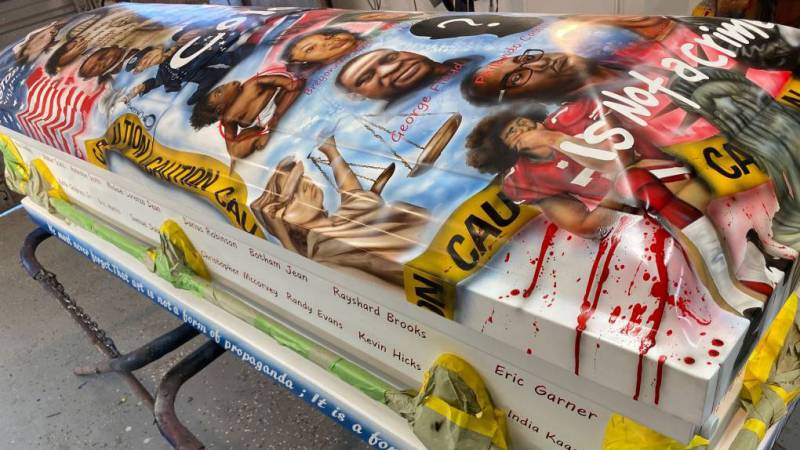
"caption": "DeAndre Drake's casket contains the faces and names of Nia Wilson, George Floyd, Philando Castile, Breonna Taylor and more. ",
"description": "DeAndre Drake's casket contains the faces and names of Nia Wilson, George Floyd, Philando Castile, Breonna Taylor and more. ",
"title": "Casket.Airballin",
"credit": "Airballin",
"status": "inherit",
"isLoading": false,
"fetchFailed": false
},
"arts_13883107": {
"type": "attachments",
"id": "arts_13883107",
"meta": {
"index": "attachments_1716263798",
"site": "arts",
"id": "13883107",
"found": true
},
"parent": 13860431,
"imgSizes": {
"twentyfourteen-full-width": {
"file": "https://ww2.kqed.org/app/uploads/sites/2/2020/07/DagheDigitalWEB-1038x576.jpg",
"width": 1038,
"mimeType": "image/jpeg",
"height": 576
},
"thumbnail": {
"file": "https://ww2.kqed.org/app/uploads/sites/2/2020/07/DagheDigitalWEB-160x102.jpg",
"width": 160,
"mimeType": "image/jpeg",
"height": 102
},
"post-thumbnail": {
"file": "https://ww2.kqed.org/app/uploads/sites/2/2020/07/DagheDigitalWEB-672x372.jpg",
"width": 672,
"mimeType": "image/jpeg",
"height": 372
},
"kqedFullSize": {
"file": "https://ww2.kqed.org/app/uploads/sites/2/2020/07/DagheDigitalWEB.jpg",
"width": 1256,
"height": 800
},
"large": {
"file": "https://ww2.kqed.org/app/uploads/sites/2/2020/07/DagheDigitalWEB-1020x650.jpg",
"width": 1020,
"mimeType": "image/jpeg",
"height": 650
},
"medium": {
"file": "https://ww2.kqed.org/app/uploads/sites/2/2020/07/DagheDigitalWEB-800x510.jpg",
"width": 800,
"mimeType": "image/jpeg",
"height": 510
},
"medium_large": {
"file": "https://ww2.kqed.org/app/uploads/sites/2/2020/07/DagheDigitalWEB-768x489.jpg",
"width": 768,
"mimeType": "image/jpeg",
"height": 489
}
},
"publishDate": 1594234051,
"modified": 1595884517,
"caption": "DAGHE Digital ",
"description": "DAGHE Digital ",
"title": "DagheDigitalWEB",
"credit": "Carlos Coleman ",
"status": "inherit",
"isLoading": false,
"fetchFailed": false
}
},
"audioPlayerReducer": {
"postId": "stream_live",
"isPaused": true,
"isPlaying": false,
"pfsActive": false,
"pledgeModalIsOpen": true,
"playerDrawerIsOpen": false,
"liveAudioPlayStartedAt": 0,
"liveAudioPlayContext": ""
},
"authorsReducer": {
"byline_arts_13886749": {
"type": "authors",
"id": "byline_arts_13886749",
"meta": {
"override": true
},
"slug": "byline_arts_13886749",
"name": "Martin Johnson",
"isLoading": false
},
"shotchkiss": {
"type": "authors",
"id": "61",
"meta": {
"index": "authors_1716337520",
"id": "61",
"found": true
},
"name": "Sarah Hotchkiss",
"firstName": "Sarah",
"lastName": "Hotchkiss",
"slug": "shotchkiss",
"email": "shotchkiss@kqed.org",
"display_author_email": true,
"staff_mastheads": [
"arts"
],
"title": "Senior Editor",
"bio": "Sarah Hotchkiss is a San Francisco \u003ca href=\"http://www.sarahhotchkiss.com\">artist\u003c/a> and arts writer. In 2019, she received the Dorothea & Leo Rabkin Foundation grant for visual art journalism and in 2020 she received a Society of Professional Journalists, Northern California award for excellence in arts and culture reporting.",
"avatar": "https://secure.gravatar.com/avatar/bc662df144b3d27fd8b1b6f1c2a420d34e91e53154d411bb7ad353cc8b6cea8d?s=600&d=blank&r=g",
"twitter": null,
"bluesky": null,
"facebook": null,
"instagram": null,
"linkedin": null,
"sites": [
{
"site": "",
"roles": [
"editor"
]
},
{
"site": "arts",
"roles": [
"Contributor",
"administrator"
]
},
{
"site": "artschool",
"roles": [
"administrator"
]
},
{
"site": "news",
"roles": [
"editor"
]
},
{
"site": "pop",
"roles": [
"administrator"
]
},
{
"site": "bayareabites",
"roles": [
"editor"
]
},
{
"site": "spark",
"roles": [
"editor"
]
},
{
"site": "checkplease",
"roles": [
"editor"
]
}
],
"headData": {
"title": "Sarah Hotchkiss | KQED",
"description": "Senior Editor",
"ogImgSrc": "https://secure.gravatar.com/avatar/bc662df144b3d27fd8b1b6f1c2a420d34e91e53154d411bb7ad353cc8b6cea8d?s=600&d=blank&r=g",
"twImgSrc": "https://secure.gravatar.com/avatar/bc662df144b3d27fd8b1b6f1c2a420d34e91e53154d411bb7ad353cc8b6cea8d?s=600&d=blank&r=g"
},
"isLoading": false,
"link": "/author/shotchkiss"
},
"ralexandra": {
"type": "authors",
"id": "11242",
"meta": {
"index": "authors_1716337520",
"id": "11242",
"found": true
},
"name": "Rae Alexandra",
"firstName": "Rae",
"lastName": "Alexandra",
"slug": "ralexandra",
"email": "ralexandra@kqed.org",
"display_author_email": true,
"staff_mastheads": [
"arts"
],
"title": "Reporter/Producer",
"bio": "Rae Alexandra is a Reporter/Producer for KQED Arts & Culture, and the creator/author of the \u003ca href=\"https://www.kqed.org/arts/program/rebel-girls-from-bay-area-history\">Rebel Girls From Bay Area History\u003c/a> and \u003ca href=\"https://www.kqed.org/bizarrebayarea\">Bizarre Bay Area\u003c/a> series. Her debut book, \u003ca href=\"https://citylights.com/politics-current-events-history/unsung-heroines35-women-who-changed/\">Unsung Heroines: 35 Women Who Changed the Bay Area\u003c/a> was published by City Lights in March 2026. In 2023, Rae was awarded an SPJ Excellence in Journalism Award for Arts & Culture. Rae was born and raised in Wales and subsequently — even after two decades in Northern California — still uses phrases that regularly baffle her coworkers.",
"avatar": "https://secure.gravatar.com/avatar/edfee8176c80cc0a382b051190f5341997df378a934a5774dcb0977732dfd401?s=600&d=blank&r=g",
"twitter": null,
"bluesky": null,
"facebook": null,
"instagram": null,
"linkedin": null,
"sites": [
{
"site": "arts",
"roles": [
"editor"
]
},
{
"site": "news",
"roles": [
"editor"
]
},
{
"site": "pop",
"roles": [
"editor"
]
},
{
"site": "bayareabites",
"roles": [
"editor"
]
},
{
"site": "science",
"roles": [
"editor"
]
}
],
"headData": {
"title": "Rae Alexandra | KQED",
"description": "Reporter/Producer",
"ogImgSrc": "https://secure.gravatar.com/avatar/edfee8176c80cc0a382b051190f5341997df378a934a5774dcb0977732dfd401?s=600&d=blank&r=g",
"twImgSrc": "https://secure.gravatar.com/avatar/edfee8176c80cc0a382b051190f5341997df378a934a5774dcb0977732dfd401?s=600&d=blank&r=g"
},
"isLoading": false,
"link": "/author/ralexandra"
},
"ogpenn": {
"type": "authors",
"id": "11491",
"meta": {
"index": "authors_1716337520",
"id": "11491",
"found": true
},
"name": "Pendarvis Harshaw",
"firstName": "Pendarvis",
"lastName": "Harshaw",
"slug": "ogpenn",
"email": "ogpenn@gmail.com",
"display_author_email": false,
"staff_mastheads": [
"arts"
],
"title": "Community Engagement Reporter",
"bio": "Pendarvis Harshaw is an educator, host and writer with KQED Arts.",
"avatar": "https://secure.gravatar.com/avatar/972b77ee8e3f346ae2b00622661187fbfabd059b5693bbdc1475ea7a722fd4cd?s=600&d=blank&r=g",
"twitter": null,
"bluesky": null,
"facebook": null,
"instagram": "ogpenn",
"linkedin": null,
"sites": [
{
"site": "arts",
"roles": [
"administrator"
]
},
{
"site": "news",
"roles": [
"editor"
]
},
{
"site": "bayareabites",
"roles": [
"author"
]
},
{
"site": "hiphop",
"roles": [
"editor"
]
}
],
"headData": {
"title": "Pendarvis Harshaw | KQED",
"description": "Community Engagement Reporter",
"ogImgSrc": "https://secure.gravatar.com/avatar/972b77ee8e3f346ae2b00622661187fbfabd059b5693bbdc1475ea7a722fd4cd?s=600&d=blank&r=g",
"twImgSrc": "https://secure.gravatar.com/avatar/972b77ee8e3f346ae2b00622661187fbfabd059b5693bbdc1475ea7a722fd4cd?s=600&d=blank&r=g"
},
"isLoading": false,
"link": "/author/ogpenn"
},
"ngluckstern": {
"type": "authors",
"id": "11497",
"meta": {
"index": "authors_1716337520",
"id": "11497",
"found": true
},
"name": "Nicole Gluckstern",
"firstName": "Nicole",
"lastName": "Gluckstern",
"slug": "ngluckstern",
"email": "gluckstern.nicole@gmail.com",
"display_author_email": false,
"staff_mastheads": [],
"title": null,
"bio": null,
"avatar": "https://secure.gravatar.com/avatar/4fa7e0128404fc3d06ce5f9e27ab9e5a?s=600&d=blank&r=g",
"twitter": null,
"facebook": null,
"instagram": null,
"linkedin": null,
"sites": [
{
"site": "arts",
"roles": [
"author"
]
}
],
"headData": {
"title": "Nicole Gluckstern | KQED",
"description": null,
"ogImgSrc": "https://secure.gravatar.com/avatar/4fa7e0128404fc3d06ce5f9e27ab9e5a?s=600&d=blank&r=g",
"twImgSrc": "https://secure.gravatar.com/avatar/4fa7e0128404fc3d06ce5f9e27ab9e5a?s=600&d=blank&r=g"
},
"isLoading": false,
"link": "/author/ngluckstern"
}
},
"pagesReducer": {
"arts_tag_oakland": {
"type": "terms",
"id": "arts_1143",
"meta": {
"index": "terms_1716263798",
"site": "arts",
"id": "1143",
"score": 6.883923
},
"featImg": null,
"name": "Oakland",
"description": null,
"taxonomy": "tag",
"headData": {
"twImgId": null,
"twTitle": null,
"ogTitle": null,
"ogImgId": null,
"twDescription": null,
"description": null,
"title": "Oakland Archives | KQED Arts",
"ogDescription": null
},
"ttid": 692,
"slug": "oakland",
"isLoading": false,
"title": "Oakland",
"pageMeta": {
"site": "arts",
"WpPageTemplate": "page-topic-editorial",
"currentPage": 45
},
"blocks": [
{
"blockName": "kqed/post-list",
"attrs": {
"layout": "cardArticle2",
"query": "posts/arts?tag=oakland",
"seeMore": false,
"paginated": true,
"page": 45
}
},
{
"blockName": "kqed/ad"
}
]
}
},
"pfsSessionReducer": {},
"postsReducer": {
"stream_live": {
"type": "live",
"id": "stream_live",
"audioUrl": "https://streams.kqed.org/kqedradio",
"title": "Live Stream",
"excerpt": "Live Stream information currently unavailable.",
"link": "/radio",
"featImg": "",
"label": {
"name": "KQED Live",
"link": "/"
}
},
"stream_kqedNewscast": {
"type": "posts",
"id": "stream_kqedNewscast",
"audioUrl": "https://www.kqed.org/.stream/anon/radio/RDnews/newscast.mp3?_=1",
"title": "KQED Newscast",
"featImg": "",
"label": {
"name": "88.5 FM",
"link": "/"
}
},
"arts_13886749": {
"type": "posts",
"id": "arts_13886749",
"meta": {
"index": "posts_1716263798",
"site": "arts",
"id": "13886749",
"score": null,
"sort": [
1600889289000
]
},
"parent": 0,
"labelTerm": {
"site": "arts",
"term": 137
},
"blocks": [],
"publishDate": 1600889289,
"format": "standard",
"title": "Rediscovering the Social and Spiritual Legacy of Oakland's Black Jazz Records",
"headTitle": "Rediscovering the Social and Spiritual Legacy of Oakland’s Black Jazz Records | KQED",
"content": "\u003cp>The dawn of the ’70s were heady times for keyboardist Doug Carn and drummer Michael Carvin. Both men had recently relocated to Los Angeles from points south; Carn came from Florida, Carvin from Houston. Carn was getting gigs with well-known bands like Nat Adderly and Earth, Wind And Fire, while Carvin was getting work in television bands as a sideman. Most central to the pair, though, was the demo the two had recorded along with Carn’s wife, vocalist Jean Carn, that they thought marked the future of jazz. Inspired by three legendary African-Americans—Dr. Martin Luther King, John Coltrane and Muhammad Ali—Carn had written lyrics for music composed by Coltrane, McCoy Tyner and Wayne Shorter, which were then sung by Jean, who imbued the songs with an energetic vibrance. “I felt we were creating a new set of standards,” Doug Carn tells NPR Music.\u003c/p>\n\u003cp>Carn took the demo to some of the prominent jazz labels of the time, like Blue Note, Impulse! and Columbia, but, to his honest surprise, found no takers. Even in retrospect, it is a head-scratcher; the music’s spiritual overtones both echoed Coltrane, just a few years removed from his death and already a towering figure, and the work of one of Coltrane’s proteges, Pharoah Sanders, who notched a hit in 1969 with the song “The Creator Has a Master Plan,” from his 1969 recording \u003cem>Karma—\u003c/em>a cornerstone of the spiritual jazz that Carn was creating. Plus, the sound of Carn’s ensemble had a pan-African feel in the rhythms, which echoed a trend in several jazz styles.\u003c/p>\n\u003cp>https://www.youtube.com/watch?time_continue=2&v=QZ6lB7FKxi8\u003c/p>\n\u003cp>Still without a home for their recordings, Carn and Carvin then heard of a new label, Black Jazz Records, which was being run in Oakland by Gene Russell, a pianist who had scored a minor hit with the piano trio album \u003cem>Up And Away\u003c/em>, which featured covers of contemporary pop tunes. Russell was planning to make his new label focus on artistic self-determination, rather than conformity to the marketplace.\u003c/p>\n\u003cfigure id=\"attachment_13886751\" class=\"wp-caption alignright\" style=\"max-width: 200px\">\u003cimg loading=\"lazy\" decoding=\"async\" class=\"size-full wp-image-13886751\" src=\"https://ww2.kqed.org/app/uploads/sites/2/2020/09/gene-russell-cover-art_sq-acc8a702634847bfd8f3da52fc75dd50c3c0efb0.jpe\" alt=\"The cover photograph for Gene Russell's album 'New Direction,' the first release on Black Jazz.\" width=\"200\" height=\"200\" srcset=\"https://cdn.kqed.org/wp-content/uploads/sites/2/2020/09/gene-russell-cover-art_sq-acc8a702634847bfd8f3da52fc75dd50c3c0efb0.jpe 200w, https://cdn.kqed.org/wp-content/uploads/sites/2/2020/09/gene-russell-cover-art_sq-acc8a702634847bfd8f3da52fc75dd50c3c0efb0-160x160.jpe 160w\" sizes=\"(max-width: 200px) 100vw, 200px\">\u003cfigcaption class=\"wp-caption-text\">The cover photograph for Gene Russell’s album ‘New Direction,’ the first release on Black Jazz. \u003ccite>(Courtesy of Real Gone Music)\u003c/cite>\u003c/figcaption>\u003c/figure>\n\u003cp>The cover art told the story of his transition: Russell’s Decca recording had featured its title in a bright, psychedelic color scheme, overlaid on a photo of Russell in the engine of an airplane, holding balloons. It’s presentation was whimsical; almost a rebuttal of the tumult in the streets. The first release on Black Jazz, his own album, aptly titled \u003cem>New Direction,\u003c/em> featured a black-and-white photo with a black frame and white typeface. The logo featured a soul-brother handshake, and the photo of Russell was of him in a black hat and blue jeans, assertively looking at the camera, clearly an independent urban spirit. In style it was an endorsement of post Civil Rights life for African Americans; there was less need to please the dominant society.\u003c/p>\n\u003cp>[ad fullwidth]\u003c/p>\n\u003cp>Carn and Carvin were all-too-right about their hunch. Russell heard the demo and, rather than send them into the studio to record fuller versions of the music, simply released it as \u003cem>Infant Eyes\u003c/em>, one of the first recordings on his new imprint.\u003c/p>\n\u003cp>https://www.youtube.com/watch?v=38OXtiRZ2ig\u003c/p>\n\u003cp>Jazz has always been a celebration of Black self-determination, but the jazz recording industry often failed to reflect that priority. Russell and his co-founder, Dick Schory, were among several artists and businessmen eager to challenge the paradigm. They weren’t alone—the late ’60s and early ’70s witnessed a flowering of independent spirit in the jazz community. Collectives sprung up around the country—the Association of the Advancement of Creative Musicians in Chicago (AACM), the Black Artists Group in St. Louis, the Union of God’s Musicians and Artists Ascension in Los Angeles all among them—to present and nurture the creation of a new music.\u003c/p>\n\u003cp>Artist-run labels followed in the same spirit. Sun Ra had created El Saturn Records to release his own work. Betty Carter created Bet-Car for hers. Trumpeter Charles Tolliver and pianist Stanley Cowell formed Strata East as a home for their work and that of their peers. DJ and impresario Jimmy Gray and saxophonist James Branch launched Black Fire Records to document the burgeoning African-American music scene in Washington, D.C. All of these labels captured a moment when Black people—musicians and fans alike—were resisting the definitions that had been imposed on them by white society and creating different sounds of blackness. Black Jazz Records was one of the biggest and most ambitious among them.\u003c/p>\n\u003cfigure id=\"attachment_13886752\" class=\"wp-caption alignright\" style=\"max-width: 200px\">\u003cimg loading=\"lazy\" decoding=\"async\" class=\"size-full wp-image-13886752\" src=\"https://ww2.kqed.org/app/uploads/sites/2/2020/09/black-jazz-logo_sq-22dcf70d1f3b9c3f43526605a528c841b0b0a744.jpg\" alt=\"The Black Jazz logo featured a soul-brother handshake.\" width=\"200\" height=\"200\" srcset=\"https://cdn.kqed.org/wp-content/uploads/sites/2/2020/09/black-jazz-logo_sq-22dcf70d1f3b9c3f43526605a528c841b0b0a744.jpg 200w, https://cdn.kqed.org/wp-content/uploads/sites/2/2020/09/black-jazz-logo_sq-22dcf70d1f3b9c3f43526605a528c841b0b0a744-160x160.jpg 160w\" sizes=\"(max-width: 200px) 100vw, 200px\">\u003cfigcaption class=\"wp-caption-text\">The Black Jazz logo. \u003ccite>(Courtesy of Real Gone Music)\u003c/cite>\u003c/figcaption>\u003c/figure>\n\u003cp>Black Jazz was founded in Oakland, also home to the Black Panther Party, an enduring icon of the African-American struggle for self-determination. Russell and Schory ran it from that city until 1975, after having released 20 albums, and in the ensuing 45 years the music has gone in and out of print, admired by jazz-influenced hip-hop artists and DJs and crate diggers everywhere. In late summer, Real Gone Music, an imprint dedicated to reviving lost catalogues of albums, \u003ca href=\"https://urldefense.com/v3/__https://shop.realgonemusic.com/collections/vinyl/black-jazz__;!!Iwwt!B9lSnzFCndHopsQyvms2e3BM_TUqcAIvNfn5QwrPPrNGfz07b8dhSp4UljbqGw%24\" target=\"_blank\" rel=\"noopener noreferrer\">launched an eighteen-month program\u003c/a> which will put the entirety of the Black Jazz Records portfolio back in print. The breadth of the work is exceptional; even from an era where musical boundaries blurred, the Black Records sound is unusually diverse. There is classic piano-trio music from Russell, innovative larger-group work by bands like The Awakening and stunning vocal albums by newcomers like Kellee Patterson. Aaron Cohen, author of \u003ca href=\"https://press.uchicago.edu/ucp/books/book/chicago/M/bo18705279.html\" target=\"_blank\" rel=\"noopener noreferrer\">\u003cem>Move On Up: Chicago Soul Music and Black Cultural Power\u003c/em>\u003c/a>, wrote of the era: “… it seems like there was a conscious effort to find artists who engaged with the manifold and diverse expressions of African-American music at the time, whether it was more popular leaning or more experimental. Indeed, Black Jazz showed that those impulses need not be mutually exclusive.”\u003c/p>\n\u003cp>The range of recordings in the first batch of Black Jazz Records reissues show this clearly. Carn’s \u003cem>Spirit of the New Land\u003c/em> has the distinctive style hallmarks of the Black Jazz catalog (\u003cem>Infant Eyes\u003c/em> will release in spring 2021). An illustrious ensemble that included Tolliver on flugelhorn, Alphonse Mouzon (who later gained renown with Larry Coryell and Weather Report) on drums and Earl McIntyre, whose credits range from Stevie Wonder to Cecil Taylor, on tuba, all playing Carn originals as well as Miles Davis’s “Blue in Green” and Lee Morgan’s “Search for the New Land,” each with lyrics added by the keyboardist. He said it reflected that it was “a crucial time on Black struggle in America.”\u003c/p>\n\u003cp>https://www.youtube.com/watch?v=Q1iYOsc0dv4&list=PLwZ1XNI9r5B6IDrYVEwz85GQoMLMJu097\u003c/p>\n\u003cp>The other recordings in the first set of reissues are a dynamic session led by pianist Walter Bishop, with trumpeter Woody Shaw, saxophonist Harold Vick and bassist Reggie Johnson, and a superb recording by the Chicago-based group The Awakening, a band which featured several musicians associated with the AACM there. That latter album begins and ends with recitations of poetry, and in-between features exceptional hard bop-inspired virtuosity. In late September, the label will release \u003cem>Maiden Voyage\u003c/em>, the debut recording from Kellee Patterson, who was the first Black woman to compete in the Miss America Pageant.\u003c/p>\n\u003cp>By 1975, Russell was looking to branch out beyond jazz. He closed Black Jazz Records and launched a new imprint, Aquarican, but managed to release only one album through it (\u003cem>Chyenne’s Coming\u003c/em> by Chyenne Flower, a jazz-rock group somewhat reminiscent of Tower of Power) before his death in 1981. Although Russell’s artists continued to thrive—most notably Jean Carn who, as Jean Carne, had a stellar career as an R&B singer—the music of Russell’s Black Jazz Records label has remained obscure, principally known only to aficionados like the DJ and producer Gilles Peterson.Gordon Anderson of Real Gone Music, a nine-year-old company that specializes in reviving vintage catalogs, took an interest in remedying that obscurity. He says that he was motivated in part by the prices Black Jazz Records were fetching from collectors, “here’s a label with only 20 records that [were all] very sought after.”\u003c/p>\n\u003cp>https://www.youtube.com/watch?v=QjysP0PTthY\u003c/p>\n\u003cp>But, as the release dates for the first Black Jazz reissues approached, ownership disputes broke out, with several parties claiming rights to the music and Russell’s heirs wanting their share, too. As of this writing, there is no legal clarity around the matter; all of the parties are searching for documents to substantiate their contentions. Meanwhile, many of the musicians involved acknowledge that, while Russell presented the label as his, there was doubt that he had funded it himself.\u003c/p>\n\u003cp>The pending reissues triggered another strong reaction overseas, where concerts were held in advance of the 50th anniversary of the label. Last autumn, there were sold-out shows in Paris and Berlin (a London booking was postponed due to the pandemic). “It was amazing,” said Carvin. “Almost 50 years after the release of these records, places were sold out, standing-room-only-type crowds, to hear the music we were making back then.” He was also pleased to see that the crowds weren’t older people indulging nostalgia, but younger folks discovering the style, too.\u003c/p>\n\u003cp>In some ways, it’s not surprising. The Afro-Diasporic sound of Black Jazz can be found in numerous artists on today’s scene: Kamasi Washington, Nubya Garcia, Shabaka Hutchings and many more echo both the musical diversity and spiritual aspects of the Black Jazz aesthetic. Cohen agrees with the resonance, noting that artists like Angel Bat Dawid likely heard the music of\u003cem> The Awakening\u003c/em>, and that the underlying philosophy from that era has spread far and wide.\u003c/p>\n\u003cp>[ad floatright]\u003c/p>\n\u003cp>“The jazz, R&B and spoken word hybrids from decades ago have clear connections to jazz, R&B and hip hop/spoken word today. The times that Black Jazz records have been sampled have also been a part of its legacy (I counted at least a dozen on whosampled.com),” Cohen writes in an email. Also, he notes the self-reliance aspect being crucial to music in the diminished state of the recording industry today, and he concluded, “issues of social consciousness that undoubtedly fueled the rise of such companies as Black Jazz have reverberated today through the Black Lives Matter movement.”\u003c/p>\n\u003cdiv class=\"fullattribution\">\u003cem>Copyright 2020 NPR. To see more, visit \u003ca href=\"https://www.npr.org\" target=\"_blank\" rel=\"noopener noreferrer\">NPR\u003c/a>.\u003cimg decoding=\"async\" src=\"https://www.google-analytics.com/__utm.gif?utmac=UA-5828686-4&utmdt=Rediscovering+The+Enormous+Social+And+Spiritual+Legacy+Of+Black+Jazz+Records&utme=8(APIKey)9(MDAxOTAwOTE4MDEyMTkxMDAzNjczZDljZA004)\">\u003c/em>\u003c/div>\n\n",
"stats": {
"hasVideo": true,
"hasChartOrMap": false,
"hasAudio": false,
"hasPolis": false,
"wordCount": 1821,
"hasGoogleForm": false,
"hasGallery": false,
"hasHearkenModule": false,
"iframeSrcs": [],
"paragraphCount": 17
},
"modified": 1705020092,
"excerpt": "As jazz experienced an awakening in the '60s and '70s, a record label from Oakland was at the forefront of capturing it.",
"headData": {
"twImgId": "",
"twTitle": "",
"ogTitle": "",
"ogImgId": "",
"twDescription": "",
"description": "As jazz experienced an awakening in the '60s and '70s, a record label from Oakland was at the forefront of capturing it.",
"title": "Rediscovering the Social and Spiritual Legacy of Oakland's Black Jazz Records | KQED",
"ogDescription": "",
"schema": {
"@context": "https://schema.org",
"@type": "Article",
"headline": "Rediscovering the Social and Spiritual Legacy of Oakland's Black Jazz Records",
"datePublished": "2020-09-23T12:28:09-07:00",
"dateModified": "2024-01-11T16:41:32-08:00",
"image": "https://cdn.kqed.org/wp-content/uploads/2020/02/KQED-OG-Image@1x.png"
}
},
"guestAuthors": [],
"slug": "rediscovering-the-social-and-spiritual-legacy-of-oaklands-black-jazz-records",
"status": "publish",
"nprApiLink": "http://api.npr.org/query?id=915323876&apiKey=MDAxOTAwOTE4MDEyMTkxMDAzNjczZDljZA004",
"templateType": "standard",
"nprByline": "Martin Johnson",
"nprStoryDate": "Tue, 22 Sep 2020 07:01:21 -0400",
"nprLastModifiedDate": "Wed, 23 Sep 2020 11:19:55 -0400",
"featuredImageType": "standard",
"sticky": false,
"nprHtmlLink": "https://www.npr.org/2020/09/22/915323876/rediscovering-the-enormous-social-and-spiritual-legacy-of-black-jazz-records?ft=nprml&f=915323876",
"nprImageAgency": "Courtesy of Real Gone Music",
"nprStoryId": "915323876",
"nprRetrievedStory": "1",
"nprPubDate": "Wed, 23 Sep 2020 11:19:00 -0400",
"path": "/arts/13886749/rediscovering-the-social-and-spiritual-legacy-of-oaklands-black-jazz-records",
"audioTrackLength": null,
"parsedContent": [
{
"type": "contentString",
"content": "\u003cdiv class=\"post-body\">\u003cp>\u003cp>The dawn of the ’70s were heady times for keyboardist Doug Carn and drummer Michael Carvin. Both men had recently relocated to Los Angeles from points south; Carn came from Florida, Carvin from Houston. Carn was getting gigs with well-known bands like Nat Adderly and Earth, Wind And Fire, while Carvin was getting work in television bands as a sideman. Most central to the pair, though, was the demo the two had recorded along with Carn’s wife, vocalist Jean Carn, that they thought marked the future of jazz. Inspired by three legendary African-Americans—Dr. Martin Luther King, John Coltrane and Muhammad Ali—Carn had written lyrics for music composed by Coltrane, McCoy Tyner and Wayne Shorter, which were then sung by Jean, who imbued the songs with an energetic vibrance. “I felt we were creating a new set of standards,” Doug Carn tells NPR Music.\u003c/p>\n\u003cp>Carn took the demo to some of the prominent jazz labels of the time, like Blue Note, Impulse! and Columbia, but, to his honest surprise, found no takers. Even in retrospect, it is a head-scratcher; the music’s spiritual overtones both echoed Coltrane, just a few years removed from his death and already a towering figure, and the work of one of Coltrane’s proteges, Pharoah Sanders, who notched a hit in 1969 with the song “The Creator Has a Master Plan,” from his 1969 recording \u003cem>Karma—\u003c/em>a cornerstone of the spiritual jazz that Carn was creating. Plus, the sound of Carn’s ensemble had a pan-African feel in the rhythms, which echoed a trend in several jazz styles.\u003c/p>\u003c/p>\u003cp>\u003cspan class='utils-parseShortcode-shortcodes-__youtubeShortcode__embedYoutube'>\n \u003cspan class='utils-parseShortcode-shortcodes-__youtubeShortcode__embedYoutubeInside'>\n \u003ciframe\n loading='lazy'\n class='utils-parseShortcode-shortcodes-__youtubeShortcode__youtubePlayer'\n type='text/html'\n src='//www.youtube.com/embed/QZ6lB7FKxi8'\n title='//www.youtube.com/embed/QZ6lB7FKxi8'\n allowfullscreen='true'\n style='border:0;'>\u003c/iframe>\n \u003c/span>\n \u003c/span>\u003c/p>\u003cp>\u003cp>Still without a home for their recordings, Carn and Carvin then heard of a new label, Black Jazz Records, which was being run in Oakland by Gene Russell, a pianist who had scored a minor hit with the piano trio album \u003cem>Up And Away\u003c/em>, which featured covers of contemporary pop tunes. Russell was planning to make his new label focus on artistic self-determination, rather than conformity to the marketplace.\u003c/p>\n\u003cfigure id=\"attachment_13886751\" class=\"wp-caption alignright\" style=\"max-width: 200px\">\u003cimg loading=\"lazy\" decoding=\"async\" class=\"size-full wp-image-13886751\" src=\"https://ww2.kqed.org/app/uploads/sites/2/2020/09/gene-russell-cover-art_sq-acc8a702634847bfd8f3da52fc75dd50c3c0efb0.jpe\" alt=\"The cover photograph for Gene Russell's album 'New Direction,' the first release on Black Jazz.\" width=\"200\" height=\"200\" srcset=\"https://cdn.kqed.org/wp-content/uploads/sites/2/2020/09/gene-russell-cover-art_sq-acc8a702634847bfd8f3da52fc75dd50c3c0efb0.jpe 200w, https://cdn.kqed.org/wp-content/uploads/sites/2/2020/09/gene-russell-cover-art_sq-acc8a702634847bfd8f3da52fc75dd50c3c0efb0-160x160.jpe 160w\" sizes=\"(max-width: 200px) 100vw, 200px\">\u003cfigcaption class=\"wp-caption-text\">The cover photograph for Gene Russell’s album ‘New Direction,’ the first release on Black Jazz. \u003ccite>(Courtesy of Real Gone Music)\u003c/cite>\u003c/figcaption>\u003c/figure>\n\u003cp>The cover art told the story of his transition: Russell’s Decca recording had featured its title in a bright, psychedelic color scheme, overlaid on a photo of Russell in the engine of an airplane, holding balloons. It’s presentation was whimsical; almost a rebuttal of the tumult in the streets. The first release on Black Jazz, his own album, aptly titled \u003cem>New Direction,\u003c/em> featured a black-and-white photo with a black frame and white typeface. The logo featured a soul-brother handshake, and the photo of Russell was of him in a black hat and blue jeans, assertively looking at the camera, clearly an independent urban spirit. In style it was an endorsement of post Civil Rights life for African Americans; there was less need to please the dominant society.\u003c/p>\n\u003cp>\u003c/p>\u003c/div>",
"attributes": {
"named": {},
"numeric": []
}
},
{
"type": "component",
"content": "",
"name": "ad",
"attributes": {
"named": {
"label": "fullwidth"
},
"numeric": [
"fullwidth"
]
}
},
{
"type": "contentString",
"content": "\u003cdiv class=\"post-body\">\u003cp>\u003c/p>\n\u003cp>Carn and Carvin were all-too-right about their hunch. Russell heard the demo and, rather than send them into the studio to record fuller versions of the music, simply released it as \u003cem>Infant Eyes\u003c/em>, one of the first recordings on his new imprint.\u003c/p>\u003c/p>\u003cp>\u003cspan class='utils-parseShortcode-shortcodes-__youtubeShortcode__embedYoutube'>\n \u003cspan class='utils-parseShortcode-shortcodes-__youtubeShortcode__embedYoutubeInside'>\n \u003ciframe\n loading='lazy'\n class='utils-parseShortcode-shortcodes-__youtubeShortcode__youtubePlayer'\n type='text/html'\n src='//www.youtube.com/embed/38OXtiRZ2ig'\n title='//www.youtube.com/embed/38OXtiRZ2ig'\n allowfullscreen='true'\n style='border:0;'>\u003c/iframe>\n \u003c/span>\n \u003c/span>\u003c/p>\u003cp>\u003cp>Jazz has always been a celebration of Black self-determination, but the jazz recording industry often failed to reflect that priority. Russell and his co-founder, Dick Schory, were among several artists and businessmen eager to challenge the paradigm. They weren’t alone—the late ’60s and early ’70s witnessed a flowering of independent spirit in the jazz community. Collectives sprung up around the country—the Association of the Advancement of Creative Musicians in Chicago (AACM), the Black Artists Group in St. Louis, the Union of God’s Musicians and Artists Ascension in Los Angeles all among them—to present and nurture the creation of a new music.\u003c/p>\n\u003cp>Artist-run labels followed in the same spirit. Sun Ra had created El Saturn Records to release his own work. Betty Carter created Bet-Car for hers. Trumpeter Charles Tolliver and pianist Stanley Cowell formed Strata East as a home for their work and that of their peers. DJ and impresario Jimmy Gray and saxophonist James Branch launched Black Fire Records to document the burgeoning African-American music scene in Washington, D.C. All of these labels captured a moment when Black people—musicians and fans alike—were resisting the definitions that had been imposed on them by white society and creating different sounds of blackness. Black Jazz Records was one of the biggest and most ambitious among them.\u003c/p>\n\u003cfigure id=\"attachment_13886752\" class=\"wp-caption alignright\" style=\"max-width: 200px\">\u003cimg loading=\"lazy\" decoding=\"async\" class=\"size-full wp-image-13886752\" src=\"https://ww2.kqed.org/app/uploads/sites/2/2020/09/black-jazz-logo_sq-22dcf70d1f3b9c3f43526605a528c841b0b0a744.jpg\" alt=\"The Black Jazz logo featured a soul-brother handshake.\" width=\"200\" height=\"200\" srcset=\"https://cdn.kqed.org/wp-content/uploads/sites/2/2020/09/black-jazz-logo_sq-22dcf70d1f3b9c3f43526605a528c841b0b0a744.jpg 200w, https://cdn.kqed.org/wp-content/uploads/sites/2/2020/09/black-jazz-logo_sq-22dcf70d1f3b9c3f43526605a528c841b0b0a744-160x160.jpg 160w\" sizes=\"(max-width: 200px) 100vw, 200px\">\u003cfigcaption class=\"wp-caption-text\">The Black Jazz logo. \u003ccite>(Courtesy of Real Gone Music)\u003c/cite>\u003c/figcaption>\u003c/figure>\n\u003cp>Black Jazz was founded in Oakland, also home to the Black Panther Party, an enduring icon of the African-American struggle for self-determination. Russell and Schory ran it from that city until 1975, after having released 20 albums, and in the ensuing 45 years the music has gone in and out of print, admired by jazz-influenced hip-hop artists and DJs and crate diggers everywhere. In late summer, Real Gone Music, an imprint dedicated to reviving lost catalogues of albums, \u003ca href=\"https://urldefense.com/v3/__https://shop.realgonemusic.com/collections/vinyl/black-jazz__;!!Iwwt!B9lSnzFCndHopsQyvms2e3BM_TUqcAIvNfn5QwrPPrNGfz07b8dhSp4UljbqGw%24\" target=\"_blank\" rel=\"noopener noreferrer\">launched an eighteen-month program\u003c/a> which will put the entirety of the Black Jazz Records portfolio back in print. The breadth of the work is exceptional; even from an era where musical boundaries blurred, the Black Records sound is unusually diverse. There is classic piano-trio music from Russell, innovative larger-group work by bands like The Awakening and stunning vocal albums by newcomers like Kellee Patterson. Aaron Cohen, author of \u003ca href=\"https://press.uchicago.edu/ucp/books/book/chicago/M/bo18705279.html\" target=\"_blank\" rel=\"noopener noreferrer\">\u003cem>Move On Up: Chicago Soul Music and Black Cultural Power\u003c/em>\u003c/a>, wrote of the era: “… it seems like there was a conscious effort to find artists who engaged with the manifold and diverse expressions of African-American music at the time, whether it was more popular leaning or more experimental. Indeed, Black Jazz showed that those impulses need not be mutually exclusive.”\u003c/p>\n\u003cp>The range of recordings in the first batch of Black Jazz Records reissues show this clearly. Carn’s \u003cem>Spirit of the New Land\u003c/em> has the distinctive style hallmarks of the Black Jazz catalog (\u003cem>Infant Eyes\u003c/em> will release in spring 2021). An illustrious ensemble that included Tolliver on flugelhorn, Alphonse Mouzon (who later gained renown with Larry Coryell and Weather Report) on drums and Earl McIntyre, whose credits range from Stevie Wonder to Cecil Taylor, on tuba, all playing Carn originals as well as Miles Davis’s “Blue in Green” and Lee Morgan’s “Search for the New Land,” each with lyrics added by the keyboardist. He said it reflected that it was “a crucial time on Black struggle in America.”\u003c/p>\u003c/p>\u003cp>\u003cspan class='utils-parseShortcode-shortcodes-__youtubeShortcode__embedYoutube'>\n \u003cspan class='utils-parseShortcode-shortcodes-__youtubeShortcode__embedYoutubeInside'>\n \u003ciframe\n loading='lazy'\n class='utils-parseShortcode-shortcodes-__youtubeShortcode__youtubePlayer'\n type='text/html'\n src='//www.youtube.com/embed/Q1iYOsc0dv4'\n title='//www.youtube.com/embed/Q1iYOsc0dv4'\n allowfullscreen='true'\n style='border:0;'>\u003c/iframe>\n \u003c/span>\n \u003c/span>\u003c/p>\u003cp>\u003cp>The other recordings in the first set of reissues are a dynamic session led by pianist Walter Bishop, with trumpeter Woody Shaw, saxophonist Harold Vick and bassist Reggie Johnson, and a superb recording by the Chicago-based group The Awakening, a band which featured several musicians associated with the AACM there. That latter album begins and ends with recitations of poetry, and in-between features exceptional hard bop-inspired virtuosity. In late September, the label will release \u003cem>Maiden Voyage\u003c/em>, the debut recording from Kellee Patterson, who was the first Black woman to compete in the Miss America Pageant.\u003c/p>\n\u003cp>By 1975, Russell was looking to branch out beyond jazz. He closed Black Jazz Records and launched a new imprint, Aquarican, but managed to release only one album through it (\u003cem>Chyenne’s Coming\u003c/em> by Chyenne Flower, a jazz-rock group somewhat reminiscent of Tower of Power) before his death in 1981. Although Russell’s artists continued to thrive—most notably Jean Carn who, as Jean Carne, had a stellar career as an R&B singer—the music of Russell’s Black Jazz Records label has remained obscure, principally known only to aficionados like the DJ and producer Gilles Peterson.Gordon Anderson of Real Gone Music, a nine-year-old company that specializes in reviving vintage catalogs, took an interest in remedying that obscurity. He says that he was motivated in part by the prices Black Jazz Records were fetching from collectors, “here’s a label with only 20 records that [were all] very sought after.”\u003c/p>\u003c/p>\u003cp>\u003cspan class='utils-parseShortcode-shortcodes-__youtubeShortcode__embedYoutube'>\n \u003cspan class='utils-parseShortcode-shortcodes-__youtubeShortcode__embedYoutubeInside'>\n \u003ciframe\n loading='lazy'\n class='utils-parseShortcode-shortcodes-__youtubeShortcode__youtubePlayer'\n type='text/html'\n src='//www.youtube.com/embed/QjysP0PTthY'\n title='//www.youtube.com/embed/QjysP0PTthY'\n allowfullscreen='true'\n style='border:0;'>\u003c/iframe>\n \u003c/span>\n \u003c/span>\u003c/p>\u003cp>\u003cp>But, as the release dates for the first Black Jazz reissues approached, ownership disputes broke out, with several parties claiming rights to the music and Russell’s heirs wanting their share, too. As of this writing, there is no legal clarity around the matter; all of the parties are searching for documents to substantiate their contentions. Meanwhile, many of the musicians involved acknowledge that, while Russell presented the label as his, there was doubt that he had funded it himself.\u003c/p>\n\u003cp>The pending reissues triggered another strong reaction overseas, where concerts were held in advance of the 50th anniversary of the label. Last autumn, there were sold-out shows in Paris and Berlin (a London booking was postponed due to the pandemic). “It was amazing,” said Carvin. “Almost 50 years after the release of these records, places were sold out, standing-room-only-type crowds, to hear the music we were making back then.” He was also pleased to see that the crowds weren’t older people indulging nostalgia, but younger folks discovering the style, too.\u003c/p>\n\u003cp>In some ways, it’s not surprising. The Afro-Diasporic sound of Black Jazz can be found in numerous artists on today’s scene: Kamasi Washington, Nubya Garcia, Shabaka Hutchings and many more echo both the musical diversity and spiritual aspects of the Black Jazz aesthetic. Cohen agrees with the resonance, noting that artists like Angel Bat Dawid likely heard the music of\u003cem> The Awakening\u003c/em>, and that the underlying philosophy from that era has spread far and wide.\u003c/p>\n\u003cp>\u003c/p>\u003c/div>",
"attributes": {
"named": {},
"numeric": []
}
},
{
"type": "component",
"content": "",
"name": "ad",
"attributes": {
"named": {
"label": "floatright"
},
"numeric": [
"floatright"
]
}
},
{
"type": "contentString",
"content": "\u003cdiv class=\"post-body\">\u003cp>\u003c/p>\n\u003cp>“The jazz, R&B and spoken word hybrids from decades ago have clear connections to jazz, R&B and hip hop/spoken word today. The times that Black Jazz records have been sampled have also been a part of its legacy (I counted at least a dozen on whosampled.com),” Cohen writes in an email. Also, he notes the self-reliance aspect being crucial to music in the diminished state of the recording industry today, and he concluded, “issues of social consciousness that undoubtedly fueled the rise of such companies as Black Jazz have reverberated today through the Black Lives Matter movement.”\u003c/p>\n\u003cdiv class=\"fullattribution\">\u003cem>Copyright 2020 NPR. To see more, visit \u003ca href=\"https://www.npr.org\" target=\"_blank\" rel=\"noopener noreferrer\">NPR\u003c/a>.\u003cimg decoding=\"async\" src=\"https://www.google-analytics.com/__utm.gif?utmac=UA-5828686-4&utmdt=Rediscovering+The+Enormous+Social+And+Spiritual+Legacy+Of+Black+Jazz+Records&utme=8(APIKey)9(MDAxOTAwOTE4MDEyMTkxMDAzNjczZDljZA004)\">\u003c/em>\u003c/div>\n\n\u003c/div>\u003c/p>",
"attributes": {
"named": {},
"numeric": []
}
}
],
"link": "/arts/13886749/rediscovering-the-social-and-spiritual-legacy-of-oaklands-black-jazz-records",
"authors": [
"byline_arts_13886749"
],
"categories": [
"arts_1",
"arts_7862",
"arts_69",
"arts_75"
],
"tags": [
"arts_1420",
"arts_1143"
],
"affiliates": [
"arts_137"
],
"featImg": "arts_13886750",
"label": "arts_137"
},
"arts_13886560": {
"type": "posts",
"id": "arts_13886560",
"meta": {
"index": "posts_1716263798",
"site": "arts",
"id": "13886560",
"score": null,
"sort": [
1600489974000
]
},
"guestAuthors": [],
"slug": "the-blindspotting-team-chips-in-to-save-fairyland",
"title": "The 'Blindspotting' Team Chips In to Save Fairyland",
"publishDate": 1600489974,
"format": "standard",
"headTitle": "The ‘Blindspotting’ Team Chips In to Save Fairyland | KQED",
"labelTerm": {
"term": 140,
"site": "arts"
},
"content": "\u003cp>Is there anything so pure as the friendship between the Bay Area’s Daveed Diggs and Rafael Casal? From Youth Speaks poetry slams to mixtapes to critically acclaimed feature films, Diggs and Casal have been creating together for over two decades. And with the duo recently slated to adapt their ode to Oakland, the film \u003cem>Blindspotting\u003c/em>, into a spinoff series for STARZ, the friends and creative partners are likely busy. Still, it’s no surprise that they’ve found time to come to the aid of one of their childhood hangouts, \u003ca href=\"https://fairyland.org/\" target=\"_blank\" rel=\"noopener noreferrer\">Children’s Fairyland\u003c/a> in Oakland.\u003c/p>\n\u003cp>An elaborate world of fairytales come to life, Children’s Fairyland invites close encounters. Meandering through the meticulously-crafted storybook sets originally created by architect William Russell Everitt, children get a chance to live out their fairytale fantasies, whether by gamboling through the “Alice in Wonderland” card maze, careening down the dragon slide, communing with a menagerie of whimsical creatures, or clambering aboard the Jolly Trolly. \u003ca href=\"https://boingboing.net/2019/05/10/childrens-fairyland-the-mid.html\" target=\"_blank\" rel=\"noopener noreferrer\">It’s even said that the place influenced the creation of Disneyland\u003c/a>, and that beloved puppet master Frank Oz got his start in show business as a member of Fairyland’s Vagabond Puppet theatre.\u003c/p>\n\u003cp>But after several rounds of pandemic layoffs, Children’s Fairyland is facing the possibility of permanent closure. So to celebrate the park’s 70-year anniversary, Diggs and Casal will host a “\u003ca href=\"https://www.classy.org/event/fairylands-celebrity-storytime/e297793\" target=\"_blank\" rel=\"noopener noreferrer\">celebrity storytime\u003c/a>” Sept. 26 to raise funds for the charming institution. The virtual event is free to attend, with a handy donation link available for folks who want to contribute. Either way, watching the creators of the playful 2014 web series “Hobbes and Me” tell stories — with the help of some puppet co-hosts — will be a sweet balm for even the most jaded of hearts.\u003c/p>\n\u003cp>Celebrity Storytime streams Saturday, Sept. 26, at 6:30 p.m. \u003ca href=\"https://www.classy.org/event/fairylands-celebrity-storytime/e297793\" target=\"_blank\" rel=\"noopener noreferrer\">Tickets and details here.\u003c/a>\u003c/p>\n\u003cp>https://www.youtube.com/watch?v=Sx68TPu4dCk\u003c/p>\n\u003cp>[ad fullwidth]\u003c/p>\n\u003cp>\u003c/p>\n\u003cp> \u003c/p>\n\n",
"blocks": [],
"excerpt": "Homegrown heroes Daveed Diggs and Rafael Casal host a free 'Celebrity Storytime' to benefit the beloved Oakland amusement park.",
"status": "publish",
"parent": 0,
"modified": 1726771293,
"stats": {
"hasAudio": false,
"hasVideo": true,
"hasChartOrMap": false,
"iframeSrcs": [],
"hasGoogleForm": false,
"hasGallery": false,
"hasHearkenModule": false,
"hasPolis": false,
"paragraphCount": 6,
"wordCount": 336
},
"headData": {
"title": "The 'Blindspotting' Team Chips In to Save Fairyland | KQED",
"description": "Homegrown heroes Daveed Diggs and Rafael Casal host a free 'Celebrity Storytime' to benefit the beloved Oakland amusement park.",
"ogTitle": "",
"ogDescription": "",
"ogImgId": "",
"twTitle": "",
"twDescription": "",
"twImgId": "",
"schema": {
"@context": "https://schema.org",
"@type": "Article",
"headline": "The 'Blindspotting' Team Chips In to Save Fairyland",
"datePublished": "2020-09-18T21:32:54-07:00",
"dateModified": "2024-09-19T11:41:33-07:00",
"image": "https://cdn.kqed.org/wp-content/uploads/2020/02/KQED-OG-Image@1x.png"
}
},
"sticky": false,
"templateType": "standard",
"featuredImageType": "standard",
"path": "/arts/13886560/the-blindspotting-team-chips-in-to-save-fairyland",
"audioTrackLength": null,
"parsedContent": [
{
"type": "contentString",
"content": "\u003cdiv class=\"post-body\">\u003cp>\u003cp>Is there anything so pure as the friendship between the Bay Area’s Daveed Diggs and Rafael Casal? From Youth Speaks poetry slams to mixtapes to critically acclaimed feature films, Diggs and Casal have been creating together for over two decades. And with the duo recently slated to adapt their ode to Oakland, the film \u003cem>Blindspotting\u003c/em>, into a spinoff series for STARZ, the friends and creative partners are likely busy. Still, it’s no surprise that they’ve found time to come to the aid of one of their childhood hangouts, \u003ca href=\"https://fairyland.org/\" target=\"_blank\" rel=\"noopener noreferrer\">Children’s Fairyland\u003c/a> in Oakland.\u003c/p>\n\u003cp>An elaborate world of fairytales come to life, Children’s Fairyland invites close encounters. Meandering through the meticulously-crafted storybook sets originally created by architect William Russell Everitt, children get a chance to live out their fairytale fantasies, whether by gamboling through the “Alice in Wonderland” card maze, careening down the dragon slide, communing with a menagerie of whimsical creatures, or clambering aboard the Jolly Trolly. \u003ca href=\"https://boingboing.net/2019/05/10/childrens-fairyland-the-mid.html\" target=\"_blank\" rel=\"noopener noreferrer\">It’s even said that the place influenced the creation of Disneyland\u003c/a>, and that beloved puppet master Frank Oz got his start in show business as a member of Fairyland’s Vagabond Puppet theatre.\u003c/p>\n\u003cp>But after several rounds of pandemic layoffs, Children’s Fairyland is facing the possibility of permanent closure. So to celebrate the park’s 70-year anniversary, Diggs and Casal will host a “\u003ca href=\"https://www.classy.org/event/fairylands-celebrity-storytime/e297793\" target=\"_blank\" rel=\"noopener noreferrer\">celebrity storytime\u003c/a>” Sept. 26 to raise funds for the charming institution. The virtual event is free to attend, with a handy donation link available for folks who want to contribute. Either way, watching the creators of the playful 2014 web series “Hobbes and Me” tell stories — with the help of some puppet co-hosts — will be a sweet balm for even the most jaded of hearts.\u003c/p>\n\u003cp>Celebrity Storytime streams Saturday, Sept. 26, at 6:30 p.m. \u003ca href=\"https://www.classy.org/event/fairylands-celebrity-storytime/e297793\" target=\"_blank\" rel=\"noopener noreferrer\">Tickets and details here.\u003c/a>\u003c/p>\u003c/p>\u003cp>\u003cspan class='utils-parseShortcode-shortcodes-__youtubeShortcode__embedYoutube'>\n \u003cspan class='utils-parseShortcode-shortcodes-__youtubeShortcode__embedYoutubeInside'>\n \u003ciframe\n loading='lazy'\n class='utils-parseShortcode-shortcodes-__youtubeShortcode__youtubePlayer'\n type='text/html'\n src='//www.youtube.com/embed/Sx68TPu4dCk'\n title='//www.youtube.com/embed/Sx68TPu4dCk'\n allowfullscreen='true'\n style='border:0;'>\u003c/iframe>\n \u003c/span>\n \u003c/span>\u003c/p>\u003cp>\u003cp>\u003c/p>\u003c/div>",
"attributes": {
"named": {},
"numeric": []
}
},
{
"type": "component",
"content": "",
"name": "ad",
"attributes": {
"named": {
"label": "fullwidth"
},
"numeric": [
"fullwidth"
]
}
},
{
"type": "contentString",
"content": "\u003cdiv class=\"post-body\">\u003cp>\u003c/p>\n\u003cp>\u003c/p>\n\u003cp> \u003c/p>\n\n\u003c/div>\u003c/p>",
"attributes": {
"named": {},
"numeric": []
}
}
],
"link": "/arts/13886560/the-blindspotting-team-chips-in-to-save-fairyland",
"authors": [
"11497"
],
"programs": [
"arts_140"
],
"categories": [
"arts_1",
"arts_73"
],
"tags": [
"arts_2468",
"arts_2467",
"arts_1143",
"arts_5308",
"arts_585"
],
"featImg": "arts_13837232",
"label": "arts_140"
},
"arts_13885918": {
"type": "posts",
"id": "arts_13885918",
"meta": {
"index": "posts_1716263798",
"site": "arts",
"id": "13885918",
"score": null,
"sort": [
1599847394000
]
},
"guestAuthors": [],
"slug": "grand-nationxl-a-wolf-pack-of-artists",
"title": "Grand Nationxl: A Wolf Pack of Artists",
"publishDate": 1599847394,
"format": "standard",
"headTitle": "Grand Nationxl: A Wolf Pack of Artists | KQED",
"labelTerm": {},
"content": "\u003cp>\u003cspan style=\"font-size: 4.6875em;float: left;line-height: 0.733em;padding: 0.05em 0.1em 0 0;font-family: times, serif, georgia\">O\u003c/span>n my first listen to the nine-track project \u003cem>Twice on Sunday (Season 1)\u003c/em> by Grand Nationxl, I knew it was a significant piece of art. I had no idea it was the first shot in a series of blows that the collective, formed by over a dozen Bay Area artists, were looking to make on the preverbal \u003cem>rap game\u003c/em>.\u003c/p>\n\u003cp>\u003cimg loading=\"lazy\" decoding=\"async\" class=\"alignright size-thumbnail wp-image-13833985\" src=\"https://ww2.kqed.org/arts/wp-content/uploads/sites/2/2018/05/OGPenn.Cap_-160x184.jpg\" alt=\"\" width=\"160\" height=\"184\" srcset=\"https://cdn.kqed.org/wp-content/uploads/sites/2/2018/05/OGPenn.Cap_-160x184.jpg 160w, https://cdn.kqed.org/wp-content/uploads/sites/2/2018/05/OGPenn.Cap_.jpg 180w\" sizes=\"(max-width: 160px) 100vw, 160px\">\u003c/p>\n\u003cp>In the weeks following their first release in June, Grand Nationxl (named after a popular American-made muscle car) dropped multiple videos, appeared at the Portland-based Mic Check PDX virtual music festival, recorded podcast episodes and more.\u003c/p>\n\u003cp>Now that summer is coming to a close, Grand Nationxl—a wolf pack, as they sometimes refer to themselves—isn’t relenting. Today they dropped an updated edition of the first album—essentially a new release with nine new tracks. They also released the audio version of their live studio session, \u003cem>Live From Airship Laboratories.\u003c/em>\u003c/p>\n\u003cp>And recently they announced plans to open the floodgates for individual projects.\u003c/p>\n\u003cp>[ad fullwidth]\u003c/p>\n\u003cp>The individuals? There’s a lot of ’em. Full disclosure: A few of ’em are folks I’d consider good friends. That said, I’m writing about them because given that I’ve been in a silo-styled apartment writing my ass off alone for the past six months, I kind of forgot how important it is to work with friends when making art. Until they reminded me.\u003c/p>\n\u003cfigure id=\"attachment_13886194\" class=\"wp-caption alignnone\" style=\"max-width: 800px\">\u003cimg loading=\"lazy\" decoding=\"async\" class=\"size-medium wp-image-13886194\" src=\"https://ww2.kqed.org/app/uploads/sites/2/2020/09/IMG_1212-800x600.jpg\" alt=\"Grand Nationxl screens the visuals that accompany their album Twice on Sunday. \" width=\"800\" height=\"600\" srcset=\"https://cdn.kqed.org/wp-content/uploads/sites/2/2020/09/IMG_1212-800x600.jpg 800w, https://cdn.kqed.org/wp-content/uploads/sites/2/2020/09/IMG_1212-1020x765.jpg 1020w, https://cdn.kqed.org/wp-content/uploads/sites/2/2020/09/IMG_1212-160x120.jpg 160w, https://cdn.kqed.org/wp-content/uploads/sites/2/2020/09/IMG_1212-768x576.jpg 768w, https://cdn.kqed.org/wp-content/uploads/sites/2/2020/09/IMG_1212-1536x1152.jpg 1536w, https://cdn.kqed.org/wp-content/uploads/sites/2/2020/09/IMG_1212-2048x1536.jpg 2048w, https://cdn.kqed.org/wp-content/uploads/sites/2/2020/09/IMG_1212-1920x1440.jpg 1920w\" sizes=\"(max-width: 800px) 100vw, 800px\">\u003cfigcaption class=\"wp-caption-text\">Grand Nationxl screens the visuals that accompany their album ‘Twice on Sunday.’ \u003ccite>(Pendarvis Harshaw)\u003c/cite>\u003c/figcaption>\u003c/figure>\n\u003cp>\u003cspan style=\"font-size: 4.6875em;float: left;line-height: 0.733em;padding: 0.05em 0.1em 0 0;font-family: times, serif, georgia\">O\u003c/span>n a Thursday evening last month, I stopped at a red light at 17th and Telegraph in Oakland. Across the street, I noticed two artists painting a three-story mural on the backside of YR Media’s building. I’d later find out it was \u003ca href=\"https://www.instagram.com/wolfe_.pack/\" target=\"_blank\" rel=\"noopener noreferrer\">Rachel Wolfe Goldsmith\u003c/a> and a friend, creating this big, bold beautiful work of art, and dancing while doing so.\u003c/p>\n\u003cp>I pulled through that intersection en route to a vacant parking lot on 13th Street between Broadway and Webster. That’s where Grand Nationxl was screening a filmed \u003ca href=\"https://youtu.be/YkSzMFX9HRc\" target=\"_blank\" rel=\"noopener noreferrer\">40-minute studio session\u003c/a> of their latest project.\u003c/p>\n\u003cp>(I almost hit one of those \u003ca href=\"https://www.kqed.org/arts/13862998/to-reduce-loitering-a-plaza-downtown-oakland-landlords-plan-to-annex-a-street\" target=\"_blank\" rel=\"noopener noreferrer\">new little plant thingies\u003c/a> as I parked. Bounced out the car and noticed the sign for the now-shuttered Wolfman Books. Next to it, Good Mother Gallery had a mural of George Floyd on the wall. Signs of the time.)\u003c/p>\n\u003cp>I walked into a parking lot on the backside of the Tribune Tavern. On one wall was another Rachel Wolfe Goldsmith mural. On the other wall, the projected video images of \u003ca href=\"https://www.instagram.com/kvnalln/\" target=\"_blank\" rel=\"noopener noreferrer\">Kevin Allen\u003c/a>, \u003ca href=\"https://www.instagram.com/dameonbledsoe/\" target=\"_blank\" rel=\"noopener noreferrer\">D. Bledsoe\u003c/a>, \u003ca href=\"https://www.instagram.com/firstnameian/\" target=\"_blank\" rel=\"noopener noreferrer\">Ian Kelly\u003c/a>, \u003ca href=\"https://www.instagram.com/blvckachilles/\" target=\"_blank\" rel=\"noopener noreferrer\">Blvck Achilles\u003c/a>, \u003ca href=\"https://www.instagram.com/brookfieldduece/\" target=\"_blank\" rel=\"noopener noreferrer\">Brookfield Duece\u003c/a>, \u003ca href=\"https://www.instagram.com/champgreen/\" target=\"_blank\" rel=\"noopener noreferrer\">Champ Green\u003c/a>, \u003ca href=\"https://www.instagram.com/moegreen110/\" target=\"_blank\" rel=\"noopener noreferrer\">Moe Green\u003c/a> (no relation), \u003ca href=\"https://www.instagram.com/pass510/\" target=\"_blank\" rel=\"noopener noreferrer\">Passwurdz \u003c/a>, \u003ca href=\"https://www.instagram.com/manidraper/\" target=\"_blank\" rel=\"noopener noreferrer\">Mani Draper\u003c/a> and more.\u003c/p>\n\u003cp>In addition to the real-life presence of most of the roster of artists mentioned above, about 25–30 other people filled the lot. Everyone was masked, spread at proper intervals of distance, although handshakes and hugs were definitely exchanged as people took in the multimedia presentation.\u003c/p>\n\u003cp>Community, coming together to celebrate music that was born out of community.\u003c/p>\n\u003cp>https://youtu.be/Qpf4CJ6GpNU\u003c/p>\n\u003cp>The substance in Grand Nationxl’s songs range from Champ Green’s poetic philosophies on navigating Bay Area public transportation to Moe Green’s tribute to legendary R&B artists like Sam Cooke, Marvin Gaye and Vallejo’s Levitti.\u003c/p>\n\u003cp>They’re also rife with artistic articulation of the current human experience for some folks living in the Bay Area. During one of the recording sessions, Ian Kelly tells me, he was late to the studio because he was running errands for his job with Instacart. So in the verse he recorded that night, he cut himself off mid-flow, saying “I would give you sixteen, but Instacart calling”—and then he answers his phone.\u003c/p>\n\u003cp>In the filmed studio session of the song, the other participants in Grand Nationxl vibe with Kelly through the entire verse. And then during the Instacart phone call, they get completely still. The beat drops as Kelly answers the call, allowing him to clarify that the customer’s request is for whole milk and not two percent.\u003c/p>\n\u003cp>It’s just one of many standout moments in this project. It shows how much fun they were having as a collective, and at the same time, how applicable the lyrics are to real life. “Ever seen zombies that was yo classmates?” asks Brookfield Duece on one track. “Chevron settled to kill me early,” states D. Bledsoe on another. “What happens if I stop making excuses and really grow up?” rhetorically raps Kevin Allen on the album.\u003c/p>\n\u003cp>The lyrical sparring in the studio sessions led to raps so layered, it inspired Special, host of the \u003ca href=\"https://podcasts.apple.com/us/podcast/specialsays/id1466724968\" target=\"_blank\" rel=\"noopener noreferrer\">Special Delivery Podcast\u003c/a>, to do a series of episodes breaking down the stories behind the music.\u003c/p>\n\u003cp>In one interview, producer \u003ca href=\"https://www.instagram.com/rootsanbranches/\" target=\"_blank\" rel=\"noopener noreferrer\">DJ Basta\u003c/a> explains that multiple artists added different instruments to influence the composition and production of each song prior to any lyrics hitting the track. In another interview, Brookfield Duece explains how a song got named: old-school style, riding around in a car with each other, listening to the song and talking about it.\u003c/p>\n\u003cp>In-person, collaborative creation. It’s far from a revolutionary concept, but in 2020, it’s rare.\u003c/p>\n\u003cfigure id=\"attachment_13886196\" class=\"wp-caption alignnone\" style=\"max-width: 800px\">\u003cimg loading=\"lazy\" decoding=\"async\" class=\"size-medium wp-image-13886196\" src=\"https://ww2.kqed.org/app/uploads/sites/2/2020/09/IMG_2795-800x533.jpg\" alt=\"D. Bledsoe, Kevin Allen, Brookfield Duece, Passwurdz, Moe Green on the set of a video shoot in North Oakland. \" width=\"800\" height=\"533\" srcset=\"https://cdn.kqed.org/wp-content/uploads/sites/2/2020/09/IMG_2795-800x533.jpg 800w, https://cdn.kqed.org/wp-content/uploads/sites/2/2020/09/IMG_2795-1020x680.jpg 1020w, https://cdn.kqed.org/wp-content/uploads/sites/2/2020/09/IMG_2795-160x107.jpg 160w, https://cdn.kqed.org/wp-content/uploads/sites/2/2020/09/IMG_2795-768x512.jpg 768w, https://cdn.kqed.org/wp-content/uploads/sites/2/2020/09/IMG_2795-1536x1024.jpg 1536w, https://cdn.kqed.org/wp-content/uploads/sites/2/2020/09/IMG_2795.jpg 1688w\" sizes=\"(max-width: 800px) 100vw, 800px\">\u003cfigcaption class=\"wp-caption-text\">D. Bledsoe, Kevin Allen, Brookfield Duece, Passwurdz, Moe Green on the set of a video shoot in North Oakland. \u003ccite>(Grand Nationxl)\u003c/cite>\u003c/figcaption>\u003c/figure>\n\u003cp>\u003cspan style=\"font-size: 4.6875em;float: left;line-height: 0.733em;padding: 0.05em 0.1em 0 0;font-family: times, serif, georgia\">I\u003c/span>n one episode, D. Bledsoe mentions a question that’s come up a few times: why there are so many dudes.\u003c/p>\n\u003cp>It’s the same discussion he, Kevin Allen and I had a few weeks ago. My point was about reading the room in the rap world. Women have been tired of being overlooked for a while now. And that there have been a few notable compilation-type projects as of late with few or no women present, referring to J.Cole & Co.’s \u003cem>Revenge of the Dreamers III\u003c/em> and E-40’s \u003cem>Practice Makes Paper\u003c/em>.\u003c/p>\n\u003cp>The first edition of Grand Nationxl’s \u003cem>Twice on Sunday (Season One)\u003c/em> features one woman: vocalist\u003ca href=\"https://www.instagram.com/katelamontsings/\" target=\"_blank\" rel=\"noopener noreferrer\"> Kate Lamont\u003c/a>, who appears on multiple tracks.\u003c/p>\n\u003cp>D. Bledsoe explained to Special during the podcast interview, as he and Kevin Allen did to me when we talked in person: the project happened organically, with a number of invites sent out widely to individuals of all backgrounds, letting them know what was in the works—tap in.\u003c/p>\n\u003cp>After that, a series of studio sessions were held, and whoever showed up got put on. It was that simple.\u003c/p>\n\u003cp>If we’re being honest, there’s value to any occasion that allows for a group of Black American men to come together, have fun, be vulnerable, share their truths, and create quality art for the masses.\u003c/p>\n\u003cp>“It’s not a group,” Brookfield Duece tells me in a later conversation, explaining that it’s “like a TV show” with recurring characters. He says there’s a certain intentionality to the parenthetical presence of “Season One.”\u003c/p>\n\u003cp>The second version of \u003cem>Twice on Sunday (Season 1)\u003c/em> features nine completely new songs, and \u003ca href=\"https://www.instagram.com/msjanehandcock/\" target=\"_blank\" rel=\"noopener noreferrer\">Jane Handcock\u003c/a> has her signature all over that project. On top of that, Jane, a vocalist and emcee from Richmond, is set to release an individual project titled \u003cem>Fa Real\u003c/em> in October; that’ll be the second solo release from the Grand Nationxl collective after Kevin Allen drops his \u003cem>Heroes Eventually Die\u003c/em> EP next week.\u003c/p>\n\u003cp>Looking down the line, each member of the collective has new releases planned.\u003c/p>\n\u003cp>[ad floatright]\u003c/p>\n\u003cp>It’s an impressive assembly of artistic individuals. They’ve all got lives and careers that can stand on their own. They could’ve easily been sequestered in their apartments, writing their asses off alone, but no. They decided to come together and be part of a collective; or rather, a wolf pack.\u003c/p>\n\n",
"blocks": [],
"excerpt": "In the isolation of 2020, a group of hip-hop artists working collectively is a liberating act. ",
"status": "publish",
"parent": 0,
"modified": 1726761506,
"stats": {
"hasAudio": false,
"hasVideo": false,
"hasChartOrMap": false,
"iframeSrcs": [],
"hasGoogleForm": false,
"hasGallery": false,
"hasHearkenModule": false,
"hasPolis": false,
"paragraphCount": 31,
"wordCount": 1351
},
"headData": {
"title": "Grand Nationxl: A Wolf Pack of Artists | KQED",
"description": "In the isolation of 2020, a group of hip-hop artists working collectively is a liberating act. ",
"ogTitle": "",
"ogDescription": "",
"ogImgId": "",
"twTitle": "",
"twDescription": "",
"twImgId": "",
"schema": {
"@context": "https://schema.org",
"@type": "Article",
"headline": "Grand Nationxl: A Wolf Pack of Artists",
"datePublished": "2020-09-11T11:03:14-07:00",
"dateModified": "2024-09-19T08:58:26-07:00",
"image": "https://cdn.kqed.org/wp-content/uploads/2020/02/KQED-OG-Image@1x.png"
}
},
"source": "Commentary",
"sourceUrl": "https://www.kqed.org/arts/category/commentary",
"sticky": false,
"templateType": "standard",
"featuredImageType": "standard",
"excludeFromSiteSearch": "Include",
"articleAge": "0",
"path": "/arts/13885918/grand-nationxl-a-wolf-pack-of-artists",
"audioTrackLength": null,
"parsedContent": [
{
"type": "contentString",
"content": "\u003cdiv class=\"post-body\">\u003cp>\u003cp>\u003cspan style=\"font-size: 4.6875em;float: left;line-height: 0.733em;padding: 0.05em 0.1em 0 0;font-family: times, serif, georgia\">O\u003c/span>n my first listen to the nine-track project \u003cem>Twice on Sunday (Season 1)\u003c/em> by Grand Nationxl, I knew it was a significant piece of art. I had no idea it was the first shot in a series of blows that the collective, formed by over a dozen Bay Area artists, were looking to make on the preverbal \u003cem>rap game\u003c/em>.\u003c/p>\n\u003cp>\u003cimg loading=\"lazy\" decoding=\"async\" class=\"alignright size-thumbnail wp-image-13833985\" src=\"https://ww2.kqed.org/arts/wp-content/uploads/sites/2/2018/05/OGPenn.Cap_-160x184.jpg\" alt=\"\" width=\"160\" height=\"184\" srcset=\"https://cdn.kqed.org/wp-content/uploads/sites/2/2018/05/OGPenn.Cap_-160x184.jpg 160w, https://cdn.kqed.org/wp-content/uploads/sites/2/2018/05/OGPenn.Cap_.jpg 180w\" sizes=\"(max-width: 160px) 100vw, 160px\">\u003c/p>\n\u003cp>In the weeks following their first release in June, Grand Nationxl (named after a popular American-made muscle car) dropped multiple videos, appeared at the Portland-based Mic Check PDX virtual music festival, recorded podcast episodes and more.\u003c/p>\n\u003cp>Now that summer is coming to a close, Grand Nationxl—a wolf pack, as they sometimes refer to themselves—isn’t relenting. Today they dropped an updated edition of the first album—essentially a new release with nine new tracks. They also released the audio version of their live studio session, \u003cem>Live From Airship Laboratories.\u003c/em>\u003c/p>\n\u003cp>And recently they announced plans to open the floodgates for individual projects.\u003c/p>\n\u003cp>\u003c/p>\u003c/div>",
"attributes": {
"named": {},
"numeric": []
}
},
{
"type": "component",
"content": "",
"name": "ad",
"attributes": {
"named": {
"label": "fullwidth"
},
"numeric": [
"fullwidth"
]
}
},
{
"type": "contentString",
"content": "\u003cdiv class=\"post-body\">\u003cp>\u003c/p>\n\u003cp>The individuals? There’s a lot of ’em. Full disclosure: A few of ’em are folks I’d consider good friends. That said, I’m writing about them because given that I’ve been in a silo-styled apartment writing my ass off alone for the past six months, I kind of forgot how important it is to work with friends when making art. Until they reminded me.\u003c/p>\n\u003cfigure id=\"attachment_13886194\" class=\"wp-caption alignnone\" style=\"max-width: 800px\">\u003cimg loading=\"lazy\" decoding=\"async\" class=\"size-medium wp-image-13886194\" src=\"https://ww2.kqed.org/app/uploads/sites/2/2020/09/IMG_1212-800x600.jpg\" alt=\"Grand Nationxl screens the visuals that accompany their album Twice on Sunday. \" width=\"800\" height=\"600\" srcset=\"https://cdn.kqed.org/wp-content/uploads/sites/2/2020/09/IMG_1212-800x600.jpg 800w, https://cdn.kqed.org/wp-content/uploads/sites/2/2020/09/IMG_1212-1020x765.jpg 1020w, https://cdn.kqed.org/wp-content/uploads/sites/2/2020/09/IMG_1212-160x120.jpg 160w, https://cdn.kqed.org/wp-content/uploads/sites/2/2020/09/IMG_1212-768x576.jpg 768w, https://cdn.kqed.org/wp-content/uploads/sites/2/2020/09/IMG_1212-1536x1152.jpg 1536w, https://cdn.kqed.org/wp-content/uploads/sites/2/2020/09/IMG_1212-2048x1536.jpg 2048w, https://cdn.kqed.org/wp-content/uploads/sites/2/2020/09/IMG_1212-1920x1440.jpg 1920w\" sizes=\"(max-width: 800px) 100vw, 800px\">\u003cfigcaption class=\"wp-caption-text\">Grand Nationxl screens the visuals that accompany their album ‘Twice on Sunday.’ \u003ccite>(Pendarvis Harshaw)\u003c/cite>\u003c/figcaption>\u003c/figure>\n\u003cp>\u003cspan style=\"font-size: 4.6875em;float: left;line-height: 0.733em;padding: 0.05em 0.1em 0 0;font-family: times, serif, georgia\">O\u003c/span>n a Thursday evening last month, I stopped at a red light at 17th and Telegraph in Oakland. Across the street, I noticed two artists painting a three-story mural on the backside of YR Media’s building. I’d later find out it was \u003ca href=\"https://www.instagram.com/wolfe_.pack/\" target=\"_blank\" rel=\"noopener noreferrer\">Rachel Wolfe Goldsmith\u003c/a> and a friend, creating this big, bold beautiful work of art, and dancing while doing so.\u003c/p>\n\u003cp>I pulled through that intersection en route to a vacant parking lot on 13th Street between Broadway and Webster. That’s where Grand Nationxl was screening a filmed \u003ca href=\"https://youtu.be/YkSzMFX9HRc\" target=\"_blank\" rel=\"noopener noreferrer\">40-minute studio session\u003c/a> of their latest project.\u003c/p>\n\u003cp>(I almost hit one of those \u003ca href=\"https://www.kqed.org/arts/13862998/to-reduce-loitering-a-plaza-downtown-oakland-landlords-plan-to-annex-a-street\" target=\"_blank\" rel=\"noopener noreferrer\">new little plant thingies\u003c/a> as I parked. Bounced out the car and noticed the sign for the now-shuttered Wolfman Books. Next to it, Good Mother Gallery had a mural of George Floyd on the wall. Signs of the time.)\u003c/p>\n\u003cp>I walked into a parking lot on the backside of the Tribune Tavern. On one wall was another Rachel Wolfe Goldsmith mural. On the other wall, the projected video images of \u003ca href=\"https://www.instagram.com/kvnalln/\" target=\"_blank\" rel=\"noopener noreferrer\">Kevin Allen\u003c/a>, \u003ca href=\"https://www.instagram.com/dameonbledsoe/\" target=\"_blank\" rel=\"noopener noreferrer\">D. Bledsoe\u003c/a>, \u003ca href=\"https://www.instagram.com/firstnameian/\" target=\"_blank\" rel=\"noopener noreferrer\">Ian Kelly\u003c/a>, \u003ca href=\"https://www.instagram.com/blvckachilles/\" target=\"_blank\" rel=\"noopener noreferrer\">Blvck Achilles\u003c/a>, \u003ca href=\"https://www.instagram.com/brookfieldduece/\" target=\"_blank\" rel=\"noopener noreferrer\">Brookfield Duece\u003c/a>, \u003ca href=\"https://www.instagram.com/champgreen/\" target=\"_blank\" rel=\"noopener noreferrer\">Champ Green\u003c/a>, \u003ca href=\"https://www.instagram.com/moegreen110/\" target=\"_blank\" rel=\"noopener noreferrer\">Moe Green\u003c/a> (no relation), \u003ca href=\"https://www.instagram.com/pass510/\" target=\"_blank\" rel=\"noopener noreferrer\">Passwurdz \u003c/a>, \u003ca href=\"https://www.instagram.com/manidraper/\" target=\"_blank\" rel=\"noopener noreferrer\">Mani Draper\u003c/a> and more.\u003c/p>\n\u003cp>In addition to the real-life presence of most of the roster of artists mentioned above, about 25–30 other people filled the lot. Everyone was masked, spread at proper intervals of distance, although handshakes and hugs were definitely exchanged as people took in the multimedia presentation.\u003c/p>\n\u003cp>Community, coming together to celebrate music that was born out of community.\u003c/p>\u003c/p>\u003cp>\u003cspan class='utils-parseShortcode-shortcodes-__youtubeShortcode__embedYoutube'>\n \u003cspan class='utils-parseShortcode-shortcodes-__youtubeShortcode__embedYoutubeInside'>\n \u003ciframe\n loading='lazy'\n class='utils-parseShortcode-shortcodes-__youtubeShortcode__youtubePlayer'\n type='text/html'\n src='//www.youtube.com/embed/Qpf4CJ6GpNU'\n title='//www.youtube.com/embed/Qpf4CJ6GpNU'\n allowfullscreen='true'\n style='border:0;'>\u003c/iframe>\n \u003c/span>\n \u003c/span>\u003c/p>\u003cp>\u003cp>The substance in Grand Nationxl’s songs range from Champ Green’s poetic philosophies on navigating Bay Area public transportation to Moe Green’s tribute to legendary R&B artists like Sam Cooke, Marvin Gaye and Vallejo’s Levitti.\u003c/p>\n\u003cp>They’re also rife with artistic articulation of the current human experience for some folks living in the Bay Area. During one of the recording sessions, Ian Kelly tells me, he was late to the studio because he was running errands for his job with Instacart. So in the verse he recorded that night, he cut himself off mid-flow, saying “I would give you sixteen, but Instacart calling”—and then he answers his phone.\u003c/p>\n\u003cp>In the filmed studio session of the song, the other participants in Grand Nationxl vibe with Kelly through the entire verse. And then during the Instacart phone call, they get completely still. The beat drops as Kelly answers the call, allowing him to clarify that the customer’s request is for whole milk and not two percent.\u003c/p>\n\u003cp>It’s just one of many standout moments in this project. It shows how much fun they were having as a collective, and at the same time, how applicable the lyrics are to real life. “Ever seen zombies that was yo classmates?” asks Brookfield Duece on one track. “Chevron settled to kill me early,” states D. Bledsoe on another. “What happens if I stop making excuses and really grow up?” rhetorically raps Kevin Allen on the album.\u003c/p>\n\u003cp>The lyrical sparring in the studio sessions led to raps so layered, it inspired Special, host of the \u003ca href=\"https://podcasts.apple.com/us/podcast/specialsays/id1466724968\" target=\"_blank\" rel=\"noopener noreferrer\">Special Delivery Podcast\u003c/a>, to do a series of episodes breaking down the stories behind the music.\u003c/p>\n\u003cp>In one interview, producer \u003ca href=\"https://www.instagram.com/rootsanbranches/\" target=\"_blank\" rel=\"noopener noreferrer\">DJ Basta\u003c/a> explains that multiple artists added different instruments to influence the composition and production of each song prior to any lyrics hitting the track. In another interview, Brookfield Duece explains how a song got named: old-school style, riding around in a car with each other, listening to the song and talking about it.\u003c/p>\n\u003cp>In-person, collaborative creation. It’s far from a revolutionary concept, but in 2020, it’s rare.\u003c/p>\n\u003cfigure id=\"attachment_13886196\" class=\"wp-caption alignnone\" style=\"max-width: 800px\">\u003cimg loading=\"lazy\" decoding=\"async\" class=\"size-medium wp-image-13886196\" src=\"https://ww2.kqed.org/app/uploads/sites/2/2020/09/IMG_2795-800x533.jpg\" alt=\"D. Bledsoe, Kevin Allen, Brookfield Duece, Passwurdz, Moe Green on the set of a video shoot in North Oakland. \" width=\"800\" height=\"533\" srcset=\"https://cdn.kqed.org/wp-content/uploads/sites/2/2020/09/IMG_2795-800x533.jpg 800w, https://cdn.kqed.org/wp-content/uploads/sites/2/2020/09/IMG_2795-1020x680.jpg 1020w, https://cdn.kqed.org/wp-content/uploads/sites/2/2020/09/IMG_2795-160x107.jpg 160w, https://cdn.kqed.org/wp-content/uploads/sites/2/2020/09/IMG_2795-768x512.jpg 768w, https://cdn.kqed.org/wp-content/uploads/sites/2/2020/09/IMG_2795-1536x1024.jpg 1536w, https://cdn.kqed.org/wp-content/uploads/sites/2/2020/09/IMG_2795.jpg 1688w\" sizes=\"(max-width: 800px) 100vw, 800px\">\u003cfigcaption class=\"wp-caption-text\">D. Bledsoe, Kevin Allen, Brookfield Duece, Passwurdz, Moe Green on the set of a video shoot in North Oakland. \u003ccite>(Grand Nationxl)\u003c/cite>\u003c/figcaption>\u003c/figure>\n\u003cp>\u003cspan style=\"font-size: 4.6875em;float: left;line-height: 0.733em;padding: 0.05em 0.1em 0 0;font-family: times, serif, georgia\">I\u003c/span>n one episode, D. Bledsoe mentions a question that’s come up a few times: why there are so many dudes.\u003c/p>\n\u003cp>It’s the same discussion he, Kevin Allen and I had a few weeks ago. My point was about reading the room in the rap world. Women have been tired of being overlooked for a while now. And that there have been a few notable compilation-type projects as of late with few or no women present, referring to J.Cole & Co.’s \u003cem>Revenge of the Dreamers III\u003c/em> and E-40’s \u003cem>Practice Makes Paper\u003c/em>.\u003c/p>\n\u003cp>The first edition of Grand Nationxl’s \u003cem>Twice on Sunday (Season One)\u003c/em> features one woman: vocalist\u003ca href=\"https://www.instagram.com/katelamontsings/\" target=\"_blank\" rel=\"noopener noreferrer\"> Kate Lamont\u003c/a>, who appears on multiple tracks.\u003c/p>\n\u003cp>D. Bledsoe explained to Special during the podcast interview, as he and Kevin Allen did to me when we talked in person: the project happened organically, with a number of invites sent out widely to individuals of all backgrounds, letting them know what was in the works—tap in.\u003c/p>\n\u003cp>After that, a series of studio sessions were held, and whoever showed up got put on. It was that simple.\u003c/p>\n\u003cp>If we’re being honest, there’s value to any occasion that allows for a group of Black American men to come together, have fun, be vulnerable, share their truths, and create quality art for the masses.\u003c/p>\n\u003cp>“It’s not a group,” Brookfield Duece tells me in a later conversation, explaining that it’s “like a TV show” with recurring characters. He says there’s a certain intentionality to the parenthetical presence of “Season One.”\u003c/p>\n\u003cp>The second version of \u003cem>Twice on Sunday (Season 1)\u003c/em> features nine completely new songs, and \u003ca href=\"https://www.instagram.com/msjanehandcock/\" target=\"_blank\" rel=\"noopener noreferrer\">Jane Handcock\u003c/a> has her signature all over that project. On top of that, Jane, a vocalist and emcee from Richmond, is set to release an individual project titled \u003cem>Fa Real\u003c/em> in October; that’ll be the second solo release from the Grand Nationxl collective after Kevin Allen drops his \u003cem>Heroes Eventually Die\u003c/em> EP next week.\u003c/p>\n\u003cp>Looking down the line, each member of the collective has new releases planned.\u003c/p>\n\u003cp>\u003c/p>\u003c/div>",
"attributes": {
"named": {},
"numeric": []
}
},
{
"type": "component",
"content": "",
"name": "ad",
"attributes": {
"named": {
"label": "floatright"
},
"numeric": [
"floatright"
]
}
},
{
"type": "contentString",
"content": "\u003cdiv class=\"post-body\">\u003cp>\u003c/p>\n\u003cp>It’s an impressive assembly of artistic individuals. They’ve all got lives and careers that can stand on their own. They could’ve easily been sequestered in their apartments, writing their asses off alone, but no. They decided to come together and be part of a collective; or rather, a wolf pack.\u003c/p>\n\n\u003c/div>\u003c/p>",
"attributes": {
"named": {},
"numeric": []
}
}
],
"link": "/arts/13885918/grand-nationxl-a-wolf-pack-of-artists",
"authors": [
"11491"
],
"categories": [
"arts_1",
"arts_2303",
"arts_69",
"arts_70"
],
"tags": [
"arts_2767",
"arts_10278",
"arts_831",
"arts_6129",
"arts_12100",
"arts_1143",
"arts_974"
],
"featImg": "arts_13886193",
"label": "source_arts_13885918"
},
"arts_13886170": {
"type": "posts",
"id": "arts_13886170",
"meta": {
"index": "posts_1716263798",
"site": "arts",
"id": "13886170",
"score": null,
"sort": [
1599782329000
]
},
"parent": 0,
"labelTerm": {
"site": "arts"
},
"blocks": [],
"publishDate": 1599782329,
"format": "standard",
"title": "‘Blindspotting,’ the TV Show, Coming to Starz",
"headTitle": "‘Blindspotting,’ the TV Show, Coming to Starz | KQED",
"content": "\u003cp>Good news for those who loved Daveed Diggs and Rafael Casal’s Oakland-set 2018 film \u003ci>Blindspotting\u003c/i>: it’s turning into a TV show—and picking up right where it left off.\u003c/p>\n\u003cp>Starz has greenlit a series expanding on the film, this time focusing on the character Ashley (played by \u003ci>Hamilton\u003c/i> star Jasmine Cephas Jones), longtime partner of and co-parent with Casal’s Miles. What slim information we have on the show’s premise is that when Miles is suddenly incarcerated (hmmm, \u003ca href=\"https://www.kqed.org/arts/13837271/what-the-complicated-friendship-in-blindspotting-reveals-about-race\" target=\"_blank\" rel=\"noopener noreferrer\">sounds likely\u003c/a>), Ashley is forced to move in with Miles’ mother and half-sister.\u003c/p>\n\u003cp>The ensuing half-hour dramedy will feature Ashley navigating “a chaotic and humorous existential crisis,” according to \u003ca href=\"https://variety.com/2020/tv/news/blindspotting-series-starz-1234765365/\" target=\"_blank\" rel=\"noopener noreferrer\">Variety\u003c/a>. The show will remain set in Oakland; Diggs and Casal will write and executive produce the series, with Casal serving as showrunner. Jones will also produce the show in addition to starring in it.\u003c/p>\n\u003cp>Word’s still out whether the series will actually be filmed in Oakland, but Diggs and Casal’s joint statement made one thing clear: “The soundtrack will indeed slap. OH BOY!”\u003c/p>\n\u003cp>[ad fullwidth]\u003c/p>\u003cp>\u003c/p>\n",
"stats": {
"hasVideo": false,
"hasChartOrMap": false,
"hasAudio": false,
"hasPolis": false,
"wordCount": 194,
"hasGoogleForm": false,
"hasGallery": false,
"hasHearkenModule": false,
"iframeSrcs": [],
"paragraphCount": 6
},
"modified": 1705020153,
"excerpt": "Daveed Diggs and Rafael Casal will write and executive produce the half-hour dramedy starring Jasmine Cephas Jones.",
"headData": {
"twImgId": "",
"twTitle": "",
"ogTitle": "",
"ogImgId": "",
"twDescription": "",
"description": "Daveed Diggs and Rafael Casal will write and executive produce the half-hour dramedy starring Jasmine Cephas Jones.",
"title": "‘Blindspotting,’ the TV Show, Coming to Starz | KQED",
"ogDescription": "",
"schema": {
"@context": "https://schema.org",
"@type": "Article",
"headline": "‘Blindspotting,’ the TV Show, Coming to Starz",
"datePublished": "2020-09-10T16:58:49-07:00",
"dateModified": "2024-01-11T16:42:33-08:00",
"image": "https://cdn.kqed.org/wp-content/uploads/2020/02/KQED-OG-Image@1x.png"
}
},
"guestAuthors": [],
"slug": "blindspotting-the-tv-show-coming-to-starz",
"status": "publish",
"templateType": "standard",
"featuredImageType": "standard",
"sticky": false,
"path": "/arts/13886170/blindspotting-the-tv-show-coming-to-starz",
"audioTrackLength": null,
"parsedContent": [
{
"type": "contentString",
"content": "\u003cdiv class=\"post-body\">\u003cp>\u003cp>Good news for those who loved Daveed Diggs and Rafael Casal’s Oakland-set 2018 film \u003ci>Blindspotting\u003c/i>: it’s turning into a TV show—and picking up right where it left off.\u003c/p>\n\u003cp>Starz has greenlit a series expanding on the film, this time focusing on the character Ashley (played by \u003ci>Hamilton\u003c/i> star Jasmine Cephas Jones), longtime partner of and co-parent with Casal’s Miles. What slim information we have on the show’s premise is that when Miles is suddenly incarcerated (hmmm, \u003ca href=\"https://www.kqed.org/arts/13837271/what-the-complicated-friendship-in-blindspotting-reveals-about-race\" target=\"_blank\" rel=\"noopener noreferrer\">sounds likely\u003c/a>), Ashley is forced to move in with Miles’ mother and half-sister.\u003c/p>\n\u003cp>The ensuing half-hour dramedy will feature Ashley navigating “a chaotic and humorous existential crisis,” according to \u003ca href=\"https://variety.com/2020/tv/news/blindspotting-series-starz-1234765365/\" target=\"_blank\" rel=\"noopener noreferrer\">Variety\u003c/a>. The show will remain set in Oakland; Diggs and Casal will write and executive produce the series, with Casal serving as showrunner. Jones will also produce the show in addition to starring in it.\u003c/p>\n\u003cp>Word’s still out whether the series will actually be filmed in Oakland, but Diggs and Casal’s joint statement made one thing clear: “The soundtrack will indeed slap. OH BOY!”\u003c/p>\n\u003cp>\u003c/p>\u003c/div>",
"attributes": {
"named": {},
"numeric": []
}
},
{
"type": "component",
"content": "",
"name": "ad",
"attributes": {
"named": {
"label": "fullwidth"
},
"numeric": [
"fullwidth"
]
}
},
{
"type": "contentString",
"content": "\u003cdiv class=\"post-body\">\u003cp>\u003c/p>\u003cp>\u003c/p>\n\u003c/div>\u003c/p>",
"attributes": {
"named": {},
"numeric": []
}
}
],
"link": "/arts/13886170/blindspotting-the-tv-show-coming-to-starz",
"authors": [
"61"
],
"categories": [
"arts_1",
"arts_74",
"arts_990"
],
"tags": [
"arts_2468",
"arts_2467",
"arts_977",
"arts_1143",
"arts_5308",
"arts_5422"
],
"featImg": "arts_13837242",
"label": "arts"
},
"arts_13885389": {
"type": "posts",
"id": "arts_13885389",
"meta": {
"index": "posts_1716263798",
"site": "arts",
"id": "13885389",
"score": null,
"sort": [
1598608800000
]
},
"guestAuthors": [],
"slug": "quarterback-josh-johnson-explains-theres-more-to-the-game",
"title": "Quarterback Josh Johnson Explains There's More to the Game",
"publishDate": 1598608800,
"format": "audio",
"headTitle": "Quarterback Josh Johnson Explains There’s More to the Game | KQED",
"labelTerm": {
"term": 8720,
"site": "arts"
},
"content": "\u003cp>Oakland’s Josh Johnson knows about the commitment, focus and strategy it takes to compete at a high level. He’s a professional NFL quarterback with over ten years of experience in the league. And recently, he’s taken those same qualities to the world of online gaming.\u003c/p>\n\u003cp>Johnson is a co-founder of the \u003ca href=\"https://www.uglworld.com/\" target=\"_blank\" rel=\"noopener noreferrer\">Ultimate Gaming League (UGL)\u003c/a>, an e-sports platform where gamers compete, create community, and talk trash to one another.\u003c/p>\n\u003cp>Beyond fun and games, Johnson says there are ample entrepreneurial opportunities in the world of digital gaming, especially when it comes to individuals branding themselves. Johnson’s aim is to make sure folks in his community are taking full advantage of the platforms that are growing more popular by the day.\u003c/p>\n\u003cp>Johnson, who along with professional football stars Marshawn Lynch and Marcus Peters, is a member of \u003ca href=\"https://www.instagram.com/fam1stfam/\" target=\"_blank\" rel=\"noopener noreferrer\">Fam1st Family.\u003c/a> Johnson leverages his connections with other pro athletes and entertainers to get them involved in UGL events, and now the league is constantly holding gaming competitions.\u003c/p>\n\u003cp>Johnson took a break from physical training and video game playing, to chop it up with me on this episode of\u003cem> Rightnowish\u003c/em>.\u003c/p>\n\u003cp>\u003c!-- iframe plugin v.4.3 wordpress.org/plugins/iframe/ -->\u003cbr>\n\u003ciframe loading=\"lazy\" frameborder=\"0\" height=\"200\" scrolling=\"no\" src=\"https://playlist.megaphone.fm?e=KQINC2553904208\" width=\"100%\" class=\"iframe-class\">\u003c/iframe>\u003c/p>\n\u003cp>\u003cstrong>Below are lightly edited excerpts of my conversation with Josh Johnson. \u003c/strong>\u003c/p>\n\u003cp>\u003ci>Pen: \u003c/i>\u003ci>\u003cspan style=\"font-weight: 400\">So, Josh, how did UGL get started?\u003c/span>\u003c/i>\u003c/p>\n\u003cp>Josh: \u003cspan style=\"font-weight: 400\">Just me, being a gamer. I played the game a lot – everybody always got mad at me for it. And when I got older, I saw, you know, that gaming was becoming an entrepreneurial opportunity. It started with me wanting to throw a Madden tournament, and then we threw something at the Beast Mode store. From there, once COVID hit, we evolved into online facing – really tapping into the streaming world and activating that. So, basically when this country opens back up we can be the online and in-person e-sports experience. \u003c/span>\u003c/p>\n\u003cp>\u003ci>Pen: \u003c/i>\u003ci>\u003cspan style=\"font-weight: 400\">The mindset that it takes to be a gamer: I imagine you have to put in your 10,000 hours to be tight at something. How does that compare to the mindset that it takes to be a professional NFL player?\u003c/span>\u003c/i>\u003c/p>\n\u003cp>Josh: \u003cspan style=\"font-weight: 400\">I think it’s the same, bruh. Honestly, I laugh about it now because some of these games are structured to where you can’t get good at it unless you put time in. Like, literally, you won’t be good. I know as a professional athlete, you gotta become one with the process. Which all we learn in any professional field is kind of the same thing. You gotta just put the time in, get the games in, not always focus on the gratifications. \u003c/span>\u003c/p>\n\u003cp>\u003ci>Pen\u003c/i>\u003cb>\u003ci>: \u003c/i>\u003c/b>\u003ci>\u003cspan style=\"font-weight: 400\">That’s funny, it made me think about old school Bo Jackson on Tecmo Bowl.\u003c/span>\u003c/i>\u003c/p>\n\u003cp>Josh:\u003cspan style=\"font-weight: 400\"> Hell yeah. \u003c/span>\u003c/p>\n\u003cp>\u003ci>Pen: \u003c/i>\u003ci>\u003cspan style=\"font-weight: 400\">Where you can’t play as Bo Jackson, man that’s cheatin’! \u003c/span>\u003c/i>\u003c/p>\n\u003cp>Josh: \u003cspan style=\"font-weight: 400\">Man, that’s how we used to tell people! You can’t play with these teams, because they cheat. But now the game kinda structured it to where you can’t be good unless you put time in.\u003c/span>\u003ci>\u003cspan style=\"font-weight: 400\"> \u003c/span>\u003c/i>\u003c/p>\n\u003cp>\u003cimg loading=\"lazy\" decoding=\"async\" class=\"aligncenter size-full wp-image-12127869\" src=\"https://ww2.kqed.org/app/uploads/sites/2/2016/09/Q.Logo_.Break_.jpg\" alt=\"\" width=\"800\" height=\"78\" srcset=\"https://cdn.kqed.org/wp-content/uploads/sites/2/2016/09/Q.Logo_.Break_.jpg 800w, https://cdn.kqed.org/wp-content/uploads/sites/2/2016/09/Q.Logo_.Break_-400x39.jpg 400w, https://cdn.kqed.org/wp-content/uploads/sites/2/2016/09/Q.Logo_.Break_-768x75.jpg 768w\" sizes=\"(max-width: 800px) 100vw, 800px\">\u003c/p>\n\u003cp>\u003cstrong>\u003cem>Rightnowish is an arts and culture podcast produced at KQED. Listen to it wherever you get your podcasts or click the play button at the top of this page and subscribe to the show on \u003ca href=\"https://www.npr.org/podcasts/721590300/rightnowish\">NPR One\u003c/a>, \u003ca href=\"https://open.spotify.com/show/7kEJuafTzTVan7B78ttz1I\">Spotify\u003c/a>, \u003ca href=\"https://podcasts.apple.com/us/podcast/rightnowish/id1482187648\">Apple Podcasts\u003c/a>, \u003ca href=\"https://tunein.com/podcasts/Arts--Culture-Podcasts/Rightnowish-p1258245/\">TuneIn\u003c/a>, \u003ca href=\"https://www.stitcher.com/podcast/kqed/rightnowish\">Stitcher\u003c/a> or wherever you get your podcasts. \u003c/em>\u003c/strong>\u003c/p>\n\u003cp>[ad fullwidth]\u003c/p>\n\u003cp>\u003c/p>\n",
"blocks": [],
"excerpt": "Josh Johnson, NFL quarterback and co-founder of the Ultimate Gaming League, says streaming video games is about more than just trash talking. It's about community and entrepreneurship. Oh, and there's trash talking too. ",
"status": "publish",
"parent": 0,
"modified": 1726761593,
"stats": {
"hasAudio": true,
"hasVideo": false,
"hasChartOrMap": false,
"iframeSrcs": [],
"hasGoogleForm": false,
"hasGallery": false,
"hasHearkenModule": false,
"hasPolis": false,
"paragraphCount": 19,
"wordCount": 576
},
"headData": {
"title": "Quarterback Josh Johnson Explains There's More to the Game | KQED",
"description": "Oakland's Joshua Johnson knows about the commitment, focus and strategy it takes to compete at a high level. He's a professional NFL quarterback with over ten years of experience in the league. Now, he's taken those same qualities to the world of online gaming. Johnson is a co-founder of the Ultimate Gaming League (UGL), an e-sports platform where gamers compete, create community, and talk trash to one another. Beyond fun and games, Johnson says there are ample entrepreneurial opportunities in the world of digital gaming, especially when it comes to individuals branding themselves. His aim is to make sure folks in his community are taking full advantage of the platforms that are growing more popular by the day.",
"ogTitle": "",
"ogDescription": "",
"ogImgId": "",
"twTitle": "",
"twDescription": "",
"twImgId": "",
"socialDescription": "Oakland's Joshua Johnson knows about the commitment, focus and strategy it takes to compete at a high level. He's a professional NFL quarterback with over ten years of experience in the league. Now, he's taken those same qualities to the world of online gaming. Johnson is a co-founder of the Ultimate Gaming League (UGL), an e-sports platform where gamers compete, create community, and talk trash to one another. Beyond fun and games, Johnson says there are ample entrepreneurial opportunities in the world of digital gaming, especially when it comes to individuals branding themselves. His aim is to make sure folks in his community are taking full advantage of the platforms that are growing more popular by the day.",
"schema": {
"@context": "https://schema.org",
"@type": "Article",
"headline": "Quarterback Josh Johnson Explains There's More to the Game",
"datePublished": "2020-08-28T03:00:00-07:00",
"dateModified": "2024-09-19T08:59:53-07:00",
"image": "https://cdn.kqed.org/wp-content/uploads/2020/02/KQED-OG-Image@1x.png"
}
},
"audioUrl": "https://www.podtrac.com/pts/redirect.mp3/traffic.megaphone.fm/KQINC2553904208.mp3?updated=1598630695",
"sticky": false,
"path": "/arts/13885389/quarterback-josh-johnson-explains-theres-more-to-the-game",
"audioTrackLength": null,
"parsedContent": [
{
"type": "contentString",
"content": "\u003cdiv class=\"post-body\">\u003cp>\u003cp>Oakland’s Josh Johnson knows about the commitment, focus and strategy it takes to compete at a high level. He’s a professional NFL quarterback with over ten years of experience in the league. And recently, he’s taken those same qualities to the world of online gaming.\u003c/p>\n\u003cp>Johnson is a co-founder of the \u003ca href=\"https://www.uglworld.com/\" target=\"_blank\" rel=\"noopener noreferrer\">Ultimate Gaming League (UGL)\u003c/a>, an e-sports platform where gamers compete, create community, and talk trash to one another.\u003c/p>\n\u003cp>Beyond fun and games, Johnson says there are ample entrepreneurial opportunities in the world of digital gaming, especially when it comes to individuals branding themselves. Johnson’s aim is to make sure folks in his community are taking full advantage of the platforms that are growing more popular by the day.\u003c/p>\n\u003cp>Johnson, who along with professional football stars Marshawn Lynch and Marcus Peters, is a member of \u003ca href=\"https://www.instagram.com/fam1stfam/\" target=\"_blank\" rel=\"noopener noreferrer\">Fam1st Family.\u003c/a> Johnson leverages his connections with other pro athletes and entertainers to get them involved in UGL events, and now the league is constantly holding gaming competitions.\u003c/p>\n\u003cp>Johnson took a break from physical training and video game playing, to chop it up with me on this episode of\u003cem> Rightnowish\u003c/em>.\u003c/p>\n\u003cp>\u003c!-- iframe plugin v.4.3 wordpress.org/plugins/iframe/ -->\u003cbr>\n\u003ciframe loading=\"lazy\" frameborder=\"0\" height=\"200\" scrolling=\"no\" src=\"https://playlist.megaphone.fm?e=KQINC2553904208\" width=\"100%\" class=\"iframe-class\">\u003c/iframe>\u003c/p>\n\u003cp>\u003cstrong>Below are lightly edited excerpts of my conversation with Josh Johnson. \u003c/strong>\u003c/p>\n\u003cp>\u003ci>Pen: \u003c/i>\u003ci>\u003cspan style=\"font-weight: 400\">So, Josh, how did UGL get started?\u003c/span>\u003c/i>\u003c/p>\n\u003cp>Josh: \u003cspan style=\"font-weight: 400\">Just me, being a gamer. I played the game a lot – everybody always got mad at me for it. And when I got older, I saw, you know, that gaming was becoming an entrepreneurial opportunity. It started with me wanting to throw a Madden tournament, and then we threw something at the Beast Mode store. From there, once COVID hit, we evolved into online facing – really tapping into the streaming world and activating that. So, basically when this country opens back up we can be the online and in-person e-sports experience. \u003c/span>\u003c/p>\n\u003cp>\u003ci>Pen: \u003c/i>\u003ci>\u003cspan style=\"font-weight: 400\">The mindset that it takes to be a gamer: I imagine you have to put in your 10,000 hours to be tight at something. How does that compare to the mindset that it takes to be a professional NFL player?\u003c/span>\u003c/i>\u003c/p>\n\u003cp>Josh: \u003cspan style=\"font-weight: 400\">I think it’s the same, bruh. Honestly, I laugh about it now because some of these games are structured to where you can’t get good at it unless you put time in. Like, literally, you won’t be good. I know as a professional athlete, you gotta become one with the process. Which all we learn in any professional field is kind of the same thing. You gotta just put the time in, get the games in, not always focus on the gratifications. \u003c/span>\u003c/p>\n\u003cp>\u003ci>Pen\u003c/i>\u003cb>\u003ci>: \u003c/i>\u003c/b>\u003ci>\u003cspan style=\"font-weight: 400\">That’s funny, it made me think about old school Bo Jackson on Tecmo Bowl.\u003c/span>\u003c/i>\u003c/p>\n\u003cp>Josh:\u003cspan style=\"font-weight: 400\"> Hell yeah. \u003c/span>\u003c/p>\n\u003cp>\u003ci>Pen: \u003c/i>\u003ci>\u003cspan style=\"font-weight: 400\">Where you can’t play as Bo Jackson, man that’s cheatin’! \u003c/span>\u003c/i>\u003c/p>\n\u003cp>Josh: \u003cspan style=\"font-weight: 400\">Man, that’s how we used to tell people! You can’t play with these teams, because they cheat. But now the game kinda structured it to where you can’t be good unless you put time in.\u003c/span>\u003ci>\u003cspan style=\"font-weight: 400\"> \u003c/span>\u003c/i>\u003c/p>\n\u003cp>\u003cimg loading=\"lazy\" decoding=\"async\" class=\"aligncenter size-full wp-image-12127869\" src=\"https://ww2.kqed.org/app/uploads/sites/2/2016/09/Q.Logo_.Break_.jpg\" alt=\"\" width=\"800\" height=\"78\" srcset=\"https://cdn.kqed.org/wp-content/uploads/sites/2/2016/09/Q.Logo_.Break_.jpg 800w, https://cdn.kqed.org/wp-content/uploads/sites/2/2016/09/Q.Logo_.Break_-400x39.jpg 400w, https://cdn.kqed.org/wp-content/uploads/sites/2/2016/09/Q.Logo_.Break_-768x75.jpg 768w\" sizes=\"(max-width: 800px) 100vw, 800px\">\u003c/p>\n\u003cp>\u003cstrong>\u003cem>Rightnowish is an arts and culture podcast produced at KQED. Listen to it wherever you get your podcasts or click the play button at the top of this page and subscribe to the show on \u003ca href=\"https://www.npr.org/podcasts/721590300/rightnowish\">NPR One\u003c/a>, \u003ca href=\"https://open.spotify.com/show/7kEJuafTzTVan7B78ttz1I\">Spotify\u003c/a>, \u003ca href=\"https://podcasts.apple.com/us/podcast/rightnowish/id1482187648\">Apple Podcasts\u003c/a>, \u003ca href=\"https://tunein.com/podcasts/Arts--Culture-Podcasts/Rightnowish-p1258245/\">TuneIn\u003c/a>, \u003ca href=\"https://www.stitcher.com/podcast/kqed/rightnowish\">Stitcher\u003c/a> or wherever you get your podcasts. \u003c/em>\u003c/strong>\u003c/p>\n\u003cp>\u003c/p>\u003c/div>",
"attributes": {
"named": {},
"numeric": []
}
},
{
"type": "component",
"content": "",
"name": "ad",
"attributes": {
"named": {
"label": "fullwidth"
},
"numeric": [
"fullwidth"
]
}
},
{
"type": "contentString",
"content": "\u003cdiv class=\"post-body\">\u003cp>\u003c/p>\n\u003cp>\u003c/p>\n\u003c/div>\u003c/p>",
"attributes": {
"named": {},
"numeric": []
}
}
],
"link": "/arts/13885389/quarterback-josh-johnson-explains-theres-more-to-the-game",
"authors": [
"11491"
],
"programs": [
"arts_8720"
],
"categories": [
"arts_1",
"arts_21759",
"arts_75"
],
"tags": [
"arts_8273",
"arts_5132",
"arts_2565",
"arts_1143",
"arts_6764"
],
"featImg": "arts_13885391",
"label": "arts_8720"
},
"arts_13885083": {
"type": "posts",
"id": "arts_13885083",
"meta": {
"index": "posts_1716263798",
"site": "arts",
"id": "13885083",
"score": null,
"sort": [
1598004031000
]
},
"guestAuthors": [],
"slug": "evaluating-the-2020-election-with-tracey-l-ross",
"title": "How This National Policy Leader Got Politicized in Oakland",
"publishDate": 1598004031,
"format": "standard",
"headTitle": "How This National Policy Leader Got Politicized in Oakland | KQED",
"labelTerm": {},
"content": "\u003cp>With all that’s going on in the world, some folks might overlook the presidential election that’s in less than three months. But not Tracey L. Ross.\u003c/p>\n\u003cp>\u003ca href=\"https://twitter.com/traceylross?ref_src=twsrc%5Egoogle%7Ctwcamp%5Eserp%7Ctwgr%5Eauthor\" target=\"_blank\" rel=\"noopener noreferrer\">Tracey\u003c/a>, who was raised and politicized in Oakland, currently works as the Director of Federal Policy and Narrative Change at \u003ca href=\"https://www.policylink.org/aboutUs/staff/tracey-ross\" target=\"_blank\" rel=\"noopener noreferrer\">PolicyLink\u003c/a>. This means she serves as a bridge between policy researchers and elected officials.\u003c/p>\n\u003cp>She has a unique sense of America’s national political landscape and she wants to make sure people are aware of what’s at stake this coming fall, and how that will inform elections to come.\u003c/p>\n\u003cp>\u003c!-- iframe plugin v.4.3 wordpress.org/plugins/iframe/ -->\u003cbr>\n\u003ciframe loading=\"lazy\" frameborder=\"0\" height=\"200\" scrolling=\"no\" src=\"https://playlist.megaphone.fm?e=KQINC1098632742&light=true\" width=\"100%\" class=\"iframe-class\">\u003c/iframe>\u003c/p>\n\u003cp>\u003cstrong>\u003cbr>\nListen to the full episode in the player above. Below are lightly edited excerpts of my conversation with Tracey L. Ross.\u003c/strong>\u003c/p>\n\u003cp>\u003cem>Pen: What do you do at your job?\u003c/em>\u003c/p>\n\u003cp>Tracey: So for the organization, I lead and coordinate our federal efforts. And the narrative change part of that work is helping to advance messages and communication to enable the kinds of policy changes we want.\u003c/p>\n\u003cp>\u003cem>Pen: Gotcha. Do you have any examples of what that looks like?\u003c/em>\u003c/p>\n\u003cp>Tracey: So right now I’m helping out with a big housing narrative change project. We want to be able to advance housing policies that are pushing us toward seeing housing as a human right, making sure that people aren’t being priced out of their neighborhoods, that people have just cause for their evictions. So in order for us to be able to have these more progressive and wide-sweeping policies, we need to get the idea that housing is a human right to catch on. And housing isn’t just this commodity or something as a wealth-building opportunity.\u003c/p>\n\u003cp>\u003cem>\u003cspan style=\"font-weight: 400\">Pen: Does it make a difference who gets elected this coming November?\u003c/span>\u003cspan style=\"font-weight: 400\"> \u003c/span>\u003c/em>\u003c/p>\n\u003cp>Tracey: \u003cspan style=\"font-weight: 400\">Absolutely, 100 percent. I appreciate why people might not be enthusiastic about their choices, and that happens every year. For me, it’s always a strategic choice. I’m not voting for a candidate who is a reflection of, like, my soul. I’m voting for the candidate that in my strategy and my advocacy is the one that I would prefer to push. And the reason why it really matters is we’re six months into a pandemic… I’m skipping over the past few years of harmful policies. But we’re six months into a global pandemic. And the current president is just now saying, maybe you should wear a face mask. He’s asleep at the helm. And it’s incredibly dangerous. Elections matter because the kinds of people that would be filled in the administration would believe in science, would be able to call out the kinds of racism and sexism and blatant things that have been upheld for the past few years. And so, you know, Biden is not a perfect candidate by any means, but he’s the candidate I want to push. So it absolutely matters.\u003c/span>\u003c/p>\n\u003cp>\u003cem>Pen: \u003cspan style=\"font-weight: 400\">The common term is the lesser of two evils, but not necessarily the person you want as your soulmate or who you see your soul reflected in. \u003c/span>\u003c/em>\u003c/p>\n\u003cp>Tracey: \u003cspan style=\"font-weight: 400\">Yeah. Yeah, that’s right. I know sometimes people be like, you know, this candidate doesn’t inspire me. I don’t look to politicians to be inspired. I’m inspired by movement leaders. And if the policies that they’re seeking have a better chance of being realized under one administration versus another, that’s reason enough for me to lean towards one side. \u003cb> \u003c/b>I think in this moment, everything that’s happening is requiring us to think bigger. \u003c/span>\u003cb> \u003c/b>And I’m hopeful that the election is going to be kind of a mandate on that, that people are saying we’re ready to go bigger, we’re ready to change our country in fundamental ways. even if, again, the candidates aren’t people’s top choices, we’re at a time where the public is getting so fired up and sophisticated and imaginative about what our country can be That I’m hopeful for what the people can do with this election.\u003c/p>\n\u003cp>\u003cimg loading=\"lazy\" decoding=\"async\" class=\"aligncenter size-full wp-image-12127869\" src=\"https://ww2.kqed.org/app/uploads/sites/2/2016/09/Q.Logo_.Break_.jpg\" alt=\"\" width=\"800\" height=\"78\" srcset=\"https://cdn.kqed.org/wp-content/uploads/sites/2/2016/09/Q.Logo_.Break_.jpg 800w, https://cdn.kqed.org/wp-content/uploads/sites/2/2016/09/Q.Logo_.Break_-400x39.jpg 400w, https://cdn.kqed.org/wp-content/uploads/sites/2/2016/09/Q.Logo_.Break_-768x75.jpg 768w\" sizes=\"(max-width: 800px) 100vw, 800px\">\u003c/p>\n\u003cp>\u003cstrong>\u003cem>Rightnowish is an arts and culture podcast produced at KQED. Listen to it wherever you get your podcasts or click the play button at the top of this page and subscribe to the show on \u003ca href=\"https://www.npr.org/podcasts/721590300/rightnowish\">NPR One\u003c/a>, \u003ca href=\"https://open.spotify.com/show/7kEJuafTzTVan7B78ttz1I\">Spotify\u003c/a>, \u003ca href=\"https://podcasts.apple.com/us/podcast/rightnowish/id1482187648\">Apple Podcasts\u003c/a>, \u003ca href=\"https://tunein.com/podcasts/Arts--Culture-Podcasts/Rightnowish-p1258245/\">TuneIn\u003c/a>, \u003ca href=\"https://www.stitcher.com/podcast/kqed/rightnowish\">Stitcher\u003c/a> or wherever you get your podcasts. \u003c/em>\u003c/strong>\u003c/p>\n\u003cp>[ad fullwidth]\u003c/p>\n\u003cp>\u003c/p>\n",
"blocks": [],
"excerpt": "Tracey L. Ross of PolicyLink is prepared for the 2020 election, as well as the 2022 mid-term and beyond. ",
"status": "publish",
"parent": 0,
"modified": 1726761617,
"stats": {
"hasAudio": true,
"hasVideo": false,
"hasChartOrMap": false,
"iframeSrcs": [],
"hasGoogleForm": false,
"hasGallery": false,
"hasHearkenModule": false,
"hasPolis": false,
"paragraphCount": 17,
"wordCount": 761
},
"headData": {
"title": "How This National Policy Leader Got Politicized in Oakland | KQED",
"description": "Tracey L. Ross of PolicyLink is prepared for the 2020 election, as well as the 2022 mid-term and beyond. ",
"ogTitle": "",
"ogDescription": "",
"ogImgId": "",
"twTitle": "",
"twDescription": "",
"twImgId": "",
"schema": {
"@context": "https://schema.org",
"@type": "Article",
"headline": "How This National Policy Leader Got Politicized in Oakland",
"datePublished": "2020-08-21T03:00:31-07:00",
"dateModified": "2024-09-19T09:00:17-07:00",
"image": "https://cdn.kqed.org/wp-content/uploads/2020/02/KQED-OG-Image@1x.png"
}
},
"source": "Rightnowish",
"sourceUrl": "https://www.kqed.org/podcasts/rightnowish",
"audioUrl": "https://www.podtrac.com/pts/redirect.mp3/traffic.megaphone.fm/KQINC1098632742.mp3",
"sticky": false,
"path": "/arts/13885083/evaluating-the-2020-election-with-tracey-l-ross",
"audioTrackLength": null,
"parsedContent": [
{
"type": "contentString",
"content": "\u003cdiv class=\"post-body\">\u003cp>\u003cp>With all that’s going on in the world, some folks might overlook the presidential election that’s in less than three months. But not Tracey L. Ross.\u003c/p>\n\u003cp>\u003ca href=\"https://twitter.com/traceylross?ref_src=twsrc%5Egoogle%7Ctwcamp%5Eserp%7Ctwgr%5Eauthor\" target=\"_blank\" rel=\"noopener noreferrer\">Tracey\u003c/a>, who was raised and politicized in Oakland, currently works as the Director of Federal Policy and Narrative Change at \u003ca href=\"https://www.policylink.org/aboutUs/staff/tracey-ross\" target=\"_blank\" rel=\"noopener noreferrer\">PolicyLink\u003c/a>. This means she serves as a bridge between policy researchers and elected officials.\u003c/p>\n\u003cp>She has a unique sense of America’s national political landscape and she wants to make sure people are aware of what’s at stake this coming fall, and how that will inform elections to come.\u003c/p>\n\u003cp>\u003c!-- iframe plugin v.4.3 wordpress.org/plugins/iframe/ -->\u003cbr>\n\u003ciframe loading=\"lazy\" frameborder=\"0\" height=\"200\" scrolling=\"no\" src=\"https://playlist.megaphone.fm?e=KQINC1098632742&light=true\" width=\"100%\" class=\"iframe-class\">\u003c/iframe>\u003c/p>\n\u003cp>\u003cstrong>\u003cbr>\nListen to the full episode in the player above. Below are lightly edited excerpts of my conversation with Tracey L. Ross.\u003c/strong>\u003c/p>\n\u003cp>\u003cem>Pen: What do you do at your job?\u003c/em>\u003c/p>\n\u003cp>Tracey: So for the organization, I lead and coordinate our federal efforts. And the narrative change part of that work is helping to advance messages and communication to enable the kinds of policy changes we want.\u003c/p>\n\u003cp>\u003cem>Pen: Gotcha. Do you have any examples of what that looks like?\u003c/em>\u003c/p>\n\u003cp>Tracey: So right now I’m helping out with a big housing narrative change project. We want to be able to advance housing policies that are pushing us toward seeing housing as a human right, making sure that people aren’t being priced out of their neighborhoods, that people have just cause for their evictions. So in order for us to be able to have these more progressive and wide-sweeping policies, we need to get the idea that housing is a human right to catch on. And housing isn’t just this commodity or something as a wealth-building opportunity.\u003c/p>\n\u003cp>\u003cem>\u003cspan style=\"font-weight: 400\">Pen: Does it make a difference who gets elected this coming November?\u003c/span>\u003cspan style=\"font-weight: 400\"> \u003c/span>\u003c/em>\u003c/p>\n\u003cp>Tracey: \u003cspan style=\"font-weight: 400\">Absolutely, 100 percent. I appreciate why people might not be enthusiastic about their choices, and that happens every year. For me, it’s always a strategic choice. I’m not voting for a candidate who is a reflection of, like, my soul. I’m voting for the candidate that in my strategy and my advocacy is the one that I would prefer to push. And the reason why it really matters is we’re six months into a pandemic… I’m skipping over the past few years of harmful policies. But we’re six months into a global pandemic. And the current president is just now saying, maybe you should wear a face mask. He’s asleep at the helm. And it’s incredibly dangerous. Elections matter because the kinds of people that would be filled in the administration would believe in science, would be able to call out the kinds of racism and sexism and blatant things that have been upheld for the past few years. And so, you know, Biden is not a perfect candidate by any means, but he’s the candidate I want to push. So it absolutely matters.\u003c/span>\u003c/p>\n\u003cp>\u003cem>Pen: \u003cspan style=\"font-weight: 400\">The common term is the lesser of two evils, but not necessarily the person you want as your soulmate or who you see your soul reflected in. \u003c/span>\u003c/em>\u003c/p>\n\u003cp>Tracey: \u003cspan style=\"font-weight: 400\">Yeah. Yeah, that’s right. I know sometimes people be like, you know, this candidate doesn’t inspire me. I don’t look to politicians to be inspired. I’m inspired by movement leaders. And if the policies that they’re seeking have a better chance of being realized under one administration versus another, that’s reason enough for me to lean towards one side. \u003cb> \u003c/b>I think in this moment, everything that’s happening is requiring us to think bigger. \u003c/span>\u003cb> \u003c/b>And I’m hopeful that the election is going to be kind of a mandate on that, that people are saying we’re ready to go bigger, we’re ready to change our country in fundamental ways. even if, again, the candidates aren’t people’s top choices, we’re at a time where the public is getting so fired up and sophisticated and imaginative about what our country can be That I’m hopeful for what the people can do with this election.\u003c/p>\n\u003cp>\u003cimg loading=\"lazy\" decoding=\"async\" class=\"aligncenter size-full wp-image-12127869\" src=\"https://ww2.kqed.org/app/uploads/sites/2/2016/09/Q.Logo_.Break_.jpg\" alt=\"\" width=\"800\" height=\"78\" srcset=\"https://cdn.kqed.org/wp-content/uploads/sites/2/2016/09/Q.Logo_.Break_.jpg 800w, https://cdn.kqed.org/wp-content/uploads/sites/2/2016/09/Q.Logo_.Break_-400x39.jpg 400w, https://cdn.kqed.org/wp-content/uploads/sites/2/2016/09/Q.Logo_.Break_-768x75.jpg 768w\" sizes=\"(max-width: 800px) 100vw, 800px\">\u003c/p>\n\u003cp>\u003cstrong>\u003cem>Rightnowish is an arts and culture podcast produced at KQED. Listen to it wherever you get your podcasts or click the play button at the top of this page and subscribe to the show on \u003ca href=\"https://www.npr.org/podcasts/721590300/rightnowish\">NPR One\u003c/a>, \u003ca href=\"https://open.spotify.com/show/7kEJuafTzTVan7B78ttz1I\">Spotify\u003c/a>, \u003ca href=\"https://podcasts.apple.com/us/podcast/rightnowish/id1482187648\">Apple Podcasts\u003c/a>, \u003ca href=\"https://tunein.com/podcasts/Arts--Culture-Podcasts/Rightnowish-p1258245/\">TuneIn\u003c/a>, \u003ca href=\"https://www.stitcher.com/podcast/kqed/rightnowish\">Stitcher\u003c/a> or wherever you get your podcasts. \u003c/em>\u003c/strong>\u003c/p>\n\u003cp>\u003c/p>\u003c/div>",
"attributes": {
"named": {},
"numeric": []
}
},
{
"type": "component",
"content": "",
"name": "ad",
"attributes": {
"named": {
"label": "fullwidth"
},
"numeric": [
"fullwidth"
]
}
},
{
"type": "contentString",
"content": "\u003cdiv class=\"post-body\">\u003cp>\u003c/p>\n\u003cp>\u003c/p>\n\u003c/div>\u003c/p>",
"attributes": {
"named": {},
"numeric": []
}
}
],
"link": "/arts/13885083/evaluating-the-2020-election-with-tracey-l-ross",
"authors": [
"11491"
],
"programs": [
"arts_8720"
],
"categories": [
"arts_21759"
],
"tags": [
"arts_1118",
"arts_1143",
"arts_5826",
"arts_6764"
],
"featImg": "arts_13885084",
"label": "source_arts_13885083"
},
"arts_13883630": {
"type": "posts",
"id": "arts_13883630",
"meta": {
"index": "posts_1716263798",
"site": "arts",
"id": "13883630",
"score": null,
"sort": [
1597759086000
]
},
"guestAuthors": [],
"slug": "the-suffrage-and-civil-rights-organizer-who-guided-women-to-the-polls",
"title": "The Black Suffragist and Civil Rights Organizer Who Guided Women to the Polls",
"publishDate": 1597759086,
"format": "standard",
"headTitle": "The Black Suffragist and Civil Rights Organizer Who Guided Women to the Polls | KQED",
"labelTerm": {},
"content": "\u003cp>[dropcap]T[/dropcap]he schism was glaring. In 1915, San Francisco’s Panama-Pacific International Exposition heralded itself as a showcase of modernity and progress. But for the duration of its nearly yearlong run, the world’s fair sold tickets to games and presentations so blatantly racist they sparked a Black-led demonstration that reverberated across the Bay area.\u003c/p>\n\u003cp>In the amusement section of the fair—known as the Joy Zone—booths like \u003ca href=\"http://davegilson.com/african-dip.html\" target=\"_blank\" rel=\"noopener noreferrer\">The African Dip\u003c/a>, \u003ca href=\"http://davegilson.com/african-dip.html\" target=\"_blank\" rel=\"noopener noreferrer\">Soa Kum\u003c/a> and \u003ca href=\"https://link.springer.com/article/10.1007/s12138-019-00531-5\" target=\"_blank\" rel=\"noopener noreferrer\">Dixieland\u003c/a> used enormous racist effigies on their exteriors to attract visitors. The Dixieland booth even peddled old lies about “the antebellum days in the South,” when “the slaves were about the happiest and carefree beings on earth.” Nearby, in the Palace of Food Products, at the Sperry Flour Booth, Black women sold pancakes while dressed in full “mammy” attire.\u003c/p>\n\u003cp>[aside postid='arts_13881675']After four months of witnessing these displays, Black communities from around the Bay Area converged on San Francisco’s Ferry Building and formed a parade. The turnout was enormous; the \u003cem>Oakland Sunshine\u003c/em> reported, “Everybody shut up shop and [got] themselves across the channel.” A jubilant demonstration of flower-covered floats, choirs, flag-waving schoolchildren, streetcars full of Black women’s clubs and everyday workers moved down Market Street and, at Van Ness, entered the Joy Zone. The parade then proudly marched across the entire fair.\u003c/p>\n\u003cp>This was Alameda County Day: an event intricately organized not just to dispel the stereotypes on show at the fair, but to illustrate Black people’s contributions to the city, county and state. Leaving race out of the event’s title was a very specific decision—organizers had scrapped plans for a “Negro Day” just months earlier. Participants had no interest in being tokenized. This wasn’t merely about skin tone; it was a demand to be seen and treated as fellow, equal citizens.\u003c/p>\n\u003cp>At the time, the \u003cem>San Francisco Chronicle\u003c/em> called the event “a revelation.” Journalist \u003ca href=\"https://www.kqed.org/pop/102326/rebel-girls-from-bay-area-history-delilah-l-beasley-pioneering-journalist\" target=\"_blank\" rel=\"noopener noreferrer\">Delilah L. Beasley\u003c/a> wrote in the \u003cem>Oakland Sunshine\u003c/em>: “The mere fact that colored children marched through the streets of San Francisco, carrying the Stars and Stripes, showed a decided advance and change of feeling toward the colored race in these parts.”\u003c/p>\n\u003cp>[ad fullwidth]\u003c/p>\n\u003cp>The chairman of the committee that organized Alameda County Day wasn’t a man at all. She was a Black woman by the name of Myra Virginia Simmons. Her day jobs might have been decidedly low-key—the 35-year-old Oakland resident sold newspapers and worked as a domestic cook. But, to women and people of color around the Bay Area, she was a formidable campaigner and community leader.\u003c/p>\n\u003cfigure id=\"attachment_13884866\" class=\"wp-caption alignnone\" style=\"max-width: 522px\">\u003cimg loading=\"lazy\" decoding=\"async\" class=\"size-full wp-image-13884866\" src=\"https://ww2.kqed.org/app/uploads/sites/2/2020/08/Screen-Shot-2020-08-14-at-2.54.49-PM.png\" alt=\"A postcard commemorating the Panama–Pacific International Exposition. Its nickname, Jewel City, was the invention of a young girl named Virginia Stephens who had won a competition held by PPIE officials, to name the fair. Only when she participated in Alameda County Day did they find out she was Black.\" width=\"522\" height=\"338\" srcset=\"https://cdn.kqed.org/wp-content/uploads/sites/2/2020/08/Screen-Shot-2020-08-14-at-2.54.49-PM.png 522w, https://cdn.kqed.org/wp-content/uploads/sites/2/2020/08/Screen-Shot-2020-08-14-at-2.54.49-PM-160x104.png 160w\" sizes=\"auto, (max-width: 522px) 100vw, 522px\">\u003cfigcaption class=\"wp-caption-text\">A postcard commemorating the Panama–Pacific International Exposition. Its nickname, Jewel City, was the invention of a young girl named Virginia Stephens who had won a competition held by PPIE officials, to name the fair. Only when she participated in Alameda County Day did they find out she was Black.\u003c/figcaption>\u003c/figure>\n\u003cp>[dropcap]S[/dropcap]immons had already served in an impressive number of capacities by the time Alameda County Day occurred on June 10, 1915. She was chair of the Women’s Civic and Progressive League in Oakland; president of the Colored American Equal Suffrage League; a sometimes speaker before the Woman’s Christian Temperance Union; a leader of the Alameda County Colored Americans; and president of the Civic Center Auxiliary, a Black women’s club.\u003c/p>\n\u003cp>[aside postid='pop_102326']Prior to Alameda County Day, the Civic Center Auxiliary had also taken the lead in a large protest against the conditions in San Quentin for inmates of color. Later it led protests alongside the NAACP against the glorification of the KKK and vilification of Black men in the 1916 movie \u003cem>The Birth of a Nation\u003c/em>. But the majority of Simmons’ activist energy was spent on gaining voting rights for women.\u003c/p>\n\u003cp>After California women narrowly earned the right to vote in 1911—by a margin of just \u003ca href=\"https://www.sos.ca.gov/elections/celebrating-womens-suffrage/california-women-suffrage-centennial/\" target=\"_blank\" rel=\"noopener noreferrer\">3,587 votes\u003c/a>—Simmons only worked harder. A Nov. 23, 1911 edition of the \u003cem>San Francisco Call\u003c/em> newspaper reported that she was actively educating women about their voting rights and encouraging them to be politically active. She even went on to serve as a \u003ca href=\"https://elenorrooseveltdemocrats.org/?page_id=299\" target=\"_blank\" rel=\"noopener noreferrer\">precinct captain\u003c/a> during the first California election open to women.\u003c/p>\n\u003cp>The national battle for women’s suffrage, however, was still to be won, and women’s clubs were of vital importance, both socially and politically, in achieving this. Black women’s clubs, like Simmons’ Civic Center Auxiliary, and Oakland’s Fannie Jackson Coppin Club (named after the first Black woman to become a school principal) were focused on both civil and voting rights. Other women’s clubs, like San Francisco’s Votes For Women (led by the Pacific coast’s first female lawyer, \u003ca href=\"https://www.kqed.org/arts/13863165/the-wests-first-lady-lawyer-opened-doors-for-women-in-law\" target=\"_blank\" rel=\"noopener noreferrer\">Clara Shortridge Foltz\u003c/a>) were more singular in their focus. San Jose’s interracial Suffrage Amendment League was one of several examples of women working together across racial boundaries.\u003c/p>\n\u003cp>The passage of the 19th Amendment in 1920 was made possible by the dogged work of these women’s organizational and outreach efforts. Simmons herself was such an active campaigner that her name regularly showed up in newspapers around the Bay, as she led high-profile planning meetings with her peers. (On just one page of the March 29, 1915 issue of the \u003cem>Oakland Sunshine\u003c/em>, she is mentioned in \u003ca href=\"https://texashistory.unt.edu/ark:/67531/metapth523614/m1/3/?q=Myra%20Virginia%20Simmons\" target=\"_blank\" rel=\"noopener noreferrer\">three separate stories\u003c/a>.)\u003c/p>\n\u003cp>[aside postid='arts_13892514']Many thousands of women fought for suffrage in the first decades of the 20th century, but Simmons went above and beyond; she was a natural born leader for whom no civic challenge was too great. She spent much of her later life in San Francisco, and lived to see the passage of 1964’s Civil Rights Act.\u003c/p>\n\u003cp>Myra Virginia Simmons died one year later at the age of 84. As is so often the case with suffragists of the period, photos of her remain elusive. Yet it seems highly likely she would have been present for the Oakland gathering of the California Federation of Colored Women’s Clubs in July 1915, as pictured at the top of this article. Though we cannot know which woman she is in the photo, in many ways she is all of them: determined, proud and poised to make a change.\u003c/p>\n\u003cp>\u003cimg loading=\"lazy\" decoding=\"async\" class=\"aligncenter size-medium wp-image-12127869\" src=\"https://ww2.kqed.org/arts/wp-content/uploads/sites/2/2016/09/Q.Logo_.Break_-800x78.jpg\" alt=\"\" width=\"800\" height=\"78\" srcset=\"https://cdn.kqed.org/wp-content/uploads/sites/2/2016/09/Q.Logo_.Break_.jpg 800w, https://cdn.kqed.org/wp-content/uploads/sites/2/2016/09/Q.Logo_.Break_-400x39.jpg 400w, https://cdn.kqed.org/wp-content/uploads/sites/2/2016/09/Q.Logo_.Break_-768x75.jpg 768w\" sizes=\"auto, (max-width: 800px) 100vw, 800px\">\u003c/p>\n\u003cp>\u003cem>For stories on other Rebel Girls from Bay Area History, click \u003ca href=\"https://www.kqed.org/rebelgirls\" target=\"_blank\" rel=\"noopener noreferrer\">here\u003c/a>. \u003c/em>\u003c/p>\n\u003cp>[ad floatright]\u003c/p>\n\u003cp>\u003cem>A book celebrating women from the Rebel Girls series, \u003ca href=\"https://citylights.com/politics-current-events-history/unsung-heroines35-women-who-changed/\">‘Unsung Heroines: 35 Women Who Changed the Bay Area,’\u003c/a> is available now from City Lights.\u003c/em>\u003c/p>\n\n",
"blocks": [],
"excerpt": "Myra Virginia Simmons' tireless organizing helped gain California women—and eventually all American women—the right to vote.",
"status": "publish",
"parent": 0,
"modified": 1769720670,
"stats": {
"hasAudio": false,
"hasVideo": false,
"hasChartOrMap": false,
"iframeSrcs": [],
"hasGoogleForm": false,
"hasGallery": false,
"hasHearkenModule": false,
"hasPolis": false,
"paragraphCount": 18,
"wordCount": 1123
},
"headData": {
"title": "The Black Suffragist and Civil Rights Organizer Who Guided Women to the Polls | KQED",
"description": "Myra Virginia Simmons' tireless organizing helped gain California women—and eventually all American women—the right to vote.",
"ogTitle": "",
"ogDescription": "",
"ogImgId": "",
"twTitle": "",
"twDescription": "",
"twImgId": "",
"schema": {
"@context": "https://schema.org",
"@type": "Article",
"headline": "The Black Suffragist and Civil Rights Organizer Who Guided Women to the Polls",
"datePublished": "2020-08-18T06:58:06-07:00",
"dateModified": "2026-01-29T13:04:30-08:00",
"image": "https://cdn.kqed.org/wp-content/uploads/2020/02/KQED-OG-Image@1x.png"
}
},
"primaryCategory": {
"termId": 7862,
"slug": "history",
"name": "History"
},
"source": "Rebel Girls",
"sourceUrl": "https://www.kqed.org/rebelgirls",
"audioUrl": "https://traffic.omny.fm/d/clips/0af137ef-751e-4b19-a055-aaef00d2d578/ffca7e9f-6831-41c5-bcaf-aaef00f5a073/8e8de253-d41a-4d4e-8090-ac6f01468d47/audio.mp3",
"sticky": false,
"templateType": "standard",
"featuredImageType": "standard",
"excludeFromSiteSearch": "Include",
"articleAge": "0",
"path": "/arts/13883630/the-suffrage-and-civil-rights-organizer-who-guided-women-to-the-polls",
"audioTrackLength": null,
"parsedContent": [
{
"type": "contentString",
"content": "\u003cdiv class=\"post-body\">\u003cp>\u003cp>\u003c/p>\u003cp>\u003cspan class=\"utils-parseShortcode-shortcodes-__dropcapShortcode__dropcap\">T\u003c/span>\u003c/p>\u003cp>he schism was glaring. In 1915, San Francisco’s Panama-Pacific International Exposition heralded itself as a showcase of modernity and progress. But for the duration of its nearly yearlong run, the world’s fair sold tickets to games and presentations so blatantly racist they sparked a Black-led demonstration that reverberated across the Bay area.\u003c/p>\n\u003cp>In the amusement section of the fair—known as the Joy Zone—booths like \u003ca href=\"http://davegilson.com/african-dip.html\" target=\"_blank\" rel=\"noopener noreferrer\">The African Dip\u003c/a>, \u003ca href=\"http://davegilson.com/african-dip.html\" target=\"_blank\" rel=\"noopener noreferrer\">Soa Kum\u003c/a> and \u003ca href=\"https://link.springer.com/article/10.1007/s12138-019-00531-5\" target=\"_blank\" rel=\"noopener noreferrer\">Dixieland\u003c/a> used enormous racist effigies on their exteriors to attract visitors. The Dixieland booth even peddled old lies about “the antebellum days in the South,” when “the slaves were about the happiest and carefree beings on earth.” Nearby, in the Palace of Food Products, at the Sperry Flour Booth, Black women sold pancakes while dressed in full “mammy” attire.\u003c/p>\n\u003cp>\u003c/p>\u003c/div>",
"attributes": {
"named": {},
"numeric": []
}
},
{
"type": "component",
"content": "",
"name": "aside",
"attributes": {
"named": {
"postid": "arts_13881675",
"label": ""
},
"numeric": []
}
},
{
"type": "contentString",
"content": "\u003cdiv class=\"post-body\">\u003cp>After four months of witnessing these displays, Black communities from around the Bay Area converged on San Francisco’s Ferry Building and formed a parade. The turnout was enormous; the \u003cem>Oakland Sunshine\u003c/em> reported, “Everybody shut up shop and [got] themselves across the channel.” A jubilant demonstration of flower-covered floats, choirs, flag-waving schoolchildren, streetcars full of Black women’s clubs and everyday workers moved down Market Street and, at Van Ness, entered the Joy Zone. The parade then proudly marched across the entire fair.\u003c/p>\n\u003cp>This was Alameda County Day: an event intricately organized not just to dispel the stereotypes on show at the fair, but to illustrate Black people’s contributions to the city, county and state. Leaving race out of the event’s title was a very specific decision—organizers had scrapped plans for a “Negro Day” just months earlier. Participants had no interest in being tokenized. This wasn’t merely about skin tone; it was a demand to be seen and treated as fellow, equal citizens.\u003c/p>\n\u003cp>At the time, the \u003cem>San Francisco Chronicle\u003c/em> called the event “a revelation.” Journalist \u003ca href=\"https://www.kqed.org/pop/102326/rebel-girls-from-bay-area-history-delilah-l-beasley-pioneering-journalist\" target=\"_blank\" rel=\"noopener noreferrer\">Delilah L. Beasley\u003c/a> wrote in the \u003cem>Oakland Sunshine\u003c/em>: “The mere fact that colored children marched through the streets of San Francisco, carrying the Stars and Stripes, showed a decided advance and change of feeling toward the colored race in these parts.”\u003c/p>\n\u003cp>\u003c/p>\u003c/div>",
"attributes": {
"named": {},
"numeric": []
}
},
{
"type": "component",
"content": "",
"name": "ad",
"attributes": {
"named": {
"label": "fullwidth"
},
"numeric": [
"fullwidth"
]
}
},
{
"type": "contentString",
"content": "\u003cdiv class=\"post-body\">\u003cp>\u003c/p>\n\u003cp>The chairman of the committee that organized Alameda County Day wasn’t a man at all. She was a Black woman by the name of Myra Virginia Simmons. Her day jobs might have been decidedly low-key—the 35-year-old Oakland resident sold newspapers and worked as a domestic cook. But, to women and people of color around the Bay Area, she was a formidable campaigner and community leader.\u003c/p>\n\u003cfigure id=\"attachment_13884866\" class=\"wp-caption alignnone\" style=\"max-width: 522px\">\u003cimg loading=\"lazy\" decoding=\"async\" class=\"size-full wp-image-13884866\" src=\"https://ww2.kqed.org/app/uploads/sites/2/2020/08/Screen-Shot-2020-08-14-at-2.54.49-PM.png\" alt=\"A postcard commemorating the Panama–Pacific International Exposition. Its nickname, Jewel City, was the invention of a young girl named Virginia Stephens who had won a competition held by PPIE officials, to name the fair. Only when she participated in Alameda County Day did they find out she was Black.\" width=\"522\" height=\"338\" srcset=\"https://cdn.kqed.org/wp-content/uploads/sites/2/2020/08/Screen-Shot-2020-08-14-at-2.54.49-PM.png 522w, https://cdn.kqed.org/wp-content/uploads/sites/2/2020/08/Screen-Shot-2020-08-14-at-2.54.49-PM-160x104.png 160w\" sizes=\"auto, (max-width: 522px) 100vw, 522px\">\u003cfigcaption class=\"wp-caption-text\">A postcard commemorating the Panama–Pacific International Exposition. Its nickname, Jewel City, was the invention of a young girl named Virginia Stephens who had won a competition held by PPIE officials, to name the fair. Only when she participated in Alameda County Day did they find out she was Black.\u003c/figcaption>\u003c/figure>\n\u003cp>\u003c/p>\u003cp>\u003cspan class=\"utils-parseShortcode-shortcodes-__dropcapShortcode__dropcap\">S\u003c/span>\u003c/p>\u003cp>immons had already served in an impressive number of capacities by the time Alameda County Day occurred on June 10, 1915. She was chair of the Women’s Civic and Progressive League in Oakland; president of the Colored American Equal Suffrage League; a sometimes speaker before the Woman’s Christian Temperance Union; a leader of the Alameda County Colored Americans; and president of the Civic Center Auxiliary, a Black women’s club.\u003c/p>\n\u003cp>\u003c/p>\u003c/div>",
"attributes": {
"named": {},
"numeric": []
}
},
{
"type": "component",
"content": "",
"name": "aside",
"attributes": {
"named": {
"postid": "pop_102326",
"label": ""
},
"numeric": []
}
},
{
"type": "contentString",
"content": "\u003cdiv class=\"post-body\">\u003cp>Prior to Alameda County Day, the Civic Center Auxiliary had also taken the lead in a large protest against the conditions in San Quentin for inmates of color. Later it led protests alongside the NAACP against the glorification of the KKK and vilification of Black men in the 1916 movie \u003cem>The Birth of a Nation\u003c/em>. But the majority of Simmons’ activist energy was spent on gaining voting rights for women.\u003c/p>\n\u003cp>After California women narrowly earned the right to vote in 1911—by a margin of just \u003ca href=\"https://www.sos.ca.gov/elections/celebrating-womens-suffrage/california-women-suffrage-centennial/\" target=\"_blank\" rel=\"noopener noreferrer\">3,587 votes\u003c/a>—Simmons only worked harder. A Nov. 23, 1911 edition of the \u003cem>San Francisco Call\u003c/em> newspaper reported that she was actively educating women about their voting rights and encouraging them to be politically active. She even went on to serve as a \u003ca href=\"https://elenorrooseveltdemocrats.org/?page_id=299\" target=\"_blank\" rel=\"noopener noreferrer\">precinct captain\u003c/a> during the first California election open to women.\u003c/p>\n\u003cp>The national battle for women’s suffrage, however, was still to be won, and women’s clubs were of vital importance, both socially and politically, in achieving this. Black women’s clubs, like Simmons’ Civic Center Auxiliary, and Oakland’s Fannie Jackson Coppin Club (named after the first Black woman to become a school principal) were focused on both civil and voting rights. Other women’s clubs, like San Francisco’s Votes For Women (led by the Pacific coast’s first female lawyer, \u003ca href=\"https://www.kqed.org/arts/13863165/the-wests-first-lady-lawyer-opened-doors-for-women-in-law\" target=\"_blank\" rel=\"noopener noreferrer\">Clara Shortridge Foltz\u003c/a>) were more singular in their focus. San Jose’s interracial Suffrage Amendment League was one of several examples of women working together across racial boundaries.\u003c/p>\n\u003cp>The passage of the 19th Amendment in 1920 was made possible by the dogged work of these women’s organizational and outreach efforts. Simmons herself was such an active campaigner that her name regularly showed up in newspapers around the Bay, as she led high-profile planning meetings with her peers. (On just one page of the March 29, 1915 issue of the \u003cem>Oakland Sunshine\u003c/em>, she is mentioned in \u003ca href=\"https://texashistory.unt.edu/ark:/67531/metapth523614/m1/3/?q=Myra%20Virginia%20Simmons\" target=\"_blank\" rel=\"noopener noreferrer\">three separate stories\u003c/a>.)\u003c/p>\n\u003cp>\u003c/p>\u003c/div>",
"attributes": {
"named": {},
"numeric": []
}
},
{
"type": "component",
"content": "",
"name": "aside",
"attributes": {
"named": {
"postid": "arts_13892514",
"label": ""
},
"numeric": []
}
},
{
"type": "contentString",
"content": "\u003cdiv class=\"post-body\">\u003cp>Many thousands of women fought for suffrage in the first decades of the 20th century, but Simmons went above and beyond; she was a natural born leader for whom no civic challenge was too great. She spent much of her later life in San Francisco, and lived to see the passage of 1964’s Civil Rights Act.\u003c/p>\n\u003cp>Myra Virginia Simmons died one year later at the age of 84. As is so often the case with suffragists of the period, photos of her remain elusive. Yet it seems highly likely she would have been present for the Oakland gathering of the California Federation of Colored Women’s Clubs in July 1915, as pictured at the top of this article. Though we cannot know which woman she is in the photo, in many ways she is all of them: determined, proud and poised to make a change.\u003c/p>\n\u003cp>\u003cimg loading=\"lazy\" decoding=\"async\" class=\"aligncenter size-medium wp-image-12127869\" src=\"https://ww2.kqed.org/arts/wp-content/uploads/sites/2/2016/09/Q.Logo_.Break_-800x78.jpg\" alt=\"\" width=\"800\" height=\"78\" srcset=\"https://cdn.kqed.org/wp-content/uploads/sites/2/2016/09/Q.Logo_.Break_.jpg 800w, https://cdn.kqed.org/wp-content/uploads/sites/2/2016/09/Q.Logo_.Break_-400x39.jpg 400w, https://cdn.kqed.org/wp-content/uploads/sites/2/2016/09/Q.Logo_.Break_-768x75.jpg 768w\" sizes=\"auto, (max-width: 800px) 100vw, 800px\">\u003c/p>\n\u003cp>\u003cem>For stories on other Rebel Girls from Bay Area History, click \u003ca href=\"https://www.kqed.org/rebelgirls\" target=\"_blank\" rel=\"noopener noreferrer\">here\u003c/a>. \u003c/em>\u003c/p>\n\u003cp>\u003c/p>\u003c/div>",
"attributes": {
"named": {},
"numeric": []
}
},
{
"type": "component",
"content": "",
"name": "ad",
"attributes": {
"named": {
"label": "floatright"
},
"numeric": [
"floatright"
]
}
},
{
"type": "contentString",
"content": "\u003cdiv class=\"post-body\">\u003cp>\u003c/p>\n\u003cp>\u003cem>A book celebrating women from the Rebel Girls series, \u003ca href=\"https://citylights.com/politics-current-events-history/unsung-heroines35-women-who-changed/\">‘Unsung Heroines: 35 Women Who Changed the Bay Area,’\u003c/a> is available now from City Lights.\u003c/em>\u003c/p>\n\n\u003c/div>\u003c/p>",
"attributes": {
"named": {},
"numeric": []
}
}
],
"link": "/arts/13883630/the-suffrage-and-civil-rights-organizer-who-guided-women-to-the-polls",
"authors": [
"11242"
],
"series": [
"arts_22303"
],
"categories": [
"arts_1",
"arts_7862",
"arts_235"
],
"tags": [
"arts_1962",
"arts_746",
"arts_1143",
"arts_5826",
"arts_21841",
"arts_11735"
],
"featImg": "arts_13884912",
"label": "source_arts_13883630"
},
"arts_13884771": {
"type": "posts",
"id": "arts_13884771",
"meta": {
"index": "posts_1716263798",
"site": "arts",
"id": "13884771",
"score": null,
"sort": [
1597399254000
]
},
"guestAuthors": [],
"slug": "sewing-seeds-of-social-justice-in-fruitvale",
"title": "Sowing Seeds of Social Justice in Fruitvale",
"publishDate": 1597399254,
"format": "aside",
"headTitle": "Sowing Seeds of Social Justice in Fruitvale | KQED",
"labelTerm": {},
"content": "\u003cfigure id=\"attachment_13884786\" class=\"wp-caption alignnone\" style=\"max-width: 800px\">\u003cimg loading=\"lazy\" decoding=\"async\" class=\"size-medium wp-image-13884786\" src=\"https://ww2.kqed.org/app/uploads/sites/2/2020/08/0-2-800x1067.jpg\" alt=\"Michael Muscadine in the community garden, in East Oakland's Fruitvale neighborhood.\" width=\"800\" height=\"1067\" srcset=\"https://cdn.kqed.org/wp-content/uploads/sites/2/2020/08/0-2-800x1067.jpg 800w, https://cdn.kqed.org/wp-content/uploads/sites/2/2020/08/0-2-1020x1360.jpg 1020w, https://cdn.kqed.org/wp-content/uploads/sites/2/2020/08/0-2-160x213.jpg 160w, https://cdn.kqed.org/wp-content/uploads/sites/2/2020/08/0-2-768x1024.jpg 768w, https://cdn.kqed.org/wp-content/uploads/sites/2/2020/08/0-2.jpg 1070w\" sizes=\"(max-width: 800px) 100vw, 800px\">\u003cfigcaption class=\"wp-caption-text\">Michael Muscadine in the community garden, in East Oakland’s Fruitvale neighborhood. \u003ccite>(Michael Muscadine)\u003c/cite>\u003c/figcaption>\u003c/figure>\n\u003cp>Michael Muscadine was born and raised in East Oakland’s Fruitvale neighborhood, where his family goes back several generations. Muscadine says that’s where his grandfather, \u003cspan style=\"font-weight: 400\">John Melendrez, instilled in him the idea of community oriented social activism. \u003c/span>\u003c/p>\n\u003cp>Now Muscadine works as a life coach at the Fruitvale-based nonprofit, CURYJ, which stands for \u003ca href=\"https://www.curyj.org/\" target=\"_blank\" rel=\"noopener noreferrer\">Communities United For Restorative Youth Justice. \u003c/a>Muscadine works directly with young folks– many of whom have had run-ins with the justice system– to assure that they have resources like food and housing.\u003c/p>\n\u003cp>Muscadine also works at a community garden in the same neighborhood where he works and lives. Through gardening, and his work at CURYJ, he’s literally planting seeds in the same place he has deep roots.\u003c/p>\n\u003cp>After listening to this episode of Rightnowish, read more on Michael Muscadine’s work on the California Funders for Boys and Men of Color’s “\u003ca href=\"https://heretoleadca.org/project/michael-muscadine-helping-young-people-find-their-power-and-their-voice/\" target=\"_blank\" rel=\"noopener noreferrer\">Here to Lead CA\u003c/a>” project.\u003c/p>\n\u003cp>\u003c!-- iframe plugin v.4.3 wordpress.org/plugins/iframe/ -->\u003cbr>\n\u003ciframe loading=\"lazy\" frameborder=\"0\" height=\"200\" scrolling=\"no\" src=\"https://playlist.megaphone.fm?e=KQINC1001275271&light=true\" width=\"100%\" class=\"iframe-class\">\u003c/iframe>\u003c/p>\n\u003cp>\u003cstrong>Below are lightly edited excerpts of my conversation with Michael Muscadine.\u003c/strong>\u003c/p>\n\u003cp>Michael: Yes, my grandfather came here, bought a house in Fruitvale in 1964. And he was very active with a lot of organizing. Working with the Panthers, working with Cesar Chavez, working with the Native American movement, working with the Chicano movement. You know, all those movements that were going through Oakland from the 60s and 70s and 80s. The work I do is because of him planting those seeds and seeing those books in the basement and seeing those posters, like Malcolm X, and I’m like, whoa. So I was always brought up with knowing somewhat of Civil Rights in my culture, being fascinated of the stories that he did tell me. And I’m thankful for having those moments in those times of just him telling me to speak up when you feel something is not right.\u003c/p>\n\u003cp>\u003cem>Pen: Can you tell me a little bit about the impact that gang sweeps had on your life and your development?\u003c/em>\u003c/p>\n\u003cp>Michael: I believe this started in 2010 with the North Oakland gang injunction. And then it started and in Fruitvale in 2011 with the gang injunction.\u003c/p>\n\u003cp>\u003cem>Pen Script: The gang injunctions were a sweep of select neighborhoods by law enforcement, where they targeted the arrests of “suspected criminals.” byway of being a part of a certain neighborhood, Michael became a target. But to him, the worst run-in with the law came after a call about a family conflict, which resulted in Michael being assaulted by officers.\u003c/em>\u003c/p>\n\u003cp>Michael: I think that was the straw that broke the camel’s back for me, being beat by law enforcement, harassed, kicked, sent to the hospital. Them going in my house, just seeing them, like they just had hatred, you know? I would talk shit back because I knew my rights because of my grandfather teaching me that when I was young and knowing what they can and cannot do and holding them accountable.\u003c/p>\n\u003cp>Michael: I met folks that were organizing against these gang injunctions. And I never seen so many people of all colors, all different backgrounds, faith, reach out to me. You know, Black, brown, Asian, white came to support me. And I’m like, damn, this is what it looks like when we all fight against the system. So I started being very vocal against the gang injunctions in Oakland and letting the city council members know, like, “hey, my past is my past. Look at my present. Don’t keep looking about five, six years back. Look at what I’m doing now as a young man.”\u003c/p>\n\u003cp>\u003cem>\u003cspan style=\"font-weight: 400\">Pen: What’s the importance of doing the work in terms of telling your story with the Here to Lead California project with that project?\u003c/span>\u003c/em>\u003c/p>\n\u003cp>Michael: With that project, I think just telling my story for other young Native Chicano men or boys. To see someone that looks like them. Someone that represent them, that look like them, that came from the struggles that came from the same backgrounds, hardship. When I was younger, I had mentors that try to reach out to me, but they didn’t look like me. They didn’t stay in my community. They did not go through the struggles. They tried to relate. So just putting that story out there is motivating. I love to motivate folks. And even if they see me in, you know, in any way like, “Ay, damn, Mike did it, I’m gunna pull up then.” A lot of people, even my elders, tell me they’re like, “damn, Mike I thought you would of, out of all the people, you did a whole 360 cause you were–” I was like, “Was I that bad? Shit.” They were like, “Damn. We wouldn’t expect this. See what you’re doing here. We need that.”\u003c/p>\n\u003cp>\u003cimg loading=\"lazy\" decoding=\"async\" class=\"aligncenter size-full wp-image-12127869\" src=\"https://ww2.kqed.org/app/uploads/sites/2/2016/09/Q.Logo_.Break_.jpg\" alt=\"\" width=\"800\" height=\"78\" srcset=\"https://cdn.kqed.org/wp-content/uploads/sites/2/2016/09/Q.Logo_.Break_.jpg 800w, https://cdn.kqed.org/wp-content/uploads/sites/2/2016/09/Q.Logo_.Break_-400x39.jpg 400w, https://cdn.kqed.org/wp-content/uploads/sites/2/2016/09/Q.Logo_.Break_-768x75.jpg 768w\" sizes=\"(max-width: 800px) 100vw, 800px\">\u003c/p>\n\u003cp>\u003cstrong>\u003cem>Rightnowish is an arts and culture podcast produced at KQED. Listen to it wherever you get your podcasts or click the play button at the top of this page and subscribe to the show on \u003ca href=\"https://www.npr.org/podcasts/721590300/rightnowish\">NPR One\u003c/a>, \u003ca href=\"https://open.spotify.com/show/7kEJuafTzTVan7B78ttz1I\">Spotify\u003c/a>, \u003ca href=\"https://podcasts.apple.com/us/podcast/rightnowish/id1482187648\">Apple Podcasts\u003c/a>, \u003ca href=\"https://tunein.com/podcasts/Arts--Culture-Podcasts/Rightnowish-p1258245/\">TuneIn\u003c/a>, \u003ca href=\"https://www.stitcher.com/podcast/kqed/rightnowish\">Stitcher\u003c/a> or wherever you get your podcasts. \u003c/em>\u003c/strong>\u003c/p>\n\u003cp>[ad fullwidth]\u003c/p>\n\u003cp>\u003c/p>\n",
"blocks": [],
"excerpt": "East Oakland's Michael Muscadine shows the value in planting seeds in the same place you can trace your roots. ",
"status": "publish",
"parent": 0,
"modified": 1726761624,
"stats": {
"hasAudio": true,
"hasVideo": false,
"hasChartOrMap": false,
"iframeSrcs": [],
"hasGoogleForm": false,
"hasGallery": false,
"hasHearkenModule": false,
"hasPolis": false,
"paragraphCount": 18,
"wordCount": 900
},
"headData": {
"title": "Sowing Seeds of Social Justice in Fruitvale | KQED",
"description": "East Oakland's Michael Muscadine shows the value in planting seeds in the same place you can trace your roots. ",
"ogTitle": "",
"ogDescription": "",
"ogImgId": "",
"twTitle": "",
"twDescription": "",
"twImgId": "",
"schema": {
"@context": "https://schema.org",
"@type": "Article",
"headline": "Sowing Seeds of Social Justice in Fruitvale",
"datePublished": "2020-08-14T03:00:54-07:00",
"dateModified": "2024-09-19T09:00:24-07:00",
"image": "https://cdn.kqed.org/wp-content/uploads/2020/02/KQED-OG-Image@1x.png"
}
},
"source": "Rightnowish",
"sourceUrl": "https://www.kqed.org/podcasts/rightnowish",
"audioUrl": "https://www.podtrac.com/pts/redirect.mp3/traffic.megaphone.fm/KQINC1001275271.mp3",
"sticky": false,
"path": "/arts/13884771/sewing-seeds-of-social-justice-in-fruitvale",
"audioTrackLength": null,
"parsedContent": [
{
"type": "contentString",
"content": "\u003cdiv class=\"post-body\">\u003cp>\u003cfigure id=\"attachment_13884786\" class=\"wp-caption alignnone\" style=\"max-width: 800px\">\u003cimg loading=\"lazy\" decoding=\"async\" class=\"size-medium wp-image-13884786\" src=\"https://ww2.kqed.org/app/uploads/sites/2/2020/08/0-2-800x1067.jpg\" alt=\"Michael Muscadine in the community garden, in East Oakland's Fruitvale neighborhood.\" width=\"800\" height=\"1067\" srcset=\"https://cdn.kqed.org/wp-content/uploads/sites/2/2020/08/0-2-800x1067.jpg 800w, https://cdn.kqed.org/wp-content/uploads/sites/2/2020/08/0-2-1020x1360.jpg 1020w, https://cdn.kqed.org/wp-content/uploads/sites/2/2020/08/0-2-160x213.jpg 160w, https://cdn.kqed.org/wp-content/uploads/sites/2/2020/08/0-2-768x1024.jpg 768w, https://cdn.kqed.org/wp-content/uploads/sites/2/2020/08/0-2.jpg 1070w\" sizes=\"(max-width: 800px) 100vw, 800px\">\u003cfigcaption class=\"wp-caption-text\">Michael Muscadine in the community garden, in East Oakland’s Fruitvale neighborhood. \u003ccite>(Michael Muscadine)\u003c/cite>\u003c/figcaption>\u003c/figure>\n\u003cp>Michael Muscadine was born and raised in East Oakland’s Fruitvale neighborhood, where his family goes back several generations. Muscadine says that’s where his grandfather, \u003cspan style=\"font-weight: 400\">John Melendrez, instilled in him the idea of community oriented social activism. \u003c/span>\u003c/p>\n\u003cp>Now Muscadine works as a life coach at the Fruitvale-based nonprofit, CURYJ, which stands for \u003ca href=\"https://www.curyj.org/\" target=\"_blank\" rel=\"noopener noreferrer\">Communities United For Restorative Youth Justice. \u003c/a>Muscadine works directly with young folks– many of whom have had run-ins with the justice system– to assure that they have resources like food and housing.\u003c/p>\n\u003cp>Muscadine also works at a community garden in the same neighborhood where he works and lives. Through gardening, and his work at CURYJ, he’s literally planting seeds in the same place he has deep roots.\u003c/p>\n\u003cp>After listening to this episode of Rightnowish, read more on Michael Muscadine’s work on the California Funders for Boys and Men of Color’s “\u003ca href=\"https://heretoleadca.org/project/michael-muscadine-helping-young-people-find-their-power-and-their-voice/\" target=\"_blank\" rel=\"noopener noreferrer\">Here to Lead CA\u003c/a>” project.\u003c/p>\n\u003cp>\u003c!-- iframe plugin v.4.3 wordpress.org/plugins/iframe/ -->\u003cbr>\n\u003ciframe loading=\"lazy\" frameborder=\"0\" height=\"200\" scrolling=\"no\" src=\"https://playlist.megaphone.fm?e=KQINC1001275271&light=true\" width=\"100%\" class=\"iframe-class\">\u003c/iframe>\u003c/p>\n\u003cp>\u003cstrong>Below are lightly edited excerpts of my conversation with Michael Muscadine.\u003c/strong>\u003c/p>\n\u003cp>Michael: Yes, my grandfather came here, bought a house in Fruitvale in 1964. And he was very active with a lot of organizing. Working with the Panthers, working with Cesar Chavez, working with the Native American movement, working with the Chicano movement. You know, all those movements that were going through Oakland from the 60s and 70s and 80s. The work I do is because of him planting those seeds and seeing those books in the basement and seeing those posters, like Malcolm X, and I’m like, whoa. So I was always brought up with knowing somewhat of Civil Rights in my culture, being fascinated of the stories that he did tell me. And I’m thankful for having those moments in those times of just him telling me to speak up when you feel something is not right.\u003c/p>\n\u003cp>\u003cem>Pen: Can you tell me a little bit about the impact that gang sweeps had on your life and your development?\u003c/em>\u003c/p>\n\u003cp>Michael: I believe this started in 2010 with the North Oakland gang injunction. And then it started and in Fruitvale in 2011 with the gang injunction.\u003c/p>\n\u003cp>\u003cem>Pen Script: The gang injunctions were a sweep of select neighborhoods by law enforcement, where they targeted the arrests of “suspected criminals.” byway of being a part of a certain neighborhood, Michael became a target. But to him, the worst run-in with the law came after a call about a family conflict, which resulted in Michael being assaulted by officers.\u003c/em>\u003c/p>\n\u003cp>Michael: I think that was the straw that broke the camel’s back for me, being beat by law enforcement, harassed, kicked, sent to the hospital. Them going in my house, just seeing them, like they just had hatred, you know? I would talk shit back because I knew my rights because of my grandfather teaching me that when I was young and knowing what they can and cannot do and holding them accountable.\u003c/p>\n\u003cp>Michael: I met folks that were organizing against these gang injunctions. And I never seen so many people of all colors, all different backgrounds, faith, reach out to me. You know, Black, brown, Asian, white came to support me. And I’m like, damn, this is what it looks like when we all fight against the system. So I started being very vocal against the gang injunctions in Oakland and letting the city council members know, like, “hey, my past is my past. Look at my present. Don’t keep looking about five, six years back. Look at what I’m doing now as a young man.”\u003c/p>\n\u003cp>\u003cem>\u003cspan style=\"font-weight: 400\">Pen: What’s the importance of doing the work in terms of telling your story with the Here to Lead California project with that project?\u003c/span>\u003c/em>\u003c/p>\n\u003cp>Michael: With that project, I think just telling my story for other young Native Chicano men or boys. To see someone that looks like them. Someone that represent them, that look like them, that came from the struggles that came from the same backgrounds, hardship. When I was younger, I had mentors that try to reach out to me, but they didn’t look like me. They didn’t stay in my community. They did not go through the struggles. They tried to relate. So just putting that story out there is motivating. I love to motivate folks. And even if they see me in, you know, in any way like, “Ay, damn, Mike did it, I’m gunna pull up then.” A lot of people, even my elders, tell me they’re like, “damn, Mike I thought you would of, out of all the people, you did a whole 360 cause you were–” I was like, “Was I that bad? Shit.” They were like, “Damn. We wouldn’t expect this. See what you’re doing here. We need that.”\u003c/p>\n\u003cp>\u003cimg loading=\"lazy\" decoding=\"async\" class=\"aligncenter size-full wp-image-12127869\" src=\"https://ww2.kqed.org/app/uploads/sites/2/2016/09/Q.Logo_.Break_.jpg\" alt=\"\" width=\"800\" height=\"78\" srcset=\"https://cdn.kqed.org/wp-content/uploads/sites/2/2016/09/Q.Logo_.Break_.jpg 800w, https://cdn.kqed.org/wp-content/uploads/sites/2/2016/09/Q.Logo_.Break_-400x39.jpg 400w, https://cdn.kqed.org/wp-content/uploads/sites/2/2016/09/Q.Logo_.Break_-768x75.jpg 768w\" sizes=\"(max-width: 800px) 100vw, 800px\">\u003c/p>\n\u003cp>\u003cstrong>\u003cem>Rightnowish is an arts and culture podcast produced at KQED. Listen to it wherever you get your podcasts or click the play button at the top of this page and subscribe to the show on \u003ca href=\"https://www.npr.org/podcasts/721590300/rightnowish\">NPR One\u003c/a>, \u003ca href=\"https://open.spotify.com/show/7kEJuafTzTVan7B78ttz1I\">Spotify\u003c/a>, \u003ca href=\"https://podcasts.apple.com/us/podcast/rightnowish/id1482187648\">Apple Podcasts\u003c/a>, \u003ca href=\"https://tunein.com/podcasts/Arts--Culture-Podcasts/Rightnowish-p1258245/\">TuneIn\u003c/a>, \u003ca href=\"https://www.stitcher.com/podcast/kqed/rightnowish\">Stitcher\u003c/a> or wherever you get your podcasts. \u003c/em>\u003c/strong>\u003c/p>\n\u003cp>\u003c/p>\u003c/div>",
"attributes": {
"named": {},
"numeric": []
}
},
{
"type": "component",
"content": "",
"name": "ad",
"attributes": {
"named": {
"label": "fullwidth"
},
"numeric": [
"fullwidth"
]
}
},
{
"type": "contentString",
"content": "\u003cdiv class=\"post-body\">\u003cp>\u003c/p>\n\u003cp>\u003c/p>\n\u003c/div>\u003c/p>",
"attributes": {
"named": {},
"numeric": []
}
}
],
"link": "/arts/13884771/sewing-seeds-of-social-justice-in-fruitvale",
"authors": [
"11491"
],
"programs": [
"arts_8720"
],
"categories": [
"arts_21759"
],
"tags": [
"arts_5016",
"arts_1118",
"arts_7944",
"arts_1143",
"arts_6764"
],
"featImg": "arts_13884807",
"label": "source_arts_13884771"
},
"arts_13884294": {
"type": "posts",
"id": "arts_13884294",
"meta": {
"index": "posts_1716263798",
"site": "arts",
"id": "13884294",
"score": null,
"sort": [
1596639648000
]
},
"guestAuthors": [],
"slug": "huey-newton-was-freed-50-years-ago-today-whats-really-changed",
"title": "Huey Newton Was Freed 50 Years Ago. What's Really Changed?",
"publishDate": 1596639648,
"format": "standard",
"headTitle": "Huey Newton Was Freed 50 Years Ago. What’s Really Changed? | KQED",
"labelTerm": {},
"content": "\u003cp>\u003cspan style=\"font-size: 4.6875em;float: left;line-height: 0.733em;padding: 0.05em 0.1em 0 0;font-family: times, serif, georgia\">W\u003c/span>hen Black Panther Party co-founder Huey P. Newton was released from Oakland’s Alameda County Courthouse 50 years ago, on Aug. 5, 1970, he scaled the top of a car and looked out to the crowd of people gathered in support.\u003c/p>\n\u003cp>\u003cimg loading=\"lazy\" decoding=\"async\" class=\"alignright size-thumbnail wp-image-13833985\" src=\"https://ww2.kqed.org/arts/wp-content/uploads/sites/2/2018/05/OGPenn.Cap_-160x184.jpg\" alt=\"\" width=\"160\" height=\"184\" srcset=\"https://cdn.kqed.org/wp-content/uploads/sites/2/2018/05/OGPenn.Cap_-160x184.jpg 160w, https://cdn.kqed.org/wp-content/uploads/sites/2/2018/05/OGPenn.Cap_.jpg 180w\" sizes=\"(max-width: 160px) 100vw, 160px\">\u003c/p>\n\u003cp>\u003ca href=\"https://diva.sfsu.edu/collections/sfbatv/bundles/189469\" target=\"_blank\" rel=\"noopener noreferrer\">Footage\u003c/a> shows all eyes on Newton. He’d \u003ca href=\"https://www.rollingstone.com/culture/culture-news/huey-newton-twenty-five-floors-from-the-street-176820/\">later tell \u003cem>Rolling Stone\u003c/em>\u003c/a> that taking off his prison-issue shirt wasn’t necessarily intended to be a symbolic gesture; it was just the consequence of it being a hot day in August. Nevertheless, Newton stood atop the automobile, shirtless, arm muscles big enough to lift the courthouse he just walked out of, as he addressed the crowd. News cameras rolled as he told those within earshot his soft-spoken words: “You have the power, and the power is with the people.”\u003c/p>\n\u003cp>Last month, on Sunday, July 26, I drove two circles around the Alameda County Courthouse to observe the damage from the night before. The windows were busted, the walls of the joint were tattooed with anti-police graffiti, and burn marks remained from a fire started just inside of the building’s main entry (it was extinguished before causing any major damage). The damage occurred after a protest spearheaded by a group of people said to be in solidarity with the Black Lives Matter protests in Portland, Oregon. The people who actually vandalized the courthouse, and those who did a number on the federal building and Oakland Police headquarters nearby, remain unidentified.\u003c/p>\n\u003cp>I took a picture of the courthouse that Sunday morning and posted it on social media. Many responses hypothesized about the people who did the damage, where they were from, and what their intentions were. Journalist Rasheed Shabazz responded by wondering: where’s the “Free Huey” message?\u003c/p>\n\u003cp>[ad fullwidth]\u003c/p>\n\u003cp>50 years after Huey was freed, that same courthouse is one of the many battlegrounds in the current fight for liberation and justice—but is it the \u003cem>same \u003c/em>fight?\u003c/p>\n\u003cfigure id=\"attachment_13884382\" class=\"wp-caption aligncenter\" style=\"max-width: 800px\">\u003cimg loading=\"lazy\" decoding=\"async\" class=\"size-medium wp-image-13884382\" src=\"https://ww2.kqed.org/app/uploads/sites/2/2020/08/AlamedaCountyCourthouse-800x582.jpg\" alt=\"The Alameda County Courthouse on July 26, 2020, after being spray-painted and torched by protesters.\" width=\"800\" height=\"582\" srcset=\"https://cdn.kqed.org/wp-content/uploads/sites/2/2020/08/AlamedaCountyCourthouse-800x582.jpg 800w, https://cdn.kqed.org/wp-content/uploads/sites/2/2020/08/AlamedaCountyCourthouse-1020x742.jpg 1020w, https://cdn.kqed.org/wp-content/uploads/sites/2/2020/08/AlamedaCountyCourthouse-160x116.jpg 160w, https://cdn.kqed.org/wp-content/uploads/sites/2/2020/08/AlamedaCountyCourthouse-768x559.jpg 768w, https://cdn.kqed.org/wp-content/uploads/sites/2/2020/08/AlamedaCountyCourthouse-1536x1117.jpg 1536w, https://cdn.kqed.org/wp-content/uploads/sites/2/2020/08/AlamedaCountyCourthouse-1920x1397.jpg 1920w, https://cdn.kqed.org/wp-content/uploads/sites/2/2020/08/AlamedaCountyCourthouse.jpg 2047w\" sizes=\"(max-width: 800px) 100vw, 800px\">\u003cfigcaption class=\"wp-caption-text\">The Alameda County Courthouse on July 26, 2020, after being spray-painted and torched by protesters the night before. \u003ccite>(Pendarvis Harshaw/KQED)\u003c/cite>\u003c/figcaption>\u003c/figure>\n\u003cp>\u003cspan style=\"font-size: 4.6875em;float: left;line-height: 0.733em;padding: 0.05em 0.1em 0 0;font-family: times, serif, georgia\">A\u003c/span>round 5am on Oct. 28, 1967, Huey P. Newton was driving a Volkswagen with passenger Gene McKinney when he hit the corner of 7th and Willow Street in West Oakland, \u003ca href=\"https://law.justia.com/cases/california/court-of-appeal/3d/8/359.html\" target=\"_blank\" rel=\"noopener noreferrer\">according to court documents\u003c/a>. That’s where he was pulled over by Oakland Police Officer John Frey; the officer called for backup immediately, which brought Officer Herbert Heanes to the scene.\u003c/p>\n\u003cp>From there, the details get sketchy. There’s a story of Newton being asked to exit his car, and him doing so, law book in hand. There’s a report that Officer Frey might’ve called Newton a derogatory term after telling Newton where he could shove that law book. From all accounts I’ve read, commotion ensued from that point. Shots were fired and Newton was hit in the abdomen. Both officers were hit multiple times. Officer Frey died from his wounds. Officer Heanes survived.\u003c/p>\n\u003cp>The only fired rounds of ammunition retrieved from the scene were police-issued.\u003c/p>\n\u003cp>Huey, reportedly in and out of consciousness, ended up at Kaiser hospital, where he was simultaneously arrested and treated for his wounds. Photos show him \u003ca href=\"https://www.blackresearchcentral.com/uploads/4/1/3/7/4137870/733529614-huey-p-newton-handcuffed-to-hospital-bed-after-killing-cop_orig.jpg\" target=\"_blank\" rel=\"noopener noreferrer\">handcuffed to a medical bed\u003c/a>.\u003c/p>\n\u003cp>In 1968, Newton went to trial and was found guilty of manslaughter. His attorney, Charles Garry, brought the case to the California Courts of Appeal. In May of 1970, it was found that the judge in the first trial held back relevant information to the jury—namely, that Newton’s contention that he was unconscious at the time Officer Frey was shot constituted a complete defense of manslaughter.\u003c/p>\n\u003cp>Police brutality, shoddy evidence and a court system failing to do its job. Similar circumstances exist nowadays.\u003c/p>\n\u003cp>\u003c!-- iframe plugin v.4.3 wordpress.org/plugins/iframe/ -->\u003cbr>\n\u003ciframe loading=\"lazy\" width=\"630\" height=\"730\" src=\"https://diva.sfsu.edu/collections/sfbatv/bundles/189469\" scrolling=\"yes\" class=\"iframe-class\" frameborder=\"0\">\u003c/iframe>\u003c/p>\n\u003cp>The killing of George Floyd, during which multiple officers not only abused their power but also failed to check their coworker, showed that it’s not just about one bad cop. The death of Breonna Taylor, in which officers abused their power \u003cem>and\u003c/em> those in higher office have failed to bring justice, proves that the issues go beyond the officers patrolling the streets.\u003c/p>\n\u003cp>And here in the Bay Area, there’s a long list of similar evidence: you can see recent examples in the California Highway Patrol withholding details in the killing of \u003ca href=\"https://twitter.com/DarwinBondGraha/status/1289363881836425217?s=20\" target=\"_blank\" rel=\"noopener noreferrer\">Erik Salgado\u003c/a> in East Oakland, and the Vallejo Police Department \u003ca href=\"https://www.kqed.org/forum/2010101878756/destruction-of-evidence-in-vallejo-police-shooting-spurs-calls-for-federal-investigation\" target=\"_blank\" rel=\"noopener noreferrer\">destroying evidence\u003c/a> in the killing of Sean Monterrosa.\u003c/p>\n\u003cfigure id=\"attachment_13884376\" class=\"wp-caption alignright\" style=\"max-width: 600px\">\u003cimg loading=\"lazy\" decoding=\"async\" class=\"size-medium wp-image-13884376\" src=\"https://ww2.kqed.org/app/uploads/sites/2/2020/08/FredHamptonGrave-800x1055.jpg\" alt=\"The tombstone of Black Panther Party Chairman Fred Hampton, Sr., which is shot up annually by officers in Haynesville, LA.\" width=\"600\" height=\"800\">\u003cfigcaption class=\"wp-caption-text\">The tombstone of Black Panther Party Chairman Fred Hampton, Sr., which is shot up annually by officers in Haynesville, LA. \u003ccite>(Courtesy \u003ca href=\"https://www.instagram.com/rasceylon/?hl=en\" target=\"_blank\">Ras Ceylon\u003c/a>)\u003c/cite>\u003c/figcaption>\u003c/figure>\n\u003cp>\u003cspan style=\"font-size: 4.6875em;float: left;line-height: 0.733em;padding: 0.05em 0.1em 0 0;font-family: times, serif, georgia\">T\u003c/span>he larger context of Huey P. Newton’s arrest was an all-out war waged on the Black Panther Party, Black Nationalists and Communists, concentrated in the counterintelligence program (\u003ca href=\"https://vault.fbi.gov/cointel-pro\" target=\"_blank\" rel=\"noopener noreferrer\">COINTELPRO\u003c/a>), which was spearheaded by former FBI Director J. Edgar Hoover.\u003c/p>\n\u003cp>This led to the spread of misinformation and the insurgence of agent provocateurs in numerous groups. It also led to the incarceration of numerous Black Panther members and the killings of Black Panther leaders Mark Clark and Fred Hampton, Sr.\u003c/p>\n\u003cp>It’s a stretch to say that unmarked federal agents at protests in Portland and New York are any comparison to the FBI’s massive effort to stop the rise of a singular “Black Messiah,” one of the \u003ca href=\"https://herb.ashp.cuny.edu/items/show/814\" target=\"_blank\" rel=\"noopener noreferrer\">goals of COINTELPRO\u003c/a>. But there’s something eerily similar about the federal government turning on its own people for the act of holding the government accountable.\u003c/p>\n\u003cp>Footage of the federal troops in Portland shocked many, but realistically, it was a natural result of years of heightened state oppression. In 1970, when Newton was released after serving over two years at the California Men’s Colony in San Luis Obispo, California’s prison population was 25,033. It would decline to 16,970 in 1972 before skyrocketing over the next four decades.\u003c/p>\n\u003cp>Over-policing, over-sentencing, “three strikes” laws, the cocaine/crack disparity and mandatory minimums, combined with the demonization of African American youth in the media (see: “\u003ca href=\"https://www.youtube.com/watch?v=mZ4Z-803JZE\" target=\"_blank\" rel=\"noopener noreferrer\">superpredators\u003c/a>“), all made for a prolonged prison boom.\u003c/p>\n\u003cp>For years, the conditions of California’s jails, prisons, juvenile detention centers and ICE facilities have been somewhere between poor and uninhabitable. They have seen prison strikes, riots, and numerous deaths. In 2011, \u003ca href=\"https://www.supremecourt.gov/opinions/10pdf/09-1233.pdf\" target=\"_blank\" rel=\"noopener noreferrer\">the Supreme Court ruled\u003c/a> that the health conditions at California’s prisons constituted a violation of prisoners’ Eighth Amendment rights protecting them from cruel and unusual punishment. The state was ordered to cut its prison population down from a high of over 160,000 to 110,000, or 137.5% of its capacity.\u003c/p>\n\u003cp>A decade later, after numerous legislative changes, a process called “\u003ca href=\"https://www.propublica.org/article/guide-to-california-prisons\" target=\"_blank\" rel=\"noopener noreferrer\">realignment\u003c/a>,” and expedited releases in effort to stop the spread of COVID-19, just last month the overall prison population dropped below 100,000 for the first time in three decades. As of last week, \u003ca href=\"https://www.cdcr.ca.gov/research/wp-content/uploads/sites/174/2020/07/Tpop1d200729.pdf\">California’s prison population is at 114%\u003c/a> of its capacity—meaning that although it’s finally well below federal guidelines, there are still more people behind bars than they were designed to hold.\u003c/p>\n\u003cp>Because of that, this past weekend a group by the name \u003ca href=\"https://www.instagram.com/nojusticeundercapitalism/\" target=\"_blank\" rel=\"noopener noreferrer\">No Justice Under Capitalism\u003c/a> helped to organize protests at San Quentin, where inside the facility about 1/3 of the population has reportedly contracted COVID, and \u003ca href=\"https://www.cdcr.ca.gov/covid19/population-status-tracking/\" target=\"_blank\" rel=\"noopener noreferrer\">over 22 people have died\u003c/a> from the virus. Also, last week, demonstrators gathered in front of Governor Gavin Newsom’s house to protest conditions faced by people in California’s prisons and ICE custody. The 14 protestors \u003ca href=\"https://ciyja.org/wp-content/uploads/2020/07/FreeThemAll14.pdf\" target=\"_blank\" rel=\"noopener noreferrer\">were then arrested\u003c/a>, and experienced the conditions firsthand.\u003c/p>\n\u003cfigure id=\"attachment_13884375\" class=\"wp-caption aligncenter\" style=\"max-width: 800px\">\u003cimg loading=\"lazy\" decoding=\"async\" class=\"size-medium wp-image-13884375\" src=\"https://ww2.kqed.org/app/uploads/sites/2/2020/08/HueyNewton.BillyX-800x525.jpg\" alt=\"Huey P. Newton and Billy X, archivist for the Black Panther Party, together in the 1980s.\" width=\"800\" height=\"525\" srcset=\"https://cdn.kqed.org/wp-content/uploads/sites/2/2020/08/HueyNewton.BillyX-800x525.jpg 800w, https://cdn.kqed.org/wp-content/uploads/sites/2/2020/08/HueyNewton.BillyX-1020x669.jpg 1020w, https://cdn.kqed.org/wp-content/uploads/sites/2/2020/08/HueyNewton.BillyX-160x105.jpg 160w, https://cdn.kqed.org/wp-content/uploads/sites/2/2020/08/HueyNewton.BillyX-768x504.jpg 768w, https://cdn.kqed.org/wp-content/uploads/sites/2/2020/08/HueyNewton.BillyX-1536x1007.jpg 1536w, https://cdn.kqed.org/wp-content/uploads/sites/2/2020/08/HueyNewton.BillyX.jpg 1920w\" sizes=\"(max-width: 800px) 100vw, 800px\">\u003cfigcaption class=\"wp-caption-text\">Huey P. Newton with Billy X, archivist for the Black Panther Party. \u003ccite>(Courtesy Billy X)\u003c/cite>\u003c/figcaption>\u003c/figure>\n\u003cp>\u003cspan style=\"font-size: 4.6875em;float: left;line-height: 0.733em;padding: 0.05em 0.1em 0 0;font-family: times, serif, georgia\">T\u003c/span>he graffiti on the courthouse that Sunday morning in July was markedly different than everything else that’s adorned the walls of downtown Oakland over the past few months. Earlier this summer, in response to threats of vandalism, businesses covered their windows with plywood, providing the perfect canvas for artists to express themselves. In the \u003ca href=\"https://www.kqed.org/arts/13881529/photos-black-lives-matter-murals-call-for-justice-on-oaklands-walls\" target=\"_blank\" rel=\"noopener noreferrer\">open-air art gallery\u003c/a> were raised painted images of Black fists, the names of those slain by police officers, and a mural or two bearing the Black Panther logo.\u003c/p>\n\u003cp>Although Oakland has no permanent monument dedicated to the Black Panther Party, the ideals the party stood for are alive today. They’re shown through the city’s arts and culture, if nowhere else.\u003c/p>\n\u003cp>A plaque on 55th and Market, dedicated to the Black Panthers’ efforts to establish a crossing light for schoolchildren at the former site of Santa Fe Elementary School. A portion of DeFremery Park officially dedicated to Lil Bobby Hutton, the first and youngest Black Panther to be killed by the police.\u003c/p>\n\u003cp>There are multiple murals around the town honoring the Panthers’ legacy, many of them done by artist \u003ca href=\"https://www.kqed.org/arts/13851520/rightnowish-refa-one-spraypaint-in-hand-honors-west-oaklands-history\" target=\"_blank\" rel=\"noopener noreferrer\">Refa-1\u003c/a>. And with guidance from Black Panther leader Ericka Huggins, \u003ca href=\"https://www.kickstarter.com/projects/jilchristinavest/mural-the-women-of-the-black-panther-party\" target=\"_blank\" rel=\"noopener noreferrer\">Jilchristina Vest\u003c/a> is developing a mural in West Oakland dedicated to the women of the party.\u003c/p>\n\u003cp>Last month, council member Lynette McElhaney introduced a resolution to rename 9th Street between Center Street and Chester Street—the place where Newton was shot and killed in 1989—as “Dr. Huey P. Newton Way.”\u003c/p>\n\u003cp>\u003ca href=\"https://hueypnewtonfoundation.org/about-the-foundation\" target=\"_blank\" rel=\"noopener noreferrer\">The Dr. Huey P. Newton Foundation\u003c/a>, with the support of Huey’s widow Fredrika Newton, is currently pushing for a permanent monument honoring Huey in front of the courthouse, among other things.\u003c/p>\n\u003cp>And the Oakland Museum of California is currently remodeling its building and creating an entrance/exit not too far from the proposed monument site. The OMCA knows the impact of the Panthers’ legacy: their 50th anniversary exhibition dedicated to the Party attracted the highest number of attendees in the museum’s history.\u003c/p>\n\u003cfigure id=\"attachment_12278228\" class=\"wp-caption aligncenter\" style=\"max-width: 800px\">\u003cimg loading=\"lazy\" decoding=\"async\" class=\"size-medium wp-image-12278228\" src=\"https://ww2.kqed.org/app/uploads/sites/2/2016/10/13th_01-800x450.jpg\" alt=\"Angela Davis speaks inside West Oakland's abandoned 16th Street train station, in a still from Ava DuVernay's '13th.'\" width=\"800\" height=\"450\" srcset=\"https://cdn.kqed.org/wp-content/uploads/sites/2/2016/10/13th_01-800x450.jpg 800w, https://cdn.kqed.org/wp-content/uploads/sites/2/2016/10/13th_01-160x90.jpg 160w, https://cdn.kqed.org/wp-content/uploads/sites/2/2016/10/13th_01-768x432.jpg 768w, https://cdn.kqed.org/wp-content/uploads/sites/2/2016/10/13th_01-1020x574.jpg 1020w, https://cdn.kqed.org/wp-content/uploads/sites/2/2016/10/13th_01.jpg 1920w, https://cdn.kqed.org/wp-content/uploads/sites/2/2016/10/13th_01-1180x664.jpg 1180w, https://cdn.kqed.org/wp-content/uploads/sites/2/2016/10/13th_01-960x540.jpg 960w, https://cdn.kqed.org/wp-content/uploads/sites/2/2016/10/13th_01-240x135.jpg 240w, https://cdn.kqed.org/wp-content/uploads/sites/2/2016/10/13th_01-375x211.jpg 375w, https://cdn.kqed.org/wp-content/uploads/sites/2/2016/10/13th_01-520x293.jpg 520w\" sizes=\"(max-width: 800px) 100vw, 800px\">\u003cfigcaption class=\"wp-caption-text\">Angela Davis speaks inside West Oakland’s abandoned 16th Street train station, in a still from Ava DuVernay’s ’13th.’ \u003ccite>(Courtesy of SFFS)\u003c/cite>\u003c/figcaption>\u003c/figure>\n\u003cp>\u003cspan style=\"font-size: 4.6875em;float: left;line-height: 0.733em;padding: 0.05em 0.1em 0 0;font-family: times, serif, georgia\">C\u003c/span>ertain things today are clear connections to the past. Dr. Angela Davis continues to appear at both \u003ca href=\"https://twitter.com/CalEndow/status/1276183690289258497\" target=\"_blank\" rel=\"noopener noreferrer\">protests\u003c/a> and \u003ca href=\"https://twitter.com/ShelleDione/status/998622334717124609\" target=\"_blank\" rel=\"noopener noreferrer\">gatherings of Black joy\u003c/a>. There are former Panthers, like \u003ca href=\"https://www.theguardian.com/commentisfree/2020/jun/01/jalil-muntaqim-former-black-panther-covid-19-prison\" target=\"_blank\" rel=\"noopener noreferrer\">Jalil Muntaqim\u003c/a>, who are still incarcerated.\u003c/p>\n\u003cp>Ericka Huggins is still active, working in education. Joan Tarika Lewis is using social media to remain engaged in arts, culture and politics. Fred Hampton Jr. is pushing to \u003ca href=\"https://southsideweekly.com/bigger-than-a-building-hampton-home/\" target=\"_blank\" rel=\"noopener noreferrer\">preserve his father’s childhood house\u003c/a> in Chicago. And Black Panther archivist Billy X Jennings tells me he would’ve helped organize a celebration in honor of Dr. Huey P. Newton today if it weren’t for precautions around large gatherings.\u003c/p>\n\u003cp>\u003ca href=\"http://www.rickeyvincent.com/\" target=\"_blank\" rel=\"noopener noreferrer\">Rickey Vincent\u003c/a>, radio host and author of \u003cem>Party Music\u003c/em>, a book about the Black Panther Party’s house band \u003ca href=\"https://www.kqed.org/arts/13851531/a-brief-history-of-the-lumpen-the-black-panthers-revolutionary-funk-band\" target=\"_blank\" rel=\"noopener noreferrer\">The Lumpen\u003c/a>, told me he’s noticed a few drastic differences between the two eras of protest. For starters, there is no clear leader of this current movement, no “Black Messiah,” for better or for worse. And secondly, while Newton himself advocated for \u003ca href=\"https://www.youtube.com/watch?time_continue=5&v=W3ZV9ingN7g&feature=emb_logo\" target=\"_blank\" rel=\"noopener noreferrer\">freeing all political prisoners\u003c/a>, there is no clear end goal, as there was with the Free Huey movement.\u003c/p>\n\u003cp>At this point, the phrase “Black Lives Matter” has lost whatever teeth it had to start with. Calls to defund the police, while attention-grabbing, remain a nuanced goal, with room for contention. Still, clear end goals exist with specific actionable demands that everyday people can understand, like instructions to \u003ca href=\"https://www.rollingstone.com/culture/culture-news/breonna-taylor-demand-justice-1015060/\" target=\"_blank\" rel=\"noopener noreferrer\">call the District Attorney’s office and demand justice for Breonna Taylor\u003c/a>—that’s where actual change comes from.\u003c/p>\n\u003cp>[ad floatright]\u003c/p>\n\u003cp>What if we focused the next 50 years on specific actionable items to change the justice and prison systems? Now \u003cem>that’d\u003c/em> be a monumental change to the function of the Alameda County Courthouse. And it’d honor Huey P. Newton and the Black Panther Party in the best way possible—to truly bring the power to the people.\u003c/p>\n\n",
"blocks": [],
"excerpt": "Looking back on the Black Panther cofounder's legacy, and its relation to today's Black Lives Matter movement.",
"status": "publish",
"parent": 0,
"modified": 1726761643,
"stats": {
"hasAudio": false,
"hasVideo": false,
"hasChartOrMap": true,
"iframeSrcs": [
"https://diva.sfsu.edu/collections/sfbatv/bundles/189469"
],
"hasGoogleForm": false,
"hasGallery": false,
"hasHearkenModule": false,
"hasPolis": false,
"paragraphCount": 37,
"wordCount": 1999
},
"headData": {
"title": "Huey Newton Was Freed 50 Years Ago. What's Really Changed? | KQED",
"description": "Looking back on the Black Panther cofounder's legacy, and its relation to today's Black Lives Matter movement.",
"ogTitle": "",
"ogDescription": "",
"ogImgId": "",
"twTitle": "",
"twDescription": "",
"twImgId": "",
"schema": {
"@context": "https://schema.org",
"@type": "Article",
"headline": "Huey Newton Was Freed 50 Years Ago. What's Really Changed?",
"datePublished": "2020-08-05T08:00:48-07:00",
"dateModified": "2024-09-19T09:00:43-07:00",
"image": "https://cdn.kqed.org/wp-content/uploads/2020/02/KQED-OG-Image@1x.png"
}
},
"source": "Commentary",
"sourceUrl": "https://www.kqed.org/arts/category/commentary",
"sticky": false,
"templateType": "standard",
"featuredImageType": "standard",
"excludeFromSiteSearch": "Include",
"articleAge": "0",
"path": "/arts/13884294/huey-newton-was-freed-50-years-ago-today-whats-really-changed",
"audioTrackLength": null,
"parsedContent": [
{
"type": "contentString",
"content": "\u003cdiv class=\"post-body\">\u003cp>\u003cp>\u003cspan style=\"font-size: 4.6875em;float: left;line-height: 0.733em;padding: 0.05em 0.1em 0 0;font-family: times, serif, georgia\">W\u003c/span>hen Black Panther Party co-founder Huey P. Newton was released from Oakland’s Alameda County Courthouse 50 years ago, on Aug. 5, 1970, he scaled the top of a car and looked out to the crowd of people gathered in support.\u003c/p>\n\u003cp>\u003cimg loading=\"lazy\" decoding=\"async\" class=\"alignright size-thumbnail wp-image-13833985\" src=\"https://ww2.kqed.org/arts/wp-content/uploads/sites/2/2018/05/OGPenn.Cap_-160x184.jpg\" alt=\"\" width=\"160\" height=\"184\" srcset=\"https://cdn.kqed.org/wp-content/uploads/sites/2/2018/05/OGPenn.Cap_-160x184.jpg 160w, https://cdn.kqed.org/wp-content/uploads/sites/2/2018/05/OGPenn.Cap_.jpg 180w\" sizes=\"(max-width: 160px) 100vw, 160px\">\u003c/p>\n\u003cp>\u003ca href=\"https://diva.sfsu.edu/collections/sfbatv/bundles/189469\" target=\"_blank\" rel=\"noopener noreferrer\">Footage\u003c/a> shows all eyes on Newton. He’d \u003ca href=\"https://www.rollingstone.com/culture/culture-news/huey-newton-twenty-five-floors-from-the-street-176820/\">later tell \u003cem>Rolling Stone\u003c/em>\u003c/a> that taking off his prison-issue shirt wasn’t necessarily intended to be a symbolic gesture; it was just the consequence of it being a hot day in August. Nevertheless, Newton stood atop the automobile, shirtless, arm muscles big enough to lift the courthouse he just walked out of, as he addressed the crowd. News cameras rolled as he told those within earshot his soft-spoken words: “You have the power, and the power is with the people.”\u003c/p>\n\u003cp>Last month, on Sunday, July 26, I drove two circles around the Alameda County Courthouse to observe the damage from the night before. The windows were busted, the walls of the joint were tattooed with anti-police graffiti, and burn marks remained from a fire started just inside of the building’s main entry (it was extinguished before causing any major damage). The damage occurred after a protest spearheaded by a group of people said to be in solidarity with the Black Lives Matter protests in Portland, Oregon. The people who actually vandalized the courthouse, and those who did a number on the federal building and Oakland Police headquarters nearby, remain unidentified.\u003c/p>\n\u003cp>I took a picture of the courthouse that Sunday morning and posted it on social media. Many responses hypothesized about the people who did the damage, where they were from, and what their intentions were. Journalist Rasheed Shabazz responded by wondering: where’s the “Free Huey” message?\u003c/p>\n\u003cp>\u003c/p>\u003c/div>",
"attributes": {
"named": {},
"numeric": []
}
},
{
"type": "component",
"content": "",
"name": "ad",
"attributes": {
"named": {
"label": "fullwidth"
},
"numeric": [
"fullwidth"
]
}
},
{
"type": "contentString",
"content": "\u003cdiv class=\"post-body\">\u003cp>\u003c/p>\n\u003cp>50 years after Huey was freed, that same courthouse is one of the many battlegrounds in the current fight for liberation and justice—but is it the \u003cem>same \u003c/em>fight?\u003c/p>\n\u003cfigure id=\"attachment_13884382\" class=\"wp-caption aligncenter\" style=\"max-width: 800px\">\u003cimg loading=\"lazy\" decoding=\"async\" class=\"size-medium wp-image-13884382\" src=\"https://ww2.kqed.org/app/uploads/sites/2/2020/08/AlamedaCountyCourthouse-800x582.jpg\" alt=\"The Alameda County Courthouse on July 26, 2020, after being spray-painted and torched by protesters.\" width=\"800\" height=\"582\" srcset=\"https://cdn.kqed.org/wp-content/uploads/sites/2/2020/08/AlamedaCountyCourthouse-800x582.jpg 800w, https://cdn.kqed.org/wp-content/uploads/sites/2/2020/08/AlamedaCountyCourthouse-1020x742.jpg 1020w, https://cdn.kqed.org/wp-content/uploads/sites/2/2020/08/AlamedaCountyCourthouse-160x116.jpg 160w, https://cdn.kqed.org/wp-content/uploads/sites/2/2020/08/AlamedaCountyCourthouse-768x559.jpg 768w, https://cdn.kqed.org/wp-content/uploads/sites/2/2020/08/AlamedaCountyCourthouse-1536x1117.jpg 1536w, https://cdn.kqed.org/wp-content/uploads/sites/2/2020/08/AlamedaCountyCourthouse-1920x1397.jpg 1920w, https://cdn.kqed.org/wp-content/uploads/sites/2/2020/08/AlamedaCountyCourthouse.jpg 2047w\" sizes=\"(max-width: 800px) 100vw, 800px\">\u003cfigcaption class=\"wp-caption-text\">The Alameda County Courthouse on July 26, 2020, after being spray-painted and torched by protesters the night before. \u003ccite>(Pendarvis Harshaw/KQED)\u003c/cite>\u003c/figcaption>\u003c/figure>\n\u003cp>\u003cspan style=\"font-size: 4.6875em;float: left;line-height: 0.733em;padding: 0.05em 0.1em 0 0;font-family: times, serif, georgia\">A\u003c/span>round 5am on Oct. 28, 1967, Huey P. Newton was driving a Volkswagen with passenger Gene McKinney when he hit the corner of 7th and Willow Street in West Oakland, \u003ca href=\"https://law.justia.com/cases/california/court-of-appeal/3d/8/359.html\" target=\"_blank\" rel=\"noopener noreferrer\">according to court documents\u003c/a>. That’s where he was pulled over by Oakland Police Officer John Frey; the officer called for backup immediately, which brought Officer Herbert Heanes to the scene.\u003c/p>\n\u003cp>From there, the details get sketchy. There’s a story of Newton being asked to exit his car, and him doing so, law book in hand. There’s a report that Officer Frey might’ve called Newton a derogatory term after telling Newton where he could shove that law book. From all accounts I’ve read, commotion ensued from that point. Shots were fired and Newton was hit in the abdomen. Both officers were hit multiple times. Officer Frey died from his wounds. Officer Heanes survived.\u003c/p>\n\u003cp>The only fired rounds of ammunition retrieved from the scene were police-issued.\u003c/p>\n\u003cp>Huey, reportedly in and out of consciousness, ended up at Kaiser hospital, where he was simultaneously arrested and treated for his wounds. Photos show him \u003ca href=\"https://www.blackresearchcentral.com/uploads/4/1/3/7/4137870/733529614-huey-p-newton-handcuffed-to-hospital-bed-after-killing-cop_orig.jpg\" target=\"_blank\" rel=\"noopener noreferrer\">handcuffed to a medical bed\u003c/a>.\u003c/p>\n\u003cp>In 1968, Newton went to trial and was found guilty of manslaughter. His attorney, Charles Garry, brought the case to the California Courts of Appeal. In May of 1970, it was found that the judge in the first trial held back relevant information to the jury—namely, that Newton’s contention that he was unconscious at the time Officer Frey was shot constituted a complete defense of manslaughter.\u003c/p>\n\u003cp>Police brutality, shoddy evidence and a court system failing to do its job. Similar circumstances exist nowadays.\u003c/p>\n\u003cp>\u003c!-- iframe plugin v.4.3 wordpress.org/plugins/iframe/ -->\u003cbr>\n\u003ciframe loading=\"lazy\" width=\"630\" height=\"730\" src=\"https://diva.sfsu.edu/collections/sfbatv/bundles/189469\" scrolling=\"yes\" class=\"iframe-class\" frameborder=\"0\">\u003c/iframe>\u003c/p>\n\u003cp>The killing of George Floyd, during which multiple officers not only abused their power but also failed to check their coworker, showed that it’s not just about one bad cop. The death of Breonna Taylor, in which officers abused their power \u003cem>and\u003c/em> those in higher office have failed to bring justice, proves that the issues go beyond the officers patrolling the streets.\u003c/p>\n\u003cp>And here in the Bay Area, there’s a long list of similar evidence: you can see recent examples in the California Highway Patrol withholding details in the killing of \u003ca href=\"https://twitter.com/DarwinBondGraha/status/1289363881836425217?s=20\" target=\"_blank\" rel=\"noopener noreferrer\">Erik Salgado\u003c/a> in East Oakland, and the Vallejo Police Department \u003ca href=\"https://www.kqed.org/forum/2010101878756/destruction-of-evidence-in-vallejo-police-shooting-spurs-calls-for-federal-investigation\" target=\"_blank\" rel=\"noopener noreferrer\">destroying evidence\u003c/a> in the killing of Sean Monterrosa.\u003c/p>\n\u003cfigure id=\"attachment_13884376\" class=\"wp-caption alignright\" style=\"max-width: 600px\">\u003cimg loading=\"lazy\" decoding=\"async\" class=\"size-medium wp-image-13884376\" src=\"https://ww2.kqed.org/app/uploads/sites/2/2020/08/FredHamptonGrave-800x1055.jpg\" alt=\"The tombstone of Black Panther Party Chairman Fred Hampton, Sr., which is shot up annually by officers in Haynesville, LA.\" width=\"600\" height=\"800\">\u003cfigcaption class=\"wp-caption-text\">The tombstone of Black Panther Party Chairman Fred Hampton, Sr., which is shot up annually by officers in Haynesville, LA. \u003ccite>(Courtesy \u003ca href=\"https://www.instagram.com/rasceylon/?hl=en\" target=\"_blank\">Ras Ceylon\u003c/a>)\u003c/cite>\u003c/figcaption>\u003c/figure>\n\u003cp>\u003cspan style=\"font-size: 4.6875em;float: left;line-height: 0.733em;padding: 0.05em 0.1em 0 0;font-family: times, serif, georgia\">T\u003c/span>he larger context of Huey P. Newton’s arrest was an all-out war waged on the Black Panther Party, Black Nationalists and Communists, concentrated in the counterintelligence program (\u003ca href=\"https://vault.fbi.gov/cointel-pro\" target=\"_blank\" rel=\"noopener noreferrer\">COINTELPRO\u003c/a>), which was spearheaded by former FBI Director J. Edgar Hoover.\u003c/p>\n\u003cp>This led to the spread of misinformation and the insurgence of agent provocateurs in numerous groups. It also led to the incarceration of numerous Black Panther members and the killings of Black Panther leaders Mark Clark and Fred Hampton, Sr.\u003c/p>\n\u003cp>It’s a stretch to say that unmarked federal agents at protests in Portland and New York are any comparison to the FBI’s massive effort to stop the rise of a singular “Black Messiah,” one of the \u003ca href=\"https://herb.ashp.cuny.edu/items/show/814\" target=\"_blank\" rel=\"noopener noreferrer\">goals of COINTELPRO\u003c/a>. But there’s something eerily similar about the federal government turning on its own people for the act of holding the government accountable.\u003c/p>\n\u003cp>Footage of the federal troops in Portland shocked many, but realistically, it was a natural result of years of heightened state oppression. In 1970, when Newton was released after serving over two years at the California Men’s Colony in San Luis Obispo, California’s prison population was 25,033. It would decline to 16,970 in 1972 before skyrocketing over the next four decades.\u003c/p>\n\u003cp>Over-policing, over-sentencing, “three strikes” laws, the cocaine/crack disparity and mandatory minimums, combined with the demonization of African American youth in the media (see: “\u003ca href=\"https://www.youtube.com/watch?v=mZ4Z-803JZE\" target=\"_blank\" rel=\"noopener noreferrer\">superpredators\u003c/a>“), all made for a prolonged prison boom.\u003c/p>\n\u003cp>For years, the conditions of California’s jails, prisons, juvenile detention centers and ICE facilities have been somewhere between poor and uninhabitable. They have seen prison strikes, riots, and numerous deaths. In 2011, \u003ca href=\"https://www.supremecourt.gov/opinions/10pdf/09-1233.pdf\" target=\"_blank\" rel=\"noopener noreferrer\">the Supreme Court ruled\u003c/a> that the health conditions at California’s prisons constituted a violation of prisoners’ Eighth Amendment rights protecting them from cruel and unusual punishment. The state was ordered to cut its prison population down from a high of over 160,000 to 110,000, or 137.5% of its capacity.\u003c/p>\n\u003cp>A decade later, after numerous legislative changes, a process called “\u003ca href=\"https://www.propublica.org/article/guide-to-california-prisons\" target=\"_blank\" rel=\"noopener noreferrer\">realignment\u003c/a>,” and expedited releases in effort to stop the spread of COVID-19, just last month the overall prison population dropped below 100,000 for the first time in three decades. As of last week, \u003ca href=\"https://www.cdcr.ca.gov/research/wp-content/uploads/sites/174/2020/07/Tpop1d200729.pdf\">California’s prison population is at 114%\u003c/a> of its capacity—meaning that although it’s finally well below federal guidelines, there are still more people behind bars than they were designed to hold.\u003c/p>\n\u003cp>Because of that, this past weekend a group by the name \u003ca href=\"https://www.instagram.com/nojusticeundercapitalism/\" target=\"_blank\" rel=\"noopener noreferrer\">No Justice Under Capitalism\u003c/a> helped to organize protests at San Quentin, where inside the facility about 1/3 of the population has reportedly contracted COVID, and \u003ca href=\"https://www.cdcr.ca.gov/covid19/population-status-tracking/\" target=\"_blank\" rel=\"noopener noreferrer\">over 22 people have died\u003c/a> from the virus. Also, last week, demonstrators gathered in front of Governor Gavin Newsom’s house to protest conditions faced by people in California’s prisons and ICE custody. The 14 protestors \u003ca href=\"https://ciyja.org/wp-content/uploads/2020/07/FreeThemAll14.pdf\" target=\"_blank\" rel=\"noopener noreferrer\">were then arrested\u003c/a>, and experienced the conditions firsthand.\u003c/p>\n\u003cfigure id=\"attachment_13884375\" class=\"wp-caption aligncenter\" style=\"max-width: 800px\">\u003cimg loading=\"lazy\" decoding=\"async\" class=\"size-medium wp-image-13884375\" src=\"https://ww2.kqed.org/app/uploads/sites/2/2020/08/HueyNewton.BillyX-800x525.jpg\" alt=\"Huey P. Newton and Billy X, archivist for the Black Panther Party, together in the 1980s.\" width=\"800\" height=\"525\" srcset=\"https://cdn.kqed.org/wp-content/uploads/sites/2/2020/08/HueyNewton.BillyX-800x525.jpg 800w, https://cdn.kqed.org/wp-content/uploads/sites/2/2020/08/HueyNewton.BillyX-1020x669.jpg 1020w, https://cdn.kqed.org/wp-content/uploads/sites/2/2020/08/HueyNewton.BillyX-160x105.jpg 160w, https://cdn.kqed.org/wp-content/uploads/sites/2/2020/08/HueyNewton.BillyX-768x504.jpg 768w, https://cdn.kqed.org/wp-content/uploads/sites/2/2020/08/HueyNewton.BillyX-1536x1007.jpg 1536w, https://cdn.kqed.org/wp-content/uploads/sites/2/2020/08/HueyNewton.BillyX.jpg 1920w\" sizes=\"(max-width: 800px) 100vw, 800px\">\u003cfigcaption class=\"wp-caption-text\">Huey P. Newton with Billy X, archivist for the Black Panther Party. \u003ccite>(Courtesy Billy X)\u003c/cite>\u003c/figcaption>\u003c/figure>\n\u003cp>\u003cspan style=\"font-size: 4.6875em;float: left;line-height: 0.733em;padding: 0.05em 0.1em 0 0;font-family: times, serif, georgia\">T\u003c/span>he graffiti on the courthouse that Sunday morning in July was markedly different than everything else that’s adorned the walls of downtown Oakland over the past few months. Earlier this summer, in response to threats of vandalism, businesses covered their windows with plywood, providing the perfect canvas for artists to express themselves. In the \u003ca href=\"https://www.kqed.org/arts/13881529/photos-black-lives-matter-murals-call-for-justice-on-oaklands-walls\" target=\"_blank\" rel=\"noopener noreferrer\">open-air art gallery\u003c/a> were raised painted images of Black fists, the names of those slain by police officers, and a mural or two bearing the Black Panther logo.\u003c/p>\n\u003cp>Although Oakland has no permanent monument dedicated to the Black Panther Party, the ideals the party stood for are alive today. They’re shown through the city’s arts and culture, if nowhere else.\u003c/p>\n\u003cp>A plaque on 55th and Market, dedicated to the Black Panthers’ efforts to establish a crossing light for schoolchildren at the former site of Santa Fe Elementary School. A portion of DeFremery Park officially dedicated to Lil Bobby Hutton, the first and youngest Black Panther to be killed by the police.\u003c/p>\n\u003cp>There are multiple murals around the town honoring the Panthers’ legacy, many of them done by artist \u003ca href=\"https://www.kqed.org/arts/13851520/rightnowish-refa-one-spraypaint-in-hand-honors-west-oaklands-history\" target=\"_blank\" rel=\"noopener noreferrer\">Refa-1\u003c/a>. And with guidance from Black Panther leader Ericka Huggins, \u003ca href=\"https://www.kickstarter.com/projects/jilchristinavest/mural-the-women-of-the-black-panther-party\" target=\"_blank\" rel=\"noopener noreferrer\">Jilchristina Vest\u003c/a> is developing a mural in West Oakland dedicated to the women of the party.\u003c/p>\n\u003cp>Last month, council member Lynette McElhaney introduced a resolution to rename 9th Street between Center Street and Chester Street—the place where Newton was shot and killed in 1989—as “Dr. Huey P. Newton Way.”\u003c/p>\n\u003cp>\u003ca href=\"https://hueypnewtonfoundation.org/about-the-foundation\" target=\"_blank\" rel=\"noopener noreferrer\">The Dr. Huey P. Newton Foundation\u003c/a>, with the support of Huey’s widow Fredrika Newton, is currently pushing for a permanent monument honoring Huey in front of the courthouse, among other things.\u003c/p>\n\u003cp>And the Oakland Museum of California is currently remodeling its building and creating an entrance/exit not too far from the proposed monument site. The OMCA knows the impact of the Panthers’ legacy: their 50th anniversary exhibition dedicated to the Party attracted the highest number of attendees in the museum’s history.\u003c/p>\n\u003cfigure id=\"attachment_12278228\" class=\"wp-caption aligncenter\" style=\"max-width: 800px\">\u003cimg loading=\"lazy\" decoding=\"async\" class=\"size-medium wp-image-12278228\" src=\"https://ww2.kqed.org/app/uploads/sites/2/2016/10/13th_01-800x450.jpg\" alt=\"Angela Davis speaks inside West Oakland's abandoned 16th Street train station, in a still from Ava DuVernay's '13th.'\" width=\"800\" height=\"450\" srcset=\"https://cdn.kqed.org/wp-content/uploads/sites/2/2016/10/13th_01-800x450.jpg 800w, https://cdn.kqed.org/wp-content/uploads/sites/2/2016/10/13th_01-160x90.jpg 160w, https://cdn.kqed.org/wp-content/uploads/sites/2/2016/10/13th_01-768x432.jpg 768w, https://cdn.kqed.org/wp-content/uploads/sites/2/2016/10/13th_01-1020x574.jpg 1020w, https://cdn.kqed.org/wp-content/uploads/sites/2/2016/10/13th_01.jpg 1920w, https://cdn.kqed.org/wp-content/uploads/sites/2/2016/10/13th_01-1180x664.jpg 1180w, https://cdn.kqed.org/wp-content/uploads/sites/2/2016/10/13th_01-960x540.jpg 960w, https://cdn.kqed.org/wp-content/uploads/sites/2/2016/10/13th_01-240x135.jpg 240w, https://cdn.kqed.org/wp-content/uploads/sites/2/2016/10/13th_01-375x211.jpg 375w, https://cdn.kqed.org/wp-content/uploads/sites/2/2016/10/13th_01-520x293.jpg 520w\" sizes=\"(max-width: 800px) 100vw, 800px\">\u003cfigcaption class=\"wp-caption-text\">Angela Davis speaks inside West Oakland’s abandoned 16th Street train station, in a still from Ava DuVernay’s ’13th.’ \u003ccite>(Courtesy of SFFS)\u003c/cite>\u003c/figcaption>\u003c/figure>\n\u003cp>\u003cspan style=\"font-size: 4.6875em;float: left;line-height: 0.733em;padding: 0.05em 0.1em 0 0;font-family: times, serif, georgia\">C\u003c/span>ertain things today are clear connections to the past. Dr. Angela Davis continues to appear at both \u003ca href=\"https://twitter.com/CalEndow/status/1276183690289258497\" target=\"_blank\" rel=\"noopener noreferrer\">protests\u003c/a> and \u003ca href=\"https://twitter.com/ShelleDione/status/998622334717124609\" target=\"_blank\" rel=\"noopener noreferrer\">gatherings of Black joy\u003c/a>. There are former Panthers, like \u003ca href=\"https://www.theguardian.com/commentisfree/2020/jun/01/jalil-muntaqim-former-black-panther-covid-19-prison\" target=\"_blank\" rel=\"noopener noreferrer\">Jalil Muntaqim\u003c/a>, who are still incarcerated.\u003c/p>\n\u003cp>Ericka Huggins is still active, working in education. Joan Tarika Lewis is using social media to remain engaged in arts, culture and politics. Fred Hampton Jr. is pushing to \u003ca href=\"https://southsideweekly.com/bigger-than-a-building-hampton-home/\" target=\"_blank\" rel=\"noopener noreferrer\">preserve his father’s childhood house\u003c/a> in Chicago. And Black Panther archivist Billy X Jennings tells me he would’ve helped organize a celebration in honor of Dr. Huey P. Newton today if it weren’t for precautions around large gatherings.\u003c/p>\n\u003cp>\u003ca href=\"http://www.rickeyvincent.com/\" target=\"_blank\" rel=\"noopener noreferrer\">Rickey Vincent\u003c/a>, radio host and author of \u003cem>Party Music\u003c/em>, a book about the Black Panther Party’s house band \u003ca href=\"https://www.kqed.org/arts/13851531/a-brief-history-of-the-lumpen-the-black-panthers-revolutionary-funk-band\" target=\"_blank\" rel=\"noopener noreferrer\">The Lumpen\u003c/a>, told me he’s noticed a few drastic differences between the two eras of protest. For starters, there is no clear leader of this current movement, no “Black Messiah,” for better or for worse. And secondly, while Newton himself advocated for \u003ca href=\"https://www.youtube.com/watch?time_continue=5&v=W3ZV9ingN7g&feature=emb_logo\" target=\"_blank\" rel=\"noopener noreferrer\">freeing all political prisoners\u003c/a>, there is no clear end goal, as there was with the Free Huey movement.\u003c/p>\n\u003cp>At this point, the phrase “Black Lives Matter” has lost whatever teeth it had to start with. Calls to defund the police, while attention-grabbing, remain a nuanced goal, with room for contention. Still, clear end goals exist with specific actionable demands that everyday people can understand, like instructions to \u003ca href=\"https://www.rollingstone.com/culture/culture-news/breonna-taylor-demand-justice-1015060/\" target=\"_blank\" rel=\"noopener noreferrer\">call the District Attorney’s office and demand justice for Breonna Taylor\u003c/a>—that’s where actual change comes from.\u003c/p>\n\u003cp>\u003c/p>\u003c/div>",
"attributes": {
"named": {},
"numeric": []
}
},
{
"type": "component",
"content": "",
"name": "ad",
"attributes": {
"named": {
"label": "floatright"
},
"numeric": [
"floatright"
]
}
},
{
"type": "contentString",
"content": "\u003cdiv class=\"post-body\">\u003cp>\u003c/p>\n\u003cp>What if we focused the next 50 years on specific actionable items to change the justice and prison systems? Now \u003cem>that’d\u003c/em> be a monumental change to the function of the Alameda County Courthouse. And it’d honor Huey P. Newton and the Black Panther Party in the best way possible—to truly bring the power to the people.\u003c/p>\n\n\u003c/div>\u003c/p>",
"attributes": {
"named": {},
"numeric": []
}
}
],
"link": "/arts/13884294/huey-newton-was-freed-50-years-ago-today-whats-really-changed",
"authors": [
"11491"
],
"categories": [
"arts_1",
"arts_2303"
],
"tags": [
"arts_3156",
"arts_6775",
"arts_1346",
"arts_11272",
"arts_11162",
"arts_2767",
"arts_10342",
"arts_10278",
"arts_11163",
"arts_5035",
"arts_1143",
"arts_4730",
"arts_1526"
],
"featImg": "arts_13884373",
"label": "source_arts_13884294"
},
"arts_13883788": {
"type": "posts",
"id": "arts_13883788",
"meta": {
"index": "posts_1716263798",
"site": "arts",
"id": "13883788",
"score": null,
"sort": [
1595584834000
]
},
"guestAuthors": [],
"slug": "futbolista-turned-marijuana-medicine-maker",
"title": "Futbolista Turned Marijuana Medicine Maker",
"publishDate": 1595584834,
"format": "standard",
"headTitle": "Futbolista Turned Marijuana Medicine Maker | KQED",
"labelTerm": {},
"content": "\u003cp>\u003ca href=\"https://www.instagram.com/ojodelasol/\" target=\"_blank\" rel=\"noopener noreferrer\">Dania Cabello\u003c/a> is a former professional fútbol player, who now teaches the sport to young folks through the program \u003ca href=\"https://www.instagram.com/oaklandstreetstylers/\" target=\"_blank\" rel=\"noopener noreferrer\">Oakland Street Stylers\u003c/a>. She was one of the main characters in the film \u003ca href=\"http://futbolistas4lifefilm.com/\" target=\"_blank\" rel=\"noopener noreferrer\">Futbolistas 4 Life\u003c/a> and is a producer on the series, \u003ca href=\"https://www.instagram.com/thenorthpoleshow/\" target=\"_blank\" rel=\"noopener noreferrer\">The North Pole\u003c/a>. But her most recent venture involves juicing marijuana leaves to make healing salves and bath salts; and her company is called \u003ca href=\"https://ojodelasol.com/\" target=\"_blank\" rel=\"noopener noreferrer\">Ojo De La Sol\u003c/a>.\u003c/p>\n\u003cp>After mastering her medicine in her kitchen, Dania says she went through the long bureaucratic process of filing paperwork, getting her products tested and when she finally got access to a space where she could mass produce, that’s when the first shelter-in-place orders came down from Governor Newsom.\u003c/p>\n\u003cp>Since then, she’s struggled to get her products into stores, as meetings are hard to arrange while socially distancing. But nonetheless, she’s managed to set up her online shop and sell her her salves and bath salts through a digital storefront. After all, this is a time where masses could use medicine.\u003c/p>\n\u003cp>\u003c!-- iframe plugin v.4.3 wordpress.org/plugins/iframe/ -->\u003cbr>\n\u003ciframe loading=\"lazy\" frameborder=\"0\" height=\"200\" scrolling=\"no\" src=\"https://playlist.megaphone.fm?e=KQINC2854946841&light=true\" width=\"100%\" class=\"iframe-class\">\u003c/iframe>\u003c/p>\n\u003cp>\u003cstrong>\u003cbr>\nBelow are lightly edited excerpts of my conversation with Dania Cabello.\u003c/strong>\u003c/p>\n\u003cp>Dania: \u003cspan style=\"font-weight: 400\">About ten years ago, I had been working with a farmer, and it was this farmer who was my teacher and friend that introduced the idea of juicing cannabis leaves. It’s kind of like a wheat shot grass, like when Popeye takes his spinach. That was the effect that juicing fresh fan cannabis leaves had on my mental health, on my ability to take ownership of my own well-being. \u003c/span>\u003c/p>\n\u003cp>\u003cem>\u003cspan style=\"font-weight: 400\">Pen: That’s wild to me. So I’ve never heard of juicing cannabis like I’ve heard of weed, tea leaf, weed, balm, like weed, everything. I’ve had weed, ice cream before, juicing the actual leafs?\u003c/span>\u003c/em>\u003c/p>\n\u003cp>\u003cspan style=\"font-weight: 400\">Dania: And probably the reason you haven’t heard of it or seen it that much is that it requires so much fan leaf to make one tiny shot. So it’s just really expensive to make cannabis juice. \u003c/span>\u003c/p>\n\u003cp>\u003cem>\u003cspan style=\"font-weight: 400\">Pen: Gotcha. OK. OK. And so you’ve been exploring this and learning about it and practicing it and you were gearing up to launch and then Covid hit… \u003c/span>\u003c/em>\u003c/p>\n\u003cp>\u003cspan style=\"font-weight: 400\">Dania: I’m constantly re-figuring out how to even navigate this. The day that we went on lockdown for the pandemic was supposed to be my first day cooking in my new kitchen. It got put on pause for a moment until cannabis was deemed essential and I was allowed to return to my kitchen. And, you know, I had to look in the mirror quite a bit and look at my alter and ask myself, what would my ancestors do or think about this moment? And what I kept reverting back to was in a moment like this they would provide medicine for their people, and that kind of eased some of the discomfort because there’s nothing comfortable about this time for anybody, let alone to be launching something. While half the people I know are out of jobs, you know, can they even afford to buy cannabis in the regulated industry? I don’t know. \u003c/span>\u003c/p>\n\u003cp>\u003cem>\u003cspan style=\"font-weight: 400\">Pen: \u003c/span>\u003cspan style=\"font-weight: 400\">Well, be it that you’re swimming in uncertain waters, is there any philosophy that you rely on?\u003c/span>\u003c/em>\u003c/p>\n\u003cp>\u003cspan style=\"font-weight: 400\">Dania: \u003c/span>\u003cspan style=\"font-weight: 400\">I think right now one of the things I’ve been relying on is my own self-awareness, in that I’m the daughter of political exiles who fled horrific persecution to arrive to a country as immigrants. At a place in Oakland, California, where they arrived just after the civil rights movement. And so when I say self-awareness, it’s a privilege and gift.\u003c/span> It’s my responsibility to use all of my gifts: education, sports, cannabis.\u003c/p>\n\u003cp>\u003cimg loading=\"lazy\" decoding=\"async\" class=\"aligncenter size-full wp-image-12127869\" src=\"https://ww2.kqed.org/app/uploads/sites/2/2016/09/Q.Logo_.Break_.jpg\" alt=\"\" width=\"800\" height=\"78\" srcset=\"https://cdn.kqed.org/wp-content/uploads/sites/2/2016/09/Q.Logo_.Break_.jpg 800w, https://cdn.kqed.org/wp-content/uploads/sites/2/2016/09/Q.Logo_.Break_-400x39.jpg 400w, https://cdn.kqed.org/wp-content/uploads/sites/2/2016/09/Q.Logo_.Break_-768x75.jpg 768w\" sizes=\"(max-width: 800px) 100vw, 800px\">\u003c/p>\n\u003cp>\u003cstrong>\u003cem>Rightnowish is an arts and culture podcast produced at KQED. Listen to it wherever you get your podcasts or click the play button at the top of this page and subscribe to the show on \u003ca href=\"https://www.npr.org/podcasts/721590300/rightnowish\">NPR One\u003c/a>, \u003ca href=\"https://open.spotify.com/show/7kEJuafTzTVan7B78ttz1I\">Spotify\u003c/a>, \u003ca href=\"https://podcasts.apple.com/us/podcast/rightnowish/id1482187648\">Apple Podcasts\u003c/a>, \u003ca href=\"https://tunein.com/podcasts/Arts--Culture-Podcasts/Rightnowish-p1258245/\">TuneIn\u003c/a>, \u003ca href=\"https://www.stitcher.com/podcast/kqed/rightnowish\">Stitcher\u003c/a> or wherever you get your podcasts. \u003c/em>\u003c/strong>\u003c/p>\n\u003cp>[ad fullwidth]\u003c/p>\n\u003cp>\u003c/p>\n",
"blocks": [],
"excerpt": "Getting into the legal marijuana industry is hard at any time, even harder during a pandemic. ",
"status": "publish",
"parent": 0,
"modified": 1726761678,
"stats": {
"hasAudio": true,
"hasVideo": false,
"hasChartOrMap": false,
"iframeSrcs": [],
"hasGoogleForm": false,
"hasGallery": false,
"hasHearkenModule": false,
"hasPolis": false,
"paragraphCount": 16,
"wordCount": 700
},
"headData": {
"title": "Futbolista Turned Marijuana Medicine Maker | KQED",
"description": "Getting into the legal marijuana industry is hard at any time, even harder during a pandemic. ",
"ogTitle": "",
"ogDescription": "",
"ogImgId": "",
"twTitle": "",
"twDescription": "",
"twImgId": "",
"schema": {
"@context": "https://schema.org",
"@type": "Article",
"headline": "Futbolista Turned Marijuana Medicine Maker",
"datePublished": "2020-07-24T03:00:34-07:00",
"dateModified": "2024-09-19T09:01:18-07:00",
"image": "https://cdn.kqed.org/wp-content/uploads/2020/02/KQED-OG-Image@1x.png"
}
},
"source": "Rightnowish",
"sourceUrl": "https://www.kqed.org/podcasts/rightnowish",
"audioUrl": "https://www.podtrac.com/pts/redirect.mp3/traffic.megaphone.fm/KQINC2854946841.mp3",
"sticky": false,
"path": "/arts/13883788/futbolista-turned-marijuana-medicine-maker",
"audioTrackLength": null,
"parsedContent": [
{
"type": "contentString",
"content": "\u003cdiv class=\"post-body\">\u003cp>\u003cp>\u003ca href=\"https://www.instagram.com/ojodelasol/\" target=\"_blank\" rel=\"noopener noreferrer\">Dania Cabello\u003c/a> is a former professional fútbol player, who now teaches the sport to young folks through the program \u003ca href=\"https://www.instagram.com/oaklandstreetstylers/\" target=\"_blank\" rel=\"noopener noreferrer\">Oakland Street Stylers\u003c/a>. She was one of the main characters in the film \u003ca href=\"http://futbolistas4lifefilm.com/\" target=\"_blank\" rel=\"noopener noreferrer\">Futbolistas 4 Life\u003c/a> and is a producer on the series, \u003ca href=\"https://www.instagram.com/thenorthpoleshow/\" target=\"_blank\" rel=\"noopener noreferrer\">The North Pole\u003c/a>. But her most recent venture involves juicing marijuana leaves to make healing salves and bath salts; and her company is called \u003ca href=\"https://ojodelasol.com/\" target=\"_blank\" rel=\"noopener noreferrer\">Ojo De La Sol\u003c/a>.\u003c/p>\n\u003cp>After mastering her medicine in her kitchen, Dania says she went through the long bureaucratic process of filing paperwork, getting her products tested and when she finally got access to a space where she could mass produce, that’s when the first shelter-in-place orders came down from Governor Newsom.\u003c/p>\n\u003cp>Since then, she’s struggled to get her products into stores, as meetings are hard to arrange while socially distancing. But nonetheless, she’s managed to set up her online shop and sell her her salves and bath salts through a digital storefront. After all, this is a time where masses could use medicine.\u003c/p>\n\u003cp>\u003c!-- iframe plugin v.4.3 wordpress.org/plugins/iframe/ -->\u003cbr>\n\u003ciframe loading=\"lazy\" frameborder=\"0\" height=\"200\" scrolling=\"no\" src=\"https://playlist.megaphone.fm?e=KQINC2854946841&light=true\" width=\"100%\" class=\"iframe-class\">\u003c/iframe>\u003c/p>\n\u003cp>\u003cstrong>\u003cbr>\nBelow are lightly edited excerpts of my conversation with Dania Cabello.\u003c/strong>\u003c/p>\n\u003cp>Dania: \u003cspan style=\"font-weight: 400\">About ten years ago, I had been working with a farmer, and it was this farmer who was my teacher and friend that introduced the idea of juicing cannabis leaves. It’s kind of like a wheat shot grass, like when Popeye takes his spinach. That was the effect that juicing fresh fan cannabis leaves had on my mental health, on my ability to take ownership of my own well-being. \u003c/span>\u003c/p>\n\u003cp>\u003cem>\u003cspan style=\"font-weight: 400\">Pen: That’s wild to me. So I’ve never heard of juicing cannabis like I’ve heard of weed, tea leaf, weed, balm, like weed, everything. I’ve had weed, ice cream before, juicing the actual leafs?\u003c/span>\u003c/em>\u003c/p>\n\u003cp>\u003cspan style=\"font-weight: 400\">Dania: And probably the reason you haven’t heard of it or seen it that much is that it requires so much fan leaf to make one tiny shot. So it’s just really expensive to make cannabis juice. \u003c/span>\u003c/p>\n\u003cp>\u003cem>\u003cspan style=\"font-weight: 400\">Pen: Gotcha. OK. OK. And so you’ve been exploring this and learning about it and practicing it and you were gearing up to launch and then Covid hit… \u003c/span>\u003c/em>\u003c/p>\n\u003cp>\u003cspan style=\"font-weight: 400\">Dania: I’m constantly re-figuring out how to even navigate this. The day that we went on lockdown for the pandemic was supposed to be my first day cooking in my new kitchen. It got put on pause for a moment until cannabis was deemed essential and I was allowed to return to my kitchen. And, you know, I had to look in the mirror quite a bit and look at my alter and ask myself, what would my ancestors do or think about this moment? And what I kept reverting back to was in a moment like this they would provide medicine for their people, and that kind of eased some of the discomfort because there’s nothing comfortable about this time for anybody, let alone to be launching something. While half the people I know are out of jobs, you know, can they even afford to buy cannabis in the regulated industry? I don’t know. \u003c/span>\u003c/p>\n\u003cp>\u003cem>\u003cspan style=\"font-weight: 400\">Pen: \u003c/span>\u003cspan style=\"font-weight: 400\">Well, be it that you’re swimming in uncertain waters, is there any philosophy that you rely on?\u003c/span>\u003c/em>\u003c/p>\n\u003cp>\u003cspan style=\"font-weight: 400\">Dania: \u003c/span>\u003cspan style=\"font-weight: 400\">I think right now one of the things I’ve been relying on is my own self-awareness, in that I’m the daughter of political exiles who fled horrific persecution to arrive to a country as immigrants. At a place in Oakland, California, where they arrived just after the civil rights movement. And so when I say self-awareness, it’s a privilege and gift.\u003c/span> It’s my responsibility to use all of my gifts: education, sports, cannabis.\u003c/p>\n\u003cp>\u003cimg loading=\"lazy\" decoding=\"async\" class=\"aligncenter size-full wp-image-12127869\" src=\"https://ww2.kqed.org/app/uploads/sites/2/2016/09/Q.Logo_.Break_.jpg\" alt=\"\" width=\"800\" height=\"78\" srcset=\"https://cdn.kqed.org/wp-content/uploads/sites/2/2016/09/Q.Logo_.Break_.jpg 800w, https://cdn.kqed.org/wp-content/uploads/sites/2/2016/09/Q.Logo_.Break_-400x39.jpg 400w, https://cdn.kqed.org/wp-content/uploads/sites/2/2016/09/Q.Logo_.Break_-768x75.jpg 768w\" sizes=\"(max-width: 800px) 100vw, 800px\">\u003c/p>\n\u003cp>\u003cstrong>\u003cem>Rightnowish is an arts and culture podcast produced at KQED. Listen to it wherever you get your podcasts or click the play button at the top of this page and subscribe to the show on \u003ca href=\"https://www.npr.org/podcasts/721590300/rightnowish\">NPR One\u003c/a>, \u003ca href=\"https://open.spotify.com/show/7kEJuafTzTVan7B78ttz1I\">Spotify\u003c/a>, \u003ca href=\"https://podcasts.apple.com/us/podcast/rightnowish/id1482187648\">Apple Podcasts\u003c/a>, \u003ca href=\"https://tunein.com/podcasts/Arts--Culture-Podcasts/Rightnowish-p1258245/\">TuneIn\u003c/a>, \u003ca href=\"https://www.stitcher.com/podcast/kqed/rightnowish\">Stitcher\u003c/a> or wherever you get your podcasts. \u003c/em>\u003c/strong>\u003c/p>\n\u003cp>\u003c/p>\u003c/div>",
"attributes": {
"named": {},
"numeric": []
}
},
{
"type": "component",
"content": "",
"name": "ad",
"attributes": {
"named": {
"label": "fullwidth"
},
"numeric": [
"fullwidth"
]
}
},
{
"type": "contentString",
"content": "\u003cdiv class=\"post-body\">\u003cp>\u003c/p>\n\u003cp>\u003c/p>\n\u003c/div>\u003c/p>",
"attributes": {
"named": {},
"numeric": []
}
}
],
"link": "/arts/13883788/futbolista-turned-marijuana-medicine-maker",
"authors": [
"11491"
],
"programs": [
"arts_8720"
],
"categories": [
"arts_1",
"arts_21759"
],
"tags": [
"arts_1118",
"arts_3078",
"arts_1143",
"arts_6764"
],
"featImg": "arts_13883789",
"label": "source_arts_13883788"
},
"arts_13883352": {
"type": "posts",
"id": "arts_13883352",
"meta": {
"index": "posts_1716263798",
"site": "arts",
"id": "13883352",
"score": null,
"sort": [
1595018339000
]
},
"guestAuthors": [],
"slug": "a-painted-casket-tells-the-story-of-police-brutality-in-america",
"title": "A Painted Casket Tells the Story of Police Brutality in America",
"publishDate": 1595018339,
"format": "standard",
"headTitle": "A Painted Casket Tells the Story of Police Brutality in America | KQED",
"labelTerm": {
"term": 140,
"site": "arts"
},
"content": "\u003cp>DeAndre Drake, an artist from Oakland who works under the name \u003ca href=\"https://airballin.com/\" target=\"_blank\" rel=\"noopener noreferrer\">Airballin\u003c/a>, recently airbrushed a casket with images of victims of police brutality. And for lack of a better word, it’s beautiful.\u003c/p>\n\u003cp>The casket is vibrant. Next to the names and faces with which we’ve come to be familiar, Drake has painted images of people who took notable political stands: Muhammad Ali, Colin Kaepernick and Assata Shakur. There’s also a police line’s yellow tape, an American flag, a Confederate flag, the 14th Amendment, a baby in the crosshairs of a rifle’s scope and JFK’s famous words: “We must never forget that art is not a form of propaganda, it is a form of truth.”\u003c/p>\n\u003cp>Drake reveals the casket to the public on Saturday, July 18, as part of the pop-up art show \u003cem>\u003ca href=\"https://www.instagram.com/p/CCjeLLvMcD5/\" target=\"_blank\" rel=\"noopener noreferrer\">My Skin Is Not A Crime\u003c/a>\u003c/em> at the Joyce Gordon Gallery in Oakland.\u003c/p>\n\u003cp>Drake’s casket comes during an ongoing series of actions this summer in response to the issue of police brutality. I’ve seen people jogging in solidarity, sitting in honor of those killed and even skateboarding down Twin Peaks while toting signs that read “Black Lives Matter.”\u003c/p>\n\u003cp>But this show of solidarity is a bit more morbid, and blunt. It’s also a new level of artwork for Drake.\u003c/p>\n\u003cfigure id=\"attachment_13883356\" class=\"wp-caption alignnone\" style=\"max-width: 600px\">\u003cimg loading=\"lazy\" decoding=\"async\" class=\"wp-image-13883356 size-medium\" src=\"https://ww2.kqed.org/app/uploads/sites/2/2020/07/IMG_2445-scaled-e1594788064343-800x1067.jpeg\" alt='The \"My Skin Is Not a Crime\" airbrushed casket' width=\"600\" height=\"800\" srcset=\"https://cdn.kqed.org/wp-content/uploads/sites/2/2020/07/IMG_2445-scaled-e1594788064343-800x1067.jpeg 800w, https://cdn.kqed.org/wp-content/uploads/sites/2/2020/07/IMG_2445-scaled-e1594788064343-1020x1360.jpeg 1020w, https://cdn.kqed.org/wp-content/uploads/sites/2/2020/07/IMG_2445-scaled-e1594788064343-160x213.jpeg 160w, https://cdn.kqed.org/wp-content/uploads/sites/2/2020/07/IMG_2445-scaled-e1594788064343-768x1024.jpeg 768w, https://cdn.kqed.org/wp-content/uploads/sites/2/2020/07/IMG_2445-scaled-e1594788064343-1152x1536.jpeg 1152w, https://cdn.kqed.org/wp-content/uploads/sites/2/2020/07/IMG_2445-scaled-e1594788064343-1536x2048.jpeg 1536w, https://cdn.kqed.org/wp-content/uploads/sites/2/2020/07/IMG_2445-scaled-e1594788064343.jpeg 1920w\" sizes=\"(max-width: 600px) 100vw, 600px\">\u003cfigcaption class=\"wp-caption-text\">The ‘My Skin Is Not a Crime’ airbrushed casket, created by DeAndre Drake.\u003c/figcaption>\u003c/figure>\n\u003cp>Last year, he airbrushed backpacks as a part of a giveaway for school kids in Oakland. He once used an Indy car as a canvas for a paint job inspired by Pink Floyd’s \u003cem>The Wall\u003c/em>. In December of 2018, \u003ca href=\"https://www.kqed.org/arts/13847457/the-delicate-art-of-adulting-during-the-holidays\" target=\"_blank\" rel=\"noopener noreferrer\">I watched\u003c/a> as he and his daughter painted nude models at a warehouse in West Oakland.\u003c/p>\n\u003cp>[ad fullwidth]\u003c/p>\n\u003cp>So why suddenly make a political statement with a casket?\u003c/p>\n\u003cp>“The most touching part of George Floyd’s story was the quote from his daughter,” says Drake over the phone. “’My daddy changed the world.’”\u003c/p>\n\u003cp>Drake wants his own daughter to be able to look at him and say the same words—not just because he painted a casket, but because he used his art to bring awareness. “It’s not guaranteed to change the world, but it’s my attempt,” he says.\u003c/p>\n\u003cp>And he’s not alone in his effort, the community has already shown support.\u003c/p>\n\u003cp>Drake says that after paying for the casket in full, he told the business, \u003ca href=\"https://titancasket.com/\" target=\"_blank\" rel=\"noopener noreferrer\">Titan Casket\u003c/a>, about his plans. They immediately refunded him 25% of the total.\u003c/p>\n\u003cp>When he ran behind on finishing the project, he got backup from another artist, \u003ca href=\"https://www.instagram.com/richairbrush/\" target=\"_blank\" rel=\"noopener noreferrer\">Rich Diltz\u003c/a>, who came down from the Sacramento area to support the endeavor.\u003c/p>\n\u003cp>The Joyce Gordon Gallery is hosting the casket and, on Saturday, holding a \u003ca href=\"https://www.instagram.com/p/CCjeLLvMcD5/\" target=\"_blank\" rel=\"noopener noreferrer\">memorial\u003c/a> dedicated to those who’ve lost their lives to police violence. Cephus X Johnson (aka “Uncle Bobby”), the uncle of Oscar Grant and a police accountability activist, is scheduled to speak.\u003c/p>\n\u003cp>And the casket itself will have a mock funeral procession, with a real hearse donated by Thompson Funeral home. That procession will be flanked by a group of bikers, convening at the \u003ca href=\"https://www.google.com/maps/place/Jamba+Rockridge+Shopping+Center/@37.8333862,-122.2517,17z/data=!3m1!4b1!4m5!3m4!1s0x80857defaf03e58f:0x849cfd6826678a94!8m2!3d37.833382!4d-122.249506\" target=\"_blank\" rel=\"noopener noreferrer\">Rockridge Jamba Juice\u003c/a> at 12:45pm and leaving at 1:45pm. The bikers are scheduled to meet up with the hearse at the \u003ca href=\"https://www.google.com/maps/place/Lucky/@37.7996682,-122.255534,17z/data=!3m1!4b1!4m12!1m6!3m5!1s0x808f8739eddd00d3:0x5dd486b4c19fb65c!2sLucky!8m2!3d37.799664!4d-122.25334!3m4!1s0x808f8739eddd00d3:0x5dd486b4c19fb65c!8m2!3d37.799664!4d-122.25334\" target=\"_blank\" rel=\"noopener noreferrer\">Lucky’s on E. 18th\u003c/a> around 2:15pm, and then ride the southern rim of Lake Merritt all the way to the Joyce Gordon Gallery on 14th Street.\u003c/p>\n\u003cp>The memorial event runs from 3pm to 7pm, and afterward, the casket will be on display in the gallery for a short period.\u003c/p>\n\u003cfigure id=\"attachment_13883558\" class=\"wp-caption aligncenter\" style=\"max-width: 640px\">\u003cimg loading=\"lazy\" decoding=\"async\" class=\"size-large wp-image-13883558\" src=\"https://ww2.kqed.org/app/uploads/sites/2/2020/07/Airballin.Casket.Above_-1020x1360.jpg\" alt=\"Sandra Bland, the 14th Amendment, an enslaved young man, Trayvon Martin and Nia Wilson all grace the casket created by DeAndre Drake. \" width=\"640\" height=\"853\" srcset=\"https://cdn.kqed.org/wp-content/uploads/sites/2/2020/07/Airballin.Casket.Above_-1020x1360.jpg 1020w, https://cdn.kqed.org/wp-content/uploads/sites/2/2020/07/Airballin.Casket.Above_-800x1067.jpg 800w, https://cdn.kqed.org/wp-content/uploads/sites/2/2020/07/Airballin.Casket.Above_-160x213.jpg 160w, https://cdn.kqed.org/wp-content/uploads/sites/2/2020/07/Airballin.Casket.Above_-768x1024.jpg 768w, https://cdn.kqed.org/wp-content/uploads/sites/2/2020/07/Airballin.Casket.Above_-1152x1536.jpg 1152w, https://cdn.kqed.org/wp-content/uploads/sites/2/2020/07/Airballin.Casket.Above_-1536x2048.jpg 1536w, https://cdn.kqed.org/wp-content/uploads/sites/2/2020/07/Airballin.Casket.Above_.jpg 1920w\" sizes=\"(max-width: 640px) 100vw, 640px\">\u003cfigcaption class=\"wp-caption-text\">Sandra Bland, the 14th Amendment, an enslaved young man, Trayvon Martin and Nia Wilson all grace the casket created by DeAndre Drake. \u003ccite>(Airballin)\u003c/cite>\u003c/figcaption>\u003c/figure>\n\u003cp>Drake says there are three larger goals for his piece of art. First, he’d love for the casket to go on a tour of museums and galleries around the United States, once they’ve reopened to the public. He’d eventually like it to be at the Oakland Musuem of California for some time. And lastly, he wants to auction the casket and donate the money to local organizations who provide frontline services for the African American community.\u003c/p>\n\u003cp>These are ambitious goals, but Drake isn’t easily intimidated—he’s already overcome a lot in his career as an artist.\u003c/p>\n\u003cp>This coming fall he’s set to release a documentary called \u003cem>Pen to Pencil\u003c/em>, which chronicles how he picked up the craft while incarcerated, and always saw his artwork as a way to make money.\u003c/p>\n\u003cp>“I’ve never done political work in my art career,” says Drake. “I’ve always done art as a business, from day one. And I was told early on in my business career, ‘Never mix your politics with your business.'”\u003c/p>\n\u003cp>That’s why he kept his personal feelings out of his art for so long; to reach a larger audience and not ruffle any feathers while doing so. But now he has no hesitation about using his art to make statements, even if that means losing some clients. “The business I would possibly be losing now isn’t the business I want anyways,” he says.\u003c/p>\n\u003cp>\u003c/p>\n\u003cp>While it’s honorable for any artist, especially an “artistic hustler,” to fight for change, I’d argue that in the mere fact he’s created this eye-catching work, the change has already been created, and the world slightly altered. If for no one else, then for a little girl out there who can say, “My daddy did that.”\u003c/p>\n\n",
"blocks": [],
"excerpt": "George Floyd, Nia Wilson, Philando Castile and others cover a casket created by Oakland artist Airballin.",
"status": "publish",
"parent": 0,
"modified": 1726761718,
"stats": {
"hasAudio": false,
"hasVideo": false,
"hasChartOrMap": false,
"iframeSrcs": [],
"hasGoogleForm": false,
"hasGallery": false,
"hasHearkenModule": false,
"hasPolis": false,
"paragraphCount": 23,
"wordCount": 977
},
"headData": {
"title": "A Painted Casket Tells the Story of Police Brutality in America | KQED",
"description": "George Floyd, Nia Wilson, Philando Castile and others cover a casket created by Oakland artist Airballin.",
"ogTitle": "",
"ogDescription": "",
"ogImgId": "",
"twTitle": "",
"twDescription": "",
"twImgId": "",
"schema": {
"@context": "https://schema.org",
"@type": "Article",
"headline": "A Painted Casket Tells the Story of Police Brutality in America",
"datePublished": "2020-07-17T13:38:59-07:00",
"dateModified": "2024-09-19T09:01:58-07:00",
"image": "https://cdn.kqed.org/wp-content/uploads/2020/02/KQED-OG-Image@1x.png"
}
},
"sticky": false,
"templateType": "standard",
"featuredImageType": "standard",
"path": "/arts/13883352/a-painted-casket-tells-the-story-of-police-brutality-in-america",
"audioTrackLength": null,
"parsedContent": [
{
"type": "contentString",
"content": "\u003cdiv class=\"post-body\">\u003cp>\u003cp>DeAndre Drake, an artist from Oakland who works under the name \u003ca href=\"https://airballin.com/\" target=\"_blank\" rel=\"noopener noreferrer\">Airballin\u003c/a>, recently airbrushed a casket with images of victims of police brutality. And for lack of a better word, it’s beautiful.\u003c/p>\n\u003cp>The casket is vibrant. Next to the names and faces with which we’ve come to be familiar, Drake has painted images of people who took notable political stands: Muhammad Ali, Colin Kaepernick and Assata Shakur. There’s also a police line’s yellow tape, an American flag, a Confederate flag, the 14th Amendment, a baby in the crosshairs of a rifle’s scope and JFK’s famous words: “We must never forget that art is not a form of propaganda, it is a form of truth.”\u003c/p>\n\u003cp>Drake reveals the casket to the public on Saturday, July 18, as part of the pop-up art show \u003cem>\u003ca href=\"https://www.instagram.com/p/CCjeLLvMcD5/\" target=\"_blank\" rel=\"noopener noreferrer\">My Skin Is Not A Crime\u003c/a>\u003c/em> at the Joyce Gordon Gallery in Oakland.\u003c/p>\n\u003cp>Drake’s casket comes during an ongoing series of actions this summer in response to the issue of police brutality. I’ve seen people jogging in solidarity, sitting in honor of those killed and even skateboarding down Twin Peaks while toting signs that read “Black Lives Matter.”\u003c/p>\n\u003cp>But this show of solidarity is a bit more morbid, and blunt. It’s also a new level of artwork for Drake.\u003c/p>\n\u003cfigure id=\"attachment_13883356\" class=\"wp-caption alignnone\" style=\"max-width: 600px\">\u003cimg loading=\"lazy\" decoding=\"async\" class=\"wp-image-13883356 size-medium\" src=\"https://ww2.kqed.org/app/uploads/sites/2/2020/07/IMG_2445-scaled-e1594788064343-800x1067.jpeg\" alt='The \"My Skin Is Not a Crime\" airbrushed casket' width=\"600\" height=\"800\" srcset=\"https://cdn.kqed.org/wp-content/uploads/sites/2/2020/07/IMG_2445-scaled-e1594788064343-800x1067.jpeg 800w, https://cdn.kqed.org/wp-content/uploads/sites/2/2020/07/IMG_2445-scaled-e1594788064343-1020x1360.jpeg 1020w, https://cdn.kqed.org/wp-content/uploads/sites/2/2020/07/IMG_2445-scaled-e1594788064343-160x213.jpeg 160w, https://cdn.kqed.org/wp-content/uploads/sites/2/2020/07/IMG_2445-scaled-e1594788064343-768x1024.jpeg 768w, https://cdn.kqed.org/wp-content/uploads/sites/2/2020/07/IMG_2445-scaled-e1594788064343-1152x1536.jpeg 1152w, https://cdn.kqed.org/wp-content/uploads/sites/2/2020/07/IMG_2445-scaled-e1594788064343-1536x2048.jpeg 1536w, https://cdn.kqed.org/wp-content/uploads/sites/2/2020/07/IMG_2445-scaled-e1594788064343.jpeg 1920w\" sizes=\"(max-width: 600px) 100vw, 600px\">\u003cfigcaption class=\"wp-caption-text\">The ‘My Skin Is Not a Crime’ airbrushed casket, created by DeAndre Drake.\u003c/figcaption>\u003c/figure>\n\u003cp>Last year, he airbrushed backpacks as a part of a giveaway for school kids in Oakland. He once used an Indy car as a canvas for a paint job inspired by Pink Floyd’s \u003cem>The Wall\u003c/em>. In December of 2018, \u003ca href=\"https://www.kqed.org/arts/13847457/the-delicate-art-of-adulting-during-the-holidays\" target=\"_blank\" rel=\"noopener noreferrer\">I watched\u003c/a> as he and his daughter painted nude models at a warehouse in West Oakland.\u003c/p>\n\u003cp>\u003c/p>\u003c/div>",
"attributes": {
"named": {},
"numeric": []
}
},
{
"type": "component",
"content": "",
"name": "ad",
"attributes": {
"named": {
"label": "fullwidth"
},
"numeric": [
"fullwidth"
]
}
},
{
"type": "contentString",
"content": "\u003cdiv class=\"post-body\">\u003cp>\u003c/p>\n\u003cp>So why suddenly make a political statement with a casket?\u003c/p>\n\u003cp>“The most touching part of George Floyd’s story was the quote from his daughter,” says Drake over the phone. “’My daddy changed the world.’”\u003c/p>\n\u003cp>Drake wants his own daughter to be able to look at him and say the same words—not just because he painted a casket, but because he used his art to bring awareness. “It’s not guaranteed to change the world, but it’s my attempt,” he says.\u003c/p>\n\u003cp>And he’s not alone in his effort, the community has already shown support.\u003c/p>\n\u003cp>Drake says that after paying for the casket in full, he told the business, \u003ca href=\"https://titancasket.com/\" target=\"_blank\" rel=\"noopener noreferrer\">Titan Casket\u003c/a>, about his plans. They immediately refunded him 25% of the total.\u003c/p>\n\u003cp>When he ran behind on finishing the project, he got backup from another artist, \u003ca href=\"https://www.instagram.com/richairbrush/\" target=\"_blank\" rel=\"noopener noreferrer\">Rich Diltz\u003c/a>, who came down from the Sacramento area to support the endeavor.\u003c/p>\n\u003cp>The Joyce Gordon Gallery is hosting the casket and, on Saturday, holding a \u003ca href=\"https://www.instagram.com/p/CCjeLLvMcD5/\" target=\"_blank\" rel=\"noopener noreferrer\">memorial\u003c/a> dedicated to those who’ve lost their lives to police violence. Cephus X Johnson (aka “Uncle Bobby”), the uncle of Oscar Grant and a police accountability activist, is scheduled to speak.\u003c/p>\n\u003cp>And the casket itself will have a mock funeral procession, with a real hearse donated by Thompson Funeral home. That procession will be flanked by a group of bikers, convening at the \u003ca href=\"https://www.google.com/maps/place/Jamba+Rockridge+Shopping+Center/@37.8333862,-122.2517,17z/data=!3m1!4b1!4m5!3m4!1s0x80857defaf03e58f:0x849cfd6826678a94!8m2!3d37.833382!4d-122.249506\" target=\"_blank\" rel=\"noopener noreferrer\">Rockridge Jamba Juice\u003c/a> at 12:45pm and leaving at 1:45pm. The bikers are scheduled to meet up with the hearse at the \u003ca href=\"https://www.google.com/maps/place/Lucky/@37.7996682,-122.255534,17z/data=!3m1!4b1!4m12!1m6!3m5!1s0x808f8739eddd00d3:0x5dd486b4c19fb65c!2sLucky!8m2!3d37.799664!4d-122.25334!3m4!1s0x808f8739eddd00d3:0x5dd486b4c19fb65c!8m2!3d37.799664!4d-122.25334\" target=\"_blank\" rel=\"noopener noreferrer\">Lucky’s on E. 18th\u003c/a> around 2:15pm, and then ride the southern rim of Lake Merritt all the way to the Joyce Gordon Gallery on 14th Street.\u003c/p>\n\u003cp>The memorial event runs from 3pm to 7pm, and afterward, the casket will be on display in the gallery for a short period.\u003c/p>\n\u003cfigure id=\"attachment_13883558\" class=\"wp-caption aligncenter\" style=\"max-width: 640px\">\u003cimg loading=\"lazy\" decoding=\"async\" class=\"size-large wp-image-13883558\" src=\"https://ww2.kqed.org/app/uploads/sites/2/2020/07/Airballin.Casket.Above_-1020x1360.jpg\" alt=\"Sandra Bland, the 14th Amendment, an enslaved young man, Trayvon Martin and Nia Wilson all grace the casket created by DeAndre Drake. \" width=\"640\" height=\"853\" srcset=\"https://cdn.kqed.org/wp-content/uploads/sites/2/2020/07/Airballin.Casket.Above_-1020x1360.jpg 1020w, https://cdn.kqed.org/wp-content/uploads/sites/2/2020/07/Airballin.Casket.Above_-800x1067.jpg 800w, https://cdn.kqed.org/wp-content/uploads/sites/2/2020/07/Airballin.Casket.Above_-160x213.jpg 160w, https://cdn.kqed.org/wp-content/uploads/sites/2/2020/07/Airballin.Casket.Above_-768x1024.jpg 768w, https://cdn.kqed.org/wp-content/uploads/sites/2/2020/07/Airballin.Casket.Above_-1152x1536.jpg 1152w, https://cdn.kqed.org/wp-content/uploads/sites/2/2020/07/Airballin.Casket.Above_-1536x2048.jpg 1536w, https://cdn.kqed.org/wp-content/uploads/sites/2/2020/07/Airballin.Casket.Above_.jpg 1920w\" sizes=\"(max-width: 640px) 100vw, 640px\">\u003cfigcaption class=\"wp-caption-text\">Sandra Bland, the 14th Amendment, an enslaved young man, Trayvon Martin and Nia Wilson all grace the casket created by DeAndre Drake. \u003ccite>(Airballin)\u003c/cite>\u003c/figcaption>\u003c/figure>\n\u003cp>Drake says there are three larger goals for his piece of art. First, he’d love for the casket to go on a tour of museums and galleries around the United States, once they’ve reopened to the public. He’d eventually like it to be at the Oakland Musuem of California for some time. And lastly, he wants to auction the casket and donate the money to local organizations who provide frontline services for the African American community.\u003c/p>\n\u003cp>These are ambitious goals, but Drake isn’t easily intimidated—he’s already overcome a lot in his career as an artist.\u003c/p>\n\u003cp>This coming fall he’s set to release a documentary called \u003cem>Pen to Pencil\u003c/em>, which chronicles how he picked up the craft while incarcerated, and always saw his artwork as a way to make money.\u003c/p>\n\u003cp>“I’ve never done political work in my art career,” says Drake. “I’ve always done art as a business, from day one. And I was told early on in my business career, ‘Never mix your politics with your business.'”\u003c/p>\n\u003cp>That’s why he kept his personal feelings out of his art for so long; to reach a larger audience and not ruffle any feathers while doing so. But now he has no hesitation about using his art to make statements, even if that means losing some clients. “The business I would possibly be losing now isn’t the business I want anyways,” he says.\u003c/p>\n\u003cp>\u003c/p>\n\u003cp>While it’s honorable for any artist, especially an “artistic hustler,” to fight for change, I’d argue that in the mere fact he’s created this eye-catching work, the change has already been created, and the world slightly altered. If for no one else, then for a little girl out there who can say, “My daddy did that.”\u003c/p>\n\n\u003c/div>\u003c/p>",
"attributes": {
"named": {},
"numeric": []
}
}
],
"link": "/arts/13883352/a-painted-casket-tells-the-story-of-police-brutality-in-america",
"authors": [
"11491"
],
"programs": [
"arts_140"
],
"categories": [
"arts_1",
"arts_70"
],
"tags": [
"arts_820",
"arts_11162",
"arts_10278",
"arts_11163",
"arts_5355",
"arts_1143",
"arts_585"
],
"featImg": "arts_13883552",
"label": "arts_140"
},
"arts_13860431": {
"type": "posts",
"id": "arts_13860431",
"meta": {
"index": "posts_1716263798",
"site": "arts",
"id": "13860431",
"score": null,
"sort": [
1594375226000
]
},
"guestAuthors": [],
"slug": "rightnowish-the-other-side-of-daghe-digital",
"title": "Rocking the Mic and Running the Lake",
"publishDate": 1594375226,
"format": "audio",
"headTitle": "Rocking the Mic and Running the Lake | KQED",
"labelTerm": {},
"content": "\u003cp>\u003ca href=\"https://www.daghe.digital/\" target=\"_blank\" rel=\"noopener noreferrer\">DAGHE Digital\u003c/a> is just about as unique as they come.\u003c/p>\n\u003cp>He’s a West Oakland kid, who’s clear about his West African roots, as his family hails from Nigeria. He grew up a socialite who turf danced and threw “functions” for people who weren’t old enough to go to legit clubs. He’s grown to become a brand creator, clothing designer, music producer and more.\u003c/p>\n\u003cp>But his main job? Going stupid on the turntables and microphone at some of the biggest events.\u003c/p>\n\u003cp>Daghe has worked with folks like P-Lo, G-Eazy, YBN Cordae and more. When I first interviewed him last summer, DAGHE was rocking shows in Miami, Minnesota, New York and Toronto. He was spinning at the Oakland stop of the \u003ca href=\"https://www.everydayppl.nyc/events\" target=\"_blank\" rel=\"noopener noreferrer\">Everyday People Tour\u003c/a>, the \u003ca href=\"http://www.sooakland.com/\" target=\"_blank\" rel=\"noopener noreferrer\">SoOakland X DAGHE Digital party\u003c/a> at Hello Stranger, while also gearing up for \u003ca href=\"https://www.ticketmaster.com/ybn-cordae-tickets/artist/2529985\" target=\"_blank\" rel=\"noopener noreferrer\">a world tour\u003c/a>.\u003c/p>\n\u003cp>Scrolling through his photos and videos on social media, you might think that all DAGHE does is rage on major stages while folks in the crowd scream their heads off in excitement. But there’s more to him than that.\u003c/p>\n\u003cp>I caught up with him at Cafe Lakeside in Oakland last summer, and talked about the other side of DAGHE. You know, the cerebral side, the side that likes to have “business meetings” with himself while he runs the lake. Not necessarily the “turned down” side—and, in talking to him, I realized it might not be a “different side” at all—but more of a different spot on the spectrum of energy that he can show. And the quieter, contemplative, thoughtful end of that spectrum is rarely heard—until now.\u003c/p>\n\u003cp>\u003c!-- iframe plugin v.4.3 wordpress.org/plugins/iframe/ -->\u003cbr>\n\u003ciframe loading=\"lazy\" frameborder=\"0\" height=\"200\" scrolling=\"no\" src=\"https://playlist.megaphone.fm?e=KQINC2252176750&light=true\" width=\"100%\" class=\"iframe-class\">\u003c/iframe>\u003c/p>\n\u003cp>\u003cstrong>A shorter version of this episode was first broadcast on Jun 28, 2019. Below is a lightly edited excerpt of my more recent conversation with DAGHE.\u003c/strong>\u003c/p>\n\u003cp>\u003cem>Pen: Alright, how you doin’ man?\u003c/em>\u003c/p>\n\u003cp>Daghe: I’m doing good. I mean, as good as I can in times like this, but I’m doing good. I’m blessed. I can’t complain. First I was stressing. Now I’m just kind of chilling, like taking it easy.\u003c/p>\n\u003cp>\u003cem>Pen: Right. Kind of slowed down. But at the same time, you’ve been organizing stuff. I’ve seen the movement by the lake, jogging by the lake, right?\u003c/em>\u003c/p>\n\u003cp>Daghe: Yeah. I did the Peace and Wellness Run to show solidarity and show my alliance with the movement in a way that’s more normal for me. I think it really touched people, like, “Oh, yeah. I can run?” You know, something that’s more positive. At this time, it was the height of everything going on, — rightfully angry protests. I mean, it’s just this other option that’s like, “yo, you want to run?” My whole agenda is do hella fun shit. I just feel like it’s a weird time. \u003cspan style=\"font-weight: 400\">I feel like is my place right now to like bring the community together. \u003c/span>\u003cspan style=\"font-weight: 400\">Like socially and for health and everything, because this shit weighs on you, before this stuff, it’s just the Covid shit weighed on a lot of people, cause I know a weighed on me.\u003c/span>\u003c/p>\n\u003cp>\u003cimg loading=\"lazy\" decoding=\"async\" class=\"aligncenter size-full wp-image-12127869\" src=\"https://ww2.kqed.org/app/uploads/sites/2/2016/09/Q.Logo_.Break_.jpg\" alt=\"\" width=\"800\" height=\"78\" srcset=\"https://cdn.kqed.org/wp-content/uploads/sites/2/2016/09/Q.Logo_.Break_.jpg 800w, https://cdn.kqed.org/wp-content/uploads/sites/2/2016/09/Q.Logo_.Break_-400x39.jpg 400w, https://cdn.kqed.org/wp-content/uploads/sites/2/2016/09/Q.Logo_.Break_-768x75.jpg 768w\" sizes=\"(max-width: 800px) 100vw, 800px\">\u003c/p>\n\u003cp>\u003cstrong>\u003cem>Rightnowish is an arts and culture podcast produced at KQED. Listen to it wherever you get your podcasts or click the play button at the top of this page and subscribe to the show on \u003ca href=\"https://www.npr.org/podcasts/721590300/rightnowish\">NPR One\u003c/a>, \u003ca href=\"https://open.spotify.com/show/7kEJuafTzTVan7B78ttz1I\">Spotify\u003c/a>, \u003ca href=\"https://podcasts.apple.com/us/podcast/rightnowish/id1482187648\">Apple Podcasts\u003c/a>, \u003ca href=\"https://tunein.com/podcasts/Arts--Culture-Podcasts/Rightnowish-p1258245/\">TuneIn\u003c/a>, \u003ca href=\"https://www.stitcher.com/podcast/kqed/rightnowish\">Stitcher\u003c/a> or wherever you get your podcasts. \u003c/em>\u003c/strong>\u003c/p>\n\u003cp>[ad fullwidth]\u003c/p>\n\u003cp>\u003c/p>\n",
"blocks": [],
"excerpt": "Hailing from West Oakland, Daghe's job is rocking turntables for sold-out crowds around the world—but there's more to him than that. He loves to run. And recently he helped organize a run for Peace and Wellness.\r\n",
"status": "publish",
"parent": 0,
"modified": 1726761750,
"stats": {
"hasAudio": true,
"hasVideo": false,
"hasChartOrMap": false,
"iframeSrcs": [],
"hasGoogleForm": false,
"hasGallery": false,
"hasHearkenModule": false,
"hasPolis": false,
"paragraphCount": 16,
"wordCount": 610
},
"headData": {
"title": "Rocking the Mic and Running the Lake | KQED",
"description": "Hailing from West Oakland, Daghe's job is rocking turntables for sold-out crowds around the world—but there's more to him than that. He loves to run. And recently he helped organize a run for Peace and Wellness.\r\n",
"ogTitle": "",
"ogDescription": "",
"ogImgId": "",
"twTitle": "",
"twDescription": "",
"twImgId": "",
"schema": {
"@context": "https://schema.org",
"@type": "Article",
"headline": "Rocking the Mic and Running the Lake",
"datePublished": "2020-07-10T03:00:26-07:00",
"dateModified": "2024-09-19T09:02:30-07:00",
"image": "https://cdn.kqed.org/wp-content/uploads/2020/02/KQED-OG-Image@1x.png"
}
},
"source": "Rightnowish",
"sourceUrl": "https://www.kqed.org/podcasts/rightnowish",
"audioUrl": "https://www.podtrac.com/pts/redirect.mp3/traffic.megaphone.fm/KQINC2252176750.mp3",
"sticky": false,
"audioTrackLength": 239,
"templateType": "standard",
"featuredImageType": "standard",
"path": "/arts/13860431/rightnowish-the-other-side-of-daghe-digital",
"parsedContent": [
{
"type": "contentString",
"content": "\u003cdiv class=\"post-body\">\u003cp>\u003cp>\u003ca href=\"https://www.daghe.digital/\" target=\"_blank\" rel=\"noopener noreferrer\">DAGHE Digital\u003c/a> is just about as unique as they come.\u003c/p>\n\u003cp>He’s a West Oakland kid, who’s clear about his West African roots, as his family hails from Nigeria. He grew up a socialite who turf danced and threw “functions” for people who weren’t old enough to go to legit clubs. He’s grown to become a brand creator, clothing designer, music producer and more.\u003c/p>\n\u003cp>But his main job? Going stupid on the turntables and microphone at some of the biggest events.\u003c/p>\n\u003cp>Daghe has worked with folks like P-Lo, G-Eazy, YBN Cordae and more. When I first interviewed him last summer, DAGHE was rocking shows in Miami, Minnesota, New York and Toronto. He was spinning at the Oakland stop of the \u003ca href=\"https://www.everydayppl.nyc/events\" target=\"_blank\" rel=\"noopener noreferrer\">Everyday People Tour\u003c/a>, the \u003ca href=\"http://www.sooakland.com/\" target=\"_blank\" rel=\"noopener noreferrer\">SoOakland X DAGHE Digital party\u003c/a> at Hello Stranger, while also gearing up for \u003ca href=\"https://www.ticketmaster.com/ybn-cordae-tickets/artist/2529985\" target=\"_blank\" rel=\"noopener noreferrer\">a world tour\u003c/a>.\u003c/p>\n\u003cp>Scrolling through his photos and videos on social media, you might think that all DAGHE does is rage on major stages while folks in the crowd scream their heads off in excitement. But there’s more to him than that.\u003c/p>\n\u003cp>I caught up with him at Cafe Lakeside in Oakland last summer, and talked about the other side of DAGHE. You know, the cerebral side, the side that likes to have “business meetings” with himself while he runs the lake. Not necessarily the “turned down” side—and, in talking to him, I realized it might not be a “different side” at all—but more of a different spot on the spectrum of energy that he can show. And the quieter, contemplative, thoughtful end of that spectrum is rarely heard—until now.\u003c/p>\n\u003cp>\u003c!-- iframe plugin v.4.3 wordpress.org/plugins/iframe/ -->\u003cbr>\n\u003ciframe loading=\"lazy\" frameborder=\"0\" height=\"200\" scrolling=\"no\" src=\"https://playlist.megaphone.fm?e=KQINC2252176750&light=true\" width=\"100%\" class=\"iframe-class\">\u003c/iframe>\u003c/p>\n\u003cp>\u003cstrong>A shorter version of this episode was first broadcast on Jun 28, 2019. Below is a lightly edited excerpt of my more recent conversation with DAGHE.\u003c/strong>\u003c/p>\n\u003cp>\u003cem>Pen: Alright, how you doin’ man?\u003c/em>\u003c/p>\n\u003cp>Daghe: I’m doing good. I mean, as good as I can in times like this, but I’m doing good. I’m blessed. I can’t complain. First I was stressing. Now I’m just kind of chilling, like taking it easy.\u003c/p>\n\u003cp>\u003cem>Pen: Right. Kind of slowed down. But at the same time, you’ve been organizing stuff. I’ve seen the movement by the lake, jogging by the lake, right?\u003c/em>\u003c/p>\n\u003cp>Daghe: Yeah. I did the Peace and Wellness Run to show solidarity and show my alliance with the movement in a way that’s more normal for me. I think it really touched people, like, “Oh, yeah. I can run?” You know, something that’s more positive. At this time, it was the height of everything going on, — rightfully angry protests. I mean, it’s just this other option that’s like, “yo, you want to run?” My whole agenda is do hella fun shit. I just feel like it’s a weird time. \u003cspan style=\"font-weight: 400\">I feel like is my place right now to like bring the community together. \u003c/span>\u003cspan style=\"font-weight: 400\">Like socially and for health and everything, because this shit weighs on you, before this stuff, it’s just the Covid shit weighed on a lot of people, cause I know a weighed on me.\u003c/span>\u003c/p>\n\u003cp>\u003cimg loading=\"lazy\" decoding=\"async\" class=\"aligncenter size-full wp-image-12127869\" src=\"https://ww2.kqed.org/app/uploads/sites/2/2016/09/Q.Logo_.Break_.jpg\" alt=\"\" width=\"800\" height=\"78\" srcset=\"https://cdn.kqed.org/wp-content/uploads/sites/2/2016/09/Q.Logo_.Break_.jpg 800w, https://cdn.kqed.org/wp-content/uploads/sites/2/2016/09/Q.Logo_.Break_-400x39.jpg 400w, https://cdn.kqed.org/wp-content/uploads/sites/2/2016/09/Q.Logo_.Break_-768x75.jpg 768w\" sizes=\"(max-width: 800px) 100vw, 800px\">\u003c/p>\n\u003cp>\u003cstrong>\u003cem>Rightnowish is an arts and culture podcast produced at KQED. Listen to it wherever you get your podcasts or click the play button at the top of this page and subscribe to the show on \u003ca href=\"https://www.npr.org/podcasts/721590300/rightnowish\">NPR One\u003c/a>, \u003ca href=\"https://open.spotify.com/show/7kEJuafTzTVan7B78ttz1I\">Spotify\u003c/a>, \u003ca href=\"https://podcasts.apple.com/us/podcast/rightnowish/id1482187648\">Apple Podcasts\u003c/a>, \u003ca href=\"https://tunein.com/podcasts/Arts--Culture-Podcasts/Rightnowish-p1258245/\">TuneIn\u003c/a>, \u003ca href=\"https://www.stitcher.com/podcast/kqed/rightnowish\">Stitcher\u003c/a> or wherever you get your podcasts. \u003c/em>\u003c/strong>\u003c/p>\n\u003cp>\u003c/p>\u003c/div>",
"attributes": {
"named": {},
"numeric": []
}
},
{
"type": "component",
"content": "",
"name": "ad",
"attributes": {
"named": {
"label": "fullwidth"
},
"numeric": [
"fullwidth"
]
}
},
{
"type": "contentString",
"content": "\u003cdiv class=\"post-body\">\u003cp>\u003c/p>\n\u003cp>\u003c/p>\n\u003c/div>\u003c/p>",
"attributes": {
"named": {},
"numeric": []
}
}
],
"link": "/arts/13860431/rightnowish-the-other-side-of-daghe-digital",
"authors": [
"11491"
],
"programs": [
"arts_8720"
],
"categories": [
"arts_69",
"arts_21759"
],
"tags": [
"arts_1118",
"arts_1143",
"arts_6764"
],
"featImg": "arts_13883107",
"label": "source_arts_13860431"
}
},
"podcastsReducer": {
"isFetching": false,
"fetchFailed": false,
"hasFetched": false,
"podcasts": {}
},
"radioProgramsReducer": {
"isFetching": false,
"fetchFailed": false,
"hasFetched": false,
"radioPrograms": {}
},
"programsReducer": {
"all-things-considered": {
"id": "all-things-considered",
"title": "All Things Considered",
"info": "Every weekday, \u003cem>All Things Considered\u003c/em> hosts Robert Siegel, Audie Cornish, Ari Shapiro, and Kelly McEvers present the program's trademark mix of news, interviews, commentaries, reviews, and offbeat features. Michel Martin hosts on the weekends.",
"airtime": "MON-FRI 1pm-2pm, 4:30pm-6:30pm\u003cbr />SAT-SUN 5pm-6pm",
"imageSrc": "https://cdn.kqed.org/wp-content/uploads/2024/04/All-Things-Considered-Podcast-Tile-360x360-1.jpg",
"officialWebsiteLink": "https://www.npr.org/programs/all-things-considered/",
"meta": {
"site": "news",
"source": "npr"
},
"link": "/radio/program/all-things-considered"
},
"american-suburb-podcast": {
"id": "american-suburb-podcast",
"title": "American Suburb: The Podcast",
"tagline": "The flip side of gentrification, told through one town",
"info": "Gentrification is changing cities across America, forcing people from neighborhoods they have long called home. Call them the displaced. Now those priced out of the Bay Area are looking for a better life in an unlikely place. American Suburb follows this migration to one California town along the Delta, 45 miles from San Francisco. But is this once sleepy suburb ready for them?",
"imageSrc": "https://cdn.kqed.org/wp-content/uploads/2024/04/American-Suburb-Podcast-Tile-703x703-1.jpg",
"officialWebsiteLink": "/news/series/american-suburb-podcast",
"meta": {
"site": "news",
"source": "kqed",
"order": 19
},
"link": "/news/series/american-suburb-podcast/",
"subscribe": {
"npr": "https://rpb3r.app.goo.gl/RBrW",
"apple": "https://itunes.apple.com/WebObjects/MZStore.woa/wa/viewPodcast?mt=2&id=1287748328",
"tuneIn": "https://tunein.com/radio/American-Suburb-p1086805/",
"rss": "https://ww2.kqed.org/news/series/american-suburb-podcast/feed/podcast",
"google": "https://podcasts.google.com/feed/aHR0cHM6Ly9mZWVkcy5tZWdhcGhvbmUuZm0vS1FJTkMzMDExODgxNjA5"
}
},
"baycurious": {
"id": "baycurious",
"title": "Bay Curious",
"tagline": "Exploring the Bay Area, one question at a time",
"info": "KQED’s new podcast, Bay Curious, gets to the bottom of the mysteries — both profound and peculiar — that give the Bay Area its unique identity. And we’ll do it with your help! You ask the questions. You decide what Bay Curious investigates. And you join us on the journey to find the answers.",
"imageSrc": "https://cdn.kqed.org/wp-content/uploads/2024/04/Bay-Curious-Podcast-Tile-703x703-1.jpg",
"imageAlt": "KQED Bay Curious",
"officialWebsiteLink": "/news/series/baycurious",
"meta": {
"site": "news",
"source": "kqed",
"order": 3
},
"link": "/podcasts/baycurious",
"subscribe": {
"apple": "https://podcasts.apple.com/us/podcast/bay-curious/id1172473406",
"npr": "https://www.npr.org/podcasts/500557090/bay-curious",
"rss": "https://ww2.kqed.org/news/category/bay-curious-podcast/feed/podcast",
"amazon": "https://music.amazon.com/podcasts/9a90d476-aa04-455d-9a4c-0871ed6216d4/bay-curious",
"stitcher": "https://www.stitcher.com/podcast/kqed/bay-curious",
"spotify": "https://open.spotify.com/show/6O76IdmhixfijmhTZLIJ8k"
}
},
"bbc-world-service": {
"id": "bbc-world-service",
"title": "BBC World Service",
"info": "The day's top stories from BBC News compiled twice daily in the week, once at weekends.",
"airtime": "MON-FRI 9pm-10pm, TUE-FRI 1am-2am",
"imageSrc": "https://cdn.kqed.org/wp-content/uploads/2024/04/BBC-World-Service-Podcast-Tile-360x360-1.jpg",
"officialWebsiteLink": "https://www.bbc.co.uk/sounds/play/live:bbc_world_service",
"meta": {
"site": "news",
"source": "BBC World Service"
},
"link": "/radio/program/bbc-world-service",
"subscribe": {
"apple": "https://itunes.apple.com/us/podcast/global-news-podcast/id135067274?mt=2",
"tuneIn": "https://tunein.com/radio/BBC-World-Service-p455581/",
"rss": "https://podcasts.files.bbci.co.uk/p02nq0gn.rss"
}
},
"californiareport": {
"id": "californiareport",
"title": "The California Report",
"tagline": "California, day by day",
"info": "KQED’s statewide radio news program providing daily coverage of issues, trends and public policy decisions.",
"imageSrc": "https://cdn.kqed.org/wp-content/uploads/2024/04/The-California-Report-Podcast-Tile-703x703-1.jpg",
"imageAlt": "KQED The California Report",
"officialWebsiteLink": "/californiareport",
"meta": {
"site": "news",
"source": "kqed",
"order": 8
},
"link": "/californiareport",
"subscribe": {
"apple": "https://podcasts.apple.com/us/podcast/kqeds-the-california-report/id79681292",
"amazon": "https://music.amazon.com/podcasts/26099305-72af-4542-9dde-ac1807fe36d5/kqed-s-the-california-report",
"npr": "https://www.npr.org/podcasts/432285393/the-california-report",
"stitcher": "https://www.stitcher.com/podcast/kqedfm-kqeds-the-california-report-podcast-8838",
"rss": "https://ww2.kqed.org/news/tag/tcram/feed/podcast"
}
},
"californiareportmagazine": {
"id": "californiareportmagazine",
"title": "The California Report Magazine",
"tagline": "Your state, your stories",
"info": "Every week, The California Report Magazine takes you on a road trip for the ears: to visit the places and meet the people who make California unique. The in-depth storytelling podcast from the California Report.",
"airtime": "FRI 4:30pm-5pm, 6:30pm-7pm, 11pm-11:30pm",
"imageSrc": "https://cdn.kqed.org/wp-content/uploads/2024/04/The-California-Report-Magazine-Podcast-Tile-703x703-1.jpg",
"imageAlt": "KQED The California Report Magazine",
"officialWebsiteLink": "/californiareportmagazine",
"meta": {
"site": "news",
"source": "kqed",
"order": 10
},
"link": "/californiareportmagazine",
"subscribe": {
"apple": "https://podcasts.apple.com/us/podcast/the-california-report-magazine/id1314750545",
"google": "https://podcasts.google.com/feed/aHR0cHM6Ly9mZWVkcy5tZWdhcGhvbmUuZm0vS1FJTkM3NjkwNjk1OTAz",
"npr": "https://www.npr.org/podcasts/564733126/the-california-report-magazine",
"stitcher": "https://www.stitcher.com/podcast/kqed/the-california-report-magazine",
"rss": "https://ww2.kqed.org/news/tag/tcrmag/feed/podcast"
}
},
"city-arts": {
"id": "city-arts",
"title": "City Arts & Lectures",
"info": "A one-hour radio program to hear celebrated writers, artists and thinkers address contemporary ideas and values, often discussing the creative process. Please note: tapes or transcripts are not available",
"imageSrc": "https://ww2.kqed.org/radio/wp-content/uploads/sites/50/2018/05/cityartsandlecture-300x300.jpg",
"officialWebsiteLink": "https://www.cityarts.net/",
"airtime": "SUN 1pm-2pm, TUE 10pm, WED 1am",
"meta": {
"site": "news",
"source": "City Arts & Lectures"
},
"link": "https://www.cityarts.net",
"subscribe": {
"tuneIn": "https://tunein.com/radio/City-Arts-and-Lectures-p692/",
"rss": "https://www.cityarts.net/feed/"
}
},
"closealltabs": {
"id": "closealltabs",
"title": "Close All Tabs",
"tagline": "Your irreverent guide to the trends redefining our world",
"info": "Close All Tabs breaks down how digital culture shapes our world through thoughtful insights and irreverent humor.",
"imageSrc": "https://cdn.kqed.org/wp-content/uploads/2025/02/CAT_2_Tile-scaled.jpg",
"imageAlt": "KQED Close All Tabs",
"officialWebsiteLink": "/podcasts/closealltabs",
"meta": {
"site": "news",
"source": "kqed",
"order": 1
},
"link": "/podcasts/closealltabs",
"subscribe": {
"apple": "https://podcasts.apple.com/us/podcast/close-all-tabs/id214663465",
"rss": "https://feeds.megaphone.fm/KQINC6993880386",
"amazon": "https://music.amazon.com/podcasts/92d9d4ac-67a3-4eed-b10a-fb45d45b1ef2/close-all-tabs",
"spotify": "https://open.spotify.com/show/6LAJFHnGK1pYXYzv6SIol6?si=deb0cae19813417c"
}
},
"code-switch-life-kit": {
"id": "code-switch-life-kit",
"title": "Code Switch / Life Kit",
"info": "\u003cem>Code Switch\u003c/em>, which listeners will hear in the first part of the hour, has fearless and much-needed conversations about race. Hosted by journalists of color, the show tackles the subject of race head-on, exploring how it impacts every part of society — from politics and pop culture to history, sports and more.\u003cbr />\u003cbr />\u003cem>Life Kit\u003c/em>, which will be in the second part of the hour, guides you through spaces and feelings no one prepares you for — from finances to mental health, from workplace microaggressions to imposter syndrome, from relationships to parenting. The show features experts with real world experience and shares their knowledge. Because everyone needs a little help being human.\u003cbr />\u003cbr />\u003ca href=\"https://www.npr.org/podcasts/510312/codeswitch\">\u003cem>Code Switch\u003c/em> offical site and podcast\u003c/a>\u003cbr />\u003ca href=\"https://www.npr.org/lifekit\">\u003cem>Life Kit\u003c/em> offical site and podcast\u003c/a>\u003cbr />",
"airtime": "SUN 9pm-10pm",
"imageSrc": "https://cdn.kqed.org/wp-content/uploads/2024/04/Code-Switch-Life-Kit-Podcast-Tile-360x360-1.jpg",
"meta": {
"site": "radio",
"source": "npr"
},
"link": "/radio/program/code-switch-life-kit",
"subscribe": {
"apple": "https://podcasts.apple.com/podcast/1112190608?mt=2&at=11l79Y&ct=nprdirectory",
"google": "https://podcasts.google.com/feed/aHR0cHM6Ly93d3cubnByLm9yZy9yc3MvcG9kY2FzdC5waHA_aWQ9NTEwMzEy",
"spotify": "https://open.spotify.com/show/3bExJ9JQpkwNhoHvaIIuyV",
"rss": "https://feeds.npr.org/510312/podcast.xml"
}
},
"commonwealth-club": {
"id": "commonwealth-club",
"title": "Commonwealth Club of California Podcast",
"info": "The Commonwealth Club of California is the nation's oldest and largest public affairs forum. As a non-partisan forum, The Club brings to the public airwaves diverse viewpoints on important topics. The Club's weekly radio broadcast - the oldest in the U.S., dating back to 1924 - is carried across the nation on public radio stations and is now podcasting. Our website archive features audio of our recent programs, as well as selected speeches from our long and distinguished history. This podcast feed is usually updated twice a week and is always un-edited.",
"airtime": "THU 10pm, FRI 1am",
"imageSrc": "https://cdn.kqed.org/wp-content/uploads/2024/04/Commonwealth-Club-Podcast-Tile-360x360-1.jpg",
"officialWebsiteLink": "https://www.commonwealthclub.org/podcasts",
"meta": {
"site": "news",
"source": "Commonwealth Club of California"
},
"link": "/radio/program/commonwealth-club",
"subscribe": {
"apple": "https://itunes.apple.com/us/podcast/commonwealth-club-of-california-podcast/id976334034?mt=2",
"google": "https://podcasts.google.com/feed/aHR0cDovL3d3dy5jb21tb253ZWFsdGhjbHViLm9yZy9hdWRpby9wb2RjYXN0L3dlZWtseS54bWw",
"tuneIn": "https://tunein.com/radio/Commonwealth-Club-of-California-p1060/"
}
},
"forum": {
"id": "forum",
"title": "Forum",
"tagline": "The conversation starts here",
"info": "KQED’s live call-in program discussing local, state, national and international issues, as well as in-depth interviews.",
"airtime": "MON-FRI 9am-11am, 10pm-11pm",
"imageSrc": "https://cdn.kqed.org/wp-content/uploads/2024/04/Forum-Podcast-Tile-703x703-1.jpg",
"imageAlt": "KQED Forum with Mina Kim and Alexis Madrigal",
"officialWebsiteLink": "/forum",
"meta": {
"site": "news",
"source": "kqed",
"order": 9
},
"link": "/forum",
"subscribe": {
"apple": "https://podcasts.apple.com/us/podcast/kqeds-forum/id73329719",
"google": "https://podcasts.google.com/feed/aHR0cHM6Ly9mZWVkcy5tZWdhcGhvbmUuZm0vS1FJTkM5NTU3MzgxNjMz",
"npr": "https://www.npr.org/podcasts/432307980/forum",
"stitcher": "https://www.stitcher.com/podcast/kqedfm-kqeds-forum-podcast",
"rss": "https://feeds.megaphone.fm/KQINC9557381633"
}
},
"freakonomics-radio": {
"id": "freakonomics-radio",
"title": "Freakonomics Radio",
"info": "Freakonomics Radio is a one-hour award-winning podcast and public-radio project hosted by Stephen Dubner, with co-author Steve Levitt as a regular guest. It is produced in partnership with WNYC.",
"imageSrc": "https://ww2.kqed.org/news/wp-content/uploads/sites/10/2018/05/freakonomicsRadio.png",
"officialWebsiteLink": "http://freakonomics.com/",
"airtime": "SUN 1am-2am, SAT 3pm-4pm",
"meta": {
"site": "radio",
"source": "WNYC"
},
"link": "/radio/program/freakonomics-radio",
"subscribe": {
"npr": "https://rpb3r.app.goo.gl/4s8b",
"apple": "https://itunes.apple.com/us/podcast/freakonomics-radio/id354668519",
"tuneIn": "https://tunein.com/podcasts/WNYC-Podcasts/Freakonomics-Radio-p272293/",
"rss": "https://feeds.feedburner.com/freakonomicsradio"
}
},
"fresh-air": {
"id": "fresh-air",
"title": "Fresh Air",
"info": "Hosted by Terry Gross, \u003cem>Fresh Air from WHYY\u003c/em> is the Peabody Award-winning weekday magazine of contemporary arts and issues. One of public radio's most popular programs, Fresh Air features intimate conversations with today's biggest luminaries.",
"airtime": "MON-FRI 7pm-8pm",
"imageSrc": "https://cdn.kqed.org/wp-content/uploads/2024/04/Fresh-Air-Podcast-Tile-360x360-1.jpg",
"officialWebsiteLink": "https://www.npr.org/programs/fresh-air/",
"meta": {
"site": "radio",
"source": "npr"
},
"link": "/radio/program/fresh-air",
"subscribe": {
"npr": "https://rpb3r.app.goo.gl/4s8b",
"apple": "https://itunes.apple.com/WebObjects/MZStore.woa/wa/viewPodcast?s=143441&mt=2&id=214089682&at=11l79Y&ct=nprdirectory",
"tuneIn": "https://tunein.com/radio/Fresh-Air-p17/",
"rss": "https://feeds.npr.org/381444908/podcast.xml"
}
},
"here-and-now": {
"id": "here-and-now",
"title": "Here & Now",
"info": "A live production of NPR and WBUR Boston, in collaboration with stations across the country, Here & Now reflects the fluid world of news as it's happening in the middle of the day, with timely, in-depth news, interviews and conversation. Hosted by Robin Young, Jeremy Hobson and Tonya Mosley.",
"airtime": "MON-THU 11am-12pm",
"imageSrc": "https://cdn.kqed.org/wp-content/uploads/2024/04/Here-And-Now-Podcast-Tile-360x360-1.jpg",
"officialWebsiteLink": "http://www.wbur.org/hereandnow",
"meta": {
"site": "news",
"source": "npr"
},
"link": "/radio/program/here-and-now",
"subsdcribe": {
"apple": "https://itunes.apple.com/WebObjects/MZStore.woa/wa/viewPodcast?mt=2&id=426698661",
"tuneIn": "https://tunein.com/radio/Here--Now-p211/",
"rss": "https://feeds.npr.org/510051/podcast.xml"
}
},
"hidden-brain": {
"id": "hidden-brain",
"title": "Hidden Brain",
"info": "Shankar Vedantam uses science and storytelling to reveal the unconscious patterns that drive human behavior, shape our choices and direct our relationships.",
"imageSrc": "https://ww2.kqed.org/radio/wp-content/uploads/sites/50/2018/05/hiddenbrain.jpg",
"officialWebsiteLink": "https://www.npr.org/series/423302056/hidden-brain",
"airtime": "SUN 7pm-8pm",
"meta": {
"site": "news",
"source": "NPR"
},
"link": "/radio/program/hidden-brain",
"subscribe": {
"apple": "https://itunes.apple.com/us/podcast/hidden-brain/id1028908750?mt=2",
"tuneIn": "https://tunein.com/podcasts/Science-Podcasts/Hidden-Brain-p787503/",
"rss": "https://feeds.npr.org/510308/podcast.xml"
}
},
"how-i-built-this": {
"id": "how-i-built-this",
"title": "How I Built This with Guy Raz",
"info": "Guy Raz dives into the stories behind some of the world's best known companies. How I Built This weaves a narrative journey about innovators, entrepreneurs and idealists—and the movements they built.",
"imageSrc": "https://ww2.kqed.org/news/wp-content/uploads/sites/10/2018/05/howIBuiltThis.png",
"officialWebsiteLink": "https://www.npr.org/podcasts/510313/how-i-built-this",
"airtime": "SUN 7:30pm-8pm",
"meta": {
"site": "news",
"source": "npr"
},
"link": "/radio/program/how-i-built-this",
"subscribe": {
"npr": "https://rpb3r.app.goo.gl/3zxy",
"apple": "https://itunes.apple.com/us/podcast/how-i-built-this-with-guy-raz/id1150510297?mt=2",
"tuneIn": "https://tunein.com/podcasts/Arts--Culture-Podcasts/How-I-Built-This-p910896/",
"rss": "https://feeds.npr.org/510313/podcast.xml"
}
},
"hyphenacion": {
"id": "hyphenacion",
"title": "Hyphenación",
"tagline": "Where conversation and cultura meet",
"info": "What kind of no sabo word is Hyphenación? For us, it’s about living within a hyphenation. Like being a third-gen Mexican-American from the Texas border now living that Bay Area Chicano life. Like Xorje! Each week we bring together a couple of hyphenated Latinos to talk all about personal life choices: family, careers, relationships, belonging … everything is on the table. ",
"imageSrc": "https://cdn.kqed.org/wp-content/uploads/2025/03/Hyphenacion_FinalAssets_PodcastTile.png",
"imageAlt": "KQED Hyphenación",
"officialWebsiteLink": "/podcasts/hyphenacion",
"meta": {
"site": "news",
"source": "kqed",
"order": 15
},
"link": "/podcasts/hyphenacion",
"subscribe": {
"apple": "https://podcasts.apple.com/us/podcast/hyphenaci%C3%B3n/id1191591838",
"spotify": "https://open.spotify.com/show/2p3Fifq96nw9BPcmFdIq0o?si=39209f7b25774f38",
"youtube": "https://www.youtube.com/c/kqedarts",
"amazon": "https://music.amazon.com/podcasts/6c3dd23c-93fb-4aab-97ba-1725fa6315f1/hyphenaci%C3%B3n",
"rss": "https://feeds.megaphone.fm/KQINC2275451163"
}
},
"jerrybrown": {
"id": "jerrybrown",
"title": "The Political Mind of Jerry Brown",
"tagline": "Lessons from a lifetime in politics",
"info": "The Political Mind of Jerry Brown brings listeners the wisdom of the former Governor, Mayor, and presidential candidate. Scott Shafer interviewed Brown for more than 40 hours, covering the former governor's life and half-century in the political game – and Brown has some lessons he'd like to share. ",
"imageSrc": "https://cdn.kqed.org/wp-content/uploads/2024/04/The-Political-Mind-of-Jerry-Brown-Podcast-Tile-703x703-1.jpg",
"imageAlt": "KQED The Political Mind of Jerry Brown",
"officialWebsiteLink": "/podcasts/jerrybrown",
"meta": {
"site": "news",
"source": "kqed",
"order": 18
},
"link": "/podcasts/jerrybrown",
"subscribe": {
"npr": "https://www.npr.org/podcasts/790253322/the-political-mind-of-jerry-brown",
"apple": "https://itunes.apple.com/us/podcast/id1492194549",
"rss": "https://ww2.kqed.org/news/series/jerrybrown/feed/podcast/",
"tuneIn": "http://tun.in/pjGcK",
"stitcher": "https://www.stitcher.com/podcast/kqed/the-political-mind-of-jerry-brown",
"spotify": "https://open.spotify.com/show/54C1dmuyFyKMFttY6X2j6r?si=K8SgRCoISNK6ZbjpXrX5-w",
"amazon": "https://music.amazon.com/podcasts/44420f75-3b0e-4301-ab3b-16da6b09e543/the-political-mind-of-jerry-brown"
}
},
"latino-usa": {
"id": "latino-usa",
"title": "Latino USA",
"airtime": "MON 1am-2am, SUN 6pm-7pm",
"info": "Latino USA, the radio journal of news and culture, is the only national, English-language radio program produced from a Latino perspective.",
"imageSrc": "https://ww2.kqed.org/radio/wp-content/uploads/sites/50/2018/04/latinoUsa.jpg",
"officialWebsiteLink": "http://latinousa.org/",
"meta": {
"site": "news",
"source": "npr"
},
"link": "/radio/program/latino-usa",
"subscribe": {
"npr": "https://rpb3r.app.goo.gl/xtTd",
"apple": "https://itunes.apple.com/WebObjects/MZStore.woa/wa/viewPodcast?s=143441&mt=2&id=79681317&at=11l79Y&ct=nprdirectory",
"tuneIn": "https://tunein.com/radio/Latino-USA-p621/",
"rss": "https://feeds.npr.org/510016/podcast.xml"
}
},
"marketplace": {
"id": "marketplace",
"title": "Marketplace",
"info": "Our flagship program, helmed by Kai Ryssdal, examines what the day in money delivered, through stories, conversations, newsworthy numbers and more. Updated Monday through Friday at about 3:30 p.m. PT.",
"airtime": "MON-FRI 4pm-4:30pm, MON-WED 6:30pm-7pm",
"imageSrc": "https://cdn.kqed.org/wp-content/uploads/2024/04/Marketplace-Podcast-Tile-360x360-1.jpg",
"officialWebsiteLink": "https://www.marketplace.org/",
"meta": {
"site": "news",
"source": "American Public Media"
},
"link": "/radio/program/marketplace",
"subscribe": {
"apple": "https://itunes.apple.com/WebObjects/MZStore.woa/wa/viewPodcast?s=143441&mt=2&id=201853034&at=11l79Y&ct=nprdirectory",
"tuneIn": "https://tunein.com/radio/APM-Marketplace-p88/",
"rss": "https://feeds.publicradio.org/public_feeds/marketplace-pm/rss/rss"
}
},
"masters-of-scale": {
"id": "masters-of-scale",
"title": "Masters of Scale",
"info": "Masters of Scale is an original podcast in which LinkedIn co-founder and Greylock Partner Reid Hoffman sets out to describe and prove theories that explain how great entrepreneurs take their companies from zero to a gazillion in ingenious fashion.",
"airtime": "Every other Wednesday June 12 through October 16 at 8pm (repeats Thursdays at 2am)",
"imageSrc": "https://cdn.kqed.org/wp-content/uploads/2024/04/Masters-of-Scale-Podcast-Tile-360x360-1.jpg",
"officialWebsiteLink": "https://mastersofscale.com/",
"meta": {
"site": "radio",
"source": "WaitWhat"
},
"link": "/radio/program/masters-of-scale",
"subscribe": {
"apple": "http://mastersofscale.app.link/",
"rss": "https://rss.art19.com/masters-of-scale"
}
},
"mindshift": {
"id": "mindshift",
"title": "MindShift",
"tagline": "A podcast about the future of learning and how we raise our kids",
"info": "The MindShift podcast explores the innovations in education that are shaping how kids learn. Hosts Ki Sung and Katrina Schwartz introduce listeners to educators, researchers, parents and students who are developing effective ways to improve how kids learn. We cover topics like how fed-up administrators are developing surprising tactics to deal with classroom disruptions; how listening to podcasts are helping kids develop reading skills; the consequences of overparenting; and why interdisciplinary learning can engage students on all ends of the traditional achievement spectrum. This podcast is part of the MindShift education site, a division of KQED News. KQED is an NPR/PBS member station based in San Francisco. You can also visit the MindShift website for episodes and supplemental blog posts or tweet us \u003ca href=\"https://twitter.com/MindShiftKQED\">@MindShiftKQED\u003c/a> or visit us at \u003ca href=\"/mindshift\">MindShift.KQED.org\u003c/a>",
"imageSrc": "https://cdn.kqed.org/wp-content/uploads/2024/04/Mindshift-Podcast-Tile-703x703-1.jpg",
"imageAlt": "KQED MindShift: How We Will Learn",
"officialWebsiteLink": "/mindshift/",
"meta": {
"site": "news",
"source": "kqed",
"order": 12
},
"link": "/podcasts/mindshift",
"subscribe": {
"apple": "https://podcasts.apple.com/us/podcast/mindshift-podcast/id1078765985",
"google": "https://podcasts.google.com/feed/aHR0cHM6Ly9mZWVkcy5tZWdhcGhvbmUuZm0vS1FJTkM1NzY0NjAwNDI5",
"npr": "https://www.npr.org/podcasts/464615685/mind-shift-podcast",
"stitcher": "https://www.stitcher.com/podcast/kqed/stories-teachers-share",
"spotify": "https://open.spotify.com/show/0MxSpNYZKNprFLCl7eEtyx"
}
},
"morning-edition": {
"id": "morning-edition",
"title": "Morning Edition",
"info": "\u003cem>Morning Edition\u003c/em> takes listeners around the country and the world with multi-faceted stories and commentaries every weekday. Hosts Steve Inskeep, David Greene and Rachel Martin bring you the latest breaking news and features to prepare you for the day.",
"airtime": "MON-FRI 3am-9am",
"imageSrc": "https://cdn.kqed.org/wp-content/uploads/2024/04/Morning-Edition-Podcast-Tile-360x360-1.jpg",
"officialWebsiteLink": "https://www.npr.org/programs/morning-edition/",
"meta": {
"site": "news",
"source": "npr"
},
"link": "/radio/program/morning-edition"
},
"onourwatch": {
"id": "onourwatch",
"title": "On Our Watch",
"tagline": "Deeply-reported investigative journalism",
"info": "For decades, the process for how police police themselves has been inconsistent – if not opaque. In some states, like California, these proceedings were completely hidden. After a new police transparency law unsealed scores of internal affairs files, our reporters set out to examine these cases and the shadow world of police discipline. On Our Watch brings listeners into the rooms where officers are questioned and witnesses are interrogated to find out who this system is really protecting. Is it the officers, or the public they've sworn to serve?",
"imageSrc": "https://cdn.kqed.org/wp-content/uploads/2024/04/On-Our-Watch-Podcast-Tile-703x703-1.jpg",
"imageAlt": "On Our Watch from NPR and KQED",
"officialWebsiteLink": "/podcasts/onourwatch",
"meta": {
"site": "news",
"source": "kqed",
"order": 11
},
"link": "/podcasts/onourwatch",
"subscribe": {
"apple": "https://podcasts.apple.com/podcast/id1567098962",
"google": "https://podcasts.google.com/feed/aHR0cHM6Ly9mZWVkcy5ucHIub3JnLzUxMDM2MC9wb2RjYXN0LnhtbD9zYz1nb29nbGVwb2RjYXN0cw",
"npr": "https://rpb3r.app.goo.gl/onourwatch",
"spotify": "https://open.spotify.com/show/0OLWoyizopu6tY1XiuX70x",
"tuneIn": "https://tunein.com/radio/On-Our-Watch-p1436229/",
"stitcher": "https://www.stitcher.com/show/on-our-watch",
"rss": "https://feeds.npr.org/510360/podcast.xml"
}
},
"on-the-media": {
"id": "on-the-media",
"title": "On The Media",
"info": "Our weekly podcast explores how the media 'sausage' is made, casts an incisive eye on fluctuations in the marketplace of ideas, and examines threats to the freedom of information and expression in America and abroad. For one hour a week, the show tries to lift the veil from the process of \"making media,\" especially news media, because it's through that lens that we see the world and the world sees us",
"airtime": "SUN 2pm-3pm, MON 12am-1am",
"imageSrc": "https://ww2.kqed.org/radio/wp-content/uploads/sites/50/2018/04/onTheMedia.png",
"officialWebsiteLink": "https://www.wnycstudios.org/shows/otm",
"meta": {
"site": "news",
"source": "wnyc"
},
"link": "/radio/program/on-the-media",
"subscribe": {
"apple": "https://itunes.apple.com/us/podcast/on-the-media/id73330715?mt=2",
"tuneIn": "https://tunein.com/radio/On-the-Media-p69/",
"rss": "http://feeds.wnyc.org/onthemedia"
}
},
"pbs-newshour": {
"id": "pbs-newshour",
"title": "PBS NewsHour",
"info": "Analysis, background reports and updates from the PBS NewsHour putting today's news in context.",
"airtime": "MON-FRI 3pm-4pm",
"imageSrc": "https://cdn.kqed.org/wp-content/uploads/2024/04/PBS-News-Hour-Podcast-Tile-360x360-1.jpg",
"officialWebsiteLink": "https://www.pbs.org/newshour/",
"meta": {
"site": "news",
"source": "pbs"
},
"link": "/radio/program/pbs-newshour",
"subscribe": {
"apple": "https://itunes.apple.com/us/podcast/pbs-newshour-full-show/id394432287?mt=2",
"tuneIn": "https://tunein.com/radio/PBS-NewsHour---Full-Show-p425698/",
"rss": "https://www.pbs.org/newshour/feeds/rss/podcasts/show"
}
},
"perspectives": {
"id": "perspectives",
"title": "Perspectives",
"tagline": "KQED's series of daily listener commentaries since 1991",
"info": "KQED's series of daily listener commentaries since 1991.",
"imageSrc": "https://cdn.kqed.org/wp-content/uploads/2025/01/Perspectives_Tile_Final.jpg",
"imageAlt": "KQED Perspectives",
"officialWebsiteLink": "/perspectives/",
"meta": {
"site": "radio",
"source": "kqed",
"order": 14
},
"link": "/perspectives",
"subscribe": {
"apple": "https://podcasts.apple.com/us/podcast/id73801135",
"npr": "https://www.npr.org/podcasts/432309616/perspectives",
"rss": "https://ww2.kqed.org/perspectives/category/perspectives/feed/",
"google": "https://podcasts.google.com/feed/aHR0cHM6Ly93dzIua3FlZC5vcmcvcGVyc3BlY3RpdmVzL2NhdGVnb3J5L3BlcnNwZWN0aXZlcy9mZWVkLw"
}
},
"planet-money": {
"id": "planet-money",
"title": "Planet Money",
"info": "The economy explained. Imagine you could call up a friend and say, Meet me at the bar and tell me what's going on with the economy. Now imagine that's actually a fun evening.",
"airtime": "SUN 3pm-4pm",
"imageSrc": "https://ww2.kqed.org/radio/wp-content/uploads/sites/50/2018/04/planetmoney.jpg",
"officialWebsiteLink": "https://www.npr.org/sections/money/",
"meta": {
"site": "news",
"source": "npr"
},
"link": "/radio/program/planet-money",
"subscribe": {
"npr": "https://rpb3r.app.goo.gl/M4f5",
"apple": "https://itunes.apple.com/us/podcast/planet-money/id290783428?mt=2",
"tuneIn": "https://tunein.com/podcasts/Business--Economics-Podcasts/Planet-Money-p164680/",
"rss": "https://feeds.npr.org/510289/podcast.xml"
}
},
"politicalbreakdown": {
"id": "politicalbreakdown",
"title": "Political Breakdown",
"tagline": "Politics from a personal perspective",
"info": "Political Breakdown is a new series that explores the political intersection of California and the nation. Each week hosts Scott Shafer and Marisa Lagos are joined with a new special guest to unpack politics -- with personality — and offer an insider’s glimpse at how politics happens.",
"airtime": "THU 6:30pm-7pm",
"imageSrc": "https://cdn.kqed.org/wp-content/uploads/2024/04/Political-Breakdown-2024-Podcast-Tile-703x703-1.jpg",
"imageAlt": "KQED Political Breakdown",
"officialWebsiteLink": "/podcasts/politicalbreakdown",
"meta": {
"site": "radio",
"source": "kqed",
"order": 5
},
"link": "/podcasts/politicalbreakdown",
"subscribe": {
"apple": "https://podcasts.apple.com/us/podcast/political-breakdown/id1327641087",
"amazon": "https://music.amazon.com/podcasts/e0c2d153-ad36-4c8d-901d-f1da6a724824/political-breakdown",
"npr": "https://www.npr.org/podcasts/572155894/political-breakdown",
"stitcher": "https://www.stitcher.com/podcast/kqed/political-breakdown",
"spotify": "https://open.spotify.com/show/07RVyIjIdk2WDuVehvBMoN",
"rss": "https://ww2.kqed.org/news/tag/political-breakdown/feed/podcast"
}
},
"possible": {
"id": "possible",
"title": "Possible",
"info": "Possible is hosted by entrepreneur Reid Hoffman and writer Aria Finger. Together in Possible, Hoffman and Finger lead enlightening discussions about building a brighter collective future. The show features interviews with visionary guests like Trevor Noah, Sam Altman and Janette Sadik-Khan. Possible paints an optimistic portrait of the world we can create through science, policy, business, art and our shared humanity. It asks: What if everything goes right for once? How can we get there? Each episode also includes a short fiction story generated by advanced AI GPT-4, serving as a thought-provoking springboard to speculate how humanity could leverage technology for good.",
"airtime": "SUN 2pm",
"imageSrc": "https://cdn.kqed.org/wp-content/uploads/2024/04/Possible-Podcast-Tile-360x360-1.jpg",
"officialWebsiteLink": "https://www.possible.fm/",
"meta": {
"site": "news",
"source": "Possible"
},
"link": "/radio/program/possible",
"subscribe": {
"apple": "https://podcasts.apple.com/us/podcast/possible/id1677184070",
"spotify": "https://open.spotify.com/show/730YpdUSNlMyPQwNnyjp4k"
}
},
"pri-the-world": {
"id": "pri-the-world",
"title": "PRI's The World: Latest Edition",
"info": "Each weekday, host Marco Werman and his team of producers bring you the world's most interesting stories in an hour of radio that reminds us just how small our planet really is.",
"airtime": "MON-FRI 2pm-3pm",
"imageSrc": "https://cdn.kqed.org/wp-content/uploads/2024/04/The-World-Podcast-Tile-360x360-1.jpg",
"officialWebsiteLink": "https://www.pri.org/programs/the-world",
"meta": {
"site": "news",
"source": "PRI"
},
"link": "/radio/program/pri-the-world",
"subscribe": {
"apple": "https://itunes.apple.com/us/podcast/pris-the-world-latest-edition/id278196007?mt=2",
"tuneIn": "https://tunein.com/podcasts/News--Politics-Podcasts/PRIs-The-World-p24/",
"rss": "http://feeds.feedburner.com/pri/theworld"
}
},
"radiolab": {
"id": "radiolab",
"title": "Radiolab",
"info": "A two-time Peabody Award-winner, Radiolab is an investigation told through sounds and stories, and centered around one big idea. In the Radiolab world, information sounds like music and science and culture collide. Hosted by Jad Abumrad and Robert Krulwich, the show is designed for listeners who demand skepticism, but appreciate wonder. WNYC Studios is the producer of other leading podcasts including Freakonomics Radio, Death, Sex & Money, On the Media and many more.",
"airtime": "SUN 12am-1am, SAT 2pm-3pm",
"imageSrc": "https://ww2.kqed.org/radio/wp-content/uploads/sites/50/2018/04/radiolab1400.png",
"officialWebsiteLink": "https://www.wnycstudios.org/shows/radiolab/",
"meta": {
"site": "science",
"source": "WNYC"
},
"link": "/radio/program/radiolab",
"subscribe": {
"apple": "https://itunes.apple.com/us/podcast/radiolab/id152249110?mt=2",
"tuneIn": "https://tunein.com/radio/RadioLab-p68032/",
"rss": "https://feeds.wnyc.org/radiolab"
}
},
"reveal": {
"id": "reveal",
"title": "Reveal",
"info": "Created by The Center for Investigative Reporting and PRX, Reveal is public radios first one-hour weekly radio show and podcast dedicated to investigative reporting. Credible, fact based and without a partisan agenda, Reveal combines the power and artistry of driveway moment storytelling with data-rich reporting on critically important issues. The result is stories that inform and inspire, arming our listeners with information to right injustices, hold the powerful accountable and improve lives.Reveal is hosted by Al Letson and showcases the award-winning work of CIR and newsrooms large and small across the nation. In a radio and podcast market crowded with choices, Reveal focuses on important and often surprising stories that illuminate the world for our listeners.",
"airtime": "SAT 4pm-5pm",
"imageSrc": "https://ww2.kqed.org/radio/wp-content/uploads/sites/50/2018/04/reveal300px.png",
"officialWebsiteLink": "https://www.revealnews.org/episodes/",
"meta": {
"site": "news",
"source": "npr"
},
"link": "/radio/program/reveal",
"subscribe": {
"apple": "https://itunes.apple.com/us/podcast/reveal/id886009669",
"tuneIn": "https://tunein.com/radio/Reveal-p679597/",
"rss": "http://feeds.revealradio.org/revealpodcast"
}
},
"rightnowish": {
"id": "rightnowish",
"title": "Rightnowish",
"tagline": "Art is where you find it",
"info": "Rightnowish digs into life in the Bay Area right now… ish. Journalist Pendarvis Harshaw takes us to galleries painted on the sides of liquor stores in West Oakland. We'll dance in warehouses in the Bayview, make smoothies with kids in South Berkeley, and listen to classical music in a 1984 Cutlass Supreme in Richmond. Every week, Pen talks to movers and shakers about how the Bay Area shapes what they create, and how they shape the place we call home.",
"imageSrc": "https://cdn.kqed.org/wp-content/uploads/2024/04/Rightnowish-Podcast-Tile-500x500-1.jpg",
"imageAlt": "KQED Rightnowish with Pendarvis Harshaw",
"officialWebsiteLink": "/podcasts/rightnowish",
"meta": {
"site": "arts",
"source": "kqed",
"order": 16
},
"link": "/podcasts/rightnowish",
"subscribe": {
"npr": "https://www.npr.org/podcasts/721590300/rightnowish",
"rss": "https://ww2.kqed.org/arts/programs/rightnowish/feed/podcast",
"apple": "https://podcasts.apple.com/us/podcast/rightnowish/id1482187648",
"stitcher": "https://www.stitcher.com/podcast/kqed/rightnowish",
"google": "https://podcasts.google.com/feed/aHR0cHM6Ly9mZWVkcy5tZWdhcGhvbmUuZm0vS1FJTkMxMjU5MTY3NDc4",
"spotify": "https://open.spotify.com/show/7kEJuafTzTVan7B78ttz1I"
}
},
"science-friday": {
"id": "science-friday",
"title": "Science Friday",
"info": "Science Friday is a weekly science talk show, broadcast live over public radio stations nationwide. Each week, the show focuses on science topics that are in the news and tries to bring an educated, balanced discussion to bear on the scientific issues at hand. Panels of expert guests join host Ira Flatow, a veteran science journalist, to discuss science and to take questions from listeners during the call-in portion of the program.",
"airtime": "FRI 11am-1pm",
"imageSrc": "https://cdn.kqed.org/wp-content/uploads/2024/04/Science-Friday-Podcast-Tile-360x360-1.jpg",
"officialWebsiteLink": "https://www.wnycstudios.org/shows/science-friday",
"meta": {
"site": "news",
"source": "npr"
},
"link": "/radio/program/science-friday",
"subscribe": {
"apple": "https://itunes.apple.com/WebObjects/MZStore.woa/wa/viewPodcast?s=143441&mt=2&id=73329284&at=11l79Y&ct=nprdirectory",
"tuneIn": "https://tunein.com/radio/Science-Friday-p394/",
"rss": "http://feeds.wnyc.org/science-friday"
}
},
"snap-judgment": {
"id": "snap-judgment",
"title": "Snap Judgment",
"tagline": "Real stories with killer beats",
"info": "The Snap Judgment radio show and podcast mixes real stories with killer beats to produce cinematic, dramatic radio. Snap's musical brand of storytelling dares listeners to see the world through the eyes of another. This is storytelling... with a BEAT!! Snap first aired on public radio stations nationwide in July 2010. Today, Snap Judgment airs on over 450 public radio stations and is brought to the airwaves by KQED & PRX.",
"airtime": "SAT 1pm-2pm, 9pm-10pm",
"imageSrc": "https://cdn.kqed.org/wp-content/uploads/2024/05/Snap-Judgment-Podcast-Tile-703x703-1.jpg",
"imageAlt": "KQED Snap Judgment",
"officialWebsiteLink": "https://snapjudgment.org",
"meta": {
"site": "arts",
"source": "kqed",
"order": 4
},
"link": "https://snapjudgment.org",
"subscribe": {
"apple": "https://podcasts.apple.com/us/podcast/snap-judgment/id283657561",
"npr": "https://www.npr.org/podcasts/449018144/snap-judgment",
"stitcher": "https://www.pandora.com/podcast/snap-judgment/PC:241?source=stitcher-sunset",
"spotify": "https://open.spotify.com/show/3Cct7ZWmxHNAtLgBTqjC5v",
"rss": "https://snap.feed.snapjudgment.org/"
}
},
"soldout": {
"id": "soldout",
"title": "SOLD OUT: Rethinking Housing in America",
"tagline": "A new future for housing",
"info": "Sold Out: Rethinking Housing in America",
"imageSrc": "https://cdn.kqed.org/wp-content/uploads/2024/04/Sold-Out-Podcast-Tile-703x703-1.jpg",
"imageAlt": "KQED Sold Out: Rethinking Housing in America",
"officialWebsiteLink": "/podcasts/soldout",
"meta": {
"site": "news",
"source": "kqed",
"order": 13
},
"link": "/podcasts/soldout",
"subscribe": {
"npr": "https://www.npr.org/podcasts/911586047/s-o-l-d-o-u-t-a-new-future-for-housing",
"apple": "https://podcasts.apple.com/us/podcast/introducing-sold-out-rethinking-housing-in-america/id1531354937",
"rss": "https://feeds.megaphone.fm/soldout",
"spotify": "https://open.spotify.com/show/38dTBSk2ISFoPiyYNoKn1X",
"stitcher": "https://www.stitcher.com/podcast/kqed/sold-out-rethinking-housing-in-america",
"tunein": "https://tunein.com/radio/SOLD-OUT-Rethinking-Housing-in-America-p1365871/"
}
},
"spooked": {
"id": "spooked",
"title": "Spooked",
"tagline": "True-life supernatural stories",
"info": "",
"imageSrc": "https://cdn.kqed.org/wp-content/uploads/2024/10/Spooked-Podcast-Tile-703x703-1.jpg",
"imageAlt": "KQED Spooked",
"officialWebsiteLink": "https://spookedpodcast.org/",
"meta": {
"site": "news",
"source": "kqed",
"order": 7
},
"link": "https://spookedpodcast.org/",
"subscribe": {
"apple": "https://podcasts.apple.com/us/podcast/spooked/id1279361017",
"npr": "https://www.npr.org/podcasts/549547848/snap-judgment-presents-spooked",
"spotify": "https://open.spotify.com/show/76571Rfl3m7PLJQZKQIGCT",
"rss": "https://feeds.simplecast.com/TBotaapn"
}
},
"tech-nation": {
"id": "tech-nation",
"title": "Tech Nation Radio Podcast",
"info": "Tech Nation is a weekly public radio program, hosted by Dr. Moira Gunn. Founded in 1993, it has grown from a simple interview show to a multi-faceted production, featuring conversations with noted technology and science leaders, and a weekly science and technology-related commentary.",
"airtime": "FRI 10pm",
"imageSrc": "https://cdn.kqed.org/wp-content/uploads/2024/04/Tech-Nation-Radio-Podcast-Tile-360x360-1.jpg",
"officialWebsiteLink": "http://technation.podomatic.com/",
"meta": {
"site": "science",
"source": "Tech Nation Media"
},
"link": "/radio/program/tech-nation",
"subscribe": {
"rss": "https://technation.podomatic.com/rss2.xml"
}
},
"ted-radio-hour": {
"id": "ted-radio-hour",
"title": "TED Radio Hour",
"info": "The TED Radio Hour is a journey through fascinating ideas, astonishing inventions, fresh approaches to old problems, and new ways to think and create.",
"airtime": "SUN 3pm-4pm, SAT 10pm-11pm",
"imageSrc": "https://ww2.kqed.org/radio/wp-content/uploads/sites/50/2018/04/tedRadioHour.jpg",
"officialWebsiteLink": "https://www.npr.org/programs/ted-radio-hour/?showDate=2018-06-22",
"meta": {
"site": "news",
"source": "npr"
},
"link": "/radio/program/ted-radio-hour",
"subscribe": {
"npr": "https://rpb3r.app.goo.gl/8vsS",
"apple": "https://itunes.apple.com/WebObjects/MZStore.woa/wa/viewPodcast?s=143441&mt=2&id=523121474&at=11l79Y&ct=nprdirectory",
"tuneIn": "https://tunein.com/radio/TED-Radio-Hour-p418021/",
"rss": "https://feeds.npr.org/510298/podcast.xml"
}
},
"thebay": {
"id": "thebay",
"title": "The Bay",
"tagline": "Local news to keep you rooted",
"info": "Host Devin Katayama walks you through the biggest story of the day with reporters and newsmakers.",
"imageSrc": "https://cdn.kqed.org/wp-content/uploads/2024/04/The-Bay-Podcast-Tile-703x703-1.jpg",
"imageAlt": "KQED The Bay",
"officialWebsiteLink": "/podcasts/thebay",
"meta": {
"site": "radio",
"source": "kqed",
"order": 2
},
"link": "/podcasts/thebay",
"subscribe": {
"apple": "https://podcasts.apple.com/us/podcast/the-bay/id1350043452",
"amazon": "https://music.amazon.com/podcasts/d800ea4c-7a2c-42f2-b861-edaf78a5db0b/the-bay",
"npr": "https://www.npr.org/podcasts/586725995/the-bay",
"stitcher": "https://www.stitcher.com/podcast/kqed/the-bay",
"spotify": "https://open.spotify.com/show/4BIKBKIujizLHlIlBNaAqQ",
"rss": "https://feeds.megaphone.fm/KQINC8259786327"
}
},
"thelatest": {
"id": "thelatest",
"title": "The Latest",
"tagline": "Trusted local news in real time",
"info": "",
"imageSrc": "https://cdn.kqed.org/wp-content/uploads/2025/05/The-Latest-2025-Podcast-Tile-703x703-1.jpg",
"imageAlt": "KQED The Latest",
"officialWebsiteLink": "/thelatest",
"meta": {
"site": "news",
"source": "kqed",
"order": 6
},
"link": "/thelatest",
"subscribe": {
"apple": "https://podcasts.apple.com/us/podcast/the-latest-from-kqed/id1197721799",
"npr": "https://www.npr.org/podcasts/1257949365/the-latest-from-k-q-e-d",
"spotify": "https://open.spotify.com/show/5KIIXMgM9GTi5AepwOYvIZ?si=bd3053fec7244dba",
"rss": "https://feeds.megaphone.fm/KQINC9137121918"
}
},
"theleap": {
"id": "theleap",
"title": "The Leap",
"tagline": "What if you closed your eyes, and jumped?",
"info": "Stories about people making dramatic, risky changes, told by award-winning public radio reporter Judy Campbell.",
"imageSrc": "https://cdn.kqed.org/wp-content/uploads/2024/04/The-Leap-Podcast-Tile-703x703-1.jpg",
"imageAlt": "KQED The Leap",
"officialWebsiteLink": "/podcasts/theleap",
"meta": {
"site": "news",
"source": "kqed",
"order": 17
},
"link": "/podcasts/theleap",
"subscribe": {
"apple": "https://podcasts.apple.com/us/podcast/the-leap/id1046668171",
"npr": "https://www.npr.org/podcasts/447248267/the-leap",
"stitcher": "https://www.stitcher.com/podcast/kqed/the-leap",
"spotify": "https://open.spotify.com/show/3sSlVHHzU0ytLwuGs1SD1U",
"rss": "https://ww2.kqed.org/news/programs/the-leap/feed/podcast"
}
},
"the-moth-radio-hour": {
"id": "the-moth-radio-hour",
"title": "The Moth Radio Hour",
"info": "Since its launch in 1997, The Moth has presented thousands of true stories, told live and without notes, to standing-room-only crowds worldwide. Moth storytellers stand alone, under a spotlight, with only a microphone and a roomful of strangers. The storyteller and the audience embark on a high-wire act of shared experience which is both terrifying and exhilarating. Since 2008, The Moth podcast has featured many of our favorite stories told live on Moth stages around the country. For information on all of our programs and live events, visit themoth.org.",
"airtime": "SAT 8pm-9pm and SUN 11am-12pm",
"imageSrc": "https://ww2.kqed.org/radio/wp-content/uploads/sites/50/2018/04/theMoth.jpg",
"officialWebsiteLink": "https://themoth.org/",
"meta": {
"site": "arts",
"source": "prx"
},
"link": "/radio/program/the-moth-radio-hour",
"subscribe": {
"apple": "https://itunes.apple.com/us/podcast/the-moth-podcast/id275699983?mt=2",
"tuneIn": "https://tunein.com/radio/The-Moth-p273888/",
"rss": "http://feeds.themoth.org/themothpodcast"
}
},
"the-new-yorker-radio-hour": {
"id": "the-new-yorker-radio-hour",
"title": "The New Yorker Radio Hour",
"info": "The New Yorker Radio Hour is a weekly program presented by the magazine's editor, David Remnick, and produced by WNYC Studios and The New Yorker. Each episode features a diverse mix of interviews, profiles, storytelling, and an occasional burst of humor inspired by the magazine, and shaped by its writers, artists, and editors. This isn't a radio version of a magazine, but something all its own, reflecting the rich possibilities of audio storytelling and conversation. Theme music for the show was composed and performed by Merrill Garbus of tUnE-YArDs.",
"airtime": "SAT 10am-11am",
"imageSrc": "https://cdn.kqed.org/wp-content/uploads/2024/04/The-New-Yorker-Podcast-Tile-360x360-1.jpg",
"officialWebsiteLink": "https://www.wnycstudios.org/shows/tnyradiohour",
"meta": {
"site": "arts",
"source": "WNYC"
},
"link": "/radio/program/the-new-yorker-radio-hour",
"subscribe": {
"apple": "https://itunes.apple.com/us/podcast/id1050430296",
"tuneIn": "https://tunein.com/podcasts/WNYC-Podcasts/New-Yorker-Radio-Hour-p803804/",
"rss": "https://feeds.feedburner.com/newyorkerradiohour"
}
},
"the-sam-sanders-show": {
"id": "the-sam-sanders-show",
"title": "The Sam Sanders Show",
"info": "One of public radio's most dynamic voices, Sam Sanders helped launch The NPR Politics Podcast and hosted NPR's hit show It's Been A Minute. Now, the award-winning host returns with something brand new, The Sam Sanders Show. Every week, Sam Sanders and friends dig into the culture that shapes our lives: what's driving the biggest trends, how artists really think, and even the memes you can't stop scrolling past. Sam is beloved for his way of unpacking the world and bringing you up close to fresh currents and engaging conversations. The Sam Sanders Show is smart, funny and always a good time.",
"airtime": "FRI 12-1pm AND SAT 11am-12pm",
"imageSrc": "https://cdn.kqed.org/wp-content/uploads/2025/11/The-Sam-Sanders-Show-Podcast-Tile-400x400-1.jpg",
"officialWebsiteLink": "https://www.kcrw.com/shows/the-sam-sanders-show/latest",
"meta": {
"site": "arts",
"source": "KCRW"
},
"link": "https://www.kcrw.com/shows/the-sam-sanders-show/latest",
"subscribe": {
"rss": "https://feed.cdnstream1.com/zjb/feed/download/ac/28/59/ac28594c-e1d0-4231-8728-61865cdc80e8.xml"
}
},
"the-splendid-table": {
"id": "the-splendid-table",
"title": "The Splendid Table",
"info": "\u003cem>The Splendid Table\u003c/em> hosts our nation's conversations about cooking, sustainability and food culture.",
"imageSrc": "https://cdn.kqed.org/wp-content/uploads/2024/04/The-Splendid-Table-Podcast-Tile-360x360-1.jpg",
"officialWebsiteLink": "https://www.splendidtable.org/",
"airtime": "SUN 10-11 pm",
"meta": {
"site": "radio",
"source": "npr"
},
"link": "/radio/program/the-splendid-table"
},
"this-american-life": {
"id": "this-american-life",
"title": "This American Life",
"info": "This American Life is a weekly public radio show, heard by 2.2 million people on more than 500 stations. Another 2.5 million people download the weekly podcast. It is hosted by Ira Glass, produced in collaboration with Chicago Public Media, delivered to stations by PRX The Public Radio Exchange, and has won all of the major broadcasting awards.",
"airtime": "SAT 12pm-1pm, 7pm-8pm",
"imageSrc": "https://ww2.kqed.org/radio/wp-content/uploads/sites/50/2018/04/thisAmericanLife.png",
"officialWebsiteLink": "https://www.thisamericanlife.org/",
"meta": {
"site": "news",
"source": "wbez"
},
"link": "/radio/program/this-american-life",
"subscribe": {
"apple": "https://itunes.apple.com/WebObjects/MZStore.woa/wa/viewPodcast?s=143441&mt=2&id=201671138&at=11l79Y&ct=nprdirectory",
"rss": "https://www.thisamericanlife.org/podcast/rss.xml"
}
},
"tinydeskradio": {
"id": "tinydeskradio",
"title": "Tiny Desk Radio",
"info": "We're bringing the best of Tiny Desk to the airwaves, only on public radio.",
"airtime": "SUN 8pm and SAT 9pm",
"imageSrc": "https://cdn.kqed.org/wp-content/uploads/2025/04/300x300-For-Member-Station-Logo-Tiny-Desk-Radio-@2x.png",
"officialWebsiteLink": "https://www.npr.org/series/g-s1-52030/tiny-desk-radio",
"meta": {
"site": "news",
"source": "npr"
},
"link": "/radio/program/tinydeskradio",
"subscribe": {
"rss": "https://feeds.npr.org/g-s1-52030/rss.xml"
}
},
"wait-wait-dont-tell-me": {
"id": "wait-wait-dont-tell-me",
"title": "Wait Wait... Don't Tell Me!",
"info": "Peter Sagal and Bill Kurtis host the weekly NPR News quiz show alongside some of the best and brightest news and entertainment personalities.",
"airtime": "SUN 10am-11am, SAT 11am-12pm, SAT 6pm-7pm",
"imageSrc": "https://cdn.kqed.org/wp-content/uploads/2024/04/Wait-Wait-Podcast-Tile-300x300-1.jpg",
"officialWebsiteLink": "https://www.npr.org/programs/wait-wait-dont-tell-me/",
"meta": {
"site": "news",
"source": "npr"
},
"link": "/radio/program/wait-wait-dont-tell-me",
"subscribe": {
"npr": "https://rpb3r.app.goo.gl/Xogv",
"apple": "https://itunes.apple.com/WebObjects/MZStore.woa/wa/viewPodcast?s=143441&mt=2&id=121493804&at=11l79Y&ct=nprdirectory",
"tuneIn": "https://tunein.com/radio/Wait-Wait-Dont-Tell-Me-p46/",
"rss": "https://feeds.npr.org/344098539/podcast.xml"
}
},
"weekend-edition-saturday": {
"id": "weekend-edition-saturday",
"title": "Weekend Edition Saturday",
"info": "Weekend Edition Saturday wraps up the week's news and offers a mix of analysis and features on a wide range of topics, including arts, sports, entertainment, and human interest stories. The two-hour program is hosted by NPR's Peabody Award-winning Scott Simon.",
"airtime": "SAT 5am-10am",
"imageSrc": "https://cdn.kqed.org/wp-content/uploads/2024/04/Weekend-Edition-Podcast-Tile-360x360-1.jpg",
"officialWebsiteLink": "https://www.npr.org/programs/weekend-edition-saturday/",
"meta": {
"site": "news",
"source": "npr"
},
"link": "/radio/program/weekend-edition-saturday"
},
"weekend-edition-sunday": {
"id": "weekend-edition-sunday",
"title": "Weekend Edition Sunday",
"info": "Weekend Edition Sunday features interviews with newsmakers, artists, scientists, politicians, musicians, writers, theologians and historians. The program has covered news events from Nelson Mandela's 1990 release from a South African prison to the capture of Saddam Hussein.",
"airtime": "SUN 5am-10am",
"imageSrc": "https://cdn.kqed.org/wp-content/uploads/2024/04/Weekend-Edition-Podcast-Tile-360x360-1.jpg",
"officialWebsiteLink": "https://www.npr.org/programs/weekend-edition-sunday/",
"meta": {
"site": "news",
"source": "npr"
},
"link": "/radio/program/weekend-edition-sunday"
}
},
"racesReducer": {},
"racesGenElectionReducer": {},
"racesGenElection2026Reducer": {},
"radioSchedulesReducer": {},
"listsReducer": {
"posts/arts?tag=oakland": {
"isFetching": false,
"latestQuery": {
"from": 528,
"size": 12
},
"vitalsOnly": false,
"totalRequested": 12,
"isLoading": false,
"isLoadingMore": true,
"total": {
"value": 791,
"relation": "eq"
},
"items": [
"arts_13886749",
"arts_13886560",
"arts_13885918",
"arts_13886170",
"arts_13885389",
"arts_13885083",
"arts_13883630",
"arts_13884771",
"arts_13884294",
"arts_13883788",
"arts_13883352",
"arts_13860431"
],
"complete": true
}
},
"recallGuideReducer": {
"intros": {},
"policy": {},
"candidates": {}
},
"savedArticleReducer": {
"articles": [],
"status": {}
},
"newslettersReducer": {
"isFetching": false,
"fetchFailed": false,
"hasFetched": false,
"newsletters": {},
"isSubscribing": false,
"isUnsubscribing": false,
"subscribedNewsletters": {}
},
"termsReducer": {
"about": {
"name": "About",
"type": "terms",
"id": "about",
"slug": "about",
"link": "/about",
"taxonomy": "site"
},
"arts": {
"name": "Arts & Culture",
"grouping": [
"arts",
"pop",
"trulyca"
],
"description": "KQED Arts provides daily in-depth coverage of the Bay Area's music, art, film, performing arts, literature and arts news, as well as cultural commentary and criticism.",
"type": "terms",
"id": "arts",
"slug": "arts",
"link": "/arts",
"taxonomy": "site"
},
"artschool": {
"name": "Art School",
"parent": "arts",
"type": "terms",
"id": "artschool",
"slug": "artschool",
"link": "/artschool",
"taxonomy": "site"
},
"bayareabites": {
"name": "KQED food",
"grouping": [
"food",
"bayareabites",
"checkplease"
],
"parent": "food",
"type": "terms",
"id": "bayareabites",
"slug": "bayareabites",
"link": "/food",
"taxonomy": "site"
},
"bayareahiphop": {
"name": "Bay Area Hiphop",
"type": "terms",
"id": "bayareahiphop",
"slug": "bayareahiphop",
"link": "/bayareahiphop",
"taxonomy": "site"
},
"campaign21": {
"name": "Campaign 21",
"type": "terms",
"id": "campaign21",
"slug": "campaign21",
"link": "/campaign21",
"taxonomy": "site"
},
"careers": {
"name": "Careers",
"type": "terms",
"id": "careers",
"slug": "careers",
"link": "/careers",
"taxonomy": "site"
},
"checkplease": {
"name": "KQED food",
"grouping": [
"food",
"bayareabites",
"checkplease"
],
"parent": "food",
"type": "terms",
"id": "checkplease",
"slug": "checkplease",
"link": "/food",
"taxonomy": "site"
},
"education": {
"name": "Education",
"grouping": [
"education"
],
"type": "terms",
"id": "education",
"slug": "education",
"link": "/education",
"taxonomy": "site"
},
"elections": {
"name": "Elections",
"type": "terms",
"id": "elections",
"slug": "elections",
"link": "/elections",
"taxonomy": "site"
},
"events": {
"name": "Events",
"type": "terms",
"id": "events",
"slug": "events",
"link": "/events",
"taxonomy": "site"
},
"event": {
"name": "Event",
"alias": "events",
"type": "terms",
"id": "event",
"slug": "event",
"link": "/event",
"taxonomy": "site"
},
"filmschoolshorts": {
"name": "Film School Shorts",
"type": "terms",
"id": "filmschoolshorts",
"slug": "filmschoolshorts",
"link": "/filmschoolshorts",
"taxonomy": "site"
},
"food": {
"name": "KQED food",
"grouping": [
"food",
"bayareabites",
"checkplease"
],
"type": "terms",
"id": "food",
"slug": "food",
"link": "/food",
"taxonomy": "site"
},
"forum": {
"name": "Forum",
"relatedContentQuery": "posts/forum?",
"parent": "news",
"type": "terms",
"id": "forum",
"slug": "forum",
"link": "/forum",
"taxonomy": "site"
},
"futureofyou": {
"name": "Future of You",
"grouping": [
"science",
"futureofyou"
],
"parent": "science",
"type": "terms",
"id": "futureofyou",
"slug": "futureofyou",
"link": "/futureofyou",
"taxonomy": "site"
},
"jpepinheart": {
"name": "KQED food",
"relatedContentQuery": "posts/food,bayareabites,checkplease",
"parent": "food",
"type": "terms",
"id": "jpepinheart",
"slug": "jpepinheart",
"link": "/food",
"taxonomy": "site"
},
"liveblog": {
"name": "Live Blog",
"type": "terms",
"id": "liveblog",
"slug": "liveblog",
"link": "/liveblog",
"taxonomy": "site"
},
"livetv": {
"name": "Live TV",
"parent": "tv",
"type": "terms",
"id": "livetv",
"slug": "livetv",
"link": "/livetv",
"taxonomy": "site"
},
"lowdown": {
"name": "The Lowdown",
"relatedContentQuery": "posts/lowdown?",
"parent": "news",
"type": "terms",
"id": "lowdown",
"slug": "lowdown",
"link": "/lowdown",
"taxonomy": "site"
},
"mindshift": {
"name": "Mindshift",
"parent": "news",
"description": "MindShift explores the future of education by highlighting the innovative – and sometimes counterintuitive – ways educators and parents are helping all children succeed.",
"type": "terms",
"id": "mindshift",
"slug": "mindshift",
"link": "/mindshift",
"taxonomy": "site"
},
"news": {
"name": "News",
"grouping": [
"news",
"forum"
],
"type": "terms",
"id": "news",
"slug": "news",
"link": "/news",
"taxonomy": "site"
},
"newsletters": {
"name": "newsletters",
"type": "terms",
"id": "newsletters",
"slug": "newsletters",
"link": "/newsletters",
"taxonomy": "site"
},
"perspectives": {
"name": "Perspectives",
"parent": "radio",
"type": "terms",
"id": "perspectives",
"slug": "perspectives",
"link": "/perspectives",
"taxonomy": "site"
},
"podcasts": {
"name": "Podcasts",
"type": "terms",
"id": "podcasts",
"slug": "podcasts",
"link": "/podcasts",
"taxonomy": "site"
},
"pop": {
"name": "Pop",
"parent": "arts",
"type": "terms",
"id": "pop",
"slug": "pop",
"link": "/pop",
"taxonomy": "site"
},
"pressroom": {
"name": "Pressroom",
"type": "terms",
"id": "pressroom",
"slug": "pressroom",
"link": "/pressroom",
"taxonomy": "site"
},
"quest": {
"name": "Quest",
"parent": "science",
"type": "terms",
"id": "quest",
"slug": "quest",
"link": "/quest",
"taxonomy": "site"
},
"radio": {
"name": "Radio",
"grouping": [
"forum",
"perspectives"
],
"description": "Listen to KQED Public Radio – home of Forum and The California Report – on 88.5 FM in San Francisco, 89.3 FM in Sacramento, 88.3 FM in Santa Rosa and 88.1 FM in Martinez.",
"type": "terms",
"id": "radio",
"slug": "radio",
"link": "/radio",
"taxonomy": "site"
},
"root": {
"name": "KQED",
"image": "https://ww2.kqed.org/app/uploads/2020/02/KQED-OG-Image@1x.png",
"imageWidth": 1200,
"imageHeight": 630,
"headData": {
"title": "KQED | News, Radio, Podcasts, TV | Public Media for Northern California",
"description": "KQED provides public radio, television, and independent reporting on issues that matter to the Bay Area. We’re the NPR and PBS member station for Northern California."
},
"type": "terms",
"id": "root",
"slug": "root",
"link": "/root",
"taxonomy": "site"
},
"science": {
"name": "Science",
"grouping": [
"science",
"futureofyou"
],
"description": "KQED Science brings you award-winning science and environment coverage from the Bay Area and beyond.",
"type": "terms",
"id": "science",
"slug": "science",
"link": "/science",
"taxonomy": "site"
},
"stateofhealth": {
"name": "State of Health",
"parent": "science",
"type": "terms",
"id": "stateofhealth",
"slug": "stateofhealth",
"link": "/stateofhealth",
"taxonomy": "site"
},
"support": {
"name": "Support",
"type": "terms",
"id": "support",
"slug": "support",
"link": "/support",
"taxonomy": "site"
},
"thedolist": {
"name": "The Do List",
"parent": "arts",
"type": "terms",
"id": "thedolist",
"slug": "thedolist",
"link": "/thedolist",
"taxonomy": "site"
},
"trulyca": {
"name": "Truly CA",
"grouping": [
"arts",
"pop",
"trulyca"
],
"parent": "arts",
"type": "terms",
"id": "trulyca",
"slug": "trulyca",
"link": "/trulyca",
"taxonomy": "site"
},
"tv": {
"name": "TV",
"type": "terms",
"id": "tv",
"slug": "tv",
"link": "/tv",
"taxonomy": "site"
},
"voterguide": {
"name": "Voter Guide",
"parent": "elections",
"alias": "elections",
"type": "terms",
"id": "voterguide",
"slug": "voterguide",
"link": "/voterguide",
"taxonomy": "site"
},
"guiaelectoral": {
"name": "Guia Electoral",
"parent": "elections",
"alias": "elections",
"type": "terms",
"id": "guiaelectoral",
"slug": "guiaelectoral",
"link": "/guiaelectoral",
"taxonomy": "site"
},
"arts_tag_oakland": {
"isLoading": true
},
"arts_1143": {
"type": "terms",
"id": "arts_1143",
"meta": {
"index": "terms_1716263798",
"site": "arts",
"id": "1143",
"found": true
},
"relationships": {},
"featImg": null,
"name": "Oakland",
"description": null,
"taxonomy": "tag",
"headData": {
"twImgId": null,
"twTitle": null,
"ogTitle": null,
"ogImgId": null,
"twDescription": null,
"description": null,
"title": "Oakland Archives | KQED Arts",
"ogDescription": null
},
"ttid": 692,
"slug": "oakland",
"isLoading": false,
"link": "/arts/tag/oakland"
},
"source_arts_13885918": {
"type": "terms",
"id": "source_arts_13885918",
"meta": {
"override": true
},
"name": "Commentary",
"link": "https://www.kqed.org/arts/category/commentary",
"isLoading": false
},
"source_arts_13885083": {
"type": "terms",
"id": "source_arts_13885083",
"meta": {
"override": true
},
"name": "Rightnowish",
"link": "https://www.kqed.org/podcasts/rightnowish",
"isLoading": false
},
"source_arts_13883630": {
"type": "terms",
"id": "source_arts_13883630",
"meta": {
"override": true
},
"name": "Rebel Girls",
"link": "https://www.kqed.org/rebelgirls",
"isLoading": false
},
"source_arts_13884771": {
"type": "terms",
"id": "source_arts_13884771",
"meta": {
"override": true
},
"name": "Rightnowish",
"link": "https://www.kqed.org/podcasts/rightnowish",
"isLoading": false
},
"source_arts_13884294": {
"type": "terms",
"id": "source_arts_13884294",
"meta": {
"override": true
},
"name": "Commentary",
"link": "https://www.kqed.org/arts/category/commentary",
"isLoading": false
},
"source_arts_13883788": {
"type": "terms",
"id": "source_arts_13883788",
"meta": {
"override": true
},
"name": "Rightnowish",
"link": "https://www.kqed.org/podcasts/rightnowish",
"isLoading": false
},
"source_arts_13860431": {
"type": "terms",
"id": "source_arts_13860431",
"meta": {
"override": true
},
"name": "Rightnowish",
"link": "https://www.kqed.org/podcasts/rightnowish",
"isLoading": false
},
"arts_1": {
"type": "terms",
"id": "arts_1",
"meta": {
"index": "terms_1716263798",
"site": "arts",
"id": "1",
"found": true
},
"relationships": {},
"featImg": null,
"name": "Arts",
"description": null,
"taxonomy": "category",
"headData": {
"twImgId": null,
"twTitle": null,
"ogTitle": null,
"ogImgId": null,
"twDescription": null,
"description": null,
"title": "Arts Archives | KQED Arts",
"ogDescription": null
},
"ttid": 1,
"slug": "arts",
"isLoading": false,
"link": "/arts/category/arts"
},
"arts_7862": {
"type": "terms",
"id": "arts_7862",
"meta": {
"index": "terms_1716263798",
"site": "arts",
"id": "7862",
"found": true
},
"relationships": {},
"featImg": null,
"name": "History",
"description": null,
"taxonomy": "category",
"headData": {
"twImgId": null,
"twTitle": null,
"ogTitle": null,
"ogImgId": null,
"twDescription": null,
"description": null,
"title": "History Archives | KQED Arts",
"ogDescription": null
},
"ttid": 7874,
"slug": "history",
"isLoading": false,
"link": "/arts/category/history"
},
"arts_69": {
"type": "terms",
"id": "arts_69",
"meta": {
"index": "terms_1716263798",
"site": "arts",
"id": "69",
"found": true
},
"relationships": {},
"featImg": null,
"name": "Music",
"description": null,
"taxonomy": "category",
"headData": {
"twImgId": null,
"twTitle": null,
"ogTitle": null,
"ogImgId": null,
"twDescription": null,
"description": null,
"title": "Music Archives | KQED Arts",
"ogDescription": null
},
"ttid": 70,
"slug": "music",
"isLoading": false,
"link": "/arts/category/music"
},
"arts_75": {
"type": "terms",
"id": "arts_75",
"meta": {
"index": "terms_1716263798",
"site": "arts",
"id": "75",
"found": true
},
"relationships": {},
"featImg": null,
"name": "Pop Culture",
"description": null,
"taxonomy": "category",
"headData": {
"twImgId": null,
"twTitle": null,
"ogTitle": null,
"ogImgId": null,
"twDescription": null,
"description": null,
"title": "Pop Culture Archives | KQED Arts",
"ogDescription": null
},
"ttid": 76,
"slug": "popculture",
"isLoading": false,
"link": "/arts/category/popculture"
},
"arts_1420": {
"type": "terms",
"id": "arts_1420",
"meta": {
"index": "terms_1716263798",
"site": "arts",
"id": "1420",
"found": true
},
"relationships": {},
"featImg": null,
"name": "jazz",
"description": null,
"taxonomy": "tag",
"headData": {
"twImgId": null,
"twTitle": null,
"ogTitle": null,
"ogImgId": null,
"twDescription": null,
"description": null,
"title": "jazz Archives | KQED Arts",
"ogDescription": null
},
"ttid": 1432,
"slug": "jazz",
"isLoading": false,
"link": "/arts/tag/jazz"
},
"arts_137": {
"type": "terms",
"id": "arts_137",
"meta": {
"index": "terms_1716263798",
"site": "arts",
"id": "137",
"found": true
},
"relationships": {},
"featImg": "https://ww2.kqed.org/app/uploads/sites/2/2014/04/logo-npr-lg1.png",
"name": "NPR",
"description": null,
"taxonomy": "affiliate",
"headData": {
"twImgId": null,
"twTitle": null,
"ogTitle": null,
"ogImgId": null,
"twDescription": null,
"description": null,
"title": "NPR Archives | KQED Arts",
"ogDescription": null
},
"ttid": 138,
"slug": "npr",
"isLoading": false,
"link": "/arts/affiliate/npr"
},
"arts_140": {
"type": "terms",
"id": "arts_140",
"meta": {
"index": "terms_1716263798",
"site": "arts",
"id": "140",
"found": true
},
"relationships": {},
"name": "The Do List",
"slug": "the-do-list",
"taxonomy": "program",
"description": null,
"featImg": "https://cdn.kqed.org/wp-content/uploads/sites/2/2015/11/The-Do-LIst-logo-2014-horizontal-015.png",
"headData": {
"title": "The Do List Archives | KQED Arts",
"description": null,
"ogTitle": null,
"ogDescription": null,
"ogImgId": null,
"twTitle": null,
"twDescription": null,
"twImgId": null
},
"ttid": 141,
"isLoading": false,
"link": "/arts/program/the-do-list"
},
"arts_73": {
"type": "terms",
"id": "arts_73",
"meta": {
"index": "terms_1716263798",
"site": "arts",
"id": "73",
"found": true
},
"relationships": {},
"featImg": null,
"name": "Books",
"description": null,
"taxonomy": "category",
"headData": {
"twImgId": null,
"twTitle": null,
"ogTitle": null,
"ogImgId": null,
"twDescription": null,
"description": null,
"title": "Books Archives | KQED Arts",
"ogDescription": null
},
"ttid": 74,
"slug": "literature",
"isLoading": false,
"link": "/arts/category/literature"
},
"arts_2468": {
"type": "terms",
"id": "arts_2468",
"meta": {
"index": "terms_1716263798",
"site": "arts",
"id": "2468",
"found": true
},
"relationships": {},
"featImg": null,
"name": "blindspotting",
"description": null,
"taxonomy": "tag",
"headData": {
"twImgId": null,
"twTitle": null,
"ogTitle": null,
"ogImgId": null,
"twDescription": null,
"description": null,
"title": "blindspotting Archives | KQED Arts",
"ogDescription": null
},
"ttid": 2480,
"slug": "blindspotting",
"isLoading": false,
"link": "/arts/tag/blindspotting"
},
"arts_2467": {
"type": "terms",
"id": "arts_2467",
"meta": {
"index": "terms_1716263798",
"site": "arts",
"id": "2467",
"found": true
},
"relationships": {},
"featImg": null,
"name": "daveed diggs",
"description": null,
"taxonomy": "tag",
"headData": {
"twImgId": null,
"twTitle": null,
"ogTitle": null,
"ogImgId": null,
"twDescription": null,
"description": null,
"title": "daveed diggs Archives | KQED Arts",
"ogDescription": null
},
"ttid": 2479,
"slug": "daveed-diggs",
"isLoading": false,
"link": "/arts/tag/daveed-diggs"
},
"arts_5308": {
"type": "terms",
"id": "arts_5308",
"meta": {
"index": "terms_1716263798",
"site": "arts",
"id": "5308",
"found": true
},
"relationships": {},
"featImg": null,
"name": "rafael casal",
"description": null,
"taxonomy": "tag",
"headData": {
"twImgId": null,
"twTitle": null,
"ogTitle": null,
"ogImgId": null,
"twDescription": null,
"description": null,
"title": "rafael casal Archives | KQED Arts",
"ogDescription": null
},
"ttid": 5320,
"slug": "rafael-casal",
"isLoading": false,
"link": "/arts/tag/rafael-casal"
},
"arts_585": {
"type": "terms",
"id": "arts_585",
"meta": {
"index": "terms_1716263798",
"site": "arts",
"id": "585",
"found": true
},
"relationships": {},
"featImg": null,
"name": "thedolist",
"description": null,
"taxonomy": "tag",
"headData": {
"twImgId": null,
"twTitle": null,
"ogTitle": null,
"ogImgId": null,
"twDescription": null,
"description": null,
"title": "thedolist Archives | KQED Arts",
"ogDescription": null
},
"ttid": 590,
"slug": "thedolist",
"isLoading": false,
"link": "/arts/tag/thedolist"
},
"arts_2303": {
"type": "terms",
"id": "arts_2303",
"meta": {
"index": "terms_1716263798",
"site": "arts",
"id": "2303",
"found": true
},
"relationships": {},
"featImg": null,
"name": "Commentary",
"description": null,
"taxonomy": "category",
"headData": {
"twImgId": null,
"twTitle": null,
"ogTitle": null,
"ogImgId": null,
"twDescription": null,
"description": null,
"title": "Commentary Archives | KQED Arts",
"ogDescription": null
},
"ttid": 2315,
"slug": "commentary",
"isLoading": false,
"link": "/arts/category/commentary"
},
"arts_70": {
"type": "terms",
"id": "arts_70",
"meta": {
"index": "terms_1716263798",
"site": "arts",
"id": "70",
"found": true
},
"relationships": {},
"featImg": null,
"name": "Visual Arts",
"description": null,
"taxonomy": "category",
"headData": {
"twImgId": null,
"twTitle": null,
"ogTitle": null,
"ogImgId": null,
"twDescription": null,
"description": null,
"title": "Visual Arts Archives | KQED Arts",
"ogDescription": null
},
"ttid": 71,
"slug": "visualarts",
"isLoading": false,
"link": "/arts/category/visualarts"
},
"arts_2767": {
"type": "terms",
"id": "arts_2767",
"meta": {
"index": "terms_1716263798",
"site": "arts",
"id": "2767",
"found": true
},
"relationships": {},
"featImg": null,
"name": "commentary",
"description": null,
"taxonomy": "tag",
"headData": {
"twImgId": null,
"twTitle": null,
"ogTitle": null,
"ogImgId": null,
"twDescription": null,
"description": null,
"title": "commentary Archives | KQED Arts",
"ogDescription": null
},
"ttid": 2779,
"slug": "commentary",
"isLoading": false,
"link": "/arts/tag/commentary"
},
"arts_10278": {
"type": "terms",
"id": "arts_10278",
"meta": {
"index": "terms_1716263798",
"site": "arts",
"id": "10278",
"found": true
},
"relationships": {},
"featImg": null,
"name": "featured-arts",
"description": null,
"taxonomy": "tag",
"headData": {
"twImgId": null,
"twTitle": null,
"ogTitle": null,
"ogImgId": null,
"twDescription": null,
"description": null,
"title": "featured-arts Archives | KQED Arts",
"ogDescription": null
},
"ttid": 10290,
"slug": "featured-arts",
"isLoading": false,
"link": "/arts/tag/featured-arts"
},
"arts_831": {
"type": "terms",
"id": "arts_831",
"meta": {
"index": "terms_1716263798",
"site": "arts",
"id": "831",
"found": true
},
"relationships": {},
"featImg": null,
"name": "Hip Hop",
"description": null,
"taxonomy": "tag",
"headData": {
"twImgId": null,
"twTitle": null,
"socialTitle": "Fresh Off the Streets: Get Amped by the Bay's Hottest Hip-Hop Stories",
"ogTitle": null,
"ogImgId": null,
"twDescription": null,
"description": "Discover rising stars, hidden gems, and live events that'll keep your head nodding. Find your next favorite local hip hop artist right here.",
"metaRobotsNoIndex": "index",
"title": "Fresh Off the Streets: Get Amped by the Bay's Hottest Hip-Hop Stories",
"ogDescription": null
},
"ttid": 849,
"slug": "hip-hop",
"isLoading": false,
"link": "/arts/tag/hip-hop"
},
"arts_6129": {
"type": "terms",
"id": "arts_6129",
"meta": {
"index": "terms_1716263798",
"site": "arts",
"id": "6129",
"found": true
},
"relationships": {},
"featImg": null,
"name": "Ian Kelly",
"description": null,
"taxonomy": "tag",
"headData": {
"twImgId": null,
"twTitle": null,
"ogTitle": null,
"ogImgId": null,
"twDescription": null,
"description": null,
"title": "Ian Kelly Archives | KQED Arts",
"ogDescription": null
},
"ttid": 6141,
"slug": "ian-kelly",
"isLoading": false,
"link": "/arts/tag/ian-kelly"
},
"arts_12100": {
"type": "terms",
"id": "arts_12100",
"meta": {
"index": "terms_1716263798",
"site": "arts",
"id": "12100",
"found": true
},
"relationships": {},
"featImg": null,
"name": "Mani Draper",
"description": null,
"taxonomy": "tag",
"headData": {
"twImgId": null,
"twTitle": null,
"ogTitle": null,
"ogImgId": null,
"twDescription": null,
"description": null,
"title": "Mani Draper Archives | KQED Arts",
"ogDescription": null
},
"ttid": 12112,
"slug": "mani-draper",
"isLoading": false,
"link": "/arts/tag/mani-draper"
},
"arts_974": {
"type": "terms",
"id": "arts_974",
"meta": {
"index": "terms_1716263798",
"site": "arts",
"id": "974",
"found": true
},
"relationships": {},
"featImg": null,
"name": "rap",
"description": null,
"taxonomy": "tag",
"headData": {
"twImgId": null,
"twTitle": null,
"ogTitle": null,
"ogImgId": null,
"twDescription": null,
"description": null,
"title": "rap Archives | KQED Arts",
"ogDescription": null
},
"ttid": 992,
"slug": "rap",
"isLoading": false,
"link": "/arts/tag/rap"
},
"arts_74": {
"type": "terms",
"id": "arts_74",
"meta": {
"index": "terms_1716263798",
"site": "arts",
"id": "74",
"found": true
},
"relationships": {},
"featImg": null,
"name": "Movies",
"description": null,
"taxonomy": "category",
"headData": {
"twImgId": null,
"twTitle": null,
"ogTitle": null,
"ogImgId": null,
"twDescription": null,
"description": null,
"title": "Movies Archives | KQED Arts",
"ogDescription": null
},
"ttid": 75,
"slug": "movies",
"isLoading": false,
"link": "/arts/category/movies"
},
"arts_990": {
"type": "terms",
"id": "arts_990",
"meta": {
"index": "terms_1716263798",
"site": "arts",
"id": "990",
"found": true
},
"relationships": {},
"featImg": null,
"name": "TV",
"description": null,
"taxonomy": "category",
"headData": {
"twImgId": null,
"twTitle": null,
"ogTitle": null,
"ogImgId": null,
"twDescription": null,
"description": null,
"title": "TV Archives | KQED Arts",
"ogDescription": null
},
"ttid": 1008,
"slug": "tv",
"isLoading": false,
"link": "/arts/category/tv"
},
"arts_977": {
"type": "terms",
"id": "arts_977",
"meta": {
"index": "terms_1716263798",
"site": "arts",
"id": "977",
"found": true
},
"relationships": {},
"name": "Film",
"slug": "film",
"taxonomy": "tag",
"description": null,
"featImg": null,
"headData": {
"title": "Film Archives | KQED Arts",
"description": null,
"ogTitle": null,
"ogDescription": null,
"ogImgId": null,
"twTitle": null,
"twDescription": null,
"twImgId": null
},
"ttid": 995,
"isLoading": false,
"link": "/arts/tag/film"
},
"arts_5422": {
"type": "terms",
"id": "arts_5422",
"meta": {
"index": "terms_1716263798",
"site": "arts",
"id": "5422",
"found": true
},
"relationships": {},
"featImg": null,
"name": "television",
"description": null,
"taxonomy": "tag",
"headData": {
"twImgId": null,
"twTitle": null,
"ogTitle": null,
"ogImgId": null,
"twDescription": null,
"description": null,
"title": "television Archives | KQED Arts",
"ogDescription": null
},
"ttid": 5434,
"slug": "television",
"isLoading": false,
"link": "/arts/tag/television"
},
"arts_8720": {
"type": "terms",
"id": "arts_8720",
"meta": {
"index": "terms_1716263798",
"site": "arts",
"id": "8720",
"found": true
},
"relationships": {},
"featImg": null,
"name": "Rightnowish",
"description": null,
"taxonomy": "program",
"headData": {
"twImgId": null,
"twTitle": null,
"ogTitle": null,
"ogImgId": null,
"twDescription": null,
"description": null,
"title": "Rightnowish Archives | KQED Arts",
"ogDescription": null
},
"ttid": 8732,
"slug": "rightnowish",
"isLoading": false,
"link": "/arts/program/rightnowish"
},
"arts_21759": {
"type": "terms",
"id": "arts_21759",
"meta": {
"index": "terms_1716263798",
"site": "arts",
"id": "21759",
"found": true
},
"relationships": {},
"featImg": null,
"name": "Podcast",
"description": null,
"taxonomy": "category",
"headData": {
"twImgId": null,
"twTitle": null,
"ogTitle": null,
"ogImgId": null,
"twDescription": null,
"description": null,
"title": "Podcast Archives | KQED Arts",
"ogDescription": null
},
"ttid": 21771,
"slug": "podcast",
"isLoading": false,
"link": "/arts/category/podcast"
},
"arts_8273": {
"type": "terms",
"id": "arts_8273",
"meta": {
"index": "terms_1716263798",
"site": "arts",
"id": "8273",
"found": true
},
"relationships": {},
"featImg": null,
"name": "football",
"description": null,
"taxonomy": "tag",
"headData": {
"twImgId": null,
"twTitle": null,
"ogTitle": null,
"ogImgId": null,
"twDescription": null,
"description": null,
"title": "football Archives | KQED Arts",
"ogDescription": null
},
"ttid": 8285,
"slug": "football",
"isLoading": false,
"link": "/arts/tag/football"
},
"arts_5132": {
"type": "terms",
"id": "arts_5132",
"meta": {
"index": "terms_1716263798",
"site": "arts",
"id": "5132",
"found": true
},
"relationships": {},
"featImg": null,
"name": "gaming",
"description": null,
"taxonomy": "tag",
"headData": {
"twImgId": null,
"twTitle": null,
"ogTitle": null,
"ogImgId": null,
"twDescription": null,
"description": null,
"title": "gaming Archives | KQED Arts",
"ogDescription": null
},
"ttid": 5144,
"slug": "gaming",
"isLoading": false,
"link": "/arts/tag/gaming"
},
"arts_2565": {
"type": "terms",
"id": "arts_2565",
"meta": {
"index": "terms_1716263798",
"site": "arts",
"id": "2565",
"found": true
},
"relationships": {},
"featImg": null,
"name": "nfl",
"description": null,
"taxonomy": "tag",
"headData": {
"twImgId": null,
"twTitle": null,
"ogTitle": null,
"ogImgId": null,
"twDescription": null,
"description": null,
"title": "nfl Archives | KQED Arts",
"ogDescription": null
},
"ttid": 2577,
"slug": "nfl",
"isLoading": false,
"link": "/arts/tag/nfl"
},
"arts_6764": {
"type": "terms",
"id": "arts_6764",
"meta": {
"index": "terms_1716263798",
"site": "arts",
"id": "6764",
"found": true
},
"relationships": {},
"featImg": "https://ww2.kqed.org/app/uploads/sites/2/2019/02/Rightnowish-Link-for-Social.jpg",
"name": "Rightnowish",
"description": "Art is where you find it. Each week, follow lifelong Oaklander, Pendarvis Harshaw, on a brief but memorable trip through the Bay Area’s creative hubs. ",
"taxonomy": "tag",
"headData": {
"twImgId": null,
"twTitle": null,
"ogTitle": null,
"ogImgId": null,
"twDescription": null,
"description": "Art is where you find it. Each week, follow lifelong Oaklander, Pendarvis Harshaw, on a brief but memorable trip through the Bay Area’s creative hubs.",
"title": "Rightnowish Archives | KQED Arts",
"ogDescription": null
},
"ttid": 6776,
"slug": "rightnowish",
"isLoading": false,
"link": "/arts/tag/rightnowish"
},
"arts_1118": {
"type": "terms",
"id": "arts_1118",
"meta": {
"index": "terms_1716263798",
"site": "arts",
"id": "1118",
"found": true
},
"relationships": {},
"featImg": null,
"name": "featured",
"description": null,
"taxonomy": "tag",
"headData": {
"twImgId": null,
"twTitle": null,
"ogTitle": null,
"ogImgId": null,
"twDescription": null,
"description": null,
"title": "featured Archives | KQED Arts",
"ogDescription": null
},
"ttid": 1135,
"slug": "featured",
"isLoading": false,
"link": "/arts/tag/featured"
},
"arts_5826": {
"type": "terms",
"id": "arts_5826",
"meta": {
"index": "terms_1716263798",
"site": "arts",
"id": "5826",
"found": true
},
"relationships": {},
"featImg": null,
"name": "politics",
"description": null,
"taxonomy": "tag",
"headData": {
"twImgId": null,
"twTitle": null,
"ogTitle": null,
"ogImgId": null,
"twDescription": null,
"description": null,
"title": "politics Archives | KQED Arts",
"ogDescription": null
},
"ttid": 5838,
"slug": "politics",
"isLoading": false,
"link": "/arts/tag/politics"
},
"arts_22303": {
"type": "terms",
"id": "arts_22303",
"meta": {
"index": "terms_1716263798",
"site": "arts",
"id": "22303",
"found": true
},
"relationships": {},
"name": "Rebel Girls from Bay Area History",
"slug": "rebelgirls",
"taxonomy": "series",
"description": null,
"featImg": null,
"headData": {
"title": "Rebel Girls from Bay Area History | KQED Arts",
"description": null,
"ogTitle": null,
"ogDescription": null,
"ogImgId": null,
"twTitle": null,
"twDescription": null,
"twImgId": null
},
"ttid": 22315,
"isLoading": false,
"link": "/arts/series/rebelgirls"
},
"arts_235": {
"type": "terms",
"id": "arts_235",
"meta": {
"index": "terms_1716263798",
"site": "arts",
"id": "235",
"found": true
},
"relationships": {},
"featImg": null,
"name": "News",
"description": null,
"taxonomy": "category",
"headData": {
"twImgId": null,
"twTitle": null,
"ogTitle": null,
"ogImgId": null,
"twDescription": null,
"description": null,
"title": "News Archives | KQED Arts",
"ogDescription": null
},
"ttid": 236,
"slug": "news",
"isLoading": false,
"link": "/arts/category/news"
},
"arts_1962": {
"type": "terms",
"id": "arts_1962",
"meta": {
"index": "terms_1716263798",
"site": "arts",
"id": "1962",
"found": true
},
"relationships": {},
"featImg": null,
"name": "feminism",
"description": null,
"taxonomy": "tag",
"headData": {
"twImgId": null,
"twTitle": null,
"ogTitle": null,
"ogImgId": null,
"twDescription": null,
"description": null,
"title": "feminism Archives | KQED Arts",
"ogDescription": null
},
"ttid": 1974,
"slug": "feminism",
"isLoading": false,
"link": "/arts/tag/feminism"
},
"arts_746": {
"type": "terms",
"id": "arts_746",
"meta": {
"index": "terms_1716263798",
"site": "arts",
"id": "746",
"found": true
},
"relationships": {},
"featImg": null,
"name": "news",
"description": null,
"taxonomy": "tag",
"headData": {
"twImgId": null,
"twTitle": null,
"ogTitle": null,
"ogImgId": null,
"twDescription": null,
"description": null,
"title": "news Archives | KQED Arts",
"ogDescription": null
},
"ttid": 764,
"slug": "news-2",
"isLoading": false,
"link": "/arts/tag/news-2"
},
"arts_21841": {
"type": "terms",
"id": "arts_21841",
"meta": {
"index": "terms_1716263798",
"site": "arts",
"id": "21841",
"found": true
},
"relationships": {},
"featImg": null,
"name": "rebelgirls",
"description": null,
"taxonomy": "tag",
"headData": {
"twImgId": null,
"twTitle": null,
"ogTitle": null,
"ogImgId": null,
"twDescription": null,
"description": null,
"title": "rebelgirls Archives | KQED Arts",
"ogDescription": null
},
"ttid": 21853,
"slug": "rebelgirls",
"isLoading": false,
"link": "/arts/tag/rebelgirls"
},
"arts_11735": {
"type": "terms",
"id": "arts_11735",
"meta": {
"index": "terms_1716263798",
"site": "arts",
"id": "11735",
"found": true
},
"relationships": {},
"featImg": null,
"name": "women's suffrage",
"description": null,
"taxonomy": "tag",
"headData": {
"twImgId": null,
"twTitle": null,
"ogTitle": null,
"ogImgId": null,
"twDescription": null,
"description": null,
"title": "women's suffrage Archives | KQED Arts",
"ogDescription": null
},
"ttid": 11747,
"slug": "womens-suffrage",
"isLoading": false,
"link": "/arts/tag/womens-suffrage"
},
"arts_5016": {
"type": "terms",
"id": "arts_5016",
"meta": {
"index": "terms_1716263798",
"site": "arts",
"id": "5016",
"found": true
},
"relationships": {},
"featImg": null,
"name": "east oakland",
"description": null,
"taxonomy": "tag",
"headData": {
"twImgId": null,
"twTitle": null,
"ogTitle": null,
"ogImgId": null,
"twDescription": null,
"description": null,
"title": "east oakland Archives | KQED Arts",
"ogDescription": null
},
"ttid": 5028,
"slug": "east-oakland",
"isLoading": false,
"link": "/arts/tag/east-oakland"
},
"arts_7944": {
"type": "terms",
"id": "arts_7944",
"meta": {
"index": "terms_1716263798",
"site": "arts",
"id": "7944",
"found": true
},
"relationships": {},
"featImg": null,
"name": "fruitvale",
"description": null,
"taxonomy": "tag",
"headData": {
"twImgId": null,
"twTitle": null,
"ogTitle": null,
"ogImgId": null,
"twDescription": null,
"description": null,
"title": "fruitvale Archives | KQED Arts",
"ogDescription": null
},
"ttid": 7956,
"slug": "fruitvale",
"isLoading": false,
"link": "/arts/tag/fruitvale"
},
"arts_3156": {
"type": "terms",
"id": "arts_3156",
"meta": {
"index": "terms_1716263798",
"site": "arts",
"id": "3156",
"found": true
},
"relationships": {},
"featImg": null,
"name": "Black Lives Matter",
"description": null,
"taxonomy": "tag",
"headData": {
"twImgId": null,
"twTitle": null,
"ogTitle": null,
"ogImgId": null,
"twDescription": null,
"description": null,
"title": "Black Lives Matter Archives | KQED Arts",
"ogDescription": null
},
"ttid": 3168,
"slug": "black-lives-matter",
"isLoading": false,
"link": "/arts/tag/black-lives-matter"
},
"arts_6775": {
"type": "terms",
"id": "arts_6775",
"meta": {
"index": "terms_1716263798",
"site": "arts",
"id": "6775",
"found": true
},
"relationships": {},
"featImg": null,
"name": "black panther party",
"description": null,
"taxonomy": "tag",
"headData": {
"twImgId": null,
"twTitle": null,
"ogTitle": null,
"ogImgId": null,
"twDescription": null,
"description": null,
"title": "black panther party Archives | KQED Arts",
"ogDescription": null
},
"ttid": 6787,
"slug": "black-panther-party",
"isLoading": false,
"link": "/arts/tag/black-panther-party"
},
"arts_1346": {
"type": "terms",
"id": "arts_1346",
"meta": {
"index": "terms_1716263798",
"site": "arts",
"id": "1346",
"found": true
},
"relationships": {},
"featImg": null,
"name": "Black Panthers",
"description": null,
"taxonomy": "tag",
"headData": {
"twImgId": null,
"twTitle": null,
"ogTitle": null,
"ogImgId": null,
"twDescription": null,
"description": null,
"title": "Black Panthers Archives | KQED Arts",
"ogDescription": null
},
"ttid": 1358,
"slug": "black-panthers",
"isLoading": false,
"link": "/arts/tag/black-panthers"
},
"arts_11272": {
"type": "terms",
"id": "arts_11272",
"meta": {
"index": "terms_1716263798",
"site": "arts",
"id": "11272",
"found": true
},
"relationships": {},
"featImg": null,
"name": "BLM",
"description": null,
"taxonomy": "tag",
"headData": {
"twImgId": null,
"twTitle": null,
"ogTitle": null,
"ogImgId": null,
"twDescription": null,
"description": null,
"title": "BLM Archives | KQED Arts",
"ogDescription": null
},
"ttid": 11284,
"slug": "blm",
"isLoading": false,
"link": "/arts/tag/blm"
},
"arts_11162": {
"type": "terms",
"id": "arts_11162",
"meta": {
"index": "terms_1716263798",
"site": "arts",
"id": "11162",
"found": true
},
"relationships": {},
"featImg": null,
"name": "breonna taylor",
"description": null,
"taxonomy": "tag",
"headData": {
"twImgId": null,
"twTitle": null,
"ogTitle": null,
"ogImgId": null,
"twDescription": null,
"description": null,
"title": "breonna taylor Archives | KQED Arts",
"ogDescription": null
},
"ttid": 11174,
"slug": "breonna-taylor",
"isLoading": false,
"link": "/arts/tag/breonna-taylor"
},
"arts_10342": {
"type": "terms",
"id": "arts_10342",
"meta": {
"index": "terms_1716263798",
"site": "arts",
"id": "10342",
"found": true
},
"relationships": {},
"featImg": null,
"name": "editorspick",
"description": null,
"taxonomy": "tag",
"headData": {
"twImgId": null,
"twTitle": null,
"ogTitle": null,
"ogImgId": null,
"twDescription": null,
"description": null,
"title": "editorspick Archives | KQED Arts",
"ogDescription": null
},
"ttid": 10354,
"slug": "editorspick",
"isLoading": false,
"link": "/arts/tag/editorspick"
},
"arts_11163": {
"type": "terms",
"id": "arts_11163",
"meta": {
"index": "terms_1716263798",
"site": "arts",
"id": "11163",
"found": true
},
"relationships": {},
"featImg": null,
"name": "george floyd",
"description": null,
"taxonomy": "tag",
"headData": {
"twImgId": null,
"twTitle": null,
"ogTitle": null,
"ogImgId": null,
"twDescription": null,
"description": null,
"title": "george floyd Archives | KQED Arts",
"ogDescription": null
},
"ttid": 11175,
"slug": "george-floyd",
"isLoading": false,
"link": "/arts/tag/george-floyd"
},
"arts_5035": {
"type": "terms",
"id": "arts_5035",
"meta": {
"index": "terms_1716263798",
"site": "arts",
"id": "5035",
"found": true
},
"relationships": {},
"featImg": null,
"name": "Huey Newton",
"description": null,
"taxonomy": "tag",
"headData": {
"twImgId": null,
"twTitle": null,
"ogTitle": null,
"ogImgId": null,
"twDescription": null,
"description": null,
"title": "Huey Newton Archives | KQED Arts",
"ogDescription": null
},
"ttid": 5047,
"slug": "huey-newton",
"isLoading": false,
"link": "/arts/tag/huey-newton"
},
"arts_4730": {
"type": "terms",
"id": "arts_4730",
"meta": {
"index": "terms_1716263798",
"site": "arts",
"id": "4730",
"found": true
},
"relationships": {},
"featImg": null,
"name": "police",
"description": null,
"taxonomy": "tag",
"headData": {
"twImgId": null,
"twTitle": null,
"ogTitle": null,
"ogImgId": null,
"twDescription": null,
"description": null,
"title": "police Archives | KQED Arts",
"ogDescription": null
},
"ttid": 4742,
"slug": "police",
"isLoading": false,
"link": "/arts/tag/police"
},
"arts_1526": {
"type": "terms",
"id": "arts_1526",
"meta": {
"index": "terms_1716263798",
"site": "arts",
"id": "1526",
"found": true
},
"relationships": {},
"featImg": null,
"name": "prison",
"description": null,
"taxonomy": "tag",
"headData": {
"twImgId": null,
"twTitle": null,
"ogTitle": null,
"ogImgId": null,
"twDescription": null,
"description": null,
"title": "prison Archives | KQED Arts",
"ogDescription": null
},
"ttid": 1538,
"slug": "prison",
"isLoading": false,
"link": "/arts/tag/prison"
},
"arts_3078": {
"type": "terms",
"id": "arts_3078",
"meta": {
"index": "terms_1716263798",
"site": "arts",
"id": "3078",
"found": true
},
"relationships": {},
"featImg": null,
"name": "marijuana",
"description": null,
"taxonomy": "tag",
"headData": {
"twImgId": null,
"twTitle": null,
"ogTitle": null,
"ogImgId": null,
"twDescription": null,
"description": null,
"title": "marijuana Archives | KQED Arts",
"ogDescription": null
},
"ttid": 3090,
"slug": "marijuana",
"isLoading": false,
"link": "/arts/tag/marijuana"
},
"arts_820": {
"type": "terms",
"id": "arts_820",
"meta": {
"index": "terms_1716263798",
"site": "arts",
"id": "820",
"found": true
},
"relationships": {},
"featImg": null,
"name": "art",
"description": null,
"taxonomy": "tag",
"headData": {
"twImgId": null,
"twTitle": null,
"ogTitle": null,
"ogImgId": null,
"twDescription": null,
"description": null,
"title": "art Archives | KQED Arts",
"ogDescription": null
},
"ttid": 838,
"slug": "art",
"isLoading": false,
"link": "/arts/tag/art"
},
"arts_5355": {
"type": "terms",
"id": "arts_5355",
"meta": {
"index": "terms_1716263798",
"site": "arts",
"id": "5355",
"found": true
},
"relationships": {},
"featImg": null,
"name": "nia wilson",
"description": null,
"taxonomy": "tag",
"headData": {
"twImgId": null,
"twTitle": null,
"ogTitle": null,
"ogImgId": null,
"twDescription": null,
"description": null,
"title": "nia wilson Archives | KQED Arts",
"ogDescription": null
},
"ttid": 5367,
"slug": "nia-wilson",
"isLoading": false,
"link": "/arts/tag/nia-wilson"
}
},
"userPermissionsReducer": {
"wpLoggedIn": false
},
"eventsReducer": {},
"fssReducer": {},
"tvDailyScheduleReducer": {},
"tvWeeklyScheduleReducer": {},
"tvPrimetimeScheduleReducer": {},
"tvMonthlyScheduleReducer": {},
"userAccountReducer": {
"user": {
"email": null,
"emailStatus": "EMAIL_UNVALIDATED",
"loggedStatus": "LOGGED_OUT",
"loggingChecked": false,
"articles": [],
"firstName": null,
"lastName": null,
"phoneNumber": null,
"fetchingMembership": false,
"membershipError": false,
"memberships": [
{
"id": null,
"startDate": null,
"firstName": null,
"lastName": null,
"familyNumber": null,
"memberNumber": null,
"memberSince": null,
"expirationDate": null,
"pfsEligible": false,
"isSustaining": false,
"membershipLevel": "Prospect",
"membershipStatus": "Non Member",
"lastGiftDate": null,
"renewalDate": null,
"lastDonationAmount": null
}
]
},
"authModal": {
"isOpen": false,
"view": "LANDING_VIEW"
},
"error": null
},
"youthMediaReducer": {},
"checkPleaseReducer": {
"filterData": {
"region": {
"key": "Restaurant Region",
"filters": [
"Any Region"
]
},
"cuisine": {
"key": "Restaurant Cuisine",
"filters": [
"Any Cuisine"
]
}
},
"restaurantDataById": {},
"restaurantIdsSorted": [],
"error": null
},
"userAgentReducer": {
"userAgent": "Mozilla/5.0 AppleWebKit/537.36 (KHTML, like Gecko; compatible; ClaudeBot/1.0; +claudebot@anthropic.com)",
"isBot": true
}
}