window.__IS_SSR__=true
window.__INITIAL_STATE__={
"attachmentsReducer": {
"audio_0": {
"type": "attachments",
"id": "audio_0",
"imgSizes": {
"kqedFullSize": {
"file": "https://ww2.kqed.org/news/wp-content/themes/KQED-unified/img/audio_bgs/background0.jpg"
}
}
},
"audio_1": {
"type": "attachments",
"id": "audio_1",
"imgSizes": {
"kqedFullSize": {
"file": "https://ww2.kqed.org/news/wp-content/themes/KQED-unified/img/audio_bgs/background1.jpg"
}
}
},
"audio_2": {
"type": "attachments",
"id": "audio_2",
"imgSizes": {
"kqedFullSize": {
"file": "https://ww2.kqed.org/news/wp-content/themes/KQED-unified/img/audio_bgs/background2.jpg"
}
}
},
"audio_3": {
"type": "attachments",
"id": "audio_3",
"imgSizes": {
"kqedFullSize": {
"file": "https://ww2.kqed.org/news/wp-content/themes/KQED-unified/img/audio_bgs/background3.jpg"
}
}
},
"audio_4": {
"type": "attachments",
"id": "audio_4",
"imgSizes": {
"kqedFullSize": {
"file": "https://ww2.kqed.org/news/wp-content/themes/KQED-unified/img/audio_bgs/background4.jpg"
}
}
},
"placeholder": {
"type": "attachments",
"id": "placeholder",
"imgSizes": {
"thumbnail": {
"file": "https://cdn.kqed.org/wp-content/uploads/2024/12/KQED-Default-Image-816638274-2000x1333-1-160x107.jpg",
"width": 160,
"height": 107,
"mimeType": "image/jpeg"
},
"medium": {
"file": "https://cdn.kqed.org/wp-content/uploads/2024/12/KQED-Default-Image-816638274-2000x1333-1-800x533.jpg",
"width": 800,
"height": 533,
"mimeType": "image/jpeg"
},
"medium_large": {
"file": "https://cdn.kqed.org/wp-content/uploads/2024/12/KQED-Default-Image-816638274-2000x1333-1-768x512.jpg",
"width": 768,
"height": 512,
"mimeType": "image/jpeg"
},
"large": {
"file": "https://cdn.kqed.org/wp-content/uploads/2024/12/KQED-Default-Image-816638274-2000x1333-1-1020x680.jpg",
"width": 1020,
"height": 680,
"mimeType": "image/jpeg"
},
"1536x1536": {
"file": "https://cdn.kqed.org/wp-content/uploads/2024/12/KQED-Default-Image-816638274-2000x1333-1-1536x1024.jpg",
"width": 1536,
"height": 1024,
"mimeType": "image/jpeg"
},
"fd-lrg": {
"file": "https://cdn.kqed.org/wp-content/uploads/2024/12/KQED-Default-Image-816638274-2000x1333-1-1536x1024.jpg",
"width": 1536,
"height": 1024,
"mimeType": "image/jpeg"
},
"fd-med": {
"file": "https://cdn.kqed.org/wp-content/uploads/2024/12/KQED-Default-Image-816638274-2000x1333-1-1020x680.jpg",
"width": 1020,
"height": 680,
"mimeType": "image/jpeg"
},
"fd-sm": {
"file": "https://cdn.kqed.org/wp-content/uploads/2024/12/KQED-Default-Image-816638274-2000x1333-1-800x533.jpg",
"width": 800,
"height": 533,
"mimeType": "image/jpeg"
},
"post-thumbnail": {
"file": "https://cdn.kqed.org/wp-content/uploads/2024/12/KQED-Default-Image-816638274-2000x1333-1-672x372.jpg",
"width": 672,
"height": 372,
"mimeType": "image/jpeg"
},
"twentyfourteen-full-width": {
"file": "https://cdn.kqed.org/wp-content/uploads/2024/12/KQED-Default-Image-816638274-2000x1333-1-1038x576.jpg",
"width": 1038,
"height": 576,
"mimeType": "image/jpeg"
},
"xxsmall": {
"file": "https://cdn.kqed.org/wp-content/uploads/2024/12/KQED-Default-Image-816638274-2000x1333-1-160x107.jpg",
"width": 160,
"height": 107,
"mimeType": "image/jpeg"
},
"xsmall": {
"file": "https://cdn.kqed.org/wp-content/uploads/2024/12/KQED-Default-Image-816638274-2000x1333-1-672x372.jpg",
"width": 672,
"height": 372,
"mimeType": "image/jpeg"
},
"small": {
"file": "https://cdn.kqed.org/wp-content/uploads/2024/12/KQED-Default-Image-816638274-2000x1333-1-672x372.jpg",
"width": 672,
"height": 372,
"mimeType": "image/jpeg"
},
"xlarge": {
"file": "https://cdn.kqed.org/wp-content/uploads/2024/12/KQED-Default-Image-816638274-2000x1333-1-1020x680.jpg",
"width": 1020,
"height": 680,
"mimeType": "image/jpeg"
},
"full-width": {
"file": "https://cdn.kqed.org/wp-content/uploads/2024/12/KQED-Default-Image-816638274-2000x1333-1-1920x1280.jpg",
"width": 1920,
"height": 1280,
"mimeType": "image/jpeg"
},
"guest-author-32": {
"file": "https://cdn.kqed.org/wp-content/uploads/2025/01/KQED-Default-Image-816638274-1333x1333-1-160x160.jpg",
"width": 32,
"height": 32,
"mimeType": "image/jpeg"
},
"guest-author-50": {
"file": "https://cdn.kqed.org/wp-content/uploads/2025/01/KQED-Default-Image-816638274-1333x1333-1-160x160.jpg",
"width": 50,
"height": 50,
"mimeType": "image/jpeg"
},
"guest-author-64": {
"file": "https://cdn.kqed.org/wp-content/uploads/2025/01/KQED-Default-Image-816638274-1333x1333-1-160x160.jpg",
"width": 64,
"height": 64,
"mimeType": "image/jpeg"
},
"guest-author-96": {
"file": "https://cdn.kqed.org/wp-content/uploads/2025/01/KQED-Default-Image-816638274-1333x1333-1-160x160.jpg",
"width": 96,
"height": 96,
"mimeType": "image/jpeg"
},
"guest-author-128": {
"file": "https://cdn.kqed.org/wp-content/uploads/2025/01/KQED-Default-Image-816638274-1333x1333-1-160x160.jpg",
"width": 128,
"height": 128,
"mimeType": "image/jpeg"
},
"detail": {
"file": "https://cdn.kqed.org/wp-content/uploads/2025/01/KQED-Default-Image-816638274-1333x1333-1-160x160.jpg",
"width": 160,
"height": 160,
"mimeType": "image/jpeg"
},
"kqedFullSize": {
"file": "https://cdn.kqed.org/wp-content/uploads/2024/12/KQED-Default-Image-816638274-2000x1333-1.jpg",
"width": 2000,
"height": 1333
}
}
},
"arts_13926034": {
"type": "attachments",
"id": "arts_13926034",
"meta": {
"index": "attachments_1716263798",
"site": "arts",
"id": "13926034",
"found": true
},
"parent": 13926031,
"imgSizes": {
"twentyfourteen-full-width": {
"file": "https://ww2.kqed.org/app/uploads/sites/2/2023/03/colinkaepernickheadshot_amari-kenoly-for-kaepernick-publishing_sq-ac9ab56d11882769a2c34308c77825b1b273bda3-scaled-e1678390101713-1038x576.jpg",
"width": 1038,
"mimeType": "image/jpeg",
"height": 576
},
"thumbnail": {
"file": "https://ww2.kqed.org/app/uploads/sites/2/2023/03/colinkaepernickheadshot_amari-kenoly-for-kaepernick-publishing_sq-ac9ab56d11882769a2c34308c77825b1b273bda3-scaled-e1678390101713-160x160.jpg",
"width": 160,
"mimeType": "image/jpeg",
"height": 160
},
"post-thumbnail": {
"file": "https://ww2.kqed.org/app/uploads/sites/2/2023/03/colinkaepernickheadshot_amari-kenoly-for-kaepernick-publishing_sq-ac9ab56d11882769a2c34308c77825b1b273bda3-scaled-e1678390101713-672x372.jpg",
"width": 672,
"mimeType": "image/jpeg",
"height": 372
},
"kqedFullSize": {
"file": "https://ww2.kqed.org/app/uploads/sites/2/2023/03/colinkaepernickheadshot_amari-kenoly-for-kaepernick-publishing_sq-ac9ab56d11882769a2c34308c77825b1b273bda3-scaled-e1678390101713.jpg",
"width": 1920,
"height": 1920
},
"2048x2048": {
"file": "https://ww2.kqed.org/app/uploads/sites/2/2023/03/colinkaepernickheadshot_amari-kenoly-for-kaepernick-publishing_sq-ac9ab56d11882769a2c34308c77825b1b273bda3-2048x2048.jpg",
"width": 2048,
"mimeType": "image/jpeg",
"height": 2048
},
"large": {
"file": "https://ww2.kqed.org/app/uploads/sites/2/2023/03/colinkaepernickheadshot_amari-kenoly-for-kaepernick-publishing_sq-ac9ab56d11882769a2c34308c77825b1b273bda3-scaled-e1678390101713-1020x1020.jpg",
"width": 1020,
"mimeType": "image/jpeg",
"height": 1020
},
"1536x1536": {
"file": "https://ww2.kqed.org/app/uploads/sites/2/2023/03/colinkaepernickheadshot_amari-kenoly-for-kaepernick-publishing_sq-ac9ab56d11882769a2c34308c77825b1b273bda3-scaled-e1678390101713-1536x1536.jpg",
"width": 1536,
"mimeType": "image/jpeg",
"height": 1536
},
"full-width": {
"file": "https://ww2.kqed.org/app/uploads/sites/2/2023/03/colinkaepernickheadshot_amari-kenoly-for-kaepernick-publishing_sq-ac9ab56d11882769a2c34308c77825b1b273bda3-1920x1920.jpg",
"width": 1920,
"mimeType": "image/jpeg",
"height": 1920
},
"medium": {
"file": "https://ww2.kqed.org/app/uploads/sites/2/2023/03/colinkaepernickheadshot_amari-kenoly-for-kaepernick-publishing_sq-ac9ab56d11882769a2c34308c77825b1b273bda3-scaled-e1678390101713-800x800.jpg",
"width": 800,
"mimeType": "image/jpeg",
"height": 800
},
"medium_large": {
"file": "https://ww2.kqed.org/app/uploads/sites/2/2023/03/colinkaepernickheadshot_amari-kenoly-for-kaepernick-publishing_sq-ac9ab56d11882769a2c34308c77825b1b273bda3-scaled-e1678390101713-768x768.jpg",
"width": 768,
"mimeType": "image/jpeg",
"height": 768
}
},
"publishDate": 1678388244,
"modified": 1678390167,
"caption": "In a new graphic novel, Colin Kaepernick details how he wrestled with his identity within his blended adoptive family.",
"description": null,
"title": "In a new graphic novel, Colin Kaepernick details how he wrestled with his identity within his blended adoptive family.",
"credit": "Amari Kenoly for Kaepernick Publishing",
"status": "inherit",
"altTag": "A mixed race man with close-cropped beard and large afro faces the camera.",
"isLoading": false,
"fetchFailed": false
},
"arts_13925678": {
"type": "attachments",
"id": "arts_13925678",
"meta": {
"index": "attachments_1716263798",
"site": "arts",
"id": "13925678",
"found": true
},
"parent": 13925671,
"imgSizes": {
"twentyfourteen-full-width": {
"file": "https://ww2.kqed.org/app/uploads/sites/2/2023/02/GettyImages-1431170625-1038x576.jpg",
"width": 1038,
"mimeType": "image/jpeg",
"height": 576
},
"thumbnail": {
"file": "https://ww2.kqed.org/app/uploads/sites/2/2023/02/GettyImages-1431170625-160x110.jpg",
"width": 160,
"mimeType": "image/jpeg",
"height": 110
},
"post-thumbnail": {
"file": "https://ww2.kqed.org/app/uploads/sites/2/2023/02/GettyImages-1431170625-672x372.jpg",
"width": 672,
"mimeType": "image/jpeg",
"height": 372
},
"kqedFullSize": {
"file": "https://ww2.kqed.org/app/uploads/sites/2/2023/02/GettyImages-1431170625-scaled.jpg",
"width": 2560,
"height": 1760
},
"2048x2048": {
"file": "https://ww2.kqed.org/app/uploads/sites/2/2023/02/GettyImages-1431170625-2048x1408.jpg",
"width": 2048,
"mimeType": "image/jpeg",
"height": 1408
},
"large": {
"file": "https://ww2.kqed.org/app/uploads/sites/2/2023/02/GettyImages-1431170625-1020x701.jpg",
"width": 1020,
"mimeType": "image/jpeg",
"height": 701
},
"1536x1536": {
"file": "https://ww2.kqed.org/app/uploads/sites/2/2023/02/GettyImages-1431170625-1536x1056.jpg",
"width": 1536,
"mimeType": "image/jpeg",
"height": 1056
},
"full-width": {
"file": "https://ww2.kqed.org/app/uploads/sites/2/2023/02/GettyImages-1431170625-1920x1320.jpg",
"width": 1920,
"mimeType": "image/jpeg",
"height": 1320
},
"medium": {
"file": "https://ww2.kqed.org/app/uploads/sites/2/2023/02/GettyImages-1431170625-800x550.jpg",
"width": 800,
"mimeType": "image/jpeg",
"height": 550
},
"medium_large": {
"file": "https://ww2.kqed.org/app/uploads/sites/2/2023/02/GettyImages-1431170625-768x528.jpg",
"width": 768,
"mimeType": "image/jpeg",
"height": 528
}
},
"publishDate": 1677530542,
"modified": 1677530671,
"caption": "A’s pitcher Norge Ruiz at the Oakland Coliseum on October 05, 2022.",
"description": null,
"title": "A’s pitcher Norge Ruiz at the Oakland Coliseum on October 05, 2022.",
"credit": "Thearon W. Henderson/Getty Images",
"status": "inherit",
"altTag": "A baseball pitcher wearing an Oakland Athletics uniform, number 63 pitches a ball.",
"isLoading": false,
"fetchFailed": false
},
"arts_13923121": {
"type": "attachments",
"id": "arts_13923121",
"meta": {
"index": "attachments_1716263798",
"site": "arts",
"id": "13923121",
"found": true
},
"parent": 13923120,
"imgSizes": {
"twentyfourteen-full-width": {
"file": "https://ww2.kqed.org/app/uploads/sites/2/2022/12/Pele.pc_-1024x576.jpg",
"width": 1024,
"mimeType": "image/jpeg",
"height": 576
},
"thumbnail": {
"file": "https://ww2.kqed.org/app/uploads/sites/2/2022/12/Pele.pc_-160x102.jpg",
"width": 160,
"mimeType": "image/jpeg",
"height": 102
},
"post-thumbnail": {
"file": "https://ww2.kqed.org/app/uploads/sites/2/2022/12/Pele.pc_-672x372.jpg",
"width": 672,
"mimeType": "image/jpeg",
"height": 372
},
"kqedFullSize": {
"file": "https://ww2.kqed.org/app/uploads/sites/2/2022/12/Pele.pc_.jpg",
"width": 1024,
"height": 653
},
"large": {
"file": "https://ww2.kqed.org/app/uploads/sites/2/2022/12/Pele.pc_-1020x650.jpg",
"width": 1020,
"mimeType": "image/jpeg",
"height": 650
},
"medium": {
"file": "https://ww2.kqed.org/app/uploads/sites/2/2022/12/Pele.pc_-800x510.jpg",
"width": 800,
"mimeType": "image/jpeg",
"height": 510
},
"medium_large": {
"file": "https://ww2.kqed.org/app/uploads/sites/2/2022/12/Pele.pc_-768x490.jpg",
"width": 768,
"mimeType": "image/jpeg",
"height": 490
}
},
"publishDate": 1672341535,
"modified": 1672341622,
"caption": "Edson Arantes do Nascimento, aka Pele, attends the 'Pele' photocall on May 25, 2016 in Milan, Italy. The giant of the sport died on Thursday at age 82.",
"description": null,
"title": "Pele.pc",
"credit": "Pier Marco Tacca/Getty Images",
"status": "inherit",
"altTag": "A man waves from the stage",
"isLoading": false,
"fetchFailed": false
},
"arts_13921224": {
"type": "attachments",
"id": "arts_13921224",
"meta": {
"index": "attachments_1716263798",
"site": "arts",
"id": "13921224",
"found": true
},
"parent": 13921216,
"imgSizes": {
"twentyfourteen-full-width": {
"file": "https://ww2.kqed.org/app/uploads/sites/2/2022/11/hal-with-alan-crop-1038x576.jpg",
"width": 1038,
"mimeType": "image/jpeg",
"height": 576
},
"thumbnail": {
"file": "https://ww2.kqed.org/app/uploads/sites/2/2022/11/hal-with-alan-crop-160x90.jpg",
"width": 160,
"mimeType": "image/jpeg",
"height": 90
},
"post-thumbnail": {
"file": "https://ww2.kqed.org/app/uploads/sites/2/2022/11/hal-with-alan-crop-672x372.jpg",
"width": 672,
"mimeType": "image/jpeg",
"height": 372
},
"kqedFullSize": {
"file": "https://ww2.kqed.org/app/uploads/sites/2/2022/11/hal-with-alan-crop.jpg",
"width": 1920,
"height": 1080
},
"large": {
"file": "https://ww2.kqed.org/app/uploads/sites/2/2022/11/hal-with-alan-crop-1020x574.jpg",
"width": 1020,
"mimeType": "image/jpeg",
"height": 574
},
"1536x1536": {
"file": "https://ww2.kqed.org/app/uploads/sites/2/2022/11/hal-with-alan-crop-1536x864.jpg",
"width": 1536,
"mimeType": "image/jpeg",
"height": 864
},
"medium": {
"file": "https://ww2.kqed.org/app/uploads/sites/2/2022/11/hal-with-alan-crop-800x450.jpg",
"width": 800,
"mimeType": "image/jpeg",
"height": 450
},
"medium_large": {
"file": "https://ww2.kqed.org/app/uploads/sites/2/2022/11/hal-with-alan-crop-768x432.jpg",
"width": 768,
"mimeType": "image/jpeg",
"height": 432
}
},
"publishDate": 1667422760,
"modified": 1667500868,
"caption": "KQED writer Alan Chazaro (left), stands with Hal Gordon (left center) and friends in 2021.",
"description": null,
"title": "hal with alan-crop",
"credit": "Kumar Butlar",
"status": "inherit",
"altTag": "A's fans standing with hot dog vendor, Hal Gordon, at the Oakland Coliseum",
"isLoading": false,
"fetchFailed": false
},
"arts_13920374": {
"type": "attachments",
"id": "arts_13920374",
"meta": {
"index": "attachments_1716263798",
"site": "arts",
"id": "13920374",
"found": true
},
"parent": 13920367,
"imgSizes": {
"twentyfourteen-full-width": {
"file": "https://ww2.kqed.org/app/uploads/sites/2/2022/10/IMG_4086-1038x576.jpeg",
"width": 1038,
"mimeType": "image/jpeg",
"height": 576
},
"thumbnail": {
"file": "https://ww2.kqed.org/app/uploads/sites/2/2022/10/IMG_4086-160x105.jpeg",
"width": 160,
"mimeType": "image/jpeg",
"height": 105
},
"post-thumbnail": {
"file": "https://ww2.kqed.org/app/uploads/sites/2/2022/10/IMG_4086-672x372.jpeg",
"width": 672,
"mimeType": "image/jpeg",
"height": 372
},
"kqedFullSize": {
"file": "https://ww2.kqed.org/app/uploads/sites/2/2022/10/IMG_4086.jpeg",
"width": 2048,
"height": 1341
},
"large": {
"file": "https://ww2.kqed.org/app/uploads/sites/2/2022/10/IMG_4086-1020x668.jpeg",
"width": 1020,
"mimeType": "image/jpeg",
"height": 668
},
"1536x1536": {
"file": "https://ww2.kqed.org/app/uploads/sites/2/2022/10/IMG_4086-1536x1006.jpeg",
"width": 1536,
"mimeType": "image/jpeg",
"height": 1006
},
"full-width": {
"file": "https://ww2.kqed.org/app/uploads/sites/2/2022/10/IMG_4086-1920x1257.jpeg",
"width": 1920,
"mimeType": "image/jpeg",
"height": 1257
},
"medium": {
"file": "https://ww2.kqed.org/app/uploads/sites/2/2022/10/IMG_4086-800x524.jpeg",
"width": 800,
"mimeType": "image/jpeg",
"height": 524
},
"medium_large": {
"file": "https://ww2.kqed.org/app/uploads/sites/2/2022/10/IMG_4086-768x503.jpeg",
"width": 768,
"mimeType": "image/jpeg",
"height": 503
}
},
"publishDate": 1665703909,
"modified": 1665704100,
"caption": "Joe Kapp signs autographs during a ceremony at El Sausal Middle School in East Salinas.",
"description": null,
"title": "IMG_4086",
"credit": "Nick Lozito",
"status": "inherit",
"altTag": "an older man in a black cowboy hat signs autographs for a crowd while photographers snap photos",
"isLoading": false,
"fetchFailed": false
},
"arts_13919526": {
"type": "attachments",
"id": "arts_13919526",
"meta": {
"index": "attachments_1716263798",
"site": "arts",
"id": "13919526",
"found": true
},
"parent": 13919506,
"imgSizes": {
"twentyfourteen-full-width": {
"file": "https://ww2.kqed.org/app/uploads/sites/2/2022/09/Skatepark-Lesson-08.26.22-6-1038x576.jpg",
"width": 1038,
"mimeType": "image/jpeg",
"height": 576
},
"thumbnail": {
"file": "https://ww2.kqed.org/app/uploads/sites/2/2022/09/Skatepark-Lesson-08.26.22-6-160x97.jpg",
"width": 160,
"mimeType": "image/jpeg",
"height": 97
},
"post-thumbnail": {
"file": "https://ww2.kqed.org/app/uploads/sites/2/2022/09/Skatepark-Lesson-08.26.22-6-672x372.jpg",
"width": 672,
"mimeType": "image/jpeg",
"height": 372
},
"kqedFullSize": {
"file": "https://ww2.kqed.org/app/uploads/sites/2/2022/09/Skatepark-Lesson-08.26.22-6-scaled.jpg",
"width": 2560,
"height": 1553
},
"2048x2048": {
"file": "https://ww2.kqed.org/app/uploads/sites/2/2022/09/Skatepark-Lesson-08.26.22-6-2048x1242.jpg",
"width": 2048,
"mimeType": "image/jpeg",
"height": 1242
},
"large": {
"file": "https://ww2.kqed.org/app/uploads/sites/2/2022/09/Skatepark-Lesson-08.26.22-6-1020x619.jpg",
"width": 1020,
"mimeType": "image/jpeg",
"height": 619
},
"1536x1536": {
"file": "https://ww2.kqed.org/app/uploads/sites/2/2022/09/Skatepark-Lesson-08.26.22-6-1536x932.jpg",
"width": 1536,
"mimeType": "image/jpeg",
"height": 932
},
"full-width": {
"file": "https://ww2.kqed.org/app/uploads/sites/2/2022/09/Skatepark-Lesson-08.26.22-6-1920x1164.jpg",
"width": 1920,
"mimeType": "image/jpeg",
"height": 1164
},
"medium": {
"file": "https://ww2.kqed.org/app/uploads/sites/2/2022/09/Skatepark-Lesson-08.26.22-6-800x485.jpg",
"width": 800,
"mimeType": "image/jpeg",
"height": 485
},
"medium_large": {
"file": "https://ww2.kqed.org/app/uploads/sites/2/2022/09/Skatepark-Lesson-08.26.22-6-768x466.jpg",
"width": 768,
"mimeType": "image/jpeg",
"height": 466
}
},
"publishDate": 1663886465,
"modified": 1663886605,
"caption": "Josh 'JB' Balogh and Grace Zheng during a skating lesson at Sunnyvale’s Fair Oaks Skate Park.",
"description": null,
"title": "Skatepark Lesson 08.26.22 -6",
"credit": "Joy Zheng",
"status": "inherit",
"altTag": "a man and a 6-year-old girl both pose holding skateboards at a skate park",
"isLoading": false,
"fetchFailed": false
},
"arts_13919513": {
"type": "attachments",
"id": "arts_13919513",
"meta": {
"index": "attachments_1716263798",
"site": "arts",
"id": "13919513",
"found": true
},
"parent": 13919512,
"imgSizes": {
"twentyfourteen-full-width": {
"file": "https://ww2.kqed.org/app/uploads/sites/2/2022/09/copy-of-composites_custom-b27b132136e4edab30b63dc94b3df3e67f0bffce-1038x576.jpg",
"width": 1038,
"mimeType": "image/jpeg",
"height": 576
},
"thumbnail": {
"file": "https://ww2.kqed.org/app/uploads/sites/2/2022/09/copy-of-composites_custom-b27b132136e4edab30b63dc94b3df3e67f0bffce-160x90.jpg",
"width": 160,
"mimeType": "image/jpeg",
"height": 90
},
"post-thumbnail": {
"file": "https://ww2.kqed.org/app/uploads/sites/2/2022/09/copy-of-composites_custom-b27b132136e4edab30b63dc94b3df3e67f0bffce-672x372.jpg",
"width": 672,
"mimeType": "image/jpeg",
"height": 372
},
"kqedFullSize": {
"file": "https://ww2.kqed.org/app/uploads/sites/2/2022/09/copy-of-composites_custom-b27b132136e4edab30b63dc94b3df3e67f0bffce-e1663886122897.jpg",
"width": 1920,
"height": 1078
},
"2048x2048": {
"file": "https://ww2.kqed.org/app/uploads/sites/2/2022/09/copy-of-composites_custom-b27b132136e4edab30b63dc94b3df3e67f0bffce-2048x1150.jpg",
"width": 2048,
"mimeType": "image/jpeg",
"height": 1150
},
"large": {
"file": "https://ww2.kqed.org/app/uploads/sites/2/2022/09/copy-of-composites_custom-b27b132136e4edab30b63dc94b3df3e67f0bffce-1020x573.jpg",
"width": 1020,
"mimeType": "image/jpeg",
"height": 573
},
"1536x1536": {
"file": "https://ww2.kqed.org/app/uploads/sites/2/2022/09/copy-of-composites_custom-b27b132136e4edab30b63dc94b3df3e67f0bffce-1536x863.jpg",
"width": 1536,
"mimeType": "image/jpeg",
"height": 863
},
"full-width": {
"file": "https://ww2.kqed.org/app/uploads/sites/2/2022/09/copy-of-composites_custom-b27b132136e4edab30b63dc94b3df3e67f0bffce-1920x1078.jpg",
"width": 1920,
"mimeType": "image/jpeg",
"height": 1078
},
"medium": {
"file": "https://ww2.kqed.org/app/uploads/sites/2/2022/09/copy-of-composites_custom-b27b132136e4edab30b63dc94b3df3e67f0bffce-800x449.jpg",
"width": 800,
"mimeType": "image/jpeg",
"height": 449
},
"medium_large": {
"file": "https://ww2.kqed.org/app/uploads/sites/2/2022/09/copy-of-composites_custom-b27b132136e4edab30b63dc94b3df3e67f0bffce-768x431.jpg",
"width": 768,
"mimeType": "image/jpeg",
"height": 431
}
},
"publishDate": 1663885765,
"modified": 1663886193,
"caption": "(L-R): Roger Federer, Rafael Nadal and Novak Djokovic.",
"description": null,
"title": "(L-R): Roger Federer, Rafael Nadal and Novak Djokovic.",
"credit": "Clive Brunskill/Getty Images; Sarah Stier/Getty Images; Rob Newell - CameraSport via Getty Images",
"status": "inherit",
"altTag": "Three tennis players viewed from the shoulders up. Two are wearing headbands.",
"isLoading": false,
"fetchFailed": false
},
"arts_13917099": {
"type": "attachments",
"id": "arts_13917099",
"meta": {
"index": "attachments_1716263798",
"site": "arts",
"id": "13917099",
"found": true
},
"parent": 13917098,
"imgSizes": {
"twentyfourteen-full-width": {
"file": "https://ww2.kqed.org/app/uploads/sites/2/2022/08/gettyimages-1242298627_wide-7d0c267577af423be7db600d28e062085fb3aa6f-1038x576.jpg",
"width": 1038,
"mimeType": "image/jpeg",
"height": 576
},
"thumbnail": {
"file": "https://ww2.kqed.org/app/uploads/sites/2/2022/08/gettyimages-1242298627_wide-7d0c267577af423be7db600d28e062085fb3aa6f-160x90.jpg",
"width": 160,
"mimeType": "image/jpeg",
"height": 90
},
"post-thumbnail": {
"file": "https://ww2.kqed.org/app/uploads/sites/2/2022/08/gettyimages-1242298627_wide-7d0c267577af423be7db600d28e062085fb3aa6f-672x372.jpg",
"width": 672,
"mimeType": "image/jpeg",
"height": 372
},
"kqedFullSize": {
"file": "https://ww2.kqed.org/app/uploads/sites/2/2022/08/gettyimages-1242298627_wide-7d0c267577af423be7db600d28e062085fb3aa6f-scaled-e1659634556593.jpg",
"width": 1920,
"height": 1080
},
"2048x2048": {
"file": "https://ww2.kqed.org/app/uploads/sites/2/2022/08/gettyimages-1242298627_wide-7d0c267577af423be7db600d28e062085fb3aa6f-2048x1152.jpg",
"width": 2048,
"mimeType": "image/jpeg",
"height": 1152
},
"large": {
"file": "https://ww2.kqed.org/app/uploads/sites/2/2022/08/gettyimages-1242298627_wide-7d0c267577af423be7db600d28e062085fb3aa6f-1020x574.jpg",
"width": 1020,
"mimeType": "image/jpeg",
"height": 574
},
"1536x1536": {
"file": "https://ww2.kqed.org/app/uploads/sites/2/2022/08/gettyimages-1242298627_wide-7d0c267577af423be7db600d28e062085fb3aa6f-1536x864.jpg",
"width": 1536,
"mimeType": "image/jpeg",
"height": 864
},
"full-width": {
"file": "https://ww2.kqed.org/app/uploads/sites/2/2022/08/gettyimages-1242298627_wide-7d0c267577af423be7db600d28e062085fb3aa6f-1920x1080.jpg",
"width": 1920,
"mimeType": "image/jpeg",
"height": 1080
},
"medium": {
"file": "https://ww2.kqed.org/app/uploads/sites/2/2022/08/gettyimages-1242298627_wide-7d0c267577af423be7db600d28e062085fb3aa6f-800x450.jpg",
"width": 800,
"mimeType": "image/jpeg",
"height": 450
},
"medium_large": {
"file": "https://ww2.kqed.org/app/uploads/sites/2/2022/08/gettyimages-1242298627_wide-7d0c267577af423be7db600d28e062085fb3aa6f-768x432.jpg",
"width": 768,
"mimeType": "image/jpeg",
"height": 432
}
},
"publishDate": 1659634278,
"modified": 1659634622,
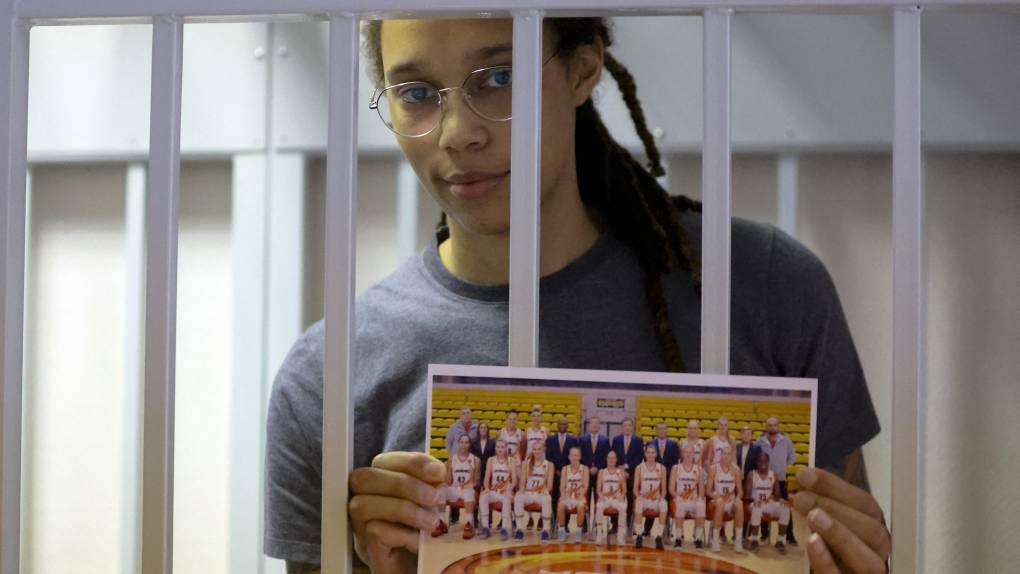
"caption": "Brittney Griner holds a picture of her Russian basketball team as she stands inside a defendants' cell before a court hearing in Khimki, outside Moscow.",
"description": null,
"title": "Brittney Griner holds a picture of her Russian basketball team as she stands inside a defendants' cell before a court hearing in Khimki, outside Moscow.",
"credit": "EVGENIA NOVOZHENINA/POOL/AFP via Getty Images",
"status": "inherit",
"altTag": null,
"isLoading": false,
"fetchFailed": false
},
"arts_13916941": {
"type": "attachments",
"id": "arts_13916941",
"meta": {
"index": "attachments_1716263798",
"site": "arts",
"id": "13916941",
"found": true
},
"parent": 13916840,
"imgSizes": {
"twentyfourteen-full-width": {
"file": "https://ww2.kqed.org/app/uploads/sites/2/2022/08/Russell.Main_-1038x576.jpg",
"width": 1038,
"mimeType": "image/jpeg",
"height": 576
},
"thumbnail": {
"file": "https://ww2.kqed.org/app/uploads/sites/2/2022/08/Russell.Main_-160x90.jpg",
"width": 160,
"mimeType": "image/jpeg",
"height": 90
},
"post-thumbnail": {
"file": "https://ww2.kqed.org/app/uploads/sites/2/2022/08/Russell.Main_-672x372.jpg",
"width": 672,
"mimeType": "image/jpeg",
"height": 372
},
"kqedFullSize": {
"file": "https://ww2.kqed.org/app/uploads/sites/2/2022/08/Russell.Main_.jpg",
"width": 1280,
"height": 720
},
"large": {
"file": "https://ww2.kqed.org/app/uploads/sites/2/2022/08/Russell.Main_-1020x574.jpg",
"width": 1020,
"mimeType": "image/jpeg",
"height": 574
},
"medium": {
"file": "https://ww2.kqed.org/app/uploads/sites/2/2022/08/Russell.Main_-800x450.jpg",
"width": 800,
"mimeType": "image/jpeg",
"height": 450
},
"medium_large": {
"file": "https://ww2.kqed.org/app/uploads/sites/2/2022/08/Russell.Main_-768x432.jpg",
"width": 768,
"mimeType": "image/jpeg",
"height": 432
}
},
"publishDate": 1659374170,
"modified": 1659374224,
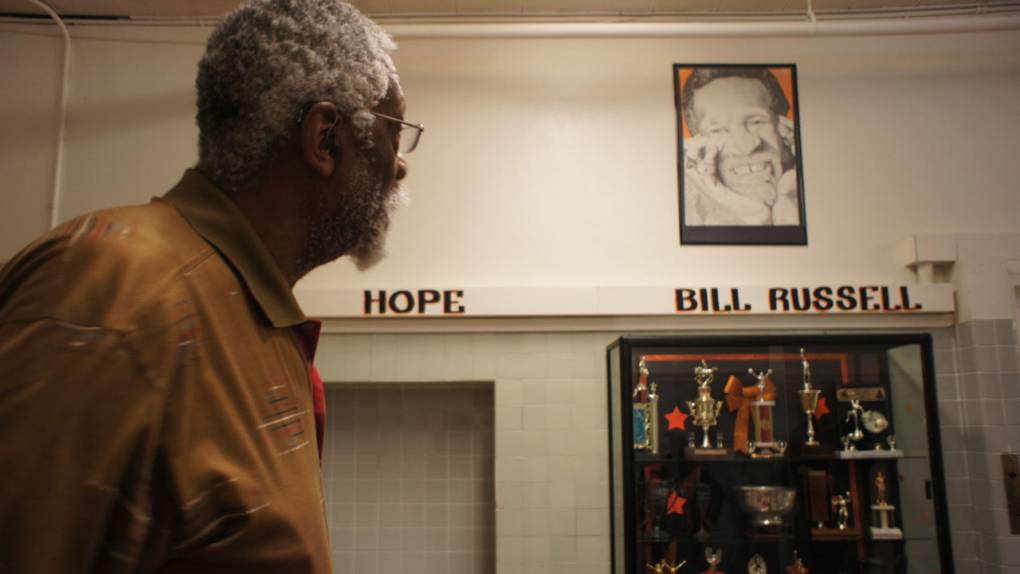
"caption": "Bill Russell takes in a portrait of himself while standing in a hallway at McClymonds High School. ",
"description": null,
"title": "Russell.Main",
"credit": "Pendarvis Harshaw",
"status": "inherit",
"altTag": "A man in a brown shirt looks toward an awards display case and a portrait of himself on the wall.",
"isLoading": false,
"fetchFailed": false
},
"arts_13916831": {
"type": "attachments",
"id": "arts_13916831",
"meta": {
"index": "attachments_1716263798",
"site": "arts",
"id": "13916831",
"found": true
},
"parent": 13916823,
"imgSizes": {
"twentyfourteen-full-width": {
"file": "https://ww2.kqed.org/app/uploads/sites/2/2022/07/BillRussell.BW_-1024x576.jpg",
"width": 1024,
"mimeType": "image/jpeg",
"height": 576
},
"thumbnail": {
"file": "https://ww2.kqed.org/app/uploads/sites/2/2022/07/BillRussell.BW_-160x100.jpg",
"width": 160,
"mimeType": "image/jpeg",
"height": 100
},
"post-thumbnail": {
"file": "https://ww2.kqed.org/app/uploads/sites/2/2022/07/BillRussell.BW_-672x372.jpg",
"width": 672,
"mimeType": "image/jpeg",
"height": 372
},
"kqedFullSize": {
"file": "https://ww2.kqed.org/app/uploads/sites/2/2022/07/BillRussell.BW_.jpg",
"width": 1024,
"height": 640
},
"large": {
"file": "https://ww2.kqed.org/app/uploads/sites/2/2022/07/BillRussell.BW_-1020x638.jpg",
"width": 1020,
"mimeType": "image/jpeg",
"height": 638
},
"medium": {
"file": "https://ww2.kqed.org/app/uploads/sites/2/2022/07/BillRussell.BW_-800x500.jpg",
"width": 800,
"mimeType": "image/jpeg",
"height": 500
},
"medium_large": {
"file": "https://ww2.kqed.org/app/uploads/sites/2/2022/07/BillRussell.BW_-768x480.jpg",
"width": 768,
"mimeType": "image/jpeg",
"height": 480
}
},
"publishDate": 1659292499,
"modified": 1659293104,
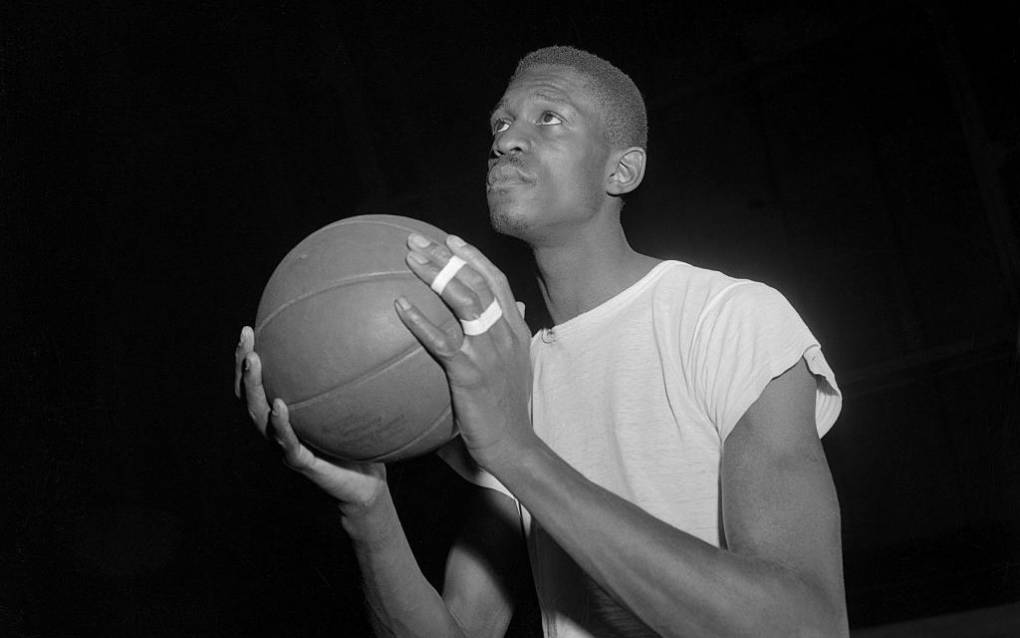
"caption": "Bill Russell pictured in 1956, near the end of his time at the University of San Francisco. The basketball great and McClymonds High School graduate died Sunday, July 31, according to a family announement.",
"description": null,
"title": "BillRussell.BW",
"credit": "Bettman Collection/Getty Images",
"status": "inherit",
"altTag": "A young Black man in a white T-shirt and taped fingers aims a basketball upward, against a black background",
"isLoading": false,
"fetchFailed": false
},
"arts_13916359": {
"type": "attachments",
"id": "arts_13916359",
"meta": {
"index": "attachments_1716263798",
"site": "arts",
"id": "13916359",
"found": true
},
"parent": 13916358,
"imgSizes": {
"twentyfourteen-full-width": {
"file": "https://ww2.kqed.org/app/uploads/sites/2/2022/07/e9i0031_wide-179768207af20e3de15cd38fd77b4fb2e43a41ed-1038x576.jpe",
"width": 1038,
"mimeType": "image/jpeg",
"height": 576
},
"thumbnail": {
"file": "https://ww2.kqed.org/app/uploads/sites/2/2022/07/e9i0031_wide-179768207af20e3de15cd38fd77b4fb2e43a41ed-160x90.jpe",
"width": 160,
"mimeType": "image/jpeg",
"height": 90
},
"post-thumbnail": {
"file": "https://ww2.kqed.org/app/uploads/sites/2/2022/07/e9i0031_wide-179768207af20e3de15cd38fd77b4fb2e43a41ed-672x372.jpe",
"width": 672,
"mimeType": "image/jpeg",
"height": 372
},
"kqedFullSize": {
"file": "https://ww2.kqed.org/app/uploads/sites/2/2022/07/e9i0031_wide-179768207af20e3de15cd38fd77b4fb2e43a41ed.jpe",
"width": 1597,
"height": 898
},
"large": {
"file": "https://ww2.kqed.org/app/uploads/sites/2/2022/07/e9i0031_wide-179768207af20e3de15cd38fd77b4fb2e43a41ed-1020x574.jpe",
"width": 1020,
"mimeType": "image/jpeg",
"height": 574
},
"1536x1536": {
"file": "https://ww2.kqed.org/app/uploads/sites/2/2022/07/e9i0031_wide-179768207af20e3de15cd38fd77b4fb2e43a41ed-1536x864.jpe",
"width": 1536,
"mimeType": "image/jpeg",
"height": 864
},
"medium": {
"file": "https://ww2.kqed.org/app/uploads/sites/2/2022/07/e9i0031_wide-179768207af20e3de15cd38fd77b4fb2e43a41ed-800x450.jpe",
"width": 800,
"mimeType": "image/jpeg",
"height": 450
},
"medium_large": {
"file": "https://ww2.kqed.org/app/uploads/sites/2/2022/07/e9i0031_wide-179768207af20e3de15cd38fd77b4fb2e43a41ed-768x432.jpe",
"width": 768,
"mimeType": "image/jpeg",
"height": 432
}
},
"publishDate": 1658344963,
"modified": 1658346503,
"caption": "The New York Titans and the Austin Outlaws face off during the 2021 regular Major League Quidditch season last June in Round Rock, Texas. The league and the sports governing bodies announced on Tuesday that the sport is rebranding as quadball.",
"description": null,
"title": "The New York Titans and the Austin Outlaws face off during the 2021 regular Major League Quidditch season last June in Round Rock, Texas. The league and the sports governing bodies announced on Tuesday that the sport is rebranding as quadball.",
"credit": "Major League Quidditch",
"status": "inherit",
"altTag": "A Black man wearing a blue and red rugby jersey and red shorts, clutching a ball and collides with a blonde woman in yellow and red soccer kit. She is holding a short stick between her legs. Goalposts are visible in the background.",
"isLoading": false,
"fetchFailed": false
},
"arts_13916270": {
"type": "attachments",
"id": "arts_13916270",
"meta": {
"index": "attachments_1716263798",
"site": "arts",
"id": "13916270",
"found": true
},
"parent": 13916267,
"imgSizes": {
"twentyfourteen-full-width": {
"file": "https://ww2.kqed.org/app/uploads/sites/2/2022/07/Raney-Beres-1038x576.png",
"width": 1038,
"mimeType": "image/png",
"height": 576
},
"thumbnail": {
"file": "https://ww2.kqed.org/app/uploads/sites/2/2022/07/Raney-Beres-160x99.png",
"width": 160,
"mimeType": "image/png",
"height": 99
},
"post-thumbnail": {
"file": "https://ww2.kqed.org/app/uploads/sites/2/2022/07/Raney-Beres-672x372.png",
"width": 672,
"mimeType": "image/png",
"height": 372
},
"kqedFullSize": {
"file": "https://ww2.kqed.org/app/uploads/sites/2/2022/07/Raney-Beres-e1658212529701.png",
"width": 1920,
"height": 1191
},
"2048x2048": {
"file": "https://ww2.kqed.org/app/uploads/sites/2/2022/07/Raney-Beres-2048x1270.png",
"width": 2048,
"mimeType": "image/png",
"height": 1270
},
"large": {
"file": "https://ww2.kqed.org/app/uploads/sites/2/2022/07/Raney-Beres-1020x633.png",
"width": 1020,
"mimeType": "image/png",
"height": 633
},
"1536x1536": {
"file": "https://ww2.kqed.org/app/uploads/sites/2/2022/07/Raney-Beres-1536x953.png",
"width": 1536,
"mimeType": "image/png",
"height": 953
},
"full-width": {
"file": "https://ww2.kqed.org/app/uploads/sites/2/2022/07/Raney-Beres-1920x1191.png",
"width": 1920,
"mimeType": "image/png",
"height": 1191
},
"medium": {
"file": "https://ww2.kqed.org/app/uploads/sites/2/2022/07/Raney-Beres-800x496.png",
"width": 800,
"mimeType": "image/png",
"height": 496
},
"medium_large": {
"file": "https://ww2.kqed.org/app/uploads/sites/2/2022/07/Raney-Beres-768x476.png",
"width": 768,
"mimeType": "image/png",
"height": 476
}
},
"publishDate": 1658212403,
"modified": 1658257440,
"caption": "Raney Beres, as seen in the new 'Thrasher' video, 'The Story of China Banks.'",
"description": null,
"title": "Raney Beres, as seen in new Thrasher video, 'The Story of China Banks.'",
"credit": "YouTube/ ThrasherMagazine",
"status": "inherit",
"altTag": "A skateboarder slides his board along the top edge of a slanted brick wall, a concrete tower behind him.",
"isLoading": false,
"fetchFailed": false
}
},
"audioPlayerReducer": {
"postId": "stream_live",
"isPaused": true,
"isPlaying": false,
"pfsActive": false,
"pledgeModalIsOpen": true,
"playerDrawerIsOpen": false,
"liveAudioPlayStartedAt": 0,
"liveAudioPlayContext": ""
},
"authorsReducer": {
"byline_arts_13926031": {
"type": "authors",
"id": "byline_arts_13926031",
"meta": {
"override": true
},
"slug": "byline_arts_13926031",
"name": "Patrick Jarenwattananon",
"isLoading": false
},
"byline_arts_13925671": {
"type": "authors",
"id": "byline_arts_13925671",
"meta": {
"override": true
},
"slug": "byline_arts_13925671",
"name": "Joe Hernandez",
"isLoading": false
},
"byline_arts_13923120": {
"type": "authors",
"id": "byline_arts_13923120",
"meta": {
"override": true
},
"slug": "byline_arts_13923120",
"name": "Tales Azzoni and Mauricio Savarese, Associated Press",
"isLoading": false
},
"byline_arts_13920367": {
"type": "authors",
"id": "byline_arts_13920367",
"meta": {
"override": true
},
"slug": "byline_arts_13920367",
"name": "Nick Lozito",
"isLoading": false
},
"byline_arts_13919512": {
"type": "authors",
"id": "byline_arts_13919512",
"meta": {
"override": true
},
"slug": "byline_arts_13919512",
"name": "Jane Braden",
"isLoading": false
},
"byline_arts_13917098": {
"type": "authors",
"id": "byline_arts_13917098",
"meta": {
"override": true
},
"slug": "byline_arts_13917098",
"name": "Rachel Treisman",
"isLoading": false
},
"byline_arts_13916823": {
"type": "authors",
"id": "byline_arts_13916823",
"meta": {
"override": true
},
"slug": "byline_arts_13916823",
"name": "Jimmy Golen, Associated Press",
"isLoading": false
},
"byline_arts_13916358": {
"type": "authors",
"id": "byline_arts_13916358",
"meta": {
"override": true
},
"slug": "byline_arts_13916358",
"name": "Wynne Davis",
"isLoading": false
},
"ralexandra": {
"type": "authors",
"id": "11242",
"meta": {
"index": "authors_1716337520",
"id": "11242",
"found": true
},
"name": "Rae Alexandra",
"firstName": "Rae",
"lastName": "Alexandra",
"slug": "ralexandra",
"email": "ralexandra@kqed.org",
"display_author_email": true,
"staff_mastheads": [],
"title": "Reporter/Producer",
"bio": "Rae Alexandra is a Reporter/Producer for KQED Arts & Culture, and the creator/author of the \u003ca href=\"https://www.kqed.org/arts/program/rebel-girls-from-bay-area-history\">Rebel Girls From Bay Area History\u003c/a> and \u003ca href=\"https://www.kqed.org/bizarrebayarea\">Bizarre Bay Area\u003c/a> series. Her debut book, \u003ca href=\"https://citylights.com/politics-current-events-history/unsung-heroines35-women-who-changed/\">Unsung Heroines: 35 Women Who Changed the Bay Area\u003c/a> was published by City Lights in March 2026. In 2023, Rae was awarded an SPJ Excellence in Journalism Award for Arts & Culture. Rae was born and raised in Wales and subsequently — even after two decades in Northern California — still uses phrases that regularly baffle her coworkers.",
"avatar": "https://secure.gravatar.com/avatar/edfee8176c80cc0a382b051190f5341997df378a934a5774dcb0977732dfd401?s=600&d=blank&r=g",
"twitter": null,
"bluesky": null,
"facebook": null,
"instagram": null,
"linkedin": null,
"sites": [
{
"site": "arts",
"roles": [
"subscriber"
]
},
{
"site": "news",
"roles": [
"subscriber"
]
},
{
"site": "pop",
"roles": [
"subscriber"
]
},
{
"site": "bayareabites",
"roles": [
"subscriber"
]
},
{
"site": "science",
"roles": [
"subscriber"
]
}
],
"headData": {
"title": "Rae Alexandra | KQED",
"description": "Reporter/Producer",
"ogImgSrc": "https://secure.gravatar.com/avatar/edfee8176c80cc0a382b051190f5341997df378a934a5774dcb0977732dfd401?s=600&d=blank&r=g",
"twImgSrc": "https://secure.gravatar.com/avatar/edfee8176c80cc0a382b051190f5341997df378a934a5774dcb0977732dfd401?s=600&d=blank&r=g"
},
"isLoading": false,
"link": "/author/ralexandra"
},
"ogpenn": {
"type": "authors",
"id": "11491",
"meta": {
"index": "authors_1716337520",
"id": "11491",
"found": true
},
"name": "Pendarvis Harshaw",
"firstName": "Pendarvis",
"lastName": "Harshaw",
"slug": "ogpenn",
"email": "ogpenn@gmail.com",
"display_author_email": false,
"staff_mastheads": [
"arts"
],
"title": "Community Engagement Reporter",
"bio": "Pendarvis Harshaw is an educator, host and writer with KQED Arts.",
"avatar": "https://secure.gravatar.com/avatar/972b77ee8e3f346ae2b00622661187fbfabd059b5693bbdc1475ea7a722fd4cd?s=600&d=blank&r=g",
"twitter": null,
"bluesky": null,
"facebook": null,
"instagram": "ogpenn",
"linkedin": null,
"sites": [
{
"site": "arts",
"roles": [
"administrator"
]
},
{
"site": "news",
"roles": [
"editor"
]
},
{
"site": "bayareabites",
"roles": [
"author"
]
},
{
"site": "hiphop",
"roles": [
"editor"
]
}
],
"headData": {
"title": "Pendarvis Harshaw | KQED",
"description": "Community Engagement Reporter",
"ogImgSrc": "https://secure.gravatar.com/avatar/972b77ee8e3f346ae2b00622661187fbfabd059b5693bbdc1475ea7a722fd4cd?s=600&d=blank&r=g",
"twImgSrc": "https://secure.gravatar.com/avatar/972b77ee8e3f346ae2b00622661187fbfabd059b5693bbdc1475ea7a722fd4cd?s=600&d=blank&r=g"
},
"isLoading": false,
"link": "/author/ogpenn"
},
"achazaro": {
"type": "authors",
"id": "11748",
"meta": {
"index": "authors_1716337520",
"id": "11748",
"found": true
},
"name": "Alan Chazaro",
"firstName": "Alan",
"lastName": "Chazaro",
"slug": "achazaro",
"email": "agchazaro@gmail.com",
"display_author_email": true,
"staff_mastheads": [],
"title": "Food Writer and Reporter",
"bio": "Alan Chazaro is the author of \u003cem>This Is Not a Frank Ocean Cover Album\u003c/em> (Black Lawrence Press, 2019), \u003cem>Piñata Theory\u003c/em> (Black Lawrence Press, 2020), and \u003cem>Notes from the Eastern Span of the Bay Bridge\u003c/em> (Ghost City Press, 2021). He is a graduate of June Jordan’s Poetry for the People program at UC Berkeley and a former Lawrence Ferlinghetti Fellow at the University of San Francisco. He writes about sports, food, art, music, education, and culture while repping the Bay on \u003ca href=\"https://twitter.com/alan_chazaro\">Twitter\u003c/a> and \u003ca href=\"https://www.instagram.com/alan_chazaro/?hl=en\">Instagram\u003c/a> at @alan_chazaro.",
"avatar": "https://secure.gravatar.com/avatar/ea8b6dd970fc5c29e7a188e7d5861df7?s=600&d=blank&r=g",
"twitter": "alan_chazaro",
"facebook": null,
"instagram": null,
"linkedin": null,
"sites": [
{
"site": "arts",
"roles": [
"contributor"
]
},
{
"site": "news",
"roles": [
"editor"
]
}
],
"headData": {
"title": "Alan Chazaro | KQED",
"description": "Food Writer and Reporter",
"ogImgSrc": "https://secure.gravatar.com/avatar/ea8b6dd970fc5c29e7a188e7d5861df7?s=600&d=blank&r=g",
"twImgSrc": "https://secure.gravatar.com/avatar/ea8b6dd970fc5c29e7a188e7d5861df7?s=600&d=blank&r=g"
},
"isLoading": false,
"link": "/author/achazaro"
},
"vchung": {
"type": "authors",
"id": "11827",
"meta": {
"index": "authors_1716337520",
"id": "11827",
"found": true
},
"name": "Vicky Chung",
"firstName": "Victoria",
"lastName": "Chung",
"slug": "vchung",
"email": "vchung@kqed.org",
"display_author_email": false,
"staff_mastheads": [],
"title": "KQED Contributor",
"bio": "Vicky Chung is a social media associate for KQED. Born and raised in the Bay Area, she graduated with a B.A. in Communication Studies and a minor in Radio-Television-Film from San Jose State University. When she isn't binge-watching baking shows, you'll find her at an indie or pop concert.",
"avatar": "https://secure.gravatar.com/avatar/ed74ab7df687fc80491d49a97d157ca5?s=600&d=blank&r=g",
"twitter": "coldpizzasIice",
"facebook": null,
"instagram": null,
"linkedin": null,
"sites": [
{
"site": "arts",
"roles": [
"contributor"
]
}
],
"headData": {
"title": "Vicky Chung | KQED",
"description": "KQED Contributor",
"ogImgSrc": "https://secure.gravatar.com/avatar/ed74ab7df687fc80491d49a97d157ca5?s=600&d=blank&r=g",
"twImgSrc": "https://secure.gravatar.com/avatar/ed74ab7df687fc80491d49a97d157ca5?s=600&d=blank&r=g"
},
"isLoading": false,
"link": "/author/vchung"
}
},
"pagesReducer": {
"arts_category_sports": {
"type": "terms",
"id": "arts_13238",
"meta": {
"index": "terms_1716263798",
"site": "arts",
"id": "13238",
"score": 12.071877
},
"featImg": null,
"name": "Sports",
"description": null,
"taxonomy": "category",
"headData": {
"twImgId": null,
"twTitle": null,
"ogTitle": null,
"ogImgId": null,
"twDescription": null,
"description": null,
"title": "Sports Archives | KQED Arts",
"ogDescription": null
},
"ttid": 13250,
"slug": "sports",
"isLoading": false,
"title": "Sports",
"pageMeta": {
"site": "arts",
"WpPageTemplate": "page-topic-editorial",
"currentPage": 12
},
"blocks": [
{
"blockName": "kqed/post-list",
"attrs": {
"layout": "cardArticle2",
"query": "posts/arts?category=sports",
"seeMore": false,
"paginated": true,
"page": 12
}
},
{
"blockName": "kqed/ad"
}
]
}
},
"pfsSessionReducer": {},
"postsReducer": {
"stream_live": {
"type": "live",
"id": "stream_live",
"audioUrl": "https://streams.kqed.org/kqedradio",
"title": "Live Stream",
"excerpt": "Live Stream information currently unavailable.",
"link": "/radio",
"featImg": "",
"label": {
"name": "KQED Live",
"link": "/"
}
},
"stream_kqedNewscast": {
"type": "posts",
"id": "stream_kqedNewscast",
"audioUrl": "https://www.kqed.org/.stream/anon/radio/RDnews/newscast.mp3?_=1",
"title": "KQED Newscast",
"featImg": "",
"label": {
"name": "88.5 FM",
"link": "/"
}
},
"arts_13926031": {
"type": "posts",
"id": "arts_13926031",
"meta": {
"index": "posts_1716263798",
"site": "arts",
"id": "13926031",
"score": null,
"sort": [
1678390446000
]
},
"parent": 0,
"labelTerm": {
"site": "arts",
"term": 137
},
"blocks": [],
"publishDate": 1678390446,
"format": "standard",
"title": "Colin Kaepernick Describes How He Embraced His Blackness as a Teenager",
"headTitle": "Colin Kaepernick Describes How He Embraced His Blackness as a Teenager | KQED",
"content": "\u003cp>Before Colin Kaepernick was the face and catalyst of a protest movement — across sports and society — and before he was the San Francisco 49ers’ starting quarterback in the Super Bowl XLVII, he was just a teenager trying to figure out who he was and where he was going.\u003c/p>\n\u003cp>[aside postid='arts_13908958']Navigating everything from family to school can be especially overwhelming as a teenager. When it came to sports, Kaepernick often grappled with whether he was taking the right athletic route to the pros. He ruminated on pursuing baseball — where he had a lot of offers from colleges and received house visits from Major League Baseball personnel — or following his heart and patiently wait for a football scholarship. From anywhere.\u003c/p>\n\u003cp>Outside of sports, Kaepernick wrestled with his identity within his blended adoptive family. Culturally speaking, he felt misunderstood. His adoptive parents were white, and while Kaepernick is biracial, he identified as a Black man and the world around him treated him as such.\u003c/p>\n\u003cp>His upbringing and teen crucibles are the source of his new graphic novel, titled \u003cem>Change the Game\u003c/em>, which is written with Eve Ewing and illustrated by Orlando Caicedo.\u003c/p>\n\u003cp>\u003cimg loading=\"lazy\" decoding=\"async\" class=\"size-medium wp-image-13926032 aligncenter\" src=\"https://ww2.kqed.org/app/uploads/sites/2/2023/03/colin-kaepernick_change-the-game_cover_credit-kaepernick-publishing-_-scholastic_custom-5f978dd3324e937a9894a8a15dc6908809c0d35e-800x1202.jpg\" alt=\"\" width=\"800\" height=\"1202\" srcset=\"https://cdn.kqed.org/wp-content/uploads/sites/2/2023/03/colin-kaepernick_change-the-game_cover_credit-kaepernick-publishing-_-scholastic_custom-5f978dd3324e937a9894a8a15dc6908809c0d35e-800x1202.jpg 800w, https://cdn.kqed.org/wp-content/uploads/sites/2/2023/03/colin-kaepernick_change-the-game_cover_credit-kaepernick-publishing-_-scholastic_custom-5f978dd3324e937a9894a8a15dc6908809c0d35e-1020x1533.jpg 1020w, https://cdn.kqed.org/wp-content/uploads/sites/2/2023/03/colin-kaepernick_change-the-game_cover_credit-kaepernick-publishing-_-scholastic_custom-5f978dd3324e937a9894a8a15dc6908809c0d35e-160x240.jpg 160w, https://cdn.kqed.org/wp-content/uploads/sites/2/2023/03/colin-kaepernick_change-the-game_cover_credit-kaepernick-publishing-_-scholastic_custom-5f978dd3324e937a9894a8a15dc6908809c0d35e-768x1154.jpg 768w, https://cdn.kqed.org/wp-content/uploads/sites/2/2023/03/colin-kaepernick_change-the-game_cover_credit-kaepernick-publishing-_-scholastic_custom-5f978dd3324e937a9894a8a15dc6908809c0d35e-1022x1536.jpg 1022w, https://cdn.kqed.org/wp-content/uploads/sites/2/2023/03/colin-kaepernick_change-the-game_cover_credit-kaepernick-publishing-_-scholastic_custom-5f978dd3324e937a9894a8a15dc6908809c0d35e-1363x2048.jpg 1363w, https://cdn.kqed.org/wp-content/uploads/sites/2/2023/03/colin-kaepernick_change-the-game_cover_credit-kaepernick-publishing-_-scholastic_custom-5f978dd3324e937a9894a8a15dc6908809c0d35e-scaled.jpg 1704w\" sizes=\"(max-width: 800px) 100vw, 800px\">\u003c/p>\n\u003cp>[ad fullwidth]\u003c/p>\n\u003cp>In an interview with NPR’s Juana Summers, Kaepernick evinces what allowed him to fully soak in and embrace his Blackness. Kaepernick says he got his identity footing looking up to Allen Iverson — AKA ‘The Answer.’ This cultural icon’s bravado, braids and ability to make anyone — even ‘His Airness’ Michael Jordan — look foolish on the basketball court, gave Kaepernick a new prototype of Blackness to build and contribute toward.\u003c/p>\n\u003cp>\u003cem>This interview has been lightly edited for length and clarity.\u003c/em>\u003c/p>\n\u003chr>\n\u003ch3>Interview highlights\u003c/h3>\n\u003cp>\u003cstrong>On the struggles Kaepernick dealt with as a teen\u003c/strong>\u003c/p>\n\u003cp>It was navigating the difficulties of family, community, school, and major life decisions. Like, while I am biracial, I identify as a young Black man. So I was trying to navigate that while having a white family and being in a predominantly white community, and trying to find ways to make sure that my identity and Blackness wasn’t stripped from me along that journey.\u003c/p>\n\u003cp>\u003cstrong>On his decision and inspiration to get cornrows \u003c/strong>\u003c/p>\n\u003cp>This was the era of Allen Iverson, a cultural phenom. He was someone that I looked up to, and I saw him be so unapologetically Black and unapologetically himself. It was something I aspired to, and I looked at that as an opportunity for me to be able to really take hold of my Blackness and do it in a way that I was proud of and I was excited about. And the difficulty with that is being in white culture with Eurocentric beauty standards, navigating what their response to that was at 15 years old and not knowing how to fight back against that, really outside of saying, ‘No, this is just what I want to do.’ And that became a very difficult conversation and situation, navigating that both with my family, with my community, with coaches.\u003c/p>\n\u003cfigure id=\"attachment_13926035\" class=\"wp-caption aligncenter\" style=\"max-width: 800px\">\u003cimg loading=\"lazy\" decoding=\"async\" class=\"size-medium wp-image-13926035\" src=\"https://ww2.kqed.org/app/uploads/sites/2/2023/03/change-the-game_14_custom-d454f2cca4f4e4d000a493dc79d18d786e9cecef-800x1201.jpg\" alt=\"Five comic book panels depict a young man going to get his hair braided for the first time. \" width=\"800\" height=\"1201\" srcset=\"https://cdn.kqed.org/wp-content/uploads/sites/2/2023/03/change-the-game_14_custom-d454f2cca4f4e4d000a493dc79d18d786e9cecef-800x1201.jpg 800w, https://cdn.kqed.org/wp-content/uploads/sites/2/2023/03/change-the-game_14_custom-d454f2cca4f4e4d000a493dc79d18d786e9cecef-1020x1532.jpg 1020w, https://cdn.kqed.org/wp-content/uploads/sites/2/2023/03/change-the-game_14_custom-d454f2cca4f4e4d000a493dc79d18d786e9cecef-160x240.jpg 160w, https://cdn.kqed.org/wp-content/uploads/sites/2/2023/03/change-the-game_14_custom-d454f2cca4f4e4d000a493dc79d18d786e9cecef-768x1153.jpg 768w, https://cdn.kqed.org/wp-content/uploads/sites/2/2023/03/change-the-game_14_custom-d454f2cca4f4e4d000a493dc79d18d786e9cecef-1023x1536.jpg 1023w, https://cdn.kqed.org/wp-content/uploads/sites/2/2023/03/change-the-game_14_custom-d454f2cca4f4e4d000a493dc79d18d786e9cecef-1364x2048.jpg 1364w, https://cdn.kqed.org/wp-content/uploads/sites/2/2023/03/change-the-game_14_custom-d454f2cca4f4e4d000a493dc79d18d786e9cecef-scaled.jpg 1705w\" sizes=\"(max-width: 800px) 100vw, 800px\">\u003cfigcaption class=\"wp-caption-text\">Kaepernick describes how NBA champion Allen Iverson was an inspiration. \u003ccite>(Kaepernick Publishing)\u003c/cite>\u003c/figcaption>\u003c/figure>\n\u003cp>It took me, I think, about 14 years before I grew my hair back out. So it’s really to show the impact those moments … can have on a young man, on a young woman, and how that carries with them through life.\u003c/p>\n\u003cp>\u003cstrong>On his motivation for creating a graphic novel\u003c/strong>\u003c/p>\n\u003cp>There were a few reasons. One of the reasons, growing up I wasn’t an avid reader was because I didn’t have stories, or I wasn’t introduced to books that had characters that I related to. It wasn’t until I read \u003cem>We’ll Never Forget You, Roberto Clemente\u003c/em>, that I saw another Black person as the lead of a book. It was game changing for me.\u003c/p>\n\u003cp>I knew there were other books out there and other opportunities to be able to find stories, to find narratives that I identified with and that were relatable to me. So what we’re looking to do now is, for younger audiences, give them hopefully characters and stories that they relate to, but also give them pieces of knowledge and situations and try to help them navigate those in ways that I didn’t have access to growing up. And based upon conversations that I’ve had, a lot of other people didn’t as well.\u003c/p>\n\u003cfigure id=\"attachment_13926041\" class=\"wp-caption aligncenter\" style=\"max-width: 800px\">\u003cimg loading=\"lazy\" decoding=\"async\" class=\"size-medium wp-image-13926041\" src=\"https://ww2.kqed.org/app/uploads/sites/2/2023/03/Screen-Shot-2023-03-09-at-11.20.33-AM-800x595.png\" alt=\"A double page spread in a comic book depicts a young Black man feeling uncomfortable at a sports game as his white father conducts a conversation with another white man wearing a confederate flag cap.\" width=\"800\" height=\"595\" srcset=\"https://cdn.kqed.org/wp-content/uploads/sites/2/2023/03/Screen-Shot-2023-03-09-at-11.20.33-AM-800x595.png 800w, https://cdn.kqed.org/wp-content/uploads/sites/2/2023/03/Screen-Shot-2023-03-09-at-11.20.33-AM-1020x759.png 1020w, https://cdn.kqed.org/wp-content/uploads/sites/2/2023/03/Screen-Shot-2023-03-09-at-11.20.33-AM-160x119.png 160w, https://cdn.kqed.org/wp-content/uploads/sites/2/2023/03/Screen-Shot-2023-03-09-at-11.20.33-AM-768x571.png 768w, https://cdn.kqed.org/wp-content/uploads/sites/2/2023/03/Screen-Shot-2023-03-09-at-11.20.33-AM-1536x1143.png 1536w, https://cdn.kqed.org/wp-content/uploads/sites/2/2023/03/Screen-Shot-2023-03-09-at-11.20.33-AM.png 1538w\" sizes=\"(max-width: 800px) 100vw, 800px\">\u003cfigcaption class=\"wp-caption-text\">Kaepernick doesn’t shy away from how he navigated living in a white family and being in a predominantly white community. \u003ccite>(Kaepernick Publishing)\u003c/cite>\u003c/figcaption>\u003c/figure>\n\u003cp>\u003cstrong>Why the book ends with him heading off to the University of Nevada, Reno\u003c/strong>\u003c/p>\n\u003cp>[aside postid='arts_13905474']We end the story there for a few reasons. One, to make sure that we don’t have a never-ending book, because there’s a lot of story to tell. But the other part of it is we wanted to create a defining moment that younger kids and high school kids could identify with, which is that transition and decision of what to do after high school.\u003c/p>\n\u003cp>And for me, at that point in time, baseball was the obvious decision for everyone around me. I have multiple offers. I had the MLB come and sit down in my living room and tell me they wanted to draft me. There was an obvious career path there. And I had not a single offer for football at this point, but it was what I loved and what I wanted to do. I made the decision that that’s what I was going to chase, in spite of everyone else telling me I should go a different direction.\u003c/p>\n\u003cp>\u003cstrong>On whether the NFL has changed for the better over the past six years\u003c/strong>\u003c/p>\n\u003cp>I haven’t seen any substantial change. I think there is a lot of work to do on that front. Obviously, not playing and being out of the NFL for six years is an indictment on where they are currently at. So I wouldn’t put them at the forefront of goodwill and best of intentions in how they operate.\u003c/p>\n\u003cp>\u003cstrong>On whether Kaepernick still thinks losing his career was worth the start of a movement\u003c/strong>\u003c/p>\n\u003cp>I think there’s this idea out there that those are mutually exclusive, and I don’t subscribe to that. So I think people are multifaceted and multi-talented and ultimately, that’s something that we want to make sure that message is being sent as well.\u003c/p>\n\u003cp>[ad floatright]\u003c/p>\n\u003cp>My focus is always on what I can do moving forward. What can I do to change my present and my future? So training at 4:30am to be able to have the opportunity to make a (NFL) comeback? Absolutely. That’s something I do five days a week still. But as far as looking back, that’s not something I do. I’m looking forward to where can I have an impact? What are my passions? And a great example of that is \u003cem>Change The Game\u003c/em>, and this book being able to come out, us being able to share this message with the youth, and it becomes a great opportunity for us to be able to create a future that looks different\u003c/p>\n\u003cdiv class=\"fullattribution\">\u003cem>Copyright 2023 NPR. To see more, \u003ca href=\"https://www.npr.org\" target=\"_blank\" rel=\"noopener\">visit NPR\u003c/a>.\u003cimg decoding=\"async\" src=\"https://www.google-analytics.com/__utm.gif?utmac=UA-5828686-4&utmdt=Colin+Kaepernick+describes+how+he+embraced+his+blackness+as+a+teenager&utme=8(APIKey)9(MDAxOTAwOTE4MDEyMTkxMDAzNjczZDljZA004)\">\u003c/em>\u003c/div>\n\n",
"stats": {
"hasVideo": false,
"hasChartOrMap": false,
"hasAudio": false,
"hasPolis": false,
"wordCount": 1238,
"hasGoogleForm": false,
"hasGallery": false,
"hasHearkenModule": false,
"iframeSrcs": [],
"paragraphCount": 25
},
"modified": 1705005763,
"excerpt": "Kaepernick’s new graphic novel, titled ‘Change the Game,’ depicts his upbringing and teen crucibles.",
"headData": {
"twImgId": "",
"twTitle": "",
"ogTitle": "",
"ogImgId": "",
"twDescription": "",
"description": "Kaepernick’s new graphic novel, titled ‘Change the Game,’ depicts his upbringing and teen crucibles.",
"title": "Colin Kaepernick Describes How He Embraced His Blackness as a Teenager | KQED",
"ogDescription": "",
"schema": {
"@context": "https://schema.org",
"@type": "Article",
"headline": "Colin Kaepernick Describes How He Embraced His Blackness as a Teenager",
"datePublished": "2023-03-09T11:34:06-08:00",
"dateModified": "2024-01-11T12:42:43-08:00",
"image": "https://cdn.kqed.org/wp-content/uploads/2020/02/KQED-OG-Image@1x.png"
}
},
"guestAuthors": [],
"slug": "colin-kaepernick-graphic-novel-change-the-game-interview",
"status": "publish",
"nprApiLink": "http://api.npr.org/query?id=1161925892&apiKey=MDAxOTAwOTE4MDEyMTkxMDAzNjczZDljZA004",
"templateType": "standard",
"nprStoryDate": "Wed, 08 Mar 2023 13:39:18 -0500",
"excludeFromSiteSearch": "Include",
"nprLastModifiedDate": "Wed, 08 Mar 2023 13:39:18 -0500",
"featuredImageType": "standard",
"nprHtmlLink": "https://www.npr.org/2023/03/08/1161925892/colin-kaepernick-nfl-graphic-novel-teen-identity?ft=nprml&f=1161925892",
"nprAudio": "https://ondemand.npr.org/anon.npr-mp3/npr/atc/2023/03/20230307_atc_change_the_game.mp3?orgId=1&topicId=1055&d=495&story=1161925892&ft=nprml&f=1161925892",
"nprImageAgency": "Kaepernick Publishing",
"nprAudioM3u": "http://api.npr.org/m3u/11161926254-01f2eb.m3u?orgId=1&topicId=1055&d=495&story=1161925892&ft=nprml&f=1161925892",
"nprStoryId": "1161925892",
"nprByline": "Patrick Jarenwattananon",
"sticky": false,
"showOnAuthorArchivePages": "No",
"articleAge": "0",
"nprRetrievedStory": "1",
"nprPubDate": "Wed, 08 Mar 2023 13:39:00 -0500",
"path": "/arts/13926031/colin-kaepernick-graphic-novel-change-the-game-interview",
"audioUrl": "https://ondemand.npr.org/anon.npr-mp3/npr/atc/2023/03/20230307_atc_change_the_game.mp3?orgId=1&topicId=1055&d=495&story=1161925892&ft=nprml&f=1161925892",
"audioTrackLength": null,
"parsedContent": [
{
"type": "contentString",
"content": "\u003cdiv class=\"post-body\">\u003cp>\u003cp>Before Colin Kaepernick was the face and catalyst of a protest movement — across sports and society — and before he was the San Francisco 49ers’ starting quarterback in the Super Bowl XLVII, he was just a teenager trying to figure out who he was and where he was going.\u003c/p>\n\u003cp>\u003c/p>\u003c/div>",
"attributes": {
"named": {},
"numeric": []
}
},
{
"type": "component",
"content": "",
"name": "aside",
"attributes": {
"named": {
"postid": "arts_13908958",
"label": ""
},
"numeric": []
}
},
{
"type": "contentString",
"content": "\u003cdiv class=\"post-body\">\u003cp>Navigating everything from family to school can be especially overwhelming as a teenager. When it came to sports, Kaepernick often grappled with whether he was taking the right athletic route to the pros. He ruminated on pursuing baseball — where he had a lot of offers from colleges and received house visits from Major League Baseball personnel — or following his heart and patiently wait for a football scholarship. From anywhere.\u003c/p>\n\u003cp>Outside of sports, Kaepernick wrestled with his identity within his blended adoptive family. Culturally speaking, he felt misunderstood. His adoptive parents were white, and while Kaepernick is biracial, he identified as a Black man and the world around him treated him as such.\u003c/p>\n\u003cp>His upbringing and teen crucibles are the source of his new graphic novel, titled \u003cem>Change the Game\u003c/em>, which is written with Eve Ewing and illustrated by Orlando Caicedo.\u003c/p>\n\u003cp>\u003cimg loading=\"lazy\" decoding=\"async\" class=\"size-medium wp-image-13926032 aligncenter\" src=\"https://ww2.kqed.org/app/uploads/sites/2/2023/03/colin-kaepernick_change-the-game_cover_credit-kaepernick-publishing-_-scholastic_custom-5f978dd3324e937a9894a8a15dc6908809c0d35e-800x1202.jpg\" alt=\"\" width=\"800\" height=\"1202\" srcset=\"https://cdn.kqed.org/wp-content/uploads/sites/2/2023/03/colin-kaepernick_change-the-game_cover_credit-kaepernick-publishing-_-scholastic_custom-5f978dd3324e937a9894a8a15dc6908809c0d35e-800x1202.jpg 800w, https://cdn.kqed.org/wp-content/uploads/sites/2/2023/03/colin-kaepernick_change-the-game_cover_credit-kaepernick-publishing-_-scholastic_custom-5f978dd3324e937a9894a8a15dc6908809c0d35e-1020x1533.jpg 1020w, https://cdn.kqed.org/wp-content/uploads/sites/2/2023/03/colin-kaepernick_change-the-game_cover_credit-kaepernick-publishing-_-scholastic_custom-5f978dd3324e937a9894a8a15dc6908809c0d35e-160x240.jpg 160w, https://cdn.kqed.org/wp-content/uploads/sites/2/2023/03/colin-kaepernick_change-the-game_cover_credit-kaepernick-publishing-_-scholastic_custom-5f978dd3324e937a9894a8a15dc6908809c0d35e-768x1154.jpg 768w, https://cdn.kqed.org/wp-content/uploads/sites/2/2023/03/colin-kaepernick_change-the-game_cover_credit-kaepernick-publishing-_-scholastic_custom-5f978dd3324e937a9894a8a15dc6908809c0d35e-1022x1536.jpg 1022w, https://cdn.kqed.org/wp-content/uploads/sites/2/2023/03/colin-kaepernick_change-the-game_cover_credit-kaepernick-publishing-_-scholastic_custom-5f978dd3324e937a9894a8a15dc6908809c0d35e-1363x2048.jpg 1363w, https://cdn.kqed.org/wp-content/uploads/sites/2/2023/03/colin-kaepernick_change-the-game_cover_credit-kaepernick-publishing-_-scholastic_custom-5f978dd3324e937a9894a8a15dc6908809c0d35e-scaled.jpg 1704w\" sizes=\"(max-width: 800px) 100vw, 800px\">\u003c/p>\n\u003cp>\u003c/p>\u003c/div>",
"attributes": {
"named": {},
"numeric": []
}
},
{
"type": "component",
"content": "",
"name": "ad",
"attributes": {
"named": {
"label": "fullwidth"
},
"numeric": [
"fullwidth"
]
}
},
{
"type": "contentString",
"content": "\u003cdiv class=\"post-body\">\u003cp>\u003c/p>\n\u003cp>In an interview with NPR’s Juana Summers, Kaepernick evinces what allowed him to fully soak in and embrace his Blackness. Kaepernick says he got his identity footing looking up to Allen Iverson — AKA ‘The Answer.’ This cultural icon’s bravado, braids and ability to make anyone — even ‘His Airness’ Michael Jordan — look foolish on the basketball court, gave Kaepernick a new prototype of Blackness to build and contribute toward.\u003c/p>\n\u003cp>\u003cem>This interview has been lightly edited for length and clarity.\u003c/em>\u003c/p>\n\u003chr>\n\u003ch3>Interview highlights\u003c/h3>\n\u003cp>\u003cstrong>On the struggles Kaepernick dealt with as a teen\u003c/strong>\u003c/p>\n\u003cp>It was navigating the difficulties of family, community, school, and major life decisions. Like, while I am biracial, I identify as a young Black man. So I was trying to navigate that while having a white family and being in a predominantly white community, and trying to find ways to make sure that my identity and Blackness wasn’t stripped from me along that journey.\u003c/p>\n\u003cp>\u003cstrong>On his decision and inspiration to get cornrows \u003c/strong>\u003c/p>\n\u003cp>This was the era of Allen Iverson, a cultural phenom. He was someone that I looked up to, and I saw him be so unapologetically Black and unapologetically himself. It was something I aspired to, and I looked at that as an opportunity for me to be able to really take hold of my Blackness and do it in a way that I was proud of and I was excited about. And the difficulty with that is being in white culture with Eurocentric beauty standards, navigating what their response to that was at 15 years old and not knowing how to fight back against that, really outside of saying, ‘No, this is just what I want to do.’ And that became a very difficult conversation and situation, navigating that both with my family, with my community, with coaches.\u003c/p>\n\u003cfigure id=\"attachment_13926035\" class=\"wp-caption aligncenter\" style=\"max-width: 800px\">\u003cimg loading=\"lazy\" decoding=\"async\" class=\"size-medium wp-image-13926035\" src=\"https://ww2.kqed.org/app/uploads/sites/2/2023/03/change-the-game_14_custom-d454f2cca4f4e4d000a493dc79d18d786e9cecef-800x1201.jpg\" alt=\"Five comic book panels depict a young man going to get his hair braided for the first time. \" width=\"800\" height=\"1201\" srcset=\"https://cdn.kqed.org/wp-content/uploads/sites/2/2023/03/change-the-game_14_custom-d454f2cca4f4e4d000a493dc79d18d786e9cecef-800x1201.jpg 800w, https://cdn.kqed.org/wp-content/uploads/sites/2/2023/03/change-the-game_14_custom-d454f2cca4f4e4d000a493dc79d18d786e9cecef-1020x1532.jpg 1020w, https://cdn.kqed.org/wp-content/uploads/sites/2/2023/03/change-the-game_14_custom-d454f2cca4f4e4d000a493dc79d18d786e9cecef-160x240.jpg 160w, https://cdn.kqed.org/wp-content/uploads/sites/2/2023/03/change-the-game_14_custom-d454f2cca4f4e4d000a493dc79d18d786e9cecef-768x1153.jpg 768w, https://cdn.kqed.org/wp-content/uploads/sites/2/2023/03/change-the-game_14_custom-d454f2cca4f4e4d000a493dc79d18d786e9cecef-1023x1536.jpg 1023w, https://cdn.kqed.org/wp-content/uploads/sites/2/2023/03/change-the-game_14_custom-d454f2cca4f4e4d000a493dc79d18d786e9cecef-1364x2048.jpg 1364w, https://cdn.kqed.org/wp-content/uploads/sites/2/2023/03/change-the-game_14_custom-d454f2cca4f4e4d000a493dc79d18d786e9cecef-scaled.jpg 1705w\" sizes=\"(max-width: 800px) 100vw, 800px\">\u003cfigcaption class=\"wp-caption-text\">Kaepernick describes how NBA champion Allen Iverson was an inspiration. \u003ccite>(Kaepernick Publishing)\u003c/cite>\u003c/figcaption>\u003c/figure>\n\u003cp>It took me, I think, about 14 years before I grew my hair back out. So it’s really to show the impact those moments … can have on a young man, on a young woman, and how that carries with them through life.\u003c/p>\n\u003cp>\u003cstrong>On his motivation for creating a graphic novel\u003c/strong>\u003c/p>\n\u003cp>There were a few reasons. One of the reasons, growing up I wasn’t an avid reader was because I didn’t have stories, or I wasn’t introduced to books that had characters that I related to. It wasn’t until I read \u003cem>We’ll Never Forget You, Roberto Clemente\u003c/em>, that I saw another Black person as the lead of a book. It was game changing for me.\u003c/p>\n\u003cp>I knew there were other books out there and other opportunities to be able to find stories, to find narratives that I identified with and that were relatable to me. So what we’re looking to do now is, for younger audiences, give them hopefully characters and stories that they relate to, but also give them pieces of knowledge and situations and try to help them navigate those in ways that I didn’t have access to growing up. And based upon conversations that I’ve had, a lot of other people didn’t as well.\u003c/p>\n\u003cfigure id=\"attachment_13926041\" class=\"wp-caption aligncenter\" style=\"max-width: 800px\">\u003cimg loading=\"lazy\" decoding=\"async\" class=\"size-medium wp-image-13926041\" src=\"https://ww2.kqed.org/app/uploads/sites/2/2023/03/Screen-Shot-2023-03-09-at-11.20.33-AM-800x595.png\" alt=\"A double page spread in a comic book depicts a young Black man feeling uncomfortable at a sports game as his white father conducts a conversation with another white man wearing a confederate flag cap.\" width=\"800\" height=\"595\" srcset=\"https://cdn.kqed.org/wp-content/uploads/sites/2/2023/03/Screen-Shot-2023-03-09-at-11.20.33-AM-800x595.png 800w, https://cdn.kqed.org/wp-content/uploads/sites/2/2023/03/Screen-Shot-2023-03-09-at-11.20.33-AM-1020x759.png 1020w, https://cdn.kqed.org/wp-content/uploads/sites/2/2023/03/Screen-Shot-2023-03-09-at-11.20.33-AM-160x119.png 160w, https://cdn.kqed.org/wp-content/uploads/sites/2/2023/03/Screen-Shot-2023-03-09-at-11.20.33-AM-768x571.png 768w, https://cdn.kqed.org/wp-content/uploads/sites/2/2023/03/Screen-Shot-2023-03-09-at-11.20.33-AM-1536x1143.png 1536w, https://cdn.kqed.org/wp-content/uploads/sites/2/2023/03/Screen-Shot-2023-03-09-at-11.20.33-AM.png 1538w\" sizes=\"(max-width: 800px) 100vw, 800px\">\u003cfigcaption class=\"wp-caption-text\">Kaepernick doesn’t shy away from how he navigated living in a white family and being in a predominantly white community. \u003ccite>(Kaepernick Publishing)\u003c/cite>\u003c/figcaption>\u003c/figure>\n\u003cp>\u003cstrong>Why the book ends with him heading off to the University of Nevada, Reno\u003c/strong>\u003c/p>\n\u003cp>\u003c/p>\u003c/div>",
"attributes": {
"named": {},
"numeric": []
}
},
{
"type": "component",
"content": "",
"name": "aside",
"attributes": {
"named": {
"postid": "arts_13905474",
"label": ""
},
"numeric": []
}
},
{
"type": "contentString",
"content": "\u003cdiv class=\"post-body\">\u003cp>We end the story there for a few reasons. One, to make sure that we don’t have a never-ending book, because there’s a lot of story to tell. But the other part of it is we wanted to create a defining moment that younger kids and high school kids could identify with, which is that transition and decision of what to do after high school.\u003c/p>\n\u003cp>And for me, at that point in time, baseball was the obvious decision for everyone around me. I have multiple offers. I had the MLB come and sit down in my living room and tell me they wanted to draft me. There was an obvious career path there. And I had not a single offer for football at this point, but it was what I loved and what I wanted to do. I made the decision that that’s what I was going to chase, in spite of everyone else telling me I should go a different direction.\u003c/p>\n\u003cp>\u003cstrong>On whether the NFL has changed for the better over the past six years\u003c/strong>\u003c/p>\n\u003cp>I haven’t seen any substantial change. I think there is a lot of work to do on that front. Obviously, not playing and being out of the NFL for six years is an indictment on where they are currently at. So I wouldn’t put them at the forefront of goodwill and best of intentions in how they operate.\u003c/p>\n\u003cp>\u003cstrong>On whether Kaepernick still thinks losing his career was worth the start of a movement\u003c/strong>\u003c/p>\n\u003cp>I think there’s this idea out there that those are mutually exclusive, and I don’t subscribe to that. So I think people are multifaceted and multi-talented and ultimately, that’s something that we want to make sure that message is being sent as well.\u003c/p>\n\u003cp>\u003c/p>\u003c/div>",
"attributes": {
"named": {},
"numeric": []
}
},
{
"type": "component",
"content": "",
"name": "ad",
"attributes": {
"named": {
"label": "floatright"
},
"numeric": [
"floatright"
]
}
},
{
"type": "contentString",
"content": "\u003cdiv class=\"post-body\">\u003cp>\u003c/p>\n\u003cp>My focus is always on what I can do moving forward. What can I do to change my present and my future? So training at 4:30am to be able to have the opportunity to make a (NFL) comeback? Absolutely. That’s something I do five days a week still. But as far as looking back, that’s not something I do. I’m looking forward to where can I have an impact? What are my passions? And a great example of that is \u003cem>Change The Game\u003c/em>, and this book being able to come out, us being able to share this message with the youth, and it becomes a great opportunity for us to be able to create a future that looks different\u003c/p>\n\u003cdiv class=\"fullattribution\">\u003cem>Copyright 2023 NPR. To see more, \u003ca href=\"https://www.npr.org\" target=\"_blank\" rel=\"noopener\">visit NPR\u003c/a>.\u003cimg decoding=\"async\" src=\"https://www.google-analytics.com/__utm.gif?utmac=UA-5828686-4&utmdt=Colin+Kaepernick+describes+how+he+embraced+his+blackness+as+a+teenager&utme=8(APIKey)9(MDAxOTAwOTE4MDEyMTkxMDAzNjczZDljZA004)\">\u003c/em>\u003c/div>\n\n\u003c/div>\u003c/p>",
"attributes": {
"named": {},
"numeric": []
}
}
],
"link": "/arts/13926031/colin-kaepernick-graphic-novel-change-the-game-interview",
"authors": [
"byline_arts_13926031"
],
"categories": [
"arts_1",
"arts_73",
"arts_13238"
],
"tags": [
"arts_2558",
"arts_1942",
"arts_8273",
"arts_10629",
"arts_2565",
"arts_4506"
],
"affiliates": [
"arts_137"
],
"featImg": "arts_13926034",
"label": "arts_137"
},
"arts_13925671": {
"type": "posts",
"id": "arts_13925671",
"meta": {
"index": "posts_1716263798",
"site": "arts",
"id": "13925671",
"score": null,
"sort": [
1677614401000
]
},
"parent": 0,
"labelTerm": {
"site": "arts",
"term": 137
},
"blocks": [],
"publishDate": 1677614401,
"format": "standard",
"title": "How a New MLB Rule Could Change Baseball Games This Season",
"headTitle": "How a New MLB Rule Could Change Baseball Games This Season | KQED",
"content": "\u003cp>There are a few key \u003ca href=\"https://www.mlb.com/rule-changes-2023\">rule changes\u003c/a> coming to Major League Baseball this season, but one in particular is already throwing players for a curve.\u003c/p>\n\u003cp>[aside postid='arts_13913451']Spring training games underway in Florida and Arizona have featured a new pitch clock, which gives pitchers a set amount of time before they have to throw the ball.\u003c/p>\n\u003cp>The timer is set to 15 seconds if the bases are empty or 20 seconds if there are runners on base, and the hitter has to be in the batter’s box with eight seconds left on the clock.\u003c/p>\n\u003cfigure id=\"attachment_13925672\" class=\"wp-caption aligncenter\" style=\"max-width: 800px\">\u003cimg loading=\"lazy\" decoding=\"async\" class=\"size-medium wp-image-13925672\" src=\"https://ww2.kqed.org/app/uploads/sites/2/2023/02/ap23057819581580_custom-898009c6a9eb2c69915918be1956924ff0fb2b52-scaled-e1677530743150-800x533.jpg\" alt=\"\" width=\"800\" height=\"533\" srcset=\"https://cdn.kqed.org/wp-content/uploads/sites/2/2023/02/ap23057819581580_custom-898009c6a9eb2c69915918be1956924ff0fb2b52-scaled-e1677530743150-800x533.jpg 800w, https://cdn.kqed.org/wp-content/uploads/sites/2/2023/02/ap23057819581580_custom-898009c6a9eb2c69915918be1956924ff0fb2b52-scaled-e1677530743150-1020x679.jpg 1020w, https://cdn.kqed.org/wp-content/uploads/sites/2/2023/02/ap23057819581580_custom-898009c6a9eb2c69915918be1956924ff0fb2b52-scaled-e1677530743150-160x107.jpg 160w, https://cdn.kqed.org/wp-content/uploads/sites/2/2023/02/ap23057819581580_custom-898009c6a9eb2c69915918be1956924ff0fb2b52-scaled-e1677530743150-768x512.jpg 768w, https://cdn.kqed.org/wp-content/uploads/sites/2/2023/02/ap23057819581580_custom-898009c6a9eb2c69915918be1956924ff0fb2b52-scaled-e1677530743150-1536x1023.jpg 1536w, https://cdn.kqed.org/wp-content/uploads/sites/2/2023/02/ap23057819581580_custom-898009c6a9eb2c69915918be1956924ff0fb2b52-scaled-e1677530743150.jpg 1920w\" sizes=\"(max-width: 800px) 100vw, 800px\">\u003cfigcaption class=\"wp-caption-text\">Home plate umpire Jim Wolf waits as the pitch clock counts down during the first inning of a spring training baseball game between the Milwaukee Brewers and the Los Angeles Dodgers, February 2023. \u003ccite>(AP Photo/Morry Gash)\u003c/cite>\u003c/figcaption>\u003c/figure>\n\u003cp>MLB officials say the pitch clock can help reduce the \u003ca href=\"https://www.baseball-reference.com/leagues/majors/misc.shtml\">length of games\u003c/a>, which have averaged more than three hours long in recent years. But the new rule has drawn some criticism, and over the weekend it caused bewilderment on the diamond.\u003c/p>\n\u003cp>On Saturday, during a spring training matchup between the Atlanta Braves and the Boston Red Sox, Braves hitter Cal Conley was called out for failing to get into the batter’s box on time. The game — which was in the bottom of the ninth inning with a full count, two outs and the bases loaded — \u003ca href=\"https://apnews.com/article/mlb-sports-atlanta-braves-88696fe93efdb37ca25fd6cf396e8a1d\">ended in a tie\u003c/a>. Conley reacted with shocked laughter.\u003c/p>\n\u003cp>[ad fullwidth]\u003c/p>\n\u003cp>https://twitter.com/JeffPassan/status/1629590614139633664\u003c/p>\n\u003cp>The pitch clock isn’t the only new rule popping up this season.\u003c/p>\n\u003cp>First, second and third bases have grown in size from 15 inches square to 18 inches square, which the MLB says will reduce player injuries. The league is also requiring two infielders on each side of the second-base line before a pitch is thrown, preventing them from \u003ca href=\"https://www.si.com/mlb/2022/11/21/banning-infield-shifts-impact\">crowding one side or another\u003c/a> in a defensive maneuver known as the “infield shift.”\u003c/p>\n\u003cp>League officials say the rule changes didn’t come out of left field but rather were developed in response to feedback from players and umpires, and were first tested in the minor leagues.\u003c/p>\n\u003cp>[aside postid='arts_13921216']“These steps are designed to improve pace of play, increase action, and reduce injuries, all of which are goals that have overwhelming support among our fans,” MLB commissioner Robert D. Manfred, Jr. \u003ca href=\"https://www.mlb.com/press-release/press-release-mlb-announces-rule-changes-for-2023-season\">said in a statement in September\u003c/a>, when the new rules were approved.\u003c/p>\n\u003cp>“Throughout the extensive testing of recent years, Minor League personnel and a wide range of fans — from the most loyal to casual observers — have recognized the collective impact of these changes in making the game even better and more enjoyable,” Manfred added.\u003c/p>\n\u003cp>For example, last year in the minor leagues the pitch clock helped reduce the average length of a game by 25 minutes, and the larger bases led to a 13% reduction in “injury events” near the bases, the MLB said.\u003c/p>\n\u003cp>That teams will be able to get used to the new rules — particularly the pitch clock — during spring training. And despite the pushback, some pitchers have suggested the new timer may actually give them an advantage.\u003c/p>\n\u003cp>\u003c/p>\n\u003cp>“I can work extremely quickly, or I can work extremely slow,” New York Mets star pitcher Max Scherzer \u003ca href=\"https://www.espn.com/mlb/story/_/id/35746821/max-scherzer-likes-new-mlb-rules-says-pitchers-totally-dictate-pace\">told reporters after his first spring training start\u003c/a>. “There is another layer here to be able to mess with the hitter’s timing.”\u003c/p>\n\u003cdiv class=\"fullattribution\">\u003cem>Copyright 2023 NPR. To see more, \u003ca href=\"https://www.npr.org\" target=\"_blank\" rel=\"noopener\">visit NPR\u003c/a>.\u003cimg decoding=\"async\" src=\"https://www.google-analytics.com/__utm.gif?utmac=UA-5828686-4&utmdt=How+a+new+MLB+rule+could+change+baseball+games+this+season&utme=8(APIKey)9(MDAxOTAwOTE4MDEyMTkxMDAzNjczZDljZA004)\">\u003c/em>\u003c/div>\n\n",
"stats": {
"hasVideo": false,
"hasChartOrMap": false,
"hasAudio": false,
"hasPolis": false,
"wordCount": 592,
"hasGoogleForm": false,
"hasGallery": false,
"hasHearkenModule": false,
"iframeSrcs": [],
"paragraphCount": 15
},
"modified": 1705005792,
"excerpt": "A new clock gives pitchers 20 seconds to throw the ball. Hitters have to be in the batter’s box within the first 12.",
"headData": {
"twImgId": "",
"twTitle": "",
"ogTitle": "",
"ogImgId": "",
"twDescription": "",
"description": "A new clock gives pitchers 20 seconds to throw the ball. Hitters have to be in the batter’s box within the first 12.",
"title": "How a New MLB Rule Could Change Baseball Games This Season | KQED",
"ogDescription": "",
"schema": {
"@context": "https://schema.org",
"@type": "Article",
"headline": "How a New MLB Rule Could Change Baseball Games This Season",
"datePublished": "2023-02-28T12:00:01-08:00",
"dateModified": "2024-01-11T12:43:12-08:00",
"image": "https://cdn.kqed.org/wp-content/uploads/2020/02/KQED-OG-Image@1x.png"
}
},
"guestAuthors": [],
"slug": "how-a-new-mlb-rule-could-change-baseball-games-this-season",
"status": "publish",
"nprApiLink": "http://api.npr.org/query?id=1159719409&apiKey=MDAxOTAwOTE4MDEyMTkxMDAzNjczZDljZA004",
"templateType": "standard",
"nprStoryDate": "Mon, 27 Feb 2023 12:28:10 -0500",
"excludeFromSiteSearch": "Include",
"nprLastModifiedDate": "Mon, 27 Feb 2023 12:29:06 -0500",
"featuredImageType": "standard",
"nprHtmlLink": "https://www.npr.org/2023/02/27/1159719409/baseball-pitch-clock-mlb-rule-change-cal-conley?ft=nprml&f=1159719409",
"nprImageAgency": "AP",
"nprStoryId": "1159719409",
"nprByline": "Joe Hernandez",
"sticky": false,
"nprImageCredit": "Morry Gash",
"showOnAuthorArchivePages": "No",
"articleAge": "0",
"nprRetrievedStory": "1",
"nprPubDate": "Mon, 27 Feb 2023 12:29:00 -0500",
"path": "/arts/13925671/how-a-new-mlb-rule-could-change-baseball-games-this-season",
"audioTrackLength": null,
"parsedContent": [
{
"type": "contentString",
"content": "\u003cdiv class=\"post-body\">\u003cp>\u003cp>There are a few key \u003ca href=\"https://www.mlb.com/rule-changes-2023\">rule changes\u003c/a> coming to Major League Baseball this season, but one in particular is already throwing players for a curve.\u003c/p>\n\u003cp>\u003c/p>\u003c/div>",
"attributes": {
"named": {},
"numeric": []
}
},
{
"type": "component",
"content": "",
"name": "aside",
"attributes": {
"named": {
"postid": "arts_13913451",
"label": ""
},
"numeric": []
}
},
{
"type": "contentString",
"content": "\u003cdiv class=\"post-body\">\u003cp>Spring training games underway in Florida and Arizona have featured a new pitch clock, which gives pitchers a set amount of time before they have to throw the ball.\u003c/p>\n\u003cp>The timer is set to 15 seconds if the bases are empty or 20 seconds if there are runners on base, and the hitter has to be in the batter’s box with eight seconds left on the clock.\u003c/p>\n\u003cfigure id=\"attachment_13925672\" class=\"wp-caption aligncenter\" style=\"max-width: 800px\">\u003cimg loading=\"lazy\" decoding=\"async\" class=\"size-medium wp-image-13925672\" src=\"https://ww2.kqed.org/app/uploads/sites/2/2023/02/ap23057819581580_custom-898009c6a9eb2c69915918be1956924ff0fb2b52-scaled-e1677530743150-800x533.jpg\" alt=\"\" width=\"800\" height=\"533\" srcset=\"https://cdn.kqed.org/wp-content/uploads/sites/2/2023/02/ap23057819581580_custom-898009c6a9eb2c69915918be1956924ff0fb2b52-scaled-e1677530743150-800x533.jpg 800w, https://cdn.kqed.org/wp-content/uploads/sites/2/2023/02/ap23057819581580_custom-898009c6a9eb2c69915918be1956924ff0fb2b52-scaled-e1677530743150-1020x679.jpg 1020w, https://cdn.kqed.org/wp-content/uploads/sites/2/2023/02/ap23057819581580_custom-898009c6a9eb2c69915918be1956924ff0fb2b52-scaled-e1677530743150-160x107.jpg 160w, https://cdn.kqed.org/wp-content/uploads/sites/2/2023/02/ap23057819581580_custom-898009c6a9eb2c69915918be1956924ff0fb2b52-scaled-e1677530743150-768x512.jpg 768w, https://cdn.kqed.org/wp-content/uploads/sites/2/2023/02/ap23057819581580_custom-898009c6a9eb2c69915918be1956924ff0fb2b52-scaled-e1677530743150-1536x1023.jpg 1536w, https://cdn.kqed.org/wp-content/uploads/sites/2/2023/02/ap23057819581580_custom-898009c6a9eb2c69915918be1956924ff0fb2b52-scaled-e1677530743150.jpg 1920w\" sizes=\"(max-width: 800px) 100vw, 800px\">\u003cfigcaption class=\"wp-caption-text\">Home plate umpire Jim Wolf waits as the pitch clock counts down during the first inning of a spring training baseball game between the Milwaukee Brewers and the Los Angeles Dodgers, February 2023. \u003ccite>(AP Photo/Morry Gash)\u003c/cite>\u003c/figcaption>\u003c/figure>\n\u003cp>MLB officials say the pitch clock can help reduce the \u003ca href=\"https://www.baseball-reference.com/leagues/majors/misc.shtml\">length of games\u003c/a>, which have averaged more than three hours long in recent years. But the new rule has drawn some criticism, and over the weekend it caused bewilderment on the diamond.\u003c/p>\n\u003cp>On Saturday, during a spring training matchup between the Atlanta Braves and the Boston Red Sox, Braves hitter Cal Conley was called out for failing to get into the batter’s box on time. The game — which was in the bottom of the ninth inning with a full count, two outs and the bases loaded — \u003ca href=\"https://apnews.com/article/mlb-sports-atlanta-braves-88696fe93efdb37ca25fd6cf396e8a1d\">ended in a tie\u003c/a>. Conley reacted with shocked laughter.\u003c/p>\n\u003cp>\u003c/p>\u003c/div>",
"attributes": {
"named": {},
"numeric": []
}
},
{
"type": "component",
"content": "",
"name": "ad",
"attributes": {
"named": {
"label": "fullwidth"
},
"numeric": [
"fullwidth"
]
}
},
{
"type": "contentString",
"content": "\u003cdiv class=\"post-body\">\u003cp>\u003c/p>\u003c/p>\u003c/div>",
"attributes": {
"named": {},
"numeric": []
}
},
{
"type": "component",
"content": "",
"name": "singleTwitterStatus",
"attributes": {
"named": {
"id": "1629590614139633664"
},
"numeric": []
}
},
{
"type": "contentString",
"content": "\u003cdiv class=\"post-body\">\u003cp>\n\u003cp>The pitch clock isn’t the only new rule popping up this season.\u003c/p>\n\u003cp>First, second and third bases have grown in size from 15 inches square to 18 inches square, which the MLB says will reduce player injuries. The league is also requiring two infielders on each side of the second-base line before a pitch is thrown, preventing them from \u003ca href=\"https://www.si.com/mlb/2022/11/21/banning-infield-shifts-impact\">crowding one side or another\u003c/a> in a defensive maneuver known as the “infield shift.”\u003c/p>\n\u003cp>League officials say the rule changes didn’t come out of left field but rather were developed in response to feedback from players and umpires, and were first tested in the minor leagues.\u003c/p>\n\u003cp>\u003c/p>\u003c/div>",
"attributes": {
"named": {},
"numeric": []
}
},
{
"type": "component",
"content": "",
"name": "aside",
"attributes": {
"named": {
"postid": "arts_13921216",
"label": ""
},
"numeric": []
}
},
{
"type": "contentString",
"content": "\u003cdiv class=\"post-body\">\u003cp>“These steps are designed to improve pace of play, increase action, and reduce injuries, all of which are goals that have overwhelming support among our fans,” MLB commissioner Robert D. Manfred, Jr. \u003ca href=\"https://www.mlb.com/press-release/press-release-mlb-announces-rule-changes-for-2023-season\">said in a statement in September\u003c/a>, when the new rules were approved.\u003c/p>\n\u003cp>“Throughout the extensive testing of recent years, Minor League personnel and a wide range of fans — from the most loyal to casual observers — have recognized the collective impact of these changes in making the game even better and more enjoyable,” Manfred added.\u003c/p>\n\u003cp>For example, last year in the minor leagues the pitch clock helped reduce the average length of a game by 25 minutes, and the larger bases led to a 13% reduction in “injury events” near the bases, the MLB said.\u003c/p>\n\u003cp>That teams will be able to get used to the new rules — particularly the pitch clock — during spring training. And despite the pushback, some pitchers have suggested the new timer may actually give them an advantage.\u003c/p>\n\u003cp>\u003c/p>\n\u003cp>“I can work extremely quickly, or I can work extremely slow,” New York Mets star pitcher Max Scherzer \u003ca href=\"https://www.espn.com/mlb/story/_/id/35746821/max-scherzer-likes-new-mlb-rules-says-pitchers-totally-dictate-pace\">told reporters after his first spring training start\u003c/a>. “There is another layer here to be able to mess with the hitter’s timing.”\u003c/p>\n\u003cdiv class=\"fullattribution\">\u003cem>Copyright 2023 NPR. To see more, \u003ca href=\"https://www.npr.org\" target=\"_blank\" rel=\"noopener\">visit NPR\u003c/a>.\u003cimg decoding=\"async\" src=\"https://www.google-analytics.com/__utm.gif?utmac=UA-5828686-4&utmdt=How+a+new+MLB+rule+could+change+baseball+games+this+season&utme=8(APIKey)9(MDAxOTAwOTE4MDEyMTkxMDAzNjczZDljZA004)\">\u003c/em>\u003c/div>\n\n\u003c/div>\u003c/p>",
"attributes": {
"named": {},
"numeric": []
}
}
],
"link": "/arts/13925671/how-a-new-mlb-rule-could-change-baseball-games-this-season",
"authors": [
"byline_arts_13925671"
],
"categories": [
"arts_1",
"arts_13238"
],
"tags": [
"arts_5488",
"arts_10092",
"arts_1551",
"arts_4506"
],
"affiliates": [
"arts_137"
],
"featImg": "arts_13925678",
"label": "arts_137"
},
"arts_13923120": {
"type": "posts",
"id": "arts_13923120",
"meta": {
"index": "posts_1716263798",
"site": "arts",
"id": "13923120",
"score": null,
"sort": [
1672341946000
]
},
"parent": 0,
"labelTerm": {
"site": "arts"
},
"blocks": [],
"publishDate": 1672341946,
"format": "standard",
"title": "Pelé, Brazil’s Mighty King of ‘Beautiful Game,’ Dies at 82",
"headTitle": "Pelé, Brazil’s Mighty King of ‘Beautiful Game,’ Dies at 82 | KQED",
"content": "\u003cp>Pelé, the Brazilian king of soccer who won a record three World Cups and became one of the most commanding sports figures of the last century, died Thursday. He was 82.\u003c/p>\n\u003cp>The standard-bearer of “the beautiful game” had undergone treatment for colon cancer since 2021. He had been hospitalized for the last month with multiple ailments.\u003c/p>\n\u003cp>His agent Joe Fraga confirmed his death.\u003c/p>\n\u003cp>Widely regarded as one of soccer’s greatest players, Pelé spent nearly two decades enchanting fans and dazzling opponents as the game’s most prolific scorer with Brazilian club Santos and the Brazil national team.\u003c/p>\n\u003cp>His grace, athleticism and mesmerizing moves transfixed players and fans. He orchestrated a fast, fluid style that revolutionized the sport — a samba-like flair that personified his country’s elegance on the field.\u003c/p>\n\u003cp>[ad fullwidth]\u003c/p>\n\u003cp>He carried Brazil to soccer’s heights and became a global ambassador for his sport in a journey that began on the streets of Sao Paulo state, where he would kick a sock stuffed with newspapers or rags.\u003c/p>\n\u003cp>In the conversation about soccer’s greatest players, only the late Diego Maradona, Lionel Messi and Cristiano Ronaldo are mentioned alongside Pelé.\u003c/p>\n\u003cfigure id=\"attachment_13923122\" class=\"wp-caption aligncenter\" style=\"max-width: 800px\">\u003cimg loading=\"lazy\" decoding=\"async\" src=\"https://ww2.kqed.org/app/uploads/sites/2/2022/12/Pele.obit_-800x450.jpg\" alt=\"A man is hoisted above his teammates on the field after victory\" width=\"800\" height=\"450\" class=\"size-medium wp-image-13923122\" srcset=\"https://cdn.kqed.org/wp-content/uploads/sites/2/2022/12/Pele.obit_-800x450.jpg 800w, https://cdn.kqed.org/wp-content/uploads/sites/2/2022/12/Pele.obit_-1020x574.jpg 1020w, https://cdn.kqed.org/wp-content/uploads/sites/2/2022/12/Pele.obit_-160x90.jpg 160w, https://cdn.kqed.org/wp-content/uploads/sites/2/2022/12/Pele.obit_-768x432.jpg 768w, https://cdn.kqed.org/wp-content/uploads/sites/2/2022/12/Pele.obit_.jpg 1024w\" sizes=\"(max-width: 800px) 100vw, 800px\">\u003cfigcaption class=\"wp-caption-text\">Edson Arantes Do Nascimento Pele of Brazil celebrates the victory after winnings the 1970 World Cup in Mexico match between Brazil and Italy at Estadio Azteca on June 21 in Città del Messico, Mexico. \u003ccite>(Alessandro Sabattini/Getty Images)\u003c/cite>\u003c/figcaption>\u003c/figure>\n\u003cp>Different sources, counting different sets of games, list Pelé’s goal totals anywhere between 650 (league matches) and 1,281 (all senior matches, some against low-level competition.)\u003c/p>\n\u003cp>The player who would be dubbed “The King” was introduced to the world at 17 at the 1958 World Cup in Sweden, the youngest player ever at the tournament. He was carried off the field on teammates’ shoulders after scoring two goals in Brazil’s 5-2 victory over the host country in the final.\u003c/p>\n\u003cp>Injury limited him to just two games when Brazil retained the world title in 1962, but Pelé was the emblem of his country’s World Cup triumph of 1970 in Mexico. He scored in the final and set up Carlos Alberto with a nonchalant pass for the last goal in a 4-1 victory over Italy.\u003c/p>\n\u003cp>The image of Pelé in a bright, yellow Brazil jersey, with the No. 10 stamped on the back, remains alive with soccer fans everywhere. As does his trademark goal celebration — a leap with a right fist thrust high above his head.\u003c/p>\n\u003cp>Pelé’s fame was such that in 1967 factions of a civil war in Nigeria agreed to a brief cease-fire so he could play an exhibition match in the country. He was knighted by Britain’s Queen Elizabeth II in 1997. When he visited Washington to help popularize the game in North America, it was the U.S. president who stuck out his hand first.\u003c/p>\n\u003cp>“My name is Ronald Reagan, I’m the president of the United States of America,” the host said to his visitor. “But you don’t need to introduce yourself because everyone knows who Pelé is.”\u003c/p>\n\u003cp>https://www.youtube.com/watch?v=bUTRZGCiiFs\u003c/p>\n\u003cp>Pelé was Brazil’s first modern Black national hero but rarely spoke about racism in a country where the rich and powerful tend to hail from the white minority.\u003c/p>\n\u003cp>Opposing fans taunted Pelé with monkey chants at home and all over the world.\u003c/p>\n\u003cp>“He said that he would never play if he had to stop every time he heard those chants,” said Angelica Basthi, one of Pelé’s biographers. “He is key for Black people’s pride in Brazil, but never wanted to be a flagbearer.”\u003c/p>\n\u003cp>Pelé’s life after soccer took many forms. He was a politician — Brazil’s Extraordinary Minister for Sport — a wealthy businessman, and an ambassador for UNESCO and the United Nations.\u003c/p>\n\u003cp>He had roles in movies, soap operas and even composed songs and recorded CDs of popular Brazilian music.\u003c/p>\n\u003cp>As his health deteriorated, his travels and appearances became less frequent. He was often seen in a wheelchair during his final years and did not attend a ceremony to unveil a statue of him representing Brazil’s 1970 World Cup team. Pelé spent his 80th birthday isolated with a few family members at a beach home.\u003c/p>\n\u003cp>Born Edson Arantes do Nascimento, in the small city of Tres Coracoes in the interior of Minas Gerais state on Oct. 23, 1940, Pelé grew up shining shoes to buy his modest soccer gear.\u003c/p>\n\u003cp>Pelé’s talent drew attention when he was 11, and a local professional player brought him to Santos’ youth squads. It didn’t take long for him to make it to the senior squad.\u003c/p>\n\u003cp>Despite his youth and 5-foot-8 frame, he scored against grown men with the same ease he displayed against friends back home. He debuted with the Brazilian club at 16 in 1956, and the club quickly gained worldwide recognition.\u003c/p>\n\u003cp>The name Pelé came from him mispronouncing the name of a player called Bilé.\u003c/p>\n\u003cp>He went to the 1958 World Cup as a reserve but became a key player for his country’s championship team. His first goal, in which he flicked the ball over the head of a defender and raced around him to volley it home, was voted as one of the best in World Cup history.\u003c/p>\n\u003cp>The 1966 World Cup in England — won by the hosts — was a bitter one for Pelé, by then already considered the world’s top player. Brazil was knocked out in the group stage and Pelé, angry at the rough treatment, swore it was his last World Cup.\u003c/p>\n\u003cp>He changed his mind and was rejuvenated in the 1970 World Cup. In a game against England, he struck a header for a certain score, but the great goalkeeper Gordon Banks flipped the ball over the bar in an astonishing move. Pelé likened the save — one of the best in World Cup history — to a “salmon climbing up a waterfall.” Later, he scored the opening goal in the final against Italy, his last World Cup match.\u003c/p>\n\u003cp>In all, Pelé played 114 matches with Brazil, scoring a record 95 goals, including 77 in official matches.\u003c/p>\n\u003cp>His run with Santos stretched over three decades until he went into semi-retirement after the 1972 season. Wealthy European clubs tried to sign him, but the Brazilian government intervened to keep him from being sold, declaring him a national treasure.\u003c/p>\n\u003cp>On the field, Pelé’s energy, vision and imagination drove a gifted Brazilian national team with a fast, fluid style of play that exemplified “O Jogo Bonito” — Portuguese for “The Beautiful Game.” His 1977 autobiography, “My Life and the Beautiful Game,” made the phrase part of soccer’s lexicon.\u003c/p>\n\u003cp>In 1975, he joined the New York Cosmos of the North American Soccer League. Although 34 and past his prime, Pelé gave soccer a higher profile in North America. He led the Cosmos to the 1977 league title and scored 64 goals in three seasons.\u003c/p>\n\u003cp>Pelé ended his career on Oct. 1, 1977, in an exhibition between the Cosmos and Santos before a crowd in New Jersey of some 77,000. He played half the game with each club. Among the dignitaries on hand was perhaps the only other athlete whose renown spanned the globe — Muhammad Ali.\u003c/p>\n\u003cp>Pelé would endure difficult times in his personal life, especially when his son Edinho was arrested on drug-related charges. Pelé had two daughters out of wedlock and five children from his first two marriages, to Rosemeri dos Reis Cholbi and Assiria Seixas Lemos. He later married businesswoman Marcia Cibele Aoki.\u003c/p>\n\u003cp>___\u003c/p>\n\u003cp>Azzoni reported from Madrid.\u003c/p>\n\u003cp>[ad floatright]\u003c/p>\n\u003cp>___\u003c/p>\n\n",
"stats": {
"hasVideo": true,
"hasChartOrMap": false,
"hasAudio": false,
"hasPolis": false,
"wordCount": 1357,
"hasGoogleForm": false,
"hasGallery": false,
"hasHearkenModule": false,
"iframeSrcs": [],
"paragraphCount": 37
},
"modified": 1705006027,
"excerpt": "The Brazilian king of soccer, who won a record three World Cups, died Thursday. ",
"headData": {
"twImgId": "",
"twTitle": "",
"ogTitle": "",
"ogImgId": "",
"twDescription": "",
"description": "The Brazilian king of soccer, who won a record three World Cups, died Thursday. ",
"title": "Pelé, Brazil’s Mighty King of ‘Beautiful Game,’ Dies at 82 | KQED",
"ogDescription": "",
"schema": {
"@context": "https://schema.org",
"@type": "Article",
"headline": "Pelé, Brazil’s Mighty King of ‘Beautiful Game,’ Dies at 82",
"datePublished": "2022-12-29T11:25:46-08:00",
"dateModified": "2024-01-11T12:47:07-08:00",
"image": "https://cdn.kqed.org/wp-content/uploads/2020/02/KQED-OG-Image@1x.png"
}
},
"guestAuthors": [],
"slug": "pele-brazilian-soccer-champion-died",
"status": "publish",
"templateType": "standard",
"nprByline": "Tales Azzoni and Mauricio Savarese, Associated Press",
"excludeFromSiteSearch": "Include",
"featuredImageType": "standard",
"sticky": false,
"showOnAuthorArchivePages": "No",
"WpOldSlug": "pele-brazils-mighty-king-of-beautiful-game-dies-at-82",
"articleAge": "0",
"path": "/arts/13923120/pele-brazilian-soccer-champion-died",
"audioTrackLength": null,
"parsedContent": [
{
"type": "contentString",
"content": "\u003cdiv class=\"post-body\">\u003cp>\u003cp>Pelé, the Brazilian king of soccer who won a record three World Cups and became one of the most commanding sports figures of the last century, died Thursday. He was 82.\u003c/p>\n\u003cp>The standard-bearer of “the beautiful game” had undergone treatment for colon cancer since 2021. He had been hospitalized for the last month with multiple ailments.\u003c/p>\n\u003cp>His agent Joe Fraga confirmed his death.\u003c/p>\n\u003cp>Widely regarded as one of soccer’s greatest players, Pelé spent nearly two decades enchanting fans and dazzling opponents as the game’s most prolific scorer with Brazilian club Santos and the Brazil national team.\u003c/p>\n\u003cp>His grace, athleticism and mesmerizing moves transfixed players and fans. He orchestrated a fast, fluid style that revolutionized the sport — a samba-like flair that personified his country’s elegance on the field.\u003c/p>\n\u003cp>\u003c/p>\u003c/div>",
"attributes": {
"named": {},
"numeric": []
}
},
{
"type": "component",
"content": "",
"name": "ad",
"attributes": {
"named": {
"label": "fullwidth"
},
"numeric": [
"fullwidth"
]
}
},
{
"type": "contentString",
"content": "\u003cdiv class=\"post-body\">\u003cp>\u003c/p>\n\u003cp>He carried Brazil to soccer’s heights and became a global ambassador for his sport in a journey that began on the streets of Sao Paulo state, where he would kick a sock stuffed with newspapers or rags.\u003c/p>\n\u003cp>In the conversation about soccer’s greatest players, only the late Diego Maradona, Lionel Messi and Cristiano Ronaldo are mentioned alongside Pelé.\u003c/p>\n\u003cfigure id=\"attachment_13923122\" class=\"wp-caption aligncenter\" style=\"max-width: 800px\">\u003cimg loading=\"lazy\" decoding=\"async\" src=\"https://ww2.kqed.org/app/uploads/sites/2/2022/12/Pele.obit_-800x450.jpg\" alt=\"A man is hoisted above his teammates on the field after victory\" width=\"800\" height=\"450\" class=\"size-medium wp-image-13923122\" srcset=\"https://cdn.kqed.org/wp-content/uploads/sites/2/2022/12/Pele.obit_-800x450.jpg 800w, https://cdn.kqed.org/wp-content/uploads/sites/2/2022/12/Pele.obit_-1020x574.jpg 1020w, https://cdn.kqed.org/wp-content/uploads/sites/2/2022/12/Pele.obit_-160x90.jpg 160w, https://cdn.kqed.org/wp-content/uploads/sites/2/2022/12/Pele.obit_-768x432.jpg 768w, https://cdn.kqed.org/wp-content/uploads/sites/2/2022/12/Pele.obit_.jpg 1024w\" sizes=\"(max-width: 800px) 100vw, 800px\">\u003cfigcaption class=\"wp-caption-text\">Edson Arantes Do Nascimento Pele of Brazil celebrates the victory after winnings the 1970 World Cup in Mexico match between Brazil and Italy at Estadio Azteca on June 21 in Città del Messico, Mexico. \u003ccite>(Alessandro Sabattini/Getty Images)\u003c/cite>\u003c/figcaption>\u003c/figure>\n\u003cp>Different sources, counting different sets of games, list Pelé’s goal totals anywhere between 650 (league matches) and 1,281 (all senior matches, some against low-level competition.)\u003c/p>\n\u003cp>The player who would be dubbed “The King” was introduced to the world at 17 at the 1958 World Cup in Sweden, the youngest player ever at the tournament. He was carried off the field on teammates’ shoulders after scoring two goals in Brazil’s 5-2 victory over the host country in the final.\u003c/p>\n\u003cp>Injury limited him to just two games when Brazil retained the world title in 1962, but Pelé was the emblem of his country’s World Cup triumph of 1970 in Mexico. He scored in the final and set up Carlos Alberto with a nonchalant pass for the last goal in a 4-1 victory over Italy.\u003c/p>\n\u003cp>The image of Pelé in a bright, yellow Brazil jersey, with the No. 10 stamped on the back, remains alive with soccer fans everywhere. As does his trademark goal celebration — a leap with a right fist thrust high above his head.\u003c/p>\n\u003cp>Pelé’s fame was such that in 1967 factions of a civil war in Nigeria agreed to a brief cease-fire so he could play an exhibition match in the country. He was knighted by Britain’s Queen Elizabeth II in 1997. When he visited Washington to help popularize the game in North America, it was the U.S. president who stuck out his hand first.\u003c/p>\n\u003cp>“My name is Ronald Reagan, I’m the president of the United States of America,” the host said to his visitor. “But you don’t need to introduce yourself because everyone knows who Pelé is.”\u003c/p>\u003c/p>\u003cp>\u003cspan class='utils-parseShortcode-shortcodes-__youtubeShortcode__embedYoutube'>\n \u003cspan class='utils-parseShortcode-shortcodes-__youtubeShortcode__embedYoutubeInside'>\n \u003ciframe\n loading='lazy'\n class='utils-parseShortcode-shortcodes-__youtubeShortcode__youtubePlayer'\n type='text/html'\n src='//www.youtube.com/embed/bUTRZGCiiFs'\n title='//www.youtube.com/embed/bUTRZGCiiFs'\n allowfullscreen='true'\n style='border:0;'>\u003c/iframe>\n \u003c/span>\n \u003c/span>\u003c/p>\u003cp>\u003cp>Pelé was Brazil’s first modern Black national hero but rarely spoke about racism in a country where the rich and powerful tend to hail from the white minority.\u003c/p>\n\u003cp>Opposing fans taunted Pelé with monkey chants at home and all over the world.\u003c/p>\n\u003cp>“He said that he would never play if he had to stop every time he heard those chants,” said Angelica Basthi, one of Pelé’s biographers. “He is key for Black people’s pride in Brazil, but never wanted to be a flagbearer.”\u003c/p>\n\u003cp>Pelé’s life after soccer took many forms. He was a politician — Brazil’s Extraordinary Minister for Sport — a wealthy businessman, and an ambassador for UNESCO and the United Nations.\u003c/p>\n\u003cp>He had roles in movies, soap operas and even composed songs and recorded CDs of popular Brazilian music.\u003c/p>\n\u003cp>As his health deteriorated, his travels and appearances became less frequent. He was often seen in a wheelchair during his final years and did not attend a ceremony to unveil a statue of him representing Brazil’s 1970 World Cup team. Pelé spent his 80th birthday isolated with a few family members at a beach home.\u003c/p>\n\u003cp>Born Edson Arantes do Nascimento, in the small city of Tres Coracoes in the interior of Minas Gerais state on Oct. 23, 1940, Pelé grew up shining shoes to buy his modest soccer gear.\u003c/p>\n\u003cp>Pelé’s talent drew attention when he was 11, and a local professional player brought him to Santos’ youth squads. It didn’t take long for him to make it to the senior squad.\u003c/p>\n\u003cp>Despite his youth and 5-foot-8 frame, he scored against grown men with the same ease he displayed against friends back home. He debuted with the Brazilian club at 16 in 1956, and the club quickly gained worldwide recognition.\u003c/p>\n\u003cp>The name Pelé came from him mispronouncing the name of a player called Bilé.\u003c/p>\n\u003cp>He went to the 1958 World Cup as a reserve but became a key player for his country’s championship team. His first goal, in which he flicked the ball over the head of a defender and raced around him to volley it home, was voted as one of the best in World Cup history.\u003c/p>\n\u003cp>The 1966 World Cup in England — won by the hosts — was a bitter one for Pelé, by then already considered the world’s top player. Brazil was knocked out in the group stage and Pelé, angry at the rough treatment, swore it was his last World Cup.\u003c/p>\n\u003cp>He changed his mind and was rejuvenated in the 1970 World Cup. In a game against England, he struck a header for a certain score, but the great goalkeeper Gordon Banks flipped the ball over the bar in an astonishing move. Pelé likened the save — one of the best in World Cup history — to a “salmon climbing up a waterfall.” Later, he scored the opening goal in the final against Italy, his last World Cup match.\u003c/p>\n\u003cp>In all, Pelé played 114 matches with Brazil, scoring a record 95 goals, including 77 in official matches.\u003c/p>\n\u003cp>His run with Santos stretched over three decades until he went into semi-retirement after the 1972 season. Wealthy European clubs tried to sign him, but the Brazilian government intervened to keep him from being sold, declaring him a national treasure.\u003c/p>\n\u003cp>On the field, Pelé’s energy, vision and imagination drove a gifted Brazilian national team with a fast, fluid style of play that exemplified “O Jogo Bonito” — Portuguese for “The Beautiful Game.” His 1977 autobiography, “My Life and the Beautiful Game,” made the phrase part of soccer’s lexicon.\u003c/p>\n\u003cp>In 1975, he joined the New York Cosmos of the North American Soccer League. Although 34 and past his prime, Pelé gave soccer a higher profile in North America. He led the Cosmos to the 1977 league title and scored 64 goals in three seasons.\u003c/p>\n\u003cp>Pelé ended his career on Oct. 1, 1977, in an exhibition between the Cosmos and Santos before a crowd in New Jersey of some 77,000. He played half the game with each club. Among the dignitaries on hand was perhaps the only other athlete whose renown spanned the globe — Muhammad Ali.\u003c/p>\n\u003cp>Pelé would endure difficult times in his personal life, especially when his son Edinho was arrested on drug-related charges. Pelé had two daughters out of wedlock and five children from his first two marriages, to Rosemeri dos Reis Cholbi and Assiria Seixas Lemos. He later married businesswoman Marcia Cibele Aoki.\u003c/p>\n\u003cp>___\u003c/p>\n\u003cp>Azzoni reported from Madrid.\u003c/p>\n\u003cp>\u003c/p>\u003c/div>",
"attributes": {
"named": {},
"numeric": []
}
},
{
"type": "component",
"content": "",
"name": "ad",
"attributes": {
"named": {
"label": "floatright"
},
"numeric": [
"floatright"
]
}
},
{
"type": "contentString",
"content": "\u003cdiv class=\"post-body\">\u003cp>\u003c/p>\n\u003cp>___\u003c/p>\n\n\u003c/div>\u003c/p>",
"attributes": {
"named": {},
"numeric": []
}
}
],
"link": "/arts/13923120/pele-brazilian-soccer-champion-died",
"authors": [
"byline_arts_13923120"
],
"categories": [
"arts_1",
"arts_235",
"arts_1564",
"arts_13238"
],
"tags": [
"arts_8273",
"arts_4506"
],
"featImg": "arts_13923121",
"label": "arts"
},
"arts_13921216": {
"type": "posts",
"id": "arts_13921216",
"meta": {
"index": "posts_1716263798",
"site": "arts",
"id": "13921216",
"score": null,
"sort": [
1667502244000
]
},
"parent": 0,
"labelTerm": {},
"blocks": [],
"publishDate": 1667502244,
"format": "standard",
"title": "A Farewell to the Oakland Coliseum's Quirky, Lovable Hot Dog Vendor",
"headTitle": "A Farewell to the Oakland Coliseum’s Quirky, Lovable Hot Dog Vendor | KQED",
"content": "\u003cp>\u003cspan style=\"font-weight: 400\">The Oakland Athletics are used to the departure of big personalities: Reggie Jackson. Rickey Henderson. Barry Zito. Yoenis Cespedes.\u003c/span>\u003c/p>\n\u003cp>\u003cspan style=\"font-weight: 400\">Yet it’s not always the big-name players whom fans are saddest to see go.\u003c/span>\u003c/p>\n\u003cp>\u003cspan style=\"font-weight: 400\">Next season, \u003c/span>\u003ca href=\"https://www.kqed.org/arts/13914585/hal-the-hot-dog-guy-oakland-coliseum-hella-hungry\">\u003cspan style=\"font-weight: 400\">Hal Gordon\u003c/span>\u003c/a>\u003cspan style=\"font-weight: 400\"> — better known as “\u003c/span>\u003ca href=\"https://twitter.com/ashotdog\">\u003cspan style=\"font-weight: 400\">Hal the Hot Dog Guy\u003c/span>\u003c/a>\u003cspan style=\"font-weight: 400\">” — will not return as the stadium’s most well-known food vendor. Gordon \u003c/span>\u003ca href=\"https://twitter.com/AsHotDog/status/1585008321811320832\">\u003cspan style=\"font-weight: 400\">first shared the news on Twitter\u003c/span>\u003c/a>\u003cspan style=\"font-weight: 400\"> to his loyal cadre of fans last week, announcing his decision to depart from the A’s after six seasons. As a graduate student in the process of earning his PhD in Economics at UC Berkeley, Gordon will transition away from the role that has brought him local fame and adoration: hawking hot dogs and being a friendly jokester.\u003c/span>\u003c/p>\n\u003cp>\u003cspan style=\"font-weight: 400\">Along with his well-known shticks, like shouting “Let’s ketchup!” in late innings whenever the A’s were losing, Gordon also cared for the fans and the city, often bringing \u003c/span>\u003ca href=\"https://www.kqed.org/arts/13914585/hal-the-hot-dog-guy-oakland-coliseum-hella-hungry\">\u003cspan style=\"font-weight: 400\">his own array of extra condiments\u003c/span>\u003c/a>\u003cspan style=\"font-weight: 400\"> that are otherwise unavailable at the Coliseum — such as jalapeño mustard and capers — and supporting local charities by donating a portion of his tips.\u003c/span>\u003c/p>\n\u003cp>\u003cspan style=\"font-weight: 400\">Since he’s working to complete his degree, Gordon had been hoping that the A’s would hire him long-term at closer to the salary that a PhD economist would make — \u003c/span>\u003ca href=\"https://twitter.com/AsHotDog/status/1585717211489935361\">\u003cspan style=\"font-weight: 400\">perhaps as the team’s in-house data scientist\u003c/span>\u003c/a>\u003cspan style=\"font-weight: 400\">. But he knew it was a long shot.\u003c/span>\u003c/p>\n\u003cp>[ad fullwidth]\u003c/p>\n\u003cp>\u003cspan style=\"font-weight: 400\">“Creating this character and hearing people tell me I’ve become part of their experience [at the Coliseum] was just som\u003c/span>\u003cspan style=\"font-weight: 400\">ething that kept me going during grad school,” Gordon says. “I get it, I understand [the A’s] are in a tough spot. I was never an employee of the team. I’m the employee of a subcontractor. I’m sure the organization is more worried about keeping employees who have been there much longer than me. I gave my all and it just couldn’t be.”\u003c/span>\u003c/p>\n\u003cp>\u003cspan style=\"font-weight: 400\">Fans have resorted to tweeting out their frustration, even asking A’s owner, Dave Kaval, to reconsider.\u003c/span>\u003c/p>\n\u003cp>https://twitter.com/MrChris80/status/1585721540506574848\u003c/p>\n\u003cp>\u003cspan style=\"font-weight: 400\">For those who have no connection to the Oakland A’s community, it may seem farcical to see fans getting so emotional about losing a food vendor. But if you’ve sat in the Coliseum, endured the recent onslaught of \u003c/span>\u003ca href=\"https://www.theguardian.com/sport/2022/aug/31/feral-cats-few-fans-and-lewd-acts-is-the-as-era-in-oakland-over\">\u003cspan style=\"font-weight: 400\">ridicule and scrutiny in the media\u003c/span>\u003c/a>\u003cspan style=\"font-weight: 400\"> and ridden the rollercoaster of on-field disappointment that the Oakland A’s have embarrassingly served up, then you’d know how it feels to be losing out on a rare bright spot — even if it’s something as seemingly unremarkable as a fun-loving, community-focused hot dog server.\u003c/span>\u003c/p>\n\u003cp>\u003cspan style=\"font-weight: 400\">Gordon isn’t the first beloved doggie slinger to win the hearts of green and gold fans. In 2019, Jimmy Graff, whom Gordon praised as his mentor and inspiration, \u003c/span>\u003ca href=\"https://www.usatoday.com/story/sports/mlb/2019/12/29/giants-athletics-popular-hot-dog-vendor-jimmy-graff-dies-49/2769223001/\">\u003cspan style=\"font-weight: 400\">passed away at age 49\u003c/span>\u003c/a>\u003cspan style=\"font-weight: 400\">, leaving the A’s community distraught. In his place, Gordon rose in popularity and proudly continued Graff’s legacy as a goofy, carefree and passionate vendor — even dressing up in an old-timey striped uniform that Graff created — at one of \u003c/span>\u003ca href=\"https://ballparkdigest.com/2022/06/02/we-knew-things-at-the-coliseum-were-bad-but-the-as-say-theyre-worse/\">\u003cspan style=\"font-weight: 400\">Major League Baseball’s notoriously “worst” venues\u003c/span>\u003c/a>\u003cspan style=\"font-weight: 400\">.\u003c/span>\u003c/p>\n\u003cp>\u003cspan style=\"font-weight: 400\">Despite the many flaws inside East Oakland’s dilapidated baseball cathedral, it’s the diehard fans and workers like Gordon — as well as Graff and many others before them — who have kept the experience vibrant over the years. This season, in particular, \u003c/span>\u003ca href=\"https://www.youtube.com/watch?v=WHZR75QjAIA\">\u003cspan style=\"font-weight: 400\">Gordon’s well-known love for hot dogs and pranks\u003c/span>\u003c/a>\u003cspan style=\"font-weight: 400\"> has given attendees something to look forward to in an otherwise dismal campaign that ended with a last-place finish. By going beyond the call of duty to bring extra condiments on BART and creating his own chants, Gordon has gained the undying support of the Bay Area’s underdog baseball team — and those who call its stadium home.\u003c/span>\u003c/p>\n\u003cp>\u003cspan style=\"font-weight: 400\">“I grew up at the Coliseum, so I’m familiar with hot dog vendors. When Hal came around, he was another one of those Coliseum charms. The position isn’t going away, but I will always remember those moments he gave us as a hawker with the A’s,” says Bryan Johansen. He’s the co-founder of \u003c/span>\u003ca href=\"https://lastdivebar.com/\">\u003cspan style=\"font-weight: 400\">Last Dive Bar\u003c/span>\u003c/a>\u003cspan style=\"font-weight: 400\">, an online A’s apparel shop independently run by him and his two friends, Carl Moren and Paul Bailey, since 2019.\u003c/span>\u003c/p>\n\u003cp>\u003cspan style=\"font-weight: 400\">[pullquote size=\"large\" align=\"right\"]“Over time, Gordon’s Twitter feed has become a live photo gallery of real faces at the Coliseum. He is, quite literally, a man among the people.”[/pullquote]In 2020, Last Dive Bar teamed up with Gordon to create shirts with slogans like \u003c/span>\u003ca href=\"https://lastdivebar.com/products/gimme-an-a-tee\">\u003cspan style=\"font-weight: 400\">“Gimme an A!”\u003c/span>\u003c/a>\u003cspan style=\"font-weight: 400\"> and “Hal’s My Pal” — all phrases popularized by Gordon and his fans during his tenure. Each tee is illustrated by \u003c/span>\u003ca href=\"https://twitter.com/AsFanByDesign\">\u003cspan style=\"font-weight: 400\">A’s Fan by Design\u003c/span>\u003c/a>\u003cspan style=\"font-weight: 400\">, with proceeds going to the \u003c/span>\u003ca href=\"https://www.accfb.org/\">\u003cspan style=\"font-weight: 400\">Alameda County Community Food Bank\u003c/span>\u003c/a>\u003cspan style=\"font-weight: 400\">.\u003c/span>\u003c/p>\n\u003cp>\u003cspan style=\"font-weight: 400\">“It’s all a reflection of your experiences [at the Coliseum],” Johansen says. “It’s about people’s connection to being a fan of their favorite team and their baseball stadium. Hal is a part of those aspects.”\u003c/span>\u003c/p>\n\u003cp>https://twitter.com/AsHotDog/status/1585433381122473984\u003c/p>\n\u003cp>\u003cspan style=\"font-weight: 400\">Gordon embodies a sense of organic community that is strong among A’s fans, who’ve arguably endured more suffering than any of the remaining Bay Area sports franchises. Over time, Gordon’s Twitter feed has become a live photo gallery of real faces at the Coliseum in a way that sports media would never be able to portray. He is, quite literally, a man among the people. \u003c/span>\u003c/p>\n\u003cp>\u003cspan style=\"font-weight: 400\">The \u003c/span>\u003ca href=\"https://www.foxnews.com/sports/athletics-likely-leave-oakland-las-vegas-mlb-commissioner-says\">\u003cspan style=\"font-weight: 400\">dramatic turmoil surrounding the future of the Oakland A’s\u003c/span>\u003c/a>\u003cspan style=\"font-weight: 400\"> has allowed figures like Gordon to become even more noticeable. There’s a reason Gordon was embraced in Oakland and not, for instance, in San Francisco — where Gordon would occasionally vend as well.\u003c/span>\u003c/p>\n\u003cp>\u003cspan style=\"font-weight: 400\">“The blessing of being an A’s fan and working for the A’s is that there was so much room and oxygen to try new things and do new things,” he says. “I’ve gotten to know so many people there by name and by face, and have made so many friends. I know every single season ticket holder. That wouldn’t have been possible at almost any other stadium. It’s a blessing.”\u003c/span>\u003c/p>\n\u003cp>\u003cspan style=\"font-weight: 400\">For Gordon, it’s about the friendships he’s made and the good memories he’s been a part of, especially during a time of negativity surrounding sports franchises in Oakland. It fueled him to do what he did during his time behind the proverbial food plate — especially when it came to younger fans.\u003c/span>\u003c/p>\n\u003cp>\u003cspan style=\"font-weight: 400\">[pullquote size=\"large\" align=\"right\" citation=\"Hal Gordon\"]“I know every single season ticket holder. That wouldn’t have been possible at almost any other stadium.”[/pullquote]“Hal created lasting moments for my son and for the future generation of fans,” says Johansen. “My son knows his name. He’s not super into baseball, but he remembers names: Ramón [Laureano], [Tony] Kemp, Hal. Hal took the time to make the moment special for him and other kids.”\u003c/span>\u003c/p>\n\u003cp>\u003cspan style=\"font-weight: 400\">One of the ways he has done that is by gifting homemade prank ketchup bottles that shoot out red string — another Gordon signature — to excitable young fans, including \u003c/span>\u003ca href=\"https://twitter.com/SandLot408/status/1585720636885696512\">\u003cspan style=\"font-weight: 400\">Johansen’s son\u003c/span>\u003c/a>\u003cspan style=\"font-weight: 400\">. Gordon also gives away Hal the Hot Dog Guy trading cards, which kids and adults alike have been known to collect. (I have a few stashed away with my lifetime A’s memorabilia.)\u003c/span>\u003c/p>\n\u003cp>https://twitter.com/mushlederman/status/1587117212627742721\u003c/p>\n\u003cp>\u003cspan style=\"font-weight: 400\">When the games were over and the lights turned off, Gordon was often one of the last workers to leave the Coliseum. Often, he could be found at community events throughout the East Bay, too.\u003c/span>\u003c/p>\n\u003cp>\u003cspan style=\"font-weight: 400\">“He helped organize a great Fan Fest earlier this year with the Oakland 68s,” \u003c/span>\u003ca href=\"https://twitter.com/AlexEspinozaIV/status/1587537588310589440\">\u003cspan style=\"font-weight: 400\">tweeted Alex Espinoza of 95.7 The Game\u003c/span>\u003c/a>\u003cspan style=\"font-weight: 400\">. “Won’t be the same without him!”\u003c/span>\u003c/p>\n\u003cp>\u003cspan style=\"font-weight: 400\">[aside postID='arts_13914585,arts_13920345']Mike Delia — \u003ca href=\"https://www.sfmta.com/blog/transit-driver-appreciation-day-meet-mr-boston\">a San Francisco public transit operator\u003c/a> — credits Gordon as the inspiration behind him creating his own MUNI-themed baseball cards. \u003c/span>\u003cspan style=\"font-weight: 400\">Another fan started \u003c/span>\u003ca href=\"https://twitter.com/jstemily/status/1587536959248793600\">\u003cspan style=\"font-weight: 400\">an online petition to keep Gordon at the Coliseum\u003c/span>\u003c/a>\u003cspan style=\"font-weight: 400\"> that has more than 250 signatures so far.\u003c/span>\u003c/p>\n\u003cp>\u003cspan style=\"font-weight: 400\">For every game of the A’s season, there’s a story about Gordon’s kindness or goofball antics to be told. Still, he knows the magic will remain, with or without his hot dogs.\u003c/span>\u003c/p>\n\u003cp>\u003cspan style=\"font-weight: 400\">“The most important part is that we were just having fun. Those of us at the stadium just had fun together,” says Gordon. “This East Bay community isn’t going anywhere. Those friendships, the people, the fandom — it’s bigger than the politics and whims of any one person.”\u003c/span>\u003c/p>\n\u003cp>\u003cspan style=\"font-weight: 400\">Who can’t rally around that?\u003c/span>\u003c/p>\n\u003cp>\u003cimg loading=\"lazy\" decoding=\"async\" class=\"size-full wp-image-12904247 aligncenter\" src=\"https://ww2.kqed.org/app/uploads/sites/2/2017/03/Q.Logo_.Break_-400x39.jpg\" alt=\"\" width=\"400\" height=\"39\" srcset=\"https://cdn.kqed.org/wp-content/uploads/sites/2/2017/03/Q.Logo_.Break_-400x39.jpg 400w, https://cdn.kqed.org/wp-content/uploads/sites/2/2017/03/Q.Logo_.Break_-400x39-160x16.jpg 160w, https://cdn.kqed.org/wp-content/uploads/sites/2/2017/03/Q.Logo_.Break_-400x39-240x23.jpg 240w, https://cdn.kqed.org/wp-content/uploads/sites/2/2017/03/Q.Logo_.Break_-400x39-375x37.jpg 375w\" sizes=\"(max-width: 400px) 100vw, 400px\">\u003c/p>\n\u003cp>\u003cem>A curated selection of photos were submitted by Oakland A’s fans in response to \u003ca href=\"https://twitter.com/alan_chazaro/status/1587502450436542464\">this Tweet\u003c/a>. \u003c/em>\u003c/p>\n\u003cp>\u003cimg loading=\"lazy\" decoding=\"async\" class=\"alignnone size-full wp-image-13921226\" src=\"https://ww2.kqed.org/app/uploads/sites/2/2022/11/hal-with-kid.jpg\" alt=\"Hot dog vendor in old-timey striped vest poses with a young A's fan.\" width=\"1920\" height=\"1080\" srcset=\"https://cdn.kqed.org/wp-content/uploads/sites/2/2022/11/hal-with-kid.jpg 1920w, https://cdn.kqed.org/wp-content/uploads/sites/2/2022/11/hal-with-kid-800x450.jpg 800w, https://cdn.kqed.org/wp-content/uploads/sites/2/2022/11/hal-with-kid-1020x574.jpg 1020w, https://cdn.kqed.org/wp-content/uploads/sites/2/2022/11/hal-with-kid-160x90.jpg 160w, https://cdn.kqed.org/wp-content/uploads/sites/2/2022/11/hal-with-kid-768x432.jpg 768w, https://cdn.kqed.org/wp-content/uploads/sites/2/2022/11/hal-with-kid-1536x864.jpg 1536w\" sizes=\"(max-width: 1920px) 100vw, 1920px\">\u003c/p>\n\u003cp>\u003cimg loading=\"lazy\" decoding=\"async\" class=\"alignnone size-full wp-image-13921225\" src=\"https://ww2.kqed.org/app/uploads/sites/2/2022/11/hal-with-fans.jpg\" alt=\"Hot dog vendor holds a tray of condiments surrounded by smiling A's fans.\" width=\"1920\" height=\"1442\" srcset=\"https://cdn.kqed.org/wp-content/uploads/sites/2/2022/11/hal-with-fans.jpg 1920w, https://cdn.kqed.org/wp-content/uploads/sites/2/2022/11/hal-with-fans-800x601.jpg 800w, https://cdn.kqed.org/wp-content/uploads/sites/2/2022/11/hal-with-fans-1020x766.jpg 1020w, https://cdn.kqed.org/wp-content/uploads/sites/2/2022/11/hal-with-fans-160x120.jpg 160w, https://cdn.kqed.org/wp-content/uploads/sites/2/2022/11/hal-with-fans-768x577.jpg 768w, https://cdn.kqed.org/wp-content/uploads/sites/2/2022/11/hal-with-fans-1536x1154.jpg 1536w\" sizes=\"(max-width: 1920px) 100vw, 1920px\">\u003c/p>\n\u003cp>\u003cimg loading=\"lazy\" decoding=\"async\" class=\"alignnone size-medium wp-image-13921227\" src=\"https://ww2.kqed.org/app/uploads/sites/2/2022/11/hal-young-fan-800x1067.jpg\" alt=\"\" width=\"800\" height=\"1067\" srcset=\"https://cdn.kqed.org/wp-content/uploads/sites/2/2022/11/hal-young-fan-800x1067.jpg 800w, https://cdn.kqed.org/wp-content/uploads/sites/2/2022/11/hal-young-fan-160x213.jpg 160w, https://cdn.kqed.org/wp-content/uploads/sites/2/2022/11/hal-young-fan-768x1024.jpg 768w, https://cdn.kqed.org/wp-content/uploads/sites/2/2022/11/hal-young-fan.jpg 900w\" sizes=\"(max-width: 800px) 100vw, 800px\">\u003c/p>\n\u003cp>\u003cimg loading=\"lazy\" decoding=\"async\" class=\"alignnone size-full wp-image-13921229\" src=\"https://ww2.kqed.org/app/uploads/sites/2/2022/11/hal-feelmore.jpg\" alt='Man in a green \"Binding Vote Szn\" t-shirt poses with a woman in a black baseball cap.' width=\"1200\" height=\"1600\" srcset=\"https://cdn.kqed.org/wp-content/uploads/sites/2/2022/11/hal-feelmore.jpg 1200w, https://cdn.kqed.org/wp-content/uploads/sites/2/2022/11/hal-feelmore-800x1067.jpg 800w, https://cdn.kqed.org/wp-content/uploads/sites/2/2022/11/hal-feelmore-1020x1360.jpg 1020w, https://cdn.kqed.org/wp-content/uploads/sites/2/2022/11/hal-feelmore-160x213.jpg 160w, https://cdn.kqed.org/wp-content/uploads/sites/2/2022/11/hal-feelmore-768x1024.jpg 768w, https://cdn.kqed.org/wp-content/uploads/sites/2/2022/11/hal-feelmore-1152x1536.jpg 1152w\" sizes=\"(max-width: 1200px) 100vw, 1200px\">\u003c/p>\n\u003cp>\u003cimg loading=\"lazy\" decoding=\"async\" class=\"alignnone size-full wp-image-13921231\" src=\"https://ww2.kqed.org/app/uploads/sites/2/2022/11/hal-trading-card.jpg\" alt=\"Man holds up a Hal the Hot Dog Guy trading card while posing with the man himself at the stadium.\" width=\"900\" height=\"1200\" srcset=\"https://cdn.kqed.org/wp-content/uploads/sites/2/2022/11/hal-trading-card.jpg 900w, https://cdn.kqed.org/wp-content/uploads/sites/2/2022/11/hal-trading-card-800x1067.jpg 800w, https://cdn.kqed.org/wp-content/uploads/sites/2/2022/11/hal-trading-card-160x213.jpg 160w, https://cdn.kqed.org/wp-content/uploads/sites/2/2022/11/hal-trading-card-768x1024.jpg 768w\" sizes=\"(max-width: 900px) 100vw, 900px\">\u003c/p>\n\u003cp>\u003cimg loading=\"lazy\" decoding=\"async\" class=\"alignnone size-full wp-image-13921228\" src=\"https://ww2.kqed.org/app/uploads/sites/2/2022/11/hal-cutouts.jpg\" alt=\"Hot dog vendor and a fan pose dramatically next to cardboard cutouts of themselves.\" width=\"1200\" height=\"1200\" srcset=\"https://cdn.kqed.org/wp-content/uploads/sites/2/2022/11/hal-cutouts.jpg 1200w, https://cdn.kqed.org/wp-content/uploads/sites/2/2022/11/hal-cutouts-800x800.jpg 800w, https://cdn.kqed.org/wp-content/uploads/sites/2/2022/11/hal-cutouts-1020x1020.jpg 1020w, https://cdn.kqed.org/wp-content/uploads/sites/2/2022/11/hal-cutouts-160x160.jpg 160w, https://cdn.kqed.org/wp-content/uploads/sites/2/2022/11/hal-cutouts-768x768.jpg 768w\" sizes=\"(max-width: 1200px) 100vw, 1200px\">\u003c/p>\n\u003cp>[ad floatright]\u003c/p>\n\u003cp>\u003cimg loading=\"lazy\" decoding=\"async\" class=\"alignnone size-full wp-image-13921230\" src=\"https://ww2.kqed.org/app/uploads/sites/2/2022/11/hal-fresh-hot-dogs.jpg\" alt='Hot dog vendor and a fan shouting out at the stadium. The cart in front of the vendor reads, \"Fresh Hot Dogs.\"' width=\"900\" height=\"1200\" srcset=\"https://cdn.kqed.org/wp-content/uploads/sites/2/2022/11/hal-fresh-hot-dogs.jpg 900w, https://cdn.kqed.org/wp-content/uploads/sites/2/2022/11/hal-fresh-hot-dogs-800x1067.jpg 800w, https://cdn.kqed.org/wp-content/uploads/sites/2/2022/11/hal-fresh-hot-dogs-160x213.jpg 160w, https://cdn.kqed.org/wp-content/uploads/sites/2/2022/11/hal-fresh-hot-dogs-768x1024.jpg 768w\" sizes=\"(max-width: 900px) 100vw, 900px\">\u003c/p>\n\n",
"stats": {
"hasVideo": false,
"hasChartOrMap": false,
"hasAudio": false,
"hasPolis": false,
"wordCount": 1584,
"hasGoogleForm": false,
"hasGallery": false,
"hasHearkenModule": false,
"iframeSrcs": [],
"paragraphCount": 36
},
"modified": 1705006190,
"excerpt": "Hal the Hot Dog Guy won't return to the stadium next season.",
"headData": {
"twImgId": "",
"twTitle": "A Farewell to the Oakland Coliseum's Quirky, Lovable Hot Dog Vendor",
"socialTitle": "A Farewell to Hal the Hot Dog Guy %%page%% %%sep%% KQED",
"ogTitle": "A Farewell to the Oakland Coliseum's Quirky, Lovable Hot Dog Vendor",
"ogImgId": "",
"twDescription": "",
"description": "Hal the Hot Dog Guy won't return to the stadium next season.",
"title": "A Farewell to Hal the Hot Dog Guy | KQED",
"ogDescription": "",
"schema": {
"@context": "https://schema.org",
"@type": "Article",
"headline": "A Farewell to the Oakland Coliseum's Quirky, Lovable Hot Dog Vendor",
"datePublished": "2022-11-03T12:04:04-07:00",
"dateModified": "2024-01-11T12:49:50-08:00",
"image": "https://cdn.kqed.org/wp-content/uploads/2020/02/KQED-OG-Image@1x.png"
}
},
"guestAuthors": [],
"slug": "hal-the-hot-dog-guy-oakland-coliseum-tribute-retiring",
"status": "publish",
"sourceUrl": "/food/",
"excludeFromSiteSearch": "Include",
"sticky": false,
"source": "Food",
"path": "/arts/13921216/hal-the-hot-dog-guy-oakland-coliseum-tribute-retiring",
"audioTrackLength": null,
"parsedContent": [
{
"type": "contentString",
"content": "\u003cdiv class=\"post-body\">\u003cp>\u003cp>\u003cspan style=\"font-weight: 400\">The Oakland Athletics are used to the departure of big personalities: Reggie Jackson. Rickey Henderson. Barry Zito. Yoenis Cespedes.\u003c/span>\u003c/p>\n\u003cp>\u003cspan style=\"font-weight: 400\">Yet it’s not always the big-name players whom fans are saddest to see go.\u003c/span>\u003c/p>\n\u003cp>\u003cspan style=\"font-weight: 400\">Next season, \u003c/span>\u003ca href=\"https://www.kqed.org/arts/13914585/hal-the-hot-dog-guy-oakland-coliseum-hella-hungry\">\u003cspan style=\"font-weight: 400\">Hal Gordon\u003c/span>\u003c/a>\u003cspan style=\"font-weight: 400\"> — better known as “\u003c/span>\u003ca href=\"https://twitter.com/ashotdog\">\u003cspan style=\"font-weight: 400\">Hal the Hot Dog Guy\u003c/span>\u003c/a>\u003cspan style=\"font-weight: 400\">” — will not return as the stadium’s most well-known food vendor. Gordon \u003c/span>\u003ca href=\"https://twitter.com/AsHotDog/status/1585008321811320832\">\u003cspan style=\"font-weight: 400\">first shared the news on Twitter\u003c/span>\u003c/a>\u003cspan style=\"font-weight: 400\"> to his loyal cadre of fans last week, announcing his decision to depart from the A’s after six seasons. As a graduate student in the process of earning his PhD in Economics at UC Berkeley, Gordon will transition away from the role that has brought him local fame and adoration: hawking hot dogs and being a friendly jokester.\u003c/span>\u003c/p>\n\u003cp>\u003cspan style=\"font-weight: 400\">Along with his well-known shticks, like shouting “Let’s ketchup!” in late innings whenever the A’s were losing, Gordon also cared for the fans and the city, often bringing \u003c/span>\u003ca href=\"https://www.kqed.org/arts/13914585/hal-the-hot-dog-guy-oakland-coliseum-hella-hungry\">\u003cspan style=\"font-weight: 400\">his own array of extra condiments\u003c/span>\u003c/a>\u003cspan style=\"font-weight: 400\"> that are otherwise unavailable at the Coliseum — such as jalapeño mustard and capers — and supporting local charities by donating a portion of his tips.\u003c/span>\u003c/p>\n\u003cp>\u003cspan style=\"font-weight: 400\">Since he’s working to complete his degree, Gordon had been hoping that the A’s would hire him long-term at closer to the salary that a PhD economist would make — \u003c/span>\u003ca href=\"https://twitter.com/AsHotDog/status/1585717211489935361\">\u003cspan style=\"font-weight: 400\">perhaps as the team’s in-house data scientist\u003c/span>\u003c/a>\u003cspan style=\"font-weight: 400\">. But he knew it was a long shot.\u003c/span>\u003c/p>\n\u003cp>\u003c/p>\u003c/div>",
"attributes": {
"named": {},
"numeric": []
}
},
{
"type": "component",
"content": "",
"name": "ad",
"attributes": {
"named": {
"label": "fullwidth"
},
"numeric": [
"fullwidth"
]
}
},
{
"type": "contentString",
"content": "\u003cdiv class=\"post-body\">\u003cp>\u003c/p>\n\u003cp>\u003cspan style=\"font-weight: 400\">“Creating this character and hearing people tell me I’ve become part of their experience [at the Coliseum] was just som\u003c/span>\u003cspan style=\"font-weight: 400\">ething that kept me going during grad school,” Gordon says. “I get it, I understand [the A’s] are in a tough spot. I was never an employee of the team. I’m the employee of a subcontractor. I’m sure the organization is more worried about keeping employees who have been there much longer than me. I gave my all and it just couldn’t be.”\u003c/span>\u003c/p>\n\u003cp>\u003cspan style=\"font-weight: 400\">Fans have resorted to tweeting out their frustration, even asking A’s owner, Dave Kaval, to reconsider.\u003c/span>\u003c/p>\u003c/p>\u003c/div>",
"attributes": {
"named": {},
"numeric": []
}
},
{
"type": "component",
"content": "",
"name": "singleTwitterStatus",
"attributes": {
"named": {
"id": "1585721540506574848"
},
"numeric": []
}
},
{
"type": "contentString",
"content": "\u003cdiv class=\"post-body\">\u003cp>\n\u003cp>\u003cspan style=\"font-weight: 400\">For those who have no connection to the Oakland A’s community, it may seem farcical to see fans getting so emotional about losing a food vendor. But if you’ve sat in the Coliseum, endured the recent onslaught of \u003c/span>\u003ca href=\"https://www.theguardian.com/sport/2022/aug/31/feral-cats-few-fans-and-lewd-acts-is-the-as-era-in-oakland-over\">\u003cspan style=\"font-weight: 400\">ridicule and scrutiny in the media\u003c/span>\u003c/a>\u003cspan style=\"font-weight: 400\"> and ridden the rollercoaster of on-field disappointment that the Oakland A’s have embarrassingly served up, then you’d know how it feels to be losing out on a rare bright spot — even if it’s something as seemingly unremarkable as a fun-loving, community-focused hot dog server.\u003c/span>\u003c/p>\n\u003cp>\u003cspan style=\"font-weight: 400\">Gordon isn’t the first beloved doggie slinger to win the hearts of green and gold fans. In 2019, Jimmy Graff, whom Gordon praised as his mentor and inspiration, \u003c/span>\u003ca href=\"https://www.usatoday.com/story/sports/mlb/2019/12/29/giants-athletics-popular-hot-dog-vendor-jimmy-graff-dies-49/2769223001/\">\u003cspan style=\"font-weight: 400\">passed away at age 49\u003c/span>\u003c/a>\u003cspan style=\"font-weight: 400\">, leaving the A’s community distraught. In his place, Gordon rose in popularity and proudly continued Graff’s legacy as a goofy, carefree and passionate vendor — even dressing up in an old-timey striped uniform that Graff created — at one of \u003c/span>\u003ca href=\"https://ballparkdigest.com/2022/06/02/we-knew-things-at-the-coliseum-were-bad-but-the-as-say-theyre-worse/\">\u003cspan style=\"font-weight: 400\">Major League Baseball’s notoriously “worst” venues\u003c/span>\u003c/a>\u003cspan style=\"font-weight: 400\">.\u003c/span>\u003c/p>\n\u003cp>\u003cspan style=\"font-weight: 400\">Despite the many flaws inside East Oakland’s dilapidated baseball cathedral, it’s the diehard fans and workers like Gordon — as well as Graff and many others before them — who have kept the experience vibrant over the years. This season, in particular, \u003c/span>\u003ca href=\"https://www.youtube.com/watch?v=WHZR75QjAIA\">\u003cspan style=\"font-weight: 400\">Gordon’s well-known love for hot dogs and pranks\u003c/span>\u003c/a>\u003cspan style=\"font-weight: 400\"> has given attendees something to look forward to in an otherwise dismal campaign that ended with a last-place finish. By going beyond the call of duty to bring extra condiments on BART and creating his own chants, Gordon has gained the undying support of the Bay Area’s underdog baseball team — and those who call its stadium home.\u003c/span>\u003c/p>\n\u003cp>\u003cspan style=\"font-weight: 400\">“I grew up at the Coliseum, so I’m familiar with hot dog vendors. When Hal came around, he was another one of those Coliseum charms. The position isn’t going away, but I will always remember those moments he gave us as a hawker with the A’s,” says Bryan Johansen. He’s the co-founder of \u003c/span>\u003ca href=\"https://lastdivebar.com/\">\u003cspan style=\"font-weight: 400\">Last Dive Bar\u003c/span>\u003c/a>\u003cspan style=\"font-weight: 400\">, an online A’s apparel shop independently run by him and his two friends, Carl Moren and Paul Bailey, since 2019.\u003c/span>\u003c/p>\n\u003cp>\u003cspan style=\"font-weight: 400\">\u003c/p>\u003c/div>",
"attributes": {
"named": {},
"numeric": []
}
},
{
"type": "component",
"content": "“Over time, Gordon’s Twitter feed has become a live photo gallery of real faces at the Coliseum. He is, quite literally, a man among the people.”",
"name": "pullquote",
"attributes": {
"named": {
"size": "large",
"align": "right",
"label": ""
},
"numeric": []
}
},
{
"type": "contentString",
"content": "\u003cdiv class=\"post-body\">\u003cp>In 2020, Last Dive Bar teamed up with Gordon to create shirts with slogans like \u003c/span>\u003ca href=\"https://lastdivebar.com/products/gimme-an-a-tee\">\u003cspan style=\"font-weight: 400\">“Gimme an A!”\u003c/span>\u003c/a>\u003cspan style=\"font-weight: 400\"> and “Hal’s My Pal” — all phrases popularized by Gordon and his fans during his tenure. Each tee is illustrated by \u003c/span>\u003ca href=\"https://twitter.com/AsFanByDesign\">\u003cspan style=\"font-weight: 400\">A’s Fan by Design\u003c/span>\u003c/a>\u003cspan style=\"font-weight: 400\">, with proceeds going to the \u003c/span>\u003ca href=\"https://www.accfb.org/\">\u003cspan style=\"font-weight: 400\">Alameda County Community Food Bank\u003c/span>\u003c/a>\u003cspan style=\"font-weight: 400\">.\u003c/span>\u003c/p>\n\u003cp>\u003cspan style=\"font-weight: 400\">“It’s all a reflection of your experiences [at the Coliseum],” Johansen says. “It’s about people’s connection to being a fan of their favorite team and their baseball stadium. Hal is a part of those aspects.”\u003c/span>\u003c/p>\u003c/p>\u003c/div>",
"attributes": {
"named": {},
"numeric": []
}
},
{
"type": "component",
"content": "",
"name": "singleTwitterStatus",
"attributes": {
"named": {
"id": "1585433381122473984"
},
"numeric": []
}
},
{
"type": "contentString",
"content": "\u003cdiv class=\"post-body\">\u003cp>\n\u003cp>\u003cspan style=\"font-weight: 400\">Gordon embodies a sense of organic community that is strong among A’s fans, who’ve arguably endured more suffering than any of the remaining Bay Area sports franchises. Over time, Gordon’s Twitter feed has become a live photo gallery of real faces at the Coliseum in a way that sports media would never be able to portray. He is, quite literally, a man among the people. \u003c/span>\u003c/p>\n\u003cp>\u003cspan style=\"font-weight: 400\">The \u003c/span>\u003ca href=\"https://www.foxnews.com/sports/athletics-likely-leave-oakland-las-vegas-mlb-commissioner-says\">\u003cspan style=\"font-weight: 400\">dramatic turmoil surrounding the future of the Oakland A’s\u003c/span>\u003c/a>\u003cspan style=\"font-weight: 400\"> has allowed figures like Gordon to become even more noticeable. There’s a reason Gordon was embraced in Oakland and not, for instance, in San Francisco — where Gordon would occasionally vend as well.\u003c/span>\u003c/p>\n\u003cp>\u003cspan style=\"font-weight: 400\">“The blessing of being an A’s fan and working for the A’s is that there was so much room and oxygen to try new things and do new things,” he says. “I’ve gotten to know so many people there by name and by face, and have made so many friends. I know every single season ticket holder. That wouldn’t have been possible at almost any other stadium. It’s a blessing.”\u003c/span>\u003c/p>\n\u003cp>\u003cspan style=\"font-weight: 400\">For Gordon, it’s about the friendships he’s made and the good memories he’s been a part of, especially during a time of negativity surrounding sports franchises in Oakland. It fueled him to do what he did during his time behind the proverbial food plate — especially when it came to younger fans.\u003c/span>\u003c/p>\n\u003cp>\u003cspan style=\"font-weight: 400\">\u003c/p>\u003c/div>",
"attributes": {
"named": {},
"numeric": []
}
},
{
"type": "component",
"content": "“I know every single season ticket holder. That wouldn’t have been possible at almost any other stadium.”",
"name": "pullquote",
"attributes": {
"named": {
"size": "large",
"align": "right",
"citation": "Hal Gordon",
"label": ""
},
"numeric": []
}
},
{
"type": "contentString",
"content": "\u003cdiv class=\"post-body\">\u003cp>“Hal created lasting moments for my son and for the future generation of fans,” says Johansen. “My son knows his name. He’s not super into baseball, but he remembers names: Ramón [Laureano], [Tony] Kemp, Hal. Hal took the time to make the moment special for him and other kids.”\u003c/span>\u003c/p>\n\u003cp>\u003cspan style=\"font-weight: 400\">One of the ways he has done that is by gifting homemade prank ketchup bottles that shoot out red string — another Gordon signature — to excitable young fans, including \u003c/span>\u003ca href=\"https://twitter.com/SandLot408/status/1585720636885696512\">\u003cspan style=\"font-weight: 400\">Johansen’s son\u003c/span>\u003c/a>\u003cspan style=\"font-weight: 400\">. Gordon also gives away Hal the Hot Dog Guy trading cards, which kids and adults alike have been known to collect. (I have a few stashed away with my lifetime A’s memorabilia.)\u003c/span>\u003c/p>\u003c/p>\u003c/div>",
"attributes": {
"named": {},
"numeric": []
}
},
{
"type": "component",
"content": "",
"name": "singleTwitterStatus",
"attributes": {
"named": {
"id": "1587117212627742721"
},
"numeric": []
}
},
{
"type": "contentString",
"content": "\u003cdiv class=\"post-body\">\u003cp>\n\u003cp>\u003cspan style=\"font-weight: 400\">When the games were over and the lights turned off, Gordon was often one of the last workers to leave the Coliseum. Often, he could be found at community events throughout the East Bay, too.\u003c/span>\u003c/p>\n\u003cp>\u003cspan style=\"font-weight: 400\">“He helped organize a great Fan Fest earlier this year with the Oakland 68s,” \u003c/span>\u003ca href=\"https://twitter.com/AlexEspinozaIV/status/1587537588310589440\">\u003cspan style=\"font-weight: 400\">tweeted Alex Espinoza of 95.7 The Game\u003c/span>\u003c/a>\u003cspan style=\"font-weight: 400\">. “Won’t be the same without him!”\u003c/span>\u003c/p>\n\u003cp>\u003cspan style=\"font-weight: 400\">\u003c/p>\u003c/div>",
"attributes": {
"named": {},
"numeric": []
}
},
{
"type": "component",
"content": "",
"name": "aside",
"attributes": {
"named": {
"postid": "arts_13914585,arts_13920345",
"label": ""
},
"numeric": []
}
},
{
"type": "contentString",
"content": "\u003cdiv class=\"post-body\">\u003cp>Mike Delia — \u003ca href=\"https://www.sfmta.com/blog/transit-driver-appreciation-day-meet-mr-boston\">a San Francisco public transit operator\u003c/a> — credits Gordon as the inspiration behind him creating his own MUNI-themed baseball cards. \u003c/span>\u003cspan style=\"font-weight: 400\">Another fan started \u003c/span>\u003ca href=\"https://twitter.com/jstemily/status/1587536959248793600\">\u003cspan style=\"font-weight: 400\">an online petition to keep Gordon at the Coliseum\u003c/span>\u003c/a>\u003cspan style=\"font-weight: 400\"> that has more than 250 signatures so far.\u003c/span>\u003c/p>\n\u003cp>\u003cspan style=\"font-weight: 400\">For every game of the A’s season, there’s a story about Gordon’s kindness or goofball antics to be told. Still, he knows the magic will remain, with or without his hot dogs.\u003c/span>\u003c/p>\n\u003cp>\u003cspan style=\"font-weight: 400\">“The most important part is that we were just having fun. Those of us at the stadium just had fun together,” says Gordon. “This East Bay community isn’t going anywhere. Those friendships, the people, the fandom — it’s bigger than the politics and whims of any one person.”\u003c/span>\u003c/p>\n\u003cp>\u003cspan style=\"font-weight: 400\">Who can’t rally around that?\u003c/span>\u003c/p>\n\u003cp>\u003cimg loading=\"lazy\" decoding=\"async\" class=\"size-full wp-image-12904247 aligncenter\" src=\"https://ww2.kqed.org/app/uploads/sites/2/2017/03/Q.Logo_.Break_-400x39.jpg\" alt=\"\" width=\"400\" height=\"39\" srcset=\"https://cdn.kqed.org/wp-content/uploads/sites/2/2017/03/Q.Logo_.Break_-400x39.jpg 400w, https://cdn.kqed.org/wp-content/uploads/sites/2/2017/03/Q.Logo_.Break_-400x39-160x16.jpg 160w, https://cdn.kqed.org/wp-content/uploads/sites/2/2017/03/Q.Logo_.Break_-400x39-240x23.jpg 240w, https://cdn.kqed.org/wp-content/uploads/sites/2/2017/03/Q.Logo_.Break_-400x39-375x37.jpg 375w\" sizes=\"(max-width: 400px) 100vw, 400px\">\u003c/p>\n\u003cp>\u003cem>A curated selection of photos were submitted by Oakland A’s fans in response to \u003ca href=\"https://twitter.com/alan_chazaro/status/1587502450436542464\">this Tweet\u003c/a>. \u003c/em>\u003c/p>\n\u003cp>\u003cimg loading=\"lazy\" decoding=\"async\" class=\"alignnone size-full wp-image-13921226\" src=\"https://ww2.kqed.org/app/uploads/sites/2/2022/11/hal-with-kid.jpg\" alt=\"Hot dog vendor in old-timey striped vest poses with a young A's fan.\" width=\"1920\" height=\"1080\" srcset=\"https://cdn.kqed.org/wp-content/uploads/sites/2/2022/11/hal-with-kid.jpg 1920w, https://cdn.kqed.org/wp-content/uploads/sites/2/2022/11/hal-with-kid-800x450.jpg 800w, https://cdn.kqed.org/wp-content/uploads/sites/2/2022/11/hal-with-kid-1020x574.jpg 1020w, https://cdn.kqed.org/wp-content/uploads/sites/2/2022/11/hal-with-kid-160x90.jpg 160w, https://cdn.kqed.org/wp-content/uploads/sites/2/2022/11/hal-with-kid-768x432.jpg 768w, https://cdn.kqed.org/wp-content/uploads/sites/2/2022/11/hal-with-kid-1536x864.jpg 1536w\" sizes=\"(max-width: 1920px) 100vw, 1920px\">\u003c/p>\n\u003cp>\u003cimg loading=\"lazy\" decoding=\"async\" class=\"alignnone size-full wp-image-13921225\" src=\"https://ww2.kqed.org/app/uploads/sites/2/2022/11/hal-with-fans.jpg\" alt=\"Hot dog vendor holds a tray of condiments surrounded by smiling A's fans.\" width=\"1920\" height=\"1442\" srcset=\"https://cdn.kqed.org/wp-content/uploads/sites/2/2022/11/hal-with-fans.jpg 1920w, https://cdn.kqed.org/wp-content/uploads/sites/2/2022/11/hal-with-fans-800x601.jpg 800w, https://cdn.kqed.org/wp-content/uploads/sites/2/2022/11/hal-with-fans-1020x766.jpg 1020w, https://cdn.kqed.org/wp-content/uploads/sites/2/2022/11/hal-with-fans-160x120.jpg 160w, https://cdn.kqed.org/wp-content/uploads/sites/2/2022/11/hal-with-fans-768x577.jpg 768w, https://cdn.kqed.org/wp-content/uploads/sites/2/2022/11/hal-with-fans-1536x1154.jpg 1536w\" sizes=\"(max-width: 1920px) 100vw, 1920px\">\u003c/p>\n\u003cp>\u003cimg loading=\"lazy\" decoding=\"async\" class=\"alignnone size-medium wp-image-13921227\" src=\"https://ww2.kqed.org/app/uploads/sites/2/2022/11/hal-young-fan-800x1067.jpg\" alt=\"\" width=\"800\" height=\"1067\" srcset=\"https://cdn.kqed.org/wp-content/uploads/sites/2/2022/11/hal-young-fan-800x1067.jpg 800w, https://cdn.kqed.org/wp-content/uploads/sites/2/2022/11/hal-young-fan-160x213.jpg 160w, https://cdn.kqed.org/wp-content/uploads/sites/2/2022/11/hal-young-fan-768x1024.jpg 768w, https://cdn.kqed.org/wp-content/uploads/sites/2/2022/11/hal-young-fan.jpg 900w\" sizes=\"(max-width: 800px) 100vw, 800px\">\u003c/p>\n\u003cp>\u003cimg loading=\"lazy\" decoding=\"async\" class=\"alignnone size-full wp-image-13921229\" src=\"https://ww2.kqed.org/app/uploads/sites/2/2022/11/hal-feelmore.jpg\" alt='Man in a green \"Binding Vote Szn\" t-shirt poses with a woman in a black baseball cap.' width=\"1200\" height=\"1600\" srcset=\"https://cdn.kqed.org/wp-content/uploads/sites/2/2022/11/hal-feelmore.jpg 1200w, https://cdn.kqed.org/wp-content/uploads/sites/2/2022/11/hal-feelmore-800x1067.jpg 800w, https://cdn.kqed.org/wp-content/uploads/sites/2/2022/11/hal-feelmore-1020x1360.jpg 1020w, https://cdn.kqed.org/wp-content/uploads/sites/2/2022/11/hal-feelmore-160x213.jpg 160w, https://cdn.kqed.org/wp-content/uploads/sites/2/2022/11/hal-feelmore-768x1024.jpg 768w, https://cdn.kqed.org/wp-content/uploads/sites/2/2022/11/hal-feelmore-1152x1536.jpg 1152w\" sizes=\"(max-width: 1200px) 100vw, 1200px\">\u003c/p>\n\u003cp>\u003cimg loading=\"lazy\" decoding=\"async\" class=\"alignnone size-full wp-image-13921231\" src=\"https://ww2.kqed.org/app/uploads/sites/2/2022/11/hal-trading-card.jpg\" alt=\"Man holds up a Hal the Hot Dog Guy trading card while posing with the man himself at the stadium.\" width=\"900\" height=\"1200\" srcset=\"https://cdn.kqed.org/wp-content/uploads/sites/2/2022/11/hal-trading-card.jpg 900w, https://cdn.kqed.org/wp-content/uploads/sites/2/2022/11/hal-trading-card-800x1067.jpg 800w, https://cdn.kqed.org/wp-content/uploads/sites/2/2022/11/hal-trading-card-160x213.jpg 160w, https://cdn.kqed.org/wp-content/uploads/sites/2/2022/11/hal-trading-card-768x1024.jpg 768w\" sizes=\"(max-width: 900px) 100vw, 900px\">\u003c/p>\n\u003cp>\u003cimg loading=\"lazy\" decoding=\"async\" class=\"alignnone size-full wp-image-13921228\" src=\"https://ww2.kqed.org/app/uploads/sites/2/2022/11/hal-cutouts.jpg\" alt=\"Hot dog vendor and a fan pose dramatically next to cardboard cutouts of themselves.\" width=\"1200\" height=\"1200\" srcset=\"https://cdn.kqed.org/wp-content/uploads/sites/2/2022/11/hal-cutouts.jpg 1200w, https://cdn.kqed.org/wp-content/uploads/sites/2/2022/11/hal-cutouts-800x800.jpg 800w, https://cdn.kqed.org/wp-content/uploads/sites/2/2022/11/hal-cutouts-1020x1020.jpg 1020w, https://cdn.kqed.org/wp-content/uploads/sites/2/2022/11/hal-cutouts-160x160.jpg 160w, https://cdn.kqed.org/wp-content/uploads/sites/2/2022/11/hal-cutouts-768x768.jpg 768w\" sizes=\"(max-width: 1200px) 100vw, 1200px\">\u003c/p>\n\u003cp>\u003c/p>\u003c/div>",
"attributes": {
"named": {},
"numeric": []
}
},
{
"type": "component",
"content": "",
"name": "ad",
"attributes": {
"named": {
"label": "floatright"
},
"numeric": [
"floatright"
]
}
},
{
"type": "contentString",
"content": "\u003cdiv class=\"post-body\">\u003cp>\u003c/p>\n\u003cp>\u003cimg loading=\"lazy\" decoding=\"async\" class=\"alignnone size-full wp-image-13921230\" src=\"https://ww2.kqed.org/app/uploads/sites/2/2022/11/hal-fresh-hot-dogs.jpg\" alt='Hot dog vendor and a fan shouting out at the stadium. The cart in front of the vendor reads, \"Fresh Hot Dogs.\"' width=\"900\" height=\"1200\" srcset=\"https://cdn.kqed.org/wp-content/uploads/sites/2/2022/11/hal-fresh-hot-dogs.jpg 900w, https://cdn.kqed.org/wp-content/uploads/sites/2/2022/11/hal-fresh-hot-dogs-800x1067.jpg 800w, https://cdn.kqed.org/wp-content/uploads/sites/2/2022/11/hal-fresh-hot-dogs-160x213.jpg 160w, https://cdn.kqed.org/wp-content/uploads/sites/2/2022/11/hal-fresh-hot-dogs-768x1024.jpg 768w\" sizes=\"(max-width: 900px) 100vw, 900px\">\u003c/p>\n\n\u003c/div>\u003c/p>",
"attributes": {
"named": {},
"numeric": []
}
}
],
"link": "/arts/13921216/hal-the-hot-dog-guy-oakland-coliseum-tribute-retiring",
"authors": [
"11748"
],
"categories": [
"arts_1",
"arts_12276",
"arts_13238"
],
"tags": [
"arts_10092",
"arts_1270",
"arts_10278",
"arts_1297",
"arts_1551",
"arts_5489",
"arts_4506"
],
"featImg": "arts_13921224",
"label": "source_arts_13921216"
},
"arts_13920367": {
"type": "posts",
"id": "arts_13920367",
"meta": {
"index": "posts_1716263798",
"site": "arts",
"id": "13920367",
"score": null,
"sort": [
1666018828000
]
},
"guestAuthors": [],
"slug": "joe-kapp-toughest-chicano-salinas",
"title": "Honoring ‘The Toughest Chicano’: Joe Kapp’s Legacy in Salinas and Beyond",
"publishDate": 1666018828,
"format": "standard",
"headTitle": "Honoring ‘The Toughest Chicano’: Joe Kapp’s Legacy in Salinas and Beyond | KQED",
"labelTerm": {
"site": "arts"
},
"content": "\u003cp>Paul Renteria was an 11-year-old kid growing up outside of East Los Angeles when \u003cem>Sports Illustrated\u003c/em> published its 1970 cover story on Minnesota Vikings quarterback Joe Kapp.\u003c/p>\n\u003cp>“I hated Joe Kapp because he kicked the LA Rams’ ass every year,” Renteria recalls of that summer. “[But] then it came out in \u003cem>Sports Illustrated\u003c/em> that he was Chicano.”\u003c/p>\n\u003cp>Kapp had led Minnesota to the Super Bowl earlier that year. But the jarring headline, “The Toughest Chicano,” drew from Kapp’s earlier days in the Alisal neighborhood of East Salinas, playing catch using heads of lettuce with lifelong friend Everett Alvarez in fields near their elementary school.\u003c/p>\n\u003cp>For young Renteria, whose grandfather fought in the Mexican Revolution and later became a movie cowboy, the professional quarterback’s Latino heritage was a source of pride. And it meant something to Renteria that Kapp, like him, had grown up in a migrant neighborhood.\u003c/p>\n\u003cfigure id=\"attachment_13920376\" class=\"wp-caption aligncenter\" style=\"max-width: 800px\">\u003ca href=\"https://ww2.kqed.org/app/uploads/sites/2/2022/10/SI.jpg\">\u003cimg loading=\"lazy\" decoding=\"async\" class=\"size-full wp-image-13920376\" src=\"https://ww2.kqed.org/app/uploads/sites/2/2022/10/SI.jpg\" alt=\"a blue magazine cover with a football player with black hair in a purple jersey, and the words 'The Toughest Chicano,' Viking Quarterback Joe Kapp\" width=\"800\" height=\"1074\" srcset=\"https://cdn.kqed.org/wp-content/uploads/sites/2/2022/10/SI.jpg 800w, https://cdn.kqed.org/wp-content/uploads/sites/2/2022/10/SI-160x215.jpg 160w, https://cdn.kqed.org/wp-content/uploads/sites/2/2022/10/SI-768x1031.jpg 768w\" sizes=\"(max-width: 800px) 100vw, 800px\">\u003c/a>\u003cfigcaption class=\"wp-caption-text\">A ‘Sports Illustrated’ magazine cover from 1970 featured Joe Kapp with the headline ‘The Toughest Chicano.’ \u003ccite>(Sports Illustrated Vault)\u003c/cite>\u003c/figcaption>\u003c/figure>\n\u003cp>Just 40 days after the Kapp cover story, \u003cem>Los Angeles Times\u003c/em> columnist Ruben Salazar was killed at Laguna Park in East Los Angeles — where Renteria played Pop Warner football each summer — while covering a National Chicano Moratorium march in protest of the Vietnam War. Salazar was struck by a tear-gas projectile fired by a Los Angeles sheriff’s officer.\u003c/p>\n\u003cp>[ad fullwidth]\u003c/p>\n\u003cp>“I was scared of the violence in East L.A.,” Renteria recalls. Laguna Park, which later in 1970 was renamed Ruben Salazar Park, had gangs that surrounded the athletic fields and schoolyards.\u003c/p>\n\u003cp>“When I’d go to football practice, there were 100 cholos out there,” Renteria said. “Joe inspired me because he ran over people. So I ran over people. On the field I could handle my own, and the cholos weren’t tough anymore. Joe inspired me, just by his style of play.”\u003c/p>\n\u003ch2>‘These stories are important to working-class kids’\u003c/h2>\n\u003cp>Renteria is now a California railway surveyor and actor (he starred in \u003ca href=\"https://www.youtube.com/watch?v=QcG9Cyhyj6U\">Miller Lite’s “Man Law” commercials\u003c/a>, after lobbying beer companies to hire Latino actors). He was planning a trip to Sacramento for a railway meeting when he learned Kapp was to be honored at El Sausal Middle School in East Salinas, with the athletic field named in his honor. Instead of driving home to Los Angeles, Renteria detoured to the coastal city, sometimes called “The Salad Bowl” for its agriculture.\u003c/p>\n\u003cp>Ignacio Ornelas Rodriguez, a Stanford historian also from Salinas, organized the Sept. 29 celebration to honor a quarterback whose unique throwing style — Kapp didn’t grip the laces — and wobbly passes date to his lettuce-throwing days in Alisal. Kapp is the only quarterback to play in the Rose Bowl (with UC Berkeley), Super Bowl and Grey Cup (Canadian football’s title game). He’s one of eight NFL quarterbacks to throw seven touchdowns in a game, and was Cal’s coach for the miraculous last-second victory over Stanford known simply as “\u003ca href=\"https://www.youtube.com/watch?v=HG_afqO0fC4\" rel=\"noopener noreferrer\" target=\"_blank\">The Play\u003c/a>.”\u003c/p>\n\u003cp>“These stories are important to working-class and immigrant kids,” said Rodriguez, who attended El Sausal and lived in East Salinas after his family immigrated from Jalisco, Mexico, when he was 4. “When you’re living in poverty, it’s tough to have a sense of hope. Then you hear Joe’s story, and you’re like ‘Whoa!’ His story resonated with me.”\u003c/p>\n\u003cfigure id=\"attachment_13920379\" class=\"wp-caption aligncenter\" style=\"max-width: 800px\">\u003ca href=\"https://ww2.kqed.org/app/uploads/sites/2/2022/10/IMG_4068.jpeg\">\u003cimg loading=\"lazy\" decoding=\"async\" class=\"size-medium wp-image-13920379\" src=\"https://ww2.kqed.org/app/uploads/sites/2/2022/10/IMG_4068-800x600.jpeg\" alt=\"four men pose for a photo outside a school, with one in a black cowboy hat in a wheelchair\" width=\"800\" height=\"600\" srcset=\"https://cdn.kqed.org/wp-content/uploads/sites/2/2022/10/IMG_4068-800x600.jpeg 800w, https://cdn.kqed.org/wp-content/uploads/sites/2/2022/10/IMG_4068-1020x765.jpeg 1020w, https://cdn.kqed.org/wp-content/uploads/sites/2/2022/10/IMG_4068-160x120.jpeg 160w, https://cdn.kqed.org/wp-content/uploads/sites/2/2022/10/IMG_4068-768x576.jpeg 768w, https://cdn.kqed.org/wp-content/uploads/sites/2/2022/10/IMG_4068-1536x1152.jpeg 1536w, https://cdn.kqed.org/wp-content/uploads/sites/2/2022/10/IMG_4068-1920x1440.jpeg 1920w, https://cdn.kqed.org/wp-content/uploads/sites/2/2022/10/IMG_4068.jpeg 2048w\" sizes=\"(max-width: 800px) 100vw, 800px\">\u003c/a>\u003cfigcaption class=\"wp-caption-text\">Paul Renteria, right, stands next to Joe Kapp, his childhood football hero. \u003ccite>(Nick Lozito)\u003c/cite>\u003c/figcaption>\u003c/figure>\n\u003cp>At the celebration, surrounded by family, Kapp entered El Sausal’s gates in a wheelchair. Now 84, “The Toughest Chicano” is battling Alzheimer’s that is believed to be brought on by football collisions. He has retained his sense of humor, though, and lets out a playful cry when shaking hands.\u003c/p>\n\u003cp>That sense of playfulness is part of what got him in trouble during a Canadian Football League banquet in 2011 when, at age 73, Kapp approached former on-field rival (and professional wrestler) Angelo Mosca with flowers as a peace offering. Mosca swatted Kapp in the head with his cane. Kapp hit Mosca with a right cross, knocking him off the stage, and kicked him in the rear. The video went viral.\u003c/p>\n\u003cp>The El Sausal ceremony was more civil, though Kapp couldn’t resist a joke when a school board member took the stage in a red suit. “I don’t know if I can do this because you’re wearing red,” Kapp called out from the front row, turning to the crowd. “Stanford. Ever heard of them?”\u003c/p>\n\u003ch2>The California dream\u003c/h2>\n\u003cp>Kapp was born March 19, 1938, to Florencia Eufracia Garcia, a Mexican-American coffee shop waitress — whom Joe calls “The Toughest Chicana” in his 2020 autobiography, \u003cem>Joe Kapp: The Toughest Chicano\u003c/em> — and Robert Douglas Kapp, a blonde German immigrant who battled alcoholism. The family moved from New Mexico to Southern California when Joe was in kindergarten, and then to East Salinas when he was in the fourth grade. Robert’s fluent Spanish helped in selling cookware door-to-door in neighborhoods of migrant workers.\u003c/p>\n\u003cfigure id=\"attachment_13920380\" class=\"wp-caption aligncenter\" style=\"max-width: 500px\">\u003ca href=\"https://ww2.kqed.org/app/uploads/sites/2/2022/10/f788c6c5-c8d4-4685-9b71-e80d67a8aa4f.jpg\">\u003cimg loading=\"lazy\" decoding=\"async\" class=\"size-full wp-image-13920380\" src=\"https://ww2.kqed.org/app/uploads/sites/2/2022/10/f788c6c5-c8d4-4685-9b71-e80d67a8aa4f.jpg\" alt=\"a black and white photo of a Latina woman holding a baby outside a brick home\" width=\"500\" height=\"704\" srcset=\"https://cdn.kqed.org/wp-content/uploads/sites/2/2022/10/f788c6c5-c8d4-4685-9b71-e80d67a8aa4f.jpg 500w, https://cdn.kqed.org/wp-content/uploads/sites/2/2022/10/f788c6c5-c8d4-4685-9b71-e80d67a8aa4f-160x225.jpg 160w\" sizes=\"(max-width: 500px) 100vw, 500px\">\u003c/a>\u003cfigcaption class=\"wp-caption-text\">Joe Kapp with his mother, Florencia Eufracia Garcia, at his childhood home in Santa Fe, New Mexico. \u003ccite>(Courtesy of the Kapp family)\u003c/cite>\u003c/figcaption>\u003c/figure>\n\u003cp>“Salinas was kind of a sanctuary city for migrants, and the Kapps are one of those families,” said Rodriguez, who, with the Stanford Program of International and Cross-Cultural Education, has created a lesson plan based around Kapp’s legacy. “They moved to California to flee the Great Depression. They go to find the California dream, and they find work in Salinas.”\u003c/p>\n\u003cp>Kapp and Alvarez were part of the first class to attend El Sausal Middle School, with Kapp living across the street from the campus in a housing project of converted military barracks. Alvarez was blocks away, but Kapp joked he had “the gated community.” Joe played for hours on the El Sausal basketball courts.\u003c/p>\n\u003cfigure id=\"attachment_13920388\" class=\"wp-caption aligncenter\" style=\"max-width: 800px\">\u003ca href=\"https://ww2.kqed.org/app/uploads/sites/2/2022/10/joe-w-fam.jpg\">\u003cimg loading=\"lazy\" decoding=\"async\" class=\"size-medium wp-image-13920388\" src=\"https://ww2.kqed.org/app/uploads/sites/2/2022/10/joe-w-fam-800x1067.jpg\" alt=\"three kids in a black and white photo\" width=\"800\" height=\"1067\" srcset=\"https://cdn.kqed.org/wp-content/uploads/sites/2/2022/10/joe-w-fam-800x1067.jpg 800w, https://cdn.kqed.org/wp-content/uploads/sites/2/2022/10/joe-w-fam-1020x1360.jpg 1020w, https://cdn.kqed.org/wp-content/uploads/sites/2/2022/10/joe-w-fam-160x213.jpg 160w, https://cdn.kqed.org/wp-content/uploads/sites/2/2022/10/joe-w-fam-768x1024.jpg 768w, https://cdn.kqed.org/wp-content/uploads/sites/2/2022/10/joe-w-fam-1152x1536.jpg 1152w, https://cdn.kqed.org/wp-content/uploads/sites/2/2022/10/joe-w-fam.jpg 1512w\" sizes=\"(max-width: 800px) 100vw, 800px\">\u003c/a>\u003cfigcaption class=\"wp-caption-text\">Joe Kapp, middle, with brother Larry and sister Joanie in Salinas circa 1947-48. \u003ccite>(Courtesy of the Kapp family)\u003c/cite>\u003c/figcaption>\u003c/figure>\n\u003cp>“In general, racial tension was not an obvious problem, but there were two distinct groups — Okies and Latinos,” Kapp wrote of Alisal in his autobiography. “I was Mexican and German. With my name and appearance, I was identified as more of a gringo than a Latino. But what you looked like didn’t matter to me — I cared about what type of person you were, and especially what kind of teammate you were.”\u003c/p>\n\u003cp>Alvarez, among the speakers at the El Sausal ceremony, told the crowd about how he and Joe “fell in love” with seventh-grade teacher Palmina Brunelli. Ms. Brunelli, now 94, answered questions from Salinas TV reporter Felix Cortez. She recalled taking Everett and Joe to the UC Berkeley campus, where Everett was blown away by the academics — and Joe by Memorial Stadium.\u003c/p>\n\u003cfigure id=\"attachment_13920390\" class=\"wp-caption aligncenter\" style=\"max-width: 800px\">\u003ca href=\"https://ww2.kqed.org/app/uploads/sites/2/2022/10/MAC_0214-scaled.jpg\">\u003cimg loading=\"lazy\" decoding=\"async\" class=\"size-medium wp-image-13920390\" src=\"https://ww2.kqed.org/app/uploads/sites/2/2022/10/MAC_0214-800x535.jpg\" alt=\"an older man in a suit laughs with an older woman in a purple and light blue top\" width=\"800\" height=\"535\" srcset=\"https://cdn.kqed.org/wp-content/uploads/sites/2/2022/10/MAC_0214-800x535.jpg 800w, https://cdn.kqed.org/wp-content/uploads/sites/2/2022/10/MAC_0214-1020x682.jpg 1020w, https://cdn.kqed.org/wp-content/uploads/sites/2/2022/10/MAC_0214-160x107.jpg 160w, https://cdn.kqed.org/wp-content/uploads/sites/2/2022/10/MAC_0214-768x513.jpg 768w, https://cdn.kqed.org/wp-content/uploads/sites/2/2022/10/MAC_0214-1536x1027.jpg 1536w, https://cdn.kqed.org/wp-content/uploads/sites/2/2022/10/MAC_0214-2048x1369.jpg 2048w, https://cdn.kqed.org/wp-content/uploads/sites/2/2022/10/MAC_0214-1920x1283.jpg 1920w\" sizes=\"(max-width: 800px) 100vw, 800px\">\u003c/a>\u003cfigcaption class=\"wp-caption-text\">Everett Alvarez, a lifelong friend of Joe Kapp, with former El Sausal teacher Palmina Brunelli. \u003ccite>(Courtesy of Salinas Union High School District)\u003c/cite>\u003c/figcaption>\u003c/figure>\n\u003cp>After Joe’s sophomore year at Salinas High, the Kapps returned to Southern California. Joe reunited with Everett in Berkeley years later — Kapp as a Cal quarterback and Alvarez visiting from Santa Clara University. Before Cal football dinners, Alvarez told the audience, Kapp would hide his former classmate between Cal teammates and into the cafeteria. A quarterback sneak.\u003c/p>\n\u003cp>Kapp was recruited to play football for one legendary Cal coach, Pappy Waldorf, and given a scholarship to play basketball for another, Pete Newell. As a junior quarterback playing for new coach Pete Elliott, Kapp led Cal to the 1958 Rose Bowl (the loss to Iowa remains Cal’s most recent Rose Bowl berth). On the basketball court, Kapp played tough defense as a reserve.\u003c/p>\n\u003cp>After being selected in the NFL draft, Kapp instead signed with the Canadian Football League. Following a 1961 trade from Calgary, Kapp led the BC Lions to the 1964 Grey Cup title.\u003c/p>\n\u003cp>Alvarez enlisted in the Navy and, in 1964, became the first American serving in Vietnam to be shot down and detained as a prisoner of war. He was held captive for nine years, and for his service was awarded two Purple Hearts. A Salinas high school is named in his honor.\u003c/p>\n\u003cfigure id=\"attachment_13920389\" class=\"wp-caption aligncenter\" style=\"max-width: 800px\">\u003ca href=\"https://ww2.kqed.org/app/uploads/sites/2/2022/10/GettyImages-107339470.jpg\">\u003cimg loading=\"lazy\" decoding=\"async\" class=\"size-medium wp-image-13920389\" src=\"https://ww2.kqed.org/app/uploads/sites/2/2022/10/GettyImages-107339470-800x540.jpg\" alt=\"\" width=\"800\" height=\"540\" srcset=\"https://cdn.kqed.org/wp-content/uploads/sites/2/2022/10/GettyImages-107339470-800x540.jpg 800w, https://cdn.kqed.org/wp-content/uploads/sites/2/2022/10/GettyImages-107339470-1020x688.jpg 1020w, https://cdn.kqed.org/wp-content/uploads/sites/2/2022/10/GettyImages-107339470-160x108.jpg 160w, https://cdn.kqed.org/wp-content/uploads/sites/2/2022/10/GettyImages-107339470-768x518.jpg 768w, https://cdn.kqed.org/wp-content/uploads/sites/2/2022/10/GettyImages-107339470.jpg 1024w\" sizes=\"(max-width: 800px) 100vw, 800px\">\u003c/a>\u003cfigcaption class=\"wp-caption-text\">Joe Kapp, #11 on the Boston Patriots, throws a pass against the New York Jets during an NFL game at Shea Stadium on Nov. 22, 1970. \u003ccite>(Focus on Sport/Getty Images)\u003c/cite>\u003c/figcaption>\u003c/figure>\n\u003cp>In 1967, Kapp signed with the Vikings and, in 1968, he gained a reputation for his rugged play and leadership as the team earned its first postseason berth. In 1969, Kapp finished second in MVP voting, threw 19 touchdowns and led Minnesota to the Super Bowl, a loss to Kansas City.\u003c/p>\n\u003cp>It would be his last game with Minnesota.\u003c/p>\n\u003cp>Months after the Sports Illustrated cover story was published, Kapp signed a record four-year contract with the Boston Patriots, who were coming off a poor season. The team went 2-12 with Kapp. When Boston asked Kapp to sign a standard contract the following season, he refused. Kapp never played another NFL game. In 1974, he won a summary judgment against the NFL, citing restraint of trade, but never received compensation for damages.\u003c/p>\n\u003ch2>‘The Bear will not quit’\u003c/h2>\n\u003cp>Kapp took up acting for a few years, but couldn’t stay away from football for long: he returned to Cal as football coach in 1982. In his first game against rival Stanford, The Big Game, Cal used a series of laterals that culminated in a last-second, game-winning touchdown and toppled over a Stanford trombone player in the process. Kapp coached Cal through 1986, when the team finished with a 2-9 record but pulled off an upset of rival Stanford in Kapp’s final game.\u003c/p>\n\u003cp>“The Bear will not quit, the Bear will not die,” Kapp said, in what has become something of a \u003ca href=\"https://twitter.com/calfootball/status/1565823267251707904?lang=en\">catchphrase for the team\u003c/a>.\u003c/p>\n\u003cp>Kapp later became a general manager in the Canadian Football League and a coach in the Arena Football League before retiring. He now lives in Los Gatos.\u003c/p>\n\u003cfigure id=\"attachment_13920391\" class=\"wp-caption aligncenter\" style=\"max-width: 800px\">\u003ca href=\"https://ww2.kqed.org/app/uploads/sites/2/2022/10/MAC_0253-scaled.jpg\">\u003cimg loading=\"lazy\" decoding=\"async\" class=\"size-medium wp-image-13920391\" src=\"https://ww2.kqed.org/app/uploads/sites/2/2022/10/MAC_0253-800x535.jpg\" alt=\"a group of people pose in front of a sign that reads 'Joe Kapp Field' 'The Toughest Chicano'\" width=\"800\" height=\"535\" srcset=\"https://cdn.kqed.org/wp-content/uploads/sites/2/2022/10/MAC_0253-800x535.jpg 800w, https://cdn.kqed.org/wp-content/uploads/sites/2/2022/10/MAC_0253-1020x682.jpg 1020w, https://cdn.kqed.org/wp-content/uploads/sites/2/2022/10/MAC_0253-160x107.jpg 160w, https://cdn.kqed.org/wp-content/uploads/sites/2/2022/10/MAC_0253-768x513.jpg 768w, https://cdn.kqed.org/wp-content/uploads/sites/2/2022/10/MAC_0253-1536x1027.jpg 1536w, https://cdn.kqed.org/wp-content/uploads/sites/2/2022/10/MAC_0253-2048x1369.jpg 2048w, https://cdn.kqed.org/wp-content/uploads/sites/2/2022/10/MAC_0253-1920x1283.jpg 1920w\" sizes=\"(max-width: 800px) 100vw, 800px\">\u003c/a>\u003cfigcaption class=\"wp-caption-text\">Joe Kapp, center, surrounded by friends and family at the dedication of Joe Kapp Field. \u003ccite>(Courtesy of Salinas Union High School District)\u003c/cite>\u003c/figcaption>\u003c/figure>\n\u003cp>At El Sausal, a nervous Vikings fan — perhaps he saw the viral CFL video — eagerly waited to give Kapp a personalized hat. After the final speaker, a collection of fans, family, friends and media swarmed Kapp as his daughters, Emiliana and Gabriela, helped organize autographs.\u003c/p>\n\u003cp>At about this time, the bell rang and dozens more students surrounded Kapp, who had ditched his wheelchair and walked to the newly unveiled athletic field sign, designed by daughter Emiliana and Julio Gil of Central Coast Sign and Design. It reads “JOE KAPP FIELD,” along with “The Toughest Chicano,” and features an illustration of Kapp’s signature snarl under a single-bar facemask.\u003c/p>\n\u003cp>Then Kapp walked to a 1965 Buick Wildcat lowrider, driven by Debbie Martin of Lady Lowriders United. Kapp grimaced as he dipped into a sunken passenger seat, and the car drove away as students gave chase and “La Cucaracha” blared from the speakers at Joe Kapp Field.\u003c/p>\n\u003cp>[ad floatright]\u003c/p>\n\u003cp>https://www.youtube.com/watch?v=V0jgI2ff9WU\u003c/p>\n\n",
"blocks": [],
"excerpt": "In 2022, the famed football coach and Super Bowl champ helped unveil 'Joe Kapp Field' to an avid crowd.",
"status": "publish",
"parent": 0,
"modified": 1726759245,
"stats": {
"hasAudio": false,
"hasVideo": true,
"hasChartOrMap": false,
"iframeSrcs": [],
"hasGoogleForm": false,
"hasGallery": false,
"hasHearkenModule": false,
"hasPolis": false,
"paragraphCount": 33,
"wordCount": 1958
},
"headData": {
"title": "Honoring ‘The Toughest Chicano’: Joe Kapp’s Legacy in Salinas and Beyond | KQED",
"description": "In 2022, the famed football coach and Super Bowl champ helped unveil 'Joe Kapp Field' to an avid crowd.",
"ogTitle": "",
"ogDescription": "",
"ogImgId": "",
"twTitle": "",
"twDescription": "",
"twImgId": "",
"schema": {
"@context": "https://schema.org",
"@type": "Article",
"headline": "Honoring ‘The Toughest Chicano’: Joe Kapp’s Legacy in Salinas and Beyond",
"datePublished": "2022-10-17T08:00:28-07:00",
"dateModified": "2024-09-19T08:20:45-07:00",
"image": "https://cdn.kqed.org/wp-content/uploads/2020/02/KQED-OG-Image@1x.png"
}
},
"sticky": false,
"nprByline": "Nick Lozito",
"templateType": "standard",
"featuredImageType": "standard",
"excludeFromSiteSearch": "Include",
"showOnAuthorArchivePages": "No",
"articleAge": "0",
"path": "/arts/13920367/joe-kapp-toughest-chicano-salinas",
"audioTrackLength": null,
"parsedContent": [
{
"type": "contentString",
"content": "\u003cdiv class=\"post-body\">\u003cp>\u003cp>Paul Renteria was an 11-year-old kid growing up outside of East Los Angeles when \u003cem>Sports Illustrated\u003c/em> published its 1970 cover story on Minnesota Vikings quarterback Joe Kapp.\u003c/p>\n\u003cp>“I hated Joe Kapp because he kicked the LA Rams’ ass every year,” Renteria recalls of that summer. “[But] then it came out in \u003cem>Sports Illustrated\u003c/em> that he was Chicano.”\u003c/p>\n\u003cp>Kapp had led Minnesota to the Super Bowl earlier that year. But the jarring headline, “The Toughest Chicano,” drew from Kapp’s earlier days in the Alisal neighborhood of East Salinas, playing catch using heads of lettuce with lifelong friend Everett Alvarez in fields near their elementary school.\u003c/p>\n\u003cp>For young Renteria, whose grandfather fought in the Mexican Revolution and later became a movie cowboy, the professional quarterback’s Latino heritage was a source of pride. And it meant something to Renteria that Kapp, like him, had grown up in a migrant neighborhood.\u003c/p>\n\u003cfigure id=\"attachment_13920376\" class=\"wp-caption aligncenter\" style=\"max-width: 800px\">\u003ca href=\"https://ww2.kqed.org/app/uploads/sites/2/2022/10/SI.jpg\">\u003cimg loading=\"lazy\" decoding=\"async\" class=\"size-full wp-image-13920376\" src=\"https://ww2.kqed.org/app/uploads/sites/2/2022/10/SI.jpg\" alt=\"a blue magazine cover with a football player with black hair in a purple jersey, and the words 'The Toughest Chicano,' Viking Quarterback Joe Kapp\" width=\"800\" height=\"1074\" srcset=\"https://cdn.kqed.org/wp-content/uploads/sites/2/2022/10/SI.jpg 800w, https://cdn.kqed.org/wp-content/uploads/sites/2/2022/10/SI-160x215.jpg 160w, https://cdn.kqed.org/wp-content/uploads/sites/2/2022/10/SI-768x1031.jpg 768w\" sizes=\"(max-width: 800px) 100vw, 800px\">\u003c/a>\u003cfigcaption class=\"wp-caption-text\">A ‘Sports Illustrated’ magazine cover from 1970 featured Joe Kapp with the headline ‘The Toughest Chicano.’ \u003ccite>(Sports Illustrated Vault)\u003c/cite>\u003c/figcaption>\u003c/figure>\n\u003cp>Just 40 days after the Kapp cover story, \u003cem>Los Angeles Times\u003c/em> columnist Ruben Salazar was killed at Laguna Park in East Los Angeles — where Renteria played Pop Warner football each summer — while covering a National Chicano Moratorium march in protest of the Vietnam War. Salazar was struck by a tear-gas projectile fired by a Los Angeles sheriff’s officer.\u003c/p>\n\u003cp>\u003c/p>\u003c/div>",
"attributes": {
"named": {},
"numeric": []
}
},
{
"type": "component",
"content": "",
"name": "ad",
"attributes": {
"named": {
"label": "fullwidth"
},
"numeric": [
"fullwidth"
]
}
},
{
"type": "contentString",
"content": "\u003cdiv class=\"post-body\">\u003cp>\u003c/p>\n\u003cp>“I was scared of the violence in East L.A.,” Renteria recalls. Laguna Park, which later in 1970 was renamed Ruben Salazar Park, had gangs that surrounded the athletic fields and schoolyards.\u003c/p>\n\u003cp>“When I’d go to football practice, there were 100 cholos out there,” Renteria said. “Joe inspired me because he ran over people. So I ran over people. On the field I could handle my own, and the cholos weren’t tough anymore. Joe inspired me, just by his style of play.”\u003c/p>\n\u003ch2>‘These stories are important to working-class kids’\u003c/h2>\n\u003cp>Renteria is now a California railway surveyor and actor (he starred in \u003ca href=\"https://www.youtube.com/watch?v=QcG9Cyhyj6U\">Miller Lite’s “Man Law” commercials\u003c/a>, after lobbying beer companies to hire Latino actors). He was planning a trip to Sacramento for a railway meeting when he learned Kapp was to be honored at El Sausal Middle School in East Salinas, with the athletic field named in his honor. Instead of driving home to Los Angeles, Renteria detoured to the coastal city, sometimes called “The Salad Bowl” for its agriculture.\u003c/p>\n\u003cp>Ignacio Ornelas Rodriguez, a Stanford historian also from Salinas, organized the Sept. 29 celebration to honor a quarterback whose unique throwing style — Kapp didn’t grip the laces — and wobbly passes date to his lettuce-throwing days in Alisal. Kapp is the only quarterback to play in the Rose Bowl (with UC Berkeley), Super Bowl and Grey Cup (Canadian football’s title game). He’s one of eight NFL quarterbacks to throw seven touchdowns in a game, and was Cal’s coach for the miraculous last-second victory over Stanford known simply as “\u003ca href=\"https://www.youtube.com/watch?v=HG_afqO0fC4\" rel=\"noopener noreferrer\" target=\"_blank\">The Play\u003c/a>.”\u003c/p>\n\u003cp>“These stories are important to working-class and immigrant kids,” said Rodriguez, who attended El Sausal and lived in East Salinas after his family immigrated from Jalisco, Mexico, when he was 4. “When you’re living in poverty, it’s tough to have a sense of hope. Then you hear Joe’s story, and you’re like ‘Whoa!’ His story resonated with me.”\u003c/p>\n\u003cfigure id=\"attachment_13920379\" class=\"wp-caption aligncenter\" style=\"max-width: 800px\">\u003ca href=\"https://ww2.kqed.org/app/uploads/sites/2/2022/10/IMG_4068.jpeg\">\u003cimg loading=\"lazy\" decoding=\"async\" class=\"size-medium wp-image-13920379\" src=\"https://ww2.kqed.org/app/uploads/sites/2/2022/10/IMG_4068-800x600.jpeg\" alt=\"four men pose for a photo outside a school, with one in a black cowboy hat in a wheelchair\" width=\"800\" height=\"600\" srcset=\"https://cdn.kqed.org/wp-content/uploads/sites/2/2022/10/IMG_4068-800x600.jpeg 800w, https://cdn.kqed.org/wp-content/uploads/sites/2/2022/10/IMG_4068-1020x765.jpeg 1020w, https://cdn.kqed.org/wp-content/uploads/sites/2/2022/10/IMG_4068-160x120.jpeg 160w, https://cdn.kqed.org/wp-content/uploads/sites/2/2022/10/IMG_4068-768x576.jpeg 768w, https://cdn.kqed.org/wp-content/uploads/sites/2/2022/10/IMG_4068-1536x1152.jpeg 1536w, https://cdn.kqed.org/wp-content/uploads/sites/2/2022/10/IMG_4068-1920x1440.jpeg 1920w, https://cdn.kqed.org/wp-content/uploads/sites/2/2022/10/IMG_4068.jpeg 2048w\" sizes=\"(max-width: 800px) 100vw, 800px\">\u003c/a>\u003cfigcaption class=\"wp-caption-text\">Paul Renteria, right, stands next to Joe Kapp, his childhood football hero. \u003ccite>(Nick Lozito)\u003c/cite>\u003c/figcaption>\u003c/figure>\n\u003cp>At the celebration, surrounded by family, Kapp entered El Sausal’s gates in a wheelchair. Now 84, “The Toughest Chicano” is battling Alzheimer’s that is believed to be brought on by football collisions. He has retained his sense of humor, though, and lets out a playful cry when shaking hands.\u003c/p>\n\u003cp>That sense of playfulness is part of what got him in trouble during a Canadian Football League banquet in 2011 when, at age 73, Kapp approached former on-field rival (and professional wrestler) Angelo Mosca with flowers as a peace offering. Mosca swatted Kapp in the head with his cane. Kapp hit Mosca with a right cross, knocking him off the stage, and kicked him in the rear. The video went viral.\u003c/p>\n\u003cp>The El Sausal ceremony was more civil, though Kapp couldn’t resist a joke when a school board member took the stage in a red suit. “I don’t know if I can do this because you’re wearing red,” Kapp called out from the front row, turning to the crowd. “Stanford. Ever heard of them?”\u003c/p>\n\u003ch2>The California dream\u003c/h2>\n\u003cp>Kapp was born March 19, 1938, to Florencia Eufracia Garcia, a Mexican-American coffee shop waitress — whom Joe calls “The Toughest Chicana” in his 2020 autobiography, \u003cem>Joe Kapp: The Toughest Chicano\u003c/em> — and Robert Douglas Kapp, a blonde German immigrant who battled alcoholism. The family moved from New Mexico to Southern California when Joe was in kindergarten, and then to East Salinas when he was in the fourth grade. Robert’s fluent Spanish helped in selling cookware door-to-door in neighborhoods of migrant workers.\u003c/p>\n\u003cfigure id=\"attachment_13920380\" class=\"wp-caption aligncenter\" style=\"max-width: 500px\">\u003ca href=\"https://ww2.kqed.org/app/uploads/sites/2/2022/10/f788c6c5-c8d4-4685-9b71-e80d67a8aa4f.jpg\">\u003cimg loading=\"lazy\" decoding=\"async\" class=\"size-full wp-image-13920380\" src=\"https://ww2.kqed.org/app/uploads/sites/2/2022/10/f788c6c5-c8d4-4685-9b71-e80d67a8aa4f.jpg\" alt=\"a black and white photo of a Latina woman holding a baby outside a brick home\" width=\"500\" height=\"704\" srcset=\"https://cdn.kqed.org/wp-content/uploads/sites/2/2022/10/f788c6c5-c8d4-4685-9b71-e80d67a8aa4f.jpg 500w, https://cdn.kqed.org/wp-content/uploads/sites/2/2022/10/f788c6c5-c8d4-4685-9b71-e80d67a8aa4f-160x225.jpg 160w\" sizes=\"(max-width: 500px) 100vw, 500px\">\u003c/a>\u003cfigcaption class=\"wp-caption-text\">Joe Kapp with his mother, Florencia Eufracia Garcia, at his childhood home in Santa Fe, New Mexico. \u003ccite>(Courtesy of the Kapp family)\u003c/cite>\u003c/figcaption>\u003c/figure>\n\u003cp>“Salinas was kind of a sanctuary city for migrants, and the Kapps are one of those families,” said Rodriguez, who, with the Stanford Program of International and Cross-Cultural Education, has created a lesson plan based around Kapp’s legacy. “They moved to California to flee the Great Depression. They go to find the California dream, and they find work in Salinas.”\u003c/p>\n\u003cp>Kapp and Alvarez were part of the first class to attend El Sausal Middle School, with Kapp living across the street from the campus in a housing project of converted military barracks. Alvarez was blocks away, but Kapp joked he had “the gated community.” Joe played for hours on the El Sausal basketball courts.\u003c/p>\n\u003cfigure id=\"attachment_13920388\" class=\"wp-caption aligncenter\" style=\"max-width: 800px\">\u003ca href=\"https://ww2.kqed.org/app/uploads/sites/2/2022/10/joe-w-fam.jpg\">\u003cimg loading=\"lazy\" decoding=\"async\" class=\"size-medium wp-image-13920388\" src=\"https://ww2.kqed.org/app/uploads/sites/2/2022/10/joe-w-fam-800x1067.jpg\" alt=\"three kids in a black and white photo\" width=\"800\" height=\"1067\" srcset=\"https://cdn.kqed.org/wp-content/uploads/sites/2/2022/10/joe-w-fam-800x1067.jpg 800w, https://cdn.kqed.org/wp-content/uploads/sites/2/2022/10/joe-w-fam-1020x1360.jpg 1020w, https://cdn.kqed.org/wp-content/uploads/sites/2/2022/10/joe-w-fam-160x213.jpg 160w, https://cdn.kqed.org/wp-content/uploads/sites/2/2022/10/joe-w-fam-768x1024.jpg 768w, https://cdn.kqed.org/wp-content/uploads/sites/2/2022/10/joe-w-fam-1152x1536.jpg 1152w, https://cdn.kqed.org/wp-content/uploads/sites/2/2022/10/joe-w-fam.jpg 1512w\" sizes=\"(max-width: 800px) 100vw, 800px\">\u003c/a>\u003cfigcaption class=\"wp-caption-text\">Joe Kapp, middle, with brother Larry and sister Joanie in Salinas circa 1947-48. \u003ccite>(Courtesy of the Kapp family)\u003c/cite>\u003c/figcaption>\u003c/figure>\n\u003cp>“In general, racial tension was not an obvious problem, but there were two distinct groups — Okies and Latinos,” Kapp wrote of Alisal in his autobiography. “I was Mexican and German. With my name and appearance, I was identified as more of a gringo than a Latino. But what you looked like didn’t matter to me — I cared about what type of person you were, and especially what kind of teammate you were.”\u003c/p>\n\u003cp>Alvarez, among the speakers at the El Sausal ceremony, told the crowd about how he and Joe “fell in love” with seventh-grade teacher Palmina Brunelli. Ms. Brunelli, now 94, answered questions from Salinas TV reporter Felix Cortez. She recalled taking Everett and Joe to the UC Berkeley campus, where Everett was blown away by the academics — and Joe by Memorial Stadium.\u003c/p>\n\u003cfigure id=\"attachment_13920390\" class=\"wp-caption aligncenter\" style=\"max-width: 800px\">\u003ca href=\"https://ww2.kqed.org/app/uploads/sites/2/2022/10/MAC_0214-scaled.jpg\">\u003cimg loading=\"lazy\" decoding=\"async\" class=\"size-medium wp-image-13920390\" src=\"https://ww2.kqed.org/app/uploads/sites/2/2022/10/MAC_0214-800x535.jpg\" alt=\"an older man in a suit laughs with an older woman in a purple and light blue top\" width=\"800\" height=\"535\" srcset=\"https://cdn.kqed.org/wp-content/uploads/sites/2/2022/10/MAC_0214-800x535.jpg 800w, https://cdn.kqed.org/wp-content/uploads/sites/2/2022/10/MAC_0214-1020x682.jpg 1020w, https://cdn.kqed.org/wp-content/uploads/sites/2/2022/10/MAC_0214-160x107.jpg 160w, https://cdn.kqed.org/wp-content/uploads/sites/2/2022/10/MAC_0214-768x513.jpg 768w, https://cdn.kqed.org/wp-content/uploads/sites/2/2022/10/MAC_0214-1536x1027.jpg 1536w, https://cdn.kqed.org/wp-content/uploads/sites/2/2022/10/MAC_0214-2048x1369.jpg 2048w, https://cdn.kqed.org/wp-content/uploads/sites/2/2022/10/MAC_0214-1920x1283.jpg 1920w\" sizes=\"(max-width: 800px) 100vw, 800px\">\u003c/a>\u003cfigcaption class=\"wp-caption-text\">Everett Alvarez, a lifelong friend of Joe Kapp, with former El Sausal teacher Palmina Brunelli. \u003ccite>(Courtesy of Salinas Union High School District)\u003c/cite>\u003c/figcaption>\u003c/figure>\n\u003cp>After Joe’s sophomore year at Salinas High, the Kapps returned to Southern California. Joe reunited with Everett in Berkeley years later — Kapp as a Cal quarterback and Alvarez visiting from Santa Clara University. Before Cal football dinners, Alvarez told the audience, Kapp would hide his former classmate between Cal teammates and into the cafeteria. A quarterback sneak.\u003c/p>\n\u003cp>Kapp was recruited to play football for one legendary Cal coach, Pappy Waldorf, and given a scholarship to play basketball for another, Pete Newell. As a junior quarterback playing for new coach Pete Elliott, Kapp led Cal to the 1958 Rose Bowl (the loss to Iowa remains Cal’s most recent Rose Bowl berth). On the basketball court, Kapp played tough defense as a reserve.\u003c/p>\n\u003cp>After being selected in the NFL draft, Kapp instead signed with the Canadian Football League. Following a 1961 trade from Calgary, Kapp led the BC Lions to the 1964 Grey Cup title.\u003c/p>\n\u003cp>Alvarez enlisted in the Navy and, in 1964, became the first American serving in Vietnam to be shot down and detained as a prisoner of war. He was held captive for nine years, and for his service was awarded two Purple Hearts. A Salinas high school is named in his honor.\u003c/p>\n\u003cfigure id=\"attachment_13920389\" class=\"wp-caption aligncenter\" style=\"max-width: 800px\">\u003ca href=\"https://ww2.kqed.org/app/uploads/sites/2/2022/10/GettyImages-107339470.jpg\">\u003cimg loading=\"lazy\" decoding=\"async\" class=\"size-medium wp-image-13920389\" src=\"https://ww2.kqed.org/app/uploads/sites/2/2022/10/GettyImages-107339470-800x540.jpg\" alt=\"\" width=\"800\" height=\"540\" srcset=\"https://cdn.kqed.org/wp-content/uploads/sites/2/2022/10/GettyImages-107339470-800x540.jpg 800w, https://cdn.kqed.org/wp-content/uploads/sites/2/2022/10/GettyImages-107339470-1020x688.jpg 1020w, https://cdn.kqed.org/wp-content/uploads/sites/2/2022/10/GettyImages-107339470-160x108.jpg 160w, https://cdn.kqed.org/wp-content/uploads/sites/2/2022/10/GettyImages-107339470-768x518.jpg 768w, https://cdn.kqed.org/wp-content/uploads/sites/2/2022/10/GettyImages-107339470.jpg 1024w\" sizes=\"(max-width: 800px) 100vw, 800px\">\u003c/a>\u003cfigcaption class=\"wp-caption-text\">Joe Kapp, #11 on the Boston Patriots, throws a pass against the New York Jets during an NFL game at Shea Stadium on Nov. 22, 1970. \u003ccite>(Focus on Sport/Getty Images)\u003c/cite>\u003c/figcaption>\u003c/figure>\n\u003cp>In 1967, Kapp signed with the Vikings and, in 1968, he gained a reputation for his rugged play and leadership as the team earned its first postseason berth. In 1969, Kapp finished second in MVP voting, threw 19 touchdowns and led Minnesota to the Super Bowl, a loss to Kansas City.\u003c/p>\n\u003cp>It would be his last game with Minnesota.\u003c/p>\n\u003cp>Months after the Sports Illustrated cover story was published, Kapp signed a record four-year contract with the Boston Patriots, who were coming off a poor season. The team went 2-12 with Kapp. When Boston asked Kapp to sign a standard contract the following season, he refused. Kapp never played another NFL game. In 1974, he won a summary judgment against the NFL, citing restraint of trade, but never received compensation for damages.\u003c/p>\n\u003ch2>‘The Bear will not quit’\u003c/h2>\n\u003cp>Kapp took up acting for a few years, but couldn’t stay away from football for long: he returned to Cal as football coach in 1982. In his first game against rival Stanford, The Big Game, Cal used a series of laterals that culminated in a last-second, game-winning touchdown and toppled over a Stanford trombone player in the process. Kapp coached Cal through 1986, when the team finished with a 2-9 record but pulled off an upset of rival Stanford in Kapp’s final game.\u003c/p>\n\u003cp>“The Bear will not quit, the Bear will not die,” Kapp said, in what has become something of a \u003ca href=\"https://twitter.com/calfootball/status/1565823267251707904?lang=en\">catchphrase for the team\u003c/a>.\u003c/p>\n\u003cp>Kapp later became a general manager in the Canadian Football League and a coach in the Arena Football League before retiring. He now lives in Los Gatos.\u003c/p>\n\u003cfigure id=\"attachment_13920391\" class=\"wp-caption aligncenter\" style=\"max-width: 800px\">\u003ca href=\"https://ww2.kqed.org/app/uploads/sites/2/2022/10/MAC_0253-scaled.jpg\">\u003cimg loading=\"lazy\" decoding=\"async\" class=\"size-medium wp-image-13920391\" src=\"https://ww2.kqed.org/app/uploads/sites/2/2022/10/MAC_0253-800x535.jpg\" alt=\"a group of people pose in front of a sign that reads 'Joe Kapp Field' 'The Toughest Chicano'\" width=\"800\" height=\"535\" srcset=\"https://cdn.kqed.org/wp-content/uploads/sites/2/2022/10/MAC_0253-800x535.jpg 800w, https://cdn.kqed.org/wp-content/uploads/sites/2/2022/10/MAC_0253-1020x682.jpg 1020w, https://cdn.kqed.org/wp-content/uploads/sites/2/2022/10/MAC_0253-160x107.jpg 160w, https://cdn.kqed.org/wp-content/uploads/sites/2/2022/10/MAC_0253-768x513.jpg 768w, https://cdn.kqed.org/wp-content/uploads/sites/2/2022/10/MAC_0253-1536x1027.jpg 1536w, https://cdn.kqed.org/wp-content/uploads/sites/2/2022/10/MAC_0253-2048x1369.jpg 2048w, https://cdn.kqed.org/wp-content/uploads/sites/2/2022/10/MAC_0253-1920x1283.jpg 1920w\" sizes=\"(max-width: 800px) 100vw, 800px\">\u003c/a>\u003cfigcaption class=\"wp-caption-text\">Joe Kapp, center, surrounded by friends and family at the dedication of Joe Kapp Field. \u003ccite>(Courtesy of Salinas Union High School District)\u003c/cite>\u003c/figcaption>\u003c/figure>\n\u003cp>At El Sausal, a nervous Vikings fan — perhaps he saw the viral CFL video — eagerly waited to give Kapp a personalized hat. After the final speaker, a collection of fans, family, friends and media swarmed Kapp as his daughters, Emiliana and Gabriela, helped organize autographs.\u003c/p>\n\u003cp>At about this time, the bell rang and dozens more students surrounded Kapp, who had ditched his wheelchair and walked to the newly unveiled athletic field sign, designed by daughter Emiliana and Julio Gil of Central Coast Sign and Design. It reads “JOE KAPP FIELD,” along with “The Toughest Chicano,” and features an illustration of Kapp’s signature snarl under a single-bar facemask.\u003c/p>\n\u003cp>Then Kapp walked to a 1965 Buick Wildcat lowrider, driven by Debbie Martin of Lady Lowriders United. Kapp grimaced as he dipped into a sunken passenger seat, and the car drove away as students gave chase and “La Cucaracha” blared from the speakers at Joe Kapp Field.\u003c/p>\n\u003cp>\u003c/p>\u003c/div>",
"attributes": {
"named": {},
"numeric": []
}
},
{
"type": "component",
"content": "",
"name": "ad",
"attributes": {
"named": {
"label": "floatright"
},
"numeric": [
"floatright"
]
}
},
{
"type": "contentString",
"content": "\u003cdiv class=\"post-body\">\u003cp>\u003c/p>\u003c/p>\u003cp>\u003cspan class='utils-parseShortcode-shortcodes-__youtubeShortcode__embedYoutube'>\n \u003cspan class='utils-parseShortcode-shortcodes-__youtubeShortcode__embedYoutubeInside'>\n \u003ciframe\n loading='lazy'\n class='utils-parseShortcode-shortcodes-__youtubeShortcode__youtubePlayer'\n type='text/html'\n src='//www.youtube.com/embed/V0jgI2ff9WU'\n title='//www.youtube.com/embed/V0jgI2ff9WU'\n allowfullscreen='true'\n style='border:0;'>\u003c/iframe>\n \u003c/span>\n \u003c/span>\u003c/p>\u003cp>\n\u003c/div>\u003c/p>",
"attributes": {
"named": {},
"numeric": []
}
}
],
"link": "/arts/13920367/joe-kapp-toughest-chicano-salinas",
"authors": [
"byline_arts_13920367"
],
"categories": [
"arts_1",
"arts_13238"
],
"tags": [
"arts_1270",
"arts_3419",
"arts_10278",
"arts_8273",
"arts_1256",
"arts_2565",
"arts_4751",
"arts_4506"
],
"featImg": "arts_13920374",
"label": "arts"
},
"arts_13919506": {
"type": "posts",
"id": "arts_13919506",
"meta": {
"index": "posts_1716263798",
"site": "arts",
"id": "13919506",
"score": null,
"sort": [
1663888739000
]
},
"guestAuthors": [],
"slug": "meet-josh-jb-balogh-the-south-bay-coach-making-skating-accessible-to-a-new-generation",
"title": "Meet Josh 'JB' Balogh, the South Bay Coach Making Skating Accessible to a New Generation",
"publishDate": 1663888739,
"format": "standard",
"headTitle": "Meet Josh ‘JB’ Balogh, the South Bay Coach Making Skating Accessible to a New Generation | KQED",
"labelTerm": {
"site": "arts"
},
"content": "\u003cp>Josh “JB” Balogh’s YouTube channel is impressive: there’s footage of him grinding on stair rails and doing 360-degree flips in the air, as if a thin piece of wood and four wheels give him gravity-defying powers. But when I meet him at Sunnyvale’s Fair Oaks Skate Park, the 36-year-old South Bay skateboarder is coaching a 6-year-old girl in a skirt, pink helmet and matching elbow and knee pads.\u003c/p>\n\u003cp>That 6-year-old is \u003ca href=\"https://www.instagram.com/cutemuffing/\" target=\"_blank\" rel=\"noopener noreferrer\">Grace Zheng\u003c/a>, a student of Balogh’s. The Zheng family discovered Balogh through his YouTube channel, \u003ca href=\"https://www.youtube.com/skateparklessons\">S\u003c/a>\u003ca href=\"https://www.youtube.com/skateparklessons\" target=\"_blank\" rel=\"noopener noreferrer\">kate Park Lessons\u003c/a>. His videos are all about skating—tutorials on the basics, explanations on complex tricks and more. Although Balogh has competed nationally, he’s gained most of his popularity through teaching. He started Skate Park Lessons in 2020 and, in the two years since, he’s amassed 66,000 YouTube subscribers. Balogh has also been holding in-person lessons—under the name Pro Skate Lessons—at Fair Oaks Park for nearly 20 years, making him a beloved figure in the Bay Area skate scene.\u003c/p>\n\u003cp>[aside postID=\"news_11653010,news_11698821\"]Balogh started skating at 9 years old in his Pennsylvania hometown and became a pro skater at 23 in the Bay Area. In 2008, he competed in the local division of the \u003ca href=\"http://www.timbrauch.com/contest.html\" target=\"_blank\" rel=\"noopener noreferrer\">10th Annual Tim Brauch Memorial Contest\u003c/a> and went on to place fifth in the professional category.\u003c/p>\n\u003cp>His experience with teaching started years before he began competing. In his teens, Balogh frequented the now-closed Vans Park at Milpitas’ Great Mall. At the age of 14, he caught the attention of the park’s seasoned skaters, performing tricks that were uncommon to see someone do at his age.\u003c/p>\n\u003cp>“People would come up to me and say, ‘You skate really well, how’d you learn so fast and so young? Can you help me?’” says Balogh. “They kept coming back and asking for more. Sometimes people would tip me, and eventually, it turned into a job.”\u003c/p>\n\u003cfigure id=\"attachment_13919538\" class=\"wp-caption aligncenter\" style=\"max-width: 800px\">\u003ca href=\"https://ww2.kqed.org/app/uploads/sites/2/2022/09/Skatepark-Lesson-08.26.22-3-scaled.jpg\">\u003cimg loading=\"lazy\" decoding=\"async\" class=\"size-medium wp-image-13919538\" src=\"https://ww2.kqed.org/app/uploads/sites/2/2022/09/Skatepark-Lesson-08.26.22-3-800x533.jpg\" alt=\"\" width=\"800\" height=\"533\" srcset=\"https://cdn.kqed.org/wp-content/uploads/sites/2/2022/09/Skatepark-Lesson-08.26.22-3-800x533.jpg 800w, https://cdn.kqed.org/wp-content/uploads/sites/2/2022/09/Skatepark-Lesson-08.26.22-3-1020x680.jpg 1020w, https://cdn.kqed.org/wp-content/uploads/sites/2/2022/09/Skatepark-Lesson-08.26.22-3-160x107.jpg 160w, https://cdn.kqed.org/wp-content/uploads/sites/2/2022/09/Skatepark-Lesson-08.26.22-3-768x512.jpg 768w, https://cdn.kqed.org/wp-content/uploads/sites/2/2022/09/Skatepark-Lesson-08.26.22-3-1536x1024.jpg 1536w, https://cdn.kqed.org/wp-content/uploads/sites/2/2022/09/Skatepark-Lesson-08.26.22-3-2048x1365.jpg 2048w, https://cdn.kqed.org/wp-content/uploads/sites/2/2022/09/Skatepark-Lesson-08.26.22-3-1920x1280.jpg 1920w\" sizes=\"(max-width: 800px) 100vw, 800px\">\u003c/a>\u003cfigcaption class=\"wp-caption-text\">Josh ‘JB’ Balogh has earned a cult following for both his online and in-person coaching. \u003ccite>(Joy Zheng)\u003c/cite>\u003c/figcaption>\u003c/figure>\n\u003cp>It only seemed natural that Balogh would pursue teaching full time. In 2008, he took a job at California’s largest skate park, San Jose’s Lake Cunningham Action Sports Park, where he ran lessons, camps and contests for kids and adults of all skill levels. Balogh has also taught for the YMCA and worked as a professional mentor through nonprofits in East San Jose. Throughout these different roles, Balogh continued to run Pro Skate Lessons.\u003c/p>\n\u003cp>“It’s awesome to watch people grow and go through life,” Balogh says. “A lot of guys that come here have troubles and they’re struggling. They spend a lot of time skating, and then they kinda find something else that they love, and then they start investing time into that. Hopefully, it builds good habits that allow them to succeed and do better.”\u003c/p>\n\u003cp>https://www.youtube.com/watch?v=1M1XywlWink\u003c/p>\n\u003cp>In the South Bay, skaters of all demographics, both experienced and new, can be seen dropping into bowls at local skate parks. Veteran pro skaters such as Circle-A Skateboards owner Bob Schmelzer and the world-renowned Steve “Cab” Caballero—once named “skater of the century” by \u003cem>Thrasher\u003c/em> magazine—helped shape the culture in San Jose and surrounding towns.\u003c/p>\n\u003cp>Meanwhile, new skaters are livening up the scene and forming female-, queer- and trans-friendly organizations, like \u003ca href=\"https://www.skatelikeagirl.com/\">Skate Like a Girl SF Bay Area\u003c/a>. Meetups are happening at suburban skate parks, schools, parking lots and just about any place with smooth asphalt. The skating scene is more alive than ever.\u003c/p>\n\u003cp>“Skating’s kinda changing and it’s starting to include a lot more people,” Balogh says. “It’s cool to see more people trying it here. A lot more people are falling in love with it.”\u003c/p>\n\u003cp>The clients that Balogh takes on reflect the diversity of the community. He teaches everybody ages 5 and up. A memorable recent student was a 70-year-old retired P.E. teacher: “He told his wife, ‘I need to learn how to [ride a] motorcycle or skateboard,’ and she was immediately like, ‘skateboard,’” recalls Balogh. “So he showed up for a lesson, I taught him how to skate, and he kind of ‘X’d’ it off his bucket list.”\u003c/p>\n\u003cp>In her pink skating ensemble, 6-year-old Grace defies the stereotypes of a female skater. “With skateboarding, you can also be pretty,” says Joy Zheng, Grace’s mom. “The ‘pretty’ and the sport are not opposite to each other.”\u003c/p>\n\u003cfigure id=\"attachment_13919542\" class=\"wp-caption aligncenter\" style=\"max-width: 800px\">\u003ca href=\"https://ww2.kqed.org/app/uploads/sites/2/2022/09/Skatepark-Lesson-08.26.22-5-1-scaled.jpg\">\u003cimg loading=\"lazy\" decoding=\"async\" class=\"size-medium wp-image-13919542\" src=\"https://ww2.kqed.org/app/uploads/sites/2/2022/09/Skatepark-Lesson-08.26.22-5-1-800x533.jpg\" alt=\"a young girl and a man do a trick in a skate park\" width=\"800\" height=\"533\" srcset=\"https://cdn.kqed.org/wp-content/uploads/sites/2/2022/09/Skatepark-Lesson-08.26.22-5-1-800x533.jpg 800w, https://cdn.kqed.org/wp-content/uploads/sites/2/2022/09/Skatepark-Lesson-08.26.22-5-1-1020x680.jpg 1020w, https://cdn.kqed.org/wp-content/uploads/sites/2/2022/09/Skatepark-Lesson-08.26.22-5-1-160x107.jpg 160w, https://cdn.kqed.org/wp-content/uploads/sites/2/2022/09/Skatepark-Lesson-08.26.22-5-1-768x512.jpg 768w, https://cdn.kqed.org/wp-content/uploads/sites/2/2022/09/Skatepark-Lesson-08.26.22-5-1-1536x1024.jpg 1536w, https://cdn.kqed.org/wp-content/uploads/sites/2/2022/09/Skatepark-Lesson-08.26.22-5-1-2048x1365.jpg 2048w, https://cdn.kqed.org/wp-content/uploads/sites/2/2022/09/Skatepark-Lesson-08.26.22-5-1-1920x1280.jpg 1920w\" sizes=\"(max-width: 800px) 100vw, 800px\">\u003c/a>\u003cfigcaption class=\"wp-caption-text\">Grace Zheng skating with Josh ‘JB’ Balogh. \u003ccite>(Joy Zheng)\u003c/cite>\u003c/figcaption>\u003c/figure>\n\u003cp>Watching Balogh’s lesson with Grace reminded me of my own experience with skating. Growing up, I had tried skateboarding a number of times, but hadn’t truly gotten into it until the beginning of the COVID-19 pandemic. Even now, in my twenties, the skating scene can seem just as intimidating as it was when I was a kid. I’d always felt that I had to know what I was doing.\u003c/p>\n\u003cp>Luckily for me, that changed when I came across Balogh’s YouTube channel. It was a one-stop shop for all skaters, including a beginner such as myself. Balogh and Skate Park Lessons’ teachings made skating, as well as skate parks, feel welcoming and accessible to all. That ethos is apparent in his teachings—both in his videos and even more so after I witnessed his in-person lesson with Grace.\u003c/p>\n\u003cp>Balogh has a unique, step-by-step way of teaching that any student can understand. “There are many skateboarding tutorials online—how to do this, how to do that,” Joy says. “But it seems like many of them are missing the key point. Why am I following your steps but can’t do your tricks? But [Balogh], he knows the key points, and he points them out. Like, ‘Oh! This is the part that I missed.’”\u003c/p>\n\u003cp>Most importantly, Balogh is driven by a higher purpose to help others, teaching the habits that have helped him in his life in addition to skating fundamentals. His purpose, combined with his talent and patience, ensure a new generation of skaters can take off.\u003c/p>\n\u003cp>[ad fullwidth]\u003c/p>\n\u003cp>[ad floatright]\u003c/p>\n",
"blocks": [],
"excerpt": "San Jose's skating scene is alive and well—and more inclusive than ever—thanks, in part, to the teachings of one veteran coach with a cult following. ",
"status": "publish",
"parent": 0,
"modified": 1726759290,
"stats": {
"hasAudio": false,
"hasVideo": true,
"hasChartOrMap": false,
"iframeSrcs": [],
"hasGoogleForm": false,
"hasGallery": false,
"hasHearkenModule": false,
"hasPolis": false,
"paragraphCount": 18,
"wordCount": 1119
},
"headData": {
"title": "Meet Josh 'JB' Balogh, the South Bay Coach Making Skating Accessible to a New Generation | KQED",
"description": "San Jose's skating scene is alive and well—and more inclusive than ever—thanks, in part, to the teachings of one veteran coach with a cult following. ",
"ogTitle": "",
"ogDescription": "",
"ogImgId": "",
"twTitle": "",
"twDescription": "",
"twImgId": "",
"schema": {
"@context": "https://schema.org",
"@type": "Article",
"headline": "Meet Josh 'JB' Balogh, the South Bay Coach Making Skating Accessible to a New Generation",
"datePublished": "2022-09-22T16:18:59-07:00",
"dateModified": "2024-09-19T08:21:30-07:00",
"image": "https://cdn.kqed.org/wp-content/uploads/2020/02/KQED-OG-Image@1x.png"
}
},
"sticky": false,
"WpOldSlug": "meet-%e2%80%8b%e2%80%8bjosh-jb-balogh-the-south-bay-coach-making-skating-accessible-to-a-new-generation",
"templateType": "standard",
"featuredImageType": "standard",
"excludeFromSiteSearch": "Include",
"showOnAuthorArchivePages": "No",
"path": "/arts/13919506/meet-josh-jb-balogh-the-south-bay-coach-making-skating-accessible-to-a-new-generation",
"audioTrackLength": null,
"parsedContent": [
{
"type": "contentString",
"content": "\u003cdiv class=\"post-body\">\u003cp>\u003cp>Josh “JB” Balogh’s YouTube channel is impressive: there’s footage of him grinding on stair rails and doing 360-degree flips in the air, as if a thin piece of wood and four wheels give him gravity-defying powers. But when I meet him at Sunnyvale’s Fair Oaks Skate Park, the 36-year-old South Bay skateboarder is coaching a 6-year-old girl in a skirt, pink helmet and matching elbow and knee pads.\u003c/p>\n\u003cp>That 6-year-old is \u003ca href=\"https://www.instagram.com/cutemuffing/\" target=\"_blank\" rel=\"noopener noreferrer\">Grace Zheng\u003c/a>, a student of Balogh’s. The Zheng family discovered Balogh through his YouTube channel, \u003ca href=\"https://www.youtube.com/skateparklessons\">S\u003c/a>\u003ca href=\"https://www.youtube.com/skateparklessons\" target=\"_blank\" rel=\"noopener noreferrer\">kate Park Lessons\u003c/a>. His videos are all about skating—tutorials on the basics, explanations on complex tricks and more. Although Balogh has competed nationally, he’s gained most of his popularity through teaching. He started Skate Park Lessons in 2020 and, in the two years since, he’s amassed 66,000 YouTube subscribers. Balogh has also been holding in-person lessons—under the name Pro Skate Lessons—at Fair Oaks Park for nearly 20 years, making him a beloved figure in the Bay Area skate scene.\u003c/p>\n\u003cp>\u003c/p>\u003c/div>",
"attributes": {
"named": {},
"numeric": []
}
},
{
"type": "component",
"content": "",
"name": "aside",
"attributes": {
"named": {
"postid": "news_11653010,news_11698821",
"label": ""
},
"numeric": []
}
},
{
"type": "contentString",
"content": "\u003cdiv class=\"post-body\">\u003cp>Balogh started skating at 9 years old in his Pennsylvania hometown and became a pro skater at 23 in the Bay Area. In 2008, he competed in the local division of the \u003ca href=\"http://www.timbrauch.com/contest.html\" target=\"_blank\" rel=\"noopener noreferrer\">10th Annual Tim Brauch Memorial Contest\u003c/a> and went on to place fifth in the professional category.\u003c/p>\n\u003cp>His experience with teaching started years before he began competing. In his teens, Balogh frequented the now-closed Vans Park at Milpitas’ Great Mall. At the age of 14, he caught the attention of the park’s seasoned skaters, performing tricks that were uncommon to see someone do at his age.\u003c/p>\n\u003cp>“People would come up to me and say, ‘You skate really well, how’d you learn so fast and so young? Can you help me?’” says Balogh. “They kept coming back and asking for more. Sometimes people would tip me, and eventually, it turned into a job.”\u003c/p>\n\u003cfigure id=\"attachment_13919538\" class=\"wp-caption aligncenter\" style=\"max-width: 800px\">\u003ca href=\"https://ww2.kqed.org/app/uploads/sites/2/2022/09/Skatepark-Lesson-08.26.22-3-scaled.jpg\">\u003cimg loading=\"lazy\" decoding=\"async\" class=\"size-medium wp-image-13919538\" src=\"https://ww2.kqed.org/app/uploads/sites/2/2022/09/Skatepark-Lesson-08.26.22-3-800x533.jpg\" alt=\"\" width=\"800\" height=\"533\" srcset=\"https://cdn.kqed.org/wp-content/uploads/sites/2/2022/09/Skatepark-Lesson-08.26.22-3-800x533.jpg 800w, https://cdn.kqed.org/wp-content/uploads/sites/2/2022/09/Skatepark-Lesson-08.26.22-3-1020x680.jpg 1020w, https://cdn.kqed.org/wp-content/uploads/sites/2/2022/09/Skatepark-Lesson-08.26.22-3-160x107.jpg 160w, https://cdn.kqed.org/wp-content/uploads/sites/2/2022/09/Skatepark-Lesson-08.26.22-3-768x512.jpg 768w, https://cdn.kqed.org/wp-content/uploads/sites/2/2022/09/Skatepark-Lesson-08.26.22-3-1536x1024.jpg 1536w, https://cdn.kqed.org/wp-content/uploads/sites/2/2022/09/Skatepark-Lesson-08.26.22-3-2048x1365.jpg 2048w, https://cdn.kqed.org/wp-content/uploads/sites/2/2022/09/Skatepark-Lesson-08.26.22-3-1920x1280.jpg 1920w\" sizes=\"(max-width: 800px) 100vw, 800px\">\u003c/a>\u003cfigcaption class=\"wp-caption-text\">Josh ‘JB’ Balogh has earned a cult following for both his online and in-person coaching. \u003ccite>(Joy Zheng)\u003c/cite>\u003c/figcaption>\u003c/figure>\n\u003cp>It only seemed natural that Balogh would pursue teaching full time. In 2008, he took a job at California’s largest skate park, San Jose’s Lake Cunningham Action Sports Park, where he ran lessons, camps and contests for kids and adults of all skill levels. Balogh has also taught for the YMCA and worked as a professional mentor through nonprofits in East San Jose. Throughout these different roles, Balogh continued to run Pro Skate Lessons.\u003c/p>\n\u003cp>“It’s awesome to watch people grow and go through life,” Balogh says. “A lot of guys that come here have troubles and they’re struggling. They spend a lot of time skating, and then they kinda find something else that they love, and then they start investing time into that. Hopefully, it builds good habits that allow them to succeed and do better.”\u003c/p>\u003c/p>\u003cp>\u003cspan class='utils-parseShortcode-shortcodes-__youtubeShortcode__embedYoutube'>\n \u003cspan class='utils-parseShortcode-shortcodes-__youtubeShortcode__embedYoutubeInside'>\n \u003ciframe\n loading='lazy'\n class='utils-parseShortcode-shortcodes-__youtubeShortcode__youtubePlayer'\n type='text/html'\n src='//www.youtube.com/embed/1M1XywlWink'\n title='//www.youtube.com/embed/1M1XywlWink'\n allowfullscreen='true'\n style='border:0;'>\u003c/iframe>\n \u003c/span>\n \u003c/span>\u003c/p>\u003cp>\u003cp>In the South Bay, skaters of all demographics, both experienced and new, can be seen dropping into bowls at local skate parks. Veteran pro skaters such as Circle-A Skateboards owner Bob Schmelzer and the world-renowned Steve “Cab” Caballero—once named “skater of the century” by \u003cem>Thrasher\u003c/em> magazine—helped shape the culture in San Jose and surrounding towns.\u003c/p>\n\u003cp>Meanwhile, new skaters are livening up the scene and forming female-, queer- and trans-friendly organizations, like \u003ca href=\"https://www.skatelikeagirl.com/\">Skate Like a Girl SF Bay Area\u003c/a>. Meetups are happening at suburban skate parks, schools, parking lots and just about any place with smooth asphalt. The skating scene is more alive than ever.\u003c/p>\n\u003cp>“Skating’s kinda changing and it’s starting to include a lot more people,” Balogh says. “It’s cool to see more people trying it here. A lot more people are falling in love with it.”\u003c/p>\n\u003cp>The clients that Balogh takes on reflect the diversity of the community. He teaches everybody ages 5 and up. A memorable recent student was a 70-year-old retired P.E. teacher: “He told his wife, ‘I need to learn how to [ride a] motorcycle or skateboard,’ and she was immediately like, ‘skateboard,’” recalls Balogh. “So he showed up for a lesson, I taught him how to skate, and he kind of ‘X’d’ it off his bucket list.”\u003c/p>\n\u003cp>In her pink skating ensemble, 6-year-old Grace defies the stereotypes of a female skater. “With skateboarding, you can also be pretty,” says Joy Zheng, Grace’s mom. “The ‘pretty’ and the sport are not opposite to each other.”\u003c/p>\n\u003cfigure id=\"attachment_13919542\" class=\"wp-caption aligncenter\" style=\"max-width: 800px\">\u003ca href=\"https://ww2.kqed.org/app/uploads/sites/2/2022/09/Skatepark-Lesson-08.26.22-5-1-scaled.jpg\">\u003cimg loading=\"lazy\" decoding=\"async\" class=\"size-medium wp-image-13919542\" src=\"https://ww2.kqed.org/app/uploads/sites/2/2022/09/Skatepark-Lesson-08.26.22-5-1-800x533.jpg\" alt=\"a young girl and a man do a trick in a skate park\" width=\"800\" height=\"533\" srcset=\"https://cdn.kqed.org/wp-content/uploads/sites/2/2022/09/Skatepark-Lesson-08.26.22-5-1-800x533.jpg 800w, https://cdn.kqed.org/wp-content/uploads/sites/2/2022/09/Skatepark-Lesson-08.26.22-5-1-1020x680.jpg 1020w, https://cdn.kqed.org/wp-content/uploads/sites/2/2022/09/Skatepark-Lesson-08.26.22-5-1-160x107.jpg 160w, https://cdn.kqed.org/wp-content/uploads/sites/2/2022/09/Skatepark-Lesson-08.26.22-5-1-768x512.jpg 768w, https://cdn.kqed.org/wp-content/uploads/sites/2/2022/09/Skatepark-Lesson-08.26.22-5-1-1536x1024.jpg 1536w, https://cdn.kqed.org/wp-content/uploads/sites/2/2022/09/Skatepark-Lesson-08.26.22-5-1-2048x1365.jpg 2048w, https://cdn.kqed.org/wp-content/uploads/sites/2/2022/09/Skatepark-Lesson-08.26.22-5-1-1920x1280.jpg 1920w\" sizes=\"(max-width: 800px) 100vw, 800px\">\u003c/a>\u003cfigcaption class=\"wp-caption-text\">Grace Zheng skating with Josh ‘JB’ Balogh. \u003ccite>(Joy Zheng)\u003c/cite>\u003c/figcaption>\u003c/figure>\n\u003cp>Watching Balogh’s lesson with Grace reminded me of my own experience with skating. Growing up, I had tried skateboarding a number of times, but hadn’t truly gotten into it until the beginning of the COVID-19 pandemic. Even now, in my twenties, the skating scene can seem just as intimidating as it was when I was a kid. I’d always felt that I had to know what I was doing.\u003c/p>\n\u003cp>Luckily for me, that changed when I came across Balogh’s YouTube channel. It was a one-stop shop for all skaters, including a beginner such as myself. Balogh and Skate Park Lessons’ teachings made skating, as well as skate parks, feel welcoming and accessible to all. That ethos is apparent in his teachings—both in his videos and even more so after I witnessed his in-person lesson with Grace.\u003c/p>\n\u003cp>Balogh has a unique, step-by-step way of teaching that any student can understand. “There are many skateboarding tutorials online—how to do this, how to do that,” Joy says. “But it seems like many of them are missing the key point. Why am I following your steps but can’t do your tricks? But [Balogh], he knows the key points, and he points them out. Like, ‘Oh! This is the part that I missed.’”\u003c/p>\n\u003cp>Most importantly, Balogh is driven by a higher purpose to help others, teaching the habits that have helped him in his life in addition to skating fundamentals. His purpose, combined with his talent and patience, ensure a new generation of skaters can take off.\u003c/p>\n\u003cp>\u003c/p>\u003c/div>",
"attributes": {
"named": {},
"numeric": []
}
},
{
"type": "component",
"content": "",
"name": "ad",
"attributes": {
"named": {
"label": "fullwidth"
},
"numeric": [
"fullwidth"
]
}
},
{
"type": "contentString",
"content": "\u003cdiv class=\"post-body\">\u003cp>\u003c/p>\n\u003cp>\u003c/p>\u003c/div>",
"attributes": {
"named": {},
"numeric": []
}
},
{
"type": "component",
"content": "",
"name": "ad",
"attributes": {
"named": {
"label": "floatright"
},
"numeric": [
"floatright"
]
}
},
{
"type": "contentString",
"content": "\u003cdiv class=\"post-body\">\u003cp>\u003c/p>\n\u003c/div>\u003c/p>",
"attributes": {
"named": {},
"numeric": []
}
}
],
"link": "/arts/13919506/meet-josh-jb-balogh-the-south-bay-coach-making-skating-accessible-to-a-new-generation",
"authors": [
"11827"
],
"categories": [
"arts_1",
"arts_13238"
],
"tags": [
"arts_10342",
"arts_10278",
"arts_1084",
"arts_1442",
"arts_2475",
"arts_14954"
],
"featImg": "arts_13919526",
"label": "arts"
},
"arts_13919512": {
"type": "posts",
"id": "arts_13919512",
"meta": {
"index": "posts_1716263798",
"site": "arts",
"id": "13919512",
"score": null,
"sort": [
1663886833000
]
},
"parent": 0,
"labelTerm": {
"site": "arts",
"term": 137
},
"blocks": [],
"publishDate": 1663886833,
"format": "standard",
"title": "The Laver Cup is Your Last Chance to See Tennis' 'Big Three' Together on the Court",
"headTitle": "The Laver Cup is Your Last Chance to See Tennis’ ‘Big Three’ Together on the Court | KQED",
"content": "\u003cp>I am not a psychic. I’m a tennis fan. But I have a prediction: I believe this weekend’s Laver Cup will be one of the most watched sporting events ever. \u003ca href=\"https://lavercup.com/\">The Laver Cup \u003c/a>pits six of the top men’s tennis players from any part of Europe against six of the top men’s tennis players from the rest of the world, in a Ryder Cup-like tournament. It’s Team Europe versus Team World.\u003c/p>\n\u003cp>No, it’s not the Super Bowl. It’s not the NBA championship. It’s not the Olympics. But it is the last opportunity you will have to see three of the greatest athletes who ever walked this Earth: Roger Federer, Rafael Nadal and Novak Djokovic play together, on Team Europe.\u003c/p>\n\u003cp>[aside postid='arts_13916840']It is a historic moment that any sports fan needs to watch. These three athletes have dominated a sport in such a way that it is hard to imagine Grand Slam tennis without them.\u003c/p>\n\u003cp>Back in 2003, \u003ca href=\"https://www.npr.org/templates/story/story.php?storyId=1291513\" target=\"_blank\" rel=\"noopener noreferrer\">I referred to Pete Sampras\u003c/a> as the best tennis player that ever lived. Which he was. At that time, I never thought we’d see another like him. Let alone three. (Remember, I’m \u003cem>just\u003c/em> talking men here. Don’t even get me started on Serena and her \u003cem>23\u003c/em> Grand Slam titles. Serena is a whole other story. Can you say GOAT, GOAT, GOAT?)\u003c/p>\n\u003cp>But since Federer won his first Wimbledon final in 2003, the Big Three—as they are known—have cumulatively won 63 Grand Slam titles. Only 14 Grand Slams in that timeframe have been won by men not named Federer, Nadal or Djokovic. (Ironically, that’s the same number of Grand Slams that Pete Sampras won, before the Big Three came on the scene and obliterated his reign as the GOAT.)\u003c/p>\n\u003cp>[ad fullwidth]\u003c/p>\n\u003cp>After this weekend, we may still see Rafa. And we may still see Novak going for more Grand Slams. But the one that started it all? The first of the Big Three—Roger Federer? We will never have the chance to see him play another Grand Slam again. This weekend is his good-bye. What better way for him to go out than alongside his two greatest rivals?\u003c/p>\n\u003cfigure id=\"attachment_13919524\" class=\"wp-caption aligncenter\" style=\"max-width: 800px\">\u003cimg loading=\"lazy\" decoding=\"async\" class=\"size-medium wp-image-13919524\" src=\"https://ww2.kqed.org/app/uploads/sites/2/2022/09/Screen-Shot-2022-09-22-at-3.38.21-PM-800x500.png\" alt=\"Two tennis players on the same side of the net wearing matching blue t-shirts and white shorts. They are gesturing in celebration.\" width=\"800\" height=\"500\" srcset=\"https://cdn.kqed.org/wp-content/uploads/sites/2/2022/09/Screen-Shot-2022-09-22-at-3.38.21-PM-800x500.png 800w, https://cdn.kqed.org/wp-content/uploads/sites/2/2022/09/Screen-Shot-2022-09-22-at-3.38.21-PM-1020x638.png 1020w, https://cdn.kqed.org/wp-content/uploads/sites/2/2022/09/Screen-Shot-2022-09-22-at-3.38.21-PM-160x100.png 160w, https://cdn.kqed.org/wp-content/uploads/sites/2/2022/09/Screen-Shot-2022-09-22-at-3.38.21-PM-768x480.png 768w, https://cdn.kqed.org/wp-content/uploads/sites/2/2022/09/Screen-Shot-2022-09-22-at-3.38.21-PM.png 1520w\" sizes=\"(max-width: 800px) 100vw, 800px\">\u003cfigcaption class=\"wp-caption-text\">Roger Federer, left, and Novak Djokovic celebrate a point at the Laver Cup in Chicago, Ill., in September 2018. \u003ccite>(Clive Brunskill/Getty Images for The Laver Cup)\u003c/cite>\u003c/figcaption>\u003c/figure>\n\u003cp>So thank you, Roger, thank you, Rafa, thank you, Novak. You are the GOATs. Plural. People can argue back and forth why any one of you is the greatest of all time. And they’d all be right. We are all blessed to have watched all of you play against each other. Sure, without all three of you in the mix, maybe one of you alone would hold all 63 Grand Slam titles. But it would’ve been utterly boring. And I doubt it would’ve happened. Your three-way rivalry made each of you a better player.\u003c/p>\n\u003cp>[aside postid='arts_13913451']I, personally, am an avid Rafael Nadal fan. Though I have rooted against Novak and Roger when they were playing Rafa, I have always respected them all. How can you not? And, this weekend, I will be rooting for all three of them. My prediction and hope is that the whole world will be watching with me.\u003c/p>\n\u003cp>Sorry Team World captain John McEnroe. Sorry Team World teammate, Frances Tiafoe. Love ya both. But this weekend? I’m all Team Europe!\u003c/p>\n\u003cp>\u003c/p>\n\u003cp>\u003cem>Jane Braden is a writer and former sports editor. Her essays have also been heard on NPR’s \u003c/em>Weekend Edition. \u003cem>She works in the corporate sponsorship department at VPM NPR & PBS in Richmond, Va.\u003c/em>\u003c/p>\n\u003cdiv class=\"fullattribution\">\u003cem>Copyright 2022 NPR. To see more, \u003ca href=\"https://www.npr.org\">visit NPR\u003c/a>.\u003cimg decoding=\"async\" src=\"https://www.google-analytics.com/__utm.gif?utmac=UA-5828686-4&utmdt=The+Laver+Cup+is+your+last+chance+to+see+tennis%27+%27Big+Three%27+together+on+the+court&utme=8(APIKey)9(MDAxOTAwOTE4MDEyMTkxMDAzNjczZDljZA004)\">\u003c/em>\u003c/div>\n\n",
"stats": {
"hasVideo": false,
"hasChartOrMap": false,
"hasAudio": false,
"hasPolis": false,
"wordCount": 643,
"hasGoogleForm": false,
"hasGallery": false,
"hasHearkenModule": false,
"iframeSrcs": [],
"paragraphCount": 12
},
"modified": 1705006349,
"excerpt": "Roger Federer, Rafael Nadal and Novak Djokovic had a three-way rivalry that made each of them better — and was awfully fun to watch. They will compete \u003cem>together\u003c/em> this weekend for Team Europe.",
"headData": {
"twImgId": "",
"twTitle": "",
"ogTitle": "",
"ogImgId": "",
"twDescription": "",
"description": "Roger Federer, Rafael Nadal and Novak Djokovic had a three-way rivalry that made each of them better — and was awfully fun to watch. They will compete together this weekend for Team Europe.",
"title": "The Laver Cup is Your Last Chance to See Tennis' 'Big Three' Together on the Court | KQED",
"ogDescription": "",
"schema": {
"@context": "https://schema.org",
"@type": "Article",
"headline": "The Laver Cup is Your Last Chance to See Tennis' 'Big Three' Together on the Court",
"datePublished": "2022-09-22T15:47:13-07:00",
"dateModified": "2024-01-11T12:52:29-08:00",
"image": "https://cdn.kqed.org/wp-content/uploads/2020/02/KQED-OG-Image@1x.png"
}
},
"guestAuthors": [],
"slug": "laver-cup-roger-federer-rafael-nadal-novak-djokovic",
"status": "publish",
"nprApiLink": "http://api.npr.org/query?id=1124272575&apiKey=MDAxOTAwOTE4MDEyMTkxMDAzNjczZDljZA004",
"templateType": "standard",
"nprStoryDate": "Thu, 22 Sep 2022 13:45:57 -0400",
"excludeFromSiteSearch": "Include",
"nprLastModifiedDate": "Thu, 22 Sep 2022 13:45:57 -0400",
"featuredImageType": "standard",
"nprHtmlLink": "https://www.npr.org/2022/09/22/1124272575/laver-cup-federer-nadal-djokovic?ft=nprml&f=1124272575",
"nprImageAgency": "Clive Brunskill/Getty Images; Sarah Stier/Getty Images; Rob Newell - CameraSport via Getty Images",
"nprStoryId": "1124272575",
"nprByline": "Jane Braden",
"sticky": false,
"showOnAuthorArchivePages": "No",
"nprRetrievedStory": "1",
"nprPubDate": "Thu, 22 Sep 2022 13:45:00 -0400",
"path": "/arts/13919512/laver-cup-roger-federer-rafael-nadal-novak-djokovic",
"audioTrackLength": null,
"parsedContent": [
{
"type": "contentString",
"content": "\u003cdiv class=\"post-body\">\u003cp>\u003cp>I am not a psychic. I’m a tennis fan. But I have a prediction: I believe this weekend’s Laver Cup will be one of the most watched sporting events ever. \u003ca href=\"https://lavercup.com/\">The Laver Cup \u003c/a>pits six of the top men’s tennis players from any part of Europe against six of the top men’s tennis players from the rest of the world, in a Ryder Cup-like tournament. It’s Team Europe versus Team World.\u003c/p>\n\u003cp>No, it’s not the Super Bowl. It’s not the NBA championship. It’s not the Olympics. But it is the last opportunity you will have to see three of the greatest athletes who ever walked this Earth: Roger Federer, Rafael Nadal and Novak Djokovic play together, on Team Europe.\u003c/p>\n\u003cp>\u003c/p>\u003c/div>",
"attributes": {
"named": {},
"numeric": []
}
},
{
"type": "component",
"content": "",
"name": "aside",
"attributes": {
"named": {
"postid": "arts_13916840",
"label": ""
},
"numeric": []
}
},
{
"type": "contentString",
"content": "\u003cdiv class=\"post-body\">\u003cp>It is a historic moment that any sports fan needs to watch. These three athletes have dominated a sport in such a way that it is hard to imagine Grand Slam tennis without them.\u003c/p>\n\u003cp>Back in 2003, \u003ca href=\"https://www.npr.org/templates/story/story.php?storyId=1291513\" target=\"_blank\" rel=\"noopener noreferrer\">I referred to Pete Sampras\u003c/a> as the best tennis player that ever lived. Which he was. At that time, I never thought we’d see another like him. Let alone three. (Remember, I’m \u003cem>just\u003c/em> talking men here. Don’t even get me started on Serena and her \u003cem>23\u003c/em> Grand Slam titles. Serena is a whole other story. Can you say GOAT, GOAT, GOAT?)\u003c/p>\n\u003cp>But since Federer won his first Wimbledon final in 2003, the Big Three—as they are known—have cumulatively won 63 Grand Slam titles. Only 14 Grand Slams in that timeframe have been won by men not named Federer, Nadal or Djokovic. (Ironically, that’s the same number of Grand Slams that Pete Sampras won, before the Big Three came on the scene and obliterated his reign as the GOAT.)\u003c/p>\n\u003cp>\u003c/p>\u003c/div>",
"attributes": {
"named": {},
"numeric": []
}
},
{
"type": "component",
"content": "",
"name": "ad",
"attributes": {
"named": {
"label": "fullwidth"
},
"numeric": [
"fullwidth"
]
}
},
{
"type": "contentString",
"content": "\u003cdiv class=\"post-body\">\u003cp>\u003c/p>\n\u003cp>After this weekend, we may still see Rafa. And we may still see Novak going for more Grand Slams. But the one that started it all? The first of the Big Three—Roger Federer? We will never have the chance to see him play another Grand Slam again. This weekend is his good-bye. What better way for him to go out than alongside his two greatest rivals?\u003c/p>\n\u003cfigure id=\"attachment_13919524\" class=\"wp-caption aligncenter\" style=\"max-width: 800px\">\u003cimg loading=\"lazy\" decoding=\"async\" class=\"size-medium wp-image-13919524\" src=\"https://ww2.kqed.org/app/uploads/sites/2/2022/09/Screen-Shot-2022-09-22-at-3.38.21-PM-800x500.png\" alt=\"Two tennis players on the same side of the net wearing matching blue t-shirts and white shorts. They are gesturing in celebration.\" width=\"800\" height=\"500\" srcset=\"https://cdn.kqed.org/wp-content/uploads/sites/2/2022/09/Screen-Shot-2022-09-22-at-3.38.21-PM-800x500.png 800w, https://cdn.kqed.org/wp-content/uploads/sites/2/2022/09/Screen-Shot-2022-09-22-at-3.38.21-PM-1020x638.png 1020w, https://cdn.kqed.org/wp-content/uploads/sites/2/2022/09/Screen-Shot-2022-09-22-at-3.38.21-PM-160x100.png 160w, https://cdn.kqed.org/wp-content/uploads/sites/2/2022/09/Screen-Shot-2022-09-22-at-3.38.21-PM-768x480.png 768w, https://cdn.kqed.org/wp-content/uploads/sites/2/2022/09/Screen-Shot-2022-09-22-at-3.38.21-PM.png 1520w\" sizes=\"(max-width: 800px) 100vw, 800px\">\u003cfigcaption class=\"wp-caption-text\">Roger Federer, left, and Novak Djokovic celebrate a point at the Laver Cup in Chicago, Ill., in September 2018. \u003ccite>(Clive Brunskill/Getty Images for The Laver Cup)\u003c/cite>\u003c/figcaption>\u003c/figure>\n\u003cp>So thank you, Roger, thank you, Rafa, thank you, Novak. You are the GOATs. Plural. People can argue back and forth why any one of you is the greatest of all time. And they’d all be right. We are all blessed to have watched all of you play against each other. Sure, without all three of you in the mix, maybe one of you alone would hold all 63 Grand Slam titles. But it would’ve been utterly boring. And I doubt it would’ve happened. Your three-way rivalry made each of you a better player.\u003c/p>\n\u003cp>\u003c/p>\u003c/div>",
"attributes": {
"named": {},
"numeric": []
}
},
{
"type": "component",
"content": "",
"name": "aside",
"attributes": {
"named": {
"postid": "arts_13913451",
"label": ""
},
"numeric": []
}
},
{
"type": "contentString",
"content": "\u003cdiv class=\"post-body\">\u003cp>I, personally, am an avid Rafael Nadal fan. Though I have rooted against Novak and Roger when they were playing Rafa, I have always respected them all. How can you not? And, this weekend, I will be rooting for all three of them. My prediction and hope is that the whole world will be watching with me.\u003c/p>\n\u003cp>Sorry Team World captain John McEnroe. Sorry Team World teammate, Frances Tiafoe. Love ya both. But this weekend? I’m all Team Europe!\u003c/p>\n\u003cp>\u003c/p>\n\u003cp>\u003cem>Jane Braden is a writer and former sports editor. Her essays have also been heard on NPR’s \u003c/em>Weekend Edition. \u003cem>She works in the corporate sponsorship department at VPM NPR & PBS in Richmond, Va.\u003c/em>\u003c/p>\n\u003cdiv class=\"fullattribution\">\u003cem>Copyright 2022 NPR. To see more, \u003ca href=\"https://www.npr.org\">visit NPR\u003c/a>.\u003cimg decoding=\"async\" src=\"https://www.google-analytics.com/__utm.gif?utmac=UA-5828686-4&utmdt=The+Laver+Cup+is+your+last+chance+to+see+tennis%27+%27Big+Three%27+together+on+the+court&utme=8(APIKey)9(MDAxOTAwOTE4MDEyMTkxMDAzNjczZDljZA004)\">\u003c/em>\u003c/div>\n\n\u003c/div>\u003c/p>",
"attributes": {
"named": {},
"numeric": []
}
}
],
"link": "/arts/13919512/laver-cup-roger-federer-rafael-nadal-novak-djokovic",
"authors": [
"byline_arts_13919512"
],
"categories": [
"arts_1",
"arts_13238"
],
"tags": [
"arts_4506"
],
"affiliates": [
"arts_137"
],
"featImg": "arts_13919513",
"label": "arts_137"
},
"arts_13917098": {
"type": "posts",
"id": "arts_13917098",
"meta": {
"index": "posts_1716263798",
"site": "arts",
"id": "13917098",
"score": null,
"sort": [
1659634639000
]
},
"parent": 0,
"labelTerm": {
"site": "arts",
"term": 137
},
"blocks": [],
"publishDate": 1659634639,
"format": "standard",
"title": "A Russian Court Sentences WNBA Star Brittney Griner to 9 Years on Drug Charges",
"headTitle": "A Russian Court Sentences WNBA Star Brittney Griner to 9 Years on Drug Charges | KQED",
"content": "\u003cp>A Russian court has found Brittney Griner guilty on drug smuggling and possession charges. The widely expected verdict comes after a monthlong trial and nearly six months after the basketball star was arrested at a Moscow-area airport with cannabis vape cartridges in her luggage.\u003c/p>\n\u003cp>The judge sentenced Griner to nine years in prison. Her charges carried up to 10 years, and the Russian prosecution had requested a sentence of nine years and six months in a penal colony.\u003c/p>\n\u003cp>The trial’s outcome was not unusual given that Russian criminal courts have a reported conviction rate of 99%. But it appears that Griner’s fate will now be decided in the political arena.\u003c/p>\n\u003cp>[aside postid='arts_13916823']The Biden administration, under public pressure to secure her release, \u003ca href=\"https://www.npr.org/2022/07/27/1114050040/brittney-griner-russia-deal\" target=\"_blank\" rel=\"noopener noreferrer\">has tried to negotiate with Russia\u003c/a> to free her as well as another jailed American, Paul Whelan. Russia has said any potential deal—including a rumored prisoner swap that could see the U.S. release notorious \u003ca href=\"https://www.npr.org/2022/07/28/1114236683/who-is-viktor-bout-the-prisoner-the-u-s-may-trade-for-brittany-griner\" target=\"_blank\" rel=\"noopener noreferrer\">Russian arms dealer Viktor Bout\u003c/a>—would have to wait until after the court’s verdict.\u003c/p>\n\u003cp>In \u003ca href=\"https://www.whitehouse.gov/briefing-room/statements-releases/2022/08/04/statement-by-president-joe-biden-on-the-sentencing-of-wrongfully-detained-american-brittney-griner/\" target=\"_blank\" rel=\"noopener noreferrer\">a statement\u003c/a> released shortly after the verdict, President Biden called Griner’s sentence “one more reminder of what the world already knew: Russia is wrongfully detaining Brittney.”\u003c/p>\n\u003cp>[ad fullwidth]\u003c/p>\n\u003cp>“It’s unacceptable, and I call on Russia to release her immediately so she can be with her wife, loved ones, friends, and teammates,” he added. “My administration will continue to work tirelessly and pursue every possible avenue to bring Brittney and Paul Whelan home safely as soon as possible.”\u003c/p>\n\u003cp>Secretary of State Antony Blinken echoed that pledge in a statement of his own, in which he said the court’s decision “puts a spotlight on our significant concerns with Russia’s legal system and the Russian government’s use of wrongful detentions to advance its own agenda, using individuals as political pawns.”\u003c/p>\n\u003cp>“Russia, and any country engaging in wrongful detention, represents a threat to the safety of everyone traveling, working, and living abroad,” Blinken continued. “The United States opposes this practice everywhere. ”\u003c/p>\n\u003ch3>Griner admitted to making ‘an honest mistake’\u003c/h3>\n\u003cp>Earlier on Thursday, as the two sides delivered closing remarks, Griner’s defense attorney called for her to be acquitted, or for the court to show leniency in any punishment she’s given. The 31-year-old also spoke on her own behalf.\u003c/p>\n\u003cp>“I made an honest mistake and I hope that in your ruling that it doesn’t end my life here,” Griner said.\u003c/p>\n\u003cp>[aside postid='arts_13916267']The Olympian and NBA champion says she must have put the cannabis in her bag by mistake. Her defense team notes that Griner has a medical marijuana card in Arizona to help her cope with injuries sustained over years of competition. But personal cannabis possession is illegal under any circumstances in Russia, similar to U.S. federal law.\u003c/p>\n\u003cp>In their closing arguments, Griner’s defense attorneys cited Griner’s contributions to the growth of Russian women’s basketball and detailed irregularities in her arrest and detention including a lack of access to qualified translators—in arguing for Griner’s acquittal or at least a lenient sentence.\u003c/p>\n\u003cp>Her lawyers also noted that the basketball star was prescribed medical marijuana by a U.S. doctor to treat chronic pain in the offseason—and still had never failed a drug test.\u003c/p>\n\u003cp>“What does this show?” said defense counsel Maria Blagovolina. “It shows that Brittney Griner used marijuana only at home and only in very small doses and that she had no intention to bring the substance into Russia.”\u003c/p>\n\u003cp>In her final statement to the judge, Griner reiterated that she never intended to break any laws or hurt anyone.\u003c/p>\n\u003cp>She apologized to her Russian teammates for any damage she may have caused, adding that “this is my second home and all I wanted to do was win championships and make them proud.”\u003c/p>\n\u003ch3>Her ordeal began just before Russia invaded Ukraine\u003c/h3>\n\u003cp>Griner was arrested in February, one week before Russian President Vladimir Putin invaded Ukraine. Her detention quickly led to speculation that Putin’s government wants to use her as leverage against the U.S. Griner alluded to that in her closing remarks to the judge on Thursday.\u003c/p>\n\u003cp>“I know everybody keeps talking about political pawn and politics, but I hope that is far from this courtroom,” she said.\u003c/p>\n\u003cp>Here’s a quick recap of Griner’s ordeal:\u003c/p>\n\u003cul>\n\u003cli>Feb. 17: Griner is detained at Sheremetyevo International Airport outside Moscow\u003c/li>\n\u003cli>May 3: The U.S. State Department declares Griner wrongfully detained\u003c/li>\n\u003cli>May 28: U.S. Ambassador to Russia John J. Sullivan calls Griner a “bargaining chip” amid talk of a possible prisoner exchange\u003c/li>\n\u003cli>July 1: Prosecutors unseal their case in court as the trial begins\u003c/li>\n\u003cli>July 7: Griner \u003ca href=\"https://www.npr.org/2022/07/07/1110229049/brittney-griner-trial-hearing-russia\" target=\"_blank\" rel=\"noopener noreferrer\">pleads guilty\u003c/a> to drug charges as talk of a prisoner swap grows\u003c/li>\n\u003cli>July 27: Griner testifies, saying she inadvertently brought the cannabis to Russia\u003c/li>\n\u003cli>July 27: The U.S. says it offered Russia \u003ca href=\"https://www.npr.org/2022/07/27/1114050040/brittney-griner-russia-deal\" target=\"_blank\" rel=\"noopener noreferrer\">a deal\u003c/a> to free Griner and another jailed American, \u003ca href=\"https://www.npr.org/2020/06/15/876966569/american-paul-whelan-held-in-russia-on-spy-charges-is-sentenced-to-16-years\" target=\"_blank\" rel=\"noopener noreferrer\">Paul Whelan\u003c/a>\u003c/li>\n\u003cli>Aug. 4: Closing arguments begin\u003c/li>\n\u003c/ul>\n\u003ch3>Athletes and activists at home are calling for her release\u003c/h3>\n\u003cp>Griner is a star center for the Phoenix Mercury. But like many WNBA players, she plays in overseas leagues during the U.S. league’s offseason, earning far more than her WNBA salary. In recent years, she has played for UMMC Ekaterinburg, a Russian team owned by oligarch Iskander Makhmudov. The team has had \u003ca href=\"http://www.espn.com/espn/feature/story/_/page/espnw-russia160505/brittney-griner-diana-taurasi-opted-play-russia-money-escape-spotlight\" target=\"_blank\" rel=\"noopener noreferrer\">longstanding ties\u003c/a> to Griner’s U.S. club.\u003c/p>\n\u003cp>Griner was returning to her Russian team from the U.S. when she was detained.\u003c/p>\n\u003cp>[aside postid='arts_13914214']WNBA Commissioner Cathy Engelbert and NBA Commissioner Adam Silver said in a statement on Thursday that the verdict and sentencing are “unjustified and unfortunate, but not unexpected.”\u003c/p>\n\u003cp>“The WNBA and NBA’s commitment to her safe return has not wavered and it is our hope that we are near the end of this process of finally bringing BG home to the United States,” they added.\u003c/p>\n\u003cp>The effort to free Griner has grown from her fans and fellow basketball players to include a much broader circle. This summer, dozens of rights groups, including the Human Rights Campaign, the National Organization for Women and National LGBTQ Task Force \u003ca href=\"https://www.npr.org/2022/06/23/1107151056/biden-faces-pressure-to-help-get-wnba-star-brittney-griner-released-from-russian\" target=\"_blank\" rel=\"noopener noreferrer\">wrote a letter to President Biden\u003c/a> urging him to treat her case with urgency.\u003c/p>\n\u003cp>\u003cem>Maynes reported from Russia. Chappell and Treisman reported from Washington, D.C.\u003c/em>\u003c/p>\n\u003cp>[ad floatright]\u003c/p>\n\u003cp>\u003cem>This is a developing story. Check back here for updates.\u003c/em>\u003c/p>\n\u003cdiv class=\"fullattribution\">Copyright 2022 NPR. To see more, \u003ca href=\"https://www.npr.org\" target=\"_blank\" rel=\"noopener noreferrer\">visit NPR\u003c/a>.\u003cimg decoding=\"async\" src=\"https://www.google-analytics.com/__utm.gif?utmac=UA-5828686-4&utmdt=A+Russian+court+sentences+WNBA+star+Brittney+Griner+to+9+years+on+drug+charges&utme=8(APIKey)9(MDAxOTAwOTE4MDEyMTkxMDAzNjczZDljZA004)\">\u003c/div>\n\n",
"stats": {
"hasVideo": false,
"hasChartOrMap": false,
"hasAudio": false,
"hasPolis": false,
"wordCount": 1134,
"hasGoogleForm": false,
"hasGallery": false,
"hasHearkenModule": false,
"iframeSrcs": [],
"paragraphCount": 28
},
"modified": 1705006535,
"excerpt": "Russia has indicated that any potential deal to secure Griner's release would have to wait until a verdict.",
"headData": {
"twImgId": "",
"twTitle": "",
"ogTitle": "",
"ogImgId": "",
"twDescription": "",
"description": "Russia has indicated that any potential deal to secure Griner's release would have to wait until a verdict.",
"title": "A Russian Court Sentences WNBA Star Brittney Griner to 9 Years on Drug Charges | KQED",
"ogDescription": "",
"schema": {
"@context": "https://schema.org",
"@type": "Article",
"headline": "A Russian Court Sentences WNBA Star Brittney Griner to 9 Years on Drug Charges",
"datePublished": "2022-08-04T10:37:19-07:00",
"dateModified": "2024-01-11T12:55:35-08:00",
"image": "https://cdn.kqed.org/wp-content/uploads/2020/02/KQED-OG-Image@1x.png"
}
},
"guestAuthors": [],
"slug": "a-russian-court-sentences-wnba-star-brittney-griner-to-9-years-on-drug-charges",
"status": "publish",
"nprApiLink": "http://api.npr.org/query?id=1115541890&apiKey=MDAxOTAwOTE4MDEyMTkxMDAzNjczZDljZA004",
"templateType": "standard",
"nprStoryDate": "Thu, 04 Aug 2022 04:23:00 -0400",
"excludeFromSiteSearch": "Include",
"nprLastModifiedDate": "Thu, 04 Aug 2022 12:45:49 -0400",
"featuredImageType": "standard",
"nprHtmlLink": "https://www.npr.org/2022/08/04/1115541890/brittney-griner-russia-drug-trial?ft=nprml&f=1115541890",
"nprImageAgency": "AFP via Getty Images",
"nprStoryId": "1115541890",
"nprByline": "Rachel Treisman",
"sticky": false,
"nprImageCredit": "Evgenia Novozhenina",
"showOnAuthorArchivePages": "No",
"nprRetrievedStory": "1",
"nprPubDate": "Thu, 04 Aug 2022 12:45:00 -0400",
"path": "/arts/13917098/a-russian-court-sentences-wnba-star-brittney-griner-to-9-years-on-drug-charges",
"audioTrackLength": null,
"parsedContent": [
{
"type": "contentString",
"content": "\u003cdiv class=\"post-body\">\u003cp>\u003cp>A Russian court has found Brittney Griner guilty on drug smuggling and possession charges. The widely expected verdict comes after a monthlong trial and nearly six months after the basketball star was arrested at a Moscow-area airport with cannabis vape cartridges in her luggage.\u003c/p>\n\u003cp>The judge sentenced Griner to nine years in prison. Her charges carried up to 10 years, and the Russian prosecution had requested a sentence of nine years and six months in a penal colony.\u003c/p>\n\u003cp>The trial’s outcome was not unusual given that Russian criminal courts have a reported conviction rate of 99%. But it appears that Griner’s fate will now be decided in the political arena.\u003c/p>\n\u003cp>\u003c/p>\u003c/div>",
"attributes": {
"named": {},
"numeric": []
}
},
{
"type": "component",
"content": "",
"name": "aside",
"attributes": {
"named": {
"postid": "arts_13916823",
"label": ""
},
"numeric": []
}
},
{
"type": "contentString",
"content": "\u003cdiv class=\"post-body\">\u003cp>The Biden administration, under public pressure to secure her release, \u003ca href=\"https://www.npr.org/2022/07/27/1114050040/brittney-griner-russia-deal\" target=\"_blank\" rel=\"noopener noreferrer\">has tried to negotiate with Russia\u003c/a> to free her as well as another jailed American, Paul Whelan. Russia has said any potential deal—including a rumored prisoner swap that could see the U.S. release notorious \u003ca href=\"https://www.npr.org/2022/07/28/1114236683/who-is-viktor-bout-the-prisoner-the-u-s-may-trade-for-brittany-griner\" target=\"_blank\" rel=\"noopener noreferrer\">Russian arms dealer Viktor Bout\u003c/a>—would have to wait until after the court’s verdict.\u003c/p>\n\u003cp>In \u003ca href=\"https://www.whitehouse.gov/briefing-room/statements-releases/2022/08/04/statement-by-president-joe-biden-on-the-sentencing-of-wrongfully-detained-american-brittney-griner/\" target=\"_blank\" rel=\"noopener noreferrer\">a statement\u003c/a> released shortly after the verdict, President Biden called Griner’s sentence “one more reminder of what the world already knew: Russia is wrongfully detaining Brittney.”\u003c/p>\n\u003cp>\u003c/p>\u003c/div>",
"attributes": {
"named": {},
"numeric": []
}
},
{
"type": "component",
"content": "",
"name": "ad",
"attributes": {
"named": {
"label": "fullwidth"
},
"numeric": [
"fullwidth"
]
}
},
{
"type": "contentString",
"content": "\u003cdiv class=\"post-body\">\u003cp>\u003c/p>\n\u003cp>“It’s unacceptable, and I call on Russia to release her immediately so she can be with her wife, loved ones, friends, and teammates,” he added. “My administration will continue to work tirelessly and pursue every possible avenue to bring Brittney and Paul Whelan home safely as soon as possible.”\u003c/p>\n\u003cp>Secretary of State Antony Blinken echoed that pledge in a statement of his own, in which he said the court’s decision “puts a spotlight on our significant concerns with Russia’s legal system and the Russian government’s use of wrongful detentions to advance its own agenda, using individuals as political pawns.”\u003c/p>\n\u003cp>“Russia, and any country engaging in wrongful detention, represents a threat to the safety of everyone traveling, working, and living abroad,” Blinken continued. “The United States opposes this practice everywhere. ”\u003c/p>\n\u003ch3>Griner admitted to making ‘an honest mistake’\u003c/h3>\n\u003cp>Earlier on Thursday, as the two sides delivered closing remarks, Griner’s defense attorney called for her to be acquitted, or for the court to show leniency in any punishment she’s given. The 31-year-old also spoke on her own behalf.\u003c/p>\n\u003cp>“I made an honest mistake and I hope that in your ruling that it doesn’t end my life here,” Griner said.\u003c/p>\n\u003cp>\u003c/p>\u003c/div>",
"attributes": {
"named": {},
"numeric": []
}
},
{
"type": "component",
"content": "",
"name": "aside",
"attributes": {
"named": {
"postid": "arts_13916267",
"label": ""
},
"numeric": []
}
},
{
"type": "contentString",
"content": "\u003cdiv class=\"post-body\">\u003cp>The Olympian and NBA champion says she must have put the cannabis in her bag by mistake. Her defense team notes that Griner has a medical marijuana card in Arizona to help her cope with injuries sustained over years of competition. But personal cannabis possession is illegal under any circumstances in Russia, similar to U.S. federal law.\u003c/p>\n\u003cp>In their closing arguments, Griner’s defense attorneys cited Griner’s contributions to the growth of Russian women’s basketball and detailed irregularities in her arrest and detention including a lack of access to qualified translators—in arguing for Griner’s acquittal or at least a lenient sentence.\u003c/p>\n\u003cp>Her lawyers also noted that the basketball star was prescribed medical marijuana by a U.S. doctor to treat chronic pain in the offseason—and still had never failed a drug test.\u003c/p>\n\u003cp>“What does this show?” said defense counsel Maria Blagovolina. “It shows that Brittney Griner used marijuana only at home and only in very small doses and that she had no intention to bring the substance into Russia.”\u003c/p>\n\u003cp>In her final statement to the judge, Griner reiterated that she never intended to break any laws or hurt anyone.\u003c/p>\n\u003cp>She apologized to her Russian teammates for any damage she may have caused, adding that “this is my second home and all I wanted to do was win championships and make them proud.”\u003c/p>\n\u003ch3>Her ordeal began just before Russia invaded Ukraine\u003c/h3>\n\u003cp>Griner was arrested in February, one week before Russian President Vladimir Putin invaded Ukraine. Her detention quickly led to speculation that Putin’s government wants to use her as leverage against the U.S. Griner alluded to that in her closing remarks to the judge on Thursday.\u003c/p>\n\u003cp>“I know everybody keeps talking about political pawn and politics, but I hope that is far from this courtroom,” she said.\u003c/p>\n\u003cp>Here’s a quick recap of Griner’s ordeal:\u003c/p>\n\u003cul>\n\u003cli>Feb. 17: Griner is detained at Sheremetyevo International Airport outside Moscow\u003c/li>\n\u003cli>May 3: The U.S. State Department declares Griner wrongfully detained\u003c/li>\n\u003cli>May 28: U.S. Ambassador to Russia John J. Sullivan calls Griner a “bargaining chip” amid talk of a possible prisoner exchange\u003c/li>\n\u003cli>July 1: Prosecutors unseal their case in court as the trial begins\u003c/li>\n\u003cli>July 7: Griner \u003ca href=\"https://www.npr.org/2022/07/07/1110229049/brittney-griner-trial-hearing-russia\" target=\"_blank\" rel=\"noopener noreferrer\">pleads guilty\u003c/a> to drug charges as talk of a prisoner swap grows\u003c/li>\n\u003cli>July 27: Griner testifies, saying she inadvertently brought the cannabis to Russia\u003c/li>\n\u003cli>July 27: The U.S. says it offered Russia \u003ca href=\"https://www.npr.org/2022/07/27/1114050040/brittney-griner-russia-deal\" target=\"_blank\" rel=\"noopener noreferrer\">a deal\u003c/a> to free Griner and another jailed American, \u003ca href=\"https://www.npr.org/2020/06/15/876966569/american-paul-whelan-held-in-russia-on-spy-charges-is-sentenced-to-16-years\" target=\"_blank\" rel=\"noopener noreferrer\">Paul Whelan\u003c/a>\u003c/li>\n\u003cli>Aug. 4: Closing arguments begin\u003c/li>\n\u003c/ul>\n\u003ch3>Athletes and activists at home are calling for her release\u003c/h3>\n\u003cp>Griner is a star center for the Phoenix Mercury. But like many WNBA players, she plays in overseas leagues during the U.S. league’s offseason, earning far more than her WNBA salary. In recent years, she has played for UMMC Ekaterinburg, a Russian team owned by oligarch Iskander Makhmudov. The team has had \u003ca href=\"http://www.espn.com/espn/feature/story/_/page/espnw-russia160505/brittney-griner-diana-taurasi-opted-play-russia-money-escape-spotlight\" target=\"_blank\" rel=\"noopener noreferrer\">longstanding ties\u003c/a> to Griner’s U.S. club.\u003c/p>\n\u003cp>Griner was returning to her Russian team from the U.S. when she was detained.\u003c/p>\n\u003cp>\u003c/p>\u003c/div>",
"attributes": {
"named": {},
"numeric": []
}
},
{
"type": "component",
"content": "",
"name": "aside",
"attributes": {
"named": {
"postid": "arts_13914214",
"label": ""
},
"numeric": []
}
},
{
"type": "contentString",
"content": "\u003cdiv class=\"post-body\">\u003cp>WNBA Commissioner Cathy Engelbert and NBA Commissioner Adam Silver said in a statement on Thursday that the verdict and sentencing are “unjustified and unfortunate, but not unexpected.”\u003c/p>\n\u003cp>“The WNBA and NBA’s commitment to her safe return has not wavered and it is our hope that we are near the end of this process of finally bringing BG home to the United States,” they added.\u003c/p>\n\u003cp>The effort to free Griner has grown from her fans and fellow basketball players to include a much broader circle. This summer, dozens of rights groups, including the Human Rights Campaign, the National Organization for Women and National LGBTQ Task Force \u003ca href=\"https://www.npr.org/2022/06/23/1107151056/biden-faces-pressure-to-help-get-wnba-star-brittney-griner-released-from-russian\" target=\"_blank\" rel=\"noopener noreferrer\">wrote a letter to President Biden\u003c/a> urging him to treat her case with urgency.\u003c/p>\n\u003cp>\u003cem>Maynes reported from Russia. Chappell and Treisman reported from Washington, D.C.\u003c/em>\u003c/p>\n\u003cp>\u003c/p>\u003c/div>",
"attributes": {
"named": {},
"numeric": []
}
},
{
"type": "component",
"content": "",
"name": "ad",
"attributes": {
"named": {
"label": "floatright"
},
"numeric": [
"floatright"
]
}
},
{
"type": "contentString",
"content": "\u003cdiv class=\"post-body\">\u003cp>\u003c/p>\n\u003cp>\u003cem>This is a developing story. Check back here for updates.\u003c/em>\u003c/p>\n\u003cdiv class=\"fullattribution\">Copyright 2022 NPR. To see more, \u003ca href=\"https://www.npr.org\" target=\"_blank\" rel=\"noopener noreferrer\">visit NPR\u003c/a>.\u003cimg decoding=\"async\" src=\"https://www.google-analytics.com/__utm.gif?utmac=UA-5828686-4&utmdt=A+Russian+court+sentences+WNBA+star+Brittney+Griner+to+9+years+on+drug+charges&utme=8(APIKey)9(MDAxOTAwOTE4MDEyMTkxMDAzNjczZDljZA004)\">\u003c/div>\n\n\u003c/div>\u003c/p>",
"attributes": {
"named": {},
"numeric": []
}
}
],
"link": "/arts/13917098/a-russian-court-sentences-wnba-star-brittney-griner-to-9-years-on-drug-charges",
"authors": [
"byline_arts_13917098"
],
"categories": [
"arts_1",
"arts_235",
"arts_13238"
],
"tags": [
"arts_746",
"arts_4090",
"arts_4506"
],
"affiliates": [
"arts_137"
],
"featImg": "arts_13917099",
"label": "arts_137"
},
"arts_13916840": {
"type": "posts",
"id": "arts_13916840",
"meta": {
"index": "posts_1716263798",
"site": "arts",
"id": "13916840",
"score": null,
"sort": [
1659375512000
]
},
"parent": 0,
"labelTerm": {
"site": "arts"
},
"blocks": [],
"publishDate": 1659375512,
"format": "audio",
"title": "The Day Bill Russell Roasted Me At McClymonds",
"headTitle": "The Day Bill Russell Roasted Me At McClymonds | KQED",
"content": "\u003cp>\u003cspan style=\"font-size: 4.6875em;float: left;line-height: 0.733em;padding: 0.05em 0.1em 0 0;font-family: times, serif, georgia\">W\u003c/span>hen I met the late Bill Russell in 2012, I knew all about the awards and championships. I read articles on the racism he faced on and off the court, as well as his civil rights work. And of course, I knew about his upbringing in Oakland. But I didn’t know about his sense of humor.\u003c/p>\n\u003cfigure id=\"attachment_13916848\" class=\"wp-caption aligncenter\" style=\"max-width: 800px\">\u003cimg loading=\"lazy\" decoding=\"async\" class=\"size-medium wp-image-13916848\" src=\"https://ww2.kqed.org/app/uploads/sites/2/2022/07/DSC07541-800x532.jpg\" alt=\"Mr. Bill Russell with a student and staff at McClymonds High School. \" width=\"800\" height=\"532\" srcset=\"https://cdn.kqed.org/wp-content/uploads/sites/2/2022/07/DSC07541-800x532.jpg 800w, https://cdn.kqed.org/wp-content/uploads/sites/2/2022/07/DSC07541-1020x679.jpg 1020w, https://cdn.kqed.org/wp-content/uploads/sites/2/2022/07/DSC07541-160x106.jpg 160w, https://cdn.kqed.org/wp-content/uploads/sites/2/2022/07/DSC07541-768x511.jpg 768w, https://cdn.kqed.org/wp-content/uploads/sites/2/2022/07/DSC07541-1536x1022.jpg 1536w, https://cdn.kqed.org/wp-content/uploads/sites/2/2022/07/DSC07541-2048x1363.jpg 2048w, https://cdn.kqed.org/wp-content/uploads/sites/2/2022/07/DSC07541-1920x1278.jpg 1920w\" sizes=\"(max-width: 800px) 100vw, 800px\">\u003cfigcaption class=\"wp-caption-text\">Bill Russell with a student and staff at McClymonds High School in 2012. \u003ccite>(Pendarvis Harshaw)\u003c/cite>\u003c/figcaption>\u003c/figure>\n\u003cp>“Hello Mr. Russell, my name is Pen,” I respectfully introduced myself, in the parking lot of his alma mater. He instantly questioned me.\u003c/p>\n\u003cp>“Pen, did you catch him?” he asked in a serious tone.\u003c/p>\n\u003cp>Caught off-guard, I responded, “Uhhhh, catch who?”\u003c/p>\n\u003cp>Pointing at my long beard, he says, “The gentleman who stole your razor!”\u003c/p>\n\u003cp>[ad fullwidth]\u003c/p>\n\u003cp>Roasted. He got me.\u003c/p>\n\u003cp>The interaction made for a perfect entry in my \u003ca href=\"https://ogtoldme.tumblr.com/post/18941506501/i-went-to-introduce-myself-to-bill-russell-og\" target=\"_blank\" rel=\"noopener noreferrer\">OG Told Me\u003c/a> series, a photoessay dedicated to documenting the wisdom of older Black men in my community. It wasn’t that he’d said anything profound, necessarily. It was what he’d showed me: that simply comical interaction from a person who has so many badges of honor is a mark of humility (served to me with a small side of humiliation).\u003c/p>\n\u003cfigure id=\"attachment_13916846\" class=\"wp-caption aligncenter\" style=\"max-width: 640px\">\u003cimg loading=\"lazy\" decoding=\"async\" class=\"size-large wp-image-13916846\" src=\"https://ww2.kqed.org/app/uploads/sites/2/2022/07/DSC07528-scaled-e1659335117752-1020x1532.jpg\" alt=\"A school security guard and Mr. Bill Russell share a laugh.\" width=\"640\" height=\"961\" srcset=\"https://cdn.kqed.org/wp-content/uploads/sites/2/2022/07/DSC07528-scaled-e1659335117752-1020x1532.jpg 1020w, https://cdn.kqed.org/wp-content/uploads/sites/2/2022/07/DSC07528-scaled-e1659335117752-800x1202.jpg 800w, https://cdn.kqed.org/wp-content/uploads/sites/2/2022/07/DSC07528-scaled-e1659335117752-160x240.jpg 160w, https://cdn.kqed.org/wp-content/uploads/sites/2/2022/07/DSC07528-scaled-e1659335117752-768x1154.jpg 768w, https://cdn.kqed.org/wp-content/uploads/sites/2/2022/07/DSC07528-scaled-e1659335117752-1022x1536.jpg 1022w, https://cdn.kqed.org/wp-content/uploads/sites/2/2022/07/DSC07528-scaled-e1659335117752-1363x2048.jpg 1363w, https://cdn.kqed.org/wp-content/uploads/sites/2/2022/07/DSC07528-scaled-e1659335117752.jpg 1704w\" sizes=\"(max-width: 640px) 100vw, 640px\">\u003cfigcaption class=\"wp-caption-text\">A school security guard and Bill Russell share a laugh. \u003ccite>(Pendarvis Harshaw)\u003c/cite>\u003c/figcaption>\u003c/figure>\n\u003cp>\u003cspan style=\"font-size: 4.6875em;float: left;line-height: 0.733em;padding: 0.05em 0.1em 0 0;font-family: times, serif, georgia\">D\u003c/span>uring that stop at McClymonds High School, he visited classrooms, media production spaces and athletic facilities. I followed as the campus security guards turned into little boys in his presence. School administrators giggled. The loud students got shy. Russell interacted with them all.\u003c/p>\n\u003cp>With the assistance of a student, a teacher and artist named Rose Marr had just completed a portrait of Russell. She was noticeably excited as she showed it to him. He smiled and laughed, asked her about another artist, and then mentioned that he was that artist’s first teacher.\u003c/p>\n\u003cfigure id=\"attachment_13916851\" class=\"wp-caption aligncenter\" style=\"max-width: 640px\">\u003cimg loading=\"lazy\" decoding=\"async\" class=\"size-large wp-image-13916851\" src=\"https://ww2.kqed.org/app/uploads/sites/2/2022/07/DSC07575-scaled-e1659336394235-1020x1532.jpg\" alt=\"Artist and educator Rose Marr meeting Mr. Bill Russell for the first time.\" width=\"640\" height=\"961\" srcset=\"https://cdn.kqed.org/wp-content/uploads/sites/2/2022/07/DSC07575-scaled-e1659336394235-1020x1532.jpg 1020w, https://cdn.kqed.org/wp-content/uploads/sites/2/2022/07/DSC07575-scaled-e1659336394235-800x1202.jpg 800w, https://cdn.kqed.org/wp-content/uploads/sites/2/2022/07/DSC07575-scaled-e1659336394235-160x240.jpg 160w, https://cdn.kqed.org/wp-content/uploads/sites/2/2022/07/DSC07575-scaled-e1659336394235-768x1154.jpg 768w, https://cdn.kqed.org/wp-content/uploads/sites/2/2022/07/DSC07575-scaled-e1659336394235-1022x1536.jpg 1022w, https://cdn.kqed.org/wp-content/uploads/sites/2/2022/07/DSC07575-scaled-e1659336394235-1363x2048.jpg 1363w, https://cdn.kqed.org/wp-content/uploads/sites/2/2022/07/DSC07575-scaled-e1659336394235.jpg 1704w\" sizes=\"(max-width: 640px) 100vw, 640px\">\u003cfigcaption class=\"wp-caption-text\">Artist and educator Rose Marr meeting Bill Russell for the first time. \u003ccite>(Pendarvis Harshaw)\u003c/cite>\u003c/figcaption>\u003c/figure>\n\u003cp>Most memorable was Russell’s reaction to the wall inside the center used for after school programs. That’s where I led a class. A list of agreements for students who occupied that space included things like, “Step Up, Step Back” and “Clean Up After Yourself.”\u003c/p>\n\u003cp>You ever laugh because you hear someone’s else’s laugh? That’s what happened when I heard the laugh that erupted from Russell as he read the rule of “No Booty on Duty.”\u003c/p>\n\u003cfigure id=\"attachment_13916847\" class=\"wp-caption aligncenter\" style=\"max-width: 640px\">\u003cimg loading=\"lazy\" decoding=\"async\" class=\"size-large wp-image-13916847\" src=\"https://ww2.kqed.org/app/uploads/sites/2/2022/07/DSC07539-scaled-e1659335231599-1020x1532.jpg\" alt='Agreements set by students in the after school space, including \"no booty on duty.\"' width=\"640\" height=\"961\" srcset=\"https://cdn.kqed.org/wp-content/uploads/sites/2/2022/07/DSC07539-scaled-e1659335231599-1020x1532.jpg 1020w, https://cdn.kqed.org/wp-content/uploads/sites/2/2022/07/DSC07539-scaled-e1659335231599-800x1202.jpg 800w, https://cdn.kqed.org/wp-content/uploads/sites/2/2022/07/DSC07539-scaled-e1659335231599-160x240.jpg 160w, https://cdn.kqed.org/wp-content/uploads/sites/2/2022/07/DSC07539-scaled-e1659335231599-768x1154.jpg 768w, https://cdn.kqed.org/wp-content/uploads/sites/2/2022/07/DSC07539-scaled-e1659335231599-1022x1536.jpg 1022w, https://cdn.kqed.org/wp-content/uploads/sites/2/2022/07/DSC07539-scaled-e1659335231599-1363x2048.jpg 1363w, https://cdn.kqed.org/wp-content/uploads/sites/2/2022/07/DSC07539-scaled-e1659335231599.jpg 1704w\" sizes=\"(max-width: 640px) 100vw, 640px\">\u003cfigcaption class=\"wp-caption-text\">Agreements set by students in the after school space, including “No Booty on Duty.” \u003ccite>(Pendarvis Harshaw)\u003c/cite>\u003c/figcaption>\u003c/figure>\n\u003cp>That’s what I kept thinking about when I read the news that Bill Russell passed at the age of 88 yesterday morning, a sad day for sports fans, social justice advocates and Bay Area folks alike. I just keep smiling and laughing, thinking about the run-in we had in West Oakland. It’s often mentioned, but they don’t talk \u003cem>enough\u003c/em> about Bill Russell’s sense of humor.\u003c/p>\n\u003cp>Russell’s greatness is well documented. A graduate of Oakland’s McClymonds High School, who won two NCAA national championships as a USF Don and a 1956 Olympic Gold with team USA. He’d go on to win 11 NBA championships, become the first African American coach in pro sports and a receive a Presidential Medal of Freedom from President Barack Obama.\u003c/p>\n\u003cfigure id=\"attachment_13916852\" class=\"wp-caption aligncenter\" style=\"max-width: 640px\">\u003cimg loading=\"lazy\" decoding=\"async\" class=\"size-large wp-image-13916852\" src=\"https://ww2.kqed.org/app/uploads/sites/2/2022/07/DSC07525-scaled-e1659336825152-1020x1532.jpg\" alt=\"Rapper, producer and educator Azure meets with Mr. Bill Russell in the McClymonds audio program's studio.\" width=\"640\" height=\"961\" srcset=\"https://cdn.kqed.org/wp-content/uploads/sites/2/2022/07/DSC07525-scaled-e1659336825152-1020x1532.jpg 1020w, https://cdn.kqed.org/wp-content/uploads/sites/2/2022/07/DSC07525-scaled-e1659336825152-800x1202.jpg 800w, https://cdn.kqed.org/wp-content/uploads/sites/2/2022/07/DSC07525-scaled-e1659336825152-160x240.jpg 160w, https://cdn.kqed.org/wp-content/uploads/sites/2/2022/07/DSC07525-scaled-e1659336825152-768x1154.jpg 768w, https://cdn.kqed.org/wp-content/uploads/sites/2/2022/07/DSC07525-scaled-e1659336825152-1022x1536.jpg 1022w, https://cdn.kqed.org/wp-content/uploads/sites/2/2022/07/DSC07525-scaled-e1659336825152-1363x2048.jpg 1363w, https://cdn.kqed.org/wp-content/uploads/sites/2/2022/07/DSC07525-scaled-e1659336825152.jpg 1704w\" sizes=\"(max-width: 640px) 100vw, 640px\">\u003cfigcaption class=\"wp-caption-text\">Rapper, producer and educator Azure meets with Bill Russell in the McClymonds audio program’s studio. \u003ccite>(Pendarvis Harshaw)\u003c/cite>\u003c/figcaption>\u003c/figure>\n\u003cp>Russell’s efforts to fight racism in America are widely known. He was present at Rev. Martin Luther King Jr.’s “I Have A Dream” speech. He led a basketball camp in Mississippi after the assassination of Medgar Evers. An outspoken supporter of \u003ca href=\"https://twitter.com/RealBillRussell/status/1101090173222154240?s=20&t=sCjVcOsN-HGXoK1v2JS0YA\" target=\"_blank\" rel=\"noopener noreferrer\">Colin Kaepernick\u003c/a> and a critic of American policing, in the wake of George Floyd’s murder \u003ca href=\"https://www.slamonline.com/the-magazine/bill-russells-lifelong-fight-against-racism/\" target=\"_blank\" rel=\"noopener noreferrer\">Russell penned an essay\u003c/a> about his lifelong battle with racism.\u003c/p>\n\u003cp>The photo from the meeting known as the \u003ca href=\"https://andscape.com/features/the-cleveland-summit-muhammad-ali/\" target=\"_blank\" rel=\"noopener noreferrer\">Muhammad Ali Summit or the Cleveland Summit\u003c/a>—a conference of famed professional athletes including Muhammad Ali, Jim Brown and Kareem Abdul-Jabbar—is one of the most iconic images in sports history.\u003c/p>\n\u003cp>But the image of Russell \u003ca href=\"https://www.youtube.com/watch?v=WH4Z8kddGe4\" target=\"_blank\" rel=\"noopener noreferrer\">flipping the bird at Charles Barkley\u003c/a> during an NBA award show in 2018 gives you a glance at the guy I followed around with a camera for a few minutes in 2012.\u003c/p>\n\u003cfigure id=\"attachment_13916850\" class=\"wp-caption aligncenter\" style=\"max-width: 640px\">\u003cimg loading=\"lazy\" decoding=\"async\" class=\"size-large wp-image-13916850\" src=\"https://ww2.kqed.org/app/uploads/sites/2/2022/07/DSC07560-scaled-e1659336213637-1020x1532.jpg\" alt=\"Inside of an elevator with a school security guard and Mr. Bill Russell at McClymonds High School.\" width=\"640\" height=\"961\" srcset=\"https://cdn.kqed.org/wp-content/uploads/sites/2/2022/07/DSC07560-scaled-e1659336213637-1020x1532.jpg 1020w, https://cdn.kqed.org/wp-content/uploads/sites/2/2022/07/DSC07560-scaled-e1659336213637-800x1202.jpg 800w, https://cdn.kqed.org/wp-content/uploads/sites/2/2022/07/DSC07560-scaled-e1659336213637-160x240.jpg 160w, https://cdn.kqed.org/wp-content/uploads/sites/2/2022/07/DSC07560-scaled-e1659336213637-768x1154.jpg 768w, https://cdn.kqed.org/wp-content/uploads/sites/2/2022/07/DSC07560-scaled-e1659336213637-1022x1536.jpg 1022w, https://cdn.kqed.org/wp-content/uploads/sites/2/2022/07/DSC07560-scaled-e1659336213637-1363x2048.jpg 1363w, https://cdn.kqed.org/wp-content/uploads/sites/2/2022/07/DSC07560-scaled-e1659336213637.jpg 1704w\" sizes=\"(max-width: 640px) 100vw, 640px\">\u003cfigcaption class=\"wp-caption-text\">Inside of an elevator with a school security guard and Bill Russell at McClymonds High School. \u003ccite>(Pendarvis Harshaw)\u003c/cite>\u003c/figcaption>\u003c/figure>\n\u003cp>\u003cspan style=\"font-size: 4.6875em;float: left;line-height: 0.733em;padding: 0.05em 0.1em 0 0;font-family: times, serif, georgia\">I\u003c/span> got to ride on an elevator with a human who represents American history. Before being part of one of the greatest professional sports dynasties ever, he was part of the Great Migration.\u003c/p>\n\u003cp>After a childhood in West Monroe, Louisiana, he moved with his family to West Oakland, and to a high school environment that produced athletes like Vada Pinson Jr. (former MLB player), Curt Flood (former MLB player and free agency advocate) and Frank Robinson (MLB superstar and the first African American MLB manager).\u003c/p>\n\u003cfigure id=\"attachment_13916849\" class=\"wp-caption aligncenter\" style=\"max-width: 800px\">\u003cimg loading=\"lazy\" decoding=\"async\" class=\"size-medium wp-image-13916849\" src=\"https://ww2.kqed.org/app/uploads/sites/2/2022/07/DSC07533-800x532.jpg\" alt=\"Bill Russell getting a student-led tour of McClymonds High School. \" width=\"800\" height=\"532\" srcset=\"https://cdn.kqed.org/wp-content/uploads/sites/2/2022/07/DSC07533-800x532.jpg 800w, https://cdn.kqed.org/wp-content/uploads/sites/2/2022/07/DSC07533-1020x679.jpg 1020w, https://cdn.kqed.org/wp-content/uploads/sites/2/2022/07/DSC07533-160x106.jpg 160w, https://cdn.kqed.org/wp-content/uploads/sites/2/2022/07/DSC07533-768x511.jpg 768w, https://cdn.kqed.org/wp-content/uploads/sites/2/2022/07/DSC07533-1536x1022.jpg 1536w, https://cdn.kqed.org/wp-content/uploads/sites/2/2022/07/DSC07533-2048x1363.jpg 2048w, https://cdn.kqed.org/wp-content/uploads/sites/2/2022/07/DSC07533-1920x1278.jpg 1920w\" sizes=\"(max-width: 800px) 100vw, 800px\">\u003cfigcaption class=\"wp-caption-text\">Bill Russell getting a student-led tour of McClymonds High School. \u003ccite>(Pendarvis Harshaw)\u003c/cite>\u003c/figcaption>\u003c/figure>\n\u003cp>\u003c/p>\n\u003cp>Names like those used to be listed on a Distinguished McClymonds Graduates wall that wasn’t too far from where the “No Booty on Duty” agreements were listed. What’s funny is I don’t recall Russell’s reaction to seeing the names on that wall—not even his own. But I’ll never forget how the entire school responded to seeing one of the names on that wall in real life.\u003c/p>\n\n",
"stats": {
"hasVideo": false,
"hasChartOrMap": false,
"hasAudio": false,
"hasPolis": false,
"wordCount": 953,
"hasGoogleForm": false,
"hasGallery": false,
"hasHearkenModule": false,
"iframeSrcs": [],
"paragraphCount": 21
},
"modified": 1705006549,
"excerpt": "Along with his championships and awards, Bill Russell had a sparkling sense of humor. ",
"headData": {
"twImgId": "",
"twTitle": "",
"ogTitle": "",
"ogImgId": "",
"twDescription": "",
"description": "Along with his championships and awards, Bill Russell had a sparkling sense of humor. ",
"title": "The Day Bill Russell Roasted Me At McClymonds | KQED",
"ogDescription": "",
"schema": {
"@context": "https://schema.org",
"@type": "Article",
"headline": "The Day Bill Russell Roasted Me At McClymonds",
"datePublished": "2022-08-01T10:38:32-07:00",
"dateModified": "2024-01-11T12:55:49-08:00",
"image": "https://cdn.kqed.org/wp-content/uploads/2020/02/KQED-OG-Image@1x.png"
}
},
"guestAuthors": [],
"slug": "the-day-bill-russell-roasted-me-at-mcclymonds",
"status": "publish",
"templateType": "standard",
"audioUrl": "https://www.kqed.org/.stream/anon/radio//2022/08/HarshawWolffe2way.mp3",
"excludeFromSiteSearch": "Include",
"featuredImageType": "standard",
"sticky": false,
"path": "/arts/13916840/the-day-bill-russell-roasted-me-at-mcclymonds",
"audioTrackLength": null,
"parsedContent": [
{
"type": "contentString",
"content": "\u003cdiv class=\"post-body\">\u003cp>\u003cp>\u003cspan style=\"font-size: 4.6875em;float: left;line-height: 0.733em;padding: 0.05em 0.1em 0 0;font-family: times, serif, georgia\">W\u003c/span>hen I met the late Bill Russell in 2012, I knew all about the awards and championships. I read articles on the racism he faced on and off the court, as well as his civil rights work. And of course, I knew about his upbringing in Oakland. But I didn’t know about his sense of humor.\u003c/p>\n\u003cfigure id=\"attachment_13916848\" class=\"wp-caption aligncenter\" style=\"max-width: 800px\">\u003cimg loading=\"lazy\" decoding=\"async\" class=\"size-medium wp-image-13916848\" src=\"https://ww2.kqed.org/app/uploads/sites/2/2022/07/DSC07541-800x532.jpg\" alt=\"Mr. Bill Russell with a student and staff at McClymonds High School. \" width=\"800\" height=\"532\" srcset=\"https://cdn.kqed.org/wp-content/uploads/sites/2/2022/07/DSC07541-800x532.jpg 800w, https://cdn.kqed.org/wp-content/uploads/sites/2/2022/07/DSC07541-1020x679.jpg 1020w, https://cdn.kqed.org/wp-content/uploads/sites/2/2022/07/DSC07541-160x106.jpg 160w, https://cdn.kqed.org/wp-content/uploads/sites/2/2022/07/DSC07541-768x511.jpg 768w, https://cdn.kqed.org/wp-content/uploads/sites/2/2022/07/DSC07541-1536x1022.jpg 1536w, https://cdn.kqed.org/wp-content/uploads/sites/2/2022/07/DSC07541-2048x1363.jpg 2048w, https://cdn.kqed.org/wp-content/uploads/sites/2/2022/07/DSC07541-1920x1278.jpg 1920w\" sizes=\"(max-width: 800px) 100vw, 800px\">\u003cfigcaption class=\"wp-caption-text\">Bill Russell with a student and staff at McClymonds High School in 2012. \u003ccite>(Pendarvis Harshaw)\u003c/cite>\u003c/figcaption>\u003c/figure>\n\u003cp>“Hello Mr. Russell, my name is Pen,” I respectfully introduced myself, in the parking lot of his alma mater. He instantly questioned me.\u003c/p>\n\u003cp>“Pen, did you catch him?” he asked in a serious tone.\u003c/p>\n\u003cp>Caught off-guard, I responded, “Uhhhh, catch who?”\u003c/p>\n\u003cp>Pointing at my long beard, he says, “The gentleman who stole your razor!”\u003c/p>\n\u003cp>\u003c/p>\u003c/div>",
"attributes": {
"named": {},
"numeric": []
}
},
{
"type": "component",
"content": "",
"name": "ad",
"attributes": {
"named": {
"label": "fullwidth"
},
"numeric": [
"fullwidth"
]
}
},
{
"type": "contentString",
"content": "\u003cdiv class=\"post-body\">\u003cp>\u003c/p>\n\u003cp>Roasted. He got me.\u003c/p>\n\u003cp>The interaction made for a perfect entry in my \u003ca href=\"https://ogtoldme.tumblr.com/post/18941506501/i-went-to-introduce-myself-to-bill-russell-og\" target=\"_blank\" rel=\"noopener noreferrer\">OG Told Me\u003c/a> series, a photoessay dedicated to documenting the wisdom of older Black men in my community. It wasn’t that he’d said anything profound, necessarily. It was what he’d showed me: that simply comical interaction from a person who has so many badges of honor is a mark of humility (served to me with a small side of humiliation).\u003c/p>\n\u003cfigure id=\"attachment_13916846\" class=\"wp-caption aligncenter\" style=\"max-width: 640px\">\u003cimg loading=\"lazy\" decoding=\"async\" class=\"size-large wp-image-13916846\" src=\"https://ww2.kqed.org/app/uploads/sites/2/2022/07/DSC07528-scaled-e1659335117752-1020x1532.jpg\" alt=\"A school security guard and Mr. Bill Russell share a laugh.\" width=\"640\" height=\"961\" srcset=\"https://cdn.kqed.org/wp-content/uploads/sites/2/2022/07/DSC07528-scaled-e1659335117752-1020x1532.jpg 1020w, https://cdn.kqed.org/wp-content/uploads/sites/2/2022/07/DSC07528-scaled-e1659335117752-800x1202.jpg 800w, https://cdn.kqed.org/wp-content/uploads/sites/2/2022/07/DSC07528-scaled-e1659335117752-160x240.jpg 160w, https://cdn.kqed.org/wp-content/uploads/sites/2/2022/07/DSC07528-scaled-e1659335117752-768x1154.jpg 768w, https://cdn.kqed.org/wp-content/uploads/sites/2/2022/07/DSC07528-scaled-e1659335117752-1022x1536.jpg 1022w, https://cdn.kqed.org/wp-content/uploads/sites/2/2022/07/DSC07528-scaled-e1659335117752-1363x2048.jpg 1363w, https://cdn.kqed.org/wp-content/uploads/sites/2/2022/07/DSC07528-scaled-e1659335117752.jpg 1704w\" sizes=\"(max-width: 640px) 100vw, 640px\">\u003cfigcaption class=\"wp-caption-text\">A school security guard and Bill Russell share a laugh. \u003ccite>(Pendarvis Harshaw)\u003c/cite>\u003c/figcaption>\u003c/figure>\n\u003cp>\u003cspan style=\"font-size: 4.6875em;float: left;line-height: 0.733em;padding: 0.05em 0.1em 0 0;font-family: times, serif, georgia\">D\u003c/span>uring that stop at McClymonds High School, he visited classrooms, media production spaces and athletic facilities. I followed as the campus security guards turned into little boys in his presence. School administrators giggled. The loud students got shy. Russell interacted with them all.\u003c/p>\n\u003cp>With the assistance of a student, a teacher and artist named Rose Marr had just completed a portrait of Russell. She was noticeably excited as she showed it to him. He smiled and laughed, asked her about another artist, and then mentioned that he was that artist’s first teacher.\u003c/p>\n\u003cfigure id=\"attachment_13916851\" class=\"wp-caption aligncenter\" style=\"max-width: 640px\">\u003cimg loading=\"lazy\" decoding=\"async\" class=\"size-large wp-image-13916851\" src=\"https://ww2.kqed.org/app/uploads/sites/2/2022/07/DSC07575-scaled-e1659336394235-1020x1532.jpg\" alt=\"Artist and educator Rose Marr meeting Mr. Bill Russell for the first time.\" width=\"640\" height=\"961\" srcset=\"https://cdn.kqed.org/wp-content/uploads/sites/2/2022/07/DSC07575-scaled-e1659336394235-1020x1532.jpg 1020w, https://cdn.kqed.org/wp-content/uploads/sites/2/2022/07/DSC07575-scaled-e1659336394235-800x1202.jpg 800w, https://cdn.kqed.org/wp-content/uploads/sites/2/2022/07/DSC07575-scaled-e1659336394235-160x240.jpg 160w, https://cdn.kqed.org/wp-content/uploads/sites/2/2022/07/DSC07575-scaled-e1659336394235-768x1154.jpg 768w, https://cdn.kqed.org/wp-content/uploads/sites/2/2022/07/DSC07575-scaled-e1659336394235-1022x1536.jpg 1022w, https://cdn.kqed.org/wp-content/uploads/sites/2/2022/07/DSC07575-scaled-e1659336394235-1363x2048.jpg 1363w, https://cdn.kqed.org/wp-content/uploads/sites/2/2022/07/DSC07575-scaled-e1659336394235.jpg 1704w\" sizes=\"(max-width: 640px) 100vw, 640px\">\u003cfigcaption class=\"wp-caption-text\">Artist and educator Rose Marr meeting Bill Russell for the first time. \u003ccite>(Pendarvis Harshaw)\u003c/cite>\u003c/figcaption>\u003c/figure>\n\u003cp>Most memorable was Russell’s reaction to the wall inside the center used for after school programs. That’s where I led a class. A list of agreements for students who occupied that space included things like, “Step Up, Step Back” and “Clean Up After Yourself.”\u003c/p>\n\u003cp>You ever laugh because you hear someone’s else’s laugh? That’s what happened when I heard the laugh that erupted from Russell as he read the rule of “No Booty on Duty.”\u003c/p>\n\u003cfigure id=\"attachment_13916847\" class=\"wp-caption aligncenter\" style=\"max-width: 640px\">\u003cimg loading=\"lazy\" decoding=\"async\" class=\"size-large wp-image-13916847\" src=\"https://ww2.kqed.org/app/uploads/sites/2/2022/07/DSC07539-scaled-e1659335231599-1020x1532.jpg\" alt='Agreements set by students in the after school space, including \"no booty on duty.\"' width=\"640\" height=\"961\" srcset=\"https://cdn.kqed.org/wp-content/uploads/sites/2/2022/07/DSC07539-scaled-e1659335231599-1020x1532.jpg 1020w, https://cdn.kqed.org/wp-content/uploads/sites/2/2022/07/DSC07539-scaled-e1659335231599-800x1202.jpg 800w, https://cdn.kqed.org/wp-content/uploads/sites/2/2022/07/DSC07539-scaled-e1659335231599-160x240.jpg 160w, https://cdn.kqed.org/wp-content/uploads/sites/2/2022/07/DSC07539-scaled-e1659335231599-768x1154.jpg 768w, https://cdn.kqed.org/wp-content/uploads/sites/2/2022/07/DSC07539-scaled-e1659335231599-1022x1536.jpg 1022w, https://cdn.kqed.org/wp-content/uploads/sites/2/2022/07/DSC07539-scaled-e1659335231599-1363x2048.jpg 1363w, https://cdn.kqed.org/wp-content/uploads/sites/2/2022/07/DSC07539-scaled-e1659335231599.jpg 1704w\" sizes=\"(max-width: 640px) 100vw, 640px\">\u003cfigcaption class=\"wp-caption-text\">Agreements set by students in the after school space, including “No Booty on Duty.” \u003ccite>(Pendarvis Harshaw)\u003c/cite>\u003c/figcaption>\u003c/figure>\n\u003cp>That’s what I kept thinking about when I read the news that Bill Russell passed at the age of 88 yesterday morning, a sad day for sports fans, social justice advocates and Bay Area folks alike. I just keep smiling and laughing, thinking about the run-in we had in West Oakland. It’s often mentioned, but they don’t talk \u003cem>enough\u003c/em> about Bill Russell’s sense of humor.\u003c/p>\n\u003cp>Russell’s greatness is well documented. A graduate of Oakland’s McClymonds High School, who won two NCAA national championships as a USF Don and a 1956 Olympic Gold with team USA. He’d go on to win 11 NBA championships, become the first African American coach in pro sports and a receive a Presidential Medal of Freedom from President Barack Obama.\u003c/p>\n\u003cfigure id=\"attachment_13916852\" class=\"wp-caption aligncenter\" style=\"max-width: 640px\">\u003cimg loading=\"lazy\" decoding=\"async\" class=\"size-large wp-image-13916852\" src=\"https://ww2.kqed.org/app/uploads/sites/2/2022/07/DSC07525-scaled-e1659336825152-1020x1532.jpg\" alt=\"Rapper, producer and educator Azure meets with Mr. Bill Russell in the McClymonds audio program's studio.\" width=\"640\" height=\"961\" srcset=\"https://cdn.kqed.org/wp-content/uploads/sites/2/2022/07/DSC07525-scaled-e1659336825152-1020x1532.jpg 1020w, https://cdn.kqed.org/wp-content/uploads/sites/2/2022/07/DSC07525-scaled-e1659336825152-800x1202.jpg 800w, https://cdn.kqed.org/wp-content/uploads/sites/2/2022/07/DSC07525-scaled-e1659336825152-160x240.jpg 160w, https://cdn.kqed.org/wp-content/uploads/sites/2/2022/07/DSC07525-scaled-e1659336825152-768x1154.jpg 768w, https://cdn.kqed.org/wp-content/uploads/sites/2/2022/07/DSC07525-scaled-e1659336825152-1022x1536.jpg 1022w, https://cdn.kqed.org/wp-content/uploads/sites/2/2022/07/DSC07525-scaled-e1659336825152-1363x2048.jpg 1363w, https://cdn.kqed.org/wp-content/uploads/sites/2/2022/07/DSC07525-scaled-e1659336825152.jpg 1704w\" sizes=\"(max-width: 640px) 100vw, 640px\">\u003cfigcaption class=\"wp-caption-text\">Rapper, producer and educator Azure meets with Bill Russell in the McClymonds audio program’s studio. \u003ccite>(Pendarvis Harshaw)\u003c/cite>\u003c/figcaption>\u003c/figure>\n\u003cp>Russell’s efforts to fight racism in America are widely known. He was present at Rev. Martin Luther King Jr.’s “I Have A Dream” speech. He led a basketball camp in Mississippi after the assassination of Medgar Evers. An outspoken supporter of \u003ca href=\"https://twitter.com/RealBillRussell/status/1101090173222154240?s=20&t=sCjVcOsN-HGXoK1v2JS0YA\" target=\"_blank\" rel=\"noopener noreferrer\">Colin Kaepernick\u003c/a> and a critic of American policing, in the wake of George Floyd’s murder \u003ca href=\"https://www.slamonline.com/the-magazine/bill-russells-lifelong-fight-against-racism/\" target=\"_blank\" rel=\"noopener noreferrer\">Russell penned an essay\u003c/a> about his lifelong battle with racism.\u003c/p>\n\u003cp>The photo from the meeting known as the \u003ca href=\"https://andscape.com/features/the-cleveland-summit-muhammad-ali/\" target=\"_blank\" rel=\"noopener noreferrer\">Muhammad Ali Summit or the Cleveland Summit\u003c/a>—a conference of famed professional athletes including Muhammad Ali, Jim Brown and Kareem Abdul-Jabbar—is one of the most iconic images in sports history.\u003c/p>\n\u003cp>But the image of Russell \u003ca href=\"https://www.youtube.com/watch?v=WH4Z8kddGe4\" target=\"_blank\" rel=\"noopener noreferrer\">flipping the bird at Charles Barkley\u003c/a> during an NBA award show in 2018 gives you a glance at the guy I followed around with a camera for a few minutes in 2012.\u003c/p>\n\u003cfigure id=\"attachment_13916850\" class=\"wp-caption aligncenter\" style=\"max-width: 640px\">\u003cimg loading=\"lazy\" decoding=\"async\" class=\"size-large wp-image-13916850\" src=\"https://ww2.kqed.org/app/uploads/sites/2/2022/07/DSC07560-scaled-e1659336213637-1020x1532.jpg\" alt=\"Inside of an elevator with a school security guard and Mr. Bill Russell at McClymonds High School.\" width=\"640\" height=\"961\" srcset=\"https://cdn.kqed.org/wp-content/uploads/sites/2/2022/07/DSC07560-scaled-e1659336213637-1020x1532.jpg 1020w, https://cdn.kqed.org/wp-content/uploads/sites/2/2022/07/DSC07560-scaled-e1659336213637-800x1202.jpg 800w, https://cdn.kqed.org/wp-content/uploads/sites/2/2022/07/DSC07560-scaled-e1659336213637-160x240.jpg 160w, https://cdn.kqed.org/wp-content/uploads/sites/2/2022/07/DSC07560-scaled-e1659336213637-768x1154.jpg 768w, https://cdn.kqed.org/wp-content/uploads/sites/2/2022/07/DSC07560-scaled-e1659336213637-1022x1536.jpg 1022w, https://cdn.kqed.org/wp-content/uploads/sites/2/2022/07/DSC07560-scaled-e1659336213637-1363x2048.jpg 1363w, https://cdn.kqed.org/wp-content/uploads/sites/2/2022/07/DSC07560-scaled-e1659336213637.jpg 1704w\" sizes=\"(max-width: 640px) 100vw, 640px\">\u003cfigcaption class=\"wp-caption-text\">Inside of an elevator with a school security guard and Bill Russell at McClymonds High School. \u003ccite>(Pendarvis Harshaw)\u003c/cite>\u003c/figcaption>\u003c/figure>\n\u003cp>\u003cspan style=\"font-size: 4.6875em;float: left;line-height: 0.733em;padding: 0.05em 0.1em 0 0;font-family: times, serif, georgia\">I\u003c/span> got to ride on an elevator with a human who represents American history. Before being part of one of the greatest professional sports dynasties ever, he was part of the Great Migration.\u003c/p>\n\u003cp>After a childhood in West Monroe, Louisiana, he moved with his family to West Oakland, and to a high school environment that produced athletes like Vada Pinson Jr. (former MLB player), Curt Flood (former MLB player and free agency advocate) and Frank Robinson (MLB superstar and the first African American MLB manager).\u003c/p>\n\u003cfigure id=\"attachment_13916849\" class=\"wp-caption aligncenter\" style=\"max-width: 800px\">\u003cimg loading=\"lazy\" decoding=\"async\" class=\"size-medium wp-image-13916849\" src=\"https://ww2.kqed.org/app/uploads/sites/2/2022/07/DSC07533-800x532.jpg\" alt=\"Bill Russell getting a student-led tour of McClymonds High School. \" width=\"800\" height=\"532\" srcset=\"https://cdn.kqed.org/wp-content/uploads/sites/2/2022/07/DSC07533-800x532.jpg 800w, https://cdn.kqed.org/wp-content/uploads/sites/2/2022/07/DSC07533-1020x679.jpg 1020w, https://cdn.kqed.org/wp-content/uploads/sites/2/2022/07/DSC07533-160x106.jpg 160w, https://cdn.kqed.org/wp-content/uploads/sites/2/2022/07/DSC07533-768x511.jpg 768w, https://cdn.kqed.org/wp-content/uploads/sites/2/2022/07/DSC07533-1536x1022.jpg 1536w, https://cdn.kqed.org/wp-content/uploads/sites/2/2022/07/DSC07533-2048x1363.jpg 2048w, https://cdn.kqed.org/wp-content/uploads/sites/2/2022/07/DSC07533-1920x1278.jpg 1920w\" sizes=\"(max-width: 800px) 100vw, 800px\">\u003cfigcaption class=\"wp-caption-text\">Bill Russell getting a student-led tour of McClymonds High School. \u003ccite>(Pendarvis Harshaw)\u003c/cite>\u003c/figcaption>\u003c/figure>\n\u003cp>\u003c/p>\n\u003cp>Names like those used to be listed on a Distinguished McClymonds Graduates wall that wasn’t too far from where the “No Booty on Duty” agreements were listed. What’s funny is I don’t recall Russell’s reaction to seeing the names on that wall—not even his own. But I’ll never forget how the entire school responded to seeing one of the names on that wall in real life.\u003c/p>\n\n\u003c/div>\u003c/p>",
"attributes": {
"named": {},
"numeric": []
}
}
],
"link": "/arts/13916840/the-day-bill-russell-roasted-me-at-mcclymonds",
"authors": [
"11491"
],
"categories": [
"arts_1",
"arts_1564",
"arts_13238"
],
"tags": [
"arts_2733",
"arts_10342",
"arts_10278",
"arts_5787",
"arts_1143",
"arts_9159"
],
"featImg": "arts_13916941",
"label": "arts"
},
"arts_13916823": {
"type": "posts",
"id": "arts_13916823",
"meta": {
"index": "posts_1716263798",
"site": "arts",
"id": "13916823",
"score": null,
"sort": [
1659293208000
]
},
"parent": 0,
"labelTerm": {
"site": "arts"
},
"blocks": [],
"publishDate": 1659293208,
"format": "standard",
"title": "Bill Russell, Basketball Great and Champion of Civil Rights, Dies at 88",
"headTitle": "Bill Russell, Basketball Great and Champion of Civil Rights, Dies at 88 | KQED",
"content": "\u003cp>Bill Russell, the NBA great who began his career in Oakland, anchored a Boston Celtics dynasty that won 11 championships in 13 years—the last two as the first Black head coach in any major U.S. sport—and marched for civil rights with Martin Luther King Jr., died Sunday. He was 88.\u003c/p>\n\u003cp>His family \u003ca href=\"https://twitter.com/RealBillRussell/status/1553790050839588865\" target=\"_blank\" rel=\"noopener noreferrer\">posted the news on social media\u003c/a>, saying Russell died with his wife, Jeannine, by his side. The statement did not give the cause of death.\u003c/p>\n\u003cp>“Bill’s wife, Jeannine, and his many friends and family thank you for keeping Bill in your prayers. Perhaps you’ll relive one or two of the golden moments he gave us, or recall his trademark laugh as he delighted in explaining the real story behind how those moments unfolded,” the family statement said. “And we hope each of us can find a new way to act or speak up with Bill’s uncompromising, dignified and always constructive commitment to principle. That would be one last, and lasting, win for our beloved #6.”\u003c/p>\n\u003cp>NBA Commissioner Adam Silver said in a statement that Russell was “the greatest champion in all of team sports.”\u003c/p>\n\u003cp>“Bill stood for something much bigger than sports: the values of equality, respect and inclusion that he stamped into the DNA of our league. At the height of his athletic career, Bill advocated vigorously for civil rights and social justice, a legacy he passed down to generations of NBA players who followed in his footsteps,” Silver said. “Through the taunts, threats and unthinkable adversity, Bill rose above it all and remained true to his belief that everyone deserves to be treated with dignity.\u003c/p>\n\u003cp>[ad fullwidth]\u003c/p>\n\u003cp>\u003cimg loading=\"lazy\" decoding=\"async\" class=\"aligncenter size-medium wp-image-13916830\" src=\"https://ww2.kqed.org/app/uploads/sites/2/2022/07/BillRussell.ObamaWH-800x533.jpg\" alt=\"A tall Black man in a blue suit stands in a wing of the White House with the President and First Lady.\" width=\"800\" height=\"533\" srcset=\"https://cdn.kqed.org/wp-content/uploads/sites/2/2022/07/BillRussell.ObamaWH-800x533.jpg 800w, https://cdn.kqed.org/wp-content/uploads/sites/2/2022/07/BillRussell.ObamaWH-1020x680.jpg 1020w, https://cdn.kqed.org/wp-content/uploads/sites/2/2022/07/BillRussell.ObamaWH-160x107.jpg 160w, https://cdn.kqed.org/wp-content/uploads/sites/2/2022/07/BillRussell.ObamaWH-768x512.jpg 768w, https://cdn.kqed.org/wp-content/uploads/sites/2/2022/07/BillRussell.ObamaWH.jpg 1280w\" sizes=\"(max-width: 800px) 100vw, 800px\">\u003c/p>\n\u003cp>A Hall of Famer, five-time Most Valuable Player and 12-time All-Star, Russell in 1980 was voted the greatest player in the NBA history by basketball writers. He remains the sport’s most prolific winner and an archetype of selflessness who won with defense and rebounding while leaving the scoring to others. Often, that meant Wilt Chamberlain, the only player of the era who was a worthy rival for Russell.\u003c/p>\n\u003cp>But Russell dominated in the only stat he cared about: 11 championships to two.\u003c/p>\n\u003cp>The native of Louisiana also left a lasting mark as a Black athlete in a city—and country—where race is often a flash point. He was at the March on Washington in 1963, when Martin Luther King Jr. gave his “I Have a Dream” speech, and he backed Muhammad Ali when the boxer was pilloried for refusing induction into the military draft.\u003c/p>\n\u003cp>In 2011, President Barack Obama awarded Russell the Medal of Freedom alongside Congressman John Lewis, billionaire investor Warren Buffett, German Chancellor Angela Merkel and baseball great Stan Musial.\u003c/p>\n\u003cp>“Bill Russell, the man, is someone who stood up for the rights and dignity of all men,” Obama said at the ceremony. “He marched with King; he stood by Ali. When a restaurant refused to serve the Black Celtics, he refused to play in the scheduled game. He endured insults and vandalism, but he kept on focusing on making the teammates who he loved better players and made possible the success of so many who would follow.”\u003c/p>\n\u003cp>[aside postID='news_11725053']Russell said that when he was growing up in the segregated South and later California his parents instilled in him the calm confidence that allowed him to brush off \u003ca href=\"https://twitter.com/austin_walker/status/1553795496002682884\" target=\"_blank\" rel=\"noopener noreferrer\">racist taunts and abuse\u003c/a>.\u003c/p>\n\u003cp>“Years later, people asked me what I had to go through,” Russell said in 2008. “Unfortunately, or fortunately, I’ve never been through anything. From my first moment of being alive was the notion that my mother and father loved me.” It was Russell’s mother who would tell him to disregard comments from those who might see him playing in the yard.\u003c/p>\n\u003cp>“Whatever they say, good or bad, they don’t know you,” he recalled her saying. “They’re wrestling with their own demons.”\u003c/p>\n\u003cp>But it was Jackie Robinson who gave Russell a road map for dealing with racism in his sport: “Jackie was a hero to us. He always conducted himself as a man. He showed me the way to be a man in professional sports.”\u003c/p>\n\u003cp>The feeling was mutual, Russell learned, when Robinson’s widow, Rachel, called and asked him to be a pallbearer at her husband’s funeral in 1972.\u003c/p>\n\u003cp>“She hung the phone up and I asked myself, ‘How do you get to be a hero to Jackie Robinson?’” Russell said. “I was so flattered.”\u003c/p>\n\u003cfigure id=\"attachment_13916829\" class=\"wp-caption aligncenter\" style=\"max-width: 800px\">\u003cimg loading=\"lazy\" decoding=\"async\" class=\"size-medium wp-image-13916829\" src=\"https://ww2.kqed.org/app/uploads/sites/2/2022/07/BillRussell.USF_.HighJump-800x598.jpg\" alt=\"A young Black athlete barely clears a high-jump car against a white background\" width=\"800\" height=\"598\" srcset=\"https://cdn.kqed.org/wp-content/uploads/sites/2/2022/07/BillRussell.USF_.HighJump-800x598.jpg 800w, https://cdn.kqed.org/wp-content/uploads/sites/2/2022/07/BillRussell.USF_.HighJump-1020x762.jpg 1020w, https://cdn.kqed.org/wp-content/uploads/sites/2/2022/07/BillRussell.USF_.HighJump-160x120.jpg 160w, https://cdn.kqed.org/wp-content/uploads/sites/2/2022/07/BillRussell.USF_.HighJump-768x574.jpg 768w, https://cdn.kqed.org/wp-content/uploads/sites/2/2022/07/BillRussell.USF_.HighJump.jpg 1024w\" sizes=\"(max-width: 800px) 100vw, 800px\">\u003cfigcaption class=\"wp-caption-text\">Bill Russell clears a high jump bar at six feet, eight inches in a University of San Francisco-College of the Pacific track meet in the early 1950s. \u003ccite>(Bettmann Collection/Getty Images)\u003c/cite>\u003c/figcaption>\u003c/figure>\n\u003cp>William Felton Russell was born on Feb. 12, 1934, in Monroe, Louisiana. He was a child when his family moved to the West Coast, and he went to McClymonds High School in Oakland, California, where Russell’s basketball career got off to an uneven start. He was cut from the team at Herbert Hoover Junior High School, and later, at McClymonds, played as an extra during his senior year.\u003c/p>\n\u003cp>Still, Russell often spoke highly of McClymonds’ coach, George Powles, as an inspiration, and made appearances in Oakland regularly.\u003c/p>\n\u003cp>After graduating early from McClymonds, Russell attended the University of San Francisco. He led the Dons to NCAA championships in 1955 and 1956 and won a gold medal in 1956 at the Melbourne Olympics in Australia.\u003c/p>\n\u003cp>Celtics coach and general manager Red Auerbach so coveted Russell that he worked out a trade with the St. Louis Hawks for the second pick in the draft. He promised the Rochester Royals, who owned the No. 1 pick, a lucrative visit by the Ice Capades, which were also run by Celtics owner Walter Brown. \u003c/p>\n\u003cp>Still, Russell arrived in Boston to complaints that he wasn’t that good. “People said it was a wasted draft choice, wasted money,” he recalled. “They said, ‘He’s no good. All he can do is block shots and rebound.’ And Red said, ‘That’s enough.’”\u003c/p>\n\u003cp>The Celtics also picked up Tommy Heinsohn and K.C. Jones, Russell’s college teammate, in the same draft. Although Russell joined the team late because he was leading the U.S. to the Olympic gold, Boston finished the regular season with the league’s best record.\u003c/p>\n\u003cp>The Celtics won the NBA championship—their first of 17—in a double-overtime seventh game against Bob Pettit’s St. Louis Hawks. Russell won his first MVP award the next season, but the Hawks won the title in a finals rematch. The Celtics won it all again in 1959, starting an unprecedented string of eight consecutive NBA crowns.\u003c/p>\n\u003cp>A 6-foot-10 center, Russell never averaged more than 18.9 points during his 13 seasons, each year averaging more rebounds per game than points. For 10 seasons he averaged more than 20 rebounds. He once had 51 rebounds in a game; Chamberlain holds the record with 55.\u003c/p>\n\u003cfigure id=\"attachment_13916828\" class=\"wp-caption aligncenter\" style=\"max-width: 800px\">\u003cimg loading=\"lazy\" decoding=\"async\" class=\"size-medium wp-image-13916828\" src=\"https://ww2.kqed.org/app/uploads/sites/2/2022/07/BillRussell.Stands-800x589.jpg\" alt=\"\" width=\"800\" height=\"589\" srcset=\"https://cdn.kqed.org/wp-content/uploads/sites/2/2022/07/BillRussell.Stands-800x589.jpg 800w, https://cdn.kqed.org/wp-content/uploads/sites/2/2022/07/BillRussell.Stands-1020x751.jpg 1020w, https://cdn.kqed.org/wp-content/uploads/sites/2/2022/07/BillRussell.Stands-160x118.jpg 160w, https://cdn.kqed.org/wp-content/uploads/sites/2/2022/07/BillRussell.Stands-768x566.jpg 768w, https://cdn.kqed.org/wp-content/uploads/sites/2/2022/07/BillRussell.Stands.jpg 1024w\" sizes=\"(max-width: 800px) 100vw, 800px\">\u003cfigcaption class=\"wp-caption-text\">Basketball Hall of Fame member Bill Russell attends a game between the Minnesota Lynx and the Las Vegas Aces on July 21, 2019 in Las Vegas. \u003ccite>(Ethan Miller/Getty Images)\u003c/cite>\u003c/figcaption>\u003c/figure>\n\u003cp>Auerbach retired after winning the 1966 title, and Russell became the player-coach—the first Black head coach in NBA history, and almost a decade before Frank Robinson took over baseball’s Cleveland Indians. Boston finished with the best regular-season record in the NBA, but its title streak ended with a loss to Chamberlain and the Philadelphia 76ers in the Eastern Division finals.\u003c/p>\n\u003cp>Russell led the Celtics back to titles in 1968 and ’69, each time winning seven-game playoff series against Chamberlain. Russell retired after the ’69 finals, returning for a relatively successful—but unfulfilling—four-year stint as coach and GM of the Seattle SuperSonics and a less fruitful half season as coach of the Sacramento Kings.\u003c/p>\n\u003cp>Russell’s No. 6 jersey was retired by the Celtics in 1972. He earned spots on the NBA’s 25th anniversary all-time team in 1970, 35th anniversary team in 1980 and 75th anniversary team. In 1996, he was hailed as one of the NBA’s 50 greatest players. In 2009, the MVP trophy of the NBA Finals was named in his honor.\u003c/p>\n\u003cp>In 2013, a statue was unveiled on Boston’s City Hall Plaza of Russell surrounded by blocks of granite with quotes on leadership and character. Russell was inducted into the Basketball Hall of Fame in 1975 but did not attend the ceremony, saying he should not have been the first African American elected. (Chuck Cooper, the NBA’s first Black player, was his choice.)\u003c/p>\n\u003cp>In 2019, Russell accepted his Hall of Fame ring in a private gathering. “I felt others before me should have had that honor,” he tweeted. “Good to see progress.”\u003c/p>\n\u003cp>“I cherished my friendship with Bill and was thrilled when he received the Presidential Medal of Freedom,” Silver said in his statement. “I often called him basketball’s Babe Ruth for how he transcended time. Bill was the ultimate winner and consummate teammate, and his influence on the NBA will be felt forever. We send our deepest condolences to his wife, Jeannine, his family and his many friends.”\u003c/p>\n\u003cp>[ad floatright]\u003c/p>\n\u003cp>His family said that arrangements for Russell’s memorial service will be announced in the coming days.\u003c/p>\n\n",
"stats": {
"hasVideo": false,
"hasChartOrMap": false,
"hasAudio": false,
"hasPolis": false,
"wordCount": 1636,
"hasGoogleForm": false,
"hasGallery": false,
"hasHearkenModule": false,
"iframeSrcs": [],
"paragraphCount": 34
},
"modified": 1705006551,
"excerpt": "The graduate of Oakland's McClymonds High School went on to a defining basketball career and a Presidential Medal of Freedom. ",
"headData": {
"twImgId": "",
"twTitle": "",
"ogTitle": "",
"ogImgId": "",
"twDescription": "",
"description": "The graduate of Oakland's McClymonds High School went on to a defining basketball career and a Presidential Medal of Freedom. ",
"title": "Bill Russell, Basketball Great and Champion of Civil Rights, Dies at 88 | KQED",
"ogDescription": "",
"schema": {
"@context": "https://schema.org",
"@type": "Article",
"headline": "Bill Russell, Basketball Great and Champion of Civil Rights, Dies at 88",
"datePublished": "2022-07-31T11:46:48-07:00",
"dateModified": "2024-01-11T12:55:51-08:00",
"image": "https://cdn.kqed.org/wp-content/uploads/2020/02/KQED-OG-Image@1x.png"
}
},
"guestAuthors": [],
"slug": "bill-russell-basketball-oakland-icon-dies-at-88",
"status": "publish",
"templateType": "standard",
"nprByline": "Jimmy Golen, Associated Press",
"excludeFromSiteSearch": "Include",
"featuredImageType": "standard",
"sticky": false,
"showOnAuthorArchivePages": "No",
"WpOldSlug": "bill-russell-basketball-great-and-oakland-icon-dies-at-88",
"path": "/arts/13916823/bill-russell-basketball-oakland-icon-dies-at-88",
"audioTrackLength": null,
"parsedContent": [
{
"type": "contentString",
"content": "\u003cdiv class=\"post-body\">\u003cp>\u003cp>Bill Russell, the NBA great who began his career in Oakland, anchored a Boston Celtics dynasty that won 11 championships in 13 years—the last two as the first Black head coach in any major U.S. sport—and marched for civil rights with Martin Luther King Jr., died Sunday. He was 88.\u003c/p>\n\u003cp>His family \u003ca href=\"https://twitter.com/RealBillRussell/status/1553790050839588865\" target=\"_blank\" rel=\"noopener noreferrer\">posted the news on social media\u003c/a>, saying Russell died with his wife, Jeannine, by his side. The statement did not give the cause of death.\u003c/p>\n\u003cp>“Bill’s wife, Jeannine, and his many friends and family thank you for keeping Bill in your prayers. Perhaps you’ll relive one or two of the golden moments he gave us, or recall his trademark laugh as he delighted in explaining the real story behind how those moments unfolded,” the family statement said. “And we hope each of us can find a new way to act or speak up with Bill’s uncompromising, dignified and always constructive commitment to principle. That would be one last, and lasting, win for our beloved #6.”\u003c/p>\n\u003cp>NBA Commissioner Adam Silver said in a statement that Russell was “the greatest champion in all of team sports.”\u003c/p>\n\u003cp>“Bill stood for something much bigger than sports: the values of equality, respect and inclusion that he stamped into the DNA of our league. At the height of his athletic career, Bill advocated vigorously for civil rights and social justice, a legacy he passed down to generations of NBA players who followed in his footsteps,” Silver said. “Through the taunts, threats and unthinkable adversity, Bill rose above it all and remained true to his belief that everyone deserves to be treated with dignity.\u003c/p>\n\u003cp>\u003c/p>\u003c/div>",
"attributes": {
"named": {},
"numeric": []
}
},
{
"type": "component",
"content": "",
"name": "ad",
"attributes": {
"named": {
"label": "fullwidth"
},
"numeric": [
"fullwidth"
]
}
},
{
"type": "contentString",
"content": "\u003cdiv class=\"post-body\">\u003cp>\u003c/p>\n\u003cp>\u003cimg loading=\"lazy\" decoding=\"async\" class=\"aligncenter size-medium wp-image-13916830\" src=\"https://ww2.kqed.org/app/uploads/sites/2/2022/07/BillRussell.ObamaWH-800x533.jpg\" alt=\"A tall Black man in a blue suit stands in a wing of the White House with the President and First Lady.\" width=\"800\" height=\"533\" srcset=\"https://cdn.kqed.org/wp-content/uploads/sites/2/2022/07/BillRussell.ObamaWH-800x533.jpg 800w, https://cdn.kqed.org/wp-content/uploads/sites/2/2022/07/BillRussell.ObamaWH-1020x680.jpg 1020w, https://cdn.kqed.org/wp-content/uploads/sites/2/2022/07/BillRussell.ObamaWH-160x107.jpg 160w, https://cdn.kqed.org/wp-content/uploads/sites/2/2022/07/BillRussell.ObamaWH-768x512.jpg 768w, https://cdn.kqed.org/wp-content/uploads/sites/2/2022/07/BillRussell.ObamaWH.jpg 1280w\" sizes=\"(max-width: 800px) 100vw, 800px\">\u003c/p>\n\u003cp>A Hall of Famer, five-time Most Valuable Player and 12-time All-Star, Russell in 1980 was voted the greatest player in the NBA history by basketball writers. He remains the sport’s most prolific winner and an archetype of selflessness who won with defense and rebounding while leaving the scoring to others. Often, that meant Wilt Chamberlain, the only player of the era who was a worthy rival for Russell.\u003c/p>\n\u003cp>But Russell dominated in the only stat he cared about: 11 championships to two.\u003c/p>\n\u003cp>The native of Louisiana also left a lasting mark as a Black athlete in a city—and country—where race is often a flash point. He was at the March on Washington in 1963, when Martin Luther King Jr. gave his “I Have a Dream” speech, and he backed Muhammad Ali when the boxer was pilloried for refusing induction into the military draft.\u003c/p>\n\u003cp>In 2011, President Barack Obama awarded Russell the Medal of Freedom alongside Congressman John Lewis, billionaire investor Warren Buffett, German Chancellor Angela Merkel and baseball great Stan Musial.\u003c/p>\n\u003cp>“Bill Russell, the man, is someone who stood up for the rights and dignity of all men,” Obama said at the ceremony. “He marched with King; he stood by Ali. When a restaurant refused to serve the Black Celtics, he refused to play in the scheduled game. He endured insults and vandalism, but he kept on focusing on making the teammates who he loved better players and made possible the success of so many who would follow.”\u003c/p>\n\u003cp>\u003c/p>\u003c/div>",
"attributes": {
"named": {},
"numeric": []
}
},
{
"type": "component",
"content": "",
"name": "aside",
"attributes": {
"named": {
"postid": "news_11725053",
"label": ""
},
"numeric": []
}
},
{
"type": "contentString",
"content": "\u003cdiv class=\"post-body\">\u003cp>Russell said that when he was growing up in the segregated South and later California his parents instilled in him the calm confidence that allowed him to brush off \u003ca href=\"https://twitter.com/austin_walker/status/1553795496002682884\" target=\"_blank\" rel=\"noopener noreferrer\">racist taunts and abuse\u003c/a>.\u003c/p>\n\u003cp>“Years later, people asked me what I had to go through,” Russell said in 2008. “Unfortunately, or fortunately, I’ve never been through anything. From my first moment of being alive was the notion that my mother and father loved me.” It was Russell’s mother who would tell him to disregard comments from those who might see him playing in the yard.\u003c/p>\n\u003cp>“Whatever they say, good or bad, they don’t know you,” he recalled her saying. “They’re wrestling with their own demons.”\u003c/p>\n\u003cp>But it was Jackie Robinson who gave Russell a road map for dealing with racism in his sport: “Jackie was a hero to us. He always conducted himself as a man. He showed me the way to be a man in professional sports.”\u003c/p>\n\u003cp>The feeling was mutual, Russell learned, when Robinson’s widow, Rachel, called and asked him to be a pallbearer at her husband’s funeral in 1972.\u003c/p>\n\u003cp>“She hung the phone up and I asked myself, ‘How do you get to be a hero to Jackie Robinson?’” Russell said. “I was so flattered.”\u003c/p>\n\u003cfigure id=\"attachment_13916829\" class=\"wp-caption aligncenter\" style=\"max-width: 800px\">\u003cimg loading=\"lazy\" decoding=\"async\" class=\"size-medium wp-image-13916829\" src=\"https://ww2.kqed.org/app/uploads/sites/2/2022/07/BillRussell.USF_.HighJump-800x598.jpg\" alt=\"A young Black athlete barely clears a high-jump car against a white background\" width=\"800\" height=\"598\" srcset=\"https://cdn.kqed.org/wp-content/uploads/sites/2/2022/07/BillRussell.USF_.HighJump-800x598.jpg 800w, https://cdn.kqed.org/wp-content/uploads/sites/2/2022/07/BillRussell.USF_.HighJump-1020x762.jpg 1020w, https://cdn.kqed.org/wp-content/uploads/sites/2/2022/07/BillRussell.USF_.HighJump-160x120.jpg 160w, https://cdn.kqed.org/wp-content/uploads/sites/2/2022/07/BillRussell.USF_.HighJump-768x574.jpg 768w, https://cdn.kqed.org/wp-content/uploads/sites/2/2022/07/BillRussell.USF_.HighJump.jpg 1024w\" sizes=\"(max-width: 800px) 100vw, 800px\">\u003cfigcaption class=\"wp-caption-text\">Bill Russell clears a high jump bar at six feet, eight inches in a University of San Francisco-College of the Pacific track meet in the early 1950s. \u003ccite>(Bettmann Collection/Getty Images)\u003c/cite>\u003c/figcaption>\u003c/figure>\n\u003cp>William Felton Russell was born on Feb. 12, 1934, in Monroe, Louisiana. He was a child when his family moved to the West Coast, and he went to McClymonds High School in Oakland, California, where Russell’s basketball career got off to an uneven start. He was cut from the team at Herbert Hoover Junior High School, and later, at McClymonds, played as an extra during his senior year.\u003c/p>\n\u003cp>Still, Russell often spoke highly of McClymonds’ coach, George Powles, as an inspiration, and made appearances in Oakland regularly.\u003c/p>\n\u003cp>After graduating early from McClymonds, Russell attended the University of San Francisco. He led the Dons to NCAA championships in 1955 and 1956 and won a gold medal in 1956 at the Melbourne Olympics in Australia.\u003c/p>\n\u003cp>Celtics coach and general manager Red Auerbach so coveted Russell that he worked out a trade with the St. Louis Hawks for the second pick in the draft. He promised the Rochester Royals, who owned the No. 1 pick, a lucrative visit by the Ice Capades, which were also run by Celtics owner Walter Brown. \u003c/p>\n\u003cp>Still, Russell arrived in Boston to complaints that he wasn’t that good. “People said it was a wasted draft choice, wasted money,” he recalled. “They said, ‘He’s no good. All he can do is block shots and rebound.’ And Red said, ‘That’s enough.’”\u003c/p>\n\u003cp>The Celtics also picked up Tommy Heinsohn and K.C. Jones, Russell’s college teammate, in the same draft. Although Russell joined the team late because he was leading the U.S. to the Olympic gold, Boston finished the regular season with the league’s best record.\u003c/p>\n\u003cp>The Celtics won the NBA championship—their first of 17—in a double-overtime seventh game against Bob Pettit’s St. Louis Hawks. Russell won his first MVP award the next season, but the Hawks won the title in a finals rematch. The Celtics won it all again in 1959, starting an unprecedented string of eight consecutive NBA crowns.\u003c/p>\n\u003cp>A 6-foot-10 center, Russell never averaged more than 18.9 points during his 13 seasons, each year averaging more rebounds per game than points. For 10 seasons he averaged more than 20 rebounds. He once had 51 rebounds in a game; Chamberlain holds the record with 55.\u003c/p>\n\u003cfigure id=\"attachment_13916828\" class=\"wp-caption aligncenter\" style=\"max-width: 800px\">\u003cimg loading=\"lazy\" decoding=\"async\" class=\"size-medium wp-image-13916828\" src=\"https://ww2.kqed.org/app/uploads/sites/2/2022/07/BillRussell.Stands-800x589.jpg\" alt=\"\" width=\"800\" height=\"589\" srcset=\"https://cdn.kqed.org/wp-content/uploads/sites/2/2022/07/BillRussell.Stands-800x589.jpg 800w, https://cdn.kqed.org/wp-content/uploads/sites/2/2022/07/BillRussell.Stands-1020x751.jpg 1020w, https://cdn.kqed.org/wp-content/uploads/sites/2/2022/07/BillRussell.Stands-160x118.jpg 160w, https://cdn.kqed.org/wp-content/uploads/sites/2/2022/07/BillRussell.Stands-768x566.jpg 768w, https://cdn.kqed.org/wp-content/uploads/sites/2/2022/07/BillRussell.Stands.jpg 1024w\" sizes=\"(max-width: 800px) 100vw, 800px\">\u003cfigcaption class=\"wp-caption-text\">Basketball Hall of Fame member Bill Russell attends a game between the Minnesota Lynx and the Las Vegas Aces on July 21, 2019 in Las Vegas. \u003ccite>(Ethan Miller/Getty Images)\u003c/cite>\u003c/figcaption>\u003c/figure>\n\u003cp>Auerbach retired after winning the 1966 title, and Russell became the player-coach—the first Black head coach in NBA history, and almost a decade before Frank Robinson took over baseball’s Cleveland Indians. Boston finished with the best regular-season record in the NBA, but its title streak ended with a loss to Chamberlain and the Philadelphia 76ers in the Eastern Division finals.\u003c/p>\n\u003cp>Russell led the Celtics back to titles in 1968 and ’69, each time winning seven-game playoff series against Chamberlain. Russell retired after the ’69 finals, returning for a relatively successful—but unfulfilling—four-year stint as coach and GM of the Seattle SuperSonics and a less fruitful half season as coach of the Sacramento Kings.\u003c/p>\n\u003cp>Russell’s No. 6 jersey was retired by the Celtics in 1972. He earned spots on the NBA’s 25th anniversary all-time team in 1970, 35th anniversary team in 1980 and 75th anniversary team. In 1996, he was hailed as one of the NBA’s 50 greatest players. In 2009, the MVP trophy of the NBA Finals was named in his honor.\u003c/p>\n\u003cp>In 2013, a statue was unveiled on Boston’s City Hall Plaza of Russell surrounded by blocks of granite with quotes on leadership and character. Russell was inducted into the Basketball Hall of Fame in 1975 but did not attend the ceremony, saying he should not have been the first African American elected. (Chuck Cooper, the NBA’s first Black player, was his choice.)\u003c/p>\n\u003cp>In 2019, Russell accepted his Hall of Fame ring in a private gathering. “I felt others before me should have had that honor,” he tweeted. “Good to see progress.”\u003c/p>\n\u003cp>“I cherished my friendship with Bill and was thrilled when he received the Presidential Medal of Freedom,” Silver said in his statement. “I often called him basketball’s Babe Ruth for how he transcended time. Bill was the ultimate winner and consummate teammate, and his influence on the NBA will be felt forever. We send our deepest condolences to his wife, Jeannine, his family and his many friends.”\u003c/p>\n\u003cp>\u003c/p>\u003c/div>",
"attributes": {
"named": {},
"numeric": []
}
},
{
"type": "component",
"content": "",
"name": "ad",
"attributes": {
"named": {
"label": "floatright"
},
"numeric": [
"floatright"
]
}
},
{
"type": "contentString",
"content": "\u003cdiv class=\"post-body\">\u003cp>\u003c/p>\n\u003cp>His family said that arrangements for Russell’s memorial service will be announced in the coming days.\u003c/p>\n\n\u003c/div>\u003c/p>",
"attributes": {
"named": {},
"numeric": []
}
}
],
"link": "/arts/13916823/bill-russell-basketball-oakland-icon-dies-at-88",
"authors": [
"byline_arts_13916823"
],
"categories": [
"arts_1",
"arts_235",
"arts_1564",
"arts_13238"
],
"tags": [
"arts_5786",
"arts_10278",
"arts_10422",
"arts_5787",
"arts_1143"
],
"featImg": "arts_13916831",
"label": "arts"
},
"arts_13916358": {
"type": "posts",
"id": "arts_13916358",
"meta": {
"index": "posts_1716263798",
"site": "arts",
"id": "13916358",
"score": null,
"sort": [
1658346837000
]
},
"parent": 0,
"labelTerm": {
"site": "arts",
"term": 137
},
"blocks": [],
"publishDate": 1658346837,
"format": "standard",
"title": "Quidditch Rebrands as Quadball and Further Distances Itself from Harry Potter Author",
"headTitle": "Quidditch Rebrands as Quadball and Further Distances Itself from Harry Potter Author | KQED",
"content": "\u003cp>Fans of quidditch are now fans of quadball, the new name for the real-life sport that was first inspired by the Harry Potter book series.\u003c/p>\n\u003cp>U.S. Quidditch and Major League Quidditch announced the name change on Tuesday as well as their own rebranding as \u003ca href=\"https://www.usquadball.org/\" target=\"_blank\" rel=\"noopener noreferrer\">U.S. Quadball \u003c/a>and \u003ca href=\"https://www.mlquadball.com/news/letters-from-founders\" target=\"_blank\" rel=\"noopener noreferrer\">Major League Quadball.\u003c/a> The groups announced their intention to find a new name for the sport in December, citing what they called \u003ca href=\"https://www.npr.org/2021/11/17/1056645248/hary-potter-cast-reunion-j-k-rowling\" target=\"_blank\" rel=\"noopener noreferrer\">anti-trans positions of \u003cem>Harry Potter\u003c/em> author J.K. Rowling.\u003c/a>\u003c/p>\n\u003cp>[aside postid='arts_13906284']In addition to distancing themselves from the author, organizers hope the name change will give the sport more opportunities to grow and not be inhibited by the trademark for “quidditch” being owned by Warner Bros.\u003c/p>\n\u003cp>“Bringing full creative control of the name of our sport to the vibrant community of players and fans that has grown and sustained it will allow our organizations to take the next step,” MLQ co-commissioner Amanda Dallas said in a statement. “We are now able to pursue the kinds of opportunities that our community has dreamed about for years.”\u003c/p>\n\u003cp>https://www.youtube.com/watch?v=BKSoi96X6fA\u003c/p>\n\u003cp>[ad fullwidth]\u003c/p>\n\u003cp>Fans and players were polled as part of the name change process, MLQ said, with “quadball” receiving “strong support across demographic groups in the surveys.”\u003c/p>\n\u003cp>[aside postid='arts_13910038']The rules of the sport will remain the same, with four balls on the field and four different positions. Both of those are referenced in the new name.\u003c/p>\n\u003cp>The names of those positions and the balls will remain the same for now, but MLQ notes that both \u003ca href=\"https://www.mlquadball.com/what-is-quadball\" target=\"_blank\" rel=\"noopener noreferrer\">could change at a later date.\u003c/a>\u003c/p>\n\u003cp>The first quidditch match took place at Middlebury College in Vermont in 2005, where the game was created by Alex Benepe and Xander Manshel. Benepe called the name change a “bold move.”\u003c/p>\n\u003cp>“For me personally there is definitely some nostalgia to the original name, but from a long term development perspective I feel confident this is a smart decision for the future that will allow the sport to grow without limits into its own unique space for many years to come,” he said in a statement.\u003c/p>\n\u003cfigure id=\"attachment_13916360\" class=\"wp-caption aligncenter\" style=\"max-width: 800px\">\u003cimg loading=\"lazy\" decoding=\"async\" class=\"size-medium wp-image-13916360\" src=\"https://ww2.kqed.org/app/uploads/sites/2/2022/07/gettyimages-1238434683-44c0fff1acd9537ffd191dee391404f9a1961066-800x600.jpg\" alt=\"A woman, in silhouette, is seen leaping towards a round hoop on a stick. She has tossed a ball towards it. \" width=\"800\" height=\"600\">\u003cfigcaption class=\"wp-caption-text\">U.S. Quidditch has already adopted the name change and transitioned to U.S. Quadball. Both Major League Quidditch and the International Quidditch Association have said they are also going to make the name change upon completion of this year’s final tournaments in July and August. \u003ccite>(LOIC VENANCE/AFP via Getty Images)\u003c/cite>\u003c/figcaption>\u003c/figure>\n\u003cp>During the sport’s initial years, many were drawn to it because of the connection with the blockbuster book and movie series, but since then it has become known as an intense, full-contact sport full of athleticism. It’s now played in at least 40 countries with nearly 600 teams in existence.\u003c/p>\n\u003cp>While the inspiration for Harry Potter may remain a draw for some, MLQ media outreach coordinator Jack McGovern said it’s important for the sport to remain welcoming to everyone.\u003c/p>\n\u003cp>[aside postid='arts_13881738']“I think our leagues have always and still attract people from lots of different backgrounds. People who come to the sport because they are Harry Potter fans and people who come to the sport because they are looking for an outlet for athletics in their life,” McGovern said. “The sport has also always drawn heavily from the LGBTQ+ community and maintaining a welcoming space for all of those people who might be interested in the sport is really important to us.”\u003c/p>\n\u003cp>The change in name has already been adopted by USQ and MLQ will officially adopt the new name after the 2022 MLQ Championship on Aug. 20 to 22 in Howard County, Md.\u003c/p>\n\u003cp>\u003c/p>\n\u003cp>The International Quidditch Association also plans to adopt the sports news name following the conclusion of the IQA European Games this weekend.\u003c/p>\n\u003cdiv class=\"fullattribution\">\u003cem>Copyright 2022 NPR. To see more, \u003ca href=\"https://www.npr.org\" target=\"_blank\" rel=\"noopener noreferrer\">visit NPR\u003c/a>.\u003cimg decoding=\"async\" src=\"https://www.google-analytics.com/__utm.gif?utmac=UA-5828686-4&utmdt=Quidditch+rebrands+as+quadball+and+further+distances+itself+from+Harry+Potter+author&utme=8(APIKey)9(MDAxOTAwOTE4MDEyMTkxMDAzNjczZDljZA004)\">\u003c/em>\u003c/div>\n\n",
"stats": {
"hasVideo": true,
"hasChartOrMap": false,
"hasAudio": false,
"hasPolis": false,
"wordCount": 660,
"hasGoogleForm": false,
"hasGallery": false,
"hasHearkenModule": false,
"iframeSrcs": [],
"paragraphCount": 16
},
"modified": 1705006590,
"excerpt": "Quadball is a reference both to the number of balls on the field and the number of positions in the game.",
"headData": {
"twImgId": "",
"twTitle": "",
"ogTitle": "",
"ogImgId": "",
"twDescription": "",
"description": "Quadball is a reference both to the number of balls on the field and the number of positions in the game.",
"title": "Quidditch Rebrands as Quadball and Further Distances Itself from Harry Potter Author | KQED",
"ogDescription": "",
"schema": {
"@context": "https://schema.org",
"@type": "Article",
"headline": "Quidditch Rebrands as Quadball and Further Distances Itself from Harry Potter Author",
"datePublished": "2022-07-20T12:53:57-07:00",
"dateModified": "2024-01-11T12:56:30-08:00",
"image": "https://cdn.kqed.org/wp-content/uploads/2020/02/KQED-OG-Image@1x.png"
}
},
"guestAuthors": [],
"slug": "quidditch-rebrand-quadball-harry-potter-jk-rowling-transphobia",
"status": "publish",
"nprApiLink": "http://api.npr.org/query?id=1112324298&apiKey=MDAxOTAwOTE4MDEyMTkxMDAzNjczZDljZA004",
"templateType": "standard",
"nprStoryDate": "Tue, 19 Jul 2022 18:28:38 -0400",
"excludeFromSiteSearch": "Include",
"nprLastModifiedDate": "Wed, 20 Jul 2022 10:14:26 -0400",
"featuredImageType": "standard",
"nprHtmlLink": "https://www.npr.org/2022/07/19/1112324298/quidditch-rebrands-as-quadball-and-further-distances-itself-from-harry-potter-au?ft=nprml&f=1112324298",
"nprImageAgency": "Major League Quidditch",
"nprStoryId": "1112324298",
"nprByline": "Wynne Davis",
"sticky": false,
"showOnAuthorArchivePages": "No",
"nprRetrievedStory": "1",
"nprPubDate": "Wed, 20 Jul 2022 10:14:00 -0400",
"path": "/arts/13916358/quidditch-rebrand-quadball-harry-potter-jk-rowling-transphobia",
"audioTrackLength": null,
"parsedContent": [
{
"type": "contentString",
"content": "\u003cdiv class=\"post-body\">\u003cp>\u003cp>Fans of quidditch are now fans of quadball, the new name for the real-life sport that was first inspired by the Harry Potter book series.\u003c/p>\n\u003cp>U.S. Quidditch and Major League Quidditch announced the name change on Tuesday as well as their own rebranding as \u003ca href=\"https://www.usquadball.org/\" target=\"_blank\" rel=\"noopener noreferrer\">U.S. Quadball \u003c/a>and \u003ca href=\"https://www.mlquadball.com/news/letters-from-founders\" target=\"_blank\" rel=\"noopener noreferrer\">Major League Quadball.\u003c/a> The groups announced their intention to find a new name for the sport in December, citing what they called \u003ca href=\"https://www.npr.org/2021/11/17/1056645248/hary-potter-cast-reunion-j-k-rowling\" target=\"_blank\" rel=\"noopener noreferrer\">anti-trans positions of \u003cem>Harry Potter\u003c/em> author J.K. Rowling.\u003c/a>\u003c/p>\n\u003cp>\u003c/p>\u003c/div>",
"attributes": {
"named": {},
"numeric": []
}
},
{
"type": "component",
"content": "",
"name": "aside",
"attributes": {
"named": {
"postid": "arts_13906284",
"label": ""
},
"numeric": []
}
},
{
"type": "contentString",
"content": "\u003cdiv class=\"post-body\">\u003cp>In addition to distancing themselves from the author, organizers hope the name change will give the sport more opportunities to grow and not be inhibited by the trademark for “quidditch” being owned by Warner Bros.\u003c/p>\n\u003cp>“Bringing full creative control of the name of our sport to the vibrant community of players and fans that has grown and sustained it will allow our organizations to take the next step,” MLQ co-commissioner Amanda Dallas said in a statement. “We are now able to pursue the kinds of opportunities that our community has dreamed about for years.”\u003c/p>\u003c/p>\u003cp>\u003cspan class='utils-parseShortcode-shortcodes-__youtubeShortcode__embedYoutube'>\n \u003cspan class='utils-parseShortcode-shortcodes-__youtubeShortcode__embedYoutubeInside'>\n \u003ciframe\n loading='lazy'\n class='utils-parseShortcode-shortcodes-__youtubeShortcode__youtubePlayer'\n type='text/html'\n src='//www.youtube.com/embed/BKSoi96X6fA'\n title='//www.youtube.com/embed/BKSoi96X6fA'\n allowfullscreen='true'\n style='border:0;'>\u003c/iframe>\n \u003c/span>\n \u003c/span>\u003c/p>\u003cp>\u003cp>\u003c/p>\u003c/div>",
"attributes": {
"named": {},
"numeric": []
}
},
{
"type": "component",
"content": "",
"name": "ad",
"attributes": {
"named": {
"label": "fullwidth"
},
"numeric": [
"fullwidth"
]
}
},
{
"type": "contentString",
"content": "\u003cdiv class=\"post-body\">\u003cp>\u003c/p>\n\u003cp>Fans and players were polled as part of the name change process, MLQ said, with “quadball” receiving “strong support across demographic groups in the surveys.”\u003c/p>\n\u003cp>\u003c/p>\u003c/div>",
"attributes": {
"named": {},
"numeric": []
}
},
{
"type": "component",
"content": "",
"name": "aside",
"attributes": {
"named": {
"postid": "arts_13910038",
"label": ""
},
"numeric": []
}
},
{
"type": "contentString",
"content": "\u003cdiv class=\"post-body\">\u003cp>The rules of the sport will remain the same, with four balls on the field and four different positions. Both of those are referenced in the new name.\u003c/p>\n\u003cp>The names of those positions and the balls will remain the same for now, but MLQ notes that both \u003ca href=\"https://www.mlquadball.com/what-is-quadball\" target=\"_blank\" rel=\"noopener noreferrer\">could change at a later date.\u003c/a>\u003c/p>\n\u003cp>The first quidditch match took place at Middlebury College in Vermont in 2005, where the game was created by Alex Benepe and Xander Manshel. Benepe called the name change a “bold move.”\u003c/p>\n\u003cp>“For me personally there is definitely some nostalgia to the original name, but from a long term development perspective I feel confident this is a smart decision for the future that will allow the sport to grow without limits into its own unique space for many years to come,” he said in a statement.\u003c/p>\n\u003cfigure id=\"attachment_13916360\" class=\"wp-caption aligncenter\" style=\"max-width: 800px\">\u003cimg loading=\"lazy\" decoding=\"async\" class=\"size-medium wp-image-13916360\" src=\"https://ww2.kqed.org/app/uploads/sites/2/2022/07/gettyimages-1238434683-44c0fff1acd9537ffd191dee391404f9a1961066-800x600.jpg\" alt=\"A woman, in silhouette, is seen leaping towards a round hoop on a stick. She has tossed a ball towards it. \" width=\"800\" height=\"600\">\u003cfigcaption class=\"wp-caption-text\">U.S. Quidditch has already adopted the name change and transitioned to U.S. Quadball. Both Major League Quidditch and the International Quidditch Association have said they are also going to make the name change upon completion of this year’s final tournaments in July and August. \u003ccite>(LOIC VENANCE/AFP via Getty Images)\u003c/cite>\u003c/figcaption>\u003c/figure>\n\u003cp>During the sport’s initial years, many were drawn to it because of the connection with the blockbuster book and movie series, but since then it has become known as an intense, full-contact sport full of athleticism. It’s now played in at least 40 countries with nearly 600 teams in existence.\u003c/p>\n\u003cp>While the inspiration for Harry Potter may remain a draw for some, MLQ media outreach coordinator Jack McGovern said it’s important for the sport to remain welcoming to everyone.\u003c/p>\n\u003cp>\u003c/p>\u003c/div>",
"attributes": {
"named": {},
"numeric": []
}
},
{
"type": "component",
"content": "",
"name": "aside",
"attributes": {
"named": {
"postid": "arts_13881738",
"label": ""
},
"numeric": []
}
},
{
"type": "contentString",
"content": "\u003cdiv class=\"post-body\">\u003cp>“I think our leagues have always and still attract people from lots of different backgrounds. People who come to the sport because they are Harry Potter fans and people who come to the sport because they are looking for an outlet for athletics in their life,” McGovern said. “The sport has also always drawn heavily from the LGBTQ+ community and maintaining a welcoming space for all of those people who might be interested in the sport is really important to us.”\u003c/p>\n\u003cp>The change in name has already been adopted by USQ and MLQ will officially adopt the new name after the 2022 MLQ Championship on Aug. 20 to 22 in Howard County, Md.\u003c/p>\n\u003cp>\u003c/p>\n\u003cp>The International Quidditch Association also plans to adopt the sports news name following the conclusion of the IQA European Games this weekend.\u003c/p>\n\u003cdiv class=\"fullattribution\">\u003cem>Copyright 2022 NPR. To see more, \u003ca href=\"https://www.npr.org\" target=\"_blank\" rel=\"noopener noreferrer\">visit NPR\u003c/a>.\u003cimg decoding=\"async\" src=\"https://www.google-analytics.com/__utm.gif?utmac=UA-5828686-4&utmdt=Quidditch+rebrands+as+quadball+and+further+distances+itself+from+Harry+Potter+author&utme=8(APIKey)9(MDAxOTAwOTE4MDEyMTkxMDAzNjczZDljZA004)\">\u003c/em>\u003c/div>\n\n\u003c/div>\u003c/p>",
"attributes": {
"named": {},
"numeric": []
}
}
],
"link": "/arts/13916358/quidditch-rebrand-quadball-harry-potter-jk-rowling-transphobia",
"authors": [
"byline_arts_13916358"
],
"categories": [
"arts_1",
"arts_75",
"arts_13238"
],
"tags": [
"arts_928",
"arts_977",
"arts_1376"
],
"affiliates": [
"arts_137"
],
"featImg": "arts_13916359",
"label": "arts_137"
},
"arts_13916267": {
"type": "posts",
"id": "arts_13916267",
"meta": {
"index": "posts_1716263798",
"site": "arts",
"id": "13916267",
"score": null,
"sort": [
1658258294000
]
},
"parent": 0,
"labelTerm": {
"site": "arts"
},
"blocks": [],
"publishDate": 1658258294,
"format": "standard",
"title": "Learn the Story of San Francisco's Toughest Skate Spot in New 'Thrasher' Video",
"headTitle": "Learn the Story of San Francisco’s Toughest Skate Spot in New ‘Thrasher’ Video | KQED",
"content": "\u003cp>There are a handful of San Francisco locations that every visiting skateboarder should check off their list. Embarcadero (or \u003ca href=\"https://www.kqed.org/news/11871628/teen-rediscovers-san-franciscos-enduring-skate-spot-emb\" target=\"_blank\" rel=\"noopener noreferrer\">“EMB” if you wanna be a real skater about it\u003c/a>). \u003ca href=\"https://findskatespots.com/spots/sf-ca/tulare-street-3rd-and-army\" target=\"_blank\" rel=\"noopener noreferrer\">Third and Army\u003c/a>. \u003ca href=\"https://www.jenkemmag.com/home/2021/10/06/resurrection-san-franciscos-pier-7/\" target=\"_blank\" rel=\"noopener noreferrer\">Pier 7\u003c/a>. \u003ca href=\"https://findskatespots.com/spots/sf-ca/point-lobos-avenue-fort-miley\" target=\"_blank\" rel=\"noopener noreferrer\">Fort Miley\u003c/a>. And—best and most frustrating of all—\u003ca href=\"https://findskatespots.com/spots/sf-ca/kearny-street-chinatown-banks\" target=\"_blank\" rel=\"noopener noreferrer\">China Banks\u003c/a>.\u003c/p>\n\u003cp>Just off Portsmouth Square, about 35 feet above Kearny Street, this pedestrian overpass is the stuff of legend. There’s an ornate red gate at one end, the Chinese Culture Center and Hilton Hotel at the other, and in between is nothing but brick, concrete slab benches, and steep banks. The spot is notoriously difficult to skate—because of short transitions, tight security and, oh yeah, the risk of falling over the edge—which is exactly why it has been so alluring to skaters for decades.\u003c/p>\n\u003cp>[aside postid='arts_13891248'] A new short film from San Francisco skateboard magazine \u003cem>Thrasher\u003c/em> breaks down the history of skating at the legendary location. It’s an interesting local history and urban geography lesson—even if skate videos aren’t normally your thing. \u003ca href=\"https://www.thrashermagazine.com/articles/videos/the-story-of-china-banks/\" target=\"_blank\" rel=\"noopener noreferrer\">\u003cem>The Story of China Banks\u003c/em>\u003c/a> starts with Mike “Arco” Archimedes discovering the spot’s potential in 1979, then charts the progression of tricks there via the skills of skate heroes including Ken Takeda, Coco Santiago, Tommy Guerrero, Steve Caballero, Mark “Gonz” Gonzales, Natas Kaupas, John Cardiel and Phil Shao.\u003c/p>\n\u003cp>Interviews with the skaters who figured out how to push this little corner of Chinatown to its fullest potential explain the whys, hows and who-got-hurts. One of the best is with Joe Valdez, the first skater to transfer ledge to ledge, successfully ollieing over the long drop to Kearny. Valdez talks about his time at China Banks with an almost spiritual regard. “I had a dream of San Francisco. I came with just a skateboard, $700, two friends beside me, and we lived in Golden Gate Park,” he says. “I time traveled here.”\u003c/p>\n\u003cp>The film finishes with contemporary skaters putting their own mark on the Banks. (Rowan Zorilla and Evan Smith note that some of the tricks they’re talking about happened at China Banks before they were even born.) Most triumphantly, Tristan Funkhouser pulls off a move that even Cardiel says he had “no idea was even possible.”\u003c/p>\n\u003cp>[ad fullwidth]\u003c/p>\n\u003cp>With \u003ca href=\"https://sfrecpark.org/1166/Portsmouth-Square-Improvement-Project\" target=\"_blank\" rel=\"noopener noreferrer\">redevelopment plans currently threatening China Banks\u003c/a>, \u003cem>Thrashe\u003c/em>r’s video couldn’t be better timed. As Tommy Guerrero wisely advises here, “Get your licks quick.”\u003c/p>\n\u003cp>You can watch \u003cem>Thrasher\u003c/em>‘s \u003cem>The Story of China Banks\u003c/em> in full below:\u003c/p>\n\u003cp>\u003c/p>\n\u003cp>https://www.youtube.com/watch?v=2LBv3XFwHG4\u003c/p>\n\n",
"stats": {
"hasVideo": true,
"hasChartOrMap": false,
"hasAudio": false,
"hasPolis": false,
"wordCount": 447,
"hasGoogleForm": false,
"hasGallery": false,
"hasHearkenModule": false,
"iframeSrcs": [],
"paragraphCount": 9
},
"modified": 1705006597,
"excerpt": "A new mini-documentary captures the history of the legendary, notoriously difficult China Banks. ",
"headData": {
"twImgId": "",
"twTitle": "Learn the Story of San Francisco's Toughest Skate Spot in New 'Thrasher' Video",
"socialTitle": "Watch: Thrasher Magazine's 'The Story of China Banks' %%page%% %%sep%% KQED",
"ogTitle": "Learn the Story of San Francisco's Toughest Skate Spot in New 'Thrasher' Video",
"ogImgId": "",
"twDescription": "",
"description": "A new mini-documentary captures the history of the legendary, notoriously difficult China Banks. ",
"title": "Watch: Thrasher Magazine's 'The Story of China Banks' | KQED",
"ogDescription": "",
"schema": {
"@context": "https://schema.org",
"@type": "Article",
"headline": "Learn the Story of San Francisco's Toughest Skate Spot in New 'Thrasher' Video",
"datePublished": "2022-07-19T12:18:14-07:00",
"dateModified": "2024-01-11T12:56:37-08:00",
"image": "https://cdn.kqed.org/wp-content/uploads/2020/02/KQED-OG-Image@1x.png"
}
},
"guestAuthors": [],
"slug": "learn-the-story-of-san-franciscos-toughest-skate-spot-in-new-thrasher-video",
"status": "publish",
"templateType": "standard",
"excludeFromSiteSearch": "Include",
"featuredImageType": "standard",
"sticky": false,
"path": "/arts/13916267/learn-the-story-of-san-franciscos-toughest-skate-spot-in-new-thrasher-video",
"audioTrackLength": null,
"parsedContent": [
{
"type": "contentString",
"content": "\u003cdiv class=\"post-body\">\u003cp>\u003cp>There are a handful of San Francisco locations that every visiting skateboarder should check off their list. Embarcadero (or \u003ca href=\"https://www.kqed.org/news/11871628/teen-rediscovers-san-franciscos-enduring-skate-spot-emb\" target=\"_blank\" rel=\"noopener noreferrer\">“EMB” if you wanna be a real skater about it\u003c/a>). \u003ca href=\"https://findskatespots.com/spots/sf-ca/tulare-street-3rd-and-army\" target=\"_blank\" rel=\"noopener noreferrer\">Third and Army\u003c/a>. \u003ca href=\"https://www.jenkemmag.com/home/2021/10/06/resurrection-san-franciscos-pier-7/\" target=\"_blank\" rel=\"noopener noreferrer\">Pier 7\u003c/a>. \u003ca href=\"https://findskatespots.com/spots/sf-ca/point-lobos-avenue-fort-miley\" target=\"_blank\" rel=\"noopener noreferrer\">Fort Miley\u003c/a>. And—best and most frustrating of all—\u003ca href=\"https://findskatespots.com/spots/sf-ca/kearny-street-chinatown-banks\" target=\"_blank\" rel=\"noopener noreferrer\">China Banks\u003c/a>.\u003c/p>\n\u003cp>Just off Portsmouth Square, about 35 feet above Kearny Street, this pedestrian overpass is the stuff of legend. There’s an ornate red gate at one end, the Chinese Culture Center and Hilton Hotel at the other, and in between is nothing but brick, concrete slab benches, and steep banks. The spot is notoriously difficult to skate—because of short transitions, tight security and, oh yeah, the risk of falling over the edge—which is exactly why it has been so alluring to skaters for decades.\u003c/p>\n\u003cp>\u003c/p>\u003c/div>",
"attributes": {
"named": {},
"numeric": []
}
},
{
"type": "component",
"content": "",
"name": "aside",
"attributes": {
"named": {
"postid": "arts_13891248",
"label": ""
},
"numeric": []
}
},
{
"type": "contentString",
"content": "\u003cdiv class=\"post-body\">\u003cp> A new short film from San Francisco skateboard magazine \u003cem>Thrasher\u003c/em> breaks down the history of skating at the legendary location. It’s an interesting local history and urban geography lesson—even if skate videos aren’t normally your thing. \u003ca href=\"https://www.thrashermagazine.com/articles/videos/the-story-of-china-banks/\" target=\"_blank\" rel=\"noopener noreferrer\">\u003cem>The Story of China Banks\u003c/em>\u003c/a> starts with Mike “Arco” Archimedes discovering the spot’s potential in 1979, then charts the progression of tricks there via the skills of skate heroes including Ken Takeda, Coco Santiago, Tommy Guerrero, Steve Caballero, Mark “Gonz” Gonzales, Natas Kaupas, John Cardiel and Phil Shao.\u003c/p>\n\u003cp>Interviews with the skaters who figured out how to push this little corner of Chinatown to its fullest potential explain the whys, hows and who-got-hurts. One of the best is with Joe Valdez, the first skater to transfer ledge to ledge, successfully ollieing over the long drop to Kearny. Valdez talks about his time at China Banks with an almost spiritual regard. “I had a dream of San Francisco. I came with just a skateboard, $700, two friends beside me, and we lived in Golden Gate Park,” he says. “I time traveled here.”\u003c/p>\n\u003cp>The film finishes with contemporary skaters putting their own mark on the Banks. (Rowan Zorilla and Evan Smith note that some of the tricks they’re talking about happened at China Banks before they were even born.) Most triumphantly, Tristan Funkhouser pulls off a move that even Cardiel says he had “no idea was even possible.”\u003c/p>\n\u003cp>\u003c/p>\u003c/div>",
"attributes": {
"named": {},
"numeric": []
}
},
{
"type": "component",
"content": "",
"name": "ad",
"attributes": {
"named": {
"label": "fullwidth"
},
"numeric": [
"fullwidth"
]
}
},
{
"type": "contentString",
"content": "\u003cdiv class=\"post-body\">\u003cp>\u003c/p>\n\u003cp>With \u003ca href=\"https://sfrecpark.org/1166/Portsmouth-Square-Improvement-Project\" target=\"_blank\" rel=\"noopener noreferrer\">redevelopment plans currently threatening China Banks\u003c/a>, \u003cem>Thrashe\u003c/em>r’s video couldn’t be better timed. As Tommy Guerrero wisely advises here, “Get your licks quick.”\u003c/p>\n\u003cp>You can watch \u003cem>Thrasher\u003c/em>‘s \u003cem>The Story of China Banks\u003c/em> in full below:\u003c/p>\n\u003cp>\u003c/p>\u003c/p>\u003cp>\u003cspan class='utils-parseShortcode-shortcodes-__youtubeShortcode__embedYoutube'>\n \u003cspan class='utils-parseShortcode-shortcodes-__youtubeShortcode__embedYoutubeInside'>\n \u003ciframe\n loading='lazy'\n class='utils-parseShortcode-shortcodes-__youtubeShortcode__youtubePlayer'\n type='text/html'\n src='//www.youtube.com/embed/2LBv3XFwHG4'\n title='//www.youtube.com/embed/2LBv3XFwHG4'\n allowfullscreen='true'\n style='border:0;'>\u003c/iframe>\n \u003c/span>\n \u003c/span>\u003c/p>\u003cp>\n\u003c/div>\u003c/p>",
"attributes": {
"named": {},
"numeric": []
}
}
],
"link": "/arts/13916267/learn-the-story-of-san-franciscos-toughest-skate-spot-in-new-thrasher-video",
"authors": [
"11242"
],
"categories": [
"arts_1",
"arts_13238",
"arts_990"
],
"tags": [
"arts_10278",
"arts_13132",
"arts_1146",
"arts_1442"
],
"featImg": "arts_13916270",
"label": "arts"
}
},
"podcastsReducer": {
"isFetching": false,
"fetchFailed": false,
"hasFetched": false,
"podcasts": {}
},
"radioProgramsReducer": {
"isFetching": false,
"fetchFailed": false,
"hasFetched": false,
"radioPrograms": {}
},
"radioSearchSegmentsReducer": {},
"programsReducer": {
"all-things-considered": {
"id": "all-things-considered",
"title": "All Things Considered",
"info": "Every weekday, \u003cem>All Things Considered\u003c/em> hosts Robert Siegel, Audie Cornish, Ari Shapiro, and Kelly McEvers present the program's trademark mix of news, interviews, commentaries, reviews, and offbeat features. Michel Martin hosts on the weekends.",
"airtime": "MON-FRI 1pm-2pm, 4:30pm-6:30pm\u003cbr />SAT-SUN 5pm-6pm",
"imageSrc": "https://cdn.kqed.org/wp-content/uploads/2024/04/All-Things-Considered-Podcast-Tile-360x360-1.jpg",
"officialWebsiteLink": "https://www.npr.org/programs/all-things-considered/",
"meta": {
"site": "news",
"source": "npr"
},
"link": "/radio/program/all-things-considered"
},
"american-suburb-podcast": {
"id": "american-suburb-podcast",
"title": "American Suburb: The Podcast",
"tagline": "The flip side of gentrification, told through one town",
"info": "Gentrification is changing cities across America, forcing people from neighborhoods they have long called home. Call them the displaced. Now those priced out of the Bay Area are looking for a better life in an unlikely place. American Suburb follows this migration to one California town along the Delta, 45 miles from San Francisco. But is this once sleepy suburb ready for them?",
"imageSrc": "https://cdn.kqed.org/wp-content/uploads/2024/04/American-Suburb-Podcast-Tile-703x703-1.jpg",
"officialWebsiteLink": "/news/series/american-suburb-podcast",
"meta": {
"site": "news",
"source": "kqed",
"order": 19
},
"link": "/news/series/american-suburb-podcast/",
"subscribe": {
"npr": "https://rpb3r.app.goo.gl/RBrW",
"apple": "https://itunes.apple.com/WebObjects/MZStore.woa/wa/viewPodcast?mt=2&id=1287748328",
"tuneIn": "https://tunein.com/radio/American-Suburb-p1086805/",
"rss": "https://ww2.kqed.org/news/series/american-suburb-podcast/feed/podcast",
"google": "https://podcasts.google.com/feed/aHR0cHM6Ly9mZWVkcy5tZWdhcGhvbmUuZm0vS1FJTkMzMDExODgxNjA5"
}
},
"baycurious": {
"id": "baycurious",
"title": "Bay Curious",
"tagline": "Exploring the Bay Area, one question at a time",
"info": "KQED’s new podcast, Bay Curious, gets to the bottom of the mysteries — both profound and peculiar — that give the Bay Area its unique identity. And we’ll do it with your help! You ask the questions. You decide what Bay Curious investigates. And you join us on the journey to find the answers.",
"imageSrc": "https://cdn.kqed.org/wp-content/uploads/2024/04/Bay-Curious-Podcast-Tile-703x703-1.jpg",
"imageAlt": "KQED Bay Curious",
"officialWebsiteLink": "/news/series/baycurious",
"meta": {
"site": "news",
"source": "kqed",
"order": 3
},
"link": "/podcasts/baycurious",
"subscribe": {
"apple": "https://podcasts.apple.com/us/podcast/bay-curious/id1172473406",
"npr": "https://www.npr.org/podcasts/500557090/bay-curious",
"rss": "https://ww2.kqed.org/news/category/bay-curious-podcast/feed/podcast",
"amazon": "https://music.amazon.com/podcasts/9a90d476-aa04-455d-9a4c-0871ed6216d4/bay-curious",
"stitcher": "https://www.stitcher.com/podcast/kqed/bay-curious",
"spotify": "https://open.spotify.com/show/6O76IdmhixfijmhTZLIJ8k"
}
},
"bbc-world-service": {
"id": "bbc-world-service",
"title": "BBC World Service",
"info": "The day's top stories from BBC News compiled twice daily in the week, once at weekends.",
"airtime": "MON-FRI 9pm-10pm, TUE-FRI 1am-2am",
"imageSrc": "https://cdn.kqed.org/wp-content/uploads/2024/04/BBC-World-Service-Podcast-Tile-360x360-1.jpg",
"officialWebsiteLink": "https://www.bbc.co.uk/sounds/play/live:bbc_world_service",
"meta": {
"site": "news",
"source": "BBC World Service"
},
"link": "/radio/program/bbc-world-service",
"subscribe": {
"apple": "https://itunes.apple.com/us/podcast/global-news-podcast/id135067274?mt=2",
"tuneIn": "https://tunein.com/radio/BBC-World-Service-p455581/",
"rss": "https://podcasts.files.bbci.co.uk/p02nq0gn.rss"
}
},
"californiareport": {
"id": "californiareport",
"title": "The California Report",
"tagline": "California, day by day",
"info": "KQED’s statewide radio news program providing daily coverage of issues, trends and public policy decisions.",
"imageSrc": "https://cdn.kqed.org/wp-content/uploads/2024/04/The-California-Report-Podcast-Tile-703x703-1.jpg",
"imageAlt": "KQED The California Report",
"officialWebsiteLink": "/californiareport",
"meta": {
"site": "news",
"source": "kqed",
"order": 8
},
"link": "/californiareport",
"subscribe": {
"apple": "https://podcasts.apple.com/us/podcast/kqeds-the-california-report/id79681292",
"amazon": "https://music.amazon.com/podcasts/26099305-72af-4542-9dde-ac1807fe36d5/kqed-s-the-california-report",
"npr": "https://www.npr.org/podcasts/432285393/the-california-report",
"stitcher": "https://www.stitcher.com/podcast/kqedfm-kqeds-the-california-report-podcast-8838",
"rss": "https://ww2.kqed.org/news/tag/tcram/feed/podcast"
}
},
"californiareportmagazine": {
"id": "californiareportmagazine",
"title": "The California Report Magazine",
"tagline": "Your state, your stories",
"info": "Every week, The California Report Magazine takes you on a road trip for the ears: to visit the places and meet the people who make California unique. The in-depth storytelling podcast from the California Report.",
"airtime": "FRI 4:30pm-5pm, 6:30pm-7pm, 11pm-11:30pm",
"imageSrc": "https://cdn.kqed.org/wp-content/uploads/2024/04/The-California-Report-Magazine-Podcast-Tile-703x703-1.jpg",
"imageAlt": "KQED The California Report Magazine",
"officialWebsiteLink": "/californiareportmagazine",
"meta": {
"site": "news",
"source": "kqed",
"order": 10
},
"link": "/californiareportmagazine",
"subscribe": {
"apple": "https://podcasts.apple.com/us/podcast/the-california-report-magazine/id1314750545",
"google": "https://podcasts.google.com/feed/aHR0cHM6Ly9mZWVkcy5tZWdhcGhvbmUuZm0vS1FJTkM3NjkwNjk1OTAz",
"npr": "https://www.npr.org/podcasts/564733126/the-california-report-magazine",
"stitcher": "https://www.stitcher.com/podcast/kqed/the-california-report-magazine",
"rss": "https://ww2.kqed.org/news/tag/tcrmag/feed/podcast"
}
},
"city-arts": {
"id": "city-arts",
"title": "City Arts & Lectures",
"info": "A one-hour radio program to hear celebrated writers, artists and thinkers address contemporary ideas and values, often discussing the creative process. Please note: tapes or transcripts are not available",
"imageSrc": "https://ww2.kqed.org/radio/wp-content/uploads/sites/50/2018/05/cityartsandlecture-300x300.jpg",
"officialWebsiteLink": "https://www.cityarts.net/",
"airtime": "SUN 1pm-2pm, TUE 10pm, WED 1am",
"meta": {
"site": "news",
"source": "City Arts & Lectures"
},
"link": "https://www.cityarts.net",
"subscribe": {
"tuneIn": "https://tunein.com/radio/City-Arts-and-Lectures-p692/",
"rss": "https://www.cityarts.net/feed/"
}
},
"closealltabs": {
"id": "closealltabs",
"title": "Close All Tabs",
"tagline": "Your irreverent guide to the trends redefining our world",
"info": "Close All Tabs breaks down how digital culture shapes our world through thoughtful insights and irreverent humor.",
"imageSrc": "https://cdn.kqed.org/wp-content/uploads/2025/02/CAT_2_Tile-scaled.jpg",
"imageAlt": "KQED Close All Tabs",
"officialWebsiteLink": "/podcasts/closealltabs",
"meta": {
"site": "news",
"source": "kqed",
"order": 1
},
"link": "/podcasts/closealltabs",
"subscribe": {
"apple": "https://podcasts.apple.com/us/podcast/close-all-tabs/id214663465",
"rss": "https://feeds.megaphone.fm/KQINC6993880386",
"amazon": "https://music.amazon.com/podcasts/92d9d4ac-67a3-4eed-b10a-fb45d45b1ef2/close-all-tabs",
"spotify": "https://open.spotify.com/show/6LAJFHnGK1pYXYzv6SIol6?si=deb0cae19813417c"
}
},
"code-switch-life-kit": {
"id": "code-switch-life-kit",
"title": "Code Switch / Life Kit",
"info": "\u003cem>Code Switch\u003c/em>, which listeners will hear in the first part of the hour, has fearless and much-needed conversations about race. Hosted by journalists of color, the show tackles the subject of race head-on, exploring how it impacts every part of society — from politics and pop culture to history, sports and more.\u003cbr />\u003cbr />\u003cem>Life Kit\u003c/em>, which will be in the second part of the hour, guides you through spaces and feelings no one prepares you for — from finances to mental health, from workplace microaggressions to imposter syndrome, from relationships to parenting. The show features experts with real world experience and shares their knowledge. Because everyone needs a little help being human.\u003cbr />\u003cbr />\u003ca href=\"https://www.npr.org/podcasts/510312/codeswitch\">\u003cem>Code Switch\u003c/em> offical site and podcast\u003c/a>\u003cbr />\u003ca href=\"https://www.npr.org/lifekit\">\u003cem>Life Kit\u003c/em> offical site and podcast\u003c/a>\u003cbr />",
"airtime": "SUN 9pm-10pm",
"imageSrc": "https://cdn.kqed.org/wp-content/uploads/2024/04/Code-Switch-Life-Kit-Podcast-Tile-360x360-1.jpg",
"meta": {
"site": "radio",
"source": "npr"
},
"link": "/radio/program/code-switch-life-kit",
"subscribe": {
"apple": "https://podcasts.apple.com/podcast/1112190608?mt=2&at=11l79Y&ct=nprdirectory",
"google": "https://podcasts.google.com/feed/aHR0cHM6Ly93d3cubnByLm9yZy9yc3MvcG9kY2FzdC5waHA_aWQ9NTEwMzEy",
"spotify": "https://open.spotify.com/show/3bExJ9JQpkwNhoHvaIIuyV",
"rss": "https://feeds.npr.org/510312/podcast.xml"
}
},
"commonwealth-club": {
"id": "commonwealth-club",
"title": "Commonwealth Club of California Podcast",
"info": "The Commonwealth Club of California is the nation's oldest and largest public affairs forum. As a non-partisan forum, The Club brings to the public airwaves diverse viewpoints on important topics. The Club's weekly radio broadcast - the oldest in the U.S., dating back to 1924 - is carried across the nation on public radio stations and is now podcasting. Our website archive features audio of our recent programs, as well as selected speeches from our long and distinguished history. This podcast feed is usually updated twice a week and is always un-edited.",
"airtime": "THU 10pm, FRI 1am",
"imageSrc": "https://cdn.kqed.org/wp-content/uploads/2024/04/Commonwealth-Club-Podcast-Tile-360x360-1.jpg",
"officialWebsiteLink": "https://www.commonwealthclub.org/podcasts",
"meta": {
"site": "news",
"source": "Commonwealth Club of California"
},
"link": "/radio/program/commonwealth-club",
"subscribe": {
"apple": "https://itunes.apple.com/us/podcast/commonwealth-club-of-california-podcast/id976334034?mt=2",
"google": "https://podcasts.google.com/feed/aHR0cDovL3d3dy5jb21tb253ZWFsdGhjbHViLm9yZy9hdWRpby9wb2RjYXN0L3dlZWtseS54bWw",
"tuneIn": "https://tunein.com/radio/Commonwealth-Club-of-California-p1060/"
}
},
"forum": {
"id": "forum",
"title": "Forum",
"tagline": "The conversation starts here",
"info": "KQED’s live call-in program discussing local, state, national and international issues, as well as in-depth interviews.",
"airtime": "MON-FRI 9am-11am, 10pm-11pm",
"imageSrc": "https://cdn.kqed.org/wp-content/uploads/2024/04/Forum-Podcast-Tile-703x703-1.jpg",
"imageAlt": "KQED Forum with Mina Kim and Alexis Madrigal",
"officialWebsiteLink": "/forum",
"meta": {
"site": "news",
"source": "kqed",
"order": 9
},
"link": "/forum",
"subscribe": {
"apple": "https://podcasts.apple.com/us/podcast/kqeds-forum/id73329719",
"google": "https://podcasts.google.com/feed/aHR0cHM6Ly9mZWVkcy5tZWdhcGhvbmUuZm0vS1FJTkM5NTU3MzgxNjMz",
"npr": "https://www.npr.org/podcasts/432307980/forum",
"stitcher": "https://www.stitcher.com/podcast/kqedfm-kqeds-forum-podcast",
"rss": "https://feeds.megaphone.fm/KQINC9557381633"
}
},
"freakonomics-radio": {
"id": "freakonomics-radio",
"title": "Freakonomics Radio",
"info": "Freakonomics Radio is a one-hour award-winning podcast and public-radio project hosted by Stephen Dubner, with co-author Steve Levitt as a regular guest. It is produced in partnership with WNYC.",
"imageSrc": "https://ww2.kqed.org/news/wp-content/uploads/sites/10/2018/05/freakonomicsRadio.png",
"officialWebsiteLink": "http://freakonomics.com/",
"airtime": "SUN 1am-2am, SAT 3pm-4pm",
"meta": {
"site": "radio",
"source": "WNYC"
},
"link": "/radio/program/freakonomics-radio",
"subscribe": {
"npr": "https://rpb3r.app.goo.gl/4s8b",
"apple": "https://itunes.apple.com/us/podcast/freakonomics-radio/id354668519",
"tuneIn": "https://tunein.com/podcasts/WNYC-Podcasts/Freakonomics-Radio-p272293/",
"rss": "https://feeds.feedburner.com/freakonomicsradio"
}
},
"fresh-air": {
"id": "fresh-air",
"title": "Fresh Air",
"info": "Hosted by Terry Gross, \u003cem>Fresh Air from WHYY\u003c/em> is the Peabody Award-winning weekday magazine of contemporary arts and issues. One of public radio's most popular programs, Fresh Air features intimate conversations with today's biggest luminaries.",
"airtime": "MON-FRI 7pm-8pm",
"imageSrc": "https://cdn.kqed.org/wp-content/uploads/2024/04/Fresh-Air-Podcast-Tile-360x360-1.jpg",
"officialWebsiteLink": "https://www.npr.org/programs/fresh-air/",
"meta": {
"site": "radio",
"source": "npr"
},
"link": "/radio/program/fresh-air",
"subscribe": {
"npr": "https://rpb3r.app.goo.gl/4s8b",
"apple": "https://itunes.apple.com/WebObjects/MZStore.woa/wa/viewPodcast?s=143441&mt=2&id=214089682&at=11l79Y&ct=nprdirectory",
"tuneIn": "https://tunein.com/radio/Fresh-Air-p17/",
"rss": "https://feeds.npr.org/381444908/podcast.xml"
}
},
"here-and-now": {
"id": "here-and-now",
"title": "Here & Now",
"info": "A live production of NPR and WBUR Boston, in collaboration with stations across the country, Here & Now reflects the fluid world of news as it's happening in the middle of the day, with timely, in-depth news, interviews and conversation. Hosted by Robin Young, Jeremy Hobson and Tonya Mosley.",
"airtime": "MON-THU 11am-12pm",
"imageSrc": "https://cdn.kqed.org/wp-content/uploads/2024/04/Here-And-Now-Podcast-Tile-360x360-1.jpg",
"officialWebsiteLink": "http://www.wbur.org/hereandnow",
"meta": {
"site": "news",
"source": "npr"
},
"link": "/radio/program/here-and-now",
"subsdcribe": {
"apple": "https://itunes.apple.com/WebObjects/MZStore.woa/wa/viewPodcast?mt=2&id=426698661",
"tuneIn": "https://tunein.com/radio/Here--Now-p211/",
"rss": "https://feeds.npr.org/510051/podcast.xml"
}
},
"hidden-brain": {
"id": "hidden-brain",
"title": "Hidden Brain",
"info": "Shankar Vedantam uses science and storytelling to reveal the unconscious patterns that drive human behavior, shape our choices and direct our relationships.",
"imageSrc": "https://ww2.kqed.org/radio/wp-content/uploads/sites/50/2018/05/hiddenbrain.jpg",
"officialWebsiteLink": "https://www.npr.org/series/423302056/hidden-brain",
"airtime": "SUN 7pm-8pm",
"meta": {
"site": "news",
"source": "NPR"
},
"link": "/radio/program/hidden-brain",
"subscribe": {
"apple": "https://itunes.apple.com/us/podcast/hidden-brain/id1028908750?mt=2",
"tuneIn": "https://tunein.com/podcasts/Science-Podcasts/Hidden-Brain-p787503/",
"rss": "https://feeds.npr.org/510308/podcast.xml"
}
},
"how-i-built-this": {
"id": "how-i-built-this",
"title": "How I Built This with Guy Raz",
"info": "Guy Raz dives into the stories behind some of the world's best known companies. How I Built This weaves a narrative journey about innovators, entrepreneurs and idealists—and the movements they built.",
"imageSrc": "https://ww2.kqed.org/news/wp-content/uploads/sites/10/2018/05/howIBuiltThis.png",
"officialWebsiteLink": "https://www.npr.org/podcasts/510313/how-i-built-this",
"airtime": "SUN 7:30pm-8pm",
"meta": {
"site": "news",
"source": "npr"
},
"link": "/radio/program/how-i-built-this",
"subscribe": {
"npr": "https://rpb3r.app.goo.gl/3zxy",
"apple": "https://itunes.apple.com/us/podcast/how-i-built-this-with-guy-raz/id1150510297?mt=2",
"tuneIn": "https://tunein.com/podcasts/Arts--Culture-Podcasts/How-I-Built-This-p910896/",
"rss": "https://feeds.npr.org/510313/podcast.xml"
}
},
"hyphenacion": {
"id": "hyphenacion",
"title": "Hyphenación",
"tagline": "Where conversation and cultura meet",
"info": "What kind of no sabo word is Hyphenación? For us, it’s about living within a hyphenation. Like being a third-gen Mexican-American from the Texas border now living that Bay Area Chicano life. Like Xorje! Each week we bring together a couple of hyphenated Latinos to talk all about personal life choices: family, careers, relationships, belonging … everything is on the table. ",
"imageSrc": "https://cdn.kqed.org/wp-content/uploads/2025/03/Hyphenacion_FinalAssets_PodcastTile.png",
"imageAlt": "KQED Hyphenación",
"officialWebsiteLink": "/podcasts/hyphenacion",
"meta": {
"site": "news",
"source": "kqed",
"order": 15
},
"link": "/podcasts/hyphenacion",
"subscribe": {
"apple": "https://podcasts.apple.com/us/podcast/hyphenaci%C3%B3n/id1191591838",
"spotify": "https://open.spotify.com/show/2p3Fifq96nw9BPcmFdIq0o?si=39209f7b25774f38",
"youtube": "https://www.youtube.com/c/kqedarts",
"amazon": "https://music.amazon.com/podcasts/6c3dd23c-93fb-4aab-97ba-1725fa6315f1/hyphenaci%C3%B3n",
"rss": "https://feeds.megaphone.fm/KQINC2275451163"
}
},
"jerrybrown": {
"id": "jerrybrown",
"title": "The Political Mind of Jerry Brown",
"tagline": "Lessons from a lifetime in politics",
"info": "The Political Mind of Jerry Brown brings listeners the wisdom of the former Governor, Mayor, and presidential candidate. Scott Shafer interviewed Brown for more than 40 hours, covering the former governor's life and half-century in the political game – and Brown has some lessons he'd like to share. ",
"imageSrc": "https://cdn.kqed.org/wp-content/uploads/2024/04/The-Political-Mind-of-Jerry-Brown-Podcast-Tile-703x703-1.jpg",
"imageAlt": "KQED The Political Mind of Jerry Brown",
"officialWebsiteLink": "/podcasts/jerrybrown",
"meta": {
"site": "news",
"source": "kqed",
"order": 18
},
"link": "/podcasts/jerrybrown",
"subscribe": {
"npr": "https://www.npr.org/podcasts/790253322/the-political-mind-of-jerry-brown",
"apple": "https://itunes.apple.com/us/podcast/id1492194549",
"rss": "https://ww2.kqed.org/news/series/jerrybrown/feed/podcast/",
"tuneIn": "http://tun.in/pjGcK",
"stitcher": "https://www.stitcher.com/podcast/kqed/the-political-mind-of-jerry-brown",
"spotify": "https://open.spotify.com/show/54C1dmuyFyKMFttY6X2j6r?si=K8SgRCoISNK6ZbjpXrX5-w",
"amazon": "https://music.amazon.com/podcasts/44420f75-3b0e-4301-ab3b-16da6b09e543/the-political-mind-of-jerry-brown"
}
},
"latino-usa": {
"id": "latino-usa",
"title": "Latino USA",
"airtime": "MON 1am-2am, SUN 6pm-7pm",
"info": "Latino USA, the radio journal of news and culture, is the only national, English-language radio program produced from a Latino perspective.",
"imageSrc": "https://ww2.kqed.org/radio/wp-content/uploads/sites/50/2018/04/latinoUsa.jpg",
"officialWebsiteLink": "http://latinousa.org/",
"meta": {
"site": "news",
"source": "npr"
},
"link": "/radio/program/latino-usa",
"subscribe": {
"npr": "https://rpb3r.app.goo.gl/xtTd",
"apple": "https://itunes.apple.com/WebObjects/MZStore.woa/wa/viewPodcast?s=143441&mt=2&id=79681317&at=11l79Y&ct=nprdirectory",
"tuneIn": "https://tunein.com/radio/Latino-USA-p621/",
"rss": "https://feeds.npr.org/510016/podcast.xml"
}
},
"marketplace": {
"id": "marketplace",
"title": "Marketplace",
"info": "Our flagship program, helmed by Kai Ryssdal, examines what the day in money delivered, through stories, conversations, newsworthy numbers and more. Updated Monday through Friday at about 3:30 p.m. PT.",
"airtime": "MON-FRI 4pm-4:30pm, MON-WED 6:30pm-7pm",
"imageSrc": "https://cdn.kqed.org/wp-content/uploads/2024/04/Marketplace-Podcast-Tile-360x360-1.jpg",
"officialWebsiteLink": "https://www.marketplace.org/",
"meta": {
"site": "news",
"source": "American Public Media"
},
"link": "/radio/program/marketplace",
"subscribe": {
"apple": "https://itunes.apple.com/WebObjects/MZStore.woa/wa/viewPodcast?s=143441&mt=2&id=201853034&at=11l79Y&ct=nprdirectory",
"tuneIn": "https://tunein.com/radio/APM-Marketplace-p88/",
"rss": "https://feeds.publicradio.org/public_feeds/marketplace-pm/rss/rss"
}
},
"masters-of-scale": {
"id": "masters-of-scale",
"title": "Masters of Scale",
"info": "Masters of Scale is an original podcast in which LinkedIn co-founder and Greylock Partner Reid Hoffman sets out to describe and prove theories that explain how great entrepreneurs take their companies from zero to a gazillion in ingenious fashion.",
"airtime": "Every other Wednesday June 12 through October 16 at 8pm (repeats Thursdays at 2am)",
"imageSrc": "https://cdn.kqed.org/wp-content/uploads/2024/04/Masters-of-Scale-Podcast-Tile-360x360-1.jpg",
"officialWebsiteLink": "https://mastersofscale.com/",
"meta": {
"site": "radio",
"source": "WaitWhat"
},
"link": "/radio/program/masters-of-scale",
"subscribe": {
"apple": "http://mastersofscale.app.link/",
"rss": "https://rss.art19.com/masters-of-scale"
}
},
"mindshift": {
"id": "mindshift",
"title": "MindShift",
"tagline": "A podcast about the future of learning and how we raise our kids",
"info": "The MindShift podcast explores the innovations in education that are shaping how kids learn. Hosts Ki Sung and Katrina Schwartz introduce listeners to educators, researchers, parents and students who are developing effective ways to improve how kids learn. We cover topics like how fed-up administrators are developing surprising tactics to deal with classroom disruptions; how listening to podcasts are helping kids develop reading skills; the consequences of overparenting; and why interdisciplinary learning can engage students on all ends of the traditional achievement spectrum. This podcast is part of the MindShift education site, a division of KQED News. KQED is an NPR/PBS member station based in San Francisco. You can also visit the MindShift website for episodes and supplemental blog posts or tweet us \u003ca href=\"https://twitter.com/MindShiftKQED\">@MindShiftKQED\u003c/a> or visit us at \u003ca href=\"/mindshift\">MindShift.KQED.org\u003c/a>",
"imageSrc": "https://cdn.kqed.org/wp-content/uploads/2024/04/Mindshift-Podcast-Tile-703x703-1.jpg",
"imageAlt": "KQED MindShift: How We Will Learn",
"officialWebsiteLink": "/mindshift/",
"meta": {
"site": "news",
"source": "kqed",
"order": 12
},
"link": "/podcasts/mindshift",
"subscribe": {
"apple": "https://podcasts.apple.com/us/podcast/mindshift-podcast/id1078765985",
"google": "https://podcasts.google.com/feed/aHR0cHM6Ly9mZWVkcy5tZWdhcGhvbmUuZm0vS1FJTkM1NzY0NjAwNDI5",
"npr": "https://www.npr.org/podcasts/464615685/mind-shift-podcast",
"stitcher": "https://www.stitcher.com/podcast/kqed/stories-teachers-share",
"spotify": "https://open.spotify.com/show/0MxSpNYZKNprFLCl7eEtyx"
}
},
"morning-edition": {
"id": "morning-edition",
"title": "Morning Edition",
"info": "\u003cem>Morning Edition\u003c/em> takes listeners around the country and the world with multi-faceted stories and commentaries every weekday. Hosts Steve Inskeep, David Greene and Rachel Martin bring you the latest breaking news and features to prepare you for the day.",
"airtime": "MON-FRI 3am-9am",
"imageSrc": "https://cdn.kqed.org/wp-content/uploads/2024/04/Morning-Edition-Podcast-Tile-360x360-1.jpg",
"officialWebsiteLink": "https://www.npr.org/programs/morning-edition/",
"meta": {
"site": "news",
"source": "npr"
},
"link": "/radio/program/morning-edition"
},
"onourwatch": {
"id": "onourwatch",
"title": "On Our Watch",
"tagline": "Deeply-reported investigative journalism",
"info": "For decades, the process for how police police themselves has been inconsistent – if not opaque. In some states, like California, these proceedings were completely hidden. After a new police transparency law unsealed scores of internal affairs files, our reporters set out to examine these cases and the shadow world of police discipline. On Our Watch brings listeners into the rooms where officers are questioned and witnesses are interrogated to find out who this system is really protecting. Is it the officers, or the public they've sworn to serve?",
"imageSrc": "https://cdn.kqed.org/wp-content/uploads/2024/04/On-Our-Watch-Podcast-Tile-703x703-1.jpg",
"imageAlt": "On Our Watch from NPR and KQED",
"officialWebsiteLink": "/podcasts/onourwatch",
"meta": {
"site": "news",
"source": "kqed",
"order": 11
},
"link": "/podcasts/onourwatch",
"subscribe": {
"apple": "https://podcasts.apple.com/podcast/id1567098962",
"google": "https://podcasts.google.com/feed/aHR0cHM6Ly9mZWVkcy5ucHIub3JnLzUxMDM2MC9wb2RjYXN0LnhtbD9zYz1nb29nbGVwb2RjYXN0cw",
"npr": "https://rpb3r.app.goo.gl/onourwatch",
"spotify": "https://open.spotify.com/show/0OLWoyizopu6tY1XiuX70x",
"tuneIn": "https://tunein.com/radio/On-Our-Watch-p1436229/",
"stitcher": "https://www.stitcher.com/show/on-our-watch",
"rss": "https://feeds.npr.org/510360/podcast.xml"
}
},
"on-the-media": {
"id": "on-the-media",
"title": "On The Media",
"info": "Our weekly podcast explores how the media 'sausage' is made, casts an incisive eye on fluctuations in the marketplace of ideas, and examines threats to the freedom of information and expression in America and abroad. For one hour a week, the show tries to lift the veil from the process of \"making media,\" especially news media, because it's through that lens that we see the world and the world sees us",
"airtime": "SUN 2pm-3pm, MON 12am-1am",
"imageSrc": "https://ww2.kqed.org/radio/wp-content/uploads/sites/50/2018/04/onTheMedia.png",
"officialWebsiteLink": "https://www.wnycstudios.org/shows/otm",
"meta": {
"site": "news",
"source": "wnyc"
},
"link": "/radio/program/on-the-media",
"subscribe": {
"apple": "https://itunes.apple.com/us/podcast/on-the-media/id73330715?mt=2",
"tuneIn": "https://tunein.com/radio/On-the-Media-p69/",
"rss": "http://feeds.wnyc.org/onthemedia"
}
},
"pbs-newshour": {
"id": "pbs-newshour",
"title": "PBS NewsHour",
"info": "Analysis, background reports and updates from the PBS NewsHour putting today's news in context.",
"airtime": "MON-FRI 3pm-4pm",
"imageSrc": "https://cdn.kqed.org/wp-content/uploads/2024/04/PBS-News-Hour-Podcast-Tile-360x360-1.jpg",
"officialWebsiteLink": "https://www.pbs.org/newshour/",
"meta": {
"site": "news",
"source": "pbs"
},
"link": "/radio/program/pbs-newshour",
"subscribe": {
"apple": "https://itunes.apple.com/us/podcast/pbs-newshour-full-show/id394432287?mt=2",
"tuneIn": "https://tunein.com/radio/PBS-NewsHour---Full-Show-p425698/",
"rss": "https://www.pbs.org/newshour/feeds/rss/podcasts/show"
}
},
"perspectives": {
"id": "perspectives",
"title": "Perspectives",
"tagline": "KQED's series of daily listener commentaries since 1991",
"info": "KQED's series of daily listener commentaries since 1991.",
"imageSrc": "https://cdn.kqed.org/wp-content/uploads/2025/01/Perspectives_Tile_Final.jpg",
"imageAlt": "KQED Perspectives",
"officialWebsiteLink": "/perspectives/",
"meta": {
"site": "radio",
"source": "kqed",
"order": 14
},
"link": "/perspectives",
"subscribe": {
"apple": "https://podcasts.apple.com/us/podcast/id73801135",
"npr": "https://www.npr.org/podcasts/432309616/perspectives",
"rss": "https://ww2.kqed.org/perspectives/category/perspectives/feed/",
"google": "https://podcasts.google.com/feed/aHR0cHM6Ly93dzIua3FlZC5vcmcvcGVyc3BlY3RpdmVzL2NhdGVnb3J5L3BlcnNwZWN0aXZlcy9mZWVkLw"
}
},
"planet-money": {
"id": "planet-money",
"title": "Planet Money",
"info": "The economy explained. Imagine you could call up a friend and say, Meet me at the bar and tell me what's going on with the economy. Now imagine that's actually a fun evening.",
"airtime": "SUN 3pm-4pm",
"imageSrc": "https://ww2.kqed.org/radio/wp-content/uploads/sites/50/2018/04/planetmoney.jpg",
"officialWebsiteLink": "https://www.npr.org/sections/money/",
"meta": {
"site": "news",
"source": "npr"
},
"link": "/radio/program/planet-money",
"subscribe": {
"npr": "https://rpb3r.app.goo.gl/M4f5",
"apple": "https://itunes.apple.com/us/podcast/planet-money/id290783428?mt=2",
"tuneIn": "https://tunein.com/podcasts/Business--Economics-Podcasts/Planet-Money-p164680/",
"rss": "https://feeds.npr.org/510289/podcast.xml"
}
},
"politicalbreakdown": {
"id": "politicalbreakdown",
"title": "Political Breakdown",
"tagline": "Politics from a personal perspective",
"info": "Political Breakdown is a new series that explores the political intersection of California and the nation. Each week hosts Scott Shafer and Marisa Lagos are joined with a new special guest to unpack politics -- with personality — and offer an insider’s glimpse at how politics happens.",
"airtime": "THU 6:30pm-7pm",
"imageSrc": "https://cdn.kqed.org/wp-content/uploads/2024/04/Political-Breakdown-2024-Podcast-Tile-703x703-1.jpg",
"imageAlt": "KQED Political Breakdown",
"officialWebsiteLink": "/podcasts/politicalbreakdown",
"meta": {
"site": "radio",
"source": "kqed",
"order": 5
},
"link": "/podcasts/politicalbreakdown",
"subscribe": {
"apple": "https://podcasts.apple.com/us/podcast/political-breakdown/id1327641087",
"amazon": "https://music.amazon.com/podcasts/e0c2d153-ad36-4c8d-901d-f1da6a724824/political-breakdown",
"npr": "https://www.npr.org/podcasts/572155894/political-breakdown",
"stitcher": "https://www.stitcher.com/podcast/kqed/political-breakdown",
"spotify": "https://open.spotify.com/show/07RVyIjIdk2WDuVehvBMoN",
"rss": "https://ww2.kqed.org/news/tag/political-breakdown/feed/podcast"
}
},
"possible": {
"id": "possible",
"title": "Possible",
"info": "Possible is hosted by entrepreneur Reid Hoffman and writer Aria Finger. Together in Possible, Hoffman and Finger lead enlightening discussions about building a brighter collective future. The show features interviews with visionary guests like Trevor Noah, Sam Altman and Janette Sadik-Khan. Possible paints an optimistic portrait of the world we can create through science, policy, business, art and our shared humanity. It asks: What if everything goes right for once? How can we get there? Each episode also includes a short fiction story generated by advanced AI GPT-4, serving as a thought-provoking springboard to speculate how humanity could leverage technology for good.",
"airtime": "SUN 2pm",
"imageSrc": "https://cdn.kqed.org/wp-content/uploads/2024/04/Possible-Podcast-Tile-360x360-1.jpg",
"officialWebsiteLink": "https://www.possible.fm/",
"meta": {
"site": "news",
"source": "Possible"
},
"link": "/radio/program/possible",
"subscribe": {
"apple": "https://podcasts.apple.com/us/podcast/possible/id1677184070",
"spotify": "https://open.spotify.com/show/730YpdUSNlMyPQwNnyjp4k"
}
},
"pri-the-world": {
"id": "pri-the-world",
"title": "PRI's The World: Latest Edition",
"info": "Each weekday, host Marco Werman and his team of producers bring you the world's most interesting stories in an hour of radio that reminds us just how small our planet really is.",
"airtime": "MON-FRI 2pm-3pm",
"imageSrc": "https://cdn.kqed.org/wp-content/uploads/2024/04/The-World-Podcast-Tile-360x360-1.jpg",
"officialWebsiteLink": "https://www.pri.org/programs/the-world",
"meta": {
"site": "news",
"source": "PRI"
},
"link": "/radio/program/pri-the-world",
"subscribe": {
"apple": "https://itunes.apple.com/us/podcast/pris-the-world-latest-edition/id278196007?mt=2",
"tuneIn": "https://tunein.com/podcasts/News--Politics-Podcasts/PRIs-The-World-p24/",
"rss": "http://feeds.feedburner.com/pri/theworld"
}
},
"radiolab": {
"id": "radiolab",
"title": "Radiolab",
"info": "A two-time Peabody Award-winner, Radiolab is an investigation told through sounds and stories, and centered around one big idea. In the Radiolab world, information sounds like music and science and culture collide. Hosted by Jad Abumrad and Robert Krulwich, the show is designed for listeners who demand skepticism, but appreciate wonder. WNYC Studios is the producer of other leading podcasts including Freakonomics Radio, Death, Sex & Money, On the Media and many more.",
"airtime": "SUN 12am-1am, SAT 2pm-3pm",
"imageSrc": "https://ww2.kqed.org/radio/wp-content/uploads/sites/50/2018/04/radiolab1400.png",
"officialWebsiteLink": "https://www.wnycstudios.org/shows/radiolab/",
"meta": {
"site": "science",
"source": "WNYC"
},
"link": "/radio/program/radiolab",
"subscribe": {
"apple": "https://itunes.apple.com/us/podcast/radiolab/id152249110?mt=2",
"tuneIn": "https://tunein.com/radio/RadioLab-p68032/",
"rss": "https://feeds.wnyc.org/radiolab"
}
},
"reveal": {
"id": "reveal",
"title": "Reveal",
"info": "Created by The Center for Investigative Reporting and PRX, Reveal is public radios first one-hour weekly radio show and podcast dedicated to investigative reporting. Credible, fact based and without a partisan agenda, Reveal combines the power and artistry of driveway moment storytelling with data-rich reporting on critically important issues. The result is stories that inform and inspire, arming our listeners with information to right injustices, hold the powerful accountable and improve lives.Reveal is hosted by Al Letson and showcases the award-winning work of CIR and newsrooms large and small across the nation. In a radio and podcast market crowded with choices, Reveal focuses on important and often surprising stories that illuminate the world for our listeners.",
"airtime": "SAT 4pm-5pm",
"imageSrc": "https://ww2.kqed.org/radio/wp-content/uploads/sites/50/2018/04/reveal300px.png",
"officialWebsiteLink": "https://www.revealnews.org/episodes/",
"meta": {
"site": "news",
"source": "npr"
},
"link": "/radio/program/reveal",
"subscribe": {
"apple": "https://itunes.apple.com/us/podcast/reveal/id886009669",
"tuneIn": "https://tunein.com/radio/Reveal-p679597/",
"rss": "http://feeds.revealradio.org/revealpodcast"
}
},
"rightnowish": {
"id": "rightnowish",
"title": "Rightnowish",
"tagline": "Art is where you find it",
"info": "Rightnowish digs into life in the Bay Area right now… ish. Journalist Pendarvis Harshaw takes us to galleries painted on the sides of liquor stores in West Oakland. We'll dance in warehouses in the Bayview, make smoothies with kids in South Berkeley, and listen to classical music in a 1984 Cutlass Supreme in Richmond. Every week, Pen talks to movers and shakers about how the Bay Area shapes what they create, and how they shape the place we call home.",
"imageSrc": "https://cdn.kqed.org/wp-content/uploads/2024/04/Rightnowish-Podcast-Tile-500x500-1.jpg",
"imageAlt": "KQED Rightnowish with Pendarvis Harshaw",
"officialWebsiteLink": "/podcasts/rightnowish",
"meta": {
"site": "arts",
"source": "kqed",
"order": 16
},
"link": "/podcasts/rightnowish",
"subscribe": {
"npr": "https://www.npr.org/podcasts/721590300/rightnowish",
"rss": "https://ww2.kqed.org/arts/programs/rightnowish/feed/podcast",
"apple": "https://podcasts.apple.com/us/podcast/rightnowish/id1482187648",
"stitcher": "https://www.stitcher.com/podcast/kqed/rightnowish",
"google": "https://podcasts.google.com/feed/aHR0cHM6Ly9mZWVkcy5tZWdhcGhvbmUuZm0vS1FJTkMxMjU5MTY3NDc4",
"spotify": "https://open.spotify.com/show/7kEJuafTzTVan7B78ttz1I"
}
},
"science-friday": {
"id": "science-friday",
"title": "Science Friday",
"info": "Science Friday is a weekly science talk show, broadcast live over public radio stations nationwide. Each week, the show focuses on science topics that are in the news and tries to bring an educated, balanced discussion to bear on the scientific issues at hand. Panels of expert guests join host Ira Flatow, a veteran science journalist, to discuss science and to take questions from listeners during the call-in portion of the program.",
"airtime": "FRI 11am-1pm",
"imageSrc": "https://cdn.kqed.org/wp-content/uploads/2024/04/Science-Friday-Podcast-Tile-360x360-1.jpg",
"officialWebsiteLink": "https://www.wnycstudios.org/shows/science-friday",
"meta": {
"site": "news",
"source": "npr"
},
"link": "/radio/program/science-friday",
"subscribe": {
"apple": "https://itunes.apple.com/WebObjects/MZStore.woa/wa/viewPodcast?s=143441&mt=2&id=73329284&at=11l79Y&ct=nprdirectory",
"tuneIn": "https://tunein.com/radio/Science-Friday-p394/",
"rss": "http://feeds.wnyc.org/science-friday"
}
},
"snap-judgment": {
"id": "snap-judgment",
"title": "Snap Judgment",
"tagline": "Real stories with killer beats",
"info": "The Snap Judgment radio show and podcast mixes real stories with killer beats to produce cinematic, dramatic radio. Snap's musical brand of storytelling dares listeners to see the world through the eyes of another. This is storytelling... with a BEAT!! Snap first aired on public radio stations nationwide in July 2010. Today, Snap Judgment airs on over 450 public radio stations and is brought to the airwaves by KQED & PRX.",
"airtime": "SAT 1pm-2pm, 9pm-10pm",
"imageSrc": "https://cdn.kqed.org/wp-content/uploads/2024/05/Snap-Judgment-Podcast-Tile-703x703-1.jpg",
"imageAlt": "KQED Snap Judgment",
"officialWebsiteLink": "https://snapjudgment.org",
"meta": {
"site": "arts",
"source": "kqed",
"order": 4
},
"link": "https://snapjudgment.org",
"subscribe": {
"apple": "https://podcasts.apple.com/us/podcast/snap-judgment/id283657561",
"npr": "https://www.npr.org/podcasts/449018144/snap-judgment",
"stitcher": "https://www.pandora.com/podcast/snap-judgment/PC:241?source=stitcher-sunset",
"spotify": "https://open.spotify.com/show/3Cct7ZWmxHNAtLgBTqjC5v",
"rss": "https://snap.feed.snapjudgment.org/"
}
},
"soldout": {
"id": "soldout",
"title": "SOLD OUT: Rethinking Housing in America",
"tagline": "A new future for housing",
"info": "Sold Out: Rethinking Housing in America",
"imageSrc": "https://cdn.kqed.org/wp-content/uploads/2024/04/Sold-Out-Podcast-Tile-703x703-1.jpg",
"imageAlt": "KQED Sold Out: Rethinking Housing in America",
"officialWebsiteLink": "/podcasts/soldout",
"meta": {
"site": "news",
"source": "kqed",
"order": 13
},
"link": "/podcasts/soldout",
"subscribe": {
"npr": "https://www.npr.org/podcasts/911586047/s-o-l-d-o-u-t-a-new-future-for-housing",
"apple": "https://podcasts.apple.com/us/podcast/introducing-sold-out-rethinking-housing-in-america/id1531354937",
"rss": "https://feeds.megaphone.fm/soldout",
"spotify": "https://open.spotify.com/show/38dTBSk2ISFoPiyYNoKn1X",
"stitcher": "https://www.stitcher.com/podcast/kqed/sold-out-rethinking-housing-in-america",
"tunein": "https://tunein.com/radio/SOLD-OUT-Rethinking-Housing-in-America-p1365871/"
}
},
"spooked": {
"id": "spooked",
"title": "Spooked",
"tagline": "True-life supernatural stories",
"info": "",
"imageSrc": "https://cdn.kqed.org/wp-content/uploads/2024/10/Spooked-Podcast-Tile-703x703-1.jpg",
"imageAlt": "KQED Spooked",
"officialWebsiteLink": "https://spookedpodcast.org/",
"meta": {
"site": "news",
"source": "kqed",
"order": 7
},
"link": "https://spookedpodcast.org/",
"subscribe": {
"apple": "https://podcasts.apple.com/us/podcast/spooked/id1279361017",
"npr": "https://www.npr.org/podcasts/549547848/snap-judgment-presents-spooked",
"spotify": "https://open.spotify.com/show/76571Rfl3m7PLJQZKQIGCT",
"rss": "https://feeds.simplecast.com/TBotaapn"
}
},
"tech-nation": {
"id": "tech-nation",
"title": "Tech Nation Radio Podcast",
"info": "Tech Nation is a weekly public radio program, hosted by Dr. Moira Gunn. Founded in 1993, it has grown from a simple interview show to a multi-faceted production, featuring conversations with noted technology and science leaders, and a weekly science and technology-related commentary.",
"airtime": "FRI 10pm",
"imageSrc": "https://cdn.kqed.org/wp-content/uploads/2024/04/Tech-Nation-Radio-Podcast-Tile-360x360-1.jpg",
"officialWebsiteLink": "http://technation.podomatic.com/",
"meta": {
"site": "science",
"source": "Tech Nation Media"
},
"link": "/radio/program/tech-nation",
"subscribe": {
"rss": "https://technation.podomatic.com/rss2.xml"
}
},
"ted-radio-hour": {
"id": "ted-radio-hour",
"title": "TED Radio Hour",
"info": "The TED Radio Hour is a journey through fascinating ideas, astonishing inventions, fresh approaches to old problems, and new ways to think and create.",
"airtime": "SUN 3pm-4pm, SAT 10pm-11pm",
"imageSrc": "https://ww2.kqed.org/radio/wp-content/uploads/sites/50/2018/04/tedRadioHour.jpg",
"officialWebsiteLink": "https://www.npr.org/programs/ted-radio-hour/?showDate=2018-06-22",
"meta": {
"site": "news",
"source": "npr"
},
"link": "/radio/program/ted-radio-hour",
"subscribe": {
"npr": "https://rpb3r.app.goo.gl/8vsS",
"apple": "https://itunes.apple.com/WebObjects/MZStore.woa/wa/viewPodcast?s=143441&mt=2&id=523121474&at=11l79Y&ct=nprdirectory",
"tuneIn": "https://tunein.com/radio/TED-Radio-Hour-p418021/",
"rss": "https://feeds.npr.org/510298/podcast.xml"
}
},
"thebay": {
"id": "thebay",
"title": "The Bay",
"tagline": "Local news to keep you rooted",
"info": "Host Devin Katayama walks you through the biggest story of the day with reporters and newsmakers.",
"imageSrc": "https://cdn.kqed.org/wp-content/uploads/2024/04/The-Bay-Podcast-Tile-703x703-1.jpg",
"imageAlt": "KQED The Bay",
"officialWebsiteLink": "/podcasts/thebay",
"meta": {
"site": "radio",
"source": "kqed",
"order": 2
},
"link": "/podcasts/thebay",
"subscribe": {
"apple": "https://podcasts.apple.com/us/podcast/the-bay/id1350043452",
"amazon": "https://music.amazon.com/podcasts/d800ea4c-7a2c-42f2-b861-edaf78a5db0b/the-bay",
"npr": "https://www.npr.org/podcasts/586725995/the-bay",
"stitcher": "https://www.stitcher.com/podcast/kqed/the-bay",
"spotify": "https://open.spotify.com/show/4BIKBKIujizLHlIlBNaAqQ",
"rss": "https://feeds.megaphone.fm/KQINC8259786327"
}
},
"thelatest": {
"id": "thelatest",
"title": "The Latest",
"tagline": "Trusted local news in real time",
"info": "",
"imageSrc": "https://cdn.kqed.org/wp-content/uploads/2025/05/The-Latest-2025-Podcast-Tile-703x703-1.jpg",
"imageAlt": "KQED The Latest",
"officialWebsiteLink": "/thelatest",
"meta": {
"site": "news",
"source": "kqed",
"order": 6
},
"link": "/thelatest",
"subscribe": {
"apple": "https://podcasts.apple.com/us/podcast/the-latest-from-kqed/id1197721799",
"npr": "https://www.npr.org/podcasts/1257949365/the-latest-from-k-q-e-d",
"spotify": "https://open.spotify.com/show/5KIIXMgM9GTi5AepwOYvIZ?si=bd3053fec7244dba",
"rss": "https://feeds.megaphone.fm/KQINC9137121918"
}
},
"theleap": {
"id": "theleap",
"title": "The Leap",
"tagline": "What if you closed your eyes, and jumped?",
"info": "Stories about people making dramatic, risky changes, told by award-winning public radio reporter Judy Campbell.",
"imageSrc": "https://cdn.kqed.org/wp-content/uploads/2024/04/The-Leap-Podcast-Tile-703x703-1.jpg",
"imageAlt": "KQED The Leap",
"officialWebsiteLink": "/podcasts/theleap",
"meta": {
"site": "news",
"source": "kqed",
"order": 17
},
"link": "/podcasts/theleap",
"subscribe": {
"apple": "https://podcasts.apple.com/us/podcast/the-leap/id1046668171",
"npr": "https://www.npr.org/podcasts/447248267/the-leap",
"stitcher": "https://www.stitcher.com/podcast/kqed/the-leap",
"spotify": "https://open.spotify.com/show/3sSlVHHzU0ytLwuGs1SD1U",
"rss": "https://ww2.kqed.org/news/programs/the-leap/feed/podcast"
}
},
"the-moth-radio-hour": {
"id": "the-moth-radio-hour",
"title": "The Moth Radio Hour",
"info": "Since its launch in 1997, The Moth has presented thousands of true stories, told live and without notes, to standing-room-only crowds worldwide. Moth storytellers stand alone, under a spotlight, with only a microphone and a roomful of strangers. The storyteller and the audience embark on a high-wire act of shared experience which is both terrifying and exhilarating. Since 2008, The Moth podcast has featured many of our favorite stories told live on Moth stages around the country. For information on all of our programs and live events, visit themoth.org.",
"airtime": "SAT 8pm-9pm and SUN 11am-12pm",
"imageSrc": "https://ww2.kqed.org/radio/wp-content/uploads/sites/50/2018/04/theMoth.jpg",
"officialWebsiteLink": "https://themoth.org/",
"meta": {
"site": "arts",
"source": "prx"
},
"link": "/radio/program/the-moth-radio-hour",
"subscribe": {
"apple": "https://itunes.apple.com/us/podcast/the-moth-podcast/id275699983?mt=2",
"tuneIn": "https://tunein.com/radio/The-Moth-p273888/",
"rss": "http://feeds.themoth.org/themothpodcast"
}
},
"the-new-yorker-radio-hour": {
"id": "the-new-yorker-radio-hour",
"title": "The New Yorker Radio Hour",
"info": "The New Yorker Radio Hour is a weekly program presented by the magazine's editor, David Remnick, and produced by WNYC Studios and The New Yorker. Each episode features a diverse mix of interviews, profiles, storytelling, and an occasional burst of humor inspired by the magazine, and shaped by its writers, artists, and editors. This isn't a radio version of a magazine, but something all its own, reflecting the rich possibilities of audio storytelling and conversation. Theme music for the show was composed and performed by Merrill Garbus of tUnE-YArDs.",
"airtime": "SAT 10am-11am",
"imageSrc": "https://cdn.kqed.org/wp-content/uploads/2024/04/The-New-Yorker-Podcast-Tile-360x360-1.jpg",
"officialWebsiteLink": "https://www.wnycstudios.org/shows/tnyradiohour",
"meta": {
"site": "arts",
"source": "WNYC"
},
"link": "/radio/program/the-new-yorker-radio-hour",
"subscribe": {
"apple": "https://itunes.apple.com/us/podcast/id1050430296",
"tuneIn": "https://tunein.com/podcasts/WNYC-Podcasts/New-Yorker-Radio-Hour-p803804/",
"rss": "https://feeds.feedburner.com/newyorkerradiohour"
}
},
"the-sam-sanders-show": {
"id": "the-sam-sanders-show",
"title": "The Sam Sanders Show",
"info": "One of public radio's most dynamic voices, Sam Sanders helped launch The NPR Politics Podcast and hosted NPR's hit show It's Been A Minute. Now, the award-winning host returns with something brand new, The Sam Sanders Show. Every week, Sam Sanders and friends dig into the culture that shapes our lives: what's driving the biggest trends, how artists really think, and even the memes you can't stop scrolling past. Sam is beloved for his way of unpacking the world and bringing you up close to fresh currents and engaging conversations. The Sam Sanders Show is smart, funny and always a good time.",
"airtime": "FRI 12-1pm AND SAT 11am-12pm",
"imageSrc": "https://cdn.kqed.org/wp-content/uploads/2025/11/The-Sam-Sanders-Show-Podcast-Tile-400x400-1.jpg",
"officialWebsiteLink": "https://www.kcrw.com/shows/the-sam-sanders-show/latest",
"meta": {
"site": "arts",
"source": "KCRW"
},
"link": "https://www.kcrw.com/shows/the-sam-sanders-show/latest",
"subscribe": {
"rss": "https://feed.cdnstream1.com/zjb/feed/download/ac/28/59/ac28594c-e1d0-4231-8728-61865cdc80e8.xml"
}
},
"the-splendid-table": {
"id": "the-splendid-table",
"title": "The Splendid Table",
"info": "\u003cem>The Splendid Table\u003c/em> hosts our nation's conversations about cooking, sustainability and food culture.",
"imageSrc": "https://cdn.kqed.org/wp-content/uploads/2024/04/The-Splendid-Table-Podcast-Tile-360x360-1.jpg",
"officialWebsiteLink": "https://www.splendidtable.org/",
"airtime": "SUN 10-11 pm",
"meta": {
"site": "radio",
"source": "npr"
},
"link": "/radio/program/the-splendid-table"
},
"this-american-life": {
"id": "this-american-life",
"title": "This American Life",
"info": "This American Life is a weekly public radio show, heard by 2.2 million people on more than 500 stations. Another 2.5 million people download the weekly podcast. It is hosted by Ira Glass, produced in collaboration with Chicago Public Media, delivered to stations by PRX The Public Radio Exchange, and has won all of the major broadcasting awards.",
"airtime": "SAT 12pm-1pm, 7pm-8pm",
"imageSrc": "https://ww2.kqed.org/radio/wp-content/uploads/sites/50/2018/04/thisAmericanLife.png",
"officialWebsiteLink": "https://www.thisamericanlife.org/",
"meta": {
"site": "news",
"source": "wbez"
},
"link": "/radio/program/this-american-life",
"subscribe": {
"apple": "https://itunes.apple.com/WebObjects/MZStore.woa/wa/viewPodcast?s=143441&mt=2&id=201671138&at=11l79Y&ct=nprdirectory",
"rss": "https://www.thisamericanlife.org/podcast/rss.xml"
}
},
"tinydeskradio": {
"id": "tinydeskradio",
"title": "Tiny Desk Radio",
"info": "We're bringing the best of Tiny Desk to the airwaves, only on public radio.",
"airtime": "SUN 8pm and SAT 9pm",
"imageSrc": "https://cdn.kqed.org/wp-content/uploads/2025/04/300x300-For-Member-Station-Logo-Tiny-Desk-Radio-@2x.png",
"officialWebsiteLink": "https://www.npr.org/series/g-s1-52030/tiny-desk-radio",
"meta": {
"site": "news",
"source": "npr"
},
"link": "/radio/program/tinydeskradio",
"subscribe": {
"rss": "https://feeds.npr.org/g-s1-52030/rss.xml"
}
},
"wait-wait-dont-tell-me": {
"id": "wait-wait-dont-tell-me",
"title": "Wait Wait... Don't Tell Me!",
"info": "Peter Sagal and Bill Kurtis host the weekly NPR News quiz show alongside some of the best and brightest news and entertainment personalities.",
"airtime": "SUN 10am-11am, SAT 11am-12pm, SAT 6pm-7pm",
"imageSrc": "https://cdn.kqed.org/wp-content/uploads/2024/04/Wait-Wait-Podcast-Tile-300x300-1.jpg",
"officialWebsiteLink": "https://www.npr.org/programs/wait-wait-dont-tell-me/",
"meta": {
"site": "news",
"source": "npr"
},
"link": "/radio/program/wait-wait-dont-tell-me",
"subscribe": {
"npr": "https://rpb3r.app.goo.gl/Xogv",
"apple": "https://itunes.apple.com/WebObjects/MZStore.woa/wa/viewPodcast?s=143441&mt=2&id=121493804&at=11l79Y&ct=nprdirectory",
"tuneIn": "https://tunein.com/radio/Wait-Wait-Dont-Tell-Me-p46/",
"rss": "https://feeds.npr.org/344098539/podcast.xml"
}
},
"weekend-edition-saturday": {
"id": "weekend-edition-saturday",
"title": "Weekend Edition Saturday",
"info": "Weekend Edition Saturday wraps up the week's news and offers a mix of analysis and features on a wide range of topics, including arts, sports, entertainment, and human interest stories. The two-hour program is hosted by NPR's Peabody Award-winning Scott Simon.",
"airtime": "SAT 5am-10am",
"imageSrc": "https://cdn.kqed.org/wp-content/uploads/2024/04/Weekend-Edition-Podcast-Tile-360x360-1.jpg",
"officialWebsiteLink": "https://www.npr.org/programs/weekend-edition-saturday/",
"meta": {
"site": "news",
"source": "npr"
},
"link": "/radio/program/weekend-edition-saturday"
},
"weekend-edition-sunday": {
"id": "weekend-edition-sunday",
"title": "Weekend Edition Sunday",
"info": "Weekend Edition Sunday features interviews with newsmakers, artists, scientists, politicians, musicians, writers, theologians and historians. The program has covered news events from Nelson Mandela's 1990 release from a South African prison to the capture of Saddam Hussein.",
"airtime": "SUN 5am-10am",
"imageSrc": "https://cdn.kqed.org/wp-content/uploads/2024/04/Weekend-Edition-Podcast-Tile-360x360-1.jpg",
"officialWebsiteLink": "https://www.npr.org/programs/weekend-edition-sunday/",
"meta": {
"site": "news",
"source": "npr"
},
"link": "/radio/program/weekend-edition-sunday"
}
},
"racesReducer": {},
"racesGenElectionReducer": {},
"racesGenElection2026Reducer": {},
"racesGenElection2026PresidentialReducer": {},
"radioSchedulesReducer": {},
"listsReducer": {
"posts/arts?category=sports": {
"isFetching": false,
"latestQuery": {
"from": 132,
"size": 12
},
"vitalsOnly": false,
"totalRequested": 12,
"isLoading": false,
"isLoadingMore": true,
"total": {
"value": 170,
"relation": "eq"
},
"items": [
"arts_13926031",
"arts_13925671",
"arts_13923120",
"arts_13921216",
"arts_13920367",
"arts_13919506",
"arts_13919512",
"arts_13917098",
"arts_13916840",
"arts_13916823",
"arts_13916358",
"arts_13916267"
],
"complete": true
}
},
"recallGuideReducer": {
"intros": {},
"policy": {},
"candidates": {}
},
"savedArticleReducer": {
"articles": [],
"status": {}
},
"newslettersReducer": {
"isFetching": false,
"fetchFailed": false,
"hasFetched": false,
"newsletters": {},
"isSubscribing": false,
"isUnsubscribing": false,
"subscribedNewsletters": {}
},
"termsReducer": {
"about": {
"name": "About",
"type": "terms",
"id": "about",
"slug": "about",
"link": "/about",
"taxonomy": "site"
},
"arts": {
"name": "Arts & Culture",
"grouping": [
"arts",
"pop",
"trulyca"
],
"description": "KQED Arts provides daily in-depth coverage of the Bay Area's music, art, film, performing arts, literature and arts news, as well as cultural commentary and criticism.",
"type": "terms",
"id": "arts",
"slug": "arts",
"link": "/arts",
"taxonomy": "site"
},
"artschool": {
"name": "Art School",
"parent": "arts",
"type": "terms",
"id": "artschool",
"slug": "artschool",
"link": "/artschool",
"taxonomy": "site"
},
"bayareabites": {
"name": "KQED food",
"grouping": [
"food",
"bayareabites",
"checkplease"
],
"parent": "food",
"type": "terms",
"id": "bayareabites",
"slug": "bayareabites",
"link": "/food",
"taxonomy": "site"
},
"bayareahiphop": {
"name": "Bay Area Hiphop",
"type": "terms",
"id": "bayareahiphop",
"slug": "bayareahiphop",
"link": "/bayareahiphop",
"taxonomy": "site"
},
"campaign21": {
"name": "Campaign 21",
"type": "terms",
"id": "campaign21",
"slug": "campaign21",
"link": "/campaign21",
"taxonomy": "site"
},
"careers": {
"name": "Careers",
"type": "terms",
"id": "careers",
"slug": "careers",
"link": "/careers",
"taxonomy": "site"
},
"checkplease": {
"name": "KQED food",
"grouping": [
"food",
"bayareabites",
"checkplease"
],
"parent": "food",
"type": "terms",
"id": "checkplease",
"slug": "checkplease",
"link": "/food",
"taxonomy": "site"
},
"education": {
"name": "Education",
"grouping": [
"education"
],
"type": "terms",
"id": "education",
"slug": "education",
"link": "/education",
"taxonomy": "site"
},
"elections": {
"name": "Elections",
"type": "terms",
"id": "elections",
"slug": "elections",
"link": "/elections",
"taxonomy": "site"
},
"events": {
"name": "Events",
"type": "terms",
"id": "events",
"slug": "events",
"link": "/events",
"taxonomy": "site"
},
"event": {
"name": "Event",
"alias": "events",
"type": "terms",
"id": "event",
"slug": "event",
"link": "/event",
"taxonomy": "site"
},
"filmschoolshorts": {
"name": "Film School Shorts",
"type": "terms",
"id": "filmschoolshorts",
"slug": "filmschoolshorts",
"link": "/filmschoolshorts",
"taxonomy": "site"
},
"food": {
"name": "KQED food",
"grouping": [
"food",
"bayareabites",
"checkplease"
],
"type": "terms",
"id": "food",
"slug": "food",
"link": "/food",
"taxonomy": "site"
},
"forum": {
"name": "Forum",
"relatedContentQuery": "posts/forum?",
"parent": "news",
"type": "terms",
"id": "forum",
"slug": "forum",
"link": "/forum",
"taxonomy": "site"
},
"futureofyou": {
"name": "Future of You",
"grouping": [
"science",
"futureofyou"
],
"parent": "science",
"type": "terms",
"id": "futureofyou",
"slug": "futureofyou",
"link": "/futureofyou",
"taxonomy": "site"
},
"jpepinheart": {
"name": "KQED food",
"relatedContentQuery": "posts/food,bayareabites,checkplease",
"parent": "food",
"type": "terms",
"id": "jpepinheart",
"slug": "jpepinheart",
"link": "/food",
"taxonomy": "site"
},
"liveblog": {
"name": "Live Blog",
"type": "terms",
"id": "liveblog",
"slug": "liveblog",
"link": "/liveblog",
"taxonomy": "site"
},
"livetv": {
"name": "Live TV",
"parent": "tv",
"type": "terms",
"id": "livetv",
"slug": "livetv",
"link": "/livetv",
"taxonomy": "site"
},
"lowdown": {
"name": "The Lowdown",
"relatedContentQuery": "posts/lowdown?",
"parent": "news",
"type": "terms",
"id": "lowdown",
"slug": "lowdown",
"link": "/lowdown",
"taxonomy": "site"
},
"mindshift": {
"name": "Mindshift",
"parent": "news",
"description": "MindShift explores the future of education by highlighting the innovative – and sometimes counterintuitive – ways educators and parents are helping all children succeed.",
"type": "terms",
"id": "mindshift",
"slug": "mindshift",
"link": "/mindshift",
"taxonomy": "site"
},
"news": {
"name": "News",
"grouping": [
"news",
"forum"
],
"type": "terms",
"id": "news",
"slug": "news",
"link": "/news",
"taxonomy": "site"
},
"newsletters": {
"name": "newsletters",
"type": "terms",
"id": "newsletters",
"slug": "newsletters",
"link": "/newsletters",
"taxonomy": "site"
},
"perspectives": {
"name": "Perspectives",
"parent": "radio",
"type": "terms",
"id": "perspectives",
"slug": "perspectives",
"link": "/perspectives",
"taxonomy": "site"
},
"podcasts": {
"name": "Podcasts",
"type": "terms",
"id": "podcasts",
"slug": "podcasts",
"link": "/podcasts",
"taxonomy": "site"
},
"pop": {
"name": "Pop",
"parent": "arts",
"type": "terms",
"id": "pop",
"slug": "pop",
"link": "/pop",
"taxonomy": "site"
},
"pressroom": {
"name": "Pressroom",
"type": "terms",
"id": "pressroom",
"slug": "pressroom",
"link": "/pressroom",
"taxonomy": "site"
},
"quest": {
"name": "Quest",
"parent": "science",
"type": "terms",
"id": "quest",
"slug": "quest",
"link": "/quest",
"taxonomy": "site"
},
"radio": {
"name": "Radio",
"grouping": [
"forum",
"perspectives"
],
"description": "Listen to KQED Public Radio – home of Forum and The California Report – on 88.5 FM in San Francisco, 89.3 FM in Sacramento, 88.3 FM in Santa Rosa and 88.1 FM in Martinez.",
"type": "terms",
"id": "radio",
"slug": "radio",
"link": "/radio",
"taxonomy": "site"
},
"root": {
"name": "KQED",
"image": "https://ww2.kqed.org/app/uploads/2020/02/KQED-OG-Image@1x.png",
"imageWidth": 1200,
"imageHeight": 630,
"headData": {
"title": "KQED | News, Radio, Podcasts, TV | Public Media for Northern California",
"description": "KQED provides public radio, television, and independent reporting on issues that matter to the Bay Area. We’re the NPR and PBS member station for Northern California."
},
"type": "terms",
"id": "root",
"slug": "root",
"link": "/root",
"taxonomy": "site"
},
"science": {
"name": "Science",
"grouping": [
"science",
"futureofyou"
],
"description": "KQED Science brings you award-winning science and environment coverage from the Bay Area and beyond.",
"type": "terms",
"id": "science",
"slug": "science",
"link": "/science",
"taxonomy": "site"
},
"stateofhealth": {
"name": "State of Health",
"parent": "science",
"type": "terms",
"id": "stateofhealth",
"slug": "stateofhealth",
"link": "/stateofhealth",
"taxonomy": "site"
},
"support": {
"name": "Support",
"type": "terms",
"id": "support",
"slug": "support",
"link": "/support",
"taxonomy": "site"
},
"thedolist": {
"name": "The Do List",
"parent": "arts",
"type": "terms",
"id": "thedolist",
"slug": "thedolist",
"link": "/thedolist",
"taxonomy": "site"
},
"trulyca": {
"name": "Truly CA",
"grouping": [
"arts",
"pop",
"trulyca"
],
"parent": "arts",
"type": "terms",
"id": "trulyca",
"slug": "trulyca",
"link": "/trulyca",
"taxonomy": "site"
},
"tv": {
"name": "TV",
"type": "terms",
"id": "tv",
"slug": "tv",
"link": "/tv",
"taxonomy": "site"
},
"voterguide": {
"name": "Voter Guide",
"parent": "elections",
"alias": "elections",
"type": "terms",
"id": "voterguide",
"slug": "voterguide",
"link": "/voterguide",
"taxonomy": "site"
},
"guiaelectoral": {
"name": "Guia Electoral",
"parent": "elections",
"alias": "elections",
"type": "terms",
"id": "guiaelectoral",
"slug": "guiaelectoral",
"link": "/guiaelectoral",
"taxonomy": "site"
},
"arts_category_sports": {
"isLoading": true
},
"arts_13238": {
"type": "terms",
"id": "arts_13238",
"meta": {
"index": "terms_1716263798",
"site": "arts",
"id": "13238",
"found": true
},
"relationships": {},
"featImg": null,
"name": "Sports",
"description": null,
"taxonomy": "category",
"headData": {
"twImgId": null,
"twTitle": null,
"ogTitle": null,
"ogImgId": null,
"twDescription": null,
"description": null,
"title": "Sports Archives | KQED Arts",
"ogDescription": null
},
"ttid": 13250,
"slug": "sports",
"isLoading": false,
"link": "/arts/category/sports"
},
"source_arts_13921216": {
"type": "terms",
"id": "source_arts_13921216",
"meta": {
"override": true
},
"name": "Food",
"link": "/food/",
"isLoading": false
},
"arts_1": {
"type": "terms",
"id": "arts_1",
"meta": {
"index": "terms_1716263798",
"site": "arts",
"id": "1",
"found": true
},
"relationships": {},
"featImg": null,
"name": "Arts",
"description": null,
"taxonomy": "category",
"headData": {
"twImgId": null,
"twTitle": null,
"ogTitle": null,
"ogImgId": null,
"twDescription": null,
"description": null,
"title": "Arts Archives | KQED Arts",
"ogDescription": null
},
"ttid": 1,
"slug": "arts",
"isLoading": false,
"link": "/arts/category/arts"
},
"arts_73": {
"type": "terms",
"id": "arts_73",
"meta": {
"index": "terms_1716263798",
"site": "arts",
"id": "73",
"found": true
},
"relationships": {},
"featImg": null,
"name": "Books",
"description": null,
"taxonomy": "category",
"headData": {
"twImgId": null,
"twTitle": null,
"ogTitle": null,
"ogImgId": null,
"twDescription": null,
"description": null,
"title": "Books Archives | KQED Arts",
"ogDescription": null
},
"ttid": 74,
"slug": "literature",
"isLoading": false,
"link": "/arts/category/literature"
},
"arts_2558": {
"type": "terms",
"id": "arts_2558",
"meta": {
"index": "terms_1716263798",
"site": "arts",
"id": "2558",
"found": true
},
"relationships": {},
"featImg": null,
"name": "colin kaepernick",
"description": null,
"taxonomy": "tag",
"headData": {
"twImgId": null,
"twTitle": null,
"ogTitle": null,
"ogImgId": null,
"twDescription": null,
"description": null,
"title": "colin kaepernick Archives | KQED Arts",
"ogDescription": null
},
"ttid": 2570,
"slug": "colin-kaepernick",
"isLoading": false,
"link": "/arts/tag/colin-kaepernick"
},
"arts_1942": {
"type": "terms",
"id": "arts_1942",
"meta": {
"index": "terms_1716263798",
"site": "arts",
"id": "1942",
"found": true
},
"relationships": {},
"featImg": null,
"name": "comics",
"description": null,
"taxonomy": "tag",
"headData": {
"twImgId": null,
"twTitle": null,
"ogTitle": null,
"ogImgId": null,
"twDescription": null,
"description": null,
"title": "comics Archives | KQED Arts",
"ogDescription": null
},
"ttid": 1954,
"slug": "comics",
"isLoading": false,
"link": "/arts/tag/comics"
},
"arts_8273": {
"type": "terms",
"id": "arts_8273",
"meta": {
"index": "terms_1716263798",
"site": "arts",
"id": "8273",
"found": true
},
"relationships": {},
"featImg": null,
"name": "football",
"description": null,
"taxonomy": "tag",
"headData": {
"twImgId": null,
"twTitle": null,
"ogTitle": null,
"ogImgId": null,
"twDescription": null,
"description": null,
"title": "football Archives | KQED Arts",
"ogDescription": null
},
"ttid": 8285,
"slug": "football",
"isLoading": false,
"link": "/arts/tag/football"
},
"arts_10629": {
"type": "terms",
"id": "arts_10629",
"meta": {
"index": "terms_1716263798",
"site": "arts",
"id": "10629",
"found": true
},
"relationships": {},
"name": "Graphic Novels",
"slug": "graphic-novels",
"taxonomy": "tag",
"description": null,
"featImg": null,
"headData": {
"title": "Graphic Novels | KQED Arts",
"description": null,
"ogTitle": null,
"ogDescription": null,
"ogImgId": null,
"twTitle": null,
"twDescription": null,
"twImgId": null
},
"ttid": 10641,
"isLoading": false,
"link": "/arts/tag/graphic-novels"
},
"arts_2565": {
"type": "terms",
"id": "arts_2565",
"meta": {
"index": "terms_1716263798",
"site": "arts",
"id": "2565",
"found": true
},
"relationships": {},
"featImg": null,
"name": "nfl",
"description": null,
"taxonomy": "tag",
"headData": {
"twImgId": null,
"twTitle": null,
"ogTitle": null,
"ogImgId": null,
"twDescription": null,
"description": null,
"title": "nfl Archives | KQED Arts",
"ogDescription": null
},
"ttid": 2577,
"slug": "nfl",
"isLoading": false,
"link": "/arts/tag/nfl"
},
"arts_4506": {
"type": "terms",
"id": "arts_4506",
"meta": {
"index": "terms_1716263798",
"site": "arts",
"id": "4506",
"found": true
},
"relationships": {},
"featImg": null,
"name": "Sports",
"description": null,
"taxonomy": "tag",
"headData": {
"twImgId": null,
"twTitle": null,
"ogTitle": null,
"ogImgId": null,
"twDescription": null,
"description": null,
"title": "Sports Archives | KQED Arts",
"ogDescription": null
},
"ttid": 4518,
"slug": "sports",
"isLoading": false,
"link": "/arts/tag/sports"
},
"arts_137": {
"type": "terms",
"id": "arts_137",
"meta": {
"index": "terms_1716263798",
"site": "arts",
"id": "137",
"found": true
},
"relationships": {},
"featImg": "https://ww2.kqed.org/app/uploads/sites/2/2014/04/logo-npr-lg1.png",
"name": "NPR",
"description": null,
"taxonomy": "affiliate",
"headData": {
"twImgId": null,
"twTitle": null,
"ogTitle": null,
"ogImgId": null,
"twDescription": null,
"description": null,
"title": "NPR Archives | KQED Arts",
"ogDescription": null
},
"ttid": 138,
"slug": "npr",
"isLoading": false,
"link": "/arts/affiliate/npr"
},
"arts_5488": {
"type": "terms",
"id": "arts_5488",
"meta": {
"index": "terms_1716263798",
"site": "arts",
"id": "5488",
"found": true
},
"relationships": {},
"featImg": null,
"name": "A's",
"description": null,
"taxonomy": "tag",
"headData": {
"twImgId": null,
"twTitle": null,
"ogTitle": null,
"ogImgId": null,
"twDescription": null,
"description": null,
"title": "A's Archives | KQED Arts",
"ogDescription": null
},
"ttid": 5500,
"slug": "as",
"isLoading": false,
"link": "/arts/tag/as"
},
"arts_10092": {
"type": "terms",
"id": "arts_10092",
"meta": {
"index": "terms_1716263798",
"site": "arts",
"id": "10092",
"found": true
},
"relationships": {},
"featImg": null,
"name": "Baseball",
"description": null,
"taxonomy": "tag",
"headData": {
"twImgId": null,
"twTitle": null,
"ogTitle": null,
"ogImgId": null,
"twDescription": null,
"description": null,
"title": "Baseball Archives | KQED Arts",
"ogDescription": null
},
"ttid": 10104,
"slug": "baseball",
"isLoading": false,
"link": "/arts/tag/baseball"
},
"arts_1551": {
"type": "terms",
"id": "arts_1551",
"meta": {
"index": "terms_1716263798",
"site": "arts",
"id": "1551",
"found": true
},
"relationships": {},
"featImg": null,
"name": "oakland a's",
"description": null,
"taxonomy": "tag",
"headData": {
"twImgId": null,
"twTitle": null,
"ogTitle": null,
"ogImgId": null,
"twDescription": null,
"description": null,
"title": "oakland a's Archives | KQED Arts",
"ogDescription": null
},
"ttid": 1563,
"slug": "oakland-as",
"isLoading": false,
"link": "/arts/tag/oakland-as"
},
"arts_235": {
"type": "terms",
"id": "arts_235",
"meta": {
"index": "terms_1716263798",
"site": "arts",
"id": "235",
"found": true
},
"relationships": {},
"featImg": null,
"name": "News",
"description": null,
"taxonomy": "category",
"headData": {
"twImgId": null,
"twTitle": null,
"ogTitle": null,
"ogImgId": null,
"twDescription": null,
"description": null,
"title": "News Archives | KQED Arts",
"ogDescription": null
},
"ttid": 236,
"slug": "news",
"isLoading": false,
"link": "/arts/category/news"
},
"arts_1564": {
"type": "terms",
"id": "arts_1564",
"meta": {
"index": "terms_1716263798",
"site": "arts",
"id": "1564",
"found": true
},
"relationships": {},
"featImg": null,
"name": "Remembrance",
"description": null,
"taxonomy": "category",
"headData": {
"twImgId": null,
"twTitle": null,
"ogTitle": null,
"ogImgId": null,
"twDescription": null,
"description": null,
"title": "Remembrance Archives | KQED Arts",
"ogDescription": null
},
"ttid": 1576,
"slug": "remembrance",
"isLoading": false,
"link": "/arts/category/remembrance"
},
"arts_12276": {
"type": "terms",
"id": "arts_12276",
"meta": {
"index": "terms_1716263798",
"site": "arts",
"id": "12276",
"found": true
},
"relationships": {},
"featImg": null,
"name": "Food",
"description": null,
"taxonomy": "category",
"headData": {
"twImgId": null,
"twTitle": null,
"ogTitle": null,
"ogImgId": null,
"twDescription": null,
"description": "Explore the Bay Area culinary scene through KQED's food stories, recipes, dining experiences, and stories from the diverse tastemakers that define the Bay's cuisines.",
"title": "Bay Area Food Archives, Articles, News, and Reviews | KQED",
"ogDescription": null
},
"ttid": 12288,
"slug": "food",
"isLoading": false,
"link": "/arts/category/food"
},
"arts_1270": {
"type": "terms",
"id": "arts_1270",
"meta": {
"index": "terms_1716263798",
"site": "arts",
"id": "1270",
"found": true
},
"relationships": {},
"featImg": null,
"name": "Berkeley",
"description": null,
"taxonomy": "tag",
"headData": {
"twImgId": null,
"twTitle": null,
"ogTitle": null,
"ogImgId": null,
"twDescription": null,
"description": null,
"title": "Berkeley Archives | KQED Arts",
"ogDescription": null
},
"ttid": 1282,
"slug": "berkeley",
"isLoading": false,
"link": "/arts/tag/berkeley"
},
"arts_10278": {
"type": "terms",
"id": "arts_10278",
"meta": {
"index": "terms_1716263798",
"site": "arts",
"id": "10278",
"found": true
},
"relationships": {},
"featImg": null,
"name": "featured-arts",
"description": null,
"taxonomy": "tag",
"headData": {
"twImgId": null,
"twTitle": null,
"ogTitle": null,
"ogImgId": null,
"twDescription": null,
"description": null,
"title": "featured-arts Archives | KQED Arts",
"ogDescription": null
},
"ttid": 10290,
"slug": "featured-arts",
"isLoading": false,
"link": "/arts/tag/featured-arts"
},
"arts_1297": {
"type": "terms",
"id": "arts_1297",
"meta": {
"index": "terms_1716263798",
"site": "arts",
"id": "1297",
"found": true
},
"relationships": {},
"featImg": null,
"name": "food",
"description": null,
"taxonomy": "tag",
"headData": {
"twImgId": null,
"twTitle": null,
"ogTitle": null,
"ogImgId": null,
"twDescription": null,
"description": null,
"title": "food Archives | KQED Arts",
"ogDescription": null
},
"ttid": 1309,
"slug": "food",
"isLoading": false,
"link": "/arts/tag/food"
},
"arts_5489": {
"type": "terms",
"id": "arts_5489",
"meta": {
"index": "terms_1716263798",
"site": "arts",
"id": "5489",
"found": true
},
"relationships": {},
"featImg": null,
"name": "oakland coliseum",
"description": null,
"taxonomy": "tag",
"headData": {
"twImgId": null,
"twTitle": null,
"ogTitle": null,
"ogImgId": null,
"twDescription": null,
"description": null,
"title": "oakland coliseum Archives | KQED Arts",
"ogDescription": null
},
"ttid": 5501,
"slug": "oakland-coliseum",
"isLoading": false,
"link": "/arts/tag/oakland-coliseum"
},
"arts_3419": {
"type": "terms",
"id": "arts_3419",
"meta": {
"index": "terms_1716263798",
"site": "arts",
"id": "3419",
"found": true
},
"relationships": {},
"featImg": null,
"name": "Chicano",
"description": null,
"taxonomy": "tag",
"headData": {
"twImgId": null,
"twTitle": null,
"ogTitle": null,
"ogImgId": null,
"twDescription": null,
"description": null,
"title": "Chicano Archives | KQED Arts",
"ogDescription": null
},
"ttid": 3431,
"slug": "chicano",
"isLoading": false,
"link": "/arts/tag/chicano"
},
"arts_1256": {
"type": "terms",
"id": "arts_1256",
"meta": {
"index": "terms_1716263798",
"site": "arts",
"id": "1256",
"found": true
},
"relationships": {},
"featImg": null,
"name": "Latino",
"description": null,
"taxonomy": "tag",
"headData": {
"twImgId": null,
"twTitle": null,
"ogTitle": null,
"ogImgId": null,
"twDescription": null,
"description": null,
"title": "Latino Archives | KQED Arts",
"ogDescription": null
},
"ttid": 1268,
"slug": "latino",
"isLoading": false,
"link": "/arts/tag/latino"
},
"arts_4751": {
"type": "terms",
"id": "arts_4751",
"meta": {
"index": "terms_1716263798",
"site": "arts",
"id": "4751",
"found": true
},
"relationships": {},
"featImg": null,
"name": "Salinas",
"description": null,
"taxonomy": "tag",
"headData": {
"twImgId": null,
"twTitle": null,
"ogTitle": null,
"ogImgId": null,
"twDescription": null,
"description": null,
"title": "Salinas Archives | KQED Arts",
"ogDescription": null
},
"ttid": 4763,
"slug": "salinas",
"isLoading": false,
"link": "/arts/tag/salinas"
},
"arts_10342": {
"type": "terms",
"id": "arts_10342",
"meta": {
"index": "terms_1716263798",
"site": "arts",
"id": "10342",
"found": true
},
"relationships": {},
"featImg": null,
"name": "editorspick",
"description": null,
"taxonomy": "tag",
"headData": {
"twImgId": null,
"twTitle": null,
"ogTitle": null,
"ogImgId": null,
"twDescription": null,
"description": null,
"title": "editorspick Archives | KQED Arts",
"ogDescription": null
},
"ttid": 10354,
"slug": "editorspick",
"isLoading": false,
"link": "/arts/tag/editorspick"
},
"arts_1084": {
"type": "terms",
"id": "arts_1084",
"meta": {
"index": "terms_1716263798",
"site": "arts",
"id": "1084",
"found": true
},
"relationships": {},
"featImg": null,
"name": "San Jose",
"description": null,
"taxonomy": "tag",
"headData": {
"twImgId": null,
"twTitle": null,
"ogTitle": null,
"ogImgId": null,
"twDescription": null,
"description": null,
"title": "San Jose Archives | KQED Arts",
"ogDescription": null
},
"ttid": 1101,
"slug": "san-jose",
"isLoading": false,
"link": "/arts/tag/san-jose"
},
"arts_1442": {
"type": "terms",
"id": "arts_1442",
"meta": {
"index": "terms_1716263798",
"site": "arts",
"id": "1442",
"found": true
},
"relationships": {},
"featImg": null,
"name": "skateboarding",
"description": null,
"taxonomy": "tag",
"headData": {
"twImgId": null,
"twTitle": null,
"ogTitle": null,
"ogImgId": null,
"twDescription": null,
"description": null,
"title": "skateboarding Archives | KQED Arts",
"ogDescription": null
},
"ttid": 1454,
"slug": "skateboarding",
"isLoading": false,
"link": "/arts/tag/skateboarding"
},
"arts_2475": {
"type": "terms",
"id": "arts_2475",
"meta": {
"index": "terms_1716263798",
"site": "arts",
"id": "2475",
"found": true
},
"relationships": {},
"featImg": null,
"name": "South Bay",
"description": null,
"taxonomy": "tag",
"headData": {
"twImgId": null,
"twTitle": null,
"ogTitle": null,
"ogImgId": null,
"twDescription": null,
"description": null,
"title": "South Bay Archives | KQED Arts",
"ogDescription": null
},
"ttid": 2487,
"slug": "south-bay",
"isLoading": false,
"link": "/arts/tag/south-bay"
},
"arts_14954": {
"type": "terms",
"id": "arts_14954",
"meta": {
"index": "terms_1716263798",
"site": "arts",
"id": "14954",
"found": true
},
"relationships": {},
"featImg": null,
"name": "Sunnyvale",
"description": null,
"taxonomy": "tag",
"headData": {
"twImgId": null,
"twTitle": null,
"ogTitle": null,
"ogImgId": null,
"twDescription": null,
"description": null,
"title": "Sunnyvale Archives | KQED Arts",
"ogDescription": null
},
"ttid": 14966,
"slug": "sunnyvale",
"isLoading": false,
"link": "/arts/tag/sunnyvale"
},
"arts_746": {
"type": "terms",
"id": "arts_746",
"meta": {
"index": "terms_1716263798",
"site": "arts",
"id": "746",
"found": true
},
"relationships": {},
"featImg": null,
"name": "news",
"description": null,
"taxonomy": "tag",
"headData": {
"twImgId": null,
"twTitle": null,
"ogTitle": null,
"ogImgId": null,
"twDescription": null,
"description": null,
"title": "news Archives | KQED Arts",
"ogDescription": null
},
"ttid": 764,
"slug": "news-2",
"isLoading": false,
"link": "/arts/tag/news-2"
},
"arts_4090": {
"type": "terms",
"id": "arts_4090",
"meta": {
"index": "terms_1716263798",
"site": "arts",
"id": "4090",
"found": true
},
"relationships": {},
"featImg": null,
"name": "russia",
"description": null,
"taxonomy": "tag",
"headData": {
"twImgId": null,
"twTitle": null,
"ogTitle": null,
"ogImgId": null,
"twDescription": null,
"description": null,
"title": "russia Archives | KQED Arts",
"ogDescription": null
},
"ttid": 4102,
"slug": "russia",
"isLoading": false,
"link": "/arts/tag/russia"
},
"arts_2733": {
"type": "terms",
"id": "arts_2733",
"meta": {
"index": "terms_1716263798",
"site": "arts",
"id": "2733",
"found": true
},
"relationships": {},
"featImg": null,
"name": "civil rights",
"description": null,
"taxonomy": "tag",
"headData": {
"twImgId": null,
"twTitle": null,
"ogTitle": null,
"ogImgId": null,
"twDescription": null,
"description": null,
"title": "civil rights Archives | KQED Arts",
"ogDescription": null
},
"ttid": 2745,
"slug": "civil-rights",
"isLoading": false,
"link": "/arts/tag/civil-rights"
},
"arts_5787": {
"type": "terms",
"id": "arts_5787",
"meta": {
"index": "terms_1716263798",
"site": "arts",
"id": "5787",
"found": true
},
"relationships": {},
"featImg": null,
"name": "NBA",
"description": null,
"taxonomy": "tag",
"headData": {
"twImgId": null,
"twTitle": null,
"ogTitle": null,
"ogImgId": null,
"twDescription": null,
"description": null,
"title": "NBA Archives | KQED Arts",
"ogDescription": null
},
"ttid": 5799,
"slug": "nba",
"isLoading": false,
"link": "/arts/tag/nba"
},
"arts_1143": {
"type": "terms",
"id": "arts_1143",
"meta": {
"index": "terms_1716263798",
"site": "arts",
"id": "1143",
"found": true
},
"relationships": {},
"featImg": null,
"name": "Oakland",
"description": null,
"taxonomy": "tag",
"headData": {
"twImgId": null,
"twTitle": null,
"ogTitle": null,
"ogImgId": null,
"twDescription": null,
"description": null,
"title": "Oakland Archives | KQED Arts",
"ogDescription": null
},
"ttid": 692,
"slug": "oakland",
"isLoading": false,
"link": "/arts/tag/oakland"
},
"arts_9159": {
"type": "terms",
"id": "arts_9159",
"meta": {
"index": "terms_1716263798",
"site": "arts",
"id": "9159",
"found": true
},
"relationships": {},
"featImg": null,
"name": "schools",
"description": null,
"taxonomy": "tag",
"headData": {
"twImgId": null,
"twTitle": null,
"ogTitle": null,
"ogImgId": null,
"twDescription": null,
"description": null,
"title": "schools Archives | KQED Arts",
"ogDescription": null
},
"ttid": 9171,
"slug": "schools",
"isLoading": false,
"link": "/arts/tag/schools"
},
"arts_5786": {
"type": "terms",
"id": "arts_5786",
"meta": {
"index": "terms_1716263798",
"site": "arts",
"id": "5786",
"found": true
},
"relationships": {},
"featImg": null,
"name": "Basketball",
"description": null,
"taxonomy": "tag",
"headData": {
"twImgId": null,
"twTitle": null,
"ogTitle": null,
"ogImgId": null,
"twDescription": null,
"description": null,
"title": "Basketball Archives | KQED Arts",
"ogDescription": null
},
"ttid": 5798,
"slug": "basketball",
"isLoading": false,
"link": "/arts/tag/basketball"
},
"arts_10422": {
"type": "terms",
"id": "arts_10422",
"meta": {
"index": "terms_1716263798",
"site": "arts",
"id": "10422",
"found": true
},
"relationships": {},
"featImg": null,
"name": "featured-news",
"description": null,
"taxonomy": "tag",
"headData": {
"twImgId": null,
"twTitle": null,
"ogTitle": null,
"ogImgId": null,
"twDescription": null,
"description": null,
"title": "featured-news Archives | KQED Arts",
"ogDescription": null
},
"ttid": 10434,
"slug": "featured-news",
"isLoading": false,
"link": "/arts/tag/featured-news"
},
"arts_75": {
"type": "terms",
"id": "arts_75",
"meta": {
"index": "terms_1716263798",
"site": "arts",
"id": "75",
"found": true
},
"relationships": {},
"featImg": null,
"name": "Pop Culture",
"description": null,
"taxonomy": "category",
"headData": {
"twImgId": null,
"twTitle": null,
"ogTitle": null,
"ogImgId": null,
"twDescription": null,
"description": null,
"title": "Pop Culture Archives | KQED Arts",
"ogDescription": null
},
"ttid": 76,
"slug": "popculture",
"isLoading": false,
"link": "/arts/category/popculture"
},
"arts_928": {
"type": "terms",
"id": "arts_928",
"meta": {
"index": "terms_1716263798",
"site": "arts",
"id": "928",
"found": true
},
"relationships": {},
"featImg": null,
"name": "books",
"description": null,
"taxonomy": "tag",
"headData": {
"twImgId": null,
"twTitle": null,
"ogTitle": null,
"ogImgId": null,
"twDescription": null,
"description": null,
"title": "books Archives | KQED Arts",
"ogDescription": null
},
"ttid": 946,
"slug": "books",
"isLoading": false,
"link": "/arts/tag/books"
},
"arts_977": {
"type": "terms",
"id": "arts_977",
"meta": {
"index": "terms_1716263798",
"site": "arts",
"id": "977",
"found": true
},
"relationships": {},
"name": "Film",
"slug": "film",
"taxonomy": "tag",
"description": null,
"featImg": null,
"headData": {
"title": "Film Archives | KQED Arts",
"description": null,
"ogTitle": null,
"ogDescription": null,
"ogImgId": null,
"twTitle": null,
"twDescription": null,
"twImgId": null
},
"ttid": 995,
"isLoading": false,
"link": "/arts/tag/film"
},
"arts_1376": {
"type": "terms",
"id": "arts_1376",
"meta": {
"index": "terms_1716263798",
"site": "arts",
"id": "1376",
"found": true
},
"relationships": {},
"featImg": null,
"name": "Harry Potter",
"description": null,
"taxonomy": "tag",
"headData": {
"twImgId": null,
"twTitle": null,
"ogTitle": null,
"ogImgId": null,
"twDescription": null,
"description": null,
"title": "Harry Potter Archives | KQED Arts",
"ogDescription": null
},
"ttid": 1388,
"slug": "harry-potter",
"isLoading": false,
"link": "/arts/tag/harry-potter"
},
"arts_990": {
"type": "terms",
"id": "arts_990",
"meta": {
"index": "terms_1716263798",
"site": "arts",
"id": "990",
"found": true
},
"relationships": {},
"featImg": null,
"name": "TV",
"description": null,
"taxonomy": "category",
"headData": {
"twImgId": null,
"twTitle": null,
"ogTitle": null,
"ogImgId": null,
"twDescription": null,
"description": null,
"title": "TV Archives | KQED Arts",
"ogDescription": null
},
"ttid": 1008,
"slug": "tv",
"isLoading": false,
"link": "/arts/category/tv"
},
"arts_13132": {
"type": "terms",
"id": "arts_13132",
"meta": {
"index": "terms_1716263798",
"site": "arts",
"id": "13132",
"found": true
},
"relationships": {},
"featImg": null,
"name": "Jake Phelps",
"description": null,
"taxonomy": "tag",
"headData": {
"twImgId": null,
"twTitle": null,
"ogTitle": null,
"ogImgId": null,
"twDescription": null,
"description": null,
"title": "Jake Phelps Archives | KQED Arts",
"ogDescription": null
},
"ttid": 13144,
"slug": "jake-phelps",
"isLoading": false,
"link": "/arts/tag/jake-phelps"
},
"arts_1146": {
"type": "terms",
"id": "arts_1146",
"meta": {
"index": "terms_1716263798",
"site": "arts",
"id": "1146",
"found": true
},
"relationships": {},
"featImg": null,
"name": "San Francisco",
"description": null,
"taxonomy": "tag",
"headData": {
"twImgId": null,
"twTitle": null,
"ogTitle": null,
"ogImgId": null,
"twDescription": null,
"description": null,
"title": "San Francisco Archives | KQED Arts",
"ogDescription": null
},
"ttid": 701,
"slug": "san-francisco",
"isLoading": false,
"link": "/arts/tag/san-francisco"
}
},
"userPermissionsReducer": {
"wpLoggedIn": false
},
"eventsReducer": {},
"fssReducer": {},
"tvDailyScheduleReducer": {},
"tvWeeklyScheduleReducer": {},
"tvPrimetimeScheduleReducer": {},
"tvMonthlyScheduleReducer": {},
"userAccountReducer": {
"user": {
"email": null,
"emailStatus": "EMAIL_UNVALIDATED",
"loggedStatus": "LOGGED_OUT",
"loggingChecked": false,
"articles": [],
"firstName": null,
"lastName": null,
"phoneNumber": null,
"fetchingMembership": false,
"membershipError": false,
"memberships": [
{
"id": null,
"startDate": null,
"firstName": null,
"lastName": null,
"familyNumber": null,
"memberNumber": null,
"memberSince": null,
"expirationDate": null,
"pfsEligible": false,
"isSustaining": false,
"membershipLevel": "Prospect",
"membershipStatus": "Non Member",
"lastGiftDate": null,
"renewalDate": null,
"lastDonationAmount": null
}
]
},
"authModal": {
"isOpen": false,
"view": "LANDING_VIEW"
},
"error": null
},
"youthMediaReducer": {},
"checkPleaseReducer": {
"filterData": {
"region": {
"key": "Restaurant Region",
"filters": [
"Any Region"
]
},
"cuisine": {
"key": "Restaurant Cuisine",
"filters": [
"Any Cuisine"
]
}
},
"restaurantDataById": {},
"restaurantIdsSorted": [],
"error": null
},
"userAgentReducer": {
"userAgent": "Mozilla/5.0 AppleWebKit/537.36 (KHTML, like Gecko; compatible; ClaudeBot/1.0; +claudebot@anthropic.com)",
"isBot": true
},
"requestOutcomesReducer": {
"notFound": []
}
}