window.__IS_SSR__=true
window.__INITIAL_STATE__={
"attachmentsReducer": {
"audio_0": {
"type": "attachments",
"id": "audio_0",
"imgSizes": {
"kqedFullSize": {
"file": "https://ww2.kqed.org/news/wp-content/themes/KQED-unified/img/audio_bgs/background0.jpg"
}
}
},
"audio_1": {
"type": "attachments",
"id": "audio_1",
"imgSizes": {
"kqedFullSize": {
"file": "https://ww2.kqed.org/news/wp-content/themes/KQED-unified/img/audio_bgs/background1.jpg"
}
}
},
"audio_2": {
"type": "attachments",
"id": "audio_2",
"imgSizes": {
"kqedFullSize": {
"file": "https://ww2.kqed.org/news/wp-content/themes/KQED-unified/img/audio_bgs/background2.jpg"
}
}
},
"audio_3": {
"type": "attachments",
"id": "audio_3",
"imgSizes": {
"kqedFullSize": {
"file": "https://ww2.kqed.org/news/wp-content/themes/KQED-unified/img/audio_bgs/background3.jpg"
}
}
},
"audio_4": {
"type": "attachments",
"id": "audio_4",
"imgSizes": {
"kqedFullSize": {
"file": "https://ww2.kqed.org/news/wp-content/themes/KQED-unified/img/audio_bgs/background4.jpg"
}
}
},
"placeholder": {
"type": "attachments",
"id": "placeholder",
"imgSizes": {
"thumbnail": {
"file": "https://cdn.kqed.org/wp-content/uploads/2024/12/KQED-Default-Image-816638274-2000x1333-1-160x107.jpg",
"width": 160,
"height": 107,
"mimeType": "image/jpeg"
},
"medium": {
"file": "https://cdn.kqed.org/wp-content/uploads/2024/12/KQED-Default-Image-816638274-2000x1333-1-800x533.jpg",
"width": 800,
"height": 533,
"mimeType": "image/jpeg"
},
"medium_large": {
"file": "https://cdn.kqed.org/wp-content/uploads/2024/12/KQED-Default-Image-816638274-2000x1333-1-768x512.jpg",
"width": 768,
"height": 512,
"mimeType": "image/jpeg"
},
"large": {
"file": "https://cdn.kqed.org/wp-content/uploads/2024/12/KQED-Default-Image-816638274-2000x1333-1-1020x680.jpg",
"width": 1020,
"height": 680,
"mimeType": "image/jpeg"
},
"1536x1536": {
"file": "https://cdn.kqed.org/wp-content/uploads/2024/12/KQED-Default-Image-816638274-2000x1333-1-1536x1024.jpg",
"width": 1536,
"height": 1024,
"mimeType": "image/jpeg"
},
"fd-lrg": {
"file": "https://cdn.kqed.org/wp-content/uploads/2024/12/KQED-Default-Image-816638274-2000x1333-1-1536x1024.jpg",
"width": 1536,
"height": 1024,
"mimeType": "image/jpeg"
},
"fd-med": {
"file": "https://cdn.kqed.org/wp-content/uploads/2024/12/KQED-Default-Image-816638274-2000x1333-1-1020x680.jpg",
"width": 1020,
"height": 680,
"mimeType": "image/jpeg"
},
"fd-sm": {
"file": "https://cdn.kqed.org/wp-content/uploads/2024/12/KQED-Default-Image-816638274-2000x1333-1-800x533.jpg",
"width": 800,
"height": 533,
"mimeType": "image/jpeg"
},
"post-thumbnail": {
"file": "https://cdn.kqed.org/wp-content/uploads/2024/12/KQED-Default-Image-816638274-2000x1333-1-672x372.jpg",
"width": 672,
"height": 372,
"mimeType": "image/jpeg"
},
"twentyfourteen-full-width": {
"file": "https://cdn.kqed.org/wp-content/uploads/2024/12/KQED-Default-Image-816638274-2000x1333-1-1038x576.jpg",
"width": 1038,
"height": 576,
"mimeType": "image/jpeg"
},
"xxsmall": {
"file": "https://cdn.kqed.org/wp-content/uploads/2024/12/KQED-Default-Image-816638274-2000x1333-1-160x107.jpg",
"width": 160,
"height": 107,
"mimeType": "image/jpeg"
},
"xsmall": {
"file": "https://cdn.kqed.org/wp-content/uploads/2024/12/KQED-Default-Image-816638274-2000x1333-1-672x372.jpg",
"width": 672,
"height": 372,
"mimeType": "image/jpeg"
},
"small": {
"file": "https://cdn.kqed.org/wp-content/uploads/2024/12/KQED-Default-Image-816638274-2000x1333-1-672x372.jpg",
"width": 672,
"height": 372,
"mimeType": "image/jpeg"
},
"xlarge": {
"file": "https://cdn.kqed.org/wp-content/uploads/2024/12/KQED-Default-Image-816638274-2000x1333-1-1020x680.jpg",
"width": 1020,
"height": 680,
"mimeType": "image/jpeg"
},
"full-width": {
"file": "https://cdn.kqed.org/wp-content/uploads/2024/12/KQED-Default-Image-816638274-2000x1333-1-1920x1280.jpg",
"width": 1920,
"height": 1280,
"mimeType": "image/jpeg"
},
"guest-author-32": {
"file": "https://cdn.kqed.org/wp-content/uploads/2025/01/KQED-Default-Image-816638274-1333x1333-1-160x160.jpg",
"width": 32,
"height": 32,
"mimeType": "image/jpeg"
},
"guest-author-50": {
"file": "https://cdn.kqed.org/wp-content/uploads/2025/01/KQED-Default-Image-816638274-1333x1333-1-160x160.jpg",
"width": 50,
"height": 50,
"mimeType": "image/jpeg"
},
"guest-author-64": {
"file": "https://cdn.kqed.org/wp-content/uploads/2025/01/KQED-Default-Image-816638274-1333x1333-1-160x160.jpg",
"width": 64,
"height": 64,
"mimeType": "image/jpeg"
},
"guest-author-96": {
"file": "https://cdn.kqed.org/wp-content/uploads/2025/01/KQED-Default-Image-816638274-1333x1333-1-160x160.jpg",
"width": 96,
"height": 96,
"mimeType": "image/jpeg"
},
"guest-author-128": {
"file": "https://cdn.kqed.org/wp-content/uploads/2025/01/KQED-Default-Image-816638274-1333x1333-1-160x160.jpg",
"width": 128,
"height": 128,
"mimeType": "image/jpeg"
},
"detail": {
"file": "https://cdn.kqed.org/wp-content/uploads/2025/01/KQED-Default-Image-816638274-1333x1333-1-160x160.jpg",
"width": 160,
"height": 160,
"mimeType": "image/jpeg"
},
"kqedFullSize": {
"file": "https://cdn.kqed.org/wp-content/uploads/2024/12/KQED-Default-Image-816638274-2000x1333-1.jpg",
"width": 2000,
"height": 1333
}
}
},
"arts_13926294": {
"type": "attachments",
"id": "arts_13926294",
"meta": {
"index": "attachments_1716263798",
"site": "arts",
"id": "13926294",
"found": true
},
"parent": 13926293,
"imgSizes": {
"twentyfourteen-full-width": {
"file": "https://ww2.kqed.org/app/uploads/sites/2/2023/03/tnm-copy_enl-c5673cf3faf41e89073f1f54a9ea5e85e7fa0f6b-scaled-e1678908681856-1038x576.jpg",
"width": 1038,
"mimeType": "image/jpeg",
"height": 576
},
"thumbnail": {
"file": "https://ww2.kqed.org/app/uploads/sites/2/2023/03/tnm-copy_enl-c5673cf3faf41e89073f1f54a9ea5e85e7fa0f6b-scaled-e1678908681856-160x184.jpg",
"width": 160,
"mimeType": "image/jpeg",
"height": 184
},
"post-thumbnail": {
"file": "https://ww2.kqed.org/app/uploads/sites/2/2023/03/tnm-copy_enl-c5673cf3faf41e89073f1f54a9ea5e85e7fa0f6b-scaled-e1678908681856-672x372.jpg",
"width": 672,
"mimeType": "image/jpeg",
"height": 372
},
"kqedFullSize": {
"file": "https://ww2.kqed.org/app/uploads/sites/2/2023/03/tnm-copy_enl-c5673cf3faf41e89073f1f54a9ea5e85e7fa0f6b-scaled-e1678908681856.jpg",
"width": 1920,
"height": 2202
},
"2048x2048": {
"file": "https://ww2.kqed.org/app/uploads/sites/2/2023/03/tnm-copy_enl-c5673cf3faf41e89073f1f54a9ea5e85e7fa0f6b-scaled-e1678908681856-1786x2048.jpg",
"width": 1786,
"mimeType": "image/jpeg",
"height": 2048
},
"large": {
"file": "https://ww2.kqed.org/app/uploads/sites/2/2023/03/tnm-copy_enl-c5673cf3faf41e89073f1f54a9ea5e85e7fa0f6b-scaled-e1678908681856-1020x1170.jpg",
"width": 1020,
"mimeType": "image/jpeg",
"height": 1170
},
"1536x1536": {
"file": "https://ww2.kqed.org/app/uploads/sites/2/2023/03/tnm-copy_enl-c5673cf3faf41e89073f1f54a9ea5e85e7fa0f6b-scaled-e1678908681856-1339x1536.jpg",
"width": 1339,
"mimeType": "image/jpeg",
"height": 1536
},
"full-width": {
"file": "https://ww2.kqed.org/app/uploads/sites/2/2023/03/tnm-copy_enl-c5673cf3faf41e89073f1f54a9ea5e85e7fa0f6b-1920x2202.jpg",
"width": 1920,
"mimeType": "image/jpeg",
"height": 2202
},
"medium": {
"file": "https://ww2.kqed.org/app/uploads/sites/2/2023/03/tnm-copy_enl-c5673cf3faf41e89073f1f54a9ea5e85e7fa0f6b-scaled-e1678908681856-800x918.jpg",
"width": 800,
"mimeType": "image/jpeg",
"height": 918
},
"medium_large": {
"file": "https://ww2.kqed.org/app/uploads/sites/2/2023/03/tnm-copy_enl-c5673cf3faf41e89073f1f54a9ea5e85e7fa0f6b-scaled-e1678908681856-768x881.jpg",
"width": 768,
"mimeType": "image/jpeg",
"height": 881
}
},
"publishDate": 1678907030,
"modified": 1678908756,
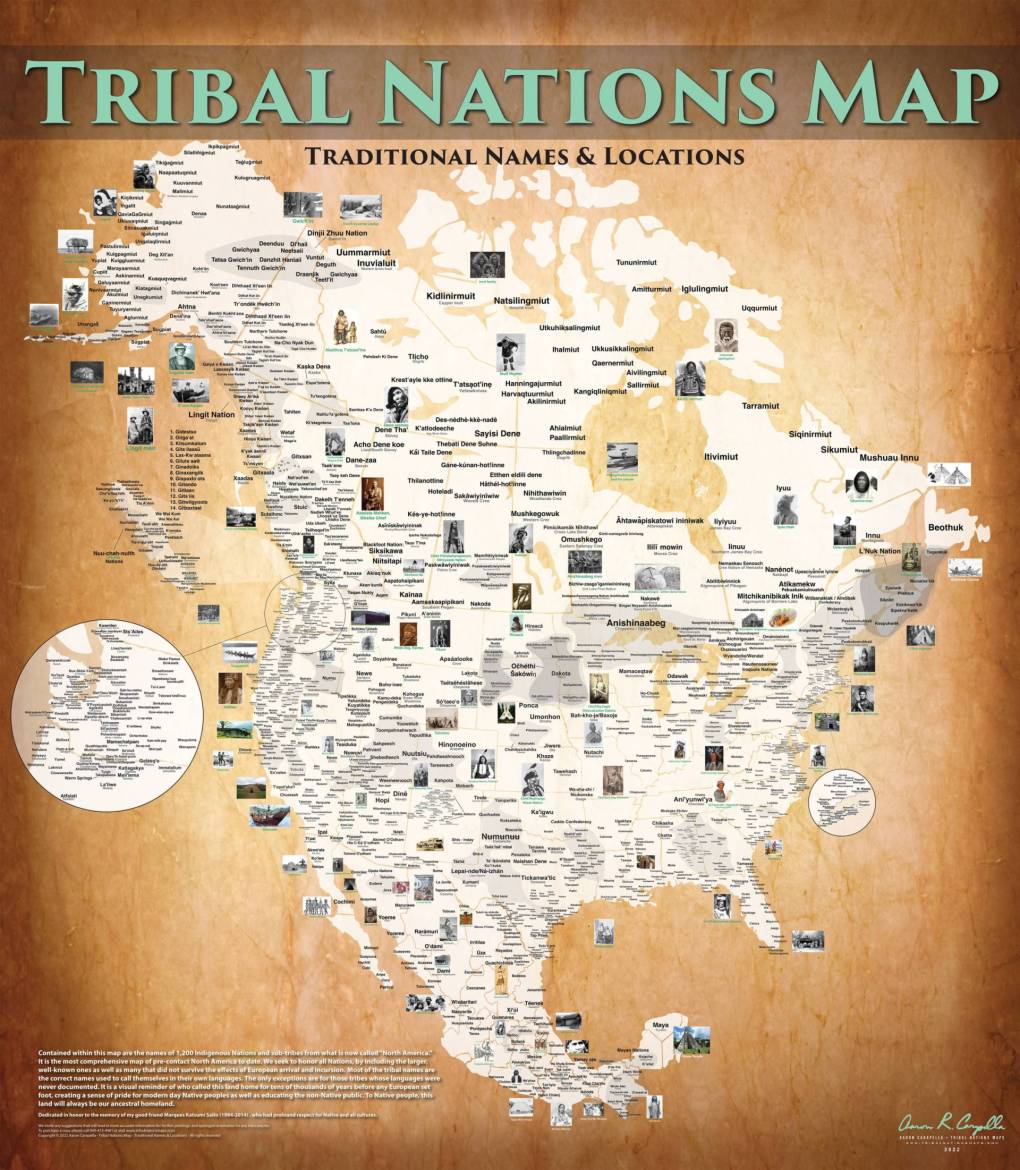
"caption": "A land acknowledgment is a statement before an event recognizing the Indigenous communities that originally inhabited the event space. Above is a detail of a Tribal Nations Map by Aaron Carapella.",
"description": null,
"title": "A land acknowledgment is a statement before an event recognizing the Indigenous communities that originally inhabited the event space. Above is a detail of a Tribal Nations Map by Aaron Carapella.",
"credit": "Aaron Carapella/Tribal Nations Map",
"status": "inherit",
"altTag": null,
"isLoading": false,
"fetchFailed": false
},
"arts_13926278": {
"type": "attachments",
"id": "arts_13926278",
"meta": {
"index": "attachments_1716263798",
"site": "arts",
"id": "13926278",
"found": true
},
"parent": 13926277,
"imgSizes": {
"twentyfourteen-full-width": {
"file": "https://ww2.kqed.org/app/uploads/sites/2/2023/03/ap23072332548106-a161eeb29ec639b6efe15cb5a35b6f7288956a9e-scaled-e1678903560801-1038x576.jpg",
"width": 1038,
"mimeType": "image/jpeg",
"height": 576
},
"thumbnail": {
"file": "https://ww2.kqed.org/app/uploads/sites/2/2023/03/ap23072332548106-a161eeb29ec639b6efe15cb5a35b6f7288956a9e-scaled-e1678903560801-160x120.jpg",
"width": 160,
"mimeType": "image/jpeg",
"height": 120
},
"post-thumbnail": {
"file": "https://ww2.kqed.org/app/uploads/sites/2/2023/03/ap23072332548106-a161eeb29ec639b6efe15cb5a35b6f7288956a9e-scaled-e1678903560801-672x372.jpg",
"width": 672,
"mimeType": "image/jpeg",
"height": 372
},
"kqedFullSize": {
"file": "https://ww2.kqed.org/app/uploads/sites/2/2023/03/ap23072332548106-a161eeb29ec639b6efe15cb5a35b6f7288956a9e-scaled-e1678903560801.jpg",
"width": 1920,
"height": 1440
},
"2048x2048": {
"file": "https://ww2.kqed.org/app/uploads/sites/2/2023/03/ap23072332548106-a161eeb29ec639b6efe15cb5a35b6f7288956a9e-2048x1536.jpg",
"width": 2048,
"mimeType": "image/jpeg",
"height": 1536
},
"large": {
"file": "https://ww2.kqed.org/app/uploads/sites/2/2023/03/ap23072332548106-a161eeb29ec639b6efe15cb5a35b6f7288956a9e-scaled-e1678903560801-1020x765.jpg",
"width": 1020,
"mimeType": "image/jpeg",
"height": 765
},
"1536x1536": {
"file": "https://ww2.kqed.org/app/uploads/sites/2/2023/03/ap23072332548106-a161eeb29ec639b6efe15cb5a35b6f7288956a9e-scaled-e1678903560801-1536x1152.jpg",
"width": 1536,
"mimeType": "image/jpeg",
"height": 1152
},
"full-width": {
"file": "https://ww2.kqed.org/app/uploads/sites/2/2023/03/ap23072332548106-a161eeb29ec639b6efe15cb5a35b6f7288956a9e-1920x1440.jpg",
"width": 1920,
"mimeType": "image/jpeg",
"height": 1440
},
"medium": {
"file": "https://ww2.kqed.org/app/uploads/sites/2/2023/03/ap23072332548106-a161eeb29ec639b6efe15cb5a35b6f7288956a9e-scaled-e1678903560801-800x600.jpg",
"width": 800,
"mimeType": "image/jpeg",
"height": 600
},
"medium_large": {
"file": "https://ww2.kqed.org/app/uploads/sites/2/2023/03/ap23072332548106-a161eeb29ec639b6efe15cb5a35b6f7288956a9e-scaled-e1678903560801-768x576.jpg",
"width": 768,
"mimeType": "image/jpeg",
"height": 576
}
},
"publishDate": 1678902504,
"modified": 1678903664,
"caption": "Michelle Yeoh, who won the Academy Award for Best Actress on Sunday, delivered a rallying cry for Hollywood’s older actresses during her acceptance speech.",
"description": null,
"title": "Michelle Yeoh, who won the Academy Award for Best Actress on Sunday, delivered a rallying cry for Hollywood’s older actresses during her acceptance speech.",
"credit": "Evan Agostini/Invision/AP",
"status": "inherit",
"altTag": "A slender Asian woman wearing a strapless sequined evening gown, smiles and holds an Oscar statuette aloft.",
"isLoading": false,
"fetchFailed": false
},
"arts_13926193": {
"type": "attachments",
"id": "arts_13926193",
"meta": {
"index": "attachments_1716263798",
"site": "arts",
"id": "13926193",
"found": true
},
"parent": 13926190,
"imgSizes": {
"twentyfourteen-full-width": {
"file": "https://ww2.kqed.org/app/uploads/sites/2/2023/03/GettyImages-1243280747-scaled-e1678805699213-1038x576.jpg",
"width": 1038,
"mimeType": "image/jpeg",
"height": 576
},
"thumbnail": {
"file": "https://ww2.kqed.org/app/uploads/sites/2/2023/03/GettyImages-1243280747-scaled-e1678805699213-160x118.jpg",
"width": 160,
"mimeType": "image/jpeg",
"height": 118
},
"post-thumbnail": {
"file": "https://ww2.kqed.org/app/uploads/sites/2/2023/03/GettyImages-1243280747-scaled-e1678805699213-672x372.jpg",
"width": 672,
"mimeType": "image/jpeg",
"height": 372
},
"kqedFullSize": {
"file": "https://ww2.kqed.org/app/uploads/sites/2/2023/03/GettyImages-1243280747-scaled-e1678805699213.jpg",
"width": 1920,
"height": 1419
},
"2048x2048": {
"file": "https://ww2.kqed.org/app/uploads/sites/2/2023/03/GettyImages-1243280747-2048x1514.jpg",
"width": 2048,
"mimeType": "image/jpeg",
"height": 1514
},
"large": {
"file": "https://ww2.kqed.org/app/uploads/sites/2/2023/03/GettyImages-1243280747-scaled-e1678805699213-1020x754.jpg",
"width": 1020,
"mimeType": "image/jpeg",
"height": 754
},
"1536x1536": {
"file": "https://ww2.kqed.org/app/uploads/sites/2/2023/03/GettyImages-1243280747-scaled-e1678805699213-1536x1135.jpg",
"width": 1536,
"mimeType": "image/jpeg",
"height": 1135
},
"full-width": {
"file": "https://ww2.kqed.org/app/uploads/sites/2/2023/03/GettyImages-1243280747-1920x1419.jpg",
"width": 1920,
"mimeType": "image/jpeg",
"height": 1419
},
"medium": {
"file": "https://ww2.kqed.org/app/uploads/sites/2/2023/03/GettyImages-1243280747-scaled-e1678805699213-800x591.jpg",
"width": 800,
"mimeType": "image/jpeg",
"height": 591
},
"medium_large": {
"file": "https://ww2.kqed.org/app/uploads/sites/2/2023/03/GettyImages-1243280747-scaled-e1678805699213-768x568.jpg",
"width": 768,
"mimeType": "image/jpeg",
"height": 568
}
},
"publishDate": 1678805671,
"modified": 1678805846,
"caption": "Margaret Atwood in September 2022.",
"description": null,
"title": "Margaret Atwood in September 2022.",
"credit": "Monika Skolimowska/picture alliance via Getty Images",
"status": "inherit",
"altTag": "An elderly, gray-haired woman wearing a bright purple sweater and black scarf stands confidently in front of a white wall, arms folded and smiling.",
"isLoading": false,
"fetchFailed": false
},
"arts_13926126": {
"type": "attachments",
"id": "arts_13926126",
"meta": {
"index": "attachments_1716263798",
"site": "arts",
"id": "13926126",
"found": true
},
"parent": 13926125,
"imgSizes": {
"twentyfourteen-full-width": {
"file": "https://ww2.kqed.org/app/uploads/sites/2/2023/03/gettyimages-1473110093_custom-5d70b7e2f4e79a9fb11598aae0884afac396e919-scaled-e1678730039957-1038x576.jpg",
"width": 1038,
"mimeType": "image/jpeg",
"height": 576
},
"thumbnail": {
"file": "https://ww2.kqed.org/app/uploads/sites/2/2023/03/gettyimages-1473110093_custom-5d70b7e2f4e79a9fb11598aae0884afac396e919-scaled-e1678730039957-160x107.jpg",
"width": 160,
"mimeType": "image/jpeg",
"height": 107
},
"post-thumbnail": {
"file": "https://ww2.kqed.org/app/uploads/sites/2/2023/03/gettyimages-1473110093_custom-5d70b7e2f4e79a9fb11598aae0884afac396e919-scaled-e1678730039957-672x372.jpg",
"width": 672,
"mimeType": "image/jpeg",
"height": 372
},
"kqedFullSize": {
"file": "https://ww2.kqed.org/app/uploads/sites/2/2023/03/gettyimages-1473110093_custom-5d70b7e2f4e79a9fb11598aae0884afac396e919-scaled-e1678730039957.jpg",
"width": 1920,
"height": 1279
},
"2048x2048": {
"file": "https://ww2.kqed.org/app/uploads/sites/2/2023/03/gettyimages-1473110093_custom-5d70b7e2f4e79a9fb11598aae0884afac396e919-2048x1364.jpg",
"width": 2048,
"mimeType": "image/jpeg",
"height": 1364
},
"large": {
"file": "https://ww2.kqed.org/app/uploads/sites/2/2023/03/gettyimages-1473110093_custom-5d70b7e2f4e79a9fb11598aae0884afac396e919-scaled-e1678730039957-1020x679.jpg",
"width": 1020,
"mimeType": "image/jpeg",
"height": 679
},
"1536x1536": {
"file": "https://ww2.kqed.org/app/uploads/sites/2/2023/03/gettyimages-1473110093_custom-5d70b7e2f4e79a9fb11598aae0884afac396e919-scaled-e1678730039957-1536x1023.jpg",
"width": 1536,
"mimeType": "image/jpeg",
"height": 1023
},
"full-width": {
"file": "https://ww2.kqed.org/app/uploads/sites/2/2023/03/gettyimages-1473110093_custom-5d70b7e2f4e79a9fb11598aae0884afac396e919-1920x1279.jpg",
"width": 1920,
"mimeType": "image/jpeg",
"height": 1279
},
"medium": {
"file": "https://ww2.kqed.org/app/uploads/sites/2/2023/03/gettyimages-1473110093_custom-5d70b7e2f4e79a9fb11598aae0884afac396e919-scaled-e1678730039957-800x533.jpg",
"width": 800,
"mimeType": "image/jpeg",
"height": 533
},
"medium_large": {
"file": "https://ww2.kqed.org/app/uploads/sites/2/2023/03/gettyimages-1473110093_custom-5d70b7e2f4e79a9fb11598aae0884afac396e919-scaled-e1678730039957-768x512.jpg",
"width": 768,
"mimeType": "image/jpeg",
"height": 512
}
},
"publishDate": 1678729509,
"modified": 1678730164,
"caption": "Ke Huy Quan, winner of the Best Supporting Actor award for ‘Everything Everywhere All at Once,’ poses in the press room during the 95th Annual Academy Awards on March 12, 2023 in Hollywood, California.",
"description": null,
"title": "Ke Huy Quan, winner of the Best Supporting Actor award for ‘Everything Everywhere All at Once,’ poses in the press room during the 95th Annual Academy Awards on March 12, 2023 in Hollywood, California.",
"credit": "Mike Coppola/Getty Images",
"status": "inherit",
"altTag": "An Asian man wearing black spectacles and a tuxedo holds up an Oscar statuette, jubilant expression on his face.",
"isLoading": false,
"fetchFailed": false
},
"arts_13926048": {
"type": "attachments",
"id": "arts_13926048",
"meta": {
"index": "attachments_1716263798",
"site": "arts",
"id": "13926048",
"found": true
},
"parent": 13926047,
"imgSizes": {
"twentyfourteen-full-width": {
"file": "https://ww2.kqed.org/app/uploads/sites/2/2023/03/banquet2_custom-f20ca080aed9902f80aee627e82f303352386806-scaled-e1678396109842-1038x576.jpg",
"width": 1038,
"mimeType": "image/jpeg",
"height": 576
},
"thumbnail": {
"file": "https://ww2.kqed.org/app/uploads/sites/2/2023/03/banquet2_custom-f20ca080aed9902f80aee627e82f303352386806-scaled-e1678396109842-160x96.jpg",
"width": 160,
"mimeType": "image/jpeg",
"height": 96
},
"post-thumbnail": {
"file": "https://ww2.kqed.org/app/uploads/sites/2/2023/03/banquet2_custom-f20ca080aed9902f80aee627e82f303352386806-scaled-e1678396109842-672x372.jpg",
"width": 672,
"mimeType": "image/jpeg",
"height": 372
},
"kqedFullSize": {
"file": "https://ww2.kqed.org/app/uploads/sites/2/2023/03/banquet2_custom-f20ca080aed9902f80aee627e82f303352386806-scaled-e1678396109842.jpg",
"width": 1920,
"height": 1155
},
"2048x2048": {
"file": "https://ww2.kqed.org/app/uploads/sites/2/2023/03/banquet2_custom-f20ca080aed9902f80aee627e82f303352386806-2048x1232.jpg",
"width": 2048,
"mimeType": "image/jpeg",
"height": 1232
},
"large": {
"file": "https://ww2.kqed.org/app/uploads/sites/2/2023/03/banquet2_custom-f20ca080aed9902f80aee627e82f303352386806-scaled-e1678396109842-1020x614.jpg",
"width": 1020,
"mimeType": "image/jpeg",
"height": 614
},
"1536x1536": {
"file": "https://ww2.kqed.org/app/uploads/sites/2/2023/03/banquet2_custom-f20ca080aed9902f80aee627e82f303352386806-scaled-e1678396109842-1536x924.jpg",
"width": 1536,
"mimeType": "image/jpeg",
"height": 924
},
"full-width": {
"file": "https://ww2.kqed.org/app/uploads/sites/2/2023/03/banquet2_custom-f20ca080aed9902f80aee627e82f303352386806-1920x1155.jpg",
"width": 1920,
"mimeType": "image/jpeg",
"height": 1155
},
"medium": {
"file": "https://ww2.kqed.org/app/uploads/sites/2/2023/03/banquet2_custom-f20ca080aed9902f80aee627e82f303352386806-scaled-e1678396109842-800x481.jpg",
"width": 800,
"mimeType": "image/jpeg",
"height": 481
},
"medium_large": {
"file": "https://ww2.kqed.org/app/uploads/sites/2/2023/03/banquet2_custom-f20ca080aed9902f80aee627e82f303352386806-scaled-e1678396109842-768x462.jpg",
"width": 768,
"mimeType": "image/jpeg",
"height": 462
}
},
"publishDate": 1678391179,
"modified": 1678396237,
"caption": "The first Oscar presentation and banquet was held in the Blossom Room of the Hollywood Roosevelt Hotel in May 1929.",
"description": null,
"title": "The first Oscar presentation and banquet was held in the Blossom Room of the Hollywood Roosevelt Hotel in May 1929.",
"credit": "Academy of Motion Picture Arts and Sciences",
"status": "inherit",
"altTag": "A room of men and women dressed in 1930s evening attire sit at dining tables in a large hall. Festive decorations hang from the ceiling.",
"isLoading": false,
"fetchFailed": false
},
"arts_13926034": {
"type": "attachments",
"id": "arts_13926034",
"meta": {
"index": "attachments_1716263798",
"site": "arts",
"id": "13926034",
"found": true
},
"parent": 13926031,
"imgSizes": {
"twentyfourteen-full-width": {
"file": "https://ww2.kqed.org/app/uploads/sites/2/2023/03/colinkaepernickheadshot_amari-kenoly-for-kaepernick-publishing_sq-ac9ab56d11882769a2c34308c77825b1b273bda3-scaled-e1678390101713-1038x576.jpg",
"width": 1038,
"mimeType": "image/jpeg",
"height": 576
},
"thumbnail": {
"file": "https://ww2.kqed.org/app/uploads/sites/2/2023/03/colinkaepernickheadshot_amari-kenoly-for-kaepernick-publishing_sq-ac9ab56d11882769a2c34308c77825b1b273bda3-scaled-e1678390101713-160x160.jpg",
"width": 160,
"mimeType": "image/jpeg",
"height": 160
},
"post-thumbnail": {
"file": "https://ww2.kqed.org/app/uploads/sites/2/2023/03/colinkaepernickheadshot_amari-kenoly-for-kaepernick-publishing_sq-ac9ab56d11882769a2c34308c77825b1b273bda3-scaled-e1678390101713-672x372.jpg",
"width": 672,
"mimeType": "image/jpeg",
"height": 372
},
"kqedFullSize": {
"file": "https://ww2.kqed.org/app/uploads/sites/2/2023/03/colinkaepernickheadshot_amari-kenoly-for-kaepernick-publishing_sq-ac9ab56d11882769a2c34308c77825b1b273bda3-scaled-e1678390101713.jpg",
"width": 1920,
"height": 1920
},
"2048x2048": {
"file": "https://ww2.kqed.org/app/uploads/sites/2/2023/03/colinkaepernickheadshot_amari-kenoly-for-kaepernick-publishing_sq-ac9ab56d11882769a2c34308c77825b1b273bda3-2048x2048.jpg",
"width": 2048,
"mimeType": "image/jpeg",
"height": 2048
},
"large": {
"file": "https://ww2.kqed.org/app/uploads/sites/2/2023/03/colinkaepernickheadshot_amari-kenoly-for-kaepernick-publishing_sq-ac9ab56d11882769a2c34308c77825b1b273bda3-scaled-e1678390101713-1020x1020.jpg",
"width": 1020,
"mimeType": "image/jpeg",
"height": 1020
},
"1536x1536": {
"file": "https://ww2.kqed.org/app/uploads/sites/2/2023/03/colinkaepernickheadshot_amari-kenoly-for-kaepernick-publishing_sq-ac9ab56d11882769a2c34308c77825b1b273bda3-scaled-e1678390101713-1536x1536.jpg",
"width": 1536,
"mimeType": "image/jpeg",
"height": 1536
},
"full-width": {
"file": "https://ww2.kqed.org/app/uploads/sites/2/2023/03/colinkaepernickheadshot_amari-kenoly-for-kaepernick-publishing_sq-ac9ab56d11882769a2c34308c77825b1b273bda3-1920x1920.jpg",
"width": 1920,
"mimeType": "image/jpeg",
"height": 1920
},
"medium": {
"file": "https://ww2.kqed.org/app/uploads/sites/2/2023/03/colinkaepernickheadshot_amari-kenoly-for-kaepernick-publishing_sq-ac9ab56d11882769a2c34308c77825b1b273bda3-scaled-e1678390101713-800x800.jpg",
"width": 800,
"mimeType": "image/jpeg",
"height": 800
},
"medium_large": {
"file": "https://ww2.kqed.org/app/uploads/sites/2/2023/03/colinkaepernickheadshot_amari-kenoly-for-kaepernick-publishing_sq-ac9ab56d11882769a2c34308c77825b1b273bda3-scaled-e1678390101713-768x768.jpg",
"width": 768,
"mimeType": "image/jpeg",
"height": 768
}
},
"publishDate": 1678388244,
"modified": 1678390167,
"caption": "In a new graphic novel, Colin Kaepernick details how he wrestled with his identity within his blended adoptive family.",
"description": null,
"title": "In a new graphic novel, Colin Kaepernick details how he wrestled with his identity within his blended adoptive family.",
"credit": "Amari Kenoly for Kaepernick Publishing",
"status": "inherit",
"altTag": "A mixed race man with close-cropped beard and large afro faces the camera.",
"isLoading": false,
"fetchFailed": false
},
"arts_13925868": {
"type": "attachments",
"id": "arts_13925868",
"meta": {
"index": "attachments_1716263798",
"site": "arts",
"id": "13925868",
"found": true
},
"parent": 13925866,
"imgSizes": {
"twentyfourteen-full-width": {
"file": "https://ww2.kqed.org/app/uploads/sites/2/2023/03/screen-shot-2023-02-08-at-2.37.05-pm_slide-0617f4f191061c1dd39025ea4e99f32da548819f-1038x576.png",
"width": 1038,
"mimeType": "image/png",
"height": 576
},
"thumbnail": {
"file": "https://ww2.kqed.org/app/uploads/sites/2/2023/03/screen-shot-2023-02-08-at-2.37.05-pm_slide-0617f4f191061c1dd39025ea4e99f32da548819f-160x107.png",
"width": 160,
"mimeType": "image/png",
"height": 107
},
"post-thumbnail": {
"file": "https://ww2.kqed.org/app/uploads/sites/2/2023/03/screen-shot-2023-02-08-at-2.37.05-pm_slide-0617f4f191061c1dd39025ea4e99f32da548819f-672x372.png",
"width": 672,
"mimeType": "image/png",
"height": 372
},
"kqedFullSize": {
"file": "https://ww2.kqed.org/app/uploads/sites/2/2023/03/screen-shot-2023-02-08-at-2.37.05-pm_slide-0617f4f191061c1dd39025ea4e99f32da548819f.png",
"width": 1848,
"height": 1232
},
"large": {
"file": "https://ww2.kqed.org/app/uploads/sites/2/2023/03/screen-shot-2023-02-08-at-2.37.05-pm_slide-0617f4f191061c1dd39025ea4e99f32da548819f-1020x680.png",
"width": 1020,
"mimeType": "image/png",
"height": 680
},
"1536x1536": {
"file": "https://ww2.kqed.org/app/uploads/sites/2/2023/03/screen-shot-2023-02-08-at-2.37.05-pm_slide-0617f4f191061c1dd39025ea4e99f32da548819f-1536x1024.png",
"width": 1536,
"mimeType": "image/png",
"height": 1024
},
"medium": {
"file": "https://ww2.kqed.org/app/uploads/sites/2/2023/03/screen-shot-2023-02-08-at-2.37.05-pm_slide-0617f4f191061c1dd39025ea4e99f32da548819f-800x533.png",
"width": 800,
"mimeType": "image/png",
"height": 533
},
"medium_large": {
"file": "https://ww2.kqed.org/app/uploads/sites/2/2023/03/screen-shot-2023-02-08-at-2.37.05-pm_slide-0617f4f191061c1dd39025ea4e99f32da548819f-768x512.png",
"width": 768,
"mimeType": "image/png",
"height": 512
}
},
"publishDate": 1678125300,
"modified": 1678127459,
"caption": "N.T. Rama Rao Jr. (left) and Ram Charan performing ‘Naatu Naatu’ in ‘RRR.’",
"description": null,
"title": "N.T. Rama Rao Jr. (left) and Ram Charan performing ‘Naatu Naatu’ in ‘RRR.’",
"credit": "DVV Entertainment & Variance Films",
"status": "inherit",
"altTag": "Two Indian men wearing smart trousers, shirts, ties and suspenders perform a dance routine at an outdoor wedding.",
"isLoading": false,
"fetchFailed": false
},
"arts_13925820": {
"type": "attachments",
"id": "arts_13925820",
"meta": {
"index": "attachments_1716263798",
"site": "arts",
"id": "13925820",
"found": true
},
"parent": 13925814,
"imgSizes": {
"twentyfourteen-full-width": {
"file": "https://ww2.kqed.org/app/uploads/sites/2/2023/03/DeLaSoul.72-1024x576.jpg",
"width": 1024,
"mimeType": "image/jpeg",
"height": 576
},
"thumbnail": {
"file": "https://ww2.kqed.org/app/uploads/sites/2/2023/03/DeLaSoul.72-160x112.jpg",
"width": 160,
"mimeType": "image/jpeg",
"height": 112
},
"post-thumbnail": {
"file": "https://ww2.kqed.org/app/uploads/sites/2/2023/03/DeLaSoul.72-672x372.jpg",
"width": 672,
"mimeType": "image/jpeg",
"height": 372
},
"kqedFullSize": {
"file": "https://ww2.kqed.org/app/uploads/sites/2/2023/03/DeLaSoul.72.jpg",
"width": 1024,
"height": 719
},
"large": {
"file": "https://ww2.kqed.org/app/uploads/sites/2/2023/03/DeLaSoul.72-1020x716.jpg",
"width": 1020,
"mimeType": "image/jpeg",
"height": 716
},
"medium": {
"file": "https://ww2.kqed.org/app/uploads/sites/2/2023/03/DeLaSoul.72-800x562.jpg",
"width": 800,
"mimeType": "image/jpeg",
"height": 562
},
"medium_large": {
"file": "https://ww2.kqed.org/app/uploads/sites/2/2023/03/DeLaSoul.72-768x539.jpg",
"width": 768,
"mimeType": "image/jpeg",
"height": 539
}
},
"publishDate": 1677861744,
"modified": 1677861855,
"caption": "(L–R) Posdnous, Maseo and Trugoy The Dove of De La Soul outside Harlem's Apollo Theater in 1993. The group's music was finally made available on streaming services on March 3, 2023.",
"description": null,
"title": "DeLaSoul.72",
"credit": "David Corio/Redferns",
"status": "inherit",
"altTag": "Three young Black men in front of a theatre marquee, shown in black-and-white",
"isLoading": false,
"fetchFailed": false
},
"arts_13925755": {
"type": "attachments",
"id": "arts_13925755",
"meta": {
"index": "attachments_1716263798",
"site": "arts",
"id": "13925755",
"found": true
},
"parent": 13925754,
"imgSizes": {
"twentyfourteen-full-width": {
"file": "https://ww2.kqed.org/app/uploads/sites/2/2023/02/gettyimages-1243082911_custom-39f9524472a62c3b4670bab113d5f8a224ed8432-scaled-e1677652491103-1038x576.jpg",
"width": 1038,
"mimeType": "image/jpeg",
"height": 576
},
"thumbnail": {
"file": "https://ww2.kqed.org/app/uploads/sites/2/2023/02/gettyimages-1243082911_custom-39f9524472a62c3b4670bab113d5f8a224ed8432-scaled-e1677652491103-160x83.jpg",
"width": 160,
"mimeType": "image/jpeg",
"height": 83
},
"post-thumbnail": {
"file": "https://ww2.kqed.org/app/uploads/sites/2/2023/02/gettyimages-1243082911_custom-39f9524472a62c3b4670bab113d5f8a224ed8432-scaled-e1677652491103-672x372.jpg",
"width": 672,
"mimeType": "image/jpeg",
"height": 372
},
"kqedFullSize": {
"file": "https://ww2.kqed.org/app/uploads/sites/2/2023/02/gettyimages-1243082911_custom-39f9524472a62c3b4670bab113d5f8a224ed8432-scaled-e1677652491103.jpg",
"width": 1920,
"height": 1001
},
"2048x2048": {
"file": "https://ww2.kqed.org/app/uploads/sites/2/2023/02/gettyimages-1243082911_custom-39f9524472a62c3b4670bab113d5f8a224ed8432-2048x1068.jpg",
"width": 2048,
"mimeType": "image/jpeg",
"height": 1068
},
"large": {
"file": "https://ww2.kqed.org/app/uploads/sites/2/2023/02/gettyimages-1243082911_custom-39f9524472a62c3b4670bab113d5f8a224ed8432-scaled-e1677652491103-1020x532.jpg",
"width": 1020,
"mimeType": "image/jpeg",
"height": 532
},
"1536x1536": {
"file": "https://ww2.kqed.org/app/uploads/sites/2/2023/02/gettyimages-1243082911_custom-39f9524472a62c3b4670bab113d5f8a224ed8432-scaled-e1677652491103-1536x801.jpg",
"width": 1536,
"mimeType": "image/jpeg",
"height": 801
},
"full-width": {
"file": "https://ww2.kqed.org/app/uploads/sites/2/2023/02/gettyimages-1243082911_custom-39f9524472a62c3b4670bab113d5f8a224ed8432-1920x1002.jpg",
"width": 1920,
"mimeType": "image/jpeg",
"height": 1002
},
"medium": {
"file": "https://ww2.kqed.org/app/uploads/sites/2/2023/02/gettyimages-1243082911_custom-39f9524472a62c3b4670bab113d5f8a224ed8432-scaled-e1677652491103-800x417.jpg",
"width": 800,
"mimeType": "image/jpeg",
"height": 417
},
"medium_large": {
"file": "https://ww2.kqed.org/app/uploads/sites/2/2023/02/gettyimages-1243082911_custom-39f9524472a62c3b4670bab113d5f8a224ed8432-scaled-e1677652491103-768x400.jpg",
"width": 768,
"mimeType": "image/jpeg",
"height": 400
}
},
"publishDate": 1677651932,
"modified": 1677652640,
"caption": "Serial’s new true-crime podcast, ‘The Coldest Case in Laramie,’ revisits a 1985 murder. Above, storm clouds over downtown Laramie, Wyo., on Aug. 13, 2022.",
"description": null,
"title": "Serial’s new true-crime podcast, ‘The Coldest Case in Laramie,’ revisits a 1985 murder. Above, storm clouds over downtown Laramie, Wyo., on Aug. 13, 2022.",
"credit": "PATRICK T. FALLON/AFP via Getty Images",
"status": "inherit",
"altTag": "Dark gray clouds spread out on a long row of store fronts. One displays a vertical sign that says LARAMIE.",
"isLoading": false,
"fetchFailed": false
},
"arts_13925678": {
"type": "attachments",
"id": "arts_13925678",
"meta": {
"index": "attachments_1716263798",
"site": "arts",
"id": "13925678",
"found": true
},
"parent": 13925671,
"imgSizes": {
"twentyfourteen-full-width": {
"file": "https://ww2.kqed.org/app/uploads/sites/2/2023/02/GettyImages-1431170625-1038x576.jpg",
"width": 1038,
"mimeType": "image/jpeg",
"height": 576
},
"thumbnail": {
"file": "https://ww2.kqed.org/app/uploads/sites/2/2023/02/GettyImages-1431170625-160x110.jpg",
"width": 160,
"mimeType": "image/jpeg",
"height": 110
},
"post-thumbnail": {
"file": "https://ww2.kqed.org/app/uploads/sites/2/2023/02/GettyImages-1431170625-672x372.jpg",
"width": 672,
"mimeType": "image/jpeg",
"height": 372
},
"kqedFullSize": {
"file": "https://ww2.kqed.org/app/uploads/sites/2/2023/02/GettyImages-1431170625-scaled.jpg",
"width": 2560,
"height": 1760
},
"2048x2048": {
"file": "https://ww2.kqed.org/app/uploads/sites/2/2023/02/GettyImages-1431170625-2048x1408.jpg",
"width": 2048,
"mimeType": "image/jpeg",
"height": 1408
},
"large": {
"file": "https://ww2.kqed.org/app/uploads/sites/2/2023/02/GettyImages-1431170625-1020x701.jpg",
"width": 1020,
"mimeType": "image/jpeg",
"height": 701
},
"1536x1536": {
"file": "https://ww2.kqed.org/app/uploads/sites/2/2023/02/GettyImages-1431170625-1536x1056.jpg",
"width": 1536,
"mimeType": "image/jpeg",
"height": 1056
},
"full-width": {
"file": "https://ww2.kqed.org/app/uploads/sites/2/2023/02/GettyImages-1431170625-1920x1320.jpg",
"width": 1920,
"mimeType": "image/jpeg",
"height": 1320
},
"medium": {
"file": "https://ww2.kqed.org/app/uploads/sites/2/2023/02/GettyImages-1431170625-800x550.jpg",
"width": 800,
"mimeType": "image/jpeg",
"height": 550
},
"medium_large": {
"file": "https://ww2.kqed.org/app/uploads/sites/2/2023/02/GettyImages-1431170625-768x528.jpg",
"width": 768,
"mimeType": "image/jpeg",
"height": 528
}
},
"publishDate": 1677530542,
"modified": 1677530671,
"caption": "A’s pitcher Norge Ruiz at the Oakland Coliseum on October 05, 2022.",
"description": null,
"title": "A’s pitcher Norge Ruiz at the Oakland Coliseum on October 05, 2022.",
"credit": "Thearon W. Henderson/Getty Images",
"status": "inherit",
"altTag": "A baseball pitcher wearing an Oakland Athletics uniform, number 63 pitches a ball.",
"isLoading": false,
"fetchFailed": false
},
"arts_13925687": {
"type": "attachments",
"id": "arts_13925687",
"meta": {
"index": "attachments_1716263798",
"site": "arts",
"id": "13925687",
"found": true
},
"parent": 13925686,
"imgSizes": {
"twentyfourteen-full-width": {
"file": "https://ww2.kqed.org/app/uploads/sites/2/2023/02/ap23056731159869-09dcfd048de152021705076459bbb8237906a844-scaled-e1677534286100-1038x576.jpg",
"width": 1038,
"mimeType": "image/jpeg",
"height": 576
},
"thumbnail": {
"file": "https://ww2.kqed.org/app/uploads/sites/2/2023/02/ap23056731159869-09dcfd048de152021705076459bbb8237906a844-scaled-e1677534286100-160x120.jpg",
"width": 160,
"mimeType": "image/jpeg",
"height": 120
},
"post-thumbnail": {
"file": "https://ww2.kqed.org/app/uploads/sites/2/2023/02/ap23056731159869-09dcfd048de152021705076459bbb8237906a844-scaled-e1677534286100-672x372.jpg",
"width": 672,
"mimeType": "image/jpeg",
"height": 372
},
"kqedFullSize": {
"file": "https://ww2.kqed.org/app/uploads/sites/2/2023/02/ap23056731159869-09dcfd048de152021705076459bbb8237906a844-scaled-e1677534286100.jpg",
"width": 1920,
"height": 1440
},
"2048x2048": {
"file": "https://ww2.kqed.org/app/uploads/sites/2/2023/02/ap23056731159869-09dcfd048de152021705076459bbb8237906a844-2048x1536.jpg",
"width": 2048,
"mimeType": "image/jpeg",
"height": 1536
},
"large": {
"file": "https://ww2.kqed.org/app/uploads/sites/2/2023/02/ap23056731159869-09dcfd048de152021705076459bbb8237906a844-scaled-e1677534286100-1020x765.jpg",
"width": 1020,
"mimeType": "image/jpeg",
"height": 765
},
"1536x1536": {
"file": "https://ww2.kqed.org/app/uploads/sites/2/2023/02/ap23056731159869-09dcfd048de152021705076459bbb8237906a844-scaled-e1677534286100-1536x1152.jpg",
"width": 1536,
"mimeType": "image/jpeg",
"height": 1152
},
"full-width": {
"file": "https://ww2.kqed.org/app/uploads/sites/2/2023/02/ap23056731159869-09dcfd048de152021705076459bbb8237906a844-1920x1440.jpg",
"width": 1920,
"mimeType": "image/jpeg",
"height": 1440
},
"medium": {
"file": "https://ww2.kqed.org/app/uploads/sites/2/2023/02/ap23056731159869-09dcfd048de152021705076459bbb8237906a844-scaled-e1677534286100-800x600.jpg",
"width": 800,
"mimeType": "image/jpeg",
"height": 600
},
"medium_large": {
"file": "https://ww2.kqed.org/app/uploads/sites/2/2023/02/ap23056731159869-09dcfd048de152021705076459bbb8237906a844-scaled-e1677534286100-768x576.jpg",
"width": 768,
"mimeType": "image/jpeg",
"height": 576
}
},
"publishDate": 1677533062,
"modified": 1677534450,
"caption": "Scott Adams, creator of the comic strip ‘Dilbert,’ poses with his best-known character at his studio in Dublin, CA in 2006.",
"description": null,
"title": "Scott Adams, creator of the comic strip ‘Dilbert,’ poses with his best-known character at his studio in Dublin, CA in 2006.",
"credit": "AP Photo/Marcio Jose Sanchez, File",
"status": "inherit",
"altTag": "A smiling white man with bald head and glasses stands behind a life-size cardboard cutout of a cartoon character wearing red tie and spectacles.",
"isLoading": false,
"fetchFailed": false
},
"arts_13925519": {
"type": "attachments",
"id": "arts_13925519",
"meta": {
"index": "attachments_1716263798",
"site": "arts",
"id": "13925519",
"found": true
},
"parent": 13925518,
"imgSizes": {
"twentyfourteen-full-width": {
"file": "https://ww2.kqed.org/app/uploads/sites/2/2023/02/15quietgirl-review-1-bdbd-videosixteenbynine3000_custom-8d2903872bfc57e27026ac6142a0355b3991bb49-scaled-e1677270787755-1038x576.jpg",
"width": 1038,
"mimeType": "image/jpeg",
"height": 576
},
"thumbnail": {
"file": "https://ww2.kqed.org/app/uploads/sites/2/2023/02/15quietgirl-review-1-bdbd-videosixteenbynine3000_custom-8d2903872bfc57e27026ac6142a0355b3991bb49-scaled-e1677270787755-160x90.jpg",
"width": 160,
"mimeType": "image/jpeg",
"height": 90
},
"post-thumbnail": {
"file": "https://ww2.kqed.org/app/uploads/sites/2/2023/02/15quietgirl-review-1-bdbd-videosixteenbynine3000_custom-8d2903872bfc57e27026ac6142a0355b3991bb49-scaled-e1677270787755-672x372.jpg",
"width": 672,
"mimeType": "image/jpeg",
"height": 372
},
"kqedFullSize": {
"file": "https://ww2.kqed.org/app/uploads/sites/2/2023/02/15quietgirl-review-1-bdbd-videosixteenbynine3000_custom-8d2903872bfc57e27026ac6142a0355b3991bb49-scaled-e1677270787755.jpg",
"width": 1920,
"height": 1081
},
"2048x2048": {
"file": "https://ww2.kqed.org/app/uploads/sites/2/2023/02/15quietgirl-review-1-bdbd-videosixteenbynine3000_custom-8d2903872bfc57e27026ac6142a0355b3991bb49-2048x1153.jpg",
"width": 2048,
"mimeType": "image/jpeg",
"height": 1153
},
"large": {
"file": "https://ww2.kqed.org/app/uploads/sites/2/2023/02/15quietgirl-review-1-bdbd-videosixteenbynine3000_custom-8d2903872bfc57e27026ac6142a0355b3991bb49-scaled-e1677270787755-1020x574.jpg",
"width": 1020,
"mimeType": "image/jpeg",
"height": 574
},
"1536x1536": {
"file": "https://ww2.kqed.org/app/uploads/sites/2/2023/02/15quietgirl-review-1-bdbd-videosixteenbynine3000_custom-8d2903872bfc57e27026ac6142a0355b3991bb49-scaled-e1677270787755-1536x865.jpg",
"width": 1536,
"mimeType": "image/jpeg",
"height": 865
},
"full-width": {
"file": "https://ww2.kqed.org/app/uploads/sites/2/2023/02/15quietgirl-review-1-bdbd-videosixteenbynine3000_custom-8d2903872bfc57e27026ac6142a0355b3991bb49-1920x1081.jpg",
"width": 1920,
"mimeType": "image/jpeg",
"height": 1081
},
"medium": {
"file": "https://ww2.kqed.org/app/uploads/sites/2/2023/02/15quietgirl-review-1-bdbd-videosixteenbynine3000_custom-8d2903872bfc57e27026ac6142a0355b3991bb49-scaled-e1677270787755-800x450.jpg",
"width": 800,
"mimeType": "image/jpeg",
"height": 450
},
"medium_large": {
"file": "https://ww2.kqed.org/app/uploads/sites/2/2023/02/15quietgirl-review-1-bdbd-videosixteenbynine3000_custom-8d2903872bfc57e27026ac6142a0355b3991bb49-scaled-e1677270787755-768x432.jpg",
"width": 768,
"mimeType": "image/jpeg",
"height": 432
}
},
"publishDate": 1677269773,
"modified": 1677270884,
"caption": "Catherine Clinch plays Cáit in ‘The Quiet Girl.’",
"description": null,
"title": "Catherine Clinch plays Cáit in ‘The Quiet Girl.’",
"credit": "Super Lt",
"status": "inherit",
"altTag": "A young, pale skinned girl sits, face blank at a table. She has long light brown hair and striking blue eyes.",
"isLoading": false,
"fetchFailed": false
}
},
"audioPlayerReducer": {
"postId": "stream_live",
"isPaused": true,
"isPlaying": false,
"pfsActive": false,
"pledgeModalIsOpen": true,
"playerDrawerIsOpen": false,
"liveAudioPlayStartedAt": 0,
"liveAudioPlayContext": ""
},
"authorsReducer": {
"byline_arts_13926293": {
"type": "authors",
"id": "byline_arts_13926293",
"meta": {
"override": true
},
"slug": "byline_arts_13926293",
"name": "Chloe Veltman",
"isLoading": false
},
"byline_arts_13926277": {
"type": "authors",
"id": "byline_arts_13926277",
"meta": {
"override": true
},
"slug": "byline_arts_13926277",
"name": "Vanessa Romo",
"isLoading": false
},
"byline_arts_13926190": {
"type": "authors",
"id": "byline_arts_13926190",
"meta": {
"override": true
},
"slug": "byline_arts_13926190",
"name": "Gabino Iglesias",
"isLoading": false
},
"byline_arts_13926125": {
"type": "authors",
"id": "byline_arts_13926125",
"meta": {
"override": true
},
"slug": "byline_arts_13926125",
"name": "Linda Holmes",
"isLoading": false
},
"byline_arts_13926047": {
"type": "authors",
"id": "byline_arts_13926047",
"meta": {
"override": true
},
"slug": "byline_arts_13926047",
"name": "Mandalit del Barco",
"isLoading": false
},
"byline_arts_13926031": {
"type": "authors",
"id": "byline_arts_13926031",
"meta": {
"override": true
},
"slug": "byline_arts_13926031",
"name": "Patrick Jarenwattananon",
"isLoading": false
},
"byline_arts_13925866": {
"type": "authors",
"id": "byline_arts_13925866",
"meta": {
"override": true
},
"slug": "byline_arts_13925866",
"name": "Stephen Thompson",
"isLoading": false
},
"byline_arts_13925814": {
"type": "authors",
"id": "byline_arts_13925814",
"meta": {
"override": true
},
"slug": "byline_arts_13925814",
"name": "Oliver Wang",
"isLoading": false
},
"byline_arts_13925754": {
"type": "authors",
"id": "byline_arts_13925754",
"meta": {
"override": true
},
"slug": "byline_arts_13925754",
"name": "Nick Quah",
"isLoading": false
},
"byline_arts_13925671": {
"type": "authors",
"id": "byline_arts_13925671",
"meta": {
"override": true
},
"slug": "byline_arts_13925671",
"name": "Joe Hernandez",
"isLoading": false
},
"byline_arts_13925686": {
"type": "authors",
"id": "byline_arts_13925686",
"meta": {
"override": true
},
"slug": "byline_arts_13925686",
"name": "Mandalit del Barco",
"isLoading": false
},
"byline_arts_13925518": {
"type": "authors",
"id": "byline_arts_13925518",
"meta": {
"override": true
},
"slug": "byline_arts_13925518",
"name": "Justin Chang",
"isLoading": false
}
},
"pagesReducer": {
"arts_affiliate_npr": {
"type": "terms",
"id": "arts_137",
"meta": {
"index": "terms_1716263798",
"site": "arts",
"id": "137",
"score": 14.262192
},
"featImg": "https://ww2.kqed.org/app/uploads/sites/2/2014/04/logo-npr-lg1.png",
"name": "NPR",
"description": null,
"taxonomy": "affiliate",
"headData": {
"twImgId": null,
"twTitle": null,
"ogTitle": null,
"ogImgId": null,
"twDescription": null,
"description": null,
"title": "NPR Archives | KQED Arts",
"ogDescription": null
},
"ttid": 138,
"slug": "npr",
"isLoading": false,
"title": "NPR",
"pageMeta": {
"site": "arts",
"WpPageTemplate": "page-topic-editorial",
"currentPage": 44
},
"blocks": [
{
"blockName": "kqed/post-list",
"attrs": {
"layout": "cardArticle2",
"query": "posts/arts?affiliate=npr",
"seeMore": false,
"paginated": true,
"page": 44
}
},
{
"blockName": "kqed/ad"
}
]
}
},
"pfsSessionReducer": {},
"postsReducer": {
"stream_live": {
"type": "live",
"id": "stream_live",
"audioUrl": "https://streams.kqed.org/kqedradio",
"title": "Live Stream",
"excerpt": "Live Stream information currently unavailable.",
"link": "/radio",
"featImg": "",
"label": {
"name": "KQED Live",
"link": "/"
}
},
"stream_kqedNewscast": {
"type": "posts",
"id": "stream_kqedNewscast",
"audioUrl": "https://www.kqed.org/.stream/anon/radio/RDnews/newscast.mp3?_=1",
"title": "KQED Newscast",
"featImg": "",
"label": {
"name": "88.5 FM",
"link": "/"
}
},
"arts_13926293": {
"type": "posts",
"id": "arts_13926293",
"meta": {
"index": "posts_1716263798",
"site": "arts",
"id": "13926293",
"score": null,
"sort": [
1678908992000
]
},
"guestAuthors": [],
"slug": "so-you-began-your-event-with-an-indigenous-land-acknowledgement-now-what",
"title": "So You Began Your Event With an Indigenous Land Acknowledgement. Now What?",
"publishDate": 1678908992,
"format": "standard",
"headTitle": "So You Began Your Event With an Indigenous Land Acknowledgement. Now What? | KQED",
"labelTerm": {
"term": 137,
"site": "arts"
},
"content": "\u003cp>Land acknowledgments have become increasingly common nationwide over the past few years. Many mainstream public events — from soccer games and performing arts productions to city council meetings and corporate conferences — begin with these formal statements recognizing Indigenous communities’ rights to territories seized by colonial powers.\u003c/p>\n\u003cp>Indigenous leaders and activists have mixed feelings about land acknowledgments. While some say they are a waste of time, others are working to make the well-meaning but often empty speeches more useful. The debate is more than a niche issue; the pros and cons of land acknowledgments are the subject of myriad \u003ca href=\"https://www.theatlantic.com/ideas/archive/2021/11/against-land-acknowledgements-native-american/620820/\">mainstream media articles\u003c/a>, \u003ca href=\"https://twitter.com/michellecyca/status/1525198115304636416?lang=en\">social media posts \u003c/a>and \u003ca href=\"https://www.youtube.com/watch?v=Q_3W7KKB-Vc\">online videos\u003c/a>. And they’ve even been parodied on TV, in series like \u003cem>Reservation Dogs, \u003c/em>about the exploits of a group of Oklahoma Indigenous teens.\u003c/p>\n\u003cp>https://www.youtube.com/watch?v=r8UpKVImNcU&t=72s\u003c/p>\n\u003ch3>In one ear and out the other\u003c/h3>\n\u003cp>“If it becomes routine, or worse yet, is strictly performative, then it has no meaning at all,” said \u003ca href=\"https://www.si.edu/about/bios/kevin-gover\">Kevin Gover\u003c/a>, a citizen of the Pawnee Nation of Oklahoma and undersecretary for museums and culture at the \u003ca href=\"https://www.si.edu/\">Smithsonian Institution\u003c/a>. “It goes in one ear and out the other.” (Gover said only one or two Smithsonian museums have land acknowledgments; the \u003ca href=\"https://americanindian.si.edu/\">National Museum of the American Indian\u003c/a> is among those that do, and \u003ca href=\"https://americanindian.si.edu/nk360/informational/land-acknowledgment\">its acknowledgment\u003c/a> is only one sentence long.)\u003c/p>\n\u003cp>[aside postid='arts_13920243']Gover said the statements — which first appeared in Australia back in the 1970s in the push for Aboriginal peoples’ rights and more recently blossomed in Canada with the \u003ca href=\"https://nctr.ca/records/reports/\">Truth and Reconciliation Commission Report\u003c/a>, which brought to light how generations of Indigenous school children had been stripped of their native languages and cultural traditions — can also feel disempowering to the very people they’re supposed to uplift.\u003c/p>\n\u003cp>[ad fullwidth]\u003c/p>\n\u003cp>“If I hear a land acknowledgment, part of what I’m hearing is, ‘There used to be Indians here. But now they’re gone. Isn’t that a shame?’ And I don’t wish to be made to feel that way,” Gover said.\u003c/p>\n\u003ch3>A first step toward positive action\u003c/h3>\n\u003cp>But other Indigenous experts say land acknowledgments do have value. If people are thinking about how they go about crafting and using these statements, they can provide a first step toward action.\u003c/p>\n\u003cp>“The land acknowledgment gets you to that start,” said \u003ca href=\"https://nasp.humboldt.edu/people/dr-cutcha-risling-baldy\">Cutcha Risling Baldy\u003c/a>, a member of the Hoopa Valley Tribe and an associate professor of Native American Studies at \u003ca href=\"https://www.humboldt.edu/\">California State Polytechnic University, Humboldt\u003c/a>. “Now it’s time to think about what that actually means for you or your institution. What are the concrete actions you’re gonna take? What are the ways you’re gonna assist Indigenous peoples in uplifting and upholding their sovereignty and self-determination?”\u003c/p>\n\u003cfigure id=\"attachment_13926295\" class=\"wp-caption aligncenter\" style=\"max-width: 800px\">\u003cimg loading=\"lazy\" decoding=\"async\" class=\"size-medium wp-image-13926295\" src=\"https://ww2.kqed.org/app/uploads/sites/2/2023/03/img_0446-86c59dac84f2d23b473bc6f1d360c2351653ac6d-800x600.jpg\" alt='A poster for an \"Unthanksgiving event\" welcomes visitors in a hallway.' width=\"800\" height=\"600\" srcset=\"https://cdn.kqed.org/wp-content/uploads/sites/2/2023/03/img_0446-86c59dac84f2d23b473bc6f1d360c2351653ac6d-800x600.jpg 800w, https://cdn.kqed.org/wp-content/uploads/sites/2/2023/03/img_0446-86c59dac84f2d23b473bc6f1d360c2351653ac6d-1020x765.jpg 1020w, https://cdn.kqed.org/wp-content/uploads/sites/2/2023/03/img_0446-86c59dac84f2d23b473bc6f1d360c2351653ac6d-160x120.jpg 160w, https://cdn.kqed.org/wp-content/uploads/sites/2/2023/03/img_0446-86c59dac84f2d23b473bc6f1d360c2351653ac6d-768x576.jpg 768w, https://cdn.kqed.org/wp-content/uploads/sites/2/2023/03/img_0446-86c59dac84f2d23b473bc6f1d360c2351653ac6d.jpg 1474w\" sizes=\"(max-width: 800px) 100vw, 800px\">\u003cfigcaption class=\"wp-caption-text\">Flyer advertising Cutcha Risling Baldy’s talk at Dominican University in which she used the land acknowledgment to solicit support for the First Nations Garden in nearby Chicago. \u003ccite>(Fawn Pochel)\u003c/cite>\u003c/figcaption>\u003c/figure>\n\u003cp>Baldy demonstrates how land acknowledgments can be used in talks she gives around the country. For example, she used the land acknowledgment at the start of a lecture at Dominican University in River Forest, Ill., in November 2022 to ask audience members to support an Indigenous community garden nearby Chicago.\u003c/p>\n\u003cp>[aside postid='arts_13916457']“She put up a QR code for people to donate directly to the \u003ca href=\"https://chinations.org/first-nations-garden/\">First Nations Garden\u003c/a>,” said Fawn Pochel, who was in Baldy’s audience that day. “She literally paused so people could take pictures and create donations.”\u003c/p>\n\u003cp>Pochel, who identifies as First Nations Ojibwe and is part of the community organization effort around the First Nations Garden, said her group received more than $200 in unexpected donations within 24 hours due to Baldy’s callout during the land acknowledgment.\u003c/p>\n\u003cp>“That was a direct result of her uplifting our space during her conversation,” Pochel said.\u003c/p>\n\u003ch3>Putting land acknowledgments to further use\u003c/h3>\n\u003cp>Sometimes land acknowledgments can lead to more than one-off donations.\u003c/p>\n\u003cp>[aside postid='arts_13916175']At \u003ca href=\"https://shotgunplayers.org/Online/default.asp\">Shotgun Players\u003c/a>, a theater company in Berkeley, Calif., all performances and staff meetings begin with a 45-second-long statement acknowledging, “that the land beneath our theater and our studios and throughout East Bay is Huichin, the traditional unceded land of the Lisjan Ohlone people.”\u003c/p>\n\u003cp>Artistic director Patrick Dooley, who’s not Native American, said having a land acknowledgment helps remind his theater company and audience of their privileges.\u003c/p>\n\u003cp>“We’re just here for a brief time,” Dooley said. “And the way we can really honor our opportunity to live wherever we live is to acknowledge and honor the people that came before us.”\u003c/p>\n\u003cp>The company developed its land acknowledgment three years ago in collaboration with the \u003ca href=\"https://sogoreate-landtrust.org/\">Sogorea Te’ Land Trust\u003c/a>, a San Francisco Bay Area nonprofit focused on Indigenous land return.\u003c/p>\n\u003cp>“When we work with people around creating land acknowledgments, it really has to be a reciprocal relationship,” said \u003ca href=\"https://sogoreate-landtrust.org/directors/corrina-gould/\">Corrina Gould\u003c/a>, co-director of the land trust and tribal chair of the \u003ca href=\"https://villagesoflisjan.org/\">Confederated Villages of Lisjan-Ohlone\u003c/a>.\u003c/p>\n\u003cp>The theater company takes the reciprocity seriously.\u003c/p>\n\u003cp>[aside postid='arts_13921886']Artistic director Dooley said Shotgun Players pays a voluntary land tax — known as “\u003ca href=\"https://sogoreate-landtrust.org/shuumi-land-tax/\">Shuumi Land Tax\u003c/a>,” incorporating the Chochenyo word for “gift” — of between $3,000 and $6,000 a year to the trust. (Dooley said the amount depends on the company’s annual income). The theater company has also offered the trust tickets to performances and invitations to use its space.\u003c/p>\n\u003cp>Sogorea Te’ Land Trust co-director Gould said she’d like to see Shotgun Players do even more, including hiring Indigenous theater artists.\u003c/p>\n\u003cp>“We’re hoping that it’ll be a long-term relationship that our children will be able to say, ‘Hey, this started a long time ago, but we’re still in this together,’ ” said Gould, who added her organization has been developing deeper relationships with a variety of local organizations including \u003ca href=\"https://www.oaklandrootssc.com/stolen-land/\">Oakland Roots\u003c/a> soccer team and \u003ca href=\"https://www.berkeleyrep.org/about/land-acknowledgement/\">Berkeley Repertory Theatre\u003c/a>.\u003c/p>\n\u003cp>Shotgun’s Dooley said he agrees. But he admits he still needs to do more to seek out Indigenous talent for his theater’s productions.\u003c/p>\n\u003cp>“We have a seasoned selection committee,” the artistic director said. “And one of the priorities that we have is to do that.”\u003c/p>\n\u003cp>[ad floatright]\u003c/p>\n\u003cp>\u003cem>Audio and digital stories edited by \u003c/em>\u003ca href=\"https://www.npr.org/people/881642560/ciera-crawford\">\u003cem>Ciera Crawford\u003c/em>\u003c/a>\u003cem>. Audio produced by \u003c/em>\u003ca href=\"https://www.npr.org/people/766798576/isabella-gomez-sarmiento\">\u003cem>Isabella Gomez-Sarmiento\u003c/em>\u003c/a>\u003cem>. Web copy edited by \u003c/em>\u003ca href=\"https://www.npr.org/people/348743704/beth-novey\">\u003cem>Beth Novey\u003c/em>\u003c/a>\u003cem>. Editorial consultant, \u003c/em>\u003ca href=\"https://www.npr.org/people/933079708/sam-yellowhorse-kesler\">\u003cem>Sam Yellowhorse Kesler\u003c/em>\u003c/a>\u003cem>.\u003c/em>\u003c/p>\n\u003cdiv class=\"fullattribution\">\u003cem>Copyright 2023 NPR. To see more, \u003ca href=\"https://www.npr.org\">visit NPR\u003c/a>.\u003cimg decoding=\"async\" src=\"https://www.google-analytics.com/__utm.gif?utmac=UA-5828686-4&utmdt=So+you+began+your+event+with+an+indigenous+land+acknowledgement.+Now+what%3F&utme=8(APIKey)9(MDAxOTAwOTE4MDEyMTkxMDAzNjczZDljZA004)\">\u003c/em>\u003c/div>\n\n",
"blocks": [],
"excerpt": "Statements recognizing Indigenous territories are well-meaning, but some Native leaders find them performative.",
"status": "publish",
"parent": 0,
"modified": 1726758864,
"stats": {
"hasAudio": false,
"hasVideo": true,
"hasChartOrMap": false,
"iframeSrcs": [],
"hasGoogleForm": false,
"hasGallery": false,
"hasHearkenModule": false,
"hasPolis": false,
"paragraphCount": 26,
"wordCount": 1126
},
"headData": {
"title": "So You Began Your Event With an Indigenous Land Acknowledgement. Now What? | KQED",
"description": "Statements recognizing Indigenous territories are well-meaning, but some Native leaders find them performative.",
"ogTitle": "",
"ogDescription": "",
"ogImgId": "",
"twTitle": "",
"twDescription": "",
"twImgId": "",
"schema": {
"@context": "https://schema.org",
"@type": "Article",
"headline": "So You Began Your Event With an Indigenous Land Acknowledgement. Now What?",
"datePublished": "2023-03-15T12:36:32-07:00",
"dateModified": "2024-09-19T08:14:24-07:00",
"image": "https://cdn.kqed.org/wp-content/uploads/2020/02/KQED-OG-Image@1x.png"
}
},
"sticky": false,
"nprImageCredit": "Aaron Carapella",
"nprByline": "Chloe Veltman",
"nprImageAgency": "Tribal Nations Map",
"nprStoryId": "1160204144",
"nprApiLink": "http://api.npr.org/query?id=1160204144&apiKey=MDAxOTAwOTE4MDEyMTkxMDAzNjczZDljZA004",
"nprHtmlLink": "https://www.npr.org/2023/03/15/1160204144/indigenous-land-acknowledgments?ft=nprml&f=1160204144",
"nprRetrievedStory": "1",
"nprPubDate": "Wed, 15 Mar 2023 10:58:00 -0400",
"nprStoryDate": "Wed, 15 Mar 2023 05:00:52 -0400",
"nprLastModifiedDate": "Wed, 15 Mar 2023 10:58:42 -0400",
"templateType": "standard",
"featuredImageType": "standard",
"excludeFromSiteSearch": "Include",
"showOnAuthorArchivePages": "No",
"articleAge": "0",
"path": "/arts/13926293/so-you-began-your-event-with-an-indigenous-land-acknowledgement-now-what",
"audioTrackLength": null,
"parsedContent": [
{
"type": "contentString",
"content": "\u003cdiv class=\"post-body\">\u003cp>\u003cp>Land acknowledgments have become increasingly common nationwide over the past few years. Many mainstream public events — from soccer games and performing arts productions to city council meetings and corporate conferences — begin with these formal statements recognizing Indigenous communities’ rights to territories seized by colonial powers.\u003c/p>\n\u003cp>Indigenous leaders and activists have mixed feelings about land acknowledgments. While some say they are a waste of time, others are working to make the well-meaning but often empty speeches more useful. The debate is more than a niche issue; the pros and cons of land acknowledgments are the subject of myriad \u003ca href=\"https://www.theatlantic.com/ideas/archive/2021/11/against-land-acknowledgements-native-american/620820/\">mainstream media articles\u003c/a>, \u003ca href=\"https://twitter.com/michellecyca/status/1525198115304636416?lang=en\">social media posts \u003c/a>and \u003ca href=\"https://www.youtube.com/watch?v=Q_3W7KKB-Vc\">online videos\u003c/a>. And they’ve even been parodied on TV, in series like \u003cem>Reservation Dogs, \u003c/em>about the exploits of a group of Oklahoma Indigenous teens.\u003c/p>\u003c/p>\u003cp>\u003cspan class='utils-parseShortcode-shortcodes-__youtubeShortcode__embedYoutube'>\n \u003cspan class='utils-parseShortcode-shortcodes-__youtubeShortcode__embedYoutubeInside'>\n \u003ciframe\n loading='lazy'\n class='utils-parseShortcode-shortcodes-__youtubeShortcode__youtubePlayer'\n type='text/html'\n src='//www.youtube.com/embed/r8UpKVImNcU'\n title='//www.youtube.com/embed/r8UpKVImNcU'\n allowfullscreen='true'\n style='border:0;'>\u003c/iframe>\n \u003c/span>\n \u003c/span>\u003c/p>\u003cp>\u003ch3>In one ear and out the other\u003c/h3>\n\u003cp>“If it becomes routine, or worse yet, is strictly performative, then it has no meaning at all,” said \u003ca href=\"https://www.si.edu/about/bios/kevin-gover\">Kevin Gover\u003c/a>, a citizen of the Pawnee Nation of Oklahoma and undersecretary for museums and culture at the \u003ca href=\"https://www.si.edu/\">Smithsonian Institution\u003c/a>. “It goes in one ear and out the other.” (Gover said only one or two Smithsonian museums have land acknowledgments; the \u003ca href=\"https://americanindian.si.edu/\">National Museum of the American Indian\u003c/a> is among those that do, and \u003ca href=\"https://americanindian.si.edu/nk360/informational/land-acknowledgment\">its acknowledgment\u003c/a> is only one sentence long.)\u003c/p>\n\u003cp>\u003c/p>\u003c/div>",
"attributes": {
"named": {},
"numeric": []
}
},
{
"type": "component",
"content": "",
"name": "aside",
"attributes": {
"named": {
"postid": "arts_13920243",
"label": ""
},
"numeric": []
}
},
{
"type": "contentString",
"content": "\u003cdiv class=\"post-body\">\u003cp>Gover said the statements — which first appeared in Australia back in the 1970s in the push for Aboriginal peoples’ rights and more recently blossomed in Canada with the \u003ca href=\"https://nctr.ca/records/reports/\">Truth and Reconciliation Commission Report\u003c/a>, which brought to light how generations of Indigenous school children had been stripped of their native languages and cultural traditions — can also feel disempowering to the very people they’re supposed to uplift.\u003c/p>\n\u003cp>\u003c/p>\u003c/div>",
"attributes": {
"named": {},
"numeric": []
}
},
{
"type": "component",
"content": "",
"name": "ad",
"attributes": {
"named": {
"label": "fullwidth"
},
"numeric": [
"fullwidth"
]
}
},
{
"type": "contentString",
"content": "\u003cdiv class=\"post-body\">\u003cp>\u003c/p>\n\u003cp>“If I hear a land acknowledgment, part of what I’m hearing is, ‘There used to be Indians here. But now they’re gone. Isn’t that a shame?’ And I don’t wish to be made to feel that way,” Gover said.\u003c/p>\n\u003ch3>A first step toward positive action\u003c/h3>\n\u003cp>But other Indigenous experts say land acknowledgments do have value. If people are thinking about how they go about crafting and using these statements, they can provide a first step toward action.\u003c/p>\n\u003cp>“The land acknowledgment gets you to that start,” said \u003ca href=\"https://nasp.humboldt.edu/people/dr-cutcha-risling-baldy\">Cutcha Risling Baldy\u003c/a>, a member of the Hoopa Valley Tribe and an associate professor of Native American Studies at \u003ca href=\"https://www.humboldt.edu/\">California State Polytechnic University, Humboldt\u003c/a>. “Now it’s time to think about what that actually means for you or your institution. What are the concrete actions you’re gonna take? What are the ways you’re gonna assist Indigenous peoples in uplifting and upholding their sovereignty and self-determination?”\u003c/p>\n\u003cfigure id=\"attachment_13926295\" class=\"wp-caption aligncenter\" style=\"max-width: 800px\">\u003cimg loading=\"lazy\" decoding=\"async\" class=\"size-medium wp-image-13926295\" src=\"https://ww2.kqed.org/app/uploads/sites/2/2023/03/img_0446-86c59dac84f2d23b473bc6f1d360c2351653ac6d-800x600.jpg\" alt='A poster for an \"Unthanksgiving event\" welcomes visitors in a hallway.' width=\"800\" height=\"600\" srcset=\"https://cdn.kqed.org/wp-content/uploads/sites/2/2023/03/img_0446-86c59dac84f2d23b473bc6f1d360c2351653ac6d-800x600.jpg 800w, https://cdn.kqed.org/wp-content/uploads/sites/2/2023/03/img_0446-86c59dac84f2d23b473bc6f1d360c2351653ac6d-1020x765.jpg 1020w, https://cdn.kqed.org/wp-content/uploads/sites/2/2023/03/img_0446-86c59dac84f2d23b473bc6f1d360c2351653ac6d-160x120.jpg 160w, https://cdn.kqed.org/wp-content/uploads/sites/2/2023/03/img_0446-86c59dac84f2d23b473bc6f1d360c2351653ac6d-768x576.jpg 768w, https://cdn.kqed.org/wp-content/uploads/sites/2/2023/03/img_0446-86c59dac84f2d23b473bc6f1d360c2351653ac6d.jpg 1474w\" sizes=\"(max-width: 800px) 100vw, 800px\">\u003cfigcaption class=\"wp-caption-text\">Flyer advertising Cutcha Risling Baldy’s talk at Dominican University in which she used the land acknowledgment to solicit support for the First Nations Garden in nearby Chicago. \u003ccite>(Fawn Pochel)\u003c/cite>\u003c/figcaption>\u003c/figure>\n\u003cp>Baldy demonstrates how land acknowledgments can be used in talks she gives around the country. For example, she used the land acknowledgment at the start of a lecture at Dominican University in River Forest, Ill., in November 2022 to ask audience members to support an Indigenous community garden nearby Chicago.\u003c/p>\n\u003cp>\u003c/p>\u003c/div>",
"attributes": {
"named": {},
"numeric": []
}
},
{
"type": "component",
"content": "",
"name": "aside",
"attributes": {
"named": {
"postid": "arts_13916457",
"label": ""
},
"numeric": []
}
},
{
"type": "contentString",
"content": "\u003cdiv class=\"post-body\">\u003cp>“She put up a QR code for people to donate directly to the \u003ca href=\"https://chinations.org/first-nations-garden/\">First Nations Garden\u003c/a>,” said Fawn Pochel, who was in Baldy’s audience that day. “She literally paused so people could take pictures and create donations.”\u003c/p>\n\u003cp>Pochel, who identifies as First Nations Ojibwe and is part of the community organization effort around the First Nations Garden, said her group received more than $200 in unexpected donations within 24 hours due to Baldy’s callout during the land acknowledgment.\u003c/p>\n\u003cp>“That was a direct result of her uplifting our space during her conversation,” Pochel said.\u003c/p>\n\u003ch3>Putting land acknowledgments to further use\u003c/h3>\n\u003cp>Sometimes land acknowledgments can lead to more than one-off donations.\u003c/p>\n\u003cp>\u003c/p>\u003c/div>",
"attributes": {
"named": {},
"numeric": []
}
},
{
"type": "component",
"content": "",
"name": "aside",
"attributes": {
"named": {
"postid": "arts_13916175",
"label": ""
},
"numeric": []
}
},
{
"type": "contentString",
"content": "\u003cdiv class=\"post-body\">\u003cp>At \u003ca href=\"https://shotgunplayers.org/Online/default.asp\">Shotgun Players\u003c/a>, a theater company in Berkeley, Calif., all performances and staff meetings begin with a 45-second-long statement acknowledging, “that the land beneath our theater and our studios and throughout East Bay is Huichin, the traditional unceded land of the Lisjan Ohlone people.”\u003c/p>\n\u003cp>Artistic director Patrick Dooley, who’s not Native American, said having a land acknowledgment helps remind his theater company and audience of their privileges.\u003c/p>\n\u003cp>“We’re just here for a brief time,” Dooley said. “And the way we can really honor our opportunity to live wherever we live is to acknowledge and honor the people that came before us.”\u003c/p>\n\u003cp>The company developed its land acknowledgment three years ago in collaboration with the \u003ca href=\"https://sogoreate-landtrust.org/\">Sogorea Te’ Land Trust\u003c/a>, a San Francisco Bay Area nonprofit focused on Indigenous land return.\u003c/p>\n\u003cp>“When we work with people around creating land acknowledgments, it really has to be a reciprocal relationship,” said \u003ca href=\"https://sogoreate-landtrust.org/directors/corrina-gould/\">Corrina Gould\u003c/a>, co-director of the land trust and tribal chair of the \u003ca href=\"https://villagesoflisjan.org/\">Confederated Villages of Lisjan-Ohlone\u003c/a>.\u003c/p>\n\u003cp>The theater company takes the reciprocity seriously.\u003c/p>\n\u003cp>\u003c/p>\u003c/div>",
"attributes": {
"named": {},
"numeric": []
}
},
{
"type": "component",
"content": "",
"name": "aside",
"attributes": {
"named": {
"postid": "arts_13921886",
"label": ""
},
"numeric": []
}
},
{
"type": "contentString",
"content": "\u003cdiv class=\"post-body\">\u003cp>Artistic director Dooley said Shotgun Players pays a voluntary land tax — known as “\u003ca href=\"https://sogoreate-landtrust.org/shuumi-land-tax/\">Shuumi Land Tax\u003c/a>,” incorporating the Chochenyo word for “gift” — of between $3,000 and $6,000 a year to the trust. (Dooley said the amount depends on the company’s annual income). The theater company has also offered the trust tickets to performances and invitations to use its space.\u003c/p>\n\u003cp>Sogorea Te’ Land Trust co-director Gould said she’d like to see Shotgun Players do even more, including hiring Indigenous theater artists.\u003c/p>\n\u003cp>“We’re hoping that it’ll be a long-term relationship that our children will be able to say, ‘Hey, this started a long time ago, but we’re still in this together,’ ” said Gould, who added her organization has been developing deeper relationships with a variety of local organizations including \u003ca href=\"https://www.oaklandrootssc.com/stolen-land/\">Oakland Roots\u003c/a> soccer team and \u003ca href=\"https://www.berkeleyrep.org/about/land-acknowledgement/\">Berkeley Repertory Theatre\u003c/a>.\u003c/p>\n\u003cp>Shotgun’s Dooley said he agrees. But he admits he still needs to do more to seek out Indigenous talent for his theater’s productions.\u003c/p>\n\u003cp>“We have a seasoned selection committee,” the artistic director said. “And one of the priorities that we have is to do that.”\u003c/p>\n\u003cp>\u003c/p>\u003c/div>",
"attributes": {
"named": {},
"numeric": []
}
},
{
"type": "component",
"content": "",
"name": "ad",
"attributes": {
"named": {
"label": "floatright"
},
"numeric": [
"floatright"
]
}
},
{
"type": "contentString",
"content": "\u003cdiv class=\"post-body\">\u003cp>\u003c/p>\n\u003cp>\u003cem>Audio and digital stories edited by \u003c/em>\u003ca href=\"https://www.npr.org/people/881642560/ciera-crawford\">\u003cem>Ciera Crawford\u003c/em>\u003c/a>\u003cem>. Audio produced by \u003c/em>\u003ca href=\"https://www.npr.org/people/766798576/isabella-gomez-sarmiento\">\u003cem>Isabella Gomez-Sarmiento\u003c/em>\u003c/a>\u003cem>. Web copy edited by \u003c/em>\u003ca href=\"https://www.npr.org/people/348743704/beth-novey\">\u003cem>Beth Novey\u003c/em>\u003c/a>\u003cem>. Editorial consultant, \u003c/em>\u003ca href=\"https://www.npr.org/people/933079708/sam-yellowhorse-kesler\">\u003cem>Sam Yellowhorse Kesler\u003c/em>\u003c/a>\u003cem>.\u003c/em>\u003c/p>\n\u003cdiv class=\"fullattribution\">\u003cem>Copyright 2023 NPR. To see more, \u003ca href=\"https://www.npr.org\">visit NPR\u003c/a>.\u003cimg decoding=\"async\" src=\"https://www.google-analytics.com/__utm.gif?utmac=UA-5828686-4&utmdt=So+you+began+your+event+with+an+indigenous+land+acknowledgement.+Now+what%3F&utme=8(APIKey)9(MDAxOTAwOTE4MDEyMTkxMDAzNjczZDljZA004)\">\u003c/em>\u003c/div>\n\n\u003c/div>\u003c/p>",
"attributes": {
"named": {},
"numeric": []
}
}
],
"link": "/arts/13926293/so-you-began-your-event-with-an-indigenous-land-acknowledgement-now-what",
"authors": [
"byline_arts_13926293"
],
"categories": [
"arts_1"
],
"tags": [
"arts_7005",
"arts_3178",
"arts_2360"
],
"affiliates": [
"arts_137"
],
"featImg": "arts_13926294",
"label": "arts_137"
},
"arts_13926277": {
"type": "posts",
"id": "arts_13926277",
"meta": {
"index": "posts_1716263798",
"site": "arts",
"id": "13926277",
"score": null,
"sort": [
1678904174000
]
},
"parent": 0,
"labelTerm": {
"site": "arts",
"term": 137
},
"blocks": [],
"publishDate": 1678904174,
"format": "standard",
"title": "Michelle Yeoh Called Out Sexism in Hollywood. Will It Help Close the Gender Gap?",
"headTitle": "Michelle Yeoh Called Out Sexism in Hollywood. Will It Help Close the Gender Gap? | KQED",
"content": "\u003cp>Ageism is real in Hollywood. And actresses, no matter how stunning, talented or charismatic, are consistently reminded that there is a silent yet deafening ticking clock on their careers.\u003c/p>\n\u003cp>[aside postid='arts_13924870']Meanwhile, men in Hollywood seem to enjoy a shelf life that’s often decades longer than those afforded to women. And as actresses have \u003ca href=\"https://www.npr.org/2013/06/30/197390707/casting-call-hollywood-needs-more-women\">repeatedly noted\u003c/a>, it’s not uncommon for men in their 60s to play romantic leads opposite costars who are decades younger.\u003c/p>\n\u003cp>On Sunday, Michelle Yeoh made it clear she has had it with the double standard. In her \u003ca href=\"https://www.npr.org/2023/03/12/1158764789/michelle-yeoh-best-actress-oscar-everything-everywhere-all-at-once\">history-making acceptance speech\u003c/a> for best actress at the 95th Academy Awards, she called out the sexism that often disposes of female veteran powerhouses once they’ve lost their youthful glow.\u003c/p>\n\u003cp>“Ladies, don’t let anybody tell you you are ever past your prime. Never give up!” the \u003cem>Everything Everywhere All at Once\u003c/em> actress said to cheers.\u003c/p>\n\u003cp>https://www.youtube.com/watch?v=8v9wrK_j6Cc\u003c/p>\n\u003cp>[ad fullwidth]\u003c/p>\n\u003cp>Yeoh, who is also the first Asian woman to win the category, is months away from turning 61. That makes her nearly 21 years older than most female winners — the average age is 39, according to a recent \u003ca href=\"https://news.sky.com/story/oscars-2023-diversity-v-data-what-analysis-of-94-years-of-winners-tells-us-about-the-academy-awards-11635455#:~:text=The%20average%20male%20winner%20is,average%20female%20winner%20is%2039.\">study by Sky News\u003c/a>. The average age of male Academy Award winners is 47.\u003c/p>\n\u003ch3>The gender gap at the Oscars is closing but there’s little change across the industry\u003c/h3>\n\u003cp>Fortunately for women in film, the gap has closed in the past six years. That’s because the best actress awards have gone to women over 40. Frances McDormand won in 2018 and 2021 at 60 and 63, respectively; Olivia Colman was 45 for her win 2019; Renée Zellweger was 50 when she got a statue in 2020; and Jessica Chastain was 44 when she won last year.\u003c/p>\n\u003cp>[aside postid='arts_13869451']But the recent shift at the Oscars is not an indication of a broader, more meaningful change across the industry, Lan Duong, a professor of cinema and media studies at the University of Southern California, told NPR.\u003c/p>\n\u003cp>Ageism, Duong said, is not going away because films are still made to satisfy the male gaze, which inevitably translates into objectifying women. “It’s often a very heterosexual, patriarchal male gaze. And it’s often directed at young, mostly nubile women’s bodies,” she said.\u003c/p>\n\u003cp>A \u003ca href=\"https://seejane.org/gender-in-media-news-release/tena-partners-with-the-geena-davis-institute-on-gender-in-media-to-launch-new-ageless-test-to-tackle-ageism-in-media/\">2020 study by TENA and the Geena Davis Institute on Gender in Media\u003c/a> found that “[aging] is still fueled by traditional and outdated stereotypes and preconceptions; particularly in the way the older generation are portrayed in global film and television with little to zero ‘real’ portrayals or representation of older women on screen.”\u003c/p>\n\u003cp>As part of the study, researchers reviewed the 30 highest grossing films of 2019 in Germany, France, the United Kingdom, and the United States, watching to see if they passed what they call, the “Ageless Test.” That required a film to have at least one female character 50 or older who is integral to the plot in such a way that their removal would have significant effect. Also, the character must be humanized, beyond stereotypes.\u003c/p>\n\u003cp>The findings were grim. Of those characters who were 50 or older, 75% were male. No female characters over 49 appeared in leading roles, while two men 50 or older were featured as leading men. Additionally, female characters in that age range were more likely to be depicted as lonely — 19% — and homebound — 16% — than male characters.\u003c/p>\n\u003ch3>Audiences give reasons for hope\u003c/h3>\n\u003cp>Still, Duong said there is hope that older (or even just middle aged), established actresses will have more opportunities to stay in the picture and in the public eye. It comes down to money.\u003c/p>\n\u003cp>[aside postid='arts_13920514']Duong said the undeniable commercial success of \u003cem>Everything Everywhere All at Once \u003c/em>shows that audiences are willing, even eager, to watch a woman like Yeoh, go from being a martial arts queen “to playing an older woman who’s struggling as an immigrant mother with her queer daughter.”\u003c/p>\n\u003cp>The arthouse-sci-fi-heartwarming-action movie has has grossed nearly\u003ca href=\"https://www.boxofficemojo.com/title/tt6710474/?ref_=bo_tt_ti\"> $74 million in the U.S. and more than $106 million worldwide\u003c/a>.\u003c/p>\n\u003cp>\u003c/p>\n\u003cp>Duong added: “It speaks of an audience that is appreciative of moving away from images of women as only objects of desire.” Even those who crave more superhero-based action films, are open to seeing different types of women in those roles, Duong noted. In \u003cem>Everything Everywhere All at Once\u003c/em>, “Yeoh moves in multiverses, which is not too far from a Marvel movie. But it’s infused with energy and fun and melancholy and loss. It’s a full-bodied character and it has resonated with people.”\u003c/p>\n\u003cdiv class=\"fullattribution\">\u003cem>Copyright 2023 NPR. To see more, \u003ca href=\"https://www.npr.org\">visit NPR\u003c/a>.\u003cimg decoding=\"async\" src=\"https://www.google-analytics.com/__utm.gif?utmac=UA-5828686-4&utmdt=Michelle+Yeoh+called+out+sexism+in+Hollywood.+Will+it+help+close+the+gender+gap%3F+&utme=8(APIKey)9(MDAxOTAwOTE4MDEyMTkxMDAzNjczZDljZA004)\">\u003c/em>\u003c/div>\n\n",
"stats": {
"hasVideo": true,
"hasChartOrMap": false,
"hasAudio": false,
"hasPolis": false,
"wordCount": 811,
"hasGoogleForm": false,
"hasGallery": false,
"hasHearkenModule": false,
"iframeSrcs": [],
"paragraphCount": 17
},
"modified": 1705005739,
"excerpt": "The 60-year-old is older than most female Oscar winners, but is the industry ready for more complex, mature female characters? ",
"headData": {
"twImgId": "",
"twTitle": "",
"ogTitle": "",
"ogImgId": "",
"twDescription": "",
"description": "The 60-year-old is older than most female Oscar winners, but is the industry ready for more complex, mature female characters? ",
"title": "Michelle Yeoh Called Out Sexism in Hollywood. Will It Help Close the Gender Gap? | KQED",
"ogDescription": "",
"schema": {
"@context": "https://schema.org",
"@type": "Article",
"headline": "Michelle Yeoh Called Out Sexism in Hollywood. Will It Help Close the Gender Gap?",
"datePublished": "2023-03-15T11:16:14-07:00",
"dateModified": "2024-01-11T12:42:19-08:00",
"image": "https://cdn.kqed.org/wp-content/uploads/2020/02/KQED-OG-Image@1x.png"
}
},
"guestAuthors": [],
"slug": "michelle-yeoh-called-out-sexism-in-hollywood-will-it-help-close-the-gender-gap",
"status": "publish",
"nprApiLink": "http://api.npr.org/query?id=1163501642&apiKey=MDAxOTAwOTE4MDEyMTkxMDAzNjczZDljZA004",
"templateType": "standard",
"nprStoryDate": "Tue, 14 Mar 2023 19:00:52 -0400",
"excludeFromSiteSearch": "Include",
"nprLastModifiedDate": "Tue, 14 Mar 2023 19:00:52 -0400",
"featuredImageType": "standard",
"nprHtmlLink": "https://www.npr.org/2023/03/14/1163501642/michelle-yeoh-sexism-oscars-gender-gap-hollywood?ft=nprml&f=1163501642",
"nprImageAgency": "AP",
"nprStoryId": "1163501642",
"nprByline": "Vanessa Romo",
"sticky": false,
"nprImageCredit": "Evan Agostini",
"showOnAuthorArchivePages": "No",
"articleAge": "0",
"nprRetrievedStory": "1",
"nprPubDate": "Tue, 14 Mar 2023 19:00:00 -0400",
"path": "/arts/13926277/michelle-yeoh-called-out-sexism-in-hollywood-will-it-help-close-the-gender-gap",
"audioTrackLength": null,
"parsedContent": [
{
"type": "contentString",
"content": "\u003cdiv class=\"post-body\">\u003cp>\u003cp>Ageism is real in Hollywood. And actresses, no matter how stunning, talented or charismatic, are consistently reminded that there is a silent yet deafening ticking clock on their careers.\u003c/p>\n\u003cp>\u003c/p>\u003c/div>",
"attributes": {
"named": {},
"numeric": []
}
},
{
"type": "component",
"content": "",
"name": "aside",
"attributes": {
"named": {
"postid": "arts_13924870",
"label": ""
},
"numeric": []
}
},
{
"type": "contentString",
"content": "\u003cdiv class=\"post-body\">\u003cp>Meanwhile, men in Hollywood seem to enjoy a shelf life that’s often decades longer than those afforded to women. And as actresses have \u003ca href=\"https://www.npr.org/2013/06/30/197390707/casting-call-hollywood-needs-more-women\">repeatedly noted\u003c/a>, it’s not uncommon for men in their 60s to play romantic leads opposite costars who are decades younger.\u003c/p>\n\u003cp>On Sunday, Michelle Yeoh made it clear she has had it with the double standard. In her \u003ca href=\"https://www.npr.org/2023/03/12/1158764789/michelle-yeoh-best-actress-oscar-everything-everywhere-all-at-once\">history-making acceptance speech\u003c/a> for best actress at the 95th Academy Awards, she called out the sexism that often disposes of female veteran powerhouses once they’ve lost their youthful glow.\u003c/p>\n\u003cp>“Ladies, don’t let anybody tell you you are ever past your prime. Never give up!” the \u003cem>Everything Everywhere All at Once\u003c/em> actress said to cheers.\u003c/p>\u003c/p>\u003cp>\u003cspan class='utils-parseShortcode-shortcodes-__youtubeShortcode__embedYoutube'>\n \u003cspan class='utils-parseShortcode-shortcodes-__youtubeShortcode__embedYoutubeInside'>\n \u003ciframe\n loading='lazy'\n class='utils-parseShortcode-shortcodes-__youtubeShortcode__youtubePlayer'\n type='text/html'\n src='//www.youtube.com/embed/8v9wrK_j6Cc'\n title='//www.youtube.com/embed/8v9wrK_j6Cc'\n allowfullscreen='true'\n style='border:0;'>\u003c/iframe>\n \u003c/span>\n \u003c/span>\u003c/p>\u003cp>\u003cp>\u003c/p>\u003c/div>",
"attributes": {
"named": {},
"numeric": []
}
},
{
"type": "component",
"content": "",
"name": "ad",
"attributes": {
"named": {
"label": "fullwidth"
},
"numeric": [
"fullwidth"
]
}
},
{
"type": "contentString",
"content": "\u003cdiv class=\"post-body\">\u003cp>\u003c/p>\n\u003cp>Yeoh, who is also the first Asian woman to win the category, is months away from turning 61. That makes her nearly 21 years older than most female winners — the average age is 39, according to a recent \u003ca href=\"https://news.sky.com/story/oscars-2023-diversity-v-data-what-analysis-of-94-years-of-winners-tells-us-about-the-academy-awards-11635455#:~:text=The%20average%20male%20winner%20is,average%20female%20winner%20is%2039.\">study by Sky News\u003c/a>. The average age of male Academy Award winners is 47.\u003c/p>\n\u003ch3>The gender gap at the Oscars is closing but there’s little change across the industry\u003c/h3>\n\u003cp>Fortunately for women in film, the gap has closed in the past six years. That’s because the best actress awards have gone to women over 40. Frances McDormand won in 2018 and 2021 at 60 and 63, respectively; Olivia Colman was 45 for her win 2019; Renée Zellweger was 50 when she got a statue in 2020; and Jessica Chastain was 44 when she won last year.\u003c/p>\n\u003cp>\u003c/p>\u003c/div>",
"attributes": {
"named": {},
"numeric": []
}
},
{
"type": "component",
"content": "",
"name": "aside",
"attributes": {
"named": {
"postid": "arts_13869451",
"label": ""
},
"numeric": []
}
},
{
"type": "contentString",
"content": "\u003cdiv class=\"post-body\">\u003cp>But the recent shift at the Oscars is not an indication of a broader, more meaningful change across the industry, Lan Duong, a professor of cinema and media studies at the University of Southern California, told NPR.\u003c/p>\n\u003cp>Ageism, Duong said, is not going away because films are still made to satisfy the male gaze, which inevitably translates into objectifying women. “It’s often a very heterosexual, patriarchal male gaze. And it’s often directed at young, mostly nubile women’s bodies,” she said.\u003c/p>\n\u003cp>A \u003ca href=\"https://seejane.org/gender-in-media-news-release/tena-partners-with-the-geena-davis-institute-on-gender-in-media-to-launch-new-ageless-test-to-tackle-ageism-in-media/\">2020 study by TENA and the Geena Davis Institute on Gender in Media\u003c/a> found that “[aging] is still fueled by traditional and outdated stereotypes and preconceptions; particularly in the way the older generation are portrayed in global film and television with little to zero ‘real’ portrayals or representation of older women on screen.”\u003c/p>\n\u003cp>As part of the study, researchers reviewed the 30 highest grossing films of 2019 in Germany, France, the United Kingdom, and the United States, watching to see if they passed what they call, the “Ageless Test.” That required a film to have at least one female character 50 or older who is integral to the plot in such a way that their removal would have significant effect. Also, the character must be humanized, beyond stereotypes.\u003c/p>\n\u003cp>The findings were grim. Of those characters who were 50 or older, 75% were male. No female characters over 49 appeared in leading roles, while two men 50 or older were featured as leading men. Additionally, female characters in that age range were more likely to be depicted as lonely — 19% — and homebound — 16% — than male characters.\u003c/p>\n\u003ch3>Audiences give reasons for hope\u003c/h3>\n\u003cp>Still, Duong said there is hope that older (or even just middle aged), established actresses will have more opportunities to stay in the picture and in the public eye. It comes down to money.\u003c/p>\n\u003cp>\u003c/p>\u003c/div>",
"attributes": {
"named": {},
"numeric": []
}
},
{
"type": "component",
"content": "",
"name": "aside",
"attributes": {
"named": {
"postid": "arts_13920514",
"label": ""
},
"numeric": []
}
},
{
"type": "contentString",
"content": "\u003cdiv class=\"post-body\">\u003cp>Duong said the undeniable commercial success of \u003cem>Everything Everywhere All at Once \u003c/em>shows that audiences are willing, even eager, to watch a woman like Yeoh, go from being a martial arts queen “to playing an older woman who’s struggling as an immigrant mother with her queer daughter.”\u003c/p>\n\u003cp>The arthouse-sci-fi-heartwarming-action movie has has grossed nearly\u003ca href=\"https://www.boxofficemojo.com/title/tt6710474/?ref_=bo_tt_ti\"> $74 million in the U.S. and more than $106 million worldwide\u003c/a>.\u003c/p>\n\u003cp>\u003c/p>\n\u003cp>Duong added: “It speaks of an audience that is appreciative of moving away from images of women as only objects of desire.” Even those who crave more superhero-based action films, are open to seeing different types of women in those roles, Duong noted. In \u003cem>Everything Everywhere All at Once\u003c/em>, “Yeoh moves in multiverses, which is not too far from a Marvel movie. But it’s infused with energy and fun and melancholy and loss. It’s a full-bodied character and it has resonated with people.”\u003c/p>\n\u003cdiv class=\"fullattribution\">\u003cem>Copyright 2023 NPR. To see more, \u003ca href=\"https://www.npr.org\">visit NPR\u003c/a>.\u003cimg decoding=\"async\" src=\"https://www.google-analytics.com/__utm.gif?utmac=UA-5828686-4&utmdt=Michelle+Yeoh+called+out+sexism+in+Hollywood.+Will+it+help+close+the+gender+gap%3F+&utme=8(APIKey)9(MDAxOTAwOTE4MDEyMTkxMDAzNjczZDljZA004)\">\u003c/em>\u003c/div>\n\n\u003c/div>\u003c/p>",
"attributes": {
"named": {},
"numeric": []
}
}
],
"link": "/arts/13926277/michelle-yeoh-called-out-sexism-in-hollywood-will-it-help-close-the-gender-gap",
"authors": [
"byline_arts_13926277"
],
"categories": [
"arts_1",
"arts_74",
"arts_75"
],
"tags": [
"arts_977",
"arts_8393",
"arts_3698",
"arts_7580"
],
"affiliates": [
"arts_137"
],
"featImg": "arts_13926278",
"label": "arts_137"
},
"arts_13926190": {
"type": "posts",
"id": "arts_13926190",
"meta": {
"index": "posts_1716263798",
"site": "arts",
"id": "13926190",
"score": null,
"sort": [
1678806117000
]
},
"parent": 0,
"labelTerm": {
"site": "arts",
"term": 140
},
"blocks": [],
"publishDate": 1678806117,
"format": "standard",
"title": "Margaret Atwood’s ‘Old Babes in the Wood’ Tackles What It Means to Be Human",
"headTitle": "Margaret Atwood’s ‘Old Babes in the Wood’ Tackles What It Means to Be Human | KQED",
"content": "\u003cp>Margaret Atwood, without a doubt one of the greatest living writers, is best known for her incredibly successful and award-winning novels \u003cem>The Handmaid’s Tale\u003c/em> and, more recently, \u003cem>The Testaments\u003c/em>.\u003c/p>\n\u003cp>However, she is also an extraordinary short story writer — and \u003cem>Old Babes in the Wood\u003c/em>, her first collection in almost a decade, is a dazzling mixture of stories that explore what it means to be human while also showcasing Atwood’s gifted imagination and great sense of humor.\u003c/p>\n\u003cp>[aside postid='arts_13865676']\u003cem>Old Babes in the Wood\u003c/em> contains 15 stories, some of which have previously appeared in \u003cem>The New Yorker\u003c/em> and \u003cem>The New York Times Magazine\u003c/em>. The collection is divided into three parts. The first and last, titled “Tig & Nell” and “Nell & Tig,” revolve around a married couple and look, more or less, at their entire lives — what they’ve done and felt, the people that left a mark on them, their thoughts. These stories, which taken together feel like a mosaic novella more than literary bookends for a collection, offer a deep, heartfelt, engrossing look at the minutiae of life. The middle part, titled “My Evil Mother,” is perhaps the crowning jewel in this collection and brings together eight unique tales that vary wildly in terms of tone, voice, theme, and format. From imagined interviews and stories told by aliens to the circle of life and a snail trapped in the body of a woman, these tales show Atwood’s characteristic insight and intellect while also putting on full display her ability to make us laugh, her chronicler’s eye for detail, and her unparalleled imagination.\u003c/p>\n\u003cp>There are no throwaway stories in this collection, but several demand their time in the spotlight. “Morte de Smudgie,” about the death of a cat, is a perfect portrait of the unique kind of grief that follows the loss of a beloved pet. “My Evil Mother” follows a mother-daughter relationship through the years and shows how, and why, many people eventually become just like their parents. In “The Dead Interview,” Atwood “interviews” author George Orwell through a medium in a trance. Part tribute and part celebratory deconstruction of Orwell’s oeuvre and persona, this one becomes unexpectedly funny and shows just how on top of everything Atwood is as she tries to explain things like the internet, getting “cancelled,” anti-vaxxers, and even the January 6 coup attempt to Orwell. “Impatient Griselda” explores, through the translated voice of an alien that looks like an octopus and doesn’t have all the words it needs to communicate perfectly, estrangement and miscommunication. “Bad Teeth” is a fun vignette about friendship that follows two old friends as one of them insists on asking why the other had an affair with a man with bad teeth, but the affair never happened.\u003c/p>\n\u003cfigure id=\"attachment_13926191\" class=\"wp-caption aligncenter\" style=\"max-width: 800px\">\u003cimg loading=\"lazy\" decoding=\"async\" class=\"size-medium wp-image-13926191\" src=\"https://ww2.kqed.org/app/uploads/sites/2/2023/03/atwood_custom-a75ef77733840206d3f50df508697628504c97d7-800x1207.jpg\" alt=\"The cover of ‘Old Babes in the Wood’ by Margaret Atwood shows a simple illustration of a cat’s face in close-up.\" width=\"800\" height=\"1207\" srcset=\"https://cdn.kqed.org/wp-content/uploads/sites/2/2023/03/atwood_custom-a75ef77733840206d3f50df508697628504c97d7-800x1207.jpg 800w, https://cdn.kqed.org/wp-content/uploads/sites/2/2023/03/atwood_custom-a75ef77733840206d3f50df508697628504c97d7-1020x1539.jpg 1020w, https://cdn.kqed.org/wp-content/uploads/sites/2/2023/03/atwood_custom-a75ef77733840206d3f50df508697628504c97d7-160x241.jpg 160w, https://cdn.kqed.org/wp-content/uploads/sites/2/2023/03/atwood_custom-a75ef77733840206d3f50df508697628504c97d7-768x1159.jpg 768w, https://cdn.kqed.org/wp-content/uploads/sites/2/2023/03/atwood_custom-a75ef77733840206d3f50df508697628504c97d7-1018x1536.jpg 1018w, https://cdn.kqed.org/wp-content/uploads/sites/2/2023/03/atwood_custom-a75ef77733840206d3f50df508697628504c97d7-1358x2048.jpg 1358w, https://cdn.kqed.org/wp-content/uploads/sites/2/2023/03/atwood_custom-a75ef77733840206d3f50df508697628504c97d7.jpg 1693w\" sizes=\"(max-width: 800px) 100vw, 800px\">\u003cfigcaption class=\"wp-caption-text\">‘Old Babes in the Wood’ by Margaret Atwood. \u003ccite>(Doubleday)\u003c/cite>\u003c/figcaption>\u003c/figure>\n\u003cp>In “Death by Clamshell,” Hypatia of Alexandria narrates her own murder and offers her thoughts on how she’s morphed into different things to different groups of people in the centuries since her death. And she does so with great energy and a good sense of humor about it: “I try to look on the bright side: I did not have to endure the indignities of extreme old age.” In “Metempsychosis: or, The Journey of the Soul,” the narrator is a snail whose soul “jumped directly from snail to human” after it got sprayed with a homemade, environmentally friendly pesticide. The snail’s desire to return to its previous form, and its understandable shock at human behavior and practices, quickly morph into a truly eye-opening, heartfelt read about yearning and feeling out of place.\u003c/p>\n\u003cp>[ad fullwidth]\u003c/p>\n\u003cp>\u003cem>Old Babes in the Wood\u003c/em> is touching, smart, funny, and unique in equal measure. Atwood, who’s always had her finger on the pulse of modern society, tackles everything from love and the afterlife to the importance of language and the pandemic (fans of \u003cem>The Handmaid’s Tale\u003c/em> will love “Freeforall,” which is a return to themes of motherhood with a political angle and plenty of social commentary). Throughout all these stories, Atwood’s usual wit is always present, and she offers plenty of memorable characters and lines. “That is what it is to be human, I suppose: to question the terms of existence,” says the snail trapped inside a woman in “Metempsychosis.” That line echoes throughout the collection.\u003c/p>\n\u003cp>[aside postid='arts_10990325']It’s been almost a decade since Atwood’s previous short story collection, \u003cem>Stone Mattress\u003c/em>, was published. Not surprisingly, the wait was worth it. \u003cem>Old Babes in the Wood\u003c/em> showcases Atwood’s imagination and her perennial obsession with getting to the core of what makes us human while dishing out plenty of entertainment and eye-opening revelations along the way. At this point, Atwood has nothing left to prove. But she writes like she wants the world to notice her work — and that fire makes it easy to react every time she publishes something: We know we must sit down, read, and be in awe of her talent.\u003c/p>\n\u003cp>\u003c/p>\n\u003cp>\u003cem>Gabino Iglesias is an author, book reviewer and professor living in Austin, Texas. Find him on Twitter at\u003c/em> \u003ca href=\"https://twitter.com/Gabino_Iglesias\">@Gabino_Iglesias\u003c/a>.\u003c/p>\n\u003cdiv class=\"fullattribution\">\u003cem>Copyright 2023 NPR. To see more, \u003ca href=\"https://www.npr.org\">visit NPR\u003c/a>.\u003cimg decoding=\"async\" src=\"https://www.google-analytics.com/__utm.gif?utmac=UA-5828686-4&utmdt=Margaret+Atwood%27s+%27Old+Babes+in+the+Wood%27+tackles+what+it+means+to+be+human&utme=8(APIKey)9(MDAxOTAwOTE4MDEyMTkxMDAzNjczZDljZA004)\">\u003c/em>\u003c/div>\n\n",
"stats": {
"hasVideo": false,
"hasChartOrMap": false,
"hasAudio": false,
"hasPolis": false,
"wordCount": 924,
"hasGoogleForm": false,
"hasGallery": false,
"hasHearkenModule": false,
"iframeSrcs": [],
"paragraphCount": 10
},
"modified": 1705005750,
"excerpt": "Margaret Atwood’s first short story collection in a decade is a dazzling exploration of everything from love to the afterlife.",
"headData": {
"twImgId": "",
"twTitle": "Margaret Atwood’s ‘Old Babes in the Wood’ Tackles What It Means to Be Human",
"socialTitle": "Book Review: Margaret Atwood’s ‘Old Babes in the Wood’%%page%% %%sep%% KQED",
"ogTitle": "Margaret Atwood’s ‘Old Babes in the Wood’ Tackles What It Means to Be Human",
"ogImgId": "",
"twDescription": "",
"description": "Margaret Atwood’s first short story collection in a decade is a dazzling exploration of everything from love to the afterlife.",
"title": "Book Review: Margaret Atwood’s ‘Old Babes in the Wood’ | KQED",
"ogDescription": "",
"schema": {
"@context": "https://schema.org",
"@type": "Article",
"headline": "Margaret Atwood’s ‘Old Babes in the Wood’ Tackles What It Means to Be Human",
"datePublished": "2023-03-14T08:01:57-07:00",
"dateModified": "2024-01-11T12:42:30-08:00",
"image": "https://cdn.kqed.org/wp-content/uploads/2020/02/KQED-OG-Image@1x.png"
}
},
"guestAuthors": [],
"slug": "margaret-atwoods-old-babes-in-the-wood-tackles-what-it-means-to-be-human",
"status": "publish",
"nprApiLink": "http://api.npr.org/query?id=1163051009&apiKey=MDAxOTAwOTE4MDEyMTkxMDAzNjczZDljZA004",
"templateType": "standard",
"nprStoryDate": "Tue, 14 Mar 2023 07:11:06 -0400",
"excludeFromSiteSearch": "Include",
"nprLastModifiedDate": "Tue, 14 Mar 2023 07:11:06 -0400",
"featuredImageType": "standard",
"nprHtmlLink": "https://www.npr.org/2023/03/14/1163051009/margaret-atwoods-book-old-babes-in-the-wood?ft=nprml&f=1163051009",
"nprImageAgency": "Doubleday",
"nprStoryId": "1163051009",
"nprByline": "Gabino Iglesias",
"sticky": false,
"showOnAuthorArchivePages": "No",
"articleAge": "0",
"nprRetrievedStory": "1",
"nprPubDate": "Tue, 14 Mar 2023 07:11:00 -0400",
"path": "/arts/13926190/margaret-atwoods-old-babes-in-the-wood-tackles-what-it-means-to-be-human",
"audioTrackLength": null,
"parsedContent": [
{
"type": "contentString",
"content": "\u003cdiv class=\"post-body\">\u003cp>\u003cp>Margaret Atwood, without a doubt one of the greatest living writers, is best known for her incredibly successful and award-winning novels \u003cem>The Handmaid’s Tale\u003c/em> and, more recently, \u003cem>The Testaments\u003c/em>.\u003c/p>\n\u003cp>However, she is also an extraordinary short story writer — and \u003cem>Old Babes in the Wood\u003c/em>, her first collection in almost a decade, is a dazzling mixture of stories that explore what it means to be human while also showcasing Atwood’s gifted imagination and great sense of humor.\u003c/p>\n\u003cp>\u003c/p>\u003c/div>",
"attributes": {
"named": {},
"numeric": []
}
},
{
"type": "component",
"content": "",
"name": "aside",
"attributes": {
"named": {
"postid": "arts_13865676",
"label": ""
},
"numeric": []
}
},
{
"type": "contentString",
"content": "\u003cdiv class=\"post-body\">\u003cp>\u003cem>Old Babes in the Wood\u003c/em> contains 15 stories, some of which have previously appeared in \u003cem>The New Yorker\u003c/em> and \u003cem>The New York Times Magazine\u003c/em>. The collection is divided into three parts. The first and last, titled “Tig & Nell” and “Nell & Tig,” revolve around a married couple and look, more or less, at their entire lives — what they’ve done and felt, the people that left a mark on them, their thoughts. These stories, which taken together feel like a mosaic novella more than literary bookends for a collection, offer a deep, heartfelt, engrossing look at the minutiae of life. The middle part, titled “My Evil Mother,” is perhaps the crowning jewel in this collection and brings together eight unique tales that vary wildly in terms of tone, voice, theme, and format. From imagined interviews and stories told by aliens to the circle of life and a snail trapped in the body of a woman, these tales show Atwood’s characteristic insight and intellect while also putting on full display her ability to make us laugh, her chronicler’s eye for detail, and her unparalleled imagination.\u003c/p>\n\u003cp>There are no throwaway stories in this collection, but several demand their time in the spotlight. “Morte de Smudgie,” about the death of a cat, is a perfect portrait of the unique kind of grief that follows the loss of a beloved pet. “My Evil Mother” follows a mother-daughter relationship through the years and shows how, and why, many people eventually become just like their parents. In “The Dead Interview,” Atwood “interviews” author George Orwell through a medium in a trance. Part tribute and part celebratory deconstruction of Orwell’s oeuvre and persona, this one becomes unexpectedly funny and shows just how on top of everything Atwood is as she tries to explain things like the internet, getting “cancelled,” anti-vaxxers, and even the January 6 coup attempt to Orwell. “Impatient Griselda” explores, through the translated voice of an alien that looks like an octopus and doesn’t have all the words it needs to communicate perfectly, estrangement and miscommunication. “Bad Teeth” is a fun vignette about friendship that follows two old friends as one of them insists on asking why the other had an affair with a man with bad teeth, but the affair never happened.\u003c/p>\n\u003cfigure id=\"attachment_13926191\" class=\"wp-caption aligncenter\" style=\"max-width: 800px\">\u003cimg loading=\"lazy\" decoding=\"async\" class=\"size-medium wp-image-13926191\" src=\"https://ww2.kqed.org/app/uploads/sites/2/2023/03/atwood_custom-a75ef77733840206d3f50df508697628504c97d7-800x1207.jpg\" alt=\"The cover of ‘Old Babes in the Wood’ by Margaret Atwood shows a simple illustration of a cat’s face in close-up.\" width=\"800\" height=\"1207\" srcset=\"https://cdn.kqed.org/wp-content/uploads/sites/2/2023/03/atwood_custom-a75ef77733840206d3f50df508697628504c97d7-800x1207.jpg 800w, https://cdn.kqed.org/wp-content/uploads/sites/2/2023/03/atwood_custom-a75ef77733840206d3f50df508697628504c97d7-1020x1539.jpg 1020w, https://cdn.kqed.org/wp-content/uploads/sites/2/2023/03/atwood_custom-a75ef77733840206d3f50df508697628504c97d7-160x241.jpg 160w, https://cdn.kqed.org/wp-content/uploads/sites/2/2023/03/atwood_custom-a75ef77733840206d3f50df508697628504c97d7-768x1159.jpg 768w, https://cdn.kqed.org/wp-content/uploads/sites/2/2023/03/atwood_custom-a75ef77733840206d3f50df508697628504c97d7-1018x1536.jpg 1018w, https://cdn.kqed.org/wp-content/uploads/sites/2/2023/03/atwood_custom-a75ef77733840206d3f50df508697628504c97d7-1358x2048.jpg 1358w, https://cdn.kqed.org/wp-content/uploads/sites/2/2023/03/atwood_custom-a75ef77733840206d3f50df508697628504c97d7.jpg 1693w\" sizes=\"(max-width: 800px) 100vw, 800px\">\u003cfigcaption class=\"wp-caption-text\">‘Old Babes in the Wood’ by Margaret Atwood. \u003ccite>(Doubleday)\u003c/cite>\u003c/figcaption>\u003c/figure>\n\u003cp>In “Death by Clamshell,” Hypatia of Alexandria narrates her own murder and offers her thoughts on how she’s morphed into different things to different groups of people in the centuries since her death. And she does so with great energy and a good sense of humor about it: “I try to look on the bright side: I did not have to endure the indignities of extreme old age.” In “Metempsychosis: or, The Journey of the Soul,” the narrator is a snail whose soul “jumped directly from snail to human” after it got sprayed with a homemade, environmentally friendly pesticide. The snail’s desire to return to its previous form, and its understandable shock at human behavior and practices, quickly morph into a truly eye-opening, heartfelt read about yearning and feeling out of place.\u003c/p>\n\u003cp>\u003c/p>\u003c/div>",
"attributes": {
"named": {},
"numeric": []
}
},
{
"type": "component",
"content": "",
"name": "ad",
"attributes": {
"named": {
"label": "fullwidth"
},
"numeric": [
"fullwidth"
]
}
},
{
"type": "contentString",
"content": "\u003cdiv class=\"post-body\">\u003cp>\u003c/p>\n\u003cp>\u003cem>Old Babes in the Wood\u003c/em> is touching, smart, funny, and unique in equal measure. Atwood, who’s always had her finger on the pulse of modern society, tackles everything from love and the afterlife to the importance of language and the pandemic (fans of \u003cem>The Handmaid’s Tale\u003c/em> will love “Freeforall,” which is a return to themes of motherhood with a political angle and plenty of social commentary). Throughout all these stories, Atwood’s usual wit is always present, and she offers plenty of memorable characters and lines. “That is what it is to be human, I suppose: to question the terms of existence,” says the snail trapped inside a woman in “Metempsychosis.” That line echoes throughout the collection.\u003c/p>\n\u003cp>\u003c/p>\u003c/div>",
"attributes": {
"named": {},
"numeric": []
}
},
{
"type": "component",
"content": "",
"name": "aside",
"attributes": {
"named": {
"postid": "arts_10990325",
"label": ""
},
"numeric": []
}
},
{
"type": "contentString",
"content": "\u003cdiv class=\"post-body\">\u003cp>It’s been almost a decade since Atwood’s previous short story collection, \u003cem>Stone Mattress\u003c/em>, was published. Not surprisingly, the wait was worth it. \u003cem>Old Babes in the Wood\u003c/em> showcases Atwood’s imagination and her perennial obsession with getting to the core of what makes us human while dishing out plenty of entertainment and eye-opening revelations along the way. At this point, Atwood has nothing left to prove. But she writes like she wants the world to notice her work — and that fire makes it easy to react every time she publishes something: We know we must sit down, read, and be in awe of her talent.\u003c/p>\n\u003cp>\u003c/p>\n\u003cp>\u003cem>Gabino Iglesias is an author, book reviewer and professor living in Austin, Texas. Find him on Twitter at\u003c/em> \u003ca href=\"https://twitter.com/Gabino_Iglesias\">@Gabino_Iglesias\u003c/a>.\u003c/p>\n\u003cdiv class=\"fullattribution\">\u003cem>Copyright 2023 NPR. To see more, \u003ca href=\"https://www.npr.org\">visit NPR\u003c/a>.\u003cimg decoding=\"async\" src=\"https://www.google-analytics.com/__utm.gif?utmac=UA-5828686-4&utmdt=Margaret+Atwood%27s+%27Old+Babes+in+the+Wood%27+tackles+what+it+means+to+be+human&utme=8(APIKey)9(MDAxOTAwOTE4MDEyMTkxMDAzNjczZDljZA004)\">\u003c/em>\u003c/div>\n\n\u003c/div>\u003c/p>",
"attributes": {
"named": {},
"numeric": []
}
}
],
"link": "/arts/13926190/margaret-atwoods-old-babes-in-the-wood-tackles-what-it-means-to-be-human",
"authors": [
"byline_arts_13926190"
],
"programs": [
"arts_140"
],
"categories": [
"arts_1",
"arts_73",
"arts_75"
],
"tags": [
"arts_928",
"arts_1180",
"arts_585"
],
"affiliates": [
"arts_137"
],
"featImg": "arts_13926193",
"label": "arts_140"
},
"arts_13926125": {
"type": "posts",
"id": "arts_13926125",
"meta": {
"index": "posts_1716263798",
"site": "arts",
"id": "13926125",
"score": null,
"sort": [
1678730826000
]
},
"parent": 0,
"labelTerm": {
"site": "arts",
"term": 137
},
"blocks": [],
"publishDate": 1678730826,
"format": "standard",
"title": "In the End, It Was an ‘Everything Everywhere’ Night at the Oscars",
"headTitle": "In the End, It Was an ‘Everything Everywhere’ Night at the Oscars | KQED",
"content": "\u003cp>\u003cem>Everything Everywhere All at Once \u003c/em>didn’t win every award for which it was nominated — it was nominated for 11 and \u003ca href=\"https://www.npr.org/2023/03/12/1162147562/academy-awards-2023-the-complete-list-of-winners\">won seven\u003c/a>. But it won big ones, again and again: best picture, best original screenplay, best director, best supporting actor and actress, best actress, and best editing.\u003c/p>\n\u003cp>[aside postid='arts_13911018']For a stretch in the middle of the ceremony, it seemed like \u003cem>All Quiet On The Western Front \u003c/em>might be coming on very strong, but the pendulum swung back. What’s perhaps most surprising is how many films that once seemed like strong contenders for major awards wound up getting completely shut out: \u003cem>Tár, The Banshees of Inisherin\u003c/em>, \u003cem>The Fabelmans \u003c/em>and \u003cem>Elvis \u003c/em>all went home empty-handed.\u003c/p>\n\u003cp>\u003cstrong>All the first-time acting nominees led to some emotional moments.\u003c/strong>\u003c/p>\n\u003cp>Of the 20 acting nominees across lead and supporting categories, 16 were first-time nominees. Unsurprisingly, they swept all four awards. The awards for supporting actor and supporting actress went to two very, very different “newcomers.”\u003c/p>\n\u003cp>https://www.youtube.com/watch?v=M33WRVhh2Fw\u003c/p>\n\u003cp>[ad fullwidth]\u003c/p>\n\u003cp>\u003ca href=\"https://www.npr.org/2023/03/12/1160156811/ke-huy-quan-best-supporting-actor-oscar-everything-everywhere-all-at-once\">Ke Huy Quan\u003c/a> once found himself shut out of Hollywood after a big start as a child actor in movies like \u003cem>Indiana Jones and the Temple of Doom\u003c/em> and \u003cem>The Goonies\u003c/em>. He came roaring back in \u003cem>Everything Everywhere All at Once\u003c/em>, and his speech highlighted the remarkable arc of his career. Jamie Lee Curtis also won for \u003cem>Everything Everywhere All At Once\u003c/em>, but her story could hardly be more different. Born to Oscar-nominated parents Tony Curtis and Janet Leigh, she became a star after \u003cem>Halloween \u003c/em>in 1978, when she was just turning 20 years old. In the 45 years since then, she’s made comedies like \u003cem>Trading Places \u003c/em>and \u003cem>A Fish Called Wanda\u003c/em>, family movies like \u003cem>Freaky Friday \u003c/em>and \u003cem>My Girl\u003c/em>, and — indeed — more horror films. And she expressed her gratitude for all the many, many people she’s worked with over the years.\u003c/p>\n\u003cp>\u003ca href=\"https://www.npr.org/2023/03/12/1158764789/michelle-yeoh-best-actress-oscar-everything-everywhere-all-at-once\">Michelle Yeoh,\u003c/a> a superstar who became the first Asian woman to win best actress, was \u003cem>Everything Everywhere’\u003c/em>s third acting winner. And she also acknowledged her parents, her family, and the history that she and the film were making. Finally, Brendan Fraser, who had a hot film career as a very handsome young man and then saw the industry’s interest in him wane, leaving a long period of relative quiet before his role in \u003cem>The Whale \u003c/em>this year, won. He’s another example of the many ways Hollywood can abandon or fail to see performers — and sometimes, even if not often, it can find them again.\u003c/p>\n\u003cp>https://www.youtube.com/watch?v=JYqYIeCHYAg\u003c/p>\n\u003cp>\u003cstrong>They really wanted this to be the Comeback Oscars. \u003c/strong>\u003c/p>\n\u003cp>Host Jimmy Kimmel, in his monologue, talked about 2022 as the year people came back to theaters, two years after COVID upended the movie business. Huge movies, particularly \u003cem>Avatar: The Way of Water\u003c/em> and \u003cem>Top Gun: Maverick\u003c/em>, were both moneymakers and best picture nominees. This year’s message was plain: we’re back. Perhaps it’s fitting that \u003cem>Avatar \u003c/em>won for visual effects and \u003cem>Top Gun: Maverick \u003c/em>for sound — the spectacles won awards that relate, in part, to their status as such.\u003c/p>\n\u003cp>[aside postid='arts_13926047']Making this the comeback Oscars was, of course, consistent with the industry’s chosen narrative of rebirth. But it’s also part of the Academy’s effort to revive interest in the ceremony after years of hearing the theory that the ratings were dropping because blockbusters weren’t being nominated. That theory might turn out to be right or it might be wrong, but if this year didn’t do it, then nominating big movies isn’t a solution to the ratings problem as has so often been speculated.\u003c/p>\n\u003cp>\u003cstrong>The Academy’s record when it comes to inclusion remains mixed, at best. \u003c/strong>\u003c/p>\n\u003cp>The milestones of the night — Michelle Yeoh and Ke Huy Quan being the first and second Asian performers to win in their respective categories was the most widely noted — sat alongside much more dispiriting facts.\u003c/p>\n\u003cp>https://www.youtube.com/watch?v=2qxgehkLT9I\u003c/p>\n\u003cp>For instance,\u003ca href=\"https://www.npr.org/2023/02/14/1156555360/black-panther-wakanda-forever-costume-design-ruth-e-carter\"> Ruth Carter, \u003c/a>who won for the costumes in \u003cem>Black Panther: Wakanda Forever\u003c/em>, became the first Black woman ever to win two Oscars, in a year in which Black nominees, particularly outside that one film, were limited. There are countless measures of representation, many more than just these two, and most are still painfully out of balance. But these notable firsts and these notable limitations juxtaposed continue to suggest that gains remain slow and uneven when they come at all.\u003c/p>\n\u003cp>\u003cstrong>The Oscars still love a war movie — and Netflix is a power.\u003c/strong>\u003c/p>\n\u003cp>[aside postid='arts_13925866']These things are subjective, of course, but it didn’t necessarily feel like there was a ton of enthusiastic buzz about the Netflix update of \u003cem>All Quiet on the Western Front \u003c/em>until it started winning awards. The film perhaps sneaked up on people, but as Oscar night wore on and it started to rake in prizes, including for score, cinematography, production design and international feature, the fondness that Academy voters still have for epic war sequences became perfectly clear. It was perhaps the most utterly traditional choice they could have made in every way \u003cem>except\u003c/em> for the fact that it’s a film that’s not in English.\u003c/p>\n\u003cp>At the same time, it was a reminder that while only a few years ago, Netflix was trying to wedge itself into the Oscars, it’s now established a home there. Both the big haul for \u003cem>All Quiet \u003c/em>and the nomination for Ana de Armas in \u003cem>Blonde\u003c/em> seemed like testaments to the streamer’s capacity to campaign.\u003c/p>\n\u003cp>\u003cstrong>The Oscars remain, as always … the Oscars. \u003c/strong>\u003c/p>\n\u003cp>This was a year in which they didn’t try much in terms of change; in fact, the goal seemed to be the most normal Oscars possible. Some montages, a nice In Memoriam segment, an okay monologue, solid musical performances from Lady Gaga and Rihanna among others, and a return to theater seating after last year’s cocktail tables and the train station set the year before. It looked and felt fully, and full-throatedly, traditional. No tricks, no gimmicks, just the Oscars. And, of course, David Byrne performing with hot dog fingers.\u003c/p>\n\u003cp>[ad floatright]\u003c/p>\n\u003cp>https://www.youtube.com/watch?v=xBtiNfQPfoQ\u003c/p>\n\u003cdiv class=\"fullattribution\">\u003cem>Copyright 2023 NPR. To see more, \u003ca href=\"https://www.npr.org\" target=\"_blank\" rel=\"noopener\">visit NPR\u003c/a>.\u003cimg decoding=\"async\" src=\"https://www.google-analytics.com/__utm.gif?utmac=UA-5828686-4&utmdt=In+the+end%2C+it+was+an+%27Everything+Everywhere%27+night+at+the+Oscars&utme=8(APIKey)9(MDAxOTAwOTE4MDEyMTkxMDAzNjczZDljZA004)\">\u003c/em>\u003c/div>\n\n",
"stats": {
"hasVideo": true,
"hasChartOrMap": false,
"hasAudio": false,
"hasPolis": false,
"wordCount": 1086,
"hasGoogleForm": false,
"hasGallery": false,
"hasHearkenModule": false,
"iframeSrcs": [],
"paragraphCount": 19
},
"modified": 1705005751,
"excerpt": "‘Everything Everywhere All at Once’ won seven of the 11 Oscars it was nominated for, including Best Actress for Michelle Yeoh. ",
"headData": {
"twImgId": "",
"twTitle": "In the End, It Was an ‘Everything Everywhere’ Night at the Oscars",
"socialTitle": "Oscars 2023 Roundup: ‘Everything Everywhere’ Wins Big%%page%% %%sep%% KQED",
"ogTitle": "In the End, It Was an ‘Everything Everywhere’ Night at the Oscars",
"ogImgId": "",
"twDescription": "",
"description": "‘Everything Everywhere All at Once’ won seven of the 11 Oscars it was nominated for, including Best Actress for Michelle Yeoh. ",
"title": "Oscars 2023 Roundup: ‘Everything Everywhere’ Wins Big | KQED",
"ogDescription": "",
"schema": {
"@context": "https://schema.org",
"@type": "Article",
"headline": "In the End, It Was an ‘Everything Everywhere’ Night at the Oscars",
"datePublished": "2023-03-13T11:07:06-07:00",
"dateModified": "2024-01-11T12:42:31-08:00",
"image": "https://cdn.kqed.org/wp-content/uploads/2020/02/KQED-OG-Image@1x.png"
}
},
"guestAuthors": [],
"slug": "oscars-round-up-michelle-yeoh-ke-huy-quan-everything-everywhere",
"status": "publish",
"nprApiLink": "http://api.npr.org/query?id=1163018004&apiKey=MDAxOTAwOTE4MDEyMTkxMDAzNjczZDljZA004",
"templateType": "standard",
"nprStoryDate": "Mon, 13 Mar 2023 01:00:39 -0400",
"excludeFromSiteSearch": "Include",
"nprLastModifiedDate": "Mon, 13 Mar 2023 06:47:01 -0400",
"featuredImageType": "standard",
"nprHtmlLink": "https://www.npr.org/2023/03/13/1163018004/oscars-2023-takeaways-everything-everywhere-all-at-once?ft=nprml&f=1163018004",
"nprImageAgency": "Getty Images",
"nprStoryId": "1163018004",
"nprByline": "Linda Holmes",
"sticky": false,
"nprImageCredit": "Mike Coppola",
"showOnAuthorArchivePages": "No",
"articleAge": "0",
"nprRetrievedStory": "1",
"nprPubDate": "Mon, 13 Mar 2023 06:47:00 -0400",
"path": "/arts/13926125/oscars-round-up-michelle-yeoh-ke-huy-quan-everything-everywhere",
"audioTrackLength": null,
"parsedContent": [
{
"type": "contentString",
"content": "\u003cdiv class=\"post-body\">\u003cp>\u003cp>\u003cem>Everything Everywhere All at Once \u003c/em>didn’t win every award for which it was nominated — it was nominated for 11 and \u003ca href=\"https://www.npr.org/2023/03/12/1162147562/academy-awards-2023-the-complete-list-of-winners\">won seven\u003c/a>. But it won big ones, again and again: best picture, best original screenplay, best director, best supporting actor and actress, best actress, and best editing.\u003c/p>\n\u003cp>\u003c/p>\u003c/div>",
"attributes": {
"named": {},
"numeric": []
}
},
{
"type": "component",
"content": "",
"name": "aside",
"attributes": {
"named": {
"postid": "arts_13911018",
"label": ""
},
"numeric": []
}
},
{
"type": "contentString",
"content": "\u003cdiv class=\"post-body\">\u003cp>For a stretch in the middle of the ceremony, it seemed like \u003cem>All Quiet On The Western Front \u003c/em>might be coming on very strong, but the pendulum swung back. What’s perhaps most surprising is how many films that once seemed like strong contenders for major awards wound up getting completely shut out: \u003cem>Tár, The Banshees of Inisherin\u003c/em>, \u003cem>The Fabelmans \u003c/em>and \u003cem>Elvis \u003c/em>all went home empty-handed.\u003c/p>\n\u003cp>\u003cstrong>All the first-time acting nominees led to some emotional moments.\u003c/strong>\u003c/p>\n\u003cp>Of the 20 acting nominees across lead and supporting categories, 16 were first-time nominees. Unsurprisingly, they swept all four awards. The awards for supporting actor and supporting actress went to two very, very different “newcomers.”\u003c/p>\u003c/p>\u003cp>\u003cspan class='utils-parseShortcode-shortcodes-__youtubeShortcode__embedYoutube'>\n \u003cspan class='utils-parseShortcode-shortcodes-__youtubeShortcode__embedYoutubeInside'>\n \u003ciframe\n loading='lazy'\n class='utils-parseShortcode-shortcodes-__youtubeShortcode__youtubePlayer'\n type='text/html'\n src='//www.youtube.com/embed/M33WRVhh2Fw'\n title='//www.youtube.com/embed/M33WRVhh2Fw'\n allowfullscreen='true'\n style='border:0;'>\u003c/iframe>\n \u003c/span>\n \u003c/span>\u003c/p>\u003cp>\u003cp>\u003c/p>\u003c/div>",
"attributes": {
"named": {},
"numeric": []
}
},
{
"type": "component",
"content": "",
"name": "ad",
"attributes": {
"named": {
"label": "fullwidth"
},
"numeric": [
"fullwidth"
]
}
},
{
"type": "contentString",
"content": "\u003cdiv class=\"post-body\">\u003cp>\u003c/p>\n\u003cp>\u003ca href=\"https://www.npr.org/2023/03/12/1160156811/ke-huy-quan-best-supporting-actor-oscar-everything-everywhere-all-at-once\">Ke Huy Quan\u003c/a> once found himself shut out of Hollywood after a big start as a child actor in movies like \u003cem>Indiana Jones and the Temple of Doom\u003c/em> and \u003cem>The Goonies\u003c/em>. He came roaring back in \u003cem>Everything Everywhere All at Once\u003c/em>, and his speech highlighted the remarkable arc of his career. Jamie Lee Curtis also won for \u003cem>Everything Everywhere All At Once\u003c/em>, but her story could hardly be more different. Born to Oscar-nominated parents Tony Curtis and Janet Leigh, she became a star after \u003cem>Halloween \u003c/em>in 1978, when she was just turning 20 years old. In the 45 years since then, she’s made comedies like \u003cem>Trading Places \u003c/em>and \u003cem>A Fish Called Wanda\u003c/em>, family movies like \u003cem>Freaky Friday \u003c/em>and \u003cem>My Girl\u003c/em>, and — indeed — more horror films. And she expressed her gratitude for all the many, many people she’s worked with over the years.\u003c/p>\n\u003cp>\u003ca href=\"https://www.npr.org/2023/03/12/1158764789/michelle-yeoh-best-actress-oscar-everything-everywhere-all-at-once\">Michelle Yeoh,\u003c/a> a superstar who became the first Asian woman to win best actress, was \u003cem>Everything Everywhere’\u003c/em>s third acting winner. And she also acknowledged her parents, her family, and the history that she and the film were making. Finally, Brendan Fraser, who had a hot film career as a very handsome young man and then saw the industry’s interest in him wane, leaving a long period of relative quiet before his role in \u003cem>The Whale \u003c/em>this year, won. He’s another example of the many ways Hollywood can abandon or fail to see performers — and sometimes, even if not often, it can find them again.\u003c/p>\u003c/p>\u003cp>\u003cspan class='utils-parseShortcode-shortcodes-__youtubeShortcode__embedYoutube'>\n \u003cspan class='utils-parseShortcode-shortcodes-__youtubeShortcode__embedYoutubeInside'>\n \u003ciframe\n loading='lazy'\n class='utils-parseShortcode-shortcodes-__youtubeShortcode__youtubePlayer'\n type='text/html'\n src='//www.youtube.com/embed/JYqYIeCHYAg'\n title='//www.youtube.com/embed/JYqYIeCHYAg'\n allowfullscreen='true'\n style='border:0;'>\u003c/iframe>\n \u003c/span>\n \u003c/span>\u003c/p>\u003cp>\u003cp>\u003cstrong>They really wanted this to be the Comeback Oscars. \u003c/strong>\u003c/p>\n\u003cp>Host Jimmy Kimmel, in his monologue, talked about 2022 as the year people came back to theaters, two years after COVID upended the movie business. Huge movies, particularly \u003cem>Avatar: The Way of Water\u003c/em> and \u003cem>Top Gun: Maverick\u003c/em>, were both moneymakers and best picture nominees. This year’s message was plain: we’re back. Perhaps it’s fitting that \u003cem>Avatar \u003c/em>won for visual effects and \u003cem>Top Gun: Maverick \u003c/em>for sound — the spectacles won awards that relate, in part, to their status as such.\u003c/p>\n\u003cp>\u003c/p>\u003c/div>",
"attributes": {
"named": {},
"numeric": []
}
},
{
"type": "component",
"content": "",
"name": "aside",
"attributes": {
"named": {
"postid": "arts_13926047",
"label": ""
},
"numeric": []
}
},
{
"type": "contentString",
"content": "\u003cdiv class=\"post-body\">\u003cp>Making this the comeback Oscars was, of course, consistent with the industry’s chosen narrative of rebirth. But it’s also part of the Academy’s effort to revive interest in the ceremony after years of hearing the theory that the ratings were dropping because blockbusters weren’t being nominated. That theory might turn out to be right or it might be wrong, but if this year didn’t do it, then nominating big movies isn’t a solution to the ratings problem as has so often been speculated.\u003c/p>\n\u003cp>\u003cstrong>The Academy’s record when it comes to inclusion remains mixed, at best. \u003c/strong>\u003c/p>\n\u003cp>The milestones of the night — Michelle Yeoh and Ke Huy Quan being the first and second Asian performers to win in their respective categories was the most widely noted — sat alongside much more dispiriting facts.\u003c/p>\u003c/p>\u003cp>\u003cspan class='utils-parseShortcode-shortcodes-__youtubeShortcode__embedYoutube'>\n \u003cspan class='utils-parseShortcode-shortcodes-__youtubeShortcode__embedYoutubeInside'>\n \u003ciframe\n loading='lazy'\n class='utils-parseShortcode-shortcodes-__youtubeShortcode__youtubePlayer'\n type='text/html'\n src='//www.youtube.com/embed/2qxgehkLT9I'\n title='//www.youtube.com/embed/2qxgehkLT9I'\n allowfullscreen='true'\n style='border:0;'>\u003c/iframe>\n \u003c/span>\n \u003c/span>\u003c/p>\u003cp>\u003cp>For instance,\u003ca href=\"https://www.npr.org/2023/02/14/1156555360/black-panther-wakanda-forever-costume-design-ruth-e-carter\"> Ruth Carter, \u003c/a>who won for the costumes in \u003cem>Black Panther: Wakanda Forever\u003c/em>, became the first Black woman ever to win two Oscars, in a year in which Black nominees, particularly outside that one film, were limited. There are countless measures of representation, many more than just these two, and most are still painfully out of balance. But these notable firsts and these notable limitations juxtaposed continue to suggest that gains remain slow and uneven when they come at all.\u003c/p>\n\u003cp>\u003cstrong>The Oscars still love a war movie — and Netflix is a power.\u003c/strong>\u003c/p>\n\u003cp>\u003c/p>\u003c/div>",
"attributes": {
"named": {},
"numeric": []
}
},
{
"type": "component",
"content": "",
"name": "aside",
"attributes": {
"named": {
"postid": "arts_13925866",
"label": ""
},
"numeric": []
}
},
{
"type": "contentString",
"content": "\u003cdiv class=\"post-body\">\u003cp>These things are subjective, of course, but it didn’t necessarily feel like there was a ton of enthusiastic buzz about the Netflix update of \u003cem>All Quiet on the Western Front \u003c/em>until it started winning awards. The film perhaps sneaked up on people, but as Oscar night wore on and it started to rake in prizes, including for score, cinematography, production design and international feature, the fondness that Academy voters still have for epic war sequences became perfectly clear. It was perhaps the most utterly traditional choice they could have made in every way \u003cem>except\u003c/em> for the fact that it’s a film that’s not in English.\u003c/p>\n\u003cp>At the same time, it was a reminder that while only a few years ago, Netflix was trying to wedge itself into the Oscars, it’s now established a home there. Both the big haul for \u003cem>All Quiet \u003c/em>and the nomination for Ana de Armas in \u003cem>Blonde\u003c/em> seemed like testaments to the streamer’s capacity to campaign.\u003c/p>\n\u003cp>\u003cstrong>The Oscars remain, as always … the Oscars. \u003c/strong>\u003c/p>\n\u003cp>This was a year in which they didn’t try much in terms of change; in fact, the goal seemed to be the most normal Oscars possible. Some montages, a nice In Memoriam segment, an okay monologue, solid musical performances from Lady Gaga and Rihanna among others, and a return to theater seating after last year’s cocktail tables and the train station set the year before. It looked and felt fully, and full-throatedly, traditional. No tricks, no gimmicks, just the Oscars. And, of course, David Byrne performing with hot dog fingers.\u003c/p>\n\u003cp>\u003c/p>\u003c/div>",
"attributes": {
"named": {},
"numeric": []
}
},
{
"type": "component",
"content": "",
"name": "ad",
"attributes": {
"named": {
"label": "floatright"
},
"numeric": [
"floatright"
]
}
},
{
"type": "contentString",
"content": "\u003cdiv class=\"post-body\">\u003cp>\u003c/p>\u003c/p>\u003cp>\u003cspan class='utils-parseShortcode-shortcodes-__youtubeShortcode__embedYoutube'>\n \u003cspan class='utils-parseShortcode-shortcodes-__youtubeShortcode__embedYoutubeInside'>\n \u003ciframe\n loading='lazy'\n class='utils-parseShortcode-shortcodes-__youtubeShortcode__youtubePlayer'\n type='text/html'\n src='//www.youtube.com/embed/xBtiNfQPfoQ'\n title='//www.youtube.com/embed/xBtiNfQPfoQ'\n allowfullscreen='true'\n style='border:0;'>\u003c/iframe>\n \u003c/span>\n \u003c/span>\u003c/p>\u003cp>\u003cdiv class=\"fullattribution\">\u003cem>Copyright 2023 NPR. To see more, \u003ca href=\"https://www.npr.org\" target=\"_blank\" rel=\"noopener\">visit NPR\u003c/a>.\u003cimg decoding=\"async\" src=\"https://www.google-analytics.com/__utm.gif?utmac=UA-5828686-4&utmdt=In+the+end%2C+it+was+an+%27Everything+Everywhere%27+night+at+the+Oscars&utme=8(APIKey)9(MDAxOTAwOTE4MDEyMTkxMDAzNjczZDljZA004)\">\u003c/em>\u003c/div>\n\n\u003c/div>\u003c/p>",
"attributes": {
"named": {},
"numeric": []
}
}
],
"link": "/arts/13926125/oscars-round-up-michelle-yeoh-ke-huy-quan-everything-everywhere",
"authors": [
"byline_arts_13926125"
],
"categories": [
"arts_1",
"arts_74",
"arts_75"
],
"tags": [
"arts_3701",
"arts_12467",
"arts_977",
"arts_3698",
"arts_5422"
],
"affiliates": [
"arts_137"
],
"featImg": "arts_13926126",
"label": "arts_137"
},
"arts_13926047": {
"type": "posts",
"id": "arts_13926047",
"meta": {
"index": "posts_1716263798",
"site": "arts",
"id": "13926047",
"score": null,
"sort": [
1678471846000
]
},
"parent": 0,
"labelTerm": {
"site": "arts",
"term": 137
},
"blocks": [],
"publishDate": 1678471846,
"format": "standard",
"title": "The First Oscars Lasted 15 Minutes — Plus Other Surprises From 95 Years of Awards",
"headTitle": "The First Oscars Lasted 15 Minutes — Plus Other Surprises From 95 Years of Awards | KQED",
"content": "\u003cp>You read that right — just 15 minutes. The first Academy Awards ceremony was held on May 1929, in the Blossom Room of the Hollywood Roosevelt Hotel. At the end of a private black-tie banquet, leading man Douglas Fairbanks announced the first ever winners of the golden statuettes.\u003c/p>\n\u003cp>All the recipients that year were silent movies, except one: \u003ca href=\"https://www.youtube.com/watch?v=yFaZOaLTkN0\">\u003cem>The Jazz Singer\u003c/em>\u003c/a>\u003cem>,\u003c/em> starring Al Jolson. \u003ca href=\"https://www.youtube.com/watch?v=zXOlmo943Vc\">The top prize in 1929 \u003c/a>went to \u003cem>Wings\u003c/em>, an airplane film similar to one of this year’s best picture nominees, \u003cem>Top Gun: Maverick\u003c/em>.\u003c/p>\n\u003cp>The following year, the Academy Award for Outstanding Production went to a war movie, \u003ca href=\"https://www.youtube.com/watch?v=grapXipP3fM\">\u003cem>All Quiet on the Western Front\u003c/em>\u003c/a> (a remake of that film is also a contender this year). \u003ca href=\"https://www.youtube.com/watch?v=Kt0mgFtdQwk\">Newsreel footage from 1930\u003c/a> captured the head of MGM, Louis B. Mayer, solemnly congratulating the movie’s producer Carl Laemmle, saying, “Sorry I didn’t win it, Mr. Laemmle. I know of no one I’d rather have beat me than you.”\u003c/p>\n\u003cp>https://www.youtube.com/watch?v=Kt0mgFtdQwk\u003c/p>\n\u003cp>As the silent movie era ended and the talkies began, Mayer had dreamed up the idea of an Academy for \u003ca href=\"https://www.findinglostangeles.com/all-content/2019/1/7/hollywoodland\">Hollywoodland\u003c/a>, as it was first known.\u003c/p>\n\u003cp>[ad fullwidth]\u003c/p>\n\u003cp>“He was afraid of the union movement that was kind of moving across the country, and he didn’t want the film industry to be unionized,” says Bruce Davis, a former CEO of the Academy for 30 years\u003cem>. “\u003c/em>So he thought, ‘Somehow, we’ll have this organization, and we’ll all just come to meetings and talk about our griefs and problems.’”\u003c/p>\n\u003cp>[aside postid='arts_13925866']Davis, author of \u003ca href=\"https://press.uchicago.edu/ucp/books/book/distributed/A/bo184793529.html\">\u003cem>The Academy and the Award\u003c/em>\u003c/a>\u003cem>, \u003c/em>says in the late 1920s, writers, directors, actors and other members of the new Academy didn’t trust Mayer’s group of anti-union studio bigwigs. They soon formed their guilds, and Davis says the Academy nearly folded in 1933.\u003c/p>\n\u003cp>“Finally, the Academy had to agree to get out of the labor business entirely,” says Davis.\u003c/p>\n\u003cp>Instead, the organization focused on handing out Oscars, as the statuettes were later nicknamed. \u003ca href=\"https://www.oldtimeradiodownloads.com/variety/academy-award-ceremonies/academy-award-ceremony-1947\">Radio stations\u003c/a> and newsreels began highlighting the ceremonies to movie fans captivated by Hollywood’s glitz and glamor.\u003c/p>\n\u003cp>In 1939, Hattie McDaniel became the first African American actor to win an Oscar for her role as Mammy in \u003cem>Gone With the Wind\u003c/em>. McDaniel rose from her seat at a segregated table to accept the award for best supporting actress.\u003c/p>\n\u003cp>https://www.youtube.com/watch?v=e7t4pTNZshA&t=3s\u003c/p>\n\u003cp>“I sincerely hope I shall always be a credit to my race and to the motion picture industry,” she said, wiping away her tears.\u003c/p>\n\u003cp>Over the years, the Oscars have included scandals and feuds … like the famous rivalry between sisters Joan Fontaine and Olivia de Havilland, who despised each other and vied for the best actress Oscar in 1942. (\u003ca href=\"https://www.youtube.com/watch?v=4tOZ-IU7izg\">Fontaine won\u003c/a> for her role in the Alfred Hitchcock film \u003cem>Suspicion\u003c/em>.)\u003c/p>\n\u003cp>The ceremonies continued during the infamous McCarthy era when many Hollywood writers were blacklisted as suspected communists. All of that was upended in 1957 when the winner of the best motion picture was announced: \u003ca href=\"https://www.youtube.com/watch?v=c2KdnI1N8AU\">Robert Rich, writer of \u003cem>The Brave One\u003c/em>\u003c/a>, a story about a Mexican boy and his pet bull.\u003c/p>\n\u003cp>[aside postid='arts_13925431']Someone else accepted the award on his behalf. “Then no one could find this guy. And that’s because he did not exist,” says Michael Schulman, a staff writer for the \u003cem>New Yorker \u003c/em>and author of the new book \u003ca href=\"https://www.npr.org/2023/02/22/1158513159/oscar-wars-michael-schulman-academy-awards-controversies\">\u003cem>Oscar Wars: A History of Hollywood in Gold, Sweat, and Tears\u003c/em>.\u003c/a>\u003c/p>\n\u003cp>Robert Rich was a pseudonym for screenwriter \u003ca href=\"https://www.npr.org/2008/06/17/91576667/trumbo-a-blacklisted-writer-in-his-own-words\">Dalton Trumbo\u003c/a>, who was imprisoned for defying the House Un-American Activities Committee.\u003c/p>\n\u003cp>“He realized there was a contradiction, that all of these people — suspected communists — were blacklisted, and yet they were all working,” says Schulman. “They were writing movies under fake names, and now they were winning awards.”\u003c/p>\n\u003cp>Schulman says that was one of the many Hollywood scandals the Oscars have exposed.\u003c/p>\n\u003cp>In \u003ca href=\"https://www.youtube.com/watch?v=iOtp4dli7-4\">1953, the Oscars began being broadcast on television, with host Bob Hope\u003c/a>, who quipped, “Isn’t it exciting to know that a lot of these glamorous stars are going to be in your homes tonight? Television, where movies go to die.”\u003c/p>\n\u003cp>The ceremonies are notorious for running long. But in 1959, the show ended up 20 minutes short. \u003ca href=\"https://www.youtube.com/watch?v=2riKdGOdU3E\">So emcee Jerry Lewis had to ad-lib\u003c/a> with shticks and bits to fill the airtime.\u003c/p>\n\u003cp>https://www.youtube.com/watch?v=2riKdGOdU3E\u003c/p>\n\u003cp>“We would like to now do 300 choruses of ‘There’s No Business Like Show Business,’” he said before taking the baton to lead the orchestra at the Pantages Theatre.\u003c/p>\n\u003cp>“Lewis invited all of the winners and participants from the show back up on stage, and they’re feeling like idiots. So they started dancing with each other,” chuckles Davis. “And still, it wouldn’t go off. Then people start sneaking off the stage.”\u003c/p>\n\u003cp>\u003ca href=\"https://interviews.televisionacademy.com/news/interview-clip-jerry-lewis-discusses-1959s-short-academy-awards-telecast\">For the remaining minutes\u003c/a>, NBC cut to a rerun of a sportscast.\u003c/p>\n\u003cp>Davis says one of the most poignant moments in Oscars history was when \u003ca href=\"https://www.youtube.com/watch?v=J3Pl-qvA1X8\">Charlie Chaplin, who had started in silent movies, won a lifetime achievement award in 1972\u003c/a>.\u003c/p>\n\u003cp>https://www.youtube.com/watch?v=J3Pl-qvA1X8\u003c/p>\n\u003cp>“He had been almost driven out of the country because his politics were seen to be too far left for the American public,” says Davis. “So to have him come back to receive an honorary award and be embraced by the entire industry was clearly a very moving thing.”\u003c/p>\n\u003cp>The audience gave Chaplin a 12-minute standing ovation.\u003c/p>\n\u003cp>The following year, the crowd booed when \u003ca href=\"https://www.youtube.com/watch?v=2QUacU0I4yU\">Marlon Brando sent Sacheen Littlefeather to the stage to decline his best actor award\u003c/a> because of “the treatment of the American Indians” by the film industry.\u003c/p>\n\u003cp>https://www.youtube.com/watch?v=2QUacU0I4yU\u003c/p>\n\u003cp>Years later, \u003ca href=\"https://www.npr.org/2022/10/03/1126515900/sacheen-littlefeather-marlon-brando-dies\">Littlefeather recalled being escorted offstage at the Oscars by security guards\u003c/a>. She said that for years Hollywood boycotted her, calling it being “red-listed.” Finally, nearly 50 years later, the Academy officially apologized to Littlefeather for the abuse she subsequently endured because of her Oscars appearance.\u003c/p>\n\u003cp>In 1974, the Oscars audience shrieked when gay activist \u003ca href=\"https://www.youtube.com/watch?v=EWBc-ir6IFM\">Robert Opel dashed across the stage naked\u003c/a>. The streaker prompted presenter David Niven to quip, “Probably the only laugh that man will ever get in his life is by stripping off and showing his shortcomings.”\u003c/p>\n\u003cp>https://www.youtube.com/watch?v=EWBc-ir6IFM\u003c/p>\n\u003cp>In 1985, \u003ca href=\"https://www.youtube.com/watch?v=u_8nAvU0T5Y\">best actress winner Sally Field\u003c/a> gave one of the Oscars’ most unforgettable speeches. “I can’t deny the fact that you like me,” she gushed. “Right now, you like me!”\u003c/p>\n\u003cp>Schulman says there have been other cringe moments, like the opening number in 1989, which included \u003ca href=\"https://www.youtube.com/watch?v=9mronRVvdmw\">actor Rob Lowe singing a duet with a live-action Snow White\u003c/a>.\u003c/p>\n\u003cp>Schulman says the 11-minute, over-the-top opening was a flop for flamboyant producer Allan Carr, who had previously produced the musicals \u003cem>Grease\u003c/em> and \u003cem>La Cage aux Folles\u003c/em>.\u003c/p>\n\u003cp>“When it went bad, there was a scapegoat effect,” says Schulman. “He was essentially ostracized within days. And he never recovered. It destroyed his career. It destroyed his life.”\u003c/p>\n\u003cp>In the last decade, the Oscars had a racial reckoning after being criticized for not giving awards to actors and filmmakers of color. \u003ca href=\"https://www.npr.org/2016/01/25/464244160/a-conversation-with-the-creator-of-oscarssowhite\">The #OscarsSoWhite movement\u003c/a> led to this \u003ca href=\"https://www.youtube.com/watch?v=GCQn_FkFElI&t=2s\">2017 mixup\u003c/a>:\u003c/p>\n\u003cp>https://www.youtube.com/watch?v=GCQn_FkFElI&t=2s\u003c/p>\n\u003cp>“There was a rookie from Pricewaterhouse that year who was a little too enthusiastic about being backstage with all of the stars and clearly took his mind off his job,” explains Davis. “He handed the presenter the wrong envelope.”\u003c/p>\n\u003cp>[aside postid='arts_13911018']Onstage, presenter Warren Beatty looked at the envelope puzzled. Then Faye Dunaway announced the final winner of the night: \u003cem>La La Land\u003c/em>.\u003c/p>\n\u003cp>Producer Jordan Horowitz accepted the award at first, surrounded by his cast. Then, after much confusion onstage, he returned to the mic.\u003c/p>\n\u003cp>“I’m sorry, no. There’s a mistake: \u003cem>Moonlight\u003c/em>. You guys won best picture,” Horowitz said before showing a card with the correct winner to the cameras. “This is not a joke. \u003cem>Moonlight\u003c/em> has won best picture.”\u003c/p>\n\u003cp>Last year, the winners were overshadowed by a confrontation with best actor nominee \u003ca href=\"https://www.youtube.com/watch?v=myjEoDypUD8\">Will Smith, who strode onstage and smacked presenter Chris Rock \u003c/a>after he had made a joke about Smith’s wife’s hair.\u003c/p>\n\u003cp>https://www.youtube.com/watch?v=myjEoDypUD8\u003c/p>\n\u003cp>After delivering the slap seen and heard around the world, Smith sat down in his seat and roared expletives at Rock. Smith won the best actor award for starring in \u003cem>King Richard\u003c/em>, but \u003ca href=\"https://www.npr.org/2022/04/08/1091681181/the-academy-bans-will-smith-for-10-years-for-chris-rock-slap\">the Academy punished him by banning him from its events for 10 years\u003c/a>.\u003c/p>\n\u003cp>[ad floatright]\u003c/p>\n\u003cp>Schulman says anything can happen during a live event, “Whether it’s a burst of anger with the slap or just something really moving, someone living their dream.” He says so much of the Oscars “are wrapped in this kind of celebrity, like ‘you-like-me’ absurdity, and then boom! Something happens that shocks your system a little bit.”\u003c/p>\n\u003cdiv class=\"fullattribution\">\u003cem>Copyright 2023 NPR. To see more, \u003ca href=\"https://www.npr.org\" target=\"_blank\" rel=\"noopener\">visit NPR\u003c/a>.\u003cimg decoding=\"async\" src=\"https://www.google-analytics.com/__utm.gif?utmac=UA-5828686-4&utmdt=The+first+Oscars+lasted+15+minutes+%E2%80%94+plus+other+surprises+from+95+years+of+awards&utme=8(APIKey)9(MDAxOTAwOTE4MDEyMTkxMDAzNjczZDljZA004)\">\u003c/em>\u003c/div>\n\n",
"stats": {
"hasVideo": true,
"hasChartOrMap": false,
"hasAudio": false,
"hasPolis": false,
"wordCount": 1579,
"hasGoogleForm": false,
"hasGallery": false,
"hasHearkenModule": false,
"iframeSrcs": [],
"paragraphCount": 41
},
"modified": 1705005756,
"excerpt": "Ahead of this Sunday’s Academy Awards, we look back on the surprises, the scandals, the slap and — yes — even the streaker.",
"headData": {
"twImgId": "",
"twTitle": "The First Oscars Lasted 15 Minutes — Plus Other Surprises From 95 Years of Awards",
"socialTitle": "The Oscars’ 10 Most Surprising Moments%%page%% %%sep%% KQED",
"ogTitle": "The First Oscars Lasted 15 Minutes — Plus Other Surprises From 95 Years of Awards",
"ogImgId": "",
"twDescription": "",
"description": "Ahead of this Sunday’s Academy Awards, we look back on the surprises, the scandals, the slap and — yes — even the streaker.",
"title": "The Oscars’ 10 Most Surprising Moments | KQED",
"ogDescription": "",
"schema": {
"@context": "https://schema.org",
"@type": "Article",
"headline": "The First Oscars Lasted 15 Minutes — Plus Other Surprises From 95 Years of Awards",
"datePublished": "2023-03-10T10:10:46-08:00",
"dateModified": "2024-01-11T12:42:36-08:00",
"image": "https://cdn.kqed.org/wp-content/uploads/2020/02/KQED-OG-Image@1x.png"
}
},
"guestAuthors": [],
"slug": "the-first-oscars-lasted-15-minutes-plus-other-surprises-from-95-years-of-awards",
"status": "publish",
"nprApiLink": "http://api.npr.org/query?id=1162052588&apiKey=MDAxOTAwOTE4MDEyMTkxMDAzNjczZDljZA004",
"templateType": "standard",
"nprStoryDate": "Thu, 09 Mar 2023 12:08:22 -0500",
"excludeFromSiteSearch": "Include",
"nprLastModifiedDate": "Thu, 09 Mar 2023 13:16:59 -0500",
"featuredImageType": "standard",
"nprHtmlLink": "https://www.npr.org/2023/03/09/1162052588/oscars-academy-award-scandal-slap?ft=nprml&f=1162052588",
"nprImageAgency": " Academy of Motion Picture Arts and Sciences",
"nprStoryId": "1162052588",
"nprByline": "Mandalit del Barco",
"sticky": false,
"showOnAuthorArchivePages": "No",
"articleAge": "0",
"nprRetrievedStory": "1",
"nprPubDate": "Thu, 09 Mar 2023 13:17:00 -0500",
"path": "/arts/13926047/the-first-oscars-lasted-15-minutes-plus-other-surprises-from-95-years-of-awards",
"audioTrackLength": null,
"parsedContent": [
{
"type": "contentString",
"content": "\u003cdiv class=\"post-body\">\u003cp>\u003cp>You read that right — just 15 minutes. The first Academy Awards ceremony was held on May 1929, in the Blossom Room of the Hollywood Roosevelt Hotel. At the end of a private black-tie banquet, leading man Douglas Fairbanks announced the first ever winners of the golden statuettes.\u003c/p>\n\u003cp>All the recipients that year were silent movies, except one: \u003ca href=\"https://www.youtube.com/watch?v=yFaZOaLTkN0\">\u003cem>The Jazz Singer\u003c/em>\u003c/a>\u003cem>,\u003c/em> starring Al Jolson. \u003ca href=\"https://www.youtube.com/watch?v=zXOlmo943Vc\">The top prize in 1929 \u003c/a>went to \u003cem>Wings\u003c/em>, an airplane film similar to one of this year’s best picture nominees, \u003cem>Top Gun: Maverick\u003c/em>.\u003c/p>\n\u003cp>The following year, the Academy Award for Outstanding Production went to a war movie, \u003ca href=\"https://www.youtube.com/watch?v=grapXipP3fM\">\u003cem>All Quiet on the Western Front\u003c/em>\u003c/a> (a remake of that film is also a contender this year). \u003ca href=\"https://www.youtube.com/watch?v=Kt0mgFtdQwk\">Newsreel footage from 1930\u003c/a> captured the head of MGM, Louis B. Mayer, solemnly congratulating the movie’s producer Carl Laemmle, saying, “Sorry I didn’t win it, Mr. Laemmle. I know of no one I’d rather have beat me than you.”\u003c/p>\u003c/p>\u003cp>\u003cspan class='utils-parseShortcode-shortcodes-__youtubeShortcode__embedYoutube'>\n \u003cspan class='utils-parseShortcode-shortcodes-__youtubeShortcode__embedYoutubeInside'>\n \u003ciframe\n loading='lazy'\n class='utils-parseShortcode-shortcodes-__youtubeShortcode__youtubePlayer'\n type='text/html'\n src='//www.youtube.com/embed/Kt0mgFtdQwk'\n title='//www.youtube.com/embed/Kt0mgFtdQwk'\n allowfullscreen='true'\n style='border:0;'>\u003c/iframe>\n \u003c/span>\n \u003c/span>\u003c/p>\u003cp>\u003cp>As the silent movie era ended and the talkies began, Mayer had dreamed up the idea of an Academy for \u003ca href=\"https://www.findinglostangeles.com/all-content/2019/1/7/hollywoodland\">Hollywoodland\u003c/a>, as it was first known.\u003c/p>\n\u003cp>\u003c/p>\u003c/div>",
"attributes": {
"named": {},
"numeric": []
}
},
{
"type": "component",
"content": "",
"name": "ad",
"attributes": {
"named": {
"label": "fullwidth"
},
"numeric": [
"fullwidth"
]
}
},
{
"type": "contentString",
"content": "\u003cdiv class=\"post-body\">\u003cp>\u003c/p>\n\u003cp>“He was afraid of the union movement that was kind of moving across the country, and he didn’t want the film industry to be unionized,” says Bruce Davis, a former CEO of the Academy for 30 years\u003cem>. “\u003c/em>So he thought, ‘Somehow, we’ll have this organization, and we’ll all just come to meetings and talk about our griefs and problems.’”\u003c/p>\n\u003cp>\u003c/p>\u003c/div>",
"attributes": {
"named": {},
"numeric": []
}
},
{
"type": "component",
"content": "",
"name": "aside",
"attributes": {
"named": {
"postid": "arts_13925866",
"label": ""
},
"numeric": []
}
},
{
"type": "contentString",
"content": "\u003cdiv class=\"post-body\">\u003cp>Davis, author of \u003ca href=\"https://press.uchicago.edu/ucp/books/book/distributed/A/bo184793529.html\">\u003cem>The Academy and the Award\u003c/em>\u003c/a>\u003cem>, \u003c/em>says in the late 1920s, writers, directors, actors and other members of the new Academy didn’t trust Mayer’s group of anti-union studio bigwigs. They soon formed their guilds, and Davis says the Academy nearly folded in 1933.\u003c/p>\n\u003cp>“Finally, the Academy had to agree to get out of the labor business entirely,” says Davis.\u003c/p>\n\u003cp>Instead, the organization focused on handing out Oscars, as the statuettes were later nicknamed. \u003ca href=\"https://www.oldtimeradiodownloads.com/variety/academy-award-ceremonies/academy-award-ceremony-1947\">Radio stations\u003c/a> and newsreels began highlighting the ceremonies to movie fans captivated by Hollywood’s glitz and glamor.\u003c/p>\n\u003cp>In 1939, Hattie McDaniel became the first African American actor to win an Oscar for her role as Mammy in \u003cem>Gone With the Wind\u003c/em>. McDaniel rose from her seat at a segregated table to accept the award for best supporting actress.\u003c/p>\u003c/p>\u003cp>\u003cspan class='utils-parseShortcode-shortcodes-__youtubeShortcode__embedYoutube'>\n \u003cspan class='utils-parseShortcode-shortcodes-__youtubeShortcode__embedYoutubeInside'>\n \u003ciframe\n loading='lazy'\n class='utils-parseShortcode-shortcodes-__youtubeShortcode__youtubePlayer'\n type='text/html'\n src='//www.youtube.com/embed/e7t4pTNZshA'\n title='//www.youtube.com/embed/e7t4pTNZshA'\n allowfullscreen='true'\n style='border:0;'>\u003c/iframe>\n \u003c/span>\n \u003c/span>\u003c/p>\u003cp>\u003cp>“I sincerely hope I shall always be a credit to my race and to the motion picture industry,” she said, wiping away her tears.\u003c/p>\n\u003cp>Over the years, the Oscars have included scandals and feuds … like the famous rivalry between sisters Joan Fontaine and Olivia de Havilland, who despised each other and vied for the best actress Oscar in 1942. (\u003ca href=\"https://www.youtube.com/watch?v=4tOZ-IU7izg\">Fontaine won\u003c/a> for her role in the Alfred Hitchcock film \u003cem>Suspicion\u003c/em>.)\u003c/p>\n\u003cp>The ceremonies continued during the infamous McCarthy era when many Hollywood writers were blacklisted as suspected communists. All of that was upended in 1957 when the winner of the best motion picture was announced: \u003ca href=\"https://www.youtube.com/watch?v=c2KdnI1N8AU\">Robert Rich, writer of \u003cem>The Brave One\u003c/em>\u003c/a>, a story about a Mexican boy and his pet bull.\u003c/p>\n\u003cp>\u003c/p>\u003c/div>",
"attributes": {
"named": {},
"numeric": []
}
},
{
"type": "component",
"content": "",
"name": "aside",
"attributes": {
"named": {
"postid": "arts_13925431",
"label": ""
},
"numeric": []
}
},
{
"type": "contentString",
"content": "\u003cdiv class=\"post-body\">\u003cp>Someone else accepted the award on his behalf. “Then no one could find this guy. And that’s because he did not exist,” says Michael Schulman, a staff writer for the \u003cem>New Yorker \u003c/em>and author of the new book \u003ca href=\"https://www.npr.org/2023/02/22/1158513159/oscar-wars-michael-schulman-academy-awards-controversies\">\u003cem>Oscar Wars: A History of Hollywood in Gold, Sweat, and Tears\u003c/em>.\u003c/a>\u003c/p>\n\u003cp>Robert Rich was a pseudonym for screenwriter \u003ca href=\"https://www.npr.org/2008/06/17/91576667/trumbo-a-blacklisted-writer-in-his-own-words\">Dalton Trumbo\u003c/a>, who was imprisoned for defying the House Un-American Activities Committee.\u003c/p>\n\u003cp>“He realized there was a contradiction, that all of these people — suspected communists — were blacklisted, and yet they were all working,” says Schulman. “They were writing movies under fake names, and now they were winning awards.”\u003c/p>\n\u003cp>Schulman says that was one of the many Hollywood scandals the Oscars have exposed.\u003c/p>\n\u003cp>In \u003ca href=\"https://www.youtube.com/watch?v=iOtp4dli7-4\">1953, the Oscars began being broadcast on television, with host Bob Hope\u003c/a>, who quipped, “Isn’t it exciting to know that a lot of these glamorous stars are going to be in your homes tonight? Television, where movies go to die.”\u003c/p>\n\u003cp>The ceremonies are notorious for running long. But in 1959, the show ended up 20 minutes short. \u003ca href=\"https://www.youtube.com/watch?v=2riKdGOdU3E\">So emcee Jerry Lewis had to ad-lib\u003c/a> with shticks and bits to fill the airtime.\u003c/p>\u003c/p>\u003cp>\u003cspan class='utils-parseShortcode-shortcodes-__youtubeShortcode__embedYoutube'>\n \u003cspan class='utils-parseShortcode-shortcodes-__youtubeShortcode__embedYoutubeInside'>\n \u003ciframe\n loading='lazy'\n class='utils-parseShortcode-shortcodes-__youtubeShortcode__youtubePlayer'\n type='text/html'\n src='//www.youtube.com/embed/2riKdGOdU3E'\n title='//www.youtube.com/embed/2riKdGOdU3E'\n allowfullscreen='true'\n style='border:0;'>\u003c/iframe>\n \u003c/span>\n \u003c/span>\u003c/p>\u003cp>\u003cp>“We would like to now do 300 choruses of ‘There’s No Business Like Show Business,’” he said before taking the baton to lead the orchestra at the Pantages Theatre.\u003c/p>\n\u003cp>“Lewis invited all of the winners and participants from the show back up on stage, and they’re feeling like idiots. So they started dancing with each other,” chuckles Davis. “And still, it wouldn’t go off. Then people start sneaking off the stage.”\u003c/p>\n\u003cp>\u003ca href=\"https://interviews.televisionacademy.com/news/interview-clip-jerry-lewis-discusses-1959s-short-academy-awards-telecast\">For the remaining minutes\u003c/a>, NBC cut to a rerun of a sportscast.\u003c/p>\n\u003cp>Davis says one of the most poignant moments in Oscars history was when \u003ca href=\"https://www.youtube.com/watch?v=J3Pl-qvA1X8\">Charlie Chaplin, who had started in silent movies, won a lifetime achievement award in 1972\u003c/a>.\u003c/p>\u003c/p>\u003cp>\u003cspan class='utils-parseShortcode-shortcodes-__youtubeShortcode__embedYoutube'>\n \u003cspan class='utils-parseShortcode-shortcodes-__youtubeShortcode__embedYoutubeInside'>\n \u003ciframe\n loading='lazy'\n class='utils-parseShortcode-shortcodes-__youtubeShortcode__youtubePlayer'\n type='text/html'\n src='//www.youtube.com/embed/J3Pl-qvA1X8'\n title='//www.youtube.com/embed/J3Pl-qvA1X8'\n allowfullscreen='true'\n style='border:0;'>\u003c/iframe>\n \u003c/span>\n \u003c/span>\u003c/p>\u003cp>\u003cp>“He had been almost driven out of the country because his politics were seen to be too far left for the American public,” says Davis. “So to have him come back to receive an honorary award and be embraced by the entire industry was clearly a very moving thing.”\u003c/p>\n\u003cp>The audience gave Chaplin a 12-minute standing ovation.\u003c/p>\n\u003cp>The following year, the crowd booed when \u003ca href=\"https://www.youtube.com/watch?v=2QUacU0I4yU\">Marlon Brando sent Sacheen Littlefeather to the stage to decline his best actor award\u003c/a> because of “the treatment of the American Indians” by the film industry.\u003c/p>\u003c/p>\u003cp>\u003cspan class='utils-parseShortcode-shortcodes-__youtubeShortcode__embedYoutube'>\n \u003cspan class='utils-parseShortcode-shortcodes-__youtubeShortcode__embedYoutubeInside'>\n \u003ciframe\n loading='lazy'\n class='utils-parseShortcode-shortcodes-__youtubeShortcode__youtubePlayer'\n type='text/html'\n src='//www.youtube.com/embed/2QUacU0I4yU'\n title='//www.youtube.com/embed/2QUacU0I4yU'\n allowfullscreen='true'\n style='border:0;'>\u003c/iframe>\n \u003c/span>\n \u003c/span>\u003c/p>\u003cp>\u003cp>Years later, \u003ca href=\"https://www.npr.org/2022/10/03/1126515900/sacheen-littlefeather-marlon-brando-dies\">Littlefeather recalled being escorted offstage at the Oscars by security guards\u003c/a>. She said that for years Hollywood boycotted her, calling it being “red-listed.” Finally, nearly 50 years later, the Academy officially apologized to Littlefeather for the abuse she subsequently endured because of her Oscars appearance.\u003c/p>\n\u003cp>In 1974, the Oscars audience shrieked when gay activist \u003ca href=\"https://www.youtube.com/watch?v=EWBc-ir6IFM\">Robert Opel dashed across the stage naked\u003c/a>. The streaker prompted presenter David Niven to quip, “Probably the only laugh that man will ever get in his life is by stripping off and showing his shortcomings.”\u003c/p>\u003c/p>\u003cp>\u003cspan class='utils-parseShortcode-shortcodes-__youtubeShortcode__embedYoutube'>\n \u003cspan class='utils-parseShortcode-shortcodes-__youtubeShortcode__embedYoutubeInside'>\n \u003ciframe\n loading='lazy'\n class='utils-parseShortcode-shortcodes-__youtubeShortcode__youtubePlayer'\n type='text/html'\n src='//www.youtube.com/embed/EWBc-ir6IFM'\n title='//www.youtube.com/embed/EWBc-ir6IFM'\n allowfullscreen='true'\n style='border:0;'>\u003c/iframe>\n \u003c/span>\n \u003c/span>\u003c/p>\u003cp>\u003cp>In 1985, \u003ca href=\"https://www.youtube.com/watch?v=u_8nAvU0T5Y\">best actress winner Sally Field\u003c/a> gave one of the Oscars’ most unforgettable speeches. “I can’t deny the fact that you like me,” she gushed. “Right now, you like me!”\u003c/p>\n\u003cp>Schulman says there have been other cringe moments, like the opening number in 1989, which included \u003ca href=\"https://www.youtube.com/watch?v=9mronRVvdmw\">actor Rob Lowe singing a duet with a live-action Snow White\u003c/a>.\u003c/p>\n\u003cp>Schulman says the 11-minute, over-the-top opening was a flop for flamboyant producer Allan Carr, who had previously produced the musicals \u003cem>Grease\u003c/em> and \u003cem>La Cage aux Folles\u003c/em>.\u003c/p>\n\u003cp>“When it went bad, there was a scapegoat effect,” says Schulman. “He was essentially ostracized within days. And he never recovered. It destroyed his career. It destroyed his life.”\u003c/p>\n\u003cp>In the last decade, the Oscars had a racial reckoning after being criticized for not giving awards to actors and filmmakers of color. \u003ca href=\"https://www.npr.org/2016/01/25/464244160/a-conversation-with-the-creator-of-oscarssowhite\">The #OscarsSoWhite movement\u003c/a> led to this \u003ca href=\"https://www.youtube.com/watch?v=GCQn_FkFElI&t=2s\">2017 mixup\u003c/a>:\u003c/p>\u003c/p>\u003cp>\u003cspan class='utils-parseShortcode-shortcodes-__youtubeShortcode__embedYoutube'>\n \u003cspan class='utils-parseShortcode-shortcodes-__youtubeShortcode__embedYoutubeInside'>\n \u003ciframe\n loading='lazy'\n class='utils-parseShortcode-shortcodes-__youtubeShortcode__youtubePlayer'\n type='text/html'\n src='//www.youtube.com/embed/GCQn_FkFElI'\n title='//www.youtube.com/embed/GCQn_FkFElI'\n allowfullscreen='true'\n style='border:0;'>\u003c/iframe>\n \u003c/span>\n \u003c/span>\u003c/p>\u003cp>\u003cp>“There was a rookie from Pricewaterhouse that year who was a little too enthusiastic about being backstage with all of the stars and clearly took his mind off his job,” explains Davis. “He handed the presenter the wrong envelope.”\u003c/p>\n\u003cp>\u003c/p>\u003c/div>",
"attributes": {
"named": {},
"numeric": []
}
},
{
"type": "component",
"content": "",
"name": "aside",
"attributes": {
"named": {
"postid": "arts_13911018",
"label": ""
},
"numeric": []
}
},
{
"type": "contentString",
"content": "\u003cdiv class=\"post-body\">\u003cp>Onstage, presenter Warren Beatty looked at the envelope puzzled. Then Faye Dunaway announced the final winner of the night: \u003cem>La La Land\u003c/em>.\u003c/p>\n\u003cp>Producer Jordan Horowitz accepted the award at first, surrounded by his cast. Then, after much confusion onstage, he returned to the mic.\u003c/p>\n\u003cp>“I’m sorry, no. There’s a mistake: \u003cem>Moonlight\u003c/em>. You guys won best picture,” Horowitz said before showing a card with the correct winner to the cameras. “This is not a joke. \u003cem>Moonlight\u003c/em> has won best picture.”\u003c/p>\n\u003cp>Last year, the winners were overshadowed by a confrontation with best actor nominee \u003ca href=\"https://www.youtube.com/watch?v=myjEoDypUD8\">Will Smith, who strode onstage and smacked presenter Chris Rock \u003c/a>after he had made a joke about Smith’s wife’s hair.\u003c/p>\u003c/p>\u003cp>\u003cspan class='utils-parseShortcode-shortcodes-__youtubeShortcode__embedYoutube'>\n \u003cspan class='utils-parseShortcode-shortcodes-__youtubeShortcode__embedYoutubeInside'>\n \u003ciframe\n loading='lazy'\n class='utils-parseShortcode-shortcodes-__youtubeShortcode__youtubePlayer'\n type='text/html'\n src='//www.youtube.com/embed/myjEoDypUD8'\n title='//www.youtube.com/embed/myjEoDypUD8'\n allowfullscreen='true'\n style='border:0;'>\u003c/iframe>\n \u003c/span>\n \u003c/span>\u003c/p>\u003cp>\u003cp>After delivering the slap seen and heard around the world, Smith sat down in his seat and roared expletives at Rock. Smith won the best actor award for starring in \u003cem>King Richard\u003c/em>, but \u003ca href=\"https://www.npr.org/2022/04/08/1091681181/the-academy-bans-will-smith-for-10-years-for-chris-rock-slap\">the Academy punished him by banning him from its events for 10 years\u003c/a>.\u003c/p>\n\u003cp>\u003c/p>\u003c/div>",
"attributes": {
"named": {},
"numeric": []
}
},
{
"type": "component",
"content": "",
"name": "ad",
"attributes": {
"named": {
"label": "floatright"
},
"numeric": [
"floatright"
]
}
},
{
"type": "contentString",
"content": "\u003cdiv class=\"post-body\">\u003cp>\u003c/p>\n\u003cp>Schulman says anything can happen during a live event, “Whether it’s a burst of anger with the slap or just something really moving, someone living their dream.” He says so much of the Oscars “are wrapped in this kind of celebrity, like ‘you-like-me’ absurdity, and then boom! Something happens that shocks your system a little bit.”\u003c/p>\n\u003cdiv class=\"fullattribution\">\u003cem>Copyright 2023 NPR. To see more, \u003ca href=\"https://www.npr.org\" target=\"_blank\" rel=\"noopener\">visit NPR\u003c/a>.\u003cimg decoding=\"async\" src=\"https://www.google-analytics.com/__utm.gif?utmac=UA-5828686-4&utmdt=The+first+Oscars+lasted+15+minutes+%E2%80%94+plus+other+surprises+from+95+years+of+awards&utme=8(APIKey)9(MDAxOTAwOTE4MDEyMTkxMDAzNjczZDljZA004)\">\u003c/em>\u003c/div>\n\n\u003c/div>\u003c/p>",
"attributes": {
"named": {},
"numeric": []
}
}
],
"link": "/arts/13926047/the-first-oscars-lasted-15-minutes-plus-other-surprises-from-95-years-of-awards",
"authors": [
"byline_arts_13926047"
],
"categories": [
"arts_1",
"arts_74",
"arts_75"
],
"tags": [
"arts_3701",
"arts_11323",
"arts_549",
"arts_977",
"arts_17088",
"arts_9200",
"arts_3178",
"arts_3698"
],
"affiliates": [
"arts_137"
],
"featImg": "arts_13926048",
"label": "arts_137"
},
"arts_13926031": {
"type": "posts",
"id": "arts_13926031",
"meta": {
"index": "posts_1716263798",
"site": "arts",
"id": "13926031",
"score": null,
"sort": [
1678390446000
]
},
"parent": 0,
"labelTerm": {
"site": "arts",
"term": 137
},
"blocks": [],
"publishDate": 1678390446,
"format": "standard",
"title": "Colin Kaepernick Describes How He Embraced His Blackness as a Teenager",
"headTitle": "Colin Kaepernick Describes How He Embraced His Blackness as a Teenager | KQED",
"content": "\u003cp>Before Colin Kaepernick was the face and catalyst of a protest movement — across sports and society — and before he was the San Francisco 49ers’ starting quarterback in the Super Bowl XLVII, he was just a teenager trying to figure out who he was and where he was going.\u003c/p>\n\u003cp>[aside postid='arts_13908958']Navigating everything from family to school can be especially overwhelming as a teenager. When it came to sports, Kaepernick often grappled with whether he was taking the right athletic route to the pros. He ruminated on pursuing baseball — where he had a lot of offers from colleges and received house visits from Major League Baseball personnel — or following his heart and patiently wait for a football scholarship. From anywhere.\u003c/p>\n\u003cp>Outside of sports, Kaepernick wrestled with his identity within his blended adoptive family. Culturally speaking, he felt misunderstood. His adoptive parents were white, and while Kaepernick is biracial, he identified as a Black man and the world around him treated him as such.\u003c/p>\n\u003cp>His upbringing and teen crucibles are the source of his new graphic novel, titled \u003cem>Change the Game\u003c/em>, which is written with Eve Ewing and illustrated by Orlando Caicedo.\u003c/p>\n\u003cp>\u003cimg loading=\"lazy\" decoding=\"async\" class=\"size-medium wp-image-13926032 aligncenter\" src=\"https://ww2.kqed.org/app/uploads/sites/2/2023/03/colin-kaepernick_change-the-game_cover_credit-kaepernick-publishing-_-scholastic_custom-5f978dd3324e937a9894a8a15dc6908809c0d35e-800x1202.jpg\" alt=\"\" width=\"800\" height=\"1202\" srcset=\"https://cdn.kqed.org/wp-content/uploads/sites/2/2023/03/colin-kaepernick_change-the-game_cover_credit-kaepernick-publishing-_-scholastic_custom-5f978dd3324e937a9894a8a15dc6908809c0d35e-800x1202.jpg 800w, https://cdn.kqed.org/wp-content/uploads/sites/2/2023/03/colin-kaepernick_change-the-game_cover_credit-kaepernick-publishing-_-scholastic_custom-5f978dd3324e937a9894a8a15dc6908809c0d35e-1020x1533.jpg 1020w, https://cdn.kqed.org/wp-content/uploads/sites/2/2023/03/colin-kaepernick_change-the-game_cover_credit-kaepernick-publishing-_-scholastic_custom-5f978dd3324e937a9894a8a15dc6908809c0d35e-160x240.jpg 160w, https://cdn.kqed.org/wp-content/uploads/sites/2/2023/03/colin-kaepernick_change-the-game_cover_credit-kaepernick-publishing-_-scholastic_custom-5f978dd3324e937a9894a8a15dc6908809c0d35e-768x1154.jpg 768w, https://cdn.kqed.org/wp-content/uploads/sites/2/2023/03/colin-kaepernick_change-the-game_cover_credit-kaepernick-publishing-_-scholastic_custom-5f978dd3324e937a9894a8a15dc6908809c0d35e-1022x1536.jpg 1022w, https://cdn.kqed.org/wp-content/uploads/sites/2/2023/03/colin-kaepernick_change-the-game_cover_credit-kaepernick-publishing-_-scholastic_custom-5f978dd3324e937a9894a8a15dc6908809c0d35e-1363x2048.jpg 1363w, https://cdn.kqed.org/wp-content/uploads/sites/2/2023/03/colin-kaepernick_change-the-game_cover_credit-kaepernick-publishing-_-scholastic_custom-5f978dd3324e937a9894a8a15dc6908809c0d35e-scaled.jpg 1704w\" sizes=\"(max-width: 800px) 100vw, 800px\">\u003c/p>\n\u003cp>[ad fullwidth]\u003c/p>\n\u003cp>In an interview with NPR’s Juana Summers, Kaepernick evinces what allowed him to fully soak in and embrace his Blackness. Kaepernick says he got his identity footing looking up to Allen Iverson — AKA ‘The Answer.’ This cultural icon’s bravado, braids and ability to make anyone — even ‘His Airness’ Michael Jordan — look foolish on the basketball court, gave Kaepernick a new prototype of Blackness to build and contribute toward.\u003c/p>\n\u003cp>\u003cem>This interview has been lightly edited for length and clarity.\u003c/em>\u003c/p>\n\u003chr>\n\u003ch3>Interview highlights\u003c/h3>\n\u003cp>\u003cstrong>On the struggles Kaepernick dealt with as a teen\u003c/strong>\u003c/p>\n\u003cp>It was navigating the difficulties of family, community, school, and major life decisions. Like, while I am biracial, I identify as a young Black man. So I was trying to navigate that while having a white family and being in a predominantly white community, and trying to find ways to make sure that my identity and Blackness wasn’t stripped from me along that journey.\u003c/p>\n\u003cp>\u003cstrong>On his decision and inspiration to get cornrows \u003c/strong>\u003c/p>\n\u003cp>This was the era of Allen Iverson, a cultural phenom. He was someone that I looked up to, and I saw him be so unapologetically Black and unapologetically himself. It was something I aspired to, and I looked at that as an opportunity for me to be able to really take hold of my Blackness and do it in a way that I was proud of and I was excited about. And the difficulty with that is being in white culture with Eurocentric beauty standards, navigating what their response to that was at 15 years old and not knowing how to fight back against that, really outside of saying, ‘No, this is just what I want to do.’ And that became a very difficult conversation and situation, navigating that both with my family, with my community, with coaches.\u003c/p>\n\u003cfigure id=\"attachment_13926035\" class=\"wp-caption aligncenter\" style=\"max-width: 800px\">\u003cimg loading=\"lazy\" decoding=\"async\" class=\"size-medium wp-image-13926035\" src=\"https://ww2.kqed.org/app/uploads/sites/2/2023/03/change-the-game_14_custom-d454f2cca4f4e4d000a493dc79d18d786e9cecef-800x1201.jpg\" alt=\"Five comic book panels depict a young man going to get his hair braided for the first time. \" width=\"800\" height=\"1201\" srcset=\"https://cdn.kqed.org/wp-content/uploads/sites/2/2023/03/change-the-game_14_custom-d454f2cca4f4e4d000a493dc79d18d786e9cecef-800x1201.jpg 800w, https://cdn.kqed.org/wp-content/uploads/sites/2/2023/03/change-the-game_14_custom-d454f2cca4f4e4d000a493dc79d18d786e9cecef-1020x1532.jpg 1020w, https://cdn.kqed.org/wp-content/uploads/sites/2/2023/03/change-the-game_14_custom-d454f2cca4f4e4d000a493dc79d18d786e9cecef-160x240.jpg 160w, https://cdn.kqed.org/wp-content/uploads/sites/2/2023/03/change-the-game_14_custom-d454f2cca4f4e4d000a493dc79d18d786e9cecef-768x1153.jpg 768w, https://cdn.kqed.org/wp-content/uploads/sites/2/2023/03/change-the-game_14_custom-d454f2cca4f4e4d000a493dc79d18d786e9cecef-1023x1536.jpg 1023w, https://cdn.kqed.org/wp-content/uploads/sites/2/2023/03/change-the-game_14_custom-d454f2cca4f4e4d000a493dc79d18d786e9cecef-1364x2048.jpg 1364w, https://cdn.kqed.org/wp-content/uploads/sites/2/2023/03/change-the-game_14_custom-d454f2cca4f4e4d000a493dc79d18d786e9cecef-scaled.jpg 1705w\" sizes=\"(max-width: 800px) 100vw, 800px\">\u003cfigcaption class=\"wp-caption-text\">Kaepernick describes how NBA champion Allen Iverson was an inspiration. \u003ccite>(Kaepernick Publishing)\u003c/cite>\u003c/figcaption>\u003c/figure>\n\u003cp>It took me, I think, about 14 years before I grew my hair back out. So it’s really to show the impact those moments … can have on a young man, on a young woman, and how that carries with them through life.\u003c/p>\n\u003cp>\u003cstrong>On his motivation for creating a graphic novel\u003c/strong>\u003c/p>\n\u003cp>There were a few reasons. One of the reasons, growing up I wasn’t an avid reader was because I didn’t have stories, or I wasn’t introduced to books that had characters that I related to. It wasn’t until I read \u003cem>We’ll Never Forget You, Roberto Clemente\u003c/em>, that I saw another Black person as the lead of a book. It was game changing for me.\u003c/p>\n\u003cp>I knew there were other books out there and other opportunities to be able to find stories, to find narratives that I identified with and that were relatable to me. So what we’re looking to do now is, for younger audiences, give them hopefully characters and stories that they relate to, but also give them pieces of knowledge and situations and try to help them navigate those in ways that I didn’t have access to growing up. And based upon conversations that I’ve had, a lot of other people didn’t as well.\u003c/p>\n\u003cfigure id=\"attachment_13926041\" class=\"wp-caption aligncenter\" style=\"max-width: 800px\">\u003cimg loading=\"lazy\" decoding=\"async\" class=\"size-medium wp-image-13926041\" src=\"https://ww2.kqed.org/app/uploads/sites/2/2023/03/Screen-Shot-2023-03-09-at-11.20.33-AM-800x595.png\" alt=\"A double page spread in a comic book depicts a young Black man feeling uncomfortable at a sports game as his white father conducts a conversation with another white man wearing a confederate flag cap.\" width=\"800\" height=\"595\" srcset=\"https://cdn.kqed.org/wp-content/uploads/sites/2/2023/03/Screen-Shot-2023-03-09-at-11.20.33-AM-800x595.png 800w, https://cdn.kqed.org/wp-content/uploads/sites/2/2023/03/Screen-Shot-2023-03-09-at-11.20.33-AM-1020x759.png 1020w, https://cdn.kqed.org/wp-content/uploads/sites/2/2023/03/Screen-Shot-2023-03-09-at-11.20.33-AM-160x119.png 160w, https://cdn.kqed.org/wp-content/uploads/sites/2/2023/03/Screen-Shot-2023-03-09-at-11.20.33-AM-768x571.png 768w, https://cdn.kqed.org/wp-content/uploads/sites/2/2023/03/Screen-Shot-2023-03-09-at-11.20.33-AM-1536x1143.png 1536w, https://cdn.kqed.org/wp-content/uploads/sites/2/2023/03/Screen-Shot-2023-03-09-at-11.20.33-AM.png 1538w\" sizes=\"(max-width: 800px) 100vw, 800px\">\u003cfigcaption class=\"wp-caption-text\">Kaepernick doesn’t shy away from how he navigated living in a white family and being in a predominantly white community. \u003ccite>(Kaepernick Publishing)\u003c/cite>\u003c/figcaption>\u003c/figure>\n\u003cp>\u003cstrong>Why the book ends with him heading off to the University of Nevada, Reno\u003c/strong>\u003c/p>\n\u003cp>[aside postid='arts_13905474']We end the story there for a few reasons. One, to make sure that we don’t have a never-ending book, because there’s a lot of story to tell. But the other part of it is we wanted to create a defining moment that younger kids and high school kids could identify with, which is that transition and decision of what to do after high school.\u003c/p>\n\u003cp>And for me, at that point in time, baseball was the obvious decision for everyone around me. I have multiple offers. I had the MLB come and sit down in my living room and tell me they wanted to draft me. There was an obvious career path there. And I had not a single offer for football at this point, but it was what I loved and what I wanted to do. I made the decision that that’s what I was going to chase, in spite of everyone else telling me I should go a different direction.\u003c/p>\n\u003cp>\u003cstrong>On whether the NFL has changed for the better over the past six years\u003c/strong>\u003c/p>\n\u003cp>I haven’t seen any substantial change. I think there is a lot of work to do on that front. Obviously, not playing and being out of the NFL for six years is an indictment on where they are currently at. So I wouldn’t put them at the forefront of goodwill and best of intentions in how they operate.\u003c/p>\n\u003cp>\u003cstrong>On whether Kaepernick still thinks losing his career was worth the start of a movement\u003c/strong>\u003c/p>\n\u003cp>I think there’s this idea out there that those are mutually exclusive, and I don’t subscribe to that. So I think people are multifaceted and multi-talented and ultimately, that’s something that we want to make sure that message is being sent as well.\u003c/p>\n\u003cp>[ad floatright]\u003c/p>\n\u003cp>My focus is always on what I can do moving forward. What can I do to change my present and my future? So training at 4:30am to be able to have the opportunity to make a (NFL) comeback? Absolutely. That’s something I do five days a week still. But as far as looking back, that’s not something I do. I’m looking forward to where can I have an impact? What are my passions? And a great example of that is \u003cem>Change The Game\u003c/em>, and this book being able to come out, us being able to share this message with the youth, and it becomes a great opportunity for us to be able to create a future that looks different\u003c/p>\n\u003cdiv class=\"fullattribution\">\u003cem>Copyright 2023 NPR. To see more, \u003ca href=\"https://www.npr.org\" target=\"_blank\" rel=\"noopener\">visit NPR\u003c/a>.\u003cimg decoding=\"async\" src=\"https://www.google-analytics.com/__utm.gif?utmac=UA-5828686-4&utmdt=Colin+Kaepernick+describes+how+he+embraced+his+blackness+as+a+teenager&utme=8(APIKey)9(MDAxOTAwOTE4MDEyMTkxMDAzNjczZDljZA004)\">\u003c/em>\u003c/div>\n\n",
"stats": {
"hasVideo": false,
"hasChartOrMap": false,
"hasAudio": false,
"hasPolis": false,
"wordCount": 1238,
"hasGoogleForm": false,
"hasGallery": false,
"hasHearkenModule": false,
"iframeSrcs": [],
"paragraphCount": 25
},
"modified": 1705005763,
"excerpt": "Kaepernick’s new graphic novel, titled ‘Change the Game,’ depicts his upbringing and teen crucibles.",
"headData": {
"twImgId": "",
"twTitle": "",
"ogTitle": "",
"ogImgId": "",
"twDescription": "",
"description": "Kaepernick’s new graphic novel, titled ‘Change the Game,’ depicts his upbringing and teen crucibles.",
"title": "Colin Kaepernick Describes How He Embraced His Blackness as a Teenager | KQED",
"ogDescription": "",
"schema": {
"@context": "https://schema.org",
"@type": "Article",
"headline": "Colin Kaepernick Describes How He Embraced His Blackness as a Teenager",
"datePublished": "2023-03-09T11:34:06-08:00",
"dateModified": "2024-01-11T12:42:43-08:00",
"image": "https://cdn.kqed.org/wp-content/uploads/2020/02/KQED-OG-Image@1x.png"
}
},
"guestAuthors": [],
"slug": "colin-kaepernick-graphic-novel-change-the-game-interview",
"status": "publish",
"nprApiLink": "http://api.npr.org/query?id=1161925892&apiKey=MDAxOTAwOTE4MDEyMTkxMDAzNjczZDljZA004",
"templateType": "standard",
"nprStoryDate": "Wed, 08 Mar 2023 13:39:18 -0500",
"excludeFromSiteSearch": "Include",
"nprLastModifiedDate": "Wed, 08 Mar 2023 13:39:18 -0500",
"featuredImageType": "standard",
"nprHtmlLink": "https://www.npr.org/2023/03/08/1161925892/colin-kaepernick-nfl-graphic-novel-teen-identity?ft=nprml&f=1161925892",
"nprAudio": "https://ondemand.npr.org/anon.npr-mp3/npr/atc/2023/03/20230307_atc_change_the_game.mp3?orgId=1&topicId=1055&d=495&story=1161925892&ft=nprml&f=1161925892",
"nprImageAgency": "Kaepernick Publishing",
"nprAudioM3u": "http://api.npr.org/m3u/11161926254-01f2eb.m3u?orgId=1&topicId=1055&d=495&story=1161925892&ft=nprml&f=1161925892",
"nprStoryId": "1161925892",
"nprByline": "Patrick Jarenwattananon",
"sticky": false,
"showOnAuthorArchivePages": "No",
"articleAge": "0",
"nprRetrievedStory": "1",
"nprPubDate": "Wed, 08 Mar 2023 13:39:00 -0500",
"path": "/arts/13926031/colin-kaepernick-graphic-novel-change-the-game-interview",
"audioUrl": "https://ondemand.npr.org/anon.npr-mp3/npr/atc/2023/03/20230307_atc_change_the_game.mp3?orgId=1&topicId=1055&d=495&story=1161925892&ft=nprml&f=1161925892",
"audioTrackLength": null,
"parsedContent": [
{
"type": "contentString",
"content": "\u003cdiv class=\"post-body\">\u003cp>\u003cp>Before Colin Kaepernick was the face and catalyst of a protest movement — across sports and society — and before he was the San Francisco 49ers’ starting quarterback in the Super Bowl XLVII, he was just a teenager trying to figure out who he was and where he was going.\u003c/p>\n\u003cp>\u003c/p>\u003c/div>",
"attributes": {
"named": {},
"numeric": []
}
},
{
"type": "component",
"content": "",
"name": "aside",
"attributes": {
"named": {
"postid": "arts_13908958",
"label": ""
},
"numeric": []
}
},
{
"type": "contentString",
"content": "\u003cdiv class=\"post-body\">\u003cp>Navigating everything from family to school can be especially overwhelming as a teenager. When it came to sports, Kaepernick often grappled with whether he was taking the right athletic route to the pros. He ruminated on pursuing baseball — where he had a lot of offers from colleges and received house visits from Major League Baseball personnel — or following his heart and patiently wait for a football scholarship. From anywhere.\u003c/p>\n\u003cp>Outside of sports, Kaepernick wrestled with his identity within his blended adoptive family. Culturally speaking, he felt misunderstood. His adoptive parents were white, and while Kaepernick is biracial, he identified as a Black man and the world around him treated him as such.\u003c/p>\n\u003cp>His upbringing and teen crucibles are the source of his new graphic novel, titled \u003cem>Change the Game\u003c/em>, which is written with Eve Ewing and illustrated by Orlando Caicedo.\u003c/p>\n\u003cp>\u003cimg loading=\"lazy\" decoding=\"async\" class=\"size-medium wp-image-13926032 aligncenter\" src=\"https://ww2.kqed.org/app/uploads/sites/2/2023/03/colin-kaepernick_change-the-game_cover_credit-kaepernick-publishing-_-scholastic_custom-5f978dd3324e937a9894a8a15dc6908809c0d35e-800x1202.jpg\" alt=\"\" width=\"800\" height=\"1202\" srcset=\"https://cdn.kqed.org/wp-content/uploads/sites/2/2023/03/colin-kaepernick_change-the-game_cover_credit-kaepernick-publishing-_-scholastic_custom-5f978dd3324e937a9894a8a15dc6908809c0d35e-800x1202.jpg 800w, https://cdn.kqed.org/wp-content/uploads/sites/2/2023/03/colin-kaepernick_change-the-game_cover_credit-kaepernick-publishing-_-scholastic_custom-5f978dd3324e937a9894a8a15dc6908809c0d35e-1020x1533.jpg 1020w, https://cdn.kqed.org/wp-content/uploads/sites/2/2023/03/colin-kaepernick_change-the-game_cover_credit-kaepernick-publishing-_-scholastic_custom-5f978dd3324e937a9894a8a15dc6908809c0d35e-160x240.jpg 160w, https://cdn.kqed.org/wp-content/uploads/sites/2/2023/03/colin-kaepernick_change-the-game_cover_credit-kaepernick-publishing-_-scholastic_custom-5f978dd3324e937a9894a8a15dc6908809c0d35e-768x1154.jpg 768w, https://cdn.kqed.org/wp-content/uploads/sites/2/2023/03/colin-kaepernick_change-the-game_cover_credit-kaepernick-publishing-_-scholastic_custom-5f978dd3324e937a9894a8a15dc6908809c0d35e-1022x1536.jpg 1022w, https://cdn.kqed.org/wp-content/uploads/sites/2/2023/03/colin-kaepernick_change-the-game_cover_credit-kaepernick-publishing-_-scholastic_custom-5f978dd3324e937a9894a8a15dc6908809c0d35e-1363x2048.jpg 1363w, https://cdn.kqed.org/wp-content/uploads/sites/2/2023/03/colin-kaepernick_change-the-game_cover_credit-kaepernick-publishing-_-scholastic_custom-5f978dd3324e937a9894a8a15dc6908809c0d35e-scaled.jpg 1704w\" sizes=\"(max-width: 800px) 100vw, 800px\">\u003c/p>\n\u003cp>\u003c/p>\u003c/div>",
"attributes": {
"named": {},
"numeric": []
}
},
{
"type": "component",
"content": "",
"name": "ad",
"attributes": {
"named": {
"label": "fullwidth"
},
"numeric": [
"fullwidth"
]
}
},
{
"type": "contentString",
"content": "\u003cdiv class=\"post-body\">\u003cp>\u003c/p>\n\u003cp>In an interview with NPR’s Juana Summers, Kaepernick evinces what allowed him to fully soak in and embrace his Blackness. Kaepernick says he got his identity footing looking up to Allen Iverson — AKA ‘The Answer.’ This cultural icon’s bravado, braids and ability to make anyone — even ‘His Airness’ Michael Jordan — look foolish on the basketball court, gave Kaepernick a new prototype of Blackness to build and contribute toward.\u003c/p>\n\u003cp>\u003cem>This interview has been lightly edited for length and clarity.\u003c/em>\u003c/p>\n\u003chr>\n\u003ch3>Interview highlights\u003c/h3>\n\u003cp>\u003cstrong>On the struggles Kaepernick dealt with as a teen\u003c/strong>\u003c/p>\n\u003cp>It was navigating the difficulties of family, community, school, and major life decisions. Like, while I am biracial, I identify as a young Black man. So I was trying to navigate that while having a white family and being in a predominantly white community, and trying to find ways to make sure that my identity and Blackness wasn’t stripped from me along that journey.\u003c/p>\n\u003cp>\u003cstrong>On his decision and inspiration to get cornrows \u003c/strong>\u003c/p>\n\u003cp>This was the era of Allen Iverson, a cultural phenom. He was someone that I looked up to, and I saw him be so unapologetically Black and unapologetically himself. It was something I aspired to, and I looked at that as an opportunity for me to be able to really take hold of my Blackness and do it in a way that I was proud of and I was excited about. And the difficulty with that is being in white culture with Eurocentric beauty standards, navigating what their response to that was at 15 years old and not knowing how to fight back against that, really outside of saying, ‘No, this is just what I want to do.’ And that became a very difficult conversation and situation, navigating that both with my family, with my community, with coaches.\u003c/p>\n\u003cfigure id=\"attachment_13926035\" class=\"wp-caption aligncenter\" style=\"max-width: 800px\">\u003cimg loading=\"lazy\" decoding=\"async\" class=\"size-medium wp-image-13926035\" src=\"https://ww2.kqed.org/app/uploads/sites/2/2023/03/change-the-game_14_custom-d454f2cca4f4e4d000a493dc79d18d786e9cecef-800x1201.jpg\" alt=\"Five comic book panels depict a young man going to get his hair braided for the first time. \" width=\"800\" height=\"1201\" srcset=\"https://cdn.kqed.org/wp-content/uploads/sites/2/2023/03/change-the-game_14_custom-d454f2cca4f4e4d000a493dc79d18d786e9cecef-800x1201.jpg 800w, https://cdn.kqed.org/wp-content/uploads/sites/2/2023/03/change-the-game_14_custom-d454f2cca4f4e4d000a493dc79d18d786e9cecef-1020x1532.jpg 1020w, https://cdn.kqed.org/wp-content/uploads/sites/2/2023/03/change-the-game_14_custom-d454f2cca4f4e4d000a493dc79d18d786e9cecef-160x240.jpg 160w, https://cdn.kqed.org/wp-content/uploads/sites/2/2023/03/change-the-game_14_custom-d454f2cca4f4e4d000a493dc79d18d786e9cecef-768x1153.jpg 768w, https://cdn.kqed.org/wp-content/uploads/sites/2/2023/03/change-the-game_14_custom-d454f2cca4f4e4d000a493dc79d18d786e9cecef-1023x1536.jpg 1023w, https://cdn.kqed.org/wp-content/uploads/sites/2/2023/03/change-the-game_14_custom-d454f2cca4f4e4d000a493dc79d18d786e9cecef-1364x2048.jpg 1364w, https://cdn.kqed.org/wp-content/uploads/sites/2/2023/03/change-the-game_14_custom-d454f2cca4f4e4d000a493dc79d18d786e9cecef-scaled.jpg 1705w\" sizes=\"(max-width: 800px) 100vw, 800px\">\u003cfigcaption class=\"wp-caption-text\">Kaepernick describes how NBA champion Allen Iverson was an inspiration. \u003ccite>(Kaepernick Publishing)\u003c/cite>\u003c/figcaption>\u003c/figure>\n\u003cp>It took me, I think, about 14 years before I grew my hair back out. So it’s really to show the impact those moments … can have on a young man, on a young woman, and how that carries with them through life.\u003c/p>\n\u003cp>\u003cstrong>On his motivation for creating a graphic novel\u003c/strong>\u003c/p>\n\u003cp>There were a few reasons. One of the reasons, growing up I wasn’t an avid reader was because I didn’t have stories, or I wasn’t introduced to books that had characters that I related to. It wasn’t until I read \u003cem>We’ll Never Forget You, Roberto Clemente\u003c/em>, that I saw another Black person as the lead of a book. It was game changing for me.\u003c/p>\n\u003cp>I knew there were other books out there and other opportunities to be able to find stories, to find narratives that I identified with and that were relatable to me. So what we’re looking to do now is, for younger audiences, give them hopefully characters and stories that they relate to, but also give them pieces of knowledge and situations and try to help them navigate those in ways that I didn’t have access to growing up. And based upon conversations that I’ve had, a lot of other people didn’t as well.\u003c/p>\n\u003cfigure id=\"attachment_13926041\" class=\"wp-caption aligncenter\" style=\"max-width: 800px\">\u003cimg loading=\"lazy\" decoding=\"async\" class=\"size-medium wp-image-13926041\" src=\"https://ww2.kqed.org/app/uploads/sites/2/2023/03/Screen-Shot-2023-03-09-at-11.20.33-AM-800x595.png\" alt=\"A double page spread in a comic book depicts a young Black man feeling uncomfortable at a sports game as his white father conducts a conversation with another white man wearing a confederate flag cap.\" width=\"800\" height=\"595\" srcset=\"https://cdn.kqed.org/wp-content/uploads/sites/2/2023/03/Screen-Shot-2023-03-09-at-11.20.33-AM-800x595.png 800w, https://cdn.kqed.org/wp-content/uploads/sites/2/2023/03/Screen-Shot-2023-03-09-at-11.20.33-AM-1020x759.png 1020w, https://cdn.kqed.org/wp-content/uploads/sites/2/2023/03/Screen-Shot-2023-03-09-at-11.20.33-AM-160x119.png 160w, https://cdn.kqed.org/wp-content/uploads/sites/2/2023/03/Screen-Shot-2023-03-09-at-11.20.33-AM-768x571.png 768w, https://cdn.kqed.org/wp-content/uploads/sites/2/2023/03/Screen-Shot-2023-03-09-at-11.20.33-AM-1536x1143.png 1536w, https://cdn.kqed.org/wp-content/uploads/sites/2/2023/03/Screen-Shot-2023-03-09-at-11.20.33-AM.png 1538w\" sizes=\"(max-width: 800px) 100vw, 800px\">\u003cfigcaption class=\"wp-caption-text\">Kaepernick doesn’t shy away from how he navigated living in a white family and being in a predominantly white community. \u003ccite>(Kaepernick Publishing)\u003c/cite>\u003c/figcaption>\u003c/figure>\n\u003cp>\u003cstrong>Why the book ends with him heading off to the University of Nevada, Reno\u003c/strong>\u003c/p>\n\u003cp>\u003c/p>\u003c/div>",
"attributes": {
"named": {},
"numeric": []
}
},
{
"type": "component",
"content": "",
"name": "aside",
"attributes": {
"named": {
"postid": "arts_13905474",
"label": ""
},
"numeric": []
}
},
{
"type": "contentString",
"content": "\u003cdiv class=\"post-body\">\u003cp>We end the story there for a few reasons. One, to make sure that we don’t have a never-ending book, because there’s a lot of story to tell. But the other part of it is we wanted to create a defining moment that younger kids and high school kids could identify with, which is that transition and decision of what to do after high school.\u003c/p>\n\u003cp>And for me, at that point in time, baseball was the obvious decision for everyone around me. I have multiple offers. I had the MLB come and sit down in my living room and tell me they wanted to draft me. There was an obvious career path there. And I had not a single offer for football at this point, but it was what I loved and what I wanted to do. I made the decision that that’s what I was going to chase, in spite of everyone else telling me I should go a different direction.\u003c/p>\n\u003cp>\u003cstrong>On whether the NFL has changed for the better over the past six years\u003c/strong>\u003c/p>\n\u003cp>I haven’t seen any substantial change. I think there is a lot of work to do on that front. Obviously, not playing and being out of the NFL for six years is an indictment on where they are currently at. So I wouldn’t put them at the forefront of goodwill and best of intentions in how they operate.\u003c/p>\n\u003cp>\u003cstrong>On whether Kaepernick still thinks losing his career was worth the start of a movement\u003c/strong>\u003c/p>\n\u003cp>I think there’s this idea out there that those are mutually exclusive, and I don’t subscribe to that. So I think people are multifaceted and multi-talented and ultimately, that’s something that we want to make sure that message is being sent as well.\u003c/p>\n\u003cp>\u003c/p>\u003c/div>",
"attributes": {
"named": {},
"numeric": []
}
},
{
"type": "component",
"content": "",
"name": "ad",
"attributes": {
"named": {
"label": "floatright"
},
"numeric": [
"floatright"
]
}
},
{
"type": "contentString",
"content": "\u003cdiv class=\"post-body\">\u003cp>\u003c/p>\n\u003cp>My focus is always on what I can do moving forward. What can I do to change my present and my future? So training at 4:30am to be able to have the opportunity to make a (NFL) comeback? Absolutely. That’s something I do five days a week still. But as far as looking back, that’s not something I do. I’m looking forward to where can I have an impact? What are my passions? And a great example of that is \u003cem>Change The Game\u003c/em>, and this book being able to come out, us being able to share this message with the youth, and it becomes a great opportunity for us to be able to create a future that looks different\u003c/p>\n\u003cdiv class=\"fullattribution\">\u003cem>Copyright 2023 NPR. To see more, \u003ca href=\"https://www.npr.org\" target=\"_blank\" rel=\"noopener\">visit NPR\u003c/a>.\u003cimg decoding=\"async\" src=\"https://www.google-analytics.com/__utm.gif?utmac=UA-5828686-4&utmdt=Colin+Kaepernick+describes+how+he+embraced+his+blackness+as+a+teenager&utme=8(APIKey)9(MDAxOTAwOTE4MDEyMTkxMDAzNjczZDljZA004)\">\u003c/em>\u003c/div>\n\n\u003c/div>\u003c/p>",
"attributes": {
"named": {},
"numeric": []
}
}
],
"link": "/arts/13926031/colin-kaepernick-graphic-novel-change-the-game-interview",
"authors": [
"byline_arts_13926031"
],
"categories": [
"arts_1",
"arts_73",
"arts_13238"
],
"tags": [
"arts_2558",
"arts_1942",
"arts_8273",
"arts_10629",
"arts_2565",
"arts_4506"
],
"affiliates": [
"arts_137"
],
"featImg": "arts_13926034",
"label": "arts_137"
},
"arts_13925866": {
"type": "posts",
"id": "arts_13925866",
"meta": {
"index": "posts_1716263798",
"site": "arts",
"id": "13925866",
"score": null,
"sort": [
1678127768000
]
},
"parent": 0,
"labelTerm": {
"site": "arts",
"term": 137
},
"blocks": [],
"publishDate": 1678127768,
"format": "standard",
"title": "The 2023 Oscars’ Best Original Song Nominees, Cruelly Ranked",
"headTitle": "The 2023 Oscars’ Best Original Song Nominees, Cruelly Ranked | KQED",
"content": "\u003cp>This year’s crop of Oscar nominees for best original song may not have a James Bond theme or a ubiquitous Disney banger, but it’s got range: a viral dance number, a pair of ballads by major pop stars, a welcome surprise and… yes, the obligatory \u003ca href=\"https://www.npr.org/artists/127988436/diane-warren\">Diane Warren\u003c/a> track.\u003c/p>\n\u003cp>NPR has been publishing these lists for a few years now — here’s \u003ca href=\"https://www.npr.org/2023/02/07/1083945317/the-2022-oscars-best-original-song-nominees-cruelly-ranked\">2022\u003c/a>, \u003ca href=\"https://www.kqed.org/arts/13896127/the-2021-oscars-best-original-song-nominees-cruelly-ranked\">2021\u003c/a>, \u003ca href=\"https://www.npr.org/2020/02/07/803636380/the-2020-oscars-best-original-song-nominees-cruelly-ranked\">2020\u003c/a> and \u003ca href=\"https://www.npr.org/2019/02/23/697103948/the-2019-oscars-best-original-song-nominees-cruelly-ranked\">2019\u003c/a> — and it’s been a while since a best-original-song field has been this easy to rank. The best are great, as they either feature prominently in the films or reflect directly on the themes therein. The worst either roll vacantly over the closing credits, are by Diane Warren, or both. The middle… eh, we’ll get there.\u003c/p>\n\u003cp>\u003cstrong>5. “Applause,” \u003c/strong>\u003cstrong>\u003cem>Tell It Like a Woman\u003c/em>\u003c/strong>\u003cstrong>, performed by Sofia Carson (Diane Warren, songwriter)\u003c/strong>\u003c/p>\n\u003cp>https://www.youtube.com/watch?v=VAHorHpPqb4&t=1s\u003c/p>\n\u003cp>Now might be a good time to note a few of the original songs that could have received Oscar nominations in 2023. Remember \u003cem>Turning Red’\u003c/em>s amazing boy-band pastiches? “\u003ca href=\"https://www.youtube.com/watch?v=DQQRjFzB8gY\">Nobody Like U\u003c/a>,” by last year’s best original song winners \u003ca href=\"https://www.npr.org/artists/691274976/billie-eilish\">Billie Eilish\u003c/a> and \u003ca href=\"https://www.npr.org/artists/1045249930/finneas\">Finneas\u003c/a>, didn’t even make \u003ca href=\"https://variety.com/feature/2023-oscars-best-original-song-predictions-1235396256/\">the shortlist for the category\u003c/a> this year. Same goes for “\u003ca href=\"https://www.youtube.com/watch?v=bduECEfvCng\">On My Way\u003c/a>,” a Jennifer Lopez pop ballad from \u003cem>Marry Me\u003c/em> that was strong enough to make viewers think, “It is plausible that this fictional chart-topper could be a huge hit in real life.” \u003ca href=\"https://www.npr.org/artists/519967140/jazmine-sullivan\">Jazmine Sullivan\u003c/a>’s “\u003ca href=\"https://www.youtube.com/watch?v=YSYtUDDW1WU\">Stand Up\u003c/a>” (from \u003cem>Till\u003c/em>) was shortlisted, but not nominated, while the Will Ferrell/Ryan Reynolds musical number “\u003ca href=\"https://www.youtube.com/watch?v=OMkJIR9pX1w\">Good Afternoon\u003c/a>” (from \u003cem>Spirited\u003c/em>, also shortlisted-but-not-nominated) would have given the Oscars telecast a welcome bit of bonkers energy, but… here we are. Diane Warren. Again. Some more.\u003c/p>\n\u003cp>[ad fullwidth]\u003c/p>\n\u003cp>Somewhere along the way, the Academy of Motion Picture Arts and Sciences went from having a Diane Warren fixation to a Diane Warren \u003cem>problem\u003c/em>. It’s one thing to nominate, say, 1997’s “\u003ca href=\"https://www.youtube.com/watch?v=MUFasKZcH_c\">How Do I Live\u003c/a>,” which has more or less become a pop standard. But Warren’s boilerplate movie songs have been nominated for eight of the past nine years, and the past six — all from consecutive years! — could have been written by ChatGPT if it had been fed enough Diane Warren songs beforehand. All six of those songs are basically the same: lightly rousing but deliberately paced vehicles dispensing affirmation, with titles like “Stand Up for Something,” “I’ll Fight” and “I’m Standing With You,” heard by virtually no one in the world beyond the people who didn’t feel like getting up to make themselves a snack on Oscar night.\u003c/p>\n\u003cp>[aside postid='arts_13896127']The Academy’s members gave Warren an honorary award last fall, which makes a fair bit of sense, given that she’s never been far from their minds. She received her first Oscar nomination all the way back in 1988, yet she’s never won in 13 (soon to be 14) tries. That honorary award would be much more welcome if it meant that Oscar voters would \u003cem>stop feeling obligated to nominate her\u003c/em>, particularly when the songs she’s written are 1) generic to the point of self-parody; and 2) extremely obscure. This year’s nominee is derived from a movie (\u003cem>Tell It Like a Woman\u003c/em>) that not only isn’t available for screening or streaming by the viewing public, but could also theoretically be entirely made up. Couldn’t you imagine, say, \u003cem>30 Rock\u003c/em>‘s Jenna Maroney appearing in a movie called \u003cem>Tell It Like a Woman\u003c/em>?\u003c/p>\n\u003cp>Anyway, “Applause.” Look, it’s possible that Academy voters were deeply moved by the song’s instructions to, you know, stand up and give yourself some respect and whatnot. But… come on. This song is nominated because Diane Warren’s name is on it, and because Diane Warren is a veteran Hollywood songwriter — she lives there and works specifically in the movie industry — and not some pop star tossing out crumbs in the hope of getting an EGOT someday. The song genuinely \u003cem>does not matter\u003c/em>, and that’s true in more ways than one.\u003c/p>\n\u003cp>So, there you go. Be sure to watch this space next year, when “\u003ca href=\"https://www.youtube.com/watch?v=C3twMeHY5Ws\">Gonna Be You\u003c/a>” makes\u003cem> 80 for Brady\u003c/em> the Oscar nominee it was destined to be.\u003c/p>\n\u003cp>\u003cstrong>4. “Lift Me Up,” \u003c/strong>\u003cstrong>\u003cem>Black Panther: Wakanda Forever\u003c/em>\u003c/strong>\u003cstrong>, performed by Rihanna (Tems, Ludwig Göransson, Rihanna, Ryan Coogler, songwriters)\u003c/strong>\u003c/p>\n\u003cp>https://www.youtube.com/watch?v=Mx_OexsUI2M\u003c/p>\n\u003cp>Remember that line a few sentences ago about “some pop star tossing out crumbs in the hope of getting an EGOT someday”? Meet \u003ca href=\"https://www.npr.org/artists/15757248/rihanna\">Rihanna’\u003c/a>s “Lift Me Up,” a ballad that barely merited a shrug when it came out last fall, even though it was 1) from the dizzily anticipated blockbuster \u003cem>Black Panther: Wakanda Forever\u003c/em>; and 2) the singer’s first piece of new music in more than six years. Revisiting the song months later, that shrug persists: Rihanna lends it a clear, emotive, luminous vocal, and it’s a more-or-less effective sonic bridge between \u003cem>Black Panther: Wakanda Forever\u003c/em> and its bonus scene, but the song could have been dropped onto the closing credits of just about any movie without the words needing to change.\u003c/p>\n\u003cp>Think about the emotional weight of the first \u003cem>Black Panther\u003c/em> movie to appear following the death of Chadwick Boseman. Now take a peek at this song’s lyric sheet: “Lift me up / Hold me down / Keep me close / Safe and sound.” There’s virtually nothing here beyond boilerplate requests for support, all the way down. Swap Rihanna’s name for that of, say, Sofia Carson, and ask yourself: Would “Lift Me Up” have even made the shortlist in this category?\u003c/p>\n\u003cp>\u003cstrong>3. “Hold My Hand,” \u003c/strong>\u003cstrong>\u003cem>Top Gun: Maverick\u003c/em>\u003c/strong>\u003cstrong>, performed by Lady Gaga (Lady Gaga and BloodPop, songwriters)\u003c/strong>\u003c/p>\n\u003cp>https://www.youtube.com/watch?v=O2CIAKVTOrc\u003c/p>\n\u003cp>\u003cem>Top Gun: Maverick\u003c/em> doesn’t squander many opportunities to recapture the high-flying grandeur of its 1986 predecessor. But it falls a little short in the songs department, even with the passing nod to \u003ca href=\"https://www.npr.org/artists/1140355932/kenny-loggins\">Kenny Loggins\u003c/a>’ “\u003ca href=\"https://www.youtube.com/watch?v=siwpn14IE7E\">Danger Zone\u003c/a>” that pops up in the film’s opening moments. The original \u003cem>Top Gun\u003c/em> was packed with hits — including “Danger Zone,” Berlin’s Oscar-winning “\u003ca href=\"https://www.youtube.com/watch?v=Bx51eegLTY8\">Take My Breath Away\u003c/a>” and Loverboy’s “\u003ca href=\"https://www.youtube.com/watch?v=3_nvASTXl-Y\">Heaven in Your Eyes\u003c/a>” — but \u003cem>Top Gun: Maverick\u003c/em> largely skimps on the original songs, with just OneRepublic’s forgettable “\u003ca href=\"https://www.youtube.com/watch?v=mNEUkkoUoIA\">I Ain’t Worried\u003c/a>” and Lady Gaga’s power ballad “Hold My Hand” to show for 36 years of buildup.\u003c/p>\n\u003cp>Where the latter song doesn’t skimp is in the sheer exertion of it all: Lady Gaga gives “Hold My Hand” every ounce of the fists-plunged-heavenward, writhing-atop-a-piano-on-a-lonely-airstrip grandeur it requires, and then some. Lyrically, it doesn’t add up to a whole lot — “I know you’re scared and your pain is imperfect / But don’t you give up on yourself” — but damned if it doesn’t pair effectively with images of planes whooshing ominously and rulebooks getting tossed into trash cans. This is Lady Gaga’s third Oscar nomination in this category alone (she won for “Shallow” in 2019), so she knows her way around a movie moment.\u003c/p>\n\u003cp>\u003cstrong>2. “This Is a Life,” \u003c/strong>\u003cstrong>\u003cem>Everything Everywhere All at Once\u003c/em>\u003c/strong>\u003cstrong>, performed by Ryan Lott, David Byrne and Mitski (Ryan Lott, David Byrne and Mitski, songwriters)\u003c/strong>\u003c/p>\n\u003cp>https://www.youtube.com/watch?v=EzxsTXNmVm0\u003c/p>\n\u003cp>Just based on degree-of-difficulty alone, this one deserves a lofty ranking: \u003ca href=\"https://www.npr.org/artists/92313933/son-lux\">Son Lux\u003c/a>’s Ryan Lott (also rightly nominated for best original score) helped synthesize the themes of \u003cem>Everything Everywhere All at Once\u003c/em> — of which there are many — into a singular, graceful song that mirrors the film’s grand, humanistic sweep. “This Is a Life” simply operates on another level from the other closing-credits fare on this list, in part because it fits alongside no movie but this one. It’s a song about “many lives that could have been,” about “the weight of eternity at the speed of light,” and about the impossible knot of outcomes the film has spent two-plus hours endeavoring to untangle.\u003c/p>\n\u003cp>It’s also exquisitely performed. Lott uses the orchestra at his disposal sparingly, as it slides in at key moments alongside the ideal pairing of singers \u003ca href=\"https://www.npr.org/artists/468710961/mitski\">Mitski\u003c/a> and \u003ca href=\"https://www.npr.org/artists/15320822/david-byrne\">David Byrne\u003c/a> — two voices that know their way around the search for meaning and wonder. Each contributes mightily to the song’s (and the film’s) warm, openhearted embrace of a world defined by endless possibility.\u003c/p>\n\u003cp>\u003cstrong>1. “Naatu Naatu” \u003c/strong>\u003cstrong>\u003cem>RRR\u003c/em>\u003c/strong>\u003cstrong>, performed by Kaala Bhairava and Rahul Sipligunj (M.M. Keeravaani and Chandrabose, songwriters)\u003c/strong>\u003c/p>\n\u003cp>https://www.youtube.com/watch?v=4_eEgJhsBMo\u003c/p>\n\u003cp>\u003cem>RRR\u003c/em> is an absolute meal of a movie: Three hours of grand, epic spectacle, punctuated by brutal violence and none-too-subtle messaging that combines anti-colonialism with ultranationalism. You might love it, you might not, but let’s see if we can’t gather together in celebration of its greatest moment: A viral dance number called “Naatu Naatu,” in which the film’s impossibly telegenic stars (Ram Charan and N.T. Rama Rao Jr.) dance their hearts out while lip-syncing for their lives.\u003c/p>\n\u003cp>[aside postid='arts_13925431']Placing “Naatu Naatu” and “Applause” in the same field of nominees is like declaring that \u003ca href=\"https://www.smithsonianmag.com/smart-news/in-defense-of-the-blobfish-why-the-worlds-ugliest-animal-isnt-as-ugly-as-you-think-it-is-6676336/\">the humble, misunderstood blobfish\u003c/a> is visually akin to Ram Charan because they’re both living organisms. Every second of this thing is \u003cem>electric\u003c/em>: a song-and-dance number for which watching qualifies as aerobic exercise, in part because dancing along is essentially involuntary.\u003c/p>\n\u003cp>[ad floatright]\u003c/p>\n\u003cp>It’s honestly a shame that the credits at the top of this ranking can only note performers and songwriters, because a healthy share of the credit also belongs to \u003cem>RRR’\u003c/em>s leads. Their commitment to the bit, and to Prem Rakshith’s impeccably synchronized choreography, makes “Naatu Naatu” one of the season’s biggest Oscar slam dunks. It should win, it almost certainly \u003cem>will\u003c/em> win, and the fact that it’s being performed on the telecast means we \u003cem>all\u003c/em> win.\u003c/p>\n\u003cdiv class=\"fullattribution\">\u003cem>Copyright 2023 NPR. To see more, \u003ca href=\"https://www.npr.org\" target=\"_blank\" rel=\"noopener\">visit NPR\u003c/a>.\u003cimg decoding=\"async\" src=\"https://www.google-analytics.com/__utm.gif?utmac=UA-5828686-4&utmdt=The+2023+Oscars%27+best+original+song+nominees%2C+cruelly+ranked&utme=8(APIKey)9(MDAxOTAwOTE4MDEyMTkxMDAzNjczZDljZA004)\">\u003c/em>\u003c/div>\n\n",
"stats": {
"hasVideo": true,
"hasChartOrMap": false,
"hasAudio": false,
"hasPolis": false,
"wordCount": 1827,
"hasGoogleForm": false,
"hasGallery": false,
"hasHearkenModule": false,
"iframeSrcs": [],
"paragraphCount": 23
},
"modified": 1705005776,
"excerpt": "“Naatu Naatu” for the win!",
"headData": {
"twImgId": "",
"twTitle": "The 2023 Oscars’ Best Original Song Nominees, Cruelly Ranked",
"socialTitle": "Oscars 2023: Who Will Win Best Song?%%page%% %%sep%% KQED",
"ogTitle": "The 2023 Oscars’ Best Original Song Nominees, Cruelly Ranked",
"ogImgId": "",
"twDescription": "",
"description": "“Naatu Naatu” for the win!",
"title": "Oscars 2023: Who Will Win Best Song? | KQED",
"ogDescription": "",
"schema": {
"@context": "https://schema.org",
"@type": "Article",
"headline": "The 2023 Oscars’ Best Original Song Nominees, Cruelly Ranked",
"datePublished": "2023-03-06T10:36:08-08:00",
"dateModified": "2024-01-11T12:42:56-08:00",
"image": "https://cdn.kqed.org/wp-content/uploads/2020/02/KQED-OG-Image@1x.png"
}
},
"guestAuthors": [],
"slug": "the-2023-oscars-best-original-song-nominees-cruelly-ranked",
"status": "publish",
"nprApiLink": "http://api.npr.org/query?id=1155451988&apiKey=MDAxOTAwOTE4MDEyMTkxMDAzNjczZDljZA004",
"templateType": "standard",
"nprStoryDate": "Mon, 06 Mar 2023 05:00:11 -0500",
"excludeFromSiteSearch": "Include",
"nprLastModifiedDate": "Mon, 06 Mar 2023 08:35:57 -0500",
"featuredImageType": "standard",
"nprHtmlLink": "https://www.npr.org/2023/03/06/1155451988/the-2023-oscars-best-original-song-nominees-cruelly-ranked?ft=nprml&f=1155451988",
"nprImageAgency": "DVV Entertainment & Variance Films",
"nprStoryId": "1155451988",
"nprByline": "Stephen Thompson",
"sticky": false,
"showOnAuthorArchivePages": "No",
"articleAge": "0",
"nprRetrievedStory": "1",
"nprPubDate": "Mon, 06 Mar 2023 08:35:00 -0500",
"path": "/arts/13925866/the-2023-oscars-best-original-song-nominees-cruelly-ranked",
"audioTrackLength": null,
"parsedContent": [
{
"type": "contentString",
"content": "\u003cdiv class=\"post-body\">\u003cp>\u003cp>This year’s crop of Oscar nominees for best original song may not have a James Bond theme or a ubiquitous Disney banger, but it’s got range: a viral dance number, a pair of ballads by major pop stars, a welcome surprise and… yes, the obligatory \u003ca href=\"https://www.npr.org/artists/127988436/diane-warren\">Diane Warren\u003c/a> track.\u003c/p>\n\u003cp>NPR has been publishing these lists for a few years now — here’s \u003ca href=\"https://www.npr.org/2023/02/07/1083945317/the-2022-oscars-best-original-song-nominees-cruelly-ranked\">2022\u003c/a>, \u003ca href=\"https://www.kqed.org/arts/13896127/the-2021-oscars-best-original-song-nominees-cruelly-ranked\">2021\u003c/a>, \u003ca href=\"https://www.npr.org/2020/02/07/803636380/the-2020-oscars-best-original-song-nominees-cruelly-ranked\">2020\u003c/a> and \u003ca href=\"https://www.npr.org/2019/02/23/697103948/the-2019-oscars-best-original-song-nominees-cruelly-ranked\">2019\u003c/a> — and it’s been a while since a best-original-song field has been this easy to rank. The best are great, as they either feature prominently in the films or reflect directly on the themes therein. The worst either roll vacantly over the closing credits, are by Diane Warren, or both. The middle… eh, we’ll get there.\u003c/p>\n\u003cp>\u003cstrong>5. “Applause,” \u003c/strong>\u003cstrong>\u003cem>Tell It Like a Woman\u003c/em>\u003c/strong>\u003cstrong>, performed by Sofia Carson (Diane Warren, songwriter)\u003c/strong>\u003c/p>\u003c/p>\u003cp>\u003cspan class='utils-parseShortcode-shortcodes-__youtubeShortcode__embedYoutube'>\n \u003cspan class='utils-parseShortcode-shortcodes-__youtubeShortcode__embedYoutubeInside'>\n \u003ciframe\n loading='lazy'\n class='utils-parseShortcode-shortcodes-__youtubeShortcode__youtubePlayer'\n type='text/html'\n src='//www.youtube.com/embed/VAHorHpPqb4'\n title='//www.youtube.com/embed/VAHorHpPqb4'\n allowfullscreen='true'\n style='border:0;'>\u003c/iframe>\n \u003c/span>\n \u003c/span>\u003c/p>\u003cp>\u003cp>Now might be a good time to note a few of the original songs that could have received Oscar nominations in 2023. Remember \u003cem>Turning Red’\u003c/em>s amazing boy-band pastiches? “\u003ca href=\"https://www.youtube.com/watch?v=DQQRjFzB8gY\">Nobody Like U\u003c/a>,” by last year’s best original song winners \u003ca href=\"https://www.npr.org/artists/691274976/billie-eilish\">Billie Eilish\u003c/a> and \u003ca href=\"https://www.npr.org/artists/1045249930/finneas\">Finneas\u003c/a>, didn’t even make \u003ca href=\"https://variety.com/feature/2023-oscars-best-original-song-predictions-1235396256/\">the shortlist for the category\u003c/a> this year. Same goes for “\u003ca href=\"https://www.youtube.com/watch?v=bduECEfvCng\">On My Way\u003c/a>,” a Jennifer Lopez pop ballad from \u003cem>Marry Me\u003c/em> that was strong enough to make viewers think, “It is plausible that this fictional chart-topper could be a huge hit in real life.” \u003ca href=\"https://www.npr.org/artists/519967140/jazmine-sullivan\">Jazmine Sullivan\u003c/a>’s “\u003ca href=\"https://www.youtube.com/watch?v=YSYtUDDW1WU\">Stand Up\u003c/a>” (from \u003cem>Till\u003c/em>) was shortlisted, but not nominated, while the Will Ferrell/Ryan Reynolds musical number “\u003ca href=\"https://www.youtube.com/watch?v=OMkJIR9pX1w\">Good Afternoon\u003c/a>” (from \u003cem>Spirited\u003c/em>, also shortlisted-but-not-nominated) would have given the Oscars telecast a welcome bit of bonkers energy, but… here we are. Diane Warren. Again. Some more.\u003c/p>\n\u003cp>\u003c/p>\u003c/div>",
"attributes": {
"named": {},
"numeric": []
}
},
{
"type": "component",
"content": "",
"name": "ad",
"attributes": {
"named": {
"label": "fullwidth"
},
"numeric": [
"fullwidth"
]
}
},
{
"type": "contentString",
"content": "\u003cdiv class=\"post-body\">\u003cp>\u003c/p>\n\u003cp>Somewhere along the way, the Academy of Motion Picture Arts and Sciences went from having a Diane Warren fixation to a Diane Warren \u003cem>problem\u003c/em>. It’s one thing to nominate, say, 1997’s “\u003ca href=\"https://www.youtube.com/watch?v=MUFasKZcH_c\">How Do I Live\u003c/a>,” which has more or less become a pop standard. But Warren’s boilerplate movie songs have been nominated for eight of the past nine years, and the past six — all from consecutive years! — could have been written by ChatGPT if it had been fed enough Diane Warren songs beforehand. All six of those songs are basically the same: lightly rousing but deliberately paced vehicles dispensing affirmation, with titles like “Stand Up for Something,” “I’ll Fight” and “I’m Standing With You,” heard by virtually no one in the world beyond the people who didn’t feel like getting up to make themselves a snack on Oscar night.\u003c/p>\n\u003cp>\u003c/p>\u003c/div>",
"attributes": {
"named": {},
"numeric": []
}
},
{
"type": "component",
"content": "",
"name": "aside",
"attributes": {
"named": {
"postid": "arts_13896127",
"label": ""
},
"numeric": []
}
},
{
"type": "contentString",
"content": "\u003cdiv class=\"post-body\">\u003cp>The Academy’s members gave Warren an honorary award last fall, which makes a fair bit of sense, given that she’s never been far from their minds. She received her first Oscar nomination all the way back in 1988, yet she’s never won in 13 (soon to be 14) tries. That honorary award would be much more welcome if it meant that Oscar voters would \u003cem>stop feeling obligated to nominate her\u003c/em>, particularly when the songs she’s written are 1) generic to the point of self-parody; and 2) extremely obscure. This year’s nominee is derived from a movie (\u003cem>Tell It Like a Woman\u003c/em>) that not only isn’t available for screening or streaming by the viewing public, but could also theoretically be entirely made up. Couldn’t you imagine, say, \u003cem>30 Rock\u003c/em>‘s Jenna Maroney appearing in a movie called \u003cem>Tell It Like a Woman\u003c/em>?\u003c/p>\n\u003cp>Anyway, “Applause.” Look, it’s possible that Academy voters were deeply moved by the song’s instructions to, you know, stand up and give yourself some respect and whatnot. But… come on. This song is nominated because Diane Warren’s name is on it, and because Diane Warren is a veteran Hollywood songwriter — she lives there and works specifically in the movie industry — and not some pop star tossing out crumbs in the hope of getting an EGOT someday. The song genuinely \u003cem>does not matter\u003c/em>, and that’s true in more ways than one.\u003c/p>\n\u003cp>So, there you go. Be sure to watch this space next year, when “\u003ca href=\"https://www.youtube.com/watch?v=C3twMeHY5Ws\">Gonna Be You\u003c/a>” makes\u003cem> 80 for Brady\u003c/em> the Oscar nominee it was destined to be.\u003c/p>\n\u003cp>\u003cstrong>4. “Lift Me Up,” \u003c/strong>\u003cstrong>\u003cem>Black Panther: Wakanda Forever\u003c/em>\u003c/strong>\u003cstrong>, performed by Rihanna (Tems, Ludwig Göransson, Rihanna, Ryan Coogler, songwriters)\u003c/strong>\u003c/p>\u003c/p>\u003cp>\u003cspan class='utils-parseShortcode-shortcodes-__youtubeShortcode__embedYoutube'>\n \u003cspan class='utils-parseShortcode-shortcodes-__youtubeShortcode__embedYoutubeInside'>\n \u003ciframe\n loading='lazy'\n class='utils-parseShortcode-shortcodes-__youtubeShortcode__youtubePlayer'\n type='text/html'\n src='//www.youtube.com/embed/Mx_OexsUI2M'\n title='//www.youtube.com/embed/Mx_OexsUI2M'\n allowfullscreen='true'\n style='border:0;'>\u003c/iframe>\n \u003c/span>\n \u003c/span>\u003c/p>\u003cp>\u003cp>Remember that line a few sentences ago about “some pop star tossing out crumbs in the hope of getting an EGOT someday”? Meet \u003ca href=\"https://www.npr.org/artists/15757248/rihanna\">Rihanna’\u003c/a>s “Lift Me Up,” a ballad that barely merited a shrug when it came out last fall, even though it was 1) from the dizzily anticipated blockbuster \u003cem>Black Panther: Wakanda Forever\u003c/em>; and 2) the singer’s first piece of new music in more than six years. Revisiting the song months later, that shrug persists: Rihanna lends it a clear, emotive, luminous vocal, and it’s a more-or-less effective sonic bridge between \u003cem>Black Panther: Wakanda Forever\u003c/em> and its bonus scene, but the song could have been dropped onto the closing credits of just about any movie without the words needing to change.\u003c/p>\n\u003cp>Think about the emotional weight of the first \u003cem>Black Panther\u003c/em> movie to appear following the death of Chadwick Boseman. Now take a peek at this song’s lyric sheet: “Lift me up / Hold me down / Keep me close / Safe and sound.” There’s virtually nothing here beyond boilerplate requests for support, all the way down. Swap Rihanna’s name for that of, say, Sofia Carson, and ask yourself: Would “Lift Me Up” have even made the shortlist in this category?\u003c/p>\n\u003cp>\u003cstrong>3. “Hold My Hand,” \u003c/strong>\u003cstrong>\u003cem>Top Gun: Maverick\u003c/em>\u003c/strong>\u003cstrong>, performed by Lady Gaga (Lady Gaga and BloodPop, songwriters)\u003c/strong>\u003c/p>\u003c/p>\u003cp>\u003cspan class='utils-parseShortcode-shortcodes-__youtubeShortcode__embedYoutube'>\n \u003cspan class='utils-parseShortcode-shortcodes-__youtubeShortcode__embedYoutubeInside'>\n \u003ciframe\n loading='lazy'\n class='utils-parseShortcode-shortcodes-__youtubeShortcode__youtubePlayer'\n type='text/html'\n src='//www.youtube.com/embed/O2CIAKVTOrc'\n title='//www.youtube.com/embed/O2CIAKVTOrc'\n allowfullscreen='true'\n style='border:0;'>\u003c/iframe>\n \u003c/span>\n \u003c/span>\u003c/p>\u003cp>\u003cp>\u003cem>Top Gun: Maverick\u003c/em> doesn’t squander many opportunities to recapture the high-flying grandeur of its 1986 predecessor. But it falls a little short in the songs department, even with the passing nod to \u003ca href=\"https://www.npr.org/artists/1140355932/kenny-loggins\">Kenny Loggins\u003c/a>’ “\u003ca href=\"https://www.youtube.com/watch?v=siwpn14IE7E\">Danger Zone\u003c/a>” that pops up in the film’s opening moments. The original \u003cem>Top Gun\u003c/em> was packed with hits — including “Danger Zone,” Berlin’s Oscar-winning “\u003ca href=\"https://www.youtube.com/watch?v=Bx51eegLTY8\">Take My Breath Away\u003c/a>” and Loverboy’s “\u003ca href=\"https://www.youtube.com/watch?v=3_nvASTXl-Y\">Heaven in Your Eyes\u003c/a>” — but \u003cem>Top Gun: Maverick\u003c/em> largely skimps on the original songs, with just OneRepublic’s forgettable “\u003ca href=\"https://www.youtube.com/watch?v=mNEUkkoUoIA\">I Ain’t Worried\u003c/a>” and Lady Gaga’s power ballad “Hold My Hand” to show for 36 years of buildup.\u003c/p>\n\u003cp>Where the latter song doesn’t skimp is in the sheer exertion of it all: Lady Gaga gives “Hold My Hand” every ounce of the fists-plunged-heavenward, writhing-atop-a-piano-on-a-lonely-airstrip grandeur it requires, and then some. Lyrically, it doesn’t add up to a whole lot — “I know you’re scared and your pain is imperfect / But don’t you give up on yourself” — but damned if it doesn’t pair effectively with images of planes whooshing ominously and rulebooks getting tossed into trash cans. This is Lady Gaga’s third Oscar nomination in this category alone (she won for “Shallow” in 2019), so she knows her way around a movie moment.\u003c/p>\n\u003cp>\u003cstrong>2. “This Is a Life,” \u003c/strong>\u003cstrong>\u003cem>Everything Everywhere All at Once\u003c/em>\u003c/strong>\u003cstrong>, performed by Ryan Lott, David Byrne and Mitski (Ryan Lott, David Byrne and Mitski, songwriters)\u003c/strong>\u003c/p>\u003c/p>\u003cp>\u003cspan class='utils-parseShortcode-shortcodes-__youtubeShortcode__embedYoutube'>\n \u003cspan class='utils-parseShortcode-shortcodes-__youtubeShortcode__embedYoutubeInside'>\n \u003ciframe\n loading='lazy'\n class='utils-parseShortcode-shortcodes-__youtubeShortcode__youtubePlayer'\n type='text/html'\n src='//www.youtube.com/embed/EzxsTXNmVm0'\n title='//www.youtube.com/embed/EzxsTXNmVm0'\n allowfullscreen='true'\n style='border:0;'>\u003c/iframe>\n \u003c/span>\n \u003c/span>\u003c/p>\u003cp>\u003cp>Just based on degree-of-difficulty alone, this one deserves a lofty ranking: \u003ca href=\"https://www.npr.org/artists/92313933/son-lux\">Son Lux\u003c/a>’s Ryan Lott (also rightly nominated for best original score) helped synthesize the themes of \u003cem>Everything Everywhere All at Once\u003c/em> — of which there are many — into a singular, graceful song that mirrors the film’s grand, humanistic sweep. “This Is a Life” simply operates on another level from the other closing-credits fare on this list, in part because it fits alongside no movie but this one. It’s a song about “many lives that could have been,” about “the weight of eternity at the speed of light,” and about the impossible knot of outcomes the film has spent two-plus hours endeavoring to untangle.\u003c/p>\n\u003cp>It’s also exquisitely performed. Lott uses the orchestra at his disposal sparingly, as it slides in at key moments alongside the ideal pairing of singers \u003ca href=\"https://www.npr.org/artists/468710961/mitski\">Mitski\u003c/a> and \u003ca href=\"https://www.npr.org/artists/15320822/david-byrne\">David Byrne\u003c/a> — two voices that know their way around the search for meaning and wonder. Each contributes mightily to the song’s (and the film’s) warm, openhearted embrace of a world defined by endless possibility.\u003c/p>\n\u003cp>\u003cstrong>1. “Naatu Naatu” \u003c/strong>\u003cstrong>\u003cem>RRR\u003c/em>\u003c/strong>\u003cstrong>, performed by Kaala Bhairava and Rahul Sipligunj (M.M. Keeravaani and Chandrabose, songwriters)\u003c/strong>\u003c/p>\u003c/p>\u003cp>\u003cspan class='utils-parseShortcode-shortcodes-__youtubeShortcode__embedYoutube'>\n \u003cspan class='utils-parseShortcode-shortcodes-__youtubeShortcode__embedYoutubeInside'>\n \u003ciframe\n loading='lazy'\n class='utils-parseShortcode-shortcodes-__youtubeShortcode__youtubePlayer'\n type='text/html'\n src='//www.youtube.com/embed/4_eEgJhsBMo'\n title='//www.youtube.com/embed/4_eEgJhsBMo'\n allowfullscreen='true'\n style='border:0;'>\u003c/iframe>\n \u003c/span>\n \u003c/span>\u003c/p>\u003cp>\u003cp>\u003cem>RRR\u003c/em> is an absolute meal of a movie: Three hours of grand, epic spectacle, punctuated by brutal violence and none-too-subtle messaging that combines anti-colonialism with ultranationalism. You might love it, you might not, but let’s see if we can’t gather together in celebration of its greatest moment: A viral dance number called “Naatu Naatu,” in which the film’s impossibly telegenic stars (Ram Charan and N.T. Rama Rao Jr.) dance their hearts out while lip-syncing for their lives.\u003c/p>\n\u003cp>\u003c/p>\u003c/div>",
"attributes": {
"named": {},
"numeric": []
}
},
{
"type": "component",
"content": "",
"name": "aside",
"attributes": {
"named": {
"postid": "arts_13925431",
"label": ""
},
"numeric": []
}
},
{
"type": "contentString",
"content": "\u003cdiv class=\"post-body\">\u003cp>Placing “Naatu Naatu” and “Applause” in the same field of nominees is like declaring that \u003ca href=\"https://www.smithsonianmag.com/smart-news/in-defense-of-the-blobfish-why-the-worlds-ugliest-animal-isnt-as-ugly-as-you-think-it-is-6676336/\">the humble, misunderstood blobfish\u003c/a> is visually akin to Ram Charan because they’re both living organisms. Every second of this thing is \u003cem>electric\u003c/em>: a song-and-dance number for which watching qualifies as aerobic exercise, in part because dancing along is essentially involuntary.\u003c/p>\n\u003cp>\u003c/p>\u003c/div>",
"attributes": {
"named": {},
"numeric": []
}
},
{
"type": "component",
"content": "",
"name": "ad",
"attributes": {
"named": {
"label": "floatright"
},
"numeric": [
"floatright"
]
}
},
{
"type": "contentString",
"content": "\u003cdiv class=\"post-body\">\u003cp>\u003c/p>\n\u003cp>It’s honestly a shame that the credits at the top of this ranking can only note performers and songwriters, because a healthy share of the credit also belongs to \u003cem>RRR’\u003c/em>s leads. Their commitment to the bit, and to Prem Rakshith’s impeccably synchronized choreography, makes “Naatu Naatu” one of the season’s biggest Oscar slam dunks. It should win, it almost certainly \u003cem>will\u003c/em> win, and the fact that it’s being performed on the telecast means we \u003cem>all\u003c/em> win.\u003c/p>\n\u003cdiv class=\"fullattribution\">\u003cem>Copyright 2023 NPR. To see more, \u003ca href=\"https://www.npr.org\" target=\"_blank\" rel=\"noopener\">visit NPR\u003c/a>.\u003cimg decoding=\"async\" src=\"https://www.google-analytics.com/__utm.gif?utmac=UA-5828686-4&utmdt=The+2023+Oscars%27+best+original+song+nominees%2C+cruelly+ranked&utme=8(APIKey)9(MDAxOTAwOTE4MDEyMTkxMDAzNjczZDljZA004)\">\u003c/em>\u003c/div>\n\n\u003c/div>\u003c/p>",
"attributes": {
"named": {},
"numeric": []
}
}
],
"link": "/arts/13925866/the-2023-oscars-best-original-song-nominees-cruelly-ranked",
"authors": [
"byline_arts_13925866"
],
"categories": [
"arts_1",
"arts_74",
"arts_69",
"arts_75"
],
"tags": [
"arts_3701",
"arts_12467",
"arts_2797",
"arts_3698",
"arts_4291",
"arts_1771"
],
"affiliates": [
"arts_137"
],
"featImg": "arts_13925868",
"label": "arts_137"
},
"arts_13925814": {
"type": "posts",
"id": "arts_13925814",
"meta": {
"index": "posts_1716263798",
"site": "arts",
"id": "13925814",
"score": null,
"sort": [
1677862142000
]
},
"parent": 0,
"labelTerm": {
"site": "arts",
"term": 137
},
"blocks": [],
"publishDate": 1677862142,
"format": "standard",
"title": "De La Soul on Streaming: Your Guide to a Legendary Hip-Hop Catalog",
"headTitle": "De La Soul on Streaming: Your Guide to a Legendary Hip-Hop Catalog | KQED",
"content": "\u003cp>Streaming platforms were initially sold as an all-encompassing music library — every song at one’s fingertips! — yet there are inevitable gaps within their discographies. For hip-hop fans, few omissions have been more grievous than the missing catalog of De La Soul. One of the giants of hip-hop’s “golden era” of the late ’80s through mid ’90s, De La’s penchant for playful creativity would go on to influence everyone from the Pharcyde to OutKast, Kanye West to Childish Gambino. Despite this, almost all of their most important albums have been missing from (legal) streaming services. When founding member Trugoy the Dove \u003ca href=\"https://www.npr.org/2023/02/13/1156489848/dave-jolicoeur-de-la-soul-trugoy-the-dove-obituary\">unexpectedly passed away\u003c/a> last month, anyone seeking to revisit most of De La Soul’s best known works would have been left empty-handed and confused. We now take for granted that our favorite artists have their catalogs readily available to us yet when in a time of grief over Trugoy’s death, new and old fans were met with a deafening silence of options to revisit his musical legacy. \u003c/p>\n\u003cp>What kept De La’s tunes out of rotation was a frustrating morass of outdated contracts and record label parsimony. It got so bad that in 2014, the group put their entire catalog on their website to download for free for a day. As they told \u003cem>Rolling Stone \u003c/em>at the time, “We’ve been blessed to be in the Library of Congress, but we can’t even have our music on iTunes.” Likewise, there was an attempt in 2019 by Tommy Boy Records, which owns the rights to De La’s music, to put them on streaming but the terms of that deal were so unfavorable to the group that\u003ca href=\"https://www.complex.com/music/2019/02/de-la-soul-calls-out-former-record-label-over-unfair-streaming-deal\"> public outrage\u003c/a> forced Tommy Boy to abandon their plans.\u003c/p>\n\u003cp>None of these are just business concerns. Our social awareness of music has always been tied to how songs and albums are distributed. Much like the proverbial tree falling in the woods without a witness, if an artist has recorded the greatest album of all time, does it really matter if no one has the means to hear it? De La may have sold millions of physical cassettes, CDs and vinyl records in the past but how many households have the means to play any of those formats? De La’s absence from streaming sites has effectively erased their presence from the contemporary musical landscape \u003cem>and \u003c/em>threatens to minimize their historical import. It’s not just the artist who loses out; we, as listeners, are left poorer too.\u003c/p>\n\u003cp>All this has finally been rectified. The group’s most important recordings are now legally available on the internet. Given how long it’s taken for this music to arrive, we thought it necessary to revisit this storied catalog and its restored legacy, to help new fans familiarize themselves with the memorable (and singular) arc of their career and give veteran listeners a reintroduction to their most influential work.\u003c/p>\n\u003chr>\n\u003cp>\u003cstrong>Souls Who Flaunt Styles: \u003c/strong>\u003cem>\u003cstrong>3 Feet High and Rising \u003c/strong>\u003c/em>\u003cstrong>(1989)\u003c/strong>\u003c/p>\n\u003cp>[ad fullwidth]\u003c/p>\n\u003cp>De La Soul’s debut reshaped the public imagination of what hip-hop could be. The core trio — Posdnuos, Trugoy and DJ Pasemaster Mase — assisted by mentor/producer Prince Paul all came straight outta the wilds of suburban Long Island, rapping about advice-spouting crocodiles, Martian transmissions, and an artistic meta-concept they dubbed The D.A.I.S.Y. (Da Inner Soul, Y’all) Age.\u003c/p>\n\u003cp>\u003ciframe style=\"border-radius:12px\" src=\"https://open.spotify.com/embed/track/7GOdFpyX7aUbHOaYt7mwyP?utm_source=generator\" width=\"100%\" height=\"152\" frameborder=\"0\" allowfullscreen=\"\" allow=\"autoplay; clipboard-write; encrypted-media; fullscreen; picture-in-picture\" loading=\"lazy\">\u003c/iframe>\u003c/p>\n\u003cp>De La were part of the Native Tongues, a collective of like-minded artists that included the Jungle Brothers, A Tribe Called Quest and Queen Latifah, among others. Promoting Afrocentric positivity, they purposefully set themselves to contrast against the boisterous brio exemplified by such icons of the era as LL Cool J, NWA or Big Daddy Kane. De La Soul, especially, became smart, sardonic avatars for Black misfits and nerds, mining the sublime from the absurd. On the album, this is partly showcased in their songcraft, especially the humorous skits peppered throughout that turned the format into a rap album staple. There was also the consistently irreverent ways in which Pos and Trugoy adroitly rapped on everything from the garishness of consumer culture (“Take It Off”) to sexy flirtations (“Buddy”) to personal hygiene (\u003cstrong>“A Little Bit of Soap”\u003c/strong>). \u003c/p>\n\u003cp>\u003ciframe style=\"border-radius:12px\" src=\"https://open.spotify.com/embed/track/6zgClTCI7zRqQLf148Sozu?utm_source=generator\" width=\"100%\" height=\"152\" frameborder=\"0\" allowfullscreen=\"\" allow=\"autoplay; clipboard-write; encrypted-media; fullscreen; picture-in-picture\" loading=\"lazy\">\u003c/iframe>\u003c/p>\n\u003cp>The group would prove too clever by half, however, at least for the mainstream music media who were quick to dub them “hip-hop hippies.” That encouraged their label, Tommy Boy, to lean further into the aesthetic by creating artwork doused in day-glo colors and cartoon daisies. De La had to refute this characterization in real time; on the album’s big radio hit, \u003cstrong>“Me, Myself and I,”\u003c/strong> Pos (aka Plug One) insists, “You say Plug One and Two are hippies / No we’re not / That’s pure plug bull.”\u003c/p>\n\u003cp>\u003ciframe style=\"border-radius:12px\" src=\"https://open.spotify.com/embed/track/792UwI6utk5DMQUT1KXa5E?utm_source=generator\" width=\"100%\" height=\"152\" frameborder=\"0\" allowfullscreen=\"\" allow=\"autoplay; clipboard-write; encrypted-media; fullscreen; picture-in-picture\" loading=\"lazy\">\u003c/iframe>\u003c/p>\n\u003cp>Despite these grumblings, \u003cem>3 Feet High \u003c/em>still brimmed in mirth, including on the musical side, overseen by Prince Paul and including contributions by the entire group. Sample-hungry rap producers had spent the previous few years mining the James Brown and P-Funk catalogs and though De La sampled from both on their debut, they were more likely to create memorable musical moments from children’s television songs (“The Magic Number”), obscure doo-wop singles (“Plug Tunin'”) and classic ’80s pop hits (“Say No Go”). Similar to how their DJ, PA Mase, could expertly splice up a dizzying number of snippets on a song like \u003cstrong>“Cool Breeze on the Rocks,”\u003c/strong> the group collectively embraced unfettered sampling as a calling card, a way to demonstrate how drawing upon “found sounds” could create new sounds. Ironically though, their love for sampling is one reason why it took so long for their music to make it to streaming; no one wanted to foot the bill to properly clear all those samples. In fact, the version of the track that appears on streaming is completely reimagined.\u003c/p>\n\u003cp>\u003ciframe style=\"border-radius:12px\" src=\"https://open.spotify.com/embed/track/5iYjvQbLvISapScuxb4XTo?utm_source=generator\" width=\"100%\" height=\"152\" frameborder=\"0\" allowfullscreen=\"\" allow=\"autoplay; clipboard-write; encrypted-media; fullscreen; picture-in-picture\" loading=\"lazy\">\u003c/iframe>\u003c/p>\n\u003cp>Even 30+ years later, \u003cem>3 Feet High\u003c/em> still sounds wondrous and weird, even compared to their later albums, let alone the rest of the hip-hop landscape. Scores of other artists have tried to be clever but few, if any, have embodied a creative impulse as irrepressible and risk-taking. De La’s debut was a proof of concept that the right combination of ingenuity and frivolity could create something indelibly, impossibly hip. (Just don’t call them hippies.)\u003c/p>\n\u003chr>\n\u003cp>\u003cstrong>Time For Heads To Get Flown: \u003c/strong>\u003cem>\u003cstrong>De La Soul Is Dead\u003c/strong>\u003c/em>\u003cstrong> (1991)\u003c/strong>\u003c/p>\n\u003cp>Imagine debuting with a gold record, lauded as darlings of “alternative” rap, and then using your follow-up LP to unceremoniously kill off that gilded goose. If the title, \u003cem>De La Soul Is Dead,\u003c/em> wasn’t enough of an announcement of intent, the album’s cover removed any lingering ambiguity: a broken pot of daisies, knocked upon its side.\u003c/p>\n\u003cp>\u003cem>3 Feet High \u003c/em>felt like a kaleidoscope of colorful ideas splashed against a wall and the group’s sophomore effort was equally intentional but with a darker palette. Consider this LP’s recurring skits: all meta-level self-deprecation where we overhear a pack of misanthropes listening to the album in real time, trashing the group and its pretensions at every opportunity.\u003c/p>\n\u003cp>\u003ciframe style=\"border-radius:12px\" src=\"https://open.spotify.com/embed/track/4YxeQH9KdAp0JRyD5YQAFP?utm_source=generator\" width=\"100%\" height=\"152\" frameborder=\"0\" allowfullscreen=\"\" allow=\"autoplay; clipboard-write; encrypted-media; fullscreen; picture-in-picture\" loading=\"lazy\">\u003c/iframe>\u003c/p>\n\u003cp>De La also dabbled in heavier social commentary, whether mocking the violent posturing of gangsta rappers (“Afro Connections at the Hi 5”), addressing the trauma of drug addiction (“My Brother’s a Basehead”) or most surprisingly, turning a story about familial sexual abuse (\u003cstrong>“Millie Pulled a Pistol on Santa”\u003c/strong>) into a commercial single (and one of the most depressing holiday songs ever). \u003c/p>\n\u003cp>\u003ciframe style=\"border-radius:12px\" src=\"https://open.spotify.com/embed/track/7HuylwCfdFfEH5Qc9MZ7dT?utm_source=generator\" width=\"100%\" height=\"152\" frameborder=\"0\" allowfullscreen=\"\" allow=\"autoplay; clipboard-write; encrypted-media; fullscreen; picture-in-picture\" loading=\"lazy\">\u003c/iframe>\u003c/p>\n\u003cp>Yet, De La’s symbolic death and reinvention wasn’t nearly as dramatic as fans might have feared. Though the trio puffed their chests out a bit further and their humor leaned a touch darker, the album still brimmed with a similar exuberance to \u003cem>3 Feet High\u003c/em>. The LP’s lead single, \u003cstrong>“Ring Ring Ring (Ha Ha Hey),”\u003c/strong> braided together various threads of the group’s evolving attitude: on the one hand, it was a lamentation on the exhausting nature of stardom, where De La complains about the parade of aspiring acts hounding them with demos in hand. On the other, the song’s playful post-disco groove injected a sonic ebullience that balanced the weary cynicism lining the group’s lyrics.\u003c/p>\n\u003cp>\u003ciframe style=\"border-radius:12px\" src=\"https://open.spotify.com/embed/track/43intIKOsACYuCBGtAix43?utm_source=generator\" width=\"100%\" height=\"152\" frameborder=\"0\" allowfullscreen=\"\" allow=\"autoplay; clipboard-write; encrypted-media; fullscreen; picture-in-picture\" loading=\"lazy\">\u003c/iframe>\u003c/p>\n\u003cp>It seemed as if the success of \u003cem>3 Feet High \u003c/em>gave the group license to go deeper into their artistic bag: more eclectic samples, more risk-taking (and less commercial) song concepts, and just plain more of everything; the CD version had 26 tracks and all but completely filled the standard 74 minute limit. Combine the album’s density with its wild, creative swings and \u003cem>Dead \u003c/em>can be a rather disjointed \u003cem>linear \u003c/em>listen if you’re simply going end to end. However, a random shuffle will likely land you onto one of the album’s many excellent songs.\u003c/p>\n\u003cp>\u003ciframe style=\"border-radius:12px\" src=\"https://open.spotify.com/embed/track/1Chs3yVLdqewaHtmYjdN19?utm_source=generator\" width=\"100%\" height=\"152\" frameborder=\"0\" allowfullscreen=\"\" allow=\"autoplay; clipboard-write; encrypted-media; fullscreen; picture-in-picture\" loading=\"lazy\">\u003c/iframe>\u003c/p>\n\u003cp>That includes their summer-in-the-park party anthem \u003cstrong>“A Roller Skating Jam Named ‘Saturdays’,”\u003c/strong> as well as a Stevie Wonder-inspired reflection on relationship rancor, “Talkin’ Bout Hey Love.” Meanwhile, on the humorous tip, \u003cstrong>“Bitties in the BK Lounge”\u003c/strong> might be the group’s funniest track. Leave it to De La to elevate a routine fast food encounter into an epic clash of the dozens between a bored cashier and snarky customer.\u003c/p>\n\u003cp>\u003ciframe style=\"border-radius:12px\" src=\"https://open.spotify.com/embed/track/0cD0uNbIzZPCX6HX22mAi5?utm_source=generator\" width=\"100%\" height=\"152\" frameborder=\"0\" allowfullscreen=\"\" allow=\"autoplay; clipboard-write; encrypted-media; fullscreen; picture-in-picture\" loading=\"lazy\">\u003c/iframe>\u003c/p>\n\u003cp>It’s hard to overstate how creatively sprawling this album was, even within an era where hip-hop artists were experimenting with all kinds of new styles and modes. Especially in a time when hip-hop still felt deep in a fertile, “anything goes” state of imaginative possibility, De La continued to lead the vanguard of artists searching for the cutting edge.\u003c/p>\n\u003chr>\n\u003cp>\u003cstrong>F__ Being Hard, De La Soul Is Complicated: \u003c/strong>\u003cem>\u003cstrong>Buhloone Mindstate\u003c/strong>\u003c/em>\u003cstrong> (1993)\u003c/strong>\u003c/p>\n\u003cp>\u003cem>Buhloone Mindstate\u003c/em> is arguably the most “concept album-y” title of all of De La’s releases but the joke is that whatever the album’s concept was, the group seemed content to keep it to themselves. It’s as if De La, with its well-established ire towards the recording industry, decided to just forgo any pretense of commercial accessibility in favor of being “just weird, lost in the woods,” according to Pitchfork’s Andrew Nosnitsky, who also lauded \u003cem>Buhloone \u003c/em>as “notoriously and proudly inaccessible.”\u003c/p>\n\u003cp>This may not sound like a selling point but despite feeling crafted like a puzzle box, it’s a pleasantly compact one — just 10 full-length songs — coming after its two behemoth predecessors. With practically no filler on \u003cem>Buhloone \u003c/em>besides its assorted, anticipated skits, the album’s hit/miss ratio is as good as the group has ever delivered and it’s no surprise that hardcore De La fans have long insisted it is the most complete work.\u003c/p>\n\u003cp>\u003ciframe style=\"border-radius:12px\" src=\"https://open.spotify.com/embed/track/1bJqruJ4gXeIqpFsyPqHF1?utm_source=generator\" width=\"100%\" height=\"152\" frameborder=\"0\" allowfullscreen=\"\" allow=\"autoplay; clipboard-write; encrypted-media; fullscreen; picture-in-picture\" loading=\"lazy\">\u003c/iframe>\u003c/p>\n\u003cp>There’s a distinctively urgent energy to much of the album, with the group mining their deep trove of jazz, blues, rock and funk samples to power the propulsion on songs like “Eye Patch” and \u003cstrong>“En Focus,”\u003c/strong> or the back-half standout, \u003cstrong>“In The Woods,”\u003c/strong> featuring Shortie No Mas whose piercing ad-libs dot the LP. Three albums — and \u003ca href=\"https://www.latimes.com/archives/la-xpm-1989-07-23-ca-392-story.html\">one lawsuit\u003c/a> — into their career and the group seemed undeterred in repurposing samples that spanned from Michael Jackson hits to forgotten electro singles to classic soul-jazz sides.\u003c/p>\n\u003cp>\u003ciframe style=\"border-radius:12px\" src=\"https://open.spotify.com/embed/track/6fnCrJKX2kw5Roh8LjCm4D?utm_source=generator\" width=\"100%\" height=\"152\" frameborder=\"0\" allowfullscreen=\"\" allow=\"autoplay; clipboard-write; encrypted-media; fullscreen; picture-in-picture\" loading=\"lazy\">\u003c/iframe>\u003c/p>\n\u003cp>As tense as much of the album can be elsewhere, one of the few times where the group winds things down to a more contemplative groove is on the LP standout, \u003cstrong>“I Am, I Be.”\u003c/strong> The song features a particularly poignant set of verses by Pos who both opens and closes the track. By this point in the ’90s, he had already established himself as one of hip-hop’s most thoughtful lyricists, and here he pens a brilliant set of philosophical musings on everything from the challenges of parenthood to dissolving friendships to record label servitude: \u003c/p>\n\u003cblockquote>\u003cp>\nI am Posdnuos\u003cbr>I be the new generation of slaves\u003cbr>Here to make papes to buy a record exec rakes\u003cbr>The pile of revenue I create\u003cbr>But I guess I don’t get a cut ’cause my rent’s a month late\n\u003c/p>\u003c/blockquote>\n\u003cp>\u003ciframe style=\"border-radius:12px\" src=\"https://open.spotify.com/embed/track/5v125GhjtJgappJWdNDTV2?utm_source=generator\" width=\"100%\" height=\"152\" frameborder=\"0\" allowfullscreen=\"\" allow=\"autoplay; clipboard-write; encrypted-media; fullscreen; picture-in-picture\" loading=\"lazy\">\u003c/iframe>\u003c/p>\n\u003cp>It’s all done over a haunting, melancholy track featuring no less than seven different samples, most notably an anchoring Lou Rawls loop. The group took such a shine to the song that they recorded an instrumental version for the album as well and invited funk pioneer Maceo Parker to play his saxophone over it.\u003c/p>\n\u003cp>\u003ciframe style=\"border-radius:12px\" src=\"https://open.spotify.com/embed/track/4WKEvBiDnakwRImM41yZXC?utm_source=generator\" width=\"100%\" height=\"152\" frameborder=\"0\" allowfullscreen=\"\" allow=\"autoplay; clipboard-write; encrypted-media; fullscreen; picture-in-picture\" loading=\"lazy\">\u003c/iframe>\u003c/p>\n\u003cp>However frustrated De La may have been with the rap industry, it’s also clear they have tremendous love for the rap community. Comedic hip-hop legend Biz Markie, who De La later hired as a tour DJ, features on the closing track, “Stone Age,” while the single, \u003cstrong>“Ego Trippin’ [Part Two]”\u003c/strong> doesn’t just nod to the Ultramagnetics’ 1986 song of the same name, but is filled with easter eggs for their heroes and peers by quoting and re-using famous lines from Pete Rock and CL Smooth (“When I Reminisce Over You”), Big Daddy Kane (“Ain’t No Half Steppin'”) and Run DMC (“Sucker MCs”).\u003c/p>\n\u003cp>\u003ciframe style=\"border-radius:12px\" src=\"https://open.spotify.com/embed/track/3I7Mq9ieKF1Eeq9mlZTUad?utm_source=generator\" width=\"100%\" height=\"152\" frameborder=\"0\" allowfullscreen=\"\" allow=\"autoplay; clipboard-write; encrypted-media; fullscreen; picture-in-picture\" loading=\"lazy\">\u003c/iframe>\u003c/p>\n\u003cp>Fans wouldn’t have known it at the time but \u003cem>Buhloone Mindstate \u003c/em>also marked an end to a particular era for the group. The maniacal mind of producer Prince Paul had guided each of De La’s first three albums but at some point post-\u003cem>Buhloone\u003c/em>, the group decided to amicably break ties with their mentor and take greater creative control over their subsequent releases. By De La’s next album, they were prepared to reintroduce themselves, no longer as youthful rebels but now as hip-hop doyen, intent on defending the culture’s moral center.\u003c/p>\n\u003chr>\n\u003cp>\u003cstrong>No Offense To A Player But They Don’t Play: \u003c/strong>\u003cem>\u003cstrong>Stakes Is High \u003c/strong>\u003c/em>\u003cstrong>(1996)\u003c/strong>\u003c/p>\n\u003cp>The three years since \u003cem>Buhloone Mindstate \u003c/em>had yielded a sea-change within hip-hop. The rise and dominance of artists like Dr. Dre, Snoop Dogg, Mobb Deep and the Notorious B.I.G. — among many others — eschewed the Afrocentric positivity that De La’s Native Tongues Family had ushered in less than a decade prior, supplanting it with lurid, violent tales of the rich and infamous.\u003c/p>\n\u003cp>\u003ciframe style=\"border-radius:12px\" src=\"https://open.spotify.com/embed/track/6j4aQL66B36i6OcU8fOEHJ?utm_source=generator\" width=\"100%\" height=\"152\" frameborder=\"0\" allowfullscreen=\"\" allow=\"autoplay; clipboard-write; encrypted-media; fullscreen; picture-in-picture\" loading=\"lazy\">\u003c/iframe>\u003c/p>\n\u003cp>Hip-hop’s culture war had already been brewing across the ’90s, with artists like Masta Ace, Common and De La themselves mocking what they saw as a cynical embrace of gang-banging and drug-slanging posturing. But few albums drew a line in the sand as conspicuous as \u003cem>Stakes Is High. \u003c/em>The album’s very title was part of that manifesto, an insistence that nihilism shouldn’t be a form of entertainment. As Trugoy rhymes on the title track, he was “sick of swoll head rappers with their sickening raps / Clappers of gats, making the whole sick world collapse.” Elsewhere, he and Pos poke fun at wannabe gangsters idolizing the mafia — “Why you acting all spicy and sheisty / The only Italians you knew was icees” (“Itsoweezee”) — and empty slogans — “You cry ‘keeping it real’ but you should try keeping it right” (“The Bizness”). Not all their finger-wagging was so direct; after previously decrying R&B as “rhythm and b*******,” De La cook up a crossover parody with the hilariously titled\u003cstrong> “Baby Baby Baby Baby Ooh Baby”\u003c/strong> which nails the generic sound of mid-90s hip-hop/R&B songs so well that with slightly less sarcasm salted in, Tommy Boy could have legitimately released this as a radio single.\u003c/p>\n\u003cp>\u003ciframe style=\"border-radius:12px\" src=\"https://open.spotify.com/embed/track/0wgRcYqvlkLondVqD5Pgmn?utm_source=generator\" width=\"100%\" height=\"152\" frameborder=\"0\" allowfullscreen=\"\" allow=\"autoplay; clipboard-write; encrypted-media; fullscreen; picture-in-picture\" loading=\"lazy\">\u003c/iframe>\u003c/p>\n\u003cp>Along those lines: The overall sonic feel of \u003cem>Stakes Is High \u003c/em>is playful and easy-going. Whatever fears fans may have had about the absence of Prince Paul, De La proved more than capable of maintaining without him (with a few assists by the likes of Spearhead X and then-newcomer Jay Dee/J-Dilla). Befitting an album released in early July of 1996, there’s a downright summery vibe to much of \u003cem>Stakes \u003c/em>thanks to a prevalence of mid-tempo beats and filtered sampling techniques; alongside OutKast’s \u003cem>ATLiens, \u003c/em>De La may have assembled one of the best backyard BBQ soundtracks of that year.\u003c/p>\n\u003cp>\u003ciframe style=\"border-radius:12px\" src=\"https://open.spotify.com/embed/track/0zikBNHRf92YezkmmfEiSE?utm_source=generator\" width=\"100%\" height=\"152\" frameborder=\"0\" allowfullscreen=\"\" allow=\"autoplay; clipboard-write; encrypted-media; fullscreen; picture-in-picture\" loading=\"lazy\">\u003c/iframe>\u003c/p>\n\u003cp>After the relative minimalism of \u003cem>Buhloone Mindstate\u003c/em>, \u003cem>Stakes Is High \u003c/em>moved back towards super-size, with 17 song-length tracks (though, notably, no more skits). For all their targeted barbs at the rest of the rap world, much of the album is just Trugoy and Posdnuos at their best, mixing clever braggadocio and heartfelt sentiment in their songwriting. It’s a more grounded effort compared to the zany eccentricity of some of their early releases, reflecting the maturity of the group itself. They weren’t a trio of Long Island naifs anymore; they had reached the upper tier of hip-hop’s hierarchy and \u003cem>Stakes Is High \u003c/em>demonstrated the seriousness of that stature — but not without its occasional winks and chuckles.\u003c/p>\n\u003cp>\u003ciframe style=\"border-radius:12px\" src=\"https://open.spotify.com/embed/track/135z3i5CjKr3H4BCT4lGPg?utm_source=generator\" width=\"100%\" height=\"152\" frameborder=\"0\" allowfullscreen=\"\" allow=\"autoplay; clipboard-write; encrypted-media; fullscreen; picture-in-picture\" loading=\"lazy\">\u003c/iframe>\u003c/p>\n\u003chr>\n\u003cp>\u003cstrong>Certified Rhyme Meadows: \u003c/strong>\u003cem>\u003cstrong>Art Official Intelligence: Mosaic Thump \u003c/strong>\u003c/em>\u003cstrong>(2000) \u003c/strong>\u003cem>\u003cstrong>& Bionix \u003c/strong>\u003c/em>\u003cstrong>(2001)\u003c/strong>\u003c/p>\n\u003cp>In 1999, De La Soul and their label, Tommy Boy, had announced plans for \u003cem>Art Official Intelligence \u003c/em>as three albums, to be released several months apart. In reality, only the first two installments — \u003cem>Mosaic Thump\u003c/em> and \u003cem>Bionix\u003c/em> — came out, six months apart, marking the first new major set of De La material in four years. Unlike their previous albums, the \u003cem>AOI \u003c/em>volumes didn’t have a unifying concept driving them. According to Maseo, the goal behind them was to release, “just some … real good songs, working with a lot of people that we respect in the music industry.” He wasn’t kidding; the two discs featured over 20 guests, equivalent to all the guests on their first four albums combined.\u003c/p>\n\u003cp>Of all the albums now made available on streaming, the \u003cem>AOI \u003c/em>pair were the most conventional-sounding relative to music of the time. While De La would never have embraced the excesses of the shiny suit era in the late ’90s, their \u003cem>AOI \u003c/em>output was decidedly more radio-friendly: slower grooves, melodic hooks, love/sex themes, plus a slew of R&B features including Chaka Khan (“All Good?”), Glenn Lewis (“Am I Worth You?”) and Emily “yummy” Bingham (\u003cstrong>“Special”\u003c/strong>). The level of craftsmanship was still high but some of their younger, oppositional spirit now seemed replaced by a lighter, feel-good demeanor. De La at middle age (in rap years) seemed like some chill dudes.\u003c/p>\n\u003cp>\u003ciframe style=\"border-radius:12px\" src=\"https://open.spotify.com/embed/track/7IanAuGaHmsRBDqdwrq1x4?utm_source=generator\" width=\"100%\" height=\"152\" frameborder=\"0\" allowfullscreen=\"\" allow=\"autoplay; clipboard-write; encrypted-media; fullscreen; picture-in-picture\" loading=\"lazy\">\u003c/iframe>\u003c/p>\n\u003cp>Then again, with 35 songs split between the two discs, there was still plenty of material for long-time fans. Songs like “Declaration,” “View” (both on \u003cem>Mosaic Thump) \u003c/em>and “Held Down” (\u003cem>Bionix\u003c/em>) continued Posdnuos’ 10+ year reign as one of the hip-hop’s most underrated lyricists while singles like \u003cstrong>“Oooh”\u003c/strong> and “Thru Ya City” (both on \u003cem>Mosaic Thump\u003c/em>) have bouncy club appeal, only on the group’s terms (unlike their first hit from 1989, “Me, Myself and I,” which De La have publicly disavowed at their own shows).\u003c/p>\n\u003cp>\u003ciframe style=\"border-radius:12px\" src=\"https://open.spotify.com/embed/track/0m1EDSjYlgZ3OQteqhP0XR?utm_source=generator\" width=\"100%\" height=\"152\" frameborder=\"0\" allowfullscreen=\"\" allow=\"autoplay; clipboard-write; encrypted-media; fullscreen; picture-in-picture\" loading=\"lazy\">\u003c/iframe>\u003c/p>\n\u003chr>\n\u003cp>[ad floatright]\u003c/p>\n\u003cp>There’s a long-standing rumor that De La Soul wanted to wheel out so much music, all at once, in part to complete all obligations to Tommy Boy after years of frustration with the label. This may be apocryphal but if accurate, the cruel irony is that Tommy Boy beat the group to the punch: Before the third installment of \u003cem>AOI \u003c/em>could come out in 2001, the label underwent a corporate restructuring that orphaned a range of intended projects, \u003cem>AOI\u003c/em> included. Either way, the members of De La were finally, after 13 years, able to find a new path for their careers. The product of those new efforts was 2004’s \u003cem>The Grind Date\u003c/em>, a semi-independent release that became the group’s most celebrated album since \u003cem>Stakes Is High\u003c/em>; it has \u003cem>already \u003c/em>been on streaming services for years. Finally, that album’s older siblings get to join the party, and we’re all left richer for it. The D.A.I.S.Y. Age may be long over, but long live the De La Age. \u003c/p>\n\u003cdiv class=\"fullattribution\">Copyright 2023 NPR. To see more, visit \u003ca href=\"https://www.npr.org\">NPR\u003c/a>.\u003cimg decoding=\"async\" src=\"https://www.google-analytics.com/__utm.gif?utmac=UA-5828686-4&utmdt=De+La+Soul+Is+Streaming&utme=8(APIKey)9(MDAxOTAwOTE4MDEyMTkxMDAzNjczZDljZA004)\">\u003c/div>\n\n",
"stats": {
"hasVideo": false,
"hasChartOrMap": false,
"hasAudio": false,
"hasPolis": false,
"wordCount": 3519,
"hasGoogleForm": false,
"hasGallery": false,
"hasHearkenModule": false,
"iframeSrcs": [],
"paragraphCount": 59
},
"modified": 1705005781,
"excerpt": "Don't know where to start? Oliver Wang gives you an expert guided tour through De La Soul's music. ",
"headData": {
"twImgId": "",
"twTitle": "",
"ogTitle": "",
"ogImgId": "",
"twDescription": "",
"description": "Don't know where to start? Oliver Wang gives you an expert guided tour through De La Soul's music. ",
"title": "De La Soul on Streaming: Your Guide to a Legendary Hip-Hop Catalog | KQED",
"ogDescription": "",
"schema": {
"@context": "https://schema.org",
"@type": "Article",
"headline": "De La Soul on Streaming: Your Guide to a Legendary Hip-Hop Catalog",
"datePublished": "2023-03-03T08:49:02-08:00",
"dateModified": "2024-01-11T12:43:01-08:00",
"image": "https://cdn.kqed.org/wp-content/uploads/2020/02/KQED-OG-Image@1x.png"
}
},
"guestAuthors": [],
"slug": "de-la-soul-on-streaming",
"status": "publish",
"nprApiLink": "http://api.npr.org/query?id=1160667344&apiKey=MDAxOTAwOTE4MDEyMTkxMDAzNjczZDljZA004",
"templateType": "standard",
"nprStoryDate": "Fri, 03 Mar 2023 01:00:41 -0500",
"excludeFromSiteSearch": "Include",
"nprLastModifiedDate": "Fri, 03 Mar 2023 01:00:41 -0500",
"featuredImageType": "standard",
"nprHtmlLink": "https://www.npr.org/2023/03/03/1160667344/de-la-soul-streaming-guide?ft=nprml&f=1160667344",
"nprImageAgency": "Jackie Lay/NPR",
"nprStoryId": "1160667344",
"nprByline": "Oliver Wang",
"sticky": false,
"showOnAuthorArchivePages": "No",
"articleAge": "0",
"nprRetrievedStory": "1",
"nprPubDate": "Fri, 03 Mar 2023 01:00:00 -0500",
"path": "/arts/13925814/de-la-soul-on-streaming",
"audioTrackLength": null,
"parsedContent": [
{
"type": "contentString",
"content": "\u003cdiv class=\"post-body\">\u003cp>\u003cp>Streaming platforms were initially sold as an all-encompassing music library — every song at one’s fingertips! — yet there are inevitable gaps within their discographies. For hip-hop fans, few omissions have been more grievous than the missing catalog of De La Soul. One of the giants of hip-hop’s “golden era” of the late ’80s through mid ’90s, De La’s penchant for playful creativity would go on to influence everyone from the Pharcyde to OutKast, Kanye West to Childish Gambino. Despite this, almost all of their most important albums have been missing from (legal) streaming services. When founding member Trugoy the Dove \u003ca href=\"https://www.npr.org/2023/02/13/1156489848/dave-jolicoeur-de-la-soul-trugoy-the-dove-obituary\">unexpectedly passed away\u003c/a> last month, anyone seeking to revisit most of De La Soul’s best known works would have been left empty-handed and confused. We now take for granted that our favorite artists have their catalogs readily available to us yet when in a time of grief over Trugoy’s death, new and old fans were met with a deafening silence of options to revisit his musical legacy. \u003c/p>\n\u003cp>What kept De La’s tunes out of rotation was a frustrating morass of outdated contracts and record label parsimony. It got so bad that in 2014, the group put their entire catalog on their website to download for free for a day. As they told \u003cem>Rolling Stone \u003c/em>at the time, “We’ve been blessed to be in the Library of Congress, but we can’t even have our music on iTunes.” Likewise, there was an attempt in 2019 by Tommy Boy Records, which owns the rights to De La’s music, to put them on streaming but the terms of that deal were so unfavorable to the group that\u003ca href=\"https://www.complex.com/music/2019/02/de-la-soul-calls-out-former-record-label-over-unfair-streaming-deal\"> public outrage\u003c/a> forced Tommy Boy to abandon their plans.\u003c/p>\n\u003cp>None of these are just business concerns. Our social awareness of music has always been tied to how songs and albums are distributed. Much like the proverbial tree falling in the woods without a witness, if an artist has recorded the greatest album of all time, does it really matter if no one has the means to hear it? De La may have sold millions of physical cassettes, CDs and vinyl records in the past but how many households have the means to play any of those formats? De La’s absence from streaming sites has effectively erased their presence from the contemporary musical landscape \u003cem>and \u003c/em>threatens to minimize their historical import. It’s not just the artist who loses out; we, as listeners, are left poorer too.\u003c/p>\n\u003cp>All this has finally been rectified. The group’s most important recordings are now legally available on the internet. Given how long it’s taken for this music to arrive, we thought it necessary to revisit this storied catalog and its restored legacy, to help new fans familiarize themselves with the memorable (and singular) arc of their career and give veteran listeners a reintroduction to their most influential work.\u003c/p>\n\u003chr>\n\u003cp>\u003cstrong>Souls Who Flaunt Styles: \u003c/strong>\u003cem>\u003cstrong>3 Feet High and Rising \u003c/strong>\u003c/em>\u003cstrong>(1989)\u003c/strong>\u003c/p>\n\u003cp>\u003c/p>\u003c/div>",
"attributes": {
"named": {},
"numeric": []
}
},
{
"type": "component",
"content": "",
"name": "ad",
"attributes": {
"named": {
"label": "fullwidth"
},
"numeric": [
"fullwidth"
]
}
},
{
"type": "contentString",
"content": "\u003cdiv class=\"post-body\">\u003cp>\u003c/p>\n\u003cp>De La Soul’s debut reshaped the public imagination of what hip-hop could be. The core trio — Posdnuos, Trugoy and DJ Pasemaster Mase — assisted by mentor/producer Prince Paul all came straight outta the wilds of suburban Long Island, rapping about advice-spouting crocodiles, Martian transmissions, and an artistic meta-concept they dubbed The D.A.I.S.Y. (Da Inner Soul, Y’all) Age.\u003c/p>\n\u003cp>\u003ciframe style=\"border-radius:12px\" src=\"https://open.spotify.com/embed/track/7GOdFpyX7aUbHOaYt7mwyP?utm_source=generator\" width=\"100%\" height=\"152\" frameborder=\"0\" allowfullscreen=\"\" allow=\"autoplay; clipboard-write; encrypted-media; fullscreen; picture-in-picture\" loading=\"lazy\">\u003c/iframe>\u003c/p>\n\u003cp>De La were part of the Native Tongues, a collective of like-minded artists that included the Jungle Brothers, A Tribe Called Quest and Queen Latifah, among others. Promoting Afrocentric positivity, they purposefully set themselves to contrast against the boisterous brio exemplified by such icons of the era as LL Cool J, NWA or Big Daddy Kane. De La Soul, especially, became smart, sardonic avatars for Black misfits and nerds, mining the sublime from the absurd. On the album, this is partly showcased in their songcraft, especially the humorous skits peppered throughout that turned the format into a rap album staple. There was also the consistently irreverent ways in which Pos and Trugoy adroitly rapped on everything from the garishness of consumer culture (“Take It Off”) to sexy flirtations (“Buddy”) to personal hygiene (\u003cstrong>“A Little Bit of Soap”\u003c/strong>). \u003c/p>\n\u003cp>\u003ciframe style=\"border-radius:12px\" src=\"https://open.spotify.com/embed/track/6zgClTCI7zRqQLf148Sozu?utm_source=generator\" width=\"100%\" height=\"152\" frameborder=\"0\" allowfullscreen=\"\" allow=\"autoplay; clipboard-write; encrypted-media; fullscreen; picture-in-picture\" loading=\"lazy\">\u003c/iframe>\u003c/p>\n\u003cp>The group would prove too clever by half, however, at least for the mainstream music media who were quick to dub them “hip-hop hippies.” That encouraged their label, Tommy Boy, to lean further into the aesthetic by creating artwork doused in day-glo colors and cartoon daisies. De La had to refute this characterization in real time; on the album’s big radio hit, \u003cstrong>“Me, Myself and I,”\u003c/strong> Pos (aka Plug One) insists, “You say Plug One and Two are hippies / No we’re not / That’s pure plug bull.”\u003c/p>\n\u003cp>\u003ciframe style=\"border-radius:12px\" src=\"https://open.spotify.com/embed/track/792UwI6utk5DMQUT1KXa5E?utm_source=generator\" width=\"100%\" height=\"152\" frameborder=\"0\" allowfullscreen=\"\" allow=\"autoplay; clipboard-write; encrypted-media; fullscreen; picture-in-picture\" loading=\"lazy\">\u003c/iframe>\u003c/p>\n\u003cp>Despite these grumblings, \u003cem>3 Feet High \u003c/em>still brimmed in mirth, including on the musical side, overseen by Prince Paul and including contributions by the entire group. Sample-hungry rap producers had spent the previous few years mining the James Brown and P-Funk catalogs and though De La sampled from both on their debut, they were more likely to create memorable musical moments from children’s television songs (“The Magic Number”), obscure doo-wop singles (“Plug Tunin'”) and classic ’80s pop hits (“Say No Go”). Similar to how their DJ, PA Mase, could expertly splice up a dizzying number of snippets on a song like \u003cstrong>“Cool Breeze on the Rocks,”\u003c/strong> the group collectively embraced unfettered sampling as a calling card, a way to demonstrate how drawing upon “found sounds” could create new sounds. Ironically though, their love for sampling is one reason why it took so long for their music to make it to streaming; no one wanted to foot the bill to properly clear all those samples. In fact, the version of the track that appears on streaming is completely reimagined.\u003c/p>\n\u003cp>\u003ciframe style=\"border-radius:12px\" src=\"https://open.spotify.com/embed/track/5iYjvQbLvISapScuxb4XTo?utm_source=generator\" width=\"100%\" height=\"152\" frameborder=\"0\" allowfullscreen=\"\" allow=\"autoplay; clipboard-write; encrypted-media; fullscreen; picture-in-picture\" loading=\"lazy\">\u003c/iframe>\u003c/p>\n\u003cp>Even 30+ years later, \u003cem>3 Feet High\u003c/em> still sounds wondrous and weird, even compared to their later albums, let alone the rest of the hip-hop landscape. Scores of other artists have tried to be clever but few, if any, have embodied a creative impulse as irrepressible and risk-taking. De La’s debut was a proof of concept that the right combination of ingenuity and frivolity could create something indelibly, impossibly hip. (Just don’t call them hippies.)\u003c/p>\n\u003chr>\n\u003cp>\u003cstrong>Time For Heads To Get Flown: \u003c/strong>\u003cem>\u003cstrong>De La Soul Is Dead\u003c/strong>\u003c/em>\u003cstrong> (1991)\u003c/strong>\u003c/p>\n\u003cp>Imagine debuting with a gold record, lauded as darlings of “alternative” rap, and then using your follow-up LP to unceremoniously kill off that gilded goose. If the title, \u003cem>De La Soul Is Dead,\u003c/em> wasn’t enough of an announcement of intent, the album’s cover removed any lingering ambiguity: a broken pot of daisies, knocked upon its side.\u003c/p>\n\u003cp>\u003cem>3 Feet High \u003c/em>felt like a kaleidoscope of colorful ideas splashed against a wall and the group’s sophomore effort was equally intentional but with a darker palette. Consider this LP’s recurring skits: all meta-level self-deprecation where we overhear a pack of misanthropes listening to the album in real time, trashing the group and its pretensions at every opportunity.\u003c/p>\n\u003cp>\u003ciframe style=\"border-radius:12px\" src=\"https://open.spotify.com/embed/track/4YxeQH9KdAp0JRyD5YQAFP?utm_source=generator\" width=\"100%\" height=\"152\" frameborder=\"0\" allowfullscreen=\"\" allow=\"autoplay; clipboard-write; encrypted-media; fullscreen; picture-in-picture\" loading=\"lazy\">\u003c/iframe>\u003c/p>\n\u003cp>De La also dabbled in heavier social commentary, whether mocking the violent posturing of gangsta rappers (“Afro Connections at the Hi 5”), addressing the trauma of drug addiction (“My Brother’s a Basehead”) or most surprisingly, turning a story about familial sexual abuse (\u003cstrong>“Millie Pulled a Pistol on Santa”\u003c/strong>) into a commercial single (and one of the most depressing holiday songs ever). \u003c/p>\n\u003cp>\u003ciframe style=\"border-radius:12px\" src=\"https://open.spotify.com/embed/track/7HuylwCfdFfEH5Qc9MZ7dT?utm_source=generator\" width=\"100%\" height=\"152\" frameborder=\"0\" allowfullscreen=\"\" allow=\"autoplay; clipboard-write; encrypted-media; fullscreen; picture-in-picture\" loading=\"lazy\">\u003c/iframe>\u003c/p>\n\u003cp>Yet, De La’s symbolic death and reinvention wasn’t nearly as dramatic as fans might have feared. Though the trio puffed their chests out a bit further and their humor leaned a touch darker, the album still brimmed with a similar exuberance to \u003cem>3 Feet High\u003c/em>. The LP’s lead single, \u003cstrong>“Ring Ring Ring (Ha Ha Hey),”\u003c/strong> braided together various threads of the group’s evolving attitude: on the one hand, it was a lamentation on the exhausting nature of stardom, where De La complains about the parade of aspiring acts hounding them with demos in hand. On the other, the song’s playful post-disco groove injected a sonic ebullience that balanced the weary cynicism lining the group’s lyrics.\u003c/p>\n\u003cp>\u003ciframe style=\"border-radius:12px\" src=\"https://open.spotify.com/embed/track/43intIKOsACYuCBGtAix43?utm_source=generator\" width=\"100%\" height=\"152\" frameborder=\"0\" allowfullscreen=\"\" allow=\"autoplay; clipboard-write; encrypted-media; fullscreen; picture-in-picture\" loading=\"lazy\">\u003c/iframe>\u003c/p>\n\u003cp>It seemed as if the success of \u003cem>3 Feet High \u003c/em>gave the group license to go deeper into their artistic bag: more eclectic samples, more risk-taking (and less commercial) song concepts, and just plain more of everything; the CD version had 26 tracks and all but completely filled the standard 74 minute limit. Combine the album’s density with its wild, creative swings and \u003cem>Dead \u003c/em>can be a rather disjointed \u003cem>linear \u003c/em>listen if you’re simply going end to end. However, a random shuffle will likely land you onto one of the album’s many excellent songs.\u003c/p>\n\u003cp>\u003ciframe style=\"border-radius:12px\" src=\"https://open.spotify.com/embed/track/1Chs3yVLdqewaHtmYjdN19?utm_source=generator\" width=\"100%\" height=\"152\" frameborder=\"0\" allowfullscreen=\"\" allow=\"autoplay; clipboard-write; encrypted-media; fullscreen; picture-in-picture\" loading=\"lazy\">\u003c/iframe>\u003c/p>\n\u003cp>That includes their summer-in-the-park party anthem \u003cstrong>“A Roller Skating Jam Named ‘Saturdays’,”\u003c/strong> as well as a Stevie Wonder-inspired reflection on relationship rancor, “Talkin’ Bout Hey Love.” Meanwhile, on the humorous tip, \u003cstrong>“Bitties in the BK Lounge”\u003c/strong> might be the group’s funniest track. Leave it to De La to elevate a routine fast food encounter into an epic clash of the dozens between a bored cashier and snarky customer.\u003c/p>\n\u003cp>\u003ciframe style=\"border-radius:12px\" src=\"https://open.spotify.com/embed/track/0cD0uNbIzZPCX6HX22mAi5?utm_source=generator\" width=\"100%\" height=\"152\" frameborder=\"0\" allowfullscreen=\"\" allow=\"autoplay; clipboard-write; encrypted-media; fullscreen; picture-in-picture\" loading=\"lazy\">\u003c/iframe>\u003c/p>\n\u003cp>It’s hard to overstate how creatively sprawling this album was, even within an era where hip-hop artists were experimenting with all kinds of new styles and modes. Especially in a time when hip-hop still felt deep in a fertile, “anything goes” state of imaginative possibility, De La continued to lead the vanguard of artists searching for the cutting edge.\u003c/p>\n\u003chr>\n\u003cp>\u003cstrong>F__ Being Hard, De La Soul Is Complicated: \u003c/strong>\u003cem>\u003cstrong>Buhloone Mindstate\u003c/strong>\u003c/em>\u003cstrong> (1993)\u003c/strong>\u003c/p>\n\u003cp>\u003cem>Buhloone Mindstate\u003c/em> is arguably the most “concept album-y” title of all of De La’s releases but the joke is that whatever the album’s concept was, the group seemed content to keep it to themselves. It’s as if De La, with its well-established ire towards the recording industry, decided to just forgo any pretense of commercial accessibility in favor of being “just weird, lost in the woods,” according to Pitchfork’s Andrew Nosnitsky, who also lauded \u003cem>Buhloone \u003c/em>as “notoriously and proudly inaccessible.”\u003c/p>\n\u003cp>This may not sound like a selling point but despite feeling crafted like a puzzle box, it’s a pleasantly compact one — just 10 full-length songs — coming after its two behemoth predecessors. With practically no filler on \u003cem>Buhloone \u003c/em>besides its assorted, anticipated skits, the album’s hit/miss ratio is as good as the group has ever delivered and it’s no surprise that hardcore De La fans have long insisted it is the most complete work.\u003c/p>\n\u003cp>\u003ciframe style=\"border-radius:12px\" src=\"https://open.spotify.com/embed/track/1bJqruJ4gXeIqpFsyPqHF1?utm_source=generator\" width=\"100%\" height=\"152\" frameborder=\"0\" allowfullscreen=\"\" allow=\"autoplay; clipboard-write; encrypted-media; fullscreen; picture-in-picture\" loading=\"lazy\">\u003c/iframe>\u003c/p>\n\u003cp>There’s a distinctively urgent energy to much of the album, with the group mining their deep trove of jazz, blues, rock and funk samples to power the propulsion on songs like “Eye Patch” and \u003cstrong>“En Focus,”\u003c/strong> or the back-half standout, \u003cstrong>“In The Woods,”\u003c/strong> featuring Shortie No Mas whose piercing ad-libs dot the LP. Three albums — and \u003ca href=\"https://www.latimes.com/archives/la-xpm-1989-07-23-ca-392-story.html\">one lawsuit\u003c/a> — into their career and the group seemed undeterred in repurposing samples that spanned from Michael Jackson hits to forgotten electro singles to classic soul-jazz sides.\u003c/p>\n\u003cp>\u003ciframe style=\"border-radius:12px\" src=\"https://open.spotify.com/embed/track/6fnCrJKX2kw5Roh8LjCm4D?utm_source=generator\" width=\"100%\" height=\"152\" frameborder=\"0\" allowfullscreen=\"\" allow=\"autoplay; clipboard-write; encrypted-media; fullscreen; picture-in-picture\" loading=\"lazy\">\u003c/iframe>\u003c/p>\n\u003cp>As tense as much of the album can be elsewhere, one of the few times where the group winds things down to a more contemplative groove is on the LP standout, \u003cstrong>“I Am, I Be.”\u003c/strong> The song features a particularly poignant set of verses by Pos who both opens and closes the track. By this point in the ’90s, he had already established himself as one of hip-hop’s most thoughtful lyricists, and here he pens a brilliant set of philosophical musings on everything from the challenges of parenthood to dissolving friendships to record label servitude: \u003c/p>\n\u003cblockquote>\u003cp>\nI am Posdnuos\u003cbr>I be the new generation of slaves\u003cbr>Here to make papes to buy a record exec rakes\u003cbr>The pile of revenue I create\u003cbr>But I guess I don’t get a cut ’cause my rent’s a month late\n\u003c/p>\u003c/blockquote>\n\u003cp>\u003ciframe style=\"border-radius:12px\" src=\"https://open.spotify.com/embed/track/5v125GhjtJgappJWdNDTV2?utm_source=generator\" width=\"100%\" height=\"152\" frameborder=\"0\" allowfullscreen=\"\" allow=\"autoplay; clipboard-write; encrypted-media; fullscreen; picture-in-picture\" loading=\"lazy\">\u003c/iframe>\u003c/p>\n\u003cp>It’s all done over a haunting, melancholy track featuring no less than seven different samples, most notably an anchoring Lou Rawls loop. The group took such a shine to the song that they recorded an instrumental version for the album as well and invited funk pioneer Maceo Parker to play his saxophone over it.\u003c/p>\n\u003cp>\u003ciframe style=\"border-radius:12px\" src=\"https://open.spotify.com/embed/track/4WKEvBiDnakwRImM41yZXC?utm_source=generator\" width=\"100%\" height=\"152\" frameborder=\"0\" allowfullscreen=\"\" allow=\"autoplay; clipboard-write; encrypted-media; fullscreen; picture-in-picture\" loading=\"lazy\">\u003c/iframe>\u003c/p>\n\u003cp>However frustrated De La may have been with the rap industry, it’s also clear they have tremendous love for the rap community. Comedic hip-hop legend Biz Markie, who De La later hired as a tour DJ, features on the closing track, “Stone Age,” while the single, \u003cstrong>“Ego Trippin’ [Part Two]”\u003c/strong> doesn’t just nod to the Ultramagnetics’ 1986 song of the same name, but is filled with easter eggs for their heroes and peers by quoting and re-using famous lines from Pete Rock and CL Smooth (“When I Reminisce Over You”), Big Daddy Kane (“Ain’t No Half Steppin'”) and Run DMC (“Sucker MCs”).\u003c/p>\n\u003cp>\u003ciframe style=\"border-radius:12px\" src=\"https://open.spotify.com/embed/track/3I7Mq9ieKF1Eeq9mlZTUad?utm_source=generator\" width=\"100%\" height=\"152\" frameborder=\"0\" allowfullscreen=\"\" allow=\"autoplay; clipboard-write; encrypted-media; fullscreen; picture-in-picture\" loading=\"lazy\">\u003c/iframe>\u003c/p>\n\u003cp>Fans wouldn’t have known it at the time but \u003cem>Buhloone Mindstate \u003c/em>also marked an end to a particular era for the group. The maniacal mind of producer Prince Paul had guided each of De La’s first three albums but at some point post-\u003cem>Buhloone\u003c/em>, the group decided to amicably break ties with their mentor and take greater creative control over their subsequent releases. By De La’s next album, they were prepared to reintroduce themselves, no longer as youthful rebels but now as hip-hop doyen, intent on defending the culture’s moral center.\u003c/p>\n\u003chr>\n\u003cp>\u003cstrong>No Offense To A Player But They Don’t Play: \u003c/strong>\u003cem>\u003cstrong>Stakes Is High \u003c/strong>\u003c/em>\u003cstrong>(1996)\u003c/strong>\u003c/p>\n\u003cp>The three years since \u003cem>Buhloone Mindstate \u003c/em>had yielded a sea-change within hip-hop. The rise and dominance of artists like Dr. Dre, Snoop Dogg, Mobb Deep and the Notorious B.I.G. — among many others — eschewed the Afrocentric positivity that De La’s Native Tongues Family had ushered in less than a decade prior, supplanting it with lurid, violent tales of the rich and infamous.\u003c/p>\n\u003cp>\u003ciframe style=\"border-radius:12px\" src=\"https://open.spotify.com/embed/track/6j4aQL66B36i6OcU8fOEHJ?utm_source=generator\" width=\"100%\" height=\"152\" frameborder=\"0\" allowfullscreen=\"\" allow=\"autoplay; clipboard-write; encrypted-media; fullscreen; picture-in-picture\" loading=\"lazy\">\u003c/iframe>\u003c/p>\n\u003cp>Hip-hop’s culture war had already been brewing across the ’90s, with artists like Masta Ace, Common and De La themselves mocking what they saw as a cynical embrace of gang-banging and drug-slanging posturing. But few albums drew a line in the sand as conspicuous as \u003cem>Stakes Is High. \u003c/em>The album’s very title was part of that manifesto, an insistence that nihilism shouldn’t be a form of entertainment. As Trugoy rhymes on the title track, he was “sick of swoll head rappers with their sickening raps / Clappers of gats, making the whole sick world collapse.” Elsewhere, he and Pos poke fun at wannabe gangsters idolizing the mafia — “Why you acting all spicy and sheisty / The only Italians you knew was icees” (“Itsoweezee”) — and empty slogans — “You cry ‘keeping it real’ but you should try keeping it right” (“The Bizness”). Not all their finger-wagging was so direct; after previously decrying R&B as “rhythm and b*******,” De La cook up a crossover parody with the hilariously titled\u003cstrong> “Baby Baby Baby Baby Ooh Baby”\u003c/strong> which nails the generic sound of mid-90s hip-hop/R&B songs so well that with slightly less sarcasm salted in, Tommy Boy could have legitimately released this as a radio single.\u003c/p>\n\u003cp>\u003ciframe style=\"border-radius:12px\" src=\"https://open.spotify.com/embed/track/0wgRcYqvlkLondVqD5Pgmn?utm_source=generator\" width=\"100%\" height=\"152\" frameborder=\"0\" allowfullscreen=\"\" allow=\"autoplay; clipboard-write; encrypted-media; fullscreen; picture-in-picture\" loading=\"lazy\">\u003c/iframe>\u003c/p>\n\u003cp>Along those lines: The overall sonic feel of \u003cem>Stakes Is High \u003c/em>is playful and easy-going. Whatever fears fans may have had about the absence of Prince Paul, De La proved more than capable of maintaining without him (with a few assists by the likes of Spearhead X and then-newcomer Jay Dee/J-Dilla). Befitting an album released in early July of 1996, there’s a downright summery vibe to much of \u003cem>Stakes \u003c/em>thanks to a prevalence of mid-tempo beats and filtered sampling techniques; alongside OutKast’s \u003cem>ATLiens, \u003c/em>De La may have assembled one of the best backyard BBQ soundtracks of that year.\u003c/p>\n\u003cp>\u003ciframe style=\"border-radius:12px\" src=\"https://open.spotify.com/embed/track/0zikBNHRf92YezkmmfEiSE?utm_source=generator\" width=\"100%\" height=\"152\" frameborder=\"0\" allowfullscreen=\"\" allow=\"autoplay; clipboard-write; encrypted-media; fullscreen; picture-in-picture\" loading=\"lazy\">\u003c/iframe>\u003c/p>\n\u003cp>After the relative minimalism of \u003cem>Buhloone Mindstate\u003c/em>, \u003cem>Stakes Is High \u003c/em>moved back towards super-size, with 17 song-length tracks (though, notably, no more skits). For all their targeted barbs at the rest of the rap world, much of the album is just Trugoy and Posdnuos at their best, mixing clever braggadocio and heartfelt sentiment in their songwriting. It’s a more grounded effort compared to the zany eccentricity of some of their early releases, reflecting the maturity of the group itself. They weren’t a trio of Long Island naifs anymore; they had reached the upper tier of hip-hop’s hierarchy and \u003cem>Stakes Is High \u003c/em>demonstrated the seriousness of that stature — but not without its occasional winks and chuckles.\u003c/p>\n\u003cp>\u003ciframe style=\"border-radius:12px\" src=\"https://open.spotify.com/embed/track/135z3i5CjKr3H4BCT4lGPg?utm_source=generator\" width=\"100%\" height=\"152\" frameborder=\"0\" allowfullscreen=\"\" allow=\"autoplay; clipboard-write; encrypted-media; fullscreen; picture-in-picture\" loading=\"lazy\">\u003c/iframe>\u003c/p>\n\u003chr>\n\u003cp>\u003cstrong>Certified Rhyme Meadows: \u003c/strong>\u003cem>\u003cstrong>Art Official Intelligence: Mosaic Thump \u003c/strong>\u003c/em>\u003cstrong>(2000) \u003c/strong>\u003cem>\u003cstrong>& Bionix \u003c/strong>\u003c/em>\u003cstrong>(2001)\u003c/strong>\u003c/p>\n\u003cp>In 1999, De La Soul and their label, Tommy Boy, had announced plans for \u003cem>Art Official Intelligence \u003c/em>as three albums, to be released several months apart. In reality, only the first two installments — \u003cem>Mosaic Thump\u003c/em> and \u003cem>Bionix\u003c/em> — came out, six months apart, marking the first new major set of De La material in four years. Unlike their previous albums, the \u003cem>AOI \u003c/em>volumes didn’t have a unifying concept driving them. According to Maseo, the goal behind them was to release, “just some … real good songs, working with a lot of people that we respect in the music industry.” He wasn’t kidding; the two discs featured over 20 guests, equivalent to all the guests on their first four albums combined.\u003c/p>\n\u003cp>Of all the albums now made available on streaming, the \u003cem>AOI \u003c/em>pair were the most conventional-sounding relative to music of the time. While De La would never have embraced the excesses of the shiny suit era in the late ’90s, their \u003cem>AOI \u003c/em>output was decidedly more radio-friendly: slower grooves, melodic hooks, love/sex themes, plus a slew of R&B features including Chaka Khan (“All Good?”), Glenn Lewis (“Am I Worth You?”) and Emily “yummy” Bingham (\u003cstrong>“Special”\u003c/strong>). The level of craftsmanship was still high but some of their younger, oppositional spirit now seemed replaced by a lighter, feel-good demeanor. De La at middle age (in rap years) seemed like some chill dudes.\u003c/p>\n\u003cp>\u003ciframe style=\"border-radius:12px\" src=\"https://open.spotify.com/embed/track/7IanAuGaHmsRBDqdwrq1x4?utm_source=generator\" width=\"100%\" height=\"152\" frameborder=\"0\" allowfullscreen=\"\" allow=\"autoplay; clipboard-write; encrypted-media; fullscreen; picture-in-picture\" loading=\"lazy\">\u003c/iframe>\u003c/p>\n\u003cp>Then again, with 35 songs split between the two discs, there was still plenty of material for long-time fans. Songs like “Declaration,” “View” (both on \u003cem>Mosaic Thump) \u003c/em>and “Held Down” (\u003cem>Bionix\u003c/em>) continued Posdnuos’ 10+ year reign as one of the hip-hop’s most underrated lyricists while singles like \u003cstrong>“Oooh”\u003c/strong> and “Thru Ya City” (both on \u003cem>Mosaic Thump\u003c/em>) have bouncy club appeal, only on the group’s terms (unlike their first hit from 1989, “Me, Myself and I,” which De La have publicly disavowed at their own shows).\u003c/p>\n\u003cp>\u003ciframe style=\"border-radius:12px\" src=\"https://open.spotify.com/embed/track/0m1EDSjYlgZ3OQteqhP0XR?utm_source=generator\" width=\"100%\" height=\"152\" frameborder=\"0\" allowfullscreen=\"\" allow=\"autoplay; clipboard-write; encrypted-media; fullscreen; picture-in-picture\" loading=\"lazy\">\u003c/iframe>\u003c/p>\n\u003chr>\n\u003cp>\u003c/p>\u003c/div>",
"attributes": {
"named": {},
"numeric": []
}
},
{
"type": "component",
"content": "",
"name": "ad",
"attributes": {
"named": {
"label": "floatright"
},
"numeric": [
"floatright"
]
}
},
{
"type": "contentString",
"content": "\u003cdiv class=\"post-body\">\u003cp>\u003c/p>\n\u003cp>There’s a long-standing rumor that De La Soul wanted to wheel out so much music, all at once, in part to complete all obligations to Tommy Boy after years of frustration with the label. This may be apocryphal but if accurate, the cruel irony is that Tommy Boy beat the group to the punch: Before the third installment of \u003cem>AOI \u003c/em>could come out in 2001, the label underwent a corporate restructuring that orphaned a range of intended projects, \u003cem>AOI\u003c/em> included. Either way, the members of De La were finally, after 13 years, able to find a new path for their careers. The product of those new efforts was 2004’s \u003cem>The Grind Date\u003c/em>, a semi-independent release that became the group’s most celebrated album since \u003cem>Stakes Is High\u003c/em>; it has \u003cem>already \u003c/em>been on streaming services for years. Finally, that album’s older siblings get to join the party, and we’re all left richer for it. The D.A.I.S.Y. Age may be long over, but long live the De La Age. \u003c/p>\n\u003cdiv class=\"fullattribution\">Copyright 2023 NPR. To see more, visit \u003ca href=\"https://www.npr.org\">NPR\u003c/a>.\u003cimg decoding=\"async\" src=\"https://www.google-analytics.com/__utm.gif?utmac=UA-5828686-4&utmdt=De+La+Soul+Is+Streaming&utme=8(APIKey)9(MDAxOTAwOTE4MDEyMTkxMDAzNjczZDljZA004)\">\u003c/div>\n\n\u003c/div>\u003c/p>",
"attributes": {
"named": {},
"numeric": []
}
}
],
"link": "/arts/13925814/de-la-soul-on-streaming",
"authors": [
"byline_arts_13925814"
],
"categories": [
"arts_1",
"arts_69"
],
"tags": [
"arts_10278",
"arts_1006",
"arts_831",
"arts_4136",
"arts_6427"
],
"affiliates": [
"arts_137"
],
"featImg": "arts_13925820",
"label": "arts_137"
},
"arts_13925754": {
"type": "posts",
"id": "arts_13925754",
"meta": {
"index": "posts_1716263798",
"site": "arts",
"id": "13925754",
"score": null,
"sort": [
1677685439000
]
},
"parent": 0,
"labelTerm": {
"site": "arts",
"term": 140
},
"blocks": [],
"publishDate": 1677685439,
"format": "standard",
"title": "‘The Coldest Case’ is Serial’s Latest Podcast on Murder and Memory",
"headTitle": "‘The Coldest Case’ is Serial’s Latest Podcast on Murder and Memory | KQED",
"content": "\u003cp>In Kim Barker’s memory, the city of Laramie, Wyo. — where she spent some years as a teenager — was a miserable place. A seasoned journalist with \u003cem>The New York Times\u003c/em>, Barker is now also the host of \u003ca href=\"https://www.nytimes.com/2023/02/16/podcasts/serial-laramie-cold-case.html\">\u003cem>The Coldest Case in Laramie\u003c/em>\u003c/a>, a new audio documentary series from Serial Productions that brings her back into the jagged edges of her former home.\u003c/p>\n\u003cp>[aside postid='arts_13878051']The cold case in question took place almost four decades ago. In 1985, Shelli Wiley, a University of Wyoming student, was brutally killed in her apartment, which was also set ablaze. The ensuing police investigation brought nothing definite. Two separate arrests were eventually made for the crime, but neither stuck. And so, for a long time, the case was left to freeze.\u003c/p>\n\u003cp>At the time of the murder, Barker was a kid in Laramie. The case had stuck with her: its brutality, its open-endedness. Decades later, while waylaid by the pandemic, she found herself checking back on the murder — only to find a fresh development.\u003c/p>\n\u003cp>In 2016, a former police officer, who had lived near Wiley’s apartment, was arrested for the murder on the basis of blood evidence linking him to the scene. As it turned out, many in the area had long harbored suspicions that he was the culprit. This felt like a definite resolution. But that lead went nowhere as well. Shortly after the arrest, the charges against him were surprisingly dropped, and no new charges have been filed since.\u003c/p>\n\u003cp>What, exactly, is going on here? This is where Barker enters the scene.\u003c/p>\n\u003cp>[ad fullwidth]\u003c/p>\n\u003cp>https://www.youtube.com/watch?v=q0ZcQWOsnO8\u003c/p>\n\u003cp>\u003cem>The Coldest Case in Laramie\u003c/em> isn’t quite a conventional true crime story. It certainly doesn’t want to be; even the creators explicitly insist the podcast is not “a case of whodunit.” Instead, the show is best described as an extensive accounting of what happens when the confusion around a horrific crime meets a gravitational pull for closure. It’s a mess.\u003c/p>\n\u003cp>At the heart of \u003cem>The Coldest Case in Laramie\u003c/em> is an interest in the unreliability of memory and the slipperiness of truth. One of the podcast’s more striking moments revolves around a woman who had been living with the victim at the time. The woman had a memory of being sent a letter with a bunch of money and a warning to skip town not long after the murder. The message had seared into her brain for decades, but, as revealed through Barker’s reporting, few things about that memory are what they seem. Barker later presents the woman with pieces of evidence that radically challenge her core memory, and you can almost hear a mind change.\u003c/p>\n\u003cp>[aside postid='pop_109009']\u003cem>The Coldest Case in Laramie\u003c/em> is undeniably compelling, but there’s also something about the show’s underlying themes that feels oddly commonplace. We’re currently neck-deep in a documentary boom so utterly dominated by true crime stories that we’re pretty much well past the point of saturation. At this point, these themes of unreliable memory and subjective truths feel like they should be starting points for a story like this. And given the pedigree of Serial Productions, responsible for seminal projects like \u003ca href=\"https://www.npr.org/2017/04/07/522912205/pop-culture-happy-hour-s-town-and-chewing-gum\">\u003cem>S-Town\u003c/em>\u003c/a>, \u003ca href=\"https://www.npr.org/2020/10/12/922092481/podcast-examines-how-nice-white-parents-become-obstacles-in-integrated-schools\">\u003cem>Nice White Parents\u003c/em>\u003c/a> — and, you know, \u003ca href=\"https://www.npr.org/2022/09/20/1124141699/serial-adnan-syed\">\u003cem>Serial\u003c/em>\u003c/a> — it’s hard not to feel accustomed to expecting something more; a bigger, newer idea on which to hang this story.\u003c/p>\n\u003cp>\u003c/p>\n\u003cp>Of course, none of this is to undercut the reporting as well as the still very much important ideas driving the podcast. It will always be terrifying how our justice system depends so much on something as capricious as memory, and how different people might look at the same piece of information only to arrive at completely different conclusions. By the end of the series, even Barker begins to reconsider how she remembers the Laramie where she grew up. But the increasing expected nature of these themes in nonfiction crime narratives start to beg the question: Where do we go from here?\u003c/p>\n\u003cdiv class=\"fullattribution\">\u003cem>Copyright 2023 Fresh Air. To see more, visit \u003ca href=\"http://www.npr.org/programs/fresh-air/\">Fresh Air\u003c/a>.\u003cimg decoding=\"async\" src=\"https://www.google-analytics.com/__utm.gif?utmac=UA-5828686-4&utmdt=%27The+Coldest+Case%27+is+Serial%27s+latest+podcast+on+murder+and+memory&utme=8(APIKey)9(MDAxOTAwOTE4MDEyMTkxMDAzNjczZDljZA004)\">\u003c/em>\u003c/div>\n\n",
"stats": {
"hasVideo": true,
"hasChartOrMap": false,
"hasAudio": false,
"hasPolis": false,
"wordCount": 701,
"hasGoogleForm": false,
"hasGallery": false,
"hasHearkenModule": false,
"iframeSrcs": [],
"paragraphCount": 11
},
"modified": 1705005789,
"excerpt": "In 1985, a student was murdered in Wyoming. Now, a new podcast about the unsolved crime grapples the slipperiness of truth.",
"headData": {
"twImgId": "",
"twTitle": "‘The Coldest Case’ is Serial’s Latest Podcast on Murder and Memory",
"socialTitle": "Review: ‘The Coldest Case in Laramie,’ a New True Crime Podcast %%page%% %%sep%% KQED",
"ogTitle": "‘The Coldest Case’ is Serial’s Latest Podcast on Murder and Memory",
"ogImgId": "",
"twDescription": "",
"description": "In 1985, a student was murdered in Wyoming. Now, a new podcast about the unsolved crime grapples the slipperiness of truth.",
"title": "Review: ‘The Coldest Case in Laramie,’ a New True Crime Podcast | KQED",
"ogDescription": "",
"schema": {
"@context": "https://schema.org",
"@type": "Article",
"headline": "‘The Coldest Case’ is Serial’s Latest Podcast on Murder and Memory",
"datePublished": "2023-03-01T07:43:59-08:00",
"dateModified": "2024-01-11T12:43:09-08:00",
"image": "https://cdn.kqed.org/wp-content/uploads/2020/02/KQED-OG-Image@1x.png"
}
},
"guestAuthors": [],
"slug": "the-coldest-case-is-serials-latest-podcast-on-murder-and-memory",
"status": "publish",
"nprApiLink": "http://api.npr.org/query?id=1159786894&apiKey=MDAxOTAwOTE4MDEyMTkxMDAzNjczZDljZA004",
"templateType": "standard",
"nprStoryDate": "Tue, 28 Feb 2023 11:30:13 -0500",
"excludeFromSiteSearch": "Include",
"nprLastModifiedDate": "Tue, 28 Feb 2023 11:33:22 -0500",
"featuredImageType": "standard",
"nprHtmlLink": "https://www.npr.org/2023/02/28/1159786894/serial-podcast-coldest-case-laramie-wyoming-murder-review?ft=nprml&f=1159786894",
"nprAudio": "https://ondemand.npr.org/anon.npr-mp3/npr/fa/2023/02/20230228_fa_bdc8773b-ba5d-4e76-952a-141bdce76673.mp3?orgId=427869011&topicId=1048&d=431&p=13&story=1159786894&ft=nprml&f=1159786894",
"nprImageAgency": "AFP via Getty Images",
"nprAudioM3u": "http://api.npr.org/m3u/11160100525-be8578.m3u?orgId=427869011&topicId=1048&d=431&p=13&story=1159786894&ft=nprml&f=1159786894",
"nprStoryId": "1159786894",
"nprByline": "Nick Quah",
"sticky": false,
"nprImageCredit": "Patrick T. Fallon",
"showOnAuthorArchivePages": "No",
"articleAge": "0",
"nprRetrievedStory": "1",
"nprPubDate": "Tue, 28 Feb 2023 13:22:00 -0500",
"path": "/arts/13925754/the-coldest-case-is-serials-latest-podcast-on-murder-and-memory",
"audioUrl": "https://ondemand.npr.org/anon.npr-mp3/npr/fa/2023/02/20230228_fa_bdc8773b-ba5d-4e76-952a-141bdce76673.mp3?orgId=427869011&topicId=1048&d=431&p=13&story=1159786894&ft=nprml&f=1159786894",
"audioTrackLength": null,
"parsedContent": [
{
"type": "contentString",
"content": "\u003cdiv class=\"post-body\">\u003cp>\u003cp>In Kim Barker’s memory, the city of Laramie, Wyo. — where she spent some years as a teenager — was a miserable place. A seasoned journalist with \u003cem>The New York Times\u003c/em>, Barker is now also the host of \u003ca href=\"https://www.nytimes.com/2023/02/16/podcasts/serial-laramie-cold-case.html\">\u003cem>The Coldest Case in Laramie\u003c/em>\u003c/a>, a new audio documentary series from Serial Productions that brings her back into the jagged edges of her former home.\u003c/p>\n\u003cp>\u003c/p>\u003c/div>",
"attributes": {
"named": {},
"numeric": []
}
},
{
"type": "component",
"content": "",
"name": "aside",
"attributes": {
"named": {
"postid": "arts_13878051",
"label": ""
},
"numeric": []
}
},
{
"type": "contentString",
"content": "\u003cdiv class=\"post-body\">\u003cp>The cold case in question took place almost four decades ago. In 1985, Shelli Wiley, a University of Wyoming student, was brutally killed in her apartment, which was also set ablaze. The ensuing police investigation brought nothing definite. Two separate arrests were eventually made for the crime, but neither stuck. And so, for a long time, the case was left to freeze.\u003c/p>\n\u003cp>At the time of the murder, Barker was a kid in Laramie. The case had stuck with her: its brutality, its open-endedness. Decades later, while waylaid by the pandemic, she found herself checking back on the murder — only to find a fresh development.\u003c/p>\n\u003cp>In 2016, a former police officer, who had lived near Wiley’s apartment, was arrested for the murder on the basis of blood evidence linking him to the scene. As it turned out, many in the area had long harbored suspicions that he was the culprit. This felt like a definite resolution. But that lead went nowhere as well. Shortly after the arrest, the charges against him were surprisingly dropped, and no new charges have been filed since.\u003c/p>\n\u003cp>What, exactly, is going on here? This is where Barker enters the scene.\u003c/p>\n\u003cp>\u003c/p>\u003c/div>",
"attributes": {
"named": {},
"numeric": []
}
},
{
"type": "component",
"content": "",
"name": "ad",
"attributes": {
"named": {
"label": "fullwidth"
},
"numeric": [
"fullwidth"
]
}
},
{
"type": "contentString",
"content": "\u003cdiv class=\"post-body\">\u003cp>\u003c/p>\u003c/p>\u003cp>\u003cspan class='utils-parseShortcode-shortcodes-__youtubeShortcode__embedYoutube'>\n \u003cspan class='utils-parseShortcode-shortcodes-__youtubeShortcode__embedYoutubeInside'>\n \u003ciframe\n loading='lazy'\n class='utils-parseShortcode-shortcodes-__youtubeShortcode__youtubePlayer'\n type='text/html'\n src='//www.youtube.com/embed/q0ZcQWOsnO8'\n title='//www.youtube.com/embed/q0ZcQWOsnO8'\n allowfullscreen='true'\n style='border:0;'>\u003c/iframe>\n \u003c/span>\n \u003c/span>\u003c/p>\u003cp>\u003cp>\u003cem>The Coldest Case in Laramie\u003c/em> isn’t quite a conventional true crime story. It certainly doesn’t want to be; even the creators explicitly insist the podcast is not “a case of whodunit.” Instead, the show is best described as an extensive accounting of what happens when the confusion around a horrific crime meets a gravitational pull for closure. It’s a mess.\u003c/p>\n\u003cp>At the heart of \u003cem>The Coldest Case in Laramie\u003c/em> is an interest in the unreliability of memory and the slipperiness of truth. One of the podcast’s more striking moments revolves around a woman who had been living with the victim at the time. The woman had a memory of being sent a letter with a bunch of money and a warning to skip town not long after the murder. The message had seared into her brain for decades, but, as revealed through Barker’s reporting, few things about that memory are what they seem. Barker later presents the woman with pieces of evidence that radically challenge her core memory, and you can almost hear a mind change.\u003c/p>\n\u003cp>\u003c/p>\u003c/div>",
"attributes": {
"named": {},
"numeric": []
}
},
{
"type": "component",
"content": "",
"name": "aside",
"attributes": {
"named": {
"postid": "pop_109009",
"label": ""
},
"numeric": []
}
},
{
"type": "contentString",
"content": "\u003cdiv class=\"post-body\">\u003cp>\u003cem>The Coldest Case in Laramie\u003c/em> is undeniably compelling, but there’s also something about the show’s underlying themes that feels oddly commonplace. We’re currently neck-deep in a documentary boom so utterly dominated by true crime stories that we’re pretty much well past the point of saturation. At this point, these themes of unreliable memory and subjective truths feel like they should be starting points for a story like this. And given the pedigree of Serial Productions, responsible for seminal projects like \u003ca href=\"https://www.npr.org/2017/04/07/522912205/pop-culture-happy-hour-s-town-and-chewing-gum\">\u003cem>S-Town\u003c/em>\u003c/a>, \u003ca href=\"https://www.npr.org/2020/10/12/922092481/podcast-examines-how-nice-white-parents-become-obstacles-in-integrated-schools\">\u003cem>Nice White Parents\u003c/em>\u003c/a> — and, you know, \u003ca href=\"https://www.npr.org/2022/09/20/1124141699/serial-adnan-syed\">\u003cem>Serial\u003c/em>\u003c/a> — it’s hard not to feel accustomed to expecting something more; a bigger, newer idea on which to hang this story.\u003c/p>\n\u003cp>\u003c/p>\n\u003cp>Of course, none of this is to undercut the reporting as well as the still very much important ideas driving the podcast. It will always be terrifying how our justice system depends so much on something as capricious as memory, and how different people might look at the same piece of information only to arrive at completely different conclusions. By the end of the series, even Barker begins to reconsider how she remembers the Laramie where she grew up. But the increasing expected nature of these themes in nonfiction crime narratives start to beg the question: Where do we go from here?\u003c/p>\n\u003cdiv class=\"fullattribution\">\u003cem>Copyright 2023 Fresh Air. To see more, visit \u003ca href=\"http://www.npr.org/programs/fresh-air/\">Fresh Air\u003c/a>.\u003cimg decoding=\"async\" src=\"https://www.google-analytics.com/__utm.gif?utmac=UA-5828686-4&utmdt=%27The+Coldest+Case%27+is+Serial%27s+latest+podcast+on+murder+and+memory&utme=8(APIKey)9(MDAxOTAwOTE4MDEyMTkxMDAzNjczZDljZA004)\">\u003c/em>\u003c/div>\n\n\u003c/div>\u003c/p>",
"attributes": {
"named": {},
"numeric": []
}
}
],
"link": "/arts/13925754/the-coldest-case-is-serials-latest-podcast-on-murder-and-memory",
"authors": [
"byline_arts_13925754"
],
"programs": [
"arts_140"
],
"categories": [
"arts_1",
"arts_75"
],
"tags": [
"arts_3837",
"arts_12987",
"arts_585",
"arts_8366"
],
"affiliates": [
"arts_137"
],
"featImg": "arts_13925755",
"label": "arts_140"
},
"arts_13925671": {
"type": "posts",
"id": "arts_13925671",
"meta": {
"index": "posts_1716263798",
"site": "arts",
"id": "13925671",
"score": null,
"sort": [
1677614401000
]
},
"parent": 0,
"labelTerm": {
"site": "arts",
"term": 137
},
"blocks": [],
"publishDate": 1677614401,
"format": "standard",
"title": "How a New MLB Rule Could Change Baseball Games This Season",
"headTitle": "How a New MLB Rule Could Change Baseball Games This Season | KQED",
"content": "\u003cp>There are a few key \u003ca href=\"https://www.mlb.com/rule-changes-2023\">rule changes\u003c/a> coming to Major League Baseball this season, but one in particular is already throwing players for a curve.\u003c/p>\n\u003cp>[aside postid='arts_13913451']Spring training games underway in Florida and Arizona have featured a new pitch clock, which gives pitchers a set amount of time before they have to throw the ball.\u003c/p>\n\u003cp>The timer is set to 15 seconds if the bases are empty or 20 seconds if there are runners on base, and the hitter has to be in the batter’s box with eight seconds left on the clock.\u003c/p>\n\u003cfigure id=\"attachment_13925672\" class=\"wp-caption aligncenter\" style=\"max-width: 800px\">\u003cimg loading=\"lazy\" decoding=\"async\" class=\"size-medium wp-image-13925672\" src=\"https://ww2.kqed.org/app/uploads/sites/2/2023/02/ap23057819581580_custom-898009c6a9eb2c69915918be1956924ff0fb2b52-scaled-e1677530743150-800x533.jpg\" alt=\"\" width=\"800\" height=\"533\" srcset=\"https://cdn.kqed.org/wp-content/uploads/sites/2/2023/02/ap23057819581580_custom-898009c6a9eb2c69915918be1956924ff0fb2b52-scaled-e1677530743150-800x533.jpg 800w, https://cdn.kqed.org/wp-content/uploads/sites/2/2023/02/ap23057819581580_custom-898009c6a9eb2c69915918be1956924ff0fb2b52-scaled-e1677530743150-1020x679.jpg 1020w, https://cdn.kqed.org/wp-content/uploads/sites/2/2023/02/ap23057819581580_custom-898009c6a9eb2c69915918be1956924ff0fb2b52-scaled-e1677530743150-160x107.jpg 160w, https://cdn.kqed.org/wp-content/uploads/sites/2/2023/02/ap23057819581580_custom-898009c6a9eb2c69915918be1956924ff0fb2b52-scaled-e1677530743150-768x512.jpg 768w, https://cdn.kqed.org/wp-content/uploads/sites/2/2023/02/ap23057819581580_custom-898009c6a9eb2c69915918be1956924ff0fb2b52-scaled-e1677530743150-1536x1023.jpg 1536w, https://cdn.kqed.org/wp-content/uploads/sites/2/2023/02/ap23057819581580_custom-898009c6a9eb2c69915918be1956924ff0fb2b52-scaled-e1677530743150.jpg 1920w\" sizes=\"(max-width: 800px) 100vw, 800px\">\u003cfigcaption class=\"wp-caption-text\">Home plate umpire Jim Wolf waits as the pitch clock counts down during the first inning of a spring training baseball game between the Milwaukee Brewers and the Los Angeles Dodgers, February 2023. \u003ccite>(AP Photo/Morry Gash)\u003c/cite>\u003c/figcaption>\u003c/figure>\n\u003cp>MLB officials say the pitch clock can help reduce the \u003ca href=\"https://www.baseball-reference.com/leagues/majors/misc.shtml\">length of games\u003c/a>, which have averaged more than three hours long in recent years. But the new rule has drawn some criticism, and over the weekend it caused bewilderment on the diamond.\u003c/p>\n\u003cp>On Saturday, during a spring training matchup between the Atlanta Braves and the Boston Red Sox, Braves hitter Cal Conley was called out for failing to get into the batter’s box on time. The game — which was in the bottom of the ninth inning with a full count, two outs and the bases loaded — \u003ca href=\"https://apnews.com/article/mlb-sports-atlanta-braves-88696fe93efdb37ca25fd6cf396e8a1d\">ended in a tie\u003c/a>. Conley reacted with shocked laughter.\u003c/p>\n\u003cp>[ad fullwidth]\u003c/p>\n\u003cp>https://twitter.com/JeffPassan/status/1629590614139633664\u003c/p>\n\u003cp>The pitch clock isn’t the only new rule popping up this season.\u003c/p>\n\u003cp>First, second and third bases have grown in size from 15 inches square to 18 inches square, which the MLB says will reduce player injuries. The league is also requiring two infielders on each side of the second-base line before a pitch is thrown, preventing them from \u003ca href=\"https://www.si.com/mlb/2022/11/21/banning-infield-shifts-impact\">crowding one side or another\u003c/a> in a defensive maneuver known as the “infield shift.”\u003c/p>\n\u003cp>League officials say the rule changes didn’t come out of left field but rather were developed in response to feedback from players and umpires, and were first tested in the minor leagues.\u003c/p>\n\u003cp>[aside postid='arts_13921216']“These steps are designed to improve pace of play, increase action, and reduce injuries, all of which are goals that have overwhelming support among our fans,” MLB commissioner Robert D. Manfred, Jr. \u003ca href=\"https://www.mlb.com/press-release/press-release-mlb-announces-rule-changes-for-2023-season\">said in a statement in September\u003c/a>, when the new rules were approved.\u003c/p>\n\u003cp>“Throughout the extensive testing of recent years, Minor League personnel and a wide range of fans — from the most loyal to casual observers — have recognized the collective impact of these changes in making the game even better and more enjoyable,” Manfred added.\u003c/p>\n\u003cp>For example, last year in the minor leagues the pitch clock helped reduce the average length of a game by 25 minutes, and the larger bases led to a 13% reduction in “injury events” near the bases, the MLB said.\u003c/p>\n\u003cp>That teams will be able to get used to the new rules — particularly the pitch clock — during spring training. And despite the pushback, some pitchers have suggested the new timer may actually give them an advantage.\u003c/p>\n\u003cp>\u003c/p>\n\u003cp>“I can work extremely quickly, or I can work extremely slow,” New York Mets star pitcher Max Scherzer \u003ca href=\"https://www.espn.com/mlb/story/_/id/35746821/max-scherzer-likes-new-mlb-rules-says-pitchers-totally-dictate-pace\">told reporters after his first spring training start\u003c/a>. “There is another layer here to be able to mess with the hitter’s timing.”\u003c/p>\n\u003cdiv class=\"fullattribution\">\u003cem>Copyright 2023 NPR. To see more, \u003ca href=\"https://www.npr.org\" target=\"_blank\" rel=\"noopener\">visit NPR\u003c/a>.\u003cimg decoding=\"async\" src=\"https://www.google-analytics.com/__utm.gif?utmac=UA-5828686-4&utmdt=How+a+new+MLB+rule+could+change+baseball+games+this+season&utme=8(APIKey)9(MDAxOTAwOTE4MDEyMTkxMDAzNjczZDljZA004)\">\u003c/em>\u003c/div>\n\n",
"stats": {
"hasVideo": false,
"hasChartOrMap": false,
"hasAudio": false,
"hasPolis": false,
"wordCount": 592,
"hasGoogleForm": false,
"hasGallery": false,
"hasHearkenModule": false,
"iframeSrcs": [],
"paragraphCount": 15
},
"modified": 1705005792,
"excerpt": "A new clock gives pitchers 20 seconds to throw the ball. Hitters have to be in the batter’s box within the first 12.",
"headData": {
"twImgId": "",
"twTitle": "",
"ogTitle": "",
"ogImgId": "",
"twDescription": "",
"description": "A new clock gives pitchers 20 seconds to throw the ball. Hitters have to be in the batter’s box within the first 12.",
"title": "How a New MLB Rule Could Change Baseball Games This Season | KQED",
"ogDescription": "",
"schema": {
"@context": "https://schema.org",
"@type": "Article",
"headline": "How a New MLB Rule Could Change Baseball Games This Season",
"datePublished": "2023-02-28T12:00:01-08:00",
"dateModified": "2024-01-11T12:43:12-08:00",
"image": "https://cdn.kqed.org/wp-content/uploads/2020/02/KQED-OG-Image@1x.png"
}
},
"guestAuthors": [],
"slug": "how-a-new-mlb-rule-could-change-baseball-games-this-season",
"status": "publish",
"nprApiLink": "http://api.npr.org/query?id=1159719409&apiKey=MDAxOTAwOTE4MDEyMTkxMDAzNjczZDljZA004",
"templateType": "standard",
"nprStoryDate": "Mon, 27 Feb 2023 12:28:10 -0500",
"excludeFromSiteSearch": "Include",
"nprLastModifiedDate": "Mon, 27 Feb 2023 12:29:06 -0500",
"featuredImageType": "standard",
"nprHtmlLink": "https://www.npr.org/2023/02/27/1159719409/baseball-pitch-clock-mlb-rule-change-cal-conley?ft=nprml&f=1159719409",
"nprImageAgency": "AP",
"nprStoryId": "1159719409",
"nprByline": "Joe Hernandez",
"sticky": false,
"nprImageCredit": "Morry Gash",
"showOnAuthorArchivePages": "No",
"articleAge": "0",
"nprRetrievedStory": "1",
"nprPubDate": "Mon, 27 Feb 2023 12:29:00 -0500",
"path": "/arts/13925671/how-a-new-mlb-rule-could-change-baseball-games-this-season",
"audioTrackLength": null,
"parsedContent": [
{
"type": "contentString",
"content": "\u003cdiv class=\"post-body\">\u003cp>\u003cp>There are a few key \u003ca href=\"https://www.mlb.com/rule-changes-2023\">rule changes\u003c/a> coming to Major League Baseball this season, but one in particular is already throwing players for a curve.\u003c/p>\n\u003cp>\u003c/p>\u003c/div>",
"attributes": {
"named": {},
"numeric": []
}
},
{
"type": "component",
"content": "",
"name": "aside",
"attributes": {
"named": {
"postid": "arts_13913451",
"label": ""
},
"numeric": []
}
},
{
"type": "contentString",
"content": "\u003cdiv class=\"post-body\">\u003cp>Spring training games underway in Florida and Arizona have featured a new pitch clock, which gives pitchers a set amount of time before they have to throw the ball.\u003c/p>\n\u003cp>The timer is set to 15 seconds if the bases are empty or 20 seconds if there are runners on base, and the hitter has to be in the batter’s box with eight seconds left on the clock.\u003c/p>\n\u003cfigure id=\"attachment_13925672\" class=\"wp-caption aligncenter\" style=\"max-width: 800px\">\u003cimg loading=\"lazy\" decoding=\"async\" class=\"size-medium wp-image-13925672\" src=\"https://ww2.kqed.org/app/uploads/sites/2/2023/02/ap23057819581580_custom-898009c6a9eb2c69915918be1956924ff0fb2b52-scaled-e1677530743150-800x533.jpg\" alt=\"\" width=\"800\" height=\"533\" srcset=\"https://cdn.kqed.org/wp-content/uploads/sites/2/2023/02/ap23057819581580_custom-898009c6a9eb2c69915918be1956924ff0fb2b52-scaled-e1677530743150-800x533.jpg 800w, https://cdn.kqed.org/wp-content/uploads/sites/2/2023/02/ap23057819581580_custom-898009c6a9eb2c69915918be1956924ff0fb2b52-scaled-e1677530743150-1020x679.jpg 1020w, https://cdn.kqed.org/wp-content/uploads/sites/2/2023/02/ap23057819581580_custom-898009c6a9eb2c69915918be1956924ff0fb2b52-scaled-e1677530743150-160x107.jpg 160w, https://cdn.kqed.org/wp-content/uploads/sites/2/2023/02/ap23057819581580_custom-898009c6a9eb2c69915918be1956924ff0fb2b52-scaled-e1677530743150-768x512.jpg 768w, https://cdn.kqed.org/wp-content/uploads/sites/2/2023/02/ap23057819581580_custom-898009c6a9eb2c69915918be1956924ff0fb2b52-scaled-e1677530743150-1536x1023.jpg 1536w, https://cdn.kqed.org/wp-content/uploads/sites/2/2023/02/ap23057819581580_custom-898009c6a9eb2c69915918be1956924ff0fb2b52-scaled-e1677530743150.jpg 1920w\" sizes=\"(max-width: 800px) 100vw, 800px\">\u003cfigcaption class=\"wp-caption-text\">Home plate umpire Jim Wolf waits as the pitch clock counts down during the first inning of a spring training baseball game between the Milwaukee Brewers and the Los Angeles Dodgers, February 2023. \u003ccite>(AP Photo/Morry Gash)\u003c/cite>\u003c/figcaption>\u003c/figure>\n\u003cp>MLB officials say the pitch clock can help reduce the \u003ca href=\"https://www.baseball-reference.com/leagues/majors/misc.shtml\">length of games\u003c/a>, which have averaged more than three hours long in recent years. But the new rule has drawn some criticism, and over the weekend it caused bewilderment on the diamond.\u003c/p>\n\u003cp>On Saturday, during a spring training matchup between the Atlanta Braves and the Boston Red Sox, Braves hitter Cal Conley was called out for failing to get into the batter’s box on time. The game — which was in the bottom of the ninth inning with a full count, two outs and the bases loaded — \u003ca href=\"https://apnews.com/article/mlb-sports-atlanta-braves-88696fe93efdb37ca25fd6cf396e8a1d\">ended in a tie\u003c/a>. Conley reacted with shocked laughter.\u003c/p>\n\u003cp>\u003c/p>\u003c/div>",
"attributes": {
"named": {},
"numeric": []
}
},
{
"type": "component",
"content": "",
"name": "ad",
"attributes": {
"named": {
"label": "fullwidth"
},
"numeric": [
"fullwidth"
]
}
},
{
"type": "contentString",
"content": "\u003cdiv class=\"post-body\">\u003cp>\u003c/p>\u003c/p>\u003c/div>",
"attributes": {
"named": {},
"numeric": []
}
},
{
"type": "component",
"content": "",
"name": "singleTwitterStatus",
"attributes": {
"named": {
"id": "1629590614139633664"
},
"numeric": []
}
},
{
"type": "contentString",
"content": "\u003cdiv class=\"post-body\">\u003cp>\n\u003cp>The pitch clock isn’t the only new rule popping up this season.\u003c/p>\n\u003cp>First, second and third bases have grown in size from 15 inches square to 18 inches square, which the MLB says will reduce player injuries. The league is also requiring two infielders on each side of the second-base line before a pitch is thrown, preventing them from \u003ca href=\"https://www.si.com/mlb/2022/11/21/banning-infield-shifts-impact\">crowding one side or another\u003c/a> in a defensive maneuver known as the “infield shift.”\u003c/p>\n\u003cp>League officials say the rule changes didn’t come out of left field but rather were developed in response to feedback from players and umpires, and were first tested in the minor leagues.\u003c/p>\n\u003cp>\u003c/p>\u003c/div>",
"attributes": {
"named": {},
"numeric": []
}
},
{
"type": "component",
"content": "",
"name": "aside",
"attributes": {
"named": {
"postid": "arts_13921216",
"label": ""
},
"numeric": []
}
},
{
"type": "contentString",
"content": "\u003cdiv class=\"post-body\">\u003cp>“These steps are designed to improve pace of play, increase action, and reduce injuries, all of which are goals that have overwhelming support among our fans,” MLB commissioner Robert D. Manfred, Jr. \u003ca href=\"https://www.mlb.com/press-release/press-release-mlb-announces-rule-changes-for-2023-season\">said in a statement in September\u003c/a>, when the new rules were approved.\u003c/p>\n\u003cp>“Throughout the extensive testing of recent years, Minor League personnel and a wide range of fans — from the most loyal to casual observers — have recognized the collective impact of these changes in making the game even better and more enjoyable,” Manfred added.\u003c/p>\n\u003cp>For example, last year in the minor leagues the pitch clock helped reduce the average length of a game by 25 minutes, and the larger bases led to a 13% reduction in “injury events” near the bases, the MLB said.\u003c/p>\n\u003cp>That teams will be able to get used to the new rules — particularly the pitch clock — during spring training. And despite the pushback, some pitchers have suggested the new timer may actually give them an advantage.\u003c/p>\n\u003cp>\u003c/p>\n\u003cp>“I can work extremely quickly, or I can work extremely slow,” New York Mets star pitcher Max Scherzer \u003ca href=\"https://www.espn.com/mlb/story/_/id/35746821/max-scherzer-likes-new-mlb-rules-says-pitchers-totally-dictate-pace\">told reporters after his first spring training start\u003c/a>. “There is another layer here to be able to mess with the hitter’s timing.”\u003c/p>\n\u003cdiv class=\"fullattribution\">\u003cem>Copyright 2023 NPR. To see more, \u003ca href=\"https://www.npr.org\" target=\"_blank\" rel=\"noopener\">visit NPR\u003c/a>.\u003cimg decoding=\"async\" src=\"https://www.google-analytics.com/__utm.gif?utmac=UA-5828686-4&utmdt=How+a+new+MLB+rule+could+change+baseball+games+this+season&utme=8(APIKey)9(MDAxOTAwOTE4MDEyMTkxMDAzNjczZDljZA004)\">\u003c/em>\u003c/div>\n\n\u003c/div>\u003c/p>",
"attributes": {
"named": {},
"numeric": []
}
}
],
"link": "/arts/13925671/how-a-new-mlb-rule-could-change-baseball-games-this-season",
"authors": [
"byline_arts_13925671"
],
"categories": [
"arts_1",
"arts_13238"
],
"tags": [
"arts_5488",
"arts_10092",
"arts_1551",
"arts_4506"
],
"affiliates": [
"arts_137"
],
"featImg": "arts_13925678",
"label": "arts_137"
},
"arts_13925686": {
"type": "posts",
"id": "arts_13925686",
"meta": {
"index": "posts_1716263798",
"site": "arts",
"id": "13925686",
"score": null,
"sort": [
1677535486000
]
},
"guestAuthors": [],
"slug": "scott-adams-dilbert-racist-rant-mcmeel-universal-rasmussen",
"title": "Distributor, Newspapers Drop ‘Dilbert’ Comic Strip After Creator’s Racist Rant",
"publishDate": 1677535486,
"format": "standard",
"headTitle": "Distributor, Newspapers Drop ‘Dilbert’ Comic Strip After Creator’s Racist Rant | KQED",
"labelTerm": {
"term": 137,
"site": "arts"
},
"content": "\u003cp>The distributor of Scott Adams’ \u003cem>Dilbert\u003c/em> comic strip, Andrews McMeel Universal, announced Sunday it was severing ties with the cartoonist.\u003c/p>\n\u003cp>This came after Adams urged white people “to get the hell away from Black people” during a racist rant on his \u003ca href=\"https://www.youtube.com/watch?v=K6TnAn7qV1s\">online video program\u003c/a> last week, during which he labeled Black people a “hate group.”\u003c/p>\n\u003cp>\u003cem>The Washington Post\u003c/em>, \u003cem>The Los Angeles Times\u003c/em> and other newspapers across the country had already announced they would no longer carry the syndicated comic strip.\u003c/p>\n\u003cp>[aside postid='pop_113061']Adams opens the episode of the online program discussing the presidential bid by Republican multimillionaire entrepreneur Vivek Ramaswamy. Then, 13 minutes into the video, Adams began his screed by citing the results of a \u003ca href=\"https://www.rasmussenreports.com/public_content/lifestyle/general_lifestyle/january_2023/not_woke_yet_most_voters_reject_anti_white_beliefs\">recent public opinion poll\u003c/a> conducted by the conservative-leaning Rasmussen Reports.\u003c/p>\n\u003cp>By telephone and online, the group surveyed a thousand American adults, with this question: “Do you agree or disagree with this statement, ‘It’s OK to be white’?”\u003c/p>\n\u003cp>[ad fullwidth]\u003c/p>\n\u003cp>The report found that 72% of the respondents agreed, including 53% who are Black. Some 26% of Black respondents disagreed, and 21% said they are “not sure.” The poll also found that 79% of all the respondents agreed with the statement “Black people can be racist too.”\u003c/p>\n\u003cp>The statement “It’s OK to be white” has been repeated on right-wing websites and in speeches. \u003ca href=\"https://www.adl.org/resources/hate-symbol/its-okay-be-white\">The Anti-Defamation League has denounced it as a hate chant\u003c/a>.\u003c/p>\n\u003cp>On his YouTube livestream program, \u003cem>Real Coffee with Scott Adams\u003c/em>, the cartoonist said the results of that poll demonstrate the country’s racial tensions “can’t be fixed.”\u003c/p>\n\u003cp>Adams previously claimed he was a \u003ca href=\"https://twitter.com/scottadamssays/status/1277411944459153408?lang=en\">victim of racism in Hollywood\u003c/a> and corporate America. He was also a vocal \u003ca href=\"https://www.wired.com/2019/11/geeks-guide-scott-adams/?fbclid=IwAR3ZuRWOCwU-eeMKgCFjt5GZtNRyFAHXMAxvUUhqVIZfmSbDktfHwVowKh0&mbid=social_facebook&utm_brand=wired&utm_medium=social&utm_social-type=owned&utm_source=facebook\">supporter of Donald Trump\u003c/a>. For three decades, he produced his comic strip \u003cem>Dilbert\u003c/em>, which satirizes office culture. According to \u003ca href=\"http://syndication.andrewsmcmeel.com/comics/dilbert/\">Andrews McMeel Syndication\u003c/a>, \u003cem>Dilbert\u003c/em> appeared in 2,000 newspapers in 65 countries and 25 languages.\u003c/p>\n\u003cp>Adams has made news for other controversial statements, including \u003ca href=\"https://web.archive.org/web/20070222235609/http://dilbertblog.typepad.com/the_dilbert_blog/2006/10/sunday_blogging.html\">questioning the accuracy of the Holocaust death toll\u003c/a>.\u003c/p>\n\u003cp>[aside postid='arts_13923606']On his video show last week, the 65 year old said he had been identifying as Black “because I like to be on the winning team,” and that he used to help the Black community. Adams said the results of the Rasmussen poll changed his mind.\u003c/p>\n\u003cp>“It turns out that nearly half of that team doesn’t think I’m okay to be white,” he said, adding that he would re-identify as white. “I’m going to back off from being helpful to Black America because it doesn’t seem like it pays off,” he said. “I get called a racist. That’s the only outcome. It makes no sense to help Black Americans if you’re white. It’s over. Don’t even think it’s worth trying.”\u003c/p>\n\u003cp>“I’m not saying start a war or do anything bad,” he added. “Nothing like that. I’m just saying get away. Just get away.”\u003c/p>\n\u003cp>Editor Chris Quinn, of cleveland.com/\u003cem>The Plain Dealer\u003c/em> in Cleveland, \u003ca href=\"https://www.cleveland.com/news/2023/02/we-are-dropping-the-dilbert-comic-strip-because-of-creator-scott-adams-racist-rant-letter-from-the-editor.html\">called \u003c/a>Adam’s video statement “hateful and racist.”\u003c/p>\n\u003cp>“We are not a home for those who espouse racism,” Quinn wrote. “Adams’ reprehensible statements come during Black History Month, when \u003cem>The Plain Dealer\u003c/em> has been publishing stories about the work being performed by so many to overcome the damage done by racist decisions and policy.”\u003c/p>\n\u003cp>In a \u003ca href=\"https://www.oregonlive.com/opinion/2023/02/letter-from-the-editor-why-we-are-no-longer-running-the-comic-strip-dilbert.html\">letter from the editor, \u003cem>The Oregonian\u003c/em>\u003c/a>’s Therese Bottomly wrote, “Some readers will no doubt deride my decision as an example of ‘overly woke’ culture or as a knee-jerk politically correct response. What about free speech, they might ask. Isn’t this censorship? No one is taking Adams’ free speech rights away. He is free to share his abhorrent comments on YouTube and Twitter so long as those companies allow them. This also isn’t censorship; it’s editing. Editors make decisions every day about what to publish, balancing the need to inform against the possibility of offending reader sensibilities.”\u003c/p>\n\u003cp>[aside postid='arts_13916612']This is not the first time Adams’ strip has been dropped. Last year, \u003cem>The San Francisco Chronicle\u003c/em> and 76 other \u003ca href=\"https://www.lamag.com/culturefiles/dilbert-cancelled-author-says-his-comic-strip-about-cubicle-life-removed-from-77-newspapers/\">newspapers published by Lee Enterprises reportedly dropped\u003cem> Dilbert\u003c/em>\u003c/a> after Adams introduced his first Black character. Quinn noted that the move was “apparently to poke fun at ‘woke’ culture and the LGBTQ community.”\u003c/p>\n\u003cp>Quinn said other newspapers that are part of Advance Local newsrooms — in Michigan, New York, Pennsylvania, New Jersey, Massachusetts and Oregon– made the same decision to stop running the strip.\u003c/p>\n\u003cp>\u003c/p>\n\u003cp>Adams\u003ca href=\"https://twitter.com/ScottAdamsSays/status/1629476166561312769\"> reacted\u003c/a> to the new backlash on Twitter, saying he’d been cancelled. Nearly 18 minutes into his \u003ca href=\"https://www.youtube.com/watch?v=fYXkMieE0CA\">YouTube show Saturday\u003c/a>, he predicted, “Most of my income will be gone by next week … My reputation for the rest of my life is destroyed. You can’t come back from this, am I right?”\u003c/p>\n\u003cdiv class=\"fullattribution\">\u003cem>Copyright 2023 NPR. To see more, \u003ca href=\"https://www.npr.org\" target=\"_blank\" rel=\"noopener\">visit NPR.\u003c/a>\u003cimg decoding=\"async\" src=\"https://www.google-analytics.com/__utm.gif?utmac=UA-5828686-4&utmdt=Distributor%2C+newspapers+drop+%27Dilbert%27+comic+strip+after+creator%27s+racist+rant&utme=8(APIKey)9(MDAxOTAwOTE4MDEyMTkxMDAzNjczZDljZA004)\">\u003c/em>\u003c/div>\n\n",
"blocks": [],
"excerpt": "Pleasanton artist Scott Adams urged white people “to get the hell away from Black people” in a recent racist tirade.",
"status": "publish",
"parent": 0,
"modified": 1726771138,
"stats": {
"hasAudio": false,
"hasVideo": false,
"hasChartOrMap": false,
"iframeSrcs": [],
"hasGoogleForm": false,
"hasGallery": false,
"hasHearkenModule": false,
"hasPolis": false,
"paragraphCount": 21,
"wordCount": 877
},
"headData": {
"title": "Distributor, Newspapers Drop ‘Dilbert’ Comic Strip After Creator’s Racist Rant | KQED",
"description": "Pleasanton artist Scott Adams urged white people “to get the hell away from Black people” in a recent racist tirade.",
"ogTitle": "",
"ogDescription": "",
"ogImgId": "",
"twTitle": "",
"twDescription": "",
"twImgId": "",
"schema": {
"@context": "https://schema.org",
"@type": "Article",
"headline": "Distributor, Newspapers Drop ‘Dilbert’ Comic Strip After Creator’s Racist Rant",
"datePublished": "2023-02-27T14:04:46-08:00",
"dateModified": "2024-09-19T11:38:58-07:00",
"image": "https://cdn.kqed.org/wp-content/uploads/2020/02/KQED-OG-Image@1x.png"
}
},
"sticky": false,
"nprImageCredit": "Marcio Jose Sanchez",
"nprByline": "Mandalit del Barco",
"nprImageAgency": "AP",
"nprStoryId": "1159580425",
"nprApiLink": "http://api.npr.org/query?id=1159580425&apiKey=MDAxOTAwOTE4MDEyMTkxMDAzNjczZDljZA004",
"nprHtmlLink": "https://www.npr.org/2023/02/26/1159580425/newspapers-have-dropped-the-dilbert-comic-strip-after-a-racist-rant-by-its-creat?ft=nprml&f=1159580425",
"nprRetrievedStory": "1",
"nprPubDate": "Mon, 27 Feb 2023 09:22:00 -0500",
"nprStoryDate": "Sun, 26 Feb 2023 07:27:00 -0500",
"nprLastModifiedDate": "Mon, 27 Feb 2023 09:22:26 -0500",
"templateType": "standard",
"featuredImageType": "standard",
"excludeFromSiteSearch": "Include",
"showOnAuthorArchivePages": "No",
"articleAge": "0",
"path": "/arts/13925686/scott-adams-dilbert-racist-rant-mcmeel-universal-rasmussen",
"audioTrackLength": null,
"parsedContent": [
{
"type": "contentString",
"content": "\u003cdiv class=\"post-body\">\u003cp>\u003cp>The distributor of Scott Adams’ \u003cem>Dilbert\u003c/em> comic strip, Andrews McMeel Universal, announced Sunday it was severing ties with the cartoonist.\u003c/p>\n\u003cp>This came after Adams urged white people “to get the hell away from Black people” during a racist rant on his \u003ca href=\"https://www.youtube.com/watch?v=K6TnAn7qV1s\">online video program\u003c/a> last week, during which he labeled Black people a “hate group.”\u003c/p>\n\u003cp>\u003cem>The Washington Post\u003c/em>, \u003cem>The Los Angeles Times\u003c/em> and other newspapers across the country had already announced they would no longer carry the syndicated comic strip.\u003c/p>\n\u003cp>\u003c/p>\u003c/div>",
"attributes": {
"named": {},
"numeric": []
}
},
{
"type": "component",
"content": "",
"name": "aside",
"attributes": {
"named": {
"postid": "pop_113061",
"label": ""
},
"numeric": []
}
},
{
"type": "contentString",
"content": "\u003cdiv class=\"post-body\">\u003cp>Adams opens the episode of the online program discussing the presidential bid by Republican multimillionaire entrepreneur Vivek Ramaswamy. Then, 13 minutes into the video, Adams began his screed by citing the results of a \u003ca href=\"https://www.rasmussenreports.com/public_content/lifestyle/general_lifestyle/january_2023/not_woke_yet_most_voters_reject_anti_white_beliefs\">recent public opinion poll\u003c/a> conducted by the conservative-leaning Rasmussen Reports.\u003c/p>\n\u003cp>By telephone and online, the group surveyed a thousand American adults, with this question: “Do you agree or disagree with this statement, ‘It’s OK to be white’?”\u003c/p>\n\u003cp>\u003c/p>\u003c/div>",
"attributes": {
"named": {},
"numeric": []
}
},
{
"type": "component",
"content": "",
"name": "ad",
"attributes": {
"named": {
"label": "fullwidth"
},
"numeric": [
"fullwidth"
]
}
},
{
"type": "contentString",
"content": "\u003cdiv class=\"post-body\">\u003cp>\u003c/p>\n\u003cp>The report found that 72% of the respondents agreed, including 53% who are Black. Some 26% of Black respondents disagreed, and 21% said they are “not sure.” The poll also found that 79% of all the respondents agreed with the statement “Black people can be racist too.”\u003c/p>\n\u003cp>The statement “It’s OK to be white” has been repeated on right-wing websites and in speeches. \u003ca href=\"https://www.adl.org/resources/hate-symbol/its-okay-be-white\">The Anti-Defamation League has denounced it as a hate chant\u003c/a>.\u003c/p>\n\u003cp>On his YouTube livestream program, \u003cem>Real Coffee with Scott Adams\u003c/em>, the cartoonist said the results of that poll demonstrate the country’s racial tensions “can’t be fixed.”\u003c/p>\n\u003cp>Adams previously claimed he was a \u003ca href=\"https://twitter.com/scottadamssays/status/1277411944459153408?lang=en\">victim of racism in Hollywood\u003c/a> and corporate America. He was also a vocal \u003ca href=\"https://www.wired.com/2019/11/geeks-guide-scott-adams/?fbclid=IwAR3ZuRWOCwU-eeMKgCFjt5GZtNRyFAHXMAxvUUhqVIZfmSbDktfHwVowKh0&mbid=social_facebook&utm_brand=wired&utm_medium=social&utm_social-type=owned&utm_source=facebook\">supporter of Donald Trump\u003c/a>. For three decades, he produced his comic strip \u003cem>Dilbert\u003c/em>, which satirizes office culture. According to \u003ca href=\"http://syndication.andrewsmcmeel.com/comics/dilbert/\">Andrews McMeel Syndication\u003c/a>, \u003cem>Dilbert\u003c/em> appeared in 2,000 newspapers in 65 countries and 25 languages.\u003c/p>\n\u003cp>Adams has made news for other controversial statements, including \u003ca href=\"https://web.archive.org/web/20070222235609/http://dilbertblog.typepad.com/the_dilbert_blog/2006/10/sunday_blogging.html\">questioning the accuracy of the Holocaust death toll\u003c/a>.\u003c/p>\n\u003cp>\u003c/p>\u003c/div>",
"attributes": {
"named": {},
"numeric": []
}
},
{
"type": "component",
"content": "",
"name": "aside",
"attributes": {
"named": {
"postid": "arts_13923606",
"label": ""
},
"numeric": []
}
},
{
"type": "contentString",
"content": "\u003cdiv class=\"post-body\">\u003cp>On his video show last week, the 65 year old said he had been identifying as Black “because I like to be on the winning team,” and that he used to help the Black community. Adams said the results of the Rasmussen poll changed his mind.\u003c/p>\n\u003cp>“It turns out that nearly half of that team doesn’t think I’m okay to be white,” he said, adding that he would re-identify as white. “I’m going to back off from being helpful to Black America because it doesn’t seem like it pays off,” he said. “I get called a racist. That’s the only outcome. It makes no sense to help Black Americans if you’re white. It’s over. Don’t even think it’s worth trying.”\u003c/p>\n\u003cp>“I’m not saying start a war or do anything bad,” he added. “Nothing like that. I’m just saying get away. Just get away.”\u003c/p>\n\u003cp>Editor Chris Quinn, of cleveland.com/\u003cem>The Plain Dealer\u003c/em> in Cleveland, \u003ca href=\"https://www.cleveland.com/news/2023/02/we-are-dropping-the-dilbert-comic-strip-because-of-creator-scott-adams-racist-rant-letter-from-the-editor.html\">called \u003c/a>Adam’s video statement “hateful and racist.”\u003c/p>\n\u003cp>“We are not a home for those who espouse racism,” Quinn wrote. “Adams’ reprehensible statements come during Black History Month, when \u003cem>The Plain Dealer\u003c/em> has been publishing stories about the work being performed by so many to overcome the damage done by racist decisions and policy.”\u003c/p>\n\u003cp>In a \u003ca href=\"https://www.oregonlive.com/opinion/2023/02/letter-from-the-editor-why-we-are-no-longer-running-the-comic-strip-dilbert.html\">letter from the editor, \u003cem>The Oregonian\u003c/em>\u003c/a>’s Therese Bottomly wrote, “Some readers will no doubt deride my decision as an example of ‘overly woke’ culture or as a knee-jerk politically correct response. What about free speech, they might ask. Isn’t this censorship? No one is taking Adams’ free speech rights away. He is free to share his abhorrent comments on YouTube and Twitter so long as those companies allow them. This also isn’t censorship; it’s editing. Editors make decisions every day about what to publish, balancing the need to inform against the possibility of offending reader sensibilities.”\u003c/p>\n\u003cp>\u003c/p>\u003c/div>",
"attributes": {
"named": {},
"numeric": []
}
},
{
"type": "component",
"content": "",
"name": "aside",
"attributes": {
"named": {
"postid": "arts_13916612",
"label": ""
},
"numeric": []
}
},
{
"type": "contentString",
"content": "\u003cdiv class=\"post-body\">\u003cp>This is not the first time Adams’ strip has been dropped. Last year, \u003cem>The San Francisco Chronicle\u003c/em> and 76 other \u003ca href=\"https://www.lamag.com/culturefiles/dilbert-cancelled-author-says-his-comic-strip-about-cubicle-life-removed-from-77-newspapers/\">newspapers published by Lee Enterprises reportedly dropped\u003cem> Dilbert\u003c/em>\u003c/a> after Adams introduced his first Black character. Quinn noted that the move was “apparently to poke fun at ‘woke’ culture and the LGBTQ community.”\u003c/p>\n\u003cp>Quinn said other newspapers that are part of Advance Local newsrooms — in Michigan, New York, Pennsylvania, New Jersey, Massachusetts and Oregon– made the same decision to stop running the strip.\u003c/p>\n\u003cp>\u003c/p>\n\u003cp>Adams\u003ca href=\"https://twitter.com/ScottAdamsSays/status/1629476166561312769\"> reacted\u003c/a> to the new backlash on Twitter, saying he’d been cancelled. Nearly 18 minutes into his \u003ca href=\"https://www.youtube.com/watch?v=fYXkMieE0CA\">YouTube show Saturday\u003c/a>, he predicted, “Most of my income will be gone by next week … My reputation for the rest of my life is destroyed. You can’t come back from this, am I right?”\u003c/p>\n\u003cdiv class=\"fullattribution\">\u003cem>Copyright 2023 NPR. To see more, \u003ca href=\"https://www.npr.org\" target=\"_blank\" rel=\"noopener\">visit NPR.\u003c/a>\u003cimg decoding=\"async\" src=\"https://www.google-analytics.com/__utm.gif?utmac=UA-5828686-4&utmdt=Distributor%2C+newspapers+drop+%27Dilbert%27+comic+strip+after+creator%27s+racist+rant&utme=8(APIKey)9(MDAxOTAwOTE4MDEyMTkxMDAzNjczZDljZA004)\">\u003c/em>\u003c/div>\n\n\u003c/div>\u003c/p>",
"attributes": {
"named": {},
"numeric": []
}
}
],
"link": "/arts/13925686/scott-adams-dilbert-racist-rant-mcmeel-universal-rasmussen",
"authors": [
"byline_arts_13925686"
],
"categories": [
"arts_1",
"arts_75"
],
"tags": [
"arts_3652"
],
"affiliates": [
"arts_137"
],
"featImg": "arts_13925687",
"label": "arts_137"
},
"arts_13925518": {
"type": "posts",
"id": "arts_13925518",
"meta": {
"index": "posts_1716263798",
"site": "arts",
"id": "13925518",
"score": null,
"sort": [
1677274562000
]
},
"parent": 0,
"labelTerm": {
"site": "arts",
"term": 137
},
"blocks": [],
"publishDate": 1677274562,
"format": "standard",
"title": "This Tender Irish Drama Proves the Quietest Films Can Have the Most to Say",
"headTitle": "This Tender Irish Drama Proves the Quietest Films Can Have the Most to Say | KQED",
"content": "\u003cp>The late film critic Roger Ebert once wrote, “What moves me emotionally is more often goodness than sadness.” It’s a sentiment I’ve always shared, and I thought about it again while watching the beautifully crafted Irish drama \u003cem>The Quiet Girl\u003c/em>.\u003c/p>\n\u003cp>There’s plenty of sadness in this tender story about a withdrawn 9-year-old who spends a fateful summer with two distant relatives. But the movie, adapted from a Claire Keegan story called \u003ca href=\"https://www.npr.org/2022/11/22/1134313624/small-in-scope-claire-keegans-foster-packs-an-emotional-wallop\">\u003cem>Foster\u003c/em>\u003c/a>, doesn’t rub your nose in the character’s unhappiness. What brought me to tears more than once was the movie’s unfashionable optimism — its insistence that goodness exists, and that simple acts of decency really can be life-changing.\u003c/p>\n\u003cp>[aside postid='arts_13925466']The story is set in 1981, although given the remoteness of its rural Irish setting, it could easily be taking place decades earlier. The dialogue is subtitled, because the characters speak mostly Irish, a language we rarely hear in movies. The quiet girl of the title is named Caít, and she’s played with aching sensitivity by a gifted first-time actor named Catherine Clinch.\u003c/p>\n\u003cp>Caít is the shyest and most neglected kid in her poor farming family. Her short-tempered mother has her hands full taking care of Caít’s siblings, and her father is a gambler, a philanderer and an all-around lout. At home and at school, Caít does her best to stay under the radar. It’s no wonder that the first time we see her, the camera has to pan down to find her hiding beneath tall blades of grass.\u003c/p>\n\u003cp>https://www.youtube.com/watch?v=LGWyqty2m-A\u003c/p>\n\u003cp>[ad fullwidth]\u003c/p>\n\u003cp>With too many mouths to feed and another baby on the way, it’s decided that Caít will spend the summer with relatives. Her mother’s older cousin, Eibhlín, and her husband, Seán, live a three-hour drive away; they’re played, wonderfully, by Carrie Crowley and Andrew Bennett. From the moment Eibhlín welcomes Caít into their house, she lavishes the girl with kindness and attention. She engages her in conversation, involves her in household chores and responds in the most loving way when Caít wets the bed on her first night.\u003c/p>\n\u003cp>Seán is gruffer with Caít at first, but he warms to her soon enough. There’s a lovely little moment when, after angrily scolding her for wandering off by herself, Seán silently leaves a cookie on the table for her — an apology extended entirely without words. In their way, Eibhlín and Seán are as reserved as Caít is, especially compared with some of their cruel, gossipy neighbors.\u003c/p>\n\u003cp>[aside postid='arts_13925311']One of the most refreshing things about \u003cem>The Quiet Girl\u003c/em> is that it doesn’t treat silence as some problem that needs to be solved. When someone criticizes Caít early on for being so quiet, Seán gently defends her, saying she “says as much as she has to say.” And yet we see how Caít gradually flourishes under her guardians’ loving attention. Clinch’s luminous performance shows us what it’s like for a child to experience real, carefree happiness for the first time, whether it’s Eibhlín offering Caít a drink of crystalline water from the well near their house or Seán pressing a little pocket money into the girl’s hands.\u003c/p>\n\u003cp>Seán and Eibhlín are clearly delighted by this temporary addition to their household, in part because it chases away some of the sorrow they’ve experienced in their own lives. The source of that sorrow isn’t made clear right away, though you’ll likely figure it out if you’re paying close attention. When the truth does come out, it’s treated with a gentle matter-of-factness that — much like the unfussy natural beauty of Kate McCullough’s cinematography — deepens our sense of immersion in these characters’ lives.\u003c/p>\n\u003cp>\u003c/p>\n\u003cp>\u003cem>The Quiet Girl\u003c/em> was written and directed by Colm Bairéad, an Irish filmmaker whose background is in documentaries. That may account in part for how exquisitely observed his first narrative feature is. Bairéad trusts the power of understatement, and that’s a rare thing, given how prone so many films are to noise and over-explanation. Not many movies would focus on a character as unassuming as Caít, but there’s nothing small or insignificant about her story. Sometimes, it’s the quietest movies that turn out to have the most to say.\u003c/p>\n\u003cdiv class=\"fullattribution\">\u003cem>Copyright 2023 Fresh Air. To see more, visit \u003ca href=\"http://www.npr.org/programs/fresh-air/\">Fresh Air\u003c/a>.\u003cimg decoding=\"async\" src=\"https://www.google-analytics.com/__utm.gif?utmac=UA-5828686-4&utmdt=This+tender+Irish+drama+proves+the+quietest+films+can+have+the+most+to+say&utme=8(APIKey)9(MDAxOTAwOTE4MDEyMTkxMDAzNjczZDljZA004)\">\u003c/em>\u003c/div>\n\n",
"stats": {
"hasVideo": true,
"hasChartOrMap": false,
"hasAudio": false,
"hasPolis": false,
"wordCount": 834,
"hasGoogleForm": false,
"hasGallery": false,
"hasHearkenModule": false,
"iframeSrcs": [],
"paragraphCount": 11
},
"modified": 1705005803,
"excerpt": "A withdrawn 9-year-old spends the summer with two distant relatives in Oscar-nominated film, ‘The Quiet Girl.’",
"headData": {
"twImgId": "",
"twTitle": "This Tender Irish Drama Proves the Quietest Films Can Have the Most to Say",
"socialTitle": "‘The Quiet Girl’ Review: A Tender and Understated Childhood Tale%%page%% %%sep%% KQED",
"ogTitle": "This Tender Irish Drama Proves the Quietest Films Can Have the Most to Say",
"ogImgId": "",
"twDescription": "",
"description": "A withdrawn 9-year-old spends the summer with two distant relatives in Oscar-nominated film, ‘The Quiet Girl.’",
"title": "‘The Quiet Girl’ Review: A Tender and Understated Childhood Tale | KQED",
"ogDescription": "",
"schema": {
"@context": "https://schema.org",
"@type": "Article",
"headline": "This Tender Irish Drama Proves the Quietest Films Can Have the Most to Say",
"datePublished": "2023-02-24T13:36:02-08:00",
"dateModified": "2024-01-11T12:43:23-08:00",
"image": "https://cdn.kqed.org/wp-content/uploads/2020/02/KQED-OG-Image@1x.png"
}
},
"guestAuthors": [],
"slug": "the-quiet-girl-irish-drama-catherine-clinch-carrie-crowley-colm-bairead",
"status": "publish",
"nprApiLink": "http://api.npr.org/query?id=1158520033&apiKey=MDAxOTAwOTE4MDEyMTkxMDAzNjczZDljZA004",
"templateType": "standard",
"nprStoryDate": "Fri, 24 Feb 2023 10:31:18 -0500",
"excludeFromSiteSearch": "Include",
"nprLastModifiedDate": "Fri, 24 Feb 2023 10:31:18 -0500",
"featuredImageType": "standard",
"nprHtmlLink": "https://www.npr.org/2023/02/24/1158520033/quiet-girl-review-oscar-irish-film?ft=nprml&f=1158520033",
"nprImageAgency": "Super Lt",
"nprStoryId": "1158520033",
"nprByline": "Justin Chang",
"sticky": false,
"showOnAuthorArchivePages": "No",
"articleAge": "0",
"nprRetrievedStory": "1",
"nprPubDate": "Fri, 24 Feb 2023 10:31:00 -0500",
"path": "/arts/13925518/the-quiet-girl-irish-drama-catherine-clinch-carrie-crowley-colm-bairead",
"audioTrackLength": null,
"parsedContent": [
{
"type": "contentString",
"content": "\u003cdiv class=\"post-body\">\u003cp>\u003cp>The late film critic Roger Ebert once wrote, “What moves me emotionally is more often goodness than sadness.” It’s a sentiment I’ve always shared, and I thought about it again while watching the beautifully crafted Irish drama \u003cem>The Quiet Girl\u003c/em>.\u003c/p>\n\u003cp>There’s plenty of sadness in this tender story about a withdrawn 9-year-old who spends a fateful summer with two distant relatives. But the movie, adapted from a Claire Keegan story called \u003ca href=\"https://www.npr.org/2022/11/22/1134313624/small-in-scope-claire-keegans-foster-packs-an-emotional-wallop\">\u003cem>Foster\u003c/em>\u003c/a>, doesn’t rub your nose in the character’s unhappiness. What brought me to tears more than once was the movie’s unfashionable optimism — its insistence that goodness exists, and that simple acts of decency really can be life-changing.\u003c/p>\n\u003cp>\u003c/p>\u003c/div>",
"attributes": {
"named": {},
"numeric": []
}
},
{
"type": "component",
"content": "",
"name": "aside",
"attributes": {
"named": {
"postid": "arts_13925466",
"label": ""
},
"numeric": []
}
},
{
"type": "contentString",
"content": "\u003cdiv class=\"post-body\">\u003cp>The story is set in 1981, although given the remoteness of its rural Irish setting, it could easily be taking place decades earlier. The dialogue is subtitled, because the characters speak mostly Irish, a language we rarely hear in movies. The quiet girl of the title is named Caít, and she’s played with aching sensitivity by a gifted first-time actor named Catherine Clinch.\u003c/p>\n\u003cp>Caít is the shyest and most neglected kid in her poor farming family. Her short-tempered mother has her hands full taking care of Caít’s siblings, and her father is a gambler, a philanderer and an all-around lout. At home and at school, Caít does her best to stay under the radar. It’s no wonder that the first time we see her, the camera has to pan down to find her hiding beneath tall blades of grass.\u003c/p>\u003c/p>\u003cp>\u003cspan class='utils-parseShortcode-shortcodes-__youtubeShortcode__embedYoutube'>\n \u003cspan class='utils-parseShortcode-shortcodes-__youtubeShortcode__embedYoutubeInside'>\n \u003ciframe\n loading='lazy'\n class='utils-parseShortcode-shortcodes-__youtubeShortcode__youtubePlayer'\n type='text/html'\n src='//www.youtube.com/embed/LGWyqty2m-A'\n title='//www.youtube.com/embed/LGWyqty2m-A'\n allowfullscreen='true'\n style='border:0;'>\u003c/iframe>\n \u003c/span>\n \u003c/span>\u003c/p>\u003cp>\u003cp>\u003c/p>\u003c/div>",
"attributes": {
"named": {},
"numeric": []
}
},
{
"type": "component",
"content": "",
"name": "ad",
"attributes": {
"named": {
"label": "fullwidth"
},
"numeric": [
"fullwidth"
]
}
},
{
"type": "contentString",
"content": "\u003cdiv class=\"post-body\">\u003cp>\u003c/p>\n\u003cp>With too many mouths to feed and another baby on the way, it’s decided that Caít will spend the summer with relatives. Her mother’s older cousin, Eibhlín, and her husband, Seán, live a three-hour drive away; they’re played, wonderfully, by Carrie Crowley and Andrew Bennett. From the moment Eibhlín welcomes Caít into their house, she lavishes the girl with kindness and attention. She engages her in conversation, involves her in household chores and responds in the most loving way when Caít wets the bed on her first night.\u003c/p>\n\u003cp>Seán is gruffer with Caít at first, but he warms to her soon enough. There’s a lovely little moment when, after angrily scolding her for wandering off by herself, Seán silently leaves a cookie on the table for her — an apology extended entirely without words. In their way, Eibhlín and Seán are as reserved as Caít is, especially compared with some of their cruel, gossipy neighbors.\u003c/p>\n\u003cp>\u003c/p>\u003c/div>",
"attributes": {
"named": {},
"numeric": []
}
},
{
"type": "component",
"content": "",
"name": "aside",
"attributes": {
"named": {
"postid": "arts_13925311",
"label": ""
},
"numeric": []
}
},
{
"type": "contentString",
"content": "\u003cdiv class=\"post-body\">\u003cp>One of the most refreshing things about \u003cem>The Quiet Girl\u003c/em> is that it doesn’t treat silence as some problem that needs to be solved. When someone criticizes Caít early on for being so quiet, Seán gently defends her, saying she “says as much as she has to say.” And yet we see how Caít gradually flourishes under her guardians’ loving attention. Clinch’s luminous performance shows us what it’s like for a child to experience real, carefree happiness for the first time, whether it’s Eibhlín offering Caít a drink of crystalline water from the well near their house or Seán pressing a little pocket money into the girl’s hands.\u003c/p>\n\u003cp>Seán and Eibhlín are clearly delighted by this temporary addition to their household, in part because it chases away some of the sorrow they’ve experienced in their own lives. The source of that sorrow isn’t made clear right away, though you’ll likely figure it out if you’re paying close attention. When the truth does come out, it’s treated with a gentle matter-of-factness that — much like the unfussy natural beauty of Kate McCullough’s cinematography — deepens our sense of immersion in these characters’ lives.\u003c/p>\n\u003cp>\u003c/p>\n\u003cp>\u003cem>The Quiet Girl\u003c/em> was written and directed by Colm Bairéad, an Irish filmmaker whose background is in documentaries. That may account in part for how exquisitely observed his first narrative feature is. Bairéad trusts the power of understatement, and that’s a rare thing, given how prone so many films are to noise and over-explanation. Not many movies would focus on a character as unassuming as Caít, but there’s nothing small or insignificant about her story. Sometimes, it’s the quietest movies that turn out to have the most to say.\u003c/p>\n\u003cdiv class=\"fullattribution\">\u003cem>Copyright 2023 Fresh Air. To see more, visit \u003ca href=\"http://www.npr.org/programs/fresh-air/\">Fresh Air\u003c/a>.\u003cimg decoding=\"async\" src=\"https://www.google-analytics.com/__utm.gif?utmac=UA-5828686-4&utmdt=This+tender+Irish+drama+proves+the+quietest+films+can+have+the+most+to+say&utme=8(APIKey)9(MDAxOTAwOTE4MDEyMTkxMDAzNjczZDljZA004)\">\u003c/em>\u003c/div>\n\n\u003c/div>\u003c/p>",
"attributes": {
"named": {},
"numeric": []
}
}
],
"link": "/arts/13925518/the-quiet-girl-irish-drama-catherine-clinch-carrie-crowley-colm-bairead",
"authors": [
"byline_arts_13925518"
],
"categories": [
"arts_1",
"arts_74"
],
"affiliates": [
"arts_137"
],
"featImg": "arts_13925519",
"label": "arts_137"
}
},
"podcastsReducer": {
"isFetching": false,
"fetchFailed": false,
"hasFetched": false,
"podcasts": {}
},
"radioProgramsReducer": {
"isFetching": false,
"fetchFailed": false,
"hasFetched": false,
"radioPrograms": {}
},
"radioSearchSegmentsReducer": {},
"programsReducer": {
"all-things-considered": {
"id": "all-things-considered",
"title": "All Things Considered",
"info": "Every weekday, \u003cem>All Things Considered\u003c/em> hosts Robert Siegel, Audie Cornish, Ari Shapiro, and Kelly McEvers present the program's trademark mix of news, interviews, commentaries, reviews, and offbeat features. Michel Martin hosts on the weekends.",
"airtime": "MON-FRI 1pm-2pm, 4:30pm-6:30pm\u003cbr />SAT-SUN 5pm-6pm",
"imageSrc": "https://cdn.kqed.org/wp-content/uploads/2024/04/All-Things-Considered-Podcast-Tile-360x360-1.jpg",
"officialWebsiteLink": "https://www.npr.org/programs/all-things-considered/",
"meta": {
"site": "news",
"source": "npr"
},
"link": "/radio/program/all-things-considered"
},
"american-suburb-podcast": {
"id": "american-suburb-podcast",
"title": "American Suburb: The Podcast",
"tagline": "The flip side of gentrification, told through one town",
"info": "Gentrification is changing cities across America, forcing people from neighborhoods they have long called home. Call them the displaced. Now those priced out of the Bay Area are looking for a better life in an unlikely place. American Suburb follows this migration to one California town along the Delta, 45 miles from San Francisco. But is this once sleepy suburb ready for them?",
"imageSrc": "https://cdn.kqed.org/wp-content/uploads/2024/04/American-Suburb-Podcast-Tile-703x703-1.jpg",
"officialWebsiteLink": "/news/series/american-suburb-podcast",
"meta": {
"site": "news",
"source": "kqed",
"order": 19
},
"link": "/news/series/american-suburb-podcast/",
"subscribe": {
"npr": "https://rpb3r.app.goo.gl/RBrW",
"apple": "https://itunes.apple.com/WebObjects/MZStore.woa/wa/viewPodcast?mt=2&id=1287748328",
"tuneIn": "https://tunein.com/radio/American-Suburb-p1086805/",
"rss": "https://ww2.kqed.org/news/series/american-suburb-podcast/feed/podcast",
"google": "https://podcasts.google.com/feed/aHR0cHM6Ly9mZWVkcy5tZWdhcGhvbmUuZm0vS1FJTkMzMDExODgxNjA5"
}
},
"baycurious": {
"id": "baycurious",
"title": "Bay Curious",
"tagline": "Exploring the Bay Area, one question at a time",
"info": "KQED’s new podcast, Bay Curious, gets to the bottom of the mysteries — both profound and peculiar — that give the Bay Area its unique identity. And we’ll do it with your help! You ask the questions. You decide what Bay Curious investigates. And you join us on the journey to find the answers.",
"imageSrc": "https://cdn.kqed.org/wp-content/uploads/2024/04/Bay-Curious-Podcast-Tile-703x703-1.jpg",
"imageAlt": "KQED Bay Curious",
"officialWebsiteLink": "/news/series/baycurious",
"meta": {
"site": "news",
"source": "kqed",
"order": 3
},
"link": "/podcasts/baycurious",
"subscribe": {
"apple": "https://podcasts.apple.com/us/podcast/bay-curious/id1172473406",
"npr": "https://www.npr.org/podcasts/500557090/bay-curious",
"rss": "https://ww2.kqed.org/news/category/bay-curious-podcast/feed/podcast",
"amazon": "https://music.amazon.com/podcasts/9a90d476-aa04-455d-9a4c-0871ed6216d4/bay-curious",
"stitcher": "https://www.stitcher.com/podcast/kqed/bay-curious",
"spotify": "https://open.spotify.com/show/6O76IdmhixfijmhTZLIJ8k"
}
},
"bbc-world-service": {
"id": "bbc-world-service",
"title": "BBC World Service",
"info": "The day's top stories from BBC News compiled twice daily in the week, once at weekends.",
"airtime": "MON-FRI 9pm-10pm, TUE-FRI 1am-2am",
"imageSrc": "https://cdn.kqed.org/wp-content/uploads/2024/04/BBC-World-Service-Podcast-Tile-360x360-1.jpg",
"officialWebsiteLink": "https://www.bbc.co.uk/sounds/play/live:bbc_world_service",
"meta": {
"site": "news",
"source": "BBC World Service"
},
"link": "/radio/program/bbc-world-service",
"subscribe": {
"apple": "https://itunes.apple.com/us/podcast/global-news-podcast/id135067274?mt=2",
"tuneIn": "https://tunein.com/radio/BBC-World-Service-p455581/",
"rss": "https://podcasts.files.bbci.co.uk/p02nq0gn.rss"
}
},
"californiareport": {
"id": "californiareport",
"title": "The California Report",
"tagline": "California, day by day",
"info": "KQED’s statewide radio news program providing daily coverage of issues, trends and public policy decisions.",
"imageSrc": "https://cdn.kqed.org/wp-content/uploads/2024/04/The-California-Report-Podcast-Tile-703x703-1.jpg",
"imageAlt": "KQED The California Report",
"officialWebsiteLink": "/californiareport",
"meta": {
"site": "news",
"source": "kqed",
"order": 8
},
"link": "/californiareport",
"subscribe": {
"apple": "https://podcasts.apple.com/us/podcast/kqeds-the-california-report/id79681292",
"amazon": "https://music.amazon.com/podcasts/26099305-72af-4542-9dde-ac1807fe36d5/kqed-s-the-california-report",
"npr": "https://www.npr.org/podcasts/432285393/the-california-report",
"stitcher": "https://www.stitcher.com/podcast/kqedfm-kqeds-the-california-report-podcast-8838",
"rss": "https://ww2.kqed.org/news/tag/tcram/feed/podcast"
}
},
"californiareportmagazine": {
"id": "californiareportmagazine",
"title": "The California Report Magazine",
"tagline": "Your state, your stories",
"info": "Every week, The California Report Magazine takes you on a road trip for the ears: to visit the places and meet the people who make California unique. The in-depth storytelling podcast from the California Report.",
"airtime": "FRI 4:30pm-5pm, 6:30pm-7pm, 11pm-11:30pm",
"imageSrc": "https://cdn.kqed.org/wp-content/uploads/2024/04/The-California-Report-Magazine-Podcast-Tile-703x703-1.jpg",
"imageAlt": "KQED The California Report Magazine",
"officialWebsiteLink": "/californiareportmagazine",
"meta": {
"site": "news",
"source": "kqed",
"order": 10
},
"link": "/californiareportmagazine",
"subscribe": {
"apple": "https://podcasts.apple.com/us/podcast/the-california-report-magazine/id1314750545",
"google": "https://podcasts.google.com/feed/aHR0cHM6Ly9mZWVkcy5tZWdhcGhvbmUuZm0vS1FJTkM3NjkwNjk1OTAz",
"npr": "https://www.npr.org/podcasts/564733126/the-california-report-magazine",
"stitcher": "https://www.stitcher.com/podcast/kqed/the-california-report-magazine",
"rss": "https://ww2.kqed.org/news/tag/tcrmag/feed/podcast"
}
},
"city-arts": {
"id": "city-arts",
"title": "City Arts & Lectures",
"info": "A one-hour radio program to hear celebrated writers, artists and thinkers address contemporary ideas and values, often discussing the creative process. Please note: tapes or transcripts are not available",
"imageSrc": "https://ww2.kqed.org/radio/wp-content/uploads/sites/50/2018/05/cityartsandlecture-300x300.jpg",
"officialWebsiteLink": "https://www.cityarts.net/",
"airtime": "SUN 1pm-2pm, TUE 10pm, WED 1am",
"meta": {
"site": "news",
"source": "City Arts & Lectures"
},
"link": "https://www.cityarts.net",
"subscribe": {
"tuneIn": "https://tunein.com/radio/City-Arts-and-Lectures-p692/",
"rss": "https://www.cityarts.net/feed/"
}
},
"closealltabs": {
"id": "closealltabs",
"title": "Close All Tabs",
"tagline": "Your irreverent guide to the trends redefining our world",
"info": "Close All Tabs breaks down how digital culture shapes our world through thoughtful insights and irreverent humor.",
"imageSrc": "https://cdn.kqed.org/wp-content/uploads/2025/02/CAT_2_Tile-scaled.jpg",
"imageAlt": "KQED Close All Tabs",
"officialWebsiteLink": "/podcasts/closealltabs",
"meta": {
"site": "news",
"source": "kqed",
"order": 1
},
"link": "/podcasts/closealltabs",
"subscribe": {
"apple": "https://podcasts.apple.com/us/podcast/close-all-tabs/id214663465",
"rss": "https://feeds.megaphone.fm/KQINC6993880386",
"amazon": "https://music.amazon.com/podcasts/92d9d4ac-67a3-4eed-b10a-fb45d45b1ef2/close-all-tabs",
"spotify": "https://open.spotify.com/show/6LAJFHnGK1pYXYzv6SIol6?si=deb0cae19813417c"
}
},
"code-switch-life-kit": {
"id": "code-switch-life-kit",
"title": "Code Switch / Life Kit",
"info": "\u003cem>Code Switch\u003c/em>, which listeners will hear in the first part of the hour, has fearless and much-needed conversations about race. Hosted by journalists of color, the show tackles the subject of race head-on, exploring how it impacts every part of society — from politics and pop culture to history, sports and more.\u003cbr />\u003cbr />\u003cem>Life Kit\u003c/em>, which will be in the second part of the hour, guides you through spaces and feelings no one prepares you for — from finances to mental health, from workplace microaggressions to imposter syndrome, from relationships to parenting. The show features experts with real world experience and shares their knowledge. Because everyone needs a little help being human.\u003cbr />\u003cbr />\u003ca href=\"https://www.npr.org/podcasts/510312/codeswitch\">\u003cem>Code Switch\u003c/em> offical site and podcast\u003c/a>\u003cbr />\u003ca href=\"https://www.npr.org/lifekit\">\u003cem>Life Kit\u003c/em> offical site and podcast\u003c/a>\u003cbr />",
"airtime": "SUN 9pm-10pm",
"imageSrc": "https://cdn.kqed.org/wp-content/uploads/2024/04/Code-Switch-Life-Kit-Podcast-Tile-360x360-1.jpg",
"meta": {
"site": "radio",
"source": "npr"
},
"link": "/radio/program/code-switch-life-kit",
"subscribe": {
"apple": "https://podcasts.apple.com/podcast/1112190608?mt=2&at=11l79Y&ct=nprdirectory",
"google": "https://podcasts.google.com/feed/aHR0cHM6Ly93d3cubnByLm9yZy9yc3MvcG9kY2FzdC5waHA_aWQ9NTEwMzEy",
"spotify": "https://open.spotify.com/show/3bExJ9JQpkwNhoHvaIIuyV",
"rss": "https://feeds.npr.org/510312/podcast.xml"
}
},
"commonwealth-club": {
"id": "commonwealth-club",
"title": "Commonwealth Club of California Podcast",
"info": "The Commonwealth Club of California is the nation's oldest and largest public affairs forum. As a non-partisan forum, The Club brings to the public airwaves diverse viewpoints on important topics. The Club's weekly radio broadcast - the oldest in the U.S., dating back to 1924 - is carried across the nation on public radio stations and is now podcasting. Our website archive features audio of our recent programs, as well as selected speeches from our long and distinguished history. This podcast feed is usually updated twice a week and is always un-edited.",
"airtime": "THU 10pm, FRI 1am",
"imageSrc": "https://cdn.kqed.org/wp-content/uploads/2024/04/Commonwealth-Club-Podcast-Tile-360x360-1.jpg",
"officialWebsiteLink": "https://www.commonwealthclub.org/podcasts",
"meta": {
"site": "news",
"source": "Commonwealth Club of California"
},
"link": "/radio/program/commonwealth-club",
"subscribe": {
"apple": "https://itunes.apple.com/us/podcast/commonwealth-club-of-california-podcast/id976334034?mt=2",
"google": "https://podcasts.google.com/feed/aHR0cDovL3d3dy5jb21tb253ZWFsdGhjbHViLm9yZy9hdWRpby9wb2RjYXN0L3dlZWtseS54bWw",
"tuneIn": "https://tunein.com/radio/Commonwealth-Club-of-California-p1060/"
}
},
"forum": {
"id": "forum",
"title": "Forum",
"tagline": "The conversation starts here",
"info": "KQED’s live call-in program discussing local, state, national and international issues, as well as in-depth interviews.",
"airtime": "MON-FRI 9am-11am, 10pm-11pm",
"imageSrc": "https://cdn.kqed.org/wp-content/uploads/2024/04/Forum-Podcast-Tile-703x703-1.jpg",
"imageAlt": "KQED Forum with Mina Kim and Alexis Madrigal",
"officialWebsiteLink": "/forum",
"meta": {
"site": "news",
"source": "kqed",
"order": 9
},
"link": "/forum",
"subscribe": {
"apple": "https://podcasts.apple.com/us/podcast/kqeds-forum/id73329719",
"google": "https://podcasts.google.com/feed/aHR0cHM6Ly9mZWVkcy5tZWdhcGhvbmUuZm0vS1FJTkM5NTU3MzgxNjMz",
"npr": "https://www.npr.org/podcasts/432307980/forum",
"stitcher": "https://www.stitcher.com/podcast/kqedfm-kqeds-forum-podcast",
"rss": "https://feeds.megaphone.fm/KQINC9557381633"
}
},
"freakonomics-radio": {
"id": "freakonomics-radio",
"title": "Freakonomics Radio",
"info": "Freakonomics Radio is a one-hour award-winning podcast and public-radio project hosted by Stephen Dubner, with co-author Steve Levitt as a regular guest. It is produced in partnership with WNYC.",
"imageSrc": "https://ww2.kqed.org/news/wp-content/uploads/sites/10/2018/05/freakonomicsRadio.png",
"officialWebsiteLink": "http://freakonomics.com/",
"airtime": "SUN 1am-2am, SAT 3pm-4pm",
"meta": {
"site": "radio",
"source": "WNYC"
},
"link": "/radio/program/freakonomics-radio",
"subscribe": {
"npr": "https://rpb3r.app.goo.gl/4s8b",
"apple": "https://itunes.apple.com/us/podcast/freakonomics-radio/id354668519",
"tuneIn": "https://tunein.com/podcasts/WNYC-Podcasts/Freakonomics-Radio-p272293/",
"rss": "https://feeds.feedburner.com/freakonomicsradio"
}
},
"fresh-air": {
"id": "fresh-air",
"title": "Fresh Air",
"info": "Hosted by Terry Gross, \u003cem>Fresh Air from WHYY\u003c/em> is the Peabody Award-winning weekday magazine of contemporary arts and issues. One of public radio's most popular programs, Fresh Air features intimate conversations with today's biggest luminaries.",
"airtime": "MON-FRI 7pm-8pm",
"imageSrc": "https://cdn.kqed.org/wp-content/uploads/2024/04/Fresh-Air-Podcast-Tile-360x360-1.jpg",
"officialWebsiteLink": "https://www.npr.org/programs/fresh-air/",
"meta": {
"site": "radio",
"source": "npr"
},
"link": "/radio/program/fresh-air",
"subscribe": {
"npr": "https://rpb3r.app.goo.gl/4s8b",
"apple": "https://itunes.apple.com/WebObjects/MZStore.woa/wa/viewPodcast?s=143441&mt=2&id=214089682&at=11l79Y&ct=nprdirectory",
"tuneIn": "https://tunein.com/radio/Fresh-Air-p17/",
"rss": "https://feeds.npr.org/381444908/podcast.xml"
}
},
"here-and-now": {
"id": "here-and-now",
"title": "Here & Now",
"info": "A live production of NPR and WBUR Boston, in collaboration with stations across the country, Here & Now reflects the fluid world of news as it's happening in the middle of the day, with timely, in-depth news, interviews and conversation. Hosted by Robin Young, Jeremy Hobson and Tonya Mosley.",
"airtime": "MON-THU 11am-12pm",
"imageSrc": "https://cdn.kqed.org/wp-content/uploads/2024/04/Here-And-Now-Podcast-Tile-360x360-1.jpg",
"officialWebsiteLink": "http://www.wbur.org/hereandnow",
"meta": {
"site": "news",
"source": "npr"
},
"link": "/radio/program/here-and-now",
"subsdcribe": {
"apple": "https://itunes.apple.com/WebObjects/MZStore.woa/wa/viewPodcast?mt=2&id=426698661",
"tuneIn": "https://tunein.com/radio/Here--Now-p211/",
"rss": "https://feeds.npr.org/510051/podcast.xml"
}
},
"hidden-brain": {
"id": "hidden-brain",
"title": "Hidden Brain",
"info": "Shankar Vedantam uses science and storytelling to reveal the unconscious patterns that drive human behavior, shape our choices and direct our relationships.",
"imageSrc": "https://ww2.kqed.org/radio/wp-content/uploads/sites/50/2018/05/hiddenbrain.jpg",
"officialWebsiteLink": "https://www.npr.org/series/423302056/hidden-brain",
"airtime": "SUN 7pm-8pm",
"meta": {
"site": "news",
"source": "NPR"
},
"link": "/radio/program/hidden-brain",
"subscribe": {
"apple": "https://itunes.apple.com/us/podcast/hidden-brain/id1028908750?mt=2",
"tuneIn": "https://tunein.com/podcasts/Science-Podcasts/Hidden-Brain-p787503/",
"rss": "https://feeds.npr.org/510308/podcast.xml"
}
},
"how-i-built-this": {
"id": "how-i-built-this",
"title": "How I Built This with Guy Raz",
"info": "Guy Raz dives into the stories behind some of the world's best known companies. How I Built This weaves a narrative journey about innovators, entrepreneurs and idealists—and the movements they built.",
"imageSrc": "https://ww2.kqed.org/news/wp-content/uploads/sites/10/2018/05/howIBuiltThis.png",
"officialWebsiteLink": "https://www.npr.org/podcasts/510313/how-i-built-this",
"airtime": "SUN 7:30pm-8pm",
"meta": {
"site": "news",
"source": "npr"
},
"link": "/radio/program/how-i-built-this",
"subscribe": {
"npr": "https://rpb3r.app.goo.gl/3zxy",
"apple": "https://itunes.apple.com/us/podcast/how-i-built-this-with-guy-raz/id1150510297?mt=2",
"tuneIn": "https://tunein.com/podcasts/Arts--Culture-Podcasts/How-I-Built-This-p910896/",
"rss": "https://feeds.npr.org/510313/podcast.xml"
}
},
"hyphenacion": {
"id": "hyphenacion",
"title": "Hyphenación",
"tagline": "Where conversation and cultura meet",
"info": "What kind of no sabo word is Hyphenación? For us, it’s about living within a hyphenation. Like being a third-gen Mexican-American from the Texas border now living that Bay Area Chicano life. Like Xorje! Each week we bring together a couple of hyphenated Latinos to talk all about personal life choices: family, careers, relationships, belonging … everything is on the table. ",
"imageSrc": "https://cdn.kqed.org/wp-content/uploads/2025/03/Hyphenacion_FinalAssets_PodcastTile.png",
"imageAlt": "KQED Hyphenación",
"officialWebsiteLink": "/podcasts/hyphenacion",
"meta": {
"site": "news",
"source": "kqed",
"order": 15
},
"link": "/podcasts/hyphenacion",
"subscribe": {
"apple": "https://podcasts.apple.com/us/podcast/hyphenaci%C3%B3n/id1191591838",
"spotify": "https://open.spotify.com/show/2p3Fifq96nw9BPcmFdIq0o?si=39209f7b25774f38",
"youtube": "https://www.youtube.com/c/kqedarts",
"amazon": "https://music.amazon.com/podcasts/6c3dd23c-93fb-4aab-97ba-1725fa6315f1/hyphenaci%C3%B3n",
"rss": "https://feeds.megaphone.fm/KQINC2275451163"
}
},
"jerrybrown": {
"id": "jerrybrown",
"title": "The Political Mind of Jerry Brown",
"tagline": "Lessons from a lifetime in politics",
"info": "The Political Mind of Jerry Brown brings listeners the wisdom of the former Governor, Mayor, and presidential candidate. Scott Shafer interviewed Brown for more than 40 hours, covering the former governor's life and half-century in the political game and Brown has some lessons he'd like to share. ",
"imageSrc": "https://cdn.kqed.org/wp-content/uploads/2024/04/The-Political-Mind-of-Jerry-Brown-Podcast-Tile-703x703-1.jpg",
"imageAlt": "KQED The Political Mind of Jerry Brown",
"officialWebsiteLink": "/podcasts/jerrybrown",
"meta": {
"site": "news",
"source": "kqed",
"order": 18
},
"link": "/podcasts/jerrybrown",
"subscribe": {
"npr": "https://www.npr.org/podcasts/790253322/the-political-mind-of-jerry-brown",
"apple": "https://itunes.apple.com/us/podcast/id1492194549",
"rss": "https://ww2.kqed.org/news/series/jerrybrown/feed/podcast/",
"tuneIn": "http://tun.in/pjGcK",
"stitcher": "https://www.stitcher.com/podcast/kqed/the-political-mind-of-jerry-brown",
"spotify": "https://open.spotify.com/show/54C1dmuyFyKMFttY6X2j6r?si=K8SgRCoISNK6ZbjpXrX5-w",
"amazon": "https://music.amazon.com/podcasts/44420f75-3b0e-4301-ab3b-16da6b09e543/the-political-mind-of-jerry-brown"
}
},
"latino-usa": {
"id": "latino-usa",
"title": "Latino USA",
"airtime": "MON 1am-2am, SUN 6pm-7pm",
"info": "Latino USA, the radio journal of news and culture, is the only national, English-language radio program produced from a Latino perspective.",
"imageSrc": "https://ww2.kqed.org/radio/wp-content/uploads/sites/50/2018/04/latinoUsa.jpg",
"officialWebsiteLink": "http://latinousa.org/",
"meta": {
"site": "news",
"source": "npr"
},
"link": "/radio/program/latino-usa",
"subscribe": {
"npr": "https://rpb3r.app.goo.gl/xtTd",
"apple": "https://itunes.apple.com/WebObjects/MZStore.woa/wa/viewPodcast?s=143441&mt=2&id=79681317&at=11l79Y&ct=nprdirectory",
"tuneIn": "https://tunein.com/radio/Latino-USA-p621/",
"rss": "https://feeds.npr.org/510016/podcast.xml"
}
},
"marketplace": {
"id": "marketplace",
"title": "Marketplace",
"info": "Our flagship program, helmed by Kai Ryssdal, examines what the day in money delivered, through stories, conversations, newsworthy numbers and more. Updated Monday through Friday at about 3:30 p.m. PT.",
"airtime": "MON-FRI 4pm-4:30pm, MON-WED 6:30pm-7pm",
"imageSrc": "https://cdn.kqed.org/wp-content/uploads/2024/04/Marketplace-Podcast-Tile-360x360-1.jpg",
"officialWebsiteLink": "https://www.marketplace.org/",
"meta": {
"site": "news",
"source": "American Public Media"
},
"link": "/radio/program/marketplace",
"subscribe": {
"apple": "https://itunes.apple.com/WebObjects/MZStore.woa/wa/viewPodcast?s=143441&mt=2&id=201853034&at=11l79Y&ct=nprdirectory",
"tuneIn": "https://tunein.com/radio/APM-Marketplace-p88/",
"rss": "https://feeds.publicradio.org/public_feeds/marketplace-pm/rss/rss"
}
},
"masters-of-scale": {
"id": "masters-of-scale",
"title": "Masters of Scale",
"info": "Masters of Scale is an original podcast in which LinkedIn co-founder and Greylock Partner Reid Hoffman sets out to describe and prove theories that explain how great entrepreneurs take their companies from zero to a gazillion in ingenious fashion.",
"airtime": "Every other Wednesday June 12 through October 16 at 8pm (repeats Thursdays at 2am)",
"imageSrc": "https://cdn.kqed.org/wp-content/uploads/2024/04/Masters-of-Scale-Podcast-Tile-360x360-1.jpg",
"officialWebsiteLink": "https://mastersofscale.com/",
"meta": {
"site": "radio",
"source": "WaitWhat"
},
"link": "/radio/program/masters-of-scale",
"subscribe": {
"apple": "http://mastersofscale.app.link/",
"rss": "https://rss.art19.com/masters-of-scale"
}
},
"mindshift": {
"id": "mindshift",
"title": "MindShift",
"tagline": "A podcast about the future of learning and how we raise our kids",
"info": "The MindShift podcast explores the innovations in education that are shaping how kids learn. Hosts Ki Sung and Katrina Schwartz introduce listeners to educators, researchers, parents and students who are developing effective ways to improve how kids learn. We cover topics like how fed-up administrators are developing surprising tactics to deal with classroom disruptions; how listening to podcasts are helping kids develop reading skills; the consequences of overparenting; and why interdisciplinary learning can engage students on all ends of the traditional achievement spectrum. This podcast is part of the MindShift education site, a division of KQED News. KQED is an NPR/PBS member station based in San Francisco. You can also visit the MindShift website for episodes and supplemental blog posts or tweet us \u003ca href=\"https://twitter.com/MindShiftKQED\">@MindShiftKQED\u003c/a> or visit us at \u003ca href=\"/mindshift\">MindShift.KQED.org\u003c/a>",
"imageSrc": "https://cdn.kqed.org/wp-content/uploads/2024/04/Mindshift-Podcast-Tile-703x703-1.jpg",
"imageAlt": "KQED MindShift: How We Will Learn",
"officialWebsiteLink": "/mindshift/",
"meta": {
"site": "news",
"source": "kqed",
"order": 12
},
"link": "/podcasts/mindshift",
"subscribe": {
"apple": "https://podcasts.apple.com/us/podcast/mindshift-podcast/id1078765985",
"google": "https://podcasts.google.com/feed/aHR0cHM6Ly9mZWVkcy5tZWdhcGhvbmUuZm0vS1FJTkM1NzY0NjAwNDI5",
"npr": "https://www.npr.org/podcasts/464615685/mind-shift-podcast",
"stitcher": "https://www.stitcher.com/podcast/kqed/stories-teachers-share",
"spotify": "https://open.spotify.com/show/0MxSpNYZKNprFLCl7eEtyx"
}
},
"morning-edition": {
"id": "morning-edition",
"title": "Morning Edition",
"info": "\u003cem>Morning Edition\u003c/em> takes listeners around the country and the world with multi-faceted stories and commentaries every weekday. Hosts Steve Inskeep, David Greene and Rachel Martin bring you the latest breaking news and features to prepare you for the day.",
"airtime": "MON-FRI 3am-9am",
"imageSrc": "https://cdn.kqed.org/wp-content/uploads/2024/04/Morning-Edition-Podcast-Tile-360x360-1.jpg",
"officialWebsiteLink": "https://www.npr.org/programs/morning-edition/",
"meta": {
"site": "news",
"source": "npr"
},
"link": "/radio/program/morning-edition"
},
"onourwatch": {
"id": "onourwatch",
"title": "On Our Watch",
"tagline": "Deeply-reported investigative journalism",
"info": "For decades, the process for how police police themselves has been inconsistent – if not opaque. In some states, like California, these proceedings were completely hidden. After a new police transparency law unsealed scores of internal affairs files, our reporters set out to examine these cases and the shadow world of police discipline. On Our Watch brings listeners into the rooms where officers are questioned and witnesses are interrogated to find out who this system is really protecting. Is it the officers, or the public they've sworn to serve?",
"imageSrc": "https://cdn.kqed.org/wp-content/uploads/2024/04/On-Our-Watch-Podcast-Tile-703x703-1.jpg",
"imageAlt": "On Our Watch from NPR and KQED",
"officialWebsiteLink": "/podcasts/onourwatch",
"meta": {
"site": "news",
"source": "kqed",
"order": 11
},
"link": "/podcasts/onourwatch",
"subscribe": {
"apple": "https://podcasts.apple.com/podcast/id1567098962",
"google": "https://podcasts.google.com/feed/aHR0cHM6Ly9mZWVkcy5ucHIub3JnLzUxMDM2MC9wb2RjYXN0LnhtbD9zYz1nb29nbGVwb2RjYXN0cw",
"npr": "https://rpb3r.app.goo.gl/onourwatch",
"spotify": "https://open.spotify.com/show/0OLWoyizopu6tY1XiuX70x",
"tuneIn": "https://tunein.com/radio/On-Our-Watch-p1436229/",
"stitcher": "https://www.stitcher.com/show/on-our-watch",
"rss": "https://feeds.npr.org/510360/podcast.xml"
}
},
"on-the-media": {
"id": "on-the-media",
"title": "On The Media",
"info": "Our weekly podcast explores how the media 'sausage' is made, casts an incisive eye on fluctuations in the marketplace of ideas, and examines threats to the freedom of information and expression in America and abroad. For one hour a week, the show tries to lift the veil from the process of \"making media,\" especially news media, because it's through that lens that we see the world and the world sees us",
"airtime": "SUN 2pm-3pm, MON 12am-1am",
"imageSrc": "https://ww2.kqed.org/radio/wp-content/uploads/sites/50/2018/04/onTheMedia.png",
"officialWebsiteLink": "https://www.wnycstudios.org/shows/otm",
"meta": {
"site": "news",
"source": "wnyc"
},
"link": "/radio/program/on-the-media",
"subscribe": {
"apple": "https://itunes.apple.com/us/podcast/on-the-media/id73330715?mt=2",
"tuneIn": "https://tunein.com/radio/On-the-Media-p69/",
"rss": "http://feeds.wnyc.org/onthemedia"
}
},
"pbs-newshour": {
"id": "pbs-newshour",
"title": "PBS NewsHour",
"info": "Analysis, background reports and updates from the PBS NewsHour putting today's news in context.",
"airtime": "MON-FRI 3pm-4pm",
"imageSrc": "https://cdn.kqed.org/wp-content/uploads/2024/04/PBS-News-Hour-Podcast-Tile-360x360-1.jpg",
"officialWebsiteLink": "https://www.pbs.org/newshour/",
"meta": {
"site": "news",
"source": "pbs"
},
"link": "/radio/program/pbs-newshour",
"subscribe": {
"apple": "https://itunes.apple.com/us/podcast/pbs-newshour-full-show/id394432287?mt=2",
"tuneIn": "https://tunein.com/radio/PBS-NewsHour---Full-Show-p425698/",
"rss": "https://www.pbs.org/newshour/feeds/rss/podcasts/show"
}
},
"perspectives": {
"id": "perspectives",
"title": "Perspectives",
"tagline": "KQED's series of daily listener commentaries since 1991",
"info": "KQED's series of daily listener commentaries since 1991.",
"imageSrc": "https://cdn.kqed.org/wp-content/uploads/2025/01/Perspectives_Tile_Final.jpg",
"imageAlt": "KQED Perspectives",
"officialWebsiteLink": "/perspectives/",
"meta": {
"site": "radio",
"source": "kqed",
"order": 14
},
"link": "/perspectives",
"subscribe": {
"apple": "https://podcasts.apple.com/us/podcast/id73801135",
"npr": "https://www.npr.org/podcasts/432309616/perspectives",
"rss": "https://ww2.kqed.org/perspectives/category/perspectives/feed/",
"google": "https://podcasts.google.com/feed/aHR0cHM6Ly93dzIua3FlZC5vcmcvcGVyc3BlY3RpdmVzL2NhdGVnb3J5L3BlcnNwZWN0aXZlcy9mZWVkLw"
}
},
"planet-money": {
"id": "planet-money",
"title": "Planet Money",
"info": "The economy explained. Imagine you could call up a friend and say, Meet me at the bar and tell me what's going on with the economy. Now imagine that's actually a fun evening.",
"airtime": "SUN 3pm-4pm",
"imageSrc": "https://ww2.kqed.org/radio/wp-content/uploads/sites/50/2018/04/planetmoney.jpg",
"officialWebsiteLink": "https://www.npr.org/sections/money/",
"meta": {
"site": "news",
"source": "npr"
},
"link": "/radio/program/planet-money",
"subscribe": {
"npr": "https://rpb3r.app.goo.gl/M4f5",
"apple": "https://itunes.apple.com/us/podcast/planet-money/id290783428?mt=2",
"tuneIn": "https://tunein.com/podcasts/Business--Economics-Podcasts/Planet-Money-p164680/",
"rss": "https://feeds.npr.org/510289/podcast.xml"
}
},
"politicalbreakdown": {
"id": "politicalbreakdown",
"title": "Political Breakdown",
"tagline": "Politics from a personal perspective",
"info": "Political Breakdown is a new series that explores the political intersection of California and the nation. Each week hosts Scott Shafer and Marisa Lagos are joined with a new special guest to unpack politics -- with personality — and offer an insider’s glimpse at how politics happens.",
"airtime": "THU 6:30pm-7pm",
"imageSrc": "https://cdn.kqed.org/wp-content/uploads/2024/04/Political-Breakdown-2024-Podcast-Tile-703x703-1.jpg",
"imageAlt": "KQED Political Breakdown",
"officialWebsiteLink": "/podcasts/politicalbreakdown",
"meta": {
"site": "radio",
"source": "kqed",
"order": 5
},
"link": "/podcasts/politicalbreakdown",
"subscribe": {
"apple": "https://podcasts.apple.com/us/podcast/political-breakdown/id1327641087",
"amazon": "https://music.amazon.com/podcasts/e0c2d153-ad36-4c8d-901d-f1da6a724824/political-breakdown",
"npr": "https://www.npr.org/podcasts/572155894/political-breakdown",
"stitcher": "https://www.stitcher.com/podcast/kqed/political-breakdown",
"spotify": "https://open.spotify.com/show/07RVyIjIdk2WDuVehvBMoN",
"rss": "https://ww2.kqed.org/news/tag/political-breakdown/feed/podcast"
}
},
"possible": {
"id": "possible",
"title": "Possible",
"info": "Possible is hosted by entrepreneur Reid Hoffman and writer Aria Finger. Together in Possible, Hoffman and Finger lead enlightening discussions about building a brighter collective future. The show features interviews with visionary guests like Trevor Noah, Sam Altman and Janette Sadik-Khan. Possible paints an optimistic portrait of the world we can create through science, policy, business, art and our shared humanity. It asks: What if everything goes right for once? How can we get there? Each episode also includes a short fiction story generated by advanced AI GPT-4, serving as a thought-provoking springboard to speculate how humanity could leverage technology for good.",
"airtime": "SUN 2pm",
"imageSrc": "https://cdn.kqed.org/wp-content/uploads/2024/04/Possible-Podcast-Tile-360x360-1.jpg",
"officialWebsiteLink": "https://www.possible.fm/",
"meta": {
"site": "news",
"source": "Possible"
},
"link": "/radio/program/possible",
"subscribe": {
"apple": "https://podcasts.apple.com/us/podcast/possible/id1677184070",
"spotify": "https://open.spotify.com/show/730YpdUSNlMyPQwNnyjp4k"
}
},
"pri-the-world": {
"id": "pri-the-world",
"title": "PRI's The World: Latest Edition",
"info": "Each weekday, host Marco Werman and his team of producers bring you the world's most interesting stories in an hour of radio that reminds us just how small our planet really is.",
"airtime": "MON-FRI 2pm-3pm",
"imageSrc": "https://cdn.kqed.org/wp-content/uploads/2024/04/The-World-Podcast-Tile-360x360-1.jpg",
"officialWebsiteLink": "https://www.pri.org/programs/the-world",
"meta": {
"site": "news",
"source": "PRI"
},
"link": "/radio/program/pri-the-world",
"subscribe": {
"apple": "https://itunes.apple.com/us/podcast/pris-the-world-latest-edition/id278196007?mt=2",
"tuneIn": "https://tunein.com/podcasts/News--Politics-Podcasts/PRIs-The-World-p24/",
"rss": "http://feeds.feedburner.com/pri/theworld"
}
},
"radiolab": {
"id": "radiolab",
"title": "Radiolab",
"info": "A two-time Peabody Award-winner, Radiolab is an investigation told through sounds and stories, and centered around one big idea. In the Radiolab world, information sounds like music and science and culture collide. Hosted by Jad Abumrad and Robert Krulwich, the show is designed for listeners who demand skepticism, but appreciate wonder. WNYC Studios is the producer of other leading podcasts including Freakonomics Radio, Death, Sex & Money, On the Media and many more.",
"airtime": "SUN 12am-1am, SAT 2pm-3pm",
"imageSrc": "https://ww2.kqed.org/radio/wp-content/uploads/sites/50/2018/04/radiolab1400.png",
"officialWebsiteLink": "https://www.wnycstudios.org/shows/radiolab/",
"meta": {
"site": "science",
"source": "WNYC"
},
"link": "/radio/program/radiolab",
"subscribe": {
"apple": "https://itunes.apple.com/us/podcast/radiolab/id152249110?mt=2",
"tuneIn": "https://tunein.com/radio/RadioLab-p68032/",
"rss": "https://feeds.wnyc.org/radiolab"
}
},
"reveal": {
"id": "reveal",
"title": "Reveal",
"info": "Created by The Center for Investigative Reporting and PRX, Reveal is public radios first one-hour weekly radio show and podcast dedicated to investigative reporting. Credible, fact based and without a partisan agenda, Reveal combines the power and artistry of driveway moment storytelling with data-rich reporting on critically important issues. The result is stories that inform and inspire, arming our listeners with information to right injustices, hold the powerful accountable and improve lives.Reveal is hosted by Al Letson and showcases the award-winning work of CIR and newsrooms large and small across the nation. In a radio and podcast market crowded with choices, Reveal focuses on important and often surprising stories that illuminate the world for our listeners.",
"airtime": "SAT 4pm-5pm",
"imageSrc": "https://ww2.kqed.org/radio/wp-content/uploads/sites/50/2018/04/reveal300px.png",
"officialWebsiteLink": "https://www.revealnews.org/episodes/",
"meta": {
"site": "news",
"source": "npr"
},
"link": "/radio/program/reveal",
"subscribe": {
"apple": "https://itunes.apple.com/us/podcast/reveal/id886009669",
"tuneIn": "https://tunein.com/radio/Reveal-p679597/",
"rss": "http://feeds.revealradio.org/revealpodcast"
}
},
"rightnowish": {
"id": "rightnowish",
"title": "Rightnowish",
"tagline": "Art is where you find it",
"info": "Rightnowish digs into life in the Bay Area right now… ish. Journalist Pendarvis Harshaw takes us to galleries painted on the sides of liquor stores in West Oakland. We'll dance in warehouses in the Bayview, make smoothies with kids in South Berkeley, and listen to classical music in a 1984 Cutlass Supreme in Richmond. Every week, Pen talks to movers and shakers about how the Bay Area shapes what they create, and how they shape the place we call home.",
"imageSrc": "https://cdn.kqed.org/wp-content/uploads/2024/04/Rightnowish-Podcast-Tile-500x500-1.jpg",
"imageAlt": "KQED Rightnowish with Pendarvis Harshaw",
"officialWebsiteLink": "/podcasts/rightnowish",
"meta": {
"site": "arts",
"source": "kqed",
"order": 16
},
"link": "/podcasts/rightnowish",
"subscribe": {
"npr": "https://www.npr.org/podcasts/721590300/rightnowish",
"rss": "https://ww2.kqed.org/arts/programs/rightnowish/feed/podcast",
"apple": "https://podcasts.apple.com/us/podcast/rightnowish/id1482187648",
"stitcher": "https://www.stitcher.com/podcast/kqed/rightnowish",
"google": "https://podcasts.google.com/feed/aHR0cHM6Ly9mZWVkcy5tZWdhcGhvbmUuZm0vS1FJTkMxMjU5MTY3NDc4",
"spotify": "https://open.spotify.com/show/7kEJuafTzTVan7B78ttz1I"
}
},
"science-friday": {
"id": "science-friday",
"title": "Science Friday",
"info": "Science Friday is a weekly science talk show, broadcast live over public radio stations nationwide. Each week, the show focuses on science topics that are in the news and tries to bring an educated, balanced discussion to bear on the scientific issues at hand. Panels of expert guests join host Ira Flatow, a veteran science journalist, to discuss science and to take questions from listeners during the call-in portion of the program.",
"airtime": "FRI 11am-1pm",
"imageSrc": "https://cdn.kqed.org/wp-content/uploads/2024/04/Science-Friday-Podcast-Tile-360x360-1.jpg",
"officialWebsiteLink": "https://www.wnycstudios.org/shows/science-friday",
"meta": {
"site": "news",
"source": "npr"
},
"link": "/radio/program/science-friday",
"subscribe": {
"apple": "https://itunes.apple.com/WebObjects/MZStore.woa/wa/viewPodcast?s=143441&mt=2&id=73329284&at=11l79Y&ct=nprdirectory",
"tuneIn": "https://tunein.com/radio/Science-Friday-p394/",
"rss": "http://feeds.wnyc.org/science-friday"
}
},
"snap-judgment": {
"id": "snap-judgment",
"title": "Snap Judgment",
"tagline": "Real stories with killer beats",
"info": "The Snap Judgment radio show and podcast mixes real stories with killer beats to produce cinematic, dramatic radio. Snap's musical brand of storytelling dares listeners to see the world through the eyes of another. This is storytelling... with a BEAT!! Snap first aired on public radio stations nationwide in July 2010. Today, Snap Judgment airs on over 450 public radio stations and is brought to the airwaves by KQED & PRX.",
"airtime": "SAT 1pm-2pm, 9pm-10pm",
"imageSrc": "https://cdn.kqed.org/wp-content/uploads/2024/05/Snap-Judgment-Podcast-Tile-703x703-1.jpg",
"imageAlt": "KQED Snap Judgment",
"officialWebsiteLink": "https://snapjudgment.org",
"meta": {
"site": "arts",
"source": "kqed",
"order": 4
},
"link": "https://snapjudgment.org",
"subscribe": {
"apple": "https://podcasts.apple.com/us/podcast/snap-judgment/id283657561",
"npr": "https://www.npr.org/podcasts/449018144/snap-judgment",
"stitcher": "https://www.pandora.com/podcast/snap-judgment/PC:241?source=stitcher-sunset",
"spotify": "https://open.spotify.com/show/3Cct7ZWmxHNAtLgBTqjC5v",
"rss": "https://snap.feed.snapjudgment.org/"
}
},
"soldout": {
"id": "soldout",
"title": "SOLD OUT: Rethinking Housing in America",
"tagline": "A new future for housing",
"info": "Sold Out: Rethinking Housing in America",
"imageSrc": "https://cdn.kqed.org/wp-content/uploads/2024/04/Sold-Out-Podcast-Tile-703x703-1.jpg",
"imageAlt": "KQED Sold Out: Rethinking Housing in America",
"officialWebsiteLink": "/podcasts/soldout",
"meta": {
"site": "news",
"source": "kqed",
"order": 13
},
"link": "/podcasts/soldout",
"subscribe": {
"npr": "https://www.npr.org/podcasts/911586047/s-o-l-d-o-u-t-a-new-future-for-housing",
"apple": "https://podcasts.apple.com/us/podcast/introducing-sold-out-rethinking-housing-in-america/id1531354937",
"rss": "https://feeds.megaphone.fm/soldout",
"spotify": "https://open.spotify.com/show/38dTBSk2ISFoPiyYNoKn1X",
"stitcher": "https://www.stitcher.com/podcast/kqed/sold-out-rethinking-housing-in-america",
"tunein": "https://tunein.com/radio/SOLD-OUT-Rethinking-Housing-in-America-p1365871/"
}
},
"spooked": {
"id": "spooked",
"title": "Spooked",
"tagline": "True-life supernatural stories",
"info": "",
"imageSrc": "https://cdn.kqed.org/wp-content/uploads/2024/10/Spooked-Podcast-Tile-703x703-1.jpg",
"imageAlt": "KQED Spooked",
"officialWebsiteLink": "https://spookedpodcast.org/",
"meta": {
"site": "news",
"source": "kqed",
"order": 7
},
"link": "https://spookedpodcast.org/",
"subscribe": {
"apple": "https://podcasts.apple.com/us/podcast/spooked/id1279361017",
"npr": "https://www.npr.org/podcasts/549547848/snap-judgment-presents-spooked",
"spotify": "https://open.spotify.com/show/76571Rfl3m7PLJQZKQIGCT",
"rss": "https://feeds.simplecast.com/TBotaapn"
}
},
"tech-nation": {
"id": "tech-nation",
"title": "Tech Nation Radio Podcast",
"info": "Tech Nation is a weekly public radio program, hosted by Dr. Moira Gunn. Founded in 1993, it has grown from a simple interview show to a multi-faceted production, featuring conversations with noted technology and science leaders, and a weekly science and technology-related commentary.",
"airtime": "FRI 10pm",
"imageSrc": "https://cdn.kqed.org/wp-content/uploads/2024/04/Tech-Nation-Radio-Podcast-Tile-360x360-1.jpg",
"officialWebsiteLink": "http://technation.podomatic.com/",
"meta": {
"site": "science",
"source": "Tech Nation Media"
},
"link": "/radio/program/tech-nation",
"subscribe": {
"rss": "https://technation.podomatic.com/rss2.xml"
}
},
"ted-radio-hour": {
"id": "ted-radio-hour",
"title": "TED Radio Hour",
"info": "The TED Radio Hour is a journey through fascinating ideas, astonishing inventions, fresh approaches to old problems, and new ways to think and create.",
"airtime": "SUN 3pm-4pm, SAT 10pm-11pm",
"imageSrc": "https://ww2.kqed.org/radio/wp-content/uploads/sites/50/2018/04/tedRadioHour.jpg",
"officialWebsiteLink": "https://www.npr.org/programs/ted-radio-hour/?showDate=2018-06-22",
"meta": {
"site": "news",
"source": "npr"
},
"link": "/radio/program/ted-radio-hour",
"subscribe": {
"npr": "https://rpb3r.app.goo.gl/8vsS",
"apple": "https://itunes.apple.com/WebObjects/MZStore.woa/wa/viewPodcast?s=143441&mt=2&id=523121474&at=11l79Y&ct=nprdirectory",
"tuneIn": "https://tunein.com/radio/TED-Radio-Hour-p418021/",
"rss": "https://feeds.npr.org/510298/podcast.xml"
}
},
"thebay": {
"id": "thebay",
"title": "The Bay",
"tagline": "Local news to keep you rooted",
"info": "Host Devin Katayama walks you through the biggest story of the day with reporters and newsmakers.",
"imageSrc": "https://cdn.kqed.org/wp-content/uploads/2024/04/The-Bay-Podcast-Tile-703x703-1.jpg",
"imageAlt": "KQED The Bay",
"officialWebsiteLink": "/podcasts/thebay",
"meta": {
"site": "radio",
"source": "kqed",
"order": 2
},
"link": "/podcasts/thebay",
"subscribe": {
"apple": "https://podcasts.apple.com/us/podcast/the-bay/id1350043452",
"amazon": "https://music.amazon.com/podcasts/d800ea4c-7a2c-42f2-b861-edaf78a5db0b/the-bay",
"npr": "https://www.npr.org/podcasts/586725995/the-bay",
"stitcher": "https://www.stitcher.com/podcast/kqed/the-bay",
"spotify": "https://open.spotify.com/show/4BIKBKIujizLHlIlBNaAqQ",
"rss": "https://feeds.megaphone.fm/KQINC8259786327"
}
},
"thelatest": {
"id": "thelatest",
"title": "The Latest",
"tagline": "Trusted local news in real time",
"info": "",
"imageSrc": "https://cdn.kqed.org/wp-content/uploads/2025/05/The-Latest-2025-Podcast-Tile-703x703-1.jpg",
"imageAlt": "KQED The Latest",
"officialWebsiteLink": "/thelatest",
"meta": {
"site": "news",
"source": "kqed",
"order": 6
},
"link": "/thelatest",
"subscribe": {
"apple": "https://podcasts.apple.com/us/podcast/the-latest-from-kqed/id1197721799",
"npr": "https://www.npr.org/podcasts/1257949365/the-latest-from-k-q-e-d",
"spotify": "https://open.spotify.com/show/5KIIXMgM9GTi5AepwOYvIZ?si=bd3053fec7244dba",
"rss": "https://feeds.megaphone.fm/KQINC9137121918"
}
},
"theleap": {
"id": "theleap",
"title": "The Leap",
"tagline": "What if you closed your eyes, and jumped?",
"info": "Stories about people making dramatic, risky changes, told by award-winning public radio reporter Judy Campbell.",
"imageSrc": "https://cdn.kqed.org/wp-content/uploads/2024/04/The-Leap-Podcast-Tile-703x703-1.jpg",
"imageAlt": "KQED The Leap",
"officialWebsiteLink": "/podcasts/theleap",
"meta": {
"site": "news",
"source": "kqed",
"order": 17
},
"link": "/podcasts/theleap",
"subscribe": {
"apple": "https://podcasts.apple.com/us/podcast/the-leap/id1046668171",
"npr": "https://www.npr.org/podcasts/447248267/the-leap",
"stitcher": "https://www.stitcher.com/podcast/kqed/the-leap",
"spotify": "https://open.spotify.com/show/3sSlVHHzU0ytLwuGs1SD1U",
"rss": "https://ww2.kqed.org/news/programs/the-leap/feed/podcast"
}
},
"the-moth-radio-hour": {
"id": "the-moth-radio-hour",
"title": "The Moth Radio Hour",
"info": "Since its launch in 1997, The Moth has presented thousands of true stories, told live and without notes, to standing-room-only crowds worldwide. Moth storytellers stand alone, under a spotlight, with only a microphone and a roomful of strangers. The storyteller and the audience embark on a high-wire act of shared experience which is both terrifying and exhilarating. Since 2008, The Moth podcast has featured many of our favorite stories told live on Moth stages around the country. For information on all of our programs and live events, visit themoth.org.",
"airtime": "SAT 8pm-9pm and SUN 11am-12pm",
"imageSrc": "https://ww2.kqed.org/radio/wp-content/uploads/sites/50/2018/04/theMoth.jpg",
"officialWebsiteLink": "https://themoth.org/",
"meta": {
"site": "arts",
"source": "prx"
},
"link": "/radio/program/the-moth-radio-hour",
"subscribe": {
"apple": "https://itunes.apple.com/us/podcast/the-moth-podcast/id275699983?mt=2",
"tuneIn": "https://tunein.com/radio/The-Moth-p273888/",
"rss": "http://feeds.themoth.org/themothpodcast"
}
},
"the-new-yorker-radio-hour": {
"id": "the-new-yorker-radio-hour",
"title": "The New Yorker Radio Hour",
"info": "The New Yorker Radio Hour is a weekly program presented by the magazine's editor, David Remnick, and produced by WNYC Studios and The New Yorker. Each episode features a diverse mix of interviews, profiles, storytelling, and an occasional burst of humor inspired by the magazine, and shaped by its writers, artists, and editors. This isn't a radio version of a magazine, but something all its own, reflecting the rich possibilities of audio storytelling and conversation. Theme music for the show was composed and performed by Merrill Garbus of tUnE-YArDs.",
"airtime": "SAT 10am-11am",
"imageSrc": "https://cdn.kqed.org/wp-content/uploads/2024/04/The-New-Yorker-Podcast-Tile-360x360-1.jpg",
"officialWebsiteLink": "https://www.wnycstudios.org/shows/tnyradiohour",
"meta": {
"site": "arts",
"source": "WNYC"
},
"link": "/radio/program/the-new-yorker-radio-hour",
"subscribe": {
"apple": "https://itunes.apple.com/us/podcast/id1050430296",
"tuneIn": "https://tunein.com/podcasts/WNYC-Podcasts/New-Yorker-Radio-Hour-p803804/",
"rss": "https://feeds.feedburner.com/newyorkerradiohour"
}
},
"the-sam-sanders-show": {
"id": "the-sam-sanders-show",
"title": "The Sam Sanders Show",
"info": "One of public radio's most dynamic voices, Sam Sanders helped launch The NPR Politics Podcast and hosted NPR's hit show It's Been A Minute. Now, the award-winning host returns with something brand new, The Sam Sanders Show. Every week, Sam Sanders and friends dig into the culture that shapes our lives: what's driving the biggest trends, how artists really think, and even the memes you can't stop scrolling past. Sam is beloved for his way of unpacking the world and bringing you up close to fresh currents and engaging conversations. The Sam Sanders Show is smart, funny and always a good time.",
"airtime": "FRI 12-1pm AND SAT 11am-12pm",
"imageSrc": "https://cdn.kqed.org/wp-content/uploads/2025/11/The-Sam-Sanders-Show-Podcast-Tile-400x400-1.jpg",
"officialWebsiteLink": "https://www.kcrw.com/shows/the-sam-sanders-show/latest",
"meta": {
"site": "arts",
"source": "KCRW"
},
"link": "https://www.kcrw.com/shows/the-sam-sanders-show/latest",
"subscribe": {
"rss": "https://feed.cdnstream1.com/zjb/feed/download/ac/28/59/ac28594c-e1d0-4231-8728-61865cdc80e8.xml"
}
},
"the-splendid-table": {
"id": "the-splendid-table",
"title": "The Splendid Table",
"info": "\u003cem>The Splendid Table\u003c/em> hosts our nation's conversations about cooking, sustainability and food culture.",
"imageSrc": "https://cdn.kqed.org/wp-content/uploads/2024/04/The-Splendid-Table-Podcast-Tile-360x360-1.jpg",
"officialWebsiteLink": "https://www.splendidtable.org/",
"airtime": "SUN 10-11 pm",
"meta": {
"site": "radio",
"source": "npr"
},
"link": "/radio/program/the-splendid-table"
},
"this-american-life": {
"id": "this-american-life",
"title": "This American Life",
"info": "This American Life is a weekly public radio show, heard by 2.2 million people on more than 500 stations. Another 2.5 million people download the weekly podcast. It is hosted by Ira Glass, produced in collaboration with Chicago Public Media, delivered to stations by PRX The Public Radio Exchange, and has won all of the major broadcasting awards.",
"airtime": "SAT 12pm-1pm, 7pm-8pm",
"imageSrc": "https://ww2.kqed.org/radio/wp-content/uploads/sites/50/2018/04/thisAmericanLife.png",
"officialWebsiteLink": "https://www.thisamericanlife.org/",
"meta": {
"site": "news",
"source": "wbez"
},
"link": "/radio/program/this-american-life",
"subscribe": {
"apple": "https://itunes.apple.com/WebObjects/MZStore.woa/wa/viewPodcast?s=143441&mt=2&id=201671138&at=11l79Y&ct=nprdirectory",
"rss": "https://www.thisamericanlife.org/podcast/rss.xml"
}
},
"tinydeskradio": {
"id": "tinydeskradio",
"title": "Tiny Desk Radio",
"info": "We're bringing the best of Tiny Desk to the airwaves, only on public radio.",
"airtime": "SUN 8pm and SAT 9pm",
"imageSrc": "https://cdn.kqed.org/wp-content/uploads/2025/04/300x300-For-Member-Station-Logo-Tiny-Desk-Radio-@2x.png",
"officialWebsiteLink": "https://www.npr.org/series/g-s1-52030/tiny-desk-radio",
"meta": {
"site": "news",
"source": "npr"
},
"link": "/radio/program/tinydeskradio",
"subscribe": {
"rss": "https://feeds.npr.org/g-s1-52030/rss.xml"
}
},
"wait-wait-dont-tell-me": {
"id": "wait-wait-dont-tell-me",
"title": "Wait Wait... Don't Tell Me!",
"info": "Peter Sagal and Bill Kurtis host the weekly NPR News quiz show alongside some of the best and brightest news and entertainment personalities.",
"airtime": "SUN 10am-11am, SAT 11am-12pm, SAT 6pm-7pm",
"imageSrc": "https://cdn.kqed.org/wp-content/uploads/2024/04/Wait-Wait-Podcast-Tile-300x300-1.jpg",
"officialWebsiteLink": "https://www.npr.org/programs/wait-wait-dont-tell-me/",
"meta": {
"site": "news",
"source": "npr"
},
"link": "/radio/program/wait-wait-dont-tell-me",
"subscribe": {
"npr": "https://rpb3r.app.goo.gl/Xogv",
"apple": "https://itunes.apple.com/WebObjects/MZStore.woa/wa/viewPodcast?s=143441&mt=2&id=121493804&at=11l79Y&ct=nprdirectory",
"tuneIn": "https://tunein.com/radio/Wait-Wait-Dont-Tell-Me-p46/",
"rss": "https://feeds.npr.org/344098539/podcast.xml"
}
},
"weekend-edition-saturday": {
"id": "weekend-edition-saturday",
"title": "Weekend Edition Saturday",
"info": "Weekend Edition Saturday wraps up the week's news and offers a mix of analysis and features on a wide range of topics, including arts, sports, entertainment, and human interest stories. The two-hour program is hosted by NPR's Peabody Award-winning Scott Simon.",
"airtime": "SAT 5am-10am",
"imageSrc": "https://cdn.kqed.org/wp-content/uploads/2024/04/Weekend-Edition-Podcast-Tile-360x360-1.jpg",
"officialWebsiteLink": "https://www.npr.org/programs/weekend-edition-saturday/",
"meta": {
"site": "news",
"source": "npr"
},
"link": "/radio/program/weekend-edition-saturday"
},
"weekend-edition-sunday": {
"id": "weekend-edition-sunday",
"title": "Weekend Edition Sunday",
"info": "Weekend Edition Sunday features interviews with newsmakers, artists, scientists, politicians, musicians, writers, theologians and historians. The program has covered news events from Nelson Mandela's 1990 release from a South African prison to the capture of Saddam Hussein.",
"airtime": "SUN 5am-10am",
"imageSrc": "https://cdn.kqed.org/wp-content/uploads/2024/04/Weekend-Edition-Podcast-Tile-360x360-1.jpg",
"officialWebsiteLink": "https://www.npr.org/programs/weekend-edition-sunday/",
"meta": {
"site": "news",
"source": "npr"
},
"link": "/radio/program/weekend-edition-sunday"
}
},
"racesReducer": {},
"racesGenElectionReducer": {},
"racesGenElection2026Reducer": {},
"radioSchedulesReducer": {},
"listsReducer": {
"posts/arts?affiliate=npr": {
"isFetching": false,
"latestQuery": {
"from": 516,
"size": 12
},
"vitalsOnly": false,
"totalRequested": 12,
"isLoading": false,
"isLoadingMore": true,
"total": {
"value": 2506,
"relation": "eq"
},
"items": [
"arts_13926293",
"arts_13926277",
"arts_13926190",
"arts_13926125",
"arts_13926047",
"arts_13926031",
"arts_13925866",
"arts_13925814",
"arts_13925754",
"arts_13925671",
"arts_13925686",
"arts_13925518"
],
"complete": true
}
},
"recallGuideReducer": {
"intros": {},
"policy": {},
"candidates": {}
},
"savedArticleReducer": {
"articles": [],
"status": {}
},
"newslettersReducer": {
"isFetching": false,
"fetchFailed": false,
"hasFetched": false,
"newsletters": {},
"isSubscribing": false,
"isUnsubscribing": false,
"subscribedNewsletters": {}
},
"termsReducer": {
"about": {
"name": "About",
"type": "terms",
"id": "about",
"slug": "about",
"link": "/about",
"taxonomy": "site"
},
"arts": {
"name": "Arts & Culture",
"grouping": [
"arts",
"pop",
"trulyca"
],
"description": "KQED Arts provides daily in-depth coverage of the Bay Area's music, art, film, performing arts, literature and arts news, as well as cultural commentary and criticism.",
"type": "terms",
"id": "arts",
"slug": "arts",
"link": "/arts",
"taxonomy": "site"
},
"artschool": {
"name": "Art School",
"parent": "arts",
"type": "terms",
"id": "artschool",
"slug": "artschool",
"link": "/artschool",
"taxonomy": "site"
},
"bayareabites": {
"name": "KQED food",
"grouping": [
"food",
"bayareabites",
"checkplease"
],
"parent": "food",
"type": "terms",
"id": "bayareabites",
"slug": "bayareabites",
"link": "/food",
"taxonomy": "site"
},
"bayareahiphop": {
"name": "Bay Area Hiphop",
"type": "terms",
"id": "bayareahiphop",
"slug": "bayareahiphop",
"link": "/bayareahiphop",
"taxonomy": "site"
},
"campaign21": {
"name": "Campaign 21",
"type": "terms",
"id": "campaign21",
"slug": "campaign21",
"link": "/campaign21",
"taxonomy": "site"
},
"careers": {
"name": "Careers",
"type": "terms",
"id": "careers",
"slug": "careers",
"link": "/careers",
"taxonomy": "site"
},
"checkplease": {
"name": "KQED food",
"grouping": [
"food",
"bayareabites",
"checkplease"
],
"parent": "food",
"type": "terms",
"id": "checkplease",
"slug": "checkplease",
"link": "/food",
"taxonomy": "site"
},
"education": {
"name": "Education",
"grouping": [
"education"
],
"type": "terms",
"id": "education",
"slug": "education",
"link": "/education",
"taxonomy": "site"
},
"elections": {
"name": "Elections",
"type": "terms",
"id": "elections",
"slug": "elections",
"link": "/elections",
"taxonomy": "site"
},
"events": {
"name": "Events",
"type": "terms",
"id": "events",
"slug": "events",
"link": "/events",
"taxonomy": "site"
},
"event": {
"name": "Event",
"alias": "events",
"type": "terms",
"id": "event",
"slug": "event",
"link": "/event",
"taxonomy": "site"
},
"filmschoolshorts": {
"name": "Film School Shorts",
"type": "terms",
"id": "filmschoolshorts",
"slug": "filmschoolshorts",
"link": "/filmschoolshorts",
"taxonomy": "site"
},
"food": {
"name": "KQED food",
"grouping": [
"food",
"bayareabites",
"checkplease"
],
"type": "terms",
"id": "food",
"slug": "food",
"link": "/food",
"taxonomy": "site"
},
"forum": {
"name": "Forum",
"relatedContentQuery": "posts/forum?",
"parent": "news",
"type": "terms",
"id": "forum",
"slug": "forum",
"link": "/forum",
"taxonomy": "site"
},
"futureofyou": {
"name": "Future of You",
"grouping": [
"science",
"futureofyou"
],
"parent": "science",
"type": "terms",
"id": "futureofyou",
"slug": "futureofyou",
"link": "/futureofyou",
"taxonomy": "site"
},
"jpepinheart": {
"name": "KQED food",
"relatedContentQuery": "posts/food,bayareabites,checkplease",
"parent": "food",
"type": "terms",
"id": "jpepinheart",
"slug": "jpepinheart",
"link": "/food",
"taxonomy": "site"
},
"liveblog": {
"name": "Live Blog",
"type": "terms",
"id": "liveblog",
"slug": "liveblog",
"link": "/liveblog",
"taxonomy": "site"
},
"livetv": {
"name": "Live TV",
"parent": "tv",
"type": "terms",
"id": "livetv",
"slug": "livetv",
"link": "/livetv",
"taxonomy": "site"
},
"lowdown": {
"name": "The Lowdown",
"relatedContentQuery": "posts/lowdown?",
"parent": "news",
"type": "terms",
"id": "lowdown",
"slug": "lowdown",
"link": "/lowdown",
"taxonomy": "site"
},
"mindshift": {
"name": "Mindshift",
"parent": "news",
"description": "MindShift explores the future of education by highlighting the innovative – and sometimes counterintuitive – ways educators and parents are helping all children succeed.",
"type": "terms",
"id": "mindshift",
"slug": "mindshift",
"link": "/mindshift",
"taxonomy": "site"
},
"news": {
"name": "News",
"grouping": [
"news",
"forum"
],
"type": "terms",
"id": "news",
"slug": "news",
"link": "/news",
"taxonomy": "site"
},
"newsletters": {
"name": "newsletters",
"type": "terms",
"id": "newsletters",
"slug": "newsletters",
"link": "/newsletters",
"taxonomy": "site"
},
"perspectives": {
"name": "Perspectives",
"parent": "radio",
"type": "terms",
"id": "perspectives",
"slug": "perspectives",
"link": "/perspectives",
"taxonomy": "site"
},
"podcasts": {
"name": "Podcasts",
"type": "terms",
"id": "podcasts",
"slug": "podcasts",
"link": "/podcasts",
"taxonomy": "site"
},
"pop": {
"name": "Pop",
"parent": "arts",
"type": "terms",
"id": "pop",
"slug": "pop",
"link": "/pop",
"taxonomy": "site"
},
"pressroom": {
"name": "Pressroom",
"type": "terms",
"id": "pressroom",
"slug": "pressroom",
"link": "/pressroom",
"taxonomy": "site"
},
"quest": {
"name": "Quest",
"parent": "science",
"type": "terms",
"id": "quest",
"slug": "quest",
"link": "/quest",
"taxonomy": "site"
},
"radio": {
"name": "Radio",
"grouping": [
"forum",
"perspectives"
],
"description": "Listen to KQED Public Radio – home of Forum and The California Report – on 88.5 FM in San Francisco, 89.3 FM in Sacramento, 88.3 FM in Santa Rosa and 88.1 FM in Martinez.",
"type": "terms",
"id": "radio",
"slug": "radio",
"link": "/radio",
"taxonomy": "site"
},
"root": {
"name": "KQED",
"image": "https://ww2.kqed.org/app/uploads/2020/02/KQED-OG-Image@1x.png",
"imageWidth": 1200,
"imageHeight": 630,
"headData": {
"title": "KQED | News, Radio, Podcasts, TV | Public Media for Northern California",
"description": "KQED provides public radio, television, and independent reporting on issues that matter to the Bay Area. We’re the NPR and PBS member station for Northern California."
},
"type": "terms",
"id": "root",
"slug": "root",
"link": "/root",
"taxonomy": "site"
},
"science": {
"name": "Science",
"grouping": [
"science",
"futureofyou"
],
"description": "KQED Science brings you award-winning science and environment coverage from the Bay Area and beyond.",
"type": "terms",
"id": "science",
"slug": "science",
"link": "/science",
"taxonomy": "site"
},
"stateofhealth": {
"name": "State of Health",
"parent": "science",
"type": "terms",
"id": "stateofhealth",
"slug": "stateofhealth",
"link": "/stateofhealth",
"taxonomy": "site"
},
"support": {
"name": "Support",
"type": "terms",
"id": "support",
"slug": "support",
"link": "/support",
"taxonomy": "site"
},
"thedolist": {
"name": "The Do List",
"parent": "arts",
"type": "terms",
"id": "thedolist",
"slug": "thedolist",
"link": "/thedolist",
"taxonomy": "site"
},
"trulyca": {
"name": "Truly CA",
"grouping": [
"arts",
"pop",
"trulyca"
],
"parent": "arts",
"type": "terms",
"id": "trulyca",
"slug": "trulyca",
"link": "/trulyca",
"taxonomy": "site"
},
"tv": {
"name": "TV",
"type": "terms",
"id": "tv",
"slug": "tv",
"link": "/tv",
"taxonomy": "site"
},
"voterguide": {
"name": "Voter Guide",
"parent": "elections",
"alias": "elections",
"type": "terms",
"id": "voterguide",
"slug": "voterguide",
"link": "/voterguide",
"taxonomy": "site"
},
"guiaelectoral": {
"name": "Guia Electoral",
"parent": "elections",
"alias": "elections",
"type": "terms",
"id": "guiaelectoral",
"slug": "guiaelectoral",
"link": "/guiaelectoral",
"taxonomy": "site"
},
"arts_affiliate_npr": {
"isLoading": true
},
"arts_137": {
"type": "terms",
"id": "arts_137",
"meta": {
"index": "terms_1716263798",
"site": "arts",
"id": "137",
"found": true
},
"relationships": {},
"featImg": "https://ww2.kqed.org/app/uploads/sites/2/2014/04/logo-npr-lg1.png",
"name": "NPR",
"description": null,
"taxonomy": "affiliate",
"headData": {
"twImgId": null,
"twTitle": null,
"ogTitle": null,
"ogImgId": null,
"twDescription": null,
"description": null,
"title": "NPR Archives | KQED Arts",
"ogDescription": null
},
"ttid": 138,
"slug": "npr",
"isLoading": false,
"link": "/arts/affiliate/npr"
},
"arts_1": {
"type": "terms",
"id": "arts_1",
"meta": {
"index": "terms_1716263798",
"site": "arts",
"id": "1",
"found": true
},
"relationships": {},
"featImg": null,
"name": "Arts",
"description": null,
"taxonomy": "category",
"headData": {
"twImgId": null,
"twTitle": null,
"ogTitle": null,
"ogImgId": null,
"twDescription": null,
"description": null,
"title": "Arts Archives | KQED Arts",
"ogDescription": null
},
"ttid": 1,
"slug": "arts",
"isLoading": false,
"link": "/arts/category/arts"
},
"arts_7005": {
"type": "terms",
"id": "arts_7005",
"meta": {
"index": "terms_1716263798",
"site": "arts",
"id": "7005",
"found": true
},
"relationships": {},
"featImg": null,
"name": "Indigenous",
"description": null,
"taxonomy": "tag",
"headData": {
"twImgId": null,
"twTitle": null,
"ogTitle": null,
"ogImgId": null,
"twDescription": null,
"description": null,
"title": "Indigenous Archives | KQED Arts",
"ogDescription": null
},
"ttid": 7017,
"slug": "indigenous",
"isLoading": false,
"link": "/arts/tag/indigenous"
},
"arts_3178": {
"type": "terms",
"id": "arts_3178",
"meta": {
"index": "terms_1716263798",
"site": "arts",
"id": "3178",
"found": true
},
"relationships": {},
"featImg": null,
"name": "native american",
"description": null,
"taxonomy": "tag",
"headData": {
"twImgId": null,
"twTitle": null,
"ogTitle": null,
"ogImgId": null,
"twDescription": null,
"description": null,
"title": "native american Archives | KQED Arts",
"ogDescription": null
},
"ttid": 3190,
"slug": "native-american",
"isLoading": false,
"link": "/arts/tag/native-american"
},
"arts_2360": {
"type": "terms",
"id": "arts_2360",
"meta": {
"index": "terms_1716263798",
"site": "arts",
"id": "2360",
"found": true
},
"relationships": {},
"featImg": null,
"name": "Shotgun Players",
"description": null,
"taxonomy": "tag",
"headData": {
"twImgId": null,
"twTitle": null,
"socialTitle": "Experience Raw & Daring Theatre: Shotgun Players, Berkeley's Gem",
"ogTitle": null,
"ogImgId": null,
"twDescription": null,
"description": "Dive into the electrifying world of Shotgun Players, Berkeley's acclaimed theatre company. Discover immersive productions & intimate experiences.",
"metaRobotsNoIndex": "index",
"title": "Experience Raw & Daring Theatre: Shotgun Players, Berkeley's Gem",
"ogDescription": null
},
"ttid": 2372,
"slug": "shotgun-players",
"isLoading": false,
"link": "/arts/tag/shotgun-players"
},
"arts_74": {
"type": "terms",
"id": "arts_74",
"meta": {
"index": "terms_1716263798",
"site": "arts",
"id": "74",
"found": true
},
"relationships": {},
"featImg": null,
"name": "Movies",
"description": null,
"taxonomy": "category",
"headData": {
"twImgId": null,
"twTitle": null,
"ogTitle": null,
"ogImgId": null,
"twDescription": null,
"description": null,
"title": "Movies Archives | KQED Arts",
"ogDescription": null
},
"ttid": 75,
"slug": "movies",
"isLoading": false,
"link": "/arts/category/movies"
},
"arts_75": {
"type": "terms",
"id": "arts_75",
"meta": {
"index": "terms_1716263798",
"site": "arts",
"id": "75",
"found": true
},
"relationships": {},
"featImg": null,
"name": "Pop Culture",
"description": null,
"taxonomy": "category",
"headData": {
"twImgId": null,
"twTitle": null,
"ogTitle": null,
"ogImgId": null,
"twDescription": null,
"description": null,
"title": "Pop Culture Archives | KQED Arts",
"ogDescription": null
},
"ttid": 76,
"slug": "popculture",
"isLoading": false,
"link": "/arts/category/popculture"
},
"arts_977": {
"type": "terms",
"id": "arts_977",
"meta": {
"index": "terms_1716263798",
"site": "arts",
"id": "977",
"found": true
},
"relationships": {},
"name": "Film",
"slug": "film",
"taxonomy": "tag",
"description": null,
"featImg": null,
"headData": {
"title": "Film Archives | KQED Arts",
"description": null,
"ogTitle": null,
"ogDescription": null,
"ogImgId": null,
"twTitle": null,
"twDescription": null,
"twImgId": null
},
"ttid": 995,
"isLoading": false,
"link": "/arts/tag/film"
},
"arts_8393": {
"type": "terms",
"id": "arts_8393",
"meta": {
"index": "terms_1716263798",
"site": "arts",
"id": "8393",
"found": true
},
"relationships": {},
"featImg": null,
"name": "hollywood",
"description": null,
"taxonomy": "tag",
"headData": {
"twImgId": null,
"twTitle": null,
"ogTitle": null,
"ogImgId": null,
"twDescription": null,
"description": null,
"title": "hollywood Archives | KQED Arts",
"ogDescription": null
},
"ttid": 8405,
"slug": "hollywood",
"isLoading": false,
"link": "/arts/tag/hollywood"
},
"arts_3698": {
"type": "terms",
"id": "arts_3698",
"meta": {
"index": "terms_1716263798",
"site": "arts",
"id": "3698",
"found": true
},
"relationships": {},
"featImg": null,
"name": "oscars",
"description": null,
"taxonomy": "tag",
"headData": {
"twImgId": null,
"twTitle": null,
"ogTitle": null,
"ogImgId": null,
"twDescription": null,
"description": null,
"title": "oscars Archives | KQED Arts",
"ogDescription": null
},
"ttid": 3710,
"slug": "oscars",
"isLoading": false,
"link": "/arts/tag/oscars"
},
"arts_7580": {
"type": "terms",
"id": "arts_7580",
"meta": {
"index": "terms_1716263798",
"site": "arts",
"id": "7580",
"found": true
},
"relationships": {},
"featImg": null,
"name": "sexism",
"description": null,
"taxonomy": "tag",
"headData": {
"twImgId": null,
"twTitle": null,
"ogTitle": null,
"ogImgId": null,
"twDescription": null,
"description": null,
"title": "sexism Archives | KQED Arts",
"ogDescription": null
},
"ttid": 7592,
"slug": "sexism",
"isLoading": false,
"link": "/arts/tag/sexism"
},
"arts_140": {
"type": "terms",
"id": "arts_140",
"meta": {
"index": "terms_1716263798",
"site": "arts",
"id": "140",
"found": true
},
"relationships": {},
"name": "The Do List",
"slug": "the-do-list",
"taxonomy": "program",
"description": null,
"featImg": "https://cdn.kqed.org/wp-content/uploads/sites/2/2015/11/The-Do-LIst-logo-2014-horizontal-015.png",
"headData": {
"title": "The Do List Archives | KQED Arts",
"description": null,
"ogTitle": null,
"ogDescription": null,
"ogImgId": null,
"twTitle": null,
"twDescription": null,
"twImgId": null
},
"ttid": 141,
"isLoading": false,
"link": "/arts/program/the-do-list"
},
"arts_73": {
"type": "terms",
"id": "arts_73",
"meta": {
"index": "terms_1716263798",
"site": "arts",
"id": "73",
"found": true
},
"relationships": {},
"featImg": null,
"name": "Books",
"description": null,
"taxonomy": "category",
"headData": {
"twImgId": null,
"twTitle": null,
"ogTitle": null,
"ogImgId": null,
"twDescription": null,
"description": null,
"title": "Books Archives | KQED Arts",
"ogDescription": null
},
"ttid": 74,
"slug": "literature",
"isLoading": false,
"link": "/arts/category/literature"
},
"arts_928": {
"type": "terms",
"id": "arts_928",
"meta": {
"index": "terms_1716263798",
"site": "arts",
"id": "928",
"found": true
},
"relationships": {},
"featImg": null,
"name": "books",
"description": null,
"taxonomy": "tag",
"headData": {
"twImgId": null,
"twTitle": null,
"ogTitle": null,
"ogImgId": null,
"twDescription": null,
"description": null,
"title": "books Archives | KQED Arts",
"ogDescription": null
},
"ttid": 946,
"slug": "books",
"isLoading": false,
"link": "/arts/tag/books"
},
"arts_1180": {
"type": "terms",
"id": "arts_1180",
"meta": {
"index": "terms_1716263798",
"site": "arts",
"id": "1180",
"found": true
},
"relationships": {},
"featImg": null,
"name": "Margaret Atwood",
"description": null,
"taxonomy": "tag",
"headData": {
"twImgId": null,
"twTitle": null,
"ogTitle": null,
"ogImgId": null,
"twDescription": null,
"description": null,
"title": "Margaret Atwood Archives | KQED Arts",
"ogDescription": null
},
"ttid": 1192,
"slug": "margaret-atwood",
"isLoading": false,
"link": "/arts/tag/margaret-atwood"
},
"arts_585": {
"type": "terms",
"id": "arts_585",
"meta": {
"index": "terms_1716263798",
"site": "arts",
"id": "585",
"found": true
},
"relationships": {},
"featImg": null,
"name": "thedolist",
"description": null,
"taxonomy": "tag",
"headData": {
"twImgId": null,
"twTitle": null,
"ogTitle": null,
"ogImgId": null,
"twDescription": null,
"description": null,
"title": "thedolist Archives | KQED Arts",
"ogDescription": null
},
"ttid": 590,
"slug": "thedolist",
"isLoading": false,
"link": "/arts/tag/thedolist"
},
"arts_3701": {
"type": "terms",
"id": "arts_3701",
"meta": {
"index": "terms_1716263798",
"site": "arts",
"id": "3701",
"found": true
},
"relationships": {},
"featImg": null,
"name": "academy awards",
"description": null,
"taxonomy": "tag",
"headData": {
"twImgId": null,
"twTitle": null,
"ogTitle": null,
"ogImgId": null,
"twDescription": null,
"description": null,
"title": "academy awards Archives | KQED Arts",
"ogDescription": null
},
"ttid": 3713,
"slug": "academy-awards",
"isLoading": false,
"link": "/arts/tag/academy-awards"
},
"arts_12467": {
"type": "terms",
"id": "arts_12467",
"meta": {
"index": "terms_1716263798",
"site": "arts",
"id": "12467",
"found": true
},
"relationships": {},
"featImg": null,
"name": "David Byrne",
"description": null,
"taxonomy": "tag",
"headData": {
"twImgId": null,
"twTitle": null,
"ogTitle": null,
"ogImgId": null,
"twDescription": null,
"description": null,
"title": "David Byrne Archives | KQED Arts",
"ogDescription": null
},
"ttid": 12479,
"slug": "david-byrne",
"isLoading": false,
"link": "/arts/tag/david-byrne"
},
"arts_5422": {
"type": "terms",
"id": "arts_5422",
"meta": {
"index": "terms_1716263798",
"site": "arts",
"id": "5422",
"found": true
},
"relationships": {},
"featImg": null,
"name": "television",
"description": null,
"taxonomy": "tag",
"headData": {
"twImgId": null,
"twTitle": null,
"ogTitle": null,
"ogImgId": null,
"twDescription": null,
"description": null,
"title": "television Archives | KQED Arts",
"ogDescription": null
},
"ttid": 5434,
"slug": "television",
"isLoading": false,
"link": "/arts/tag/television"
},
"arts_11323": {
"type": "terms",
"id": "arts_11323",
"meta": {
"index": "terms_1716263798",
"site": "arts",
"id": "11323",
"found": true
},
"relationships": {},
"featImg": null,
"name": "celebrities",
"description": null,
"taxonomy": "tag",
"headData": {
"twImgId": null,
"twTitle": null,
"ogTitle": null,
"ogImgId": null,
"twDescription": null,
"description": null,
"title": "celebrities Archives | KQED Arts",
"ogDescription": null
},
"ttid": 11335,
"slug": "celebrities",
"isLoading": false,
"link": "/arts/tag/celebrities"
},
"arts_549": {
"type": "terms",
"id": "arts_549",
"meta": {
"index": "terms_1716263798",
"site": "arts",
"id": "549",
"found": true
},
"relationships": {},
"featImg": null,
"name": "comedy",
"description": null,
"taxonomy": "tag",
"headData": {
"twImgId": null,
"twTitle": null,
"ogTitle": null,
"ogImgId": null,
"twDescription": null,
"description": null,
"title": "comedy Archives | KQED Arts",
"ogDescription": null
},
"ttid": 550,
"slug": "comedy",
"isLoading": false,
"link": "/arts/tag/comedy"
},
"arts_17088": {
"type": "terms",
"id": "arts_17088",
"meta": {
"index": "terms_1716263798",
"site": "arts",
"id": "17088",
"found": true
},
"relationships": {},
"featImg": null,
"name": "La La Land",
"description": null,
"taxonomy": "tag",
"headData": {
"twImgId": null,
"twTitle": null,
"ogTitle": null,
"ogImgId": null,
"twDescription": null,
"description": null,
"title": "La La Land Archives | KQED Arts",
"ogDescription": null
},
"ttid": 17100,
"slug": "la-la-land",
"isLoading": false,
"link": "/arts/tag/la-la-land"
},
"arts_9200": {
"type": "terms",
"id": "arts_9200",
"meta": {
"index": "terms_1716263798",
"site": "arts",
"id": "9200",
"found": true
},
"relationships": {},
"featImg": null,
"name": "Marlon Brando",
"description": null,
"taxonomy": "tag",
"headData": {
"twImgId": null,
"twTitle": null,
"ogTitle": null,
"ogImgId": null,
"twDescription": null,
"description": null,
"title": "Marlon Brando Archives | KQED Arts",
"ogDescription": null
},
"ttid": 9212,
"slug": "marlon-brando",
"isLoading": false,
"link": "/arts/tag/marlon-brando"
},
"arts_13238": {
"type": "terms",
"id": "arts_13238",
"meta": {
"index": "terms_1716263798",
"site": "arts",
"id": "13238",
"found": true
},
"relationships": {},
"featImg": null,
"name": "Sports",
"description": null,
"taxonomy": "category",
"headData": {
"twImgId": null,
"twTitle": null,
"ogTitle": null,
"ogImgId": null,
"twDescription": null,
"description": null,
"title": "Sports Archives | KQED Arts",
"ogDescription": null
},
"ttid": 13250,
"slug": "sports",
"isLoading": false,
"link": "/arts/category/sports"
},
"arts_2558": {
"type": "terms",
"id": "arts_2558",
"meta": {
"index": "terms_1716263798",
"site": "arts",
"id": "2558",
"found": true
},
"relationships": {},
"featImg": null,
"name": "colin kaepernick",
"description": null,
"taxonomy": "tag",
"headData": {
"twImgId": null,
"twTitle": null,
"ogTitle": null,
"ogImgId": null,
"twDescription": null,
"description": null,
"title": "colin kaepernick Archives | KQED Arts",
"ogDescription": null
},
"ttid": 2570,
"slug": "colin-kaepernick",
"isLoading": false,
"link": "/arts/tag/colin-kaepernick"
},
"arts_1942": {
"type": "terms",
"id": "arts_1942",
"meta": {
"index": "terms_1716263798",
"site": "arts",
"id": "1942",
"found": true
},
"relationships": {},
"featImg": null,
"name": "comics",
"description": null,
"taxonomy": "tag",
"headData": {
"twImgId": null,
"twTitle": null,
"ogTitle": null,
"ogImgId": null,
"twDescription": null,
"description": null,
"title": "comics Archives | KQED Arts",
"ogDescription": null
},
"ttid": 1954,
"slug": "comics",
"isLoading": false,
"link": "/arts/tag/comics"
},
"arts_8273": {
"type": "terms",
"id": "arts_8273",
"meta": {
"index": "terms_1716263798",
"site": "arts",
"id": "8273",
"found": true
},
"relationships": {},
"featImg": null,
"name": "football",
"description": null,
"taxonomy": "tag",
"headData": {
"twImgId": null,
"twTitle": null,
"ogTitle": null,
"ogImgId": null,
"twDescription": null,
"description": null,
"title": "football Archives | KQED Arts",
"ogDescription": null
},
"ttid": 8285,
"slug": "football",
"isLoading": false,
"link": "/arts/tag/football"
},
"arts_10629": {
"type": "terms",
"id": "arts_10629",
"meta": {
"index": "terms_1716263798",
"site": "arts",
"id": "10629",
"found": true
},
"relationships": {},
"name": "Graphic Novels",
"slug": "graphic-novels",
"taxonomy": "tag",
"description": null,
"featImg": null,
"headData": {
"title": "Graphic Novels | KQED Arts",
"description": null,
"ogTitle": null,
"ogDescription": null,
"ogImgId": null,
"twTitle": null,
"twDescription": null,
"twImgId": null
},
"ttid": 10641,
"isLoading": false,
"link": "/arts/tag/graphic-novels"
},
"arts_2565": {
"type": "terms",
"id": "arts_2565",
"meta": {
"index": "terms_1716263798",
"site": "arts",
"id": "2565",
"found": true
},
"relationships": {},
"featImg": null,
"name": "nfl",
"description": null,
"taxonomy": "tag",
"headData": {
"twImgId": null,
"twTitle": null,
"ogTitle": null,
"ogImgId": null,
"twDescription": null,
"description": null,
"title": "nfl Archives | KQED Arts",
"ogDescription": null
},
"ttid": 2577,
"slug": "nfl",
"isLoading": false,
"link": "/arts/tag/nfl"
},
"arts_4506": {
"type": "terms",
"id": "arts_4506",
"meta": {
"index": "terms_1716263798",
"site": "arts",
"id": "4506",
"found": true
},
"relationships": {},
"featImg": null,
"name": "Sports",
"description": null,
"taxonomy": "tag",
"headData": {
"twImgId": null,
"twTitle": null,
"ogTitle": null,
"ogImgId": null,
"twDescription": null,
"description": null,
"title": "Sports Archives | KQED Arts",
"ogDescription": null
},
"ttid": 4518,
"slug": "sports",
"isLoading": false,
"link": "/arts/tag/sports"
},
"arts_69": {
"type": "terms",
"id": "arts_69",
"meta": {
"index": "terms_1716263798",
"site": "arts",
"id": "69",
"found": true
},
"relationships": {},
"featImg": null,
"name": "Music",
"description": null,
"taxonomy": "category",
"headData": {
"twImgId": null,
"twTitle": null,
"ogTitle": null,
"ogImgId": null,
"twDescription": null,
"description": null,
"title": "Music Archives | KQED Arts",
"ogDescription": null
},
"ttid": 70,
"slug": "music",
"isLoading": false,
"link": "/arts/category/music"
},
"arts_2797": {
"type": "terms",
"id": "arts_2797",
"meta": {
"index": "terms_1716263798",
"site": "arts",
"id": "2797",
"found": true
},
"relationships": {},
"featImg": null,
"name": "Lady Gaga",
"description": null,
"taxonomy": "tag",
"headData": {
"twImgId": null,
"twTitle": null,
"ogTitle": null,
"ogImgId": null,
"twDescription": null,
"description": null,
"title": "Lady Gaga Archives | KQED Arts",
"ogDescription": null
},
"ttid": 2809,
"slug": "lady-gaga",
"isLoading": false,
"link": "/arts/tag/lady-gaga"
},
"arts_4291": {
"type": "terms",
"id": "arts_4291",
"meta": {
"index": "terms_1716263798",
"site": "arts",
"id": "4291",
"found": true
},
"relationships": {},
"featImg": null,
"name": "Rihanna",
"description": null,
"taxonomy": "tag",
"headData": {
"twImgId": null,
"twTitle": null,
"ogTitle": null,
"ogImgId": null,
"twDescription": null,
"description": null,
"title": "Rihanna Archives | KQED Arts",
"ogDescription": null
},
"ttid": 4303,
"slug": "rihanna",
"isLoading": false,
"link": "/arts/tag/rihanna"
},
"arts_1771": {
"type": "terms",
"id": "arts_1771",
"meta": {
"index": "terms_1716263798",
"site": "arts",
"id": "1771",
"found": true
},
"relationships": {},
"featImg": null,
"name": "soundtracks",
"description": null,
"taxonomy": "tag",
"headData": {
"twImgId": null,
"twTitle": null,
"ogTitle": null,
"ogImgId": null,
"twDescription": null,
"description": null,
"title": "soundtracks Archives | KQED Arts",
"ogDescription": null
},
"ttid": 1783,
"slug": "soundtracks",
"isLoading": false,
"link": "/arts/tag/soundtracks"
},
"arts_10278": {
"type": "terms",
"id": "arts_10278",
"meta": {
"index": "terms_1716263798",
"site": "arts",
"id": "10278",
"found": true
},
"relationships": {},
"featImg": null,
"name": "featured-arts",
"description": null,
"taxonomy": "tag",
"headData": {
"twImgId": null,
"twTitle": null,
"ogTitle": null,
"ogImgId": null,
"twDescription": null,
"description": null,
"title": "featured-arts Archives | KQED Arts",
"ogDescription": null
},
"ttid": 10290,
"slug": "featured-arts",
"isLoading": false,
"link": "/arts/tag/featured-arts"
},
"arts_1006": {
"type": "terms",
"id": "arts_1006",
"meta": {
"index": "terms_1716263798",
"site": "arts",
"id": "1006",
"found": true
},
"relationships": {},
"featImg": null,
"name": "guide",
"description": null,
"taxonomy": "tag",
"headData": {
"twImgId": null,
"twTitle": null,
"ogTitle": null,
"ogImgId": null,
"twDescription": null,
"description": null,
"title": "guide Archives | KQED Arts",
"ogDescription": null
},
"ttid": 1023,
"slug": "guide",
"isLoading": false,
"link": "/arts/tag/guide"
},
"arts_831": {
"type": "terms",
"id": "arts_831",
"meta": {
"index": "terms_1716263798",
"site": "arts",
"id": "831",
"found": true
},
"relationships": {},
"featImg": null,
"name": "Hip Hop",
"description": null,
"taxonomy": "tag",
"headData": {
"twImgId": null,
"twTitle": null,
"socialTitle": "Fresh Off the Streets: Get Amped by the Bay's Hottest Hip-Hop Stories",
"ogTitle": null,
"ogImgId": null,
"twDescription": null,
"description": "Discover rising stars, hidden gems, and live events that'll keep your head nodding. Find your next favorite local hip hop artist right here.",
"metaRobotsNoIndex": "index",
"title": "Fresh Off the Streets: Get Amped by the Bay's Hottest Hip-Hop Stories",
"ogDescription": null
},
"ttid": 849,
"slug": "hip-hop",
"isLoading": false,
"link": "/arts/tag/hip-hop"
},
"arts_4136": {
"type": "terms",
"id": "arts_4136",
"meta": {
"index": "terms_1716263798",
"site": "arts",
"id": "4136",
"found": true
},
"relationships": {},
"featImg": null,
"name": "Spotify",
"description": null,
"taxonomy": "tag",
"headData": {
"twImgId": null,
"twTitle": null,
"ogTitle": null,
"ogImgId": null,
"twDescription": null,
"description": null,
"title": "Spotify Archives | KQED Arts",
"ogDescription": null
},
"ttid": 4148,
"slug": "spotify",
"isLoading": false,
"link": "/arts/tag/spotify"
},
"arts_6427": {
"type": "terms",
"id": "arts_6427",
"meta": {
"index": "terms_1716263798",
"site": "arts",
"id": "6427",
"found": true
},
"relationships": {},
"featImg": null,
"name": "streaming",
"description": null,
"taxonomy": "tag",
"headData": {
"twImgId": null,
"twTitle": null,
"ogTitle": null,
"ogImgId": null,
"twDescription": null,
"description": null,
"title": "streaming Archives | KQED Arts",
"ogDescription": null
},
"ttid": 6439,
"slug": "streaming",
"isLoading": false,
"link": "/arts/tag/streaming"
},
"arts_3837": {
"type": "terms",
"id": "arts_3837",
"meta": {
"index": "terms_1716263798",
"site": "arts",
"id": "3837",
"found": true
},
"relationships": {},
"featImg": null,
"name": "podcasts",
"description": null,
"taxonomy": "tag",
"headData": {
"twImgId": null,
"twTitle": null,
"ogTitle": null,
"ogImgId": null,
"twDescription": null,
"description": null,
"title": "podcasts Archives | KQED Arts",
"ogDescription": null
},
"ttid": 3849,
"slug": "podcasts",
"isLoading": false,
"link": "/arts/tag/podcasts"
},
"arts_12987": {
"type": "terms",
"id": "arts_12987",
"meta": {
"index": "terms_1716263798",
"site": "arts",
"id": "12987",
"found": true
},
"relationships": {},
"featImg": null,
"name": "radio",
"description": null,
"taxonomy": "tag",
"headData": {
"twImgId": null,
"twTitle": null,
"ogTitle": null,
"ogImgId": null,
"twDescription": null,
"description": null,
"title": "radio Archives | KQED Arts",
"ogDescription": null
},
"ttid": 12999,
"slug": "radio",
"isLoading": false,
"link": "/arts/tag/radio"
},
"arts_8366": {
"type": "terms",
"id": "arts_8366",
"meta": {
"index": "terms_1716263798",
"site": "arts",
"id": "8366",
"found": true
},
"relationships": {},
"featImg": null,
"name": "true crime",
"description": null,
"taxonomy": "tag",
"headData": {
"twImgId": null,
"twTitle": null,
"ogTitle": null,
"ogImgId": null,
"twDescription": null,
"description": null,
"title": "true crime Archives | KQED Arts",
"ogDescription": null
},
"ttid": 8378,
"slug": "true-crime",
"isLoading": false,
"link": "/arts/tag/true-crime"
},
"arts_5488": {
"type": "terms",
"id": "arts_5488",
"meta": {
"index": "terms_1716263798",
"site": "arts",
"id": "5488",
"found": true
},
"relationships": {},
"featImg": null,
"name": "A's",
"description": null,
"taxonomy": "tag",
"headData": {
"twImgId": null,
"twTitle": null,
"ogTitle": null,
"ogImgId": null,
"twDescription": null,
"description": null,
"title": "A's Archives | KQED Arts",
"ogDescription": null
},
"ttid": 5500,
"slug": "as",
"isLoading": false,
"link": "/arts/tag/as"
},
"arts_10092": {
"type": "terms",
"id": "arts_10092",
"meta": {
"index": "terms_1716263798",
"site": "arts",
"id": "10092",
"found": true
},
"relationships": {},
"featImg": null,
"name": "Baseball",
"description": null,
"taxonomy": "tag",
"headData": {
"twImgId": null,
"twTitle": null,
"ogTitle": null,
"ogImgId": null,
"twDescription": null,
"description": null,
"title": "Baseball Archives | KQED Arts",
"ogDescription": null
},
"ttid": 10104,
"slug": "baseball",
"isLoading": false,
"link": "/arts/tag/baseball"
},
"arts_1551": {
"type": "terms",
"id": "arts_1551",
"meta": {
"index": "terms_1716263798",
"site": "arts",
"id": "1551",
"found": true
},
"relationships": {},
"featImg": null,
"name": "oakland a's",
"description": null,
"taxonomy": "tag",
"headData": {
"twImgId": null,
"twTitle": null,
"ogTitle": null,
"ogImgId": null,
"twDescription": null,
"description": null,
"title": "oakland a's Archives | KQED Arts",
"ogDescription": null
},
"ttid": 1563,
"slug": "oakland-as",
"isLoading": false,
"link": "/arts/tag/oakland-as"
},
"arts_3652": {
"type": "terms",
"id": "arts_3652",
"meta": {
"index": "terms_1716263798",
"site": "arts",
"id": "3652",
"found": true
},
"relationships": {},
"featImg": null,
"name": "racism",
"description": null,
"taxonomy": "tag",
"headData": {
"twImgId": null,
"twTitle": null,
"ogTitle": null,
"ogImgId": null,
"twDescription": null,
"description": null,
"title": "racism Archives | KQED Arts",
"ogDescription": null
},
"ttid": 3664,
"slug": "racism",
"isLoading": false,
"link": "/arts/tag/racism"
}
},
"userPermissionsReducer": {
"wpLoggedIn": false
},
"eventsReducer": {},
"fssReducer": {},
"tvDailyScheduleReducer": {},
"tvWeeklyScheduleReducer": {},
"tvPrimetimeScheduleReducer": {},
"tvMonthlyScheduleReducer": {},
"userAccountReducer": {
"user": {
"email": null,
"emailStatus": "EMAIL_UNVALIDATED",
"loggedStatus": "LOGGED_OUT",
"loggingChecked": false,
"articles": [],
"firstName": null,
"lastName": null,
"phoneNumber": null,
"fetchingMembership": false,
"membershipError": false,
"memberships": [
{
"id": null,
"startDate": null,
"firstName": null,
"lastName": null,
"familyNumber": null,
"memberNumber": null,
"memberSince": null,
"expirationDate": null,
"pfsEligible": false,
"isSustaining": false,
"membershipLevel": "Prospect",
"membershipStatus": "Non Member",
"lastGiftDate": null,
"renewalDate": null,
"lastDonationAmount": null
}
]
},
"authModal": {
"isOpen": false,
"view": "LANDING_VIEW"
},
"error": null
},
"youthMediaReducer": {},
"checkPleaseReducer": {
"filterData": {
"region": {
"key": "Restaurant Region",
"filters": [
"Any Region"
]
},
"cuisine": {
"key": "Restaurant Cuisine",
"filters": [
"Any Cuisine"
]
}
},
"restaurantDataById": {},
"restaurantIdsSorted": [],
"error": null
},
"userAgentReducer": {
"userAgent": "Mozilla/5.0 AppleWebKit/537.36 (KHTML, like Gecko; compatible; ClaudeBot/1.0; +claudebot@anthropic.com)",
"isBot": true
}
}