window.__IS_SSR__=true
window.__INITIAL_STATE__={
"attachmentsReducer": {
"audio_0": {
"type": "attachments",
"id": "audio_0",
"imgSizes": {
"kqedFullSize": {
"file": "https://ww2.kqed.org/news/wp-content/themes/KQED-unified/img/audio_bgs/background0.jpg"
}
}
},
"audio_1": {
"type": "attachments",
"id": "audio_1",
"imgSizes": {
"kqedFullSize": {
"file": "https://ww2.kqed.org/news/wp-content/themes/KQED-unified/img/audio_bgs/background1.jpg"
}
}
},
"audio_2": {
"type": "attachments",
"id": "audio_2",
"imgSizes": {
"kqedFullSize": {
"file": "https://ww2.kqed.org/news/wp-content/themes/KQED-unified/img/audio_bgs/background2.jpg"
}
}
},
"audio_3": {
"type": "attachments",
"id": "audio_3",
"imgSizes": {
"kqedFullSize": {
"file": "https://ww2.kqed.org/news/wp-content/themes/KQED-unified/img/audio_bgs/background3.jpg"
}
}
},
"audio_4": {
"type": "attachments",
"id": "audio_4",
"imgSizes": {
"kqedFullSize": {
"file": "https://ww2.kqed.org/news/wp-content/themes/KQED-unified/img/audio_bgs/background4.jpg"
}
}
},
"placeholder": {
"type": "attachments",
"id": "placeholder",
"imgSizes": {
"thumbnail": {
"file": "https://cdn.kqed.org/wp-content/uploads/2024/12/KQED-Default-Image-816638274-2000x1333-1-160x107.jpg",
"width": 160,
"height": 107,
"mimeType": "image/jpeg"
},
"medium": {
"file": "https://cdn.kqed.org/wp-content/uploads/2024/12/KQED-Default-Image-816638274-2000x1333-1-800x533.jpg",
"width": 800,
"height": 533,
"mimeType": "image/jpeg"
},
"medium_large": {
"file": "https://cdn.kqed.org/wp-content/uploads/2024/12/KQED-Default-Image-816638274-2000x1333-1-768x512.jpg",
"width": 768,
"height": 512,
"mimeType": "image/jpeg"
},
"large": {
"file": "https://cdn.kqed.org/wp-content/uploads/2024/12/KQED-Default-Image-816638274-2000x1333-1-1020x680.jpg",
"width": 1020,
"height": 680,
"mimeType": "image/jpeg"
},
"1536x1536": {
"file": "https://cdn.kqed.org/wp-content/uploads/2024/12/KQED-Default-Image-816638274-2000x1333-1-1536x1024.jpg",
"width": 1536,
"height": 1024,
"mimeType": "image/jpeg"
},
"fd-lrg": {
"file": "https://cdn.kqed.org/wp-content/uploads/2024/12/KQED-Default-Image-816638274-2000x1333-1-1536x1024.jpg",
"width": 1536,
"height": 1024,
"mimeType": "image/jpeg"
},
"fd-med": {
"file": "https://cdn.kqed.org/wp-content/uploads/2024/12/KQED-Default-Image-816638274-2000x1333-1-1020x680.jpg",
"width": 1020,
"height": 680,
"mimeType": "image/jpeg"
},
"fd-sm": {
"file": "https://cdn.kqed.org/wp-content/uploads/2024/12/KQED-Default-Image-816638274-2000x1333-1-800x533.jpg",
"width": 800,
"height": 533,
"mimeType": "image/jpeg"
},
"post-thumbnail": {
"file": "https://cdn.kqed.org/wp-content/uploads/2024/12/KQED-Default-Image-816638274-2000x1333-1-672x372.jpg",
"width": 672,
"height": 372,
"mimeType": "image/jpeg"
},
"twentyfourteen-full-width": {
"file": "https://cdn.kqed.org/wp-content/uploads/2024/12/KQED-Default-Image-816638274-2000x1333-1-1038x576.jpg",
"width": 1038,
"height": 576,
"mimeType": "image/jpeg"
},
"xxsmall": {
"file": "https://cdn.kqed.org/wp-content/uploads/2024/12/KQED-Default-Image-816638274-2000x1333-1-160x107.jpg",
"width": 160,
"height": 107,
"mimeType": "image/jpeg"
},
"xsmall": {
"file": "https://cdn.kqed.org/wp-content/uploads/2024/12/KQED-Default-Image-816638274-2000x1333-1-672x372.jpg",
"width": 672,
"height": 372,
"mimeType": "image/jpeg"
},
"small": {
"file": "https://cdn.kqed.org/wp-content/uploads/2024/12/KQED-Default-Image-816638274-2000x1333-1-672x372.jpg",
"width": 672,
"height": 372,
"mimeType": "image/jpeg"
},
"xlarge": {
"file": "https://cdn.kqed.org/wp-content/uploads/2024/12/KQED-Default-Image-816638274-2000x1333-1-1020x680.jpg",
"width": 1020,
"height": 680,
"mimeType": "image/jpeg"
},
"full-width": {
"file": "https://cdn.kqed.org/wp-content/uploads/2024/12/KQED-Default-Image-816638274-2000x1333-1-1920x1280.jpg",
"width": 1920,
"height": 1280,
"mimeType": "image/jpeg"
},
"guest-author-32": {
"file": "https://cdn.kqed.org/wp-content/uploads/2025/01/KQED-Default-Image-816638274-1333x1333-1-160x160.jpg",
"width": 32,
"height": 32,
"mimeType": "image/jpeg"
},
"guest-author-50": {
"file": "https://cdn.kqed.org/wp-content/uploads/2025/01/KQED-Default-Image-816638274-1333x1333-1-160x160.jpg",
"width": 50,
"height": 50,
"mimeType": "image/jpeg"
},
"guest-author-64": {
"file": "https://cdn.kqed.org/wp-content/uploads/2025/01/KQED-Default-Image-816638274-1333x1333-1-160x160.jpg",
"width": 64,
"height": 64,
"mimeType": "image/jpeg"
},
"guest-author-96": {
"file": "https://cdn.kqed.org/wp-content/uploads/2025/01/KQED-Default-Image-816638274-1333x1333-1-160x160.jpg",
"width": 96,
"height": 96,
"mimeType": "image/jpeg"
},
"guest-author-128": {
"file": "https://cdn.kqed.org/wp-content/uploads/2025/01/KQED-Default-Image-816638274-1333x1333-1-160x160.jpg",
"width": 128,
"height": 128,
"mimeType": "image/jpeg"
},
"detail": {
"file": "https://cdn.kqed.org/wp-content/uploads/2025/01/KQED-Default-Image-816638274-1333x1333-1-160x160.jpg",
"width": 160,
"height": 160,
"mimeType": "image/jpeg"
},
"kqedFullSize": {
"file": "https://cdn.kqed.org/wp-content/uploads/2024/12/KQED-Default-Image-816638274-2000x1333-1.jpg",
"width": 2000,
"height": 1333
}
}
},
"science_1950628": {
"type": "attachments",
"id": "science_1950628",
"meta": {
"index": "attachments_1716263798",
"site": "science",
"id": "1950628",
"found": true
},
"parent": 1950623,
"imgSizes": {
"thumbnail": {
"file": "https://ww2.kqed.org/app/uploads/sites/35/2019/11/Kincade-160x146.png",
"width": 160,
"mimeType": "image/png",
"height": 146
},
"post-thumbnail": {
"file": "https://ww2.kqed.org/app/uploads/sites/35/2019/11/Kincade-420x372.png",
"width": 420,
"mimeType": "image/png",
"height": 372
},
"kqedFullSize": {
"file": "https://ww2.kqed.org/app/uploads/sites/35/2019/11/Kincade.png",
"width": 420,
"height": 384
}
},
"publishDate": 1572894066,
"modified": 1572894066,
"caption": null,
"description": null,
"title": "Kincade",
"credit": null,
"status": "inherit",
"isLoading": false,
"fetchFailed": false
},
"science_1950579": {
"type": "attachments",
"id": "science_1950579",
"meta": {
"index": "attachments_1716263798",
"site": "science",
"id": "1950579",
"found": true
},
"parent": 1950575,
"imgSizes": {
"twentyfourteen-full-width": {
"file": "https://ww2.kqed.org/app/uploads/sites/35/2019/11/Home-battery-1038x576.jpg",
"width": 1038,
"mimeType": "image/jpeg",
"height": 576
},
"thumbnail": {
"file": "https://ww2.kqed.org/app/uploads/sites/35/2019/11/Home-battery-160x102.jpg",
"width": 160,
"mimeType": "image/jpeg",
"height": 102
},
"post-thumbnail": {
"file": "https://ww2.kqed.org/app/uploads/sites/35/2019/11/Home-battery-672x372.jpg",
"width": 672,
"mimeType": "image/jpeg",
"height": 372
},
"kqedFullSize": {
"file": "https://ww2.kqed.org/app/uploads/sites/35/2019/11/Home-battery.jpg",
"width": 1920,
"height": 1224
},
"large": {
"file": "https://ww2.kqed.org/app/uploads/sites/35/2019/11/Home-battery-1020x650.jpg",
"width": 1020,
"mimeType": "image/jpeg",
"height": 650
},
"complete_open_graph": {
"file": "https://ww2.kqed.org/app/uploads/sites/35/2019/11/Home-battery-1200x765.jpg",
"width": 1200,
"mimeType": "image/jpeg",
"height": 765
},
"full-width": {
"file": "https://ww2.kqed.org/app/uploads/sites/35/2019/11/Home-battery-1920x1224.jpg",
"width": 1920,
"mimeType": "image/jpeg",
"height": 1224
},
"medium": {
"file": "https://ww2.kqed.org/app/uploads/sites/35/2019/11/Home-battery-800x510.jpg",
"width": 800,
"mimeType": "image/jpeg",
"height": 510
},
"medium_large": {
"file": "https://ww2.kqed.org/app/uploads/sites/35/2019/11/Home-battery-768x490.jpg",
"width": 768,
"mimeType": "image/jpeg",
"height": 490
}
},
"publishDate": 1572646036,
"modified": 1572649453,
"caption": "Two Tesla batteries kept Howard Matis' lights on during the recent PG&E blackout.",
"description": null,
"title": "Home-battery",
"credit": "Lauren Sommer/KQED",
"status": "inherit",
"isLoading": false,
"fetchFailed": false
},
"science_1950561": {
"type": "attachments",
"id": "science_1950561",
"meta": {
"index": "attachments_1716263798",
"site": "science",
"id": "1950561",
"found": true
},
"parent": 1950560,
"imgSizes": {
"twentyfourteen-full-width": {
"file": "https://ww2.kqed.org/app/uploads/sites/35/2019/11/gettyimages-1164973165-c427b7fe407175ed4fcda0119df64d1ab965e77a-902x576.jpg",
"width": 902,
"mimeType": "image/jpeg",
"height": 576
},
"thumbnail": {
"file": "https://ww2.kqed.org/app/uploads/sites/35/2019/11/gettyimages-1164973165-c427b7fe407175ed4fcda0119df64d1ab965e77a-160x120.jpg",
"width": 160,
"mimeType": "image/jpeg",
"height": 120
},
"post-thumbnail": {
"file": "https://ww2.kqed.org/app/uploads/sites/35/2019/11/gettyimages-1164973165-c427b7fe407175ed4fcda0119df64d1ab965e77a-672x372.jpg",
"width": 672,
"mimeType": "image/jpeg",
"height": 372
},
"kqedFullSize": {
"file": "https://ww2.kqed.org/app/uploads/sites/35/2019/11/gettyimages-1164973165-c427b7fe407175ed4fcda0119df64d1ab965e77a.jpg",
"width": 902,
"height": 676
},
"medium": {
"file": "https://ww2.kqed.org/app/uploads/sites/35/2019/11/gettyimages-1164973165-c427b7fe407175ed4fcda0119df64d1ab965e77a-800x600.jpg",
"width": 800,
"mimeType": "image/jpeg",
"height": 600
},
"medium_large": {
"file": "https://ww2.kqed.org/app/uploads/sites/35/2019/11/gettyimages-1164973165-c427b7fe407175ed4fcda0119df64d1ab965e77a-768x576.jpg",
"width": 768,
"mimeType": "image/jpeg",
"height": 576
}
},
"publishDate": 1572626769,
"modified": 1572626769,
"caption": null,
"description": "A giant tortoise on Santa Cruz Island in the Galapagos Islands.",
"title": "A giant tortoise on Santa Cruz Island in the Galapagos Islands.",
"credit": null,
"status": "inherit",
"isLoading": false,
"fetchFailed": false
},
"science_1950489": {
"type": "attachments",
"id": "science_1950489",
"meta": {
"index": "attachments_1716263798",
"site": "science",
"id": "1950489",
"found": true
},
"parent": 1950485,
"imgSizes": {
"twentyfourteen-full-width": {
"file": "https://ww2.kqed.org/app/uploads/sites/35/2019/10/GretaThunberg-1038x576.jpg",
"width": 1038,
"mimeType": "image/jpeg",
"height": 576
},
"thumbnail": {
"file": "https://ww2.kqed.org/app/uploads/sites/35/2019/10/GretaThunberg-160x110.jpg",
"width": 160,
"mimeType": "image/jpeg",
"height": 110
},
"post-thumbnail": {
"file": "https://ww2.kqed.org/app/uploads/sites/35/2019/10/GretaThunberg-672x372.jpg",
"width": 672,
"mimeType": "image/jpeg",
"height": 372
},
"kqedFullSize": {
"file": "https://ww2.kqed.org/app/uploads/sites/35/2019/10/GretaThunberg-e1576088231134.jpg",
"width": 1920,
"height": 1324
},
"large": {
"file": "https://ww2.kqed.org/app/uploads/sites/35/2019/10/GretaThunberg-1020x703.jpg",
"width": 1020,
"mimeType": "image/jpeg",
"height": 703
},
"complete_open_graph": {
"file": "https://ww2.kqed.org/app/uploads/sites/35/2019/10/GretaThunberg-1200x827.jpg",
"width": 1200,
"mimeType": "image/jpeg",
"height": 827
},
"full-width": {
"file": "https://ww2.kqed.org/app/uploads/sites/35/2019/10/GretaThunberg-1920x1324.jpg",
"width": 1920,
"mimeType": "image/jpeg",
"height": 1324
},
"medium": {
"file": "https://ww2.kqed.org/app/uploads/sites/35/2019/10/GretaThunberg-800x552.jpg",
"width": 800,
"mimeType": "image/jpeg",
"height": 552
},
"medium_large": {
"file": "https://ww2.kqed.org/app/uploads/sites/35/2019/10/GretaThunberg-768x530.jpg",
"width": 768,
"mimeType": "image/jpeg",
"height": 530
}
},
"publishDate": 1572462193,
"modified": 1576088222,
"caption": "Swedish environmental activist, 16 year old Greta Thunberg attends a rally in Vancouver, British Columbia on Oct. 25, 2019. ",
"description": null,
"title": "GretaThunberg",
"credit": "DON MACKINNON/AFP via Getty Images",
"status": "inherit",
"isLoading": false,
"fetchFailed": false
},
"science_1950445": {
"type": "attachments",
"id": "science_1950445",
"meta": {
"index": "attachments_1716263798",
"site": "science",
"id": "1950445",
"found": true
},
"parent": 1928658,
"imgSizes": {
"twentyfourteen-full-width": {
"file": "https://ww2.kqed.org/app/uploads/sites/35/2018/08/Image-from-iOS-1038x576.jpg",
"width": 1038,
"mimeType": "image/jpeg",
"height": 576
},
"thumbnail": {
"file": "https://ww2.kqed.org/app/uploads/sites/35/2018/08/Image-from-iOS-160x120.jpg",
"width": 160,
"mimeType": "image/jpeg",
"height": 120
},
"post-thumbnail": {
"file": "https://ww2.kqed.org/app/uploads/sites/35/2018/08/Image-from-iOS-672x372.jpg",
"width": 672,
"mimeType": "image/jpeg",
"height": 372
},
"kqedFullSize": {
"file": "https://ww2.kqed.org/app/uploads/sites/35/2018/08/Image-from-iOS.jpg",
"width": 4032,
"height": 3024
},
"large": {
"file": "https://ww2.kqed.org/app/uploads/sites/35/2018/08/Image-from-iOS-1020x765.jpg",
"width": 1020,
"mimeType": "image/jpeg",
"height": 765
},
"complete_open_graph": {
"file": "https://ww2.kqed.org/app/uploads/sites/35/2018/08/Image-from-iOS-1200x900.jpg",
"width": 1200,
"mimeType": "image/jpeg",
"height": 900
},
"full-width": {
"file": "https://ww2.kqed.org/app/uploads/sites/35/2018/08/Image-from-iOS-1920x1440.jpg",
"width": 1920,
"mimeType": "image/jpeg",
"height": 1440
},
"medium": {
"file": "https://ww2.kqed.org/app/uploads/sites/35/2018/08/Image-from-iOS-800x600.jpg",
"width": 800,
"mimeType": "image/jpeg",
"height": 600
},
"medium_large": {
"file": "https://ww2.kqed.org/app/uploads/sites/35/2018/08/Image-from-iOS-768x576.jpg",
"width": 768,
"mimeType": "image/jpeg",
"height": 576
}
},
"publishDate": 1572379777,
"modified": 1572538095,
"caption": "Danielle Bryant waits for updates, and a change in the weather, outside her workplace in Santa Rosa on Oct. 28, 2019.",
"description": "Danielle Bryant waits for updates - and a change in the weather - outside her workplace in Santa Rosa on October 28, 2019.",
"title": "Image from iOS",
"credit": "Lesley McClurg/KQED Science",
"status": "inherit",
"isLoading": false,
"fetchFailed": false
},
"science_1950568": {
"type": "attachments",
"id": "science_1950568",
"meta": {
"index": "attachments_1716263798",
"site": "science",
"id": "1950568",
"found": true
},
"parent": 0,
"imgSizes": {
"twentyfourteen-full-width": {
"file": "https://ww2.kqed.org/app/uploads/sites/35/2019/11/KQEDScience_PGE_191101-1038x576.jpg",
"width": 1038,
"mimeType": "image/jpeg",
"height": 576
},
"thumbnail": {
"file": "https://ww2.kqed.org/app/uploads/sites/35/2019/11/KQEDScience_PGE_191101-160x90.jpg",
"width": 160,
"mimeType": "image/jpeg",
"height": 90
},
"post-thumbnail": {
"file": "https://ww2.kqed.org/app/uploads/sites/35/2019/11/KQEDScience_PGE_191101-672x372.jpg",
"width": 672,
"mimeType": "image/jpeg",
"height": 372
},
"kqedFullSize": {
"file": "https://ww2.kqed.org/app/uploads/sites/35/2019/11/KQEDScience_PGE_191101.jpg",
"width": 1920,
"height": 1080
},
"large": {
"file": "https://ww2.kqed.org/app/uploads/sites/35/2019/11/KQEDScience_PGE_191101-1020x574.jpg",
"width": 1020,
"mimeType": "image/jpeg",
"height": 574
},
"complete_open_graph": {
"file": "https://ww2.kqed.org/app/uploads/sites/35/2019/11/KQEDScience_PGE_191101-1200x675.jpg",
"width": 1200,
"mimeType": "image/jpeg",
"height": 675
},
"full-width": {
"file": "https://ww2.kqed.org/app/uploads/sites/35/2019/11/KQEDScience_PGE_191101-1920x1080.jpg",
"width": 1920,
"mimeType": "image/jpeg",
"height": 1080
},
"medium": {
"file": "https://ww2.kqed.org/app/uploads/sites/35/2019/11/KQEDScience_PGE_191101-800x450.jpg",
"width": 800,
"mimeType": "image/jpeg",
"height": 450
},
"medium_large": {
"file": "https://ww2.kqed.org/app/uploads/sites/35/2019/11/KQEDScience_PGE_191101-768x432.jpg",
"width": 768,
"mimeType": "image/jpeg",
"height": 432
}
},
"publishDate": 1572636020,
"modified": 1572636020,
"caption": null,
"description": null,
"title": "KQEDScience_PGE_191101",
"credit": null,
"status": "inherit",
"isLoading": false,
"fetchFailed": false
},
"science_1950372": {
"type": "attachments",
"id": "science_1950372",
"meta": {
"index": "attachments_1716263798",
"site": "science",
"id": "1950372",
"found": true
},
"parent": 1950367,
"imgSizes": {
"twentyfourteen-full-width": {
"file": "https://ww2.kqed.org/app/uploads/sites/35/2019/10/GettyImages-1177955433-1-1038x576.jpg",
"width": 1038,
"mimeType": "image/jpeg",
"height": 576
},
"thumbnail": {
"file": "https://ww2.kqed.org/app/uploads/sites/35/2019/10/GettyImages-1177955433-1-160x106.jpg",
"width": 160,
"mimeType": "image/jpeg",
"height": 106
},
"post-thumbnail": {
"file": "https://ww2.kqed.org/app/uploads/sites/35/2019/10/GettyImages-1177955433-1-672x372.jpg",
"width": 672,
"mimeType": "image/jpeg",
"height": 372
},
"kqedFullSize": {
"file": "https://ww2.kqed.org/app/uploads/sites/35/2019/10/GettyImages-1177955433-1.jpg",
"width": 4871,
"height": 3242
},
"large": {
"file": "https://ww2.kqed.org/app/uploads/sites/35/2019/10/GettyImages-1177955433-1-1020x679.jpg",
"width": 1020,
"mimeType": "image/jpeg",
"height": 679
},
"complete_open_graph": {
"file": "https://ww2.kqed.org/app/uploads/sites/35/2019/10/GettyImages-1177955433-1-1200x799.jpg",
"width": 1200,
"mimeType": "image/jpeg",
"height": 799
},
"full-width": {
"file": "https://ww2.kqed.org/app/uploads/sites/35/2019/10/GettyImages-1177955433-1-1920x1278.jpg",
"width": 1920,
"mimeType": "image/jpeg",
"height": 1278
},
"medium": {
"file": "https://ww2.kqed.org/app/uploads/sites/35/2019/10/GettyImages-1177955433-1-800x532.jpg",
"width": 800,
"mimeType": "image/jpeg",
"height": 532
},
"medium_large": {
"file": "https://ww2.kqed.org/app/uploads/sites/35/2019/10/GettyImages-1177955433-1-768x511.jpg",
"width": 768,
"mimeType": "image/jpeg",
"height": 511
}
},
"publishDate": 1572305699,
"modified": 1572305838,
"caption": "Embers rise above a burning tree along a road during the Kincade fire near Geyserville. ",
"description": null,
"title": "US-CALIFORNIA-FIRE",
"credit": "Josh Edelson/AFP via Getty Images",
"status": "inherit",
"isLoading": false,
"fetchFailed": false
},
"science_1950393": {
"type": "attachments",
"id": "science_1950393",
"meta": {
"index": "attachments_1716263798",
"site": "science",
"id": "1950393",
"found": true
},
"parent": 1950377,
"imgSizes": {
"twentyfourteen-full-width": {
"file": "https://ww2.kqed.org/app/uploads/sites/35/2019/10/GettyImages-1178415170-1038x576.jpg",
"width": 1038,
"mimeType": "image/jpeg",
"height": 576
},
"thumbnail": {
"file": "https://ww2.kqed.org/app/uploads/sites/35/2019/10/GettyImages-1178415170-160x107.jpg",
"width": 160,
"mimeType": "image/jpeg",
"height": 107
},
"post-thumbnail": {
"file": "https://ww2.kqed.org/app/uploads/sites/35/2019/10/GettyImages-1178415170-672x372.jpg",
"width": 672,
"mimeType": "image/jpeg",
"height": 372
},
"kqedFullSize": {
"file": "https://ww2.kqed.org/app/uploads/sites/35/2019/10/GettyImages-1178415170-e1572366172728.jpg",
"width": 1920,
"height": 1280
},
"large": {
"file": "https://ww2.kqed.org/app/uploads/sites/35/2019/10/GettyImages-1178415170-1020x680.jpg",
"width": 1020,
"mimeType": "image/jpeg",
"height": 680
},
"complete_open_graph": {
"file": "https://ww2.kqed.org/app/uploads/sites/35/2019/10/GettyImages-1178415170-1200x800.jpg",
"width": 1200,
"mimeType": "image/jpeg",
"height": 800
},
"full-width": {
"file": "https://ww2.kqed.org/app/uploads/sites/35/2019/10/GettyImages-1178415170-1920x1280.jpg",
"width": 1920,
"mimeType": "image/jpeg",
"height": 1280
},
"medium": {
"file": "https://ww2.kqed.org/app/uploads/sites/35/2019/10/GettyImages-1178415170-800x533.jpg",
"width": 800,
"mimeType": "image/jpeg",
"height": 533
},
"medium_large": {
"file": "https://ww2.kqed.org/app/uploads/sites/35/2019/10/GettyImages-1178415170-768x512.jpg",
"width": 768,
"mimeType": "image/jpeg",
"height": 512
}
},
"publishDate": 1572307917,
"modified": 1572366181,
"caption": "A firefighter watches over a back fire along a hillside during firefighting operations to battle the Kincade Fire in Healdsburg, California. ",
"description": "A firefighter watches over a back fire along a hillside during firefighting operations to battle the Kincade Fire in Healdsburg, California. ",
"title": "US-CALIFORNIA-FIRE-EMERGENCY",
"credit": "(Photo by PHILIP PACHECO/AFP via Getty Images)",
"status": "inherit",
"isLoading": false,
"fetchFailed": false
},
"science_1950348": {
"type": "attachments",
"id": "science_1950348",
"meta": {
"index": "attachments_1716263798",
"site": "science",
"id": "1950348",
"found": true
},
"parent": 1950319,
"imgSizes": {
"twentyfourteen-full-width": {
"file": "https://ww2.kqed.org/app/uploads/sites/35/2019/10/GettyImages-1060371416-1038x576.jpg",
"width": 1038,
"mimeType": "image/jpeg",
"height": 576
},
"thumbnail": {
"file": "https://ww2.kqed.org/app/uploads/sites/35/2019/10/GettyImages-1060371416-160x107.jpg",
"width": 160,
"mimeType": "image/jpeg",
"height": 107
},
"post-thumbnail": {
"file": "https://ww2.kqed.org/app/uploads/sites/35/2019/10/GettyImages-1060371416-672x372.jpg",
"width": 672,
"mimeType": "image/jpeg",
"height": 372
},
"kqedFullSize": {
"file": "https://ww2.kqed.org/app/uploads/sites/35/2019/10/GettyImages-1060371416-e1572302950278.jpg",
"width": 1920,
"height": 1280
},
"large": {
"file": "https://ww2.kqed.org/app/uploads/sites/35/2019/10/GettyImages-1060371416-1020x680.jpg",
"width": 1020,
"mimeType": "image/jpeg",
"height": 680
},
"complete_open_graph": {
"file": "https://ww2.kqed.org/app/uploads/sites/35/2019/10/GettyImages-1060371416-1200x800.jpg",
"width": 1200,
"mimeType": "image/jpeg",
"height": 800
},
"full-width": {
"file": "https://ww2.kqed.org/app/uploads/sites/35/2019/10/GettyImages-1060371416-1920x1280.jpg",
"width": 1920,
"mimeType": "image/jpeg",
"height": 1280
},
"medium": {
"file": "https://ww2.kqed.org/app/uploads/sites/35/2019/10/GettyImages-1060371416-800x533.jpg",
"width": 800,
"mimeType": "image/jpeg",
"height": 533
},
"medium_large": {
"file": "https://ww2.kqed.org/app/uploads/sites/35/2019/10/GettyImages-1060371416-768x512.jpg",
"width": 768,
"mimeType": "image/jpeg",
"height": 512
}
},
"publishDate": 1572302915,
"modified": 1572303013,
"caption": "Fans wear face masks in the stands during the NFL game between the Oakland Raiders and the Los Angeles Chargers at Oakland-Alameda County Coliseum on November 11, 2018. ",
"description": null,
"title": "Los Angeles Chargers v Oakland Raiders",
"credit": "Ezra Shaw/Getty Images",
"status": "inherit",
"isLoading": false,
"fetchFailed": false
},
"science_1950004": {
"type": "attachments",
"id": "science_1950004",
"meta": {
"index": "attachments_1716263798",
"site": "science",
"id": "1950004",
"found": true
},
"parent": 1949911,
"imgSizes": {
"twentyfourteen-full-width": {
"file": "https://ww2.kqed.org/app/uploads/sites/35/2019/10/Kincade-Fire-Map-1038x576.png",
"width": 1038,
"mimeType": "image/png",
"height": 576
},
"thumbnail": {
"file": "https://ww2.kqed.org/app/uploads/sites/35/2019/10/Kincade-Fire-Map-160x79.png",
"width": 160,
"mimeType": "image/png",
"height": 79
},
"post-thumbnail": {
"file": "https://ww2.kqed.org/app/uploads/sites/35/2019/10/Kincade-Fire-Map-672x372.png",
"width": 672,
"mimeType": "image/png",
"height": 372
},
"kqedFullSize": {
"file": "https://ww2.kqed.org/app/uploads/sites/35/2019/10/Kincade-Fire-Map-e1571960792348.png",
"width": 1920,
"height": 949
},
"large": {
"file": "https://ww2.kqed.org/app/uploads/sites/35/2019/10/Kincade-Fire-Map-1020x504.png",
"width": 1020,
"mimeType": "image/png",
"height": 504
},
"complete_open_graph": {
"file": "https://ww2.kqed.org/app/uploads/sites/35/2019/10/Kincade-Fire-Map-1200x593.png",
"width": 1200,
"mimeType": "image/png",
"height": 593
},
"full-width": {
"file": "https://ww2.kqed.org/app/uploads/sites/35/2019/10/Kincade-Fire-Map-1920x949.png",
"width": 1920,
"mimeType": "image/png",
"height": 949
},
"medium": {
"file": "https://ww2.kqed.org/app/uploads/sites/35/2019/10/Kincade-Fire-Map-800x395.png",
"width": 800,
"mimeType": "image/png",
"height": 395
},
"medium_large": {
"file": "https://ww2.kqed.org/app/uploads/sites/35/2019/10/Kincade-Fire-Map-768x380.png",
"width": 768,
"mimeType": "image/png",
"height": 380
}
},
"publishDate": 1571960763,
"modified": 1571960763,
"caption": null,
"description": null,
"title": "Kincade Fire Map",
"credit": null,
"status": "inherit",
"isLoading": false,
"fetchFailed": false
},
"science_1950136": {
"type": "attachments",
"id": "science_1950136",
"meta": {
"index": "attachments_1716263798",
"site": "science",
"id": "1950136",
"found": true
},
"parent": 1949969,
"imgSizes": {
"twentyfourteen-full-width": {
"file": "https://ww2.kqed.org/app/uploads/sites/35/2029/10/bay-area-science-festival-1030x576.jpg",
"width": 1030,
"mimeType": "image/jpeg",
"height": 576
},
"thumbnail": {
"file": "https://ww2.kqed.org/app/uploads/sites/35/2029/10/bay-area-science-festival-160x107.jpg",
"width": 160,
"mimeType": "image/jpeg",
"height": 107
},
"post-thumbnail": {
"file": "https://ww2.kqed.org/app/uploads/sites/35/2029/10/bay-area-science-festival-672x372.jpg",
"width": 672,
"mimeType": "image/jpeg",
"height": 372
},
"kqedFullSize": {
"file": "https://ww2.kqed.org/app/uploads/sites/35/2029/10/bay-area-science-festival.jpg",
"width": 1030,
"height": 687
},
"large": {
"file": "https://ww2.kqed.org/app/uploads/sites/35/2029/10/bay-area-science-festival-1020x680.jpg",
"width": 1020,
"mimeType": "image/jpeg",
"height": 680
},
"medium": {
"file": "https://ww2.kqed.org/app/uploads/sites/35/2029/10/bay-area-science-festival-800x534.jpg",
"width": 800,
"mimeType": "image/jpeg",
"height": 534
},
"medium_large": {
"file": "https://ww2.kqed.org/app/uploads/sites/35/2029/10/bay-area-science-festival-768x512.jpg",
"width": 768,
"mimeType": "image/jpeg",
"height": 512
}
},
"publishDate": 1572048875,
"modified": 1572048928,
"caption": "The Bay Area Science Festival runs from Oct. 26 to Nov. 2 with 50 events to choose from. ",
"description": null,
"title": "bay area science festival",
"credit": "Bay Area Science Festival",
"status": "inherit",
"isLoading": false,
"fetchFailed": false
},
"science_1950308": {
"type": "attachments",
"id": "science_1950308",
"meta": {
"index": "attachments_1716263798",
"site": "science",
"id": "1950308",
"found": true
},
"parent": 1950014,
"imgSizes": {
"twentyfourteen-full-width": {
"file": "https://ww2.kqed.org/app/uploads/sites/35/2019/10/GettyImages-1183853585-1038x576.jpg",
"width": 1038,
"mimeType": "image/jpeg",
"height": 576
},
"thumbnail": {
"file": "https://ww2.kqed.org/app/uploads/sites/35/2019/10/GettyImages-1183853585-160x107.jpg",
"width": 160,
"mimeType": "image/jpeg",
"height": 107
},
"post-thumbnail": {
"file": "https://ww2.kqed.org/app/uploads/sites/35/2019/10/GettyImages-1183853585-672x372.jpg",
"width": 672,
"mimeType": "image/jpeg",
"height": 372
},
"kqedFullSize": {
"file": "https://ww2.kqed.org/app/uploads/sites/35/2019/10/GettyImages-1183853585.jpg",
"width": 5472,
"height": 3648
},
"large": {
"file": "https://ww2.kqed.org/app/uploads/sites/35/2019/10/GettyImages-1183853585-1020x680.jpg",
"width": 1020,
"mimeType": "image/jpeg",
"height": 680
},
"complete_open_graph": {
"file": "https://ww2.kqed.org/app/uploads/sites/35/2019/10/GettyImages-1183853585-1200x800.jpg",
"width": 1200,
"mimeType": "image/jpeg",
"height": 800
},
"full-width": {
"file": "https://ww2.kqed.org/app/uploads/sites/35/2019/10/GettyImages-1183853585-1920x1280.jpg",
"width": 1920,
"mimeType": "image/jpeg",
"height": 1280
},
"medium": {
"file": "https://ww2.kqed.org/app/uploads/sites/35/2019/10/GettyImages-1183853585-800x533.jpg",
"width": 800,
"mimeType": "image/jpeg",
"height": 533
},
"medium_large": {
"file": "https://ww2.kqed.org/app/uploads/sites/35/2019/10/GettyImages-1183853585-768x512.jpg",
"width": 768,
"mimeType": "image/jpeg",
"height": 512
}
},
"publishDate": 1572285946,
"modified": 1572286042,
"caption": "A helicopter drops water on the Kincade Fire as it burns through the Windsor area on Sunday.",
"description": null,
"title": "Evacuations Issued For Parts of Sonoma County As Kincade Fire Spreads",
"credit": "Photo by Justin Sullivan/Getty Images",
"status": "inherit",
"isLoading": false,
"fetchFailed": false
}
},
"audioPlayerReducer": {
"postId": "stream_live",
"isPaused": true,
"isPlaying": false,
"pfsActive": false,
"pledgeModalIsOpen": true,
"playerDrawerIsOpen": false,
"liveAudioPlayStartedAt": 0,
"liveAudioPlayContext": ""
},
"authorsReducer": {
"byline_science_1950560": {
"type": "authors",
"id": "byline_science_1950560",
"meta": {
"override": true
},
"slug": "byline_science_1950560",
"name": "Genevieve Valentine \u003c/br>NPR\u003cbr>",
"isLoading": false
},
"byline_science_1950485": {
"type": "authors",
"id": "byline_science_1950485",
"meta": {
"override": true
},
"slug": "byline_science_1950485",
"name": "Merrit Kennedy\u003cbr />NPR",
"isLoading": false
},
"jbrooks": {
"type": "authors",
"id": "80",
"meta": {
"index": "authors_1716337520",
"id": "80",
"found": true
},
"name": "Jon Brooks",
"firstName": "Jon",
"lastName": "Brooks",
"slug": "jbrooks",
"email": "jbrooks@kqed.org",
"display_author_email": true,
"staff_mastheads": [
"science"
],
"title": "Digital Editor",
"bio": "Jon Brooks is a former Digital Editor for KQED Science. He is the former editor of KQED’s daily news blog, News Fix. In 2014, he won a California Journalism Award for his coverage of ride services like Uber and Lyft and the taxi industry. A veteran blogger, he previously worked for Yahoo! in various news writing and editing roles. Jon is also a playwright whose work has been produced in San Francisco, New York, Italy, and around the U.S. He has written about film for his own blog and studied film at Boston University.",
"avatar": "https://secure.gravatar.com/avatar/98887f7ed1c876ed414d4c915e969584?s=600&d=blank&r=g",
"twitter": "jbrooksfoy",
"facebook": null,
"instagram": null,
"linkedin": null,
"sites": [
{
"site": "arts",
"roles": [
"Contributor",
"editor"
]
},
{
"site": "news",
"roles": [
"author"
]
},
{
"site": "futureofyou",
"roles": [
"administrator"
]
},
{
"site": "mindshift",
"roles": [
"editor"
]
},
{
"site": "stateofhealth",
"roles": [
"editor"
]
},
{
"site": "science",
"roles": [
"administrator"
]
},
{
"site": "quest",
"roles": [
"editor"
]
}
],
"headData": {
"title": "Jon Brooks | KQED",
"description": "Digital Editor",
"ogImgSrc": "https://secure.gravatar.com/avatar/98887f7ed1c876ed414d4c915e969584?s=600&d=blank&r=g",
"twImgSrc": "https://secure.gravatar.com/avatar/98887f7ed1c876ed414d4c915e969584?s=600&d=blank&r=g"
},
"isLoading": false,
"link": "/author/jbrooks"
},
"katsnow": {
"type": "authors",
"id": "235",
"meta": {
"index": "authors_1716337520",
"id": "235",
"found": true
},
"name": "Katrin Snow",
"firstName": "Katrin",
"lastName": "Snow",
"slug": "katsnow",
"email": "ksnow@kqed.org",
"display_author_email": true,
"staff_mastheads": [
"science"
],
"title": "Senior Editor",
"bio": "Kat started in radio in 1985 at KMUN in Astoria, Oregon, where the Columbia River meets the sea. She worked several years protecting monarch butterfly habitat in California with the Xerces Society, an invertebrate conservation organization, before a love for radio news drew her back into journalism. Kat came to KQED in 2002, and before that was a reporter and news director at KUER in Salt Lake City, covering the state legislature, the environment and health. Kat coaches reporters and others in embodied narration and public speaking. She is a certified teacher of Soul Motion®, a conscious dance practice, and can sometimes be found in the Mojave desert or the Eastern Sierra.",
"avatar": "https://secure.gravatar.com/avatar/fa6bf8a74a2692973a5484e64ebd2b52?s=600&d=blank&r=g",
"twitter": "cosmologicalkat",
"facebook": null,
"instagram": null,
"linkedin": null,
"sites": [
{
"site": "arts",
"roles": [
"contributor"
]
},
{
"site": "news",
"roles": [
"editor"
]
},
{
"site": "futureofyou",
"roles": [
"editor"
]
},
{
"site": "science",
"roles": [
"editor"
]
}
],
"headData": {
"title": "Katrin Snow | KQED",
"description": "Senior Editor",
"ogImgSrc": "https://secure.gravatar.com/avatar/fa6bf8a74a2692973a5484e64ebd2b52?s=600&d=blank&r=g",
"twImgSrc": "https://secure.gravatar.com/avatar/fa6bf8a74a2692973a5484e64ebd2b52?s=600&d=blank&r=g"
},
"isLoading": false,
"link": "/author/katsnow"
},
"laurensommer": {
"type": "authors",
"id": "239",
"meta": {
"index": "authors_1716337520",
"id": "239",
"found": true
},
"name": "Lauren Sommer",
"firstName": "Lauren",
"lastName": "Sommer",
"slug": "laurensommer",
"email": "lsommer@kqed.org",
"display_author_email": false,
"staff_mastheads": [],
"title": "KQED Contributor",
"bio": "Lauren is a radio reporter formerly covering environment, water, and energy for KQED Science. As part of her day job, she has scaled Sierra Nevada peaks, run from charging elephant seals, and desperately tried to get her sea legs - all in pursuit of good radio. Her work has appeared on Marketplace, Living on Earth, Science Friday and NPR's Morning Edition and All Things Considered. You can find her on Twitter at \u003ca href=\"https://twitter.com/lesommer\">@lesommer\u003c/a>.",
"avatar": "https://secure.gravatar.com/avatar/33aa3772bb86c6ad45b8aca6a238bbdf?s=600&d=blank&r=g",
"twitter": null,
"facebook": null,
"instagram": null,
"linkedin": null,
"sites": [
{
"site": "news",
"roles": [
"author"
]
},
{
"site": "science",
"roles": [
"editor",
"manage_content_types",
"manage_taxonomies"
]
},
{
"site": "quest",
"roles": [
"editor"
]
}
],
"headData": {
"title": "Lauren Sommer | KQED",
"description": "KQED Contributor",
"ogImgSrc": "https://secure.gravatar.com/avatar/33aa3772bb86c6ad45b8aca6a238bbdf?s=600&d=blank&r=g",
"twImgSrc": "https://secure.gravatar.com/avatar/33aa3772bb86c6ad45b8aca6a238bbdf?s=600&d=blank&r=g"
},
"isLoading": false,
"link": "/author/laurensommer"
},
"kqedscience": {
"type": "authors",
"id": "6387",
"meta": {
"index": "authors_1716337520",
"id": "6387",
"found": true
},
"name": "KQED Science",
"firstName": "KQED",
"lastName": "Science",
"slug": "kqedscience",
"email": "kqedscience@gmail.com",
"display_author_email": false,
"staff_mastheads": [],
"title": null,
"bio": "KQED Science brings you award-winning science and environment coverage from the Bay Area and beyond by the flagship Northern California PBS and NPR affiliate.",
"avatar": "https://secure.gravatar.com/avatar/5a295ff49cf82a8c0f30937d3f788b2f?s=600&d=blank&r=g",
"twitter": null,
"facebook": null,
"instagram": null,
"linkedin": null,
"sites": [
{
"site": "science",
"roles": [
"contributor"
]
},
{
"site": "quest",
"roles": [
"editor"
]
},
{
"site": "food",
"roles": [
"contributor"
]
}
],
"headData": {
"title": "KQED Science | KQED",
"description": null,
"ogImgSrc": "https://secure.gravatar.com/avatar/5a295ff49cf82a8c0f30937d3f788b2f?s=600&d=blank&r=g",
"twImgSrc": "https://secure.gravatar.com/avatar/5a295ff49cf82a8c0f30937d3f788b2f?s=600&d=blank&r=g"
},
"isLoading": false,
"link": "/author/kqedscience"
},
"dventon": {
"type": "authors",
"id": "11088",
"meta": {
"index": "authors_1716337520",
"id": "11088",
"found": true
},
"name": "Danielle Venton",
"firstName": "Danielle",
"lastName": "Venton",
"slug": "dventon",
"email": "dventon@kqed.org",
"display_author_email": true,
"staff_mastheads": [
"science"
],
"title": "Science reporter",
"bio": "Danielle Venton is a reporter for KQED Science. She covers wildfires, space and oceans (though she is prone to sea sickness).\r\n\r\nBefore joining KQED in 2015, Danielle was a staff reporter at KRCB in Sonoma County and a freelancer. She studied science communication at UC Santa Cruz and formerly worked at CERN in Geneva, Switzerland where she wrote about computing. She lives in Sonoma County and enjoys backpacking.",
"avatar": "https://secure.gravatar.com/avatar/37b292b5c40c8d93959c4f48d73b5286f41b7abd8588277e941905a3ed4c801c?s=600&d=blank&r=g",
"twitter": "DanielleVenton",
"bluesky": null,
"facebook": null,
"instagram": null,
"linkedin": null,
"sites": [
{
"site": "arts",
"roles": [
"contributor"
]
},
{
"site": "news",
"roles": [
"editor"
]
},
{
"site": "futureofyou",
"roles": [
"editor"
]
},
{
"site": "science",
"roles": [
"editor"
]
},
{
"site": "liveblog",
"roles": [
"contributor"
]
}
],
"headData": {
"title": "Danielle Venton | KQED",
"description": "Science reporter",
"ogImgSrc": "https://secure.gravatar.com/avatar/37b292b5c40c8d93959c4f48d73b5286f41b7abd8588277e941905a3ed4c801c?s=600&d=blank&r=g",
"twImgSrc": "https://secure.gravatar.com/avatar/37b292b5c40c8d93959c4f48d73b5286f41b7abd8588277e941905a3ed4c801c?s=600&d=blank&r=g"
},
"isLoading": false,
"link": "/author/dventon"
},
"lesleymcclurg": {
"type": "authors",
"id": "11229",
"meta": {
"index": "authors_1716337520",
"id": "11229",
"found": true
},
"name": "Lesley McClurg",
"firstName": "Lesley",
"lastName": "McClurg",
"slug": "lesleymcclurg",
"email": "lmcclurg@KQED.org",
"display_author_email": false,
"staff_mastheads": [],
"title": "KQED Health Correspondent",
"bio": "Lesley McClurg is a health correspondent and fill-in host whose work is regularly rebroadcast on NPR and PBS programs. She’s earned multiple regional Emmy awards, a national and a regional Edward R. Murrow award, and was named Best Beat Reporter by the Association of Health Care Journalists. The Society of Professional Journalists has recognized her work several times, and the Society of Environmental Journalists spotlighted her coverage of California’s historic drought.\r\n\r\nBefore joining KQED in 2016, Lesley covered food and sustainability for Capital Public Radio, environmental issues for Colorado Public Radio, and reported for KUOW and KCTS 9 in Seattle. Away from the newsroom, she loves skiing with her daughter, mountain biking with her partner, and playing with Ollie, the family’s goldendoodle. On deadline, she runs almost entirely on chocolate chips.\r\n\r\n ",
"avatar": "https://secure.gravatar.com/avatar/bab49e972ea10c774fe0f5e29dba1722b158f7c0d58a360923d1389d380b2978?s=600&d=blank&r=g",
"twitter": "lesleywmcclurg",
"bluesky": null,
"facebook": null,
"instagram": null,
"linkedin": null,
"sites": [
{
"site": "arts",
"roles": [
"subscriber"
]
},
{
"site": "news",
"roles": [
"subscriber"
]
},
{
"site": "futureofyou",
"roles": [
"subscriber"
]
},
{
"site": "stateofhealth",
"roles": [
"subscriber"
]
},
{
"site": "science",
"roles": [
"subscriber"
]
},
{
"site": "quest",
"roles": [
"subscriber"
]
},
{
"site": "forum",
"roles": [
"subscriber"
]
},
{
"site": "liveblog",
"roles": [
"subscriber"
]
}
],
"headData": {
"title": "Lesley McClurg | KQED",
"description": "KQED Health Correspondent",
"ogImgSrc": "https://secure.gravatar.com/avatar/bab49e972ea10c774fe0f5e29dba1722b158f7c0d58a360923d1389d380b2978?s=600&d=blank&r=g",
"twImgSrc": "https://secure.gravatar.com/avatar/bab49e972ea10c774fe0f5e29dba1722b158f7c0d58a360923d1389d380b2978?s=600&d=blank&r=g"
},
"isLoading": false,
"link": "/author/lesleymcclurg"
},
"parcuni": {
"type": "authors",
"id": "11368",
"meta": {
"index": "authors_1716337520",
"id": "11368",
"found": true
},
"name": "Peter Arcuni",
"firstName": "Peter",
"lastName": "Arcuni",
"slug": "parcuni",
"email": "parcuni@KQED.org",
"display_author_email": false,
"staff_mastheads": [
"science"
],
"title": "Reporter",
"bio": "Peter reports radio and online stories for \u003cem>KQED Science\u003c/em>. His work has also appeared on the \u003cem>The California Report\u003c/em> morning show and \u003cem>KQED News\u003c/em>. His production credits include \u003cem>The California Report, The California Report Magazine\u003c/em> and KQED's local news podcast \u003cem>The Bay\u003c/em>. Other credits include NPR's \u003cem>All Things Considered\u003c/em>, WNYC's \u003cem>Science Friday\u003c/em>, WBUR's \u003cem>Here & Now\u003c/em>, WIRED and SFGate. Peter graduated from Brown University and earned a master's degree in journalism from Stanford. He's covered everything from homelessness to wildfires, health, the environment, arts and Thanksgiving in San Quentin prison. In other lives, he played rock n roll music and studied neuroscience. You can email him at: parcuni@kqed.org",
"avatar": "https://secure.gravatar.com/avatar/d5032f6f27199d478af34ad2e1d98732?s=600&d=blank&r=g",
"twitter": "peterarcuni",
"facebook": null,
"instagram": null,
"linkedin": null,
"sites": [
{
"site": "news",
"roles": [
"editor"
]
},
{
"site": "science",
"roles": [
"editor"
]
}
],
"headData": {
"title": "Peter Arcuni | KQED",
"description": "Reporter",
"ogImgSrc": "https://secure.gravatar.com/avatar/d5032f6f27199d478af34ad2e1d98732?s=600&d=blank&r=g",
"twImgSrc": "https://secure.gravatar.com/avatar/d5032f6f27199d478af34ad2e1d98732?s=600&d=blank&r=g"
},
"isLoading": false,
"link": "/author/parcuni"
},
"thailye": {
"type": "authors",
"id": "11501",
"meta": {
"index": "authors_1716337520",
"id": "11501",
"found": true
},
"name": "Teodros Hailye",
"firstName": "Teodros",
"lastName": "Hailye",
"slug": "thailye",
"email": "thailye@KQED.org",
"display_author_email": false,
"staff_mastheads": [],
"title": "Information Designer",
"bio": null,
"avatar": "https://secure.gravatar.com/avatar/bfb755f5a66ebaccd414e310b7d7c94a?s=600&d=blank&r=g",
"twitter": null,
"facebook": null,
"instagram": null,
"linkedin": null,
"sites": [
{
"site": "science",
"roles": []
}
],
"headData": {
"title": "Teodros Hailye | KQED",
"description": "Information Designer",
"ogImgSrc": "https://secure.gravatar.com/avatar/bfb755f5a66ebaccd414e310b7d7c94a?s=600&d=blank&r=g",
"twImgSrc": "https://secure.gravatar.com/avatar/bfb755f5a66ebaccd414e310b7d7c94a?s=600&d=blank&r=g"
},
"isLoading": false,
"link": "/author/thailye"
},
"kevinstark": {
"type": "authors",
"id": "11608",
"meta": {
"index": "authors_1716337520",
"id": "11608",
"found": true
},
"name": "Kevin Stark",
"firstName": "Kevin",
"lastName": "Stark",
"slug": "kevinstark",
"email": "kstark@kqed.org",
"display_author_email": true,
"staff_mastheads": [
"science"
],
"title": "Senior Editor",
"bio": "Kevin is a senior editor for KQED Science, managing the station's health and climate desks. His journalism career began in the Pacific Northwest, and he later became a lead reporter for the San Francisco Public Press. His work has appeared in Pacific Standard magazine, the Energy News Network, the Center for Investigative Reporting's Reveal and WBEZ in Chicago. Kevin joined KQED in 2019, and has covered issues related to energy, wildfire, climate change and the environment.",
"avatar": "https://secure.gravatar.com/avatar/365aaa4b597d3a8374f67504ff0facd323d7906e8eb4be0a7efd2427408e802c?s=600&d=blank&r=g",
"twitter": "starkkev",
"bluesky": null,
"facebook": null,
"instagram": null,
"linkedin": null,
"sites": [
{
"site": "",
"roles": [
"editor"
]
},
{
"site": "news",
"roles": [
"editor"
]
},
{
"site": "science",
"roles": [
"administrator"
]
}
],
"headData": {
"title": "Kevin Stark | KQED",
"description": "Senior Editor",
"ogImgSrc": "https://secure.gravatar.com/avatar/365aaa4b597d3a8374f67504ff0facd323d7906e8eb4be0a7efd2427408e802c?s=600&d=blank&r=g",
"twImgSrc": "https://secure.gravatar.com/avatar/365aaa4b597d3a8374f67504ff0facd323d7906e8eb4be0a7efd2427408e802c?s=600&d=blank&r=g"
},
"isLoading": false,
"link": "/author/kevinstark"
}
},
"pagesReducer": {
"science_category_news": {
"type": "terms",
"id": "science_40",
"meta": {
"index": "terms_1716263798",
"site": "science",
"id": "40",
"score": 10.8111
},
"featImg": null,
"name": "News",
"description": null,
"taxonomy": "category",
"headData": {
"twImgId": null,
"twTitle": null,
"ogTitle": null,
"ogImgId": null,
"twDescription": null,
"description": null,
"title": "News Archives | KQED Science",
"ogDescription": null
},
"ttid": 42,
"slug": "news",
"isLoading": false,
"title": "News",
"pageMeta": {
"site": "science",
"WpPageTemplate": "page-topic-editorial",
"currentPage": 122
},
"blocks": [
{
"blockName": "kqed/post-list",
"attrs": {
"layout": "cardArticle2",
"query": "posts/science?category=news",
"seeMore": false,
"paginated": true,
"page": 122
}
},
{
"blockName": "kqed/ad"
}
]
}
},
"pfsSessionReducer": {},
"postsReducer": {
"stream_live": {
"type": "live",
"id": "stream_live",
"audioUrl": "https://hls.kqed.org/hls/kqed_app/playlist.m3u8",
"title": "Live Stream",
"excerpt": "Live Stream information currently unavailable.",
"link": "/radio",
"featImg": "",
"label": {
"name": "KQED Live",
"link": "/"
}
},
"stream_kqedNewscast": {
"type": "posts",
"id": "stream_kqedNewscast",
"audioUrl": "https://www.kqed.org/.stream/anon/radio/RDnews/newscast.mp3?_=1",
"title": "KQED Newscast",
"featImg": "",
"label": {
"name": "88.5 FM",
"link": "/"
}
},
"science_1950623": {
"type": "posts",
"id": "science_1950623",
"meta": {
"index": "posts_1716263798",
"site": "science",
"id": "1950623",
"score": null,
"sort": [
1572897960000
]
},
"parent": 0,
"labelTerm": {},
"blocks": [],
"publishDate": 1572897960,
"format": "video",
"title": "Video: Smoke From Kincade Fire Disperses Over California",
"headTitle": "Video: Smoke From Kincade Fire Disperses Over California | KQED",
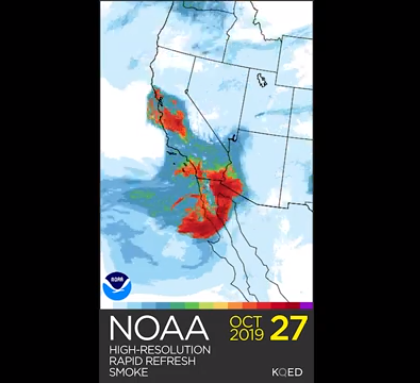
"content": "\u003cp>High winds that kicked up during three separate periods within a week propelled the spread of the Kincade Fire in Sonoma County. The wind gusted, the fire raged and the smoke billowed over the Pacific Ocean. Then the wind died down, the fire smoldered and the smoke settled across Northern California. Rinse and repeat. Meteorologists say it’s incredibly rare to have three high-wind events within such a short period of time.\u003c/p>\n\u003cp>All the while, residents of Northern California found themselves, \u003ca href=\"https://www.kqed.org/science/1934639/video-watch-smoke-from-camp-fire-disperse-over-u-s\" target=\"_blank\" rel=\"noopener\">once again\u003c/a>, reaching for smoke-filtering masks and searching the web for clues as to when and where the smoke would arrive.\u003c/p>\n\u003cp>One place that information is available is at the website of the National Oceanic and Atmospheric Administration, which uses a supercomputer to predict smoke dispersal over the U.S. It’s called the \u003ca href=\"https://rapidrefresh.noaa.gov/\" target=\"_blank\" rel=\"noopener\">Rapid Refresh-Smoke model\u003c/a>, and it’s run out of NOAA’s Global Systems Division in Boulder, Colorado. Forecasts pull weather data gleaned from radar, airplanes and other sources to predict dispersal patterns over 36 hours. New forecasts are issued every six hours. While still designated as experimental, the model is slated to go operational in 2020, and it’s currently used by the National Weather Service to share information about air quality and visibility, the Global Systems Division says.\u003c/p>\n\u003cp>To create the video above, vertically integrated smoke model fields from NOAA’s Earth System Research Laboratory were downloaded for the start of the Kincade Fire on Oct. 23 to Nov. 1.\u003c/p>\n\u003cp>[ad fullwidth]\u003c/p>\u003cp>\u003c/p>\n",
"stats": {
"hasVideo": false,
"hasChartOrMap": false,
"hasAudio": false,
"hasPolis": false,
"wordCount": 258,
"hasGoogleForm": false,
"hasGallery": false,
"hasHearkenModule": false,
"iframeSrcs": [],
"paragraphCount": 6
},
"modified": 1704848175,
"excerpt": "Watch how smoke from the fire spread across Northern California. ",
"headData": {
"twImgId": "",
"twTitle": "",
"ogTitle": "",
"ogImgId": "",
"twDescription": "",
"description": "Watch how smoke from the fire spread across Northern California. ",
"title": "Video: Smoke From Kincade Fire Disperses Over California | KQED",
"ogDescription": "",
"schema": {
"@context": "https://schema.org",
"@type": "Article",
"headline": "Video: Smoke From Kincade Fire Disperses Over California",
"datePublished": "2019-11-04T12:06:00-08:00",
"dateModified": "2024-01-09T16:56:15-08:00",
"image": "https://cdn.kqed.org/wp-content/uploads/2020/02/KQED-OG-Image@1x.png"
}
},
"guestAuthors": [],
"slug": "video-smoke-from-kincade-fire-disperses-over-california",
"status": "publish",
"videoEmbed": "https://youtu.be/EohkJGmutXk",
"sticky": false,
"source": "Wildfire",
"path": "/science/1950623/video-smoke-from-kincade-fire-disperses-over-california",
"audioTrackLength": null,
"parsedContent": [
{
"type": "contentString",
"content": "\u003cdiv class=\"post-body\">\u003cp>\u003cp>High winds that kicked up during three separate periods within a week propelled the spread of the Kincade Fire in Sonoma County. The wind gusted, the fire raged and the smoke billowed over the Pacific Ocean. Then the wind died down, the fire smoldered and the smoke settled across Northern California. Rinse and repeat. Meteorologists say it’s incredibly rare to have three high-wind events within such a short period of time.\u003c/p>\n\u003cp>All the while, residents of Northern California found themselves, \u003ca href=\"https://www.kqed.org/science/1934639/video-watch-smoke-from-camp-fire-disperse-over-u-s\" target=\"_blank\" rel=\"noopener\">once again\u003c/a>, reaching for smoke-filtering masks and searching the web for clues as to when and where the smoke would arrive.\u003c/p>\n\u003cp>One place that information is available is at the website of the National Oceanic and Atmospheric Administration, which uses a supercomputer to predict smoke dispersal over the U.S. It’s called the \u003ca href=\"https://rapidrefresh.noaa.gov/\" target=\"_blank\" rel=\"noopener\">Rapid Refresh-Smoke model\u003c/a>, and it’s run out of NOAA’s Global Systems Division in Boulder, Colorado. Forecasts pull weather data gleaned from radar, airplanes and other sources to predict dispersal patterns over 36 hours. New forecasts are issued every six hours. While still designated as experimental, the model is slated to go operational in 2020, and it’s currently used by the National Weather Service to share information about air quality and visibility, the Global Systems Division says.\u003c/p>\n\u003cp>To create the video above, vertically integrated smoke model fields from NOAA’s Earth System Research Laboratory were downloaded for the start of the Kincade Fire on Oct. 23 to Nov. 1.\u003c/p>\n\u003cp>\u003c/p>\u003c/div>",
"attributes": {
"named": {},
"numeric": []
}
},
{
"type": "component",
"content": "",
"name": "ad",
"attributes": {
"named": {
"label": "fullwidth"
},
"numeric": [
"fullwidth"
]
}
},
{
"type": "contentString",
"content": "\u003cdiv class=\"post-body\">\u003cp>\u003c/p>\u003cp>\u003c/p>\n\u003c/div>\u003c/p>",
"attributes": {
"named": {},
"numeric": []
}
}
],
"link": "/science/1950623/video-smoke-from-kincade-fire-disperses-over-california",
"authors": [
"11501",
"11608"
],
"categories": [
"science_35",
"science_40",
"science_3730"
],
"tags": [
"science_524",
"science_3840",
"science_5182",
"science_3463",
"science_3674"
],
"featImg": "science_1950628",
"label": "source_science_1950623"
},
"science_1950575": {
"type": "posts",
"id": "science_1950575",
"meta": {
"index": "posts_1716263798",
"site": "science",
"id": "1950575",
"score": null,
"sort": [
1572854609000
]
},
"parent": 0,
"labelTerm": {},
"blocks": [],
"publishDate": 1572854609,
"format": "standard",
"title": "Solar and Batteries Work in a Blackout, But What Does That Mean for the Grid?",
"headTitle": "Solar and Batteries Work in a Blackout, But What Does That Mean for the Grid? | KQED",
"content": "\u003cp>While his neighbors’ homes in the Berkeley Hills sat in the dark during a recent PG&E outage, Howard Matis had working lights, a cold fridge and a fully functional garage door.\u003c/p>\n\u003cp>Two Tesla Powerwall batteries he installed just days before high winds prompted the utility to shut off electricity to millions in Northern California kept the power on in his house.\u003c/p>\n\u003caside class=\"pullquote alignright\">“How can we build a system so all those investments that people are making can bring a benefit to the grid as a whole?”\u003cbr>\n\u003ccite>Anne Hoskins, Sunrun\u003c/cite>\u003c/aside>\n\u003cp>Home solar suppliers have seen a surge in interest since the PG&E shutoffs began. Most battery owners are still early adopters, but as prices come down, the technology is sparking a debate over whether California’s electric grid will be supplied by far-reaching transmission lines or powered by hyper-local sources.\u003c/p>\n\u003cp>Solar panels on the roof charge Matis’ battery system, which can power most of his house. During an outage, those panels generally don’t work when they’re interconnected with the grid. A battery system, though, can store the solar energy and “island” a property from the grid.\u003c/p>\n\u003cp>“You see the garage door,” Matis said. “It’s too heavy for my wife to lift. That’s why we have electricity. If we had a real fire right now, a lot of people couldn’t flee.”\u003c/p>\n\u003cp>[ad fullwidth]\u003c/p>\n\u003cp>\u003cstrong>Lessons From Experience\u003c/strong>\u003c/p>\n\u003cp>He knows what it’s like to escape a wildfire. In 1991, the Oakland Hills fire consumed his neighborhood. Vehicles jammed the roads, so a policeman loaded Matis and his son into another car.\u003c/p>\n\u003cp>“This incredibly brave woman drove on a twisty road,” he recalled. “She couldn’t see through the flames. And then she drove us to safety.”\u003c/p>\n\u003cp>Some of his neighbors died trying to escape. Matis’ neighborhood is more fire aware now and the power lines are buried underground. But the people there are not immune from PG&E’s blackouts or from the frustration they cause.\u003c/p>\n\u003cp>“I’ve talked to PG&E in the past, and I realized they didn’t know what they’re talking about,” Matis said.\u003c/p>\n\u003cp>The utility would disagree, but other companies see an opportunity in that resentment.\u003c/p>\n\u003cp>“We’ve had a very big uptick,” said Anne Hoskins, chief policy officer at Sunrun, which sells solar and battery systems. The company saw 15 times more web traffic to its battery pages than usual during the most recent outages. “We have a better way than relying on this over-century-old system that has to take power from far distances to serve communities and people.”\u003c/p>\n\u003cp>Hoskins said home batteries aren’t just for emergencies. Homeowners can use them every day to store solar power for use when the sun goes down. Other solutions, like portable gas generators, are a temporary measure.\u003c/p>\n\u003cp>“They’re loud,” Hoskins said. “They’re dirty. And that also contributes to the problem, in our view, that we’re facing, which is climate change.”\u003c/p>\n\u003cp>Still, batteries are expensive. Telsa’s Powerwalls, the kind Howard Matis has in his garage, cost around $6,500 each, plus thousands more in installation. CEO Elon Musk recently \u003ca href=\"https://twitter.com/elonmusk/status/1188880437067665408?s=20\" target=\"_blank\" rel=\"noopener\">tweeted\u003c/a> that the company was knocking $1,000 off the price of their systems for Californians affected by the outages.\u003c/p>\n\u003cp>A 30% federal tax credit for solar and battery systems helps reduce the cost. So does California’s \u003ca href=\"https://www.selfgenca.com/\" target=\"_blank\" rel=\"noopener\">Self-Generation Incentive Program\u003c/a>, which provides rebates \u003ca href=\"https://www.tesla.com/support/energy/powerwall/learn/incentives\" target=\"_blank\" rel=\"noopener\">in the thousands of dollars\u003c/a>. The California Public Utilities Commission recently \u003ca href=\"https://www.greentechmedia.com/articles/read/recent-changes-to-californias-self-generation-incentive-program-explained\" target=\"_blank\" rel=\"noopener\">carved out $100 million\u003c/a> in rebates for low-income households or communities in high fire-risk areas.\u003c/p>\n\u003cp>Companies like Sunrun also offer leasing options with little money down for home batteries . That adds about $40 a month to a solar lease. But potentially, wealthier Californian homeowners could buy their way out of blackouts, leaving everyone else feeling the brunt.\u003c/p>\n\u003cp>\u003cstrong>Sharing the Benefits\u003c/strong>\u003c/p>\n\u003cp>“So what you want to do is get ahead of that and figure out, okay, how can we build a system so all those investments that people are making can bring a benefit to the grid as a whole?” Hoskins said.\u003c/p>\n\u003cp>She added that’s possible with “virtual power plants.” In \u003ca href=\"https://ebce.org/ebce-expands-its-renewable-energy-and-storage-portfolio-with-three-new-contracts/\" target=\"_blank\" rel=\"noopener\">one project\u003c/a> planned by \u003ca href=\"https://ebce.org/\" target=\"_blank\" rel=\"noopener\">East Bay Community Energy\u003c/a> in West Oakland, 500 low-income households will get solar and batteries. During times of high demand, those systems will feed power back onto the grid for everyone to use, almost like a traditional power plant.\u003c/p>\n\u003cp>The idea is that locally produced power reduces the need for big transmission lines to bring it in from far away.\u003c/p>\n\u003cp>“There’s definitely some truth to that, but there’s also some real cost to trying to operate smaller grids independently,” said Severin Borenstein, an energy economist at UC Berkeley.\u003c/p>\n\u003cp>California utilities could spend billions on these microgrids, he says, but they’ll also need to spend billions on improving the existing grid to prevent fires.\u003c/p>\n\u003cp>“When we make all these investments, if we load it all into electricity rates, we’re going to have even higher electricity rates,” he said.\u003c/p>\n\u003cp>Higher PG&E rates could encourage more Californians to install solar and batteries to avoid the rising costs. But when households make their own electricity, they buy less from PG&E, so the utility gets less revenue for grid improvements.\u003c/p>\n\u003cp>“What I have been arguing is that we really need to take some of these programs and take them off of electricity bills and put them into the state budget,” Borentsein said.\u003c/p>\n\u003cp>\u003c/p>\n\u003cp>Either way, PG&E’s blackouts and ongoing bankruptcy could add urgency to these conversations, as California looks for ways to create a safer and more reliable grid.\u003c/p>\n\n",
"stats": {
"hasVideo": false,
"hasChartOrMap": false,
"hasAudio": false,
"hasPolis": false,
"wordCount": 1006,
"hasGoogleForm": false,
"hasGallery": false,
"hasHearkenModule": false,
"iframeSrcs": [],
"paragraphCount": 29
},
"modified": 1704848177,
"excerpt": "Most battery owners are still early adopters, but the technology is sparking a debate over whether California’s electric grid will be supplied by far-reaching transmission lines or powered by hyper-local sources.",
"headData": {
"twImgId": "",
"twTitle": "",
"ogTitle": "",
"ogImgId": "",
"twDescription": "",
"description": "Most battery owners are still early adopters, but the technology is sparking a debate over whether California’s electric grid will be supplied by far-reaching transmission lines or powered by hyper-local sources.",
"title": "Solar and Batteries Work in a Blackout, But What Does That Mean for the Grid? | KQED",
"ogDescription": "",
"schema": {
"@context": "https://schema.org",
"@type": "Article",
"headline": "Solar and Batteries Work in a Blackout, But What Does That Mean for the Grid?",
"datePublished": "2019-11-04T00:03:29-08:00",
"dateModified": "2024-01-09T16:56:17-08:00",
"image": "https://cdn.kqed.org/wp-content/uploads/2020/02/KQED-OG-Image@1x.png"
}
},
"guestAuthors": [],
"slug": "solar-and-batteries-work-in-a-blackout-but-what-does-that-mean-for-the-grid",
"status": "publish",
"sticky": false,
"source": "PG&E Power Outages",
"path": "/science/1950575/solar-and-batteries-work-in-a-blackout-but-what-does-that-mean-for-the-grid",
"audioTrackLength": null,
"parsedContent": [
{
"type": "contentString",
"content": "\u003cdiv class=\"post-body\">\u003cp>\u003cp>While his neighbors’ homes in the Berkeley Hills sat in the dark during a recent PG&E outage, Howard Matis had working lights, a cold fridge and a fully functional garage door.\u003c/p>\n\u003cp>Two Tesla Powerwall batteries he installed just days before high winds prompted the utility to shut off electricity to millions in Northern California kept the power on in his house.\u003c/p>\n\u003caside class=\"pullquote alignright\">“How can we build a system so all those investments that people are making can bring a benefit to the grid as a whole?”\u003cbr>\n\u003ccite>Anne Hoskins, Sunrun\u003c/cite>\u003c/aside>\n\u003cp>Home solar suppliers have seen a surge in interest since the PG&E shutoffs began. Most battery owners are still early adopters, but as prices come down, the technology is sparking a debate over whether California’s electric grid will be supplied by far-reaching transmission lines or powered by hyper-local sources.\u003c/p>\n\u003cp>Solar panels on the roof charge Matis’ battery system, which can power most of his house. During an outage, those panels generally don’t work when they’re interconnected with the grid. A battery system, though, can store the solar energy and “island” a property from the grid.\u003c/p>\n\u003cp>“You see the garage door,” Matis said. “It’s too heavy for my wife to lift. That’s why we have electricity. If we had a real fire right now, a lot of people couldn’t flee.”\u003c/p>\n\u003cp>\u003c/p>\u003c/div>",
"attributes": {
"named": {},
"numeric": []
}
},
{
"type": "component",
"content": "",
"name": "ad",
"attributes": {
"named": {
"label": "fullwidth"
},
"numeric": [
"fullwidth"
]
}
},
{
"type": "contentString",
"content": "\u003cdiv class=\"post-body\">\u003cp>\u003c/p>\n\u003cp>\u003cstrong>Lessons From Experience\u003c/strong>\u003c/p>\n\u003cp>He knows what it’s like to escape a wildfire. In 1991, the Oakland Hills fire consumed his neighborhood. Vehicles jammed the roads, so a policeman loaded Matis and his son into another car.\u003c/p>\n\u003cp>“This incredibly brave woman drove on a twisty road,” he recalled. “She couldn’t see through the flames. And then she drove us to safety.”\u003c/p>\n\u003cp>Some of his neighbors died trying to escape. Matis’ neighborhood is more fire aware now and the power lines are buried underground. But the people there are not immune from PG&E’s blackouts or from the frustration they cause.\u003c/p>\n\u003cp>“I’ve talked to PG&E in the past, and I realized they didn’t know what they’re talking about,” Matis said.\u003c/p>\n\u003cp>The utility would disagree, but other companies see an opportunity in that resentment.\u003c/p>\n\u003cp>“We’ve had a very big uptick,” said Anne Hoskins, chief policy officer at Sunrun, which sells solar and battery systems. The company saw 15 times more web traffic to its battery pages than usual during the most recent outages. “We have a better way than relying on this over-century-old system that has to take power from far distances to serve communities and people.”\u003c/p>\n\u003cp>Hoskins said home batteries aren’t just for emergencies. Homeowners can use them every day to store solar power for use when the sun goes down. Other solutions, like portable gas generators, are a temporary measure.\u003c/p>\n\u003cp>“They’re loud,” Hoskins said. “They’re dirty. And that also contributes to the problem, in our view, that we’re facing, which is climate change.”\u003c/p>\n\u003cp>Still, batteries are expensive. Telsa’s Powerwalls, the kind Howard Matis has in his garage, cost around $6,500 each, plus thousands more in installation. CEO Elon Musk recently \u003ca href=\"https://twitter.com/elonmusk/status/1188880437067665408?s=20\" target=\"_blank\" rel=\"noopener\">tweeted\u003c/a> that the company was knocking $1,000 off the price of their systems for Californians affected by the outages.\u003c/p>\n\u003cp>A 30% federal tax credit for solar and battery systems helps reduce the cost. So does California’s \u003ca href=\"https://www.selfgenca.com/\" target=\"_blank\" rel=\"noopener\">Self-Generation Incentive Program\u003c/a>, which provides rebates \u003ca href=\"https://www.tesla.com/support/energy/powerwall/learn/incentives\" target=\"_blank\" rel=\"noopener\">in the thousands of dollars\u003c/a>. The California Public Utilities Commission recently \u003ca href=\"https://www.greentechmedia.com/articles/read/recent-changes-to-californias-self-generation-incentive-program-explained\" target=\"_blank\" rel=\"noopener\">carved out $100 million\u003c/a> in rebates for low-income households or communities in high fire-risk areas.\u003c/p>\n\u003cp>Companies like Sunrun also offer leasing options with little money down for home batteries . That adds about $40 a month to a solar lease. But potentially, wealthier Californian homeowners could buy their way out of blackouts, leaving everyone else feeling the brunt.\u003c/p>\n\u003cp>\u003cstrong>Sharing the Benefits\u003c/strong>\u003c/p>\n\u003cp>“So what you want to do is get ahead of that and figure out, okay, how can we build a system so all those investments that people are making can bring a benefit to the grid as a whole?” Hoskins said.\u003c/p>\n\u003cp>She added that’s possible with “virtual power plants.” In \u003ca href=\"https://ebce.org/ebce-expands-its-renewable-energy-and-storage-portfolio-with-three-new-contracts/\" target=\"_blank\" rel=\"noopener\">one project\u003c/a> planned by \u003ca href=\"https://ebce.org/\" target=\"_blank\" rel=\"noopener\">East Bay Community Energy\u003c/a> in West Oakland, 500 low-income households will get solar and batteries. During times of high demand, those systems will feed power back onto the grid for everyone to use, almost like a traditional power plant.\u003c/p>\n\u003cp>The idea is that locally produced power reduces the need for big transmission lines to bring it in from far away.\u003c/p>\n\u003cp>“There’s definitely some truth to that, but there’s also some real cost to trying to operate smaller grids independently,” said Severin Borenstein, an energy economist at UC Berkeley.\u003c/p>\n\u003cp>California utilities could spend billions on these microgrids, he says, but they’ll also need to spend billions on improving the existing grid to prevent fires.\u003c/p>\n\u003cp>“When we make all these investments, if we load it all into electricity rates, we’re going to have even higher electricity rates,” he said.\u003c/p>\n\u003cp>Higher PG&E rates could encourage more Californians to install solar and batteries to avoid the rising costs. But when households make their own electricity, they buy less from PG&E, so the utility gets less revenue for grid improvements.\u003c/p>\n\u003cp>“What I have been arguing is that we really need to take some of these programs and take them off of electricity bills and put them into the state budget,” Borentsein said.\u003c/p>\n\u003cp>\u003c/p>\n\u003cp>Either way, PG&E’s blackouts and ongoing bankruptcy could add urgency to these conversations, as California looks for ways to create a safer and more reliable grid.\u003c/p>\n\n\u003c/div>\u003c/p>",
"attributes": {
"named": {},
"numeric": []
}
}
],
"link": "/science/1950575/solar-and-batteries-work-in-a-blackout-but-what-does-that-mean-for-the-grid",
"authors": [
"239"
],
"categories": [
"science_33",
"science_89",
"science_35",
"science_40",
"science_43",
"science_3730"
],
"tags": [
"science_188",
"science_3370",
"science_136",
"science_138",
"science_113"
],
"featImg": "science_1950579",
"label": "source_science_1950575"
},
"science_1950560": {
"type": "posts",
"id": "science_1950560",
"meta": {
"index": "posts_1716263798",
"site": "science",
"id": "1950560",
"score": null,
"sort": [
1572628032000
]
},
"parent": 0,
"labelTerm": {},
"blocks": [],
"publishDate": 1572628032,
"format": "standard",
"title": "‘On The Backs Of Tortoises’ Details the Challenge of Conservation Amid Ecological Crisis",
"headTitle": "‘On The Backs Of Tortoises’ Details the Challenge of Conservation Amid Ecological Crisis | KQED",
"content": "\u003cp>One of the longest-running jokes in \u003cem>The Good Place \u003c/em>is about almond milk.\u003c/p>\n\u003cp>After the big twist in the show’s first season, moral philosopher Chidi Anagonye agonized about being condemned to The Bad Place, and decided early on what had tipped the scales: “I used almond milk in my coffee, even though I knew about the negative environmental impact.” For ages, it’s a running joke that such a particular infraction could be the thing that condemned him. But eventually, they get a look at the judgment system and realize he was right all along: Every decision has consequences, and nothing is decided in a vacuum.\u003c/p>\n\u003cp>It’s impossible not to think of Chidi and his many philosophical thought-exercises-slash-inescapable-moral-quagmires while reading \u003cem>On the Backs of Tortoises.\u003c/em> Nominally an environmental and social history of the Galápagos Islands, Prof. Elizabeth Hennessy lays bare the many intertwined issues that confront us as we attempt conservation efforts in complex situations, while faced with a sweeping ecological crisis.\u003c/p>\n\u003cp>The tortoises of the Galápagos are “keystone species and ecosystem engineers,” and since sailors first began using the islands in 1535, they have been the most obvious barometer of the effect of people on an ecosystem. (Hennessy notes grimly that “three of the fifteen species” that originally populated the islands “exist only as historical records.”)\u003c/p>\n\u003cp>Using tortoises as a marker, Hennessy traces the various ways the islands — and nature itself — has been framed, both by opportunists and by conservationists. By turns, tortoises are food or natural treasure; they must be carefully sheltered or made celebrities for their own good. The islands spend time as a prison colony, promised frontier for settlers, American military base, and national park with a controversial tourist industry. The thread of natural conservation runs throughout, but even there, the meaning has changed. For Walter Rothschild a century ago, it was collection of specimens. Now, it is attempts to breed tortoises for release into a wilderness that’s being shaped by the introduction of foreign animals and plants. (In 1957, fishers left three goats on Pinta island for food. Their eradication has become a cottage industry, with thousands of kills a month that are left to rot; nothing is easily parsed.)\u003c/p>\n\u003cp>[ad fullwidth]\u003c/p>\n\u003cp>And much like poor Chidi getting frequent moral paralysis in the face of complexities or a looming crisis, moments in \u003cem>On the Backs of Tortoises\u003c/em> can be tough reading, with very few answers for some very pressing questions about culture, politics, and blackberries (an invasive species whose presence on the island is a growing problem).\u003c/p>\n\u003cp>Hennessy is clear about the futility in dreaming of a pristine pre-1535 Galápagos, unpopulated and untouched — “There is no return to Eden,” she says — but the current problems can feel extremely immediate, and the current solutions not particularly hopeful. The tortoises that do hatch at the tourist-friendly breeding center are springing from a very small pool, and are released into islands full of rats that prey on them, goats that eat their food, and people whose needs will only grow. Where do you begin?\u003c/p>\n\u003cp>But this book isn’t meant to offer easy answers. Early on, we read the old story about “turtles all the way down” — the concept that the world is balanced on the back of an ever-expanding stack of helpful \u003cem>Testudinidae\u003c/em>. But as Hennessy points out, such an idea doesn’t actually indicate that there’s a single answer to a difficult question; rather, that stack of tortoises suggests that, if we’re looking for balance, there’s always something more to learn beneath the things we think we know.\u003c/p>\n\u003cp>This book works the same way, beginning with a gripping history and then delving deeper — the world of the Galapagos becomes more complicated as we go, until we understand the underpinnings of any decision (almond milk or otherwise). It’s a book about the ways we need to understand how deeply everything is entangled, and just how far down it goes. The result is a well-researched and thought-provoking read — whether you’re well-versed in the intricacies of conservation or have only just begun to long for a look at the tortoises yourself. \u003cem>On the Backs of Tortoises\u003c/em> is a natural history that asks important questions, and challenges us to think about how best to answer them.\u003c/p>\n\u003cp>\u003c/p>\n\u003cp>\u003cem>Genevieve Valentine’s latest novel is \u003c/em>Icon.\u003c/p>\n\u003cdiv class=\"fullattribution\">Copyright 2019 NPR. To see more, visit https://www.npr.org.\u003cimg decoding=\"async\" src=\"https://www.google-analytics.com/__utm.gif?utmac=UA-5828686-4&utmdt=%27On+The+Backs+Of+Tortoises%27+Challenges+Us+To+Consider+How+Much+Of+Life+Is+Intertwined&utme=8(APIKey)9(MDAxOTAwOTE4MDEyMTkxMDAzNjczZDljZA004)\">\u003c/div>\n\n",
"stats": {
"hasVideo": false,
"hasChartOrMap": false,
"hasAudio": false,
"hasPolis": false,
"wordCount": 781,
"hasGoogleForm": false,
"hasGallery": false,
"hasHearkenModule": false,
"iframeSrcs": [],
"paragraphCount": 12
},
"modified": 1704848178,
"excerpt": "Nominally an environmental and social history of the Galápagos Islands, it lays bare the entangled issues confronting us as we attempt conservation efforts while facing a sweeping ecological crisis.",
"headData": {
"twImgId": "",
"twTitle": "",
"ogTitle": "",
"ogImgId": "",
"twDescription": "",
"description": "Nominally an environmental and social history of the Galápagos Islands, it lays bare the entangled issues confronting us as we attempt conservation efforts while facing a sweeping ecological crisis.",
"title": "‘On The Backs Of Tortoises’ Details the Challenge of Conservation Amid Ecological Crisis | KQED",
"ogDescription": "",
"schema": {
"@context": "https://schema.org",
"@type": "Article",
"headline": "‘On The Backs Of Tortoises’ Details the Challenge of Conservation Amid Ecological Crisis",
"datePublished": "2019-11-01T10:07:12-07:00",
"dateModified": "2024-01-09T16:56:18-08:00",
"image": "https://cdn.kqed.org/wp-content/uploads/2020/02/KQED-OG-Image@1x.png"
}
},
"guestAuthors": [],
"slug": "on-the-backs-of-tortoises-details-the-challenge-of-conservation-amid-ecological-crisis",
"status": "publish",
"nprApiLink": "http://api.npr.org/query?id=774366961&apiKey=MDAxOTAwOTE4MDEyMTkxMDAzNjczZDljZA004",
"nprByline": "Genevieve Valentine \u003c/br>NPR\u003cbr>",
"nprStoryDate": "Fri, 01 Nov 2019 10:47:00 -0400",
"nprLastModifiedDate": "Fri, 01 Nov 2019 10:48:46 -0400",
"sticky": false,
"nprHtmlLink": "https://www.npr.org/2019/11/01/774366961/on-the-backs-of-tortoises-challenges-us-to-consider-how-much-of-life-is-intertwi?ft=nprml&f=774366961",
"nprImageAgency": "Education Images/Universal Image",
"source": "NPR",
"nprStoryId": "774366961",
"nprRetrievedStory": "1",
"nprPubDate": "Fri, 01 Nov 2019 10:48:00 -0400",
"path": "/science/1950560/on-the-backs-of-tortoises-details-the-challenge-of-conservation-amid-ecological-crisis",
"audioTrackLength": null,
"parsedContent": [
{
"type": "contentString",
"content": "\u003cdiv class=\"post-body\">\u003cp>\u003cp>One of the longest-running jokes in \u003cem>The Good Place \u003c/em>is about almond milk.\u003c/p>\n\u003cp>After the big twist in the show’s first season, moral philosopher Chidi Anagonye agonized about being condemned to The Bad Place, and decided early on what had tipped the scales: “I used almond milk in my coffee, even though I knew about the negative environmental impact.” For ages, it’s a running joke that such a particular infraction could be the thing that condemned him. But eventually, they get a look at the judgment system and realize he was right all along: Every decision has consequences, and nothing is decided in a vacuum.\u003c/p>\n\u003cp>It’s impossible not to think of Chidi and his many philosophical thought-exercises-slash-inescapable-moral-quagmires while reading \u003cem>On the Backs of Tortoises.\u003c/em> Nominally an environmental and social history of the Galápagos Islands, Prof. Elizabeth Hennessy lays bare the many intertwined issues that confront us as we attempt conservation efforts in complex situations, while faced with a sweeping ecological crisis.\u003c/p>\n\u003cp>The tortoises of the Galápagos are “keystone species and ecosystem engineers,” and since sailors first began using the islands in 1535, they have been the most obvious barometer of the effect of people on an ecosystem. (Hennessy notes grimly that “three of the fifteen species” that originally populated the islands “exist only as historical records.”)\u003c/p>\n\u003cp>Using tortoises as a marker, Hennessy traces the various ways the islands — and nature itself — has been framed, both by opportunists and by conservationists. By turns, tortoises are food or natural treasure; they must be carefully sheltered or made celebrities for their own good. The islands spend time as a prison colony, promised frontier for settlers, American military base, and national park with a controversial tourist industry. The thread of natural conservation runs throughout, but even there, the meaning has changed. For Walter Rothschild a century ago, it was collection of specimens. Now, it is attempts to breed tortoises for release into a wilderness that’s being shaped by the introduction of foreign animals and plants. (In 1957, fishers left three goats on Pinta island for food. Their eradication has become a cottage industry, with thousands of kills a month that are left to rot; nothing is easily parsed.)\u003c/p>\n\u003cp>\u003c/p>\u003c/div>",
"attributes": {
"named": {},
"numeric": []
}
},
{
"type": "component",
"content": "",
"name": "ad",
"attributes": {
"named": {
"label": "fullwidth"
},
"numeric": [
"fullwidth"
]
}
},
{
"type": "contentString",
"content": "\u003cdiv class=\"post-body\">\u003cp>\u003c/p>\n\u003cp>And much like poor Chidi getting frequent moral paralysis in the face of complexities or a looming crisis, moments in \u003cem>On the Backs of Tortoises\u003c/em> can be tough reading, with very few answers for some very pressing questions about culture, politics, and blackberries (an invasive species whose presence on the island is a growing problem).\u003c/p>\n\u003cp>Hennessy is clear about the futility in dreaming of a pristine pre-1535 Galápagos, unpopulated and untouched — “There is no return to Eden,” she says — but the current problems can feel extremely immediate, and the current solutions not particularly hopeful. The tortoises that do hatch at the tourist-friendly breeding center are springing from a very small pool, and are released into islands full of rats that prey on them, goats that eat their food, and people whose needs will only grow. Where do you begin?\u003c/p>\n\u003cp>But this book isn’t meant to offer easy answers. Early on, we read the old story about “turtles all the way down” — the concept that the world is balanced on the back of an ever-expanding stack of helpful \u003cem>Testudinidae\u003c/em>. But as Hennessy points out, such an idea doesn’t actually indicate that there’s a single answer to a difficult question; rather, that stack of tortoises suggests that, if we’re looking for balance, there’s always something more to learn beneath the things we think we know.\u003c/p>\n\u003cp>This book works the same way, beginning with a gripping history and then delving deeper — the world of the Galapagos becomes more complicated as we go, until we understand the underpinnings of any decision (almond milk or otherwise). It’s a book about the ways we need to understand how deeply everything is entangled, and just how far down it goes. The result is a well-researched and thought-provoking read — whether you’re well-versed in the intricacies of conservation or have only just begun to long for a look at the tortoises yourself. \u003cem>On the Backs of Tortoises\u003c/em> is a natural history that asks important questions, and challenges us to think about how best to answer them.\u003c/p>\n\u003cp>\u003c/p>\n\u003cp>\u003cem>Genevieve Valentine’s latest novel is \u003c/em>Icon.\u003c/p>\n\u003cdiv class=\"fullattribution\">Copyright 2019 NPR. To see more, visit https://www.npr.org.\u003cimg decoding=\"async\" src=\"https://www.google-analytics.com/__utm.gif?utmac=UA-5828686-4&utmdt=%27On+The+Backs+Of+Tortoises%27+Challenges+Us+To+Consider+How+Much+Of+Life+Is+Intertwined&utme=8(APIKey)9(MDAxOTAwOTE4MDEyMTkxMDAzNjczZDljZA004)\">\u003c/div>\n\n\u003c/div>\u003c/p>",
"attributes": {
"named": {},
"numeric": []
}
}
],
"link": "/science/1950560/on-the-backs-of-tortoises-details-the-challenge-of-conservation-amid-ecological-crisis",
"authors": [
"byline_science_1950560"
],
"categories": [
"science_2874",
"science_31",
"science_35",
"science_40"
],
"featImg": "science_1950561",
"label": "source_science_1950560"
},
"science_1950485": {
"type": "posts",
"id": "science_1950485",
"meta": {
"index": "posts_1716263798",
"site": "science",
"id": "1950485",
"score": null,
"sort": [
1572462291000
]
},
"parent": 0,
"labelTerm": {},
"blocks": [],
"publishDate": 1572462291,
"format": "standard",
"title": "Greta Thunberg, Chastising Leaders, Turns Down Major Environmental Award and $52,000",
"headTitle": "Greta Thunberg, Chastising Leaders, Turns Down Major Environmental Award and $52,000 | KQED",
"content": "\u003cp>Teenage environmental activist Greta Thunberg has turned down a major environmental prize.\u003c/p>\n\u003cp>“It is a huge honor,” Thunberg said of the Nordic Council Environment Prize. “But the climate movement does not need any more awards.”\u003c/p>\n\u003cp>“What we need is for our politicians and the people in power to start listening to the current, best available science,” she added.\u003c/p>\n\u003cp>The award Thunberg rejected came with prize money of 350,000 Danish kroner — about $52,000.\u003c/p>\n\u003cp>The Swedish activist, who is currently traveling in North America, was also a contender for the Nobel Peace Prize this year. That award ultimately went to Ethiopian Prime Minister Abiy Ahmed Ali.\u003c/p>\n\u003cp>[ad fullwidth]\u003c/p>\n\u003cp>The Nordic Council, an organization aimed at promoting cooperation between Nordic governments, \u003ca href=\"https://www.norden.org/en/news/greta-thunberg-declines-nordic-council-environment-prize\">awarded Thunberg the prize\u003c/a> for “breathing new life into the debate surrounding the environment and climate at a critical moment in world history.”\u003c/p>\n\u003cp>“She has stubbornly and persuasively urged the world to listen to research and act on the basis of facts,” the council said in a statement.\u003c/p>\n\u003cp>Council president Hans Wallmark \u003ca href=\"https://www.norden.org/en/news/nordic-council-respects-greta-thunbergs-decision\">said that the body respects\u003c/a> both Thunberg’s decision to turn down the award “and the reasons for this decision.”\u003c/p>\n\u003cp>As for the $52,000 award, Wallmark said the council “will now think carefully about what to do with the prize money.”\u003c/p>\n\u003cp>In a \u003ca href=\"https://www.instagram.com/p/B4Ns7PQpE5C/?utm_source=ig_web_copy_link\">statement on Instagram\u003c/a> explaining why she declined, Thunberg slammed the council’s member countries for not taking firmer action on climate change.\u003c/p>\n\u003cp>“The Nordic countries have a great reputation around the world when it comes to climate and environmental issues,” she said. “But when it comes to our actual emissions and our ecological footprints per capita — if we include our consumption, our imports as well as aviation and shipping — then it’s a whole other story.”\u003c/p>\n\u003cp>\u003c/p>\n\u003cp>Thunberg referenced a recent \u003ca href=\"https://www.footprintnetwork.org/content/uploads/2019/05/WWF-GFN-EU-Overshoot-Day-report.pdf\">WWF and Global Footprint Network\u003c/a> report that stated Swedes, and other EU residents, are depleting natural ecosystems far faster than they can renew.\u003c/p>\n\u003cdiv class=\"fullattribution\">Copyright 2019 NPR. To see more, visit https://www.npr.org.\u003cimg decoding=\"async\" src=\"https://www.google-analytics.com/__utm.gif?utmac=UA-5828686-4&utmdt=%27Start+Listening%27%3A+Greta+Thunberg+Rejects+Major+Environmental+Award&utme=8(APIKey)9(MDAxOTAwOTE4MDEyMTkxMDAzNjczZDljZA004)\">\u003c/div>\n\n",
"stats": {
"hasVideo": false,
"hasChartOrMap": false,
"hasAudio": false,
"hasPolis": false,
"wordCount": 354,
"hasGoogleForm": false,
"hasGallery": false,
"hasHearkenModule": false,
"iframeSrcs": [],
"paragraphCount": 14
},
"modified": 1704848182,
"excerpt": "'It is a huge honor,' the Swedish activist said of the Nordic Council Environment Prize. 'But the climate movement does not need any more awards.'",
"headData": {
"twImgId": "",
"twTitle": "",
"ogTitle": "",
"ogImgId": "",
"twDescription": "",
"description": "'It is a huge honor,' the Swedish activist said of the Nordic Council Environment Prize. 'But the climate movement does not need any more awards.'",
"title": "Greta Thunberg, Chastising Leaders, Turns Down Major Environmental Award and $52,000 | KQED",
"ogDescription": "",
"schema": {
"@context": "https://schema.org",
"@type": "Article",
"headline": "Greta Thunberg, Chastising Leaders, Turns Down Major Environmental Award and $52,000",
"datePublished": "2019-10-30T12:04:51-07:00",
"dateModified": "2024-01-09T16:56:22-08:00",
"image": "https://cdn.kqed.org/wp-content/uploads/2020/02/KQED-OG-Image@1x.png"
}
},
"guestAuthors": [],
"slug": "greta-thunberg-chastising-leaders-turns-down-major-environmental-award-and-52000",
"status": "publish",
"nprApiLink": "http://api.npr.org/query?id=774693218&apiKey=MDAxOTAwOTE4MDEyMTkxMDAzNjczZDljZA004",
"nprByline": "Merrit Kennedy\u003cbr />NPR",
"nprStoryDate": "Wed, 30 Oct 2019 12:07:00 -0400",
"nprLastModifiedDate": "Wed, 30 Oct 2019 12:47:16 -0400",
"sticky": false,
"nprHtmlLink": "https://www.npr.org/2019/10/30/774693218/start-listening-greta-thunberg-rejects-major-environmental-award?ft=nprml&f=774693218",
"nprImageAgency": "AP",
"nprImageCredit": "Eduardo Munoz Alvarez",
"source": "NPR",
"nprStoryId": "774693218",
"nprRetrievedStory": "1",
"nprPubDate": "Wed, 30 Oct 2019 12:47:00 -0400",
"path": "/science/1950485/greta-thunberg-chastising-leaders-turns-down-major-environmental-award-and-52000",
"audioTrackLength": null,
"parsedContent": [
{
"type": "contentString",
"content": "\u003cdiv class=\"post-body\">\u003cp>\u003cp>Teenage environmental activist Greta Thunberg has turned down a major environmental prize.\u003c/p>\n\u003cp>“It is a huge honor,” Thunberg said of the Nordic Council Environment Prize. “But the climate movement does not need any more awards.”\u003c/p>\n\u003cp>“What we need is for our politicians and the people in power to start listening to the current, best available science,” she added.\u003c/p>\n\u003cp>The award Thunberg rejected came with prize money of 350,000 Danish kroner — about $52,000.\u003c/p>\n\u003cp>The Swedish activist, who is currently traveling in North America, was also a contender for the Nobel Peace Prize this year. That award ultimately went to Ethiopian Prime Minister Abiy Ahmed Ali.\u003c/p>\n\u003cp>\u003c/p>\u003c/div>",
"attributes": {
"named": {},
"numeric": []
}
},
{
"type": "component",
"content": "",
"name": "ad",
"attributes": {
"named": {
"label": "fullwidth"
},
"numeric": [
"fullwidth"
]
}
},
{
"type": "contentString",
"content": "\u003cdiv class=\"post-body\">\u003cp>\u003c/p>\n\u003cp>The Nordic Council, an organization aimed at promoting cooperation between Nordic governments, \u003ca href=\"https://www.norden.org/en/news/greta-thunberg-declines-nordic-council-environment-prize\">awarded Thunberg the prize\u003c/a> for “breathing new life into the debate surrounding the environment and climate at a critical moment in world history.”\u003c/p>\n\u003cp>“She has stubbornly and persuasively urged the world to listen to research and act on the basis of facts,” the council said in a statement.\u003c/p>\n\u003cp>Council president Hans Wallmark \u003ca href=\"https://www.norden.org/en/news/nordic-council-respects-greta-thunbergs-decision\">said that the body respects\u003c/a> both Thunberg’s decision to turn down the award “and the reasons for this decision.”\u003c/p>\n\u003cp>As for the $52,000 award, Wallmark said the council “will now think carefully about what to do with the prize money.”\u003c/p>\n\u003cp>In a \u003ca href=\"https://www.instagram.com/p/B4Ns7PQpE5C/?utm_source=ig_web_copy_link\">statement on Instagram\u003c/a> explaining why she declined, Thunberg slammed the council’s member countries for not taking firmer action on climate change.\u003c/p>\n\u003cp>“The Nordic countries have a great reputation around the world when it comes to climate and environmental issues,” she said. “But when it comes to our actual emissions and our ecological footprints per capita — if we include our consumption, our imports as well as aviation and shipping — then it’s a whole other story.”\u003c/p>\n\u003cp>\u003c/p>\n\u003cp>Thunberg referenced a recent \u003ca href=\"https://www.footprintnetwork.org/content/uploads/2019/05/WWF-GFN-EU-Overshoot-Day-report.pdf\">WWF and Global Footprint Network\u003c/a> report that stated Swedes, and other EU residents, are depleting natural ecosystems far faster than they can renew.\u003c/p>\n\u003cdiv class=\"fullattribution\">Copyright 2019 NPR. To see more, visit https://www.npr.org.\u003cimg decoding=\"async\" src=\"https://www.google-analytics.com/__utm.gif?utmac=UA-5828686-4&utmdt=%27Start+Listening%27%3A+Greta+Thunberg+Rejects+Major+Environmental+Award&utme=8(APIKey)9(MDAxOTAwOTE4MDEyMTkxMDAzNjczZDljZA004)\">\u003c/div>\n\n\u003c/div>\u003c/p>",
"attributes": {
"named": {},
"numeric": []
}
}
],
"link": "/science/1950485/greta-thunberg-chastising-leaders-turns-down-major-environmental-award-and-52000",
"authors": [
"byline_science_1950485"
],
"categories": [
"science_31",
"science_40"
],
"featImg": "science_1950489",
"label": "source_science_1950485"
},
"science_1928658": {
"type": "posts",
"id": "science_1928658",
"meta": {
"index": "posts_1716263798",
"site": "science",
"id": "1928658",
"score": null,
"sort": [
1572387997000
]
},
"guestAuthors": [],
"slug": "wildfires-reignite-old-trauma-for-survivors-of-last-octobers-devastation",
"title": "Wildfires Reignite Old Trauma for Survivors of Previous Evacuations",
"publishDate": 1572387997,
"format": "standard",
"headTitle": "Wildfires Reignite Old Trauma for Survivors of Previous Evacuations | KQED",
"labelTerm": {},
"content": "\u003cp>There are 18 wildfires now blazing across California, which means many of the state’s residents are waking up to the \u003ca href=\"https://www.kqed.org/science/1926793/protecting-your-health-from-toxic-wildfire-smoke\" target=\"_blank\" rel=\"noopener noreferrer\">smell of smoke\u003c/a> and hazy skies. The Carr fire near Redding has scorched \u003ca href=\"http://www.fire.ca.gov/current_incidents/incidentdetails/Index/2164\" target=\"_blank\" rel=\"noopener noreferrer\">at least 141,000 acres\u003c/a>, and killed seven people. Three fires in Mendocino County are all less than an hour away from Santa Rosa — where some neighborhoods burned to the ground last year.\u003c/p>\n\u003caside class=\"pullquote alignright\">‘You can just feel it. There’s a sense of tension here in Santa Rosa.’\u003ccite>Danielle Bryant, Santa Rosa \u003c/cite>\u003c/aside>\n\u003cp>Confronting constant reminders of what fire can do has become a terrifying reality for people who survived last year’s flames and are still piecing their lives back together.\u003c/p>\n\u003cp>Psychologists, therapists and other counselors are working to assure these survivors that surges of panic, grief and agitation are healthy and normal, even as they offer tips for quenching the terror.\u003c/p>\n\u003cp>The view from Danielle Bryant’s bedroom window, in her new temporary apartment in Santa Rosa, is pretty unsettling these days.\u003c/p>\n\u003cp>“The orange-tinged sky is just enough for me, to set off my anxiety and feelings of fear,” Bryant says.\u003c/p>\n\u003cp>[ad fullwidth]\u003c/p>\n\u003cp>\u003cstrong>Running for Your Life\u003c/strong>\u003c/p>\n\u003cp>Last year on Oct. 8, an explosion jolted Bryant awake in the middle of the night. Howling winds shook her Santa Rosa house. The air was hot. Bryant and her husband jumped in their car and fled with only the clothes on their backs.\u003c/p>\n\u003cp>“I feared for our life,” she says. “We were running for our life.”\u003c/p>\n\u003cp>When they returned the next day the street was desolate. The air wreaked of burnt chemicals. Homes were charred rubble. The October flames eventually destroyed thousands of houses and killed 44 people.\u003c/p>\n\u003cp>“We were victims to one of the most terrible events in history,” says Bryant.\u003c/p>\n\u003cp>\u003cstrong>Still Haunted 10 Months Later\u003c/strong>\u003c/p>\n\u003cp>For the past year, Bryant has struggled with many symptoms of trauma: sleeplessness, nightmares, irritability, and loss of appetite.\u003c/p>\n\u003cp>“Agitation — so quick to agitation,” Bryant says. “Hence the fight that I got in the other night with my husband.”\u003c/p>\n\u003caside class=\"pullquote alignright\">‘“The trouble is, the brain keeps rising to the occasion, even when the threat isn’t current.’\u003ccite>Jennifer Freeman, LMFT\u003c/cite>\u003c/aside>\n\u003cp>It was a fight about nothing. She says she blew up after watching the news about all the fires on television. She hasn’t turned on the TV since. She’s hearing similar stories from friends and neighbors.\u003c/p>\n\u003cp>“You can just feel it,” Bryant says. “There’s a sense of tension here in Santa Rosa.”\u003c/p>\n\u003cp>Bryant’s current apartment is about a mile away from her old house. She’s still working through everything that happened.\u003c/p>\n\u003cp>“These last 10 months,” she says, “have been one of the hardest times of my life, because what you have to do after an event like this is, you have to go on living.”\u003c/p>\n\u003cp>\u003cstrong>There’s Nothing Wrong With You\u003c/strong>\u003c/p>\n\u003cp>The emotions and physiological responses Bryant describes are common after a life-threatening event. \u003ca href=\"http://www.francesfuchsphd.com/\" target=\"_blank\" rel=\"noopener noreferrer\">Francis Fuchs\u003c/a> is a psychologist and counselor in Santa Rosa who has been treating fire victims who are highly affected by all the current blazes in northern California.\u003c/p>\n\u003cp>[contextly_sidebar id=”IDGNibKXzC1suzCgQlBF4ihTNqdejZ0J”]”They are having more difficulty with sleeping,” Fuchs says. “They are having a heightened sense of anxiety and unease. They are having some flashbacks of their fire experience from last October. Also mood changes — more anxious or tearful.”\u003c/p>\n\u003cp>Many laypeople casually use the term PTSD – \u003ca href=\"https://www.nimh.nih.gov/health/topics/post-traumatic-stress-disorder-ptsd/index.shtml\" target=\"_blank\" rel=\"noopener noreferrer\">post traumatic stress disorder\u003c/a> — to loosely describe a response to a terrifying experience. But psychologists say not all responses to trauma actually fit that diagnosis, which includes symptoms that must last more than a month and be severe enough to interfere with relationships or work.\u003c/p>\n\u003cp>Rather, the fear, anxiety, sleeplessness or shallow breathing many fire survivors are experiencing right now are healthy and transient, psychologists and therapists say — the body’s evolutionary responses to the belief that danger is again near.\u003c/p>\n\u003cp>“It’s preverbal, it’s precognitive,” says \u003ca href=\"https://www.padmagordon.com/\" target=\"_blank\" rel=\"noopener noreferrer\">Padma Gordon\u003c/a>, a spiritual counselor and mindfulness educator in San Rafael. “So what happens when we’re threatened: We grip; we contract; we stop breathing. And all this is registering in our brains and in our bodies, instantaneously. Because we’re hardwired for survival.”\u003c/p>\n\u003cp>When a survivor of trauma again senses signs of the previous threat – the smell of smoke, the color of the orange sky, the sound of a phone “ding” for an emergency alert — the protective survival system kicks in, even when the danger isn’t immediate this time.\u003c/p>\n\u003cp>“The brain is designed to alert you to threats,” says \u003ca href=\"http://www.narrativeapproaches.com/\" target=\"_blank\" rel=\"noopener noreferrer\">Jennifer Freeman\u003c/a>, a licensed marriage and family therapist in Berkeley. “The trouble is, the brain keeps rising to the occasion, even when the threat isn’t current.” Freeman has worked with survivors of trauma and in the aftermath of natural disasters — including earthquakes and tsunamis — for three decades, both in the U.S. and internationally.\u003c/p>\n\u003cp>\u003cstrong>What You Can Do \u003c/strong>\u003c/p>\n\u003cp>There are a variety of cognitive and physical techniques that can help us through periods of trauma, counselors say, and people vary in which ones they find most helpful, often depending on their own cultural traditions.\u003c/p>\n\u003cp>[contextly_sidebar id=”DoMftZ0opUaLlZB6oulpFZ9Z6AAuj1In”]Freeman says one of the first steps to calm the mind and body is to be kind to yourself and respect that your system is trying to help you survive.\u003c/p>\n\u003cp>“We can say, ‘Thank you body, thank you brain for trying to take care of me,'” Freeman says. “Which is very different than, ‘Oh, what’s wrong with me?’ and ‘I need to get rid of it.'”\u003c/p>\n\u003cp>Gordon recommends reminding yourself out loud that the fearful event is not happening again. It may sound silly to talk to yourself, but the body, she says, recognizes and calms with the sound of your voice.\u003c/p>\n\u003cp>“’I’m sitting here in a space that doesn’t smell like smoke,’” Gordon says, as an example. “’And I’m not hearing sirens, and people aren’t running, trying to escape. I’m not hearing the sound of flames.’ It’s basically ‘getting present.’ Bring yourself back into the present.”\u003c/p>\n\u003cp>Even setting yourself a task — counting all the green objects you can see from where you sitting, for example — shows your brain there is no threat nearby, says Wowlvenn Seward-Katzmiller, a somatic psychotherapist in Sebastopol.\u003c/p>\n\u003cp>Other tools for ‘coming back to the present’ can be as simple as tapping your feet, Gordon says. Or smelling something you enjoy — such as tangerine or balsam fir or cinnamon — or playing calming music. To consciously \u003ca href=\"https://www.drweil.com/health-wellness/body-mind-spirit/stress-anxiety/breathing-three-exercises/\" target=\"_blank\" rel=\"noopener noreferrer\">slow rapid breathing\u003c/a>, try putting one hand on your belly and one hand on your heart.\u003c/p>\n\u003cp>\u003ca href=\"https://www.npr.org/templates/story/story.php?storyId=105931606\" target=\"_blank\" rel=\"noopener noreferrer\">Slowing your breath\u003c/a> activates the parasympathetic nervous system, Freeman points out, which is the body’s calming system. Seward-Katzmiller suggests long, slow exhalations as if you are blowing out a candle through a long straw. And here’s a fun one: have a long (20 seconds) belly-to-belly hug with a pet or loved one.\u003c/p>\n\u003cp>People also can heal by helping others. Asking questions that elicit the story of how someone survived the traumatic event is an approach Freeman worked with in Samoa, after the 2009 tsunami.\u003c/p>\n\u003cp>“We asked, ‘What did you do during the wave, and after the wave. What did you turn to for strength?’ So we don’t elicit narratives of helplessness. They are stories of pain and hope, struggle and resilience.”\u003c/p>\n\u003cp>If you are helping someone, it’s important to ask what kinds of help they want — not to assume that each approach works with everyone, she adds. When Freeman was working in Samoa, for example, she learned from local therapists and others there that many people preferred to work via community and family groups, rather than in individual therapy.\u003c/p>\n\u003cp>Plus, basic situations such as an inability to pay for a temporary home or the \u003ca href=\"https://www.kqed.org/arts/13815450/for-undocumented-workers-an-uphill-journey-after-the-fires\" target=\"_blank\" rel=\"noopener noreferrer\">threat of deportation\u003c/a> can change what a person most needs in order to heal.\u003c/p>\n\u003cp>[ad floatright]\u003c/p>\n\u003cp>\u003cstrong>Grieving and Finding Hope\u003c/strong>\u003c/p>\n\u003cdiv id=\"storytext\" class=\"storytext storylocation linkLocation\">\n\u003cp>During especially hard times recently, Bryant has found herself driving to the empty lot in Santa Rosa where she used to live.\u003c/p>\n\u003cp>“It was like visiting like a gravesite,” Bryant says. “So it was a place to just come and be and to cry.”\u003c/p>\n\u003cp>After spending a few moments gazing at the ruins, she backs out of her parking spot, pauses, then takes a deep breath.\u003c/p>\n\u003cp>“Just seeing the smoke off to the east,” Bryant says, looking at the sky, “I get this sense of dread.”\u003c/p>\n\u003cp>As we drive down her old street in the Coffey Park neighborhood we pass the skeleton of a burnt-out car, still parked in a pile of ash.\u003c/p>\n\u003cp>Bryant pulls up to an empty lot overgrown with weeds, and gets out of the car. We carefully tread through some weeds and knee high bushes. “See this outline, this box? That was it. That was our home.” Bryant crouches and puts her head in her hands.\u003c/p>\n\u003cp>Triggered memories can still feel overwhelming, but her neighborhood is also coming back to life. Next door, a crane drops a pile of plywood beams, and construction crews are framing new homes. All over the ground, green sprouts are pushing through the blackened decay.\u003c/p>\n\u003cfigure id=\"attachment_11684689\" class=\"wp-caption aligncenter\" style=\"max-width: 640px\">\u003cimg loading=\"lazy\" decoding=\"async\" class=\"wp-image-11684689 size-large\" src=\"https://ww2.kqed.org/news/wp-content/uploads/sites/10/2018/08/danieles-lot-1020x574.jpg\" alt=\"\" width=\"640\" height=\"360\">\u003cfigcaption class=\"wp-caption-text\">The foundation that was once Danielle Bryant’s home in the Coffee\u003c/figcaption>\u003c/figure>\n\u003cp>“This green is hopeful to me,” Bryant says. “This is just a sign that nature comes back — and is forgiving. And that we can, we \u003cem>can\u003c/em>. We can come back.”\u003c/p>\n\u003cp>To help process her grief, Bryant is taking a writing class. She finds it therapeutic to put her painful memories into words and phrases.\u003c/p>\n\u003cp>“Grief breathing into my bones of lead,” Bryant reads. “It stuck there in the deep. Was it all a dream? After we were refugees.”\u003c/p>\n\u003cp>Even as wildfires rage within an hour of Santa Rosa, Bryant is excited at the prospect of rebuilding the house in the old neighborhood, and moving back — she hopes within about a year.\u003c/p>\n\u003cp>“It is going back to the place of trauma,” Bryant admits. “But it’s also going back to our home.”\u003c/p>\n\u003cp>\u003cstrong>Resources for Fire Survivors\u003c/strong>\u003c/p>\n\u003cul>\n\u003cli>Disaster Distress Helpline 1(800)985-5990\u003c/li>\n\u003cli>\u003ca href=\"https://healthcarefoundation.net/category/wildfire-mental-health-collaborative/\">Wildfire Mental Health Collaborative \u003c/a>\u003c/li>\n\u003cli>Free \u003ca href=\"http://www.recamft.org/freecounseling\">therapy sessions\u003c/a> to fire survivors\u003c/li>\n\u003cli>California Association of Marriage and Family Therapists \u003ca href=\"http://www.recamft.org/\" target=\"_blank\" rel=\"noopener noreferrer\">fire survivors’ page\u003c/a>\u003c/li>\n\u003cli>\u003ca href=\"https://www.mysonomastrong.com/\" target=\"_blank\" rel=\"noopener noreferrer\">My Sonoma Strong\u003c/a>, a self-help service\u003c/li>\n\u003c/ul>\n\u003cp>\u003cem>Editor’s Note: Marisol Medina-Cadena contributed to this report.\u003c/em>\u003c/p>\n\u003c/div>\n\n",
"blocks": [],
"excerpt": "In fire-torn parts of the West, some people now safe still struggle emotionally when they again smell smoke or spot an orange haze in the sky. That's normal, say therapists. ",
"status": "publish",
"parent": 0,
"modified": 1727135570,
"stats": {
"hasAudio": false,
"hasVideo": false,
"hasChartOrMap": false,
"iframeSrcs": [],
"hasGoogleForm": false,
"hasGallery": false,
"hasHearkenModule": false,
"hasPolis": false,
"paragraphCount": 55,
"wordCount": 1892
},
"headData": {
"title": "Wildfires Reignite Old Trauma for Survivors of Previous Evacuations | KQED",
"description": "In fire-torn parts of the West, some people now safe still struggle emotionally when they again smell smoke or spot an orange haze in the sky. That's normal, say therapists. ",
"ogTitle": "",
"ogDescription": "",
"ogImgId": "",
"twTitle": "",
"twDescription": "",
"twImgId": "",
"schema": {
"@context": "https://schema.org",
"@type": "Article",
"headline": "Wildfires Reignite Old Trauma for Survivors of Previous Evacuations",
"datePublished": "2019-10-29T15:26:37-07:00",
"dateModified": "2024-09-23T16:52:50-07:00",
"image": "https://cdn.kqed.org/wp-content/uploads/2020/02/KQED-OG-Image@1x.png"
}
},
"source": "Wildfires",
"audioUrl": "https://www.kqed.org/.stream/anon/radio/RDnews/2018/08/McClurgFireTrauma.mp3",
"sticky": false,
"audioTrackLength": 313,
"path": "/science/1928658/wildfires-reignite-old-trauma-for-survivors-of-last-octobers-devastation",
"parsedContent": [
{
"type": "contentString",
"content": "\u003cdiv class=\"post-body\">\u003cp>\u003cp>There are 18 wildfires now blazing across California, which means many of the state’s residents are waking up to the \u003ca href=\"https://www.kqed.org/science/1926793/protecting-your-health-from-toxic-wildfire-smoke\" target=\"_blank\" rel=\"noopener noreferrer\">smell of smoke\u003c/a> and hazy skies. The Carr fire near Redding has scorched \u003ca href=\"http://www.fire.ca.gov/current_incidents/incidentdetails/Index/2164\" target=\"_blank\" rel=\"noopener noreferrer\">at least 141,000 acres\u003c/a>, and killed seven people. Three fires in Mendocino County are all less than an hour away from Santa Rosa — where some neighborhoods burned to the ground last year.\u003c/p>\n\u003caside class=\"pullquote alignright\">‘You can just feel it. There’s a sense of tension here in Santa Rosa.’\u003ccite>Danielle Bryant, Santa Rosa \u003c/cite>\u003c/aside>\n\u003cp>Confronting constant reminders of what fire can do has become a terrifying reality for people who survived last year’s flames and are still piecing their lives back together.\u003c/p>\n\u003cp>Psychologists, therapists and other counselors are working to assure these survivors that surges of panic, grief and agitation are healthy and normal, even as they offer tips for quenching the terror.\u003c/p>\n\u003cp>The view from Danielle Bryant’s bedroom window, in her new temporary apartment in Santa Rosa, is pretty unsettling these days.\u003c/p>\n\u003cp>“The orange-tinged sky is just enough for me, to set off my anxiety and feelings of fear,” Bryant says.\u003c/p>\n\u003cp>\u003c/p>\u003c/div>",
"attributes": {
"named": {},
"numeric": []
}
},
{
"type": "component",
"content": "",
"name": "ad",
"attributes": {
"named": {
"label": "fullwidth"
},
"numeric": [
"fullwidth"
]
}
},
{
"type": "contentString",
"content": "\u003cdiv class=\"post-body\">\u003cp>\u003c/p>\n\u003cp>\u003cstrong>Running for Your Life\u003c/strong>\u003c/p>\n\u003cp>Last year on Oct. 8, an explosion jolted Bryant awake in the middle of the night. Howling winds shook her Santa Rosa house. The air was hot. Bryant and her husband jumped in their car and fled with only the clothes on their backs.\u003c/p>\n\u003cp>“I feared for our life,” she says. “We were running for our life.”\u003c/p>\n\u003cp>When they returned the next day the street was desolate. The air wreaked of burnt chemicals. Homes were charred rubble. The October flames eventually destroyed thousands of houses and killed 44 people.\u003c/p>\n\u003cp>“We were victims to one of the most terrible events in history,” says Bryant.\u003c/p>\n\u003cp>\u003cstrong>Still Haunted 10 Months Later\u003c/strong>\u003c/p>\n\u003cp>For the past year, Bryant has struggled with many symptoms of trauma: sleeplessness, nightmares, irritability, and loss of appetite.\u003c/p>\n\u003cp>“Agitation — so quick to agitation,” Bryant says. “Hence the fight that I got in the other night with my husband.”\u003c/p>\n\u003caside class=\"pullquote alignright\">‘“The trouble is, the brain keeps rising to the occasion, even when the threat isn’t current.’\u003ccite>Jennifer Freeman, LMFT\u003c/cite>\u003c/aside>\n\u003cp>It was a fight about nothing. She says she blew up after watching the news about all the fires on television. She hasn’t turned on the TV since. She’s hearing similar stories from friends and neighbors.\u003c/p>\n\u003cp>“You can just feel it,” Bryant says. “There’s a sense of tension here in Santa Rosa.”\u003c/p>\n\u003cp>Bryant’s current apartment is about a mile away from her old house. She’s still working through everything that happened.\u003c/p>\n\u003cp>“These last 10 months,” she says, “have been one of the hardest times of my life, because what you have to do after an event like this is, you have to go on living.”\u003c/p>\n\u003cp>\u003cstrong>There’s Nothing Wrong With You\u003c/strong>\u003c/p>\n\u003cp>The emotions and physiological responses Bryant describes are common after a life-threatening event. \u003ca href=\"http://www.francesfuchsphd.com/\" target=\"_blank\" rel=\"noopener noreferrer\">Francis Fuchs\u003c/a> is a psychologist and counselor in Santa Rosa who has been treating fire victims who are highly affected by all the current blazes in northern California.\u003c/p>\n\u003cp>\u003c/p>\u003cp>\u003c/p>\u003cp>”They are having more difficulty with sleeping,” Fuchs says. “They are having a heightened sense of anxiety and unease. They are having some flashbacks of their fire experience from last October. Also mood changes — more anxious or tearful.”\u003c/p>\n\u003cp>Many laypeople casually use the term PTSD – \u003ca href=\"https://www.nimh.nih.gov/health/topics/post-traumatic-stress-disorder-ptsd/index.shtml\" target=\"_blank\" rel=\"noopener noreferrer\">post traumatic stress disorder\u003c/a> — to loosely describe a response to a terrifying experience. But psychologists say not all responses to trauma actually fit that diagnosis, which includes symptoms that must last more than a month and be severe enough to interfere with relationships or work.\u003c/p>\n\u003cp>Rather, the fear, anxiety, sleeplessness or shallow breathing many fire survivors are experiencing right now are healthy and transient, psychologists and therapists say — the body’s evolutionary responses to the belief that danger is again near.\u003c/p>\n\u003cp>“It’s preverbal, it’s precognitive,” says \u003ca href=\"https://www.padmagordon.com/\" target=\"_blank\" rel=\"noopener noreferrer\">Padma Gordon\u003c/a>, a spiritual counselor and mindfulness educator in San Rafael. “So what happens when we’re threatened: We grip; we contract; we stop breathing. And all this is registering in our brains and in our bodies, instantaneously. Because we’re hardwired for survival.”\u003c/p>\n\u003cp>When a survivor of trauma again senses signs of the previous threat – the smell of smoke, the color of the orange sky, the sound of a phone “ding” for an emergency alert — the protective survival system kicks in, even when the danger isn’t immediate this time.\u003c/p>\n\u003cp>“The brain is designed to alert you to threats,” says \u003ca href=\"http://www.narrativeapproaches.com/\" target=\"_blank\" rel=\"noopener noreferrer\">Jennifer Freeman\u003c/a>, a licensed marriage and family therapist in Berkeley. “The trouble is, the brain keeps rising to the occasion, even when the threat isn’t current.” Freeman has worked with survivors of trauma and in the aftermath of natural disasters — including earthquakes and tsunamis — for three decades, both in the U.S. and internationally.\u003c/p>\n\u003cp>\u003cstrong>What You Can Do \u003c/strong>\u003c/p>\n\u003cp>There are a variety of cognitive and physical techniques that can help us through periods of trauma, counselors say, and people vary in which ones they find most helpful, often depending on their own cultural traditions.\u003c/p>\n\u003cp>\u003c/p>\u003cp>\u003c/p>\u003cp>Freeman says one of the first steps to calm the mind and body is to be kind to yourself and respect that your system is trying to help you survive.\u003c/p>\n\u003cp>“We can say, ‘Thank you body, thank you brain for trying to take care of me,'” Freeman says. “Which is very different than, ‘Oh, what’s wrong with me?’ and ‘I need to get rid of it.'”\u003c/p>\n\u003cp>Gordon recommends reminding yourself out loud that the fearful event is not happening again. It may sound silly to talk to yourself, but the body, she says, recognizes and calms with the sound of your voice.\u003c/p>\n\u003cp>“’I’m sitting here in a space that doesn’t smell like smoke,’” Gordon says, as an example. “’And I’m not hearing sirens, and people aren’t running, trying to escape. I’m not hearing the sound of flames.’ It’s basically ‘getting present.’ Bring yourself back into the present.”\u003c/p>\n\u003cp>Even setting yourself a task — counting all the green objects you can see from where you sitting, for example — shows your brain there is no threat nearby, says Wowlvenn Seward-Katzmiller, a somatic psychotherapist in Sebastopol.\u003c/p>\n\u003cp>Other tools for ‘coming back to the present’ can be as simple as tapping your feet, Gordon says. Or smelling something you enjoy — such as tangerine or balsam fir or cinnamon — or playing calming music. To consciously \u003ca href=\"https://www.drweil.com/health-wellness/body-mind-spirit/stress-anxiety/breathing-three-exercises/\" target=\"_blank\" rel=\"noopener noreferrer\">slow rapid breathing\u003c/a>, try putting one hand on your belly and one hand on your heart.\u003c/p>\n\u003cp>\u003ca href=\"https://www.npr.org/templates/story/story.php?storyId=105931606\" target=\"_blank\" rel=\"noopener noreferrer\">Slowing your breath\u003c/a> activates the parasympathetic nervous system, Freeman points out, which is the body’s calming system. Seward-Katzmiller suggests long, slow exhalations as if you are blowing out a candle through a long straw. And here’s a fun one: have a long (20 seconds) belly-to-belly hug with a pet or loved one.\u003c/p>\n\u003cp>People also can heal by helping others. Asking questions that elicit the story of how someone survived the traumatic event is an approach Freeman worked with in Samoa, after the 2009 tsunami.\u003c/p>\n\u003cp>“We asked, ‘What did you do during the wave, and after the wave. What did you turn to for strength?’ So we don’t elicit narratives of helplessness. They are stories of pain and hope, struggle and resilience.”\u003c/p>\n\u003cp>If you are helping someone, it’s important to ask what kinds of help they want — not to assume that each approach works with everyone, she adds. When Freeman was working in Samoa, for example, she learned from local therapists and others there that many people preferred to work via community and family groups, rather than in individual therapy.\u003c/p>\n\u003cp>Plus, basic situations such as an inability to pay for a temporary home or the \u003ca href=\"https://www.kqed.org/arts/13815450/for-undocumented-workers-an-uphill-journey-after-the-fires\" target=\"_blank\" rel=\"noopener noreferrer\">threat of deportation\u003c/a> can change what a person most needs in order to heal.\u003c/p>\n\u003cp>\u003c/p>\u003c/div>",
"attributes": {
"named": {},
"numeric": []
}
},
{
"type": "component",
"content": "",
"name": "ad",
"attributes": {
"named": {
"label": "floatright"
},
"numeric": [
"floatright"
]
}
},
{
"type": "contentString",
"content": "\u003cdiv class=\"post-body\">\u003cp>\u003c/p>\n\u003cp>\u003cstrong>Grieving and Finding Hope\u003c/strong>\u003c/p>\n\u003cdiv id=\"storytext\" class=\"storytext storylocation linkLocation\">\n\u003cp>During especially hard times recently, Bryant has found herself driving to the empty lot in Santa Rosa where she used to live.\u003c/p>\n\u003cp>“It was like visiting like a gravesite,” Bryant says. “So it was a place to just come and be and to cry.”\u003c/p>\n\u003cp>After spending a few moments gazing at the ruins, she backs out of her parking spot, pauses, then takes a deep breath.\u003c/p>\n\u003cp>“Just seeing the smoke off to the east,” Bryant says, looking at the sky, “I get this sense of dread.”\u003c/p>\n\u003cp>As we drive down her old street in the Coffey Park neighborhood we pass the skeleton of a burnt-out car, still parked in a pile of ash.\u003c/p>\n\u003cp>Bryant pulls up to an empty lot overgrown with weeds, and gets out of the car. We carefully tread through some weeds and knee high bushes. “See this outline, this box? That was it. That was our home.” Bryant crouches and puts her head in her hands.\u003c/p>\n\u003cp>Triggered memories can still feel overwhelming, but her neighborhood is also coming back to life. Next door, a crane drops a pile of plywood beams, and construction crews are framing new homes. All over the ground, green sprouts are pushing through the blackened decay.\u003c/p>\n\u003cfigure id=\"attachment_11684689\" class=\"wp-caption aligncenter\" style=\"max-width: 640px\">\u003cimg loading=\"lazy\" decoding=\"async\" class=\"wp-image-11684689 size-large\" src=\"https://ww2.kqed.org/news/wp-content/uploads/sites/10/2018/08/danieles-lot-1020x574.jpg\" alt=\"\" width=\"640\" height=\"360\">\u003cfigcaption class=\"wp-caption-text\">The foundation that was once Danielle Bryant’s home in the Coffee\u003c/figcaption>\u003c/figure>\n\u003cp>“This green is hopeful to me,” Bryant says. “This is just a sign that nature comes back — and is forgiving. And that we can, we \u003cem>can\u003c/em>. We can come back.”\u003c/p>\n\u003cp>To help process her grief, Bryant is taking a writing class. She finds it therapeutic to put her painful memories into words and phrases.\u003c/p>\n\u003cp>“Grief breathing into my bones of lead,” Bryant reads. “It stuck there in the deep. Was it all a dream? After we were refugees.”\u003c/p>\n\u003cp>Even as wildfires rage within an hour of Santa Rosa, Bryant is excited at the prospect of rebuilding the house in the old neighborhood, and moving back — she hopes within about a year.\u003c/p>\n\u003cp>“It is going back to the place of trauma,” Bryant admits. “But it’s also going back to our home.”\u003c/p>\n\u003cp>\u003cstrong>Resources for Fire Survivors\u003c/strong>\u003c/p>\n\u003cul>\n\u003cli>Disaster Distress Helpline 1(800)985-5990\u003c/li>\n\u003cli>\u003ca href=\"https://healthcarefoundation.net/category/wildfire-mental-health-collaborative/\">Wildfire Mental Health Collaborative \u003c/a>\u003c/li>\n\u003cli>Free \u003ca href=\"http://www.recamft.org/freecounseling\">therapy sessions\u003c/a> to fire survivors\u003c/li>\n\u003cli>California Association of Marriage and Family Therapists \u003ca href=\"http://www.recamft.org/\" target=\"_blank\" rel=\"noopener noreferrer\">fire survivors’ page\u003c/a>\u003c/li>\n\u003cli>\u003ca href=\"https://www.mysonomastrong.com/\" target=\"_blank\" rel=\"noopener noreferrer\">My Sonoma Strong\u003c/a>, a self-help service\u003c/li>\n\u003c/ul>\n\u003cp>\u003cem>Editor’s Note: Marisol Medina-Cadena contributed to this report.\u003c/em>\u003c/p>\n\u003c/div>\n\n\u003c/div>\u003c/p>",
"attributes": {
"named": {},
"numeric": []
}
}
],
"link": "/science/1928658/wildfires-reignite-old-trauma-for-survivors-of-last-octobers-devastation",
"authors": [
"11229",
"235"
],
"programs": [
"science_5376"
],
"categories": [
"science_46",
"science_35",
"science_3424",
"science_40",
"science_5141",
"science_43",
"science_3423",
"science_3730"
],
"tags": [
"science_249",
"science_113"
],
"featImg": "science_1950445",
"label": "source_science_1928658"
},
"science_1949669": {
"type": "posts",
"id": "science_1949669",
"meta": {
"index": "posts_1716263798",
"site": "science",
"id": "1949669",
"score": null,
"sort": [
1572363039000
]
},
"parent": 0,
"labelTerm": {},
"blocks": [],
"publishDate": 1572363039,
"format": "aside",
"title": "Map: Current PG&E Power Outages",
"headTitle": "Map: Current PG&E Power Outages | KQED",
"content": "\u003cp>To be taken to the company’s interactive map of where PG&E has blacked out power, \u003cstrong>\u003ca href=\"http://critweb-outage.pgealerts.com/\" target=\"_blank\" rel=\"noopener noreferrer\">click here\u003c/a>\u003c/strong>. PG&E says the map is updated every 15 minutes.\u003c/p>\n\u003cp> \u003c/p>\n\u003cp>[ad fullwidth]\u003c/p>\u003cp>\u003c/p>\n",
"stats": {
"hasVideo": false,
"hasChartOrMap": false,
"hasAudio": false,
"hasPolis": false,
"wordCount": 35,
"hasGoogleForm": false,
"hasGallery": false,
"hasHearkenModule": false,
"iframeSrcs": [],
"paragraphCount": 3
},
"modified": 1704848186,
"excerpt": "Where PG&E has shut the power off in California.",
"headData": {
"twImgId": "",
"twTitle": "",
"ogTitle": "",
"ogImgId": "",
"twDescription": "",
"description": "Where PG&E has shut the power off in California.",
"title": "Map: Current PG&E Power Outages | KQED",
"ogDescription": "",
"schema": {
"@context": "https://schema.org",
"@type": "Article",
"headline": "Map: Current PG&E Power Outages",
"datePublished": "2019-10-29T08:30:39-07:00",
"dateModified": "2024-01-09T16:56:26-08:00",
"image": "https://cdn.kqed.org/wp-content/uploads/2020/02/KQED-OG-Image@1x.png"
}
},
"guestAuthors": [],
"slug": "map-of-potential-power-shutoffs-in-northern-california-by-pge",
"status": "publish",
"templateType": "standard",
"featuredImageType": "standard",
"sticky": false,
"source": "PG&E Power Outages",
"path": "/science/1949669/map-of-potential-power-shutoffs-in-northern-california-by-pge",
"audioTrackLength": null,
"parsedContent": [
{
"type": "contentString",
"content": "\u003cdiv class=\"post-body\">\u003cp>\u003cp>To be taken to the company’s interactive map of where PG&E has blacked out power, \u003cstrong>\u003ca href=\"http://critweb-outage.pgealerts.com/\" target=\"_blank\" rel=\"noopener noreferrer\">click here\u003c/a>\u003c/strong>. PG&E says the map is updated every 15 minutes.\u003c/p>\n\u003cp> \u003c/p>\n\u003cp>\u003c/p>\u003c/div>",
"attributes": {
"named": {},
"numeric": []
}
},
{
"type": "component",
"content": "",
"name": "ad",
"attributes": {
"named": {
"label": "fullwidth"
},
"numeric": [
"fullwidth"
]
}
},
{
"type": "contentString",
"content": "\u003cdiv class=\"post-body\">\u003cp>\u003c/p>\u003cp>\u003c/p>\n\u003c/div>\u003c/p>",
"attributes": {
"named": {},
"numeric": []
}
}
],
"link": "/science/1949669/map-of-potential-power-shutoffs-in-northern-california-by-pge",
"authors": [
"6387"
],
"categories": [
"science_33",
"science_40"
],
"tags": [
"science_3840",
"science_2773",
"science_136"
],
"featImg": "science_1950568",
"label": "source_science_1949669"
},
"science_1950367": {
"type": "posts",
"id": "science_1950367",
"meta": {
"index": "posts_1716263798",
"site": "science",
"id": "1950367",
"score": null,
"sort": [
1572309931000
]
},
"guestAuthors": [],
"slug": "its-hard-to-predict-where-an-ember-hurled-from-a-fire-might-land",
"title": "It's Hard to Predict Where an Ember Hurled From a Fire Might Land",
"publishDate": 1572309931,
"format": "standard",
"headTitle": "It’s Hard to Predict Where an Ember Hurled From a Fire Might Land | KQED",
"labelTerm": {},
"content": "\u003cp>\u003cspan style=\"font-weight: 400\">The hardest thing to predict when looking at fire behavior is where a fire might “spot” next. Fires spot when winds hurl burning branches, sparks or embers, called “firebrands,” out beyond the leading edge of the fire, igniting new fires. \u003c/span>\u003c/p>\n\u003cp>\u003cspan style=\"font-weight: 400\">[pullquote size='medium' citation='Craig Clements, SJSU Fire Weather Research Laboratory']‘Fire prediction models don’t have anything for spotting. That’s why a lot of them get these big, wind-driven fires wrong.’[/pullquote] Yet it was one of the most important questions facing Sonoma County officials over the weekend, given the extraordinary winds meteorologists predicted would bear down on the Kincade Fire. \u003c/span>\u003c/p>\n\u003cp>\u003cspan style=\"font-weight: 400\">“This is extreme wind,” said Craig Clements, director of San José State University’s Fire Weather Research Laboratory. “Very strong, and the fire behavior was very extreme.” \u003c/span>\u003c/p>\n\u003cp>\u003cspan style=\"font-weight: 400\">Clements and his team were up near Healdsburg Sunday morning, after a night when winds hit the fire at speeds above 75 miles per hour.\u003c/span>\u003c/p>\n\u003cp>\u003cspan style=\"font-weight: 400\">“We were observing flame heights of hundreds and hundreds of feet,” he said. “Whole conifer trees torching. Rapid rates of spread. Spotting. It was just phenomenal.” \u003c/span>\u003c/p>\n\u003cp>\u003cspan style=\"font-weight: 400\">That’s one reason county officials said they issued evacuation warnings and orders well ahead of the advancing fire; Cal Fire’s models of the fire behavior predicted the Kincade Fire could spot more than a mile from the existing front. \u003c/span>\u003c/p>\n\u003cfigure id=\"attachment_1950394\" class=\"wp-caption alignright\" style=\"max-width: 640px\">\u003ca href=\"https://ww2.kqed.org/science/wp-content/uploads/sites/35/2019/10/IMG_2730.jpeg\">\u003cimg loading=\"lazy\" decoding=\"async\" class=\"size-large wp-image-1950394\" src=\"https://ww2.kqed.org/science/wp-content/uploads/sites/35/2019/10/IMG_2730-1020x765.jpeg\" alt=\"\" width=\"640\" height=\"480\" srcset=\"https://cdn.kqed.org/wp-content/uploads/sites/35/2019/10/IMG_2730-1020x765.jpeg 1020w, https://cdn.kqed.org/wp-content/uploads/sites/35/2019/10/IMG_2730-160x120.jpeg 160w, https://cdn.kqed.org/wp-content/uploads/sites/35/2019/10/IMG_2730-800x600.jpeg 800w, https://cdn.kqed.org/wp-content/uploads/sites/35/2019/10/IMG_2730-768x576.jpeg 768w, https://cdn.kqed.org/wp-content/uploads/sites/35/2019/10/IMG_2730-1200x900.jpeg 1200w, https://cdn.kqed.org/wp-content/uploads/sites/35/2019/10/IMG_2730-1920x1440.jpeg 1920w\" sizes=\"(max-width: 640px) 100vw, 640px\">\u003c/a>\u003cfigcaption class=\"wp-caption-text\">This new mobile radar allows scientists with SJSU’s Fire Weather Research lab to collect information they’ve never had before, to help learn how fires spot. \u003ccite>(Courtesy of Craig Clements/SJSU Fire Weather Research Laboratory)\u003c/cite>\u003c/figcaption>\u003c/figure>\n\u003cp>\u003cspan style=\"font-weight: 400\">And any new spot fire would have the same rapid rate of spreading as the main fire does, said Steve Volmer, Cal Fire’s chief fire behavior analyst, and the same potential for spotting a mile or more further on.\u003c/span>\u003c/p>\n\u003cp>\u003cspan style=\"font-weight: 400\">“If anything does start on the other side of 101, the west side,” he said Sunday morning, “that area hasn’t seen any fire history since the 1940s. So the fuels in that area are extremely dense. They’re extremely old and decadent. They’re extremely dry.”\u003c/span>\u003c/p>\n\u003cp>\u003cb>The ‘Black Box’ of Fire Behavior\u003c/b>\u003c/p>\n\u003cp>\u003cspan style=\"font-weight: 400\">Over such long distances, it’s well nigh impossible to predict with any precision where a firebrand might land, and even less possible to predict the behavior of every item spinning in a plume of smoke that can cause a spot fire — from a branch to a pine needle to a tiny spark.\u003c/span>\u003c/p>\n\u003cp>\u003cspan style=\"font-weight: 400\">“Fire prediction models don’t have anything for spotting,” Clements said. “That’s why a lot of them get these big, wind-driven fires wrong, because they can’t handle the spotting.”\u003c/span>\u003c/p>\n\u003cfigure id=\"attachment_1950399\" class=\"wp-caption alignleft\" style=\"max-width: 640px\">\u003ca href=\"https://ww2.kqed.org/science/wp-content/uploads/sites/35/2019/10/IMG_2709.jpeg\">\u003cimg loading=\"lazy\" decoding=\"async\" class=\"size-large wp-image-1950399\" src=\"https://ww2.kqed.org/science/wp-content/uploads/sites/35/2019/10/IMG_2709-1020x765.jpeg\" alt=\"\" width=\"640\" height=\"480\" srcset=\"https://cdn.kqed.org/wp-content/uploads/sites/35/2019/10/IMG_2709-1020x765.jpeg 1020w, https://cdn.kqed.org/wp-content/uploads/sites/35/2019/10/IMG_2709-160x120.jpeg 160w, https://cdn.kqed.org/wp-content/uploads/sites/35/2019/10/IMG_2709-800x600.jpeg 800w, https://cdn.kqed.org/wp-content/uploads/sites/35/2019/10/IMG_2709-768x576.jpeg 768w, https://cdn.kqed.org/wp-content/uploads/sites/35/2019/10/IMG_2709-1200x900.jpeg 1200w, https://cdn.kqed.org/wp-content/uploads/sites/35/2019/10/IMG_2709-1920x1440.jpeg 1920w\" sizes=\"(max-width: 640px) 100vw, 640px\">\u003c/a>\u003cfigcaption class=\"wp-caption-text\">Scientists with SJSU’s Fire Weather Research Lab are collecting information on all the items spinning inside that huge smoke plume that could cause fire spots. They set up Saturday night in Knights Valley, near state Route 128. \u003ccite>(Courtesy of Craig Clements/SJSU Fire Weather Research Laboratory)\u003c/cite>\u003c/figcaption>\u003c/figure>\n\u003cp>\u003cspan style=\"font-weight: 400\">Clements and his research team now have a brand new tool they’re using to examine this problem, a tool that allows them to gather information fire meteorologists didn’t have before.\u003c/span>\u003c/p>\n\u003cp>\u003cspan style=\"font-weight: 400\">“This is the only mobile radar in the Western U.S.,” he said.\u003c/span>\u003c/p>\n\u003cp>\u003cspan style=\"font-weight: 400\">That is, the only mobile radar with the precision to do research. It’s a huge white dome mounted on the back of a pickup truck, and Clements is using it peer inside fire plumes. He shoots radio waves into the plume, and the information that bounces back can tell him the size and speed of what’s blowing around. \u003c/span>\u003c/p>\n\u003cp>\u003cspan style=\"font-weight: 400\">“We don’t know what’s inside them,” Clements said. “We don’t know how big the particles [are]. We know on the ground what these firebrands look like; they look like needles, leaves — but there’s also ash. It looks like big snowflakes of ash falling.”\u003c/span>\u003c/p>\n\u003cp>\u003cspan style=\"font-weight: 400\">Fire meteorologists call this kinematics — all the winds inside the smoke plume, and the size and speed and direction of the particles blowing about. \u003c/span>\u003cspan style=\"font-weight: 400\">Clements hopes this kind of information will eventually help him and other fire analysts learn more about where fires might spot. \u003c/span>\u003c/p>\n\u003cp>\u003cspan style=\"font-weight: 400\">Meteorologists expect a lull in the winds from midday Monday until late Tuesday. After that they predict another strong surge in offshore winds.\u003c/span>\u003c/p>\n\u003cp>[ad fullwidth]\u003c/p>\n\u003cp>\u003c/p>\n",
"blocks": [],
"excerpt": "As extreme winds bore down on the Kincade Fire over the weekend, fire meteorologists worked to understand as much as they could about where burning branches or sparks would land and ignite new fires. It's the hardest thing to predict about fire behavior.",
"status": "publish",
"parent": 0,
"modified": 1727135576,
"stats": {
"hasAudio": false,
"hasVideo": false,
"hasChartOrMap": false,
"iframeSrcs": [],
"hasGoogleForm": false,
"hasGallery": false,
"hasHearkenModule": false,
"hasPolis": false,
"paragraphCount": 19,
"wordCount": 770
},
"headData": {
"title": "It's Hard to Predict Where an Ember Hurled From a Fire Might Land | KQED",
"description": "As extreme winds bore down on the Kincade Fire over the weekend, fire meteorologists worked to understand as much as they could about where burning branches or sparks would land and ignite new fires. It's the hardest thing to predict about fire behavior.",
"ogTitle": "",
"ogDescription": "",
"ogImgId": "",
"twTitle": "",
"twDescription": "",
"twImgId": "",
"schema": {
"@context": "https://schema.org",
"@type": "Article",
"headline": "It's Hard to Predict Where an Ember Hurled From a Fire Might Land",
"datePublished": "2019-10-28T17:45:31-07:00",
"dateModified": "2024-09-23T16:52:56-07:00",
"image": "https://cdn.kqed.org/wp-content/uploads/2020/02/KQED-OG-Image@1x.png"
}
},
"source": "Wildfires",
"audioUrl": "https://www.kqed.org/.stream/anon/radio/science/2019/10/VentonFireBehavior.mp3",
"sticky": false,
"audioTrackLength": 238,
"path": "/science/1950367/its-hard-to-predict-where-an-ember-hurled-from-a-fire-might-land",
"parsedContent": [
{
"type": "contentString",
"content": "\u003cdiv class=\"post-body\">\u003cp>\u003cp>\u003cspan style=\"font-weight: 400\">The hardest thing to predict when looking at fire behavior is where a fire might “spot” next. Fires spot when winds hurl burning branches, sparks or embers, called “firebrands,” out beyond the leading edge of the fire, igniting new fires. \u003c/span>\u003c/p>\n\u003cp>\u003cspan style=\"font-weight: 400\">\u003c/p>\u003c/div>",
"attributes": {
"named": {},
"numeric": []
}
},
{
"type": "component",
"content": "‘Fire prediction models don’t have anything for spotting. That’s why a lot of them get these big, wind-driven fires wrong.’",
"name": "pullquote",
"attributes": {
"named": {
"size": "medium",
"citation": "Craig Clements, SJSU Fire Weather Research Laboratory",
"label": ""
},
"numeric": []
}
},
{
"type": "contentString",
"content": "\u003cdiv class=\"post-body\">\u003cp> Yet it was one of the most important questions facing Sonoma County officials over the weekend, given the extraordinary winds meteorologists predicted would bear down on the Kincade Fire. \u003c/span>\u003c/p>\n\u003cp>\u003cspan style=\"font-weight: 400\">“This is extreme wind,” said Craig Clements, director of San José State University’s Fire Weather Research Laboratory. “Very strong, and the fire behavior was very extreme.” \u003c/span>\u003c/p>\n\u003cp>\u003cspan style=\"font-weight: 400\">Clements and his team were up near Healdsburg Sunday morning, after a night when winds hit the fire at speeds above 75 miles per hour.\u003c/span>\u003c/p>\n\u003cp>\u003cspan style=\"font-weight: 400\">“We were observing flame heights of hundreds and hundreds of feet,” he said. “Whole conifer trees torching. Rapid rates of spread. Spotting. It was just phenomenal.” \u003c/span>\u003c/p>\n\u003cp>\u003cspan style=\"font-weight: 400\">That’s one reason county officials said they issued evacuation warnings and orders well ahead of the advancing fire; Cal Fire’s models of the fire behavior predicted the Kincade Fire could spot more than a mile from the existing front. \u003c/span>\u003c/p>\n\u003cfigure id=\"attachment_1950394\" class=\"wp-caption alignright\" style=\"max-width: 640px\">\u003ca href=\"https://ww2.kqed.org/science/wp-content/uploads/sites/35/2019/10/IMG_2730.jpeg\">\u003cimg loading=\"lazy\" decoding=\"async\" class=\"size-large wp-image-1950394\" src=\"https://ww2.kqed.org/science/wp-content/uploads/sites/35/2019/10/IMG_2730-1020x765.jpeg\" alt=\"\" width=\"640\" height=\"480\" srcset=\"https://cdn.kqed.org/wp-content/uploads/sites/35/2019/10/IMG_2730-1020x765.jpeg 1020w, https://cdn.kqed.org/wp-content/uploads/sites/35/2019/10/IMG_2730-160x120.jpeg 160w, https://cdn.kqed.org/wp-content/uploads/sites/35/2019/10/IMG_2730-800x600.jpeg 800w, https://cdn.kqed.org/wp-content/uploads/sites/35/2019/10/IMG_2730-768x576.jpeg 768w, https://cdn.kqed.org/wp-content/uploads/sites/35/2019/10/IMG_2730-1200x900.jpeg 1200w, https://cdn.kqed.org/wp-content/uploads/sites/35/2019/10/IMG_2730-1920x1440.jpeg 1920w\" sizes=\"(max-width: 640px) 100vw, 640px\">\u003c/a>\u003cfigcaption class=\"wp-caption-text\">This new mobile radar allows scientists with SJSU’s Fire Weather Research lab to collect information they’ve never had before, to help learn how fires spot. \u003ccite>(Courtesy of Craig Clements/SJSU Fire Weather Research Laboratory)\u003c/cite>\u003c/figcaption>\u003c/figure>\n\u003cp>\u003cspan style=\"font-weight: 400\">And any new spot fire would have the same rapid rate of spreading as the main fire does, said Steve Volmer, Cal Fire’s chief fire behavior analyst, and the same potential for spotting a mile or more further on.\u003c/span>\u003c/p>\n\u003cp>\u003cspan style=\"font-weight: 400\">“If anything does start on the other side of 101, the west side,” he said Sunday morning, “that area hasn’t seen any fire history since the 1940s. So the fuels in that area are extremely dense. They’re extremely old and decadent. They’re extremely dry.”\u003c/span>\u003c/p>\n\u003cp>\u003cb>The ‘Black Box’ of Fire Behavior\u003c/b>\u003c/p>\n\u003cp>\u003cspan style=\"font-weight: 400\">Over such long distances, it’s well nigh impossible to predict with any precision where a firebrand might land, and even less possible to predict the behavior of every item spinning in a plume of smoke that can cause a spot fire — from a branch to a pine needle to a tiny spark.\u003c/span>\u003c/p>\n\u003cp>\u003cspan style=\"font-weight: 400\">“Fire prediction models don’t have anything for spotting,” Clements said. “That’s why a lot of them get these big, wind-driven fires wrong, because they can’t handle the spotting.”\u003c/span>\u003c/p>\n\u003cfigure id=\"attachment_1950399\" class=\"wp-caption alignleft\" style=\"max-width: 640px\">\u003ca href=\"https://ww2.kqed.org/science/wp-content/uploads/sites/35/2019/10/IMG_2709.jpeg\">\u003cimg loading=\"lazy\" decoding=\"async\" class=\"size-large wp-image-1950399\" src=\"https://ww2.kqed.org/science/wp-content/uploads/sites/35/2019/10/IMG_2709-1020x765.jpeg\" alt=\"\" width=\"640\" height=\"480\" srcset=\"https://cdn.kqed.org/wp-content/uploads/sites/35/2019/10/IMG_2709-1020x765.jpeg 1020w, https://cdn.kqed.org/wp-content/uploads/sites/35/2019/10/IMG_2709-160x120.jpeg 160w, https://cdn.kqed.org/wp-content/uploads/sites/35/2019/10/IMG_2709-800x600.jpeg 800w, https://cdn.kqed.org/wp-content/uploads/sites/35/2019/10/IMG_2709-768x576.jpeg 768w, https://cdn.kqed.org/wp-content/uploads/sites/35/2019/10/IMG_2709-1200x900.jpeg 1200w, https://cdn.kqed.org/wp-content/uploads/sites/35/2019/10/IMG_2709-1920x1440.jpeg 1920w\" sizes=\"(max-width: 640px) 100vw, 640px\">\u003c/a>\u003cfigcaption class=\"wp-caption-text\">Scientists with SJSU’s Fire Weather Research Lab are collecting information on all the items spinning inside that huge smoke plume that could cause fire spots. They set up Saturday night in Knights Valley, near state Route 128. \u003ccite>(Courtesy of Craig Clements/SJSU Fire Weather Research Laboratory)\u003c/cite>\u003c/figcaption>\u003c/figure>\n\u003cp>\u003cspan style=\"font-weight: 400\">Clements and his research team now have a brand new tool they’re using to examine this problem, a tool that allows them to gather information fire meteorologists didn’t have before.\u003c/span>\u003c/p>\n\u003cp>\u003cspan style=\"font-weight: 400\">“This is the only mobile radar in the Western U.S.,” he said.\u003c/span>\u003c/p>\n\u003cp>\u003cspan style=\"font-weight: 400\">That is, the only mobile radar with the precision to do research. It’s a huge white dome mounted on the back of a pickup truck, and Clements is using it peer inside fire plumes. He shoots radio waves into the plume, and the information that bounces back can tell him the size and speed of what’s blowing around. \u003c/span>\u003c/p>\n\u003cp>\u003cspan style=\"font-weight: 400\">“We don’t know what’s inside them,” Clements said. “We don’t know how big the particles [are]. We know on the ground what these firebrands look like; they look like needles, leaves — but there’s also ash. It looks like big snowflakes of ash falling.”\u003c/span>\u003c/p>\n\u003cp>\u003cspan style=\"font-weight: 400\">Fire meteorologists call this kinematics — all the winds inside the smoke plume, and the size and speed and direction of the particles blowing about. \u003c/span>\u003cspan style=\"font-weight: 400\">Clements hopes this kind of information will eventually help him and other fire analysts learn more about where fires might spot. \u003c/span>\u003c/p>\n\u003cp>\u003cspan style=\"font-weight: 400\">Meteorologists expect a lull in the winds from midday Monday until late Tuesday. After that they predict another strong surge in offshore winds.\u003c/span>\u003c/p>\n\u003cp>\u003c/p>\u003c/div>",
"attributes": {
"named": {},
"numeric": []
}
},
{
"type": "component",
"content": "",
"name": "ad",
"attributes": {
"named": {
"label": "fullwidth"
},
"numeric": [
"fullwidth"
]
}
},
{
"type": "contentString",
"content": "\u003cdiv class=\"post-body\">\u003cp>\u003c/p>\n\u003cp>\u003c/p>\n\u003c/div>\u003c/p>",
"attributes": {
"named": {},
"numeric": []
}
}
],
"link": "/science/1950367/its-hard-to-predict-where-an-ember-hurled-from-a-fire-might-land",
"authors": [
"11088"
],
"programs": [
"science_5376"
],
"categories": [
"science_40",
"science_5141",
"science_43",
"science_3423",
"science_3730"
],
"tags": [
"science_113"
],
"featImg": "science_1950372",
"label": "source_science_1950367"
},
"science_1950377": {
"type": "posts",
"id": "science_1950377",
"meta": {
"index": "posts_1716263798",
"site": "science",
"id": "1950377",
"score": null,
"sort": [
1572308239000
]
},
"parent": 0,
"labelTerm": {
"site": "science"
},
"blocks": [],
"publishDate": 1572308239,
"format": "standard",
"title": "Here's What Makes the Winds Driving the Kincade Fire So Unusual",
"headTitle": "Here’s What Makes the Winds Driving the Kincade Fire So Unusual | KQED",
"content": "\u003cp>\u003cspan style=\"font-weight: 400;\">Almost a week after it began, the Kincade Fire in Sonoma County is only 15% contained. Emergency officials and meteorologists say this fire has been so hard to control because intense winds have caused flames to spread rapidly and unpredictably.\u003c/span>\u003c/p>\n\u003cp>\u003cspan style=\"font-weight: 400;\">Last Wednesday evening, high winds predicted for Sonoma County prompted power shutoffs in the region, and PG&E reported that equipment on a transmission tower near the fire’s origin broke right around the time it ignited.\u003c/span>\u003c/p>\n\u003cp>\u003cspan style=\"font-weight: 400;\">On Sunday, winds blew with speeds upward of 90 mph; a single gust recorded from a PG&E weather sensor in northern Sonoma County passed the 100 mph mark. Fire officials warn that another high-wind event forecast for Tuesday night into Wednesday morning could continue to prevent crews from bringing the fire under control. \u003c/span>\u003c/p>\n\u003cp>\u003cspan style=\"font-weight: 400;\">Brian Garcia, warning coordination meteorologist with the National Weather Service for the Bay Area, says several characteristics of the winds in the region make the current conditions “unprecedented.”\u003c/span>\u003c/p>\n\u003cp>\u003cb>Three Events in Less Than a Week \u003c/b>\u003c/p>\n\u003cp>[ad fullwidth]\u003c/p>\n\u003cp>\u003cspan style=\"font-weight: 400;\">It’s unusual to log so many offshore wind events (i.e., winds blowing from land out toward the ocean) in such a short span of time, Garcia says. Including the winds predicted for Tuesday night, there will have been three major wind events in fewer than seven days. \u003c/span>\u003c/p>\n\u003cp>\u003cspan style=\"font-weight: 400;\">“I’ve never seen it happen this way in my 10 years forecasting on the California coast,” he adds.\u003c/span>\u003c/p>\n\u003cp>https://twitter.com/NWSBayArea/status/1188833512020819968\u003c/p>\n\u003cp>\u003cspan style=\"font-weight: 400;\">Garcia says people in his field don’t record wind records in databases the same way they keep temperature data. Because winds shift constantly they’re harder to monitor. So weather watchers track wind data in “storm reports” that chronicle the effects of extreme weather events.\u003c/span>\u003c/p>\n\u003cp>\u003cspan style=\"font-weight: 400;\">After the 2017 Wine Country fires, Garcia says PG&E and the National Weather Service have gotten better at tracking the speed of winds in the region.\u003c/span>\u003c/p>\n\u003cp>\u003cb>Wind Speeds Topping 100 Miles Per Hour\u003c/b>\u003c/p>\n\u003cp>\u003cspan style=\"font-weight: 400;\">An analysis of weather data captured during the Wine Country fires estimated that wind gusts in isolated areas topped 100 mph.\u003c/span>\u003c/p>\n\u003cp>\u003cspan style=\"font-weight: 400;\">“That event … was the biggest event we’ve ever seen in the Bay Area, at least in recorded history and personal knowledge from various people around the Bay Area,” Garcia says. \u003c/span>\u003c/p>\n\u003cp>\u003cspan style=\"font-weight: 400;\">In the aftermath, PG&E increased the number of wind sensors in the region. The utility shares this data with the National Weather Service. \u003c/span>\u003c/p>\n\u003cp>\u003cspan style=\"font-weight: 400;\">Garcia says another wind event on Sunday with speeds between 80 and 90 mph eventually crossing the 100 mph barrier, only two years after 2017’s historic wind event, may signal a significant shift in what to expect from now on.\u003c/span>\u003c/p>\n\u003cp>\u003cb>Historic? It’s All About Duration \u003c/b>\u003c/p>\n\u003cp>\u003cspan style=\"font-weight: 400;\">In addition to the wind speed Sunday, he says, another factor makes them stand out. \u003c/span>\u003c/p>\n\u003cp>\u003cspan style=\"font-weight: 400;\">“The thing that really made it historic and unprecedented is the longevity of those winds. So we went for over 24 hours with very strong wind,” Garcia says. \u003c/span>\u003c/p>\n\u003cp>https://twitter.com/Mithris/status/1188509885865979905\u003c/p>\n\u003cp>\u003cspan style=\"font-weight: 400;\">That type of high wind event typically lasts for 6 to 12 hours, he says, then adds, “this one was extended by about double of what we typically see as our max.”\u003c/span>\u003c/p>\n\u003cp>While downslope, dry winds are not unusual for autumns in California, the strength of this event \u003cem>\u003cstrong>was\u003c/strong>\u003c/em>, says Craig Clements, director of San Jose State University’s Fire Weather Research Lab.\u003c/p>\n\u003cp>“To have 100-mile-an-hour winds, at these mountain peaks, is extraordinary. That’s not common. 75? You know, that happens, not all the time, but it does happen a lot,” Clements observes. “I would say that because these winds were so extreme, that made this event unique.”\u003c/p>\n\u003cp>\u003c/p>\n\u003cp>\u003cspan style=\"font-weight: 400;\">Fire crews will have a short respite from windy conditions until Tuesday night. Garcia says weather models forecast the next event to last into Wednesday morning. Then they expect speeds in the 40 to 50 mph range — significantly less intense than Sunday’s gusts, but similar to speeds observed last Wednesday when the fire broke out.\u003c/span>\u003c/p>\n\n",
"stats": {
"hasVideo": false,
"hasChartOrMap": false,
"hasAudio": false,
"hasPolis": false,
"wordCount": 707,
"hasGoogleForm": false,
"hasGallery": false,
"hasHearkenModule": false,
"iframeSrcs": [],
"paragraphCount": 23
},
"modified": 1704848189,
"excerpt": "'I’ve never seen it happen this way in my 10 years forecasting on the California coast,' said one Bay Area meteorologist for the National Weather Service.",
"headData": {
"twImgId": "",
"twTitle": "",
"ogTitle": "",
"ogImgId": "",
"twDescription": "",
"description": "'I’ve never seen it happen this way in my 10 years forecasting on the California coast,' said one Bay Area meteorologist for the National Weather Service.",
"title": "Here's What Makes the Winds Driving the Kincade Fire So Unusual | KQED",
"ogDescription": "",
"schema": {
"@context": "https://schema.org",
"@type": "Article",
"headline": "Here's What Makes the Winds Driving the Kincade Fire So Unusual",
"datePublished": "2019-10-28T17:17:19-07:00",
"dateModified": "2024-01-09T16:56:29-08:00",
"image": "https://cdn.kqed.org/wp-content/uploads/2020/02/KQED-OG-Image@1x.png"
}
},
"guestAuthors": [],
"slug": "heres-what-makes-the-winds-driving-the-kincade-fire-so-unusual",
"status": "publish",
"sticky": false,
"path": "/science/1950377/heres-what-makes-the-winds-driving-the-kincade-fire-so-unusual",
"audioTrackLength": null,
"parsedContent": [
{
"type": "contentString",
"content": "\u003cdiv class=\"post-body\">\u003cp>\u003cp>\u003cspan style=\"font-weight: 400;\">Almost a week after it began, the Kincade Fire in Sonoma County is only 15% contained. Emergency officials and meteorologists say this fire has been so hard to control because intense winds have caused flames to spread rapidly and unpredictably.\u003c/span>\u003c/p>\n\u003cp>\u003cspan style=\"font-weight: 400;\">Last Wednesday evening, high winds predicted for Sonoma County prompted power shutoffs in the region, and PG&E reported that equipment on a transmission tower near the fire’s origin broke right around the time it ignited.\u003c/span>\u003c/p>\n\u003cp>\u003cspan style=\"font-weight: 400;\">On Sunday, winds blew with speeds upward of 90 mph; a single gust recorded from a PG&E weather sensor in northern Sonoma County passed the 100 mph mark. Fire officials warn that another high-wind event forecast for Tuesday night into Wednesday morning could continue to prevent crews from bringing the fire under control. \u003c/span>\u003c/p>\n\u003cp>\u003cspan style=\"font-weight: 400;\">Brian Garcia, warning coordination meteorologist with the National Weather Service for the Bay Area, says several characteristics of the winds in the region make the current conditions “unprecedented.”\u003c/span>\u003c/p>\n\u003cp>\u003cb>Three Events in Less Than a Week \u003c/b>\u003c/p>\n\u003cp>\u003c/p>\u003c/div>",
"attributes": {
"named": {},
"numeric": []
}
},
{
"type": "component",
"content": "",
"name": "ad",
"attributes": {
"named": {
"label": "fullwidth"
},
"numeric": [
"fullwidth"
]
}
},
{
"type": "contentString",
"content": "\u003cdiv class=\"post-body\">\u003cp>\u003c/p>\n\u003cp>\u003cspan style=\"font-weight: 400;\">It’s unusual to log so many offshore wind events (i.e., winds blowing from land out toward the ocean) in such a short span of time, Garcia says. Including the winds predicted for Tuesday night, there will have been three major wind events in fewer than seven days. \u003c/span>\u003c/p>\n\u003cp>\u003cspan style=\"font-weight: 400;\">“I’ve never seen it happen this way in my 10 years forecasting on the California coast,” he adds.\u003c/span>\u003c/p>\u003c/p>\u003c/div>",
"attributes": {
"named": {},
"numeric": []
}
},
{
"type": "component",
"content": "",
"name": "singleTwitterStatus",
"attributes": {
"named": {
"id": "1188833512020819968"
},
"numeric": []
}
},
{
"type": "contentString",
"content": "\u003cdiv class=\"post-body\">\u003cp>\n\u003cp>\u003cspan style=\"font-weight: 400;\">Garcia says people in his field don’t record wind records in databases the same way they keep temperature data. Because winds shift constantly they’re harder to monitor. So weather watchers track wind data in “storm reports” that chronicle the effects of extreme weather events.\u003c/span>\u003c/p>\n\u003cp>\u003cspan style=\"font-weight: 400;\">After the 2017 Wine Country fires, Garcia says PG&E and the National Weather Service have gotten better at tracking the speed of winds in the region.\u003c/span>\u003c/p>\n\u003cp>\u003cb>Wind Speeds Topping 100 Miles Per Hour\u003c/b>\u003c/p>\n\u003cp>\u003cspan style=\"font-weight: 400;\">An analysis of weather data captured during the Wine Country fires estimated that wind gusts in isolated areas topped 100 mph.\u003c/span>\u003c/p>\n\u003cp>\u003cspan style=\"font-weight: 400;\">“That event … was the biggest event we’ve ever seen in the Bay Area, at least in recorded history and personal knowledge from various people around the Bay Area,” Garcia says. \u003c/span>\u003c/p>\n\u003cp>\u003cspan style=\"font-weight: 400;\">In the aftermath, PG&E increased the number of wind sensors in the region. The utility shares this data with the National Weather Service. \u003c/span>\u003c/p>\n\u003cp>\u003cspan style=\"font-weight: 400;\">Garcia says another wind event on Sunday with speeds between 80 and 90 mph eventually crossing the 100 mph barrier, only two years after 2017’s historic wind event, may signal a significant shift in what to expect from now on.\u003c/span>\u003c/p>\n\u003cp>\u003cb>Historic? It’s All About Duration \u003c/b>\u003c/p>\n\u003cp>\u003cspan style=\"font-weight: 400;\">In addition to the wind speed Sunday, he says, another factor makes them stand out. \u003c/span>\u003c/p>\n\u003cp>\u003cspan style=\"font-weight: 400;\">“The thing that really made it historic and unprecedented is the longevity of those winds. So we went for over 24 hours with very strong wind,” Garcia says. \u003c/span>\u003c/p>\u003c/p>\u003c/div>",
"attributes": {
"named": {},
"numeric": []
}
},
{
"type": "component",
"content": "",
"name": "singleTwitterStatus",
"attributes": {
"named": {
"id": "1188509885865979905"
},
"numeric": []
}
},
{
"type": "contentString",
"content": "\u003cdiv class=\"post-body\">\u003cp>\n\u003cp>\u003cspan style=\"font-weight: 400;\">That type of high wind event typically lasts for 6 to 12 hours, he says, then adds, “this one was extended by about double of what we typically see as our max.”\u003c/span>\u003c/p>\n\u003cp>While downslope, dry winds are not unusual for autumns in California, the strength of this event \u003cem>\u003cstrong>was\u003c/strong>\u003c/em>, says Craig Clements, director of San Jose State University’s Fire Weather Research Lab.\u003c/p>\n\u003cp>“To have 100-mile-an-hour winds, at these mountain peaks, is extraordinary. That’s not common. 75? You know, that happens, not all the time, but it does happen a lot,” Clements observes. “I would say that because these winds were so extreme, that made this event unique.”\u003c/p>\n\u003cp>\u003c/p>\n\u003cp>\u003cspan style=\"font-weight: 400;\">Fire crews will have a short respite from windy conditions until Tuesday night. Garcia says weather models forecast the next event to last into Wednesday morning. Then they expect speeds in the 40 to 50 mph range — significantly less intense than Sunday’s gusts, but similar to speeds observed last Wednesday when the fire broke out.\u003c/span>\u003c/p>\n\n\u003c/div>\u003c/p>",
"attributes": {
"named": {},
"numeric": []
}
}
],
"link": "/science/1950377/heres-what-makes-the-winds-driving-the-kincade-fire-so-unusual",
"authors": [
"11368"
],
"categories": [
"science_40"
],
"tags": [
"science_3464",
"science_365",
"science_187"
],
"featImg": "science_1950393",
"label": "science"
},
"science_1950319": {
"type": "posts",
"id": "science_1950319",
"meta": {
"index": "posts_1716263798",
"site": "science",
"id": "1950319",
"score": null,
"sort": [
1572306747000
]
},
"parent": 0,
"labelTerm": {},
"blocks": [],
"publishDate": 1572306747,
"format": "audio",
"title": "How to Wear Your Protective Mask When the Air Is Bad",
"headTitle": "How to Wear Your Protective Mask When the Air Is Bad | KQED",
"content": "\u003cp>When I left for work this morning, I grabbed a mask to protect my lungs from the smoky haze hovering over Oakland\u003cstrong>.\u003c/strong> I’ve worn these over the years while covering wildfires, yet I know they can give me a false sense of security because they’re not foolproof.\u003c/p>\n\u003cp>Plenty of us in the Bay Area \u003cem>have\u003c/em> masks. Not enough of us know which kinds work best, or how to wear them for peak efficiency.\u003c/p>\n\u003cp>Online or in hardware stores, look for masks marked as either N95 or P100. The designation indicates that the respirator blocks at least 95-99% of particulate matter floating in the air. Those microscopic specks can cause respiratory issues and trigger heart attacks. Do not use dust or surgical masks; they’re not up to the job.\u003c/p>\n\u003cp>With the proper mask, a snug fit around your nose and mouth is really important, because tiny slits can allow smoke to sneak through. Choose a brand that aligns with your facial structure.\u003c/p>\n\u003cp>“A mask is actually kind of uncomfortable if you wear it correctly,” says UCSF pulmonologist Dr. Elizabeth Gibb. “It should leave an indentation on your face when you take it off.”\u003c/p>\n\u003cp>[ad fullwidth]\u003c/p>\n\u003cp>Tighten the straps above and below the ears and make sure they do not cross on the back of your head. Press the metal nose seal tightly against your skin.\u003c/p>\n\u003cp>“The respirator should collapse as you breath in and out and should not let any air in from the sides,” says Karen Riveles, toxicologist for the state Office of Environmental Health Hazard Assessment.\u003c/p>\n\u003cfigure id=\"attachment_1950349\" class=\"wp-caption aligncenter\" style=\"max-width: 1920px\">\u003cimg loading=\"lazy\" decoding=\"async\" class=\"wp-image-1950349 size-full\" src=\"https://ww2.kqed.org/science/wp-content/uploads/sites/35/2019/10/GettyImages-1063033788-e1572303052968.jpg\" alt=\"\" width=\"1920\" height=\"1211\">\u003cfigcaption class=\"wp-caption-text\">Jason House attempts to put a respirator mask on his dog Rowland at an evacuee encampment in a Walmart parking lot in Chico, California on November 17, 2018.\u003c/figcaption>\u003c/figure>\n\u003cp>Public health officials do not recommend masks for people with beards or mustaches, because facial hair reduces their effectiveness. Riveles says respirators are also not appropriate for kids, but she adds that using some kind of protection is better than nothing.\u003c/p>\n\u003cp>While you’re outdoors, do not take your mask on and off because polluted air can sneak into the mask’s pocket around your mouth. Finally, replace your mask every few days or as soon as it appears dirty.\u003c/p>\n\u003cp>\u003c/p>\n\u003cp>If you smell smoke, your body is taking a hit. Public health officials say the best precaution is to stay indoors with sealed windows until the air clears. You can check the region’s air quality \u003ca href=\"https://www.kqed.org/science/1930023/map-heres-your-daily-air-quality-report-for-the-bay-area\" target=\"_blank\" rel=\"noopener\">here\u003c/a>.\u003c/p>\n\n",
"stats": {
"hasVideo": false,
"hasChartOrMap": false,
"hasAudio": false,
"hasPolis": false,
"wordCount": 420,
"hasGoogleForm": false,
"hasGallery": false,
"hasHearkenModule": false,
"iframeSrcs": [],
"paragraphCount": 12
},
"modified": 1704848191,
"excerpt": "There are several keys to ensuring an N95 respirator filters out smoke. ",
"headData": {
"twImgId": "",
"twTitle": "",
"ogTitle": "",
"ogImgId": "",
"twDescription": "",
"description": "There are several keys to ensuring an N95 respirator filters out smoke. ",
"title": "How to Wear Your Protective Mask When the Air Is Bad | KQED",
"ogDescription": "",
"schema": {
"@context": "https://schema.org",
"@type": "Article",
"headline": "How to Wear Your Protective Mask When the Air Is Bad",
"datePublished": "2019-10-28T16:52:27-07:00",
"dateModified": "2024-01-09T16:56:31-08:00",
"image": "https://cdn.kqed.org/wp-content/uploads/2020/02/KQED-OG-Image@1x.png"
}
},
"guestAuthors": [],
"slug": "heres-how-to-wear-your-protective-mask-when-the-air-is-bad",
"status": "publish",
"sticky": false,
"source": "Air Quality",
"path": "/science/1950319/heres-how-to-wear-your-protective-mask-when-the-air-is-bad",
"audioTrackLength": null,
"parsedContent": [
{
"type": "contentString",
"content": "\u003cdiv class=\"post-body\">\u003cp>\u003cp>When I left for work this morning, I grabbed a mask to protect my lungs from the smoky haze hovering over Oakland\u003cstrong>.\u003c/strong> I’ve worn these over the years while covering wildfires, yet I know they can give me a false sense of security because they’re not foolproof.\u003c/p>\n\u003cp>Plenty of us in the Bay Area \u003cem>have\u003c/em> masks. Not enough of us know which kinds work best, or how to wear them for peak efficiency.\u003c/p>\n\u003cp>Online or in hardware stores, look for masks marked as either N95 or P100. The designation indicates that the respirator blocks at least 95-99% of particulate matter floating in the air. Those microscopic specks can cause respiratory issues and trigger heart attacks. Do not use dust or surgical masks; they’re not up to the job.\u003c/p>\n\u003cp>With the proper mask, a snug fit around your nose and mouth is really important, because tiny slits can allow smoke to sneak through. Choose a brand that aligns with your facial structure.\u003c/p>\n\u003cp>“A mask is actually kind of uncomfortable if you wear it correctly,” says UCSF pulmonologist Dr. Elizabeth Gibb. “It should leave an indentation on your face when you take it off.”\u003c/p>\n\u003cp>\u003c/p>\u003c/div>",
"attributes": {
"named": {},
"numeric": []
}
},
{
"type": "component",
"content": "",
"name": "ad",
"attributes": {
"named": {
"label": "fullwidth"
},
"numeric": [
"fullwidth"
]
}
},
{
"type": "contentString",
"content": "\u003cdiv class=\"post-body\">\u003cp>\u003c/p>\n\u003cp>Tighten the straps above and below the ears and make sure they do not cross on the back of your head. Press the metal nose seal tightly against your skin.\u003c/p>\n\u003cp>“The respirator should collapse as you breath in and out and should not let any air in from the sides,” says Karen Riveles, toxicologist for the state Office of Environmental Health Hazard Assessment.\u003c/p>\n\u003cfigure id=\"attachment_1950349\" class=\"wp-caption aligncenter\" style=\"max-width: 1920px\">\u003cimg loading=\"lazy\" decoding=\"async\" class=\"wp-image-1950349 size-full\" src=\"https://ww2.kqed.org/science/wp-content/uploads/sites/35/2019/10/GettyImages-1063033788-e1572303052968.jpg\" alt=\"\" width=\"1920\" height=\"1211\">\u003cfigcaption class=\"wp-caption-text\">Jason House attempts to put a respirator mask on his dog Rowland at an evacuee encampment in a Walmart parking lot in Chico, California on November 17, 2018.\u003c/figcaption>\u003c/figure>\n\u003cp>Public health officials do not recommend masks for people with beards or mustaches, because facial hair reduces their effectiveness. Riveles says respirators are also not appropriate for kids, but she adds that using some kind of protection is better than nothing.\u003c/p>\n\u003cp>While you’re outdoors, do not take your mask on and off because polluted air can sneak into the mask’s pocket around your mouth. Finally, replace your mask every few days or as soon as it appears dirty.\u003c/p>\n\u003cp>\u003c/p>\n\u003cp>If you smell smoke, your body is taking a hit. Public health officials say the best precaution is to stay indoors with sealed windows until the air clears. You can check the region’s air quality \u003ca href=\"https://www.kqed.org/science/1930023/map-heres-your-daily-air-quality-report-for-the-bay-area\" target=\"_blank\" rel=\"noopener\">here\u003c/a>.\u003c/p>\n\n\u003c/div>\u003c/p>",
"attributes": {
"named": {},
"numeric": []
}
}
],
"link": "/science/1950319/heres-how-to-wear-your-protective-mask-when-the-air-is-bad",
"authors": [
"11229"
],
"categories": [
"science_35",
"science_39",
"science_40",
"science_3730"
],
"tags": [
"science_524",
"science_3464"
],
"featImg": "science_1950348",
"label": "source_science_1950319"
},
"science_1949911": {
"type": "posts",
"id": "science_1949911",
"meta": {
"index": "posts_1716263798",
"site": "science",
"id": "1949911",
"score": null,
"sort": [
1572194171000
]
},
"parent": 0,
"labelTerm": {},
"blocks": [],
"publishDate": 1572194171,
"format": "aside",
"title": "Map of Kincade Fire in Sonoma County",
"headTitle": "Map of Kincade Fire in Sonoma County | KQED",
"content": "\u003cp>\u003cem>This map is updated continuously.\u003c/em>\u003c/p>\n\u003cp>Below is the Sonoma County incident map of the \u003ca href=\"https://www.kqed.org/news/11782314/what-you-need-to-know-sonoma-countys-kincade-fire\" target=\"_blank\" rel=\"noopener\">Kincade Fire\u003c/a>. The red areas with white spots indicate increased levels of what’s called fire radiative power, detected by NASA satellites; they do not necessarily show acreage that the fire has burned. The map also includes the fire perimeter, evacuation zones, road closures, emergency shelters, PG&E outage areas and other local information. Click on the menu bar in the top right area to see all of the information options.\u003c/p>\n\u003cp>[IFrameFullWidth src='https://sonomacounty.maps.arcgis.com/apps/webappviewer/index.html?id=2cb4401e1fc0494dbf9d9e22aa794617']\u003c/p>\n\u003cp>[ad fullwidth]\u003c/p>\u003cp>\u003c/p>\n",
"stats": {
"hasVideo": false,
"hasChartOrMap": true,
"hasAudio": false,
"hasPolis": false,
"wordCount": 102,
"hasGoogleForm": false,
"hasGallery": false,
"hasHearkenModule": false,
"iframeSrcs": [
"https://sonomacounty.maps.arcgis.com/apps/webappviewer/index.html"
],
"paragraphCount": 5
},
"modified": 1704848194,
"excerpt": "Sonoma County incident heat map also shows evacuation zones, fire perimeter, road closures, emergency shelters and other local information.",
"headData": {
"twImgId": "",
"twTitle": "",
"ogTitle": "",
"ogImgId": "",
"twDescription": "",
"description": "Sonoma County incident heat map also shows evacuation zones, fire perimeter, road closures, emergency shelters and other local information.",
"title": "Map of Kincade Fire in Sonoma County | KQED",
"ogDescription": "",
"schema": {
"@context": "https://schema.org",
"@type": "Article",
"headline": "Map of Kincade Fire in Sonoma County",
"datePublished": "2019-10-27T09:36:11-07:00",
"dateModified": "2024-01-09T16:56:34-08:00",
"image": "https://cdn.kqed.org/wp-content/uploads/2020/02/KQED-OG-Image@1x.png"
}
},
"guestAuthors": [],
"slug": "map-of-the-kincade-fire-in-sonoma-county",
"status": "publish",
"sticky": false,
"source": "Wildfire",
"path": "/science/1949911/map-of-the-kincade-fire-in-sonoma-county",
"audioTrackLength": null,
"parsedContent": [
{
"type": "contentString",
"content": "\u003cdiv class=\"post-body\">\u003cp>\u003cp>\u003cem>This map is updated continuously.\u003c/em>\u003c/p>\n\u003cp>Below is the Sonoma County incident map of the \u003ca href=\"https://www.kqed.org/news/11782314/what-you-need-to-know-sonoma-countys-kincade-fire\" target=\"_blank\" rel=\"noopener\">Kincade Fire\u003c/a>. The red areas with white spots indicate increased levels of what’s called fire radiative power, detected by NASA satellites; they do not necessarily show acreage that the fire has burned. The map also includes the fire perimeter, evacuation zones, road closures, emergency shelters, PG&E outage areas and other local information. Click on the menu bar in the top right area to see all of the information options.\u003c/p>\n\u003cp>\u003c/p>\u003c/div>",
"attributes": {
"named": {},
"numeric": []
}
},
{
"type": "component",
"content": "",
"name": "IFrameFullWidth",
"attributes": {
"named": {
"src": "https://sonomacounty.maps.arcgis.com/apps/webappviewer/index.html?id=2cb4401e1fc0494dbf9d9e22aa794617",
"label": ""
},
"numeric": []
}
},
{
"type": "contentString",
"content": "\u003cdiv class=\"post-body\">\u003cp>\u003c/p>\n\u003cp>\u003c/p>\u003c/div>",
"attributes": {
"named": {},
"numeric": []
}
},
{
"type": "component",
"content": "",
"name": "ad",
"attributes": {
"named": {
"label": "fullwidth"
},
"numeric": [
"fullwidth"
]
}
},
{
"type": "contentString",
"content": "\u003cdiv class=\"post-body\">\u003cp>\u003c/p>\u003cp>\u003c/p>\n\u003c/div>\u003c/p>",
"attributes": {
"named": {},
"numeric": []
}
}
],
"link": "/science/1949911/map-of-the-kincade-fire-in-sonoma-county",
"authors": [
"6387"
],
"categories": [
"science_40",
"science_3730"
],
"tags": [
"science_3370",
"science_113"
],
"featImg": "science_1950004",
"label": "source_science_1949911"
},
"science_1949969": {
"type": "posts",
"id": "science_1949969",
"meta": {
"index": "posts_1716263798",
"site": "science",
"id": "1949969",
"score": null,
"sort": [
1572050786000
]
},
"parent": 0,
"labelTerm": {},
"blocks": [],
"publishDate": 1572050786,
"format": "standard",
"title": "KQED Science Staff Says ... Go to These 6 Bay Area Science Festival Events!",
"headTitle": "KQED Science Staff Says … Go to These 6 Bay Area Science Festival Events! | KQED",
"content": "\u003cp>Let’s see. Power shutoffs intended to stop a wildfire that didn’t stop a \u003ca href=\"https://www.kqed.org/news/11782314/what-you-need-to-know-sonoma-countys-kincade-fire\" target=\"_blank\" rel=\"noopener\">wildfire\u003c/a>. Degraded\u003ca href=\"https://www.kqed.org/science/1930023/map-heres-your-daily-air-quality-report-for-the-bay-area\" target=\"_blank\" rel=\"noopener\"> air quality\u003c/a>. Another potential massive power \u003ca href=\"https://www.kqed.org/science/1949669/map-of-potential-power-shutoffs-in-northern-california-by-pge\" target=\"_blank\" rel=\"noopener\">shutoff\u003c/a> in the works …\u003c/p>\n\u003cp>Is this a good time to bring up the \u003ca href=\"http://www.bayareasciencefestival.org/\" target=\"_blank\" rel=\"noopener\">Bay Area Science Festival\u003c/a>? We think so. Science can connect us with the natural world in ways that, well, uh … let’s just say there’s an obvious … \u003cem>need\u003c/em>.\u003c/p>\n\u003cp>Also: It’s a lot of fun! To wit, below are some events that the KQED Science staff found the most intriguing out of the \u003cstrong>\u003ca href=\"http://www.bayareasciencefestival.org/calendar/\" target=\"_blank\" rel=\"noopener\">schedule\u003c/a> \u003c/strong>of 50 offerings. The festival begins on Saturday, Oct. 26 and culminates a week later on Nov. 2, when 30,000 are expected to attend a “discovery day” of demos, games and talks at Oracle Park in San Francisco. …\u003c/p>\n\u003cp>Here are our top picks …\u003c/p>\n\u003cp>\u003cstrong>Danielle Venton, Reporter\u003c/strong>\u003c/p>\n\u003cp>\u003cstrong>\u003ca href=\"http://www.bayareasciencefestival.org/event/50-years-since-our-first-step-what-do-we-know-about-the-moon-2/\" target=\"_blank\" rel=\"noopener\">50 Years Since Our First Step: What Do We Know about the Moon?\u003c/a>\u003c/strong>\u003cbr>\nNov. 1, 6-7 p.m. $5\u003c/p>\n\u003cp>Humanity has a love affair with the moon that stretches back to the dawn of our species. It was both a timepiece and a guiding light long before the first towers, roads or cuckoo clocks were built. Despite our intimacy with our closest neighbor in the solar system, the moon retains mysteries. Despite more than 50 years of probes and landings on the lunar surface, we still have much to learn about the moon’s origins, composition and eventual destiny.The past, present and future of the moon will be explored by Andrew Fraknoi in a non-technical talk at the Chabot Space & Science Center. Fraknoi has a flair for translating astronomy for the public and he has chosen a well-loved subject.\u003c/p>\n\u003cp>\u003cstrong>Cheryl Devall, Editor\u003c/strong>\u003c/p>\n\u003cp>\u003cstrong>\u003ca href=\"http://www.bayareasciencefestival.org/event/who-can-become-a-scientist-2/\" target=\"_blank\" rel=\"noopener\">Who Can Become a Scientist?\u003c/a>\u003c/strong>\u003cbr>\nOct. 26 6-8 p.m., Free\u003c/p>\n\u003cp>When someone says “scientist,” what image pops into your head? Does it look like anybody you’d see in your household … or perhaps your mirror? “Who Can Become A Scientist?” is an opportunity to ponder these questions among people who wonder the same. It’s a series of short films that reflect all the ways our differences can enrich scientific inquiry. After the screening, the filmmakers will engage in an audience discussion. This festival presentation by UCSF’s Wonder Collective takes place Saturday, Oct. 26, 6-8 p.m. at the Bluxome Center, 61 Bluxome St., San Francisco. Admission is free, though the organizers encourage \u003ca href=\"https://www.eventbrite.com/e/who-can-become-a-scientist-background-to-breakt-registration-73342723059\" target=\"_blank\" rel=\"noopener\">preregistration\u003c/a>.-\u003c/p>\n\u003cp>\u003cstrong>\u003ca href=\"http://www.bayareasciencefestival.org/event/science-day-at-the-consulate-of-mexico-2/\" target=\"_blank\" rel=\"noopener\">Science Day at the Consulate of Mexico\u003c/a>\u003c/strong>\u003cbr>\nOct. 26, 8-3 p.m., Free\u003c/p>\n\u003cp>Representatives of the \u003ca href=\"https://blog.xoximilco.com/en/19-mexican-innovations/\" target=\"_blank\" rel=\"noopener\">land\u003c/a> that brought us the concept of zero, an antidote for scorpion stings and other innovations are participating in this year’s Bay Area Science Festival in a big way. For the first time, the Mexican Consulate in San Francisco is hosting an open house during the festival with interactive exhibits in Spanish about the way our brains function, scientific illustration and space exploration. Scientists from UC Berkeley, UC San Francisco, NASA and other institutions will be on hand. Saturday, October 26, 8 a.m. – 3 p.m. at the consulate, 532 Folsom St., San Francisco.\u003c/p>\n\u003cp>[ad fullwidth]\u003c/p>\n\u003cp>\u003cb>Kat Snow, Senior Editor\u003c/b>\u003c/p>\n\u003cp>\u003ca href=\"http://www.bayareasciencefestival.org/event/climate-change-summit-dam-renovation-2/\" target=\"_blank\" rel=\"noopener\">\u003cstrong>Climate Change Summit: Dam Renovatio\u003c/strong>n\u003c/a>\u003cbr>\nNov. 1, 7:00-8:30 p.m., Free\u003c/p>\n\u003cp>Listening and coming to consensus builds skills we can use to create a resilient future, and I enjoy the kinds of games where everybody represents a competing interest and learns about people who think differently. That’s what’s on the agenda here, where “participants are randomly assigned into one of eight stakeholder positions and then guided through a ‘town hall’ meeting.”\u003c/p>\n\u003cp>\u003cstrong>Molly Peterson, Reporter\u003c/strong>\u003c/p>\n\u003cp>\u003cb>\u003ca href=\"http://www.bayareasciencefestival.org/event/five-tables-of-science-in-art-2/\" target=\"_blank\" rel=\"noopener\">Five Tables of Science in Art\u003c/a>\u003c/b>\u003cbr>\nOct 30, 4-7 p.m., $13\u003c/p>\n\u003cp>The Berkeley Art Museum and Pacific Film Archives is a trippy and still pretty new dowtown building that usually offers this event, a pop-up collection of art, on Thursdays. But on Wednesday, Oct. 30, mash up your art with your science: they’ll have a barnacle-encrusted tea bowl from a 500-year-old Vietnamese shipwreck and the unique refractive “fingerprint” of a camera lens placed on a scanner in Sheila Pinkel’s LS9, among others, on display. You have to pay to get in, but there’s a lot more on view besides.\u003c/p>\n\u003cp>\u003ca href=\"http://www.bayareasciencefestival.org/event/coding-club-with-coderdojo-raspberry-pi-2/\" target=\"_blank\" rel=\"noopener\">\u003cb>Coding Club With CoderDojo & Raspberry Pi!\u003c/b>\u003c/a>\u003cbr>\nOct 29, 5-6:30 p.m., Free\u003c/p>\n\u003cp>When I first put sensors into homes to measure \u003ca href=\"https://www.kqed.org/news/11728595/in-the-bay-area-deadly-heat-waves-are-for-real\" target=\"_blank\" rel=\"noopener\">extreme heat\u003c/a>, I built them from Arduino parts. When I got stuck on this simple little build, my friend’s kid helped me; he had been to coding camp. It’s always good to have a kid around to tell you what you’re doing wrong. Raspberry Pi’s mission is to put the tools of tech into everyone’s hands; the fact that Raspberry Pi, with \u003ca href=\"https://www.google.com/search?q=arduino\" target=\"_blank\" rel=\"noopener\">Arduino\u003c/a>, no less, \u003ca href=\"https://www.raspberrypi.org/blog/the-grilled-cheese-making-robot-of-your-dreams/\" target=\"_blank\" rel=\"noopener noreferrer\">can also power a grilled cheese robot \u003c/a>is just the icing on the cake. \u003ca href=\"http://www.bayareasciencefestival.org/event/coding-club-with-coderdojo-raspberry-pi-2/\" target=\"_blank\" rel=\"noopener\">RSVP required\u003c/a>.\u003c/p>\n\u003cp>\u003c/p>\n",
"stats": {
"hasVideo": false,
"hasChartOrMap": false,
"hasAudio": false,
"hasPolis": false,
"wordCount": 865,
"hasGoogleForm": false,
"hasGallery": false,
"hasHearkenModule": false,
"iframeSrcs": [],
"paragraphCount": 22
},
"modified": 1704848196,
"excerpt": "Reporters and editors give us the scoop on which of the 50 events they find the most intriguing.",
"headData": {
"twImgId": "",
"twTitle": "",
"ogTitle": "",
"ogImgId": "",
"twDescription": "",
"description": "Reporters and editors give us the scoop on which of the 50 events they find the most intriguing.",
"title": "KQED Science Staff Says ... Go to These 6 Bay Area Science Festival Events! | KQED",
"ogDescription": "",
"schema": {
"@context": "https://schema.org",
"@type": "Article",
"headline": "KQED Science Staff Says ... Go to These 6 Bay Area Science Festival Events!",
"datePublished": "2019-10-25T17:46:26-07:00",
"dateModified": "2024-01-09T16:56:36-08:00",
"image": "https://cdn.kqed.org/wp-content/uploads/2020/02/KQED-OG-Image@1x.png"
}
},
"guestAuthors": [],
"slug": "kqed-science-staff-says-go-to-these-6-bay-area-science-festival-events",
"status": "publish",
"sticky": false,
"source": "Science Education",
"path": "/science/1949969/kqed-science-staff-says-go-to-these-6-bay-area-science-festival-events",
"audioTrackLength": null,
"parsedContent": [
{
"type": "contentString",
"content": "\u003cdiv class=\"post-body\">\u003cp>\u003cp>Let’s see. Power shutoffs intended to stop a wildfire that didn’t stop a \u003ca href=\"https://www.kqed.org/news/11782314/what-you-need-to-know-sonoma-countys-kincade-fire\" target=\"_blank\" rel=\"noopener\">wildfire\u003c/a>. Degraded\u003ca href=\"https://www.kqed.org/science/1930023/map-heres-your-daily-air-quality-report-for-the-bay-area\" target=\"_blank\" rel=\"noopener\"> air quality\u003c/a>. Another potential massive power \u003ca href=\"https://www.kqed.org/science/1949669/map-of-potential-power-shutoffs-in-northern-california-by-pge\" target=\"_blank\" rel=\"noopener\">shutoff\u003c/a> in the works …\u003c/p>\n\u003cp>Is this a good time to bring up the \u003ca href=\"http://www.bayareasciencefestival.org/\" target=\"_blank\" rel=\"noopener\">Bay Area Science Festival\u003c/a>? We think so. Science can connect us with the natural world in ways that, well, uh … let’s just say there’s an obvious … \u003cem>need\u003c/em>.\u003c/p>\n\u003cp>Also: It’s a lot of fun! To wit, below are some events that the KQED Science staff found the most intriguing out of the \u003cstrong>\u003ca href=\"http://www.bayareasciencefestival.org/calendar/\" target=\"_blank\" rel=\"noopener\">schedule\u003c/a> \u003c/strong>of 50 offerings. The festival begins on Saturday, Oct. 26 and culminates a week later on Nov. 2, when 30,000 are expected to attend a “discovery day” of demos, games and talks at Oracle Park in San Francisco. …\u003c/p>\n\u003cp>Here are our top picks …\u003c/p>\n\u003cp>\u003cstrong>Danielle Venton, Reporter\u003c/strong>\u003c/p>\n\u003cp>\u003cstrong>\u003ca href=\"http://www.bayareasciencefestival.org/event/50-years-since-our-first-step-what-do-we-know-about-the-moon-2/\" target=\"_blank\" rel=\"noopener\">50 Years Since Our First Step: What Do We Know about the Moon?\u003c/a>\u003c/strong>\u003cbr>\nNov. 1, 6-7 p.m. $5\u003c/p>\n\u003cp>Humanity has a love affair with the moon that stretches back to the dawn of our species. It was both a timepiece and a guiding light long before the first towers, roads or cuckoo clocks were built. Despite our intimacy with our closest neighbor in the solar system, the moon retains mysteries. Despite more than 50 years of probes and landings on the lunar surface, we still have much to learn about the moon’s origins, composition and eventual destiny.The past, present and future of the moon will be explored by Andrew Fraknoi in a non-technical talk at the Chabot Space & Science Center. Fraknoi has a flair for translating astronomy for the public and he has chosen a well-loved subject.\u003c/p>\n\u003cp>\u003cstrong>Cheryl Devall, Editor\u003c/strong>\u003c/p>\n\u003cp>\u003cstrong>\u003ca href=\"http://www.bayareasciencefestival.org/event/who-can-become-a-scientist-2/\" target=\"_blank\" rel=\"noopener\">Who Can Become a Scientist?\u003c/a>\u003c/strong>\u003cbr>\nOct. 26 6-8 p.m., Free\u003c/p>\n\u003cp>When someone says “scientist,” what image pops into your head? Does it look like anybody you’d see in your household … or perhaps your mirror? “Who Can Become A Scientist?” is an opportunity to ponder these questions among people who wonder the same. It’s a series of short films that reflect all the ways our differences can enrich scientific inquiry. After the screening, the filmmakers will engage in an audience discussion. This festival presentation by UCSF’s Wonder Collective takes place Saturday, Oct. 26, 6-8 p.m. at the Bluxome Center, 61 Bluxome St., San Francisco. Admission is free, though the organizers encourage \u003ca href=\"https://www.eventbrite.com/e/who-can-become-a-scientist-background-to-breakt-registration-73342723059\" target=\"_blank\" rel=\"noopener\">preregistration\u003c/a>.-\u003c/p>\n\u003cp>\u003cstrong>\u003ca href=\"http://www.bayareasciencefestival.org/event/science-day-at-the-consulate-of-mexico-2/\" target=\"_blank\" rel=\"noopener\">Science Day at the Consulate of Mexico\u003c/a>\u003c/strong>\u003cbr>\nOct. 26, 8-3 p.m., Free\u003c/p>\n\u003cp>Representatives of the \u003ca href=\"https://blog.xoximilco.com/en/19-mexican-innovations/\" target=\"_blank\" rel=\"noopener\">land\u003c/a> that brought us the concept of zero, an antidote for scorpion stings and other innovations are participating in this year’s Bay Area Science Festival in a big way. For the first time, the Mexican Consulate in San Francisco is hosting an open house during the festival with interactive exhibits in Spanish about the way our brains function, scientific illustration and space exploration. Scientists from UC Berkeley, UC San Francisco, NASA and other institutions will be on hand. Saturday, October 26, 8 a.m. – 3 p.m. at the consulate, 532 Folsom St., San Francisco.\u003c/p>\n\u003cp>\u003c/p>\u003c/div>",
"attributes": {
"named": {},
"numeric": []
}
},
{
"type": "component",
"content": "",
"name": "ad",
"attributes": {
"named": {
"label": "fullwidth"
},
"numeric": [
"fullwidth"
]
}
},
{
"type": "contentString",
"content": "\u003cdiv class=\"post-body\">\u003cp>\u003c/p>\n\u003cp>\u003cb>Kat Snow, Senior Editor\u003c/b>\u003c/p>\n\u003cp>\u003ca href=\"http://www.bayareasciencefestival.org/event/climate-change-summit-dam-renovation-2/\" target=\"_blank\" rel=\"noopener\">\u003cstrong>Climate Change Summit: Dam Renovatio\u003c/strong>n\u003c/a>\u003cbr>\nNov. 1, 7:00-8:30 p.m., Free\u003c/p>\n\u003cp>Listening and coming to consensus builds skills we can use to create a resilient future, and I enjoy the kinds of games where everybody represents a competing interest and learns about people who think differently. That’s what’s on the agenda here, where “participants are randomly assigned into one of eight stakeholder positions and then guided through a ‘town hall’ meeting.”\u003c/p>\n\u003cp>\u003cstrong>Molly Peterson, Reporter\u003c/strong>\u003c/p>\n\u003cp>\u003cb>\u003ca href=\"http://www.bayareasciencefestival.org/event/five-tables-of-science-in-art-2/\" target=\"_blank\" rel=\"noopener\">Five Tables of Science in Art\u003c/a>\u003c/b>\u003cbr>\nOct 30, 4-7 p.m., $13\u003c/p>\n\u003cp>The Berkeley Art Museum and Pacific Film Archives is a trippy and still pretty new dowtown building that usually offers this event, a pop-up collection of art, on Thursdays. But on Wednesday, Oct. 30, mash up your art with your science: they’ll have a barnacle-encrusted tea bowl from a 500-year-old Vietnamese shipwreck and the unique refractive “fingerprint” of a camera lens placed on a scanner in Sheila Pinkel’s LS9, among others, on display. You have to pay to get in, but there’s a lot more on view besides.\u003c/p>\n\u003cp>\u003ca href=\"http://www.bayareasciencefestival.org/event/coding-club-with-coderdojo-raspberry-pi-2/\" target=\"_blank\" rel=\"noopener\">\u003cb>Coding Club With CoderDojo & Raspberry Pi!\u003c/b>\u003c/a>\u003cbr>\nOct 29, 5-6:30 p.m., Free\u003c/p>\n\u003cp>When I first put sensors into homes to measure \u003ca href=\"https://www.kqed.org/news/11728595/in-the-bay-area-deadly-heat-waves-are-for-real\" target=\"_blank\" rel=\"noopener\">extreme heat\u003c/a>, I built them from Arduino parts. When I got stuck on this simple little build, my friend’s kid helped me; he had been to coding camp. It’s always good to have a kid around to tell you what you’re doing wrong. Raspberry Pi’s mission is to put the tools of tech into everyone’s hands; the fact that Raspberry Pi, with \u003ca href=\"https://www.google.com/search?q=arduino\" target=\"_blank\" rel=\"noopener\">Arduino\u003c/a>, no less, \u003ca href=\"https://www.raspberrypi.org/blog/the-grilled-cheese-making-robot-of-your-dreams/\" target=\"_blank\" rel=\"noopener noreferrer\">can also power a grilled cheese robot \u003c/a>is just the icing on the cake. \u003ca href=\"http://www.bayareasciencefestival.org/event/coding-club-with-coderdojo-raspberry-pi-2/\" target=\"_blank\" rel=\"noopener\">RSVP required\u003c/a>.\u003c/p>\n\u003cp>\u003c/p>\n\u003c/div>\u003c/p>",
"attributes": {
"named": {},
"numeric": []
}
}
],
"link": "/science/1949969/kqed-science-staff-says-go-to-these-6-bay-area-science-festival-events",
"authors": [
"80",
"11608"
],
"categories": [
"science_32",
"science_40"
],
"featImg": "science_1950136",
"label": "source_science_1949969"
},
"science_1950014": {
"type": "posts",
"id": "science_1950014",
"meta": {
"index": "posts_1716263798",
"site": "science",
"id": "1950014",
"score": null,
"sort": [
1571974656000
]
},
"parent": 0,
"labelTerm": {},
"blocks": [],
"publishDate": 1571974656,
"format": "standard",
"title": "Bay Area Air Quality Improves Slightly Tuesday, Suggests Caution",
"headTitle": "Bay Area Air Quality Improves Slightly Tuesday, Suggests Caution | KQED",
"content": "\u003cp>\u003cem>\u003cstrong>Update Tuesday, 10:50 a.m.:\u003c/strong>\u003c/em> The interactive, crowdsourced air quality \u003ca href=\"https://www.purpleair.com/map?module=AQI&conversion=C0&average=10&layer=standard&advanced=false&inside=true&outside=true&mine=true#9.48/37.8229/-122.118\">map\u003c/a> called Purple Air shows orange levels today throughout San Francisco, Oakland and Berkeley. This means all active adults and children, and people with respiratory problems should limit outdoor exertion.\u003c/p>\n\u003cp>Air quality deteriorates to red, or “unhealthy” levels in Richmond, Vallejo, and the North Bay up through Novato. This means everyone, especially children, should limit prolonged outdoor activity, and active children and adults as well as people who have respiratory problems should avoid prolonged outdoor exertion.\u003c/p>\n\u003cp>North of Cotati and closer to the Kincade Fire, the air quality continues to deteriorate to “hazardous” levels. In these conditions, health officials encourage people to avoid all outdoor activity and warn that the anyone’s health can be affected.\u003c/p>\n\u003cp>\u003cem>\u003cstrong>Update Monday, 9:55 a.m.: \u003c/strong>\u003c/em>The air over Berkeley smells like an ashtray this morning, as winds died off and stopped pushing smoke out of the region. The interactive, crowdsourced air quality \u003ca href=\"https://www.purpleair.com/map?module=AQI&conversion=C0&average=10&layer=standard&advanced=false&inside=true&outside=true&mine=true#9.48/37.8229/-122.118\">map\u003c/a> called Purple Air shows red, “unhealthy” levels of ash and soot throughout Berkeley and north past Richmond and San Pablo all the way to the Carquinez Bridge. This means everyone, especially children, should limit prolonged outdoor activity, and active children and adults as well as people who have respiratory problems should avoid prolonged outdoor exertion. Health officials recommend staying indoors with windows and doors closed.\u003c/p>\n\u003cp>Across the Carquinez Bridge, air quality drops into the “very unhealthy” and “hazardous” levels. When the air is “very unhealthy,” officials say everyone, especially children, should limit outdoor activity, and active children and adults as well as people who have respiratory problems should avoid \u003cem>all\u003c/em> outdoor exertion. “Hazardous” levels of soot and ash create a healthy emergency for everyone.\u003c/p>\n\u003cp>In much of Oakland, Purple Air sensors show air quality in the orange, meaning it’s unhealthy for sensitive people. This means all active adults and children, and people with respiratory problems should limit outdoor activity. Scattered parts of East Oakland are showing slightly better air quality, at yellow levels. However, to know where these areas are, you’d need to check the Purple Air \u003ca href=\"https://www.purpleair.com/map?module=AQI&conversion=C0&average=10&layer=standard&advanced=false&inside=true&outside=true&mine=true#11.74/37.8201/-122.3184\" target=\"_blank\" rel=\"noopener\">map\u003c/a>. The Bay Area Air Quality management district’s sensor at Laney College is showing yellow levels of particulates.\u003c/p>\n\u003cp>Purple Air sensors in much of San Francisco are showing yellow levels, meaning people with particularly sensitive respiratory systems should consider limiting outdoor activity. In downtown San Francisco, however, sensors are showing slightly worse air quality, with orange levels.\u003c/p>\n\u003cp>\u003cem>\u003cstrong>Update Sunday, 10:50 a.m.: \u003c/strong>\u003c/em>A \u003ca href=\"https://airnow.gov/index.cfm?action=airnow.mapcenter&mapcenter=1\" target=\"_blank\" rel=\"noopener\">map loop\u003c/a> on the government website Air Now shows the overnight story — yellow and orange followed by red and purple. That is, air quality that’s moderate or unhealthy for sensitive groups deteriorating into very unhealthy air as smoke from the Kincade Fire moves in on strong winds.\u003c/p>\n\u003cp>By Area air quality officials say those same winds, though, are already turning things around by moving smoke out of the region. \u003ca href=\"http://www.baaqmd.gov/about-air-quality/current-air-quality/air-monitoring-data/#/aqi?id=316&date=2019-10-27&view=hourly\" target=\"_blank\" rel=\"noopener\">Current readings\u003c/a> for tiny particulate matter, the dusty smoke and feathery ash that cause the most health problems, are “good” to “moderate.” Moderate means very sensitive people should consider limiting outdoor activity.\u003c/p>\n\u003cp>Air quality in the eastern part of California, though, is poor. In Davis and Sacramento, air quality is “unhealthy for sensitive groups,” and people are advised to stay indoors and limit outdoor activity. In Fresno and Modesto, air quality is in the most dangerous “hazardous” category, which can affect everyone.\u003c/p>\n\u003cp>The interactive, crowdsourced air quality \u003ca href=\"https://www.purpleair.com/map?module=AQI&conversion=C0&average=10&layer=standard&advanced=false&inside=true&outside=true&mine=true#9.48/37.8229/-122.118\">map\u003c/a> called Purple Air shows a wide range of air quality conditions across the Bay Area, from “good” to “unhealthy.”\u003c/p>\n\u003cp>\u003cem>\u003cstrong>Update Saturday, 10 a.m.: \u003c/strong>\u003c/em> An interactive, crowdsourced air quality \u003ca href=\"https://www.purpleair.com/map?module=AQI&conversion=C0&average=10&layer=standard&advanced=false&inside=true&outside=true&mine=true#9.48/37.8229/-122.118\">map\u003c/a> indicates “moderate” to “unhealthy” conditions over a large swath of the Bay Area. The least healthy air readings, visible as orange on the map, are near the origin of the fire – Healdsburg and Cloverdale in Sonoma County, where people with respiratory issues along with active adults and children should limit their exertion outdoors.\u003c/p>\n\u003cp>Throughout the northern, central and eastern Bay Area, air quality conditions are “moderate.” That reading means people with unusual sensitivity to air quality should limit their outdoor activities.\u003c/p>\n\u003cp>The maps are based on reports of fine, often microscopic, particulates in the air – the ash, soot and other materials in the smoke from the Kincade Fire that’s spreading as far south as Santa Clara County. Prolonged exposure to these particles can damage the heart and lungs. so it’s important to avoid breathing outdoor air as much as possible. Here’s some \u003ca href=\"https://www.kqed.org/science/1926793/protecting-your-health-from-toxic-wildfire-smoke\">information\u003c/a> about ways to stay safe.\u003c/p>\n\u003cp>\u003cem>\u003cstrong>Update Friday, 12:05 p.m.\u003c/strong>:\u003c/em>\u003cb>\u003ci> \u003c/i>\u003c/b>\u003cspan style=\"font-weight: 400\">“Moderate” air quality conditions spread through the Bay Area Friday morning. As of 11 a.m., the current recommendation from air quality officials is that “unusually sensitive people should consider limiting prolonged outdoor exertion.”\u003c/span>\u003c/p>\n\u003cp>\u003cspan style=\"font-weight: 400\">At a San Francisco press conference Friday morning, Jarrett Claiborne, an air quality meteorologist with the Bay Area Air Quality Management District (BAAQMD), said air quality is expected to deteriorate throughout Friday afternoon.\u003c/span>\u003c/p>\n\u003cp>\u003cspan style=\"font-weight: 400\">Claiborne says Thursday afternoon, winds that were pushing smoke from the Kincade Fire toward the Pacific Ocean relaxed, while winds from the North picked up.\u003c/span>\u003c/p>\n\u003cp>\u003cspan style=\"font-weight: 400\">“So what that means for us is the winds came from the North to the South, and now that plume of smoke is tracking toward the Bay Area as we speak,” he said.\u003c/span>\u003c/p>\n\u003cp>\u003cspan style=\"font-weight: 400\">Claiborne forecasts air quality in the Bay Area will reach levels “Unhealthy for Sensitive Groups.” That appears orange on air quality maps later Friday afternoon and into Saturday. \u003c/span>\u003c/p>\n\u003cp>\u003cspan style=\"font-weight: 400\">This means active children and adults, and people with respiratory disease, such as asthma, should limit their activities outdoors.\u003c/span>\u003c/p>\n\u003cp>\u003cspan style=\"font-weight: 400\">Air quality officials say that while smoke is one concern for Bay Area residents this weekend, compounding that is heat. Temperatures in the high 80s are expected Bay-wide.\u003c/span>\u003c/p>\n\u003cp>\u003cspan style=\"font-weight: 400\">“Normally when we have air quality issues, we tell people to stay indoors with their windows and doors closed. But that may not be an option for some if heat is an issue in their home,” said Kristine Roselius, spokesperson for BAAQMD.\u003c/span>\u003c/p>\n\u003cp>\u003cspan style=\"font-weight: 400\">“We’re recommending people seek out cooling centers or places that have filtered air such as libraries, movie theaters or malls.”\u003c/span>\u003c/p>\n\u003cp>\u003cspan style=\"font-weight: 400\">Roselius says winds forecast for later this weekend are expected to blow fire-related pollution out of the Bay Area. \u003c/span>\u003c/p>\n\u003cp>[pullquote]\u003cstrong>More Resources\u003c/strong>\u003c/p>\n\u003cul>\n\u003cli style=\"list-style-type: none\">\n\u003cul>\n\u003cli>\u003ca href=\"https://www.kqed.org/science/1926793/protecting-your-health-from-toxic-wildfire-smoke\" rel=\"noopener\">How to Protect Yourself From Wildfire Smoke\u003c/a>\u003c/li>\n\u003cli>\u003ca href=\"https://www.kqed.org/news/11782314/what-you-need-to-know-sonoma-countys-kincade-fire\" rel=\"noopener\">What You Need to Know About Sonoma County’s Kincade Fire\u003c/a>\u003c/li>\n\u003cli>\u003ca href=\"https://www.kqed.org/science/1930023/map-heres-your-daily-air-quality-report-for-the-bay-area\" target=\"_blank\" rel=\"noopener\">KQED’s air quality map\u003c/a>\u003c/li>\n\u003c/ul>\n\u003c/li>\n\u003c/ul>\n\u003cp>\u003cem>\u003cstrong>“The combination of high temperatures in San Francisco and across the Bay Area and expected wildfire smoke from the Kincade Fire may cause a simultaneous heat and poor air quality event. People should prioritize keeping cool and hydrated when the weather is hot and the air quality is poor.” \u003c/strong>\u003c/em>\u003c/p>\n\u003cp>\u003cstrong>-The Bay Area Air Quality Management District and the San Francisco Department of Public Health\u003c/strong>\u003c/p>\n\u003cp>[pullquote]\u003c/p>\n\u003cp>\u003cem>\u003cstrong>Update Friday, 9 a.m.: \u003c/strong>\u003c/em>As of Friday morning at 8:00 am, the Air Quality Index (AQI) for San Francisco shifted from “good” to “moderate.” That means “Unusually sensitive people should consider limiting prolonged outdoor exertion.” Moderate conditions show up in yellow on air quality maps. These are present around Santa Rosa in the North, San Jose in the South and Livermore in the East Bay.\u003c/p>\n\u003cp>Air quality in other Bay Area cities remains “good” as of Friday morning. However, officials say they expect unhealthy conditions to spread throughout Friday and into the weekend.\u003c/p>\n\u003cp>https://twitter.com/NWSCWSUZOA/status/1187494054998634496\u003c/p>\n\u003cp>\u003cem>We will continue to update this post throughout the day.\u003c/em>\u003c/p>\n\u003cp>While winds in Sonoma County fell Thursday afternoon, the National Weather Service is warning that extreme winds this weekend could be the most dangerous since the 2017 wine country fires. Officials are expecting winds to kick up Saturday night with gusts up to 45 miles-per-hour along the San Francisco peninsula and Santa Cruz Mountains and 75 miles-per-hour at the tallest mountain peaks in the North Bay and East Bay. They’ve issued a fire weather watch through Monday morning.\u003c/p>\n\u003cp>\u003cstrong>Unhealthy Air Moving In\u003c/strong>\u003c/p>\n\u003cp>Smoke from the Kincade fire moved out over the ocean on Thursday, but winds are expected to shift overnight and National Weather Service maps show smoke moving south across the Bay Area throughout the day on Friday.\u003c/p>\n\u003cblockquote class=\"twitter-tweet\">\n\u003cp dir=\"ltr\" lang=\"en\">\u003ca href=\"https://t.co/cV7IlxLskq\">pic.twitter.com/cV7IlxLskq\u003c/a>\u003c/p>\n\u003cp>— NWS Bay Area (@NWSBayArea) \u003ca href=\"https://twitter.com/NWSBayArea/status/1187486067005353984?ref_src=twsrc%5Etfw\">October 24, 2019\u003c/a>\u003c/p>\u003c/blockquote>\n\u003cp>The Bay Area Air Quality Management District has called a Spare the Air alert for Friday and is urging people to stay indoors with doors and windows closed; this alone can cut indoor pollution by half. Officials also advise setting air conditioning to recirculate in order to prevent outdoor air from being pulled indoors. If you’re troubled by the level of smoke in the air, \u003ca href=\"https://www.kqed.org/science/1926793/protecting-your-health-from-toxic-wildfire-smoke\" target=\"_blank\" rel=\"noopener\">here are\u003c/a> other steps you can take to protect your health.\u003c/p>\n\u003cp>Wildfire smoke contains tiny particles in the ash and soot that can lodge in the lungs; the smallest particles can even enter the blood stream. They cause inflammation that can trigger breathing problems, and can damage the lungs, leading to pneumonia or bronchitis.\u003c/p>\n\u003cp>\u003cstrong>Kincade Fire Spreads\u003c/strong>\u003c/p>\n\u003cp>Late Thursday, CalFire officials said the Kincade Fire has burned 49 buildings and spread to 16,000 acres.\u003c/p>\n\u003cblockquote class=\"twitter-tweet\">\n\u003cp dir=\"ltr\" lang=\"en\">Latest \u003ca href=\"https://twitter.com/hashtag/KincaidFire?src=hash&ref_src=twsrc%5Etfw\">#KincaidFire\u003c/a> \u003ca href=\"https://twitter.com/hashtag/SatMap?src=hash&ref_src=twsrc%5Etfw\">#SatMap\u003c/a> 16,000 acres, 5% contained. 49 structures destroyed. No fatalities. \u003ca href=\"https://twitter.com/hashtag/CAfire?src=hash&ref_src=twsrc%5Etfw\">#CAfire\u003c/a>\u003cbr>\nAll evacuation orders and warnings are still in place. This includes Geyserville, which is under an evacuation order.\u003cbr>\nWx Note *Sunday will be very bad with winds up to 80 mph \u003ca href=\"https://t.co/uGdh1bguye\">pic.twitter.com/uGdh1bguye\u003c/a>\u003c/p>\n\u003cp>— CAL FIRE NEWS (@CalFireNews) \u003ca href=\"https://twitter.com/CalFireNews/status/1187566326304231426?ref_src=twsrc%5Etfw\">October 25, 2019\u003c/a>\u003c/p>\u003c/blockquote>\n\u003cp>[ad fullwidth]\u003c/p>\n\u003cp>[ad floatright]\u003c/p>\n",
"stats": {
"hasVideo": false,
"hasChartOrMap": false,
"hasAudio": false,
"hasPolis": false,
"wordCount": 1680,
"hasGoogleForm": false,
"hasGallery": false,
"hasHearkenModule": false,
"iframeSrcs": [],
"paragraphCount": 42
},
"modified": 1704848197,
"excerpt": "Smoke from the Kincade Fire has moved in more heavily across the Bay Area ",
"headData": {
"twImgId": "",
"twTitle": "",
"ogTitle": "",
"ogImgId": "",
"twDescription": "",
"description": "Smoke from the Kincade Fire has moved in more heavily across the Bay Area ",
"title": "Bay Area Air Quality Improves Slightly Tuesday, Suggests Caution | KQED",
"ogDescription": "",
"schema": {
"@context": "https://schema.org",
"@type": "Article",
"headline": "Bay Area Air Quality Improves Slightly Tuesday, Suggests Caution",
"datePublished": "2019-10-24T20:37:36-07:00",
"dateModified": "2024-01-09T16:56:37-08:00",
"image": "https://cdn.kqed.org/wp-content/uploads/2020/02/KQED-OG-Image@1x.png"
}
},
"guestAuthors": [],
"slug": "wildfire-smoke-expected-to-blanket-bay-area-friday-high-wind-warning-this-weekend",
"status": "publish",
"sticky": false,
"source": "Air Quality",
"path": "/science/1950014/wildfire-smoke-expected-to-blanket-bay-area-friday-high-wind-warning-this-weekend",
"audioTrackLength": null,
"parsedContent": [
{
"type": "contentString",
"content": "\u003cdiv class=\"post-body\">\u003cp>\u003cp>\u003cem>\u003cstrong>Update Tuesday, 10:50 a.m.:\u003c/strong>\u003c/em> The interactive, crowdsourced air quality \u003ca href=\"https://www.purpleair.com/map?module=AQI&conversion=C0&average=10&layer=standard&advanced=false&inside=true&outside=true&mine=true#9.48/37.8229/-122.118\">map\u003c/a> called Purple Air shows orange levels today throughout San Francisco, Oakland and Berkeley. This means all active adults and children, and people with respiratory problems should limit outdoor exertion.\u003c/p>\n\u003cp>Air quality deteriorates to red, or “unhealthy” levels in Richmond, Vallejo, and the North Bay up through Novato. This means everyone, especially children, should limit prolonged outdoor activity, and active children and adults as well as people who have respiratory problems should avoid prolonged outdoor exertion.\u003c/p>\n\u003cp>North of Cotati and closer to the Kincade Fire, the air quality continues to deteriorate to “hazardous” levels. In these conditions, health officials encourage people to avoid all outdoor activity and warn that the anyone’s health can be affected.\u003c/p>\n\u003cp>\u003cem>\u003cstrong>Update Monday, 9:55 a.m.: \u003c/strong>\u003c/em>The air over Berkeley smells like an ashtray this morning, as winds died off and stopped pushing smoke out of the region. The interactive, crowdsourced air quality \u003ca href=\"https://www.purpleair.com/map?module=AQI&conversion=C0&average=10&layer=standard&advanced=false&inside=true&outside=true&mine=true#9.48/37.8229/-122.118\">map\u003c/a> called Purple Air shows red, “unhealthy” levels of ash and soot throughout Berkeley and north past Richmond and San Pablo all the way to the Carquinez Bridge. This means everyone, especially children, should limit prolonged outdoor activity, and active children and adults as well as people who have respiratory problems should avoid prolonged outdoor exertion. Health officials recommend staying indoors with windows and doors closed.\u003c/p>\n\u003cp>Across the Carquinez Bridge, air quality drops into the “very unhealthy” and “hazardous” levels. When the air is “very unhealthy,” officials say everyone, especially children, should limit outdoor activity, and active children and adults as well as people who have respiratory problems should avoid \u003cem>all\u003c/em> outdoor exertion. “Hazardous” levels of soot and ash create a healthy emergency for everyone.\u003c/p>\n\u003cp>In much of Oakland, Purple Air sensors show air quality in the orange, meaning it’s unhealthy for sensitive people. This means all active adults and children, and people with respiratory problems should limit outdoor activity. Scattered parts of East Oakland are showing slightly better air quality, at yellow levels. However, to know where these areas are, you’d need to check the Purple Air \u003ca href=\"https://www.purpleair.com/map?module=AQI&conversion=C0&average=10&layer=standard&advanced=false&inside=true&outside=true&mine=true#11.74/37.8201/-122.3184\" target=\"_blank\" rel=\"noopener\">map\u003c/a>. The Bay Area Air Quality management district’s sensor at Laney College is showing yellow levels of particulates.\u003c/p>\n\u003cp>Purple Air sensors in much of San Francisco are showing yellow levels, meaning people with particularly sensitive respiratory systems should consider limiting outdoor activity. In downtown San Francisco, however, sensors are showing slightly worse air quality, with orange levels.\u003c/p>\n\u003cp>\u003cem>\u003cstrong>Update Sunday, 10:50 a.m.: \u003c/strong>\u003c/em>A \u003ca href=\"https://airnow.gov/index.cfm?action=airnow.mapcenter&mapcenter=1\" target=\"_blank\" rel=\"noopener\">map loop\u003c/a> on the government website Air Now shows the overnight story — yellow and orange followed by red and purple. That is, air quality that’s moderate or unhealthy for sensitive groups deteriorating into very unhealthy air as smoke from the Kincade Fire moves in on strong winds.\u003c/p>\n\u003cp>By Area air quality officials say those same winds, though, are already turning things around by moving smoke out of the region. \u003ca href=\"http://www.baaqmd.gov/about-air-quality/current-air-quality/air-monitoring-data/#/aqi?id=316&date=2019-10-27&view=hourly\" target=\"_blank\" rel=\"noopener\">Current readings\u003c/a> for tiny particulate matter, the dusty smoke and feathery ash that cause the most health problems, are “good” to “moderate.” Moderate means very sensitive people should consider limiting outdoor activity.\u003c/p>\n\u003cp>Air quality in the eastern part of California, though, is poor. In Davis and Sacramento, air quality is “unhealthy for sensitive groups,” and people are advised to stay indoors and limit outdoor activity. In Fresno and Modesto, air quality is in the most dangerous “hazardous” category, which can affect everyone.\u003c/p>\n\u003cp>The interactive, crowdsourced air quality \u003ca href=\"https://www.purpleair.com/map?module=AQI&conversion=C0&average=10&layer=standard&advanced=false&inside=true&outside=true&mine=true#9.48/37.8229/-122.118\">map\u003c/a> called Purple Air shows a wide range of air quality conditions across the Bay Area, from “good” to “unhealthy.”\u003c/p>\n\u003cp>\u003cem>\u003cstrong>Update Saturday, 10 a.m.: \u003c/strong>\u003c/em> An interactive, crowdsourced air quality \u003ca href=\"https://www.purpleair.com/map?module=AQI&conversion=C0&average=10&layer=standard&advanced=false&inside=true&outside=true&mine=true#9.48/37.8229/-122.118\">map\u003c/a> indicates “moderate” to “unhealthy” conditions over a large swath of the Bay Area. The least healthy air readings, visible as orange on the map, are near the origin of the fire – Healdsburg and Cloverdale in Sonoma County, where people with respiratory issues along with active adults and children should limit their exertion outdoors.\u003c/p>\n\u003cp>Throughout the northern, central and eastern Bay Area, air quality conditions are “moderate.” That reading means people with unusual sensitivity to air quality should limit their outdoor activities.\u003c/p>\n\u003cp>The maps are based on reports of fine, often microscopic, particulates in the air – the ash, soot and other materials in the smoke from the Kincade Fire that’s spreading as far south as Santa Clara County. Prolonged exposure to these particles can damage the heart and lungs. so it’s important to avoid breathing outdoor air as much as possible. Here’s some \u003ca href=\"https://www.kqed.org/science/1926793/protecting-your-health-from-toxic-wildfire-smoke\">information\u003c/a> about ways to stay safe.\u003c/p>\n\u003cp>\u003cem>\u003cstrong>Update Friday, 12:05 p.m.\u003c/strong>:\u003c/em>\u003cb>\u003ci> \u003c/i>\u003c/b>\u003cspan style=\"font-weight: 400\">“Moderate” air quality conditions spread through the Bay Area Friday morning. As of 11 a.m., the current recommendation from air quality officials is that “unusually sensitive people should consider limiting prolonged outdoor exertion.”\u003c/span>\u003c/p>\n\u003cp>\u003cspan style=\"font-weight: 400\">At a San Francisco press conference Friday morning, Jarrett Claiborne, an air quality meteorologist with the Bay Area Air Quality Management District (BAAQMD), said air quality is expected to deteriorate throughout Friday afternoon.\u003c/span>\u003c/p>\n\u003cp>\u003cspan style=\"font-weight: 400\">Claiborne says Thursday afternoon, winds that were pushing smoke from the Kincade Fire toward the Pacific Ocean relaxed, while winds from the North picked up.\u003c/span>\u003c/p>\n\u003cp>\u003cspan style=\"font-weight: 400\">“So what that means for us is the winds came from the North to the South, and now that plume of smoke is tracking toward the Bay Area as we speak,” he said.\u003c/span>\u003c/p>\n\u003cp>\u003cspan style=\"font-weight: 400\">Claiborne forecasts air quality in the Bay Area will reach levels “Unhealthy for Sensitive Groups.” That appears orange on air quality maps later Friday afternoon and into Saturday. \u003c/span>\u003c/p>\n\u003cp>\u003cspan style=\"font-weight: 400\">This means active children and adults, and people with respiratory disease, such as asthma, should limit their activities outdoors.\u003c/span>\u003c/p>\n\u003cp>\u003cspan style=\"font-weight: 400\">Air quality officials say that while smoke is one concern for Bay Area residents this weekend, compounding that is heat. Temperatures in the high 80s are expected Bay-wide.\u003c/span>\u003c/p>\n\u003cp>\u003cspan style=\"font-weight: 400\">“Normally when we have air quality issues, we tell people to stay indoors with their windows and doors closed. But that may not be an option for some if heat is an issue in their home,” said Kristine Roselius, spokesperson for BAAQMD.\u003c/span>\u003c/p>\n\u003cp>\u003cspan style=\"font-weight: 400\">“We’re recommending people seek out cooling centers or places that have filtered air such as libraries, movie theaters or malls.”\u003c/span>\u003c/p>\n\u003cp>\u003cspan style=\"font-weight: 400\">Roselius says winds forecast for later this weekend are expected to blow fire-related pollution out of the Bay Area. \u003c/span>\u003c/p>\n\u003cp>\u003c/p>\u003c/div>",
"attributes": {
"named": {},
"numeric": []
}
},
{
"type": "component",
"content": "",
"name": "pullquote",
"attributes": {
"named": {
"label": ""
},
"numeric": []
}
},
{
"type": "contentString",
"content": "\u003cdiv class=\"post-body\">\u003cp>\u003cstrong>More Resources\u003c/strong>\u003c/p>\n\u003cul>\n\u003cli style=\"list-style-type: none\">\n\u003cul>\n\u003cli>\u003ca href=\"https://www.kqed.org/science/1926793/protecting-your-health-from-toxic-wildfire-smoke\" rel=\"noopener\">How to Protect Yourself From Wildfire Smoke\u003c/a>\u003c/li>\n\u003cli>\u003ca href=\"https://www.kqed.org/news/11782314/what-you-need-to-know-sonoma-countys-kincade-fire\" rel=\"noopener\">What You Need to Know About Sonoma County’s Kincade Fire\u003c/a>\u003c/li>\n\u003cli>\u003ca href=\"https://www.kqed.org/science/1930023/map-heres-your-daily-air-quality-report-for-the-bay-area\" target=\"_blank\" rel=\"noopener\">KQED’s air quality map\u003c/a>\u003c/li>\n\u003c/ul>\n\u003c/li>\n\u003c/ul>\n\u003cp>\u003cem>\u003cstrong>“The combination of high temperatures in San Francisco and across the Bay Area and expected wildfire smoke from the Kincade Fire may cause a simultaneous heat and poor air quality event. People should prioritize keeping cool and hydrated when the weather is hot and the air quality is poor.” \u003c/strong>\u003c/em>\u003c/p>\n\u003cp>\u003cstrong>-The Bay Area Air Quality Management District and the San Francisco Department of Public Health\u003c/strong>\u003c/p>\n\u003cp>\u003c/p>\u003c/div>",
"attributes": {
"named": {},
"numeric": []
}
},
{
"type": "component",
"content": "",
"name": "pullquote",
"attributes": {
"named": {
"label": ""
},
"numeric": []
}
},
{
"type": "contentString",
"content": "\u003cdiv class=\"post-body\">\u003cp>\u003c/p>\n\u003cp>\u003cem>\u003cstrong>Update Friday, 9 a.m.: \u003c/strong>\u003c/em>As of Friday morning at 8:00 am, the Air Quality Index (AQI) for San Francisco shifted from “good” to “moderate.” That means “Unusually sensitive people should consider limiting prolonged outdoor exertion.” Moderate conditions show up in yellow on air quality maps. These are present around Santa Rosa in the North, San Jose in the South and Livermore in the East Bay.\u003c/p>\n\u003cp>Air quality in other Bay Area cities remains “good” as of Friday morning. However, officials say they expect unhealthy conditions to spread throughout Friday and into the weekend.\u003c/p>\u003c/p>\u003c/div>",
"attributes": {
"named": {},
"numeric": []
}
},
{
"type": "component",
"content": "",
"name": "singleTwitterStatus",
"attributes": {
"named": {
"id": "1187494054998634496"
},
"numeric": []
}
},
{
"type": "contentString",
"content": "\u003cdiv class=\"post-body\">\u003cp>\n\u003cp>\u003cem>We will continue to update this post throughout the day.\u003c/em>\u003c/p>\n\u003cp>While winds in Sonoma County fell Thursday afternoon, the National Weather Service is warning that extreme winds this weekend could be the most dangerous since the 2017 wine country fires. Officials are expecting winds to kick up Saturday night with gusts up to 45 miles-per-hour along the San Francisco peninsula and Santa Cruz Mountains and 75 miles-per-hour at the tallest mountain peaks in the North Bay and East Bay. They’ve issued a fire weather watch through Monday morning.\u003c/p>\n\u003cp>\u003cstrong>Unhealthy Air Moving In\u003c/strong>\u003c/p>\n\u003cp>Smoke from the Kincade fire moved out over the ocean on Thursday, but winds are expected to shift overnight and National Weather Service maps show smoke moving south across the Bay Area throughout the day on Friday.\u003c/p>\n\u003cblockquote class=\"twitter-tweet\">\n\u003cp dir=\"ltr\" lang=\"en\">\u003ca href=\"https://t.co/cV7IlxLskq\">pic.twitter.com/cV7IlxLskq\u003c/a>\u003c/p>\n\u003cp>— NWS Bay Area (@NWSBayArea) \u003ca href=\"https://twitter.com/NWSBayArea/status/1187486067005353984?ref_src=twsrc%5Etfw\">October 24, 2019\u003c/a>\u003c/p>\u003c/blockquote>\n\u003cp>The Bay Area Air Quality Management District has called a Spare the Air alert for Friday and is urging people to stay indoors with doors and windows closed; this alone can cut indoor pollution by half. Officials also advise setting air conditioning to recirculate in order to prevent outdoor air from being pulled indoors. If you’re troubled by the level of smoke in the air, \u003ca href=\"https://www.kqed.org/science/1926793/protecting-your-health-from-toxic-wildfire-smoke\" target=\"_blank\" rel=\"noopener\">here are\u003c/a> other steps you can take to protect your health.\u003c/p>\n\u003cp>Wildfire smoke contains tiny particles in the ash and soot that can lodge in the lungs; the smallest particles can even enter the blood stream. They cause inflammation that can trigger breathing problems, and can damage the lungs, leading to pneumonia or bronchitis.\u003c/p>\n\u003cp>\u003cstrong>Kincade Fire Spreads\u003c/strong>\u003c/p>\n\u003cp>Late Thursday, CalFire officials said the Kincade Fire has burned 49 buildings and spread to 16,000 acres.\u003c/p>\n\u003cblockquote class=\"twitter-tweet\">\n\u003cp dir=\"ltr\" lang=\"en\">Latest \u003ca href=\"https://twitter.com/hashtag/KincaidFire?src=hash&ref_src=twsrc%5Etfw\">#KincaidFire\u003c/a> \u003ca href=\"https://twitter.com/hashtag/SatMap?src=hash&ref_src=twsrc%5Etfw\">#SatMap\u003c/a> 16,000 acres, 5% contained. 49 structures destroyed. No fatalities. \u003ca href=\"https://twitter.com/hashtag/CAfire?src=hash&ref_src=twsrc%5Etfw\">#CAfire\u003c/a>\u003cbr>\nAll evacuation orders and warnings are still in place. This includes Geyserville, which is under an evacuation order.\u003cbr>\nWx Note *Sunday will be very bad with winds up to 80 mph \u003ca href=\"https://t.co/uGdh1bguye\">pic.twitter.com/uGdh1bguye\u003c/a>\u003c/p>\n\u003cp>— CAL FIRE NEWS (@CalFireNews) \u003ca href=\"https://twitter.com/CalFireNews/status/1187566326304231426?ref_src=twsrc%5Etfw\">October 25, 2019\u003c/a>\u003c/p>\u003c/blockquote>\n\u003cp>\u003c/p>\u003c/div>",
"attributes": {
"named": {},
"numeric": []
}
},
{
"type": "component",
"content": "",
"name": "ad",
"attributes": {
"named": {
"label": "fullwidth"
},
"numeric": [
"fullwidth"
]
}
},
{
"type": "contentString",
"content": "\u003cdiv class=\"post-body\">\u003cp>\u003c/p>\n\u003cp>\u003c/p>\u003c/div>",
"attributes": {
"named": {},
"numeric": []
}
},
{
"type": "component",
"content": "",
"name": "ad",
"attributes": {
"named": {
"label": "floatright"
},
"numeric": [
"floatright"
]
}
},
{
"type": "contentString",
"content": "\u003cdiv class=\"post-body\">\u003cp>\u003c/p>\n\u003c/div>\u003c/p>",
"attributes": {
"named": {},
"numeric": []
}
}
],
"link": "/science/1950014/wildfire-smoke-expected-to-blanket-bay-area-friday-high-wind-warning-this-weekend",
"authors": [
"6387"
],
"categories": [
"science_39",
"science_40",
"science_3730"
],
"tags": [
"science_524",
"science_113"
],
"featImg": "science_1950308",
"label": "source_science_1950014"
}
},
"podcastsReducer": {
"isFetching": false,
"fetchFailed": false,
"hasFetched": false,
"podcasts": {}
},
"radioProgramsReducer": {
"isFetching": false,
"fetchFailed": false,
"hasFetched": false,
"radioPrograms": {}
},
"radioSearchSegmentsReducer": {},
"programsReducer": {
"all-things-considered": {
"id": "all-things-considered",
"title": "All Things Considered",
"info": "Every weekday, \u003cem>All Things Considered\u003c/em> hosts Robert Siegel, Audie Cornish, Ari Shapiro, and Kelly McEvers present the program's trademark mix of news, interviews, commentaries, reviews, and offbeat features. Michel Martin hosts on the weekends.",
"airtime": "MON-FRI 1pm-2pm, 4:30pm-6:30pm\u003cbr />SAT-SUN 5pm-6pm",
"imageSrc": "https://cdn.kqed.org/wp-content/uploads/2024/04/All-Things-Considered-Podcast-Tile-360x360-1.jpg",
"officialWebsiteLink": "https://www.npr.org/programs/all-things-considered/",
"meta": {
"site": "news",
"source": "npr"
},
"link": "/radio/program/all-things-considered"
},
"american-suburb-podcast": {
"id": "american-suburb-podcast",
"title": "American Suburb: The Podcast",
"tagline": "The flip side of gentrification, told through one town",
"info": "Gentrification is changing cities across America, forcing people from neighborhoods they have long called home. Call them the displaced. Now those priced out of the Bay Area are looking for a better life in an unlikely place. American Suburb follows this migration to one California town along the Delta, 45 miles from San Francisco. But is this once sleepy suburb ready for them?",
"imageSrc": "https://cdn.kqed.org/wp-content/uploads/2024/04/American-Suburb-Podcast-Tile-703x703-1.jpg",
"officialWebsiteLink": "/news/series/american-suburb-podcast",
"meta": {
"site": "news",
"source": "kqed",
"order": 19
},
"link": "/news/series/american-suburb-podcast/",
"subscribe": {
"npr": "https://rpb3r.app.goo.gl/RBrW",
"apple": "https://itunes.apple.com/WebObjects/MZStore.woa/wa/viewPodcast?mt=2&id=1287748328",
"tuneIn": "https://tunein.com/radio/American-Suburb-p1086805/",
"rss": "https://ww2.kqed.org/news/series/american-suburb-podcast/feed/podcast",
"google": "https://podcasts.google.com/feed/aHR0cHM6Ly9mZWVkcy5tZWdhcGhvbmUuZm0vS1FJTkMzMDExODgxNjA5"
}
},
"baycurious": {
"id": "baycurious",
"title": "Bay Curious",
"tagline": "Exploring the Bay Area, one question at a time",
"info": "KQED’s new podcast, Bay Curious, gets to the bottom of the mysteries — both profound and peculiar — that give the Bay Area its unique identity. And we’ll do it with your help! You ask the questions. You decide what Bay Curious investigates. And you join us on the journey to find the answers.",
"imageSrc": "https://cdn.kqed.org/wp-content/uploads/2024/04/Bay-Curious-Podcast-Tile-703x703-1.jpg",
"imageAlt": "KQED Bay Curious",
"officialWebsiteLink": "/news/series/baycurious",
"meta": {
"site": "news",
"source": "kqed",
"order": 3
},
"link": "/podcasts/baycurious",
"subscribe": {
"apple": "https://podcasts.apple.com/us/podcast/bay-curious/id1172473406",
"npr": "https://www.npr.org/podcasts/500557090/bay-curious",
"rss": "https://ww2.kqed.org/news/category/bay-curious-podcast/feed/podcast",
"amazon": "https://music.amazon.com/podcasts/9a90d476-aa04-455d-9a4c-0871ed6216d4/bay-curious",
"stitcher": "https://www.stitcher.com/podcast/kqed/bay-curious",
"spotify": "https://open.spotify.com/show/6O76IdmhixfijmhTZLIJ8k"
}
},
"bbc-world-service": {
"id": "bbc-world-service",
"title": "BBC World Service",
"info": "The day's top stories from BBC News compiled twice daily in the week, once at weekends.",
"airtime": "MON-FRI 9pm-10pm, TUE-FRI 1am-2am",
"imageSrc": "https://cdn.kqed.org/wp-content/uploads/2024/04/BBC-World-Service-Podcast-Tile-360x360-1.jpg",
"officialWebsiteLink": "https://www.bbc.co.uk/sounds/play/live:bbc_world_service",
"meta": {
"site": "news",
"source": "BBC World Service"
},
"link": "/radio/program/bbc-world-service",
"subscribe": {
"apple": "https://itunes.apple.com/us/podcast/global-news-podcast/id135067274?mt=2",
"tuneIn": "https://tunein.com/radio/BBC-World-Service-p455581/",
"rss": "https://podcasts.files.bbci.co.uk/p02nq0gn.rss"
}
},
"californiareport": {
"id": "californiareport",
"title": "The California Report",
"tagline": "California, day by day",
"info": "KQED’s statewide radio news program providing daily coverage of issues, trends and public policy decisions.",
"imageSrc": "https://cdn.kqed.org/wp-content/uploads/2024/04/The-California-Report-Podcast-Tile-703x703-1.jpg",
"imageAlt": "KQED The California Report",
"officialWebsiteLink": "/californiareport",
"meta": {
"site": "news",
"source": "kqed",
"order": 8
},
"link": "/californiareport",
"subscribe": {
"apple": "https://podcasts.apple.com/us/podcast/kqeds-the-california-report/id79681292",
"amazon": "https://music.amazon.com/podcasts/26099305-72af-4542-9dde-ac1807fe36d5/kqed-s-the-california-report",
"npr": "https://www.npr.org/podcasts/432285393/the-california-report",
"stitcher": "https://www.stitcher.com/podcast/kqedfm-kqeds-the-california-report-podcast-8838",
"rss": "https://ww2.kqed.org/news/tag/tcram/feed/podcast"
}
},
"californiareportmagazine": {
"id": "californiareportmagazine",
"title": "The California Report Magazine",
"tagline": "Your state, your stories",
"info": "Every week, The California Report Magazine takes you on a road trip for the ears: to visit the places and meet the people who make California unique. The in-depth storytelling podcast from the California Report.",
"airtime": "FRI 4:30pm-5pm, 6:30pm-7pm, 11pm-11:30pm",
"imageSrc": "https://cdn.kqed.org/wp-content/uploads/2024/04/The-California-Report-Magazine-Podcast-Tile-703x703-1.jpg",
"imageAlt": "KQED The California Report Magazine",
"officialWebsiteLink": "/californiareportmagazine",
"meta": {
"site": "news",
"source": "kqed",
"order": 10
},
"link": "/californiareportmagazine",
"subscribe": {
"apple": "https://podcasts.apple.com/us/podcast/the-california-report-magazine/id1314750545",
"google": "https://podcasts.google.com/feed/aHR0cHM6Ly9mZWVkcy5tZWdhcGhvbmUuZm0vS1FJTkM3NjkwNjk1OTAz",
"npr": "https://www.npr.org/podcasts/564733126/the-california-report-magazine",
"stitcher": "https://www.stitcher.com/podcast/kqed/the-california-report-magazine",
"rss": "https://ww2.kqed.org/news/tag/tcrmag/feed/podcast"
}
},
"city-arts": {
"id": "city-arts",
"title": "City Arts & Lectures",
"info": "A one-hour radio program to hear celebrated writers, artists and thinkers address contemporary ideas and values, often discussing the creative process. Please note: tapes or transcripts are not available",
"imageSrc": "https://ww2.kqed.org/radio/wp-content/uploads/sites/50/2018/05/cityartsandlecture-300x300.jpg",
"officialWebsiteLink": "https://www.cityarts.net/",
"airtime": "SUN 1pm-2pm, TUE 10pm, WED 1am",
"meta": {
"site": "news",
"source": "City Arts & Lectures"
},
"link": "https://www.cityarts.net",
"subscribe": {
"tuneIn": "https://tunein.com/radio/City-Arts-and-Lectures-p692/",
"rss": "https://www.cityarts.net/feed/"
}
},
"closealltabs": {
"id": "closealltabs",
"title": "Close All Tabs",
"tagline": "Your irreverent guide to the trends redefining our world",
"info": "Close All Tabs breaks down how digital culture shapes our world through thoughtful insights and irreverent humor.",
"imageSrc": "https://cdn.kqed.org/wp-content/uploads/2025/02/CAT_2_Tile-scaled.jpg",
"imageAlt": "KQED Close All Tabs",
"officialWebsiteLink": "/podcasts/closealltabs",
"meta": {
"site": "news",
"source": "kqed",
"order": 1
},
"link": "/podcasts/closealltabs",
"subscribe": {
"apple": "https://podcasts.apple.com/us/podcast/close-all-tabs/id214663465",
"rss": "https://feeds.megaphone.fm/KQINC6993880386",
"amazon": "https://music.amazon.com/podcasts/92d9d4ac-67a3-4eed-b10a-fb45d45b1ef2/close-all-tabs",
"spotify": "https://open.spotify.com/show/6LAJFHnGK1pYXYzv6SIol6?si=deb0cae19813417c"
}
},
"code-switch-life-kit": {
"id": "code-switch-life-kit",
"title": "Code Switch / Life Kit",
"info": "\u003cem>Code Switch\u003c/em>, which listeners will hear in the first part of the hour, has fearless and much-needed conversations about race. Hosted by journalists of color, the show tackles the subject of race head-on, exploring how it impacts every part of society — from politics and pop culture to history, sports and more.\u003cbr />\u003cbr />\u003cem>Life Kit\u003c/em>, which will be in the second part of the hour, guides you through spaces and feelings no one prepares you for — from finances to mental health, from workplace microaggressions to imposter syndrome, from relationships to parenting. The show features experts with real world experience and shares their knowledge. Because everyone needs a little help being human.\u003cbr />\u003cbr />\u003ca href=\"https://www.npr.org/podcasts/510312/codeswitch\">\u003cem>Code Switch\u003c/em> offical site and podcast\u003c/a>\u003cbr />\u003ca href=\"https://www.npr.org/lifekit\">\u003cem>Life Kit\u003c/em> offical site and podcast\u003c/a>\u003cbr />",
"airtime": "SUN 9pm-10pm",
"imageSrc": "https://cdn.kqed.org/wp-content/uploads/2024/04/Code-Switch-Life-Kit-Podcast-Tile-360x360-1.jpg",
"meta": {
"site": "radio",
"source": "npr"
},
"link": "/radio/program/code-switch-life-kit",
"subscribe": {
"apple": "https://podcasts.apple.com/podcast/1112190608?mt=2&at=11l79Y&ct=nprdirectory",
"google": "https://podcasts.google.com/feed/aHR0cHM6Ly93d3cubnByLm9yZy9yc3MvcG9kY2FzdC5waHA_aWQ9NTEwMzEy",
"spotify": "https://open.spotify.com/show/3bExJ9JQpkwNhoHvaIIuyV",
"rss": "https://feeds.npr.org/510312/podcast.xml"
}
},
"commonwealth-club": {
"id": "commonwealth-club",
"title": "Commonwealth Club of California Podcast",
"info": "The Commonwealth Club of California is the nation's oldest and largest public affairs forum. As a non-partisan forum, The Club brings to the public airwaves diverse viewpoints on important topics. The Club's weekly radio broadcast - the oldest in the U.S., dating back to 1924 - is carried across the nation on public radio stations and is now podcasting. Our website archive features audio of our recent programs, as well as selected speeches from our long and distinguished history. This podcast feed is usually updated twice a week and is always un-edited.",
"airtime": "THU 10pm, FRI 1am",
"imageSrc": "https://cdn.kqed.org/wp-content/uploads/2024/04/Commonwealth-Club-Podcast-Tile-360x360-1.jpg",
"officialWebsiteLink": "https://www.commonwealthclub.org/podcasts",
"meta": {
"site": "news",
"source": "Commonwealth Club of California"
},
"link": "/radio/program/commonwealth-club",
"subscribe": {
"apple": "https://itunes.apple.com/us/podcast/commonwealth-club-of-california-podcast/id976334034?mt=2",
"google": "https://podcasts.google.com/feed/aHR0cDovL3d3dy5jb21tb253ZWFsdGhjbHViLm9yZy9hdWRpby9wb2RjYXN0L3dlZWtseS54bWw",
"tuneIn": "https://tunein.com/radio/Commonwealth-Club-of-California-p1060/"
}
},
"forum": {
"id": "forum",
"title": "Forum",
"tagline": "The conversation starts here",
"info": "KQED’s live call-in program discussing local, state, national and international issues, as well as in-depth interviews.",
"airtime": "MON-FRI 9am-11am, 10pm-11pm",
"imageSrc": "https://cdn.kqed.org/wp-content/uploads/2024/04/Forum-Podcast-Tile-703x703-1.jpg",
"imageAlt": "KQED Forum with Mina Kim and Alexis Madrigal",
"officialWebsiteLink": "/forum",
"meta": {
"site": "news",
"source": "kqed",
"order": 9
},
"link": "/forum",
"subscribe": {
"apple": "https://podcasts.apple.com/us/podcast/kqeds-forum/id73329719",
"google": "https://podcasts.google.com/feed/aHR0cHM6Ly9mZWVkcy5tZWdhcGhvbmUuZm0vS1FJTkM5NTU3MzgxNjMz",
"npr": "https://www.npr.org/podcasts/432307980/forum",
"stitcher": "https://www.stitcher.com/podcast/kqedfm-kqeds-forum-podcast",
"rss": "https://feeds.megaphone.fm/KQINC9557381633"
}
},
"freakonomics-radio": {
"id": "freakonomics-radio",
"title": "Freakonomics Radio",
"info": "Freakonomics Radio is a one-hour award-winning podcast and public-radio project hosted by Stephen Dubner, with co-author Steve Levitt as a regular guest. It is produced in partnership with WNYC.",
"imageSrc": "https://ww2.kqed.org/news/wp-content/uploads/sites/10/2018/05/freakonomicsRadio.png",
"officialWebsiteLink": "http://freakonomics.com/",
"airtime": "SUN 1am-2am, SAT 3pm-4pm",
"meta": {
"site": "radio",
"source": "WNYC"
},
"link": "/radio/program/freakonomics-radio",
"subscribe": {
"npr": "https://rpb3r.app.goo.gl/4s8b",
"apple": "https://itunes.apple.com/us/podcast/freakonomics-radio/id354668519",
"tuneIn": "https://tunein.com/podcasts/WNYC-Podcasts/Freakonomics-Radio-p272293/",
"rss": "https://feeds.feedburner.com/freakonomicsradio"
}
},
"fresh-air": {
"id": "fresh-air",
"title": "Fresh Air",
"info": "Hosted by Terry Gross, \u003cem>Fresh Air from WHYY\u003c/em> is the Peabody Award-winning weekday magazine of contemporary arts and issues. One of public radio's most popular programs, Fresh Air features intimate conversations with today's biggest luminaries.",
"airtime": "MON-FRI 7pm-8pm",
"imageSrc": "https://cdn.kqed.org/wp-content/uploads/2024/04/Fresh-Air-Podcast-Tile-360x360-1.jpg",
"officialWebsiteLink": "https://www.npr.org/programs/fresh-air/",
"meta": {
"site": "radio",
"source": "npr"
},
"link": "/radio/program/fresh-air",
"subscribe": {
"npr": "https://rpb3r.app.goo.gl/4s8b",
"apple": "https://itunes.apple.com/WebObjects/MZStore.woa/wa/viewPodcast?s=143441&mt=2&id=214089682&at=11l79Y&ct=nprdirectory",
"tuneIn": "https://tunein.com/radio/Fresh-Air-p17/",
"rss": "https://feeds.npr.org/381444908/podcast.xml"
}
},
"here-and-now": {
"id": "here-and-now",
"title": "Here & Now",
"info": "A live production of NPR and WBUR Boston, in collaboration with stations across the country, Here & Now reflects the fluid world of news as it's happening in the middle of the day, with timely, in-depth news, interviews and conversation. Hosted by Robin Young, Jeremy Hobson and Tonya Mosley.",
"airtime": "MON-THU 11am-12pm",
"imageSrc": "https://cdn.kqed.org/wp-content/uploads/2024/04/Here-And-Now-Podcast-Tile-360x360-1.jpg",
"officialWebsiteLink": "http://www.wbur.org/hereandnow",
"meta": {
"site": "news",
"source": "npr"
},
"link": "/radio/program/here-and-now",
"subsdcribe": {
"apple": "https://itunes.apple.com/WebObjects/MZStore.woa/wa/viewPodcast?mt=2&id=426698661",
"tuneIn": "https://tunein.com/radio/Here--Now-p211/",
"rss": "https://feeds.npr.org/510051/podcast.xml"
}
},
"hidden-brain": {
"id": "hidden-brain",
"title": "Hidden Brain",
"info": "Shankar Vedantam uses science and storytelling to reveal the unconscious patterns that drive human behavior, shape our choices and direct our relationships.",
"imageSrc": "https://ww2.kqed.org/radio/wp-content/uploads/sites/50/2018/05/hiddenbrain.jpg",
"officialWebsiteLink": "https://www.npr.org/series/423302056/hidden-brain",
"airtime": "SUN 7pm-8pm",
"meta": {
"site": "news",
"source": "NPR"
},
"link": "/radio/program/hidden-brain",
"subscribe": {
"apple": "https://itunes.apple.com/us/podcast/hidden-brain/id1028908750?mt=2",
"tuneIn": "https://tunein.com/podcasts/Science-Podcasts/Hidden-Brain-p787503/",
"rss": "https://feeds.npr.org/510308/podcast.xml"
}
},
"how-i-built-this": {
"id": "how-i-built-this",
"title": "How I Built This with Guy Raz",
"info": "Guy Raz dives into the stories behind some of the world's best known companies. How I Built This weaves a narrative journey about innovators, entrepreneurs and idealists—and the movements they built.",
"imageSrc": "https://ww2.kqed.org/news/wp-content/uploads/sites/10/2018/05/howIBuiltThis.png",
"officialWebsiteLink": "https://www.npr.org/podcasts/510313/how-i-built-this",
"airtime": "SUN 7:30pm-8pm",
"meta": {
"site": "news",
"source": "npr"
},
"link": "/radio/program/how-i-built-this",
"subscribe": {
"npr": "https://rpb3r.app.goo.gl/3zxy",
"apple": "https://itunes.apple.com/us/podcast/how-i-built-this-with-guy-raz/id1150510297?mt=2",
"tuneIn": "https://tunein.com/podcasts/Arts--Culture-Podcasts/How-I-Built-This-p910896/",
"rss": "https://feeds.npr.org/510313/podcast.xml"
}
},
"hyphenacion": {
"id": "hyphenacion",
"title": "Hyphenación",
"tagline": "Where conversation and cultura meet",
"info": "What kind of no sabo word is Hyphenación? For us, it’s about living within a hyphenation. Like being a third-gen Mexican-American from the Texas border now living that Bay Area Chicano life. Like Xorje! Each week we bring together a couple of hyphenated Latinos to talk all about personal life choices: family, careers, relationships, belonging … everything is on the table. ",
"imageSrc": "https://cdn.kqed.org/wp-content/uploads/2025/03/Hyphenacion_FinalAssets_PodcastTile.png",
"imageAlt": "KQED Hyphenación",
"officialWebsiteLink": "/podcasts/hyphenacion",
"meta": {
"site": "news",
"source": "kqed",
"order": 15
},
"link": "/podcasts/hyphenacion",
"subscribe": {
"apple": "https://podcasts.apple.com/us/podcast/hyphenaci%C3%B3n/id1191591838",
"spotify": "https://open.spotify.com/show/2p3Fifq96nw9BPcmFdIq0o?si=39209f7b25774f38",
"youtube": "https://www.youtube.com/c/kqedarts",
"amazon": "https://music.amazon.com/podcasts/6c3dd23c-93fb-4aab-97ba-1725fa6315f1/hyphenaci%C3%B3n",
"rss": "https://feeds.megaphone.fm/KQINC2275451163"
}
},
"jerrybrown": {
"id": "jerrybrown",
"title": "The Political Mind of Jerry Brown",
"tagline": "Lessons from a lifetime in politics",
"info": "The Political Mind of Jerry Brown brings listeners the wisdom of the former Governor, Mayor, and presidential candidate. Scott Shafer interviewed Brown for more than 40 hours, covering the former governor's life and half-century in the political game – and Brown has some lessons he'd like to share. ",
"imageSrc": "https://cdn.kqed.org/wp-content/uploads/2024/04/The-Political-Mind-of-Jerry-Brown-Podcast-Tile-703x703-1.jpg",
"imageAlt": "KQED The Political Mind of Jerry Brown",
"officialWebsiteLink": "/podcasts/jerrybrown",
"meta": {
"site": "news",
"source": "kqed",
"order": 18
},
"link": "/podcasts/jerrybrown",
"subscribe": {
"npr": "https://www.npr.org/podcasts/790253322/the-political-mind-of-jerry-brown",
"apple": "https://itunes.apple.com/us/podcast/id1492194549",
"rss": "https://ww2.kqed.org/news/series/jerrybrown/feed/podcast/",
"tuneIn": "http://tun.in/pjGcK",
"stitcher": "https://www.stitcher.com/podcast/kqed/the-political-mind-of-jerry-brown",
"spotify": "https://open.spotify.com/show/54C1dmuyFyKMFttY6X2j6r?si=K8SgRCoISNK6ZbjpXrX5-w",
"amazon": "https://music.amazon.com/podcasts/44420f75-3b0e-4301-ab3b-16da6b09e543/the-political-mind-of-jerry-brown"
}
},
"latino-usa": {
"id": "latino-usa",
"title": "Latino USA",
"airtime": "MON 1am-2am, SUN 6pm-7pm",
"info": "Latino USA, the radio journal of news and culture, is the only national, English-language radio program produced from a Latino perspective.",
"imageSrc": "https://ww2.kqed.org/radio/wp-content/uploads/sites/50/2018/04/latinoUsa.jpg",
"officialWebsiteLink": "http://latinousa.org/",
"meta": {
"site": "news",
"source": "npr"
},
"link": "/radio/program/latino-usa",
"subscribe": {
"npr": "https://rpb3r.app.goo.gl/xtTd",
"apple": "https://itunes.apple.com/WebObjects/MZStore.woa/wa/viewPodcast?s=143441&mt=2&id=79681317&at=11l79Y&ct=nprdirectory",
"tuneIn": "https://tunein.com/radio/Latino-USA-p621/",
"rss": "https://feeds.npr.org/510016/podcast.xml"
}
},
"marketplace": {
"id": "marketplace",
"title": "Marketplace",
"info": "Our flagship program, helmed by Kai Ryssdal, examines what the day in money delivered, through stories, conversations, newsworthy numbers and more. Updated Monday through Friday at about 3:30 p.m. PT.",
"airtime": "MON-FRI 4pm-4:30pm, MON-WED 6:30pm-7pm",
"imageSrc": "https://cdn.kqed.org/wp-content/uploads/2024/04/Marketplace-Podcast-Tile-360x360-1.jpg",
"officialWebsiteLink": "https://www.marketplace.org/",
"meta": {
"site": "news",
"source": "American Public Media"
},
"link": "/radio/program/marketplace",
"subscribe": {
"apple": "https://itunes.apple.com/WebObjects/MZStore.woa/wa/viewPodcast?s=143441&mt=2&id=201853034&at=11l79Y&ct=nprdirectory",
"tuneIn": "https://tunein.com/radio/APM-Marketplace-p88/",
"rss": "https://feeds.publicradio.org/public_feeds/marketplace-pm/rss/rss"
}
},
"masters-of-scale": {
"id": "masters-of-scale",
"title": "Masters of Scale",
"info": "Masters of Scale is an original podcast in which LinkedIn co-founder and Greylock Partner Reid Hoffman sets out to describe and prove theories that explain how great entrepreneurs take their companies from zero to a gazillion in ingenious fashion.",
"airtime": "Every other Wednesday June 12 through October 16 at 8pm (repeats Thursdays at 2am)",
"imageSrc": "https://cdn.kqed.org/wp-content/uploads/2024/04/Masters-of-Scale-Podcast-Tile-360x360-1.jpg",
"officialWebsiteLink": "https://mastersofscale.com/",
"meta": {
"site": "radio",
"source": "WaitWhat"
},
"link": "/radio/program/masters-of-scale",
"subscribe": {
"apple": "http://mastersofscale.app.link/",
"rss": "https://rss.art19.com/masters-of-scale"
}
},
"mindshift": {
"id": "mindshift",
"title": "MindShift",
"tagline": "A podcast about the future of learning and how we raise our kids",
"info": "The MindShift podcast explores the innovations in education that are shaping how kids learn. Hosts Ki Sung and Katrina Schwartz introduce listeners to educators, researchers, parents and students who are developing effective ways to improve how kids learn. We cover topics like how fed-up administrators are developing surprising tactics to deal with classroom disruptions; how listening to podcasts are helping kids develop reading skills; the consequences of overparenting; and why interdisciplinary learning can engage students on all ends of the traditional achievement spectrum. This podcast is part of the MindShift education site, a division of KQED News. KQED is an NPR/PBS member station based in San Francisco. You can also visit the MindShift website for episodes and supplemental blog posts or tweet us \u003ca href=\"https://twitter.com/MindShiftKQED\">@MindShiftKQED\u003c/a> or visit us at \u003ca href=\"/mindshift\">MindShift.KQED.org\u003c/a>",
"imageSrc": "https://cdn.kqed.org/wp-content/uploads/2024/04/Mindshift-Podcast-Tile-703x703-1.jpg",
"imageAlt": "KQED MindShift: How We Will Learn",
"officialWebsiteLink": "/mindshift/",
"meta": {
"site": "news",
"source": "kqed",
"order": 12
},
"link": "/podcasts/mindshift",
"subscribe": {
"apple": "https://podcasts.apple.com/us/podcast/mindshift-podcast/id1078765985",
"google": "https://podcasts.google.com/feed/aHR0cHM6Ly9mZWVkcy5tZWdhcGhvbmUuZm0vS1FJTkM1NzY0NjAwNDI5",
"npr": "https://www.npr.org/podcasts/464615685/mind-shift-podcast",
"stitcher": "https://www.stitcher.com/podcast/kqed/stories-teachers-share",
"spotify": "https://open.spotify.com/show/0MxSpNYZKNprFLCl7eEtyx"
}
},
"morning-edition": {
"id": "morning-edition",
"title": "Morning Edition",
"info": "\u003cem>Morning Edition\u003c/em> takes listeners around the country and the world with multi-faceted stories and commentaries every weekday. Hosts Steve Inskeep, David Greene and Rachel Martin bring you the latest breaking news and features to prepare you for the day.",
"airtime": "MON-FRI 3am-9am",
"imageSrc": "https://cdn.kqed.org/wp-content/uploads/2024/04/Morning-Edition-Podcast-Tile-360x360-1.jpg",
"officialWebsiteLink": "https://www.npr.org/programs/morning-edition/",
"meta": {
"site": "news",
"source": "npr"
},
"link": "/radio/program/morning-edition"
},
"onourwatch": {
"id": "onourwatch",
"title": "On Our Watch",
"tagline": "Deeply-reported investigative journalism",
"info": "For decades, the process for how police police themselves has been inconsistent – if not opaque. In some states, like California, these proceedings were completely hidden. After a new police transparency law unsealed scores of internal affairs files, our reporters set out to examine these cases and the shadow world of police discipline. On Our Watch brings listeners into the rooms where officers are questioned and witnesses are interrogated to find out who this system is really protecting. Is it the officers, or the public they've sworn to serve?",
"imageSrc": "https://cdn.kqed.org/wp-content/uploads/2024/04/On-Our-Watch-Podcast-Tile-703x703-1.jpg",
"imageAlt": "On Our Watch from NPR and KQED",
"officialWebsiteLink": "/podcasts/onourwatch",
"meta": {
"site": "news",
"source": "kqed",
"order": 11
},
"link": "/podcasts/onourwatch",
"subscribe": {
"apple": "https://podcasts.apple.com/podcast/id1567098962",
"google": "https://podcasts.google.com/feed/aHR0cHM6Ly9mZWVkcy5ucHIub3JnLzUxMDM2MC9wb2RjYXN0LnhtbD9zYz1nb29nbGVwb2RjYXN0cw",
"npr": "https://rpb3r.app.goo.gl/onourwatch",
"spotify": "https://open.spotify.com/show/0OLWoyizopu6tY1XiuX70x",
"tuneIn": "https://tunein.com/radio/On-Our-Watch-p1436229/",
"stitcher": "https://www.stitcher.com/show/on-our-watch",
"rss": "https://feeds.npr.org/510360/podcast.xml"
}
},
"on-the-media": {
"id": "on-the-media",
"title": "On The Media",
"info": "Our weekly podcast explores how the media 'sausage' is made, casts an incisive eye on fluctuations in the marketplace of ideas, and examines threats to the freedom of information and expression in America and abroad. For one hour a week, the show tries to lift the veil from the process of \"making media,\" especially news media, because it's through that lens that we see the world and the world sees us",
"airtime": "SUN 2pm-3pm, MON 12am-1am",
"imageSrc": "https://ww2.kqed.org/radio/wp-content/uploads/sites/50/2018/04/onTheMedia.png",
"officialWebsiteLink": "https://www.wnycstudios.org/shows/otm",
"meta": {
"site": "news",
"source": "wnyc"
},
"link": "/radio/program/on-the-media",
"subscribe": {
"apple": "https://itunes.apple.com/us/podcast/on-the-media/id73330715?mt=2",
"tuneIn": "https://tunein.com/radio/On-the-Media-p69/",
"rss": "http://feeds.wnyc.org/onthemedia"
}
},
"pbs-newshour": {
"id": "pbs-newshour",
"title": "PBS NewsHour",
"info": "Analysis, background reports and updates from the PBS NewsHour putting today's news in context.",
"airtime": "MON-FRI 3pm-4pm",
"imageSrc": "https://cdn.kqed.org/wp-content/uploads/2024/04/PBS-News-Hour-Podcast-Tile-360x360-1.jpg",
"officialWebsiteLink": "https://www.pbs.org/newshour/",
"meta": {
"site": "news",
"source": "pbs"
},
"link": "/radio/program/pbs-newshour",
"subscribe": {
"apple": "https://itunes.apple.com/us/podcast/pbs-newshour-full-show/id394432287?mt=2",
"tuneIn": "https://tunein.com/radio/PBS-NewsHour---Full-Show-p425698/",
"rss": "https://www.pbs.org/newshour/feeds/rss/podcasts/show"
}
},
"perspectives": {
"id": "perspectives",
"title": "Perspectives",
"tagline": "KQED's series of daily listener commentaries since 1991",
"info": "KQED's series of daily listener commentaries since 1991.",
"imageSrc": "https://cdn.kqed.org/wp-content/uploads/2025/01/Perspectives_Tile_Final.jpg",
"imageAlt": "KQED Perspectives",
"officialWebsiteLink": "/perspectives/",
"meta": {
"site": "radio",
"source": "kqed",
"order": 14
},
"link": "/perspectives",
"subscribe": {
"apple": "https://podcasts.apple.com/us/podcast/id73801135",
"npr": "https://www.npr.org/podcasts/432309616/perspectives",
"rss": "https://ww2.kqed.org/perspectives/category/perspectives/feed/",
"google": "https://podcasts.google.com/feed/aHR0cHM6Ly93dzIua3FlZC5vcmcvcGVyc3BlY3RpdmVzL2NhdGVnb3J5L3BlcnNwZWN0aXZlcy9mZWVkLw"
}
},
"planet-money": {
"id": "planet-money",
"title": "Planet Money",
"info": "The economy explained. Imagine you could call up a friend and say, Meet me at the bar and tell me what's going on with the economy. Now imagine that's actually a fun evening.",
"airtime": "SUN 3pm-4pm",
"imageSrc": "https://ww2.kqed.org/radio/wp-content/uploads/sites/50/2018/04/planetmoney.jpg",
"officialWebsiteLink": "https://www.npr.org/sections/money/",
"meta": {
"site": "news",
"source": "npr"
},
"link": "/radio/program/planet-money",
"subscribe": {
"npr": "https://rpb3r.app.goo.gl/M4f5",
"apple": "https://itunes.apple.com/us/podcast/planet-money/id290783428?mt=2",
"tuneIn": "https://tunein.com/podcasts/Business--Economics-Podcasts/Planet-Money-p164680/",
"rss": "https://feeds.npr.org/510289/podcast.xml"
}
},
"politicalbreakdown": {
"id": "politicalbreakdown",
"title": "Political Breakdown",
"tagline": "Politics from a personal perspective",
"info": "Political Breakdown is a new series that explores the political intersection of California and the nation. Each week hosts Scott Shafer and Marisa Lagos are joined with a new special guest to unpack politics -- with personality — and offer an insider’s glimpse at how politics happens.",
"airtime": "THU 6:30pm-7pm",
"imageSrc": "https://cdn.kqed.org/wp-content/uploads/2024/04/Political-Breakdown-2024-Podcast-Tile-703x703-1.jpg",
"imageAlt": "KQED Political Breakdown",
"officialWebsiteLink": "/podcasts/politicalbreakdown",
"meta": {
"site": "radio",
"source": "kqed",
"order": 5
},
"link": "/podcasts/politicalbreakdown",
"subscribe": {
"apple": "https://podcasts.apple.com/us/podcast/political-breakdown/id1327641087",
"amazon": "https://music.amazon.com/podcasts/e0c2d153-ad36-4c8d-901d-f1da6a724824/political-breakdown",
"npr": "https://www.npr.org/podcasts/572155894/political-breakdown",
"stitcher": "https://www.stitcher.com/podcast/kqed/political-breakdown",
"spotify": "https://open.spotify.com/show/07RVyIjIdk2WDuVehvBMoN",
"rss": "https://ww2.kqed.org/news/tag/political-breakdown/feed/podcast"
}
},
"possible": {
"id": "possible",
"title": "Possible",
"info": "Possible is hosted by entrepreneur Reid Hoffman and writer Aria Finger. Together in Possible, Hoffman and Finger lead enlightening discussions about building a brighter collective future. The show features interviews with visionary guests like Trevor Noah, Sam Altman and Janette Sadik-Khan. Possible paints an optimistic portrait of the world we can create through science, policy, business, art and our shared humanity. It asks: What if everything goes right for once? How can we get there? Each episode also includes a short fiction story generated by advanced AI GPT-4, serving as a thought-provoking springboard to speculate how humanity could leverage technology for good.",
"airtime": "SUN 2pm",
"imageSrc": "https://cdn.kqed.org/wp-content/uploads/2024/04/Possible-Podcast-Tile-360x360-1.jpg",
"officialWebsiteLink": "https://www.possible.fm/",
"meta": {
"site": "news",
"source": "Possible"
},
"link": "/radio/program/possible",
"subscribe": {
"apple": "https://podcasts.apple.com/us/podcast/possible/id1677184070",
"spotify": "https://open.spotify.com/show/730YpdUSNlMyPQwNnyjp4k"
}
},
"pri-the-world": {
"id": "pri-the-world",
"title": "PRI's The World: Latest Edition",
"info": "Each weekday, host Marco Werman and his team of producers bring you the world's most interesting stories in an hour of radio that reminds us just how small our planet really is.",
"airtime": "MON-FRI 2pm-3pm",
"imageSrc": "https://cdn.kqed.org/wp-content/uploads/2024/04/The-World-Podcast-Tile-360x360-1.jpg",
"officialWebsiteLink": "https://www.pri.org/programs/the-world",
"meta": {
"site": "news",
"source": "PRI"
},
"link": "/radio/program/pri-the-world",
"subscribe": {
"apple": "https://itunes.apple.com/us/podcast/pris-the-world-latest-edition/id278196007?mt=2",
"tuneIn": "https://tunein.com/podcasts/News--Politics-Podcasts/PRIs-The-World-p24/",
"rss": "http://feeds.feedburner.com/pri/theworld"
}
},
"radiolab": {
"id": "radiolab",
"title": "Radiolab",
"info": "A two-time Peabody Award-winner, Radiolab is an investigation told through sounds and stories, and centered around one big idea. In the Radiolab world, information sounds like music and science and culture collide. Hosted by Jad Abumrad and Robert Krulwich, the show is designed for listeners who demand skepticism, but appreciate wonder. WNYC Studios is the producer of other leading podcasts including Freakonomics Radio, Death, Sex & Money, On the Media and many more.",
"airtime": "SUN 12am-1am, SAT 2pm-3pm",
"imageSrc": "https://ww2.kqed.org/radio/wp-content/uploads/sites/50/2018/04/radiolab1400.png",
"officialWebsiteLink": "https://www.wnycstudios.org/shows/radiolab/",
"meta": {
"site": "science",
"source": "WNYC"
},
"link": "/radio/program/radiolab",
"subscribe": {
"apple": "https://itunes.apple.com/us/podcast/radiolab/id152249110?mt=2",
"tuneIn": "https://tunein.com/radio/RadioLab-p68032/",
"rss": "https://feeds.wnyc.org/radiolab"
}
},
"reveal": {
"id": "reveal",
"title": "Reveal",
"info": "Created by The Center for Investigative Reporting and PRX, Reveal is public radios first one-hour weekly radio show and podcast dedicated to investigative reporting. Credible, fact based and without a partisan agenda, Reveal combines the power and artistry of driveway moment storytelling with data-rich reporting on critically important issues. The result is stories that inform and inspire, arming our listeners with information to right injustices, hold the powerful accountable and improve lives.Reveal is hosted by Al Letson and showcases the award-winning work of CIR and newsrooms large and small across the nation. In a radio and podcast market crowded with choices, Reveal focuses on important and often surprising stories that illuminate the world for our listeners.",
"airtime": "SAT 4pm-5pm",
"imageSrc": "https://ww2.kqed.org/radio/wp-content/uploads/sites/50/2018/04/reveal300px.png",
"officialWebsiteLink": "https://www.revealnews.org/episodes/",
"meta": {
"site": "news",
"source": "npr"
},
"link": "/radio/program/reveal",
"subscribe": {
"apple": "https://itunes.apple.com/us/podcast/reveal/id886009669",
"tuneIn": "https://tunein.com/radio/Reveal-p679597/",
"rss": "http://feeds.revealradio.org/revealpodcast"
}
},
"rightnowish": {
"id": "rightnowish",
"title": "Rightnowish",
"tagline": "Art is where you find it",
"info": "Rightnowish digs into life in the Bay Area right now… ish. Journalist Pendarvis Harshaw takes us to galleries painted on the sides of liquor stores in West Oakland. We'll dance in warehouses in the Bayview, make smoothies with kids in South Berkeley, and listen to classical music in a 1984 Cutlass Supreme in Richmond. Every week, Pen talks to movers and shakers about how the Bay Area shapes what they create, and how they shape the place we call home.",
"imageSrc": "https://cdn.kqed.org/wp-content/uploads/2024/04/Rightnowish-Podcast-Tile-500x500-1.jpg",
"imageAlt": "KQED Rightnowish with Pendarvis Harshaw",
"officialWebsiteLink": "/podcasts/rightnowish",
"meta": {
"site": "arts",
"source": "kqed",
"order": 16
},
"link": "/podcasts/rightnowish",
"subscribe": {
"npr": "https://www.npr.org/podcasts/721590300/rightnowish",
"rss": "https://ww2.kqed.org/arts/programs/rightnowish/feed/podcast",
"apple": "https://podcasts.apple.com/us/podcast/rightnowish/id1482187648",
"stitcher": "https://www.stitcher.com/podcast/kqed/rightnowish",
"google": "https://podcasts.google.com/feed/aHR0cHM6Ly9mZWVkcy5tZWdhcGhvbmUuZm0vS1FJTkMxMjU5MTY3NDc4",
"spotify": "https://open.spotify.com/show/7kEJuafTzTVan7B78ttz1I"
}
},
"science-friday": {
"id": "science-friday",
"title": "Science Friday",
"info": "Science Friday is a weekly science talk show, broadcast live over public radio stations nationwide. Each week, the show focuses on science topics that are in the news and tries to bring an educated, balanced discussion to bear on the scientific issues at hand. Panels of expert guests join host Ira Flatow, a veteran science journalist, to discuss science and to take questions from listeners during the call-in portion of the program.",
"airtime": "FRI 11am-1pm",
"imageSrc": "https://cdn.kqed.org/wp-content/uploads/2024/04/Science-Friday-Podcast-Tile-360x360-1.jpg",
"officialWebsiteLink": "https://www.wnycstudios.org/shows/science-friday",
"meta": {
"site": "news",
"source": "npr"
},
"link": "/radio/program/science-friday",
"subscribe": {
"apple": "https://itunes.apple.com/WebObjects/MZStore.woa/wa/viewPodcast?s=143441&mt=2&id=73329284&at=11l79Y&ct=nprdirectory",
"tuneIn": "https://tunein.com/radio/Science-Friday-p394/",
"rss": "http://feeds.wnyc.org/science-friday"
}
},
"snap-judgment": {
"id": "snap-judgment",
"title": "Snap Judgment",
"tagline": "Real stories with killer beats",
"info": "The Snap Judgment radio show and podcast mixes real stories with killer beats to produce cinematic, dramatic radio. Snap's musical brand of storytelling dares listeners to see the world through the eyes of another. This is storytelling... with a BEAT!! Snap first aired on public radio stations nationwide in July 2010. Today, Snap Judgment airs on over 450 public radio stations and is brought to the airwaves by KQED & PRX.",
"airtime": "SAT 1pm-2pm, 9pm-10pm",
"imageSrc": "https://cdn.kqed.org/wp-content/uploads/2024/05/Snap-Judgment-Podcast-Tile-703x703-1.jpg",
"imageAlt": "KQED Snap Judgment",
"officialWebsiteLink": "https://snapjudgment.org",
"meta": {
"site": "arts",
"source": "kqed",
"order": 4
},
"link": "https://snapjudgment.org",
"subscribe": {
"apple": "https://podcasts.apple.com/us/podcast/snap-judgment/id283657561",
"npr": "https://www.npr.org/podcasts/449018144/snap-judgment",
"stitcher": "https://www.pandora.com/podcast/snap-judgment/PC:241?source=stitcher-sunset",
"spotify": "https://open.spotify.com/show/3Cct7ZWmxHNAtLgBTqjC5v",
"rss": "https://snap.feed.snapjudgment.org/"
}
},
"soldout": {
"id": "soldout",
"title": "SOLD OUT: Rethinking Housing in America",
"tagline": "A new future for housing",
"info": "Sold Out: Rethinking Housing in America",
"imageSrc": "https://cdn.kqed.org/wp-content/uploads/2024/04/Sold-Out-Podcast-Tile-703x703-1.jpg",
"imageAlt": "KQED Sold Out: Rethinking Housing in America",
"officialWebsiteLink": "/podcasts/soldout",
"meta": {
"site": "news",
"source": "kqed",
"order": 13
},
"link": "/podcasts/soldout",
"subscribe": {
"npr": "https://www.npr.org/podcasts/911586047/s-o-l-d-o-u-t-a-new-future-for-housing",
"apple": "https://podcasts.apple.com/us/podcast/introducing-sold-out-rethinking-housing-in-america/id1531354937",
"rss": "https://feeds.megaphone.fm/soldout",
"spotify": "https://open.spotify.com/show/38dTBSk2ISFoPiyYNoKn1X",
"stitcher": "https://www.stitcher.com/podcast/kqed/sold-out-rethinking-housing-in-america",
"tunein": "https://tunein.com/radio/SOLD-OUT-Rethinking-Housing-in-America-p1365871/"
}
},
"spooked": {
"id": "spooked",
"title": "Spooked",
"tagline": "True-life supernatural stories",
"info": "",
"imageSrc": "https://cdn.kqed.org/wp-content/uploads/2024/10/Spooked-Podcast-Tile-703x703-1.jpg",
"imageAlt": "KQED Spooked",
"officialWebsiteLink": "https://spookedpodcast.org/",
"meta": {
"site": "news",
"source": "kqed",
"order": 7
},
"link": "https://spookedpodcast.org/",
"subscribe": {
"apple": "https://podcasts.apple.com/us/podcast/spooked/id1279361017",
"npr": "https://www.npr.org/podcasts/549547848/snap-judgment-presents-spooked",
"spotify": "https://open.spotify.com/show/76571Rfl3m7PLJQZKQIGCT",
"rss": "https://feeds.simplecast.com/TBotaapn"
}
},
"tech-nation": {
"id": "tech-nation",
"title": "Tech Nation Radio Podcast",
"info": "Tech Nation is a weekly public radio program, hosted by Dr. Moira Gunn. Founded in 1993, it has grown from a simple interview show to a multi-faceted production, featuring conversations with noted technology and science leaders, and a weekly science and technology-related commentary.",
"airtime": "FRI 10pm",
"imageSrc": "https://cdn.kqed.org/wp-content/uploads/2024/04/Tech-Nation-Radio-Podcast-Tile-360x360-1.jpg",
"officialWebsiteLink": "http://technation.podomatic.com/",
"meta": {
"site": "science",
"source": "Tech Nation Media"
},
"link": "/radio/program/tech-nation",
"subscribe": {
"rss": "https://technation.podomatic.com/rss2.xml"
}
},
"ted-radio-hour": {
"id": "ted-radio-hour",
"title": "TED Radio Hour",
"info": "The TED Radio Hour is a journey through fascinating ideas, astonishing inventions, fresh approaches to old problems, and new ways to think and create.",
"airtime": "SUN 3pm-4pm, SAT 10pm-11pm",
"imageSrc": "https://ww2.kqed.org/radio/wp-content/uploads/sites/50/2018/04/tedRadioHour.jpg",
"officialWebsiteLink": "https://www.npr.org/programs/ted-radio-hour/?showDate=2018-06-22",
"meta": {
"site": "news",
"source": "npr"
},
"link": "/radio/program/ted-radio-hour",
"subscribe": {
"npr": "https://rpb3r.app.goo.gl/8vsS",
"apple": "https://itunes.apple.com/WebObjects/MZStore.woa/wa/viewPodcast?s=143441&mt=2&id=523121474&at=11l79Y&ct=nprdirectory",
"tuneIn": "https://tunein.com/radio/TED-Radio-Hour-p418021/",
"rss": "https://feeds.npr.org/510298/podcast.xml"
}
},
"thebay": {
"id": "thebay",
"title": "The Bay",
"tagline": "Local news to keep you rooted",
"info": "Host Devin Katayama walks you through the biggest story of the day with reporters and newsmakers.",
"imageSrc": "https://cdn.kqed.org/wp-content/uploads/2024/04/The-Bay-Podcast-Tile-703x703-1.jpg",
"imageAlt": "KQED The Bay",
"officialWebsiteLink": "/podcasts/thebay",
"meta": {
"site": "radio",
"source": "kqed",
"order": 2
},
"link": "/podcasts/thebay",
"subscribe": {
"apple": "https://podcasts.apple.com/us/podcast/the-bay/id1350043452",
"amazon": "https://music.amazon.com/podcasts/d800ea4c-7a2c-42f2-b861-edaf78a5db0b/the-bay",
"npr": "https://www.npr.org/podcasts/586725995/the-bay",
"stitcher": "https://www.stitcher.com/podcast/kqed/the-bay",
"spotify": "https://open.spotify.com/show/4BIKBKIujizLHlIlBNaAqQ",
"rss": "https://feeds.megaphone.fm/KQINC8259786327"
}
},
"thelatest": {
"id": "thelatest",
"title": "The Latest",
"tagline": "Trusted local news in real time",
"info": "",
"imageSrc": "https://cdn.kqed.org/wp-content/uploads/2025/05/The-Latest-2025-Podcast-Tile-703x703-1.jpg",
"imageAlt": "KQED The Latest",
"officialWebsiteLink": "/thelatest",
"meta": {
"site": "news",
"source": "kqed",
"order": 6
},
"link": "/thelatest",
"subscribe": {
"apple": "https://podcasts.apple.com/us/podcast/the-latest-from-kqed/id1197721799",
"npr": "https://www.npr.org/podcasts/1257949365/the-latest-from-k-q-e-d",
"spotify": "https://open.spotify.com/show/5KIIXMgM9GTi5AepwOYvIZ?si=bd3053fec7244dba",
"rss": "https://feeds.megaphone.fm/KQINC9137121918"
}
},
"theleap": {
"id": "theleap",
"title": "The Leap",
"tagline": "What if you closed your eyes, and jumped?",
"info": "Stories about people making dramatic, risky changes, told by award-winning public radio reporter Judy Campbell.",
"imageSrc": "https://cdn.kqed.org/wp-content/uploads/2024/04/The-Leap-Podcast-Tile-703x703-1.jpg",
"imageAlt": "KQED The Leap",
"officialWebsiteLink": "/podcasts/theleap",
"meta": {
"site": "news",
"source": "kqed",
"order": 17
},
"link": "/podcasts/theleap",
"subscribe": {
"apple": "https://podcasts.apple.com/us/podcast/the-leap/id1046668171",
"npr": "https://www.npr.org/podcasts/447248267/the-leap",
"stitcher": "https://www.stitcher.com/podcast/kqed/the-leap",
"spotify": "https://open.spotify.com/show/3sSlVHHzU0ytLwuGs1SD1U",
"rss": "https://ww2.kqed.org/news/programs/the-leap/feed/podcast"
}
},
"the-moth-radio-hour": {
"id": "the-moth-radio-hour",
"title": "The Moth Radio Hour",
"info": "Since its launch in 1997, The Moth has presented thousands of true stories, told live and without notes, to standing-room-only crowds worldwide. Moth storytellers stand alone, under a spotlight, with only a microphone and a roomful of strangers. The storyteller and the audience embark on a high-wire act of shared experience which is both terrifying and exhilarating. Since 2008, The Moth podcast has featured many of our favorite stories told live on Moth stages around the country. For information on all of our programs and live events, visit themoth.org.",
"airtime": "SAT 8pm-9pm and SUN 11am-12pm",
"imageSrc": "https://ww2.kqed.org/radio/wp-content/uploads/sites/50/2018/04/theMoth.jpg",
"officialWebsiteLink": "https://themoth.org/",
"meta": {
"site": "arts",
"source": "prx"
},
"link": "/radio/program/the-moth-radio-hour",
"subscribe": {
"apple": "https://itunes.apple.com/us/podcast/the-moth-podcast/id275699983?mt=2",
"tuneIn": "https://tunein.com/radio/The-Moth-p273888/",
"rss": "http://feeds.themoth.org/themothpodcast"
}
},
"the-new-yorker-radio-hour": {
"id": "the-new-yorker-radio-hour",
"title": "The New Yorker Radio Hour",
"info": "The New Yorker Radio Hour is a weekly program presented by the magazine's editor, David Remnick, and produced by WNYC Studios and The New Yorker. Each episode features a diverse mix of interviews, profiles, storytelling, and an occasional burst of humor inspired by the magazine, and shaped by its writers, artists, and editors. This isn't a radio version of a magazine, but something all its own, reflecting the rich possibilities of audio storytelling and conversation. Theme music for the show was composed and performed by Merrill Garbus of tUnE-YArDs.",
"airtime": "SAT 10am-11am",
"imageSrc": "https://cdn.kqed.org/wp-content/uploads/2024/04/The-New-Yorker-Podcast-Tile-360x360-1.jpg",
"officialWebsiteLink": "https://www.wnycstudios.org/shows/tnyradiohour",
"meta": {
"site": "arts",
"source": "WNYC"
},
"link": "/radio/program/the-new-yorker-radio-hour",
"subscribe": {
"apple": "https://itunes.apple.com/us/podcast/id1050430296",
"tuneIn": "https://tunein.com/podcasts/WNYC-Podcasts/New-Yorker-Radio-Hour-p803804/",
"rss": "https://feeds.feedburner.com/newyorkerradiohour"
}
},
"the-sam-sanders-show": {
"id": "the-sam-sanders-show",
"title": "The Sam Sanders Show",
"info": "One of public radio's most dynamic voices, Sam Sanders helped launch The NPR Politics Podcast and hosted NPR's hit show It's Been A Minute. Now, the award-winning host returns with something brand new, The Sam Sanders Show. Every week, Sam Sanders and friends dig into the culture that shapes our lives: what's driving the biggest trends, how artists really think, and even the memes you can't stop scrolling past. Sam is beloved for his way of unpacking the world and bringing you up close to fresh currents and engaging conversations. The Sam Sanders Show is smart, funny and always a good time.",
"airtime": "FRI 12-1pm AND SAT 11am-12pm",
"imageSrc": "https://cdn.kqed.org/wp-content/uploads/2025/11/The-Sam-Sanders-Show-Podcast-Tile-400x400-1.jpg",
"officialWebsiteLink": "https://www.kcrw.com/shows/the-sam-sanders-show/latest",
"meta": {
"site": "arts",
"source": "KCRW"
},
"link": "https://www.kcrw.com/shows/the-sam-sanders-show/latest",
"subscribe": {
"rss": "https://feed.cdnstream1.com/zjb/feed/download/ac/28/59/ac28594c-e1d0-4231-8728-61865cdc80e8.xml"
}
},
"the-splendid-table": {
"id": "the-splendid-table",
"title": "The Splendid Table",
"info": "\u003cem>The Splendid Table\u003c/em> hosts our nation's conversations about cooking, sustainability and food culture.",
"imageSrc": "https://cdn.kqed.org/wp-content/uploads/2024/04/The-Splendid-Table-Podcast-Tile-360x360-1.jpg",
"officialWebsiteLink": "https://www.splendidtable.org/",
"airtime": "SUN 10-11 pm",
"meta": {
"site": "radio",
"source": "npr"
},
"link": "/radio/program/the-splendid-table"
},
"this-american-life": {
"id": "this-american-life",
"title": "This American Life",
"info": "This American Life is a weekly public radio show, heard by 2.2 million people on more than 500 stations. Another 2.5 million people download the weekly podcast. It is hosted by Ira Glass, produced in collaboration with Chicago Public Media, delivered to stations by PRX The Public Radio Exchange, and has won all of the major broadcasting awards.",
"airtime": "SAT 12pm-1pm, 7pm-8pm",
"imageSrc": "https://ww2.kqed.org/radio/wp-content/uploads/sites/50/2018/04/thisAmericanLife.png",
"officialWebsiteLink": "https://www.thisamericanlife.org/",
"meta": {
"site": "news",
"source": "wbez"
},
"link": "/radio/program/this-american-life",
"subscribe": {
"apple": "https://itunes.apple.com/WebObjects/MZStore.woa/wa/viewPodcast?s=143441&mt=2&id=201671138&at=11l79Y&ct=nprdirectory",
"rss": "https://www.thisamericanlife.org/podcast/rss.xml"
}
},
"tinydeskradio": {
"id": "tinydeskradio",
"title": "Tiny Desk Radio",
"info": "We're bringing the best of Tiny Desk to the airwaves, only on public radio.",
"airtime": "SUN 8pm and SAT 9pm",
"imageSrc": "https://cdn.kqed.org/wp-content/uploads/2025/04/300x300-For-Member-Station-Logo-Tiny-Desk-Radio-@2x.png",
"officialWebsiteLink": "https://www.npr.org/series/g-s1-52030/tiny-desk-radio",
"meta": {
"site": "news",
"source": "npr"
},
"link": "/radio/program/tinydeskradio",
"subscribe": {
"rss": "https://feeds.npr.org/g-s1-52030/rss.xml"
}
},
"wait-wait-dont-tell-me": {
"id": "wait-wait-dont-tell-me",
"title": "Wait Wait... Don't Tell Me!",
"info": "Peter Sagal and Bill Kurtis host the weekly NPR News quiz show alongside some of the best and brightest news and entertainment personalities.",
"airtime": "SUN 10am-11am, SAT 11am-12pm, SAT 6pm-7pm",
"imageSrc": "https://cdn.kqed.org/wp-content/uploads/2024/04/Wait-Wait-Podcast-Tile-300x300-1.jpg",
"officialWebsiteLink": "https://www.npr.org/programs/wait-wait-dont-tell-me/",
"meta": {
"site": "news",
"source": "npr"
},
"link": "/radio/program/wait-wait-dont-tell-me",
"subscribe": {
"npr": "https://rpb3r.app.goo.gl/Xogv",
"apple": "https://itunes.apple.com/WebObjects/MZStore.woa/wa/viewPodcast?s=143441&mt=2&id=121493804&at=11l79Y&ct=nprdirectory",
"tuneIn": "https://tunein.com/radio/Wait-Wait-Dont-Tell-Me-p46/",
"rss": "https://feeds.npr.org/344098539/podcast.xml"
}
},
"weekend-edition-saturday": {
"id": "weekend-edition-saturday",
"title": "Weekend Edition Saturday",
"info": "Weekend Edition Saturday wraps up the week's news and offers a mix of analysis and features on a wide range of topics, including arts, sports, entertainment, and human interest stories. The two-hour program is hosted by NPR's Peabody Award-winning Scott Simon.",
"airtime": "SAT 5am-10am",
"imageSrc": "https://cdn.kqed.org/wp-content/uploads/2024/04/Weekend-Edition-Podcast-Tile-360x360-1.jpg",
"officialWebsiteLink": "https://www.npr.org/programs/weekend-edition-saturday/",
"meta": {
"site": "news",
"source": "npr"
},
"link": "/radio/program/weekend-edition-saturday"
},
"weekend-edition-sunday": {
"id": "weekend-edition-sunday",
"title": "Weekend Edition Sunday",
"info": "Weekend Edition Sunday features interviews with newsmakers, artists, scientists, politicians, musicians, writers, theologians and historians. The program has covered news events from Nelson Mandela's 1990 release from a South African prison to the capture of Saddam Hussein.",
"airtime": "SUN 5am-10am",
"imageSrc": "https://cdn.kqed.org/wp-content/uploads/2024/04/Weekend-Edition-Podcast-Tile-360x360-1.jpg",
"officialWebsiteLink": "https://www.npr.org/programs/weekend-edition-sunday/",
"meta": {
"site": "news",
"source": "npr"
},
"link": "/radio/program/weekend-edition-sunday"
}
},
"racesReducer": {},
"racesGenElectionReducer": {},
"racesGenElection2026Reducer": {},
"racesGeneralEl2026Reducer": {},
"radioSchedulesReducer": {},
"listsReducer": {
"posts/science?category=news": {
"isFetching": false,
"latestQuery": {
"from": 1452,
"size": 12
},
"vitalsOnly": false,
"totalRequested": 12,
"isLoading": false,
"isLoadingMore": true,
"total": {
"value": 3396,
"relation": "eq"
},
"items": [
"science_1950623",
"science_1950575",
"science_1950560",
"science_1950485",
"science_1928658",
"science_1949669",
"science_1950367",
"science_1950377",
"science_1950319",
"science_1949911",
"science_1949969",
"science_1950014"
],
"complete": true
}
},
"recallGuideReducer": {
"intros": {},
"policy": {},
"candidates": {}
},
"savedArticleReducer": {
"articles": [],
"status": {}
},
"newslettersReducer": {
"isFetching": false,
"fetchFailed": false,
"hasFetched": false,
"newsletters": {},
"isSubscribing": false,
"isUnsubscribing": false,
"subscribedNewsletters": {}
},
"termsReducer": {
"about": {
"name": "About",
"type": "terms",
"id": "about",
"slug": "about",
"link": "/about",
"taxonomy": "site"
},
"arts": {
"name": "Arts & Culture",
"grouping": [
"arts",
"pop",
"trulyca"
],
"description": "KQED Arts provides daily in-depth coverage of the Bay Area's music, art, film, performing arts, literature and arts news, as well as cultural commentary and criticism.",
"type": "terms",
"id": "arts",
"slug": "arts",
"link": "/arts",
"taxonomy": "site"
},
"artschool": {
"name": "Art School",
"parent": "arts",
"type": "terms",
"id": "artschool",
"slug": "artschool",
"link": "/artschool",
"taxonomy": "site"
},
"bayareabites": {
"name": "KQED food",
"grouping": [
"food",
"bayareabites",
"checkplease"
],
"parent": "food",
"type": "terms",
"id": "bayareabites",
"slug": "bayareabites",
"link": "/food",
"taxonomy": "site"
},
"bayareahiphop": {
"name": "Bay Area Hiphop",
"type": "terms",
"id": "bayareahiphop",
"slug": "bayareahiphop",
"link": "/bayareahiphop",
"taxonomy": "site"
},
"campaign21": {
"name": "Campaign 21",
"type": "terms",
"id": "campaign21",
"slug": "campaign21",
"link": "/campaign21",
"taxonomy": "site"
},
"careers": {
"name": "Careers",
"type": "terms",
"id": "careers",
"slug": "careers",
"link": "/careers",
"taxonomy": "site"
},
"checkplease": {
"name": "KQED food",
"grouping": [
"food",
"bayareabites",
"checkplease"
],
"parent": "food",
"type": "terms",
"id": "checkplease",
"slug": "checkplease",
"link": "/food",
"taxonomy": "site"
},
"education": {
"name": "Education",
"grouping": [
"education"
],
"type": "terms",
"id": "education",
"slug": "education",
"link": "/education",
"taxonomy": "site"
},
"elections": {
"name": "Elections",
"type": "terms",
"id": "elections",
"slug": "elections",
"link": "/elections",
"taxonomy": "site"
},
"events": {
"name": "Events",
"type": "terms",
"id": "events",
"slug": "events",
"link": "/events",
"taxonomy": "site"
},
"event": {
"name": "Event",
"alias": "events",
"type": "terms",
"id": "event",
"slug": "event",
"link": "/event",
"taxonomy": "site"
},
"filmschoolshorts": {
"name": "Film School Shorts",
"type": "terms",
"id": "filmschoolshorts",
"slug": "filmschoolshorts",
"link": "/filmschoolshorts",
"taxonomy": "site"
},
"food": {
"name": "KQED food",
"grouping": [
"food",
"bayareabites",
"checkplease"
],
"type": "terms",
"id": "food",
"slug": "food",
"link": "/food",
"taxonomy": "site"
},
"forum": {
"name": "Forum",
"relatedContentQuery": "posts/forum?",
"parent": "news",
"type": "terms",
"id": "forum",
"slug": "forum",
"link": "/forum",
"taxonomy": "site"
},
"futureofyou": {
"name": "Future of You",
"grouping": [
"science",
"futureofyou"
],
"parent": "science",
"type": "terms",
"id": "futureofyou",
"slug": "futureofyou",
"link": "/futureofyou",
"taxonomy": "site"
},
"jpepinheart": {
"name": "KQED food",
"relatedContentQuery": "posts/food,bayareabites,checkplease",
"parent": "food",
"type": "terms",
"id": "jpepinheart",
"slug": "jpepinheart",
"link": "/food",
"taxonomy": "site"
},
"liveblog": {
"name": "Live Blog",
"type": "terms",
"id": "liveblog",
"slug": "liveblog",
"link": "/liveblog",
"taxonomy": "site"
},
"livetv": {
"name": "Live TV",
"parent": "tv",
"type": "terms",
"id": "livetv",
"slug": "livetv",
"link": "/livetv",
"taxonomy": "site"
},
"lowdown": {
"name": "The Lowdown",
"relatedContentQuery": "posts/lowdown?",
"parent": "news",
"type": "terms",
"id": "lowdown",
"slug": "lowdown",
"link": "/lowdown",
"taxonomy": "site"
},
"mindshift": {
"name": "Mindshift",
"parent": "news",
"description": "MindShift explores the future of education by highlighting the innovative – and sometimes counterintuitive – ways educators and parents are helping all children succeed.",
"type": "terms",
"id": "mindshift",
"slug": "mindshift",
"link": "/mindshift",
"taxonomy": "site"
},
"news": {
"name": "News",
"grouping": [
"news",
"forum"
],
"type": "terms",
"id": "news",
"slug": "news",
"link": "/news",
"taxonomy": "site"
},
"newsletters": {
"name": "newsletters",
"type": "terms",
"id": "newsletters",
"slug": "newsletters",
"link": "/newsletters",
"taxonomy": "site"
},
"perspectives": {
"name": "Perspectives",
"parent": "radio",
"type": "terms",
"id": "perspectives",
"slug": "perspectives",
"link": "/perspectives",
"taxonomy": "site"
},
"podcasts": {
"name": "Podcasts",
"type": "terms",
"id": "podcasts",
"slug": "podcasts",
"link": "/podcasts",
"taxonomy": "site"
},
"pop": {
"name": "Pop",
"parent": "arts",
"type": "terms",
"id": "pop",
"slug": "pop",
"link": "/pop",
"taxonomy": "site"
},
"pressroom": {
"name": "Pressroom",
"type": "terms",
"id": "pressroom",
"slug": "pressroom",
"link": "/pressroom",
"taxonomy": "site"
},
"quest": {
"name": "Quest",
"parent": "science",
"type": "terms",
"id": "quest",
"slug": "quest",
"link": "/quest",
"taxonomy": "site"
},
"radio": {
"name": "Radio",
"grouping": [
"forum",
"perspectives"
],
"description": "Listen to KQED Public Radio – home of Forum and The California Report – on 88.5 FM in San Francisco, 89.3 FM in Sacramento, 88.3 FM in Santa Rosa and 88.1 FM in Martinez.",
"type": "terms",
"id": "radio",
"slug": "radio",
"link": "/radio",
"taxonomy": "site"
},
"root": {
"name": "KQED",
"image": "https://ww2.kqed.org/app/uploads/2020/02/KQED-OG-Image@1x.png",
"imageWidth": 1200,
"imageHeight": 630,
"headData": {
"title": "KQED | News, Radio, Podcasts, TV | Public Media for Northern California",
"description": "KQED provides public radio, television, and independent reporting on issues that matter to the Bay Area. We’re the NPR and PBS member station for Northern California."
},
"type": "terms",
"id": "root",
"slug": "root",
"link": "/root",
"taxonomy": "site"
},
"science": {
"name": "Science",
"grouping": [
"science",
"futureofyou"
],
"description": "KQED Science brings you award-winning science and environment coverage from the Bay Area and beyond.",
"type": "terms",
"id": "science",
"slug": "science",
"link": "/science",
"taxonomy": "site"
},
"stateofhealth": {
"name": "State of Health",
"parent": "science",
"type": "terms",
"id": "stateofhealth",
"slug": "stateofhealth",
"link": "/stateofhealth",
"taxonomy": "site"
},
"support": {
"name": "Support",
"type": "terms",
"id": "support",
"slug": "support",
"link": "/support",
"taxonomy": "site"
},
"thedolist": {
"name": "The Do List",
"parent": "arts",
"type": "terms",
"id": "thedolist",
"slug": "thedolist",
"link": "/thedolist",
"taxonomy": "site"
},
"trulyca": {
"name": "Truly CA",
"grouping": [
"arts",
"pop",
"trulyca"
],
"parent": "arts",
"type": "terms",
"id": "trulyca",
"slug": "trulyca",
"link": "/trulyca",
"taxonomy": "site"
},
"tv": {
"name": "TV",
"type": "terms",
"id": "tv",
"slug": "tv",
"link": "/tv",
"taxonomy": "site"
},
"voterguide": {
"name": "Voter Guide",
"parent": "elections",
"alias": "elections",
"type": "terms",
"id": "voterguide",
"slug": "voterguide",
"link": "/voterguide",
"taxonomy": "site"
},
"guiaelectoral": {
"name": "Guia Electoral",
"parent": "elections",
"alias": "elections",
"type": "terms",
"id": "guiaelectoral",
"slug": "guiaelectoral",
"link": "/guiaelectoral",
"taxonomy": "site"
},
"science_category_news": {
"isLoading": true
},
"science_40": {
"type": "terms",
"id": "science_40",
"meta": {
"index": "terms_1716263798",
"site": "science",
"id": "40",
"found": true
},
"relationships": {},
"featImg": null,
"name": "News",
"description": null,
"taxonomy": "category",
"headData": {
"twImgId": null,
"twTitle": null,
"ogTitle": null,
"ogImgId": null,
"twDescription": null,
"description": null,
"title": "News Archives | KQED Science",
"ogDescription": null
},
"ttid": 42,
"slug": "news",
"isLoading": false,
"link": "/science/category/news"
},
"source_science_1950623": {
"type": "terms",
"id": "source_science_1950623",
"meta": {
"override": true
},
"name": "Wildfire",
"isLoading": false
},
"source_science_1950575": {
"type": "terms",
"id": "source_science_1950575",
"meta": {
"override": true
},
"name": "PG&E Power Outages",
"isLoading": false
},
"source_science_1950560": {
"type": "terms",
"id": "source_science_1950560",
"meta": {
"override": true
},
"name": "NPR",
"isLoading": false
},
"source_science_1950485": {
"type": "terms",
"id": "source_science_1950485",
"meta": {
"override": true
},
"name": "NPR",
"isLoading": false
},
"source_science_1928658": {
"type": "terms",
"id": "source_science_1928658",
"meta": {
"override": true
},
"name": "Wildfires",
"isLoading": false
},
"source_science_1949669": {
"type": "terms",
"id": "source_science_1949669",
"meta": {
"override": true
},
"name": "PG&E Power Outages",
"isLoading": false
},
"source_science_1950367": {
"type": "terms",
"id": "source_science_1950367",
"meta": {
"override": true
},
"name": "Wildfires",
"isLoading": false
},
"source_science_1950319": {
"type": "terms",
"id": "source_science_1950319",
"meta": {
"override": true
},
"name": "Air Quality",
"isLoading": false
},
"source_science_1949911": {
"type": "terms",
"id": "source_science_1949911",
"meta": {
"override": true
},
"name": "Wildfire",
"isLoading": false
},
"source_science_1949969": {
"type": "terms",
"id": "source_science_1949969",
"meta": {
"override": true
},
"name": "Science Education",
"isLoading": false
},
"source_science_1950014": {
"type": "terms",
"id": "source_science_1950014",
"meta": {
"override": true
},
"name": "Air Quality",
"isLoading": false
},
"science_35": {
"type": "terms",
"id": "science_35",
"meta": {
"index": "terms_1716263798",
"site": "science",
"id": "35",
"found": true
},
"relationships": {},
"featImg": null,
"name": "Environment",
"description": null,
"taxonomy": "category",
"headData": {
"twImgId": null,
"twTitle": null,
"ogTitle": null,
"ogImgId": null,
"twDescription": null,
"description": null,
"title": "Environment Archives | KQED Science",
"ogDescription": null
},
"ttid": 37,
"slug": "environment",
"isLoading": false,
"link": "/science/category/environment"
},
"science_3730": {
"type": "terms",
"id": "science_3730",
"meta": {
"index": "terms_1716263798",
"site": "science",
"id": "3730",
"found": true
},
"relationships": {},
"featImg": null,
"name": "Wildfires",
"description": null,
"taxonomy": "category",
"headData": {
"twImgId": null,
"twTitle": null,
"ogTitle": null,
"ogImgId": null,
"twDescription": null,
"description": null,
"title": "Wildfires Archives | KQED Science",
"ogDescription": null
},
"ttid": 3730,
"slug": "wildfires",
"isLoading": false,
"link": "/science/category/wildfires"
},
"science_524": {
"type": "terms",
"id": "science_524",
"meta": {
"index": "terms_1716263798",
"site": "science",
"id": "524",
"found": true
},
"relationships": {},
"featImg": null,
"name": "air quality",
"description": null,
"taxonomy": "tag",
"headData": {
"twImgId": null,
"twTitle": null,
"ogTitle": null,
"ogImgId": null,
"twDescription": null,
"description": null,
"title": "air quality Archives | KQED Science",
"ogDescription": null
},
"ttid": 530,
"slug": "air-quality",
"isLoading": false,
"link": "/science/tag/air-quality"
},
"science_3840": {
"type": "terms",
"id": "science_3840",
"meta": {
"index": "terms_1716263798",
"site": "science",
"id": "3840",
"found": true
},
"relationships": {},
"featImg": null,
"name": "daily",
"description": null,
"taxonomy": "tag",
"headData": {
"twImgId": null,
"twTitle": null,
"ogTitle": null,
"ogImgId": null,
"twDescription": null,
"description": null,
"title": "daily Archives | KQED Science",
"ogDescription": null
},
"ttid": 3840,
"slug": "daily",
"isLoading": false,
"link": "/science/tag/daily"
},
"science_5182": {
"type": "terms",
"id": "science_5182",
"meta": {
"index": "terms_1716263798",
"site": "science",
"id": "5182",
"found": true
},
"relationships": {},
"featImg": null,
"name": "NOAA",
"description": null,
"taxonomy": "tag",
"headData": {
"twImgId": null,
"twTitle": null,
"ogTitle": null,
"ogImgId": null,
"twDescription": null,
"description": null,
"title": "NOAA Archives | KQED Science",
"ogDescription": null
},
"ttid": 5182,
"slug": "noaa",
"isLoading": false,
"link": "/science/tag/noaa"
},
"science_3463": {
"type": "terms",
"id": "science_3463",
"meta": {
"index": "terms_1716263798",
"site": "science",
"id": "3463",
"found": true
},
"relationships": {},
"featImg": null,
"name": "smoke",
"description": null,
"taxonomy": "tag",
"headData": {
"twImgId": null,
"twTitle": null,
"ogTitle": null,
"ogImgId": null,
"twDescription": null,
"description": null,
"title": "smoke Archives | KQED Science",
"ogDescription": null
},
"ttid": 3463,
"slug": "smoke",
"isLoading": false,
"link": "/science/tag/smoke"
},
"science_3674": {
"type": "terms",
"id": "science_3674",
"meta": {
"index": "terms_1716263798",
"site": "science",
"id": "3674",
"found": true
},
"relationships": {},
"featImg": null,
"name": "video",
"description": null,
"taxonomy": "tag",
"headData": {
"twImgId": null,
"twTitle": null,
"ogTitle": null,
"ogImgId": null,
"twDescription": null,
"description": null,
"title": "video Archives | KQED Science",
"ogDescription": null
},
"ttid": 3674,
"slug": "video",
"isLoading": false,
"link": "/science/tag/video"
},
"science_33": {
"type": "terms",
"id": "science_33",
"meta": {
"index": "terms_1716263798",
"site": "science",
"id": "33",
"found": true
},
"relationships": {},
"featImg": null,
"name": "Energy",
"description": null,
"taxonomy": "category",
"headData": {
"twImgId": null,
"twTitle": null,
"ogTitle": null,
"ogImgId": null,
"twDescription": null,
"description": null,
"title": "Energy Archives | KQED Science",
"ogDescription": null
},
"ttid": 35,
"slug": "energy",
"isLoading": false,
"link": "/science/category/energy"
},
"science_89": {
"type": "terms",
"id": "science_89",
"meta": {
"index": "terms_1716263798",
"site": "science",
"id": "89",
"found": true
},
"relationships": {},
"featImg": null,
"name": "Engineering",
"description": null,
"taxonomy": "category",
"headData": {
"twImgId": null,
"twTitle": null,
"ogTitle": null,
"ogImgId": null,
"twDescription": null,
"description": null,
"title": "Engineering Archives | KQED Science",
"ogDescription": null
},
"ttid": 92,
"slug": "engineering",
"isLoading": false,
"link": "/science/category/engineering"
},
"science_43": {
"type": "terms",
"id": "science_43",
"meta": {
"index": "terms_1716263798",
"site": "science",
"id": "43",
"found": true
},
"relationships": {},
"featImg": null,
"name": "Radio",
"description": null,
"taxonomy": "category",
"headData": {
"twImgId": null,
"twTitle": null,
"ogTitle": null,
"ogImgId": null,
"twDescription": null,
"description": null,
"title": "Radio Archives | KQED Science",
"ogDescription": null
},
"ttid": 45,
"slug": "radio",
"isLoading": false,
"link": "/science/category/radio"
},
"science_188": {
"type": "terms",
"id": "science_188",
"meta": {
"index": "terms_1716263798",
"site": "science",
"id": "188",
"found": true
},
"relationships": {},
"featImg": null,
"name": "batteries",
"description": null,
"taxonomy": "tag",
"headData": {
"twImgId": null,
"twTitle": null,
"ogTitle": null,
"ogImgId": null,
"twDescription": null,
"description": null,
"title": "batteries Archives | KQED Science",
"ogDescription": null
},
"ttid": 192,
"slug": "batteries",
"isLoading": false,
"link": "/science/tag/batteries"
},
"science_3370": {
"type": "terms",
"id": "science_3370",
"meta": {
"index": "terms_1716263798",
"site": "science",
"id": "3370",
"found": true
},
"relationships": {},
"featImg": null,
"name": "featured",
"description": null,
"taxonomy": "tag",
"headData": {
"twImgId": null,
"twTitle": null,
"ogTitle": null,
"ogImgId": null,
"twDescription": null,
"description": null,
"title": "featured Archives | KQED Science",
"ogDescription": null
},
"ttid": 3370,
"slug": "featured",
"isLoading": false,
"link": "/science/tag/featured"
},
"science_136": {
"type": "terms",
"id": "science_136",
"meta": {
"index": "terms_1716263798",
"site": "science",
"id": "136",
"found": true
},
"relationships": {},
"featImg": null,
"name": "PG&E",
"description": null,
"taxonomy": "tag",
"headData": {
"twImgId": null,
"twTitle": null,
"ogTitle": null,
"ogImgId": null,
"twDescription": null,
"description": null,
"title": "PG&E Archives | KQED Science",
"ogDescription": null
},
"ttid": 140,
"slug": "pge",
"isLoading": false,
"link": "/science/tag/pge"
},
"science_138": {
"type": "terms",
"id": "science_138",
"meta": {
"index": "terms_1716263798",
"site": "science",
"id": "138",
"found": true
},
"relationships": {},
"featImg": null,
"name": "solar",
"description": null,
"taxonomy": "tag",
"headData": {
"twImgId": null,
"twTitle": null,
"ogTitle": null,
"ogImgId": null,
"twDescription": null,
"description": null,
"title": "solar Archives | KQED Science",
"ogDescription": null
},
"ttid": 142,
"slug": "solar",
"isLoading": false,
"link": "/science/tag/solar"
},
"science_113": {
"type": "terms",
"id": "science_113",
"meta": {
"index": "terms_1716263798",
"site": "science",
"id": "113",
"found": true
},
"relationships": {},
"featImg": null,
"name": "wildfire",
"description": null,
"taxonomy": "tag",
"headData": {
"twImgId": null,
"twTitle": null,
"ogTitle": null,
"ogImgId": null,
"twDescription": null,
"description": null,
"title": "wildfire Archives | KQED Science",
"ogDescription": null
},
"ttid": 117,
"slug": "wildfire",
"isLoading": false,
"link": "/science/tag/wildfire"
},
"science_2874": {
"type": "terms",
"id": "science_2874",
"meta": {
"index": "terms_1716263798",
"site": "science",
"id": "2874",
"found": true
},
"relationships": {},
"featImg": null,
"name": "Animals",
"description": null,
"taxonomy": "category",
"headData": {
"twImgId": null,
"twTitle": null,
"ogTitle": null,
"ogImgId": null,
"twDescription": null,
"description": null,
"title": "Animals Archives | KQED Science",
"ogDescription": null
},
"ttid": 2874,
"slug": "animals",
"isLoading": false,
"link": "/science/category/animals"
},
"science_31": {
"type": "terms",
"id": "science_31",
"meta": {
"index": "terms_1716263798",
"site": "science",
"id": "31",
"found": true
},
"relationships": {},
"featImg": null,
"name": "Climate",
"description": null,
"taxonomy": "category",
"headData": {
"twImgId": null,
"twTitle": null,
"ogTitle": null,
"ogImgId": null,
"twDescription": null,
"description": null,
"title": "Climate Archives | KQED Science",
"ogDescription": null
},
"ttid": 33,
"slug": "climate",
"isLoading": false,
"link": "/science/category/climate"
},
"science_5376": {
"type": "terms",
"id": "science_5376",
"meta": {
"index": "terms_1716263798",
"site": "science",
"id": "5376",
"found": true
},
"relationships": {},
"name": "Science Podcast",
"slug": "science-podcast",
"taxonomy": "program",
"description": null,
"featImg": null,
"headData": {
"title": "Science Podcast | KQED Science",
"description": null,
"ogTitle": null,
"ogDescription": null,
"ogImgId": null,
"twTitle": null,
"twDescription": null,
"twImgId": null
},
"ttid": 5376,
"isLoading": false,
"link": "/science/program/science-podcast"
},
"science_46": {
"type": "terms",
"id": "science_46",
"meta": {
"index": "terms_1716263798",
"site": "science",
"id": "46",
"found": true
},
"relationships": {},
"featImg": null,
"name": "Audio",
"description": null,
"taxonomy": "category",
"headData": {
"twImgId": null,
"twTitle": null,
"ogTitle": null,
"ogImgId": null,
"twDescription": null,
"description": null,
"title": "Audio Archives | KQED Science",
"ogDescription": null
},
"ttid": 48,
"slug": "audio",
"isLoading": false,
"link": "/science/category/audio"
},
"science_3424": {
"type": "terms",
"id": "science_3424",
"meta": {
"index": "terms_1716263798",
"site": "science",
"id": "3424",
"found": true
},
"relationships": {},
"featImg": null,
"name": "KQED Future of You",
"description": null,
"taxonomy": "category",
"headData": {
"twImgId": null,
"twTitle": null,
"ogTitle": null,
"ogImgId": null,
"twDescription": null,
"description": null,
"title": "KQED Future of You Archives | KQED Science",
"ogDescription": null
},
"ttid": 3424,
"slug": "kqed-future-of-you",
"isLoading": false,
"link": "/science/category/kqed-future-of-you"
},
"science_5141": {
"type": "terms",
"id": "science_5141",
"meta": {
"index": "terms_1716263798",
"site": "science",
"id": "5141",
"found": true
},
"relationships": {},
"featImg": null,
"name": "Podcast",
"description": null,
"taxonomy": "category",
"headData": {
"twImgId": null,
"twTitle": null,
"ogTitle": null,
"ogImgId": null,
"twDescription": null,
"description": null,
"title": "Podcast Archives | KQED Science",
"ogDescription": null
},
"ttid": 5141,
"slug": "podcast",
"isLoading": false,
"link": "/science/category/podcast"
},
"science_3423": {
"type": "terms",
"id": "science_3423",
"meta": {
"index": "terms_1716263798",
"site": "science",
"id": "3423",
"found": true
},
"relationships": {},
"featImg": null,
"name": "Science Podcast",
"description": null,
"taxonomy": "category",
"headData": {
"twImgId": null,
"twTitle": null,
"socialTitle": "Bay Area Science: Stories & Insights with KQED's Science Podcasts",
"ogTitle": null,
"ogImgId": null,
"twDescription": null,
"description": "Our captivating podcasts take you on a journey through the Bay Area's vibrant scientific landscape. Discover groundbreaking research & hear expert insights.",
"title": "Bay Area Science: Stories & Insights with KQED's Science Podcasts",
"ogDescription": null
},
"ttid": 3423,
"slug": "science-podcast",
"isLoading": false,
"link": "/science/category/science-podcast"
},
"science_249": {
"type": "terms",
"id": "science_249",
"meta": {
"index": "terms_1716263798",
"site": "science",
"id": "249",
"found": true
},
"relationships": {},
"featImg": null,
"name": "mental health",
"description": null,
"taxonomy": "tag",
"headData": {
"twImgId": null,
"twTitle": null,
"ogTitle": null,
"ogImgId": null,
"twDescription": null,
"description": null,
"title": "mental health Archives | KQED Science",
"ogDescription": null
},
"ttid": 253,
"slug": "mental-health",
"isLoading": false,
"link": "/science/tag/mental-health"
},
"science_2773": {
"type": "terms",
"id": "science_2773",
"meta": {
"index": "terms_1716263798",
"site": "science",
"id": "2773",
"found": true
},
"relationships": {},
"featImg": null,
"name": "map",
"description": null,
"taxonomy": "tag",
"headData": {
"twImgId": null,
"twTitle": null,
"ogTitle": null,
"ogImgId": null,
"twDescription": null,
"description": null,
"title": "map Archives | KQED Science",
"ogDescription": null
},
"ttid": 2773,
"slug": "map",
"isLoading": false,
"link": "/science/tag/map"
},
"science_3464": {
"type": "terms",
"id": "science_3464",
"meta": {
"index": "terms_1716263798",
"site": "science",
"id": "3464",
"found": true
},
"relationships": {},
"featImg": null,
"name": "northern california wildfires",
"description": null,
"taxonomy": "tag",
"headData": {
"twImgId": null,
"twTitle": null,
"ogTitle": null,
"ogImgId": null,
"twDescription": null,
"description": null,
"title": "northern california wildfires Archives | KQED Science",
"ogDescription": null
},
"ttid": 3464,
"slug": "northern-california-wildfires",
"isLoading": false,
"link": "/science/tag/northern-california-wildfires"
},
"science_365": {
"type": "terms",
"id": "science_365",
"meta": {
"index": "terms_1716263798",
"site": "science",
"id": "365",
"found": true
},
"relationships": {},
"featImg": null,
"name": "weather",
"description": null,
"taxonomy": "tag",
"headData": {
"twImgId": null,
"twTitle": null,
"ogTitle": null,
"ogImgId": null,
"twDescription": null,
"description": null,
"title": "weather Archives | KQED Science",
"ogDescription": null
},
"ttid": 371,
"slug": "weather",
"isLoading": false,
"link": "/science/tag/weather"
},
"science_187": {
"type": "terms",
"id": "science_187",
"meta": {
"index": "terms_1716263798",
"site": "science",
"id": "187",
"found": true
},
"relationships": {},
"featImg": null,
"name": "wind",
"description": null,
"taxonomy": "tag",
"headData": {
"twImgId": null,
"twTitle": null,
"ogTitle": null,
"ogImgId": null,
"twDescription": null,
"description": null,
"title": "wind Archives | KQED Science",
"ogDescription": null
},
"ttid": 191,
"slug": "wind",
"isLoading": false,
"link": "/science/tag/wind"
},
"science_39": {
"type": "terms",
"id": "science_39",
"meta": {
"index": "terms_1716263798",
"site": "science",
"id": "39",
"found": true
},
"relationships": {},
"featImg": null,
"name": "Health",
"description": null,
"taxonomy": "category",
"headData": {
"twImgId": null,
"twTitle": null,
"ogTitle": null,
"ogImgId": null,
"twDescription": null,
"description": null,
"title": "Health Archives | KQED Science",
"ogDescription": null
},
"ttid": 41,
"slug": "health",
"isLoading": false,
"link": "/science/category/health"
},
"science_32": {
"type": "terms",
"id": "science_32",
"meta": {
"index": "terms_1716263798",
"site": "science",
"id": "32",
"found": true
},
"relationships": {},
"featImg": null,
"name": "Education",
"description": null,
"taxonomy": "category",
"headData": {
"twImgId": null,
"twTitle": null,
"ogTitle": null,
"ogImgId": null,
"twDescription": null,
"description": null,
"title": "Education Archives | KQED Science",
"ogDescription": null
},
"ttid": 34,
"slug": "education",
"isLoading": false,
"link": "/science/category/education"
}
},
"userPermissionsReducer": {
"wpLoggedIn": false
},
"eventsReducer": {},
"fssReducer": {},
"tvDailyScheduleReducer": {},
"tvWeeklyScheduleReducer": {},
"tvPrimetimeScheduleReducer": {},
"tvMonthlyScheduleReducer": {},
"userAccountReducer": {
"user": {
"email": null,
"emailStatus": "EMAIL_UNVALIDATED",
"loggedStatus": "LOGGED_OUT",
"loggingChecked": false,
"articles": [],
"firstName": null,
"lastName": null,
"phoneNumber": null,
"fetchingMembership": false,
"membershipError": false,
"memberships": [
{
"id": null,
"startDate": null,
"firstName": null,
"lastName": null,
"familyNumber": null,
"memberNumber": null,
"memberSince": null,
"expirationDate": null,
"pfsEligible": false,
"isSustaining": false,
"membershipLevel": "Prospect",
"membershipStatus": "Non Member",
"lastGiftDate": null,
"renewalDate": null,
"lastDonationAmount": null
}
]
},
"authModal": {
"isOpen": false,
"view": "LANDING_VIEW"
},
"error": null
},
"youthMediaReducer": {},
"checkPleaseReducer": {
"filterData": {
"region": {
"key": "Restaurant Region",
"filters": [
"Any Region"
]
},
"cuisine": {
"key": "Restaurant Cuisine",
"filters": [
"Any Cuisine"
]
}
},
"restaurantDataById": {},
"restaurantIdsSorted": [],
"error": null
},
"userAgentReducer": {
"userAgent": "Mozilla/5.0 AppleWebKit/537.36 (KHTML, like Gecko; compatible; ClaudeBot/1.0; +claudebot@anthropic.com)",
"isBot": true
},
"requestOutcomesReducer": {
"notFound": []
},
"navPromosReducer": {
"isFetching": false,
"fetchFailed": false,
"hasFetched": true,
"promos": {
"news": {},
"podcasts-radio": {},
"video-tv": {},
"events": {},
"support": {
"name": "Shop exclusive Bay Area offers",
"link": "https://shop.kqed.org/",
"imageURL": "https://cdn.kqed.org/wp-content/uploads/2026/11/Nav-Support-KQED-Marketplace@2x-e29b8111.png",
"description": "100% of net proceeds go to support KQED’s mission."
}
}
}
}