window.__IS_SSR__=true
window.__INITIAL_STATE__={
"attachmentsReducer": {
"audio_0": {
"type": "attachments",
"id": "audio_0",
"imgSizes": {
"kqedFullSize": {
"file": "https://ww2.kqed.org/news/wp-content/themes/KQED-unified/img/audio_bgs/background0.jpg"
}
}
},
"audio_1": {
"type": "attachments",
"id": "audio_1",
"imgSizes": {
"kqedFullSize": {
"file": "https://ww2.kqed.org/news/wp-content/themes/KQED-unified/img/audio_bgs/background1.jpg"
}
}
},
"audio_2": {
"type": "attachments",
"id": "audio_2",
"imgSizes": {
"kqedFullSize": {
"file": "https://ww2.kqed.org/news/wp-content/themes/KQED-unified/img/audio_bgs/background2.jpg"
}
}
},
"audio_3": {
"type": "attachments",
"id": "audio_3",
"imgSizes": {
"kqedFullSize": {
"file": "https://ww2.kqed.org/news/wp-content/themes/KQED-unified/img/audio_bgs/background3.jpg"
}
}
},
"audio_4": {
"type": "attachments",
"id": "audio_4",
"imgSizes": {
"kqedFullSize": {
"file": "https://ww2.kqed.org/news/wp-content/themes/KQED-unified/img/audio_bgs/background4.jpg"
}
}
},
"placeholder": {
"type": "attachments",
"id": "placeholder",
"imgSizes": {
"thumbnail": {
"file": "https://cdn.kqed.org/wp-content/uploads/2024/12/KQED-Default-Image-816638274-2000x1333-1-160x107.jpg",
"width": 160,
"height": 107,
"mimeType": "image/jpeg"
},
"medium": {
"file": "https://cdn.kqed.org/wp-content/uploads/2024/12/KQED-Default-Image-816638274-2000x1333-1-800x533.jpg",
"width": 800,
"height": 533,
"mimeType": "image/jpeg"
},
"medium_large": {
"file": "https://cdn.kqed.org/wp-content/uploads/2024/12/KQED-Default-Image-816638274-2000x1333-1-768x512.jpg",
"width": 768,
"height": 512,
"mimeType": "image/jpeg"
},
"large": {
"file": "https://cdn.kqed.org/wp-content/uploads/2024/12/KQED-Default-Image-816638274-2000x1333-1-1020x680.jpg",
"width": 1020,
"height": 680,
"mimeType": "image/jpeg"
},
"1536x1536": {
"file": "https://cdn.kqed.org/wp-content/uploads/2024/12/KQED-Default-Image-816638274-2000x1333-1-1536x1024.jpg",
"width": 1536,
"height": 1024,
"mimeType": "image/jpeg"
},
"fd-lrg": {
"file": "https://cdn.kqed.org/wp-content/uploads/2024/12/KQED-Default-Image-816638274-2000x1333-1-1536x1024.jpg",
"width": 1536,
"height": 1024,
"mimeType": "image/jpeg"
},
"fd-med": {
"file": "https://cdn.kqed.org/wp-content/uploads/2024/12/KQED-Default-Image-816638274-2000x1333-1-1020x680.jpg",
"width": 1020,
"height": 680,
"mimeType": "image/jpeg"
},
"fd-sm": {
"file": "https://cdn.kqed.org/wp-content/uploads/2024/12/KQED-Default-Image-816638274-2000x1333-1-800x533.jpg",
"width": 800,
"height": 533,
"mimeType": "image/jpeg"
},
"post-thumbnail": {
"file": "https://cdn.kqed.org/wp-content/uploads/2024/12/KQED-Default-Image-816638274-2000x1333-1-672x372.jpg",
"width": 672,
"height": 372,
"mimeType": "image/jpeg"
},
"twentyfourteen-full-width": {
"file": "https://cdn.kqed.org/wp-content/uploads/2024/12/KQED-Default-Image-816638274-2000x1333-1-1038x576.jpg",
"width": 1038,
"height": 576,
"mimeType": "image/jpeg"
},
"xxsmall": {
"file": "https://cdn.kqed.org/wp-content/uploads/2024/12/KQED-Default-Image-816638274-2000x1333-1-160x107.jpg",
"width": 160,
"height": 107,
"mimeType": "image/jpeg"
},
"xsmall": {
"file": "https://cdn.kqed.org/wp-content/uploads/2024/12/KQED-Default-Image-816638274-2000x1333-1-672x372.jpg",
"width": 672,
"height": 372,
"mimeType": "image/jpeg"
},
"small": {
"file": "https://cdn.kqed.org/wp-content/uploads/2024/12/KQED-Default-Image-816638274-2000x1333-1-672x372.jpg",
"width": 672,
"height": 372,
"mimeType": "image/jpeg"
},
"xlarge": {
"file": "https://cdn.kqed.org/wp-content/uploads/2024/12/KQED-Default-Image-816638274-2000x1333-1-1020x680.jpg",
"width": 1020,
"height": 680,
"mimeType": "image/jpeg"
},
"full-width": {
"file": "https://cdn.kqed.org/wp-content/uploads/2024/12/KQED-Default-Image-816638274-2000x1333-1-1920x1280.jpg",
"width": 1920,
"height": 1280,
"mimeType": "image/jpeg"
},
"guest-author-32": {
"file": "https://cdn.kqed.org/wp-content/uploads/2025/01/KQED-Default-Image-816638274-1333x1333-1-160x160.jpg",
"width": 32,
"height": 32,
"mimeType": "image/jpeg"
},
"guest-author-50": {
"file": "https://cdn.kqed.org/wp-content/uploads/2025/01/KQED-Default-Image-816638274-1333x1333-1-160x160.jpg",
"width": 50,
"height": 50,
"mimeType": "image/jpeg"
},
"guest-author-64": {
"file": "https://cdn.kqed.org/wp-content/uploads/2025/01/KQED-Default-Image-816638274-1333x1333-1-160x160.jpg",
"width": 64,
"height": 64,
"mimeType": "image/jpeg"
},
"guest-author-96": {
"file": "https://cdn.kqed.org/wp-content/uploads/2025/01/KQED-Default-Image-816638274-1333x1333-1-160x160.jpg",
"width": 96,
"height": 96,
"mimeType": "image/jpeg"
},
"guest-author-128": {
"file": "https://cdn.kqed.org/wp-content/uploads/2025/01/KQED-Default-Image-816638274-1333x1333-1-160x160.jpg",
"width": 128,
"height": 128,
"mimeType": "image/jpeg"
},
"detail": {
"file": "https://cdn.kqed.org/wp-content/uploads/2025/01/KQED-Default-Image-816638274-1333x1333-1-160x160.jpg",
"width": 160,
"height": 160,
"mimeType": "image/jpeg"
},
"kqedFullSize": {
"file": "https://cdn.kqed.org/wp-content/uploads/2024/12/KQED-Default-Image-816638274-2000x1333-1.jpg",
"width": 2000,
"height": 1333
}
}
},
"news_11987993": {
"type": "attachments",
"id": "news_11987993",
"meta": {
"index": "attachments_1716263798",
"site": "news",
"id": "11987993",
"found": true
},
"title": "Zum_0458_highres",
"publishDate": 1716938937,
"status": "inherit",
"parent": 11987991,
"modified": 1717480980,
"caption": "The school-transportation company Zum is providing and managing a fleet of 74 all-electric school buses and bidirectional chargers to Oakland Unified starting in August.",
"credit": "Courtesy of Zum",
"altTag": "A row of yellow school buses hooked up to charging ports.",
"description": null,
"imgSizes": {
"medium": {
"file": "https://cdn.kqed.org/wp-content/uploads/sites/10/2024/05/Zum_0458_highres-800x534.jpg",
"width": 800,
"height": 534,
"mimeType": "image/jpeg"
},
"large": {
"file": "https://cdn.kqed.org/wp-content/uploads/sites/10/2024/05/Zum_0458_highres-1020x680.jpg",
"width": 1020,
"height": 680,
"mimeType": "image/jpeg"
},
"thumbnail": {
"file": "https://cdn.kqed.org/wp-content/uploads/sites/10/2024/05/Zum_0458_highres-160x107.jpg",
"width": 160,
"height": 107,
"mimeType": "image/jpeg"
},
"1536x1536": {
"file": "https://cdn.kqed.org/wp-content/uploads/sites/10/2024/05/Zum_0458_highres-1536x1025.jpg",
"width": 1536,
"height": 1025,
"mimeType": "image/jpeg"
},
"2048x2048": {
"file": "https://cdn.kqed.org/wp-content/uploads/sites/10/2024/05/Zum_0458_highres-2048x1366.jpg",
"width": 2048,
"height": 1366,
"mimeType": "image/jpeg"
},
"post-thumbnail": {
"file": "https://cdn.kqed.org/wp-content/uploads/sites/10/2024/05/Zum_0458_highres-672x372.jpg",
"width": 672,
"height": 372,
"mimeType": "image/jpeg"
},
"twentyfourteen-full-width": {
"file": "https://cdn.kqed.org/wp-content/uploads/sites/10/2024/05/Zum_0458_highres-1038x576.jpg",
"width": 1038,
"height": 576,
"mimeType": "image/jpeg"
},
"full-width": {
"file": "https://cdn.kqed.org/wp-content/uploads/sites/10/2024/05/Zum_0458_highres-1920x1281.jpg",
"width": 1920,
"height": 1281,
"mimeType": "image/jpeg"
},
"kqedFullSize": {
"file": "https://cdn.kqed.org/wp-content/uploads/sites/10/2024/05/Zum_0458_highres-scaled.jpg",
"width": 2560,
"height": 1708
}
},
"isLoading": false,
"fetchFailed": false
},
"news_11949722": {
"type": "attachments",
"id": "news_11949722",
"meta": {
"index": "attachments_1716263798",
"site": "news",
"id": "11949722",
"found": true
},
"parent": 11949719,
"imgSizes": {
"twentyfourteen-full-width": {
"file": "https://ww2.kqed.org/app/uploads/sites/10/2023/05/DSC_9804-1-1038x576.jpg",
"width": 1038,
"mimeType": "image/jpeg",
"height": 576
},
"thumbnail": {
"file": "https://ww2.kqed.org/app/uploads/sites/10/2023/05/DSC_9804-1-160x107.jpg",
"width": 160,
"mimeType": "image/jpeg",
"height": 107
},
"post-thumbnail": {
"file": "https://ww2.kqed.org/app/uploads/sites/10/2023/05/DSC_9804-1-672x372.jpg",
"width": 672,
"mimeType": "image/jpeg",
"height": 372
},
"kqedFullSize": {
"file": "https://ww2.kqed.org/app/uploads/sites/10/2023/05/DSC_9804-1.jpg",
"width": 1620,
"height": 1080
},
"large": {
"file": "https://ww2.kqed.org/app/uploads/sites/10/2023/05/DSC_9804-1-1020x680.jpg",
"width": 1020,
"mimeType": "image/jpeg",
"height": 680
},
"1536x1536": {
"file": "https://ww2.kqed.org/app/uploads/sites/10/2023/05/DSC_9804-1-1536x1024.jpg",
"width": 1536,
"mimeType": "image/jpeg",
"height": 1024
},
"medium": {
"file": "https://ww2.kqed.org/app/uploads/sites/10/2023/05/DSC_9804-1-800x533.jpg",
"width": 800,
"mimeType": "image/jpeg",
"height": 533
}
},
"publishDate": 1684269867,
"modified": 1684269889,
"caption": "Oakland Unified School District teachers, parents and students rally outside of Glenview Elementary in Oakland on May 11, 2023, during a teacher strike in the district.",
"description": null,
"title": "DSC_9804",
"credit": "Beth LaBerge/KQED",
"status": "inherit",
"altTag": null,
"isLoading": false,
"fetchFailed": false
},
"news_11949459": {
"type": "attachments",
"id": "news_11949459",
"meta": {
"index": "attachments_1716263798",
"site": "news",
"id": "11949459",
"found": true
},
"parent": 11949458,
"imgSizes": {
"twentyfourteen-full-width": {
"file": "https://ww2.kqed.org/app/uploads/sites/10/2023/05/DSC_9725-1038x576.jpg",
"width": 1038,
"mimeType": "image/jpeg",
"height": 576
},
"thumbnail": {
"file": "https://ww2.kqed.org/app/uploads/sites/10/2023/05/DSC_9725-160x107.jpg",
"width": 160,
"mimeType": "image/jpeg",
"height": 107
},
"post-thumbnail": {
"file": "https://ww2.kqed.org/app/uploads/sites/10/2023/05/DSC_9725-672x372.jpg",
"width": 672,
"mimeType": "image/jpeg",
"height": 372
},
"kqedFullSize": {
"file": "https://ww2.kqed.org/app/uploads/sites/10/2023/05/DSC_9725.jpg",
"width": 1427,
"height": 951
},
"large": {
"file": "https://ww2.kqed.org/app/uploads/sites/10/2023/05/DSC_9725-1020x680.jpg",
"width": 1020,
"mimeType": "image/jpeg",
"height": 680
},
"medium": {
"file": "https://ww2.kqed.org/app/uploads/sites/10/2023/05/DSC_9725-800x533.jpg",
"width": 800,
"mimeType": "image/jpeg",
"height": 533
}
},
"publishDate": 1684111977,
"modified": 1684200141,
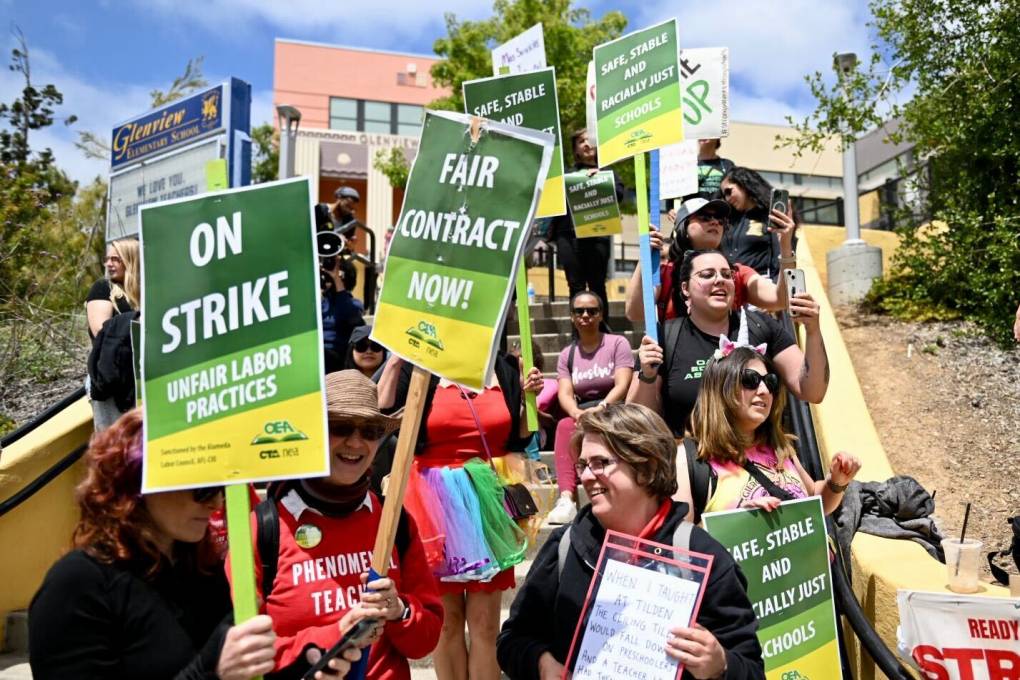
"caption": "Oakland Unified School District teachers, parents and students rally outside Glenview Elementary in Oakland on May 11, 2023, on the sixth day of a district-wide teachers' strike.",
"description": null,
"title": "DSC_9725",
"credit": "Beth LaBerge/KQED",
"status": "inherit",
"altTag": "People hold signs that read \"On Strike, Unfair Labor Practices\" and \"Fair Contract Now!\" outside.",
"isLoading": false,
"fetchFailed": false
},
"news_11949450": {
"type": "attachments",
"id": "news_11949450",
"meta": {
"index": "attachments_1716263798",
"site": "news",
"id": "11949450",
"found": true
},
"parent": 11949445,
"imgSizes": {
"twentyfourteen-full-width": {
"file": "https://ww2.kqed.org/app/uploads/sites/10/2023/05/DSC_9804-1038x576.jpg",
"width": 1038,
"mimeType": "image/jpeg",
"height": 576
},
"thumbnail": {
"file": "https://ww2.kqed.org/app/uploads/sites/10/2023/05/DSC_9804-160x107.jpg",
"width": 160,
"mimeType": "image/jpeg",
"height": 107
},
"post-thumbnail": {
"file": "https://ww2.kqed.org/app/uploads/sites/10/2023/05/DSC_9804-672x372.jpg",
"width": 672,
"mimeType": "image/jpeg",
"height": 372
},
"kqedFullSize": {
"file": "https://ww2.kqed.org/app/uploads/sites/10/2023/05/DSC_9804.jpg",
"width": 1620,
"height": 1080
},
"large": {
"file": "https://ww2.kqed.org/app/uploads/sites/10/2023/05/DSC_9804-1020x680.jpg",
"width": 1020,
"mimeType": "image/jpeg",
"height": 680
},
"1536x1536": {
"file": "https://ww2.kqed.org/app/uploads/sites/10/2023/05/DSC_9804-1536x1024.jpg",
"width": 1536,
"mimeType": "image/jpeg",
"height": 1024
},
"medium": {
"file": "https://ww2.kqed.org/app/uploads/sites/10/2023/05/DSC_9804-800x533.jpg",
"width": 800,
"mimeType": "image/jpeg",
"height": 533
}
},
"publishDate": 1684104975,
"modified": 1684180338,
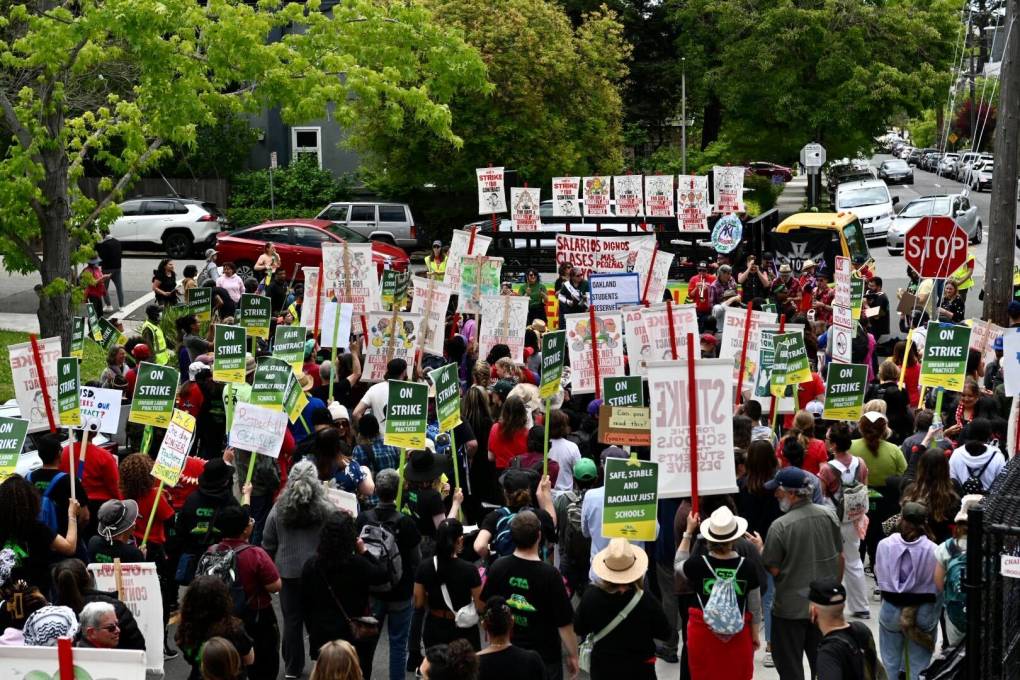
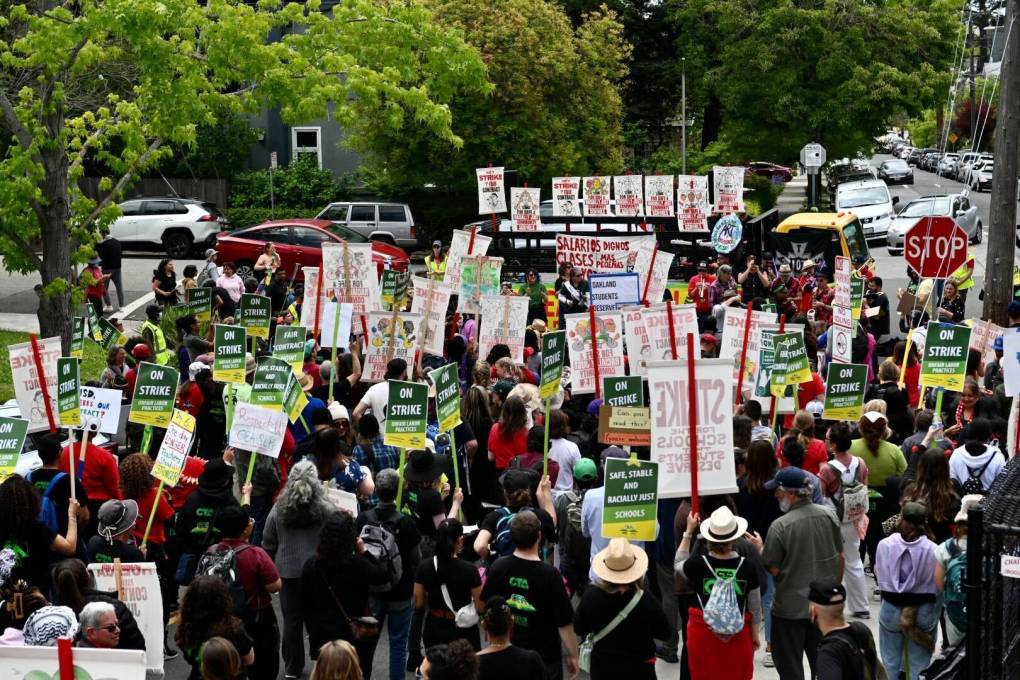
"caption": "Oakland Unified School District teachers, parents and students rally outside Glenview Elementary in Oakland on May 11, 2023, during a teachers' strike in the district.",
"description": null,
"title": "DSC_9804",
"credit": "Beth LaBerge/KQED",
"status": "inherit",
"altTag": "A large crowd of people outside with different colored signs and posters.",
"isLoading": false,
"fetchFailed": false
},
"news_11949255": {
"type": "attachments",
"id": "news_11949255",
"meta": {
"index": "attachments_1716263798",
"site": "news",
"id": "11949255",
"found": true
},
"parent": 11948465,
"imgSizes": {
"twentyfourteen-full-width": {
"file": "https://ww2.kqed.org/app/uploads/sites/10/2023/05/DSC_9773-1038x576.jpg",
"width": 1038,
"mimeType": "image/jpeg",
"height": 576
},
"thumbnail": {
"file": "https://ww2.kqed.org/app/uploads/sites/10/2023/05/DSC_9773-160x107.jpg",
"width": 160,
"mimeType": "image/jpeg",
"height": 107
},
"post-thumbnail": {
"file": "https://ww2.kqed.org/app/uploads/sites/10/2023/05/DSC_9773-672x372.jpg",
"width": 672,
"mimeType": "image/jpeg",
"height": 372
},
"kqedFullSize": {
"file": "https://ww2.kqed.org/app/uploads/sites/10/2023/05/DSC_9773.jpg",
"width": 1620,
"height": 1080
},
"large": {
"file": "https://ww2.kqed.org/app/uploads/sites/10/2023/05/DSC_9773-1020x680.jpg",
"width": 1020,
"mimeType": "image/jpeg",
"height": 680
},
"1536x1536": {
"file": "https://ww2.kqed.org/app/uploads/sites/10/2023/05/DSC_9773-1536x1024.jpg",
"width": 1536,
"mimeType": "image/jpeg",
"height": 1024
},
"medium": {
"file": "https://ww2.kqed.org/app/uploads/sites/10/2023/05/DSC_9773-800x533.jpg",
"width": 800,
"mimeType": "image/jpeg",
"height": 533
}
},
"publishDate": 1683852848,
"modified": 1683854305,
"caption": "Oakland Unified School District teachers, parents and students rally outside Glenview Elementary in Oakland on May 11, 2023, during a teacher strike.",
"description": null,
"title": "DSC_9773",
"credit": "Beth LaBerge/KQED",
"status": "inherit",
"altTag": null,
"isLoading": false,
"fetchFailed": false
},
"news_11948331": {
"type": "attachments",
"id": "news_11948331",
"meta": {
"index": "attachments_1716263798",
"site": "news",
"id": "11948331",
"found": true
},
"title": "RS55916_058_KQED_OaklandTeacherStrike_04292022-qut",
"publishDate": 1683062568,
"status": "inherit",
"parent": 11948320,
"modified": 1772216225,
"caption": "Oakland teachers and students listen to speakers during a rally as part of a one-day walkout on April 29, 2022, to protest the Oakland Unified School District's planned closures. Teachers represented by the Oakland Education Association may go on strike once again on Thursday.",
"credit": "Beth LaBerge/KQED",
"altTag": "An older Black man stands outside at a rally, with a sign hanging from his neck that says: 'Fund Public Schools.'",
"description": null,
"imgSizes": {
"medium": {
"file": "https://cdn.kqed.org/wp-content/uploads/sites/10/2023/05/RS55916_058_KQED_OaklandTeacherStrike_04292022-qut-800x533.jpg",
"width": 800,
"height": 533,
"mimeType": "image/jpeg"
},
"large": {
"file": "https://cdn.kqed.org/wp-content/uploads/sites/10/2023/05/RS55916_058_KQED_OaklandTeacherStrike_04292022-qut-1020x680.jpg",
"width": 1020,
"height": 680,
"mimeType": "image/jpeg"
},
"thumbnail": {
"file": "https://cdn.kqed.org/wp-content/uploads/sites/10/2023/05/RS55916_058_KQED_OaklandTeacherStrike_04292022-qut-160x107.jpg",
"width": 160,
"height": 107,
"mimeType": "image/jpeg"
},
"1536x1536": {
"file": "https://cdn.kqed.org/wp-content/uploads/sites/10/2023/05/RS55916_058_KQED_OaklandTeacherStrike_04292022-qut-1536x1024.jpg",
"width": 1536,
"height": 1024,
"mimeType": "image/jpeg"
},
"post-thumbnail": {
"file": "https://cdn.kqed.org/wp-content/uploads/sites/10/2023/05/RS55916_058_KQED_OaklandTeacherStrike_04292022-qut-672x372.jpg",
"width": 672,
"height": 372,
"mimeType": "image/jpeg"
},
"twentyfourteen-full-width": {
"file": "https://cdn.kqed.org/wp-content/uploads/sites/10/2023/05/RS55916_058_KQED_OaklandTeacherStrike_04292022-qut-1038x576.jpg",
"width": 1038,
"height": 576,
"mimeType": "image/jpeg"
},
"kqedFullSize": {
"file": "https://cdn.kqed.org/wp-content/uploads/sites/10/2023/05/RS55916_058_KQED_OaklandTeacherStrike_04292022-qut.jpg",
"width": 1920,
"height": 1280
}
},
"isLoading": false,
"fetchFailed": false
},
"news_11942101": {
"type": "attachments",
"id": "news_11942101",
"meta": {
"index": "attachments_1716263798",
"site": "news",
"id": "11942101",
"found": true
},
"parent": 11942006,
"imgSizes": {
"twentyfourteen-full-width": {
"file": "https://ww2.kqed.org/app/uploads/sites/10/2023/03/Mother-and-Son-1038x576.jpeg",
"width": 1038,
"mimeType": "image/jpeg",
"height": 576
},
"thumbnail": {
"file": "https://ww2.kqed.org/app/uploads/sites/10/2023/03/Mother-and-Son-160x120.jpeg",
"width": 160,
"mimeType": "image/jpeg",
"height": 120
},
"post-thumbnail": {
"file": "https://ww2.kqed.org/app/uploads/sites/10/2023/03/Mother-and-Son-672x372.jpeg",
"width": 672,
"mimeType": "image/jpeg",
"height": 372
},
"kqedFullSize": {
"file": "https://ww2.kqed.org/app/uploads/sites/10/2023/03/Mother-and-Son-scaled.jpeg",
"width": 2560,
"height": 1920
},
"2048x2048": {
"file": "https://ww2.kqed.org/app/uploads/sites/10/2023/03/Mother-and-Son-2048x1536.jpeg",
"width": 2048,
"mimeType": "image/jpeg",
"height": 1536
},
"large": {
"file": "https://ww2.kqed.org/app/uploads/sites/10/2023/03/Mother-and-Son-1020x765.jpeg",
"width": 1020,
"mimeType": "image/jpeg",
"height": 765
},
"1536x1536": {
"file": "https://ww2.kqed.org/app/uploads/sites/10/2023/03/Mother-and-Son-1536x1152.jpeg",
"width": 1536,
"mimeType": "image/jpeg",
"height": 1152
},
"full-width": {
"file": "https://ww2.kqed.org/app/uploads/sites/10/2023/03/Mother-and-Son-1920x1440.jpeg",
"width": 1920,
"mimeType": "image/jpeg",
"height": 1440
},
"medium": {
"file": "https://ww2.kqed.org/app/uploads/sites/10/2023/03/Mother-and-Son-800x600.jpeg",
"width": 800,
"mimeType": "image/jpeg",
"height": 600
}
},
"publishDate": 1677612447,
"modified": 1677623742,
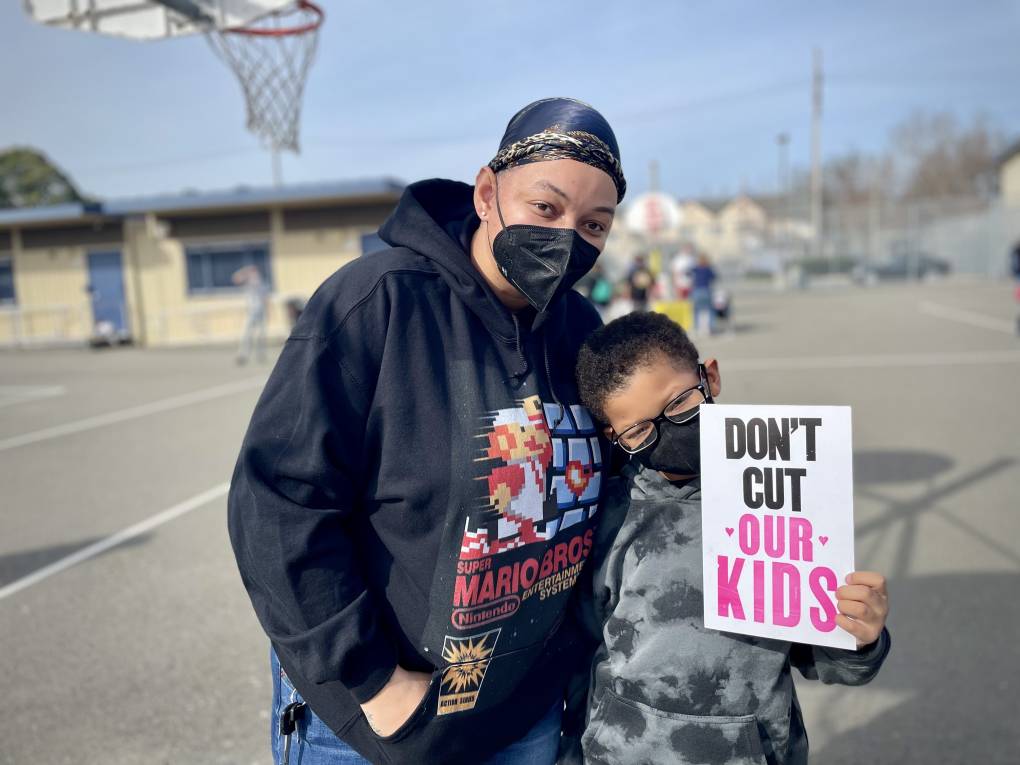
"caption": "Erica Wade and her son Samuel pose for a portrait during a rally against school closures at Prescott School in West Oakland on Feb. 5, 2022. Wade is an OUSD alum, and her son was a student at OUSD's Martin Luther King Jr. Elementary School at the time.",
"description": null,
"title": "Mother and Son",
"credit": "Annelise Finney/KQED",
"status": "inherit",
"altTag": "A smiling woman and child stand next to each other on a playground with their arms around each other, smiling and wearing masks. The child is holding a sign reading 'don't cut our kids'",
"isLoading": false,
"fetchFailed": false
},
"news_11912785": {
"type": "attachments",
"id": "news_11912785",
"meta": {
"index": "attachments_1716263798",
"site": "news",
"id": "11912785",
"found": true
},
"parent": 11912597,
"imgSizes": {
"twentyfourteen-full-width": {
"file": "https://ww2.kqed.org/app/uploads/sites/10/2022/04/Image-from-iOS-18-1-1038x576.jpg",
"width": 1038,
"mimeType": "image/jpeg",
"height": 576
},
"thumbnail": {
"file": "https://ww2.kqed.org/app/uploads/sites/10/2022/04/Image-from-iOS-18-1-160x107.jpg",
"width": 160,
"mimeType": "image/jpeg",
"height": 107
},
"post-thumbnail": {
"file": "https://ww2.kqed.org/app/uploads/sites/10/2022/04/Image-from-iOS-18-1-672x372.jpg",
"width": 672,
"mimeType": "image/jpeg",
"height": 372
},
"kqedFullSize": {
"file": "https://ww2.kqed.org/app/uploads/sites/10/2022/04/Image-from-iOS-18-1.jpg",
"width": 1920,
"height": 1278
},
"large": {
"file": "https://ww2.kqed.org/app/uploads/sites/10/2022/04/Image-from-iOS-18-1-1020x679.jpg",
"width": 1020,
"mimeType": "image/jpeg",
"height": 679
},
"1536x1536": {
"file": "https://ww2.kqed.org/app/uploads/sites/10/2022/04/Image-from-iOS-18-1-1536x1022.jpg",
"width": 1536,
"mimeType": "image/jpeg",
"height": 1022
},
"medium": {
"file": "https://ww2.kqed.org/app/uploads/sites/10/2022/04/Image-from-iOS-18-1-800x533.jpg",
"width": 800,
"mimeType": "image/jpeg",
"height": 533
}
},
"publishDate": 1651277392,
"modified": 1674166763,
"caption": "Demi Johnson, 8, daughter of Moms 4 Housing co-founder Misty Cross, speaks at a rally on April 29, 2022, protesting school closures in the district.",
"description": null,
"title": "Image from iOS (18)",
"credit": "Beth LaBerge/KQED",
"status": "inherit",
"altTag": "A young girl speaks into a microphone in front of a large banner.",
"isLoading": false,
"fetchFailed": false
},
"news_11930240": {
"type": "attachments",
"id": "news_11930240",
"meta": {
"index": "attachments_1716263798",
"site": "news",
"id": "11930240",
"found": true
},
"parent": 11930171,
"imgSizes": {
"twentyfourteen-full-width": {
"file": "https://ww2.kqed.org/app/uploads/sites/10/2022/10/GettyImages-484078301-1038x576.jpg",
"width": 1038,
"mimeType": "image/jpeg",
"height": 576
},
"thumbnail": {
"file": "https://ww2.kqed.org/app/uploads/sites/10/2022/10/GettyImages-484078301-160x106.jpg",
"width": 160,
"mimeType": "image/jpeg",
"height": 106
},
"post-thumbnail": {
"file": "https://ww2.kqed.org/app/uploads/sites/10/2022/10/GettyImages-484078301-672x372.jpg",
"width": 672,
"mimeType": "image/jpeg",
"height": 372
},
"kqedFullSize": {
"file": "https://ww2.kqed.org/app/uploads/sites/10/2022/10/GettyImages-484078301.jpg",
"width": 2124,
"height": 1411
},
"2048x2048": {
"file": "https://ww2.kqed.org/app/uploads/sites/10/2022/10/GettyImages-484078301-2048x1361.jpg",
"width": 2048,
"mimeType": "image/jpeg",
"height": 1361
},
"large": {
"file": "https://ww2.kqed.org/app/uploads/sites/10/2022/10/GettyImages-484078301-1020x678.jpg",
"width": 1020,
"mimeType": "image/jpeg",
"height": 678
},
"1536x1536": {
"file": "https://ww2.kqed.org/app/uploads/sites/10/2022/10/GettyImages-484078301-1536x1020.jpg",
"width": 1536,
"mimeType": "image/jpeg",
"height": 1020
},
"full-width": {
"file": "https://ww2.kqed.org/app/uploads/sites/10/2022/10/GettyImages-484078301-1920x1275.jpg",
"width": 1920,
"mimeType": "image/jpeg",
"height": 1275
},
"medium": {
"file": "https://ww2.kqed.org/app/uploads/sites/10/2022/10/GettyImages-484078301-800x531.jpg",
"width": 800,
"mimeType": "image/jpeg",
"height": 531
}
},
"publishDate": 1666829000,
"modified": 1667066496,
"caption": "Student standardized test scores in California dropped markedly this year, mirroring a nationwide trend.",
"description": null,
"title": "Test with broken Pencil",
"credit": "Michael Quirk via iStock/Getty Images Plus",
"status": "inherit",
"altTag": "A standardized test with a broken yellow pencil.",
"isLoading": false,
"fetchFailed": false
},
"news_11927866": {
"type": "attachments",
"id": "news_11927866",
"meta": {
"index": "attachments_1716263798",
"site": "news",
"id": "11927866",
"found": true
},
"parent": 11927865,
"imgSizes": {
"twentyfourteen-full-width": {
"file": "https://ww2.kqed.org/app/uploads/sites/10/2022/10/RS59078_Oakland_Parents_003-qut-1038x576.jpg",
"width": 1038,
"mimeType": "image/jpeg",
"height": 576
},
"thumbnail": {
"file": "https://ww2.kqed.org/app/uploads/sites/10/2022/10/RS59078_Oakland_Parents_003-qut-160x107.jpg",
"width": 160,
"mimeType": "image/jpeg",
"height": 107
},
"post-thumbnail": {
"file": "https://ww2.kqed.org/app/uploads/sites/10/2022/10/RS59078_Oakland_Parents_003-qut-672x372.jpg",
"width": 672,
"mimeType": "image/jpeg",
"height": 372
},
"kqedFullSize": {
"file": "https://ww2.kqed.org/app/uploads/sites/10/2022/10/RS59078_Oakland_Parents_003-qut.jpg",
"width": 1920,
"height": 1281
},
"large": {
"file": "https://ww2.kqed.org/app/uploads/sites/10/2022/10/RS59078_Oakland_Parents_003-qut-1020x681.jpg",
"width": 1020,
"mimeType": "image/jpeg",
"height": 681
},
"1536x1536": {
"file": "https://ww2.kqed.org/app/uploads/sites/10/2022/10/RS59078_Oakland_Parents_003-qut-1536x1025.jpg",
"width": 1536,
"mimeType": "image/jpeg",
"height": 1025
},
"medium": {
"file": "https://ww2.kqed.org/app/uploads/sites/10/2022/10/RS59078_Oakland_Parents_003-qut-800x534.jpg",
"width": 800,
"mimeType": "image/jpeg",
"height": 534
}
},
"publishDate": 1665019118,
"modified": 1665098550,
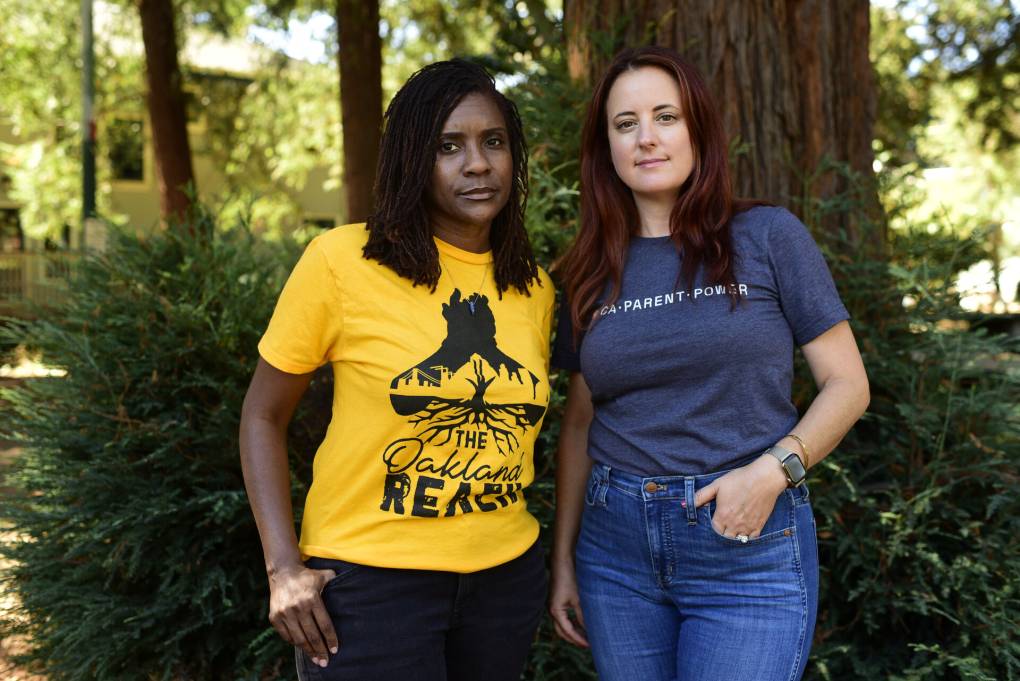
"caption": "Lakisha Young (left) and Megan Bacigalupi stand for a portrait at Dimond Park in Oakland on Oct. 5, 2022. Young is the founder of The Oakland REACH, and Bacigalupi is the co-founder of CA Parent Power, organizations that advocate for parents to have a say in public education policies.",
"description": null,
"title": "KQED_Parent_Advocacy",
"credit": "Marlena Sloss/KQED",
"status": "inherit",
"altTag": "Two women are standing in woods. The woman on the left is wearing a yellow t-shirt and the woman on the right is wearing a navy blue t-shirt.",
"isLoading": false,
"fetchFailed": false
},
"news_11927208": {
"type": "attachments",
"id": "news_11927208",
"meta": {
"index": "attachments_1716263798",
"site": "news",
"id": "11927208",
"found": true
},
"parent": 11927207,
"imgSizes": {
"twentyfourteen-full-width": {
"file": "https://ww2.kqed.org/app/uploads/sites/10/2022/09/GettyImages-1428570636-1024x576.jpg",
"width": 1024,
"mimeType": "image/jpeg",
"height": 576
},
"thumbnail": {
"file": "https://ww2.kqed.org/app/uploads/sites/10/2022/09/GettyImages-1428570636-160x107.jpg",
"width": 160,
"mimeType": "image/jpeg",
"height": 107
},
"post-thumbnail": {
"file": "https://ww2.kqed.org/app/uploads/sites/10/2022/09/GettyImages-1428570636-672x372.jpg",
"width": 672,
"mimeType": "image/jpeg",
"height": 372
},
"kqedFullSize": {
"file": "https://ww2.kqed.org/app/uploads/sites/10/2022/09/GettyImages-1428570636.jpg",
"width": 1024,
"height": 683
},
"large": {
"file": "https://ww2.kqed.org/app/uploads/sites/10/2022/09/GettyImages-1428570636-1020x680.jpg",
"width": 1020,
"mimeType": "image/jpeg",
"height": 680
},
"medium": {
"file": "https://ww2.kqed.org/app/uploads/sites/10/2022/09/GettyImages-1428570636-800x534.jpg",
"width": 800,
"mimeType": "image/jpeg",
"height": 534
}
},
"publishDate": 1664492450,
"modified": 1664506655,
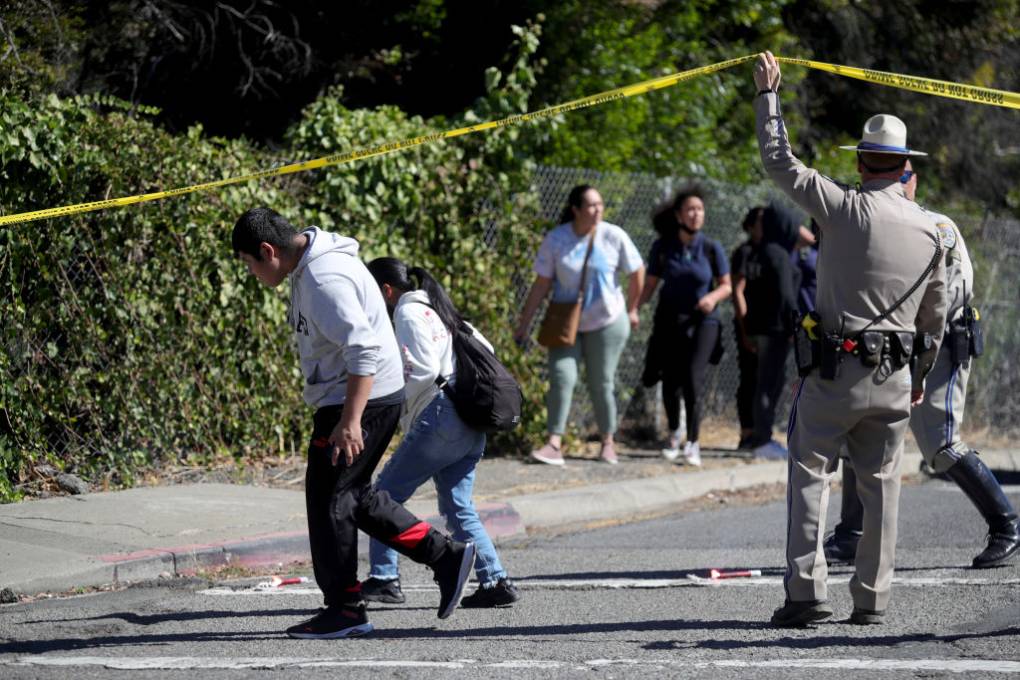
"caption": "Students quickly leave the grounds of King Estates campus, near I-580 in East Oakland, after gunmen fired at least 30 rounds inside one of the schools, wounding six people, on Sept. 28, 2022.",
"description": null,
"title": "Oakland School Shooting",
"credit": "Ray Chavez/MediaNews Group/East Bay Times via Getty Images",
"status": "inherit",
"altTag": "People walk down a street, past yellow caution tape, as law enforcement officers stand by.",
"isLoading": false,
"fetchFailed": false
},
"news_11927089": {
"type": "attachments",
"id": "news_11927089",
"meta": {
"index": "attachments_1716263798",
"site": "news",
"id": "11927089",
"found": true
},
"parent": 11927080,
"imgSizes": {
"twentyfourteen-full-width": {
"file": "https://ww2.kqed.org/app/uploads/sites/10/2022/09/GettyImages-1428570615-1024x576.jpg",
"width": 1024,
"mimeType": "image/jpeg",
"height": 576
},
"thumbnail": {
"file": "https://ww2.kqed.org/app/uploads/sites/10/2022/09/GettyImages-1428570615-160x107.jpg",
"width": 160,
"mimeType": "image/jpeg",
"height": 107
},
"post-thumbnail": {
"file": "https://ww2.kqed.org/app/uploads/sites/10/2022/09/GettyImages-1428570615-672x372.jpg",
"width": 672,
"mimeType": "image/jpeg",
"height": 372
},
"kqedFullSize": {
"file": "https://ww2.kqed.org/app/uploads/sites/10/2022/09/GettyImages-1428570615.jpg",
"width": 1024,
"height": 683
},
"large": {
"file": "https://ww2.kqed.org/app/uploads/sites/10/2022/09/GettyImages-1428570615-1020x680.jpg",
"width": 1020,
"mimeType": "image/jpeg",
"height": 680
},
"medium": {
"file": "https://ww2.kqed.org/app/uploads/sites/10/2022/09/GettyImages-1428570615-800x534.jpg",
"width": 800,
"mimeType": "image/jpeg",
"height": 534
}
},
"publishDate": 1664422570,
"modified": 1664427216,
"caption": "A California Highway Patrol officer lifts caution tape to let parents and students leave the cordoned-off area on Fontaine Street in East Oakland, after six people were shot at the King Estates complex of schools on Sept. 28, 2022.",
"description": null,
"title": "Oakland School Shooting",
"credit": "Ray Chavez/MediaNews Group/East Bay Times via Getty Images",
"status": "inherit",
"altTag": "Two people walk underneath yellow police caution tape held up by a law enforcement officer.",
"isLoading": false,
"fetchFailed": false
}
},
"audioPlayerReducer": {
"postId": "stream_live",
"isPaused": true,
"isPlaying": false,
"pfsActive": false,
"pledgeModalIsOpen": true,
"playerDrawerIsOpen": false,
"liveAudioPlayStartedAt": 0,
"liveAudioPlayContext": ""
},
"authorsReducer": {
"jmcevoy": {
"type": "authors",
"id": "231",
"meta": {
"index": "authors_1716337520",
"id": "231",
"found": true
},
"name": "Julia McEvoy",
"firstName": "Julia",
"lastName": "McEvoy",
"slug": "jmcevoy",
"email": "jmcevoy@KQED.org",
"display_author_email": true,
"staff_mastheads": [
"news"
],
"title": "KQED Senior Editor",
"bio": "Julia McEvoy is KQED's Senior Editor, Education Equity.\r\n\r\nJulia heads KQED’s education coverage examining inequities students face in Bay Area and California schools, and reports on what it will take to educate the next generation.\r\n\r\nJulia's editorial work has received a Peabody Award, a Casey Medal for Coverage of Children and Families, several Edward R. Murrow awards, as well as awards from the Public Radio News Directors Inc. and the Society for Professional Journalists.",
"avatar": "https://secure.gravatar.com/avatar/aec3ce21abe02b302fd33638abd56a22?s=600&d=blank&r=g",
"twitter": "juliamcevoy1",
"facebook": null,
"instagram": null,
"linkedin": null,
"sites": [
{
"site": "news",
"roles": []
},
{
"site": "stateofhealth",
"roles": [
"author"
]
}
],
"headData": {
"title": "Julia McEvoy | KQED",
"description": "KQED Senior Editor",
"ogImgSrc": "https://secure.gravatar.com/avatar/aec3ce21abe02b302fd33638abd56a22?s=600&d=blank&r=g",
"twImgSrc": "https://secure.gravatar.com/avatar/aec3ce21abe02b302fd33638abd56a22?s=600&d=blank&r=g"
},
"isLoading": false,
"link": "/author/jmcevoy"
},
"kqednewsstaffandwires": {
"type": "authors",
"id": "237",
"meta": {
"index": "authors_1716337520",
"id": "237",
"found": true
},
"name": "KQED News Staff and Wires",
"firstName": "KQED News Staff and Wires",
"lastName": null,
"slug": "kqednewsstaffandwires",
"email": "onlinenewsstaff@kqed.org",
"display_author_email": false,
"staff_mastheads": [],
"title": null,
"bio": null,
"avatar": "https://secure.gravatar.com/avatar/72295af8ebbfbd19a4948f5271285664?s=600&d=blank&r=g",
"twitter": null,
"facebook": null,
"instagram": null,
"linkedin": null,
"sites": [
{
"site": "arts",
"roles": [
"contributor"
]
},
{
"site": "news",
"roles": [
"contributor"
]
},
{
"site": "lowdown",
"roles": [
"author"
]
},
{
"site": "stateofhealth",
"roles": [
"contributor"
]
},
{
"site": "food",
"roles": [
"author"
]
}
],
"headData": {
"title": "KQED News Staff and Wires | KQED",
"description": null,
"ogImgSrc": "https://secure.gravatar.com/avatar/72295af8ebbfbd19a4948f5271285664?s=600&d=blank&r=g",
"twImgSrc": "https://secure.gravatar.com/avatar/72295af8ebbfbd19a4948f5271285664?s=600&d=blank&r=g"
},
"isLoading": false,
"link": "/author/kqednewsstaffandwires"
},
"matthewgreen": {
"type": "authors",
"id": "1263",
"meta": {
"index": "authors_1716337520",
"id": "1263",
"found": true
},
"name": "Matthew Green",
"firstName": "Matthew",
"lastName": "Green",
"slug": "matthewgreen",
"email": "mgreen@kqed.org",
"display_author_email": false,
"staff_mastheads": [],
"title": "KQED Editor/Reporter",
"bio": "Matthew Green is a digital media producer for KQED News. He previously produced \u003ca href=\"http://www.kqed.org/lowdown\">The Lowdown\u003c/a>, KQED’s multimedia news education blog. Matthew's written for numerous Bay Area publications, including the Oakland Tribune and San Francisco Chronicle. He also taught journalism classes at Fremont High School in East Oakland.\r\n\r\nEmail: mgreen@kqed.org; Twitter: @MGreenKQED",
"avatar": "https://secure.gravatar.com/avatar/3bf498d1267ca02c8494f33d8cfc575e?s=600&d=blank&r=g",
"twitter": "MGreenKQED",
"facebook": null,
"instagram": null,
"linkedin": null,
"sites": [
{
"site": "news",
"roles": []
},
{
"site": "lowdown",
"roles": []
},
{
"site": "science",
"roles": []
},
{
"site": "education",
"roles": []
},
{
"site": "quest",
"roles": []
},
{
"site": "liveblog",
"roles": []
}
],
"headData": {
"title": "Matthew Green | KQED",
"description": "KQED Editor/Reporter",
"ogImgSrc": "https://secure.gravatar.com/avatar/3bf498d1267ca02c8494f33d8cfc575e?s=600&d=blank&r=g",
"twImgSrc": "https://secure.gravatar.com/avatar/3bf498d1267ca02c8494f33d8cfc575e?s=600&d=blank&r=g"
},
"isLoading": false,
"link": "/author/matthewgreen"
},
"ecruzguevarra": {
"type": "authors",
"id": "8654",
"meta": {
"index": "authors_1716337520",
"id": "8654",
"found": true
},
"name": "Ericka Cruz Guevarra",
"firstName": "Ericka",
"lastName": "Cruz Guevarra",
"slug": "ecruzguevarra",
"email": "ecruzguevarra@kqed.org",
"display_author_email": true,
"staff_mastheads": [
"news"
],
"title": "Producer, The Bay Podcast",
"bio": "Ericka Cruz Guevarra is host of \u003ca href=\"https://www.kqed.org/podcasts/thebay\">\u003cem>The Bay\u003c/em>\u003c/a> podcast at KQED. Before host, she was the show’s producer. Her work in that capacity includes a three-part reported series on policing in Vallejo, which won a 2020 excellence in journalism award from the Society of Professional Journalists. Ericka has worked as a breaking news reporter at Oregon Public Broadcasting, helped produce the Code Switch podcast, and was KQED’s inaugural Raul Ramirez Diversity Fund intern. She’s also an alumna of NPR’s Next Generation Radio program. Send her an email if you have strong feelings about whether Fairfield and Suisun City are the Bay. Ericka is represented by SAG-AFTRA.",
"avatar": "https://secure.gravatar.com/avatar/accefc1de4bafc7e234b69bcb9b6f6536c130fd84709bc3069ef11a78787e1bb?s=600&d=blank&r=g",
"twitter": "NotoriousECG",
"bluesky": null,
"facebook": null,
"instagram": null,
"linkedin": null,
"sites": [
{
"site": "arts",
"roles": [
"subscriber"
]
},
{
"site": "news",
"roles": [
"editor",
"manage_categories"
]
},
{
"site": "futureofyou",
"roles": [
"subscriber"
]
},
{
"site": "stateofhealth",
"roles": [
"subscriber"
]
},
{
"site": "science",
"roles": [
"editor"
]
},
{
"site": "forum",
"roles": [
"subscriber"
]
}
],
"headData": {
"title": "Ericka Cruz Guevarra | KQED",
"description": "Producer, The Bay Podcast",
"ogImgSrc": "https://secure.gravatar.com/avatar/accefc1de4bafc7e234b69bcb9b6f6536c130fd84709bc3069ef11a78787e1bb?s=600&d=blank&r=g",
"twImgSrc": "https://secure.gravatar.com/avatar/accefc1de4bafc7e234b69bcb9b6f6536c130fd84709bc3069ef11a78787e1bb?s=600&d=blank&r=g"
},
"isLoading": false,
"link": "/author/ecruzguevarra"
},
"hmcdede": {
"type": "authors",
"id": "11635",
"meta": {
"index": "authors_1716337520",
"id": "11635",
"found": true
},
"name": "Holly McDede",
"firstName": "Holly",
"lastName": "McDede",
"slug": "hmcdede",
"email": "hmcdede@KQED.org",
"display_author_email": false,
"staff_mastheads": [],
"title": "KQED Contributor",
"bio": null,
"avatar": "https://secure.gravatar.com/avatar/35d1a1f5422c9d266f7ace9348d170f2136671a65fffc90a592e4d7fbf8dc3f6?s=600&d=blank&r=g",
"twitter": null,
"bluesky": null,
"facebook": null,
"instagram": null,
"linkedin": null,
"sites": [
{
"site": "arts",
"roles": [
"editor"
]
},
{
"site": "news",
"roles": [
"edit_others_posts",
"editor"
]
},
{
"site": "science",
"roles": [
"editor"
]
},
{
"site": "forum",
"roles": [
"editor"
]
},
{
"site": "perspectives",
"roles": [
"administrator"
]
}
],
"headData": {
"title": "Holly McDede | KQED",
"description": "KQED Contributor",
"ogImgSrc": "https://secure.gravatar.com/avatar/35d1a1f5422c9d266f7ace9348d170f2136671a65fffc90a592e4d7fbf8dc3f6?s=600&d=blank&r=g",
"twImgSrc": "https://secure.gravatar.com/avatar/35d1a1f5422c9d266f7ace9348d170f2136671a65fffc90a592e4d7fbf8dc3f6?s=600&d=blank&r=g"
},
"isLoading": false,
"link": "/author/hmcdede"
},
"amontecillo": {
"type": "authors",
"id": "11649",
"meta": {
"index": "authors_1716337520",
"id": "11649",
"found": true
},
"name": "Alan Montecillo",
"firstName": "Alan",
"lastName": "Montecillo",
"slug": "amontecillo",
"email": "amontecillo@kqed.org",
"display_author_email": false,
"staff_mastheads": [
"news"
],
"title": "KQED Contributor",
"bio": "Alan Montecillo is the senior editor of \u003cem>\u003ca href=\"http://kqed.org/thebay\">The Bay\u003c/a>, \u003c/em> KQED's local news podcast. Before moving to the Bay Area, he worked as a senior talk show producer for WILL in Champaign-Urbana, Illinois and at Oregon Public Broadcasting in Portland, Oregon. He has won journalism awards from the Society of Professional Journalists Northern California, the Public Media Journalists Association, The Signal Awards, and has also received a regional Edward R. Murrow award. Alan is a Filipino American from Hong Kong and a graduate of Reed College.",
"avatar": "https://secure.gravatar.com/avatar/268f53a2066899ea9efdd8a5900218b17c822d9862cbc9326cccec53ef41d349?s=600&d=blank&r=g",
"twitter": "alanmontecillo",
"bluesky": null,
"facebook": null,
"instagram": null,
"linkedin": null,
"sites": [
{
"site": "",
"roles": [
"editor"
]
},
{
"site": "news",
"roles": [
"editor",
"manage_categories"
]
}
],
"headData": {
"title": "Alan Montecillo | KQED",
"description": "KQED Contributor",
"ogImgSrc": "https://secure.gravatar.com/avatar/268f53a2066899ea9efdd8a5900218b17c822d9862cbc9326cccec53ef41d349?s=600&d=blank&r=g",
"twImgSrc": "https://secure.gravatar.com/avatar/268f53a2066899ea9efdd8a5900218b17c822d9862cbc9326cccec53ef41d349?s=600&d=blank&r=g"
},
"isLoading": false,
"link": "/author/amontecillo"
},
"ebaldassari": {
"type": "authors",
"id": "11652",
"meta": {
"index": "authors_1716337520",
"id": "11652",
"found": true
},
"name": "Erin Baldassari",
"firstName": "Erin",
"lastName": "Baldassari",
"slug": "ebaldassari",
"email": "ebaldassari@KQED.org",
"display_author_email": true,
"staff_mastheads": [
"news"
],
"title": "Staff Writer",
"bio": "Erin Baldassari covers housing for KQED. She's a former print journalist and most recently worked as the transportation reporter for the \u003cem>Mercury News\u003c/em> and \u003cem>East Bay Times. \u003c/em>There, she focused on how the Bay Area’s housing shortage has changed the way people move around the region. She also served on the \u003cem>East Bay Times\u003c/em>’ 2017 Pulitzer Prize-winning team for coverage of the Ghost Ship Fire in Oakland. Prior to that, Erin worked as a breaking news and general assignment reporter for a variety of outlets in the Bay Area and the greater Boston area. A Tufts University alumna, Erin grew up in the foothills of the Sierra Nevada mountains and in Sonoma County. She is a life-long KQED listener.",
"avatar": "https://secure.gravatar.com/avatar/5e95cad64a8ca08288082212e199d2b0cbeb4fd8e8ef5339395f361032bbe005?s=600&d=blank&r=g",
"twitter": "e_baldi",
"bluesky": null,
"facebook": null,
"instagram": null,
"linkedin": null,
"sites": [
{
"site": "news",
"roles": [
"edit_others_posts",
"editor"
]
},
{
"site": "science",
"roles": [
"editor"
]
},
{
"site": "liveblog",
"roles": [
"editor"
]
}
],
"headData": {
"title": "Erin Baldassari | KQED",
"description": "Staff Writer",
"ogImgSrc": "https://secure.gravatar.com/avatar/5e95cad64a8ca08288082212e199d2b0cbeb4fd8e8ef5339395f361032bbe005?s=600&d=blank&r=g",
"twImgSrc": "https://secure.gravatar.com/avatar/5e95cad64a8ca08288082212e199d2b0cbeb4fd8e8ef5339395f361032bbe005?s=600&d=blank&r=g"
},
"isLoading": false,
"link": "/author/ebaldassari"
},
"nnavarro": {
"type": "authors",
"id": "11756",
"meta": {
"index": "authors_1716337520",
"id": "11756",
"found": true
},
"name": "Natalia Navarro",
"firstName": "Natalia",
"lastName": "Navarro",
"slug": "nnavarro",
"email": "nnavarro@kqed.org",
"display_author_email": true,
"staff_mastheads": [
"news"
],
"title": "Afternoon News Anchor",
"bio": "Natalia Navarro is KQED's afternoon radio news anchor. She came to KQED in 2021 from Colorado Public Radio, where she was a reporter and host. She has received several awards for her work covering daily and breaking news from professional organizations such as the San Francisco Press Club, Society of Professional Journalists and the Colorado Broadcasters Association. Natalia is originally from Tucson, Arizona, where she got her start in journalism writing for the Arizona Daily Star, Arizona Public Media and the Tucson Weekly. Natalia earned her bachelor's degree in journalism and economics, and her master's degree in journalism from the University of Arizona.",
"avatar": "https://secure.gravatar.com/avatar/a2bdb19fd9520bdea295a2d5f9b2ad65ec51cf0bf559fb1cc041d3a0a04d62ad?s=600&d=blank&r=g",
"twitter": "@NataliaVNavarro",
"bluesky": null,
"facebook": null,
"instagram": null,
"linkedin": null,
"sites": [
{
"site": "news",
"roles": [
"editor"
]
}
],
"headData": {
"title": "Natalia Navarro | KQED",
"description": "Afternoon News Anchor",
"ogImgSrc": "https://secure.gravatar.com/avatar/a2bdb19fd9520bdea295a2d5f9b2ad65ec51cf0bf559fb1cc041d3a0a04d62ad?s=600&d=blank&r=g",
"twImgSrc": "https://secure.gravatar.com/avatar/a2bdb19fd9520bdea295a2d5f9b2ad65ec51cf0bf559fb1cc041d3a0a04d62ad?s=600&d=blank&r=g"
},
"isLoading": false,
"link": "/author/nnavarro"
},
"jlara": {
"type": "authors",
"id": "11761",
"meta": {
"index": "authors_1716337520",
"id": "11761",
"found": true
},
"name": "Juan Carlos Lara",
"firstName": "Juan Carlos",
"lastName": "Lara",
"slug": "jlara",
"email": "jlara@kqed.org",
"display_author_email": false,
"staff_mastheads": [],
"title": "KQED Contributor",
"bio": null,
"avatar": "https://secure.gravatar.com/avatar/19e2052b9b05657c5ff2af2121846e9c?s=600&d=blank&r=g",
"twitter": null,
"facebook": null,
"instagram": null,
"linkedin": null,
"sites": [
{
"site": "arts",
"roles": [
"editor"
]
},
{
"site": "news",
"roles": [
"editor"
]
},
{
"site": "forum",
"roles": [
"editor"
]
},
{
"site": "liveblog",
"roles": [
"contributor"
]
}
],
"headData": {
"title": "Juan Carlos Lara | KQED",
"description": "KQED Contributor",
"ogImgSrc": "https://secure.gravatar.com/avatar/19e2052b9b05657c5ff2af2121846e9c?s=600&d=blank&r=g",
"twImgSrc": "https://secure.gravatar.com/avatar/19e2052b9b05657c5ff2af2121846e9c?s=600&d=blank&r=g"
},
"isLoading": false,
"link": "/author/jlara"
},
"afinney": {
"type": "authors",
"id": "11772",
"meta": {
"index": "authors_1716337520",
"id": "11772",
"found": true
},
"name": "Annelise Finney",
"firstName": "Annelise",
"lastName": "Finney",
"slug": "afinney",
"email": "afinney@kqed.org",
"display_author_email": false,
"staff_mastheads": [],
"title": "Reporter",
"bio": "Annelise reports on reparations in California and East Bay politics. She co-produced the Sunday Music Drop, a limited-term radio series featuring Bay Area musicians that aired between Sept 2022 and Oct 2024. She joined KQED in 2021 as a general assignment reporter and is an alumna of KALW's Audio Academy. She was born and raised in the East Bay. She is currently away from KQED completing a year-long reporting project in Berlin, Germany as a Alexander Von Humboldt German Chancellor Fellow.",
"avatar": "https://secure.gravatar.com/avatar/b439010ea6540bec1060ee74b3c94314480991106a4a84e774fe5a0fd6605878?s=600&d=mm&r=g",
"twitter": null,
"bluesky": null,
"facebook": null,
"instagram": null,
"linkedin": null,
"sites": [
{
"site": "news",
"roles": [
"subscriber"
]
},
{
"site": "liveblog",
"roles": [
"subscriber"
]
}
],
"headData": {
"title": "Annelise Finney | KQED",
"description": "Reporter",
"ogImgSrc": "https://secure.gravatar.com/avatar/b439010ea6540bec1060ee74b3c94314480991106a4a84e774fe5a0fd6605878?s=600&d=mm&r=g",
"twImgSrc": "https://secure.gravatar.com/avatar/b439010ea6540bec1060ee74b3c94314480991106a4a84e774fe5a0fd6605878?s=600&d=mm&r=g"
},
"isLoading": false,
"link": "/author/afinney"
},
"swhitney": {
"type": "authors",
"id": "11784",
"meta": {
"index": "authors_1716337520",
"id": "11784",
"found": true
},
"name": "Spencer Whitney",
"firstName": "Spencer",
"lastName": "Whitney",
"slug": "swhitney",
"email": "swhitney@kqed.org",
"display_author_email": false,
"staff_mastheads": [],
"title": "KQED Digital Editor",
"bio": "Spencer Whitney is currently a Digital Editor for KQED News. Prior to joining KQED News, Spencer worked as the Multimedia Editor at the Oakland Post and an Assistant Editor in the Editorial department at the San Francisco Chronicle. He attended Howard University as an undergraduate and interned with SiriusXM. He also attended UC Berkeley's Graduate School of Journalism and had the opportunity to write for the hyperlocal news sites Richmond Confidential and Oakland North.",
"avatar": "https://secure.gravatar.com/avatar/e33ff4fd8b8f0d2796f36472fb32607ca8fc46ef5e537dcfdbdee688d8ea5b80?s=600&d=mm&r=g",
"twitter": null,
"bluesky": null,
"facebook": null,
"instagram": null,
"linkedin": null,
"sites": [
{
"site": "arts",
"roles": [
"editor"
]
},
{
"site": "news",
"roles": [
"editor"
]
},
{
"site": "science",
"roles": [
"editor"
]
},
{
"site": "perspectives",
"roles": [
"editor"
]
}
],
"headData": {
"title": "Spencer Whitney | KQED",
"description": "KQED Digital Editor",
"ogImgSrc": "https://secure.gravatar.com/avatar/e33ff4fd8b8f0d2796f36472fb32607ca8fc46ef5e537dcfdbdee688d8ea5b80?s=600&d=mm&r=g",
"twImgSrc": "https://secure.gravatar.com/avatar/e33ff4fd8b8f0d2796f36472fb32607ca8fc46ef5e537dcfdbdee688d8ea5b80?s=600&d=mm&r=g"
},
"isLoading": false,
"link": "/author/swhitney"
},
"mesquinca": {
"type": "authors",
"id": "11802",
"meta": {
"index": "authors_1716337520",
"id": "11802",
"found": true
},
"name": "Maria Esquinca",
"firstName": "Maria",
"lastName": "Esquinca",
"slug": "mesquinca",
"email": "mesquinca@kqed.org",
"display_author_email": false,
"staff_mastheads": [],
"title": "Producer, The Bay",
"bio": "María Esquinca is a producer of The Bay. Before that, she was a New York Women’s Foundation IGNITE Fellow at Latino USA. She worked at Radio Bilingue where she covered the San Joaquin Valley. Maria has interned at WLRN, News 21, The New York Times Student Journalism Institute and at Crain’s Detroit Business as a Dow Jones News Fund Business Reporting Intern. She is an MFA graduate from the University of Miami. In 2017, she graduated from the Walter Cronkite School of Journalism and Mass Communication with a Master of Mass Communication. A fronteriza, she was born in Ciudad Juárez, Chihuahua, Mexico and grew up in El Paso, Texas.",
"avatar": "https://secure.gravatar.com/avatar/77cedba18aae91da775038ba06dcd8d0?s=600&d=blank&r=g",
"twitter": "@m_esquinca",
"facebook": null,
"instagram": null,
"linkedin": null,
"sites": [
{
"site": "news",
"roles": []
}
],
"headData": {
"title": "Maria Esquinca | KQED",
"description": "Producer, The Bay",
"ogImgSrc": "https://secure.gravatar.com/avatar/77cedba18aae91da775038ba06dcd8d0?s=600&d=blank&r=g",
"twImgSrc": "https://secure.gravatar.com/avatar/77cedba18aae91da775038ba06dcd8d0?s=600&d=blank&r=g"
},
"isLoading": false,
"link": "/author/mesquinca"
},
"daisynguyen": {
"type": "authors",
"id": "11829",
"meta": {
"index": "authors_1716337520",
"id": "11829",
"found": true
},
"name": "Daisy Nguyen",
"firstName": "Daisy",
"lastName": "Nguyen",
"slug": "daisynguyen",
"email": "daisynguyen@kqed.org",
"display_author_email": true,
"staff_mastheads": [
"news"
],
"title": "KQED Contributor",
"bio": "I have covered early childhood education and child care for KQED since 2022. I focus on policies aimed at increasing access to early care and education and how they shape individual lives. I've been a journalist for more than two decades, with most of that time devoted to covering breaking news throughout California for The Associated Press. I grew up in San Francisco and studied at UC Davis and Columbia University's Graduate School of Journalism. I live in Oakland with my husband and two kids.",
"avatar": "https://secure.gravatar.com/avatar/2da2127c27f7143b53ebd419800fd55f?s=600&d=blank&r=g",
"twitter": null,
"facebook": null,
"instagram": null,
"linkedin": "https://www.linkedin.com/in/daisynguyen/",
"sites": [
{
"site": "news",
"roles": [
"author"
]
},
{
"site": "liveblog",
"roles": [
"author"
]
}
],
"headData": {
"title": "Daisy Nguyen | KQED",
"description": "KQED Contributor",
"ogImgSrc": "https://secure.gravatar.com/avatar/2da2127c27f7143b53ebd419800fd55f?s=600&d=blank&r=g",
"twImgSrc": "https://secure.gravatar.com/avatar/2da2127c27f7143b53ebd419800fd55f?s=600&d=blank&r=g"
},
"isLoading": false,
"link": "/author/daisynguyen"
},
"sjohnson": {
"type": "authors",
"id": "11840",
"meta": {
"index": "authors_1716337520",
"id": "11840",
"found": true
},
"name": "Sydney Johnson",
"firstName": "Sydney",
"lastName": "Johnson",
"slug": "sjohnson",
"email": "sjohnson@kqed.org",
"display_author_email": false,
"staff_mastheads": [
"news"
],
"title": "KQED Reporter",
"bio": "Sydney Johnson is a general assignment reporter at KQED. She previously reported on public health and city government at the San Francisco Examiner, and before that, she covered statewide education policy for EdSource. Her reporting has won multiple local, state and national awards. Sydney is a graduate of the University of California, Berkeley and lives in San Francisco.",
"avatar": "https://secure.gravatar.com/avatar/97855f2719b72ad6190b7c535fe642c8?s=600&d=blank&r=g",
"twitter": "sydneyfjohnson",
"facebook": null,
"instagram": null,
"linkedin": null,
"sites": [
{
"site": "news",
"roles": [
"editor"
]
}
],
"headData": {
"title": "Sydney Johnson | KQED",
"description": "KQED Reporter",
"ogImgSrc": "https://secure.gravatar.com/avatar/97855f2719b72ad6190b7c535fe642c8?s=600&d=blank&r=g",
"twImgSrc": "https://secure.gravatar.com/avatar/97855f2719b72ad6190b7c535fe642c8?s=600&d=blank&r=g"
},
"isLoading": false,
"link": "/author/sjohnson"
},
"srodriguez": {
"type": "authors",
"id": "11852",
"meta": {
"index": "authors_1716337520",
"id": "11852",
"found": true
},
"name": "Steph Rodriguez",
"firstName": "Steph",
"lastName": "Rodriguez",
"slug": "srodriguez",
"email": "srodriguez@KQED.org",
"display_author_email": true,
"staff_mastheads": [
"news"
],
"title": "KQED Contributor",
"bio": "Steph Rodriguez is an award-winning editor and journalist who specializes in writing stories about food and music, arts and culture. She’s currently a Digital Editor for KQED News in San Francisco. Her past professional experience includes Food Editor for SFGATE as well as Managing Editor and Dining Editor for the Sacramento News & Review. She has roots in Bakersfield and Sacramento California and currently lives in Oakland with her family.",
"avatar": "https://secure.gravatar.com/avatar/5220c101baf7d495ca871563de9b8653e5863afdbd5f55ea5db0dda0732db3a2?s=600&d=blank&r=g",
"twitter": "wordstospill",
"bluesky": null,
"facebook": null,
"instagram": null,
"linkedin": null,
"sites": [
{
"site": "",
"roles": [
"administrator"
]
},
{
"site": "arts",
"roles": [
"administrator"
]
},
{
"site": "news",
"roles": [
"administrator"
]
},
{
"site": "science",
"roles": [
"administrator"
]
}
],
"headData": {
"title": "Steph Rodriguez | KQED",
"description": "KQED Contributor",
"ogImgSrc": "https://secure.gravatar.com/avatar/5220c101baf7d495ca871563de9b8653e5863afdbd5f55ea5db0dda0732db3a2?s=600&d=blank&r=g",
"twImgSrc": "https://secure.gravatar.com/avatar/5220c101baf7d495ca871563de9b8653e5863afdbd5f55ea5db0dda0732db3a2?s=600&d=blank&r=g"
},
"isLoading": false,
"link": "/author/srodriguez"
}
},
"pagesReducer": {
"news_tag_ousd": {
"type": "terms",
"id": "news_3366",
"meta": {
"index": "terms_1716263798",
"site": "news",
"id": "3366",
"score": 9.893801
},
"featImg": null,
"name": "OUSD",
"description": null,
"taxonomy": "tag",
"headData": {
"twImgId": null,
"twTitle": null,
"ogTitle": null,
"ogImgId": null,
"twDescription": null,
"description": null,
"title": "OUSD Archives | KQED News",
"ogDescription": null
},
"ttid": 3384,
"slug": "ousd",
"isLoading": false,
"title": "OUSD",
"pageMeta": {
"site": "news",
"WpPageTemplate": "page-topic-editorial",
"currentPage": 5
},
"blocks": [
{
"blockName": "kqed/post-list",
"attrs": {
"layout": "cardArticle2",
"query": "posts/news?tag=ousd",
"seeMore": false,
"paginated": true,
"page": 5
}
},
{
"blockName": "kqed/ad"
}
]
}
},
"pfsSessionReducer": {},
"postsReducer": {
"stream_live": {
"type": "live",
"id": "stream_live",
"audioUrl": "https://streams.kqed.org/kqedradio",
"title": "Live Stream",
"excerpt": "Live Stream information currently unavailable.",
"link": "/radio",
"featImg": "",
"label": {
"name": "KQED Live",
"link": "/"
}
},
"stream_kqedNewscast": {
"type": "posts",
"id": "stream_kqedNewscast",
"audioUrl": "https://www.kqed.org/.stream/anon/radio/RDnews/newscast.mp3?_=1",
"title": "KQED Newscast",
"featImg": "",
"label": {
"name": "88.5 FM",
"link": "/"
}
},
"news_11988654": {
"type": "posts",
"id": "news_11988654",
"meta": {
"index": "posts_1716263798",
"site": "news",
"id": "11988654",
"score": null,
"sort": [
1717511451000
]
},
"guestAuthors": [],
"slug": "oakland-schools-ditch-the-diesel-with-new-all-electric-school-bus-fleet",
"title": "Oakland Schools Ditch Diesel With New All-Electric School Bus Fleet",
"publishDate": 1717511451,
"format": "standard",
"headTitle": "Oakland Schools Ditch Diesel With New All-Electric School Bus Fleet | KQED",
"labelTerm": {
"site": "news"
},
"content": "\u003cp>Oakland Unified will soon become the first major district in the country to host an all-electric fleet of school buses.\u003c/p>\n\u003cp>Some 1,300 special education students in the district, who have the option of riding the buses, can look forward to quieter and cleaner rides starting at the beginning of the next school year, in August. (Unlike some other Bay Area districts, OUSD does not offer busing for most of its students.)\u003c/p>\n\u003cp>In \u003ca href=\"https://www.facebook.com/ousdnews/posts/pfbid0KE5MdV5nv4LbQ993mYiZ7ZttedxMoJXF72n4LgaSx3ocPsneydKqp973nRiyHbwfl\">a Facebook post last month\u003c/a>, the district announced its new partnership with school transportation company Zum (pronounced ZOOM), based in Redwood City, which is providing and managing the 74-bus fleet.\u003c/p>\n\u003cp>\u003ca href=\"https://www.ridezum.com/blog/zum-launches-nations-first-100-electrified-bidirectional-v2g-school-bus-fleet-in-oakland-ca/\">Zum estimates\u003c/a> the buses will prevent about 25,000 tons of greenhouse gases from entering the environment each year — the amount it said that 74 diesel buses would likely produce.\u003c/p>\n\u003cp>The vehicles are all equipped with bidirectional chargers that replenish the buses overnight but can also enable them to serve as power sources when needed. Zum said its AI technology monitors the buses’ energy use and determines the best times to return power back to the grid while calculating the most efficient bus routes based on traffic patterns.\u003c/p>\n\u003cp>[ad fullwidth]\u003c/p>\n\u003cp>Families will also be able to use an app to track the buses their children are riding on and receive updates about delays, the company said.\u003c/p>\n\u003cp>As part of its initial five-year contract, OUSD will pay Zum $11.2 million a year to run the buses, according to Kimberly Raney, OUSD’s transportation director. About half of the district’s total costs for the service will be covered by federal, state and private grants, she said.\u003c/p>\n\u003cp>“It’s a true partnership of how we do what’s right for the kids,” Raney said. “Oakland is really the perfect place for this. We have a lot of special education kids who need to travel to school using our bus systems.”\u003c/p>\n\u003cp>Diesel exhaust is one of the main air pollutants in California and has been linked to an increased risk of lung cancer and aggravated asthma, among other negative health impacts.\u003c/p>\n\u003cp>A \u003ca href=\"https://scholarworks.sjsu.edu/cgi/viewcontent.cgi?article=1008&context=mcnair#:~:text=Visits%20in%20Oakland,-There%20is%20an&text=For%20West%20Oakland%20children%20aged,rate%20of%20421.9%20per%20100%2C000\">2017 study\u003c/a> found significantly elevated rates of asthma among children in West and East Oakland living near freeways, the port and other high-traffic corridors, with Black and Latino children making up more than 60% of Alameda County’s asthma-related hospitalizations.[aside postID=\"news_11973450,news_11980715,science_1992222\" label=\"Related Stories\"]“OUSD is the first, but there is an eagerness from federal, state, and local partners across the country to electrify their school bus fleets,” Ritu Narayan, Zum’s CEO and co-founder, said in an email. The company, she notes, already has existing contracts with smaller Southern California districts as well as contracts with San Francisco and Los Angeles school districts. “Our goal is to expand the program and have 10,000 electric school buses deployed across the country over the next several years.”\u003c/p>\n\u003cp>PG&E worked with Zum for two years to complete the large East Oakland charging site for the bus fleet, a project that required significant infrastructure upgrades, including the installation of a new transformer and 171 feet of underground infrastructure, according to Paul Doherty, a spokesperson for the utility.\u003c/p>\n\u003cp>Although OUSD is ahead of the curve in its bus electrification efforts, the district’s move marks a transition that most school districts in California will have to start making within the next decade. That’s due to \u003ca href=\"https://www.gov.ca.gov/wp-content/uploads/2023/10/AB-579-Signing-Message.pdf\">a 2023 state law\u003c/a> requiring all new or leased state school buses to be zero-emission beginning in 2035 — with extensions for rural school districts.\u003c/p>\n\u003cp>Gov. Gavin Newsom is pushing for the state to spend $1.8 billion over the next five years to help districts acquire more zero-emission buses and charging equipment.\u003c/p>\n\u003cp>The state Legislature had initially committed $500 million annually toward electric school buses for the next two school years. Newson’s budget plan would add nearly $400 million more to the pot for next year.\u003c/p>\n\u003cfigure id=\"attachment_11987992\" class=\"wp-caption alignnone\" style=\"max-width: 2560px\">\u003ca href=\"https://cdn.kqed.org/wp-content/uploads/sites/10/2024/05/Zum_0307_highres-scaled.jpg\">\u003cimg loading=\"lazy\" decoding=\"async\" class=\"size-full wp-image-11987992\" src=\"https://cdn.kqed.org/wp-content/uploads/sites/10/2024/05/Zum_0307_highres-scaled.jpg\" alt=\"A woman wearing a green shirt and a man wearing a dark shirt stand in between two school buses and a charging station.\" width=\"2560\" height=\"1708\" srcset=\"https://cdn.kqed.org/wp-content/uploads/sites/10/2024/05/Zum_0307_highres-scaled.jpg 2560w, https://cdn.kqed.org/wp-content/uploads/sites/10/2024/05/Zum_0307_highres-800x534.jpg 800w, https://cdn.kqed.org/wp-content/uploads/sites/10/2024/05/Zum_0307_highres-1020x680.jpg 1020w, https://cdn.kqed.org/wp-content/uploads/sites/10/2024/05/Zum_0307_highres-160x107.jpg 160w, https://cdn.kqed.org/wp-content/uploads/sites/10/2024/05/Zum_0307_highres-1536x1025.jpg 1536w, https://cdn.kqed.org/wp-content/uploads/sites/10/2024/05/Zum_0307_highres-2048x1366.jpg 2048w, https://cdn.kqed.org/wp-content/uploads/sites/10/2024/05/Zum_0307_highres-1920x1281.jpg 1920w\" sizes=\"auto, (max-width: 2560px) 100vw, 2560px\">\u003c/a>\u003cfigcaption class=\"wp-caption-text\">Zum CEO Ritu Narayan (front) and COO Vivek Garg pose with the first of the 74 electric school buses it will be running in Oakland. \u003ccite>(Courtesy of Zum)\u003c/cite>\u003c/figcaption>\u003c/figure>\n\u003cp>However, that \u003ca href=\"https://edsource.org/2024/newsom-prioritizes-electric-school-buses-over-preschool-for-children-with-disabilities/712445\">proposal has proven controversial\u003c/a> among some education advocates and parents, as the money would come at the expense of the state’s Inclusive Early Education Expansion Program, which helps train preschool teachers to better serve children with disabilities.\u003c/p>\n\u003cp>“As a special education administrator and somebody who’s been in the special education field, I think students with disabilities are more important than electric buses,” Anthony Rebelo, chair of the Coalition for Adequate Funding for Special Education, \u003ca href=\"https://edsource.org/2024/newsom-prioritizes-electric-school-buses-over-preschool-for-children-with-disabilities/712445\">recently told EdSource\u003c/a>.\u003c/p>\n\u003cp>School bus driver Marjorie Urbina has been picking up and dropping off students in San Francisco for decades and has experience driving more than a dozen different types of school buses. She began working in Oakland two years ago and now drives for Zum on a contract basis.\u003c/p>\n\u003cp>Urbina said the Zum buses are much quieter and easier to clean, and the driver’s seat is more comfortable than other buses she’s driven.\u003c/p>\n\u003cp>The new buses also have driver-side tablets that display navigation tools and allow drivers and dispatchers to connect in real-time.\u003c/p>\n\u003cp>\u003c/p>\n\u003cp>“With the new buses, we asked for certain things, like making the ceiling more soundproof to help diffuse the noise of the kids,” Urbina said, noting that those improvements have made her job a bit easier. “That atmosphere of having a quiet bus keeps the environment inside a little more relaxed.”\u003c/p>\n\n",
"blocks": [],
"excerpt": "Many special education students in Oakland will ride on quieter and cleaner buses starting next school year, when Oakland Unified becomes the first major district in the country to launch an all-electric fleet of school buses. ",
"status": "publish",
"parent": 0,
"modified": 1740180109,
"stats": {
"hasAudio": false,
"hasVideo": false,
"hasChartOrMap": false,
"iframeSrcs": [],
"hasGoogleForm": false,
"hasGallery": false,
"hasHearkenModule": false,
"hasPolis": false,
"paragraphCount": 22,
"wordCount": 943
},
"headData": {
"title": "Oakland Schools Ditch Diesel With New All-Electric School Bus Fleet | KQED",
"description": "Many special education students in Oakland will ride on quieter and cleaner buses starting next school year, when Oakland Unified becomes the first major district in the country to launch an all-electric fleet of school buses. ",
"ogTitle": "",
"ogDescription": "",
"ogImgId": "",
"twTitle": "",
"twDescription": "",
"twImgId": "",
"schema": {
"@context": "https://schema.org",
"@type": "NewsArticle",
"headline": "Oakland Schools Ditch Diesel With New All-Electric School Bus Fleet",
"datePublished": "2024-06-04T07:30:51-07:00",
"dateModified": "2025-02-21T15:21:49-08:00",
"image": "https://cdn.kqed.org/wp-content/uploads/2020/02/KQED-OG-Image@1x.png",
"isAccessibleForFree": "True",
"publisher": {
"@type": "NewsMediaOrganization",
"@id": "https://www.kqed.org/#organization",
"name": "KQED",
"logo": "https://cdn.kqed.org/wp-content/uploads/2020/02/KQED-OG-Image@1x.png",
"url": "https://www.kqed.org",
"sameAs": [
"https://www.facebook.com/KQED",
"https://twitter.com/KQED",
"https://www.instagram.com/kqed/",
"https://www.tiktok.com/@kqedofficial",
"https://www.linkedin.com/company/kqed",
"https://www.youtube.com/channel/UCeC0IOo7i1P_61zVUWbJ4nw"
]
}
}
},
"sticky": false,
"nprStoryId": "kqed-11988654",
"excludeFromSiteSearch": "Include",
"articleAge": "0",
"path": "/news/11988654/oakland-schools-ditch-the-diesel-with-new-all-electric-school-bus-fleet",
"audioTrackLength": null,
"parsedContent": [
{
"type": "contentString",
"content": "\u003cdiv class=\"post-body\">\u003cp>\u003cp>Oakland Unified will soon become the first major district in the country to host an all-electric fleet of school buses.\u003c/p>\n\u003cp>Some 1,300 special education students in the district, who have the option of riding the buses, can look forward to quieter and cleaner rides starting at the beginning of the next school year, in August. (Unlike some other Bay Area districts, OUSD does not offer busing for most of its students.)\u003c/p>\n\u003cp>In \u003ca href=\"https://www.facebook.com/ousdnews/posts/pfbid0KE5MdV5nv4LbQ993mYiZ7ZttedxMoJXF72n4LgaSx3ocPsneydKqp973nRiyHbwfl\">a Facebook post last month\u003c/a>, the district announced its new partnership with school transportation company Zum (pronounced ZOOM), based in Redwood City, which is providing and managing the 74-bus fleet.\u003c/p>\n\u003cp>\u003ca href=\"https://www.ridezum.com/blog/zum-launches-nations-first-100-electrified-bidirectional-v2g-school-bus-fleet-in-oakland-ca/\">Zum estimates\u003c/a> the buses will prevent about 25,000 tons of greenhouse gases from entering the environment each year — the amount it said that 74 diesel buses would likely produce.\u003c/p>\n\u003cp>The vehicles are all equipped with bidirectional chargers that replenish the buses overnight but can also enable them to serve as power sources when needed. Zum said its AI technology monitors the buses’ energy use and determines the best times to return power back to the grid while calculating the most efficient bus routes based on traffic patterns.\u003c/p>\n\u003cp>\u003c/p>\u003c/div>",
"attributes": {
"named": {},
"numeric": []
}
},
{
"type": "component",
"content": "",
"name": "ad",
"attributes": {
"named": {
"label": "fullwidth"
},
"numeric": [
"fullwidth"
]
}
},
{
"type": "contentString",
"content": "\u003cdiv class=\"post-body\">\u003cp>\u003c/p>\n\u003cp>Families will also be able to use an app to track the buses their children are riding on and receive updates about delays, the company said.\u003c/p>\n\u003cp>As part of its initial five-year contract, OUSD will pay Zum $11.2 million a year to run the buses, according to Kimberly Raney, OUSD’s transportation director. About half of the district’s total costs for the service will be covered by federal, state and private grants, she said.\u003c/p>\n\u003cp>“It’s a true partnership of how we do what’s right for the kids,” Raney said. “Oakland is really the perfect place for this. We have a lot of special education kids who need to travel to school using our bus systems.”\u003c/p>\n\u003cp>Diesel exhaust is one of the main air pollutants in California and has been linked to an increased risk of lung cancer and aggravated asthma, among other negative health impacts.\u003c/p>\n\u003cp>A \u003ca href=\"https://scholarworks.sjsu.edu/cgi/viewcontent.cgi?article=1008&context=mcnair#:~:text=Visits%20in%20Oakland,-There%20is%20an&text=For%20West%20Oakland%20children%20aged,rate%20of%20421.9%20per%20100%2C000\">2017 study\u003c/a> found significantly elevated rates of asthma among children in West and East Oakland living near freeways, the port and other high-traffic corridors, with Black and Latino children making up more than 60% of Alameda County’s asthma-related hospitalizations.\u003c/p>\u003c/div>",
"attributes": {
"named": {},
"numeric": []
}
},
{
"type": "component",
"content": "",
"name": "aside",
"attributes": {
"named": {
"postid": "news_11973450,news_11980715,science_1992222",
"label": "Related Stories "
},
"numeric": []
}
},
{
"type": "contentString",
"content": "\u003cdiv class=\"post-body\">\u003cp>“OUSD is the first, but there is an eagerness from federal, state, and local partners across the country to electrify their school bus fleets,” Ritu Narayan, Zum’s CEO and co-founder, said in an email. The company, she notes, already has existing contracts with smaller Southern California districts as well as contracts with San Francisco and Los Angeles school districts. “Our goal is to expand the program and have 10,000 electric school buses deployed across the country over the next several years.”\u003c/p>\n\u003cp>PG&E worked with Zum for two years to complete the large East Oakland charging site for the bus fleet, a project that required significant infrastructure upgrades, including the installation of a new transformer and 171 feet of underground infrastructure, according to Paul Doherty, a spokesperson for the utility.\u003c/p>\n\u003cp>Although OUSD is ahead of the curve in its bus electrification efforts, the district’s move marks a transition that most school districts in California will have to start making within the next decade. That’s due to \u003ca href=\"https://www.gov.ca.gov/wp-content/uploads/2023/10/AB-579-Signing-Message.pdf\">a 2023 state law\u003c/a> requiring all new or leased state school buses to be zero-emission beginning in 2035 — with extensions for rural school districts.\u003c/p>\n\u003cp>Gov. Gavin Newsom is pushing for the state to spend $1.8 billion over the next five years to help districts acquire more zero-emission buses and charging equipment.\u003c/p>\n\u003cp>The state Legislature had initially committed $500 million annually toward electric school buses for the next two school years. Newson’s budget plan would add nearly $400 million more to the pot for next year.\u003c/p>\n\u003cfigure id=\"attachment_11987992\" class=\"wp-caption alignnone\" style=\"max-width: 2560px\">\u003ca href=\"https://cdn.kqed.org/wp-content/uploads/sites/10/2024/05/Zum_0307_highres-scaled.jpg\">\u003cimg loading=\"lazy\" decoding=\"async\" class=\"size-full wp-image-11987992\" src=\"https://cdn.kqed.org/wp-content/uploads/sites/10/2024/05/Zum_0307_highres-scaled.jpg\" alt=\"A woman wearing a green shirt and a man wearing a dark shirt stand in between two school buses and a charging station.\" width=\"2560\" height=\"1708\" srcset=\"https://cdn.kqed.org/wp-content/uploads/sites/10/2024/05/Zum_0307_highres-scaled.jpg 2560w, https://cdn.kqed.org/wp-content/uploads/sites/10/2024/05/Zum_0307_highres-800x534.jpg 800w, https://cdn.kqed.org/wp-content/uploads/sites/10/2024/05/Zum_0307_highres-1020x680.jpg 1020w, https://cdn.kqed.org/wp-content/uploads/sites/10/2024/05/Zum_0307_highres-160x107.jpg 160w, https://cdn.kqed.org/wp-content/uploads/sites/10/2024/05/Zum_0307_highres-1536x1025.jpg 1536w, https://cdn.kqed.org/wp-content/uploads/sites/10/2024/05/Zum_0307_highres-2048x1366.jpg 2048w, https://cdn.kqed.org/wp-content/uploads/sites/10/2024/05/Zum_0307_highres-1920x1281.jpg 1920w\" sizes=\"auto, (max-width: 2560px) 100vw, 2560px\">\u003c/a>\u003cfigcaption class=\"wp-caption-text\">Zum CEO Ritu Narayan (front) and COO Vivek Garg pose with the first of the 74 electric school buses it will be running in Oakland. \u003ccite>(Courtesy of Zum)\u003c/cite>\u003c/figcaption>\u003c/figure>\n\u003cp>However, that \u003ca href=\"https://edsource.org/2024/newsom-prioritizes-electric-school-buses-over-preschool-for-children-with-disabilities/712445\">proposal has proven controversial\u003c/a> among some education advocates and parents, as the money would come at the expense of the state’s Inclusive Early Education Expansion Program, which helps train preschool teachers to better serve children with disabilities.\u003c/p>\n\u003cp>“As a special education administrator and somebody who’s been in the special education field, I think students with disabilities are more important than electric buses,” Anthony Rebelo, chair of the Coalition for Adequate Funding for Special Education, \u003ca href=\"https://edsource.org/2024/newsom-prioritizes-electric-school-buses-over-preschool-for-children-with-disabilities/712445\">recently told EdSource\u003c/a>.\u003c/p>\n\u003cp>School bus driver Marjorie Urbina has been picking up and dropping off students in San Francisco for decades and has experience driving more than a dozen different types of school buses. She began working in Oakland two years ago and now drives for Zum on a contract basis.\u003c/p>\n\u003cp>Urbina said the Zum buses are much quieter and easier to clean, and the driver’s seat is more comfortable than other buses she’s driven.\u003c/p>\n\u003cp>The new buses also have driver-side tablets that display navigation tools and allow drivers and dispatchers to connect in real-time.\u003c/p>\n\u003cp>\u003c/p>\n\u003cp>“With the new buses, we asked for certain things, like making the ceiling more soundproof to help diffuse the noise of the kids,” Urbina said, noting that those improvements have made her job a bit easier. “That atmosphere of having a quiet bus keeps the environment inside a little more relaxed.”\u003c/p>\n\n\u003c/div>\u003c/p>",
"attributes": {
"named": {},
"numeric": []
}
}
],
"link": "/news/11988654/oakland-schools-ditch-the-diesel-with-new-all-electric-school-bus-fleet",
"authors": [
"11784"
],
"categories": [
"news_18540",
"news_8",
"news_356"
],
"tags": [
"news_33200",
"news_20013",
"news_21348",
"news_30472",
"news_34146",
"news_27626",
"news_34054",
"news_1826",
"news_3366",
"news_140",
"news_20517"
],
"featImg": "news_11987993",
"label": "news"
},
"news_11949719": {
"type": "posts",
"id": "news_11949719",
"meta": {
"index": "posts_1716263798",
"site": "news",
"id": "11949719",
"score": null,
"sort": [
1684317617000
]
},
"parent": 0,
"labelTerm": {},
"blocks": [],
"publishDate": 1684317617,
"format": "audio",
"title": "The End of the Oakland Teacher Strike",
"headTitle": "The End of the Oakland Teacher Strike | KQED",
"content": "\u003cp>\u003cspan style=\"font-weight: 400\">The Oakland teacher’s strike ended on Monday, when the teachers union reached a tentative agreement with the district. Classes were canceled for tens of thousands of students for seven days. The deal not only includes pay raises for teachers and other school staff, but also so-called “common good” proposals that address broader community needs, like support for unhoused families and improvements to transportation access and infrastructure.\u003c/span>\u003c/p>\n\u003cp>\u003ca href=\"https://drive.google.com/file/d/1MYvkMDWsCP-sDR8aqqcXjN8tzF5AP-fJ/view?usp=share_link\">\u003cem>Episode transcript\u003c/em>\u003c/a>\u003c/p>\n\u003cp>\u003c!-- iframe plugin v.4.3 wordpress.org/plugins/iframe/ -->\u003cbr>\n\u003ciframe loading=\"lazy\" frameborder=\"0\" height=\"200\" scrolling=\"no\" src=\"https://playlist.megaphone.fm/?e=KQINC2460582530\" width=\"100%\" class=\"iframe-class\">\u003c/iframe>\u003c/p>\n\u003cp>[ad fullwidth]\u003c/p>\u003cp>\u003c/p>\n",
"stats": {
"hasVideo": false,
"hasChartOrMap": false,
"hasAudio": true,
"hasPolis": false,
"wordCount": 75,
"hasGoogleForm": false,
"hasGallery": false,
"hasHearkenModule": false,
"iframeSrcs": [],
"paragraphCount": 5
},
"modified": 1700682611,
"excerpt": "The deal not only includes pay raises for teachers and other school staff, but also proposals that address broader community needs.",
"headData": {
"twImgId": "",
"twTitle": "",
"ogTitle": "",
"ogImgId": "",
"twDescription": "",
"description": "The deal not only includes pay raises for teachers and other school staff, but also proposals that address broader community needs.",
"title": "The End of the Oakland Teacher Strike | KQED",
"ogDescription": "",
"schema": {
"@context": "https://schema.org",
"@type": "NewsArticle",
"headline": "The End of the Oakland Teacher Strike",
"datePublished": "2023-05-17T03:00:17-07:00",
"dateModified": "2023-11-22T11:50:11-08:00",
"image": "https://cdn.kqed.org/wp-content/uploads/2020/02/KQED-OG-Image@1x.png",
"isAccessibleForFree": "True",
"publisher": {
"@type": "NewsMediaOrganization",
"@id": "https://www.kqed.org/#organization",
"name": "KQED",
"logo": "https://cdn.kqed.org/wp-content/uploads/2020/02/KQED-OG-Image@1x.png",
"url": "https://www.kqed.org",
"sameAs": [
"https://www.facebook.com/KQED",
"https://twitter.com/KQED",
"https://www.instagram.com/kqed/",
"https://www.tiktok.com/@kqedofficial",
"https://www.linkedin.com/company/kqed",
"https://www.youtube.com/channel/UCeC0IOo7i1P_61zVUWbJ4nw"
]
}
}
},
"guestAuthors": [],
"slug": "the-end-of-the-oakland-teacher-strike",
"status": "publish",
"sourceUrl": "https://www.kqed.org/podcasts/thebay",
"audioUrl": "https://www.podtrac.com/pts/redirect.mp3/chrt.fm/track/A511B8/traffic.megaphone.fm/KQINC2460582530.mp3?updated=1684270313",
"excludeFromSiteSearch": "Include",
"source": "The Bay",
"articleAge": "0",
"path": "/news/11949719/the-end-of-the-oakland-teacher-strike",
"audioTrackLength": null,
"parsedContent": [
{
"type": "contentString",
"content": "\u003cdiv class=\"post-body\">\u003cp>\u003cp>\u003cspan style=\"font-weight: 400\">The Oakland teacher’s strike ended on Monday, when the teachers union reached a tentative agreement with the district. Classes were canceled for tens of thousands of students for seven days. The deal not only includes pay raises for teachers and other school staff, but also so-called “common good” proposals that address broader community needs, like support for unhoused families and improvements to transportation access and infrastructure.\u003c/span>\u003c/p>\n\u003cp>\u003ca href=\"https://drive.google.com/file/d/1MYvkMDWsCP-sDR8aqqcXjN8tzF5AP-fJ/view?usp=share_link\">\u003cem>Episode transcript\u003c/em>\u003c/a>\u003c/p>\n\u003cp>\u003c!-- iframe plugin v.4.3 wordpress.org/plugins/iframe/ -->\u003cbr>\n\u003ciframe loading=\"lazy\" frameborder=\"0\" height=\"200\" scrolling=\"no\" src=\"https://playlist.megaphone.fm/?e=KQINC2460582530\" width=\"100%\" class=\"iframe-class\">\u003c/iframe>\u003c/p>\n\u003cp>\u003c/p>\u003c/div>",
"attributes": {
"named": {},
"numeric": []
}
},
{
"type": "component",
"content": "",
"name": "ad",
"attributes": {
"named": {
"label": "fullwidth"
},
"numeric": [
"fullwidth"
]
}
},
{
"type": "contentString",
"content": "\u003cdiv class=\"post-body\">\u003cp>\u003c/p>\u003cp>\u003c/p>\n\u003c/div>\u003c/p>",
"attributes": {
"named": {},
"numeric": []
}
}
],
"link": "/news/11949719/the-end-of-the-oakland-teacher-strike",
"authors": [
"8654",
"11756",
"11649",
"11802",
"11844"
],
"programs": [
"news_28779"
],
"categories": [
"news_8",
"news_33520"
],
"tags": [
"news_3366",
"news_25073",
"news_22598"
],
"featImg": "news_11949722",
"label": "source_news_11949719"
},
"news_11949458": {
"type": "posts",
"id": "news_11949458",
"meta": {
"index": "posts_1716263798",
"site": "news",
"id": "11949458",
"score": null,
"sort": [
1684153559000
]
},
"guestAuthors": [],
"slug": "oakland-teachers-strike-ends-as-union-reaches-agreement-with-school-district",
"title": "Oakland Teachers' Strike Ends as Union Reaches Tentative Agreement With School District",
"publishDate": 1684153559,
"format": "standard",
"headTitle": "Oakland Teachers’ Strike Ends as Union Reaches Tentative Agreement With School District | KQED",
"labelTerm": {
"site": "news"
},
"content": "\u003cp>\u003cem>Updated 5:30 p.m. Monday\u003c/em>\u003c/p>\n\u003cp>The Oakland teachers union and school district reached a tentative agreement early Monday morning to end a teachers’ strike that lasted seven days and effectively closed down schools for tens of thousands of students, with just weeks left in the school year.\u003c/p>\n\u003cp>The deal for a new two-and-a-half-year contract includes major pay raises for teachers in addition to commitments from the district to significantly increase investments in school and student resources and to give teachers and parents more decision-making power in certain schools.\u003c/p>\n\u003cp>Schools were open Monday and some classes were in session, but Oakland Unified School District officials noted that it was a “transition day,” with attendance optional, and with full-class instruction resuming Tuesday, May 16 — leaving just eight days left in the school year.\u003c/p>\n\u003cp>AC Transit confirmed it would resume normal operations of all supplementary bus-line services to schools starting Tuesday morning.\u003c/p>\n\u003cp>https://twitter.com/OaklandEA/status/1658058431574712322\u003c/p>\n\u003cp>\u003ca href=\"https://drive.google.com/file/d/1T8fP1eYlFXfBx0hWdKtNRSdEaP30iPU2/view\">The new tentative contract\u003c/a> includes a 15.5% pay raise for most teachers, and more for newer educators at the bottom of the pay scale. Under the deal, a first-year teacher, who currently earns $52,905, would now start out at $62,696, and a top-tier educator could earn as much as nearly $110,000 — in addition to full paid benefits and district pension contributions.\u003c/p>\n\u003cp>In addition, if approved, all union members would receive the equivalent of a 10% raise in back pay, retroactive to Nov. 1, 2022, as well as a $5,000 one-time bonus.\u003c/p>\n\u003cp>Overall, the new contract amounts to a $70 million investment, the district said.\u003c/p>\n\u003cp>Teachers are expected to vote this week on the tentative agreement, which the school board also must approve.\u003c/p>\n\u003cp>“My goal has always been to stabilize the foundation of our district through fiscal stewardship so that eventually we could position ourselves to pay our teachers and educators what they deserve,” OUSD Superintendent Kyla Johnson-Trammell said during a press conference Monday, calling the raise “historic.”\u003c/p>\n\u003cp>“And I want to underscore, we realize we’re not there yet,” she said. “This is one crucial step towards getting there.”\u003c/p>\n\u003cp>District officials on Monday said they do not expect to extend the school year to make up for the days teachers were striking, and that most graduation ceremonies will proceed as planned.\u003c/p>\n\u003cp>Roughly 3,000 educators, counselors and other school staffers represented by the Oakland Education Association first walked out on May 4 amid stalled negotiations with the district. Along with traditional asks, like higher salaries, the union demanded a set of “common good” changes to better support students and families inside and outside the classroom.\u003c/p>\n\u003cp>“This has never only been about teacher salary. This isn’t just about us trying to get a living wage, or to be able to afford the housing here in Oakland. It’s also been about making sure that our students have the ability to be housed as well,” Kampala Taiz-Rancifer, OEA’s vice president, said during a press conference on Monday. “This strike has never simply been about us being able to put food on our own tables but making sure we are able to provide student services and shifting the way we provide instruction to feed the minds of these students.”\u003c/p>\n\u003cp>\u003ca href=\"https://apnews.com/article/oakland-teachers-strike-schools-42eba9bb923fb71432117c8ac38caca5\">Common good proposals\u003c/a> that address community issues have become an increasingly standard part of the bargaining process for teachers unions over the last decade, a precedent set by \u003ca href=\"https://newlaborforum.cuny.edu/2022/08/15/the-chicago-teachers-strike-ten-years-on-organizing-for-the-common-good-then-and-now/\">striking Chicago teachers in 2012\u003c/a> who demanded, and ultimately achieved, greater influence in how schools are managed.[aside postID=\"news_11949281,news_11948465,news_11912597\" label=\"Related Posts\"]In the hard-fought deal struck in Oakland on Monday, the two sides agreed to a shared-governance model for the district’s set of \u003ca href=\"https://www.ousd.org/communityschools\">community schools\u003c/a>, with steering-committee members appointed by both the school board and the union, according to OEA.\u003c/p>\n\u003cp>Both sides also agreed to identify district-owned locations that could be used to house students and to help secure housing vouchers and other financial support from government agencies.\u003c/p>\n\u003cp>Additionally, a new reparations task force — with co-chairs appointed by both the union and district — would identify schools with student populations that are at least 40% Black, and implement plans to help those students thrive.\u003c/p>\n\u003cp>Under the terms of the new agreement, guidance counselors would, for the first time, begin working at elementary schools, and teachers at those schools would receive additional preparation time. More resources would also be devoted to special education programs in the district. And the sizes of physical education and transitional kindergarten classes would be slightly reduced, with teachers paid extra for overages.\u003c/p>\n\u003cp>The district would also slightly increase the overall number of librarians and nurses and boost investments in visual and performing arts programs.\u003c/p>\n\u003cp>“Our common goal is to create an environment in which our children, families, educators and district staff are able to thrive,” Oakland Mayor Sheng Thao said in a statement emailed to KQED on Monday. “I look forward to working with OUSD and OEA as my Administration continues to invest in community and school safety, affordable housing, and improved infrastructure, not only to attract teachers and families to Oakland, but to keep them here.”\u003c/p>\n\u003cp>Negotiations throughout the strike were contentious, with the union accusing district officials of bargaining “in bad faith,” and the district calling teachers’ demands unreasonable and naive and claiming their actions would jeopardize students’ grades and graduation prospects. Tony Thurmond, the state superintendent of public instruction, and other government officials stepped in to help break the impasse at the bargaining table.\u003c/p>\n\u003cp>Teachers \u003ca href=\"https://oaklandside.org/2023/03/22/whats-happening-with-ousd-union-negotiations-it-depends-who-you-ask/\">began the bargaining process last October\u003c/a>, and have been working without a contract since their previous one expired in March. The district, \u003ca href=\"https://www.sfchronicle.com/bayarea/article/oakland-school-board-financial-crisis-cuts-17813237.php\">facing major budgetary challenges\u003c/a> amid years of declining enrollment, initially refused to bargain with teachers over the “common good” proposals, insisting on only considering more conventional issues, like wages and working conditions. But after union negotiators held firm, seven days into the walkout, the district over the weekend acceded to some of their additional demands.\u003c/p>\n\u003cp>Kimi Lee, a parent of two OUSD students, said her family went to sleep on Sunday night assuming school would be called off yet again on Monday. After receiving the early morning announcement about the tentative deal, both of her kids decided to wait until Tuesday to return to their classrooms.\u003c/p>\n\u003cp>The length of the strike “was a bit of a shock,” said Lee, who initially expected it wouldn’t last more than a few days.\u003c/p>\n\u003cp>“But overall, we supported the teachers. The teachers were fighting for the bigger picture,” she said. “The fact that homelessness, climate and all these other issues were folded in, we agreed with that.”\u003c/p>\n\u003cp>For Rob Daves, an OUSD parent who used to be a teacher in the district, news of the agreement came as very welcome relief.\u003c/p>\n\u003cp>“Glad [the] strike is over. [It] was a huge impact on our family and especially our daughter,” Daves said in a text message.\u003c/p>\n\u003cp>But he noted he was disappointed that neither side adequately underscored the need for the state to dramatically increase funding for Oakland’s underresourced schools.\u003c/p>\n\u003cp>“If we actually value education, we must show it in material support,” he said.\u003c/p>\n\u003cp>\u003cem>This story includes reporting from KQED’s Vanessa Rancaño and Spencer Whitney, and The Associated Press.\u003c/em>\u003cbr>\n[ad fullwidth]\u003c/p>\n\u003cp>[ad floatright]\u003c/p>\n",
"blocks": [],
"excerpt": "Oakland teachers and students are heading back to school — with regular classroom instruction resuming Tuesday — after the teachers union reached a tentative agreement with the district early Monday morning, ending the seven-day strike.\r\n",
"status": "publish",
"parent": 0,
"modified": 1740699850,
"stats": {
"hasAudio": false,
"hasVideo": false,
"hasChartOrMap": false,
"iframeSrcs": [],
"hasGoogleForm": false,
"hasGallery": false,
"hasHearkenModule": false,
"hasPolis": false,
"paragraphCount": 31,
"wordCount": 1273
},
"headData": {
"title": "Oakland Teachers' Strike Ends as Union Reaches Tentative Agreement With School District | KQED",
"description": "Oakland teachers and students are heading back to school — with regular classroom instruction resuming Tuesday — after the teachers union reached a tentative agreement with the district early Monday morning, ending the seven-day strike.\r\n",
"ogTitle": "",
"ogDescription": "",
"ogImgId": "",
"twTitle": "",
"twDescription": "",
"twImgId": "",
"schema": {
"@context": "https://schema.org",
"@type": "NewsArticle",
"headline": "Oakland Teachers' Strike Ends as Union Reaches Tentative Agreement With School District",
"datePublished": "2023-05-15T05:25:59-07:00",
"dateModified": "2025-02-27T15:44:10-08:00",
"image": "https://cdn.kqed.org/wp-content/uploads/2020/02/KQED-OG-Image@1x.png",
"isAccessibleForFree": "True",
"publisher": {
"@type": "NewsMediaOrganization",
"@id": "https://www.kqed.org/#organization",
"name": "KQED",
"logo": "https://cdn.kqed.org/wp-content/uploads/2020/02/KQED-OG-Image@1x.png",
"url": "https://www.kqed.org",
"sameAs": [
"https://www.facebook.com/KQED",
"https://twitter.com/KQED",
"https://www.instagram.com/kqed/",
"https://www.tiktok.com/@kqedofficial",
"https://www.linkedin.com/company/kqed",
"https://www.youtube.com/channel/UCeC0IOo7i1P_61zVUWbJ4nw"
]
}
}
},
"sticky": false,
"excludeFromSiteSearch": "Include",
"articleAge": "0",
"path": "/news/11949458/oakland-teachers-strike-ends-as-union-reaches-agreement-with-school-district",
"audioTrackLength": null,
"parsedContent": [
{
"type": "contentString",
"content": "\u003cdiv class=\"post-body\">\u003cp>\u003cp>\u003cem>Updated 5:30 p.m. Monday\u003c/em>\u003c/p>\n\u003cp>The Oakland teachers union and school district reached a tentative agreement early Monday morning to end a teachers’ strike that lasted seven days and effectively closed down schools for tens of thousands of students, with just weeks left in the school year.\u003c/p>\n\u003cp>The deal for a new two-and-a-half-year contract includes major pay raises for teachers in addition to commitments from the district to significantly increase investments in school and student resources and to give teachers and parents more decision-making power in certain schools.\u003c/p>\n\u003cp>Schools were open Monday and some classes were in session, but Oakland Unified School District officials noted that it was a “transition day,” with attendance optional, and with full-class instruction resuming Tuesday, May 16 — leaving just eight days left in the school year.\u003c/p>\n\u003cp>AC Transit confirmed it would resume normal operations of all supplementary bus-line services to schools starting Tuesday morning.\u003c/p>\u003c/p>\u003c/div>",
"attributes": {
"named": {},
"numeric": []
}
},
{
"type": "component",
"content": "",
"name": "singleTwitterStatus",
"attributes": {
"named": {
"id": "1658058431574712322"
},
"numeric": []
}
},
{
"type": "contentString",
"content": "\u003cdiv class=\"post-body\">\u003cp>\n\u003cp>\u003ca href=\"https://drive.google.com/file/d/1T8fP1eYlFXfBx0hWdKtNRSdEaP30iPU2/view\">The new tentative contract\u003c/a> includes a 15.5% pay raise for most teachers, and more for newer educators at the bottom of the pay scale. Under the deal, a first-year teacher, who currently earns $52,905, would now start out at $62,696, and a top-tier educator could earn as much as nearly $110,000 — in addition to full paid benefits and district pension contributions.\u003c/p>\n\u003cp>In addition, if approved, all union members would receive the equivalent of a 10% raise in back pay, retroactive to Nov. 1, 2022, as well as a $5,000 one-time bonus.\u003c/p>\n\u003cp>Overall, the new contract amounts to a $70 million investment, the district said.\u003c/p>\n\u003cp>Teachers are expected to vote this week on the tentative agreement, which the school board also must approve.\u003c/p>\n\u003cp>“My goal has always been to stabilize the foundation of our district through fiscal stewardship so that eventually we could position ourselves to pay our teachers and educators what they deserve,” OUSD Superintendent Kyla Johnson-Trammell said during a press conference Monday, calling the raise “historic.”\u003c/p>\n\u003cp>“And I want to underscore, we realize we’re not there yet,” she said. “This is one crucial step towards getting there.”\u003c/p>\n\u003cp>District officials on Monday said they do not expect to extend the school year to make up for the days teachers were striking, and that most graduation ceremonies will proceed as planned.\u003c/p>\n\u003cp>Roughly 3,000 educators, counselors and other school staffers represented by the Oakland Education Association first walked out on May 4 amid stalled negotiations with the district. Along with traditional asks, like higher salaries, the union demanded a set of “common good” changes to better support students and families inside and outside the classroom.\u003c/p>\n\u003cp>“This has never only been about teacher salary. This isn’t just about us trying to get a living wage, or to be able to afford the housing here in Oakland. It’s also been about making sure that our students have the ability to be housed as well,” Kampala Taiz-Rancifer, OEA’s vice president, said during a press conference on Monday. “This strike has never simply been about us being able to put food on our own tables but making sure we are able to provide student services and shifting the way we provide instruction to feed the minds of these students.”\u003c/p>\n\u003cp>\u003ca href=\"https://apnews.com/article/oakland-teachers-strike-schools-42eba9bb923fb71432117c8ac38caca5\">Common good proposals\u003c/a> that address community issues have become an increasingly standard part of the bargaining process for teachers unions over the last decade, a precedent set by \u003ca href=\"https://newlaborforum.cuny.edu/2022/08/15/the-chicago-teachers-strike-ten-years-on-organizing-for-the-common-good-then-and-now/\">striking Chicago teachers in 2012\u003c/a> who demanded, and ultimately achieved, greater influence in how schools are managed.\u003c/p>\u003c/div>",
"attributes": {
"named": {},
"numeric": []
}
},
{
"type": "component",
"content": "",
"name": "aside",
"attributes": {
"named": {
"postid": "news_11949281,news_11948465,news_11912597",
"label": "Related Posts "
},
"numeric": []
}
},
{
"type": "contentString",
"content": "\u003cdiv class=\"post-body\">\u003cp>In the hard-fought deal struck in Oakland on Monday, the two sides agreed to a shared-governance model for the district’s set of \u003ca href=\"https://www.ousd.org/communityschools\">community schools\u003c/a>, with steering-committee members appointed by both the school board and the union, according to OEA.\u003c/p>\n\u003cp>Both sides also agreed to identify district-owned locations that could be used to house students and to help secure housing vouchers and other financial support from government agencies.\u003c/p>\n\u003cp>Additionally, a new reparations task force — with co-chairs appointed by both the union and district — would identify schools with student populations that are at least 40% Black, and implement plans to help those students thrive.\u003c/p>\n\u003cp>Under the terms of the new agreement, guidance counselors would, for the first time, begin working at elementary schools, and teachers at those schools would receive additional preparation time. More resources would also be devoted to special education programs in the district. And the sizes of physical education and transitional kindergarten classes would be slightly reduced, with teachers paid extra for overages.\u003c/p>\n\u003cp>The district would also slightly increase the overall number of librarians and nurses and boost investments in visual and performing arts programs.\u003c/p>\n\u003cp>“Our common goal is to create an environment in which our children, families, educators and district staff are able to thrive,” Oakland Mayor Sheng Thao said in a statement emailed to KQED on Monday. “I look forward to working with OUSD and OEA as my Administration continues to invest in community and school safety, affordable housing, and improved infrastructure, not only to attract teachers and families to Oakland, but to keep them here.”\u003c/p>\n\u003cp>Negotiations throughout the strike were contentious, with the union accusing district officials of bargaining “in bad faith,” and the district calling teachers’ demands unreasonable and naive and claiming their actions would jeopardize students’ grades and graduation prospects. Tony Thurmond, the state superintendent of public instruction, and other government officials stepped in to help break the impasse at the bargaining table.\u003c/p>\n\u003cp>Teachers \u003ca href=\"https://oaklandside.org/2023/03/22/whats-happening-with-ousd-union-negotiations-it-depends-who-you-ask/\">began the bargaining process last October\u003c/a>, and have been working without a contract since their previous one expired in March. The district, \u003ca href=\"https://www.sfchronicle.com/bayarea/article/oakland-school-board-financial-crisis-cuts-17813237.php\">facing major budgetary challenges\u003c/a> amid years of declining enrollment, initially refused to bargain with teachers over the “common good” proposals, insisting on only considering more conventional issues, like wages and working conditions. But after union negotiators held firm, seven days into the walkout, the district over the weekend acceded to some of their additional demands.\u003c/p>\n\u003cp>Kimi Lee, a parent of two OUSD students, said her family went to sleep on Sunday night assuming school would be called off yet again on Monday. After receiving the early morning announcement about the tentative deal, both of her kids decided to wait until Tuesday to return to their classrooms.\u003c/p>\n\u003cp>The length of the strike “was a bit of a shock,” said Lee, who initially expected it wouldn’t last more than a few days.\u003c/p>\n\u003cp>“But overall, we supported the teachers. The teachers were fighting for the bigger picture,” she said. “The fact that homelessness, climate and all these other issues were folded in, we agreed with that.”\u003c/p>\n\u003cp>For Rob Daves, an OUSD parent who used to be a teacher in the district, news of the agreement came as very welcome relief.\u003c/p>\n\u003cp>“Glad [the] strike is over. [It] was a huge impact on our family and especially our daughter,” Daves said in a text message.\u003c/p>\n\u003cp>But he noted he was disappointed that neither side adequately underscored the need for the state to dramatically increase funding for Oakland’s underresourced schools.\u003c/p>\n\u003cp>“If we actually value education, we must show it in material support,” he said.\u003c/p>\n\u003cp>\u003cem>This story includes reporting from KQED’s Vanessa Rancaño and Spencer Whitney, and The Associated Press.\u003c/em>\u003cbr>\n\u003c/p>\u003c/div>",
"attributes": {
"named": {},
"numeric": []
}
},
{
"type": "component",
"content": "",
"name": "ad",
"attributes": {
"named": {
"label": "fullwidth"
},
"numeric": [
"fullwidth"
]
}
},
{
"type": "contentString",
"content": "\u003cdiv class=\"post-body\">\u003cp>\u003c/p>\n\u003cp>\u003c/p>\u003c/div>",
"attributes": {
"named": {},
"numeric": []
}
},
{
"type": "component",
"content": "",
"name": "ad",
"attributes": {
"named": {
"label": "floatright"
},
"numeric": [
"floatright"
]
}
},
{
"type": "contentString",
"content": "\u003cdiv class=\"post-body\">\u003cp>\u003c/p>\n\u003c/div>\u003c/p>",
"attributes": {
"named": {},
"numeric": []
}
}
],
"link": "/news/11949458/oakland-teachers-strike-ends-as-union-reaches-agreement-with-school-district",
"authors": [
"1263",
"11840"
],
"categories": [
"news_8"
],
"tags": [
"news_27626",
"news_2432",
"news_31016",
"news_1826",
"news_3366",
"news_794"
],
"featImg": "news_11949459",
"label": "news"
},
"news_11949445": {
"type": "posts",
"id": "news_11949445",
"meta": {
"index": "posts_1716263798",
"site": "news",
"id": "11949445",
"score": null,
"sort": [
1684106101000
]
},
"parent": 0,
"labelTerm": {
"site": "news"
},
"blocks": [],
"publishDate": 1684106101,
"format": "standard",
"title": "Oakland’s Teachers and School District Agree on Four ‘Common Good’ Demands",
"headTitle": "Oakland’s Teachers and School District Agree on Four ‘Common Good’ Demands | KQED",
"content": "\u003cp>\u003cstrong>Update, 10:30 p.m. Sunday:\u003c/strong> The Oakland Education Association said the teachers’ strike would continue tomorrow morning unless the Oakland Unified School District completed and produced an accurate document reflecting an agreement reached earlier between the two groups by 11 p.m.\u003c/p>\n\u003cp>“We started this strike because of OUSD’s dysfunction and if we are on strike tomorrow, it is because of their indifference to our students, lack of respect for educators and inability to complete the simplest of tasks,” the Oakland Education Association said on \u003ca href=\"https://twitter.com/OaklandEA/status/1657981551194566656\">Twitter\u003c/a> Sunday night. “Unless you hear otherwise, we will see you on the picket line at 7:30 am tomorrow.”\u003c/p>\n\u003cp>https://twitter.com/OaklandEA/status/1657981551194566656\u003c/p>\n\u003cp>\u003cstrong>Original story, 4:16 p.m. Sunday.\u003c/strong> The Oakland Unified School District and striking teachers have reached agreement on four “common good” provisions that had been sticking points during the walkout that is now in its second week.\u003c/p>\n\u003cp>“We are still on strike, but momentum is on our side,” the Oakland Education Association said on \u003ca href=\"https://twitter.com/OaklandEA?ref_src=twsrc%5Egoogle%7Ctwcamp%5Eserp%7Ctwgr%5Eauthor\">Twitter\u003c/a> Saturday night.\u003c/p>\n\u003cp>https://twitter.com/OaklandEA/status/1657569419877560321\u003c/p>\n\u003cp>The union representing 3,000 educators, counselors and other workers has maintained the district has failed to bargain in good faith on a new three-year contract that also makes more traditional demands like higher salaries. The striking workers want their contract to also include provisions that address racial equity, homelessness and environmental justice for students.\u003c/p>\n\u003cp>[aside postID=\"news_11949281,news_11948465,news_11912597\" label=\"Related Posts\"]On Saturday night, four of those demands had been agreed upon, relating to housing and transportation; the community schools grant; the Black thriving community schools initiative; and school closures, the \u003ca href=\"https://www.eastbaytimes.com/2023/05/14/oaklands-striking-teachers-and-school-district-reach-agreement-on-four-common-good-demands/\">Bay Area News Group\u003c/a> reported.\u003c/p>\n\u003cp>It was not immediately clear Sunday morning how close the two sides were on reaching a deal on the demands still left on the table, particularly related to increased compensation.\u003c/p>\n\u003cp>Superintendent Kyla Johnson-Trammell said in a message to parents last week that the district, the state’s 11th largest, is offering raises of as much as 22% for some teachers.\u003c/p>\n\u003cp>[ad fullwidth]\u003c/p>\n\u003cp>Teachers have maintained that adding support beyond the classroom would improve learning conditions and retain educators. Other common good demands include providing more mental health support, fixing deteriorating schools and offering subsidized transportation for students from lower-income families.\u003c/p>\n\u003cp>The strike comes at the end of the school year, which wraps up May 25. But the district’s 80 schools have remained open to the district’s 34,000 students, with meals being offered and office staff educating and supervising. Only about 1,200 students have shown up to school since the strike started May 4, district spokesperson John Sasaki said last week.\u003c/p>\n\u003cp>\u003cem>The Associated Press and KQED’s Spencer Whitney contributed reporting to this story.\u003c/em>\u003c/p>\n\u003cp>\u003c/p>\n",
"stats": {
"hasVideo": false,
"hasChartOrMap": false,
"hasAudio": false,
"hasPolis": false,
"wordCount": 470,
"hasGoogleForm": false,
"hasGallery": false,
"hasHearkenModule": false,
"iframeSrcs": [],
"paragraphCount": 13
},
"modified": 1684185091,
"excerpt": "The Oakland Education Association said the teachers' strike would continue tomorrow unless the Oakland Unified School District completed and produced an accurate document reflecting an agreement reached earlier between the two groups by 11 p.m.",
"headData": {
"twImgId": "",
"twTitle": "",
"ogTitle": "",
"ogImgId": "",
"twDescription": "",
"description": "The Oakland Education Association said the teachers' strike would continue tomorrow unless the Oakland Unified School District completed and produced an accurate document reflecting an agreement reached earlier between the two groups by 11 p.m.",
"title": "Oakland’s Teachers and School District Agree on Four ‘Common Good’ Demands | KQED",
"ogDescription": "",
"schema": {
"@context": "https://schema.org",
"@type": "NewsArticle",
"headline": "Oakland’s Teachers and School District Agree on Four ‘Common Good’ Demands",
"datePublished": "2023-05-14T16:15:01-07:00",
"dateModified": "2023-05-15T14:11:31-07:00",
"image": "https://cdn.kqed.org/wp-content/uploads/2020/02/KQED-OG-Image@1x.png",
"isAccessibleForFree": "True",
"publisher": {
"@type": "NewsMediaOrganization",
"@id": "https://www.kqed.org/#organization",
"name": "KQED",
"logo": "https://cdn.kqed.org/wp-content/uploads/2020/02/KQED-OG-Image@1x.png",
"url": "https://www.kqed.org",
"sameAs": [
"https://www.facebook.com/KQED",
"https://twitter.com/KQED",
"https://www.instagram.com/kqed/",
"https://www.tiktok.com/@kqedofficial",
"https://www.linkedin.com/company/kqed",
"https://www.youtube.com/channel/UCeC0IOo7i1P_61zVUWbJ4nw"
]
}
}
},
"guestAuthors": [],
"slug": "oaklands-teachers-and-school-district-reach-agreement-on-four-common-good-demands-as-strike-continues",
"status": "publish",
"excludeFromSiteSearch": "Include",
"articleAge": "0",
"path": "/news/11949445/oaklands-teachers-and-school-district-reach-agreement-on-four-common-good-demands-as-strike-continues",
"audioTrackLength": null,
"parsedContent": [
{
"type": "contentString",
"content": "\u003cdiv class=\"post-body\">\u003cp>\u003cp>\u003cstrong>Update, 10:30 p.m. Sunday:\u003c/strong> The Oakland Education Association said the teachers’ strike would continue tomorrow morning unless the Oakland Unified School District completed and produced an accurate document reflecting an agreement reached earlier between the two groups by 11 p.m.\u003c/p>\n\u003cp>“We started this strike because of OUSD’s dysfunction and if we are on strike tomorrow, it is because of their indifference to our students, lack of respect for educators and inability to complete the simplest of tasks,” the Oakland Education Association said on \u003ca href=\"https://twitter.com/OaklandEA/status/1657981551194566656\">Twitter\u003c/a> Sunday night. “Unless you hear otherwise, we will see you on the picket line at 7:30 am tomorrow.”\u003c/p>\u003c/p>\u003c/div>",
"attributes": {
"named": {},
"numeric": []
}
},
{
"type": "component",
"content": "",
"name": "singleTwitterStatus",
"attributes": {
"named": {
"id": "1657981551194566656"
},
"numeric": []
}
},
{
"type": "contentString",
"content": "\u003cdiv class=\"post-body\">\u003cp>\n\u003cp>\u003cstrong>Original story, 4:16 p.m. Sunday.\u003c/strong> The Oakland Unified School District and striking teachers have reached agreement on four “common good” provisions that had been sticking points during the walkout that is now in its second week.\u003c/p>\n\u003cp>“We are still on strike, but momentum is on our side,” the Oakland Education Association said on \u003ca href=\"https://twitter.com/OaklandEA?ref_src=twsrc%5Egoogle%7Ctwcamp%5Eserp%7Ctwgr%5Eauthor\">Twitter\u003c/a> Saturday night.\u003c/p>\u003c/p>\u003c/div>",
"attributes": {
"named": {},
"numeric": []
}
},
{
"type": "component",
"content": "",
"name": "singleTwitterStatus",
"attributes": {
"named": {
"id": "1657569419877560321"
},
"numeric": []
}
},
{
"type": "contentString",
"content": "\u003cdiv class=\"post-body\">\u003cp>\n\u003cp>The union representing 3,000 educators, counselors and other workers has maintained the district has failed to bargain in good faith on a new three-year contract that also makes more traditional demands like higher salaries. The striking workers want their contract to also include provisions that address racial equity, homelessness and environmental justice for students.\u003c/p>\n\u003cp>\u003c/p>\u003c/div>",
"attributes": {
"named": {},
"numeric": []
}
},
{
"type": "component",
"content": "",
"name": "aside",
"attributes": {
"named": {
"postid": "news_11949281,news_11948465,news_11912597",
"label": "Related Posts "
},
"numeric": []
}
},
{
"type": "contentString",
"content": "\u003cdiv class=\"post-body\">\u003cp>On Saturday night, four of those demands had been agreed upon, relating to housing and transportation; the community schools grant; the Black thriving community schools initiative; and school closures, the \u003ca href=\"https://www.eastbaytimes.com/2023/05/14/oaklands-striking-teachers-and-school-district-reach-agreement-on-four-common-good-demands/\">Bay Area News Group\u003c/a> reported.\u003c/p>\n\u003cp>It was not immediately clear Sunday morning how close the two sides were on reaching a deal on the demands still left on the table, particularly related to increased compensation.\u003c/p>\n\u003cp>Superintendent Kyla Johnson-Trammell said in a message to parents last week that the district, the state’s 11th largest, is offering raises of as much as 22% for some teachers.\u003c/p>\n\u003cp>\u003c/p>\u003c/div>",
"attributes": {
"named": {},
"numeric": []
}
},
{
"type": "component",
"content": "",
"name": "ad",
"attributes": {
"named": {
"label": "fullwidth"
},
"numeric": [
"fullwidth"
]
}
},
{
"type": "contentString",
"content": "\u003cdiv class=\"post-body\">\u003cp>\u003c/p>\n\u003cp>Teachers have maintained that adding support beyond the classroom would improve learning conditions and retain educators. Other common good demands include providing more mental health support, fixing deteriorating schools and offering subsidized transportation for students from lower-income families.\u003c/p>\n\u003cp>The strike comes at the end of the school year, which wraps up May 25. But the district’s 80 schools have remained open to the district’s 34,000 students, with meals being offered and office staff educating and supervising. Only about 1,200 students have shown up to school since the strike started May 4, district spokesperson John Sasaki said last week.\u003c/p>\n\u003cp>\u003cem>The Associated Press and KQED’s Spencer Whitney contributed reporting to this story.\u003c/em>\u003c/p>\n\u003cp>\u003c/p>\n\u003c/div>\u003c/p>",
"attributes": {
"named": {},
"numeric": []
}
}
],
"link": "/news/11949445/oaklands-teachers-and-school-district-reach-agreement-on-four-common-good-demands-as-strike-continues",
"authors": [
"237"
],
"categories": [
"news_8"
],
"tags": [
"news_32734",
"news_27626",
"news_3366",
"news_24949"
],
"featImg": "news_11949450",
"label": "news"
},
"news_11948465": {
"type": "posts",
"id": "news_11948465",
"meta": {
"index": "posts_1716263798",
"site": "news",
"id": "11948465",
"score": null,
"sort": [
1683921861000
]
},
"parent": 0,
"labelTerm": {
"site": "news"
},
"blocks": [],
"publishDate": 1683921861,
"format": "standard",
"title": "Oakland Teachers' Strike Continues Despite Incremental Gains at Bargaining Table",
"headTitle": "Oakland Teachers’ Strike Continues Despite Incremental Gains at Bargaining Table | KQED",
"content": "\u003cp>\u003cem>This article will no longer be updated.\u003c/em>\u003c/p>\n\u003cp>\u003cstrong>Update, 2 p.m. Friday:\u003c/strong> As the standoff between striking educators and the Oakland Unified School District continues into its seventh school day, a major sticking point remains the “common good” demands from the union, with both sides citing wildly varying figures on the costs of implementing them.\u003c/p>\n\u003cp>In an emailed statement Thursday evening, OUSD Director of Communications John Sasaki told KQED that the Oakland Education Association’s proposal is “cost prohibitive” and that the overall price tag could run upwards of $1 billion. Sasaki said many of the “common good” demands would fall under \u003ca href=\"https://www.ousd.org/site/handlers/filedownload.ashx?moduleinstanceid=39353&dataid=36993&FileName=2020%20Facilities%20Master%20Plan.pdf\">OUSD’s Facilities Master Plan (PDF)\u003c/a>, which “shows the District has a total of $3.4 billion in upgrades and other changes that must happen to get all schools upgraded and modernized,” adding that OEA’s proposal is “far too costly for the District to handle” and that it should not be included in any collective bargaining agreement.\u003c/p>\n\u003cp>But Rachel Warino of the California Teachers Association — which has expressed its solidarity with the OEA — said OUSD’s numbers are “months old” and “ridiculous.”\u003c/p>\n\u003cp>“The goals we are committed to winning would cost an estimated $500,000 annually — this would be to pay for staffing increases including counselors,” Warino said, in a statement emailed to KQED on Thursday evening. “It’s unfortunate that the district is spending time sending out outlandish claims about proposals that are months old when we are 6 days into a strike. It’s unfair and unhelpful for our Oakland community.”\u003c/p>\n\u003cp>Warino did not provide cost estimates for the rest of the “common good” proposals, which include housing unhoused students in vacant school buildings and replacing HVAC systems in aging school buildings. On Wednesday, OEA Interim President Ismael Armendariz argued the union’s common good proposals “reflect the priorities identified by Oakland educators and in conversations with thousands of OUSD parents and community members,” and that several of them “would not cost the district a dime.”\u003c/p>\n\u003cfigure id=\"attachment_11949362\" class=\"wp-caption aligncenter\" style=\"max-width: 1620px\">\u003cimg decoding=\"async\" loading=\"lazy\" class=\"size-full wp-image-11949362\" src=\"https://ww2.kqed.org/app/uploads/sites/10/2023/05/DSC_9874.jpg\" alt=\"a group of people which appears to be multi-ethnic in composition walks down a street carrying a large banner reading 'ready to strike for a fair contract' in both English and Spanish\" width=\"1620\" height=\"1080\" srcset=\"https://ww2.kqed.org/app/uploads/sites/10/2023/05/DSC_9874.jpg 1620w, https://ww2.kqed.org/app/uploads/sites/10/2023/05/DSC_9874-800x533.jpg 800w, https://ww2.kqed.org/app/uploads/sites/10/2023/05/DSC_9874-1020x680.jpg 1020w, https://ww2.kqed.org/app/uploads/sites/10/2023/05/DSC_9874-160x107.jpg 160w, https://ww2.kqed.org/app/uploads/sites/10/2023/05/DSC_9874-1536x1024.jpg 1536w\" sizes=\"(max-width: 1620px) 100vw, 1620px\">\u003cfigcaption class=\"wp-caption-text\">OUSD educators and their supporters rally outside Glenview Elementary in Oakland on May 11. \u003ccite>(Beth LaBerge/KQED)\u003c/cite>\u003c/figcaption>\u003c/figure>\n\u003cp>On Friday morning, State Superintendent of Public Instruction Tony Thurmond, who has been mediating the negotiations since last Thursday, praised both parties for “working incredibly hard” and said the talks had been “productive,” but added that it’s ultimately up to the two sides to come to an agreement.\u003c/p>\n\u003cp>“The state is providing right now historic levels of funding that can be used to provide these services for students: $4 billion for community schools, $8 billion for the Learning Recovery Emergency Block Grant, $3.5 billion dollars for arts, financial literacy and basically giving districts discretion to do as they will, $4 billion for expanded learning — after-school programs, before-school programs,” said Thurmond, in a press conference at Burbank Elementary School in Hayward. “We have not seen funding at this level before. [W]e are seeing the state provide districts with resources that they can use for programs that would support the common good of students. Ultimately, it’s up to the board of every one of our 1,000 school districts, including Oakland, to decide how those resources might get used.”\u003c/p>\n\u003cp>Thurmond said he had no idea how long the strike would last, adding that he wouldn’t be mediating if he “thought the strike would take up the whole school year.”\u003c/p>\n\u003cp>“I’m a believer that we can all win, that we can find an agreement that compensates educators the way they deserve to be compensated, that we can find a way to provide programs that support students who’ve been disadvantaged, and we can do it in a way where we prioritize getting our students back into the classroom — and that is the priority,” he said.\u003c/p>\n\u003cp>\u003cstrong>Update, 6 p.m. Thursday:\u003c/strong> As the Oakland teachers’ strike continues to grind on, the number of students attending their teacherless schools — which have remained open, behind the picket lines — has steadily dipped.\u003c/p>\n\u003cp>On Wednesday, the fifth day of the ongoing walkout, just 1,200 of OUSD’s more than 34,000 students attended one of its 77 school sites, where food and other basic services and activities are still being offered, according to district spokesperson John Sasaki.\u003c/p>\n\u003cp>Meanwhile, Oakland city officials say they’ve seen a 75% drop in attendance in city-run after-school programs since the strike began last Thursday. The teachers union and parent volunteers also have organized pop-up care centers — called “solidarity schools” — at various sites throughout the city, but it’s unclear how many students are attending them.\u003c/p>\n\u003cfigure id=\"attachment_11949257\" class=\"wp-caption alignnone\" style=\"max-width: 1620px\">\u003cimg decoding=\"async\" loading=\"lazy\" class=\"wp-image-11949257 size-full\" src=\"https://ww2.kqed.org/app/uploads/sites/10/2023/05/DSC_9905.jpg\" alt=\"In the foreground is what appears to be a middle school student in a full-body, bright green Oscar the Grouch costume, with a fuzzy brown unibrow, big googly eyes, and the person's face inside the mouth, holding a cardboard sign on a flat wooden stick that says, 'OUSD, Stop bringing us proposals that belong in the trash!' Oscar is in a crowd of people in a street, including someone to their right playing a trombone.\" width=\"1620\" height=\"1080\" srcset=\"https://ww2.kqed.org/app/uploads/sites/10/2023/05/DSC_9905.jpg 1620w, https://ww2.kqed.org/app/uploads/sites/10/2023/05/DSC_9905-800x533.jpg 800w, https://ww2.kqed.org/app/uploads/sites/10/2023/05/DSC_9905-1020x680.jpg 1020w, https://ww2.kqed.org/app/uploads/sites/10/2023/05/DSC_9905-160x107.jpg 160w, https://ww2.kqed.org/app/uploads/sites/10/2023/05/DSC_9905-1536x1024.jpg 1536w\" sizes=\"(max-width: 1620px) 100vw, 1620px\">\u003cfigcaption class=\"wp-caption-text\">Oakland Unified School District teachers, parents and students rally outside Glenview Elementary in Oakland on May 11, 2023, during a teacher strike. \u003ccite>(Beth LaBerge/KQED)\u003c/cite>\u003c/figcaption>\u003c/figure>\n\u003cp>That massive disappearing act offers some indication of just how disruptive this strike has been for Oakland students and their families, who still have no idea when — or if — school will open again before the year ends in just two weeks.\u003c/p>\n\u003cp>On Thursday, the sixth day of the district-wide strike, tense negotiations continued between the teachers union and school district officials, with the union’s “common good” demands for more community services remaining the major sticking point, even as the two sides appeared close to an agreement over compensation.\u003c/p>\n\u003cp>Rosa Gonzalez, vice president of her ninth grade class at Castlemont High School in East Oakland, came out Thursday to support her teachers on the picket line, even as most of her classmates stayed home.\u003c/p>\n\u003cp>https://twitter.com/OaklandEA/status/1656747427133788161\u003c/p>\n\u003cp> \u003c/p>\n\u003cp>“I feel bored at home,” she said. “I decided to come and strike with my teachers because they work hard. They plan lessons. They take time out of their personal lives to grade and stuff like that, and they deserve what they’re asking for.”\u003c/p>\n\u003cp>At an Oakland City Council committee hearing on Thursday, a stream of attendees spoke of the decrepit conditions they’ve witnessed in many of the district’s schools, and implored city officials to get involved in the negotiations.\u003c/p>\n\u003cp>OUSD teacher Edgar Sanchez, whose daughter attends United for Success Academy, told council members of the school’s rodent problems and “the issue of the sewage coming into the classroom.”\u003c/p>\n\u003cp>“They’ve been asking for that to be fixed for a year and a half,” he said.\u003c/p>\n\u003cp>Sanchez added that the school where he teaches doesn’t have air-conditioning in the classrooms, and said that during last year’s heat wave, teachers had to constantly move students to cooler areas of the building just to maintain a safe learning environment.\u003c/p>\n\u003cp>“So on Day Six of our strike, you all need to stand with us and push the district to do what’s right for our kids,” he said.\u003c/p>\n\u003cp>In a statement Thursday, Oakland Mayor Sheng Thao, who has remained largely quiet during the labor dispute, urged the school district and teachers union to “work together to settle the strike.”\u003c/p>\n\u003cp>\u003cb>Update, 8 a.m. Thursday:\u003c/b> Thousands of Oakland teachers, counselors and librarians, along with their supporters, once again formed picket lines in front of schools on Thursday, the sixth day of a district-wide strike that has emptied out classrooms and ground instruction to a halt, with little more than two weeks remaining in the school year and a deal still out of reach.\u003c/p>\n\u003cp>[pullquote align=\"right\" size=\"medium\" citation=\"Vilma Serrano, bargaining co-chair, Oakland Education Association\"]‘We want to be back in our classrooms, back in our schools. But we’ll do whatever it takes to really get a strong, tentative agreement that improves teaching and learning conditions for our kids and for our members.’[/pullquote]As heated negotiations continue between the district and the teachers union — including a Tuesday session that ran until 1 a.m. — both sides say they are inching closer to a tentative contract agreement, but have given little indication as to how soon the walkout might end. Meanwhile, as an immediate resolution seemed increasingly unlikely, the district canceled its regularly scheduled Wednesday evening school board meeting.\u003c/p>\n\u003cp>Vilma Serrano, a teacher at Oakland’s Melrose Leadership Academy, and the bargaining co-chair for the Oakland Education Association, said her team is standing firm on its list of demands. She said the district this week delivered “a fuller package” counteroffer that, for the first time, suggests it is willing to consider some of the union’s \u003ca href=\"https://www.sfchronicle.com/bayarea/article/ousd-teacher-strike-oakland-schools-common-good-18081358.php\">common good proposals\u003c/a> in the new contract.\u003c/p>\n\u003cp>But “we still have many issues on the table that are unresolved. So there’s still a lot of work ahead of us to reach a tentative agreement,” Serrano said. “We want to be back in our classrooms, back in our schools. But we’ll do whatever it takes to really get a strong, tentative agreement that improves teaching and learning conditions for our kids and for our members.”\u003c/p>\n\u003cp>More support for special education teachers and their students is among the many outstanding demands on which the union refuses to budge, said Timothy Douglas, the other co-chair of OEA’s bargaining team, and a fifth grade teacher at International Community School in East Oakland.\u003c/p>\n\u003cp>“There are a lot of issues in special education that we find unacceptable and potentially illegal,” he said. “So we are really working with the district to implement a more sustainable and healthier workload model for our educators.”\u003c/p>\n\u003cp>Among those educators is Gena Rinaldi, a special education teacher at Kaiser Early Childhood Center in the Oakland hills.\u003c/p>\n\u003cp>“One of the things that we’re really focused on right now is increasing our support staff to ensure the safety of students in our classrooms,” she said, during a spirited rally Wednesday at Burbank Elementary in East Oakland. “Many of our teachers and our para-educators are not getting their lunch breaks right now because we don’t have enough staff for teachers to leave and still have supervision for our students. So we’re trying to convince the district that our youngest students need more support and we’re hopeful we can come to an agreement to make that happen.”[aside label=\"More Oakland Schools coverage\" postID=\"news_11948320,news_11937906,news_11912597\"]Meanwhile, district officials have reiterated that they’ve offered teachers an unprecedented compensation package — yielding significant pay increases of as much as 22%, plus back pay — and do not have the financial capacity or legal authority to negotiate many of the union’s key “common good” proposals.\u003c/p>\n\u003cp>“We appear close to an agreement for a robust compensation package, which would give teachers a historic raise … thereby supporting the critical goal of attracting and retaining excellent teachers,” OUSD Superintendent Kyla Johnson-Trammell said in \u003ca href=\"https://www.parentsquare.com/feeds/20430541?s=eyJhbGciOiJIUzI1NiJ9.eyJ1c2VyX2lkIjoxNjA5ODQ3OSwiZXhwIjoxNjkxNzE5Mzc5LCJ1cmwiOiJodHRwczovL3d3dy5wYXJlbnRzcXVhcmUuY29tL2ZlZWRzLzIwNDMwNTQxIiwibWV0aG9kIjoiR0VUIiwicXVlcnkiOnt9LCJyZXF1ZXN0Ijp7fX0.PePW3sJs4be05bTASVEqyC0pp0U8LRec86ZLQOe46PY\">a video message sent to families\u003c/a> on Wednesday evening. “The remaining issue is how best to work on the common good proposal, which seeks to assign the school district with addressing such broad societal issues as housing for homeless [students] and drought-tolerant landscaping.”\u003c/p>\n\u003cp>These are critical issues, Johnson-Trammell noted, but they “demand multiagency and government support,” and certainly can’t be single-handedly tackled through the school district’s limited budget. Fully implementing the proposals, district officials said, would cost more than $1 billion.\u003c/p>\n\u003cp>“Moreover, as laudable as common good causes may be, they should not hold children’s learning hostage or deprive students of the services that schools provide,” she said. “OUSD wants to find a way other than the bargaining table to take on these issues and move forward with getting students back in the classroom and putting a significant raise into employees’ paychecks now.”\u003c/p>\n\u003cp>But in an email response sent late Wednesday to KQED, Ismael Armendariz, OEA’s interim president, argued the union’s common good proposals “reflect the priorities identified by Oakland educators and in conversations with thousands of OUSD parents and community members,” and said several of them “would not cost the district a dime.”\u003c/p>\n\u003cp>“All of these issues are critical to supporting our schools,” he said. “We urge the district to spend more time negotiating in good faith and less time making outlandish claims about the total cost of the proposals in email blasts to the community.”\u003c/p>\n\u003cp>And although scores of families in the district during the walkout have continued to staunchly support teachers — and their demands — some parent leaders are lambasting the union, accusing its negotiators of pushing for unrealistic goals at the expense of the most vulnerable students.\u003c/p>\n\u003cp>“There’s a false assumption going around that this ongoing strike is meant to help Black and brown students. It’s not. Instead, this strike is proving the opposite,” Lakisha Young, co-founder of The Oakland Reach, a parent-run group, said in a statement on Wednesday. “Without school in session, the flatlands of Oakland are a ghost town, where our lower income Black and brown students already have some of the lowest reading and math scores in California and an absenteeism rate close to 50% among Black students.”\u003c/p>\n\u003cp>“The longer this strike continues,” she added, “the more it will cost us — physically, emotionally, academically, and in literal dollars.”\u003c/p>\n\u003cp>\u003cstrong>Update, 7:25 p.m. Tuesday: \u003c/strong>For Laura Kaneko, a middle school teacher at Melrose Leadership Academy in East Oakland, this strike is about much more than demanding a much-needed raise.\u003c/p>\n\u003cp>“It’s been kind of rejuvenating … to remember that our community is here supporting us not only for our compensation, but really for the common good for everybody,” said Kaneko, while attending a teacher support rally outside her school on Tuesday, the fourth day of a district-wide walkout. “They’ve made so much progress in the negotiations for a contract for our salary, but there’s still so much more.”\u003c/p>\n\u003cp>Just look at the school’s defective HVAC system, Kaneko said. “Our heater here at the site has been broken for 10 years. So it’s either too hot on warm days or it’s off on really cold days. And there’s no way for us to control that,” she said.\u003c/p>\n\u003cp>“And so one of the common good demands that we’re asking for is for a plan for there to be climate control in every classroom. Seems like a fairly reasonable thing to ask for our students’ learning conditions.”\u003c/p>\n\u003cp>Indeed, the district has largely conceded to the union’s demands for a significant pay raise, offering up to a 22% salary increase, along with a retroactive bump and a one-time payout as part of a nearly $70 million compensation package. The sticking point, though, and apparent reason the strike is still on — with just 12 days left in the school year — is the impasse over those “common good” proposals: things like building housing for the district’s many unhoused students on surplus district land, offering reparations to historically underserved Black students, addressing long-neglected safety and infrastructure issues at school sites and allowing for shared governance of the \u003ca href=\"https://www.ousd.org/communityschools\">district’s community schools\u003c/a>.\u003c/p>\n\u003cp>As the Oakland Education Association’s negotiating team on Tuesday continued to grapple with district officials behind closed doors over the terms of a new contract — with little indication of resolution anytime soon — union leaders and teachers on the picket line made clear that those demands were just as essential for a fair contract as the most generous salary increase.\u003c/p>\n\u003cp>“My message to the community is that you are here with us today. You have been with us through the years and we are with you at the bargaining table,” interim OEA President Ismael Armendariz, a special education teacher, told supporters gathered outside Melrose on Tuesday. “And your demands are central, just as valuable to us, as is our wages.”\u003c/p>\n\u003cp>An increasing number of teachers unions around the country have in recent years begun fighting for similar common good demands, including Los Angeles educators, who during a 2019 strike pushed their district to commit to a host of racial and environmental justice initiatives.\u003c/p>\n\u003cp>But OUSD leaders, and half the members of the school board, argue that these goals, while admirable, pertain to larger societal issues the district can’t single-handedly address and that certainly don’t belong in a teachers’ contract.\u003c/p>\n\u003cp>“We would love to continue partnering with teachers and the teachers union to find solutions to some of these issues that plague our communities,” Mike Hutchinson, president of the school board, told reporters on Monday.\u003c/p>\n\u003cp>But, he argued, the district’s bargaining team is not authorized to even consider many of these proposals. “Items that are outside of the scope of the contract, which are basically compensation and work conditions, are not going to be negotiated,” he said.\u003c/p>\n\u003cp>Union officials, however, say district negotiators, desperate to get students back in the classroom, are finally beginning to consider some of these proposals — even though the district has not publicly confirmed this.\u003c/p>\n\u003cp>Back at the Melrose rally, Malaika Parker, who runs Oakland’s Black Organizing Project, said the district was being extremely shortsighted in refusing to even consider many of the union’s common good proposals.\u003c/p>\n\u003cp>“The debate over teacher compensation versus common good is ridiculous,” she said. “That is a false choice. We deserve communities where all is incorporated — where our teachers are paid well and where our young people feel safe.”\u003c/p>\n\u003cp>Teachers shouldn’t have to demand these things, Parker argued.\u003c/p>\n\u003cp>“Why are our teachers, the people who we trust with our children, not automatically guaranteed respect and living conditions?” she said. “Why are we having to ask for the basics when we should be demanding the most? Our teachers, our communities, deserve to thrive.”\u003c/p>\n\u003cp>\u003cb>Update, 9 p.m. Monday:\u003c/b> Oakland school district officials and the teachers union on Monday evening announced that some 3,000 teachers and other school staff would continue striking on Tuesday, leaving classrooms across the district largely empty for a fourth day.\u003c/p>\n\u003cp>“As another day of working toward an agreement with the Oakland Education Association approaches an end, we are sorry to report we are preparing for a fourth consecutive day of the teachers’ strike,” the district said in a letter to parents, noting that schools will remain open, with food service and other resources still available for students. “But with teachers engaging in the work stoppage, school operations will be reduced as they have been since Thursday of last week.”\u003c/p>\n\u003cp>\u003cb>Update, 4:30 p.m. Monday:\u003c/b> With less than three weeks remaining in the school year, some 3,000 Oakland teachers, counselors and other school staff returned to the picket lines Monday for the third day of a district-wide strike, after the teachers union and the school district failed to reach a contract agreement over the weekend.\u003c/p>\n\u003cp>On Monday, Oakland School Board President Mike Hutchinson expressed his “disappointment for where we are today,” imploring the Oakland Education Association to come back to the negotiating table and accusing its leaders of holding up the process with unreasonable demands, at the expense of Oakland students.\u003c/p>\n\u003cp>“It’s unprecedented and simply unacceptable for our students and families to be forced into this position during a time when we should instead be focused on planning, graduation and end-of-year celebrations,” he told reporters at an afternoon press briefing.\u003c/p>\n\u003cp>Hutchinson said that despite the the union’s claims to the contrary, the district’s bargaining team has continued to negotiate in good faith and devoted countless hours toward reaching a deal, including a late-night Sunday session to review OEA’s latest counterproposal. And while State Superintendent Tony Thurmond and his staff helped support the process over the weekend, “it still did not lead us to an agreement,” Hutchinson said.\u003c/p>\n\u003cp>The district, he said, has already made a nearly $70 million \u003ca href=\"https://drive.google.com/drive/folders/1ZNSGZxnaZU5S_HBv_FNZPr0R_TbJG0xd\">“historic” offer to teachers\u003c/a> that would significantly boost their pay — up to 22% — while addressing a host of other demands for more support and resources. But Hutchinson said the union remains unrealistically fixated on its “\u003ca href=\"https://sites.google.com/view/oeabargaining-2022-2023/\">common good proposals\u003c/a>” demands — including housing for unhoused students, major school infrastructure and safety improvements, climate change actions and racial justice measures such as reparations for Black students and their families. The district supports these objectives, he said, but fundamentally lacks the capacity to take them on single-handedly.\u003c/p>\n\u003cp>“While we agree on the principles of the proposal, they simply do not belong in contract language and we have not authorized any changes to our approach to this position shared last week,” Hutchinson said. He argued that the district already has some policies in place to work toward certain common good goals, and that other demands — including more mental health services for students — have already been addressed in the current contract offer.\u003c/p>\n\u003cp>“Our students need to be back at school immediately and I cannot make this point more urgently,” he said.\u003c/p>\n\u003cp>But the union argues that the district has long been aware of, but until recently ignored, these common good proposals, which OEA presented months ago. And the district, the union insists, already has the resources in place to address them.\u003c/p>\n\u003cp>“OUSD is a district exactly designed to deal with outside things like homelessness,” said Jacob Fowler, a Lincoln Elementary School teacher and member of the union’s negotiating team, in \u003ca href=\"https://www.youtube.com/watch?v=yOgkb2v_sw4\">a video message\u003c/a> to parents over the weekend.\u003c/p>\n\u003cfigure id=\"attachment_11948680\" class=\"wp-caption aligncenter\" style=\"max-width: 1920px\">\u003cimg decoding=\"async\" loading=\"lazy\" class=\"size-full wp-image-11948680\" src=\"https://ww2.kqed.org/app/uploads/sites/10/2023/05/StrikingEducators.jpg\" alt='A huge crowd of protestors walk down a street in Oakland carrying green and yellow picket signs that read \"On Strike Unfair Labor Practices.\" Many participants wear red and one woman has a hooded sweatshirt that reads \"phenomenal teacher.\" Another sign reads \"Safe, Stable and Racially Just Schools\"' width=\"1920\" height=\"1398\" srcset=\"https://ww2.kqed.org/app/uploads/sites/10/2023/05/StrikingEducators.jpg 1920w, https://ww2.kqed.org/app/uploads/sites/10/2023/05/StrikingEducators-800x583.jpg 800w, https://ww2.kqed.org/app/uploads/sites/10/2023/05/StrikingEducators-1020x743.jpg 1020w, https://ww2.kqed.org/app/uploads/sites/10/2023/05/StrikingEducators-160x117.jpg 160w, https://ww2.kqed.org/app/uploads/sites/10/2023/05/StrikingEducators-1536x1118.jpg 1536w\" sizes=\"(max-width: 1920px) 100vw, 1920px\">\u003cfigcaption class=\"wp-caption-text\">Educators and their supporters march down Foothill Avenue in Oakland on the second day of an ongoing teachers strike on May 5, 2023. \u003ccite>(Erin Baldassari/KQED)\u003c/cite>\u003c/figcaption>\u003c/figure>\n\u003cp>The district, he argued, receives millions of dollars a year from the state for its \u003ca href=\"https://www.ousd.org/communityschools\">community schools\u003c/a>, aimed at providing services to students outside of the normal school day. The union simply wants to make sure there is a community engagement strategy in place to determine how those funds get spent, he said.\u003c/p>\n\u003cp>“They’re not asking for any more funds. It costs the district $0 to agree to this proposal. But they’re not even addressing it,” Fowler said. “We just want a fair, complete proposal so that we can get back to the classroom quickly. If OUSD continues to drag their feet, we will continue to be on strike.”\u003c/p>\n\u003cp>Fowler added that the union has also set up “solidarity schools” across the district, run by credentialed teachers and community members, for students to attend for as long as the strike lasts.\u003c/p>\n\u003cp>In a \u003ca href=\"https://www.facebook.com/watch/live/?extid=CL-UNK-UNK-UNK-IOS_GK0T-GK1C&mibextid=YCRy0i&ref=watch_permalink&v=591680859401402\">press conference on Monday morning\u003c/a> in front of the district’s headquarters, Oakland school board members Valarie Bachelor, Jennifer Brouhard and VanCedric Williams — representing half of the board — voiced their support for the union’s common good proposals and urged the other three members of the board, including Hutchinson, to embrace them.\u003c/p>\n\u003cp>“We do not agree that common good should require a separate authorization to negotiate,” Bachelor said. As one of the largest landowners in Oakland, the district is particularly well positioned to work toward housing solutions for its many unhoused students, she added.\u003c/p>\n\u003cp>Brouhard, a retired Oakland teacher, said recent historic state funding for community schools has created the opportunity to change how decisions in schools are made.\u003c/p>\n\u003cp>“For too long, decision-making power has been held at the district level,” she said. “It must be shared with teachers, parents and students and those voices must be centered at the table.”\u003c/p>\n\u003cp>Brouhard recalled, as a teacher, sitting on committees that had no real power.\u003c/p>\n\u003cp>“We met, we met, we met. We talked about things our students needed, and they were never funded,” she said. “It’s time to have shared governance in our common good goals.”\u003c/p>\n\u003cp>\u003cb>Update, 7 p.m. Saturday: \u003c/b>No negotiations were planned over the weekend, said Oakland Education Association bargaining team member Samia Khattab, raising the prospect that striking teachers would be back on the picket lines on Monday.\u003c/p>\n\u003cp>“[Friday] evening we received a package proposal from [the OUSD] that is still incomplete and [that has] quite a few errors in it,” said Khattab, who is a teacher and librarian at Franklin Elementary School, in an interview with KQED. “We haven’t been able to sit at the table with them to go over some of these inconsistencies, to be able to discuss and walk through the proposal with them, because there is a holdup, and the holdup is that the OUSD school board has not given authority to the OUSD bargaining team to bargain on all of the proposals that the OEA has brought forth.”\u003c/p>\n\u003cp>Khattab said the 50-member OEA bargaining team was working on a counterproposal Saturday, and said she hopes the district is able to return to the table so they can begin the “back-and-forth process of settling a fair contract.”\u003c/p>\n\u003cp>“The district hasn’t responded this weekend,” said Khattab. “We have nothing on our agenda that indicates that they are going to be joining us at the table today … We will be on the picket lines unless we can come to an agreement.”\u003c/p>\n\u003cp>In a separate interview with KQED on Saturday, Deputy Mayor Kimberly Mayfield said Oakland is committed to education and that the mayor’s office has a good relationship with the districts and the teachers.\u003c/p>\n\u003cp>“Our desire is that they can work as hard as they can over this weekend to come up with a solution that will be agreeable to both parties,” said Mayfield. “I will trust the wisdom of the bargaining teams to make the best decision to bring our kids back to school and to bring our teachers back to school with safe conditions for learning.”\u003c/p>\n\u003cp>\u003cb>Update, 6 p.m. Friday:\u003c/b> Oakland teachers continued to strike for a second day Friday, with union, district and state education officials saying they planned to continue negotiating, likely through the weekend.\u003c/p>\n\u003cp>One union rally was held at the United for Success Academy in Oakland’s Fruitvale District on Thursday. Oakland Education Association representatives said they chose the OUSD middle school because it highlights the lack of needed “common good” measures that teachers are demanding in their ongoing fight for a new contract across the school district.\u003c/p>\n\u003cp>Teachers at the UFSA say the school’s buildings are old and in need of renovation, that there’s \u003ca href=\"https://oaklandside.org/2022/06/03/fruitvale-students-lead-soil-contamination-poisoning/\">lead in the soil\u003c/a> and a rat and mice infestation in the classrooms, and that they’re concerned about lead in the water.\u003c/p>\n\u003cp>https://twitter.com/KQEDnews/status/1654608654396710913\u003c/p>\n\u003cp>Maha Nusrat, a sixth grade humanities teacher who’s taught at UFSA for 13 years, told KQED that it’s impossible to separate the physical conditions of the buildings from the teaching experience, or a child’s home environment from their education.\u003c/p>\n\u003cp>“When we’re talking about common good proposals, we’re talking about disability justice, we’re talking about racial justice, we’re talking about social justice, we’re talking about schools in the flatlands having a just experience,” said Nusrat. “And that’s both in the environment, coming to a school that is welcoming, loving, safe — physically — and also [has] enough resources to actually fully serve those students that are in the building.”\u003c/p>\n\u003cp>Michael Aponte, a special education teacher going into his eighth year at UFSA, advocated for the needs of the most vulnerable students.\u003c/p>\n\u003cp>“The [special education] program at UFSA is closing down, and as a special education teacher, that really hits us where it hurts,” said Aponte. “The students need these supports and these services … We need more qualified teachers to support the most vulnerable students that we have.”\u003c/p>\n\u003cfigure id=\"attachment_11948687\" class=\"wp-caption alignnone\" style=\"max-width: 1920px\">\u003cimg decoding=\"async\" loading=\"lazy\" class=\"size-full wp-image-11948687\" src=\"https://ww2.kqed.org/app/uploads/sites/10/2023/05/TeachersStrikeBanner.jpg\" alt=\"Striking teachers marching holding a big colorful banner.\" width=\"1920\" height=\"1443\" srcset=\"https://ww2.kqed.org/app/uploads/sites/10/2023/05/TeachersStrikeBanner.jpg 1920w, https://ww2.kqed.org/app/uploads/sites/10/2023/05/TeachersStrikeBanner-800x601.jpg 800w, https://ww2.kqed.org/app/uploads/sites/10/2023/05/TeachersStrikeBanner-1020x767.jpg 1020w, https://ww2.kqed.org/app/uploads/sites/10/2023/05/TeachersStrikeBanner-160x120.jpg 160w, https://ww2.kqed.org/app/uploads/sites/10/2023/05/TeachersStrikeBanner-1536x1154.jpg 1536w\" sizes=\"(max-width: 1920px) 100vw, 1920px\">\u003cfigcaption class=\"wp-caption-text\">Oakland teachers and their supporters march down Foothill Avenue from United for Success Academy, on May 5, 2023. \u003ccite>(Erin Baldassari/KQED)\u003c/cite>\u003c/figcaption>\u003c/figure>\n\u003cp>Nusrat said schools like UFSA in the flatlands are a hub for families, a place to find additional resources outside the school day, and a place that serves as a safe space where students can get an “equitable education experience,” adding that UFSA is “a model” of some of the “common good” proposals teachers are demanding in the current strike.\u003c/p>\n\u003cp>“When people on campuses like ours are doing eight jobs because we simply don’t have the human power, no one is actually able to do their job that well,” said Nusrat. “We want to create wraparound services. We want to serve the whole student, including their families.”\u003c/p>\n\u003cp>While district officials have said they agree in principle with the union’s proposals, they are prioritizing teacher retention by offering raises of up to 22%. But teachers demand that their “common good” proposals be met and that OUSD have a long-term plan in place for the coming years.\u003c/p>\n\u003cp>“We would love to have that transparency of a long game,” said Nusrat. “A two-year plan, a three-year plan, a five-year plan that’s going to include some of those common good things and some of those staffing issues that actually don’t let us do the jobs that we need to in our buildings with the integrity that we want to.”\u003c/p>\n\u003cp>\u003cstrong>Update, 5 p.m. Friday:\u003c/strong> As the \u003ca href=\"https://www.kqed.org/forum/2010101893056/oaklands-teachers-are-on-strike-again\">Oakland teachers’ strike\u003c/a> continues into its second day, First Covenant Church is opening its doors during the day to support K–5 students in the district.\u003c/p>\n\u003cp>Pastor Danny Fitelson said\u003ca href=\"https://www.oaklandfcc.org/who-we-are\"> the church\u003c/a> also provided a space for students to read and learn when Oakland Unified teachers went on strike in 2019.\u003c/p>\n\u003cp>“One of our mission statements is to be a light to the city. We think this is just a way to respond to a need that our city has right now,” Fitelson said.\u003c/p>\n\u003cp>The church transformed the choir room into a library for kids to lounge, snuggle with stuffed animals, read and munch on popcorn. Volunteers offered lessons on multiplication and division, and showed a science video about building bridges using pasta.\u003c/p>\n\u003cp>The church’s board voted to provide this “community educational support program” until at least the end of next week if the strike continues.\u003c/p>\n\u003cp>“This isn’t just about everybody making more money, it’s also about trying to get schools taken care of that have maybe been neglected,” Fitelson said. “I’ve been weighing that, and I think that hopefully something will get worked out. But I know it’s tough for everybody while it’s getting worked out.”\u003c/p>\n\u003cp>Some Oakland parents remain frustrated by the disruption in schools as a teachers’ strike continues into its second day.\u003c/p>\n\u003cp>The Oakland Education Association, which represents 3,000 teachers, librarians, nurses and other staff members, has asked the district for what it’s calling “common good” proposals, including providing housing for unhoused students and investing in historically Black schools.\u003c/p>\n\u003cp>Speaking on \u003ca href=\"https://www.kqed.org/forum\">KQED’s Forum\u003c/a> on Friday morning, Lakisha Young, founder of the parent-run organization The Oakland Reach, said some of the issues being raised are deep and longstanding, and unlikely to be resolved any time soon.\u003c/p>\n\u003cp>“So when does this end?” Young said. “I feel like this is what parents are saying. They’re saying, ‘Why does my kid have to be out of school for these conversations amongst adults to happen?’”\u003c/p>\n\u003cp>The Oakland Reach and another parent group, CA Parent Power, proposed a resolution last year to the school board that would have offered families more of a say in collective bargaining.\u003c/p>\n\u003cp>[aside postID=news_11927865 hero='https://ww2.kqed.org/app/uploads/sites/10/2022/10/RS59078_Oakland_Parents_003-qut-1020x681.jpg']It’s unclear when the students and teachers will return to the classroom. State Superintendent Tony Thurmond has been mediating talks between the district and the union since Thursday.\u003c/p>\n\u003cp>Thurmond aims to continue the mediated talks through the weekend in hopes of ending the strike, though a spokesperson for the California Department of Education said several “significant items” remain unresolved.\u003c/p>\n\u003cp>\u003cstrong>Update, 7 p.m. Thursday:\u003c/strong> In an \u003ca href=\"https://www.facebook.com/OaklandEA/posts/pfbid02tGwEMfFZtoLntHwTSvwcYxuU5mjv361p4VV3AnkcQq2PY6qnbDyRWggiQ9hz3vV6l\">update posted to social media Thursday evening\u003c/a>, the Oakland Education Association confirmed that the strike would continue on Friday, with the union’s president calling for a return to the picket lines.\u003c/p>\n\u003cp>“United we will win,” said OEA President Ismael Armendariz in a video update. “We will have a midday rally at United for Success [Academy, in Oakland], to highlight our social justice and environmental justice demands. We’ll see you on the picket lines at 7:30 a.m.”\u003c/p>\n\u003cp>In the same video, Vilma Serrano, bargaining co-chair for OEA, called on Oaklanders and supporters to “push the school board to have a meeting to give the OUSD bargaining team the authority to bargain.”\u003c/p>\n\u003cp>“We learned this week that the school board has not given the OUSD full authority to bargain,” said Serrano. “It has been really deeply frustrating to get to this point after seven months of bargaining … We need to settle a contract.”\u003c/p>\n\u003cfigure id=\"attachment_11948634\" class=\"wp-caption aligncenter\" style=\"max-width: 1616px\">\u003cimg decoding=\"async\" loading=\"lazy\" class=\"size-full wp-image-11948634\" src=\"https://ww2.kqed.org/app/uploads/sites/10/2023/05/DSC7354.jpg\" alt=\"Protestors in a square, with one man holding a sign and arms raised high.\" width=\"1616\" height=\"1080\" srcset=\"https://ww2.kqed.org/app/uploads/sites/10/2023/05/DSC7354.jpg 1616w, https://ww2.kqed.org/app/uploads/sites/10/2023/05/DSC7354-800x535.jpg 800w, https://ww2.kqed.org/app/uploads/sites/10/2023/05/DSC7354-1020x682.jpg 1020w, https://ww2.kqed.org/app/uploads/sites/10/2023/05/DSC7354-160x107.jpg 160w, https://ww2.kqed.org/app/uploads/sites/10/2023/05/DSC7354-1536x1027.jpg 1536w\" sizes=\"(max-width: 1616px) 100vw, 1616px\">\u003cfigcaption class=\"wp-caption-text\">Hundreds of Oakland teachers and their supporters converged on Frank H. Ogawa Plaza in front of City Hall Thursday afternoon for a festive rally to close out the first day of an open-ended strike. \u003ccite>(Aryk Copley/KQED)\u003c/cite>\u003c/figcaption>\u003c/figure>\n\u003cp>\u003cb>Update, 3 p.m. Thursday: \u003c/b>After spending the morning picketing in front of their schools, hundreds of Oakland teachers and supporters converged on Frank Ogawa Plaza in front of City Hall Thursday afternoon for a festive rally to close out the first day of an open-ended strike.\u003c/p>\n\u003cp>With union and school district negotiators still at an impasse over the terms of a new contract, it appeared likely — save for a last-minute agreement — that teachers would be spending at least one more day on the picket lines, resulting in empty classrooms and another lost day of instruction for some 34,000 students in the district, with just three weeks left in the school year.\u003c/p>\n\u003cfigure id=\"attachment_11948635\" class=\"wp-caption alignnone\" style=\"max-width: 1616px\">\u003cimg decoding=\"async\" loading=\"lazy\" class=\"size-full wp-image-11948635\" src=\"https://ww2.kqed.org/app/uploads/sites/10/2023/05/DSC7247.jpg\" alt=\"Protestors in front of Oakland City Hall, carrying signs and banners.\" width=\"1616\" height=\"1080\" srcset=\"https://ww2.kqed.org/app/uploads/sites/10/2023/05/DSC7247.jpg 1616w, https://ww2.kqed.org/app/uploads/sites/10/2023/05/DSC7247-800x535.jpg 800w, https://ww2.kqed.org/app/uploads/sites/10/2023/05/DSC7247-1020x682.jpg 1020w, https://ww2.kqed.org/app/uploads/sites/10/2023/05/DSC7247-160x107.jpg 160w, https://ww2.kqed.org/app/uploads/sites/10/2023/05/DSC7247-1536x1027.jpg 1536w\" sizes=\"(max-width: 1616px) 100vw, 1616px\">\u003cfigcaption class=\"wp-caption-text\">Striking educators and their supporters at Frank H. Ogawa Plaza on Thursday. \u003ccite>(Aryk Copley/KQED)\u003c/cite>\u003c/figcaption>\u003c/figure>\n\u003cp>Jesse Shapiro, a veteran Oakland High School history and photography teacher, said the district had not yet put forward a reasonable offer, and urged parents and other community members to be patient despite the disruption caused by the walkout.\u003c/p>\n\u003cp>“People have to understand that short-term sacrifice is something that’s necessary for long-term gains,” he said at the rally, as Bill Withers’ “Lovely Day” reverberated from the speakers behind him. “So I’d ask them to be patient, supportive of what the people who teach their children are asking for. Because we’re not just asking for us, we’re asking for them.”\u003c/p>\n\u003cp>Shapiro said his daughter, who attends an elementary school in the district, stands to directly gain from the increases teachers are demanding — rather than being subjected to a succession of novice teachers who leave the district after a year or two because the pay is so low and the resources so limited.\u003c/p>\n\u003cfigure id=\"attachment_11948637\" class=\"wp-caption alignnone\" style=\"max-width: 1616px\">\u003cimg decoding=\"async\" loading=\"lazy\" class=\"size-full wp-image-11948637\" src=\"https://ww2.kqed.org/app/uploads/sites/10/2023/05/DSC7397.jpg\" alt=\"Protestors gather and hold signs, with two female protestors engaged in a mock sword fight.\" width=\"1616\" height=\"1080\" srcset=\"https://ww2.kqed.org/app/uploads/sites/10/2023/05/DSC7397.jpg 1616w, https://ww2.kqed.org/app/uploads/sites/10/2023/05/DSC7397-800x535.jpg 800w, https://ww2.kqed.org/app/uploads/sites/10/2023/05/DSC7397-1020x682.jpg 1020w, https://ww2.kqed.org/app/uploads/sites/10/2023/05/DSC7397-160x107.jpg 160w, https://ww2.kqed.org/app/uploads/sites/10/2023/05/DSC7397-1536x1027.jpg 1536w\" sizes=\"(max-width: 1616px) 100vw, 1616px\">\u003cfigcaption class=\"wp-caption-text\">The picket took on a festive air Thursday with hundreds gathered at Frank H. Ogawa Plaza. \u003ccite>(Aryk Copley/KQED)\u003c/cite>\u003c/figcaption>\u003c/figure>\n\u003cp>“I want her to be in a classroom where there’s a teacher who wants to be there, who has a manageable number of kids, who has the facilities to teach my kid in a safe environment where she wants to be when she gets into high school,” he said. “I want her to be able to have access to a counselor so she can discuss what her options are after high school. And I think every parent wants that.”\u003c/p>\n\u003cp>Karen Chan, a single mom of a fifth grader at Sequoia Elementary School in the Lower Dimond District, said she came to the rally to support teachers in their fight for a fair contract that “really values them in the classroom.”\u003c/p>\n\u003cp>“I think that we just need the district to listen to the teachers on what they’re saying,” Chan said, pointing to accounts she’s heard from teachers of working in dilapidated classrooms where the ceiling tiles were literally falling down, or where students were experiencing homelessness or suffering from serious mental health issues that were not being addressed.\u003c/p>\n\u003cfigure id=\"attachment_11948638\" class=\"wp-caption alignnone\" style=\"max-width: 1616px\">\u003cimg decoding=\"async\" loading=\"lazy\" class=\"wp-image-11948638 size-full\" src=\"https://ww2.kqed.org/app/uploads/sites/10/2023/05/DSC06636.jpg\" alt=\"Misa Takaki and her son, Akira Takaki, hold a sign that reads "We Love Teachers" at Thursday's noontime rally at Frank H. Ogawa Plaza. \" width=\"1616\" height=\"1080\" srcset=\"https://ww2.kqed.org/app/uploads/sites/10/2023/05/DSC06636.jpg 1616w, https://ww2.kqed.org/app/uploads/sites/10/2023/05/DSC06636-800x535.jpg 800w, https://ww2.kqed.org/app/uploads/sites/10/2023/05/DSC06636-1020x682.jpg 1020w, https://ww2.kqed.org/app/uploads/sites/10/2023/05/DSC06636-160x107.jpg 160w, https://ww2.kqed.org/app/uploads/sites/10/2023/05/DSC06636-1536x1027.jpg 1536w\" sizes=\"(max-width: 1616px) 100vw, 1616px\">\u003cfigcaption class=\"wp-caption-text\">Misa Takaki and her son, Akira Takaki, hold a sign that reads “We Love Teachers” at Thursday’s noontime rally at Frank H. Ogawa Plaza. \u003ccite>(Aryk Copley/KQED)\u003c/cite>\u003c/figcaption>\u003c/figure>\n\u003cp>Particularly as a single mom, Chan said, a strike like this makes life a lot more difficult. “But I think we as parents have dealt with a lot of issues the last few years, and interruptions. We’ve dealt with smoke days, we’ve dealt with the pandemic,” she said. “And this was completely preventable by the district. But we’re going to keep on dealing with it because it’s the right thing to do.”\u003c/p>\n\u003cp>Some parents, however, took to social media to voice their frustrations with both the district and the teachers union, lambasting the two sides for failing to reach an agreement.\u003c/p>\n\u003cp>“At 9pm at night, we learn our kids won’t have school tomorrow,” Lakisha Young, co-founder of parent advocacy group The Oakland Reach, wrote in a tweet late Wednesday, after the strike was announced. “I’m so disappointed in both sides. Once again, our kids are collateral damage in adult fights.”\u003c/p>\n\u003cp>\u003cstrong>Update, 12 p.m. Thursday:\u003c/strong> Thousands of \u003ca href=\"https://www.kqed.org/news/11948320/weary-oakland-parents-divided-over-whether-to-support-teachers-in-looming-strike\">Oakland teachers\u003c/a> joined picket lines early Thursday morning in front of schools, leaving classrooms largely empty, on the first day of an open-ended strike in an ongoing push for higher wages and better working conditions.\u003c/p>\n\u003cp>Luz Chavez, a resource specialist at Manzanita Community School, marched with her colleagues in front of their East Oakland elementary school, chanting, “We want justice for our students.”\u003c/p>\n\u003cp>Chavez said that while it was essential for teachers in the district to receive higher pay, this walkout is about much more than just compensation.\u003c/p>\n\u003cp>“A lot of what we’re fighting for are just basic rights, especially for our special education students,” she said. “Those are legal mandates that we aren’t meeting because we don’t have the human capacity to meet them. And a lot of the other things that we’re asking are like, for safety in our schools, for actual ACs, and not to have mice, and not to have real just basic health concerns.”\u003c/p>\n\u003cp>Ismael Armendariz, interim president of the Oakland Education Association, the union representing some 3,000 teachers and other school personnel, joined Manzanita teachers on Thursday morning. He said the district had not delivered on its promise to submit a comprehensive proposal to the union, and had consistently failed to address many of \u003ca href=\"https://sites.google.com/view/oeabargaining-2022-2023/bargaining-proposals?authuser=0\">its crucial demands\u003c/a>.\u003c/p>\n\u003cp>“We have not received anything in writing. We are waiting to receive everything in writing so that we can settle this contract,” said Armendariz. He urged the school board president to intervene in the negotiating process, which he called “dysfunctional,” accusing the district of negotiating in bad faith.\u003c/p>\n\u003cp>At a press conference on Thursday morning, Oakland school board president Mike Hutchinson denied that claim, arguing, “We have been negotiating every day.”\u003c/p>\n\u003cp>OUSD leaders said \u003ca href=\"https://www.facebook.com/ousdnews/posts/pfbid027XfdPTjL7txwyziTMF4E6SPawMrR265SCCKPD8zhH1XBDotZ5nrXrmwpQpoaUKoGl\">their latest contract offer\u003c/a>, of nearly $70 million, would give teachers a generous raise — of as much as 22% — while addressing a host of other demands, including investing to hire more counselors and performing arts teachers and giving teachers more classroom preparation time.\u003c/p>\n\u003cp>“The latest salary proposal would give teachers an unprecedented raise — one that they deserve, and one that OUSD teachers haven’t seen in years if not decades,” OUSD Superintendent Kyla Johnson-Trammell said, noting that teacher retention was her top priority.\u003c/p>\n\u003cp>https://twitter.com/e_baldi/status/1654185032083185664\u003c/p>\n\u003cp>“My team has thoughtfully planned out a way and made recommendations to make sure the district can afford this massive compensation package to maintain financial stability in the years to come.”\u003c/p>\n\u003cp>But, she said, despite negotiations that ran late into the evening on Wednesday, the union ultimately walked away because of what she called wholly unrealistic demands.\u003c/p>\n\u003cp>The union is asking the district to “singularly solve complex societal realities, such as homelessness, that go far beyond the scope of what public schools can and should do alone,” Johnson-Trammell said. “As a district we simply can’t do everything, and it is our mission critical that we remain focused on prioritizing our primary purpose, which is teaching and learning and student well-being.”\u003c/p>\n\u003cp>State Superintendent Tony Thurmond on Thursday said he had invited the union and the district to come back to the table, where he and his team could “formally mediate negotiations to end the strike.” Thurmond offered to arrange a meeting space where his staff could “lead, facilitate, and mediate discussions between the parties.”\u003c/p>\n\u003cp>“We are disappointed that the parties could not find an agreement in time to avert a strike,” he said in a statement. “Our goal is to help the parties reach an agreement and to end the strike so that students can return to class as quickly as possible.”\u003c/p>\n\u003cp>\u003cstrong>Original story, 5 a.m. Thursday:\u003c/strong> Some 3,000 Oakland teachers are striking Thursday morning in a push for higher wages and better resources, the teachers union and school district confirmed late Wednesday.\u003c/p>\n\u003cp>The walkout — \u003ca href=\"https://www.sfchronicle.com/education/article/ousd-teacher-strike-oakland-schools-could-close-17920873.php\">the third in just over a year\u003c/a> — comes after the two sides, who have been in intense negotiations for seven days, failed to reach an agreement over a new contract.\u003c/p>\n\u003cp>The impasse leaves the district’s more than 34,000 students stranded without teachers and other school staff, including counselors, nurses, librarians and social workers, who are also represented by the union.\u003c/p>\n\u003cp>“Educators will be on the picket line tomorrow, on strike for our students & for Oakland schools,” the Oakland Education Association said in a tweet Wednesday night, accusing the district of not negotiating in good faith. “We will continue to negotiate in good faith and hope the district will do the same.”\u003c/p>\n\u003cp>https://twitter.com/OaklandEA/status/1653983303840727040\u003c/p>\n\u003cp>The Oakland Unified School District said in a statement it couldn’t predict how long the strike would last, but pledged to continue negotiating with the teachers union. District officials held a news conference on Thursday at 10:30 a.m. at the district office in downtown Oakland “to discuss the strike, the impact it will have on Oakland’s young people, and the reasons behind it.”\u003c/p>\n\u003cp>“The end of the school year is always filled with milestone events for our students, so we want to ensure regular school resumes as soon as possible,” the district said.\u003c/p>\n\u003cp>Schools will still be open, with central office staff assigned to each site “to ensure students are safe,” according to the statement. Students are expected to attend school, but those who don’t will receive an “excused absence,” the district said.\u003c/p>\n\u003cp>School meals, including a simplified breakfast and full lunch, will still be served in each campus’ cafeteria, and most after-school programs will continue, according to the district’s multilingual \u003ca href=\"https://drive.google.com/drive/folders/1bcqhvvyZPTL8JTXCjJhMic7ipY1pSKgm\">strike information document\u003c/a>.\u003c/p>\n\u003cp>OEA contends that its teachers receive inadequate support and some of the lowest salaries in the region, even after modest gains in recent years, contributing to the district’s low teacher-retention rates. A first-year Oakland teacher \u003ca href=\"https://twitter.com/OUSDNews/status/1653844779145351169/photo/1\">currently makes just under $53,000\u003c/a>, which the union says falls far short of what is necessary to make ends meet in the Bay Area.\u003c/p>\n\u003cp>Negotiators are \u003ca href=\"https://sites.google.com/view/oeabargaining-2022-2023/bargaining-proposals?authuser=0\">demanding a 23% raise\u003c/a> for all of its members. The union has also pushed for smaller special education classes, better services for students experiencing homelessness, more nursing and mental health staff and improvements to physical infrastructure, among other asks.\u003c/p>\n\u003cp>Oakland teachers have been working without an active contract since their previous one expired in the fall of 2022. That contract only came to fruition after teachers \u003ca href=\"https://www.sfchronicle.com/bayarea/article/Parents-children-brace-for-Oakland-teacher-strike-13631422.php\">staged a six-day strike in 2019\u003c/a>.\u003c/p>\n\u003cp>“We promise you we’ve done everything we can to avert this strike,” interim union president Ismael Armendariz said during a press conference earlier this week. “The district has truly failed our students, and the time for us to act is now.”\u003c/p>\n\u003cp>[ad fullwidth]\u003c/p>\n\u003cp>The union recently filed an unfair labor practice grievance with the state’s Public Employment Relations Board, accusing the district of not “bargaining in good faith” by arriving late or repeatedly failing to show up to bargaining sessions.\u003c/p>\n\u003cp>District officials on Tuesday said they had offered teachers a fair contract that would give all union members a 13% to 22% raise, as well as a one-time bonus and backpay. The offer would also reduce health care costs by 15%. Under that proposal, first-year teachers would get a bump of about 20% — to $63,604.\u003c/p>\n\u003cp>“Our teachers want a pay increase, and we agree they need it,” district officials said, noting they were committed to continuing to negotiate, and imploring the union to avoid calling for a walkout.\u003c/p>\n\u003cp>“Following all the turmoil and disruption of Covid, the idea that our children might be out of school yet again while both sides work to reach an agreement only harms our students and families,” the district said in the statement. “The adults need to be adults, so that students can be students.”\u003c/p>\n\u003cp>Oakland teachers most recently went on \u003ca href=\"https://abc7news.com/oakland-teacher-strike-wildcat-ousd-contract-negotiations/13004171/\">a one-day “wildcat strike”\u003c/a> in March — one not authorized by the union — over staffing cuts and what they called the school board’s unwillingness to address teacher pay. And in April 2022, \u003ca href=\"https://oaklandside.org/2022/04/29/oakland-teachers-strike-school-closures/\">teachers staged another one-day walkout\u003c/a> over the board’s decision to permanently shutter multiple schools in the district.\u003c/p>\n\u003cp>Luz Chavez, a resource specialist at Manzanita Community School, said this was “unfortunately” her fourth strike in “these long 15 years” she’s worked for the district.\u003c/p>\n\u003cp>“We’re asking for support, we’re asking for resources, we’re asking for actual human beings to be here to give those resources,” she said. “And especially with inflation and the housing market in the Bay Area, we’ve lost hordes of people every single year that we don’t ever get back.”\u003c/p>\n\u003cp>Chavez added, “We’re really asking the district to match the pay and the resources that other districts have so that it’s for our Oakland youth.”\u003c/p>\n\u003cp>\u003cem>KQED’s Phoebe Quinton, Attila Pelit, Juan Carlos Lara, Christopher Alam and Billy Cruz contributed to this story. This story was originally published on May 4.\u003c/em>\u003c/p>\n\u003cp>[ad floatright]\u003c/p>\n",
"stats": {
"hasVideo": false,
"hasChartOrMap": false,
"hasAudio": false,
"hasPolis": false,
"wordCount": 8105,
"hasGoogleForm": false,
"hasGallery": false,
"hasHearkenModule": false,
"iframeSrcs": [],
"paragraphCount": 157
},
"modified": 1684800748,
"excerpt": "Ongoing negotiations have been tense, with the union's 'common good' demands for more community services remaining the major sticking point.",
"headData": {
"twImgId": "",
"twTitle": "",
"ogTitle": "",
"ogImgId": "",
"twDescription": "",
"description": "Ongoing negotiations have been tense, with the union's 'common good' demands for more community services remaining the major sticking point.",
"title": "Oakland Teachers' Strike Continues Despite Incremental Gains at Bargaining Table | KQED",
"ogDescription": "",
"schema": {
"@context": "https://schema.org",
"@type": "NewsArticle",
"headline": "Oakland Teachers' Strike Continues Despite Incremental Gains at Bargaining Table",
"datePublished": "2023-05-12T13:04:21-07:00",
"dateModified": "2023-05-22T17:12:28-07:00",
"image": "https://cdn.kqed.org/wp-content/uploads/2020/02/KQED-OG-Image@1x.png",
"isAccessibleForFree": "True",
"publisher": {
"@type": "NewsMediaOrganization",
"@id": "https://www.kqed.org/#organization",
"name": "KQED",
"logo": "https://cdn.kqed.org/wp-content/uploads/2020/02/KQED-OG-Image@1x.png",
"url": "https://www.kqed.org",
"sameAs": [
"https://www.facebook.com/KQED",
"https://twitter.com/KQED",
"https://www.instagram.com/kqed/",
"https://www.tiktok.com/@kqedofficial",
"https://www.linkedin.com/company/kqed",
"https://www.youtube.com/channel/UCeC0IOo7i1P_61zVUWbJ4nw"
]
}
}
},
"guestAuthors": [],
"slug": "oakland-teachers-to-go-on-strike-thursday-amid-deadlock-with-district",
"status": "publish",
"excludeFromSiteSearch": "Include",
"articleAge": "0",
"path": "/news/11948465/oakland-teachers-to-go-on-strike-thursday-amid-deadlock-with-district",
"audioTrackLength": null,
"parsedContent": [
{
"type": "contentString",
"content": "\u003cdiv class=\"post-body\">\u003cp>\u003cp>\u003cem>This article will no longer be updated.\u003c/em>\u003c/p>\n\u003cp>\u003cstrong>Update, 2 p.m. Friday:\u003c/strong> As the standoff between striking educators and the Oakland Unified School District continues into its seventh school day, a major sticking point remains the “common good” demands from the union, with both sides citing wildly varying figures on the costs of implementing them.\u003c/p>\n\u003cp>In an emailed statement Thursday evening, OUSD Director of Communications John Sasaki told KQED that the Oakland Education Association’s proposal is “cost prohibitive” and that the overall price tag could run upwards of $1 billion. Sasaki said many of the “common good” demands would fall under \u003ca href=\"https://www.ousd.org/site/handlers/filedownload.ashx?moduleinstanceid=39353&dataid=36993&FileName=2020%20Facilities%20Master%20Plan.pdf\">OUSD’s Facilities Master Plan (PDF)\u003c/a>, which “shows the District has a total of $3.4 billion in upgrades and other changes that must happen to get all schools upgraded and modernized,” adding that OEA’s proposal is “far too costly for the District to handle” and that it should not be included in any collective bargaining agreement.\u003c/p>\n\u003cp>But Rachel Warino of the California Teachers Association — which has expressed its solidarity with the OEA — said OUSD’s numbers are “months old” and “ridiculous.”\u003c/p>\n\u003cp>“The goals we are committed to winning would cost an estimated $500,000 annually — this would be to pay for staffing increases including counselors,” Warino said, in a statement emailed to KQED on Thursday evening. “It’s unfortunate that the district is spending time sending out outlandish claims about proposals that are months old when we are 6 days into a strike. It’s unfair and unhelpful for our Oakland community.”\u003c/p>\n\u003cp>Warino did not provide cost estimates for the rest of the “common good” proposals, which include housing unhoused students in vacant school buildings and replacing HVAC systems in aging school buildings. On Wednesday, OEA Interim President Ismael Armendariz argued the union’s common good proposals “reflect the priorities identified by Oakland educators and in conversations with thousands of OUSD parents and community members,” and that several of them “would not cost the district a dime.”\u003c/p>\n\u003cfigure id=\"attachment_11949362\" class=\"wp-caption aligncenter\" style=\"max-width: 1620px\">\u003cimg decoding=\"async\" loading=\"lazy\" class=\"size-full wp-image-11949362\" src=\"https://ww2.kqed.org/app/uploads/sites/10/2023/05/DSC_9874.jpg\" alt=\"a group of people which appears to be multi-ethnic in composition walks down a street carrying a large banner reading 'ready to strike for a fair contract' in both English and Spanish\" width=\"1620\" height=\"1080\" srcset=\"https://ww2.kqed.org/app/uploads/sites/10/2023/05/DSC_9874.jpg 1620w, https://ww2.kqed.org/app/uploads/sites/10/2023/05/DSC_9874-800x533.jpg 800w, https://ww2.kqed.org/app/uploads/sites/10/2023/05/DSC_9874-1020x680.jpg 1020w, https://ww2.kqed.org/app/uploads/sites/10/2023/05/DSC_9874-160x107.jpg 160w, https://ww2.kqed.org/app/uploads/sites/10/2023/05/DSC_9874-1536x1024.jpg 1536w\" sizes=\"(max-width: 1620px) 100vw, 1620px\">\u003cfigcaption class=\"wp-caption-text\">OUSD educators and their supporters rally outside Glenview Elementary in Oakland on May 11. \u003ccite>(Beth LaBerge/KQED)\u003c/cite>\u003c/figcaption>\u003c/figure>\n\u003cp>On Friday morning, State Superintendent of Public Instruction Tony Thurmond, who has been mediating the negotiations since last Thursday, praised both parties for “working incredibly hard” and said the talks had been “productive,” but added that it’s ultimately up to the two sides to come to an agreement.\u003c/p>\n\u003cp>“The state is providing right now historic levels of funding that can be used to provide these services for students: $4 billion for community schools, $8 billion for the Learning Recovery Emergency Block Grant, $3.5 billion dollars for arts, financial literacy and basically giving districts discretion to do as they will, $4 billion for expanded learning — after-school programs, before-school programs,” said Thurmond, in a press conference at Burbank Elementary School in Hayward. “We have not seen funding at this level before. [W]e are seeing the state provide districts with resources that they can use for programs that would support the common good of students. Ultimately, it’s up to the board of every one of our 1,000 school districts, including Oakland, to decide how those resources might get used.”\u003c/p>\n\u003cp>Thurmond said he had no idea how long the strike would last, adding that he wouldn’t be mediating if he “thought the strike would take up the whole school year.”\u003c/p>\n\u003cp>“I’m a believer that we can all win, that we can find an agreement that compensates educators the way they deserve to be compensated, that we can find a way to provide programs that support students who’ve been disadvantaged, and we can do it in a way where we prioritize getting our students back into the classroom — and that is the priority,” he said.\u003c/p>\n\u003cp>\u003cstrong>Update, 6 p.m. Thursday:\u003c/strong> As the Oakland teachers’ strike continues to grind on, the number of students attending their teacherless schools — which have remained open, behind the picket lines — has steadily dipped.\u003c/p>\n\u003cp>On Wednesday, the fifth day of the ongoing walkout, just 1,200 of OUSD’s more than 34,000 students attended one of its 77 school sites, where food and other basic services and activities are still being offered, according to district spokesperson John Sasaki.\u003c/p>\n\u003cp>Meanwhile, Oakland city officials say they’ve seen a 75% drop in attendance in city-run after-school programs since the strike began last Thursday. The teachers union and parent volunteers also have organized pop-up care centers — called “solidarity schools” — at various sites throughout the city, but it’s unclear how many students are attending them.\u003c/p>\n\u003cfigure id=\"attachment_11949257\" class=\"wp-caption alignnone\" style=\"max-width: 1620px\">\u003cimg decoding=\"async\" loading=\"lazy\" class=\"wp-image-11949257 size-full\" src=\"https://ww2.kqed.org/app/uploads/sites/10/2023/05/DSC_9905.jpg\" alt=\"In the foreground is what appears to be a middle school student in a full-body, bright green Oscar the Grouch costume, with a fuzzy brown unibrow, big googly eyes, and the person's face inside the mouth, holding a cardboard sign on a flat wooden stick that says, 'OUSD, Stop bringing us proposals that belong in the trash!' Oscar is in a crowd of people in a street, including someone to their right playing a trombone.\" width=\"1620\" height=\"1080\" srcset=\"https://ww2.kqed.org/app/uploads/sites/10/2023/05/DSC_9905.jpg 1620w, https://ww2.kqed.org/app/uploads/sites/10/2023/05/DSC_9905-800x533.jpg 800w, https://ww2.kqed.org/app/uploads/sites/10/2023/05/DSC_9905-1020x680.jpg 1020w, https://ww2.kqed.org/app/uploads/sites/10/2023/05/DSC_9905-160x107.jpg 160w, https://ww2.kqed.org/app/uploads/sites/10/2023/05/DSC_9905-1536x1024.jpg 1536w\" sizes=\"(max-width: 1620px) 100vw, 1620px\">\u003cfigcaption class=\"wp-caption-text\">Oakland Unified School District teachers, parents and students rally outside Glenview Elementary in Oakland on May 11, 2023, during a teacher strike. \u003ccite>(Beth LaBerge/KQED)\u003c/cite>\u003c/figcaption>\u003c/figure>\n\u003cp>That massive disappearing act offers some indication of just how disruptive this strike has been for Oakland students and their families, who still have no idea when — or if — school will open again before the year ends in just two weeks.\u003c/p>\n\u003cp>On Thursday, the sixth day of the district-wide strike, tense negotiations continued between the teachers union and school district officials, with the union’s “common good” demands for more community services remaining the major sticking point, even as the two sides appeared close to an agreement over compensation.\u003c/p>\n\u003cp>Rosa Gonzalez, vice president of her ninth grade class at Castlemont High School in East Oakland, came out Thursday to support her teachers on the picket line, even as most of her classmates stayed home.\u003c/p>\u003c/p>\u003c/div>",
"attributes": {
"named": {},
"numeric": []
}
},
{
"type": "component",
"content": "",
"name": "singleTwitterStatus",
"attributes": {
"named": {
"id": "1656747427133788161"
},
"numeric": []
}
},
{
"type": "contentString",
"content": "\u003cdiv class=\"post-body\">\u003cp>\n\u003cp> \u003c/p>\n\u003cp>“I feel bored at home,” she said. “I decided to come and strike with my teachers because they work hard. They plan lessons. They take time out of their personal lives to grade and stuff like that, and they deserve what they’re asking for.”\u003c/p>\n\u003cp>At an Oakland City Council committee hearing on Thursday, a stream of attendees spoke of the decrepit conditions they’ve witnessed in many of the district’s schools, and implored city officials to get involved in the negotiations.\u003c/p>\n\u003cp>OUSD teacher Edgar Sanchez, whose daughter attends United for Success Academy, told council members of the school’s rodent problems and “the issue of the sewage coming into the classroom.”\u003c/p>\n\u003cp>“They’ve been asking for that to be fixed for a year and a half,” he said.\u003c/p>\n\u003cp>Sanchez added that the school where he teaches doesn’t have air-conditioning in the classrooms, and said that during last year’s heat wave, teachers had to constantly move students to cooler areas of the building just to maintain a safe learning environment.\u003c/p>\n\u003cp>“So on Day Six of our strike, you all need to stand with us and push the district to do what’s right for our kids,” he said.\u003c/p>\n\u003cp>In a statement Thursday, Oakland Mayor Sheng Thao, who has remained largely quiet during the labor dispute, urged the school district and teachers union to “work together to settle the strike.”\u003c/p>\n\u003cp>\u003cb>Update, 8 a.m. Thursday:\u003c/b> Thousands of Oakland teachers, counselors and librarians, along with their supporters, once again formed picket lines in front of schools on Thursday, the sixth day of a district-wide strike that has emptied out classrooms and ground instruction to a halt, with little more than two weeks remaining in the school year and a deal still out of reach.\u003c/p>\n\u003cp>\u003c/p>\u003c/div>",
"attributes": {
"named": {},
"numeric": []
}
},
{
"type": "component",
"content": "‘We want to be back in our classrooms, back in our schools. But we’ll do whatever it takes to really get a strong, tentative agreement that improves teaching and learning conditions for our kids and for our members.’",
"name": "pullquote",
"attributes": {
"named": {
"align": "right",
"size": "medium",
"citation": "Vilma Serrano, bargaining co-chair, Oakland Education Association",
"label": ""
},
"numeric": []
}
},
{
"type": "contentString",
"content": "\u003cdiv class=\"post-body\">\u003cp>As heated negotiations continue between the district and the teachers union — including a Tuesday session that ran until 1 a.m. — both sides say they are inching closer to a tentative contract agreement, but have given little indication as to how soon the walkout might end. Meanwhile, as an immediate resolution seemed increasingly unlikely, the district canceled its regularly scheduled Wednesday evening school board meeting.\u003c/p>\n\u003cp>Vilma Serrano, a teacher at Oakland’s Melrose Leadership Academy, and the bargaining co-chair for the Oakland Education Association, said her team is standing firm on its list of demands. She said the district this week delivered “a fuller package” counteroffer that, for the first time, suggests it is willing to consider some of the union’s \u003ca href=\"https://www.sfchronicle.com/bayarea/article/ousd-teacher-strike-oakland-schools-common-good-18081358.php\">common good proposals\u003c/a> in the new contract.\u003c/p>\n\u003cp>But “we still have many issues on the table that are unresolved. So there’s still a lot of work ahead of us to reach a tentative agreement,” Serrano said. “We want to be back in our classrooms, back in our schools. But we’ll do whatever it takes to really get a strong, tentative agreement that improves teaching and learning conditions for our kids and for our members.”\u003c/p>\n\u003cp>More support for special education teachers and their students is among the many outstanding demands on which the union refuses to budge, said Timothy Douglas, the other co-chair of OEA’s bargaining team, and a fifth grade teacher at International Community School in East Oakland.\u003c/p>\n\u003cp>“There are a lot of issues in special education that we find unacceptable and potentially illegal,” he said. “So we are really working with the district to implement a more sustainable and healthier workload model for our educators.”\u003c/p>\n\u003cp>Among those educators is Gena Rinaldi, a special education teacher at Kaiser Early Childhood Center in the Oakland hills.\u003c/p>\n\u003cp>“One of the things that we’re really focused on right now is increasing our support staff to ensure the safety of students in our classrooms,” she said, during a spirited rally Wednesday at Burbank Elementary in East Oakland. “Many of our teachers and our para-educators are not getting their lunch breaks right now because we don’t have enough staff for teachers to leave and still have supervision for our students. So we’re trying to convince the district that our youngest students need more support and we’re hopeful we can come to an agreement to make that happen.”\u003c/p>\u003c/div>",
"attributes": {
"named": {},
"numeric": []
}
},
{
"type": "component",
"content": "",
"name": "aside",
"attributes": {
"named": {
"label": "More Oakland Schools coverage ",
"postid": "news_11948320,news_11937906,news_11912597"
},
"numeric": []
}
},
{
"type": "contentString",
"content": "\u003cdiv class=\"post-body\">\u003cp>Meanwhile, district officials have reiterated that they’ve offered teachers an unprecedented compensation package — yielding significant pay increases of as much as 22%, plus back pay — and do not have the financial capacity or legal authority to negotiate many of the union’s key “common good” proposals.\u003c/p>\n\u003cp>“We appear close to an agreement for a robust compensation package, which would give teachers a historic raise … thereby supporting the critical goal of attracting and retaining excellent teachers,” OUSD Superintendent Kyla Johnson-Trammell said in \u003ca href=\"https://www.parentsquare.com/feeds/20430541?s=eyJhbGciOiJIUzI1NiJ9.eyJ1c2VyX2lkIjoxNjA5ODQ3OSwiZXhwIjoxNjkxNzE5Mzc5LCJ1cmwiOiJodHRwczovL3d3dy5wYXJlbnRzcXVhcmUuY29tL2ZlZWRzLzIwNDMwNTQxIiwibWV0aG9kIjoiR0VUIiwicXVlcnkiOnt9LCJyZXF1ZXN0Ijp7fX0.PePW3sJs4be05bTASVEqyC0pp0U8LRec86ZLQOe46PY\">a video message sent to families\u003c/a> on Wednesday evening. “The remaining issue is how best to work on the common good proposal, which seeks to assign the school district with addressing such broad societal issues as housing for homeless [students] and drought-tolerant landscaping.”\u003c/p>\n\u003cp>These are critical issues, Johnson-Trammell noted, but they “demand multiagency and government support,” and certainly can’t be single-handedly tackled through the school district’s limited budget. Fully implementing the proposals, district officials said, would cost more than $1 billion.\u003c/p>\n\u003cp>“Moreover, as laudable as common good causes may be, they should not hold children’s learning hostage or deprive students of the services that schools provide,” she said. “OUSD wants to find a way other than the bargaining table to take on these issues and move forward with getting students back in the classroom and putting a significant raise into employees’ paychecks now.”\u003c/p>\n\u003cp>But in an email response sent late Wednesday to KQED, Ismael Armendariz, OEA’s interim president, argued the union’s common good proposals “reflect the priorities identified by Oakland educators and in conversations with thousands of OUSD parents and community members,” and said several of them “would not cost the district a dime.”\u003c/p>\n\u003cp>“All of these issues are critical to supporting our schools,” he said. “We urge the district to spend more time negotiating in good faith and less time making outlandish claims about the total cost of the proposals in email blasts to the community.”\u003c/p>\n\u003cp>And although scores of families in the district during the walkout have continued to staunchly support teachers — and their demands — some parent leaders are lambasting the union, accusing its negotiators of pushing for unrealistic goals at the expense of the most vulnerable students.\u003c/p>\n\u003cp>“There’s a false assumption going around that this ongoing strike is meant to help Black and brown students. It’s not. Instead, this strike is proving the opposite,” Lakisha Young, co-founder of The Oakland Reach, a parent-run group, said in a statement on Wednesday. “Without school in session, the flatlands of Oakland are a ghost town, where our lower income Black and brown students already have some of the lowest reading and math scores in California and an absenteeism rate close to 50% among Black students.”\u003c/p>\n\u003cp>“The longer this strike continues,” she added, “the more it will cost us — physically, emotionally, academically, and in literal dollars.”\u003c/p>\n\u003cp>\u003cstrong>Update, 7:25 p.m. Tuesday: \u003c/strong>For Laura Kaneko, a middle school teacher at Melrose Leadership Academy in East Oakland, this strike is about much more than demanding a much-needed raise.\u003c/p>\n\u003cp>“It’s been kind of rejuvenating … to remember that our community is here supporting us not only for our compensation, but really for the common good for everybody,” said Kaneko, while attending a teacher support rally outside her school on Tuesday, the fourth day of a district-wide walkout. “They’ve made so much progress in the negotiations for a contract for our salary, but there’s still so much more.”\u003c/p>\n\u003cp>Just look at the school’s defective HVAC system, Kaneko said. “Our heater here at the site has been broken for 10 years. So it’s either too hot on warm days or it’s off on really cold days. And there’s no way for us to control that,” she said.\u003c/p>\n\u003cp>“And so one of the common good demands that we’re asking for is for a plan for there to be climate control in every classroom. Seems like a fairly reasonable thing to ask for our students’ learning conditions.”\u003c/p>\n\u003cp>Indeed, the district has largely conceded to the union’s demands for a significant pay raise, offering up to a 22% salary increase, along with a retroactive bump and a one-time payout as part of a nearly $70 million compensation package. The sticking point, though, and apparent reason the strike is still on — with just 12 days left in the school year — is the impasse over those “common good” proposals: things like building housing for the district’s many unhoused students on surplus district land, offering reparations to historically underserved Black students, addressing long-neglected safety and infrastructure issues at school sites and allowing for shared governance of the \u003ca href=\"https://www.ousd.org/communityschools\">district’s community schools\u003c/a>.\u003c/p>\n\u003cp>As the Oakland Education Association’s negotiating team on Tuesday continued to grapple with district officials behind closed doors over the terms of a new contract — with little indication of resolution anytime soon — union leaders and teachers on the picket line made clear that those demands were just as essential for a fair contract as the most generous salary increase.\u003c/p>\n\u003cp>“My message to the community is that you are here with us today. You have been with us through the years and we are with you at the bargaining table,” interim OEA President Ismael Armendariz, a special education teacher, told supporters gathered outside Melrose on Tuesday. “And your demands are central, just as valuable to us, as is our wages.”\u003c/p>\n\u003cp>An increasing number of teachers unions around the country have in recent years begun fighting for similar common good demands, including Los Angeles educators, who during a 2019 strike pushed their district to commit to a host of racial and environmental justice initiatives.\u003c/p>\n\u003cp>But OUSD leaders, and half the members of the school board, argue that these goals, while admirable, pertain to larger societal issues the district can’t single-handedly address and that certainly don’t belong in a teachers’ contract.\u003c/p>\n\u003cp>“We would love to continue partnering with teachers and the teachers union to find solutions to some of these issues that plague our communities,” Mike Hutchinson, president of the school board, told reporters on Monday.\u003c/p>\n\u003cp>But, he argued, the district’s bargaining team is not authorized to even consider many of these proposals. “Items that are outside of the scope of the contract, which are basically compensation and work conditions, are not going to be negotiated,” he said.\u003c/p>\n\u003cp>Union officials, however, say district negotiators, desperate to get students back in the classroom, are finally beginning to consider some of these proposals — even though the district has not publicly confirmed this.\u003c/p>\n\u003cp>Back at the Melrose rally, Malaika Parker, who runs Oakland’s Black Organizing Project, said the district was being extremely shortsighted in refusing to even consider many of the union’s common good proposals.\u003c/p>\n\u003cp>“The debate over teacher compensation versus common good is ridiculous,” she said. “That is a false choice. We deserve communities where all is incorporated — where our teachers are paid well and where our young people feel safe.”\u003c/p>\n\u003cp>Teachers shouldn’t have to demand these things, Parker argued.\u003c/p>\n\u003cp>“Why are our teachers, the people who we trust with our children, not automatically guaranteed respect and living conditions?” she said. “Why are we having to ask for the basics when we should be demanding the most? Our teachers, our communities, deserve to thrive.”\u003c/p>\n\u003cp>\u003cb>Update, 9 p.m. Monday:\u003c/b> Oakland school district officials and the teachers union on Monday evening announced that some 3,000 teachers and other school staff would continue striking on Tuesday, leaving classrooms across the district largely empty for a fourth day.\u003c/p>\n\u003cp>“As another day of working toward an agreement with the Oakland Education Association approaches an end, we are sorry to report we are preparing for a fourth consecutive day of the teachers’ strike,” the district said in a letter to parents, noting that schools will remain open, with food service and other resources still available for students. “But with teachers engaging in the work stoppage, school operations will be reduced as they have been since Thursday of last week.”\u003c/p>\n\u003cp>\u003cb>Update, 4:30 p.m. Monday:\u003c/b> With less than three weeks remaining in the school year, some 3,000 Oakland teachers, counselors and other school staff returned to the picket lines Monday for the third day of a district-wide strike, after the teachers union and the school district failed to reach a contract agreement over the weekend.\u003c/p>\n\u003cp>On Monday, Oakland School Board President Mike Hutchinson expressed his “disappointment for where we are today,” imploring the Oakland Education Association to come back to the negotiating table and accusing its leaders of holding up the process with unreasonable demands, at the expense of Oakland students.\u003c/p>\n\u003cp>“It’s unprecedented and simply unacceptable for our students and families to be forced into this position during a time when we should instead be focused on planning, graduation and end-of-year celebrations,” he told reporters at an afternoon press briefing.\u003c/p>\n\u003cp>Hutchinson said that despite the the union’s claims to the contrary, the district’s bargaining team has continued to negotiate in good faith and devoted countless hours toward reaching a deal, including a late-night Sunday session to review OEA’s latest counterproposal. And while State Superintendent Tony Thurmond and his staff helped support the process over the weekend, “it still did not lead us to an agreement,” Hutchinson said.\u003c/p>\n\u003cp>The district, he said, has already made a nearly $70 million \u003ca href=\"https://drive.google.com/drive/folders/1ZNSGZxnaZU5S_HBv_FNZPr0R_TbJG0xd\">“historic” offer to teachers\u003c/a> that would significantly boost their pay — up to 22% — while addressing a host of other demands for more support and resources. But Hutchinson said the union remains unrealistically fixated on its “\u003ca href=\"https://sites.google.com/view/oeabargaining-2022-2023/\">common good proposals\u003c/a>” demands — including housing for unhoused students, major school infrastructure and safety improvements, climate change actions and racial justice measures such as reparations for Black students and their families. The district supports these objectives, he said, but fundamentally lacks the capacity to take them on single-handedly.\u003c/p>\n\u003cp>“While we agree on the principles of the proposal, they simply do not belong in contract language and we have not authorized any changes to our approach to this position shared last week,” Hutchinson said. He argued that the district already has some policies in place to work toward certain common good goals, and that other demands — including more mental health services for students — have already been addressed in the current contract offer.\u003c/p>\n\u003cp>“Our students need to be back at school immediately and I cannot make this point more urgently,” he said.\u003c/p>\n\u003cp>But the union argues that the district has long been aware of, but until recently ignored, these common good proposals, which OEA presented months ago. And the district, the union insists, already has the resources in place to address them.\u003c/p>\n\u003cp>“OUSD is a district exactly designed to deal with outside things like homelessness,” said Jacob Fowler, a Lincoln Elementary School teacher and member of the union’s negotiating team, in \u003ca href=\"https://www.youtube.com/watch?v=yOgkb2v_sw4\">a video message\u003c/a> to parents over the weekend.\u003c/p>\n\u003cfigure id=\"attachment_11948680\" class=\"wp-caption aligncenter\" style=\"max-width: 1920px\">\u003cimg decoding=\"async\" loading=\"lazy\" class=\"size-full wp-image-11948680\" src=\"https://ww2.kqed.org/app/uploads/sites/10/2023/05/StrikingEducators.jpg\" alt='A huge crowd of protestors walk down a street in Oakland carrying green and yellow picket signs that read \"On Strike Unfair Labor Practices.\" Many participants wear red and one woman has a hooded sweatshirt that reads \"phenomenal teacher.\" Another sign reads \"Safe, Stable and Racially Just Schools\"' width=\"1920\" height=\"1398\" srcset=\"https://ww2.kqed.org/app/uploads/sites/10/2023/05/StrikingEducators.jpg 1920w, https://ww2.kqed.org/app/uploads/sites/10/2023/05/StrikingEducators-800x583.jpg 800w, https://ww2.kqed.org/app/uploads/sites/10/2023/05/StrikingEducators-1020x743.jpg 1020w, https://ww2.kqed.org/app/uploads/sites/10/2023/05/StrikingEducators-160x117.jpg 160w, https://ww2.kqed.org/app/uploads/sites/10/2023/05/StrikingEducators-1536x1118.jpg 1536w\" sizes=\"(max-width: 1920px) 100vw, 1920px\">\u003cfigcaption class=\"wp-caption-text\">Educators and their supporters march down Foothill Avenue in Oakland on the second day of an ongoing teachers strike on May 5, 2023. \u003ccite>(Erin Baldassari/KQED)\u003c/cite>\u003c/figcaption>\u003c/figure>\n\u003cp>The district, he argued, receives millions of dollars a year from the state for its \u003ca href=\"https://www.ousd.org/communityschools\">community schools\u003c/a>, aimed at providing services to students outside of the normal school day. The union simply wants to make sure there is a community engagement strategy in place to determine how those funds get spent, he said.\u003c/p>\n\u003cp>“They’re not asking for any more funds. It costs the district $0 to agree to this proposal. But they’re not even addressing it,” Fowler said. “We just want a fair, complete proposal so that we can get back to the classroom quickly. If OUSD continues to drag their feet, we will continue to be on strike.”\u003c/p>\n\u003cp>Fowler added that the union has also set up “solidarity schools” across the district, run by credentialed teachers and community members, for students to attend for as long as the strike lasts.\u003c/p>\n\u003cp>In a \u003ca href=\"https://www.facebook.com/watch/live/?extid=CL-UNK-UNK-UNK-IOS_GK0T-GK1C&mibextid=YCRy0i&ref=watch_permalink&v=591680859401402\">press conference on Monday morning\u003c/a> in front of the district’s headquarters, Oakland school board members Valarie Bachelor, Jennifer Brouhard and VanCedric Williams — representing half of the board — voiced their support for the union’s common good proposals and urged the other three members of the board, including Hutchinson, to embrace them.\u003c/p>\n\u003cp>“We do not agree that common good should require a separate authorization to negotiate,” Bachelor said. As one of the largest landowners in Oakland, the district is particularly well positioned to work toward housing solutions for its many unhoused students, she added.\u003c/p>\n\u003cp>Brouhard, a retired Oakland teacher, said recent historic state funding for community schools has created the opportunity to change how decisions in schools are made.\u003c/p>\n\u003cp>“For too long, decision-making power has been held at the district level,” she said. “It must be shared with teachers, parents and students and those voices must be centered at the table.”\u003c/p>\n\u003cp>Brouhard recalled, as a teacher, sitting on committees that had no real power.\u003c/p>\n\u003cp>“We met, we met, we met. We talked about things our students needed, and they were never funded,” she said. “It’s time to have shared governance in our common good goals.”\u003c/p>\n\u003cp>\u003cb>Update, 7 p.m. Saturday: \u003c/b>No negotiations were planned over the weekend, said Oakland Education Association bargaining team member Samia Khattab, raising the prospect that striking teachers would be back on the picket lines on Monday.\u003c/p>\n\u003cp>“[Friday] evening we received a package proposal from [the OUSD] that is still incomplete and [that has] quite a few errors in it,” said Khattab, who is a teacher and librarian at Franklin Elementary School, in an interview with KQED. “We haven’t been able to sit at the table with them to go over some of these inconsistencies, to be able to discuss and walk through the proposal with them, because there is a holdup, and the holdup is that the OUSD school board has not given authority to the OUSD bargaining team to bargain on all of the proposals that the OEA has brought forth.”\u003c/p>\n\u003cp>Khattab said the 50-member OEA bargaining team was working on a counterproposal Saturday, and said she hopes the district is able to return to the table so they can begin the “back-and-forth process of settling a fair contract.”\u003c/p>\n\u003cp>“The district hasn’t responded this weekend,” said Khattab. “We have nothing on our agenda that indicates that they are going to be joining us at the table today … We will be on the picket lines unless we can come to an agreement.”\u003c/p>\n\u003cp>In a separate interview with KQED on Saturday, Deputy Mayor Kimberly Mayfield said Oakland is committed to education and that the mayor’s office has a good relationship with the districts and the teachers.\u003c/p>\n\u003cp>“Our desire is that they can work as hard as they can over this weekend to come up with a solution that will be agreeable to both parties,” said Mayfield. “I will trust the wisdom of the bargaining teams to make the best decision to bring our kids back to school and to bring our teachers back to school with safe conditions for learning.”\u003c/p>\n\u003cp>\u003cb>Update, 6 p.m. Friday:\u003c/b> Oakland teachers continued to strike for a second day Friday, with union, district and state education officials saying they planned to continue negotiating, likely through the weekend.\u003c/p>\n\u003cp>One union rally was held at the United for Success Academy in Oakland’s Fruitvale District on Thursday. Oakland Education Association representatives said they chose the OUSD middle school because it highlights the lack of needed “common good” measures that teachers are demanding in their ongoing fight for a new contract across the school district.\u003c/p>\n\u003cp>Teachers at the UFSA say the school’s buildings are old and in need of renovation, that there’s \u003ca href=\"https://oaklandside.org/2022/06/03/fruitvale-students-lead-soil-contamination-poisoning/\">lead in the soil\u003c/a> and a rat and mice infestation in the classrooms, and that they’re concerned about lead in the water.\u003c/p>\u003c/p>\u003c/div>",
"attributes": {
"named": {},
"numeric": []
}
},
{
"type": "component",
"content": "",
"name": "singleTwitterStatus",
"attributes": {
"named": {
"id": "1654608654396710913"
},
"numeric": []
}
},
{
"type": "contentString",
"content": "\u003cdiv class=\"post-body\">\u003cp>\n\u003cp>Maha Nusrat, a sixth grade humanities teacher who’s taught at UFSA for 13 years, told KQED that it’s impossible to separate the physical conditions of the buildings from the teaching experience, or a child’s home environment from their education.\u003c/p>\n\u003cp>“When we’re talking about common good proposals, we’re talking about disability justice, we’re talking about racial justice, we’re talking about social justice, we’re talking about schools in the flatlands having a just experience,” said Nusrat. “And that’s both in the environment, coming to a school that is welcoming, loving, safe — physically — and also [has] enough resources to actually fully serve those students that are in the building.”\u003c/p>\n\u003cp>Michael Aponte, a special education teacher going into his eighth year at UFSA, advocated for the needs of the most vulnerable students.\u003c/p>\n\u003cp>“The [special education] program at UFSA is closing down, and as a special education teacher, that really hits us where it hurts,” said Aponte. “The students need these supports and these services … We need more qualified teachers to support the most vulnerable students that we have.”\u003c/p>\n\u003cfigure id=\"attachment_11948687\" class=\"wp-caption alignnone\" style=\"max-width: 1920px\">\u003cimg decoding=\"async\" loading=\"lazy\" class=\"size-full wp-image-11948687\" src=\"https://ww2.kqed.org/app/uploads/sites/10/2023/05/TeachersStrikeBanner.jpg\" alt=\"Striking teachers marching holding a big colorful banner.\" width=\"1920\" height=\"1443\" srcset=\"https://ww2.kqed.org/app/uploads/sites/10/2023/05/TeachersStrikeBanner.jpg 1920w, https://ww2.kqed.org/app/uploads/sites/10/2023/05/TeachersStrikeBanner-800x601.jpg 800w, https://ww2.kqed.org/app/uploads/sites/10/2023/05/TeachersStrikeBanner-1020x767.jpg 1020w, https://ww2.kqed.org/app/uploads/sites/10/2023/05/TeachersStrikeBanner-160x120.jpg 160w, https://ww2.kqed.org/app/uploads/sites/10/2023/05/TeachersStrikeBanner-1536x1154.jpg 1536w\" sizes=\"(max-width: 1920px) 100vw, 1920px\">\u003cfigcaption class=\"wp-caption-text\">Oakland teachers and their supporters march down Foothill Avenue from United for Success Academy, on May 5, 2023. \u003ccite>(Erin Baldassari/KQED)\u003c/cite>\u003c/figcaption>\u003c/figure>\n\u003cp>Nusrat said schools like UFSA in the flatlands are a hub for families, a place to find additional resources outside the school day, and a place that serves as a safe space where students can get an “equitable education experience,” adding that UFSA is “a model” of some of the “common good” proposals teachers are demanding in the current strike.\u003c/p>\n\u003cp>“When people on campuses like ours are doing eight jobs because we simply don’t have the human power, no one is actually able to do their job that well,” said Nusrat. “We want to create wraparound services. We want to serve the whole student, including their families.”\u003c/p>\n\u003cp>While district officials have said they agree in principle with the union’s proposals, they are prioritizing teacher retention by offering raises of up to 22%. But teachers demand that their “common good” proposals be met and that OUSD have a long-term plan in place for the coming years.\u003c/p>\n\u003cp>“We would love to have that transparency of a long game,” said Nusrat. “A two-year plan, a three-year plan, a five-year plan that’s going to include some of those common good things and some of those staffing issues that actually don’t let us do the jobs that we need to in our buildings with the integrity that we want to.”\u003c/p>\n\u003cp>\u003cstrong>Update, 5 p.m. Friday:\u003c/strong> As the \u003ca href=\"https://www.kqed.org/forum/2010101893056/oaklands-teachers-are-on-strike-again\">Oakland teachers’ strike\u003c/a> continues into its second day, First Covenant Church is opening its doors during the day to support K–5 students in the district.\u003c/p>\n\u003cp>Pastor Danny Fitelson said\u003ca href=\"https://www.oaklandfcc.org/who-we-are\"> the church\u003c/a> also provided a space for students to read and learn when Oakland Unified teachers went on strike in 2019.\u003c/p>\n\u003cp>“One of our mission statements is to be a light to the city. We think this is just a way to respond to a need that our city has right now,” Fitelson said.\u003c/p>\n\u003cp>The church transformed the choir room into a library for kids to lounge, snuggle with stuffed animals, read and munch on popcorn. Volunteers offered lessons on multiplication and division, and showed a science video about building bridges using pasta.\u003c/p>\n\u003cp>The church’s board voted to provide this “community educational support program” until at least the end of next week if the strike continues.\u003c/p>\n\u003cp>“This isn’t just about everybody making more money, it’s also about trying to get schools taken care of that have maybe been neglected,” Fitelson said. “I’ve been weighing that, and I think that hopefully something will get worked out. But I know it’s tough for everybody while it’s getting worked out.”\u003c/p>\n\u003cp>Some Oakland parents remain frustrated by the disruption in schools as a teachers’ strike continues into its second day.\u003c/p>\n\u003cp>The Oakland Education Association, which represents 3,000 teachers, librarians, nurses and other staff members, has asked the district for what it’s calling “common good” proposals, including providing housing for unhoused students and investing in historically Black schools.\u003c/p>\n\u003cp>Speaking on \u003ca href=\"https://www.kqed.org/forum\">KQED’s Forum\u003c/a> on Friday morning, Lakisha Young, founder of the parent-run organization The Oakland Reach, said some of the issues being raised are deep and longstanding, and unlikely to be resolved any time soon.\u003c/p>\n\u003cp>“So when does this end?” Young said. “I feel like this is what parents are saying. They’re saying, ‘Why does my kid have to be out of school for these conversations amongst adults to happen?’”\u003c/p>\n\u003cp>The Oakland Reach and another parent group, CA Parent Power, proposed a resolution last year to the school board that would have offered families more of a say in collective bargaining.\u003c/p>\n\u003cp>\u003c/p>\u003c/div>",
"attributes": {
"named": {},
"numeric": []
}
},
{
"type": "component",
"content": "",
"name": "aside",
"attributes": {
"named": {
"postid": "news_11927865",
"hero": "https://ww2.kqed.org/app/uploads/sites/10/2022/10/RS59078_Oakland_Parents_003-qut-1020x681.jpg",
"label": ""
},
"numeric": []
}
},
{
"type": "contentString",
"content": "\u003cdiv class=\"post-body\">\u003cp>It’s unclear when the students and teachers will return to the classroom. State Superintendent Tony Thurmond has been mediating talks between the district and the union since Thursday.\u003c/p>\n\u003cp>Thurmond aims to continue the mediated talks through the weekend in hopes of ending the strike, though a spokesperson for the California Department of Education said several “significant items” remain unresolved.\u003c/p>\n\u003cp>\u003cstrong>Update, 7 p.m. Thursday:\u003c/strong> In an \u003ca href=\"https://www.facebook.com/OaklandEA/posts/pfbid02tGwEMfFZtoLntHwTSvwcYxuU5mjv361p4VV3AnkcQq2PY6qnbDyRWggiQ9hz3vV6l\">update posted to social media Thursday evening\u003c/a>, the Oakland Education Association confirmed that the strike would continue on Friday, with the union’s president calling for a return to the picket lines.\u003c/p>\n\u003cp>“United we will win,” said OEA President Ismael Armendariz in a video update. “We will have a midday rally at United for Success [Academy, in Oakland], to highlight our social justice and environmental justice demands. We’ll see you on the picket lines at 7:30 a.m.”\u003c/p>\n\u003cp>In the same video, Vilma Serrano, bargaining co-chair for OEA, called on Oaklanders and supporters to “push the school board to have a meeting to give the OUSD bargaining team the authority to bargain.”\u003c/p>\n\u003cp>“We learned this week that the school board has not given the OUSD full authority to bargain,” said Serrano. “It has been really deeply frustrating to get to this point after seven months of bargaining … We need to settle a contract.”\u003c/p>\n\u003cfigure id=\"attachment_11948634\" class=\"wp-caption aligncenter\" style=\"max-width: 1616px\">\u003cimg decoding=\"async\" loading=\"lazy\" class=\"size-full wp-image-11948634\" src=\"https://ww2.kqed.org/app/uploads/sites/10/2023/05/DSC7354.jpg\" alt=\"Protestors in a square, with one man holding a sign and arms raised high.\" width=\"1616\" height=\"1080\" srcset=\"https://ww2.kqed.org/app/uploads/sites/10/2023/05/DSC7354.jpg 1616w, https://ww2.kqed.org/app/uploads/sites/10/2023/05/DSC7354-800x535.jpg 800w, https://ww2.kqed.org/app/uploads/sites/10/2023/05/DSC7354-1020x682.jpg 1020w, https://ww2.kqed.org/app/uploads/sites/10/2023/05/DSC7354-160x107.jpg 160w, https://ww2.kqed.org/app/uploads/sites/10/2023/05/DSC7354-1536x1027.jpg 1536w\" sizes=\"(max-width: 1616px) 100vw, 1616px\">\u003cfigcaption class=\"wp-caption-text\">Hundreds of Oakland teachers and their supporters converged on Frank H. Ogawa Plaza in front of City Hall Thursday afternoon for a festive rally to close out the first day of an open-ended strike. \u003ccite>(Aryk Copley/KQED)\u003c/cite>\u003c/figcaption>\u003c/figure>\n\u003cp>\u003cb>Update, 3 p.m. Thursday: \u003c/b>After spending the morning picketing in front of their schools, hundreds of Oakland teachers and supporters converged on Frank Ogawa Plaza in front of City Hall Thursday afternoon for a festive rally to close out the first day of an open-ended strike.\u003c/p>\n\u003cp>With union and school district negotiators still at an impasse over the terms of a new contract, it appeared likely — save for a last-minute agreement — that teachers would be spending at least one more day on the picket lines, resulting in empty classrooms and another lost day of instruction for some 34,000 students in the district, with just three weeks left in the school year.\u003c/p>\n\u003cfigure id=\"attachment_11948635\" class=\"wp-caption alignnone\" style=\"max-width: 1616px\">\u003cimg decoding=\"async\" loading=\"lazy\" class=\"size-full wp-image-11948635\" src=\"https://ww2.kqed.org/app/uploads/sites/10/2023/05/DSC7247.jpg\" alt=\"Protestors in front of Oakland City Hall, carrying signs and banners.\" width=\"1616\" height=\"1080\" srcset=\"https://ww2.kqed.org/app/uploads/sites/10/2023/05/DSC7247.jpg 1616w, https://ww2.kqed.org/app/uploads/sites/10/2023/05/DSC7247-800x535.jpg 800w, https://ww2.kqed.org/app/uploads/sites/10/2023/05/DSC7247-1020x682.jpg 1020w, https://ww2.kqed.org/app/uploads/sites/10/2023/05/DSC7247-160x107.jpg 160w, https://ww2.kqed.org/app/uploads/sites/10/2023/05/DSC7247-1536x1027.jpg 1536w\" sizes=\"(max-width: 1616px) 100vw, 1616px\">\u003cfigcaption class=\"wp-caption-text\">Striking educators and their supporters at Frank H. Ogawa Plaza on Thursday. \u003ccite>(Aryk Copley/KQED)\u003c/cite>\u003c/figcaption>\u003c/figure>\n\u003cp>Jesse Shapiro, a veteran Oakland High School history and photography teacher, said the district had not yet put forward a reasonable offer, and urged parents and other community members to be patient despite the disruption caused by the walkout.\u003c/p>\n\u003cp>“People have to understand that short-term sacrifice is something that’s necessary for long-term gains,” he said at the rally, as Bill Withers’ “Lovely Day” reverberated from the speakers behind him. “So I’d ask them to be patient, supportive of what the people who teach their children are asking for. Because we’re not just asking for us, we’re asking for them.”\u003c/p>\n\u003cp>Shapiro said his daughter, who attends an elementary school in the district, stands to directly gain from the increases teachers are demanding — rather than being subjected to a succession of novice teachers who leave the district after a year or two because the pay is so low and the resources so limited.\u003c/p>\n\u003cfigure id=\"attachment_11948637\" class=\"wp-caption alignnone\" style=\"max-width: 1616px\">\u003cimg decoding=\"async\" loading=\"lazy\" class=\"size-full wp-image-11948637\" src=\"https://ww2.kqed.org/app/uploads/sites/10/2023/05/DSC7397.jpg\" alt=\"Protestors gather and hold signs, with two female protestors engaged in a mock sword fight.\" width=\"1616\" height=\"1080\" srcset=\"https://ww2.kqed.org/app/uploads/sites/10/2023/05/DSC7397.jpg 1616w, https://ww2.kqed.org/app/uploads/sites/10/2023/05/DSC7397-800x535.jpg 800w, https://ww2.kqed.org/app/uploads/sites/10/2023/05/DSC7397-1020x682.jpg 1020w, https://ww2.kqed.org/app/uploads/sites/10/2023/05/DSC7397-160x107.jpg 160w, https://ww2.kqed.org/app/uploads/sites/10/2023/05/DSC7397-1536x1027.jpg 1536w\" sizes=\"(max-width: 1616px) 100vw, 1616px\">\u003cfigcaption class=\"wp-caption-text\">The picket took on a festive air Thursday with hundreds gathered at Frank H. Ogawa Plaza. \u003ccite>(Aryk Copley/KQED)\u003c/cite>\u003c/figcaption>\u003c/figure>\n\u003cp>“I want her to be in a classroom where there’s a teacher who wants to be there, who has a manageable number of kids, who has the facilities to teach my kid in a safe environment where she wants to be when she gets into high school,” he said. “I want her to be able to have access to a counselor so she can discuss what her options are after high school. And I think every parent wants that.”\u003c/p>\n\u003cp>Karen Chan, a single mom of a fifth grader at Sequoia Elementary School in the Lower Dimond District, said she came to the rally to support teachers in their fight for a fair contract that “really values them in the classroom.”\u003c/p>\n\u003cp>“I think that we just need the district to listen to the teachers on what they’re saying,” Chan said, pointing to accounts she’s heard from teachers of working in dilapidated classrooms where the ceiling tiles were literally falling down, or where students were experiencing homelessness or suffering from serious mental health issues that were not being addressed.\u003c/p>\n\u003cfigure id=\"attachment_11948638\" class=\"wp-caption alignnone\" style=\"max-width: 1616px\">\u003cimg decoding=\"async\" loading=\"lazy\" class=\"wp-image-11948638 size-full\" src=\"https://ww2.kqed.org/app/uploads/sites/10/2023/05/DSC06636.jpg\" alt=\"Misa Takaki and her son, Akira Takaki, hold a sign that reads "We Love Teachers" at Thursday's noontime rally at Frank H. Ogawa Plaza. \" width=\"1616\" height=\"1080\" srcset=\"https://ww2.kqed.org/app/uploads/sites/10/2023/05/DSC06636.jpg 1616w, https://ww2.kqed.org/app/uploads/sites/10/2023/05/DSC06636-800x535.jpg 800w, https://ww2.kqed.org/app/uploads/sites/10/2023/05/DSC06636-1020x682.jpg 1020w, https://ww2.kqed.org/app/uploads/sites/10/2023/05/DSC06636-160x107.jpg 160w, https://ww2.kqed.org/app/uploads/sites/10/2023/05/DSC06636-1536x1027.jpg 1536w\" sizes=\"(max-width: 1616px) 100vw, 1616px\">\u003cfigcaption class=\"wp-caption-text\">Misa Takaki and her son, Akira Takaki, hold a sign that reads “We Love Teachers” at Thursday’s noontime rally at Frank H. Ogawa Plaza. \u003ccite>(Aryk Copley/KQED)\u003c/cite>\u003c/figcaption>\u003c/figure>\n\u003cp>Particularly as a single mom, Chan said, a strike like this makes life a lot more difficult. “But I think we as parents have dealt with a lot of issues the last few years, and interruptions. We’ve dealt with smoke days, we’ve dealt with the pandemic,” she said. “And this was completely preventable by the district. But we’re going to keep on dealing with it because it’s the right thing to do.”\u003c/p>\n\u003cp>Some parents, however, took to social media to voice their frustrations with both the district and the teachers union, lambasting the two sides for failing to reach an agreement.\u003c/p>\n\u003cp>“At 9pm at night, we learn our kids won’t have school tomorrow,” Lakisha Young, co-founder of parent advocacy group The Oakland Reach, wrote in a tweet late Wednesday, after the strike was announced. “I’m so disappointed in both sides. Once again, our kids are collateral damage in adult fights.”\u003c/p>\n\u003cp>\u003cstrong>Update, 12 p.m. Thursday:\u003c/strong> Thousands of \u003ca href=\"https://www.kqed.org/news/11948320/weary-oakland-parents-divided-over-whether-to-support-teachers-in-looming-strike\">Oakland teachers\u003c/a> joined picket lines early Thursday morning in front of schools, leaving classrooms largely empty, on the first day of an open-ended strike in an ongoing push for higher wages and better working conditions.\u003c/p>\n\u003cp>Luz Chavez, a resource specialist at Manzanita Community School, marched with her colleagues in front of their East Oakland elementary school, chanting, “We want justice for our students.”\u003c/p>\n\u003cp>Chavez said that while it was essential for teachers in the district to receive higher pay, this walkout is about much more than just compensation.\u003c/p>\n\u003cp>“A lot of what we’re fighting for are just basic rights, especially for our special education students,” she said. “Those are legal mandates that we aren’t meeting because we don’t have the human capacity to meet them. And a lot of the other things that we’re asking are like, for safety in our schools, for actual ACs, and not to have mice, and not to have real just basic health concerns.”\u003c/p>\n\u003cp>Ismael Armendariz, interim president of the Oakland Education Association, the union representing some 3,000 teachers and other school personnel, joined Manzanita teachers on Thursday morning. He said the district had not delivered on its promise to submit a comprehensive proposal to the union, and had consistently failed to address many of \u003ca href=\"https://sites.google.com/view/oeabargaining-2022-2023/bargaining-proposals?authuser=0\">its crucial demands\u003c/a>.\u003c/p>\n\u003cp>“We have not received anything in writing. We are waiting to receive everything in writing so that we can settle this contract,” said Armendariz. He urged the school board president to intervene in the negotiating process, which he called “dysfunctional,” accusing the district of negotiating in bad faith.\u003c/p>\n\u003cp>At a press conference on Thursday morning, Oakland school board president Mike Hutchinson denied that claim, arguing, “We have been negotiating every day.”\u003c/p>\n\u003cp>OUSD leaders said \u003ca href=\"https://www.facebook.com/ousdnews/posts/pfbid027XfdPTjL7txwyziTMF4E6SPawMrR265SCCKPD8zhH1XBDotZ5nrXrmwpQpoaUKoGl\">their latest contract offer\u003c/a>, of nearly $70 million, would give teachers a generous raise — of as much as 22% — while addressing a host of other demands, including investing to hire more counselors and performing arts teachers and giving teachers more classroom preparation time.\u003c/p>\n\u003cp>“The latest salary proposal would give teachers an unprecedented raise — one that they deserve, and one that OUSD teachers haven’t seen in years if not decades,” OUSD Superintendent Kyla Johnson-Trammell said, noting that teacher retention was her top priority.\u003c/p>\u003c/p>\u003c/div>",
"attributes": {
"named": {},
"numeric": []
}
},
{
"type": "component",
"content": "",
"name": "singleTwitterStatus",
"attributes": {
"named": {
"id": "1654185032083185664"
},
"numeric": []
}
},
{
"type": "contentString",
"content": "\u003cdiv class=\"post-body\">\u003cp>\n\u003cp>“My team has thoughtfully planned out a way and made recommendations to make sure the district can afford this massive compensation package to maintain financial stability in the years to come.”\u003c/p>\n\u003cp>But, she said, despite negotiations that ran late into the evening on Wednesday, the union ultimately walked away because of what she called wholly unrealistic demands.\u003c/p>\n\u003cp>The union is asking the district to “singularly solve complex societal realities, such as homelessness, that go far beyond the scope of what public schools can and should do alone,” Johnson-Trammell said. “As a district we simply can’t do everything, and it is our mission critical that we remain focused on prioritizing our primary purpose, which is teaching and learning and student well-being.”\u003c/p>\n\u003cp>State Superintendent Tony Thurmond on Thursday said he had invited the union and the district to come back to the table, where he and his team could “formally mediate negotiations to end the strike.” Thurmond offered to arrange a meeting space where his staff could “lead, facilitate, and mediate discussions between the parties.”\u003c/p>\n\u003cp>“We are disappointed that the parties could not find an agreement in time to avert a strike,” he said in a statement. “Our goal is to help the parties reach an agreement and to end the strike so that students can return to class as quickly as possible.”\u003c/p>\n\u003cp>\u003cstrong>Original story, 5 a.m. Thursday:\u003c/strong> Some 3,000 Oakland teachers are striking Thursday morning in a push for higher wages and better resources, the teachers union and school district confirmed late Wednesday.\u003c/p>\n\u003cp>The walkout — \u003ca href=\"https://www.sfchronicle.com/education/article/ousd-teacher-strike-oakland-schools-could-close-17920873.php\">the third in just over a year\u003c/a> — comes after the two sides, who have been in intense negotiations for seven days, failed to reach an agreement over a new contract.\u003c/p>\n\u003cp>The impasse leaves the district’s more than 34,000 students stranded without teachers and other school staff, including counselors, nurses, librarians and social workers, who are also represented by the union.\u003c/p>\n\u003cp>“Educators will be on the picket line tomorrow, on strike for our students & for Oakland schools,” the Oakland Education Association said in a tweet Wednesday night, accusing the district of not negotiating in good faith. “We will continue to negotiate in good faith and hope the district will do the same.”\u003c/p>\u003c/p>\u003c/div>",
"attributes": {
"named": {},
"numeric": []
}
},
{
"type": "component",
"content": "",
"name": "singleTwitterStatus",
"attributes": {
"named": {
"id": "1653983303840727040"
},
"numeric": []
}
},
{
"type": "contentString",
"content": "\u003cdiv class=\"post-body\">\u003cp>\n\u003cp>The Oakland Unified School District said in a statement it couldn’t predict how long the strike would last, but pledged to continue negotiating with the teachers union. District officials held a news conference on Thursday at 10:30 a.m. at the district office in downtown Oakland “to discuss the strike, the impact it will have on Oakland’s young people, and the reasons behind it.”\u003c/p>\n\u003cp>“The end of the school year is always filled with milestone events for our students, so we want to ensure regular school resumes as soon as possible,” the district said.\u003c/p>\n\u003cp>Schools will still be open, with central office staff assigned to each site “to ensure students are safe,” according to the statement. Students are expected to attend school, but those who don’t will receive an “excused absence,” the district said.\u003c/p>\n\u003cp>School meals, including a simplified breakfast and full lunch, will still be served in each campus’ cafeteria, and most after-school programs will continue, according to the district’s multilingual \u003ca href=\"https://drive.google.com/drive/folders/1bcqhvvyZPTL8JTXCjJhMic7ipY1pSKgm\">strike information document\u003c/a>.\u003c/p>\n\u003cp>OEA contends that its teachers receive inadequate support and some of the lowest salaries in the region, even after modest gains in recent years, contributing to the district’s low teacher-retention rates. A first-year Oakland teacher \u003ca href=\"https://twitter.com/OUSDNews/status/1653844779145351169/photo/1\">currently makes just under $53,000\u003c/a>, which the union says falls far short of what is necessary to make ends meet in the Bay Area.\u003c/p>\n\u003cp>Negotiators are \u003ca href=\"https://sites.google.com/view/oeabargaining-2022-2023/bargaining-proposals?authuser=0\">demanding a 23% raise\u003c/a> for all of its members. The union has also pushed for smaller special education classes, better services for students experiencing homelessness, more nursing and mental health staff and improvements to physical infrastructure, among other asks.\u003c/p>\n\u003cp>Oakland teachers have been working without an active contract since their previous one expired in the fall of 2022. That contract only came to fruition after teachers \u003ca href=\"https://www.sfchronicle.com/bayarea/article/Parents-children-brace-for-Oakland-teacher-strike-13631422.php\">staged a six-day strike in 2019\u003c/a>.\u003c/p>\n\u003cp>“We promise you we’ve done everything we can to avert this strike,” interim union president Ismael Armendariz said during a press conference earlier this week. “The district has truly failed our students, and the time for us to act is now.”\u003c/p>\n\u003cp>\u003c/p>\u003c/div>",
"attributes": {
"named": {},
"numeric": []
}
},
{
"type": "component",
"content": "",
"name": "ad",
"attributes": {
"named": {
"label": "fullwidth"
},
"numeric": [
"fullwidth"
]
}
},
{
"type": "contentString",
"content": "\u003cdiv class=\"post-body\">\u003cp>\u003c/p>\n\u003cp>The union recently filed an unfair labor practice grievance with the state’s Public Employment Relations Board, accusing the district of not “bargaining in good faith” by arriving late or repeatedly failing to show up to bargaining sessions.\u003c/p>\n\u003cp>District officials on Tuesday said they had offered teachers a fair contract that would give all union members a 13% to 22% raise, as well as a one-time bonus and backpay. The offer would also reduce health care costs by 15%. Under that proposal, first-year teachers would get a bump of about 20% — to $63,604.\u003c/p>\n\u003cp>“Our teachers want a pay increase, and we agree they need it,” district officials said, noting they were committed to continuing to negotiate, and imploring the union to avoid calling for a walkout.\u003c/p>\n\u003cp>“Following all the turmoil and disruption of Covid, the idea that our children might be out of school yet again while both sides work to reach an agreement only harms our students and families,” the district said in the statement. “The adults need to be adults, so that students can be students.”\u003c/p>\n\u003cp>Oakland teachers most recently went on \u003ca href=\"https://abc7news.com/oakland-teacher-strike-wildcat-ousd-contract-negotiations/13004171/\">a one-day “wildcat strike”\u003c/a> in March — one not authorized by the union — over staffing cuts and what they called the school board’s unwillingness to address teacher pay. And in April 2022, \u003ca href=\"https://oaklandside.org/2022/04/29/oakland-teachers-strike-school-closures/\">teachers staged another one-day walkout\u003c/a> over the board’s decision to permanently shutter multiple schools in the district.\u003c/p>\n\u003cp>Luz Chavez, a resource specialist at Manzanita Community School, said this was “unfortunately” her fourth strike in “these long 15 years” she’s worked for the district.\u003c/p>\n\u003cp>“We’re asking for support, we’re asking for resources, we’re asking for actual human beings to be here to give those resources,” she said. “And especially with inflation and the housing market in the Bay Area, we’ve lost hordes of people every single year that we don’t ever get back.”\u003c/p>\n\u003cp>Chavez added, “We’re really asking the district to match the pay and the resources that other districts have so that it’s for our Oakland youth.”\u003c/p>\n\u003cp>\u003cem>KQED’s Phoebe Quinton, Attila Pelit, Juan Carlos Lara, Christopher Alam and Billy Cruz contributed to this story. This story was originally published on May 4.\u003c/em>\u003c/p>\n\u003cp>\u003c/p>\u003c/div>",
"attributes": {
"named": {},
"numeric": []
}
},
{
"type": "component",
"content": "",
"name": "ad",
"attributes": {
"named": {
"label": "floatright"
},
"numeric": [
"floatright"
]
}
},
{
"type": "contentString",
"content": "\u003cdiv class=\"post-body\">\u003cp>\u003c/p>\n\u003c/div>\u003c/p>",
"attributes": {
"named": {},
"numeric": []
}
}
],
"link": "/news/11948465/oakland-teachers-to-go-on-strike-thursday-amid-deadlock-with-district",
"authors": [
"1263",
"11652",
"11852",
"11635"
],
"categories": [
"news_18540",
"news_8"
],
"tags": [
"news_20013",
"news_19904",
"news_20482",
"news_2432",
"news_31016",
"news_1826",
"news_3366"
],
"featImg": "news_11949255",
"label": "news"
},
"news_11948320": {
"type": "posts",
"id": "news_11948320",
"meta": {
"index": "posts_1716263798",
"site": "news",
"id": "11948320",
"score": null,
"sort": [
1683067968000
]
},
"guestAuthors": [],
"slug": "weary-oakland-parents-divided-over-whether-to-support-teachers-in-looming-strike",
"title": "Weary Oakland Parents Divided Over Whether to Support Teachers in Looming Strike",
"publishDate": 1683067968,
"format": "standard",
"headTitle": "Weary Oakland Parents Divided Over Whether to Support Teachers in Looming Strike | KQED",
"labelTerm": {
"site": "news"
},
"content": "\u003cp>As Oakland teachers \u003ca href=\"https://www.sfchronicle.com/bayarea/article/oakland-teachers-strike-schools-close-ousd-18001248.php\">threaten to once again go on strike\u003c/a> as soon as Thursday, parents in the district say they are split over whether to support them this time around.\u003c/p>\n\u003cp>Part of an ongoing push for higher wages and smaller class sizes, the walkout could potentially strand some 34,000 students for at least one day. It would mark the \u003ca href=\"https://www.sfchronicle.com/education/article/ousd-teacher-strike-oakland-schools-could-close-17920873.php\">third teacher walkout in just over a year\u003c/a>, a track record that Lakisha Young, founder of the parent-run organization The Oakland REACH, calls “excessive.”\u003c/p>\n\u003cp>“They always strike during a bargaining agreement,” Young said, noting that she supports teachers’ demands, but not their tactics. “Enough is enough.”\u003c/p>\n\u003cp>Oakland teachers most recently launched \u003ca href=\"https://abc7news.com/oakland-teacher-strike-wildcat-ousd-contract-negotiations/13004171/\">a one-day wildcat strike\u003c/a> in March, which was not authorized by the union, over staffing cuts and what they called the school board’s unwillingness to address teacher pay. And in April 2022, \u003ca href=\"https://oaklandside.org/2022/04/29/oakland-teachers-strike-school-closures/\">educators staged a one-day walkout\u003c/a> over the board’s decision to permanently shutter multiple schools in the district.\u003c/p>\n\u003cp>Young said students and their families have already suffered from enough disruption during the pandemic, when schools were forced to operate remotely. Last year, \u003ca href=\"https://www.sfchronicle.com/bayarea/article/California-reading-and-math-scores-finally-show-17530574.php\">just over a third\u003c/a> of students in the district tested proficient in reading levels. In math, it was just over a quarter.\u003c/p>\n\u003cp>“In a district where most kids can’t read and kids can’t do math, we need to have every kid in the building doing work every day,” Young said. “They should not be missing school.”\u003c/p>\n\u003cp>[ad fullwidth]\u003c/p>\n\u003cp>Other parent leaders, however, said they would stand in solidarity with teachers, even if that meant having to scramble to find alternative options for their kids.\u003c/p>\n\u003cp>“We see the conditions teachers are experiencing,” said Pecolia Manigo, a parent and former school board candidate. “We know how difficult it is to recruit teachers, even ones who live in our lovely city of Oakland.”\u003c/p>\n\u003cp>The Oakland Education Association has argued that the teachers it represents receive inadequate support and some of the lowest salaries in the region, even after modest gains in recent years. Meanwhile, just 57% of teachers are assigned to classrooms they are actually credentialed to teach – one of the lowest ratios in the state, \u003ca href=\"https://edsource.org/2022/oakland-with-the-lowest-ratio-of-fully-prepared-rightly-assigned-teachers-has-a-strategy-to-address-teacher-churn/676288\">according to EdSource\u003c/a>.\u003c/p>\n\u003cp>“We promise you we’ve done everything we can to avert this strike,” interim union president Ismael Armendariz said during a Monday evening press conference announcing the potential walkout. “The district has truly failed our students, and the time for us to act is now.”\u003c/p>\n\u003cp>[aside label=\"More Education Coverage\" tag=\"education\"]The union accuses the district of bargaining in bad faith and repeatedly failing to show up, or arriving late, to bargaining sessions.\u003c/p>\n\u003cp>The district did not respond to requests for comment. But in a statement it issued Tuesday, officials said they had offered teachers a fair contract that would provide raises of up to 22%.\u003c/p>\n\u003cp>“Our teachers want a pay increase, and we agree they need it,” the district said. “We are committed to continuing to work with our labor leaders to discuss their salaries and support services for our students without the need for a strike. Let’s not interrupt our students’ learning.”\u003c/p>\n\u003cp>But Samia Khattab, an OUSD teacher-librarian on the union’s bargaining team, says this isn’t just about the money.\u003c/p>\n\u003cp>“Compensation is one out of the 20 proposals that we put forth,” she said. The other sticking points concern mental health support for students, smaller special education classes, more services for students experiencing homelessness and improvements to physical infrastructure, among other asks.\u003c/p>\n\u003cp>“It is ultimately our goal that the contract that we hopefully will ratify soon will reflect the values that we hold in order to have racially just, safe and high-quality schools in Oakland,” Khattab said. She added that state and county education officials, including California Superintendent of Public Instruction Tony Thurmond, had gotten involved in negotiations today to help avert a strike.\u003c/p>\n\u003cp>Last week, after the union voted overwhelmingly to authorize a strike, talks between the two sides resumed in earnest, but Vilma Serrano, the union’s lead negotiator, said more work was needed.\u003c/p>\n\u003cp>“We have been making some progress,” Serrano said. But, she added, “We’re still needing to see movement on our common good demands to really support our community and our students in other ways beyond just our normal teaching and learning.”\u003c/p>\n\u003cp>Robert Daves, a former OUSD English teacher, said low salaries and lack of support were big reasons he left the district in the spring of 2020, before leaving the profession altogether.\u003c/p>\n\u003cp>“If you’re part of a team that is bringing resources to address problems, then you kind of feel like you’re all in the trenches together,” said Daves, who now works as a field chemist, and is the parent of a middle school student in the district. “But if you feel like you’re a lone voice in the wilderness, it can be isolating and lonely to be in a classroom.”\u003c/p>\n\u003cp>He said that although a strike would be an inconvenience for his family, he intended to fully support his former colleagues.\u003c/p>\n\u003cp>“I don’t feel like this is out of greed,” Daves said. “This is out of [teachers] wanting smaller class sizes, wanting a wage that allows them to live in the Bay Area and not be broke all the time.”\u003c/p>\n\u003cp>\u003c/p>\n",
"blocks": [],
"excerpt": "The Oakland teachers' union announced plans late Monday to potentially go on strike as early as Thursday if an agreement cannot be reached in ongoing contract negotiations with the district.",
"status": "publish",
"parent": 0,
"modified": 1721123179,
"stats": {
"hasAudio": false,
"hasVideo": false,
"hasChartOrMap": false,
"iframeSrcs": [],
"hasGoogleForm": false,
"hasGallery": false,
"hasHearkenModule": false,
"hasPolis": false,
"paragraphCount": 24,
"wordCount": 941
},
"headData": {
"title": "Weary Oakland Parents Divided Over Whether to Support Teachers in Looming Strike | KQED",
"description": "The Oakland teachers' union announced plans late Monday to potentially go on strike as early as Thursday if an agreement cannot be reached in ongoing contract negotiations with the district.",
"ogTitle": "",
"ogDescription": "",
"ogImgId": "",
"twTitle": "",
"twDescription": "",
"twImgId": "",
"schema": {
"@context": "https://schema.org",
"@type": "NewsArticle",
"headline": "Weary Oakland Parents Divided Over Whether to Support Teachers in Looming Strike",
"datePublished": "2023-05-02T15:52:48-07:00",
"dateModified": "2024-07-16T02:46:19-07:00",
"image": "https://cdn.kqed.org/wp-content/uploads/2020/02/KQED-OG-Image@1x.png",
"isAccessibleForFree": "True",
"publisher": {
"@type": "NewsMediaOrganization",
"@id": "https://www.kqed.org/#organization",
"name": "KQED",
"logo": "https://cdn.kqed.org/wp-content/uploads/2020/02/KQED-OG-Image@1x.png",
"url": "https://www.kqed.org",
"sameAs": [
"https://www.facebook.com/KQED",
"https://twitter.com/KQED",
"https://www.instagram.com/kqed/",
"https://www.tiktok.com/@kqedofficial",
"https://www.linkedin.com/company/kqed",
"https://www.youtube.com/channel/UCeC0IOo7i1P_61zVUWbJ4nw"
]
}
}
},
"sticky": false,
"excludeFromSiteSearch": "Include",
"articleAge": "0",
"path": "/news/11948320/weary-oakland-parents-divided-over-whether-to-support-teachers-in-looming-strike",
"audioTrackLength": null,
"parsedContent": [
{
"type": "contentString",
"content": "\u003cdiv class=\"post-body\">\u003cp>\u003cp>As Oakland teachers \u003ca href=\"https://www.sfchronicle.com/bayarea/article/oakland-teachers-strike-schools-close-ousd-18001248.php\">threaten to once again go on strike\u003c/a> as soon as Thursday, parents in the district say they are split over whether to support them this time around.\u003c/p>\n\u003cp>Part of an ongoing push for higher wages and smaller class sizes, the walkout could potentially strand some 34,000 students for at least one day. It would mark the \u003ca href=\"https://www.sfchronicle.com/education/article/ousd-teacher-strike-oakland-schools-could-close-17920873.php\">third teacher walkout in just over a year\u003c/a>, a track record that Lakisha Young, founder of the parent-run organization The Oakland REACH, calls “excessive.”\u003c/p>\n\u003cp>“They always strike during a bargaining agreement,” Young said, noting that she supports teachers’ demands, but not their tactics. “Enough is enough.”\u003c/p>\n\u003cp>Oakland teachers most recently launched \u003ca href=\"https://abc7news.com/oakland-teacher-strike-wildcat-ousd-contract-negotiations/13004171/\">a one-day wildcat strike\u003c/a> in March, which was not authorized by the union, over staffing cuts and what they called the school board’s unwillingness to address teacher pay. And in April 2022, \u003ca href=\"https://oaklandside.org/2022/04/29/oakland-teachers-strike-school-closures/\">educators staged a one-day walkout\u003c/a> over the board’s decision to permanently shutter multiple schools in the district.\u003c/p>\n\u003cp>Young said students and their families have already suffered from enough disruption during the pandemic, when schools were forced to operate remotely. Last year, \u003ca href=\"https://www.sfchronicle.com/bayarea/article/California-reading-and-math-scores-finally-show-17530574.php\">just over a third\u003c/a> of students in the district tested proficient in reading levels. In math, it was just over a quarter.\u003c/p>\n\u003cp>“In a district where most kids can’t read and kids can’t do math, we need to have every kid in the building doing work every day,” Young said. “They should not be missing school.”\u003c/p>\n\u003cp>\u003c/p>\u003c/div>",
"attributes": {
"named": {},
"numeric": []
}
},
{
"type": "component",
"content": "",
"name": "ad",
"attributes": {
"named": {
"label": "fullwidth"
},
"numeric": [
"fullwidth"
]
}
},
{
"type": "contentString",
"content": "\u003cdiv class=\"post-body\">\u003cp>\u003c/p>\n\u003cp>Other parent leaders, however, said they would stand in solidarity with teachers, even if that meant having to scramble to find alternative options for their kids.\u003c/p>\n\u003cp>“We see the conditions teachers are experiencing,” said Pecolia Manigo, a parent and former school board candidate. “We know how difficult it is to recruit teachers, even ones who live in our lovely city of Oakland.”\u003c/p>\n\u003cp>The Oakland Education Association has argued that the teachers it represents receive inadequate support and some of the lowest salaries in the region, even after modest gains in recent years. Meanwhile, just 57% of teachers are assigned to classrooms they are actually credentialed to teach – one of the lowest ratios in the state, \u003ca href=\"https://edsource.org/2022/oakland-with-the-lowest-ratio-of-fully-prepared-rightly-assigned-teachers-has-a-strategy-to-address-teacher-churn/676288\">according to EdSource\u003c/a>.\u003c/p>\n\u003cp>“We promise you we’ve done everything we can to avert this strike,” interim union president Ismael Armendariz said during a Monday evening press conference announcing the potential walkout. “The district has truly failed our students, and the time for us to act is now.”\u003c/p>\n\u003cp>\u003c/p>\u003c/div>",
"attributes": {
"named": {},
"numeric": []
}
},
{
"type": "component",
"content": "",
"name": "aside",
"attributes": {
"named": {
"label": "More Education Coverage ",
"tag": "education"
},
"numeric": []
}
},
{
"type": "contentString",
"content": "\u003cdiv class=\"post-body\">\u003cp>The union accuses the district of bargaining in bad faith and repeatedly failing to show up, or arriving late, to bargaining sessions.\u003c/p>\n\u003cp>The district did not respond to requests for comment. But in a statement it issued Tuesday, officials said they had offered teachers a fair contract that would provide raises of up to 22%.\u003c/p>\n\u003cp>“Our teachers want a pay increase, and we agree they need it,” the district said. “We are committed to continuing to work with our labor leaders to discuss their salaries and support services for our students without the need for a strike. Let’s not interrupt our students’ learning.”\u003c/p>\n\u003cp>But Samia Khattab, an OUSD teacher-librarian on the union’s bargaining team, says this isn’t just about the money.\u003c/p>\n\u003cp>“Compensation is one out of the 20 proposals that we put forth,” she said. The other sticking points concern mental health support for students, smaller special education classes, more services for students experiencing homelessness and improvements to physical infrastructure, among other asks.\u003c/p>\n\u003cp>“It is ultimately our goal that the contract that we hopefully will ratify soon will reflect the values that we hold in order to have racially just, safe and high-quality schools in Oakland,” Khattab said. She added that state and county education officials, including California Superintendent of Public Instruction Tony Thurmond, had gotten involved in negotiations today to help avert a strike.\u003c/p>\n\u003cp>Last week, after the union voted overwhelmingly to authorize a strike, talks between the two sides resumed in earnest, but Vilma Serrano, the union’s lead negotiator, said more work was needed.\u003c/p>\n\u003cp>“We have been making some progress,” Serrano said. But, she added, “We’re still needing to see movement on our common good demands to really support our community and our students in other ways beyond just our normal teaching and learning.”\u003c/p>\n\u003cp>Robert Daves, a former OUSD English teacher, said low salaries and lack of support were big reasons he left the district in the spring of 2020, before leaving the profession altogether.\u003c/p>\n\u003cp>“If you’re part of a team that is bringing resources to address problems, then you kind of feel like you’re all in the trenches together,” said Daves, who now works as a field chemist, and is the parent of a middle school student in the district. “But if you feel like you’re a lone voice in the wilderness, it can be isolating and lonely to be in a classroom.”\u003c/p>\n\u003cp>He said that although a strike would be an inconvenience for his family, he intended to fully support his former colleagues.\u003c/p>\n\u003cp>“I don’t feel like this is out of greed,” Daves said. “This is out of [teachers] wanting smaller class sizes, wanting a wage that allows them to live in the Bay Area and not be broke all the time.”\u003c/p>\n\u003cp>\u003c/p>\n\u003c/div>\u003c/p>",
"attributes": {
"named": {},
"numeric": []
}
}
],
"link": "/news/11948320/weary-oakland-parents-divided-over-whether-to-support-teachers-in-looming-strike",
"authors": [
"11652"
],
"categories": [
"news_18540",
"news_8"
],
"tags": [
"news_20013",
"news_24851",
"news_31016",
"news_1826",
"news_3366"
],
"featImg": "news_11948331",
"label": "news"
},
"news_11942006": {
"type": "posts",
"id": "news_11942006",
"meta": {
"index": "posts_1716263798",
"site": "news",
"id": "11942006",
"score": null,
"sort": [
1677679210000
]
},
"guestAuthors": [],
"slug": "reversal-of-oakland-school-closures-renews-hope-of-reparations-for-black-students",
"title": "Reversal of Oakland School Closures Renews Hope of Reparations for Black Students",
"publishDate": 1677679210,
"format": "standard",
"headTitle": "Reversal of Oakland School Closures Renews Hope of Reparations for Black Students | KQED",
"labelTerm": {
"term": 34369,
"site": "news"
},
"content": "\u003cp>The decision by Oakland’s new school board to rescind a school closure plan has renewed hope in the reparations movement to improve the outcomes of Oakland Unified School District’s Black students.\u003c/p>\n\u003cp>But the movement remains in limbo.\u003c/p>\n\u003cp>In March 2021, the school board passed the \u003ca href=\"https://drive.google.com/file/d/1knTRaGliW06LnPCATRmaILnwrgViLgsC/view\">Reparations for Black Students\u003c/a> resolution, an initiative to provide more resources for almost 8,000 Black students. For some observers, the resolution acknowledged the inequitable education students have received for generations.\u003c/p>\n\u003cp>The resolution created a task force to monitor academic performance and, among other things, provide anti-racism training to district teachers and staff. Early versions of the resolution included a ban on school closures where more than 30% of the students are Black, a line item that was opposed by the school district and Chris Learned, the state trustee who oversaw the district’s finances. It was ultimately removed from the final resolution.\u003c/p>\n\u003cp>For two decades, the school district has been under state receivership because of a $100 million bailout in 2003. To address budget shortfalls, the school board voted in January 2022 to close what it deemed were underperforming schools with low enrollment. The vote sparked protests, which included a hunger strike, a 125-day occupation of Parker Elementary School after the district closed it, and a State Department of Justice inquiry into claims that the plan continued a trend of discrimination against the district’s Black students.\u003c/p>\n\u003cfigure id=\"attachment_11942027\" class=\"wp-caption alignnone\" style=\"max-width: 800px\">\u003cimg loading=\"lazy\" decoding=\"async\" class=\"wp-image-11942027 size-medium\" src=\"https://ww2.kqed.org/app/uploads/sites/10/2023/02/RS53519_20220204-IMG_2625-2-qut-800x599.jpg\" alt=\"A group of protesters hold signs against school closures as they march on a city street.\" width=\"800\" height=\"599\" srcset=\"https://cdn.kqed.org/wp-content/uploads/sites/10/2023/02/RS53519_20220204-IMG_2625-2-qut-800x599.jpg 800w, https://cdn.kqed.org/wp-content/uploads/sites/10/2023/02/RS53519_20220204-IMG_2625-2-qut-1020x763.jpg 1020w, https://cdn.kqed.org/wp-content/uploads/sites/10/2023/02/RS53519_20220204-IMG_2625-2-qut-160x120.jpg 160w, https://cdn.kqed.org/wp-content/uploads/sites/10/2023/02/RS53519_20220204-IMG_2625-2-qut-1536x1150.jpg 1536w, https://cdn.kqed.org/wp-content/uploads/sites/10/2023/02/RS53519_20220204-IMG_2625-2-qut.jpg 1920w\" sizes=\"auto, (max-width: 800px) 100vw, 800px\">\u003cfigcaption class=\"wp-caption-text\">Educators, parents, youth and supporters protest during a citywide rally at Oakland City Hall on Feb. 4, 2022. The rally was one of several events last year in support of the Reparations for Black Students campaign. \u003ccite>(Amaya Edwards/KQED)\u003c/cite>\u003c/figcaption>\u003c/figure>\n\u003cp>The closures derailed the reparations effort to hold the school district accountable for improving the education of Black students. But the reversal, which was approved during a special meeting in January, has activists and community members cautiously optimistic about OUSD’s future. The action was made possible by newly elected board members who opposed the previous board’s decision.\u003c/p>\n\u003cp>As the \u003ca href=\"https://www.kqed.org/reparations\">California Reparations Task Force\u003c/a> continues to study and develop proposals for the entire state, a look into Oakland’s effort reveals just how difficult reparations can be to implement.\u003c/p>\n\u003cp>“We are now finally positioned to start doing things differently,” said Mike Hutchinson, the school board’s new president. “We have to embed this work in the district so it becomes a core part of what we do, and I think we are starting to do that.”\u003c/p>\n\u003cp>[ad fullwidth]\u003c/p>\n\u003cp>Luz Cázares, the current trustee, will have to sign off for the reversal to be permanent. The Alameda County Office of Education must also approve. \u003ca href=\"https://oaklandside.org/2023/01/19/ousd-oakland-school-closures-hutchinson-alameda-county-castro/\">As \u003cem>The Oaklandside\u003c/em>’s Ashley McBride reported\u003c/a>, “the board’s decision could also threaten a separate influx of state cash the district was expecting as a result of closing schools.”\u003c/p>\n\u003cp>Still, if the decision is confirmed by the state, it will save five elementary schools that serve predominantly students of color — Brookfield, Grass Valley, Horace Mann, Carl B. Munck, Fred T. Korematsu Discovery Academy and Hillcrest Elementary School, which would also continue to serve kindergarten through eighth grade. The majority of students at Grass Valley and Carl B. Munck are Black.\u003c/p>\n\u003cp>“Having the board make that decision as soon as it did has really given the system a breath of fresh air,” said Pecolia Manigo, chair of the Black Students and Families Thriving Task Force, the body created to implement the reparations resolution.\u003c/p>\n\u003ch2>Ongoing fight against systemic racism\u003c/h2>\n\u003cp>Jordan Rancifer was captivated by the stories of anti-Black racism in Oakland’s public schools that he heard in the Oakland High School auditorium in 2017.\u003c/p>\n\u003cp>“It piqued my interest because it’s like, damn, I’m not the only one having these racial experiences in OUSD,” he recalled in an interview with KQED.\u003c/p>\n\u003cp>The event was one of a series of community listening sessions held by the \u003ca href=\"https://www.oaklandkidsfirst.org/programs/j4os/\">Justice for Oakland Students coalition\u003c/a>. Students described being called racist slurs by peers. They said they felt ignored when they brought concerns to school administrators, and alienated by curricula that neglected Black experiences. Parents described years of limited enrollment in programs meant to support Black students and funding that always seemed to quickly run out.\u003c/p>\n\u003cfigure id=\"attachment_11942014\" class=\"wp-caption alignnone\" style=\"max-width: 800px\">\u003cimg loading=\"lazy\" decoding=\"async\" class=\"wp-image-11942014 size-medium\" src=\"https://ww2.kqed.org/app/uploads/sites/10/2023/02/RS62640_Jordan-Photo-2-qut-800x600.jpg\" alt=\"A young Black man with a black hoodie and shoulder-length black twists looks at the camera while standing on a sidewalk in an urban street.\" width=\"800\" height=\"600\" srcset=\"https://cdn.kqed.org/wp-content/uploads/sites/10/2023/02/RS62640_Jordan-Photo-2-qut-800x600.jpg 800w, https://cdn.kqed.org/wp-content/uploads/sites/10/2023/02/RS62640_Jordan-Photo-2-qut-1020x765.jpg 1020w, https://cdn.kqed.org/wp-content/uploads/sites/10/2023/02/RS62640_Jordan-Photo-2-qut-160x120.jpg 160w, https://cdn.kqed.org/wp-content/uploads/sites/10/2023/02/RS62640_Jordan-Photo-2-qut-1536x1152.jpg 1536w, https://cdn.kqed.org/wp-content/uploads/sites/10/2023/02/RS62640_Jordan-Photo-2-qut.jpg 1920w\" sizes=\"auto, (max-width: 800px) 100vw, 800px\">\u003cfigcaption class=\"wp-caption-text\">Jordan Rancifer poses for a photo on Grand Avenue in Oakland on April 15, 2022. Rancifer spoke at the listening sessions that led to the Reparations for Black Students resolution when he was a senior at Oakland Technical High School. Now he’s studying political science at Cal State East Bay. \u003ccite>(Annelise Finney/KQED)\u003c/cite>\u003c/figcaption>\u003c/figure>\n\u003cp>Rancifer was then a senior struggling in math at Oakland Technical High School. He shared his experience in a room full of teachers, students and parents.\u003c/p>\n\u003cp>“I just didn’t feel like, as a Black man, I was being helped or noticed,” said Rancifer, now 23 and studying political science at Cal State East Bay. “They just kind of let me fail.”\u003c/p>\n\u003cp>Black students accounted for \u003ca href=\"https://dashboards.ousd.org/views/Enrollment/Snapshot?:embed=y&:showAppBanner=false&:display_count=n&:showVizHome=n&:origin=viz_share_link\">20.5% of district enrollment\u003c/a> — roughly 10,000 out of 50,000 students — in the 2021–2022 academic year, according to OUSD’s dashboard. Two decades ago, Black students accounted for nearly half. Since then, the district has shuttered 16 majority Black schools, fracturing school communities and separating students from friends and familiar teachers. At the listening sessions, speakers said the closures contributed to the exodus of Black families from district schools.\u003c/p>\n\u003cp>The listening sessions laid the foundation for the reparations resolution.\u003c/p>\n\u003cp>The resolution promised to address the declining enrollment and poor outcomes of Black students, and set its sights on ending the achievement gap, also called the opportunity gap, by 2026.[pullquote align=\"right\" size=\"medium\" citation=\"Pecolia Manigo, chair, Black Students and Families Thriving Task Force\"]‘Having the board make that decision as soon as it did has really given the system a breath of fresh air.’[/pullquote]In September 2021, the district created the \u003ca href=\"https://drive.google.com/file/d/1PlZalR3MLPd6M4XK5_ORtdu8oK0d26Ox/view\">Black Students and Families Thriving Task Force\u003c/a>, a 25-member volunteer body to carry out the resolution. By that time, Rancifer was in college. His mother, Kampala Taiz-Rancifer, an Oakland teacher and vice president of the Oakland teachers union, became the task force secretary.\u003c/p>\n\u003cp>“The thing that makes me so excited about our work is being able to bring Black folks into a safe space, and for them to know that they’re not alone in their experiences and that other folks are experiencing the same thing, but that they can also come up with the solutions,” said Manigo, who is also executive director of the Bay Area Parent Leadership Action Network, an Oakland-based nonprofit that empowers parents to advocate for their children in public schools.\u003c/p>\n\u003cp>According to Manigo and Hutchinson, things were going smoothly for months after the task force began its work. The volunteer group of Black parents, educators, district employees and community activists met regularly on Zoom, gathering virtually to view colorful slide decks put together by Manigo, mother of two OUSD students and one OUSD graduate.\u003c/p>\n\u003cp>OUSD receives special state funding for students from lower-income families and foster youth, many of whom are Black. The task force aims to track how OUSD invests that money.\u003c/p>\n\u003cp>Oakland has been trying to improve the outcomes for Black students for decades. OUSD founded the African American Male Achievement program in 2010 and what is now known as the African American Female Excellence program in 2015. Data shows the programs improved graduation rates and lowered rates of suspensions.\u003c/p>\n\u003cp>But the impact of other, more diffuse efforts like curriculum changes and diversifying staff is harder to trace. The task force set out to build a system to quantify the impact of district interventions.\u003c/p>\n\u003cp>“Being able to say whether something is effective or not effective, and whether it’s helping to close opportunity gaps or not … we knew that that was a big challenge,” said Manigo, who was unsuccessful in her bid for a school board seat in November.\u003c/p>\n\u003cp>According to Manigo, the school closure plan, announced four months after the task force began its work, revealed that the district was unwilling “to understand the implications of the lived experience and wisdom that so many of us had been putting before them.”\u003c/p>\n\u003cp>The closure plan felt like a betrayal. “By saying reparations, there is an immediate demand to stop the harm,” Manigo said.\u003c/p>\n\u003cfigure id=\"attachment_11942012\" class=\"wp-caption alignnone\" style=\"max-width: 800px\">\u003cimg loading=\"lazy\" decoding=\"async\" class=\"wp-image-11942012 size-medium\" src=\"https://ww2.kqed.org/app/uploads/sites/10/2023/02/RS62641_Manigo-qut-800x596.jpg\" alt=\"A Black woman with a purple top and short cropped hair smiles at the camera as she stands in a park.\" width=\"800\" height=\"596\" srcset=\"https://cdn.kqed.org/wp-content/uploads/sites/10/2023/02/RS62641_Manigo-qut-800x596.jpg 800w, https://cdn.kqed.org/wp-content/uploads/sites/10/2023/02/RS62641_Manigo-qut-1020x760.jpg 1020w, https://cdn.kqed.org/wp-content/uploads/sites/10/2023/02/RS62641_Manigo-qut-160x119.jpg 160w, https://cdn.kqed.org/wp-content/uploads/sites/10/2023/02/RS62641_Manigo-qut-1536x1145.jpg 1536w, https://cdn.kqed.org/wp-content/uploads/sites/10/2023/02/RS62641_Manigo-qut.jpg 1920w\" sizes=\"auto, (max-width: 800px) 100vw, 800px\">\u003cfigcaption class=\"wp-caption-text\">Pecolia Manigo poses in Maxwell Park in Oakland on Aug. 25, 2022. Manigo is the chair of the Black Students and Families Thriving Task Force. \u003ccite>(Annelise Finney/KQED)\u003c/cite>\u003c/figcaption>\u003c/figure>\n\u003cp>Instead of focusing on improving outcomes for Black students, conflict grew among members of the task force who found themselves on opposing sides of the closure debate.\u003c/p>\n\u003cp>“We are in a highly polarized political context and I think our minds are pretty trained to put a stake in the ground and not move from that,” said Dr. Dexter Moore Jr., the superintendent’s representative on the task force. “It put a wedge in the work. No question about it.”\u003c/p>\n\u003cp>Last March, a report presented by Moore to the school board on behalf of the district superintendent showed that a year after the reparations resolution was passed, many of the worrying trends affecting Black students continued.\u003c/p>\n\u003cp>Black students were being suspended at more than twice the district average, and more than half of Black students were chronically absent, which Moore attributed in part to the impact of a surge in COVID-19 cases at the time. Between the 2020–21 and 2021–22 school years, \u003ca href=\"https://dashboards.ousd.org/views/Enrollment/Historic?%3Aembed=y&%3AshowShareOptions=true&%3Adisplay_count=no&%3AshowVizHome=no&%3Arender=false#7\">Black student enrollment dropped by more than 400 students\u003c/a>, continuing the decades-long pattern of Black students leaving the district, according to OUSD data. Dr. Kyla Johnson-Trammell, district superintendent, instructed the task force to pause indefinitely.\u003c/p>\n\u003cp>The task force initially refused to stop holding meetings, but momentum waned.\u003c/p>\n\u003cp>“We went from 25 folks being able to meet in the very early days and having really great conversations looking over different indicators and putting metrics to those things, to then eventually 15, 16, 17, to slowly but surely many individuals just stepping back,” Manigo said.\u003c/p>\n\u003cp>The task force stopped holding public meetings in April. Not enough members were regularly attending to have a quorum. Ten months later, meetings have yet to resume. But developments since the new year might signal a change.\u003c/p>\n\u003cp>Hutchinson has nominated board members Clifford Thompson and VanCedric Williams, co-author of the reparations resolution, to new positions as board liaisons to the task force. He hopes Thompson and Williams will help the task force rebuild its membership.\u003c/p>\n\u003cfigure id=\"attachment_11942017\" class=\"wp-caption alignnone\" style=\"max-width: 800px\">\u003cimg loading=\"lazy\" decoding=\"async\" class=\"size-medium wp-image-11942017\" src=\"https://ww2.kqed.org/app/uploads/sites/10/2023/02/RS62639_Hutchinson-qut-800x589.jpg\" alt='A Black man with clean shaven head and wearing a blue hoodie that reads \"Protect West Oakland Mural\" smiles at the camera with people in the background.' width=\"800\" height=\"589\" srcset=\"https://cdn.kqed.org/wp-content/uploads/sites/10/2023/02/RS62639_Hutchinson-qut-800x589.jpg 800w, https://cdn.kqed.org/wp-content/uploads/sites/10/2023/02/RS62639_Hutchinson-qut-1020x751.jpg 1020w, https://cdn.kqed.org/wp-content/uploads/sites/10/2023/02/RS62639_Hutchinson-qut-160x118.jpg 160w, https://cdn.kqed.org/wp-content/uploads/sites/10/2023/02/RS62639_Hutchinson-qut-1536x1130.jpg 1536w, https://cdn.kqed.org/wp-content/uploads/sites/10/2023/02/RS62639_Hutchinson-qut.jpg 1920w\" sizes=\"auto, (max-width: 800px) 100vw, 800px\">\u003cfigcaption class=\"wp-caption-text\">Mike Hutchinson, an outspoken opponent of school closures in Oakland, became the president of Oakland’s school board in January. \u003ccite>(Annelise Finney/KQED)\u003c/cite>\u003c/figcaption>\u003c/figure>\n\u003cp>Manigo feels frustrated that so much time was lost fighting the district, especially in a year with a massive state budget surplus. Instead of galvanizing energy around petitioning the state for more funding for Oakland schools, Manigo said community organizers like her spent the year fighting with the district to keep schools open.\u003c/p>\n\u003cp>“What was lost was the opportunity to really tell the Oakland story, to give lawmakers and the larger community hope that we really can create a district where all students are valued, where racially just schools are real,” she said.\u003c/p>\n\u003cp>That model could be important, because what Black students are up against in Oakland is similar to what Black students face throughout the state. \u003ca href=\"https://oag.ca.gov/system/files/media/ab3121-interim-report-preliminary-recommendations-2022.pdf\">California remains the sixth most segregated state in the country for Black students (PDF)\u003c/a>, according to the interim report published by the state reparations task force in June. “In California’s highly segregated schools, schools attended by white and Asian children receive more funding and resources than schools with predominantly Black and Latino children,” the report says.\u003c/p>\n\u003cp>It’s a reality with deep roots. \u003ca href=\"https://clerk.assembly.ca.gov/sites/clerk.assembly.ca.gov/files/archive/Statutes/1855/1855.PDF\">In 1855, California passed a law that withheld state funds from schools that taught Black and Chinese children (PDF).\u003c/a> Although California taxed Black residents to pay for public schools, the money was only used for the education of white children.[aside label=\"Related Stories\" postID=\"news_11941976,news_11941469\"]Systemic racism continues to affect Black students. According to statewide data, in 2021–2022 \u003ca href=\"http://www.ed-data.org/state/CA/ps_NTI5Mjg%5E?_gl=1*1dpu79i*_ga*MTI4MDk1MjYxOS4xNjc1NzEyMjg0*_ga_475QR6J62K*MTY3NTcxMjI4NC4xLjEuMTY3NTcxMzM5NC42MC4wLjA.\">only 30% of Black students met English language arts standards and less than 16% met the standard in math\u003c/a>, placing Black students behind all other racial groups.\u003c/p>\n\u003cp>Gov. Gavin Newsom’s 2023–2024 budget attempted to address some of this inequity, but \u003ca href=\"https://edsource.org/2023/critics-say-newsoms-proposal-for-low-performing-students-fails-black-students/684148\">the budget proposal drew criticism\u003c/a> from advocates who say they want to see more funding and support specifically for Black students.\u003c/p>\n\u003cp>What has played out in Oakland’s school district is not an anomaly when it comes to reparations, said Dr. Cheryl Grills, a state task force member.\u003c/p>\n\u003cp>“It’s sometimes harder to implement things in the spirit in which they were intended than it is to get the win on the books,” said Grills, professor at Loyola Marymount University.\u003c/p>\n\u003cp>The state task force, which \u003ca href=\"https://oag.ca.gov/ab3121/meetings\">meets Friday and Saturday in Sacramento\u003c/a>, is expected to publish its plan for repairing almost 200 years of anti-Black racism in the state in June. To address racial disparities in public education, \u003ca href=\"https://oag.ca.gov/system/files/media/task-force-agenda-consolidated-prelim-props.pdf\">preliminary policy proposals (PDF)\u003c/a> being considered include an increase in funding to schools through the local control funding formula, which determines how much money schools receive from the state. The preliminary proposals include repealing or amending Proposition 209, the 1996 ballot measure that prohibits state and local government affirmative action programs in the areas of public employment, public education and public contracting. “Proposition 209 is widely viewed as an impediment to the adoption of remedial measures,” the task force stated in the proposal document.\u003c/p>\n\u003cp>No part of a reparations plan will become law without the support of the governor and the state Legislature. Like the reparations push in Oakland, it will require consistent public pressure.\u003c/p>\n\u003cp>“There is a historic moment that could happen in California,” Manigo said. “And I believe that the time is now.”\u003c/p>\n\u003cp>[ad floatright]\u003c/p>\n",
"blocks": [],
"excerpt": "The group redesigning how OUSD supports its Black students was stalled by the district's school closure plan. But that plan was rescinded — and now the group's leadership is hopeful for a renewed commitment to the district's Black families.",
"status": "publish",
"parent": 0,
"modified": 1740612995,
"stats": {
"hasAudio": false,
"hasVideo": false,
"hasChartOrMap": false,
"iframeSrcs": [],
"hasGoogleForm": false,
"hasGallery": false,
"hasHearkenModule": false,
"hasPolis": false,
"paragraphCount": 47,
"wordCount": 2386
},
"headData": {
"title": "Reversal of Oakland School Closures Renews Hope of Reparations for Black Students | KQED",
"description": "The group redesigning how OUSD supports its Black students was stalled by the district's school closure plan. But that plan was rescinded — and now the group's leadership is hopeful for a renewed commitment to the district's Black families.",
"ogTitle": "",
"ogDescription": "",
"ogImgId": "",
"twTitle": "",
"twDescription": "",
"twImgId": "",
"schema": {
"@context": "https://schema.org",
"@type": "NewsArticle",
"headline": "Reversal of Oakland School Closures Renews Hope of Reparations for Black Students",
"datePublished": "2023-03-01T06:00:10-08:00",
"dateModified": "2025-02-26T15:36:35-08:00",
"image": "https://cdn.kqed.org/wp-content/uploads/2020/02/KQED-OG-Image@1x.png",
"isAccessibleForFree": "True",
"publisher": {
"@type": "NewsMediaOrganization",
"@id": "https://www.kqed.org/#organization",
"name": "KQED",
"logo": "https://cdn.kqed.org/wp-content/uploads/2020/02/KQED-OG-Image@1x.png",
"url": "https://www.kqed.org",
"sameAs": [
"https://www.facebook.com/KQED",
"https://twitter.com/KQED",
"https://www.instagram.com/kqed/",
"https://www.tiktok.com/@kqedofficial",
"https://www.linkedin.com/company/kqed",
"https://www.youtube.com/channel/UCeC0IOo7i1P_61zVUWbJ4nw"
]
}
}
},
"sticky": false,
"excludeFromSiteSearch": "Include",
"articleAge": "0",
"path": "/news/11942006/reversal-of-oakland-school-closures-renews-hope-of-reparations-for-black-students",
"audioTrackLength": null,
"parsedContent": [
{
"type": "contentString",
"content": "\u003cdiv class=\"post-body\">\u003cp>\u003cp>The decision by Oakland’s new school board to rescind a school closure plan has renewed hope in the reparations movement to improve the outcomes of Oakland Unified School District’s Black students.\u003c/p>\n\u003cp>But the movement remains in limbo.\u003c/p>\n\u003cp>In March 2021, the school board passed the \u003ca href=\"https://drive.google.com/file/d/1knTRaGliW06LnPCATRmaILnwrgViLgsC/view\">Reparations for Black Students\u003c/a> resolution, an initiative to provide more resources for almost 8,000 Black students. For some observers, the resolution acknowledged the inequitable education students have received for generations.\u003c/p>\n\u003cp>The resolution created a task force to monitor academic performance and, among other things, provide anti-racism training to district teachers and staff. Early versions of the resolution included a ban on school closures where more than 30% of the students are Black, a line item that was opposed by the school district and Chris Learned, the state trustee who oversaw the district’s finances. It was ultimately removed from the final resolution.\u003c/p>\n\u003cp>For two decades, the school district has been under state receivership because of a $100 million bailout in 2003. To address budget shortfalls, the school board voted in January 2022 to close what it deemed were underperforming schools with low enrollment. The vote sparked protests, which included a hunger strike, a 125-day occupation of Parker Elementary School after the district closed it, and a State Department of Justice inquiry into claims that the plan continued a trend of discrimination against the district’s Black students.\u003c/p>\n\u003cfigure id=\"attachment_11942027\" class=\"wp-caption alignnone\" style=\"max-width: 800px\">\u003cimg loading=\"lazy\" decoding=\"async\" class=\"wp-image-11942027 size-medium\" src=\"https://ww2.kqed.org/app/uploads/sites/10/2023/02/RS53519_20220204-IMG_2625-2-qut-800x599.jpg\" alt=\"A group of protesters hold signs against school closures as they march on a city street.\" width=\"800\" height=\"599\" srcset=\"https://cdn.kqed.org/wp-content/uploads/sites/10/2023/02/RS53519_20220204-IMG_2625-2-qut-800x599.jpg 800w, https://cdn.kqed.org/wp-content/uploads/sites/10/2023/02/RS53519_20220204-IMG_2625-2-qut-1020x763.jpg 1020w, https://cdn.kqed.org/wp-content/uploads/sites/10/2023/02/RS53519_20220204-IMG_2625-2-qut-160x120.jpg 160w, https://cdn.kqed.org/wp-content/uploads/sites/10/2023/02/RS53519_20220204-IMG_2625-2-qut-1536x1150.jpg 1536w, https://cdn.kqed.org/wp-content/uploads/sites/10/2023/02/RS53519_20220204-IMG_2625-2-qut.jpg 1920w\" sizes=\"auto, (max-width: 800px) 100vw, 800px\">\u003cfigcaption class=\"wp-caption-text\">Educators, parents, youth and supporters protest during a citywide rally at Oakland City Hall on Feb. 4, 2022. The rally was one of several events last year in support of the Reparations for Black Students campaign. \u003ccite>(Amaya Edwards/KQED)\u003c/cite>\u003c/figcaption>\u003c/figure>\n\u003cp>The closures derailed the reparations effort to hold the school district accountable for improving the education of Black students. But the reversal, which was approved during a special meeting in January, has activists and community members cautiously optimistic about OUSD’s future. The action was made possible by newly elected board members who opposed the previous board’s decision.\u003c/p>\n\u003cp>As the \u003ca href=\"https://www.kqed.org/reparations\">California Reparations Task Force\u003c/a> continues to study and develop proposals for the entire state, a look into Oakland’s effort reveals just how difficult reparations can be to implement.\u003c/p>\n\u003cp>“We are now finally positioned to start doing things differently,” said Mike Hutchinson, the school board’s new president. “We have to embed this work in the district so it becomes a core part of what we do, and I think we are starting to do that.”\u003c/p>\n\u003cp>\u003c/p>\u003c/div>",
"attributes": {
"named": {},
"numeric": []
}
},
{
"type": "component",
"content": "",
"name": "ad",
"attributes": {
"named": {
"label": "fullwidth"
},
"numeric": [
"fullwidth"
]
}
},
{
"type": "contentString",
"content": "\u003cdiv class=\"post-body\">\u003cp>\u003c/p>\n\u003cp>Luz Cázares, the current trustee, will have to sign off for the reversal to be permanent. The Alameda County Office of Education must also approve. \u003ca href=\"https://oaklandside.org/2023/01/19/ousd-oakland-school-closures-hutchinson-alameda-county-castro/\">As \u003cem>The Oaklandside\u003c/em>’s Ashley McBride reported\u003c/a>, “the board’s decision could also threaten a separate influx of state cash the district was expecting as a result of closing schools.”\u003c/p>\n\u003cp>Still, if the decision is confirmed by the state, it will save five elementary schools that serve predominantly students of color — Brookfield, Grass Valley, Horace Mann, Carl B. Munck, Fred T. Korematsu Discovery Academy and Hillcrest Elementary School, which would also continue to serve kindergarten through eighth grade. The majority of students at Grass Valley and Carl B. Munck are Black.\u003c/p>\n\u003cp>“Having the board make that decision as soon as it did has really given the system a breath of fresh air,” said Pecolia Manigo, chair of the Black Students and Families Thriving Task Force, the body created to implement the reparations resolution.\u003c/p>\n\u003ch2>Ongoing fight against systemic racism\u003c/h2>\n\u003cp>Jordan Rancifer was captivated by the stories of anti-Black racism in Oakland’s public schools that he heard in the Oakland High School auditorium in 2017.\u003c/p>\n\u003cp>“It piqued my interest because it’s like, damn, I’m not the only one having these racial experiences in OUSD,” he recalled in an interview with KQED.\u003c/p>\n\u003cp>The event was one of a series of community listening sessions held by the \u003ca href=\"https://www.oaklandkidsfirst.org/programs/j4os/\">Justice for Oakland Students coalition\u003c/a>. Students described being called racist slurs by peers. They said they felt ignored when they brought concerns to school administrators, and alienated by curricula that neglected Black experiences. Parents described years of limited enrollment in programs meant to support Black students and funding that always seemed to quickly run out.\u003c/p>\n\u003cfigure id=\"attachment_11942014\" class=\"wp-caption alignnone\" style=\"max-width: 800px\">\u003cimg loading=\"lazy\" decoding=\"async\" class=\"wp-image-11942014 size-medium\" src=\"https://ww2.kqed.org/app/uploads/sites/10/2023/02/RS62640_Jordan-Photo-2-qut-800x600.jpg\" alt=\"A young Black man with a black hoodie and shoulder-length black twists looks at the camera while standing on a sidewalk in an urban street.\" width=\"800\" height=\"600\" srcset=\"https://cdn.kqed.org/wp-content/uploads/sites/10/2023/02/RS62640_Jordan-Photo-2-qut-800x600.jpg 800w, https://cdn.kqed.org/wp-content/uploads/sites/10/2023/02/RS62640_Jordan-Photo-2-qut-1020x765.jpg 1020w, https://cdn.kqed.org/wp-content/uploads/sites/10/2023/02/RS62640_Jordan-Photo-2-qut-160x120.jpg 160w, https://cdn.kqed.org/wp-content/uploads/sites/10/2023/02/RS62640_Jordan-Photo-2-qut-1536x1152.jpg 1536w, https://cdn.kqed.org/wp-content/uploads/sites/10/2023/02/RS62640_Jordan-Photo-2-qut.jpg 1920w\" sizes=\"auto, (max-width: 800px) 100vw, 800px\">\u003cfigcaption class=\"wp-caption-text\">Jordan Rancifer poses for a photo on Grand Avenue in Oakland on April 15, 2022. Rancifer spoke at the listening sessions that led to the Reparations for Black Students resolution when he was a senior at Oakland Technical High School. Now he’s studying political science at Cal State East Bay. \u003ccite>(Annelise Finney/KQED)\u003c/cite>\u003c/figcaption>\u003c/figure>\n\u003cp>Rancifer was then a senior struggling in math at Oakland Technical High School. He shared his experience in a room full of teachers, students and parents.\u003c/p>\n\u003cp>“I just didn’t feel like, as a Black man, I was being helped or noticed,” said Rancifer, now 23 and studying political science at Cal State East Bay. “They just kind of let me fail.”\u003c/p>\n\u003cp>Black students accounted for \u003ca href=\"https://dashboards.ousd.org/views/Enrollment/Snapshot?:embed=y&:showAppBanner=false&:display_count=n&:showVizHome=n&:origin=viz_share_link\">20.5% of district enrollment\u003c/a> — roughly 10,000 out of 50,000 students — in the 2021–2022 academic year, according to OUSD’s dashboard. Two decades ago, Black students accounted for nearly half. Since then, the district has shuttered 16 majority Black schools, fracturing school communities and separating students from friends and familiar teachers. At the listening sessions, speakers said the closures contributed to the exodus of Black families from district schools.\u003c/p>\n\u003cp>The listening sessions laid the foundation for the reparations resolution.\u003c/p>\n\u003cp>The resolution promised to address the declining enrollment and poor outcomes of Black students, and set its sights on ending the achievement gap, also called the opportunity gap, by 2026.\u003c/p>\u003c/div>",
"attributes": {
"named": {},
"numeric": []
}
},
{
"type": "component",
"content": "‘Having the board make that decision as soon as it did has really given the system a breath of fresh air.’",
"name": "pullquote",
"attributes": {
"named": {
"align": "right",
"size": "medium",
"citation": "Pecolia Manigo, chair, Black Students and Families Thriving Task Force",
"label": ""
},
"numeric": []
}
},
{
"type": "contentString",
"content": "\u003cdiv class=\"post-body\">\u003cp>In September 2021, the district created the \u003ca href=\"https://drive.google.com/file/d/1PlZalR3MLPd6M4XK5_ORtdu8oK0d26Ox/view\">Black Students and Families Thriving Task Force\u003c/a>, a 25-member volunteer body to carry out the resolution. By that time, Rancifer was in college. His mother, Kampala Taiz-Rancifer, an Oakland teacher and vice president of the Oakland teachers union, became the task force secretary.\u003c/p>\n\u003cp>“The thing that makes me so excited about our work is being able to bring Black folks into a safe space, and for them to know that they’re not alone in their experiences and that other folks are experiencing the same thing, but that they can also come up with the solutions,” said Manigo, who is also executive director of the Bay Area Parent Leadership Action Network, an Oakland-based nonprofit that empowers parents to advocate for their children in public schools.\u003c/p>\n\u003cp>According to Manigo and Hutchinson, things were going smoothly for months after the task force began its work. The volunteer group of Black parents, educators, district employees and community activists met regularly on Zoom, gathering virtually to view colorful slide decks put together by Manigo, mother of two OUSD students and one OUSD graduate.\u003c/p>\n\u003cp>OUSD receives special state funding for students from lower-income families and foster youth, many of whom are Black. The task force aims to track how OUSD invests that money.\u003c/p>\n\u003cp>Oakland has been trying to improve the outcomes for Black students for decades. OUSD founded the African American Male Achievement program in 2010 and what is now known as the African American Female Excellence program in 2015. Data shows the programs improved graduation rates and lowered rates of suspensions.\u003c/p>\n\u003cp>But the impact of other, more diffuse efforts like curriculum changes and diversifying staff is harder to trace. The task force set out to build a system to quantify the impact of district interventions.\u003c/p>\n\u003cp>“Being able to say whether something is effective or not effective, and whether it’s helping to close opportunity gaps or not … we knew that that was a big challenge,” said Manigo, who was unsuccessful in her bid for a school board seat in November.\u003c/p>\n\u003cp>According to Manigo, the school closure plan, announced four months after the task force began its work, revealed that the district was unwilling “to understand the implications of the lived experience and wisdom that so many of us had been putting before them.”\u003c/p>\n\u003cp>The closure plan felt like a betrayal. “By saying reparations, there is an immediate demand to stop the harm,” Manigo said.\u003c/p>\n\u003cfigure id=\"attachment_11942012\" class=\"wp-caption alignnone\" style=\"max-width: 800px\">\u003cimg loading=\"lazy\" decoding=\"async\" class=\"wp-image-11942012 size-medium\" src=\"https://ww2.kqed.org/app/uploads/sites/10/2023/02/RS62641_Manigo-qut-800x596.jpg\" alt=\"A Black woman with a purple top and short cropped hair smiles at the camera as she stands in a park.\" width=\"800\" height=\"596\" srcset=\"https://cdn.kqed.org/wp-content/uploads/sites/10/2023/02/RS62641_Manigo-qut-800x596.jpg 800w, https://cdn.kqed.org/wp-content/uploads/sites/10/2023/02/RS62641_Manigo-qut-1020x760.jpg 1020w, https://cdn.kqed.org/wp-content/uploads/sites/10/2023/02/RS62641_Manigo-qut-160x119.jpg 160w, https://cdn.kqed.org/wp-content/uploads/sites/10/2023/02/RS62641_Manigo-qut-1536x1145.jpg 1536w, https://cdn.kqed.org/wp-content/uploads/sites/10/2023/02/RS62641_Manigo-qut.jpg 1920w\" sizes=\"auto, (max-width: 800px) 100vw, 800px\">\u003cfigcaption class=\"wp-caption-text\">Pecolia Manigo poses in Maxwell Park in Oakland on Aug. 25, 2022. Manigo is the chair of the Black Students and Families Thriving Task Force. \u003ccite>(Annelise Finney/KQED)\u003c/cite>\u003c/figcaption>\u003c/figure>\n\u003cp>Instead of focusing on improving outcomes for Black students, conflict grew among members of the task force who found themselves on opposing sides of the closure debate.\u003c/p>\n\u003cp>“We are in a highly polarized political context and I think our minds are pretty trained to put a stake in the ground and not move from that,” said Dr. Dexter Moore Jr., the superintendent’s representative on the task force. “It put a wedge in the work. No question about it.”\u003c/p>\n\u003cp>Last March, a report presented by Moore to the school board on behalf of the district superintendent showed that a year after the reparations resolution was passed, many of the worrying trends affecting Black students continued.\u003c/p>\n\u003cp>Black students were being suspended at more than twice the district average, and more than half of Black students were chronically absent, which Moore attributed in part to the impact of a surge in COVID-19 cases at the time. Between the 2020–21 and 2021–22 school years, \u003ca href=\"https://dashboards.ousd.org/views/Enrollment/Historic?%3Aembed=y&%3AshowShareOptions=true&%3Adisplay_count=no&%3AshowVizHome=no&%3Arender=false#7\">Black student enrollment dropped by more than 400 students\u003c/a>, continuing the decades-long pattern of Black students leaving the district, according to OUSD data. Dr. Kyla Johnson-Trammell, district superintendent, instructed the task force to pause indefinitely.\u003c/p>\n\u003cp>The task force initially refused to stop holding meetings, but momentum waned.\u003c/p>\n\u003cp>“We went from 25 folks being able to meet in the very early days and having really great conversations looking over different indicators and putting metrics to those things, to then eventually 15, 16, 17, to slowly but surely many individuals just stepping back,” Manigo said.\u003c/p>\n\u003cp>The task force stopped holding public meetings in April. Not enough members were regularly attending to have a quorum. Ten months later, meetings have yet to resume. But developments since the new year might signal a change.\u003c/p>\n\u003cp>Hutchinson has nominated board members Clifford Thompson and VanCedric Williams, co-author of the reparations resolution, to new positions as board liaisons to the task force. He hopes Thompson and Williams will help the task force rebuild its membership.\u003c/p>\n\u003cfigure id=\"attachment_11942017\" class=\"wp-caption alignnone\" style=\"max-width: 800px\">\u003cimg loading=\"lazy\" decoding=\"async\" class=\"size-medium wp-image-11942017\" src=\"https://ww2.kqed.org/app/uploads/sites/10/2023/02/RS62639_Hutchinson-qut-800x589.jpg\" alt='A Black man with clean shaven head and wearing a blue hoodie that reads \"Protect West Oakland Mural\" smiles at the camera with people in the background.' width=\"800\" height=\"589\" srcset=\"https://cdn.kqed.org/wp-content/uploads/sites/10/2023/02/RS62639_Hutchinson-qut-800x589.jpg 800w, https://cdn.kqed.org/wp-content/uploads/sites/10/2023/02/RS62639_Hutchinson-qut-1020x751.jpg 1020w, https://cdn.kqed.org/wp-content/uploads/sites/10/2023/02/RS62639_Hutchinson-qut-160x118.jpg 160w, https://cdn.kqed.org/wp-content/uploads/sites/10/2023/02/RS62639_Hutchinson-qut-1536x1130.jpg 1536w, https://cdn.kqed.org/wp-content/uploads/sites/10/2023/02/RS62639_Hutchinson-qut.jpg 1920w\" sizes=\"auto, (max-width: 800px) 100vw, 800px\">\u003cfigcaption class=\"wp-caption-text\">Mike Hutchinson, an outspoken opponent of school closures in Oakland, became the president of Oakland’s school board in January. \u003ccite>(Annelise Finney/KQED)\u003c/cite>\u003c/figcaption>\u003c/figure>\n\u003cp>Manigo feels frustrated that so much time was lost fighting the district, especially in a year with a massive state budget surplus. Instead of galvanizing energy around petitioning the state for more funding for Oakland schools, Manigo said community organizers like her spent the year fighting with the district to keep schools open.\u003c/p>\n\u003cp>“What was lost was the opportunity to really tell the Oakland story, to give lawmakers and the larger community hope that we really can create a district where all students are valued, where racially just schools are real,” she said.\u003c/p>\n\u003cp>That model could be important, because what Black students are up against in Oakland is similar to what Black students face throughout the state. \u003ca href=\"https://oag.ca.gov/system/files/media/ab3121-interim-report-preliminary-recommendations-2022.pdf\">California remains the sixth most segregated state in the country for Black students (PDF)\u003c/a>, according to the interim report published by the state reparations task force in June. “In California’s highly segregated schools, schools attended by white and Asian children receive more funding and resources than schools with predominantly Black and Latino children,” the report says.\u003c/p>\n\u003cp>It’s a reality with deep roots. \u003ca href=\"https://clerk.assembly.ca.gov/sites/clerk.assembly.ca.gov/files/archive/Statutes/1855/1855.PDF\">In 1855, California passed a law that withheld state funds from schools that taught Black and Chinese children (PDF).\u003c/a> Although California taxed Black residents to pay for public schools, the money was only used for the education of white children.\u003c/p>\u003c/div>",
"attributes": {
"named": {},
"numeric": []
}
},
{
"type": "component",
"content": "",
"name": "aside",
"attributes": {
"named": {
"label": "Related Stories ",
"postid": "news_11941976,news_11941469"
},
"numeric": []
}
},
{
"type": "contentString",
"content": "\u003cdiv class=\"post-body\">\u003cp>Systemic racism continues to affect Black students. According to statewide data, in 2021–2022 \u003ca href=\"http://www.ed-data.org/state/CA/ps_NTI5Mjg%5E?_gl=1*1dpu79i*_ga*MTI4MDk1MjYxOS4xNjc1NzEyMjg0*_ga_475QR6J62K*MTY3NTcxMjI4NC4xLjEuMTY3NTcxMzM5NC42MC4wLjA.\">only 30% of Black students met English language arts standards and less than 16% met the standard in math\u003c/a>, placing Black students behind all other racial groups.\u003c/p>\n\u003cp>Gov. Gavin Newsom’s 2023–2024 budget attempted to address some of this inequity, but \u003ca href=\"https://edsource.org/2023/critics-say-newsoms-proposal-for-low-performing-students-fails-black-students/684148\">the budget proposal drew criticism\u003c/a> from advocates who say they want to see more funding and support specifically for Black students.\u003c/p>\n\u003cp>What has played out in Oakland’s school district is not an anomaly when it comes to reparations, said Dr. Cheryl Grills, a state task force member.\u003c/p>\n\u003cp>“It’s sometimes harder to implement things in the spirit in which they were intended than it is to get the win on the books,” said Grills, professor at Loyola Marymount University.\u003c/p>\n\u003cp>The state task force, which \u003ca href=\"https://oag.ca.gov/ab3121/meetings\">meets Friday and Saturday in Sacramento\u003c/a>, is expected to publish its plan for repairing almost 200 years of anti-Black racism in the state in June. To address racial disparities in public education, \u003ca href=\"https://oag.ca.gov/system/files/media/task-force-agenda-consolidated-prelim-props.pdf\">preliminary policy proposals (PDF)\u003c/a> being considered include an increase in funding to schools through the local control funding formula, which determines how much money schools receive from the state. The preliminary proposals include repealing or amending Proposition 209, the 1996 ballot measure that prohibits state and local government affirmative action programs in the areas of public employment, public education and public contracting. “Proposition 209 is widely viewed as an impediment to the adoption of remedial measures,” the task force stated in the proposal document.\u003c/p>\n\u003cp>No part of a reparations plan will become law without the support of the governor and the state Legislature. Like the reparations push in Oakland, it will require consistent public pressure.\u003c/p>\n\u003cp>“There is a historic moment that could happen in California,” Manigo said. “And I believe that the time is now.”\u003c/p>\n\u003cp>\u003c/p>\u003c/div>",
"attributes": {
"named": {},
"numeric": []
}
},
{
"type": "component",
"content": "",
"name": "ad",
"attributes": {
"named": {
"label": "floatright"
},
"numeric": [
"floatright"
]
}
},
{
"type": "contentString",
"content": "\u003cdiv class=\"post-body\">\u003cp>\u003c/p>\n\u003c/div>\u003c/p>",
"attributes": {
"named": {},
"numeric": []
}
}
],
"link": "/news/11942006/reversal-of-oakland-school-closures-renews-hope-of-reparations-for-black-students",
"authors": [
"11772"
],
"series": [
"news_34369"
],
"categories": [
"news_18540",
"news_8",
"news_13"
],
"tags": [
"news_30345",
"news_30652",
"news_20013",
"news_3202",
"news_3366",
"news_2923",
"news_3457"
],
"featImg": "news_11942101",
"label": "news_34369"
},
"news_11937906": {
"type": "posts",
"id": "news_11937906",
"meta": {
"index": "posts_1716263798",
"site": "news",
"id": "11937906",
"score": null,
"sort": [
1673565600000
]
},
"guestAuthors": [],
"slug": "oakland-school-board-halts-controversial-closure-plan-sparing-5-elementary-schools",
"title": "Oakland School Board Halts Controversial Closure Plan, Sparing 5 Elementary Schools",
"publishDate": 1673565600,
"format": "standard",
"headTitle": "Oakland School Board Halts Controversial Closure Plan, Sparing 5 Elementary Schools | KQED",
"labelTerm": {
"site": "news"
},
"content": "\u003cp>In a vote late Wednesday night, Oakland’s school board scrapped a \u003ca href=\"https://www.kqed.org/news/11904618/oakland-moves-to-close-seven-schools-despite-fierce-community-opposition\">previously approved plan to close or merge multiple schools\u003c/a> in the district.\u003c/p>\n\u003cp>\u003ca href=\"https://ww2.kqed.org/app/uploads/sites/10/2023/01/22-2731-Rescission-of-School-Consolidations-Mike-Hutchinson-Member-Board-of-Education-1112023-5.pdf\">The move (PDF)\u003c/a> saves five elementary schools that were set to be shuttered next year, including Brookfield, Carl B. Munck, Grass Valley, Horace Mann and Korematsu Discovery Academy.\u003c/p>\n\u003cp>Hillcrest Elementary, which was slated to lose its sixth through eighth grade classes as part of the previous plan, will also now remain intact.\u003c/p>\n\u003cp>The 4–2 vote halts February’s controversial decision to close or merge 11 schools in the district amid declining enrollment and a growing budget deficit. The reversal, however, does not apply to the five additional schools on the list that have already been closed or downsized.\u003c/p>\n\u003cp>The decision follows the recent election of several new members, including Valarie Bachelor and Jennifer Brouhard, who both campaigned last year in favor of overturning the closures.[aside label=\"Related Stories\" postID=\"news_11904618,news_11905982,news_11915396\"]“Overwhelmingly the Oakland community in all three school board races during the election made it really clear that they do not want to see any more schools close,” Bachelor said. “So I think we need to make sure those community voices are heard.”\u003c/p>\n\u003cp>The move also comes at a crucial time for many families in the district, who soon have to decide where to enroll their children next year.\u003c/p>\n\u003cp>“We’re gonna be the first city of our size in the country to walk back from school closures, to embrace full community control,” said board President Mike Hutchinson, who introduced the resolution to reverse the closures and was an early, outspoken opponent of the original plan.\u003c/p>\n\u003cp>Hutchinson said he hopes the move will make the enrollment process a little bit easier for families, and will clear the way for the board to fix the harm caused by last February’s divisive vote. That decision \u003ca href=\"https://www.kqed.org/news/11905982/how-dare-you-oakland-school-closure-decision-inspires-new-opposition-efforts\">sparked student and staff walkouts\u003c/a>, an 18-day hunger strike staged by two OUSD staff members, and an inquiry by the state Department of Justice over potential violation of students’ civil rights.\u003c/p>\n\u003cp>“The goal is not to just save our schools from closure, but the goal has to be to rebuild our schools, to finally make them the high-quality schools across this district that every community wants and deserves,” Hutchinson said.\u003c/p>\n\u003cp>For nearly three hours, the throng of students, parents and teachers who joined Wednesday’s meeting in person and over Zoom pleaded with board members to stop the closures.\u003c/p>\n\u003cp>“It shouldn’t be fair,” Olivia, a second grade student at Carl B. Munck Elementary, told the board. “I haven’t been in third grade yet and I don’t want to go to a new school because this school is awesome. I love it.”\u003c/p>\n\u003cp>At the meeting, Oakland Unified School District Superintendent Kyla Johnson-Trammell urged school supporters to also demand more support from the city and county to help the district address its declining enrollment, which has led to a reduction in state funding. She also said more needs to be done to raise teachers’ pay and offer them and district families more affordable housing options.\u003c/p>\n\u003cp>“We could double the amount of schools we have, but if we can’t attract folks to be here, we won’t have the staff that we need,” she said. “Secondly, housing. Families are moving out, our staff are moving out because it’s so expensive. That is not a problem that we can solve by ourselves.”\u003c/p>\n\u003cp>Following the vote, Carl Pezol, father of a third grader at Munck, said he felt overjoyed and relieved.\u003c/p>\n\u003cp>“It’s been a long year,” he said. “From the hunger strikes to the sit-ins, to the rallies, to the efforts, to the advocacy. There’s a lot of people who put their voice out there and put a lot of effort into this.”\u003c/p>\n\u003cp>Pezol praised the special education program at Munck, where he said his son is thriving.\u003c/p>\n\u003cp>“If they were to close that program, it would cause a lot of disruption to him, to a lot of his classmates and to our families,” he said. “Getting into a new school for a disabled kid is not easy. Getting into a new routine, new faces. … It’s just doubly hard when you have other issues to deal with.”\u003c/p>\n\u003cp>Bachelor said the district must now move quickly to reopen enrollment at the five saved schools, and ensure they all have the proper staffing, since some teachers had already begun looking for work elsewhere.\u003c/p>\n\u003cp>Hutchinson and board member VanCedric Williams also voted in favor of overturning the closure decision, while Nick Resnick, a third new member, abstained.\u003c/p>\n\u003cp>Board member Sam Davis, among the minority who voted against the move to rescind the closures, said he wanted to wait for a fiscal analysis of the impact, which won’t be ready until later this month. Davis said he’s worried the district won’t be able to pay its bills over the next few years and finally free itself from state receivership, which it has been under since 2003.\u003c/p>\n\u003cp>“Many districts with a … similar size to Oakland have 50 to 60 schools while we have 78. That’s the basic math of the situation. That’s why I supported reducing the number of schools,” he said.\u003c/p>\n\u003cp>But Bachelor argued that instead of closing schools, the district should instead be making cuts to personnel in its central office and to its many costly contracts with outside consultants.\u003c/p>\n\u003cp>“We need to take a thorough look at how much we’re spending at our central office and how much we’re spending on consultant contracts,” Bachelor said. “Too often we overlook what we can cut or what we can modify in those two spaces, and just go towards our schools and what sites we can close, and I want to change that. I want to shift that dynamic.”\u003c/p>\n\u003cp>Bachelor also said that she is now considering a push to reopen two schools —Community Day School and Parker Elementary School — located in the East Oakland community she represents that have already been closed as a result of last year’s vote.\u003c/p>\n\u003cp>“I want to have conversations with those families, those educators and those students to see what kind of program they want to have, where they want to be located and how we can best support them,” Bachelor said. “But my goal would be to reopen those school sites, or reopen those programs to ensure that we’re serving all of our students in all of our different neighborhoods.”\u003c/p>\n\u003cp>[ad fullwidth]\u003c/p>\n\u003cp>[ad floatright]\u003c/p>\n",
"blocks": [],
"excerpt": "The about-face follows the recent election of two new board members who campaigned in favor of overturning the closures.",
"status": "publish",
"parent": 0,
"modified": 1726598217,
"stats": {
"hasAudio": false,
"hasVideo": false,
"hasChartOrMap": false,
"iframeSrcs": [],
"hasGoogleForm": false,
"hasGallery": false,
"hasHearkenModule": false,
"hasPolis": false,
"paragraphCount": 27,
"wordCount": 1158
},
"headData": {
"title": "Oakland School Board Halts Controversial Closure Plan, Sparing 5 Elementary Schools | KQED",
"description": "The about-face follows the recent election of two new board members who campaigned in favor of overturning the closures.",
"ogTitle": "",
"ogDescription": "",
"ogImgId": "",
"twTitle": "",
"twDescription": "",
"twImgId": "",
"schema": {
"@context": "https://schema.org",
"@type": "NewsArticle",
"headline": "Oakland School Board Halts Controversial Closure Plan, Sparing 5 Elementary Schools",
"datePublished": "2023-01-12T15:20:00-08:00",
"dateModified": "2024-09-17T11:36:57-07:00",
"image": "https://cdn.kqed.org/wp-content/uploads/2020/02/KQED-OG-Image@1x.png",
"isAccessibleForFree": "True",
"publisher": {
"@type": "NewsMediaOrganization",
"@id": "https://www.kqed.org/#organization",
"name": "KQED",
"logo": "https://cdn.kqed.org/wp-content/uploads/2020/02/KQED-OG-Image@1x.png",
"url": "https://www.kqed.org",
"sameAs": [
"https://www.facebook.com/KQED",
"https://twitter.com/KQED",
"https://www.instagram.com/kqed/",
"https://www.tiktok.com/@kqedofficial",
"https://www.linkedin.com/company/kqed",
"https://www.youtube.com/channel/UCeC0IOo7i1P_61zVUWbJ4nw"
]
}
}
},
"sticky": false,
"excludeFromSiteSearch": "Include",
"articleAge": "0",
"path": "/news/11937906/oakland-school-board-halts-controversial-closure-plan-sparing-5-elementary-schools",
"audioTrackLength": null,
"parsedContent": [
{
"type": "contentString",
"content": "\u003cdiv class=\"post-body\">\u003cp>\u003cp>In a vote late Wednesday night, Oakland’s school board scrapped a \u003ca href=\"https://www.kqed.org/news/11904618/oakland-moves-to-close-seven-schools-despite-fierce-community-opposition\">previously approved plan to close or merge multiple schools\u003c/a> in the district.\u003c/p>\n\u003cp>\u003ca href=\"https://ww2.kqed.org/app/uploads/sites/10/2023/01/22-2731-Rescission-of-School-Consolidations-Mike-Hutchinson-Member-Board-of-Education-1112023-5.pdf\">The move (PDF)\u003c/a> saves five elementary schools that were set to be shuttered next year, including Brookfield, Carl B. Munck, Grass Valley, Horace Mann and Korematsu Discovery Academy.\u003c/p>\n\u003cp>Hillcrest Elementary, which was slated to lose its sixth through eighth grade classes as part of the previous plan, will also now remain intact.\u003c/p>\n\u003cp>The 4–2 vote halts February’s controversial decision to close or merge 11 schools in the district amid declining enrollment and a growing budget deficit. The reversal, however, does not apply to the five additional schools on the list that have already been closed or downsized.\u003c/p>\n\u003cp>The decision follows the recent election of several new members, including Valarie Bachelor and Jennifer Brouhard, who both campaigned last year in favor of overturning the closures.\u003c/p>\u003c/div>",
"attributes": {
"named": {},
"numeric": []
}
},
{
"type": "component",
"content": "",
"name": "aside",
"attributes": {
"named": {
"label": "Related Stories ",
"postid": "news_11904618,news_11905982,news_11915396"
},
"numeric": []
}
},
{
"type": "contentString",
"content": "\u003cdiv class=\"post-body\">\u003cp>“Overwhelmingly the Oakland community in all three school board races during the election made it really clear that they do not want to see any more schools close,” Bachelor said. “So I think we need to make sure those community voices are heard.”\u003c/p>\n\u003cp>The move also comes at a crucial time for many families in the district, who soon have to decide where to enroll their children next year.\u003c/p>\n\u003cp>“We’re gonna be the first city of our size in the country to walk back from school closures, to embrace full community control,” said board President Mike Hutchinson, who introduced the resolution to reverse the closures and was an early, outspoken opponent of the original plan.\u003c/p>\n\u003cp>Hutchinson said he hopes the move will make the enrollment process a little bit easier for families, and will clear the way for the board to fix the harm caused by last February’s divisive vote. That decision \u003ca href=\"https://www.kqed.org/news/11905982/how-dare-you-oakland-school-closure-decision-inspires-new-opposition-efforts\">sparked student and staff walkouts\u003c/a>, an 18-day hunger strike staged by two OUSD staff members, and an inquiry by the state Department of Justice over potential violation of students’ civil rights.\u003c/p>\n\u003cp>“The goal is not to just save our schools from closure, but the goal has to be to rebuild our schools, to finally make them the high-quality schools across this district that every community wants and deserves,” Hutchinson said.\u003c/p>\n\u003cp>For nearly three hours, the throng of students, parents and teachers who joined Wednesday’s meeting in person and over Zoom pleaded with board members to stop the closures.\u003c/p>\n\u003cp>“It shouldn’t be fair,” Olivia, a second grade student at Carl B. Munck Elementary, told the board. “I haven’t been in third grade yet and I don’t want to go to a new school because this school is awesome. I love it.”\u003c/p>\n\u003cp>At the meeting, Oakland Unified School District Superintendent Kyla Johnson-Trammell urged school supporters to also demand more support from the city and county to help the district address its declining enrollment, which has led to a reduction in state funding. She also said more needs to be done to raise teachers’ pay and offer them and district families more affordable housing options.\u003c/p>\n\u003cp>“We could double the amount of schools we have, but if we can’t attract folks to be here, we won’t have the staff that we need,” she said. “Secondly, housing. Families are moving out, our staff are moving out because it’s so expensive. That is not a problem that we can solve by ourselves.”\u003c/p>\n\u003cp>Following the vote, Carl Pezol, father of a third grader at Munck, said he felt overjoyed and relieved.\u003c/p>\n\u003cp>“It’s been a long year,” he said. “From the hunger strikes to the sit-ins, to the rallies, to the efforts, to the advocacy. There’s a lot of people who put their voice out there and put a lot of effort into this.”\u003c/p>\n\u003cp>Pezol praised the special education program at Munck, where he said his son is thriving.\u003c/p>\n\u003cp>“If they were to close that program, it would cause a lot of disruption to him, to a lot of his classmates and to our families,” he said. “Getting into a new school for a disabled kid is not easy. Getting into a new routine, new faces. … It’s just doubly hard when you have other issues to deal with.”\u003c/p>\n\u003cp>Bachelor said the district must now move quickly to reopen enrollment at the five saved schools, and ensure they all have the proper staffing, since some teachers had already begun looking for work elsewhere.\u003c/p>\n\u003cp>Hutchinson and board member VanCedric Williams also voted in favor of overturning the closure decision, while Nick Resnick, a third new member, abstained.\u003c/p>\n\u003cp>Board member Sam Davis, among the minority who voted against the move to rescind the closures, said he wanted to wait for a fiscal analysis of the impact, which won’t be ready until later this month. Davis said he’s worried the district won’t be able to pay its bills over the next few years and finally free itself from state receivership, which it has been under since 2003.\u003c/p>\n\u003cp>“Many districts with a … similar size to Oakland have 50 to 60 schools while we have 78. That’s the basic math of the situation. That’s why I supported reducing the number of schools,” he said.\u003c/p>\n\u003cp>But Bachelor argued that instead of closing schools, the district should instead be making cuts to personnel in its central office and to its many costly contracts with outside consultants.\u003c/p>\n\u003cp>“We need to take a thorough look at how much we’re spending at our central office and how much we’re spending on consultant contracts,” Bachelor said. “Too often we overlook what we can cut or what we can modify in those two spaces, and just go towards our schools and what sites we can close, and I want to change that. I want to shift that dynamic.”\u003c/p>\n\u003cp>Bachelor also said that she is now considering a push to reopen two schools —Community Day School and Parker Elementary School — located in the East Oakland community she represents that have already been closed as a result of last year’s vote.\u003c/p>\n\u003cp>“I want to have conversations with those families, those educators and those students to see what kind of program they want to have, where they want to be located and how we can best support them,” Bachelor said. “But my goal would be to reopen those school sites, or reopen those programs to ensure that we’re serving all of our students in all of our different neighborhoods.”\u003c/p>\n\u003cp>\u003c/p>\u003c/div>",
"attributes": {
"named": {},
"numeric": []
}
},
{
"type": "component",
"content": "",
"name": "ad",
"attributes": {
"named": {
"label": "fullwidth"
},
"numeric": [
"fullwidth"
]
}
},
{
"type": "contentString",
"content": "\u003cdiv class=\"post-body\">\u003cp>\u003c/p>\n\u003cp>\u003c/p>\u003c/div>",
"attributes": {
"named": {},
"numeric": []
}
},
{
"type": "component",
"content": "",
"name": "ad",
"attributes": {
"named": {
"label": "floatright"
},
"numeric": [
"floatright"
]
}
},
{
"type": "contentString",
"content": "\u003cdiv class=\"post-body\">\u003cp>\u003c/p>\n\u003c/div>\u003c/p>",
"attributes": {
"named": {},
"numeric": []
}
}
],
"link": "/news/11937906/oakland-school-board-halts-controversial-closure-plan-sparing-5-elementary-schools",
"authors": [
"11761",
"11829"
],
"categories": [
"news_8"
],
"tags": [
"news_32102",
"news_20013",
"news_27626",
"news_4281",
"news_3366"
],
"featImg": "news_11912785",
"label": "news"
},
"news_11930171": {
"type": "posts",
"id": "news_11930171",
"meta": {
"index": "posts_1716263798",
"site": "news",
"id": "11930171",
"score": null,
"sort": [
1667060520000
]
},
"guestAuthors": [],
"slug": "california-student-test-scores-plunged-this-year-2-education-experts-explain-what-that-means",
"title": "California Student Test Scores Plunged This Year. 2 Education Experts Explain What That Means",
"publishDate": 1667060520,
"format": "standard",
"headTitle": "California Student Test Scores Plunged This Year. 2 Education Experts Explain What That Means | KQED",
"labelTerm": {
"site": "news"
},
"content": "\u003cp>California’s Department of Education this week released student standardized test scores, showing \u003ca href=\"https://caaspp-elpac.ets.org/caaspp/DashViewReportSB?ps=true&lstTestYear=2022&lstTestType=B&lstGroup=1&lstSubGroup=1&lstSchoolType=A&lstGrade=13&lstCounty=00&lstDistrict=00000&lstSchool=0000000\">a dramatic statewide decline\u003c/a> that all but wipes out the academic gains many schools had made in the years leading up to the pandemic.\u003c/p>\n\u003cp>Last spring, nearly 3 million students in third through eighth grades and 11th grade took the state assessment tests — known as the Standardized Testing and Reporting program, or STAR — which had not been administered since 2019 because of COVID concerns. The notable declines in scores have been largely attributed to learning loss due to pandemic-related disruptions.\u003c/p>\n\u003cp>On this year’s test, just over 33% of California students met state math standards, falling 7 percentage points. And fewer than half of students — 47% — met English language standards, a drop of 4 percentage points.[pullquote size=\"medium\" align=\"right\" citation=\"Christopher J. Nellum, executive director, The Education Trust–West\"]‘One thing the state can continue to do is to make sure that we continue to invest in K-12 education and to do so in ways that are equitable.’[/pullquote]Mirroring nationwide trends, there was also a significant statewide decline in scores on the \u003ca href=\"https://nces.ed.gov/nationsreportcard/\">National Assessment of Educational Progress\u003c/a>, or NAEP, often called the Nation’s Report Card.\u003c/p>\n\u003cp>To make some sense of these largely mediocre results, KQED education reporter Julia McEvoy spoke this week with two education experts: Christopher J. Nellum, executive director of The Education Trust–West, an Oakland-based educational equity nonprofit, and Alberto Carvalho, superintendent of the Los Angeles Unified School District. In LA schools, Carvalho notes, eighth graders actually made some gains in reading scores, a relative success he attributes to quickly getting computers in the hands of homebound students early on in the pandemic and offering increased opportunities for summer school and tutoring.\u003c/p>\n\u003cp>\u003cem>This interview has been edited for length and clarity.\u003c/em>\u003c/p>\n\u003cp>\u003cstrong>JULIA MCEVOY: What stuck out for you from the results of these two test results, the NAEP and California’s test?\u003c/strong>\u003c/p>\n\u003cp>\u003cstrong>CHRISTOPHER J. NELLUM:\u003c/strong> We saw relative to other states, given what NAEP shared, that our results are relatively stable, though there are still gaps for our students of color across the state that exist, and in some places they widened. One of our big first takeaways is, sure, it’s good news that our results are stable, but we still are concerned that the gaps existed and maybe are wider than they were before.\u003c/p>\n\u003cp>\u003cstrong>While NAEP test scores showed declines, California students’ academic performance fell a bit less than in most other parts of the country. What do you think explains this?\u003c/strong>\u003c/p>\n\u003cp>\u003cstrong>CHRISTOPHER J. NELLUM: \u003c/strong>Certainly for NAEP, I think what we’re starting to see is at least two things. One is the tremendous investments that were made by the federal government and by the state in K-12 education. Perhaps we’re seeing some of those investments at work. It certainly could have been worse. And I think those investments are starting to work, and we should give them time to continue to have that intended impact.\u003c/p>\n\u003cp>The other thing that can help us make sense of this, as we’ve heard all over the state from educators themselves and from communities, is that districts and schools were working really hard. So I think we’re seeing some shielding from the impact of the pandemic for at least those two reasons.\u003c/p>\n\u003cp>\u003cstrong>What explains LAUSD’s improved test scores relative to other districts across the country, which backslid?\u003c/strong>\u003c/p>\n\u003cp>\u003cstrong>ALBERTO CARVALHO: \u003c/strong>So I think that in an otherwise very dark landscape of performance across the country, there are two bright spots. And they’re both in the South, just not your traditional south: Southern California and South Florida. LAUSD distinguishes itself in terms of growth at a time when, across the four tested areas — fourth grade reading and math and eighth grade reading [and] math — the only area where LAUSD lost some ground was in fourth grade math. But even there, it lost less ground than other districts and large cities.\u003c/p>\n\u003cp>In the other areas, we gained anywhere between 2 and 9 points, and that 9-point gain was in eighth grade reading.\u003c/p>\n\u003cp>And the reasons are simple: This is a district that invested early on in devices for students reaching a one-to-one universal connectivity for all students, better rates of attendance as well as engagement for students, aggressive professional development, a standards-aligned curriculum with progress-monitoring tools, three summers of very aggressive enrollment of those students who would need the greatest assistance, and high-dosage tutoring. You put all those elements together in addition to literacy packets that were sent home with the students, and this is what you get. Not only was there no regression as far as the NAEP is concerned but, in some cases, very strong improvement.\u003c/p>\n\u003cp>\u003cstrong>We had an achievement gap before the pandemic and we know many kids living in lower-income and working-class neighborhoods suffered more during the pandemic. What do these test scores tell us about how the pandemic affected the opportunity or achievement gap?\u003c/strong>\u003c/p>\n\u003cp>\u003cstrong>ALBERTO CARVALHO: \u003c/strong>We actually saw two things with the release of the data. No. 1, American large cities did better than the nation as a whole. That’s counterintuitive. Secondly, in the case of Los Angeles, we saw a very nice progression of performance specific to Black and Brown kids, particularly African American students and students with disabilities. So there’s clear evidence, at a time when the rest of the nation is losing ground in a very aggressive way, that there’s an actual reduction of the gap.\u003c/p>\n\u003cp>With that said, performance is still low. We moved the needle aggressively, but performance is still low. We need to redouble our efforts, particularly with differentiated approaches with the most fragile students. And those are students of color, students with disabilities and English language learners.\u003c/p>\n\u003cp>\u003cstrong>CHRISTOPHER J. NELLUM: \u003c/strong>The thing that stands out to us is when you look more deeply at the results, while the declines were single-digit in many cases, we still have only 16% of Black students who are at grade level in math and just 1 in 5 Latino or Latinx students at grade level. So pandemic or not, those results are not good enough and we need to do more.[aside postID=\"news_11929990,news_11930352,news_11929574\" label=\"Related Posts\"]One thing the state can continue to do is to make sure that we continue to invest in K-12 education and to do so in ways that are equitable. And when we say that, we mean making sure that we’re getting resources to the places that have long been underinvested in and have long experienced these sorts of gaps. The other thing is making sure that we are focused on acceleration and not remediation.\u003c/p>\n\u003cp>The evidence tells us that remediation, or holding young folks back, doesn’t work. And so we need to find ways to accelerate, to supplement learning and focus on social-emotional well-being.\u003c/p>\n\u003cp>We know we’ve also seen in the data that more students have requested mental health support than ever. So we have to remember that these young folks are people, too, and if we want them to learn, we have to care for their social and emotional well-being.\u003c/p>\n\u003cp>And we are a highly multilingual state, and so we need to make sure that support is available, in particular, for English learners, and then make sure that kids can see themselves in the curriculum. That means making sure that we have culturally affirming curricula that reflects our deep and rich diversity.\u003c/p>\n\u003cp>And then finally, I don’t think we should let up on our focus on math and continuing to find ways to engage young people in math in ways that reflect not only the traditional ways in which math is taught, but also think about new learnings that have emerged about culturally affirming curriculum in math and teaching, and ways that young people can identify with.\u003c/p>\n\u003cp>So there’s a lot we can do, is the big takeaway. [ad fullwidth]\u003c/p>\n\u003cp>[ad floatright]\u003c/p>\n",
"blocks": [],
"excerpt": "KQED's Julia McEvoy spoke with two California education experts about what the notable drop in standardized test scores means for the state's students.",
"status": "publish",
"parent": 0,
"modified": 1721150666,
"stats": {
"hasAudio": false,
"hasVideo": false,
"hasChartOrMap": false,
"iframeSrcs": [],
"hasGoogleForm": false,
"hasGallery": false,
"hasHearkenModule": false,
"hasPolis": false,
"paragraphCount": 24,
"wordCount": 1377
},
"headData": {
"title": "California Student Test Scores Plunged This Year. 2 Education Experts Explain What That Means | KQED",
"description": "KQED's Julia McEvoy spoke with two California education experts about what the notable drop in standardized test scores means for the state's students.",
"ogTitle": "",
"ogDescription": "",
"ogImgId": "",
"twTitle": "",
"twDescription": "",
"twImgId": "",
"schema": {
"@context": "https://schema.org",
"@type": "NewsArticle",
"headline": "California Student Test Scores Plunged This Year. 2 Education Experts Explain What That Means",
"datePublished": "2022-10-29T09:22:00-07:00",
"dateModified": "2024-07-16T10:24:26-07:00",
"image": "https://cdn.kqed.org/wp-content/uploads/2020/02/KQED-OG-Image@1x.png",
"isAccessibleForFree": "True",
"publisher": {
"@type": "NewsMediaOrganization",
"@id": "https://www.kqed.org/#organization",
"name": "KQED",
"logo": "https://cdn.kqed.org/wp-content/uploads/2020/02/KQED-OG-Image@1x.png",
"url": "https://www.kqed.org",
"sameAs": [
"https://www.facebook.com/KQED",
"https://twitter.com/KQED",
"https://www.instagram.com/kqed/",
"https://www.tiktok.com/@kqedofficial",
"https://www.linkedin.com/company/kqed",
"https://www.youtube.com/channel/UCeC0IOo7i1P_61zVUWbJ4nw"
]
}
}
},
"sticky": false,
"excludeFromSiteSearch": "Include",
"path": "/news/11930171/california-student-test-scores-plunged-this-year-2-education-experts-explain-what-that-means",
"audioTrackLength": null,
"parsedContent": [
{
"type": "contentString",
"content": "\u003cdiv class=\"post-body\">\u003cp>\u003cp>California’s Department of Education this week released student standardized test scores, showing \u003ca href=\"https://caaspp-elpac.ets.org/caaspp/DashViewReportSB?ps=true&lstTestYear=2022&lstTestType=B&lstGroup=1&lstSubGroup=1&lstSchoolType=A&lstGrade=13&lstCounty=00&lstDistrict=00000&lstSchool=0000000\">a dramatic statewide decline\u003c/a> that all but wipes out the academic gains many schools had made in the years leading up to the pandemic.\u003c/p>\n\u003cp>Last spring, nearly 3 million students in third through eighth grades and 11th grade took the state assessment tests — known as the Standardized Testing and Reporting program, or STAR — which had not been administered since 2019 because of COVID concerns. The notable declines in scores have been largely attributed to learning loss due to pandemic-related disruptions.\u003c/p>\n\u003cp>On this year’s test, just over 33% of California students met state math standards, falling 7 percentage points. And fewer than half of students — 47% — met English language standards, a drop of 4 percentage points.\u003c/p>\u003c/div>",
"attributes": {
"named": {},
"numeric": []
}
},
{
"type": "component",
"content": "‘One thing the state can continue to do is to make sure that we continue to invest in K-12 education and to do so in ways that are equitable.’",
"name": "pullquote",
"attributes": {
"named": {
"size": "medium",
"align": "right",
"citation": "Christopher J. Nellum, executive director, The Education Trust–West",
"label": ""
},
"numeric": []
}
},
{
"type": "contentString",
"content": "\u003cdiv class=\"post-body\">\u003cp>Mirroring nationwide trends, there was also a significant statewide decline in scores on the \u003ca href=\"https://nces.ed.gov/nationsreportcard/\">National Assessment of Educational Progress\u003c/a>, or NAEP, often called the Nation’s Report Card.\u003c/p>\n\u003cp>To make some sense of these largely mediocre results, KQED education reporter Julia McEvoy spoke this week with two education experts: Christopher J. Nellum, executive director of The Education Trust–West, an Oakland-based educational equity nonprofit, and Alberto Carvalho, superintendent of the Los Angeles Unified School District. In LA schools, Carvalho notes, eighth graders actually made some gains in reading scores, a relative success he attributes to quickly getting computers in the hands of homebound students early on in the pandemic and offering increased opportunities for summer school and tutoring.\u003c/p>\n\u003cp>\u003cem>This interview has been edited for length and clarity.\u003c/em>\u003c/p>\n\u003cp>\u003cstrong>JULIA MCEVOY: What stuck out for you from the results of these two test results, the NAEP and California’s test?\u003c/strong>\u003c/p>\n\u003cp>\u003cstrong>CHRISTOPHER J. NELLUM:\u003c/strong> We saw relative to other states, given what NAEP shared, that our results are relatively stable, though there are still gaps for our students of color across the state that exist, and in some places they widened. One of our big first takeaways is, sure, it’s good news that our results are stable, but we still are concerned that the gaps existed and maybe are wider than they were before.\u003c/p>\n\u003cp>\u003cstrong>While NAEP test scores showed declines, California students’ academic performance fell a bit less than in most other parts of the country. What do you think explains this?\u003c/strong>\u003c/p>\n\u003cp>\u003cstrong>CHRISTOPHER J. NELLUM: \u003c/strong>Certainly for NAEP, I think what we’re starting to see is at least two things. One is the tremendous investments that were made by the federal government and by the state in K-12 education. Perhaps we’re seeing some of those investments at work. It certainly could have been worse. And I think those investments are starting to work, and we should give them time to continue to have that intended impact.\u003c/p>\n\u003cp>The other thing that can help us make sense of this, as we’ve heard all over the state from educators themselves and from communities, is that districts and schools were working really hard. So I think we’re seeing some shielding from the impact of the pandemic for at least those two reasons.\u003c/p>\n\u003cp>\u003cstrong>What explains LAUSD’s improved test scores relative to other districts across the country, which backslid?\u003c/strong>\u003c/p>\n\u003cp>\u003cstrong>ALBERTO CARVALHO: \u003c/strong>So I think that in an otherwise very dark landscape of performance across the country, there are two bright spots. And they’re both in the South, just not your traditional south: Southern California and South Florida. LAUSD distinguishes itself in terms of growth at a time when, across the four tested areas — fourth grade reading and math and eighth grade reading [and] math — the only area where LAUSD lost some ground was in fourth grade math. But even there, it lost less ground than other districts and large cities.\u003c/p>\n\u003cp>In the other areas, we gained anywhere between 2 and 9 points, and that 9-point gain was in eighth grade reading.\u003c/p>\n\u003cp>And the reasons are simple: This is a district that invested early on in devices for students reaching a one-to-one universal connectivity for all students, better rates of attendance as well as engagement for students, aggressive professional development, a standards-aligned curriculum with progress-monitoring tools, three summers of very aggressive enrollment of those students who would need the greatest assistance, and high-dosage tutoring. You put all those elements together in addition to literacy packets that were sent home with the students, and this is what you get. Not only was there no regression as far as the NAEP is concerned but, in some cases, very strong improvement.\u003c/p>\n\u003cp>\u003cstrong>We had an achievement gap before the pandemic and we know many kids living in lower-income and working-class neighborhoods suffered more during the pandemic. What do these test scores tell us about how the pandemic affected the opportunity or achievement gap?\u003c/strong>\u003c/p>\n\u003cp>\u003cstrong>ALBERTO CARVALHO: \u003c/strong>We actually saw two things with the release of the data. No. 1, American large cities did better than the nation as a whole. That’s counterintuitive. Secondly, in the case of Los Angeles, we saw a very nice progression of performance specific to Black and Brown kids, particularly African American students and students with disabilities. So there’s clear evidence, at a time when the rest of the nation is losing ground in a very aggressive way, that there’s an actual reduction of the gap.\u003c/p>\n\u003cp>With that said, performance is still low. We moved the needle aggressively, but performance is still low. We need to redouble our efforts, particularly with differentiated approaches with the most fragile students. And those are students of color, students with disabilities and English language learners.\u003c/p>\n\u003cp>\u003cstrong>CHRISTOPHER J. NELLUM: \u003c/strong>The thing that stands out to us is when you look more deeply at the results, while the declines were single-digit in many cases, we still have only 16% of Black students who are at grade level in math and just 1 in 5 Latino or Latinx students at grade level. So pandemic or not, those results are not good enough and we need to do more.\u003c/p>\u003c/div>",
"attributes": {
"named": {},
"numeric": []
}
},
{
"type": "component",
"content": "",
"name": "aside",
"attributes": {
"named": {
"postid": "news_11929990,news_11930352,news_11929574",
"label": "Related Posts "
},
"numeric": []
}
},
{
"type": "contentString",
"content": "\u003cdiv class=\"post-body\">\u003cp>One thing the state can continue to do is to make sure that we continue to invest in K-12 education and to do so in ways that are equitable. And when we say that, we mean making sure that we’re getting resources to the places that have long been underinvested in and have long experienced these sorts of gaps. The other thing is making sure that we are focused on acceleration and not remediation.\u003c/p>\n\u003cp>The evidence tells us that remediation, or holding young folks back, doesn’t work. And so we need to find ways to accelerate, to supplement learning and focus on social-emotional well-being.\u003c/p>\n\u003cp>We know we’ve also seen in the data that more students have requested mental health support than ever. So we have to remember that these young folks are people, too, and if we want them to learn, we have to care for their social and emotional well-being.\u003c/p>\n\u003cp>And we are a highly multilingual state, and so we need to make sure that support is available, in particular, for English learners, and then make sure that kids can see themselves in the curriculum. That means making sure that we have culturally affirming curricula that reflects our deep and rich diversity.\u003c/p>\n\u003cp>And then finally, I don’t think we should let up on our focus on math and continuing to find ways to engage young people in math in ways that reflect not only the traditional ways in which math is taught, but also think about new learnings that have emerged about culturally affirming curriculum in math and teaching, and ways that young people can identify with.\u003c/p>\n\u003cp>So there’s a lot we can do, is the big takeaway. \u003c/p>\u003c/div>",
"attributes": {
"named": {},
"numeric": []
}
},
{
"type": "component",
"content": "",
"name": "ad",
"attributes": {
"named": {
"label": "fullwidth"
},
"numeric": [
"fullwidth"
]
}
},
{
"type": "contentString",
"content": "\u003cdiv class=\"post-body\">\u003cp>\u003c/p>\n\u003cp>\u003c/p>\u003c/div>",
"attributes": {
"named": {},
"numeric": []
}
},
{
"type": "component",
"content": "",
"name": "ad",
"attributes": {
"named": {
"label": "floatright"
},
"numeric": [
"floatright"
]
}
},
{
"type": "contentString",
"content": "\u003cdiv class=\"post-body\">\u003cp>\u003c/p>\n\u003c/div>\u003c/p>",
"attributes": {
"named": {},
"numeric": []
}
}
],
"link": "/news/11930171/california-student-test-scores-plunged-this-year-2-education-experts-explain-what-that-means",
"authors": [
"11784",
"231"
],
"categories": [
"news_8"
],
"tags": [
"news_20013",
"news_18969",
"news_3366",
"news_1290",
"news_4844"
],
"featImg": "news_11930240",
"label": "news"
},
"news_11927865": {
"type": "posts",
"id": "news_11927865",
"meta": {
"index": "posts_1716263798",
"site": "news",
"id": "11927865",
"score": null,
"sort": [
1665061210000
]
},
"guestAuthors": [],
"slug": "oakland-parents-want-a-seat-at-the-table-in-ousd-negotiations-with-teachers-union",
"title": "Oakland Parents Want a Seat at the Table in OUSD Negotiations With Teachers Union",
"publishDate": 1665061210,
"format": "standard",
"headTitle": "Oakland Parents Want a Seat at the Table in OUSD Negotiations With Teachers Union | KQED",
"labelTerm": {
"site": "news"
},
"content": "\u003cp>A newly formed coalition of Oakland parents, who say they are fed up with the state of their kids’ public school education, plan to present a resolution Thursday night that could give them a seat at the table during the Oakland Unified School District’s negotiations with the teachers union.\u003c/p>\n\u003cp>This coalition is made up of two parent groups: CA Parent Power, composed of typically more white and affluent families in Oakland hills schools, and The Oakland REACH, which advocates for Black and Latinx families from the city’s flatlands.\u003c/p>\n\u003cp>[pullquote size=\"medium\" align=\"right\" citation=\"Lakisha Young, founder, The Oakland REACH\"]‘When you think about the piss-poor education outcomes of our kids, the parents that we believe need to be most at the table are the parents who want to be at the table in a meaningful way.’[/pullquote]\u003c/p>\n\u003cp>“When you think about the piss-poor education outcomes of our kids, the parents that we believe need to be most at the table are the parents who want to be at the table in a meaningful way,” said Lakisha Young, founder of The Oakland REACH and one of the parents calling for the resolution.\u003c/p>\n\u003cp>The resolution asks the board to allow families a chance for meaningful input on all labor agreement proposals, including collective bargaining agreements (CBAs) and memoranda of understanding.\u003c/p>\n\u003cp>Those negotiations are just getting underway this week as the current contract ends October 31.\u003c/p>\n\u003cp>Gary Yee, president of the Oakland Unified School District board, said in an interview he is inclined to put the resolution on the agenda for full board discussion.\u003c/p>\n\u003cp>Yee said the board should consider the parents’ request after two and a half years of dealing with the COVID-19 pandemic that had them helping teach kids from home and working to keep them safe at school.\u003c/p>\n\u003cp>“The pandemic awakened a generation of parents to the awful reality that student outcomes in California, and especially in districts like Oakland, have been poor for decades,” said Megan Bacigalupi, a founder of the CA Parent Power group, in an emailed statement.\u003c/p>\n\u003cp>Both the district and the teachers union would have to agree to parents’ participation in the bargaining process, according to Felix De la Torre, general counsel with the California Public Employment Relations Board. Neither the school district nor the Oakland Education Association has commented on the parents’ proposal yet.\u003c/p>\n\u003cp>[aside postID=\"news_11915396,news_11921954,news_11920137\" label=\"Related Posts\"]One phase of the negotiating process, called “sunshining,” does allow for public participation. During this period, both the union and the district decide which issues they want to bargain over and disclose those to each other. Under state labor laws, the public has a chance to comment during sunshining.\u003c/p>\n\u003cp>In a statement, the California School Boards Association called parent participation “a negotiable item and possible if both parties accept that condition. At the same time, no individual party can unilaterally include parents, nor can parents insist on attending negotiations independent of an agreement between the district and union to do so.”\u003c/p>\n\u003cp>The new parent coalition is pushing for official support from the district to bring informed parents into the sunshining phase of negotiations, claiming there is a lack of transparency, leaving parents in the dark and unable to take advantage of the moments when they can, in fact, legally have a say.\u003c/p>\n\u003cp>These parents serve different constituents — but are coming together for this common goal.\u003c/p>\n\u003cp>“Given our partnership in coalition with the families in the hills, they need the bridge created as well,” Young said.\u003c/p>\n\u003cp>[ad fullwidth]\u003c/p>\n\u003cp>Young started The Oakland REACH in 2016, to empower Black and Latinx parents to advocate for their children. During the pandemic, fearful that flatlands kids were being left behind in distance learning, Young’s group began offering \u003ca href=\"https://www.kqed.org/news/11879097/the-secret-sauce-how-a-parent-led-project-is-reimagining-public-schools-for-oaklands-black-and-latino-students\">tutoring and classes that showed results\u003c/a>.\u003c/p>\n\u003cp>CA Parent Power, led by Bacigalupi, began in 2020 in response to what some families perceived as a slow response to the reopening of schools during the pandemic, and was largely critical of teachers at the time.\u003c/p>\n\u003cp>Both groups share a distrust in the ability of the teachers union and the Oakland school district to represent their children’s interests during contract negotiations. They point to a long-term failure of Oakland Unified to improve student reading outcomes — with \u003ca href=\"https://www.caschooldashboard.org/reports/01612590000000/2019\">46.9% of Oakland students currently reading below grade level\u003c/a>, and 70.9% performing below grade level in math.\u003c/p>\n\u003cp>Keta Brown, another Oakland REACH parent, has looked at the language around the collective bargaining agreement, and she doesn’t see “kids” mentioned.\u003c/p>\n\u003cp>“You got to make certain that the consumer, which is these babies, are a part of your process and that you are keeping them at the forefront,” said Brown, who lives in an area of East Oakland where neighborhood schools have dismal math and reading scores. (She said she’s lucky she got her daughter into Edna Brewer Middle School, one of the district’s stronger middle schools. She commutes 25 minutes each way to get her child to and from school.)\u003c/p>\n\u003cp>The Oakland Educators Association has long made the case that, when it negotiates on behalf of teachers to increase pay and improve working conditions, it is in fact advocating for students. Research shows \u003ca href=\"https://www.nber.org/papers/w6691\">a quality teacher in a classroom is the strongest predictor of student success\u003c/a>. OUSD’s strategic plan currently is focused on improving student literacy and teacher quality and diversity.\u003c/p>\n\u003cp>But some families that have experienced failure over generations, and don’t want to wait any longer for meaningful change, want to better understand and hopefully shape the next three-year contract that they say will affect their kids’ education.\u003c/p>\n\u003cp>\u003c/p>\n",
"blocks": [],
"excerpt": "A newly formed coalition of Oakland parents, who say they are fed up with the state of their kids' public school education, plans to present a resolution Thursday night that could give them a seat at the table during school district negotiations with the teachers union.",
"status": "publish",
"parent": 0,
"modified": 1721129611,
"stats": {
"hasAudio": false,
"hasVideo": false,
"hasChartOrMap": false,
"iframeSrcs": [],
"hasGoogleForm": false,
"hasGallery": false,
"hasHearkenModule": false,
"hasPolis": false,
"paragraphCount": 24,
"wordCount": 972
},
"headData": {
"title": "Oakland Parents Want a Seat at the Table in OUSD Negotiations With Teachers Union | KQED",
"description": "A newly formed coalition of Oakland parents, who say they are fed up with the state of their kids' public school education, plans to present a resolution Thursday night that could give them a seat at the table during school district negotiations with the teachers union.",
"ogTitle": "",
"ogDescription": "",
"ogImgId": "",
"twTitle": "",
"twDescription": "",
"twImgId": "",
"schema": {
"@context": "https://schema.org",
"@type": "NewsArticle",
"headline": "Oakland Parents Want a Seat at the Table in OUSD Negotiations With Teachers Union",
"datePublished": "2022-10-06T06:00:10-07:00",
"dateModified": "2024-07-16T04:33:31-07:00",
"image": "https://cdn.kqed.org/wp-content/uploads/2020/02/KQED-OG-Image@1x.png",
"isAccessibleForFree": "True",
"publisher": {
"@type": "NewsMediaOrganization",
"@id": "https://www.kqed.org/#organization",
"name": "KQED",
"logo": "https://cdn.kqed.org/wp-content/uploads/2020/02/KQED-OG-Image@1x.png",
"url": "https://www.kqed.org",
"sameAs": [
"https://www.facebook.com/KQED",
"https://twitter.com/KQED",
"https://www.instagram.com/kqed/",
"https://www.tiktok.com/@kqedofficial",
"https://www.linkedin.com/company/kqed",
"https://www.youtube.com/channel/UCeC0IOo7i1P_61zVUWbJ4nw"
]
}
}
},
"audioUrl": "https://traffic.omny.fm/d/clips/0af137ef-751e-4b19-a055-aaef00d2d578/ffca7e9f-6831-41c5-bcaf-aaef00f5a073/d88d0693-9cb0-4bfc-9a8b-af260123e269/audio.mp3",
"sticky": false,
"excludeFromSiteSearch": "Include",
"path": "/news/11927865/oakland-parents-want-a-seat-at-the-table-in-ousd-negotiations-with-teachers-union",
"audioTrackLength": null,
"parsedContent": [
{
"type": "contentString",
"content": "\u003cdiv class=\"post-body\">\u003cp>\u003cp>A newly formed coalition of Oakland parents, who say they are fed up with the state of their kids’ public school education, plan to present a resolution Thursday night that could give them a seat at the table during the Oakland Unified School District’s negotiations with the teachers union.\u003c/p>\n\u003cp>This coalition is made up of two parent groups: CA Parent Power, composed of typically more white and affluent families in Oakland hills schools, and The Oakland REACH, which advocates for Black and Latinx families from the city’s flatlands.\u003c/p>\n\u003cp>\u003c/p>\u003c/div>",
"attributes": {
"named": {},
"numeric": []
}
},
{
"type": "component",
"content": "‘When you think about the piss-poor education outcomes of our kids, the parents that we believe need to be most at the table are the parents who want to be at the table in a meaningful way.’",
"name": "pullquote",
"attributes": {
"named": {
"size": "medium",
"align": "right",
"citation": "Lakisha Young, founder, The Oakland REACH",
"label": ""
},
"numeric": []
}
},
{
"type": "contentString",
"content": "\u003cdiv class=\"post-body\">\u003cp>\u003c/p>\n\u003cp>“When you think about the piss-poor education outcomes of our kids, the parents that we believe need to be most at the table are the parents who want to be at the table in a meaningful way,” said Lakisha Young, founder of The Oakland REACH and one of the parents calling for the resolution.\u003c/p>\n\u003cp>The resolution asks the board to allow families a chance for meaningful input on all labor agreement proposals, including collective bargaining agreements (CBAs) and memoranda of understanding.\u003c/p>\n\u003cp>Those negotiations are just getting underway this week as the current contract ends October 31.\u003c/p>\n\u003cp>Gary Yee, president of the Oakland Unified School District board, said in an interview he is inclined to put the resolution on the agenda for full board discussion.\u003c/p>\n\u003cp>Yee said the board should consider the parents’ request after two and a half years of dealing with the COVID-19 pandemic that had them helping teach kids from home and working to keep them safe at school.\u003c/p>\n\u003cp>“The pandemic awakened a generation of parents to the awful reality that student outcomes in California, and especially in districts like Oakland, have been poor for decades,” said Megan Bacigalupi, a founder of the CA Parent Power group, in an emailed statement.\u003c/p>\n\u003cp>Both the district and the teachers union would have to agree to parents’ participation in the bargaining process, according to Felix De la Torre, general counsel with the California Public Employment Relations Board. Neither the school district nor the Oakland Education Association has commented on the parents’ proposal yet.\u003c/p>\n\u003cp>\u003c/p>\u003c/div>",
"attributes": {
"named": {},
"numeric": []
}
},
{
"type": "component",
"content": "",
"name": "aside",
"attributes": {
"named": {
"postid": "news_11915396,news_11921954,news_11920137",
"label": "Related Posts "
},
"numeric": []
}
},
{
"type": "contentString",
"content": "\u003cdiv class=\"post-body\">\u003cp>One phase of the negotiating process, called “sunshining,” does allow for public participation. During this period, both the union and the district decide which issues they want to bargain over and disclose those to each other. Under state labor laws, the public has a chance to comment during sunshining.\u003c/p>\n\u003cp>In a statement, the California School Boards Association called parent participation “a negotiable item and possible if both parties accept that condition. At the same time, no individual party can unilaterally include parents, nor can parents insist on attending negotiations independent of an agreement between the district and union to do so.”\u003c/p>\n\u003cp>The new parent coalition is pushing for official support from the district to bring informed parents into the sunshining phase of negotiations, claiming there is a lack of transparency, leaving parents in the dark and unable to take advantage of the moments when they can, in fact, legally have a say.\u003c/p>\n\u003cp>These parents serve different constituents — but are coming together for this common goal.\u003c/p>\n\u003cp>“Given our partnership in coalition with the families in the hills, they need the bridge created as well,” Young said.\u003c/p>\n\u003cp>\u003c/p>\u003c/div>",
"attributes": {
"named": {},
"numeric": []
}
},
{
"type": "component",
"content": "",
"name": "ad",
"attributes": {
"named": {
"label": "fullwidth"
},
"numeric": [
"fullwidth"
]
}
},
{
"type": "contentString",
"content": "\u003cdiv class=\"post-body\">\u003cp>\u003c/p>\n\u003cp>Young started The Oakland REACH in 2016, to empower Black and Latinx parents to advocate for their children. During the pandemic, fearful that flatlands kids were being left behind in distance learning, Young’s group began offering \u003ca href=\"https://www.kqed.org/news/11879097/the-secret-sauce-how-a-parent-led-project-is-reimagining-public-schools-for-oaklands-black-and-latino-students\">tutoring and classes that showed results\u003c/a>.\u003c/p>\n\u003cp>CA Parent Power, led by Bacigalupi, began in 2020 in response to what some families perceived as a slow response to the reopening of schools during the pandemic, and was largely critical of teachers at the time.\u003c/p>\n\u003cp>Both groups share a distrust in the ability of the teachers union and the Oakland school district to represent their children’s interests during contract negotiations. They point to a long-term failure of Oakland Unified to improve student reading outcomes — with \u003ca href=\"https://www.caschooldashboard.org/reports/01612590000000/2019\">46.9% of Oakland students currently reading below grade level\u003c/a>, and 70.9% performing below grade level in math.\u003c/p>\n\u003cp>Keta Brown, another Oakland REACH parent, has looked at the language around the collective bargaining agreement, and she doesn’t see “kids” mentioned.\u003c/p>\n\u003cp>“You got to make certain that the consumer, which is these babies, are a part of your process and that you are keeping them at the forefront,” said Brown, who lives in an area of East Oakland where neighborhood schools have dismal math and reading scores. (She said she’s lucky she got her daughter into Edna Brewer Middle School, one of the district’s stronger middle schools. She commutes 25 minutes each way to get her child to and from school.)\u003c/p>\n\u003cp>The Oakland Educators Association has long made the case that, when it negotiates on behalf of teachers to increase pay and improve working conditions, it is in fact advocating for students. Research shows \u003ca href=\"https://www.nber.org/papers/w6691\">a quality teacher in a classroom is the strongest predictor of student success\u003c/a>. OUSD’s strategic plan currently is focused on improving student literacy and teacher quality and diversity.\u003c/p>\n\u003cp>But some families that have experienced failure over generations, and don’t want to wait any longer for meaningful change, want to better understand and hopefully shape the next three-year contract that they say will affect their kids’ education.\u003c/p>\n\u003cp>\u003c/p>\n\u003c/div>\u003c/p>",
"attributes": {
"named": {},
"numeric": []
}
}
],
"link": "/news/11927865/oakland-parents-want-a-seat-at-the-table-in-ousd-negotiations-with-teachers-union",
"authors": [
"231"
],
"categories": [
"news_18540",
"news_8"
],
"tags": [
"news_20013",
"news_27626",
"news_24539",
"news_3366"
],
"featImg": "news_11927866",
"label": "news"
},
"news_11927207": {
"type": "posts",
"id": "news_11927207",
"meta": {
"index": "posts_1716263798",
"site": "news",
"id": "11927207",
"score": null,
"sort": [
1664498443000
]
},
"guestAuthors": [],
"slug": "oakland-mayor-calls-for-federal-gun-control-after-shooting-leaves-6-wounded-oakcrime",
"title": "Oakland Mayor Calls for Federal Gun Control After Shooting Leaves 6 Wounded",
"publishDate": 1664498443,
"format": "standard",
"headTitle": "Oakland Mayor Calls for Federal Gun Control After Shooting Leaves 6 Wounded | KQED",
"labelTerm": {
"site": "news"
},
"content": "\u003cp>\u003cspan style=\"font-weight: 400\">Oakland Mayor Libby Schaaf on Thursday called on the “obstructionists in Congress” to take action to stop the flow of guns into Oakland after a school shooting wounded six people Wednesday. \u003c/span>\u003c/p>\n\u003cp>\u003cspan style=\"font-weight: 400\">“I want to acknowledge that Oakland, California, has long struggled with gun violence and has made incredible progress,” Schaaf said in a press conference Thursday. “And yet we will never be able to address this alone, or in isolation, without federal leadership.”[aside postID=news_11927080 hero='https://ww2.kqed.org/app/uploads/sites/10/2022/09/GettyImages-1428570615-1020x680.jpg']\u003cspan style=\"font-weight: 400\">The shooting is the latest in a series of devastating violent incidents in Oakland, with nine people killed in as many days and more injured. Four of those deaths occurred in a 24-hour period between Sept. 19 and 20. The spate of homicides has prompted city leadership to announce a ramping up of police presence in Oakland, and to renew calls for federal gun-control reform. \u003c/span>\u003c/span>\u003c/p>\n\u003cp>\u003cspan style=\"font-weight: 400\">Wednesday also marks the second school shooting in Oakland in as many months. In the previous incident at Madison Park Academy, one middle school student reportedly accidentally shot another. \u003c/span>\u003c/p>\n\u003cp>\u003cspan style=\"font-weight: 400\">Oakland Police Chief LeRonne Armstrong said officers suspect the shooting on Wednesday specifically targeted at least one person — and possibly multiple people — at the school. He said footage at the King Estates campus, which contains three schools, showed at least two shooters and an accomplice, but there could have been more.\u003c/span>\u003c/p>\n\u003cp>\u003cspan style=\"font-weight: 400\">“We do believe that this incident is group- and gang-related,” Armstrong said. “We believe that this is related to ongoing conflicts in our city that has driven violence.” \u003c/span>\u003c/p>\n\u003cp>\u003cspan style=\"font-weight: 400\">Armstrong said that in the footage, two shooters can be seen entering Rudsdale High School and that, soon after, they appear to identify a target and begin shooting. \u003c/span>\u003c/p>\n\u003cp>\u003cspan style=\"font-weight: 400\">In the end, six adults, including two students, were wounded but survived, although two remain in critical condition. Officers determined that over 30 rounds were fired on the campus.[pullquote size=\"medium\" align=\"right\" citation=\"LeRonne Armstrong, Oakland police chief\"]‘Group and gang violence continues to be the predominant driver of violence in the city of Oakland. Of our 450 shootings this year, 137 have been attributed to group and gang violence.’[/pullquote]\u003c/span>\u003cspan style=\"font-weight: 400\">Chief Armstrong said footage of the shooting is still being reviewed, but will be released to the public eventually. No arrests have yet been made. \u003c/span>\u003c/p>\n\u003cp>\u003cspan style=\"font-weight: 400\">Guillermo Cespedes, chief of Oakland’s Department of Violence Prevention, said the department has been working hard to interrupt the cycles of violence occurring in Oakland. \u003c/span>\u003c/p>\n\u003cp>\u003cspan style=\"font-weight: 400\">After any shooting, violence-prevention staff are dispatched to speak with victims and family members. The staff try to address the needs of victims and direct them to services as well as assess for the possibility of retaliation. By speaking with those affected and “ensuring cooler heads prevail,” Cespedes says, they can break that cycle. \u003c/span>\u003c/p>\n\u003cp>\u003cspan style=\"font-weight: 400\">Of the shootings that occurred earlier this month, Cespedes says several could have a high potential for retaliation, and the department has even temporarily relocated some families to prevent more attacks. He declined to share which specific cases he was referring to. \u003c/span>\u003c/p>\n\u003cp>\u003cspan style=\"font-weight: 400\">“I can tell you without a doubt that some of the work that’s taken place in the last month has kept the nine homicides from becoming 18 or 21 or more,” Cespedes said. \u003c/span>\u003c/p>\n\u003cp>\u003cspan style=\"font-weight: 400\">Cespedes added that he agreed with Mayor Schaaf that federal movement on gun control was needed to curb the killings in Oakland. \u003c/span>\u003c/p>\n\u003cp>\u003cspan style=\"font-weight: 400\">After the most recent homicide on Tuesday, Armstrong announced in a press conference that he would be reorganizing and redeploying officers to “provide a greater presence in areas where we’ve seen violence continue to spike.” \u003c/span>\u003c/p>\n\u003cp>\u003cspan style=\"font-weight: 400\">That shooting death marked the 96th homicide in the city this year, compared to 102 by the same time last year. \u003c/span>\u003c/p>\n\u003cp>\u003cspan style=\"font-weight: 400\">“Group and gang violence continues to be the predominant driver of violence in the city of Oakland,” Armstrong said. “Of our 450 shootings this year, 137 have been attributed to group and gang violence.”\u003c/span>\u003c/p>\n\u003cp>\u003cspan style=\"font-weight: 400\">At an Oakland Unified School District board meeting Wednesday night, the board addressed the school shooting, and members of the public spoke about the impact that gun violence has had on school communities. \u003c/span>\u003c/p>\n\u003cp>\u003cspan style=\"font-weight: 400\">“Our young people have been expressing that they aren’t feeling safe, and besides, school safety should be the board’s priority,” said Linh Li, a student on the school board. “Our schools, our school sites, should not be easy to enter. No one should be able to enter our school with a gun.”\u003c/span>\u003c/p>\n\u003cp>\u003ci data-stringify-type=\"italic\">This story includes reporting from KQED’s Julia McEvoy.\u003c/i>\u003c/p>\n\u003cp>[ad fullwidth]\u003c/p>\n\u003cp>\u003c/p>\n",
"blocks": [],
"excerpt": "The school shooting is the latest in a rash of recent gun violence in Oakland, including nine homicides in as many days, prompting city officials to announce plans to ramp up police presence in the most affected areas.",
"status": "publish",
"parent": 0,
"modified": 1723498581,
"stats": {
"hasAudio": false,
"hasVideo": false,
"hasChartOrMap": false,
"iframeSrcs": [],
"hasGoogleForm": false,
"hasGallery": false,
"hasHearkenModule": false,
"hasPolis": false,
"paragraphCount": 20,
"wordCount": 810
},
"headData": {
"title": "Oakland Mayor Calls for Federal Gun Control After Shooting Leaves 6 Wounded | KQED",
"description": "The school shooting is the latest in a rash of recent gun violence in Oakland, including nine homicides in as many days, prompting city officials to announce plans to ramp up police presence in the most affected areas.",
"ogTitle": "",
"ogDescription": "",
"ogImgId": "",
"twTitle": "",
"twDescription": "",
"twImgId": "",
"schema": {
"@context": "https://schema.org",
"@type": "NewsArticle",
"headline": "Oakland Mayor Calls for Federal Gun Control After Shooting Leaves 6 Wounded",
"datePublished": "2022-09-29T17:40:43-07:00",
"dateModified": "2024-08-12T14:36:21-07:00",
"image": "https://cdn.kqed.org/wp-content/uploads/2020/02/KQED-OG-Image@1x.png",
"isAccessibleForFree": "True",
"publisher": {
"@type": "NewsMediaOrganization",
"@id": "https://www.kqed.org/#organization",
"name": "KQED",
"logo": "https://cdn.kqed.org/wp-content/uploads/2020/02/KQED-OG-Image@1x.png",
"url": "https://www.kqed.org",
"sameAs": [
"https://www.facebook.com/KQED",
"https://twitter.com/KQED",
"https://www.instagram.com/kqed/",
"https://www.tiktok.com/@kqedofficial",
"https://www.linkedin.com/company/kqed",
"https://www.youtube.com/channel/UCeC0IOo7i1P_61zVUWbJ4nw"
]
}
}
},
"sticky": false,
"WpOldSlug": "oakland-mayor-calls-for-federal-gun-control-after-shooting-leaves-6-wounded",
"excludeFromSiteSearch": "Include",
"path": "/news/11927207/oakland-mayor-calls-for-federal-gun-control-after-shooting-leaves-6-wounded-oakcrime",
"audioTrackLength": null,
"parsedContent": [
{
"type": "contentString",
"content": "\u003cdiv class=\"post-body\">\u003cp>\u003cp>\u003cspan style=\"font-weight: 400\">Oakland Mayor Libby Schaaf on Thursday called on the “obstructionists in Congress” to take action to stop the flow of guns into Oakland after a school shooting wounded six people Wednesday. \u003c/span>\u003c/p>\n\u003cp>\u003cspan style=\"font-weight: 400\">“I want to acknowledge that Oakland, California, has long struggled with gun violence and has made incredible progress,” Schaaf said in a press conference Thursday. “And yet we will never be able to address this alone, or in isolation, without federal leadership.”\u003c/p>\u003c/div>",
"attributes": {
"named": {},
"numeric": []
}
},
{
"type": "component",
"content": "",
"name": "aside",
"attributes": {
"named": {
"postid": "news_11927080",
"hero": "https://ww2.kqed.org/app/uploads/sites/10/2022/09/GettyImages-1428570615-1020x680.jpg",
"label": ""
},
"numeric": []
}
},
{
"type": "contentString",
"content": "\u003cdiv class=\"post-body\">\u003cp>\u003cspan style=\"font-weight: 400\">The shooting is the latest in a series of devastating violent incidents in Oakland, with nine people killed in as many days and more injured. Four of those deaths occurred in a 24-hour period between Sept. 19 and 20. The spate of homicides has prompted city leadership to announce a ramping up of police presence in Oakland, and to renew calls for federal gun-control reform. \u003c/span>\u003c/span>\u003c/p>\n\u003cp>\u003cspan style=\"font-weight: 400\">Wednesday also marks the second school shooting in Oakland in as many months. In the previous incident at Madison Park Academy, one middle school student reportedly accidentally shot another. \u003c/span>\u003c/p>\n\u003cp>\u003cspan style=\"font-weight: 400\">Oakland Police Chief LeRonne Armstrong said officers suspect the shooting on Wednesday specifically targeted at least one person — and possibly multiple people — at the school. He said footage at the King Estates campus, which contains three schools, showed at least two shooters and an accomplice, but there could have been more.\u003c/span>\u003c/p>\n\u003cp>\u003cspan style=\"font-weight: 400\">“We do believe that this incident is group- and gang-related,” Armstrong said. “We believe that this is related to ongoing conflicts in our city that has driven violence.” \u003c/span>\u003c/p>\n\u003cp>\u003cspan style=\"font-weight: 400\">Armstrong said that in the footage, two shooters can be seen entering Rudsdale High School and that, soon after, they appear to identify a target and begin shooting. \u003c/span>\u003c/p>\n\u003cp>\u003cspan style=\"font-weight: 400\">In the end, six adults, including two students, were wounded but survived, although two remain in critical condition. Officers determined that over 30 rounds were fired on the campus.\u003c/p>\u003c/div>",
"attributes": {
"named": {},
"numeric": []
}
},
{
"type": "component",
"content": "‘Group and gang violence continues to be the predominant driver of violence in the city of Oakland. Of our 450 shootings this year, 137 have been attributed to group and gang violence.’",
"name": "pullquote",
"attributes": {
"named": {
"size": "medium",
"align": "right",
"citation": "LeRonne Armstrong, Oakland police chief",
"label": ""
},
"numeric": []
}
},
{
"type": "contentString",
"content": "\u003cdiv class=\"post-body\">\u003cp>\u003c/span>\u003cspan style=\"font-weight: 400\">Chief Armstrong said footage of the shooting is still being reviewed, but will be released to the public eventually. No arrests have yet been made. \u003c/span>\u003c/p>\n\u003cp>\u003cspan style=\"font-weight: 400\">Guillermo Cespedes, chief of Oakland’s Department of Violence Prevention, said the department has been working hard to interrupt the cycles of violence occurring in Oakland. \u003c/span>\u003c/p>\n\u003cp>\u003cspan style=\"font-weight: 400\">After any shooting, violence-prevention staff are dispatched to speak with victims and family members. The staff try to address the needs of victims and direct them to services as well as assess for the possibility of retaliation. By speaking with those affected and “ensuring cooler heads prevail,” Cespedes says, they can break that cycle. \u003c/span>\u003c/p>\n\u003cp>\u003cspan style=\"font-weight: 400\">Of the shootings that occurred earlier this month, Cespedes says several could have a high potential for retaliation, and the department has even temporarily relocated some families to prevent more attacks. He declined to share which specific cases he was referring to. \u003c/span>\u003c/p>\n\u003cp>\u003cspan style=\"font-weight: 400\">“I can tell you without a doubt that some of the work that’s taken place in the last month has kept the nine homicides from becoming 18 or 21 or more,” Cespedes said. \u003c/span>\u003c/p>\n\u003cp>\u003cspan style=\"font-weight: 400\">Cespedes added that he agreed with Mayor Schaaf that federal movement on gun control was needed to curb the killings in Oakland. \u003c/span>\u003c/p>\n\u003cp>\u003cspan style=\"font-weight: 400\">After the most recent homicide on Tuesday, Armstrong announced in a press conference that he would be reorganizing and redeploying officers to “provide a greater presence in areas where we’ve seen violence continue to spike.” \u003c/span>\u003c/p>\n\u003cp>\u003cspan style=\"font-weight: 400\">That shooting death marked the 96th homicide in the city this year, compared to 102 by the same time last year. \u003c/span>\u003c/p>\n\u003cp>\u003cspan style=\"font-weight: 400\">“Group and gang violence continues to be the predominant driver of violence in the city of Oakland,” Armstrong said. “Of our 450 shootings this year, 137 have been attributed to group and gang violence.”\u003c/span>\u003c/p>\n\u003cp>\u003cspan style=\"font-weight: 400\">At an Oakland Unified School District board meeting Wednesday night, the board addressed the school shooting, and members of the public spoke about the impact that gun violence has had on school communities. \u003c/span>\u003c/p>\n\u003cp>\u003cspan style=\"font-weight: 400\">“Our young people have been expressing that they aren’t feeling safe, and besides, school safety should be the board’s priority,” said Linh Li, a student on the school board. “Our schools, our school sites, should not be easy to enter. No one should be able to enter our school with a gun.”\u003c/span>\u003c/p>\n\u003cp>\u003ci data-stringify-type=\"italic\">This story includes reporting from KQED’s Julia McEvoy.\u003c/i>\u003c/p>\n\u003cp>\u003c/p>\u003c/div>",
"attributes": {
"named": {},
"numeric": []
}
},
{
"type": "component",
"content": "",
"name": "ad",
"attributes": {
"named": {
"label": "fullwidth"
},
"numeric": [
"fullwidth"
]
}
},
{
"type": "contentString",
"content": "\u003cdiv class=\"post-body\">\u003cp>\u003c/p>\n\u003cp>\u003c/p>\n\u003c/div>\u003c/p>",
"attributes": {
"named": {},
"numeric": []
}
}
],
"link": "/news/11927207/oakland-mayor-calls-for-federal-gun-control-after-shooting-leaves-6-wounded-oakcrime",
"authors": [
"11761"
],
"categories": [
"news_8"
],
"tags": [
"news_1103",
"news_6905",
"news_416",
"news_3202",
"news_1826",
"news_3366",
"news_22766"
],
"featImg": "news_11927208",
"label": "news"
},
"news_11927080": {
"type": "posts",
"id": "news_11927080",
"meta": {
"index": "posts_1716263798",
"site": "news",
"id": "11927080",
"score": null,
"sort": [
1664421612000
]
},
"parent": 0,
"labelTerm": {
"site": "news"
},
"blocks": [],
"publishDate": 1664421612,
"format": "standard",
"disqusTitle": "6 Adults, Including 2 Students, Wounded in High School Shooting in Oakland",
"title": "6 Adults, Including 2 Students, Wounded in High School Shooting in Oakland",
"headTitle": "KQED News",
"content": "\u003cp>\u003cstrong>Update, 12:30 p.m. Thursday: \u003c/strong>At least two, still-unidentified assailants armed with handguns, and an accomplice, breached the entrance of Rudsdale High School on the King Estates campus in East Oakland early Wednesday afternoon, firing more than 30 rounds and wounding six adults, including two students, Oakland Police Chief LeRonne Armstrong said during a Thursday press conference.\u003c/p>\n\u003cp>The assailants did not make it far inside the school, and appeared to be targeting specific people, although their motive is still unclear, Armstrong said. Those wounded, he noted, \"were not the targets.\" Along with the two adult students, the victims include a counselor, a security guard and two other people who work at the school. Three of them remain hospitalized, two in critical condition, he said. The other three have been treated and released.\u003c/p>\n\u003cp>All three schools on the Kings Estates campus remained closed on Thursday, according to Oakland Unified spokesperson John Sasaki. “And they will, at least for the time being, remain closed because of the fact that we have to repair a lot of damage on the campus that occurred yesterday,” he said. The district, he added, is offering support services to students and their families.\u003c/p>\n\u003cp>\u003cstrong>Original post, 8:30 p.m. Wednesday: \u003c/strong>Six adults were wounded, including two in critical condition, during a shooting at a school campus in East Oakland on Wednesday, authorities said.\u003c/p>\n\u003cp>The shooting occurred around 12:45 p.m. at the King Estates campus of schools located on the 8200 block of Fontaine Street, near Interstate Highway 580 in Oakland's Oak Knoll/Golf Links neighborhood. The site houses three schools, including the Bay Area Technology School (BayTech), Sojourner Truth Independent Study and Rudsdale High School, which has a program that serves recent immigrants ages 16-21 who have fled violence and instability in their home countries.\u003c/p>\n\u003cp>[ad fullwidth]\u003c/p>\n\u003cp>Officials confirmed that all the victims are adults, but have not yet said whether any are older students.\u003c/p>\n\u003cp>\"The victims were affiliated with the school, and we are determining the affiliation at this time,\" Oakland Assistant Police Chief Darren Allison said, although he declined to say whether any students or teachers were involved.\u003c/p>\n\u003cp>Allison said police were seeking at least one suspect but did not have anyone in custody. The federal Bureau of Alcohol, Tobacco, Firearms and Explosives is also taking part in the investigation.\u003c/p>\n\u003cp>Three of the wounded were taken to Highland Hospital in Oakland, while the other three were taken to Eden Medical Center in Castro Valley, Allison said. Of those victims, he added, three remained hospitalized Wednesday evening, two of them with life-threatening injuries, while one person had been released and two others were expected to be released soon.\u003c/p>\n\u003cp>John Sasaki, a spokesperson for Oakland Unified School District, said in a statement that district officials “do not have any information beyond what Oakland Police are reporting.” He said counselors were being made available for students, but did not say whether the schools at the site would be open Thursday.\u003c/p>\n\u003cp>\"We want these [schools] to be oases for our kids. These are safe places,\" he said. \"This has to stop. Our city cannot keep going on like this.\"\u003c/p>\n\u003cp>Just last month, a 13-year-old student was shot and wounded by a peer at Madison Park Academy, a nearby middle school, in an incident police \u003ca href=\"https://www.sfchronicle.com/bayarea/article/Madison-Park-Academy-shooting-was-not-deliberate-17411647.php\">later determined to be an accident\u003c/a>.\u003c/p>\n\u003cp>In a statement, teachers with the Oakland Education Association, the teachers union, said, \"We call on the Oakland Unified School District to support Black and Brown students, listen to the concerns of Oakland's communities about keeping schools open as safe spaces, retain staff, attract more mental health professionals, and put more investment in community schools to support every student's entire well-being.\"\u003c/p>\n\u003cp>Television footage showed dozens of police cars and yellow tape on the street outside the campus as students poured out of buildings.\u003c/p>\n\u003cp>Some parents waited in backed-up traffic for more than an hour to get to their children.\u003c/p>\n\u003cp>\"You go on autopilot. You do what you can to get straight there,\" said Clarisse Woods, who rushed to the area after being alerted that her kids' nearby elementary school was on lockdown. \"It was scary.\"\u003c/p>\n\u003cp>Oakland Mayor Libby Schaaf said on Twitter that Wednesday's gun violence \"shocks the soul — our schools are sanctuaries for our children. The unbridled access to firearms in our country is inexcusable.\"\u003c/p>\n\u003cp>https://twitter.com/LibbySchaaf/status/1575246314454908928\u003c/p>\n\u003cp>Oakland City Councilmember Treva Reid said investigators told her the shooting may be tied to rising “group and gang violence.”\u003c/p>\n\u003cp>The shooting comes just a day after Oakland's 96th homicide of the year, which was one of the more than half a dozen within the last two weeks. On Tuesday, Oakland Police Chief LeRonne Armstrong announced his department was \"going all-hands-on-deck to address gun violence in the city,\" with plans to deploy additional officers in parts of East and West Oakland in areas where he said armed \"groups and gangs\" responsible for many of the shootings are known to congregate.\u003c/p>\n\u003cp>\"This is a difficult time in the city of Oakland,\" he added.\u003c/p>\n\u003cp>James Jackson, chief executive of Alameda Health System, also noted an increase in violence.\u003c/p>\n\u003cp>\"We’ve seen almost a doubling of the violent crimes victims that we’re seeing here at our facility [Highland Hospital]. So something has changed,\" Jackson said.\u003c/p>\n\u003cp>\u003ci>Correction (Sept. 29): The original version of this story stated there were four schools, rather than three, at the King Estates complex — based on information OUSD conveyed during its initial press briefing on Wednesday. The district has since retracted that statement, noting that two of those schools — Rudsdale Continuation and Rudsdale Newcomer high schools — are now merged as Rudsdale High School.\u003c/i>\u003c/p>\n\u003cp>\u003c/p>\n\u003cp>\u003cem>This story includes reporting from The Associated Press, Bay City News and KQED's Sara Hossaini, Julia McEvoy and Matthew Green.\u003c/em>\u003c/p>\n\n",
"disqusIdentifier": "11927080 https://ww2.kqed.org/news/?p=11927080",
"disqusUrl": "https://ww2.kqed.org/news/2022/09/28/six-people-wounded-at-high-school-shooting-in-oakland-oakcrime/",
"stats": {
"hasVideo": false,
"hasChartOrMap": false,
"hasAudio": false,
"hasPolis": false,
"wordCount": 990,
"hasGoogleForm": false,
"hasGallery": false,
"hasHearkenModule": false,
"iframeSrcs": [],
"paragraphCount": 26
},
"modified": 1665096079,
"excerpt": "The shooting occurred just after 12:45 p.m. at the King Estates campus of schools in East Oakland's Oak Knoll/Golf Links neighborhood. The campus houses three schools, including the Bay Area Technology School (BayTech), Sojourner Truth Independent Study and Rudsdale High School.",
"headData": {
"twImgId": "",
"twTitle": "",
"ogTitle": "",
"ogImgId": "",
"twDescription": "",
"description": "The shooting occurred just after 12:45 p.m. at the King Estates campus of schools in East Oakland's Oak Knoll/Golf Links neighborhood. The campus houses three schools, including the Bay Area Technology School (BayTech), Sojourner Truth Independent Study and Rudsdale High School.",
"title": "6 Adults, Including 2 Students, Wounded in High School Shooting in Oakland | KQED",
"ogDescription": "",
"schema": {
"@context": "https://schema.org",
"@type": "NewsArticle",
"headline": "6 Adults, Including 2 Students, Wounded in High School Shooting in Oakland",
"datePublished": "2022-09-28T20:20:12-07:00",
"dateModified": "2022-10-06T15:41:19-07:00",
"image": "https://cdn.kqed.org/wp-content/uploads/2020/02/KQED-OG-Image@1x.png",
"isAccessibleForFree": "True",
"publisher": {
"@type": "NewsMediaOrganization",
"@id": "https://www.kqed.org/#organization",
"name": "KQED",
"logo": "https://cdn.kqed.org/wp-content/uploads/2020/02/KQED-OG-Image@1x.png",
"url": "https://www.kqed.org",
"sameAs": [
"https://www.facebook.com/KQED",
"https://twitter.com/KQED",
"https://www.instagram.com/kqed/",
"https://www.tiktok.com/@kqedofficial",
"https://www.linkedin.com/company/kqed",
"https://www.youtube.com/channel/UCeC0IOo7i1P_61zVUWbJ4nw"
]
}
}
},
"guestAuthors": [],
"slug": "six-people-wounded-at-high-school-shooting-in-oakland-oakcrime",
"status": "publish",
"excludeFromSiteSearch": "Include",
"WpOldSlug": "six-people-wounded-at-high-school-shooting-in-oakland",
"path": "/news/11927080/six-people-wounded-at-high-school-shooting-in-oakland-oakcrime",
"audioTrackLength": null,
"parsedContent": [
{
"type": "contentString",
"content": "\u003cdiv class=\"post-body\">\u003cp>\u003cp>\u003cstrong>Update, 12:30 p.m. Thursday: \u003c/strong>At least two, still-unidentified assailants armed with handguns, and an accomplice, breached the entrance of Rudsdale High School on the King Estates campus in East Oakland early Wednesday afternoon, firing more than 30 rounds and wounding six adults, including two students, Oakland Police Chief LeRonne Armstrong said during a Thursday press conference.\u003c/p>\n\u003cp>The assailants did not make it far inside the school, and appeared to be targeting specific people, although their motive is still unclear, Armstrong said. Those wounded, he noted, \"were not the targets.\" Along with the two adult students, the victims include a counselor, a security guard and two other people who work at the school. Three of them remain hospitalized, two in critical condition, he said. The other three have been treated and released.\u003c/p>\n\u003cp>All three schools on the Kings Estates campus remained closed on Thursday, according to Oakland Unified spokesperson John Sasaki. “And they will, at least for the time being, remain closed because of the fact that we have to repair a lot of damage on the campus that occurred yesterday,” he said. The district, he added, is offering support services to students and their families.\u003c/p>\n\u003cp>\u003cstrong>Original post, 8:30 p.m. Wednesday: \u003c/strong>Six adults were wounded, including two in critical condition, during a shooting at a school campus in East Oakland on Wednesday, authorities said.\u003c/p>\n\u003cp>The shooting occurred around 12:45 p.m. at the King Estates campus of schools located on the 8200 block of Fontaine Street, near Interstate Highway 580 in Oakland's Oak Knoll/Golf Links neighborhood. The site houses three schools, including the Bay Area Technology School (BayTech), Sojourner Truth Independent Study and Rudsdale High School, which has a program that serves recent immigrants ages 16-21 who have fled violence and instability in their home countries.\u003c/p>\n\u003cp>\u003c/p>\u003c/div>",
"attributes": {
"named": {},
"numeric": []
}
},
{
"type": "component",
"content": "",
"name": "ad",
"attributes": {
"named": {
"label": "fullwidth"
},
"numeric": [
"fullwidth"
]
}
},
{
"type": "contentString",
"content": "\u003cdiv class=\"post-body\">\u003cp>\u003c/p>\n\u003cp>Officials confirmed that all the victims are adults, but have not yet said whether any are older students.\u003c/p>\n\u003cp>\"The victims were affiliated with the school, and we are determining the affiliation at this time,\" Oakland Assistant Police Chief Darren Allison said, although he declined to say whether any students or teachers were involved.\u003c/p>\n\u003cp>Allison said police were seeking at least one suspect but did not have anyone in custody. The federal Bureau of Alcohol, Tobacco, Firearms and Explosives is also taking part in the investigation.\u003c/p>\n\u003cp>Three of the wounded were taken to Highland Hospital in Oakland, while the other three were taken to Eden Medical Center in Castro Valley, Allison said. Of those victims, he added, three remained hospitalized Wednesday evening, two of them with life-threatening injuries, while one person had been released and two others were expected to be released soon.\u003c/p>\n\u003cp>John Sasaki, a spokesperson for Oakland Unified School District, said in a statement that district officials “do not have any information beyond what Oakland Police are reporting.” He said counselors were being made available for students, but did not say whether the schools at the site would be open Thursday.\u003c/p>\n\u003cp>\"We want these [schools] to be oases for our kids. These are safe places,\" he said. \"This has to stop. Our city cannot keep going on like this.\"\u003c/p>\n\u003cp>Just last month, a 13-year-old student was shot and wounded by a peer at Madison Park Academy, a nearby middle school, in an incident police \u003ca href=\"https://www.sfchronicle.com/bayarea/article/Madison-Park-Academy-shooting-was-not-deliberate-17411647.php\">later determined to be an accident\u003c/a>.\u003c/p>\n\u003cp>In a statement, teachers with the Oakland Education Association, the teachers union, said, \"We call on the Oakland Unified School District to support Black and Brown students, listen to the concerns of Oakland's communities about keeping schools open as safe spaces, retain staff, attract more mental health professionals, and put more investment in community schools to support every student's entire well-being.\"\u003c/p>\n\u003cp>Television footage showed dozens of police cars and yellow tape on the street outside the campus as students poured out of buildings.\u003c/p>\n\u003cp>Some parents waited in backed-up traffic for more than an hour to get to their children.\u003c/p>\n\u003cp>\"You go on autopilot. You do what you can to get straight there,\" said Clarisse Woods, who rushed to the area after being alerted that her kids' nearby elementary school was on lockdown. \"It was scary.\"\u003c/p>\n\u003cp>Oakland Mayor Libby Schaaf said on Twitter that Wednesday's gun violence \"shocks the soul — our schools are sanctuaries for our children. The unbridled access to firearms in our country is inexcusable.\"\u003c/p>\u003c/p>\u003c/div>",
"attributes": {
"named": {},
"numeric": []
}
},
{
"type": "component",
"content": "",
"name": "singleTwitterStatus",
"attributes": {
"named": {
"id": "1575246314454908928"
},
"numeric": []
}
},
{
"type": "contentString",
"content": "\u003cdiv class=\"post-body\">\u003cp>\n\u003cp>Oakland City Councilmember Treva Reid said investigators told her the shooting may be tied to rising “group and gang violence.”\u003c/p>\n\u003cp>The shooting comes just a day after Oakland's 96th homicide of the year, which was one of the more than half a dozen within the last two weeks. On Tuesday, Oakland Police Chief LeRonne Armstrong announced his department was \"going all-hands-on-deck to address gun violence in the city,\" with plans to deploy additional officers in parts of East and West Oakland in areas where he said armed \"groups and gangs\" responsible for many of the shootings are known to congregate.\u003c/p>\n\u003cp>\"This is a difficult time in the city of Oakland,\" he added.\u003c/p>\n\u003cp>James Jackson, chief executive of Alameda Health System, also noted an increase in violence.\u003c/p>\n\u003cp>\"We’ve seen almost a doubling of the violent crimes victims that we’re seeing here at our facility [Highland Hospital]. So something has changed,\" Jackson said.\u003c/p>\n\u003cp>\u003ci>Correction (Sept. 29): The original version of this story stated there were four schools, rather than three, at the King Estates complex — based on information OUSD conveyed during its initial press briefing on Wednesday. The district has since retracted that statement, noting that two of those schools — Rudsdale Continuation and Rudsdale Newcomer high schools — are now merged as Rudsdale High School.\u003c/i>\u003c/p>\n\u003cp>\u003c/p>\n\u003cp>\u003cem>This story includes reporting from The Associated Press, Bay City News and KQED's Sara Hossaini, Julia McEvoy and Matthew Green.\u003c/em>\u003c/p>\n\n\u003c/div>\u003c/p>",
"attributes": {
"named": {},
"numeric": []
}
}
],
"link": "/news/11927080/six-people-wounded-at-high-school-shooting-in-oakland-oakcrime",
"authors": [
"237"
],
"categories": [
"news_8"
],
"tags": [
"news_18246",
"news_18",
"news_31708",
"news_3366",
"news_27923",
"news_22766"
],
"featImg": "news_11927089",
"label": "news"
}
},
"podcastsReducer": {
"isFetching": false,
"fetchFailed": false,
"hasFetched": false,
"podcasts": {}
},
"radioProgramsReducer": {
"isFetching": false,
"fetchFailed": false,
"hasFetched": false,
"radioPrograms": {}
},
"radioSearchSegmentsReducer": {},
"programsReducer": {
"all-things-considered": {
"id": "all-things-considered",
"title": "All Things Considered",
"info": "Every weekday, \u003cem>All Things Considered\u003c/em> hosts Robert Siegel, Audie Cornish, Ari Shapiro, and Kelly McEvers present the program's trademark mix of news, interviews, commentaries, reviews, and offbeat features. Michel Martin hosts on the weekends.",
"airtime": "MON-FRI 1pm-2pm, 4:30pm-6:30pm\u003cbr />SAT-SUN 5pm-6pm",
"imageSrc": "https://cdn.kqed.org/wp-content/uploads/2024/04/All-Things-Considered-Podcast-Tile-360x360-1.jpg",
"officialWebsiteLink": "https://www.npr.org/programs/all-things-considered/",
"meta": {
"site": "news",
"source": "npr"
},
"link": "/radio/program/all-things-considered"
},
"american-suburb-podcast": {
"id": "american-suburb-podcast",
"title": "American Suburb: The Podcast",
"tagline": "The flip side of gentrification, told through one town",
"info": "Gentrification is changing cities across America, forcing people from neighborhoods they have long called home. Call them the displaced. Now those priced out of the Bay Area are looking for a better life in an unlikely place. American Suburb follows this migration to one California town along the Delta, 45 miles from San Francisco. But is this once sleepy suburb ready for them?",
"imageSrc": "https://cdn.kqed.org/wp-content/uploads/2024/04/American-Suburb-Podcast-Tile-703x703-1.jpg",
"officialWebsiteLink": "/news/series/american-suburb-podcast",
"meta": {
"site": "news",
"source": "kqed",
"order": 19
},
"link": "/news/series/american-suburb-podcast/",
"subscribe": {
"npr": "https://rpb3r.app.goo.gl/RBrW",
"apple": "https://itunes.apple.com/WebObjects/MZStore.woa/wa/viewPodcast?mt=2&id=1287748328",
"tuneIn": "https://tunein.com/radio/American-Suburb-p1086805/",
"rss": "https://ww2.kqed.org/news/series/american-suburb-podcast/feed/podcast",
"google": "https://podcasts.google.com/feed/aHR0cHM6Ly9mZWVkcy5tZWdhcGhvbmUuZm0vS1FJTkMzMDExODgxNjA5"
}
},
"baycurious": {
"id": "baycurious",
"title": "Bay Curious",
"tagline": "Exploring the Bay Area, one question at a time",
"info": "KQED’s new podcast, Bay Curious, gets to the bottom of the mysteries — both profound and peculiar — that give the Bay Area its unique identity. And we’ll do it with your help! You ask the questions. You decide what Bay Curious investigates. And you join us on the journey to find the answers.",
"imageSrc": "https://cdn.kqed.org/wp-content/uploads/2024/04/Bay-Curious-Podcast-Tile-703x703-1.jpg",
"imageAlt": "KQED Bay Curious",
"officialWebsiteLink": "/news/series/baycurious",
"meta": {
"site": "news",
"source": "kqed",
"order": 3
},
"link": "/podcasts/baycurious",
"subscribe": {
"apple": "https://podcasts.apple.com/us/podcast/bay-curious/id1172473406",
"npr": "https://www.npr.org/podcasts/500557090/bay-curious",
"rss": "https://ww2.kqed.org/news/category/bay-curious-podcast/feed/podcast",
"amazon": "https://music.amazon.com/podcasts/9a90d476-aa04-455d-9a4c-0871ed6216d4/bay-curious",
"stitcher": "https://www.stitcher.com/podcast/kqed/bay-curious",
"spotify": "https://open.spotify.com/show/6O76IdmhixfijmhTZLIJ8k"
}
},
"bbc-world-service": {
"id": "bbc-world-service",
"title": "BBC World Service",
"info": "The day's top stories from BBC News compiled twice daily in the week, once at weekends.",
"airtime": "MON-FRI 9pm-10pm, TUE-FRI 1am-2am",
"imageSrc": "https://cdn.kqed.org/wp-content/uploads/2024/04/BBC-World-Service-Podcast-Tile-360x360-1.jpg",
"officialWebsiteLink": "https://www.bbc.co.uk/sounds/play/live:bbc_world_service",
"meta": {
"site": "news",
"source": "BBC World Service"
},
"link": "/radio/program/bbc-world-service",
"subscribe": {
"apple": "https://itunes.apple.com/us/podcast/global-news-podcast/id135067274?mt=2",
"tuneIn": "https://tunein.com/radio/BBC-World-Service-p455581/",
"rss": "https://podcasts.files.bbci.co.uk/p02nq0gn.rss"
}
},
"californiareport": {
"id": "californiareport",
"title": "The California Report",
"tagline": "California, day by day",
"info": "KQED’s statewide radio news program providing daily coverage of issues, trends and public policy decisions.",
"imageSrc": "https://cdn.kqed.org/wp-content/uploads/2024/04/The-California-Report-Podcast-Tile-703x703-1.jpg",
"imageAlt": "KQED The California Report",
"officialWebsiteLink": "/californiareport",
"meta": {
"site": "news",
"source": "kqed",
"order": 8
},
"link": "/californiareport",
"subscribe": {
"apple": "https://podcasts.apple.com/us/podcast/kqeds-the-california-report/id79681292",
"amazon": "https://music.amazon.com/podcasts/26099305-72af-4542-9dde-ac1807fe36d5/kqed-s-the-california-report",
"npr": "https://www.npr.org/podcasts/432285393/the-california-report",
"stitcher": "https://www.stitcher.com/podcast/kqedfm-kqeds-the-california-report-podcast-8838",
"rss": "https://ww2.kqed.org/news/tag/tcram/feed/podcast"
}
},
"californiareportmagazine": {
"id": "californiareportmagazine",
"title": "The California Report Magazine",
"tagline": "Your state, your stories",
"info": "Every week, The California Report Magazine takes you on a road trip for the ears: to visit the places and meet the people who make California unique. The in-depth storytelling podcast from the California Report.",
"airtime": "FRI 4:30pm-5pm, 6:30pm-7pm, 11pm-11:30pm",
"imageSrc": "https://cdn.kqed.org/wp-content/uploads/2024/04/The-California-Report-Magazine-Podcast-Tile-703x703-1.jpg",
"imageAlt": "KQED The California Report Magazine",
"officialWebsiteLink": "/californiareportmagazine",
"meta": {
"site": "news",
"source": "kqed",
"order": 10
},
"link": "/californiareportmagazine",
"subscribe": {
"apple": "https://podcasts.apple.com/us/podcast/the-california-report-magazine/id1314750545",
"google": "https://podcasts.google.com/feed/aHR0cHM6Ly9mZWVkcy5tZWdhcGhvbmUuZm0vS1FJTkM3NjkwNjk1OTAz",
"npr": "https://www.npr.org/podcasts/564733126/the-california-report-magazine",
"stitcher": "https://www.stitcher.com/podcast/kqed/the-california-report-magazine",
"rss": "https://ww2.kqed.org/news/tag/tcrmag/feed/podcast"
}
},
"city-arts": {
"id": "city-arts",
"title": "City Arts & Lectures",
"info": "A one-hour radio program to hear celebrated writers, artists and thinkers address contemporary ideas and values, often discussing the creative process. Please note: tapes or transcripts are not available",
"imageSrc": "https://ww2.kqed.org/radio/wp-content/uploads/sites/50/2018/05/cityartsandlecture-300x300.jpg",
"officialWebsiteLink": "https://www.cityarts.net/",
"airtime": "SUN 1pm-2pm, TUE 10pm, WED 1am",
"meta": {
"site": "news",
"source": "City Arts & Lectures"
},
"link": "https://www.cityarts.net",
"subscribe": {
"tuneIn": "https://tunein.com/radio/City-Arts-and-Lectures-p692/",
"rss": "https://www.cityarts.net/feed/"
}
},
"closealltabs": {
"id": "closealltabs",
"title": "Close All Tabs",
"tagline": "Your irreverent guide to the trends redefining our world",
"info": "Close All Tabs breaks down how digital culture shapes our world through thoughtful insights and irreverent humor.",
"imageSrc": "https://cdn.kqed.org/wp-content/uploads/2025/02/CAT_2_Tile-scaled.jpg",
"imageAlt": "KQED Close All Tabs",
"officialWebsiteLink": "/podcasts/closealltabs",
"meta": {
"site": "news",
"source": "kqed",
"order": 1
},
"link": "/podcasts/closealltabs",
"subscribe": {
"apple": "https://podcasts.apple.com/us/podcast/close-all-tabs/id214663465",
"rss": "https://feeds.megaphone.fm/KQINC6993880386",
"amazon": "https://music.amazon.com/podcasts/92d9d4ac-67a3-4eed-b10a-fb45d45b1ef2/close-all-tabs",
"spotify": "https://open.spotify.com/show/6LAJFHnGK1pYXYzv6SIol6?si=deb0cae19813417c"
}
},
"code-switch-life-kit": {
"id": "code-switch-life-kit",
"title": "Code Switch / Life Kit",
"info": "\u003cem>Code Switch\u003c/em>, which listeners will hear in the first part of the hour, has fearless and much-needed conversations about race. Hosted by journalists of color, the show tackles the subject of race head-on, exploring how it impacts every part of society — from politics and pop culture to history, sports and more.\u003cbr />\u003cbr />\u003cem>Life Kit\u003c/em>, which will be in the second part of the hour, guides you through spaces and feelings no one prepares you for — from finances to mental health, from workplace microaggressions to imposter syndrome, from relationships to parenting. The show features experts with real world experience and shares their knowledge. Because everyone needs a little help being human.\u003cbr />\u003cbr />\u003ca href=\"https://www.npr.org/podcasts/510312/codeswitch\">\u003cem>Code Switch\u003c/em> offical site and podcast\u003c/a>\u003cbr />\u003ca href=\"https://www.npr.org/lifekit\">\u003cem>Life Kit\u003c/em> offical site and podcast\u003c/a>\u003cbr />",
"airtime": "SUN 9pm-10pm",
"imageSrc": "https://cdn.kqed.org/wp-content/uploads/2024/04/Code-Switch-Life-Kit-Podcast-Tile-360x360-1.jpg",
"meta": {
"site": "radio",
"source": "npr"
},
"link": "/radio/program/code-switch-life-kit",
"subscribe": {
"apple": "https://podcasts.apple.com/podcast/1112190608?mt=2&at=11l79Y&ct=nprdirectory",
"google": "https://podcasts.google.com/feed/aHR0cHM6Ly93d3cubnByLm9yZy9yc3MvcG9kY2FzdC5waHA_aWQ9NTEwMzEy",
"spotify": "https://open.spotify.com/show/3bExJ9JQpkwNhoHvaIIuyV",
"rss": "https://feeds.npr.org/510312/podcast.xml"
}
},
"commonwealth-club": {
"id": "commonwealth-club",
"title": "Commonwealth Club of California Podcast",
"info": "The Commonwealth Club of California is the nation's oldest and largest public affairs forum. As a non-partisan forum, The Club brings to the public airwaves diverse viewpoints on important topics. The Club's weekly radio broadcast - the oldest in the U.S., dating back to 1924 - is carried across the nation on public radio stations and is now podcasting. Our website archive features audio of our recent programs, as well as selected speeches from our long and distinguished history. This podcast feed is usually updated twice a week and is always un-edited.",
"airtime": "THU 10pm, FRI 1am",
"imageSrc": "https://cdn.kqed.org/wp-content/uploads/2024/04/Commonwealth-Club-Podcast-Tile-360x360-1.jpg",
"officialWebsiteLink": "https://www.commonwealthclub.org/podcasts",
"meta": {
"site": "news",
"source": "Commonwealth Club of California"
},
"link": "/radio/program/commonwealth-club",
"subscribe": {
"apple": "https://itunes.apple.com/us/podcast/commonwealth-club-of-california-podcast/id976334034?mt=2",
"google": "https://podcasts.google.com/feed/aHR0cDovL3d3dy5jb21tb253ZWFsdGhjbHViLm9yZy9hdWRpby9wb2RjYXN0L3dlZWtseS54bWw",
"tuneIn": "https://tunein.com/radio/Commonwealth-Club-of-California-p1060/"
}
},
"forum": {
"id": "forum",
"title": "Forum",
"tagline": "The conversation starts here",
"info": "KQED’s live call-in program discussing local, state, national and international issues, as well as in-depth interviews.",
"airtime": "MON-FRI 9am-11am, 10pm-11pm",
"imageSrc": "https://cdn.kqed.org/wp-content/uploads/2024/04/Forum-Podcast-Tile-703x703-1.jpg",
"imageAlt": "KQED Forum with Mina Kim and Alexis Madrigal",
"officialWebsiteLink": "/forum",
"meta": {
"site": "news",
"source": "kqed",
"order": 9
},
"link": "/forum",
"subscribe": {
"apple": "https://podcasts.apple.com/us/podcast/kqeds-forum/id73329719",
"google": "https://podcasts.google.com/feed/aHR0cHM6Ly9mZWVkcy5tZWdhcGhvbmUuZm0vS1FJTkM5NTU3MzgxNjMz",
"npr": "https://www.npr.org/podcasts/432307980/forum",
"stitcher": "https://www.stitcher.com/podcast/kqedfm-kqeds-forum-podcast",
"rss": "https://feeds.megaphone.fm/KQINC9557381633"
}
},
"freakonomics-radio": {
"id": "freakonomics-radio",
"title": "Freakonomics Radio",
"info": "Freakonomics Radio is a one-hour award-winning podcast and public-radio project hosted by Stephen Dubner, with co-author Steve Levitt as a regular guest. It is produced in partnership with WNYC.",
"imageSrc": "https://ww2.kqed.org/news/wp-content/uploads/sites/10/2018/05/freakonomicsRadio.png",
"officialWebsiteLink": "http://freakonomics.com/",
"airtime": "SUN 1am-2am, SAT 3pm-4pm",
"meta": {
"site": "radio",
"source": "WNYC"
},
"link": "/radio/program/freakonomics-radio",
"subscribe": {
"npr": "https://rpb3r.app.goo.gl/4s8b",
"apple": "https://itunes.apple.com/us/podcast/freakonomics-radio/id354668519",
"tuneIn": "https://tunein.com/podcasts/WNYC-Podcasts/Freakonomics-Radio-p272293/",
"rss": "https://feeds.feedburner.com/freakonomicsradio"
}
},
"fresh-air": {
"id": "fresh-air",
"title": "Fresh Air",
"info": "Hosted by Terry Gross, \u003cem>Fresh Air from WHYY\u003c/em> is the Peabody Award-winning weekday magazine of contemporary arts and issues. One of public radio's most popular programs, Fresh Air features intimate conversations with today's biggest luminaries.",
"airtime": "MON-FRI 7pm-8pm",
"imageSrc": "https://cdn.kqed.org/wp-content/uploads/2024/04/Fresh-Air-Podcast-Tile-360x360-1.jpg",
"officialWebsiteLink": "https://www.npr.org/programs/fresh-air/",
"meta": {
"site": "radio",
"source": "npr"
},
"link": "/radio/program/fresh-air",
"subscribe": {
"npr": "https://rpb3r.app.goo.gl/4s8b",
"apple": "https://itunes.apple.com/WebObjects/MZStore.woa/wa/viewPodcast?s=143441&mt=2&id=214089682&at=11l79Y&ct=nprdirectory",
"tuneIn": "https://tunein.com/radio/Fresh-Air-p17/",
"rss": "https://feeds.npr.org/381444908/podcast.xml"
}
},
"here-and-now": {
"id": "here-and-now",
"title": "Here & Now",
"info": "A live production of NPR and WBUR Boston, in collaboration with stations across the country, Here & Now reflects the fluid world of news as it's happening in the middle of the day, with timely, in-depth news, interviews and conversation. Hosted by Robin Young, Jeremy Hobson and Tonya Mosley.",
"airtime": "MON-THU 11am-12pm",
"imageSrc": "https://cdn.kqed.org/wp-content/uploads/2024/04/Here-And-Now-Podcast-Tile-360x360-1.jpg",
"officialWebsiteLink": "http://www.wbur.org/hereandnow",
"meta": {
"site": "news",
"source": "npr"
},
"link": "/radio/program/here-and-now",
"subsdcribe": {
"apple": "https://itunes.apple.com/WebObjects/MZStore.woa/wa/viewPodcast?mt=2&id=426698661",
"tuneIn": "https://tunein.com/radio/Here--Now-p211/",
"rss": "https://feeds.npr.org/510051/podcast.xml"
}
},
"hidden-brain": {
"id": "hidden-brain",
"title": "Hidden Brain",
"info": "Shankar Vedantam uses science and storytelling to reveal the unconscious patterns that drive human behavior, shape our choices and direct our relationships.",
"imageSrc": "https://ww2.kqed.org/radio/wp-content/uploads/sites/50/2018/05/hiddenbrain.jpg",
"officialWebsiteLink": "https://www.npr.org/series/423302056/hidden-brain",
"airtime": "SUN 7pm-8pm",
"meta": {
"site": "news",
"source": "NPR"
},
"link": "/radio/program/hidden-brain",
"subscribe": {
"apple": "https://itunes.apple.com/us/podcast/hidden-brain/id1028908750?mt=2",
"tuneIn": "https://tunein.com/podcasts/Science-Podcasts/Hidden-Brain-p787503/",
"rss": "https://feeds.npr.org/510308/podcast.xml"
}
},
"how-i-built-this": {
"id": "how-i-built-this",
"title": "How I Built This with Guy Raz",
"info": "Guy Raz dives into the stories behind some of the world's best known companies. How I Built This weaves a narrative journey about innovators, entrepreneurs and idealists—and the movements they built.",
"imageSrc": "https://ww2.kqed.org/news/wp-content/uploads/sites/10/2018/05/howIBuiltThis.png",
"officialWebsiteLink": "https://www.npr.org/podcasts/510313/how-i-built-this",
"airtime": "SUN 7:30pm-8pm",
"meta": {
"site": "news",
"source": "npr"
},
"link": "/radio/program/how-i-built-this",
"subscribe": {
"npr": "https://rpb3r.app.goo.gl/3zxy",
"apple": "https://itunes.apple.com/us/podcast/how-i-built-this-with-guy-raz/id1150510297?mt=2",
"tuneIn": "https://tunein.com/podcasts/Arts--Culture-Podcasts/How-I-Built-This-p910896/",
"rss": "https://feeds.npr.org/510313/podcast.xml"
}
},
"hyphenacion": {
"id": "hyphenacion",
"title": "Hyphenación",
"tagline": "Where conversation and cultura meet",
"info": "What kind of no sabo word is Hyphenación? For us, it’s about living within a hyphenation. Like being a third-gen Mexican-American from the Texas border now living that Bay Area Chicano life. Like Xorje! Each week we bring together a couple of hyphenated Latinos to talk all about personal life choices: family, careers, relationships, belonging … everything is on the table. ",
"imageSrc": "https://cdn.kqed.org/wp-content/uploads/2025/03/Hyphenacion_FinalAssets_PodcastTile.png",
"imageAlt": "KQED Hyphenación",
"officialWebsiteLink": "/podcasts/hyphenacion",
"meta": {
"site": "news",
"source": "kqed",
"order": 15
},
"link": "/podcasts/hyphenacion",
"subscribe": {
"apple": "https://podcasts.apple.com/us/podcast/hyphenaci%C3%B3n/id1191591838",
"spotify": "https://open.spotify.com/show/2p3Fifq96nw9BPcmFdIq0o?si=39209f7b25774f38",
"youtube": "https://www.youtube.com/c/kqedarts",
"amazon": "https://music.amazon.com/podcasts/6c3dd23c-93fb-4aab-97ba-1725fa6315f1/hyphenaci%C3%B3n",
"rss": "https://feeds.megaphone.fm/KQINC2275451163"
}
},
"jerrybrown": {
"id": "jerrybrown",
"title": "The Political Mind of Jerry Brown",
"tagline": "Lessons from a lifetime in politics",
"info": "The Political Mind of Jerry Brown brings listeners the wisdom of the former Governor, Mayor, and presidential candidate. Scott Shafer interviewed Brown for more than 40 hours, covering the former governor's life and half-century in the political game – and Brown has some lessons he'd like to share. ",
"imageSrc": "https://cdn.kqed.org/wp-content/uploads/2024/04/The-Political-Mind-of-Jerry-Brown-Podcast-Tile-703x703-1.jpg",
"imageAlt": "KQED The Political Mind of Jerry Brown",
"officialWebsiteLink": "/podcasts/jerrybrown",
"meta": {
"site": "news",
"source": "kqed",
"order": 18
},
"link": "/podcasts/jerrybrown",
"subscribe": {
"npr": "https://www.npr.org/podcasts/790253322/the-political-mind-of-jerry-brown",
"apple": "https://itunes.apple.com/us/podcast/id1492194549",
"rss": "https://ww2.kqed.org/news/series/jerrybrown/feed/podcast/",
"tuneIn": "http://tun.in/pjGcK",
"stitcher": "https://www.stitcher.com/podcast/kqed/the-political-mind-of-jerry-brown",
"spotify": "https://open.spotify.com/show/54C1dmuyFyKMFttY6X2j6r?si=K8SgRCoISNK6ZbjpXrX5-w",
"amazon": "https://music.amazon.com/podcasts/44420f75-3b0e-4301-ab3b-16da6b09e543/the-political-mind-of-jerry-brown"
}
},
"latino-usa": {
"id": "latino-usa",
"title": "Latino USA",
"airtime": "MON 1am-2am, SUN 6pm-7pm",
"info": "Latino USA, the radio journal of news and culture, is the only national, English-language radio program produced from a Latino perspective.",
"imageSrc": "https://ww2.kqed.org/radio/wp-content/uploads/sites/50/2018/04/latinoUsa.jpg",
"officialWebsiteLink": "http://latinousa.org/",
"meta": {
"site": "news",
"source": "npr"
},
"link": "/radio/program/latino-usa",
"subscribe": {
"npr": "https://rpb3r.app.goo.gl/xtTd",
"apple": "https://itunes.apple.com/WebObjects/MZStore.woa/wa/viewPodcast?s=143441&mt=2&id=79681317&at=11l79Y&ct=nprdirectory",
"tuneIn": "https://tunein.com/radio/Latino-USA-p621/",
"rss": "https://feeds.npr.org/510016/podcast.xml"
}
},
"marketplace": {
"id": "marketplace",
"title": "Marketplace",
"info": "Our flagship program, helmed by Kai Ryssdal, examines what the day in money delivered, through stories, conversations, newsworthy numbers and more. Updated Monday through Friday at about 3:30 p.m. PT.",
"airtime": "MON-FRI 4pm-4:30pm, MON-WED 6:30pm-7pm",
"imageSrc": "https://cdn.kqed.org/wp-content/uploads/2024/04/Marketplace-Podcast-Tile-360x360-1.jpg",
"officialWebsiteLink": "https://www.marketplace.org/",
"meta": {
"site": "news",
"source": "American Public Media"
},
"link": "/radio/program/marketplace",
"subscribe": {
"apple": "https://itunes.apple.com/WebObjects/MZStore.woa/wa/viewPodcast?s=143441&mt=2&id=201853034&at=11l79Y&ct=nprdirectory",
"tuneIn": "https://tunein.com/radio/APM-Marketplace-p88/",
"rss": "https://feeds.publicradio.org/public_feeds/marketplace-pm/rss/rss"
}
},
"masters-of-scale": {
"id": "masters-of-scale",
"title": "Masters of Scale",
"info": "Masters of Scale is an original podcast in which LinkedIn co-founder and Greylock Partner Reid Hoffman sets out to describe and prove theories that explain how great entrepreneurs take their companies from zero to a gazillion in ingenious fashion.",
"airtime": "Every other Wednesday June 12 through October 16 at 8pm (repeats Thursdays at 2am)",
"imageSrc": "https://cdn.kqed.org/wp-content/uploads/2024/04/Masters-of-Scale-Podcast-Tile-360x360-1.jpg",
"officialWebsiteLink": "https://mastersofscale.com/",
"meta": {
"site": "radio",
"source": "WaitWhat"
},
"link": "/radio/program/masters-of-scale",
"subscribe": {
"apple": "http://mastersofscale.app.link/",
"rss": "https://rss.art19.com/masters-of-scale"
}
},
"mindshift": {
"id": "mindshift",
"title": "MindShift",
"tagline": "A podcast about the future of learning and how we raise our kids",
"info": "The MindShift podcast explores the innovations in education that are shaping how kids learn. Hosts Ki Sung and Katrina Schwartz introduce listeners to educators, researchers, parents and students who are developing effective ways to improve how kids learn. We cover topics like how fed-up administrators are developing surprising tactics to deal with classroom disruptions; how listening to podcasts are helping kids develop reading skills; the consequences of overparenting; and why interdisciplinary learning can engage students on all ends of the traditional achievement spectrum. This podcast is part of the MindShift education site, a division of KQED News. KQED is an NPR/PBS member station based in San Francisco. You can also visit the MindShift website for episodes and supplemental blog posts or tweet us \u003ca href=\"https://twitter.com/MindShiftKQED\">@MindShiftKQED\u003c/a> or visit us at \u003ca href=\"/mindshift\">MindShift.KQED.org\u003c/a>",
"imageSrc": "https://cdn.kqed.org/wp-content/uploads/2024/04/Mindshift-Podcast-Tile-703x703-1.jpg",
"imageAlt": "KQED MindShift: How We Will Learn",
"officialWebsiteLink": "/mindshift/",
"meta": {
"site": "news",
"source": "kqed",
"order": 12
},
"link": "/podcasts/mindshift",
"subscribe": {
"apple": "https://podcasts.apple.com/us/podcast/mindshift-podcast/id1078765985",
"google": "https://podcasts.google.com/feed/aHR0cHM6Ly9mZWVkcy5tZWdhcGhvbmUuZm0vS1FJTkM1NzY0NjAwNDI5",
"npr": "https://www.npr.org/podcasts/464615685/mind-shift-podcast",
"stitcher": "https://www.stitcher.com/podcast/kqed/stories-teachers-share",
"spotify": "https://open.spotify.com/show/0MxSpNYZKNprFLCl7eEtyx"
}
},
"morning-edition": {
"id": "morning-edition",
"title": "Morning Edition",
"info": "\u003cem>Morning Edition\u003c/em> takes listeners around the country and the world with multi-faceted stories and commentaries every weekday. Hosts Steve Inskeep, David Greene and Rachel Martin bring you the latest breaking news and features to prepare you for the day.",
"airtime": "MON-FRI 3am-9am",
"imageSrc": "https://cdn.kqed.org/wp-content/uploads/2024/04/Morning-Edition-Podcast-Tile-360x360-1.jpg",
"officialWebsiteLink": "https://www.npr.org/programs/morning-edition/",
"meta": {
"site": "news",
"source": "npr"
},
"link": "/radio/program/morning-edition"
},
"onourwatch": {
"id": "onourwatch",
"title": "On Our Watch",
"tagline": "Deeply-reported investigative journalism",
"info": "For decades, the process for how police police themselves has been inconsistent – if not opaque. In some states, like California, these proceedings were completely hidden. After a new police transparency law unsealed scores of internal affairs files, our reporters set out to examine these cases and the shadow world of police discipline. On Our Watch brings listeners into the rooms where officers are questioned and witnesses are interrogated to find out who this system is really protecting. Is it the officers, or the public they've sworn to serve?",
"imageSrc": "https://cdn.kqed.org/wp-content/uploads/2024/04/On-Our-Watch-Podcast-Tile-703x703-1.jpg",
"imageAlt": "On Our Watch from NPR and KQED",
"officialWebsiteLink": "/podcasts/onourwatch",
"meta": {
"site": "news",
"source": "kqed",
"order": 11
},
"link": "/podcasts/onourwatch",
"subscribe": {
"apple": "https://podcasts.apple.com/podcast/id1567098962",
"google": "https://podcasts.google.com/feed/aHR0cHM6Ly9mZWVkcy5ucHIub3JnLzUxMDM2MC9wb2RjYXN0LnhtbD9zYz1nb29nbGVwb2RjYXN0cw",
"npr": "https://rpb3r.app.goo.gl/onourwatch",
"spotify": "https://open.spotify.com/show/0OLWoyizopu6tY1XiuX70x",
"tuneIn": "https://tunein.com/radio/On-Our-Watch-p1436229/",
"stitcher": "https://www.stitcher.com/show/on-our-watch",
"rss": "https://feeds.npr.org/510360/podcast.xml"
}
},
"on-the-media": {
"id": "on-the-media",
"title": "On The Media",
"info": "Our weekly podcast explores how the media 'sausage' is made, casts an incisive eye on fluctuations in the marketplace of ideas, and examines threats to the freedom of information and expression in America and abroad. For one hour a week, the show tries to lift the veil from the process of \"making media,\" especially news media, because it's through that lens that we see the world and the world sees us",
"airtime": "SUN 2pm-3pm, MON 12am-1am",
"imageSrc": "https://ww2.kqed.org/radio/wp-content/uploads/sites/50/2018/04/onTheMedia.png",
"officialWebsiteLink": "https://www.wnycstudios.org/shows/otm",
"meta": {
"site": "news",
"source": "wnyc"
},
"link": "/radio/program/on-the-media",
"subscribe": {
"apple": "https://itunes.apple.com/us/podcast/on-the-media/id73330715?mt=2",
"tuneIn": "https://tunein.com/radio/On-the-Media-p69/",
"rss": "http://feeds.wnyc.org/onthemedia"
}
},
"pbs-newshour": {
"id": "pbs-newshour",
"title": "PBS NewsHour",
"info": "Analysis, background reports and updates from the PBS NewsHour putting today's news in context.",
"airtime": "MON-FRI 3pm-4pm",
"imageSrc": "https://cdn.kqed.org/wp-content/uploads/2024/04/PBS-News-Hour-Podcast-Tile-360x360-1.jpg",
"officialWebsiteLink": "https://www.pbs.org/newshour/",
"meta": {
"site": "news",
"source": "pbs"
},
"link": "/radio/program/pbs-newshour",
"subscribe": {
"apple": "https://itunes.apple.com/us/podcast/pbs-newshour-full-show/id394432287?mt=2",
"tuneIn": "https://tunein.com/radio/PBS-NewsHour---Full-Show-p425698/",
"rss": "https://www.pbs.org/newshour/feeds/rss/podcasts/show"
}
},
"perspectives": {
"id": "perspectives",
"title": "Perspectives",
"tagline": "KQED's series of daily listener commentaries since 1991",
"info": "KQED's series of daily listener commentaries since 1991.",
"imageSrc": "https://cdn.kqed.org/wp-content/uploads/2025/01/Perspectives_Tile_Final.jpg",
"imageAlt": "KQED Perspectives",
"officialWebsiteLink": "/perspectives/",
"meta": {
"site": "radio",
"source": "kqed",
"order": 14
},
"link": "/perspectives",
"subscribe": {
"apple": "https://podcasts.apple.com/us/podcast/id73801135",
"npr": "https://www.npr.org/podcasts/432309616/perspectives",
"rss": "https://ww2.kqed.org/perspectives/category/perspectives/feed/",
"google": "https://podcasts.google.com/feed/aHR0cHM6Ly93dzIua3FlZC5vcmcvcGVyc3BlY3RpdmVzL2NhdGVnb3J5L3BlcnNwZWN0aXZlcy9mZWVkLw"
}
},
"planet-money": {
"id": "planet-money",
"title": "Planet Money",
"info": "The economy explained. Imagine you could call up a friend and say, Meet me at the bar and tell me what's going on with the economy. Now imagine that's actually a fun evening.",
"airtime": "SUN 3pm-4pm",
"imageSrc": "https://ww2.kqed.org/radio/wp-content/uploads/sites/50/2018/04/planetmoney.jpg",
"officialWebsiteLink": "https://www.npr.org/sections/money/",
"meta": {
"site": "news",
"source": "npr"
},
"link": "/radio/program/planet-money",
"subscribe": {
"npr": "https://rpb3r.app.goo.gl/M4f5",
"apple": "https://itunes.apple.com/us/podcast/planet-money/id290783428?mt=2",
"tuneIn": "https://tunein.com/podcasts/Business--Economics-Podcasts/Planet-Money-p164680/",
"rss": "https://feeds.npr.org/510289/podcast.xml"
}
},
"politicalbreakdown": {
"id": "politicalbreakdown",
"title": "Political Breakdown",
"tagline": "Politics from a personal perspective",
"info": "Political Breakdown is a new series that explores the political intersection of California and the nation. Each week hosts Scott Shafer and Marisa Lagos are joined with a new special guest to unpack politics -- with personality — and offer an insider’s glimpse at how politics happens.",
"airtime": "THU 6:30pm-7pm",
"imageSrc": "https://cdn.kqed.org/wp-content/uploads/2024/04/Political-Breakdown-2024-Podcast-Tile-703x703-1.jpg",
"imageAlt": "KQED Political Breakdown",
"officialWebsiteLink": "/podcasts/politicalbreakdown",
"meta": {
"site": "radio",
"source": "kqed",
"order": 5
},
"link": "/podcasts/politicalbreakdown",
"subscribe": {
"apple": "https://podcasts.apple.com/us/podcast/political-breakdown/id1327641087",
"amazon": "https://music.amazon.com/podcasts/e0c2d153-ad36-4c8d-901d-f1da6a724824/political-breakdown",
"npr": "https://www.npr.org/podcasts/572155894/political-breakdown",
"stitcher": "https://www.stitcher.com/podcast/kqed/political-breakdown",
"spotify": "https://open.spotify.com/show/07RVyIjIdk2WDuVehvBMoN",
"rss": "https://ww2.kqed.org/news/tag/political-breakdown/feed/podcast"
}
},
"possible": {
"id": "possible",
"title": "Possible",
"info": "Possible is hosted by entrepreneur Reid Hoffman and writer Aria Finger. Together in Possible, Hoffman and Finger lead enlightening discussions about building a brighter collective future. The show features interviews with visionary guests like Trevor Noah, Sam Altman and Janette Sadik-Khan. Possible paints an optimistic portrait of the world we can create through science, policy, business, art and our shared humanity. It asks: What if everything goes right for once? How can we get there? Each episode also includes a short fiction story generated by advanced AI GPT-4, serving as a thought-provoking springboard to speculate how humanity could leverage technology for good.",
"airtime": "SUN 2pm",
"imageSrc": "https://cdn.kqed.org/wp-content/uploads/2024/04/Possible-Podcast-Tile-360x360-1.jpg",
"officialWebsiteLink": "https://www.possible.fm/",
"meta": {
"site": "news",
"source": "Possible"
},
"link": "/radio/program/possible",
"subscribe": {
"apple": "https://podcasts.apple.com/us/podcast/possible/id1677184070",
"spotify": "https://open.spotify.com/show/730YpdUSNlMyPQwNnyjp4k"
}
},
"pri-the-world": {
"id": "pri-the-world",
"title": "PRI's The World: Latest Edition",
"info": "Each weekday, host Marco Werman and his team of producers bring you the world's most interesting stories in an hour of radio that reminds us just how small our planet really is.",
"airtime": "MON-FRI 2pm-3pm",
"imageSrc": "https://cdn.kqed.org/wp-content/uploads/2024/04/The-World-Podcast-Tile-360x360-1.jpg",
"officialWebsiteLink": "https://www.pri.org/programs/the-world",
"meta": {
"site": "news",
"source": "PRI"
},
"link": "/radio/program/pri-the-world",
"subscribe": {
"apple": "https://itunes.apple.com/us/podcast/pris-the-world-latest-edition/id278196007?mt=2",
"tuneIn": "https://tunein.com/podcasts/News--Politics-Podcasts/PRIs-The-World-p24/",
"rss": "http://feeds.feedburner.com/pri/theworld"
}
},
"radiolab": {
"id": "radiolab",
"title": "Radiolab",
"info": "A two-time Peabody Award-winner, Radiolab is an investigation told through sounds and stories, and centered around one big idea. In the Radiolab world, information sounds like music and science and culture collide. Hosted by Jad Abumrad and Robert Krulwich, the show is designed for listeners who demand skepticism, but appreciate wonder. WNYC Studios is the producer of other leading podcasts including Freakonomics Radio, Death, Sex & Money, On the Media and many more.",
"airtime": "SUN 12am-1am, SAT 2pm-3pm",
"imageSrc": "https://ww2.kqed.org/radio/wp-content/uploads/sites/50/2018/04/radiolab1400.png",
"officialWebsiteLink": "https://www.wnycstudios.org/shows/radiolab/",
"meta": {
"site": "science",
"source": "WNYC"
},
"link": "/radio/program/radiolab",
"subscribe": {
"apple": "https://itunes.apple.com/us/podcast/radiolab/id152249110?mt=2",
"tuneIn": "https://tunein.com/radio/RadioLab-p68032/",
"rss": "https://feeds.wnyc.org/radiolab"
}
},
"reveal": {
"id": "reveal",
"title": "Reveal",
"info": "Created by The Center for Investigative Reporting and PRX, Reveal is public radios first one-hour weekly radio show and podcast dedicated to investigative reporting. Credible, fact based and without a partisan agenda, Reveal combines the power and artistry of driveway moment storytelling with data-rich reporting on critically important issues. The result is stories that inform and inspire, arming our listeners with information to right injustices, hold the powerful accountable and improve lives.Reveal is hosted by Al Letson and showcases the award-winning work of CIR and newsrooms large and small across the nation. In a radio and podcast market crowded with choices, Reveal focuses on important and often surprising stories that illuminate the world for our listeners.",
"airtime": "SAT 4pm-5pm",
"imageSrc": "https://ww2.kqed.org/radio/wp-content/uploads/sites/50/2018/04/reveal300px.png",
"officialWebsiteLink": "https://www.revealnews.org/episodes/",
"meta": {
"site": "news",
"source": "npr"
},
"link": "/radio/program/reveal",
"subscribe": {
"apple": "https://itunes.apple.com/us/podcast/reveal/id886009669",
"tuneIn": "https://tunein.com/radio/Reveal-p679597/",
"rss": "http://feeds.revealradio.org/revealpodcast"
}
},
"rightnowish": {
"id": "rightnowish",
"title": "Rightnowish",
"tagline": "Art is where you find it",
"info": "Rightnowish digs into life in the Bay Area right now… ish. Journalist Pendarvis Harshaw takes us to galleries painted on the sides of liquor stores in West Oakland. We'll dance in warehouses in the Bayview, make smoothies with kids in South Berkeley, and listen to classical music in a 1984 Cutlass Supreme in Richmond. Every week, Pen talks to movers and shakers about how the Bay Area shapes what they create, and how they shape the place we call home.",
"imageSrc": "https://cdn.kqed.org/wp-content/uploads/2024/04/Rightnowish-Podcast-Tile-500x500-1.jpg",
"imageAlt": "KQED Rightnowish with Pendarvis Harshaw",
"officialWebsiteLink": "/podcasts/rightnowish",
"meta": {
"site": "arts",
"source": "kqed",
"order": 16
},
"link": "/podcasts/rightnowish",
"subscribe": {
"npr": "https://www.npr.org/podcasts/721590300/rightnowish",
"rss": "https://ww2.kqed.org/arts/programs/rightnowish/feed/podcast",
"apple": "https://podcasts.apple.com/us/podcast/rightnowish/id1482187648",
"stitcher": "https://www.stitcher.com/podcast/kqed/rightnowish",
"google": "https://podcasts.google.com/feed/aHR0cHM6Ly9mZWVkcy5tZWdhcGhvbmUuZm0vS1FJTkMxMjU5MTY3NDc4",
"spotify": "https://open.spotify.com/show/7kEJuafTzTVan7B78ttz1I"
}
},
"science-friday": {
"id": "science-friday",
"title": "Science Friday",
"info": "Science Friday is a weekly science talk show, broadcast live over public radio stations nationwide. Each week, the show focuses on science topics that are in the news and tries to bring an educated, balanced discussion to bear on the scientific issues at hand. Panels of expert guests join host Ira Flatow, a veteran science journalist, to discuss science and to take questions from listeners during the call-in portion of the program.",
"airtime": "FRI 11am-1pm",
"imageSrc": "https://cdn.kqed.org/wp-content/uploads/2024/04/Science-Friday-Podcast-Tile-360x360-1.jpg",
"officialWebsiteLink": "https://www.wnycstudios.org/shows/science-friday",
"meta": {
"site": "news",
"source": "npr"
},
"link": "/radio/program/science-friday",
"subscribe": {
"apple": "https://itunes.apple.com/WebObjects/MZStore.woa/wa/viewPodcast?s=143441&mt=2&id=73329284&at=11l79Y&ct=nprdirectory",
"tuneIn": "https://tunein.com/radio/Science-Friday-p394/",
"rss": "http://feeds.wnyc.org/science-friday"
}
},
"snap-judgment": {
"id": "snap-judgment",
"title": "Snap Judgment",
"tagline": "Real stories with killer beats",
"info": "The Snap Judgment radio show and podcast mixes real stories with killer beats to produce cinematic, dramatic radio. Snap's musical brand of storytelling dares listeners to see the world through the eyes of another. This is storytelling... with a BEAT!! Snap first aired on public radio stations nationwide in July 2010. Today, Snap Judgment airs on over 450 public radio stations and is brought to the airwaves by KQED & PRX.",
"airtime": "SAT 1pm-2pm, 9pm-10pm",
"imageSrc": "https://cdn.kqed.org/wp-content/uploads/2024/05/Snap-Judgment-Podcast-Tile-703x703-1.jpg",
"imageAlt": "KQED Snap Judgment",
"officialWebsiteLink": "https://snapjudgment.org",
"meta": {
"site": "arts",
"source": "kqed",
"order": 4
},
"link": "https://snapjudgment.org",
"subscribe": {
"apple": "https://podcasts.apple.com/us/podcast/snap-judgment/id283657561",
"npr": "https://www.npr.org/podcasts/449018144/snap-judgment",
"stitcher": "https://www.pandora.com/podcast/snap-judgment/PC:241?source=stitcher-sunset",
"spotify": "https://open.spotify.com/show/3Cct7ZWmxHNAtLgBTqjC5v",
"rss": "https://snap.feed.snapjudgment.org/"
}
},
"soldout": {
"id": "soldout",
"title": "SOLD OUT: Rethinking Housing in America",
"tagline": "A new future for housing",
"info": "Sold Out: Rethinking Housing in America",
"imageSrc": "https://cdn.kqed.org/wp-content/uploads/2024/04/Sold-Out-Podcast-Tile-703x703-1.jpg",
"imageAlt": "KQED Sold Out: Rethinking Housing in America",
"officialWebsiteLink": "/podcasts/soldout",
"meta": {
"site": "news",
"source": "kqed",
"order": 13
},
"link": "/podcasts/soldout",
"subscribe": {
"npr": "https://www.npr.org/podcasts/911586047/s-o-l-d-o-u-t-a-new-future-for-housing",
"apple": "https://podcasts.apple.com/us/podcast/introducing-sold-out-rethinking-housing-in-america/id1531354937",
"rss": "https://feeds.megaphone.fm/soldout",
"spotify": "https://open.spotify.com/show/38dTBSk2ISFoPiyYNoKn1X",
"stitcher": "https://www.stitcher.com/podcast/kqed/sold-out-rethinking-housing-in-america",
"tunein": "https://tunein.com/radio/SOLD-OUT-Rethinking-Housing-in-America-p1365871/"
}
},
"spooked": {
"id": "spooked",
"title": "Spooked",
"tagline": "True-life supernatural stories",
"info": "",
"imageSrc": "https://cdn.kqed.org/wp-content/uploads/2024/10/Spooked-Podcast-Tile-703x703-1.jpg",
"imageAlt": "KQED Spooked",
"officialWebsiteLink": "https://spookedpodcast.org/",
"meta": {
"site": "news",
"source": "kqed",
"order": 7
},
"link": "https://spookedpodcast.org/",
"subscribe": {
"apple": "https://podcasts.apple.com/us/podcast/spooked/id1279361017",
"npr": "https://www.npr.org/podcasts/549547848/snap-judgment-presents-spooked",
"spotify": "https://open.spotify.com/show/76571Rfl3m7PLJQZKQIGCT",
"rss": "https://feeds.simplecast.com/TBotaapn"
}
},
"tech-nation": {
"id": "tech-nation",
"title": "Tech Nation Radio Podcast",
"info": "Tech Nation is a weekly public radio program, hosted by Dr. Moira Gunn. Founded in 1993, it has grown from a simple interview show to a multi-faceted production, featuring conversations with noted technology and science leaders, and a weekly science and technology-related commentary.",
"airtime": "FRI 10pm",
"imageSrc": "https://cdn.kqed.org/wp-content/uploads/2024/04/Tech-Nation-Radio-Podcast-Tile-360x360-1.jpg",
"officialWebsiteLink": "http://technation.podomatic.com/",
"meta": {
"site": "science",
"source": "Tech Nation Media"
},
"link": "/radio/program/tech-nation",
"subscribe": {
"rss": "https://technation.podomatic.com/rss2.xml"
}
},
"ted-radio-hour": {
"id": "ted-radio-hour",
"title": "TED Radio Hour",
"info": "The TED Radio Hour is a journey through fascinating ideas, astonishing inventions, fresh approaches to old problems, and new ways to think and create.",
"airtime": "SUN 3pm-4pm, SAT 10pm-11pm",
"imageSrc": "https://ww2.kqed.org/radio/wp-content/uploads/sites/50/2018/04/tedRadioHour.jpg",
"officialWebsiteLink": "https://www.npr.org/programs/ted-radio-hour/?showDate=2018-06-22",
"meta": {
"site": "news",
"source": "npr"
},
"link": "/radio/program/ted-radio-hour",
"subscribe": {
"npr": "https://rpb3r.app.goo.gl/8vsS",
"apple": "https://itunes.apple.com/WebObjects/MZStore.woa/wa/viewPodcast?s=143441&mt=2&id=523121474&at=11l79Y&ct=nprdirectory",
"tuneIn": "https://tunein.com/radio/TED-Radio-Hour-p418021/",
"rss": "https://feeds.npr.org/510298/podcast.xml"
}
},
"thebay": {
"id": "thebay",
"title": "The Bay",
"tagline": "Local news to keep you rooted",
"info": "Host Devin Katayama walks you through the biggest story of the day with reporters and newsmakers.",
"imageSrc": "https://cdn.kqed.org/wp-content/uploads/2024/04/The-Bay-Podcast-Tile-703x703-1.jpg",
"imageAlt": "KQED The Bay",
"officialWebsiteLink": "/podcasts/thebay",
"meta": {
"site": "radio",
"source": "kqed",
"order": 2
},
"link": "/podcasts/thebay",
"subscribe": {
"apple": "https://podcasts.apple.com/us/podcast/the-bay/id1350043452",
"amazon": "https://music.amazon.com/podcasts/d800ea4c-7a2c-42f2-b861-edaf78a5db0b/the-bay",
"npr": "https://www.npr.org/podcasts/586725995/the-bay",
"stitcher": "https://www.stitcher.com/podcast/kqed/the-bay",
"spotify": "https://open.spotify.com/show/4BIKBKIujizLHlIlBNaAqQ",
"rss": "https://feeds.megaphone.fm/KQINC8259786327"
}
},
"thelatest": {
"id": "thelatest",
"title": "The Latest",
"tagline": "Trusted local news in real time",
"info": "",
"imageSrc": "https://cdn.kqed.org/wp-content/uploads/2025/05/The-Latest-2025-Podcast-Tile-703x703-1.jpg",
"imageAlt": "KQED The Latest",
"officialWebsiteLink": "/thelatest",
"meta": {
"site": "news",
"source": "kqed",
"order": 6
},
"link": "/thelatest",
"subscribe": {
"apple": "https://podcasts.apple.com/us/podcast/the-latest-from-kqed/id1197721799",
"npr": "https://www.npr.org/podcasts/1257949365/the-latest-from-k-q-e-d",
"spotify": "https://open.spotify.com/show/5KIIXMgM9GTi5AepwOYvIZ?si=bd3053fec7244dba",
"rss": "https://feeds.megaphone.fm/KQINC9137121918"
}
},
"theleap": {
"id": "theleap",
"title": "The Leap",
"tagline": "What if you closed your eyes, and jumped?",
"info": "Stories about people making dramatic, risky changes, told by award-winning public radio reporter Judy Campbell.",
"imageSrc": "https://cdn.kqed.org/wp-content/uploads/2024/04/The-Leap-Podcast-Tile-703x703-1.jpg",
"imageAlt": "KQED The Leap",
"officialWebsiteLink": "/podcasts/theleap",
"meta": {
"site": "news",
"source": "kqed",
"order": 17
},
"link": "/podcasts/theleap",
"subscribe": {
"apple": "https://podcasts.apple.com/us/podcast/the-leap/id1046668171",
"npr": "https://www.npr.org/podcasts/447248267/the-leap",
"stitcher": "https://www.stitcher.com/podcast/kqed/the-leap",
"spotify": "https://open.spotify.com/show/3sSlVHHzU0ytLwuGs1SD1U",
"rss": "https://ww2.kqed.org/news/programs/the-leap/feed/podcast"
}
},
"the-moth-radio-hour": {
"id": "the-moth-radio-hour",
"title": "The Moth Radio Hour",
"info": "Since its launch in 1997, The Moth has presented thousands of true stories, told live and without notes, to standing-room-only crowds worldwide. Moth storytellers stand alone, under a spotlight, with only a microphone and a roomful of strangers. The storyteller and the audience embark on a high-wire act of shared experience which is both terrifying and exhilarating. Since 2008, The Moth podcast has featured many of our favorite stories told live on Moth stages around the country. For information on all of our programs and live events, visit themoth.org.",
"airtime": "SAT 8pm-9pm and SUN 11am-12pm",
"imageSrc": "https://ww2.kqed.org/radio/wp-content/uploads/sites/50/2018/04/theMoth.jpg",
"officialWebsiteLink": "https://themoth.org/",
"meta": {
"site": "arts",
"source": "prx"
},
"link": "/radio/program/the-moth-radio-hour",
"subscribe": {
"apple": "https://itunes.apple.com/us/podcast/the-moth-podcast/id275699983?mt=2",
"tuneIn": "https://tunein.com/radio/The-Moth-p273888/",
"rss": "http://feeds.themoth.org/themothpodcast"
}
},
"the-new-yorker-radio-hour": {
"id": "the-new-yorker-radio-hour",
"title": "The New Yorker Radio Hour",
"info": "The New Yorker Radio Hour is a weekly program presented by the magazine's editor, David Remnick, and produced by WNYC Studios and The New Yorker. Each episode features a diverse mix of interviews, profiles, storytelling, and an occasional burst of humor inspired by the magazine, and shaped by its writers, artists, and editors. This isn't a radio version of a magazine, but something all its own, reflecting the rich possibilities of audio storytelling and conversation. Theme music for the show was composed and performed by Merrill Garbus of tUnE-YArDs.",
"airtime": "SAT 10am-11am",
"imageSrc": "https://cdn.kqed.org/wp-content/uploads/2024/04/The-New-Yorker-Podcast-Tile-360x360-1.jpg",
"officialWebsiteLink": "https://www.wnycstudios.org/shows/tnyradiohour",
"meta": {
"site": "arts",
"source": "WNYC"
},
"link": "/radio/program/the-new-yorker-radio-hour",
"subscribe": {
"apple": "https://itunes.apple.com/us/podcast/id1050430296",
"tuneIn": "https://tunein.com/podcasts/WNYC-Podcasts/New-Yorker-Radio-Hour-p803804/",
"rss": "https://feeds.feedburner.com/newyorkerradiohour"
}
},
"the-sam-sanders-show": {
"id": "the-sam-sanders-show",
"title": "The Sam Sanders Show",
"info": "One of public radio's most dynamic voices, Sam Sanders helped launch The NPR Politics Podcast and hosted NPR's hit show It's Been A Minute. Now, the award-winning host returns with something brand new, The Sam Sanders Show. Every week, Sam Sanders and friends dig into the culture that shapes our lives: what's driving the biggest trends, how artists really think, and even the memes you can't stop scrolling past. Sam is beloved for his way of unpacking the world and bringing you up close to fresh currents and engaging conversations. The Sam Sanders Show is smart, funny and always a good time.",
"airtime": "FRI 12-1pm AND SAT 11am-12pm",
"imageSrc": "https://cdn.kqed.org/wp-content/uploads/2025/11/The-Sam-Sanders-Show-Podcast-Tile-400x400-1.jpg",
"officialWebsiteLink": "https://www.kcrw.com/shows/the-sam-sanders-show/latest",
"meta": {
"site": "arts",
"source": "KCRW"
},
"link": "https://www.kcrw.com/shows/the-sam-sanders-show/latest",
"subscribe": {
"rss": "https://feed.cdnstream1.com/zjb/feed/download/ac/28/59/ac28594c-e1d0-4231-8728-61865cdc80e8.xml"
}
},
"the-splendid-table": {
"id": "the-splendid-table",
"title": "The Splendid Table",
"info": "\u003cem>The Splendid Table\u003c/em> hosts our nation's conversations about cooking, sustainability and food culture.",
"imageSrc": "https://cdn.kqed.org/wp-content/uploads/2024/04/The-Splendid-Table-Podcast-Tile-360x360-1.jpg",
"officialWebsiteLink": "https://www.splendidtable.org/",
"airtime": "SUN 10-11 pm",
"meta": {
"site": "radio",
"source": "npr"
},
"link": "/radio/program/the-splendid-table"
},
"this-american-life": {
"id": "this-american-life",
"title": "This American Life",
"info": "This American Life is a weekly public radio show, heard by 2.2 million people on more than 500 stations. Another 2.5 million people download the weekly podcast. It is hosted by Ira Glass, produced in collaboration with Chicago Public Media, delivered to stations by PRX The Public Radio Exchange, and has won all of the major broadcasting awards.",
"airtime": "SAT 12pm-1pm, 7pm-8pm",
"imageSrc": "https://ww2.kqed.org/radio/wp-content/uploads/sites/50/2018/04/thisAmericanLife.png",
"officialWebsiteLink": "https://www.thisamericanlife.org/",
"meta": {
"site": "news",
"source": "wbez"
},
"link": "/radio/program/this-american-life",
"subscribe": {
"apple": "https://itunes.apple.com/WebObjects/MZStore.woa/wa/viewPodcast?s=143441&mt=2&id=201671138&at=11l79Y&ct=nprdirectory",
"rss": "https://www.thisamericanlife.org/podcast/rss.xml"
}
},
"tinydeskradio": {
"id": "tinydeskradio",
"title": "Tiny Desk Radio",
"info": "We're bringing the best of Tiny Desk to the airwaves, only on public radio.",
"airtime": "SUN 8pm and SAT 9pm",
"imageSrc": "https://cdn.kqed.org/wp-content/uploads/2025/04/300x300-For-Member-Station-Logo-Tiny-Desk-Radio-@2x.png",
"officialWebsiteLink": "https://www.npr.org/series/g-s1-52030/tiny-desk-radio",
"meta": {
"site": "news",
"source": "npr"
},
"link": "/radio/program/tinydeskradio",
"subscribe": {
"rss": "https://feeds.npr.org/g-s1-52030/rss.xml"
}
},
"wait-wait-dont-tell-me": {
"id": "wait-wait-dont-tell-me",
"title": "Wait Wait... Don't Tell Me!",
"info": "Peter Sagal and Bill Kurtis host the weekly NPR News quiz show alongside some of the best and brightest news and entertainment personalities.",
"airtime": "SUN 10am-11am, SAT 11am-12pm, SAT 6pm-7pm",
"imageSrc": "https://cdn.kqed.org/wp-content/uploads/2024/04/Wait-Wait-Podcast-Tile-300x300-1.jpg",
"officialWebsiteLink": "https://www.npr.org/programs/wait-wait-dont-tell-me/",
"meta": {
"site": "news",
"source": "npr"
},
"link": "/radio/program/wait-wait-dont-tell-me",
"subscribe": {
"npr": "https://rpb3r.app.goo.gl/Xogv",
"apple": "https://itunes.apple.com/WebObjects/MZStore.woa/wa/viewPodcast?s=143441&mt=2&id=121493804&at=11l79Y&ct=nprdirectory",
"tuneIn": "https://tunein.com/radio/Wait-Wait-Dont-Tell-Me-p46/",
"rss": "https://feeds.npr.org/344098539/podcast.xml"
}
},
"weekend-edition-saturday": {
"id": "weekend-edition-saturday",
"title": "Weekend Edition Saturday",
"info": "Weekend Edition Saturday wraps up the week's news and offers a mix of analysis and features on a wide range of topics, including arts, sports, entertainment, and human interest stories. The two-hour program is hosted by NPR's Peabody Award-winning Scott Simon.",
"airtime": "SAT 5am-10am",
"imageSrc": "https://cdn.kqed.org/wp-content/uploads/2024/04/Weekend-Edition-Podcast-Tile-360x360-1.jpg",
"officialWebsiteLink": "https://www.npr.org/programs/weekend-edition-saturday/",
"meta": {
"site": "news",
"source": "npr"
},
"link": "/radio/program/weekend-edition-saturday"
},
"weekend-edition-sunday": {
"id": "weekend-edition-sunday",
"title": "Weekend Edition Sunday",
"info": "Weekend Edition Sunday features interviews with newsmakers, artists, scientists, politicians, musicians, writers, theologians and historians. The program has covered news events from Nelson Mandela's 1990 release from a South African prison to the capture of Saddam Hussein.",
"airtime": "SUN 5am-10am",
"imageSrc": "https://cdn.kqed.org/wp-content/uploads/2024/04/Weekend-Edition-Podcast-Tile-360x360-1.jpg",
"officialWebsiteLink": "https://www.npr.org/programs/weekend-edition-sunday/",
"meta": {
"site": "news",
"source": "npr"
},
"link": "/radio/program/weekend-edition-sunday"
}
},
"racesReducer": {},
"racesGenElectionReducer": {},
"racesGenElection2026Reducer": {},
"racesGenElection2026PresidentialReducer": {},
"radioSchedulesReducer": {},
"listsReducer": {
"posts/news?tag=ousd": {
"isFetching": false,
"latestQuery": {
"from": 48,
"size": 12
},
"vitalsOnly": false,
"totalRequested": 12,
"isLoading": false,
"isLoadingMore": true,
"total": {
"value": 148,
"relation": "eq"
},
"items": [
"news_11988654",
"news_11949719",
"news_11949458",
"news_11949445",
"news_11948465",
"news_11948320",
"news_11942006",
"news_11937906",
"news_11930171",
"news_11927865",
"news_11927207",
"news_11927080"
],
"complete": true
}
},
"recallGuideReducer": {
"intros": {},
"policy": {},
"candidates": {}
},
"savedArticleReducer": {
"articles": [],
"status": {}
},
"newslettersReducer": {
"isFetching": false,
"fetchFailed": false,
"hasFetched": false,
"newsletters": {},
"isSubscribing": false,
"isUnsubscribing": false,
"subscribedNewsletters": {}
},
"termsReducer": {
"about": {
"name": "About",
"type": "terms",
"id": "about",
"slug": "about",
"link": "/about",
"taxonomy": "site"
},
"arts": {
"name": "Arts & Culture",
"grouping": [
"arts",
"pop",
"trulyca"
],
"description": "KQED Arts provides daily in-depth coverage of the Bay Area's music, art, film, performing arts, literature and arts news, as well as cultural commentary and criticism.",
"type": "terms",
"id": "arts",
"slug": "arts",
"link": "/arts",
"taxonomy": "site"
},
"artschool": {
"name": "Art School",
"parent": "arts",
"type": "terms",
"id": "artschool",
"slug": "artschool",
"link": "/artschool",
"taxonomy": "site"
},
"bayareabites": {
"name": "KQED food",
"grouping": [
"food",
"bayareabites",
"checkplease"
],
"parent": "food",
"type": "terms",
"id": "bayareabites",
"slug": "bayareabites",
"link": "/food",
"taxonomy": "site"
},
"bayareahiphop": {
"name": "Bay Area Hiphop",
"type": "terms",
"id": "bayareahiphop",
"slug": "bayareahiphop",
"link": "/bayareahiphop",
"taxonomy": "site"
},
"campaign21": {
"name": "Campaign 21",
"type": "terms",
"id": "campaign21",
"slug": "campaign21",
"link": "/campaign21",
"taxonomy": "site"
},
"careers": {
"name": "Careers",
"type": "terms",
"id": "careers",
"slug": "careers",
"link": "/careers",
"taxonomy": "site"
},
"checkplease": {
"name": "KQED food",
"grouping": [
"food",
"bayareabites",
"checkplease"
],
"parent": "food",
"type": "terms",
"id": "checkplease",
"slug": "checkplease",
"link": "/food",
"taxonomy": "site"
},
"education": {
"name": "Education",
"grouping": [
"education"
],
"type": "terms",
"id": "education",
"slug": "education",
"link": "/education",
"taxonomy": "site"
},
"elections": {
"name": "Elections",
"type": "terms",
"id": "elections",
"slug": "elections",
"link": "/elections",
"taxonomy": "site"
},
"events": {
"name": "Events",
"type": "terms",
"id": "events",
"slug": "events",
"link": "/events",
"taxonomy": "site"
},
"event": {
"name": "Event",
"alias": "events",
"type": "terms",
"id": "event",
"slug": "event",
"link": "/event",
"taxonomy": "site"
},
"filmschoolshorts": {
"name": "Film School Shorts",
"type": "terms",
"id": "filmschoolshorts",
"slug": "filmschoolshorts",
"link": "/filmschoolshorts",
"taxonomy": "site"
},
"food": {
"name": "KQED food",
"grouping": [
"food",
"bayareabites",
"checkplease"
],
"type": "terms",
"id": "food",
"slug": "food",
"link": "/food",
"taxonomy": "site"
},
"forum": {
"name": "Forum",
"relatedContentQuery": "posts/forum?",
"parent": "news",
"type": "terms",
"id": "forum",
"slug": "forum",
"link": "/forum",
"taxonomy": "site"
},
"futureofyou": {
"name": "Future of You",
"grouping": [
"science",
"futureofyou"
],
"parent": "science",
"type": "terms",
"id": "futureofyou",
"slug": "futureofyou",
"link": "/futureofyou",
"taxonomy": "site"
},
"jpepinheart": {
"name": "KQED food",
"relatedContentQuery": "posts/food,bayareabites,checkplease",
"parent": "food",
"type": "terms",
"id": "jpepinheart",
"slug": "jpepinheart",
"link": "/food",
"taxonomy": "site"
},
"liveblog": {
"name": "Live Blog",
"type": "terms",
"id": "liveblog",
"slug": "liveblog",
"link": "/liveblog",
"taxonomy": "site"
},
"livetv": {
"name": "Live TV",
"parent": "tv",
"type": "terms",
"id": "livetv",
"slug": "livetv",
"link": "/livetv",
"taxonomy": "site"
},
"lowdown": {
"name": "The Lowdown",
"relatedContentQuery": "posts/lowdown?",
"parent": "news",
"type": "terms",
"id": "lowdown",
"slug": "lowdown",
"link": "/lowdown",
"taxonomy": "site"
},
"mindshift": {
"name": "Mindshift",
"parent": "news",
"description": "MindShift explores the future of education by highlighting the innovative – and sometimes counterintuitive – ways educators and parents are helping all children succeed.",
"type": "terms",
"id": "mindshift",
"slug": "mindshift",
"link": "/mindshift",
"taxonomy": "site"
},
"news": {
"name": "News",
"grouping": [
"news",
"forum"
],
"type": "terms",
"id": "news",
"slug": "news",
"link": "/news",
"taxonomy": "site"
},
"newsletters": {
"name": "newsletters",
"type": "terms",
"id": "newsletters",
"slug": "newsletters",
"link": "/newsletters",
"taxonomy": "site"
},
"perspectives": {
"name": "Perspectives",
"parent": "radio",
"type": "terms",
"id": "perspectives",
"slug": "perspectives",
"link": "/perspectives",
"taxonomy": "site"
},
"podcasts": {
"name": "Podcasts",
"type": "terms",
"id": "podcasts",
"slug": "podcasts",
"link": "/podcasts",
"taxonomy": "site"
},
"pop": {
"name": "Pop",
"parent": "arts",
"type": "terms",
"id": "pop",
"slug": "pop",
"link": "/pop",
"taxonomy": "site"
},
"pressroom": {
"name": "Pressroom",
"type": "terms",
"id": "pressroom",
"slug": "pressroom",
"link": "/pressroom",
"taxonomy": "site"
},
"quest": {
"name": "Quest",
"parent": "science",
"type": "terms",
"id": "quest",
"slug": "quest",
"link": "/quest",
"taxonomy": "site"
},
"radio": {
"name": "Radio",
"grouping": [
"forum",
"perspectives"
],
"description": "Listen to KQED Public Radio – home of Forum and The California Report – on 88.5 FM in San Francisco, 89.3 FM in Sacramento, 88.3 FM in Santa Rosa and 88.1 FM in Martinez.",
"type": "terms",
"id": "radio",
"slug": "radio",
"link": "/radio",
"taxonomy": "site"
},
"root": {
"name": "KQED",
"image": "https://ww2.kqed.org/app/uploads/2020/02/KQED-OG-Image@1x.png",
"imageWidth": 1200,
"imageHeight": 630,
"headData": {
"title": "KQED | News, Radio, Podcasts, TV | Public Media for Northern California",
"description": "KQED provides public radio, television, and independent reporting on issues that matter to the Bay Area. We’re the NPR and PBS member station for Northern California."
},
"type": "terms",
"id": "root",
"slug": "root",
"link": "/root",
"taxonomy": "site"
},
"science": {
"name": "Science",
"grouping": [
"science",
"futureofyou"
],
"description": "KQED Science brings you award-winning science and environment coverage from the Bay Area and beyond.",
"type": "terms",
"id": "science",
"slug": "science",
"link": "/science",
"taxonomy": "site"
},
"stateofhealth": {
"name": "State of Health",
"parent": "science",
"type": "terms",
"id": "stateofhealth",
"slug": "stateofhealth",
"link": "/stateofhealth",
"taxonomy": "site"
},
"support": {
"name": "Support",
"type": "terms",
"id": "support",
"slug": "support",
"link": "/support",
"taxonomy": "site"
},
"thedolist": {
"name": "The Do List",
"parent": "arts",
"type": "terms",
"id": "thedolist",
"slug": "thedolist",
"link": "/thedolist",
"taxonomy": "site"
},
"trulyca": {
"name": "Truly CA",
"grouping": [
"arts",
"pop",
"trulyca"
],
"parent": "arts",
"type": "terms",
"id": "trulyca",
"slug": "trulyca",
"link": "/trulyca",
"taxonomy": "site"
},
"tv": {
"name": "TV",
"type": "terms",
"id": "tv",
"slug": "tv",
"link": "/tv",
"taxonomy": "site"
},
"voterguide": {
"name": "Voter Guide",
"parent": "elections",
"alias": "elections",
"type": "terms",
"id": "voterguide",
"slug": "voterguide",
"link": "/voterguide",
"taxonomy": "site"
},
"guiaelectoral": {
"name": "Guia Electoral",
"parent": "elections",
"alias": "elections",
"type": "terms",
"id": "guiaelectoral",
"slug": "guiaelectoral",
"link": "/guiaelectoral",
"taxonomy": "site"
},
"news_tag_ousd": {
"isLoading": true
},
"news_3366": {
"type": "terms",
"id": "news_3366",
"meta": {
"index": "terms_1716263798",
"site": "news",
"id": "3366",
"found": true
},
"relationships": {},
"featImg": null,
"name": "OUSD",
"description": null,
"taxonomy": "tag",
"headData": {
"twImgId": null,
"twTitle": null,
"ogTitle": null,
"ogImgId": null,
"twDescription": null,
"description": null,
"title": "OUSD Archives | KQED News",
"ogDescription": null
},
"ttid": 3384,
"slug": "ousd",
"isLoading": false,
"link": "/news/tag/ousd"
},
"source_news_11949719": {
"type": "terms",
"id": "source_news_11949719",
"meta": {
"override": true
},
"name": "The Bay",
"link": "https://www.kqed.org/podcasts/thebay",
"isLoading": false
},
"news_18540": {
"type": "terms",
"id": "news_18540",
"meta": {
"index": "terms_1716263798",
"site": "news",
"id": "18540",
"found": true
},
"relationships": {},
"featImg": null,
"name": "Education",
"description": null,
"taxonomy": "category",
"headData": {
"twImgId": null,
"twTitle": null,
"ogTitle": null,
"ogImgId": null,
"twDescription": null,
"description": null,
"title": "Education Archives | KQED News",
"ogDescription": null
},
"ttid": 2595,
"slug": "education",
"isLoading": false,
"link": "/news/category/education"
},
"news_8": {
"type": "terms",
"id": "news_8",
"meta": {
"index": "terms_1716263798",
"site": "news",
"id": "8",
"found": true
},
"relationships": {},
"featImg": null,
"name": "News",
"description": null,
"taxonomy": "category",
"headData": {
"twImgId": null,
"twTitle": null,
"ogTitle": null,
"ogImgId": null,
"twDescription": null,
"description": null,
"title": "News Archives | KQED News",
"ogDescription": null
},
"ttid": 8,
"slug": "news",
"isLoading": false,
"link": "/news/category/news"
},
"news_356": {
"type": "terms",
"id": "news_356",
"meta": {
"index": "terms_1716263798",
"site": "news",
"id": "356",
"found": true
},
"relationships": {},
"featImg": null,
"name": "Science",
"description": null,
"taxonomy": "category",
"headData": {
"twImgId": null,
"twTitle": null,
"ogTitle": null,
"ogImgId": null,
"twDescription": null,
"description": null,
"title": "Science Archives | KQED News",
"ogDescription": null
},
"ttid": 364,
"slug": "science",
"isLoading": false,
"link": "/news/category/science"
},
"news_33200": {
"type": "terms",
"id": "news_33200",
"meta": {
"index": "terms_1716263798",
"site": "news",
"id": "33200",
"found": true
},
"relationships": {},
"name": "clean power",
"slug": "clean-power",
"taxonomy": "tag",
"description": null,
"featImg": null,
"headData": {
"title": "clean power | KQED News",
"description": null,
"ogTitle": null,
"ogDescription": null,
"ogImgId": null,
"twTitle": null,
"twDescription": null,
"twImgId": null,
"metaRobotsNoIndex": "noindex"
},
"ttid": 33217,
"isLoading": false,
"link": "/news/tag/clean-power"
},
"news_20013": {
"type": "terms",
"id": "news_20013",
"meta": {
"index": "terms_1716263798",
"site": "news",
"id": "20013",
"found": true
},
"relationships": {},
"featImg": null,
"name": "education",
"description": null,
"taxonomy": "tag",
"headData": {
"twImgId": null,
"twTitle": null,
"ogTitle": null,
"ogImgId": null,
"twDescription": null,
"description": null,
"title": "education Archives | KQED News",
"ogDescription": null
},
"ttid": 20030,
"slug": "education",
"isLoading": false,
"link": "/news/tag/education"
},
"news_21348": {
"type": "terms",
"id": "news_21348",
"meta": {
"index": "terms_1716263798",
"site": "news",
"id": "21348",
"found": true
},
"relationships": {},
"featImg": null,
"name": "electric vehicles;",
"description": null,
"taxonomy": "tag",
"headData": {
"twImgId": null,
"twTitle": null,
"ogTitle": null,
"ogImgId": null,
"twDescription": null,
"description": null,
"title": "electric vehicles; Archives | KQED News",
"ogDescription": null
},
"ttid": 21365,
"slug": "electric-vehicles",
"isLoading": false,
"link": "/news/tag/electric-vehicles"
},
"news_30472": {
"type": "terms",
"id": "news_30472",
"meta": {
"index": "terms_1716263798",
"site": "news",
"id": "30472",
"found": true
},
"relationships": {},
"featImg": null,
"name": "electrical grid",
"description": null,
"taxonomy": "tag",
"headData": {
"twImgId": null,
"twTitle": null,
"ogTitle": null,
"ogImgId": null,
"twDescription": null,
"description": null,
"title": "electrical grid Archives | KQED News",
"ogDescription": null
},
"ttid": 30489,
"slug": "electrical-grid",
"isLoading": false,
"link": "/news/tag/electrical-grid"
},
"news_34146": {
"type": "terms",
"id": "news_34146",
"meta": {
"index": "terms_1716263798",
"site": "news",
"id": "34146",
"found": true
},
"relationships": {},
"name": "EVs",
"slug": "evs",
"taxonomy": "tag",
"description": null,
"featImg": null,
"headData": {
"title": "EVs Archives | KQED News",
"description": null,
"ogTitle": null,
"ogDescription": null,
"ogImgId": null,
"twTitle": null,
"twDescription": null,
"twImgId": null
},
"ttid": 34163,
"isLoading": false,
"link": "/news/tag/evs"
},
"news_27626": {
"type": "terms",
"id": "news_27626",
"meta": {
"index": "terms_1716263798",
"site": "news",
"id": "27626",
"found": true
},
"relationships": {},
"featImg": null,
"name": "featured-news",
"description": null,
"taxonomy": "tag",
"headData": {
"twImgId": null,
"twTitle": null,
"ogTitle": null,
"ogImgId": null,
"twDescription": null,
"description": null,
"title": "featured-news Archives | KQED News",
"ogDescription": null
},
"ttid": 27643,
"slug": "featured-news",
"isLoading": false,
"link": "/news/tag/featured-news"
},
"news_34054": {
"type": "terms",
"id": "news_34054",
"meta": {
"index": "terms_1716263798",
"site": "news",
"id": "34054",
"found": true
},
"relationships": {},
"featImg": null,
"name": "oakland",
"description": null,
"taxonomy": "tag",
"headData": {
"twImgId": null,
"twTitle": null,
"ogTitle": null,
"ogImgId": null,
"twDescription": null,
"description": null,
"title": "oakland Archives | KQED News",
"ogDescription": null
},
"ttid": 34071,
"slug": "oakland",
"isLoading": false,
"link": "/news/tag/oakland"
},
"news_1826": {
"type": "terms",
"id": "news_1826",
"meta": {
"index": "terms_1716263798",
"site": "news",
"id": "1826",
"found": true
},
"relationships": {},
"featImg": null,
"name": "Oakland Unified School District",
"description": null,
"taxonomy": "tag",
"headData": {
"twImgId": null,
"twTitle": null,
"ogTitle": null,
"ogImgId": null,
"twDescription": null,
"description": null,
"title": "Oakland Unified School District Archives | KQED News",
"ogDescription": null
},
"ttid": 1841,
"slug": "oakland-unified-school-district",
"isLoading": false,
"link": "/news/tag/oakland-unified-school-district"
},
"news_140": {
"type": "terms",
"id": "news_140",
"meta": {
"index": "terms_1716263798",
"site": "news",
"id": "140",
"found": true
},
"relationships": {},
"featImg": null,
"name": "PG&E",
"description": null,
"taxonomy": "tag",
"headData": {
"twImgId": null,
"twTitle": null,
"ogTitle": null,
"ogImgId": null,
"twDescription": null,
"description": null,
"title": "PG&E Archives | KQED News",
"ogDescription": null
},
"ttid": 144,
"slug": "pge",
"isLoading": false,
"link": "/news/tag/pge"
},
"news_20517": {
"type": "terms",
"id": "news_20517",
"meta": {
"index": "terms_1716263798",
"site": "news",
"id": "20517",
"found": true
},
"relationships": {},
"featImg": null,
"name": "transportation",
"description": null,
"taxonomy": "tag",
"headData": {
"twImgId": null,
"twTitle": null,
"ogTitle": null,
"ogImgId": null,
"twDescription": null,
"description": null,
"title": "transportation Archives | KQED News",
"ogDescription": null
},
"ttid": 20534,
"slug": "transportation",
"isLoading": false,
"link": "/news/tag/transportation"
},
"news_33746": {
"type": "terms",
"id": "news_33746",
"meta": {
"index": "terms_1716263798",
"site": "news",
"id": "33746",
"found": true
},
"relationships": {},
"featImg": null,
"name": "Education",
"description": null,
"taxonomy": "interest",
"headData": {
"twImgId": null,
"twTitle": null,
"ogTitle": null,
"ogImgId": null,
"twDescription": null,
"description": null,
"title": "Education Archives | KQED News",
"ogDescription": null
},
"ttid": 33763,
"slug": "education",
"isLoading": false,
"link": "/news/interest/education"
},
"news_33733": {
"type": "terms",
"id": "news_33733",
"meta": {
"index": "terms_1716263798",
"site": "news",
"id": "33733",
"found": true
},
"relationships": {},
"featImg": null,
"name": "News",
"description": null,
"taxonomy": "interest",
"headData": {
"twImgId": null,
"twTitle": null,
"ogTitle": null,
"ogImgId": null,
"twDescription": null,
"description": null,
"title": "News Archives | KQED News",
"ogDescription": null
},
"ttid": 33750,
"slug": "news",
"isLoading": false,
"link": "/news/interest/news"
},
"news_28779": {
"type": "terms",
"id": "news_28779",
"meta": {
"index": "terms_1716263798",
"site": "news",
"id": "28779",
"found": true
},
"relationships": {},
"featImg": null,
"name": "The Bay",
"description": null,
"taxonomy": "program",
"headData": {
"twImgId": null,
"twTitle": null,
"ogTitle": null,
"ogImgId": null,
"twDescription": null,
"description": "The Bay is a daily news and culture program from KQED that covers the latest headlines, trends, and stories that matter to the Bay Area.",
"title": "The Bay Area Archives | KQED",
"ogDescription": null
},
"ttid": 28796,
"slug": "the-bay",
"isLoading": false,
"link": "/news/program/the-bay"
},
"news_33520": {
"type": "terms",
"id": "news_33520",
"meta": {
"index": "terms_1716263798",
"site": "news",
"id": "33520",
"found": true
},
"relationships": {},
"featImg": null,
"name": "Podcast",
"description": null,
"taxonomy": "category",
"headData": {
"twImgId": null,
"twTitle": null,
"ogTitle": null,
"ogImgId": null,
"twDescription": null,
"description": null,
"title": "Podcast Archives | KQED News",
"ogDescription": null
},
"ttid": 33537,
"slug": "podcast",
"isLoading": false,
"link": "/news/category/podcast"
},
"news_25073": {
"type": "terms",
"id": "news_25073",
"meta": {
"index": "terms_1716263798",
"site": "news",
"id": "25073",
"found": true
},
"relationships": {},
"featImg": null,
"name": "ousd-strike",
"description": null,
"taxonomy": "tag",
"headData": {
"twImgId": null,
"twTitle": null,
"ogTitle": null,
"ogImgId": null,
"twDescription": null,
"description": null,
"title": "ousd-strike Archives | KQED News",
"ogDescription": null
},
"ttid": 25090,
"slug": "ousd-strike",
"isLoading": false,
"link": "/news/tag/ousd-strike"
},
"news_22598": {
"type": "terms",
"id": "news_22598",
"meta": {
"index": "terms_1716263798",
"site": "news",
"id": "22598",
"found": true
},
"relationships": {},
"featImg": null,
"name": "The Bay",
"description": "\u003cimg class=\"alignnone size-medium wp-image-11638190\" src=\"https://ww2.kqed.org/news/wp-content/uploads/sites/10/2018/02/TheBay_1200x6301.png\" alt=\"\" />\r\n\u003cbr/>\r\n\r\nEvery good story starts local. So that’s where we start. \u003ci>The Bay\u003c/i> is storytelling for daily news. KQED host Devin Katayama talks with reporters to help us make sense of what’s happening in the Bay Area. One story. One conversation. One idea.\r\n\r\n\u003cstrong>Subscribe to The Bay:\u003c/strong>\r\n\r\n\u003ca href=\"https://itunes.apple.com/us/podcast/the-bay/id1350043452?mt=2\">\u003cimg src=\"https://ww2.kqed.org/news/wp-content/uploads/sites/10/2018/01/Listen_on_Apple_Podcasts_sRGB_US-e1515635079510.png\" />\u003c/a>",
"taxonomy": "tag",
"headData": {
"twImgId": null,
"twTitle": null,
"ogTitle": null,
"ogImgId": null,
"twDescription": null,
"description": "Every good story starts local. So that’s where we start. The Bay is storytelling for daily news. KQED host Devin Katayama talks with reporters to help us make sense of what’s happening in the Bay Area. One story. One conversation. One idea. Subscribe to The Bay:",
"title": "The Bay Archives | KQED News",
"ogDescription": null
},
"ttid": 22615,
"slug": "the-bay",
"isLoading": false,
"link": "/news/tag/the-bay"
},
"news_2432": {
"type": "terms",
"id": "news_2432",
"meta": {
"index": "terms_1716263798",
"site": "news",
"id": "2432",
"found": true
},
"relationships": {},
"featImg": null,
"name": "Oakland Education Association",
"description": null,
"taxonomy": "tag",
"headData": {
"twImgId": null,
"twTitle": null,
"ogTitle": null,
"ogImgId": null,
"twDescription": null,
"description": null,
"title": "Oakland Education Association Archives | KQED News",
"ogDescription": null
},
"ttid": 2447,
"slug": "oakland-education-association",
"isLoading": false,
"link": "/news/tag/oakland-education-association"
},
"news_31016": {
"type": "terms",
"id": "news_31016",
"meta": {
"index": "terms_1716263798",
"site": "news",
"id": "31016",
"found": true
},
"relationships": {},
"featImg": null,
"name": "oakland teachers strike",
"description": null,
"taxonomy": "tag",
"headData": {
"twImgId": null,
"twTitle": null,
"ogTitle": null,
"ogImgId": null,
"twDescription": null,
"description": null,
"title": "oakland teachers strike Archives | KQED News",
"ogDescription": null
},
"ttid": 31033,
"slug": "oakland-teachers-strike",
"isLoading": false,
"link": "/news/tag/oakland-teachers-strike"
},
"news_794": {
"type": "terms",
"id": "news_794",
"meta": {
"index": "terms_1716263798",
"site": "news",
"id": "794",
"found": true
},
"relationships": {},
"name": "Unions",
"slug": "unions",
"taxonomy": "tag",
"description": null,
"featImg": null,
"headData": {
"title": "Unions | KQED News",
"description": null,
"ogTitle": null,
"ogDescription": null,
"ogImgId": null,
"twTitle": null,
"twDescription": null,
"twImgId": null
},
"ttid": 804,
"isLoading": false,
"link": "/news/tag/unions"
},
"news_24949": {
"type": "terms",
"id": "news_24949",
"meta": {
"index": "terms_1716263798",
"site": "news",
"id": "24949",
"found": true
},
"relationships": {},
"featImg": null,
"name": "teacher strike",
"description": null,
"taxonomy": "tag",
"headData": {
"twImgId": null,
"twTitle": null,
"ogTitle": null,
"ogImgId": null,
"twDescription": null,
"description": null,
"title": "teacher strike Archives | KQED News",
"ogDescription": null
},
"ttid": 24966,
"slug": "teacher-strike",
"isLoading": false,
"link": "/news/tag/teacher-strike"
},
"news_19904": {
"type": "terms",
"id": "news_19904",
"meta": {
"index": "terms_1716263798",
"site": "news",
"id": "19904",
"found": true
},
"relationships": {},
"name": "Labor",
"slug": "labor",
"taxonomy": "tag",
"description": null,
"featImg": null,
"headData": {
"title": "Labor | KQED News",
"description": null,
"ogTitle": null,
"ogDescription": null,
"ogImgId": null,
"twTitle": null,
"twDescription": null,
"twImgId": null
},
"ttid": 19921,
"isLoading": false,
"link": "/news/tag/labor"
},
"news_20482": {
"type": "terms",
"id": "news_20482",
"meta": {
"index": "terms_1716263798",
"site": "news",
"id": "20482",
"found": true
},
"relationships": {},
"featImg": null,
"name": "labor unions",
"description": null,
"taxonomy": "tag",
"headData": {
"twImgId": null,
"twTitle": null,
"ogTitle": null,
"ogImgId": null,
"twDescription": null,
"description": null,
"title": "labor unions Archives | KQED News",
"ogDescription": null
},
"ttid": 20499,
"slug": "labor-unions",
"isLoading": false,
"link": "/news/tag/labor-unions"
},
"news_24851": {
"type": "terms",
"id": "news_24851",
"meta": {
"index": "terms_1716263798",
"site": "news",
"id": "24851",
"found": true
},
"relationships": {},
"featImg": null,
"name": "Oakland teachers",
"description": null,
"taxonomy": "tag",
"headData": {
"twImgId": null,
"twTitle": null,
"ogTitle": null,
"ogImgId": null,
"twDescription": null,
"description": null,
"title": "Oakland teachers Archives | KQED News",
"ogDescription": null
},
"ttid": 24868,
"slug": "oakland-teachers",
"isLoading": false,
"link": "/news/tag/oakland-teachers"
},
"news_34369": {
"type": "terms",
"id": "news_34369",
"meta": {
"index": "terms_1716263798",
"site": "news",
"id": "34369",
"found": true
},
"relationships": {},
"name": "Reparations",
"slug": "reparations",
"taxonomy": "series",
"description": null,
"featImg": null,
"headData": {
"title": "Reparations Archives | KQED News",
"description": null,
"ogTitle": null,
"ogDescription": null,
"ogImgId": null,
"twTitle": null,
"twDescription": null,
"twImgId": null
},
"ttid": 34386,
"isLoading": false,
"link": "/news/series/reparations"
},
"news_13": {
"type": "terms",
"id": "news_13",
"meta": {
"index": "terms_1716263798",
"site": "news",
"id": "13",
"found": true
},
"relationships": {},
"name": "Politics",
"slug": "politics",
"taxonomy": "category",
"description": null,
"featImg": null,
"headData": {
"title": "Politics | KQED News",
"description": null,
"ogTitle": null,
"ogDescription": null,
"ogImgId": null,
"twTitle": null,
"twDescription": null,
"twImgId": null
},
"ttid": 13,
"isLoading": false,
"link": "/news/category/politics"
},
"news_30345": {
"type": "terms",
"id": "news_30345",
"meta": {
"index": "terms_1716263798",
"site": "news",
"id": "30345",
"found": true
},
"relationships": {},
"featImg": null,
"name": "California reparations task force",
"description": null,
"taxonomy": "tag",
"headData": {
"twImgId": null,
"twTitle": null,
"ogTitle": null,
"ogImgId": null,
"twDescription": null,
"description": null,
"title": "California reparations task force Archives | KQED News",
"ogDescription": null
},
"ttid": 30362,
"slug": "california-reparations-task-force",
"isLoading": false,
"link": "/news/tag/california-reparations-task-force"
},
"news_30652": {
"type": "terms",
"id": "news_30652",
"meta": {
"index": "terms_1716263798",
"site": "news",
"id": "30652",
"found": true
},
"relationships": {},
"featImg": null,
"name": "california-reparations",
"description": null,
"taxonomy": "tag",
"headData": {
"twImgId": null,
"twTitle": null,
"ogTitle": null,
"ogImgId": null,
"twDescription": null,
"description": null,
"title": "california-reparations Archives | KQED News",
"ogDescription": null
},
"ttid": 30669,
"slug": "california-reparations",
"isLoading": false,
"link": "/news/tag/california-reparations"
},
"news_3202": {
"type": "terms",
"id": "news_3202",
"meta": {
"index": "terms_1716263798",
"site": "news",
"id": "3202",
"found": true
},
"relationships": {},
"featImg": null,
"name": "Oakland schools",
"description": null,
"taxonomy": "tag",
"headData": {
"twImgId": null,
"twTitle": null,
"ogTitle": null,
"ogImgId": null,
"twDescription": null,
"description": null,
"title": "Oakland schools Archives | KQED News",
"ogDescription": null
},
"ttid": 3220,
"slug": "oakland-schools",
"isLoading": false,
"link": "/news/tag/oakland-schools"
},
"news_2923": {
"type": "terms",
"id": "news_2923",
"meta": {
"index": "terms_1716263798",
"site": "news",
"id": "2923",
"found": true
},
"relationships": {},
"featImg": null,
"name": "reparations",
"description": null,
"taxonomy": "tag",
"headData": {
"twImgId": null,
"twTitle": null,
"ogTitle": null,
"ogImgId": null,
"twDescription": null,
"description": null,
"title": "reparations Archives | KQED News",
"ogDescription": null
},
"ttid": 2941,
"slug": "reparations",
"isLoading": false,
"link": "/news/tag/reparations"
},
"news_3457": {
"type": "terms",
"id": "news_3457",
"meta": {
"index": "terms_1716263798",
"site": "news",
"id": "3457",
"found": true
},
"relationships": {},
"name": "Students",
"slug": "students",
"taxonomy": "tag",
"description": null,
"featImg": null,
"headData": {
"title": "Students | KQED News",
"description": null,
"ogTitle": null,
"ogDescription": null,
"ogImgId": null,
"twTitle": null,
"twDescription": null,
"twImgId": null
},
"ttid": 3475,
"isLoading": false,
"link": "/news/tag/students"
},
"news_32102": {
"type": "terms",
"id": "news_32102",
"meta": {
"index": "terms_1716263798",
"site": "news",
"id": "32102",
"found": true
},
"relationships": {},
"featImg": null,
"name": "early childhood education and care",
"description": null,
"taxonomy": "tag",
"headData": {
"twImgId": null,
"twTitle": null,
"ogTitle": null,
"ogImgId": null,
"twDescription": null,
"description": null,
"title": "early childhood education and care Archives | KQED News",
"ogDescription": null
},
"ttid": 32119,
"slug": "early-childhood-education-and-care",
"isLoading": false,
"link": "/news/tag/early-childhood-education-and-care"
},
"news_4281": {
"type": "terms",
"id": "news_4281",
"meta": {
"index": "terms_1716263798",
"site": "news",
"id": "4281",
"found": true
},
"relationships": {},
"featImg": null,
"name": "Oakland School Board",
"description": null,
"taxonomy": "tag",
"headData": {
"twImgId": null,
"twTitle": null,
"ogTitle": null,
"ogImgId": null,
"twDescription": null,
"description": null,
"title": "Oakland School Board Archives | KQED News",
"ogDescription": null
},
"ttid": 4300,
"slug": "oakland-school-board",
"isLoading": false,
"link": "/news/tag/oakland-school-board"
},
"news_18969": {
"type": "terms",
"id": "news_18969",
"meta": {
"index": "terms_1716263798",
"site": "news",
"id": "18969",
"found": true
},
"relationships": {},
"featImg": null,
"name": "lausd",
"description": null,
"taxonomy": "tag",
"headData": {
"twImgId": null,
"twTitle": null,
"ogTitle": null,
"ogImgId": null,
"twDescription": null,
"description": null,
"title": "lausd Archives | KQED News",
"ogDescription": null
},
"ttid": 18986,
"slug": "lausd",
"isLoading": false,
"link": "/news/tag/lausd"
},
"news_1290": {
"type": "terms",
"id": "news_1290",
"meta": {
"index": "terms_1716263798",
"site": "news",
"id": "1290",
"found": true
},
"relationships": {},
"featImg": null,
"name": "SFUSD",
"description": null,
"taxonomy": "tag",
"headData": {
"twImgId": null,
"twTitle": null,
"ogTitle": null,
"ogImgId": null,
"twDescription": null,
"description": null,
"title": "SFUSD Archives | KQED News",
"ogDescription": null
},
"ttid": 1302,
"slug": "sfusd",
"isLoading": false,
"link": "/news/tag/sfusd"
},
"news_4844": {
"type": "terms",
"id": "news_4844",
"meta": {
"index": "terms_1716263798",
"site": "news",
"id": "4844",
"found": true
},
"relationships": {},
"featImg": null,
"name": "standardized testing",
"description": null,
"taxonomy": "tag",
"headData": {
"twImgId": null,
"twTitle": null,
"ogTitle": null,
"ogImgId": null,
"twDescription": null,
"description": null,
"title": "standardized testing Archives | KQED News",
"ogDescription": null
},
"ttid": 4863,
"slug": "standardized-testing",
"isLoading": false,
"link": "/news/tag/standardized-testing"
},
"news_24539": {
"type": "terms",
"id": "news_24539",
"meta": {
"index": "terms_1716263798",
"site": "news",
"id": "24539",
"found": true
},
"relationships": {},
"featImg": null,
"name": "Julia McEvoy",
"description": null,
"taxonomy": "tag",
"headData": {
"twImgId": null,
"twTitle": null,
"ogTitle": null,
"ogImgId": null,
"twDescription": null,
"description": null,
"title": "Julia McEvoy Archives | KQED News",
"ogDescription": null
},
"ttid": 24556,
"slug": "julia-mcevoy",
"isLoading": false,
"link": "/news/tag/julia-mcevoy"
},
"news_1103": {
"type": "terms",
"id": "news_1103",
"meta": {
"index": "terms_1716263798",
"site": "news",
"id": "1103",
"found": true
},
"relationships": {},
"featImg": null,
"name": "guns",
"description": null,
"taxonomy": "tag",
"headData": {
"twImgId": null,
"twTitle": null,
"ogTitle": null,
"ogImgId": null,
"twDescription": null,
"description": null,
"title": "guns Archives | KQED News",
"ogDescription": null
},
"ttid": 1114,
"slug": "guns",
"isLoading": false,
"link": "/news/tag/guns"
},
"news_6905": {
"type": "terms",
"id": "news_6905",
"meta": {
"index": "terms_1716263798",
"site": "news",
"id": "6905",
"found": true
},
"relationships": {},
"featImg": null,
"name": "Libby Schaaf",
"description": null,
"taxonomy": "tag",
"headData": {
"twImgId": null,
"twTitle": null,
"ogTitle": null,
"ogImgId": null,
"twDescription": null,
"description": null,
"title": "Libby Schaaf Archives | KQED News",
"ogDescription": null
},
"ttid": 6929,
"slug": "libby-schaaf",
"isLoading": false,
"link": "/news/tag/libby-schaaf"
},
"news_416": {
"type": "terms",
"id": "news_416",
"meta": {
"index": "terms_1716263798",
"site": "news",
"id": "416",
"found": true
},
"relationships": {},
"featImg": null,
"name": "Oakland Police Department",
"description": null,
"taxonomy": "tag",
"headData": {
"twImgId": null,
"twTitle": null,
"ogTitle": null,
"ogImgId": null,
"twDescription": null,
"description": null,
"title": "Oakland Police Department Archives | KQED News",
"ogDescription": null
},
"ttid": 425,
"slug": "oakland-police-department",
"isLoading": false,
"link": "/news/tag/oakland-police-department"
},
"news_22766": {
"type": "terms",
"id": "news_22766",
"meta": {
"index": "terms_1716263798",
"site": "news",
"id": "22766",
"found": true
},
"relationships": {},
"featImg": null,
"name": "school shootings",
"description": null,
"taxonomy": "tag",
"headData": {
"twImgId": null,
"twTitle": null,
"ogTitle": null,
"ogImgId": null,
"twDescription": null,
"description": null,
"title": "school shootings Archives | KQED News",
"ogDescription": null
},
"ttid": 22783,
"slug": "school-shootings",
"isLoading": false,
"link": "/news/tag/school-shootings"
},
"news_27923": {
"type": "terms",
"id": "news_27923",
"meta": {
"index": "terms_1716263798",
"site": "news",
"id": "27923",
"found": true
},
"relationships": {},
"name": "Rudsdale Newcomer High School",
"slug": "rudsdale-newcomer-high-school",
"taxonomy": "tag",
"description": null,
"featImg": null,
"headData": {
"title": "Rudsdale Newcomer High School | KQED News",
"description": null,
"ogTitle": null,
"ogDescription": null,
"ogImgId": null,
"twTitle": null,
"twDescription": null,
"twImgId": null,
"metaRobotsNoIndex": "noindex"
},
"ttid": 27940,
"isLoading": false,
"link": "/news/tag/rudsdale-newcomer-high-school"
}
},
"userPermissionsReducer": {
"wpLoggedIn": false
},
"eventsReducer": {},
"fssReducer": {},
"tvDailyScheduleReducer": {},
"tvWeeklyScheduleReducer": {},
"tvPrimetimeScheduleReducer": {},
"tvMonthlyScheduleReducer": {},
"userAccountReducer": {
"user": {
"email": null,
"emailStatus": "EMAIL_UNVALIDATED",
"loggedStatus": "LOGGED_OUT",
"loggingChecked": false,
"articles": [],
"firstName": null,
"lastName": null,
"phoneNumber": null,
"fetchingMembership": false,
"membershipError": false,
"memberships": [
{
"id": null,
"startDate": null,
"firstName": null,
"lastName": null,
"familyNumber": null,
"memberNumber": null,
"memberSince": null,
"expirationDate": null,
"pfsEligible": false,
"isSustaining": false,
"membershipLevel": "Prospect",
"membershipStatus": "Non Member",
"lastGiftDate": null,
"renewalDate": null,
"lastDonationAmount": null
}
]
},
"authModal": {
"isOpen": false,
"view": "LANDING_VIEW"
},
"error": null
},
"youthMediaReducer": {},
"checkPleaseReducer": {
"filterData": {
"region": {
"key": "Restaurant Region",
"filters": [
"Any Region"
]
},
"cuisine": {
"key": "Restaurant Cuisine",
"filters": [
"Any Cuisine"
]
}
},
"restaurantDataById": {},
"restaurantIdsSorted": [],
"error": null
},
"userAgentReducer": {
"userAgent": "Mozilla/5.0 AppleWebKit/537.36 (KHTML, like Gecko; compatible; ClaudeBot/1.0; +claudebot@anthropic.com)",
"isBot": true
},
"requestOutcomesReducer": {
"notFound": []
}
}