window.__IS_SSR__=true
window.__INITIAL_STATE__={
"attachmentsReducer": {
"audio_0": {
"type": "attachments",
"id": "audio_0",
"imgSizes": {
"kqedFullSize": {
"file": "https://ww2.kqed.org/news/wp-content/themes/KQED-unified/img/audio_bgs/background0.jpg"
}
}
},
"audio_1": {
"type": "attachments",
"id": "audio_1",
"imgSizes": {
"kqedFullSize": {
"file": "https://ww2.kqed.org/news/wp-content/themes/KQED-unified/img/audio_bgs/background1.jpg"
}
}
},
"audio_2": {
"type": "attachments",
"id": "audio_2",
"imgSizes": {
"kqedFullSize": {
"file": "https://ww2.kqed.org/news/wp-content/themes/KQED-unified/img/audio_bgs/background2.jpg"
}
}
},
"audio_3": {
"type": "attachments",
"id": "audio_3",
"imgSizes": {
"kqedFullSize": {
"file": "https://ww2.kqed.org/news/wp-content/themes/KQED-unified/img/audio_bgs/background3.jpg"
}
}
},
"audio_4": {
"type": "attachments",
"id": "audio_4",
"imgSizes": {
"kqedFullSize": {
"file": "https://ww2.kqed.org/news/wp-content/themes/KQED-unified/img/audio_bgs/background4.jpg"
}
}
},
"placeholder": {
"type": "attachments",
"id": "placeholder",
"imgSizes": {
"thumbnail": {
"file": "https://cdn.kqed.org/wp-content/uploads/2024/12/KQED-Default-Image-816638274-2000x1333-1-160x107.jpg",
"width": 160,
"height": 107,
"mimeType": "image/jpeg"
},
"medium": {
"file": "https://cdn.kqed.org/wp-content/uploads/2024/12/KQED-Default-Image-816638274-2000x1333-1-800x533.jpg",
"width": 800,
"height": 533,
"mimeType": "image/jpeg"
},
"medium_large": {
"file": "https://cdn.kqed.org/wp-content/uploads/2024/12/KQED-Default-Image-816638274-2000x1333-1-768x512.jpg",
"width": 768,
"height": 512,
"mimeType": "image/jpeg"
},
"large": {
"file": "https://cdn.kqed.org/wp-content/uploads/2024/12/KQED-Default-Image-816638274-2000x1333-1-1020x680.jpg",
"width": 1020,
"height": 680,
"mimeType": "image/jpeg"
},
"1536x1536": {
"file": "https://cdn.kqed.org/wp-content/uploads/2024/12/KQED-Default-Image-816638274-2000x1333-1-1536x1024.jpg",
"width": 1536,
"height": 1024,
"mimeType": "image/jpeg"
},
"fd-lrg": {
"file": "https://cdn.kqed.org/wp-content/uploads/2024/12/KQED-Default-Image-816638274-2000x1333-1-1536x1024.jpg",
"width": 1536,
"height": 1024,
"mimeType": "image/jpeg"
},
"fd-med": {
"file": "https://cdn.kqed.org/wp-content/uploads/2024/12/KQED-Default-Image-816638274-2000x1333-1-1020x680.jpg",
"width": 1020,
"height": 680,
"mimeType": "image/jpeg"
},
"fd-sm": {
"file": "https://cdn.kqed.org/wp-content/uploads/2024/12/KQED-Default-Image-816638274-2000x1333-1-800x533.jpg",
"width": 800,
"height": 533,
"mimeType": "image/jpeg"
},
"post-thumbnail": {
"file": "https://cdn.kqed.org/wp-content/uploads/2024/12/KQED-Default-Image-816638274-2000x1333-1-672x372.jpg",
"width": 672,
"height": 372,
"mimeType": "image/jpeg"
},
"twentyfourteen-full-width": {
"file": "https://cdn.kqed.org/wp-content/uploads/2024/12/KQED-Default-Image-816638274-2000x1333-1-1038x576.jpg",
"width": 1038,
"height": 576,
"mimeType": "image/jpeg"
},
"xxsmall": {
"file": "https://cdn.kqed.org/wp-content/uploads/2024/12/KQED-Default-Image-816638274-2000x1333-1-160x107.jpg",
"width": 160,
"height": 107,
"mimeType": "image/jpeg"
},
"xsmall": {
"file": "https://cdn.kqed.org/wp-content/uploads/2024/12/KQED-Default-Image-816638274-2000x1333-1-672x372.jpg",
"width": 672,
"height": 372,
"mimeType": "image/jpeg"
},
"small": {
"file": "https://cdn.kqed.org/wp-content/uploads/2024/12/KQED-Default-Image-816638274-2000x1333-1-672x372.jpg",
"width": 672,
"height": 372,
"mimeType": "image/jpeg"
},
"xlarge": {
"file": "https://cdn.kqed.org/wp-content/uploads/2024/12/KQED-Default-Image-816638274-2000x1333-1-1020x680.jpg",
"width": 1020,
"height": 680,
"mimeType": "image/jpeg"
},
"full-width": {
"file": "https://cdn.kqed.org/wp-content/uploads/2024/12/KQED-Default-Image-816638274-2000x1333-1-1920x1280.jpg",
"width": 1920,
"height": 1280,
"mimeType": "image/jpeg"
},
"guest-author-32": {
"file": "https://cdn.kqed.org/wp-content/uploads/2025/01/KQED-Default-Image-816638274-1333x1333-1-160x160.jpg",
"width": 32,
"height": 32,
"mimeType": "image/jpeg"
},
"guest-author-50": {
"file": "https://cdn.kqed.org/wp-content/uploads/2025/01/KQED-Default-Image-816638274-1333x1333-1-160x160.jpg",
"width": 50,
"height": 50,
"mimeType": "image/jpeg"
},
"guest-author-64": {
"file": "https://cdn.kqed.org/wp-content/uploads/2025/01/KQED-Default-Image-816638274-1333x1333-1-160x160.jpg",
"width": 64,
"height": 64,
"mimeType": "image/jpeg"
},
"guest-author-96": {
"file": "https://cdn.kqed.org/wp-content/uploads/2025/01/KQED-Default-Image-816638274-1333x1333-1-160x160.jpg",
"width": 96,
"height": 96,
"mimeType": "image/jpeg"
},
"guest-author-128": {
"file": "https://cdn.kqed.org/wp-content/uploads/2025/01/KQED-Default-Image-816638274-1333x1333-1-160x160.jpg",
"width": 128,
"height": 128,
"mimeType": "image/jpeg"
},
"detail": {
"file": "https://cdn.kqed.org/wp-content/uploads/2025/01/KQED-Default-Image-816638274-1333x1333-1-160x160.jpg",
"width": 160,
"height": 160,
"mimeType": "image/jpeg"
},
"kqedFullSize": {
"file": "https://cdn.kqed.org/wp-content/uploads/2024/12/KQED-Default-Image-816638274-2000x1333-1.jpg",
"width": 2000,
"height": 1333
}
}
},
"news_11908819": {
"type": "attachments",
"id": "news_11908819",
"meta": {
"index": "attachments_1716263798",
"site": "news",
"id": "11908819",
"found": true
},
"parent": 11908813,
"imgSizes": {
"twentyfourteen-full-width": {
"file": "https://ww2.kqed.org/app/uploads/sites/10/2022/03/022222-COVID-Kids-Mental-Health-AJ-CM-12-1038x576.jpg",
"width": 1038,
"mimeType": "image/jpeg",
"height": 576
},
"thumbnail": {
"file": "https://ww2.kqed.org/app/uploads/sites/10/2022/03/022222-COVID-Kids-Mental-Health-AJ-CM-12-160x107.jpg",
"width": 160,
"mimeType": "image/jpeg",
"height": 107
},
"post-thumbnail": {
"file": "https://ww2.kqed.org/app/uploads/sites/10/2022/03/022222-COVID-Kids-Mental-Health-AJ-CM-12-672x372.jpg",
"width": 672,
"mimeType": "image/jpeg",
"height": 372
},
"kqedFullSize": {
"file": "https://ww2.kqed.org/app/uploads/sites/10/2022/03/022222-COVID-Kids-Mental-Health-AJ-CM-12.jpg",
"width": 2000,
"height": 1333
},
"large": {
"file": "https://ww2.kqed.org/app/uploads/sites/10/2022/03/022222-COVID-Kids-Mental-Health-AJ-CM-12-1020x680.jpg",
"width": 1020,
"mimeType": "image/jpeg",
"height": 680
},
"1536x1536": {
"file": "https://ww2.kqed.org/app/uploads/sites/10/2022/03/022222-COVID-Kids-Mental-Health-AJ-CM-12-1536x1024.jpg",
"width": 1536,
"mimeType": "image/jpeg",
"height": 1024
},
"full-width": {
"file": "https://ww2.kqed.org/app/uploads/sites/10/2022/03/022222-COVID-Kids-Mental-Health-AJ-CM-12-1920x1280.jpg",
"width": 1920,
"mimeType": "image/jpeg",
"height": 1280
},
"medium": {
"file": "https://ww2.kqed.org/app/uploads/sites/10/2022/03/022222-COVID-Kids-Mental-Health-AJ-CM-12-800x533.jpg",
"width": 800,
"mimeType": "image/jpeg",
"height": 533
}
},
"publishDate": 1647906288,
"modified": 1647987964,
"caption": "Amanda Arellano (left), 17, and her mother, Maria, at a park they love near their home in Los Angeles on Feb. 22, 2022.",
"description": null,
"title": "022222-COVID-Kids-Mental-Health-AJ-CM-12",
"credit": "Alisha Jucevic/CalMatters",
"status": "inherit",
"altTag": "Two women wearing face masks hug each other in a park.",
"isLoading": false,
"fetchFailed": false
},
"news_11907130": {
"type": "attachments",
"id": "news_11907130",
"meta": {
"index": "attachments_1716263798",
"site": "news",
"id": "11907130",
"found": true
},
"parent": 11907115,
"imgSizes": {
"twentyfourteen-full-width": {
"file": "https://ww2.kqed.org/app/uploads/sites/10/2022/03/GettyImages-1336948641-1-1024x576.jpg",
"width": 1024,
"mimeType": "image/jpeg",
"height": 576
},
"thumbnail": {
"file": "https://ww2.kqed.org/app/uploads/sites/10/2022/03/GettyImages-1336948641-1-160x107.jpg",
"width": 160,
"mimeType": "image/jpeg",
"height": 107
},
"post-thumbnail": {
"file": "https://ww2.kqed.org/app/uploads/sites/10/2022/03/GettyImages-1336948641-1-672x372.jpg",
"width": 672,
"mimeType": "image/jpeg",
"height": 372
},
"kqedFullSize": {
"file": "https://ww2.kqed.org/app/uploads/sites/10/2022/03/GettyImages-1336948641-1.jpg",
"width": 1024,
"height": 683
},
"large": {
"file": "https://ww2.kqed.org/app/uploads/sites/10/2022/03/GettyImages-1336948641-1-1020x680.jpg",
"width": 1020,
"mimeType": "image/jpeg",
"height": 680
},
"medium": {
"file": "https://ww2.kqed.org/app/uploads/sites/10/2022/03/GettyImages-1336948641-1-800x534.jpg",
"width": 800,
"mimeType": "image/jpeg",
"height": 534
}
},
"publishDate": 1646348736,
"modified": 1646354653,
"caption": "Gov. Gavin Newsom (center) works with members of the SF Department of Public Works hot spot team as they clean around a homeless encampment on 19th Street in San Francisco, on Aug. 27, 2021. ",
"description": null,
"title": "SFChronicleNewsom",
"credit": "Lea Suzuki/San Francisco Chronicle via Getty Images",
"status": "inherit",
"altTag": "Gavin Newsom sweeps a street in front of a tent.",
"isLoading": false,
"fetchFailed": false
},
"news_11904097": {
"type": "attachments",
"id": "news_11904097",
"meta": {
"index": "attachments_1716263798",
"site": "news",
"id": "11904097",
"found": true
},
"parent": 11904096,
"imgSizes": {
"twentyfourteen-full-width": {
"file": "https://ww2.kqed.org/app/uploads/sites/10/2022/02/erickmramos-final-v2_wide-e2b52651a9383966fd46b25a1720d017c20a0c4b-1038x576.jpg",
"width": 1038,
"mimeType": "image/jpeg",
"height": 576
},
"thumbnail": {
"file": "https://ww2.kqed.org/app/uploads/sites/10/2022/02/erickmramos-final-v2_wide-e2b52651a9383966fd46b25a1720d017c20a0c4b-160x90.jpg",
"width": 160,
"mimeType": "image/jpeg",
"height": 90
},
"post-thumbnail": {
"file": "https://ww2.kqed.org/app/uploads/sites/10/2022/02/erickmramos-final-v2_wide-e2b52651a9383966fd46b25a1720d017c20a0c4b-672x372.jpg",
"width": 672,
"mimeType": "image/jpeg",
"height": 372
},
"kqedFullSize": {
"file": "https://ww2.kqed.org/app/uploads/sites/10/2022/02/erickmramos-final-v2_wide-e2b52651a9383966fd46b25a1720d017c20a0c4b.jpg",
"width": 1920,
"height": 1080
},
"large": {
"file": "https://ww2.kqed.org/app/uploads/sites/10/2022/02/erickmramos-final-v2_wide-e2b52651a9383966fd46b25a1720d017c20a0c4b-1020x574.jpg",
"width": 1020,
"mimeType": "image/jpeg",
"height": 574
},
"1536x1536": {
"file": "https://ww2.kqed.org/app/uploads/sites/10/2022/02/erickmramos-final-v2_wide-e2b52651a9383966fd46b25a1720d017c20a0c4b-1536x864.jpg",
"width": 1536,
"mimeType": "image/jpeg",
"height": 864
},
"medium": {
"file": "https://ww2.kqed.org/app/uploads/sites/10/2022/02/erickmramos-final-v2_wide-e2b52651a9383966fd46b25a1720d017c20a0c4b-800x450.jpg",
"width": 800,
"mimeType": "image/jpeg",
"height": 450
}
},
"publishDate": 1644008952,
"modified": 1644263699,
"caption": "Just because you are putting yourself first doesn't mean you don't care deeply about your folks.",
"description": null,
"title": "Illustration of a Latinx young adult hugging their parents after having a conversation about mental health.",
"credit": "Erick M. Ramos for NPR",
"status": "inherit",
"altTag": "Illustration of a Latinx young adult hugging their parents after having a conversation about mental health.",
"isLoading": false,
"fetchFailed": false
},
"news_11903132": {
"type": "attachments",
"id": "news_11903132",
"meta": {
"index": "attachments_1716263798",
"site": "news",
"id": "11903132",
"found": true
},
"parent": 11902904,
"imgSizes": {
"twentyfourteen-full-width": {
"file": "https://ww2.kqed.org/app/uploads/sites/10/2022/01/01262022-HOMELESS-SERVICES-RN02-1038x576.jpg",
"width": 1038,
"mimeType": "image/jpeg",
"height": 576
},
"thumbnail": {
"file": "https://ww2.kqed.org/app/uploads/sites/10/2022/01/01262022-HOMELESS-SERVICES-RN02-160x109.jpg",
"width": 160,
"mimeType": "image/jpeg",
"height": 109
},
"post-thumbnail": {
"file": "https://ww2.kqed.org/app/uploads/sites/10/2022/01/01262022-HOMELESS-SERVICES-RN02-672x372.jpg",
"width": 672,
"mimeType": "image/jpeg",
"height": 372
},
"kqedFullSize": {
"file": "https://ww2.kqed.org/app/uploads/sites/10/2022/01/01262022-HOMELESS-SERVICES-RN02.jpg",
"width": 1200,
"height": 818
},
"large": {
"file": "https://ww2.kqed.org/app/uploads/sites/10/2022/01/01262022-HOMELESS-SERVICES-RN02-1020x695.jpg",
"width": 1020,
"mimeType": "image/jpeg",
"height": 695
},
"medium": {
"file": "https://ww2.kqed.org/app/uploads/sites/10/2022/01/01262022-HOMELESS-SERVICES-RN02-800x545.jpg",
"width": 800,
"mimeType": "image/jpeg",
"height": 545
}
},
"publishDate": 1643395028,
"modified": 1643652903,
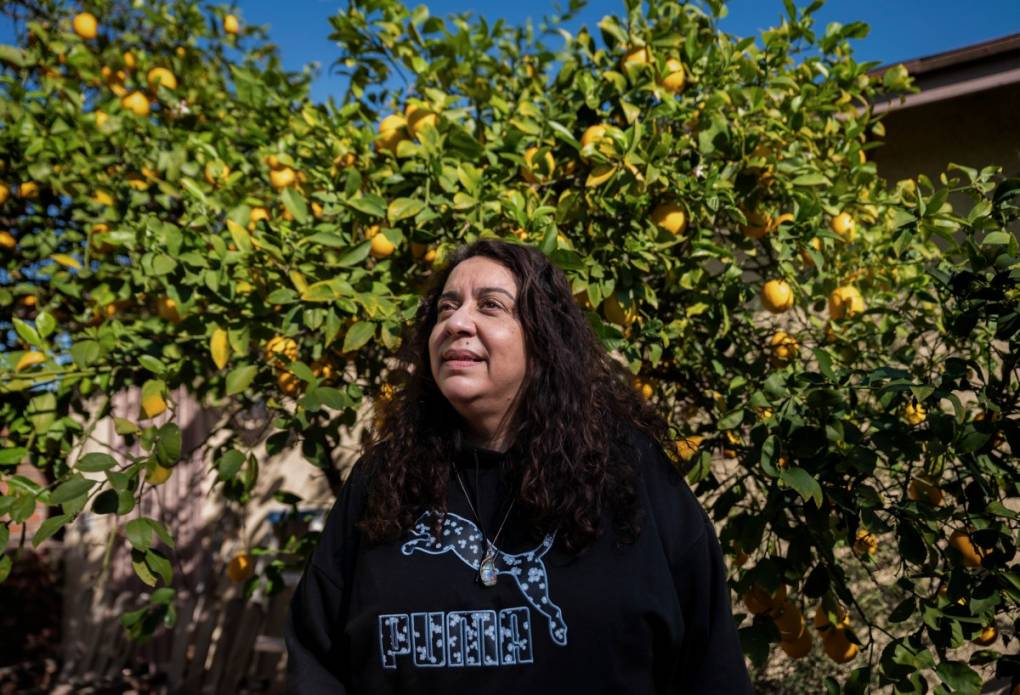
"caption": "Denise Velazquez in front of the lemon tree her grandmother planted in their family garden in Monterey Park. Velazquez left her position as an outreach worker with the Los Angeles Homeless Services Authority as her health worsened.",
"description": "Denise Velazquez in front of the lemon tree her grandmother planted in their family garden in Monterey Park.",
"title": "01262022-HOMELESS-SERVICES-RN02",
"credit": "Raquel Natalicchio/CalMatters",
"status": "inherit",
"altTag": "A person stands outside, in front of a lemon tree. They look away from the camera.",
"isLoading": false,
"fetchFailed": false
},
"news_11873453": {
"type": "attachments",
"id": "news_11873453",
"meta": {
"index": "attachments_1716263798",
"site": "news",
"id": "11873453",
"found": true
},
"parent": 11873384,
"imgSizes": {
"twentyfourteen-full-width": {
"file": "https://ww2.kqed.org/app/uploads/sites/10/2021/05/SF-high-school-in-person-class-1038x576.jpg",
"width": 1038,
"mimeType": "image/jpeg",
"height": 576
},
"thumbnail": {
"file": "https://ww2.kqed.org/app/uploads/sites/10/2021/05/SF-high-school-in-person-class-160x107.jpg",
"width": 160,
"mimeType": "image/jpeg",
"height": 107
},
"post-thumbnail": {
"file": "https://ww2.kqed.org/app/uploads/sites/10/2021/05/SF-high-school-in-person-class-672x372.jpg",
"width": 672,
"mimeType": "image/jpeg",
"height": 372
},
"kqedFullSize": {
"file": "https://ww2.kqed.org/app/uploads/sites/10/2021/05/SF-high-school-in-person-class.jpg",
"width": 1920,
"height": 1280
},
"large": {
"file": "https://ww2.kqed.org/app/uploads/sites/10/2021/05/SF-high-school-in-person-class-1020x680.jpg",
"width": 1020,
"mimeType": "image/jpeg",
"height": 680
},
"1536x1536": {
"file": "https://ww2.kqed.org/app/uploads/sites/10/2021/05/SF-high-school-in-person-class-1536x1024.jpg",
"width": 1536,
"mimeType": "image/jpeg",
"height": 1024
},
"medium": {
"file": "https://ww2.kqed.org/app/uploads/sites/10/2021/05/SF-high-school-in-person-class-800x533.jpg",
"width": 800,
"mimeType": "image/jpeg",
"height": 533
}
},
"publishDate": 1620861200,
"modified": 1633972879,
"caption": "Students in class at San Francisco International High School in March 2017.",
"description": null,
"title": "SF high school in person class",
"credit": "Deb Svoboda/KQED",
"status": "inherit",
"altTag": "High school students sit on chairs behind tables facing a teacher, who stands.",
"isLoading": false,
"fetchFailed": false
},
"news_11896804": {
"type": "attachments",
"id": "news_11896804",
"meta": {
"index": "attachments_1716263798",
"site": "news",
"id": "11896804",
"found": true
},
"parent": 11896803,
"imgSizes": {
"twentyfourteen-full-width": {
"file": "https://ww2.kqed.org/app/uploads/sites/10/2021/11/gettyimages-1235960927-c5c603aab140e8893d18e2a736590d7ca0f59f73-1038x576.jpg",
"width": 1038,
"mimeType": "image/jpeg",
"height": 576
},
"thumbnail": {
"file": "https://ww2.kqed.org/app/uploads/sites/10/2021/11/gettyimages-1235960927-c5c603aab140e8893d18e2a736590d7ca0f59f73-160x120.jpg",
"width": 160,
"mimeType": "image/jpeg",
"height": 120
},
"post-thumbnail": {
"file": "https://ww2.kqed.org/app/uploads/sites/10/2021/11/gettyimages-1235960927-c5c603aab140e8893d18e2a736590d7ca0f59f73-672x372.jpg",
"width": 672,
"mimeType": "image/jpeg",
"height": 372
},
"kqedFullSize": {
"file": "https://ww2.kqed.org/app/uploads/sites/10/2021/11/gettyimages-1235960927-c5c603aab140e8893d18e2a736590d7ca0f59f73-scaled.jpg",
"width": 2560,
"height": 1920
},
"2048x2048": {
"file": "https://ww2.kqed.org/app/uploads/sites/10/2021/11/gettyimages-1235960927-c5c603aab140e8893d18e2a736590d7ca0f59f73-2048x1536.jpg",
"width": 2048,
"mimeType": "image/jpeg",
"height": 1536
},
"large": {
"file": "https://ww2.kqed.org/app/uploads/sites/10/2021/11/gettyimages-1235960927-c5c603aab140e8893d18e2a736590d7ca0f59f73-1020x765.jpg",
"width": 1020,
"mimeType": "image/jpeg",
"height": 765
},
"1536x1536": {
"file": "https://ww2.kqed.org/app/uploads/sites/10/2021/11/gettyimages-1235960927-c5c603aab140e8893d18e2a736590d7ca0f59f73-1536x1152.jpg",
"width": 1536,
"mimeType": "image/jpeg",
"height": 1152
},
"full-width": {
"file": "https://ww2.kqed.org/app/uploads/sites/10/2021/11/gettyimages-1235960927-c5c603aab140e8893d18e2a736590d7ca0f59f73-1920x1440.jpg",
"width": 1920,
"mimeType": "image/jpeg",
"height": 1440
},
"medium": {
"file": "https://ww2.kqed.org/app/uploads/sites/10/2021/11/gettyimages-1235960927-c5c603aab140e8893d18e2a736590d7ca0f59f73-800x600.jpg",
"width": 800,
"mimeType": "image/jpeg",
"height": 600
}
},
"publishDate": 1637287085,
"modified": 1637288493,
"caption": "A picture taken on Oct. 18, 2021 in Moscow shows the U.S. social network Instagram's logo on a tablet screen.",
"description": "A picture taken on October 18, 2021 in Moscow shows the US social network Instagram's logo on a tablet screen. (Photo by Kirill KUDRYAVTSEV / AFP) (Photo by KIRILL KUDRYAVTSEV/AFP via Getty Images)",
"title": "Instagram is under investigation over how it attracts and affects its youngest users.",
"credit": "Kirill Kudryavtsev/AFP via Getty Images",
"status": "inherit",
"altTag": "A logo of Instagram resembling a camera in pink, red, orange and blue colors blended together with the number three in the right hand corner.",
"isLoading": false,
"fetchFailed": false
},
"news_11891107": {
"type": "attachments",
"id": "news_11891107",
"meta": {
"index": "attachments_1716263798",
"site": "news",
"id": "11891107",
"found": true
},
"parent": 11891049,
"imgSizes": {
"twentyfourteen-full-width": {
"file": "https://ww2.kqed.org/app/uploads/sites/10/2021/10/Greta-at-Kaiser-protest-4-1038x576.jpg",
"width": 1038,
"mimeType": "image/jpeg",
"height": 576
},
"thumbnail": {
"file": "https://ww2.kqed.org/app/uploads/sites/10/2021/10/Greta-at-Kaiser-protest-4-160x120.jpg",
"width": 160,
"mimeType": "image/jpeg",
"height": 120
},
"post-thumbnail": {
"file": "https://ww2.kqed.org/app/uploads/sites/10/2021/10/Greta-at-Kaiser-protest-4-672x372.jpg",
"width": 672,
"mimeType": "image/jpeg",
"height": 372
},
"kqedFullSize": {
"file": "https://ww2.kqed.org/app/uploads/sites/10/2021/10/Greta-at-Kaiser-protest-4-scaled-e1633468544289.jpg",
"width": 1920,
"height": 1440
},
"2048x2048": {
"file": "https://ww2.kqed.org/app/uploads/sites/10/2021/10/Greta-at-Kaiser-protest-4-2048x1536.jpg",
"width": 2048,
"mimeType": "image/jpeg",
"height": 1536
},
"large": {
"file": "https://ww2.kqed.org/app/uploads/sites/10/2021/10/Greta-at-Kaiser-protest-4-1020x765.jpg",
"width": 1020,
"mimeType": "image/jpeg",
"height": 765
},
"1536x1536": {
"file": "https://ww2.kqed.org/app/uploads/sites/10/2021/10/Greta-at-Kaiser-protest-4-1536x1152.jpg",
"width": 1536,
"mimeType": "image/jpeg",
"height": 1152
},
"full-width": {
"file": "https://ww2.kqed.org/app/uploads/sites/10/2021/10/Greta-at-Kaiser-protest-4-1920x1440.jpg",
"width": 1920,
"mimeType": "image/jpeg",
"height": 1440
},
"medium": {
"file": "https://ww2.kqed.org/app/uploads/sites/10/2021/10/Greta-at-Kaiser-protest-4-800x600.jpg",
"width": 800,
"mimeType": "image/jpeg",
"height": 600
}
},
"publishDate": 1633468369,
"modified": 1633479606,
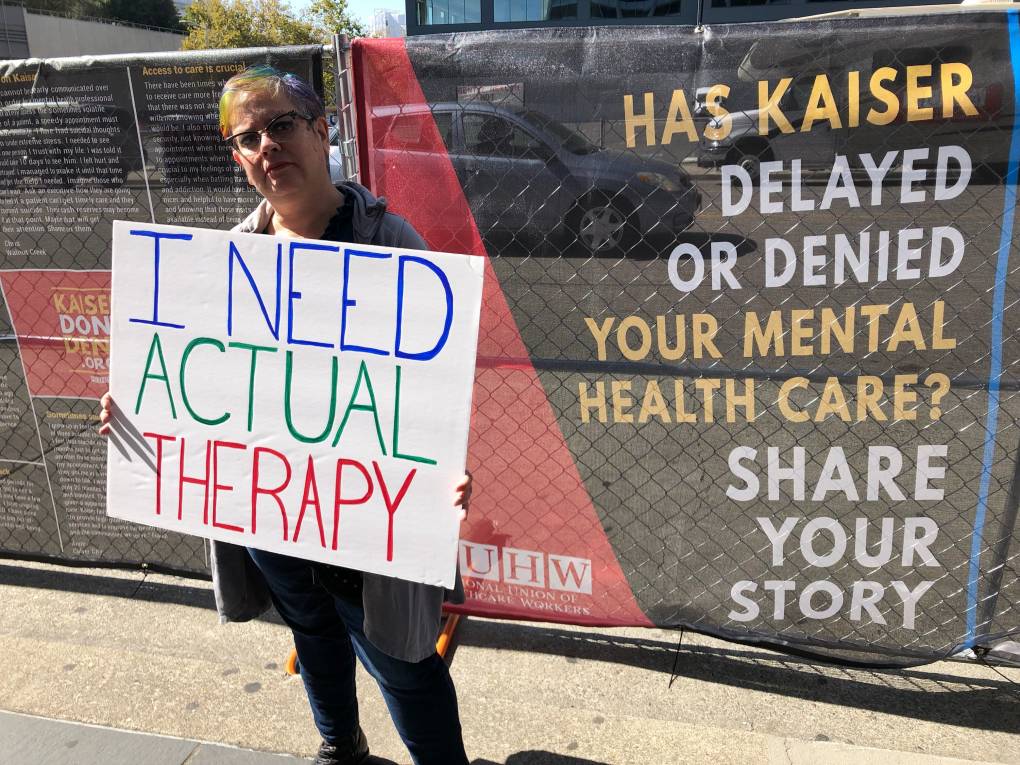
"caption": "When Greta Christina heard Kaiser Permanente mental health clinicians were staging a protest on Oct. 13, 2019, over long wait times for therapy, she showed up with her own sign. She's had to wait five to six weeks between therapy appointments for her depression.",
"description": null,
"title": "Greta at Kaiser protest 4",
"credit": "Courtesy of Ingrid Nelson",
"status": "inherit",
"altTag": "A woman holds a sign saying \"I Need Actual Therapy\" in front of a sign on a chain link fence reading, \"Has Kaiser Delayed or Denied Your Mental Health Care? Share Your Story.\"",
"isLoading": false,
"fetchFailed": false
},
"news_11891077": {
"type": "attachments",
"id": "news_11891077",
"meta": {
"index": "attachments_1716263798",
"site": "news",
"id": "11891077",
"found": true
},
"parent": 11891063,
"imgSizes": {
"twentyfourteen-full-width": {
"file": "https://ww2.kqed.org/app/uploads/sites/10/2021/10/GettyImages-1235713578-1038x576.jpg",
"width": 1038,
"mimeType": "image/jpeg",
"height": 576
},
"thumbnail": {
"file": "https://ww2.kqed.org/app/uploads/sites/10/2021/10/GettyImages-1235713578-160x108.jpg",
"width": 160,
"mimeType": "image/jpeg",
"height": 108
},
"post-thumbnail": {
"file": "https://ww2.kqed.org/app/uploads/sites/10/2021/10/GettyImages-1235713578-672x372.jpg",
"width": 672,
"mimeType": "image/jpeg",
"height": 372
},
"kqedFullSize": {
"file": "https://ww2.kqed.org/app/uploads/sites/10/2021/10/GettyImages-1235713578-scaled.jpg",
"width": 2560,
"height": 1720
},
"2048x2048": {
"file": "https://ww2.kqed.org/app/uploads/sites/10/2021/10/GettyImages-1235713578-2048x1376.jpg",
"width": 2048,
"mimeType": "image/jpeg",
"height": 1376
},
"large": {
"file": "https://ww2.kqed.org/app/uploads/sites/10/2021/10/GettyImages-1235713578-1020x685.jpg",
"width": 1020,
"mimeType": "image/jpeg",
"height": 685
},
"1536x1536": {
"file": "https://ww2.kqed.org/app/uploads/sites/10/2021/10/GettyImages-1235713578-1536x1032.jpg",
"width": 1536,
"mimeType": "image/jpeg",
"height": 1032
},
"full-width": {
"file": "https://ww2.kqed.org/app/uploads/sites/10/2021/10/GettyImages-1235713578-1920x1290.jpg",
"width": 1920,
"mimeType": "image/jpeg",
"height": 1290
},
"medium": {
"file": "https://ww2.kqed.org/app/uploads/sites/10/2021/10/GettyImages-1235713578-800x538.jpg",
"width": 800,
"mimeType": "image/jpeg",
"height": 538
}
},
"publishDate": 1633460376,
"modified": 1633460486,
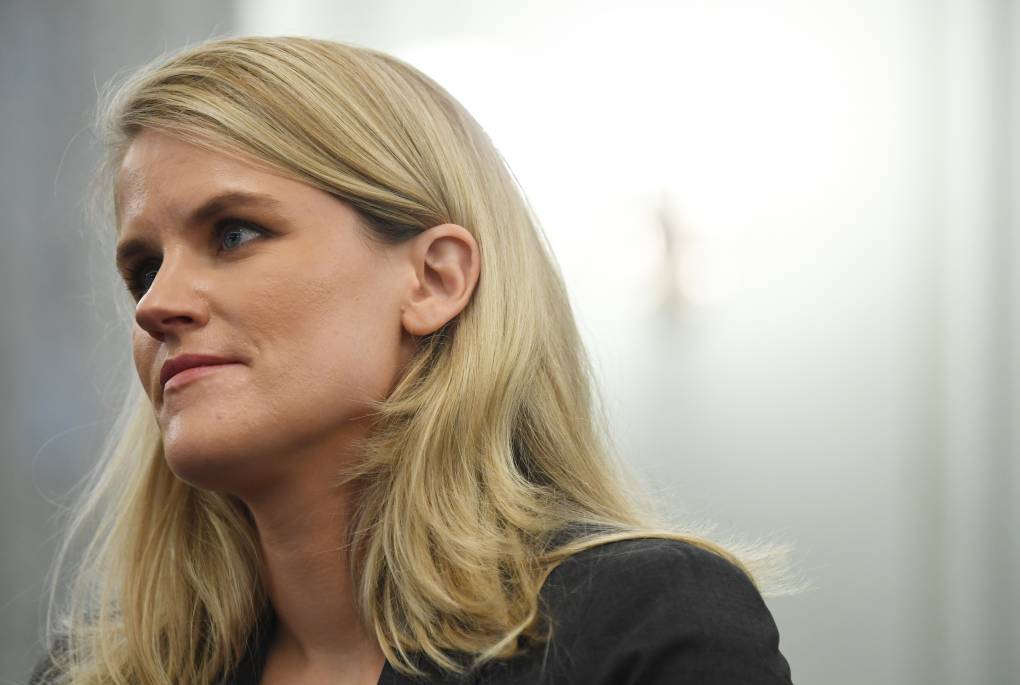
"caption": "Frances Haugen, former Facebook employee, appears before the Senate Commerce, Science, and Transportation Subcommittee during a hearing entitled 'Protecting Kids Online: Testimony from a Facebook Whistleblower' at the Russell Senate Office Building on October 05, 2021 in Washington, D.C.",
"description": "Frances Haugen, former Facebook employee, appears before the Senate Commerce, Science, and Transportation Subcommittee during a hearing entitled 'Protecting Kids Online: Testimony from a Facebook Whistleblower' at the Russell Senate Office Building on October 05, 2021 in Washington, D.C.",
"title": "Facebook Whistle Blower Frances Haugen Testifies To Senate Committee",
"credit": "Matt McClain-Pool/Getty Images",
"status": "inherit",
"altTag": "Close-up of Frances Haugen, who is looking away from the camera.",
"isLoading": false,
"fetchFailed": false
},
"news_11884096": {
"type": "attachments",
"id": "news_11884096",
"meta": {
"index": "attachments_1716263798",
"site": "news",
"id": "11884096",
"found": true
},
"parent": 11883979,
"imgSizes": {
"twentyfourteen-full-width": {
"file": "https://ww2.kqed.org/app/uploads/sites/10/2021/08/IMG_5419-1038x576.jpg",
"width": 1038,
"mimeType": "image/jpeg",
"height": 576
},
"thumbnail": {
"file": "https://ww2.kqed.org/app/uploads/sites/10/2021/08/IMG_5419-160x107.jpg",
"width": 160,
"mimeType": "image/jpeg",
"height": 107
},
"post-thumbnail": {
"file": "https://ww2.kqed.org/app/uploads/sites/10/2021/08/IMG_5419-672x372.jpg",
"width": 672,
"mimeType": "image/jpeg",
"height": 372
},
"kqedFullSize": {
"file": "https://ww2.kqed.org/app/uploads/sites/10/2021/08/IMG_5419-scaled.jpg",
"width": 2560,
"height": 1706
},
"2048x2048": {
"file": "https://ww2.kqed.org/app/uploads/sites/10/2021/08/IMG_5419-2048x1365.jpg",
"width": 2048,
"mimeType": "image/jpeg",
"height": 1365
},
"large": {
"file": "https://ww2.kqed.org/app/uploads/sites/10/2021/08/IMG_5419-1020x680.jpg",
"width": 1020,
"mimeType": "image/jpeg",
"height": 680
},
"1536x1536": {
"file": "https://ww2.kqed.org/app/uploads/sites/10/2021/08/IMG_5419-1536x1024.jpg",
"width": 1536,
"mimeType": "image/jpeg",
"height": 1024
},
"full-width": {
"file": "https://ww2.kqed.org/app/uploads/sites/10/2021/08/IMG_5419-1920x1280.jpg",
"width": 1920,
"mimeType": "image/jpeg",
"height": 1280
},
"medium": {
"file": "https://ww2.kqed.org/app/uploads/sites/10/2021/08/IMG_5419-800x533.jpg",
"width": 800,
"mimeType": "image/jpeg",
"height": 533
}
},
"publishDate": 1628261407,
"modified": 1628294563,
"caption": "Social worker Vinita Lee helps third graders in Castro Valley Unified's summer school program understand how to handle their emotions by creating a 'toolbox' of responses. This year, CVUSD tripled summer school attendance with the goal of providing more students with the tools they may need to return to in-person learning.",
"description": "Social worker, Vinita Lee, helps third graders in Castro Valley Unified's summer school program understand how to handle their emotions by creating a 'tool box' of responses.",
"title": "IMG_5419",
"credit": "Julia McEvoy/KQED",
"status": "inherit",
"altTag": "The view from behind a student's shoulder inside a classroom. The whiteboard is visible and a teacher stands in front of it, teaching a lesson. The student is sitting at their desk and both the student and teacher are wearing facemasks and are keeping distance from each other.",
"isLoading": false,
"fetchFailed": false
},
"news_11879669": {
"type": "attachments",
"id": "news_11879669",
"meta": {
"index": "attachments_1716263798",
"site": "news",
"id": "11879669",
"found": true
},
"parent": 11879635,
"imgSizes": {
"twentyfourteen-full-width": {
"file": "https://ww2.kqed.org/app/uploads/sites/10/2021/06/GettyImages-1233125515-1024x576.jpg",
"width": 1024,
"mimeType": "image/jpeg",
"height": 576
},
"thumbnail": {
"file": "https://ww2.kqed.org/app/uploads/sites/10/2021/06/GettyImages-1233125515-160x107.jpg",
"width": 160,
"mimeType": "image/jpeg",
"height": 107
},
"post-thumbnail": {
"file": "https://ww2.kqed.org/app/uploads/sites/10/2021/06/GettyImages-1233125515-672x372.jpg",
"width": 672,
"mimeType": "image/jpeg",
"height": 372
},
"kqedFullSize": {
"file": "https://ww2.kqed.org/app/uploads/sites/10/2021/06/GettyImages-1233125515.jpg",
"width": 1024,
"height": 683
},
"large": {
"file": "https://ww2.kqed.org/app/uploads/sites/10/2021/06/GettyImages-1233125515-1020x680.jpg",
"width": 1020,
"mimeType": "image/jpeg",
"height": 680
},
"medium": {
"file": "https://ww2.kqed.org/app/uploads/sites/10/2021/06/GettyImages-1233125515-800x534.jpg",
"width": 800,
"mimeType": "image/jpeg",
"height": 534
}
},
"publishDate": 1624926140,
"modified": 1624928056,
"caption": "Investigators work the scene near the Santa Clara Valley Transportation Authority light rail yard in San Jose on May 26, 2021, where a gunman opened fire, killing nine workers and then himself.",
"description": null,
"title": "Several People Reportedly Shot At Light Rail Yard In San Jose, CA",
"credit": "Philip Pacheco/Getty Images",
"status": "inherit",
"altTag": null,
"isLoading": false,
"fetchFailed": false
},
"news_11879317": {
"type": "attachments",
"id": "news_11879317",
"meta": {
"index": "attachments_1716263798",
"site": "news",
"id": "11879317",
"found": true
},
"parent": 11879309,
"imgSizes": {
"twentyfourteen-full-width": {
"file": "https://ww2.kqed.org/app/uploads/sites/10/2021/06/Disconnected_Suffering-2-1038x576.jpg",
"width": 1038,
"mimeType": "image/jpeg",
"height": 576
},
"thumbnail": {
"file": "https://ww2.kqed.org/app/uploads/sites/10/2021/06/Disconnected_Suffering-2-160x124.jpg",
"width": 160,
"mimeType": "image/jpeg",
"height": 124
},
"post-thumbnail": {
"file": "https://ww2.kqed.org/app/uploads/sites/10/2021/06/Disconnected_Suffering-2-672x372.jpg",
"width": 672,
"mimeType": "image/jpeg",
"height": 372
},
"kqedFullSize": {
"file": "https://ww2.kqed.org/app/uploads/sites/10/2021/06/Disconnected_Suffering-2-e1624633421102.jpg",
"width": 1198,
"height": 926
},
"large": {
"file": "https://ww2.kqed.org/app/uploads/sites/10/2021/06/Disconnected_Suffering-2-1020x788.jpg",
"width": 1020,
"mimeType": "image/jpeg",
"height": 788
},
"medium": {
"file": "https://ww2.kqed.org/app/uploads/sites/10/2021/06/Disconnected_Suffering-2-800x618.jpg",
"width": 800,
"mimeType": "image/jpeg",
"height": 618
}
},
"publishDate": 1624633401,
"modified": 1624906066,
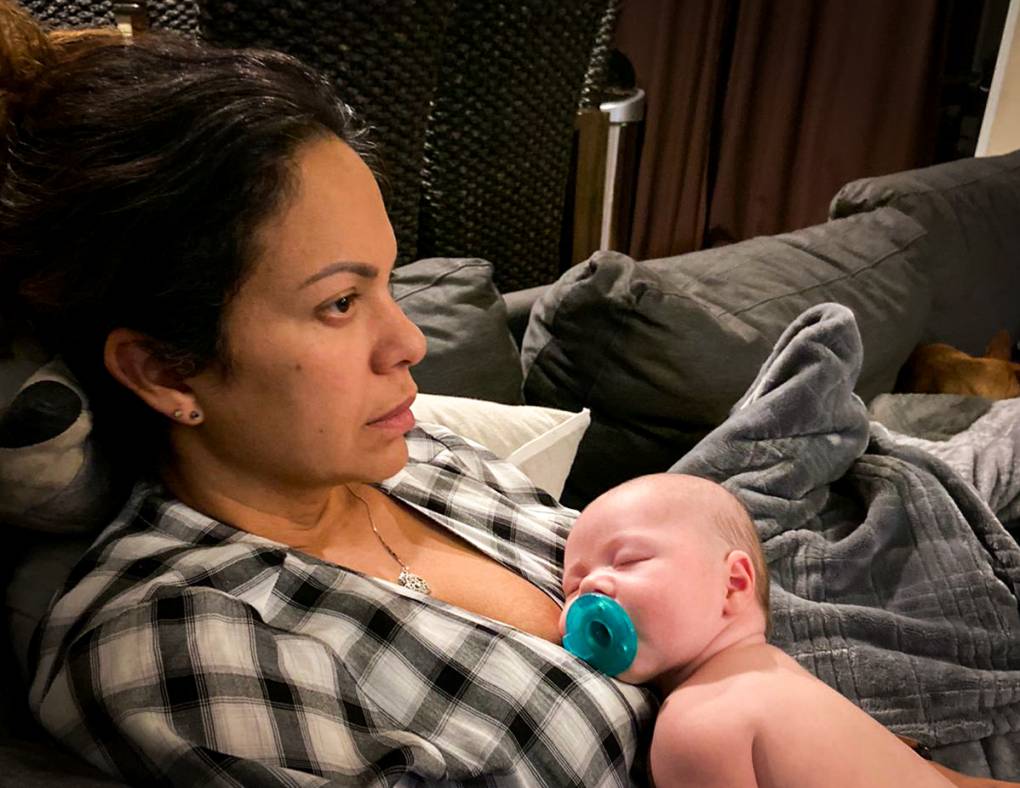
"caption": "Miriam McDonald developed postpartum depression after giving birth to her son, Nicholas. She said it made her feel sad, disconnected and indifferent. She said Kaiser Permanente, her health care provider, put her on a merry-go-round of medication trial and error — but refused to approve expensive treatment with the first and only drug designed for postpartum depression.",
"description": "Miriam McDonald developed postpartum depression after giving birth to her son, Nicholas. She said it made her feel sad, disconnected and indifferent. She said Kaiser Permanente, her health care provider, put her on a merry-go-round of medication trial and error - but refused to approve expensive treatment with the first and only drug designed for postpartum depression.",
"title": "Disconnected_Suffering-2",
"credit": "Courtesy of Miriam McDonald",
"status": "inherit",
"altTag": "Mother stares off into space while holding baby",
"isLoading": false,
"fetchFailed": false
},
"news_11879410": {
"type": "attachments",
"id": "news_11879410",
"meta": {
"index": "attachments_1716263798",
"site": "news",
"id": "11879410",
"found": true
},
"parent": 11879404,
"imgSizes": {
"twentyfourteen-full-width": {
"file": "https://ww2.kqed.org/app/uploads/sites/10/2021/06/RS46661_026_Oakland_MLKCarCaravan_01182021-qut-1038x576.jpg",
"width": 1038,
"mimeType": "image/jpeg",
"height": 576
},
"thumbnail": {
"file": "https://ww2.kqed.org/app/uploads/sites/10/2021/06/RS46661_026_Oakland_MLKCarCaravan_01182021-qut-160x107.jpg",
"width": 160,
"mimeType": "image/jpeg",
"height": 107
},
"post-thumbnail": {
"file": "https://ww2.kqed.org/app/uploads/sites/10/2021/06/RS46661_026_Oakland_MLKCarCaravan_01182021-qut-672x372.jpg",
"width": 672,
"mimeType": "image/jpeg",
"height": 372
},
"kqedFullSize": {
"file": "https://ww2.kqed.org/app/uploads/sites/10/2021/06/RS46661_026_Oakland_MLKCarCaravan_01182021-qut.jpg",
"width": 1920,
"height": 1278
},
"large": {
"file": "https://ww2.kqed.org/app/uploads/sites/10/2021/06/RS46661_026_Oakland_MLKCarCaravan_01182021-qut-1020x679.jpg",
"width": 1020,
"mimeType": "image/jpeg",
"height": 679
},
"1536x1536": {
"file": "https://ww2.kqed.org/app/uploads/sites/10/2021/06/RS46661_026_Oakland_MLKCarCaravan_01182021-qut-1536x1022.jpg",
"width": 1536,
"mimeType": "image/jpeg",
"height": 1022
},
"medium": {
"file": "https://ww2.kqed.org/app/uploads/sites/10/2021/06/RS46661_026_Oakland_MLKCarCaravan_01182021-qut-800x533.jpg",
"width": 800,
"mimeType": "image/jpeg",
"height": 533
}
},
"publishDate": 1624655582,
"modified": 1624655607,
"caption": "Odessa Helfrich-Batt holds a sign that says, \"Defund OPD\" during a Martin Luther King Day car caravan at Middle Harbor Shoreline Park near the Port of Oakland on Jan. 18, 2021.",
"description": "Odessa Helfrich-Batt holds a sign that says, \"Defund OPD\" during a Martin Luther King Day car caravan at Middle Harbor Shoreline Park near the Port of Oakland on Jan. 18, 2021.",
"title": "RS46661_026_Oakland_MLKCarCaravan_01182021-qut",
"credit": "Beth LaBerge/KQED",
"status": "inherit",
"altTag": null,
"isLoading": false,
"fetchFailed": false
}
},
"audioPlayerReducer": {
"postId": "stream_live",
"isPaused": true,
"isPlaying": false,
"pfsActive": false,
"pledgeModalIsOpen": true,
"playerDrawerIsOpen": false,
"liveAudioPlayStartedAt": 0,
"liveAudioPlayContext": ""
},
"authorsReducer": {
"byline_news_11908813": {
"type": "authors",
"id": "byline_news_11908813",
"meta": {
"override": true
},
"slug": "byline_news_11908813",
"name": "\u003ca href=\"https://calmatters.org/author/jocelyn-wiener/\">Jocelyn Wiener\u003c/a>",
"isLoading": false
},
"byline_news_11907115": {
"type": "authors",
"id": "byline_news_11907115",
"meta": {
"override": true
},
"slug": "byline_news_11907115",
"name": "Don Thompson and Janie Har\u003cbr>Associated Press",
"isLoading": false
},
"byline_news_11904111": {
"type": "authors",
"id": "byline_news_11904111",
"meta": {
"override": true
},
"slug": "byline_news_11904111",
"name": "Naydeline Mejia, Isabeth Mendoza, Sylvie Douglis",
"isLoading": false
},
"byline_news_11902904": {
"type": "authors",
"id": "byline_news_11902904",
"meta": {
"override": true
},
"slug": "byline_news_11902904",
"name": "\u003ca href=\"https://calmatters.org/author/manuela-tobias/\">Manuela Tobias\u003c/a>",
"isLoading": false
},
"byline_news_11901355": {
"type": "authors",
"id": "byline_news_11901355",
"meta": {
"override": true
},
"slug": "byline_news_11901355",
"name": "\u003ca href=\"https://edsource.org/author/cjones\">Carolyn Jones\u003c/a>\u003cbr>EdSource",
"isLoading": false
},
"byline_news_11896803": {
"type": "authors",
"id": "byline_news_11896803",
"meta": {
"override": true
},
"slug": "byline_news_11896803",
"name": "Shannon Bond",
"isLoading": false
},
"byline_news_11891063": {
"type": "authors",
"id": "byline_news_11891063",
"meta": {
"override": true
},
"slug": "byline_news_11891063",
"name": "Marcy Gordon \u003cbr> The Associated Press",
"isLoading": false
},
"jmcevoy": {
"type": "authors",
"id": "231",
"meta": {
"index": "authors_1716337520",
"id": "231",
"found": true
},
"name": "Julia McEvoy",
"firstName": "Julia",
"lastName": "McEvoy",
"slug": "jmcevoy",
"email": "jmcevoy@KQED.org",
"display_author_email": true,
"staff_mastheads": [
"news"
],
"title": "KQED Senior Editor",
"bio": "Julia McEvoy is KQED's Senior Editor, Education Equity.\r\n\r\nJulia heads KQED’s education coverage examining inequities students face in Bay Area and California schools, and reports on what it will take to educate the next generation.\r\n\r\nJulia's editorial work has received a Peabody Award, a Casey Medal for Coverage of Children and Families, several Edward R. Murrow awards, as well as awards from the Public Radio News Directors Inc. and the Society for Professional Journalists.",
"avatar": "https://secure.gravatar.com/avatar/aec3ce21abe02b302fd33638abd56a22?s=600&d=blank&r=g",
"twitter": "juliamcevoy1",
"facebook": null,
"instagram": null,
"linkedin": null,
"sites": [
{
"site": "news",
"roles": []
},
{
"site": "stateofhealth",
"roles": [
"author"
]
}
],
"headData": {
"title": "Julia McEvoy | KQED",
"description": "KQED Senior Editor",
"ogImgSrc": "https://secure.gravatar.com/avatar/aec3ce21abe02b302fd33638abd56a22?s=600&d=blank&r=g",
"twImgSrc": "https://secure.gravatar.com/avatar/aec3ce21abe02b302fd33638abd56a22?s=600&d=blank&r=g"
},
"isLoading": false,
"link": "/author/jmcevoy"
},
"kqednewsstaffandwires": {
"type": "authors",
"id": "237",
"meta": {
"index": "authors_1716337520",
"id": "237",
"found": true
},
"name": "KQED News Staff and Wires",
"firstName": "KQED News Staff and Wires",
"lastName": null,
"slug": "kqednewsstaffandwires",
"email": "onlinenewsstaff@kqed.org",
"display_author_email": false,
"staff_mastheads": [],
"title": null,
"bio": null,
"avatar": "https://secure.gravatar.com/avatar/72295af8ebbfbd19a4948f5271285664?s=600&d=blank&r=g",
"twitter": null,
"facebook": null,
"instagram": null,
"linkedin": null,
"sites": [
{
"site": "arts",
"roles": [
"contributor"
]
},
{
"site": "news",
"roles": [
"contributor"
]
},
{
"site": "lowdown",
"roles": [
"author"
]
},
{
"site": "stateofhealth",
"roles": [
"contributor"
]
},
{
"site": "food",
"roles": [
"author"
]
}
],
"headData": {
"title": "KQED News Staff and Wires | KQED",
"description": null,
"ogImgSrc": "https://secure.gravatar.com/avatar/72295af8ebbfbd19a4948f5271285664?s=600&d=blank&r=g",
"twImgSrc": "https://secure.gravatar.com/avatar/72295af8ebbfbd19a4948f5271285664?s=600&d=blank&r=g"
},
"isLoading": false,
"link": "/author/kqednewsstaffandwires"
},
"adembosky": {
"type": "authors",
"id": "3205",
"meta": {
"index": "authors_1716337520",
"id": "3205",
"found": true
},
"name": "April Dembosky",
"firstName": "April",
"lastName": "Dembosky",
"slug": "adembosky",
"email": "adembosky@kqed.org",
"display_author_email": false,
"staff_mastheads": [
"news",
"science"
],
"title": "KQED Health Correspondent",
"bio": "April Dembosky is the health correspondent for KQED News and a regular contributor to NPR. She specializes in covering altered states of mind, from postpartum depression to methamphetamine-induced psychosis to the insanity defense. Her investigative series on insurance companies sidestepping mental health laws won multiple awards, including first place in beat reporting from the national Association of Health Care Journalists. She is the recipient of numerous other prizes and fellowships, including a national Edward R. Murrow award for investigative reporting, a Society of Professional Journalists award for long-form storytelling, and a Carter Center Fellowship for Mental Health Journalism.\r\n\r\nDembosky reported and produced \u003cem>Soundtrack of Silence\u003c/em>, an audio documentary about music and memory that is currently being made into a feature film by Paramount Pictures.\r\n\r\nBefore joining KQED in 2013, Dembosky covered technology and Silicon Valley for \u003cem>The Financial Times of London,\u003c/em> and contributed business and arts stories to \u003cem>Marketplace \u003c/em>and \u003cem>The New York Times.\u003c/em> She got her undergraduate degree in philosophy from Smith College and her master's in journalism from the University of California, Berkeley. She is a classically trained violinist and proud alum of the first symphony orchestra at Burning Man.",
"avatar": "https://secure.gravatar.com/avatar/ef92999be4ceb9ea60701e7dc276f813?s=600&d=blank&r=g",
"twitter": "adembosky",
"facebook": null,
"instagram": null,
"linkedin": null,
"sites": [
{
"site": "arts",
"roles": [
"author"
]
},
{
"site": "news",
"roles": [
"editor"
]
},
{
"site": "futureofyou",
"roles": [
"author"
]
},
{
"site": "stateofhealth",
"roles": [
"editor"
]
},
{
"site": "science",
"roles": [
"editor"
]
},
{
"site": "forum",
"roles": [
"editor"
]
}
],
"headData": {
"title": "April Dembosky | KQED",
"description": "KQED Health Correspondent",
"ogImgSrc": "https://secure.gravatar.com/avatar/ef92999be4ceb9ea60701e7dc276f813?s=600&d=blank&r=g",
"twImgSrc": "https://secure.gravatar.com/avatar/ef92999be4ceb9ea60701e7dc276f813?s=600&d=blank&r=g"
},
"isLoading": false,
"link": "/author/adembosky"
}
},
"pagesReducer": {
"news_tag_mental-health": {
"type": "terms",
"id": "news_2109",
"meta": {
"index": "terms_1716263798",
"site": "news",
"id": "2109",
"score": 8.282925
},
"featImg": null,
"name": "mental health",
"description": null,
"taxonomy": "tag",
"headData": {
"twImgId": null,
"twTitle": null,
"ogTitle": null,
"ogImgId": null,
"twDescription": null,
"description": null,
"title": "mental health Archives | KQED News",
"ogDescription": null
},
"ttid": 2124,
"slug": "mental-health",
"isLoading": false,
"title": "mental health",
"pageMeta": {
"site": "news",
"WpPageTemplate": "page-topic-editorial",
"currentPage": 11
},
"blocks": [
{
"blockName": "kqed/post-list",
"attrs": {
"layout": "cardArticle2",
"query": "posts/news?tag=mental-health",
"seeMore": false,
"paginated": true,
"page": 11
}
},
{
"blockName": "kqed/ad"
}
]
}
},
"pfsSessionReducer": {},
"postsReducer": {
"stream_live": {
"type": "live",
"id": "stream_live",
"audioUrl": "https://streams.kqed.org/kqedradio",
"title": "Live Stream",
"excerpt": "Live Stream information currently unavailable.",
"link": "/radio",
"featImg": "",
"label": {
"name": "KQED Live",
"link": "/"
}
},
"stream_kqedNewscast": {
"type": "posts",
"id": "stream_kqedNewscast",
"audioUrl": "https://www.kqed.org/.stream/anon/radio/RDnews/newscast.mp3?_=1",
"title": "KQED Newscast",
"featImg": "",
"label": {
"name": "88.5 FM",
"link": "/"
}
},
"news_11908813": {
"type": "posts",
"id": "news_11908813",
"meta": {
"index": "posts_1716263798",
"site": "news",
"id": "11908813",
"score": null,
"sort": [
1647978272000
]
},
"guestAuthors": [],
"slug": "california-to-funnel-billions-into-mental-health-resources-for-young-people-but-will-it-come-soon-enough",
"title": "California to Funnel Billions Into Mental Health Resources for Young People. But Will It Come Soon Enough?",
"publishDate": 1647978272,
"format": "standard",
"headTitle": "California to Funnel Billions Into Mental Health Resources for Young People. But Will It Come Soon Enough? | KQED",
"labelTerm": {},
"content": "\u003cp>\u003cem>Lea este artículo en \u003c/em>\u003ca href=\"https://calmatters.org/uncategorized/2022/03/cuando-los-ninos-sufren-california-destinara-miles-de-millones-a-la-reforma-de-salud-mental/\">\u003cem>español\u003c/em>\u003c/a>\u003cem>.\u003c/em>\u003c/p>\n\u003cp>Amanda Arellano felt a heavy weight pressing down on her chest. It was May of 2021, and the teenager struggled to breathe.\u003c/p>\n\u003cp>Maria Arellano rushed her 17-year-old daughter to the pulmonologist. Amanda has cerebral palsy, autism, epilepsy, asthma and a heart murmur. With COVID on the prowl, they couldn’t be too careful.\u003c/p>\n\u003cp>This wasn’t an asthma flare-up, the doctor told them. This was anxiety.[pullquote align=\"right\" size=\"medium\" citation=\"Tony Thurmond, California superintendent of public instruction\"]‘We know that this is job No. 1, to help our students address the trauma that they have experienced and are experiencing during the coronavirus pandemic.’[/pullquote]Sitting in a Jack in the Box near their home in the Los Angeles neighborhood of Boyle Heights last month, her eyes filling with tears, Maria searched for the words to describe watching her normally gregarious daughter struggle.\u003c/p>\n\u003cp>“It makes you feel very powerless,” she said.\u003c/p>\n\u003cp>[ad fullwidth]\u003c/p>\n\u003cp>Many California parents know this feeling well. Two years into the pandemic, many children are in pain. Rates of anxiety and depression have shot up so quickly that several national leaders — including the U.S. surgeon general — have issued \u003ca href=\"https://www.hhs.gov/sites/default/files/surgeon-general-youth-mental-health-advisory.pdf\">urgent public health advisories\u003c/a>. School-based therapists report long waiting lists and an increase in fighting and behavior issues. Emergency room doctors say they are overwhelmed by the number of \u003ca href=\"https://calmatters.org/health/2021/09/children-suicide-residential-treatment-crisis-california/\">children coming in after trying to harm themselves\u003c/a>.\u003c/p>\n\u003cp>On top of all this, the state is facing a shortage of mental health providers.\u003c/p>\n\u003cp>Gov. Gavin Newsom’s administration has vowed to build a brand-new system to address these complicated challenges in the coming years. But pressure is mounting to help children like Amanda — \u003cem>now\u003c/em>.\u003c/p>\n\u003cp>Dr. Mark Ghaly, a pediatrician who serves as the secretary of California’s Health and Human Services Agency, told CalMatters he feels “concerned but hopeful” about the state’s ability to meet the growing need, though he’s also “very aware that even the most … short-term interventions are not as immediate as I think we would like.”\u003c/p>\n\u003cp>Last year, Newsom’s administration allocated $4.4 billion in one-time funds to create a statewide system dubbed the \u003ca href=\"https://www.chhs.ca.gov/home/children-and-youth-behavioral-health-initiative/\">Children and Youth Behavioral Health Initiative \u003c/a>— a proposed sweeping transformation of the children’s mental health system that many observers describe as “unprecedented.” The bulk of the money has yet to be distributed, but efforts to develop a vision and work with stakeholders are underway.\u003c/p>\n\u003cp>Tony Thurmond, the state superintendent of public instruction, recently told CalMatters he has visited 45 schools since July, and said many of them told him they don’t have the resources to help students who are struggling with mental health issues.\u003c/p>\n\u003cp>“We know that this is job No. 1, to help our students address the trauma that they have experienced and are experiencing during the coronavirus pandemic,” he said. “That’s got to be our priority.”\u003c/p>\n\u003cp>Children’s advocates are enthusiastic about the state’s commitment to the issue, but also worry the help won’t come soon enough.\u003c/p>\n\u003cp>A crisis was brewing in California before the pandemic; COVID set it to a boil:\u003c/p>\n\u003cp>– \u003ca href=\"https://www.psnyouth.org/wp-content/uploads/2021/08/Suicide-in-California-Data-Trends-in-2020-COVID-Impact-and-Prevention-Strategies-Slide-Deck.pdf\">Suicide rates among Black youth\u003c/a> doubled between 2014 and 2020, according to state data.\u003c/p>\n\u003cp>– Incidents of\u003ca href=\"https://www.auditor.ca.gov/pdfs/reports/2019-125.pdf\"> youth deliberately causing self-harm\u003c/a> increased 50% between 2009 and 2018, the state auditor reported. Children’s hospital officials told CalMatters last fall that \u003ca href=\"https://calmatters.org/health/2021/09/children-suicide-residential-treatment-crisis-california/\">mental health emergency room visits spiked\u003c/a> dramatically during the pandemic.\u003c/p>\n\u003cp>– Between 2019 and 2020, opioid-related overdoses among 15- to 19-year-olds nearly tripled, according to a CalMatters analysis of state data.\u003c/p>\n\u003cp>“I think what people are looking for is an emergency response,” said Lishaun Francis, director of behavioral health for the advocacy group Children Now. “That has never been the state of California’s plan.”\u003c/p>\n\u003cp>This month, Children Now was among a coalition of children’s advocates and health providers that sent a letter to Newsom, calling on him to formally declare the status of child and adolescent mental health in California a \u003ca href=\"https://www.documentcloud.org/documents/21422947-state-of-emergency-youth-mental-health-letter-1\">public health emergency\u003c/a>. The challenges facing young people in the state, it said, are “dire and widespread.”\u003c/p>\n\u003ch2>‘It won’t be this way forever’\u003c/h2>\n\u003cp>For a moment, in March 2020, Amanda felt excited. Her school planned to close briefly; two weeks at home sounded like an unexpected vacation.\u003c/p>\n\u003cp>But school didn’t reopen that spring, or all the next school year. And many of the supports Amanda depended on — social therapy, music therapy, physical therapy — moved online or fell away completely.\u003c/p>\n\u003cp>Terrified of the virus, Amanda refused for months to venture out of the small blue house in Boyle Heights where she and her mother rent a room from another family.\u003c/p>\n\u003cp>Always a strong student, Amanda grew increasingly frustrated during virtual learning. Sometimes a shaky internet connection booted her out of Zoom class. Other times, teachers were hard to understand.\u003c/p>\n\u003cp>“I don’t know what I can do to calm myself down,” Amanda told her mother.\u003c/p>\n\u003cp>Maria would see tears in the long-lashed brown eyes of the daughter she’d always known to be creative, happy and resilient. She’d pull out photos they’d taken on pre-pandemic outings.\u003c/p>\n\u003cp>“It won’t be this way forever,” she’d tell Amanda. “One day this will end.”\u003c/p>\n\u003cp>Amanda tried meditation and exercise. She lost herself in video games, playing Roblox until her hands hurt.\u003c/p>\n\u003cp>As the months wore on, Maria saw the toll on her daughter’s self-esteem.\u003c/p>\n\u003cp>On Dec. 18, 2020, Amanda sent an email to a teacher, apologizing for missing certain assignments: “I am very embarrassed,” she began.\u003c/p>\n\u003cp>For months, she explained, “I have felt constant headaches and I have felt very dizzy; I have been extremely fatigued. Never, since I started school, have I left assignments without finishing them. I have always been a good student. But in this moment with the pandemic, my life has been impacted in many ways, especially with Distance Learning.”\u003c/p>\n\u003cp>Her teacher reassured her: “You are an amazing student that inspires everyone you meet.”\u003c/p>\n\u003cp>But the anxiety continued. In February 2021, Maria wrote to the school psychologist, asking for help.\u003c/p>\n\u003ch2 id=\"h-it-s-getting-worse\">‘It’s getting worse’\u003c/h2>\n\u003cp>Young people’s suffering has been widespread, as revealed in a January report on \u003ca href=\"https://aclucalaction.org/wp-content/uploads/2022/01/2022_State_of_Student_Wellness_Report_.pdf\">the state of student wellness\u003c/a>. Based on surveys of 1,200 California middle and high school students between April 2020 and March 2021, 63% of the students reported having had an emotional meltdown; 43% said they had a panic or anxiety attack; and 19% described suicidal thoughts, according to the report published by American Civil Liberties Union California Action, CSU Long Beach and the California Association of School Counselors.\u003c/p>\n\u003cp>“We know from the numbers it’s getting worse,” said Amir Whitaker, senior policy counsel for ACLU Southern California, who is the report’s lead author. “We’re not done yet.”\u003c/p>\n\u003cp>Whitaker oversees the Youth Liberty Squad, a group of high school students around the state who are advocating for better school-based mental health care. Many have experienced their own anxieties and traumas in the last two years. As life edges closer to normal, they find details of their lives changed in unsettling ways.[aside label=\"related coverage\" tag=\"mental-health\"]Joel Salas, a Los Angeles senior, spent a month isolated in his bedroom after the rest of his family contracted COVID-19. His mother fell extremely ill, and he ended up caring for her while studying and working five or six hours a day at his parents’ taco stand.\u003c/p>\n\u003cp>One of the biggest challenges for him now is the unrelenting uncertainty.\u003c/p>\n\u003cp>“You don’t know what’s happening next,” he said. “You don’t want to get your hopes up, because another wave might come.”\u003c/p>\n\u003cp>Another challenge is what’s left unsaid. Many of his classmates lost family members, he said. People rarely talk about it.\u003c/p>\n\u003cp>Amanda, who also is a leader in the Youth Liberty Squad, felt terrified when school resumed in person last August. What would happen if she were exposed to the virus? To protect herself physically, she distanced herself from her classmates.\u003c/p>\n\u003cp>Amanda’s mother, Maria, understands these fears. She also knows a teenager needs friends.\u003c/p>\n\u003ch2 id=\"h-workforce-shortage-means-long-waits-for-care\">Workforce shortage means long waits for care\u003c/h2>\n\u003cp>The trauma of the pandemic — the grief, fear, loneliness and boredom — is layered on top of concerns about food and housing insecurity, gun violence, climate change, political polarization, racism, transphobia, deportation and, now, the war in Ukraine.\u003c/p>\n\u003cp>One in 330 California children \u003ca href=\"https://www.covidcollaborative.us/initiatives/hidden-pain#the-report\">has lost a parent or caregiver\u003c/a> to the pandemic, according to a report released in December by COVID Collaborative.\u003c/p>\n\u003cp>Counselors who work in schools say more students are acting out. Some children struggle to get out of bed at all.\u003c/p>\n\u003cp>Josh Leonard, executive director of the East Bay Agency for Children, which provides mental health services for children, calls this “a natural, predictable response to the stress and anxiety at the moment.”\u003c/p>\n\u003cp>“Kids are struggling profoundly,” he said.\u003c/p>\n\u003cp>But big systems are not nimble enough to address the mounting emergency, he said. As waiting lists grow, workers at overwhelmed schools and mental health agencies like his are not always proactively reaching out to children and families, he said. Why bring children into the system when no one is available to serve them?\u003c/p>\n\u003cfigure id=\"attachment_11908822\" class=\"wp-caption aligncenter\" style=\"max-width: 1568px\">\u003ca href=\"https://ww2.kqed.org/app/uploads/sites/10/2022/03/031522-SCHOOL-THERAPIST-MHN-CM-01.jpg\">\u003cimg loading=\"lazy\" decoding=\"async\" class=\"size-full wp-image-11908822\" src=\"https://ww2.kqed.org/app/uploads/sites/10/2022/03/031522-SCHOOL-THERAPIST-MHN-CM-01.jpg\" alt=\"A woman with glasses poses outside against a fence.\" width=\"1568\" height=\"1045\" srcset=\"https://cdn.kqed.org/wp-content/uploads/sites/10/2022/03/031522-SCHOOL-THERAPIST-MHN-CM-01.jpg 1568w, https://cdn.kqed.org/wp-content/uploads/sites/10/2022/03/031522-SCHOOL-THERAPIST-MHN-CM-01-800x533.jpg 800w, https://cdn.kqed.org/wp-content/uploads/sites/10/2022/03/031522-SCHOOL-THERAPIST-MHN-CM-01-1020x680.jpg 1020w, https://cdn.kqed.org/wp-content/uploads/sites/10/2022/03/031522-SCHOOL-THERAPIST-MHN-CM-01-160x107.jpg 160w, https://cdn.kqed.org/wp-content/uploads/sites/10/2022/03/031522-SCHOOL-THERAPIST-MHN-CM-01-1536x1024.jpg 1536w\" sizes=\"auto, (max-width: 1568px) 100vw, 1568px\">\u003c/a>\u003cfigcaption class=\"wp-caption-text\">Alyssa Hurtado, a school therapist at Schilling Elementary School in Newark, stands in front of the school on March 15, 2022. \u003ccite>(Martin do Nascimento/CalMatters)\u003c/cite>\u003c/figcaption>\u003c/figure>\n\u003cp>Alyssa Hurtado, a social worker with Leonard’s agency who works at a Newark elementary school, did her best to stay connected with families during the school closure. After more than a year of remote learning, many of her young clients now struggle with separation anxiety. Others have difficulties with motivation and concentration.\u003c/p>\n\u003cp>“Kind of like, ‘What’s the point?’” she said.\u003c/p>\n\u003cp>Hurtado herself is stretched thin. Five children are on a waitlist to get services at her school. In the meantime, she’s also been helping to cover a vacancy at another school.\u003c/p>\n\u003cp>Across the agency, Leonard says, 10 therapy positions remain unfilled out of a total of 50. Each of those positions would allow the organization to see 18 to 20 additional children. He and other nonprofit leaders say it’s difficult to compete with counties, school districts and big fish like Kaiser. Telehealth companies that sprang up during the pandemic have lured some clinicians away. Others are opting for the flexibility of working for themselves, avoiding onerous paperwork requirements by seeing patients who can pay out of pocket. Still others are moving to places with lower costs of living.\u003c/p>\n\u003cp>Those who remain often carry the extra load and face burnout.\u003c/p>\n\u003cp>“Every applicant has 20 different job opportunities right now,” said Stacey Katz, CEO of WestCoast Children’s Clinic in Alameda County, who also is trying to fill 15 to 20 openings.\u003c/p>\n\u003cp>“No one likes you to say you have a ‘waiting list,’” she said, describing pressure she and others say they receive from counties to avoid using that term. “I don’t know what you call it when there are 176 people waiting for services.”\u003c/p>\n\u003cp>The clinic’s public policy director, Jodie Langs, chimed in: “If we’re calling this a crisis in mental health, let’s respond to it like a crisis.”\u003c/p>\n\u003ch2 id=\"h-hope-on-the-horizon\">Hope on the horizon?\u003c/h2>\n\u003cp>Advocates recognize the tension of this moment. They commend the Newsom administration’s leadership and its willingness to invest \u003ca href=\"https://calmatters.org/commentary/2021/11/california-budget-surplus-spending-newsom/\">the state’s budget surplus\u003c/a> in solutions. But they also say the state is playing catch-up, having failed for years to address the spiraling need.\u003c/p>\n\u003cp>For many of these advocates — and for the families and children they serve — the state’s promises are only as good as the change they see on the ground.\u003c/p>\n\u003cp>Alex Briscoe, head of California Children’s Trust, an initiative to reform the state’s children’s mental health system, calls current state leaders “extraordinary” and their investment ‘“unprecedented.” But he also notes that California has “among the worst track records in the nation” when it comes to children’s mental health.\u003c/p>\n\u003cp>A 2018 report from The Commonwealth Fund put the state at 48th out of 50 in terms of the percentage of children age 3 to 17 who received needed mental health care. A 2020 progress report published by Children Now right before the first shutdown gave the state a D grade for \u003ca href=\"https://www.childrennow.org/portfolio-posts/20-report-card/\">children’s behavioral health\u003c/a>, noting that mental illness was the leading reason kids here were being hospitalized. The 2022 report gave the state a D-plus.\u003c/p>\n\u003cp>“I don’t want to suggest nothing’s happening, but it’s unclear yet what it will signify,” Briscoe said.\u003c/p>\n\u003cfigure id=\"attachment_11908821\" class=\"wp-caption aligncenter\" style=\"max-width: 1024px\">\u003ca href=\"https://ww2.kqed.org/app/uploads/sites/10/2022/03/030522-Amanda-Arellano-Protest-CM-01.jpg\">\u003cimg loading=\"lazy\" decoding=\"async\" class=\"wp-image-11908821 size-full\" src=\"https://ww2.kqed.org/app/uploads/sites/10/2022/03/030522-Amanda-Arellano-Protest-CM-01.jpg\" alt=\"A young woman with a face mask speaks into a bullhorn at a demonstration.\" width=\"1024\" height=\"682\" srcset=\"https://cdn.kqed.org/wp-content/uploads/sites/10/2022/03/030522-Amanda-Arellano-Protest-CM-01.jpg 1024w, https://cdn.kqed.org/wp-content/uploads/sites/10/2022/03/030522-Amanda-Arellano-Protest-CM-01-800x533.jpg 800w, https://cdn.kqed.org/wp-content/uploads/sites/10/2022/03/030522-Amanda-Arellano-Protest-CM-01-1020x679.jpg 1020w, https://cdn.kqed.org/wp-content/uploads/sites/10/2022/03/030522-Amanda-Arellano-Protest-CM-01-160x107.jpg 160w\" sizes=\"auto, (max-width: 1024px) 100vw, 1024px\">\u003c/a>\u003cfigcaption class=\"wp-caption-text\">Amanda Arellano at a Youth Liberty Squad rally in Los Angeles on Feb. 26, 2022. \u003ccite>(Courtesy of Sophie Sylla)\u003c/cite>\u003c/figcaption>\u003c/figure>\n\u003cp>Ghaly and others in the administration say they are working hard to develop a strategy. They aim to create an integrated system that focuses on prevention and equity and brings together public, commercial and private systems that often are siloed and highly fragmented — “something with a lot of entry points, a lot of front doors,” Ghaly said.\u003c/p>\n\u003cp>“The truth is we don’t really have a cohesive children’s behavioral health system,” he said. “I see a lot of opportunity to stitch something together.”\u003c/p>\n\u003cp>The administration is still primarily in the first phase of a three-phase plan it expects to roll out over five years. State leaders are gathering stakeholders, setting goals and figuring out big-picture issues. In the coming years, they plan to translate that into major initiatives — including a virtual mental health platform that would be available to all young people. They also envision a public awareness campaign to address stigma; a school-based treatment model that will be available regardless of insurance status; and the training of a bigger, more diverse workforce.\u003c/p>\n\u003cp>The state has so far rolled out CalHOPE, an online platform that offers mental health support. It also has formed a partnership with the \u003ca href=\"https://childmind.org/\">Child Mind Institute\u003c/a> to provide educational materials about mental health, and allocated new funding to support partnerships between schools and counties. And, as part of a statewide effort to transform Medi-Cal, the health insurance program for lower-income Californians, state officials recently announced that children and youth do not need a diagnosis to access specialty mental health services.[pullquote align=\"right\" size=\"medium\" citation=\"Dr. Mark Ghaly, secretary, California's Health and Human Services Agency\"]‘The truth is we don’t really have a cohesive children’s behavioral health system. I see a lot of opportunity to stitch something together.’[/pullquote]“Is it enough? Does it touch as many kids as we would like? No. But it is certainly trying to move the needle quickly,” Ghaly said.\u003c/p>\n\u003cp>Thurmond, the state schools superintendent, is supporting a legislative proposal to use loan forgiveness and deferrals to attract 10,000 new clinicians into schools and community-based organizations in the next few years.\u003c/p>\n\u003cp>He said his commitment derives from losing his own mother when he was 6 years old.\u003c/p>\n\u003cp>“I’m a believer that when there’s trauma, you must acknowledge it,” Thurmond said. “You must have an available workforce to address it.”\u003c/p>\n\u003cp>As these big initiatives roll out, though, what can be done now?\u003c/p>\n\u003cp>Some believe the answer lies, in part, with kids themselves. Students can be trained to act as peer counselors, and to be on alert for signs of suicide, many experts say. That can serve a double benefit — providing real-time support and helping build a pipeline of mental health providers from diverse communities.\u003c/p>\n\u003cp>“Students are not being tapped into enough,” said Whitaker of the ACLU.\u003c/p>\n\u003cp>In the past few years, Cal-HOSA, an organization focused on training students for careers in health, has piloted student mental health programs in 25 schools around the state. Students receive training to provide peer counseling support. The experience also allows them to consider careers in mental health.\u003c/p>\n\u003ch2 id=\"h-my-life-is-so-bright\">‘My life is so bright’\u003c/h2>\n\u003cp>In the pandemic’s early months, Maria Arellano found herself in a situation familiar to many parents: She was her daughter Amanda’s principal, teacher, nurse, tutor, playmate and advocate.\u003c/p>\n\u003cp>Maria knew how important it was for her daughter to use her own voice.\u003c/p>\n\u003cp>She suggested Amanda join some youth advocacy organizations, and also start making music videos, to “take out everything she was carrying within.”\u003c/p>\n\u003cp>In August 2020, Amanda posted one of these videos, “\u003ca href=\"https://www.youtube.com/watch?v=NCy-3xq-cjI\">My Pandemic Song\u003c/a>,” to her YouTube channel. Images of distraught medical workers and patients on ventilators scroll across the screen while she sings:\u003c/p>\n\u003cp>\u003cem>“You gotta calm yourself now, everything’s going to be alright (how?)\u003c/em>\u003c/p>\n\u003cp>\u003cem>“The pandemic is on. Everyone’s anxious now.” \u003c/em>\u003c/p>\n\u003cp>A year and a half later, much has changed in Amanda’s life. She is vaccinated against the virus and entering the final months of senior year: Prom. Senior trip. Graduation.\u003c/p>\n\u003cp>As mask mandates fall away, Amanda feels frightened. But, with the help of her mother, her therapist, and the strength she is discovering through her own advocacy, she is working to find peace within the new reality.\u003c/p>\n\u003cp>This past December, Amanda put up another video on her YouTube channel, with \u003ca href=\"https://www.youtube.com/watch?v=rSNAvJPBsCo\">a new original song\u003c/a>:\u003c/p>\n\u003cp>\u003cem>“I feel alive with all my might,”\u003c/em> she sings. \u003cem>“My life is so bright. My life is so bright.”\u003c/em>\u003c/p>\n\u003cp>[ad floatright]\u003c/p>\n\u003cp>\u003cem>Behavioral health coverage is supported by a grant from the California Health Care Foundation.\u003c/em>\u003cem> \u003c/em>\u003c/p>\n\n",
"blocks": [],
"excerpt": "The Newsom administration plans to spend $4.4 billion to provide more mental health resources for young people in California, as demand for services has skyrocketed during the pandemic.",
"status": "publish",
"parent": 0,
"modified": 1738186475,
"stats": {
"hasAudio": false,
"hasVideo": false,
"hasChartOrMap": false,
"iframeSrcs": [],
"hasGoogleForm": false,
"hasGallery": false,
"hasHearkenModule": false,
"hasPolis": false,
"paragraphCount": 83,
"wordCount": 3089
},
"headData": {
"title": "California to Funnel Billions Into Mental Health Resources for Young People. But Will It Come Soon Enough? | KQED",
"description": "The Newsom administration plans to spend $4.4 billion to provide more mental health resources for young people in California, as demand for services has skyrocketed during the pandemic.",
"ogTitle": "",
"ogDescription": "",
"ogImgId": "",
"twTitle": "",
"twDescription": "",
"twImgId": "",
"schema": {
"@context": "https://schema.org",
"@type": "NewsArticle",
"headline": "California to Funnel Billions Into Mental Health Resources for Young People. But Will It Come Soon Enough?",
"datePublished": "2022-03-22T12:44:32-07:00",
"dateModified": "2025-01-29T13:34:35-08:00",
"image": "https://cdn.kqed.org/wp-content/uploads/2020/02/KQED-OG-Image@1x.png",
"isAccessibleForFree": "True",
"publisher": {
"@type": "NewsMediaOrganization",
"@id": "https://www.kqed.org/#organization",
"name": "KQED",
"logo": "https://cdn.kqed.org/wp-content/uploads/2020/02/KQED-OG-Image@1x.png",
"url": "https://www.kqed.org",
"sameAs": [
"https://www.facebook.com/KQED",
"https://twitter.com/KQED",
"https://www.instagram.com/kqed/",
"https://www.tiktok.com/@kqedofficial",
"https://www.linkedin.com/company/kqed",
"https://www.youtube.com/channel/UCeC0IOo7i1P_61zVUWbJ4nw"
]
}
}
},
"source": "CalMatters",
"sourceUrl": "https://calmatters.org/",
"sticky": false,
"nprByline": "\u003ca href=\"https://calmatters.org/author/jocelyn-wiener/\">Jocelyn Wiener\u003c/a>",
"excludeFromSiteSearch": "Include",
"showOnAuthorArchivePages": "No",
"path": "/news/11908813/california-to-funnel-billions-into-mental-health-resources-for-young-people-but-will-it-come-soon-enough",
"audioTrackLength": null,
"parsedContent": [
{
"type": "contentString",
"content": "\u003cdiv class=\"post-body\">\u003cp>\u003cp>\u003cem>Lea este artículo en \u003c/em>\u003ca href=\"https://calmatters.org/uncategorized/2022/03/cuando-los-ninos-sufren-california-destinara-miles-de-millones-a-la-reforma-de-salud-mental/\">\u003cem>español\u003c/em>\u003c/a>\u003cem>.\u003c/em>\u003c/p>\n\u003cp>Amanda Arellano felt a heavy weight pressing down on her chest. It was May of 2021, and the teenager struggled to breathe.\u003c/p>\n\u003cp>Maria Arellano rushed her 17-year-old daughter to the pulmonologist. Amanda has cerebral palsy, autism, epilepsy, asthma and a heart murmur. With COVID on the prowl, they couldn’t be too careful.\u003c/p>\n\u003cp>This wasn’t an asthma flare-up, the doctor told them. This was anxiety.\u003c/p>\u003c/div>",
"attributes": {
"named": {},
"numeric": []
}
},
{
"type": "component",
"content": "‘We know that this is job No. 1, to help our students address the trauma that they have experienced and are experiencing during the coronavirus pandemic.’",
"name": "pullquote",
"attributes": {
"named": {
"align": "right",
"size": "medium",
"citation": "Tony Thurmond, California superintendent of public instruction",
"label": ""
},
"numeric": []
}
},
{
"type": "contentString",
"content": "\u003cdiv class=\"post-body\">\u003cp>Sitting in a Jack in the Box near their home in the Los Angeles neighborhood of Boyle Heights last month, her eyes filling with tears, Maria searched for the words to describe watching her normally gregarious daughter struggle.\u003c/p>\n\u003cp>“It makes you feel very powerless,” she said.\u003c/p>\n\u003cp>\u003c/p>\u003c/div>",
"attributes": {
"named": {},
"numeric": []
}
},
{
"type": "component",
"content": "",
"name": "ad",
"attributes": {
"named": {
"label": "fullwidth"
},
"numeric": [
"fullwidth"
]
}
},
{
"type": "contentString",
"content": "\u003cdiv class=\"post-body\">\u003cp>\u003c/p>\n\u003cp>Many California parents know this feeling well. Two years into the pandemic, many children are in pain. Rates of anxiety and depression have shot up so quickly that several national leaders — including the U.S. surgeon general — have issued \u003ca href=\"https://www.hhs.gov/sites/default/files/surgeon-general-youth-mental-health-advisory.pdf\">urgent public health advisories\u003c/a>. School-based therapists report long waiting lists and an increase in fighting and behavior issues. Emergency room doctors say they are overwhelmed by the number of \u003ca href=\"https://calmatters.org/health/2021/09/children-suicide-residential-treatment-crisis-california/\">children coming in after trying to harm themselves\u003c/a>.\u003c/p>\n\u003cp>On top of all this, the state is facing a shortage of mental health providers.\u003c/p>\n\u003cp>Gov. Gavin Newsom’s administration has vowed to build a brand-new system to address these complicated challenges in the coming years. But pressure is mounting to help children like Amanda — \u003cem>now\u003c/em>.\u003c/p>\n\u003cp>Dr. Mark Ghaly, a pediatrician who serves as the secretary of California’s Health and Human Services Agency, told CalMatters he feels “concerned but hopeful” about the state’s ability to meet the growing need, though he’s also “very aware that even the most … short-term interventions are not as immediate as I think we would like.”\u003c/p>\n\u003cp>Last year, Newsom’s administration allocated $4.4 billion in one-time funds to create a statewide system dubbed the \u003ca href=\"https://www.chhs.ca.gov/home/children-and-youth-behavioral-health-initiative/\">Children and Youth Behavioral Health Initiative \u003c/a>— a proposed sweeping transformation of the children’s mental health system that many observers describe as “unprecedented.” The bulk of the money has yet to be distributed, but efforts to develop a vision and work with stakeholders are underway.\u003c/p>\n\u003cp>Tony Thurmond, the state superintendent of public instruction, recently told CalMatters he has visited 45 schools since July, and said many of them told him they don’t have the resources to help students who are struggling with mental health issues.\u003c/p>\n\u003cp>“We know that this is job No. 1, to help our students address the trauma that they have experienced and are experiencing during the coronavirus pandemic,” he said. “That’s got to be our priority.”\u003c/p>\n\u003cp>Children’s advocates are enthusiastic about the state’s commitment to the issue, but also worry the help won’t come soon enough.\u003c/p>\n\u003cp>A crisis was brewing in California before the pandemic; COVID set it to a boil:\u003c/p>\n\u003cp>– \u003ca href=\"https://www.psnyouth.org/wp-content/uploads/2021/08/Suicide-in-California-Data-Trends-in-2020-COVID-Impact-and-Prevention-Strategies-Slide-Deck.pdf\">Suicide rates among Black youth\u003c/a> doubled between 2014 and 2020, according to state data.\u003c/p>\n\u003cp>– Incidents of\u003ca href=\"https://www.auditor.ca.gov/pdfs/reports/2019-125.pdf\"> youth deliberately causing self-harm\u003c/a> increased 50% between 2009 and 2018, the state auditor reported. Children’s hospital officials told CalMatters last fall that \u003ca href=\"https://calmatters.org/health/2021/09/children-suicide-residential-treatment-crisis-california/\">mental health emergency room visits spiked\u003c/a> dramatically during the pandemic.\u003c/p>\n\u003cp>– Between 2019 and 2020, opioid-related overdoses among 15- to 19-year-olds nearly tripled, according to a CalMatters analysis of state data.\u003c/p>\n\u003cp>“I think what people are looking for is an emergency response,” said Lishaun Francis, director of behavioral health for the advocacy group Children Now. “That has never been the state of California’s plan.”\u003c/p>\n\u003cp>This month, Children Now was among a coalition of children’s advocates and health providers that sent a letter to Newsom, calling on him to formally declare the status of child and adolescent mental health in California a \u003ca href=\"https://www.documentcloud.org/documents/21422947-state-of-emergency-youth-mental-health-letter-1\">public health emergency\u003c/a>. The challenges facing young people in the state, it said, are “dire and widespread.”\u003c/p>\n\u003ch2>‘It won’t be this way forever’\u003c/h2>\n\u003cp>For a moment, in March 2020, Amanda felt excited. Her school planned to close briefly; two weeks at home sounded like an unexpected vacation.\u003c/p>\n\u003cp>But school didn’t reopen that spring, or all the next school year. And many of the supports Amanda depended on — social therapy, music therapy, physical therapy — moved online or fell away completely.\u003c/p>\n\u003cp>Terrified of the virus, Amanda refused for months to venture out of the small blue house in Boyle Heights where she and her mother rent a room from another family.\u003c/p>\n\u003cp>Always a strong student, Amanda grew increasingly frustrated during virtual learning. Sometimes a shaky internet connection booted her out of Zoom class. Other times, teachers were hard to understand.\u003c/p>\n\u003cp>“I don’t know what I can do to calm myself down,” Amanda told her mother.\u003c/p>\n\u003cp>Maria would see tears in the long-lashed brown eyes of the daughter she’d always known to be creative, happy and resilient. She’d pull out photos they’d taken on pre-pandemic outings.\u003c/p>\n\u003cp>“It won’t be this way forever,” she’d tell Amanda. “One day this will end.”\u003c/p>\n\u003cp>Amanda tried meditation and exercise. She lost herself in video games, playing Roblox until her hands hurt.\u003c/p>\n\u003cp>As the months wore on, Maria saw the toll on her daughter’s self-esteem.\u003c/p>\n\u003cp>On Dec. 18, 2020, Amanda sent an email to a teacher, apologizing for missing certain assignments: “I am very embarrassed,” she began.\u003c/p>\n\u003cp>For months, she explained, “I have felt constant headaches and I have felt very dizzy; I have been extremely fatigued. Never, since I started school, have I left assignments without finishing them. I have always been a good student. But in this moment with the pandemic, my life has been impacted in many ways, especially with Distance Learning.”\u003c/p>\n\u003cp>Her teacher reassured her: “You are an amazing student that inspires everyone you meet.”\u003c/p>\n\u003cp>But the anxiety continued. In February 2021, Maria wrote to the school psychologist, asking for help.\u003c/p>\n\u003ch2 id=\"h-it-s-getting-worse\">‘It’s getting worse’\u003c/h2>\n\u003cp>Young people’s suffering has been widespread, as revealed in a January report on \u003ca href=\"https://aclucalaction.org/wp-content/uploads/2022/01/2022_State_of_Student_Wellness_Report_.pdf\">the state of student wellness\u003c/a>. Based on surveys of 1,200 California middle and high school students between April 2020 and March 2021, 63% of the students reported having had an emotional meltdown; 43% said they had a panic or anxiety attack; and 19% described suicidal thoughts, according to the report published by American Civil Liberties Union California Action, CSU Long Beach and the California Association of School Counselors.\u003c/p>\n\u003cp>“We know from the numbers it’s getting worse,” said Amir Whitaker, senior policy counsel for ACLU Southern California, who is the report’s lead author. “We’re not done yet.”\u003c/p>\n\u003cp>Whitaker oversees the Youth Liberty Squad, a group of high school students around the state who are advocating for better school-based mental health care. Many have experienced their own anxieties and traumas in the last two years. As life edges closer to normal, they find details of their lives changed in unsettling ways.\u003c/p>\u003c/div>",
"attributes": {
"named": {},
"numeric": []
}
},
{
"type": "component",
"content": "",
"name": "aside",
"attributes": {
"named": {
"label": "related coverage ",
"tag": "mental-health"
},
"numeric": []
}
},
{
"type": "contentString",
"content": "\u003cdiv class=\"post-body\">\u003cp>Joel Salas, a Los Angeles senior, spent a month isolated in his bedroom after the rest of his family contracted COVID-19. His mother fell extremely ill, and he ended up caring for her while studying and working five or six hours a day at his parents’ taco stand.\u003c/p>\n\u003cp>One of the biggest challenges for him now is the unrelenting uncertainty.\u003c/p>\n\u003cp>“You don’t know what’s happening next,” he said. “You don’t want to get your hopes up, because another wave might come.”\u003c/p>\n\u003cp>Another challenge is what’s left unsaid. Many of his classmates lost family members, he said. People rarely talk about it.\u003c/p>\n\u003cp>Amanda, who also is a leader in the Youth Liberty Squad, felt terrified when school resumed in person last August. What would happen if she were exposed to the virus? To protect herself physically, she distanced herself from her classmates.\u003c/p>\n\u003cp>Amanda’s mother, Maria, understands these fears. She also knows a teenager needs friends.\u003c/p>\n\u003ch2 id=\"h-workforce-shortage-means-long-waits-for-care\">Workforce shortage means long waits for care\u003c/h2>\n\u003cp>The trauma of the pandemic — the grief, fear, loneliness and boredom — is layered on top of concerns about food and housing insecurity, gun violence, climate change, political polarization, racism, transphobia, deportation and, now, the war in Ukraine.\u003c/p>\n\u003cp>One in 330 California children \u003ca href=\"https://www.covidcollaborative.us/initiatives/hidden-pain#the-report\">has lost a parent or caregiver\u003c/a> to the pandemic, according to a report released in December by COVID Collaborative.\u003c/p>\n\u003cp>Counselors who work in schools say more students are acting out. Some children struggle to get out of bed at all.\u003c/p>\n\u003cp>Josh Leonard, executive director of the East Bay Agency for Children, which provides mental health services for children, calls this “a natural, predictable response to the stress and anxiety at the moment.”\u003c/p>\n\u003cp>“Kids are struggling profoundly,” he said.\u003c/p>\n\u003cp>But big systems are not nimble enough to address the mounting emergency, he said. As waiting lists grow, workers at overwhelmed schools and mental health agencies like his are not always proactively reaching out to children and families, he said. Why bring children into the system when no one is available to serve them?\u003c/p>\n\u003cfigure id=\"attachment_11908822\" class=\"wp-caption aligncenter\" style=\"max-width: 1568px\">\u003ca href=\"https://ww2.kqed.org/app/uploads/sites/10/2022/03/031522-SCHOOL-THERAPIST-MHN-CM-01.jpg\">\u003cimg loading=\"lazy\" decoding=\"async\" class=\"size-full wp-image-11908822\" src=\"https://ww2.kqed.org/app/uploads/sites/10/2022/03/031522-SCHOOL-THERAPIST-MHN-CM-01.jpg\" alt=\"A woman with glasses poses outside against a fence.\" width=\"1568\" height=\"1045\" srcset=\"https://cdn.kqed.org/wp-content/uploads/sites/10/2022/03/031522-SCHOOL-THERAPIST-MHN-CM-01.jpg 1568w, https://cdn.kqed.org/wp-content/uploads/sites/10/2022/03/031522-SCHOOL-THERAPIST-MHN-CM-01-800x533.jpg 800w, https://cdn.kqed.org/wp-content/uploads/sites/10/2022/03/031522-SCHOOL-THERAPIST-MHN-CM-01-1020x680.jpg 1020w, https://cdn.kqed.org/wp-content/uploads/sites/10/2022/03/031522-SCHOOL-THERAPIST-MHN-CM-01-160x107.jpg 160w, https://cdn.kqed.org/wp-content/uploads/sites/10/2022/03/031522-SCHOOL-THERAPIST-MHN-CM-01-1536x1024.jpg 1536w\" sizes=\"auto, (max-width: 1568px) 100vw, 1568px\">\u003c/a>\u003cfigcaption class=\"wp-caption-text\">Alyssa Hurtado, a school therapist at Schilling Elementary School in Newark, stands in front of the school on March 15, 2022. \u003ccite>(Martin do Nascimento/CalMatters)\u003c/cite>\u003c/figcaption>\u003c/figure>\n\u003cp>Alyssa Hurtado, a social worker with Leonard’s agency who works at a Newark elementary school, did her best to stay connected with families during the school closure. After more than a year of remote learning, many of her young clients now struggle with separation anxiety. Others have difficulties with motivation and concentration.\u003c/p>\n\u003cp>“Kind of like, ‘What’s the point?’” she said.\u003c/p>\n\u003cp>Hurtado herself is stretched thin. Five children are on a waitlist to get services at her school. In the meantime, she’s also been helping to cover a vacancy at another school.\u003c/p>\n\u003cp>Across the agency, Leonard says, 10 therapy positions remain unfilled out of a total of 50. Each of those positions would allow the organization to see 18 to 20 additional children. He and other nonprofit leaders say it’s difficult to compete with counties, school districts and big fish like Kaiser. Telehealth companies that sprang up during the pandemic have lured some clinicians away. Others are opting for the flexibility of working for themselves, avoiding onerous paperwork requirements by seeing patients who can pay out of pocket. Still others are moving to places with lower costs of living.\u003c/p>\n\u003cp>Those who remain often carry the extra load and face burnout.\u003c/p>\n\u003cp>“Every applicant has 20 different job opportunities right now,” said Stacey Katz, CEO of WestCoast Children’s Clinic in Alameda County, who also is trying to fill 15 to 20 openings.\u003c/p>\n\u003cp>“No one likes you to say you have a ‘waiting list,’” she said, describing pressure she and others say they receive from counties to avoid using that term. “I don’t know what you call it when there are 176 people waiting for services.”\u003c/p>\n\u003cp>The clinic’s public policy director, Jodie Langs, chimed in: “If we’re calling this a crisis in mental health, let’s respond to it like a crisis.”\u003c/p>\n\u003ch2 id=\"h-hope-on-the-horizon\">Hope on the horizon?\u003c/h2>\n\u003cp>Advocates recognize the tension of this moment. They commend the Newsom administration’s leadership and its willingness to invest \u003ca href=\"https://calmatters.org/commentary/2021/11/california-budget-surplus-spending-newsom/\">the state’s budget surplus\u003c/a> in solutions. But they also say the state is playing catch-up, having failed for years to address the spiraling need.\u003c/p>\n\u003cp>For many of these advocates — and for the families and children they serve — the state’s promises are only as good as the change they see on the ground.\u003c/p>\n\u003cp>Alex Briscoe, head of California Children’s Trust, an initiative to reform the state’s children’s mental health system, calls current state leaders “extraordinary” and their investment ‘“unprecedented.” But he also notes that California has “among the worst track records in the nation” when it comes to children’s mental health.\u003c/p>\n\u003cp>A 2018 report from The Commonwealth Fund put the state at 48th out of 50 in terms of the percentage of children age 3 to 17 who received needed mental health care. A 2020 progress report published by Children Now right before the first shutdown gave the state a D grade for \u003ca href=\"https://www.childrennow.org/portfolio-posts/20-report-card/\">children’s behavioral health\u003c/a>, noting that mental illness was the leading reason kids here were being hospitalized. The 2022 report gave the state a D-plus.\u003c/p>\n\u003cp>“I don’t want to suggest nothing’s happening, but it’s unclear yet what it will signify,” Briscoe said.\u003c/p>\n\u003cfigure id=\"attachment_11908821\" class=\"wp-caption aligncenter\" style=\"max-width: 1024px\">\u003ca href=\"https://ww2.kqed.org/app/uploads/sites/10/2022/03/030522-Amanda-Arellano-Protest-CM-01.jpg\">\u003cimg loading=\"lazy\" decoding=\"async\" class=\"wp-image-11908821 size-full\" src=\"https://ww2.kqed.org/app/uploads/sites/10/2022/03/030522-Amanda-Arellano-Protest-CM-01.jpg\" alt=\"A young woman with a face mask speaks into a bullhorn at a demonstration.\" width=\"1024\" height=\"682\" srcset=\"https://cdn.kqed.org/wp-content/uploads/sites/10/2022/03/030522-Amanda-Arellano-Protest-CM-01.jpg 1024w, https://cdn.kqed.org/wp-content/uploads/sites/10/2022/03/030522-Amanda-Arellano-Protest-CM-01-800x533.jpg 800w, https://cdn.kqed.org/wp-content/uploads/sites/10/2022/03/030522-Amanda-Arellano-Protest-CM-01-1020x679.jpg 1020w, https://cdn.kqed.org/wp-content/uploads/sites/10/2022/03/030522-Amanda-Arellano-Protest-CM-01-160x107.jpg 160w\" sizes=\"auto, (max-width: 1024px) 100vw, 1024px\">\u003c/a>\u003cfigcaption class=\"wp-caption-text\">Amanda Arellano at a Youth Liberty Squad rally in Los Angeles on Feb. 26, 2022. \u003ccite>(Courtesy of Sophie Sylla)\u003c/cite>\u003c/figcaption>\u003c/figure>\n\u003cp>Ghaly and others in the administration say they are working hard to develop a strategy. They aim to create an integrated system that focuses on prevention and equity and brings together public, commercial and private systems that often are siloed and highly fragmented — “something with a lot of entry points, a lot of front doors,” Ghaly said.\u003c/p>\n\u003cp>“The truth is we don’t really have a cohesive children’s behavioral health system,” he said. “I see a lot of opportunity to stitch something together.”\u003c/p>\n\u003cp>The administration is still primarily in the first phase of a three-phase plan it expects to roll out over five years. State leaders are gathering stakeholders, setting goals and figuring out big-picture issues. In the coming years, they plan to translate that into major initiatives — including a virtual mental health platform that would be available to all young people. They also envision a public awareness campaign to address stigma; a school-based treatment model that will be available regardless of insurance status; and the training of a bigger, more diverse workforce.\u003c/p>\n\u003cp>The state has so far rolled out CalHOPE, an online platform that offers mental health support. It also has formed a partnership with the \u003ca href=\"https://childmind.org/\">Child Mind Institute\u003c/a> to provide educational materials about mental health, and allocated new funding to support partnerships between schools and counties. And, as part of a statewide effort to transform Medi-Cal, the health insurance program for lower-income Californians, state officials recently announced that children and youth do not need a diagnosis to access specialty mental health services.\u003c/p>\u003c/div>",
"attributes": {
"named": {},
"numeric": []
}
},
{
"type": "component",
"content": "‘The truth is we don’t really have a cohesive children’s behavioral health system. I see a lot of opportunity to stitch something together.’",
"name": "pullquote",
"attributes": {
"named": {
"align": "right",
"size": "medium",
"citation": "Dr. Mark Ghaly, secretary, California's Health and Human Services Agency",
"label": ""
},
"numeric": []
}
},
{
"type": "contentString",
"content": "\u003cdiv class=\"post-body\">\u003cp>“Is it enough? Does it touch as many kids as we would like? No. But it is certainly trying to move the needle quickly,” Ghaly said.\u003c/p>\n\u003cp>Thurmond, the state schools superintendent, is supporting a legislative proposal to use loan forgiveness and deferrals to attract 10,000 new clinicians into schools and community-based organizations in the next few years.\u003c/p>\n\u003cp>He said his commitment derives from losing his own mother when he was 6 years old.\u003c/p>\n\u003cp>“I’m a believer that when there’s trauma, you must acknowledge it,” Thurmond said. “You must have an available workforce to address it.”\u003c/p>\n\u003cp>As these big initiatives roll out, though, what can be done now?\u003c/p>\n\u003cp>Some believe the answer lies, in part, with kids themselves. Students can be trained to act as peer counselors, and to be on alert for signs of suicide, many experts say. That can serve a double benefit — providing real-time support and helping build a pipeline of mental health providers from diverse communities.\u003c/p>\n\u003cp>“Students are not being tapped into enough,” said Whitaker of the ACLU.\u003c/p>\n\u003cp>In the past few years, Cal-HOSA, an organization focused on training students for careers in health, has piloted student mental health programs in 25 schools around the state. Students receive training to provide peer counseling support. The experience also allows them to consider careers in mental health.\u003c/p>\n\u003ch2 id=\"h-my-life-is-so-bright\">‘My life is so bright’\u003c/h2>\n\u003cp>In the pandemic’s early months, Maria Arellano found herself in a situation familiar to many parents: She was her daughter Amanda’s principal, teacher, nurse, tutor, playmate and advocate.\u003c/p>\n\u003cp>Maria knew how important it was for her daughter to use her own voice.\u003c/p>\n\u003cp>She suggested Amanda join some youth advocacy organizations, and also start making music videos, to “take out everything she was carrying within.”\u003c/p>\n\u003cp>In August 2020, Amanda posted one of these videos, “\u003ca href=\"https://www.youtube.com/watch?v=NCy-3xq-cjI\">My Pandemic Song\u003c/a>,” to her YouTube channel. Images of distraught medical workers and patients on ventilators scroll across the screen while she sings:\u003c/p>\n\u003cp>\u003cem>“You gotta calm yourself now, everything’s going to be alright (how?)\u003c/em>\u003c/p>\n\u003cp>\u003cem>“The pandemic is on. Everyone’s anxious now.” \u003c/em>\u003c/p>\n\u003cp>A year and a half later, much has changed in Amanda’s life. She is vaccinated against the virus and entering the final months of senior year: Prom. Senior trip. Graduation.\u003c/p>\n\u003cp>As mask mandates fall away, Amanda feels frightened. But, with the help of her mother, her therapist, and the strength she is discovering through her own advocacy, she is working to find peace within the new reality.\u003c/p>\n\u003cp>This past December, Amanda put up another video on her YouTube channel, with \u003ca href=\"https://www.youtube.com/watch?v=rSNAvJPBsCo\">a new original song\u003c/a>:\u003c/p>\n\u003cp>\u003cem>“I feel alive with all my might,”\u003c/em> she sings. \u003cem>“My life is so bright. My life is so bright.”\u003c/em>\u003c/p>\n\u003cp>\u003c/p>\u003c/div>",
"attributes": {
"named": {},
"numeric": []
}
},
{
"type": "component",
"content": "",
"name": "ad",
"attributes": {
"named": {
"label": "floatright"
},
"numeric": [
"floatright"
]
}
},
{
"type": "contentString",
"content": "\u003cdiv class=\"post-body\">\u003cp>\u003c/p>\n\u003cp>\u003cem>Behavioral health coverage is supported by a grant from the California Health Care Foundation.\u003c/em>\u003cem> \u003c/em>\u003c/p>\n\n\u003c/div>\u003c/p>",
"attributes": {
"named": {},
"numeric": []
}
}
],
"link": "/news/11908813/california-to-funnel-billions-into-mental-health-resources-for-young-people-but-will-it-come-soon-enough",
"authors": [
"byline_news_11908813"
],
"categories": [
"news_457",
"news_8"
],
"tags": [
"news_30826",
"news_18543",
"news_2109"
],
"featImg": "news_11908819",
"label": "source_news_11908813"
},
"news_11907115": {
"type": "posts",
"id": "news_11907115",
"meta": {
"index": "posts_1716263798",
"site": "news",
"id": "11907115",
"score": null,
"sort": [
1646351455000
]
},
"guestAuthors": [],
"slug": "newsom-proposes-offering-more-treatment-services-for-unhoused-people-and-forcing-some-to-participate",
"title": "Newsom Proposes Offering More Treatment Services for Unhoused People — and Forcing Some to Participate",
"publishDate": 1646351455,
"format": "standard",
"headTitle": "Newsom Proposes Offering More Treatment Services for Unhoused People — and Forcing Some to Participate | KQED",
"labelTerm": {
"site": "news"
},
"content": "\u003cp>Gov. Gavin Newsom proposed a plan Thursday to offer more services to unhoused people who have severe mental health and substance use disorders, even if that means forcing some to receive that care, a move many advocates of the unhoused consider a blatant violation of civil rights.\u003c/p>\n\u003cp>The governor said at a press conference that he has no intention of rounding people up and locking them away. Instead, he said his plan would offer a way for people to get court-ordered psychiatric treatment, medication and housing, preferably before they are arrested.\u003c/p>\n\u003cp>[pullquote align=\"right\" size=\"medium\" citation=\"Gov. Gavin Newsom\"]‘There’s no compassion stepping over people in the streets and sidewalks. We could hold hands, have a candlelight vigil, talk about the way the world should be, or we could take some damn responsibility to implement our ideals, and that’s what we’re doing differently here.’[/pullquote]Under the plan, which requires approval by the Legislature, all counties would have to set up a mental health branch in civil court and provide comprehensive and community-based treatment to those suffering from debilitating psychosis. People need not be homeless to be evaluated by a court.\u003c/p>\n\u003cp>But if approved, unhoused people facing criminal charges would be obligated to accept the care or risk adjudication. Those not facing charges, but deemed in need of care, would be potentially forced into psychiatric programs or lengthier conservatorships, in which a court authorizes other adults to make health and legal decisions for them.\u003c/p>\n\u003cp>“There’s no compassion stepping over people in the streets and sidewalks,” Newsom told reporters during the briefing, staged at a mental health treatment facility in San José. “We could hold hands, have a candlelight vigil, talk about the way the world should be, or we could take some damn responsibility to implement our ideals, and that’s what we’re doing differently here.”\u003c/p>\n\u003cp>[ad fullwidth]\u003c/p>\n\u003cp>Newsom, the former mayor of San Francisco, has made homelessness and housing a focus of his administration. Last year, the Legislature approved $12 billion for new housing and treatment beds for the unhoused, and this year Newsom has proposed an additional $2 billion primarily to shelter people suffering from psychosis, schizophrenia and behavioral health disorders.\u003c/p>\n\u003cp>The governor’s office plans to boost the program with more money for psychologists, treatment beds and services, although officials did not provide an estimate of how much it might cost.\u003c/p>\n\u003cp>Newsom has frequently referred to distressing behavior that’s become increasingly common on the streets in some California cities, calling it heartbreaking and maddening and saying residents are right to complain that government is not doing enough.\u003c/p>\n\u003cp>People with addiction issues or mental health disorders \u003ca href=\"https://apnews.com/article/lifestyle-health-arrests-only-on-ap-81d7a75c445a73709ff31e12d99583ce\">often pinball among various\u003c/a> public agencies, namely hospitals, courts and jails. There is rarely one single place that manages someone’s health and offers steady and safe housing, combined with resource-intensive care.\u003c/p>\n\u003cp>California, like the rest of the country, suffers from a severe shortage of treatment beds.\u003c/p>\n\u003cp>“One of the most heartbreaking, heart-wrenching and yet curable challenges that we face … is how do we serve the needs of individuals who are the sickest of the sick?” Dr. Mark Ghaly, secretary of the California Health and Human Services Agency, said in advance of Newsom’s announcement.\u003c/p>\n\u003cp>Ghaly said he expects the program, called Care Court, to apply to as many as 12,000 people in California, not all of whom need to be unhoused.\u003c/p>\n\u003cp>Compare that to just over 200 people forced into court-ordered treatment last year under Laura’s Law, a state program for people with severe and persistent mental illness who may pose a risk to themselves or others, he said. The program is optional, and just over half of California’s 58 counties participate.\u003c/p>\n\u003cp>The governor said that, under his proposal, those in need would have a say in their treatment plan and have a public defender to represent them. Most importantly, the proposal allows a broader array of people, including family members, outreach workers and first responders, to refer the person for help, he said. Care could last up to 24 months.[aside label=\"Related Coverage\" tag=\"homelessness\"]But the idea of forcing people into treatment rattled some civil rights defenders and advocates of the unhoused. Meanwhile, the California State Association of Counties quickly objected to the requirements, citing the burden it would place on individual counties.\u003c/p>\n\u003cp>“At this point there are a million questions and a million things that could go horribly wrong,” said Kevin Baker, director of government relations for ACLU California Action, in an email. He said homelessness is caused by skyrocketing housing costs “and we won’t solve homelessness, mental health, or substance abuse problems by locking people up and drugging them against their will.”\u003c/p>\n\u003cp>The Western Center on Law and Poverty pointed to a 2020 state audit that found many people put under conservatorship wound up with limited treatment and follow-up.\u003c/p>\n\u003cp>“Forcing people into temporary hospitalization will not help individuals move out of homelessness when there are not enough services or housing units to begin with,” it said in a statement.\u003c/p>\n\u003cp>Still, others contend that mandated treatment is necessary for some who are too sick to realize they need care.\u003c/p>\n\u003cp>In San Francisco, a state law designed to get more people into conservatorships has resulted in just two people being forced into care, said Rafael Mandelman, a city supervisor, describing how he has watched helplessly as unhoused residents languish outdoors.\u003c/p>\n\u003cp>Mandelman says he would welcome more money for emergency psychiatric treatment beds and staffing. But he says there also needs to be a major change in both the deployment of resources and in the way judges think.\u003c/p>\n\u003cp>\u003c/p>\n\u003cp>“We also clearly need better systems that are able to respond to the needs of this population much better,” he said, “and we need laws that are clear to judges, and that reflect the expectations of the community.”\u003c/p>\n\n",
"blocks": [],
"excerpt": "The plan would offer more services to unhoused people who have severe mental health and substance use disorders, but could also compel certain individuals to receive that care, a move some advocates consider a civil rights violation.\r\n",
"status": "publish",
"parent": 0,
"modified": 1740520240,
"stats": {
"hasAudio": false,
"hasVideo": false,
"hasChartOrMap": false,
"iframeSrcs": [],
"hasGoogleForm": false,
"hasGallery": false,
"hasHearkenModule": false,
"hasPolis": false,
"paragraphCount": 23,
"wordCount": 1018
},
"headData": {
"title": "Newsom Proposes Offering More Treatment Services for Unhoused People — and Forcing Some to Participate | KQED",
"description": "The plan would offer more services to unhoused people who have severe mental health and substance use disorders, but could also compel certain individuals to receive that care, a move some advocates consider a civil rights violation.\r\n",
"ogTitle": "",
"ogDescription": "",
"ogImgId": "",
"twTitle": "",
"twDescription": "",
"twImgId": "",
"schema": {
"@context": "https://schema.org",
"@type": "NewsArticle",
"headline": "Newsom Proposes Offering More Treatment Services for Unhoused People — and Forcing Some to Participate",
"datePublished": "2022-03-03T15:50:55-08:00",
"dateModified": "2025-02-25T13:50:40-08:00",
"image": "https://cdn.kqed.org/wp-content/uploads/2020/02/KQED-OG-Image@1x.png",
"isAccessibleForFree": "True",
"publisher": {
"@type": "NewsMediaOrganization",
"@id": "https://www.kqed.org/#organization",
"name": "KQED",
"logo": "https://cdn.kqed.org/wp-content/uploads/2020/02/KQED-OG-Image@1x.png",
"url": "https://www.kqed.org",
"sameAs": [
"https://www.facebook.com/KQED",
"https://twitter.com/KQED",
"https://www.instagram.com/kqed/",
"https://www.tiktok.com/@kqedofficial",
"https://www.linkedin.com/company/kqed",
"https://www.youtube.com/channel/UCeC0IOo7i1P_61zVUWbJ4nw"
]
}
}
},
"sticky": false,
"nprByline": "Don Thompson and Janie Har\u003cbr>Associated Press",
"excludeFromSiteSearch": "Include",
"showOnAuthorArchivePages": "No",
"path": "/news/11907115/newsom-proposes-offering-more-treatment-services-for-unhoused-people-and-forcing-some-to-participate",
"audioTrackLength": null,
"parsedContent": [
{
"type": "contentString",
"content": "\u003cdiv class=\"post-body\">\u003cp>\u003cp>Gov. Gavin Newsom proposed a plan Thursday to offer more services to unhoused people who have severe mental health and substance use disorders, even if that means forcing some to receive that care, a move many advocates of the unhoused consider a blatant violation of civil rights.\u003c/p>\n\u003cp>The governor said at a press conference that he has no intention of rounding people up and locking them away. Instead, he said his plan would offer a way for people to get court-ordered psychiatric treatment, medication and housing, preferably before they are arrested.\u003c/p>\n\u003cp>\u003c/p>\u003c/div>",
"attributes": {
"named": {},
"numeric": []
}
},
{
"type": "component",
"content": "‘There’s no compassion stepping over people in the streets and sidewalks. We could hold hands, have a candlelight vigil, talk about the way the world should be, or we could take some damn responsibility to implement our ideals, and that’s what we’re doing differently here.’",
"name": "pullquote",
"attributes": {
"named": {
"align": "right",
"size": "medium",
"citation": "Gov. Gavin Newsom",
"label": ""
},
"numeric": []
}
},
{
"type": "contentString",
"content": "\u003cdiv class=\"post-body\">\u003cp>Under the plan, which requires approval by the Legislature, all counties would have to set up a mental health branch in civil court and provide comprehensive and community-based treatment to those suffering from debilitating psychosis. People need not be homeless to be evaluated by a court.\u003c/p>\n\u003cp>But if approved, unhoused people facing criminal charges would be obligated to accept the care or risk adjudication. Those not facing charges, but deemed in need of care, would be potentially forced into psychiatric programs or lengthier conservatorships, in which a court authorizes other adults to make health and legal decisions for them.\u003c/p>\n\u003cp>“There’s no compassion stepping over people in the streets and sidewalks,” Newsom told reporters during the briefing, staged at a mental health treatment facility in San José. “We could hold hands, have a candlelight vigil, talk about the way the world should be, or we could take some damn responsibility to implement our ideals, and that’s what we’re doing differently here.”\u003c/p>\n\u003cp>\u003c/p>\u003c/div>",
"attributes": {
"named": {},
"numeric": []
}
},
{
"type": "component",
"content": "",
"name": "ad",
"attributes": {
"named": {
"label": "fullwidth"
},
"numeric": [
"fullwidth"
]
}
},
{
"type": "contentString",
"content": "\u003cdiv class=\"post-body\">\u003cp>\u003c/p>\n\u003cp>Newsom, the former mayor of San Francisco, has made homelessness and housing a focus of his administration. Last year, the Legislature approved $12 billion for new housing and treatment beds for the unhoused, and this year Newsom has proposed an additional $2 billion primarily to shelter people suffering from psychosis, schizophrenia and behavioral health disorders.\u003c/p>\n\u003cp>The governor’s office plans to boost the program with more money for psychologists, treatment beds and services, although officials did not provide an estimate of how much it might cost.\u003c/p>\n\u003cp>Newsom has frequently referred to distressing behavior that’s become increasingly common on the streets in some California cities, calling it heartbreaking and maddening and saying residents are right to complain that government is not doing enough.\u003c/p>\n\u003cp>People with addiction issues or mental health disorders \u003ca href=\"https://apnews.com/article/lifestyle-health-arrests-only-on-ap-81d7a75c445a73709ff31e12d99583ce\">often pinball among various\u003c/a> public agencies, namely hospitals, courts and jails. There is rarely one single place that manages someone’s health and offers steady and safe housing, combined with resource-intensive care.\u003c/p>\n\u003cp>California, like the rest of the country, suffers from a severe shortage of treatment beds.\u003c/p>\n\u003cp>“One of the most heartbreaking, heart-wrenching and yet curable challenges that we face … is how do we serve the needs of individuals who are the sickest of the sick?” Dr. Mark Ghaly, secretary of the California Health and Human Services Agency, said in advance of Newsom’s announcement.\u003c/p>\n\u003cp>Ghaly said he expects the program, called Care Court, to apply to as many as 12,000 people in California, not all of whom need to be unhoused.\u003c/p>\n\u003cp>Compare that to just over 200 people forced into court-ordered treatment last year under Laura’s Law, a state program for people with severe and persistent mental illness who may pose a risk to themselves or others, he said. The program is optional, and just over half of California’s 58 counties participate.\u003c/p>\n\u003cp>The governor said that, under his proposal, those in need would have a say in their treatment plan and have a public defender to represent them. Most importantly, the proposal allows a broader array of people, including family members, outreach workers and first responders, to refer the person for help, he said. Care could last up to 24 months.\u003c/p>\u003c/div>",
"attributes": {
"named": {},
"numeric": []
}
},
{
"type": "component",
"content": "",
"name": "aside",
"attributes": {
"named": {
"label": "Related Coverage ",
"tag": "homelessness"
},
"numeric": []
}
},
{
"type": "contentString",
"content": "\u003cdiv class=\"post-body\">\u003cp>But the idea of forcing people into treatment rattled some civil rights defenders and advocates of the unhoused. Meanwhile, the California State Association of Counties quickly objected to the requirements, citing the burden it would place on individual counties.\u003c/p>\n\u003cp>“At this point there are a million questions and a million things that could go horribly wrong,” said Kevin Baker, director of government relations for ACLU California Action, in an email. He said homelessness is caused by skyrocketing housing costs “and we won’t solve homelessness, mental health, or substance abuse problems by locking people up and drugging them against their will.”\u003c/p>\n\u003cp>The Western Center on Law and Poverty pointed to a 2020 state audit that found many people put under conservatorship wound up with limited treatment and follow-up.\u003c/p>\n\u003cp>“Forcing people into temporary hospitalization will not help individuals move out of homelessness when there are not enough services or housing units to begin with,” it said in a statement.\u003c/p>\n\u003cp>Still, others contend that mandated treatment is necessary for some who are too sick to realize they need care.\u003c/p>\n\u003cp>In San Francisco, a state law designed to get more people into conservatorships has resulted in just two people being forced into care, said Rafael Mandelman, a city supervisor, describing how he has watched helplessly as unhoused residents languish outdoors.\u003c/p>\n\u003cp>Mandelman says he would welcome more money for emergency psychiatric treatment beds and staffing. But he says there also needs to be a major change in both the deployment of resources and in the way judges think.\u003c/p>\n\u003cp>\u003c/p>\n\u003cp>“We also clearly need better systems that are able to respond to the needs of this population much better,” he said, “and we need laws that are clear to judges, and that reflect the expectations of the community.”\u003c/p>\n\n\u003c/div>\u003c/p>",
"attributes": {
"named": {},
"numeric": []
}
}
],
"link": "/news/11907115/newsom-proposes-offering-more-treatment-services-for-unhoused-people-and-forcing-some-to-participate",
"authors": [
"byline_news_11907115"
],
"categories": [
"news_457",
"news_6266",
"news_8"
],
"tags": [
"news_28991",
"news_18543",
"news_4020",
"news_2109"
],
"featImg": "news_11907130",
"label": "news"
},
"news_11904111": {
"type": "posts",
"id": "news_11904111",
"meta": {
"index": "posts_1716263798",
"site": "news",
"id": "11904111",
"score": null,
"sort": [
1644066080000
]
},
"guestAuthors": [],
"slug": "4-tips-for-talking-to-your-latino-parents-about-mental-health",
"title": "4 Tips for Talking to Your Latino Parents About Mental Health",
"publishDate": 1644066080,
"format": "standard",
"headTitle": "4 Tips for Talking to Your Latino Parents About Mental Health | KQED",
"labelTerm": {},
"content": "\u003cp>If you were raised in a Latino household, you’ll know that when it comes to mental health, we don’t grow up talking about it.\u003c/p>\n\u003cp>Personally, neither of us (Isabeth and Naydeline) talked about it with our parents until college, when we both went to therapy for the first time. It wasn’t until we had the right language to discuss mental health that we felt comfortable enough to bring it up at home. So if the thought of admitting to your family that you’re struggling makes you tense up, we totally get it.\u003c/p>\n\u003cp>You’re not alone in your fear. A 2019 study found that in the U.S., \u003ca href=\"https://www.medicalnewstoday.com/articles/latino-mental-health#why-is-there-stigma\">Latinos access mental health care at nearly half the rate\u003c/a> of non-Hispanic white people. Shame and stigma play a huge role in discouraging folks from seeking mental health support in our communities — not to mention talking about it with loved ones.\u003c/p>\n\u003cp>As hard as it can be to bring up, there’s power and freedom that come from feeling safe in your mind and your body, and at home. If you want to explore having a conversation with your loved ones about mental health, we have some tips for you! You’ll hear from therapists, young people who have had the conversation and, of course, us.\u003c/p>\n\u003cfigure id=\"attachment_11904126\" class=\"wp-caption aligncenter\" style=\"max-width: 766px\">\u003cimg loading=\"lazy\" decoding=\"async\" class=\"size-full wp-image-11904126\" src=\"https://ww2.kqed.org/app/uploads/sites/10/2022/02/Screen-Shot-2022-02-04-at-1.46.04-PM.png\" alt=\"The authors, smiling, with their mothers\" width=\"766\" height=\"312\" srcset=\"https://cdn.kqed.org/wp-content/uploads/sites/10/2022/02/Screen-Shot-2022-02-04-at-1.46.04-PM.png 766w, https://cdn.kqed.org/wp-content/uploads/sites/10/2022/02/Screen-Shot-2022-02-04-at-1.46.04-PM-160x65.png 160w\" sizes=\"(max-width: 766px) 100vw, 766px\">\u003cfigcaption class=\"wp-caption-text\">The authors, Isabeth Mendoza and Naydeline Mejia, pose with their mothers. Left: Hilda Mendoza and Isabeth Mendoza. Right: Naydeline Mejia and Elvira Castillo. \u003ccite>(Courtesy Isabeth Mendoza/Naydeline Mejia)\u003c/cite>\u003c/figcaption>\u003c/figure>\n\u003ch2>Work to understand your own mental health\u003c/h2>\n\u003cp>The more aware you are of your specific mental health struggles and needs, the better you will be able to communicate those needs to others. To start, understand that mental health isn’t stagnant and can change as your life changes. How you understood your mental health before might not be how you understand it now.\u003c/p>\n\u003cp>[ad fullwidth]\u003c/p>\n\u003cp>There are several ways you can learn how your emotions show up and interact with your body and mind. Therapy card decks, such as Ebony Butler’s \u003ca href=\"https://www.mytherapycards.com/\">My Therapy Cards\u003c/a>, made specifically for people of color, can be a great tool for reflection. Journaling, meditation and following licensed mental health professionals on Instagram can also be helpful. Some of our favorite people to follow are \u003ca href=\"https://www.instagram.com/josierosarionyc/\">Josie Rosario\u003c/a>, \u003ca href=\"https://www.instagram.com/_lisaolivera/\">Lisa Olivera\u003c/a>, \u003ca href=\"https://www.instagram.com/nedratawwab/\">Nedra Glover Tawwab\u003c/a> and \u003ca href=\"https://www.instagram.com/sitwithwhit/\">Whitney Goodman\u003c/a>.[aside label='Mental Health' tag='mental-health']\u003c/p>\n\u003cp>Here are a few book recommendations that speak to mental health-related topics such as intergenerational trauma and attachment styles:\u003c/p>\n\u003cul>\n\u003cli>\u003ca href=\"https://www.indiebound.org/book/9781942094470\">“My Grandmother’s Hands: Racialized Trauma and the Pathway to Mending Our Hearts and Bodies”\u003c/a>\u003c/li>\n\u003cli>\u003ca href=\"https://www.indiebound.org/book/9781101980385\">“It Didn’t Start With You: How Inherited Family Trauma Shapes Who We Are and How to End the Cycle”\u003c/a>\u003c/li>\n\u003cli>\u003ca href=\"https://www.indiebound.org/book/9781585429134\">“Attached: The New Science of Adult Attachment and How It Can Help You Find — and Keep — Love”\u003c/a>\u003c/li>\n\u003c/ul>\n\u003cp>And of course, there’s therapy! Therapy can be a scary process, but having the right mental health professional on your side can help you work through things that you might not be able to on your own. Some therapist directories you can look into are \u003ca href=\"https://latinxtherapy.com/\">Latinx Therapy\u003c/a>, \u003ca href=\"https://www.therapyforlatinx.com/\">Therapy for Latinx\u003c/a>, \u003ca href=\"https://www.psychologytoday.com/us\">Psychology Today\u003c/a>, \u003ca href=\"https://providers.therapyforblackgirls.com/\">Therapy for Black Girls\u003c/a> and \u003ca href=\"https://openpathcollective.org/\">Open Path Psychotherapy Collective\u003c/a>.\u003c/p>\n\u003ch2>Reflect on your ‘why’\u003c/h2>\n\u003cp>After you have a better understanding of your mental health, the next step is to establish why you want to talk about it with your family. You may not feel that sharing this part of your life is important, and that’s OK. But for those who do, this step is essential.\u003c/p>\n\u003cp>For some people we spoke to, like \u003ca href=\"https://www.figgybaby.com/\">Figgy Baby\u003c/a>, 30, a musical artist and co-founder of \u003ca href=\"https://www.instagram.com/bloomhomie/?hl=en\">Bloom Homie\u003c/a>, a collective of “homies reimagining masculinity,” they want to be able to be their full authentic selves with their family members — that’s one “why.”\u003c/p>\n\u003cp>“I want home and family to be a space where I can be my free-est self. I’ll admit that it’s not, but little by little it can be more and more,” says Figgy. “And I feel like taking this leap of being vulnerable and shameless with my folks only allows space for deeper connections with my family.”\u003c/p>\n\u003cfigure class=\"wp-caption alignnone\" style=\"max-width: 800px\">\u003cimg loading=\"lazy\" decoding=\"async\" class=\"size-medium\" src=\"https://media.npr.org/assets/img/2022/01/14/latinx-mental-health-families_3-copy_custom-a7676189e22193ae1eabc7b0184bcbeebdc17211-s800-c85.webp\" alt=\"Pictures of the Figueroa Family with the children young and the children as adults.\" width=\"800\" height=\"417\">\u003cfigcaption class=\"wp-caption-text\">Figgy Baby, born Andrew Figueroa, is pictured here with his family. From left to right in photo at left: Felicity Figueroa, Paul Figueroa, Eduardo Figueroa and Figgy Baby.\u003c/figcaption>\u003c/figure>\n\u003cp>For others, they want to talk about mental health at home because it helps to normalize the conversation as well as break down stigmas. Have you ever heard “el dicho,” “la ropa sucia se lava en casa” (don’t air your dirty laundry in public) or heard a family member shaming a relative with a diagnosis by calling them “loco”? These are all \u003ca href=\"https://namica.org/mental-health-challenges-in-latino-communities/\">cultural stigmas\u003c/a> prevalent in the Latino community.\u003c/p>\n\u003cp>And while it’s easy to laugh about — and maybe \u003ca href=\"https://www.latimes.com/california/story/2021-12-06/how-latinos-are-bonding-over-first-generation-trauma\">even bond over\u003c/a> — these shared traumas, we can’t deny the real-world implications these ideas have on our collective well-being. It’s through open and honest conversations with the people around us that we can help shatter these outdated narratives.\u003c/p>\n\u003ch2>Come prepared to have the conversation, and have an after-care plan, too\u003c/h2>\n\u003cp>After establishing your “why,” then it’s time to actually \u003cem>have\u003c/em> the conversation. This type of conversation can feel emotionally and mentally daunting, so we suggest entering it with humility and love — and maybe even a plan of action.\u003c/p>\n\u003cp>Kayla Zapata Fory, 29, scripted out what she wanted to say to her parents before having that conversation with them. Scripting can be a helpful tool if you get nervous during difficult discussions and want to make sure you’re laying it all on the table when you have the talk.\u003c/p>\n\u003cp>\u003ca href=\"https://traumacounselingnyc.com/nataliegutierrezlmft/\">Natalie Gutierrez\u003c/a>, a licensed marriage and family therapist who specializes in trauma and is based in New York and New Jersey, suggests starting off by saying something along the lines of:\u003c/p>\n\u003cblockquote>\u003cp>\u003cem>I’m struggling to love me, and I’m struggling to know who I am, and I really want to heal\u003c/em>.\u003c/p>\u003c/blockquote>\n\u003cp>You want to be sure to share your struggles with your loved ones in a way they’ll understand, so in addition to sharing your medical diagnosis — if you have one and choose to share — it might also be helpful to share your symptoms using simple language. For example, you can say: “When I’m driving, I get really nervous that I might hit something or get into an accident,” as a way to describe anxiety.[aside postID=perspectives_201601140725 label='More Stories On Latino Mental Health']You might get some pushback from your family, so be prepared to redirect the conversation when you feel your parents or loved ones reacting negatively. Remind them that your mental health journey is about \u003cem>you\u003c/em> wanting to be your best self and might have nothing to do with them.\u003c/p>\n\u003cp>\u003ca href=\"https://thecitypsychotherapy.com/\">Daniel Olavarría\u003c/a>, a licensed clinical social worker who serves clients in New York, California and Florida, says you can say:\u003c/p>\n\u003cblockquote>\u003cp>\u003cem>No, Mom. No, Dad. It’s not your fault. The world is moving quickly, things are changing and this is what people are doing now to show up as the healthiest version of themselves. I know that you didn’t have time to take care of yourself, but thank you so much for what you did [for me], because now I do. \u003c/em>\u003c/p>\u003c/blockquote>\n\u003cp>Nevertheless, we recognize that parents aren’t perfect! If your family members may have negatively contributed to your mental health, you can show compassion for their errors while still honoring your reality.\u003c/p>\n\u003cp>After sharing your diagnosis or struggles with your family, it’s important to reflect on what support you might need from them. This is also an opportunity to share where you’d like to set boundaries to create a safer environment for yourself. (There’s a whole Life Kit episode on \u003ca href=\"https://www.npr.org/2021/01/25/960423678/how-to-set-boundaries-with-family-and-stick-to-them\">setting boundaries with family\u003c/a>.)\u003c/p>\n\u003cp>After all is said and done, it can be beneficial to have a plan for how you’ll take care of yourself afterward. You might want to set some time for a walk, call a friend to debrief or \u003ca href=\"https://www.npr.org/2020/06/11/875054593/not-sure-what-youre-feeling-journaling-can-help\">journal\u003c/a> — anything that will help you decompress. This may be one of many conversations with loved ones, so it’s important to have self-care tools for when things get too heavy.\u003c/p>\n\u003ch2>Put yourself first\u003c/h2>\n\u003cp>Through it all, remember to put yourself and your healing first!\u003c/p>\n\u003cfigure class=\"wp-caption alignright\" style=\"max-width: 300px\">\u003cimg loading=\"lazy\" decoding=\"async\" src=\"https://media.npr.org/assets/img/2022/01/14/latinx-mental-health-families4_custom-d305217bc9168fb3d6bed4b3cc256c1040c65b56-s300-c85.webp\" alt=\"Reza Cristián Moreno is pictured here with her grandparents, Judy Ghaffari and John Trujillo, who have been integral supports on her mental health journey.\" width=\"300\" height=\"381\">\u003cfigcaption class=\"wp-caption-text\">Reza Cristián Moreno is pictured here with her grandparents, Judy Ghaffari and John Trujillo, who have been integral supports on her mental health journey.\u003c/figcaption>\u003c/figure>\n\u003cp>Although family may be super-important to many of us in the Latinx community, your healing journey may or may not include them — it didn’t include some family members for Reza Cristián Moreno, 26.\u003c/p>\n\u003cp>She offers this advice for people whose parents aren’t as understanding and might also be going through their own healing journeys: “We grow up understanding that family values are everything. But I think the advice that I’ve learned from my therapist is that it’s OK to put yourself first and your needs first.”\u003c/p>\n\u003cp>Just because you are putting yourself first doesn’t mean you don’t care deeply about your folks. Gutierrez reminds us, “We may need to disappoint people if it means that we are healing ourselves and tending to what feels right within us.” Healing starts by being vulnerable, and that’s pretty brave — not selfish.\u003c/p>\n\u003cp>\u003cem>\u003cstrong>Have you talked to your Latino loved ones about mental health or therapy? Share the tips that worked for you. Send us a note to \u003c/strong>\u003c/em>\u003ca href=\"mailto:lifekit@npr.org\">\u003cem>\u003cstrong>lifekit@npr.org\u003c/strong>\u003c/em>\u003c/a>\u003cem>\u003cstrong>. \u003c/strong>\u003c/em>\u003c/p>\n\u003cp>\u003ca href=\"https://twitter.com/naydeline_mejia\">\u003cem>Naydeline Mejia\u003c/em>\u003c/a>\u003cem> is a freelance writer and editor based in the Bronx, New York. \u003c/em>\u003ca href=\"https://twitter.com/IsabethKahlo\">\u003cem>Isabeth Mendoza\u003c/em>\u003c/a>\u003cem> is a freelance producer based in Los Angeles. \u003c/em>\u003c/p>\n\u003cp>\u003cem>The audio portion of this episode was produced by Sylvie Douglis, with engineering support from Gilly Moon. \u003c/em>\u003c/p>\n\u003cp>[ad floatright]\u003c/p>\n\u003cp>\u003cem>If you love Life Kit and want more,\u003c/em>\u003ca href=\"https://www.npr.org/newsletter/life-kit\">\u003cem> subscribe to our newsletter\u003c/em>\u003c/a>\u003cem>.\u003c/em>\u003c/p>\n\u003cdiv class=\"fullattribution\">Copyright 2022 NPR. To see more, visit www.npr.org.\u003cimg decoding=\"async\" src=\"https://www.google-analytics.com/__utm.gif?utmac=UA-5828686-4&utmdt=4+tips+for+talking+to+your+Latinx+parents+about+mental+health&utme=8(APIKey)9(MDAxOTAwOTE4MDEyMTkxMDAzNjczZDljZA004)\">\u003c/div>\n\n",
"blocks": [],
"excerpt": "Shame and stigma play a huge role in discouraging folks in the Latinx community from seeking mental health care — and talking about it with their families. These steps can help you prepare for the conversation with your loved ones.",
"status": "publish",
"parent": 0,
"modified": 1726005794,
"stats": {
"hasAudio": false,
"hasVideo": false,
"hasChartOrMap": false,
"iframeSrcs": [],
"hasGoogleForm": false,
"hasGallery": false,
"hasHearkenModule": false,
"hasPolis": false,
"paragraphCount": 33,
"wordCount": 1735
},
"headData": {
"title": "4 Tips for Talking to Your Latino Parents About Mental Health | KQED",
"description": "Shame and stigma play a huge role in discouraging folks in the Latinx community from seeking mental health care — and talking about it with their families. These steps can help you prepare for the conversation with your loved ones.",
"ogTitle": "",
"ogDescription": "",
"ogImgId": "",
"twTitle": "",
"twDescription": "",
"twImgId": "",
"schema": {
"@context": "https://schema.org",
"@type": "NewsArticle",
"headline": "4 Tips for Talking to Your Latino Parents About Mental Health",
"datePublished": "2022-02-05T05:01:20-08:00",
"dateModified": "2024-09-10T15:03:14-07:00",
"image": "https://cdn.kqed.org/wp-content/uploads/2020/02/KQED-OG-Image@1x.png",
"isAccessibleForFree": "True",
"publisher": {
"@type": "NewsMediaOrganization",
"@id": "https://www.kqed.org/#organization",
"name": "KQED",
"logo": "https://cdn.kqed.org/wp-content/uploads/2020/02/KQED-OG-Image@1x.png",
"url": "https://www.kqed.org",
"sameAs": [
"https://www.facebook.com/KQED",
"https://twitter.com/KQED",
"https://www.instagram.com/kqed/",
"https://www.tiktok.com/@kqedofficial",
"https://www.linkedin.com/company/kqed",
"https://www.youtube.com/channel/UCeC0IOo7i1P_61zVUWbJ4nw"
]
}
}
},
"source": "NPR",
"sourceUrl": "https://www.npr.org/",
"sticky": false,
"nprByline": "Naydeline Mejia, Isabeth Mendoza, Sylvie Douglis",
"nprImageAgency": "Erick M. Ramos for NPR",
"nprStoryId": "1072763217",
"nprApiLink": "http://api.npr.org/query?id=1072763217&profileTypeId=15&apiKey=MDAxOTAwOTE4MDEyMTkxMDAzNjczZDljZA004",
"nprHtmlLink": "https://www.npr.org/2022/01/13/1072763217/talking-to-latinx-parents-about-mental-health-and-stigma?ft=nprml&f=1072763217",
"nprRetrievedStory": "1",
"nprPubDate": "Fri, 04 Feb 2022 11:31:00 -0500",
"nprStoryDate": "Fri, 04 Feb 2022 09:00:00 -0500",
"nprLastModifiedDate": "Fri, 04 Feb 2022 11:31:12 -0500",
"nprAudio": "https://ondemand.npr.org/anon.npr-mp3/npr/lifekit/2022/01/20220118_lifekit_life_kit_-_latinx_parents_and_mental_health__-_final.mp3?orgId=1&topicId=1029&aggIds=676529561&d=1368&p=510338&story=1072763217&t=podcast&e=1072763217&ft=nprml&f=1072763217",
"nprAudioM3u": "http://api.npr.org/m3u/11073154199-f84a55.m3u?orgId=1&topicId=1029&aggIds=676529561&d=1368&p=510338&story=1072763217&t=podcast&e=1072763217&ft=nprml&f=1072763217",
"subhead": "Mental health with cultural competency.",
"excludeFromSiteSearch": "Include",
"showOnAuthorArchivePages": "No",
"path": "/news/11904111/4-tips-for-talking-to-your-latino-parents-about-mental-health",
"audioUrl": "https://ondemand.npr.org/anon.npr-mp3/npr/lifekit/2022/01/20220118_lifekit_life_kit_-_latinx_parents_and_mental_health__-_final.mp3?orgId=1&topicId=1029&aggIds=676529561&d=1368&p=510338&story=1072763217&t=podcast&e=1072763217&ft=nprml&f=1072763217",
"audioTrackLength": null,
"parsedContent": [
{
"type": "contentString",
"content": "\u003cdiv class=\"post-body\">\u003cp>\u003cp>If you were raised in a Latino household, you’ll know that when it comes to mental health, we don’t grow up talking about it.\u003c/p>\n\u003cp>Personally, neither of us (Isabeth and Naydeline) talked about it with our parents until college, when we both went to therapy for the first time. It wasn’t until we had the right language to discuss mental health that we felt comfortable enough to bring it up at home. So if the thought of admitting to your family that you’re struggling makes you tense up, we totally get it.\u003c/p>\n\u003cp>You’re not alone in your fear. A 2019 study found that in the U.S., \u003ca href=\"https://www.medicalnewstoday.com/articles/latino-mental-health#why-is-there-stigma\">Latinos access mental health care at nearly half the rate\u003c/a> of non-Hispanic white people. Shame and stigma play a huge role in discouraging folks from seeking mental health support in our communities — not to mention talking about it with loved ones.\u003c/p>\n\u003cp>As hard as it can be to bring up, there’s power and freedom that come from feeling safe in your mind and your body, and at home. If you want to explore having a conversation with your loved ones about mental health, we have some tips for you! You’ll hear from therapists, young people who have had the conversation and, of course, us.\u003c/p>\n\u003cfigure id=\"attachment_11904126\" class=\"wp-caption aligncenter\" style=\"max-width: 766px\">\u003cimg loading=\"lazy\" decoding=\"async\" class=\"size-full wp-image-11904126\" src=\"https://ww2.kqed.org/app/uploads/sites/10/2022/02/Screen-Shot-2022-02-04-at-1.46.04-PM.png\" alt=\"The authors, smiling, with their mothers\" width=\"766\" height=\"312\" srcset=\"https://cdn.kqed.org/wp-content/uploads/sites/10/2022/02/Screen-Shot-2022-02-04-at-1.46.04-PM.png 766w, https://cdn.kqed.org/wp-content/uploads/sites/10/2022/02/Screen-Shot-2022-02-04-at-1.46.04-PM-160x65.png 160w\" sizes=\"(max-width: 766px) 100vw, 766px\">\u003cfigcaption class=\"wp-caption-text\">The authors, Isabeth Mendoza and Naydeline Mejia, pose with their mothers. Left: Hilda Mendoza and Isabeth Mendoza. Right: Naydeline Mejia and Elvira Castillo. \u003ccite>(Courtesy Isabeth Mendoza/Naydeline Mejia)\u003c/cite>\u003c/figcaption>\u003c/figure>\n\u003ch2>Work to understand your own mental health\u003c/h2>\n\u003cp>The more aware you are of your specific mental health struggles and needs, the better you will be able to communicate those needs to others. To start, understand that mental health isn’t stagnant and can change as your life changes. How you understood your mental health before might not be how you understand it now.\u003c/p>\n\u003cp>\u003c/p>\u003c/div>",
"attributes": {
"named": {},
"numeric": []
}
},
{
"type": "component",
"content": "",
"name": "ad",
"attributes": {
"named": {
"label": "fullwidth"
},
"numeric": [
"fullwidth"
]
}
},
{
"type": "contentString",
"content": "\u003cdiv class=\"post-body\">\u003cp>\u003c/p>\n\u003cp>There are several ways you can learn how your emotions show up and interact with your body and mind. Therapy card decks, such as Ebony Butler’s \u003ca href=\"https://www.mytherapycards.com/\">My Therapy Cards\u003c/a>, made specifically for people of color, can be a great tool for reflection. Journaling, meditation and following licensed mental health professionals on Instagram can also be helpful. Some of our favorite people to follow are \u003ca href=\"https://www.instagram.com/josierosarionyc/\">Josie Rosario\u003c/a>, \u003ca href=\"https://www.instagram.com/_lisaolivera/\">Lisa Olivera\u003c/a>, \u003ca href=\"https://www.instagram.com/nedratawwab/\">Nedra Glover Tawwab\u003c/a> and \u003ca href=\"https://www.instagram.com/sitwithwhit/\">Whitney Goodman\u003c/a>.\u003c/p>\u003c/div>",
"attributes": {
"named": {},
"numeric": []
}
},
{
"type": "component",
"content": "",
"name": "aside",
"attributes": {
"named": {
"label": "Mental Health ",
"tag": "mental-health"
},
"numeric": []
}
},
{
"type": "contentString",
"content": "\u003cdiv class=\"post-body\">\u003cp>\u003c/p>\n\u003cp>Here are a few book recommendations that speak to mental health-related topics such as intergenerational trauma and attachment styles:\u003c/p>\n\u003cul>\n\u003cli>\u003ca href=\"https://www.indiebound.org/book/9781942094470\">“My Grandmother’s Hands: Racialized Trauma and the Pathway to Mending Our Hearts and Bodies”\u003c/a>\u003c/li>\n\u003cli>\u003ca href=\"https://www.indiebound.org/book/9781101980385\">“It Didn’t Start With You: How Inherited Family Trauma Shapes Who We Are and How to End the Cycle”\u003c/a>\u003c/li>\n\u003cli>\u003ca href=\"https://www.indiebound.org/book/9781585429134\">“Attached: The New Science of Adult Attachment and How It Can Help You Find — and Keep — Love”\u003c/a>\u003c/li>\n\u003c/ul>\n\u003cp>And of course, there’s therapy! Therapy can be a scary process, but having the right mental health professional on your side can help you work through things that you might not be able to on your own. Some therapist directories you can look into are \u003ca href=\"https://latinxtherapy.com/\">Latinx Therapy\u003c/a>, \u003ca href=\"https://www.therapyforlatinx.com/\">Therapy for Latinx\u003c/a>, \u003ca href=\"https://www.psychologytoday.com/us\">Psychology Today\u003c/a>, \u003ca href=\"https://providers.therapyforblackgirls.com/\">Therapy for Black Girls\u003c/a> and \u003ca href=\"https://openpathcollective.org/\">Open Path Psychotherapy Collective\u003c/a>.\u003c/p>\n\u003ch2>Reflect on your ‘why’\u003c/h2>\n\u003cp>After you have a better understanding of your mental health, the next step is to establish why you want to talk about it with your family. You may not feel that sharing this part of your life is important, and that’s OK. But for those who do, this step is essential.\u003c/p>\n\u003cp>For some people we spoke to, like \u003ca href=\"https://www.figgybaby.com/\">Figgy Baby\u003c/a>, 30, a musical artist and co-founder of \u003ca href=\"https://www.instagram.com/bloomhomie/?hl=en\">Bloom Homie\u003c/a>, a collective of “homies reimagining masculinity,” they want to be able to be their full authentic selves with their family members — that’s one “why.”\u003c/p>\n\u003cp>“I want home and family to be a space where I can be my free-est self. I’ll admit that it’s not, but little by little it can be more and more,” says Figgy. “And I feel like taking this leap of being vulnerable and shameless with my folks only allows space for deeper connections with my family.”\u003c/p>\n\u003cfigure class=\"wp-caption alignnone\" style=\"max-width: 800px\">\u003cimg loading=\"lazy\" decoding=\"async\" class=\"size-medium\" src=\"https://media.npr.org/assets/img/2022/01/14/latinx-mental-health-families_3-copy_custom-a7676189e22193ae1eabc7b0184bcbeebdc17211-s800-c85.webp\" alt=\"Pictures of the Figueroa Family with the children young and the children as adults.\" width=\"800\" height=\"417\">\u003cfigcaption class=\"wp-caption-text\">Figgy Baby, born Andrew Figueroa, is pictured here with his family. From left to right in photo at left: Felicity Figueroa, Paul Figueroa, Eduardo Figueroa and Figgy Baby.\u003c/figcaption>\u003c/figure>\n\u003cp>For others, they want to talk about mental health at home because it helps to normalize the conversation as well as break down stigmas. Have you ever heard “el dicho,” “la ropa sucia se lava en casa” (don’t air your dirty laundry in public) or heard a family member shaming a relative with a diagnosis by calling them “loco”? These are all \u003ca href=\"https://namica.org/mental-health-challenges-in-latino-communities/\">cultural stigmas\u003c/a> prevalent in the Latino community.\u003c/p>\n\u003cp>And while it’s easy to laugh about — and maybe \u003ca href=\"https://www.latimes.com/california/story/2021-12-06/how-latinos-are-bonding-over-first-generation-trauma\">even bond over\u003c/a> — these shared traumas, we can’t deny the real-world implications these ideas have on our collective well-being. It’s through open and honest conversations with the people around us that we can help shatter these outdated narratives.\u003c/p>\n\u003ch2>Come prepared to have the conversation, and have an after-care plan, too\u003c/h2>\n\u003cp>After establishing your “why,” then it’s time to actually \u003cem>have\u003c/em> the conversation. This type of conversation can feel emotionally and mentally daunting, so we suggest entering it with humility and love — and maybe even a plan of action.\u003c/p>\n\u003cp>Kayla Zapata Fory, 29, scripted out what she wanted to say to her parents before having that conversation with them. Scripting can be a helpful tool if you get nervous during difficult discussions and want to make sure you’re laying it all on the table when you have the talk.\u003c/p>\n\u003cp>\u003ca href=\"https://traumacounselingnyc.com/nataliegutierrezlmft/\">Natalie Gutierrez\u003c/a>, a licensed marriage and family therapist who specializes in trauma and is based in New York and New Jersey, suggests starting off by saying something along the lines of:\u003c/p>\n\u003cblockquote>\u003cp>\u003cem>I’m struggling to love me, and I’m struggling to know who I am, and I really want to heal\u003c/em>.\u003c/p>\u003c/blockquote>\n\u003cp>You want to be sure to share your struggles with your loved ones in a way they’ll understand, so in addition to sharing your medical diagnosis — if you have one and choose to share — it might also be helpful to share your symptoms using simple language. For example, you can say: “When I’m driving, I get really nervous that I might hit something or get into an accident,” as a way to describe anxiety.\u003c/p>\u003c/div>",
"attributes": {
"named": {},
"numeric": []
}
},
{
"type": "component",
"content": "",
"name": "aside",
"attributes": {
"named": {
"postid": "perspectives_201601140725",
"label": "More Stories On Latino Mental Health "
},
"numeric": []
}
},
{
"type": "contentString",
"content": "\u003cdiv class=\"post-body\">\u003cp>You might get some pushback from your family, so be prepared to redirect the conversation when you feel your parents or loved ones reacting negatively. Remind them that your mental health journey is about \u003cem>you\u003c/em> wanting to be your best self and might have nothing to do with them.\u003c/p>\n\u003cp>\u003ca href=\"https://thecitypsychotherapy.com/\">Daniel Olavarría\u003c/a>, a licensed clinical social worker who serves clients in New York, California and Florida, says you can say:\u003c/p>\n\u003cblockquote>\u003cp>\u003cem>No, Mom. No, Dad. It’s not your fault. The world is moving quickly, things are changing and this is what people are doing now to show up as the healthiest version of themselves. I know that you didn’t have time to take care of yourself, but thank you so much for what you did [for me], because now I do. \u003c/em>\u003c/p>\u003c/blockquote>\n\u003cp>Nevertheless, we recognize that parents aren’t perfect! If your family members may have negatively contributed to your mental health, you can show compassion for their errors while still honoring your reality.\u003c/p>\n\u003cp>After sharing your diagnosis or struggles with your family, it’s important to reflect on what support you might need from them. This is also an opportunity to share where you’d like to set boundaries to create a safer environment for yourself. (There’s a whole Life Kit episode on \u003ca href=\"https://www.npr.org/2021/01/25/960423678/how-to-set-boundaries-with-family-and-stick-to-them\">setting boundaries with family\u003c/a>.)\u003c/p>\n\u003cp>After all is said and done, it can be beneficial to have a plan for how you’ll take care of yourself afterward. You might want to set some time for a walk, call a friend to debrief or \u003ca href=\"https://www.npr.org/2020/06/11/875054593/not-sure-what-youre-feeling-journaling-can-help\">journal\u003c/a> — anything that will help you decompress. This may be one of many conversations with loved ones, so it’s important to have self-care tools for when things get too heavy.\u003c/p>\n\u003ch2>Put yourself first\u003c/h2>\n\u003cp>Through it all, remember to put yourself and your healing first!\u003c/p>\n\u003cfigure class=\"wp-caption alignright\" style=\"max-width: 300px\">\u003cimg loading=\"lazy\" decoding=\"async\" src=\"https://media.npr.org/assets/img/2022/01/14/latinx-mental-health-families4_custom-d305217bc9168fb3d6bed4b3cc256c1040c65b56-s300-c85.webp\" alt=\"Reza Cristián Moreno is pictured here with her grandparents, Judy Ghaffari and John Trujillo, who have been integral supports on her mental health journey.\" width=\"300\" height=\"381\">\u003cfigcaption class=\"wp-caption-text\">Reza Cristián Moreno is pictured here with her grandparents, Judy Ghaffari and John Trujillo, who have been integral supports on her mental health journey.\u003c/figcaption>\u003c/figure>\n\u003cp>Although family may be super-important to many of us in the Latinx community, your healing journey may or may not include them — it didn’t include some family members for Reza Cristián Moreno, 26.\u003c/p>\n\u003cp>She offers this advice for people whose parents aren’t as understanding and might also be going through their own healing journeys: “We grow up understanding that family values are everything. But I think the advice that I’ve learned from my therapist is that it’s OK to put yourself first and your needs first.”\u003c/p>\n\u003cp>Just because you are putting yourself first doesn’t mean you don’t care deeply about your folks. Gutierrez reminds us, “We may need to disappoint people if it means that we are healing ourselves and tending to what feels right within us.” Healing starts by being vulnerable, and that’s pretty brave — not selfish.\u003c/p>\n\u003cp>\u003cem>\u003cstrong>Have you talked to your Latino loved ones about mental health or therapy? Share the tips that worked for you. Send us a note to \u003c/strong>\u003c/em>\u003ca href=\"mailto:lifekit@npr.org\">\u003cem>\u003cstrong>lifekit@npr.org\u003c/strong>\u003c/em>\u003c/a>\u003cem>\u003cstrong>. \u003c/strong>\u003c/em>\u003c/p>\n\u003cp>\u003ca href=\"https://twitter.com/naydeline_mejia\">\u003cem>Naydeline Mejia\u003c/em>\u003c/a>\u003cem> is a freelance writer and editor based in the Bronx, New York. \u003c/em>\u003ca href=\"https://twitter.com/IsabethKahlo\">\u003cem>Isabeth Mendoza\u003c/em>\u003c/a>\u003cem> is a freelance producer based in Los Angeles. \u003c/em>\u003c/p>\n\u003cp>\u003cem>The audio portion of this episode was produced by Sylvie Douglis, with engineering support from Gilly Moon. \u003c/em>\u003c/p>\n\u003cp>\u003c/p>\u003c/div>",
"attributes": {
"named": {},
"numeric": []
}
},
{
"type": "component",
"content": "",
"name": "ad",
"attributes": {
"named": {
"label": "floatright"
},
"numeric": [
"floatright"
]
}
},
{
"type": "contentString",
"content": "\u003cdiv class=\"post-body\">\u003cp>\u003c/p>\n\u003cp>\u003cem>If you love Life Kit and want more,\u003c/em>\u003ca href=\"https://www.npr.org/newsletter/life-kit\">\u003cem> subscribe to our newsletter\u003c/em>\u003c/a>\u003cem>.\u003c/em>\u003c/p>\n\u003cdiv class=\"fullattribution\">Copyright 2022 NPR. To see more, visit www.npr.org.\u003cimg decoding=\"async\" src=\"https://www.google-analytics.com/__utm.gif?utmac=UA-5828686-4&utmdt=4+tips+for+talking+to+your+Latinx+parents+about+mental+health&utme=8(APIKey)9(MDAxOTAwOTE4MDEyMTkxMDAzNjczZDljZA004)\">\u003c/div>\n\n\u003c/div>\u003c/p>",
"attributes": {
"named": {},
"numeric": []
}
}
],
"link": "/news/11904111/4-tips-for-talking-to-your-latino-parents-about-mental-health",
"authors": [
"byline_news_11904111"
],
"categories": [
"news_457",
"news_8"
],
"tags": [
"news_18543",
"news_25409",
"news_2109"
],
"featImg": "news_11904097",
"label": "source_news_11904111"
},
"news_11902904": {
"type": "posts",
"id": "news_11902904",
"meta": {
"index": "posts_1716263798",
"site": "news",
"id": "11902904",
"score": null,
"sort": [
1643464835000
]
},
"guestAuthors": [],
"slug": "underpaid-and-burned-out-many-outreach-workers-for-unhoused-californians-are-leaving-their-jobs",
"title": "Underpaid and Burned Out: Many Outreach Workers for Unhoused Californians Are Leaving Their Jobs",
"publishDate": 1643464835,
"format": "standard",
"headTitle": "Underpaid and Burned Out: Many Outreach Workers for Unhoused Californians Are Leaving Their Jobs | KQED",
"labelTerm": {
"term": 18481,
"site": "news"
},
"content": "\u003cp>\u003ca href=\"https://calmatters.org/calmatters-en-espanol/2022/01/la-escasez-de-trabajadores-sociales-podria-bloquear-la-estrategia-para-indigentes-en-california/\">\u003cem>Leer en español.\u003c/em>\u003c/a>\u003c/p>\n\u003cp>In the middle of March last year,\u003ca href=\"https://www.latimes.com/homeless-housing/story/2021-03-13/echo-park-encampment-exposes-bigger-la-homeless-issues\"> Los Angeles officials were gearing up to clear an encampment of 200 unhoused persons\u003c/a> at Echo Park Lake.\u003c/p>\n\u003cp>For Denise Velazquez, 53, then an outreach worker with the Los Angeles Homeless Services Authority, her task was clear: Get 10 people indoors.\u003c/p>\n\u003cp>She helped her clients — who were cold, tired and desperate to shower — pack their bags and sign intake forms. She gave them hope that warmth was around the corner: hotel rooms under \u003ca href=\"https://calmatters.org/california-divide/2022/01/california-homeless-permanent-supportive-housing/\">Project Roomkey, the state’s program to shelter unhoused people most at risk of catching COVID-19\u003c/a>.\u003c/p>\n\u003cp>But orders changed overnight. Her agency had access to only three beds, and when she told her clients, they yelled, spit and lunged at her partner. Velazquez says she broke their trust — and that broke her heart.\u003c/p>\n\u003cp>“My stomach is feeling so uncomfortable and heart broken,” Velazquez wrote in an email to her supervisor on March 18, 2021.\u003c/p>\n\u003cp>LAHSA spokesperson Ahmad Chapman said various local service providers placed 176 of those at the Echo Park encampment in interim housing programs.\u003c/p>\n\u003cp>In the weeks that followed, Velazquez said her health deteriorated. Her blood pressure spiked, her diabetes worsened, and her anxiety and depression spiraled. Her employer granted her a medical leave of absence, but therapy revealed that the only way to heal, she said, was to quit. Abandoning her clients broke her heart all over again.\u003c/p>\n\u003cfigure id=\"attachment_11903130\" class=\"wp-caption alignnone\" style=\"max-width: 1200px\">\u003cimg loading=\"lazy\" decoding=\"async\" class=\"size-full wp-image-11903130\" src=\"https://ww2.kqed.org/app/uploads/sites/10/2022/01/01262022-HOMELESS-SERVICES-RN03.jpg\" alt=\"Two hands hold up a pair of boots. The boots are very worn out and stained with dirt and water.\" width=\"1200\" height=\"799\" srcset=\"https://cdn.kqed.org/wp-content/uploads/sites/10/2022/01/01262022-HOMELESS-SERVICES-RN03.jpg 1200w, https://cdn.kqed.org/wp-content/uploads/sites/10/2022/01/01262022-HOMELESS-SERVICES-RN03-800x533.jpg 800w, https://cdn.kqed.org/wp-content/uploads/sites/10/2022/01/01262022-HOMELESS-SERVICES-RN03-1020x679.jpg 1020w, https://cdn.kqed.org/wp-content/uploads/sites/10/2022/01/01262022-HOMELESS-SERVICES-RN03-160x107.jpg 160w\" sizes=\"auto, (max-width: 1200px) 100vw, 1200px\">\u003cfigcaption class=\"wp-caption-text\">Denise Velazquez holds the boots she got when she started working in homelessness outreach. \u003ccite>(Raquel Natalicchio/CalMatters)\u003c/cite>\u003c/figcaption>\u003c/figure>\n\u003cp>Turnover has long plagued the homeless services field. COVID-19 has only made the problem worse as \u003ca href=\"https://calmatters.org/series/california-workers-covid/\">the omicron surge causes worker shortages across California’s economy\u003c/a>. And without enough service workers, the state’s ambitious, multibillion-dollar strategy for reducing homelessness is unlikely to work.\u003c/p>\n\u003cp>Most people who enter social work know to expect small paychecks; they’re driven by compassion and a desire for positive change. But caring too much can be crushing when \u003ca href=\"https://calmatters.org/housing/homeless/2021/11/california-homeless-camps-clearing-plan/\">housing is elusive\u003c/a>, \u003ca href=\"https://calmatters.org/projects/mentally-ill-forced-treatment-conservatorship-california-debate/\">mental health services scant\u003c/a>, and communication splintered among the myriad entities who decide the fate of the unhoused.\u003c/p>\n\u003cp>“We’re paying these folks pennies on the dollar to burn themselves out completely,” said Tami McVay, assistant program director at \u003ca href=\"https://www.selfhelpenterprises.org/\">Self-Help Enterprises\u003c/a>, which serves lower-income communities in the San Joaquin Valley.\u003c/p>\n\u003cp>[aside postID=\"news_11901253\" hero=\"https://ww2.kqed.org/app/uploads/sites/10/2021/09/021_SanFrancisco_NewsomRecallEvent_09142021-1020x680.jpg\"]When you bring up staff turnover or vacancies with any provider or advocate, they nod vigorously. The mostly government-contracted private organizations serving people experiencing homelessness have waged an uphill battle to recruit and retain workers into their fast-growing workforce, including some formerly homeless individuals.\u003c/p>\n\u003cp>LA-based \u003ca href=\"https://epath.org/\">People Assisting the Homeless\u003c/a>, or PATH, which serves about a fifth of the state’s unhoused population, has hired seven recruiters to help fill 340 vacancies, out of 1,100 jobs, said CEO Jennifer Hark Dietz. It’s now taking an average of four months to fill any given spot.\u003c/p>\n\u003cp>And that’s before the latest homelessness budget, approved last summer by Gov. Gavin Newsom and the Legislature, \u003ca href=\"https://calmatters.org/explainers/californias-homelessness-crisis-explained/#a5795160-28e3-11ea-963d-8304ae9d247c\">floods providers with $12 billion over the next two years\u003c/a>. The state says the funding will require thousands of new positions in the homeless response system.\u003c/p>\n\u003cp>“We have all this money,” said Farrah McDaid Ting, a senior legislative representative with the California State Association of Counties. “Can we really do this if we don’t have the people? I think there could be a real limitation.”\u003c/p>\n\u003cfigure id=\"attachment_11903126\" class=\"wp-caption alignnone\" style=\"max-width: 1200px\">\u003cimg loading=\"lazy\" decoding=\"async\" class=\"size-full wp-image-11903126\" src=\"https://ww2.kqed.org/app/uploads/sites/10/2022/01/01262022-HOMELESS-SERVICES-RN05.jpg\" alt=\"Mel Tillekeratne stands against one of the walls of a Shower of Hope facility.\" width=\"1200\" height=\"799\" srcset=\"https://cdn.kqed.org/wp-content/uploads/sites/10/2022/01/01262022-HOMELESS-SERVICES-RN05.jpg 1200w, https://cdn.kqed.org/wp-content/uploads/sites/10/2022/01/01262022-HOMELESS-SERVICES-RN05-800x533.jpg 800w, https://cdn.kqed.org/wp-content/uploads/sites/10/2022/01/01262022-HOMELESS-SERVICES-RN05-1020x679.jpg 1020w, https://cdn.kqed.org/wp-content/uploads/sites/10/2022/01/01262022-HOMELESS-SERVICES-RN05-160x107.jpg 160w\" sizes=\"auto, (max-width: 1200px) 100vw, 1200px\">\u003cfigcaption class=\"wp-caption-text\">Mel Tillekeratne, executive director of The Shower of Hope. \u003ccite>(Raquel Natalicchio/CalMatters)\u003c/cite>\u003c/figcaption>\u003c/figure>\n\u003ch3>Good jobs wanted\u003c/h3>\n\u003cp>At the root of the worker shortage — which advocates say is really a shortage of good jobs — is low wages. Most homeless services organizations CalMatters spoke with pay starting frontline workers between $16 and $18 an hour, barely higher than minimum wage. They openly admit it’s far too little for the grueling labor, and often isn’t enough to live in expensive California cities.\u003c/p>\n\u003cp>“In the homeless services sector, it’s like: You didn’t get this paperwork in on time, I lost my housing, or my legs are hurting, I think I might have a blood clot,” said Mel Tillekeratne, executive director of \u003ca href=\"http://theshowerofhope.org/\">The Shower of Hope, which runs 22 mobile shower sites across Los Angeles County\u003c/a>. “It’s an unbelievably high amount of stress. I’ve seen so many outreach workers completely checked out.”\u003c/p>\n\u003cp>According to the U.S. Bureau of Labor Statistics, people employed in emergency and other relief services — including homeless service providers — \u003ca href=\"https://data.bls.gov/PDQWeb/en\">made an average annual salary of $49,616 in 2020\u003c/a>.\u003c/p>\n\u003cp>[pullquote align=\"right\" size=\"medium\" citation=\"Earl Edwards, doctoral candidate at UCLA\"]‘A lot of individuals didn’t see a pathway for them to stay doing this work.’[/pullquote]Why not pay more? Tillekeratne says government contracts usually cap personnel costs. He had to raise money privately, for example, to offer hazard pay at the start of the pandemic. Federal and state grants usually come in bursts and have short timelines, forcing organizations to fill temporary positions before they expire.\u003c/p>\n\u003cp>If they don’t leave homeless services completely, workers will switch jobs for $1 or $2 more an hour. Or, if they get promoted, they often lose direct contact with clients, adding to a sense that frontline work is undervalued, said Earl Edwards, a doctoral candidate at the University of California, Los Angeles \u003ca href=\"https://www.capolicylab.org/wp-content/uploads/2021/10/Inequity-in-the-PSH-System-in-Los-Angeles.pdf\">who interviewed 11 case managers\u003c/a>.\u003c/p>\n\u003cp>“A lot of individuals didn’t see a pathway for them to stay doing this work,” Edwards said.\u003c/p>\n\u003cp>Most organizations that serve unhoused individuals often hire people who are just exiting homelessness themselves: “That also adds an additional level of trauma,” he said. Shelter workers in Fresno constantly reach out about “unstable living arrangements of their own, asking for housing,” said Katie Wilbur, executive director of \u003ca href=\"https://www.rhcommunitybuilders.com/\">RH Community Builders\u003c/a>.\u003c/p>\n\u003cfigure id=\"attachment_11903133\" class=\"wp-caption alignnone\" style=\"max-width: 2000px\">\u003cimg loading=\"lazy\" decoding=\"async\" class=\"size-full wp-image-11903133\" src=\"https://ww2.kqed.org/app/uploads/sites/10/2022/01/012622-Homeless-Services-RN-CM-11.jpg\" alt=\"A person receives a haircut outdoors. The barber touches the hair of the person receiving the haircut.\" width=\"2000\" height=\"1331\" srcset=\"https://cdn.kqed.org/wp-content/uploads/sites/10/2022/01/012622-Homeless-Services-RN-CM-11.jpg 2000w, https://cdn.kqed.org/wp-content/uploads/sites/10/2022/01/012622-Homeless-Services-RN-CM-11-800x532.jpg 800w, https://cdn.kqed.org/wp-content/uploads/sites/10/2022/01/012622-Homeless-Services-RN-CM-11-1020x679.jpg 1020w, https://cdn.kqed.org/wp-content/uploads/sites/10/2022/01/012622-Homeless-Services-RN-CM-11-160x106.jpg 160w, https://cdn.kqed.org/wp-content/uploads/sites/10/2022/01/012622-Homeless-Services-RN-CM-11-1536x1022.jpg 1536w, https://cdn.kqed.org/wp-content/uploads/sites/10/2022/01/012622-Homeless-Services-RN-CM-11-1920x1278.jpg 1920w\" sizes=\"auto, (max-width: 2000px) 100vw, 2000px\">\u003cfigcaption class=\"wp-caption-text\">A volunteer barber cuts an unhoused person’s hair at Trinity Church in Riverside. Those who are unhoused come once a week to the church where they are offered haircuts, clothes, food and a shower. \u003ccite>(Raquel Natalicchio/CalMatters)\u003c/cite>\u003c/figcaption>\u003c/figure>\n\u003cp>The fewer employees with master’s degrees in social work often earn higher salaries, but even those aren’t high enough to keep them from more lucrative jobs, explains \u003ca href=\"https://www.apu.edu/bas/faculty/dgallup/\">Donna Gallup\u003c/a>, an assistant professor at Azusa Pacific’s Department of Social Work, who runs a pilot program to recruit more students into the homeless services field.\u003c/p>\n\u003cp>“If you have an opportunity as a graduate student, with student debt, you may select a school, a hospital or another nonprofit where you are not having to work with a stigmatized population that is very demanding, and the work conditions, especially with COVID,” Gallup said. “It has been a challenge.”\u003c/p>\n\u003cp>[aside postID=\"news_11877585\" hero=\"https://ww2.kqed.org/app/uploads/sites/10/2021/06/RS49286_002_LakeCounty_ProjectHomekey_05142021-qut-1020x680.jpg\"]Newsom’s \u003ca href=\"https://calmatters.org/politics/2022/01/california-budget-newsom/\">proposed 2022 budget, which still has to be negotiated with the Legislature\u003c/a>, includes $1.7 billion over three years to expand the state’s health and human services workforce “with improved diversity, wages and health equity outcomes,” said Rodger Butler, a spokesperson for the \u003ca href=\"https://www.chhs.ca.gov/\">California Health and Human Services Agency\u003c/a>. But even that may not be enough.\u003c/p>\n\u003cp>“Until … funding is commensurate to offer living wages across positions in the sector, it’ll be hard to train our way out of this crisis,” said Mari Castaldi, senior legislative advocate on homelessness at \u003ca href=\"https://www.housingca.org/\">Housing California\u003c/a>.\u003c/p>\n\u003cp>To increase the wages of the lowest-paid workers, the nonprofit is calling for a supplemental appropriation — \u003ca href=\"https://calmatters.org/explainers/californias-homelessness-crisis-explained/#a5795160-28e3-11ea-963d-8304ae9d247c\">on top of $2 billion over two years in flexible spending in last year’s budget\u003c/a> that cities and counties will use to pay nonprofit partners to run most of these homelessness programs.\u003c/p>\n\u003cp>“We don’t think it makes sense to say to service providers, ‘You get to choose between serving the number of clients that you set forth to serve, or increasing wages,’” Castaldi said.\u003c/p>\n\u003cp>\u003cimg loading=\"lazy\" decoding=\"async\" class=\"alignnone size-full wp-image-11903124\" src=\"https://ww2.kqed.org/app/uploads/sites/10/2022/01/01262022-HOMELESS-SERVICES-RN12.jpg\" alt=\"\" width=\"1200\" height=\"799\" srcset=\"https://cdn.kqed.org/wp-content/uploads/sites/10/2022/01/01262022-HOMELESS-SERVICES-RN12.jpg 1200w, https://cdn.kqed.org/wp-content/uploads/sites/10/2022/01/01262022-HOMELESS-SERVICES-RN12-800x533.jpg 800w, https://cdn.kqed.org/wp-content/uploads/sites/10/2022/01/01262022-HOMELESS-SERVICES-RN12-1020x679.jpg 1020w, https://cdn.kqed.org/wp-content/uploads/sites/10/2022/01/01262022-HOMELESS-SERVICES-RN12-160x107.jpg 160w\" sizes=\"auto, (max-width: 1200px) 100vw, 1200px\">\u003c/p>\n\u003ch3>\u003cstrong>Underpaid and burned out\u003c/strong>\u003c/h3>\n\u003cp>But pay is only one part of the problem, says Deborah Son, executive director of the National Association of Social Workers’ California chapter. She represents 9,000 of the state’s roughly 75,000 certified social workers — and says all of them are affected by\u003ca href=\"https://calmatters.org/explainers/housing-costs-high-california/\"> the severe shortage of affordable housing in California\u003c/a>.\u003c/p>\n\u003cp>“We can bulk up the workforce and get people jobs and create jobs,” she said, “but if we don’t create the housing structures that are necessary, and we’re talking about the intricate systems necessary, your efforts become moot.”\u003c/p>\n\u003cp>Following her stint at LAHSA, Velazquez found a new job at homeless services nonprofit \u003ca href=\"https://unionstationhs.org/\">Union Station Homeless Services\u003c/a> as a care coordinator, earning $24 an hour. Half of her 20 clients are in housing, and her job is to keep them there. Her other clients are trying — unsuccessfully since September — \u003ca href=\"https://calmatters.org/california-divide/2019/08/section-8-voucher-discrimination-california-housing-crisis/\">to get into a place using housing vouchers, which cover two-thirds of the rent\u003c/a>.\u003c/p>\n\u003cp>[aside postID=\"news_11870625\" hero=\"https://ww2.kqed.org/app/uploads/sites/10/2021/04/RS43040_011_KQED_SanFrancisco_TentEncampments_05052020-qut-1020x680.jpg\"]“There’s not enough apartments, and landlords don’t want them,” she said. “Legally [landlords] can’t say, ‘No, I’m not going to take a voucher.’ But they can say, ‘Oh, but your client has to have 650 credit score, and no evictions, and no criminal record.’”\u003c/p>\n\u003cp>“This is where the burnout comes,” she added. “It’s like, a case manager can do and do and do and we still feel we’re not doing it.”\u003c/p>\n\u003cp>In her new job, Velazquez said she feels heard when she brings up concerns. She gets a day off every two weeks to unwind, checks in with her supervisor regularly and participates in training and meditation.\u003c/p>\n\u003cp>Her own self-care is essential, too, she explains, holding up an angel aura quartz around her neck, which she uses to steel herself for difficult encounters. “This is like my sanctuary, away from everything,” she said, gesturing around her two-bedroom in Monterey Park. “When I sit in that chair, I feel like I’m getting a hug from my grandpa.”\u003c/p>\n\u003cp>\u003cimg loading=\"lazy\" decoding=\"async\" class=\"alignnone size-full wp-image-11903128\" src=\"https://ww2.kqed.org/app/uploads/sites/10/2022/01/01262022-HOMELESS-SERVICES-RN11.jpg\" alt=\"\" width=\"1200\" height=\"804\" srcset=\"https://cdn.kqed.org/wp-content/uploads/sites/10/2022/01/01262022-HOMELESS-SERVICES-RN11.jpg 1200w, https://cdn.kqed.org/wp-content/uploads/sites/10/2022/01/01262022-HOMELESS-SERVICES-RN11-800x536.jpg 800w, https://cdn.kqed.org/wp-content/uploads/sites/10/2022/01/01262022-HOMELESS-SERVICES-RN11-1020x683.jpg 1020w, https://cdn.kqed.org/wp-content/uploads/sites/10/2022/01/01262022-HOMELESS-SERVICES-RN11-160x107.jpg 160w\" sizes=\"auto, (max-width: 1200px) 100vw, 1200px\">\u003c/p>\n\u003ch3>\u003cstrong>The impact on clients\u003c/strong>\u003c/h3>\n\u003cp>Clients feel the brunt of turnover just as acutely.\u003c/p>\n\u003cp>A recent study found that in the last decade, \u003ca href=\"https://www.capolicylab.org/inequity-in-the-psh-system-in-los-angeles/\">more than a fifth of the 16,026 people in Los Angeles placed in permanent supportive housing\u003c/a> — which pairs rental assistance with case management, substance use programs and mental health treatment — plunged back into homelessness. Black tenants were the most likely to return to the streets or a shelter, and they cited high case-manager turnover as one of several factors.\u003c/p>\n\u003cp>“When you have a case manager who is trying to help you create long-term goals, but they’re only staying for three to six months, it prevents you from actually being able to follow through,” said Edwards of UCLA, a co-author of the study.\u003c/p>\n\u003cp>[aside label ='Related Coverage' tag='housing']Some tenants he spoke with were already on their sixth or seventh case manager while in permanent housing. In turn, some clients didn’t bother to learn their case manager’s names for a couple of months, making their jobs that much harder.\u003c/p>\n\u003cp>“Once you have one you can actually work with, next thing you know, you get a notice on your door, ‘Oh, well, hi, this will be my last week.’ And you’re like, ‘Damn. You just got here,’” said Theresa Winkler, who lives with her husband in permanent supportive housing in downtown LA’s Skid Row neighborhood.\u003c/p>\n\u003cp>Winkler, 58, said she has been living in permanent supportive housing for about a decade and was unhoused for about half her life before that. She said she has been clean from crack, heroin and alcohol for 15 years, and continues to seek help for post-traumatic stress disorder, anxiety and depression. But cycling through caseworker after caseworker — at least three in the last two years — is “straight frustrating.”\u003c/p>\n\u003cfigure id=\"attachment_11903122\" class=\"wp-caption alignnone\" style=\"max-width: 1200px\">\u003cimg loading=\"lazy\" decoding=\"async\" class=\"size-full wp-image-11903122\" src=\"https://ww2.kqed.org/app/uploads/sites/10/2022/01/01262022-HOMELESS-SERVICES-RN09.jpg\" alt=\"A wide shot of a multi-story residential structure.\" width=\"1200\" height=\"799\" srcset=\"https://cdn.kqed.org/wp-content/uploads/sites/10/2022/01/01262022-HOMELESS-SERVICES-RN09.jpg 1200w, https://cdn.kqed.org/wp-content/uploads/sites/10/2022/01/01262022-HOMELESS-SERVICES-RN09-800x533.jpg 800w, https://cdn.kqed.org/wp-content/uploads/sites/10/2022/01/01262022-HOMELESS-SERVICES-RN09-1020x679.jpg 1020w, https://cdn.kqed.org/wp-content/uploads/sites/10/2022/01/01262022-HOMELESS-SERVICES-RN09-160x107.jpg 160w\" sizes=\"auto, (max-width: 1200px) 100vw, 1200px\">\u003cfigcaption class=\"wp-caption-text\">Residences in the Skid Row Housing Trust in Skid Row in Los Angeles. \u003ccite>(Raquel Natalicchio/CalMatters)\u003c/cite>\u003c/figcaption>\u003c/figure>\n\u003cp>“With addiction, a relapse happens weeks before you pick up,” she explained. “If you know yourself and you see it coming, you’re able to go downstairs, talk to your caseworker, and tell her, ‘Hey, look, can I talk to you for a few minutes?’ But if you don’t have anybody you can trust to go in and talk to — because that’s the biggest word right there, trust — then hey, I’m back out there doing what I was doing in the beginning.”\u003c/p>\n\u003cp>Her husband, her doctors and her 12-step recovery program have helped her stay on track and find solace. So has reflecting on her progress.\u003c/p>\n\u003cp>“It’s nice for me to finally say, ‘You know what? I finally found peace,’” she said. “Because it’s hard to find peace. Look at where I’m at. I’m in the pits of hell.”\u003cbr>\n[ad fullwidth]\u003c/p>\n\u003cp>[ad floatright]\u003c/p>\n",
"blocks": [],
"excerpt": "Burnout and COVID are causing service workers for unhoused Californians to leave. Low pay makes it difficult to recruit new workers — but they're essential to the state's plans to reduce homelessness.",
"status": "publish",
"parent": 0,
"modified": 1740530034,
"stats": {
"hasAudio": false,
"hasVideo": false,
"hasChartOrMap": false,
"iframeSrcs": [],
"hasGoogleForm": false,
"hasGallery": false,
"hasHearkenModule": false,
"hasPolis": false,
"paragraphCount": 47,
"wordCount": 2285
},
"headData": {
"title": "Underpaid and Burned Out: Many Outreach Workers for Unhoused Californians Are Leaving Their Jobs | KQED",
"description": "Burnout and COVID are causing service workers for unhoused Californians to leave. Low pay makes it difficult to recruit new workers — but they're essential to the state's plans to reduce homelessness.",
"ogTitle": "",
"ogDescription": "",
"ogImgId": "",
"twTitle": "",
"twDescription": "",
"twImgId": "",
"schema": {
"@context": "https://schema.org",
"@type": "NewsArticle",
"headline": "Underpaid and Burned Out: Many Outreach Workers for Unhoused Californians Are Leaving Their Jobs",
"datePublished": "2022-01-29T06:00:35-08:00",
"dateModified": "2025-02-25T16:33:54-08:00",
"image": "https://cdn.kqed.org/wp-content/uploads/2020/02/KQED-OG-Image@1x.png",
"isAccessibleForFree": "True",
"publisher": {
"@type": "NewsMediaOrganization",
"@id": "https://www.kqed.org/#organization",
"name": "KQED",
"logo": "https://cdn.kqed.org/wp-content/uploads/2020/02/KQED-OG-Image@1x.png",
"url": "https://www.kqed.org",
"sameAs": [
"https://www.facebook.com/KQED",
"https://twitter.com/KQED",
"https://www.instagram.com/kqed/",
"https://www.tiktok.com/@kqedofficial",
"https://www.linkedin.com/company/kqed",
"https://www.youtube.com/channel/UCeC0IOo7i1P_61zVUWbJ4nw"
]
}
}
},
"sticky": false,
"nprByline": "\u003ca href=\"https://calmatters.org/author/manuela-tobias/\">Manuela Tobias\u003c/a>",
"excludeFromSiteSearch": "Include",
"showOnAuthorArchivePages": "No",
"path": "/news/11902904/underpaid-and-burned-out-many-outreach-workers-for-unhoused-californians-are-leaving-their-jobs",
"audioTrackLength": null,
"parsedContent": [
{
"type": "contentString",
"content": "\u003cdiv class=\"post-body\">\u003cp>\u003cp>\u003ca href=\"https://calmatters.org/calmatters-en-espanol/2022/01/la-escasez-de-trabajadores-sociales-podria-bloquear-la-estrategia-para-indigentes-en-california/\">\u003cem>Leer en español.\u003c/em>\u003c/a>\u003c/p>\n\u003cp>In the middle of March last year,\u003ca href=\"https://www.latimes.com/homeless-housing/story/2021-03-13/echo-park-encampment-exposes-bigger-la-homeless-issues\"> Los Angeles officials were gearing up to clear an encampment of 200 unhoused persons\u003c/a> at Echo Park Lake.\u003c/p>\n\u003cp>For Denise Velazquez, 53, then an outreach worker with the Los Angeles Homeless Services Authority, her task was clear: Get 10 people indoors.\u003c/p>\n\u003cp>She helped her clients — who were cold, tired and desperate to shower — pack their bags and sign intake forms. She gave them hope that warmth was around the corner: hotel rooms under \u003ca href=\"https://calmatters.org/california-divide/2022/01/california-homeless-permanent-supportive-housing/\">Project Roomkey, the state’s program to shelter unhoused people most at risk of catching COVID-19\u003c/a>.\u003c/p>\n\u003cp>But orders changed overnight. Her agency had access to only three beds, and when she told her clients, they yelled, spit and lunged at her partner. Velazquez says she broke their trust — and that broke her heart.\u003c/p>\n\u003cp>“My stomach is feeling so uncomfortable and heart broken,” Velazquez wrote in an email to her supervisor on March 18, 2021.\u003c/p>\n\u003cp>LAHSA spokesperson Ahmad Chapman said various local service providers placed 176 of those at the Echo Park encampment in interim housing programs.\u003c/p>\n\u003cp>In the weeks that followed, Velazquez said her health deteriorated. Her blood pressure spiked, her diabetes worsened, and her anxiety and depression spiraled. Her employer granted her a medical leave of absence, but therapy revealed that the only way to heal, she said, was to quit. Abandoning her clients broke her heart all over again.\u003c/p>\n\u003cfigure id=\"attachment_11903130\" class=\"wp-caption alignnone\" style=\"max-width: 1200px\">\u003cimg loading=\"lazy\" decoding=\"async\" class=\"size-full wp-image-11903130\" src=\"https://ww2.kqed.org/app/uploads/sites/10/2022/01/01262022-HOMELESS-SERVICES-RN03.jpg\" alt=\"Two hands hold up a pair of boots. The boots are very worn out and stained with dirt and water.\" width=\"1200\" height=\"799\" srcset=\"https://cdn.kqed.org/wp-content/uploads/sites/10/2022/01/01262022-HOMELESS-SERVICES-RN03.jpg 1200w, https://cdn.kqed.org/wp-content/uploads/sites/10/2022/01/01262022-HOMELESS-SERVICES-RN03-800x533.jpg 800w, https://cdn.kqed.org/wp-content/uploads/sites/10/2022/01/01262022-HOMELESS-SERVICES-RN03-1020x679.jpg 1020w, https://cdn.kqed.org/wp-content/uploads/sites/10/2022/01/01262022-HOMELESS-SERVICES-RN03-160x107.jpg 160w\" sizes=\"auto, (max-width: 1200px) 100vw, 1200px\">\u003cfigcaption class=\"wp-caption-text\">Denise Velazquez holds the boots she got when she started working in homelessness outreach. \u003ccite>(Raquel Natalicchio/CalMatters)\u003c/cite>\u003c/figcaption>\u003c/figure>\n\u003cp>Turnover has long plagued the homeless services field. COVID-19 has only made the problem worse as \u003ca href=\"https://calmatters.org/series/california-workers-covid/\">the omicron surge causes worker shortages across California’s economy\u003c/a>. And without enough service workers, the state’s ambitious, multibillion-dollar strategy for reducing homelessness is unlikely to work.\u003c/p>\n\u003cp>Most people who enter social work know to expect small paychecks; they’re driven by compassion and a desire for positive change. But caring too much can be crushing when \u003ca href=\"https://calmatters.org/housing/homeless/2021/11/california-homeless-camps-clearing-plan/\">housing is elusive\u003c/a>, \u003ca href=\"https://calmatters.org/projects/mentally-ill-forced-treatment-conservatorship-california-debate/\">mental health services scant\u003c/a>, and communication splintered among the myriad entities who decide the fate of the unhoused.\u003c/p>\n\u003cp>“We’re paying these folks pennies on the dollar to burn themselves out completely,” said Tami McVay, assistant program director at \u003ca href=\"https://www.selfhelpenterprises.org/\">Self-Help Enterprises\u003c/a>, which serves lower-income communities in the San Joaquin Valley.\u003c/p>\n\u003cp>\u003c/p>\u003c/div>",
"attributes": {
"named": {},
"numeric": []
}
},
{
"type": "component",
"content": "",
"name": "aside",
"attributes": {
"named": {
"postid": "news_11901253",
"hero": "https://ww2.kqed.org/app/uploads/sites/10/2021/09/021_SanFrancisco_NewsomRecallEvent_09142021-1020x680.jpg",
"label": ""
},
"numeric": []
}
},
{
"type": "contentString",
"content": "\u003cdiv class=\"post-body\">\u003cp>When you bring up staff turnover or vacancies with any provider or advocate, they nod vigorously. The mostly government-contracted private organizations serving people experiencing homelessness have waged an uphill battle to recruit and retain workers into their fast-growing workforce, including some formerly homeless individuals.\u003c/p>\n\u003cp>LA-based \u003ca href=\"https://epath.org/\">People Assisting the Homeless\u003c/a>, or PATH, which serves about a fifth of the state’s unhoused population, has hired seven recruiters to help fill 340 vacancies, out of 1,100 jobs, said CEO Jennifer Hark Dietz. It’s now taking an average of four months to fill any given spot.\u003c/p>\n\u003cp>And that’s before the latest homelessness budget, approved last summer by Gov. Gavin Newsom and the Legislature, \u003ca href=\"https://calmatters.org/explainers/californias-homelessness-crisis-explained/#a5795160-28e3-11ea-963d-8304ae9d247c\">floods providers with $12 billion over the next two years\u003c/a>. The state says the funding will require thousands of new positions in the homeless response system.\u003c/p>\n\u003cp>“We have all this money,” said Farrah McDaid Ting, a senior legislative representative with the California State Association of Counties. “Can we really do this if we don’t have the people? I think there could be a real limitation.”\u003c/p>\n\u003cfigure id=\"attachment_11903126\" class=\"wp-caption alignnone\" style=\"max-width: 1200px\">\u003cimg loading=\"lazy\" decoding=\"async\" class=\"size-full wp-image-11903126\" src=\"https://ww2.kqed.org/app/uploads/sites/10/2022/01/01262022-HOMELESS-SERVICES-RN05.jpg\" alt=\"Mel Tillekeratne stands against one of the walls of a Shower of Hope facility.\" width=\"1200\" height=\"799\" srcset=\"https://cdn.kqed.org/wp-content/uploads/sites/10/2022/01/01262022-HOMELESS-SERVICES-RN05.jpg 1200w, https://cdn.kqed.org/wp-content/uploads/sites/10/2022/01/01262022-HOMELESS-SERVICES-RN05-800x533.jpg 800w, https://cdn.kqed.org/wp-content/uploads/sites/10/2022/01/01262022-HOMELESS-SERVICES-RN05-1020x679.jpg 1020w, https://cdn.kqed.org/wp-content/uploads/sites/10/2022/01/01262022-HOMELESS-SERVICES-RN05-160x107.jpg 160w\" sizes=\"auto, (max-width: 1200px) 100vw, 1200px\">\u003cfigcaption class=\"wp-caption-text\">Mel Tillekeratne, executive director of The Shower of Hope. \u003ccite>(Raquel Natalicchio/CalMatters)\u003c/cite>\u003c/figcaption>\u003c/figure>\n\u003ch3>Good jobs wanted\u003c/h3>\n\u003cp>At the root of the worker shortage — which advocates say is really a shortage of good jobs — is low wages. Most homeless services organizations CalMatters spoke with pay starting frontline workers between $16 and $18 an hour, barely higher than minimum wage. They openly admit it’s far too little for the grueling labor, and often isn’t enough to live in expensive California cities.\u003c/p>\n\u003cp>“In the homeless services sector, it’s like: You didn’t get this paperwork in on time, I lost my housing, or my legs are hurting, I think I might have a blood clot,” said Mel Tillekeratne, executive director of \u003ca href=\"http://theshowerofhope.org/\">The Shower of Hope, which runs 22 mobile shower sites across Los Angeles County\u003c/a>. “It’s an unbelievably high amount of stress. I’ve seen so many outreach workers completely checked out.”\u003c/p>\n\u003cp>According to the U.S. Bureau of Labor Statistics, people employed in emergency and other relief services — including homeless service providers — \u003ca href=\"https://data.bls.gov/PDQWeb/en\">made an average annual salary of $49,616 in 2020\u003c/a>.\u003c/p>\n\u003cp>\u003c/p>\u003c/div>",
"attributes": {
"named": {},
"numeric": []
}
},
{
"type": "component",
"content": "‘A lot of individuals didn’t see a pathway for them to stay doing this work.’",
"name": "pullquote",
"attributes": {
"named": {
"align": "right",
"size": "medium",
"citation": "Earl Edwards, doctoral candidate at UCLA",
"label": ""
},
"numeric": []
}
},
{
"type": "contentString",
"content": "\u003cdiv class=\"post-body\">\u003cp>Why not pay more? Tillekeratne says government contracts usually cap personnel costs. He had to raise money privately, for example, to offer hazard pay at the start of the pandemic. Federal and state grants usually come in bursts and have short timelines, forcing organizations to fill temporary positions before they expire.\u003c/p>\n\u003cp>If they don’t leave homeless services completely, workers will switch jobs for $1 or $2 more an hour. Or, if they get promoted, they often lose direct contact with clients, adding to a sense that frontline work is undervalued, said Earl Edwards, a doctoral candidate at the University of California, Los Angeles \u003ca href=\"https://www.capolicylab.org/wp-content/uploads/2021/10/Inequity-in-the-PSH-System-in-Los-Angeles.pdf\">who interviewed 11 case managers\u003c/a>.\u003c/p>\n\u003cp>“A lot of individuals didn’t see a pathway for them to stay doing this work,” Edwards said.\u003c/p>\n\u003cp>Most organizations that serve unhoused individuals often hire people who are just exiting homelessness themselves: “That also adds an additional level of trauma,” he said. Shelter workers in Fresno constantly reach out about “unstable living arrangements of their own, asking for housing,” said Katie Wilbur, executive director of \u003ca href=\"https://www.rhcommunitybuilders.com/\">RH Community Builders\u003c/a>.\u003c/p>\n\u003cfigure id=\"attachment_11903133\" class=\"wp-caption alignnone\" style=\"max-width: 2000px\">\u003cimg loading=\"lazy\" decoding=\"async\" class=\"size-full wp-image-11903133\" src=\"https://ww2.kqed.org/app/uploads/sites/10/2022/01/012622-Homeless-Services-RN-CM-11.jpg\" alt=\"A person receives a haircut outdoors. The barber touches the hair of the person receiving the haircut.\" width=\"2000\" height=\"1331\" srcset=\"https://cdn.kqed.org/wp-content/uploads/sites/10/2022/01/012622-Homeless-Services-RN-CM-11.jpg 2000w, https://cdn.kqed.org/wp-content/uploads/sites/10/2022/01/012622-Homeless-Services-RN-CM-11-800x532.jpg 800w, https://cdn.kqed.org/wp-content/uploads/sites/10/2022/01/012622-Homeless-Services-RN-CM-11-1020x679.jpg 1020w, https://cdn.kqed.org/wp-content/uploads/sites/10/2022/01/012622-Homeless-Services-RN-CM-11-160x106.jpg 160w, https://cdn.kqed.org/wp-content/uploads/sites/10/2022/01/012622-Homeless-Services-RN-CM-11-1536x1022.jpg 1536w, https://cdn.kqed.org/wp-content/uploads/sites/10/2022/01/012622-Homeless-Services-RN-CM-11-1920x1278.jpg 1920w\" sizes=\"auto, (max-width: 2000px) 100vw, 2000px\">\u003cfigcaption class=\"wp-caption-text\">A volunteer barber cuts an unhoused person’s hair at Trinity Church in Riverside. Those who are unhoused come once a week to the church where they are offered haircuts, clothes, food and a shower. \u003ccite>(Raquel Natalicchio/CalMatters)\u003c/cite>\u003c/figcaption>\u003c/figure>\n\u003cp>The fewer employees with master’s degrees in social work often earn higher salaries, but even those aren’t high enough to keep them from more lucrative jobs, explains \u003ca href=\"https://www.apu.edu/bas/faculty/dgallup/\">Donna Gallup\u003c/a>, an assistant professor at Azusa Pacific’s Department of Social Work, who runs a pilot program to recruit more students into the homeless services field.\u003c/p>\n\u003cp>“If you have an opportunity as a graduate student, with student debt, you may select a school, a hospital or another nonprofit where you are not having to work with a stigmatized population that is very demanding, and the work conditions, especially with COVID,” Gallup said. “It has been a challenge.”\u003c/p>\n\u003cp>\u003c/p>\u003c/div>",
"attributes": {
"named": {},
"numeric": []
}
},
{
"type": "component",
"content": "",
"name": "aside",
"attributes": {
"named": {
"postid": "news_11877585",
"hero": "https://ww2.kqed.org/app/uploads/sites/10/2021/06/RS49286_002_LakeCounty_ProjectHomekey_05142021-qut-1020x680.jpg",
"label": ""
},
"numeric": []
}
},
{
"type": "contentString",
"content": "\u003cdiv class=\"post-body\">\u003cp>Newsom’s \u003ca href=\"https://calmatters.org/politics/2022/01/california-budget-newsom/\">proposed 2022 budget, which still has to be negotiated with the Legislature\u003c/a>, includes $1.7 billion over three years to expand the state’s health and human services workforce “with improved diversity, wages and health equity outcomes,” said Rodger Butler, a spokesperson for the \u003ca href=\"https://www.chhs.ca.gov/\">California Health and Human Services Agency\u003c/a>. But even that may not be enough.\u003c/p>\n\u003cp>“Until … funding is commensurate to offer living wages across positions in the sector, it’ll be hard to train our way out of this crisis,” said Mari Castaldi, senior legislative advocate on homelessness at \u003ca href=\"https://www.housingca.org/\">Housing California\u003c/a>.\u003c/p>\n\u003cp>To increase the wages of the lowest-paid workers, the nonprofit is calling for a supplemental appropriation — \u003ca href=\"https://calmatters.org/explainers/californias-homelessness-crisis-explained/#a5795160-28e3-11ea-963d-8304ae9d247c\">on top of $2 billion over two years in flexible spending in last year’s budget\u003c/a> that cities and counties will use to pay nonprofit partners to run most of these homelessness programs.\u003c/p>\n\u003cp>“We don’t think it makes sense to say to service providers, ‘You get to choose between serving the number of clients that you set forth to serve, or increasing wages,’” Castaldi said.\u003c/p>\n\u003cp>\u003cimg loading=\"lazy\" decoding=\"async\" class=\"alignnone size-full wp-image-11903124\" src=\"https://ww2.kqed.org/app/uploads/sites/10/2022/01/01262022-HOMELESS-SERVICES-RN12.jpg\" alt=\"\" width=\"1200\" height=\"799\" srcset=\"https://cdn.kqed.org/wp-content/uploads/sites/10/2022/01/01262022-HOMELESS-SERVICES-RN12.jpg 1200w, https://cdn.kqed.org/wp-content/uploads/sites/10/2022/01/01262022-HOMELESS-SERVICES-RN12-800x533.jpg 800w, https://cdn.kqed.org/wp-content/uploads/sites/10/2022/01/01262022-HOMELESS-SERVICES-RN12-1020x679.jpg 1020w, https://cdn.kqed.org/wp-content/uploads/sites/10/2022/01/01262022-HOMELESS-SERVICES-RN12-160x107.jpg 160w\" sizes=\"auto, (max-width: 1200px) 100vw, 1200px\">\u003c/p>\n\u003ch3>\u003cstrong>Underpaid and burned out\u003c/strong>\u003c/h3>\n\u003cp>But pay is only one part of the problem, says Deborah Son, executive director of the National Association of Social Workers’ California chapter. She represents 9,000 of the state’s roughly 75,000 certified social workers — and says all of them are affected by\u003ca href=\"https://calmatters.org/explainers/housing-costs-high-california/\"> the severe shortage of affordable housing in California\u003c/a>.\u003c/p>\n\u003cp>“We can bulk up the workforce and get people jobs and create jobs,” she said, “but if we don’t create the housing structures that are necessary, and we’re talking about the intricate systems necessary, your efforts become moot.”\u003c/p>\n\u003cp>Following her stint at LAHSA, Velazquez found a new job at homeless services nonprofit \u003ca href=\"https://unionstationhs.org/\">Union Station Homeless Services\u003c/a> as a care coordinator, earning $24 an hour. Half of her 20 clients are in housing, and her job is to keep them there. Her other clients are trying — unsuccessfully since September — \u003ca href=\"https://calmatters.org/california-divide/2019/08/section-8-voucher-discrimination-california-housing-crisis/\">to get into a place using housing vouchers, which cover two-thirds of the rent\u003c/a>.\u003c/p>\n\u003cp>\u003c/p>\u003c/div>",
"attributes": {
"named": {},
"numeric": []
}
},
{
"type": "component",
"content": "",
"name": "aside",
"attributes": {
"named": {
"postid": "news_11870625",
"hero": "https://ww2.kqed.org/app/uploads/sites/10/2021/04/RS43040_011_KQED_SanFrancisco_TentEncampments_05052020-qut-1020x680.jpg",
"label": ""
},
"numeric": []
}
},
{
"type": "contentString",
"content": "\u003cdiv class=\"post-body\">\u003cp>“There’s not enough apartments, and landlords don’t want them,” she said. “Legally [landlords] can’t say, ‘No, I’m not going to take a voucher.’ But they can say, ‘Oh, but your client has to have 650 credit score, and no evictions, and no criminal record.’”\u003c/p>\n\u003cp>“This is where the burnout comes,” she added. “It’s like, a case manager can do and do and do and we still feel we’re not doing it.”\u003c/p>\n\u003cp>In her new job, Velazquez said she feels heard when she brings up concerns. She gets a day off every two weeks to unwind, checks in with her supervisor regularly and participates in training and meditation.\u003c/p>\n\u003cp>Her own self-care is essential, too, she explains, holding up an angel aura quartz around her neck, which she uses to steel herself for difficult encounters. “This is like my sanctuary, away from everything,” she said, gesturing around her two-bedroom in Monterey Park. “When I sit in that chair, I feel like I’m getting a hug from my grandpa.”\u003c/p>\n\u003cp>\u003cimg loading=\"lazy\" decoding=\"async\" class=\"alignnone size-full wp-image-11903128\" src=\"https://ww2.kqed.org/app/uploads/sites/10/2022/01/01262022-HOMELESS-SERVICES-RN11.jpg\" alt=\"\" width=\"1200\" height=\"804\" srcset=\"https://cdn.kqed.org/wp-content/uploads/sites/10/2022/01/01262022-HOMELESS-SERVICES-RN11.jpg 1200w, https://cdn.kqed.org/wp-content/uploads/sites/10/2022/01/01262022-HOMELESS-SERVICES-RN11-800x536.jpg 800w, https://cdn.kqed.org/wp-content/uploads/sites/10/2022/01/01262022-HOMELESS-SERVICES-RN11-1020x683.jpg 1020w, https://cdn.kqed.org/wp-content/uploads/sites/10/2022/01/01262022-HOMELESS-SERVICES-RN11-160x107.jpg 160w\" sizes=\"auto, (max-width: 1200px) 100vw, 1200px\">\u003c/p>\n\u003ch3>\u003cstrong>The impact on clients\u003c/strong>\u003c/h3>\n\u003cp>Clients feel the brunt of turnover just as acutely.\u003c/p>\n\u003cp>A recent study found that in the last decade, \u003ca href=\"https://www.capolicylab.org/inequity-in-the-psh-system-in-los-angeles/\">more than a fifth of the 16,026 people in Los Angeles placed in permanent supportive housing\u003c/a> — which pairs rental assistance with case management, substance use programs and mental health treatment — plunged back into homelessness. Black tenants were the most likely to return to the streets or a shelter, and they cited high case-manager turnover as one of several factors.\u003c/p>\n\u003cp>“When you have a case manager who is trying to help you create long-term goals, but they’re only staying for three to six months, it prevents you from actually being able to follow through,” said Edwards of UCLA, a co-author of the study.\u003c/p>\n\u003cp>\u003c/p>\u003c/div>",
"attributes": {
"named": {},
"numeric": []
}
},
{
"type": "component",
"content": "",
"name": "aside",
"attributes": {
"named": {
"label": "Related Coverage ",
"tag": "housing"
},
"numeric": []
}
},
{
"type": "contentString",
"content": "\u003cdiv class=\"post-body\">\u003cp>Some tenants he spoke with were already on their sixth or seventh case manager while in permanent housing. In turn, some clients didn’t bother to learn their case manager’s names for a couple of months, making their jobs that much harder.\u003c/p>\n\u003cp>“Once you have one you can actually work with, next thing you know, you get a notice on your door, ‘Oh, well, hi, this will be my last week.’ And you’re like, ‘Damn. You just got here,’” said Theresa Winkler, who lives with her husband in permanent supportive housing in downtown LA’s Skid Row neighborhood.\u003c/p>\n\u003cp>Winkler, 58, said she has been living in permanent supportive housing for about a decade and was unhoused for about half her life before that. She said she has been clean from crack, heroin and alcohol for 15 years, and continues to seek help for post-traumatic stress disorder, anxiety and depression. But cycling through caseworker after caseworker — at least three in the last two years — is “straight frustrating.”\u003c/p>\n\u003cfigure id=\"attachment_11903122\" class=\"wp-caption alignnone\" style=\"max-width: 1200px\">\u003cimg loading=\"lazy\" decoding=\"async\" class=\"size-full wp-image-11903122\" src=\"https://ww2.kqed.org/app/uploads/sites/10/2022/01/01262022-HOMELESS-SERVICES-RN09.jpg\" alt=\"A wide shot of a multi-story residential structure.\" width=\"1200\" height=\"799\" srcset=\"https://cdn.kqed.org/wp-content/uploads/sites/10/2022/01/01262022-HOMELESS-SERVICES-RN09.jpg 1200w, https://cdn.kqed.org/wp-content/uploads/sites/10/2022/01/01262022-HOMELESS-SERVICES-RN09-800x533.jpg 800w, https://cdn.kqed.org/wp-content/uploads/sites/10/2022/01/01262022-HOMELESS-SERVICES-RN09-1020x679.jpg 1020w, https://cdn.kqed.org/wp-content/uploads/sites/10/2022/01/01262022-HOMELESS-SERVICES-RN09-160x107.jpg 160w\" sizes=\"auto, (max-width: 1200px) 100vw, 1200px\">\u003cfigcaption class=\"wp-caption-text\">Residences in the Skid Row Housing Trust in Skid Row in Los Angeles. \u003ccite>(Raquel Natalicchio/CalMatters)\u003c/cite>\u003c/figcaption>\u003c/figure>\n\u003cp>“With addiction, a relapse happens weeks before you pick up,” she explained. “If you know yourself and you see it coming, you’re able to go downstairs, talk to your caseworker, and tell her, ‘Hey, look, can I talk to you for a few minutes?’ But if you don’t have anybody you can trust to go in and talk to — because that’s the biggest word right there, trust — then hey, I’m back out there doing what I was doing in the beginning.”\u003c/p>\n\u003cp>Her husband, her doctors and her 12-step recovery program have helped her stay on track and find solace. So has reflecting on her progress.\u003c/p>\n\u003cp>“It’s nice for me to finally say, ‘You know what? I finally found peace,’” she said. “Because it’s hard to find peace. Look at where I’m at. I’m in the pits of hell.”\u003cbr>\n\u003c/p>\u003c/div>",
"attributes": {
"named": {},
"numeric": []
}
},
{
"type": "component",
"content": "",
"name": "ad",
"attributes": {
"named": {
"label": "fullwidth"
},
"numeric": [
"fullwidth"
]
}
},
{
"type": "contentString",
"content": "\u003cdiv class=\"post-body\">\u003cp>\u003c/p>\n\u003cp>\u003c/p>\u003c/div>",
"attributes": {
"named": {},
"numeric": []
}
},
{
"type": "component",
"content": "",
"name": "ad",
"attributes": {
"named": {
"label": "floatright"
},
"numeric": [
"floatright"
]
}
},
{
"type": "contentString",
"content": "\u003cdiv class=\"post-body\">\u003cp>\u003c/p>\n\u003c/div>\u003c/p>",
"attributes": {
"named": {},
"numeric": []
}
}
],
"link": "/news/11902904/underpaid-and-burned-out-many-outreach-workers-for-unhoused-californians-are-leaving-their-jobs",
"authors": [
"byline_news_11902904"
],
"categories": [
"news_6266",
"news_8"
],
"tags": [
"news_18538",
"news_21214",
"news_4020",
"news_4",
"news_2109",
"news_17954",
"news_29607"
],
"affiliates": [
"news_18481"
],
"featImg": "news_11903132",
"label": "news_18481"
},
"news_11901355": {
"type": "posts",
"id": "news_11901355",
"meta": {
"index": "posts_1716263798",
"site": "news",
"id": "11901355",
"score": null,
"sort": [
1641947100000
]
},
"parent": 0,
"labelTerm": {},
"blocks": [],
"publishDate": 1641947100,
"format": "standard",
"disqusTitle": "'Hopefully This Will Change Lives': Mental Health Curriculum Added to California High School Health Classes",
"title": "'Hopefully This Will Change Lives': Mental Health Curriculum Added to California High School Health Classes",
"headTitle": "KQED News",
"content": "\u003cp>Health classes in California high schools soon will cover more than just nutrition and exercise. Thanks to a new law that went into effect Jan. 1, students will learn about depression, schizophrenia, mood disorders and other serious mental health conditions.\u003c/p>\n\u003cp>\u003ca class=\"external\" href=\"https://leginfo.legislature.ca.gov/faces/billNavClient.xhtml?bill_id=202120220SB224\" rel=\"noopener noreferrer\">Senate Bill 224\u003c/a> requires all school districts that offer health classes to include mental health as part of the curriculum. The California Department of Education has until Jan. 1, 2023, to incorporate mental health into the \u003ca class=\"external\" href=\"https://www.cde.ca.gov/be/st/ss/documents/healthstandmar08.pdf\" rel=\"noopener noreferrer\">state standards\u003c/a>, and districts have until Jan. 1, 2024, to begin teaching the new material.\u003c/p>\n\u003cp>“Hopefully this will change lives,” said state Sen. Anthony Portantino, D-La Cañada Flintridge, who sponsored the bill. “That ninth grader who’s inspired by a health class may go on to save a peer’s life. Every one of us touches so many people in our lives, we see this as having an exponential benefit.”\u003c/p>\n\u003cp>Health classes are not mandatory in California high schools, but about 60% of districts offer a course that includes lessons on nutrition, exercise, substance abuse, sexual health, injury prevention, healthy relationships and other health-related topics.\u003c/p>\n\u003cp>The standards also include mental health, but the new legislation takes the subject a step further to cover more serious conditions such as schizophrenia, eating disorders, post-traumatic stress disorder, obsessive-compulsive disorder and bipolar disorder. The curriculum will explore causes, symptoms and treatment of mental illness, and how to advocate for friends or family members who need help. Substance use disorders also will be part of the curriculum.\u003c/p>\n\u003cp>[ad fullwidth]\u003c/p>\n\u003cp>The California Department of Education will create the new curriculum. Schools that don’t already offer health classes will not be required to add them.\u003c/p>\n\u003cp>Portantino, whose brother died of suicide a decade ago, has long advocated for mental health education. The new law, he said, will empower young people to talk about mental illness, recognize the signs and provide help for those who need it.\u003c/p>\n\u003cp>[aside label=\"Related Stories\" postID=\"forum_2010101882337,mindshift_58942,mindshift_58663\"]“Teenagers are much more likely to listen to someone at school than a lecture from Mom or Dad,” he said. “Our hope is that this encourages that peer-to-peer advocacy and support and it will have wide-reaching effects.”\u003c/p>\n\u003cp>Even before the pandemic, young people were facing myriad mental health challenges, fueled in part by social media, racial inequity and growing social and political discord.\u003c/p>\n\u003cp>In 2019, a third of U.S. high school students reported persistent feelings of sadness or hopelessness, according to the U.S. \u003ca class=\"external\" href=\"https://www.cdc.gov/nchhstp/dear_colleague/2020/dcl-102320-YRBS-2009-2019-report.html\" rel=\"noopener noreferrer\">Centers for Disease Control and Prevention\u003c/a>. After nearly two years of a pandemic, those feelings have dramatically intensified for many students, especially those who have felt isolated or struggled with distance learning, medical conditions or economic hardship.\u003c/p>\n\u003cp>Alvin Lee, the executive director of Generation Up, a California youth advocacy group that strongly supported the new law, said education is a good way to help students cope with their own emotional struggles, while also learning how best to support their friends.\u003c/p>\n\u003cp>“Mental health is one of the biggest conversations happening right now,” said Lee, a first-year student at Claremont McKenna College. “The research is pretty clear. The more mental health education early on, the better the outcomes later. … Our hope is that this prepares the next generation of students to talk about and deal with mental health issues, their own as well as others’.”\u003c/p>\n\u003cp>Last month, U.S. Surgeon General Vivek Murthy \u003ca href=\"https://www.hhs.gov/sites/default/files/surgeon-general-youth-mental-health-advisory.pdf\">issued a stark warning about the mental health of young people\u003c/a>, urging schools, health care companies and other institutions to do a better job supporting young people’s emotional health and self-esteem.\u003c/p>\n\u003cp>In the report, Murthy recommended that young people have increased access to high-quality counseling and physical care and learn techniques for managing stress and emotional changes, while also limiting their social media and video game exposure.\u003c/p>\n\u003cp>Increased support for kids in families struggling with poverty and other inequities is also key, he added.\u003c/p>\n\u003cp>“Mental health challenges in children, adolescents, and young adults are real, and they are widespread,” Murthy wrote in the report. “But most importantly, they are treatable, and often preventable. … Our obligation to act is not just medical — it’s moral.”\u003c/p>\n\u003cp>The \u003ca href=\"https://www.cahperd.org/\">California Association for Health, Physical Education,\u003cbr>\nRecreation and Dance\u003c/a> strongly supported SB 224, noting that even though mental health is included in existing curriculum, the way it's taught is not consistent across school districts and teachers often are not adequately prepared to cover it.\u003c/p>\n\u003cp>Hopefully, this bill will help fix that, said William Potter, the group’s president.\u003c/p>\n\u003cp>“Many [of our] members instruct mental health topics in schools, and we know how important this education is for young people. It can literally save lives,” he said. “However … many school districts do not have qualified health teachers who are trained to teach this content and it would be great to see that change.”\u003c/p>\n\u003cp>Jessica Cruz, executive director of the California chapter of the National Alliance on Mental Illness, said the new law is a good start in reducing the stigma of mental illness and encouraging students, teachers and families to talk about the issue.\u003c/p>\n\u003cp>“We’re happy this isn’t one-and-done,” she said. “We wanted to make sure it’s robust, ingrained in the curriculum and cumulative over time, so students really get a chance to understand and identify mental health disorders and know how to access resources.”\u003c/p>\n\u003cp>Ideally, she said, it’s the beginning of more comprehensive and substantial mental health education in schools, beginning in kindergarten.\u003c/p>\n\u003cp>“My hope is that eventually this curriculum will get into every school in California and the nation,” she said. “It’s not just for the benefit of students, but their families and teachers, too. It’s for the entire community.”\u003c/p>\n\u003cp>\u003c/p>\n\u003cp>\u003cem>\u003ca href=\"https://edsource.org/2022/new-law-on-mental-health-curriculum-goes-into-effect-with-start-of-the-new-year/665417\">This story was originally published by EdSource.\u003c/a>\u003c/em>\u003c/p>\n\n",
"disqusIdentifier": "11901355 https://ww2.kqed.org/news/?p=11901355",
"disqusUrl": "https://ww2.kqed.org/news/2022/01/11/hopefully-this-will-change-lives-mental-health-curriculum-added-to-california-high-school-health-classes/",
"stats": {
"hasVideo": false,
"hasChartOrMap": false,
"hasAudio": false,
"hasPolis": false,
"wordCount": 1013,
"hasGoogleForm": false,
"hasGallery": false,
"hasHearkenModule": false,
"iframeSrcs": [],
"paragraphCount": 26
},
"modified": 1642040636,
"excerpt": "Under a new state law that went into effect Jan. 1, high school health classes will address depression, schizophrenia, mood disorders and other serious mental health conditions.",
"headData": {
"twImgId": "",
"twTitle": "",
"ogTitle": "",
"ogImgId": "",
"twDescription": "",
"description": "Under a new state law that went into effect Jan. 1, high school health classes will address depression, schizophrenia, mood disorders and other serious mental health conditions.",
"title": "'Hopefully This Will Change Lives': Mental Health Curriculum Added to California High School Health Classes | KQED",
"ogDescription": "",
"schema": {
"@context": "https://schema.org",
"@type": "NewsArticle",
"headline": "'Hopefully This Will Change Lives': Mental Health Curriculum Added to California High School Health Classes",
"datePublished": "2022-01-11T16:25:00-08:00",
"dateModified": "2022-01-12T18:23:56-08:00",
"image": "https://cdn.kqed.org/wp-content/uploads/2020/02/KQED-OG-Image@1x.png",
"isAccessibleForFree": "True",
"publisher": {
"@type": "NewsMediaOrganization",
"@id": "https://www.kqed.org/#organization",
"name": "KQED",
"logo": "https://cdn.kqed.org/wp-content/uploads/2020/02/KQED-OG-Image@1x.png",
"url": "https://www.kqed.org",
"sameAs": [
"https://www.facebook.com/KQED",
"https://twitter.com/KQED",
"https://www.instagram.com/kqed/",
"https://www.tiktok.com/@kqedofficial",
"https://www.linkedin.com/company/kqed",
"https://www.youtube.com/channel/UCeC0IOo7i1P_61zVUWbJ4nw"
]
}
}
},
"guestAuthors": [],
"slug": "hopefully-this-will-change-lives-mental-health-curriculum-added-to-california-high-school-health-classes",
"status": "publish",
"sourceUrl": "https://edsource.org/",
"nprByline": "\u003ca href=\"https://edsource.org/author/cjones\">Carolyn Jones\u003c/a>\u003cbr>EdSource",
"excludeFromSiteSearch": "Include",
"source": "EdSource",
"showOnAuthorArchivePages": "No",
"path": "/news/11901355/hopefully-this-will-change-lives-mental-health-curriculum-added-to-california-high-school-health-classes",
"audioTrackLength": null,
"parsedContent": [
{
"type": "contentString",
"content": "\u003cdiv class=\"post-body\">\u003cp>\u003cp>Health classes in California high schools soon will cover more than just nutrition and exercise. Thanks to a new law that went into effect Jan. 1, students will learn about depression, schizophrenia, mood disorders and other serious mental health conditions.\u003c/p>\n\u003cp>\u003ca class=\"external\" href=\"https://leginfo.legislature.ca.gov/faces/billNavClient.xhtml?bill_id=202120220SB224\" rel=\"noopener noreferrer\">Senate Bill 224\u003c/a> requires all school districts that offer health classes to include mental health as part of the curriculum. The California Department of Education has until Jan. 1, 2023, to incorporate mental health into the \u003ca class=\"external\" href=\"https://www.cde.ca.gov/be/st/ss/documents/healthstandmar08.pdf\" rel=\"noopener noreferrer\">state standards\u003c/a>, and districts have until Jan. 1, 2024, to begin teaching the new material.\u003c/p>\n\u003cp>“Hopefully this will change lives,” said state Sen. Anthony Portantino, D-La Cañada Flintridge, who sponsored the bill. “That ninth grader who’s inspired by a health class may go on to save a peer’s life. Every one of us touches so many people in our lives, we see this as having an exponential benefit.”\u003c/p>\n\u003cp>Health classes are not mandatory in California high schools, but about 60% of districts offer a course that includes lessons on nutrition, exercise, substance abuse, sexual health, injury prevention, healthy relationships and other health-related topics.\u003c/p>\n\u003cp>The standards also include mental health, but the new legislation takes the subject a step further to cover more serious conditions such as schizophrenia, eating disorders, post-traumatic stress disorder, obsessive-compulsive disorder and bipolar disorder. The curriculum will explore causes, symptoms and treatment of mental illness, and how to advocate for friends or family members who need help. Substance use disorders also will be part of the curriculum.\u003c/p>\n\u003cp>\u003c/p>\u003c/div>",
"attributes": {
"named": {},
"numeric": []
}
},
{
"type": "component",
"content": "",
"name": "ad",
"attributes": {
"named": {
"label": "fullwidth"
},
"numeric": [
"fullwidth"
]
}
},
{
"type": "contentString",
"content": "\u003cdiv class=\"post-body\">\u003cp>\u003c/p>\n\u003cp>The California Department of Education will create the new curriculum. Schools that don’t already offer health classes will not be required to add them.\u003c/p>\n\u003cp>Portantino, whose brother died of suicide a decade ago, has long advocated for mental health education. The new law, he said, will empower young people to talk about mental illness, recognize the signs and provide help for those who need it.\u003c/p>\n\u003cp>\u003c/p>\u003c/div>",
"attributes": {
"named": {},
"numeric": []
}
},
{
"type": "component",
"content": "",
"name": "aside",
"attributes": {
"named": {
"label": "Related Stories ",
"postid": "forum_2010101882337,mindshift_58942,mindshift_58663"
},
"numeric": []
}
},
{
"type": "contentString",
"content": "\u003cdiv class=\"post-body\">\u003cp>“Teenagers are much more likely to listen to someone at school than a lecture from Mom or Dad,” he said. “Our hope is that this encourages that peer-to-peer advocacy and support and it will have wide-reaching effects.”\u003c/p>\n\u003cp>Even before the pandemic, young people were facing myriad mental health challenges, fueled in part by social media, racial inequity and growing social and political discord.\u003c/p>\n\u003cp>In 2019, a third of U.S. high school students reported persistent feelings of sadness or hopelessness, according to the U.S. \u003ca class=\"external\" href=\"https://www.cdc.gov/nchhstp/dear_colleague/2020/dcl-102320-YRBS-2009-2019-report.html\" rel=\"noopener noreferrer\">Centers for Disease Control and Prevention\u003c/a>. After nearly two years of a pandemic, those feelings have dramatically intensified for many students, especially those who have felt isolated or struggled with distance learning, medical conditions or economic hardship.\u003c/p>\n\u003cp>Alvin Lee, the executive director of Generation Up, a California youth advocacy group that strongly supported the new law, said education is a good way to help students cope with their own emotional struggles, while also learning how best to support their friends.\u003c/p>\n\u003cp>“Mental health is one of the biggest conversations happening right now,” said Lee, a first-year student at Claremont McKenna College. “The research is pretty clear. The more mental health education early on, the better the outcomes later. … Our hope is that this prepares the next generation of students to talk about and deal with mental health issues, their own as well as others’.”\u003c/p>\n\u003cp>Last month, U.S. Surgeon General Vivek Murthy \u003ca href=\"https://www.hhs.gov/sites/default/files/surgeon-general-youth-mental-health-advisory.pdf\">issued a stark warning about the mental health of young people\u003c/a>, urging schools, health care companies and other institutions to do a better job supporting young people’s emotional health and self-esteem.\u003c/p>\n\u003cp>In the report, Murthy recommended that young people have increased access to high-quality counseling and physical care and learn techniques for managing stress and emotional changes, while also limiting their social media and video game exposure.\u003c/p>\n\u003cp>Increased support for kids in families struggling with poverty and other inequities is also key, he added.\u003c/p>\n\u003cp>“Mental health challenges in children, adolescents, and young adults are real, and they are widespread,” Murthy wrote in the report. “But most importantly, they are treatable, and often preventable. … Our obligation to act is not just medical — it’s moral.”\u003c/p>\n\u003cp>The \u003ca href=\"https://www.cahperd.org/\">California Association for Health, Physical Education,\u003cbr>\nRecreation and Dance\u003c/a> strongly supported SB 224, noting that even though mental health is included in existing curriculum, the way it's taught is not consistent across school districts and teachers often are not adequately prepared to cover it.\u003c/p>\n\u003cp>Hopefully, this bill will help fix that, said William Potter, the group’s president.\u003c/p>\n\u003cp>“Many [of our] members instruct mental health topics in schools, and we know how important this education is for young people. It can literally save lives,” he said. “However … many school districts do not have qualified health teachers who are trained to teach this content and it would be great to see that change.”\u003c/p>\n\u003cp>Jessica Cruz, executive director of the California chapter of the National Alliance on Mental Illness, said the new law is a good start in reducing the stigma of mental illness and encouraging students, teachers and families to talk about the issue.\u003c/p>\n\u003cp>“We’re happy this isn’t one-and-done,” she said. “We wanted to make sure it’s robust, ingrained in the curriculum and cumulative over time, so students really get a chance to understand and identify mental health disorders and know how to access resources.”\u003c/p>\n\u003cp>Ideally, she said, it’s the beginning of more comprehensive and substantial mental health education in schools, beginning in kindergarten.\u003c/p>\n\u003cp>“My hope is that eventually this curriculum will get into every school in California and the nation,” she said. “It’s not just for the benefit of students, but their families and teachers, too. It’s for the entire community.”\u003c/p>\n\u003cp>\u003c/p>\n\u003cp>\u003cem>\u003ca href=\"https://edsource.org/2022/new-law-on-mental-health-curriculum-goes-into-effect-with-start-of-the-new-year/665417\">This story was originally published by EdSource.\u003c/a>\u003c/em>\u003c/p>\n\n\u003c/div>\u003c/p>",
"attributes": {
"named": {},
"numeric": []
}
}
],
"link": "/news/11901355/hopefully-this-will-change-lives-mental-health-curriculum-added-to-california-high-school-health-classes",
"authors": [
"byline_news_11901355"
],
"categories": [
"news_18540",
"news_8"
],
"tags": [
"news_20013",
"news_26060",
"news_30499",
"news_2109"
],
"featImg": "news_11873453",
"label": "source_news_11901355"
},
"news_11896803": {
"type": "posts",
"id": "news_11896803",
"meta": {
"index": "posts_1716263798",
"site": "news",
"id": "11896803",
"score": null,
"sort": [
1637289030000
]
},
"parent": 0,
"labelTerm": {},
"blocks": [],
"publishDate": 1637289030,
"format": "standard",
"disqusTitle": "States are Investigating how Instagram Impacts Children's Mental and Physical Health",
"title": "States are Investigating how Instagram Impacts Children's Mental and Physical Health",
"headTitle": "KQED News",
"content": "\u003cp>A bipartisan group of state attorneys general is investigating how Instagram attracts and potentially harms children and young adults.\u003c/p>\n\u003cp>The probe follows revelations from a whistleblower about how Instagram's parent company \u003ca href=\"https://www.npr.org/2021/10/28/1049813246/facebook-new-name-meta-mark-zuckerberg\">Meta\u003c/a>, formerly known as Facebook, has studied the \u003ca href=\"https://www.npr.org/2021/09/30/1041864356/instagram-kids-safety-congress-hearing\">risks\u003c/a> of the photo-sharing app to its youngest users, including exacerbating body image issues for some teenage girls.\u003c/p>\n\u003cp>\"Facebook, now Meta, has failed to protect young people on its platforms and instead chose to ignore or, in some cases, double down on known manipulations that pose a real threat to physical and mental health – exploiting children in the interest of profit,\" Massachusetts Attorney General Maura Healey, who is co-leading the states' investigation, said in a statement.\u003c/p>\n\u003cp>\"Meta can no longer ignore the threat that social media can pose to children for the benefit of their bottom line,\" she said.\u003c/p>\n\u003cp>The group includes prosecutors from at least 10 states, including California, Florida, Kentucky, Massachusetts, Nebraska, New Jersey, New York, Tennessee, Texas and Vermont. They are examining whether Meta violated consumer protection laws and put the public at risk.[pullquote size=\"medium\" align=\"right\" citation=\"Nebraska Attorney General Doug Peterson\"]'When social media platforms treat our children as mere commodities to manipulate for longer screen time engagement and data extraction, it becomes imperative for state attorneys general to engage our investigative authority under our consumer protection laws.’[/pullquote]\u003c/p>\n\u003cp>“For too long, Meta has ignored the havoc that Instagram is wreaking on the mental health and well-being of our children and teens,” said California Attorney General Rob Bonta. “Enough is enough. We’ve undertaken this nationwide investigation to get answers about Meta’s efforts to promote the use of this social media platform to young Californians – and to determine if, in doing so, Meta violated the law.”\u003c/p>\n\u003cp>Pressure on Meta has been mounting since former employee \u003ca href=\"https://www.npr.org/2021/10/05/1043207218/whistleblower-to-congress-facebook-products-harm-children-and-weaken-democracy\">Frances Haugen\u003c/a> leaked thousands of pages of \u003ca href=\"https://www.npr.org/2021/10/25/1049015366/the-facebook-papers-what-you-need-to-know\">internal documents\u003c/a> about how the company has studied and dealt with a range of problems, from hate speech to the \u003ca href=\"https://www.npr.org/2021/10/25/1048918715/how-stop-the-steal-movement-outwitted-facebook-ahead-of-the-jan-6-riot\">\"Stop the Steal\" movement\u003c/a> to the \u003ca href=\"https://www.npr.org/2021/10/06/1043138622/facebook-instagram-teens-mental-health\">mental health impacts\u003c/a> of Instagram on teen users.\u003c/p>\n\u003cp>The documents also show that Meta is fighting to attract and retain the attention of young people, amid competition from apps like \u003ca href=\"https://www.npr.org/2021/10/26/1049267501/snapchat-tiktok-youtube-congress-child-safety-hearing\">TikTok\u003c/a> and Snapchat.\u003c/p>\n\u003cp>The states are investigating the techniques Meta uses to get young people to log into Instagram more frequently and spend more time scrolling the app, and how those features might harm users.\u003c/p>\n\u003cp>\"When social media platforms treat our children as mere commodities to manipulate for longer screen time engagement and data extraction, it becomes imperative for state attorneys general to engage our investigative authority under our consumer protection laws,\" said Nebraska Attorney General Doug Peterson.\u003c/p>\n\u003cp>\"These accusations are false and demonstrate a deep misunderstanding of the facts,\" Instagram spokesperson Liza Crenshaw said in a statement. \"While challenges in protecting young people online impact the entire industry, we've led the industry in combating bullying and supporting people struggling with suicidal thoughts, self-injury, and eating disorders.\"\u003c/p>\n\u003cp>She pointed to new features Instagram has introduced, including a \u003ca href=\"https://www.theverge.com/2021/11/10/22774827/instagram-take-a-break-feature-test-meta-facebook\">\"Take a Break\"\u003c/a> prompt that users can enable, and parental supervision tools for teenagers' accounts.\u003c/p>\n\u003cp>After Instagram's internal research on the risks to teenagers' mental health was first reported by the \u003ca href=\"https://www.wsj.com/articles/facebook-knows-instagram-is-toxic-for-teen-girls-company-documents-show-11631620739?mod=article_inline\">\u003cem>Wall Street Journal\u003c/em>\u003c/a> in September, lawmakers and regulators renewed calls for Meta to \u003ca href=\"https://www.npr.org/2021/09/15/1037222495/lawmakers-push-facebook-to-abandon-instagram-for-kids-citing-mental-health-conce\">scrap\u003c/a> its plans to launch a version of the app\u003ca href=\"https://www.npr.org/2021/06/02/1002109833/parents-to-facebook-dont-make-a-kid-only-instagram-just-a-better-instagram\"> for kids\u003c/a> 12 and under. (Instagram, like most social media apps, prohibits users younger than 13 because of federal privacy law.)\u003c/p>\n\u003cp>Shortly afterward, Meta said it was putting the project \u003ca href=\"https://www.npr.org/2021/09/27/1040857033/instagram-kids-pausing-plan-develop-platform-criticism\">on hold\u003c/a>.\u003c/p>\n\u003cp>\u003cstrong>\u003cem>Editor's note:\u003c/em>\u003c/strong>\u003cem> Meta pays NPR to license NPR content.\u003c/em>\u003c/p>\n\u003cp>Additional reporting was done by Barbara Ortutay from the Associated Press.\u003c/p>\n\u003cp>Copyright 2021 NPR. To see more, visit https://www.npr.org.\u003cimg src=\"https://www.google-analytics.com/__utm.gif?utmac=UA-5828686-4&utmdt=States+are+investigating+how+Instagram+recruits+and+affects+children&utme=8(APIKey)9(MDAxOTAwOTE4MDEyMTkxMDAzNjczZDljZA004)\">\u003c/p>\n\u003cp>[ad fullwidth]\u003c/p>\n\u003cp>\u003c/p>\n",
"disqusIdentifier": "11896803 https://ww2.kqed.org/news/?p=11896803",
"disqusUrl": "https://ww2.kqed.org/news/2021/11/18/states-are-investigating-how-instagram-impacts-childrens-mental-and-physical-health/",
"stats": {
"hasVideo": false,
"hasChartOrMap": false,
"hasAudio": false,
"hasPolis": false,
"wordCount": 638,
"hasGoogleForm": false,
"hasGallery": false,
"hasHearkenModule": false,
"iframeSrcs": [],
"paragraphCount": 19
},
"modified": 1637289030,
"excerpt": "A bipartisan group of state attorneys general accuses the company of prioritizing its own growth while failing to protect kids and teens, and even manipulating them to keep them on the app longer. ",
"headData": {
"twImgId": "",
"twTitle": "",
"ogTitle": "",
"ogImgId": "",
"twDescription": "",
"description": "A bipartisan group of state attorneys general accuses the company of prioritizing its own growth while failing to protect kids and teens, and even manipulating them to keep them on the app longer. ",
"title": "States are Investigating how Instagram Impacts Children's Mental and Physical Health | KQED",
"ogDescription": "",
"schema": {
"@context": "https://schema.org",
"@type": "NewsArticle",
"headline": "States are Investigating how Instagram Impacts Children's Mental and Physical Health",
"datePublished": "2021-11-18T18:30:30-08:00",
"dateModified": "2021-11-18T18:30:30-08:00",
"image": "https://cdn.kqed.org/wp-content/uploads/2020/02/KQED-OG-Image@1x.png",
"isAccessibleForFree": "True",
"publisher": {
"@type": "NewsMediaOrganization",
"@id": "https://www.kqed.org/#organization",
"name": "KQED",
"logo": "https://cdn.kqed.org/wp-content/uploads/2020/02/KQED-OG-Image@1x.png",
"url": "https://www.kqed.org",
"sameAs": [
"https://www.facebook.com/KQED",
"https://twitter.com/KQED",
"https://www.instagram.com/kqed/",
"https://www.tiktok.com/@kqedofficial",
"https://www.linkedin.com/company/kqed",
"https://www.youtube.com/channel/UCeC0IOo7i1P_61zVUWbJ4nw"
]
}
}
},
"guestAuthors": [],
"slug": "states-are-investigating-how-instagram-impacts-childrens-mental-and-physical-health",
"status": "publish",
"nprApiLink": "http://api.npr.org/query?id=1056941762&apiKey=MDAxOTAwOTE4MDEyMTkxMDAzNjczZDljZA004",
"nprStoryDate": "Thu, 18 Nov 2021 15:43:43 -0500",
"excludeFromSiteSearch": "Include",
"nprLastModifiedDate": "Thu, 18 Nov 2021 16:05:00 -0500",
"nprHtmlLink": "https://www.npr.org/2021/11/18/1056941762/instagram-harm-to-kids-states-investigate?ft=nprml&f=1056941762",
"nprImageAgency": "AFP via Getty Images",
"source": "NPR",
"nprStoryId": "1056941762",
"sourceUrl": "https://www.npr.org",
"nprByline": "Shannon Bond",
"nprImageCredit": "KIRILL KUDRYAVTSEV",
"nprRetrievedStory": "1",
"nprPubDate": "Thu, 18 Nov 2021 16:05:00 -0500",
"path": "/news/11896803/states-are-investigating-how-instagram-impacts-childrens-mental-and-physical-health",
"audioTrackLength": null,
"parsedContent": [
{
"type": "contentString",
"content": "\u003cdiv class=\"post-body\">\u003cp>\u003cp>A bipartisan group of state attorneys general is investigating how Instagram attracts and potentially harms children and young adults.\u003c/p>\n\u003cp>The probe follows revelations from a whistleblower about how Instagram's parent company \u003ca href=\"https://www.npr.org/2021/10/28/1049813246/facebook-new-name-meta-mark-zuckerberg\">Meta\u003c/a>, formerly known as Facebook, has studied the \u003ca href=\"https://www.npr.org/2021/09/30/1041864356/instagram-kids-safety-congress-hearing\">risks\u003c/a> of the photo-sharing app to its youngest users, including exacerbating body image issues for some teenage girls.\u003c/p>\n\u003cp>\"Facebook, now Meta, has failed to protect young people on its platforms and instead chose to ignore or, in some cases, double down on known manipulations that pose a real threat to physical and mental health – exploiting children in the interest of profit,\" Massachusetts Attorney General Maura Healey, who is co-leading the states' investigation, said in a statement.\u003c/p>\n\u003cp>\"Meta can no longer ignore the threat that social media can pose to children for the benefit of their bottom line,\" she said.\u003c/p>\n\u003cp>The group includes prosecutors from at least 10 states, including California, Florida, Kentucky, Massachusetts, Nebraska, New Jersey, New York, Tennessee, Texas and Vermont. They are examining whether Meta violated consumer protection laws and put the public at risk.\u003c/p>\u003c/div>",
"attributes": {
"named": {},
"numeric": []
}
},
{
"type": "component",
"content": "'When social media platforms treat our children as mere commodities to manipulate for longer screen time engagement and data extraction, it becomes imperative for state attorneys general to engage our investigative authority under our consumer protection laws.’",
"name": "pullquote",
"attributes": {
"named": {
"size": "medium",
"align": "right",
"citation": "Nebraska Attorney General Doug Peterson",
"label": ""
},
"numeric": []
}
},
{
"type": "contentString",
"content": "\u003cdiv class=\"post-body\">\u003cp>\u003c/p>\n\u003cp>“For too long, Meta has ignored the havoc that Instagram is wreaking on the mental health and well-being of our children and teens,” said California Attorney General Rob Bonta. “Enough is enough. We’ve undertaken this nationwide investigation to get answers about Meta’s efforts to promote the use of this social media platform to young Californians – and to determine if, in doing so, Meta violated the law.”\u003c/p>\n\u003cp>Pressure on Meta has been mounting since former employee \u003ca href=\"https://www.npr.org/2021/10/05/1043207218/whistleblower-to-congress-facebook-products-harm-children-and-weaken-democracy\">Frances Haugen\u003c/a> leaked thousands of pages of \u003ca href=\"https://www.npr.org/2021/10/25/1049015366/the-facebook-papers-what-you-need-to-know\">internal documents\u003c/a> about how the company has studied and dealt with a range of problems, from hate speech to the \u003ca href=\"https://www.npr.org/2021/10/25/1048918715/how-stop-the-steal-movement-outwitted-facebook-ahead-of-the-jan-6-riot\">\"Stop the Steal\" movement\u003c/a> to the \u003ca href=\"https://www.npr.org/2021/10/06/1043138622/facebook-instagram-teens-mental-health\">mental health impacts\u003c/a> of Instagram on teen users.\u003c/p>\n\u003cp>The documents also show that Meta is fighting to attract and retain the attention of young people, amid competition from apps like \u003ca href=\"https://www.npr.org/2021/10/26/1049267501/snapchat-tiktok-youtube-congress-child-safety-hearing\">TikTok\u003c/a> and Snapchat.\u003c/p>\n\u003cp>The states are investigating the techniques Meta uses to get young people to log into Instagram more frequently and spend more time scrolling the app, and how those features might harm users.\u003c/p>\n\u003cp>\"When social media platforms treat our children as mere commodities to manipulate for longer screen time engagement and data extraction, it becomes imperative for state attorneys general to engage our investigative authority under our consumer protection laws,\" said Nebraska Attorney General Doug Peterson.\u003c/p>\n\u003cp>\"These accusations are false and demonstrate a deep misunderstanding of the facts,\" Instagram spokesperson Liza Crenshaw said in a statement. \"While challenges in protecting young people online impact the entire industry, we've led the industry in combating bullying and supporting people struggling with suicidal thoughts, self-injury, and eating disorders.\"\u003c/p>\n\u003cp>She pointed to new features Instagram has introduced, including a \u003ca href=\"https://www.theverge.com/2021/11/10/22774827/instagram-take-a-break-feature-test-meta-facebook\">\"Take a Break\"\u003c/a> prompt that users can enable, and parental supervision tools for teenagers' accounts.\u003c/p>\n\u003cp>After Instagram's internal research on the risks to teenagers' mental health was first reported by the \u003ca href=\"https://www.wsj.com/articles/facebook-knows-instagram-is-toxic-for-teen-girls-company-documents-show-11631620739?mod=article_inline\">\u003cem>Wall Street Journal\u003c/em>\u003c/a> in September, lawmakers and regulators renewed calls for Meta to \u003ca href=\"https://www.npr.org/2021/09/15/1037222495/lawmakers-push-facebook-to-abandon-instagram-for-kids-citing-mental-health-conce\">scrap\u003c/a> its plans to launch a version of the app\u003ca href=\"https://www.npr.org/2021/06/02/1002109833/parents-to-facebook-dont-make-a-kid-only-instagram-just-a-better-instagram\"> for kids\u003c/a> 12 and under. (Instagram, like most social media apps, prohibits users younger than 13 because of federal privacy law.)\u003c/p>\n\u003cp>Shortly afterward, Meta said it was putting the project \u003ca href=\"https://www.npr.org/2021/09/27/1040857033/instagram-kids-pausing-plan-develop-platform-criticism\">on hold\u003c/a>.\u003c/p>\n\u003cp>\u003cstrong>\u003cem>Editor's note:\u003c/em>\u003c/strong>\u003cem> Meta pays NPR to license NPR content.\u003c/em>\u003c/p>\n\u003cp>Additional reporting was done by Barbara Ortutay from the Associated Press.\u003c/p>\n\u003cp>Copyright 2021 NPR. To see more, visit https://www.npr.org.\u003cimg src=\"https://www.google-analytics.com/__utm.gif?utmac=UA-5828686-4&utmdt=States+are+investigating+how+Instagram+recruits+and+affects+children&utme=8(APIKey)9(MDAxOTAwOTE4MDEyMTkxMDAzNjczZDljZA004)\">\u003c/p>\n\u003cp>\u003c/p>\u003c/div>",
"attributes": {
"named": {},
"numeric": []
}
},
{
"type": "component",
"content": "",
"name": "ad",
"attributes": {
"named": {
"label": "fullwidth"
},
"numeric": [
"fullwidth"
]
}
},
{
"type": "contentString",
"content": "\u003cdiv class=\"post-body\">\u003cp>\u003c/p>\n\u003cp>\u003c/p>\n\u003c/div>\u003c/p>",
"attributes": {
"named": {},
"numeric": []
}
}
],
"link": "/news/11896803/states-are-investigating-how-instagram-impacts-childrens-mental-and-physical-health",
"authors": [
"byline_news_11896803"
],
"categories": [
"news_457",
"news_8"
],
"tags": [
"news_2451",
"news_2109",
"news_30214",
"news_1089",
"news_30265"
],
"featImg": "news_11896804",
"label": "source_news_11896803"
},
"news_11891049": {
"type": "posts",
"id": "news_11891049",
"meta": {
"index": "posts_1716263798",
"site": "news",
"id": "11891049",
"score": null,
"sort": [
1633469568000
]
},
"guestAuthors": [],
"slug": "california-bill-would-reduce-wait-times-for-mental-health-appointments",
"title": "California Bill Would Reduce Wait Times for Mental Health Appointments",
"publishDate": 1633469568,
"format": "standard",
"headTitle": "California Bill Would Reduce Wait Times for Mental Health Appointments | KQED",
"labelTerm": {
"site": "news"
},
"content": "\u003cp>When Greta Christina fell into a deep depression five years ago, she called up her therapist — someone she’d had a great connection with when she needed therapy in the past. And she was delighted to find out that he was now on staff at Kaiser Permanente, her insurer, meaning she wouldn’t have to pay out of pocket anymore to see him.\u003c/p>\n\u003cp>But the excitement was short-lived. Over time, her appointments went from every two weeks to every four and then to every five or six.\u003c/p>\n\u003cp>“To tell somebody with serious, chronic, disabling depression that they can only see their therapist every five or six weeks is like telling somebody with a broken leg that they can only see their physical therapist every five or six weeks,” she said. “It’s not enough. It’s not even close to enough.”\u003c/p>\n\u003cp>Then, this summer, Christina was diagnosed with breast cancer. Everything related to her cancer care — her mammogram, biopsy, surgery appointments — happened promptly, like a “well-oiled machine,” she said, while her depression care stumbles along.\u003c/p>\n\u003cp>[pullquote size=\"medium\" align=\"right\" citation=\"Greta Christina\"]‘To tell somebody with serious, chronic, disabling depression that they can only see their therapist every five or six weeks is like telling somebody with a broken leg that they can only see their physical therapist every five or six weeks. It’s not enough. It’s not even close to enough.’[/pullquote]\u003c/p>\n\u003cp>“It is a hot mess,” she said. “I need to be in therapy — I have cancer! And still nothing has changed.”\u003c/p>\n\u003cp>A bill sitting on Gov. Gavin Newsom’s desk aims to fix this problem for all Californians. \u003ca href=\"https://leginfo.legislature.ca.gov/faces/billNavClient.xhtml?bill_id=202120220SB221\">Senate Bill 221\u003c/a>, which passed both houses of the Legislature in a near unanimous vote, would require health insurers across the state to reduce those wait times to no more than 10 business days. While current state law requires insurers to provide initial mental health appointments in 10 days, there is no clear regulation around follow-up appointments, resulting in what state Sen. Scott Wiener, D-San Francisco, the bill’s author, calls “obscene delays.”\u003c/p>\n\u003cp>\u003ca href=\"https://www.chcf.org/blog/californians-want-action-health-care-costs-mental-health-treatment/\">Half of Californians say they have to wait too long to see a mental health provider when they need one\u003c/a>, according to a survey by the California Health Care Foundation. At Kaiser Permanente specifically, 87% of therapists said weekly appointments were not available to patients who needed it, according to a survey by the \u003ca href=\"https://nuhw.org/\">National Union of Healthcare Workers\u003c/a>, which represents Kaiser’s therapists and was the main sponsor of the bill.\u003c/p>\n\u003cp>“It just feels so unethical,” said triage therapist Brandi Plumley, referring to the typical two-month wait time she sees at Kaiser’s mental health clinic in Vallejo.\u003c/p>\n\u003cp>Every day she takes multiple crisis calls from patients who have a therapist assigned to them already, but can’t get in to see them, she said, adding the providers’ caseloads are “enormous.”\u003c/p>\n\u003cp>[ad fullwidth]\u003c/p>\n\u003cp>“It’s heartbreaking. And it eats on me day after day after day,” Plumley said. “What Kaiser simply needs to do is hire more clinicians.”\u003c/p>\n\u003cp>But Kaiser says there just aren’t enough out there. The integrated health system currently has 300 open clinical positions it is trying to fill, according to a statement from Yener Balan, Kaiser’s Northern California vice president of behavioral health. Even hiring more clinicians won’t solve the problem, Balan said, adding, “We all must reimagine our approach to the existing national model of care.”\u003c/p>\n\u003cp>Kaiser lodged formal concerns about the bill when it was first introduced, and the trade group representing insurers throughout the state, the California Association of Health Plans (CAHP), formally opposed the bill, saying a shortage of therapists would make it too difficult to meet the two-week mandate.\u003c/p>\n\u003cp>“The COVID-19 pandemic has only exacerbated this workforce shortage, and demand for these services [has] significantly increased,” said CAHP lobbyist Jedd Hampton at a state Senate hearing for the bill last spring, citing \u003ca href=\"https://healthforce.ucsf.edu/sites/healthforce.ucsf.edu/files/publication-pdf/California%E2%80%99s%20Current%20and%20Future%20Behavioral%20Health%20Workforce.pdf\">a UCLA study that predicted California would have nearly 30% fewer therapists than needed to meet demand by 2028\u003c/a>. “Simply put, mandating increased frequency of appointments without addressing the underlying workforce shortage will not lead to increased quality of care.”\u003c/p>\n\u003caside class=\"alignright\">\n\u003ch4 style=\"text-align: center\">\u003ca href=\"https://www.kqed.org/stateofhealth/series/state-of-mind\" target=\"_blank\" rel=\"noopener noreferrer\">\u003cspan style=\"color: #000000\">Special Series: State of Mind\u003c/span>\u003c/a>\u003c/h4>\n\u003cfigure>\u003ca href=\"https://www.kqed.org/stateofhealth/series/state-of-mind\" target=\"_blank\" rel=\"noopener noreferrer\">\u003cimg decoding=\"async\" src=\"https://ww2.kqed.org/app/uploads/sites/10/2016/08/RS20817_State-of-Mind-qut.jpg\" alt=\"\">\u003c/a>\u003c/figure>\n\u003cp style=\"text-align: left\">State of Mind: In this \u003ca href=\"https://www.kqed.org/stateofhealth/series/state-of-mind\">2016 special series by KQED’s The California Report and State of Health\u003c/a>, we traveled across the state to find out why it’s so difficult to get mental health care.\u003c/p>\n\u003c/aside>\n\u003cp>But lawmakers pushed back and \u003ca href=\"https://www.kqed.org/stateofhealth/185843/just-like-patients-therapists-also-battle-insurance-red-tape\">accused insurers of overstating the shortage\u003c/a>. If insurers want to attract more therapists to their networks, the responsibility is on them to pay better rates and reduce administrative burdens, said state Sen. Connie Leyva, D-Chino. And if insurers want more young people to enter the mental health care profession, they have to improve the salaries and working conditions of the field now, said state Sen. Richard Pan, D-Sacramento.\u003c/p>\n\u003cp>As bipartisan support for the bill grew, insurers withdrew their opposition. The bill passed the Legislature with 111 lawmakers voting for it and one voting against.\u003c/p>\n\u003cp>“COVID, and the fact that every single one of us has been impacted significantly in terms of our isolation, I believe, has made legislators’ focus, and their understanding of the importance of treatment, almost universal,” said Julie Snyder, government affairs director for the \u003ca href=\"https://steinberginstitute.org/\">Steinberg Institute\u003c/a>, a supporter of the bill.\u003c/p>\n\u003cp>The bill itself, which would take effect in July 2022 if signed by the governor, is a solid step forward toward improving access to mental health care, with communities of color standing to benefit the most, said Lonnie Snowden, professor of health policy and management at UC Berkeley.\u003c/p>\n\u003cp>African Americans, Asian Americans and Latinos face the most barriers getting into care, he said, and when people of color do come in for treatment, there is a high discontinuation rate.\u003c/p>\n\u003cp>“So anything you can do to speed up people’s future appointments is probably going to disproportionately benefit people who are already staying away because of barriers,” Snowden said. “If you can remove one of the barriers, they’re the ones who stand to benefit.”\u003c/p>\n\u003cp>But there has to be some form of oversight and enforcement for the new rules to work, said Keith Humphreys, a psychiatry professor at Stanford University. Kaiser has data systems that can track the time between appointments, but other insurers contract with therapists in private practice, who manage their own caseloads and schedules.\u003c/p>\n\u003cp>“Who would keep track of whether people who’ve been seen once were seen again in 10 days when \u003ca href=\"https://www.kqed.org/stateofhealth/185796/single-moms-search-for-therapist-foiled-by-insurance-companies\">it’s hard enough just to keep track of how many providers we have\u003c/a> and who they are seeing?” he said. “And if someone wasn’t seen again in 10 days, how do we tell the cases when they were denied care they wanted versus the cases where they decided one appointment is all they wanted?”\u003c/p>\n\u003cp>These are questions that will fall to state regulators, the California Department of Managed Health Care and the Department of Insurance.\u003c/p>\n\u003cp>Regardless, Greta Christina says she is desperate for the bill to become law. She’s thought about looking for a new therapist outside Kaiser so she can be seen more frequently. But she really likes her therapist. She says it’s too hard to think of starting over with someone new while she’s in the middle of a cancer crisis. So she has decided to wait.\u003c/p>\n\u003cp>“Knowing that this bill is on the horizon has been helping me hang on,” she said.\u003c/p>\n\u003cp>[ad floatright]\u003c/p>\n",
"blocks": [],
"excerpt": "Senate Bill 221, which passed both houses of the Legislature with a near unanimous vote, would require health insurers across the state to reduce wait times for mental health appointments to no more than 10 business days. The bill is currently on the governor's desk.",
"status": "publish",
"parent": 0,
"modified": 1738186523,
"stats": {
"hasAudio": false,
"hasVideo": false,
"hasChartOrMap": false,
"iframeSrcs": [],
"hasGoogleForm": false,
"hasGallery": false,
"hasHearkenModule": false,
"hasPolis": false,
"paragraphCount": 27,
"wordCount": 1320
},
"headData": {
"title": "California Bill Would Reduce Wait Times for Mental Health Appointments | KQED",
"description": "Senate Bill 221, which passed both houses of the Legislature with a near unanimous vote, would require health insurers across the state to reduce wait times for mental health appointments to no more than 10 business days. The bill is currently on the governor's desk.",
"ogTitle": "",
"ogDescription": "",
"ogImgId": "",
"twTitle": "",
"twDescription": "",
"twImgId": "",
"schema": {
"@context": "https://schema.org",
"@type": "NewsArticle",
"headline": "California Bill Would Reduce Wait Times for Mental Health Appointments",
"datePublished": "2021-10-05T14:32:48-07:00",
"dateModified": "2025-01-29T13:35:23-08:00",
"image": "https://cdn.kqed.org/wp-content/uploads/2020/02/KQED-OG-Image@1x.png",
"isAccessibleForFree": "True",
"publisher": {
"@type": "NewsMediaOrganization",
"@id": "https://www.kqed.org/#organization",
"name": "KQED",
"logo": "https://cdn.kqed.org/wp-content/uploads/2020/02/KQED-OG-Image@1x.png",
"url": "https://www.kqed.org",
"sameAs": [
"https://www.facebook.com/KQED",
"https://twitter.com/KQED",
"https://www.instagram.com/kqed/",
"https://www.tiktok.com/@kqedofficial",
"https://www.linkedin.com/company/kqed",
"https://www.youtube.com/channel/UCeC0IOo7i1P_61zVUWbJ4nw"
]
}
}
},
"audioUrl": "https://www.kqed.org/.stream/anon/radio/tcr/2021/10/DemboskyKaiserMental.mp3",
"sticky": false,
"excludeFromSiteSearch": "Include",
"path": "/news/11891049/california-bill-would-reduce-wait-times-for-mental-health-appointments",
"audioTrackLength": null,
"parsedContent": [
{
"type": "contentString",
"content": "\u003cdiv class=\"post-body\">\u003cp>\u003cp>When Greta Christina fell into a deep depression five years ago, she called up her therapist — someone she’d had a great connection with when she needed therapy in the past. And she was delighted to find out that he was now on staff at Kaiser Permanente, her insurer, meaning she wouldn’t have to pay out of pocket anymore to see him.\u003c/p>\n\u003cp>But the excitement was short-lived. Over time, her appointments went from every two weeks to every four and then to every five or six.\u003c/p>\n\u003cp>“To tell somebody with serious, chronic, disabling depression that they can only see their therapist every five or six weeks is like telling somebody with a broken leg that they can only see their physical therapist every five or six weeks,” she said. “It’s not enough. It’s not even close to enough.”\u003c/p>\n\u003cp>Then, this summer, Christina was diagnosed with breast cancer. Everything related to her cancer care — her mammogram, biopsy, surgery appointments — happened promptly, like a “well-oiled machine,” she said, while her depression care stumbles along.\u003c/p>\n\u003cp>\u003c/p>\u003c/div>",
"attributes": {
"named": {},
"numeric": []
}
},
{
"type": "component",
"content": "‘To tell somebody with serious, chronic, disabling depression that they can only see their therapist every five or six weeks is like telling somebody with a broken leg that they can only see their physical therapist every five or six weeks. It’s not enough. It’s not even close to enough.’",
"name": "pullquote",
"attributes": {
"named": {
"size": "medium",
"align": "right",
"citation": "Greta Christina",
"label": ""
},
"numeric": []
}
},
{
"type": "contentString",
"content": "\u003cdiv class=\"post-body\">\u003cp>\u003c/p>\n\u003cp>“It is a hot mess,” she said. “I need to be in therapy — I have cancer! And still nothing has changed.”\u003c/p>\n\u003cp>A bill sitting on Gov. Gavin Newsom’s desk aims to fix this problem for all Californians. \u003ca href=\"https://leginfo.legislature.ca.gov/faces/billNavClient.xhtml?bill_id=202120220SB221\">Senate Bill 221\u003c/a>, which passed both houses of the Legislature in a near unanimous vote, would require health insurers across the state to reduce those wait times to no more than 10 business days. While current state law requires insurers to provide initial mental health appointments in 10 days, there is no clear regulation around follow-up appointments, resulting in what state Sen. Scott Wiener, D-San Francisco, the bill’s author, calls “obscene delays.”\u003c/p>\n\u003cp>\u003ca href=\"https://www.chcf.org/blog/californians-want-action-health-care-costs-mental-health-treatment/\">Half of Californians say they have to wait too long to see a mental health provider when they need one\u003c/a>, according to a survey by the California Health Care Foundation. At Kaiser Permanente specifically, 87% of therapists said weekly appointments were not available to patients who needed it, according to a survey by the \u003ca href=\"https://nuhw.org/\">National Union of Healthcare Workers\u003c/a>, which represents Kaiser’s therapists and was the main sponsor of the bill.\u003c/p>\n\u003cp>“It just feels so unethical,” said triage therapist Brandi Plumley, referring to the typical two-month wait time she sees at Kaiser’s mental health clinic in Vallejo.\u003c/p>\n\u003cp>Every day she takes multiple crisis calls from patients who have a therapist assigned to them already, but can’t get in to see them, she said, adding the providers’ caseloads are “enormous.”\u003c/p>\n\u003cp>\u003c/p>\u003c/div>",
"attributes": {
"named": {},
"numeric": []
}
},
{
"type": "component",
"content": "",
"name": "ad",
"attributes": {
"named": {
"label": "fullwidth"
},
"numeric": [
"fullwidth"
]
}
},
{
"type": "contentString",
"content": "\u003cdiv class=\"post-body\">\u003cp>\u003c/p>\n\u003cp>“It’s heartbreaking. And it eats on me day after day after day,” Plumley said. “What Kaiser simply needs to do is hire more clinicians.”\u003c/p>\n\u003cp>But Kaiser says there just aren’t enough out there. The integrated health system currently has 300 open clinical positions it is trying to fill, according to a statement from Yener Balan, Kaiser’s Northern California vice president of behavioral health. Even hiring more clinicians won’t solve the problem, Balan said, adding, “We all must reimagine our approach to the existing national model of care.”\u003c/p>\n\u003cp>Kaiser lodged formal concerns about the bill when it was first introduced, and the trade group representing insurers throughout the state, the California Association of Health Plans (CAHP), formally opposed the bill, saying a shortage of therapists would make it too difficult to meet the two-week mandate.\u003c/p>\n\u003cp>“The COVID-19 pandemic has only exacerbated this workforce shortage, and demand for these services [has] significantly increased,” said CAHP lobbyist Jedd Hampton at a state Senate hearing for the bill last spring, citing \u003ca href=\"https://healthforce.ucsf.edu/sites/healthforce.ucsf.edu/files/publication-pdf/California%E2%80%99s%20Current%20and%20Future%20Behavioral%20Health%20Workforce.pdf\">a UCLA study that predicted California would have nearly 30% fewer therapists than needed to meet demand by 2028\u003c/a>. “Simply put, mandating increased frequency of appointments without addressing the underlying workforce shortage will not lead to increased quality of care.”\u003c/p>\n\u003caside class=\"alignright\">\n\u003ch4 style=\"text-align: center\">\u003ca href=\"https://www.kqed.org/stateofhealth/series/state-of-mind\" target=\"_blank\" rel=\"noopener noreferrer\">\u003cspan style=\"color: #000000\">Special Series: State of Mind\u003c/span>\u003c/a>\u003c/h4>\n\u003cfigure>\u003ca href=\"https://www.kqed.org/stateofhealth/series/state-of-mind\" target=\"_blank\" rel=\"noopener noreferrer\">\u003cimg decoding=\"async\" src=\"https://ww2.kqed.org/app/uploads/sites/10/2016/08/RS20817_State-of-Mind-qut.jpg\" alt=\"\">\u003c/a>\u003c/figure>\n\u003cp style=\"text-align: left\">State of Mind: In this \u003ca href=\"https://www.kqed.org/stateofhealth/series/state-of-mind\">2016 special series by KQED’s The California Report and State of Health\u003c/a>, we traveled across the state to find out why it’s so difficult to get mental health care.\u003c/p>\n\u003c/aside>\n\u003cp>But lawmakers pushed back and \u003ca href=\"https://www.kqed.org/stateofhealth/185843/just-like-patients-therapists-also-battle-insurance-red-tape\">accused insurers of overstating the shortage\u003c/a>. If insurers want to attract more therapists to their networks, the responsibility is on them to pay better rates and reduce administrative burdens, said state Sen. Connie Leyva, D-Chino. And if insurers want more young people to enter the mental health care profession, they have to improve the salaries and working conditions of the field now, said state Sen. Richard Pan, D-Sacramento.\u003c/p>\n\u003cp>As bipartisan support for the bill grew, insurers withdrew their opposition. The bill passed the Legislature with 111 lawmakers voting for it and one voting against.\u003c/p>\n\u003cp>“COVID, and the fact that every single one of us has been impacted significantly in terms of our isolation, I believe, has made legislators’ focus, and their understanding of the importance of treatment, almost universal,” said Julie Snyder, government affairs director for the \u003ca href=\"https://steinberginstitute.org/\">Steinberg Institute\u003c/a>, a supporter of the bill.\u003c/p>\n\u003cp>The bill itself, which would take effect in July 2022 if signed by the governor, is a solid step forward toward improving access to mental health care, with communities of color standing to benefit the most, said Lonnie Snowden, professor of health policy and management at UC Berkeley.\u003c/p>\n\u003cp>African Americans, Asian Americans and Latinos face the most barriers getting into care, he said, and when people of color do come in for treatment, there is a high discontinuation rate.\u003c/p>\n\u003cp>“So anything you can do to speed up people’s future appointments is probably going to disproportionately benefit people who are already staying away because of barriers,” Snowden said. “If you can remove one of the barriers, they’re the ones who stand to benefit.”\u003c/p>\n\u003cp>But there has to be some form of oversight and enforcement for the new rules to work, said Keith Humphreys, a psychiatry professor at Stanford University. Kaiser has data systems that can track the time between appointments, but other insurers contract with therapists in private practice, who manage their own caseloads and schedules.\u003c/p>\n\u003cp>“Who would keep track of whether people who’ve been seen once were seen again in 10 days when \u003ca href=\"https://www.kqed.org/stateofhealth/185796/single-moms-search-for-therapist-foiled-by-insurance-companies\">it’s hard enough just to keep track of how many providers we have\u003c/a> and who they are seeing?” he said. “And if someone wasn’t seen again in 10 days, how do we tell the cases when they were denied care they wanted versus the cases where they decided one appointment is all they wanted?”\u003c/p>\n\u003cp>These are questions that will fall to state regulators, the California Department of Managed Health Care and the Department of Insurance.\u003c/p>\n\u003cp>Regardless, Greta Christina says she is desperate for the bill to become law. She’s thought about looking for a new therapist outside Kaiser so she can be seen more frequently. But she really likes her therapist. She says it’s too hard to think of starting over with someone new while she’s in the middle of a cancer crisis. So she has decided to wait.\u003c/p>\n\u003cp>“Knowing that this bill is on the horizon has been helping me hang on,” she said.\u003c/p>\n\u003cp>\u003c/p>\u003c/div>",
"attributes": {
"named": {},
"numeric": []
}
},
{
"type": "component",
"content": "",
"name": "ad",
"attributes": {
"named": {
"label": "floatright"
},
"numeric": [
"floatright"
]
}
},
{
"type": "contentString",
"content": "\u003cdiv class=\"post-body\">\u003cp>\u003c/p>\n\u003c/div>\u003c/p>",
"attributes": {
"named": {},
"numeric": []
}
}
],
"link": "/news/11891049/california-bill-would-reduce-wait-times-for-mental-health-appointments",
"authors": [
"3205"
],
"categories": [
"news_457",
"news_8"
],
"tags": [
"news_18538",
"news_18543",
"news_2109",
"news_17968"
],
"featImg": "news_11891107",
"label": "news"
},
"news_11891063": {
"type": "posts",
"id": "news_11891063",
"meta": {
"index": "posts_1716263798",
"site": "news",
"id": "11891063",
"score": null,
"sort": [
1633460706000
]
},
"guestAuthors": [],
"slug": "repeatedly-misled-the-public-facebook-whistleblower-frances-haugen-details-how-network-hurt-kids-fuels-division",
"title": "'Repeatedly Misled the Public': Facebook Whistleblower Frances Haugen Details How Network Hurts Kids, Fuels Division",
"publishDate": 1633460706,
"format": "standard",
"headTitle": "‘Repeatedly Misled the Public’: Facebook Whistleblower Frances Haugen Details How Network Hurts Kids, Fuels Division | KQED",
"labelTerm": {
"site": "news"
},
"content": "\u003cp>A former Facebook data scientist told Congress on Tuesday that the social network giant’s products harm children and fuel polarization in the U.S. while its executives refuse to change because they elevate profits over safety. And she laid responsibility with the company’s CEO Mark Zuckerberg.\u003c/p>\n\u003cp>[pullquote align=\"right\" size=\"medium\" citation=\"Frances Haugen, former Facebook employee\"]‘The company’s leadership knows how to make Facebook and Instagram safer but won’t make the necessary changes because they have put their astronomical profits before people.’[/pullquote]Frances Haugen testified to the Senate Commerce Subcommittee on Consumer Protection, Product Safety, and Data Security. Speaking confidently at a charged hearing, she \u003ca href=\"https://www.npr.org/2021/10/05/1043207218/whistleblower-to-congress-facebook-products-harm-children-and-weaken-democracy\">accused the company\u003c/a> of being aware of apparent harm to some teens from Instagram and being dishonest in its public fight against hate and misinformation.\u003c/p>\n\u003cp>“Facebook’s products harm children, stoke division and weaken our democracy,” Haugen said. “The company’s leadership knows how to make Facebook and Instagram safer but won’t make the necessary changes because they have put their astronomical profits before people.”\u003c/p>\n\u003cp>“Congressional action is needed,” she said. “They won’t solve this crisis without your help.”\u003c/p>\n\u003cp>The former employee challenging the social network giant with 2.8 billion users worldwide and nearly $1 trillion in market value is a 37-year-old data expert from Iowa with a degree in computer engineering and a master’s degree in business from Harvard. Prior to being recruited by Facebook in 2019, she worked for 15 years at tech companies including Google, Pinterest and Yelp.\u003c/p>\n\u003cp>Haugen said the company has acknowledged publicly that integrity controls were crucially needed for its systems that stoke the engagement of users, but then it disabled some of those controls.\u003c/p>\n\u003cp>In dialogue with receptive senators of both parties, Haugen, who focused on algorithm products in her work at Facebook, explained the importance to the company of algorithms that govern what shows up on users’ news feeds. She said a 2018 change to the content flow contributed to more divisiveness and ill will in a network ostensibly created to bring people closer together.\u003c/p>\n\u003cp>Despite the enmity that the new algorithms were feeding, she said Facebook found that they helped keep people coming back — a pattern that helped the social media giant sell more of the digital ads that generate most of its revenue.\u003c/p>\n\u003cp>Senators agreed.\u003c/p>\n\u003cp>“It has profited off spreading misinformation and disinformation and sowing hate,” said Democratic Sen. Richard Blumenthal of Connecticut, the panel’s chair. “Facebook’s answers to Facebook’s destructive impact always seems to be more Facebook, we need more Facebook — which means more pain, and more money for Facebook.”\u003c/p>\n\u003cfigure id=\"attachment_11891071\" class=\"wp-caption alignnone\" style=\"max-width: 2560px\">\u003cimg loading=\"lazy\" decoding=\"async\" class=\"wp-image-11891071 size-full\" src=\"https://ww2.kqed.org/app/uploads/sites/10/2021/10/GettyImages-1235711393-1-scaled.jpg\" alt=\"In the foreground is the back of Frances Haugen's out-of-focus head, and seated beyond her, and in focus, are Senators Marsha Blackburn and Richard Blumenthal on either side of her head.\" width=\"2560\" height=\"1644\" srcset=\"https://cdn.kqed.org/wp-content/uploads/sites/10/2021/10/GettyImages-1235711393-1-scaled.jpg 2560w, https://cdn.kqed.org/wp-content/uploads/sites/10/2021/10/GettyImages-1235711393-1-800x514.jpg 800w, https://cdn.kqed.org/wp-content/uploads/sites/10/2021/10/GettyImages-1235711393-1-1020x655.jpg 1020w, https://cdn.kqed.org/wp-content/uploads/sites/10/2021/10/GettyImages-1235711393-1-160x103.jpg 160w, https://cdn.kqed.org/wp-content/uploads/sites/10/2021/10/GettyImages-1235711393-1-1536x986.jpg 1536w, https://cdn.kqed.org/wp-content/uploads/sites/10/2021/10/GettyImages-1235711393-1-2048x1315.jpg 2048w, https://cdn.kqed.org/wp-content/uploads/sites/10/2021/10/GettyImages-1235711393-1-1920x1233.jpg 1920w\" sizes=\"auto, (max-width: 2560px) 100vw, 2560px\">\u003cfigcaption class=\"wp-caption-text\">Senators Marsha Blackburn (R-Tenn.), left, and Richard Blumenthal (D-Conn.) listen as former Facebook employee and whistleblower Frances Haugen testifies before the Senate Committee on Commerce, Science, and Transportation on Capitol Hill, Oct. 5, 2021, in Washington, D.C. \u003ccite>(Drew Angerer/Pool/ AFP/via Getty Images)\u003c/cite>\u003c/figcaption>\u003c/figure>\n\u003cp>Haugen said she believed Facebook didn’t set out to build a destructive platform. But “in the end, the buck stops with Mark,” she said referring to Zuckerberg, who controls more than 50% of Facebook’s voting shares. “There is no one currently holding Mark accountable but himself.”\u003c/p>\n\u003cp>[pullquote align=\"right\" size=\"medium\" citation=\"Sen. Richard Blumenthal (D-Conn.)\"]‘Facebook’s answers to Facebook’s destructive impact always seems to be more Facebook.’[/pullquote]Haugen said she believed that Zuckerberg was familiar with some of the internal research showing concerns for potential negative impacts of Instagram.\u003c/p>\n\u003cp>The government needs to step in with stricter oversight of the company, Haugen said.\u003c/p>\n\u003cp>Like fellow tech giants Google, Amazon and Apple, Facebook has enjoyed minimal regulation. A number of bipartisan legislative proposals for the tech industry address data privacy, protection of young people and anti-competitive conduct. But getting new laws through Congress is a heavy slog. The Federal Trade Commission has adopted a stricter stance recently toward Facebook and other companies.\u003cbr>\n[ad fullwidth]\u003cbr>\nThe subcommittee is examining Facebook’s use of information from its own researchers on Instagram that could indicate potential harm for some of its young users, especially girls, while it publicly downplayed the negative impacts\u003c/p>\n\u003cp>For some of the teens devoted to Instagram, the peer pressure generated by the visually focused platform has \u003ca href=\"https://www.kqed.org/arts/13897329/facebook-calls-links-to-depression-inconclusive-these-researchers-disagree\">led to mental health and body-image problems\u003c/a> and, in some cases, eating disorders and suicidal thoughts, the research leaked by Haugen showed.\u003c/p>\n\u003cp>One internal study cited 13.5% of teen girls saying Instagram makes thoughts of suicide worse and 17% of teen girls saying it makes eating disorders worse.\u003c/p>\n\u003cp>Because of the drive for user engagement, Haugen testified, “Facebook knows that they are leading young users to anorexia content … It’s just like cigarettes. Teenagers don’t have any self-regulation. We need to protect the kids.”\u003c/p>\n\u003cp>[aside postID=\"news_11891045\" hero=\"https://ww2.kqed.org/app/uploads/sites/10/2019/12/cellphone-1920-1020x681.jpg\"]Haugen has come forward with a wide-ranging condemnation of Facebook, buttressed with tens of thousands of pages of internal research documents she secretly copied before leaving her job in the company’s civic integrity unit. She also has filed complaints with federal authorities alleging that Facebook’s own research shows that it amplifies hate, misinformation and political unrest but the company hides what it knows.\u003c/p>\n\u003cp>“The company intentionally hides vital information from the public, from the U.S. government and from governments around the world,” Haugen said. “The documents I have provided to Congress prove that Facebook has repeatedly misled the public about what its own research reveals about the safety of children, the efficacy of its artificial intelligence systems and its role in spreading divisive and extreme messages.”\u003c/p>\n\u003cp>After recent reports in The Wall Street Journal based on documents she leaked to the newspaper raised a public outcry, Haugen revealed her identity in a CBS “60 Minutes” interview aired Sunday night.\u003c/p>\n\u003cp>As the public relations debacle over the Instagram research grew last week, Facebook put on hold its work on a kids’ version of Instagram, which the company says is meant mainly for tweens age 10 to 12.\u003c/p>\n\u003cp>Haugen said that Facebook prematurely turned off safeguards designed to thwart misinformation and incitement to violence after Joe Biden defeated Donald Trump last year, alleging that contributed to the deadly Jan. 6 assault on the U.S. Capitol.\u003c/p>\n\u003cp>After the November election, Facebook dissolved the civic integrity unit where Haugen had been working. That, she says, was the moment she realized “I don’t trust that they’re willing to actually invest what needs to be invested to keep Facebook from being dangerous.”\u003c/p>\n\u003cp>[aside label ='More Stories' tag='silicon-valley']Haugen says she told Facebook executives when they recruited her that she wanted to work in an area of the company that fights misinformation, because she had lost a friend to online conspiracy theories.\u003c/p>\n\u003cp>Facebook maintains that Haugen’s allegations are misleading and insists there is no evidence to support the premise that it is the primary cause of social polarization.\u003c/p>\n\u003cp>“Even with the most sophisticated technology, which I believe we deploy, even with the tens of thousands of people that we employ to try and maintain safety and integrity on our platform, we’re never going to be absolutely on top of this 100% of the time,” Nick Clegg, Facebook’s vice president of policy and global affairs, said Sunday on CNN’s “Reliable Sources.”\u003c/p>\n\u003cp>That’s because of the “instantaneous and spontaneous form of communication” on Facebook, Clegg said, adding, “I think we do more than any reasonable person can expect to.”\u003cbr>\n[ad fullwidth]\u003c/p>\n\u003cp>[ad floatright]\u003c/p>\n",
"blocks": [],
"excerpt": "Like fellow tech giants Google, Amazon and Apple, Facebook has enjoyed minimal regulation. Whistleblower Frances Haugen told senators on Tuesday that lawmakers need to step in.",
"status": "publish",
"parent": 0,
"modified": 1740178544,
"stats": {
"hasAudio": false,
"hasVideo": false,
"hasChartOrMap": false,
"iframeSrcs": [],
"hasGoogleForm": false,
"hasGallery": false,
"hasHearkenModule": false,
"hasPolis": false,
"paragraphCount": 28,
"wordCount": 1338
},
"headData": {
"title": "Facebook Whistleblower Frances Haugen Details How Company Hurt Kids, Fuels Division | KQED",
"description": "Like fellow tech giants Google, Amazon and Apple, Facebook has enjoyed minimal regulation. Whistleblower Frances Haugen told senators on Tuesday that lawmakers need to step in.",
"ogTitle": "",
"ogDescription": "",
"ogImgId": "",
"twTitle": "",
"twDescription": "",
"twImgId": "",
"socialTitle": "Facebook Whistleblower Frances Haugen Details How Company Hurt Kids, Fuels Division %%sep%% KQED",
"schema": {
"@context": "https://schema.org",
"@type": "NewsArticle",
"headline": "'Repeatedly Misled the Public': Facebook Whistleblower Frances Haugen Details How Network Hurts Kids, Fuels Division",
"datePublished": "2021-10-05T12:05:06-07:00",
"dateModified": "2025-02-21T14:55:44-08:00",
"image": "https://cdn.kqed.org/wp-content/uploads/2020/02/KQED-OG-Image@1x.png",
"isAccessibleForFree": "True",
"publisher": {
"@type": "NewsMediaOrganization",
"@id": "https://www.kqed.org/#organization",
"name": "KQED",
"logo": "https://cdn.kqed.org/wp-content/uploads/2020/02/KQED-OG-Image@1x.png",
"url": "https://www.kqed.org",
"sameAs": [
"https://www.facebook.com/KQED",
"https://twitter.com/KQED",
"https://www.instagram.com/kqed/",
"https://www.tiktok.com/@kqedofficial",
"https://www.linkedin.com/company/kqed",
"https://www.youtube.com/channel/UCeC0IOo7i1P_61zVUWbJ4nw"
]
}
}
},
"sticky": false,
"nprByline": "Marcy Gordon \u003cbr> The Associated Press",
"templateType": "standard",
"featuredImageType": "standard",
"path": "/news/11891063/repeatedly-misled-the-public-facebook-whistleblower-frances-haugen-details-how-network-hurt-kids-fuels-division",
"audioTrackLength": null,
"parsedContent": [
{
"type": "contentString",
"content": "\u003cdiv class=\"post-body\">\u003cp>\u003cp>A former Facebook data scientist told Congress on Tuesday that the social network giant’s products harm children and fuel polarization in the U.S. while its executives refuse to change because they elevate profits over safety. And she laid responsibility with the company’s CEO Mark Zuckerberg.\u003c/p>\n\u003cp>\u003c/p>\u003c/div>",
"attributes": {
"named": {},
"numeric": []
}
},
{
"type": "component",
"content": "‘The company’s leadership knows how to make Facebook and Instagram safer but won’t make the necessary changes because they have put their astronomical profits before people.’",
"name": "pullquote",
"attributes": {
"named": {
"align": "right",
"size": "medium",
"citation": "Frances Haugen, former Facebook employee",
"label": ""
},
"numeric": []
}
},
{
"type": "contentString",
"content": "\u003cdiv class=\"post-body\">\u003cp>Frances Haugen testified to the Senate Commerce Subcommittee on Consumer Protection, Product Safety, and Data Security. Speaking confidently at a charged hearing, she \u003ca href=\"https://www.npr.org/2021/10/05/1043207218/whistleblower-to-congress-facebook-products-harm-children-and-weaken-democracy\">accused the company\u003c/a> of being aware of apparent harm to some teens from Instagram and being dishonest in its public fight against hate and misinformation.\u003c/p>\n\u003cp>“Facebook’s products harm children, stoke division and weaken our democracy,” Haugen said. “The company’s leadership knows how to make Facebook and Instagram safer but won’t make the necessary changes because they have put their astronomical profits before people.”\u003c/p>\n\u003cp>“Congressional action is needed,” she said. “They won’t solve this crisis without your help.”\u003c/p>\n\u003cp>The former employee challenging the social network giant with 2.8 billion users worldwide and nearly $1 trillion in market value is a 37-year-old data expert from Iowa with a degree in computer engineering and a master’s degree in business from Harvard. Prior to being recruited by Facebook in 2019, she worked for 15 years at tech companies including Google, Pinterest and Yelp.\u003c/p>\n\u003cp>Haugen said the company has acknowledged publicly that integrity controls were crucially needed for its systems that stoke the engagement of users, but then it disabled some of those controls.\u003c/p>\n\u003cp>In dialogue with receptive senators of both parties, Haugen, who focused on algorithm products in her work at Facebook, explained the importance to the company of algorithms that govern what shows up on users’ news feeds. She said a 2018 change to the content flow contributed to more divisiveness and ill will in a network ostensibly created to bring people closer together.\u003c/p>\n\u003cp>Despite the enmity that the new algorithms were feeding, she said Facebook found that they helped keep people coming back — a pattern that helped the social media giant sell more of the digital ads that generate most of its revenue.\u003c/p>\n\u003cp>Senators agreed.\u003c/p>\n\u003cp>“It has profited off spreading misinformation and disinformation and sowing hate,” said Democratic Sen. Richard Blumenthal of Connecticut, the panel’s chair. “Facebook’s answers to Facebook’s destructive impact always seems to be more Facebook, we need more Facebook — which means more pain, and more money for Facebook.”\u003c/p>\n\u003cfigure id=\"attachment_11891071\" class=\"wp-caption alignnone\" style=\"max-width: 2560px\">\u003cimg loading=\"lazy\" decoding=\"async\" class=\"wp-image-11891071 size-full\" src=\"https://ww2.kqed.org/app/uploads/sites/10/2021/10/GettyImages-1235711393-1-scaled.jpg\" alt=\"In the foreground is the back of Frances Haugen's out-of-focus head, and seated beyond her, and in focus, are Senators Marsha Blackburn and Richard Blumenthal on either side of her head.\" width=\"2560\" height=\"1644\" srcset=\"https://cdn.kqed.org/wp-content/uploads/sites/10/2021/10/GettyImages-1235711393-1-scaled.jpg 2560w, https://cdn.kqed.org/wp-content/uploads/sites/10/2021/10/GettyImages-1235711393-1-800x514.jpg 800w, https://cdn.kqed.org/wp-content/uploads/sites/10/2021/10/GettyImages-1235711393-1-1020x655.jpg 1020w, https://cdn.kqed.org/wp-content/uploads/sites/10/2021/10/GettyImages-1235711393-1-160x103.jpg 160w, https://cdn.kqed.org/wp-content/uploads/sites/10/2021/10/GettyImages-1235711393-1-1536x986.jpg 1536w, https://cdn.kqed.org/wp-content/uploads/sites/10/2021/10/GettyImages-1235711393-1-2048x1315.jpg 2048w, https://cdn.kqed.org/wp-content/uploads/sites/10/2021/10/GettyImages-1235711393-1-1920x1233.jpg 1920w\" sizes=\"auto, (max-width: 2560px) 100vw, 2560px\">\u003cfigcaption class=\"wp-caption-text\">Senators Marsha Blackburn (R-Tenn.), left, and Richard Blumenthal (D-Conn.) listen as former Facebook employee and whistleblower Frances Haugen testifies before the Senate Committee on Commerce, Science, and Transportation on Capitol Hill, Oct. 5, 2021, in Washington, D.C. \u003ccite>(Drew Angerer/Pool/ AFP/via Getty Images)\u003c/cite>\u003c/figcaption>\u003c/figure>\n\u003cp>Haugen said she believed Facebook didn’t set out to build a destructive platform. But “in the end, the buck stops with Mark,” she said referring to Zuckerberg, who controls more than 50% of Facebook’s voting shares. “There is no one currently holding Mark accountable but himself.”\u003c/p>\n\u003cp>\u003c/p>\u003c/div>",
"attributes": {
"named": {},
"numeric": []
}
},
{
"type": "component",
"content": "‘Facebook’s answers to Facebook’s destructive impact always seems to be more Facebook.’",
"name": "pullquote",
"attributes": {
"named": {
"align": "right",
"size": "medium",
"citation": "Sen. Richard Blumenthal (D-Conn.)",
"label": ""
},
"numeric": []
}
},
{
"type": "contentString",
"content": "\u003cdiv class=\"post-body\">\u003cp>Haugen said she believed that Zuckerberg was familiar with some of the internal research showing concerns for potential negative impacts of Instagram.\u003c/p>\n\u003cp>The government needs to step in with stricter oversight of the company, Haugen said.\u003c/p>\n\u003cp>Like fellow tech giants Google, Amazon and Apple, Facebook has enjoyed minimal regulation. A number of bipartisan legislative proposals for the tech industry address data privacy, protection of young people and anti-competitive conduct. But getting new laws through Congress is a heavy slog. The Federal Trade Commission has adopted a stricter stance recently toward Facebook and other companies.\u003cbr>\n\u003c/p>\u003c/div>",
"attributes": {
"named": {},
"numeric": []
}
},
{
"type": "component",
"content": "",
"name": "ad",
"attributes": {
"named": {
"label": "fullwidth"
},
"numeric": [
"fullwidth"
]
}
},
{
"type": "contentString",
"content": "\u003cdiv class=\"post-body\">\u003cp>\u003cbr>\nThe subcommittee is examining Facebook’s use of information from its own researchers on Instagram that could indicate potential harm for some of its young users, especially girls, while it publicly downplayed the negative impacts\u003c/p>\n\u003cp>For some of the teens devoted to Instagram, the peer pressure generated by the visually focused platform has \u003ca href=\"https://www.kqed.org/arts/13897329/facebook-calls-links-to-depression-inconclusive-these-researchers-disagree\">led to mental health and body-image problems\u003c/a> and, in some cases, eating disorders and suicidal thoughts, the research leaked by Haugen showed.\u003c/p>\n\u003cp>One internal study cited 13.5% of teen girls saying Instagram makes thoughts of suicide worse and 17% of teen girls saying it makes eating disorders worse.\u003c/p>\n\u003cp>Because of the drive for user engagement, Haugen testified, “Facebook knows that they are leading young users to anorexia content … It’s just like cigarettes. Teenagers don’t have any self-regulation. We need to protect the kids.”\u003c/p>\n\u003cp>\u003c/p>\u003c/div>",
"attributes": {
"named": {},
"numeric": []
}
},
{
"type": "component",
"content": "",
"name": "aside",
"attributes": {
"named": {
"postid": "news_11891045",
"hero": "https://ww2.kqed.org/app/uploads/sites/10/2019/12/cellphone-1920-1020x681.jpg",
"label": ""
},
"numeric": []
}
},
{
"type": "contentString",
"content": "\u003cdiv class=\"post-body\">\u003cp>Haugen has come forward with a wide-ranging condemnation of Facebook, buttressed with tens of thousands of pages of internal research documents she secretly copied before leaving her job in the company’s civic integrity unit. She also has filed complaints with federal authorities alleging that Facebook’s own research shows that it amplifies hate, misinformation and political unrest but the company hides what it knows.\u003c/p>\n\u003cp>“The company intentionally hides vital information from the public, from the U.S. government and from governments around the world,” Haugen said. “The documents I have provided to Congress prove that Facebook has repeatedly misled the public about what its own research reveals about the safety of children, the efficacy of its artificial intelligence systems and its role in spreading divisive and extreme messages.”\u003c/p>\n\u003cp>After recent reports in The Wall Street Journal based on documents she leaked to the newspaper raised a public outcry, Haugen revealed her identity in a CBS “60 Minutes” interview aired Sunday night.\u003c/p>\n\u003cp>As the public relations debacle over the Instagram research grew last week, Facebook put on hold its work on a kids’ version of Instagram, which the company says is meant mainly for tweens age 10 to 12.\u003c/p>\n\u003cp>Haugen said that Facebook prematurely turned off safeguards designed to thwart misinformation and incitement to violence after Joe Biden defeated Donald Trump last year, alleging that contributed to the deadly Jan. 6 assault on the U.S. Capitol.\u003c/p>\n\u003cp>After the November election, Facebook dissolved the civic integrity unit where Haugen had been working. That, she says, was the moment she realized “I don’t trust that they’re willing to actually invest what needs to be invested to keep Facebook from being dangerous.”\u003c/p>\n\u003cp>\u003c/p>\u003c/div>",
"attributes": {
"named": {},
"numeric": []
}
},
{
"type": "component",
"content": "",
"name": "aside",
"attributes": {
"named": {
"label": "More Stories ",
"tag": "silicon-valley"
},
"numeric": []
}
},
{
"type": "contentString",
"content": "\u003cdiv class=\"post-body\">\u003cp>Haugen says she told Facebook executives when they recruited her that she wanted to work in an area of the company that fights misinformation, because she had lost a friend to online conspiracy theories.\u003c/p>\n\u003cp>Facebook maintains that Haugen’s allegations are misleading and insists there is no evidence to support the premise that it is the primary cause of social polarization.\u003c/p>\n\u003cp>“Even with the most sophisticated technology, which I believe we deploy, even with the tens of thousands of people that we employ to try and maintain safety and integrity on our platform, we’re never going to be absolutely on top of this 100% of the time,” Nick Clegg, Facebook’s vice president of policy and global affairs, said Sunday on CNN’s “Reliable Sources.”\u003c/p>\n\u003cp>That’s because of the “instantaneous and spontaneous form of communication” on Facebook, Clegg said, adding, “I think we do more than any reasonable person can expect to.”\u003cbr>\n\u003c/p>\u003c/div>",
"attributes": {
"named": {},
"numeric": []
}
},
{
"type": "component",
"content": "",
"name": "ad",
"attributes": {
"named": {
"label": "fullwidth"
},
"numeric": [
"fullwidth"
]
}
},
{
"type": "contentString",
"content": "\u003cdiv class=\"post-body\">\u003cp>\u003c/p>\n\u003cp>\u003c/p>\u003c/div>",
"attributes": {
"named": {},
"numeric": []
}
},
{
"type": "component",
"content": "",
"name": "ad",
"attributes": {
"named": {
"label": "floatright"
},
"numeric": [
"floatright"
]
}
},
{
"type": "contentString",
"content": "\u003cdiv class=\"post-body\">\u003cp>\u003c/p>\n\u003c/div>\u003c/p>",
"attributes": {
"named": {},
"numeric": []
}
}
],
"link": "/news/11891063/repeatedly-misled-the-public-facebook-whistleblower-frances-haugen-details-how-network-hurt-kids-fuels-division",
"authors": [
"byline_news_11891063"
],
"categories": [
"news_29992",
"news_223",
"news_6188",
"news_8",
"news_13",
"news_248"
],
"tags": [
"news_20149",
"news_249",
"news_2451",
"news_2109",
"news_1631",
"news_5800"
],
"featImg": "news_11891077",
"label": "news"
},
"news_11883979": {
"type": "posts",
"id": "news_11883979",
"meta": {
"index": "posts_1716263798",
"site": "news",
"id": "11883979",
"score": null,
"sort": [
1628291675000
]
},
"guestAuthors": [],
"slug": "in-castro-valley-students-and-teachers-work-together-to-heal-the-scars-of-the-pandemic",
"title": "In Castro Valley, Students and Teachers Work Together to Heal the Scars of the Pandemic",
"publishDate": 1628291675,
"format": "standard",
"headTitle": "In Castro Valley, Students and Teachers Work Together to Heal the Scars of the Pandemic | KQED",
"labelTerm": {
"site": "news"
},
"content": "\u003cp>Jocelyn Barajas is bent over a soup of crushed strawberries, holding a pipette.\u003c/p>\n\u003cp>She’s a rising high school freshman in Castro Valley taking summer classes this year. Her science class has started a new experiment, with their goal being to extract DNA from strawberries.\u003c/p>\n\u003cp>At first, Jocelyn was not thrilled with the idea of summer school. Going through her last year of middle school during a pandemic made her lose some faith in education. All her classes were online and she says teachers never gave kids a chance to share what they were going through.\u003c/p>\n\u003cp>“People probably went through depression and we didn’t know about it because we always had our camera offs,” she said. “We never had or could have spoken because there was so little time in all of our virtual classes.”\u003cbr>\n[ad fullwidth]\u003cbr>\nSeveral of Jocelyn’s classmates at Castro Valley High School feel the same way. Online learning made it really difficult for them to engage with what they were learning about.\u003c/p>\n\u003cp>“Every time I was on a Zoom call or a Google Meet call, I would just storm out and go to a different couch and just watch YouTube,” said Rico Lupian, another incoming freshman.\u003c/p>\n\u003cp>[pullquote align=\"right\" size=\"medium\" citation=\"Jocelyn Barajas, Rising High School Freshman\"]‘People probably went through depression and we didn’t know about it because we always had our cameras off.’[/pullquote]Months of isolation away from the classroom has helped bring down the emotional well-being among many students in the Castro Valley Unified School District, they and their teachers told KQED. School officials hope to start the healing process through art and increased access to mental health professionals.\u003c/p>\n\u003cp>To help students readjust to classroom life before the new school year, officials at CVUSD tripled summer school attendance. But experienced educators, like Jazz Monique Hudson, noticed something was off when the students started coming in.\u003c/p>\n\u003cp>She is an \u003ca href=\"http://www.jazzhudson.com/about/\">arts educator \u003c/a>who teaches writing and poetry as part of the \u003ca href=\"https://www.fsmei.org\">Freedom Soul Media Education Initiatives\u003c/a>, which uses a culturally relevant curriculum. “We cannot approach education the same way we did before,” she said. “Not at all.”\u003c/p>\n\u003cfigure id=\"attachment_11884099\" class=\"wp-caption alignnone\" style=\"max-width: 2560px\">\u003cimg loading=\"lazy\" decoding=\"async\" class=\"size-full wp-image-11884099\" src=\"https://ww2.kqed.org/app/uploads/sites/10/2021/08/IMG_5449-scaled.jpg\" alt=\"A head shot of Jazz Monique Hudson. She is wearing a dark-colored jacket and is smiling at the camera. Behind her is a school building.\" width=\"2560\" height=\"1920\" srcset=\"https://cdn.kqed.org/wp-content/uploads/sites/10/2021/08/IMG_5449-scaled.jpg 2560w, https://cdn.kqed.org/wp-content/uploads/sites/10/2021/08/IMG_5449-800x600.jpg 800w, https://cdn.kqed.org/wp-content/uploads/sites/10/2021/08/IMG_5449-1020x765.jpg 1020w, https://cdn.kqed.org/wp-content/uploads/sites/10/2021/08/IMG_5449-160x120.jpg 160w, https://cdn.kqed.org/wp-content/uploads/sites/10/2021/08/IMG_5449-1536x1152.jpg 1536w, https://cdn.kqed.org/wp-content/uploads/sites/10/2021/08/IMG_5449-2048x1536.jpg 2048w, https://cdn.kqed.org/wp-content/uploads/sites/10/2021/08/IMG_5449-1920x1440.jpg 1920w\" sizes=\"auto, (max-width: 2560px) 100vw, 2560px\">\u003cfigcaption class=\"wp-caption-text\">Jazz Monique Hudson is an arts educator and Oakland youth poet laureate who teaches writing and poetry in Castro Valley Unified School District. For her, working with kids in person again has been an opportunity to learn more about how they’ve been processing trauma and what she can do to support them. \u003ccite>(Julia McEvoy/KQED)\u003c/cite>\u003c/figcaption>\u003c/figure>\n\u003cp>“[We must process] things around anxiety and, like, learning how to be back in the classroom,” she explained. “Let alone use a pencil and paper, because it’s been all on a Chromebook.”\u003c/p>\n\u003cp>Hudson gave her students a writing assignment the first week: to write down who they are. When she noticed that a lot of them were struggling to get something down on paper, she stopped the whole lesson and asked them to share instead what they were feeling at the moment.\u003c/p>\n\u003cp>[pullquote align=\"right\" size=\"medium\" citation=\"Jazz Monique Hudson, Artist and Educator\"]‘The pandemic was a trauma and a harm and it should be treated as such.’[/pullquote]“A lot of the journal prompts were, ‘I’m feeling anxiety about being in a classroom. I don’t know how to talk to people. I don’t know how to make friends’,” she said.\u003c/p>\n\u003cp>In teaching, Hudson explains, resiliency among children can sometimes be understood as the process of a person learning how to restore themselves back to a feeling of wholeness after a difficult or traumatic event.\u003c/p>\n\u003cp>“But I’ve never seen a situation of a person moving into resiliency and going back to who they were before that trauma or before that harm,” she said. “The pandemic was a trauma and a harm and it should be treated as such.”\u003c/p>\n\u003cfigure id=\"attachment_11884098\" class=\"wp-caption alignnone\" style=\"max-width: 2560px\">\u003cimg loading=\"lazy\" decoding=\"async\" class=\"wp-image-11884098 size-full\" src=\"https://ww2.kqed.org/app/uploads/sites/10/2021/08/IMG_5387-scaled.jpg\" alt=\"A whiteboard with a big piece of paper attached to it. On the big piece of paper, there are several categories drawn with a marker. The large piece of paper is titled 'Mental Health,' and the categories are, 'I'm great!', 'I'm okay,' 'I'm meh,' 'I'm struggling,' and 'Please check-in.' There are many post-its in the first two categories.\" width=\"2560\" height=\"1920\" srcset=\"https://cdn.kqed.org/wp-content/uploads/sites/10/2021/08/IMG_5387-scaled.jpg 2560w, https://cdn.kqed.org/wp-content/uploads/sites/10/2021/08/IMG_5387-800x600.jpg 800w, https://cdn.kqed.org/wp-content/uploads/sites/10/2021/08/IMG_5387-1020x765.jpg 1020w, https://cdn.kqed.org/wp-content/uploads/sites/10/2021/08/IMG_5387-160x120.jpg 160w, https://cdn.kqed.org/wp-content/uploads/sites/10/2021/08/IMG_5387-1536x1152.jpg 1536w, https://cdn.kqed.org/wp-content/uploads/sites/10/2021/08/IMG_5387-2048x1536.jpg 2048w, https://cdn.kqed.org/wp-content/uploads/sites/10/2021/08/IMG_5387-1920x1440.jpg 1920w\" sizes=\"auto, (max-width: 2560px) 100vw, 2560px\">\u003cfigcaption class=\"wp-caption-text\">Daily activities, like sharing with the class how you’re feeling, are meant to help students stay connected to their emotions and articulate what’s going in their lives. Jazz Monique Hudson, educator at Castro Valley Unified, says that months of online learning and isolation have made it harder for students to communicate. “We cannot approach education the same way we did before,” she said. \u003ccite>(Julia McEvoy/KQED)\u003c/cite>\u003c/figcaption>\u003c/figure>\n\u003ch3>Fostering Mental Wellness\u003c/h3>\n\u003cp>As part of the summer school experience, the district enlisted a team of artists to teach writing courses over the summer, where students could talk about their emotions.\u003c/p>\n\u003cp>One of these artists is a 2016 Oakland Youth Poet Laureate, \u003ca href=\"https://www.youtube.com/watch?v=dLml8bvLnmY\">Azariah Cole-Shephard\u003c/a>. She’s had conversations with several of her students to learn how they’ve dealt with everything that’s happened during the pandemic. What’s struck her is how the past year has so deeply eroded their sense of self-worth.\u003c/p>\n\u003cp>[pullquote align=\"right\" size=\"medium\" citation=\"Azariah Cole-Shepard, Artist and Educator\"]‘Poetry is an important vehicle for trauma management and mental wellness because it teaches you how to cope with the things that are going on around you.’[/pullquote]Some of her students have complicated relationships with their parents or family members, and being in close quarters with them for over a year has affected their well-being.\u003c/p>\n\u003cp>Many openly hear, she said, “that they’re incapable of things.”\u003c/p>\n\u003cp>In Cole-Shephard’s classroom, students can write about what’s been going on in their lives, using poetry as a tool to understand a little more what they’re feeling.\u003c/p>\n\u003cp>“Poetry is an important vehicle for trauma management and mental wellness because it teaches you how to cope with the things that are going on around you, but then also serves as a vehicle for guidance in the healing process,” she said.\u003c/p>\n\u003cp>She hopes that in her class, students can understand that just because they’re going through a dark time in life, they don’t need to stay in it.\u003c/p>\n\u003cp>“Giving them the ability to do things like create images to go along with the poetry or create comic strips that incorporate a story,” she said, are activities that are resonating with the students.\u003c/p>\n\u003cp>KQED spoke with several students enrolled in the summer school program to understand what’s on their minds a few days before the fall semester starts on Aug. 10.\u003c/p>\n\u003cp>Jocelyn, the incoming high school freshman, said most of her family came down with COVID-19. Her brother is rarely home because he has to work.\u003c/p>\n\u003cp>“So I was pretty lonely, which is why I had to move in with my grandparents,” Jocelyn said.\u003c/p>\n\u003cp>Jocelyn’s grades also suffered while she struggled with learning from home. She said the quality of her educational experience dropped.\u003c/p>\n\u003cp>“We didn’t learn a lot,” Jocelyn said. “We got less than what we deserved.”\u003c/p>\n\u003cp>One of her classmates, Gracelynn Nichol, also had to move in with her grandparents after her mother lost her job. “It was rough. My mom still doesn’t have a job,” she said. “My mental health was so messed up during the whole pandemic.”\u003c/p>\n\u003cp>And for Rico Lupian, being at home all the time made it harder to process the hard news of COVID-19 infections in his family. “My mom’s sister got COVID. She’s cured now,” he said. “And then her whole family got COVID.”\u003c/p>\n\u003cfigure id=\"attachment_11884100\" class=\"wp-caption alignnone\" style=\"max-width: 2560px\">\u003cimg loading=\"lazy\" decoding=\"async\" class=\"wp-image-11884100 size-full\" src=\"https://ww2.kqed.org/app/uploads/sites/10/2021/08/IMG_5396-scaled.jpg\" alt=\"A teacher explains something to a student at the student's desk. The teacher has long, curly hair and is wearing a white shirt. The teacher reads and points to some papers. The student is sitting down at their desk and looks at what the teacher points at.\" width=\"2560\" height=\"1920\" srcset=\"https://cdn.kqed.org/wp-content/uploads/sites/10/2021/08/IMG_5396-scaled.jpg 2560w, https://cdn.kqed.org/wp-content/uploads/sites/10/2021/08/IMG_5396-800x600.jpg 800w, https://cdn.kqed.org/wp-content/uploads/sites/10/2021/08/IMG_5396-1020x765.jpg 1020w, https://cdn.kqed.org/wp-content/uploads/sites/10/2021/08/IMG_5396-160x120.jpg 160w, https://cdn.kqed.org/wp-content/uploads/sites/10/2021/08/IMG_5396-1536x1152.jpg 1536w, https://cdn.kqed.org/wp-content/uploads/sites/10/2021/08/IMG_5396-2048x1536.jpg 2048w, https://cdn.kqed.org/wp-content/uploads/sites/10/2021/08/IMG_5396-1920x1440.jpg 1920w\" sizes=\"auto, (max-width: 2560px) 100vw, 2560px\">\u003cfigcaption class=\"wp-caption-text\">A writing class at Castro Valley High’s summer school program. \u003ccite>(Julia McEvoy)\u003c/cite>\u003c/figcaption>\u003c/figure>\n\u003ch3>‘A Veil Has Been Lifted Off the Adults’ Eyes’\u003c/h3>\n\u003cp>While many students kept their computer cameras off during distance learning, others did not. In those cases, distance learning allowed teachers to see inside kids’ homes, giving them a real look — albeit through computer screens — at what some families and students were experiencing during the pandemic.\u003c/p>\n\u003cp>Marion Meadows, the district’s head of behavioral health, shared what some of the teachers noticed through their virtual classrooms.\u003c/p>\n\u003cp>“They could see depression,” she said. “They could see kids using drugs in the background, they could see their family life.”\u003c/p>\n\u003cp>Learning more about how students are experiencing the pandemic was a wake-up call for teachers, who in turn relayed what they saw to administrators.\u003c/p>\n\u003cp>“It’s like a veil has been lifted off the adults’ eyes,” Meadows said.\u003c/p>\n\u003cp>Besides preparing classroom discussions about mental health and trauma management, Meadows says district teachers spent the past year developing anti-racist lesson plans for every single grade. If teachers intend to connect with their students, she says, they’ve got to understand how the pandemic replicated racist systems already in place.\u003c/p>\n\u003cp>[aside label ='Related Coverage' tag='distance-learning']“Lack of access to health care, socioeconomic disparities, health disparities,” she explained. “The pandemic worsened it and then added an academic piece on it and an isolation piece on it.”\u003c/p>\n\u003cp>Thanks to the \u003ca href=\"https://oese.ed.gov/offices/education-stabilization-fund/elementary-secondary-school-emergency-relief-fund/\">Elementary and Secondary School Emergency Relief Fund\u003c/a>, part of the federal government’s CARES Act, the district has money to actually translate the teachers’ plans into action.\u003c/p>\n\u003cp>It spent some of those dollars to hire more social workers and restorative justice practitioners who could train teachers on how to create spaces where students feel safe talking about what’s bothering them. It even launched parent support circles to help families cope with stress.\u003c/p>\n\u003cp>For many students, going back to school itself is the start of healing. Seeing the inside of a classroom once again signaled that things are going back to normal. Rico thinks there is something to that.\u003c/p>\n\u003cp>“I finally get to see all my friends,” he said. “I get to make new friends and it just feels good just to be in school.”\u003cbr>\n[ad fullwidth]\u003c/p>\n\u003cp>[ad floatright]\u003c/p>\n",
"blocks": [],
"excerpt": "When some Castro Valley students returned for in-person learning after months of isolation, teachers realized something was different about their mental health.",
"status": "publish",
"parent": 0,
"modified": 1740613370,
"stats": {
"hasAudio": false,
"hasVideo": false,
"hasChartOrMap": false,
"iframeSrcs": [],
"hasGoogleForm": false,
"hasGallery": false,
"hasHearkenModule": false,
"hasPolis": false,
"paragraphCount": 40,
"wordCount": 1689
},
"headData": {
"title": "In Castro Valley, Students and Teachers Work Together to Heal the Scars of the Pandemic | KQED",
"description": "When some Castro Valley students returned for in-person learning after months of isolation, teachers realized something was different about their mental health.",
"ogTitle": "",
"ogDescription": "",
"ogImgId": "",
"twTitle": "",
"twDescription": "",
"twImgId": "",
"schema": {
"@context": "https://schema.org",
"@type": "NewsArticle",
"headline": "In Castro Valley, Students and Teachers Work Together to Heal the Scars of the Pandemic",
"datePublished": "2021-08-06T16:14:35-07:00",
"dateModified": "2025-02-26T15:42:50-08:00",
"image": "https://cdn.kqed.org/wp-content/uploads/2020/02/KQED-OG-Image@1x.png",
"isAccessibleForFree": "True",
"publisher": {
"@type": "NewsMediaOrganization",
"@id": "https://www.kqed.org/#organization",
"name": "KQED",
"logo": "https://cdn.kqed.org/wp-content/uploads/2020/02/KQED-OG-Image@1x.png",
"url": "https://www.kqed.org",
"sameAs": [
"https://www.facebook.com/KQED",
"https://twitter.com/KQED",
"https://www.instagram.com/kqed/",
"https://www.tiktok.com/@kqedofficial",
"https://www.linkedin.com/company/kqed",
"https://www.youtube.com/channel/UCeC0IOo7i1P_61zVUWbJ4nw"
]
}
}
},
"audioUrl": "https://traffic.omny.fm/d/clips/0af137ef-751e-4b19-a055-aaef00d2d578/ffca7e9f-6831-41c5-bcaf-aaef00f5a073/0a216b05-f5f0-47f3-b4bc-ad7a011770cb/audio.mp3",
"sticky": false,
"path": "/news/11883979/in-castro-valley-students-and-teachers-work-together-to-heal-the-scars-of-the-pandemic",
"audioTrackLength": null,
"parsedContent": [
{
"type": "contentString",
"content": "\u003cdiv class=\"post-body\">\u003cp>\u003cp>Jocelyn Barajas is bent over a soup of crushed strawberries, holding a pipette.\u003c/p>\n\u003cp>She’s a rising high school freshman in Castro Valley taking summer classes this year. Her science class has started a new experiment, with their goal being to extract DNA from strawberries.\u003c/p>\n\u003cp>At first, Jocelyn was not thrilled with the idea of summer school. Going through her last year of middle school during a pandemic made her lose some faith in education. All her classes were online and she says teachers never gave kids a chance to share what they were going through.\u003c/p>\n\u003cp>“People probably went through depression and we didn’t know about it because we always had our camera offs,” she said. “We never had or could have spoken because there was so little time in all of our virtual classes.”\u003cbr>\n\u003c/p>\u003c/div>",
"attributes": {
"named": {},
"numeric": []
}
},
{
"type": "component",
"content": "",
"name": "ad",
"attributes": {
"named": {
"label": "fullwidth"
},
"numeric": [
"fullwidth"
]
}
},
{
"type": "contentString",
"content": "\u003cdiv class=\"post-body\">\u003cp>\u003cbr>\nSeveral of Jocelyn’s classmates at Castro Valley High School feel the same way. Online learning made it really difficult for them to engage with what they were learning about.\u003c/p>\n\u003cp>“Every time I was on a Zoom call or a Google Meet call, I would just storm out and go to a different couch and just watch YouTube,” said Rico Lupian, another incoming freshman.\u003c/p>\n\u003cp>\u003c/p>\u003c/div>",
"attributes": {
"named": {},
"numeric": []
}
},
{
"type": "component",
"content": "‘People probably went through depression and we didn’t know about it because we always had our cameras off.’",
"name": "pullquote",
"attributes": {
"named": {
"align": "right",
"size": "medium",
"citation": "Jocelyn Barajas, Rising High School Freshman",
"label": ""
},
"numeric": []
}
},
{
"type": "contentString",
"content": "\u003cdiv class=\"post-body\">\u003cp>Months of isolation away from the classroom has helped bring down the emotional well-being among many students in the Castro Valley Unified School District, they and their teachers told KQED. School officials hope to start the healing process through art and increased access to mental health professionals.\u003c/p>\n\u003cp>To help students readjust to classroom life before the new school year, officials at CVUSD tripled summer school attendance. But experienced educators, like Jazz Monique Hudson, noticed something was off when the students started coming in.\u003c/p>\n\u003cp>She is an \u003ca href=\"http://www.jazzhudson.com/about/\">arts educator \u003c/a>who teaches writing and poetry as part of the \u003ca href=\"https://www.fsmei.org\">Freedom Soul Media Education Initiatives\u003c/a>, which uses a culturally relevant curriculum. “We cannot approach education the same way we did before,” she said. “Not at all.”\u003c/p>\n\u003cfigure id=\"attachment_11884099\" class=\"wp-caption alignnone\" style=\"max-width: 2560px\">\u003cimg loading=\"lazy\" decoding=\"async\" class=\"size-full wp-image-11884099\" src=\"https://ww2.kqed.org/app/uploads/sites/10/2021/08/IMG_5449-scaled.jpg\" alt=\"A head shot of Jazz Monique Hudson. She is wearing a dark-colored jacket and is smiling at the camera. Behind her is a school building.\" width=\"2560\" height=\"1920\" srcset=\"https://cdn.kqed.org/wp-content/uploads/sites/10/2021/08/IMG_5449-scaled.jpg 2560w, https://cdn.kqed.org/wp-content/uploads/sites/10/2021/08/IMG_5449-800x600.jpg 800w, https://cdn.kqed.org/wp-content/uploads/sites/10/2021/08/IMG_5449-1020x765.jpg 1020w, https://cdn.kqed.org/wp-content/uploads/sites/10/2021/08/IMG_5449-160x120.jpg 160w, https://cdn.kqed.org/wp-content/uploads/sites/10/2021/08/IMG_5449-1536x1152.jpg 1536w, https://cdn.kqed.org/wp-content/uploads/sites/10/2021/08/IMG_5449-2048x1536.jpg 2048w, https://cdn.kqed.org/wp-content/uploads/sites/10/2021/08/IMG_5449-1920x1440.jpg 1920w\" sizes=\"auto, (max-width: 2560px) 100vw, 2560px\">\u003cfigcaption class=\"wp-caption-text\">Jazz Monique Hudson is an arts educator and Oakland youth poet laureate who teaches writing and poetry in Castro Valley Unified School District. For her, working with kids in person again has been an opportunity to learn more about how they’ve been processing trauma and what she can do to support them. \u003ccite>(Julia McEvoy/KQED)\u003c/cite>\u003c/figcaption>\u003c/figure>\n\u003cp>“[We must process] things around anxiety and, like, learning how to be back in the classroom,” she explained. “Let alone use a pencil and paper, because it’s been all on a Chromebook.”\u003c/p>\n\u003cp>Hudson gave her students a writing assignment the first week: to write down who they are. When she noticed that a lot of them were struggling to get something down on paper, she stopped the whole lesson and asked them to share instead what they were feeling at the moment.\u003c/p>\n\u003cp>\u003c/p>\u003c/div>",
"attributes": {
"named": {},
"numeric": []
}
},
{
"type": "component",
"content": "‘The pandemic was a trauma and a harm and it should be treated as such.’",
"name": "pullquote",
"attributes": {
"named": {
"align": "right",
"size": "medium",
"citation": "Jazz Monique Hudson, Artist and Educator",
"label": ""
},
"numeric": []
}
},
{
"type": "contentString",
"content": "\u003cdiv class=\"post-body\">\u003cp>“A lot of the journal prompts were, ‘I’m feeling anxiety about being in a classroom. I don’t know how to talk to people. I don’t know how to make friends’,” she said.\u003c/p>\n\u003cp>In teaching, Hudson explains, resiliency among children can sometimes be understood as the process of a person learning how to restore themselves back to a feeling of wholeness after a difficult or traumatic event.\u003c/p>\n\u003cp>“But I’ve never seen a situation of a person moving into resiliency and going back to who they were before that trauma or before that harm,” she said. “The pandemic was a trauma and a harm and it should be treated as such.”\u003c/p>\n\u003cfigure id=\"attachment_11884098\" class=\"wp-caption alignnone\" style=\"max-width: 2560px\">\u003cimg loading=\"lazy\" decoding=\"async\" class=\"wp-image-11884098 size-full\" src=\"https://ww2.kqed.org/app/uploads/sites/10/2021/08/IMG_5387-scaled.jpg\" alt=\"A whiteboard with a big piece of paper attached to it. On the big piece of paper, there are several categories drawn with a marker. The large piece of paper is titled 'Mental Health,' and the categories are, 'I'm great!', 'I'm okay,' 'I'm meh,' 'I'm struggling,' and 'Please check-in.' There are many post-its in the first two categories.\" width=\"2560\" height=\"1920\" srcset=\"https://cdn.kqed.org/wp-content/uploads/sites/10/2021/08/IMG_5387-scaled.jpg 2560w, https://cdn.kqed.org/wp-content/uploads/sites/10/2021/08/IMG_5387-800x600.jpg 800w, https://cdn.kqed.org/wp-content/uploads/sites/10/2021/08/IMG_5387-1020x765.jpg 1020w, https://cdn.kqed.org/wp-content/uploads/sites/10/2021/08/IMG_5387-160x120.jpg 160w, https://cdn.kqed.org/wp-content/uploads/sites/10/2021/08/IMG_5387-1536x1152.jpg 1536w, https://cdn.kqed.org/wp-content/uploads/sites/10/2021/08/IMG_5387-2048x1536.jpg 2048w, https://cdn.kqed.org/wp-content/uploads/sites/10/2021/08/IMG_5387-1920x1440.jpg 1920w\" sizes=\"auto, (max-width: 2560px) 100vw, 2560px\">\u003cfigcaption class=\"wp-caption-text\">Daily activities, like sharing with the class how you’re feeling, are meant to help students stay connected to their emotions and articulate what’s going in their lives. Jazz Monique Hudson, educator at Castro Valley Unified, says that months of online learning and isolation have made it harder for students to communicate. “We cannot approach education the same way we did before,” she said. \u003ccite>(Julia McEvoy/KQED)\u003c/cite>\u003c/figcaption>\u003c/figure>\n\u003ch3>Fostering Mental Wellness\u003c/h3>\n\u003cp>As part of the summer school experience, the district enlisted a team of artists to teach writing courses over the summer, where students could talk about their emotions.\u003c/p>\n\u003cp>One of these artists is a 2016 Oakland Youth Poet Laureate, \u003ca href=\"https://www.youtube.com/watch?v=dLml8bvLnmY\">Azariah Cole-Shephard\u003c/a>. She’s had conversations with several of her students to learn how they’ve dealt with everything that’s happened during the pandemic. What’s struck her is how the past year has so deeply eroded their sense of self-worth.\u003c/p>\n\u003cp>\u003c/p>\u003c/div>",
"attributes": {
"named": {},
"numeric": []
}
},
{
"type": "component",
"content": "‘Poetry is an important vehicle for trauma management and mental wellness because it teaches you how to cope with the things that are going on around you.’",
"name": "pullquote",
"attributes": {
"named": {
"align": "right",
"size": "medium",
"citation": "Azariah Cole-Shepard, Artist and Educator",
"label": ""
},
"numeric": []
}
},
{
"type": "contentString",
"content": "\u003cdiv class=\"post-body\">\u003cp>Some of her students have complicated relationships with their parents or family members, and being in close quarters with them for over a year has affected their well-being.\u003c/p>\n\u003cp>Many openly hear, she said, “that they’re incapable of things.”\u003c/p>\n\u003cp>In Cole-Shephard’s classroom, students can write about what’s been going on in their lives, using poetry as a tool to understand a little more what they’re feeling.\u003c/p>\n\u003cp>“Poetry is an important vehicle for trauma management and mental wellness because it teaches you how to cope with the things that are going on around you, but then also serves as a vehicle for guidance in the healing process,” she said.\u003c/p>\n\u003cp>She hopes that in her class, students can understand that just because they’re going through a dark time in life, they don’t need to stay in it.\u003c/p>\n\u003cp>“Giving them the ability to do things like create images to go along with the poetry or create comic strips that incorporate a story,” she said, are activities that are resonating with the students.\u003c/p>\n\u003cp>KQED spoke with several students enrolled in the summer school program to understand what’s on their minds a few days before the fall semester starts on Aug. 10.\u003c/p>\n\u003cp>Jocelyn, the incoming high school freshman, said most of her family came down with COVID-19. Her brother is rarely home because he has to work.\u003c/p>\n\u003cp>“So I was pretty lonely, which is why I had to move in with my grandparents,” Jocelyn said.\u003c/p>\n\u003cp>Jocelyn’s grades also suffered while she struggled with learning from home. She said the quality of her educational experience dropped.\u003c/p>\n\u003cp>“We didn’t learn a lot,” Jocelyn said. “We got less than what we deserved.”\u003c/p>\n\u003cp>One of her classmates, Gracelynn Nichol, also had to move in with her grandparents after her mother lost her job. “It was rough. My mom still doesn’t have a job,” she said. “My mental health was so messed up during the whole pandemic.”\u003c/p>\n\u003cp>And for Rico Lupian, being at home all the time made it harder to process the hard news of COVID-19 infections in his family. “My mom’s sister got COVID. She’s cured now,” he said. “And then her whole family got COVID.”\u003c/p>\n\u003cfigure id=\"attachment_11884100\" class=\"wp-caption alignnone\" style=\"max-width: 2560px\">\u003cimg loading=\"lazy\" decoding=\"async\" class=\"wp-image-11884100 size-full\" src=\"https://ww2.kqed.org/app/uploads/sites/10/2021/08/IMG_5396-scaled.jpg\" alt=\"A teacher explains something to a student at the student's desk. The teacher has long, curly hair and is wearing a white shirt. The teacher reads and points to some papers. The student is sitting down at their desk and looks at what the teacher points at.\" width=\"2560\" height=\"1920\" srcset=\"https://cdn.kqed.org/wp-content/uploads/sites/10/2021/08/IMG_5396-scaled.jpg 2560w, https://cdn.kqed.org/wp-content/uploads/sites/10/2021/08/IMG_5396-800x600.jpg 800w, https://cdn.kqed.org/wp-content/uploads/sites/10/2021/08/IMG_5396-1020x765.jpg 1020w, https://cdn.kqed.org/wp-content/uploads/sites/10/2021/08/IMG_5396-160x120.jpg 160w, https://cdn.kqed.org/wp-content/uploads/sites/10/2021/08/IMG_5396-1536x1152.jpg 1536w, https://cdn.kqed.org/wp-content/uploads/sites/10/2021/08/IMG_5396-2048x1536.jpg 2048w, https://cdn.kqed.org/wp-content/uploads/sites/10/2021/08/IMG_5396-1920x1440.jpg 1920w\" sizes=\"auto, (max-width: 2560px) 100vw, 2560px\">\u003cfigcaption class=\"wp-caption-text\">A writing class at Castro Valley High’s summer school program. \u003ccite>(Julia McEvoy)\u003c/cite>\u003c/figcaption>\u003c/figure>\n\u003ch3>‘A Veil Has Been Lifted Off the Adults’ Eyes’\u003c/h3>\n\u003cp>While many students kept their computer cameras off during distance learning, others did not. In those cases, distance learning allowed teachers to see inside kids’ homes, giving them a real look — albeit through computer screens — at what some families and students were experiencing during the pandemic.\u003c/p>\n\u003cp>Marion Meadows, the district’s head of behavioral health, shared what some of the teachers noticed through their virtual classrooms.\u003c/p>\n\u003cp>“They could see depression,” she said. “They could see kids using drugs in the background, they could see their family life.”\u003c/p>\n\u003cp>Learning more about how students are experiencing the pandemic was a wake-up call for teachers, who in turn relayed what they saw to administrators.\u003c/p>\n\u003cp>“It’s like a veil has been lifted off the adults’ eyes,” Meadows said.\u003c/p>\n\u003cp>Besides preparing classroom discussions about mental health and trauma management, Meadows says district teachers spent the past year developing anti-racist lesson plans for every single grade. If teachers intend to connect with their students, she says, they’ve got to understand how the pandemic replicated racist systems already in place.\u003c/p>\n\u003cp>\u003c/p>\u003c/div>",
"attributes": {
"named": {},
"numeric": []
}
},
{
"type": "component",
"content": "",
"name": "aside",
"attributes": {
"named": {
"label": "Related Coverage ",
"tag": "distance-learning"
},
"numeric": []
}
},
{
"type": "contentString",
"content": "\u003cdiv class=\"post-body\">\u003cp>“Lack of access to health care, socioeconomic disparities, health disparities,” she explained. “The pandemic worsened it and then added an academic piece on it and an isolation piece on it.”\u003c/p>\n\u003cp>Thanks to the \u003ca href=\"https://oese.ed.gov/offices/education-stabilization-fund/elementary-secondary-school-emergency-relief-fund/\">Elementary and Secondary School Emergency Relief Fund\u003c/a>, part of the federal government’s CARES Act, the district has money to actually translate the teachers’ plans into action.\u003c/p>\n\u003cp>It spent some of those dollars to hire more social workers and restorative justice practitioners who could train teachers on how to create spaces where students feel safe talking about what’s bothering them. It even launched parent support circles to help families cope with stress.\u003c/p>\n\u003cp>For many students, going back to school itself is the start of healing. Seeing the inside of a classroom once again signaled that things are going back to normal. Rico thinks there is something to that.\u003c/p>\n\u003cp>“I finally get to see all my friends,” he said. “I get to make new friends and it just feels good just to be in school.”\u003cbr>\n\u003c/p>\u003c/div>",
"attributes": {
"named": {},
"numeric": []
}
},
{
"type": "component",
"content": "",
"name": "ad",
"attributes": {
"named": {
"label": "fullwidth"
},
"numeric": [
"fullwidth"
]
}
},
{
"type": "contentString",
"content": "\u003cdiv class=\"post-body\">\u003cp>\u003c/p>\n\u003cp>\u003c/p>\u003c/div>",
"attributes": {
"named": {},
"numeric": []
}
},
{
"type": "component",
"content": "",
"name": "ad",
"attributes": {
"named": {
"label": "floatright"
},
"numeric": [
"floatright"
]
}
},
{
"type": "contentString",
"content": "\u003cdiv class=\"post-body\">\u003cp>\u003c/p>\n\u003c/div>\u003c/p>",
"attributes": {
"named": {},
"numeric": []
}
}
],
"link": "/news/11883979/in-castro-valley-students-and-teachers-work-together-to-heal-the-scars-of-the-pandemic",
"authors": [
"231"
],
"categories": [
"news_18540",
"news_8"
],
"tags": [
"news_260",
"news_5012",
"news_27666",
"news_20013",
"news_2109",
"news_3457"
],
"featImg": "news_11884096",
"label": "news"
},
"news_11879635": {
"type": "posts",
"id": "news_11879635",
"meta": {
"index": "posts_1716263798",
"site": "news",
"id": "11879635",
"score": null,
"sort": [
1624927104000
]
},
"parent": 0,
"labelTerm": {
"site": "news"
},
"blocks": [],
"publishDate": 1624927104,
"format": "standard",
"disqusTitle": "State Lawmakers Propose $20 Million for VTA Worker Support and Facility Repair After Mass Shooting",
"title": "State Lawmakers Propose $20 Million for VTA Worker Support and Facility Repair After Mass Shooting",
"headTitle": "KQED News",
"content": "\u003cp>The California Legislature is poised to allocate $20 million to the Santa Clara County Valley Transportation Authority to support employee needs and facility repairs following a deadly mass shooting at one of its facilities last month.\u003c/p>\n\u003cp>The last-minute addendum to the state budget, spearheaded by state Sen. Dave Cortese and Assemblymember Ash Kalra, both Democrats from San Jose, is split into two bills — one expected to go before both the Assembly and Senate on Monday — with half the funding earmarked for \"worker support and facility improvements\" and the other half for \"mental health services, worker training, and retraining.\"[pullquote align=\"right\" size=\"medium\" citation=\"John Courtney, president of Amalgamated Transit Union Local 265\"]'These families are very scared and afraid. We absolutely have to let them know that there was a process in place to take care of all the family members and all the grieving families.'[/pullquote]\"The long-term mental health impacts of experiencing something like that is truly unknown to most of us, but something that professional assistants and resources can help deal with,\" Cortese said.\u003c/p>\n\u003cp>Local leaders said the funding is essential for the VTA to jump-start its recovery process, resume light rail service and meet the most pressing needs of employees and their families after such a traumatic event.\u003c/p>\n\u003cp>\"These funds for worker mental health support, relocation and retraining, and facility upgrades, are imperative to addressing the workforce's health and well-being, rebuilding regional transit, and preventing future workplace violence,\" Kalra said in a statement.\u003c/p>\n\u003cp>Early on May 26, a VTA employee \u003ca href=\"https://www.kqed.org/news/11875404/official-multiple-people-killed-in-shooting-at-san-jose-vta-railyard\">shot and killed\u003c/a> nine of his co-workers at a light rail facility in San Jose, before turning the gun on himself. Most of the victims were light rail drivers or engineers. Nearly 100 employees witnessed the massacre.\u003c/p>\n\u003cp>\"A hundred people witnessed it directly or indirectly, 100 people were impacted and had to evacuate the site, hide, run out on rooftops and then, really, be put in a position where they're grieving,\" Cortese said. \"They've lost their team, and they aren't really clear as to what safety measures have been put in place before they come back or what kind of assistance there is for them.\"\u003c/p>\n\u003cp>The funding would be used in part to provide grief counseling to employees who lost friends and co-workers, and to support staff who may want to be retrained and relocated.\u003c/p>\n\u003cp>\"We lost members of our family — essential union employees that provided vital public transit service every day of this pandemic,\" said John Courtney, president of Amalgamated Transit Union Local 265. \"This funding will go a long way as we work to build back our community.\"\u003c/p>\n\u003cp>[ad fullwidth]VTA light rail service was suspended indefinitely following the shooting.\u003c/p>\n\u003cp>Courtney said the mental health of VTA employees is critical to restarting the rail service.\u003c/p>\n\u003cp>\"These families are very scared and afraid,\" Courtney said. \"We absolutely have to let them know that there was a process in place to take care of all the family members and all the grieving families.\"\u003c/p>\n\u003cp>He said the state funding would also be essential to repair equipment and computers damaged during the shooting.\u003c/p>\n\u003cp>The shooting occurred at the Guadalupe Light Rail Yard, which Courtney described as the \"nerve center\" of all VTA operations — the transit agency's main facility for light rail vehicle storage and dispatch, maintenance, technical training and other services.\u003c/p>\n\u003cp>[aside label=\"related coverage\" tag=\"vta-shooting\"]Operators at the facility also manage daily communications between all of VTA's service vehicles, including both light rail trains and its fleet of approximately 400 active transit buses.\u003c/p>\n\u003cp>Some local leaders and VTA officials have also hinted at the possibility of demolishing the facility, which has been in operation since 1987, and sparked safety concerns even before the incident. Nearly 380 employees regularly worked there prior to the shooting.\u003c/p>\n\u003cp>Cortese said he recently got a phone call from the son of one of the victims, asking if local and state officials have done anything yet in response to the tragedy.\u003c/p>\n\u003cp>\"We heard politicians say we're going to do whatever we can to help. You know, we're going to do everything we can to make sure this doesn't happen again,\" he said. \"We just want to make sure after a few weeks of quiet, you know, near silence about what the state's response might be, that there actually is some help coming. And, you know, hopefully that'll lift peoples spirits a little bit.\"\u003c/p>\n\u003cp>\u003cem>This post includes reporting from KQED's Arooba Kazmi and Julie Chang, and Bay City News.\u003c/em>\u003c/p>\n\u003cp>\u003c/p>\n",
"disqusIdentifier": "11879635 https://ww2.kqed.org/news/?p=11879635",
"disqusUrl": "https://ww2.kqed.org/news/2021/06/28/state-lawmakers-propose-20-million-for-vta-worker-support-and-facility-repair-after-mass-shooting/",
"stats": {
"hasVideo": false,
"hasChartOrMap": false,
"hasAudio": false,
"hasPolis": false,
"wordCount": 771,
"hasGoogleForm": false,
"hasGallery": false,
"hasHearkenModule": false,
"iframeSrcs": [],
"paragraphCount": 19
},
"modified": 1624928058,
"excerpt": "The proposed funding is split into two bills, with half earmarked for \"worker support and facility improvements\" and the other half for \"mental health services, worker training, and retraining.\"",
"headData": {
"twImgId": "",
"twTitle": "",
"ogTitle": "",
"ogImgId": "",
"twDescription": "",
"description": "The proposed funding is split into two bills, with half earmarked for "worker support and facility improvements" and the other half for "mental health services, worker training, and retraining."",
"title": "State Lawmakers Propose $20 Million for VTA Worker Support and Facility Repair After Mass Shooting | KQED",
"ogDescription": "",
"schema": {
"@context": "https://schema.org",
"@type": "NewsArticle",
"headline": "State Lawmakers Propose $20 Million for VTA Worker Support and Facility Repair After Mass Shooting",
"datePublished": "2021-06-28T17:38:24-07:00",
"dateModified": "2021-06-28T17:54:18-07:00",
"image": "https://cdn.kqed.org/wp-content/uploads/2020/02/KQED-OG-Image@1x.png",
"isAccessibleForFree": "True",
"publisher": {
"@type": "NewsMediaOrganization",
"@id": "https://www.kqed.org/#organization",
"name": "KQED",
"logo": "https://cdn.kqed.org/wp-content/uploads/2020/02/KQED-OG-Image@1x.png",
"url": "https://www.kqed.org",
"sameAs": [
"https://www.facebook.com/KQED",
"https://twitter.com/KQED",
"https://www.instagram.com/kqed/",
"https://www.tiktok.com/@kqedofficial",
"https://www.linkedin.com/company/kqed",
"https://www.youtube.com/channel/UCeC0IOo7i1P_61zVUWbJ4nw"
]
}
}
},
"guestAuthors": [],
"slug": "state-lawmakers-propose-20-million-for-vta-worker-support-and-facility-repair-after-mass-shooting",
"status": "publish",
"path": "/news/11879635/state-lawmakers-propose-20-million-for-vta-worker-support-and-facility-repair-after-mass-shooting",
"audioTrackLength": null,
"parsedContent": [
{
"type": "contentString",
"content": "\u003cdiv class=\"post-body\">\u003cp>\u003cp>The California Legislature is poised to allocate $20 million to the Santa Clara County Valley Transportation Authority to support employee needs and facility repairs following a deadly mass shooting at one of its facilities last month.\u003c/p>\n\u003cp>The last-minute addendum to the state budget, spearheaded by state Sen. Dave Cortese and Assemblymember Ash Kalra, both Democrats from San Jose, is split into two bills — one expected to go before both the Assembly and Senate on Monday — with half the funding earmarked for \"worker support and facility improvements\" and the other half for \"mental health services, worker training, and retraining.\"\u003c/p>\u003c/div>",
"attributes": {
"named": {},
"numeric": []
}
},
{
"type": "component",
"content": "'These families are very scared and afraid. We absolutely have to let them know that there was a process in place to take care of all the family members and all the grieving families.'",
"name": "pullquote",
"attributes": {
"named": {
"align": "right",
"size": "medium",
"citation": "John Courtney, president of Amalgamated Transit Union Local 265",
"label": ""
},
"numeric": []
}
},
{
"type": "contentString",
"content": "\u003cdiv class=\"post-body\">\u003cp>\"The long-term mental health impacts of experiencing something like that is truly unknown to most of us, but something that professional assistants and resources can help deal with,\" Cortese said.\u003c/p>\n\u003cp>Local leaders said the funding is essential for the VTA to jump-start its recovery process, resume light rail service and meet the most pressing needs of employees and their families after such a traumatic event.\u003c/p>\n\u003cp>\"These funds for worker mental health support, relocation and retraining, and facility upgrades, are imperative to addressing the workforce's health and well-being, rebuilding regional transit, and preventing future workplace violence,\" Kalra said in a statement.\u003c/p>\n\u003cp>Early on May 26, a VTA employee \u003ca href=\"https://www.kqed.org/news/11875404/official-multiple-people-killed-in-shooting-at-san-jose-vta-railyard\">shot and killed\u003c/a> nine of his co-workers at a light rail facility in San Jose, before turning the gun on himself. Most of the victims were light rail drivers or engineers. Nearly 100 employees witnessed the massacre.\u003c/p>\n\u003cp>\"A hundred people witnessed it directly or indirectly, 100 people were impacted and had to evacuate the site, hide, run out on rooftops and then, really, be put in a position where they're grieving,\" Cortese said. \"They've lost their team, and they aren't really clear as to what safety measures have been put in place before they come back or what kind of assistance there is for them.\"\u003c/p>\n\u003cp>The funding would be used in part to provide grief counseling to employees who lost friends and co-workers, and to support staff who may want to be retrained and relocated.\u003c/p>\n\u003cp>\"We lost members of our family — essential union employees that provided vital public transit service every day of this pandemic,\" said John Courtney, president of Amalgamated Transit Union Local 265. \"This funding will go a long way as we work to build back our community.\"\u003c/p>\n\u003cp>\u003c/p>\u003c/div>",
"attributes": {
"named": {},
"numeric": []
}
},
{
"type": "component",
"content": "",
"name": "ad",
"attributes": {
"named": {
"label": "fullwidth"
},
"numeric": [
"fullwidth"
]
}
},
{
"type": "contentString",
"content": "\u003cdiv class=\"post-body\">\u003cp>VTA light rail service was suspended indefinitely following the shooting.\u003c/p>\n\u003cp>Courtney said the mental health of VTA employees is critical to restarting the rail service.\u003c/p>\n\u003cp>\"These families are very scared and afraid,\" Courtney said. \"We absolutely have to let them know that there was a process in place to take care of all the family members and all the grieving families.\"\u003c/p>\n\u003cp>He said the state funding would also be essential to repair equipment and computers damaged during the shooting.\u003c/p>\n\u003cp>The shooting occurred at the Guadalupe Light Rail Yard, which Courtney described as the \"nerve center\" of all VTA operations — the transit agency's main facility for light rail vehicle storage and dispatch, maintenance, technical training and other services.\u003c/p>\n\u003cp>\u003c/p>\u003c/div>",
"attributes": {
"named": {},
"numeric": []
}
},
{
"type": "component",
"content": "",
"name": "aside",
"attributes": {
"named": {
"label": "related coverage ",
"tag": "vta-shooting"
},
"numeric": []
}
},
{
"type": "contentString",
"content": "\u003cdiv class=\"post-body\">\u003cp>Operators at the facility also manage daily communications between all of VTA's service vehicles, including both light rail trains and its fleet of approximately 400 active transit buses.\u003c/p>\n\u003cp>Some local leaders and VTA officials have also hinted at the possibility of demolishing the facility, which has been in operation since 1987, and sparked safety concerns even before the incident. Nearly 380 employees regularly worked there prior to the shooting.\u003c/p>\n\u003cp>Cortese said he recently got a phone call from the son of one of the victims, asking if local and state officials have done anything yet in response to the tragedy.\u003c/p>\n\u003cp>\"We heard politicians say we're going to do whatever we can to help. You know, we're going to do everything we can to make sure this doesn't happen again,\" he said. \"We just want to make sure after a few weeks of quiet, you know, near silence about what the state's response might be, that there actually is some help coming. And, you know, hopefully that'll lift peoples spirits a little bit.\"\u003c/p>\n\u003cp>\u003cem>This post includes reporting from KQED's Arooba Kazmi and Julie Chang, and Bay City News.\u003c/em>\u003c/p>\n\u003cp>\u003c/p>\n\u003c/div>\u003c/p>",
"attributes": {
"named": {},
"numeric": []
}
}
],
"link": "/news/11879635/state-lawmakers-propose-20-million-for-vta-worker-support-and-facility-repair-after-mass-shooting",
"authors": [
"237"
],
"categories": [
"news_8"
],
"tags": [
"news_6412",
"news_18939",
"news_2109",
"news_29087",
"news_20675",
"news_29553"
],
"featImg": "news_11879669",
"label": "news"
},
"news_11879309": {
"type": "posts",
"id": "news_11879309",
"meta": {
"index": "posts_1716263798",
"site": "news",
"id": "11879309",
"score": null,
"sort": [
1624878098000
]
},
"guestAuthors": [],
"slug": "theres-only-1-drug-for-postpartum-depression-why-does-kaiser-permanente-make-it-so-hard-to-get",
"title": "There's Only 1 Drug for Postpartum Depression. Why Does Kaiser Permanente Make It So Hard to Get?",
"publishDate": 1624878098,
"format": "standard",
"headTitle": "There’s Only 1 Drug for Postpartum Depression. Why Does Kaiser Permanente Make It So Hard to Get? | KQED",
"labelTerm": {
"site": "news"
},
"content": "\u003cp>[dropcap]W[/dropcap]hen Miriam McDonald decided she wanted to have another baby at age 44, her doctor told her she had a better chance of winning the lottery. So when she got pregnant, she and her husband were thrilled. But within three days of giving birth to their son, everything turned.\u003c/p>\n\u003cp>“I was thinking, ‘Oh my God, what did I do?’ I just brought this baby into this world and I can barely take care of myself right now,” she said. “I feel exhausted. I haven’t slept in three days. I haven’t really eaten in three days.”\u003c/p>\n\u003cp>As the weeks went by, her depression got worse. She felt sad, but also indifferent. She didn’t want to hold her baby, she didn’t want to change him. She said she felt no connection with him at all.\u003c/p>\n\u003cp>This confused her – she never felt anything like this after her first two kids – and she worried her mood might hurt her son. \u003ca href=\"https://www.ncbi.nlm.nih.gov/pmc/articles/PMC4113321/#R2\">Untreated postpartum depression can affect babies’ cognitive and social development\u003c/a>. For the mother, it can be life or death. \u003ca href=\"https://www.ncbi.nlm.nih.gov/pmc/articles/PMC4113321/\">Suicide accounts for 20% of maternal deaths\u003c/a>.\u003c/p>\n\u003cp>“Every day, I was crying. Every day, I felt like I just wanted to die. Every day, I thought about ending my life,” said McDonald, who is Latina and works at UC Davis as an IT professional.\u003c/p>\n\u003cp>[ad fullwidth]\u003c/p>\n\u003cp>\u003cspan style=\"font-weight: 400\">She went to Kaiser Permanente, her health care provider, for help. She said they put her on a merry-go-round of medication trial and error. The first drug her doctor prescribed made her anxious. The second drug gave her horrific nightmares. A third drug gave her auditory and visual hallucinations that took seven weeks to go away. \u003c/span>\u003c/p>\n\u003cp>\u003cspan style=\"font-weight: 400\">Then, her doctor retired. And when McDonald complained to her new doctor that she was still depressed four months after giving birth, the physician suggested more medications.\u003c/span>\u003c/p>\n\u003cp>“I was desperate,” McDonald said. “I was like, ‘I’m trying to help myself, but things are just getting worse.’ So what am I left with?”\u003c/p>\n\u003cp>\u003cspan style=\"font-weight: 400\">She started doing her own research and learned about a new treatment called brexanolone. It’s \u003ca href=\"https://www.fda.gov/news-events/press-announcements/fda-approves-first-treatment-post-partum-depression\">the \u003c/a>\u003c/span>\u003cspan style=\"font-weight: 400\">first and only drug\u003c/span>\u003cspan style=\"font-weight: 400\"> approved by the U.S. Food and Drug Administration to treat postpartum depression, which \u003ca href=\"https://www.americashealthrankings.org/explore/health-of-women-and-children/measure/postpartum_depression/state/CA\">affects \u003c/a>\u003c/span>\u003cspan style=\"font-weight: 400\">1 out of 8 new mothers\u003c/span>\u003cspan style=\"font-weight: 400\"> in California. Instead of targeting the serotonin system in the brain, like most antidepressants, brexanolone works by rebalancing the stress hormones that can get out of kilter after having a baby. It’s delivered through an IV infusion over 2 1/2 days in the hospital. \u003c/span>\u003c/p>\n\u003cp>In \u003cspan style=\"font-weight: 400\">clinical trials\u003c/span>\u003cspan style=\"font-weight: 400\">, \u003ca href=\"https://www.fda.gov/media/121348/download\">75% of women who got brexanolone started to feel better\u003c/a> immediately after the three-day treatment. Half the women went into complete remission.\u003c/span>\u003c/p>\n\u003cp>\u003cspan style=\"font-weight: 400\">McDonald wanted to try it. \u003c/span>\u003c/p>\n\u003cfigure id=\"attachment_11879318\" class=\"wp-caption aligncenter\" style=\"max-width: 2560px\">\u003cimg loading=\"lazy\" decoding=\"async\" class=\"size-full wp-image-11879318\" src=\"https://ww2.kqed.org/app/uploads/sites/10/2021/06/trying-to-smile-1-scaled.jpg\" alt=\"\" width=\"2560\" height=\"1920\" srcset=\"https://cdn.kqed.org/wp-content/uploads/sites/10/2021/06/trying-to-smile-1-scaled.jpg 2560w, https://cdn.kqed.org/wp-content/uploads/sites/10/2021/06/trying-to-smile-1-800x600.jpg 800w, https://cdn.kqed.org/wp-content/uploads/sites/10/2021/06/trying-to-smile-1-1020x765.jpg 1020w, https://cdn.kqed.org/wp-content/uploads/sites/10/2021/06/trying-to-smile-1-160x120.jpg 160w, https://cdn.kqed.org/wp-content/uploads/sites/10/2021/06/trying-to-smile-1-1536x1152.jpg 1536w, https://cdn.kqed.org/wp-content/uploads/sites/10/2021/06/trying-to-smile-1-2048x1536.jpg 2048w, https://cdn.kqed.org/wp-content/uploads/sites/10/2021/06/trying-to-smile-1-1920x1440.jpg 1920w\" sizes=\"auto, (max-width: 2560px) 100vw, 2560px\">\u003cfigcaption class=\"wp-caption-text\">For the first year of her son’s life, Miriam McDonald says all her smiles were fake or strained. \u003ccite>(Courtesy Miriam McDonald)\u003c/cite>\u003c/figcaption>\u003c/figure>\n\u003cp>\u003cspan style=\"font-weight: 400\">“People walk out of the hospital, wanting to be with their child, wanting to return home,” said \u003c/span>\u003ca href=\"https://www.med.unc.edu/psych/directory/riah-patterson/\">\u003cspan style=\"font-weight: 400\">Dr. Riah Patterson\u003c/span>\u003c/a>\u003cspan style=\"font-weight: 400\">, who has been treating women with brexanolone at the University of North Carolina at Chapel Hill since it became available in summer 2019. “There is a hopefulness, a brightness. You can really see that transformation in the hospital room over those 60 hours. It’s pretty miraculous.”\u003c/span>\u003c/p>\n\u003cp>\u003cspan style=\"font-weight: 400\">When McDonald asked her doctor for brexanolone, she said no. \u003c/span>\u003c/p>\n\u003cp>In an email, she said the existing studies were “not very impressive.” She told McDonald that she didn’t meet Kaiser’s criteria for the drug: She would have had to try and fail four medications and electroconvulsive therapy before she could try brexanolone. And all this had to happen within six months of having her baby, or she couldn’t try it at all.\u003c/p>\n\u003cp>How could anyone qualify, McDonald wondered?\u003c/p>\n\u003cp>\u003cspan style=\"font-weight: 400\">“This is crazy. By the time you even try one drug, that’s like four weeks out,” she said. “Another drug is four weeks out, another drug is four weeks out. There’s just no way.”\u003c/span>\u003c/p>\n\u003cp>[pullquote size=\"medium\" align=\"right\" citation=\"State Sen. Scott Wiener, D-San Francisco\"]‘If Kaiser is making it effectively impossible to get a particular, important mental health treatment, that could definitely be a violation of our parity law.’[/pullquote]\u003cspan style=\"font-weight: 400\">Kaiser’s guidance is an outlier. KQED analyzed guidelines from a dozen health plans operating in California. Three of them require women to fail one medication before trying brexanolone. One plan – the state’s Medi-Cal program for low-income women – requires two fails. But Kaiser is the only system KQED found that recommends women first fail four drugs.\u003c/span>\u003c/p>\n\u003cp>\u003cspan style=\"font-weight: 400\">“That’s absurd,” said UNC’s Patterson, one of several experts in postpartum depression who, in turn, called Kaiser’s guidance “ridiculous,” “harsh,” “abusive” and “insane.”\u003c/span>\u003c/p>\n\u003cp>\u003cspan style=\"font-weight: 400\">It may also be illegal. \u003c/span>\u003c/p>\n\u003cp>\u003cspan style=\"font-weight: 400\">Under a \u003c/span>\u003ca href=\"https://leginfo.legislature.ca.gov/faces/billTextClient.xhtml?bill_id=201920200SB855\">\u003cspan style=\"font-weight: 400\">new state law that took effect in January\u003c/span>\u003c/a>\u003cspan style=\"font-weight: 400\"> , health plans must conform to “generally accepted standards of care,” including nonprofit guidelines, scientific literature and expert consensus, when making decisions about mental health treatment.\u003c/span>\u003c/p>\n\u003cp>\u003cspan style=\"font-weight: 400\">“If Kaiser is making it effectively impossible to get a particular, important mental health treatment, that could definitely be a violation of our parity law,” said state Sen. Scott Wiener, D-San Francisco, the bill’s author. \u003c/span>\u003c/p>\n\u003cp>\u003cspan style=\"font-weight: 400\">Kaiser says it always follows the law. It says its integrated structure makes it different from traditional insurers. At Kaiser, a patient’s doctor determines whether a medication is necessary, not the health plan, and the criteria doctors use are recommendations, not requirements or prerequisites that patients need to “exhaust,” said Dr. Maria Koshy, Kaiser’s chair of psychiatry for Northern California. \u003c/span>\u003c/p>\n\u003cp>\u003cspan style=\"font-weight: 400\">“At the end of the day, this is an individual clinical decision by both the provider – the physician – and the patient,” she said.\u003c/span>\u003c/p>\n\u003cp>\u003cspan style=\"font-weight: 400\">But former Kaiser clinicians and legislative experts familiar with Kaiser’s model say the culture around these recommendations is to follow them. Doctors get questioned or can face consequences if they don’t, said Wiener.\u003c/span>\u003c/p>\n\u003ch3>‘It Saved My Life’\u003c/h3>\n\u003cp>\u003cspan style=\"font-weight: 400\">McDonald’s physician followed the criteria as if they were prerequisites when she declined to prescribe brexanolone. Kaiser’s grievance department sent a letter to another woman, Yesenia Muñoz, denying brexanolone because she had not failed enough medications.\u003c/span>\u003c/p>\n\u003cp>\u003cspan style=\"font-weight: 400\">“When I talked to the caseworker at Kaiser that had denied the medication, he said that Zulresso was very expensive,” said Muñoz, referring to brexanolone’s brand name.\u003c/span>\u003c/p>\n\u003cp>\u003cspan style=\"font-weight: 400\">Brexanolone treatment costs $34,000 for the medication, plus the cost of the three-day hospital stay, which can tack on another $30,000, at least. Kaiser is not yet certified to administer the treatment in-house, so it must pay outside hospitals to provide it. It says it has plans to eventually open three of its own certified centers.\u003c/span>\u003c/p>\n\u003cp>\u003cspan style=\"font-weight: 400\">Muñoz was devastated by the denial. She was overwhelmed by postpartum depression and anxiety shortly after her daughter was born and, as a Latina, she said she was hesitant to seek help at first. When she did, none of the medications or therapies Kaiser offered her worked. She still felt suicidal.\u003c/span>\u003c/p>\n\u003cp>\u003cspan style=\"font-weight: 400\">“I could get out the door sometimes and take the stroller and go walk, and my mind kept on saying, ‘If you just step in front of the car, it’s all going to go away,’ ” she remembers.\u003c/span>\u003c/p>\n\u003cp>\u003cspan style=\"font-weight: 400\">Muñoz got help from family and co-workers to appeal Kaiser’s decision to the state, and after reviewing her medical records, regulators ordered Kaiser to pay for the brexanolone treatment.\u003c/span>\u003c/p>\n\u003cp>\u003cspan style=\"font-weight: 400\">Muñoz went to UC Davis Medical Center to get it, and she started feeling better within the first day.\u003c/span>\u003c/p>\n\u003cfigure id=\"attachment_11879428\" class=\"wp-caption aligncenter\" style=\"max-width: 1920px\">\u003cimg loading=\"lazy\" decoding=\"async\" class=\"size-full wp-image-11879428\" src=\"https://ww2.kqed.org/app/uploads/sites/10/2021/06/MunozAndBaby.jpg\" alt=\"Yesenia smiling holding baby\" width=\"1920\" height=\"1760\" srcset=\"https://cdn.kqed.org/wp-content/uploads/sites/10/2021/06/MunozAndBaby.jpg 1920w, https://cdn.kqed.org/wp-content/uploads/sites/10/2021/06/MunozAndBaby-800x733.jpg 800w, https://cdn.kqed.org/wp-content/uploads/sites/10/2021/06/MunozAndBaby-1020x935.jpg 1020w, https://cdn.kqed.org/wp-content/uploads/sites/10/2021/06/MunozAndBaby-160x147.jpg 160w, https://cdn.kqed.org/wp-content/uploads/sites/10/2021/06/MunozAndBaby-1536x1408.jpg 1536w\" sizes=\"auto, (max-width: 1920px) 100vw, 1920px\">\u003cfigcaption class=\"wp-caption-text\">After Yesenia Muñoz received brexanolone to treat her postpartum depression, she felt blessed, connected with her daughter and ‘happy enough to want to live.’ \u003ccite>(Courtesy Yesenia Munoz)\u003c/cite>\u003c/figcaption>\u003c/figure>\n\u003cp>\u003cspan style=\"font-weight: 400\">“The nurse came in and she said something funny and I laughed,” Muñoz said. “It was the first time I had laughed in so long.”\u003c/span>\u003c/p>\n\u003cp>\u003cspan style=\"font-weight: 400\">She started looking through photos and videos of her daughter on her phone and she says it was like she was experiencing those moments for the first time. She started making plans for the future. \u003c/span>\u003c/p>\n\u003cp>\u003cspan style=\"font-weight: 400\">“It was like a switch flicked and it made me happy enough to want to live,” she said. “It saved my life.”\u003c/span>\u003c/p>\n\u003ch3>‘There Is No Place Where We Say Kaiser Is Exempt’\u003c/h3>\n\u003cp>\u003cspan style=\"font-weight: 400\">In 2008, Congress passed a landmark federal law aimed at correcting imbalances in how insurers covered mental health treatments compared to physical health, later reinforced by the Affordable Care Act in 2010. \u003c/span>\u003cspan style=\"font-weight: 400\">But \u003c/span>\u003ca href=\"https://www.kqed.org/stateofhealth/series/state-of-mind\">\u003cspan style=\"font-weight: 400\">insurers found loopholes\u003c/span>\u003c/a>\u003cspan style=\"font-weight: 400\">, creating overly restrictive or self-serving criteria that made it easy to deny services, and as a result, save money.\u003c/span>\u003c/p>\n\u003cp>\u003cspan style=\"font-weight: 400\">California’s new law, \u003c/span>\u003ca href=\"https://leginfo.legislature.ca.gov/faces/billTextClient.xhtml?bill_id=201920200SB855\">\u003cspan style=\"font-weight: 400\">Senate Bill 855\u003c/span>\u003c/a>\u003cspan style=\"font-weight: 400\">, is aimed at tightening those loopholes, and has been \u003c/span>\u003ca href=\"https://www.statnews.com/2020/10/14/new-california-law-should-serve-as-a-national-model-for-mental-health-care-reform/\">\u003cspan style=\"font-weight: 400\">hailed by advocates as a national model\u003c/span>\u003c/a>\u003cspan style=\"font-weight: 400\"> for mental health reform. It requires health plans to use clinically based, expert-recognized criteria and guidelines in making medical decisions, with the goal of limiting arbitrary or cost-driven denials. \u003c/span>\u003c/p>\n\u003cp>\u003cspan style=\"font-weight: 400\">Kaiser raises questions about how precisely the new law applies to them, given its unique integrated structure, where doctors make determinations about what is medically necessary rather than the health plan side of the organization. Kaiser’s Dr. Koshy said SB 855’s requirement to comply with generally accepted standards of care “does not apply” to its brexanolone recommendations because they were developed and are used by doctors, not plan administrators. (When KQED asked Kaiser to provide the brexanolone policy its health plan uses, it said it didn’t have one.)\u003c/span>\u003c/p>\n\u003cp>\u003cspan style=\"font-weight: 400\">“We 100% intended this law to apply to the care people get at Kaiser,” said Julie Snyder, government affairs director at \u003ca href=\"https://steinberginstitute.org/\" target=\"_blank\" rel=\"noopener noreferrer\">the Steinberg Institute\u003c/a>, which co-sponsored the law. “There is no place where we say Kaiser is exempt.” \u003c/span>\u003c/p>\n\u003cp>[aside postID=stateofhealth_185796,stateofhealth_193386,stateofhealth_191734 label='Related Coverage']\u003cspan style=\"font-weight: 400\">Doctors at Kaiser have historically been “gatekeepers” for services in the system, said \u003ca href=\"https://psych-appeal.com/meiram-bendat-attorney-founder/\" target=\"_blank\" rel=\"noopener noreferrer\">Meiram Bendat\u003c/a>, an attorney and licensed psychotherapist who also advised on the law. It doesn’t matter if practice recommendations for brexanolone were written by doctors or administrators, or whether the recommendations are mandatory or optional – Bendat says they must be compliant with the law. \u003c/span>\u003c/p>\n\u003cp>\u003cspan style=\"font-weight: 400\">“If it’s inconsistent with generally accepted standards of care, then it has no place in California,” he said.\u003c/span>\u003c/p>\n\u003cp>\u003cspan style=\"font-weight: 400\">Some of Kaiser’s recommended criteria for brexanolone are aligned with generally accepted standards of care; for example, reserving the drug for women who are six months or less postpartum, which was a criterion used in the \u003c/span>\u003ca href=\"https://www.fda.gov/media/121348/download\">\u003cspan style=\"font-weight: 400\">clinical trials the FDA relied on when it approved the drug\u003c/span>\u003c/a>\u003cspan style=\"font-weight: 400\">. \u003c/span>\u003c/p>\n\u003cp>\u003cspan style=\"font-weight: 400\">But the recommendation to try four or five alternative treatments before considering brexanolone conflicts with the judgment of half a dozen women’s health experts interviewed for this story. They say there just isn’t enough time in the postpartum period. And there’s too much at stake. \u003c/span>\u003c/p>\n\u003cp>\u003cspan style=\"font-weight: 400\">Not only are babies at risk of developmental and emotional problems if their mother is depressed, \u003c/span>\u003ca href=\"https://neurosciencenews.com/paternal-anxiety-18177/#:~:text=Summary%3A%20A%20new%20study%20reports,this%20period%20was%20under%204%25.\">\u003cspan style=\"font-weight: 400\">husbands and partners are also at higher risk for depression and anxiety\u003c/span>\u003c/a>\u003cspan style=\"font-weight: 400\">. And because new moms are learning to breastfeed, and figuring out what’s part of the new normal and what’s not, it can take months just to recognize there’s a problem, said UNC’s Riah Patterson.\u003c/span>\u003c/p>\n\u003cp>\u003cspan style=\"font-weight: 400\">“It takes so long for this illness to come to recognition and for someone to actually get into an appointment and actually be seen by a provider,” she said.\u003c/span>\u003c/p>\n\u003cfigure id=\"attachment_11879416\" class=\"wp-caption aligncenter\" style=\"max-width: 1920px\">\u003cimg loading=\"lazy\" decoding=\"async\" class=\"size-full wp-image-11879416\" src=\"https://ww2.kqed.org/app/uploads/sites/10/2021/06/Riah-Patterson.jpg\" alt=\"\" width=\"1920\" height=\"1436\" srcset=\"https://cdn.kqed.org/wp-content/uploads/sites/10/2021/06/Riah-Patterson.jpg 1920w, https://cdn.kqed.org/wp-content/uploads/sites/10/2021/06/Riah-Patterson-800x598.jpg 800w, https://cdn.kqed.org/wp-content/uploads/sites/10/2021/06/Riah-Patterson-1020x763.jpg 1020w, https://cdn.kqed.org/wp-content/uploads/sites/10/2021/06/Riah-Patterson-160x120.jpg 160w, https://cdn.kqed.org/wp-content/uploads/sites/10/2021/06/Riah-Patterson-1536x1149.jpg 1536w\" sizes=\"auto, (max-width: 1920px) 100vw, 1920px\">\u003cfigcaption class=\"wp-caption-text\">Dr. Riah Patterson discusses patients and treatment plans with her trainee, a third-year psychiatry resident at the Center for Women’s Mood Disorders at UNC-Chapel Hill. \u003ccite>(Courtesy Riah Patterson)\u003c/cite>\u003c/figcaption>\u003c/figure>\n\u003cp>\u003cspan style=\"font-weight: 400\">Indeed, the FDA fast-tracked the approval of brexanolone in part because of how quickly it worked, allowing women to feel better and get back to their families in three days.\u003c/span>\u003c/p>\n\u003cp>\u003cspan style=\"font-weight: 400\">“It’s new, it’s promising,” said Kaiser’s Koshy, but, she added, “it’s not a benign medication.” \u003c/span>\u003ca href=\"https://www.fda.gov/media/121348/download\">\u003cspan style=\"font-weight: 400\">Six women in the clinical trials experienced loss or near loss of consciousness,\u003c/span>\u003c/a>\u003cspan style=\"font-weight: 400\"> which is why the FDA requires women to be continuously monitored in certified health centers when getting the infusion. \u003c/span>\u003c/p>\n\u003cp>\u003cspan style=\"font-weight: 400\">Also, the safety and efficacy data is limited, Koshy said. The clinical trials only compared brexanolone to placebo, not to alternative treatments. So while the data show brexanolone works better than nothing, there’s no data on whether it works better than Zoloft or electroconvulsive therapy. \u003c/span>\u003c/p>\n\u003cp>\u003cspan style=\"font-weight: 400\">Koshy says Kaiser is always reviewing practice recommendations as new evidence becomes available, but also acknowledged that Kaiser’s recommendations for brexanolone have not been updated since they were first developed two years ago, in July 2019. \u003c/span>\u003c/p>\n\u003cp>It is unclear what role the \u003ca href=\"https://dmhc.ca.gov/\">Department of Managed Health Care\u003c/a>, the state agency that regulates Kaiser, will play in resolving these questions. In a statement, the department said it will review any criteria or guidelines the Kaiser health plan uses for brexanolone, but said it does not have jurisdiction over physician decisions.\u003c/p>\n\u003cp>The DMHC also monitors patient complaints around new medications and treatments in order to identify problems with access to care. So far, \u003ca href=\"https://wpso.dmhc.ca.gov/imr/\">the DMHC has published two complaints about brexanolone in its public database\u003c/a> – both were filed by Kaiser patients.\u003c/p>\n\u003cp>\u003ca href=\"https://www.benefitscafe.com/insurance-companies/kaiserpermanente/\"> \u003cspan style=\"font-weight: 400\">Kaiser is the \u003c/span>\u003cspan style=\"font-weight: 400\">largest insurer in California\u003c/span>\u003c/a>\u003cspan style=\"font-weight: 400\">. It holds a 40% share of the market, covering 6.1 million patients. But at UC Davis, where Kaiser says it sends all patients who need brexanolone in Northern California, Kaiser patients are only 15% of those who got the drug, according to \u003c/span>\u003ca href=\"https://health.ucdavis.edu/team/search/1499/shannon-clark---obstetrics-and-gynecology-sacramento\">\u003cspan style=\"font-weight: 400\">Dr. Shannon Clark\u003c/span>\u003c/a>\u003cspan style=\"font-weight: 400\">, a psychiatrist and OB-GYN overseeing the treatments. \u003c/span>\u003c/p>\n\u003cp>\u003cspan style=\"font-weight: 400\">She says of the 13 women who’ve been treated at UC Davis in the last two years, only two were from Kaiser. One was Muñoz, who was approved only after the state intervened. The other was Whitney Worthington. Both women canceled their coverage with Kaiser over the postpartum mental health care they received.\u003c/span>\u003c/p>\n\u003cp>[pullquote size=\"medium\" align=\"right\" citation=\"Marcus Worthington, husband of Whitney Worthington\"]‘The only thing that changed was that we were able to stir up enough dirt and I was able to pitch a big enough fit … It finally got on somebody’s radar who wasn’t going to ignore it.’[/pullquote]\u003cspan style=\"font-weight: 400\">Worthington struggled with depression for most of her adult life, but when she decided to get pregnant, she got help from her psychiatrist and therapist to wean off her antidepressant. It was a grueling withdrawal process. \u003c/span>\u003c/p>\n\u003cp>\u003cspan style=\"font-weight: 400\">“That was the worst two months of my life,” she said. “Feeling suicidal at times. It was just miserable.” \u003c/span>\u003c/p>\n\u003cp>\u003cspan style=\"font-weight: 400\">She knew then that if she got depressed after her baby was born, she did not want to take medication because she wanted to have more children and didn’t want to go through withdrawal again. \u003c/span>\u003c/p>\n\u003cp>\u003cspan style=\"font-weight: 400\">When she ended up in the Kaiser ER with suicidal thoughts a few weeks after giving birth, she had to repeatedly decline offers — even threats — of medication. She saw a series of providers at two Kaiser hospitals and several told her she needed brexanolone. One said “it was her only hope.” \u003c/span>\u003c/p>\n\u003cp>\u003cspan style=\"font-weight: 400\">But Worthington was also told by other Kaiser providers that it wasn’t necessary, that Kaiser didn’t offer it at all, and that cost was an issue. The official denial that came from Kaiser’s billing department offered no reason, said Marcus Worthington, Whitney’s husband. \u003c/span>\u003c/p>\n\u003cp>\u003cspan style=\"font-weight: 400\">He spent weeks on the phone with multiple Kaiser representatives, fighting, negotiating and pleading, until a high-level administrator stepped in and personally approved it. \u003c/span>\u003c/p>\n\u003cp>\u003cspan style=\"font-weight: 400\">“The only thing that changed was that we were able to stir up enough dirt and I was able to pitch a big enough fit,” said Marcus, who is Latino and Native American. “I have a relatively Anglo-Saxon name and Whitney is a young white woman. Frankly, I think it all plays in that it finally got on somebody’s radar who wasn’t going to ignore it.”\u003c/span>\u003c/p>\n\u003cp>\u003cspan style=\"font-weight: 400\">After getting the treatment at UC Davis, Whitney says she could think clearly again and truly enjoy the last two months of maternity leave she had with her daughter. She called brexanolone “a total miracle.”\u003c/span>\u003c/p>\n\u003ch3>‘This Is How You Treat Postpartum Mental Health?’\u003c/h3>\n\u003cp>\u003cspan style=\"font-weight: 400\">Kaiser said it cannot comment on any individual cases because of privacy laws, but said generally, “We feel deep compassion for any patient experiencing the difficult and serious effects of postpartum depression, and our goal is always to support every patient’s safe return to a healthy mental state.”\u003c/span>\u003c/p>\n\u003cp>\u003cspan style=\"font-weight: 400\">When Miriam McDonald called Kaiser’s grievance department to complain about her treatment, Kaiser sent the cops to her house for a welfare check.\u003c/span>\u003c/p>\n\u003cp>\u003cspan style=\"font-weight: 400\">The officers were calm and nice, McDonald said, but when she closed the door, she cried her eyes out.\u003c/span>\u003c/p>\n\u003cp>\u003cspan style=\"font-weight: 400\"> \u003c/span>\u003cspan style=\"font-weight: 400\">“It just brought me to a whole new low,” she said. “Why didn’t my doctor call me and talk to me first? I mean, this is how you treat postpartum mental health? How dare\u003c/span> \u003cspan style=\"font-weight: 400\">you.”\u003c/span>\u003c/p>\n\u003cp>\u003cspan style=\"font-weight: 400\">McDonald also appealed Kaiser’s denial of brexanolone to state regulators, \u003ca href=\"https://www.2020mom.org/\" target=\"_blank\" rel=\"noopener noreferrer\">with help from advocates at 2020 Mom\u003c/a>, but by the time she got there, the clock had already run out. She was past the six-month postpartum cutoff. \u003c/span>\u003c/p>\n\u003cp>\u003cspan style=\"font-weight: 400\">She never got brexanolone.\u003c/span>\u003c/p>\n\u003cp>\u003cspan style=\"font-weight: 400\">Still, she continued to fight for relief and eventually got Kaiser to cover a different treatment called \u003c/span>\u003ca href=\"https://www.mayoclinic.org/tests-procedures/transcranial-magnetic-stimulation/about/pac-20384625\">\u003cspan style=\"font-weight: 400\">transcranial magnetic stimulation\u003c/span>\u003c/a>\u003cspan style=\"font-weight: 400\">, which uses an electromagnetic coil to stimulate nerve cells in the brain that control mood.\u003c/span>\u003c/p>\n\u003cfigure id=\"attachment_11879420\" class=\"wp-caption aligncenter\" style=\"max-width: 1920px\">\u003cimg loading=\"lazy\" decoding=\"async\" class=\"size-full wp-image-11879420\" src=\"https://ww2.kqed.org/app/uploads/sites/10/2021/06/Out-of-the-fog.jpg\" alt=\"\" width=\"1920\" height=\"1440\" srcset=\"https://cdn.kqed.org/wp-content/uploads/sites/10/2021/06/Out-of-the-fog.jpg 1920w, https://cdn.kqed.org/wp-content/uploads/sites/10/2021/06/Out-of-the-fog-800x600.jpg 800w, https://cdn.kqed.org/wp-content/uploads/sites/10/2021/06/Out-of-the-fog-1020x765.jpg 1020w, https://cdn.kqed.org/wp-content/uploads/sites/10/2021/06/Out-of-the-fog-160x120.jpg 160w, https://cdn.kqed.org/wp-content/uploads/sites/10/2021/06/Out-of-the-fog-1536x1152.jpg 1536w\" sizes=\"auto, (max-width: 1920px) 100vw, 1920px\">\u003cfigcaption class=\"wp-caption-text\">Miriam McDonald said she is finally feeling like herself again, a year and a half after her son’s birth. \u003ccite>(Courtesy Miriam McDonald)\u003c/cite>\u003c/figcaption>\u003c/figure>\n\u003cp>McDonald had to go five days a week for three months. Now, more than a year and a half after having her baby, she is finally feeling like herself again.\u003c/p>\n\u003cp>\u003cspan style=\"font-weight: 400\">“I can remember I woke up one day and I was excited. I had actual joy,” she remembers. “I got up and I walked into his room and I was like, ‘Hey, Nico! Hi! Hey, baby!’ And he jumped up from his crib and giggled and put his arms out. And I just swooped him up in my arms and cried. Because I was like, ‘I am so proud to be your mom.’ ”\u003c/span>\u003c/p>\n\u003cp>\u003cspan style=\"font-weight: 400\">Now when her son smiles at her, she genuinely smiles back. But she can’t help but grieve all the smiles she didn’t return. How she felt like she was barely there when her son took his first steps.\u003c/span>\u003c/p>\n\u003cp>[ad floatright]\u003c/p>\n\u003cp>\u003cspan style=\"font-weight: 400\">“I felt like I’ve been robbed really of all those moments,” she said, “of those little milestones, that I’m never going to get back.” \u003c/span>\u003c/p>\n\n",
"blocks": [],
"excerpt": "Kaiser's practices around the new drug, brexanolone, may run afoul of a new California law designed to limit unfair denials of mental health treatment.",
"status": "publish",
"parent": 0,
"modified": 1786572403,
"stats": {
"hasAudio": false,
"hasVideo": false,
"hasChartOrMap": false,
"iframeSrcs": [],
"hasGoogleForm": false,
"hasGallery": false,
"hasHearkenModule": false,
"hasPolis": false,
"paragraphCount": 72,
"wordCount": 3309
},
"headData": {
"title": "There's Only 1 Drug for Postpartum Depression. Why Does Kaiser Permanente Make It So Hard to Get? | KQED",
"description": "Kaiser's practices around the new drug, brexanolone, may run afoul of a new California law designed to limit unfair denials of mental health treatment.",
"ogTitle": "",
"ogDescription": "",
"ogImgId": "",
"twTitle": "",
"twDescription": "",
"twImgId": "",
"schema": {
"@context": "https://schema.org",
"@type": "NewsArticle",
"headline": "There's Only 1 Drug for Postpartum Depression. Why Does Kaiser Permanente Make It So Hard to Get?",
"datePublished": "2021-06-28T04:01:38-07:00",
"dateModified": "2026-08-12T15:06:43-07:00",
"image": "https://cdn.kqed.org/wp-content/uploads/2020/02/KQED-OG-Image@1x.png",
"isAccessibleForFree": "True",
"publisher": {
"@type": "NewsMediaOrganization",
"@id": "https://www.kqed.org/#organization",
"name": "KQED",
"logo": "https://cdn.kqed.org/wp-content/uploads/2020/02/KQED-OG-Image@1x.png",
"url": "https://www.kqed.org",
"sameAs": [
"https://www.facebook.com/KQED",
"https://twitter.com/KQED",
"https://www.instagram.com/kqed/",
"https://www.tiktok.com/@kqedofficial",
"https://www.linkedin.com/company/kqed",
"https://www.youtube.com/channel/UCeC0IOo7i1P_61zVUWbJ4nw"
]
}
}
},
"primaryCategory": {
"termId": 8,
"slug": "news",
"name": "News"
},
"audioUrl": "https://traffic.omny.fm/d/clips/0af137ef-751e-4b19-a055-aaef00d2d578/ffca7e9f-6831-4[…]f-aaef00f5a073/172b2060-a68e-42b5-b0c0-ad75014b5a55/audio.mp3",
"sticky": false,
"templateType": "standard",
"featuredImageType": "standard",
"excludeFromSiteSearch": "Include",
"articleAge": "0",
"path": "/news/11879309/theres-only-1-drug-for-postpartum-depression-why-does-kaiser-permanente-make-it-so-hard-to-get",
"audioTrackLength": null,
"parsedContent": [
{
"type": "contentString",
"content": "\u003cdiv class=\"post-body\">\u003cp>\u003cp>\u003c/p>\u003cp>\u003cspan class=\"utils-parseShortcode-shortcodes-__dropcapShortcode__dropcap\">W\u003c/span>\u003c/p>\u003cp>hen Miriam McDonald decided she wanted to have another baby at age 44, her doctor told her she had a better chance of winning the lottery. So when she got pregnant, she and her husband were thrilled. But within three days of giving birth to their son, everything turned.\u003c/p>\n\u003cp>“I was thinking, ‘Oh my God, what did I do?’ I just brought this baby into this world and I can barely take care of myself right now,” she said. “I feel exhausted. I haven’t slept in three days. I haven’t really eaten in three days.”\u003c/p>\n\u003cp>As the weeks went by, her depression got worse. She felt sad, but also indifferent. She didn’t want to hold her baby, she didn’t want to change him. She said she felt no connection with him at all.\u003c/p>\n\u003cp>This confused her – she never felt anything like this after her first two kids – and she worried her mood might hurt her son. \u003ca href=\"https://www.ncbi.nlm.nih.gov/pmc/articles/PMC4113321/#R2\">Untreated postpartum depression can affect babies’ cognitive and social development\u003c/a>. For the mother, it can be life or death. \u003ca href=\"https://www.ncbi.nlm.nih.gov/pmc/articles/PMC4113321/\">Suicide accounts for 20% of maternal deaths\u003c/a>.\u003c/p>\n\u003cp>“Every day, I was crying. Every day, I felt like I just wanted to die. Every day, I thought about ending my life,” said McDonald, who is Latina and works at UC Davis as an IT professional.\u003c/p>\n\u003cp>\u003c/p>\u003c/div>",
"attributes": {
"named": {},
"numeric": []
}
},
{
"type": "component",
"content": "",
"name": "ad",
"attributes": {
"named": {
"label": "fullwidth"
},
"numeric": [
"fullwidth"
]
}
},
{
"type": "contentString",
"content": "\u003cdiv class=\"post-body\">\u003cp>\u003c/p>\n\u003cp>\u003cspan style=\"font-weight: 400\">She went to Kaiser Permanente, her health care provider, for help. She said they put her on a merry-go-round of medication trial and error. The first drug her doctor prescribed made her anxious. The second drug gave her horrific nightmares. A third drug gave her auditory and visual hallucinations that took seven weeks to go away. \u003c/span>\u003c/p>\n\u003cp>\u003cspan style=\"font-weight: 400\">Then, her doctor retired. And when McDonald complained to her new doctor that she was still depressed four months after giving birth, the physician suggested more medications.\u003c/span>\u003c/p>\n\u003cp>“I was desperate,” McDonald said. “I was like, ‘I’m trying to help myself, but things are just getting worse.’ So what am I left with?”\u003c/p>\n\u003cp>\u003cspan style=\"font-weight: 400\">She started doing her own research and learned about a new treatment called brexanolone. It’s \u003ca href=\"https://www.fda.gov/news-events/press-announcements/fda-approves-first-treatment-post-partum-depression\">the \u003c/a>\u003c/span>\u003cspan style=\"font-weight: 400\">first and only drug\u003c/span>\u003cspan style=\"font-weight: 400\"> approved by the U.S. Food and Drug Administration to treat postpartum depression, which \u003ca href=\"https://www.americashealthrankings.org/explore/health-of-women-and-children/measure/postpartum_depression/state/CA\">affects \u003c/a>\u003c/span>\u003cspan style=\"font-weight: 400\">1 out of 8 new mothers\u003c/span>\u003cspan style=\"font-weight: 400\"> in California. Instead of targeting the serotonin system in the brain, like most antidepressants, brexanolone works by rebalancing the stress hormones that can get out of kilter after having a baby. It’s delivered through an IV infusion over 2 1/2 days in the hospital. \u003c/span>\u003c/p>\n\u003cp>In \u003cspan style=\"font-weight: 400\">clinical trials\u003c/span>\u003cspan style=\"font-weight: 400\">, \u003ca href=\"https://www.fda.gov/media/121348/download\">75% of women who got brexanolone started to feel better\u003c/a> immediately after the three-day treatment. Half the women went into complete remission.\u003c/span>\u003c/p>\n\u003cp>\u003cspan style=\"font-weight: 400\">McDonald wanted to try it. \u003c/span>\u003c/p>\n\u003cfigure id=\"attachment_11879318\" class=\"wp-caption aligncenter\" style=\"max-width: 2560px\">\u003cimg loading=\"lazy\" decoding=\"async\" class=\"size-full wp-image-11879318\" src=\"https://ww2.kqed.org/app/uploads/sites/10/2021/06/trying-to-smile-1-scaled.jpg\" alt=\"\" width=\"2560\" height=\"1920\" srcset=\"https://cdn.kqed.org/wp-content/uploads/sites/10/2021/06/trying-to-smile-1-scaled.jpg 2560w, https://cdn.kqed.org/wp-content/uploads/sites/10/2021/06/trying-to-smile-1-800x600.jpg 800w, https://cdn.kqed.org/wp-content/uploads/sites/10/2021/06/trying-to-smile-1-1020x765.jpg 1020w, https://cdn.kqed.org/wp-content/uploads/sites/10/2021/06/trying-to-smile-1-160x120.jpg 160w, https://cdn.kqed.org/wp-content/uploads/sites/10/2021/06/trying-to-smile-1-1536x1152.jpg 1536w, https://cdn.kqed.org/wp-content/uploads/sites/10/2021/06/trying-to-smile-1-2048x1536.jpg 2048w, https://cdn.kqed.org/wp-content/uploads/sites/10/2021/06/trying-to-smile-1-1920x1440.jpg 1920w\" sizes=\"auto, (max-width: 2560px) 100vw, 2560px\">\u003cfigcaption class=\"wp-caption-text\">For the first year of her son’s life, Miriam McDonald says all her smiles were fake or strained. \u003ccite>(Courtesy Miriam McDonald)\u003c/cite>\u003c/figcaption>\u003c/figure>\n\u003cp>\u003cspan style=\"font-weight: 400\">“People walk out of the hospital, wanting to be with their child, wanting to return home,” said \u003c/span>\u003ca href=\"https://www.med.unc.edu/psych/directory/riah-patterson/\">\u003cspan style=\"font-weight: 400\">Dr. Riah Patterson\u003c/span>\u003c/a>\u003cspan style=\"font-weight: 400\">, who has been treating women with brexanolone at the University of North Carolina at Chapel Hill since it became available in summer 2019. “There is a hopefulness, a brightness. You can really see that transformation in the hospital room over those 60 hours. It’s pretty miraculous.”\u003c/span>\u003c/p>\n\u003cp>\u003cspan style=\"font-weight: 400\">When McDonald asked her doctor for brexanolone, she said no. \u003c/span>\u003c/p>\n\u003cp>In an email, she said the existing studies were “not very impressive.” She told McDonald that she didn’t meet Kaiser’s criteria for the drug: She would have had to try and fail four medications and electroconvulsive therapy before she could try brexanolone. And all this had to happen within six months of having her baby, or she couldn’t try it at all.\u003c/p>\n\u003cp>How could anyone qualify, McDonald wondered?\u003c/p>\n\u003cp>\u003cspan style=\"font-weight: 400\">“This is crazy. By the time you even try one drug, that’s like four weeks out,” she said. “Another drug is four weeks out, another drug is four weeks out. There’s just no way.”\u003c/span>\u003c/p>\n\u003cp>\u003c/p>\u003c/div>",
"attributes": {
"named": {},
"numeric": []
}
},
{
"type": "component",
"content": "‘If Kaiser is making it effectively impossible to get a particular, important mental health treatment, that could definitely be a violation of our parity law.’",
"name": "pullquote",
"attributes": {
"named": {
"size": "medium",
"align": "right",
"citation": "State Sen. Scott Wiener, D-San Francisco",
"label": ""
},
"numeric": []
}
},
{
"type": "contentString",
"content": "\u003cdiv class=\"post-body\">\u003cp>\u003cspan style=\"font-weight: 400\">Kaiser’s guidance is an outlier. KQED analyzed guidelines from a dozen health plans operating in California. Three of them require women to fail one medication before trying brexanolone. One plan – the state’s Medi-Cal program for low-income women – requires two fails. But Kaiser is the only system KQED found that recommends women first fail four drugs.\u003c/span>\u003c/p>\n\u003cp>\u003cspan style=\"font-weight: 400\">“That’s absurd,” said UNC’s Patterson, one of several experts in postpartum depression who, in turn, called Kaiser’s guidance “ridiculous,” “harsh,” “abusive” and “insane.”\u003c/span>\u003c/p>\n\u003cp>\u003cspan style=\"font-weight: 400\">It may also be illegal. \u003c/span>\u003c/p>\n\u003cp>\u003cspan style=\"font-weight: 400\">Under a \u003c/span>\u003ca href=\"https://leginfo.legislature.ca.gov/faces/billTextClient.xhtml?bill_id=201920200SB855\">\u003cspan style=\"font-weight: 400\">new state law that took effect in January\u003c/span>\u003c/a>\u003cspan style=\"font-weight: 400\"> , health plans must conform to “generally accepted standards of care,” including nonprofit guidelines, scientific literature and expert consensus, when making decisions about mental health treatment.\u003c/span>\u003c/p>\n\u003cp>\u003cspan style=\"font-weight: 400\">“If Kaiser is making it effectively impossible to get a particular, important mental health treatment, that could definitely be a violation of our parity law,” said state Sen. Scott Wiener, D-San Francisco, the bill’s author. \u003c/span>\u003c/p>\n\u003cp>\u003cspan style=\"font-weight: 400\">Kaiser says it always follows the law. It says its integrated structure makes it different from traditional insurers. At Kaiser, a patient’s doctor determines whether a medication is necessary, not the health plan, and the criteria doctors use are recommendations, not requirements or prerequisites that patients need to “exhaust,” said Dr. Maria Koshy, Kaiser’s chair of psychiatry for Northern California. \u003c/span>\u003c/p>\n\u003cp>\u003cspan style=\"font-weight: 400\">“At the end of the day, this is an individual clinical decision by both the provider – the physician – and the patient,” she said.\u003c/span>\u003c/p>\n\u003cp>\u003cspan style=\"font-weight: 400\">But former Kaiser clinicians and legislative experts familiar with Kaiser’s model say the culture around these recommendations is to follow them. Doctors get questioned or can face consequences if they don’t, said Wiener.\u003c/span>\u003c/p>\n\u003ch3>‘It Saved My Life’\u003c/h3>\n\u003cp>\u003cspan style=\"font-weight: 400\">McDonald’s physician followed the criteria as if they were prerequisites when she declined to prescribe brexanolone. Kaiser’s grievance department sent a letter to another woman, Yesenia Muñoz, denying brexanolone because she had not failed enough medications.\u003c/span>\u003c/p>\n\u003cp>\u003cspan style=\"font-weight: 400\">“When I talked to the caseworker at Kaiser that had denied the medication, he said that Zulresso was very expensive,” said Muñoz, referring to brexanolone’s brand name.\u003c/span>\u003c/p>\n\u003cp>\u003cspan style=\"font-weight: 400\">Brexanolone treatment costs $34,000 for the medication, plus the cost of the three-day hospital stay, which can tack on another $30,000, at least. Kaiser is not yet certified to administer the treatment in-house, so it must pay outside hospitals to provide it. It says it has plans to eventually open three of its own certified centers.\u003c/span>\u003c/p>\n\u003cp>\u003cspan style=\"font-weight: 400\">Muñoz was devastated by the denial. She was overwhelmed by postpartum depression and anxiety shortly after her daughter was born and, as a Latina, she said she was hesitant to seek help at first. When she did, none of the medications or therapies Kaiser offered her worked. She still felt suicidal.\u003c/span>\u003c/p>\n\u003cp>\u003cspan style=\"font-weight: 400\">“I could get out the door sometimes and take the stroller and go walk, and my mind kept on saying, ‘If you just step in front of the car, it’s all going to go away,’ ” she remembers.\u003c/span>\u003c/p>\n\u003cp>\u003cspan style=\"font-weight: 400\">Muñoz got help from family and co-workers to appeal Kaiser’s decision to the state, and after reviewing her medical records, regulators ordered Kaiser to pay for the brexanolone treatment.\u003c/span>\u003c/p>\n\u003cp>\u003cspan style=\"font-weight: 400\">Muñoz went to UC Davis Medical Center to get it, and she started feeling better within the first day.\u003c/span>\u003c/p>\n\u003cfigure id=\"attachment_11879428\" class=\"wp-caption aligncenter\" style=\"max-width: 1920px\">\u003cimg loading=\"lazy\" decoding=\"async\" class=\"size-full wp-image-11879428\" src=\"https://ww2.kqed.org/app/uploads/sites/10/2021/06/MunozAndBaby.jpg\" alt=\"Yesenia smiling holding baby\" width=\"1920\" height=\"1760\" srcset=\"https://cdn.kqed.org/wp-content/uploads/sites/10/2021/06/MunozAndBaby.jpg 1920w, https://cdn.kqed.org/wp-content/uploads/sites/10/2021/06/MunozAndBaby-800x733.jpg 800w, https://cdn.kqed.org/wp-content/uploads/sites/10/2021/06/MunozAndBaby-1020x935.jpg 1020w, https://cdn.kqed.org/wp-content/uploads/sites/10/2021/06/MunozAndBaby-160x147.jpg 160w, https://cdn.kqed.org/wp-content/uploads/sites/10/2021/06/MunozAndBaby-1536x1408.jpg 1536w\" sizes=\"auto, (max-width: 1920px) 100vw, 1920px\">\u003cfigcaption class=\"wp-caption-text\">After Yesenia Muñoz received brexanolone to treat her postpartum depression, she felt blessed, connected with her daughter and ‘happy enough to want to live.’ \u003ccite>(Courtesy Yesenia Munoz)\u003c/cite>\u003c/figcaption>\u003c/figure>\n\u003cp>\u003cspan style=\"font-weight: 400\">“The nurse came in and she said something funny and I laughed,” Muñoz said. “It was the first time I had laughed in so long.”\u003c/span>\u003c/p>\n\u003cp>\u003cspan style=\"font-weight: 400\">She started looking through photos and videos of her daughter on her phone and she says it was like she was experiencing those moments for the first time. She started making plans for the future. \u003c/span>\u003c/p>\n\u003cp>\u003cspan style=\"font-weight: 400\">“It was like a switch flicked and it made me happy enough to want to live,” she said. “It saved my life.”\u003c/span>\u003c/p>\n\u003ch3>‘There Is No Place Where We Say Kaiser Is Exempt’\u003c/h3>\n\u003cp>\u003cspan style=\"font-weight: 400\">In 2008, Congress passed a landmark federal law aimed at correcting imbalances in how insurers covered mental health treatments compared to physical health, later reinforced by the Affordable Care Act in 2010. \u003c/span>\u003cspan style=\"font-weight: 400\">But \u003c/span>\u003ca href=\"https://www.kqed.org/stateofhealth/series/state-of-mind\">\u003cspan style=\"font-weight: 400\">insurers found loopholes\u003c/span>\u003c/a>\u003cspan style=\"font-weight: 400\">, creating overly restrictive or self-serving criteria that made it easy to deny services, and as a result, save money.\u003c/span>\u003c/p>\n\u003cp>\u003cspan style=\"font-weight: 400\">California’s new law, \u003c/span>\u003ca href=\"https://leginfo.legislature.ca.gov/faces/billTextClient.xhtml?bill_id=201920200SB855\">\u003cspan style=\"font-weight: 400\">Senate Bill 855\u003c/span>\u003c/a>\u003cspan style=\"font-weight: 400\">, is aimed at tightening those loopholes, and has been \u003c/span>\u003ca href=\"https://www.statnews.com/2020/10/14/new-california-law-should-serve-as-a-national-model-for-mental-health-care-reform/\">\u003cspan style=\"font-weight: 400\">hailed by advocates as a national model\u003c/span>\u003c/a>\u003cspan style=\"font-weight: 400\"> for mental health reform. It requires health plans to use clinically based, expert-recognized criteria and guidelines in making medical decisions, with the goal of limiting arbitrary or cost-driven denials. \u003c/span>\u003c/p>\n\u003cp>\u003cspan style=\"font-weight: 400\">Kaiser raises questions about how precisely the new law applies to them, given its unique integrated structure, where doctors make determinations about what is medically necessary rather than the health plan side of the organization. Kaiser’s Dr. Koshy said SB 855’s requirement to comply with generally accepted standards of care “does not apply” to its brexanolone recommendations because they were developed and are used by doctors, not plan administrators. (When KQED asked Kaiser to provide the brexanolone policy its health plan uses, it said it didn’t have one.)\u003c/span>\u003c/p>\n\u003cp>\u003cspan style=\"font-weight: 400\">“We 100% intended this law to apply to the care people get at Kaiser,” said Julie Snyder, government affairs director at \u003ca href=\"https://steinberginstitute.org/\" target=\"_blank\" rel=\"noopener noreferrer\">the Steinberg Institute\u003c/a>, which co-sponsored the law. “There is no place where we say Kaiser is exempt.” \u003c/span>\u003c/p>\n\u003cp>\u003c/p>\u003c/div>",
"attributes": {
"named": {},
"numeric": []
}
},
{
"type": "component",
"content": "",
"name": "aside",
"attributes": {
"named": {
"postid": "stateofhealth_185796,stateofhealth_193386,stateofhealth_191734",
"label": "Related Coverage "
},
"numeric": []
}
},
{
"type": "contentString",
"content": "\u003cdiv class=\"post-body\">\u003cp>\u003cspan style=\"font-weight: 400\">Doctors at Kaiser have historically been “gatekeepers” for services in the system, said \u003ca href=\"https://psych-appeal.com/meiram-bendat-attorney-founder/\" target=\"_blank\" rel=\"noopener noreferrer\">Meiram Bendat\u003c/a>, an attorney and licensed psychotherapist who also advised on the law. It doesn’t matter if practice recommendations for brexanolone were written by doctors or administrators, or whether the recommendations are mandatory or optional – Bendat says they must be compliant with the law. \u003c/span>\u003c/p>\n\u003cp>\u003cspan style=\"font-weight: 400\">“If it’s inconsistent with generally accepted standards of care, then it has no place in California,” he said.\u003c/span>\u003c/p>\n\u003cp>\u003cspan style=\"font-weight: 400\">Some of Kaiser’s recommended criteria for brexanolone are aligned with generally accepted standards of care; for example, reserving the drug for women who are six months or less postpartum, which was a criterion used in the \u003c/span>\u003ca href=\"https://www.fda.gov/media/121348/download\">\u003cspan style=\"font-weight: 400\">clinical trials the FDA relied on when it approved the drug\u003c/span>\u003c/a>\u003cspan style=\"font-weight: 400\">. \u003c/span>\u003c/p>\n\u003cp>\u003cspan style=\"font-weight: 400\">But the recommendation to try four or five alternative treatments before considering brexanolone conflicts with the judgment of half a dozen women’s health experts interviewed for this story. They say there just isn’t enough time in the postpartum period. And there’s too much at stake. \u003c/span>\u003c/p>\n\u003cp>\u003cspan style=\"font-weight: 400\">Not only are babies at risk of developmental and emotional problems if their mother is depressed, \u003c/span>\u003ca href=\"https://neurosciencenews.com/paternal-anxiety-18177/#:~:text=Summary%3A%20A%20new%20study%20reports,this%20period%20was%20under%204%25.\">\u003cspan style=\"font-weight: 400\">husbands and partners are also at higher risk for depression and anxiety\u003c/span>\u003c/a>\u003cspan style=\"font-weight: 400\">. And because new moms are learning to breastfeed, and figuring out what’s part of the new normal and what’s not, it can take months just to recognize there’s a problem, said UNC’s Riah Patterson.\u003c/span>\u003c/p>\n\u003cp>\u003cspan style=\"font-weight: 400\">“It takes so long for this illness to come to recognition and for someone to actually get into an appointment and actually be seen by a provider,” she said.\u003c/span>\u003c/p>\n\u003cfigure id=\"attachment_11879416\" class=\"wp-caption aligncenter\" style=\"max-width: 1920px\">\u003cimg loading=\"lazy\" decoding=\"async\" class=\"size-full wp-image-11879416\" src=\"https://ww2.kqed.org/app/uploads/sites/10/2021/06/Riah-Patterson.jpg\" alt=\"\" width=\"1920\" height=\"1436\" srcset=\"https://cdn.kqed.org/wp-content/uploads/sites/10/2021/06/Riah-Patterson.jpg 1920w, https://cdn.kqed.org/wp-content/uploads/sites/10/2021/06/Riah-Patterson-800x598.jpg 800w, https://cdn.kqed.org/wp-content/uploads/sites/10/2021/06/Riah-Patterson-1020x763.jpg 1020w, https://cdn.kqed.org/wp-content/uploads/sites/10/2021/06/Riah-Patterson-160x120.jpg 160w, https://cdn.kqed.org/wp-content/uploads/sites/10/2021/06/Riah-Patterson-1536x1149.jpg 1536w\" sizes=\"auto, (max-width: 1920px) 100vw, 1920px\">\u003cfigcaption class=\"wp-caption-text\">Dr. Riah Patterson discusses patients and treatment plans with her trainee, a third-year psychiatry resident at the Center for Women’s Mood Disorders at UNC-Chapel Hill. \u003ccite>(Courtesy Riah Patterson)\u003c/cite>\u003c/figcaption>\u003c/figure>\n\u003cp>\u003cspan style=\"font-weight: 400\">Indeed, the FDA fast-tracked the approval of brexanolone in part because of how quickly it worked, allowing women to feel better and get back to their families in three days.\u003c/span>\u003c/p>\n\u003cp>\u003cspan style=\"font-weight: 400\">“It’s new, it’s promising,” said Kaiser’s Koshy, but, she added, “it’s not a benign medication.” \u003c/span>\u003ca href=\"https://www.fda.gov/media/121348/download\">\u003cspan style=\"font-weight: 400\">Six women in the clinical trials experienced loss or near loss of consciousness,\u003c/span>\u003c/a>\u003cspan style=\"font-weight: 400\"> which is why the FDA requires women to be continuously monitored in certified health centers when getting the infusion. \u003c/span>\u003c/p>\n\u003cp>\u003cspan style=\"font-weight: 400\">Also, the safety and efficacy data is limited, Koshy said. The clinical trials only compared brexanolone to placebo, not to alternative treatments. So while the data show brexanolone works better than nothing, there’s no data on whether it works better than Zoloft or electroconvulsive therapy. \u003c/span>\u003c/p>\n\u003cp>\u003cspan style=\"font-weight: 400\">Koshy says Kaiser is always reviewing practice recommendations as new evidence becomes available, but also acknowledged that Kaiser’s recommendations for brexanolone have not been updated since they were first developed two years ago, in July 2019. \u003c/span>\u003c/p>\n\u003cp>It is unclear what role the \u003ca href=\"https://dmhc.ca.gov/\">Department of Managed Health Care\u003c/a>, the state agency that regulates Kaiser, will play in resolving these questions. In a statement, the department said it will review any criteria or guidelines the Kaiser health plan uses for brexanolone, but said it does not have jurisdiction over physician decisions.\u003c/p>\n\u003cp>The DMHC also monitors patient complaints around new medications and treatments in order to identify problems with access to care. So far, \u003ca href=\"https://wpso.dmhc.ca.gov/imr/\">the DMHC has published two complaints about brexanolone in its public database\u003c/a> – both were filed by Kaiser patients.\u003c/p>\n\u003cp>\u003ca href=\"https://www.benefitscafe.com/insurance-companies/kaiserpermanente/\"> \u003cspan style=\"font-weight: 400\">Kaiser is the \u003c/span>\u003cspan style=\"font-weight: 400\">largest insurer in California\u003c/span>\u003c/a>\u003cspan style=\"font-weight: 400\">. It holds a 40% share of the market, covering 6.1 million patients. But at UC Davis, where Kaiser says it sends all patients who need brexanolone in Northern California, Kaiser patients are only 15% of those who got the drug, according to \u003c/span>\u003ca href=\"https://health.ucdavis.edu/team/search/1499/shannon-clark---obstetrics-and-gynecology-sacramento\">\u003cspan style=\"font-weight: 400\">Dr. Shannon Clark\u003c/span>\u003c/a>\u003cspan style=\"font-weight: 400\">, a psychiatrist and OB-GYN overseeing the treatments. \u003c/span>\u003c/p>\n\u003cp>\u003cspan style=\"font-weight: 400\">She says of the 13 women who’ve been treated at UC Davis in the last two years, only two were from Kaiser. One was Muñoz, who was approved only after the state intervened. The other was Whitney Worthington. Both women canceled their coverage with Kaiser over the postpartum mental health care they received.\u003c/span>\u003c/p>\n\u003cp>\u003c/p>\u003c/div>",
"attributes": {
"named": {},
"numeric": []
}
},
{
"type": "component",
"content": "‘The only thing that changed was that we were able to stir up enough dirt and I was able to pitch a big enough fit … It finally got on somebody’s radar who wasn’t going to ignore it.’",
"name": "pullquote",
"attributes": {
"named": {
"size": "medium",
"align": "right",
"citation": "Marcus Worthington, husband of Whitney Worthington",
"label": ""
},
"numeric": []
}
},
{
"type": "contentString",
"content": "\u003cdiv class=\"post-body\">\u003cp>\u003cspan style=\"font-weight: 400\">Worthington struggled with depression for most of her adult life, but when she decided to get pregnant, she got help from her psychiatrist and therapist to wean off her antidepressant. It was a grueling withdrawal process. \u003c/span>\u003c/p>\n\u003cp>\u003cspan style=\"font-weight: 400\">“That was the worst two months of my life,” she said. “Feeling suicidal at times. It was just miserable.” \u003c/span>\u003c/p>\n\u003cp>\u003cspan style=\"font-weight: 400\">She knew then that if she got depressed after her baby was born, she did not want to take medication because she wanted to have more children and didn’t want to go through withdrawal again. \u003c/span>\u003c/p>\n\u003cp>\u003cspan style=\"font-weight: 400\">When she ended up in the Kaiser ER with suicidal thoughts a few weeks after giving birth, she had to repeatedly decline offers — even threats — of medication. She saw a series of providers at two Kaiser hospitals and several told her she needed brexanolone. One said “it was her only hope.” \u003c/span>\u003c/p>\n\u003cp>\u003cspan style=\"font-weight: 400\">But Worthington was also told by other Kaiser providers that it wasn’t necessary, that Kaiser didn’t offer it at all, and that cost was an issue. The official denial that came from Kaiser’s billing department offered no reason, said Marcus Worthington, Whitney’s husband. \u003c/span>\u003c/p>\n\u003cp>\u003cspan style=\"font-weight: 400\">He spent weeks on the phone with multiple Kaiser representatives, fighting, negotiating and pleading, until a high-level administrator stepped in and personally approved it. \u003c/span>\u003c/p>\n\u003cp>\u003cspan style=\"font-weight: 400\">“The only thing that changed was that we were able to stir up enough dirt and I was able to pitch a big enough fit,” said Marcus, who is Latino and Native American. “I have a relatively Anglo-Saxon name and Whitney is a young white woman. Frankly, I think it all plays in that it finally got on somebody’s radar who wasn’t going to ignore it.”\u003c/span>\u003c/p>\n\u003cp>\u003cspan style=\"font-weight: 400\">After getting the treatment at UC Davis, Whitney says she could think clearly again and truly enjoy the last two months of maternity leave she had with her daughter. She called brexanolone “a total miracle.”\u003c/span>\u003c/p>\n\u003ch3>‘This Is How You Treat Postpartum Mental Health?’\u003c/h3>\n\u003cp>\u003cspan style=\"font-weight: 400\">Kaiser said it cannot comment on any individual cases because of privacy laws, but said generally, “We feel deep compassion for any patient experiencing the difficult and serious effects of postpartum depression, and our goal is always to support every patient’s safe return to a healthy mental state.”\u003c/span>\u003c/p>\n\u003cp>\u003cspan style=\"font-weight: 400\">When Miriam McDonald called Kaiser’s grievance department to complain about her treatment, Kaiser sent the cops to her house for a welfare check.\u003c/span>\u003c/p>\n\u003cp>\u003cspan style=\"font-weight: 400\">The officers were calm and nice, McDonald said, but when she closed the door, she cried her eyes out.\u003c/span>\u003c/p>\n\u003cp>\u003cspan style=\"font-weight: 400\"> \u003c/span>\u003cspan style=\"font-weight: 400\">“It just brought me to a whole new low,” she said. “Why didn’t my doctor call me and talk to me first? I mean, this is how you treat postpartum mental health? How dare\u003c/span> \u003cspan style=\"font-weight: 400\">you.”\u003c/span>\u003c/p>\n\u003cp>\u003cspan style=\"font-weight: 400\">McDonald also appealed Kaiser’s denial of brexanolone to state regulators, \u003ca href=\"https://www.2020mom.org/\" target=\"_blank\" rel=\"noopener noreferrer\">with help from advocates at 2020 Mom\u003c/a>, but by the time she got there, the clock had already run out. She was past the six-month postpartum cutoff. \u003c/span>\u003c/p>\n\u003cp>\u003cspan style=\"font-weight: 400\">She never got brexanolone.\u003c/span>\u003c/p>\n\u003cp>\u003cspan style=\"font-weight: 400\">Still, she continued to fight for relief and eventually got Kaiser to cover a different treatment called \u003c/span>\u003ca href=\"https://www.mayoclinic.org/tests-procedures/transcranial-magnetic-stimulation/about/pac-20384625\">\u003cspan style=\"font-weight: 400\">transcranial magnetic stimulation\u003c/span>\u003c/a>\u003cspan style=\"font-weight: 400\">, which uses an electromagnetic coil to stimulate nerve cells in the brain that control mood.\u003c/span>\u003c/p>\n\u003cfigure id=\"attachment_11879420\" class=\"wp-caption aligncenter\" style=\"max-width: 1920px\">\u003cimg loading=\"lazy\" decoding=\"async\" class=\"size-full wp-image-11879420\" src=\"https://ww2.kqed.org/app/uploads/sites/10/2021/06/Out-of-the-fog.jpg\" alt=\"\" width=\"1920\" height=\"1440\" srcset=\"https://cdn.kqed.org/wp-content/uploads/sites/10/2021/06/Out-of-the-fog.jpg 1920w, https://cdn.kqed.org/wp-content/uploads/sites/10/2021/06/Out-of-the-fog-800x600.jpg 800w, https://cdn.kqed.org/wp-content/uploads/sites/10/2021/06/Out-of-the-fog-1020x765.jpg 1020w, https://cdn.kqed.org/wp-content/uploads/sites/10/2021/06/Out-of-the-fog-160x120.jpg 160w, https://cdn.kqed.org/wp-content/uploads/sites/10/2021/06/Out-of-the-fog-1536x1152.jpg 1536w\" sizes=\"auto, (max-width: 1920px) 100vw, 1920px\">\u003cfigcaption class=\"wp-caption-text\">Miriam McDonald said she is finally feeling like herself again, a year and a half after her son’s birth. \u003ccite>(Courtesy Miriam McDonald)\u003c/cite>\u003c/figcaption>\u003c/figure>\n\u003cp>McDonald had to go five days a week for three months. Now, more than a year and a half after having her baby, she is finally feeling like herself again.\u003c/p>\n\u003cp>\u003cspan style=\"font-weight: 400\">“I can remember I woke up one day and I was excited. I had actual joy,” she remembers. “I got up and I walked into his room and I was like, ‘Hey, Nico! Hi! Hey, baby!’ And he jumped up from his crib and giggled and put his arms out. And I just swooped him up in my arms and cried. Because I was like, ‘I am so proud to be your mom.’ ”\u003c/span>\u003c/p>\n\u003cp>\u003cspan style=\"font-weight: 400\">Now when her son smiles at her, she genuinely smiles back. But she can’t help but grieve all the smiles she didn’t return. How she felt like she was barely there when her son took his first steps.\u003c/span>\u003c/p>\n\u003cp>\u003c/p>\u003c/div>",
"attributes": {
"named": {},
"numeric": []
}
},
{
"type": "component",
"content": "",
"name": "ad",
"attributes": {
"named": {
"label": "floatright"
},
"numeric": [
"floatright"
]
}
},
{
"type": "contentString",
"content": "\u003cdiv class=\"post-body\">\u003cp>\u003c/p>\n\u003cp>\u003cspan style=\"font-weight: 400\">“I felt like I’ve been robbed really of all those moments,” she said, “of those little milestones, that I’m never going to get back.” \u003c/span>\u003c/p>\n\n\u003c/div>\u003c/p>",
"attributes": {
"named": {},
"numeric": []
}
}
],
"link": "/news/11879309/theres-only-1-drug-for-postpartum-depression-why-does-kaiser-permanente-make-it-so-hard-to-get",
"authors": [
"3205"
],
"categories": [
"news_457",
"news_8",
"news_356"
],
"tags": [
"news_18538",
"news_27626",
"news_18543",
"news_421",
"news_6637",
"news_37328",
"news_2109",
"news_21771"
],
"featImg": "news_11879317",
"label": "news"
},
"news_11879404": {
"type": "posts",
"id": "news_11879404",
"meta": {
"index": "posts_1716263798",
"site": "news",
"id": "11879404",
"score": null,
"sort": [
1624668414000
]
},
"guestAuthors": [],
"slug": "oakland-just-redirected-18-million-away-from-police-into-violence-prevention-programs",
"title": "Oakland Just Redirected $18 Million Away From Police — Into Violence Prevention Programs",
"publishDate": 1624668414,
"format": "standard",
"headTitle": "Oakland Just Redirected $18 Million Away From Police — Into Violence Prevention Programs | KQED",
"labelTerm": {
"site": "news"
},
"content": "\u003cp>Oakland city councilmembers redirected $18 million proposed for police spending from the mayor’s budget to alternative methods of violence prevention when the council passed a $3.8 billion budget Thursday evening.\u003c/p>\n\u003cp>The vote came at about 5:30 p.m. following hours of public comment and discussion at a virtual meeting.\u003c/p>\n\u003cp>[pullquote size=\"medium\" align=\"right\" citation=\"James Burch, policy director for the Anti Police-Terror Project\"]‘We’re talking about a police budget that is well over $300 million every year consistently and continues to increase — even this year.’[/pullquote]The cuts to police spending were made from Mayor Libby Schaaf’s proposed budget for fiscal years 2021-2023 released in May, which would have added two police academy classes to the usual four over the two-year budget cycle.\u003c/p>\n\u003cp>The mayor’s budget proposal was then amended by Council President Nikki Fortunato Bas and Councilmembers Carroll Fife, Dan Kalb and Noel Gallo. The amendment was what passed on Thursday.\u003c/p>\n\u003cp>“The budget passed today by the Oakland City Council makes bold investments to reimagine public safety through violence prevention and non-police strategies that I strongly support,” Schaaf said in a statement.\u003c/p>\n\u003cp>“Unfortunately, it also cuts 50 police officers who respond to Oaklanders’ 911 calls and enforce traffic safety,” Schaaf said.\u003c/p>\n\u003cfigure id=\"attachment_11879475\" class=\"wp-caption alignnone\" style=\"max-width: 800px\">\u003cimg loading=\"lazy\" decoding=\"async\" class=\"size-medium wp-image-11879475\" src=\"https://ww2.kqed.org/app/uploads/sites/10/2021/06/RS50148_011_Oakland_JuneteenthShootingVigil_06222021-qut-800x533.jpg\" alt=\"\" width=\"800\" height=\"533\" srcset=\"https://cdn.kqed.org/wp-content/uploads/sites/10/2021/06/RS50148_011_Oakland_JuneteenthShootingVigil_06222021-qut-800x533.jpg 800w, https://cdn.kqed.org/wp-content/uploads/sites/10/2021/06/RS50148_011_Oakland_JuneteenthShootingVigil_06222021-qut-1020x680.jpg 1020w, https://cdn.kqed.org/wp-content/uploads/sites/10/2021/06/RS50148_011_Oakland_JuneteenthShootingVigil_06222021-qut-160x107.jpg 160w, https://cdn.kqed.org/wp-content/uploads/sites/10/2021/06/RS50148_011_Oakland_JuneteenthShootingVigil_06222021-qut-1536x1024.jpg 1536w, https://cdn.kqed.org/wp-content/uploads/sites/10/2021/06/RS50148_011_Oakland_JuneteenthShootingVigil_06222021-qut.jpg 1920w\" sizes=\"(max-width: 800px) 100vw, 800px\">\u003cfigcaption class=\"wp-caption-text\">A few hundred people gathered at Lake Merritt for a vigil calling for peace on June 22, 2021, following the Juneteenth shooting that wounded seven people and left one man dead. \u003ccite>(Beth LaBerge/KQED)\u003c/cite>\u003c/figcaption>\u003c/figure>\n\u003cp>Six councilmembers voted in favor of the new budget, while Councilmembers Loren Taylor and Treva Reid opposed it because of concerns over an equitable distribution of city funds.\u003c/p>\n\u003cp>Both Taylor and Reid represent East Oakland.\u003c/p>\n\u003cp>The changes come amid a historic increase in violence in the city, with at least 61 homicides so far this year — nearly all by firearms — up about 90% from a year ago, Oakland Police Chief LeRonne Armstrong said Wednesday.\u003c/p>\n\u003cp>The violence was palpable last weekend when gunfire killed one and wounded at least six others in a shooting near Lake Merritt.\u003c/p>\n\u003cp>But Armstrong reportedly said no number of officers at the lake would have prevented the tragedy and some councilmembers used that statement to bolster their argument for less spending on police.\u003c/p>\n\u003cfigure id=\"attachment_11879449\" class=\"wp-caption alignnone\" style=\"max-width: 800px\">\u003cimg loading=\"lazy\" decoding=\"async\" class=\"size-medium wp-image-11879449\" src=\"https://ww2.kqed.org/app/uploads/sites/10/2021/06/RS50143_006_Oakland_JuneteenthShootingVigil_06222021-qut-800x533.jpg\" alt=\"\" width=\"800\" height=\"533\" srcset=\"https://cdn.kqed.org/wp-content/uploads/sites/10/2021/06/RS50143_006_Oakland_JuneteenthShootingVigil_06222021-qut-800x533.jpg 800w, https://cdn.kqed.org/wp-content/uploads/sites/10/2021/06/RS50143_006_Oakland_JuneteenthShootingVigil_06222021-qut-1020x680.jpg 1020w, https://cdn.kqed.org/wp-content/uploads/sites/10/2021/06/RS50143_006_Oakland_JuneteenthShootingVigil_06222021-qut-160x107.jpg 160w, https://cdn.kqed.org/wp-content/uploads/sites/10/2021/06/RS50143_006_Oakland_JuneteenthShootingVigil_06222021-qut-1536x1024.jpg 1536w, https://cdn.kqed.org/wp-content/uploads/sites/10/2021/06/RS50143_006_Oakland_JuneteenthShootingVigil_06222021-qut.jpg 1920w\" sizes=\"(max-width: 800px) 100vw, 800px\">\u003cfigcaption class=\"wp-caption-text\">Councilmember Nikki Fortunato Bas speaks at Lake Merritt during a vigil calling for peace on June 22, 2021, following the Juneteenth shooting that wounded seven people and left one man dead. \u003ccite>(Beth LaBerge/KQED)\u003c/cite>\u003c/figcaption>\u003c/figure>\n\u003cp>Many Oakland residents have been demanding less spending since the murder of George Floyd by police in Minneapolis, calling on city leaders to cut the Police Department’s budget by 50% and invest that money in alternatives to police.\u003c/p>\n\u003cp>One such group was the Anti Police-Terror Project. James Burch, policy director for the group, said the vote marked a tremendous victory after a six-year campaign. “And it speaks to how difficult it has been for us to gain traction and demand common sense out of the city council,” he said.\u003c/p>\n\u003cp>[ad fullwidth]\u003c/p>\n\u003cp>But Burch highlighted that while police won’t be seeing that $18 million, it’s “a drop in the bucket.”\u003c/p>\n\u003cp>“We’re talking about a police budget that is well over $300 million every year consistently and continues to increase — even this year. And so it’s important that we maintain that perspective,” he said.\u003c/p>\n\u003cp>[pullquote size=\"medium\" align=\"right\" citation=\"Oakland Councilmember Loren Taylor\"]‘We are asking people to jump out of an airplane without a parachute, promising to get to them before they need it to land.’[/pullquote]The previous two-year budget spent $665 million for police and constituted 19.6% of the city budget. The mayor’s proposed budget had slightly increased the total dollars for police to $692 million but decreased the percentage police use from the city budget to 17.9%.\u003c/p>\n\u003cp>APTP has been calling on investments like \u003ca href=\"https://www.kqed.org/news/11874272/build-something-powerful-oakland-aims-to-remove-police-from-some-nonviolent-911-calls\" target=\"_blank\" rel=\"noopener noreferrer\">Mobile Assistance Community Responders of Oakland\u003c/a>, also known as MACRO, which the council also supports.\u003c/p>\n\u003cp>Under a pilot program, trained MACRO personnel will respond to non-violent, non-criminal mental and behavioral health calls instead of police.\u003c/p>\n\u003cp>The budget passed Thursday will invest $4 million in MACRO.\u003c/p>\n\u003cfigure id=\"attachment_11879450\" class=\"wp-caption alignnone\" style=\"max-width: 800px\">\u003cimg loading=\"lazy\" decoding=\"async\" class=\"size-medium wp-image-11879450\" src=\"https://ww2.kqed.org/app/uploads/sites/10/2021/06/RS50164_027_Oakland_JuneteenthShootingVigil_06222021-qut-800x533.jpg\" alt=\"\" width=\"800\" height=\"533\" srcset=\"https://cdn.kqed.org/wp-content/uploads/sites/10/2021/06/RS50164_027_Oakland_JuneteenthShootingVigil_06222021-qut-800x533.jpg 800w, https://cdn.kqed.org/wp-content/uploads/sites/10/2021/06/RS50164_027_Oakland_JuneteenthShootingVigil_06222021-qut-1020x680.jpg 1020w, https://cdn.kqed.org/wp-content/uploads/sites/10/2021/06/RS50164_027_Oakland_JuneteenthShootingVigil_06222021-qut-160x107.jpg 160w, https://cdn.kqed.org/wp-content/uploads/sites/10/2021/06/RS50164_027_Oakland_JuneteenthShootingVigil_06222021-qut-1536x1024.jpg 1536w, https://cdn.kqed.org/wp-content/uploads/sites/10/2021/06/RS50164_027_Oakland_JuneteenthShootingVigil_06222021-qut.jpg 1920w\" sizes=\"(max-width: 800px) 100vw, 800px\">\u003cfigcaption class=\"wp-caption-text\">Oakland Councilmember Carol Fife speaks at Lake Merritt during a vigil calling for peace on June 22, 2021, following the Juneteenth shooting that wounded seven people and left one man dead. \u003ccite>(Beth LaBerge/KQED)\u003c/cite>\u003c/figcaption>\u003c/figure>\n\u003cp>Although the investments in alternatives to police are expected to reduce violence, Taylor expressed concern that they are not proven or in place.\u003c/p>\n\u003cp>[aside tag=\"opd\" label=\"More on Oakland police\"]“We are asking people to jump out of an airplane without a parachute, promising to get to them before they need it to land,” Taylor said in a statement.\u003c/p>\n\u003cp>Before the final vote, Reid put forth an amendment to add a third police academy class in the first year of the budget and reduce the number of classes to one in the second year.\u003c/p>\n\u003cp>Reid expressed concern about redirecting the proposed police spending when bullets are flying into the homes of East Oaklanders who she represents.\u003c/p>\n\u003cp>Reid’s amendment failed by a vote of 6-3, with Kalb, Taylor and Reid as the three votes in favor.\u003c/p>\n\u003cp>\u003cem>This story includes reporting from Bay City News and KQED’s Raquel Maria Dillon and Julie Chang.\u003c/em>\u003c/p>\n\u003cp>\u003c/p>\n",
"blocks": [],
"excerpt": "Many Oakland residents have been calling on city leaders to cut the police department's budget in half and invest that money in alternatives to police.",
"status": "publish",
"parent": 0,
"modified": 1721103134,
"stats": {
"hasAudio": false,
"hasVideo": false,
"hasChartOrMap": false,
"iframeSrcs": [],
"hasGoogleForm": false,
"hasGallery": false,
"hasHearkenModule": false,
"hasPolis": false,
"paragraphCount": 27,
"wordCount": 915
},
"headData": {
"title": "Oakland Just Redirected $18 Million Away From Police — Into Violence Prevention Programs | KQED",
"description": "Many Oakland residents have been calling on city leaders to cut the police department's budget in half and invest that money in alternatives to police.",
"ogTitle": "",
"ogDescription": "",
"ogImgId": "",
"twTitle": "",
"twDescription": "",
"twImgId": "",
"schema": {
"@context": "https://schema.org",
"@type": "NewsArticle",
"headline": "Oakland Just Redirected $18 Million Away From Police — Into Violence Prevention Programs",
"datePublished": "2021-06-25T17:46:54-07:00",
"dateModified": "2024-07-15T21:12:14-07:00",
"image": "https://cdn.kqed.org/wp-content/uploads/2020/02/KQED-OG-Image@1x.png",
"isAccessibleForFree": "True",
"publisher": {
"@type": "NewsMediaOrganization",
"@id": "https://www.kqed.org/#organization",
"name": "KQED",
"logo": "https://cdn.kqed.org/wp-content/uploads/2020/02/KQED-OG-Image@1x.png",
"url": "https://www.kqed.org",
"sameAs": [
"https://www.facebook.com/KQED",
"https://twitter.com/KQED",
"https://www.instagram.com/kqed/",
"https://www.tiktok.com/@kqedofficial",
"https://www.linkedin.com/company/kqed",
"https://www.youtube.com/channel/UCeC0IOo7i1P_61zVUWbJ4nw"
]
}
}
},
"audioUrl": "https://www.kqed.org/.stream/anon/radio/RDnews/2021/06/DillonOakBudgetFolo20210625.mp3",
"sticky": false,
"path": "/news/11879404/oakland-just-redirected-18-million-away-from-police-into-violence-prevention-programs",
"audioTrackLength": null,
"parsedContent": [
{
"type": "contentString",
"content": "\u003cdiv class=\"post-body\">\u003cp>\u003cp>Oakland city councilmembers redirected $18 million proposed for police spending from the mayor’s budget to alternative methods of violence prevention when the council passed a $3.8 billion budget Thursday evening.\u003c/p>\n\u003cp>The vote came at about 5:30 p.m. following hours of public comment and discussion at a virtual meeting.\u003c/p>\n\u003cp>\u003c/p>\u003c/div>",
"attributes": {
"named": {},
"numeric": []
}
},
{
"type": "component",
"content": "‘We’re talking about a police budget that is well over $300 million every year consistently and continues to increase — even this year.’",
"name": "pullquote",
"attributes": {
"named": {
"size": "medium",
"align": "right",
"citation": "James Burch, policy director for the Anti Police-Terror Project",
"label": ""
},
"numeric": []
}
},
{
"type": "contentString",
"content": "\u003cdiv class=\"post-body\">\u003cp>The cuts to police spending were made from Mayor Libby Schaaf’s proposed budget for fiscal years 2021-2023 released in May, which would have added two police academy classes to the usual four over the two-year budget cycle.\u003c/p>\n\u003cp>The mayor’s budget proposal was then amended by Council President Nikki Fortunato Bas and Councilmembers Carroll Fife, Dan Kalb and Noel Gallo. The amendment was what passed on Thursday.\u003c/p>\n\u003cp>“The budget passed today by the Oakland City Council makes bold investments to reimagine public safety through violence prevention and non-police strategies that I strongly support,” Schaaf said in a statement.\u003c/p>\n\u003cp>“Unfortunately, it also cuts 50 police officers who respond to Oaklanders’ 911 calls and enforce traffic safety,” Schaaf said.\u003c/p>\n\u003cfigure id=\"attachment_11879475\" class=\"wp-caption alignnone\" style=\"max-width: 800px\">\u003cimg loading=\"lazy\" decoding=\"async\" class=\"size-medium wp-image-11879475\" src=\"https://ww2.kqed.org/app/uploads/sites/10/2021/06/RS50148_011_Oakland_JuneteenthShootingVigil_06222021-qut-800x533.jpg\" alt=\"\" width=\"800\" height=\"533\" srcset=\"https://cdn.kqed.org/wp-content/uploads/sites/10/2021/06/RS50148_011_Oakland_JuneteenthShootingVigil_06222021-qut-800x533.jpg 800w, https://cdn.kqed.org/wp-content/uploads/sites/10/2021/06/RS50148_011_Oakland_JuneteenthShootingVigil_06222021-qut-1020x680.jpg 1020w, https://cdn.kqed.org/wp-content/uploads/sites/10/2021/06/RS50148_011_Oakland_JuneteenthShootingVigil_06222021-qut-160x107.jpg 160w, https://cdn.kqed.org/wp-content/uploads/sites/10/2021/06/RS50148_011_Oakland_JuneteenthShootingVigil_06222021-qut-1536x1024.jpg 1536w, https://cdn.kqed.org/wp-content/uploads/sites/10/2021/06/RS50148_011_Oakland_JuneteenthShootingVigil_06222021-qut.jpg 1920w\" sizes=\"(max-width: 800px) 100vw, 800px\">\u003cfigcaption class=\"wp-caption-text\">A few hundred people gathered at Lake Merritt for a vigil calling for peace on June 22, 2021, following the Juneteenth shooting that wounded seven people and left one man dead. \u003ccite>(Beth LaBerge/KQED)\u003c/cite>\u003c/figcaption>\u003c/figure>\n\u003cp>Six councilmembers voted in favor of the new budget, while Councilmembers Loren Taylor and Treva Reid opposed it because of concerns over an equitable distribution of city funds.\u003c/p>\n\u003cp>Both Taylor and Reid represent East Oakland.\u003c/p>\n\u003cp>The changes come amid a historic increase in violence in the city, with at least 61 homicides so far this year — nearly all by firearms — up about 90% from a year ago, Oakland Police Chief LeRonne Armstrong said Wednesday.\u003c/p>\n\u003cp>The violence was palpable last weekend when gunfire killed one and wounded at least six others in a shooting near Lake Merritt.\u003c/p>\n\u003cp>But Armstrong reportedly said no number of officers at the lake would have prevented the tragedy and some councilmembers used that statement to bolster their argument for less spending on police.\u003c/p>\n\u003cfigure id=\"attachment_11879449\" class=\"wp-caption alignnone\" style=\"max-width: 800px\">\u003cimg loading=\"lazy\" decoding=\"async\" class=\"size-medium wp-image-11879449\" src=\"https://ww2.kqed.org/app/uploads/sites/10/2021/06/RS50143_006_Oakland_JuneteenthShootingVigil_06222021-qut-800x533.jpg\" alt=\"\" width=\"800\" height=\"533\" srcset=\"https://cdn.kqed.org/wp-content/uploads/sites/10/2021/06/RS50143_006_Oakland_JuneteenthShootingVigil_06222021-qut-800x533.jpg 800w, https://cdn.kqed.org/wp-content/uploads/sites/10/2021/06/RS50143_006_Oakland_JuneteenthShootingVigil_06222021-qut-1020x680.jpg 1020w, https://cdn.kqed.org/wp-content/uploads/sites/10/2021/06/RS50143_006_Oakland_JuneteenthShootingVigil_06222021-qut-160x107.jpg 160w, https://cdn.kqed.org/wp-content/uploads/sites/10/2021/06/RS50143_006_Oakland_JuneteenthShootingVigil_06222021-qut-1536x1024.jpg 1536w, https://cdn.kqed.org/wp-content/uploads/sites/10/2021/06/RS50143_006_Oakland_JuneteenthShootingVigil_06222021-qut.jpg 1920w\" sizes=\"(max-width: 800px) 100vw, 800px\">\u003cfigcaption class=\"wp-caption-text\">Councilmember Nikki Fortunato Bas speaks at Lake Merritt during a vigil calling for peace on June 22, 2021, following the Juneteenth shooting that wounded seven people and left one man dead. \u003ccite>(Beth LaBerge/KQED)\u003c/cite>\u003c/figcaption>\u003c/figure>\n\u003cp>Many Oakland residents have been demanding less spending since the murder of George Floyd by police in Minneapolis, calling on city leaders to cut the Police Department’s budget by 50% and invest that money in alternatives to police.\u003c/p>\n\u003cp>One such group was the Anti Police-Terror Project. James Burch, policy director for the group, said the vote marked a tremendous victory after a six-year campaign. “And it speaks to how difficult it has been for us to gain traction and demand common sense out of the city council,” he said.\u003c/p>\n\u003cp>\u003c/p>\u003c/div>",
"attributes": {
"named": {},
"numeric": []
}
},
{
"type": "component",
"content": "",
"name": "ad",
"attributes": {
"named": {
"label": "fullwidth"
},
"numeric": [
"fullwidth"
]
}
},
{
"type": "contentString",
"content": "\u003cdiv class=\"post-body\">\u003cp>\u003c/p>\n\u003cp>But Burch highlighted that while police won’t be seeing that $18 million, it’s “a drop in the bucket.”\u003c/p>\n\u003cp>“We’re talking about a police budget that is well over $300 million every year consistently and continues to increase — even this year. And so it’s important that we maintain that perspective,” he said.\u003c/p>\n\u003cp>\u003c/p>\u003c/div>",
"attributes": {
"named": {},
"numeric": []
}
},
{
"type": "component",
"content": "‘We are asking people to jump out of an airplane without a parachute, promising to get to them before they need it to land.’",
"name": "pullquote",
"attributes": {
"named": {
"size": "medium",
"align": "right",
"citation": "Oakland Councilmember Loren Taylor",
"label": ""
},
"numeric": []
}
},
{
"type": "contentString",
"content": "\u003cdiv class=\"post-body\">\u003cp>The previous two-year budget spent $665 million for police and constituted 19.6% of the city budget. The mayor’s proposed budget had slightly increased the total dollars for police to $692 million but decreased the percentage police use from the city budget to 17.9%.\u003c/p>\n\u003cp>APTP has been calling on investments like \u003ca href=\"https://www.kqed.org/news/11874272/build-something-powerful-oakland-aims-to-remove-police-from-some-nonviolent-911-calls\" target=\"_blank\" rel=\"noopener noreferrer\">Mobile Assistance Community Responders of Oakland\u003c/a>, also known as MACRO, which the council also supports.\u003c/p>\n\u003cp>Under a pilot program, trained MACRO personnel will respond to non-violent, non-criminal mental and behavioral health calls instead of police.\u003c/p>\n\u003cp>The budget passed Thursday will invest $4 million in MACRO.\u003c/p>\n\u003cfigure id=\"attachment_11879450\" class=\"wp-caption alignnone\" style=\"max-width: 800px\">\u003cimg loading=\"lazy\" decoding=\"async\" class=\"size-medium wp-image-11879450\" src=\"https://ww2.kqed.org/app/uploads/sites/10/2021/06/RS50164_027_Oakland_JuneteenthShootingVigil_06222021-qut-800x533.jpg\" alt=\"\" width=\"800\" height=\"533\" srcset=\"https://cdn.kqed.org/wp-content/uploads/sites/10/2021/06/RS50164_027_Oakland_JuneteenthShootingVigil_06222021-qut-800x533.jpg 800w, https://cdn.kqed.org/wp-content/uploads/sites/10/2021/06/RS50164_027_Oakland_JuneteenthShootingVigil_06222021-qut-1020x680.jpg 1020w, https://cdn.kqed.org/wp-content/uploads/sites/10/2021/06/RS50164_027_Oakland_JuneteenthShootingVigil_06222021-qut-160x107.jpg 160w, https://cdn.kqed.org/wp-content/uploads/sites/10/2021/06/RS50164_027_Oakland_JuneteenthShootingVigil_06222021-qut-1536x1024.jpg 1536w, https://cdn.kqed.org/wp-content/uploads/sites/10/2021/06/RS50164_027_Oakland_JuneteenthShootingVigil_06222021-qut.jpg 1920w\" sizes=\"(max-width: 800px) 100vw, 800px\">\u003cfigcaption class=\"wp-caption-text\">Oakland Councilmember Carol Fife speaks at Lake Merritt during a vigil calling for peace on June 22, 2021, following the Juneteenth shooting that wounded seven people and left one man dead. \u003ccite>(Beth LaBerge/KQED)\u003c/cite>\u003c/figcaption>\u003c/figure>\n\u003cp>Although the investments in alternatives to police are expected to reduce violence, Taylor expressed concern that they are not proven or in place.\u003c/p>\n\u003cp>\u003c/p>\u003c/div>",
"attributes": {
"named": {},
"numeric": []
}
},
{
"type": "component",
"content": "",
"name": "aside",
"attributes": {
"named": {
"tag": "opd",
"label": "More on Oakland police "
},
"numeric": []
}
},
{
"type": "contentString",
"content": "\u003cdiv class=\"post-body\">\u003cp>“We are asking people to jump out of an airplane without a parachute, promising to get to them before they need it to land,” Taylor said in a statement.\u003c/p>\n\u003cp>Before the final vote, Reid put forth an amendment to add a third police academy class in the first year of the budget and reduce the number of classes to one in the second year.\u003c/p>\n\u003cp>Reid expressed concern about redirecting the proposed police spending when bullets are flying into the homes of East Oaklanders who she represents.\u003c/p>\n\u003cp>Reid’s amendment failed by a vote of 6-3, with Kalb, Taylor and Reid as the three votes in favor.\u003c/p>\n\u003cp>\u003cem>This story includes reporting from Bay City News and KQED’s Raquel Maria Dillon and Julie Chang.\u003c/em>\u003c/p>\n\u003cp>\u003c/p>\n\u003c/div>\u003c/p>",
"attributes": {
"named": {},
"numeric": []
}
}
],
"link": "/news/11879404/oakland-just-redirected-18-million-away-from-police-into-violence-prevention-programs",
"authors": [
"237"
],
"categories": [
"news_28250",
"news_8",
"news_13"
],
"tags": [
"news_20013",
"news_2109",
"news_412",
"news_416",
"news_1526",
"news_17968"
],
"featImg": "news_11879410",
"label": "news"
}
},
"podcastsReducer": {
"isFetching": false,
"fetchFailed": false,
"hasFetched": false,
"podcasts": {}
},
"radioProgramsReducer": {
"isFetching": false,
"fetchFailed": false,
"hasFetched": false,
"radioPrograms": {}
},
"radioSearchSegmentsReducer": {},
"programsReducer": {
"all-things-considered": {
"id": "all-things-considered",
"title": "All Things Considered",
"info": "Every weekday, \u003cem>All Things Considered\u003c/em> hosts Robert Siegel, Audie Cornish, Ari Shapiro, and Kelly McEvers present the program's trademark mix of news, interviews, commentaries, reviews, and offbeat features. Michel Martin hosts on the weekends.",
"airtime": "MON-FRI 1pm-2pm, 4:30pm-6:30pm\u003cbr />SAT-SUN 5pm-6pm",
"imageSrc": "https://cdn.kqed.org/wp-content/uploads/2024/04/All-Things-Considered-Podcast-Tile-360x360-1.jpg",
"officialWebsiteLink": "https://www.npr.org/programs/all-things-considered/",
"meta": {
"site": "news",
"source": "npr"
},
"link": "/radio/program/all-things-considered"
},
"american-suburb-podcast": {
"id": "american-suburb-podcast",
"title": "American Suburb: The Podcast",
"tagline": "The flip side of gentrification, told through one town",
"info": "Gentrification is changing cities across America, forcing people from neighborhoods they have long called home. Call them the displaced. Now those priced out of the Bay Area are looking for a better life in an unlikely place. American Suburb follows this migration to one California town along the Delta, 45 miles from San Francisco. But is this once sleepy suburb ready for them?",
"imageSrc": "https://cdn.kqed.org/wp-content/uploads/2024/04/American-Suburb-Podcast-Tile-703x703-1.jpg",
"officialWebsiteLink": "/news/series/american-suburb-podcast",
"meta": {
"site": "news",
"source": "kqed",
"order": 19
},
"link": "/news/series/american-suburb-podcast/",
"subscribe": {
"npr": "https://rpb3r.app.goo.gl/RBrW",
"apple": "https://itunes.apple.com/WebObjects/MZStore.woa/wa/viewPodcast?mt=2&id=1287748328",
"tuneIn": "https://tunein.com/radio/American-Suburb-p1086805/",
"rss": "https://ww2.kqed.org/news/series/american-suburb-podcast/feed/podcast",
"google": "https://podcasts.google.com/feed/aHR0cHM6Ly9mZWVkcy5tZWdhcGhvbmUuZm0vS1FJTkMzMDExODgxNjA5"
}
},
"baycurious": {
"id": "baycurious",
"title": "Bay Curious",
"tagline": "Exploring the Bay Area, one question at a time",
"info": "KQED’s new podcast, Bay Curious, gets to the bottom of the mysteries — both profound and peculiar — that give the Bay Area its unique identity. And we’ll do it with your help! You ask the questions. You decide what Bay Curious investigates. And you join us on the journey to find the answers.",
"imageSrc": "https://cdn.kqed.org/wp-content/uploads/2024/04/Bay-Curious-Podcast-Tile-703x703-1.jpg",
"imageAlt": "KQED Bay Curious",
"officialWebsiteLink": "/news/series/baycurious",
"meta": {
"site": "news",
"source": "kqed",
"order": 3
},
"link": "/podcasts/baycurious",
"subscribe": {
"apple": "https://podcasts.apple.com/us/podcast/bay-curious/id1172473406",
"npr": "https://www.npr.org/podcasts/500557090/bay-curious",
"rss": "https://ww2.kqed.org/news/category/bay-curious-podcast/feed/podcast",
"amazon": "https://music.amazon.com/podcasts/9a90d476-aa04-455d-9a4c-0871ed6216d4/bay-curious",
"stitcher": "https://www.stitcher.com/podcast/kqed/bay-curious",
"spotify": "https://open.spotify.com/show/6O76IdmhixfijmhTZLIJ8k"
}
},
"bbc-world-service": {
"id": "bbc-world-service",
"title": "BBC World Service",
"info": "The day's top stories from BBC News compiled twice daily in the week, once at weekends.",
"airtime": "MON-FRI 9pm-10pm, TUE-FRI 1am-2am",
"imageSrc": "https://cdn.kqed.org/wp-content/uploads/2024/04/BBC-World-Service-Podcast-Tile-360x360-1.jpg",
"officialWebsiteLink": "https://www.bbc.co.uk/sounds/play/live:bbc_world_service",
"meta": {
"site": "news",
"source": "BBC World Service"
},
"link": "/radio/program/bbc-world-service",
"subscribe": {
"apple": "https://itunes.apple.com/us/podcast/global-news-podcast/id135067274?mt=2",
"tuneIn": "https://tunein.com/radio/BBC-World-Service-p455581/",
"rss": "https://podcasts.files.bbci.co.uk/p02nq0gn.rss"
}
},
"californiareport": {
"id": "californiareport",
"title": "The California Report",
"tagline": "California, day by day",
"info": "KQED’s statewide radio news program providing daily coverage of issues, trends and public policy decisions.",
"imageSrc": "https://cdn.kqed.org/wp-content/uploads/2024/04/The-California-Report-Podcast-Tile-703x703-1.jpg",
"imageAlt": "KQED The California Report",
"officialWebsiteLink": "/californiareport",
"meta": {
"site": "news",
"source": "kqed",
"order": 8
},
"link": "/californiareport",
"subscribe": {
"apple": "https://podcasts.apple.com/us/podcast/kqeds-the-california-report/id79681292",
"amazon": "https://music.amazon.com/podcasts/26099305-72af-4542-9dde-ac1807fe36d5/kqed-s-the-california-report",
"npr": "https://www.npr.org/podcasts/432285393/the-california-report",
"stitcher": "https://www.stitcher.com/podcast/kqedfm-kqeds-the-california-report-podcast-8838",
"rss": "https://ww2.kqed.org/news/tag/tcram/feed/podcast"
}
},
"californiareportmagazine": {
"id": "californiareportmagazine",
"title": "The California Report Magazine",
"tagline": "Your state, your stories",
"info": "Every week, The California Report Magazine takes you on a road trip for the ears: to visit the places and meet the people who make California unique. The in-depth storytelling podcast from the California Report.",
"airtime": "FRI 4:30pm-5pm, 6:30pm-7pm, 11pm-11:30pm",
"imageSrc": "https://cdn.kqed.org/wp-content/uploads/2024/04/The-California-Report-Magazine-Podcast-Tile-703x703-1.jpg",
"imageAlt": "KQED The California Report Magazine",
"officialWebsiteLink": "/californiareportmagazine",
"meta": {
"site": "news",
"source": "kqed",
"order": 10
},
"link": "/californiareportmagazine",
"subscribe": {
"apple": "https://podcasts.apple.com/us/podcast/the-california-report-magazine/id1314750545",
"google": "https://podcasts.google.com/feed/aHR0cHM6Ly9mZWVkcy5tZWdhcGhvbmUuZm0vS1FJTkM3NjkwNjk1OTAz",
"npr": "https://www.npr.org/podcasts/564733126/the-california-report-magazine",
"stitcher": "https://www.stitcher.com/podcast/kqed/the-california-report-magazine",
"rss": "https://ww2.kqed.org/news/tag/tcrmag/feed/podcast"
}
},
"city-arts": {
"id": "city-arts",
"title": "City Arts & Lectures",
"info": "A one-hour radio program to hear celebrated writers, artists and thinkers address contemporary ideas and values, often discussing the creative process. Please note: tapes or transcripts are not available",
"imageSrc": "https://ww2.kqed.org/radio/wp-content/uploads/sites/50/2018/05/cityartsandlecture-300x300.jpg",
"officialWebsiteLink": "https://www.cityarts.net/",
"airtime": "SUN 1pm-2pm, TUE 10pm, WED 1am",
"meta": {
"site": "news",
"source": "City Arts & Lectures"
},
"link": "https://www.cityarts.net",
"subscribe": {
"tuneIn": "https://tunein.com/radio/City-Arts-and-Lectures-p692/",
"rss": "https://www.cityarts.net/feed/"
}
},
"closealltabs": {
"id": "closealltabs",
"title": "Close All Tabs",
"tagline": "Your irreverent guide to the trends redefining our world",
"info": "Close All Tabs breaks down how digital culture shapes our world through thoughtful insights and irreverent humor.",
"imageSrc": "https://cdn.kqed.org/wp-content/uploads/2025/02/CAT_2_Tile-scaled.jpg",
"imageAlt": "KQED Close All Tabs",
"officialWebsiteLink": "/podcasts/closealltabs",
"meta": {
"site": "news",
"source": "kqed",
"order": 1
},
"link": "/podcasts/closealltabs",
"subscribe": {
"apple": "https://podcasts.apple.com/us/podcast/close-all-tabs/id214663465",
"rss": "https://feeds.megaphone.fm/KQINC6993880386",
"amazon": "https://music.amazon.com/podcasts/92d9d4ac-67a3-4eed-b10a-fb45d45b1ef2/close-all-tabs",
"spotify": "https://open.spotify.com/show/6LAJFHnGK1pYXYzv6SIol6?si=deb0cae19813417c"
}
},
"code-switch-life-kit": {
"id": "code-switch-life-kit",
"title": "Code Switch / Life Kit",
"info": "\u003cem>Code Switch\u003c/em>, which listeners will hear in the first part of the hour, has fearless and much-needed conversations about race. Hosted by journalists of color, the show tackles the subject of race head-on, exploring how it impacts every part of society — from politics and pop culture to history, sports and more.\u003cbr />\u003cbr />\u003cem>Life Kit\u003c/em>, which will be in the second part of the hour, guides you through spaces and feelings no one prepares you for — from finances to mental health, from workplace microaggressions to imposter syndrome, from relationships to parenting. The show features experts with real world experience and shares their knowledge. Because everyone needs a little help being human.\u003cbr />\u003cbr />\u003ca href=\"https://www.npr.org/podcasts/510312/codeswitch\">\u003cem>Code Switch\u003c/em> offical site and podcast\u003c/a>\u003cbr />\u003ca href=\"https://www.npr.org/lifekit\">\u003cem>Life Kit\u003c/em> offical site and podcast\u003c/a>\u003cbr />",
"airtime": "SUN 9pm-10pm",
"imageSrc": "https://cdn.kqed.org/wp-content/uploads/2024/04/Code-Switch-Life-Kit-Podcast-Tile-360x360-1.jpg",
"meta": {
"site": "radio",
"source": "npr"
},
"link": "/radio/program/code-switch-life-kit",
"subscribe": {
"apple": "https://podcasts.apple.com/podcast/1112190608?mt=2&at=11l79Y&ct=nprdirectory",
"google": "https://podcasts.google.com/feed/aHR0cHM6Ly93d3cubnByLm9yZy9yc3MvcG9kY2FzdC5waHA_aWQ9NTEwMzEy",
"spotify": "https://open.spotify.com/show/3bExJ9JQpkwNhoHvaIIuyV",
"rss": "https://feeds.npr.org/510312/podcast.xml"
}
},
"commonwealth-club": {
"id": "commonwealth-club",
"title": "Commonwealth Club of California Podcast",
"info": "The Commonwealth Club of California is the nation's oldest and largest public affairs forum. As a non-partisan forum, The Club brings to the public airwaves diverse viewpoints on important topics. The Club's weekly radio broadcast - the oldest in the U.S., dating back to 1924 - is carried across the nation on public radio stations and is now podcasting. Our website archive features audio of our recent programs, as well as selected speeches from our long and distinguished history. This podcast feed is usually updated twice a week and is always un-edited.",
"airtime": "THU 10pm, FRI 1am",
"imageSrc": "https://cdn.kqed.org/wp-content/uploads/2024/04/Commonwealth-Club-Podcast-Tile-360x360-1.jpg",
"officialWebsiteLink": "https://www.commonwealthclub.org/podcasts",
"meta": {
"site": "news",
"source": "Commonwealth Club of California"
},
"link": "/radio/program/commonwealth-club",
"subscribe": {
"apple": "https://itunes.apple.com/us/podcast/commonwealth-club-of-california-podcast/id976334034?mt=2",
"google": "https://podcasts.google.com/feed/aHR0cDovL3d3dy5jb21tb253ZWFsdGhjbHViLm9yZy9hdWRpby9wb2RjYXN0L3dlZWtseS54bWw",
"tuneIn": "https://tunein.com/radio/Commonwealth-Club-of-California-p1060/"
}
},
"forum": {
"id": "forum",
"title": "Forum",
"tagline": "The conversation starts here",
"info": "KQED’s live call-in program discussing local, state, national and international issues, as well as in-depth interviews.",
"airtime": "MON-FRI 9am-11am, 10pm-11pm",
"imageSrc": "https://cdn.kqed.org/wp-content/uploads/2024/04/Forum-Podcast-Tile-703x703-1.jpg",
"imageAlt": "KQED Forum with Mina Kim and Alexis Madrigal",
"officialWebsiteLink": "/forum",
"meta": {
"site": "news",
"source": "kqed",
"order": 9
},
"link": "/forum",
"subscribe": {
"apple": "https://podcasts.apple.com/us/podcast/kqeds-forum/id73329719",
"google": "https://podcasts.google.com/feed/aHR0cHM6Ly9mZWVkcy5tZWdhcGhvbmUuZm0vS1FJTkM5NTU3MzgxNjMz",
"npr": "https://www.npr.org/podcasts/432307980/forum",
"stitcher": "https://www.stitcher.com/podcast/kqedfm-kqeds-forum-podcast",
"rss": "https://feeds.megaphone.fm/KQINC9557381633"
}
},
"freakonomics-radio": {
"id": "freakonomics-radio",
"title": "Freakonomics Radio",
"info": "Freakonomics Radio is a one-hour award-winning podcast and public-radio project hosted by Stephen Dubner, with co-author Steve Levitt as a regular guest. It is produced in partnership with WNYC.",
"imageSrc": "https://ww2.kqed.org/news/wp-content/uploads/sites/10/2018/05/freakonomicsRadio.png",
"officialWebsiteLink": "http://freakonomics.com/",
"airtime": "SUN 1am-2am, SAT 3pm-4pm",
"meta": {
"site": "radio",
"source": "WNYC"
},
"link": "/radio/program/freakonomics-radio",
"subscribe": {
"npr": "https://rpb3r.app.goo.gl/4s8b",
"apple": "https://itunes.apple.com/us/podcast/freakonomics-radio/id354668519",
"tuneIn": "https://tunein.com/podcasts/WNYC-Podcasts/Freakonomics-Radio-p272293/",
"rss": "https://feeds.feedburner.com/freakonomicsradio"
}
},
"fresh-air": {
"id": "fresh-air",
"title": "Fresh Air",
"info": "Hosted by Terry Gross, \u003cem>Fresh Air from WHYY\u003c/em> is the Peabody Award-winning weekday magazine of contemporary arts and issues. One of public radio's most popular programs, Fresh Air features intimate conversations with today's biggest luminaries.",
"airtime": "MON-FRI 7pm-8pm",
"imageSrc": "https://cdn.kqed.org/wp-content/uploads/2024/04/Fresh-Air-Podcast-Tile-360x360-1.jpg",
"officialWebsiteLink": "https://www.npr.org/programs/fresh-air/",
"meta": {
"site": "radio",
"source": "npr"
},
"link": "/radio/program/fresh-air",
"subscribe": {
"npr": "https://rpb3r.app.goo.gl/4s8b",
"apple": "https://itunes.apple.com/WebObjects/MZStore.woa/wa/viewPodcast?s=143441&mt=2&id=214089682&at=11l79Y&ct=nprdirectory",
"tuneIn": "https://tunein.com/radio/Fresh-Air-p17/",
"rss": "https://feeds.npr.org/381444908/podcast.xml"
}
},
"here-and-now": {
"id": "here-and-now",
"title": "Here & Now",
"info": "A live production of NPR and WBUR Boston, in collaboration with stations across the country, Here & Now reflects the fluid world of news as it's happening in the middle of the day, with timely, in-depth news, interviews and conversation. Hosted by Robin Young, Jeremy Hobson and Tonya Mosley.",
"airtime": "MON-THU 11am-12pm",
"imageSrc": "https://cdn.kqed.org/wp-content/uploads/2024/04/Here-And-Now-Podcast-Tile-360x360-1.jpg",
"officialWebsiteLink": "http://www.wbur.org/hereandnow",
"meta": {
"site": "news",
"source": "npr"
},
"link": "/radio/program/here-and-now",
"subsdcribe": {
"apple": "https://itunes.apple.com/WebObjects/MZStore.woa/wa/viewPodcast?mt=2&id=426698661",
"tuneIn": "https://tunein.com/radio/Here--Now-p211/",
"rss": "https://feeds.npr.org/510051/podcast.xml"
}
},
"hidden-brain": {
"id": "hidden-brain",
"title": "Hidden Brain",
"info": "Shankar Vedantam uses science and storytelling to reveal the unconscious patterns that drive human behavior, shape our choices and direct our relationships.",
"imageSrc": "https://ww2.kqed.org/radio/wp-content/uploads/sites/50/2018/05/hiddenbrain.jpg",
"officialWebsiteLink": "https://www.npr.org/series/423302056/hidden-brain",
"airtime": "SUN 7pm-8pm",
"meta": {
"site": "news",
"source": "NPR"
},
"link": "/radio/program/hidden-brain",
"subscribe": {
"apple": "https://itunes.apple.com/us/podcast/hidden-brain/id1028908750?mt=2",
"tuneIn": "https://tunein.com/podcasts/Science-Podcasts/Hidden-Brain-p787503/",
"rss": "https://feeds.npr.org/510308/podcast.xml"
}
},
"how-i-built-this": {
"id": "how-i-built-this",
"title": "How I Built This with Guy Raz",
"info": "Guy Raz dives into the stories behind some of the world's best known companies. How I Built This weaves a narrative journey about innovators, entrepreneurs and idealists—and the movements they built.",
"imageSrc": "https://ww2.kqed.org/news/wp-content/uploads/sites/10/2018/05/howIBuiltThis.png",
"officialWebsiteLink": "https://www.npr.org/podcasts/510313/how-i-built-this",
"airtime": "SUN 7:30pm-8pm",
"meta": {
"site": "news",
"source": "npr"
},
"link": "/radio/program/how-i-built-this",
"subscribe": {
"npr": "https://rpb3r.app.goo.gl/3zxy",
"apple": "https://itunes.apple.com/us/podcast/how-i-built-this-with-guy-raz/id1150510297?mt=2",
"tuneIn": "https://tunein.com/podcasts/Arts--Culture-Podcasts/How-I-Built-This-p910896/",
"rss": "https://feeds.npr.org/510313/podcast.xml"
}
},
"hyphenacion": {
"id": "hyphenacion",
"title": "Hyphenación",
"tagline": "Where conversation and cultura meet",
"info": "What kind of no sabo word is Hyphenación? For us, it’s about living within a hyphenation. Like being a third-gen Mexican-American from the Texas border now living that Bay Area Chicano life. Like Xorje! Each week we bring together a couple of hyphenated Latinos to talk all about personal life choices: family, careers, relationships, belonging … everything is on the table. ",
"imageSrc": "https://cdn.kqed.org/wp-content/uploads/2025/03/Hyphenacion_FinalAssets_PodcastTile.png",
"imageAlt": "KQED Hyphenación",
"officialWebsiteLink": "/podcasts/hyphenacion",
"meta": {
"site": "news",
"source": "kqed",
"order": 15
},
"link": "/podcasts/hyphenacion",
"subscribe": {
"apple": "https://podcasts.apple.com/us/podcast/hyphenaci%C3%B3n/id1191591838",
"spotify": "https://open.spotify.com/show/2p3Fifq96nw9BPcmFdIq0o?si=39209f7b25774f38",
"youtube": "https://www.youtube.com/c/kqedarts",
"amazon": "https://music.amazon.com/podcasts/6c3dd23c-93fb-4aab-97ba-1725fa6315f1/hyphenaci%C3%B3n",
"rss": "https://feeds.megaphone.fm/KQINC2275451163"
}
},
"jerrybrown": {
"id": "jerrybrown",
"title": "The Political Mind of Jerry Brown",
"tagline": "Lessons from a lifetime in politics",
"info": "The Political Mind of Jerry Brown brings listeners the wisdom of the former Governor, Mayor, and presidential candidate. Scott Shafer interviewed Brown for more than 40 hours, covering the former governor's life and half-century in the political game – and Brown has some lessons he'd like to share. ",
"imageSrc": "https://cdn.kqed.org/wp-content/uploads/2024/04/The-Political-Mind-of-Jerry-Brown-Podcast-Tile-703x703-1.jpg",
"imageAlt": "KQED The Political Mind of Jerry Brown",
"officialWebsiteLink": "/podcasts/jerrybrown",
"meta": {
"site": "news",
"source": "kqed",
"order": 18
},
"link": "/podcasts/jerrybrown",
"subscribe": {
"npr": "https://www.npr.org/podcasts/790253322/the-political-mind-of-jerry-brown",
"apple": "https://itunes.apple.com/us/podcast/id1492194549",
"rss": "https://ww2.kqed.org/news/series/jerrybrown/feed/podcast/",
"tuneIn": "http://tun.in/pjGcK",
"stitcher": "https://www.stitcher.com/podcast/kqed/the-political-mind-of-jerry-brown",
"spotify": "https://open.spotify.com/show/54C1dmuyFyKMFttY6X2j6r?si=K8SgRCoISNK6ZbjpXrX5-w",
"amazon": "https://music.amazon.com/podcasts/44420f75-3b0e-4301-ab3b-16da6b09e543/the-political-mind-of-jerry-brown"
}
},
"latino-usa": {
"id": "latino-usa",
"title": "Latino USA",
"airtime": "MON 1am-2am, SUN 6pm-7pm",
"info": "Latino USA, the radio journal of news and culture, is the only national, English-language radio program produced from a Latino perspective.",
"imageSrc": "https://ww2.kqed.org/radio/wp-content/uploads/sites/50/2018/04/latinoUsa.jpg",
"officialWebsiteLink": "http://latinousa.org/",
"meta": {
"site": "news",
"source": "npr"
},
"link": "/radio/program/latino-usa",
"subscribe": {
"npr": "https://rpb3r.app.goo.gl/xtTd",
"apple": "https://itunes.apple.com/WebObjects/MZStore.woa/wa/viewPodcast?s=143441&mt=2&id=79681317&at=11l79Y&ct=nprdirectory",
"tuneIn": "https://tunein.com/radio/Latino-USA-p621/",
"rss": "https://feeds.npr.org/510016/podcast.xml"
}
},
"marketplace": {
"id": "marketplace",
"title": "Marketplace",
"info": "Our flagship program, helmed by Kai Ryssdal, examines what the day in money delivered, through stories, conversations, newsworthy numbers and more. Updated Monday through Friday at about 3:30 p.m. PT.",
"airtime": "MON-FRI 4pm-4:30pm, MON-WED 6:30pm-7pm",
"imageSrc": "https://cdn.kqed.org/wp-content/uploads/2024/04/Marketplace-Podcast-Tile-360x360-1.jpg",
"officialWebsiteLink": "https://www.marketplace.org/",
"meta": {
"site": "news",
"source": "American Public Media"
},
"link": "/radio/program/marketplace",
"subscribe": {
"apple": "https://itunes.apple.com/WebObjects/MZStore.woa/wa/viewPodcast?s=143441&mt=2&id=201853034&at=11l79Y&ct=nprdirectory",
"tuneIn": "https://tunein.com/radio/APM-Marketplace-p88/",
"rss": "https://feeds.publicradio.org/public_feeds/marketplace-pm/rss/rss"
}
},
"masters-of-scale": {
"id": "masters-of-scale",
"title": "Masters of Scale",
"info": "Masters of Scale is an original podcast in which LinkedIn co-founder and Greylock Partner Reid Hoffman sets out to describe and prove theories that explain how great entrepreneurs take their companies from zero to a gazillion in ingenious fashion.",
"airtime": "Every other Wednesday June 12 through October 16 at 8pm (repeats Thursdays at 2am)",
"imageSrc": "https://cdn.kqed.org/wp-content/uploads/2024/04/Masters-of-Scale-Podcast-Tile-360x360-1.jpg",
"officialWebsiteLink": "https://mastersofscale.com/",
"meta": {
"site": "radio",
"source": "WaitWhat"
},
"link": "/radio/program/masters-of-scale",
"subscribe": {
"apple": "http://mastersofscale.app.link/",
"rss": "https://rss.art19.com/masters-of-scale"
}
},
"mindshift": {
"id": "mindshift",
"title": "MindShift",
"tagline": "A podcast about the future of learning and how we raise our kids",
"info": "The MindShift podcast explores the innovations in education that are shaping how kids learn. Hosts Ki Sung and Katrina Schwartz introduce listeners to educators, researchers, parents and students who are developing effective ways to improve how kids learn. We cover topics like how fed-up administrators are developing surprising tactics to deal with classroom disruptions; how listening to podcasts are helping kids develop reading skills; the consequences of overparenting; and why interdisciplinary learning can engage students on all ends of the traditional achievement spectrum. This podcast is part of the MindShift education site, a division of KQED News. KQED is an NPR/PBS member station based in San Francisco. You can also visit the MindShift website for episodes and supplemental blog posts or tweet us \u003ca href=\"https://twitter.com/MindShiftKQED\">@MindShiftKQED\u003c/a> or visit us at \u003ca href=\"/mindshift\">MindShift.KQED.org\u003c/a>",
"imageSrc": "https://cdn.kqed.org/wp-content/uploads/2024/04/Mindshift-Podcast-Tile-703x703-1.jpg",
"imageAlt": "KQED MindShift: How We Will Learn",
"officialWebsiteLink": "/mindshift/",
"meta": {
"site": "news",
"source": "kqed",
"order": 12
},
"link": "/podcasts/mindshift",
"subscribe": {
"apple": "https://podcasts.apple.com/us/podcast/mindshift-podcast/id1078765985",
"google": "https://podcasts.google.com/feed/aHR0cHM6Ly9mZWVkcy5tZWdhcGhvbmUuZm0vS1FJTkM1NzY0NjAwNDI5",
"npr": "https://www.npr.org/podcasts/464615685/mind-shift-podcast",
"stitcher": "https://www.stitcher.com/podcast/kqed/stories-teachers-share",
"spotify": "https://open.spotify.com/show/0MxSpNYZKNprFLCl7eEtyx"
}
},
"morning-edition": {
"id": "morning-edition",
"title": "Morning Edition",
"info": "\u003cem>Morning Edition\u003c/em> takes listeners around the country and the world with multi-faceted stories and commentaries every weekday. Hosts Steve Inskeep, David Greene and Rachel Martin bring you the latest breaking news and features to prepare you for the day.",
"airtime": "MON-FRI 3am-9am",
"imageSrc": "https://cdn.kqed.org/wp-content/uploads/2024/04/Morning-Edition-Podcast-Tile-360x360-1.jpg",
"officialWebsiteLink": "https://www.npr.org/programs/morning-edition/",
"meta": {
"site": "news",
"source": "npr"
},
"link": "/radio/program/morning-edition"
},
"onourwatch": {
"id": "onourwatch",
"title": "On Our Watch",
"tagline": "Deeply-reported investigative journalism",
"info": "For decades, the process for how police police themselves has been inconsistent – if not opaque. In some states, like California, these proceedings were completely hidden. After a new police transparency law unsealed scores of internal affairs files, our reporters set out to examine these cases and the shadow world of police discipline. On Our Watch brings listeners into the rooms where officers are questioned and witnesses are interrogated to find out who this system is really protecting. Is it the officers, or the public they've sworn to serve?",
"imageSrc": "https://cdn.kqed.org/wp-content/uploads/2024/04/On-Our-Watch-Podcast-Tile-703x703-1.jpg",
"imageAlt": "On Our Watch from NPR and KQED",
"officialWebsiteLink": "/podcasts/onourwatch",
"meta": {
"site": "news",
"source": "kqed",
"order": 11
},
"link": "/podcasts/onourwatch",
"subscribe": {
"apple": "https://podcasts.apple.com/podcast/id1567098962",
"google": "https://podcasts.google.com/feed/aHR0cHM6Ly9mZWVkcy5ucHIub3JnLzUxMDM2MC9wb2RjYXN0LnhtbD9zYz1nb29nbGVwb2RjYXN0cw",
"npr": "https://rpb3r.app.goo.gl/onourwatch",
"spotify": "https://open.spotify.com/show/0OLWoyizopu6tY1XiuX70x",
"tuneIn": "https://tunein.com/radio/On-Our-Watch-p1436229/",
"stitcher": "https://www.stitcher.com/show/on-our-watch",
"rss": "https://feeds.npr.org/510360/podcast.xml"
}
},
"on-the-media": {
"id": "on-the-media",
"title": "On The Media",
"info": "Our weekly podcast explores how the media 'sausage' is made, casts an incisive eye on fluctuations in the marketplace of ideas, and examines threats to the freedom of information and expression in America and abroad. For one hour a week, the show tries to lift the veil from the process of \"making media,\" especially news media, because it's through that lens that we see the world and the world sees us",
"airtime": "SUN 2pm-3pm, MON 12am-1am",
"imageSrc": "https://ww2.kqed.org/radio/wp-content/uploads/sites/50/2018/04/onTheMedia.png",
"officialWebsiteLink": "https://www.wnycstudios.org/shows/otm",
"meta": {
"site": "news",
"source": "wnyc"
},
"link": "/radio/program/on-the-media",
"subscribe": {
"apple": "https://itunes.apple.com/us/podcast/on-the-media/id73330715?mt=2",
"tuneIn": "https://tunein.com/radio/On-the-Media-p69/",
"rss": "http://feeds.wnyc.org/onthemedia"
}
},
"pbs-newshour": {
"id": "pbs-newshour",
"title": "PBS NewsHour",
"info": "Analysis, background reports and updates from the PBS NewsHour putting today's news in context.",
"airtime": "MON-FRI 3pm-4pm",
"imageSrc": "https://cdn.kqed.org/wp-content/uploads/2024/04/PBS-News-Hour-Podcast-Tile-360x360-1.jpg",
"officialWebsiteLink": "https://www.pbs.org/newshour/",
"meta": {
"site": "news",
"source": "pbs"
},
"link": "/radio/program/pbs-newshour",
"subscribe": {
"apple": "https://itunes.apple.com/us/podcast/pbs-newshour-full-show/id394432287?mt=2",
"tuneIn": "https://tunein.com/radio/PBS-NewsHour---Full-Show-p425698/",
"rss": "https://www.pbs.org/newshour/feeds/rss/podcasts/show"
}
},
"perspectives": {
"id": "perspectives",
"title": "Perspectives",
"tagline": "KQED's series of daily listener commentaries since 1991",
"info": "KQED's series of daily listener commentaries since 1991.",
"imageSrc": "https://cdn.kqed.org/wp-content/uploads/2025/01/Perspectives_Tile_Final.jpg",
"imageAlt": "KQED Perspectives",
"officialWebsiteLink": "/perspectives/",
"meta": {
"site": "radio",
"source": "kqed",
"order": 14
},
"link": "/perspectives",
"subscribe": {
"apple": "https://podcasts.apple.com/us/podcast/id73801135",
"npr": "https://www.npr.org/podcasts/432309616/perspectives",
"rss": "https://ww2.kqed.org/perspectives/category/perspectives/feed/",
"google": "https://podcasts.google.com/feed/aHR0cHM6Ly93dzIua3FlZC5vcmcvcGVyc3BlY3RpdmVzL2NhdGVnb3J5L3BlcnNwZWN0aXZlcy9mZWVkLw"
}
},
"planet-money": {
"id": "planet-money",
"title": "Planet Money",
"info": "The economy explained. Imagine you could call up a friend and say, Meet me at the bar and tell me what's going on with the economy. Now imagine that's actually a fun evening.",
"airtime": "SUN 3pm-4pm",
"imageSrc": "https://ww2.kqed.org/radio/wp-content/uploads/sites/50/2018/04/planetmoney.jpg",
"officialWebsiteLink": "https://www.npr.org/sections/money/",
"meta": {
"site": "news",
"source": "npr"
},
"link": "/radio/program/planet-money",
"subscribe": {
"npr": "https://rpb3r.app.goo.gl/M4f5",
"apple": "https://itunes.apple.com/us/podcast/planet-money/id290783428?mt=2",
"tuneIn": "https://tunein.com/podcasts/Business--Economics-Podcasts/Planet-Money-p164680/",
"rss": "https://feeds.npr.org/510289/podcast.xml"
}
},
"politicalbreakdown": {
"id": "politicalbreakdown",
"title": "Political Breakdown",
"tagline": "Politics from a personal perspective",
"info": "Political Breakdown is a new series that explores the political intersection of California and the nation. Each week hosts Scott Shafer and Marisa Lagos are joined with a new special guest to unpack politics -- with personality — and offer an insider’s glimpse at how politics happens.",
"airtime": "THU 6:30pm-7pm",
"imageSrc": "https://cdn.kqed.org/wp-content/uploads/2024/04/Political-Breakdown-2024-Podcast-Tile-703x703-1.jpg",
"imageAlt": "KQED Political Breakdown",
"officialWebsiteLink": "/podcasts/politicalbreakdown",
"meta": {
"site": "radio",
"source": "kqed",
"order": 5
},
"link": "/podcasts/politicalbreakdown",
"subscribe": {
"apple": "https://podcasts.apple.com/us/podcast/political-breakdown/id1327641087",
"amazon": "https://music.amazon.com/podcasts/e0c2d153-ad36-4c8d-901d-f1da6a724824/political-breakdown",
"npr": "https://www.npr.org/podcasts/572155894/political-breakdown",
"stitcher": "https://www.stitcher.com/podcast/kqed/political-breakdown",
"spotify": "https://open.spotify.com/show/07RVyIjIdk2WDuVehvBMoN",
"rss": "https://ww2.kqed.org/news/tag/political-breakdown/feed/podcast"
}
},
"possible": {
"id": "possible",
"title": "Possible",
"info": "Possible is hosted by entrepreneur Reid Hoffman and writer Aria Finger. Together in Possible, Hoffman and Finger lead enlightening discussions about building a brighter collective future. The show features interviews with visionary guests like Trevor Noah, Sam Altman and Janette Sadik-Khan. Possible paints an optimistic portrait of the world we can create through science, policy, business, art and our shared humanity. It asks: What if everything goes right for once? How can we get there? Each episode also includes a short fiction story generated by advanced AI GPT-4, serving as a thought-provoking springboard to speculate how humanity could leverage technology for good.",
"airtime": "SUN 2pm",
"imageSrc": "https://cdn.kqed.org/wp-content/uploads/2024/04/Possible-Podcast-Tile-360x360-1.jpg",
"officialWebsiteLink": "https://www.possible.fm/",
"meta": {
"site": "news",
"source": "Possible"
},
"link": "/radio/program/possible",
"subscribe": {
"apple": "https://podcasts.apple.com/us/podcast/possible/id1677184070",
"spotify": "https://open.spotify.com/show/730YpdUSNlMyPQwNnyjp4k"
}
},
"pri-the-world": {
"id": "pri-the-world",
"title": "PRI's The World: Latest Edition",
"info": "Each weekday, host Marco Werman and his team of producers bring you the world's most interesting stories in an hour of radio that reminds us just how small our planet really is.",
"airtime": "MON-FRI 2pm-3pm",
"imageSrc": "https://cdn.kqed.org/wp-content/uploads/2024/04/The-World-Podcast-Tile-360x360-1.jpg",
"officialWebsiteLink": "https://www.pri.org/programs/the-world",
"meta": {
"site": "news",
"source": "PRI"
},
"link": "/radio/program/pri-the-world",
"subscribe": {
"apple": "https://itunes.apple.com/us/podcast/pris-the-world-latest-edition/id278196007?mt=2",
"tuneIn": "https://tunein.com/podcasts/News--Politics-Podcasts/PRIs-The-World-p24/",
"rss": "http://feeds.feedburner.com/pri/theworld"
}
},
"radiolab": {
"id": "radiolab",
"title": "Radiolab",
"info": "A two-time Peabody Award-winner, Radiolab is an investigation told through sounds and stories, and centered around one big idea. In the Radiolab world, information sounds like music and science and culture collide. Hosted by Jad Abumrad and Robert Krulwich, the show is designed for listeners who demand skepticism, but appreciate wonder. WNYC Studios is the producer of other leading podcasts including Freakonomics Radio, Death, Sex & Money, On the Media and many more.",
"airtime": "SUN 12am-1am, SAT 2pm-3pm",
"imageSrc": "https://ww2.kqed.org/radio/wp-content/uploads/sites/50/2018/04/radiolab1400.png",
"officialWebsiteLink": "https://www.wnycstudios.org/shows/radiolab/",
"meta": {
"site": "science",
"source": "WNYC"
},
"link": "/radio/program/radiolab",
"subscribe": {
"apple": "https://itunes.apple.com/us/podcast/radiolab/id152249110?mt=2",
"tuneIn": "https://tunein.com/radio/RadioLab-p68032/",
"rss": "https://feeds.wnyc.org/radiolab"
}
},
"reveal": {
"id": "reveal",
"title": "Reveal",
"info": "Created by The Center for Investigative Reporting and PRX, Reveal is public radios first one-hour weekly radio show and podcast dedicated to investigative reporting. Credible, fact based and without a partisan agenda, Reveal combines the power and artistry of driveway moment storytelling with data-rich reporting on critically important issues. The result is stories that inform and inspire, arming our listeners with information to right injustices, hold the powerful accountable and improve lives.Reveal is hosted by Al Letson and showcases the award-winning work of CIR and newsrooms large and small across the nation. In a radio and podcast market crowded with choices, Reveal focuses on important and often surprising stories that illuminate the world for our listeners.",
"airtime": "SAT 4pm-5pm",
"imageSrc": "https://ww2.kqed.org/radio/wp-content/uploads/sites/50/2018/04/reveal300px.png",
"officialWebsiteLink": "https://www.revealnews.org/episodes/",
"meta": {
"site": "news",
"source": "npr"
},
"link": "/radio/program/reveal",
"subscribe": {
"apple": "https://itunes.apple.com/us/podcast/reveal/id886009669",
"tuneIn": "https://tunein.com/radio/Reveal-p679597/",
"rss": "http://feeds.revealradio.org/revealpodcast"
}
},
"rightnowish": {
"id": "rightnowish",
"title": "Rightnowish",
"tagline": "Art is where you find it",
"info": "Rightnowish digs into life in the Bay Area right now… ish. Journalist Pendarvis Harshaw takes us to galleries painted on the sides of liquor stores in West Oakland. We'll dance in warehouses in the Bayview, make smoothies with kids in South Berkeley, and listen to classical music in a 1984 Cutlass Supreme in Richmond. Every week, Pen talks to movers and shakers about how the Bay Area shapes what they create, and how they shape the place we call home.",
"imageSrc": "https://cdn.kqed.org/wp-content/uploads/2024/04/Rightnowish-Podcast-Tile-500x500-1.jpg",
"imageAlt": "KQED Rightnowish with Pendarvis Harshaw",
"officialWebsiteLink": "/podcasts/rightnowish",
"meta": {
"site": "arts",
"source": "kqed",
"order": 16
},
"link": "/podcasts/rightnowish",
"subscribe": {
"npr": "https://www.npr.org/podcasts/721590300/rightnowish",
"rss": "https://ww2.kqed.org/arts/programs/rightnowish/feed/podcast",
"apple": "https://podcasts.apple.com/us/podcast/rightnowish/id1482187648",
"stitcher": "https://www.stitcher.com/podcast/kqed/rightnowish",
"google": "https://podcasts.google.com/feed/aHR0cHM6Ly9mZWVkcy5tZWdhcGhvbmUuZm0vS1FJTkMxMjU5MTY3NDc4",
"spotify": "https://open.spotify.com/show/7kEJuafTzTVan7B78ttz1I"
}
},
"science-friday": {
"id": "science-friday",
"title": "Science Friday",
"info": "Science Friday is a weekly science talk show, broadcast live over public radio stations nationwide. Each week, the show focuses on science topics that are in the news and tries to bring an educated, balanced discussion to bear on the scientific issues at hand. Panels of expert guests join host Ira Flatow, a veteran science journalist, to discuss science and to take questions from listeners during the call-in portion of the program.",
"airtime": "FRI 11am-1pm",
"imageSrc": "https://cdn.kqed.org/wp-content/uploads/2024/04/Science-Friday-Podcast-Tile-360x360-1.jpg",
"officialWebsiteLink": "https://www.wnycstudios.org/shows/science-friday",
"meta": {
"site": "news",
"source": "npr"
},
"link": "/radio/program/science-friday",
"subscribe": {
"apple": "https://itunes.apple.com/WebObjects/MZStore.woa/wa/viewPodcast?s=143441&mt=2&id=73329284&at=11l79Y&ct=nprdirectory",
"tuneIn": "https://tunein.com/radio/Science-Friday-p394/",
"rss": "http://feeds.wnyc.org/science-friday"
}
},
"snap-judgment": {
"id": "snap-judgment",
"title": "Snap Judgment",
"tagline": "Real stories with killer beats",
"info": "The Snap Judgment radio show and podcast mixes real stories with killer beats to produce cinematic, dramatic radio. Snap's musical brand of storytelling dares listeners to see the world through the eyes of another. This is storytelling... with a BEAT!! Snap first aired on public radio stations nationwide in July 2010. Today, Snap Judgment airs on over 450 public radio stations and is brought to the airwaves by KQED & PRX.",
"airtime": "SAT 1pm-2pm, 9pm-10pm",
"imageSrc": "https://cdn.kqed.org/wp-content/uploads/2024/05/Snap-Judgment-Podcast-Tile-703x703-1.jpg",
"imageAlt": "KQED Snap Judgment",
"officialWebsiteLink": "https://snapjudgment.org",
"meta": {
"site": "arts",
"source": "kqed",
"order": 4
},
"link": "https://snapjudgment.org",
"subscribe": {
"apple": "https://podcasts.apple.com/us/podcast/snap-judgment/id283657561",
"npr": "https://www.npr.org/podcasts/449018144/snap-judgment",
"stitcher": "https://www.pandora.com/podcast/snap-judgment/PC:241?source=stitcher-sunset",
"spotify": "https://open.spotify.com/show/3Cct7ZWmxHNAtLgBTqjC5v",
"rss": "https://snap.feed.snapjudgment.org/"
}
},
"soldout": {
"id": "soldout",
"title": "SOLD OUT: Rethinking Housing in America",
"tagline": "A new future for housing",
"info": "Sold Out: Rethinking Housing in America",
"imageSrc": "https://cdn.kqed.org/wp-content/uploads/2024/04/Sold-Out-Podcast-Tile-703x703-1.jpg",
"imageAlt": "KQED Sold Out: Rethinking Housing in America",
"officialWebsiteLink": "/podcasts/soldout",
"meta": {
"site": "news",
"source": "kqed",
"order": 13
},
"link": "/podcasts/soldout",
"subscribe": {
"npr": "https://www.npr.org/podcasts/911586047/s-o-l-d-o-u-t-a-new-future-for-housing",
"apple": "https://podcasts.apple.com/us/podcast/introducing-sold-out-rethinking-housing-in-america/id1531354937",
"rss": "https://feeds.megaphone.fm/soldout",
"spotify": "https://open.spotify.com/show/38dTBSk2ISFoPiyYNoKn1X",
"stitcher": "https://www.stitcher.com/podcast/kqed/sold-out-rethinking-housing-in-america",
"tunein": "https://tunein.com/radio/SOLD-OUT-Rethinking-Housing-in-America-p1365871/"
}
},
"spooked": {
"id": "spooked",
"title": "Spooked",
"tagline": "True-life supernatural stories",
"info": "",
"imageSrc": "https://cdn.kqed.org/wp-content/uploads/2024/10/Spooked-Podcast-Tile-703x703-1.jpg",
"imageAlt": "KQED Spooked",
"officialWebsiteLink": "https://spookedpodcast.org/",
"meta": {
"site": "news",
"source": "kqed",
"order": 7
},
"link": "https://spookedpodcast.org/",
"subscribe": {
"apple": "https://podcasts.apple.com/us/podcast/spooked/id1279361017",
"npr": "https://www.npr.org/podcasts/549547848/snap-judgment-presents-spooked",
"spotify": "https://open.spotify.com/show/76571Rfl3m7PLJQZKQIGCT",
"rss": "https://feeds.simplecast.com/TBotaapn"
}
},
"tech-nation": {
"id": "tech-nation",
"title": "Tech Nation Radio Podcast",
"info": "Tech Nation is a weekly public radio program, hosted by Dr. Moira Gunn. Founded in 1993, it has grown from a simple interview show to a multi-faceted production, featuring conversations with noted technology and science leaders, and a weekly science and technology-related commentary.",
"airtime": "FRI 10pm",
"imageSrc": "https://cdn.kqed.org/wp-content/uploads/2024/04/Tech-Nation-Radio-Podcast-Tile-360x360-1.jpg",
"officialWebsiteLink": "http://technation.podomatic.com/",
"meta": {
"site": "science",
"source": "Tech Nation Media"
},
"link": "/radio/program/tech-nation",
"subscribe": {
"rss": "https://technation.podomatic.com/rss2.xml"
}
},
"ted-radio-hour": {
"id": "ted-radio-hour",
"title": "TED Radio Hour",
"info": "The TED Radio Hour is a journey through fascinating ideas, astonishing inventions, fresh approaches to old problems, and new ways to think and create.",
"airtime": "SUN 3pm-4pm, SAT 10pm-11pm",
"imageSrc": "https://ww2.kqed.org/radio/wp-content/uploads/sites/50/2018/04/tedRadioHour.jpg",
"officialWebsiteLink": "https://www.npr.org/programs/ted-radio-hour/?showDate=2018-06-22",
"meta": {
"site": "news",
"source": "npr"
},
"link": "/radio/program/ted-radio-hour",
"subscribe": {
"npr": "https://rpb3r.app.goo.gl/8vsS",
"apple": "https://itunes.apple.com/WebObjects/MZStore.woa/wa/viewPodcast?s=143441&mt=2&id=523121474&at=11l79Y&ct=nprdirectory",
"tuneIn": "https://tunein.com/radio/TED-Radio-Hour-p418021/",
"rss": "https://feeds.npr.org/510298/podcast.xml"
}
},
"thebay": {
"id": "thebay",
"title": "The Bay",
"tagline": "Local news to keep you rooted",
"info": "Host Devin Katayama walks you through the biggest story of the day with reporters and newsmakers.",
"imageSrc": "https://cdn.kqed.org/wp-content/uploads/2024/04/The-Bay-Podcast-Tile-703x703-1.jpg",
"imageAlt": "KQED The Bay",
"officialWebsiteLink": "/podcasts/thebay",
"meta": {
"site": "radio",
"source": "kqed",
"order": 2
},
"link": "/podcasts/thebay",
"subscribe": {
"apple": "https://podcasts.apple.com/us/podcast/the-bay/id1350043452",
"amazon": "https://music.amazon.com/podcasts/d800ea4c-7a2c-42f2-b861-edaf78a5db0b/the-bay",
"npr": "https://www.npr.org/podcasts/586725995/the-bay",
"stitcher": "https://www.stitcher.com/podcast/kqed/the-bay",
"spotify": "https://open.spotify.com/show/4BIKBKIujizLHlIlBNaAqQ",
"rss": "https://feeds.megaphone.fm/KQINC8259786327"
}
},
"thelatest": {
"id": "thelatest",
"title": "The Latest",
"tagline": "Trusted local news in real time",
"info": "",
"imageSrc": "https://cdn.kqed.org/wp-content/uploads/2025/05/The-Latest-2025-Podcast-Tile-703x703-1.jpg",
"imageAlt": "KQED The Latest",
"officialWebsiteLink": "/thelatest",
"meta": {
"site": "news",
"source": "kqed",
"order": 6
},
"link": "/thelatest",
"subscribe": {
"apple": "https://podcasts.apple.com/us/podcast/the-latest-from-kqed/id1197721799",
"npr": "https://www.npr.org/podcasts/1257949365/the-latest-from-k-q-e-d",
"spotify": "https://open.spotify.com/show/5KIIXMgM9GTi5AepwOYvIZ?si=bd3053fec7244dba",
"rss": "https://feeds.megaphone.fm/KQINC9137121918"
}
},
"theleap": {
"id": "theleap",
"title": "The Leap",
"tagline": "What if you closed your eyes, and jumped?",
"info": "Stories about people making dramatic, risky changes, told by award-winning public radio reporter Judy Campbell.",
"imageSrc": "https://cdn.kqed.org/wp-content/uploads/2024/04/The-Leap-Podcast-Tile-703x703-1.jpg",
"imageAlt": "KQED The Leap",
"officialWebsiteLink": "/podcasts/theleap",
"meta": {
"site": "news",
"source": "kqed",
"order": 17
},
"link": "/podcasts/theleap",
"subscribe": {
"apple": "https://podcasts.apple.com/us/podcast/the-leap/id1046668171",
"npr": "https://www.npr.org/podcasts/447248267/the-leap",
"stitcher": "https://www.stitcher.com/podcast/kqed/the-leap",
"spotify": "https://open.spotify.com/show/3sSlVHHzU0ytLwuGs1SD1U",
"rss": "https://ww2.kqed.org/news/programs/the-leap/feed/podcast"
}
},
"the-moth-radio-hour": {
"id": "the-moth-radio-hour",
"title": "The Moth Radio Hour",
"info": "Since its launch in 1997, The Moth has presented thousands of true stories, told live and without notes, to standing-room-only crowds worldwide. Moth storytellers stand alone, under a spotlight, with only a microphone and a roomful of strangers. The storyteller and the audience embark on a high-wire act of shared experience which is both terrifying and exhilarating. Since 2008, The Moth podcast has featured many of our favorite stories told live on Moth stages around the country. For information on all of our programs and live events, visit themoth.org.",
"airtime": "SAT 8pm-9pm and SUN 11am-12pm",
"imageSrc": "https://ww2.kqed.org/radio/wp-content/uploads/sites/50/2018/04/theMoth.jpg",
"officialWebsiteLink": "https://themoth.org/",
"meta": {
"site": "arts",
"source": "prx"
},
"link": "/radio/program/the-moth-radio-hour",
"subscribe": {
"apple": "https://itunes.apple.com/us/podcast/the-moth-podcast/id275699983?mt=2",
"tuneIn": "https://tunein.com/radio/The-Moth-p273888/",
"rss": "http://feeds.themoth.org/themothpodcast"
}
},
"the-new-yorker-radio-hour": {
"id": "the-new-yorker-radio-hour",
"title": "The New Yorker Radio Hour",
"info": "The New Yorker Radio Hour is a weekly program presented by the magazine's editor, David Remnick, and produced by WNYC Studios and The New Yorker. Each episode features a diverse mix of interviews, profiles, storytelling, and an occasional burst of humor inspired by the magazine, and shaped by its writers, artists, and editors. This isn't a radio version of a magazine, but something all its own, reflecting the rich possibilities of audio storytelling and conversation. Theme music for the show was composed and performed by Merrill Garbus of tUnE-YArDs.",
"airtime": "SAT 10am-11am",
"imageSrc": "https://cdn.kqed.org/wp-content/uploads/2024/04/The-New-Yorker-Podcast-Tile-360x360-1.jpg",
"officialWebsiteLink": "https://www.wnycstudios.org/shows/tnyradiohour",
"meta": {
"site": "arts",
"source": "WNYC"
},
"link": "/radio/program/the-new-yorker-radio-hour",
"subscribe": {
"apple": "https://itunes.apple.com/us/podcast/id1050430296",
"tuneIn": "https://tunein.com/podcasts/WNYC-Podcasts/New-Yorker-Radio-Hour-p803804/",
"rss": "https://feeds.feedburner.com/newyorkerradiohour"
}
},
"the-sam-sanders-show": {
"id": "the-sam-sanders-show",
"title": "The Sam Sanders Show",
"info": "One of public radio's most dynamic voices, Sam Sanders helped launch The NPR Politics Podcast and hosted NPR's hit show It's Been A Minute. Now, the award-winning host returns with something brand new, The Sam Sanders Show. Every week, Sam Sanders and friends dig into the culture that shapes our lives: what's driving the biggest trends, how artists really think, and even the memes you can't stop scrolling past. Sam is beloved for his way of unpacking the world and bringing you up close to fresh currents and engaging conversations. The Sam Sanders Show is smart, funny and always a good time.",
"airtime": "FRI 12-1pm AND SAT 11am-12pm",
"imageSrc": "https://cdn.kqed.org/wp-content/uploads/2025/11/The-Sam-Sanders-Show-Podcast-Tile-400x400-1.jpg",
"officialWebsiteLink": "https://www.kcrw.com/shows/the-sam-sanders-show/latest",
"meta": {
"site": "arts",
"source": "KCRW"
},
"link": "https://www.kcrw.com/shows/the-sam-sanders-show/latest",
"subscribe": {
"rss": "https://feed.cdnstream1.com/zjb/feed/download/ac/28/59/ac28594c-e1d0-4231-8728-61865cdc80e8.xml"
}
},
"the-splendid-table": {
"id": "the-splendid-table",
"title": "The Splendid Table",
"info": "\u003cem>The Splendid Table\u003c/em> hosts our nation's conversations about cooking, sustainability and food culture.",
"imageSrc": "https://cdn.kqed.org/wp-content/uploads/2024/04/The-Splendid-Table-Podcast-Tile-360x360-1.jpg",
"officialWebsiteLink": "https://www.splendidtable.org/",
"airtime": "SUN 10-11 pm",
"meta": {
"site": "radio",
"source": "npr"
},
"link": "/radio/program/the-splendid-table"
},
"this-american-life": {
"id": "this-american-life",
"title": "This American Life",
"info": "This American Life is a weekly public radio show, heard by 2.2 million people on more than 500 stations. Another 2.5 million people download the weekly podcast. It is hosted by Ira Glass, produced in collaboration with Chicago Public Media, delivered to stations by PRX The Public Radio Exchange, and has won all of the major broadcasting awards.",
"airtime": "SAT 12pm-1pm, 7pm-8pm",
"imageSrc": "https://ww2.kqed.org/radio/wp-content/uploads/sites/50/2018/04/thisAmericanLife.png",
"officialWebsiteLink": "https://www.thisamericanlife.org/",
"meta": {
"site": "news",
"source": "wbez"
},
"link": "/radio/program/this-american-life",
"subscribe": {
"apple": "https://itunes.apple.com/WebObjects/MZStore.woa/wa/viewPodcast?s=143441&mt=2&id=201671138&at=11l79Y&ct=nprdirectory",
"rss": "https://www.thisamericanlife.org/podcast/rss.xml"
}
},
"tinydeskradio": {
"id": "tinydeskradio",
"title": "Tiny Desk Radio",
"info": "We're bringing the best of Tiny Desk to the airwaves, only on public radio.",
"airtime": "SUN 8pm and SAT 9pm",
"imageSrc": "https://cdn.kqed.org/wp-content/uploads/2025/04/300x300-For-Member-Station-Logo-Tiny-Desk-Radio-@2x.png",
"officialWebsiteLink": "https://www.npr.org/series/g-s1-52030/tiny-desk-radio",
"meta": {
"site": "news",
"source": "npr"
},
"link": "/radio/program/tinydeskradio",
"subscribe": {
"rss": "https://feeds.npr.org/g-s1-52030/rss.xml"
}
},
"wait-wait-dont-tell-me": {
"id": "wait-wait-dont-tell-me",
"title": "Wait Wait... Don't Tell Me!",
"info": "Peter Sagal and Bill Kurtis host the weekly NPR News quiz show alongside some of the best and brightest news and entertainment personalities.",
"airtime": "SUN 10am-11am, SAT 11am-12pm, SAT 6pm-7pm",
"imageSrc": "https://cdn.kqed.org/wp-content/uploads/2024/04/Wait-Wait-Podcast-Tile-300x300-1.jpg",
"officialWebsiteLink": "https://www.npr.org/programs/wait-wait-dont-tell-me/",
"meta": {
"site": "news",
"source": "npr"
},
"link": "/radio/program/wait-wait-dont-tell-me",
"subscribe": {
"npr": "https://rpb3r.app.goo.gl/Xogv",
"apple": "https://itunes.apple.com/WebObjects/MZStore.woa/wa/viewPodcast?s=143441&mt=2&id=121493804&at=11l79Y&ct=nprdirectory",
"tuneIn": "https://tunein.com/radio/Wait-Wait-Dont-Tell-Me-p46/",
"rss": "https://feeds.npr.org/344098539/podcast.xml"
}
},
"weekend-edition-saturday": {
"id": "weekend-edition-saturday",
"title": "Weekend Edition Saturday",
"info": "Weekend Edition Saturday wraps up the week's news and offers a mix of analysis and features on a wide range of topics, including arts, sports, entertainment, and human interest stories. The two-hour program is hosted by NPR's Peabody Award-winning Scott Simon.",
"airtime": "SAT 5am-10am",
"imageSrc": "https://cdn.kqed.org/wp-content/uploads/2024/04/Weekend-Edition-Podcast-Tile-360x360-1.jpg",
"officialWebsiteLink": "https://www.npr.org/programs/weekend-edition-saturday/",
"meta": {
"site": "news",
"source": "npr"
},
"link": "/radio/program/weekend-edition-saturday"
},
"weekend-edition-sunday": {
"id": "weekend-edition-sunday",
"title": "Weekend Edition Sunday",
"info": "Weekend Edition Sunday features interviews with newsmakers, artists, scientists, politicians, musicians, writers, theologians and historians. The program has covered news events from Nelson Mandela's 1990 release from a South African prison to the capture of Saddam Hussein.",
"airtime": "SUN 5am-10am",
"imageSrc": "https://cdn.kqed.org/wp-content/uploads/2024/04/Weekend-Edition-Podcast-Tile-360x360-1.jpg",
"officialWebsiteLink": "https://www.npr.org/programs/weekend-edition-sunday/",
"meta": {
"site": "news",
"source": "npr"
},
"link": "/radio/program/weekend-edition-sunday"
}
},
"racesReducer": {},
"racesGenElectionReducer": {},
"racesGenElection2026Reducer": {},
"radioSchedulesReducer": {},
"listsReducer": {
"posts/news?tag=mental-health": {
"isFetching": false,
"latestQuery": {
"from": 120,
"size": 12
},
"vitalsOnly": false,
"totalRequested": 12,
"isLoading": false,
"isLoadingMore": true,
"total": {
"value": 249,
"relation": "eq"
},
"items": [
"news_11908813",
"news_11907115",
"news_11904111",
"news_11902904",
"news_11901355",
"news_11896803",
"news_11891049",
"news_11891063",
"news_11883979",
"news_11879635",
"news_11879309",
"news_11879404"
],
"complete": true
}
},
"recallGuideReducer": {
"intros": {},
"policy": {},
"candidates": {}
},
"savedArticleReducer": {
"articles": [],
"status": {}
},
"newslettersReducer": {
"isFetching": false,
"fetchFailed": false,
"hasFetched": false,
"newsletters": {},
"isSubscribing": false,
"isUnsubscribing": false,
"subscribedNewsletters": {}
},
"termsReducer": {
"about": {
"name": "About",
"type": "terms",
"id": "about",
"slug": "about",
"link": "/about",
"taxonomy": "site"
},
"arts": {
"name": "Arts & Culture",
"grouping": [
"arts",
"pop",
"trulyca"
],
"description": "KQED Arts provides daily in-depth coverage of the Bay Area's music, art, film, performing arts, literature and arts news, as well as cultural commentary and criticism.",
"type": "terms",
"id": "arts",
"slug": "arts",
"link": "/arts",
"taxonomy": "site"
},
"artschool": {
"name": "Art School",
"parent": "arts",
"type": "terms",
"id": "artschool",
"slug": "artschool",
"link": "/artschool",
"taxonomy": "site"
},
"bayareabites": {
"name": "KQED food",
"grouping": [
"food",
"bayareabites",
"checkplease"
],
"parent": "food",
"type": "terms",
"id": "bayareabites",
"slug": "bayareabites",
"link": "/food",
"taxonomy": "site"
},
"bayareahiphop": {
"name": "Bay Area Hiphop",
"type": "terms",
"id": "bayareahiphop",
"slug": "bayareahiphop",
"link": "/bayareahiphop",
"taxonomy": "site"
},
"campaign21": {
"name": "Campaign 21",
"type": "terms",
"id": "campaign21",
"slug": "campaign21",
"link": "/campaign21",
"taxonomy": "site"
},
"careers": {
"name": "Careers",
"type": "terms",
"id": "careers",
"slug": "careers",
"link": "/careers",
"taxonomy": "site"
},
"checkplease": {
"name": "KQED food",
"grouping": [
"food",
"bayareabites",
"checkplease"
],
"parent": "food",
"type": "terms",
"id": "checkplease",
"slug": "checkplease",
"link": "/food",
"taxonomy": "site"
},
"education": {
"name": "Education",
"grouping": [
"education"
],
"type": "terms",
"id": "education",
"slug": "education",
"link": "/education",
"taxonomy": "site"
},
"elections": {
"name": "Elections",
"type": "terms",
"id": "elections",
"slug": "elections",
"link": "/elections",
"taxonomy": "site"
},
"events": {
"name": "Events",
"type": "terms",
"id": "events",
"slug": "events",
"link": "/events",
"taxonomy": "site"
},
"event": {
"name": "Event",
"alias": "events",
"type": "terms",
"id": "event",
"slug": "event",
"link": "/event",
"taxonomy": "site"
},
"filmschoolshorts": {
"name": "Film School Shorts",
"type": "terms",
"id": "filmschoolshorts",
"slug": "filmschoolshorts",
"link": "/filmschoolshorts",
"taxonomy": "site"
},
"food": {
"name": "KQED food",
"grouping": [
"food",
"bayareabites",
"checkplease"
],
"type": "terms",
"id": "food",
"slug": "food",
"link": "/food",
"taxonomy": "site"
},
"forum": {
"name": "Forum",
"relatedContentQuery": "posts/forum?",
"parent": "news",
"type": "terms",
"id": "forum",
"slug": "forum",
"link": "/forum",
"taxonomy": "site"
},
"futureofyou": {
"name": "Future of You",
"grouping": [
"science",
"futureofyou"
],
"parent": "science",
"type": "terms",
"id": "futureofyou",
"slug": "futureofyou",
"link": "/futureofyou",
"taxonomy": "site"
},
"jpepinheart": {
"name": "KQED food",
"relatedContentQuery": "posts/food,bayareabites,checkplease",
"parent": "food",
"type": "terms",
"id": "jpepinheart",
"slug": "jpepinheart",
"link": "/food",
"taxonomy": "site"
},
"liveblog": {
"name": "Live Blog",
"type": "terms",
"id": "liveblog",
"slug": "liveblog",
"link": "/liveblog",
"taxonomy": "site"
},
"livetv": {
"name": "Live TV",
"parent": "tv",
"type": "terms",
"id": "livetv",
"slug": "livetv",
"link": "/livetv",
"taxonomy": "site"
},
"lowdown": {
"name": "The Lowdown",
"relatedContentQuery": "posts/lowdown?",
"parent": "news",
"type": "terms",
"id": "lowdown",
"slug": "lowdown",
"link": "/lowdown",
"taxonomy": "site"
},
"mindshift": {
"name": "Mindshift",
"parent": "news",
"description": "MindShift explores the future of education by highlighting the innovative – and sometimes counterintuitive – ways educators and parents are helping all children succeed.",
"type": "terms",
"id": "mindshift",
"slug": "mindshift",
"link": "/mindshift",
"taxonomy": "site"
},
"news": {
"name": "News",
"grouping": [
"news",
"forum"
],
"type": "terms",
"id": "news",
"slug": "news",
"link": "/news",
"taxonomy": "site"
},
"newsletters": {
"name": "newsletters",
"type": "terms",
"id": "newsletters",
"slug": "newsletters",
"link": "/newsletters",
"taxonomy": "site"
},
"perspectives": {
"name": "Perspectives",
"parent": "radio",
"type": "terms",
"id": "perspectives",
"slug": "perspectives",
"link": "/perspectives",
"taxonomy": "site"
},
"podcasts": {
"name": "Podcasts",
"type": "terms",
"id": "podcasts",
"slug": "podcasts",
"link": "/podcasts",
"taxonomy": "site"
},
"pop": {
"name": "Pop",
"parent": "arts",
"type": "terms",
"id": "pop",
"slug": "pop",
"link": "/pop",
"taxonomy": "site"
},
"pressroom": {
"name": "Pressroom",
"type": "terms",
"id": "pressroom",
"slug": "pressroom",
"link": "/pressroom",
"taxonomy": "site"
},
"quest": {
"name": "Quest",
"parent": "science",
"type": "terms",
"id": "quest",
"slug": "quest",
"link": "/quest",
"taxonomy": "site"
},
"radio": {
"name": "Radio",
"grouping": [
"forum",
"perspectives"
],
"description": "Listen to KQED Public Radio – home of Forum and The California Report – on 88.5 FM in San Francisco, 89.3 FM in Sacramento, 88.3 FM in Santa Rosa and 88.1 FM in Martinez.",
"type": "terms",
"id": "radio",
"slug": "radio",
"link": "/radio",
"taxonomy": "site"
},
"root": {
"name": "KQED",
"image": "https://ww2.kqed.org/app/uploads/2020/02/KQED-OG-Image@1x.png",
"imageWidth": 1200,
"imageHeight": 630,
"headData": {
"title": "KQED | News, Radio, Podcasts, TV | Public Media for Northern California",
"description": "KQED provides public radio, television, and independent reporting on issues that matter to the Bay Area. We’re the NPR and PBS member station for Northern California."
},
"type": "terms",
"id": "root",
"slug": "root",
"link": "/root",
"taxonomy": "site"
},
"science": {
"name": "Science",
"grouping": [
"science",
"futureofyou"
],
"description": "KQED Science brings you award-winning science and environment coverage from the Bay Area and beyond.",
"type": "terms",
"id": "science",
"slug": "science",
"link": "/science",
"taxonomy": "site"
},
"stateofhealth": {
"name": "State of Health",
"parent": "science",
"type": "terms",
"id": "stateofhealth",
"slug": "stateofhealth",
"link": "/stateofhealth",
"taxonomy": "site"
},
"support": {
"name": "Support",
"type": "terms",
"id": "support",
"slug": "support",
"link": "/support",
"taxonomy": "site"
},
"thedolist": {
"name": "The Do List",
"parent": "arts",
"type": "terms",
"id": "thedolist",
"slug": "thedolist",
"link": "/thedolist",
"taxonomy": "site"
},
"trulyca": {
"name": "Truly CA",
"grouping": [
"arts",
"pop",
"trulyca"
],
"parent": "arts",
"type": "terms",
"id": "trulyca",
"slug": "trulyca",
"link": "/trulyca",
"taxonomy": "site"
},
"tv": {
"name": "TV",
"type": "terms",
"id": "tv",
"slug": "tv",
"link": "/tv",
"taxonomy": "site"
},
"voterguide": {
"name": "Voter Guide",
"parent": "elections",
"alias": "elections",
"type": "terms",
"id": "voterguide",
"slug": "voterguide",
"link": "/voterguide",
"taxonomy": "site"
},
"guiaelectoral": {
"name": "Guia Electoral",
"parent": "elections",
"alias": "elections",
"type": "terms",
"id": "guiaelectoral",
"slug": "guiaelectoral",
"link": "/guiaelectoral",
"taxonomy": "site"
},
"news_tag_mental-health": {
"isLoading": true
},
"news_2109": {
"type": "terms",
"id": "news_2109",
"meta": {
"index": "terms_1716263798",
"site": "news",
"id": "2109",
"found": true
},
"relationships": {},
"featImg": null,
"name": "mental health",
"description": null,
"taxonomy": "tag",
"headData": {
"twImgId": null,
"twTitle": null,
"ogTitle": null,
"ogImgId": null,
"twDescription": null,
"description": null,
"title": "mental health Archives | KQED News",
"ogDescription": null
},
"ttid": 2124,
"slug": "mental-health",
"isLoading": false,
"link": "/news/tag/mental-health"
},
"source_news_11908813": {
"type": "terms",
"id": "source_news_11908813",
"meta": {
"override": true
},
"name": "CalMatters",
"link": "https://calmatters.org/",
"isLoading": false
},
"source_news_11904111": {
"type": "terms",
"id": "source_news_11904111",
"meta": {
"override": true
},
"name": "NPR",
"link": "https://www.npr.org/",
"isLoading": false
},
"source_news_11901355": {
"type": "terms",
"id": "source_news_11901355",
"meta": {
"override": true
},
"name": "EdSource",
"link": "https://edsource.org/",
"isLoading": false
},
"source_news_11896803": {
"type": "terms",
"id": "source_news_11896803",
"meta": {
"override": true
},
"name": "NPR",
"link": "https://www.npr.org",
"isLoading": false
},
"news_457": {
"type": "terms",
"id": "news_457",
"meta": {
"index": "terms_1716263798",
"site": "news",
"id": "457",
"found": true
},
"relationships": {},
"featImg": null,
"name": "Health",
"description": null,
"taxonomy": "category",
"headData": {
"twImgId": null,
"twTitle": null,
"ogTitle": null,
"ogImgId": null,
"twDescription": null,
"description": null,
"title": "Health Archives | KQED News",
"ogDescription": null
},
"ttid": 16998,
"slug": "health",
"isLoading": false,
"link": "/news/category/health"
},
"news_8": {
"type": "terms",
"id": "news_8",
"meta": {
"index": "terms_1716263798",
"site": "news",
"id": "8",
"found": true
},
"relationships": {},
"featImg": null,
"name": "News",
"description": null,
"taxonomy": "category",
"headData": {
"twImgId": null,
"twTitle": null,
"ogTitle": null,
"ogImgId": null,
"twDescription": null,
"description": null,
"title": "News Archives | KQED News",
"ogDescription": null
},
"ttid": 8,
"slug": "news",
"isLoading": false,
"link": "/news/category/news"
},
"news_30826": {
"type": "terms",
"id": "news_30826",
"meta": {
"index": "terms_1716263798",
"site": "news",
"id": "30826",
"found": true
},
"relationships": {},
"featImg": null,
"name": "children's mental health",
"description": null,
"taxonomy": "tag",
"headData": {
"twImgId": null,
"twTitle": null,
"ogTitle": null,
"ogImgId": null,
"twDescription": null,
"description": null,
"title": "children's mental health Archives | KQED News",
"ogDescription": null
},
"ttid": 30843,
"slug": "childrens-mental-health",
"isLoading": false,
"link": "/news/tag/childrens-mental-health"
},
"news_18543": {
"type": "terms",
"id": "news_18543",
"meta": {
"index": "terms_1716263798",
"site": "news",
"id": "18543",
"found": true
},
"relationships": {},
"featImg": null,
"name": "Health",
"description": null,
"taxonomy": "tag",
"headData": {
"twImgId": null,
"twTitle": null,
"ogTitle": null,
"ogImgId": null,
"twDescription": null,
"description": null,
"title": "Health Archives | KQED News",
"ogDescription": null
},
"ttid": 466,
"slug": "health",
"isLoading": false,
"link": "/news/tag/health"
},
"news_6266": {
"type": "terms",
"id": "news_6266",
"meta": {
"index": "terms_1716263798",
"site": "news",
"id": "6266",
"found": true
},
"relationships": {},
"featImg": null,
"name": "Housing",
"description": null,
"taxonomy": "category",
"headData": {
"twImgId": null,
"twTitle": null,
"ogTitle": null,
"ogImgId": null,
"twDescription": null,
"description": null,
"title": "Housing Archives | KQED News",
"ogDescription": null
},
"ttid": 6290,
"slug": "housing",
"isLoading": false,
"link": "/news/category/housing"
},
"news_28991": {
"type": "terms",
"id": "news_28991",
"meta": {
"index": "terms_1716263798",
"site": "news",
"id": "28991",
"found": true
},
"relationships": {},
"featImg": null,
"name": "addiction treatment",
"description": null,
"taxonomy": "tag",
"headData": {
"twImgId": null,
"twTitle": null,
"ogTitle": null,
"ogImgId": null,
"twDescription": null,
"description": null,
"title": "addiction treatment Archives | KQED News",
"ogDescription": null
},
"ttid": 29008,
"slug": "addiction-treatment",
"isLoading": false,
"link": "/news/tag/addiction-treatment"
},
"news_4020": {
"type": "terms",
"id": "news_4020",
"meta": {
"index": "terms_1716263798",
"site": "news",
"id": "4020",
"found": true
},
"relationships": {},
"name": "Homelessness",
"slug": "homelessness",
"taxonomy": "tag",
"description": null,
"featImg": null,
"headData": {
"title": "Homelessness | KQED News",
"description": null,
"ogTitle": null,
"ogDescription": null,
"ogImgId": null,
"twTitle": null,
"twDescription": null,
"twImgId": null,
"metaRobotsNoIndex": "index"
},
"ttid": 4039,
"isLoading": false,
"link": "/news/tag/homelessness"
},
"news_25409": {
"type": "terms",
"id": "news_25409",
"meta": {
"index": "terms_1716263798",
"site": "news",
"id": "25409",
"found": true
},
"relationships": {},
"featImg": null,
"name": "Latinx",
"description": null,
"taxonomy": "tag",
"headData": {
"twImgId": null,
"twTitle": null,
"ogTitle": null,
"ogImgId": null,
"twDescription": null,
"description": null,
"title": "Latinx Archives | KQED News",
"ogDescription": null
},
"ttid": 25426,
"slug": "latinx",
"isLoading": false,
"link": "/news/tag/latinx"
},
"news_18538": {
"type": "terms",
"id": "news_18538",
"meta": {
"index": "terms_1716263798",
"site": "news",
"id": "18538",
"found": true
},
"relationships": {},
"featImg": null,
"name": "California",
"description": null,
"taxonomy": "tag",
"headData": {
"twImgId": null,
"twTitle": null,
"ogTitle": null,
"ogImgId": null,
"twDescription": null,
"description": null,
"title": "California Archives | KQED News",
"ogDescription": null
},
"ttid": 31,
"slug": "california",
"isLoading": false,
"link": "/news/tag/california"
},
"news_21214": {
"type": "terms",
"id": "news_21214",
"meta": {
"index": "terms_1716263798",
"site": "news",
"id": "21214",
"found": true
},
"relationships": {},
"featImg": null,
"name": "homeless encampments",
"description": null,
"taxonomy": "tag",
"headData": {
"twImgId": null,
"twTitle": null,
"ogTitle": null,
"ogImgId": null,
"twDescription": null,
"description": null,
"title": "homeless encampments Archives | KQED News",
"ogDescription": null
},
"ttid": 21231,
"slug": "homeless-encampments",
"isLoading": false,
"link": "/news/tag/homeless-encampments"
},
"news_4": {
"type": "terms",
"id": "news_4",
"meta": {
"index": "terms_1716263798",
"site": "news",
"id": "4",
"found": true
},
"relationships": {},
"featImg": null,
"name": "los angeles",
"description": null,
"taxonomy": "tag",
"headData": {
"twImgId": null,
"twTitle": null,
"ogTitle": null,
"ogImgId": null,
"twDescription": null,
"description": null,
"title": "los angeles Archives | KQED News",
"ogDescription": null
},
"ttid": 4,
"slug": "los-angeles",
"isLoading": false,
"link": "/news/tag/los-angeles"
},
"news_17954": {
"type": "terms",
"id": "news_17954",
"meta": {
"index": "terms_1716263798",
"site": "news",
"id": "17954",
"found": true
},
"relationships": {},
"featImg": null,
"name": "Skid Row",
"description": null,
"taxonomy": "tag",
"headData": {
"twImgId": null,
"twTitle": null,
"ogTitle": null,
"ogImgId": null,
"twDescription": null,
"description": null,
"title": "Skid Row Archives | KQED News",
"ogDescription": null
},
"ttid": 17988,
"slug": "skid-row",
"isLoading": false,
"link": "/news/tag/skid-row"
},
"news_29607": {
"type": "terms",
"id": "news_29607",
"meta": {
"index": "terms_1716263798",
"site": "news",
"id": "29607",
"found": true
},
"relationships": {},
"featImg": null,
"name": "unhoused",
"description": null,
"taxonomy": "tag",
"headData": {
"twImgId": null,
"twTitle": null,
"ogTitle": null,
"ogImgId": null,
"twDescription": null,
"description": null,
"title": "unhoused Archives | KQED News",
"ogDescription": null
},
"ttid": 29624,
"slug": "unhoused",
"isLoading": false,
"link": "/news/tag/unhoused"
},
"news_18481": {
"type": "terms",
"id": "news_18481",
"meta": {
"index": "terms_1716263798",
"site": "news",
"id": "18481",
"found": true
},
"relationships": {},
"featImg": null,
"name": "CALmatters",
"description": null,
"taxonomy": "affiliate",
"headData": {
"twImgId": null,
"twTitle": null,
"ogTitle": null,
"ogImgId": null,
"twDescription": null,
"description": null,
"title": "CALmatters Archives | KQED Arts",
"ogDescription": null
},
"ttid": 18515,
"slug": "calmatters",
"isLoading": false,
"link": "/news/affiliate/calmatters"
},
"news_18540": {
"type": "terms",
"id": "news_18540",
"meta": {
"index": "terms_1716263798",
"site": "news",
"id": "18540",
"found": true
},
"relationships": {},
"featImg": null,
"name": "Education",
"description": null,
"taxonomy": "category",
"headData": {
"twImgId": null,
"twTitle": null,
"ogTitle": null,
"ogImgId": null,
"twDescription": null,
"description": null,
"title": "Education Archives | KQED News",
"ogDescription": null
},
"ttid": 2595,
"slug": "education",
"isLoading": false,
"link": "/news/category/education"
},
"news_20013": {
"type": "terms",
"id": "news_20013",
"meta": {
"index": "terms_1716263798",
"site": "news",
"id": "20013",
"found": true
},
"relationships": {},
"featImg": null,
"name": "education",
"description": null,
"taxonomy": "tag",
"headData": {
"twImgId": null,
"twTitle": null,
"ogTitle": null,
"ogImgId": null,
"twDescription": null,
"description": null,
"title": "education Archives | KQED News",
"ogDescription": null
},
"ttid": 20030,
"slug": "education",
"isLoading": false,
"link": "/news/tag/education"
},
"news_26060": {
"type": "terms",
"id": "news_26060",
"meta": {
"index": "terms_1716263798",
"site": "news",
"id": "26060",
"found": true
},
"relationships": {},
"featImg": null,
"name": "education policy",
"description": null,
"taxonomy": "tag",
"headData": {
"twImgId": null,
"twTitle": null,
"ogTitle": null,
"ogImgId": null,
"twDescription": null,
"description": null,
"title": "education policy Archives | KQED News",
"ogDescription": null
},
"ttid": 26077,
"slug": "education-policy",
"isLoading": false,
"link": "/news/tag/education-policy"
},
"news_2451": {
"type": "terms",
"id": "news_2451",
"meta": {
"index": "terms_1716263798",
"site": "news",
"id": "2451",
"found": true
},
"relationships": {},
"featImg": null,
"name": "Instagram",
"description": null,
"taxonomy": "tag",
"headData": {
"twImgId": null,
"twTitle": null,
"ogTitle": null,
"ogImgId": null,
"twDescription": null,
"description": null,
"title": "Instagram Archives | KQED News",
"ogDescription": null
},
"ttid": 2466,
"slug": "instagram",
"isLoading": false,
"link": "/news/tag/instagram"
},
"news_30214": {
"type": "terms",
"id": "news_30214",
"meta": {
"index": "terms_1716263798",
"site": "news",
"id": "30214",
"found": true
},
"relationships": {},
"featImg": null,
"name": "Meta",
"description": null,
"taxonomy": "tag",
"headData": {
"twImgId": null,
"twTitle": null,
"ogTitle": null,
"ogImgId": null,
"twDescription": null,
"description": null,
"title": "Meta Archives | KQED News",
"ogDescription": null
},
"ttid": 30231,
"slug": "meta",
"isLoading": false,
"link": "/news/tag/meta"
},
"news_1089": {
"type": "terms",
"id": "news_1089",
"meta": {
"index": "terms_1716263798",
"site": "news",
"id": "1089",
"found": true
},
"relationships": {},
"featImg": null,
"name": "social media",
"description": null,
"taxonomy": "tag",
"headData": {
"twImgId": null,
"twTitle": null,
"ogTitle": null,
"ogImgId": null,
"twDescription": null,
"description": null,
"title": "social media Archives | KQED News",
"ogDescription": null
},
"ttid": 1100,
"slug": "social-media",
"isLoading": false,
"link": "/news/tag/social-media"
},
"news_17968": {
"type": "terms",
"id": "news_17968",
"meta": {
"index": "terms_1716263798",
"site": "news",
"id": "17968",
"found": true
},
"relationships": {},
"name": "Politics",
"slug": "politics",
"taxonomy": "tag",
"description": null,
"featImg": null,
"headData": {
"title": "Politics | KQED News",
"description": null,
"ogTitle": null,
"ogDescription": null,
"ogImgId": null,
"twTitle": null,
"twDescription": null,
"twImgId": null
},
"ttid": 18002,
"isLoading": false,
"link": "/news/tag/politics"
},
"news_29992": {
"type": "terms",
"id": "news_29992",
"meta": {
"index": "terms_1716263798",
"site": "news",
"id": "29992",
"found": true
},
"relationships": {},
"featImg": null,
"name": "Arts",
"description": null,
"taxonomy": "category",
"headData": {
"twImgId": null,
"twTitle": null,
"ogTitle": null,
"ogImgId": null,
"twDescription": null,
"description": null,
"title": "Arts Archives | KQED News",
"ogDescription": null
},
"ttid": 30009,
"slug": "arts",
"isLoading": false,
"link": "/news/category/arts"
},
"news_223": {
"type": "terms",
"id": "news_223",
"meta": {
"index": "terms_1716263798",
"site": "news",
"id": "223",
"found": true
},
"relationships": {},
"featImg": null,
"name": "Arts and Culture",
"description": null,
"taxonomy": "category",
"headData": {
"twImgId": null,
"twTitle": null,
"ogTitle": null,
"ogImgId": null,
"twDescription": null,
"description": null,
"title": "Arts and Culture Archives | KQED News",
"ogDescription": null
},
"ttid": 231,
"slug": "arts-and-culture",
"isLoading": false,
"link": "/news/category/arts-and-culture"
},
"news_6188": {
"type": "terms",
"id": "news_6188",
"meta": {
"index": "terms_1716263798",
"site": "news",
"id": "6188",
"found": true
},
"relationships": {},
"featImg": null,
"name": "Law and Justice",
"description": null,
"taxonomy": "category",
"headData": {
"twImgId": null,
"twTitle": null,
"ogTitle": null,
"ogImgId": null,
"twDescription": null,
"description": null,
"title": "Law and Justice Archives | KQED News",
"ogDescription": null
},
"ttid": 6212,
"slug": "law-and-justice",
"isLoading": false,
"link": "/news/category/law-and-justice"
},
"news_13": {
"type": "terms",
"id": "news_13",
"meta": {
"index": "terms_1716263798",
"site": "news",
"id": "13",
"found": true
},
"relationships": {},
"name": "Politics",
"slug": "politics",
"taxonomy": "category",
"description": null,
"featImg": null,
"headData": {
"title": "Politics | KQED News",
"description": null,
"ogTitle": null,
"ogDescription": null,
"ogImgId": null,
"twTitle": null,
"twDescription": null,
"twImgId": null
},
"ttid": 13,
"isLoading": false,
"link": "/news/category/politics"
},
"news_248": {
"type": "terms",
"id": "news_248",
"meta": {
"index": "terms_1716263798",
"site": "news",
"id": "248",
"found": true
},
"relationships": {},
"featImg": null,
"name": "Technology",
"description": null,
"taxonomy": "category",
"headData": {
"twImgId": null,
"twTitle": null,
"ogTitle": null,
"ogImgId": null,
"twDescription": null,
"description": null,
"title": "Technology Archives | KQED News",
"ogDescription": null
},
"ttid": 256,
"slug": "technology",
"isLoading": false,
"link": "/news/category/technology"
},
"news_20149": {
"type": "terms",
"id": "news_20149",
"meta": {
"index": "terms_1716263798",
"site": "news",
"id": "20149",
"found": true
},
"relationships": {},
"featImg": null,
"name": "Congress",
"description": null,
"taxonomy": "tag",
"headData": {
"twImgId": null,
"twTitle": null,
"ogTitle": null,
"ogImgId": null,
"twDescription": null,
"description": null,
"title": "Congress Archives | KQED News",
"ogDescription": null
},
"ttid": 20166,
"slug": "congress",
"isLoading": false,
"link": "/news/tag/congress"
},
"news_249": {
"type": "terms",
"id": "news_249",
"meta": {
"index": "terms_1716263798",
"site": "news",
"id": "249",
"found": true
},
"relationships": {},
"featImg": null,
"name": "Facebook",
"description": null,
"taxonomy": "tag",
"headData": {
"twImgId": null,
"twTitle": null,
"ogTitle": null,
"ogImgId": null,
"twDescription": null,
"description": null,
"title": "Facebook Archives | KQED News",
"ogDescription": null
},
"ttid": 257,
"slug": "facebook",
"isLoading": false,
"link": "/news/tag/facebook"
},
"news_1631": {
"type": "terms",
"id": "news_1631",
"meta": {
"index": "terms_1716263798",
"site": "news",
"id": "1631",
"found": true
},
"relationships": {},
"name": "Technology",
"slug": "technology",
"taxonomy": "tag",
"description": null,
"featImg": null,
"headData": {
"title": "Technology | KQED News",
"description": null,
"ogTitle": null,
"ogDescription": null,
"ogImgId": null,
"twTitle": null,
"twDescription": null,
"twImgId": null
},
"ttid": 1643,
"isLoading": false,
"link": "/news/tag/technology"
},
"news_5800": {
"type": "terms",
"id": "news_5800",
"meta": {
"index": "terms_1716263798",
"site": "news",
"id": "5800",
"found": true
},
"relationships": {},
"featImg": null,
"name": "Whatsapp",
"description": null,
"taxonomy": "tag",
"headData": {
"twImgId": null,
"twTitle": null,
"ogTitle": null,
"ogImgId": null,
"twDescription": null,
"description": null,
"title": "Whatsapp Archives | KQED News",
"ogDescription": null
},
"ttid": 5824,
"slug": "whatsapp",
"isLoading": false,
"link": "/news/tag/whatsapp"
},
"news_260": {
"type": "terms",
"id": "news_260",
"meta": {
"index": "terms_1716263798",
"site": "news",
"id": "260",
"found": true
},
"relationships": {},
"featImg": null,
"name": "Alameda County",
"description": null,
"taxonomy": "tag",
"headData": {
"twImgId": null,
"twTitle": null,
"ogTitle": null,
"ogImgId": null,
"twDescription": null,
"description": null,
"title": "Alameda County Archives | KQED News",
"ogDescription": null
},
"ttid": 268,
"slug": "alameda-county",
"isLoading": false,
"link": "/news/tag/alameda-county"
},
"news_5012": {
"type": "terms",
"id": "news_5012",
"meta": {
"index": "terms_1716263798",
"site": "news",
"id": "5012",
"found": true
},
"relationships": {},
"name": "Castro Valley",
"slug": "castro-valley",
"taxonomy": "tag",
"description": null,
"featImg": null,
"headData": {
"title": "Castro Valley | KQED News",
"description": null,
"ogTitle": null,
"ogDescription": null,
"ogImgId": null,
"twTitle": null,
"twDescription": null,
"twImgId": null,
"metaRobotsNoIndex": "noindex"
},
"ttid": 5031,
"isLoading": false,
"link": "/news/tag/castro-valley"
},
"news_27666": {
"type": "terms",
"id": "news_27666",
"meta": {
"index": "terms_1716263798",
"site": "news",
"id": "27666",
"found": true
},
"relationships": {},
"featImg": null,
"name": "distance learning",
"description": null,
"taxonomy": "tag",
"headData": {
"twImgId": null,
"twTitle": null,
"ogTitle": null,
"ogImgId": null,
"twDescription": null,
"description": null,
"title": "distance learning Archives | KQED News",
"ogDescription": null
},
"ttid": 27683,
"slug": "distance-learning",
"isLoading": false,
"link": "/news/tag/distance-learning"
},
"news_3457": {
"type": "terms",
"id": "news_3457",
"meta": {
"index": "terms_1716263798",
"site": "news",
"id": "3457",
"found": true
},
"relationships": {},
"name": "Students",
"slug": "students",
"taxonomy": "tag",
"description": null,
"featImg": null,
"headData": {
"title": "Students | KQED News",
"description": null,
"ogTitle": null,
"ogDescription": null,
"ogImgId": null,
"twTitle": null,
"twDescription": null,
"twImgId": null
},
"ttid": 3475,
"isLoading": false,
"link": "/news/tag/students"
},
"news_6412": {
"type": "terms",
"id": "news_6412",
"meta": {
"index": "terms_1716263798",
"site": "news",
"id": "6412",
"found": true
},
"relationships": {},
"featImg": null,
"name": "Dave Cortese",
"description": null,
"taxonomy": "tag",
"headData": {
"twImgId": null,
"twTitle": null,
"ogTitle": null,
"ogImgId": null,
"twDescription": null,
"description": null,
"title": "Dave Cortese Archives | KQED News",
"ogDescription": null
},
"ttid": 6436,
"slug": "dave-cortese",
"isLoading": false,
"link": "/news/tag/dave-cortese"
},
"news_18939": {
"type": "terms",
"id": "news_18939",
"meta": {
"index": "terms_1716263798",
"site": "news",
"id": "18939",
"found": true
},
"relationships": {},
"featImg": null,
"name": "mass shootings",
"description": null,
"taxonomy": "tag",
"headData": {
"twImgId": null,
"twTitle": null,
"ogTitle": null,
"ogImgId": null,
"twDescription": null,
"description": null,
"title": "mass shootings Archives | KQED News",
"ogDescription": null
},
"ttid": 18956,
"slug": "mass-shootings",
"isLoading": false,
"link": "/news/tag/mass-shootings"
},
"news_29087": {
"type": "terms",
"id": "news_29087",
"meta": {
"index": "terms_1716263798",
"site": "news",
"id": "29087",
"found": true
},
"relationships": {},
"featImg": null,
"name": "Santa Clara Valley Transportation Authority",
"description": null,
"taxonomy": "tag",
"headData": {
"twImgId": null,
"twTitle": null,
"ogTitle": null,
"ogImgId": null,
"twDescription": null,
"description": null,
"title": "Santa Clara Valley Transportation Authority Archives | KQED News",
"ogDescription": null
},
"ttid": 29104,
"slug": "santa-clara-valley-transportation-authority",
"isLoading": false,
"link": "/news/tag/santa-clara-valley-transportation-authority"
},
"news_20675": {
"type": "terms",
"id": "news_20675",
"meta": {
"index": "terms_1716263798",
"site": "news",
"id": "20675",
"found": true
},
"relationships": {},
"featImg": null,
"name": "VTA",
"description": null,
"taxonomy": "tag",
"headData": {
"twImgId": null,
"twTitle": null,
"ogTitle": null,
"ogImgId": null,
"twDescription": null,
"description": null,
"title": "VTA Archives | KQED News",
"ogDescription": null
},
"ttid": 20692,
"slug": "vta",
"isLoading": false,
"link": "/news/tag/vta"
},
"news_29553": {
"type": "terms",
"id": "news_29553",
"meta": {
"index": "terms_1716263798",
"site": "news",
"id": "29553",
"found": true
},
"relationships": {},
"featImg": null,
"name": "VTA shooting",
"description": null,
"taxonomy": "tag",
"headData": {
"twImgId": null,
"twTitle": null,
"ogTitle": null,
"ogImgId": null,
"twDescription": null,
"description": null,
"title": "VTA shooting Archives | KQED News",
"ogDescription": null
},
"ttid": 29570,
"slug": "vta-shooting",
"isLoading": false,
"link": "/news/tag/vta-shooting"
},
"news_356": {
"type": "terms",
"id": "news_356",
"meta": {
"index": "terms_1716263798",
"site": "news",
"id": "356",
"found": true
},
"relationships": {},
"featImg": null,
"name": "Science",
"description": null,
"taxonomy": "category",
"headData": {
"twImgId": null,
"twTitle": null,
"ogTitle": null,
"ogImgId": null,
"twDescription": null,
"description": null,
"title": "Science Archives | KQED News",
"ogDescription": null
},
"ttid": 364,
"slug": "science",
"isLoading": false,
"link": "/news/category/science"
},
"news_27626": {
"type": "terms",
"id": "news_27626",
"meta": {
"index": "terms_1716263798",
"site": "news",
"id": "27626",
"found": true
},
"relationships": {},
"featImg": null,
"name": "featured-news",
"description": null,
"taxonomy": "tag",
"headData": {
"twImgId": null,
"twTitle": null,
"ogTitle": null,
"ogImgId": null,
"twDescription": null,
"description": null,
"title": "featured-news Archives | KQED News",
"ogDescription": null
},
"ttid": 27643,
"slug": "featured-news",
"isLoading": false,
"link": "/news/tag/featured-news"
},
"news_421": {
"type": "terms",
"id": "news_421",
"meta": {
"index": "terms_1716263798",
"site": "news",
"id": "421",
"found": true
},
"relationships": {},
"featImg": null,
"name": "Kaiser Permanente",
"description": null,
"taxonomy": "tag",
"headData": {
"twImgId": null,
"twTitle": null,
"ogTitle": null,
"ogImgId": null,
"twDescription": null,
"description": null,
"title": "Kaiser Permanente Archives | KQED News",
"ogDescription": null
},
"ttid": 430,
"slug": "kaiser-permanente",
"isLoading": false,
"link": "/news/tag/kaiser-permanente"
},
"news_6637": {
"type": "terms",
"id": "news_6637",
"meta": {
"index": "terms_1716263798",
"site": "news",
"id": "6637",
"found": true
},
"relationships": {},
"featImg": null,
"name": "Kaiser Permanente mental health",
"description": null,
"taxonomy": "tag",
"headData": {
"twImgId": null,
"twTitle": null,
"ogTitle": null,
"ogImgId": null,
"twDescription": null,
"description": null,
"title": "Kaiser Permanente mental health Archives | KQED News",
"ogDescription": null
},
"ttid": 6661,
"slug": "kaiser-permanente-mental-health",
"isLoading": false,
"link": "/news/tag/kaiser-permanente-mental-health"
},
"news_37328": {
"type": "terms",
"id": "news_37328",
"meta": {
"index": "terms_1716263798",
"site": "news",
"id": "37328",
"found": true
},
"relationships": {},
"name": "maternal mental health",
"slug": "maternal-mental-health",
"taxonomy": "tag",
"description": null,
"featImg": null,
"headData": {
"title": "maternal mental health | KQED News",
"description": null,
"ogTitle": null,
"ogDescription": null,
"ogImgId": null,
"twTitle": null,
"twDescription": null,
"twImgId": null
},
"ttid": 37345,
"isLoading": false,
"link": "/news/tag/maternal-mental-health"
},
"news_21771": {
"type": "terms",
"id": "news_21771",
"meta": {
"index": "terms_1716263798",
"site": "news",
"id": "21771",
"found": true
},
"relationships": {},
"featImg": null,
"name": "pregnancy",
"description": null,
"taxonomy": "tag",
"headData": {
"twImgId": null,
"twTitle": null,
"ogTitle": null,
"ogImgId": null,
"twDescription": null,
"description": null,
"title": "pregnancy Archives | KQED News",
"ogDescription": null
},
"ttid": 21788,
"slug": "pregnancy",
"isLoading": false,
"link": "/news/tag/pregnancy"
},
"news_28250": {
"type": "terms",
"id": "news_28250",
"meta": {
"index": "terms_1716263798",
"site": "news",
"id": "28250",
"found": true
},
"relationships": {},
"featImg": null,
"name": "Local",
"description": null,
"taxonomy": "category",
"headData": {
"twImgId": null,
"twTitle": null,
"ogTitle": null,
"ogImgId": null,
"twDescription": null,
"description": null,
"title": "Local Archives | KQED News",
"ogDescription": null
},
"ttid": 28267,
"slug": "local",
"isLoading": false,
"link": "/news/category/local"
},
"news_412": {
"type": "terms",
"id": "news_412",
"meta": {
"index": "terms_1716263798",
"site": "news",
"id": "412",
"found": true
},
"relationships": {},
"featImg": null,
"name": "Oakland police",
"description": null,
"taxonomy": "tag",
"headData": {
"twImgId": null,
"twTitle": null,
"ogTitle": null,
"ogImgId": null,
"twDescription": null,
"description": null,
"title": "Oakland police Archives | KQED News",
"ogDescription": null
},
"ttid": 421,
"slug": "oakland-police",
"isLoading": false,
"link": "/news/tag/oakland-police"
},
"news_416": {
"type": "terms",
"id": "news_416",
"meta": {
"index": "terms_1716263798",
"site": "news",
"id": "416",
"found": true
},
"relationships": {},
"featImg": null,
"name": "Oakland Police Department",
"description": null,
"taxonomy": "tag",
"headData": {
"twImgId": null,
"twTitle": null,
"ogTitle": null,
"ogImgId": null,
"twDescription": null,
"description": null,
"title": "Oakland Police Department Archives | KQED News",
"ogDescription": null
},
"ttid": 425,
"slug": "oakland-police-department",
"isLoading": false,
"link": "/news/tag/oakland-police-department"
},
"news_1526": {
"type": "terms",
"id": "news_1526",
"meta": {
"index": "terms_1716263798",
"site": "news",
"id": "1526",
"found": true
},
"relationships": {},
"featImg": null,
"name": "OPD",
"description": null,
"taxonomy": "tag",
"headData": {
"twImgId": null,
"twTitle": null,
"ogTitle": null,
"ogImgId": null,
"twDescription": null,
"description": null,
"title": "OPD Archives | KQED News",
"ogDescription": null
},
"ttid": 1538,
"slug": "opd",
"isLoading": false,
"link": "/news/tag/opd"
}
},
"userPermissionsReducer": {
"wpLoggedIn": false
},
"eventsReducer": {},
"fssReducer": {},
"tvDailyScheduleReducer": {},
"tvWeeklyScheduleReducer": {},
"tvPrimetimeScheduleReducer": {},
"tvMonthlyScheduleReducer": {},
"userAccountReducer": {
"user": {
"email": null,
"emailStatus": "EMAIL_UNVALIDATED",
"loggedStatus": "LOGGED_OUT",
"loggingChecked": false,
"articles": [],
"firstName": null,
"lastName": null,
"phoneNumber": null,
"fetchingMembership": false,
"membershipError": false,
"memberships": [
{
"id": null,
"startDate": null,
"firstName": null,
"lastName": null,
"familyNumber": null,
"memberNumber": null,
"memberSince": null,
"expirationDate": null,
"pfsEligible": false,
"isSustaining": false,
"membershipLevel": "Prospect",
"membershipStatus": "Non Member",
"lastGiftDate": null,
"renewalDate": null,
"lastDonationAmount": null
}
]
},
"authModal": {
"isOpen": false,
"view": "LANDING_VIEW"
},
"error": null
},
"youthMediaReducer": {},
"checkPleaseReducer": {
"filterData": {
"region": {
"key": "Restaurant Region",
"filters": [
"Any Region"
]
},
"cuisine": {
"key": "Restaurant Cuisine",
"filters": [
"Any Cuisine"
]
}
},
"restaurantDataById": {},
"restaurantIdsSorted": [],
"error": null
},
"userAgentReducer": {
"userAgent": "Mozilla/5.0 AppleWebKit/537.36 (KHTML, like Gecko; compatible; ClaudeBot/1.0; +claudebot@anthropic.com)",
"isBot": true
},
"requestOutcomesReducer": {
"notFound": []
}
}