window.__IS_SSR__=true
window.__INITIAL_STATE__={
"attachmentsReducer": {
"audio_0": {
"type": "attachments",
"id": "audio_0",
"imgSizes": {
"kqedFullSize": {
"file": "https://ww2.kqed.org/news/wp-content/themes/KQED-unified/img/audio_bgs/background0.jpg"
}
}
},
"audio_1": {
"type": "attachments",
"id": "audio_1",
"imgSizes": {
"kqedFullSize": {
"file": "https://ww2.kqed.org/news/wp-content/themes/KQED-unified/img/audio_bgs/background1.jpg"
}
}
},
"audio_2": {
"type": "attachments",
"id": "audio_2",
"imgSizes": {
"kqedFullSize": {
"file": "https://ww2.kqed.org/news/wp-content/themes/KQED-unified/img/audio_bgs/background2.jpg"
}
}
},
"audio_3": {
"type": "attachments",
"id": "audio_3",
"imgSizes": {
"kqedFullSize": {
"file": "https://ww2.kqed.org/news/wp-content/themes/KQED-unified/img/audio_bgs/background3.jpg"
}
}
},
"audio_4": {
"type": "attachments",
"id": "audio_4",
"imgSizes": {
"kqedFullSize": {
"file": "https://ww2.kqed.org/news/wp-content/themes/KQED-unified/img/audio_bgs/background4.jpg"
}
}
},
"placeholder": {
"type": "attachments",
"id": "placeholder",
"imgSizes": {
"thumbnail": {
"file": "https://cdn.kqed.org/wp-content/uploads/2024/12/KQED-Default-Image-816638274-2000x1333-1-160x107.jpg",
"width": 160,
"height": 107,
"mimeType": "image/jpeg"
},
"medium": {
"file": "https://cdn.kqed.org/wp-content/uploads/2024/12/KQED-Default-Image-816638274-2000x1333-1-800x533.jpg",
"width": 800,
"height": 533,
"mimeType": "image/jpeg"
},
"medium_large": {
"file": "https://cdn.kqed.org/wp-content/uploads/2024/12/KQED-Default-Image-816638274-2000x1333-1-768x512.jpg",
"width": 768,
"height": 512,
"mimeType": "image/jpeg"
},
"large": {
"file": "https://cdn.kqed.org/wp-content/uploads/2024/12/KQED-Default-Image-816638274-2000x1333-1-1020x680.jpg",
"width": 1020,
"height": 680,
"mimeType": "image/jpeg"
},
"1536x1536": {
"file": "https://cdn.kqed.org/wp-content/uploads/2024/12/KQED-Default-Image-816638274-2000x1333-1-1536x1024.jpg",
"width": 1536,
"height": 1024,
"mimeType": "image/jpeg"
},
"fd-lrg": {
"file": "https://cdn.kqed.org/wp-content/uploads/2024/12/KQED-Default-Image-816638274-2000x1333-1-1536x1024.jpg",
"width": 1536,
"height": 1024,
"mimeType": "image/jpeg"
},
"fd-med": {
"file": "https://cdn.kqed.org/wp-content/uploads/2024/12/KQED-Default-Image-816638274-2000x1333-1-1020x680.jpg",
"width": 1020,
"height": 680,
"mimeType": "image/jpeg"
},
"fd-sm": {
"file": "https://cdn.kqed.org/wp-content/uploads/2024/12/KQED-Default-Image-816638274-2000x1333-1-800x533.jpg",
"width": 800,
"height": 533,
"mimeType": "image/jpeg"
},
"post-thumbnail": {
"file": "https://cdn.kqed.org/wp-content/uploads/2024/12/KQED-Default-Image-816638274-2000x1333-1-672x372.jpg",
"width": 672,
"height": 372,
"mimeType": "image/jpeg"
},
"twentyfourteen-full-width": {
"file": "https://cdn.kqed.org/wp-content/uploads/2024/12/KQED-Default-Image-816638274-2000x1333-1-1038x576.jpg",
"width": 1038,
"height": 576,
"mimeType": "image/jpeg"
},
"xxsmall": {
"file": "https://cdn.kqed.org/wp-content/uploads/2024/12/KQED-Default-Image-816638274-2000x1333-1-160x107.jpg",
"width": 160,
"height": 107,
"mimeType": "image/jpeg"
},
"xsmall": {
"file": "https://cdn.kqed.org/wp-content/uploads/2024/12/KQED-Default-Image-816638274-2000x1333-1-672x372.jpg",
"width": 672,
"height": 372,
"mimeType": "image/jpeg"
},
"small": {
"file": "https://cdn.kqed.org/wp-content/uploads/2024/12/KQED-Default-Image-816638274-2000x1333-1-672x372.jpg",
"width": 672,
"height": 372,
"mimeType": "image/jpeg"
},
"xlarge": {
"file": "https://cdn.kqed.org/wp-content/uploads/2024/12/KQED-Default-Image-816638274-2000x1333-1-1020x680.jpg",
"width": 1020,
"height": 680,
"mimeType": "image/jpeg"
},
"full-width": {
"file": "https://cdn.kqed.org/wp-content/uploads/2024/12/KQED-Default-Image-816638274-2000x1333-1-1920x1280.jpg",
"width": 1920,
"height": 1280,
"mimeType": "image/jpeg"
},
"guest-author-32": {
"file": "https://cdn.kqed.org/wp-content/uploads/2025/01/KQED-Default-Image-816638274-1333x1333-1-160x160.jpg",
"width": 32,
"height": 32,
"mimeType": "image/jpeg"
},
"guest-author-50": {
"file": "https://cdn.kqed.org/wp-content/uploads/2025/01/KQED-Default-Image-816638274-1333x1333-1-160x160.jpg",
"width": 50,
"height": 50,
"mimeType": "image/jpeg"
},
"guest-author-64": {
"file": "https://cdn.kqed.org/wp-content/uploads/2025/01/KQED-Default-Image-816638274-1333x1333-1-160x160.jpg",
"width": 64,
"height": 64,
"mimeType": "image/jpeg"
},
"guest-author-96": {
"file": "https://cdn.kqed.org/wp-content/uploads/2025/01/KQED-Default-Image-816638274-1333x1333-1-160x160.jpg",
"width": 96,
"height": 96,
"mimeType": "image/jpeg"
},
"guest-author-128": {
"file": "https://cdn.kqed.org/wp-content/uploads/2025/01/KQED-Default-Image-816638274-1333x1333-1-160x160.jpg",
"width": 128,
"height": 128,
"mimeType": "image/jpeg"
},
"detail": {
"file": "https://cdn.kqed.org/wp-content/uploads/2025/01/KQED-Default-Image-816638274-1333x1333-1-160x160.jpg",
"width": 160,
"height": 160,
"mimeType": "image/jpeg"
},
"kqedFullSize": {
"file": "https://cdn.kqed.org/wp-content/uploads/2024/12/KQED-Default-Image-816638274-2000x1333-1.jpg",
"width": 2000,
"height": 1333
}
}
},
"news_11924355": {
"type": "attachments",
"id": "news_11924355",
"meta": {
"index": "attachments_1716263798",
"site": "news",
"id": "11924355",
"found": true
},
"parent": 11924343,
"imgSizes": {
"twentyfourteen-full-width": {
"file": "https://ww2.kqed.org/app/uploads/sites/10/2022/08/RS58239_003_BridgesAcademyMamStudents_08302022-qut-1038x576.jpg",
"width": 1038,
"mimeType": "image/jpeg",
"height": 576
},
"thumbnail": {
"file": "https://ww2.kqed.org/app/uploads/sites/10/2022/08/RS58239_003_BridgesAcademyMamStudents_08302022-qut-160x107.jpg",
"width": 160,
"mimeType": "image/jpeg",
"height": 107
},
"post-thumbnail": {
"file": "https://ww2.kqed.org/app/uploads/sites/10/2022/08/RS58239_003_BridgesAcademyMamStudents_08302022-qut-672x372.jpg",
"width": 672,
"mimeType": "image/jpeg",
"height": 372
},
"kqedFullSize": {
"file": "https://ww2.kqed.org/app/uploads/sites/10/2022/08/RS58239_003_BridgesAcademyMamStudents_08302022-qut.jpg",
"width": 1920,
"height": 1280
},
"large": {
"file": "https://ww2.kqed.org/app/uploads/sites/10/2022/08/RS58239_003_BridgesAcademyMamStudents_08302022-qut-1020x680.jpg",
"width": 1020,
"mimeType": "image/jpeg",
"height": 680
},
"1536x1536": {
"file": "https://ww2.kqed.org/app/uploads/sites/10/2022/08/RS58239_003_BridgesAcademyMamStudents_08302022-qut-1536x1024.jpg",
"width": 1536,
"mimeType": "image/jpeg",
"height": 1024
},
"medium": {
"file": "https://ww2.kqed.org/app/uploads/sites/10/2022/08/RS58239_003_BridgesAcademyMamStudents_08302022-qut-800x533.jpg",
"width": 800,
"mimeType": "image/jpeg",
"height": 533
}
},
"publishDate": 1662053155,
"modified": 1662140039,
"caption": "Sisters Katy Noeli (left) and Heymer Johana Domingo Godinez stand outside their new school, Elmhurst United Middle School, in Oakland on Aug. 30, 2022.",
"description": null,
"title": "RS58239_003_BridgesAcademyMamStudents_08302022-qut",
"credit": "Beth LaBerge/KQED",
"status": "inherit",
"altTag": "Two young girls wearing red decorative shirts and long black skirts stand outside.",
"isLoading": false,
"fetchFailed": false
},
"news_11923074": {
"type": "attachments",
"id": "news_11923074",
"meta": {
"index": "attachments_1716263798",
"site": "news",
"id": "11923074",
"found": true
},
"parent": 11923034,
"imgSizes": {
"twentyfourteen-full-width": {
"file": "https://ww2.kqed.org/app/uploads/sites/10/2022/08/RS57894_032_KQED_KaiserStrikeOakland_08192022-qut-1038x576.jpg",
"width": 1038,
"mimeType": "image/jpeg",
"height": 576
},
"thumbnail": {
"file": "https://ww2.kqed.org/app/uploads/sites/10/2022/08/RS57894_032_KQED_KaiserStrikeOakland_08192022-qut-160x107.jpg",
"width": 160,
"mimeType": "image/jpeg",
"height": 107
},
"post-thumbnail": {
"file": "https://ww2.kqed.org/app/uploads/sites/10/2022/08/RS57894_032_KQED_KaiserStrikeOakland_08192022-qut-672x372.jpg",
"width": 672,
"mimeType": "image/jpeg",
"height": 372
},
"kqedFullSize": {
"file": "https://ww2.kqed.org/app/uploads/sites/10/2022/08/RS57894_032_KQED_KaiserStrikeOakland_08192022-qut.jpg",
"width": 1920,
"height": 1280
},
"large": {
"file": "https://ww2.kqed.org/app/uploads/sites/10/2022/08/RS57894_032_KQED_KaiserStrikeOakland_08192022-qut-1020x680.jpg",
"width": 1020,
"mimeType": "image/jpeg",
"height": 680
},
"1536x1536": {
"file": "https://ww2.kqed.org/app/uploads/sites/10/2022/08/RS57894_032_KQED_KaiserStrikeOakland_08192022-qut-1536x1024.jpg",
"width": 1536,
"mimeType": "image/jpeg",
"height": 1024
},
"medium": {
"file": "https://ww2.kqed.org/app/uploads/sites/10/2022/08/RS57894_032_KQED_KaiserStrikeOakland_08192022-qut-800x533.jpg",
"width": 800,
"mimeType": "image/jpeg",
"height": 533
}
},
"publishDate": 1660951150,
"modified": 1660951188,
"caption": "Kaiser mental health care workers and supporters march from Oakland Kaiser Medical Center to Kaiser's corporate headquarters on Friday, Aug. 19, 2022, the fifth day of an open-ended strike.",
"description": null,
"title": "RS57894_032_KQED_KaiserStrikeOakland_08192022-qut",
"credit": "Beth LaBerge/KQED",
"status": "inherit",
"altTag": "people in red shirts carrying signs that read \"patients over profits\"",
"isLoading": false,
"fetchFailed": false
},
"news_11922835": {
"type": "attachments",
"id": "news_11922835",
"meta": {
"index": "attachments_1716263798",
"site": "news",
"id": "11922835",
"found": true
},
"parent": 11922748,
"imgSizes": {
"twentyfourteen-full-width": {
"file": "https://ww2.kqed.org/app/uploads/sites/10/2022/08/KaiserOak-1-1038x576.jpg",
"width": 1038,
"mimeType": "image/jpeg",
"height": 576
},
"thumbnail": {
"file": "https://ww2.kqed.org/app/uploads/sites/10/2022/08/KaiserOak-1-160x120.jpg",
"width": 160,
"mimeType": "image/jpeg",
"height": 120
},
"post-thumbnail": {
"file": "https://ww2.kqed.org/app/uploads/sites/10/2022/08/KaiserOak-1-672x372.jpg",
"width": 672,
"mimeType": "image/jpeg",
"height": 372
},
"kqedFullSize": {
"file": "https://ww2.kqed.org/app/uploads/sites/10/2022/08/KaiserOak-1.jpg",
"width": 1920,
"height": 1440
},
"large": {
"file": "https://ww2.kqed.org/app/uploads/sites/10/2022/08/KaiserOak-1-1020x765.jpg",
"width": 1020,
"mimeType": "image/jpeg",
"height": 765
},
"1536x1536": {
"file": "https://ww2.kqed.org/app/uploads/sites/10/2022/08/KaiserOak-1-1536x1152.jpg",
"width": 1536,
"mimeType": "image/jpeg",
"height": 1152
},
"medium": {
"file": "https://ww2.kqed.org/app/uploads/sites/10/2022/08/KaiserOak-1-800x600.jpg",
"width": 800,
"mimeType": "image/jpeg",
"height": 600
}
},
"publishDate": 1660765977,
"modified": 1660767107,
"caption": "Kaiser mental health care workers hold signs on the picket line outside one of the health care giant's facilities in Oakland on Tuesday, Aug. 16, 2022, the second day of an open-ended strike. Those participating said a staffing shortage and unfair wages have led to 'dangerous' wait times for people seeking treatment.",
"description": null,
"title": "KaiserOak",
"credit": "Lesley McClurg/KQED",
"status": "inherit",
"altTag": "A line of people in red shirts march down a street, carrying signs at a picket line that say 'NUHW on strike.'",
"isLoading": false,
"fetchFailed": false
},
"news_11922568": {
"type": "attachments",
"id": "news_11922568",
"meta": {
"index": "attachments_1716263798",
"site": "news",
"id": "11922568",
"found": true
},
"parent": 11922524,
"imgSizes": {
"twentyfourteen-full-width": {
"file": "https://ww2.kqed.org/app/uploads/sites/10/2022/08/Image-from-iOS-2-1-1038x576.jpg",
"width": 1038,
"mimeType": "image/jpeg",
"height": 576
},
"thumbnail": {
"file": "https://ww2.kqed.org/app/uploads/sites/10/2022/08/Image-from-iOS-2-1-160x120.jpg",
"width": 160,
"mimeType": "image/jpeg",
"height": 120
},
"post-thumbnail": {
"file": "https://ww2.kqed.org/app/uploads/sites/10/2022/08/Image-from-iOS-2-1-672x372.jpg",
"width": 672,
"mimeType": "image/jpeg",
"height": 372
},
"kqedFullSize": {
"file": "https://ww2.kqed.org/app/uploads/sites/10/2022/08/Image-from-iOS-2-1-scaled.jpg",
"width": 2560,
"height": 1920
},
"2048x2048": {
"file": "https://ww2.kqed.org/app/uploads/sites/10/2022/08/Image-from-iOS-2-1-2048x1536.jpg",
"width": 2048,
"mimeType": "image/jpeg",
"height": 1536
},
"large": {
"file": "https://ww2.kqed.org/app/uploads/sites/10/2022/08/Image-from-iOS-2-1-1020x765.jpg",
"width": 1020,
"mimeType": "image/jpeg",
"height": 765
},
"1536x1536": {
"file": "https://ww2.kqed.org/app/uploads/sites/10/2022/08/Image-from-iOS-2-1-1536x1152.jpg",
"width": 1536,
"mimeType": "image/jpeg",
"height": 1152
},
"full-width": {
"file": "https://ww2.kqed.org/app/uploads/sites/10/2022/08/Image-from-iOS-2-1-1920x1440.jpg",
"width": 1920,
"mimeType": "image/jpeg",
"height": 1440
},
"medium": {
"file": "https://ww2.kqed.org/app/uploads/sites/10/2022/08/Image-from-iOS-2-1-800x600.jpg",
"width": 800,
"mimeType": "image/jpeg",
"height": 600
}
},
"publishDate": 1660596698,
"modified": 1660605596,
"caption": "Kaiser Permanente mental health workers march on the picket line on Aug. 15, 2022, outside the Kaiser Permanente Medical Center on Geary Blvd. in San Francisco. Monday is the first day of what union organizers are calling an 'open-ended strike,' in a push for the health care giant to hire more mental health staff.",
"description": null,
"title": "Image from iOS (2)",
"credit": "Lesley McClurg/KQED",
"status": "inherit",
"altTag": "Workers in red shirts holding signs that say 'NUHW on strike' march on a picket line in front of a large building, with one person talking into a bull horn",
"isLoading": false,
"fetchFailed": false
},
"news_11919823": {
"type": "attachments",
"id": "news_11919823",
"meta": {
"index": "attachments_1716263798",
"site": "news",
"id": "11919823",
"found": true
},
"parent": 11919816,
"imgSizes": {
"twentyfourteen-full-width": {
"file": "https://ww2.kqed.org/app/uploads/sites/10/2022/07/Screen-Shot-2022-07-18-at-3.14.19-PM-1038x576.png",
"width": 1038,
"mimeType": "image/png",
"height": 576
},
"thumbnail": {
"file": "https://ww2.kqed.org/app/uploads/sites/10/2022/07/Screen-Shot-2022-07-18-at-3.14.19-PM-160x106.png",
"width": 160,
"mimeType": "image/png",
"height": 106
},
"post-thumbnail": {
"file": "https://ww2.kqed.org/app/uploads/sites/10/2022/07/Screen-Shot-2022-07-18-at-3.14.19-PM-672x372.png",
"width": 672,
"mimeType": "image/png",
"height": 372
},
"kqedFullSize": {
"file": "https://ww2.kqed.org/app/uploads/sites/10/2022/07/Screen-Shot-2022-07-18-at-3.14.19-PM.png",
"width": 1552,
"height": 1030
},
"large": {
"file": "https://ww2.kqed.org/app/uploads/sites/10/2022/07/Screen-Shot-2022-07-18-at-3.14.19-PM-1020x677.png",
"width": 1020,
"mimeType": "image/png",
"height": 677
},
"1536x1536": {
"file": "https://ww2.kqed.org/app/uploads/sites/10/2022/07/Screen-Shot-2022-07-18-at-3.14.19-PM-1536x1019.png",
"width": 1536,
"mimeType": "image/png",
"height": 1019
},
"medium": {
"file": "https://ww2.kqed.org/app/uploads/sites/10/2022/07/Screen-Shot-2022-07-18-at-3.14.19-PM-800x531.png",
"width": 800,
"mimeType": "image/png",
"height": 531
}
},
"publishDate": 1658185058,
"modified": 1658187481,
"caption": "Terry Fiscus, a counselor at Turning Point Community Programs, sits in his office in Sacramento on June 23, 2022.",
"description": null,
"title": "Screen Shot 2022-07-18 at 3.14.19 PM",
"credit": "Nina Riggio/CalMatters",
"status": "inherit",
"altTag": "A man wearing a black t-shirt sits in an office with a computer monitor and shelves behind him.",
"isLoading": false,
"fetchFailed": false
},
"news_11919572": {
"type": "attachments",
"id": "news_11919572",
"meta": {
"index": "attachments_1716263798",
"site": "news",
"id": "11919572",
"found": true
},
"parent": 11919553,
"imgSizes": {
"thumbnail": {
"file": "https://ww2.kqed.org/app/uploads/sites/10/2022/07/SCRT-call-14_0-160x89.png",
"width": 160,
"mimeType": "image/png",
"height": 89
},
"post-thumbnail": {
"file": "https://ww2.kqed.org/app/uploads/sites/10/2022/07/SCRT-call-14_0-672x372.png",
"width": 672,
"mimeType": "image/png",
"height": 372
},
"kqedFullSize": {
"file": "https://ww2.kqed.org/app/uploads/sites/10/2022/07/SCRT-call-14_0.png",
"width": 900,
"height": 500
},
"medium": {
"file": "https://ww2.kqed.org/app/uploads/sites/10/2022/07/SCRT-call-14_0-800x444.png",
"width": 800,
"mimeType": "image/png",
"height": 444
}
},
"publishDate": 1657759872,
"modified": 1657763528,
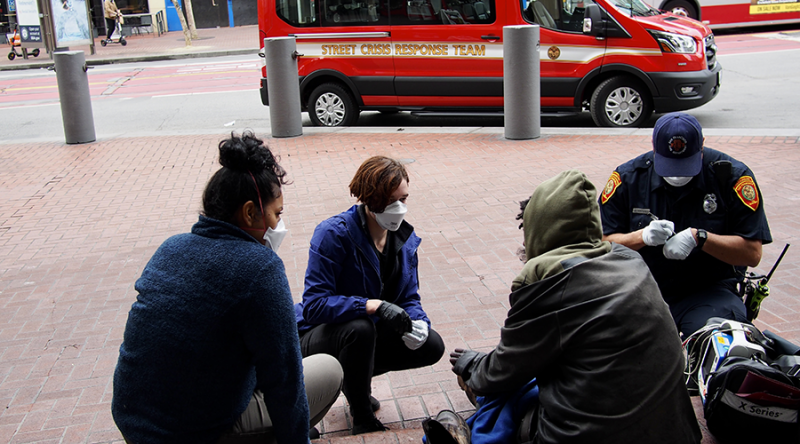
"caption": "Members of San Francisco's Street Crisis Response Team attend to a person sitting on the sidewalk in downtown San Francisco. The team, which responds to mental health crises experienced by people on the street, is intended as an alternative response to law enforcement.",
"description": null,
"title": "SCRT call 14_0",
"credit": "Courtesy of the \u003ca href=\"https://sf.gov/street-crisis-response-team\">San Francisco Street Crisis Response Team\u003c/a>",
"status": "inherit",
"altTag": "A group of mental health staff and first responders kneel around a person sitting on the sidewalk.",
"isLoading": false,
"fetchFailed": false
},
"news_11904436": {
"type": "attachments",
"id": "news_11904436",
"meta": {
"index": "attachments_1716263798",
"site": "news",
"id": "11904436",
"found": true
},
"parent": 11904356,
"imgSizes": {
"twentyfourteen-full-width": {
"file": "https://ww2.kqed.org/app/uploads/sites/10/2022/02/GettyImages-1236267426-1038x576.jpg",
"width": 1038,
"mimeType": "image/jpeg",
"height": 576
},
"thumbnail": {
"file": "https://ww2.kqed.org/app/uploads/sites/10/2022/02/GettyImages-1236267426-160x107.jpg",
"width": 160,
"mimeType": "image/jpeg",
"height": 107
},
"post-thumbnail": {
"file": "https://ww2.kqed.org/app/uploads/sites/10/2022/02/GettyImages-1236267426-672x372.jpg",
"width": 672,
"mimeType": "image/jpeg",
"height": 372
},
"kqedFullSize": {
"file": "https://ww2.kqed.org/app/uploads/sites/10/2022/02/GettyImages-1236267426-scaled-e1652820336498.jpg",
"width": 1920,
"height": 1280
},
"2048x2048": {
"file": "https://ww2.kqed.org/app/uploads/sites/10/2022/02/GettyImages-1236267426-2048x1365.jpg",
"width": 2048,
"mimeType": "image/jpeg",
"height": 1365
},
"large": {
"file": "https://ww2.kqed.org/app/uploads/sites/10/2022/02/GettyImages-1236267426-1020x680.jpg",
"width": 1020,
"mimeType": "image/jpeg",
"height": 680
},
"1536x1536": {
"file": "https://ww2.kqed.org/app/uploads/sites/10/2022/02/GettyImages-1236267426-1536x1024.jpg",
"width": 1536,
"mimeType": "image/jpeg",
"height": 1024
},
"full-width": {
"file": "https://ww2.kqed.org/app/uploads/sites/10/2022/02/GettyImages-1236267426-1920x1280.jpg",
"width": 1920,
"mimeType": "image/jpeg",
"height": 1280
},
"medium": {
"file": "https://ww2.kqed.org/app/uploads/sites/10/2022/02/GettyImages-1236267426-800x533.jpg",
"width": 800,
"mimeType": "image/jpeg",
"height": 533
}
},
"publishDate": 1644288136,
"modified": 1671482744,
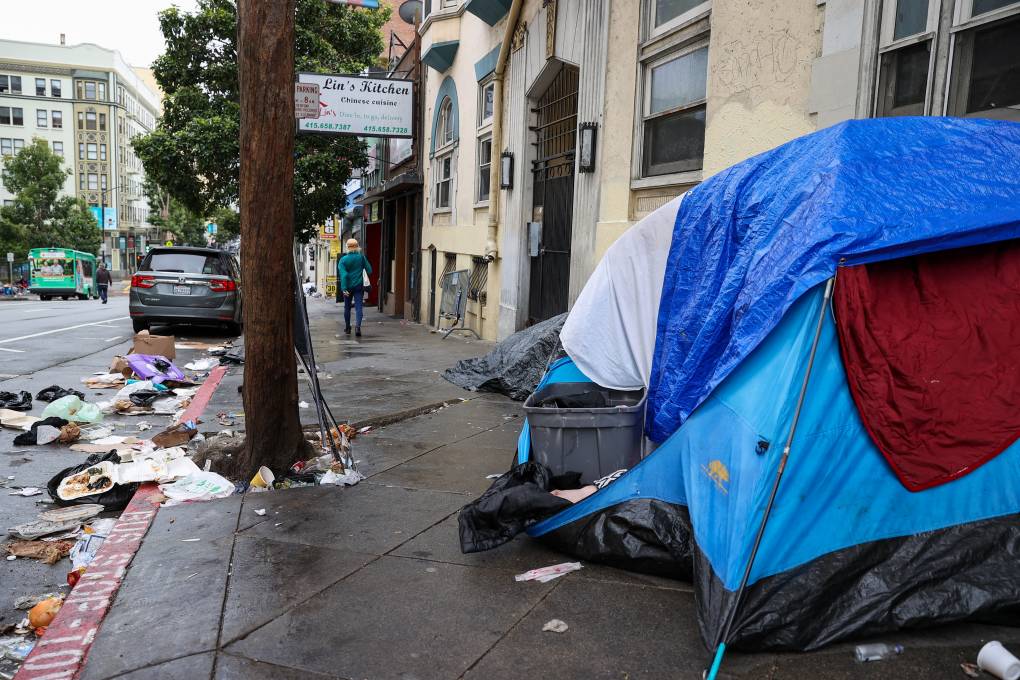
"caption": "An encampment of unhoused people on the streets of the Tenderloin in San Francisco on Oct. 30, 2021. The Biden administration has announced a new federal initiative to combat homelessness.",
"description": "An encampment of unhoused people on the streets of the Tenderloin in San Francisco on October 30, 2021.",
"title": "Homelessness in San Francisco",
"credit": "Tayfun Coskun/Anadolu Agency via Getty Images",
"status": "inherit",
"altTag": "A blue tent has been set up along the wall of a building on a rainy sidewalk on a busy city street. The parking spaces nearest the tent are filled with trash – plastic bags, open takeout containers full of food, a paper cup – and additional trash is piled at the base of a tree next to the tent. In the background, a person in a green jacket walks away down the street.",
"isLoading": false,
"fetchFailed": false
},
"news_11915972": {
"type": "attachments",
"id": "news_11915972",
"meta": {
"index": "attachments_1716263798",
"site": "news",
"id": "11915972",
"found": true
},
"parent": 11915781,
"imgSizes": {
"twentyfourteen-full-width": {
"file": "https://ww2.kqed.org/app/uploads/sites/10/2022/06/SC-Sheriff-1-1038x576.jpg",
"width": 1038,
"mimeType": "image/jpeg",
"height": 576
},
"thumbnail": {
"file": "https://ww2.kqed.org/app/uploads/sites/10/2022/06/SC-Sheriff-1-160x84.jpg",
"width": 160,
"mimeType": "image/jpeg",
"height": 84
},
"post-thumbnail": {
"file": "https://ww2.kqed.org/app/uploads/sites/10/2022/06/SC-Sheriff-1-672x372.jpg",
"width": 672,
"mimeType": "image/jpeg",
"height": 372
},
"kqedFullSize": {
"file": "https://ww2.kqed.org/app/uploads/sites/10/2022/06/SC-Sheriff-1.jpg",
"width": 1610,
"height": 841
},
"large": {
"file": "https://ww2.kqed.org/app/uploads/sites/10/2022/06/SC-Sheriff-1-1020x533.jpg",
"width": 1020,
"mimeType": "image/jpeg",
"height": 533
},
"1536x1536": {
"file": "https://ww2.kqed.org/app/uploads/sites/10/2022/06/SC-Sheriff-1-1536x802.jpg",
"width": 1536,
"mimeType": "image/jpeg",
"height": 802
},
"medium": {
"file": "https://ww2.kqed.org/app/uploads/sites/10/2022/06/SC-Sheriff-1-800x418.jpg",
"width": 800,
"mimeType": "image/jpeg",
"height": 418
}
},
"publishDate": 1654273947,
"modified": 1654578341,
"caption": "The four leading candidates for Santa Clara County Sheriff are (from left) Bob Jonsen, Sean Allen, Christine Nagaye and Kevin Jensen.",
"description": "The four leading candidates for Santa Clara County Sheriff are, from L-R: Bob Jonsen, Sean Allen, Christine Nagaye and Kevin Jensen.\n",
"title": "santa clara county sheriff",
"credit": "Courtesy of the campaign of Bob Jonsen/the campaign of Sean Allen/Jillian Cocklin/the campaign of Kevin Jensen",
"status": "inherit",
"altTag": null,
"isLoading": false,
"fetchFailed": false
},
"news_11915321": {
"type": "attachments",
"id": "news_11915321",
"meta": {
"index": "attachments_1716263798",
"site": "news",
"id": "11915321",
"found": true
},
"parent": 11915314,
"imgSizes": {
"twentyfourteen-full-width": {
"file": "https://ww2.kqed.org/app/uploads/sites/10/2022/05/CaptureNPRKids-1038x576.png",
"width": 1038,
"mimeType": "image/png",
"height": 576
},
"thumbnail": {
"file": "https://ww2.kqed.org/app/uploads/sites/10/2022/05/CaptureNPRKids-160x100.png",
"width": 160,
"mimeType": "image/png",
"height": 100
},
"post-thumbnail": {
"file": "https://ww2.kqed.org/app/uploads/sites/10/2022/05/CaptureNPRKids-672x372.png",
"width": 672,
"mimeType": "image/png",
"height": 372
},
"kqedFullSize": {
"file": "https://ww2.kqed.org/app/uploads/sites/10/2022/05/CaptureNPRKids.png",
"width": 1474,
"height": 918
},
"large": {
"file": "https://ww2.kqed.org/app/uploads/sites/10/2022/05/CaptureNPRKids-1020x635.png",
"width": 1020,
"mimeType": "image/png",
"height": 635
},
"medium": {
"file": "https://ww2.kqed.org/app/uploads/sites/10/2022/05/CaptureNPRKids-800x498.png",
"width": 800,
"mimeType": "image/png",
"height": 498
}
},
"publishDate": 1653679997,
"modified": 1653680136,
"caption": null,
"description": null,
"title": "CaptureNPRKids",
"credit": "NPR",
"status": "inherit",
"altTag": "Un dibujo de un bebé que toma de su biberón (también conocido como una mamadera) mientras ve una televisión. En la televisión, se puede ver escenas violentas de guerra, con explosivos y helicópteros armados. Una gráfica en la pantalla dice \"Breaking News\" en inglés, o \"noticias de última hora\" en español.",
"isLoading": false,
"fetchFailed": false
},
"news_11914875": {
"type": "attachments",
"id": "news_11914875",
"meta": {
"index": "attachments_1716263798",
"site": "news",
"id": "11914875",
"found": true
},
"parent": 11914873,
"imgSizes": {
"twentyfourteen-full-width": {
"file": "https://ww2.kqed.org/app/uploads/sites/10/2022/05/RS16522_GettyImages-73453883-qut-1038x576.jpg",
"width": 1038,
"mimeType": "image/jpeg",
"height": 576
},
"thumbnail": {
"file": "https://ww2.kqed.org/app/uploads/sites/10/2022/05/RS16522_GettyImages-73453883-qut-160x107.jpg",
"width": 160,
"mimeType": "image/jpeg",
"height": 107
},
"post-thumbnail": {
"file": "https://ww2.kqed.org/app/uploads/sites/10/2022/05/RS16522_GettyImages-73453883-qut-672x372.jpg",
"width": 672,
"mimeType": "image/jpeg",
"height": 372
},
"kqedFullSize": {
"file": "https://ww2.kqed.org/app/uploads/sites/10/2022/05/RS16522_GettyImages-73453883-qut.jpg",
"width": 1920,
"height": 1283
},
"large": {
"file": "https://ww2.kqed.org/app/uploads/sites/10/2022/05/RS16522_GettyImages-73453883-qut-1020x682.jpg",
"width": 1020,
"mimeType": "image/jpeg",
"height": 682
},
"1536x1536": {
"file": "https://ww2.kqed.org/app/uploads/sites/10/2022/05/RS16522_GettyImages-73453883-qut-1536x1026.jpg",
"width": 1536,
"mimeType": "image/jpeg",
"height": 1026
},
"medium": {
"file": "https://ww2.kqed.org/app/uploads/sites/10/2022/05/RS16522_GettyImages-73453883-qut-800x535.jpg",
"width": 800,
"mimeType": "image/jpeg",
"height": 535
}
},
"publishDate": 1653338089,
"modified": 1667914436,
"caption": null,
"description": "A man walks by two homeless people sleeping in the park across from San Francisco city hall February 28, 2007 in San Francisco, California. Governor Gavin Newsom's CARE Court proposal aims to get 7,000 to 12,000 people with sever mental illness into court-ordered treatment programs, including many who are experiencing homelessness. (Justin Sullivan/Getty Images)",
"title": null,
"credit": "Justin Sullivan/Getty Images",
"status": "inherit",
"altTag": "Daytime in San Francisco's Civic Center Plaza, with the monolithic Bill Graham Auditorium (a block-long, maybe two-story building with a cement brick face) as the backdrop. A man strides between the trunks of two trees, his long shadow falling behind him on one of them, toward two figures lying on the sidewalk, at the edge of a green lawn.",
"isLoading": false,
"fetchFailed": false
},
"news_11912774": {
"type": "attachments",
"id": "news_11912774",
"meta": {
"index": "attachments_1716263798",
"site": "news",
"id": "11912774",
"found": true
},
"parent": 11912753,
"imgSizes": {
"twentyfourteen-full-width": {
"file": "https://ww2.kqed.org/app/uploads/sites/10/2022/05/042522-Kids-Mental-Health-DM-CM-20-1038x576.jpg",
"width": 1038,
"mimeType": "image/jpeg",
"height": 576
},
"thumbnail": {
"file": "https://ww2.kqed.org/app/uploads/sites/10/2022/05/042522-Kids-Mental-Health-DM-CM-20-160x107.jpg",
"width": 160,
"mimeType": "image/jpeg",
"height": 107
},
"post-thumbnail": {
"file": "https://ww2.kqed.org/app/uploads/sites/10/2022/05/042522-Kids-Mental-Health-DM-CM-20-672x372.jpg",
"width": 672,
"mimeType": "image/jpeg",
"height": 372
},
"kqedFullSize": {
"file": "https://ww2.kqed.org/app/uploads/sites/10/2022/05/042522-Kids-Mental-Health-DM-CM-20-e1651281176195.jpg",
"width": 1920,
"height": 1280
},
"large": {
"file": "https://ww2.kqed.org/app/uploads/sites/10/2022/05/042522-Kids-Mental-Health-DM-CM-20-1020x680.jpg",
"width": 1020,
"mimeType": "image/jpeg",
"height": 680
},
"1536x1536": {
"file": "https://ww2.kqed.org/app/uploads/sites/10/2022/05/042522-Kids-Mental-Health-DM-CM-20-1536x1024.jpg",
"width": 1536,
"mimeType": "image/jpeg",
"height": 1024
},
"full-width": {
"file": "https://ww2.kqed.org/app/uploads/sites/10/2022/05/042522-Kids-Mental-Health-DM-CM-20-1920x1280.jpg",
"width": 1920,
"mimeType": "image/jpeg",
"height": 1280
},
"medium": {
"file": "https://ww2.kqed.org/app/uploads/sites/10/2022/05/042522-Kids-Mental-Health-DM-CM-20-800x533.jpg",
"width": 800,
"mimeType": "image/jpeg",
"height": 533
}
},
"publishDate": 1651275249,
"modified": 1651515530,
"caption": "Elizabeth Lomeli reads to her daughter, Gisselle, at their home in the Pacoima neighborhood of Los Angeles, on April 23, 2022.",
"description": null,
"title": "042522-Kids-Mental-Health-DM-CM-20",
"credit": "Da'Shaunae Maris/CalMatters",
"status": "inherit",
"altTag": null,
"isLoading": false,
"fetchFailed": false
},
"news_11910319": {
"type": "attachments",
"id": "news_11910319",
"meta": {
"index": "attachments_1716263798",
"site": "news",
"id": "11910319",
"found": true
},
"parent": 11910307,
"imgSizes": {
"twentyfourteen-full-width": {
"file": "https://ww2.kqed.org/app/uploads/sites/10/2022/04/GettyImages-1237664373-1-1038x576.jpg",
"width": 1038,
"mimeType": "image/jpeg",
"height": 576
},
"thumbnail": {
"file": "https://ww2.kqed.org/app/uploads/sites/10/2022/04/GettyImages-1237664373-1-160x97.jpg",
"width": 160,
"mimeType": "image/jpeg",
"height": 97
},
"post-thumbnail": {
"file": "https://ww2.kqed.org/app/uploads/sites/10/2022/04/GettyImages-1237664373-1-672x372.jpg",
"width": 672,
"mimeType": "image/jpeg",
"height": 372
},
"kqedFullSize": {
"file": "https://ww2.kqed.org/app/uploads/sites/10/2022/04/GettyImages-1237664373-1.jpg",
"width": 1920,
"height": 1158
},
"large": {
"file": "https://ww2.kqed.org/app/uploads/sites/10/2022/04/GettyImages-1237664373-1-1020x615.jpg",
"width": 1020,
"mimeType": "image/jpeg",
"height": 615
},
"1536x1536": {
"file": "https://ww2.kqed.org/app/uploads/sites/10/2022/04/GettyImages-1237664373-1-1536x926.jpg",
"width": 1536,
"mimeType": "image/jpeg",
"height": 926
},
"medium": {
"file": "https://ww2.kqed.org/app/uploads/sites/10/2022/04/GettyImages-1237664373-1-800x483.jpg",
"width": 800,
"mimeType": "image/jpeg",
"height": 483
}
},
"publishDate": 1649119007,
"modified": 1649185788,
"caption": "Seventh and eighth grade students attend a combined advanced engineering class at Olive Vista Middle School on the first day back following the winter break amid a dramatic surge in COVID-19 cases across Los Angeles County, on Jan. 11, 2022, in Sylmar.",
"description": null,
"title": "GettyImages-1237664373 (1)",
"credit": "Frederic J. Brown/AFP via Getty Images",
"status": "inherit",
"altTag": "Students wearing masks sit in a classroom with laptops open in front of them.",
"isLoading": false,
"fetchFailed": false
}
},
"audioPlayerReducer": {
"postId": "stream_live",
"isPaused": true,
"isPlaying": false,
"pfsActive": false,
"pledgeModalIsOpen": true,
"playerDrawerIsOpen": false,
"liveAudioPlayStartedAt": 0,
"liveAudioPlayContext": ""
},
"authorsReducer": {
"byline_news_11919816": {
"type": "authors",
"id": "byline_news_11919816",
"meta": {
"override": true
},
"slug": "byline_news_11919816",
"name": "\u003ca href=\"https://calmatters.org/author/jocelyn-wiener/\">Jocelyn Wiener\u003c/a> and \u003ca href=\"https://calmatters.org/author/manuela-tobias/\">Manuela Tobias\u003c/a>",
"isLoading": false
},
"byline_news_11915781": {
"type": "authors",
"id": "byline_news_11915781",
"meta": {
"override": true
},
"slug": "byline_news_11915781",
"name": "Adhiti Bandlamudi",
"isLoading": false
},
"byline_news_11915314": {
"type": "authors",
"id": "byline_news_11915314",
"meta": {
"override": true
},
"slug": "byline_news_11915314",
"name": "\u003ca href=\"https://www.npr.org/people/302894536/anya-kamenetz\">Anya Kamenetz\u003c/a>, \u003ca href=\"https://www.npr.org/people/349625027/cory-turner\">Cory Turner\u003c/a>, \u003ca href=\"https://www.kqed.org/author/mpena/\">María Peña\u003c/a>",
"isLoading": false
},
"byline_news_11912753": {
"type": "authors",
"id": "byline_news_11912753",
"meta": {
"override": true
},
"slug": "byline_news_11912753",
"name": "Elizabeth Aguilera",
"isLoading": false
},
"byline_news_11910307": {
"type": "authors",
"id": "byline_news_11910307",
"meta": {
"override": true
},
"slug": "byline_news_11910307",
"name": "Jocelyn Gecker\u003cp>The Associated Press",
"isLoading": false
},
"jmcevoy": {
"type": "authors",
"id": "231",
"meta": {
"index": "authors_1716337520",
"id": "231",
"found": true
},
"name": "Julia McEvoy",
"firstName": "Julia",
"lastName": "McEvoy",
"slug": "jmcevoy",
"email": "jmcevoy@KQED.org",
"display_author_email": true,
"staff_mastheads": [
"news"
],
"title": "KQED Senior Editor",
"bio": "Julia McEvoy is KQED's Senior Editor, Education Equity.\r\n\r\nJulia heads KQED’s education coverage examining inequities students face in Bay Area and California schools, and reports on what it will take to educate the next generation.\r\n\r\nJulia's editorial work has received a Peabody Award, a Casey Medal for Coverage of Children and Families, several Edward R. Murrow awards, as well as awards from the Public Radio News Directors Inc. and the Society for Professional Journalists.",
"avatar": "https://secure.gravatar.com/avatar/aec3ce21abe02b302fd33638abd56a22?s=600&d=blank&r=g",
"twitter": "juliamcevoy1",
"facebook": null,
"instagram": null,
"linkedin": null,
"sites": [
{
"site": "news",
"roles": []
},
{
"site": "stateofhealth",
"roles": [
"author"
]
}
],
"headData": {
"title": "Julia McEvoy | KQED",
"description": "KQED Senior Editor",
"ogImgSrc": "https://secure.gravatar.com/avatar/aec3ce21abe02b302fd33638abd56a22?s=600&d=blank&r=g",
"twImgSrc": "https://secure.gravatar.com/avatar/aec3ce21abe02b302fd33638abd56a22?s=600&d=blank&r=g"
},
"isLoading": false,
"link": "/author/jmcevoy"
},
"kqednewsstaffandwires": {
"type": "authors",
"id": "237",
"meta": {
"index": "authors_1716337520",
"id": "237",
"found": true
},
"name": "KQED News Staff and Wires",
"firstName": "KQED News Staff and Wires",
"lastName": null,
"slug": "kqednewsstaffandwires",
"email": "onlinenewsstaff@kqed.org",
"display_author_email": false,
"staff_mastheads": [],
"title": null,
"bio": null,
"avatar": "https://secure.gravatar.com/avatar/72295af8ebbfbd19a4948f5271285664?s=600&d=blank&r=g",
"twitter": null,
"facebook": null,
"instagram": null,
"linkedin": null,
"sites": [
{
"site": "arts",
"roles": [
"contributor"
]
},
{
"site": "news",
"roles": [
"contributor"
]
},
{
"site": "lowdown",
"roles": [
"author"
]
},
{
"site": "stateofhealth",
"roles": [
"contributor"
]
},
{
"site": "food",
"roles": [
"author"
]
}
],
"headData": {
"title": "KQED News Staff and Wires | KQED",
"description": null,
"ogImgSrc": "https://secure.gravatar.com/avatar/72295af8ebbfbd19a4948f5271285664?s=600&d=blank&r=g",
"twImgSrc": "https://secure.gravatar.com/avatar/72295af8ebbfbd19a4948f5271285664?s=600&d=blank&r=g"
},
"isLoading": false,
"link": "/author/kqednewsstaffandwires"
},
"adembosky": {
"type": "authors",
"id": "3205",
"meta": {
"index": "authors_1716337520",
"id": "3205",
"found": true
},
"name": "April Dembosky",
"firstName": "April",
"lastName": "Dembosky",
"slug": "adembosky",
"email": "adembosky@kqed.org",
"display_author_email": false,
"staff_mastheads": [
"news",
"science"
],
"title": "KQED Health Correspondent",
"bio": "April Dembosky is the health correspondent for KQED News and a regular contributor to NPR. She specializes in covering altered states of mind, from postpartum depression to methamphetamine-induced psychosis to the insanity defense. Her investigative series on insurance companies sidestepping mental health laws won multiple awards, including first place in beat reporting from the national Association of Health Care Journalists. She is the recipient of numerous other prizes and fellowships, including a national Edward R. Murrow award for investigative reporting, a Society of Professional Journalists award for long-form storytelling, and a Carter Center Fellowship for Mental Health Journalism.\r\n\r\nDembosky reported and produced \u003cem>Soundtrack of Silence\u003c/em>, an audio documentary about music and memory that is currently being made into a feature film by Paramount Pictures.\r\n\r\nBefore joining KQED in 2013, Dembosky covered technology and Silicon Valley for \u003cem>The Financial Times of London,\u003c/em> and contributed business and arts stories to \u003cem>Marketplace \u003c/em>and \u003cem>The New York Times.\u003c/em> She got her undergraduate degree in philosophy from Smith College and her master's in journalism from the University of California, Berkeley. She is a classically trained violinist and proud alum of the first symphony orchestra at Burning Man.",
"avatar": "https://secure.gravatar.com/avatar/ef92999be4ceb9ea60701e7dc276f813?s=600&d=blank&r=g",
"twitter": "adembosky",
"facebook": null,
"instagram": null,
"linkedin": null,
"sites": [
{
"site": "arts",
"roles": [
"author"
]
},
{
"site": "news",
"roles": [
"editor"
]
},
{
"site": "futureofyou",
"roles": [
"author"
]
},
{
"site": "stateofhealth",
"roles": [
"editor"
]
},
{
"site": "science",
"roles": [
"editor"
]
},
{
"site": "forum",
"roles": [
"editor"
]
}
],
"headData": {
"title": "April Dembosky | KQED",
"description": "KQED Health Correspondent",
"ogImgSrc": "https://secure.gravatar.com/avatar/ef92999be4ceb9ea60701e7dc276f813?s=600&d=blank&r=g",
"twImgSrc": "https://secure.gravatar.com/avatar/ef92999be4ceb9ea60701e7dc276f813?s=600&d=blank&r=g"
},
"isLoading": false,
"link": "/author/adembosky"
},
"esilvers": {
"type": "authors",
"id": "7237",
"meta": {
"index": "authors_1716337520",
"id": "7237",
"found": true
},
"name": "Emma Silvers",
"firstName": "Emma",
"lastName": "Silvers",
"slug": "esilvers",
"email": "esilvers@kqed.org",
"display_author_email": false,
"staff_mastheads": [],
"title": "KQED Contributor",
"bio": "Emma Silvers is an editor at KQED Arts and a former digital producer at KQED News. Born and raised in the Bay Area, she has previously been an arts and entertainment editor at the \u003cem>San Francisco Chronicle\u003c/em>, \u003cem>SF Weekly\u003c/em> and the \u003cem>San Francisco Bay Guardian.\u003c/em> \u003ca href=\"https://www.emmasilvers.com\">Her work\u003c/a> has also appeared in \u003cem>Rolling Stone\u003c/em>, Pitchfork and \u003cem>Mother Jones\u003c/em>. In 2017 she was the recipient of the Society of Professional Journalists-Northern California's award for arts and culture reporting. In 1993 she \u003ca href=\"https://www.kqed.org/pop/16759/wait-what-my-coworker-was-a-voice-over-hyperventilator-for-jurassic-park\">hyperventilated in \u003cem>Jurassic Park\u003c/em>\u003c/a>.",
"avatar": "https://secure.gravatar.com/avatar/247beada39b88ea5759db1f51dba05cf?s=600&d=blank&r=g",
"twitter": "emmaruthless",
"facebook": null,
"instagram": null,
"linkedin": null,
"sites": [
{
"site": "arts",
"roles": [
"editor"
]
},
{
"site": "news",
"roles": [
"editor"
]
},
{
"site": "pop",
"roles": [
"contributor"
]
},
{
"site": "bayareabites",
"roles": [
"editor"
]
},
{
"site": "food",
"roles": [
"contributor"
]
},
{
"site": "liveblog",
"roles": [
"editor"
]
}
],
"headData": {
"title": "Emma Silvers | KQED",
"description": "KQED Contributor",
"ogImgSrc": "https://secure.gravatar.com/avatar/247beada39b88ea5759db1f51dba05cf?s=600&d=blank&r=g",
"twImgSrc": "https://secure.gravatar.com/avatar/247beada39b88ea5759db1f51dba05cf?s=600&d=blank&r=g"
},
"isLoading": false,
"link": "/author/esilvers"
},
"ecruzguevarra": {
"type": "authors",
"id": "8654",
"meta": {
"index": "authors_1716337520",
"id": "8654",
"found": true
},
"name": "Ericka Cruz Guevarra",
"firstName": "Ericka",
"lastName": "Cruz Guevarra",
"slug": "ecruzguevarra",
"email": "ecruzguevarra@kqed.org",
"display_author_email": true,
"staff_mastheads": [
"news"
],
"title": "Producer, The Bay Podcast",
"bio": "Ericka Cruz Guevarra is host of \u003ca href=\"https://www.kqed.org/podcasts/thebay\">\u003cem>The Bay\u003c/em>\u003c/a> podcast at KQED. Before host, she was the show’s producer. Her work in that capacity includes a three-part reported series on policing in Vallejo, which won a 2020 excellence in journalism award from the Society of Professional Journalists. Ericka has worked as a breaking news reporter at Oregon Public Broadcasting, helped produce the Code Switch podcast, and was KQED’s inaugural Raul Ramirez Diversity Fund intern. She’s also an alumna of NPR’s Next Generation Radio program. Send her an email if you have strong feelings about whether Fairfield and Suisun City are the Bay. Ericka is represented by SAG-AFTRA.",
"avatar": "https://secure.gravatar.com/avatar/accefc1de4bafc7e234b69bcb9b6f6536c130fd84709bc3069ef11a78787e1bb?s=600&d=blank&r=g",
"twitter": "NotoriousECG",
"bluesky": null,
"facebook": null,
"instagram": null,
"linkedin": null,
"sites": [
{
"site": "arts",
"roles": [
"subscriber"
]
},
{
"site": "news",
"roles": [
"editor",
"manage_categories"
]
},
{
"site": "futureofyou",
"roles": [
"subscriber"
]
},
{
"site": "stateofhealth",
"roles": [
"subscriber"
]
},
{
"site": "science",
"roles": [
"editor"
]
},
{
"site": "forum",
"roles": [
"subscriber"
]
}
],
"headData": {
"title": "Ericka Cruz Guevarra | KQED",
"description": "Producer, The Bay Podcast",
"ogImgSrc": "https://secure.gravatar.com/avatar/accefc1de4bafc7e234b69bcb9b6f6536c130fd84709bc3069ef11a78787e1bb?s=600&d=blank&r=g",
"twImgSrc": "https://secure.gravatar.com/avatar/accefc1de4bafc7e234b69bcb9b6f6536c130fd84709bc3069ef11a78787e1bb?s=600&d=blank&r=g"
},
"isLoading": false,
"link": "/author/ecruzguevarra"
},
"lesleymcclurg": {
"type": "authors",
"id": "11229",
"meta": {
"index": "authors_1716337520",
"id": "11229",
"found": true
},
"name": "Lesley McClurg",
"firstName": "Lesley",
"lastName": "McClurg",
"slug": "lesleymcclurg",
"email": "lmcclurg@KQED.org",
"display_author_email": false,
"staff_mastheads": [
"news",
"science"
],
"title": "KQED Health Correspondent",
"bio": "Lesley McClurg is a health correspondent and fill-in host whose work is regularly rebroadcast on NPR and PBS programs. She’s earned multiple regional Emmy awards, a national and a regional Edward R. Murrow award, and was named Best Beat Reporter by the Association of Health Care Journalists. The Society of Professional Journalists has recognized her work several times, and the Society of Environmental Journalists spotlighted her coverage of California’s historic drought.\r\n\r\nBefore joining KQED in 2016, Lesley covered food and sustainability for Capital Public Radio, environmental issues for Colorado Public Radio, and reported for KUOW and KCTS 9 in Seattle. Away from the newsroom, she loves skiing with her daughter, mountain biking with her partner, and playing with Ollie, the family’s goldendoodle. On deadline, she runs almost entirely on chocolate chips.\r\n\r\n ",
"avatar": "https://secure.gravatar.com/avatar/bab49e972ea10c774fe0f5e29dba1722b158f7c0d58a360923d1389d380b2978?s=600&d=blank&r=g",
"twitter": "lesleywmcclurg",
"bluesky": null,
"facebook": null,
"instagram": null,
"linkedin": null,
"sites": [
{
"site": "arts",
"roles": [
"author"
]
},
{
"site": "news",
"roles": [
"editor"
]
},
{
"site": "futureofyou",
"roles": [
"editor"
]
},
{
"site": "stateofhealth",
"roles": [
"author"
]
},
{
"site": "science",
"roles": [
"editor"
]
},
{
"site": "quest",
"roles": [
"subscriber"
]
},
{
"site": "forum",
"roles": [
"administrator"
]
},
{
"site": "liveblog",
"roles": [
"author"
]
}
],
"headData": {
"title": "Lesley McClurg | KQED",
"description": "KQED Health Correspondent",
"ogImgSrc": "https://secure.gravatar.com/avatar/bab49e972ea10c774fe0f5e29dba1722b158f7c0d58a360923d1389d380b2978?s=600&d=blank&r=g",
"twImgSrc": "https://secure.gravatar.com/avatar/bab49e972ea10c774fe0f5e29dba1722b158f7c0d58a360923d1389d380b2978?s=600&d=blank&r=g"
},
"isLoading": false,
"link": "/author/lesleymcclurg"
},
"amontecillo": {
"type": "authors",
"id": "11649",
"meta": {
"index": "authors_1716337520",
"id": "11649",
"found": true
},
"name": "Alan Montecillo",
"firstName": "Alan",
"lastName": "Montecillo",
"slug": "amontecillo",
"email": "amontecillo@kqed.org",
"display_author_email": false,
"staff_mastheads": [
"news"
],
"title": "KQED Contributor",
"bio": "Alan Montecillo is the senior editor of \u003cem>\u003ca href=\"http://kqed.org/thebay\">The Bay\u003c/a>, \u003c/em> KQED's local news podcast. Before moving to the Bay Area, he worked as a senior talk show producer for WILL in Champaign-Urbana, Illinois and at Oregon Public Broadcasting in Portland, Oregon. He has won journalism awards from the Society of Professional Journalists Northern California, the Public Media Journalists Association, The Signal Awards, and has also received a regional Edward R. Murrow award. Alan is a Filipino American from Hong Kong and a graduate of Reed College.",
"avatar": "https://secure.gravatar.com/avatar/268f53a2066899ea9efdd8a5900218b17c822d9862cbc9326cccec53ef41d349?s=600&d=blank&r=g",
"twitter": "alanmontecillo",
"bluesky": null,
"facebook": null,
"instagram": null,
"linkedin": null,
"sites": [
{
"site": "",
"roles": [
"editor"
]
},
{
"site": "news",
"roles": [
"editor",
"manage_categories"
]
}
],
"headData": {
"title": "Alan Montecillo | KQED",
"description": "KQED Contributor",
"ogImgSrc": "https://secure.gravatar.com/avatar/268f53a2066899ea9efdd8a5900218b17c822d9862cbc9326cccec53ef41d349?s=600&d=blank&r=g",
"twImgSrc": "https://secure.gravatar.com/avatar/268f53a2066899ea9efdd8a5900218b17c822d9862cbc9326cccec53ef41d349?s=600&d=blank&r=g"
},
"isLoading": false,
"link": "/author/amontecillo"
},
"ebaldassari": {
"type": "authors",
"id": "11652",
"meta": {
"index": "authors_1716337520",
"id": "11652",
"found": true
},
"name": "Erin Baldassari",
"firstName": "Erin",
"lastName": "Baldassari",
"slug": "ebaldassari",
"email": "ebaldassari@KQED.org",
"display_author_email": true,
"staff_mastheads": [
"news"
],
"title": "Staff Writer",
"bio": "Erin Baldassari covers housing for KQED. She's a former print journalist and most recently worked as the transportation reporter for the \u003cem>Mercury News\u003c/em> and \u003cem>East Bay Times. \u003c/em>There, she focused on how the Bay Area’s housing shortage has changed the way people move around the region. She also served on the \u003cem>East Bay Times\u003c/em>’ 2017 Pulitzer Prize-winning team for coverage of the Ghost Ship Fire in Oakland. Prior to that, Erin worked as a breaking news and general assignment reporter for a variety of outlets in the Bay Area and the greater Boston area. A Tufts University alumna, Erin grew up in the foothills of the Sierra Nevada mountains and in Sonoma County. She is a life-long KQED listener.",
"avatar": "https://secure.gravatar.com/avatar/5e95cad64a8ca08288082212e199d2b0cbeb4fd8e8ef5339395f361032bbe005?s=600&d=blank&r=g",
"twitter": "e_baldi",
"bluesky": null,
"facebook": null,
"instagram": null,
"linkedin": null,
"sites": [
{
"site": "news",
"roles": [
"edit_others_posts",
"editor"
]
},
{
"site": "science",
"roles": [
"editor"
]
},
{
"site": "liveblog",
"roles": [
"editor"
]
}
],
"headData": {
"title": "Erin Baldassari | KQED",
"description": "Staff Writer",
"ogImgSrc": "https://secure.gravatar.com/avatar/5e95cad64a8ca08288082212e199d2b0cbeb4fd8e8ef5339395f361032bbe005?s=600&d=blank&r=g",
"twImgSrc": "https://secure.gravatar.com/avatar/5e95cad64a8ca08288082212e199d2b0cbeb4fd8e8ef5339395f361032bbe005?s=600&d=blank&r=g"
},
"isLoading": false,
"link": "/author/ebaldassari"
}
},
"pagesReducer": {
"news_tag_mental-health": {
"type": "terms",
"id": "news_2109",
"meta": {
"index": "terms_1716263798",
"site": "news",
"id": "2109",
"score": 8.282905
},
"featImg": null,
"name": "mental health",
"description": null,
"taxonomy": "tag",
"headData": {
"twImgId": null,
"twTitle": null,
"ogTitle": null,
"ogImgId": null,
"twDescription": null,
"description": null,
"title": "mental health Archives | KQED News",
"ogDescription": null
},
"ttid": 2124,
"slug": "mental-health",
"isLoading": false,
"title": "mental health",
"pageMeta": {
"site": "news",
"WpPageTemplate": "page-topic-editorial",
"currentPage": 10
},
"blocks": [
{
"blockName": "kqed/post-list",
"attrs": {
"layout": "cardArticle2",
"query": "posts/news?tag=mental-health",
"seeMore": false,
"paginated": true,
"page": 10
}
},
{
"blockName": "kqed/ad"
}
]
}
},
"pfsSessionReducer": {},
"postsReducer": {
"stream_live": {
"type": "live",
"id": "stream_live",
"audioUrl": "https://streams.kqed.org/kqedradio",
"title": "Live Stream",
"excerpt": "Live Stream information currently unavailable.",
"link": "/radio",
"featImg": "",
"label": {
"name": "KQED Live",
"link": "/"
}
},
"stream_kqedNewscast": {
"type": "posts",
"id": "stream_kqedNewscast",
"audioUrl": "https://www.kqed.org/.stream/anon/radio/RDnews/newscast.mp3?_=1",
"title": "KQED Newscast",
"featImg": "",
"label": {
"name": "88.5 FM",
"link": "/"
}
},
"news_11924343": {
"type": "posts",
"id": "news_11924343",
"meta": {
"index": "posts_1716263798",
"site": "news",
"id": "11924343",
"score": null,
"sort": [
1662123647000
]
},
"parent": 0,
"labelTerm": {
"site": "news"
},
"blocks": [],
"publishDate": 1662123647,
"format": "standard",
"disqusTitle": "How One Oakland School Is Using California's Billion-Dollar Investment in Student Mental Health",
"title": "How One Oakland School Is Using California's Billion-Dollar Investment in Student Mental Health",
"headTitle": "KQED News",
"content": "\u003cp>\u003ca href=\"https://www.eltimpano.org/\">\u003cem>This story was produced in partnership with the local civic media organization El Tímpano.\u003c/em>\u003c/a>\u003c/p>\n\u003cp>Yesabel Inga works at Bridges Academy at Melrose in East Oakland, where she is the only therapist for some 400 students, a quarter of them newcomers. The majority are from Guatemala and speak Mam, a Mayan language spoken by some half a million people in that country and Mexico.\u003c/p>\n\u003cp>“A lot of them, when they first came in, only spoke Mam, they didn't speak Spanish or English,” said Inga. “And so they were just kind of lost, you know?”\u003c/p>\n\u003cp>As these children and others return to school this month across the Bay Area, one constant is their mental health needs: Reports of increased depression, anxiety, suicidal ideation and emergency hospital visits exacerbated by the pandemic are considered a crisis, according to reports from the \u003ca href=\"https://www.cdc.gov/media/releases/2022/p0331-youth-mental-health-covid-19.html\">CDC\u003c/a>, \u003ca href=\"https://www.aecf.org/blog/national-state-by-state-data-show-depth-of-youth-mental-health-pandemic\">The Annie E. Casey Foundation \u003c/a>and \u003ca href=\"https://mhanational.org/issues/2022/mental-health-america-youth-data#:~:text=Youth%20with%20Severe%20Major%20Depressive%20Episode%202022&text=10.6%25%20of%20youth%20(or%20over,197%2C000%20from%20last%20year's%20dataset.\">Mental Health America\u003c/a>.\u003c/p>\n\u003cp>To meet these needs, California is investing billions of new dollars, on top of state and federal pandemic relief funds. Bridges Academy at Melrose, which is a public school, found a way to leverage the money to maximize impact, pivoting from crisis management to prevention.\u003c/p>\n\u003cp>The principal at Bridges at the time, Anita Comelo, was having to make tough decisions about which kids would get to see the therapist and which would not.[pullquote size=\"medium\" align=\"right\" citation=\"Vivian Yen, fourth grade teacher, Bridges Academy at Melrose\"]'I do think the murder of George Floyd did kind of push us to adjust our curriculum and make it a little bit more social justice-oriented and more ethnic studies-oriented.'[/pullquote]\u003c/p>\n\u003cp>“So we always have to pick which trauma is the bigger trauma, you know?” said Comelo. “We often end up giving the services to what we call ‘externalizers,’ the kids who end up disrupting class.”\u003c/p>\n\u003cp>Those students are typically the boys, Comelo said, adding that means other students who tend to internalize the trauma of their anxiety and depression don’t get the help they need.\u003c/p>\n\u003cp>Because the school therapist, Inga, should only carry a maximum caseload of 15 students at any time, scores of other kids at Bridges who could have used help were not getting it, and the result was a lot of disruption in class and on the playground, says community schools project manager Rosana Covarrubias.\u003c/p>\n\u003cp>“There was a lot of cyberbullying and so we were seeing it erupt here at school because of what was happening online,” said Covarrubias. “They were needing mental health support for that. We were having some students with suicidal ideation.”[aside postID=\"mindshift_59753,mindshift_59361\" label=\"Related Posts\"]However, when Covarrubias tried to refer students out to other community agencies they partner with, she says every one of them had a waitlist.\u003c/p>\n\u003cp>“They’ll say, ‘OK, thank you for the referral, we'll get back to you.’ And sometimes it's months before they get matched to an individual who can support them and be their therapist,” Covarrubias said.\u003c/p>\n\u003cp>And these were the acute cases.\u003c/p>\n\u003cp>Bridges therapist Inga says what makes matters worse is the lack of health care coverage for preventive care. Currently, Medi-Cal managed-care plans and commercial providers such as Kaiser don’t reimburse counties’ behavioral health departments for children without a clinical diagnosis.\u003c/p>\n\u003cp>That could change with legislation, namely \u003ca href=\"https://legiscan.com/CA/text/AB552/id/2494655\">AB 552\u003c/a>, which is now on the governor’s desk. It would nudge private health care plans to work with counties to reimburse community providers such as Seneca, Lincoln Families and East Bay Agency for Children in Alameda County for providing treatment for students with more moderate needs.\u003c/p>\n\u003cp>“If we were to set up kids with therapy support like preventative, you know, we wouldn't have fifth graders that have suicidal ideation,” said Inga, who works for Seneca.\u003c/p>\n\u003ch2>An investment in mental health\u003c/h2>\n\u003cp>California has begun an unprecedented investment toward meeting the mental health needs of K-12 students.\u003c/p>\n\u003cp>There is $4.4 billion for a\u003ca href=\"https://www.chhs.ca.gov/wp-content/uploads/2021/12/Children-and-Youth-Behavioral-Health-Initiative-Brief.pdf\"> youth and adolescent mental health initiative\u003c/a> to reduce structural barriers to kids getting care inside schools; another $4.1 billion for\u003ca href=\"https://edsource.org/2022/california-ready-to-launch-3-billion-multi-year-transition-to-community-schools/666571\"> community schools\u003c/a>, which includes money aimed at mental health needs; plus billions more in federal and state pandemic relief dollars, some of which is also aimed at helping students recover from depression and anxiety brought on during the pandemic and subsequent school closures.\u003c/p>\n\u003cp>In the third round of federal pandemic funding to schools, Oakland Unified got over $100 million dollars. According to records filed with the state in May this year, the district only shows spending about $650,000 of that money. And of that, the district reports nearly half went toward mental health.\u003c/p>\n\u003cp>But by the time the COVID relief money trickled down to Bridges, the school ended up with just $20,000 prioritized for mental health. The money was not enough for even one full-time therapist with benefits, which costs about $160,000.\u003c/p>\n\u003cp>The district says it hasn’t spent all the resources yet, and is spacing out the investment. It says school sites last year requested the investments they wanted based on their site needs, and that they had flexibility in how to spend the dollars.\u003c/p>\n\u003cp>Comelo and staff decided to use their $20,000 to hire a part-time clinical therapist for two hours each week. Inga and the part-time clinician decided to start a six-week, group therapy session with eight to nine students, nearly all of whom were native Mam speakers.\u003c/p>\n\u003cp>“In the beginning, everybody was really quiet and shy,” Inga said. Inga had previously worked with youth in detention camps along the border, and she could relate as an immigrant herself. “My parents brought me here when I was 15, and not having that support … my experiences led me here to this group,” she said.\u003c/p>\n\u003cp>Among the students joining in the first newly formed preventive therapy group was 10-year-old Heymer Domingo Godinez.\u003c/p>\n\u003cfigure id=\"attachment_11924358\" class=\"wp-caption aligncenter\" style=\"max-width: 800px\">\u003ca href=\"https://ww2.kqed.org/app/uploads/sites/10/2022/08/RS58258_019_BridgesAcademyMamStudents_08302022-qut.jpg\">\u003cimg class=\"size-medium wp-image-11924358\" src=\"https://ww2.kqed.org/app/uploads/sites/10/2022/08/RS58258_019_BridgesAcademyMamStudents_08302022-qut-800x533.jpg\" alt=\"Two young girls wearing red decorative shirts and long black skirts prepare food with one holding a vegetable and cutting board and the other holding the handle of a pan with food.\" width=\"800\" height=\"533\" srcset=\"https://ww2.kqed.org/app/uploads/sites/10/2022/08/RS58258_019_BridgesAcademyMamStudents_08302022-qut-800x533.jpg 800w, https://ww2.kqed.org/app/uploads/sites/10/2022/08/RS58258_019_BridgesAcademyMamStudents_08302022-qut-1020x680.jpg 1020w, https://ww2.kqed.org/app/uploads/sites/10/2022/08/RS58258_019_BridgesAcademyMamStudents_08302022-qut-160x107.jpg 160w, https://ww2.kqed.org/app/uploads/sites/10/2022/08/RS58258_019_BridgesAcademyMamStudents_08302022-qut-1536x1024.jpg 1536w, https://ww2.kqed.org/app/uploads/sites/10/2022/08/RS58258_019_BridgesAcademyMamStudents_08302022-qut.jpg 1920w\" sizes=\"(max-width: 800px) 100vw, 800px\">\u003c/a>\u003cfigcaption class=\"wp-caption-text\">Sisters Heymer Johana (left) and Katy Noeli Domingo Godinez cook eggs at their home in Oakland after school on Aug. 30, 2022. \u003ccite>(Beth LaBerge/KQED)\u003c/cite>\u003c/figcaption>\u003c/figure>\n\u003cp>“When I first got here to Bridges Academy, I was afraid. I was crying, because I was scared of the students,” Heymer said in Spanish.\u003c/p>\n\u003cp>Heymer had arrived from Guatemala with her dad in first grade, screaming, kicking and crying when dropped off at school. She was scared to come to school because back in Guatemala she had been too young to go.\u003c/p>\n\u003cp>Heymer and her teachers describe having to hold Heymer to calm her and get her to stay in classes. By fourth grade, Heymer says she had just one friend. Inga says kids like Heymer were confused about where they fit in at the school.\u003c/p>\n\u003cp>“They were not really feeling like they could trust other people,” Inga explained. “Like once they came here, there was no space to really talk about themselves and their culture.” On top of that, the pandemic hit families like Heymer’s living in East Oakland especially hard; her parents lost work and nearly lost their housing, before the school stepped in to help raise money for them.\u003c/p>\n\u003cp>When Heymer and the other students gathered in the small group therapy session, Inga asked each of them to bring something that represented them. Inga said it was Heymer who asked if she could wear her woven huipil and corte, the traditional Mayan Mam clothing she wore at home.\u003c/p>\n\u003cfigure id=\"attachment_11924357\" class=\"wp-caption aligncenter\" style=\"max-width: 800px\">\u003ca href=\"https://ww2.kqed.org/app/uploads/sites/10/2022/08/RS58255_017_BridgesAcademyMamStudents_08302022-qut.jpg\">\u003cimg class=\"size-medium wp-image-11924357\" src=\"https://ww2.kqed.org/app/uploads/sites/10/2022/08/RS58255_017_BridgesAcademyMamStudents_08302022-qut-800x533.jpg\" alt=\"Two young girls wearing red decorative shirts and long black skirts face the kitchen counter.\" width=\"800\" height=\"533\" srcset=\"https://ww2.kqed.org/app/uploads/sites/10/2022/08/RS58255_017_BridgesAcademyMamStudents_08302022-qut-800x533.jpg 800w, https://ww2.kqed.org/app/uploads/sites/10/2022/08/RS58255_017_BridgesAcademyMamStudents_08302022-qut-1020x680.jpg 1020w, https://ww2.kqed.org/app/uploads/sites/10/2022/08/RS58255_017_BridgesAcademyMamStudents_08302022-qut-160x107.jpg 160w, https://ww2.kqed.org/app/uploads/sites/10/2022/08/RS58255_017_BridgesAcademyMamStudents_08302022-qut-1536x1024.jpg 1536w, https://ww2.kqed.org/app/uploads/sites/10/2022/08/RS58255_017_BridgesAcademyMamStudents_08302022-qut.jpg 1920w\" sizes=\"(max-width: 800px) 100vw, 800px\">\u003c/a>\u003cfigcaption class=\"wp-caption-text\">Sisters Heymer Johana (left) and Katy Noeli Domingo Godinez prepare food at their home in Oakland after school on Aug. 30, 2022. \u003ccite>(Beth LaBerge/KQED)\u003c/cite>\u003c/figcaption>\u003c/figure>\n\u003cp>Heymer was nervous, and a bit afraid of being under the microscope. “Because some people are looking at us and some people are thinking, ‘Why is some girl wearing some corte like that?’” she said.\u003c/p>\n\u003cp>Inga told her students they could expect to get some attention from their peers, but that they should see it as an opportunity rather than something they’d rather avoid.\u003c/p>\n\u003cp>\"Listen, some other kids might look at you weird, but it's because they haven't been exposed to other cultures,\" Inga said she told them. \"And if they ask you or say something mean, it's like, you know, 'Let me just, let me tell you about my culture, let me tell you what this means.'\"\u003c/p>\n\u003cp>As the group therapy sessions were taking place, other efforts on the part of teachers throughout the school were also unfolding, aimed at creating\u003ca href=\"https://news.ncsu.edu/2022/08/belonging-helps-black-latino-students-feel-engaged/\"> a greater sense of belonging\u003c/a> for the Mam students.\u003c/p>\n\u003cp>“I know that during parent-teacher conferences, I — and I'm pretty sure other teachers did this as well — explicitly told students in front of their families, ‘Please keep practicing your Mam. We do not want you to lose this language,’” said fourth grade teacher Vivian Yen.\u003c/p>\n\u003cp>Yen said some teachers began taking Mam language lessons, while others were critically rethinking their curricula.\u003c/p>\n\u003cp>“I know that my grade-level team, and the fifth grade and third grade, both did this. We were looking at our ELA [English language arts] curriculum because all of the texts are very white-centered,” Yen said.\u003c/p>\n\u003cp>“I do think the murder of George Floyd did kind of push us to adjust our curriculum and make it a little bit more social justice-oriented and more ethnic studies-oriented. This is so that students would also have time to think about their own identities, thinking about how they fit in and can counter these racist narratives that we're given all the time,” Yen said.\u003c/p>\n\u003cfigure id=\"attachment_11924356\" class=\"wp-caption aligncenter\" style=\"max-width: 800px\">\u003ca href=\"https://ww2.kqed.org/app/uploads/sites/10/2022/08/RS58249_014_BridgesAcademyMamStudents_08302022-qut.jpg\">\u003cimg class=\"size-medium wp-image-11924356\" src=\"https://ww2.kqed.org/app/uploads/sites/10/2022/08/RS58249_014_BridgesAcademyMamStudents_08302022-qut-800x533.jpg\" alt=\"Two young girls wearing red decorative shirts and long black skirts sit on the grass outside a building.\" width=\"800\" height=\"533\" srcset=\"https://ww2.kqed.org/app/uploads/sites/10/2022/08/RS58249_014_BridgesAcademyMamStudents_08302022-qut-800x533.jpg 800w, https://ww2.kqed.org/app/uploads/sites/10/2022/08/RS58249_014_BridgesAcademyMamStudents_08302022-qut-1020x680.jpg 1020w, https://ww2.kqed.org/app/uploads/sites/10/2022/08/RS58249_014_BridgesAcademyMamStudents_08302022-qut-160x107.jpg 160w, https://ww2.kqed.org/app/uploads/sites/10/2022/08/RS58249_014_BridgesAcademyMamStudents_08302022-qut-1536x1024.jpg 1536w, https://ww2.kqed.org/app/uploads/sites/10/2022/08/RS58249_014_BridgesAcademyMamStudents_08302022-qut.jpg 1920w\" sizes=\"(max-width: 800px) 100vw, 800px\">\u003c/a>\u003cfigcaption class=\"wp-caption-text\">Sisters Heymer Johana (left) and Katy Noeli Domingo Godinez sit in the grass outside their new school, Elmhurst United Middle School, in Oakland on Aug. 30, 2022. \u003ccite>(Beth LaBerge/KQED)\u003c/cite>\u003c/figcaption>\u003c/figure>\n\u003cp>The joy Heymer and the other students felt in wearing their cortes spread — more Mam-speaking students began wearing their traditional cortes on Fridays.\u003c/p>\n\u003cp>“Even the boys!” Inga said. “It was just beautiful.”\u003c/p>\n\u003cp>When fifth grade graduation arrived, it was Heymer who welcomed parents to the event in Mam and led the performance. And for the first time, all students who presented recited poems in English, Spanish and Mam.\u003c/p>\n\u003cp>Teachers point to this as a culmination, and a defining moment, of the culture change they had worked so hard to achieve.\u003c/p>\n\u003cp>“Honestly I think it was just the buildup of a bunch of tiny little things that led to this movement,” Yen said.\u003c/p>\n\u003cp>This year, Heymer started sixth grade at Elmhurst United in East Oakland. As she walks the eight blocks to her new school, she likes to sing songs from her church, Iglesia de Dios Evangelio Sana Doctrina in Oakland. She says it makes her happy and calms her.\u003c/p>\n\u003cp>Heymer scouted the school out before classes began, scrutinizing staff photos on the bulletin board outside the school office, looking for faces and names of teachers she thought might speak Spanish.\u003c/p>\n\u003cp>She says while she is worried about going to a new school, she is more confident now of who she is and what she can do.\u003c/p>\n\u003cp>“I want to learn. I don’t care what people say about me. I only care about my mind and achieving my dreams,” she said.\u003c/p>\n\u003cp>Heymer says if she has to, she’ll call on her old teachers at Bridges Academy for help.\u003c/p>\n\u003cp>\u003cem>To help a young person who may be struggling with depression or anxiety:\u003c/em>\u003c/p>\n\u003cul>\n\u003cli>\u003cem>Dial 988: The 24/7 National Suicide Prevention Lifeline is now the\u003c/em>\u003cem> \u003ca href=\"https://www.samhsa.gov/find-help/988\">988 Suicide and Crisis Lifeline\u003c/a>\u003c/em>.\u003c/li>\n\u003cli>\u003cem>\u003ca href=\"https://www.dhcs.ca.gov/individuals/Pages/MHPContactList.aspx\">Find your California county’s mental health services phone number.\u003c/a>\u003c/em>\u003c/li>\n\u003cli>\u003cem>Call the Family Paths Parenting Stress Helpline (English, Spanish) at (800) 829-3777, or \u003ca href=\"https://familypaths.org/\">visit its website\u003c/a>.\u003c/em>\u003c/li>\n\u003cli>\u003cem>\u003ca href=\"https://senecacommunityresources.weebly.com/\">Use Seneca community resources for California counties.\u003c/a>\u003c/em>\u003c/li>\n\u003cli>\u003cem>\u003ca href=\"https://www.acbhcs.org/\">Visit the Alameda County Behavioral Health Care Service webpage.\u003c/a>\u003c/em>\u003c/li>\n\u003c/ul>\n\u003cp>[ad fullwidth]\u003c/p>\n\u003cp>[ad floatright]\u003c/p>\n",
"disqusIdentifier": "11924343 https://ww2.kqed.org/news/?p=11924343",
"disqusUrl": "https://ww2.kqed.org/news/2022/09/02/california-is-investing-billions-in-student-mental-health-how-one-school-is-using-the-money/",
"stats": {
"hasVideo": false,
"hasChartOrMap": false,
"hasAudio": false,
"hasPolis": false,
"wordCount": 2013,
"hasGoogleForm": false,
"hasGallery": false,
"hasHearkenModule": false,
"iframeSrcs": [],
"paragraphCount": 49
},
"modified": 1662675549,
"excerpt": "California is investing billions of new dollars in trying to meet the mental health needs of K-12 students. In Oakland, Bridges Academy at Melrose found a way to leverage the money to maximize its impact.",
"headData": {
"twImgId": "",
"twTitle": "",
"ogTitle": "",
"ogImgId": "",
"twDescription": "",
"description": "California is investing billions of new dollars in trying to meet the mental health needs of K-12 students. In Oakland, Bridges Academy at Melrose found a way to leverage the money to maximize its impact.",
"title": "How One Oakland School Is Using California's Billion-Dollar Investment in Student Mental Health | KQED",
"ogDescription": "",
"schema": {
"@context": "https://schema.org",
"@type": "NewsArticle",
"headline": "How One Oakland School Is Using California's Billion-Dollar Investment in Student Mental Health",
"datePublished": "2022-09-02T06:00:47-07:00",
"dateModified": "2022-09-08T15:19:09-07:00",
"image": "https://cdn.kqed.org/wp-content/uploads/2020/02/KQED-OG-Image@1x.png",
"isAccessibleForFree": "True",
"publisher": {
"@type": "NewsMediaOrganization",
"@id": "https://www.kqed.org/#organization",
"name": "KQED",
"logo": "https://cdn.kqed.org/wp-content/uploads/2020/02/KQED-OG-Image@1x.png",
"url": "https://www.kqed.org",
"sameAs": [
"https://www.facebook.com/KQED",
"https://twitter.com/KQED",
"https://www.instagram.com/kqed/",
"https://www.tiktok.com/@kqedofficial",
"https://www.linkedin.com/company/kqed",
"https://www.youtube.com/channel/UCeC0IOo7i1P_61zVUWbJ4nw"
]
}
}
},
"guestAuthors": [],
"slug": "california-is-investing-billions-in-student-mental-health-how-one-school-is-using-the-money",
"status": "publish",
"audioUrl": "https://traffic.omny.fm/d/clips/0af137ef-751e-4b19-a055-aaef00d2d578/ffca7e9f-6831-4[…]f-aaef00f5a073/7f8cada9-423b-46c4-8b0e-af0401249936/audio.mp3",
"excludeFromSiteSearch": "Include",
"path": "/news/11924343/california-is-investing-billions-in-student-mental-health-how-one-school-is-using-the-money",
"audioTrackLength": null,
"parsedContent": [
{
"type": "contentString",
"content": "\u003cdiv class=\"post-body\">\u003cp>\u003cp>\u003ca href=\"https://www.eltimpano.org/\">\u003cem>This story was produced in partnership with the local civic media organization El Tímpano.\u003c/em>\u003c/a>\u003c/p>\n\u003cp>Yesabel Inga works at Bridges Academy at Melrose in East Oakland, where she is the only therapist for some 400 students, a quarter of them newcomers. The majority are from Guatemala and speak Mam, a Mayan language spoken by some half a million people in that country and Mexico.\u003c/p>\n\u003cp>“A lot of them, when they first came in, only spoke Mam, they didn't speak Spanish or English,” said Inga. “And so they were just kind of lost, you know?”\u003c/p>\n\u003cp>As these children and others return to school this month across the Bay Area, one constant is their mental health needs: Reports of increased depression, anxiety, suicidal ideation and emergency hospital visits exacerbated by the pandemic are considered a crisis, according to reports from the \u003ca href=\"https://www.cdc.gov/media/releases/2022/p0331-youth-mental-health-covid-19.html\">CDC\u003c/a>, \u003ca href=\"https://www.aecf.org/blog/national-state-by-state-data-show-depth-of-youth-mental-health-pandemic\">The Annie E. Casey Foundation \u003c/a>and \u003ca href=\"https://mhanational.org/issues/2022/mental-health-america-youth-data#:~:text=Youth%20with%20Severe%20Major%20Depressive%20Episode%202022&text=10.6%25%20of%20youth%20(or%20over,197%2C000%20from%20last%20year's%20dataset.\">Mental Health America\u003c/a>.\u003c/p>\n\u003cp>To meet these needs, California is investing billions of new dollars, on top of state and federal pandemic relief funds. Bridges Academy at Melrose, which is a public school, found a way to leverage the money to maximize impact, pivoting from crisis management to prevention.\u003c/p>\n\u003cp>The principal at Bridges at the time, Anita Comelo, was having to make tough decisions about which kids would get to see the therapist and which would not.\u003c/p>\u003c/div>",
"attributes": {
"named": {},
"numeric": []
}
},
{
"type": "component",
"content": "'I do think the murder of George Floyd did kind of push us to adjust our curriculum and make it a little bit more social justice-oriented and more ethnic studies-oriented.'",
"name": "pullquote",
"attributes": {
"named": {
"size": "medium",
"align": "right",
"citation": "Vivian Yen, fourth grade teacher, Bridges Academy at Melrose",
"label": ""
},
"numeric": []
}
},
{
"type": "contentString",
"content": "\u003cdiv class=\"post-body\">\u003cp>\u003c/p>\n\u003cp>“So we always have to pick which trauma is the bigger trauma, you know?” said Comelo. “We often end up giving the services to what we call ‘externalizers,’ the kids who end up disrupting class.”\u003c/p>\n\u003cp>Those students are typically the boys, Comelo said, adding that means other students who tend to internalize the trauma of their anxiety and depression don’t get the help they need.\u003c/p>\n\u003cp>Because the school therapist, Inga, should only carry a maximum caseload of 15 students at any time, scores of other kids at Bridges who could have used help were not getting it, and the result was a lot of disruption in class and on the playground, says community schools project manager Rosana Covarrubias.\u003c/p>\n\u003cp>“There was a lot of cyberbullying and so we were seeing it erupt here at school because of what was happening online,” said Covarrubias. “They were needing mental health support for that. We were having some students with suicidal ideation.”\u003c/p>\u003c/div>",
"attributes": {
"named": {},
"numeric": []
}
},
{
"type": "component",
"content": "",
"name": "aside",
"attributes": {
"named": {
"postid": "mindshift_59753,mindshift_59361",
"label": "Related Posts "
},
"numeric": []
}
},
{
"type": "contentString",
"content": "\u003cdiv class=\"post-body\">\u003cp>However, when Covarrubias tried to refer students out to other community agencies they partner with, she says every one of them had a waitlist.\u003c/p>\n\u003cp>“They’ll say, ‘OK, thank you for the referral, we'll get back to you.’ And sometimes it's months before they get matched to an individual who can support them and be their therapist,” Covarrubias said.\u003c/p>\n\u003cp>And these were the acute cases.\u003c/p>\n\u003cp>Bridges therapist Inga says what makes matters worse is the lack of health care coverage for preventive care. Currently, Medi-Cal managed-care plans and commercial providers such as Kaiser don’t reimburse counties’ behavioral health departments for children without a clinical diagnosis.\u003c/p>\n\u003cp>That could change with legislation, namely \u003ca href=\"https://legiscan.com/CA/text/AB552/id/2494655\">AB 552\u003c/a>, which is now on the governor’s desk. It would nudge private health care plans to work with counties to reimburse community providers such as Seneca, Lincoln Families and East Bay Agency for Children in Alameda County for providing treatment for students with more moderate needs.\u003c/p>\n\u003cp>“If we were to set up kids with therapy support like preventative, you know, we wouldn't have fifth graders that have suicidal ideation,” said Inga, who works for Seneca.\u003c/p>\n\u003ch2>An investment in mental health\u003c/h2>\n\u003cp>California has begun an unprecedented investment toward meeting the mental health needs of K-12 students.\u003c/p>\n\u003cp>There is $4.4 billion for a\u003ca href=\"https://www.chhs.ca.gov/wp-content/uploads/2021/12/Children-and-Youth-Behavioral-Health-Initiative-Brief.pdf\"> youth and adolescent mental health initiative\u003c/a> to reduce structural barriers to kids getting care inside schools; another $4.1 billion for\u003ca href=\"https://edsource.org/2022/california-ready-to-launch-3-billion-multi-year-transition-to-community-schools/666571\"> community schools\u003c/a>, which includes money aimed at mental health needs; plus billions more in federal and state pandemic relief dollars, some of which is also aimed at helping students recover from depression and anxiety brought on during the pandemic and subsequent school closures.\u003c/p>\n\u003cp>In the third round of federal pandemic funding to schools, Oakland Unified got over $100 million dollars. According to records filed with the state in May this year, the district only shows spending about $650,000 of that money. And of that, the district reports nearly half went toward mental health.\u003c/p>\n\u003cp>But by the time the COVID relief money trickled down to Bridges, the school ended up with just $20,000 prioritized for mental health. The money was not enough for even one full-time therapist with benefits, which costs about $160,000.\u003c/p>\n\u003cp>The district says it hasn’t spent all the resources yet, and is spacing out the investment. It says school sites last year requested the investments they wanted based on their site needs, and that they had flexibility in how to spend the dollars.\u003c/p>\n\u003cp>Comelo and staff decided to use their $20,000 to hire a part-time clinical therapist for two hours each week. Inga and the part-time clinician decided to start a six-week, group therapy session with eight to nine students, nearly all of whom were native Mam speakers.\u003c/p>\n\u003cp>“In the beginning, everybody was really quiet and shy,” Inga said. Inga had previously worked with youth in detention camps along the border, and she could relate as an immigrant herself. “My parents brought me here when I was 15, and not having that support … my experiences led me here to this group,” she said.\u003c/p>\n\u003cp>Among the students joining in the first newly formed preventive therapy group was 10-year-old Heymer Domingo Godinez.\u003c/p>\n\u003cfigure id=\"attachment_11924358\" class=\"wp-caption aligncenter\" style=\"max-width: 800px\">\u003ca href=\"https://ww2.kqed.org/app/uploads/sites/10/2022/08/RS58258_019_BridgesAcademyMamStudents_08302022-qut.jpg\">\u003cimg class=\"size-medium wp-image-11924358\" src=\"https://ww2.kqed.org/app/uploads/sites/10/2022/08/RS58258_019_BridgesAcademyMamStudents_08302022-qut-800x533.jpg\" alt=\"Two young girls wearing red decorative shirts and long black skirts prepare food with one holding a vegetable and cutting board and the other holding the handle of a pan with food.\" width=\"800\" height=\"533\" srcset=\"https://ww2.kqed.org/app/uploads/sites/10/2022/08/RS58258_019_BridgesAcademyMamStudents_08302022-qut-800x533.jpg 800w, https://ww2.kqed.org/app/uploads/sites/10/2022/08/RS58258_019_BridgesAcademyMamStudents_08302022-qut-1020x680.jpg 1020w, https://ww2.kqed.org/app/uploads/sites/10/2022/08/RS58258_019_BridgesAcademyMamStudents_08302022-qut-160x107.jpg 160w, https://ww2.kqed.org/app/uploads/sites/10/2022/08/RS58258_019_BridgesAcademyMamStudents_08302022-qut-1536x1024.jpg 1536w, https://ww2.kqed.org/app/uploads/sites/10/2022/08/RS58258_019_BridgesAcademyMamStudents_08302022-qut.jpg 1920w\" sizes=\"(max-width: 800px) 100vw, 800px\">\u003c/a>\u003cfigcaption class=\"wp-caption-text\">Sisters Heymer Johana (left) and Katy Noeli Domingo Godinez cook eggs at their home in Oakland after school on Aug. 30, 2022. \u003ccite>(Beth LaBerge/KQED)\u003c/cite>\u003c/figcaption>\u003c/figure>\n\u003cp>“When I first got here to Bridges Academy, I was afraid. I was crying, because I was scared of the students,” Heymer said in Spanish.\u003c/p>\n\u003cp>Heymer had arrived from Guatemala with her dad in first grade, screaming, kicking and crying when dropped off at school. She was scared to come to school because back in Guatemala she had been too young to go.\u003c/p>\n\u003cp>Heymer and her teachers describe having to hold Heymer to calm her and get her to stay in classes. By fourth grade, Heymer says she had just one friend. Inga says kids like Heymer were confused about where they fit in at the school.\u003c/p>\n\u003cp>“They were not really feeling like they could trust other people,” Inga explained. “Like once they came here, there was no space to really talk about themselves and their culture.” On top of that, the pandemic hit families like Heymer’s living in East Oakland especially hard; her parents lost work and nearly lost their housing, before the school stepped in to help raise money for them.\u003c/p>\n\u003cp>When Heymer and the other students gathered in the small group therapy session, Inga asked each of them to bring something that represented them. Inga said it was Heymer who asked if she could wear her woven huipil and corte, the traditional Mayan Mam clothing she wore at home.\u003c/p>\n\u003cfigure id=\"attachment_11924357\" class=\"wp-caption aligncenter\" style=\"max-width: 800px\">\u003ca href=\"https://ww2.kqed.org/app/uploads/sites/10/2022/08/RS58255_017_BridgesAcademyMamStudents_08302022-qut.jpg\">\u003cimg class=\"size-medium wp-image-11924357\" src=\"https://ww2.kqed.org/app/uploads/sites/10/2022/08/RS58255_017_BridgesAcademyMamStudents_08302022-qut-800x533.jpg\" alt=\"Two young girls wearing red decorative shirts and long black skirts face the kitchen counter.\" width=\"800\" height=\"533\" srcset=\"https://ww2.kqed.org/app/uploads/sites/10/2022/08/RS58255_017_BridgesAcademyMamStudents_08302022-qut-800x533.jpg 800w, https://ww2.kqed.org/app/uploads/sites/10/2022/08/RS58255_017_BridgesAcademyMamStudents_08302022-qut-1020x680.jpg 1020w, https://ww2.kqed.org/app/uploads/sites/10/2022/08/RS58255_017_BridgesAcademyMamStudents_08302022-qut-160x107.jpg 160w, https://ww2.kqed.org/app/uploads/sites/10/2022/08/RS58255_017_BridgesAcademyMamStudents_08302022-qut-1536x1024.jpg 1536w, https://ww2.kqed.org/app/uploads/sites/10/2022/08/RS58255_017_BridgesAcademyMamStudents_08302022-qut.jpg 1920w\" sizes=\"(max-width: 800px) 100vw, 800px\">\u003c/a>\u003cfigcaption class=\"wp-caption-text\">Sisters Heymer Johana (left) and Katy Noeli Domingo Godinez prepare food at their home in Oakland after school on Aug. 30, 2022. \u003ccite>(Beth LaBerge/KQED)\u003c/cite>\u003c/figcaption>\u003c/figure>\n\u003cp>Heymer was nervous, and a bit afraid of being under the microscope. “Because some people are looking at us and some people are thinking, ‘Why is some girl wearing some corte like that?’” she said.\u003c/p>\n\u003cp>Inga told her students they could expect to get some attention from their peers, but that they should see it as an opportunity rather than something they’d rather avoid.\u003c/p>\n\u003cp>\"Listen, some other kids might look at you weird, but it's because they haven't been exposed to other cultures,\" Inga said she told them. \"And if they ask you or say something mean, it's like, you know, 'Let me just, let me tell you about my culture, let me tell you what this means.'\"\u003c/p>\n\u003cp>As the group therapy sessions were taking place, other efforts on the part of teachers throughout the school were also unfolding, aimed at creating\u003ca href=\"https://news.ncsu.edu/2022/08/belonging-helps-black-latino-students-feel-engaged/\"> a greater sense of belonging\u003c/a> for the Mam students.\u003c/p>\n\u003cp>“I know that during parent-teacher conferences, I — and I'm pretty sure other teachers did this as well — explicitly told students in front of their families, ‘Please keep practicing your Mam. We do not want you to lose this language,’” said fourth grade teacher Vivian Yen.\u003c/p>\n\u003cp>Yen said some teachers began taking Mam language lessons, while others were critically rethinking their curricula.\u003c/p>\n\u003cp>“I know that my grade-level team, and the fifth grade and third grade, both did this. We were looking at our ELA [English language arts] curriculum because all of the texts are very white-centered,” Yen said.\u003c/p>\n\u003cp>“I do think the murder of George Floyd did kind of push us to adjust our curriculum and make it a little bit more social justice-oriented and more ethnic studies-oriented. This is so that students would also have time to think about their own identities, thinking about how they fit in and can counter these racist narratives that we're given all the time,” Yen said.\u003c/p>\n\u003cfigure id=\"attachment_11924356\" class=\"wp-caption aligncenter\" style=\"max-width: 800px\">\u003ca href=\"https://ww2.kqed.org/app/uploads/sites/10/2022/08/RS58249_014_BridgesAcademyMamStudents_08302022-qut.jpg\">\u003cimg class=\"size-medium wp-image-11924356\" src=\"https://ww2.kqed.org/app/uploads/sites/10/2022/08/RS58249_014_BridgesAcademyMamStudents_08302022-qut-800x533.jpg\" alt=\"Two young girls wearing red decorative shirts and long black skirts sit on the grass outside a building.\" width=\"800\" height=\"533\" srcset=\"https://ww2.kqed.org/app/uploads/sites/10/2022/08/RS58249_014_BridgesAcademyMamStudents_08302022-qut-800x533.jpg 800w, https://ww2.kqed.org/app/uploads/sites/10/2022/08/RS58249_014_BridgesAcademyMamStudents_08302022-qut-1020x680.jpg 1020w, https://ww2.kqed.org/app/uploads/sites/10/2022/08/RS58249_014_BridgesAcademyMamStudents_08302022-qut-160x107.jpg 160w, https://ww2.kqed.org/app/uploads/sites/10/2022/08/RS58249_014_BridgesAcademyMamStudents_08302022-qut-1536x1024.jpg 1536w, https://ww2.kqed.org/app/uploads/sites/10/2022/08/RS58249_014_BridgesAcademyMamStudents_08302022-qut.jpg 1920w\" sizes=\"(max-width: 800px) 100vw, 800px\">\u003c/a>\u003cfigcaption class=\"wp-caption-text\">Sisters Heymer Johana (left) and Katy Noeli Domingo Godinez sit in the grass outside their new school, Elmhurst United Middle School, in Oakland on Aug. 30, 2022. \u003ccite>(Beth LaBerge/KQED)\u003c/cite>\u003c/figcaption>\u003c/figure>\n\u003cp>The joy Heymer and the other students felt in wearing their cortes spread — more Mam-speaking students began wearing their traditional cortes on Fridays.\u003c/p>\n\u003cp>“Even the boys!” Inga said. “It was just beautiful.”\u003c/p>\n\u003cp>When fifth grade graduation arrived, it was Heymer who welcomed parents to the event in Mam and led the performance. And for the first time, all students who presented recited poems in English, Spanish and Mam.\u003c/p>\n\u003cp>Teachers point to this as a culmination, and a defining moment, of the culture change they had worked so hard to achieve.\u003c/p>\n\u003cp>“Honestly I think it was just the buildup of a bunch of tiny little things that led to this movement,” Yen said.\u003c/p>\n\u003cp>This year, Heymer started sixth grade at Elmhurst United in East Oakland. As she walks the eight blocks to her new school, she likes to sing songs from her church, Iglesia de Dios Evangelio Sana Doctrina in Oakland. She says it makes her happy and calms her.\u003c/p>\n\u003cp>Heymer scouted the school out before classes began, scrutinizing staff photos on the bulletin board outside the school office, looking for faces and names of teachers she thought might speak Spanish.\u003c/p>\n\u003cp>She says while she is worried about going to a new school, she is more confident now of who she is and what she can do.\u003c/p>\n\u003cp>“I want to learn. I don’t care what people say about me. I only care about my mind and achieving my dreams,” she said.\u003c/p>\n\u003cp>Heymer says if she has to, she’ll call on her old teachers at Bridges Academy for help.\u003c/p>\n\u003cp>\u003cem>To help a young person who may be struggling with depression or anxiety:\u003c/em>\u003c/p>\n\u003cul>\n\u003cli>\u003cem>Dial 988: The 24/7 National Suicide Prevention Lifeline is now the\u003c/em>\u003cem> \u003ca href=\"https://www.samhsa.gov/find-help/988\">988 Suicide and Crisis Lifeline\u003c/a>\u003c/em>.\u003c/li>\n\u003cli>\u003cem>\u003ca href=\"https://www.dhcs.ca.gov/individuals/Pages/MHPContactList.aspx\">Find your California county’s mental health services phone number.\u003c/a>\u003c/em>\u003c/li>\n\u003cli>\u003cem>Call the Family Paths Parenting Stress Helpline (English, Spanish) at (800) 829-3777, or \u003ca href=\"https://familypaths.org/\">visit its website\u003c/a>.\u003c/em>\u003c/li>\n\u003cli>\u003cem>\u003ca href=\"https://senecacommunityresources.weebly.com/\">Use Seneca community resources for California counties.\u003c/a>\u003c/em>\u003c/li>\n\u003cli>\u003cem>\u003ca href=\"https://www.acbhcs.org/\">Visit the Alameda County Behavioral Health Care Service webpage.\u003c/a>\u003c/em>\u003c/li>\n\u003c/ul>\n\u003cp>\u003c/p>\u003c/div>",
"attributes": {
"named": {},
"numeric": []
}
},
{
"type": "component",
"content": "",
"name": "ad",
"attributes": {
"named": {
"label": "fullwidth"
},
"numeric": [
"fullwidth"
]
}
},
{
"type": "contentString",
"content": "\u003cdiv class=\"post-body\">\u003cp>\u003c/p>\n\u003cp>\u003c/p>\u003c/div>",
"attributes": {
"named": {},
"numeric": []
}
},
{
"type": "component",
"content": "",
"name": "ad",
"attributes": {
"named": {
"label": "floatright"
},
"numeric": [
"floatright"
]
}
},
{
"type": "contentString",
"content": "\u003cdiv class=\"post-body\">\u003cp>\u003c/p>\n\u003c/div>\u003c/p>",
"attributes": {
"named": {},
"numeric": []
}
}
],
"link": "/news/11924343/california-is-investing-billions-in-student-mental-health-how-one-school-is-using-the-money",
"authors": [
"231"
],
"categories": [
"news_8"
],
"tags": [
"news_31556",
"news_20013",
"news_27626",
"news_2109",
"news_3202",
"news_3366",
"news_31555"
],
"featImg": "news_11924355",
"label": "news"
},
"news_11923034": {
"type": "posts",
"id": "news_11923034",
"meta": {
"index": "posts_1716263798",
"site": "news",
"id": "11923034",
"score": null,
"sort": [
1661013005000
]
},
"guestAuthors": [],
"slug": "were-drowning-why-kaiser-mental-health-workers-are-striking",
"title": "'We're Drowning': Why Kaiser Mental Health Workers Are Striking",
"publishDate": 1661013005,
"format": "standard",
"headTitle": "‘We’re Drowning’: Why Kaiser Mental Health Workers Are Striking | KQED",
"labelTerm": {
"site": "news"
},
"content": "\u003cp>On Friday, the fifth day of an open-ended strike by Kaiser Permanente mental health workers across Northern California, some 200 employees and supporters marched to the health care giant’s Oakland headquarters, demanding that management increase staffing and resources.\u003c/p>\n\u003cp>They were among the roughly 2,000 Kaiser therapists, social workers and other mental health care staffers across Northern California — represented by the National Union of Healthcare Workers — who formed picket lines outside Kaiser facilities this week, after negotiations with management ended without resolution last weekend. Those striking said employee morale is dangerously low and patient care has become substandard due to long wait times for treatment. [aside label=\"Related Stories\" postID=\"news_11922524,news_11922748,news_11921580\"] Kaiser officials have called the strike unethical to patients and counterproductive, pointing to the shortage of mental health professionals nationwide. A company representative declined to participate in an interview, citing ongoing negotiations.\u003c/p>\n\u003cp class=\"p1\">But in a statement issued Friday, Deb Catsavas, senior vice president of human resources at Kaiser Permanente Northern California, reiterated the company’s stance that the strike and “disruption to patient care” were unnecessary.\u003c/p>\n\u003cp class=\"p1\">“While [the National Union of Healthcare Workers] claims it is fighting for increased access to care, its primary demand is for union members to spend less time seeing patients,” said Catsavas. “Our patients cannot afford a proposal that significantly reduces the time available to care for our patients and their mental health needs.”\u003c/p>\n\u003cp>The strike comes amid what the White House has described as an unprecedented mental health crisis among Americans of all ages.\u003c/p>\n\u003ch2>Why are Kaiser mental health care workers striking?\u003c/h2>\n\u003cp>“We’re striking because it’s demoralizing to work for a company that actively does things to capitalize on burnout,” Naomi Johnson, an associate clinical social worker for Kaiser, told KQED Forum. “We’re really working very hard as clinicians to try to see patients as frequently as we can, and to provide the care that we’re trained [for] and good at providing. And we’re not supported in doing that by the company.”\u003c/p>\n\u003cp>[ad fullwidth]\u003c/p>\n\u003cp>Kaiser tells patients that “if you have any sort of concerns or you want to come to therapy, please reach out,” added Johnson. “And then as providers, we’re told, ‘Only treat people who meet medical necessity.’ So it’s really difficult because we have this huge influx of people trying to seek services, but there aren’t enough of us to actually meet the demand, so we’re just completely overwhelmed. … We’re drowning, as clinicians.”\u003c/p>\n\u003cfigure id=\"attachment_11923078\" class=\"wp-caption aligncenter\" style=\"max-width: 1920px\">\u003ca href=\"https://ww2.kqed.org/app/uploads/sites/10/2022/08/RS57886_021_KQED_KaiserStrikeOakland_08192022-qut.jpg\">\u003cimg loading=\"lazy\" decoding=\"async\" class=\"size-full wp-image-11923078\" src=\"https://ww2.kqed.org/app/uploads/sites/10/2022/08/RS57886_021_KQED_KaiserStrikeOakland_08192022-qut.jpg\" alt=\"a protest\" width=\"1920\" height=\"1280\" srcset=\"https://cdn.kqed.org/wp-content/uploads/sites/10/2022/08/RS57886_021_KQED_KaiserStrikeOakland_08192022-qut.jpg 1920w, https://cdn.kqed.org/wp-content/uploads/sites/10/2022/08/RS57886_021_KQED_KaiserStrikeOakland_08192022-qut-800x533.jpg 800w, https://cdn.kqed.org/wp-content/uploads/sites/10/2022/08/RS57886_021_KQED_KaiserStrikeOakland_08192022-qut-1020x680.jpg 1020w, https://cdn.kqed.org/wp-content/uploads/sites/10/2022/08/RS57886_021_KQED_KaiserStrikeOakland_08192022-qut-160x107.jpg 160w, https://cdn.kqed.org/wp-content/uploads/sites/10/2022/08/RS57886_021_KQED_KaiserStrikeOakland_08192022-qut-1536x1024.jpg 1536w\" sizes=\"auto, (max-width: 1920px) 100vw, 1920px\">\u003c/a>\u003cfigcaption class=\"wp-caption-text\">Kaiser mental health care workers rally before a march from Oakland Kaiser Medical Center to Kaiser’s corporate headquarters on Friday, Aug. 19, 2022, the fifth day of an open-ended strike. \u003ccite>(Beth LaBerge/KQED)\u003c/cite>\u003c/figcaption>\u003c/figure>\n\u003ch2>How does understaffing affect patients seeking treatment?\u003c/h2>\n\u003cp>“There are currently 2,600 Kaiser patients for every mental health worker in (the) Northern California Kaiser system,” Ilana Marcucci-Morris, a licensed clinical social worker in Kaiser’s psychiatry department in Oakland, told Forum. That means the average Kaiser therapist sees between seven and 12 patients per day, while someone in private practice might see between three and six. After a series of initial intake calls, the majority of Kaiser patients calling with a “nonurgent” need wait between two and three months to see a therapist.\u003c/p>\n\u003cp>The National Union of Healthcare Workers points to \u003ca href=\"https://nuhw.org/more-than-2000-kaiser-permanente-mental-health-clinicians-to-start-open-ended-strike-august-15/\">internal Kaiser documents illustrating\u003c/a> that “patients who received an initial mental health assessment on June 13 weren’t scheduled for follow-up appointments for a month in San Francisco, more than two months in Sacramento and three months or more in other parts of Northern California.” That length of time, experts say, does a disservice to those who have already taken the often-difficult first step of seeking support.\u003c/p>\n\u003cp>“The goal is to help people get better and terminate,” said Marcucci-Morris. “But the system within Kaiser does not allow for that. It’s the opposite. People are waiting longer, and deteriorating to where they either give up and pay [for therapy] out of pocket, which sets up a system for folks who have those resources to pay a private practice therapist and get better.” She said people who can’t afford private therapy and insurance premiums aren’t able to get better. “They get worse and they stay in Kaiser and they just stay sick,” she said.\u003c/p>\n\u003cfigure id=\"attachment_11923083\" class=\"wp-caption aligncenter\" style=\"max-width: 1920px\">\u003ca href=\"https://ww2.kqed.org/app/uploads/sites/10/2022/08/RS57866_005_KQED_KaiserStrikeOakland_08192022-qut.jpg\">\u003cimg loading=\"lazy\" decoding=\"async\" class=\"size-full wp-image-11923083\" src=\"https://ww2.kqed.org/app/uploads/sites/10/2022/08/RS57866_005_KQED_KaiserStrikeOakland_08192022-qut.jpg\" alt=\"protestors reflected in a bus window\" width=\"1920\" height=\"1280\" srcset=\"https://cdn.kqed.org/wp-content/uploads/sites/10/2022/08/RS57866_005_KQED_KaiserStrikeOakland_08192022-qut.jpg 1920w, https://cdn.kqed.org/wp-content/uploads/sites/10/2022/08/RS57866_005_KQED_KaiserStrikeOakland_08192022-qut-800x533.jpg 800w, https://cdn.kqed.org/wp-content/uploads/sites/10/2022/08/RS57866_005_KQED_KaiserStrikeOakland_08192022-qut-1020x680.jpg 1020w, https://cdn.kqed.org/wp-content/uploads/sites/10/2022/08/RS57866_005_KQED_KaiserStrikeOakland_08192022-qut-160x107.jpg 160w, https://cdn.kqed.org/wp-content/uploads/sites/10/2022/08/RS57866_005_KQED_KaiserStrikeOakland_08192022-qut-1536x1024.jpg 1536w\" sizes=\"auto, (max-width: 1920px) 100vw, 1920px\">\u003c/a>\u003cfigcaption class=\"wp-caption-text\">Kaiser mental health care workers and supporters hold signs on the picket line outside Oakland Kaiser Medical Center. \u003ccite>(Beth LaBerge/KQED)\u003c/cite>\u003c/figcaption>\u003c/figure>\n\u003ch2>What is causing the understaffing?\u003c/h2>\n\u003cp>Kaiser administrators point to what they describe as a nationwide staffing shortage. “Across the country, there are not enough mental health care professionals to meet the increased demand for care,” said Kaiser’s Catsavas in an Aug. 15 statement. “This has created challenges for Kaiser Permanente and mental health care providers everywhere.”\u003c/p>\n\u003cp>Company administrators say they have worked to combat the shortage by hiring new mental health clinicians, including nearly 200 new clinicians since January 2021; improving mental health care access through virtual care; and launching a $500,000 initiative to recruit new employees.[pullquote align=\"right\" size=\"medium\" citation=\"Ilana Marcucci-Morris, Kaiser psychiatrist\"]‘There isn’t a shortage of clinicians. There’s only a shortage of clinicians that want to work for Kaiser.’[/pullquote]But those on strike said the severity of the shortage is specific to Kaiser, and that burnout and poor working conditions are contributing to low retention of existing employees, and making it difficult for the company to recruit new ones.\u003c/p>\n\u003cp>“There isn’t a shortage of clinicians. There’s only a shortage of clinicians that want to work for Kaiser,” said Marcucci-Morris. “We get into this field to help people, and it’s hard to recruit therapists when Kaiser’s reputation is known to make people wait so long for therapy sessions. It’s really, really not ethical. And I personally have a handful of colleagues and friends who are therapists with time in their schedules who I’ve tried to recruit for Kaiser. But the reputation is just so poor.”\u003c/p>\n\u003cp>It’s more appealing, said those striking, for qualified therapists to work for a private practice. “Workers just don’t want to work for Kaiser anymore, and that’s the real crisis we’re facing,” said Marcucci-Morris.\u003c/p>\n\u003cp>The union said the rate at which mental health clinicians are leaving Kaiser nearly doubled in the past year, with 668 clinicians leaving between June 2021 and May 2022, compared to 335 clinicians the previous year. In a union survey of 200 of those departing clinicians, 85% said they were leaving because their workload was unsustainable or because they felt they did not have enough time to complete the work, and 76% said they were unable to “treat patients in line with standards of care and medical necessity.”\u003c/p>\n\u003cp>“We need to grow the mental health workforce, there’s no doubt about that,” California state Senator Scott Wiener told KQED Forum. “It is also the case that the shortage is not as severe right now as the health plans say … health plans can take steps to expand their workforce, including paying better, providing better reimbursements to private providers, and those are investments that they should be making that they have not made.”\u003c/p>\n\u003cp>“I don’t think it’s the case that they can just throw up their hands and say, we have some challenges with the workforce, and so therefore, we’re going to make people wait three months,” he added. “We have real shortages of physical health care providers, but we don’t tolerate around physical health what we have long tolerated around mental health, which is effectively denying people access to lifesaving care.”\u003c/p>\n\u003cfigure id=\"attachment_11923080\" class=\"wp-caption aligncenter\" style=\"max-width: 1920px\">\u003ca href=\"https://ww2.kqed.org/app/uploads/sites/10/2022/08/RS57907_044_KQED_KaiserStrikeOakland_08192022-qut.jpg\">\u003cimg loading=\"lazy\" decoding=\"async\" class=\"size-full wp-image-11923080\" src=\"https://ww2.kqed.org/app/uploads/sites/10/2022/08/RS57907_044_KQED_KaiserStrikeOakland_08192022-qut.jpg\" alt=\"a baby in a stroller as part of a protest \" width=\"1920\" height=\"1280\" srcset=\"https://cdn.kqed.org/wp-content/uploads/sites/10/2022/08/RS57907_044_KQED_KaiserStrikeOakland_08192022-qut.jpg 1920w, https://cdn.kqed.org/wp-content/uploads/sites/10/2022/08/RS57907_044_KQED_KaiserStrikeOakland_08192022-qut-800x533.jpg 800w, https://cdn.kqed.org/wp-content/uploads/sites/10/2022/08/RS57907_044_KQED_KaiserStrikeOakland_08192022-qut-1020x680.jpg 1020w, https://cdn.kqed.org/wp-content/uploads/sites/10/2022/08/RS57907_044_KQED_KaiserStrikeOakland_08192022-qut-160x107.jpg 160w, https://cdn.kqed.org/wp-content/uploads/sites/10/2022/08/RS57907_044_KQED_KaiserStrikeOakland_08192022-qut-1536x1024.jpg 1536w\" sizes=\"auto, (max-width: 1920px) 100vw, 1920px\">\u003c/a>\u003cfigcaption class=\"wp-caption-text\">Kaiser mental health care workers carry signs on the picket line outside Oakland Kaiser Medical Center on Friday, Aug. 19, 2022, the fifth day of an open-ended strike. \u003ccite>(Beth LaBerge/KQED)\u003c/cite>\u003c/figcaption>\u003c/figure>\n\u003ch2>Has California passed any recent laws to address this shortage?\u003c/h2>\n\u003cp>\u003ca href=\"https://openstates.org/ca/bills/20212022/SB221/\">Senate Bill 221\u003c/a>, which passed in 2021 and went into effect July 1, 2022, said that “health plans, including Kaiser, must provide timely access to mental health and addiction treatment,” Senator Wiener told Forum. “And that means a prompt first visit.”\u003c/p>\n\u003cp>The law codifies existing regulations from the Department of Managed Health Care and the Department of Insurance that require a health care service plan or an insurer to ensure that “for an enrollee requesting a non-urgent appointment with a non-physician mental health care provider … appointments are offered within 10 business days of the request for an appointment.” Follow-up visits have to happen within two weeks, added Wiener.\u003c/p>\n\u003cp>\u003ca href=\"https://leginfo.legislature.ca.gov/faces/billVotesClient.xhtml?bill_id=202120220SB858\" target=\"_blank\" rel=\"noopener noreferrer\">Senate Bill 858\u003c/a>, which recently passed on the California State Assembly floor and will now move to Gov. Gavin Newsom’s desk, would update the way health insurance companies are fined for violations, something that hasn’t been updated or even adjusted for inflation since the 1970s, said Wiener. Currently, the maximum fine possible stands at $2,500 per violation; the bill, if passed, would increase that amount to $25,000.\u003c/p>\n\u003cp>“We think that will create a much larger incentive to actually follow the law and provide people with timely and appropriate access to health care,” he said.\u003c/p>\n\u003ch2>What exactly are the strikers asking for? What’s the current status of negotiations?\u003c/h2>\n\u003cp>In negotiations that led up to the strike, the National Union of Healthcare Workers accepted Kaiser’s wage-increase offer. But the union held fast on its demand that nine hours per week — up from the current six hours — be allotted for administrative work. Kaiser rejected that demand, arguing it would not leave adequate time to see patients. The company’s counteroffer, of an additional 1.2 hours for that work, was flatly rejected.\u003c/p>\n\u003cp>“We wouldn’t be striking right now if money was the primary [issue],” said Marcucci-Morris, pointing to burnout, retention issues and poor morale — as well as what the union describes as the lack of a clear plan for how the company is going to meet the requirements laid out by SB 221.\u003c/p>\n\u003cp>“It’s not going to fix the problems to buy the therapists out and pay us more,” she said. “What good is more pay when you’re drowning and can’t come up for air?”\u003c/p>\n\u003ch2>How is the strike affecting patients in need of care?\u003c/h2>\n\u003cp>Kaiser is legally obligated to continue providing care for its members during a labor strike.\u003c/p>\n\u003cp>[ad floatright]\u003c/p>\n\u003cp>“Beginning this week, our patients will receive care from those mental health clinicians who choose patient needs over the strike, as well as from our psychiatrists, clinical managers, and other licensed professionals,” said Catsavas in a statement on the first day of the strike, while noting that “some nonurgent appointments may need to be rescheduled” and that patients whose appointments might be affected “will be directly contacted prior to the date of the appointment to ensure they receive the care they need.”\u003c/p>\n\n",
"blocks": [],
"excerpt": "On the fifth day of an open-ended strike, Kaiser mental health workers gathered in Oakland to protest outside the health care giant's corporate headquarters. Here's what they're marching for.",
"status": "publish",
"parent": 0,
"modified": 1738186438,
"stats": {
"hasAudio": false,
"hasVideo": false,
"hasChartOrMap": false,
"iframeSrcs": [],
"hasGoogleForm": false,
"hasGallery": false,
"hasHearkenModule": false,
"hasPolis": false,
"paragraphCount": 26,
"wordCount": 1937
},
"headData": {
"title": "'We're Drowning': Why Kaiser Mental Health Workers Are Striking | KQED",
"description": "On the fifth day of an open-ended strike, Kaiser mental health workers gathered in Oakland to protest outside the health care giant's corporate headquarters. Here's what they're marching for.",
"ogTitle": "",
"ogDescription": "",
"ogImgId": "",
"twTitle": "",
"twDescription": "",
"twImgId": "",
"schema": {
"@context": "https://schema.org",
"@type": "NewsArticle",
"headline": "'We're Drowning': Why Kaiser Mental Health Workers Are Striking",
"datePublished": "2022-08-20T09:30:05-07:00",
"dateModified": "2025-01-29T13:33:58-08:00",
"image": "https://cdn.kqed.org/wp-content/uploads/2020/02/KQED-OG-Image@1x.png",
"isAccessibleForFree": "True",
"publisher": {
"@type": "NewsMediaOrganization",
"@id": "https://www.kqed.org/#organization",
"name": "KQED",
"logo": "https://cdn.kqed.org/wp-content/uploads/2020/02/KQED-OG-Image@1x.png",
"url": "https://www.kqed.org",
"sameAs": [
"https://www.facebook.com/KQED",
"https://twitter.com/KQED",
"https://www.instagram.com/kqed/",
"https://www.tiktok.com/@kqedofficial",
"https://www.linkedin.com/company/kqed",
"https://www.youtube.com/channel/UCeC0IOo7i1P_61zVUWbJ4nw"
]
}
}
},
"audioUrl": "https://www.podtrac.com/pts/redirect.mp3/traffic.megaphone.fm/KQINC7467692553.mp3?updated=1660932881",
"sticky": false,
"excludeFromSiteSearch": "Include",
"path": "/news/11923034/were-drowning-why-kaiser-mental-health-workers-are-striking",
"audioTrackLength": null,
"parsedContent": [
{
"type": "contentString",
"content": "\u003cdiv class=\"post-body\">\u003cp>\u003cp>On Friday, the fifth day of an open-ended strike by Kaiser Permanente mental health workers across Northern California, some 200 employees and supporters marched to the health care giant’s Oakland headquarters, demanding that management increase staffing and resources.\u003c/p>\n\u003cp>They were among the roughly 2,000 Kaiser therapists, social workers and other mental health care staffers across Northern California — represented by the National Union of Healthcare Workers — who formed picket lines outside Kaiser facilities this week, after negotiations with management ended without resolution last weekend. Those striking said employee morale is dangerously low and patient care has become substandard due to long wait times for treatment. \u003c/p>\u003c/div>",
"attributes": {
"named": {},
"numeric": []
}
},
{
"type": "component",
"content": "",
"name": "aside",
"attributes": {
"named": {
"label": "Related Stories ",
"postid": "news_11922524,news_11922748,news_11921580"
},
"numeric": []
}
},
{
"type": "contentString",
"content": "\u003cdiv class=\"post-body\">\u003cp> Kaiser officials have called the strike unethical to patients and counterproductive, pointing to the shortage of mental health professionals nationwide. A company representative declined to participate in an interview, citing ongoing negotiations.\u003c/p>\n\u003cp class=\"p1\">But in a statement issued Friday, Deb Catsavas, senior vice president of human resources at Kaiser Permanente Northern California, reiterated the company’s stance that the strike and “disruption to patient care” were unnecessary.\u003c/p>\n\u003cp class=\"p1\">“While [the National Union of Healthcare Workers] claims it is fighting for increased access to care, its primary demand is for union members to spend less time seeing patients,” said Catsavas. “Our patients cannot afford a proposal that significantly reduces the time available to care for our patients and their mental health needs.”\u003c/p>\n\u003cp>The strike comes amid what the White House has described as an unprecedented mental health crisis among Americans of all ages.\u003c/p>\n\u003ch2>Why are Kaiser mental health care workers striking?\u003c/h2>\n\u003cp>“We’re striking because it’s demoralizing to work for a company that actively does things to capitalize on burnout,” Naomi Johnson, an associate clinical social worker for Kaiser, told KQED Forum. “We’re really working very hard as clinicians to try to see patients as frequently as we can, and to provide the care that we’re trained [for] and good at providing. And we’re not supported in doing that by the company.”\u003c/p>\n\u003cp>\u003c/p>\u003c/div>",
"attributes": {
"named": {},
"numeric": []
}
},
{
"type": "component",
"content": "",
"name": "ad",
"attributes": {
"named": {
"label": "fullwidth"
},
"numeric": [
"fullwidth"
]
}
},
{
"type": "contentString",
"content": "\u003cdiv class=\"post-body\">\u003cp>\u003c/p>\n\u003cp>Kaiser tells patients that “if you have any sort of concerns or you want to come to therapy, please reach out,” added Johnson. “And then as providers, we’re told, ‘Only treat people who meet medical necessity.’ So it’s really difficult because we have this huge influx of people trying to seek services, but there aren’t enough of us to actually meet the demand, so we’re just completely overwhelmed. … We’re drowning, as clinicians.”\u003c/p>\n\u003cfigure id=\"attachment_11923078\" class=\"wp-caption aligncenter\" style=\"max-width: 1920px\">\u003ca href=\"https://ww2.kqed.org/app/uploads/sites/10/2022/08/RS57886_021_KQED_KaiserStrikeOakland_08192022-qut.jpg\">\u003cimg loading=\"lazy\" decoding=\"async\" class=\"size-full wp-image-11923078\" src=\"https://ww2.kqed.org/app/uploads/sites/10/2022/08/RS57886_021_KQED_KaiserStrikeOakland_08192022-qut.jpg\" alt=\"a protest\" width=\"1920\" height=\"1280\" srcset=\"https://cdn.kqed.org/wp-content/uploads/sites/10/2022/08/RS57886_021_KQED_KaiserStrikeOakland_08192022-qut.jpg 1920w, https://cdn.kqed.org/wp-content/uploads/sites/10/2022/08/RS57886_021_KQED_KaiserStrikeOakland_08192022-qut-800x533.jpg 800w, https://cdn.kqed.org/wp-content/uploads/sites/10/2022/08/RS57886_021_KQED_KaiserStrikeOakland_08192022-qut-1020x680.jpg 1020w, https://cdn.kqed.org/wp-content/uploads/sites/10/2022/08/RS57886_021_KQED_KaiserStrikeOakland_08192022-qut-160x107.jpg 160w, https://cdn.kqed.org/wp-content/uploads/sites/10/2022/08/RS57886_021_KQED_KaiserStrikeOakland_08192022-qut-1536x1024.jpg 1536w\" sizes=\"auto, (max-width: 1920px) 100vw, 1920px\">\u003c/a>\u003cfigcaption class=\"wp-caption-text\">Kaiser mental health care workers rally before a march from Oakland Kaiser Medical Center to Kaiser’s corporate headquarters on Friday, Aug. 19, 2022, the fifth day of an open-ended strike. \u003ccite>(Beth LaBerge/KQED)\u003c/cite>\u003c/figcaption>\u003c/figure>\n\u003ch2>How does understaffing affect patients seeking treatment?\u003c/h2>\n\u003cp>“There are currently 2,600 Kaiser patients for every mental health worker in (the) Northern California Kaiser system,” Ilana Marcucci-Morris, a licensed clinical social worker in Kaiser’s psychiatry department in Oakland, told Forum. That means the average Kaiser therapist sees between seven and 12 patients per day, while someone in private practice might see between three and six. After a series of initial intake calls, the majority of Kaiser patients calling with a “nonurgent” need wait between two and three months to see a therapist.\u003c/p>\n\u003cp>The National Union of Healthcare Workers points to \u003ca href=\"https://nuhw.org/more-than-2000-kaiser-permanente-mental-health-clinicians-to-start-open-ended-strike-august-15/\">internal Kaiser documents illustrating\u003c/a> that “patients who received an initial mental health assessment on June 13 weren’t scheduled for follow-up appointments for a month in San Francisco, more than two months in Sacramento and three months or more in other parts of Northern California.” That length of time, experts say, does a disservice to those who have already taken the often-difficult first step of seeking support.\u003c/p>\n\u003cp>“The goal is to help people get better and terminate,” said Marcucci-Morris. “But the system within Kaiser does not allow for that. It’s the opposite. People are waiting longer, and deteriorating to where they either give up and pay [for therapy] out of pocket, which sets up a system for folks who have those resources to pay a private practice therapist and get better.” She said people who can’t afford private therapy and insurance premiums aren’t able to get better. “They get worse and they stay in Kaiser and they just stay sick,” she said.\u003c/p>\n\u003cfigure id=\"attachment_11923083\" class=\"wp-caption aligncenter\" style=\"max-width: 1920px\">\u003ca href=\"https://ww2.kqed.org/app/uploads/sites/10/2022/08/RS57866_005_KQED_KaiserStrikeOakland_08192022-qut.jpg\">\u003cimg loading=\"lazy\" decoding=\"async\" class=\"size-full wp-image-11923083\" src=\"https://ww2.kqed.org/app/uploads/sites/10/2022/08/RS57866_005_KQED_KaiserStrikeOakland_08192022-qut.jpg\" alt=\"protestors reflected in a bus window\" width=\"1920\" height=\"1280\" srcset=\"https://cdn.kqed.org/wp-content/uploads/sites/10/2022/08/RS57866_005_KQED_KaiserStrikeOakland_08192022-qut.jpg 1920w, https://cdn.kqed.org/wp-content/uploads/sites/10/2022/08/RS57866_005_KQED_KaiserStrikeOakland_08192022-qut-800x533.jpg 800w, https://cdn.kqed.org/wp-content/uploads/sites/10/2022/08/RS57866_005_KQED_KaiserStrikeOakland_08192022-qut-1020x680.jpg 1020w, https://cdn.kqed.org/wp-content/uploads/sites/10/2022/08/RS57866_005_KQED_KaiserStrikeOakland_08192022-qut-160x107.jpg 160w, https://cdn.kqed.org/wp-content/uploads/sites/10/2022/08/RS57866_005_KQED_KaiserStrikeOakland_08192022-qut-1536x1024.jpg 1536w\" sizes=\"auto, (max-width: 1920px) 100vw, 1920px\">\u003c/a>\u003cfigcaption class=\"wp-caption-text\">Kaiser mental health care workers and supporters hold signs on the picket line outside Oakland Kaiser Medical Center. \u003ccite>(Beth LaBerge/KQED)\u003c/cite>\u003c/figcaption>\u003c/figure>\n\u003ch2>What is causing the understaffing?\u003c/h2>\n\u003cp>Kaiser administrators point to what they describe as a nationwide staffing shortage. “Across the country, there are not enough mental health care professionals to meet the increased demand for care,” said Kaiser’s Catsavas in an Aug. 15 statement. “This has created challenges for Kaiser Permanente and mental health care providers everywhere.”\u003c/p>\n\u003cp>Company administrators say they have worked to combat the shortage by hiring new mental health clinicians, including nearly 200 new clinicians since January 2021; improving mental health care access through virtual care; and launching a $500,000 initiative to recruit new employees.\u003c/p>\u003c/div>",
"attributes": {
"named": {},
"numeric": []
}
},
{
"type": "component",
"content": "‘There isn’t a shortage of clinicians. There’s only a shortage of clinicians that want to work for Kaiser.’",
"name": "pullquote",
"attributes": {
"named": {
"align": "right",
"size": "medium",
"citation": "Ilana Marcucci-Morris, Kaiser psychiatrist",
"label": ""
},
"numeric": []
}
},
{
"type": "contentString",
"content": "\u003cdiv class=\"post-body\">\u003cp>But those on strike said the severity of the shortage is specific to Kaiser, and that burnout and poor working conditions are contributing to low retention of existing employees, and making it difficult for the company to recruit new ones.\u003c/p>\n\u003cp>“There isn’t a shortage of clinicians. There’s only a shortage of clinicians that want to work for Kaiser,” said Marcucci-Morris. “We get into this field to help people, and it’s hard to recruit therapists when Kaiser’s reputation is known to make people wait so long for therapy sessions. It’s really, really not ethical. And I personally have a handful of colleagues and friends who are therapists with time in their schedules who I’ve tried to recruit for Kaiser. But the reputation is just so poor.”\u003c/p>\n\u003cp>It’s more appealing, said those striking, for qualified therapists to work for a private practice. “Workers just don’t want to work for Kaiser anymore, and that’s the real crisis we’re facing,” said Marcucci-Morris.\u003c/p>\n\u003cp>The union said the rate at which mental health clinicians are leaving Kaiser nearly doubled in the past year, with 668 clinicians leaving between June 2021 and May 2022, compared to 335 clinicians the previous year. In a union survey of 200 of those departing clinicians, 85% said they were leaving because their workload was unsustainable or because they felt they did not have enough time to complete the work, and 76% said they were unable to “treat patients in line with standards of care and medical necessity.”\u003c/p>\n\u003cp>“We need to grow the mental health workforce, there’s no doubt about that,” California state Senator Scott Wiener told KQED Forum. “It is also the case that the shortage is not as severe right now as the health plans say … health plans can take steps to expand their workforce, including paying better, providing better reimbursements to private providers, and those are investments that they should be making that they have not made.”\u003c/p>\n\u003cp>“I don’t think it’s the case that they can just throw up their hands and say, we have some challenges with the workforce, and so therefore, we’re going to make people wait three months,” he added. “We have real shortages of physical health care providers, but we don’t tolerate around physical health what we have long tolerated around mental health, which is effectively denying people access to lifesaving care.”\u003c/p>\n\u003cfigure id=\"attachment_11923080\" class=\"wp-caption aligncenter\" style=\"max-width: 1920px\">\u003ca href=\"https://ww2.kqed.org/app/uploads/sites/10/2022/08/RS57907_044_KQED_KaiserStrikeOakland_08192022-qut.jpg\">\u003cimg loading=\"lazy\" decoding=\"async\" class=\"size-full wp-image-11923080\" src=\"https://ww2.kqed.org/app/uploads/sites/10/2022/08/RS57907_044_KQED_KaiserStrikeOakland_08192022-qut.jpg\" alt=\"a baby in a stroller as part of a protest \" width=\"1920\" height=\"1280\" srcset=\"https://cdn.kqed.org/wp-content/uploads/sites/10/2022/08/RS57907_044_KQED_KaiserStrikeOakland_08192022-qut.jpg 1920w, https://cdn.kqed.org/wp-content/uploads/sites/10/2022/08/RS57907_044_KQED_KaiserStrikeOakland_08192022-qut-800x533.jpg 800w, https://cdn.kqed.org/wp-content/uploads/sites/10/2022/08/RS57907_044_KQED_KaiserStrikeOakland_08192022-qut-1020x680.jpg 1020w, https://cdn.kqed.org/wp-content/uploads/sites/10/2022/08/RS57907_044_KQED_KaiserStrikeOakland_08192022-qut-160x107.jpg 160w, https://cdn.kqed.org/wp-content/uploads/sites/10/2022/08/RS57907_044_KQED_KaiserStrikeOakland_08192022-qut-1536x1024.jpg 1536w\" sizes=\"auto, (max-width: 1920px) 100vw, 1920px\">\u003c/a>\u003cfigcaption class=\"wp-caption-text\">Kaiser mental health care workers carry signs on the picket line outside Oakland Kaiser Medical Center on Friday, Aug. 19, 2022, the fifth day of an open-ended strike. \u003ccite>(Beth LaBerge/KQED)\u003c/cite>\u003c/figcaption>\u003c/figure>\n\u003ch2>Has California passed any recent laws to address this shortage?\u003c/h2>\n\u003cp>\u003ca href=\"https://openstates.org/ca/bills/20212022/SB221/\">Senate Bill 221\u003c/a>, which passed in 2021 and went into effect July 1, 2022, said that “health plans, including Kaiser, must provide timely access to mental health and addiction treatment,” Senator Wiener told Forum. “And that means a prompt first visit.”\u003c/p>\n\u003cp>The law codifies existing regulations from the Department of Managed Health Care and the Department of Insurance that require a health care service plan or an insurer to ensure that “for an enrollee requesting a non-urgent appointment with a non-physician mental health care provider … appointments are offered within 10 business days of the request for an appointment.” Follow-up visits have to happen within two weeks, added Wiener.\u003c/p>\n\u003cp>\u003ca href=\"https://leginfo.legislature.ca.gov/faces/billVotesClient.xhtml?bill_id=202120220SB858\" target=\"_blank\" rel=\"noopener noreferrer\">Senate Bill 858\u003c/a>, which recently passed on the California State Assembly floor and will now move to Gov. Gavin Newsom’s desk, would update the way health insurance companies are fined for violations, something that hasn’t been updated or even adjusted for inflation since the 1970s, said Wiener. Currently, the maximum fine possible stands at $2,500 per violation; the bill, if passed, would increase that amount to $25,000.\u003c/p>\n\u003cp>“We think that will create a much larger incentive to actually follow the law and provide people with timely and appropriate access to health care,” he said.\u003c/p>\n\u003ch2>What exactly are the strikers asking for? What’s the current status of negotiations?\u003c/h2>\n\u003cp>In negotiations that led up to the strike, the National Union of Healthcare Workers accepted Kaiser’s wage-increase offer. But the union held fast on its demand that nine hours per week — up from the current six hours — be allotted for administrative work. Kaiser rejected that demand, arguing it would not leave adequate time to see patients. The company’s counteroffer, of an additional 1.2 hours for that work, was flatly rejected.\u003c/p>\n\u003cp>“We wouldn’t be striking right now if money was the primary [issue],” said Marcucci-Morris, pointing to burnout, retention issues and poor morale — as well as what the union describes as the lack of a clear plan for how the company is going to meet the requirements laid out by SB 221.\u003c/p>\n\u003cp>“It’s not going to fix the problems to buy the therapists out and pay us more,” she said. “What good is more pay when you’re drowning and can’t come up for air?”\u003c/p>\n\u003ch2>How is the strike affecting patients in need of care?\u003c/h2>\n\u003cp>Kaiser is legally obligated to continue providing care for its members during a labor strike.\u003c/p>\n\u003cp>\u003c/p>\u003c/div>",
"attributes": {
"named": {},
"numeric": []
}
},
{
"type": "component",
"content": "",
"name": "ad",
"attributes": {
"named": {
"label": "floatright"
},
"numeric": [
"floatright"
]
}
},
{
"type": "contentString",
"content": "\u003cdiv class=\"post-body\">\u003cp>\u003c/p>\n\u003cp>“Beginning this week, our patients will receive care from those mental health clinicians who choose patient needs over the strike, as well as from our psychiatrists, clinical managers, and other licensed professionals,” said Catsavas in a statement on the first day of the strike, while noting that “some nonurgent appointments may need to be rescheduled” and that patients whose appointments might be affected “will be directly contacted prior to the date of the appointment to ensure they receive the care they need.”\u003c/p>\n\n\u003c/div>\u003c/p>",
"attributes": {
"named": {},
"numeric": []
}
}
],
"link": "/news/11923034/were-drowning-why-kaiser-mental-health-workers-are-striking",
"authors": [
"7237",
"11229"
],
"categories": [
"news_34551",
"news_8"
],
"tags": [
"news_27626",
"news_18543",
"news_421",
"news_6637",
"news_19904",
"news_24590",
"news_2109",
"news_1217"
],
"featImg": "news_11923074",
"label": "news"
},
"news_11922748": {
"type": "posts",
"id": "news_11922748",
"meta": {
"index": "posts_1716263798",
"site": "news",
"id": "11922748",
"score": null,
"sort": [
1660767352000
]
},
"guestAuthors": [],
"slug": "kaiser-mental-health-workers-strike-for-third-day-in-fight-for-increased-staffing-and-wages",
"title": "Kaiser Mental Health Workers Strike for Third Day in Fight for Increased Staffing and Wages",
"publishDate": 1660767352,
"format": "standard",
"headTitle": "Kaiser Mental Health Workers Strike for Third Day in Fight for Increased Staffing and Wages | KQED",
"labelTerm": {
"site": "news"
},
"content": "\u003cp>Thousands of mental health care workers maintained picket lines Wednesday in front of Kaiser Permanente facilities in the Bay Area and Central Valley, the third day of an open-ended strike to demand the health care giant increase mental health staffing and wages.\u003c/p>\n\u003cp>“This strike is a long time coming,” said state Sen. Scott Wiener, D-San Francisco, among a growing number of state legislative leaders backing the workers. “There have been major issues at Kaiser in terms of providing people with timely access or any access to mental health and addiction treatment and the workers have been advocating for years to have more staffing and compliance with the law and that hasn’t happened.”\u003c/p>\n\u003cp>Jason Lechner, a therapist focused on addiction services for youth, was among a throng of protesters outside a Kaiser Oakland facility on Tuesday, where workers chanted, “What do we want? Patient care. When do we want it? Now!”\u003c/p>\n\u003cp>Lechner said Kaiser doesn’t offer him enough time to carry out essential tasks like answering phone calls and emails, or referring patients to other experts, forcing him and his colleagues to regularly work extra hours in order to complete crucial administrative tasks.\u003c/p>\n\u003cp>“If I need to communicate with your primary care physician about what substances you’re abusing, where’s my time to do that?” he said.[aside label=\"Related Stories\" postID=\"news_11922524,forum_2010101884368,stateofhealth_21358\"]The National Union of Healthcare Workers, which represents Kaiser psychologists, therapists, social workers and chemical dependency counselors in Northern California, is in the thick of negotiating a new contract with Kaiser, and demanding the company hire more mental health workers to ease the burden placed on current staff. The union said negotiations with management this weekend ended without resolution, with Kaiser rejecting the union’s “proposals to increase staffing and end dangerously long waits for mental health therapy appointments.”\u003c/p>\n\u003cp>Nicole Riddle, a labor and delivery nurse, said she has experienced the consequences of staffing shortages, not only as a health care worker, but also as a Kaiser member who has tried to access mental health services for herself.\u003c/p>\n\u003cp>“I’ve had my own experiences, both trying to advocate for myself throughout really traumatic birth experiences, postpartum depression, and then for my own child,” she said. “And I feel like Kaiser kind of banks on people being burnt out enough to not keep escalating and advocating for themselves. And then those who are privileged enough to do so pay out of pocket.”\u003c/p>\n\u003cp>“We deserve a better situation,” she added.\u003c/p>\n\u003cp>\u003ca href=\"https://about.kaiserpermanente.org/who-we-are/labor-relations/committed-to-reaching-a-fair-and-equitable-agreement\">In a statement\u003c/a> issued Sunday, after negotiations stalled, Deb Catsavas, Kaiser’s regional senior vice president of human resources, said the Oakland-based company has “the deepest appreciation and gratitude for our mental health professionals and the extraordinary care they provide to our members.” But, she noted, “there are not enough mental health care professionals to meet the increased demand for care,” both locally and nationwide.\u003c/p>\n\u003cp>The company has hired “nearly 200 new clinicians since January 2021” and launched a $500,000 initiative to recruit new mental health practitioners, Catsavas added.\u003c/p>\n\u003cp>“Despite the union’s harmful tactics, we remain committed to bargaining in good faith to reach a fair and equitable agreement that is good for our therapists and our patients,” she said.\u003c/p>\n\u003cp>In negotiations, the union accepted Kaiser’s wage-increase offer, but held fast on its demand that nine hours per week — up from the current six hours — be allotted for administrative work. Kaiser, however, rejected that demand, arguing it would not leave adequate time to see patients. Its counteroffer, of an additional 1.2 hours for that work, was flatly rejected.\u003c/p>\n\u003cp>California law requires health care providers like Kaiser to offer patients timely care even during labor strikes, and state regulators say they are closely monitoring consumer complaints about the company’s compliance. Kaiser has said it will prioritize urgent mental health situations, but may have to reschedule some ongoing appointments.\u003c/p>\n\u003cp>Oakland City Councilmember Dan Kalb, who joined Oakland staffers on the picket line on Tuesday, said mental health care has been undervalued for far too long.\u003c/p>\n\u003cp>“Mental health care is health care. And (it) needs to stop being seen as the stepchild of health care,” Kalb said, pointing to the longstanding demand for services that has only further escalated since the start of the COVID-19 pandemic. “Kaiser should be ashamed of themselves for not staffing up the mental health care clinicians that they need and not paying them a fair wage. It’s inexcusable.”\u003c/p>\n\u003cp>Kalb called for “unanimous support” for mental health workers, not just at Kaiser, but in all health care settings “to make sure that there are enough health care workers everywhere to meet the needs that people have.”\u003c/p>\n\u003cp>\u003cem>KQED’s Matthew Green contributed reporting.\u003c/em> [ad fullwidth]\u003c/p>\n\u003cp>\u003c/p>\n",
"blocks": [],
"excerpt": "Thousands of Kaiser psychologists, therapists and social workers picketed for a third day outside Kaiser facilities in Northern California, after negotiations with management broke down over the weekend.",
"status": "publish",
"parent": 0,
"modified": 1726005642,
"stats": {
"hasAudio": false,
"hasVideo": false,
"hasChartOrMap": false,
"iframeSrcs": [],
"hasGoogleForm": false,
"hasGallery": false,
"hasHearkenModule": false,
"hasPolis": false,
"paragraphCount": 18,
"wordCount": 837
},
"headData": {
"title": "Kaiser Mental Health Workers Strike for Third Day in Fight for Increased Staffing and Wages | KQED",
"description": "Thousands of Kaiser psychologists, therapists and social workers picketed for a third day outside Kaiser facilities in Northern California, after negotiations with management broke down over the weekend.",
"ogTitle": "",
"ogDescription": "",
"ogImgId": "",
"twTitle": "",
"twDescription": "",
"twImgId": "",
"schema": {
"@context": "https://schema.org",
"@type": "NewsArticle",
"headline": "Kaiser Mental Health Workers Strike for Third Day in Fight for Increased Staffing and Wages",
"datePublished": "2022-08-17T13:15:52-07:00",
"dateModified": "2024-09-10T15:00:42-07:00",
"image": "https://cdn.kqed.org/wp-content/uploads/2020/02/KQED-OG-Image@1x.png",
"isAccessibleForFree": "True",
"publisher": {
"@type": "NewsMediaOrganization",
"@id": "https://www.kqed.org/#organization",
"name": "KQED",
"logo": "https://cdn.kqed.org/wp-content/uploads/2020/02/KQED-OG-Image@1x.png",
"url": "https://www.kqed.org",
"sameAs": [
"https://www.facebook.com/KQED",
"https://twitter.com/KQED",
"https://www.instagram.com/kqed/",
"https://www.tiktok.com/@kqedofficial",
"https://www.linkedin.com/company/kqed",
"https://www.youtube.com/channel/UCeC0IOo7i1P_61zVUWbJ4nw"
]
}
}
},
"audioUrl": "https://traffic.omny.fm/d/clips/0af137ef-751e-4b19-a055-aaef00d2d578/ffca7e9f-6831-41c5-bcaf-aaef00f5a073/f75f5fcb-c6e6-4a43-9e1f-aef4011082a5/audio.mp3",
"sticky": false,
"excludeFromSiteSearch": "Include",
"path": "/news/11922748/kaiser-mental-health-workers-strike-for-third-day-in-fight-for-increased-staffing-and-wages",
"audioTrackLength": null,
"parsedContent": [
{
"type": "contentString",
"content": "\u003cdiv class=\"post-body\">\u003cp>\u003cp>Thousands of mental health care workers maintained picket lines Wednesday in front of Kaiser Permanente facilities in the Bay Area and Central Valley, the third day of an open-ended strike to demand the health care giant increase mental health staffing and wages.\u003c/p>\n\u003cp>“This strike is a long time coming,” said state Sen. Scott Wiener, D-San Francisco, among a growing number of state legislative leaders backing the workers. “There have been major issues at Kaiser in terms of providing people with timely access or any access to mental health and addiction treatment and the workers have been advocating for years to have more staffing and compliance with the law and that hasn’t happened.”\u003c/p>\n\u003cp>Jason Lechner, a therapist focused on addiction services for youth, was among a throng of protesters outside a Kaiser Oakland facility on Tuesday, where workers chanted, “What do we want? Patient care. When do we want it? Now!”\u003c/p>\n\u003cp>Lechner said Kaiser doesn’t offer him enough time to carry out essential tasks like answering phone calls and emails, or referring patients to other experts, forcing him and his colleagues to regularly work extra hours in order to complete crucial administrative tasks.\u003c/p>\n\u003cp>“If I need to communicate with your primary care physician about what substances you’re abusing, where’s my time to do that?” he said.\u003c/p>\u003c/div>",
"attributes": {
"named": {},
"numeric": []
}
},
{
"type": "component",
"content": "",
"name": "aside",
"attributes": {
"named": {
"label": "Related Stories ",
"postid": "news_11922524,forum_2010101884368,stateofhealth_21358"
},
"numeric": []
}
},
{
"type": "contentString",
"content": "\u003cdiv class=\"post-body\">\u003cp>The National Union of Healthcare Workers, which represents Kaiser psychologists, therapists, social workers and chemical dependency counselors in Northern California, is in the thick of negotiating a new contract with Kaiser, and demanding the company hire more mental health workers to ease the burden placed on current staff. The union said negotiations with management this weekend ended without resolution, with Kaiser rejecting the union’s “proposals to increase staffing and end dangerously long waits for mental health therapy appointments.”\u003c/p>\n\u003cp>Nicole Riddle, a labor and delivery nurse, said she has experienced the consequences of staffing shortages, not only as a health care worker, but also as a Kaiser member who has tried to access mental health services for herself.\u003c/p>\n\u003cp>“I’ve had my own experiences, both trying to advocate for myself throughout really traumatic birth experiences, postpartum depression, and then for my own child,” she said. “And I feel like Kaiser kind of banks on people being burnt out enough to not keep escalating and advocating for themselves. And then those who are privileged enough to do so pay out of pocket.”\u003c/p>\n\u003cp>“We deserve a better situation,” she added.\u003c/p>\n\u003cp>\u003ca href=\"https://about.kaiserpermanente.org/who-we-are/labor-relations/committed-to-reaching-a-fair-and-equitable-agreement\">In a statement\u003c/a> issued Sunday, after negotiations stalled, Deb Catsavas, Kaiser’s regional senior vice president of human resources, said the Oakland-based company has “the deepest appreciation and gratitude for our mental health professionals and the extraordinary care they provide to our members.” But, she noted, “there are not enough mental health care professionals to meet the increased demand for care,” both locally and nationwide.\u003c/p>\n\u003cp>The company has hired “nearly 200 new clinicians since January 2021” and launched a $500,000 initiative to recruit new mental health practitioners, Catsavas added.\u003c/p>\n\u003cp>“Despite the union’s harmful tactics, we remain committed to bargaining in good faith to reach a fair and equitable agreement that is good for our therapists and our patients,” she said.\u003c/p>\n\u003cp>In negotiations, the union accepted Kaiser’s wage-increase offer, but held fast on its demand that nine hours per week — up from the current six hours — be allotted for administrative work. Kaiser, however, rejected that demand, arguing it would not leave adequate time to see patients. Its counteroffer, of an additional 1.2 hours for that work, was flatly rejected.\u003c/p>\n\u003cp>California law requires health care providers like Kaiser to offer patients timely care even during labor strikes, and state regulators say they are closely monitoring consumer complaints about the company’s compliance. Kaiser has said it will prioritize urgent mental health situations, but may have to reschedule some ongoing appointments.\u003c/p>\n\u003cp>Oakland City Councilmember Dan Kalb, who joined Oakland staffers on the picket line on Tuesday, said mental health care has been undervalued for far too long.\u003c/p>\n\u003cp>“Mental health care is health care. And (it) needs to stop being seen as the stepchild of health care,” Kalb said, pointing to the longstanding demand for services that has only further escalated since the start of the COVID-19 pandemic. “Kaiser should be ashamed of themselves for not staffing up the mental health care clinicians that they need and not paying them a fair wage. It’s inexcusable.”\u003c/p>\n\u003cp>Kalb called for “unanimous support” for mental health workers, not just at Kaiser, but in all health care settings “to make sure that there are enough health care workers everywhere to meet the needs that people have.”\u003c/p>\n\u003cp>\u003cem>KQED’s Matthew Green contributed reporting.\u003c/em> \u003c/p>\u003c/div>",
"attributes": {
"named": {},
"numeric": []
}
},
{
"type": "component",
"content": "",
"name": "ad",
"attributes": {
"named": {
"label": "fullwidth"
},
"numeric": [
"fullwidth"
]
}
},
{
"type": "contentString",
"content": "\u003cdiv class=\"post-body\">\u003cp>\u003c/p>\n\u003cp>\u003c/p>\n\u003c/div>\u003c/p>",
"attributes": {
"named": {},
"numeric": []
}
}
],
"link": "/news/11922748/kaiser-mental-health-workers-strike-for-third-day-in-fight-for-increased-staffing-and-wages",
"authors": [
"11229",
"7237"
],
"categories": [
"news_457",
"news_8"
],
"tags": [
"news_18543",
"news_421",
"news_6637",
"news_19904",
"news_24590",
"news_2109"
],
"featImg": "news_11922835",
"label": "news"
},
"news_11922524": {
"type": "posts",
"id": "news_11922524",
"meta": {
"index": "posts_1716263798",
"site": "news",
"id": "11922524",
"score": null,
"sort": [
1660600064000
]
},
"guestAuthors": [],
"slug": "kaiser-mental-health-workers-in-northern-california-begin-open-ended-strike-over-staffing-shortages",
"title": "Kaiser Mental Health Workers in Northern California Begin 'Open-Ended' Strike Over Staffing Shortages",
"publishDate": 1660600064,
"format": "standard",
"headTitle": "Kaiser Mental Health Workers in Northern California Begin ‘Open-Ended’ Strike Over Staffing Shortages | KQED",
"labelTerm": {
"site": "news"
},
"content": "\u003cp>Some 2,000 Kaiser Permanente psychologists, therapists, social workers and chemical dependency counselors in Northern California began what they called an “open-ended” strike Monday over staffing shortages that their union said have overwhelmed workers and resulted in patients waiting months to get help. Workers formed picket lines at Kaiser facilities in San Francisco, San José, Fresno and Sacramento.\u003c/p>\n\u003cp>The National Union of Healthcare Workers, which represents the workers, is negotiating a new contract with the Oakland-based health care giant, and demanding the company hire more mental health workers to ease the burden placed on current staff. The union said negotiations with management ended without resolution this weekend.\u003c/p>\n\u003cp>Kaiser rejected “union proposals to increase staffing and end dangerously long waits for mental health therapy appointments,” organizers said in a statement Sunday.\u003c/p>\n\u003cp>“We’ve been telling Kaiser executives since Day One that this isn’t about money,” said Jennifer Browning, a Kaiser social worker in Roseville, and part of the union’s bargaining team, noting that organizers did accept Kaiser’s wage-increase offer. “It’s about our professional integrity and our ability to provide care that will help patients get better.”\u003c/p>\n\u003cp>At a picket line outside a Kaiser center in San Francisco on Monday, employees held signs that read “patients over profits.”\u003c/p>\n\u003cp>[ad fullwidth]\u003c/p>\n\u003cp>Jeffery Chen-Harding, a clinical social worker with Kaiser who was picketing there, said his patients are having to wait longer and longer for care.\u003c/p>\n\u003cp>[aside postID=\"news_11921580\" hero='https://ww2.kqed.org/app/uploads/sites/10/2022/08/RS40555_KAISER-MENTAL-HEALTH-CASES-photo-qut-1020x680.jpg']“We have people waiting six to eight weeks to get an appointment,” he said.\u003c/p>\n\u003cp>Petaluma clinical psychologist Alexis Petrakis, also picketing in San Francisco, echoed Chen-Harding’s comments about the wait times, describing her caseloads as unrelenting.\u003c/p>\n\u003cp>“I meet somebody new, they tell me their story, and maybe they even are honest about trauma that they’ve experienced,” she said. “I try to find a 30-minute phone call just to check in, but it’s not the care that I know that they deserve.”\u003c/p>\n\u003cp>Deb Catsavas, Kaiser’s senior vice president of human resources in Northern California, said in a statement Sunday that \u003ca href=\"https://about.kaiserpermanente.org/who-we-are/labor-relations/committed-to-reaching-a-fair-and-equitable-agreement\">the company has hired hundreds of new mental health workers\u003c/a>, including 200 since January 2021. She also pointed out that the shortage in mental health care professionals is happening nationwide.\u003c/p>\n\u003cp>There are two main issues, Catsavas noted. “One is wage increases and the other is the union’s demand to increase the time therapists spend on tasks other than seeing patients,” she said. “The primary role — and essential need — for our therapists is to provide mental health care and treat our patients.”\u003c/p>\n\u003cp>The union is demanding that nine hours per week be allotted for administrative work, which would leave only 31 hours to see patients, the company said. It said it proposed increasing the time for administrative tasks from 6 to 7.2 hours, leaving 32.8 hours to see patients.\u003c/p>\n\u003cp>“Our patients cannot afford a proposal that significantly reduces the time available to care for them and their mental health needs,” Catsavas said. “In recognition of our therapists’ concerns and priorities, we have proposed an increase in the scheduled time allocated to administrative tasks, but the union is demanding still more administrative time.”\u003c/p>\n\u003cp>But Chen-Harding argued that the time in question is actually important work related to patient care.\u003c/p>\n\u003cp>“What they’re calling administrative time, it’s actually time when I am calling people who are in a crisis. It may be time when I am learning about the patient that I’m about to meet with,” he said.\u003c/p>\n\u003cp>A shortage in mental health clinicians has been a sticking point between the company and the union for years. In December 2019, Kaiser mental health care workers held a five-day strike over staffing shortages.\u003c/p>\n\u003cp>Catsavas said Kaiser recently reached an agreement with the same union in Southern California, representing about 1,900 mental health professionals.\u003c/p>\n\u003cp>Kaiser said some clinicians will remain on the job during the strike. It also has expanded its network of “high-quality community providers and will continue to prioritize urgent and emergency care” through the duration of the strike, it said, adding that some nonurgent appointments may need to be rescheduled and patients whose appointments may be affected will be contacted directly prior to the date of the appointment.\u003c/p>\n\u003cp>The union said state law requires Kaiser to pay for out-of-network services if it’s unable to provide urgent mental health appointments within 48 hours, and nonurgent appointments within 10 business days, unless the therapist determines that a longer wait would not be detrimental to the patient’s health.\u003c/p>\n\u003cp>No date has been set for further negotiations.\u003c/p>\n\u003cp>\u003c/p>\n\u003cp>\u003cem>This story includes reporting from The Associated Press, Bay City News and KQED’s Lesley McClurg.\u003c/em>\u003c/p>\n\n",
"blocks": [],
"excerpt": "The National Union of Healthcare Workers, which represents Kaiser mental health employees, is demanding the company hire more personnel to ease the burden on current staff and lessen appointment wait times for patients.",
"status": "publish",
"parent": 0,
"modified": 1726005645,
"stats": {
"hasAudio": false,
"hasVideo": false,
"hasChartOrMap": false,
"iframeSrcs": [],
"hasGoogleForm": false,
"hasGallery": false,
"hasHearkenModule": false,
"hasPolis": false,
"paragraphCount": 23,
"wordCount": 855
},
"headData": {
"title": "Kaiser Mental Health Workers in Northern California Begin 'Open-Ended' Strike Over Staffing Shortages | KQED",
"description": "The National Union of Healthcare Workers, which represents Kaiser mental health employees, is demanding the company hire more personnel to ease the burden on current staff and lessen appointment wait times for patients.",
"ogTitle": "",
"ogDescription": "",
"ogImgId": "",
"twTitle": "",
"twDescription": "",
"twImgId": "",
"schema": {
"@context": "https://schema.org",
"@type": "NewsArticle",
"headline": "Kaiser Mental Health Workers in Northern California Begin 'Open-Ended' Strike Over Staffing Shortages",
"datePublished": "2022-08-15T14:47:44-07:00",
"dateModified": "2024-09-10T15:00:45-07:00",
"image": "https://cdn.kqed.org/wp-content/uploads/2020/02/KQED-OG-Image@1x.png",
"isAccessibleForFree": "True",
"publisher": {
"@type": "NewsMediaOrganization",
"@id": "https://www.kqed.org/#organization",
"name": "KQED",
"logo": "https://cdn.kqed.org/wp-content/uploads/2020/02/KQED-OG-Image@1x.png",
"url": "https://www.kqed.org",
"sameAs": [
"https://www.facebook.com/KQED",
"https://twitter.com/KQED",
"https://www.instagram.com/kqed/",
"https://www.tiktok.com/@kqedofficial",
"https://www.linkedin.com/company/kqed",
"https://www.youtube.com/channel/UCeC0IOo7i1P_61zVUWbJ4nw"
]
}
}
},
"audioUrl": "https://traffic.omny.fm/d/clips/0af137ef-751e-4b19-a055-aaef00d2d578/ffca7e9f-6831-41c5-bcaf-aaef00f5a073/c41f1fe3-b54c-4746-8104-aef3011dce63/audio.mp3",
"sticky": false,
"excludeFromSiteSearch": "Include",
"showOnAuthorArchivePages": "No",
"path": "/news/11922524/kaiser-mental-health-workers-in-northern-california-begin-open-ended-strike-over-staffing-shortages",
"audioTrackLength": null,
"parsedContent": [
{
"type": "contentString",
"content": "\u003cdiv class=\"post-body\">\u003cp>\u003cp>Some 2,000 Kaiser Permanente psychologists, therapists, social workers and chemical dependency counselors in Northern California began what they called an “open-ended” strike Monday over staffing shortages that their union said have overwhelmed workers and resulted in patients waiting months to get help. Workers formed picket lines at Kaiser facilities in San Francisco, San José, Fresno and Sacramento.\u003c/p>\n\u003cp>The National Union of Healthcare Workers, which represents the workers, is negotiating a new contract with the Oakland-based health care giant, and demanding the company hire more mental health workers to ease the burden placed on current staff. The union said negotiations with management ended without resolution this weekend.\u003c/p>\n\u003cp>Kaiser rejected “union proposals to increase staffing and end dangerously long waits for mental health therapy appointments,” organizers said in a statement Sunday.\u003c/p>\n\u003cp>“We’ve been telling Kaiser executives since Day One that this isn’t about money,” said Jennifer Browning, a Kaiser social worker in Roseville, and part of the union’s bargaining team, noting that organizers did accept Kaiser’s wage-increase offer. “It’s about our professional integrity and our ability to provide care that will help patients get better.”\u003c/p>\n\u003cp>At a picket line outside a Kaiser center in San Francisco on Monday, employees held signs that read “patients over profits.”\u003c/p>\n\u003cp>\u003c/p>\u003c/div>",
"attributes": {
"named": {},
"numeric": []
}
},
{
"type": "component",
"content": "",
"name": "ad",
"attributes": {
"named": {
"label": "fullwidth"
},
"numeric": [
"fullwidth"
]
}
},
{
"type": "contentString",
"content": "\u003cdiv class=\"post-body\">\u003cp>\u003c/p>\n\u003cp>Jeffery Chen-Harding, a clinical social worker with Kaiser who was picketing there, said his patients are having to wait longer and longer for care.\u003c/p>\n\u003cp>\u003c/p>\u003c/div>",
"attributes": {
"named": {},
"numeric": []
}
},
{
"type": "component",
"content": "",
"name": "aside",
"attributes": {
"named": {
"postid": "news_11921580",
"hero": "https://ww2.kqed.org/app/uploads/sites/10/2022/08/RS40555_KAISER-MENTAL-HEALTH-CASES-photo-qut-1020x680.jpg",
"label": ""
},
"numeric": []
}
},
{
"type": "contentString",
"content": "\u003cdiv class=\"post-body\">\u003cp>“We have people waiting six to eight weeks to get an appointment,” he said.\u003c/p>\n\u003cp>Petaluma clinical psychologist Alexis Petrakis, also picketing in San Francisco, echoed Chen-Harding’s comments about the wait times, describing her caseloads as unrelenting.\u003c/p>\n\u003cp>“I meet somebody new, they tell me their story, and maybe they even are honest about trauma that they’ve experienced,” she said. “I try to find a 30-minute phone call just to check in, but it’s not the care that I know that they deserve.”\u003c/p>\n\u003cp>Deb Catsavas, Kaiser’s senior vice president of human resources in Northern California, said in a statement Sunday that \u003ca href=\"https://about.kaiserpermanente.org/who-we-are/labor-relations/committed-to-reaching-a-fair-and-equitable-agreement\">the company has hired hundreds of new mental health workers\u003c/a>, including 200 since January 2021. She also pointed out that the shortage in mental health care professionals is happening nationwide.\u003c/p>\n\u003cp>There are two main issues, Catsavas noted. “One is wage increases and the other is the union’s demand to increase the time therapists spend on tasks other than seeing patients,” she said. “The primary role — and essential need — for our therapists is to provide mental health care and treat our patients.”\u003c/p>\n\u003cp>The union is demanding that nine hours per week be allotted for administrative work, which would leave only 31 hours to see patients, the company said. It said it proposed increasing the time for administrative tasks from 6 to 7.2 hours, leaving 32.8 hours to see patients.\u003c/p>\n\u003cp>“Our patients cannot afford a proposal that significantly reduces the time available to care for them and their mental health needs,” Catsavas said. “In recognition of our therapists’ concerns and priorities, we have proposed an increase in the scheduled time allocated to administrative tasks, but the union is demanding still more administrative time.”\u003c/p>\n\u003cp>But Chen-Harding argued that the time in question is actually important work related to patient care.\u003c/p>\n\u003cp>“What they’re calling administrative time, it’s actually time when I am calling people who are in a crisis. It may be time when I am learning about the patient that I’m about to meet with,” he said.\u003c/p>\n\u003cp>A shortage in mental health clinicians has been a sticking point between the company and the union for years. In December 2019, Kaiser mental health care workers held a five-day strike over staffing shortages.\u003c/p>\n\u003cp>Catsavas said Kaiser recently reached an agreement with the same union in Southern California, representing about 1,900 mental health professionals.\u003c/p>\n\u003cp>Kaiser said some clinicians will remain on the job during the strike. It also has expanded its network of “high-quality community providers and will continue to prioritize urgent and emergency care” through the duration of the strike, it said, adding that some nonurgent appointments may need to be rescheduled and patients whose appointments may be affected will be contacted directly prior to the date of the appointment.\u003c/p>\n\u003cp>The union said state law requires Kaiser to pay for out-of-network services if it’s unable to provide urgent mental health appointments within 48 hours, and nonurgent appointments within 10 business days, unless the therapist determines that a longer wait would not be detrimental to the patient’s health.\u003c/p>\n\u003cp>No date has been set for further negotiations.\u003c/p>\n\u003cp>\u003c/p>\n\u003cp>\u003cem>This story includes reporting from The Associated Press, Bay City News and KQED’s Lesley McClurg.\u003c/em>\u003c/p>\n\n\u003c/div>\u003c/p>",
"attributes": {
"named": {},
"numeric": []
}
}
],
"link": "/news/11922524/kaiser-mental-health-workers-in-northern-california-begin-open-ended-strike-over-staffing-shortages",
"authors": [
"237"
],
"categories": [
"news_457",
"news_8"
],
"tags": [
"news_18543",
"news_421",
"news_6637",
"news_2109"
],
"featImg": "news_11922568",
"label": "news"
},
"news_11919816": {
"type": "posts",
"id": "news_11919816",
"meta": {
"index": "posts_1716263798",
"site": "news",
"id": "11919816",
"score": null,
"sort": [
1658189075000
]
},
"guestAuthors": [],
"slug": "county-officials-are-skeptical-over-gov-newsoms-care-court-program",
"title": "County Officials Are Skeptical Over Gov. Newsom's CARE Court Program",
"publishDate": 1658189075,
"format": "standard",
"headTitle": "County Officials Are Skeptical Over Gov. Newsom’s CARE Court Program | KQED",
"labelTerm": {},
"content": "\u003cp>In early March, Gov. Gavin Newsom unveiled a controversial proposal to compel people with serious mental health issues into care and housing.\u003c/p>\n\u003cp>Mental health advocates, mayors and family members who stood alongside him at the press conference at a San José behavioral health treatment program heralded the plan, known as CARE Court, as a visionary move.\u003c/p>\n\u003cp>But some county officials say they were stunned.\u003c/p>\n\u003cp>“They really sprung it on everybody,” said Farah McDaid Ting, public affairs director at the California State Association of Counties, who said lawmakers didn’t consult with or even give her organization a heads-up.[pullquote size=\"medium\" align=\"right\" citation=\"Margot Kushel, director, Benioff Homelessness and Housing Initiative, Zuckerberg San Francisco General Hospital and Trauma Center\"]‘I worry if it houses some but leaves others out, are we just reshuffling things?’[/pullquote]\u003c/p>\n\u003cp>Four months later, the bill to establish CARE Court has sailed through all of its policy committees in the Legislature, secured unanimous approval from the Senate in May and is widely expected to become law later this summer. CARE Court — short for \u003ca href=\"https://www.gov.ca.gov/2022/03/03/governor-newsom-launches-new-plan-to-help-californians-struggling-with-mental-health-challenges-homelessness/\">Community Assistance, Recovery and Empowerment Court\u003c/a> — has garnered enthusiastic support from leaders of more than 45 cities, many of whom face fiery criticism over their handling of homelessness. Many family members, who for decades have felt stymied by strict eligibility rules for conservatorship, also are celebrating the new plan.\u003c/p>\n\u003cp>But county representatives continue to ring alarm bells about their ability to implement the proposal, especially as an aggressive timeline comes into focus. A handful of counties have registered support for the proposal, including Marin, Contra Costa and San Diego.\u003c/p>\n\u003cp>Many of the counties’ concerns come in the form of questions: Will the necessary housing be available? Where can they find the outreach workers and therapists needed to serve the population, given massive statewide shortages of both? What happens to all the struggling people who want housing and treatment, and already can’t get it?\u003c/p>\n\u003cp>Disability rights advocates are raising fundamental questions about the very premise of CARE Court: Is it effective to compel people into care? Is involuntary treatment a violation of their civil rights?\u003c/p>\n\u003cp>But many of those who support the concept say the more practical questions feel especially pressing right now, as the Legislature continues its deliberations. While many details are still in flux, the gist of the proposal remains the same as initially outlined. Anyone from family members to first responders could petition a civil court to create a court-ordered care plan for people who meet specific criteria.\u003c/p>\n\u003cp>These include a diagnosis of schizophrenia or other psychotic disorders, along with being at risk of harming themselves or others or being unlikely to survive on their own. Participants would receive legal counsel and a range of mental health services, medication and supportive housing. Following a series of check-ins during a yearlong period, the participant could either graduate or be referred to an additional year of treatment. If a person refuses to comply, or “fails out,” they could be considered by the court for \u003ca href=\"https://calmatters.org/justice/2021/07/britney-spears-conservatorship/\">conservatorship\u003c/a>.\u003c/p>\n\u003cp>Conversations about CARE Court have been peppered with frequent references to people living on California’s sidewalks and under its freeway overpasses. But the administration hasn’t been clear about how much of a dent the proposal would make in the state’s massive homelessness crisis. Prior to the pandemic, more than 161,000 people in the state were estimated to be homeless on any given night; that number has likely grown since. The administration says the program will serve 7,000 to 12,000 people with the most acute mental health needs. Homelessness isn’t a prerequisite to participate.[aside postID=\"news_11916040,news_11914873\" label=\"Related Posts\"]The administration also says the proposal represents a crucial step toward addressing one of the state’s great moral and policy failings: the vast ranks of unhoused people languishing with serious mental illness and without care.\u003c/p>\n\u003cp>“What CARE Court is saying is we must create a pathway wherein these individuals that live in the shadows and often die in the shadows become a priority group,” said Dr. Mark Ghaly, secretary of the California Health and Human Services Agency, who has been championing the program on behalf of the Newsom administration.\u003c/p>\n\u003cp>CARE Court’s supporters say no more time can be wasted. Judge Stephen Manley, who started the state’s first mental health court in Santa Clara County nearly 25 years ago, notes the growing percentage of people in local jails and prisons with serious mental illnesses. Only by mandating that counties prioritize this population, he said, will anything change.\u003c/p>\n\u003cp>“People are always telling me it can’t be done,” he said. “To me it is a tragedy that we repeatedly, year after year after year after year, talk about this issue, do nothing, and all these individuals end up in the criminal justice system.”\u003c/p>\n\u003ch2>Is there enough housing or will there be?\u003c/h2>\n\u003cp>Perhaps the most prominent question that has emerged among legislators and advocates is whether there is enough housing available to get the CARE Court program started.\u003c/p>\n\u003cp>Short answer: No.\u003c/p>\n\u003cp>But the state believes that bringing CARE Court participants to the front of the line, along with making unprecedented investments in housing this year, will allow counties to meet the needs of this population. Opponents fear others awaiting voluntary services will be bumped to the back of the line, leaving their needs to intensify.\u003c/p>\n\u003cp>“I worry if it houses some but leaves others out, are we just reshuffling things?” said Margot Kushel, director of the Benioff Homelessness and Housing Initiative at Zuckerberg San Francisco General Hospital and Trauma Center.\u003c/p>\n\u003cp>While the new budget deal includes $65 million this year and $49 million in ongoing annual funding to cover training, court costs and legal representation, counties say the proposal doesn’t include any new funding for housing or services.\u003c/p>\n\u003cp>“There’s a new door being built onto a small house,” Ting said. “There’s no square footage, there’s no nothing, just a new door. That’s what’s kind of frustrating about the premise.”\u003c/p>\n\u003cp>The administration points skeptics to a $14 billion multiyear homelessness budget put together before the proposal’s announcement — which includes about $5 billion to build thousands of mental health treatment beds and homeless housing. This year’s budget includes $1.5 billion for interim treatment beds to hold patients over while permanent units come online. In response to counties’ concerns that even the bridge beds won’t be ready in time, the bill’s authors recently said counties would be phased into the program over two years, starting in July 2023.\u003c/p>\n\u003cp>Sen. Susan Talamantes Eggman, the bill’s co-author and a Stockton Democrat, says she believes counties are unhappy with the proposal because it finally holds them to account. It requires that they provide the care and housing a participant needs and, if they don’t, face court fines of $1,000 per day. The money, collected by the state treasury, would eventually fund local services for the people CARE Court targets.\u003c/p>\n\u003cp>“We’re not just saying the person has the obligation to accept, we’re saying the system has the obligation to treat,” Eggman said during a recent hearing.\u003c/p>\n\u003cp>Counties counter that these penalties will only take away from their already limited resources to treat people.\u003c/p>\n\u003cp>While the bill says a county has to provide services during the program, courts can’t enforce a participant’s post-graduation plans. Advocates worry that without guaranteed housing, people will wind up back on the streets, in emergency rooms and county jails.\u003c/p>\n\u003cp>“We’re going to release them back into the streets but we expect them to continue to adhere to the care plan and continue to be taking medication,” said Shonique Williams, a statewide organizer for Dignity and Power Now, who opposes the proposal. “But they’re going back into survival mode.”\u003c/p>\n\u003cp>The state doesn’t keep any sort of waitlist or even a count of treatment beds and housing that’s available to people exiting homelessness. As a result, it’s impossible to gauge the exact shortage in each county.\u003c/p>\n\u003cp>But a state-commissioned report released in January found that \u003ca href=\"https://www.dhcs.ca.gov/Pages/Assessing-the-Continuum-of-Care-for-Behavioral-Health-Services-in-California.aspx\">more than 80% of counties need more mental health treatment beds and homeless housing\u003c/a>. A 2021 study from the RAND Corporation, a nonprofit think tank\u003cstrong>,\u003c/strong> showed \u003ca href=\"https://www.rand.org/pubs/research_reports/RRA1824-1-v2.html\">the state lacks 5,000 psychiatric hospital beds and another 3,000 beds at residential treatment facilities and board-and-care homes\u003c/a>. The shortage is most pronounced in the San Joaquin Valley and for patients with additional medical needs.\u003c/p>\n\u003cp>Michelle Doty Cabrera, executive director of the California Behavioral Health Directors Association, said one recent survey showed counties had 14,000 unhoused individuals with serious mental illnesses voluntarily participating in full service partnership programs. But they couldn’t find housing for more than half of these individuals, in part because many were screened out for reasons related to their mental health conditions, she said.\u003c/p>\n\u003cp>In Sacramento County, beds are increasingly rare at board-and-care facilities, where residents receive housing, 24-hour care and three daily meals.\u003c/p>\n\u003cp>“It is a needle in a haystack right now,” said Terry Fiscus, a behavioral health worker at Turning Point, which contracts with the county.\u003c/p>\n\u003cp>The less calm and rule-abiding the patient, the less chance they have of getting or keeping a spot, he said. On top of that, \u003ca href=\"https://calmatters.org/projects/board-and-care-homes-closing-in-california-mental-health-crisis/\">facilities have been closing at a rapid clip\u003c/a> as housing prices soar and government-set reimbursement rates remain stagnant.\u003c/p>\n\u003cp>“There are a lot of people that want to come in all the time. We cannot take them,” said Jeanny Leung, who runs a board-and-care home in Sacramento.\u003c/p>\n\u003cfigure id=\"attachment_11919832\" class=\"wp-caption aligncenter\" style=\"max-width: 800px\">\u003ca href=\"https://ww2.kqed.org/app/uploads/sites/10/2022/07/Screen-Shot-2022-07-18-at-4.32.06-PM.png\">\u003cimg loading=\"lazy\" decoding=\"async\" class=\"size-medium wp-image-11919832\" src=\"https://ww2.kqed.org/app/uploads/sites/10/2022/07/Screen-Shot-2022-07-18-at-4.32.06-PM-800x526.png\" alt=\"A woman wearing a purple/pink shirt with designs stands outside with bushes behind her.\" width=\"800\" height=\"526\" srcset=\"https://cdn.kqed.org/wp-content/uploads/sites/10/2022/07/Screen-Shot-2022-07-18-at-4.32.06-PM-800x526.png 800w, https://cdn.kqed.org/wp-content/uploads/sites/10/2022/07/Screen-Shot-2022-07-18-at-4.32.06-PM-1020x671.png 1020w, https://cdn.kqed.org/wp-content/uploads/sites/10/2022/07/Screen-Shot-2022-07-18-at-4.32.06-PM-160x105.png 160w, https://cdn.kqed.org/wp-content/uploads/sites/10/2022/07/Screen-Shot-2022-07-18-at-4.32.06-PM-1536x1011.png 1536w, https://cdn.kqed.org/wp-content/uploads/sites/10/2022/07/Screen-Shot-2022-07-18-at-4.32.06-PM.png 1544w\" sizes=\"(max-width: 800px) 100vw, 800px\">\u003c/a>\u003cfigcaption class=\"wp-caption-text\">Jeanny Leung outside Praise Care Home in Sacramento on Thursday, June 23, 2022. \u003ccite>(Nina Riggio/CalMatters)\u003c/cite>\u003c/figcaption>\u003c/figure>\n\u003ch2>‘Squeezing blood from a turnip’\u003c/h2>\n\u003cp>Housing isn’t the only big concern counties are raising. To run, CARE Court requires staff and resources.\u003c/p>\n\u003cp>Some counties say they fear that, without new funding, the program will end up draining resources from other populations, potentially including children and youth.\u003c/p>\n\u003cp>Cabrera, of the California Behavioral Health Directors Association, uses phrases like “squeezing blood from a turnip” and “robbing Peter to pay Paul.”\u003c/p>\n\u003cp>“We’re at our limit in terms of what we can do,” she said. “We need more resources to do more.”\u003c/p>\n\u003cp>The proposal’s proponents argue that there’s plenty of money to get things up and running. They say county mental health systems have had a huge influx of taxpayer dollars in the past two years, thanks to the Mental Health Services Act, a 1% tax on incomes over $1 million that was enacted in 2004.\u003c/p>\n\u003cp>“Our millionaires in California seem to be doing very well for themselves,” said Karen Larsen, CEO of the Steinberg Institute, a nonprofit focusing on mental health policy, which supports the proposal. She notes that revenues from the tax have hit historic highs — they were at more than $4 billion this past year.\u003c/p>\n\u003cp>For two decades prior to assuming her current role, Larsen served as director of Yolo County’s Health and Human Services Agency. She believes counties can afford the costs of the new program.\u003c/p>\n\u003cp>“If they can prove they don’t have enough resources, I’d love to see it,” she said.\u003c/p>\n\u003cp>Phebe Bell, Nevada County’s behavioral health director, said she was indeed able to tap the influx of Mental Health Services Act funding to purchase a new house, providing beds for six people who were unhoused. But strict rules often limit what that pot of money can be used for, she said.\u003c/p>\n\u003cp>If the county has to pivot to focus on CARE Court mandates, she worries about who won’t be served.\u003c/p>\n\u003cp>“Many of our people are only stable because we have someone coming twice a day to deliver their meds and check in with them and make sure their furniture is upright,” she said.\u003c/p>\n\u003cp>When her county examined their full service partnership program, they found that more than a third of the 78 people in their program at any given moment were inadequately housed, with many sleeping on the streets.\u003c/p>\n\u003cp>“I don’t have a single empty bed in our system of care,” she said. “Who exactly are we incorrectly prioritizing in our work right now?”\u003c/p>\n\u003cp>Both sides agree on one specific challenge: a massive shortage of mental health providers.\u003c/p>\n\u003cp>At the beginning of the pandemic, many counties worried they’d face significant shortfalls and preemptively laid off mental health workers.\u003c/p>\n\u003cp>Now, as need surges, staffing has simply not kept pace. Counties are finding themselves losing bidding wars for therapists being courted by everyone from school districts to telehealth start-ups to major providers like Kaiser. Burnout is driving others from the field entirely.\u003c/p>\n\u003cp>Some counties now face vacancy rates of 30% to 40% in their behavioral health workforce, and many of the nonprofits they contract with are in the same situation, Larsen said.\u003c/p>\n\u003cp>“I think it’s the biggest issue we face in mental health and substance use right now,” she said.\u003c/p>\n\u003cp>This year’s budget includes $1.5 billion to build out the state’s entire health care workforce, including hundreds of millions that target behavioral health.\u003c/p>\n\u003cp>The state’s public guardians and conservators also have eyed the CARE Court proposal warily. While they are not officially affected by the proposal, they say they expect the program could lead to a surge in new referrals.\u003c/p>\n\u003cp>The programs are already severely underfunded and understaffed, said Scarlet Hughes, executive director of the California State Association of Public Administrators, Public Guardians, and Public Conservators. Right now, caseloads hover at 65 to 85 individuals per caseworker, though in some counties they’re as high as 135. That translates into visiting a client every three or four months, she said.\u003c/p>\n\u003cp>“Any impact to our members is going to be significant because they’re underwater already,” she said.\u003c/p>\n\u003ch2>What’s next?\u003c/h2>\n\u003cp>Questions over implementation, in addition to the ongoing debate over civil liberties, have been woven through CARE Court’s journey from the start. That hasn’t stopped the Legislature from voting overwhelmingly in the bill’s favor. It is expected to easily clear its final hurdles: an appropriations vote later this summer, a floor-wide vote in the Assembly and a signature from the author, the governor himself.\u003c/p>\n\u003cp>But despite their ongoing questions, counties have conceded that CARE Court is coming whether they like it or not. They know they’re not likely getting any more money for housing and staffing. For now, they’re using the appropriations process to \u003ca href=\"https://www.counties.org/sites/main/files/file-attachments/sb_1338_joint_concerns_asm_approps_letter_7-13-22.pdf?1657743565\">petition for more time and tools\u003c/a> to implement the program.\u003c/p>\n\u003cp>The administration acknowledges that counties around the state face severe shortages. But it remains committed to the idea of a better way to serve the people who are struggling the most.\u003c/p>\n\u003cp>“California has done this before,” Ghaly said. “We’ve stepped up for the most vulnerable, the most overlooked many, many times. And we can do it again.”\u003c/p>\n\u003cp>[ad fullwidth]\u003c/p>\n\u003cp>[ad floatright]\u003c/p>\n",
"blocks": [],
"excerpt": "While lawmakers are still enthusiastic about Gov. Gavin Newsom's CARE Court, county officials are worried they don't have the resources to implement the idea.",
"status": "publish",
"parent": 0,
"modified": 1726005683,
"stats": {
"hasAudio": false,
"hasVideo": false,
"hasChartOrMap": false,
"iframeSrcs": [],
"hasGoogleForm": false,
"hasGallery": false,
"hasHearkenModule": false,
"hasPolis": false,
"paragraphCount": 61,
"wordCount": 2625
},
"headData": {
"title": "County Officials Are Skeptical Over Gov. Newsom's CARE Court Program | KQED",
"description": "While lawmakers are still enthusiastic about Gov. Gavin Newsom's CARE Court, county officials are worried they don't have the resources to implement the idea.",
"ogTitle": "",
"ogDescription": "",
"ogImgId": "",
"twTitle": "",
"twDescription": "",
"twImgId": "",
"schema": {
"@context": "https://schema.org",
"@type": "NewsArticle",
"headline": "County Officials Are Skeptical Over Gov. Newsom's CARE Court Program",
"datePublished": "2022-07-18T17:04:35-07:00",
"dateModified": "2024-09-10T15:01:23-07:00",
"image": "https://cdn.kqed.org/wp-content/uploads/2020/02/KQED-OG-Image@1x.png",
"isAccessibleForFree": "True",
"publisher": {
"@type": "NewsMediaOrganization",
"@id": "https://www.kqed.org/#organization",
"name": "KQED",
"logo": "https://cdn.kqed.org/wp-content/uploads/2020/02/KQED-OG-Image@1x.png",
"url": "https://www.kqed.org",
"sameAs": [
"https://www.facebook.com/KQED",
"https://twitter.com/KQED",
"https://www.instagram.com/kqed/",
"https://www.tiktok.com/@kqedofficial",
"https://www.linkedin.com/company/kqed",
"https://www.youtube.com/channel/UCeC0IOo7i1P_61zVUWbJ4nw"
]
}
}
},
"source": "CalMatters",
"sourceUrl": "https://calmatters.org/",
"sticky": false,
"nprByline": "\u003ca href=\"https://calmatters.org/author/jocelyn-wiener/\">Jocelyn Wiener\u003c/a> and \u003ca href=\"https://calmatters.org/author/manuela-tobias/\">Manuela Tobias\u003c/a>",
"excludeFromSiteSearch": "Include",
"showOnAuthorArchivePages": "No",
"path": "/news/11919816/county-officials-are-skeptical-over-gov-newsoms-care-court-program",
"audioTrackLength": null,
"parsedContent": [
{
"type": "contentString",
"content": "\u003cdiv class=\"post-body\">\u003cp>\u003cp>In early March, Gov. Gavin Newsom unveiled a controversial proposal to compel people with serious mental health issues into care and housing.\u003c/p>\n\u003cp>Mental health advocates, mayors and family members who stood alongside him at the press conference at a San José behavioral health treatment program heralded the plan, known as CARE Court, as a visionary move.\u003c/p>\n\u003cp>But some county officials say they were stunned.\u003c/p>\n\u003cp>“They really sprung it on everybody,” said Farah McDaid Ting, public affairs director at the California State Association of Counties, who said lawmakers didn’t consult with or even give her organization a heads-up.\u003c/p>\u003c/div>",
"attributes": {
"named": {},
"numeric": []
}
},
{
"type": "component",
"content": "‘I worry if it houses some but leaves others out, are we just reshuffling things?’",
"name": "pullquote",
"attributes": {
"named": {
"size": "medium",
"align": "right",
"citation": "Margot Kushel, director, Benioff Homelessness and Housing Initiative, Zuckerberg San Francisco General Hospital and Trauma Center",
"label": ""
},
"numeric": []
}
},
{
"type": "contentString",
"content": "\u003cdiv class=\"post-body\">\u003cp>\u003c/p>\n\u003cp>Four months later, the bill to establish CARE Court has sailed through all of its policy committees in the Legislature, secured unanimous approval from the Senate in May and is widely expected to become law later this summer. CARE Court — short for \u003ca href=\"https://www.gov.ca.gov/2022/03/03/governor-newsom-launches-new-plan-to-help-californians-struggling-with-mental-health-challenges-homelessness/\">Community Assistance, Recovery and Empowerment Court\u003c/a> — has garnered enthusiastic support from leaders of more than 45 cities, many of whom face fiery criticism over their handling of homelessness. Many family members, who for decades have felt stymied by strict eligibility rules for conservatorship, also are celebrating the new plan.\u003c/p>\n\u003cp>But county representatives continue to ring alarm bells about their ability to implement the proposal, especially as an aggressive timeline comes into focus. A handful of counties have registered support for the proposal, including Marin, Contra Costa and San Diego.\u003c/p>\n\u003cp>Many of the counties’ concerns come in the form of questions: Will the necessary housing be available? Where can they find the outreach workers and therapists needed to serve the population, given massive statewide shortages of both? What happens to all the struggling people who want housing and treatment, and already can’t get it?\u003c/p>\n\u003cp>Disability rights advocates are raising fundamental questions about the very premise of CARE Court: Is it effective to compel people into care? Is involuntary treatment a violation of their civil rights?\u003c/p>\n\u003cp>But many of those who support the concept say the more practical questions feel especially pressing right now, as the Legislature continues its deliberations. While many details are still in flux, the gist of the proposal remains the same as initially outlined. Anyone from family members to first responders could petition a civil court to create a court-ordered care plan for people who meet specific criteria.\u003c/p>\n\u003cp>These include a diagnosis of schizophrenia or other psychotic disorders, along with being at risk of harming themselves or others or being unlikely to survive on their own. Participants would receive legal counsel and a range of mental health services, medication and supportive housing. Following a series of check-ins during a yearlong period, the participant could either graduate or be referred to an additional year of treatment. If a person refuses to comply, or “fails out,” they could be considered by the court for \u003ca href=\"https://calmatters.org/justice/2021/07/britney-spears-conservatorship/\">conservatorship\u003c/a>.\u003c/p>\n\u003cp>Conversations about CARE Court have been peppered with frequent references to people living on California’s sidewalks and under its freeway overpasses. But the administration hasn’t been clear about how much of a dent the proposal would make in the state’s massive homelessness crisis. Prior to the pandemic, more than 161,000 people in the state were estimated to be homeless on any given night; that number has likely grown since. The administration says the program will serve 7,000 to 12,000 people with the most acute mental health needs. Homelessness isn’t a prerequisite to participate.\u003c/p>\u003c/div>",
"attributes": {
"named": {},
"numeric": []
}
},
{
"type": "component",
"content": "",
"name": "aside",
"attributes": {
"named": {
"postid": "news_11916040,news_11914873",
"label": "Related Posts "
},
"numeric": []
}
},
{
"type": "contentString",
"content": "\u003cdiv class=\"post-body\">\u003cp>The administration also says the proposal represents a crucial step toward addressing one of the state’s great moral and policy failings: the vast ranks of unhoused people languishing with serious mental illness and without care.\u003c/p>\n\u003cp>“What CARE Court is saying is we must create a pathway wherein these individuals that live in the shadows and often die in the shadows become a priority group,” said Dr. Mark Ghaly, secretary of the California Health and Human Services Agency, who has been championing the program on behalf of the Newsom administration.\u003c/p>\n\u003cp>CARE Court’s supporters say no more time can be wasted. Judge Stephen Manley, who started the state’s first mental health court in Santa Clara County nearly 25 years ago, notes the growing percentage of people in local jails and prisons with serious mental illnesses. Only by mandating that counties prioritize this population, he said, will anything change.\u003c/p>\n\u003cp>“People are always telling me it can’t be done,” he said. “To me it is a tragedy that we repeatedly, year after year after year after year, talk about this issue, do nothing, and all these individuals end up in the criminal justice system.”\u003c/p>\n\u003ch2>Is there enough housing or will there be?\u003c/h2>\n\u003cp>Perhaps the most prominent question that has emerged among legislators and advocates is whether there is enough housing available to get the CARE Court program started.\u003c/p>\n\u003cp>Short answer: No.\u003c/p>\n\u003cp>But the state believes that bringing CARE Court participants to the front of the line, along with making unprecedented investments in housing this year, will allow counties to meet the needs of this population. Opponents fear others awaiting voluntary services will be bumped to the back of the line, leaving their needs to intensify.\u003c/p>\n\u003cp>“I worry if it houses some but leaves others out, are we just reshuffling things?” said Margot Kushel, director of the Benioff Homelessness and Housing Initiative at Zuckerberg San Francisco General Hospital and Trauma Center.\u003c/p>\n\u003cp>While the new budget deal includes $65 million this year and $49 million in ongoing annual funding to cover training, court costs and legal representation, counties say the proposal doesn’t include any new funding for housing or services.\u003c/p>\n\u003cp>“There’s a new door being built onto a small house,” Ting said. “There’s no square footage, there’s no nothing, just a new door. That’s what’s kind of frustrating about the premise.”\u003c/p>\n\u003cp>The administration points skeptics to a $14 billion multiyear homelessness budget put together before the proposal’s announcement — which includes about $5 billion to build thousands of mental health treatment beds and homeless housing. This year’s budget includes $1.5 billion for interim treatment beds to hold patients over while permanent units come online. In response to counties’ concerns that even the bridge beds won’t be ready in time, the bill’s authors recently said counties would be phased into the program over two years, starting in July 2023.\u003c/p>\n\u003cp>Sen. Susan Talamantes Eggman, the bill’s co-author and a Stockton Democrat, says she believes counties are unhappy with the proposal because it finally holds them to account. It requires that they provide the care and housing a participant needs and, if they don’t, face court fines of $1,000 per day. The money, collected by the state treasury, would eventually fund local services for the people CARE Court targets.\u003c/p>\n\u003cp>“We’re not just saying the person has the obligation to accept, we’re saying the system has the obligation to treat,” Eggman said during a recent hearing.\u003c/p>\n\u003cp>Counties counter that these penalties will only take away from their already limited resources to treat people.\u003c/p>\n\u003cp>While the bill says a county has to provide services during the program, courts can’t enforce a participant’s post-graduation plans. Advocates worry that without guaranteed housing, people will wind up back on the streets, in emergency rooms and county jails.\u003c/p>\n\u003cp>“We’re going to release them back into the streets but we expect them to continue to adhere to the care plan and continue to be taking medication,” said Shonique Williams, a statewide organizer for Dignity and Power Now, who opposes the proposal. “But they’re going back into survival mode.”\u003c/p>\n\u003cp>The state doesn’t keep any sort of waitlist or even a count of treatment beds and housing that’s available to people exiting homelessness. As a result, it’s impossible to gauge the exact shortage in each county.\u003c/p>\n\u003cp>But a state-commissioned report released in January found that \u003ca href=\"https://www.dhcs.ca.gov/Pages/Assessing-the-Continuum-of-Care-for-Behavioral-Health-Services-in-California.aspx\">more than 80% of counties need more mental health treatment beds and homeless housing\u003c/a>. A 2021 study from the RAND Corporation, a nonprofit think tank\u003cstrong>,\u003c/strong> showed \u003ca href=\"https://www.rand.org/pubs/research_reports/RRA1824-1-v2.html\">the state lacks 5,000 psychiatric hospital beds and another 3,000 beds at residential treatment facilities and board-and-care homes\u003c/a>. The shortage is most pronounced in the San Joaquin Valley and for patients with additional medical needs.\u003c/p>\n\u003cp>Michelle Doty Cabrera, executive director of the California Behavioral Health Directors Association, said one recent survey showed counties had 14,000 unhoused individuals with serious mental illnesses voluntarily participating in full service partnership programs. But they couldn’t find housing for more than half of these individuals, in part because many were screened out for reasons related to their mental health conditions, she said.\u003c/p>\n\u003cp>In Sacramento County, beds are increasingly rare at board-and-care facilities, where residents receive housing, 24-hour care and three daily meals.\u003c/p>\n\u003cp>“It is a needle in a haystack right now,” said Terry Fiscus, a behavioral health worker at Turning Point, which contracts with the county.\u003c/p>\n\u003cp>The less calm and rule-abiding the patient, the less chance they have of getting or keeping a spot, he said. On top of that, \u003ca href=\"https://calmatters.org/projects/board-and-care-homes-closing-in-california-mental-health-crisis/\">facilities have been closing at a rapid clip\u003c/a> as housing prices soar and government-set reimbursement rates remain stagnant.\u003c/p>\n\u003cp>“There are a lot of people that want to come in all the time. We cannot take them,” said Jeanny Leung, who runs a board-and-care home in Sacramento.\u003c/p>\n\u003cfigure id=\"attachment_11919832\" class=\"wp-caption aligncenter\" style=\"max-width: 800px\">\u003ca href=\"https://ww2.kqed.org/app/uploads/sites/10/2022/07/Screen-Shot-2022-07-18-at-4.32.06-PM.png\">\u003cimg loading=\"lazy\" decoding=\"async\" class=\"size-medium wp-image-11919832\" src=\"https://ww2.kqed.org/app/uploads/sites/10/2022/07/Screen-Shot-2022-07-18-at-4.32.06-PM-800x526.png\" alt=\"A woman wearing a purple/pink shirt with designs stands outside with bushes behind her.\" width=\"800\" height=\"526\" srcset=\"https://cdn.kqed.org/wp-content/uploads/sites/10/2022/07/Screen-Shot-2022-07-18-at-4.32.06-PM-800x526.png 800w, https://cdn.kqed.org/wp-content/uploads/sites/10/2022/07/Screen-Shot-2022-07-18-at-4.32.06-PM-1020x671.png 1020w, https://cdn.kqed.org/wp-content/uploads/sites/10/2022/07/Screen-Shot-2022-07-18-at-4.32.06-PM-160x105.png 160w, https://cdn.kqed.org/wp-content/uploads/sites/10/2022/07/Screen-Shot-2022-07-18-at-4.32.06-PM-1536x1011.png 1536w, https://cdn.kqed.org/wp-content/uploads/sites/10/2022/07/Screen-Shot-2022-07-18-at-4.32.06-PM.png 1544w\" sizes=\"(max-width: 800px) 100vw, 800px\">\u003c/a>\u003cfigcaption class=\"wp-caption-text\">Jeanny Leung outside Praise Care Home in Sacramento on Thursday, June 23, 2022. \u003ccite>(Nina Riggio/CalMatters)\u003c/cite>\u003c/figcaption>\u003c/figure>\n\u003ch2>‘Squeezing blood from a turnip’\u003c/h2>\n\u003cp>Housing isn’t the only big concern counties are raising. To run, CARE Court requires staff and resources.\u003c/p>\n\u003cp>Some counties say they fear that, without new funding, the program will end up draining resources from other populations, potentially including children and youth.\u003c/p>\n\u003cp>Cabrera, of the California Behavioral Health Directors Association, uses phrases like “squeezing blood from a turnip” and “robbing Peter to pay Paul.”\u003c/p>\n\u003cp>“We’re at our limit in terms of what we can do,” she said. “We need more resources to do more.”\u003c/p>\n\u003cp>The proposal’s proponents argue that there’s plenty of money to get things up and running. They say county mental health systems have had a huge influx of taxpayer dollars in the past two years, thanks to the Mental Health Services Act, a 1% tax on incomes over $1 million that was enacted in 2004.\u003c/p>\n\u003cp>“Our millionaires in California seem to be doing very well for themselves,” said Karen Larsen, CEO of the Steinberg Institute, a nonprofit focusing on mental health policy, which supports the proposal. She notes that revenues from the tax have hit historic highs — they were at more than $4 billion this past year.\u003c/p>\n\u003cp>For two decades prior to assuming her current role, Larsen served as director of Yolo County’s Health and Human Services Agency. She believes counties can afford the costs of the new program.\u003c/p>\n\u003cp>“If they can prove they don’t have enough resources, I’d love to see it,” she said.\u003c/p>\n\u003cp>Phebe Bell, Nevada County’s behavioral health director, said she was indeed able to tap the influx of Mental Health Services Act funding to purchase a new house, providing beds for six people who were unhoused. But strict rules often limit what that pot of money can be used for, she said.\u003c/p>\n\u003cp>If the county has to pivot to focus on CARE Court mandates, she worries about who won’t be served.\u003c/p>\n\u003cp>“Many of our people are only stable because we have someone coming twice a day to deliver their meds and check in with them and make sure their furniture is upright,” she said.\u003c/p>\n\u003cp>When her county examined their full service partnership program, they found that more than a third of the 78 people in their program at any given moment were inadequately housed, with many sleeping on the streets.\u003c/p>\n\u003cp>“I don’t have a single empty bed in our system of care,” she said. “Who exactly are we incorrectly prioritizing in our work right now?”\u003c/p>\n\u003cp>Both sides agree on one specific challenge: a massive shortage of mental health providers.\u003c/p>\n\u003cp>At the beginning of the pandemic, many counties worried they’d face significant shortfalls and preemptively laid off mental health workers.\u003c/p>\n\u003cp>Now, as need surges, staffing has simply not kept pace. Counties are finding themselves losing bidding wars for therapists being courted by everyone from school districts to telehealth start-ups to major providers like Kaiser. Burnout is driving others from the field entirely.\u003c/p>\n\u003cp>Some counties now face vacancy rates of 30% to 40% in their behavioral health workforce, and many of the nonprofits they contract with are in the same situation, Larsen said.\u003c/p>\n\u003cp>“I think it’s the biggest issue we face in mental health and substance use right now,” she said.\u003c/p>\n\u003cp>This year’s budget includes $1.5 billion to build out the state’s entire health care workforce, including hundreds of millions that target behavioral health.\u003c/p>\n\u003cp>The state’s public guardians and conservators also have eyed the CARE Court proposal warily. While they are not officially affected by the proposal, they say they expect the program could lead to a surge in new referrals.\u003c/p>\n\u003cp>The programs are already severely underfunded and understaffed, said Scarlet Hughes, executive director of the California State Association of Public Administrators, Public Guardians, and Public Conservators. Right now, caseloads hover at 65 to 85 individuals per caseworker, though in some counties they’re as high as 135. That translates into visiting a client every three or four months, she said.\u003c/p>\n\u003cp>“Any impact to our members is going to be significant because they’re underwater already,” she said.\u003c/p>\n\u003ch2>What’s next?\u003c/h2>\n\u003cp>Questions over implementation, in addition to the ongoing debate over civil liberties, have been woven through CARE Court’s journey from the start. That hasn’t stopped the Legislature from voting overwhelmingly in the bill’s favor. It is expected to easily clear its final hurdles: an appropriations vote later this summer, a floor-wide vote in the Assembly and a signature from the author, the governor himself.\u003c/p>\n\u003cp>But despite their ongoing questions, counties have conceded that CARE Court is coming whether they like it or not. They know they’re not likely getting any more money for housing and staffing. For now, they’re using the appropriations process to \u003ca href=\"https://www.counties.org/sites/main/files/file-attachments/sb_1338_joint_concerns_asm_approps_letter_7-13-22.pdf?1657743565\">petition for more time and tools\u003c/a> to implement the program.\u003c/p>\n\u003cp>The administration acknowledges that counties around the state face severe shortages. But it remains committed to the idea of a better way to serve the people who are struggling the most.\u003c/p>\n\u003cp>“California has done this before,” Ghaly said. “We’ve stepped up for the most vulnerable, the most overlooked many, many times. And we can do it again.”\u003c/p>\n\u003cp>\u003c/p>\u003c/div>",
"attributes": {
"named": {},
"numeric": []
}
},
{
"type": "component",
"content": "",
"name": "ad",
"attributes": {
"named": {
"label": "fullwidth"
},
"numeric": [
"fullwidth"
]
}
},
{
"type": "contentString",
"content": "\u003cdiv class=\"post-body\">\u003cp>\u003c/p>\n\u003cp>\u003c/p>\u003c/div>",
"attributes": {
"named": {},
"numeric": []
}
},
{
"type": "component",
"content": "",
"name": "ad",
"attributes": {
"named": {
"label": "floatright"
},
"numeric": [
"floatright"
]
}
},
{
"type": "contentString",
"content": "\u003cdiv class=\"post-body\">\u003cp>\u003c/p>\n\u003c/div>\u003c/p>",
"attributes": {
"named": {},
"numeric": []
}
}
],
"link": "/news/11919816/county-officials-are-skeptical-over-gov-newsoms-care-court-program",
"authors": [
"byline_news_11919816"
],
"categories": [
"news_457",
"news_8"
],
"tags": [
"news_31336",
"news_18543",
"news_2109"
],
"featImg": "news_11919823",
"label": "source_news_11919816"
},
"news_11919553": {
"type": "posts",
"id": "news_11919553",
"meta": {
"index": "posts_1716263798",
"site": "news",
"id": "11919553",
"score": null,
"sort": [
1657803610000
]
},
"guestAuthors": [],
"slug": "a-new-mental-health-crisis-line-launches-on-saturday-is-california-ready-to-operate-it",
"title": "A New Mental Health Crisis Line Launches on Saturday. Is California Ready to Operate It?",
"publishDate": 1657803610,
"format": "standard",
"headTitle": "A New Mental Health Crisis Line Launches on Saturday. Is California Ready to Operate It? | KQED",
"labelTerm": {
"site": "news"
},
"content": "\u003cp>A new three-digit mental health crisis line goes live in California and across the country on Saturday, July 16, offering help to people who are feeling suicidal or anxious, or are hearing voices.\u003c/p>\n\u003cp>The new, easier-to-remember number — 988 — will officially replace the longstanding 10-digit 800 number for the \u003ca href=\"https://988lifeline.org/current-events/the-lifeline-and-988/\">National Suicide Prevention Lifeline\u003c/a>. And in California, it will connect callers to one of 13 call centers in the state.\u003c/p>\n\u003cp>In addition to offering emotional support from trained counselors by phone or text, as the Lifeline has traditionally done for years, 988 also is intended to replace 911 for psychiatric emergencies — in which mental health staff, rather than police, would respond in person. The capacity to facilitate that by the upcoming launch date, however, will vary widely by region.\u003c/p>\n\u003cp>[pullquote align=\"right\" size=\"medium\" citation=\"Angela Kimball, senior vice president of policy and advocacy, Inseparable\"]‘Will it work perfectly? No, because changing crisis response won’t happen overnight. And it won’t happen without all of us demanding that policymakers at every level of government step up and invest.’[/pullquote]“Will it work perfectly? No, because changing crisis response won’t happen overnight,” says Angela Kimball, who directs advocacy at \u003ca href=\"https://www.inseparable.us/who-we-are/\">Inseparable\u003c/a>, a mental health policy coalition. “And it won’t happen without all of us demanding that policymakers at every level of government step up and invest.”\u003c/p>\n\u003cp>Rather than treating mental health crises as public safety issues warranting law enforcement — many of which have ended tragically — Kimball believes that the compassionate help her son, Alex, received in 2017 during a manic episode he was having should serve as a model for effective crisis response.\u003c/p>\n\u003cp>[ad fullwidth]\u003c/p>\n\u003cp>“He’d ripped out cabinets in his house. He’d smashed the stove into pieces with a sledgehammer,” Kimball said during a recent webinar on the 988 rollout. “He was telling me that soap was poison and that he was being surveilled. He accused me of conspiring with the government against him.”\u003c/p>\n\u003cp>With help from a friend, Kimball got through to a local mental health crisis line in Portland, Oregon, where Alex lives. A mobile team came to his house, calmed him down and convinced him to go to the hospital.\u003c/p>\n\u003cp>“An incredibly kind and wise clinician spoke gently and respectfully to Alex,” Kimball says. “They didn’t talk in terms that were clinical, like paranoia, delusions or rapid cycling, bipolar. Instead, the lead clinician said, ‘Alex, I’m hearing that you haven’t slept for days and that things are getting kind of intense. Am I getting that right?’”\u003c/p>\n\u003cp>While this is an ideal scenario for how the new crisis line could eventually work, it won’t be the reality in many counties in California for at least a few years. Some cities and counties, including a handful in the Bay Area, \u003ca href=\"https://myusf.usfca.edu/caps/self-help-resources/mobile-crisis\">have already started to build mobile crisis response teams\u003c/a>, but those vary widely in terms of capacity, hours of availability and the types of calls they respond to. Other areas of the state, though, have little or nothing in place, due in part to delays in federal funding. And that means that many callers who need immediate in-person help likely will be routed back to 911.\u003c/p>\n\u003cp>But such 911 intervention will be still be rare, says Michelle Doty Cabrera, executive director of the \u003ca href=\"https://static1.squarespace.com/static/5b1065c375f9ee699734d898/t/623e553b9b30c457a57fa405/1648252219303/CBHDA_988_Overview_March2022.pdf\">County Behavioral Health Directors Association of California\u003c/a>.\u003c/p>\n\u003cp>“When a person calls 911, they are expecting help to come to them,” she says. “If a person’s calling a national suicide prevention hotline for emotional support, they may not want anyone to know who they are, let alone where they’re at in that moment.”\u003c/p>\n\u003cp>For now, Cabrera adds, volunteers and staff at the call centers won’t be able to figure out where callers are located, even if they want to, because the system is organized by area code, not geographic location.\u003c/p>\n\u003cp>“So let’s say you moved to California from Washington, D.C., and you decided to keep your D.C. cellphone number,” Cabrera says. “You would be routed to the Washington, D.C., 988 call center, not to the one where you live, here in California. D.C. is not going to know anything about what local resources exist for you here and vice versa.”\u003c/p>\n\u003cp>[aside label=\"related coverage\" tag=\"mental-health\"]The 988 crisis line was created through \u003ca href=\"https://www.npr.org/sections/health-shots/2020/10/19/925447354/new-law-creates-988-hotline-for-mental-health-emergencies\">rare bipartisan federal legislation\u003c/a> enacted in October 2020, with the goal of improving access to suicide prevention and crisis resources. But the bill allocated only a minimal amount of funding for states to implement it. In December 2021, President Biden allocated $284 million to states for start-up costs like upgrading telephone infrastructure and hiring more staff for call centers. Some federal money also will be available next year through Medicaid to help build mobile crisis response teams.\u003c/p>\n\u003cp>For its part, California already has earmarked $28 million in the state budget to get the call centers ready. But like most other states, it will have to figure out how to sustain the service in the long term.\u003c/p>\n\u003cp>Under one recently introduced state bill — \u003ca href=\"https://leginfo.legislature.ca.gov/faces/billVotesClient.xhtml?bill_id=202120220AB988\">AB 988\u003c/a> — landline and mobile phone users in California would initially pay an additional $0.08 per line, per month, and up to $0.30 per month in future years. The telecom industry, however, opposes the bill, and its fate is unclear.\u003c/p>\n\u003cp>Some mental health advocates also argue investing money in the crisis line is not the best use of scarce mental health dollars. They say the government is placing too much attention on crisis response and not enough on crisis prevention — akin to pouring resources into treating heart attacks without doing enough to help people lower their cholesterol and blood pressure to prevent the heart attack in the first place.\u003c/p>\n\u003cp>“I have such a concern that we are creating a crisis-system-industrial-complex,” Keris Myrick, an advocate who has schizophrenia, says on an episode of her mental health podcast \u003ca href=\"https://unapologeticallyblackunicorns.podbean.com/\">Unapologetically Black Unicorns\u003c/a>.\u003c/p>\n\u003cp>It doesn’t make sense to wait until someone is about to fall off a cliff to help them, Myrick says, arguing that government programs and health systems need to intervene more effectively in the earlier stages of mental illness.\u003c/p>\n\u003cp>[ad floatright]\u003c/p>\n\u003cp>Crisis is more tangible, and easier for people to hold on to, she adds, saying, “And that’s maybe easier to resolve in the short term than the prevention stuff that becomes about fixing a lot of social ills.”\u003c/p>\n\n",
"blocks": [],
"excerpt": "The new 988 line, which replaces the longstanding National Suicide Prevention Lifeline, will connect California callers to one of 13 call centers in the state. But some advocates say the program needs more dedicated funding to be more effective in the long term.",
"status": "publish",
"parent": 0,
"modified": 1726005694,
"stats": {
"hasAudio": false,
"hasVideo": false,
"hasChartOrMap": false,
"iframeSrcs": [],
"hasGoogleForm": false,
"hasGallery": false,
"hasHearkenModule": false,
"hasPolis": false,
"paragraphCount": 22,
"wordCount": 1125
},
"headData": {
"title": "A New Mental Health Crisis Line Launches on Saturday. Is California Ready to Operate It? | KQED",
"description": "The new 988 line, which replaces the longstanding National Suicide Prevention Lifeline, will connect California callers to one of 13 call centers in the state. But some advocates say the program needs more dedicated funding to be more effective in the long term.",
"ogTitle": "",
"ogDescription": "",
"ogImgId": "",
"twTitle": "",
"twDescription": "",
"twImgId": "",
"schema": {
"@context": "https://schema.org",
"@type": "NewsArticle",
"headline": "A New Mental Health Crisis Line Launches on Saturday. Is California Ready to Operate It?",
"datePublished": "2022-07-14T06:00:10-07:00",
"dateModified": "2024-09-10T15:01:34-07:00",
"image": "https://cdn.kqed.org/wp-content/uploads/2020/02/KQED-OG-Image@1x.png",
"isAccessibleForFree": "True",
"publisher": {
"@type": "NewsMediaOrganization",
"@id": "https://www.kqed.org/#organization",
"name": "KQED",
"logo": "https://cdn.kqed.org/wp-content/uploads/2020/02/KQED-OG-Image@1x.png",
"url": "https://www.kqed.org",
"sameAs": [
"https://www.facebook.com/KQED",
"https://twitter.com/KQED",
"https://www.instagram.com/kqed/",
"https://www.tiktok.com/@kqedofficial",
"https://www.linkedin.com/company/kqed",
"https://www.youtube.com/channel/UCeC0IOo7i1P_61zVUWbJ4nw"
]
}
}
},
"audioUrl": "https://traffic.omny.fm/d/clips/0af137ef-751e-4b19-a055-aaef00d2d578/ffca7e9f-6831-41c5-bcaf-aaef00f5a073/2f64bdc8-bfa4-4ebe-a8ec-aed201210fa4/audio.mp3",
"sticky": false,
"excludeFromSiteSearch": "Include",
"path": "/news/11919553/a-new-mental-health-crisis-line-launches-on-saturday-is-california-ready-to-operate-it",
"audioTrackLength": null,
"parsedContent": [
{
"type": "contentString",
"content": "\u003cdiv class=\"post-body\">\u003cp>\u003cp>A new three-digit mental health crisis line goes live in California and across the country on Saturday, July 16, offering help to people who are feeling suicidal or anxious, or are hearing voices.\u003c/p>\n\u003cp>The new, easier-to-remember number — 988 — will officially replace the longstanding 10-digit 800 number for the \u003ca href=\"https://988lifeline.org/current-events/the-lifeline-and-988/\">National Suicide Prevention Lifeline\u003c/a>. And in California, it will connect callers to one of 13 call centers in the state.\u003c/p>\n\u003cp>In addition to offering emotional support from trained counselors by phone or text, as the Lifeline has traditionally done for years, 988 also is intended to replace 911 for psychiatric emergencies — in which mental health staff, rather than police, would respond in person. The capacity to facilitate that by the upcoming launch date, however, will vary widely by region.\u003c/p>\n\u003cp>\u003c/p>\u003c/div>",
"attributes": {
"named": {},
"numeric": []
}
},
{
"type": "component",
"content": "‘Will it work perfectly? No, because changing crisis response won’t happen overnight. And it won’t happen without all of us demanding that policymakers at every level of government step up and invest.’",
"name": "pullquote",
"attributes": {
"named": {
"align": "right",
"size": "medium",
"citation": "Angela Kimball, senior vice president of policy and advocacy, Inseparable",
"label": ""
},
"numeric": []
}
},
{
"type": "contentString",
"content": "\u003cdiv class=\"post-body\">\u003cp>“Will it work perfectly? No, because changing crisis response won’t happen overnight,” says Angela Kimball, who directs advocacy at \u003ca href=\"https://www.inseparable.us/who-we-are/\">Inseparable\u003c/a>, a mental health policy coalition. “And it won’t happen without all of us demanding that policymakers at every level of government step up and invest.”\u003c/p>\n\u003cp>Rather than treating mental health crises as public safety issues warranting law enforcement — many of which have ended tragically — Kimball believes that the compassionate help her son, Alex, received in 2017 during a manic episode he was having should serve as a model for effective crisis response.\u003c/p>\n\u003cp>\u003c/p>\u003c/div>",
"attributes": {
"named": {},
"numeric": []
}
},
{
"type": "component",
"content": "",
"name": "ad",
"attributes": {
"named": {
"label": "fullwidth"
},
"numeric": [
"fullwidth"
]
}
},
{
"type": "contentString",
"content": "\u003cdiv class=\"post-body\">\u003cp>\u003c/p>\n\u003cp>“He’d ripped out cabinets in his house. He’d smashed the stove into pieces with a sledgehammer,” Kimball said during a recent webinar on the 988 rollout. “He was telling me that soap was poison and that he was being surveilled. He accused me of conspiring with the government against him.”\u003c/p>\n\u003cp>With help from a friend, Kimball got through to a local mental health crisis line in Portland, Oregon, where Alex lives. A mobile team came to his house, calmed him down and convinced him to go to the hospital.\u003c/p>\n\u003cp>“An incredibly kind and wise clinician spoke gently and respectfully to Alex,” Kimball says. “They didn’t talk in terms that were clinical, like paranoia, delusions or rapid cycling, bipolar. Instead, the lead clinician said, ‘Alex, I’m hearing that you haven’t slept for days and that things are getting kind of intense. Am I getting that right?’”\u003c/p>\n\u003cp>While this is an ideal scenario for how the new crisis line could eventually work, it won’t be the reality in many counties in California for at least a few years. Some cities and counties, including a handful in the Bay Area, \u003ca href=\"https://myusf.usfca.edu/caps/self-help-resources/mobile-crisis\">have already started to build mobile crisis response teams\u003c/a>, but those vary widely in terms of capacity, hours of availability and the types of calls they respond to. Other areas of the state, though, have little or nothing in place, due in part to delays in federal funding. And that means that many callers who need immediate in-person help likely will be routed back to 911.\u003c/p>\n\u003cp>But such 911 intervention will be still be rare, says Michelle Doty Cabrera, executive director of the \u003ca href=\"https://static1.squarespace.com/static/5b1065c375f9ee699734d898/t/623e553b9b30c457a57fa405/1648252219303/CBHDA_988_Overview_March2022.pdf\">County Behavioral Health Directors Association of California\u003c/a>.\u003c/p>\n\u003cp>“When a person calls 911, they are expecting help to come to them,” she says. “If a person’s calling a national suicide prevention hotline for emotional support, they may not want anyone to know who they are, let alone where they’re at in that moment.”\u003c/p>\n\u003cp>For now, Cabrera adds, volunteers and staff at the call centers won’t be able to figure out where callers are located, even if they want to, because the system is organized by area code, not geographic location.\u003c/p>\n\u003cp>“So let’s say you moved to California from Washington, D.C., and you decided to keep your D.C. cellphone number,” Cabrera says. “You would be routed to the Washington, D.C., 988 call center, not to the one where you live, here in California. D.C. is not going to know anything about what local resources exist for you here and vice versa.”\u003c/p>\n\u003cp>\u003c/p>\u003c/div>",
"attributes": {
"named": {},
"numeric": []
}
},
{
"type": "component",
"content": "",
"name": "aside",
"attributes": {
"named": {
"label": "related coverage ",
"tag": "mental-health"
},
"numeric": []
}
},
{
"type": "contentString",
"content": "\u003cdiv class=\"post-body\">\u003cp>The 988 crisis line was created through \u003ca href=\"https://www.npr.org/sections/health-shots/2020/10/19/925447354/new-law-creates-988-hotline-for-mental-health-emergencies\">rare bipartisan federal legislation\u003c/a> enacted in October 2020, with the goal of improving access to suicide prevention and crisis resources. But the bill allocated only a minimal amount of funding for states to implement it. In December 2021, President Biden allocated $284 million to states for start-up costs like upgrading telephone infrastructure and hiring more staff for call centers. Some federal money also will be available next year through Medicaid to help build mobile crisis response teams.\u003c/p>\n\u003cp>For its part, California already has earmarked $28 million in the state budget to get the call centers ready. But like most other states, it will have to figure out how to sustain the service in the long term.\u003c/p>\n\u003cp>Under one recently introduced state bill — \u003ca href=\"https://leginfo.legislature.ca.gov/faces/billVotesClient.xhtml?bill_id=202120220AB988\">AB 988\u003c/a> — landline and mobile phone users in California would initially pay an additional $0.08 per line, per month, and up to $0.30 per month in future years. The telecom industry, however, opposes the bill, and its fate is unclear.\u003c/p>\n\u003cp>Some mental health advocates also argue investing money in the crisis line is not the best use of scarce mental health dollars. They say the government is placing too much attention on crisis response and not enough on crisis prevention — akin to pouring resources into treating heart attacks without doing enough to help people lower their cholesterol and blood pressure to prevent the heart attack in the first place.\u003c/p>\n\u003cp>“I have such a concern that we are creating a crisis-system-industrial-complex,” Keris Myrick, an advocate who has schizophrenia, says on an episode of her mental health podcast \u003ca href=\"https://unapologeticallyblackunicorns.podbean.com/\">Unapologetically Black Unicorns\u003c/a>.\u003c/p>\n\u003cp>It doesn’t make sense to wait until someone is about to fall off a cliff to help them, Myrick says, arguing that government programs and health systems need to intervene more effectively in the earlier stages of mental illness.\u003c/p>\n\u003cp>\u003c/p>\u003c/div>",
"attributes": {
"named": {},
"numeric": []
}
},
{
"type": "component",
"content": "",
"name": "ad",
"attributes": {
"named": {
"label": "floatright"
},
"numeric": [
"floatright"
]
}
},
{
"type": "contentString",
"content": "\u003cdiv class=\"post-body\">\u003cp>\u003c/p>\n\u003cp>Crisis is more tangible, and easier for people to hold on to, she adds, saying, “And that’s maybe easier to resolve in the short term than the prevention stuff that becomes about fixing a lot of social ills.”\u003c/p>\n\n\u003c/div>\u003c/p>",
"attributes": {
"named": {},
"numeric": []
}
}
],
"link": "/news/11919553/a-new-mental-health-crisis-line-launches-on-saturday-is-california-ready-to-operate-it",
"authors": [
"3205"
],
"categories": [
"news_457",
"news_8"
],
"tags": [
"news_18543",
"news_2109",
"news_6616"
],
"featImg": "news_11919572",
"label": "news"
},
"news_11916040": {
"type": "posts",
"id": "news_11916040",
"meta": {
"index": "posts_1716263798",
"site": "news",
"id": "11916040",
"score": null,
"sort": [
1654509639000
]
},
"guestAuthors": [],
"slug": "will-care-court-help-people-dealing-with-homelessness-and-mental-illness",
"title": "Will ‘CARE Court’ Help People Dealing with Mental Illness and Homelessness?",
"publishDate": 1654509639,
"format": "audio",
"headTitle": "Will ‘CARE Court’ Help People Dealing with Mental Illness and Homelessness? | KQED",
"labelTerm": {},
"content": "\u003cp>\u003cspan style=\"font-weight: 400\">California’s mental health care system is a mess. And at the same time, unsheltered homelessness is increasing and voters want their leaders to do something about it.\u003c/span>\u003c/p>\n\u003cp>\u003cspan style=\"font-weight: 400\">Those are some of the reasons why Gov. Gavin Newsom unveiled a proposal called the Community Assistance, Recovery and Empowerment Court — or CARE Court. The idea is to provide a coordinated mental health treatment plan for a patient, under the supervision of a judge.\u003c/span>\u003c/p>\n\u003cp>\u003cspan style=\"font-weight: 400\">But there’s also a catch: if the patient refuses that treatment, that could also be used as grounds for conservatorship, where the judge appoints someone to manage a patient’s care and finances. That has created big concerns among civil liberties and mental health advocates, who worry that this new court system could cause even more problems in a system rife with racial disparities.\u003c/span>\u003c/p>\n\u003cp>\u003cb>Guest: \u003c/b>\u003cspan style=\"font-weight: 400\">\u003ca href=\"https://twitter.com/e_baldi\">Erin Baldassari\u003c/a>, KQED housing affordability reporter\u003c/span>\u003c/p>\n\u003cp>\u003ca href=\"https://bit.ly/3MwbeYo\">\u003cem>Episode Transcript\u003c/em>\u003c/a>\u003c/p>\n\u003cp>[ad fullwidth]\u003c/p>\n\u003cp>\u003c/p>\n\u003cp>\u003c!-- iframe plugin v.4.3 wordpress.org/plugins/iframe/ -->\u003cbr>\n\u003ciframe loading=\"lazy\" frameborder=\"0\" height=\"200\" scrolling=\"no\" src=\"https://playlist.megaphone.fm?e=KQINC7068771983\" width=\"100%\" class=\"iframe-class\">\u003c/iframe>\u003c/p>\n\n",
"blocks": [],
"excerpt": null,
"status": "publish",
"parent": 0,
"modified": 1740520232,
"stats": {
"hasAudio": true,
"hasVideo": false,
"hasChartOrMap": false,
"iframeSrcs": [],
"hasGoogleForm": false,
"hasGallery": false,
"hasHearkenModule": false,
"hasPolis": false,
"paragraphCount": 8,
"wordCount": 152
},
"headData": {
"title": "Will ‘CARE Court’ Help People Dealing with Mental Illness and Homelessness? | KQED",
"description": "California’s mental health care system is a mess. And at the same time, unsheltered homelessness is increasing and voters want their leaders to do something about it. Those are some of the reasons why Gov. Gavin Newsom unveiled a proposal called the Community Assistance, Recovery and Empowerment Court — or CARE Court. The idea is to provide a coordinated mental health treatment plan for a patient, under the supervision of a judge. But there’s also a catch: if the patient refuses that treatment, that could also be used as grounds for conservatorship, where the judge appoints someone to manage a",
"ogTitle": "",
"ogDescription": "",
"ogImgId": "",
"twTitle": "",
"twDescription": "",
"twImgId": "",
"schema": {
"@context": "https://schema.org",
"@type": "NewsArticle",
"headline": "Will ‘CARE Court’ Help People Dealing with Mental Illness and Homelessness?",
"datePublished": "2022-06-06T03:00:39-07:00",
"dateModified": "2025-02-25T13:50:32-08:00",
"image": "https://cdn.kqed.org/wp-content/uploads/2020/02/KQED-OG-Image@1x.png",
"isAccessibleForFree": "True",
"publisher": {
"@type": "NewsMediaOrganization",
"@id": "https://www.kqed.org/#organization",
"name": "KQED",
"logo": "https://cdn.kqed.org/wp-content/uploads/2020/02/KQED-OG-Image@1x.png",
"url": "https://www.kqed.org",
"sameAs": [
"https://www.facebook.com/KQED",
"https://twitter.com/KQED",
"https://www.instagram.com/kqed/",
"https://www.tiktok.com/@kqedofficial",
"https://www.linkedin.com/company/kqed",
"https://www.youtube.com/channel/UCeC0IOo7i1P_61zVUWbJ4nw"
]
}
}
},
"source": "The Bay",
"sourceUrl": "https://www.kqed.org/podcasts/thebay",
"audioUrl": "https://www.podtrac.com/pts/redirect.mp3/traffic.megaphone.fm/KQINC7068771983.mp3",
"sticky": false,
"excludeFromSiteSearch": "Include",
"path": "/news/11916040/will-care-court-help-people-dealing-with-homelessness-and-mental-illness",
"audioTrackLength": null,
"parsedContent": [
{
"type": "contentString",
"content": "\u003cdiv class=\"post-body\">\u003cp>\u003cp>\u003cspan style=\"font-weight: 400\">California’s mental health care system is a mess. And at the same time, unsheltered homelessness is increasing and voters want their leaders to do something about it.\u003c/span>\u003c/p>\n\u003cp>\u003cspan style=\"font-weight: 400\">Those are some of the reasons why Gov. Gavin Newsom unveiled a proposal called the Community Assistance, Recovery and Empowerment Court — or CARE Court. The idea is to provide a coordinated mental health treatment plan for a patient, under the supervision of a judge.\u003c/span>\u003c/p>\n\u003cp>\u003cspan style=\"font-weight: 400\">But there’s also a catch: if the patient refuses that treatment, that could also be used as grounds for conservatorship, where the judge appoints someone to manage a patient’s care and finances. That has created big concerns among civil liberties and mental health advocates, who worry that this new court system could cause even more problems in a system rife with racial disparities.\u003c/span>\u003c/p>\n\u003cp>\u003cb>Guest: \u003c/b>\u003cspan style=\"font-weight: 400\">\u003ca href=\"https://twitter.com/e_baldi\">Erin Baldassari\u003c/a>, KQED housing affordability reporter\u003c/span>\u003c/p>\n\u003cp>\u003ca href=\"https://bit.ly/3MwbeYo\">\u003cem>Episode Transcript\u003c/em>\u003c/a>\u003c/p>\n\u003cp>\u003c/p>\u003c/div>",
"attributes": {
"named": {},
"numeric": []
}
},
{
"type": "component",
"content": "",
"name": "ad",
"attributes": {
"named": {
"label": "fullwidth"
},
"numeric": [
"fullwidth"
]
}
},
{
"type": "contentString",
"content": "\u003cdiv class=\"post-body\">\u003cp>\u003c/p>\n\u003cp>\u003c/p>\n\u003cp>\u003c!-- iframe plugin v.4.3 wordpress.org/plugins/iframe/ -->\u003cbr>\n\u003ciframe loading=\"lazy\" frameborder=\"0\" height=\"200\" scrolling=\"no\" src=\"https://playlist.megaphone.fm?e=KQINC7068771983\" width=\"100%\" class=\"iframe-class\">\u003c/iframe>\u003c/p>\n\n\u003c/div>\u003c/p>",
"attributes": {
"named": {},
"numeric": []
}
}
],
"link": "/news/11916040/will-care-court-help-people-dealing-with-homelessness-and-mental-illness",
"authors": [
"8654",
"11652",
"11649"
],
"programs": [
"news_28779"
],
"categories": [
"news_8",
"news_33520"
],
"tags": [
"news_16",
"news_4020",
"news_2109",
"news_22598"
],
"featImg": "news_11904436",
"label": "source_news_11916040"
},
"news_11915781": {
"type": "posts",
"id": "news_11915781",
"meta": {
"index": "posts_1716263798",
"site": "news",
"id": "11915781",
"score": null,
"sort": [
1654290685000
]
},
"parent": 0,
"labelTerm": {
"site": "news"
},
"blocks": [],
"publishDate": 1654290685,
"format": "standard",
"disqusTitle": "Next Santa Clara County Sheriff Will Face Jail's Broken Mental Health Care System",
"title": "Next Santa Clara County Sheriff Will Face Jail's Broken Mental Health Care System",
"headTitle": "KQED News",
"content": "\u003cp>Santa Clara County Sheriff Laurie Smith is retiring next year amid civil grand jury hearings, allegations of bribery and misconduct and investigations into jail abuse cases. Four candidates are leading in the race to replace her in the primary election on June 7 and are making promises to increase mental health care resources and increase transparency under a new administration. But residents of the county are skeptical about how much can actually be accomplished by a single sheriff.\u003c/p>\n\u003ch2>Falling through the system of care's cracks\u003c/h2>\n\u003cp>Jacob Wakeland, a resident of Santa Clara County, wants better access to comprehensive mental health care. In February 2021, he moved into a home in San José shared with roommates he didn’t know. Soon after moving in, Wakeland started noticing symptoms in one particular roommate, who is remaining unnamed in this story for privacy reasons.\u003c/p>\n\u003cp>“Initially after moving in, he was helpful and personable,” Wakeland said. “But he had a lot of nervous tics, which a lot of people have, but they were adding up a lot.”\u003c/p>\n\u003cp>His roommate eventually told Wakeland he had been diagnosed with bipolar disorder, but was refusing to get treatment. As months wore on, Wakeland noticed his roommate stayed awake most nights and starved himself, even refusing offers of food. Growing increasingly concerned, Wakeland called Mobile Crisis Teams, one of the county’s behavioral health care resources.\u003c/p>\n\u003cp>“The Mobile Crisis Team came out, and there were some counselors there, and they mentioned to me that he has to be [at] this [level] of severity where he’s not able to eat, like close to death,” Wakeland said.\u003c/p>\n\u003cp>[ad fullwidth]\u003c/p>\n\u003cp>Because his roommate was not at immediate risk of harming himself or others, the crisis team couldn’t force him into treatment. Then one day the roommate attacked Wakeland, and was arrested and sent to jail.\u003c/p>\n\u003cp>“There’s this series of events [where] you could clearly see all these cracks in the system of help that he fell through — every single one. And now they’re charging him with all these crimes that he didn’t even need to be in a position to commit,” Wakeland said.\u003c/p>\n\u003ch2>County under pressure to expand resources\u003c/h2>\n\u003cp>Like many other sheriff’s departments in California, Santa Clara County’s has come under fire for its lack of mental health resources, and its treatment of people who are mentally ill and incarcerated in county jails. Over the past six years, the county has settled at least three multimillion-dollar cases over incidents that left mentally ill incarcerated people permanently disabled, or dead: In 2015, three sheriff’s deputies fatally beat Michael Tyree, a 31-year-old man who had bipolar disorder.\u003c/p>\n\u003cp>And after the county paid a $10 million settlement to the family of Andrew Hogan, a formerly incarcerated man who became quadriplegic after suffering injuries sustained while under the sheriff’s supervision, calls for more comprehensive mental health care grew louder. Some county officials have suggested building a mental health care facility outside the jails, to treat individuals who may need medication or psychiatric care otherwise inaccessible to them.\u003c/p>\n\u003cp>The four leading contenders in the sheriff's race all speak to the need for better mental health resources. Bob Jonsen is promising to strengthen programs such as the one he founded as Palo Alto police chief that pairs police officers with a licensed mental health professional to get help for people in crisis. The other three candidates — Christine Nagaye, Kevin Jensen and Sean Allen — have all proposed building a new mental health facility, citing abandoned buildings and hospital grounds as potential locations.\u003c/p>\n\u003cp>“I think it’s a good cause, but for a candidate to say simply, this is what I’m going to do, meaning provide this facility, it’s mission impossible,” said LaDoris Hazzard Cordell, a former Santa Clara County Superior Court judge and the former independent police auditor for the City of San José. “It has to be done with the support of a board of supervisors who can allocate the funding for such a major project.”\u003c/p>\n\u003cp>Last year, County Supervisor Susan Ellenberg proposed diverting money and resources that were set aside to build a new jail and instead build a mental health care facility under the control of the county’s behavioral health services. But supervisors ultimately voted to build the new jail and deferred action on a behavioral health care facility into the vague future.\u003c/p>\n\u003cp>“How realistic is it that this can be addressed now and something can happen in our lifetimes?” asked Cordell. “It’s very realistic, in my view. It’s all about leadership.”\u003c/p>\n\u003cp>Last year, the office of California Attorney General Rob Bonta launched a civil rights investigation into how mentally ill people are treated in Santa Clara County jails managed by the sheriff’s department.\u003c/p>\n\u003cp>“There certainly has been a lot in Santa Clara County focusing on the sheriff’s office,” said Michael Gennaco, the project manager for the Office of Correction and Law Enforcement Monitoring (OCLEM).\u003c/p>\n\u003cp>Since its formation in 2018, OCLEM has asked the sheriff’s office to turn over documentation from internal investigations or disciplinary actions against certain officers, and has met with resistance. While Gennaco says he hopes the next sheriff will be more transparent, he acknowledges the position is an independently elected one, answerable to the voters.\u003c/p>\n\u003cp>“There is a different dynamic about sheriffs in California in that there are no real internal controls over how they do their work,” he said. “Santa Clara is an example of how that independence can get in the way of oversight.”\u003c/p>\n\u003cp>\u003c/p>\n\u003cp>The primary election is on June 7.\u003c/p>\n\n",
"disqusIdentifier": "11915781 https://ww2.kqed.org/news/?p=11915781",
"disqusUrl": "https://ww2.kqed.org/news/2022/06/03/next-santa-clara-county-sheriff-will-face-jails-broken-mental-health-care-system/",
"stats": {
"hasVideo": false,
"hasChartOrMap": false,
"hasAudio": false,
"hasPolis": false,
"wordCount": 982,
"hasGoogleForm": false,
"hasGallery": false,
"hasHearkenModule": false,
"iframeSrcs": [],
"paragraphCount": 20
},
"modified": 1664818579,
"excerpt": "Candidates for Santa Clara County Sheriff are speaking out about how they plan to fix the dangerous conditions for mentally ill people incarcerated in the county jail. The question is, what can one sheriff do?",
"headData": {
"twImgId": "",
"twTitle": "",
"ogTitle": "",
"ogImgId": "",
"twDescription": "",
"description": "Candidates for Santa Clara County Sheriff are speaking out about how they plan to fix the dangerous conditions for mentally ill people incarcerated in the county jail. The question is, what can one sheriff do?",
"title": "Next Santa Clara County Sheriff Will Face Jail's Broken Mental Health Care System | KQED",
"ogDescription": "",
"schema": {
"@context": "https://schema.org",
"@type": "NewsArticle",
"headline": "Next Santa Clara County Sheriff Will Face Jail's Broken Mental Health Care System",
"datePublished": "2022-06-03T14:11:25-07:00",
"dateModified": "2022-10-03T10:36:19-07:00",
"image": "https://cdn.kqed.org/wp-content/uploads/2020/02/KQED-OG-Image@1x.png",
"isAccessibleForFree": "True",
"publisher": {
"@type": "NewsMediaOrganization",
"@id": "https://www.kqed.org/#organization",
"name": "KQED",
"logo": "https://cdn.kqed.org/wp-content/uploads/2020/02/KQED-OG-Image@1x.png",
"url": "https://www.kqed.org",
"sameAs": [
"https://www.facebook.com/KQED",
"https://twitter.com/KQED",
"https://www.instagram.com/kqed/",
"https://www.tiktok.com/@kqedofficial",
"https://www.linkedin.com/company/kqed",
"https://www.youtube.com/channel/UCeC0IOo7i1P_61zVUWbJ4nw"
]
}
}
},
"guestAuthors": [],
"slug": "next-santa-clara-county-sheriff-will-face-jails-broken-mental-health-care-system",
"status": "publish",
"audioUrl": "https://traffic.omny.fm/d/clips/0af137ef-751e-4b19-a055-aaef00d2d578/ffca7e9f-6831-4[…]f-aaef00f5a073/3aa34a48-5ac4-408e-b3dd-aea8011c340d/audio.mp3",
"nprByline": "Adhiti Bandlamudi",
"excludeFromSiteSearch": "Include",
"showOnAuthorArchivePages": "No",
"path": "/news/11915781/next-santa-clara-county-sheriff-will-face-jails-broken-mental-health-care-system",
"audioTrackLength": null,
"parsedContent": [
{
"type": "contentString",
"content": "\u003cdiv class=\"post-body\">\u003cp>\u003cp>Santa Clara County Sheriff Laurie Smith is retiring next year amid civil grand jury hearings, allegations of bribery and misconduct and investigations into jail abuse cases. Four candidates are leading in the race to replace her in the primary election on June 7 and are making promises to increase mental health care resources and increase transparency under a new administration. But residents of the county are skeptical about how much can actually be accomplished by a single sheriff.\u003c/p>\n\u003ch2>Falling through the system of care's cracks\u003c/h2>\n\u003cp>Jacob Wakeland, a resident of Santa Clara County, wants better access to comprehensive mental health care. In February 2021, he moved into a home in San José shared with roommates he didn’t know. Soon after moving in, Wakeland started noticing symptoms in one particular roommate, who is remaining unnamed in this story for privacy reasons.\u003c/p>\n\u003cp>“Initially after moving in, he was helpful and personable,” Wakeland said. “But he had a lot of nervous tics, which a lot of people have, but they were adding up a lot.”\u003c/p>\n\u003cp>His roommate eventually told Wakeland he had been diagnosed with bipolar disorder, but was refusing to get treatment. As months wore on, Wakeland noticed his roommate stayed awake most nights and starved himself, even refusing offers of food. Growing increasingly concerned, Wakeland called Mobile Crisis Teams, one of the county’s behavioral health care resources.\u003c/p>\n\u003cp>“The Mobile Crisis Team came out, and there were some counselors there, and they mentioned to me that he has to be [at] this [level] of severity where he’s not able to eat, like close to death,” Wakeland said.\u003c/p>\n\u003cp>\u003c/p>\u003c/div>",
"attributes": {
"named": {},
"numeric": []
}
},
{
"type": "component",
"content": "",
"name": "ad",
"attributes": {
"named": {
"label": "fullwidth"
},
"numeric": [
"fullwidth"
]
}
},
{
"type": "contentString",
"content": "\u003cdiv class=\"post-body\">\u003cp>\u003c/p>\n\u003cp>Because his roommate was not at immediate risk of harming himself or others, the crisis team couldn’t force him into treatment. Then one day the roommate attacked Wakeland, and was arrested and sent to jail.\u003c/p>\n\u003cp>“There’s this series of events [where] you could clearly see all these cracks in the system of help that he fell through — every single one. And now they’re charging him with all these crimes that he didn’t even need to be in a position to commit,” Wakeland said.\u003c/p>\n\u003ch2>County under pressure to expand resources\u003c/h2>\n\u003cp>Like many other sheriff’s departments in California, Santa Clara County’s has come under fire for its lack of mental health resources, and its treatment of people who are mentally ill and incarcerated in county jails. Over the past six years, the county has settled at least three multimillion-dollar cases over incidents that left mentally ill incarcerated people permanently disabled, or dead: In 2015, three sheriff’s deputies fatally beat Michael Tyree, a 31-year-old man who had bipolar disorder.\u003c/p>\n\u003cp>And after the county paid a $10 million settlement to the family of Andrew Hogan, a formerly incarcerated man who became quadriplegic after suffering injuries sustained while under the sheriff’s supervision, calls for more comprehensive mental health care grew louder. Some county officials have suggested building a mental health care facility outside the jails, to treat individuals who may need medication or psychiatric care otherwise inaccessible to them.\u003c/p>\n\u003cp>The four leading contenders in the sheriff's race all speak to the need for better mental health resources. Bob Jonsen is promising to strengthen programs such as the one he founded as Palo Alto police chief that pairs police officers with a licensed mental health professional to get help for people in crisis. The other three candidates — Christine Nagaye, Kevin Jensen and Sean Allen — have all proposed building a new mental health facility, citing abandoned buildings and hospital grounds as potential locations.\u003c/p>\n\u003cp>“I think it’s a good cause, but for a candidate to say simply, this is what I’m going to do, meaning provide this facility, it’s mission impossible,” said LaDoris Hazzard Cordell, a former Santa Clara County Superior Court judge and the former independent police auditor for the City of San José. “It has to be done with the support of a board of supervisors who can allocate the funding for such a major project.”\u003c/p>\n\u003cp>Last year, County Supervisor Susan Ellenberg proposed diverting money and resources that were set aside to build a new jail and instead build a mental health care facility under the control of the county’s behavioral health services. But supervisors ultimately voted to build the new jail and deferred action on a behavioral health care facility into the vague future.\u003c/p>\n\u003cp>“How realistic is it that this can be addressed now and something can happen in our lifetimes?” asked Cordell. “It’s very realistic, in my view. It’s all about leadership.”\u003c/p>\n\u003cp>Last year, the office of California Attorney General Rob Bonta launched a civil rights investigation into how mentally ill people are treated in Santa Clara County jails managed by the sheriff’s department.\u003c/p>\n\u003cp>“There certainly has been a lot in Santa Clara County focusing on the sheriff’s office,” said Michael Gennaco, the project manager for the Office of Correction and Law Enforcement Monitoring (OCLEM).\u003c/p>\n\u003cp>Since its formation in 2018, OCLEM has asked the sheriff’s office to turn over documentation from internal investigations or disciplinary actions against certain officers, and has met with resistance. While Gennaco says he hopes the next sheriff will be more transparent, he acknowledges the position is an independently elected one, answerable to the voters.\u003c/p>\n\u003cp>“There is a different dynamic about sheriffs in California in that there are no real internal controls over how they do their work,” he said. “Santa Clara is an example of how that independence can get in the way of oversight.”\u003c/p>\n\u003cp>\u003c/p>\n\u003cp>The primary election is on June 7.\u003c/p>\n\n\u003c/div>\u003c/p>",
"attributes": {
"named": {},
"numeric": []
}
}
],
"link": "/news/11915781/next-santa-clara-county-sheriff-will-face-jails-broken-mental-health-care-system",
"authors": [
"byline_news_11915781"
],
"categories": [
"news_457",
"news_8",
"news_13"
],
"tags": [
"news_30879",
"news_31747",
"news_27626",
"news_2109",
"news_24466"
],
"featImg": "news_11915972",
"label": "news"
},
"news_11915314": {
"type": "posts",
"id": "news_11915314",
"meta": {
"index": "posts_1716263798",
"site": "news",
"id": "11915314",
"score": null,
"sort": [
1653685964000
]
},
"guestAuthors": [],
"slug": "como-hablar-con-los-ninos-cuando-las-noticias-dan-miedo",
"title": "Cómo hablar con los niños cuando las noticias dan miedo",
"publishDate": 1653685964,
"format": "standard",
"headTitle": "Cómo hablar con los niños cuando las noticias dan miedo | KQED",
"labelTerm": {},
"content": "\u003cp>\u003cem>\u003ca href=\"https://www.kqed.org/mindshift/59143/war-crisis-tragedy-how-to-talk-with-kids-when-the-news-is-scary\">Read in English\u003c/a>\u003c/em>\u003c/p>\n\u003cp>Las noticias pueden ser devastadoras: Comunidades por todo el país están consternadas después de que \u003ca href=\"https://www.npr.org/2022/05/25/1101175912/uvalde-texas-shooting-victims-4th-grade-classroom\">un tiroteo masivo matara a 21 personas, incluidos 19 niños, en una escuela primaria en Uvalde, Texas\u003c/a> (enlace sólo en inglés). Eso es después de que \u003ca href=\"https://www.npr.org/2022/05/18/1099642679/the-buffalo-community-honors-victims-of-the-tops-shooting-and-calls-for-big-chan\">un tirador, motivado por una teoría de conspiración racista, disparara y matara a 10 personas en una tienda de comestibles en la ciudad de Buffalo, Nueva York\u003c/a> (enlace sólo en inglés), y otro \u003ca href=\"https://www.npr.org/2022/05/17/1099453183/dallas-koreatown-hair-salon-shooting-arrest-hate-crime\">tirador en Dallas hiriera a tres mujeres de ascendencia asiática\u003c/a> (enlace sólo en inglés) en lo que el jefe de policía llamó “un crimen de odio”.\u003c/p>\n\u003cp>Estos sucesos pueden ser incomprensibles para los adultos, así que ¿cómo conversamos de ellos con los niños?\u003c/p>\n\u003cp>Hemos hablado con un grupo de expertos en el campo de desarrollo infantil sobre lo que los padres, profesores y otros cuidadores pueden decir para ayudar a los niños a procesar todas las noticias aterradoras que hay. Esto es lo que nos dijeron:\u003c/p>\n\u003ch2>\u003cstrong>Limitar la exposición a las noticias de última hora\u003c/strong>\u003c/h2>\n\u003cp>“Podemos controlar la cantidad de información. Podemos controlar la cantidad de exposición”, dice \u003ca href=\"https://www.sesameworkshop.org/who-we-are/our-leadership/rosemarie-truglio\">Rosemarie Truglio\u003c/a>, vicepresidenta de currículo y contenidos de Sesame Workshop.\u003c/p>\n\u003cp>Truglio dice que, para empezar, intente que sus hijos no vean las noticias sin usted. Eso incluye dejar que la televisión o la radio estén encendidas continuamente por largos periodos de tiempo. En 2017, el 42% de los padres de niños pequeños dijeron a Common Sense Media que \u003ca href=\"https://www.npr.org/sections/ed/2017/10/19/558178851/young-children-are-spending-much-more-time-in-front-of-small-screens\">la televisión está encendida “siempre” o “la mayor parte” del tiempo en la casa\u003c/a> (enlace sólo en inglés).\u003c/p>\n\u003cp>[aside postID=\"mindshift_59143\" label=\"Lea esta guía en inglés\"]Cuando crecía en la zona rural de Luisiana durante su niñez, Alison Aucoin recuerda que su padre veía las noticias de la tarde durante la guerra de Vietnam. “Por la forma en que estaba configurada nuestra casa, era imposible evitarlo por completo”.\u003c/p>\n\u003cp>Aucoin recuerda vívidamente los disparos rápidos de los rifles y los gritos de los soldados, pero fueron dos palabras que los reporteros y presentadores utilizaban continuamente las que la asustaron de verdad.\u003c/p>\n\u003cp>“Escuché las palabras ‘guerra de guerrillas’ y… pensé en gorilas, como los simios”, dice Aucoin. “Y literalmente tenía un plan para saber dónde me escondería en mi armario cuando llegaran los gorilas”.\u003c/p>\n\u003cp>Truglio afirma que, dado que no podemos controlar las noticias en sí, los adultos deben controlar la tecnología que expone a los niños a noticias potencialmente traumáticas.\u003cbr>\n[ad fullwidth]\u003c/p>\n\u003ch2>\u003cstrong>Pregunte: “¿Qué has oído y cómo te sientes?”\u003c/strong>\u003c/h2>\n\u003cp>Aunque es importante limitar la exposición de sus hijos a información potencialmente aterradora, algunas historias son simplemente demasiado grandes para evitarlas. Y a medida que los niños crecen, si no se enteran en casa, es casi seguro que escucharán algo de sus compañeros en la escuela.\u003c/p>\n\u003cp>\u003ca href=\"https://www.montclair.edu/newscenter/experts/dr-tara-l-conley/\">Tara Conley\u003c/a>, investigadora de los medios de comunicación de la Universidad Estatal de Montclair en Nueva Jersey, dice que los adultos deberían elegir un momento tranquilo para hablar con sus hijos, tal vez en la mesa o a la hora de acostarse.\u003c/p>\n\u003cp>La idea, dice, es permitir que los niños “hagan preguntas sobre lo que están viendo, cómo se sienten y qué piensan”. En otras palabras, dar a los niños un espacio seguro para reflexionar y compartir.\u003c/p>\n\u003ch2>Dar a los niños datos y contexto\u003c/h2>\n\u003cp>Hablar directamente con los niños también permite desmentir memes, mitos y conceptos erróneos, y eso es importante en la vorágine de las redes sociales, dice Holly Korbey, autora de \u003ca href=\"https://www.hollykorbey.com/buildingbettercitizens\">\u003cem>Building Better Citizens\u003c/em>\u003c/a> (enlace sólo en inglés), un nuevo libro sobre educación cívica. Una vez, en los días posteriores a la publicación de algunas noticias internacionales, dice, “mis propios adolescentes me mostraban estos memes y rumores en Instagram difundiendo que los chicos estaban siendo reclutados para la tercera guerra mundial, no es broma”.\u003c/p>\n\u003cp>Korbey dice, “una de las cosas más importantes que los padres pueden hacer en este clima de miedo es hablar con los niños sobre los hechos. Por ejemplo, ‘No, no hay ningún reclutamiento, y no hemos empezado la tercera guerra mundial'”.\u003c/p>\n\u003ch2>Cuando le pregunten por qué ha pasado algo, evite utilizar etiquetas como “malos”\u003c/h2>\n\u003cp>Evan Nierman, padre de dos hijos, vive en Parkland, Florida. Su hijo cumplió 11 años el día después del tiroteo de 2018 en el instituto Marjory Stoneman Douglas, y su hija tenía 8. Dice que uno de los momentos más duros para él como padre fue cuando sus hijos le preguntaron por qué había ocurrido el tiroteo. “Y obviamente no hay una buena respuesta para eso. Es difícil de explicar”.\u003c/p>\n\u003cp>Truglio dice que debemos resistir la tentación de etiquetar a alguien como “malo” o “malvado”. No es útil, y puede aumentar el miedo y la confusión. En su lugar dice ella, hay que hablar de que la gente sufre, están enojados y toman malas decisiones. Eso es lo que Nierman y su esposa decidieron, diciendo a sus hijos que el tirador no estaba bien y necesitaba ayuda.\u003c/p>\n\u003cp>Y según Truglio, hay una cosa importante que los padres no deben tener miedo de decir: No lo sé.\u003c/p>\n\u003cp>“A veces no tenemos las respuestas a todos estos porqués”, explica. “Es importante que los padres digan ‘No sé por qué ha pasado'”.\u003c/p>\n\u003ch2>\u003cstrong>Anime a los niños a procesar la historia a través del juego y el arte\u003c/strong>\u003c/h2>\n\u003cp>Los niños suelen intentar dar sentido a lo que ven y oyen a través del arte y el juego creativo. A veces puede resultar perturbador para los adultos ver a los niños representar o dibujar algo aterrador o violento, pero este tipo de juego tiene un propósito importante.\u003c/p>\n\u003cp>Conley dice, “el juego forma parte de la reconstrucción de las propias historias [de los niños]”. Ella lo llama “creación de significado” y dice que los adultos también lo hacen, al discutir historias con amigos o incluso al compartir memes en las redes sociales. “También nos ayuda a dar sentido al mundo que nos rodea…cuando nos bombardean con información”, explica, “y nos ayuda a discernir la información creíble”.\u003c/p>\n\u003ch2>Resaltar cómo las personas se ayudan y cuidan unas a otras\u003c/h2>\n\u003cp>Fred Rogers, \u003ca href=\"https://www.npr.org/2019/11/20/781140591/beautiful-day-director-on-mister-rogers-radical-notion-telling-kids-the-truth\">el entrañable presentador de televisión infantil, transmitió este consejo de su madre\u003c/a> (enlace sólo en inglés): “Cuando ocurra algo que dé miedo, busca a los que ayudan. Siempre encontrarás gente que ayuda”.\u003c/p>\n\u003cp>Truglio lo hizo cuando habló con su entonces joven hijo sobre el tiroteo en la escuela Sandy Hook de 2012. El tiroteo ocurrió un viernes, y ella lo mantuvo alejado de la televisión todo el fin de semana.\u003c/p>\n\u003cp>“No encendimos la televisión hasta que el Presidente Obama habló y hubo un servicio conmemorativo”, dice Truglio. “Nos centramos en lo positivo, cómo la gente se reunía y cuidaba de los demás”.\u003c/p>\n\u003cp>[pullquote align=\"right\" size=\"medium\" citation=\"Rosemarie Truglio, Vicepresidenta, Sesame Workshop\"]‘Nos centramos en lo positivo, cómo la gente se reunía y cuidaba de los demás.’[/pullquote]Hay pruebas de que hablar de los ayudantes realmente marca la diferencia en la forma en que los niños ven su mundo. Tras el tiroteo en la escuela de Columbine en 1999, Sesame Workshop estudió las percepciones del mundo de los niños en edad escolar a través de sus dibujos. Las imágenes estaban llenas de violencia, dice Truglio: “pistolas y cuchillos y gente muerta”.\u003c/p>\n\u003cp>Pero tras los atentados del 11 de septiembre, sólo dos años después, la cobertura de los medios cambió, dice, centrándose más en temas como “el país es fuerte. El país se está uniendo. Estamos unidos. Vamos a superar esto”. Y esto marcó la diferencia para los niños, sus dibujos mostraban banderas estadounidenses y a policías o bomberos como héroes.\u003c/p>\n\u003ch2>\u003cstrong>Actuar juntos de forma positiva\u003c/strong>\u003c/h2>\n\u003cp>Alison Aucoin, que compartió sus recuerdos y miedos de la guerra de Vietnam, es de raza blanca, su hija, Edelawit, fue adoptada de Etiopía. Edelawit tenía solo 7 años cuando Michael Brown, un adolescente negro que estaba desarmado, fue abatido a tiros por un policía de raza blanca en Ferguson, Missouri en 2014.\u003c/p>\n\u003cp>“Tenía miedo de que me pasara algo así”, dice Edelawit, que ahora tiene 12 años, y desde entonces, cada vez que se produce un tiroteo similar relacionado con la policía, ella y su madre siguen ciertos pasos. Primero, su madre comparte la noticia.\u003c/p>\n\u003cp>[aside label='Más en español' tag='kqed-en-espanol']“Siempre tengo tiempo para asimilarlo”, dice Edelawit. “Y luego ella me dice lo que puedo hacer para protegerme. Y luego vamos a protestar”.\u003c/p>\n\u003cp>“Al hablar con nuestros hijos”, dice Conley, “también tenemos que mostrarles cómo ayudamos nosotros también, y preguntarles: “¿Cómo te ves a ti mismo como ayudante en estas situaciones?”\u003c/p>\n\u003cp>Puede considerar la posibilidad de llevar a su hijo a una manifestación o protesta pacífica, recopilar donaciones juntos o escribir a un funcionario electo. El sentido de la acción puede reducir drásticamente la ansiedad del niño.\u003c/p>\n\u003cp>En otras palabras, no se limite a buscar a los ayudantes … sea usted el ayudante.\u003c/p>\n\u003ch2>Recursos adicionales (Información disponible en inglés y español)\u003c/h2>\n\u003cul>\n\u003cli>\u003ca href=\"https://www.commonsensemedia.org/es/articulos/como-hablar-con-tus-hijos-sobre-las-noticias\">Common Sense Media: Cómo hablar de las noticias con tus hijos\u003c/a>\u003c/li>\n\u003cli>\u003ca href=\"https://childmind.org/es/temas/trauma-y-duelo/\">Child Mind Institute: Artículos sobre trauma y duelo en los niños\u003c/a>\u003c/li>\n\u003c/ul>\n\u003cp>\u003cem>Este artículo fue traducido por la periodista \u003ca href=\"https://www.kqed.org/author/mpena/\">María Peña\u003c/a> y editado por el periodista \u003ca href=\"https://www.kqed.org/author/ccabreralomeli\">Carlos Cabrera-Lomelí\u003c/a>.\u003c/em>\u003c/p>\n\u003cp>[ad floatright]\u003c/p>\n",
"blocks": [],
"excerpt": "Cuando ocurre una tragedia, como el tiroteo en una escuela primaria de Uvalde, Texas, ¿cómo podemos hablar con los niños para explicarles lo que está pasando en el mundo? Tenemos consejos de expertos en desarrollo infantil.",
"status": "publish",
"parent": 0,
"modified": 1721132705,
"stats": {
"hasAudio": false,
"hasVideo": false,
"hasChartOrMap": false,
"iframeSrcs": [],
"hasGoogleForm": false,
"hasGallery": false,
"hasHearkenModule": false,
"hasPolis": false,
"paragraphCount": 34,
"wordCount": 1920
},
"headData": {
"title": "Cómo hablar con los niños cuando las noticias dan miedo | KQED",
"description": "Cuando ocurre una tragedia, como el tiroteo en una escuela primaria de Uvalde, Texas, ¿cómo podemos hablar con los niños para explicarles lo que está pasando en el mundo? Tenemos consejos de expertos en desarrollo infantil.",
"ogTitle": "",
"ogDescription": "",
"ogImgId": "",
"twTitle": "",
"twDescription": "",
"twImgId": "",
"schema": {
"@context": "https://schema.org",
"@type": "NewsArticle",
"headline": "Cómo hablar con los niños cuando las noticias dan miedo",
"datePublished": "2022-05-27T14:12:44-07:00",
"dateModified": "2024-07-16T05:25:05-07:00",
"image": "https://cdn.kqed.org/wp-content/uploads/2020/02/KQED-OG-Image@1x.png",
"isAccessibleForFree": "True",
"publisher": {
"@type": "NewsMediaOrganization",
"@id": "https://www.kqed.org/#organization",
"name": "KQED",
"logo": "https://cdn.kqed.org/wp-content/uploads/2020/02/KQED-OG-Image@1x.png",
"url": "https://www.kqed.org",
"sameAs": [
"https://www.facebook.com/KQED",
"https://twitter.com/KQED",
"https://www.instagram.com/kqed/",
"https://www.tiktok.com/@kqedofficial",
"https://www.linkedin.com/company/kqed",
"https://www.youtube.com/channel/UCeC0IOo7i1P_61zVUWbJ4nw"
]
}
}
},
"source": "KQED en Español",
"sourceUrl": "https://kqed.org/kqedenespanol/",
"sticky": false,
"nprByline": "\u003ca href=\"https://www.npr.org/people/302894536/anya-kamenetz\">Anya Kamenetz\u003c/a>, \u003ca href=\"https://www.npr.org/people/349625027/cory-turner\">Cory Turner\u003c/a>, \u003ca href=\"https://www.kqed.org/author/mpena/\">María Peña\u003c/a>",
"excludeFromSiteSearch": "Include",
"showOnAuthorArchivePages": "Yes",
"path": "/news/11915314/como-hablar-con-los-ninos-cuando-las-noticias-dan-miedo",
"audioTrackLength": null,
"parsedContent": [
{
"type": "contentString",
"content": "\u003cdiv class=\"post-body\">\u003cp>\u003cp>\u003cem>\u003ca href=\"https://www.kqed.org/mindshift/59143/war-crisis-tragedy-how-to-talk-with-kids-when-the-news-is-scary\">Read in English\u003c/a>\u003c/em>\u003c/p>\n\u003cp>Las noticias pueden ser devastadoras: Comunidades por todo el país están consternadas después de que \u003ca href=\"https://www.npr.org/2022/05/25/1101175912/uvalde-texas-shooting-victims-4th-grade-classroom\">un tiroteo masivo matara a 21 personas, incluidos 19 niños, en una escuela primaria en Uvalde, Texas\u003c/a> (enlace sólo en inglés). Eso es después de que \u003ca href=\"https://www.npr.org/2022/05/18/1099642679/the-buffalo-community-honors-victims-of-the-tops-shooting-and-calls-for-big-chan\">un tirador, motivado por una teoría de conspiración racista, disparara y matara a 10 personas en una tienda de comestibles en la ciudad de Buffalo, Nueva York\u003c/a> (enlace sólo en inglés), y otro \u003ca href=\"https://www.npr.org/2022/05/17/1099453183/dallas-koreatown-hair-salon-shooting-arrest-hate-crime\">tirador en Dallas hiriera a tres mujeres de ascendencia asiática\u003c/a> (enlace sólo en inglés) en lo que el jefe de policía llamó “un crimen de odio”.\u003c/p>\n\u003cp>Estos sucesos pueden ser incomprensibles para los adultos, así que ¿cómo conversamos de ellos con los niños?\u003c/p>\n\u003cp>Hemos hablado con un grupo de expertos en el campo de desarrollo infantil sobre lo que los padres, profesores y otros cuidadores pueden decir para ayudar a los niños a procesar todas las noticias aterradoras que hay. Esto es lo que nos dijeron:\u003c/p>\n\u003ch2>\u003cstrong>Limitar la exposición a las noticias de última hora\u003c/strong>\u003c/h2>\n\u003cp>“Podemos controlar la cantidad de información. Podemos controlar la cantidad de exposición”, dice \u003ca href=\"https://www.sesameworkshop.org/who-we-are/our-leadership/rosemarie-truglio\">Rosemarie Truglio\u003c/a>, vicepresidenta de currículo y contenidos de Sesame Workshop.\u003c/p>\n\u003cp>Truglio dice que, para empezar, intente que sus hijos no vean las noticias sin usted. Eso incluye dejar que la televisión o la radio estén encendidas continuamente por largos periodos de tiempo. En 2017, el 42% de los padres de niños pequeños dijeron a Common Sense Media que \u003ca href=\"https://www.npr.org/sections/ed/2017/10/19/558178851/young-children-are-spending-much-more-time-in-front-of-small-screens\">la televisión está encendida “siempre” o “la mayor parte” del tiempo en la casa\u003c/a> (enlace sólo en inglés).\u003c/p>\n\u003cp>\u003c/p>\u003c/div>",
"attributes": {
"named": {},
"numeric": []
}
},
{
"type": "component",
"content": "",
"name": "aside",
"attributes": {
"named": {
"postid": "mindshift_59143",
"label": "Lea esta guía en inglés "
},
"numeric": []
}
},
{
"type": "contentString",
"content": "\u003cdiv class=\"post-body\">\u003cp>Cuando crecía en la zona rural de Luisiana durante su niñez, Alison Aucoin recuerda que su padre veía las noticias de la tarde durante la guerra de Vietnam. “Por la forma en que estaba configurada nuestra casa, era imposible evitarlo por completo”.\u003c/p>\n\u003cp>Aucoin recuerda vívidamente los disparos rápidos de los rifles y los gritos de los soldados, pero fueron dos palabras que los reporteros y presentadores utilizaban continuamente las que la asustaron de verdad.\u003c/p>\n\u003cp>“Escuché las palabras ‘guerra de guerrillas’ y… pensé en gorilas, como los simios”, dice Aucoin. “Y literalmente tenía un plan para saber dónde me escondería en mi armario cuando llegaran los gorilas”.\u003c/p>\n\u003cp>Truglio afirma que, dado que no podemos controlar las noticias en sí, los adultos deben controlar la tecnología que expone a los niños a noticias potencialmente traumáticas.\u003cbr>\n\u003c/p>\u003c/div>",
"attributes": {
"named": {},
"numeric": []
}
},
{
"type": "component",
"content": "",
"name": "ad",
"attributes": {
"named": {
"label": "fullwidth"
},
"numeric": [
"fullwidth"
]
}
},
{
"type": "contentString",
"content": "\u003cdiv class=\"post-body\">\u003cp>\u003c/p>\n\u003ch2>\u003cstrong>Pregunte: “¿Qué has oído y cómo te sientes?”\u003c/strong>\u003c/h2>\n\u003cp>Aunque es importante limitar la exposición de sus hijos a información potencialmente aterradora, algunas historias son simplemente demasiado grandes para evitarlas. Y a medida que los niños crecen, si no se enteran en casa, es casi seguro que escucharán algo de sus compañeros en la escuela.\u003c/p>\n\u003cp>\u003ca href=\"https://www.montclair.edu/newscenter/experts/dr-tara-l-conley/\">Tara Conley\u003c/a>, investigadora de los medios de comunicación de la Universidad Estatal de Montclair en Nueva Jersey, dice que los adultos deberían elegir un momento tranquilo para hablar con sus hijos, tal vez en la mesa o a la hora de acostarse.\u003c/p>\n\u003cp>La idea, dice, es permitir que los niños “hagan preguntas sobre lo que están viendo, cómo se sienten y qué piensan”. En otras palabras, dar a los niños un espacio seguro para reflexionar y compartir.\u003c/p>\n\u003ch2>Dar a los niños datos y contexto\u003c/h2>\n\u003cp>Hablar directamente con los niños también permite desmentir memes, mitos y conceptos erróneos, y eso es importante en la vorágine de las redes sociales, dice Holly Korbey, autora de \u003ca href=\"https://www.hollykorbey.com/buildingbettercitizens\">\u003cem>Building Better Citizens\u003c/em>\u003c/a> (enlace sólo en inglés), un nuevo libro sobre educación cívica. Una vez, en los días posteriores a la publicación de algunas noticias internacionales, dice, “mis propios adolescentes me mostraban estos memes y rumores en Instagram difundiendo que los chicos estaban siendo reclutados para la tercera guerra mundial, no es broma”.\u003c/p>\n\u003cp>Korbey dice, “una de las cosas más importantes que los padres pueden hacer en este clima de miedo es hablar con los niños sobre los hechos. Por ejemplo, ‘No, no hay ningún reclutamiento, y no hemos empezado la tercera guerra mundial'”.\u003c/p>\n\u003ch2>Cuando le pregunten por qué ha pasado algo, evite utilizar etiquetas como “malos”\u003c/h2>\n\u003cp>Evan Nierman, padre de dos hijos, vive en Parkland, Florida. Su hijo cumplió 11 años el día después del tiroteo de 2018 en el instituto Marjory Stoneman Douglas, y su hija tenía 8. Dice que uno de los momentos más duros para él como padre fue cuando sus hijos le preguntaron por qué había ocurrido el tiroteo. “Y obviamente no hay una buena respuesta para eso. Es difícil de explicar”.\u003c/p>\n\u003cp>Truglio dice que debemos resistir la tentación de etiquetar a alguien como “malo” o “malvado”. No es útil, y puede aumentar el miedo y la confusión. En su lugar dice ella, hay que hablar de que la gente sufre, están enojados y toman malas decisiones. Eso es lo que Nierman y su esposa decidieron, diciendo a sus hijos que el tirador no estaba bien y necesitaba ayuda.\u003c/p>\n\u003cp>Y según Truglio, hay una cosa importante que los padres no deben tener miedo de decir: No lo sé.\u003c/p>\n\u003cp>“A veces no tenemos las respuestas a todos estos porqués”, explica. “Es importante que los padres digan ‘No sé por qué ha pasado'”.\u003c/p>\n\u003ch2>\u003cstrong>Anime a los niños a procesar la historia a través del juego y el arte\u003c/strong>\u003c/h2>\n\u003cp>Los niños suelen intentar dar sentido a lo que ven y oyen a través del arte y el juego creativo. A veces puede resultar perturbador para los adultos ver a los niños representar o dibujar algo aterrador o violento, pero este tipo de juego tiene un propósito importante.\u003c/p>\n\u003cp>Conley dice, “el juego forma parte de la reconstrucción de las propias historias [de los niños]”. Ella lo llama “creación de significado” y dice que los adultos también lo hacen, al discutir historias con amigos o incluso al compartir memes en las redes sociales. “También nos ayuda a dar sentido al mundo que nos rodea…cuando nos bombardean con información”, explica, “y nos ayuda a discernir la información creíble”.\u003c/p>\n\u003ch2>Resaltar cómo las personas se ayudan y cuidan unas a otras\u003c/h2>\n\u003cp>Fred Rogers, \u003ca href=\"https://www.npr.org/2019/11/20/781140591/beautiful-day-director-on-mister-rogers-radical-notion-telling-kids-the-truth\">el entrañable presentador de televisión infantil, transmitió este consejo de su madre\u003c/a> (enlace sólo en inglés): “Cuando ocurra algo que dé miedo, busca a los que ayudan. Siempre encontrarás gente que ayuda”.\u003c/p>\n\u003cp>Truglio lo hizo cuando habló con su entonces joven hijo sobre el tiroteo en la escuela Sandy Hook de 2012. El tiroteo ocurrió un viernes, y ella lo mantuvo alejado de la televisión todo el fin de semana.\u003c/p>\n\u003cp>“No encendimos la televisión hasta que el Presidente Obama habló y hubo un servicio conmemorativo”, dice Truglio. “Nos centramos en lo positivo, cómo la gente se reunía y cuidaba de los demás”.\u003c/p>\n\u003cp>\u003c/p>\u003c/div>",
"attributes": {
"named": {},
"numeric": []
}
},
{
"type": "component",
"content": "‘Nos centramos en lo positivo, cómo la gente se reunía y cuidaba de los demás.’",
"name": "pullquote",
"attributes": {
"named": {
"align": "right",
"size": "medium",
"citation": "Rosemarie Truglio, Vicepresidenta, Sesame Workshop",
"label": ""
},
"numeric": []
}
},
{
"type": "contentString",
"content": "\u003cdiv class=\"post-body\">\u003cp>Hay pruebas de que hablar de los ayudantes realmente marca la diferencia en la forma en que los niños ven su mundo. Tras el tiroteo en la escuela de Columbine en 1999, Sesame Workshop estudió las percepciones del mundo de los niños en edad escolar a través de sus dibujos. Las imágenes estaban llenas de violencia, dice Truglio: “pistolas y cuchillos y gente muerta”.\u003c/p>\n\u003cp>Pero tras los atentados del 11 de septiembre, sólo dos años después, la cobertura de los medios cambió, dice, centrándose más en temas como “el país es fuerte. El país se está uniendo. Estamos unidos. Vamos a superar esto”. Y esto marcó la diferencia para los niños, sus dibujos mostraban banderas estadounidenses y a policías o bomberos como héroes.\u003c/p>\n\u003ch2>\u003cstrong>Actuar juntos de forma positiva\u003c/strong>\u003c/h2>\n\u003cp>Alison Aucoin, que compartió sus recuerdos y miedos de la guerra de Vietnam, es de raza blanca, su hija, Edelawit, fue adoptada de Etiopía. Edelawit tenía solo 7 años cuando Michael Brown, un adolescente negro que estaba desarmado, fue abatido a tiros por un policía de raza blanca en Ferguson, Missouri en 2014.\u003c/p>\n\u003cp>“Tenía miedo de que me pasara algo así”, dice Edelawit, que ahora tiene 12 años, y desde entonces, cada vez que se produce un tiroteo similar relacionado con la policía, ella y su madre siguen ciertos pasos. Primero, su madre comparte la noticia.\u003c/p>\n\u003cp>\u003c/p>\u003c/div>",
"attributes": {
"named": {},
"numeric": []
}
},
{
"type": "component",
"content": "",
"name": "aside",
"attributes": {
"named": {
"label": "Más en español ",
"tag": "kqed-en-espanol"
},
"numeric": []
}
},
{
"type": "contentString",
"content": "\u003cdiv class=\"post-body\">\u003cp>“Siempre tengo tiempo para asimilarlo”, dice Edelawit. “Y luego ella me dice lo que puedo hacer para protegerme. Y luego vamos a protestar”.\u003c/p>\n\u003cp>“Al hablar con nuestros hijos”, dice Conley, “también tenemos que mostrarles cómo ayudamos nosotros también, y preguntarles: “¿Cómo te ves a ti mismo como ayudante en estas situaciones?”\u003c/p>\n\u003cp>Puede considerar la posibilidad de llevar a su hijo a una manifestación o protesta pacífica, recopilar donaciones juntos o escribir a un funcionario electo. El sentido de la acción puede reducir drásticamente la ansiedad del niño.\u003c/p>\n\u003cp>En otras palabras, no se limite a buscar a los ayudantes … sea usted el ayudante.\u003c/p>\n\u003ch2>Recursos adicionales (Información disponible en inglés y español)\u003c/h2>\n\u003cul>\n\u003cli>\u003ca href=\"https://www.commonsensemedia.org/es/articulos/como-hablar-con-tus-hijos-sobre-las-noticias\">Common Sense Media: Cómo hablar de las noticias con tus hijos\u003c/a>\u003c/li>\n\u003cli>\u003ca href=\"https://childmind.org/es/temas/trauma-y-duelo/\">Child Mind Institute: Artículos sobre trauma y duelo en los niños\u003c/a>\u003c/li>\n\u003c/ul>\n\u003cp>\u003cem>Este artículo fue traducido por la periodista \u003ca href=\"https://www.kqed.org/author/mpena/\">María Peña\u003c/a> y editado por el periodista \u003ca href=\"https://www.kqed.org/author/ccabreralomeli\">Carlos Cabrera-Lomelí\u003c/a>.\u003c/em>\u003c/p>\n\u003cp>\u003c/p>\u003c/div>",
"attributes": {
"named": {},
"numeric": []
}
},
{
"type": "component",
"content": "",
"name": "ad",
"attributes": {
"named": {
"label": "floatright"
},
"numeric": [
"floatright"
]
}
},
{
"type": "contentString",
"content": "\u003cdiv class=\"post-body\">\u003cp>\u003c/p>\n\u003c/div>\u003c/p>",
"attributes": {
"named": {},
"numeric": []
}
}
],
"link": "/news/11915314/como-hablar-con-los-ninos-cuando-las-noticias-dan-miedo",
"authors": [
"byline_news_11915314"
],
"categories": [
"news_28523"
],
"tags": [
"news_30826",
"news_28586",
"news_29423",
"news_29517",
"news_30152",
"news_27775",
"news_28444",
"news_25409",
"news_2109",
"news_21540",
"news_31135"
],
"featImg": "news_11915321",
"label": "source_news_11915314"
},
"news_11914873": {
"type": "posts",
"id": "news_11914873",
"meta": {
"index": "posts_1716263798",
"site": "news",
"id": "11914873",
"score": null,
"sort": [
1653404451000
]
},
"guestAuthors": [],
"slug": "newsoms-care-court-faces-foe-shortage-of-treatment-beds-housing",
"title": "Newsom's 'Care Court' Passes Senate but Still Faces Shortage of Treatment Beds, Housing",
"publishDate": 1653404451,
"format": "standard",
"headTitle": "Newsom’s ‘Care Court’ Passes Senate but Still Faces Shortage of Treatment Beds, Housing | KQED",
"labelTerm": {
"site": "news"
},
"content": "\u003cp>On a cold day in March, Shahada Hull admitted herself to the hospital.\u003c/p>\n\u003cp>She had been sleeping outside in San Francisco’s Tenderloin neighborhood for months, ever since she was evicted in December from the affordable studio apartment she’d rented near the Presidio. Her feet felt numb, her back sore from the concrete sidewalk.[pullquote size=\"medium\" align=\"right\" citation=\"Shahada Hull, San Francisco resident\"]‘Wanting to force people that are homeless and on drugs into treatment and to housing, that’s just forcing. That’s still not giving them a chance to talk.’[/pullquote]\u003c/p>\n\u003cp>“After a while, I was like, look, I’m going to 5150 myself,” Hull said, referring to the civic code to place someone on an emergency, 72-hour psychiatric hold. Hull has been diagnosed with obsessive-compulsive disorder, anxiety, PTSD and depression.\u003c/p>\n\u003cp>But on that particular day, it wasn’t the intrusive thoughts that sometimes cloud her mind that brought her to Sutter Health’s Street Care Center. She was just looking to get off the street.\u003c/p>\n\u003cp>“I was praying, like, please just let them help me today,” Hull said. “Please let there be resources open today, just anything.”\u003c/p>\n\u003cp>After she spent a week in the psychiatric ward, the on-site social worker produced a sheet of paper. On it was a list of shelters.\u003c/p>\n\u003cp>“They were going to take me back out into the streets because they felt that I didn’t need any further help,” Hull said. She was upset. “Like, really? You can clearly see that I’m not really in the right state of mind right now.”\u003c/p>\n\u003cfigure id=\"attachment_11914876\" class=\"wp-caption alignright\" style=\"max-width: 160px\">\u003ca href=\"https://ww2.kqed.org/app/uploads/sites/10/2022/05/Shahada-Hull_selfie-1.jpg\">\u003cimg loading=\"lazy\" decoding=\"async\" class=\"wp-image-11914876 size-thumbnail\" src=\"https://ww2.kqed.org/app/uploads/sites/10/2022/05/Shahada-Hull_selfie-1-160x213.jpg\" alt=\"A young Black woman with long Black hair, tossed over her right shoulder, smiles at the camera. She has sculpted eyebrows and wears a red or pink sleeveless top. The image has a filter on it so that her skin and the wall behind her appear yellow.\" width=\"160\" height=\"213\" srcset=\"https://cdn.kqed.org/wp-content/uploads/sites/10/2022/05/Shahada-Hull_selfie-1-160x213.jpg 160w, https://cdn.kqed.org/wp-content/uploads/sites/10/2022/05/Shahada-Hull_selfie-1.jpg 480w\" sizes=\"auto, (max-width: 160px) 100vw, 160px\">\u003c/a>\u003cfigcaption class=\"wp-caption-text\">Shahada Hull, 30, poses for a portrait in this undated photo. She has a dual diagnosis of substance use disorder and mental illness and might qualify for court-ordered treatment under Gov. Gavin Newsom’s CARE Court proposal, which is currently making its way through the Legislature. \u003ccite>(Courtesy Shahada Hull)\u003c/cite>\u003c/figcaption>\u003c/figure>\n\u003cp>Throughout her life, Hull, 30, has had around 160 mental health episodes, documented in a thick case file. At 13 months old, the San Francisco resident was placed in foster care. And she’s been in “the system” ever since — cycling in and out of affordable housing placements, the courts and county behavioral health services.\u003c/p>\n\u003cp>In many ways, she’s the archetypal candidate for CARE Court, part of a sweeping new proposal to address mental health care in California. The state Senate voted Wednesday to approve the legislation, \u003ca href=\"https://leginfo.legislature.ca.gov/faces/billTextClient.xhtml?bill_id=202120220SB1338\" target=\"_blank\" rel=\"noopener noreferrer\">SB 1338\u003c/a>. It now heads to the Assembly for a vote.\u003c/p>\n\u003cp>When Gov. Gavin Newsom unveiled CARE Court in March, he said it’s designed to help people like Hull, who move between emergency psychiatric treatment and homelessness.\u003c/p>\n\u003cp>“This approach with the courts allows … a pathway to actually develop a strategy and a plan with oversight and accountability, with housing supports, that are a component of this, to achieve some more permanency and success as opposed to episodic experiences through the 5150,” Newsom said.\u003c/p>\n\u003cp>Under the governor’s Community Assistance, Recovery, and Empowerment Court, Hull would be able to enter into a civil process with a judge to oversee her mental health treatment.\u003c/p>\n\u003cp>She’d have a public defender and a supporter to help her make decisions about what sorts of treatment programs she would like, with a care plan lasting up to two years. In turn, the county behavioral health department would be compelled to provide her with treatment or face fines if they do not.\u003c/p>\n\u003cp>Ideally, the program would enable Hull to reach her goals, all the things she had wanted to achieve by the time she turned 30: her GED, a job, stable housing, a car.\u003c/p>\n\u003cp>But Hull is skeptical the program really would help. She sat at a café in San Francisco’s Civic Center on a recent afternoon and looked toward City Hall.\u003c/p>\n\u003cp>“Wanting to force people that are homeless and on drugs into treatment and to housing, that’s just forcing,” she said. “That’s still not giving them a chance to talk.”\u003c/p>\n\u003cp>Newsom and officials in his administration say the treatment is voluntary. But the legislation also comes with a threat: Continued refusal to participate in CARE Court could be used as justification for conservatorship, where people could be forced into care against their will.\u003c/p>\n\u003cp>That has provoked harsh criticism from civil rights advocates who say compelling people into care is not only less effective, it undermines the kind of trust-building needed to actually bring people into treatment successfully.[pullquote size=\"medium\" align=\"right\" citation=\"Dr. Le Ondra Clark Harvey, CEO, California Council of Community Behavioral Health Agencies\"]‘We need to be able to have dependable, well-trained workers within this CARE Court system to make it successful.’[/pullquote]\u003c/p>\n\u003cp>“It seems to just undercut a lot of the principles of disability rights, the right to self-determination, the need for services to accommodate people with disabilities,” said Lili Graham, a lawyer with Disability Rights California. “And there is this coercive component to it because it’s under the court’s mandate.”\u003c/p>\n\u003cp>But Hull is also optimistic. If there’s a chance that CARE Court could help, she’d welcome the change.\u003c/p>\n\u003cp>“Sometimes there’s a lot of things that you don’t like and you have to do it,” Hull said. “So, yeah, if it’s a chance for somebody to be housed and get their word out, I’m all for it.”\u003c/p>\n\u003cp>Newsom’s administration poured $12 billion into homelessness and mental health programs last year — with another $2 billion proposed this year. But the state still faces serious shortages in behavioral health care workers, treatment programs and housing. And Hull’s most recent experience seeking help illustrates the hurdles CARE Court will have to clear to ensure that Hull, and others with a similar experience, can break the cycle of homelessness and succeed in treatment.\u003c/p>\n\u003ch2>A slow process\u003c/h2>\n\u003cp>When Hull realized the hospital staff were going to discharge her to the streets, she called her godfather in a panic. He called the Coalition on Homelessness in San Francisco.\u003c/p>\n\u003cp>That’s how Hull first met Christin Evans, who owns the Booksmith, an independent bookstore in San Francisco, and also volunteers with the coalition. Evans stepped in as an advocate to help Hull find someplace to stay.\u003c/p>\n\u003cp>Hull has a paid social worker, appointed by the city. But with a heavy caseload, Evans said, the city social worker isn’t always able to give Hull as much time as she needs.\u003c/p>\n\u003cp>Across California, the behavioral health care industry faces a worker shortage, and it’s expected to grow. A 2018 University of California San Francisco study found that \u003ca href=\"https://healthforce.ucsf.edu/sites/healthforce.ucsf.edu/files/publication-pdf/California%E2%80%99s%20Current%20and%20Future%20Behavioral%20Health%20Workforce.pdf\">by 2028, California will have 50% fewer psychiatrists and 28% fewer psychologists, licensed therapists and social workers than needed\u003c/a>, due to retirement and attrition.\u003c/p>\n\u003cp>The pandemic only exacerbated that shortage, said Dr. Le Ondra Clark Harvey, CEO of the California Council of Community Behavioral Health Agencies. And Newsom’s administration estimates that 7,000 to 12,000 people will qualify for CARE Court each year, adding to that caseload. All of these people will be, by definition, high-needs cases.\u003c/p>\n\u003cp>“As the system currently stands, we’re already struggling,” Harvey said. “We need to be able to have dependable, well-trained workers within this CARE Court system to make it successful.”\u003c/p>\n\u003cp>Without Evans volunteering support, Hull said she would have been lost.\u003c/p>\n\u003cp>“I would be downtown, going to see case manager after case manager, praying that there’s an opening somewhere, praying that I’ll be safe, sleeping in doorways,” Hull said.\u003c/p>\n\u003cp>Evans was able to spring into action. She started by convincing the hospital to keep Hull for a few more days — days that Evans spent trying to find housing.\u003c/p>\n\u003cp>She couldn’t place Hull at an emergency shelter in the Tenderloin, where Hull knew the heroin dealers. Sober for a week, Hull didn’t want to be tempted to use again.\u003c/p>\n\u003cp>“The options for her for emergency shelter were really limited,” Evans said.\u003c/p>\n\u003cp>She found a substance use treatment program that agreed to do an intake assessment, but not right away.\u003c/p>\n\u003cp>In the meantime, the hospital did discharge Hull, who was able to stay with her godparents over the weekend. That wasn’t a long-term option, though, because they only let Hull stay with them when she’s sober and getting into treatment.\u003c/p>\n\u003cp>When it came time for the program to do the intake assessment, however, the staff determined Hull needed more care than they could provide. She wouldn’t be getting a bed there. So, Evans started over, searching for a place that could provide both substance use and mental health treatment for Hull’s dual diagnoses.\u003c/p>\n\u003cp>“We started cold-calling, basically,” Evans said. “We were informed that there really weren’t dual-diagnosis beds readily available that she could go into that night.”\u003c/p>\n\u003cp>To get into dual-diagnosis programs, Hull needed to fill out a five-page application, get a TB test and get a referral from a primary care physician, all of which took several days. Hull spent those nights with her godparents and at an overnight urgent care facility.\u003c/p>\n\u003cp>Finally, she got into The Avenues Transitional Care Center. But it was only temporary.\u003c/p>\n\u003cp>She had to wait another couple weeks until a bed opened at Baker Places Inc., which operates a 90-day treatment program in San Francisco. The whole process took about a month.\u003c/p>\n\u003cp>“I really do believe that in her case, she’s not service-resistant,” Evans said. “The system is resistant to serving her.”\u003c/p>\n\u003cfigure id=\"attachment_11914879\" class=\"wp-caption aligncenter\" style=\"max-width: 1440px\">\u003ca href=\"https://ww2.kqed.org/app/uploads/sites/10/2022/05/RS13773_20141218_homeless_jt_001.JPG-qut.jpg\">\u003cimg loading=\"lazy\" decoding=\"async\" class=\"wp-image-11914879 size-full\" src=\"https://ww2.kqed.org/app/uploads/sites/10/2022/05/RS13773_20141218_homeless_jt_001.JPG-qut.jpg\" alt=\"A line of six people, all presenting as white or Asian, hold a long, white, lit candle in one hand and what seems to be a paper program in the other. Some look down at the program, and others look up at a focal point beyond and to the left of the camera. Behind them is the south half of the facade of San Francisco City Hall (facing what would be the plaza), the rotunda lit up in red, and the wall beneath it lighted in alternating columns of red and green. The sky, which takes up most of the top half of the photo, is a deep blue, as after sunset.\" width=\"1440\" height=\"961\" srcset=\"https://cdn.kqed.org/wp-content/uploads/sites/10/2022/05/RS13773_20141218_homeless_jt_001.JPG-qut.jpg 1440w, https://cdn.kqed.org/wp-content/uploads/sites/10/2022/05/RS13773_20141218_homeless_jt_001.JPG-qut-800x534.jpg 800w, https://cdn.kqed.org/wp-content/uploads/sites/10/2022/05/RS13773_20141218_homeless_jt_001.JPG-qut-1020x681.jpg 1020w, https://cdn.kqed.org/wp-content/uploads/sites/10/2022/05/RS13773_20141218_homeless_jt_001.JPG-qut-160x107.jpg 160w\" sizes=\"auto, (max-width: 1440px) 100vw, 1440px\">\u003c/a>\u003cfigcaption class=\"wp-caption-text\">Mourners gather in Civic Center Plaza to commemorate unhoused people who died in San Francisco, on Dec. 18, 2014. Supporters of CARE Court say it’s about preventing deaths for people who are living on the street with untreated mental illness. \u003ccite>(James Tensuan/KQED)\u003c/cite>\u003c/figcaption>\u003c/figure>\n\u003cp>California faces \u003ca href=\"https://www.rand.org/pubs/research_reports/RRA1824-1-v2.html\">a shortfall of nearly 5,000 psychiatric beds\u003c/a> for short- and medium-term care, according to the RAND Institute, as well as nearly 3,000 long-term care beds.\u003c/p>\n\u003cp>Last year, the \u003ca href=\"https://www.chhs.ca.gov/wp-content/uploads/2022/04/Public-Community-Behavioral-Health-Funding-4.20.22.pdf\">state budget included $2.2 billion to create or acquire residential treatment facilities\u003c/a>, including board and care homes for people with mental health issues. This year’s proposed budget includes another $1.5 billion for short-term housing for people exiting homelessness and entering behavioral health treatment programs.\u003c/p>\n\u003cp>But Michelle Doty Cabrera, executive director of the County Behavioral Health Directors Association of California, said all those facilities will need ongoing funding.\u003c/p>\n\u003cp>“Those are buildings. They’re not the people to work in the buildings,” Cabrera said. “We still have not expanded funding at the state level to support the expanded services that would be needed to go along with those buildings.”\u003c/p>\n\u003cp>\u003ca href=\"https://www.ebudget.ca.gov/budget/2022-23MR/#/Home\">The governor’s proposed budget includes $65 million to implement CARE Court\u003c/a>, including $39 million to facilitate proceedings in county courts, $10 million to finance a supporter program through the state’s Department of Aging and $15 million to provide county governments with training and technical assistance.\u003c/p>\n\u003cp>It doesn’t specify any additional funds to increase services for new CARE Court enrollees. But it does include \u003ca href=\"https://www.chhs.ca.gov/wp-content/uploads/2022/04/Public-Community-Behavioral-Health-Funding-4.20.22.pdf\">a projected $11.6 billion for county behavioral health departments\u003c/a>, which are charged with providing services to people on Medi-Cal. That would be a nearly 50% increase from the prior year’s budget, if actual revenues match the projections.\u003c/p>\n\u003cp>Health and Human Services Secretary Dr. Mark Ghaly said in an interview it’s about prioritization.\u003c/p>\n\u003cp>“Our focus [is] on prioritizing this population,” Ghaly said, “not just making sure that they are no longer out of the line, but that they are towards the front of the line and getting these services in a prioritized way.”\u003c/p>\n\u003ch2>Housing shortage\u003c/h2>\n\u003cp>Hull isn’t sure where she will go when her treatment program ends in early July. Evans is worried that all the work done to get Hull sober and stabilized will be undone if she goes back to homelessness.\u003c/p>\n\u003cp>The shortage of affordable housing remains a huge problem in California, particularly for people who often need on-site services to help them remain stably housed. Nearly 14,000 people experiencing homelessness voluntarily sought mental health services last year, but only half were placed into housing, according to a survey conducted earlier this year by the County Behavioral Health Directors Association of California.\u003c/p>\n\u003cp>For the other half, there simply weren’t enough affordable options that could accommodate people with complex behavioral health needs.\u003c/p>\n\u003cp>“We’ve sort of been casualties of the hot housing market in California,” Cabrera said, noting the state has lost many residential treatment facilities in recent years. “We have very limited resources ourselves to support our clients’ housing needs.”\u003c/p>\n\u003cp>An early draft of the CARE Court legislation didn’t guarantee housing as part of the plan. But recent amendments to the bill now require county staff to identify an available housing placement for CARE Court enrollees. And courts could order other government agencies to provide that housing.\u003c/p>\n\u003cp>Hull tries not to think about what will happen to her in July, “because I don’t want to get into a depression,” she said.\u003c/p>\n\u003cp>She’ll be 31 in September, and she’s still a long way from her goals. Sitting at the café in San Francisco’s Civic Center, she said she knows that, ultimately, getting there is up to her.\u003c/p>\n\u003cp>“At the end of the day, the government has this and they have that,” she said. “It’s really up to you to fight for that.”\u003c/p>\n\u003cp>She turned her face toward the gilded dome on top of City Hall.\u003c/p>\n\u003cp>“But the fight shouldn’t be this hard,” she said.\u003c/p>\n\u003cp>[ad fullwidth]\u003c/p>\n\u003cp>[ad floatright]\u003c/p>\n",
"blocks": [],
"excerpt": "As Gov. Gavin Newsom's CARE Court proposal nears a crucial Senate vote, questions remain about whether the state's mental health care industry has the workforce, treatment beds and housing needed to sustain the effort.",
"status": "publish",
"parent": 0,
"modified": 1740518004,
"stats": {
"hasAudio": false,
"hasVideo": false,
"hasChartOrMap": false,
"iframeSrcs": [],
"hasGoogleForm": false,
"hasGallery": false,
"hasHearkenModule": false,
"hasPolis": false,
"paragraphCount": 61,
"wordCount": 2397
},
"headData": {
"title": "Newsom's 'Care Court' Passes Senate but Still Faces Shortage of Treatment Beds, Housing | KQED",
"description": "As Gov. Gavin Newsom's CARE Court proposal nears a crucial Senate vote, questions remain about whether the state's mental health care industry has the workforce, treatment beds and housing needed to sustain the effort.",
"ogTitle": "Newsom's 'Care Court' Passes Senate but Still Faces Shortage of Treatment Beds, Housing",
"ogDescription": "",
"ogImgId": "",
"twTitle": "Newsom's 'Care Court' Passes Senate but Still Faces Shortage of Treatment Beds, Housing",
"twDescription": "",
"twImgId": "",
"schema": {
"@context": "https://schema.org",
"@type": "NewsArticle",
"headline": "Newsom's 'Care Court' Passes Senate but Still Faces Shortage of Treatment Beds, Housing",
"datePublished": "2022-05-24T08:00:51-07:00",
"dateModified": "2025-02-25T13:13:24-08:00",
"image": "https://cdn.kqed.org/wp-content/uploads/2020/02/KQED-OG-Image@1x.png",
"isAccessibleForFree": "True",
"publisher": {
"@type": "NewsMediaOrganization",
"@id": "https://www.kqed.org/#organization",
"name": "KQED",
"logo": "https://cdn.kqed.org/wp-content/uploads/2020/02/KQED-OG-Image@1x.png",
"url": "https://www.kqed.org",
"sameAs": [
"https://www.facebook.com/KQED",
"https://twitter.com/KQED",
"https://www.instagram.com/kqed/",
"https://www.tiktok.com/@kqedofficial",
"https://www.linkedin.com/company/kqed",
"https://www.youtube.com/channel/UCeC0IOo7i1P_61zVUWbJ4nw"
]
}
}
},
"sticky": false,
"excludeFromSiteSearch": "Include",
"articleAge": "0",
"path": "/news/11914873/newsoms-care-court-faces-foe-shortage-of-treatment-beds-housing",
"audioTrackLength": null,
"parsedContent": [
{
"type": "contentString",
"content": "\u003cdiv class=\"post-body\">\u003cp>\u003cp>On a cold day in March, Shahada Hull admitted herself to the hospital.\u003c/p>\n\u003cp>She had been sleeping outside in San Francisco’s Tenderloin neighborhood for months, ever since she was evicted in December from the affordable studio apartment she’d rented near the Presidio. Her feet felt numb, her back sore from the concrete sidewalk.\u003c/p>\u003c/div>",
"attributes": {
"named": {},
"numeric": []
}
},
{
"type": "component",
"content": "‘Wanting to force people that are homeless and on drugs into treatment and to housing, that’s just forcing. That’s still not giving them a chance to talk.’",
"name": "pullquote",
"attributes": {
"named": {
"size": "medium",
"align": "right",
"citation": "Shahada Hull, San Francisco resident",
"label": ""
},
"numeric": []
}
},
{
"type": "contentString",
"content": "\u003cdiv class=\"post-body\">\u003cp>\u003c/p>\n\u003cp>“After a while, I was like, look, I’m going to 5150 myself,” Hull said, referring to the civic code to place someone on an emergency, 72-hour psychiatric hold. Hull has been diagnosed with obsessive-compulsive disorder, anxiety, PTSD and depression.\u003c/p>\n\u003cp>But on that particular day, it wasn’t the intrusive thoughts that sometimes cloud her mind that brought her to Sutter Health’s Street Care Center. She was just looking to get off the street.\u003c/p>\n\u003cp>“I was praying, like, please just let them help me today,” Hull said. “Please let there be resources open today, just anything.”\u003c/p>\n\u003cp>After she spent a week in the psychiatric ward, the on-site social worker produced a sheet of paper. On it was a list of shelters.\u003c/p>\n\u003cp>“They were going to take me back out into the streets because they felt that I didn’t need any further help,” Hull said. She was upset. “Like, really? You can clearly see that I’m not really in the right state of mind right now.”\u003c/p>\n\u003cfigure id=\"attachment_11914876\" class=\"wp-caption alignright\" style=\"max-width: 160px\">\u003ca href=\"https://ww2.kqed.org/app/uploads/sites/10/2022/05/Shahada-Hull_selfie-1.jpg\">\u003cimg loading=\"lazy\" decoding=\"async\" class=\"wp-image-11914876 size-thumbnail\" src=\"https://ww2.kqed.org/app/uploads/sites/10/2022/05/Shahada-Hull_selfie-1-160x213.jpg\" alt=\"A young Black woman with long Black hair, tossed over her right shoulder, smiles at the camera. She has sculpted eyebrows and wears a red or pink sleeveless top. The image has a filter on it so that her skin and the wall behind her appear yellow.\" width=\"160\" height=\"213\" srcset=\"https://cdn.kqed.org/wp-content/uploads/sites/10/2022/05/Shahada-Hull_selfie-1-160x213.jpg 160w, https://cdn.kqed.org/wp-content/uploads/sites/10/2022/05/Shahada-Hull_selfie-1.jpg 480w\" sizes=\"auto, (max-width: 160px) 100vw, 160px\">\u003c/a>\u003cfigcaption class=\"wp-caption-text\">Shahada Hull, 30, poses for a portrait in this undated photo. She has a dual diagnosis of substance use disorder and mental illness and might qualify for court-ordered treatment under Gov. Gavin Newsom’s CARE Court proposal, which is currently making its way through the Legislature. \u003ccite>(Courtesy Shahada Hull)\u003c/cite>\u003c/figcaption>\u003c/figure>\n\u003cp>Throughout her life, Hull, 30, has had around 160 mental health episodes, documented in a thick case file. At 13 months old, the San Francisco resident was placed in foster care. And she’s been in “the system” ever since — cycling in and out of affordable housing placements, the courts and county behavioral health services.\u003c/p>\n\u003cp>In many ways, she’s the archetypal candidate for CARE Court, part of a sweeping new proposal to address mental health care in California. The state Senate voted Wednesday to approve the legislation, \u003ca href=\"https://leginfo.legislature.ca.gov/faces/billTextClient.xhtml?bill_id=202120220SB1338\" target=\"_blank\" rel=\"noopener noreferrer\">SB 1338\u003c/a>. It now heads to the Assembly for a vote.\u003c/p>\n\u003cp>When Gov. Gavin Newsom unveiled CARE Court in March, he said it’s designed to help people like Hull, who move between emergency psychiatric treatment and homelessness.\u003c/p>\n\u003cp>“This approach with the courts allows … a pathway to actually develop a strategy and a plan with oversight and accountability, with housing supports, that are a component of this, to achieve some more permanency and success as opposed to episodic experiences through the 5150,” Newsom said.\u003c/p>\n\u003cp>Under the governor’s Community Assistance, Recovery, and Empowerment Court, Hull would be able to enter into a civil process with a judge to oversee her mental health treatment.\u003c/p>\n\u003cp>She’d have a public defender and a supporter to help her make decisions about what sorts of treatment programs she would like, with a care plan lasting up to two years. In turn, the county behavioral health department would be compelled to provide her with treatment or face fines if they do not.\u003c/p>\n\u003cp>Ideally, the program would enable Hull to reach her goals, all the things she had wanted to achieve by the time she turned 30: her GED, a job, stable housing, a car.\u003c/p>\n\u003cp>But Hull is skeptical the program really would help. She sat at a café in San Francisco’s Civic Center on a recent afternoon and looked toward City Hall.\u003c/p>\n\u003cp>“Wanting to force people that are homeless and on drugs into treatment and to housing, that’s just forcing,” she said. “That’s still not giving them a chance to talk.”\u003c/p>\n\u003cp>Newsom and officials in his administration say the treatment is voluntary. But the legislation also comes with a threat: Continued refusal to participate in CARE Court could be used as justification for conservatorship, where people could be forced into care against their will.\u003c/p>\n\u003cp>That has provoked harsh criticism from civil rights advocates who say compelling people into care is not only less effective, it undermines the kind of trust-building needed to actually bring people into treatment successfully.\u003c/p>\u003c/div>",
"attributes": {
"named": {},
"numeric": []
}
},
{
"type": "component",
"content": "‘We need to be able to have dependable, well-trained workers within this CARE Court system to make it successful.’",
"name": "pullquote",
"attributes": {
"named": {
"size": "medium",
"align": "right",
"citation": "Dr. Le Ondra Clark Harvey, CEO, California Council of Community Behavioral Health Agencies",
"label": ""
},
"numeric": []
}
},
{
"type": "contentString",
"content": "\u003cdiv class=\"post-body\">\u003cp>\u003c/p>\n\u003cp>“It seems to just undercut a lot of the principles of disability rights, the right to self-determination, the need for services to accommodate people with disabilities,” said Lili Graham, a lawyer with Disability Rights California. “And there is this coercive component to it because it’s under the court’s mandate.”\u003c/p>\n\u003cp>But Hull is also optimistic. If there’s a chance that CARE Court could help, she’d welcome the change.\u003c/p>\n\u003cp>“Sometimes there’s a lot of things that you don’t like and you have to do it,” Hull said. “So, yeah, if it’s a chance for somebody to be housed and get their word out, I’m all for it.”\u003c/p>\n\u003cp>Newsom’s administration poured $12 billion into homelessness and mental health programs last year — with another $2 billion proposed this year. But the state still faces serious shortages in behavioral health care workers, treatment programs and housing. And Hull’s most recent experience seeking help illustrates the hurdles CARE Court will have to clear to ensure that Hull, and others with a similar experience, can break the cycle of homelessness and succeed in treatment.\u003c/p>\n\u003ch2>A slow process\u003c/h2>\n\u003cp>When Hull realized the hospital staff were going to discharge her to the streets, she called her godfather in a panic. He called the Coalition on Homelessness in San Francisco.\u003c/p>\n\u003cp>That’s how Hull first met Christin Evans, who owns the Booksmith, an independent bookstore in San Francisco, and also volunteers with the coalition. Evans stepped in as an advocate to help Hull find someplace to stay.\u003c/p>\n\u003cp>Hull has a paid social worker, appointed by the city. But with a heavy caseload, Evans said, the city social worker isn’t always able to give Hull as much time as she needs.\u003c/p>\n\u003cp>Across California, the behavioral health care industry faces a worker shortage, and it’s expected to grow. A 2018 University of California San Francisco study found that \u003ca href=\"https://healthforce.ucsf.edu/sites/healthforce.ucsf.edu/files/publication-pdf/California%E2%80%99s%20Current%20and%20Future%20Behavioral%20Health%20Workforce.pdf\">by 2028, California will have 50% fewer psychiatrists and 28% fewer psychologists, licensed therapists and social workers than needed\u003c/a>, due to retirement and attrition.\u003c/p>\n\u003cp>The pandemic only exacerbated that shortage, said Dr. Le Ondra Clark Harvey, CEO of the California Council of Community Behavioral Health Agencies. And Newsom’s administration estimates that 7,000 to 12,000 people will qualify for CARE Court each year, adding to that caseload. All of these people will be, by definition, high-needs cases.\u003c/p>\n\u003cp>“As the system currently stands, we’re already struggling,” Harvey said. “We need to be able to have dependable, well-trained workers within this CARE Court system to make it successful.”\u003c/p>\n\u003cp>Without Evans volunteering support, Hull said she would have been lost.\u003c/p>\n\u003cp>“I would be downtown, going to see case manager after case manager, praying that there’s an opening somewhere, praying that I’ll be safe, sleeping in doorways,” Hull said.\u003c/p>\n\u003cp>Evans was able to spring into action. She started by convincing the hospital to keep Hull for a few more days — days that Evans spent trying to find housing.\u003c/p>\n\u003cp>She couldn’t place Hull at an emergency shelter in the Tenderloin, where Hull knew the heroin dealers. Sober for a week, Hull didn’t want to be tempted to use again.\u003c/p>\n\u003cp>“The options for her for emergency shelter were really limited,” Evans said.\u003c/p>\n\u003cp>She found a substance use treatment program that agreed to do an intake assessment, but not right away.\u003c/p>\n\u003cp>In the meantime, the hospital did discharge Hull, who was able to stay with her godparents over the weekend. That wasn’t a long-term option, though, because they only let Hull stay with them when she’s sober and getting into treatment.\u003c/p>\n\u003cp>When it came time for the program to do the intake assessment, however, the staff determined Hull needed more care than they could provide. She wouldn’t be getting a bed there. So, Evans started over, searching for a place that could provide both substance use and mental health treatment for Hull’s dual diagnoses.\u003c/p>\n\u003cp>“We started cold-calling, basically,” Evans said. “We were informed that there really weren’t dual-diagnosis beds readily available that she could go into that night.”\u003c/p>\n\u003cp>To get into dual-diagnosis programs, Hull needed to fill out a five-page application, get a TB test and get a referral from a primary care physician, all of which took several days. Hull spent those nights with her godparents and at an overnight urgent care facility.\u003c/p>\n\u003cp>Finally, she got into The Avenues Transitional Care Center. But it was only temporary.\u003c/p>\n\u003cp>She had to wait another couple weeks until a bed opened at Baker Places Inc., which operates a 90-day treatment program in San Francisco. The whole process took about a month.\u003c/p>\n\u003cp>“I really do believe that in her case, she’s not service-resistant,” Evans said. “The system is resistant to serving her.”\u003c/p>\n\u003cfigure id=\"attachment_11914879\" class=\"wp-caption aligncenter\" style=\"max-width: 1440px\">\u003ca href=\"https://ww2.kqed.org/app/uploads/sites/10/2022/05/RS13773_20141218_homeless_jt_001.JPG-qut.jpg\">\u003cimg loading=\"lazy\" decoding=\"async\" class=\"wp-image-11914879 size-full\" src=\"https://ww2.kqed.org/app/uploads/sites/10/2022/05/RS13773_20141218_homeless_jt_001.JPG-qut.jpg\" alt=\"A line of six people, all presenting as white or Asian, hold a long, white, lit candle in one hand and what seems to be a paper program in the other. Some look down at the program, and others look up at a focal point beyond and to the left of the camera. Behind them is the south half of the facade of San Francisco City Hall (facing what would be the plaza), the rotunda lit up in red, and the wall beneath it lighted in alternating columns of red and green. The sky, which takes up most of the top half of the photo, is a deep blue, as after sunset.\" width=\"1440\" height=\"961\" srcset=\"https://cdn.kqed.org/wp-content/uploads/sites/10/2022/05/RS13773_20141218_homeless_jt_001.JPG-qut.jpg 1440w, https://cdn.kqed.org/wp-content/uploads/sites/10/2022/05/RS13773_20141218_homeless_jt_001.JPG-qut-800x534.jpg 800w, https://cdn.kqed.org/wp-content/uploads/sites/10/2022/05/RS13773_20141218_homeless_jt_001.JPG-qut-1020x681.jpg 1020w, https://cdn.kqed.org/wp-content/uploads/sites/10/2022/05/RS13773_20141218_homeless_jt_001.JPG-qut-160x107.jpg 160w\" sizes=\"auto, (max-width: 1440px) 100vw, 1440px\">\u003c/a>\u003cfigcaption class=\"wp-caption-text\">Mourners gather in Civic Center Plaza to commemorate unhoused people who died in San Francisco, on Dec. 18, 2014. Supporters of CARE Court say it’s about preventing deaths for people who are living on the street with untreated mental illness. \u003ccite>(James Tensuan/KQED)\u003c/cite>\u003c/figcaption>\u003c/figure>\n\u003cp>California faces \u003ca href=\"https://www.rand.org/pubs/research_reports/RRA1824-1-v2.html\">a shortfall of nearly 5,000 psychiatric beds\u003c/a> for short- and medium-term care, according to the RAND Institute, as well as nearly 3,000 long-term care beds.\u003c/p>\n\u003cp>Last year, the \u003ca href=\"https://www.chhs.ca.gov/wp-content/uploads/2022/04/Public-Community-Behavioral-Health-Funding-4.20.22.pdf\">state budget included $2.2 billion to create or acquire residential treatment facilities\u003c/a>, including board and care homes for people with mental health issues. This year’s proposed budget includes another $1.5 billion for short-term housing for people exiting homelessness and entering behavioral health treatment programs.\u003c/p>\n\u003cp>But Michelle Doty Cabrera, executive director of the County Behavioral Health Directors Association of California, said all those facilities will need ongoing funding.\u003c/p>\n\u003cp>“Those are buildings. They’re not the people to work in the buildings,” Cabrera said. “We still have not expanded funding at the state level to support the expanded services that would be needed to go along with those buildings.”\u003c/p>\n\u003cp>\u003ca href=\"https://www.ebudget.ca.gov/budget/2022-23MR/#/Home\">The governor’s proposed budget includes $65 million to implement CARE Court\u003c/a>, including $39 million to facilitate proceedings in county courts, $10 million to finance a supporter program through the state’s Department of Aging and $15 million to provide county governments with training and technical assistance.\u003c/p>\n\u003cp>It doesn’t specify any additional funds to increase services for new CARE Court enrollees. But it does include \u003ca href=\"https://www.chhs.ca.gov/wp-content/uploads/2022/04/Public-Community-Behavioral-Health-Funding-4.20.22.pdf\">a projected $11.6 billion for county behavioral health departments\u003c/a>, which are charged with providing services to people on Medi-Cal. That would be a nearly 50% increase from the prior year’s budget, if actual revenues match the projections.\u003c/p>\n\u003cp>Health and Human Services Secretary Dr. Mark Ghaly said in an interview it’s about prioritization.\u003c/p>\n\u003cp>“Our focus [is] on prioritizing this population,” Ghaly said, “not just making sure that they are no longer out of the line, but that they are towards the front of the line and getting these services in a prioritized way.”\u003c/p>\n\u003ch2>Housing shortage\u003c/h2>\n\u003cp>Hull isn’t sure where she will go when her treatment program ends in early July. Evans is worried that all the work done to get Hull sober and stabilized will be undone if she goes back to homelessness.\u003c/p>\n\u003cp>The shortage of affordable housing remains a huge problem in California, particularly for people who often need on-site services to help them remain stably housed. Nearly 14,000 people experiencing homelessness voluntarily sought mental health services last year, but only half were placed into housing, according to a survey conducted earlier this year by the County Behavioral Health Directors Association of California.\u003c/p>\n\u003cp>For the other half, there simply weren’t enough affordable options that could accommodate people with complex behavioral health needs.\u003c/p>\n\u003cp>“We’ve sort of been casualties of the hot housing market in California,” Cabrera said, noting the state has lost many residential treatment facilities in recent years. “We have very limited resources ourselves to support our clients’ housing needs.”\u003c/p>\n\u003cp>An early draft of the CARE Court legislation didn’t guarantee housing as part of the plan. But recent amendments to the bill now require county staff to identify an available housing placement for CARE Court enrollees. And courts could order other government agencies to provide that housing.\u003c/p>\n\u003cp>Hull tries not to think about what will happen to her in July, “because I don’t want to get into a depression,” she said.\u003c/p>\n\u003cp>She’ll be 31 in September, and she’s still a long way from her goals. Sitting at the café in San Francisco’s Civic Center, she said she knows that, ultimately, getting there is up to her.\u003c/p>\n\u003cp>“At the end of the day, the government has this and they have that,” she said. “It’s really up to you to fight for that.”\u003c/p>\n\u003cp>She turned her face toward the gilded dome on top of City Hall.\u003c/p>\n\u003cp>“But the fight shouldn’t be this hard,” she said.\u003c/p>\n\u003cp>\u003c/p>\u003c/div>",
"attributes": {
"named": {},
"numeric": []
}
},
{
"type": "component",
"content": "",
"name": "ad",
"attributes": {
"named": {
"label": "fullwidth"
},
"numeric": [
"fullwidth"
]
}
},
{
"type": "contentString",
"content": "\u003cdiv class=\"post-body\">\u003cp>\u003c/p>\n\u003cp>\u003c/p>\u003c/div>",
"attributes": {
"named": {},
"numeric": []
}
},
{
"type": "component",
"content": "",
"name": "ad",
"attributes": {
"named": {
"label": "floatright"
},
"numeric": [
"floatright"
]
}
},
{
"type": "contentString",
"content": "\u003cdiv class=\"post-body\">\u003cp>\u003c/p>\n\u003c/div>\u003c/p>",
"attributes": {
"named": {},
"numeric": []
}
}
],
"link": "/news/11914873/newsoms-care-court-faces-foe-shortage-of-treatment-beds-housing",
"authors": [
"11652"
],
"categories": [
"news_457",
"news_6266",
"news_8"
],
"tags": [
"news_3921",
"news_27626",
"news_16",
"news_18543",
"news_4020",
"news_1775",
"news_27208",
"news_2109"
],
"featImg": "news_11914875",
"label": "news"
},
"news_11912753": {
"type": "posts",
"id": "news_11912753",
"meta": {
"index": "posts_1716263798",
"site": "news",
"id": "11912753",
"score": null,
"sort": [
1651230705000
]
},
"guestAuthors": [],
"slug": "mental-health-advocates-seek-state-funding-to-help-kids-age-5-and-under-in-california",
"title": "Mental Health Advocates Seek State Funding to Help Kids Age 5 and Under in California",
"publishDate": 1651230705,
"format": "standard",
"headTitle": "Mental Health Advocates Seek State Funding to Help Kids Age 5 and Under in California | KQED",
"labelTerm": {},
"content": "\u003cp>While California has committed billions of dollars to support the mental health of K-12 students, little has been dedicated specifically to children 5 and younger.\u003c/p>\n\u003cp>Advocates say this needs to be addressed, and are asking Gov. Gavin Newsom to set aside $250 million in the state budget to support the mental health of infants, toddlers, preschoolers and their parents and caregivers.\u003c/p>\n\u003cp>Kids under 5 account for almost a quarter of all Medi-Cal recipients under 21 but do not receive a proportionate share of health and mental health care compared to older youth, according to Children Now, an advocacy organization focused on the health and welfare of California’s children. At least 43% of those children under 5 have experienced at least one adverse childhood experience. These experiences — including violence, abuse or neglect — have been connected to chronic illnesses later in life, and to death.\u003c/p>\n\u003cp>[aside postID=mindshift_59313 label='Children's Anxiety Screening']\u003c/p>\n\u003cp>“They are very cute and adorable so people don’t see any needs besides feeding and clothing them at this age,” said Lishaun Francis, director of behavioral health for Children Now. “Because they can’t speak about their needs, they can’t say, ‘This is making me sad,’ or, ‘This is not a healthy attachment relationship.’ They can’t express themselves so we take for granted what they need.”\u003c/p>\n\u003cp>[ad fullwidth]\u003c/p>\n\u003cp>Children Now, along with more than 400 organizations, sent a letter to Newsom asking for $250 million over four years to fund organizations that provide mental health support for mainly lower-income infants and toddlers and their families. Advocates say providing support services early helps prevent children from experiencing adverse events, and if they have gone through trauma already it can help them heal and process.\u003c/p>\n\u003cp>The money also would support training for child care providers and other caregivers to ensure they have the skills to help prevent traumatic experiences. Those skills include providing a nurturing relationship with children and helping a child cope with trauma.\u003c/p>\n\u003cp>These needs have increased during the pandemic as children have experienced isolation, family stress over finances and housing, and possibly the death of a parent or loved one to COVID-19.[pullquote size=\"medium\" align=\"right\" citation=\"Lishaun Francis, director of behavioral health, Children Now\"]‘We are essentially asking the state not to forget about very little kids, infants and toddlers.’[/pullquote]Because infants and toddlers can’t express their feelings the way an older child might, there is a perception that they don’t register stressful or traumatic events the way older children might.\u003c/p>\n\u003cp>But young children do experience anxiety, stress, sadness and other emotions related to trauma and they rely on their caregivers to help them make sense of it all, said Dr. Chelsea Lee, a specialist in infant and early childhood mental health at the UC Davis CAARE Center, a mental health clinic serving children who have experienced trauma and abuse.\u003c/p>\n\u003cp>If those experiences are not addressed or prevented early on, a child’s future may be marked by angry outbursts, bad grades and the inability to have a relationship or keep a job, experts said.\u003c/p>\n\u003cp>“The first five years are crucial for setting the foundation for functioning across the life span up to teenage years, adolescence, adulthood and everything,” Lee said. “Early caregiving experiences and nurturing relationships are very important for little kiddos.”\u003c/p>\n\u003cp>Last year, California launched the $4.4 billion Children and Youth Behavioral Health Initiative to redesign behavioral support for kids. But the initiative doesn’t directly address the needs of children younger than kindergarten age.\u003c/p>\n\u003cp>“We are essentially asking the state not to forget about very little kids, infants and toddlers” with the current funding request, Francis said.\u003c/p>\n\u003cp>Putting resources into early intervention is vital for the health and safety of future populations, said Kelly Morehouse-Smith, director of family well-being for the Child Care Resource Center, which operates a home-based family support program in Los Angeles. If there is no intervention or support, issues like aggressive behavior or isolation show up in school and often affect learning, she said.[pullquote size=\"medium\" align=\"right\" citation=\"Kelly Morehouse-Smith, director of family well-being, Child Care Resource Center\"]‘Trauma doesn’t just stay in 0 to 5. It manifests throughout someone’s lifetime.’[/pullquote]“Trauma doesn’t just stay in 0 to 5. It manifests throughout someone’s lifetime,” Morehouse-Smith said. “If you don’t address it at all, then the child hasn’t processed the trauma, doesn’t learn coping skills, and what we see are behaviors that impact the school setting, social settings and family relationships.”\u003c/p>\n\u003cp>That is why Elizabeth Lomeli, a para-educator for the Child Care Resource Center who does home visits with families, worries about her own daughter. When her 8-year-old daughter Gisselle was around 4, she witnessed a lot of infighting among her extended family. Lomeli could not find resources for her daughter until she started school. It took three years for Gisselle to begin therapy.\u003c/p>\n\u003cp>“It impacted her as she was growing — she was very insecure about her being able to do things and was worried about other people,” Lomeli said. “If she had received these services when she was young, she would have had that confidence and received that independence.”\u003c/p>\n\u003cp>\u003c/p>\n\u003cp>Infants and toddlers are unique in how they show stress and trauma, and because they are so young, the outreach takes a two-generational approach, Francis said. Parents and caregivers are part of the formula for ensuring young children are healthy, safe and nurtured, she said.\u003c/p>\n\n",
"blocks": [],
"excerpt": "The mental health of children under 5 has typically been overlooked when it comes to state funding. Advocates aim to change that by asking for $250 million to support the youngest Californians.",
"status": "publish",
"parent": 0,
"modified": 1721132710,
"stats": {
"hasAudio": false,
"hasVideo": false,
"hasChartOrMap": false,
"iframeSrcs": [],
"hasGoogleForm": false,
"hasGallery": false,
"hasHearkenModule": false,
"hasPolis": false,
"paragraphCount": 19,
"wordCount": 970
},
"headData": {
"title": "Mental Health Advocates Seek State Funding to Help Kids Age 5 and Under in California | KQED",
"description": "The mental health of children under 5 has typically been overlooked when it comes to state funding. Advocates aim to change that by asking for $250 million to support the youngest Californians.",
"ogTitle": "",
"ogDescription": "",
"ogImgId": "",
"twTitle": "",
"twDescription": "",
"twImgId": "",
"schema": {
"@context": "https://schema.org",
"@type": "NewsArticle",
"headline": "Mental Health Advocates Seek State Funding to Help Kids Age 5 and Under in California",
"datePublished": "2022-04-29T04:11:45-07:00",
"dateModified": "2024-07-16T05:25:10-07:00",
"image": "https://cdn.kqed.org/wp-content/uploads/2020/02/KQED-OG-Image@1x.png",
"isAccessibleForFree": "True",
"publisher": {
"@type": "NewsMediaOrganization",
"@id": "https://www.kqed.org/#organization",
"name": "KQED",
"logo": "https://cdn.kqed.org/wp-content/uploads/2020/02/KQED-OG-Image@1x.png",
"url": "https://www.kqed.org",
"sameAs": [
"https://www.facebook.com/KQED",
"https://twitter.com/KQED",
"https://www.instagram.com/kqed/",
"https://www.tiktok.com/@kqedofficial",
"https://www.linkedin.com/company/kqed",
"https://www.youtube.com/channel/UCeC0IOo7i1P_61zVUWbJ4nw"
]
}
}
},
"source": "CALMATTERS",
"sourceUrl": "https://calmatters.org",
"sticky": false,
"nprByline": "Elizabeth Aguilera",
"excludeFromSiteSearch": "Include",
"showOnAuthorArchivePages": "No",
"path": "/news/11912753/mental-health-advocates-seek-state-funding-to-help-kids-age-5-and-under-in-california",
"audioTrackLength": null,
"parsedContent": [
{
"type": "contentString",
"content": "\u003cdiv class=\"post-body\">\u003cp>\u003cp>While California has committed billions of dollars to support the mental health of K-12 students, little has been dedicated specifically to children 5 and younger.\u003c/p>\n\u003cp>Advocates say this needs to be addressed, and are asking Gov. Gavin Newsom to set aside $250 million in the state budget to support the mental health of infants, toddlers, preschoolers and their parents and caregivers.\u003c/p>\n\u003cp>Kids under 5 account for almost a quarter of all Medi-Cal recipients under 21 but do not receive a proportionate share of health and mental health care compared to older youth, according to Children Now, an advocacy organization focused on the health and welfare of California’s children. At least 43% of those children under 5 have experienced at least one adverse childhood experience. These experiences — including violence, abuse or neglect — have been connected to chronic illnesses later in life, and to death.\u003c/p>\n\u003cp>\u003c/p>\u003c/div>",
"attributes": {
"named": {},
"numeric": []
}
},
{
"type": "component",
"content": "",
"name": "aside",
"attributes": {
"named": {
"postid": "mindshift_59313",
"label": "label='Children's Anxiety Screening'"
},
"numeric": [
"label='Children's",
"Anxiety",
"Screening'"
]
}
},
{
"type": "contentString",
"content": "\u003cdiv class=\"post-body\">\u003cp>\u003c/p>\n\u003cp>“They are very cute and adorable so people don’t see any needs besides feeding and clothing them at this age,” said Lishaun Francis, director of behavioral health for Children Now. “Because they can’t speak about their needs, they can’t say, ‘This is making me sad,’ or, ‘This is not a healthy attachment relationship.’ They can’t express themselves so we take for granted what they need.”\u003c/p>\n\u003cp>\u003c/p>\u003c/div>",
"attributes": {
"named": {},
"numeric": []
}
},
{
"type": "component",
"content": "",
"name": "ad",
"attributes": {
"named": {
"label": "fullwidth"
},
"numeric": [
"fullwidth"
]
}
},
{
"type": "contentString",
"content": "\u003cdiv class=\"post-body\">\u003cp>\u003c/p>\n\u003cp>Children Now, along with more than 400 organizations, sent a letter to Newsom asking for $250 million over four years to fund organizations that provide mental health support for mainly lower-income infants and toddlers and their families. Advocates say providing support services early helps prevent children from experiencing adverse events, and if they have gone through trauma already it can help them heal and process.\u003c/p>\n\u003cp>The money also would support training for child care providers and other caregivers to ensure they have the skills to help prevent traumatic experiences. Those skills include providing a nurturing relationship with children and helping a child cope with trauma.\u003c/p>\n\u003cp>These needs have increased during the pandemic as children have experienced isolation, family stress over finances and housing, and possibly the death of a parent or loved one to COVID-19.\u003c/p>\u003c/div>",
"attributes": {
"named": {},
"numeric": []
}
},
{
"type": "component",
"content": "‘We are essentially asking the state not to forget about very little kids, infants and toddlers.’",
"name": "pullquote",
"attributes": {
"named": {
"size": "medium",
"align": "right",
"citation": "Lishaun Francis, director of behavioral health, Children Now",
"label": ""
},
"numeric": []
}
},
{
"type": "contentString",
"content": "\u003cdiv class=\"post-body\">\u003cp>Because infants and toddlers can’t express their feelings the way an older child might, there is a perception that they don’t register stressful or traumatic events the way older children might.\u003c/p>\n\u003cp>But young children do experience anxiety, stress, sadness and other emotions related to trauma and they rely on their caregivers to help them make sense of it all, said Dr. Chelsea Lee, a specialist in infant and early childhood mental health at the UC Davis CAARE Center, a mental health clinic serving children who have experienced trauma and abuse.\u003c/p>\n\u003cp>If those experiences are not addressed or prevented early on, a child’s future may be marked by angry outbursts, bad grades and the inability to have a relationship or keep a job, experts said.\u003c/p>\n\u003cp>“The first five years are crucial for setting the foundation for functioning across the life span up to teenage years, adolescence, adulthood and everything,” Lee said. “Early caregiving experiences and nurturing relationships are very important for little kiddos.”\u003c/p>\n\u003cp>Last year, California launched the $4.4 billion Children and Youth Behavioral Health Initiative to redesign behavioral support for kids. But the initiative doesn’t directly address the needs of children younger than kindergarten age.\u003c/p>\n\u003cp>“We are essentially asking the state not to forget about very little kids, infants and toddlers” with the current funding request, Francis said.\u003c/p>\n\u003cp>Putting resources into early intervention is vital for the health and safety of future populations, said Kelly Morehouse-Smith, director of family well-being for the Child Care Resource Center, which operates a home-based family support program in Los Angeles. If there is no intervention or support, issues like aggressive behavior or isolation show up in school and often affect learning, she said.\u003c/p>\u003c/div>",
"attributes": {
"named": {},
"numeric": []
}
},
{
"type": "component",
"content": "‘Trauma doesn’t just stay in 0 to 5. It manifests throughout someone’s lifetime.’",
"name": "pullquote",
"attributes": {
"named": {
"size": "medium",
"align": "right",
"citation": "Kelly Morehouse-Smith, director of family well-being, Child Care Resource Center",
"label": ""
},
"numeric": []
}
},
{
"type": "contentString",
"content": "\u003cdiv class=\"post-body\">\u003cp>“Trauma doesn’t just stay in 0 to 5. It manifests throughout someone’s lifetime,” Morehouse-Smith said. “If you don’t address it at all, then the child hasn’t processed the trauma, doesn’t learn coping skills, and what we see are behaviors that impact the school setting, social settings and family relationships.”\u003c/p>\n\u003cp>That is why Elizabeth Lomeli, a para-educator for the Child Care Resource Center who does home visits with families, worries about her own daughter. When her 8-year-old daughter Gisselle was around 4, she witnessed a lot of infighting among her extended family. Lomeli could not find resources for her daughter until she started school. It took three years for Gisselle to begin therapy.\u003c/p>\n\u003cp>“It impacted her as she was growing — she was very insecure about her being able to do things and was worried about other people,” Lomeli said. “If she had received these services when she was young, she would have had that confidence and received that independence.”\u003c/p>\n\u003cp>\u003c/p>\n\u003cp>Infants and toddlers are unique in how they show stress and trauma, and because they are so young, the outreach takes a two-generational approach, Francis said. Parents and caregivers are part of the formula for ensuring young children are healthy, safe and nurtured, she said.\u003c/p>\n\n\u003c/div>\u003c/p>",
"attributes": {
"named": {},
"numeric": []
}
}
],
"link": "/news/11912753/mental-health-advocates-seek-state-funding-to-help-kids-age-5-and-under-in-california",
"authors": [
"byline_news_11912753"
],
"categories": [
"news_8"
],
"tags": [
"news_20754",
"news_3306",
"news_30826",
"news_2605",
"news_2109",
"news_697"
],
"featImg": "news_11912774",
"label": "source_news_11912753"
},
"news_11910307": {
"type": "posts",
"id": "news_11910307",
"meta": {
"index": "posts_1716263798",
"site": "news",
"id": "11910307",
"score": null,
"sort": [
1649163633000
]
},
"parent": 0,
"labelTerm": {
"site": "news"
},
"blocks": [],
"publishDate": 1649163633,
"format": "standard",
"disqusTitle": "State Program Highlights Need for Teachers to Train in Mental Health to Assist Students",
"title": "State Program Highlights Need for Teachers to Train in Mental Health to Assist Students",
"headTitle": "KQED News",
"content": "\u003cp>As Benito Luna-Herrera teaches his seventh grade social studies classes, he is on alert for signs of inner turmoil. And there is so much of it these days.\u003c/p>\n\u003cp>One of his 12-year-old students felt her world was falling apart. Distance learning had upended her friendships. Things with her boyfriend were verging on violent. Her home life was stressful. “I’m just done with it,” the girl told Luna-Herrera during the pandemic, and shared a detailed plan to kill herself.\u003c/p>\n\u003cp>Another student was typically a big jokester and full of confidence. But one day she told him she didn’t want to live anymore. She, too, had a plan in place to end her life.\u003c/p>\n\u003cp>Luna-Herrera is just one teacher, in one Southern California middle school, but stories of students in distress are increasingly common around the country. The silver lining is that special training helped him know what to look for and how to respond when he saw the signs of a mental emergency.\u003c/p>\n\u003cp>Since the pandemic started, experts have warned of a mental health crisis facing American children. That is now playing out at schools in the form of increased childhood depression, anxiety, panic attacks, eating disorders, fights and thoughts of suicide at alarming levels, according to interviews with teachers, administrators, education officials and mental health experts.\u003c/p>\n\u003cp>[ad fullwidth]\u003c/p>\n\u003cp>In lower-income areas, where adverse childhood experiences were high before the pandemic, the crisis is even more acute and compounded by a shortage of school staff and mental health professionals.\u003c/p>\n\u003cp>Luna-Herrera, who teaches in a high-poverty area of the Mojave Desert, is among a small but growing number of California teachers to take a course called \u003ca href=\"https://www.mentalhealthfirstaid.org/population-focused-modules/youth/\">Youth Mental Health First Aid\u003c/a>. It teaches adults how to spot warning signs of mental health risks and substance abuse in children, and how to prevent a tragedy.\u003c/p>\n\u003cp>The California Department of Education funds the program for any school district requesting it, and the pandemic has accelerated moves to make such courses a requirement. The training program is operated by the National Council for Mental Wellbeing and is available in every state.\u003c/p>\n\u003cp>“I don’t want to read about another teenager where there were warning signs and we looked the other way,” said Sen. Anthony Portantino, author of a bill that would require all California middle and high schools to train at least 75% of employees in behavioral health. “Teachers and school staff are on the front lines of a crisis, and need to be trained to spot students who are suffering.”\u003c/p>\n\u003cp>Experts say that while childhood depression and anxiety had been on the rise for years, the pandemic's unrelenting stress and grief amplified the problems, particularly for those already experiencing mental health issues who were cut off from counselors and other school resources during distance learning.\u003c/p>\n\u003cp>For children, the issues with distance learning were not just academic, said Sharon Hoover, professor of child psychiatry at the University of Maryland School of Medicine and co-director of the National Center for School Mental Health.\u003c/p>\n\u003cp>Child abuse and neglect increased during the pandemic, according to Hoover. For children in troubled homes, with \u003ca href=\"https://www.npr.org/2020/07/14/891119510/a-look-at-pandemic-s-impact-on-recovery-for-alcoholism-and-drug-addiction\">parents who were abusive or dealing with alcohol use disorder\u003c/a>, distance learning meant they had no escape. Those who lacked technology or had spotty internet connections were isolated even more than their peers and fell further behind academically and socially.\u003c/p>\n\u003cp>Many children bounced back after the extended isolation, but for others, it may take longer.[pullquote size=\"medium\" align=\"right\" citation=\" Sen. Anthony Portantino\"]'I don't want to read about another teenager where there were warning signs and we looked the other way.'[/pullquote]\u003c/p>\n\u003cp>“We can’t assume that, ‘OK, we’re back in school, it’s been a few months and now everyone should be back to normal.’ That is not the case,” said Hoover.\u003c/p>\n\u003ch2>Kids need help when returning to school\u003c/h2>\n\u003cp>Returning to school after months of isolation intensified the anxiety for some children. Teachers say students have greater difficulty focusing, concentrating or sitting still, and many need to relearn how to socialize and resolve conflicts face-to-face after prolonged immersion in screens.\u003c/p>\n\u003cp>Kids expected to pick up where they left off but some found friendships, and their ability to cope with social stress, \u003ca href=\"https://www.kqed.org/forum/2010101888361/taking-stock-of-the-pandemics-toll-on-kids\">had changed\u003c/a>. Educators say they also see a concerning increase in apathy — about grades, how students treat each other and themselves — and a lot less empathy.\u003c/p>\n\u003cp>“I have never seen kids be so mean to each other in my life,” said Terrin Musbach, who trains teachers in mental health awareness and other social-emotional programs at the \u003ca href=\"https://www.dnusd.org/\">Del Norte Unified School District\u003c/a>, a high-poverty district in rural Northern California. “There’s more school violence, there’s more vaping, there’s more substance abuse, there’s more sexual activity, there’s more suicide ideation, there’s more of every single behavior that we would be worried about in kids.”\u003c/p>\n\u003cp>Many states have mandated teacher training on suicide prevention over the last decade, and the pandemic prompted some to broaden the scope to include mental health awareness and supporting behavioral health needs.\u003c/p>\n\u003cp>But school districts nationwide also say they need more psychologists and counselors. The Hopeful Futures Campaign, a coalition of national mental health organizations, last month published a report that found \u003ca href=\"https://hopefulfutures.us/wp-content/uploads/2022/02/Final_Master_021522.pdf\">most states are struggling with mental health support in schools\u003c/a>. Only Idaho and the District of Columbia exceed the nationally recommended ratio of one psychologist per 500 students.\u003c/p>\n\u003cp>In some states, including West Virginia, Missouri, Texas and Georgia, there is only one school psychologist for over 4,000 students, the report says. Similarly, few states meet the goal of one counselor per 250 students.\u003c/p>\n\u003cp>President Joe Biden has \u003ca href=\"https://www.whitehouse.gov/wp-content/uploads/2022/03/budget_fy2023.pdf\">proposed $1 billion in new federal funding\u003c/a> to help schools hire more counselors and psychologists and bolster suicide prevention programs. That followed a rare pubic advisory in December from U.S. Surgeon General Vivek Murthy on “the urgent need to address the nation's youth mental health crisis.\"\u003c/p>\n\u003cp>In early 2021, emergency room visits in the U.S. for suspected suicide attempts were 51% higher for adolescent girls and 4% higher for adolescent boys compared to the same period in 2019, according to research cited in the advisory.\u003c/p>\n\u003cp>Since California began offering the Youth Mental Health First Aid course in 2014, more than 8,000 teachers, administrators and school staff have been trained, said \u003ca href=\"https://steinberginstitute.org/champion/monica-nepomuceno/\">Monica Nepomuceno\u003c/a>, who oversees mental health programming at the California Department of Education.\u003c/p>\n\u003cp>She said much more needs to be done in the country’s largest state, which employs over 600,000 K-12 staff at schools.\u003c/p>\n\u003cp>The course helps distinguish typical adolescent ways of dealing with stress — slamming doors, crying, bursts of anger — from warning signs of mental distress, which can be blatant or subtle.\u003c/p>\n\u003cp>Those signs can include when a child talks about dying or suicide, but also can be more nuanced, like saying, “I can’t do this anymore,” or “I’m tired of this,” said Tramaine EL-Amin, a spokesperson for the National Council for Mental Wellbeing. More than 550,000 K-12 educators across the country have taken the Youth Mental Health First Aid course since it launched in 2012, she said.\u003c/p>\n\u003cp>Changes in behavior could be cause for concern — a child who stops a sport or activity they were passionate about without replacing it with another one; a typically put-together child who starts to look regularly unkempt; a student whose grades plummet or who stops handing in homework; a child who eats lunch alone and has stopped palling around with their friends.\u003c/p>\n\u003cp>After noticing something might be wrong, the course teaches that the next step is to ask the student without pressuring or casting judgment and letting them know you care and want to help.\u003c/p>\n\u003cp>“Sometimes an adult can ask a question that causes more harm than good,” said Luna-Herrera, the social studies teacher at California City Middle School, a two-hour drive into the desert from Los Angeles.\u003c/p>\n\u003cp>He took the course in spring 2021 and two weeks later put it to use. It was during distance learning and a student had failed to show up for online tutoring, but he spotted her chatting online on the school’s distance learning platform, having a heated dispute with her then-boyfriend. Luna reached out to her privately.\u003c/p>\n\u003cp>“I asked her if she was OK,” he said. Little by little, the girl told Luna-Herrera about problems with friends and her boyfriend and problems at home that left her feeling alone and desperately unanchored.\u003c/p>\n\u003cp>The course tells adults to ask open-ended questions that keep the conversation going, and not to project themselves into an adolescent’s problems with comments like: \"You'll be fine,\" \"It's not that bad,\" \"I went through that,\" \"Try to ignore it.\" What might seem trivial to an adult can feel overwhelming for a young person, and failure to recognize that can be a conversation stopper.\u003c/p>\n\u003cp>The 12-year-old told Luna-Herrera she had considered hurting herself. “Is that a recurring thought?” he asked, recalling how his heart started racing as she revealed her suicide plan.\u003c/p>\n\u003cp>Like CPR first-aid training, the course teaches how to handle a crisis: Raise the alarm and get expert help. Do not leave a person contemplating suicide alone. As Luna-Herrera continued talking to the girl, he texted his school superintendent, who got the principal on the line. They called 911 and police rushed to the home, where they spoke to the girl and her mother, who was startled and unaware.[aside tag=\"education\" label=\"Related coverage\"]“He absolutely saved that child’s life,” said Mojave Unified Superintendent Katherine Aguirre, who oversees the district of about 3,000 students, the majority of whom are Latino and Black children from economically disadvantaged families.\u003c/p>\n\u003cp>Aguirre recognized the need for behavioral health training early in the pandemic and through the Department of Education trained all of her employees, from teachers to yard supervisors and cafeteria workers.\u003c/p>\n\u003cp>“It's about awareness. And that Sandy Hook promise: If you see something, say something,\" she said.\u003c/p>\n\u003cp>That did not happen with 14-year-old Taya Bruell.\u003c/p>\n\u003cp>Taya was a bright student who had started struggling with mental health issues at about 11, according to her father, Harry Bruell. At the time, the family lived in Boulder, Colorado, where Taya was hospitalized at one point for psychiatric care but kept up the trappings of a model student: She got straight A's, was co-leader of her high school writing club and in her spare time taught senior citizens to use computers.\u003c/p>\n\u003cp>For a literature class, Taya was assigned to keep a journal. In it, she drew a disturbing portrait that showed self-harm and wrote about how much she hated her body and was hearing voices she wanted to silence.\u003c/p>\n\u003cp>Her teacher read the assignment and wrote: “Taya, very thorough journal. I loved reading the entries. A+.”\u003c/p>\n\u003cp>Three months later, in February 2016, Taya killed herself. After her death, Taya’s parents discovered the journal in her room and brought it to the school, where they learned Taya’s teacher had not informed the school counselor or administrators of what she had seen. They don’t blame the teacher but will always wonder what would have happened if she had not ignored the signs of danger.\u003c/p>\n\u003cp>“I don’t think the teacher wanted to hurt our daughter. I think she had no idea what to do when she read those stark warning signs in Taya’s journal,” said her father, who has since relocated with the family to Santa Barbara.\u003c/p>\n\u003cp>He believes legislation to require teacher training in behavioral health will save lives: “It teaches you to raise the alarm, and not just walk away, which is what happened to Taya.”\u003c/p>\n\u003cp>[ad floatright]\u003c/p>\n\u003cp>\u003cem>If you or someone you know is having suicidal thoughts, reach out for help. The \u003c/em>\u003ca href=\"https://suicidepreventionlifeline.org/\">\u003cem>National Suicide Prevention Lifeline\u003c/em>\u003c/a>\u003cem> is open 24 hours a day at (800) 273-8255.\u003c/em>\u003c/p>\n\n",
"disqusIdentifier": "11910307 https://ww2.kqed.org/news/?p=11910307",
"disqusUrl": "https://ww2.kqed.org/news/2022/04/05/state-program-highlights-need-for-teachers-to-train-in-mental-health-to-assist-students/",
"stats": {
"hasVideo": false,
"hasChartOrMap": false,
"hasAudio": false,
"hasPolis": false,
"wordCount": 2066,
"hasGoogleForm": false,
"hasGallery": false,
"hasHearkenModule": false,
"iframeSrcs": [],
"paragraphCount": 46
},
"modified": 1649186313,
"excerpt": "Schools in states across the US lack mental health professionals, but since California began offering the Youth Mental Health First Aid course in 2014, more than 8,000 teachers, administrators and school staff have been trained to spot signs of kids with mental health troubles.",
"headData": {
"twImgId": "",
"twTitle": "",
"ogTitle": "",
"ogImgId": "",
"twDescription": "",
"description": "Schools in states across the US lack mental health professionals, but since California began offering the Youth Mental Health First Aid course in 2014, more than 8,000 teachers, administrators and school staff have been trained to spot signs of kids with mental health troubles.",
"title": "State Program Highlights Need for Teachers to Train in Mental Health to Assist Students | KQED",
"ogDescription": "",
"schema": {
"@context": "https://schema.org",
"@type": "NewsArticle",
"headline": "State Program Highlights Need for Teachers to Train in Mental Health to Assist Students",
"datePublished": "2022-04-05T06:00:33-07:00",
"dateModified": "2022-04-05T12:18:33-07:00",
"image": "https://cdn.kqed.org/wp-content/uploads/2020/02/KQED-OG-Image@1x.png",
"isAccessibleForFree": "True",
"publisher": {
"@type": "NewsMediaOrganization",
"@id": "https://www.kqed.org/#organization",
"name": "KQED",
"logo": "https://cdn.kqed.org/wp-content/uploads/2020/02/KQED-OG-Image@1x.png",
"url": "https://www.kqed.org",
"sameAs": [
"https://www.facebook.com/KQED",
"https://twitter.com/KQED",
"https://www.instagram.com/kqed/",
"https://www.tiktok.com/@kqedofficial",
"https://www.linkedin.com/company/kqed",
"https://www.youtube.com/channel/UCeC0IOo7i1P_61zVUWbJ4nw"
]
}
}
},
"guestAuthors": [],
"slug": "state-program-highlights-need-for-teachers-to-train-in-mental-health-to-assist-students",
"status": "publish",
"nprByline": "Jocelyn Gecker\u003cp>The Associated Press",
"excludeFromSiteSearch": "Include",
"showOnAuthorArchivePages": "No",
"path": "/news/11910307/state-program-highlights-need-for-teachers-to-train-in-mental-health-to-assist-students",
"audioTrackLength": null,
"parsedContent": [
{
"type": "contentString",
"content": "\u003cdiv class=\"post-body\">\u003cp>\u003cp>As Benito Luna-Herrera teaches his seventh grade social studies classes, he is on alert for signs of inner turmoil. And there is so much of it these days.\u003c/p>\n\u003cp>One of his 12-year-old students felt her world was falling apart. Distance learning had upended her friendships. Things with her boyfriend were verging on violent. Her home life was stressful. “I’m just done with it,” the girl told Luna-Herrera during the pandemic, and shared a detailed plan to kill herself.\u003c/p>\n\u003cp>Another student was typically a big jokester and full of confidence. But one day she told him she didn’t want to live anymore. She, too, had a plan in place to end her life.\u003c/p>\n\u003cp>Luna-Herrera is just one teacher, in one Southern California middle school, but stories of students in distress are increasingly common around the country. The silver lining is that special training helped him know what to look for and how to respond when he saw the signs of a mental emergency.\u003c/p>\n\u003cp>Since the pandemic started, experts have warned of a mental health crisis facing American children. That is now playing out at schools in the form of increased childhood depression, anxiety, panic attacks, eating disorders, fights and thoughts of suicide at alarming levels, according to interviews with teachers, administrators, education officials and mental health experts.\u003c/p>\n\u003cp>\u003c/p>\u003c/div>",
"attributes": {
"named": {},
"numeric": []
}
},
{
"type": "component",
"content": "",
"name": "ad",
"attributes": {
"named": {
"label": "fullwidth"
},
"numeric": [
"fullwidth"
]
}
},
{
"type": "contentString",
"content": "\u003cdiv class=\"post-body\">\u003cp>\u003c/p>\n\u003cp>In lower-income areas, where adverse childhood experiences were high before the pandemic, the crisis is even more acute and compounded by a shortage of school staff and mental health professionals.\u003c/p>\n\u003cp>Luna-Herrera, who teaches in a high-poverty area of the Mojave Desert, is among a small but growing number of California teachers to take a course called \u003ca href=\"https://www.mentalhealthfirstaid.org/population-focused-modules/youth/\">Youth Mental Health First Aid\u003c/a>. It teaches adults how to spot warning signs of mental health risks and substance abuse in children, and how to prevent a tragedy.\u003c/p>\n\u003cp>The California Department of Education funds the program for any school district requesting it, and the pandemic has accelerated moves to make such courses a requirement. The training program is operated by the National Council for Mental Wellbeing and is available in every state.\u003c/p>\n\u003cp>“I don’t want to read about another teenager where there were warning signs and we looked the other way,” said Sen. Anthony Portantino, author of a bill that would require all California middle and high schools to train at least 75% of employees in behavioral health. “Teachers and school staff are on the front lines of a crisis, and need to be trained to spot students who are suffering.”\u003c/p>\n\u003cp>Experts say that while childhood depression and anxiety had been on the rise for years, the pandemic's unrelenting stress and grief amplified the problems, particularly for those already experiencing mental health issues who were cut off from counselors and other school resources during distance learning.\u003c/p>\n\u003cp>For children, the issues with distance learning were not just academic, said Sharon Hoover, professor of child psychiatry at the University of Maryland School of Medicine and co-director of the National Center for School Mental Health.\u003c/p>\n\u003cp>Child abuse and neglect increased during the pandemic, according to Hoover. For children in troubled homes, with \u003ca href=\"https://www.npr.org/2020/07/14/891119510/a-look-at-pandemic-s-impact-on-recovery-for-alcoholism-and-drug-addiction\">parents who were abusive or dealing with alcohol use disorder\u003c/a>, distance learning meant they had no escape. Those who lacked technology or had spotty internet connections were isolated even more than their peers and fell further behind academically and socially.\u003c/p>\n\u003cp>Many children bounced back after the extended isolation, but for others, it may take longer.\u003c/p>\u003c/div>",
"attributes": {
"named": {},
"numeric": []
}
},
{
"type": "component",
"content": "'I don't want to read about another teenager where there were warning signs and we looked the other way.'",
"name": "pullquote",
"attributes": {
"named": {
"size": "medium",
"align": "right",
"citation": " Sen. Anthony Portantino",
"label": ""
},
"numeric": []
}
},
{
"type": "contentString",
"content": "\u003cdiv class=\"post-body\">\u003cp>\u003c/p>\n\u003cp>“We can’t assume that, ‘OK, we’re back in school, it’s been a few months and now everyone should be back to normal.’ That is not the case,” said Hoover.\u003c/p>\n\u003ch2>Kids need help when returning to school\u003c/h2>\n\u003cp>Returning to school after months of isolation intensified the anxiety for some children. Teachers say students have greater difficulty focusing, concentrating or sitting still, and many need to relearn how to socialize and resolve conflicts face-to-face after prolonged immersion in screens.\u003c/p>\n\u003cp>Kids expected to pick up where they left off but some found friendships, and their ability to cope with social stress, \u003ca href=\"https://www.kqed.org/forum/2010101888361/taking-stock-of-the-pandemics-toll-on-kids\">had changed\u003c/a>. Educators say they also see a concerning increase in apathy — about grades, how students treat each other and themselves — and a lot less empathy.\u003c/p>\n\u003cp>“I have never seen kids be so mean to each other in my life,” said Terrin Musbach, who trains teachers in mental health awareness and other social-emotional programs at the \u003ca href=\"https://www.dnusd.org/\">Del Norte Unified School District\u003c/a>, a high-poverty district in rural Northern California. “There’s more school violence, there’s more vaping, there’s more substance abuse, there’s more sexual activity, there’s more suicide ideation, there’s more of every single behavior that we would be worried about in kids.”\u003c/p>\n\u003cp>Many states have mandated teacher training on suicide prevention over the last decade, and the pandemic prompted some to broaden the scope to include mental health awareness and supporting behavioral health needs.\u003c/p>\n\u003cp>But school districts nationwide also say they need more psychologists and counselors. The Hopeful Futures Campaign, a coalition of national mental health organizations, last month published a report that found \u003ca href=\"https://hopefulfutures.us/wp-content/uploads/2022/02/Final_Master_021522.pdf\">most states are struggling with mental health support in schools\u003c/a>. Only Idaho and the District of Columbia exceed the nationally recommended ratio of one psychologist per 500 students.\u003c/p>\n\u003cp>In some states, including West Virginia, Missouri, Texas and Georgia, there is only one school psychologist for over 4,000 students, the report says. Similarly, few states meet the goal of one counselor per 250 students.\u003c/p>\n\u003cp>President Joe Biden has \u003ca href=\"https://www.whitehouse.gov/wp-content/uploads/2022/03/budget_fy2023.pdf\">proposed $1 billion in new federal funding\u003c/a> to help schools hire more counselors and psychologists and bolster suicide prevention programs. That followed a rare pubic advisory in December from U.S. Surgeon General Vivek Murthy on “the urgent need to address the nation's youth mental health crisis.\"\u003c/p>\n\u003cp>In early 2021, emergency room visits in the U.S. for suspected suicide attempts were 51% higher for adolescent girls and 4% higher for adolescent boys compared to the same period in 2019, according to research cited in the advisory.\u003c/p>\n\u003cp>Since California began offering the Youth Mental Health First Aid course in 2014, more than 8,000 teachers, administrators and school staff have been trained, said \u003ca href=\"https://steinberginstitute.org/champion/monica-nepomuceno/\">Monica Nepomuceno\u003c/a>, who oversees mental health programming at the California Department of Education.\u003c/p>\n\u003cp>She said much more needs to be done in the country’s largest state, which employs over 600,000 K-12 staff at schools.\u003c/p>\n\u003cp>The course helps distinguish typical adolescent ways of dealing with stress — slamming doors, crying, bursts of anger — from warning signs of mental distress, which can be blatant or subtle.\u003c/p>\n\u003cp>Those signs can include when a child talks about dying or suicide, but also can be more nuanced, like saying, “I can’t do this anymore,” or “I’m tired of this,” said Tramaine EL-Amin, a spokesperson for the National Council for Mental Wellbeing. More than 550,000 K-12 educators across the country have taken the Youth Mental Health First Aid course since it launched in 2012, she said.\u003c/p>\n\u003cp>Changes in behavior could be cause for concern — a child who stops a sport or activity they were passionate about without replacing it with another one; a typically put-together child who starts to look regularly unkempt; a student whose grades plummet or who stops handing in homework; a child who eats lunch alone and has stopped palling around with their friends.\u003c/p>\n\u003cp>After noticing something might be wrong, the course teaches that the next step is to ask the student without pressuring or casting judgment and letting them know you care and want to help.\u003c/p>\n\u003cp>“Sometimes an adult can ask a question that causes more harm than good,” said Luna-Herrera, the social studies teacher at California City Middle School, a two-hour drive into the desert from Los Angeles.\u003c/p>\n\u003cp>He took the course in spring 2021 and two weeks later put it to use. It was during distance learning and a student had failed to show up for online tutoring, but he spotted her chatting online on the school’s distance learning platform, having a heated dispute with her then-boyfriend. Luna reached out to her privately.\u003c/p>\n\u003cp>“I asked her if she was OK,” he said. Little by little, the girl told Luna-Herrera about problems with friends and her boyfriend and problems at home that left her feeling alone and desperately unanchored.\u003c/p>\n\u003cp>The course tells adults to ask open-ended questions that keep the conversation going, and not to project themselves into an adolescent’s problems with comments like: \"You'll be fine,\" \"It's not that bad,\" \"I went through that,\" \"Try to ignore it.\" What might seem trivial to an adult can feel overwhelming for a young person, and failure to recognize that can be a conversation stopper.\u003c/p>\n\u003cp>The 12-year-old told Luna-Herrera she had considered hurting herself. “Is that a recurring thought?” he asked, recalling how his heart started racing as she revealed her suicide plan.\u003c/p>\n\u003cp>Like CPR first-aid training, the course teaches how to handle a crisis: Raise the alarm and get expert help. Do not leave a person contemplating suicide alone. As Luna-Herrera continued talking to the girl, he texted his school superintendent, who got the principal on the line. They called 911 and police rushed to the home, where they spoke to the girl and her mother, who was startled and unaware.\u003c/p>\u003c/div>",
"attributes": {
"named": {},
"numeric": []
}
},
{
"type": "component",
"content": "",
"name": "aside",
"attributes": {
"named": {
"tag": "education",
"label": "Related coverage "
},
"numeric": []
}
},
{
"type": "contentString",
"content": "\u003cdiv class=\"post-body\">\u003cp>“He absolutely saved that child’s life,” said Mojave Unified Superintendent Katherine Aguirre, who oversees the district of about 3,000 students, the majority of whom are Latino and Black children from economically disadvantaged families.\u003c/p>\n\u003cp>Aguirre recognized the need for behavioral health training early in the pandemic and through the Department of Education trained all of her employees, from teachers to yard supervisors and cafeteria workers.\u003c/p>\n\u003cp>“It's about awareness. And that Sandy Hook promise: If you see something, say something,\" she said.\u003c/p>\n\u003cp>That did not happen with 14-year-old Taya Bruell.\u003c/p>\n\u003cp>Taya was a bright student who had started struggling with mental health issues at about 11, according to her father, Harry Bruell. At the time, the family lived in Boulder, Colorado, where Taya was hospitalized at one point for psychiatric care but kept up the trappings of a model student: She got straight A's, was co-leader of her high school writing club and in her spare time taught senior citizens to use computers.\u003c/p>\n\u003cp>For a literature class, Taya was assigned to keep a journal. In it, she drew a disturbing portrait that showed self-harm and wrote about how much she hated her body and was hearing voices she wanted to silence.\u003c/p>\n\u003cp>Her teacher read the assignment and wrote: “Taya, very thorough journal. I loved reading the entries. A+.”\u003c/p>\n\u003cp>Three months later, in February 2016, Taya killed herself. After her death, Taya’s parents discovered the journal in her room and brought it to the school, where they learned Taya’s teacher had not informed the school counselor or administrators of what she had seen. They don’t blame the teacher but will always wonder what would have happened if she had not ignored the signs of danger.\u003c/p>\n\u003cp>“I don’t think the teacher wanted to hurt our daughter. I think she had no idea what to do when she read those stark warning signs in Taya’s journal,” said her father, who has since relocated with the family to Santa Barbara.\u003c/p>\n\u003cp>He believes legislation to require teacher training in behavioral health will save lives: “It teaches you to raise the alarm, and not just walk away, which is what happened to Taya.”\u003c/p>\n\u003cp>\u003c/p>\u003c/div>",
"attributes": {
"named": {},
"numeric": []
}
},
{
"type": "component",
"content": "",
"name": "ad",
"attributes": {
"named": {
"label": "floatright"
},
"numeric": [
"floatright"
]
}
},
{
"type": "contentString",
"content": "\u003cdiv class=\"post-body\">\u003cp>\u003c/p>\n\u003cp>\u003cem>If you or someone you know is having suicidal thoughts, reach out for help. The \u003c/em>\u003ca href=\"https://suicidepreventionlifeline.org/\">\u003cem>National Suicide Prevention Lifeline\u003c/em>\u003c/a>\u003cem> is open 24 hours a day at (800) 273-8255.\u003c/em>\u003c/p>\n\n\u003c/div>\u003c/p>",
"attributes": {
"named": {},
"numeric": []
}
}
],
"link": "/news/11910307/state-program-highlights-need-for-teachers-to-train-in-mental-health-to-assist-students",
"authors": [
"byline_news_11910307"
],
"categories": [
"news_18540",
"news_8"
],
"tags": [
"news_20013",
"news_2109",
"news_30902"
],
"featImg": "news_11910319",
"label": "news"
}
},
"podcastsReducer": {
"isFetching": false,
"fetchFailed": false,
"hasFetched": false,
"podcasts": {}
},
"radioProgramsReducer": {
"isFetching": false,
"fetchFailed": false,
"hasFetched": false,
"radioPrograms": {}
},
"radioSearchSegmentsReducer": {},
"programsReducer": {
"all-things-considered": {
"id": "all-things-considered",
"title": "All Things Considered",
"info": "Every weekday, \u003cem>All Things Considered\u003c/em> hosts Robert Siegel, Audie Cornish, Ari Shapiro, and Kelly McEvers present the program's trademark mix of news, interviews, commentaries, reviews, and offbeat features. Michel Martin hosts on the weekends.",
"airtime": "MON-FRI 1pm-2pm, 4:30pm-6:30pm\u003cbr />SAT-SUN 5pm-6pm",
"imageSrc": "https://cdn.kqed.org/wp-content/uploads/2024/04/All-Things-Considered-Podcast-Tile-360x360-1.jpg",
"officialWebsiteLink": "https://www.npr.org/programs/all-things-considered/",
"meta": {
"site": "news",
"source": "npr"
},
"link": "/radio/program/all-things-considered"
},
"american-suburb-podcast": {
"id": "american-suburb-podcast",
"title": "American Suburb: The Podcast",
"tagline": "The flip side of gentrification, told through one town",
"info": "Gentrification is changing cities across America, forcing people from neighborhoods they have long called home. Call them the displaced. Now those priced out of the Bay Area are looking for a better life in an unlikely place. American Suburb follows this migration to one California town along the Delta, 45 miles from San Francisco. But is this once sleepy suburb ready for them?",
"imageSrc": "https://cdn.kqed.org/wp-content/uploads/2024/04/American-Suburb-Podcast-Tile-703x703-1.jpg",
"officialWebsiteLink": "/news/series/american-suburb-podcast",
"meta": {
"site": "news",
"source": "kqed",
"order": 19
},
"link": "/news/series/american-suburb-podcast/",
"subscribe": {
"npr": "https://rpb3r.app.goo.gl/RBrW",
"apple": "https://itunes.apple.com/WebObjects/MZStore.woa/wa/viewPodcast?mt=2&id=1287748328",
"tuneIn": "https://tunein.com/radio/American-Suburb-p1086805/",
"rss": "https://ww2.kqed.org/news/series/american-suburb-podcast/feed/podcast",
"google": "https://podcasts.google.com/feed/aHR0cHM6Ly9mZWVkcy5tZWdhcGhvbmUuZm0vS1FJTkMzMDExODgxNjA5"
}
},
"baycurious": {
"id": "baycurious",
"title": "Bay Curious",
"tagline": "Exploring the Bay Area, one question at a time",
"info": "KQED’s new podcast, Bay Curious, gets to the bottom of the mysteries — both profound and peculiar — that give the Bay Area its unique identity. And we’ll do it with your help! You ask the questions. You decide what Bay Curious investigates. And you join us on the journey to find the answers.",
"imageSrc": "https://cdn.kqed.org/wp-content/uploads/2024/04/Bay-Curious-Podcast-Tile-703x703-1.jpg",
"imageAlt": "KQED Bay Curious",
"officialWebsiteLink": "/news/series/baycurious",
"meta": {
"site": "news",
"source": "kqed",
"order": 3
},
"link": "/podcasts/baycurious",
"subscribe": {
"apple": "https://podcasts.apple.com/us/podcast/bay-curious/id1172473406",
"npr": "https://www.npr.org/podcasts/500557090/bay-curious",
"rss": "https://ww2.kqed.org/news/category/bay-curious-podcast/feed/podcast",
"amazon": "https://music.amazon.com/podcasts/9a90d476-aa04-455d-9a4c-0871ed6216d4/bay-curious",
"stitcher": "https://www.stitcher.com/podcast/kqed/bay-curious",
"spotify": "https://open.spotify.com/show/6O76IdmhixfijmhTZLIJ8k"
}
},
"bbc-world-service": {
"id": "bbc-world-service",
"title": "BBC World Service",
"info": "The day's top stories from BBC News compiled twice daily in the week, once at weekends.",
"airtime": "MON-FRI 9pm-10pm, TUE-FRI 1am-2am",
"imageSrc": "https://cdn.kqed.org/wp-content/uploads/2024/04/BBC-World-Service-Podcast-Tile-360x360-1.jpg",
"officialWebsiteLink": "https://www.bbc.co.uk/sounds/play/live:bbc_world_service",
"meta": {
"site": "news",
"source": "BBC World Service"
},
"link": "/radio/program/bbc-world-service",
"subscribe": {
"apple": "https://itunes.apple.com/us/podcast/global-news-podcast/id135067274?mt=2",
"tuneIn": "https://tunein.com/radio/BBC-World-Service-p455581/",
"rss": "https://podcasts.files.bbci.co.uk/p02nq0gn.rss"
}
},
"californiareport": {
"id": "californiareport",
"title": "The California Report",
"tagline": "California, day by day",
"info": "KQED’s statewide radio news program providing daily coverage of issues, trends and public policy decisions.",
"imageSrc": "https://cdn.kqed.org/wp-content/uploads/2024/04/The-California-Report-Podcast-Tile-703x703-1.jpg",
"imageAlt": "KQED The California Report",
"officialWebsiteLink": "/californiareport",
"meta": {
"site": "news",
"source": "kqed",
"order": 8
},
"link": "/californiareport",
"subscribe": {
"apple": "https://podcasts.apple.com/us/podcast/kqeds-the-california-report/id79681292",
"amazon": "https://music.amazon.com/podcasts/26099305-72af-4542-9dde-ac1807fe36d5/kqed-s-the-california-report",
"npr": "https://www.npr.org/podcasts/432285393/the-california-report",
"stitcher": "https://www.stitcher.com/podcast/kqedfm-kqeds-the-california-report-podcast-8838",
"rss": "https://ww2.kqed.org/news/tag/tcram/feed/podcast"
}
},
"californiareportmagazine": {
"id": "californiareportmagazine",
"title": "The California Report Magazine",
"tagline": "Your state, your stories",
"info": "Every week, The California Report Magazine takes you on a road trip for the ears: to visit the places and meet the people who make California unique. The in-depth storytelling podcast from the California Report.",
"airtime": "FRI 4:30pm-5pm, 6:30pm-7pm, 11pm-11:30pm",
"imageSrc": "https://cdn.kqed.org/wp-content/uploads/2024/04/The-California-Report-Magazine-Podcast-Tile-703x703-1.jpg",
"imageAlt": "KQED The California Report Magazine",
"officialWebsiteLink": "/californiareportmagazine",
"meta": {
"site": "news",
"source": "kqed",
"order": 10
},
"link": "/californiareportmagazine",
"subscribe": {
"apple": "https://podcasts.apple.com/us/podcast/the-california-report-magazine/id1314750545",
"google": "https://podcasts.google.com/feed/aHR0cHM6Ly9mZWVkcy5tZWdhcGhvbmUuZm0vS1FJTkM3NjkwNjk1OTAz",
"npr": "https://www.npr.org/podcasts/564733126/the-california-report-magazine",
"stitcher": "https://www.stitcher.com/podcast/kqed/the-california-report-magazine",
"rss": "https://ww2.kqed.org/news/tag/tcrmag/feed/podcast"
}
},
"city-arts": {
"id": "city-arts",
"title": "City Arts & Lectures",
"info": "A one-hour radio program to hear celebrated writers, artists and thinkers address contemporary ideas and values, often discussing the creative process. Please note: tapes or transcripts are not available",
"imageSrc": "https://ww2.kqed.org/radio/wp-content/uploads/sites/50/2018/05/cityartsandlecture-300x300.jpg",
"officialWebsiteLink": "https://www.cityarts.net/",
"airtime": "SUN 1pm-2pm, TUE 10pm, WED 1am",
"meta": {
"site": "news",
"source": "City Arts & Lectures"
},
"link": "https://www.cityarts.net",
"subscribe": {
"tuneIn": "https://tunein.com/radio/City-Arts-and-Lectures-p692/",
"rss": "https://www.cityarts.net/feed/"
}
},
"closealltabs": {
"id": "closealltabs",
"title": "Close All Tabs",
"tagline": "Your irreverent guide to the trends redefining our world",
"info": "Close All Tabs breaks down how digital culture shapes our world through thoughtful insights and irreverent humor.",
"imageSrc": "https://cdn.kqed.org/wp-content/uploads/2025/02/CAT_2_Tile-scaled.jpg",
"imageAlt": "KQED Close All Tabs",
"officialWebsiteLink": "/podcasts/closealltabs",
"meta": {
"site": "news",
"source": "kqed",
"order": 1
},
"link": "/podcasts/closealltabs",
"subscribe": {
"apple": "https://podcasts.apple.com/us/podcast/close-all-tabs/id214663465",
"rss": "https://feeds.megaphone.fm/KQINC6993880386",
"amazon": "https://music.amazon.com/podcasts/92d9d4ac-67a3-4eed-b10a-fb45d45b1ef2/close-all-tabs",
"spotify": "https://open.spotify.com/show/6LAJFHnGK1pYXYzv6SIol6?si=deb0cae19813417c"
}
},
"code-switch-life-kit": {
"id": "code-switch-life-kit",
"title": "Code Switch / Life Kit",
"info": "\u003cem>Code Switch\u003c/em>, which listeners will hear in the first part of the hour, has fearless and much-needed conversations about race. Hosted by journalists of color, the show tackles the subject of race head-on, exploring how it impacts every part of society — from politics and pop culture to history, sports and more.\u003cbr />\u003cbr />\u003cem>Life Kit\u003c/em>, which will be in the second part of the hour, guides you through spaces and feelings no one prepares you for — from finances to mental health, from workplace microaggressions to imposter syndrome, from relationships to parenting. The show features experts with real world experience and shares their knowledge. Because everyone needs a little help being human.\u003cbr />\u003cbr />\u003ca href=\"https://www.npr.org/podcasts/510312/codeswitch\">\u003cem>Code Switch\u003c/em> offical site and podcast\u003c/a>\u003cbr />\u003ca href=\"https://www.npr.org/lifekit\">\u003cem>Life Kit\u003c/em> offical site and podcast\u003c/a>\u003cbr />",
"airtime": "SUN 9pm-10pm",
"imageSrc": "https://cdn.kqed.org/wp-content/uploads/2024/04/Code-Switch-Life-Kit-Podcast-Tile-360x360-1.jpg",
"meta": {
"site": "radio",
"source": "npr"
},
"link": "/radio/program/code-switch-life-kit",
"subscribe": {
"apple": "https://podcasts.apple.com/podcast/1112190608?mt=2&at=11l79Y&ct=nprdirectory",
"google": "https://podcasts.google.com/feed/aHR0cHM6Ly93d3cubnByLm9yZy9yc3MvcG9kY2FzdC5waHA_aWQ9NTEwMzEy",
"spotify": "https://open.spotify.com/show/3bExJ9JQpkwNhoHvaIIuyV",
"rss": "https://feeds.npr.org/510312/podcast.xml"
}
},
"commonwealth-club": {
"id": "commonwealth-club",
"title": "Commonwealth Club of California Podcast",
"info": "The Commonwealth Club of California is the nation's oldest and largest public affairs forum. As a non-partisan forum, The Club brings to the public airwaves diverse viewpoints on important topics. The Club's weekly radio broadcast - the oldest in the U.S., dating back to 1924 - is carried across the nation on public radio stations and is now podcasting. Our website archive features audio of our recent programs, as well as selected speeches from our long and distinguished history. This podcast feed is usually updated twice a week and is always un-edited.",
"airtime": "THU 10pm, FRI 1am",
"imageSrc": "https://cdn.kqed.org/wp-content/uploads/2024/04/Commonwealth-Club-Podcast-Tile-360x360-1.jpg",
"officialWebsiteLink": "https://www.commonwealthclub.org/podcasts",
"meta": {
"site": "news",
"source": "Commonwealth Club of California"
},
"link": "/radio/program/commonwealth-club",
"subscribe": {
"apple": "https://itunes.apple.com/us/podcast/commonwealth-club-of-california-podcast/id976334034?mt=2",
"google": "https://podcasts.google.com/feed/aHR0cDovL3d3dy5jb21tb253ZWFsdGhjbHViLm9yZy9hdWRpby9wb2RjYXN0L3dlZWtseS54bWw",
"tuneIn": "https://tunein.com/radio/Commonwealth-Club-of-California-p1060/"
}
},
"forum": {
"id": "forum",
"title": "Forum",
"tagline": "The conversation starts here",
"info": "KQED’s live call-in program discussing local, state, national and international issues, as well as in-depth interviews.",
"airtime": "MON-FRI 9am-11am, 10pm-11pm",
"imageSrc": "https://cdn.kqed.org/wp-content/uploads/2024/04/Forum-Podcast-Tile-703x703-1.jpg",
"imageAlt": "KQED Forum with Mina Kim and Alexis Madrigal",
"officialWebsiteLink": "/forum",
"meta": {
"site": "news",
"source": "kqed",
"order": 9
},
"link": "/forum",
"subscribe": {
"apple": "https://podcasts.apple.com/us/podcast/kqeds-forum/id73329719",
"google": "https://podcasts.google.com/feed/aHR0cHM6Ly9mZWVkcy5tZWdhcGhvbmUuZm0vS1FJTkM5NTU3MzgxNjMz",
"npr": "https://www.npr.org/podcasts/432307980/forum",
"stitcher": "https://www.stitcher.com/podcast/kqedfm-kqeds-forum-podcast",
"rss": "https://feeds.megaphone.fm/KQINC9557381633"
}
},
"freakonomics-radio": {
"id": "freakonomics-radio",
"title": "Freakonomics Radio",
"info": "Freakonomics Radio is a one-hour award-winning podcast and public-radio project hosted by Stephen Dubner, with co-author Steve Levitt as a regular guest. It is produced in partnership with WNYC.",
"imageSrc": "https://ww2.kqed.org/news/wp-content/uploads/sites/10/2018/05/freakonomicsRadio.png",
"officialWebsiteLink": "http://freakonomics.com/",
"airtime": "SUN 1am-2am, SAT 3pm-4pm",
"meta": {
"site": "radio",
"source": "WNYC"
},
"link": "/radio/program/freakonomics-radio",
"subscribe": {
"npr": "https://rpb3r.app.goo.gl/4s8b",
"apple": "https://itunes.apple.com/us/podcast/freakonomics-radio/id354668519",
"tuneIn": "https://tunein.com/podcasts/WNYC-Podcasts/Freakonomics-Radio-p272293/",
"rss": "https://feeds.feedburner.com/freakonomicsradio"
}
},
"fresh-air": {
"id": "fresh-air",
"title": "Fresh Air",
"info": "Hosted by Terry Gross, \u003cem>Fresh Air from WHYY\u003c/em> is the Peabody Award-winning weekday magazine of contemporary arts and issues. One of public radio's most popular programs, Fresh Air features intimate conversations with today's biggest luminaries.",
"airtime": "MON-FRI 7pm-8pm",
"imageSrc": "https://cdn.kqed.org/wp-content/uploads/2024/04/Fresh-Air-Podcast-Tile-360x360-1.jpg",
"officialWebsiteLink": "https://www.npr.org/programs/fresh-air/",
"meta": {
"site": "radio",
"source": "npr"
},
"link": "/radio/program/fresh-air",
"subscribe": {
"npr": "https://rpb3r.app.goo.gl/4s8b",
"apple": "https://itunes.apple.com/WebObjects/MZStore.woa/wa/viewPodcast?s=143441&mt=2&id=214089682&at=11l79Y&ct=nprdirectory",
"tuneIn": "https://tunein.com/radio/Fresh-Air-p17/",
"rss": "https://feeds.npr.org/381444908/podcast.xml"
}
},
"here-and-now": {
"id": "here-and-now",
"title": "Here & Now",
"info": "A live production of NPR and WBUR Boston, in collaboration with stations across the country, Here & Now reflects the fluid world of news as it's happening in the middle of the day, with timely, in-depth news, interviews and conversation. Hosted by Robin Young, Jeremy Hobson and Tonya Mosley.",
"airtime": "MON-THU 11am-12pm",
"imageSrc": "https://cdn.kqed.org/wp-content/uploads/2024/04/Here-And-Now-Podcast-Tile-360x360-1.jpg",
"officialWebsiteLink": "http://www.wbur.org/hereandnow",
"meta": {
"site": "news",
"source": "npr"
},
"link": "/radio/program/here-and-now",
"subsdcribe": {
"apple": "https://itunes.apple.com/WebObjects/MZStore.woa/wa/viewPodcast?mt=2&id=426698661",
"tuneIn": "https://tunein.com/radio/Here--Now-p211/",
"rss": "https://feeds.npr.org/510051/podcast.xml"
}
},
"hidden-brain": {
"id": "hidden-brain",
"title": "Hidden Brain",
"info": "Shankar Vedantam uses science and storytelling to reveal the unconscious patterns that drive human behavior, shape our choices and direct our relationships.",
"imageSrc": "https://ww2.kqed.org/radio/wp-content/uploads/sites/50/2018/05/hiddenbrain.jpg",
"officialWebsiteLink": "https://www.npr.org/series/423302056/hidden-brain",
"airtime": "SUN 7pm-8pm",
"meta": {
"site": "news",
"source": "NPR"
},
"link": "/radio/program/hidden-brain",
"subscribe": {
"apple": "https://itunes.apple.com/us/podcast/hidden-brain/id1028908750?mt=2",
"tuneIn": "https://tunein.com/podcasts/Science-Podcasts/Hidden-Brain-p787503/",
"rss": "https://feeds.npr.org/510308/podcast.xml"
}
},
"how-i-built-this": {
"id": "how-i-built-this",
"title": "How I Built This with Guy Raz",
"info": "Guy Raz dives into the stories behind some of the world's best known companies. How I Built This weaves a narrative journey about innovators, entrepreneurs and idealists—and the movements they built.",
"imageSrc": "https://ww2.kqed.org/news/wp-content/uploads/sites/10/2018/05/howIBuiltThis.png",
"officialWebsiteLink": "https://www.npr.org/podcasts/510313/how-i-built-this",
"airtime": "SUN 7:30pm-8pm",
"meta": {
"site": "news",
"source": "npr"
},
"link": "/radio/program/how-i-built-this",
"subscribe": {
"npr": "https://rpb3r.app.goo.gl/3zxy",
"apple": "https://itunes.apple.com/us/podcast/how-i-built-this-with-guy-raz/id1150510297?mt=2",
"tuneIn": "https://tunein.com/podcasts/Arts--Culture-Podcasts/How-I-Built-This-p910896/",
"rss": "https://feeds.npr.org/510313/podcast.xml"
}
},
"hyphenacion": {
"id": "hyphenacion",
"title": "Hyphenación",
"tagline": "Where conversation and cultura meet",
"info": "What kind of no sabo word is Hyphenación? For us, it’s about living within a hyphenation. Like being a third-gen Mexican-American from the Texas border now living that Bay Area Chicano life. Like Xorje! Each week we bring together a couple of hyphenated Latinos to talk all about personal life choices: family, careers, relationships, belonging … everything is on the table. ",
"imageSrc": "https://cdn.kqed.org/wp-content/uploads/2025/03/Hyphenacion_FinalAssets_PodcastTile.png",
"imageAlt": "KQED Hyphenación",
"officialWebsiteLink": "/podcasts/hyphenacion",
"meta": {
"site": "news",
"source": "kqed",
"order": 15
},
"link": "/podcasts/hyphenacion",
"subscribe": {
"apple": "https://podcasts.apple.com/us/podcast/hyphenaci%C3%B3n/id1191591838",
"spotify": "https://open.spotify.com/show/2p3Fifq96nw9BPcmFdIq0o?si=39209f7b25774f38",
"youtube": "https://www.youtube.com/c/kqedarts",
"amazon": "https://music.amazon.com/podcasts/6c3dd23c-93fb-4aab-97ba-1725fa6315f1/hyphenaci%C3%B3n",
"rss": "https://feeds.megaphone.fm/KQINC2275451163"
}
},
"jerrybrown": {
"id": "jerrybrown",
"title": "The Political Mind of Jerry Brown",
"tagline": "Lessons from a lifetime in politics",
"info": "The Political Mind of Jerry Brown brings listeners the wisdom of the former Governor, Mayor, and presidential candidate. Scott Shafer interviewed Brown for more than 40 hours, covering the former governor's life and half-century in the political game – and Brown has some lessons he'd like to share. ",
"imageSrc": "https://cdn.kqed.org/wp-content/uploads/2024/04/The-Political-Mind-of-Jerry-Brown-Podcast-Tile-703x703-1.jpg",
"imageAlt": "KQED The Political Mind of Jerry Brown",
"officialWebsiteLink": "/podcasts/jerrybrown",
"meta": {
"site": "news",
"source": "kqed",
"order": 18
},
"link": "/podcasts/jerrybrown",
"subscribe": {
"npr": "https://www.npr.org/podcasts/790253322/the-political-mind-of-jerry-brown",
"apple": "https://itunes.apple.com/us/podcast/id1492194549",
"rss": "https://ww2.kqed.org/news/series/jerrybrown/feed/podcast/",
"tuneIn": "http://tun.in/pjGcK",
"stitcher": "https://www.stitcher.com/podcast/kqed/the-political-mind-of-jerry-brown",
"spotify": "https://open.spotify.com/show/54C1dmuyFyKMFttY6X2j6r?si=K8SgRCoISNK6ZbjpXrX5-w",
"amazon": "https://music.amazon.com/podcasts/44420f75-3b0e-4301-ab3b-16da6b09e543/the-political-mind-of-jerry-brown"
}
},
"latino-usa": {
"id": "latino-usa",
"title": "Latino USA",
"airtime": "MON 1am-2am, SUN 6pm-7pm",
"info": "Latino USA, the radio journal of news and culture, is the only national, English-language radio program produced from a Latino perspective.",
"imageSrc": "https://ww2.kqed.org/radio/wp-content/uploads/sites/50/2018/04/latinoUsa.jpg",
"officialWebsiteLink": "http://latinousa.org/",
"meta": {
"site": "news",
"source": "npr"
},
"link": "/radio/program/latino-usa",
"subscribe": {
"npr": "https://rpb3r.app.goo.gl/xtTd",
"apple": "https://itunes.apple.com/WebObjects/MZStore.woa/wa/viewPodcast?s=143441&mt=2&id=79681317&at=11l79Y&ct=nprdirectory",
"tuneIn": "https://tunein.com/radio/Latino-USA-p621/",
"rss": "https://feeds.npr.org/510016/podcast.xml"
}
},
"marketplace": {
"id": "marketplace",
"title": "Marketplace",
"info": "Our flagship program, helmed by Kai Ryssdal, examines what the day in money delivered, through stories, conversations, newsworthy numbers and more. Updated Monday through Friday at about 3:30 p.m. PT.",
"airtime": "MON-FRI 4pm-4:30pm, MON-WED 6:30pm-7pm",
"imageSrc": "https://cdn.kqed.org/wp-content/uploads/2024/04/Marketplace-Podcast-Tile-360x360-1.jpg",
"officialWebsiteLink": "https://www.marketplace.org/",
"meta": {
"site": "news",
"source": "American Public Media"
},
"link": "/radio/program/marketplace",
"subscribe": {
"apple": "https://itunes.apple.com/WebObjects/MZStore.woa/wa/viewPodcast?s=143441&mt=2&id=201853034&at=11l79Y&ct=nprdirectory",
"tuneIn": "https://tunein.com/radio/APM-Marketplace-p88/",
"rss": "https://feeds.publicradio.org/public_feeds/marketplace-pm/rss/rss"
}
},
"masters-of-scale": {
"id": "masters-of-scale",
"title": "Masters of Scale",
"info": "Masters of Scale is an original podcast in which LinkedIn co-founder and Greylock Partner Reid Hoffman sets out to describe and prove theories that explain how great entrepreneurs take their companies from zero to a gazillion in ingenious fashion.",
"airtime": "Every other Wednesday June 12 through October 16 at 8pm (repeats Thursdays at 2am)",
"imageSrc": "https://cdn.kqed.org/wp-content/uploads/2024/04/Masters-of-Scale-Podcast-Tile-360x360-1.jpg",
"officialWebsiteLink": "https://mastersofscale.com/",
"meta": {
"site": "radio",
"source": "WaitWhat"
},
"link": "/radio/program/masters-of-scale",
"subscribe": {
"apple": "http://mastersofscale.app.link/",
"rss": "https://rss.art19.com/masters-of-scale"
}
},
"mindshift": {
"id": "mindshift",
"title": "MindShift",
"tagline": "A podcast about the future of learning and how we raise our kids",
"info": "The MindShift podcast explores the innovations in education that are shaping how kids learn. Hosts Ki Sung and Katrina Schwartz introduce listeners to educators, researchers, parents and students who are developing effective ways to improve how kids learn. We cover topics like how fed-up administrators are developing surprising tactics to deal with classroom disruptions; how listening to podcasts are helping kids develop reading skills; the consequences of overparenting; and why interdisciplinary learning can engage students on all ends of the traditional achievement spectrum. This podcast is part of the MindShift education site, a division of KQED News. KQED is an NPR/PBS member station based in San Francisco. You can also visit the MindShift website for episodes and supplemental blog posts or tweet us \u003ca href=\"https://twitter.com/MindShiftKQED\">@MindShiftKQED\u003c/a> or visit us at \u003ca href=\"/mindshift\">MindShift.KQED.org\u003c/a>",
"imageSrc": "https://cdn.kqed.org/wp-content/uploads/2024/04/Mindshift-Podcast-Tile-703x703-1.jpg",
"imageAlt": "KQED MindShift: How We Will Learn",
"officialWebsiteLink": "/mindshift/",
"meta": {
"site": "news",
"source": "kqed",
"order": 12
},
"link": "/podcasts/mindshift",
"subscribe": {
"apple": "https://podcasts.apple.com/us/podcast/mindshift-podcast/id1078765985",
"google": "https://podcasts.google.com/feed/aHR0cHM6Ly9mZWVkcy5tZWdhcGhvbmUuZm0vS1FJTkM1NzY0NjAwNDI5",
"npr": "https://www.npr.org/podcasts/464615685/mind-shift-podcast",
"stitcher": "https://www.stitcher.com/podcast/kqed/stories-teachers-share",
"spotify": "https://open.spotify.com/show/0MxSpNYZKNprFLCl7eEtyx"
}
},
"morning-edition": {
"id": "morning-edition",
"title": "Morning Edition",
"info": "\u003cem>Morning Edition\u003c/em> takes listeners around the country and the world with multi-faceted stories and commentaries every weekday. Hosts Steve Inskeep, David Greene and Rachel Martin bring you the latest breaking news and features to prepare you for the day.",
"airtime": "MON-FRI 3am-9am",
"imageSrc": "https://cdn.kqed.org/wp-content/uploads/2024/04/Morning-Edition-Podcast-Tile-360x360-1.jpg",
"officialWebsiteLink": "https://www.npr.org/programs/morning-edition/",
"meta": {
"site": "news",
"source": "npr"
},
"link": "/radio/program/morning-edition"
},
"onourwatch": {
"id": "onourwatch",
"title": "On Our Watch",
"tagline": "Deeply-reported investigative journalism",
"info": "For decades, the process for how police police themselves has been inconsistent – if not opaque. In some states, like California, these proceedings were completely hidden. After a new police transparency law unsealed scores of internal affairs files, our reporters set out to examine these cases and the shadow world of police discipline. On Our Watch brings listeners into the rooms where officers are questioned and witnesses are interrogated to find out who this system is really protecting. Is it the officers, or the public they've sworn to serve?",
"imageSrc": "https://cdn.kqed.org/wp-content/uploads/2024/04/On-Our-Watch-Podcast-Tile-703x703-1.jpg",
"imageAlt": "On Our Watch from NPR and KQED",
"officialWebsiteLink": "/podcasts/onourwatch",
"meta": {
"site": "news",
"source": "kqed",
"order": 11
},
"link": "/podcasts/onourwatch",
"subscribe": {
"apple": "https://podcasts.apple.com/podcast/id1567098962",
"google": "https://podcasts.google.com/feed/aHR0cHM6Ly9mZWVkcy5ucHIub3JnLzUxMDM2MC9wb2RjYXN0LnhtbD9zYz1nb29nbGVwb2RjYXN0cw",
"npr": "https://rpb3r.app.goo.gl/onourwatch",
"spotify": "https://open.spotify.com/show/0OLWoyizopu6tY1XiuX70x",
"tuneIn": "https://tunein.com/radio/On-Our-Watch-p1436229/",
"stitcher": "https://www.stitcher.com/show/on-our-watch",
"rss": "https://feeds.npr.org/510360/podcast.xml"
}
},
"on-the-media": {
"id": "on-the-media",
"title": "On The Media",
"info": "Our weekly podcast explores how the media 'sausage' is made, casts an incisive eye on fluctuations in the marketplace of ideas, and examines threats to the freedom of information and expression in America and abroad. For one hour a week, the show tries to lift the veil from the process of \"making media,\" especially news media, because it's through that lens that we see the world and the world sees us",
"airtime": "SUN 2pm-3pm, MON 12am-1am",
"imageSrc": "https://ww2.kqed.org/radio/wp-content/uploads/sites/50/2018/04/onTheMedia.png",
"officialWebsiteLink": "https://www.wnycstudios.org/shows/otm",
"meta": {
"site": "news",
"source": "wnyc"
},
"link": "/radio/program/on-the-media",
"subscribe": {
"apple": "https://itunes.apple.com/us/podcast/on-the-media/id73330715?mt=2",
"tuneIn": "https://tunein.com/radio/On-the-Media-p69/",
"rss": "http://feeds.wnyc.org/onthemedia"
}
},
"pbs-newshour": {
"id": "pbs-newshour",
"title": "PBS NewsHour",
"info": "Analysis, background reports and updates from the PBS NewsHour putting today's news in context.",
"airtime": "MON-FRI 3pm-4pm",
"imageSrc": "https://cdn.kqed.org/wp-content/uploads/2024/04/PBS-News-Hour-Podcast-Tile-360x360-1.jpg",
"officialWebsiteLink": "https://www.pbs.org/newshour/",
"meta": {
"site": "news",
"source": "pbs"
},
"link": "/radio/program/pbs-newshour",
"subscribe": {
"apple": "https://itunes.apple.com/us/podcast/pbs-newshour-full-show/id394432287?mt=2",
"tuneIn": "https://tunein.com/radio/PBS-NewsHour---Full-Show-p425698/",
"rss": "https://www.pbs.org/newshour/feeds/rss/podcasts/show"
}
},
"perspectives": {
"id": "perspectives",
"title": "Perspectives",
"tagline": "KQED's series of daily listener commentaries since 1991",
"info": "KQED's series of daily listener commentaries since 1991.",
"imageSrc": "https://cdn.kqed.org/wp-content/uploads/2025/01/Perspectives_Tile_Final.jpg",
"imageAlt": "KQED Perspectives",
"officialWebsiteLink": "/perspectives/",
"meta": {
"site": "radio",
"source": "kqed",
"order": 14
},
"link": "/perspectives",
"subscribe": {
"apple": "https://podcasts.apple.com/us/podcast/id73801135",
"npr": "https://www.npr.org/podcasts/432309616/perspectives",
"rss": "https://ww2.kqed.org/perspectives/category/perspectives/feed/",
"google": "https://podcasts.google.com/feed/aHR0cHM6Ly93dzIua3FlZC5vcmcvcGVyc3BlY3RpdmVzL2NhdGVnb3J5L3BlcnNwZWN0aXZlcy9mZWVkLw"
}
},
"planet-money": {
"id": "planet-money",
"title": "Planet Money",
"info": "The economy explained. Imagine you could call up a friend and say, Meet me at the bar and tell me what's going on with the economy. Now imagine that's actually a fun evening.",
"airtime": "SUN 3pm-4pm",
"imageSrc": "https://ww2.kqed.org/radio/wp-content/uploads/sites/50/2018/04/planetmoney.jpg",
"officialWebsiteLink": "https://www.npr.org/sections/money/",
"meta": {
"site": "news",
"source": "npr"
},
"link": "/radio/program/planet-money",
"subscribe": {
"npr": "https://rpb3r.app.goo.gl/M4f5",
"apple": "https://itunes.apple.com/us/podcast/planet-money/id290783428?mt=2",
"tuneIn": "https://tunein.com/podcasts/Business--Economics-Podcasts/Planet-Money-p164680/",
"rss": "https://feeds.npr.org/510289/podcast.xml"
}
},
"politicalbreakdown": {
"id": "politicalbreakdown",
"title": "Political Breakdown",
"tagline": "Politics from a personal perspective",
"info": "Political Breakdown is a new series that explores the political intersection of California and the nation. Each week hosts Scott Shafer and Marisa Lagos are joined with a new special guest to unpack politics -- with personality — and offer an insider’s glimpse at how politics happens.",
"airtime": "THU 6:30pm-7pm",
"imageSrc": "https://cdn.kqed.org/wp-content/uploads/2024/04/Political-Breakdown-2024-Podcast-Tile-703x703-1.jpg",
"imageAlt": "KQED Political Breakdown",
"officialWebsiteLink": "/podcasts/politicalbreakdown",
"meta": {
"site": "radio",
"source": "kqed",
"order": 5
},
"link": "/podcasts/politicalbreakdown",
"subscribe": {
"apple": "https://podcasts.apple.com/us/podcast/political-breakdown/id1327641087",
"amazon": "https://music.amazon.com/podcasts/e0c2d153-ad36-4c8d-901d-f1da6a724824/political-breakdown",
"npr": "https://www.npr.org/podcasts/572155894/political-breakdown",
"stitcher": "https://www.stitcher.com/podcast/kqed/political-breakdown",
"spotify": "https://open.spotify.com/show/07RVyIjIdk2WDuVehvBMoN",
"rss": "https://ww2.kqed.org/news/tag/political-breakdown/feed/podcast"
}
},
"possible": {
"id": "possible",
"title": "Possible",
"info": "Possible is hosted by entrepreneur Reid Hoffman and writer Aria Finger. Together in Possible, Hoffman and Finger lead enlightening discussions about building a brighter collective future. The show features interviews with visionary guests like Trevor Noah, Sam Altman and Janette Sadik-Khan. Possible paints an optimistic portrait of the world we can create through science, policy, business, art and our shared humanity. It asks: What if everything goes right for once? How can we get there? Each episode also includes a short fiction story generated by advanced AI GPT-4, serving as a thought-provoking springboard to speculate how humanity could leverage technology for good.",
"airtime": "SUN 2pm",
"imageSrc": "https://cdn.kqed.org/wp-content/uploads/2024/04/Possible-Podcast-Tile-360x360-1.jpg",
"officialWebsiteLink": "https://www.possible.fm/",
"meta": {
"site": "news",
"source": "Possible"
},
"link": "/radio/program/possible",
"subscribe": {
"apple": "https://podcasts.apple.com/us/podcast/possible/id1677184070",
"spotify": "https://open.spotify.com/show/730YpdUSNlMyPQwNnyjp4k"
}
},
"pri-the-world": {
"id": "pri-the-world",
"title": "PRI's The World: Latest Edition",
"info": "Each weekday, host Marco Werman and his team of producers bring you the world's most interesting stories in an hour of radio that reminds us just how small our planet really is.",
"airtime": "MON-FRI 2pm-3pm",
"imageSrc": "https://cdn.kqed.org/wp-content/uploads/2024/04/The-World-Podcast-Tile-360x360-1.jpg",
"officialWebsiteLink": "https://www.pri.org/programs/the-world",
"meta": {
"site": "news",
"source": "PRI"
},
"link": "/radio/program/pri-the-world",
"subscribe": {
"apple": "https://itunes.apple.com/us/podcast/pris-the-world-latest-edition/id278196007?mt=2",
"tuneIn": "https://tunein.com/podcasts/News--Politics-Podcasts/PRIs-The-World-p24/",
"rss": "http://feeds.feedburner.com/pri/theworld"
}
},
"radiolab": {
"id": "radiolab",
"title": "Radiolab",
"info": "A two-time Peabody Award-winner, Radiolab is an investigation told through sounds and stories, and centered around one big idea. In the Radiolab world, information sounds like music and science and culture collide. Hosted by Jad Abumrad and Robert Krulwich, the show is designed for listeners who demand skepticism, but appreciate wonder. WNYC Studios is the producer of other leading podcasts including Freakonomics Radio, Death, Sex & Money, On the Media and many more.",
"airtime": "SUN 12am-1am, SAT 2pm-3pm",
"imageSrc": "https://ww2.kqed.org/radio/wp-content/uploads/sites/50/2018/04/radiolab1400.png",
"officialWebsiteLink": "https://www.wnycstudios.org/shows/radiolab/",
"meta": {
"site": "science",
"source": "WNYC"
},
"link": "/radio/program/radiolab",
"subscribe": {
"apple": "https://itunes.apple.com/us/podcast/radiolab/id152249110?mt=2",
"tuneIn": "https://tunein.com/radio/RadioLab-p68032/",
"rss": "https://feeds.wnyc.org/radiolab"
}
},
"reveal": {
"id": "reveal",
"title": "Reveal",
"info": "Created by The Center for Investigative Reporting and PRX, Reveal is public radios first one-hour weekly radio show and podcast dedicated to investigative reporting. Credible, fact based and without a partisan agenda, Reveal combines the power and artistry of driveway moment storytelling with data-rich reporting on critically important issues. The result is stories that inform and inspire, arming our listeners with information to right injustices, hold the powerful accountable and improve lives.Reveal is hosted by Al Letson and showcases the award-winning work of CIR and newsrooms large and small across the nation. In a radio and podcast market crowded with choices, Reveal focuses on important and often surprising stories that illuminate the world for our listeners.",
"airtime": "SAT 4pm-5pm",
"imageSrc": "https://ww2.kqed.org/radio/wp-content/uploads/sites/50/2018/04/reveal300px.png",
"officialWebsiteLink": "https://www.revealnews.org/episodes/",
"meta": {
"site": "news",
"source": "npr"
},
"link": "/radio/program/reveal",
"subscribe": {
"apple": "https://itunes.apple.com/us/podcast/reveal/id886009669",
"tuneIn": "https://tunein.com/radio/Reveal-p679597/",
"rss": "http://feeds.revealradio.org/revealpodcast"
}
},
"rightnowish": {
"id": "rightnowish",
"title": "Rightnowish",
"tagline": "Art is where you find it",
"info": "Rightnowish digs into life in the Bay Area right now… ish. Journalist Pendarvis Harshaw takes us to galleries painted on the sides of liquor stores in West Oakland. We'll dance in warehouses in the Bayview, make smoothies with kids in South Berkeley, and listen to classical music in a 1984 Cutlass Supreme in Richmond. Every week, Pen talks to movers and shakers about how the Bay Area shapes what they create, and how they shape the place we call home.",
"imageSrc": "https://cdn.kqed.org/wp-content/uploads/2024/04/Rightnowish-Podcast-Tile-500x500-1.jpg",
"imageAlt": "KQED Rightnowish with Pendarvis Harshaw",
"officialWebsiteLink": "/podcasts/rightnowish",
"meta": {
"site": "arts",
"source": "kqed",
"order": 16
},
"link": "/podcasts/rightnowish",
"subscribe": {
"npr": "https://www.npr.org/podcasts/721590300/rightnowish",
"rss": "https://ww2.kqed.org/arts/programs/rightnowish/feed/podcast",
"apple": "https://podcasts.apple.com/us/podcast/rightnowish/id1482187648",
"stitcher": "https://www.stitcher.com/podcast/kqed/rightnowish",
"google": "https://podcasts.google.com/feed/aHR0cHM6Ly9mZWVkcy5tZWdhcGhvbmUuZm0vS1FJTkMxMjU5MTY3NDc4",
"spotify": "https://open.spotify.com/show/7kEJuafTzTVan7B78ttz1I"
}
},
"science-friday": {
"id": "science-friday",
"title": "Science Friday",
"info": "Science Friday is a weekly science talk show, broadcast live over public radio stations nationwide. Each week, the show focuses on science topics that are in the news and tries to bring an educated, balanced discussion to bear on the scientific issues at hand. Panels of expert guests join host Ira Flatow, a veteran science journalist, to discuss science and to take questions from listeners during the call-in portion of the program.",
"airtime": "FRI 11am-1pm",
"imageSrc": "https://cdn.kqed.org/wp-content/uploads/2024/04/Science-Friday-Podcast-Tile-360x360-1.jpg",
"officialWebsiteLink": "https://www.wnycstudios.org/shows/science-friday",
"meta": {
"site": "news",
"source": "npr"
},
"link": "/radio/program/science-friday",
"subscribe": {
"apple": "https://itunes.apple.com/WebObjects/MZStore.woa/wa/viewPodcast?s=143441&mt=2&id=73329284&at=11l79Y&ct=nprdirectory",
"tuneIn": "https://tunein.com/radio/Science-Friday-p394/",
"rss": "http://feeds.wnyc.org/science-friday"
}
},
"snap-judgment": {
"id": "snap-judgment",
"title": "Snap Judgment",
"tagline": "Real stories with killer beats",
"info": "The Snap Judgment radio show and podcast mixes real stories with killer beats to produce cinematic, dramatic radio. Snap's musical brand of storytelling dares listeners to see the world through the eyes of another. This is storytelling... with a BEAT!! Snap first aired on public radio stations nationwide in July 2010. Today, Snap Judgment airs on over 450 public radio stations and is brought to the airwaves by KQED & PRX.",
"airtime": "SAT 1pm-2pm, 9pm-10pm",
"imageSrc": "https://cdn.kqed.org/wp-content/uploads/2024/05/Snap-Judgment-Podcast-Tile-703x703-1.jpg",
"imageAlt": "KQED Snap Judgment",
"officialWebsiteLink": "https://snapjudgment.org",
"meta": {
"site": "arts",
"source": "kqed",
"order": 4
},
"link": "https://snapjudgment.org",
"subscribe": {
"apple": "https://podcasts.apple.com/us/podcast/snap-judgment/id283657561",
"npr": "https://www.npr.org/podcasts/449018144/snap-judgment",
"stitcher": "https://www.pandora.com/podcast/snap-judgment/PC:241?source=stitcher-sunset",
"spotify": "https://open.spotify.com/show/3Cct7ZWmxHNAtLgBTqjC5v",
"rss": "https://snap.feed.snapjudgment.org/"
}
},
"soldout": {
"id": "soldout",
"title": "SOLD OUT: Rethinking Housing in America",
"tagline": "A new future for housing",
"info": "Sold Out: Rethinking Housing in America",
"imageSrc": "https://cdn.kqed.org/wp-content/uploads/2024/04/Sold-Out-Podcast-Tile-703x703-1.jpg",
"imageAlt": "KQED Sold Out: Rethinking Housing in America",
"officialWebsiteLink": "/podcasts/soldout",
"meta": {
"site": "news",
"source": "kqed",
"order": 13
},
"link": "/podcasts/soldout",
"subscribe": {
"npr": "https://www.npr.org/podcasts/911586047/s-o-l-d-o-u-t-a-new-future-for-housing",
"apple": "https://podcasts.apple.com/us/podcast/introducing-sold-out-rethinking-housing-in-america/id1531354937",
"rss": "https://feeds.megaphone.fm/soldout",
"spotify": "https://open.spotify.com/show/38dTBSk2ISFoPiyYNoKn1X",
"stitcher": "https://www.stitcher.com/podcast/kqed/sold-out-rethinking-housing-in-america",
"tunein": "https://tunein.com/radio/SOLD-OUT-Rethinking-Housing-in-America-p1365871/"
}
},
"spooked": {
"id": "spooked",
"title": "Spooked",
"tagline": "True-life supernatural stories",
"info": "",
"imageSrc": "https://cdn.kqed.org/wp-content/uploads/2024/10/Spooked-Podcast-Tile-703x703-1.jpg",
"imageAlt": "KQED Spooked",
"officialWebsiteLink": "https://spookedpodcast.org/",
"meta": {
"site": "news",
"source": "kqed",
"order": 7
},
"link": "https://spookedpodcast.org/",
"subscribe": {
"apple": "https://podcasts.apple.com/us/podcast/spooked/id1279361017",
"npr": "https://www.npr.org/podcasts/549547848/snap-judgment-presents-spooked",
"spotify": "https://open.spotify.com/show/76571Rfl3m7PLJQZKQIGCT",
"rss": "https://feeds.simplecast.com/TBotaapn"
}
},
"tech-nation": {
"id": "tech-nation",
"title": "Tech Nation Radio Podcast",
"info": "Tech Nation is a weekly public radio program, hosted by Dr. Moira Gunn. Founded in 1993, it has grown from a simple interview show to a multi-faceted production, featuring conversations with noted technology and science leaders, and a weekly science and technology-related commentary.",
"airtime": "FRI 10pm",
"imageSrc": "https://cdn.kqed.org/wp-content/uploads/2024/04/Tech-Nation-Radio-Podcast-Tile-360x360-1.jpg",
"officialWebsiteLink": "http://technation.podomatic.com/",
"meta": {
"site": "science",
"source": "Tech Nation Media"
},
"link": "/radio/program/tech-nation",
"subscribe": {
"rss": "https://technation.podomatic.com/rss2.xml"
}
},
"ted-radio-hour": {
"id": "ted-radio-hour",
"title": "TED Radio Hour",
"info": "The TED Radio Hour is a journey through fascinating ideas, astonishing inventions, fresh approaches to old problems, and new ways to think and create.",
"airtime": "SUN 3pm-4pm, SAT 10pm-11pm",
"imageSrc": "https://ww2.kqed.org/radio/wp-content/uploads/sites/50/2018/04/tedRadioHour.jpg",
"officialWebsiteLink": "https://www.npr.org/programs/ted-radio-hour/?showDate=2018-06-22",
"meta": {
"site": "news",
"source": "npr"
},
"link": "/radio/program/ted-radio-hour",
"subscribe": {
"npr": "https://rpb3r.app.goo.gl/8vsS",
"apple": "https://itunes.apple.com/WebObjects/MZStore.woa/wa/viewPodcast?s=143441&mt=2&id=523121474&at=11l79Y&ct=nprdirectory",
"tuneIn": "https://tunein.com/radio/TED-Radio-Hour-p418021/",
"rss": "https://feeds.npr.org/510298/podcast.xml"
}
},
"thebay": {
"id": "thebay",
"title": "The Bay",
"tagline": "Local news to keep you rooted",
"info": "Host Devin Katayama walks you through the biggest story of the day with reporters and newsmakers.",
"imageSrc": "https://cdn.kqed.org/wp-content/uploads/2024/04/The-Bay-Podcast-Tile-703x703-1.jpg",
"imageAlt": "KQED The Bay",
"officialWebsiteLink": "/podcasts/thebay",
"meta": {
"site": "radio",
"source": "kqed",
"order": 2
},
"link": "/podcasts/thebay",
"subscribe": {
"apple": "https://podcasts.apple.com/us/podcast/the-bay/id1350043452",
"amazon": "https://music.amazon.com/podcasts/d800ea4c-7a2c-42f2-b861-edaf78a5db0b/the-bay",
"npr": "https://www.npr.org/podcasts/586725995/the-bay",
"stitcher": "https://www.stitcher.com/podcast/kqed/the-bay",
"spotify": "https://open.spotify.com/show/4BIKBKIujizLHlIlBNaAqQ",
"rss": "https://feeds.megaphone.fm/KQINC8259786327"
}
},
"thelatest": {
"id": "thelatest",
"title": "The Latest",
"tagline": "Trusted local news in real time",
"info": "",
"imageSrc": "https://cdn.kqed.org/wp-content/uploads/2025/05/The-Latest-2025-Podcast-Tile-703x703-1.jpg",
"imageAlt": "KQED The Latest",
"officialWebsiteLink": "/thelatest",
"meta": {
"site": "news",
"source": "kqed",
"order": 6
},
"link": "/thelatest",
"subscribe": {
"apple": "https://podcasts.apple.com/us/podcast/the-latest-from-kqed/id1197721799",
"npr": "https://www.npr.org/podcasts/1257949365/the-latest-from-k-q-e-d",
"spotify": "https://open.spotify.com/show/5KIIXMgM9GTi5AepwOYvIZ?si=bd3053fec7244dba",
"rss": "https://feeds.megaphone.fm/KQINC9137121918"
}
},
"theleap": {
"id": "theleap",
"title": "The Leap",
"tagline": "What if you closed your eyes, and jumped?",
"info": "Stories about people making dramatic, risky changes, told by award-winning public radio reporter Judy Campbell.",
"imageSrc": "https://cdn.kqed.org/wp-content/uploads/2024/04/The-Leap-Podcast-Tile-703x703-1.jpg",
"imageAlt": "KQED The Leap",
"officialWebsiteLink": "/podcasts/theleap",
"meta": {
"site": "news",
"source": "kqed",
"order": 17
},
"link": "/podcasts/theleap",
"subscribe": {
"apple": "https://podcasts.apple.com/us/podcast/the-leap/id1046668171",
"npr": "https://www.npr.org/podcasts/447248267/the-leap",
"stitcher": "https://www.stitcher.com/podcast/kqed/the-leap",
"spotify": "https://open.spotify.com/show/3sSlVHHzU0ytLwuGs1SD1U",
"rss": "https://ww2.kqed.org/news/programs/the-leap/feed/podcast"
}
},
"the-moth-radio-hour": {
"id": "the-moth-radio-hour",
"title": "The Moth Radio Hour",
"info": "Since its launch in 1997, The Moth has presented thousands of true stories, told live and without notes, to standing-room-only crowds worldwide. Moth storytellers stand alone, under a spotlight, with only a microphone and a roomful of strangers. The storyteller and the audience embark on a high-wire act of shared experience which is both terrifying and exhilarating. Since 2008, The Moth podcast has featured many of our favorite stories told live on Moth stages around the country. For information on all of our programs and live events, visit themoth.org.",
"airtime": "SAT 8pm-9pm and SUN 11am-12pm",
"imageSrc": "https://ww2.kqed.org/radio/wp-content/uploads/sites/50/2018/04/theMoth.jpg",
"officialWebsiteLink": "https://themoth.org/",
"meta": {
"site": "arts",
"source": "prx"
},
"link": "/radio/program/the-moth-radio-hour",
"subscribe": {
"apple": "https://itunes.apple.com/us/podcast/the-moth-podcast/id275699983?mt=2",
"tuneIn": "https://tunein.com/radio/The-Moth-p273888/",
"rss": "http://feeds.themoth.org/themothpodcast"
}
},
"the-new-yorker-radio-hour": {
"id": "the-new-yorker-radio-hour",
"title": "The New Yorker Radio Hour",
"info": "The New Yorker Radio Hour is a weekly program presented by the magazine's editor, David Remnick, and produced by WNYC Studios and The New Yorker. Each episode features a diverse mix of interviews, profiles, storytelling, and an occasional burst of humor inspired by the magazine, and shaped by its writers, artists, and editors. This isn't a radio version of a magazine, but something all its own, reflecting the rich possibilities of audio storytelling and conversation. Theme music for the show was composed and performed by Merrill Garbus of tUnE-YArDs.",
"airtime": "SAT 10am-11am",
"imageSrc": "https://cdn.kqed.org/wp-content/uploads/2024/04/The-New-Yorker-Podcast-Tile-360x360-1.jpg",
"officialWebsiteLink": "https://www.wnycstudios.org/shows/tnyradiohour",
"meta": {
"site": "arts",
"source": "WNYC"
},
"link": "/radio/program/the-new-yorker-radio-hour",
"subscribe": {
"apple": "https://itunes.apple.com/us/podcast/id1050430296",
"tuneIn": "https://tunein.com/podcasts/WNYC-Podcasts/New-Yorker-Radio-Hour-p803804/",
"rss": "https://feeds.feedburner.com/newyorkerradiohour"
}
},
"the-sam-sanders-show": {
"id": "the-sam-sanders-show",
"title": "The Sam Sanders Show",
"info": "One of public radio's most dynamic voices, Sam Sanders helped launch The NPR Politics Podcast and hosted NPR's hit show It's Been A Minute. Now, the award-winning host returns with something brand new, The Sam Sanders Show. Every week, Sam Sanders and friends dig into the culture that shapes our lives: what's driving the biggest trends, how artists really think, and even the memes you can't stop scrolling past. Sam is beloved for his way of unpacking the world and bringing you up close to fresh currents and engaging conversations. The Sam Sanders Show is smart, funny and always a good time.",
"airtime": "FRI 12-1pm AND SAT 11am-12pm",
"imageSrc": "https://cdn.kqed.org/wp-content/uploads/2025/11/The-Sam-Sanders-Show-Podcast-Tile-400x400-1.jpg",
"officialWebsiteLink": "https://www.kcrw.com/shows/the-sam-sanders-show/latest",
"meta": {
"site": "arts",
"source": "KCRW"
},
"link": "https://www.kcrw.com/shows/the-sam-sanders-show/latest",
"subscribe": {
"rss": "https://feed.cdnstream1.com/zjb/feed/download/ac/28/59/ac28594c-e1d0-4231-8728-61865cdc80e8.xml"
}
},
"the-splendid-table": {
"id": "the-splendid-table",
"title": "The Splendid Table",
"info": "\u003cem>The Splendid Table\u003c/em> hosts our nation's conversations about cooking, sustainability and food culture.",
"imageSrc": "https://cdn.kqed.org/wp-content/uploads/2024/04/The-Splendid-Table-Podcast-Tile-360x360-1.jpg",
"officialWebsiteLink": "https://www.splendidtable.org/",
"airtime": "SUN 10-11 pm",
"meta": {
"site": "radio",
"source": "npr"
},
"link": "/radio/program/the-splendid-table"
},
"this-american-life": {
"id": "this-american-life",
"title": "This American Life",
"info": "This American Life is a weekly public radio show, heard by 2.2 million people on more than 500 stations. Another 2.5 million people download the weekly podcast. It is hosted by Ira Glass, produced in collaboration with Chicago Public Media, delivered to stations by PRX The Public Radio Exchange, and has won all of the major broadcasting awards.",
"airtime": "SAT 12pm-1pm, 7pm-8pm",
"imageSrc": "https://ww2.kqed.org/radio/wp-content/uploads/sites/50/2018/04/thisAmericanLife.png",
"officialWebsiteLink": "https://www.thisamericanlife.org/",
"meta": {
"site": "news",
"source": "wbez"
},
"link": "/radio/program/this-american-life",
"subscribe": {
"apple": "https://itunes.apple.com/WebObjects/MZStore.woa/wa/viewPodcast?s=143441&mt=2&id=201671138&at=11l79Y&ct=nprdirectory",
"rss": "https://www.thisamericanlife.org/podcast/rss.xml"
}
},
"tinydeskradio": {
"id": "tinydeskradio",
"title": "Tiny Desk Radio",
"info": "We're bringing the best of Tiny Desk to the airwaves, only on public radio.",
"airtime": "SUN 8pm and SAT 9pm",
"imageSrc": "https://cdn.kqed.org/wp-content/uploads/2025/04/300x300-For-Member-Station-Logo-Tiny-Desk-Radio-@2x.png",
"officialWebsiteLink": "https://www.npr.org/series/g-s1-52030/tiny-desk-radio",
"meta": {
"site": "news",
"source": "npr"
},
"link": "/radio/program/tinydeskradio",
"subscribe": {
"rss": "https://feeds.npr.org/g-s1-52030/rss.xml"
}
},
"wait-wait-dont-tell-me": {
"id": "wait-wait-dont-tell-me",
"title": "Wait Wait... Don't Tell Me!",
"info": "Peter Sagal and Bill Kurtis host the weekly NPR News quiz show alongside some of the best and brightest news and entertainment personalities.",
"airtime": "SUN 10am-11am, SAT 11am-12pm, SAT 6pm-7pm",
"imageSrc": "https://cdn.kqed.org/wp-content/uploads/2024/04/Wait-Wait-Podcast-Tile-300x300-1.jpg",
"officialWebsiteLink": "https://www.npr.org/programs/wait-wait-dont-tell-me/",
"meta": {
"site": "news",
"source": "npr"
},
"link": "/radio/program/wait-wait-dont-tell-me",
"subscribe": {
"npr": "https://rpb3r.app.goo.gl/Xogv",
"apple": "https://itunes.apple.com/WebObjects/MZStore.woa/wa/viewPodcast?s=143441&mt=2&id=121493804&at=11l79Y&ct=nprdirectory",
"tuneIn": "https://tunein.com/radio/Wait-Wait-Dont-Tell-Me-p46/",
"rss": "https://feeds.npr.org/344098539/podcast.xml"
}
},
"weekend-edition-saturday": {
"id": "weekend-edition-saturday",
"title": "Weekend Edition Saturday",
"info": "Weekend Edition Saturday wraps up the week's news and offers a mix of analysis and features on a wide range of topics, including arts, sports, entertainment, and human interest stories. The two-hour program is hosted by NPR's Peabody Award-winning Scott Simon.",
"airtime": "SAT 5am-10am",
"imageSrc": "https://cdn.kqed.org/wp-content/uploads/2024/04/Weekend-Edition-Podcast-Tile-360x360-1.jpg",
"officialWebsiteLink": "https://www.npr.org/programs/weekend-edition-saturday/",
"meta": {
"site": "news",
"source": "npr"
},
"link": "/radio/program/weekend-edition-saturday"
},
"weekend-edition-sunday": {
"id": "weekend-edition-sunday",
"title": "Weekend Edition Sunday",
"info": "Weekend Edition Sunday features interviews with newsmakers, artists, scientists, politicians, musicians, writers, theologians and historians. The program has covered news events from Nelson Mandela's 1990 release from a South African prison to the capture of Saddam Hussein.",
"airtime": "SUN 5am-10am",
"imageSrc": "https://cdn.kqed.org/wp-content/uploads/2024/04/Weekend-Edition-Podcast-Tile-360x360-1.jpg",
"officialWebsiteLink": "https://www.npr.org/programs/weekend-edition-sunday/",
"meta": {
"site": "news",
"source": "npr"
},
"link": "/radio/program/weekend-edition-sunday"
}
},
"racesReducer": {},
"racesGenElectionReducer": {},
"racesGenElection2026Reducer": {},
"radioSchedulesReducer": {},
"listsReducer": {
"posts/news?tag=mental-health": {
"isFetching": false,
"latestQuery": {
"from": 108,
"size": 12
},
"vitalsOnly": false,
"totalRequested": 12,
"isLoading": false,
"isLoadingMore": true,
"total": {
"value": 249,
"relation": "eq"
},
"items": [
"news_11924343",
"news_11923034",
"news_11922748",
"news_11922524",
"news_11919816",
"news_11919553",
"news_11916040",
"news_11915781",
"news_11915314",
"news_11914873",
"news_11912753",
"news_11910307"
],
"complete": true
}
},
"recallGuideReducer": {
"intros": {},
"policy": {},
"candidates": {}
},
"savedArticleReducer": {
"articles": [],
"status": {}
},
"newslettersReducer": {
"isFetching": false,
"fetchFailed": false,
"hasFetched": false,
"newsletters": {},
"isSubscribing": false,
"isUnsubscribing": false,
"subscribedNewsletters": {}
},
"termsReducer": {
"about": {
"name": "About",
"type": "terms",
"id": "about",
"slug": "about",
"link": "/about",
"taxonomy": "site"
},
"arts": {
"name": "Arts & Culture",
"grouping": [
"arts",
"pop",
"trulyca"
],
"description": "KQED Arts provides daily in-depth coverage of the Bay Area's music, art, film, performing arts, literature and arts news, as well as cultural commentary and criticism.",
"type": "terms",
"id": "arts",
"slug": "arts",
"link": "/arts",
"taxonomy": "site"
},
"artschool": {
"name": "Art School",
"parent": "arts",
"type": "terms",
"id": "artschool",
"slug": "artschool",
"link": "/artschool",
"taxonomy": "site"
},
"bayareabites": {
"name": "KQED food",
"grouping": [
"food",
"bayareabites",
"checkplease"
],
"parent": "food",
"type": "terms",
"id": "bayareabites",
"slug": "bayareabites",
"link": "/food",
"taxonomy": "site"
},
"bayareahiphop": {
"name": "Bay Area Hiphop",
"type": "terms",
"id": "bayareahiphop",
"slug": "bayareahiphop",
"link": "/bayareahiphop",
"taxonomy": "site"
},
"campaign21": {
"name": "Campaign 21",
"type": "terms",
"id": "campaign21",
"slug": "campaign21",
"link": "/campaign21",
"taxonomy": "site"
},
"careers": {
"name": "Careers",
"type": "terms",
"id": "careers",
"slug": "careers",
"link": "/careers",
"taxonomy": "site"
},
"checkplease": {
"name": "KQED food",
"grouping": [
"food",
"bayareabites",
"checkplease"
],
"parent": "food",
"type": "terms",
"id": "checkplease",
"slug": "checkplease",
"link": "/food",
"taxonomy": "site"
},
"education": {
"name": "Education",
"grouping": [
"education"
],
"type": "terms",
"id": "education",
"slug": "education",
"link": "/education",
"taxonomy": "site"
},
"elections": {
"name": "Elections",
"type": "terms",
"id": "elections",
"slug": "elections",
"link": "/elections",
"taxonomy": "site"
},
"events": {
"name": "Events",
"type": "terms",
"id": "events",
"slug": "events",
"link": "/events",
"taxonomy": "site"
},
"event": {
"name": "Event",
"alias": "events",
"type": "terms",
"id": "event",
"slug": "event",
"link": "/event",
"taxonomy": "site"
},
"filmschoolshorts": {
"name": "Film School Shorts",
"type": "terms",
"id": "filmschoolshorts",
"slug": "filmschoolshorts",
"link": "/filmschoolshorts",
"taxonomy": "site"
},
"food": {
"name": "KQED food",
"grouping": [
"food",
"bayareabites",
"checkplease"
],
"type": "terms",
"id": "food",
"slug": "food",
"link": "/food",
"taxonomy": "site"
},
"forum": {
"name": "Forum",
"relatedContentQuery": "posts/forum?",
"parent": "news",
"type": "terms",
"id": "forum",
"slug": "forum",
"link": "/forum",
"taxonomy": "site"
},
"futureofyou": {
"name": "Future of You",
"grouping": [
"science",
"futureofyou"
],
"parent": "science",
"type": "terms",
"id": "futureofyou",
"slug": "futureofyou",
"link": "/futureofyou",
"taxonomy": "site"
},
"jpepinheart": {
"name": "KQED food",
"relatedContentQuery": "posts/food,bayareabites,checkplease",
"parent": "food",
"type": "terms",
"id": "jpepinheart",
"slug": "jpepinheart",
"link": "/food",
"taxonomy": "site"
},
"liveblog": {
"name": "Live Blog",
"type": "terms",
"id": "liveblog",
"slug": "liveblog",
"link": "/liveblog",
"taxonomy": "site"
},
"livetv": {
"name": "Live TV",
"parent": "tv",
"type": "terms",
"id": "livetv",
"slug": "livetv",
"link": "/livetv",
"taxonomy": "site"
},
"lowdown": {
"name": "The Lowdown",
"relatedContentQuery": "posts/lowdown?",
"parent": "news",
"type": "terms",
"id": "lowdown",
"slug": "lowdown",
"link": "/lowdown",
"taxonomy": "site"
},
"mindshift": {
"name": "Mindshift",
"parent": "news",
"description": "MindShift explores the future of education by highlighting the innovative – and sometimes counterintuitive – ways educators and parents are helping all children succeed.",
"type": "terms",
"id": "mindshift",
"slug": "mindshift",
"link": "/mindshift",
"taxonomy": "site"
},
"news": {
"name": "News",
"grouping": [
"news",
"forum"
],
"type": "terms",
"id": "news",
"slug": "news",
"link": "/news",
"taxonomy": "site"
},
"newsletters": {
"name": "newsletters",
"type": "terms",
"id": "newsletters",
"slug": "newsletters",
"link": "/newsletters",
"taxonomy": "site"
},
"perspectives": {
"name": "Perspectives",
"parent": "radio",
"type": "terms",
"id": "perspectives",
"slug": "perspectives",
"link": "/perspectives",
"taxonomy": "site"
},
"podcasts": {
"name": "Podcasts",
"type": "terms",
"id": "podcasts",
"slug": "podcasts",
"link": "/podcasts",
"taxonomy": "site"
},
"pop": {
"name": "Pop",
"parent": "arts",
"type": "terms",
"id": "pop",
"slug": "pop",
"link": "/pop",
"taxonomy": "site"
},
"pressroom": {
"name": "Pressroom",
"type": "terms",
"id": "pressroom",
"slug": "pressroom",
"link": "/pressroom",
"taxonomy": "site"
},
"quest": {
"name": "Quest",
"parent": "science",
"type": "terms",
"id": "quest",
"slug": "quest",
"link": "/quest",
"taxonomy": "site"
},
"radio": {
"name": "Radio",
"grouping": [
"forum",
"perspectives"
],
"description": "Listen to KQED Public Radio – home of Forum and The California Report – on 88.5 FM in San Francisco, 89.3 FM in Sacramento, 88.3 FM in Santa Rosa and 88.1 FM in Martinez.",
"type": "terms",
"id": "radio",
"slug": "radio",
"link": "/radio",
"taxonomy": "site"
},
"root": {
"name": "KQED",
"image": "https://ww2.kqed.org/app/uploads/2020/02/KQED-OG-Image@1x.png",
"imageWidth": 1200,
"imageHeight": 630,
"headData": {
"title": "KQED | News, Radio, Podcasts, TV | Public Media for Northern California",
"description": "KQED provides public radio, television, and independent reporting on issues that matter to the Bay Area. We’re the NPR and PBS member station for Northern California."
},
"type": "terms",
"id": "root",
"slug": "root",
"link": "/root",
"taxonomy": "site"
},
"science": {
"name": "Science",
"grouping": [
"science",
"futureofyou"
],
"description": "KQED Science brings you award-winning science and environment coverage from the Bay Area and beyond.",
"type": "terms",
"id": "science",
"slug": "science",
"link": "/science",
"taxonomy": "site"
},
"stateofhealth": {
"name": "State of Health",
"parent": "science",
"type": "terms",
"id": "stateofhealth",
"slug": "stateofhealth",
"link": "/stateofhealth",
"taxonomy": "site"
},
"support": {
"name": "Support",
"type": "terms",
"id": "support",
"slug": "support",
"link": "/support",
"taxonomy": "site"
},
"thedolist": {
"name": "The Do List",
"parent": "arts",
"type": "terms",
"id": "thedolist",
"slug": "thedolist",
"link": "/thedolist",
"taxonomy": "site"
},
"trulyca": {
"name": "Truly CA",
"grouping": [
"arts",
"pop",
"trulyca"
],
"parent": "arts",
"type": "terms",
"id": "trulyca",
"slug": "trulyca",
"link": "/trulyca",
"taxonomy": "site"
},
"tv": {
"name": "TV",
"type": "terms",
"id": "tv",
"slug": "tv",
"link": "/tv",
"taxonomy": "site"
},
"voterguide": {
"name": "Voter Guide",
"parent": "elections",
"alias": "elections",
"type": "terms",
"id": "voterguide",
"slug": "voterguide",
"link": "/voterguide",
"taxonomy": "site"
},
"guiaelectoral": {
"name": "Guia Electoral",
"parent": "elections",
"alias": "elections",
"type": "terms",
"id": "guiaelectoral",
"slug": "guiaelectoral",
"link": "/guiaelectoral",
"taxonomy": "site"
},
"news_tag_mental-health": {
"isLoading": true
},
"news_2109": {
"type": "terms",
"id": "news_2109",
"meta": {
"index": "terms_1716263798",
"site": "news",
"id": "2109",
"found": true
},
"relationships": {},
"featImg": null,
"name": "mental health",
"description": null,
"taxonomy": "tag",
"headData": {
"twImgId": null,
"twTitle": null,
"ogTitle": null,
"ogImgId": null,
"twDescription": null,
"description": null,
"title": "mental health Archives | KQED News",
"ogDescription": null
},
"ttid": 2124,
"slug": "mental-health",
"isLoading": false,
"link": "/news/tag/mental-health"
},
"source_news_11919816": {
"type": "terms",
"id": "source_news_11919816",
"meta": {
"override": true
},
"name": "CalMatters",
"link": "https://calmatters.org/",
"isLoading": false
},
"source_news_11916040": {
"type": "terms",
"id": "source_news_11916040",
"meta": {
"override": true
},
"name": "The Bay",
"link": "https://www.kqed.org/podcasts/thebay",
"isLoading": false
},
"source_news_11915314": {
"type": "terms",
"id": "source_news_11915314",
"meta": {
"override": true
},
"name": "KQED en Español",
"link": "https://kqed.org/kqedenespanol/",
"isLoading": false
},
"source_news_11912753": {
"type": "terms",
"id": "source_news_11912753",
"meta": {
"override": true
},
"name": "CALMATTERS",
"link": "https://calmatters.org",
"isLoading": false
},
"news_8": {
"type": "terms",
"id": "news_8",
"meta": {
"index": "terms_1716263798",
"site": "news",
"id": "8",
"found": true
},
"relationships": {},
"featImg": null,
"name": "News",
"description": null,
"taxonomy": "category",
"headData": {
"twImgId": null,
"twTitle": null,
"ogTitle": null,
"ogImgId": null,
"twDescription": null,
"description": null,
"title": "News Archives | KQED News",
"ogDescription": null
},
"ttid": 8,
"slug": "news",
"isLoading": false,
"link": "/news/category/news"
},
"news_20013": {
"type": "terms",
"id": "news_20013",
"meta": {
"index": "terms_1716263798",
"site": "news",
"id": "20013",
"found": true
},
"relationships": {},
"featImg": null,
"name": "education",
"description": null,
"taxonomy": "tag",
"headData": {
"twImgId": null,
"twTitle": null,
"ogTitle": null,
"ogImgId": null,
"twDescription": null,
"description": null,
"title": "education Archives | KQED News",
"ogDescription": null
},
"ttid": 20030,
"slug": "education",
"isLoading": false,
"link": "/news/tag/education"
},
"news_27626": {
"type": "terms",
"id": "news_27626",
"meta": {
"index": "terms_1716263798",
"site": "news",
"id": "27626",
"found": true
},
"relationships": {},
"featImg": null,
"name": "featured-news",
"description": null,
"taxonomy": "tag",
"headData": {
"twImgId": null,
"twTitle": null,
"ogTitle": null,
"ogImgId": null,
"twDescription": null,
"description": null,
"title": "featured-news Archives | KQED News",
"ogDescription": null
},
"ttid": 27643,
"slug": "featured-news",
"isLoading": false,
"link": "/news/tag/featured-news"
},
"news_3202": {
"type": "terms",
"id": "news_3202",
"meta": {
"index": "terms_1716263798",
"site": "news",
"id": "3202",
"found": true
},
"relationships": {},
"featImg": null,
"name": "Oakland schools",
"description": null,
"taxonomy": "tag",
"headData": {
"twImgId": null,
"twTitle": null,
"ogTitle": null,
"ogImgId": null,
"twDescription": null,
"description": null,
"title": "Oakland schools Archives | KQED News",
"ogDescription": null
},
"ttid": 3220,
"slug": "oakland-schools",
"isLoading": false,
"link": "/news/tag/oakland-schools"
},
"news_3366": {
"type": "terms",
"id": "news_3366",
"meta": {
"index": "terms_1716263798",
"site": "news",
"id": "3366",
"found": true
},
"relationships": {},
"featImg": null,
"name": "OUSD",
"description": null,
"taxonomy": "tag",
"headData": {
"twImgId": null,
"twTitle": null,
"ogTitle": null,
"ogImgId": null,
"twDescription": null,
"description": null,
"title": "OUSD Archives | KQED News",
"ogDescription": null
},
"ttid": 3384,
"slug": "ousd",
"isLoading": false,
"link": "/news/tag/ousd"
},
"news_31555": {
"type": "terms",
"id": "news_31555",
"meta": {
"index": "terms_1716263798",
"site": "news",
"id": "31555",
"found": true
},
"relationships": {},
"featImg": null,
"name": "pandemic relief funds",
"description": null,
"taxonomy": "tag",
"headData": {
"twImgId": null,
"twTitle": null,
"ogTitle": null,
"ogImgId": null,
"twDescription": null,
"description": null,
"title": "pandemic relief funds Archives | KQED News",
"ogDescription": null
},
"ttid": 31572,
"slug": "pandemic-relief-funds",
"isLoading": false,
"link": "/news/tag/pandemic-relief-funds"
},
"news_34551": {
"type": "terms",
"id": "news_34551",
"meta": {
"index": "terms_1716263798",
"site": "news",
"id": "34551",
"found": true
},
"relationships": {},
"name": "Labor",
"slug": "labor",
"taxonomy": "category",
"description": "We examine worker safety, workplace regulation, employment trends and union organizing.",
"featImg": null,
"headData": {
"title": "Labor | KQED News",
"description": "We examine worker safety, workplace regulation, employment trends and union organizing.",
"ogTitle": null,
"ogDescription": null,
"ogImgId": null,
"twTitle": null,
"twDescription": null,
"twImgId": null
},
"ttid": 34568,
"isLoading": false,
"link": "/news/category/labor"
},
"news_18543": {
"type": "terms",
"id": "news_18543",
"meta": {
"index": "terms_1716263798",
"site": "news",
"id": "18543",
"found": true
},
"relationships": {},
"featImg": null,
"name": "Health",
"description": null,
"taxonomy": "tag",
"headData": {
"twImgId": null,
"twTitle": null,
"ogTitle": null,
"ogImgId": null,
"twDescription": null,
"description": null,
"title": "Health Archives | KQED News",
"ogDescription": null
},
"ttid": 466,
"slug": "health",
"isLoading": false,
"link": "/news/tag/health"
},
"news_421": {
"type": "terms",
"id": "news_421",
"meta": {
"index": "terms_1716263798",
"site": "news",
"id": "421",
"found": true
},
"relationships": {},
"featImg": null,
"name": "Kaiser Permanente",
"description": null,
"taxonomy": "tag",
"headData": {
"twImgId": null,
"twTitle": null,
"ogTitle": null,
"ogImgId": null,
"twDescription": null,
"description": null,
"title": "Kaiser Permanente Archives | KQED News",
"ogDescription": null
},
"ttid": 430,
"slug": "kaiser-permanente",
"isLoading": false,
"link": "/news/tag/kaiser-permanente"
},
"news_6637": {
"type": "terms",
"id": "news_6637",
"meta": {
"index": "terms_1716263798",
"site": "news",
"id": "6637",
"found": true
},
"relationships": {},
"featImg": null,
"name": "Kaiser Permanente mental health",
"description": null,
"taxonomy": "tag",
"headData": {
"twImgId": null,
"twTitle": null,
"ogTitle": null,
"ogImgId": null,
"twDescription": null,
"description": null,
"title": "Kaiser Permanente mental health Archives | KQED News",
"ogDescription": null
},
"ttid": 6661,
"slug": "kaiser-permanente-mental-health",
"isLoading": false,
"link": "/news/tag/kaiser-permanente-mental-health"
},
"news_19904": {
"type": "terms",
"id": "news_19904",
"meta": {
"index": "terms_1716263798",
"site": "news",
"id": "19904",
"found": true
},
"relationships": {},
"name": "Labor",
"slug": "labor",
"taxonomy": "tag",
"description": null,
"featImg": null,
"headData": {
"title": "Labor | KQED News",
"description": null,
"ogTitle": null,
"ogDescription": null,
"ogImgId": null,
"twTitle": null,
"twDescription": null,
"twImgId": null
},
"ttid": 19921,
"isLoading": false,
"link": "/news/tag/labor"
},
"news_24590": {
"type": "terms",
"id": "news_24590",
"meta": {
"index": "terms_1716263798",
"site": "news",
"id": "24590",
"found": true
},
"relationships": {},
"featImg": null,
"name": "labor strikes",
"description": null,
"taxonomy": "tag",
"headData": {
"twImgId": null,
"twTitle": null,
"ogTitle": null,
"ogImgId": null,
"twDescription": null,
"description": null,
"title": "labor strikes Archives | KQED News",
"ogDescription": null
},
"ttid": 24607,
"slug": "labor-strikes",
"isLoading": false,
"link": "/news/tag/labor-strikes"
},
"news_1217": {
"type": "terms",
"id": "news_1217",
"meta": {
"index": "terms_1716263798",
"site": "news",
"id": "1217",
"found": true
},
"relationships": {},
"featImg": null,
"name": "Scott Wiener",
"description": null,
"taxonomy": "tag",
"headData": {
"twImgId": null,
"twTitle": null,
"ogTitle": null,
"ogImgId": null,
"twDescription": null,
"description": null,
"title": "Scott Wiener Archives | KQED News",
"ogDescription": null
},
"ttid": 1229,
"slug": "scott-wiener",
"isLoading": false,
"link": "/news/tag/scott-wiener"
},
"news_457": {
"type": "terms",
"id": "news_457",
"meta": {
"index": "terms_1716263798",
"site": "news",
"id": "457",
"found": true
},
"relationships": {},
"featImg": null,
"name": "Health",
"description": null,
"taxonomy": "category",
"headData": {
"twImgId": null,
"twTitle": null,
"ogTitle": null,
"ogImgId": null,
"twDescription": null,
"description": null,
"title": "Health Archives | KQED News",
"ogDescription": null
},
"ttid": 16998,
"slug": "health",
"isLoading": false,
"link": "/news/category/health"
},
"news_31336": {
"type": "terms",
"id": "news_31336",
"meta": {
"index": "terms_1716263798",
"site": "news",
"id": "31336",
"found": true
},
"relationships": {},
"featImg": null,
"name": "CARE court",
"description": null,
"taxonomy": "tag",
"headData": {
"twImgId": null,
"twTitle": null,
"ogTitle": null,
"ogImgId": null,
"twDescription": null,
"description": null,
"title": "CARE court Archives | KQED News",
"ogDescription": null
},
"ttid": 31353,
"slug": "care-court",
"isLoading": false,
"link": "/news/tag/care-court"
},
"news_6616": {
"type": "terms",
"id": "news_6616",
"meta": {
"index": "terms_1716263798",
"site": "news",
"id": "6616",
"found": true
},
"relationships": {},
"featImg": null,
"name": "suicide prevention",
"description": null,
"taxonomy": "tag",
"headData": {
"twImgId": null,
"twTitle": null,
"ogTitle": null,
"ogImgId": null,
"twDescription": null,
"description": null,
"title": "suicide prevention Archives | KQED News",
"ogDescription": null
},
"ttid": 6640,
"slug": "suicide-prevention",
"isLoading": false,
"link": "/news/tag/suicide-prevention"
},
"news_28779": {
"type": "terms",
"id": "news_28779",
"meta": {
"index": "terms_1716263798",
"site": "news",
"id": "28779",
"found": true
},
"relationships": {},
"featImg": null,
"name": "The Bay",
"description": null,
"taxonomy": "program",
"headData": {
"twImgId": null,
"twTitle": null,
"ogTitle": null,
"ogImgId": null,
"twDescription": null,
"description": "The Bay is a daily news and culture program from KQED that covers the latest headlines, trends, and stories that matter to the Bay Area.",
"title": "The Bay Area Archives | KQED",
"ogDescription": null
},
"ttid": 28796,
"slug": "the-bay",
"isLoading": false,
"link": "/news/program/the-bay"
},
"news_33520": {
"type": "terms",
"id": "news_33520",
"meta": {
"index": "terms_1716263798",
"site": "news",
"id": "33520",
"found": true
},
"relationships": {},
"featImg": null,
"name": "Podcast",
"description": null,
"taxonomy": "category",
"headData": {
"twImgId": null,
"twTitle": null,
"ogTitle": null,
"ogImgId": null,
"twDescription": null,
"description": null,
"title": "Podcast Archives | KQED News",
"ogDescription": null
},
"ttid": 33537,
"slug": "podcast",
"isLoading": false,
"link": "/news/category/podcast"
},
"news_16": {
"type": "terms",
"id": "news_16",
"meta": {
"index": "terms_1716263798",
"site": "news",
"id": "16",
"found": true
},
"relationships": {},
"featImg": null,
"name": "Gavin Newsom",
"description": null,
"taxonomy": "tag",
"headData": {
"twImgId": null,
"twTitle": null,
"ogTitle": null,
"ogImgId": null,
"twDescription": null,
"description": null,
"title": "Gavin Newsom Archives | KQED News",
"ogDescription": null
},
"ttid": 16,
"slug": "gavin-newsom",
"isLoading": false,
"link": "/news/tag/gavin-newsom"
},
"news_4020": {
"type": "terms",
"id": "news_4020",
"meta": {
"index": "terms_1716263798",
"site": "news",
"id": "4020",
"found": true
},
"relationships": {},
"name": "Homelessness",
"slug": "homelessness",
"taxonomy": "tag",
"description": null,
"featImg": null,
"headData": {
"title": "Homelessness | KQED News",
"description": null,
"ogTitle": null,
"ogDescription": null,
"ogImgId": null,
"twTitle": null,
"twDescription": null,
"twImgId": null,
"metaRobotsNoIndex": "index"
},
"ttid": 4039,
"isLoading": false,
"link": "/news/tag/homelessness"
},
"news_22598": {
"type": "terms",
"id": "news_22598",
"meta": {
"index": "terms_1716263798",
"site": "news",
"id": "22598",
"found": true
},
"relationships": {},
"featImg": null,
"name": "The Bay",
"description": "\u003cimg class=\"alignnone size-medium wp-image-11638190\" src=\"https://ww2.kqed.org/news/wp-content/uploads/sites/10/2018/02/TheBay_1200x6301.png\" alt=\"\" />\r\n\u003cbr/>\r\n\r\nEvery good story starts local. So that’s where we start. \u003ci>The Bay\u003c/i> is storytelling for daily news. KQED host Devin Katayama talks with reporters to help us make sense of what’s happening in the Bay Area. One story. One conversation. One idea.\r\n\r\n\u003cstrong>Subscribe to The Bay:\u003c/strong>\r\n\r\n\u003ca href=\"https://itunes.apple.com/us/podcast/the-bay/id1350043452?mt=2\">\u003cimg src=\"https://ww2.kqed.org/news/wp-content/uploads/sites/10/2018/01/Listen_on_Apple_Podcasts_sRGB_US-e1515635079510.png\" />\u003c/a>",
"taxonomy": "tag",
"headData": {
"twImgId": null,
"twTitle": null,
"ogTitle": null,
"ogImgId": null,
"twDescription": null,
"description": "Every good story starts local. So that’s where we start. The Bay is storytelling for daily news. KQED host Devin Katayama talks with reporters to help us make sense of what’s happening in the Bay Area. One story. One conversation. One idea. Subscribe to The Bay:",
"title": "The Bay Archives | KQED News",
"ogDescription": null
},
"ttid": 22615,
"slug": "the-bay",
"isLoading": false,
"link": "/news/tag/the-bay"
},
"news_13": {
"type": "terms",
"id": "news_13",
"meta": {
"index": "terms_1716263798",
"site": "news",
"id": "13",
"found": true
},
"relationships": {},
"name": "Politics",
"slug": "politics",
"taxonomy": "category",
"description": null,
"featImg": null,
"headData": {
"title": "Politics | KQED News",
"description": null,
"ogTitle": null,
"ogDescription": null,
"ogImgId": null,
"twTitle": null,
"twDescription": null,
"twImgId": null
},
"ttid": 13,
"isLoading": false,
"link": "/news/category/politics"
},
"news_30879": {
"type": "terms",
"id": "news_30879",
"meta": {
"index": "terms_1716263798",
"site": "news",
"id": "30879",
"found": true
},
"relationships": {},
"name": "Election 2022",
"slug": "election-2022",
"taxonomy": "tag",
"description": null,
"featImg": null,
"headData": {
"title": "Election 2022 | KQED News",
"description": null,
"ogTitle": null,
"ogDescription": null,
"ogImgId": null,
"twTitle": null,
"twDescription": null,
"twImgId": null
},
"ttid": 30896,
"isLoading": false,
"link": "/news/tag/election-2022"
},
"news_24466": {
"type": "terms",
"id": "news_24466",
"meta": {
"index": "terms_1716263798",
"site": "news",
"id": "24466",
"found": true
},
"relationships": {},
"featImg": null,
"name": "Santa Clara County Sheriff",
"description": null,
"taxonomy": "tag",
"headData": {
"twImgId": null,
"twTitle": null,
"ogTitle": null,
"ogImgId": null,
"twDescription": null,
"description": null,
"title": "Santa Clara County Sheriff Archives | KQED News",
"ogDescription": null
},
"ttid": 24483,
"slug": "santa-clara-county-sheriff",
"isLoading": false,
"link": "/news/tag/santa-clara-county-sheriff"
},
"news_28523": {
"type": "terms",
"id": "news_28523",
"meta": {
"index": "terms_1716263798",
"site": "news",
"id": "28523",
"found": true
},
"relationships": {},
"featImg": null,
"name": "KQED en Español",
"description": null,
"taxonomy": "category",
"headData": {
"twImgId": null,
"twTitle": null,
"ogTitle": null,
"ogImgId": null,
"twDescription": null,
"description": null,
"title": "KQED en Español Archives | KQED News",
"ogDescription": null
},
"ttid": 28540,
"slug": "kqed-en-espanol",
"isLoading": false,
"link": "/news/category/kqed-en-espanol"
},
"news_30826": {
"type": "terms",
"id": "news_30826",
"meta": {
"index": "terms_1716263798",
"site": "news",
"id": "30826",
"found": true
},
"relationships": {},
"featImg": null,
"name": "children's mental health",
"description": null,
"taxonomy": "tag",
"headData": {
"twImgId": null,
"twTitle": null,
"ogTitle": null,
"ogImgId": null,
"twDescription": null,
"description": null,
"title": "children's mental health Archives | KQED News",
"ogDescription": null
},
"ttid": 30843,
"slug": "childrens-mental-health",
"isLoading": false,
"link": "/news/tag/childrens-mental-health"
},
"news_28586": {
"type": "terms",
"id": "news_28586",
"meta": {
"index": "terms_1716263798",
"site": "news",
"id": "28586",
"found": true
},
"relationships": {},
"featImg": null,
"name": "en español",
"description": null,
"taxonomy": "tag",
"headData": {
"twImgId": null,
"twTitle": null,
"ogTitle": null,
"ogImgId": null,
"twDescription": null,
"description": null,
"title": "en español Archives | KQED News",
"ogDescription": null
},
"ttid": 28603,
"slug": "en-espanol",
"isLoading": false,
"link": "/news/tag/en-espanol"
},
"news_29423": {
"type": "terms",
"id": "news_29423",
"meta": {
"index": "terms_1716263798",
"site": "news",
"id": "29423",
"found": true
},
"relationships": {},
"featImg": null,
"name": "guia",
"description": null,
"taxonomy": "tag",
"headData": {
"twImgId": null,
"twTitle": null,
"ogTitle": null,
"ogImgId": null,
"twDescription": null,
"description": null,
"title": "guia Archives | KQED News",
"ogDescription": null
},
"ttid": 29440,
"slug": "guia",
"isLoading": false,
"link": "/news/tag/guia"
},
"news_29517": {
"type": "terms",
"id": "news_29517",
"meta": {
"index": "terms_1716263798",
"site": "news",
"id": "29517",
"found": true
},
"relationships": {},
"featImg": null,
"name": "guías",
"description": null,
"taxonomy": "tag",
"headData": {
"twImgId": null,
"twTitle": null,
"ogTitle": null,
"ogImgId": null,
"twDescription": null,
"description": null,
"title": "guías Archives | KQED News",
"ogDescription": null
},
"ttid": 29534,
"slug": "guias",
"isLoading": false,
"link": "/news/tag/guias"
},
"news_30152": {
"type": "terms",
"id": "news_30152",
"meta": {
"index": "terms_1716263798",
"site": "news",
"id": "30152",
"found": true
},
"relationships": {},
"featImg": null,
"name": "guías de KQED",
"description": null,
"taxonomy": "tag",
"headData": {
"twImgId": null,
"twTitle": null,
"ogTitle": null,
"ogImgId": null,
"twDescription": null,
"description": null,
"title": "guías de KQED Archives | KQED News",
"ogDescription": null
},
"ttid": 30169,
"slug": "guias-de-kqed",
"isLoading": false,
"link": "/news/tag/guias-de-kqed"
},
"news_27775": {
"type": "terms",
"id": "news_27775",
"meta": {
"index": "terms_1716263798",
"site": "news",
"id": "27775",
"found": true
},
"relationships": {},
"featImg": null,
"name": "kqed en español",
"description": null,
"taxonomy": "tag",
"headData": {
"twImgId": null,
"twTitle": null,
"ogTitle": null,
"ogImgId": null,
"twDescription": null,
"description": null,
"title": "kqed en español Archives | KQED News",
"ogDescription": null
},
"ttid": 27792,
"slug": "kqed-en-espanol",
"isLoading": false,
"link": "/news/tag/kqed-en-espanol"
},
"news_28444": {
"type": "terms",
"id": "news_28444",
"meta": {
"index": "terms_1716263798",
"site": "news",
"id": "28444",
"found": true
},
"relationships": {},
"featImg": null,
"name": "kqedenespanol",
"description": null,
"taxonomy": "tag",
"headData": {
"twImgId": null,
"twTitle": null,
"ogTitle": null,
"ogImgId": null,
"twDescription": null,
"description": null,
"title": "kqedenespanol Archives | KQED News",
"ogDescription": null
},
"ttid": 28461,
"slug": "kqedenespanol",
"isLoading": false,
"link": "/news/tag/kqedenespanol"
},
"news_25409": {
"type": "terms",
"id": "news_25409",
"meta": {
"index": "terms_1716263798",
"site": "news",
"id": "25409",
"found": true
},
"relationships": {},
"featImg": null,
"name": "Latinx",
"description": null,
"taxonomy": "tag",
"headData": {
"twImgId": null,
"twTitle": null,
"ogTitle": null,
"ogImgId": null,
"twDescription": null,
"description": null,
"title": "Latinx Archives | KQED News",
"ogDescription": null
},
"ttid": 25426,
"slug": "latinx",
"isLoading": false,
"link": "/news/tag/latinx"
},
"news_21540": {
"type": "terms",
"id": "news_21540",
"meta": {
"index": "terms_1716263798",
"site": "news",
"id": "21540",
"found": true
},
"relationships": {},
"featImg": null,
"name": "Texas",
"description": null,
"taxonomy": "tag",
"headData": {
"twImgId": null,
"twTitle": null,
"ogTitle": null,
"ogImgId": null,
"twDescription": null,
"description": null,
"title": "Texas Archives | KQED News",
"ogDescription": null
},
"ttid": 21557,
"slug": "texas",
"isLoading": false,
"link": "/news/tag/texas"
},
"news_31135": {
"type": "terms",
"id": "news_31135",
"meta": {
"index": "terms_1716263798",
"site": "news",
"id": "31135",
"found": true
},
"relationships": {},
"featImg": null,
"name": "uvalde",
"description": null,
"taxonomy": "tag",
"headData": {
"twImgId": null,
"twTitle": null,
"ogTitle": null,
"ogImgId": null,
"twDescription": null,
"description": null,
"title": "uvalde Archives | KQED News",
"ogDescription": null
},
"ttid": 31152,
"slug": "uvalde",
"isLoading": false,
"link": "/news/tag/uvalde"
},
"news_6266": {
"type": "terms",
"id": "news_6266",
"meta": {
"index": "terms_1716263798",
"site": "news",
"id": "6266",
"found": true
},
"relationships": {},
"featImg": null,
"name": "Housing",
"description": null,
"taxonomy": "category",
"headData": {
"twImgId": null,
"twTitle": null,
"ogTitle": null,
"ogImgId": null,
"twDescription": null,
"description": null,
"title": "Housing Archives | KQED News",
"ogDescription": null
},
"ttid": 6290,
"slug": "housing",
"isLoading": false,
"link": "/news/category/housing"
},
"news_3921": {
"type": "terms",
"id": "news_3921",
"meta": {
"index": "terms_1716263798",
"site": "news",
"id": "3921",
"found": true
},
"relationships": {},
"featImg": null,
"name": "affordable housing",
"description": null,
"taxonomy": "tag",
"headData": {
"twImgId": null,
"twTitle": null,
"ogTitle": null,
"ogImgId": null,
"twDescription": null,
"description": null,
"title": "affordable housing Archives | KQED News",
"ogDescription": null
},
"ttid": 3940,
"slug": "affordable-housing",
"isLoading": false,
"link": "/news/tag/affordable-housing"
},
"news_1775": {
"type": "terms",
"id": "news_1775",
"meta": {
"index": "terms_1716263798",
"site": "news",
"id": "1775",
"found": true
},
"relationships": {},
"featImg": null,
"name": "housing",
"description": null,
"taxonomy": "tag",
"headData": {
"twImgId": null,
"twTitle": null,
"ogTitle": null,
"ogImgId": null,
"twDescription": null,
"description": null,
"title": "housing Archives | KQED News",
"ogDescription": null
},
"ttid": 1790,
"slug": "housing",
"isLoading": false,
"link": "/news/tag/housing"
},
"news_27208": {
"type": "terms",
"id": "news_27208",
"meta": {
"index": "terms_1716263798",
"site": "news",
"id": "27208",
"found": true
},
"relationships": {},
"featImg": null,
"name": "housing affordability",
"description": null,
"taxonomy": "tag",
"headData": {
"twImgId": null,
"twTitle": null,
"ogTitle": null,
"ogImgId": null,
"twDescription": null,
"description": null,
"title": "housing affordability Archives | KQED News",
"ogDescription": null
},
"ttid": 27225,
"slug": "housing-affordability",
"isLoading": false,
"link": "/news/tag/housing-affordability"
},
"news_20754": {
"type": "terms",
"id": "news_20754",
"meta": {
"index": "terms_1716263798",
"site": "news",
"id": "20754",
"found": true
},
"relationships": {},
"featImg": null,
"name": "child care",
"description": null,
"taxonomy": "tag",
"headData": {
"twImgId": null,
"twTitle": null,
"ogTitle": null,
"ogImgId": null,
"twDescription": null,
"description": null,
"title": "child care Archives | KQED News",
"ogDescription": null
},
"ttid": 20771,
"slug": "child-care",
"isLoading": false,
"link": "/news/tag/child-care"
},
"news_3306": {
"type": "terms",
"id": "news_3306",
"meta": {
"index": "terms_1716263798",
"site": "news",
"id": "3306",
"found": true
},
"relationships": {},
"featImg": null,
"name": "Children Now",
"description": null,
"taxonomy": "tag",
"headData": {
"twImgId": null,
"twTitle": null,
"ogTitle": null,
"ogImgId": null,
"twDescription": null,
"description": null,
"title": "Children Now Archives | KQED News",
"ogDescription": null
},
"ttid": 3324,
"slug": "children-now",
"isLoading": false,
"link": "/news/tag/children-now"
},
"news_2605": {
"type": "terms",
"id": "news_2605",
"meta": {
"index": "terms_1716263798",
"site": "news",
"id": "2605",
"found": true
},
"relationships": {},
"featImg": null,
"name": "Medi-Cal",
"description": null,
"taxonomy": "tag",
"headData": {
"twImgId": null,
"twTitle": null,
"ogTitle": null,
"ogImgId": null,
"twDescription": null,
"description": null,
"title": "Medi-Cal Archives | KQED News",
"ogDescription": null
},
"ttid": 2621,
"slug": "medi-cal",
"isLoading": false,
"link": "/news/tag/medi-cal"
},
"news_697": {
"type": "terms",
"id": "news_697",
"meta": {
"index": "terms_1716263798",
"site": "news",
"id": "697",
"found": true
},
"relationships": {},
"featImg": null,
"name": "UC Davis",
"description": null,
"taxonomy": "tag",
"headData": {
"twImgId": null,
"twTitle": null,
"ogTitle": null,
"ogImgId": null,
"twDescription": null,
"description": null,
"title": "UC Davis Archives | KQED News",
"ogDescription": null
},
"ttid": 706,
"slug": "uc-davis",
"isLoading": false,
"link": "/news/tag/uc-davis"
},
"news_18540": {
"type": "terms",
"id": "news_18540",
"meta": {
"index": "terms_1716263798",
"site": "news",
"id": "18540",
"found": true
},
"relationships": {},
"featImg": null,
"name": "Education",
"description": null,
"taxonomy": "category",
"headData": {
"twImgId": null,
"twTitle": null,
"ogTitle": null,
"ogImgId": null,
"twDescription": null,
"description": null,
"title": "Education Archives | KQED News",
"ogDescription": null
},
"ttid": 2595,
"slug": "education",
"isLoading": false,
"link": "/news/category/education"
}
},
"userPermissionsReducer": {
"wpLoggedIn": false
},
"eventsReducer": {},
"fssReducer": {},
"tvDailyScheduleReducer": {},
"tvWeeklyScheduleReducer": {},
"tvPrimetimeScheduleReducer": {},
"tvMonthlyScheduleReducer": {},
"userAccountReducer": {
"user": {
"email": null,
"emailStatus": "EMAIL_UNVALIDATED",
"loggedStatus": "LOGGED_OUT",
"loggingChecked": false,
"articles": [],
"firstName": null,
"lastName": null,
"phoneNumber": null,
"fetchingMembership": false,
"membershipError": false,
"memberships": [
{
"id": null,
"startDate": null,
"firstName": null,
"lastName": null,
"familyNumber": null,
"memberNumber": null,
"memberSince": null,
"expirationDate": null,
"pfsEligible": false,
"isSustaining": false,
"membershipLevel": "Prospect",
"membershipStatus": "Non Member",
"lastGiftDate": null,
"renewalDate": null,
"lastDonationAmount": null
}
]
},
"authModal": {
"isOpen": false,
"view": "LANDING_VIEW"
},
"error": null
},
"youthMediaReducer": {},
"checkPleaseReducer": {
"filterData": {
"region": {
"key": "Restaurant Region",
"filters": [
"Any Region"
]
},
"cuisine": {
"key": "Restaurant Cuisine",
"filters": [
"Any Cuisine"
]
}
},
"restaurantDataById": {},
"restaurantIdsSorted": [],
"error": null
},
"userAgentReducer": {
"userAgent": "Mozilla/5.0 AppleWebKit/537.36 (KHTML, like Gecko; compatible; ClaudeBot/1.0; +claudebot@anthropic.com)",
"isBot": true
},
"requestOutcomesReducer": {
"notFound": []
}
}