window.__IS_SSR__=true
window.__INITIAL_STATE__={
"attachmentsReducer": {
"audio_0": {
"type": "attachments",
"id": "audio_0",
"imgSizes": {
"kqedFullSize": {
"file": "https://ww2.kqed.org/news/wp-content/themes/KQED-unified/img/audio_bgs/background0.jpg"
}
}
},
"audio_1": {
"type": "attachments",
"id": "audio_1",
"imgSizes": {
"kqedFullSize": {
"file": "https://ww2.kqed.org/news/wp-content/themes/KQED-unified/img/audio_bgs/background1.jpg"
}
}
},
"audio_2": {
"type": "attachments",
"id": "audio_2",
"imgSizes": {
"kqedFullSize": {
"file": "https://ww2.kqed.org/news/wp-content/themes/KQED-unified/img/audio_bgs/background2.jpg"
}
}
},
"audio_3": {
"type": "attachments",
"id": "audio_3",
"imgSizes": {
"kqedFullSize": {
"file": "https://ww2.kqed.org/news/wp-content/themes/KQED-unified/img/audio_bgs/background3.jpg"
}
}
},
"audio_4": {
"type": "attachments",
"id": "audio_4",
"imgSizes": {
"kqedFullSize": {
"file": "https://ww2.kqed.org/news/wp-content/themes/KQED-unified/img/audio_bgs/background4.jpg"
}
}
},
"placeholder": {
"type": "attachments",
"id": "placeholder",
"imgSizes": {
"thumbnail": {
"file": "https://cdn.kqed.org/wp-content/uploads/2024/12/KQED-Default-Image-816638274-2000x1333-1-160x107.jpg",
"width": 160,
"height": 107,
"mimeType": "image/jpeg"
},
"medium": {
"file": "https://cdn.kqed.org/wp-content/uploads/2024/12/KQED-Default-Image-816638274-2000x1333-1-800x533.jpg",
"width": 800,
"height": 533,
"mimeType": "image/jpeg"
},
"medium_large": {
"file": "https://cdn.kqed.org/wp-content/uploads/2024/12/KQED-Default-Image-816638274-2000x1333-1-768x512.jpg",
"width": 768,
"height": 512,
"mimeType": "image/jpeg"
},
"large": {
"file": "https://cdn.kqed.org/wp-content/uploads/2024/12/KQED-Default-Image-816638274-2000x1333-1-1020x680.jpg",
"width": 1020,
"height": 680,
"mimeType": "image/jpeg"
},
"1536x1536": {
"file": "https://cdn.kqed.org/wp-content/uploads/2024/12/KQED-Default-Image-816638274-2000x1333-1-1536x1024.jpg",
"width": 1536,
"height": 1024,
"mimeType": "image/jpeg"
},
"fd-lrg": {
"file": "https://cdn.kqed.org/wp-content/uploads/2024/12/KQED-Default-Image-816638274-2000x1333-1-1536x1024.jpg",
"width": 1536,
"height": 1024,
"mimeType": "image/jpeg"
},
"fd-med": {
"file": "https://cdn.kqed.org/wp-content/uploads/2024/12/KQED-Default-Image-816638274-2000x1333-1-1020x680.jpg",
"width": 1020,
"height": 680,
"mimeType": "image/jpeg"
},
"fd-sm": {
"file": "https://cdn.kqed.org/wp-content/uploads/2024/12/KQED-Default-Image-816638274-2000x1333-1-800x533.jpg",
"width": 800,
"height": 533,
"mimeType": "image/jpeg"
},
"post-thumbnail": {
"file": "https://cdn.kqed.org/wp-content/uploads/2024/12/KQED-Default-Image-816638274-2000x1333-1-672x372.jpg",
"width": 672,
"height": 372,
"mimeType": "image/jpeg"
},
"twentyfourteen-full-width": {
"file": "https://cdn.kqed.org/wp-content/uploads/2024/12/KQED-Default-Image-816638274-2000x1333-1-1038x576.jpg",
"width": 1038,
"height": 576,
"mimeType": "image/jpeg"
},
"xxsmall": {
"file": "https://cdn.kqed.org/wp-content/uploads/2024/12/KQED-Default-Image-816638274-2000x1333-1-160x107.jpg",
"width": 160,
"height": 107,
"mimeType": "image/jpeg"
},
"xsmall": {
"file": "https://cdn.kqed.org/wp-content/uploads/2024/12/KQED-Default-Image-816638274-2000x1333-1-672x372.jpg",
"width": 672,
"height": 372,
"mimeType": "image/jpeg"
},
"small": {
"file": "https://cdn.kqed.org/wp-content/uploads/2024/12/KQED-Default-Image-816638274-2000x1333-1-672x372.jpg",
"width": 672,
"height": 372,
"mimeType": "image/jpeg"
},
"xlarge": {
"file": "https://cdn.kqed.org/wp-content/uploads/2024/12/KQED-Default-Image-816638274-2000x1333-1-1020x680.jpg",
"width": 1020,
"height": 680,
"mimeType": "image/jpeg"
},
"full-width": {
"file": "https://cdn.kqed.org/wp-content/uploads/2024/12/KQED-Default-Image-816638274-2000x1333-1-1920x1280.jpg",
"width": 1920,
"height": 1280,
"mimeType": "image/jpeg"
},
"guest-author-32": {
"file": "https://cdn.kqed.org/wp-content/uploads/2025/01/KQED-Default-Image-816638274-1333x1333-1-160x160.jpg",
"width": 32,
"height": 32,
"mimeType": "image/jpeg"
},
"guest-author-50": {
"file": "https://cdn.kqed.org/wp-content/uploads/2025/01/KQED-Default-Image-816638274-1333x1333-1-160x160.jpg",
"width": 50,
"height": 50,
"mimeType": "image/jpeg"
},
"guest-author-64": {
"file": "https://cdn.kqed.org/wp-content/uploads/2025/01/KQED-Default-Image-816638274-1333x1333-1-160x160.jpg",
"width": 64,
"height": 64,
"mimeType": "image/jpeg"
},
"guest-author-96": {
"file": "https://cdn.kqed.org/wp-content/uploads/2025/01/KQED-Default-Image-816638274-1333x1333-1-160x160.jpg",
"width": 96,
"height": 96,
"mimeType": "image/jpeg"
},
"guest-author-128": {
"file": "https://cdn.kqed.org/wp-content/uploads/2025/01/KQED-Default-Image-816638274-1333x1333-1-160x160.jpg",
"width": 128,
"height": 128,
"mimeType": "image/jpeg"
},
"detail": {
"file": "https://cdn.kqed.org/wp-content/uploads/2025/01/KQED-Default-Image-816638274-1333x1333-1-160x160.jpg",
"width": 160,
"height": 160,
"mimeType": "image/jpeg"
},
"kqedFullSize": {
"file": "https://cdn.kqed.org/wp-content/uploads/2024/12/KQED-Default-Image-816638274-2000x1333-1.jpg",
"width": 2000,
"height": 1333
}
}
},
"news_11904347": {
"type": "attachments",
"id": "news_11904347",
"meta": {
"index": "attachments_1716263798",
"site": "news",
"id": "11904347",
"found": true
},
"parent": 11904345,
"imgSizes": {
"twentyfourteen-full-width": {
"file": "https://ww2.kqed.org/app/uploads/sites/10/2022/02/sciencesource_ss22514018_custom-2fd91017d666ace5b6746d615c5e9e20f06f1974-1-1038x576.jpg",
"width": 1038,
"mimeType": "image/jpeg",
"height": 576
},
"thumbnail": {
"file": "https://ww2.kqed.org/app/uploads/sites/10/2022/02/sciencesource_ss22514018_custom-2fd91017d666ace5b6746d615c5e9e20f06f1974-1-160x125.jpg",
"width": 160,
"mimeType": "image/jpeg",
"height": 125
},
"post-thumbnail": {
"file": "https://ww2.kqed.org/app/uploads/sites/10/2022/02/sciencesource_ss22514018_custom-2fd91017d666ace5b6746d615c5e9e20f06f1974-1-672x372.jpg",
"width": 672,
"mimeType": "image/jpeg",
"height": 372
},
"kqedFullSize": {
"file": "https://ww2.kqed.org/app/uploads/sites/10/2022/02/sciencesource_ss22514018_custom-2fd91017d666ace5b6746d615c5e9e20f06f1974-1-scaled-e1644267755274.jpg",
"width": 1920,
"height": 1499
},
"2048x2048": {
"file": "https://ww2.kqed.org/app/uploads/sites/10/2022/02/sciencesource_ss22514018_custom-2fd91017d666ace5b6746d615c5e9e20f06f1974-1-2048x1599.jpg",
"width": 2048,
"mimeType": "image/jpeg",
"height": 1599
},
"large": {
"file": "https://ww2.kqed.org/app/uploads/sites/10/2022/02/sciencesource_ss22514018_custom-2fd91017d666ace5b6746d615c5e9e20f06f1974-1-1020x796.jpg",
"width": 1020,
"mimeType": "image/jpeg",
"height": 796
},
"1536x1536": {
"file": "https://ww2.kqed.org/app/uploads/sites/10/2022/02/sciencesource_ss22514018_custom-2fd91017d666ace5b6746d615c5e9e20f06f1974-1-1536x1199.jpg",
"width": 1536,
"mimeType": "image/jpeg",
"height": 1199
},
"full-width": {
"file": "https://ww2.kqed.org/app/uploads/sites/10/2022/02/sciencesource_ss22514018_custom-2fd91017d666ace5b6746d615c5e9e20f06f1974-1-1920x1499.jpg",
"width": 1920,
"mimeType": "image/jpeg",
"height": 1499
},
"medium": {
"file": "https://ww2.kqed.org/app/uploads/sites/10/2022/02/sciencesource_ss22514018_custom-2fd91017d666ace5b6746d615c5e9e20f06f1974-1-800x625.jpg",
"width": 800,
"mimeType": "image/jpeg",
"height": 625
}
},
"publishDate": 1644265924,
"modified": 1644273464,
"caption": "This colorized transmission electron micrograph shows SARS-CoV-2, also known as 2019-nCoV, the virus that causes COVID-19. ",
"description": "This colorized transmission electron micrograph (TEM) shows SARS-CoV-2, also known as 2019-nCoV, the virus that causes COVID-19. This specimen was isolated from a patient in the U.S. Particles of the virus are shown emerging from the surface of cells cultured in the lab. The spikes on the outer edge of the particles give coronaviruses their name, meaning 'crown-like'.",
"title": "SARS-CoV-2 is shown in this colorized transmission electron micrograph. This specimen was isolated from a patient in the U.S. Particles of the virus are shown emerging from the surface of cells cultured in the lab.",
"credit": "\u003ca href=\"https://www.sciencesource.com/archive/Image/Novel-Coronavirus-SARS-CoV-2-SS22514018.html\">Science Source\u003c/a>",
"status": "inherit",
"altTag": "A microscopic image of the virus that causes COVID.",
"isLoading": false,
"fetchFailed": false
},
"news_11904287": {
"type": "attachments",
"id": "news_11904287",
"meta": {
"index": "attachments_1716263798",
"site": "news",
"id": "11904287",
"found": true
},
"parent": 11904277,
"imgSizes": {
"twentyfourteen-full-width": {
"file": "https://ww2.kqed.org/app/uploads/sites/10/2022/02/IMG_0755-1038x576.jpg",
"width": 1038,
"mimeType": "image/jpeg",
"height": 576
},
"thumbnail": {
"file": "https://ww2.kqed.org/app/uploads/sites/10/2022/02/IMG_0755-160x120.jpg",
"width": 160,
"mimeType": "image/jpeg",
"height": 120
},
"post-thumbnail": {
"file": "https://ww2.kqed.org/app/uploads/sites/10/2022/02/IMG_0755-672x372.jpg",
"width": 672,
"mimeType": "image/jpeg",
"height": 372
},
"kqedFullSize": {
"file": "https://ww2.kqed.org/app/uploads/sites/10/2022/02/IMG_0755-scaled.jpg",
"width": 2560,
"height": 1920
},
"2048x2048": {
"file": "https://ww2.kqed.org/app/uploads/sites/10/2022/02/IMG_0755-2048x1536.jpg",
"width": 2048,
"mimeType": "image/jpeg",
"height": 1536
},
"large": {
"file": "https://ww2.kqed.org/app/uploads/sites/10/2022/02/IMG_0755-1020x765.jpg",
"width": 1020,
"mimeType": "image/jpeg",
"height": 765
},
"1536x1536": {
"file": "https://ww2.kqed.org/app/uploads/sites/10/2022/02/IMG_0755-1536x1152.jpg",
"width": 1536,
"mimeType": "image/jpeg",
"height": 1152
},
"full-width": {
"file": "https://ww2.kqed.org/app/uploads/sites/10/2022/02/IMG_0755-1920x1440.jpg",
"width": 1920,
"mimeType": "image/jpeg",
"height": 1440
},
"medium": {
"file": "https://ww2.kqed.org/app/uploads/sites/10/2022/02/IMG_0755-800x600.jpg",
"width": 800,
"mimeType": "image/jpeg",
"height": 600
}
},
"publishDate": 1644111501,
"modified": 1644275871,
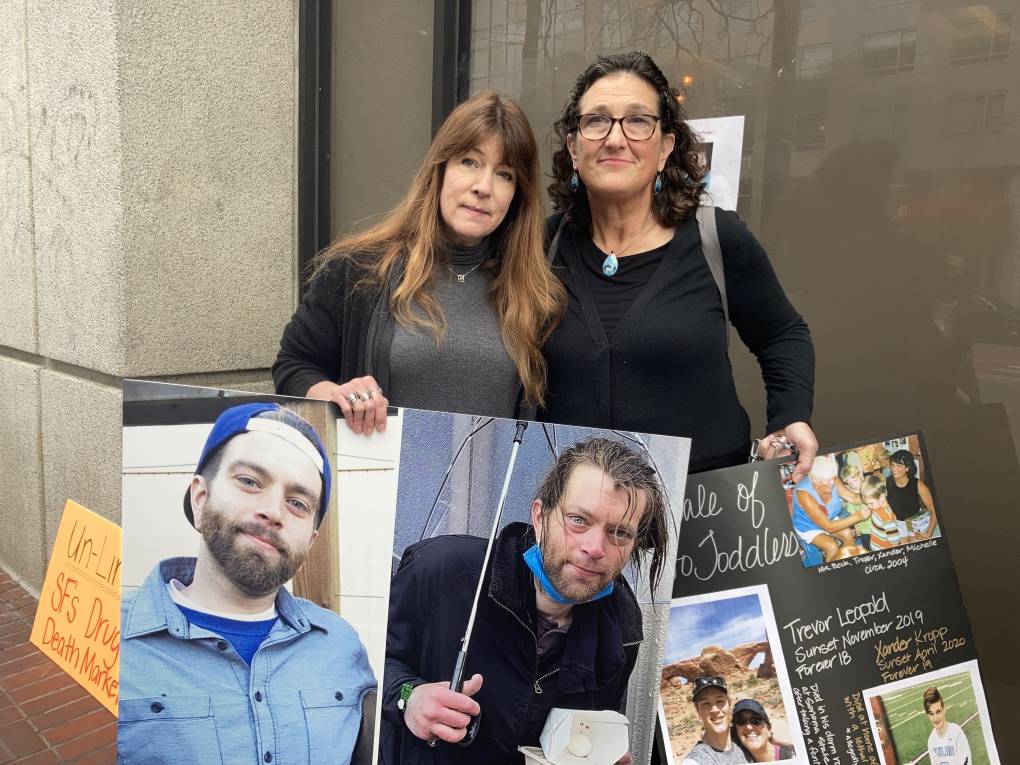
"caption": "Jacqui Berlinn and Michelle Leopold, two of the organizers with the protest against drug use at the Tenderloin Linkage Center, Feb. 5, 2022.",
"description": null,
"title": "IMG_0755",
"credit": "Holly J. McDede/KQED",
"status": "inherit",
"altTag": null,
"isLoading": false,
"fetchFailed": false
},
"news_11903775": {
"type": "attachments",
"id": "news_11903775",
"meta": {
"index": "attachments_1716263798",
"site": "news",
"id": "11903775",
"found": true
},
"parent": 11903772,
"imgSizes": {
"twentyfourteen-full-width": {
"file": "https://ww2.kqed.org/app/uploads/sites/10/2022/02/young-waj-e1643843942952-1038x576.jpeg",
"width": 1038,
"mimeType": "image/jpeg",
"height": 576
},
"thumbnail": {
"file": "https://ww2.kqed.org/app/uploads/sites/10/2022/02/young-waj-e1643843942952-160x116.jpeg",
"width": 160,
"mimeType": "image/jpeg",
"height": 116
},
"post-thumbnail": {
"file": "https://ww2.kqed.org/app/uploads/sites/10/2022/02/young-waj-e1643843942952-672x372.jpeg",
"width": 672,
"mimeType": "image/jpeg",
"height": 372
},
"kqedFullSize": {
"file": "https://ww2.kqed.org/app/uploads/sites/10/2022/02/young-waj-e1643843942952.jpeg",
"width": 1418,
"height": 1026
},
"large": {
"file": "https://ww2.kqed.org/app/uploads/sites/10/2022/02/young-waj-e1643843942952-1020x738.jpeg",
"width": 1020,
"mimeType": "image/jpeg",
"height": 738
},
"medium": {
"file": "https://ww2.kqed.org/app/uploads/sites/10/2022/02/young-waj-e1643843942952-800x579.jpeg",
"width": 800,
"mimeType": "image/jpeg",
"height": 579
}
},
"publishDate": 1643842101,
"modified": 1650654309,
"caption": "A young Wajahat Ali at his family's home in Fremont.",
"description": null,
"title": "young waj",
"credit": "Courtesy Wajahat Ali",
"status": "inherit",
"altTag": "family photograph of young boy riding toy horse, tinted yellow, reads like a photo from the early 80s",
"isLoading": false,
"fetchFailed": false
},
"news_11904097": {
"type": "attachments",
"id": "news_11904097",
"meta": {
"index": "attachments_1716263798",
"site": "news",
"id": "11904097",
"found": true
},
"parent": 11904096,
"imgSizes": {
"twentyfourteen-full-width": {
"file": "https://ww2.kqed.org/app/uploads/sites/10/2022/02/erickmramos-final-v2_wide-e2b52651a9383966fd46b25a1720d017c20a0c4b-1038x576.jpg",
"width": 1038,
"mimeType": "image/jpeg",
"height": 576
},
"thumbnail": {
"file": "https://ww2.kqed.org/app/uploads/sites/10/2022/02/erickmramos-final-v2_wide-e2b52651a9383966fd46b25a1720d017c20a0c4b-160x90.jpg",
"width": 160,
"mimeType": "image/jpeg",
"height": 90
},
"post-thumbnail": {
"file": "https://ww2.kqed.org/app/uploads/sites/10/2022/02/erickmramos-final-v2_wide-e2b52651a9383966fd46b25a1720d017c20a0c4b-672x372.jpg",
"width": 672,
"mimeType": "image/jpeg",
"height": 372
},
"kqedFullSize": {
"file": "https://ww2.kqed.org/app/uploads/sites/10/2022/02/erickmramos-final-v2_wide-e2b52651a9383966fd46b25a1720d017c20a0c4b.jpg",
"width": 1920,
"height": 1080
},
"large": {
"file": "https://ww2.kqed.org/app/uploads/sites/10/2022/02/erickmramos-final-v2_wide-e2b52651a9383966fd46b25a1720d017c20a0c4b-1020x574.jpg",
"width": 1020,
"mimeType": "image/jpeg",
"height": 574
},
"1536x1536": {
"file": "https://ww2.kqed.org/app/uploads/sites/10/2022/02/erickmramos-final-v2_wide-e2b52651a9383966fd46b25a1720d017c20a0c4b-1536x864.jpg",
"width": 1536,
"mimeType": "image/jpeg",
"height": 864
},
"medium": {
"file": "https://ww2.kqed.org/app/uploads/sites/10/2022/02/erickmramos-final-v2_wide-e2b52651a9383966fd46b25a1720d017c20a0c4b-800x450.jpg",
"width": 800,
"mimeType": "image/jpeg",
"height": 450
}
},
"publishDate": 1644008952,
"modified": 1644263699,
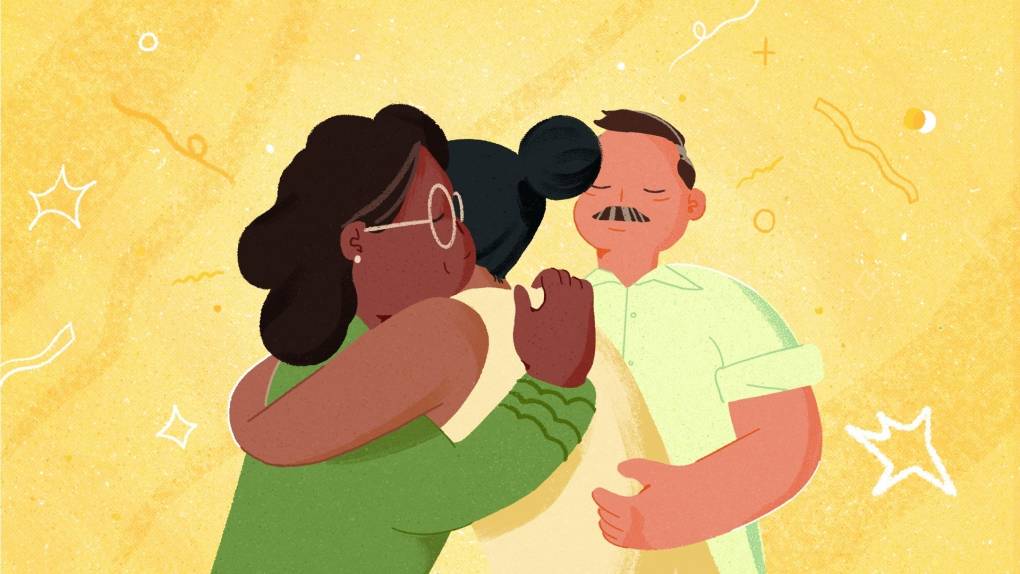
"caption": "Just because you are putting yourself first doesn't mean you don't care deeply about your folks.",
"description": null,
"title": "Illustration of a Latinx young adult hugging their parents after having a conversation about mental health.",
"credit": "Erick M. Ramos for NPR",
"status": "inherit",
"altTag": "Illustration of a Latinx young adult hugging their parents after having a conversation about mental health.",
"isLoading": false,
"fetchFailed": false
},
"news_11904185": {
"type": "attachments",
"id": "news_11904185",
"meta": {
"index": "attachments_1716263798",
"site": "news",
"id": "11904185",
"found": true
},
"parent": 11904155,
"imgSizes": {
"twentyfourteen-full-width": {
"file": "https://ww2.kqed.org/app/uploads/sites/10/2022/02/KaiserPermanenteExample-1-1020x576.jpeg",
"width": 1020,
"mimeType": "image/jpeg",
"height": 576
},
"thumbnail": {
"file": "https://ww2.kqed.org/app/uploads/sites/10/2022/02/KaiserPermanenteExample-1-160x120.jpeg",
"width": 160,
"mimeType": "image/jpeg",
"height": 120
},
"post-thumbnail": {
"file": "https://ww2.kqed.org/app/uploads/sites/10/2022/02/KaiserPermanenteExample-1-672x372.jpeg",
"width": 672,
"mimeType": "image/jpeg",
"height": 372
},
"kqedFullSize": {
"file": "https://ww2.kqed.org/app/uploads/sites/10/2022/02/KaiserPermanenteExample-1.jpeg",
"width": 1020,
"height": 765
},
"medium": {
"file": "https://ww2.kqed.org/app/uploads/sites/10/2022/02/KaiserPermanenteExample-1-800x600.jpeg",
"width": 800,
"mimeType": "image/jpeg",
"height": 600
}
},
"publishDate": 1644016108,
"modified": 1644260910,
"caption": "A deal struck between Kaiser Permanente and Gov. Gavin Newsom's office could complicate a long-planned transformation of Medi-Cal.",
"description": null,
"title": "KaiserPermanenteExample",
"credit": "Lisa Aliferis/KQED",
"status": "inherit",
"altTag": null,
"isLoading": false,
"fetchFailed": false
},
"news_11903823": {
"type": "attachments",
"id": "news_11903823",
"meta": {
"index": "attachments_1716263798",
"site": "news",
"id": "11903823",
"found": true
},
"parent": 11903506,
"imgSizes": {
"twentyfourteen-full-width": {
"file": "https://ww2.kqed.org/app/uploads/sites/10/2022/02/RS53459_006_StockPhoto_AtHomeCOVIDTest_02022022-qut-1038x576.jpg",
"width": 1038,
"mimeType": "image/jpeg",
"height": 576
},
"thumbnail": {
"file": "https://ww2.kqed.org/app/uploads/sites/10/2022/02/RS53459_006_StockPhoto_AtHomeCOVIDTest_02022022-qut-160x107.jpg",
"width": 160,
"mimeType": "image/jpeg",
"height": 107
},
"post-thumbnail": {
"file": "https://ww2.kqed.org/app/uploads/sites/10/2022/02/RS53459_006_StockPhoto_AtHomeCOVIDTest_02022022-qut-672x372.jpg",
"width": 672,
"mimeType": "image/jpeg",
"height": 372
},
"kqedFullSize": {
"file": "https://ww2.kqed.org/app/uploads/sites/10/2022/02/RS53459_006_StockPhoto_AtHomeCOVIDTest_02022022-qut.jpg",
"width": 1920,
"height": 1280
},
"large": {
"file": "https://ww2.kqed.org/app/uploads/sites/10/2022/02/RS53459_006_StockPhoto_AtHomeCOVIDTest_02022022-qut-1020x680.jpg",
"width": 1020,
"mimeType": "image/jpeg",
"height": 680
},
"1536x1536": {
"file": "https://ww2.kqed.org/app/uploads/sites/10/2022/02/RS53459_006_StockPhoto_AtHomeCOVIDTest_02022022-qut-1536x1024.jpg",
"width": 1536,
"mimeType": "image/jpeg",
"height": 1024
},
"medium": {
"file": "https://ww2.kqed.org/app/uploads/sites/10/2022/02/RS53459_006_StockPhoto_AtHomeCOVIDTest_02022022-qut-800x533.jpg",
"width": 800,
"mimeType": "image/jpeg",
"height": 533
}
},
"publishDate": 1643852977,
"modified": 1643939053,
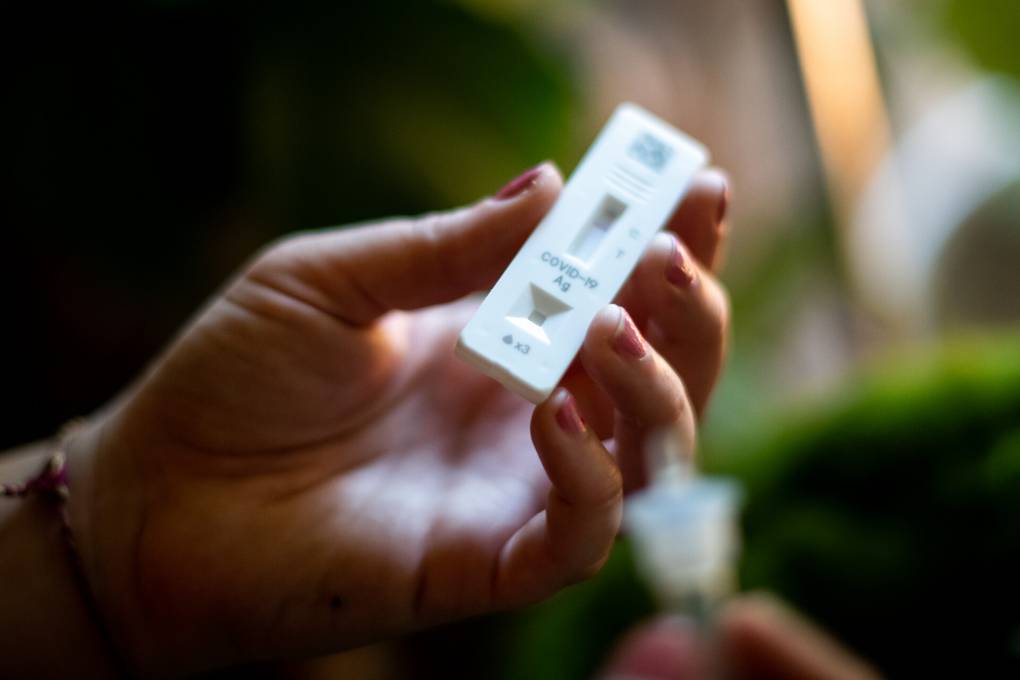
"caption": "A hand holds an at-home COVID-19 test.",
"description": null,
"title": "Stock image: At-home COVID-19 test.",
"credit": "Beth LaBerge/KQED",
"status": "inherit",
"altTag": null,
"isLoading": false,
"fetchFailed": false
},
"news_11903759": {
"type": "attachments",
"id": "news_11903759",
"meta": {
"index": "attachments_1716263798",
"site": "news",
"id": "11903759",
"found": true
},
"parent": 11903719,
"imgSizes": {
"twentyfourteen-full-width": {
"file": "https://ww2.kqed.org/app/uploads/sites/10/2022/02/RS13747_iStock_000001039817_Large-qut-1038x576.jpg",
"width": 1038,
"mimeType": "image/jpeg",
"height": 576
},
"thumbnail": {
"file": "https://ww2.kqed.org/app/uploads/sites/10/2022/02/RS13747_iStock_000001039817_Large-qut-160x106.jpg",
"width": 160,
"mimeType": "image/jpeg",
"height": 106
},
"post-thumbnail": {
"file": "https://ww2.kqed.org/app/uploads/sites/10/2022/02/RS13747_iStock_000001039817_Large-qut-672x372.jpg",
"width": 672,
"mimeType": "image/jpeg",
"height": 372
},
"kqedFullSize": {
"file": "https://ww2.kqed.org/app/uploads/sites/10/2022/02/RS13747_iStock_000001039817_Large-qut.jpg",
"width": 1440,
"height": 958
},
"large": {
"file": "https://ww2.kqed.org/app/uploads/sites/10/2022/02/RS13747_iStock_000001039817_Large-qut-1020x679.jpg",
"width": 1020,
"mimeType": "image/jpeg",
"height": 679
},
"medium": {
"file": "https://ww2.kqed.org/app/uploads/sites/10/2022/02/RS13747_iStock_000001039817_Large-qut-800x532.jpg",
"width": 800,
"mimeType": "image/jpeg",
"height": 532
}
},
"publishDate": 1643836992,
"modified": 1643837126,
"caption": "Researchers looked at how effectively patients had their blood pressure, blood sugar and cholesterol controlled.",
"description": null,
"title": "RS13747_iStock_000001039817_Large-qut",
"credit": "Lisa Aliferis/iStock",
"status": "inherit",
"altTag": "A hand hold a blood pressure pump and a person's arm.",
"isLoading": false,
"fetchFailed": false
},
"news_11903449": {
"type": "attachments",
"id": "news_11903449",
"meta": {
"index": "attachments_1716263798",
"site": "news",
"id": "11903449",
"found": true
},
"parent": 11903440,
"imgSizes": {
"twentyfourteen-full-width": {
"file": "https://ww2.kqed.org/app/uploads/sites/10/2022/01/RS29483_GettyImages-802211570-qut-1038x576.jpg",
"width": 1038,
"mimeType": "image/jpeg",
"height": 576
},
"thumbnail": {
"file": "https://ww2.kqed.org/app/uploads/sites/10/2022/01/RS29483_GettyImages-802211570-qut-160x120.jpg",
"width": 160,
"mimeType": "image/jpeg",
"height": 120
},
"post-thumbnail": {
"file": "https://ww2.kqed.org/app/uploads/sites/10/2022/01/RS29483_GettyImages-802211570-qut-672x372.jpg",
"width": 672,
"mimeType": "image/jpeg",
"height": 372
},
"kqedFullSize": {
"file": "https://ww2.kqed.org/app/uploads/sites/10/2022/01/RS29483_GettyImages-802211570-qut.jpg",
"width": 1920,
"height": 1440
},
"large": {
"file": "https://ww2.kqed.org/app/uploads/sites/10/2022/01/RS29483_GettyImages-802211570-qut-1020x765.jpg",
"width": 1020,
"mimeType": "image/jpeg",
"height": 765
},
"1536x1536": {
"file": "https://ww2.kqed.org/app/uploads/sites/10/2022/01/RS29483_GettyImages-802211570-qut-1536x1152.jpg",
"width": 1536,
"mimeType": "image/jpeg",
"height": 1152
},
"medium": {
"file": "https://ww2.kqed.org/app/uploads/sites/10/2022/01/RS29483_GettyImages-802211570-qut-800x600.jpg",
"width": 800,
"mimeType": "image/jpeg",
"height": 600
}
},
"publishDate": 1643669801,
"modified": 1643741001,
"caption": "People rally in favor of single-payer health care for all Californians as the U.S. Senate prepared to vote on the Senate GOP health care bill, outside the office of California Assembly Speaker Anthony Rendon, June 27, 2017, in South Gate.",
"description": null,
"title": "US-POLITICS-HEALTHCARE-PROTEST",
"credit": "Robyn Beck/AFP/Getty Images",
"status": "inherit",
"altTag": "A person holds a sign that says \"Single Payer Now\" during a rally outside.",
"isLoading": false,
"fetchFailed": false
},
"news_11903295": {
"type": "attachments",
"id": "news_11903295",
"meta": {
"index": "attachments_1716263798",
"site": "news",
"id": "11903295",
"found": true
},
"parent": 11902998,
"imgSizes": {
"twentyfourteen-full-width": {
"file": "https://ww2.kqed.org/app/uploads/sites/10/2022/01/GettyImages-1322405018-1038x576.jpg",
"width": 1038,
"mimeType": "image/jpeg",
"height": 576
},
"thumbnail": {
"file": "https://ww2.kqed.org/app/uploads/sites/10/2022/01/GettyImages-1322405018-160x109.jpg",
"width": 160,
"mimeType": "image/jpeg",
"height": 109
},
"post-thumbnail": {
"file": "https://ww2.kqed.org/app/uploads/sites/10/2022/01/GettyImages-1322405018-672x372.jpg",
"width": 672,
"mimeType": "image/jpeg",
"height": 372
},
"kqedFullSize": {
"file": "https://ww2.kqed.org/app/uploads/sites/10/2022/01/GettyImages-1322405018.jpg",
"width": 1200,
"height": 821
},
"large": {
"file": "https://ww2.kqed.org/app/uploads/sites/10/2022/01/GettyImages-1322405018-1020x698.jpg",
"width": 1020,
"mimeType": "image/jpeg",
"height": 698
},
"medium": {
"file": "https://ww2.kqed.org/app/uploads/sites/10/2022/01/GettyImages-1322405018-800x547.jpg",
"width": 800,
"mimeType": "image/jpeg",
"height": 547
}
},
"publishDate": 1643413448,
"modified": 1643413921,
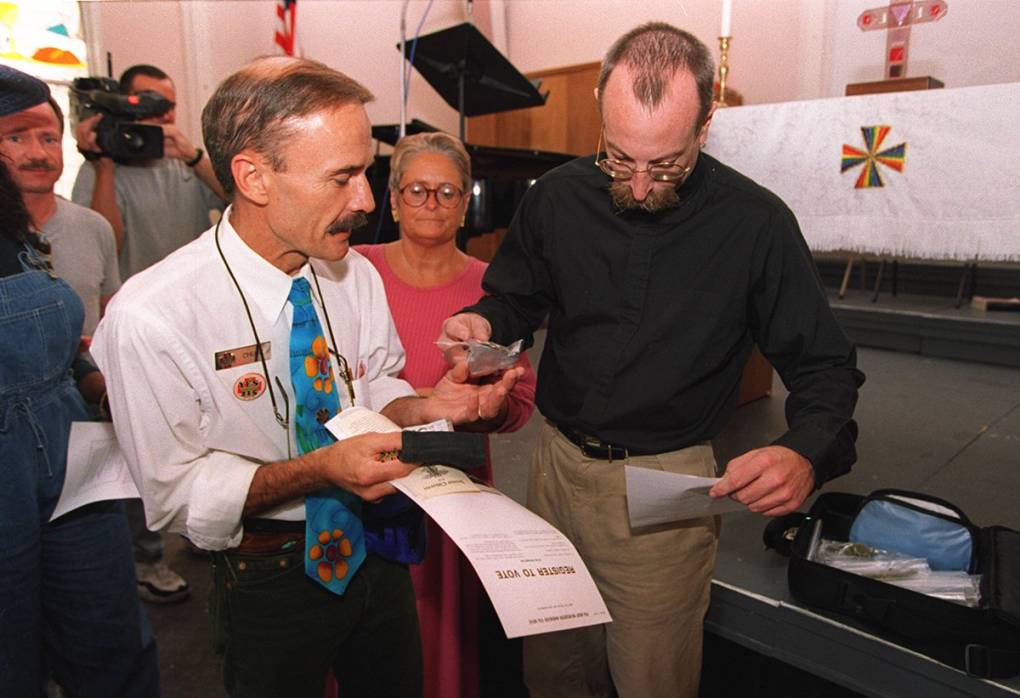
"caption": "Rev. Jim Mitulski (right), pastor of the Metropolitan Community Church of SF, hands a volunteer a bag of marijuana after church services as part of a relief effort in the summer of 1996 to help people suffering from AIDS. ",
"description": null,
"title": "MARIJUANA/C/18AUG96/MN/LS-Rev. Jim Mitulski (right) pastor of the Metropolitan Community Church of SF hands Chuck Jones, a CBC volunteer, a bag of marijuana during a medical marijuana relief effort sponsored by the church. BY LEA SUZUKI/THE CHRONICLE",
"credit": "Lea Suzuki/San Francisco Chronicle via Getty Images",
"status": "inherit",
"altTag": "One man gives another man a small bag of marijuana. A group of people stand behind them, including someone with a video camera.",
"isLoading": false,
"fetchFailed": false
},
"news_11902679": {
"type": "attachments",
"id": "news_11902679",
"meta": {
"index": "attachments_1716263798",
"site": "news",
"id": "11902679",
"found": true
},
"parent": 11902591,
"imgSizes": {
"twentyfourteen-full-width": {
"file": "https://ww2.kqed.org/app/uploads/sites/10/2022/01/RS53271_iStock-491407268-qut-1038x576.jpg",
"width": 1038,
"mimeType": "image/jpeg",
"height": 576
},
"thumbnail": {
"file": "https://ww2.kqed.org/app/uploads/sites/10/2022/01/RS53271_iStock-491407268-qut-160x93.jpg",
"width": 160,
"mimeType": "image/jpeg",
"height": 93
},
"post-thumbnail": {
"file": "https://ww2.kqed.org/app/uploads/sites/10/2022/01/RS53271_iStock-491407268-qut-672x372.jpg",
"width": 672,
"mimeType": "image/jpeg",
"height": 372
},
"kqedFullSize": {
"file": "https://ww2.kqed.org/app/uploads/sites/10/2022/01/RS53271_iStock-491407268-qut.jpg",
"width": 1920,
"height": 1112
},
"large": {
"file": "https://ww2.kqed.org/app/uploads/sites/10/2022/01/RS53271_iStock-491407268-qut-1020x591.jpg",
"width": 1020,
"mimeType": "image/jpeg",
"height": 591
},
"1536x1536": {
"file": "https://ww2.kqed.org/app/uploads/sites/10/2022/01/RS53271_iStock-491407268-qut-1536x890.jpg",
"width": 1536,
"mimeType": "image/jpeg",
"height": 890
},
"medium": {
"file": "https://ww2.kqed.org/app/uploads/sites/10/2022/01/RS53271_iStock-491407268-qut-800x463.jpg",
"width": 800,
"mimeType": "image/jpeg",
"height": 463
}
},
"publishDate": 1643156071,
"modified": 1643162310,
"caption": "Doctor opposition to single-payer health care in California may seem counterintuitive — but it's nothing new. Dr. Micah Johnson, author of 'Medicare for All: A Citizen's Guide,' says doctors have been 'double agents' in the debate, and are most concerned with changes to their pay and autonomy.",
"description": "Doctor opposition to single-payer health care in California may seem counterintuitive - but it's nothing new. Dr. Micah Johnson, author of 'Medicare For All: A Citizen’s Guide,' says doctors have been 'double agents' in the debate, and are most concerned with changes to their pay and autonomy.",
"title": "Doctor with stethoscope",
"credit": "Getty Images",
"status": "inherit",
"altTag": "generic photo of person wearing white doctors coat, standing with arms firmly crossed holding stethoscope",
"isLoading": false,
"fetchFailed": false
},
"news_11902462": {
"type": "attachments",
"id": "news_11902462",
"meta": {
"index": "attachments_1716263798",
"site": "news",
"id": "11902462",
"found": true
},
"parent": 11902461,
"imgSizes": {
"twentyfourteen-full-width": {
"file": "https://ww2.kqed.org/app/uploads/sites/10/2022/01/gettyimages-1237291550-dabc9b233c1a9c6516b0c2f0b08a5324dfcf86bc-804x576.jpg",
"width": 804,
"mimeType": "image/jpeg",
"height": 576
},
"thumbnail": {
"file": "https://ww2.kqed.org/app/uploads/sites/10/2022/01/gettyimages-1237291550-dabc9b233c1a9c6516b0c2f0b08a5324dfcf86bc-160x120.jpg",
"width": 160,
"mimeType": "image/jpeg",
"height": 120
},
"post-thumbnail": {
"file": "https://ww2.kqed.org/app/uploads/sites/10/2022/01/gettyimages-1237291550-dabc9b233c1a9c6516b0c2f0b08a5324dfcf86bc-672x372.jpg",
"width": 672,
"mimeType": "image/jpeg",
"height": 372
},
"kqedFullSize": {
"file": "https://ww2.kqed.org/app/uploads/sites/10/2022/01/gettyimages-1237291550-dabc9b233c1a9c6516b0c2f0b08a5324dfcf86bc.jpg",
"width": 804,
"height": 603
},
"medium": {
"file": "https://ww2.kqed.org/app/uploads/sites/10/2022/01/gettyimages-1237291550-dabc9b233c1a9c6516b0c2f0b08a5324dfcf86bc-800x600.jpg",
"width": 800,
"mimeType": "image/jpeg",
"height": 600
}
},
"publishDate": 1642980718,
"modified": 1643918508,
"caption": "Some audience members told KQED they felt intense shame and guilt about the ripple effects their positive diagnosis had created for others in their lives.",
"description": null,
"title": "Rapid tests can help you figure out if you have been infected with the coronavirus. But how accurate are they? Scientists trying to find out whether they are less sensitive to omicron and why.",
"credit": "Joseph Prezioso/AFP via Getty Images",
"status": "inherit",
"altTag": "A hand holding a white and red rapid antigen test.",
"isLoading": false,
"fetchFailed": false
},
"news_11902175": {
"type": "attachments",
"id": "news_11902175",
"meta": {
"index": "attachments_1716263798",
"site": "news",
"id": "11902175",
"found": true
},
"parent": 11902149,
"imgSizes": {
"twentyfourteen-full-width": {
"file": "https://ww2.kqed.org/app/uploads/sites/10/2022/01/RS53217_034_Richmond_LifelongCOVIDClinic_01192022-qut-1038x576.jpg",
"width": 1038,
"mimeType": "image/jpeg",
"height": 576
},
"thumbnail": {
"file": "https://ww2.kqed.org/app/uploads/sites/10/2022/01/RS53217_034_Richmond_LifelongCOVIDClinic_01192022-qut-160x107.jpg",
"width": 160,
"mimeType": "image/jpeg",
"height": 107
},
"post-thumbnail": {
"file": "https://ww2.kqed.org/app/uploads/sites/10/2022/01/RS53217_034_Richmond_LifelongCOVIDClinic_01192022-qut-672x372.jpg",
"width": 672,
"mimeType": "image/jpeg",
"height": 372
},
"kqedFullSize": {
"file": "https://ww2.kqed.org/app/uploads/sites/10/2022/01/RS53217_034_Richmond_LifelongCOVIDClinic_01192022-qut.jpg",
"width": 1920,
"height": 1280
},
"large": {
"file": "https://ww2.kqed.org/app/uploads/sites/10/2022/01/RS53217_034_Richmond_LifelongCOVIDClinic_01192022-qut-1020x680.jpg",
"width": 1020,
"mimeType": "image/jpeg",
"height": 680
},
"1536x1536": {
"file": "https://ww2.kqed.org/app/uploads/sites/10/2022/01/RS53217_034_Richmond_LifelongCOVIDClinic_01192022-qut-1536x1024.jpg",
"width": 1536,
"mimeType": "image/jpeg",
"height": 1024
},
"medium": {
"file": "https://ww2.kqed.org/app/uploads/sites/10/2022/01/RS53217_034_Richmond_LifelongCOVIDClinic_01192022-qut-800x533.jpg",
"width": 800,
"mimeType": "image/jpeg",
"height": 533
}
},
"publishDate": 1642715022,
"modified": 1642730431,
"caption": "Renna Khuner-Haber (center), who coordinates LifeLong Medical's testing sites in Richmond and San Pablo, talks with staff, as a registered nurse (right) talks with a patient at LifeLong's Brookside San Pablo Health Center on Jan. 19, 2022.",
"description": null,
"title": "RS53217_034_Richmond_LifelongCOVIDClinic_01192022-qut",
"credit": "Beth LaBerge/KQED",
"status": "inherit",
"altTag": "Two seated, masked women - a nurse and patient - talk in sunlit foreground as another masked woman stands in the background",
"isLoading": false,
"fetchFailed": false
}
},
"audioPlayerReducer": {
"postId": "stream_live",
"isPaused": true,
"isPlaying": false,
"pfsActive": false,
"pledgeModalIsOpen": true,
"playerDrawerIsOpen": false,
"liveAudioPlayStartedAt": 0,
"liveAudioPlayContext": ""
},
"authorsReducer": {
"byline_news_11904345": {
"type": "authors",
"id": "byline_news_11904345",
"meta": {
"override": true
},
"slug": "byline_news_11904345",
"name": "Michaeleen Doucleff",
"isLoading": false
},
"byline_news_11904111": {
"type": "authors",
"id": "byline_news_11904111",
"meta": {
"override": true
},
"slug": "byline_news_11904111",
"name": "Naydeline Mejia, Isabeth Mendoza, Sylvie Douglis",
"isLoading": false
},
"byline_news_11904155": {
"type": "authors",
"id": "byline_news_11904155",
"meta": {
"override": true
},
"slug": "byline_news_11904155",
"name": "\u003ca href=\"https://khn.org/news/author/bernard-j-wolfson/\">Bernard J. Wolfson\u003c/a>, \u003ca href=\"https://khn.org/news/author/angela-hart/\">Angela Hart\u003c/a> and \u003ca href=\"https://khn.org/news/author/samantha-young/\">Samantha Young\u003c/a>",
"isLoading": false
},
"byline_news_11903719": {
"type": "authors",
"id": "byline_news_11903719",
"meta": {
"override": true
},
"slug": "byline_news_11903719",
"name": "Laura Williamson \u003cbr> American Heart Association News via The Associated Press",
"isLoading": false
},
"byline_news_11903440": {
"type": "authors",
"id": "byline_news_11903440",
"meta": {
"override": true
},
"slug": "byline_news_11903440",
"name": "Adam Beam\u003cbr>Associated Press",
"isLoading": false
},
"byline_news_11902461": {
"type": "authors",
"id": "byline_news_11902461",
"meta": {
"override": true
},
"slug": "byline_news_11902461",
"name": "Maria Godoy",
"isLoading": false
},
"sasha-khokha": {
"type": "authors",
"id": "254",
"meta": {
"index": "authors_1716337520",
"id": "254",
"found": true
},
"name": "Sasha Khokha",
"firstName": "Sasha",
"lastName": "Khokha",
"slug": "sasha-khokha",
"email": "skhokha@kqed.org",
"display_author_email": true,
"staff_mastheads": [
"news"
],
"title": "Host, The California Report Magazine",
"bio": "Sasha Khokha is the host of \u003cem>The California Report's \u003c/em> weekly magazine program, which takes listeners on sound-rich excursions to meet the people that make the Golden State unique -- through audio documentaries and long-form stories. As \u003cem>The California Report's\u003c/em> Central Valley Bureau Chief based in Fresno for nearly a dozen years, Sasha brought the lives and concerns of rural Californians to listeners around the state. Her reporting helped expose the hidden price immigrant women janitors and farmworkers may pay to keep their jobs: sexual assault at work. It inspired two new California laws to protect them from sexual harassment. She was a key member of the reporting team for the Frontline film \u003cem>Rape on the Night Shift, \u003c/em>which was nominated for two national Emmys. Sasha has also won a national Edward R. Murrow and a national PRNDI award for investigative reporting, as well as multiple prizes from the Society for Professional Journalists. Sasha is a proud alum of the UC Berkeley Graduate School of Journalism and Brown University and a member of the South Asian Journalists Association.",
"avatar": "https://secure.gravatar.com/avatar/e4b5e1541aaeea2aa356aa1fb2a68950?s=600&d=blank&r=g",
"twitter": "KQEDSashaKhokha",
"facebook": null,
"instagram": null,
"linkedin": null,
"sites": [
{
"site": "news",
"roles": [
"editor"
]
},
{
"site": "stateofhealth",
"roles": [
"author"
]
},
{
"site": "science",
"roles": [
"author"
]
},
{
"site": "quest",
"roles": [
"subscriber"
]
}
],
"headData": {
"title": "Sasha Khokha | KQED",
"description": "Host, The California Report Magazine",
"ogImgSrc": "https://secure.gravatar.com/avatar/e4b5e1541aaeea2aa356aa1fb2a68950?s=600&d=blank&r=g",
"twImgSrc": "https://secure.gravatar.com/avatar/e4b5e1541aaeea2aa356aa1fb2a68950?s=600&d=blank&r=g"
},
"isLoading": false,
"link": "/author/sasha-khokha"
},
"adembosky": {
"type": "authors",
"id": "3205",
"meta": {
"index": "authors_1716337520",
"id": "3205",
"found": true
},
"name": "April Dembosky",
"firstName": "April",
"lastName": "Dembosky",
"slug": "adembosky",
"email": "adembosky@kqed.org",
"display_author_email": false,
"staff_mastheads": [
"news",
"science"
],
"title": "KQED Health Correspondent",
"bio": "April Dembosky is the health correspondent for KQED News and a regular contributor to NPR. She specializes in covering altered states of mind, from postpartum depression to methamphetamine-induced psychosis to the insanity defense. Her investigative series on insurance companies sidestepping mental health laws won multiple awards, including first place in beat reporting from the national Association of Health Care Journalists. She is the recipient of numerous other prizes and fellowships, including a national Edward R. Murrow award for investigative reporting, a Society of Professional Journalists award for long-form storytelling, and a Carter Center Fellowship for Mental Health Journalism.\r\n\r\nDembosky reported and produced \u003cem>Soundtrack of Silence\u003c/em>, an audio documentary about music and memory that is currently being made into a feature film by Paramount Pictures.\r\n\r\nBefore joining KQED in 2013, Dembosky covered technology and Silicon Valley for \u003cem>The Financial Times of London,\u003c/em> and contributed business and arts stories to \u003cem>Marketplace \u003c/em>and \u003cem>The New York Times.\u003c/em> She got her undergraduate degree in philosophy from Smith College and her master's in journalism from the University of California, Berkeley. She is a classically trained violinist and proud alum of the first symphony orchestra at Burning Man.",
"avatar": "https://secure.gravatar.com/avatar/ef92999be4ceb9ea60701e7dc276f813?s=600&d=blank&r=g",
"twitter": "adembosky",
"facebook": null,
"instagram": null,
"linkedin": null,
"sites": [
{
"site": "arts",
"roles": [
"author"
]
},
{
"site": "news",
"roles": [
"editor"
]
},
{
"site": "futureofyou",
"roles": [
"author"
]
},
{
"site": "stateofhealth",
"roles": [
"editor"
]
},
{
"site": "science",
"roles": [
"editor"
]
},
{
"site": "forum",
"roles": [
"editor"
]
}
],
"headData": {
"title": "April Dembosky | KQED",
"description": "KQED Health Correspondent",
"ogImgSrc": "https://secure.gravatar.com/avatar/ef92999be4ceb9ea60701e7dc276f813?s=600&d=blank&r=g",
"twImgSrc": "https://secure.gravatar.com/avatar/ef92999be4ceb9ea60701e7dc276f813?s=600&d=blank&r=g"
},
"isLoading": false,
"link": "/author/adembosky"
},
"carlysevern": {
"type": "authors",
"id": "3243",
"meta": {
"index": "authors_1716337520",
"id": "3243",
"found": true
},
"name": "Carly Severn",
"firstName": "Carly",
"lastName": "Severn",
"slug": "carlysevern",
"email": "csevern@kqed.org",
"display_author_email": false,
"staff_mastheads": [
"news"
],
"title": "Senior Editor, Audience News ",
"bio": "Carly is KQED's Senior Editor of Audience News on the Digital News team, and has reported for the California Report Magazine, Bay Curious and KQED Arts. She's formerly the host of \u003ca href=\"http://ww2.kqed.org/pop/category/the-cooler/\" rel=\"noopener noreferrer\">The Cooler\u003c/a> podcast.",
"avatar": "https://secure.gravatar.com/avatar/54037bf5c128fe678f0ef26cec97a93f2e7f220a22d7285703328f12c42c1b1d?s=600&d=blank&r=g",
"twitter": "teacupinthebay",
"bluesky": null,
"facebook": null,
"instagram": null,
"linkedin": null,
"sites": [
{
"site": "",
"roles": [
"editor"
]
},
{
"site": "arts",
"roles": [
"editor"
]
},
{
"site": "news",
"roles": [
"administrator"
]
},
{
"site": "pop",
"roles": [
"editor"
]
},
{
"site": "futureofyou",
"roles": [
"editor"
]
},
{
"site": "about",
"roles": [
"administrator"
]
},
{
"site": "mindshift",
"roles": [
"editor"
]
},
{
"site": "bayareabites",
"roles": [
"editor"
]
},
{
"site": "stateofhealth",
"roles": [
"editor"
]
},
{
"site": "science",
"roles": [
"editor"
]
},
{
"site": "food",
"roles": [
"contributor"
]
},
{
"site": "forum",
"roles": [
"editor"
]
},
{
"site": "perspectives",
"roles": [
"administrator"
]
},
{
"site": "liveblog",
"roles": [
"editor"
]
}
],
"headData": {
"title": "Carly Severn | KQED",
"description": "Senior Editor, Audience News ",
"ogImgSrc": "https://secure.gravatar.com/avatar/54037bf5c128fe678f0ef26cec97a93f2e7f220a22d7285703328f12c42c1b1d?s=600&d=blank&r=g",
"twImgSrc": "https://secure.gravatar.com/avatar/54037bf5c128fe678f0ef26cec97a93f2e7f220a22d7285703328f12c42c1b1d?s=600&d=blank&r=g"
},
"isLoading": false,
"link": "/author/carlysevern"
},
"afont": {
"type": "authors",
"id": "8637",
"meta": {
"index": "authors_1716337520",
"id": "8637",
"found": true
},
"name": "Amanda Font",
"firstName": "Amanda",
"lastName": "Font",
"slug": "afont",
"email": "afont@kqed.org",
"display_author_email": false,
"staff_mastheads": [],
"title": "KQED Contributor",
"bio": "Amanda Font is a producer on \u003cem>The Latest\u003c/em> podcast, and the host and co-producer of the series \u003cem>Audible Cosmos\u003c/em>. She has previously worked as a producer and reporter on the \u003cem>Bay Curious\u003c/em> podcast, and director of \u003cem>The California Report Magazine\u003c/em>. She grew up in the deserts of Southern California and moved north for the trees. Amanda earned a B.A. from the BECA program at San Francisco State, where she worked in the university's radio station. Amanda Font is represented by SAG-AFTRA.",
"avatar": "https://secure.gravatar.com/avatar/d9e81cf0117d5849b9cfb7ab4b1422f1?s=600&d=blank&r=g",
"twitter": null,
"facebook": null,
"instagram": null,
"linkedin": null,
"sites": [
{
"site": "news",
"roles": [
"add_users",
"create_users"
]
},
{
"site": "science",
"roles": []
},
{
"site": "forum",
"roles": [
"administrator"
]
},
{
"site": "perspectives",
"roles": [
"administrator"
]
},
{
"site": "radio",
"roles": [
"administrator"
]
}
],
"headData": {
"title": "Amanda Font | KQED",
"description": "KQED Contributor",
"ogImgSrc": "https://secure.gravatar.com/avatar/d9e81cf0117d5849b9cfb7ab4b1422f1?s=600&d=blank&r=g",
"twImgSrc": "https://secure.gravatar.com/avatar/d9e81cf0117d5849b9cfb7ab4b1422f1?s=600&d=blank&r=g"
},
"isLoading": false,
"link": "/author/afont"
},
"rdillon": {
"type": "authors",
"id": "11495",
"meta": {
"index": "authors_1716337520",
"id": "11495",
"found": true
},
"name": "Raquel Maria Dillon",
"firstName": "Raquel Maria",
"lastName": "Dillon",
"slug": "rdillon",
"email": "rdillon@kqed.org",
"display_author_email": false,
"staff_mastheads": [],
"title": null,
"bio": "Raquel Maria Dillon was a reporter and host for KQED News. Previously, she produced the daily statewide California Report, edited newscasts, and covered health and education stories. Before returning to the Bay Area in 2016, she worked in Los Angeles as a wire reporter and one-woman-band video journalist for the Associated Press, where she shot, edited and reported breaking news and features across the West. Her work has appeared online and in print around the globe, and also on NPR’s Morning Edition, All Things Considered, Here and Now, Marketplace, On The Media, and Studio 360. She previously edited and mentored up-and-coming reporters at KALW, produced social videos for Timeline.com, and was a local TV news videographer for KTVU and digital producer for KNTV. She got her start as a Radio News Trainee at KQED, produced a weekly public affairs roundtable show for OPB, and covered health and politics at New Hampshire Public Radio. She has a BA in political science from Barnard College and a MA in video journalism from UC Berkeley, where she was awarded the Faith Fancher Scholarship and a Student Emmy. She has received numerous local awards from the Associated Press and the Society of Professional Journalists.",
"avatar": "https://secure.gravatar.com/avatar/b8e02ae982913d0950df605910267c1b?s=600&d=blank&r=g",
"twitter": "RaquelMDillon",
"facebook": null,
"instagram": null,
"linkedin": null,
"sites": [
{
"site": "news",
"roles": [
"subscriber"
]
},
{
"site": "stateofhealth",
"roles": [
"editor"
]
},
{
"site": "science",
"roles": [
"editor"
]
},
{
"site": "forum",
"roles": [
"editor"
]
}
],
"headData": {
"title": "Raquel Maria Dillon | KQED",
"description": null,
"ogImgSrc": "https://secure.gravatar.com/avatar/b8e02ae982913d0950df605910267c1b?s=600&d=blank&r=g",
"twImgSrc": "https://secure.gravatar.com/avatar/b8e02ae982913d0950df605910267c1b?s=600&d=blank&r=g"
},
"isLoading": false,
"link": "/author/rdillon"
},
"hmcdede": {
"type": "authors",
"id": "11635",
"meta": {
"index": "authors_1716337520",
"id": "11635",
"found": true
},
"name": "Holly McDede",
"firstName": "Holly",
"lastName": "McDede",
"slug": "hmcdede",
"email": "hmcdede@KQED.org",
"display_author_email": false,
"staff_mastheads": [],
"title": "KQED Contributor",
"bio": null,
"avatar": "https://secure.gravatar.com/avatar/999d9bf31bb3a2f0511932d99526cb3e?s=600&d=blank&r=g",
"twitter": null,
"facebook": null,
"instagram": null,
"linkedin": null,
"sites": [
{
"site": "arts",
"roles": [
"editor"
]
},
{
"site": "news",
"roles": [
"edit_others_posts",
"editor"
]
},
{
"site": "science",
"roles": [
"editor"
]
},
{
"site": "forum",
"roles": [
"editor"
]
},
{
"site": "perspectives",
"roles": [
"administrator"
]
}
],
"headData": {
"title": "Holly McDede | KQED",
"description": "KQED Contributor",
"ogImgSrc": "https://secure.gravatar.com/avatar/999d9bf31bb3a2f0511932d99526cb3e?s=600&d=blank&r=g",
"twImgSrc": "https://secure.gravatar.com/avatar/999d9bf31bb3a2f0511932d99526cb3e?s=600&d=blank&r=g"
},
"isLoading": false,
"link": "/author/hmcdede"
},
"cbeale": {
"type": "authors",
"id": "11749",
"meta": {
"index": "authors_1716337520",
"id": "11749",
"found": true
},
"name": "Christopher Beale",
"firstName": "Christopher",
"lastName": "Beale",
"slug": "cbeale",
"email": "cbeale@kqed.org",
"display_author_email": true,
"staff_mastheads": [
"news"
],
"title": "Engineer/Producer/Reporter",
"bio": "\u003ca href=\"https://linktr.ee/realchrisjbeale\" rel=\"noopener noreferrer\">Christopher J. Beale\u003c/a> is an award winning journalist, audio engineer, and media host living in San Francisco. \r\n\r\nChristopher works primarily as an audio engineer at KQED and serves as the sound designer for both the Bay Curious and Rightnowish podcasts. He is the host and producer of the LGBTQIA podcast and radio segment \u003ca href=\"https://stereotypespodcast.org\">Stereotypes\u003c/a>.",
"avatar": "https://secure.gravatar.com/avatar/dc485bf84788eb7e7414eb638e72407e?s=600&d=blank&r=g",
"twitter": "realchrisjbeale",
"facebook": null,
"instagram": "http://instagram.com/realchrisjbeale",
"linkedin": null,
"sites": [
{
"site": "arts",
"roles": [
"contributor"
]
},
{
"site": "news",
"roles": [
"editor"
]
},
{
"site": "forum",
"roles": [
"editor"
]
}
],
"headData": {
"title": "Christopher Beale | KQED",
"description": "Engineer/Producer/Reporter",
"ogImgSrc": "https://secure.gravatar.com/avatar/dc485bf84788eb7e7414eb638e72407e?s=600&d=blank&r=g",
"twImgSrc": "https://secure.gravatar.com/avatar/dc485bf84788eb7e7414eb638e72407e?s=600&d=blank&r=g"
},
"isLoading": false,
"link": "/author/cbeale"
}
},
"pagesReducer": {
"news_tag_health": {
"type": "terms",
"id": "news_18543",
"meta": {
"index": "terms_1716263798",
"site": "news",
"id": "18543",
"score": 6.886719
},
"featImg": null,
"name": "Health",
"description": null,
"taxonomy": "tag",
"headData": {
"twImgId": null,
"twTitle": null,
"ogTitle": null,
"ogImgId": null,
"twDescription": null,
"description": null,
"title": "Health Archives | KQED News",
"ogDescription": null
},
"ttid": 466,
"slug": "health",
"isLoading": false,
"title": "Health",
"pageMeta": {
"site": "news",
"WpPageTemplate": "page-topic-editorial",
"currentPage": 56
},
"blocks": [
{
"blockName": "kqed/post-list",
"attrs": {
"layout": "cardArticle2",
"query": "posts/news?tag=health",
"seeMore": false,
"paginated": true,
"page": 56
}
},
{
"blockName": "kqed/ad"
}
]
}
},
"pfsSessionReducer": {},
"postsReducer": {
"stream_live": {
"type": "live",
"id": "stream_live",
"audioUrl": "https://streams.kqed.org/kqedradio",
"title": "Live Stream",
"excerpt": "Live Stream information currently unavailable.",
"link": "/radio",
"featImg": "",
"label": {
"name": "KQED Live",
"link": "/"
}
},
"stream_kqedNewscast": {
"type": "posts",
"id": "stream_kqedNewscast",
"audioUrl": "https://www.kqed.org/.stream/anon/radio/RDnews/newscast.mp3?_=1",
"title": "KQED Newscast",
"featImg": "",
"label": {
"name": "88.5 FM",
"link": "/"
}
},
"news_11904345": {
"type": "posts",
"id": "news_11904345",
"meta": {
"index": "posts_1716263798",
"site": "news",
"id": "11904345",
"score": null,
"sort": [
1644267888000
]
},
"guestAuthors": [],
"slug": "the-future-of-the-pandemic-is-becoming-clearer-as-researchers-learn-more-about-the-nature-of-covid-infections",
"title": "The Future of the Pandemic Is Becoming Clearer as Researchers Learn More About the Nature of COVID Infections",
"publishDate": 1644267888,
"format": "standard",
"headTitle": "The Future of the Pandemic Is Becoming Clearer as Researchers Learn More About the Nature of COVID Infections | KQED",
"labelTerm": {},
"content": "\u003cp>During the early days of the pandemic, scientists and doctors were concerned that being infected with COVID-19 might not trigger a strong immune response in many people — thus an infection might not provide long-term protection.\u003c/p>\n\u003cp>“Immunity to Covid-19 could be lost in months, UK study suggests,” \u003ca href=\"https://www.theguardian.com/world/2020/jul/12/immunity-to-covid-19-could-be-lost-in-months-uk-study-suggests\">a headline from The Guardian alerted\u003c/a> back in July 2020. “King’s College London team found steep drops in patients’ antibody levels three months after infection,” the story warned.\u003c/p>\n\u003cp>But that idea was based on preliminary data from the laboratory — and on a faulty understanding of how the immune system works. Now, about a year and a half later, better data is painting a more optimistic picture about immunity after a bout of COVID-19. In fact, a symptomatic infection triggers a remarkable immune response in the general population, likely offering protection against severe disease and death for a few years.\u003c/p>\n\u003cp>And if you’re vaccinated on top of that, your protection is likely even better, studies are consistently showing.\u003c/p>\n\u003cp>Here are several key questions people have been asking throughout the pandemic — and ones that researchers are beginning to answer.\u003c/p>\n\u003ch2>\u003cstrong>If I recently had COVID, am I protected against getting a severe course of COVID in the future ?\u003c/strong>\u003c/h2>\n\u003cp>With SARS-CoV-2, your immune system generates two types of protection: protection against reinfection and protection against severe illness upon that second infection. Let’s start with the latter.\u003c/p>\n\u003cp>[ad fullwidth]\u003c/p>\n\u003cp>If you’re under age 50 and healthy, then a bout of COVID-19 offers good protection against severe disease if you were to be infected again in a future surge, said epidemiologist \u003ca href=\"https://vivo.weill.cornell.edu/display/cwid-lja2002\">Laith Abu-Raddad\u003c/a>, at Weill Cornell Medicine-Qatar. “That’s really important because eventually, every one of us will get infected,” he said. “But if reinfections prove to be more mild, in general, it will allow us to live with this pandemic in a much easier way.”\u003c/p>\n\u003cp>Abu-Raddad and his team have been tracking reinfections in Qatar for more than a year. In one study, the team analyzed about 1,300 reinfections among more than 350,000 people in Qatar. They found that a prior COVID-19 infection reduced the risk of hospitalization upon reinfection by about 90% compared to people experiencing their first infection.\u003c/p>\n\u003cp>\u003ca href=\"https://www.nejm.org/doi/full/10.1056/NEJMc2108120\">These findings\u003c/a>, published in The New England Journal of Medicine in December, are consistent with \u003ca href=\"https://www.cdc.gov/mmwr/volumes/71/wr/mm7104e1.htm?s_cid=mm7104e1_w\">data released by the Centers for Disease Control and Prevention last month\u003c/a>. In that study, a prior infection reduced the risk of hospitalization during the delta surge by more than 50 times compared to no prior infection and no vaccination. People who both had a prior infection and were vaccinated had the most protection.\u003c/p>\n\u003cp>And here’s the “really good news,” Abu-Raddad said: This protection against severe disease persists, perhaps for years. “We’ve been following this same group of people for over a year and a half now, we don’t see much waning. If it’s there, it’s too small to discern.”\u003c/p>\n\u003cp>But the good news doesn’t necessarily hold true for everyone. This long-term protection is seen in healthy people under age 50, Abu-Raddad points out. It’s likely less potent and possibly more short-lived for people who are older or who have underlying health conditions, he said. More data is needed to know how the protection varies with age.\u003c/p>\n\u003cp>That said, studies in the laboratory also suggest that protection against severe disease is long-term after a bout of COVID-19, at least for healthy people.\u003c/p>\n\u003cp>In particular, \u003ca href=\"https://pubmed.ncbi.nlm.nih.gov/34250512/\">antibodies against SARS-CoV-2 persist in the blood\u003c/a> for months, possibly years after an infection, scientists at the Fred Hutchinson Cancer Research Center and Emory University have reported.\u003c/p>\n\u003cp>In that study, immunologist Juliana McElrath and her colleagues measured antibodies in the blood of more than 200 people after a confirmed SARS-CoV-2 infection. More than 90% of the volunteers generated antibodies to SARS-CoV-2 right after infection. In general, the level of antibodies declined quickly two to three months after an infection, but after about four months, the level began to plateau. Even after eight months, the vast majority of people in the study still had antibodies in their blood that could neutralize SARS-CoV-2.\u003c/p>\n\u003cp>After publishing that study in Cell Reports Medicine, the team continued to follow the same group of people, and now has data up to 15 months after infection, the researchers told Nature on Tuesday. So far, the antibodies seem to be sticking around for the long haul, said immunologist \u003ca href=\"https://vaccines.emory.edu/faculty/primary-faculty/ahmed-rafi.html\">Rafi Ahmed\u003c/a> at Emory University, who helped lead the study. “Looking at the shape of the curve, it looks pretty damn good. It is really quite stable.”\u003c/p>\n\u003cp>[aside label=\"related coverage\" tag=\"covid\"]Last Tuesday, researchers at the Johns Hopkins Medical Institutions also reported that \u003ca href=\"https://jamanetwork.com/journals/jama/fullarticle/2788894\">SARS-CoV-2 antibodies can persist up to 20 months\u003c/a>. In that study, 293 out of 295 unvaccinated people generated antibodies after a positive COVID test.\u003c/p>\n\u003cp>This pattern, with antibodies declining quickly and then plateauing, occurs with any infection, not just SARS-CoV-2, immunologist \u003ca href=\"https://immunobiology.arizona.edu/profile/deepta-bhattacharya-phd\">Deepta Bhattacharya\u003c/a> told NPR \u003ca href=\"https://www.npr.org/sections/goatsandsoda/2021/08/30/1032520934/immunity-to-covid-19-could-last-longer-than-youd-think\">back in August\u003c/a>. “In every single immune response, there is a sharp rise in antibodies, a period of sharp decline,” and then it starts to stabilize at a lower level, he said.\u003c/p>\n\u003cp>About six months after a SARS-CoV-2 infection, right around the time when the antibody level starts to stabilize, the immune system does something extraordinary: It generates special cells, called long-lived plasma cells, that can make potent antibodies against SARS-CoV-2 for decades, possibly even a lifetime. “These cells are remarkable,” Bhattacharya said. “They’re estimated to spit out something like 10,000 antibody molecules per second.” Therefore, you wouldn’t need many of these cells to protect against a future infection.\u003c/p>\n\u003cp>On top of that, the immune system also generates several types of cells, known as B and T cells, which kick into action upon reinfection. These cells quickly ramp up antibody levels and destroy infected cells to ensure a mild course of COVID doesn’t turn into a serious one. Several studies, including one published in January, have shown that \u003ca href=\"https://www.ncbi.nlm.nih.gov/pmc/articles/PMC8768427/\">these cells are durable and likely persist longer than a year\u003c/a>.\u003c/p>\n\u003ch2>\u003cstrong>Does this mean I won’t get reinfected if I’ve had COVID? \u003c/strong>\u003c/h2>\n\u003cp>Unfortunately, the answer is no.\u003c/p>\n\u003cp>“Reinfections are not just possible, they’re pretty much inevitable,” said evolutionary biologist \u003ca href=\"https://ysph.yale.edu/profile/jeffrey_townsend/\">Jeffrey Townsend\u003c/a> at Yale University. “At least all the evidence that we have now says that that’s true.”\u003c/p>\n\u003cp>To estimate how often reinfections will occur with SARS-CoV-2, Townsend and his team have been studying four other coronaviruses. They are known as “seasonal coronaviruses” and cause about 30% of colds each year.\u003c/p>\n\u003cp>“They all infect and reinfect on a yearly timescale,” he said, “so there’s no reason to expect something different from SARS-CoV-2.”\u003c/p>\n\u003cp>The risk of \u003ca href=\"https://www.thelancet.com/journals/lanmic/article/PIIS2666-5247(21)00219-6/fulltext\">reinfection is likely very low right after you’re sick\u003c/a> — up to about four months or so afterward, Townsend and his team estimate. Then the risk grows. And their data suggests that, on average, people will be reinfected every year or two with SARS-CoV-2. “It is very rare for reinfection to happen on a very short timescale, but on a longer timescale it seems to happen with some frequency,” he said.\u003c/p>\n\u003cp>But your specific risk for reinfection depends heavily on your personal situation, such as whether you’re exposed to lots of people at work or live with children who go to school. “So that time frame for reinfection each year or so assumes that we all just relax everything about our protections and just sort of let it rip, basically,” Townsend said.\u003c/p>\n\u003cp>And, he said, your risk of reinfection also depends on the virus and how much it mutates. For example, during the delta surge, a previous infection offered about 85% protection against reinfection, Abu-Raddad and his team found. But with omicron, that protection dropped to 55%. So the chance of reinfection was much higher.\u003c/p>\n\u003ch2>\u003cstrong>So why is the immune system so good at preventing severe disease but not really able to stop reinfection?\u003c/strong>\u003c/h2>\n\u003cp>No one knows for sure. But this \u003ca href=\"https://www.microbe.tv/twiv/twiv-857/\">strategy may be a deliberate one by the immune system\u003c/a>, National Institutes of Health immunologist Jonathan Yewdell explained last week on the podcast This Week in Virology.\u003c/p>\n\u003cp>In essence, your immune system is allocating resources. And its primary goal is to keep you alive. So the immune system has decided that, with coronaviruses, it’s not worth stopping the infection as long as it can stop serious, life-threatening illness.\u003c/p>\n\u003cp>“That is good enough under most circumstances,” Yewdell explained. “You might not think when you’re in bed with a 106 [degree] fever, you know, and crying for your spouse to help you because you could barely move that ‘this is good enough.’ But as long as you’ve recovered … you know, mission accomplished.”\u003c/p>\n\u003cp>In other words, the immune system is not built to stop every sickness or asymptomatic infection. And it’s definitely not built to “give you a negative PCR test,” Yewdell said.\u003c/p>\n\u003cp>[ad floatright]\u003c/p>\n\u003cp>So the future of COVID-19 is starting to become clearer: We’re going to have a lot more infections but hopefully a lot fewer hospitalizations and deaths.\u003c/p>\n\u003cdiv class=\"fullattribution\">Copyright 2022 NPR. To see more, visit www.npr.org.\u003cimg decoding=\"async\" src=\"https://www.google-analytics.com/__utm.gif?utmac=UA-5828686-4&utmdt=The+future+of+the+pandemic+is+looking+clearer+as+we+learn+more+about+infection&utme=8(APIKey)9(MDAxOTAwOTE4MDEyMTkxMDAzNjczZDljZA004)\">\u003c/div>\n\n",
"blocks": [],
"excerpt": "Scientists are beginning to get a better understanding of how long antibodies from a COVID infection can protect you — and what they'll protect you from.",
"status": "publish",
"parent": 0,
"modified": 1726005784,
"stats": {
"hasAudio": false,
"hasVideo": false,
"hasChartOrMap": false,
"iframeSrcs": [],
"hasGoogleForm": false,
"hasGallery": false,
"hasHearkenModule": false,
"hasPolis": false,
"paragraphCount": 33,
"wordCount": 1637
},
"headData": {
"title": "The Future of the Pandemic Is Becoming Clearer as Researchers Learn More About the Nature of COVID Infections | KQED",
"description": "Scientists are beginning to get a better understanding of how long antibodies from a COVID infection can protect you — and what they'll protect you from.",
"ogTitle": "",
"ogDescription": "",
"ogImgId": "",
"twTitle": "",
"twDescription": "",
"twImgId": "",
"schema": {
"@context": "https://schema.org",
"@type": "NewsArticle",
"headline": "The Future of the Pandemic Is Becoming Clearer as Researchers Learn More About the Nature of COVID Infections",
"datePublished": "2022-02-07T13:04:48-08:00",
"dateModified": "2024-09-10T15:03:04-07:00",
"image": "https://cdn.kqed.org/wp-content/uploads/2020/02/KQED-OG-Image@1x.png",
"isAccessibleForFree": "True",
"publisher": {
"@type": "NewsMediaOrganization",
"@id": "https://www.kqed.org/#organization",
"name": "KQED",
"logo": "https://cdn.kqed.org/wp-content/uploads/2020/02/KQED-OG-Image@1x.png",
"url": "https://www.kqed.org",
"sameAs": [
"https://www.facebook.com/KQED",
"https://twitter.com/KQED",
"https://www.instagram.com/kqed/",
"https://www.tiktok.com/@kqedofficial",
"https://www.linkedin.com/company/kqed",
"https://www.youtube.com/channel/UCeC0IOo7i1P_61zVUWbJ4nw"
]
}
}
},
"source": "NPR",
"sourceUrl": "https://www.npr.org/",
"sticky": false,
"nprByline": "Michaeleen Doucleff",
"nprImageAgency": "Science Source",
"nprStoryId": "1057245449",
"nprApiLink": "http://api.npr.org/query?id=1057245449&apiKey=MDAxOTAwOTE4MDEyMTkxMDAzNjczZDljZA004",
"nprHtmlLink": "https://www.npr.org/sections/goatsandsoda/2022/02/07/1057245449/the-future-of-the-pandemic-is-looking-clearer-as-we-learn-more-about-infection?ft=nprml&f=1057245449",
"nprRetrievedStory": "1",
"nprPubDate": "Mon, 07 Feb 2022 12:27:00 -0500",
"nprStoryDate": "Mon, 07 Feb 2022 05:00:50 -0500",
"nprLastModifiedDate": "Mon, 07 Feb 2022 12:27:40 -0500",
"nprAudio": "https://ondemand.npr.org/anon.npr-mp3/npr/me/2022/02/20220207_me_the_future_of_the_pandemic_is_looking_clearer_as_we_learn_more_about_infection.mp3?orgId=1&topicId=1031&d=388&p=3&story=1057245449&ft=nprml&f=1057245449",
"nprAudioM3u": "http://api.npr.org/m3u/11078777355-92e35b.m3u?orgId=1&topicId=1031&d=388&p=3&story=1057245449&ft=nprml&f=1057245449",
"excludeFromSiteSearch": "Include",
"showOnAuthorArchivePages": "No",
"path": "/news/11904345/the-future-of-the-pandemic-is-becoming-clearer-as-researchers-learn-more-about-the-nature-of-covid-infections",
"audioUrl": "https://ondemand.npr.org/anon.npr-mp3/npr/me/2022/02/20220207_me_the_future_of_the_pandemic_is_looking_clearer_as_we_learn_more_about_infection.mp3?orgId=1&topicId=1031&d=388&p=3&story=1057245449&ft=nprml&f=1057245449",
"audioTrackLength": null,
"parsedContent": [
{
"type": "contentString",
"content": "\u003cdiv class=\"post-body\">\u003cp>\u003cp>During the early days of the pandemic, scientists and doctors were concerned that being infected with COVID-19 might not trigger a strong immune response in many people — thus an infection might not provide long-term protection.\u003c/p>\n\u003cp>“Immunity to Covid-19 could be lost in months, UK study suggests,” \u003ca href=\"https://www.theguardian.com/world/2020/jul/12/immunity-to-covid-19-could-be-lost-in-months-uk-study-suggests\">a headline from The Guardian alerted\u003c/a> back in July 2020. “King’s College London team found steep drops in patients’ antibody levels three months after infection,” the story warned.\u003c/p>\n\u003cp>But that idea was based on preliminary data from the laboratory — and on a faulty understanding of how the immune system works. Now, about a year and a half later, better data is painting a more optimistic picture about immunity after a bout of COVID-19. In fact, a symptomatic infection triggers a remarkable immune response in the general population, likely offering protection against severe disease and death for a few years.\u003c/p>\n\u003cp>And if you’re vaccinated on top of that, your protection is likely even better, studies are consistently showing.\u003c/p>\n\u003cp>Here are several key questions people have been asking throughout the pandemic — and ones that researchers are beginning to answer.\u003c/p>\n\u003ch2>\u003cstrong>If I recently had COVID, am I protected against getting a severe course of COVID in the future ?\u003c/strong>\u003c/h2>\n\u003cp>With SARS-CoV-2, your immune system generates two types of protection: protection against reinfection and protection against severe illness upon that second infection. Let’s start with the latter.\u003c/p>\n\u003cp>\u003c/p>\u003c/div>",
"attributes": {
"named": {},
"numeric": []
}
},
{
"type": "component",
"content": "",
"name": "ad",
"attributes": {
"named": {
"label": "fullwidth"
},
"numeric": [
"fullwidth"
]
}
},
{
"type": "contentString",
"content": "\u003cdiv class=\"post-body\">\u003cp>\u003c/p>\n\u003cp>If you’re under age 50 and healthy, then a bout of COVID-19 offers good protection against severe disease if you were to be infected again in a future surge, said epidemiologist \u003ca href=\"https://vivo.weill.cornell.edu/display/cwid-lja2002\">Laith Abu-Raddad\u003c/a>, at Weill Cornell Medicine-Qatar. “That’s really important because eventually, every one of us will get infected,” he said. “But if reinfections prove to be more mild, in general, it will allow us to live with this pandemic in a much easier way.”\u003c/p>\n\u003cp>Abu-Raddad and his team have been tracking reinfections in Qatar for more than a year. In one study, the team analyzed about 1,300 reinfections among more than 350,000 people in Qatar. They found that a prior COVID-19 infection reduced the risk of hospitalization upon reinfection by about 90% compared to people experiencing their first infection.\u003c/p>\n\u003cp>\u003ca href=\"https://www.nejm.org/doi/full/10.1056/NEJMc2108120\">These findings\u003c/a>, published in The New England Journal of Medicine in December, are consistent with \u003ca href=\"https://www.cdc.gov/mmwr/volumes/71/wr/mm7104e1.htm?s_cid=mm7104e1_w\">data released by the Centers for Disease Control and Prevention last month\u003c/a>. In that study, a prior infection reduced the risk of hospitalization during the delta surge by more than 50 times compared to no prior infection and no vaccination. People who both had a prior infection and were vaccinated had the most protection.\u003c/p>\n\u003cp>And here’s the “really good news,” Abu-Raddad said: This protection against severe disease persists, perhaps for years. “We’ve been following this same group of people for over a year and a half now, we don’t see much waning. If it’s there, it’s too small to discern.”\u003c/p>\n\u003cp>But the good news doesn’t necessarily hold true for everyone. This long-term protection is seen in healthy people under age 50, Abu-Raddad points out. It’s likely less potent and possibly more short-lived for people who are older or who have underlying health conditions, he said. More data is needed to know how the protection varies with age.\u003c/p>\n\u003cp>That said, studies in the laboratory also suggest that protection against severe disease is long-term after a bout of COVID-19, at least for healthy people.\u003c/p>\n\u003cp>In particular, \u003ca href=\"https://pubmed.ncbi.nlm.nih.gov/34250512/\">antibodies against SARS-CoV-2 persist in the blood\u003c/a> for months, possibly years after an infection, scientists at the Fred Hutchinson Cancer Research Center and Emory University have reported.\u003c/p>\n\u003cp>In that study, immunologist Juliana McElrath and her colleagues measured antibodies in the blood of more than 200 people after a confirmed SARS-CoV-2 infection. More than 90% of the volunteers generated antibodies to SARS-CoV-2 right after infection. In general, the level of antibodies declined quickly two to three months after an infection, but after about four months, the level began to plateau. Even after eight months, the vast majority of people in the study still had antibodies in their blood that could neutralize SARS-CoV-2.\u003c/p>\n\u003cp>After publishing that study in Cell Reports Medicine, the team continued to follow the same group of people, and now has data up to 15 months after infection, the researchers told Nature on Tuesday. So far, the antibodies seem to be sticking around for the long haul, said immunologist \u003ca href=\"https://vaccines.emory.edu/faculty/primary-faculty/ahmed-rafi.html\">Rafi Ahmed\u003c/a> at Emory University, who helped lead the study. “Looking at the shape of the curve, it looks pretty damn good. It is really quite stable.”\u003c/p>\n\u003cp>\u003c/p>\u003c/div>",
"attributes": {
"named": {},
"numeric": []
}
},
{
"type": "component",
"content": "",
"name": "aside",
"attributes": {
"named": {
"label": "related coverage ",
"tag": "covid"
},
"numeric": []
}
},
{
"type": "contentString",
"content": "\u003cdiv class=\"post-body\">\u003cp>Last Tuesday, researchers at the Johns Hopkins Medical Institutions also reported that \u003ca href=\"https://jamanetwork.com/journals/jama/fullarticle/2788894\">SARS-CoV-2 antibodies can persist up to 20 months\u003c/a>. In that study, 293 out of 295 unvaccinated people generated antibodies after a positive COVID test.\u003c/p>\n\u003cp>This pattern, with antibodies declining quickly and then plateauing, occurs with any infection, not just SARS-CoV-2, immunologist \u003ca href=\"https://immunobiology.arizona.edu/profile/deepta-bhattacharya-phd\">Deepta Bhattacharya\u003c/a> told NPR \u003ca href=\"https://www.npr.org/sections/goatsandsoda/2021/08/30/1032520934/immunity-to-covid-19-could-last-longer-than-youd-think\">back in August\u003c/a>. “In every single immune response, there is a sharp rise in antibodies, a period of sharp decline,” and then it starts to stabilize at a lower level, he said.\u003c/p>\n\u003cp>About six months after a SARS-CoV-2 infection, right around the time when the antibody level starts to stabilize, the immune system does something extraordinary: It generates special cells, called long-lived plasma cells, that can make potent antibodies against SARS-CoV-2 for decades, possibly even a lifetime. “These cells are remarkable,” Bhattacharya said. “They’re estimated to spit out something like 10,000 antibody molecules per second.” Therefore, you wouldn’t need many of these cells to protect against a future infection.\u003c/p>\n\u003cp>On top of that, the immune system also generates several types of cells, known as B and T cells, which kick into action upon reinfection. These cells quickly ramp up antibody levels and destroy infected cells to ensure a mild course of COVID doesn’t turn into a serious one. Several studies, including one published in January, have shown that \u003ca href=\"https://www.ncbi.nlm.nih.gov/pmc/articles/PMC8768427/\">these cells are durable and likely persist longer than a year\u003c/a>.\u003c/p>\n\u003ch2>\u003cstrong>Does this mean I won’t get reinfected if I’ve had COVID? \u003c/strong>\u003c/h2>\n\u003cp>Unfortunately, the answer is no.\u003c/p>\n\u003cp>“Reinfections are not just possible, they’re pretty much inevitable,” said evolutionary biologist \u003ca href=\"https://ysph.yale.edu/profile/jeffrey_townsend/\">Jeffrey Townsend\u003c/a> at Yale University. “At least all the evidence that we have now says that that’s true.”\u003c/p>\n\u003cp>To estimate how often reinfections will occur with SARS-CoV-2, Townsend and his team have been studying four other coronaviruses. They are known as “seasonal coronaviruses” and cause about 30% of colds each year.\u003c/p>\n\u003cp>“They all infect and reinfect on a yearly timescale,” he said, “so there’s no reason to expect something different from SARS-CoV-2.”\u003c/p>\n\u003cp>The risk of \u003ca href=\"https://www.thelancet.com/journals/lanmic/article/PIIS2666-5247(21)00219-6/fulltext\">reinfection is likely very low right after you’re sick\u003c/a> — up to about four months or so afterward, Townsend and his team estimate. Then the risk grows. And their data suggests that, on average, people will be reinfected every year or two with SARS-CoV-2. “It is very rare for reinfection to happen on a very short timescale, but on a longer timescale it seems to happen with some frequency,” he said.\u003c/p>\n\u003cp>But your specific risk for reinfection depends heavily on your personal situation, such as whether you’re exposed to lots of people at work or live with children who go to school. “So that time frame for reinfection each year or so assumes that we all just relax everything about our protections and just sort of let it rip, basically,” Townsend said.\u003c/p>\n\u003cp>And, he said, your risk of reinfection also depends on the virus and how much it mutates. For example, during the delta surge, a previous infection offered about 85% protection against reinfection, Abu-Raddad and his team found. But with omicron, that protection dropped to 55%. So the chance of reinfection was much higher.\u003c/p>\n\u003ch2>\u003cstrong>So why is the immune system so good at preventing severe disease but not really able to stop reinfection?\u003c/strong>\u003c/h2>\n\u003cp>No one knows for sure. But this \u003ca href=\"https://www.microbe.tv/twiv/twiv-857/\">strategy may be a deliberate one by the immune system\u003c/a>, National Institutes of Health immunologist Jonathan Yewdell explained last week on the podcast This Week in Virology.\u003c/p>\n\u003cp>In essence, your immune system is allocating resources. And its primary goal is to keep you alive. So the immune system has decided that, with coronaviruses, it’s not worth stopping the infection as long as it can stop serious, life-threatening illness.\u003c/p>\n\u003cp>“That is good enough under most circumstances,” Yewdell explained. “You might not think when you’re in bed with a 106 [degree] fever, you know, and crying for your spouse to help you because you could barely move that ‘this is good enough.’ But as long as you’ve recovered … you know, mission accomplished.”\u003c/p>\n\u003cp>In other words, the immune system is not built to stop every sickness or asymptomatic infection. And it’s definitely not built to “give you a negative PCR test,” Yewdell said.\u003c/p>\n\u003cp>\u003c/p>\u003c/div>",
"attributes": {
"named": {},
"numeric": []
}
},
{
"type": "component",
"content": "",
"name": "ad",
"attributes": {
"named": {
"label": "floatright"
},
"numeric": [
"floatright"
]
}
},
{
"type": "contentString",
"content": "\u003cdiv class=\"post-body\">\u003cp>\u003c/p>\n\u003cp>So the future of COVID-19 is starting to become clearer: We’re going to have a lot more infections but hopefully a lot fewer hospitalizations and deaths.\u003c/p>\n\u003cdiv class=\"fullattribution\">Copyright 2022 NPR. To see more, visit www.npr.org.\u003cimg decoding=\"async\" src=\"https://www.google-analytics.com/__utm.gif?utmac=UA-5828686-4&utmdt=The+future+of+the+pandemic+is+looking+clearer+as+we+learn+more+about+infection&utme=8(APIKey)9(MDAxOTAwOTE4MDEyMTkxMDAzNjczZDljZA004)\">\u003c/div>\n\n\u003c/div>\u003c/p>",
"attributes": {
"named": {},
"numeric": []
}
}
],
"link": "/news/11904345/the-future-of-the-pandemic-is-becoming-clearer-as-researchers-learn-more-about-the-nature-of-covid-infections",
"authors": [
"byline_news_11904345"
],
"categories": [
"news_457",
"news_8",
"news_356"
],
"tags": [
"news_27350",
"news_27989",
"news_27504",
"news_18543",
"news_27660"
],
"featImg": "news_11904347",
"label": "source_news_11904345"
},
"news_11904277": {
"type": "posts",
"id": "news_11904277",
"meta": {
"index": "posts_1716263798",
"site": "news",
"id": "11904277",
"score": null,
"sort": [
1644177046000
]
},
"guestAuthors": [],
"slug": "whats-the-end-goal-a-group-of-mothers-protest-drug-use-at-the-tenderloin-linkage-center",
"title": "'What's the End Goal?': Mothers Protest Drug Use at the Tenderloin Linkage Center",
"publishDate": 1644177046,
"format": "standard",
"headTitle": "‘What’s the End Goal?’: Mothers Protest Drug Use at the Tenderloin Linkage Center | KQED",
"labelTerm": {
"site": "news"
},
"content": "\u003cp>A group of five mothers staged a protest on Saturday outside the Tenderloin Linkage Center to call for an end to drug use at the site. The center was set up as part of San Francisco Mayor London Breed’s emergency declaration to address a rise in drug overdoses. The site is meant to help connect people to drug treatment, housing and other services.[pullquote size=\"medium\" align=\"right\" citation=\"Gina McDonald, mother\"]‘If you want to open a safe consumption site, don’t do it here. You don’t offer services and allow open-air drug dealing in the same place. What’s the end goal?’[/pullquote]\u003c/p>\n\u003cp>The mothers who organized the protest have all been affected by the drug epidemic, and say they support the center but believe allowing drug use will make it more difficult for people to get help. People have been using drugs on the center property in a fenced-off area outside the building and have not been asked to leave.\u003c/p>\n\u003cp>“I think linking people to services is great and it’s way past time,” said Gina McDonald, a former heroin user whose daughter is in treatment for addiction. “If you want to open a safe consumption site, don’t do it here. You don’t offer services and allow open-air drug dealing in the same place. What’s the end goal?”\u003c/p>\n\u003cp>About a dozen people also arrived as part of a counterprotest in an effort to show support for the center, which they said has been effective at offering people the services they need.\u003c/p>\n\u003cp>On Tuesday, the San Francisco Board of Supervisors is holding a hearing over the emergency declaration that fast-tracked this site and sparked a debate over how best to address drug dealing and addiction.\u003c/p>\n\u003cp>Jacqui Berlinn is one of the organizers of the protest and founders of the group Mothers Against Drug Deaths. Her son, Corey, lives on the streets of San Francisco and is addicted to fentanyl. She says that when she heard about the linkage center, she was excited that her son might have a safe space to go and get some help.\u003c/p>\n\u003cp>But then when she learned people were using drugs at the site, she said, her heart dropped.\u003c/p>\n\u003cp>“I know that my son will say it’s just more of the same,” she said. “It’s just what the city’s been doing, enabling and encouraging. They’re not serious about helping them get well.”\u003c/p>\n\u003cp>Berlinn said that Corey did drop by the site, but left when he saw people in the fenced-off area outside the building using drugs.\u003c/p>\n\u003cp>“My hope was that it was going to be a safe space for him just to have 30 minutes, 60 minutes, two hours free of drugs in his face,” she said.\u003c/p>\n\u003cp>Laura Thomas, the director of harm reduction policy at the San Francisco AIDS Foundation, came to the linkage center because she said it’s important to support evidence-based practices like harm reduction. The idea of low barriers to service and “meeting people where they’re at” is a core harm reduction practice.\u003c/p>\n\u003cp>“Treating people with dignity and respect is more of a value issue than an evidence issue, but the evidence backs that up,” she said. When you meet people where they are, they are able to make positive steps, she added. “The linkage center is being effective at connecting people to services, whether that’s showers or laundry or housing or substance use treatment.”\u003c/p>\n\u003cp>Thomas worried that because of the protest and the increased police presence, less people were showing up for services. Few people entered the site during the protest.[aside tag=\"tenderloin\" label=\"More Related Stories\"]But before the linkage center opened and the protest started, about six people waited in line to get in. Willie Penilton had come to the linkage center to sleep and get some breakfast. He uses crystal meth, and says he’s seen too many people overdose. At the center, he said, people are safe. He said he couldn’t understand why people were protesting the site.\u003c/p>\n\u003cp>“We’re using drugs anywhere on the street anyway. Now people don’t get to walk out and see it. You’ve got a safe environment,” he said.\u003c/p>\n\u003cp>In a statement, Kristin Hogan Schildwachter, a spokesperson with the Department of Emergency Management, said the linkage center offers low-barrier access for those ready to receive support and care.\u003c/p>\n\u003cp>Former San Francisco Supervisor David Campos, who is running for State Assembly, came to the site and was approached by Berlinn while she was holding a poster that showed photos of her son. She described how she supports harm reduction, but her son was discouraged by the people using drugs at the center.\u003c/p>\n\u003cp>Campos said he first proposed a safe consumption site in 2016 while a San Francisco supervisor, and thousands of lives could have been saved if that had happened.\u003c/p>\n\u003cp>“My issue that I’m addressing right now is the fact that this should be a safe space for [people] to go,” Berlinn replied.\u003c/p>\n\u003cp>Campos said the Board of Supervisors have the same goal.\u003c/p>\n\u003cp>[ad fullwidth]\u003c/p>\n\u003cp>\u003c/p>\n",
"blocks": [],
"excerpt": "The mothers who organized the protest have all been affected by the drug epidemic, and say they support the center but believe allowing drug use will make it more difficult for people to get help.",
"status": "publish",
"parent": 0,
"modified": 1726005787,
"stats": {
"hasAudio": false,
"hasVideo": false,
"hasChartOrMap": false,
"iframeSrcs": [],
"hasGoogleForm": false,
"hasGallery": false,
"hasHearkenModule": false,
"hasPolis": false,
"paragraphCount": 21,
"wordCount": 901
},
"headData": {
"title": "'What's the End Goal?': Mothers Protest Drug Use at the Tenderloin Linkage Center | KQED",
"description": "The mothers who organized the protest have all been affected by the drug epidemic, and say they support the center but believe allowing drug use will make it more difficult for people to get help.",
"ogTitle": "",
"ogDescription": "",
"ogImgId": "",
"twTitle": "",
"twDescription": "",
"twImgId": "",
"schema": {
"@context": "https://schema.org",
"@type": "NewsArticle",
"headline": "'What's the End Goal?': Mothers Protest Drug Use at the Tenderloin Linkage Center",
"datePublished": "2022-02-06T11:50:46-08:00",
"dateModified": "2024-09-10T15:03:07-07:00",
"image": "https://cdn.kqed.org/wp-content/uploads/2020/02/KQED-OG-Image@1x.png",
"isAccessibleForFree": "True",
"publisher": {
"@type": "NewsMediaOrganization",
"@id": "https://www.kqed.org/#organization",
"name": "KQED",
"logo": "https://cdn.kqed.org/wp-content/uploads/2020/02/KQED-OG-Image@1x.png",
"url": "https://www.kqed.org",
"sameAs": [
"https://www.facebook.com/KQED",
"https://twitter.com/KQED",
"https://www.instagram.com/kqed/",
"https://www.tiktok.com/@kqedofficial",
"https://www.linkedin.com/company/kqed",
"https://www.youtube.com/channel/UCeC0IOo7i1P_61zVUWbJ4nw"
]
}
}
},
"sticky": false,
"excludeFromSiteSearch": "Include",
"path": "/news/11904277/whats-the-end-goal-a-group-of-mothers-protest-drug-use-at-the-tenderloin-linkage-center",
"audioTrackLength": null,
"parsedContent": [
{
"type": "contentString",
"content": "\u003cdiv class=\"post-body\">\u003cp>\u003cp>A group of five mothers staged a protest on Saturday outside the Tenderloin Linkage Center to call for an end to drug use at the site. The center was set up as part of San Francisco Mayor London Breed’s emergency declaration to address a rise in drug overdoses. The site is meant to help connect people to drug treatment, housing and other services.\u003c/p>\u003c/div>",
"attributes": {
"named": {},
"numeric": []
}
},
{
"type": "component",
"content": "‘If you want to open a safe consumption site, don’t do it here. You don’t offer services and allow open-air drug dealing in the same place. What’s the end goal?’",
"name": "pullquote",
"attributes": {
"named": {
"size": "medium",
"align": "right",
"citation": "Gina McDonald, mother",
"label": ""
},
"numeric": []
}
},
{
"type": "contentString",
"content": "\u003cdiv class=\"post-body\">\u003cp>\u003c/p>\n\u003cp>The mothers who organized the protest have all been affected by the drug epidemic, and say they support the center but believe allowing drug use will make it more difficult for people to get help. People have been using drugs on the center property in a fenced-off area outside the building and have not been asked to leave.\u003c/p>\n\u003cp>“I think linking people to services is great and it’s way past time,” said Gina McDonald, a former heroin user whose daughter is in treatment for addiction. “If you want to open a safe consumption site, don’t do it here. You don’t offer services and allow open-air drug dealing in the same place. What’s the end goal?”\u003c/p>\n\u003cp>About a dozen people also arrived as part of a counterprotest in an effort to show support for the center, which they said has been effective at offering people the services they need.\u003c/p>\n\u003cp>On Tuesday, the San Francisco Board of Supervisors is holding a hearing over the emergency declaration that fast-tracked this site and sparked a debate over how best to address drug dealing and addiction.\u003c/p>\n\u003cp>Jacqui Berlinn is one of the organizers of the protest and founders of the group Mothers Against Drug Deaths. Her son, Corey, lives on the streets of San Francisco and is addicted to fentanyl. She says that when she heard about the linkage center, she was excited that her son might have a safe space to go and get some help.\u003c/p>\n\u003cp>But then when she learned people were using drugs at the site, she said, her heart dropped.\u003c/p>\n\u003cp>“I know that my son will say it’s just more of the same,” she said. “It’s just what the city’s been doing, enabling and encouraging. They’re not serious about helping them get well.”\u003c/p>\n\u003cp>Berlinn said that Corey did drop by the site, but left when he saw people in the fenced-off area outside the building using drugs.\u003c/p>\n\u003cp>“My hope was that it was going to be a safe space for him just to have 30 minutes, 60 minutes, two hours free of drugs in his face,” she said.\u003c/p>\n\u003cp>Laura Thomas, the director of harm reduction policy at the San Francisco AIDS Foundation, came to the linkage center because she said it’s important to support evidence-based practices like harm reduction. The idea of low barriers to service and “meeting people where they’re at” is a core harm reduction practice.\u003c/p>\n\u003cp>“Treating people with dignity and respect is more of a value issue than an evidence issue, but the evidence backs that up,” she said. When you meet people where they are, they are able to make positive steps, she added. “The linkage center is being effective at connecting people to services, whether that’s showers or laundry or housing or substance use treatment.”\u003c/p>\n\u003cp>Thomas worried that because of the protest and the increased police presence, less people were showing up for services. Few people entered the site during the protest.\u003c/p>\u003c/div>",
"attributes": {
"named": {},
"numeric": []
}
},
{
"type": "component",
"content": "",
"name": "aside",
"attributes": {
"named": {
"tag": "tenderloin",
"label": "More Related Stories "
},
"numeric": []
}
},
{
"type": "contentString",
"content": "\u003cdiv class=\"post-body\">\u003cp>But before the linkage center opened and the protest started, about six people waited in line to get in. Willie Penilton had come to the linkage center to sleep and get some breakfast. He uses crystal meth, and says he’s seen too many people overdose. At the center, he said, people are safe. He said he couldn’t understand why people were protesting the site.\u003c/p>\n\u003cp>“We’re using drugs anywhere on the street anyway. Now people don’t get to walk out and see it. You’ve got a safe environment,” he said.\u003c/p>\n\u003cp>In a statement, Kristin Hogan Schildwachter, a spokesperson with the Department of Emergency Management, said the linkage center offers low-barrier access for those ready to receive support and care.\u003c/p>\n\u003cp>Former San Francisco Supervisor David Campos, who is running for State Assembly, came to the site and was approached by Berlinn while she was holding a poster that showed photos of her son. She described how she supports harm reduction, but her son was discouraged by the people using drugs at the center.\u003c/p>\n\u003cp>Campos said he first proposed a safe consumption site in 2016 while a San Francisco supervisor, and thousands of lives could have been saved if that had happened.\u003c/p>\n\u003cp>“My issue that I’m addressing right now is the fact that this should be a safe space for [people] to go,” Berlinn replied.\u003c/p>\n\u003cp>Campos said the Board of Supervisors have the same goal.\u003c/p>\n\u003cp>\u003c/p>\u003c/div>",
"attributes": {
"named": {},
"numeric": []
}
},
{
"type": "component",
"content": "",
"name": "ad",
"attributes": {
"named": {
"label": "fullwidth"
},
"numeric": [
"fullwidth"
]
}
},
{
"type": "contentString",
"content": "\u003cdiv class=\"post-body\">\u003cp>\u003c/p>\n\u003cp>\u003c/p>\n\u003c/div>\u003c/p>",
"attributes": {
"named": {},
"numeric": []
}
}
],
"link": "/news/11904277/whats-the-end-goal-a-group-of-mothers-protest-drug-use-at-the-tenderloin-linkage-center",
"authors": [
"11635"
],
"categories": [
"news_457",
"news_28250",
"news_8"
],
"tags": [
"news_18543",
"news_1100",
"news_38",
"news_3181"
],
"featImg": "news_11904287",
"label": "news"
},
"news_11903772": {
"type": "posts",
"id": "news_11903772",
"meta": {
"index": "posts_1716263798",
"site": "news",
"id": "11903772",
"score": null,
"sort": [
1644069697000
]
},
"guestAuthors": [],
"slug": "wajahat-ali-on-his-new-memoir-and-the-merits-of-investing-in-joy",
"title": "Wajahat Ali on His New Memoir and the Merits of Investing in Joy",
"publishDate": 1644069697,
"format": "audio",
"headTitle": "Wajahat Ali on His New Memoir and the Merits of Investing in Joy | KQED",
"labelTerm": {
"term": 26731,
"site": "news"
},
"content": "\u003cp>“Go back to where you came from.”\u003c/p>\n\u003cp>It’s an insult that, unfortunately, many of us have heard. For writer, playwright and political commentator Wajahat Ali, \u003ca href=\"https://www.npr.org/2022/01/25/1075283913/wajahat-alis-go-back-to-where-you-came-from-is-biting-and-funny-and-full-of-hear\">it’s also the title of his new book\u003c/a> — a memoir he calls “a love letter to a country that doesn’t love us back.”\u003c/p>\n\u003cp>The book traces Ali’s childhood in Fremont through his activism as a UC Berkeley student after 9/11, and the challenges he’s faced as a son, a father and a writer. It chronicles his near-death from a heart condition, his young daughter getting cancer and his parents going to jail. The book is also, somehow, hysterically funny.\u003c/p>\n\u003cp>Ali shared some of his reflections about Islamophobia, humor and resilience with The California Report Magazine host Sasha Khokha.\u003c/p>\n\u003cp>\u003cem>Interview excerpts have been edited for brevity and clarity.\u003c/em>\u003c/p>\n\u003cp>[ad fullwidth]\u003c/p>\n\u003ch2>On representations of South Asians and Muslims in pop culture\u003c/h2>\n\u003cp>Growing up as a child of the ’80s and ’90s, I inhaled American pop culture. Growing up, you don’t sit there and go, “I am a Muslim Pakistani son of immigrants. I am left-handed and wearing Husky pants.” You’re like, “I’m just a kid and I’m an American.”\u003c/p>\n\u003cp>But you internalize being the other. You see movies where you are either the sidekick, the villain or you’re completely invisible. Like action movies where Chuck Norris used to go to Middle Eastern countries and just blow up swaths of brown people all the time. He was the hero and you’re rooting for him. Or you’re watching that movie “Indiana Jones and the Temple of Doom.” Even then, as a 5-year-old, I’m like, “This is not how my people are. We don’t eat chilled monkey brains or drink eyeball soup.”\u003c/p>\n\u003cp>But then you don’t realize, oh, the joke’s on me. I’m the bad guy. What does that do to your sense of self-worth, your self-esteem, your image of beauty? When you look at yourself in the mirror, do you love yourself or do you hate yourself? Are you taught to hate the color of your skin, the shape of your nose, your ethnic last name? Many people, without ever really thinking about it, internalize these images, for the rest of their lives.\u003c/p>\n\u003cp>\u003cem>An excerpt from “Go Back to Where You Came From”:\u003c/em>\u003c/p>\n\u003cblockquote>\u003cp>I’m about as American as chicken korma, apple pie, and chai, but even after forty years, I’m still told to “go back.”\u003c/p>\n\u003cp>Where, exactly?\u003c/p>\n\u003cp>In America, who (and what) are you when you’re both “us” and “them”? When I’m a native but seen as a foreigner? When I’m a citizen but also seen as a perpetual suspect? When I’m your neighbor but also seen as an invader? When I’m a cultural creator but also seen as an eraser of white identity and European civilization?\u003c/p>\n\u003cp>According to mainstream code, I will never be “ordinary” or “a real American” from the “Rust Belt” (unless you consider California the heartland which, let’s face it, no one does). My parents are seen by some as potential terrorists because they’re from Pakistan, even though they’ve lived in this country for over forty years.\u003c/p>\n\u003cp>Can I be a “real” American when I’m not white no matter how much Fair & Lovely cream I slather on my skin? The answer in 2022 is “Yes, but with conditions.”\u003c/p>\n\u003cp>But I don’t want conditional love. I want more from America and my fellow Americans.\u003c/p>\u003c/blockquote>\n\u003cfigure id=\"attachment_11903778\" class=\"wp-caption aligncenter\" style=\"max-width: 832px\">\u003cimg loading=\"lazy\" decoding=\"async\" class=\"wp-image-11903778 size-full\" src=\"https://ww2.kqed.org/app/uploads/sites/10/2022/02/young-waj-fam-e1643842585110.jpeg\" alt=\"group family photo of 5 people\" width=\"832\" height=\"652\" srcset=\"https://cdn.kqed.org/wp-content/uploads/sites/10/2022/02/young-waj-fam-e1643842585110.jpeg 832w, https://cdn.kqed.org/wp-content/uploads/sites/10/2022/02/young-waj-fam-e1643842585110-800x627.jpeg 800w, https://cdn.kqed.org/wp-content/uploads/sites/10/2022/02/young-waj-fam-e1643842585110-160x125.jpeg 160w\" sizes=\"(max-width: 832px) 100vw, 832px\">\u003cfigcaption class=\"wp-caption-text\">A young Wajahat Ali (far left) with family, including his parents and grandmother. \u003ccite>(Courtesy Wajahat Ali)\u003c/cite>\u003c/figcaption>\u003c/figure>\n\u003ch2>On life as a young Muslim in post-9/11 America\u003c/h2>\n\u003cp>I was liberal in college and was, I guess you could say, an accidental activist. But a lot of it was book learning. Let me be blunt, and some people might not like to hear this, but a lot of those kids are good, well-intentioned kids who haven’t lived those experiences.\u003c/p>\n\u003cp>They read about poverty. They haven’t tasted poverty. They read about oppression. They’ve never been oppressed. They’re like cul-de-sac social justice warriors, right? Their heart is in the right place. Their mind is in the right place. I was like that, but I didn’t really taste it. My [immigrant] parents tasted it. But they protected me. So I was kind of in a suburban, protected shell living the American dream. A kid who was at UC Berkeley and was thinking about going to law school.\u003c/p>\n\u003cp>Then 9/11 happened, and overnight we became citizens and suspects. Overnight, we became terrorists. The American story had a remake, and tag, Muslims were it.\u003c/p>\n\u003cfigure id=\"attachment_11903780\" class=\"wp-caption alignright\" style=\"max-width: 980px\">\u003cimg loading=\"lazy\" decoding=\"async\" class=\"size-full wp-image-11903780\" src=\"https://ww2.kqed.org/app/uploads/sites/10/2022/02/9780393867978.jpg\" alt=\"\" width=\"980\" height=\"1480\" srcset=\"https://cdn.kqed.org/wp-content/uploads/sites/10/2022/02/9780393867978.jpg 980w, https://cdn.kqed.org/wp-content/uploads/sites/10/2022/02/9780393867978-800x1208.jpg 800w, https://cdn.kqed.org/wp-content/uploads/sites/10/2022/02/9780393867978-160x242.jpg 160w\" sizes=\"(max-width: 980px) 100vw, 980px\">\u003cfigcaption class=\"wp-caption-text\">Wajahat Ali’s new memoir transforms a painful phrase into a hilarious exploration of Islamophobia and racism. \u003ccite>(Courtesy W.W. Norton and Co.)\u003c/cite>\u003c/figcaption>\u003c/figure>\n\u003cp>We were the villains. Not just Muslims, but those who look Muslim-y. All of a sudden the entire target was on our back. This country went mad after 9/11. This country went so crazy, we renamed french fries as freedom fries. This country went so nuts that they canceled Susan Sontag. They canceled the Dixie Chicks, who are like the whitest women on Earth.\u003c/p>\n\u003cp>So what do you think they were doing to Muslims? They were surveilling us. They were entrapping us. They went after our organizations. They went after our charities. What is the type of effect that has on Muslims? A chilling effect. Fear. There were hate crimes against Muslim women.\u003c/p>\n\u003cp>All this was happening as I was a student at UC Berkeley. Overnight I became this accidental activist and this representative of this thing called “Islam” and “Muslims.”\u003c/p>\n\u003cp>I learned then that we would have to be something called the “moderate Muslim” in order to be accepted by America. That meant condemning violent acts done by people we’ve never met. Even if we condemned violent acts, and no matter how nice and shiny, we were still seen as suspects. That’s what happened, and we realized, “Oh crap, we’re not white. We’re actually, for a brief moment, living the Black experience in America.”\u003c/p>\n\u003ch2>On ‘actively investing’ in joy and humor\u003c/h2>\n\u003cp>I think humor is important for us to simply have catharsis, to have joy. For people of color to have joy.\u003c/p>\n\u003cp>The two things that have surprised people most about the book is that people didn’t expect it to be so funny, and people didn’t expect it to end on such a hopeful note, and they needed that hope. The hope that I try to give in the book is an earned hope, not a Hollywood Hallmark hope, where they tie on a bow at the end to make you feel better, like cotton candy. It tastes good for the moment, but afterwards you feel really bad and you get angry, right?\u003c/p>\n\u003cfigure id=\"attachment_11903781\" class=\"wp-caption aligncenter\" style=\"max-width: 1920px\">\u003cimg loading=\"lazy\" decoding=\"async\" class=\"size-full wp-image-11903781\" src=\"https://ww2.kqed.org/app/uploads/sites/10/2022/02/Wajahat-Ali-author-photo-scaled-e1644023476196.jpg\" alt=\"profile headshot with bright pink background\" width=\"1920\" height=\"1282\">\u003cfigcaption class=\"wp-caption-text\">Author Wajahat Ali has written for The Atlantic, The Washington Post and The New York Times and appeared as a political commentator on CNN. \u003ccite>(Danin Dahlen/HuffPost)\u003c/cite>\u003c/figcaption>\u003c/figure>\n\u003cp>Earned hope is confronting the demons, acknowledging them. Walking through the [forest] of horrors and then coming out with the scars and the wounds, but still standing. The journey of horrors, which is the life of so many Americans who still haven’t tasted the American dream. They’ve lived the American nightmare. And this pandemic, which has flattened us but flattened us unequally and revealed the wonderful X-ray of this country — all of its goodness and badness — perfectly laid bare.\u003c/p>\n\u003cp>As so many are suffering, I have made the decision in life to actively invest in joy. You have to actively invest in it like exercise. You have to make the intention and then you have to develop the discipline, because for so many of us, we don’t get joy, we don’t get to laugh. Instead, the narrative that we were taught was suffer, but suffer well. Suffer but suffer proud. Suffer, but suffer silently. Smile, even though you’re crying inside.\u003c/p>\n\u003cp>When [our then-2-year-old daughter] Nusayba was diagnosed with cancer, my wife and I could have easily gone to this mental quicksand of, “Why us? Why us? Why, God?” You’ll never receive an answer to that. That whisper eats away and destroys you. But instead, we said, “This is life. Life happens.” There’s good and there’s bad. Bad things happen to good people. Good things happen to bad people. It’s how we choose to confront it.\u003c/p>\n\u003cfigure id=\"attachment_11903779\" class=\"wp-caption aligncenter\" style=\"max-width: 960px\">\u003cimg loading=\"lazy\" decoding=\"async\" class=\"size-full wp-image-11903779\" src=\"https://ww2.kqed.org/app/uploads/sites/10/2022/02/sleeping-dad-2015.jpeg\" alt=\"\" width=\"960\" height=\"956\" srcset=\"https://cdn.kqed.org/wp-content/uploads/sites/10/2022/02/sleeping-dad-2015.jpeg 960w, https://cdn.kqed.org/wp-content/uploads/sites/10/2022/02/sleeping-dad-2015-800x797.jpeg 800w, https://cdn.kqed.org/wp-content/uploads/sites/10/2022/02/sleeping-dad-2015-160x159.jpeg 160w\" sizes=\"(max-width: 960px) 100vw, 960px\">\u003cfigcaption class=\"wp-caption-text\">Wajahat Ali, a tired dad, in 2015. \u003ccite>(Courtesy Wajahat Ali)\u003c/cite>\u003c/figcaption>\u003c/figure>\n\u003cp>I remember I used to sit there at night after my kids went to sleep during my daughter’s stage-four cancer, where we didn’t know if she’d survive. I imagined burying her. I imagined her dying. I imagined [calling her grandparents], saying she died, because I had to prepare myself as the father. But then I made the choice of imagining her alive and healthy, wearing her “Encanto” Isabella dress, full of life. I chose to invest in that story.\u003c/p>\n\u003cp>Even though it feels like you’re on the edge of the cliff and the cliff is falling, you know, you never know, sometimes the page turns and brings with it a plot twist, and it leads to a better story. And [after being diagnosed with a serious heart condition], I should be dead. Literally, I should be dead. But here I am talking to you. Still alive. My daughter is still alive. So how can I not invest in hope?\u003c/p>\n\u003cp>[ad floatright]\u003c/p>\n",
"blocks": [],
"excerpt": "In 'Go Back to Where You Came From,' South Bay author Wajahat Ali chronicles Islamophobia and family tragedy, but also gives a sense of hope he calls 'earned hope, not a Hollywood Hallmark hope.'",
"status": "publish",
"parent": 0,
"modified": 1726005790,
"stats": {
"hasAudio": false,
"hasVideo": false,
"hasChartOrMap": false,
"iframeSrcs": [],
"hasGoogleForm": false,
"hasGallery": false,
"hasHearkenModule": false,
"hasPolis": false,
"paragraphCount": 31,
"wordCount": 1714
},
"headData": {
"title": "Wajahat Ali on His New Memoir and the Merits of Investing in Joy | KQED",
"description": "In 'Go Back to Where You Came From,' South Bay author Wajahat Ali chronicles Islamophobia and family tragedy, but also gives a sense of hope he calls 'earned hope, not a Hollywood Hallmark hope.'",
"ogTitle": "",
"ogDescription": "",
"ogImgId": "",
"twTitle": "",
"twDescription": "",
"twImgId": "",
"schema": {
"@context": "https://schema.org",
"@type": "NewsArticle",
"headline": "Wajahat Ali on His New Memoir and the Merits of Investing in Joy",
"datePublished": "2022-02-05T06:01:37-08:00",
"dateModified": "2024-09-10T15:03:10-07:00",
"image": "https://cdn.kqed.org/wp-content/uploads/2020/02/KQED-OG-Image@1x.png",
"isAccessibleForFree": "True",
"publisher": {
"@type": "NewsMediaOrganization",
"@id": "https://www.kqed.org/#organization",
"name": "KQED",
"logo": "https://cdn.kqed.org/wp-content/uploads/2020/02/KQED-OG-Image@1x.png",
"url": "https://www.kqed.org",
"sameAs": [
"https://www.facebook.com/KQED",
"https://twitter.com/KQED",
"https://www.instagram.com/kqed/",
"https://www.tiktok.com/@kqedofficial",
"https://www.linkedin.com/company/kqed",
"https://www.youtube.com/channel/UCeC0IOo7i1P_61zVUWbJ4nw"
]
}
}
},
"audioUrl": "https://traffic.omny.fm/d/clips/0af137ef-751e-4b19-a055-aaef00d2d578/ffca7e9f-6831-41c5-bcaf-aaef00f5a073/f6a81d8b-84ef-4e26-aa2c-ae32016472f1/audio.mp3",
"sticky": false,
"excludeFromSiteSearch": "Include",
"path": "/news/11903772/wajahat-ali-on-his-new-memoir-and-the-merits-of-investing-in-joy",
"audioTrackLength": null,
"parsedContent": [
{
"type": "contentString",
"content": "\u003cdiv class=\"post-body\">\u003cp>\u003cp>“Go back to where you came from.”\u003c/p>\n\u003cp>It’s an insult that, unfortunately, many of us have heard. For writer, playwright and political commentator Wajahat Ali, \u003ca href=\"https://www.npr.org/2022/01/25/1075283913/wajahat-alis-go-back-to-where-you-came-from-is-biting-and-funny-and-full-of-hear\">it’s also the title of his new book\u003c/a> — a memoir he calls “a love letter to a country that doesn’t love us back.”\u003c/p>\n\u003cp>The book traces Ali’s childhood in Fremont through his activism as a UC Berkeley student after 9/11, and the challenges he’s faced as a son, a father and a writer. It chronicles his near-death from a heart condition, his young daughter getting cancer and his parents going to jail. The book is also, somehow, hysterically funny.\u003c/p>\n\u003cp>Ali shared some of his reflections about Islamophobia, humor and resilience with The California Report Magazine host Sasha Khokha.\u003c/p>\n\u003cp>\u003cem>Interview excerpts have been edited for brevity and clarity.\u003c/em>\u003c/p>\n\u003cp>\u003c/p>\u003c/div>",
"attributes": {
"named": {},
"numeric": []
}
},
{
"type": "component",
"content": "",
"name": "ad",
"attributes": {
"named": {
"label": "fullwidth"
},
"numeric": [
"fullwidth"
]
}
},
{
"type": "contentString",
"content": "\u003cdiv class=\"post-body\">\u003cp>\u003c/p>\n\u003ch2>On representations of South Asians and Muslims in pop culture\u003c/h2>\n\u003cp>Growing up as a child of the ’80s and ’90s, I inhaled American pop culture. Growing up, you don’t sit there and go, “I am a Muslim Pakistani son of immigrants. I am left-handed and wearing Husky pants.” You’re like, “I’m just a kid and I’m an American.”\u003c/p>\n\u003cp>But you internalize being the other. You see movies where you are either the sidekick, the villain or you’re completely invisible. Like action movies where Chuck Norris used to go to Middle Eastern countries and just blow up swaths of brown people all the time. He was the hero and you’re rooting for him. Or you’re watching that movie “Indiana Jones and the Temple of Doom.” Even then, as a 5-year-old, I’m like, “This is not how my people are. We don’t eat chilled monkey brains or drink eyeball soup.”\u003c/p>\n\u003cp>But then you don’t realize, oh, the joke’s on me. I’m the bad guy. What does that do to your sense of self-worth, your self-esteem, your image of beauty? When you look at yourself in the mirror, do you love yourself or do you hate yourself? Are you taught to hate the color of your skin, the shape of your nose, your ethnic last name? Many people, without ever really thinking about it, internalize these images, for the rest of their lives.\u003c/p>\n\u003cp>\u003cem>An excerpt from “Go Back to Where You Came From”:\u003c/em>\u003c/p>\n\u003cblockquote>\u003cp>I’m about as American as chicken korma, apple pie, and chai, but even after forty years, I’m still told to “go back.”\u003c/p>\n\u003cp>Where, exactly?\u003c/p>\n\u003cp>In America, who (and what) are you when you’re both “us” and “them”? When I’m a native but seen as a foreigner? When I’m a citizen but also seen as a perpetual suspect? When I’m your neighbor but also seen as an invader? When I’m a cultural creator but also seen as an eraser of white identity and European civilization?\u003c/p>\n\u003cp>According to mainstream code, I will never be “ordinary” or “a real American” from the “Rust Belt” (unless you consider California the heartland which, let’s face it, no one does). My parents are seen by some as potential terrorists because they’re from Pakistan, even though they’ve lived in this country for over forty years.\u003c/p>\n\u003cp>Can I be a “real” American when I’m not white no matter how much Fair & Lovely cream I slather on my skin? The answer in 2022 is “Yes, but with conditions.”\u003c/p>\n\u003cp>But I don’t want conditional love. I want more from America and my fellow Americans.\u003c/p>\u003c/blockquote>\n\u003cfigure id=\"attachment_11903778\" class=\"wp-caption aligncenter\" style=\"max-width: 832px\">\u003cimg loading=\"lazy\" decoding=\"async\" class=\"wp-image-11903778 size-full\" src=\"https://ww2.kqed.org/app/uploads/sites/10/2022/02/young-waj-fam-e1643842585110.jpeg\" alt=\"group family photo of 5 people\" width=\"832\" height=\"652\" srcset=\"https://cdn.kqed.org/wp-content/uploads/sites/10/2022/02/young-waj-fam-e1643842585110.jpeg 832w, https://cdn.kqed.org/wp-content/uploads/sites/10/2022/02/young-waj-fam-e1643842585110-800x627.jpeg 800w, https://cdn.kqed.org/wp-content/uploads/sites/10/2022/02/young-waj-fam-e1643842585110-160x125.jpeg 160w\" sizes=\"(max-width: 832px) 100vw, 832px\">\u003cfigcaption class=\"wp-caption-text\">A young Wajahat Ali (far left) with family, including his parents and grandmother. \u003ccite>(Courtesy Wajahat Ali)\u003c/cite>\u003c/figcaption>\u003c/figure>\n\u003ch2>On life as a young Muslim in post-9/11 America\u003c/h2>\n\u003cp>I was liberal in college and was, I guess you could say, an accidental activist. But a lot of it was book learning. Let me be blunt, and some people might not like to hear this, but a lot of those kids are good, well-intentioned kids who haven’t lived those experiences.\u003c/p>\n\u003cp>They read about poverty. They haven’t tasted poverty. They read about oppression. They’ve never been oppressed. They’re like cul-de-sac social justice warriors, right? Their heart is in the right place. Their mind is in the right place. I was like that, but I didn’t really taste it. My [immigrant] parents tasted it. But they protected me. So I was kind of in a suburban, protected shell living the American dream. A kid who was at UC Berkeley and was thinking about going to law school.\u003c/p>\n\u003cp>Then 9/11 happened, and overnight we became citizens and suspects. Overnight, we became terrorists. The American story had a remake, and tag, Muslims were it.\u003c/p>\n\u003cfigure id=\"attachment_11903780\" class=\"wp-caption alignright\" style=\"max-width: 980px\">\u003cimg loading=\"lazy\" decoding=\"async\" class=\"size-full wp-image-11903780\" src=\"https://ww2.kqed.org/app/uploads/sites/10/2022/02/9780393867978.jpg\" alt=\"\" width=\"980\" height=\"1480\" srcset=\"https://cdn.kqed.org/wp-content/uploads/sites/10/2022/02/9780393867978.jpg 980w, https://cdn.kqed.org/wp-content/uploads/sites/10/2022/02/9780393867978-800x1208.jpg 800w, https://cdn.kqed.org/wp-content/uploads/sites/10/2022/02/9780393867978-160x242.jpg 160w\" sizes=\"(max-width: 980px) 100vw, 980px\">\u003cfigcaption class=\"wp-caption-text\">Wajahat Ali’s new memoir transforms a painful phrase into a hilarious exploration of Islamophobia and racism. \u003ccite>(Courtesy W.W. Norton and Co.)\u003c/cite>\u003c/figcaption>\u003c/figure>\n\u003cp>We were the villains. Not just Muslims, but those who look Muslim-y. All of a sudden the entire target was on our back. This country went mad after 9/11. This country went so crazy, we renamed french fries as freedom fries. This country went so nuts that they canceled Susan Sontag. They canceled the Dixie Chicks, who are like the whitest women on Earth.\u003c/p>\n\u003cp>So what do you think they were doing to Muslims? They were surveilling us. They were entrapping us. They went after our organizations. They went after our charities. What is the type of effect that has on Muslims? A chilling effect. Fear. There were hate crimes against Muslim women.\u003c/p>\n\u003cp>All this was happening as I was a student at UC Berkeley. Overnight I became this accidental activist and this representative of this thing called “Islam” and “Muslims.”\u003c/p>\n\u003cp>I learned then that we would have to be something called the “moderate Muslim” in order to be accepted by America. That meant condemning violent acts done by people we’ve never met. Even if we condemned violent acts, and no matter how nice and shiny, we were still seen as suspects. That’s what happened, and we realized, “Oh crap, we’re not white. We’re actually, for a brief moment, living the Black experience in America.”\u003c/p>\n\u003ch2>On ‘actively investing’ in joy and humor\u003c/h2>\n\u003cp>I think humor is important for us to simply have catharsis, to have joy. For people of color to have joy.\u003c/p>\n\u003cp>The two things that have surprised people most about the book is that people didn’t expect it to be so funny, and people didn’t expect it to end on such a hopeful note, and they needed that hope. The hope that I try to give in the book is an earned hope, not a Hollywood Hallmark hope, where they tie on a bow at the end to make you feel better, like cotton candy. It tastes good for the moment, but afterwards you feel really bad and you get angry, right?\u003c/p>\n\u003cfigure id=\"attachment_11903781\" class=\"wp-caption aligncenter\" style=\"max-width: 1920px\">\u003cimg loading=\"lazy\" decoding=\"async\" class=\"size-full wp-image-11903781\" src=\"https://ww2.kqed.org/app/uploads/sites/10/2022/02/Wajahat-Ali-author-photo-scaled-e1644023476196.jpg\" alt=\"profile headshot with bright pink background\" width=\"1920\" height=\"1282\">\u003cfigcaption class=\"wp-caption-text\">Author Wajahat Ali has written for The Atlantic, The Washington Post and The New York Times and appeared as a political commentator on CNN. \u003ccite>(Danin Dahlen/HuffPost)\u003c/cite>\u003c/figcaption>\u003c/figure>\n\u003cp>Earned hope is confronting the demons, acknowledging them. Walking through the [forest] of horrors and then coming out with the scars and the wounds, but still standing. The journey of horrors, which is the life of so many Americans who still haven’t tasted the American dream. They’ve lived the American nightmare. And this pandemic, which has flattened us but flattened us unequally and revealed the wonderful X-ray of this country — all of its goodness and badness — perfectly laid bare.\u003c/p>\n\u003cp>As so many are suffering, I have made the decision in life to actively invest in joy. You have to actively invest in it like exercise. You have to make the intention and then you have to develop the discipline, because for so many of us, we don’t get joy, we don’t get to laugh. Instead, the narrative that we were taught was suffer, but suffer well. Suffer but suffer proud. Suffer, but suffer silently. Smile, even though you’re crying inside.\u003c/p>\n\u003cp>When [our then-2-year-old daughter] Nusayba was diagnosed with cancer, my wife and I could have easily gone to this mental quicksand of, “Why us? Why us? Why, God?” You’ll never receive an answer to that. That whisper eats away and destroys you. But instead, we said, “This is life. Life happens.” There’s good and there’s bad. Bad things happen to good people. Good things happen to bad people. It’s how we choose to confront it.\u003c/p>\n\u003cfigure id=\"attachment_11903779\" class=\"wp-caption aligncenter\" style=\"max-width: 960px\">\u003cimg loading=\"lazy\" decoding=\"async\" class=\"size-full wp-image-11903779\" src=\"https://ww2.kqed.org/app/uploads/sites/10/2022/02/sleeping-dad-2015.jpeg\" alt=\"\" width=\"960\" height=\"956\" srcset=\"https://cdn.kqed.org/wp-content/uploads/sites/10/2022/02/sleeping-dad-2015.jpeg 960w, https://cdn.kqed.org/wp-content/uploads/sites/10/2022/02/sleeping-dad-2015-800x797.jpeg 800w, https://cdn.kqed.org/wp-content/uploads/sites/10/2022/02/sleeping-dad-2015-160x159.jpeg 160w\" sizes=\"(max-width: 960px) 100vw, 960px\">\u003cfigcaption class=\"wp-caption-text\">Wajahat Ali, a tired dad, in 2015. \u003ccite>(Courtesy Wajahat Ali)\u003c/cite>\u003c/figcaption>\u003c/figure>\n\u003cp>I remember I used to sit there at night after my kids went to sleep during my daughter’s stage-four cancer, where we didn’t know if she’d survive. I imagined burying her. I imagined her dying. I imagined [calling her grandparents], saying she died, because I had to prepare myself as the father. But then I made the choice of imagining her alive and healthy, wearing her “Encanto” Isabella dress, full of life. I chose to invest in that story.\u003c/p>\n\u003cp>Even though it feels like you’re on the edge of the cliff and the cliff is falling, you know, you never know, sometimes the page turns and brings with it a plot twist, and it leads to a better story. And [after being diagnosed with a serious heart condition], I should be dead. Literally, I should be dead. But here I am talking to you. Still alive. My daughter is still alive. So how can I not invest in hope?\u003c/p>\n\u003cp>\u003c/p>\u003c/div>",
"attributes": {
"named": {},
"numeric": []
}
},
{
"type": "component",
"content": "",
"name": "ad",
"attributes": {
"named": {
"label": "floatright"
},
"numeric": [
"floatright"
]
}
},
{
"type": "contentString",
"content": "\u003cdiv class=\"post-body\">\u003cp>\u003c/p>\n\u003c/div>\u003c/p>",
"attributes": {
"named": {},
"numeric": []
}
}
],
"link": "/news/11903772/wajahat-ali-on-his-new-memoir-and-the-merits-of-investing-in-joy",
"authors": [
"254",
"8637"
],
"programs": [
"news_26731"
],
"categories": [
"news_223",
"news_457",
"news_1169",
"news_8"
],
"tags": [
"news_1849",
"news_17725",
"news_27626",
"news_66",
"news_18543",
"news_205",
"news_17597"
],
"featImg": "news_11903775",
"label": "news_26731"
},
"news_11904111": {
"type": "posts",
"id": "news_11904111",
"meta": {
"index": "posts_1716263798",
"site": "news",
"id": "11904111",
"score": null,
"sort": [
1644066080000
]
},
"guestAuthors": [],
"slug": "4-tips-for-talking-to-your-latino-parents-about-mental-health",
"title": "4 Tips for Talking to Your Latino Parents About Mental Health",
"publishDate": 1644066080,
"format": "standard",
"headTitle": "4 Tips for Talking to Your Latino Parents About Mental Health | KQED",
"labelTerm": {},
"content": "\u003cp>If you were raised in a Latino household, you’ll know that when it comes to mental health, we don’t grow up talking about it.\u003c/p>\n\u003cp>Personally, neither of us (Isabeth and Naydeline) talked about it with our parents until college, when we both went to therapy for the first time. It wasn’t until we had the right language to discuss mental health that we felt comfortable enough to bring it up at home. So if the thought of admitting to your family that you’re struggling makes you tense up, we totally get it.\u003c/p>\n\u003cp>You’re not alone in your fear. A 2019 study found that in the U.S., \u003ca href=\"https://www.medicalnewstoday.com/articles/latino-mental-health#why-is-there-stigma\">Latinos access mental health care at nearly half the rate\u003c/a> of non-Hispanic white people. Shame and stigma play a huge role in discouraging folks from seeking mental health support in our communities — not to mention talking about it with loved ones.\u003c/p>\n\u003cp>As hard as it can be to bring up, there’s power and freedom that come from feeling safe in your mind and your body, and at home. If you want to explore having a conversation with your loved ones about mental health, we have some tips for you! You’ll hear from therapists, young people who have had the conversation and, of course, us.\u003c/p>\n\u003cfigure id=\"attachment_11904126\" class=\"wp-caption aligncenter\" style=\"max-width: 766px\">\u003cimg loading=\"lazy\" decoding=\"async\" class=\"size-full wp-image-11904126\" src=\"https://ww2.kqed.org/app/uploads/sites/10/2022/02/Screen-Shot-2022-02-04-at-1.46.04-PM.png\" alt=\"The authors, smiling, with their mothers\" width=\"766\" height=\"312\" srcset=\"https://cdn.kqed.org/wp-content/uploads/sites/10/2022/02/Screen-Shot-2022-02-04-at-1.46.04-PM.png 766w, https://cdn.kqed.org/wp-content/uploads/sites/10/2022/02/Screen-Shot-2022-02-04-at-1.46.04-PM-160x65.png 160w\" sizes=\"(max-width: 766px) 100vw, 766px\">\u003cfigcaption class=\"wp-caption-text\">The authors, Isabeth Mendoza and Naydeline Mejia, pose with their mothers. Left: Hilda Mendoza and Isabeth Mendoza. Right: Naydeline Mejia and Elvira Castillo. \u003ccite>(Courtesy Isabeth Mendoza/Naydeline Mejia)\u003c/cite>\u003c/figcaption>\u003c/figure>\n\u003ch2>Work to understand your own mental health\u003c/h2>\n\u003cp>The more aware you are of your specific mental health struggles and needs, the better you will be able to communicate those needs to others. To start, understand that mental health isn’t stagnant and can change as your life changes. How you understood your mental health before might not be how you understand it now.\u003c/p>\n\u003cp>[ad fullwidth]\u003c/p>\n\u003cp>There are several ways you can learn how your emotions show up and interact with your body and mind. Therapy card decks, such as Ebony Butler’s \u003ca href=\"https://www.mytherapycards.com/\">My Therapy Cards\u003c/a>, made specifically for people of color, can be a great tool for reflection. Journaling, meditation and following licensed mental health professionals on Instagram can also be helpful. Some of our favorite people to follow are \u003ca href=\"https://www.instagram.com/josierosarionyc/\">Josie Rosario\u003c/a>, \u003ca href=\"https://www.instagram.com/_lisaolivera/\">Lisa Olivera\u003c/a>, \u003ca href=\"https://www.instagram.com/nedratawwab/\">Nedra Glover Tawwab\u003c/a> and \u003ca href=\"https://www.instagram.com/sitwithwhit/\">Whitney Goodman\u003c/a>.[aside label='Mental Health' tag='mental-health']\u003c/p>\n\u003cp>Here are a few book recommendations that speak to mental health-related topics such as intergenerational trauma and attachment styles:\u003c/p>\n\u003cul>\n\u003cli>\u003ca href=\"https://www.indiebound.org/book/9781942094470\">“My Grandmother’s Hands: Racialized Trauma and the Pathway to Mending Our Hearts and Bodies”\u003c/a>\u003c/li>\n\u003cli>\u003ca href=\"https://www.indiebound.org/book/9781101980385\">“It Didn’t Start With You: How Inherited Family Trauma Shapes Who We Are and How to End the Cycle”\u003c/a>\u003c/li>\n\u003cli>\u003ca href=\"https://www.indiebound.org/book/9781585429134\">“Attached: The New Science of Adult Attachment and How It Can Help You Find — and Keep — Love”\u003c/a>\u003c/li>\n\u003c/ul>\n\u003cp>And of course, there’s therapy! Therapy can be a scary process, but having the right mental health professional on your side can help you work through things that you might not be able to on your own. Some therapist directories you can look into are \u003ca href=\"https://latinxtherapy.com/\">Latinx Therapy\u003c/a>, \u003ca href=\"https://www.therapyforlatinx.com/\">Therapy for Latinx\u003c/a>, \u003ca href=\"https://www.psychologytoday.com/us\">Psychology Today\u003c/a>, \u003ca href=\"https://providers.therapyforblackgirls.com/\">Therapy for Black Girls\u003c/a> and \u003ca href=\"https://openpathcollective.org/\">Open Path Psychotherapy Collective\u003c/a>.\u003c/p>\n\u003ch2>Reflect on your ‘why’\u003c/h2>\n\u003cp>After you have a better understanding of your mental health, the next step is to establish why you want to talk about it with your family. You may not feel that sharing this part of your life is important, and that’s OK. But for those who do, this step is essential.\u003c/p>\n\u003cp>For some people we spoke to, like \u003ca href=\"https://www.figgybaby.com/\">Figgy Baby\u003c/a>, 30, a musical artist and co-founder of \u003ca href=\"https://www.instagram.com/bloomhomie/?hl=en\">Bloom Homie\u003c/a>, a collective of “homies reimagining masculinity,” they want to be able to be their full authentic selves with their family members — that’s one “why.”\u003c/p>\n\u003cp>“I want home and family to be a space where I can be my free-est self. I’ll admit that it’s not, but little by little it can be more and more,” says Figgy. “And I feel like taking this leap of being vulnerable and shameless with my folks only allows space for deeper connections with my family.”\u003c/p>\n\u003cfigure class=\"wp-caption alignnone\" style=\"max-width: 800px\">\u003cimg loading=\"lazy\" decoding=\"async\" class=\"size-medium\" src=\"https://media.npr.org/assets/img/2022/01/14/latinx-mental-health-families_3-copy_custom-a7676189e22193ae1eabc7b0184bcbeebdc17211-s800-c85.webp\" alt=\"Pictures of the Figueroa Family with the children young and the children as adults.\" width=\"800\" height=\"417\">\u003cfigcaption class=\"wp-caption-text\">Figgy Baby, born Andrew Figueroa, is pictured here with his family. From left to right in photo at left: Felicity Figueroa, Paul Figueroa, Eduardo Figueroa and Figgy Baby.\u003c/figcaption>\u003c/figure>\n\u003cp>For others, they want to talk about mental health at home because it helps to normalize the conversation as well as break down stigmas. Have you ever heard “el dicho,” “la ropa sucia se lava en casa” (don’t air your dirty laundry in public) or heard a family member shaming a relative with a diagnosis by calling them “loco”? These are all \u003ca href=\"https://namica.org/mental-health-challenges-in-latino-communities/\">cultural stigmas\u003c/a> prevalent in the Latino community.\u003c/p>\n\u003cp>And while it’s easy to laugh about — and maybe \u003ca href=\"https://www.latimes.com/california/story/2021-12-06/how-latinos-are-bonding-over-first-generation-trauma\">even bond over\u003c/a> — these shared traumas, we can’t deny the real-world implications these ideas have on our collective well-being. It’s through open and honest conversations with the people around us that we can help shatter these outdated narratives.\u003c/p>\n\u003ch2>Come prepared to have the conversation, and have an after-care plan, too\u003c/h2>\n\u003cp>After establishing your “why,” then it’s time to actually \u003cem>have\u003c/em> the conversation. This type of conversation can feel emotionally and mentally daunting, so we suggest entering it with humility and love — and maybe even a plan of action.\u003c/p>\n\u003cp>Kayla Zapata Fory, 29, scripted out what she wanted to say to her parents before having that conversation with them. Scripting can be a helpful tool if you get nervous during difficult discussions and want to make sure you’re laying it all on the table when you have the talk.\u003c/p>\n\u003cp>\u003ca href=\"https://traumacounselingnyc.com/nataliegutierrezlmft/\">Natalie Gutierrez\u003c/a>, a licensed marriage and family therapist who specializes in trauma and is based in New York and New Jersey, suggests starting off by saying something along the lines of:\u003c/p>\n\u003cblockquote>\u003cp>\u003cem>I’m struggling to love me, and I’m struggling to know who I am, and I really want to heal\u003c/em>.\u003c/p>\u003c/blockquote>\n\u003cp>You want to be sure to share your struggles with your loved ones in a way they’ll understand, so in addition to sharing your medical diagnosis — if you have one and choose to share — it might also be helpful to share your symptoms using simple language. For example, you can say: “When I’m driving, I get really nervous that I might hit something or get into an accident,” as a way to describe anxiety.[aside postID=perspectives_201601140725 label='More Stories On Latino Mental Health']You might get some pushback from your family, so be prepared to redirect the conversation when you feel your parents or loved ones reacting negatively. Remind them that your mental health journey is about \u003cem>you\u003c/em> wanting to be your best self and might have nothing to do with them.\u003c/p>\n\u003cp>\u003ca href=\"https://thecitypsychotherapy.com/\">Daniel Olavarría\u003c/a>, a licensed clinical social worker who serves clients in New York, California and Florida, says you can say:\u003c/p>\n\u003cblockquote>\u003cp>\u003cem>No, Mom. No, Dad. It’s not your fault. The world is moving quickly, things are changing and this is what people are doing now to show up as the healthiest version of themselves. I know that you didn’t have time to take care of yourself, but thank you so much for what you did [for me], because now I do. \u003c/em>\u003c/p>\u003c/blockquote>\n\u003cp>Nevertheless, we recognize that parents aren’t perfect! If your family members may have negatively contributed to your mental health, you can show compassion for their errors while still honoring your reality.\u003c/p>\n\u003cp>After sharing your diagnosis or struggles with your family, it’s important to reflect on what support you might need from them. This is also an opportunity to share where you’d like to set boundaries to create a safer environment for yourself. (There’s a whole Life Kit episode on \u003ca href=\"https://www.npr.org/2021/01/25/960423678/how-to-set-boundaries-with-family-and-stick-to-them\">setting boundaries with family\u003c/a>.)\u003c/p>\n\u003cp>After all is said and done, it can be beneficial to have a plan for how you’ll take care of yourself afterward. You might want to set some time for a walk, call a friend to debrief or \u003ca href=\"https://www.npr.org/2020/06/11/875054593/not-sure-what-youre-feeling-journaling-can-help\">journal\u003c/a> — anything that will help you decompress. This may be one of many conversations with loved ones, so it’s important to have self-care tools for when things get too heavy.\u003c/p>\n\u003ch2>Put yourself first\u003c/h2>\n\u003cp>Through it all, remember to put yourself and your healing first!\u003c/p>\n\u003cfigure class=\"wp-caption alignright\" style=\"max-width: 300px\">\u003cimg loading=\"lazy\" decoding=\"async\" src=\"https://media.npr.org/assets/img/2022/01/14/latinx-mental-health-families4_custom-d305217bc9168fb3d6bed4b3cc256c1040c65b56-s300-c85.webp\" alt=\"Reza Cristián Moreno is pictured here with her grandparents, Judy Ghaffari and John Trujillo, who have been integral supports on her mental health journey.\" width=\"300\" height=\"381\">\u003cfigcaption class=\"wp-caption-text\">Reza Cristián Moreno is pictured here with her grandparents, Judy Ghaffari and John Trujillo, who have been integral supports on her mental health journey.\u003c/figcaption>\u003c/figure>\n\u003cp>Although family may be super-important to many of us in the Latinx community, your healing journey may or may not include them — it didn’t include some family members for Reza Cristián Moreno, 26.\u003c/p>\n\u003cp>She offers this advice for people whose parents aren’t as understanding and might also be going through their own healing journeys: “We grow up understanding that family values are everything. But I think the advice that I’ve learned from my therapist is that it’s OK to put yourself first and your needs first.”\u003c/p>\n\u003cp>Just because you are putting yourself first doesn’t mean you don’t care deeply about your folks. Gutierrez reminds us, “We may need to disappoint people if it means that we are healing ourselves and tending to what feels right within us.” Healing starts by being vulnerable, and that’s pretty brave — not selfish.\u003c/p>\n\u003cp>\u003cem>\u003cstrong>Have you talked to your Latino loved ones about mental health or therapy? Share the tips that worked for you. Send us a note to \u003c/strong>\u003c/em>\u003ca href=\"mailto:lifekit@npr.org\">\u003cem>\u003cstrong>lifekit@npr.org\u003c/strong>\u003c/em>\u003c/a>\u003cem>\u003cstrong>. \u003c/strong>\u003c/em>\u003c/p>\n\u003cp>\u003ca href=\"https://twitter.com/naydeline_mejia\">\u003cem>Naydeline Mejia\u003c/em>\u003c/a>\u003cem> is a freelance writer and editor based in the Bronx, New York. \u003c/em>\u003ca href=\"https://twitter.com/IsabethKahlo\">\u003cem>Isabeth Mendoza\u003c/em>\u003c/a>\u003cem> is a freelance producer based in Los Angeles. \u003c/em>\u003c/p>\n\u003cp>\u003cem>The audio portion of this episode was produced by Sylvie Douglis, with engineering support from Gilly Moon. \u003c/em>\u003c/p>\n\u003cp>[ad floatright]\u003c/p>\n\u003cp>\u003cem>If you love Life Kit and want more,\u003c/em>\u003ca href=\"https://www.npr.org/newsletter/life-kit\">\u003cem> subscribe to our newsletter\u003c/em>\u003c/a>\u003cem>.\u003c/em>\u003c/p>\n\u003cdiv class=\"fullattribution\">Copyright 2022 NPR. To see more, visit www.npr.org.\u003cimg decoding=\"async\" src=\"https://www.google-analytics.com/__utm.gif?utmac=UA-5828686-4&utmdt=4+tips+for+talking+to+your+Latinx+parents+about+mental+health&utme=8(APIKey)9(MDAxOTAwOTE4MDEyMTkxMDAzNjczZDljZA004)\">\u003c/div>\n\n",
"blocks": [],
"excerpt": "Shame and stigma play a huge role in discouraging folks in the Latinx community from seeking mental health care — and talking about it with their families. These steps can help you prepare for the conversation with your loved ones.",
"status": "publish",
"parent": 0,
"modified": 1726005794,
"stats": {
"hasAudio": false,
"hasVideo": false,
"hasChartOrMap": false,
"iframeSrcs": [],
"hasGoogleForm": false,
"hasGallery": false,
"hasHearkenModule": false,
"hasPolis": false,
"paragraphCount": 33,
"wordCount": 1735
},
"headData": {
"title": "4 Tips for Talking to Your Latino Parents About Mental Health | KQED",
"description": "Shame and stigma play a huge role in discouraging folks in the Latinx community from seeking mental health care — and talking about it with their families. These steps can help you prepare for the conversation with your loved ones.",
"ogTitle": "",
"ogDescription": "",
"ogImgId": "",
"twTitle": "",
"twDescription": "",
"twImgId": "",
"schema": {
"@context": "https://schema.org",
"@type": "NewsArticle",
"headline": "4 Tips for Talking to Your Latino Parents About Mental Health",
"datePublished": "2022-02-05T05:01:20-08:00",
"dateModified": "2024-09-10T15:03:14-07:00",
"image": "https://cdn.kqed.org/wp-content/uploads/2020/02/KQED-OG-Image@1x.png",
"isAccessibleForFree": "True",
"publisher": {
"@type": "NewsMediaOrganization",
"@id": "https://www.kqed.org/#organization",
"name": "KQED",
"logo": "https://cdn.kqed.org/wp-content/uploads/2020/02/KQED-OG-Image@1x.png",
"url": "https://www.kqed.org",
"sameAs": [
"https://www.facebook.com/KQED",
"https://twitter.com/KQED",
"https://www.instagram.com/kqed/",
"https://www.tiktok.com/@kqedofficial",
"https://www.linkedin.com/company/kqed",
"https://www.youtube.com/channel/UCeC0IOo7i1P_61zVUWbJ4nw"
]
}
}
},
"source": "NPR",
"sourceUrl": "https://www.npr.org/",
"sticky": false,
"nprByline": "Naydeline Mejia, Isabeth Mendoza, Sylvie Douglis",
"nprImageAgency": "Erick M. Ramos for NPR",
"nprStoryId": "1072763217",
"nprApiLink": "http://api.npr.org/query?id=1072763217&profileTypeId=15&apiKey=MDAxOTAwOTE4MDEyMTkxMDAzNjczZDljZA004",
"nprHtmlLink": "https://www.npr.org/2022/01/13/1072763217/talking-to-latinx-parents-about-mental-health-and-stigma?ft=nprml&f=1072763217",
"nprRetrievedStory": "1",
"nprPubDate": "Fri, 04 Feb 2022 11:31:00 -0500",
"nprStoryDate": "Fri, 04 Feb 2022 09:00:00 -0500",
"nprLastModifiedDate": "Fri, 04 Feb 2022 11:31:12 -0500",
"nprAudio": "https://ondemand.npr.org/anon.npr-mp3/npr/lifekit/2022/01/20220118_lifekit_life_kit_-_latinx_parents_and_mental_health__-_final.mp3?orgId=1&topicId=1029&aggIds=676529561&d=1368&p=510338&story=1072763217&t=podcast&e=1072763217&ft=nprml&f=1072763217",
"nprAudioM3u": "http://api.npr.org/m3u/11073154199-f84a55.m3u?orgId=1&topicId=1029&aggIds=676529561&d=1368&p=510338&story=1072763217&t=podcast&e=1072763217&ft=nprml&f=1072763217",
"subhead": "Mental health with cultural competency.",
"excludeFromSiteSearch": "Include",
"showOnAuthorArchivePages": "No",
"path": "/news/11904111/4-tips-for-talking-to-your-latino-parents-about-mental-health",
"audioUrl": "https://ondemand.npr.org/anon.npr-mp3/npr/lifekit/2022/01/20220118_lifekit_life_kit_-_latinx_parents_and_mental_health__-_final.mp3?orgId=1&topicId=1029&aggIds=676529561&d=1368&p=510338&story=1072763217&t=podcast&e=1072763217&ft=nprml&f=1072763217",
"audioTrackLength": null,
"parsedContent": [
{
"type": "contentString",
"content": "\u003cdiv class=\"post-body\">\u003cp>\u003cp>If you were raised in a Latino household, you’ll know that when it comes to mental health, we don’t grow up talking about it.\u003c/p>\n\u003cp>Personally, neither of us (Isabeth and Naydeline) talked about it with our parents until college, when we both went to therapy for the first time. It wasn’t until we had the right language to discuss mental health that we felt comfortable enough to bring it up at home. So if the thought of admitting to your family that you’re struggling makes you tense up, we totally get it.\u003c/p>\n\u003cp>You’re not alone in your fear. A 2019 study found that in the U.S., \u003ca href=\"https://www.medicalnewstoday.com/articles/latino-mental-health#why-is-there-stigma\">Latinos access mental health care at nearly half the rate\u003c/a> of non-Hispanic white people. Shame and stigma play a huge role in discouraging folks from seeking mental health support in our communities — not to mention talking about it with loved ones.\u003c/p>\n\u003cp>As hard as it can be to bring up, there’s power and freedom that come from feeling safe in your mind and your body, and at home. If you want to explore having a conversation with your loved ones about mental health, we have some tips for you! You’ll hear from therapists, young people who have had the conversation and, of course, us.\u003c/p>\n\u003cfigure id=\"attachment_11904126\" class=\"wp-caption aligncenter\" style=\"max-width: 766px\">\u003cimg loading=\"lazy\" decoding=\"async\" class=\"size-full wp-image-11904126\" src=\"https://ww2.kqed.org/app/uploads/sites/10/2022/02/Screen-Shot-2022-02-04-at-1.46.04-PM.png\" alt=\"The authors, smiling, with their mothers\" width=\"766\" height=\"312\" srcset=\"https://cdn.kqed.org/wp-content/uploads/sites/10/2022/02/Screen-Shot-2022-02-04-at-1.46.04-PM.png 766w, https://cdn.kqed.org/wp-content/uploads/sites/10/2022/02/Screen-Shot-2022-02-04-at-1.46.04-PM-160x65.png 160w\" sizes=\"(max-width: 766px) 100vw, 766px\">\u003cfigcaption class=\"wp-caption-text\">The authors, Isabeth Mendoza and Naydeline Mejia, pose with their mothers. Left: Hilda Mendoza and Isabeth Mendoza. Right: Naydeline Mejia and Elvira Castillo. \u003ccite>(Courtesy Isabeth Mendoza/Naydeline Mejia)\u003c/cite>\u003c/figcaption>\u003c/figure>\n\u003ch2>Work to understand your own mental health\u003c/h2>\n\u003cp>The more aware you are of your specific mental health struggles and needs, the better you will be able to communicate those needs to others. To start, understand that mental health isn’t stagnant and can change as your life changes. How you understood your mental health before might not be how you understand it now.\u003c/p>\n\u003cp>\u003c/p>\u003c/div>",
"attributes": {
"named": {},
"numeric": []
}
},
{
"type": "component",
"content": "",
"name": "ad",
"attributes": {
"named": {
"label": "fullwidth"
},
"numeric": [
"fullwidth"
]
}
},
{
"type": "contentString",
"content": "\u003cdiv class=\"post-body\">\u003cp>\u003c/p>\n\u003cp>There are several ways you can learn how your emotions show up and interact with your body and mind. Therapy card decks, such as Ebony Butler’s \u003ca href=\"https://www.mytherapycards.com/\">My Therapy Cards\u003c/a>, made specifically for people of color, can be a great tool for reflection. Journaling, meditation and following licensed mental health professionals on Instagram can also be helpful. Some of our favorite people to follow are \u003ca href=\"https://www.instagram.com/josierosarionyc/\">Josie Rosario\u003c/a>, \u003ca href=\"https://www.instagram.com/_lisaolivera/\">Lisa Olivera\u003c/a>, \u003ca href=\"https://www.instagram.com/nedratawwab/\">Nedra Glover Tawwab\u003c/a> and \u003ca href=\"https://www.instagram.com/sitwithwhit/\">Whitney Goodman\u003c/a>.\u003c/p>\u003c/div>",
"attributes": {
"named": {},
"numeric": []
}
},
{
"type": "component",
"content": "",
"name": "aside",
"attributes": {
"named": {
"label": "Mental Health ",
"tag": "mental-health"
},
"numeric": []
}
},
{
"type": "contentString",
"content": "\u003cdiv class=\"post-body\">\u003cp>\u003c/p>\n\u003cp>Here are a few book recommendations that speak to mental health-related topics such as intergenerational trauma and attachment styles:\u003c/p>\n\u003cul>\n\u003cli>\u003ca href=\"https://www.indiebound.org/book/9781942094470\">“My Grandmother’s Hands: Racialized Trauma and the Pathway to Mending Our Hearts and Bodies”\u003c/a>\u003c/li>\n\u003cli>\u003ca href=\"https://www.indiebound.org/book/9781101980385\">“It Didn’t Start With You: How Inherited Family Trauma Shapes Who We Are and How to End the Cycle”\u003c/a>\u003c/li>\n\u003cli>\u003ca href=\"https://www.indiebound.org/book/9781585429134\">“Attached: The New Science of Adult Attachment and How It Can Help You Find — and Keep — Love”\u003c/a>\u003c/li>\n\u003c/ul>\n\u003cp>And of course, there’s therapy! Therapy can be a scary process, but having the right mental health professional on your side can help you work through things that you might not be able to on your own. Some therapist directories you can look into are \u003ca href=\"https://latinxtherapy.com/\">Latinx Therapy\u003c/a>, \u003ca href=\"https://www.therapyforlatinx.com/\">Therapy for Latinx\u003c/a>, \u003ca href=\"https://www.psychologytoday.com/us\">Psychology Today\u003c/a>, \u003ca href=\"https://providers.therapyforblackgirls.com/\">Therapy for Black Girls\u003c/a> and \u003ca href=\"https://openpathcollective.org/\">Open Path Psychotherapy Collective\u003c/a>.\u003c/p>\n\u003ch2>Reflect on your ‘why’\u003c/h2>\n\u003cp>After you have a better understanding of your mental health, the next step is to establish why you want to talk about it with your family. You may not feel that sharing this part of your life is important, and that’s OK. But for those who do, this step is essential.\u003c/p>\n\u003cp>For some people we spoke to, like \u003ca href=\"https://www.figgybaby.com/\">Figgy Baby\u003c/a>, 30, a musical artist and co-founder of \u003ca href=\"https://www.instagram.com/bloomhomie/?hl=en\">Bloom Homie\u003c/a>, a collective of “homies reimagining masculinity,” they want to be able to be their full authentic selves with their family members — that’s one “why.”\u003c/p>\n\u003cp>“I want home and family to be a space where I can be my free-est self. I’ll admit that it’s not, but little by little it can be more and more,” says Figgy. “And I feel like taking this leap of being vulnerable and shameless with my folks only allows space for deeper connections with my family.”\u003c/p>\n\u003cfigure class=\"wp-caption alignnone\" style=\"max-width: 800px\">\u003cimg loading=\"lazy\" decoding=\"async\" class=\"size-medium\" src=\"https://media.npr.org/assets/img/2022/01/14/latinx-mental-health-families_3-copy_custom-a7676189e22193ae1eabc7b0184bcbeebdc17211-s800-c85.webp\" alt=\"Pictures of the Figueroa Family with the children young and the children as adults.\" width=\"800\" height=\"417\">\u003cfigcaption class=\"wp-caption-text\">Figgy Baby, born Andrew Figueroa, is pictured here with his family. From left to right in photo at left: Felicity Figueroa, Paul Figueroa, Eduardo Figueroa and Figgy Baby.\u003c/figcaption>\u003c/figure>\n\u003cp>For others, they want to talk about mental health at home because it helps to normalize the conversation as well as break down stigmas. Have you ever heard “el dicho,” “la ropa sucia se lava en casa” (don’t air your dirty laundry in public) or heard a family member shaming a relative with a diagnosis by calling them “loco”? These are all \u003ca href=\"https://namica.org/mental-health-challenges-in-latino-communities/\">cultural stigmas\u003c/a> prevalent in the Latino community.\u003c/p>\n\u003cp>And while it’s easy to laugh about — and maybe \u003ca href=\"https://www.latimes.com/california/story/2021-12-06/how-latinos-are-bonding-over-first-generation-trauma\">even bond over\u003c/a> — these shared traumas, we can’t deny the real-world implications these ideas have on our collective well-being. It’s through open and honest conversations with the people around us that we can help shatter these outdated narratives.\u003c/p>\n\u003ch2>Come prepared to have the conversation, and have an after-care plan, too\u003c/h2>\n\u003cp>After establishing your “why,” then it’s time to actually \u003cem>have\u003c/em> the conversation. This type of conversation can feel emotionally and mentally daunting, so we suggest entering it with humility and love — and maybe even a plan of action.\u003c/p>\n\u003cp>Kayla Zapata Fory, 29, scripted out what she wanted to say to her parents before having that conversation with them. Scripting can be a helpful tool if you get nervous during difficult discussions and want to make sure you’re laying it all on the table when you have the talk.\u003c/p>\n\u003cp>\u003ca href=\"https://traumacounselingnyc.com/nataliegutierrezlmft/\">Natalie Gutierrez\u003c/a>, a licensed marriage and family therapist who specializes in trauma and is based in New York and New Jersey, suggests starting off by saying something along the lines of:\u003c/p>\n\u003cblockquote>\u003cp>\u003cem>I’m struggling to love me, and I’m struggling to know who I am, and I really want to heal\u003c/em>.\u003c/p>\u003c/blockquote>\n\u003cp>You want to be sure to share your struggles with your loved ones in a way they’ll understand, so in addition to sharing your medical diagnosis — if you have one and choose to share — it might also be helpful to share your symptoms using simple language. For example, you can say: “When I’m driving, I get really nervous that I might hit something or get into an accident,” as a way to describe anxiety.\u003c/p>\u003c/div>",
"attributes": {
"named": {},
"numeric": []
}
},
{
"type": "component",
"content": "",
"name": "aside",
"attributes": {
"named": {
"postid": "perspectives_201601140725",
"label": "More Stories On Latino Mental Health "
},
"numeric": []
}
},
{
"type": "contentString",
"content": "\u003cdiv class=\"post-body\">\u003cp>You might get some pushback from your family, so be prepared to redirect the conversation when you feel your parents or loved ones reacting negatively. Remind them that your mental health journey is about \u003cem>you\u003c/em> wanting to be your best self and might have nothing to do with them.\u003c/p>\n\u003cp>\u003ca href=\"https://thecitypsychotherapy.com/\">Daniel Olavarría\u003c/a>, a licensed clinical social worker who serves clients in New York, California and Florida, says you can say:\u003c/p>\n\u003cblockquote>\u003cp>\u003cem>No, Mom. No, Dad. It’s not your fault. The world is moving quickly, things are changing and this is what people are doing now to show up as the healthiest version of themselves. I know that you didn’t have time to take care of yourself, but thank you so much for what you did [for me], because now I do. \u003c/em>\u003c/p>\u003c/blockquote>\n\u003cp>Nevertheless, we recognize that parents aren’t perfect! If your family members may have negatively contributed to your mental health, you can show compassion for their errors while still honoring your reality.\u003c/p>\n\u003cp>After sharing your diagnosis or struggles with your family, it’s important to reflect on what support you might need from them. This is also an opportunity to share where you’d like to set boundaries to create a safer environment for yourself. (There’s a whole Life Kit episode on \u003ca href=\"https://www.npr.org/2021/01/25/960423678/how-to-set-boundaries-with-family-and-stick-to-them\">setting boundaries with family\u003c/a>.)\u003c/p>\n\u003cp>After all is said and done, it can be beneficial to have a plan for how you’ll take care of yourself afterward. You might want to set some time for a walk, call a friend to debrief or \u003ca href=\"https://www.npr.org/2020/06/11/875054593/not-sure-what-youre-feeling-journaling-can-help\">journal\u003c/a> — anything that will help you decompress. This may be one of many conversations with loved ones, so it’s important to have self-care tools for when things get too heavy.\u003c/p>\n\u003ch2>Put yourself first\u003c/h2>\n\u003cp>Through it all, remember to put yourself and your healing first!\u003c/p>\n\u003cfigure class=\"wp-caption alignright\" style=\"max-width: 300px\">\u003cimg loading=\"lazy\" decoding=\"async\" src=\"https://media.npr.org/assets/img/2022/01/14/latinx-mental-health-families4_custom-d305217bc9168fb3d6bed4b3cc256c1040c65b56-s300-c85.webp\" alt=\"Reza Cristián Moreno is pictured here with her grandparents, Judy Ghaffari and John Trujillo, who have been integral supports on her mental health journey.\" width=\"300\" height=\"381\">\u003cfigcaption class=\"wp-caption-text\">Reza Cristián Moreno is pictured here with her grandparents, Judy Ghaffari and John Trujillo, who have been integral supports on her mental health journey.\u003c/figcaption>\u003c/figure>\n\u003cp>Although family may be super-important to many of us in the Latinx community, your healing journey may or may not include them — it didn’t include some family members for Reza Cristián Moreno, 26.\u003c/p>\n\u003cp>She offers this advice for people whose parents aren’t as understanding and might also be going through their own healing journeys: “We grow up understanding that family values are everything. But I think the advice that I’ve learned from my therapist is that it’s OK to put yourself first and your needs first.”\u003c/p>\n\u003cp>Just because you are putting yourself first doesn’t mean you don’t care deeply about your folks. Gutierrez reminds us, “We may need to disappoint people if it means that we are healing ourselves and tending to what feels right within us.” Healing starts by being vulnerable, and that’s pretty brave — not selfish.\u003c/p>\n\u003cp>\u003cem>\u003cstrong>Have you talked to your Latino loved ones about mental health or therapy? Share the tips that worked for you. Send us a note to \u003c/strong>\u003c/em>\u003ca href=\"mailto:lifekit@npr.org\">\u003cem>\u003cstrong>lifekit@npr.org\u003c/strong>\u003c/em>\u003c/a>\u003cem>\u003cstrong>. \u003c/strong>\u003c/em>\u003c/p>\n\u003cp>\u003ca href=\"https://twitter.com/naydeline_mejia\">\u003cem>Naydeline Mejia\u003c/em>\u003c/a>\u003cem> is a freelance writer and editor based in the Bronx, New York. \u003c/em>\u003ca href=\"https://twitter.com/IsabethKahlo\">\u003cem>Isabeth Mendoza\u003c/em>\u003c/a>\u003cem> is a freelance producer based in Los Angeles. \u003c/em>\u003c/p>\n\u003cp>\u003cem>The audio portion of this episode was produced by Sylvie Douglis, with engineering support from Gilly Moon. \u003c/em>\u003c/p>\n\u003cp>\u003c/p>\u003c/div>",
"attributes": {
"named": {},
"numeric": []
}
},
{
"type": "component",
"content": "",
"name": "ad",
"attributes": {
"named": {
"label": "floatright"
},
"numeric": [
"floatright"
]
}
},
{
"type": "contentString",
"content": "\u003cdiv class=\"post-body\">\u003cp>\u003c/p>\n\u003cp>\u003cem>If you love Life Kit and want more,\u003c/em>\u003ca href=\"https://www.npr.org/newsletter/life-kit\">\u003cem> subscribe to our newsletter\u003c/em>\u003c/a>\u003cem>.\u003c/em>\u003c/p>\n\u003cdiv class=\"fullattribution\">Copyright 2022 NPR. To see more, visit www.npr.org.\u003cimg decoding=\"async\" src=\"https://www.google-analytics.com/__utm.gif?utmac=UA-5828686-4&utmdt=4+tips+for+talking+to+your+Latinx+parents+about+mental+health&utme=8(APIKey)9(MDAxOTAwOTE4MDEyMTkxMDAzNjczZDljZA004)\">\u003c/div>\n\n\u003c/div>\u003c/p>",
"attributes": {
"named": {},
"numeric": []
}
}
],
"link": "/news/11904111/4-tips-for-talking-to-your-latino-parents-about-mental-health",
"authors": [
"byline_news_11904111"
],
"categories": [
"news_457",
"news_8"
],
"tags": [
"news_18543",
"news_25409",
"news_2109"
],
"featImg": "news_11904097",
"label": "source_news_11904111"
},
"news_11904155": {
"type": "posts",
"id": "news_11904155",
"meta": {
"index": "posts_1716263798",
"site": "news",
"id": "11904155",
"score": null,
"sort": [
1644021044000
]
},
"guestAuthors": [],
"slug": "california-inks-sweetheart-deal-with-kaiser-permanente-jeopardizing-medicaid-reforms",
"title": "California Inks Sweetheart Deal With Kaiser Permanente, Jeopardizing Medicaid Reforms",
"publishDate": 1644021044,
"format": "standard",
"headTitle": "California Inks Sweetheart Deal With Kaiser Permanente, Jeopardizing Medicaid Reforms | KQED",
"labelTerm": {},
"content": "\u003cp>\u003cem>Editor’s note: KHN is not affiliated with Kaiser Permanente.\u003c/em>\u003c/p>\n\u003cp>Gov. Gavin Newsom’s administration has negotiated a secret deal to give Kaiser Permanente a special Medicaid contract that would allow the health care behemoth to expand its reach in California and largely continue selecting the enrollees it wants, which other health care plans say leaves them with a disproportionate share of the program’s sickest and costliest patients.\u003c/p>\n\u003cp>The deal, hammered out behind closed doors between Kaiser Permanente and senior officials in Newsom’s office, could complicate a long-planned and expensive transformation of Medi-Cal, the state’s Medicaid program, which covers roughly 14 million lower-income Californians.\u003c/p>\n\u003cp>It has infuriated executives of other managed-care insurance plans in Medi-Cal, who say they stand to lose hundreds of thousands of patients and millions of dollars a year. The deal allows KP to limit enrollment primarily to its previous enrollees, except in the case of kids in foster care and people who are eligible for both Medicare and Medi-Cal.\u003c/p>\n\u003cp>[pullquote size=\"medium\" align=\"right\" citation=\"Jarrod McNaughton, CEO, Inland Empire Health Plan\"]‘[This deal] has caused a massive amount of frenzy.’[/pullquote]\u003c/p>\n\u003cp>“It has caused a massive amount of frenzy,” said Jarrod McNaughton, CEO of the Inland Empire Health Plan, which covers about 1.5 million Medi-Cal enrollees in Riverside and San Bernardino counties. “All of us are doing our best to implement the most transformational Medi-Cal initiative in state history, and to put all this together without a public process is very disconcerting.”\u003c/p>\n\u003cp>Linnea Koopmans, CEO of the Local Health Plans of California, echoed McNaughton’s concerns.\u003c/p>\n\u003cp>Insurance plans got wind of the backroom talks when broad outlines of the deal were leaked days before the state briefed their executives Thursday.\u003c/p>\n\u003cp>[ad fullwidth]\u003c/p>\n\u003cp>Dr. Bechara Choucair, Kaiser Permanente’s chief health officer, argued \u003ca href=\"https://khn.org/wp-content/uploads/sites/2/2022/02/Kaiser-Permanente-response-to-KHN-inquiry.pdf\">in a prepared written response\u003c/a> on behalf of KP that because it operates both as a health insurer and a health care provider, KP should be treated differently from other commercial health care plans that participate in Medi-Cal. Doing business directly with the state will eliminate complexity and improve the quality of care for the Medi-Cal patients it serves, he said.\u003c/p>\n\u003cp>“We are not seeking to turn a profit off Medi-Cal enrollment,” Choucair said. “Kaiser Permanente participates in Medi-Cal because it is part of our mission to improve the health of the communities we serve. We participate in Medi-Cal despite incurring losses every year.”\u003c/p>\n\u003cp>His statement cited nearly $1.8 billion in losses in the program in 2020 and said KP had donated $402 million to help care for uninsured people that year.\u003c/p>\n\u003cp>Kaiser Permanente, the state’s largest managed-care organization, is one of Newsom’s most generous supporters and close political allies.\u003c/p>\n\u003cp>The new, five-year contract, confirmed to KHN by administration officials and expected to be announced publicly Friday, will take effect in 2024 pending approval from the Legislature — and will make KP the only insurer with a statewide Medi-Cal contract. It allows KP to solidify its position before California’s other commercial Medi-Cal plans participate in a \u003ca href=\"https://californiahealthline.org/news/article/californias-reboot-of-troubled-medi-cal-puts-pressure-on-health-plans/\">statewide bidding process\u003c/a> — and after those plans have spent many months and considerable resources developing their bidding strategies.\u003c/p>\n\u003cp>[aside postID=news_11902149 hero='https://ww2.kqed.org/app/uploads/sites/10/2022/01/RS53217_034_Richmond_LifelongCOVIDClinic_01192022-qut-1020x680.jpg']Other health care plans fear the contract could also muddle a massive and expensive initiative called \u003ca href=\"https://californiahealthline.org/news/article/california-medicaid-makeover-calaim-homeless-whole-body-care/\">CalAIM\u003c/a> that seeks to provide social services to the state’s most vulnerable patients, including home-delivered meals, housing aid for unhoused people, and \u003ca href=\"https://californiahealthline.org/news/article/mattresses-and-mold-removal-medi-cal-to-offer-unconventional-treatments-to-asthma-patients/\">mold removal\u003c/a> from homes. Under its new contract, KP must provide some of those services. But some executives at other health care plans say KP will not have to enroll a large number of sick patients who need such services because of how it limits enrollment.\u003c/p>\n\u003cp>Critics of the deal noted Newsom’s close relationship with KP, which has given nearly $100 million in charitable funding and grant money to boost Newsom’s efforts against homelessness, COVID response and wildfire relief since 2019, according to state records and KP news releases. The health care giant was also one of two hospital systems awarded a no-bid contract from the state to run a \u003ca href=\"https://about.kaiserpermanente.org/our-story/news/announcements/innovative-partnership-creates-los-angeles-surge-hospital\">field hospital in Los Angeles\u003c/a> during the early days of the COVID pandemic, and it got \u003ca href=\"https://khn.org/news/article/blue-shield-spent-years-cultivating-a-relationship-with-newsom-it-got-the-state-vaccine-contract/\">a special agreement\u003c/a> from the Newsom administration to help vaccinate Californians last year.\u003c/p>\n\u003cp>Jim DeBoo, Newsom’s executive secretary, \u003ca href=\"https://cal-access.sos.ca.gov/Lobbying/Firms/Detail.aspx?id=1364764&session=2019\">used to lobby for KP\u003c/a> before joining the administration. Toby Douglas, a former director of the state Department of Health Care Services, which runs Medi-Cal, is now Kaiser Permanente’s vice president for national Medicaid.\u003c/p>\n\u003cp>https://twitter.com/Paul_Erskine/status/1218294697593933825?s=20&t=VHrby3saI4V4EOHIQJNoWg\u003c/p>\n\u003cp>Still, many critics agree that Kaiser Permanente is a linchpin of the state’s health care system, with its strong focus on preventive care and high marks for quality of care. Many of the public insurance plans upset by the deal subcontract with KP for patient care and acknowledge that their overall quality scores will likely decline when KP goes its own way.\u003c/p>\n\u003cp>Michelle Baass, director of the state Department of Health Care Services, said Medi-Cal had risked losing KP’s “high quality” and “clinical expertise” altogether had it been required to accept all enrollees, as the other health plans must. But she said KP will have to comply with all other conditions that other plans must meet, including tightened requirements on access, quality, consumer satisfaction and health equity.\u003c/p>\n\u003cp>The state will also have greater oversight over patient care, she said.\u003c/p>\n\u003cp>“This proposal is a way to help ensure Kaiser treats more low-income patients, and that more low-income patients have access to Kaiser’s high-quality services,” Baass said.\u003c/p>\n\u003cp>Though Kaiser Permanente has 9 million enrollees, close to a quarter of all Californians, only about 900,000 of them are Medi-Cal members.\u003c/p>\n\u003cp>Under the current system, 12 of the 24 other managed care insurance plans that participate in Medi-Cal subcontract with KP to care for a subset of their patients, keeping a small slice of the Medi-Cal dollars earmarked for those patients. Under the new contract, KP can take those patients away and keep all the money.\u003c/p>\n\u003cp>In its subcontracts, and in counties where it enrolls patients directly, KP accepts only people who are recent Kaiser Permanente members and, in some cases, their family members. It is the only health plan that can limit its Medi-Cal enrollment in this way.\u003c/p>\n\u003cp>The new contract allows KP to continue this practice, but it also requires Kaiser Permanente to take on more children in foster care and complex, expensive patients who are eligible for both Medi-Cal and Medicare. It allows KP to expand its geographic reach in Medi-Cal to do so.\u003c/p>\n\u003cp>Baass said the state expects KP’s Medi-Cal enrollment to increase 25% over the life of the contract.\u003c/p>\n\u003cp>KP defended the practice of limiting enrollment primarily to its previous members, arguing that it provides “continuity of care when members transition into and out of Medi-Cal.”\u003c/p>\n\u003cp>[aside label='More Health Coverage' tag='health']The state has long pushed for a larger KP footprint in Medi-Cal, citing its high quality ratings, its strong integrated network, and its huge role on the broader health care landscape.\u003c/p>\n\u003cp>“Kaiser Permanente historically has not played a very big role in Medi-Cal, and the state has long recognized that we would benefit from having them more engaged because they get better health outcomes and focus on prevention,” said Daniel Zingale, a former Newsom administration official and health insurance regulator who now advises a lobbying firm that has Kaiser Permanente as a client.\u003c/p>\n\u003cp>But by accepting primarily people who have been KP members in the recent past, the health care system has been able to limit its share of high-need, expensive patients, say rival health plan executives and former state health officials.\u003c/p>\n\u003cp>The executives fear the deal could saddle them with even more of these patients in the future, including unhoused people and those with mental illnesses — and make it harder to provide adequate care for them. Many of those patients will join Medi-Cal for the first time under the CalAIM initiative, and KP will not be required to accept many of them.\u003c/p>\n\u003cp>“Awarding a no-bid Medi-Cal contract to a statewide commercial plan with a track record of ‘cherry picking’ members and offering only limited behavioral health and community support benefits not only conflicts with the intent and goals of CalAIM but undermines publicly organized health care,” according to an internal document prepared by the Inland Empire Health Plan.\u003c/p>\n\u003cp>The plan said it stands to lose the roughly 144,000 Medi-Cal members it delegates to KP and about $10 million in annual revenue. LA Care, the nation’s largest Medicaid health plan, with 2.4 million enrollees in Los Angeles County, will lose its 244,000 KP members, based on data shared by the plan.\u003c/p>\n\u003cp>The state had been scheduled on Wednesday to release final details and instructions for the commercial plans that are submitting bids for new contracts starting in 2024. But it delayed the release a week to make the KP deal public beforehand.\u003c/p>\n\u003cp>Baass said the state agreed to exempt KP from the bidding process because the standardized contract expected to result from it would have required the insurer to accept all enrollees, which Kaiser Permanente does not have the capacity to do.\u003c/p>\n\u003cp>“It’s not surprising to me that the state will go to extraordinary means to make sure that Kaiser is in the mix, given it has been in the vanguard of our health care delivery system,” Zingale said.\u003c/p>\n\u003cp>Having a direct statewide Medi-Cal contract will greatly reduce the administrative workload for KP, which will now deal with only one agency on reporting and oversight, rather than the 12 public plans it currently subcontracts with.\u003c/p>\n\u003cp>And the new contract will give it an even closer relationship with Newsom and state health officials.\u003c/p>\n\u003cp>In 2020, \u003ca href=\"https://about.kaiserpermanente.org/community-health/news/25m-pledge-to-california-governors-housing-fund\">KP gave $25 million to one of Newsom’s key initiatives\u003c/a>, a state homelessness fund to move people off the streets and into hotel rooms, according to a KHN analysis of charitable payments filed with the California \u003ca href=\"https://www.fppc.ca.gov/transparency/behested-payments.html\">Fair Political Practices Commission\u003c/a>. The same year, it donated $9.75 million to a state COVID relief fund.\u003c/p>\n\u003cp>In summer 2020, when local and state public health departments struggled to contain COVID spread, the health care giant pledged \u003ca href=\"https://about.kaiserpermanente.org/community-health/news/kaiser-permanente-commits-63m-to-support-contact-tracing-in-california\">$63 million in grant funding to help contract-tracing efforts\u003c/a>.\u003c/p>\n\u003cp>KP’s influence extends beyond its massive charitable giving. Its CEO, Greg Adams, landed an appointment on the governor’s economic recovery task force early in the pandemic, and Newsom has showcased KP hospitals at vaccine media events throughout the state.\u003c/p>\n\u003cp>https://twitter.com/KPSCALnews/status/1338603794062438400?s=20&t=4dpVkiilzowe4ESRlCyPOg\u003c/p>\n\u003cp>“In California and across the U.S., the campaign contributions and the organizing, the lobbying, all of that stuff is important,” said Andrew Kelly, an assistant professor of health policy at California State University, East Bay. “But there’s a different type of power that comes from your ability to have this privileged position within public programs.”\u003c/p>\n\u003cp>\u003cem>This story was produced by \u003ca href=\"https://khn.org/\">KHN\u003c/a>, which publishes \u003ca href=\"http://www.californiahealthline.org/\">California Healthline\u003c/a>, an editorially independent service of the \u003ca href=\"http://www.chcf.org/\">California Health Care Foundation\u003c/a>.\u003c/em>\u003c/p>\n\u003cp>\u003cem>KHN is not affiliated with Kaiser Permanente.\u003c/em>\u003c/p>\n\u003cp>[ad floatright]\u003c/p>\n",
"blocks": [],
"excerpt": "The deal, hammered out behind closed doors between Kaiser Permanente and senior officials in Gov. Newsom's office, could complicate a long-planned transformation of Medi-Cal, which covers roughly 14 million lower-income Californians.",
"status": "publish",
"parent": 0,
"modified": 1738185366,
"stats": {
"hasAudio": false,
"hasVideo": false,
"hasChartOrMap": false,
"iframeSrcs": [],
"hasGoogleForm": false,
"hasGallery": false,
"hasHearkenModule": false,
"hasPolis": false,
"paragraphCount": 45,
"wordCount": 1967
},
"headData": {
"title": "California Inks Sweetheart Deal With Kaiser Permanente, Jeopardizing Medicaid Reforms | KQED",
"description": "The deal, hammered out behind closed doors between Kaiser Permanente and senior officials in Gov. Newsom's office, could complicate a long-planned transformation of Medi-Cal, which covers roughly 14 million lower-income Californians.",
"ogTitle": "",
"ogDescription": "",
"ogImgId": "",
"twTitle": "",
"twDescription": "",
"twImgId": "",
"schema": {
"@context": "https://schema.org",
"@type": "NewsArticle",
"headline": "California Inks Sweetheart Deal With Kaiser Permanente, Jeopardizing Medicaid Reforms",
"datePublished": "2022-02-04T16:30:44-08:00",
"dateModified": "2025-01-29T13:16:06-08:00",
"image": "https://cdn.kqed.org/wp-content/uploads/2020/02/KQED-OG-Image@1x.png",
"isAccessibleForFree": "True",
"publisher": {
"@type": "NewsMediaOrganization",
"@id": "https://www.kqed.org/#organization",
"name": "KQED",
"logo": "https://cdn.kqed.org/wp-content/uploads/2020/02/KQED-OG-Image@1x.png",
"url": "https://www.kqed.org",
"sameAs": [
"https://www.facebook.com/KQED",
"https://twitter.com/KQED",
"https://www.instagram.com/kqed/",
"https://www.tiktok.com/@kqedofficial",
"https://www.linkedin.com/company/kqed",
"https://www.youtube.com/channel/UCeC0IOo7i1P_61zVUWbJ4nw"
]
}
}
},
"source": "KHN",
"sourceUrl": "https://khn.org/",
"sticky": false,
"nprByline": "\u003ca href=\"https://khn.org/news/author/bernard-j-wolfson/\">Bernard J. Wolfson\u003c/a>, \u003ca href=\"https://khn.org/news/author/angela-hart/\">Angela Hart\u003c/a> and \u003ca href=\"https://khn.org/news/author/samantha-young/\">Samantha Young\u003c/a>",
"subhead": "The backroom deal with politically connected Kaiser Permanente, which infuriated executives of other Medi-Cal health plans, allows the health care giant to continue selecting the enrollees it wants.",
"excludeFromSiteSearch": "Include",
"showOnAuthorArchivePages": "No",
"path": "/news/11904155/california-inks-sweetheart-deal-with-kaiser-permanente-jeopardizing-medicaid-reforms",
"audioTrackLength": null,
"parsedContent": [
{
"type": "contentString",
"content": "\u003cdiv class=\"post-body\">\u003cp>\u003cp>\u003cem>Editor’s note: KHN is not affiliated with Kaiser Permanente.\u003c/em>\u003c/p>\n\u003cp>Gov. Gavin Newsom’s administration has negotiated a secret deal to give Kaiser Permanente a special Medicaid contract that would allow the health care behemoth to expand its reach in California and largely continue selecting the enrollees it wants, which other health care plans say leaves them with a disproportionate share of the program’s sickest and costliest patients.\u003c/p>\n\u003cp>The deal, hammered out behind closed doors between Kaiser Permanente and senior officials in Newsom’s office, could complicate a long-planned and expensive transformation of Medi-Cal, the state’s Medicaid program, which covers roughly 14 million lower-income Californians.\u003c/p>\n\u003cp>It has infuriated executives of other managed-care insurance plans in Medi-Cal, who say they stand to lose hundreds of thousands of patients and millions of dollars a year. The deal allows KP to limit enrollment primarily to its previous enrollees, except in the case of kids in foster care and people who are eligible for both Medicare and Medi-Cal.\u003c/p>\n\u003cp>\u003c/p>\u003c/div>",
"attributes": {
"named": {},
"numeric": []
}
},
{
"type": "component",
"content": "‘[This deal] has caused a massive amount of frenzy.’",
"name": "pullquote",
"attributes": {
"named": {
"size": "medium",
"align": "right",
"citation": "Jarrod McNaughton, CEO, Inland Empire Health Plan",
"label": ""
},
"numeric": []
}
},
{
"type": "contentString",
"content": "\u003cdiv class=\"post-body\">\u003cp>\u003c/p>\n\u003cp>“It has caused a massive amount of frenzy,” said Jarrod McNaughton, CEO of the Inland Empire Health Plan, which covers about 1.5 million Medi-Cal enrollees in Riverside and San Bernardino counties. “All of us are doing our best to implement the most transformational Medi-Cal initiative in state history, and to put all this together without a public process is very disconcerting.”\u003c/p>\n\u003cp>Linnea Koopmans, CEO of the Local Health Plans of California, echoed McNaughton’s concerns.\u003c/p>\n\u003cp>Insurance plans got wind of the backroom talks when broad outlines of the deal were leaked days before the state briefed their executives Thursday.\u003c/p>\n\u003cp>\u003c/p>\u003c/div>",
"attributes": {
"named": {},
"numeric": []
}
},
{
"type": "component",
"content": "",
"name": "ad",
"attributes": {
"named": {
"label": "fullwidth"
},
"numeric": [
"fullwidth"
]
}
},
{
"type": "contentString",
"content": "\u003cdiv class=\"post-body\">\u003cp>\u003c/p>\n\u003cp>Dr. Bechara Choucair, Kaiser Permanente’s chief health officer, argued \u003ca href=\"https://khn.org/wp-content/uploads/sites/2/2022/02/Kaiser-Permanente-response-to-KHN-inquiry.pdf\">in a prepared written response\u003c/a> on behalf of KP that because it operates both as a health insurer and a health care provider, KP should be treated differently from other commercial health care plans that participate in Medi-Cal. Doing business directly with the state will eliminate complexity and improve the quality of care for the Medi-Cal patients it serves, he said.\u003c/p>\n\u003cp>“We are not seeking to turn a profit off Medi-Cal enrollment,” Choucair said. “Kaiser Permanente participates in Medi-Cal because it is part of our mission to improve the health of the communities we serve. We participate in Medi-Cal despite incurring losses every year.”\u003c/p>\n\u003cp>His statement cited nearly $1.8 billion in losses in the program in 2020 and said KP had donated $402 million to help care for uninsured people that year.\u003c/p>\n\u003cp>Kaiser Permanente, the state’s largest managed-care organization, is one of Newsom’s most generous supporters and close political allies.\u003c/p>\n\u003cp>The new, five-year contract, confirmed to KHN by administration officials and expected to be announced publicly Friday, will take effect in 2024 pending approval from the Legislature — and will make KP the only insurer with a statewide Medi-Cal contract. It allows KP to solidify its position before California’s other commercial Medi-Cal plans participate in a \u003ca href=\"https://californiahealthline.org/news/article/californias-reboot-of-troubled-medi-cal-puts-pressure-on-health-plans/\">statewide bidding process\u003c/a> — and after those plans have spent many months and considerable resources developing their bidding strategies.\u003c/p>\n\u003cp>\u003c/p>\u003c/div>",
"attributes": {
"named": {},
"numeric": []
}
},
{
"type": "component",
"content": "",
"name": "aside",
"attributes": {
"named": {
"postid": "news_11902149",
"hero": "https://ww2.kqed.org/app/uploads/sites/10/2022/01/RS53217_034_Richmond_LifelongCOVIDClinic_01192022-qut-1020x680.jpg",
"label": ""
},
"numeric": []
}
},
{
"type": "contentString",
"content": "\u003cdiv class=\"post-body\">\u003cp>Other health care plans fear the contract could also muddle a massive and expensive initiative called \u003ca href=\"https://californiahealthline.org/news/article/california-medicaid-makeover-calaim-homeless-whole-body-care/\">CalAIM\u003c/a> that seeks to provide social services to the state’s most vulnerable patients, including home-delivered meals, housing aid for unhoused people, and \u003ca href=\"https://californiahealthline.org/news/article/mattresses-and-mold-removal-medi-cal-to-offer-unconventional-treatments-to-asthma-patients/\">mold removal\u003c/a> from homes. Under its new contract, KP must provide some of those services. But some executives at other health care plans say KP will not have to enroll a large number of sick patients who need such services because of how it limits enrollment.\u003c/p>\n\u003cp>Critics of the deal noted Newsom’s close relationship with KP, which has given nearly $100 million in charitable funding and grant money to boost Newsom’s efforts against homelessness, COVID response and wildfire relief since 2019, according to state records and KP news releases. The health care giant was also one of two hospital systems awarded a no-bid contract from the state to run a \u003ca href=\"https://about.kaiserpermanente.org/our-story/news/announcements/innovative-partnership-creates-los-angeles-surge-hospital\">field hospital in Los Angeles\u003c/a> during the early days of the COVID pandemic, and it got \u003ca href=\"https://khn.org/news/article/blue-shield-spent-years-cultivating-a-relationship-with-newsom-it-got-the-state-vaccine-contract/\">a special agreement\u003c/a> from the Newsom administration to help vaccinate Californians last year.\u003c/p>\n\u003cp>Jim DeBoo, Newsom’s executive secretary, \u003ca href=\"https://cal-access.sos.ca.gov/Lobbying/Firms/Detail.aspx?id=1364764&session=2019\">used to lobby for KP\u003c/a> before joining the administration. Toby Douglas, a former director of the state Department of Health Care Services, which runs Medi-Cal, is now Kaiser Permanente’s vice president for national Medicaid.\u003c/p>\u003c/p>\u003c/div>",
"attributes": {
"named": {},
"numeric": []
}
},
{
"type": "component",
"content": "",
"name": "singleTwitterStatus",
"attributes": {
"named": {
"id": "1218294697593933825"
},
"numeric": []
}
},
{
"type": "contentString",
"content": "\u003cdiv class=\"post-body\">\u003cp>\n\u003cp>Still, many critics agree that Kaiser Permanente is a linchpin of the state’s health care system, with its strong focus on preventive care and high marks for quality of care. Many of the public insurance plans upset by the deal subcontract with KP for patient care and acknowledge that their overall quality scores will likely decline when KP goes its own way.\u003c/p>\n\u003cp>Michelle Baass, director of the state Department of Health Care Services, said Medi-Cal had risked losing KP’s “high quality” and “clinical expertise” altogether had it been required to accept all enrollees, as the other health plans must. But she said KP will have to comply with all other conditions that other plans must meet, including tightened requirements on access, quality, consumer satisfaction and health equity.\u003c/p>\n\u003cp>The state will also have greater oversight over patient care, she said.\u003c/p>\n\u003cp>“This proposal is a way to help ensure Kaiser treats more low-income patients, and that more low-income patients have access to Kaiser’s high-quality services,” Baass said.\u003c/p>\n\u003cp>Though Kaiser Permanente has 9 million enrollees, close to a quarter of all Californians, only about 900,000 of them are Medi-Cal members.\u003c/p>\n\u003cp>Under the current system, 12 of the 24 other managed care insurance plans that participate in Medi-Cal subcontract with KP to care for a subset of their patients, keeping a small slice of the Medi-Cal dollars earmarked for those patients. Under the new contract, KP can take those patients away and keep all the money.\u003c/p>\n\u003cp>In its subcontracts, and in counties where it enrolls patients directly, KP accepts only people who are recent Kaiser Permanente members and, in some cases, their family members. It is the only health plan that can limit its Medi-Cal enrollment in this way.\u003c/p>\n\u003cp>The new contract allows KP to continue this practice, but it also requires Kaiser Permanente to take on more children in foster care and complex, expensive patients who are eligible for both Medi-Cal and Medicare. It allows KP to expand its geographic reach in Medi-Cal to do so.\u003c/p>\n\u003cp>Baass said the state expects KP’s Medi-Cal enrollment to increase 25% over the life of the contract.\u003c/p>\n\u003cp>KP defended the practice of limiting enrollment primarily to its previous members, arguing that it provides “continuity of care when members transition into and out of Medi-Cal.”\u003c/p>\n\u003cp>\u003c/p>\u003c/div>",
"attributes": {
"named": {},
"numeric": []
}
},
{
"type": "component",
"content": "",
"name": "aside",
"attributes": {
"named": {
"label": "More Health Coverage ",
"tag": "health"
},
"numeric": []
}
},
{
"type": "contentString",
"content": "\u003cdiv class=\"post-body\">\u003cp>The state has long pushed for a larger KP footprint in Medi-Cal, citing its high quality ratings, its strong integrated network, and its huge role on the broader health care landscape.\u003c/p>\n\u003cp>“Kaiser Permanente historically has not played a very big role in Medi-Cal, and the state has long recognized that we would benefit from having them more engaged because they get better health outcomes and focus on prevention,” said Daniel Zingale, a former Newsom administration official and health insurance regulator who now advises a lobbying firm that has Kaiser Permanente as a client.\u003c/p>\n\u003cp>But by accepting primarily people who have been KP members in the recent past, the health care system has been able to limit its share of high-need, expensive patients, say rival health plan executives and former state health officials.\u003c/p>\n\u003cp>The executives fear the deal could saddle them with even more of these patients in the future, including unhoused people and those with mental illnesses — and make it harder to provide adequate care for them. Many of those patients will join Medi-Cal for the first time under the CalAIM initiative, and KP will not be required to accept many of them.\u003c/p>\n\u003cp>“Awarding a no-bid Medi-Cal contract to a statewide commercial plan with a track record of ‘cherry picking’ members and offering only limited behavioral health and community support benefits not only conflicts with the intent and goals of CalAIM but undermines publicly organized health care,” according to an internal document prepared by the Inland Empire Health Plan.\u003c/p>\n\u003cp>The plan said it stands to lose the roughly 144,000 Medi-Cal members it delegates to KP and about $10 million in annual revenue. LA Care, the nation’s largest Medicaid health plan, with 2.4 million enrollees in Los Angeles County, will lose its 244,000 KP members, based on data shared by the plan.\u003c/p>\n\u003cp>The state had been scheduled on Wednesday to release final details and instructions for the commercial plans that are submitting bids for new contracts starting in 2024. But it delayed the release a week to make the KP deal public beforehand.\u003c/p>\n\u003cp>Baass said the state agreed to exempt KP from the bidding process because the standardized contract expected to result from it would have required the insurer to accept all enrollees, which Kaiser Permanente does not have the capacity to do.\u003c/p>\n\u003cp>“It’s not surprising to me that the state will go to extraordinary means to make sure that Kaiser is in the mix, given it has been in the vanguard of our health care delivery system,” Zingale said.\u003c/p>\n\u003cp>Having a direct statewide Medi-Cal contract will greatly reduce the administrative workload for KP, which will now deal with only one agency on reporting and oversight, rather than the 12 public plans it currently subcontracts with.\u003c/p>\n\u003cp>And the new contract will give it an even closer relationship with Newsom and state health officials.\u003c/p>\n\u003cp>In 2020, \u003ca href=\"https://about.kaiserpermanente.org/community-health/news/25m-pledge-to-california-governors-housing-fund\">KP gave $25 million to one of Newsom’s key initiatives\u003c/a>, a state homelessness fund to move people off the streets and into hotel rooms, according to a KHN analysis of charitable payments filed with the California \u003ca href=\"https://www.fppc.ca.gov/transparency/behested-payments.html\">Fair Political Practices Commission\u003c/a>. The same year, it donated $9.75 million to a state COVID relief fund.\u003c/p>\n\u003cp>In summer 2020, when local and state public health departments struggled to contain COVID spread, the health care giant pledged \u003ca href=\"https://about.kaiserpermanente.org/community-health/news/kaiser-permanente-commits-63m-to-support-contact-tracing-in-california\">$63 million in grant funding to help contract-tracing efforts\u003c/a>.\u003c/p>\n\u003cp>KP’s influence extends beyond its massive charitable giving. Its CEO, Greg Adams, landed an appointment on the governor’s economic recovery task force early in the pandemic, and Newsom has showcased KP hospitals at vaccine media events throughout the state.\u003c/p>\u003c/p>\u003c/div>",
"attributes": {
"named": {},
"numeric": []
}
},
{
"type": "component",
"content": "",
"name": "singleTwitterStatus",
"attributes": {
"named": {
"id": "1338603794062438400"
},
"numeric": []
}
},
{
"type": "contentString",
"content": "\u003cdiv class=\"post-body\">\u003cp>\n\u003cp>“In California and across the U.S., the campaign contributions and the organizing, the lobbying, all of that stuff is important,” said Andrew Kelly, an assistant professor of health policy at California State University, East Bay. “But there’s a different type of power that comes from your ability to have this privileged position within public programs.”\u003c/p>\n\u003cp>\u003cem>This story was produced by \u003ca href=\"https://khn.org/\">KHN\u003c/a>, which publishes \u003ca href=\"http://www.californiahealthline.org/\">California Healthline\u003c/a>, an editorially independent service of the \u003ca href=\"http://www.chcf.org/\">California Health Care Foundation\u003c/a>.\u003c/em>\u003c/p>\n\u003cp>\u003cem>KHN is not affiliated with Kaiser Permanente.\u003c/em>\u003c/p>\n\u003cp>\u003c/p>\u003c/div>",
"attributes": {
"named": {},
"numeric": []
}
},
{
"type": "component",
"content": "",
"name": "ad",
"attributes": {
"named": {
"label": "floatright"
},
"numeric": [
"floatright"
]
}
},
{
"type": "contentString",
"content": "\u003cdiv class=\"post-body\">\u003cp>\u003c/p>\n\u003c/div>\u003c/p>",
"attributes": {
"named": {},
"numeric": []
}
}
],
"link": "/news/11904155/california-inks-sweetheart-deal-with-kaiser-permanente-jeopardizing-medicaid-reforms",
"authors": [
"byline_news_11904155"
],
"categories": [
"news_457",
"news_8"
],
"tags": [
"news_18538",
"news_16",
"news_18543",
"news_421",
"news_2605",
"news_20666"
],
"featImg": "news_11904185",
"label": "source_news_11904155"
},
"news_11903506": {
"type": "posts",
"id": "news_11903506",
"meta": {
"index": "posts_1716263798",
"site": "news",
"id": "11903506",
"score": null,
"sort": [
1643935585000
]
},
"guestAuthors": [],
"slug": "i-felt-as-if-i-failed-why-do-some-people-feel-shame-at-getting-covid",
"title": "'I Felt As If I Failed': Why Do Some People Feel Shame at Getting COVID?",
"publishDate": 1643935585,
"format": "image",
"headTitle": "‘I Felt As If I Failed’: Why Do Some People Feel Shame at Getting COVID? | KQED",
"labelTerm": {
"site": "news"
},
"content": "\u003cp>[dropcap]G[/dropcap]etting COVID can make a person feel a variety of emotions: anger, fear, frustration. But many folks have reported experiencing another kind of reaction to their own positive test result: a feeling of shame.\u003c/p>\n\u003cp>For those who haven’t experienced it themselves, the idea of being ashamed at getting COVID — during a literal pandemic, no less — might seem odd. And yet \u003ca href=\"https://www.kqed.org/news/11902308\">when we asked KQED audiences for their stories\u003c/a>, “COVID shame” was something that many people told us they couldn’t help but feel.\u003c/p>\n\u003cp>“I cried the second I saw the pink line,” one audience member told KQED. “I felt as if I failed myself and society.” Like most people who sent us their stories, they asked to remain anonymous.\u003c/p>\n\u003cp>“I thought I would be a disappointment to [my staff], I thought I’d let them down,” a person who worked in hospitality wrote. Another person said social media had been compounding their feelings of guilt and shame after testing positive.\u003c/p>\n\u003cp>“I saw a friend’s post of a small, masked gathering on Instagram,” they wrote. “The caption said something about how no one in the photo had ever had COVID because they took ‘the right precautions.’ Ouch.” The post, they wrote, “made me feel like I caught COVID because I hadn’t [taken precautions].”\u003c/p>\n\u003cp>[pullquote size='medium' align='right' citation=\"Dr. Marissa Raymond-Flesch, UCSF physician\"]‘[Getting COVID] felt like a moral failing on some level — like there would be an assumption that I took an unnecessary risk, or did something to get myself sick.’[/pullquote]Not even medical professionals are immune from feeling shame at testing positive. UCSF physician Marissa Raymond-Flesch told KQED about her experience of catching the delta variant “after being incredibly COVID-cautious for the entire pandemic.”\u003c/p>\n\u003cp>“It felt,” wrote Raymond-Flesch, “like a moral failing on some level — like there would be an assumption that I took an unnecessary risk, or did something to get myself sick. It helped me to understand how much judgment people harbor about those who get COVID.”\u003c/p>\n\u003cp>And judging from KQED’s audience responses, you don’t have to get COVID to feel COVID shame. “If I ever do test positive, I know it will feel like I did something wrong,” one anonymous audience member said. “I feel a lot of shame and anxiety related to any minor sniffle, even when I test negative,” said another.\u003c/p>\n\u003cp>Of course, this isn’t everyone’s COVID reality. There are many people who continue to feel fear or anxiety rather than shame when they test positive — people more concerned about lost wages, or being immunocompromised and high-risk, or not having access to reliable health information in languages other than English, than being ashamed of what others might think of them.\u003c/p>\n\u003cp>But it begs the question: How did we get to a point where contracting the disease that’s been raging at pandemic level across the globe still feels, for some, like a personal failing?\u003c/p>\n\u003ch2>Why talking about COVID can be like talking about sexual health\u003c/h2>\n\u003cp>There’s a long history of shame — and shaming — when it comes to viruses and disease. Especially when it involves contagion.\u003c/p>\n\u003cp>This history is something that’s often most keenly felt in the world of sexual health and sexually transmitted infections. Bay Area teacher and sex educator Julia Feldman said the parallels between how we talk about COVID and conversations about sexual health have been there since the start of the pandemic.\u003c/p>\n\u003cfigure id=\"attachment_11902462\" class=\"wp-caption aligncenter\" style=\"max-width: 804px\">\u003cimg loading=\"lazy\" decoding=\"async\" src=\"https://ww2.kqed.org/app/uploads/sites/10/2022/01/gettyimages-1237291550-dabc9b233c1a9c6516b0c2f0b08a5324dfcf86bc.jpg\" alt=\"A hand holding a white and red rapid antigen test.\" width=\"804\" height=\"603\" class=\"size-full wp-image-11902462\" srcset=\"https://cdn.kqed.org/wp-content/uploads/sites/10/2022/01/gettyimages-1237291550-dabc9b233c1a9c6516b0c2f0b08a5324dfcf86bc.jpg 804w, https://cdn.kqed.org/wp-content/uploads/sites/10/2022/01/gettyimages-1237291550-dabc9b233c1a9c6516b0c2f0b08a5324dfcf86bc-800x600.jpg 800w, https://cdn.kqed.org/wp-content/uploads/sites/10/2022/01/gettyimages-1237291550-dabc9b233c1a9c6516b0c2f0b08a5324dfcf86bc-160x120.jpg 160w\" sizes=\"(max-width: 804px) 100vw, 804px\">\u003cfigcaption class=\"wp-caption-text\">Some audience members told KQED they felt intense shame and guilt about the ripple effects their positive diagnosis had created for others in their lives. \u003ccite>(Joseph Prezioso/AFP via Getty Images)\u003c/cite>\u003c/figcaption>\u003c/figure>\n\u003cp>The major overlap, said Feldman, is that “from the beginning of the pandemic, we’ve been taught that it’s our responsibility to stay healthy, and that we can do things to \u003cem>do\u003c/em> that.”\u003c/p>\n\u003cp>The “major misconception” underlying feelings of shame in regard to both sexual health and COVID, she said, is that “if we do ‘all the right things,’ we won’t get it. And that the logical extension of that is, well, if you do get it, it must mean you’ve done something wrong.”\u003c/p>\n\u003cp>In this environment, you don’t need to have caught COVID to feel like you’re constantly teetering on the precipice of shame. Despite never having tested positive, audience member Rachel S. said she experienced intense “guilt and shame” just waiting for test results anytime she felt she might have COVID symptoms — and quizzed herself constantly about what she might have done “wrong”: “‘Was it from when I sat at that outdoor patio the other day? Or visited my parents last week? I knew I shouldn’t have!’ etc.”\u003c/p>\n\u003cp>[pullquote size='medium' align='right' citation=\"Julia Feldman, teacher and sex educator\"]‘From the beginning of the pandemic, we’ve been taught that it’s our responsibility to stay healthy, and that we can do things to \u003cem>do\u003c/em> that.’[/pullquote]Audience members also reported feeling intense shame and guilt about the ripple effects their positive diagnosis created for others in their lives — the exposure they’d caused family members, or the impact on their work.\u003c/p>\n\u003cp>“I held my baby niece the day before I tested positive. I’d also met my sisters, parents, and my 3-year-old had gone to preschool,” wrote one audience member. “I was so upset that I had exposed so many people, some vulnerable without being able to be vaccinated, and hadn’t just stayed home.”\u003c/p>\n\u003cp>Exposure, close contact, wearing protection, getting tested, vaccination: It’s striking how much of our language around COVID mirrors the vocabulary of sexual health. (One anonymous audience member even referred to her COVID diagnosis — and how she felt others would judge her for it — as “my Scarlet Letter.”)\u003c/p>\n\u003cp>And of course, shame and shaming around infection is nothing new.\u003c/p>\n\u003cp>“As a tool for social control, shame around sexuality and sexual health has existed as long as we know,” said Feldman. “Because especially our current society is so deeply impacted by purity culture from religion.”\u003c/p>\n\u003ch2>‘It’s our job to not get sick’\u003c/h2>\n\u003cp>The idea of personal wrongdoing always being to blame for infection — whether it’s COVID or an STI — is just not accurate.\u003c/p>\n\u003cp>“Every doctor will tell you that you can take every precaution and use condoms, get tested regularly, communicate as much as you can with your partners, and you can still contract an STI — even if you do all ‘the right things,'” said Feldman.\u003c/p>\n\u003cp>Yet notions of shame persist around sexual health and COVID in ways they don’t with the common cold, or a bout of flu, precisely because of that idea of being well behaved enough to escape infection. In contrast to those winter bugs, with STIs and COVID Feldman said “we’re taught that it’s our job to not get sick.”\u003c/p>\n\u003cfigure id=\"attachment_11902464\" class=\"wp-caption alignnone\" style=\"max-width: 1706px\">\u003cimg loading=\"lazy\" decoding=\"async\" class=\"size-full wp-image-11902464\" src=\"https://ww2.kqed.org/app/uploads/sites/10/2022/01/rapid-antigen-getty-1360218499-68f8812df7a058f0fe404fbc8c7f3736393405d4.jpg\" alt=\"\" width=\"1706\" height=\"1280\" srcset=\"https://cdn.kqed.org/wp-content/uploads/sites/10/2022/01/rapid-antigen-getty-1360218499-68f8812df7a058f0fe404fbc8c7f3736393405d4.jpg 1706w, https://cdn.kqed.org/wp-content/uploads/sites/10/2022/01/rapid-antigen-getty-1360218499-68f8812df7a058f0fe404fbc8c7f3736393405d4-800x600.jpg 800w, https://cdn.kqed.org/wp-content/uploads/sites/10/2022/01/rapid-antigen-getty-1360218499-68f8812df7a058f0fe404fbc8c7f3736393405d4-1020x765.jpg 1020w, https://cdn.kqed.org/wp-content/uploads/sites/10/2022/01/rapid-antigen-getty-1360218499-68f8812df7a058f0fe404fbc8c7f3736393405d4-160x120.jpg 160w, https://cdn.kqed.org/wp-content/uploads/sites/10/2022/01/rapid-antigen-getty-1360218499-68f8812df7a058f0fe404fbc8c7f3736393405d4-1536x1152.jpg 1536w\" sizes=\"(max-width: 1706px) 100vw, 1706px\">\u003cfigcaption class=\"wp-caption-text\">An AccessBio CareStart COVID-19 antigen home test. \u003ccite>(Ben Hasty/MediaNews Group/Reading Eagle via Getty Images)\u003c/cite>\u003c/figcaption>\u003c/figure>\n\u003cp>Several audience members told KQED they actually felt more ashamed to get COVID \u003cem>because\u003c/em> they’d been so cautious previously — and been vocal about their caution — as if their positive test was some kind of divine punishment for their hubris, inviting judgment upon them.\u003c/p>\n\u003cp>“I was ashamed because I felt like I would be judged, having been vocal about wearing masks and getting tested regularly on my social media,” one person told us. “It felt like a failure.”\u003c/p>\n\u003cp>Another audience member, Nicole, said that after two years of working from home, masking, rarely socializing and “being critical of others who weren’t doing everything ‘right’, I got it anyway.”\u003c/p>\n\u003cp>“Of course it was embarrassing to have the thing I had considered so avoidable, that only ignorant or selfish people got,” wrote Nicole.\u003c/p>\n\u003cp>[pullquote size='medium' align='right' citation=\"Anonymous\"]‘I was ashamed because I felt like I would be judged, having been vocal about wearing masks and getting tested regularly on my social media. It felt like a failure.’[/pullquote]In some cases, the sense of responsibility felt by people at getting COVID can have truly devastating consequences. Earlier this month, the \u003ca href=\"https://www.latimes.com/california/story/2022-01-16/covid-took-his-dad-away-then-his-dreams-began-to-fade\">Los Angeles Times featured the story of Anthony Michael Reyes Jr.\u003c/a>, a 17-year-old who contracted COVID at school and brought it back into his LA household.\u003c/p>\n\u003cp>After his father was placed on a ventilator and died from the disease, Reyes is reported as having spoken of blaming himself for getting COVID at school and infecting his father. Almost three months after his father’s death, Reyes took his own life.\u003c/p>\n\u003ch2>‘Not a moral failing’\u003c/h2>\n\u003cp>If a person tells themself that getting COVID can be a moral slipup, that also confers a kind of goodness — superiority, even — on the people who haven’t gotten it yet.\u003c/p>\n\u003cp>This notion of avoiding COVID if you make “the right choices” can also lead to framing ourselves (and other people) as accordingly trustworthy or not, Feldman said.\u003c/p>\n\u003cp>That’s something echoed in the story of one anonymous audience member who told us how they contracted COVID from a house guest whose assurances of having tested negative earlier turned out to be false.\u003c/p>\n\u003cp>“I felt ashamed of myself for trusting blindly and not taking enough precautions to protect myself,” said the commenter. “I should have used my judgment.”\u003c/p>\n\u003cp>When a person is surrounded by messages that COVID only happens to the careless and the reckless, actually \u003cem>getting\u003c/em> COVID can create a kind of jarring dissonance in the mind, between the kind of person someone thinks themselves to be (cautious, COVID-negative) and the kind of person a positive test “reveals” them to be. Another audience member told us of her “mistake” sharing an unmasked indoor meal with another person, which led to her own positive COVID test.\u003c/p>\n\u003cp>“Why did I trust this young man? … The guilt and shame I felt was intense,” she said. “I had prided myself on being a responsible person and very cautious about COVID.”\u003c/p>\n\u003cfigure id=\"attachment_11901091\" class=\"wp-caption aligncenter\" style=\"max-width: 2560px\">\u003cimg loading=\"lazy\" decoding=\"async\" class=\"size-full wp-image-11901091\" src=\"https://ww2.kqed.org/app/uploads/sites/10/2022/01/GettyImages-1237588762-scaled.jpg\" alt='Several small boxes are stacked next to each other on a counter, each one has the same design and label, which read, \"COVID-19 Antigen Home Test.\"' width=\"2560\" height=\"1706\" srcset=\"https://cdn.kqed.org/wp-content/uploads/sites/10/2022/01/GettyImages-1237588762-scaled.jpg 2560w, https://cdn.kqed.org/wp-content/uploads/sites/10/2022/01/GettyImages-1237588762-800x533.jpg 800w, https://cdn.kqed.org/wp-content/uploads/sites/10/2022/01/GettyImages-1237588762-1020x680.jpg 1020w, https://cdn.kqed.org/wp-content/uploads/sites/10/2022/01/GettyImages-1237588762-160x107.jpg 160w, https://cdn.kqed.org/wp-content/uploads/sites/10/2022/01/GettyImages-1237588762-1536x1024.jpg 1536w, https://cdn.kqed.org/wp-content/uploads/sites/10/2022/01/GettyImages-1237588762-2048x1365.jpg 2048w, https://cdn.kqed.org/wp-content/uploads/sites/10/2022/01/GettyImages-1237588762-1920x1280.jpg 1920w\" sizes=\"(max-width: 2560px) 100vw, 2560px\">\u003cfigcaption class=\"wp-caption-text\">Rapid COVID-19 test kits await distribution at Union Station in Los Angeles on Jan. 7, 2022. \u003ccite>(Frederic J. Brown/AFP via Getty Images)\u003c/cite>\u003c/figcaption>\u003c/figure>\n\u003cp>“When we infuse so much meaning into these concepts, we’re really doing ourselves a great disservice,” said Feldman. “Because it’s not a moral failing if you get sick. And that’s kind of the messaging that people have been given from the start of the pandemic: that if you get it, you’re failing.”\u003c/p>\n\u003ch2>‘Accountability without shame’\u003c/h2>\n\u003cp>Of course, not everyone thinks shaming some people who get COVID is necessarily a bad thing. (As \u003ca href=\"https://twitter.com/ukgirlinsf/status/1484696098568499202\">one Twitter user responded to KQED’s callout\u003c/a> about COVID shame: “If they didn’t take precautions or wear a mask, or get vaccinated, and get COVID then they absolutely should feel guilty! Only those taking precautions who still contract COVID should feel guilt free.”)\u003c/p>\n\u003cp>It’s easy to find people who think those who are reckless — with their socializing, with not getting vaccinated — should be shamed. But as a tool for change and a public health mitigation, shame doesn’t actually work, said Feldman.\u003c/p>\n\u003cp>“The data shows us that fear and shame are not effective strategies,” she said.\u003c/p>\n\u003cp>[pullquote size='medium' align='right' citation=\"Julia Feldman, teacher and sex educator\"]‘It’s not a moral failing if you get sick.’[/pullquote]Feldman wants to see us talk less in terms of shame and more about accountability: for the choices we make, and how they affect others in our lives. Many of us default to binary thinking, she said, because of how complex these conversations can be. And much of sex education historically has not been “able to hold space for those complexities, for teaching people how to navigate risk and also understand personal and collective risk — and when your risk can impact other people.”\u003c/p>\n\u003cp>“When it comes to sexual health, that’s one of the few areas where our personal decisions about risk impact other people’s risk,” Feldman said — a dynamic with clear parallels to COVID. Yet rather than rushing to feel or impart shame, “can we hold responsibility for making informed decisions for being communicative about our risk?” asked Feldman, so that “we’re also not shaming people when it turns out that the risks they took didn’t pan out?”\u003c/p>\n\u003cp>“Can we have accountability without shame?” she asked.\u003c/p>\n\u003ch2>A painful history\u003c/h2>\n\u003cp>In a place like the Bay Area, the notion of feeling shame for contracting a contagious disease with high community spread — or being made to feel ashamed for it — can’t help but raise difficult memories of the height of the AIDS epidemic.\u003c/p>\n\u003cp>Jesus Guillen is an independent consultant on HIV and aging. For him, the shame he’s seeing people exhibit around their positive COVID results is a reminder that when it comes to contagious disease, “after 40 years of the first HIV/AIDS cases, we still have so much stigma and discrimination.” And shame, said Guillen, “will not \u003cem>be\u003c/em> there without the stigma and discrimination.”\u003c/p>\n\u003cp>An important connection Guillen draws between HIV/AIDS and COVID is that still-pervasive notion that a person can contract either condition “because you are not being careful.” In reality, of course, “it takes only one person, one distraction,” he said.\u003c/p>\n\u003cp>[pullquote size='medium' align='right' citation=\"Jesus Guillen, founder, HIV Long Term Survivors\"]‘Shame will not \u003cem>be\u003c/em> there without the stigma and discrimination.’[/pullquote]As the San Francisco-based founder of the online support network HIV Long Term Survivors, Guillen’s focus is on the kinds of practical and emotional assistance that people living with HIV/AIDS receive — and what they’ve historically been denied. For Guillen, when it comes to COVID, a glaring indication of the sheer lack of support your average person receives is found in the absence of post-diagnosis follow-up, or even counseling, for those who test positive.\u003c/p>\n\u003cp>Guillen said a question he often gets is, “How soon should I seek out a therapist after my HIV diagnosis?” Over the decades, his answer remains the same: “The first day.” And while AIDS and COVID are of course markedly dissimilar as diseases in many important ways, Guillen said he’s nonetheless struck by the parallels in the all-too-frequent silence at the point of diagnosis.\u003c/p>\n\u003cfigure id=\"attachment_11901097\" class=\"wp-caption aligncenter\" style=\"max-width: 2560px\">\u003cimg loading=\"lazy\" decoding=\"async\" class=\"size-full wp-image-11901097\" src=\"https://ww2.kqed.org/app/uploads/sites/10/2022/01/GettyImages-1360301966-scaled.jpg\" alt=\"A person wearing scrubs and a face mask and a plastic protector sticks a nose swab into another person's nose.\" width=\"2560\" height=\"1706\" srcset=\"https://cdn.kqed.org/wp-content/uploads/sites/10/2022/01/GettyImages-1360301966-scaled.jpg 2560w, https://cdn.kqed.org/wp-content/uploads/sites/10/2022/01/GettyImages-1360301966-800x533.jpg 800w, https://cdn.kqed.org/wp-content/uploads/sites/10/2022/01/GettyImages-1360301966-1020x680.jpg 1020w, https://cdn.kqed.org/wp-content/uploads/sites/10/2022/01/GettyImages-1360301966-160x107.jpg 160w, https://cdn.kqed.org/wp-content/uploads/sites/10/2022/01/GettyImages-1360301966-1536x1024.jpg 1536w, https://cdn.kqed.org/wp-content/uploads/sites/10/2022/01/GettyImages-1360301966-2048x1365.jpg 2048w, https://cdn.kqed.org/wp-content/uploads/sites/10/2022/01/GettyImages-1360301966-1920x1280.jpg 1920w\" sizes=\"(max-width: 2560px) 100vw, 2560px\">\u003cfigcaption class=\"wp-caption-text\">Merline Jimene administers a COVID-19 test swab at a testing site in the international terminal of Los Angeles International Airport amid a surge in omicron variant cases on Dec. 21, 2021. \u003ccite>(Mario Tama/Getty Images)\u003c/cite>\u003c/figcaption>\u003c/figure>\n\u003cp>Unless you’re receiving your test results from your regular health care provider, who is more likely to offer a follow-up treatment plan, a positive COVID test result from a provider or laboratory isn’t usually followed by an offer of professional emotional support, or guidance navigating next steps. For folks testing positive through rapid at-home antigen tests, that absence of support is likely to be felt more strongly. And Guillen suggests that for many, this — the absence of support at diagnosis — is when a lack of communication sets in, and the shame can soon follow.\u003c/p>\n\u003cp>Knowledge levels around COVID and how it affects the body (specifically, how it might affect yours) also wildly vary from person to person, said Guillen. To generalize about how much the average person knows about the coronavirus is “just a huge mistake,” he said, and it’s something that’s only exacerbated by a lack of support at the point of diagnosis.\u003c/p>\n\u003cp>After all, if a person has had access to reliable, accurate information about COVID and to a regular health care provider to make them aware of their own risk levels, then that person is more likely to weigh their positive test result with the facts. For others who lack that access, getting diagnosed with COVID can feel like facing something utterly terrifying — and shameful.\u003c/p>\n\u003cp>[ad fullwidth]\u003c/p>\n\u003ch2>Shame and silence\u003c/h2>\n\u003cp>The thing about shame is that it’s a deeply lonely place to be. So perhaps it’s no surprise that the pandemic — a time of frequent isolation, whether you’re COVID-positive or not — has provided such fertile ground for shame.\u003c/p>\n\u003cp>“I cried every day in isolation,” one anonymous audience member told KQED.\u003c/p>\n\u003cp>Shame also feeds off silence. Feldman said it’s telling that many folks who get COVID often wait to reveal their diagnosis to their wider circles.\u003c/p>\n\u003cp>“A lot of people aren’t announcing that they have tested positive until they’ve recovered, and can show on the other side that they are strong — and that it didn’t affect them negatively,” she observed.\u003c/p>\n\u003cp>In his work with people living with HIV/AIDS, Guillen has seen too many patients feel like they have to hide a diagnosis to all but a select few. “The reality is that every time that we hide it, of course, then we are not comfortable with ourselves,” he said.\u003c/p>\n\u003cp>Feldman was struck that even New York Rep. Alexandria Ocasio-Cortez — a public figure noted for her radical transparency and vulnerability online — only shared her own positive COVID test after her recovery. Whether they realize it or not, Feldman said, by waiting to disclose their diagnosis after the fact, many people are sharing “only in light of their proof that they are healthy enough to come out the other side.”\u003c/p>\n\u003cp>https://www.instagram.com/p/CYxZkQOgyjI/\u003c/p>\n\u003cp>Shame is also practically unhelpful during COVID — the secrecy that it feeds can have a chilling effect on transparent communication. In Dec. 2021, Crystal Clark, a psychiatrist and associate professor of psychiatry and behavioral sciences at Northwestern University’s Feinberg School of Medicine, \u003ca href=\"https://news.northwestern.edu/stories/2021/12/covid-shame-torments-the-infected/\">said she’d observed how COVID shame was even resulting in some people not getting tested\u003c/a>.\u003c/p>\n\u003cp>“They believe that they have been doing everything as they should, and feel like, ‘I can’t have this,'” said Clark. “They avoid finding out, because if they do, it’s that guilt and shame that goes with that.”\u003c/p>\n\u003cp>Feldman gave the example of a person who chooses to dine indoors, but also chooses to tell their elderly family members that they’ve done so “so they know the risks that I took, and will probably choose to be outdoors for the next week because that was a risk I took.”\u003c/p>\n\u003cp>“But there’s nothing shameful about \u003cem>taking\u003c/em> that risk,” she stressed. “If there’s anything shameful, it would be about taking that risk and then not being transparent about the people that you’re potentially endangering.”\u003c/p>\n\u003ch2>‘Felt like I wasn’t doing my part’\u003c/h2>\n\u003cp>Throughout the pandemic, official public health language has consistently laid emphasis on the role of the individual in fighting COVID: stop the spread, flatten the curve, do your part. It’s perhaps no surprise then that in comments from KQED’s audience, the idea of personal responsibility — and its often-crushing weight — looms so large.\u003c/p>\n\u003cp>“It’s like I felt I wasn’t doing my part as well as I could have to help end this pandemic,” wrote Rachel S. Another anonymous audience member wrote of their guilt at feeling “like I could have made better choices (even though we don’t go anywhere or travel.).”\u003c/p>\n\u003cp>Bad choices, good choices, never being quite sure which is which: Shame may thrive within silence and stigma, but it also feeds off isolation and confusion — two things that have been in overabundance during the pandemic.\u003c/p>\n\u003cp>[pullquote size='medium' align='right' citation=\"Rachel S., KQED audience member\"]‘It’s like I felt I wasn’t doing my part as well as I could have to help end this pandemic.’[/pullquote]Physical isolation has been enforced during COVID, both for people who test positive and for all of us during periods of what we’ve collectively called “lockdown” or “quarantine,” as a precautionary measure to avoid community spread. But we’ve also been isolated from reliable information — whether by being flooded with misinformation about vaccines online, or by confusion borne out of a lack of clarity around what’s safe, and what’s not.\u003c/p>\n\u003cp>In many ways it’s possible to see the idea that anyone would even experience shame at testing positive for COVID as an entirely predictable, inevitable consequence of the sheer amount of personal responsibility placed upon individuals over the last two years.\u003c/p>\n\u003cp>https://twitter.com/ScrewyDecimal/status/1480205386665844736\u003c/p>\n\u003cp>We’re told testing is the responsible thing to do to stop community spread of COVID, and to keep our loved ones and communities safe. And yet, as we’ve seen during the omicron surge, a PCR test with results that come back soon enough to be meaningful can be extremely hard to locate. Twenty-two months into the pandemic, \u003ca href=\"https://www.kqed.org/news/11901928/you-can-now-order-free-covid-at-home-tests-via-usps\">you can now order four free at-home COVID tests per household from the federal government via the United States Postal Service\u003c/a> — but that’s not nearly enough to cover a house full of roommates, or a multigenerational home.\u003c/p>\n\u003cp>[aside label='Coronavirus Resources' tag='coronavirus-resources-and-explainers']To wear a mask is to do your part and to do the right thing, we’re told. But assistance in acquiring the right mask has been spotty at best. The first nationwide program to offer free high-quality masks launched in January 2022. For almost two years, the Centers for Disease Control and Prevention stressed wearing masks as a crucial way to slow the spread of COVID. But its guidance on which masks were safest was only updated in mid-January 2022, confirming that N95s offered “the highest level of protection.” Until now, people have largely been left to work out which mask will protect them best on their own.\u003c/p>\n\u003cp>When vaccines became widely available in 2021, people were told that getting their shot was the best way to protect not just themselves but their communities. Yet finding an appointment in those first weeks and months was such a complicated, frustrating process that it involved word-of-mouth tips and a degree of tech proficiency that left many people simply unable to find the vaccine they desperately wanted.\u003c/p>\n\u003cp>So if things go wrong — and you already carry the notion that getting COVID is somehow a personal failing — it might be easy to feel like you chose the wrong path and, because you did, you’re to blame.\u003c/p>\n\u003ch2>‘We need a reframing’\u003c/h2>\n\u003cp>Increasing numbers of vaccinated people have been testing positive for COVID in recent weeks due to the surging omicron variant — most of them not requiring hospitalization thanks to the effectiveness of vaccines. Could there be a silver lining to the spread of omicron, in the sense of decreasing shame by making catching COVID a more universal experience?\u003c/p>\n\u003cp>https://twitter.com/danahull/status/1480319166959611906?s=21\u003c/p>\n\u003cp>UCSF’s Dr. Marissa Raymond-Flesch hopes so.\u003c/p>\n\u003cp>“I think that any experience that becomes more and more universal becomes less shameful, and I think that’s good and wonderful,” she told KQED — but said she also hopes that COVID potentially becoming endemic isn’t the only reason to wave goodbye to the shame of a positive test. “I think that there is room to trust each other — that we are all doing the very best that we can every day — and to figure out what those trade-offs are for our own health and well-being,” she said.\u003c/p>\n\u003cp>But with the sheer weight of personal responsibility placed on individuals during the pandemic, set against a centuries-long backdrop of shaming around disease, can we \u003cem>ever\u003c/em> truly escape the specter of shame as long as COVID is with us? Or for the next great contagious threat to public health?\u003c/p>\n\u003cp>“I want to believe that we can learn from our mistakes,” said Julia Feldman. “But I think it’s very similar to sexual health. You can’t learn from your mistakes without access to accurate information … I think as a society, we need a reframing.”\u003c/p>\n\u003cp>For Feldman, it’s not just about evolving our thinking around disease, but also “our understanding of risk and responsibility” — and learning to accept the complexity and nuances of those conversations. As a collective, she said, it’s about finding a way to “hold space” for those competing ideas: “Yes, we want to do everything we can to keep ourselves safe — and at the same time, no matter how much you tried, the reality is that there’s nothing you can do to stay 100% safe.”\u003c/p>\n\u003cp>“If we’re going to accept that shame does not correct people’s behavior in an effective and long-term way, what does?” Feldman asked. “I think it’s something that’s very antithetical to our cultural approach to individualism, this notion that there is collective responsibility, that my actions impact you — and that that’s not a bad thing.”\u003c/p>\n\u003cp>[pullquote size='medium' align='right' citation=\"Jesus Guillen, founder, HIV Long Term Survivors\"]‘I really believe that if we don’t deal with the stigma and discrimination in one health issue, we will never [move] ahead with the next one.’[/pullquote]Jesus Guillen suggests that these internalized social judgments will persist as long as diseases like AIDS and COVID continue to be seen less as health conditions and more as symbols, loaded with moral and political meaning. And Guillen said that if unaddressed, our collective inability to divorce diseases from judgment will only get worse for those who contract those diseases — whatever they are.\u003c/p>\n\u003cp>“I really believe that if we don’t deal with the stigma and discrimination in one health issue, we will never [move] ahead with the next one,” he said.\u003c/p>\n\u003cp>And in the meantime, as we approach the three-year mark of the coronavirus pandemic, if someone still experiences shame as their default emotion when they test positive, UCSF’s Dr. Marissa Raymond-Flesch offers a perspective that she found personally comforting after her own positive diagnosis.\u003c/p>\n\u003cp>“My husband told me, ‘It’s like you’ve been standing in a hurricane for more than a year with an umbrella and you finally got wet,'” said Raymond-Flesch. “It was an incredibly helpful metaphor that I’ve shared with many patients and colleagues who have tested positive since then.”\u003c/p>\n\u003cp>She tells those people “that we are in the middle of a pandemic, and we are each doing the best that we can to get by, in so many ways.”\u003c/p>\n\u003cp>[ad floatright]\u003c/p>\n",
"blocks": [],
"excerpt": "Nobody should ever have to feel ashamed of getting COVID — but many told KQED they still do. Why?",
"status": "publish",
"parent": 0,
"modified": 1726005800,
"stats": {
"hasAudio": false,
"hasVideo": false,
"hasChartOrMap": false,
"iframeSrcs": [],
"hasGoogleForm": false,
"hasGallery": false,
"hasHearkenModule": false,
"hasPolis": false,
"paragraphCount": 83,
"wordCount": 4725
},
"headData": {
"title": "'I Felt As If I Failed': Why Do Some People Feel Shame at Getting COVID? | KQED",
"description": "Nobody should ever have to feel ashamed of getting COVID — but many told KQED they still do. Why?",
"ogTitle": "",
"ogDescription": "",
"ogImgId": "",
"twTitle": "",
"twDescription": "",
"twImgId": "",
"schema": {
"@context": "https://schema.org",
"@type": "NewsArticle",
"headline": "'I Felt As If I Failed': Why Do Some People Feel Shame at Getting COVID?",
"datePublished": "2022-02-03T16:46:25-08:00",
"dateModified": "2024-09-10T15:03:20-07:00",
"image": "https://cdn.kqed.org/wp-content/uploads/2020/02/KQED-OG-Image@1x.png",
"isAccessibleForFree": "True",
"publisher": {
"@type": "NewsMediaOrganization",
"@id": "https://www.kqed.org/#organization",
"name": "KQED",
"logo": "https://cdn.kqed.org/wp-content/uploads/2020/02/KQED-OG-Image@1x.png",
"url": "https://www.kqed.org",
"sameAs": [
"https://www.facebook.com/KQED",
"https://twitter.com/KQED",
"https://www.instagram.com/kqed/",
"https://www.tiktok.com/@kqedofficial",
"https://www.linkedin.com/company/kqed",
"https://www.youtube.com/channel/UCeC0IOo7i1P_61zVUWbJ4nw"
]
}
}
},
"audioUrl": "https://traffic.omny.fm/d/clips/0af137ef-751e-4b19-a055-aaef00d2d578/ffca7e9f-6831-41c5-bcaf-aaef00f5a073/9be9b6ff-8754-40a1-b32e-ae3101347902/audio.mp3",
"sticky": false,
"excludeFromSiteSearch": "Include",
"path": "/news/11903506/i-felt-as-if-i-failed-why-do-some-people-feel-shame-at-getting-covid",
"audioTrackLength": null,
"parsedContent": [
{
"type": "contentString",
"content": "\u003cdiv class=\"post-body\">\u003cp>\u003cp>\u003c/p>\u003cp>\u003cspan class=\"utils-parseShortcode-shortcodes-__dropcapShortcode__dropcap\">G\u003c/span>\u003c/p>\u003cp>etting COVID can make a person feel a variety of emotions: anger, fear, frustration. But many folks have reported experiencing another kind of reaction to their own positive test result: a feeling of shame.\u003c/p>\n\u003cp>For those who haven’t experienced it themselves, the idea of being ashamed at getting COVID — during a literal pandemic, no less — might seem odd. And yet \u003ca href=\"https://www.kqed.org/news/11902308\">when we asked KQED audiences for their stories\u003c/a>, “COVID shame” was something that many people told us they couldn’t help but feel.\u003c/p>\n\u003cp>“I cried the second I saw the pink line,” one audience member told KQED. “I felt as if I failed myself and society.” Like most people who sent us their stories, they asked to remain anonymous.\u003c/p>\n\u003cp>“I thought I would be a disappointment to [my staff], I thought I’d let them down,” a person who worked in hospitality wrote. Another person said social media had been compounding their feelings of guilt and shame after testing positive.\u003c/p>\n\u003cp>“I saw a friend’s post of a small, masked gathering on Instagram,” they wrote. “The caption said something about how no one in the photo had ever had COVID because they took ‘the right precautions.’ Ouch.” The post, they wrote, “made me feel like I caught COVID because I hadn’t [taken precautions].”\u003c/p>\n\u003cp>\u003c/p>\u003c/div>",
"attributes": {
"named": {},
"numeric": []
}
},
{
"type": "component",
"content": "‘[Getting COVID] felt like a moral failing on some level — like there would be an assumption that I took an unnecessary risk, or did something to get myself sick.’",
"name": "pullquote",
"attributes": {
"named": {
"size": "medium",
"align": "right",
"citation": "Dr. Marissa Raymond-Flesch, UCSF physician",
"label": ""
},
"numeric": []
}
},
{
"type": "contentString",
"content": "\u003cdiv class=\"post-body\">\u003cp>Not even medical professionals are immune from feeling shame at testing positive. UCSF physician Marissa Raymond-Flesch told KQED about her experience of catching the delta variant “after being incredibly COVID-cautious for the entire pandemic.”\u003c/p>\n\u003cp>“It felt,” wrote Raymond-Flesch, “like a moral failing on some level — like there would be an assumption that I took an unnecessary risk, or did something to get myself sick. It helped me to understand how much judgment people harbor about those who get COVID.”\u003c/p>\n\u003cp>And judging from KQED’s audience responses, you don’t have to get COVID to feel COVID shame. “If I ever do test positive, I know it will feel like I did something wrong,” one anonymous audience member said. “I feel a lot of shame and anxiety related to any minor sniffle, even when I test negative,” said another.\u003c/p>\n\u003cp>Of course, this isn’t everyone’s COVID reality. There are many people who continue to feel fear or anxiety rather than shame when they test positive — people more concerned about lost wages, or being immunocompromised and high-risk, or not having access to reliable health information in languages other than English, than being ashamed of what others might think of them.\u003c/p>\n\u003cp>But it begs the question: How did we get to a point where contracting the disease that’s been raging at pandemic level across the globe still feels, for some, like a personal failing?\u003c/p>\n\u003ch2>Why talking about COVID can be like talking about sexual health\u003c/h2>\n\u003cp>There’s a long history of shame — and shaming — when it comes to viruses and disease. Especially when it involves contagion.\u003c/p>\n\u003cp>This history is something that’s often most keenly felt in the world of sexual health and sexually transmitted infections. Bay Area teacher and sex educator Julia Feldman said the parallels between how we talk about COVID and conversations about sexual health have been there since the start of the pandemic.\u003c/p>\n\u003cfigure id=\"attachment_11902462\" class=\"wp-caption aligncenter\" style=\"max-width: 804px\">\u003cimg loading=\"lazy\" decoding=\"async\" src=\"https://ww2.kqed.org/app/uploads/sites/10/2022/01/gettyimages-1237291550-dabc9b233c1a9c6516b0c2f0b08a5324dfcf86bc.jpg\" alt=\"A hand holding a white and red rapid antigen test.\" width=\"804\" height=\"603\" class=\"size-full wp-image-11902462\" srcset=\"https://cdn.kqed.org/wp-content/uploads/sites/10/2022/01/gettyimages-1237291550-dabc9b233c1a9c6516b0c2f0b08a5324dfcf86bc.jpg 804w, https://cdn.kqed.org/wp-content/uploads/sites/10/2022/01/gettyimages-1237291550-dabc9b233c1a9c6516b0c2f0b08a5324dfcf86bc-800x600.jpg 800w, https://cdn.kqed.org/wp-content/uploads/sites/10/2022/01/gettyimages-1237291550-dabc9b233c1a9c6516b0c2f0b08a5324dfcf86bc-160x120.jpg 160w\" sizes=\"(max-width: 804px) 100vw, 804px\">\u003cfigcaption class=\"wp-caption-text\">Some audience members told KQED they felt intense shame and guilt about the ripple effects their positive diagnosis had created for others in their lives. \u003ccite>(Joseph Prezioso/AFP via Getty Images)\u003c/cite>\u003c/figcaption>\u003c/figure>\n\u003cp>The major overlap, said Feldman, is that “from the beginning of the pandemic, we’ve been taught that it’s our responsibility to stay healthy, and that we can do things to \u003cem>do\u003c/em> that.”\u003c/p>\n\u003cp>The “major misconception” underlying feelings of shame in regard to both sexual health and COVID, she said, is that “if we do ‘all the right things,’ we won’t get it. And that the logical extension of that is, well, if you do get it, it must mean you’ve done something wrong.”\u003c/p>\n\u003cp>In this environment, you don’t need to have caught COVID to feel like you’re constantly teetering on the precipice of shame. Despite never having tested positive, audience member Rachel S. said she experienced intense “guilt and shame” just waiting for test results anytime she felt she might have COVID symptoms — and quizzed herself constantly about what she might have done “wrong”: “‘Was it from when I sat at that outdoor patio the other day? Or visited my parents last week? I knew I shouldn’t have!’ etc.”\u003c/p>\n\u003cp>\u003c/p>\u003c/div>",
"attributes": {
"named": {},
"numeric": []
}
},
{
"type": "component",
"content": "‘From the beginning of the pandemic, we’ve been taught that it’s our responsibility to stay healthy, and that we can do things to \u003cem>do\u003c/em> that.’",
"name": "pullquote",
"attributes": {
"named": {
"size": "medium",
"align": "right",
"citation": "Julia Feldman, teacher and sex educator",
"label": ""
},
"numeric": []
}
},
{
"type": "contentString",
"content": "\u003cdiv class=\"post-body\">\u003cp>Audience members also reported feeling intense shame and guilt about the ripple effects their positive diagnosis created for others in their lives — the exposure they’d caused family members, or the impact on their work.\u003c/p>\n\u003cp>“I held my baby niece the day before I tested positive. I’d also met my sisters, parents, and my 3-year-old had gone to preschool,” wrote one audience member. “I was so upset that I had exposed so many people, some vulnerable without being able to be vaccinated, and hadn’t just stayed home.”\u003c/p>\n\u003cp>Exposure, close contact, wearing protection, getting tested, vaccination: It’s striking how much of our language around COVID mirrors the vocabulary of sexual health. (One anonymous audience member even referred to her COVID diagnosis — and how she felt others would judge her for it — as “my Scarlet Letter.”)\u003c/p>\n\u003cp>And of course, shame and shaming around infection is nothing new.\u003c/p>\n\u003cp>“As a tool for social control, shame around sexuality and sexual health has existed as long as we know,” said Feldman. “Because especially our current society is so deeply impacted by purity culture from religion.”\u003c/p>\n\u003ch2>‘It’s our job to not get sick’\u003c/h2>\n\u003cp>The idea of personal wrongdoing always being to blame for infection — whether it’s COVID or an STI — is just not accurate.\u003c/p>\n\u003cp>“Every doctor will tell you that you can take every precaution and use condoms, get tested regularly, communicate as much as you can with your partners, and you can still contract an STI — even if you do all ‘the right things,'” said Feldman.\u003c/p>\n\u003cp>Yet notions of shame persist around sexual health and COVID in ways they don’t with the common cold, or a bout of flu, precisely because of that idea of being well behaved enough to escape infection. In contrast to those winter bugs, with STIs and COVID Feldman said “we’re taught that it’s our job to not get sick.”\u003c/p>\n\u003cfigure id=\"attachment_11902464\" class=\"wp-caption alignnone\" style=\"max-width: 1706px\">\u003cimg loading=\"lazy\" decoding=\"async\" class=\"size-full wp-image-11902464\" src=\"https://ww2.kqed.org/app/uploads/sites/10/2022/01/rapid-antigen-getty-1360218499-68f8812df7a058f0fe404fbc8c7f3736393405d4.jpg\" alt=\"\" width=\"1706\" height=\"1280\" srcset=\"https://cdn.kqed.org/wp-content/uploads/sites/10/2022/01/rapid-antigen-getty-1360218499-68f8812df7a058f0fe404fbc8c7f3736393405d4.jpg 1706w, https://cdn.kqed.org/wp-content/uploads/sites/10/2022/01/rapid-antigen-getty-1360218499-68f8812df7a058f0fe404fbc8c7f3736393405d4-800x600.jpg 800w, https://cdn.kqed.org/wp-content/uploads/sites/10/2022/01/rapid-antigen-getty-1360218499-68f8812df7a058f0fe404fbc8c7f3736393405d4-1020x765.jpg 1020w, https://cdn.kqed.org/wp-content/uploads/sites/10/2022/01/rapid-antigen-getty-1360218499-68f8812df7a058f0fe404fbc8c7f3736393405d4-160x120.jpg 160w, https://cdn.kqed.org/wp-content/uploads/sites/10/2022/01/rapid-antigen-getty-1360218499-68f8812df7a058f0fe404fbc8c7f3736393405d4-1536x1152.jpg 1536w\" sizes=\"(max-width: 1706px) 100vw, 1706px\">\u003cfigcaption class=\"wp-caption-text\">An AccessBio CareStart COVID-19 antigen home test. \u003ccite>(Ben Hasty/MediaNews Group/Reading Eagle via Getty Images)\u003c/cite>\u003c/figcaption>\u003c/figure>\n\u003cp>Several audience members told KQED they actually felt more ashamed to get COVID \u003cem>because\u003c/em> they’d been so cautious previously — and been vocal about their caution — as if their positive test was some kind of divine punishment for their hubris, inviting judgment upon them.\u003c/p>\n\u003cp>“I was ashamed because I felt like I would be judged, having been vocal about wearing masks and getting tested regularly on my social media,” one person told us. “It felt like a failure.”\u003c/p>\n\u003cp>Another audience member, Nicole, said that after two years of working from home, masking, rarely socializing and “being critical of others who weren’t doing everything ‘right’, I got it anyway.”\u003c/p>\n\u003cp>“Of course it was embarrassing to have the thing I had considered so avoidable, that only ignorant or selfish people got,” wrote Nicole.\u003c/p>\n\u003cp>\u003c/p>\u003c/div>",
"attributes": {
"named": {},
"numeric": []
}
},
{
"type": "component",
"content": "‘I was ashamed because I felt like I would be judged, having been vocal about wearing masks and getting tested regularly on my social media. It felt like a failure.’",
"name": "pullquote",
"attributes": {
"named": {
"size": "medium",
"align": "right",
"citation": "Anonymous",
"label": ""
},
"numeric": []
}
},
{
"type": "contentString",
"content": "\u003cdiv class=\"post-body\">\u003cp>In some cases, the sense of responsibility felt by people at getting COVID can have truly devastating consequences. Earlier this month, the \u003ca href=\"https://www.latimes.com/california/story/2022-01-16/covid-took-his-dad-away-then-his-dreams-began-to-fade\">Los Angeles Times featured the story of Anthony Michael Reyes Jr.\u003c/a>, a 17-year-old who contracted COVID at school and brought it back into his LA household.\u003c/p>\n\u003cp>After his father was placed on a ventilator and died from the disease, Reyes is reported as having spoken of blaming himself for getting COVID at school and infecting his father. Almost three months after his father’s death, Reyes took his own life.\u003c/p>\n\u003ch2>‘Not a moral failing’\u003c/h2>\n\u003cp>If a person tells themself that getting COVID can be a moral slipup, that also confers a kind of goodness — superiority, even — on the people who haven’t gotten it yet.\u003c/p>\n\u003cp>This notion of avoiding COVID if you make “the right choices” can also lead to framing ourselves (and other people) as accordingly trustworthy or not, Feldman said.\u003c/p>\n\u003cp>That’s something echoed in the story of one anonymous audience member who told us how they contracted COVID from a house guest whose assurances of having tested negative earlier turned out to be false.\u003c/p>\n\u003cp>“I felt ashamed of myself for trusting blindly and not taking enough precautions to protect myself,” said the commenter. “I should have used my judgment.”\u003c/p>\n\u003cp>When a person is surrounded by messages that COVID only happens to the careless and the reckless, actually \u003cem>getting\u003c/em> COVID can create a kind of jarring dissonance in the mind, between the kind of person someone thinks themselves to be (cautious, COVID-negative) and the kind of person a positive test “reveals” them to be. Another audience member told us of her “mistake” sharing an unmasked indoor meal with another person, which led to her own positive COVID test.\u003c/p>\n\u003cp>“Why did I trust this young man? … The guilt and shame I felt was intense,” she said. “I had prided myself on being a responsible person and very cautious about COVID.”\u003c/p>\n\u003cfigure id=\"attachment_11901091\" class=\"wp-caption aligncenter\" style=\"max-width: 2560px\">\u003cimg loading=\"lazy\" decoding=\"async\" class=\"size-full wp-image-11901091\" src=\"https://ww2.kqed.org/app/uploads/sites/10/2022/01/GettyImages-1237588762-scaled.jpg\" alt='Several small boxes are stacked next to each other on a counter, each one has the same design and label, which read, \"COVID-19 Antigen Home Test.\"' width=\"2560\" height=\"1706\" srcset=\"https://cdn.kqed.org/wp-content/uploads/sites/10/2022/01/GettyImages-1237588762-scaled.jpg 2560w, https://cdn.kqed.org/wp-content/uploads/sites/10/2022/01/GettyImages-1237588762-800x533.jpg 800w, https://cdn.kqed.org/wp-content/uploads/sites/10/2022/01/GettyImages-1237588762-1020x680.jpg 1020w, https://cdn.kqed.org/wp-content/uploads/sites/10/2022/01/GettyImages-1237588762-160x107.jpg 160w, https://cdn.kqed.org/wp-content/uploads/sites/10/2022/01/GettyImages-1237588762-1536x1024.jpg 1536w, https://cdn.kqed.org/wp-content/uploads/sites/10/2022/01/GettyImages-1237588762-2048x1365.jpg 2048w, https://cdn.kqed.org/wp-content/uploads/sites/10/2022/01/GettyImages-1237588762-1920x1280.jpg 1920w\" sizes=\"(max-width: 2560px) 100vw, 2560px\">\u003cfigcaption class=\"wp-caption-text\">Rapid COVID-19 test kits await distribution at Union Station in Los Angeles on Jan. 7, 2022. \u003ccite>(Frederic J. Brown/AFP via Getty Images)\u003c/cite>\u003c/figcaption>\u003c/figure>\n\u003cp>“When we infuse so much meaning into these concepts, we’re really doing ourselves a great disservice,” said Feldman. “Because it’s not a moral failing if you get sick. And that’s kind of the messaging that people have been given from the start of the pandemic: that if you get it, you’re failing.”\u003c/p>\n\u003ch2>‘Accountability without shame’\u003c/h2>\n\u003cp>Of course, not everyone thinks shaming some people who get COVID is necessarily a bad thing. (As \u003ca href=\"https://twitter.com/ukgirlinsf/status/1484696098568499202\">one Twitter user responded to KQED’s callout\u003c/a> about COVID shame: “If they didn’t take precautions or wear a mask, or get vaccinated, and get COVID then they absolutely should feel guilty! Only those taking precautions who still contract COVID should feel guilt free.”)\u003c/p>\n\u003cp>It’s easy to find people who think those who are reckless — with their socializing, with not getting vaccinated — should be shamed. But as a tool for change and a public health mitigation, shame doesn’t actually work, said Feldman.\u003c/p>\n\u003cp>“The data shows us that fear and shame are not effective strategies,” she said.\u003c/p>\n\u003cp>\u003c/p>\u003c/div>",
"attributes": {
"named": {},
"numeric": []
}
},
{
"type": "component",
"content": "‘It’s not a moral failing if you get sick.’",
"name": "pullquote",
"attributes": {
"named": {
"size": "medium",
"align": "right",
"citation": "Julia Feldman, teacher and sex educator",
"label": ""
},
"numeric": []
}
},
{
"type": "contentString",
"content": "\u003cdiv class=\"post-body\">\u003cp>Feldman wants to see us talk less in terms of shame and more about accountability: for the choices we make, and how they affect others in our lives. Many of us default to binary thinking, she said, because of how complex these conversations can be. And much of sex education historically has not been “able to hold space for those complexities, for teaching people how to navigate risk and also understand personal and collective risk — and when your risk can impact other people.”\u003c/p>\n\u003cp>“When it comes to sexual health, that’s one of the few areas where our personal decisions about risk impact other people’s risk,” Feldman said — a dynamic with clear parallels to COVID. Yet rather than rushing to feel or impart shame, “can we hold responsibility for making informed decisions for being communicative about our risk?” asked Feldman, so that “we’re also not shaming people when it turns out that the risks they took didn’t pan out?”\u003c/p>\n\u003cp>“Can we have accountability without shame?” she asked.\u003c/p>\n\u003ch2>A painful history\u003c/h2>\n\u003cp>In a place like the Bay Area, the notion of feeling shame for contracting a contagious disease with high community spread — or being made to feel ashamed for it — can’t help but raise difficult memories of the height of the AIDS epidemic.\u003c/p>\n\u003cp>Jesus Guillen is an independent consultant on HIV and aging. For him, the shame he’s seeing people exhibit around their positive COVID results is a reminder that when it comes to contagious disease, “after 40 years of the first HIV/AIDS cases, we still have so much stigma and discrimination.” And shame, said Guillen, “will not \u003cem>be\u003c/em> there without the stigma and discrimination.”\u003c/p>\n\u003cp>An important connection Guillen draws between HIV/AIDS and COVID is that still-pervasive notion that a person can contract either condition “because you are not being careful.” In reality, of course, “it takes only one person, one distraction,” he said.\u003c/p>\n\u003cp>\u003c/p>\u003c/div>",
"attributes": {
"named": {},
"numeric": []
}
},
{
"type": "component",
"content": "‘Shame will not \u003cem>be\u003c/em> there without the stigma and discrimination.’",
"name": "pullquote",
"attributes": {
"named": {
"size": "medium",
"align": "right",
"citation": "Jesus Guillen, founder, HIV Long Term Survivors",
"label": ""
},
"numeric": []
}
},
{
"type": "contentString",
"content": "\u003cdiv class=\"post-body\">\u003cp>As the San Francisco-based founder of the online support network HIV Long Term Survivors, Guillen’s focus is on the kinds of practical and emotional assistance that people living with HIV/AIDS receive — and what they’ve historically been denied. For Guillen, when it comes to COVID, a glaring indication of the sheer lack of support your average person receives is found in the absence of post-diagnosis follow-up, or even counseling, for those who test positive.\u003c/p>\n\u003cp>Guillen said a question he often gets is, “How soon should I seek out a therapist after my HIV diagnosis?” Over the decades, his answer remains the same: “The first day.” And while AIDS and COVID are of course markedly dissimilar as diseases in many important ways, Guillen said he’s nonetheless struck by the parallels in the all-too-frequent silence at the point of diagnosis.\u003c/p>\n\u003cfigure id=\"attachment_11901097\" class=\"wp-caption aligncenter\" style=\"max-width: 2560px\">\u003cimg loading=\"lazy\" decoding=\"async\" class=\"size-full wp-image-11901097\" src=\"https://ww2.kqed.org/app/uploads/sites/10/2022/01/GettyImages-1360301966-scaled.jpg\" alt=\"A person wearing scrubs and a face mask and a plastic protector sticks a nose swab into another person's nose.\" width=\"2560\" height=\"1706\" srcset=\"https://cdn.kqed.org/wp-content/uploads/sites/10/2022/01/GettyImages-1360301966-scaled.jpg 2560w, https://cdn.kqed.org/wp-content/uploads/sites/10/2022/01/GettyImages-1360301966-800x533.jpg 800w, https://cdn.kqed.org/wp-content/uploads/sites/10/2022/01/GettyImages-1360301966-1020x680.jpg 1020w, https://cdn.kqed.org/wp-content/uploads/sites/10/2022/01/GettyImages-1360301966-160x107.jpg 160w, https://cdn.kqed.org/wp-content/uploads/sites/10/2022/01/GettyImages-1360301966-1536x1024.jpg 1536w, https://cdn.kqed.org/wp-content/uploads/sites/10/2022/01/GettyImages-1360301966-2048x1365.jpg 2048w, https://cdn.kqed.org/wp-content/uploads/sites/10/2022/01/GettyImages-1360301966-1920x1280.jpg 1920w\" sizes=\"(max-width: 2560px) 100vw, 2560px\">\u003cfigcaption class=\"wp-caption-text\">Merline Jimene administers a COVID-19 test swab at a testing site in the international terminal of Los Angeles International Airport amid a surge in omicron variant cases on Dec. 21, 2021. \u003ccite>(Mario Tama/Getty Images)\u003c/cite>\u003c/figcaption>\u003c/figure>\n\u003cp>Unless you’re receiving your test results from your regular health care provider, who is more likely to offer a follow-up treatment plan, a positive COVID test result from a provider or laboratory isn’t usually followed by an offer of professional emotional support, or guidance navigating next steps. For folks testing positive through rapid at-home antigen tests, that absence of support is likely to be felt more strongly. And Guillen suggests that for many, this — the absence of support at diagnosis — is when a lack of communication sets in, and the shame can soon follow.\u003c/p>\n\u003cp>Knowledge levels around COVID and how it affects the body (specifically, how it might affect yours) also wildly vary from person to person, said Guillen. To generalize about how much the average person knows about the coronavirus is “just a huge mistake,” he said, and it’s something that’s only exacerbated by a lack of support at the point of diagnosis.\u003c/p>\n\u003cp>After all, if a person has had access to reliable, accurate information about COVID and to a regular health care provider to make them aware of their own risk levels, then that person is more likely to weigh their positive test result with the facts. For others who lack that access, getting diagnosed with COVID can feel like facing something utterly terrifying — and shameful.\u003c/p>\n\u003cp>\u003c/p>\u003c/div>",
"attributes": {
"named": {},
"numeric": []
}
},
{
"type": "component",
"content": "",
"name": "ad",
"attributes": {
"named": {
"label": "fullwidth"
},
"numeric": [
"fullwidth"
]
}
},
{
"type": "contentString",
"content": "\u003cdiv class=\"post-body\">\u003cp>\u003c/p>\n\u003ch2>Shame and silence\u003c/h2>\n\u003cp>The thing about shame is that it’s a deeply lonely place to be. So perhaps it’s no surprise that the pandemic — a time of frequent isolation, whether you’re COVID-positive or not — has provided such fertile ground for shame.\u003c/p>\n\u003cp>“I cried every day in isolation,” one anonymous audience member told KQED.\u003c/p>\n\u003cp>Shame also feeds off silence. Feldman said it’s telling that many folks who get COVID often wait to reveal their diagnosis to their wider circles.\u003c/p>\n\u003cp>“A lot of people aren’t announcing that they have tested positive until they’ve recovered, and can show on the other side that they are strong — and that it didn’t affect them negatively,” she observed.\u003c/p>\n\u003cp>In his work with people living with HIV/AIDS, Guillen has seen too many patients feel like they have to hide a diagnosis to all but a select few. “The reality is that every time that we hide it, of course, then we are not comfortable with ourselves,” he said.\u003c/p>\n\u003cp>Feldman was struck that even New York Rep. Alexandria Ocasio-Cortez — a public figure noted for her radical transparency and vulnerability online — only shared her own positive COVID test after her recovery. Whether they realize it or not, Feldman said, by waiting to disclose their diagnosis after the fact, many people are sharing “only in light of their proof that they are healthy enough to come out the other side.”\u003c/p>\u003c/p>\u003c/div>",
"attributes": {
"named": {},
"numeric": []
}
},
{
"type": "component",
"content": "",
"name": "instagramLink",
"attributes": {
"named": {
"instagramUrl": "https://www.instagram.com/p/CYxZkQOgyjI/"
},
"numeric": []
}
},
{
"type": "contentString",
"content": "\u003cdiv class=\"post-body\">\u003cp>\u003cp>Shame is also practically unhelpful during COVID — the secrecy that it feeds can have a chilling effect on transparent communication. In Dec. 2021, Crystal Clark, a psychiatrist and associate professor of psychiatry and behavioral sciences at Northwestern University’s Feinberg School of Medicine, \u003ca href=\"https://news.northwestern.edu/stories/2021/12/covid-shame-torments-the-infected/\">said she’d observed how COVID shame was even resulting in some people not getting tested\u003c/a>.\u003c/p>\n\u003cp>“They believe that they have been doing everything as they should, and feel like, ‘I can’t have this,'” said Clark. “They avoid finding out, because if they do, it’s that guilt and shame that goes with that.”\u003c/p>\n\u003cp>Feldman gave the example of a person who chooses to dine indoors, but also chooses to tell their elderly family members that they’ve done so “so they know the risks that I took, and will probably choose to be outdoors for the next week because that was a risk I took.”\u003c/p>\n\u003cp>“But there’s nothing shameful about \u003cem>taking\u003c/em> that risk,” she stressed. “If there’s anything shameful, it would be about taking that risk and then not being transparent about the people that you’re potentially endangering.”\u003c/p>\n\u003ch2>‘Felt like I wasn’t doing my part’\u003c/h2>\n\u003cp>Throughout the pandemic, official public health language has consistently laid emphasis on the role of the individual in fighting COVID: stop the spread, flatten the curve, do your part. It’s perhaps no surprise then that in comments from KQED’s audience, the idea of personal responsibility — and its often-crushing weight — looms so large.\u003c/p>\n\u003cp>“It’s like I felt I wasn’t doing my part as well as I could have to help end this pandemic,” wrote Rachel S. Another anonymous audience member wrote of their guilt at feeling “like I could have made better choices (even though we don’t go anywhere or travel.).”\u003c/p>\n\u003cp>Bad choices, good choices, never being quite sure which is which: Shame may thrive within silence and stigma, but it also feeds off isolation and confusion — two things that have been in overabundance during the pandemic.\u003c/p>\n\u003cp>\u003c/p>\u003c/div>",
"attributes": {
"named": {},
"numeric": []
}
},
{
"type": "component",
"content": "‘It’s like I felt I wasn’t doing my part as well as I could have to help end this pandemic.’",
"name": "pullquote",
"attributes": {
"named": {
"size": "medium",
"align": "right",
"citation": "Rachel S., KQED audience member",
"label": ""
},
"numeric": []
}
},
{
"type": "contentString",
"content": "\u003cdiv class=\"post-body\">\u003cp>Physical isolation has been enforced during COVID, both for people who test positive and for all of us during periods of what we’ve collectively called “lockdown” or “quarantine,” as a precautionary measure to avoid community spread. But we’ve also been isolated from reliable information — whether by being flooded with misinformation about vaccines online, or by confusion borne out of a lack of clarity around what’s safe, and what’s not.\u003c/p>\n\u003cp>In many ways it’s possible to see the idea that anyone would even experience shame at testing positive for COVID as an entirely predictable, inevitable consequence of the sheer amount of personal responsibility placed upon individuals over the last two years.\u003c/p>\u003c/p>\u003c/div>",
"attributes": {
"named": {},
"numeric": []
}
},
{
"type": "component",
"content": "",
"name": "singleTwitterStatus",
"attributes": {
"named": {
"id": "1480205386665844736"
},
"numeric": []
}
},
{
"type": "contentString",
"content": "\u003cdiv class=\"post-body\">\u003cp>\n\u003cp>We’re told testing is the responsible thing to do to stop community spread of COVID, and to keep our loved ones and communities safe. And yet, as we’ve seen during the omicron surge, a PCR test with results that come back soon enough to be meaningful can be extremely hard to locate. Twenty-two months into the pandemic, \u003ca href=\"https://www.kqed.org/news/11901928/you-can-now-order-free-covid-at-home-tests-via-usps\">you can now order four free at-home COVID tests per household from the federal government via the United States Postal Service\u003c/a> — but that’s not nearly enough to cover a house full of roommates, or a multigenerational home.\u003c/p>\n\u003cp>\u003c/p>\u003c/div>",
"attributes": {
"named": {},
"numeric": []
}
},
{
"type": "component",
"content": "",
"name": "aside",
"attributes": {
"named": {
"label": "Coronavirus Resources ",
"tag": "coronavirus-resources-and-explainers"
},
"numeric": []
}
},
{
"type": "contentString",
"content": "\u003cdiv class=\"post-body\">\u003cp>To wear a mask is to do your part and to do the right thing, we’re told. But assistance in acquiring the right mask has been spotty at best. The first nationwide program to offer free high-quality masks launched in January 2022. For almost two years, the Centers for Disease Control and Prevention stressed wearing masks as a crucial way to slow the spread of COVID. But its guidance on which masks were safest was only updated in mid-January 2022, confirming that N95s offered “the highest level of protection.” Until now, people have largely been left to work out which mask will protect them best on their own.\u003c/p>\n\u003cp>When vaccines became widely available in 2021, people were told that getting their shot was the best way to protect not just themselves but their communities. Yet finding an appointment in those first weeks and months was such a complicated, frustrating process that it involved word-of-mouth tips and a degree of tech proficiency that left many people simply unable to find the vaccine they desperately wanted.\u003c/p>\n\u003cp>So if things go wrong — and you already carry the notion that getting COVID is somehow a personal failing — it might be easy to feel like you chose the wrong path and, because you did, you’re to blame.\u003c/p>\n\u003ch2>‘We need a reframing’\u003c/h2>\n\u003cp>Increasing numbers of vaccinated people have been testing positive for COVID in recent weeks due to the surging omicron variant — most of them not requiring hospitalization thanks to the effectiveness of vaccines. Could there be a silver lining to the spread of omicron, in the sense of decreasing shame by making catching COVID a more universal experience?\u003c/p>\u003c/p>\u003c/div>",
"attributes": {
"named": {},
"numeric": []
}
},
{
"type": "component",
"content": "",
"name": "singleTwitterStatus",
"attributes": {
"named": {
"id": "1480319166959611906"
},
"numeric": []
}
},
{
"type": "contentString",
"content": "\u003cdiv class=\"post-body\">\u003cp>\n\u003cp>UCSF’s Dr. Marissa Raymond-Flesch hopes so.\u003c/p>\n\u003cp>“I think that any experience that becomes more and more universal becomes less shameful, and I think that’s good and wonderful,” she told KQED — but said she also hopes that COVID potentially becoming endemic isn’t the only reason to wave goodbye to the shame of a positive test. “I think that there is room to trust each other — that we are all doing the very best that we can every day — and to figure out what those trade-offs are for our own health and well-being,” she said.\u003c/p>\n\u003cp>But with the sheer weight of personal responsibility placed on individuals during the pandemic, set against a centuries-long backdrop of shaming around disease, can we \u003cem>ever\u003c/em> truly escape the specter of shame as long as COVID is with us? Or for the next great contagious threat to public health?\u003c/p>\n\u003cp>“I want to believe that we can learn from our mistakes,” said Julia Feldman. “But I think it’s very similar to sexual health. You can’t learn from your mistakes without access to accurate information … I think as a society, we need a reframing.”\u003c/p>\n\u003cp>For Feldman, it’s not just about evolving our thinking around disease, but also “our understanding of risk and responsibility” — and learning to accept the complexity and nuances of those conversations. As a collective, she said, it’s about finding a way to “hold space” for those competing ideas: “Yes, we want to do everything we can to keep ourselves safe — and at the same time, no matter how much you tried, the reality is that there’s nothing you can do to stay 100% safe.”\u003c/p>\n\u003cp>“If we’re going to accept that shame does not correct people’s behavior in an effective and long-term way, what does?” Feldman asked. “I think it’s something that’s very antithetical to our cultural approach to individualism, this notion that there is collective responsibility, that my actions impact you — and that that’s not a bad thing.”\u003c/p>\n\u003cp>\u003c/p>\u003c/div>",
"attributes": {
"named": {},
"numeric": []
}
},
{
"type": "component",
"content": "‘I really believe that if we don’t deal with the stigma and discrimination in one health issue, we will never [move] ahead with the next one.’",
"name": "pullquote",
"attributes": {
"named": {
"size": "medium",
"align": "right",
"citation": "Jesus Guillen, founder, HIV Long Term Survivors",
"label": ""
},
"numeric": []
}
},
{
"type": "contentString",
"content": "\u003cdiv class=\"post-body\">\u003cp>Jesus Guillen suggests that these internalized social judgments will persist as long as diseases like AIDS and COVID continue to be seen less as health conditions and more as symbols, loaded with moral and political meaning. And Guillen said that if unaddressed, our collective inability to divorce diseases from judgment will only get worse for those who contract those diseases — whatever they are.\u003c/p>\n\u003cp>“I really believe that if we don’t deal with the stigma and discrimination in one health issue, we will never [move] ahead with the next one,” he said.\u003c/p>\n\u003cp>And in the meantime, as we approach the three-year mark of the coronavirus pandemic, if someone still experiences shame as their default emotion when they test positive, UCSF’s Dr. Marissa Raymond-Flesch offers a perspective that she found personally comforting after her own positive diagnosis.\u003c/p>\n\u003cp>“My husband told me, ‘It’s like you’ve been standing in a hurricane for more than a year with an umbrella and you finally got wet,'” said Raymond-Flesch. “It was an incredibly helpful metaphor that I’ve shared with many patients and colleagues who have tested positive since then.”\u003c/p>\n\u003cp>She tells those people “that we are in the middle of a pandemic, and we are each doing the best that we can to get by, in so many ways.”\u003c/p>\n\u003cp>\u003c/p>\u003c/div>",
"attributes": {
"named": {},
"numeric": []
}
},
{
"type": "component",
"content": "",
"name": "ad",
"attributes": {
"named": {
"label": "floatright"
},
"numeric": [
"floatright"
]
}
},
{
"type": "contentString",
"content": "\u003cdiv class=\"post-body\">\u003cp>\u003c/p>\n\u003c/div>\u003c/p>",
"attributes": {
"named": {},
"numeric": []
}
}
],
"link": "/news/11903506/i-felt-as-if-i-failed-why-do-some-people-feel-shame-at-getting-covid",
"authors": [
"3243"
],
"categories": [
"news_457",
"news_8"
],
"tags": [
"news_27350",
"news_29029",
"news_27989",
"news_27626",
"news_18543",
"news_21423"
],
"featImg": "news_11903823",
"label": "news"
},
"news_11903719": {
"type": "posts",
"id": "news_11903719",
"meta": {
"index": "posts_1716263798",
"site": "news",
"id": "11903719",
"score": null,
"sort": [
1643837299000
]
},
"guestAuthors": [],
"slug": "living-in-segregated-neighborhoods-could-double-heart-health-risks-for-black-young-adults",
"title": "Living in Segregated Neighborhoods Could Double Heart Health Risks for Black Young Adults",
"publishDate": 1643837299,
"format": "standard",
"headTitle": "Living in Segregated Neighborhoods Could Double Heart Health Risks for Black Young Adults | KQED",
"labelTerm": {
"site": "news"
},
"content": "\u003cp>Black people who spent their early adult years in racially segregated neighborhoods were twice as likely to develop coronary artery calcium — a predictor of heart disease — as those who lived in less segregated neighborhoods, new research shows.\u003c/p>\n\u003cp>The heart health benefits of living in a more integrated neighborhood persisted among Black adults as they aged, even if they later moved to more segregated neighborhoods in midlife, according to the study published Wednesday in the American Heart Association journal Circulation: Cardiovascular Quality and Outcomes.[pullquote size=\"medium\" align=\"right\" citation=\"Kiarri Kershaw, epidemiologist and associate professor of preventive medicine, Northwestern University\"]‘Where you live from ages 18 to 30 has a stronger impact on cardiovascular health than where you live later in life.’[/pullquote]\u003c/p>\n\u003cp>The findings suggest “where you live from ages 18 to 30 has a stronger impact on cardiovascular health than where you live later in life,” said senior study author Kiarri Kershaw, an epidemiologist and associate professor of preventive medicine at the Feinberg School of Medicine at Northwestern University in Chicago.\u003c/p>\n\u003cp>Residential segregation — the physical separation of people of different races into separate housing areas — was fueled by forms of structural racism such as discriminatory housing and lending practices. A growing body of research links structural racism and residential segregation to health disparities. One such disparity is that Black adults in the U.S. are 30% more likely to die from heart disease than their white counterparts, according to the federal Office of Minority Health.\u003c/p>\n\u003cp>In the study, Oakland was one of the four places participants lived. A report released last summer by a \u003ca href=\"https://belonging.berkeley.edu/roots-structural-racism\">UC Berkeley housing study and map\u003c/a> found that more than 80% of large metropolitan regions in the country have become more racially segregated. The \u003ca href=\"https://test-othering-and-belonging-institute.pantheon.berkeley.edu/roots-structural-racism\">report\u003c/a> uses data from the U.S. Census Bureau to measure what’s called the “divergence index,” to compare the racial makeup of a small geographic area with that of a larger surrounding region, like a county. The study ranks \u003ca href=\"https://test-othering-and-belonging-institute.pantheon.berkeley.edu/most-least-segregated-cities-regions\">all major U.S. cities and metropolitan areas\u003c/a> by their levels of segregation. The study also found that \u003ca href=\"https://www.kqed.org/news/11878403/segregation-is-getting-worse-in-the-us-the-bay-area-is-no-exception\">Oakland is the 14th most segregated city\u003c/a> in the United States and life expectancy in the Bay Area for largely white neighborhoods (84 years) is more than five years greater than in highly segregated Black and Latino neighborhoods (79 years).[aside postID=\"news_11878403,news_11840548\" label=\"Related Posts\"]Previous studies have linked neighborhood-level segregation to heart disease risk factors, such as high blood pressure, for Black adults. But most of that research measured segregation’s impact at a single point in time. This study looked at how residential segregation affected heart disease risk for Black people from young adulthood through midlife.\u003c/p>\n\u003cp>That risk was assessed using the CAC test, which measures levels of coronary artery calcium in the arteries leading to the heart. CAC scores are considered the strongest predictor of impending heart trouble. Higher scores signal more plaque in the arteries, a condition known as atherosclerosis, which happens as people age but also is influenced by factors such as high cholesterol levels, high blood pressure, cigarette smoking and diabetes.\u003c/p>\n\u003cp>Researchers analyzed health data for 1,125 Black adults in the Black Coronary Artery Risk Development in Young Adults (CARDIA) investigation, which recruited participants from Chicago; Birmingham, Alabama; Minneapolis; and Oakland. Participants were 18 to 30 years old and free of CAC when they enrolled. CAC scores were measured 15, 20 and 25 years following study enrollment. Segregation level was assessed by comparing the racial composition of the neighborhood where they lived to the larger area in which it was located. This was done at the time of enrollment and again 15 years later.\u003c/p>\n\u003cp>Kershaw and her team found that those who lived in neighborhoods with medium to high levels of segregation during early adulthood were twice as likely to later develop CAC as their peers who started out in the least segregated neighborhoods.\u003c/p>\n\u003cp>The researchers attributed the higher risk to an accumulation of heart health risk factors built up over time as a result of spending formative young adult years in neighborhoods with fewer resources for healthy living.\u003c/p>\n\u003cp>“These environments that are under-resourced shape your health in a variety of ways,” Kershaw said. “Getting that early exposure sets you on this path that will build over your lifetime.”\u003c/p>\n\u003cp>Racially segregated neighborhoods often have less access to health care, fewer grocery stores providing healthy food options and less access to safe spaces for recreation. They can be more stressful places to live, driving unhealthy coping behaviors such as poor eating habits that in turn increase the risk for heart disease, she said.\u003c/p>\n\u003cp>Solutions have to address the root cause of the problem, said Dr. Fatima Rodriguez, a cardiologist and health disparities researcher at Stanford.\u003c/p>\n\u003cp>“The real risk factor here is structural racism,” she said. “That’s what is causing the higher cardiovascular disease risk.”\u003c/p>\n\u003cp>The next question for researchers is whether intervening in segregated neighborhoods can reduce heart health risks for the people who live there, said Rodriguez, who co-authored a 2020 advisory from the AHA that identified structural racism as a fundamental cause of the persistent health disparities found in the U.S. Interventions need to go further than “just treating cardiovascular risk factors” in young adults after they’ve already grown up in poorly resourced neighborhoods, she said.\u003c/p>\n\u003cp>“We have to move much more upstream than that,” Rodriguez said. “We need to invest in communities, invest in education, invest in children. These kids are living in neighborhoods with higher social vulnerability, and we need to fix that. We need to give them better access to things like green space and good nutrition so we can make healthy lifestyles the default.”\u003c/p>\n\u003cp>[ad fullwidth]\u003c/p>\n\u003cp>\u003c/p>\n",
"blocks": [],
"excerpt": "New research shows that Black people who spent their early adult years in racially segregated neighborhoods were twice as likely to develop coronary artery calcium — a predictor of heart disease — as those who lived in less segregated neighborhoods.",
"status": "publish",
"parent": 0,
"modified": 1726005803,
"stats": {
"hasAudio": false,
"hasVideo": false,
"hasChartOrMap": false,
"iframeSrcs": [],
"hasGoogleForm": false,
"hasGallery": false,
"hasHearkenModule": false,
"hasPolis": false,
"paragraphCount": 17,
"wordCount": 983
},
"headData": {
"title": "Living in Segregated Neighborhoods Could Double Heart Health Risks for Black Young Adults | KQED",
"description": "New research shows that Black people who spent their early adult years in racially segregated neighborhoods were twice as likely to develop coronary artery calcium — a predictor of heart disease — as those who lived in less segregated neighborhoods.",
"ogTitle": "",
"ogDescription": "",
"ogImgId": "",
"twTitle": "",
"twDescription": "",
"twImgId": "",
"schema": {
"@context": "https://schema.org",
"@type": "NewsArticle",
"headline": "Living in Segregated Neighborhoods Could Double Heart Health Risks for Black Young Adults",
"datePublished": "2022-02-02T13:28:19-08:00",
"dateModified": "2024-09-10T15:03:23-07:00",
"image": "https://cdn.kqed.org/wp-content/uploads/2020/02/KQED-OG-Image@1x.png",
"isAccessibleForFree": "True",
"publisher": {
"@type": "NewsMediaOrganization",
"@id": "https://www.kqed.org/#organization",
"name": "KQED",
"logo": "https://cdn.kqed.org/wp-content/uploads/2020/02/KQED-OG-Image@1x.png",
"url": "https://www.kqed.org",
"sameAs": [
"https://www.facebook.com/KQED",
"https://twitter.com/KQED",
"https://www.instagram.com/kqed/",
"https://www.tiktok.com/@kqedofficial",
"https://www.linkedin.com/company/kqed",
"https://www.youtube.com/channel/UCeC0IOo7i1P_61zVUWbJ4nw"
]
}
}
},
"sticky": false,
"nprByline": "Laura Williamson \u003cbr> American Heart Association News via The Associated Press",
"excludeFromSiteSearch": "Include",
"showOnAuthorArchivePages": "No",
"path": "/news/11903719/living-in-segregated-neighborhoods-could-double-heart-health-risks-for-black-young-adults",
"audioTrackLength": null,
"parsedContent": [
{
"type": "contentString",
"content": "\u003cdiv class=\"post-body\">\u003cp>\u003cp>Black people who spent their early adult years in racially segregated neighborhoods were twice as likely to develop coronary artery calcium — a predictor of heart disease — as those who lived in less segregated neighborhoods, new research shows.\u003c/p>\n\u003cp>The heart health benefits of living in a more integrated neighborhood persisted among Black adults as they aged, even if they later moved to more segregated neighborhoods in midlife, according to the study published Wednesday in the American Heart Association journal Circulation: Cardiovascular Quality and Outcomes.\u003c/p>\u003c/div>",
"attributes": {
"named": {},
"numeric": []
}
},
{
"type": "component",
"content": "‘Where you live from ages 18 to 30 has a stronger impact on cardiovascular health than where you live later in life.’",
"name": "pullquote",
"attributes": {
"named": {
"size": "medium",
"align": "right",
"citation": "Kiarri Kershaw, epidemiologist and associate professor of preventive medicine, Northwestern University",
"label": ""
},
"numeric": []
}
},
{
"type": "contentString",
"content": "\u003cdiv class=\"post-body\">\u003cp>\u003c/p>\n\u003cp>The findings suggest “where you live from ages 18 to 30 has a stronger impact on cardiovascular health than where you live later in life,” said senior study author Kiarri Kershaw, an epidemiologist and associate professor of preventive medicine at the Feinberg School of Medicine at Northwestern University in Chicago.\u003c/p>\n\u003cp>Residential segregation — the physical separation of people of different races into separate housing areas — was fueled by forms of structural racism such as discriminatory housing and lending practices. A growing body of research links structural racism and residential segregation to health disparities. One such disparity is that Black adults in the U.S. are 30% more likely to die from heart disease than their white counterparts, according to the federal Office of Minority Health.\u003c/p>\n\u003cp>In the study, Oakland was one of the four places participants lived. A report released last summer by a \u003ca href=\"https://belonging.berkeley.edu/roots-structural-racism\">UC Berkeley housing study and map\u003c/a> found that more than 80% of large metropolitan regions in the country have become more racially segregated. The \u003ca href=\"https://test-othering-and-belonging-institute.pantheon.berkeley.edu/roots-structural-racism\">report\u003c/a> uses data from the U.S. Census Bureau to measure what’s called the “divergence index,” to compare the racial makeup of a small geographic area with that of a larger surrounding region, like a county. The study ranks \u003ca href=\"https://test-othering-and-belonging-institute.pantheon.berkeley.edu/most-least-segregated-cities-regions\">all major U.S. cities and metropolitan areas\u003c/a> by their levels of segregation. The study also found that \u003ca href=\"https://www.kqed.org/news/11878403/segregation-is-getting-worse-in-the-us-the-bay-area-is-no-exception\">Oakland is the 14th most segregated city\u003c/a> in the United States and life expectancy in the Bay Area for largely white neighborhoods (84 years) is more than five years greater than in highly segregated Black and Latino neighborhoods (79 years).\u003c/p>\u003c/div>",
"attributes": {
"named": {},
"numeric": []
}
},
{
"type": "component",
"content": "",
"name": "aside",
"attributes": {
"named": {
"postid": "news_11878403,news_11840548",
"label": "Related Posts "
},
"numeric": []
}
},
{
"type": "contentString",
"content": "\u003cdiv class=\"post-body\">\u003cp>Previous studies have linked neighborhood-level segregation to heart disease risk factors, such as high blood pressure, for Black adults. But most of that research measured segregation’s impact at a single point in time. This study looked at how residential segregation affected heart disease risk for Black people from young adulthood through midlife.\u003c/p>\n\u003cp>That risk was assessed using the CAC test, which measures levels of coronary artery calcium in the arteries leading to the heart. CAC scores are considered the strongest predictor of impending heart trouble. Higher scores signal more plaque in the arteries, a condition known as atherosclerosis, which happens as people age but also is influenced by factors such as high cholesterol levels, high blood pressure, cigarette smoking and diabetes.\u003c/p>\n\u003cp>Researchers analyzed health data for 1,125 Black adults in the Black Coronary Artery Risk Development in Young Adults (CARDIA) investigation, which recruited participants from Chicago; Birmingham, Alabama; Minneapolis; and Oakland. Participants were 18 to 30 years old and free of CAC when they enrolled. CAC scores were measured 15, 20 and 25 years following study enrollment. Segregation level was assessed by comparing the racial composition of the neighborhood where they lived to the larger area in which it was located. This was done at the time of enrollment and again 15 years later.\u003c/p>\n\u003cp>Kershaw and her team found that those who lived in neighborhoods with medium to high levels of segregation during early adulthood were twice as likely to later develop CAC as their peers who started out in the least segregated neighborhoods.\u003c/p>\n\u003cp>The researchers attributed the higher risk to an accumulation of heart health risk factors built up over time as a result of spending formative young adult years in neighborhoods with fewer resources for healthy living.\u003c/p>\n\u003cp>“These environments that are under-resourced shape your health in a variety of ways,” Kershaw said. “Getting that early exposure sets you on this path that will build over your lifetime.”\u003c/p>\n\u003cp>Racially segregated neighborhoods often have less access to health care, fewer grocery stores providing healthy food options and less access to safe spaces for recreation. They can be more stressful places to live, driving unhealthy coping behaviors such as poor eating habits that in turn increase the risk for heart disease, she said.\u003c/p>\n\u003cp>Solutions have to address the root cause of the problem, said Dr. Fatima Rodriguez, a cardiologist and health disparities researcher at Stanford.\u003c/p>\n\u003cp>“The real risk factor here is structural racism,” she said. “That’s what is causing the higher cardiovascular disease risk.”\u003c/p>\n\u003cp>The next question for researchers is whether intervening in segregated neighborhoods can reduce heart health risks for the people who live there, said Rodriguez, who co-authored a 2020 advisory from the AHA that identified structural racism as a fundamental cause of the persistent health disparities found in the U.S. Interventions need to go further than “just treating cardiovascular risk factors” in young adults after they’ve already grown up in poorly resourced neighborhoods, she said.\u003c/p>\n\u003cp>“We have to move much more upstream than that,” Rodriguez said. “We need to invest in communities, invest in education, invest in children. These kids are living in neighborhoods with higher social vulnerability, and we need to fix that. We need to give them better access to things like green space and good nutrition so we can make healthy lifestyles the default.”\u003c/p>\n\u003cp>\u003c/p>\u003c/div>",
"attributes": {
"named": {},
"numeric": []
}
},
{
"type": "component",
"content": "",
"name": "ad",
"attributes": {
"named": {
"label": "fullwidth"
},
"numeric": [
"fullwidth"
]
}
},
{
"type": "contentString",
"content": "\u003cdiv class=\"post-body\">\u003cp>\u003c/p>\n\u003cp>\u003c/p>\n\u003c/div>\u003c/p>",
"attributes": {
"named": {},
"numeric": []
}
}
],
"link": "/news/11903719/living-in-segregated-neighborhoods-could-double-heart-health-risks-for-black-young-adults",
"authors": [
"byline_news_11903719"
],
"categories": [
"news_457",
"news_8"
],
"tags": [
"news_18543"
],
"featImg": "news_11903759",
"label": "news"
},
"news_11903440": {
"type": "posts",
"id": "news_11903440",
"meta": {
"index": "posts_1716263798",
"site": "news",
"id": "11903440",
"score": null,
"sort": [
1643673406000
]
},
"guestAuthors": [],
"slug": "single-payer-health-care-faces-uphill-battle-in-state-legislature",
"title": "With Little Chance of Success, Single-Payer Health Care Bill Withdrawn Ahead of Vote in State Legislature",
"publishDate": 1643673406,
"format": "audio",
"headTitle": "With Little Chance of Success, Single-Payer Health Care Bill Withdrawn Ahead of Vote in State Legislature | KQED",
"labelTerm": {
"term": 72,
"site": "news"
},
"content": "\u003cp>California Democrats decided not to advance a bill that would make the government pay for everybody’s health care in the nation’s most populous state. Assemblymember Ash Kalra announced that he would withdraw AB 1400, California Guaranteed Health Care for All Act (CalCare), from a vote today after it became clear there would not be enough votes for it to pass.\u003c/p>\n\u003cp>“Despite heavy opposition and substantial misinformation from those that stand to profit from our current healthcare system, we were able to ignite a realistic and achievable path toward single-payer and bring AB 1400 to the floor of the Assembly,” said Kalra in a news release. “Although the bill did not pass the Assembly by today’s deadline, this is only a pause for the single-payer movement; our coalition, including the mighty California Nurses Association, will continue the fight for accessible, affordable, and equitable healthcare for all Californians.”\u003c/p>\n\u003cp>The bill would have created the nation’s only statewide universal health care system and set its rules — but it would not have paid for it. There’s another bill that would do that. It has a different deadline and does not have to pass on Monday.[pullquote size=\"medium\" align=\"right\" citation=\"Assemblymember Ash Kalra, D-San Jose\"]‘Although the bill did not pass the Assembly by today’s deadline, this is only a pause for the single-payer movement; our coalition, including the mighty California Nurses Association, will continue the fight for accessible, affordable, and equitable healthcare for all Californians.’[/pullquote]There were still many unanswered questions about financing, quality and how doctors would make decisions. Monday’s debate would likely have been dominated by concerns about cost. The latest estimate says it would cost taxpayers at least $356.5 billion per year to pay for the health care of nearly 40 million residents. California’s total operating budget — which pays for public schools, courts, roads and bridges and other important services — is roughly $262 billion this year.\u003c/p>\n\u003cp>In light of the news that the Assembly failed to vote on the bill, the California Nurses Association released a statement condemning the decision.\u003c/p>\n\u003cp>“Today, elected leaders in California had the opportunity to put patients first and set an example for the whole country by passing AB 1400, the California Guaranteed Health Care for All Act, in the State Assembly. Instead, Assembly Member Ash Kalra, the main author of the bill, chose not to hold a vote on this bill at all, providing cover for those who would have been forced to go on the record about where they stand on guaranteed health care for all people in California. Nurses condemn this failure by elected representatives to put patients above profits, especially during the worst surge of COVID-19 yet, at a time when it’s more clear than ever before that health care must be a right, not just a privilege for those who can afford it.”\u003c/p>\n\u003cp>Assembly Republican Leader Marie Waldron lauded Democrats who stood up to their base and joined Republicans to put an end to the bill she referred to as a “foolhardy plan.”\u003c/p>\n\u003cp>“Better late than never,” said Waldron in a news release. “The fact that a proposal for a government takeover of our state’s entire health care system even made it this far shows just how out of touch the Democratic party is from the needs of everyday Californians. Even though this plan is dead for now, every Democrat who supported it will have to answer for their effort to end Medicare, kick 20 million Californians off their existing plans, require the largest tax increase in state history and put bureaucrats in charge of health care.”\u003c/p>\n\u003cp>Other coalitions opposed to the bill expressed concern that its passage would have done more harm than good.\u003c/p>\n\u003cp>“Californians are already facing higher inflation and taxes while struggling with the many difficulties/hardships that the pandemic has caused,” said Ned Wigglesworth, a spokesperson for the Protect California Health Care coalition, in a news statement. “They should have the right to choose the coverage they want, and deserve a stable health care system they can always rely on. AB 1400 would have eliminated both Medicare for seniors and private coverage for everyone, with no guarantee that patients could keep their doctor. The bill would have irreparably damaged the health care that millions of Californians rely on every day — all in the middle of a pandemic. Today’s vote in the Assembly was a vote to protect their constituents from higher taxes and chaos in our health care system.”\u003c/p>\n\u003cp>Earlier this month, Democrats filed a proposed amendment to the state Constitution that would impose hefty new taxes on businesses and individuals to pay for the system. The taxes would generate roughly $163 billion per year, and the amendment would give lawmakers the power to raise those taxes to keep up with costs. Supporters hoped both proposals — the bill to create the system and the bill to pay for it — would move forward together this year.\u003c/p>\n\u003cp>But Monday’s deadline was only on the bill that would create the system.\u003c/p>\n\u003cp>Supporters say Californians and their employers are already paying exorbitant amounts for health care through high deductibles, co-pays and monthly insurance premiums. The bill would have eliminated all of those and replace them with taxes.\u003c/p>\n\u003cp>“Sure, there is sticker shock. But there should be sticker shock for how much we are paying now,” said Stephanie Roberson, director of government relations for the California Nurses Association.\u003c/p>\n\u003cp>“What are we getting? People are still uninsured. People are still underinsured. People are going into medical debt. People have to reach tens of thousands of dollars of deductibles. We’ll eliminate that under this program,” she said.\u003c/p>\n\u003cp>Right now, lots of people pay for California’s health care system, including patients, insurance companies and employers. The bill before the Legislature would change that to a single payer — the government. If enacted, it would unravel the private health insurance market. Private health insurance would still be allowed, but only for services not covered by the government.\u003c/p>\n\u003cp>Progressives have long dreamed of a single-payer health system in the U.S., believing it would control costs and save lives. But it’s never happened. Vermont enacted the nation’s first single-payer health care system in 2011, but later abandoned it because of the cost. Proposals in Congress have gone nowhere.[aside postID=\"news_11902591,news_11901347,news_11902585\" label=\"Related Posts\"]In California, voters overwhelmingly rejected a single-payer system in a 1994 ballot initiative. State lawmakers tried again in the 2000s, twice passing single-payer legislation only to have both bills vetoed by then-Gov. Arnold Schwarzenegger, a Republican. Another attempt in 2017 passed the Senate but died in the Assembly.\u003c/p>\n\u003cp>This year’s vote wouldn’t have been easy, even in famously liberal California. While this bill had the support of some Democratic leaders and powerful labor unions, it had intense opposition from business groups that are pressuring more moderate Democrats not to vote for it.\u003c/p>\n\u003cp>The bill needed 41 votes to survive on Monday. Democrats have 56 of the 80 seats in the Assembly. But they are missing three of their more liberal members, who have recently resigned to take other jobs, leaving little room for defections. The current idea for financing includes new taxes, and legislators will need to get voter approval for that.\u003c/p>\n\u003cp>Supporters did not get a boost from Newsom, who they thought would be an important ally. Newsom campaigned for a universal health care system during his 2018 run for governor. But since taking office, Newsom has focused mostly on expanding access to insurance coverage.\u003c/p>\n\u003cp>Newsom has said he still supports a single-payer system. A commission he established to study the idea is due to release its report later this year. But Newsom remained silent on this latest proposal ahead of Monday’s deadline.\u003c/p>\n\u003cp>“What we need right now is support from the governor on this bill,” Roberson said before the bill was withdrawn. “We welcome him to make good on his campaign promise.”\u003c/p>\n\u003cp>\u003cem>KQED’s April Dembosky contributed to this story.\u003c/em>\u003c/p>\n\u003cp>[ad fullwidth]\u003c/p>\n\u003cp>[ad floatright]\u003c/p>\n",
"blocks": [],
"excerpt": "Assemblymember Ash Kalra decided to withdraw his bill from a vote today that would have created a government-funded universal health care system in California. The bill would set the rules for a universal health care system, but it would not pay for it. ",
"status": "publish",
"parent": 0,
"modified": 1738186489,
"stats": {
"hasAudio": false,
"hasVideo": false,
"hasChartOrMap": false,
"iframeSrcs": [],
"hasGoogleForm": false,
"hasGallery": false,
"hasHearkenModule": false,
"hasPolis": false,
"paragraphCount": 24,
"wordCount": 1411
},
"headData": {
"title": "With Little Chance of Success, Single-Payer Health Care Bill Withdrawn Ahead of Vote in State Legislature | KQED",
"description": "Assemblymember Ash Kalra decided to withdraw his bill from a vote today that would have created a government-funded universal health care system in California. The bill would set the rules for a universal health care system, but it would not pay for it. ",
"ogTitle": "",
"ogDescription": "",
"ogImgId": "",
"twTitle": "",
"twDescription": "",
"twImgId": "",
"schema": {
"@context": "https://schema.org",
"@type": "NewsArticle",
"headline": "With Little Chance of Success, Single-Payer Health Care Bill Withdrawn Ahead of Vote in State Legislature",
"datePublished": "2022-01-31T15:56:46-08:00",
"dateModified": "2025-01-29T13:34:49-08:00",
"image": "https://cdn.kqed.org/wp-content/uploads/2020/02/KQED-OG-Image@1x.png",
"isAccessibleForFree": "True",
"publisher": {
"@type": "NewsMediaOrganization",
"@id": "https://www.kqed.org/#organization",
"name": "KQED",
"logo": "https://cdn.kqed.org/wp-content/uploads/2020/02/KQED-OG-Image@1x.png",
"url": "https://www.kqed.org",
"sameAs": [
"https://www.facebook.com/KQED",
"https://twitter.com/KQED",
"https://www.instagram.com/kqed/",
"https://www.tiktok.com/@kqedofficial",
"https://www.linkedin.com/company/kqed",
"https://www.youtube.com/channel/UCeC0IOo7i1P_61zVUWbJ4nw"
]
}
}
},
"audioUrl": "https://traffic.omny.fm/d/clips/0af137ef-751e-4b19-a055-aaef00d2d578/ffca7e9f-6831-41c5-bcaf-aaef00f5a073/1f9e5e24-0ec0-40f2-ac3c-ae2f0117d8cd/audio.mp3",
"sticky": false,
"nprByline": "Adam Beam\u003cbr>Associated Press",
"excludeFromSiteSearch": "Include",
"showOnAuthorArchivePages": "No",
"path": "/news/11903440/single-payer-health-care-faces-uphill-battle-in-state-legislature",
"audioTrackLength": null,
"parsedContent": [
{
"type": "contentString",
"content": "\u003cdiv class=\"post-body\">\u003cp>\u003cp>California Democrats decided not to advance a bill that would make the government pay for everybody’s health care in the nation’s most populous state. Assemblymember Ash Kalra announced that he would withdraw AB 1400, California Guaranteed Health Care for All Act (CalCare), from a vote today after it became clear there would not be enough votes for it to pass.\u003c/p>\n\u003cp>“Despite heavy opposition and substantial misinformation from those that stand to profit from our current healthcare system, we were able to ignite a realistic and achievable path toward single-payer and bring AB 1400 to the floor of the Assembly,” said Kalra in a news release. “Although the bill did not pass the Assembly by today’s deadline, this is only a pause for the single-payer movement; our coalition, including the mighty California Nurses Association, will continue the fight for accessible, affordable, and equitable healthcare for all Californians.”\u003c/p>\n\u003cp>The bill would have created the nation’s only statewide universal health care system and set its rules — but it would not have paid for it. There’s another bill that would do that. It has a different deadline and does not have to pass on Monday.\u003c/p>\u003c/div>",
"attributes": {
"named": {},
"numeric": []
}
},
{
"type": "component",
"content": "‘Although the bill did not pass the Assembly by today’s deadline, this is only a pause for the single-payer movement; our coalition, including the mighty California Nurses Association, will continue the fight for accessible, affordable, and equitable healthcare for all Californians.’",
"name": "pullquote",
"attributes": {
"named": {
"size": "medium",
"align": "right",
"citation": "Assemblymember Ash Kalra, D-San Jose",
"label": ""
},
"numeric": []
}
},
{
"type": "contentString",
"content": "\u003cdiv class=\"post-body\">\u003cp>There were still many unanswered questions about financing, quality and how doctors would make decisions. Monday’s debate would likely have been dominated by concerns about cost. The latest estimate says it would cost taxpayers at least $356.5 billion per year to pay for the health care of nearly 40 million residents. California’s total operating budget — which pays for public schools, courts, roads and bridges and other important services — is roughly $262 billion this year.\u003c/p>\n\u003cp>In light of the news that the Assembly failed to vote on the bill, the California Nurses Association released a statement condemning the decision.\u003c/p>\n\u003cp>“Today, elected leaders in California had the opportunity to put patients first and set an example for the whole country by passing AB 1400, the California Guaranteed Health Care for All Act, in the State Assembly. Instead, Assembly Member Ash Kalra, the main author of the bill, chose not to hold a vote on this bill at all, providing cover for those who would have been forced to go on the record about where they stand on guaranteed health care for all people in California. Nurses condemn this failure by elected representatives to put patients above profits, especially during the worst surge of COVID-19 yet, at a time when it’s more clear than ever before that health care must be a right, not just a privilege for those who can afford it.”\u003c/p>\n\u003cp>Assembly Republican Leader Marie Waldron lauded Democrats who stood up to their base and joined Republicans to put an end to the bill she referred to as a “foolhardy plan.”\u003c/p>\n\u003cp>“Better late than never,” said Waldron in a news release. “The fact that a proposal for a government takeover of our state’s entire health care system even made it this far shows just how out of touch the Democratic party is from the needs of everyday Californians. Even though this plan is dead for now, every Democrat who supported it will have to answer for their effort to end Medicare, kick 20 million Californians off their existing plans, require the largest tax increase in state history and put bureaucrats in charge of health care.”\u003c/p>\n\u003cp>Other coalitions opposed to the bill expressed concern that its passage would have done more harm than good.\u003c/p>\n\u003cp>“Californians are already facing higher inflation and taxes while struggling with the many difficulties/hardships that the pandemic has caused,” said Ned Wigglesworth, a spokesperson for the Protect California Health Care coalition, in a news statement. “They should have the right to choose the coverage they want, and deserve a stable health care system they can always rely on. AB 1400 would have eliminated both Medicare for seniors and private coverage for everyone, with no guarantee that patients could keep their doctor. The bill would have irreparably damaged the health care that millions of Californians rely on every day — all in the middle of a pandemic. Today’s vote in the Assembly was a vote to protect their constituents from higher taxes and chaos in our health care system.”\u003c/p>\n\u003cp>Earlier this month, Democrats filed a proposed amendment to the state Constitution that would impose hefty new taxes on businesses and individuals to pay for the system. The taxes would generate roughly $163 billion per year, and the amendment would give lawmakers the power to raise those taxes to keep up with costs. Supporters hoped both proposals — the bill to create the system and the bill to pay for it — would move forward together this year.\u003c/p>\n\u003cp>But Monday’s deadline was only on the bill that would create the system.\u003c/p>\n\u003cp>Supporters say Californians and their employers are already paying exorbitant amounts for health care through high deductibles, co-pays and monthly insurance premiums. The bill would have eliminated all of those and replace them with taxes.\u003c/p>\n\u003cp>“Sure, there is sticker shock. But there should be sticker shock for how much we are paying now,” said Stephanie Roberson, director of government relations for the California Nurses Association.\u003c/p>\n\u003cp>“What are we getting? People are still uninsured. People are still underinsured. People are going into medical debt. People have to reach tens of thousands of dollars of deductibles. We’ll eliminate that under this program,” she said.\u003c/p>\n\u003cp>Right now, lots of people pay for California’s health care system, including patients, insurance companies and employers. The bill before the Legislature would change that to a single payer — the government. If enacted, it would unravel the private health insurance market. Private health insurance would still be allowed, but only for services not covered by the government.\u003c/p>\n\u003cp>Progressives have long dreamed of a single-payer health system in the U.S., believing it would control costs and save lives. But it’s never happened. Vermont enacted the nation’s first single-payer health care system in 2011, but later abandoned it because of the cost. Proposals in Congress have gone nowhere.\u003c/p>\u003c/div>",
"attributes": {
"named": {},
"numeric": []
}
},
{
"type": "component",
"content": "",
"name": "aside",
"attributes": {
"named": {
"postid": "news_11902591,news_11901347,news_11902585",
"label": "Related Posts "
},
"numeric": []
}
},
{
"type": "contentString",
"content": "\u003cdiv class=\"post-body\">\u003cp>In California, voters overwhelmingly rejected a single-payer system in a 1994 ballot initiative. State lawmakers tried again in the 2000s, twice passing single-payer legislation only to have both bills vetoed by then-Gov. Arnold Schwarzenegger, a Republican. Another attempt in 2017 passed the Senate but died in the Assembly.\u003c/p>\n\u003cp>This year’s vote wouldn’t have been easy, even in famously liberal California. While this bill had the support of some Democratic leaders and powerful labor unions, it had intense opposition from business groups that are pressuring more moderate Democrats not to vote for it.\u003c/p>\n\u003cp>The bill needed 41 votes to survive on Monday. Democrats have 56 of the 80 seats in the Assembly. But they are missing three of their more liberal members, who have recently resigned to take other jobs, leaving little room for defections. The current idea for financing includes new taxes, and legislators will need to get voter approval for that.\u003c/p>\n\u003cp>Supporters did not get a boost from Newsom, who they thought would be an important ally. Newsom campaigned for a universal health care system during his 2018 run for governor. But since taking office, Newsom has focused mostly on expanding access to insurance coverage.\u003c/p>\n\u003cp>Newsom has said he still supports a single-payer system. A commission he established to study the idea is due to release its report later this year. But Newsom remained silent on this latest proposal ahead of Monday’s deadline.\u003c/p>\n\u003cp>“What we need right now is support from the governor on this bill,” Roberson said before the bill was withdrawn. “We welcome him to make good on his campaign promise.”\u003c/p>\n\u003cp>\u003cem>KQED’s April Dembosky contributed to this story.\u003c/em>\u003c/p>\n\u003cp>\u003c/p>\u003c/div>",
"attributes": {
"named": {},
"numeric": []
}
},
{
"type": "component",
"content": "",
"name": "ad",
"attributes": {
"named": {
"label": "fullwidth"
},
"numeric": [
"fullwidth"
]
}
},
{
"type": "contentString",
"content": "\u003cdiv class=\"post-body\">\u003cp>\u003c/p>\n\u003cp>\u003c/p>\u003c/div>",
"attributes": {
"named": {},
"numeric": []
}
},
{
"type": "component",
"content": "",
"name": "ad",
"attributes": {
"named": {
"label": "floatright"
},
"numeric": [
"floatright"
]
}
},
{
"type": "contentString",
"content": "\u003cdiv class=\"post-body\">\u003cp>\u003c/p>\n\u003c/div>\u003c/p>",
"attributes": {
"named": {},
"numeric": []
}
}
],
"link": "/news/11903440/single-payer-health-care-faces-uphill-battle-in-state-legislature",
"authors": [
"byline_news_11903440"
],
"programs": [
"news_72"
],
"categories": [
"news_457",
"news_8",
"news_33520",
"news_13"
],
"tags": [
"news_23922",
"news_18543",
"news_2605",
"news_20666"
],
"featImg": "news_11903449",
"label": "news_72"
},
"news_11902998": {
"type": "posts",
"id": "news_11902998",
"meta": {
"index": "posts_1716263798",
"site": "news",
"id": "11902998",
"score": null,
"sort": [
1643414516000
]
},
"guestAuthors": [],
"slug": "the-marijuana-minister-of-the-castro",
"title": "'Acts of Great Love': How the Marijuana Minister of the Castro Helped His Flock Endure the AIDS Epidemic",
"publishDate": 1643414516,
"format": "standard",
"headTitle": "‘Acts of Great Love’: How the Marijuana Minister of the Castro Helped His Flock Endure the AIDS Epidemic | KQED",
"labelTerm": {
"term": 26731,
"site": "news"
},
"content": "\u003cp>\u003cem>\u003ca href=\"http://itunes.apple.com/us/podcast/the-california-report-magazine/id1314750545?mt=2\" target=\"_blank\" rel=\"noopener noreferrer\" data-stringify-link=\"http://itunes.apple.com/us/podcast/the-california-report-magazine/id1314750545?mt=2\" data-sk=\"tooltip_parent\" data-remove-tab-index=\"true\">Listen to this and more in-depth storytelling by subscribing to The California Report Magazine podcast.\u003c/a>\u003c/em>\u003c/p>\n\u003cp>When you think of gay activists and icons in San Francisco history, leaders like Supervisor Harvey Milk and Sally Miller Gearhart or recording artist — and Castro staple — Sylvester might first come to mind.\u003c/p>\n\u003cp>These pioneers did their work in the public eye and are recognized for their achievements, but they weren’t the only ones on the front lines fighting for the rights of the city’s queer community.\u003c/p>\n\u003cp>In a small church a few blocks away from the Castro — during the height of the AIDS epidemic — a much lesser-known activist was fighting to provide comfort to a dying congregation of LGBTQIA Christians.\u003c/p>\n\u003ch3>Not your average pastor\u003c/h3>\n\u003cp>“My earliest survival skill in church was: Don’t listen if they’re talking, just pay attention when they’re singing,” said Rev. Jim Mitulski, the former senior pastor at the Metropolitan Community Church in San Francisco’s Castro district.\u003c/p>\n\u003cfigure id=\"attachment_11903193\" class=\"wp-caption aligncenter\" style=\"max-width: 2560px\">\u003ca href=\"https://ww2.kqed.org/app/uploads/sites/10/2022/01/272669153_3156595744556727_3278188865832847024_n-scaled.jpg\">\u003cimg loading=\"lazy\" decoding=\"async\" class=\"size-full wp-image-11903193\" src=\"https://ww2.kqed.org/app/uploads/sites/10/2022/01/272669153_3156595744556727_3278188865832847024_n-scaled.jpg\" alt=\"Two little boys sitting on the lap of their grandfather.\" width=\"2560\" height=\"1920\" srcset=\"https://cdn.kqed.org/wp-content/uploads/sites/10/2022/01/272669153_3156595744556727_3278188865832847024_n-scaled.jpg 2560w, https://cdn.kqed.org/wp-content/uploads/sites/10/2022/01/272669153_3156595744556727_3278188865832847024_n-800x600.jpg 800w, https://cdn.kqed.org/wp-content/uploads/sites/10/2022/01/272669153_3156595744556727_3278188865832847024_n-1020x765.jpg 1020w, https://cdn.kqed.org/wp-content/uploads/sites/10/2022/01/272669153_3156595744556727_3278188865832847024_n-160x120.jpg 160w, https://cdn.kqed.org/wp-content/uploads/sites/10/2022/01/272669153_3156595744556727_3278188865832847024_n-1536x1152.jpg 1536w, https://cdn.kqed.org/wp-content/uploads/sites/10/2022/01/272669153_3156595744556727_3278188865832847024_n-2048x1536.jpg 2048w, https://cdn.kqed.org/wp-content/uploads/sites/10/2022/01/272669153_3156595744556727_3278188865832847024_n-1920x1440.jpg 1920w\" sizes=\"(max-width: 2560px) 100vw, 2560px\">\u003c/a>\u003cfigcaption class=\"wp-caption-text\">Jim Mitulski (left), his grandfather Jack Downs, and cousin Jan. “I dressed gay then, too,” Mitulski said. \u003ccite>(Courtesy of Jim Mitulski)\u003c/cite>\u003c/figcaption>\u003c/figure>\n\u003cp>Growing up in northern Michigan, Mitulski, now 63, was immediately drawn to church: the ritual, the kindness and, most of all, the music. “I don’t think I’ve ever met a piece of music I didn’t like, especially in a religious setting,” he said.\u003c/p>\n\u003cp>Mitulski attended New York’s Columbia College in the 1970s (then an all-men’s school) and immediately felt at home there. “Who do you think goes to a men’s college in the ’70s?” he said. “Gay guys.”[pullquote align=\"right\" size=\"medium\" citation=\"Rev. Jim Mitulski\"]‘The greater the love, the greater the risk, and you will never regret acts of great love.’[/pullquote]While in New York, Mitulski says he was focused more on political activism and sex than on his schoolwork, “and my grades reflected it.” He eventually dropped out of college and continued to pursue his activism work. “I was a political gay,” he said.\u003c/p>\n\u003cp>After discovering the Metropolitan Community Church (MCC) in Manhattan’s Greenwich Village, Mitulski began considering a new career path. In this new gay denomination — founded in 1968 by and for LGBTQIA people — Jim found a spiritual family.\u003c/p>\n\u003cp>“It didn’t occur to me that you could be gay and be a priest,” he said.\u003c/p>\n\u003cp>Mitulski went back to school to become a pastor, and would help lead the MCC in New York for several years, a time he recalls as magical.\u003c/p>\n\u003cp>“It was church, not like church. We were anti-church,” he said. “We were ‘deconstructing Christianity’ church. We were ‘out in the streets protesting’ church. We were ‘wear T-shirts, not wear vestments’ church.”\u003c/p>\n\u003ch3>San Francisco in crisis\u003c/h3>\n\u003cp>In the mid 1980s, Mitulski moved to San Francisco to become the senior pastor of an MCC congregation in the historic Castro District. He arrived to find a city “in the midst of a terrible tragedy unfolding.”\u003c/p>\n\u003cp>“But still, it was a cool place to be,” he said. “It was still happy.”\u003c/p>\n\u003cp>Located a few blocks from the shops and gay bars of Castro Street, the church served as a de facto LGBTQIA community center, hosting meetings, same-sex weddings (which would not be legal for two more decades) and an ever-increasing number of funerals.\u003c/p>\n\u003cp>In 1988, \u003ca href=\"https://www.latimes.com/archives/la-xpm-1988-08-22-mn-551-story.html\">The LA Times\u003c/a>, under the headline “City Under Siege,” reported that about 4% of San Francisco’s population, including an astonishing half of the city’s estimated more than 60,000 gay men, had AIDS. Without a cure or effective treatment, most would end up dying within the next 10 years.\u003c/p>\n\u003cp>By 1992, HIV infection had become \u003ca href=\"https://www.cdc.gov/mmwr/preview/mmwrhtml/00022174.htm\">the No. 1 cause of death\u003c/a> among 25- to 44-year-old men in the United States.\u003c/p>\n\u003cfigure id=\"attachment_11903196\" class=\"wp-caption alignright\" style=\"max-width: 1036px\">\u003ca href=\"https://ww2.kqed.org/app/uploads/sites/10/2022/01/272445169_651379669343066_1985915600313202814_n.jpg\">\u003cimg loading=\"lazy\" decoding=\"async\" class=\"wp-image-11903196 size-full\" src=\"https://ww2.kqed.org/app/uploads/sites/10/2022/01/272445169_651379669343066_1985915600313202814_n.jpg\" alt=\"Three pastors wearing church garb sit near a microphone.\" width=\"1036\" height=\"1548\" srcset=\"https://cdn.kqed.org/wp-content/uploads/sites/10/2022/01/272445169_651379669343066_1985915600313202814_n.jpg 1036w, https://cdn.kqed.org/wp-content/uploads/sites/10/2022/01/272445169_651379669343066_1985915600313202814_n-800x1195.jpg 800w, https://cdn.kqed.org/wp-content/uploads/sites/10/2022/01/272445169_651379669343066_1985915600313202814_n-1020x1524.jpg 1020w, https://cdn.kqed.org/wp-content/uploads/sites/10/2022/01/272445169_651379669343066_1985915600313202814_n-160x239.jpg 160w, https://cdn.kqed.org/wp-content/uploads/sites/10/2022/01/272445169_651379669343066_1985915600313202814_n-1028x1536.jpg 1028w\" sizes=\"(max-width: 1036px) 100vw, 1036px\">\u003c/a>\u003cfigcaption class=\"wp-caption-text\">From left, Rev. Ron Russell-Coons, Rev. Jim Mitulski and Rev. Kit Cherry at the MCC of SF in 1989. \u003ccite>(Courtesy of Jim Mitulski)\u003c/cite>\u003c/figcaption>\u003c/figure>\n\u003cp>“I just wasn’t prepared for the sheer numbers of it,” Mitulski said. Seemingly healthy young men in his neighborhood, he recalled, would simply just disappear and be assumed dead.\u003c/p>\n\u003cp>In 1995, Mitulski received his own HIV diagnosis.\u003c/p>\n\u003cp>“Facing my own mortality made me realize we’re only here as long as we’re here. ‘What are you being so cautious about?’” he said he asked himself. “My ministry changed right after that.”\u003c/p>\n\u003ch3>\u003cstrong>Marijuana and AIDS\u003c/strong>\u003c/h3>\n\u003cp>Marijuana is known to help ease the nausea and pain associated with HIV and AIDS. The drug also enables many patients to eat by helping to increase their appetites, while providing pain relief and aiding in sleep.\u003c/p>\n\u003cp>“They would actually feel pain relief and relief from the stress around worrying about mortality,” Mitulski said. “It lasts for half an hour, an hour or whatever, not all day, not all night. But sometimes the freedom from the omnipresent anxiety is important. … It’s welcome.”\u003c/p>\n\u003cp>In California, marijuana is now legal for adult use, both recreationally and medically. But in the 1980s and early 1990s, things worked a bit differently. Medical marijuana clubs, the underground predecessors of dispensaries, provided the drug to people in need — and law enforcement generally looked the other way.\u003c/p>\n\u003cp>Enter California Attorney General Dan Lungren, the state’s top cop for much of the 1990s. In anticipation of his (ultimately unsuccessful) bid for governor in 1998, Lungren “saw [marijuana] as an issue that he thought could be a popular enforcement issue as a law-and-order guy,” Mitulski said. “And without consulting with city officials, [he] exercised his authority as a state official — probably with the support of the federal government — to crack down on and close, without warning, all of the marijuana outlets and distributors in San Francisco.”\u003c/p>\n\u003cp>Almost overnight, marijuana patients across the city, including those with HIV/AIDS, lost access to one of the few treatments that had been available. It wasn’t long before the gay community sprang into action.\u003c/p>\n\u003ch3>\u003cstrong>‘Acts of great love’\u003c/strong>\u003c/h3>\n\u003cp>Within a few days of the crackdown, Allen White — a queer journalist — approached Mitulski with the idea of distributing marijuana from his church to patients in need.\u003c/p>\n\u003cp>“They wanted to see who could they get to distribute marijuana that the government would think twice about arresting,” Mitulski said.\u003c/p>\n\u003cfigure id=\"attachment_11903216\" class=\"wp-caption aligncenter\" style=\"max-width: 2049px\">\u003ca href=\"https://ww2.kqed.org/app/uploads/sites/10/2022/01/08130841-DEC3-4E56-84A6-EA6C0BF39A3D.jpg\">\u003cimg loading=\"lazy\" decoding=\"async\" class=\"size-full wp-image-11903216\" src=\"https://ww2.kqed.org/app/uploads/sites/10/2022/01/08130841-DEC3-4E56-84A6-EA6C0BF39A3D.jpg\" alt=\"A man wearing a face mask stares up to the ceiling of a large vacant room.\" width=\"2049\" height=\"1536\" srcset=\"https://cdn.kqed.org/wp-content/uploads/sites/10/2022/01/08130841-DEC3-4E56-84A6-EA6C0BF39A3D.jpg 2049w, https://cdn.kqed.org/wp-content/uploads/sites/10/2022/01/08130841-DEC3-4E56-84A6-EA6C0BF39A3D-800x600.jpg 800w, https://cdn.kqed.org/wp-content/uploads/sites/10/2022/01/08130841-DEC3-4E56-84A6-EA6C0BF39A3D-1020x765.jpg 1020w, https://cdn.kqed.org/wp-content/uploads/sites/10/2022/01/08130841-DEC3-4E56-84A6-EA6C0BF39A3D-160x120.jpg 160w, https://cdn.kqed.org/wp-content/uploads/sites/10/2022/01/08130841-DEC3-4E56-84A6-EA6C0BF39A3D-1536x1151.jpg 1536w, https://cdn.kqed.org/wp-content/uploads/sites/10/2022/01/08130841-DEC3-4E56-84A6-EA6C0BF39A3D-1920x1439.jpg 1920w\" sizes=\"(max-width: 2049px) 100vw, 2049px\">\u003c/a>\u003cfigcaption class=\"wp-caption-text\">Rev. Jim Mitulski in 2021 revisiting the now-vacant Metropolitan Community Church building in the Castro District. \u003ccite>(Courtesy of Todd Atkins-Whitley)\u003c/cite>\u003c/figcaption>\u003c/figure>\n\u003cp>The risks were high: The federal government could seize the property of people found to be participating in a federal crime — including the distribution of marijuana.\u003c/p>\n\u003cp>In the summer of 1996, Mitulski began distributing small bags of marijuana to HIV/AIDS patients after his church services. The pot was all donated, no money could be exchanged, and the patients were required to have a doctor’s note.\u003c/p>\n\u003cp>[aside label=\"Related Coverage\" tag=\"aids\"]Mitulski said the media reported on it when he first started distributing marijuana in his church, but the police never cracked down on him. “I think they knew we were doing the right thing,” he said. “I think angels protected us.”\u003c/p>\n\u003cp>Despite Lungren’s campaign to stop it, voters in 1996 passed Proposition 215, legalizing medical marijuana statewide.\u003c/p>\n\u003cp>Mitulski shut down his marijuana ministry right after the results were announced. But the impact of his efforts was evident: In just over a few months, he had used prayer, music and marijuana to serve a few thousand people in dire need of comfort.\u003c/p>\n\u003cp>He has only one regret from that period of his life: “That we did all that activism on AIDS care in the ’80s and ’90s, and somehow did not end up with universal health care. Crazy.”\u003c/p>\n\u003cp>In 2000, Mitulski left the MCC in the Castro where he had served for more than two decades. He is now interim senior pastor of Peace United Church of Christ in Duluth, Minnesota, where he continues to push for marijuana legalization and gay rights.\u003c/p>\n\u003cp>“Let your acts of love guide you, even if it means great risk,” Mitulski said.\u003c/p>\n\u003cfigure id=\"attachment_11903117\" class=\"wp-caption aligncenter\" style=\"max-width: 2560px\">\u003ca href=\"https://ww2.kqed.org/app/uploads/sites/10/2022/01/194146336_326107285562520_8338172634866005523_n-scaled.jpg\">\u003cimg loading=\"lazy\" decoding=\"async\" class=\"size-full wp-image-11903117\" src=\"https://ww2.kqed.org/app/uploads/sites/10/2022/01/194146336_326107285562520_8338172634866005523_n-scaled.jpg\" alt=\"A man sitting outside on a chair by a lake.\" width=\"2560\" height=\"1920\" srcset=\"https://cdn.kqed.org/wp-content/uploads/sites/10/2022/01/194146336_326107285562520_8338172634866005523_n-scaled.jpg 2560w, https://cdn.kqed.org/wp-content/uploads/sites/10/2022/01/194146336_326107285562520_8338172634866005523_n-800x600.jpg 800w, https://cdn.kqed.org/wp-content/uploads/sites/10/2022/01/194146336_326107285562520_8338172634866005523_n-1020x765.jpg 1020w, https://cdn.kqed.org/wp-content/uploads/sites/10/2022/01/194146336_326107285562520_8338172634866005523_n-160x120.jpg 160w, https://cdn.kqed.org/wp-content/uploads/sites/10/2022/01/194146336_326107285562520_8338172634866005523_n-1536x1152.jpg 1536w, https://cdn.kqed.org/wp-content/uploads/sites/10/2022/01/194146336_326107285562520_8338172634866005523_n-2048x1536.jpg 2048w, https://cdn.kqed.org/wp-content/uploads/sites/10/2022/01/194146336_326107285562520_8338172634866005523_n-1920x1440.jpg 1920w\" sizes=\"(max-width: 2560px) 100vw, 2560px\">\u003c/a>\u003cfigcaption class=\"wp-caption-text\">Rev. Jim Mitulski at Lake Merritt in Oakland in 2021. \u003ccite>(Courtesy of Todd Atkins-Whitley)\u003c/cite>\u003c/figcaption>\u003c/figure>\n\u003cp>He’s still proud, he says, of the work he did at that little church in San Francisco more than 25 years ago.\u003c/p>\n\u003cp>“I took a risk. I used my body. I acted on a belief that was motivated by my desire to provide healing and comfort for my friends,” he said. “And I didn’t know what else to do that I could do, but this was something I could do. And I did it.”\u003c/p>\n\u003cp>Mitulski says he wouldn’t hesitate to do it all again.\u003c/p>\n\u003cp>“The greater the love, the greater the risk, and you will never regret acts of great love,” he said.\u003cbr>\n[ad fullwidth]\u003c/p>\n\u003cp>[ad floatright]\u003c/p>\n",
"blocks": [],
"excerpt": "In the summer of 1996, Rev. Jim Mitulski began distributing small bags of marijuana to HIV/AIDS patients at the ends of the services he led from his small church in the Castro district. ",
"status": "publish",
"parent": 0,
"modified": 1726005809,
"stats": {
"hasAudio": false,
"hasVideo": false,
"hasChartOrMap": false,
"iframeSrcs": [],
"hasGoogleForm": false,
"hasGallery": false,
"hasHearkenModule": false,
"hasPolis": false,
"paragraphCount": 39,
"wordCount": 1570
},
"headData": {
"title": "'Acts of Great Love': How the Marijuana Minister of the Castro Helped His Flock Endure the AIDS Epidemic | KQED",
"description": "In a small church a few blocks away from the Castro — during the height of the AIDS epidemic — one pastor fought to provide comfort to a dying congregation of LGBTQIA Christians.",
"ogTitle": "",
"ogDescription": "",
"ogImgId": "",
"twTitle": "",
"twDescription": "",
"twImgId": "",
"socialDescription": "In a small church a few blocks away from the Castro — during the height of the AIDS epidemic — one pastor fought to provide comfort to a dying congregation of LGBTQIA Christians.",
"schema": {
"@context": "https://schema.org",
"@type": "NewsArticle",
"headline": "'Acts of Great Love': How the Marijuana Minister of the Castro Helped His Flock Endure the AIDS Epidemic",
"datePublished": "2022-01-28T16:01:56-08:00",
"dateModified": "2024-09-10T15:03:29-07:00",
"image": "https://cdn.kqed.org/wp-content/uploads/2020/02/KQED-OG-Image@1x.png",
"isAccessibleForFree": "True",
"publisher": {
"@type": "NewsMediaOrganization",
"@id": "https://www.kqed.org/#organization",
"name": "KQED",
"logo": "https://cdn.kqed.org/wp-content/uploads/2020/02/KQED-OG-Image@1x.png",
"url": "https://www.kqed.org",
"sameAs": [
"https://www.facebook.com/KQED",
"https://twitter.com/KQED",
"https://www.instagram.com/kqed/",
"https://www.tiktok.com/@kqedofficial",
"https://www.linkedin.com/company/kqed",
"https://www.youtube.com/channel/UCeC0IOo7i1P_61zVUWbJ4nw"
]
}
}
},
"audioUrl": "https://www.podtrac.com/pts/redirect.mp3/traffic.megaphone.fm/KQINC8035844417.mp3?updated=1643325568",
"sticky": false,
"excludeFromSiteSearch": "Include",
"path": "/news/11902998/the-marijuana-minister-of-the-castro",
"audioTrackLength": null,
"parsedContent": [
{
"type": "contentString",
"content": "\u003cdiv class=\"post-body\">\u003cp>\u003cp>\u003cem>\u003ca href=\"http://itunes.apple.com/us/podcast/the-california-report-magazine/id1314750545?mt=2\" target=\"_blank\" rel=\"noopener noreferrer\" data-stringify-link=\"http://itunes.apple.com/us/podcast/the-california-report-magazine/id1314750545?mt=2\" data-sk=\"tooltip_parent\" data-remove-tab-index=\"true\">Listen to this and more in-depth storytelling by subscribing to The California Report Magazine podcast.\u003c/a>\u003c/em>\u003c/p>\n\u003cp>When you think of gay activists and icons in San Francisco history, leaders like Supervisor Harvey Milk and Sally Miller Gearhart or recording artist — and Castro staple — Sylvester might first come to mind.\u003c/p>\n\u003cp>These pioneers did their work in the public eye and are recognized for their achievements, but they weren’t the only ones on the front lines fighting for the rights of the city’s queer community.\u003c/p>\n\u003cp>In a small church a few blocks away from the Castro — during the height of the AIDS epidemic — a much lesser-known activist was fighting to provide comfort to a dying congregation of LGBTQIA Christians.\u003c/p>\n\u003ch3>Not your average pastor\u003c/h3>\n\u003cp>“My earliest survival skill in church was: Don’t listen if they’re talking, just pay attention when they’re singing,” said Rev. Jim Mitulski, the former senior pastor at the Metropolitan Community Church in San Francisco’s Castro district.\u003c/p>\n\u003cfigure id=\"attachment_11903193\" class=\"wp-caption aligncenter\" style=\"max-width: 2560px\">\u003ca href=\"https://ww2.kqed.org/app/uploads/sites/10/2022/01/272669153_3156595744556727_3278188865832847024_n-scaled.jpg\">\u003cimg loading=\"lazy\" decoding=\"async\" class=\"size-full wp-image-11903193\" src=\"https://ww2.kqed.org/app/uploads/sites/10/2022/01/272669153_3156595744556727_3278188865832847024_n-scaled.jpg\" alt=\"Two little boys sitting on the lap of their grandfather.\" width=\"2560\" height=\"1920\" srcset=\"https://cdn.kqed.org/wp-content/uploads/sites/10/2022/01/272669153_3156595744556727_3278188865832847024_n-scaled.jpg 2560w, https://cdn.kqed.org/wp-content/uploads/sites/10/2022/01/272669153_3156595744556727_3278188865832847024_n-800x600.jpg 800w, https://cdn.kqed.org/wp-content/uploads/sites/10/2022/01/272669153_3156595744556727_3278188865832847024_n-1020x765.jpg 1020w, https://cdn.kqed.org/wp-content/uploads/sites/10/2022/01/272669153_3156595744556727_3278188865832847024_n-160x120.jpg 160w, https://cdn.kqed.org/wp-content/uploads/sites/10/2022/01/272669153_3156595744556727_3278188865832847024_n-1536x1152.jpg 1536w, https://cdn.kqed.org/wp-content/uploads/sites/10/2022/01/272669153_3156595744556727_3278188865832847024_n-2048x1536.jpg 2048w, https://cdn.kqed.org/wp-content/uploads/sites/10/2022/01/272669153_3156595744556727_3278188865832847024_n-1920x1440.jpg 1920w\" sizes=\"(max-width: 2560px) 100vw, 2560px\">\u003c/a>\u003cfigcaption class=\"wp-caption-text\">Jim Mitulski (left), his grandfather Jack Downs, and cousin Jan. “I dressed gay then, too,” Mitulski said. \u003ccite>(Courtesy of Jim Mitulski)\u003c/cite>\u003c/figcaption>\u003c/figure>\n\u003cp>Growing up in northern Michigan, Mitulski, now 63, was immediately drawn to church: the ritual, the kindness and, most of all, the music. “I don’t think I’ve ever met a piece of music I didn’t like, especially in a religious setting,” he said.\u003c/p>\n\u003cp>Mitulski attended New York’s Columbia College in the 1970s (then an all-men’s school) and immediately felt at home there. “Who do you think goes to a men’s college in the ’70s?” he said. “Gay guys.”\u003c/p>\u003c/div>",
"attributes": {
"named": {},
"numeric": []
}
},
{
"type": "component",
"content": "‘The greater the love, the greater the risk, and you will never regret acts of great love.’",
"name": "pullquote",
"attributes": {
"named": {
"align": "right",
"size": "medium",
"citation": "Rev. Jim Mitulski",
"label": ""
},
"numeric": []
}
},
{
"type": "contentString",
"content": "\u003cdiv class=\"post-body\">\u003cp>While in New York, Mitulski says he was focused more on political activism and sex than on his schoolwork, “and my grades reflected it.” He eventually dropped out of college and continued to pursue his activism work. “I was a political gay,” he said.\u003c/p>\n\u003cp>After discovering the Metropolitan Community Church (MCC) in Manhattan’s Greenwich Village, Mitulski began considering a new career path. In this new gay denomination — founded in 1968 by and for LGBTQIA people — Jim found a spiritual family.\u003c/p>\n\u003cp>“It didn’t occur to me that you could be gay and be a priest,” he said.\u003c/p>\n\u003cp>Mitulski went back to school to become a pastor, and would help lead the MCC in New York for several years, a time he recalls as magical.\u003c/p>\n\u003cp>“It was church, not like church. We were anti-church,” he said. “We were ‘deconstructing Christianity’ church. We were ‘out in the streets protesting’ church. We were ‘wear T-shirts, not wear vestments’ church.”\u003c/p>\n\u003ch3>San Francisco in crisis\u003c/h3>\n\u003cp>In the mid 1980s, Mitulski moved to San Francisco to become the senior pastor of an MCC congregation in the historic Castro District. He arrived to find a city “in the midst of a terrible tragedy unfolding.”\u003c/p>\n\u003cp>“But still, it was a cool place to be,” he said. “It was still happy.”\u003c/p>\n\u003cp>Located a few blocks from the shops and gay bars of Castro Street, the church served as a de facto LGBTQIA community center, hosting meetings, same-sex weddings (which would not be legal for two more decades) and an ever-increasing number of funerals.\u003c/p>\n\u003cp>In 1988, \u003ca href=\"https://www.latimes.com/archives/la-xpm-1988-08-22-mn-551-story.html\">The LA Times\u003c/a>, under the headline “City Under Siege,” reported that about 4% of San Francisco’s population, including an astonishing half of the city’s estimated more than 60,000 gay men, had AIDS. Without a cure or effective treatment, most would end up dying within the next 10 years.\u003c/p>\n\u003cp>By 1992, HIV infection had become \u003ca href=\"https://www.cdc.gov/mmwr/preview/mmwrhtml/00022174.htm\">the No. 1 cause of death\u003c/a> among 25- to 44-year-old men in the United States.\u003c/p>\n\u003cfigure id=\"attachment_11903196\" class=\"wp-caption alignright\" style=\"max-width: 1036px\">\u003ca href=\"https://ww2.kqed.org/app/uploads/sites/10/2022/01/272445169_651379669343066_1985915600313202814_n.jpg\">\u003cimg loading=\"lazy\" decoding=\"async\" class=\"wp-image-11903196 size-full\" src=\"https://ww2.kqed.org/app/uploads/sites/10/2022/01/272445169_651379669343066_1985915600313202814_n.jpg\" alt=\"Three pastors wearing church garb sit near a microphone.\" width=\"1036\" height=\"1548\" srcset=\"https://cdn.kqed.org/wp-content/uploads/sites/10/2022/01/272445169_651379669343066_1985915600313202814_n.jpg 1036w, https://cdn.kqed.org/wp-content/uploads/sites/10/2022/01/272445169_651379669343066_1985915600313202814_n-800x1195.jpg 800w, https://cdn.kqed.org/wp-content/uploads/sites/10/2022/01/272445169_651379669343066_1985915600313202814_n-1020x1524.jpg 1020w, https://cdn.kqed.org/wp-content/uploads/sites/10/2022/01/272445169_651379669343066_1985915600313202814_n-160x239.jpg 160w, https://cdn.kqed.org/wp-content/uploads/sites/10/2022/01/272445169_651379669343066_1985915600313202814_n-1028x1536.jpg 1028w\" sizes=\"(max-width: 1036px) 100vw, 1036px\">\u003c/a>\u003cfigcaption class=\"wp-caption-text\">From left, Rev. Ron Russell-Coons, Rev. Jim Mitulski and Rev. Kit Cherry at the MCC of SF in 1989. \u003ccite>(Courtesy of Jim Mitulski)\u003c/cite>\u003c/figcaption>\u003c/figure>\n\u003cp>“I just wasn’t prepared for the sheer numbers of it,” Mitulski said. Seemingly healthy young men in his neighborhood, he recalled, would simply just disappear and be assumed dead.\u003c/p>\n\u003cp>In 1995, Mitulski received his own HIV diagnosis.\u003c/p>\n\u003cp>“Facing my own mortality made me realize we’re only here as long as we’re here. ‘What are you being so cautious about?’” he said he asked himself. “My ministry changed right after that.”\u003c/p>\n\u003ch3>\u003cstrong>Marijuana and AIDS\u003c/strong>\u003c/h3>\n\u003cp>Marijuana is known to help ease the nausea and pain associated with HIV and AIDS. The drug also enables many patients to eat by helping to increase their appetites, while providing pain relief and aiding in sleep.\u003c/p>\n\u003cp>“They would actually feel pain relief and relief from the stress around worrying about mortality,” Mitulski said. “It lasts for half an hour, an hour or whatever, not all day, not all night. But sometimes the freedom from the omnipresent anxiety is important. … It’s welcome.”\u003c/p>\n\u003cp>In California, marijuana is now legal for adult use, both recreationally and medically. But in the 1980s and early 1990s, things worked a bit differently. Medical marijuana clubs, the underground predecessors of dispensaries, provided the drug to people in need — and law enforcement generally looked the other way.\u003c/p>\n\u003cp>Enter California Attorney General Dan Lungren, the state’s top cop for much of the 1990s. In anticipation of his (ultimately unsuccessful) bid for governor in 1998, Lungren “saw [marijuana] as an issue that he thought could be a popular enforcement issue as a law-and-order guy,” Mitulski said. “And without consulting with city officials, [he] exercised his authority as a state official — probably with the support of the federal government — to crack down on and close, without warning, all of the marijuana outlets and distributors in San Francisco.”\u003c/p>\n\u003cp>Almost overnight, marijuana patients across the city, including those with HIV/AIDS, lost access to one of the few treatments that had been available. It wasn’t long before the gay community sprang into action.\u003c/p>\n\u003ch3>\u003cstrong>‘Acts of great love’\u003c/strong>\u003c/h3>\n\u003cp>Within a few days of the crackdown, Allen White — a queer journalist — approached Mitulski with the idea of distributing marijuana from his church to patients in need.\u003c/p>\n\u003cp>“They wanted to see who could they get to distribute marijuana that the government would think twice about arresting,” Mitulski said.\u003c/p>\n\u003cfigure id=\"attachment_11903216\" class=\"wp-caption aligncenter\" style=\"max-width: 2049px\">\u003ca href=\"https://ww2.kqed.org/app/uploads/sites/10/2022/01/08130841-DEC3-4E56-84A6-EA6C0BF39A3D.jpg\">\u003cimg loading=\"lazy\" decoding=\"async\" class=\"size-full wp-image-11903216\" src=\"https://ww2.kqed.org/app/uploads/sites/10/2022/01/08130841-DEC3-4E56-84A6-EA6C0BF39A3D.jpg\" alt=\"A man wearing a face mask stares up to the ceiling of a large vacant room.\" width=\"2049\" height=\"1536\" srcset=\"https://cdn.kqed.org/wp-content/uploads/sites/10/2022/01/08130841-DEC3-4E56-84A6-EA6C0BF39A3D.jpg 2049w, https://cdn.kqed.org/wp-content/uploads/sites/10/2022/01/08130841-DEC3-4E56-84A6-EA6C0BF39A3D-800x600.jpg 800w, https://cdn.kqed.org/wp-content/uploads/sites/10/2022/01/08130841-DEC3-4E56-84A6-EA6C0BF39A3D-1020x765.jpg 1020w, https://cdn.kqed.org/wp-content/uploads/sites/10/2022/01/08130841-DEC3-4E56-84A6-EA6C0BF39A3D-160x120.jpg 160w, https://cdn.kqed.org/wp-content/uploads/sites/10/2022/01/08130841-DEC3-4E56-84A6-EA6C0BF39A3D-1536x1151.jpg 1536w, https://cdn.kqed.org/wp-content/uploads/sites/10/2022/01/08130841-DEC3-4E56-84A6-EA6C0BF39A3D-1920x1439.jpg 1920w\" sizes=\"(max-width: 2049px) 100vw, 2049px\">\u003c/a>\u003cfigcaption class=\"wp-caption-text\">Rev. Jim Mitulski in 2021 revisiting the now-vacant Metropolitan Community Church building in the Castro District. \u003ccite>(Courtesy of Todd Atkins-Whitley)\u003c/cite>\u003c/figcaption>\u003c/figure>\n\u003cp>The risks were high: The federal government could seize the property of people found to be participating in a federal crime — including the distribution of marijuana.\u003c/p>\n\u003cp>In the summer of 1996, Mitulski began distributing small bags of marijuana to HIV/AIDS patients after his church services. The pot was all donated, no money could be exchanged, and the patients were required to have a doctor’s note.\u003c/p>\n\u003cp>\u003c/p>\u003c/div>",
"attributes": {
"named": {},
"numeric": []
}
},
{
"type": "component",
"content": "",
"name": "aside",
"attributes": {
"named": {
"label": "Related Coverage ",
"tag": "aids"
},
"numeric": []
}
},
{
"type": "contentString",
"content": "\u003cdiv class=\"post-body\">\u003cp>Mitulski said the media reported on it when he first started distributing marijuana in his church, but the police never cracked down on him. “I think they knew we were doing the right thing,” he said. “I think angels protected us.”\u003c/p>\n\u003cp>Despite Lungren’s campaign to stop it, voters in 1996 passed Proposition 215, legalizing medical marijuana statewide.\u003c/p>\n\u003cp>Mitulski shut down his marijuana ministry right after the results were announced. But the impact of his efforts was evident: In just over a few months, he had used prayer, music and marijuana to serve a few thousand people in dire need of comfort.\u003c/p>\n\u003cp>He has only one regret from that period of his life: “That we did all that activism on AIDS care in the ’80s and ’90s, and somehow did not end up with universal health care. Crazy.”\u003c/p>\n\u003cp>In 2000, Mitulski left the MCC in the Castro where he had served for more than two decades. He is now interim senior pastor of Peace United Church of Christ in Duluth, Minnesota, where he continues to push for marijuana legalization and gay rights.\u003c/p>\n\u003cp>“Let your acts of love guide you, even if it means great risk,” Mitulski said.\u003c/p>\n\u003cfigure id=\"attachment_11903117\" class=\"wp-caption aligncenter\" style=\"max-width: 2560px\">\u003ca href=\"https://ww2.kqed.org/app/uploads/sites/10/2022/01/194146336_326107285562520_8338172634866005523_n-scaled.jpg\">\u003cimg loading=\"lazy\" decoding=\"async\" class=\"size-full wp-image-11903117\" src=\"https://ww2.kqed.org/app/uploads/sites/10/2022/01/194146336_326107285562520_8338172634866005523_n-scaled.jpg\" alt=\"A man sitting outside on a chair by a lake.\" width=\"2560\" height=\"1920\" srcset=\"https://cdn.kqed.org/wp-content/uploads/sites/10/2022/01/194146336_326107285562520_8338172634866005523_n-scaled.jpg 2560w, https://cdn.kqed.org/wp-content/uploads/sites/10/2022/01/194146336_326107285562520_8338172634866005523_n-800x600.jpg 800w, https://cdn.kqed.org/wp-content/uploads/sites/10/2022/01/194146336_326107285562520_8338172634866005523_n-1020x765.jpg 1020w, https://cdn.kqed.org/wp-content/uploads/sites/10/2022/01/194146336_326107285562520_8338172634866005523_n-160x120.jpg 160w, https://cdn.kqed.org/wp-content/uploads/sites/10/2022/01/194146336_326107285562520_8338172634866005523_n-1536x1152.jpg 1536w, https://cdn.kqed.org/wp-content/uploads/sites/10/2022/01/194146336_326107285562520_8338172634866005523_n-2048x1536.jpg 2048w, https://cdn.kqed.org/wp-content/uploads/sites/10/2022/01/194146336_326107285562520_8338172634866005523_n-1920x1440.jpg 1920w\" sizes=\"(max-width: 2560px) 100vw, 2560px\">\u003c/a>\u003cfigcaption class=\"wp-caption-text\">Rev. Jim Mitulski at Lake Merritt in Oakland in 2021. \u003ccite>(Courtesy of Todd Atkins-Whitley)\u003c/cite>\u003c/figcaption>\u003c/figure>\n\u003cp>He’s still proud, he says, of the work he did at that little church in San Francisco more than 25 years ago.\u003c/p>\n\u003cp>“I took a risk. I used my body. I acted on a belief that was motivated by my desire to provide healing and comfort for my friends,” he said. “And I didn’t know what else to do that I could do, but this was something I could do. And I did it.”\u003c/p>\n\u003cp>Mitulski says he wouldn’t hesitate to do it all again.\u003c/p>\n\u003cp>“The greater the love, the greater the risk, and you will never regret acts of great love,” he said.\u003cbr>\n\u003c/p>\u003c/div>",
"attributes": {
"named": {},
"numeric": []
}
},
{
"type": "component",
"content": "",
"name": "ad",
"attributes": {
"named": {
"label": "fullwidth"
},
"numeric": [
"fullwidth"
]
}
},
{
"type": "contentString",
"content": "\u003cdiv class=\"post-body\">\u003cp>\u003c/p>\n\u003cp>\u003c/p>\u003c/div>",
"attributes": {
"named": {},
"numeric": []
}
},
{
"type": "component",
"content": "",
"name": "ad",
"attributes": {
"named": {
"label": "floatright"
},
"numeric": [
"floatright"
]
}
},
{
"type": "contentString",
"content": "\u003cdiv class=\"post-body\">\u003cp>\u003c/p>\n\u003c/div>\u003c/p>",
"attributes": {
"named": {},
"numeric": []
}
}
],
"link": "/news/11902998/the-marijuana-minister-of-the-castro",
"authors": [
"11749"
],
"programs": [
"news_26731"
],
"categories": [
"news_457",
"news_8"
],
"tags": [
"news_1510",
"news_21534",
"news_27626",
"news_18543",
"news_20004",
"news_102",
"news_38"
],
"featImg": "news_11903295",
"label": "news_26731"
},
"news_11902591": {
"type": "posts",
"id": "news_11902591",
"meta": {
"index": "posts_1716263798",
"site": "news",
"id": "11902591",
"score": null,
"sort": [
1643202119000
]
},
"guestAuthors": [],
"slug": "why-do-so-many-doctors-oppose-single-payer-health-care",
"title": "Why Do So Many Doctors Oppose Single-Payer Health Care?",
"publishDate": 1643202119,
"format": "audio",
"headTitle": "Why Do So Many Doctors Oppose Single-Payer Health Care? | KQED",
"labelTerm": {
"term": 72,
"site": "news"
},
"content": "\u003cp>Legislation that \u003ca href=\"https://www.kqed.org/news/11901347/will-california-create-nations-first-universal-health-care-system\">would help create a single-payer health care system in California\u003c/a>, the first of its kind in the nation, faces a crucial test in the next week. The bill — \u003ca href=\"https://leginfo.legislature.ca.gov/faces/billNavClient.xhtml?bill_id=202120220AB1400\" target=\"_blank\" rel=\"noopener noreferrer\">AB 1400\u003c/a> — must pass the full Assembly by Jan. 31, or it’s dead.\u003c/p>\n\u003cp>The California Nurses Association, the state’s nurses union, is leading the effort to pass AB 1400. But the state’s largest association of doctors, the California Medical Association, opposes the bill.\u003c/p>\n\u003cp>“It will disrupt people’s health care at the worst possible time,” said Ned Wigglesworth, a spokesperson for Protect California Health Care, a coalition formed to oppose AB 1400. The coalition includes the California Medical Association as a member.\u003c/p>\n\u003cp>“It will force all 40 million Californians into a new untested state government program and will prohibit them from being able to choose private coverage even if they want it,” he said.\u003c/p>\n\u003cp>In nearly all previous attempts to create a single-payer health system in the United States, the fiercest objections have come from doctors, said \u003ca href=\"https://medicareforallbook.com/\" target=\"_blank\" rel=\"noopener noreferrer\">Dr. Micah Johnson, co-author of the book “Medicare for All: A Citizen’s Guide”\u003c/a> and a practicing internal medicine physician in Boston.\u003c/p>\n\u003cp>Doctor opposition to single-payer may seem counterintuitive — but Johnson said doctors cannot help but view health reform through the lens of what’s best for them as well as what’s best for their patients. To the extent they’re most concerned with changes to their own pay and autonomy, Johnson called doctors “double agents in the health reform debate for the last century.”\u003c/p>\n\u003cp>Johnson spoke with KQED’s April Dembosky about the history of physician opposition to single-payer.\u003c/p>\n\u003cp>\u003cem>The following interview has been edited for length and clarity.\u003c/em>\u003c/p>\n\u003cp>[ad fullwidth]\u003c/p>\n\u003cp>\u003cstrong>April Dembosky: In your book, you call doctors the “perennial opponents of health reform.” What events led you to draw that conclusion? \u003c/strong>\u003c/p>\n\u003cp>\u003cstrong>Dr. Micah Johnson\u003c/strong>: Doctors have had a century-long history in the health reform debate, usually as the opponents. That started back in the 1910s during the progressive era of reforms. This is after Germany, in 1883, had passed health insurance. In 1911, Great Britain had passed health insurance. It seemed clear that the U.S. would be following suit. And initially, it looked like doctors and the American Medical Association were going to be supporters of the bill. But as the discussions unfolded, doctors turned.\u003c/p>\n\u003cp>\u003cstrong>What were their concerns?\u003c/strong>\u003c/p>\n\u003cp>The top one is really their own pay. And the second one is their autonomy in the practice of medicine. Going back to the 1910s and also in the 1940s, there’s this fear that if there is a universal public insurance plan, doctors are going to get paid less.\u003c/p>\n\u003cp>[pullquote size=\"medium\" align=\"right\" citation=\"Dr. Micah Johnson, physician and author\"]‘I think doctors have been double agents in the health reform debate for the last century … We wear the hat of medical experts, people who know a lot about what’s best for patients, and we also wear a hat that’s just our own personal financial interest.’[/pullquote]The most striking example is Harry Truman’s health care proposal in the 1940s. This is the first and really only time a sitting U.S. president gave a full-throated endorsement of a single-payer-style, truly universal national health insurance plan.\u003c/p>\n\u003cp>The American Medical Association were the top opponents of the plan. They hired a PR firm called Campaigns Inc. that rose to fame in California, helping to defeat a statewide universal health insurance plan. The American Medical Association put an incredible amount of money behind this at the time: $3.5 million. In today’s dollars, that’s about $40 million. It was the largest lobbying campaign the nation had ever seen — and it worked.\u003c/p>\n\u003cp>So at the beginning, the public was in support of this national health insurance plan. But then support dwindled over the years — and the vast majority of people had heard of the AMA’s opposition to the plan.\u003c/p>\n\u003cp>\u003cstrong>When I talk to doctors who are opposed to the single-payer proposals right now, they say their top concerns are their patients. \u003c/strong>\u003c/p>\n\u003cp>I think doctors have been double agents in the health reform debate for the last century.\u003c/p>\n\u003cp>We wear two hats in these conversations. We wear the hat of medical experts, people who know a lot about what’s best for patients, and we also wear a hat that’s just our own personal financial interest. I think these things can often get confused and, you know, can be leveraged against each other.\u003c/p>\n\u003cp>\u003cstrong>In the early ’60s, there was an early attempt to create a Medicare program for seniors, and back then, doctors hired \u003ca href=\"https://www.youtube.com/watch?v=AYrlDlrLDSQ\" target=\"_blank\" rel=\"noopener noreferrer\">actor Ronald Reagan to speak out\u003c/a> against the idea. He said, “One of the traditional methods of imposing state-ism or socialism on a people, has been by way of medicine. It’s very easy to disguise a medical program as a humanitarian project.”\u003c/strong>\u003c/p>\n\u003cp>Definitely a remarkable moment in the history of health reform, and even though Medicare passed, Ronald Reagan was also elected in a landslide in 1980 and ended up presiding over the Medicare program. So we have all these ironies in health reform.\u003c/p>\n\u003cp>[aside postID=news_11901347 hero='https://ww2.kqed.org/app/uploads/sites/10/2022/01/RS5067_NurseChecksBloodPressure-1020x680.jpg']\u003cstrong>How has doctors’ thinking evolved from the early 20th century to the Medicare days, to now? \u003c/strong>\u003c/p>\n\u003cp>I think we’re really seeing an evolution.\u003c/p>\n\u003cp>First, in seeing doctors support the Affordable Care Act in 2008, 2009. And then over the last 10 years, we’ve seen a lot of very interesting developments.\u003c/p>\n\u003cp>For one, a majority of doctors in most polls now support single-payer health care. Secondly, we’ve seen at the American Medical Association that there’s some internal debate about what the stance is going to be. In recent years, at one of the AMA’s big meetings, it was actually the medical student chapter that brought up a resolution to try to remove the AMA’s opposition to single-payer health care — and it very narrowly failed.\u003c/p>\n\u003cp>It got 47% support. So the AMA still opposes single-payer, but we can see signs that things are changing.\u003c/p>\n\u003cp>[ad floatright]\u003c/p>\n",
"blocks": [],
"excerpt": "Doctor opposition to single-payer in California may seem counterintuitive — but it's nothing new. Dr. Micah Johnson, author of 'Medicare for All: A Citizen's Guide,' says doctors are 'double agents' in the health care debate, and are most concerned with changes to their pay and autonomy.",
"status": "publish",
"parent": 0,
"modified": 1726005812,
"stats": {
"hasAudio": false,
"hasVideo": false,
"hasChartOrMap": false,
"iframeSrcs": [],
"hasGoogleForm": false,
"hasGallery": false,
"hasHearkenModule": false,
"hasPolis": false,
"paragraphCount": 27,
"wordCount": 1089
},
"headData": {
"title": "Why Do So Many Doctors Oppose Single-Payer Health Care? | KQED",
"description": "Doctor opposition to single-payer in California may seem counterintuitive — but it's nothing new. Dr. Micah Johnson, author of 'Medicare for All: A Citizen's Guide,' says doctors are 'double agents' in the health care debate, and are most concerned with changes to their pay and autonomy.",
"ogTitle": "",
"ogDescription": "",
"ogImgId": "",
"twTitle": "",
"twDescription": "",
"twImgId": "",
"schema": {
"@context": "https://schema.org",
"@type": "NewsArticle",
"headline": "Why Do So Many Doctors Oppose Single-Payer Health Care?",
"datePublished": "2022-01-26T05:01:59-08:00",
"dateModified": "2024-09-10T15:03:32-07:00",
"image": "https://cdn.kqed.org/wp-content/uploads/2020/02/KQED-OG-Image@1x.png",
"isAccessibleForFree": "True",
"publisher": {
"@type": "NewsMediaOrganization",
"@id": "https://www.kqed.org/#organization",
"name": "KQED",
"logo": "https://cdn.kqed.org/wp-content/uploads/2020/02/KQED-OG-Image@1x.png",
"url": "https://www.kqed.org",
"sameAs": [
"https://www.facebook.com/KQED",
"https://twitter.com/KQED",
"https://www.instagram.com/kqed/",
"https://www.tiktok.com/@kqedofficial",
"https://www.linkedin.com/company/kqed",
"https://www.youtube.com/channel/UCeC0IOo7i1P_61zVUWbJ4nw"
]
}
}
},
"audioUrl": "https://traffic.omny.fm/d/clips/0af137ef-751e-4b19-a055-aaef00d2d578/ffca7e9f-6831-41c5-bcaf-aaef00f5a073/00d2d454-591e-4c96-a803-ae28011298b7/audio.mp3",
"sticky": false,
"excludeFromSiteSearch": "Include",
"path": "/news/11902591/why-do-so-many-doctors-oppose-single-payer-health-care",
"audioTrackLength": null,
"parsedContent": [
{
"type": "contentString",
"content": "\u003cdiv class=\"post-body\">\u003cp>\u003cp>Legislation that \u003ca href=\"https://www.kqed.org/news/11901347/will-california-create-nations-first-universal-health-care-system\">would help create a single-payer health care system in California\u003c/a>, the first of its kind in the nation, faces a crucial test in the next week. The bill — \u003ca href=\"https://leginfo.legislature.ca.gov/faces/billNavClient.xhtml?bill_id=202120220AB1400\" target=\"_blank\" rel=\"noopener noreferrer\">AB 1400\u003c/a> — must pass the full Assembly by Jan. 31, or it’s dead.\u003c/p>\n\u003cp>The California Nurses Association, the state’s nurses union, is leading the effort to pass AB 1400. But the state’s largest association of doctors, the California Medical Association, opposes the bill.\u003c/p>\n\u003cp>“It will disrupt people’s health care at the worst possible time,” said Ned Wigglesworth, a spokesperson for Protect California Health Care, a coalition formed to oppose AB 1400. The coalition includes the California Medical Association as a member.\u003c/p>\n\u003cp>“It will force all 40 million Californians into a new untested state government program and will prohibit them from being able to choose private coverage even if they want it,” he said.\u003c/p>\n\u003cp>In nearly all previous attempts to create a single-payer health system in the United States, the fiercest objections have come from doctors, said \u003ca href=\"https://medicareforallbook.com/\" target=\"_blank\" rel=\"noopener noreferrer\">Dr. Micah Johnson, co-author of the book “Medicare for All: A Citizen’s Guide”\u003c/a> and a practicing internal medicine physician in Boston.\u003c/p>\n\u003cp>Doctor opposition to single-payer may seem counterintuitive — but Johnson said doctors cannot help but view health reform through the lens of what’s best for them as well as what’s best for their patients. To the extent they’re most concerned with changes to their own pay and autonomy, Johnson called doctors “double agents in the health reform debate for the last century.”\u003c/p>\n\u003cp>Johnson spoke with KQED’s April Dembosky about the history of physician opposition to single-payer.\u003c/p>\n\u003cp>\u003cem>The following interview has been edited for length and clarity.\u003c/em>\u003c/p>\n\u003cp>\u003c/p>\u003c/div>",
"attributes": {
"named": {},
"numeric": []
}
},
{
"type": "component",
"content": "",
"name": "ad",
"attributes": {
"named": {
"label": "fullwidth"
},
"numeric": [
"fullwidth"
]
}
},
{
"type": "contentString",
"content": "\u003cdiv class=\"post-body\">\u003cp>\u003c/p>\n\u003cp>\u003cstrong>April Dembosky: In your book, you call doctors the “perennial opponents of health reform.” What events led you to draw that conclusion? \u003c/strong>\u003c/p>\n\u003cp>\u003cstrong>Dr. Micah Johnson\u003c/strong>: Doctors have had a century-long history in the health reform debate, usually as the opponents. That started back in the 1910s during the progressive era of reforms. This is after Germany, in 1883, had passed health insurance. In 1911, Great Britain had passed health insurance. It seemed clear that the U.S. would be following suit. And initially, it looked like doctors and the American Medical Association were going to be supporters of the bill. But as the discussions unfolded, doctors turned.\u003c/p>\n\u003cp>\u003cstrong>What were their concerns?\u003c/strong>\u003c/p>\n\u003cp>The top one is really their own pay. And the second one is their autonomy in the practice of medicine. Going back to the 1910s and also in the 1940s, there’s this fear that if there is a universal public insurance plan, doctors are going to get paid less.\u003c/p>\n\u003cp>\u003c/p>\u003c/div>",
"attributes": {
"named": {},
"numeric": []
}
},
{
"type": "component",
"content": "‘I think doctors have been double agents in the health reform debate for the last century … We wear the hat of medical experts, people who know a lot about what’s best for patients, and we also wear a hat that’s just our own personal financial interest.’",
"name": "pullquote",
"attributes": {
"named": {
"size": "medium",
"align": "right",
"citation": "Dr. Micah Johnson, physician and author",
"label": ""
},
"numeric": []
}
},
{
"type": "contentString",
"content": "\u003cdiv class=\"post-body\">\u003cp>The most striking example is Harry Truman’s health care proposal in the 1940s. This is the first and really only time a sitting U.S. president gave a full-throated endorsement of a single-payer-style, truly universal national health insurance plan.\u003c/p>\n\u003cp>The American Medical Association were the top opponents of the plan. They hired a PR firm called Campaigns Inc. that rose to fame in California, helping to defeat a statewide universal health insurance plan. The American Medical Association put an incredible amount of money behind this at the time: $3.5 million. In today’s dollars, that’s about $40 million. It was the largest lobbying campaign the nation had ever seen — and it worked.\u003c/p>\n\u003cp>So at the beginning, the public was in support of this national health insurance plan. But then support dwindled over the years — and the vast majority of people had heard of the AMA’s opposition to the plan.\u003c/p>\n\u003cp>\u003cstrong>When I talk to doctors who are opposed to the single-payer proposals right now, they say their top concerns are their patients. \u003c/strong>\u003c/p>\n\u003cp>I think doctors have been double agents in the health reform debate for the last century.\u003c/p>\n\u003cp>We wear two hats in these conversations. We wear the hat of medical experts, people who know a lot about what’s best for patients, and we also wear a hat that’s just our own personal financial interest. I think these things can often get confused and, you know, can be leveraged against each other.\u003c/p>\n\u003cp>\u003cstrong>In the early ’60s, there was an early attempt to create a Medicare program for seniors, and back then, doctors hired \u003ca href=\"https://www.youtube.com/watch?v=AYrlDlrLDSQ\" target=\"_blank\" rel=\"noopener noreferrer\">actor Ronald Reagan to speak out\u003c/a> against the idea. He said, “One of the traditional methods of imposing state-ism or socialism on a people, has been by way of medicine. It’s very easy to disguise a medical program as a humanitarian project.”\u003c/strong>\u003c/p>\n\u003cp>Definitely a remarkable moment in the history of health reform, and even though Medicare passed, Ronald Reagan was also elected in a landslide in 1980 and ended up presiding over the Medicare program. So we have all these ironies in health reform.\u003c/p>\n\u003cp>\u003c/p>\u003c/div>",
"attributes": {
"named": {},
"numeric": []
}
},
{
"type": "component",
"content": "",
"name": "aside",
"attributes": {
"named": {
"postid": "news_11901347",
"hero": "https://ww2.kqed.org/app/uploads/sites/10/2022/01/RS5067_NurseChecksBloodPressure-1020x680.jpg",
"label": ""
},
"numeric": []
}
},
{
"type": "contentString",
"content": "\u003cdiv class=\"post-body\">\u003cp>\u003cstrong>How has doctors’ thinking evolved from the early 20th century to the Medicare days, to now? \u003c/strong>\u003c/p>\n\u003cp>I think we’re really seeing an evolution.\u003c/p>\n\u003cp>First, in seeing doctors support the Affordable Care Act in 2008, 2009. And then over the last 10 years, we’ve seen a lot of very interesting developments.\u003c/p>\n\u003cp>For one, a majority of doctors in most polls now support single-payer health care. Secondly, we’ve seen at the American Medical Association that there’s some internal debate about what the stance is going to be. In recent years, at one of the AMA’s big meetings, it was actually the medical student chapter that brought up a resolution to try to remove the AMA’s opposition to single-payer health care — and it very narrowly failed.\u003c/p>\n\u003cp>It got 47% support. So the AMA still opposes single-payer, but we can see signs that things are changing.\u003c/p>\n\u003cp>\u003c/p>\u003c/div>",
"attributes": {
"named": {},
"numeric": []
}
},
{
"type": "component",
"content": "",
"name": "ad",
"attributes": {
"named": {
"label": "floatright"
},
"numeric": [
"floatright"
]
}
},
{
"type": "contentString",
"content": "\u003cdiv class=\"post-body\">\u003cp>\u003c/p>\n\u003c/div>\u003c/p>",
"attributes": {
"named": {},
"numeric": []
}
}
],
"link": "/news/11902591/why-do-so-many-doctors-oppose-single-payer-health-care",
"authors": [
"3205"
],
"programs": [
"news_72"
],
"categories": [
"news_457",
"news_8"
],
"tags": [
"news_18538",
"news_17606",
"news_27626",
"news_18543",
"news_22597"
],
"featImg": "news_11902679",
"label": "news_72"
},
"news_11902461": {
"type": "posts",
"id": "news_11902461",
"meta": {
"index": "posts_1716263798",
"site": "news",
"id": "11902461",
"score": null,
"sort": [
1642987817000
]
},
"guestAuthors": [],
"slug": "researchers-look-for-ways-to-improve-detecting-omicron-in-rapid-antigen-tests",
"title": "Researchers Look for Ways to Improve Detecting Omicron in Rapid Antigen Tests",
"publishDate": 1642987817,
"format": "standard",
"headTitle": "Researchers Look for Ways to Improve Detecting Omicron in Rapid Antigen Tests | KQED",
"labelTerm": {},
"content": "\u003cp>How much should you trust the results of a rapid antigen test? That’s a question many people are asking these days, amid recent research and anecdotes suggesting these tests may be less sensitive to omicron. Researchers are working fast to figure out what’s going on and how to improve the tests.\u003c/p>\n\u003cp>That includes people like \u003ca href=\"https://winshipcancer.emory.edu/bios/faculty/lam-wilbur.html\">Dr. Wilbur Lam\u003c/a>, a professor of pediatrics and biomedical engineering at Emory University and one of the lead investigators assessing COVID-19 diagnostic tests for the federal government. His research team began evaluating rapid antigen tests against live samples of the omicron variant last December in the lab, and in early assessments, he says, some tests failed to detect the coronavirus “at a concentration that we would have expected them to catch it if it were another variant.”\u003c/p>\n\u003cp>That finding prompted the Food and Drug Administration to update its online guidance in late December to note that, while rapid antigen tests do detect the omicron variant, “they may have reduced sensitivity.”[pullquote size=\"medium\" align=\"right\" citation=\"Dr. Wilbur Lam, professor of pediatrics and biomedical engineering, Emory University \"]‘Hopefully, once we put it all together, we’ll be able to really answer the question of, where does omicron live and when?’[/pullquote]\u003c/p>\n\u003cp>A week later, a \u003ca href=\"https://www.medrxiv.org/content/10.1101/2022.01.04.22268770v1\">small preprint study\u003c/a> found that in 30 people infected with the omicron variant, rapid antigen tests only detected a positive case two or three days after a PCR test caught it — and “sometimes even longer,” says \u003ca href=\"https://ysph.yale.edu/profile/anne_wyllie/\">Anne Wyllie\u003c/a>, a microbiologist at Yale School of Public Health and one of the authors of that study.\u003c/p>\n\u003cp>Rapid tests have always worked best when people are symptomatic and have high viral loads, and so far, real-world data suggests they’re holding up well on that front. A \u003ca href=\"https://www.medrxiv.org/content/10.1101/2022.01.08.22268954v2.full\">recent study of 731 people\u003c/a> found that the Abbott BinaxNOW rapid tests performed about as well against omicron as they did with other variants when people were symptomatic and had high viral loads.[aside postID=\"news_11901829,news_11901928,news_11901008\" label=\"Related Posts\"]Lam says that’s also what he’s finding when assessing rapid antigen tests with symptomatic patients who come into the clinic.\u003c/p>\n\u003cp>“These tests — they work,” Lam says. “When patients come in and they have symptoms … we test them against the gold standard PCR test and then we test with [a rapid test]. And by and large, with omicron, we see that they’re performing as expected.”\u003c/p>\n\u003cp>What’s different now is that with omicron, many people seem to be coming down with symptoms earlier on in an infection — before tests detect a positive case. Anecdotal reports abound of people showing symptoms of COVID-19 and testing negative at first, before eventually testing positive.\u003c/p>\n\u003cp>Earlier this month, Dr. Robert Wachter, chair of the Department of Medicine at the University of California, San Francisco, \u003ca href=\"https://twitter.com/Bob_Wachter/status/1479913165039095810\">tweeted about his son’s experience with COVID-19\u003c/a>. Roughly 36 hours after hanging out with a friend who later turned out to be positive, his son woke up feeling terrible — with a sore throat, “dry cough, muscle aches, chills,” Wachter wrote. The son tested negative on a rapid antigen test that day, but came up positive on a second rapid test the next day.\u003c/p>\n\u003cp>Similar to observations made about the ability of the novel coronavirus, or SARS-CoV-2, to infect others, tests will still show positive even when no symptoms are present in an infectious person, despite concerns that they wouldn’t.\u003c/p>\n\u003ch3>What’s causing the tests’ sensitivity issues?\u003c/h3>\n\u003cp>To understand what’s going on, Lam’s lab is checking into several possibilities.\u003c/p>\n\u003cp>“This is all theoretical,” Lam stresses, but one idea is that people who are vaccinated start fighting off the infection as soon as it occurs. “And even though the virus may actually be living in the patient’s nose, the immune system might already be fighting it off, such that the viral load at that point in time of testing is too low to be detectable on the test,” he says.\u003c/p>\n\u003cp>Another possibility is that omicron might be showing up in different parts of the head first, so while at-home rapid tests require a nose swab, it could be that the virus is more heavily concentrated in the throat and mouth.\u003c/p>\n\u003cp>Lam’s lab is testing coronavirus-positive patients and their families daily with both PCR and rapid tests, taking samples from their throats, noses and mouths. The idea is to figure out when after an exposure people start showing symptoms, when their rapid tests turn positive — and which parts of the head have the most virus at different points in an infection.\u003c/p>\n\u003cp>“Hopefully, once we put it all together, we’ll be able to really answer the question of, where does omicron live and when?” Lam says.\u003c/p>\n\u003cp>Another idea is that maybe some subvariants of omicron produce fewer antigens — the proteins on the surface of the coronavirus that rapid tests detect — and that would make the tests less sensitive. To find out whether omicron, or some of its subvariants, produce less antigen, Lam’s team measures patients’ antigen levels.\u003c/p>\n\u003cp>Whenever patients test positive, the researchers genetically sequence their virus sample to figure out whether different omicron cases are genetically different. “If they are, could that actually be one of the reasons why some patients are detectable on rapid tests and some aren’t?” Lam says.\u003c/p>\n\u003cp>All of this information could potentially help rapid test manufacturers tweak their test design to make them more sensitive. For instance, if their data suggests that virus levels appear earlier or higher in the throat, Lam and his colleagues could recommend that the Food and Drug Administration ask test makers to add a throat swab to their test kits to make them more accurate. Lam says he thinks he will have enough data from patients within a few weeks to make a recommendation to the FDA.\u003c/p>\n\u003cp>Wyllie of Yale is among those hoping that throat swabs become a part of the rapid-testing toolkit here in the U.S.\u003c/p>\n\u003cp>“I think it would be incredibly short-sighted for companies not to work to expand their assays and also important for regulatory agencies to actually be pushing for this,” she says. In the U.K., rapid-test kits already call for taking a sample first from the throat, then from the nose using the same swab.\u003c/p>\n\u003cp>She notes that \u003ca href=\"https://www.medrxiv.org/content/10.1101/2021.12.01.21267147v2\">a recent preprint study \u003c/a>from the University of Maryland found that, in the early days of an infection, virus levels were about three times higher in saliva samples than in nasal samples.\u003c/p>\n\u003cp>Down the road, rapid antigen test accuracy is likely to improve as researchers learn more about the kinds of variations that occur in the coronavirus proteins these tests target, says \u003ca href=\"https://wyss.harvard.edu/team/core-faculty/david-walt/\">David Walt\u003c/a>, an expert in medical diagnostics at Harvard University. That may allow test manufacturers to target areas of proteins that don’t vary, Walt told reporters at a recent briefing.\u003c/p>\n\u003cp>“Using computational predictions of protein variants, we’ll see some tests that are perhaps going to be able to be as sensitive across the board for all the kinds of variants that they encounter,” he says.\u003c/p>\n\u003ch3>How to use the tests we have now, for greatest accuracy\u003c/h3>\n\u003cp>In the meantime, experts say there are ways to ensure we get the most accurate results possible from the rapid antigen tests we have today.\u003c/p>\n\u003cp>To start with, remember that these tests are most accurate when you’re symptomatic. That means if you have a limited supply of tests and “if you have symptoms, assume that you are omicron-positive, and don’t use your one test that day,” Dr. Michael Mina, an epidemiologist and the chief science officer at digital testing company eMed,\u003ca href=\"https://www.npr.org/2021/12/26/1068063606/what-to-know-about-covid-19-home-tests\"> told NPR recently.\u003c/a> “Wait a day, maybe two, into symptoms to use your test because people are becoming symptomatic a day or so before they’re turning positive.”\u003c/p>\n\u003cp>Also, test serially. If you’re symptomatic but negative on the first test, wait a day — or two — then test again. If you haven’t been symptomatic for long, it may be better to wait two days, says Walt. He says there’s a good chance that by that time, “the virus will have replicated and your viral load will then be high enough to give you a positive result.”\u003c/p>\n\u003cp>If you’re negative after two rapid tests but still experiencing symptoms, consider testing a third time with a rapid test or getting a PCR test if you can, says Lam.\u003c/p>\n\u003cp>If you’re simply testing before gathering with family or friends, but you have no symptoms or recent exposures that raise your probability of being infected, a single negative test is reassuring, but “it’s not just like an instantaneous free pass,” says \u003ca href=\"https://www.nibib.nih.gov/about-nibib/staff/bruce-j-tromberg\">Bruce Tromberg,\u003c/a> who leads the National Institutes of Health’s \u003ca href=\"https://www.nih.gov/research-training/medical-research-initiatives/radx/radx-programs\">RADx Tech program\u003c/a>, which aims to help the nation ramp up its testing capabilities.\u003c/p>\n\u003cp>Tromberg says a single negative test might make you feel better about running to the store with a mask on, or meeting a healthy friend for lunch. But if you’re using it to decide whether it’s safe to visit your grandmother at the nursing home, don’t rely on a single test alone, he says.\u003c/p>\n\u003cp>“If I’m going to the nursing home on Saturday, I would start to isolate and reduce my social contacts in the preceding week, and I would take a couple of tests,” he says.\u003c/p>\n\u003cp>In other words, a rapid test provides helpful information in the moment. Just keep in mind that false negatives happen, so it makes sense to add other strategies to stay safe.\u003c/p>\n\u003cp>One final note: If you’re positive, consider yourself positive for real, and isolate yourself. As a \u003ca href=\"https://jamanetwork.com/journals/jama/fullarticle/2788067\">recent study\u003c/a> found, false positives are quite rare.\u003c/p>\n\u003cp>\u003cem>Pien Huang contributed to this report. \u003c/em>\u003c/p>\n\u003cdiv class=\"fullattribution\">Copyright 2022 NPR. To see more, visit www.npr.org.\u003cimg decoding=\"async\" src=\"https://www.google-analytics.com/__utm.gif?utmac=UA-5828686-4&utmdt=Why+rapid+COVID+tests+aren%27t+more+accurate+and+how+scientists+hope+to+improve+them&utme=8(APIKey)9(MDAxOTAwOTE4MDEyMTkxMDAzNjczZDljZA004)\">\u003c/div>\n\u003cp>[ad fullwidth]\u003c/p>\n\u003cp>[ad floatright]\u003c/p>\n",
"blocks": [],
"excerpt": "Researchers are trying to improve the design of rapid antigen tests and their sensitivity to detecting the omicron variant. Tests will still show positive even when no symptoms are present in an infectious person, despite concerns that they wouldn't.",
"status": "publish",
"parent": 0,
"modified": 1726005816,
"stats": {
"hasAudio": false,
"hasVideo": false,
"hasChartOrMap": false,
"iframeSrcs": [],
"hasGoogleForm": false,
"hasGallery": false,
"hasHearkenModule": false,
"hasPolis": false,
"paragraphCount": 34,
"wordCount": 1732
},
"headData": {
"title": "Researchers Look for Ways to Improve Detecting Omicron in Rapid Antigen Tests | KQED",
"description": "Researchers are trying to improve the design of rapid antigen tests and their sensitivity to detecting the omicron variant. Tests will still show positive even when no symptoms are present in an infectious person, despite concerns that they wouldn't.",
"ogTitle": "",
"ogDescription": "",
"ogImgId": "",
"twTitle": "",
"twDescription": "",
"twImgId": "",
"schema": {
"@context": "https://schema.org",
"@type": "NewsArticle",
"headline": "Researchers Look for Ways to Improve Detecting Omicron in Rapid Antigen Tests",
"datePublished": "2022-01-23T17:30:17-08:00",
"dateModified": "2024-09-10T15:03:36-07:00",
"image": "https://cdn.kqed.org/wp-content/uploads/2020/02/KQED-OG-Image@1x.png",
"isAccessibleForFree": "True",
"publisher": {
"@type": "NewsMediaOrganization",
"@id": "https://www.kqed.org/#organization",
"name": "KQED",
"logo": "https://cdn.kqed.org/wp-content/uploads/2020/02/KQED-OG-Image@1x.png",
"url": "https://www.kqed.org",
"sameAs": [
"https://www.facebook.com/KQED",
"https://twitter.com/KQED",
"https://www.instagram.com/kqed/",
"https://www.tiktok.com/@kqedofficial",
"https://www.linkedin.com/company/kqed",
"https://www.youtube.com/channel/UCeC0IOo7i1P_61zVUWbJ4nw"
]
}
}
},
"source": "NPR",
"sourceUrl": "https://www.npr.org/",
"sticky": false,
"nprImageCredit": "JOSEPH PREZIOSO",
"nprByline": "Maria Godoy",
"nprImageAgency": "AFP via Getty Images",
"nprStoryId": "1074978193",
"nprApiLink": "http://api.npr.org/query?id=1074978193&apiKey=MDAxOTAwOTE4MDEyMTkxMDAzNjczZDljZA004",
"nprHtmlLink": "https://www.npr.org/sections/health-shots/2022/01/23/1074978193/rapid-covid-tests-omicron?ft=nprml&f=1074978193",
"nprRetrievedStory": "1",
"nprPubDate": "Sun, 23 Jan 2022 06:01:00 -0500",
"nprStoryDate": "Sun, 23 Jan 2022 06:01:20 -0500",
"nprLastModifiedDate": "Sun, 23 Jan 2022 06:01:20 -0500",
"excludeFromSiteSearch": "Include",
"showOnAuthorArchivePages": "No",
"path": "/news/11902461/researchers-look-for-ways-to-improve-detecting-omicron-in-rapid-antigen-tests",
"audioTrackLength": null,
"parsedContent": [
{
"type": "contentString",
"content": "\u003cdiv class=\"post-body\">\u003cp>\u003cp>How much should you trust the results of a rapid antigen test? That’s a question many people are asking these days, amid recent research and anecdotes suggesting these tests may be less sensitive to omicron. Researchers are working fast to figure out what’s going on and how to improve the tests.\u003c/p>\n\u003cp>That includes people like \u003ca href=\"https://winshipcancer.emory.edu/bios/faculty/lam-wilbur.html\">Dr. Wilbur Lam\u003c/a>, a professor of pediatrics and biomedical engineering at Emory University and one of the lead investigators assessing COVID-19 diagnostic tests for the federal government. His research team began evaluating rapid antigen tests against live samples of the omicron variant last December in the lab, and in early assessments, he says, some tests failed to detect the coronavirus “at a concentration that we would have expected them to catch it if it were another variant.”\u003c/p>\n\u003cp>That finding prompted the Food and Drug Administration to update its online guidance in late December to note that, while rapid antigen tests do detect the omicron variant, “they may have reduced sensitivity.”\u003c/p>\u003c/div>",
"attributes": {
"named": {},
"numeric": []
}
},
{
"type": "component",
"content": "‘Hopefully, once we put it all together, we’ll be able to really answer the question of, where does omicron live and when?’",
"name": "pullquote",
"attributes": {
"named": {
"size": "medium",
"align": "right",
"citation": "Dr. Wilbur Lam, professor of pediatrics and biomedical engineering, Emory University ",
"label": ""
},
"numeric": []
}
},
{
"type": "contentString",
"content": "\u003cdiv class=\"post-body\">\u003cp>\u003c/p>\n\u003cp>A week later, a \u003ca href=\"https://www.medrxiv.org/content/10.1101/2022.01.04.22268770v1\">small preprint study\u003c/a> found that in 30 people infected with the omicron variant, rapid antigen tests only detected a positive case two or three days after a PCR test caught it — and “sometimes even longer,” says \u003ca href=\"https://ysph.yale.edu/profile/anne_wyllie/\">Anne Wyllie\u003c/a>, a microbiologist at Yale School of Public Health and one of the authors of that study.\u003c/p>\n\u003cp>Rapid tests have always worked best when people are symptomatic and have high viral loads, and so far, real-world data suggests they’re holding up well on that front. A \u003ca href=\"https://www.medrxiv.org/content/10.1101/2022.01.08.22268954v2.full\">recent study of 731 people\u003c/a> found that the Abbott BinaxNOW rapid tests performed about as well against omicron as they did with other variants when people were symptomatic and had high viral loads.\u003c/p>\u003c/div>",
"attributes": {
"named": {},
"numeric": []
}
},
{
"type": "component",
"content": "",
"name": "aside",
"attributes": {
"named": {
"postid": "news_11901829,news_11901928,news_11901008",
"label": "Related Posts "
},
"numeric": []
}
},
{
"type": "contentString",
"content": "\u003cdiv class=\"post-body\">\u003cp>Lam says that’s also what he’s finding when assessing rapid antigen tests with symptomatic patients who come into the clinic.\u003c/p>\n\u003cp>“These tests — they work,” Lam says. “When patients come in and they have symptoms … we test them against the gold standard PCR test and then we test with [a rapid test]. And by and large, with omicron, we see that they’re performing as expected.”\u003c/p>\n\u003cp>What’s different now is that with omicron, many people seem to be coming down with symptoms earlier on in an infection — before tests detect a positive case. Anecdotal reports abound of people showing symptoms of COVID-19 and testing negative at first, before eventually testing positive.\u003c/p>\n\u003cp>Earlier this month, Dr. Robert Wachter, chair of the Department of Medicine at the University of California, San Francisco, \u003ca href=\"https://twitter.com/Bob_Wachter/status/1479913165039095810\">tweeted about his son’s experience with COVID-19\u003c/a>. Roughly 36 hours after hanging out with a friend who later turned out to be positive, his son woke up feeling terrible — with a sore throat, “dry cough, muscle aches, chills,” Wachter wrote. The son tested negative on a rapid antigen test that day, but came up positive on a second rapid test the next day.\u003c/p>\n\u003cp>Similar to observations made about the ability of the novel coronavirus, or SARS-CoV-2, to infect others, tests will still show positive even when no symptoms are present in an infectious person, despite concerns that they wouldn’t.\u003c/p>\n\u003ch3>What’s causing the tests’ sensitivity issues?\u003c/h3>\n\u003cp>To understand what’s going on, Lam’s lab is checking into several possibilities.\u003c/p>\n\u003cp>“This is all theoretical,” Lam stresses, but one idea is that people who are vaccinated start fighting off the infection as soon as it occurs. “And even though the virus may actually be living in the patient’s nose, the immune system might already be fighting it off, such that the viral load at that point in time of testing is too low to be detectable on the test,” he says.\u003c/p>\n\u003cp>Another possibility is that omicron might be showing up in different parts of the head first, so while at-home rapid tests require a nose swab, it could be that the virus is more heavily concentrated in the throat and mouth.\u003c/p>\n\u003cp>Lam’s lab is testing coronavirus-positive patients and their families daily with both PCR and rapid tests, taking samples from their throats, noses and mouths. The idea is to figure out when after an exposure people start showing symptoms, when their rapid tests turn positive — and which parts of the head have the most virus at different points in an infection.\u003c/p>\n\u003cp>“Hopefully, once we put it all together, we’ll be able to really answer the question of, where does omicron live and when?” Lam says.\u003c/p>\n\u003cp>Another idea is that maybe some subvariants of omicron produce fewer antigens — the proteins on the surface of the coronavirus that rapid tests detect — and that would make the tests less sensitive. To find out whether omicron, or some of its subvariants, produce less antigen, Lam’s team measures patients’ antigen levels.\u003c/p>\n\u003cp>Whenever patients test positive, the researchers genetically sequence their virus sample to figure out whether different omicron cases are genetically different. “If they are, could that actually be one of the reasons why some patients are detectable on rapid tests and some aren’t?” Lam says.\u003c/p>\n\u003cp>All of this information could potentially help rapid test manufacturers tweak their test design to make them more sensitive. For instance, if their data suggests that virus levels appear earlier or higher in the throat, Lam and his colleagues could recommend that the Food and Drug Administration ask test makers to add a throat swab to their test kits to make them more accurate. Lam says he thinks he will have enough data from patients within a few weeks to make a recommendation to the FDA.\u003c/p>\n\u003cp>Wyllie of Yale is among those hoping that throat swabs become a part of the rapid-testing toolkit here in the U.S.\u003c/p>\n\u003cp>“I think it would be incredibly short-sighted for companies not to work to expand their assays and also important for regulatory agencies to actually be pushing for this,” she says. In the U.K., rapid-test kits already call for taking a sample first from the throat, then from the nose using the same swab.\u003c/p>\n\u003cp>She notes that \u003ca href=\"https://www.medrxiv.org/content/10.1101/2021.12.01.21267147v2\">a recent preprint study \u003c/a>from the University of Maryland found that, in the early days of an infection, virus levels were about three times higher in saliva samples than in nasal samples.\u003c/p>\n\u003cp>Down the road, rapid antigen test accuracy is likely to improve as researchers learn more about the kinds of variations that occur in the coronavirus proteins these tests target, says \u003ca href=\"https://wyss.harvard.edu/team/core-faculty/david-walt/\">David Walt\u003c/a>, an expert in medical diagnostics at Harvard University. That may allow test manufacturers to target areas of proteins that don’t vary, Walt told reporters at a recent briefing.\u003c/p>\n\u003cp>“Using computational predictions of protein variants, we’ll see some tests that are perhaps going to be able to be as sensitive across the board for all the kinds of variants that they encounter,” he says.\u003c/p>\n\u003ch3>How to use the tests we have now, for greatest accuracy\u003c/h3>\n\u003cp>In the meantime, experts say there are ways to ensure we get the most accurate results possible from the rapid antigen tests we have today.\u003c/p>\n\u003cp>To start with, remember that these tests are most accurate when you’re symptomatic. That means if you have a limited supply of tests and “if you have symptoms, assume that you are omicron-positive, and don’t use your one test that day,” Dr. Michael Mina, an epidemiologist and the chief science officer at digital testing company eMed,\u003ca href=\"https://www.npr.org/2021/12/26/1068063606/what-to-know-about-covid-19-home-tests\"> told NPR recently.\u003c/a> “Wait a day, maybe two, into symptoms to use your test because people are becoming symptomatic a day or so before they’re turning positive.”\u003c/p>\n\u003cp>Also, test serially. If you’re symptomatic but negative on the first test, wait a day — or two — then test again. If you haven’t been symptomatic for long, it may be better to wait two days, says Walt. He says there’s a good chance that by that time, “the virus will have replicated and your viral load will then be high enough to give you a positive result.”\u003c/p>\n\u003cp>If you’re negative after two rapid tests but still experiencing symptoms, consider testing a third time with a rapid test or getting a PCR test if you can, says Lam.\u003c/p>\n\u003cp>If you’re simply testing before gathering with family or friends, but you have no symptoms or recent exposures that raise your probability of being infected, a single negative test is reassuring, but “it’s not just like an instantaneous free pass,” says \u003ca href=\"https://www.nibib.nih.gov/about-nibib/staff/bruce-j-tromberg\">Bruce Tromberg,\u003c/a> who leads the National Institutes of Health’s \u003ca href=\"https://www.nih.gov/research-training/medical-research-initiatives/radx/radx-programs\">RADx Tech program\u003c/a>, which aims to help the nation ramp up its testing capabilities.\u003c/p>\n\u003cp>Tromberg says a single negative test might make you feel better about running to the store with a mask on, or meeting a healthy friend for lunch. But if you’re using it to decide whether it’s safe to visit your grandmother at the nursing home, don’t rely on a single test alone, he says.\u003c/p>\n\u003cp>“If I’m going to the nursing home on Saturday, I would start to isolate and reduce my social contacts in the preceding week, and I would take a couple of tests,” he says.\u003c/p>\n\u003cp>In other words, a rapid test provides helpful information in the moment. Just keep in mind that false negatives happen, so it makes sense to add other strategies to stay safe.\u003c/p>\n\u003cp>One final note: If you’re positive, consider yourself positive for real, and isolate yourself. As a \u003ca href=\"https://jamanetwork.com/journals/jama/fullarticle/2788067\">recent study\u003c/a> found, false positives are quite rare.\u003c/p>\n\u003cp>\u003cem>Pien Huang contributed to this report. \u003c/em>\u003c/p>\n\u003cdiv class=\"fullattribution\">Copyright 2022 NPR. To see more, visit www.npr.org.\u003cimg decoding=\"async\" src=\"https://www.google-analytics.com/__utm.gif?utmac=UA-5828686-4&utmdt=Why+rapid+COVID+tests+aren%27t+more+accurate+and+how+scientists+hope+to+improve+them&utme=8(APIKey)9(MDAxOTAwOTE4MDEyMTkxMDAzNjczZDljZA004)\">\u003c/div>\n\u003cp>\u003c/p>\u003c/div>",
"attributes": {
"named": {},
"numeric": []
}
},
{
"type": "component",
"content": "",
"name": "ad",
"attributes": {
"named": {
"label": "fullwidth"
},
"numeric": [
"fullwidth"
]
}
},
{
"type": "contentString",
"content": "\u003cdiv class=\"post-body\">\u003cp>\u003c/p>\n\u003cp>\u003c/p>\u003c/div>",
"attributes": {
"named": {},
"numeric": []
}
},
{
"type": "component",
"content": "",
"name": "ad",
"attributes": {
"named": {
"label": "floatright"
},
"numeric": [
"floatright"
]
}
},
{
"type": "contentString",
"content": "\u003cdiv class=\"post-body\">\u003cp>\u003c/p>\n\u003c/div>\u003c/p>",
"attributes": {
"named": {},
"numeric": []
}
}
],
"link": "/news/11902461/researchers-look-for-ways-to-improve-detecting-omicron-in-rapid-antigen-tests",
"authors": [
"byline_news_11902461"
],
"categories": [
"news_457",
"news_8"
],
"tags": [
"news_18543",
"news_30306"
],
"featImg": "news_11902462",
"label": "source_news_11902461"
},
"news_11902149": {
"type": "posts",
"id": "news_11902149",
"meta": {
"index": "posts_1716263798",
"site": "news",
"id": "11902149",
"score": null,
"sort": [
1642770086000
]
},
"guestAuthors": [],
"slug": "community-covid-clinics-fill-crucial-need-in-underserved-communities-but-are-strapped-for-resources",
"title": "Community COVID Clinics Fill Crucial Need in Underserved Communities — But Are Strapped for Resources",
"publishDate": 1642770086,
"format": "audio",
"headTitle": "Community COVID Clinics Fill Crucial Need in Underserved Communities — But Are Strapped for Resources | KQED",
"labelTerm": {
"term": 72,
"site": "news"
},
"content": "\u003cp>Alejandra Felix, a house cleaner and grandmother from Richmond, had a cough and a sore throat. So she did the responsible thing in COVID times and called in sick.\u003c/p>\n\u003cp>Her symptoms were mild, but she wanted to get tested for COVID before she went back to work, so as not to spread the virus. She works for herself, and wants to keep her clients’ trust.\u003c/p>\n\u003cp>“First I need to know that I’ve taken all the precautions. I need to be sure it’s only a flu,” she says.\u003c/p>\n\u003cp>Felix had spent all morning driving around to pharmacies in Richmond and surrounding cities, looking for rapid antigen tests. There were none to be found.\u003c/p>\n\u003cp>The COVID testing site at her neighborhood clinic, LifeLong Medical Care, was fully booked. She called and called but waited so long on hold that she got discouraged and hung up. For Felix, a week with no work means losing up to $800 in income.\u003c/p>\n\u003cp>[ad fullwidth]\u003c/p>\n\u003cp>“That’s a lot because I need it to pay the bills,” she says with a nervous laugh. “I feel desperate because I have to cancel all my work this week. If they give me an appointment it’ll be tomorrow or the next day, so I have to cancel everything.”\u003c/p>\n\u003cp>[pullquote size=\"medium\" align=\"right\" citation=\"Renna Khuner-Haber, program manager, LifeLong Medical Care\"]‘Demand is through the roof. We don’t have staffing … [and] it’s so hard to prioritize. Everyone is coming because they were exposed, symptomatic, or needing to return to work or school. Everybody is top priority.’[/pullquote]Across the country, the spread of omicron has people scrambling to get tested for COVID. The lines are long, appointments get scooped up fast, and rapid antigen tests are hard to find. This problem is hitting essential workers — often people of color — particularly hard. Unlike many office workers, they can’t work from home, and their companies haven’t stockpiled tests. The result is lost wages, or risking infecting co-workers or family members.\u003c/p>\n\u003cp>Renna Khuner-Haber, who coordinates LifeLong Medical’s testing sites in the East Bay, including the Richmond facility, says the people who most need convenient home tests can’t get them. The disparity is glaring, especially in the Bay Area, where tech companies send boxes of rapid antigen tests to workers who have the option to work from home in a surge.\u003c/p>\n\u003cp>“Rapid tests — they’re not cheap. If you have a family of 10 people and everyone needs a rapid test and they’re each $10, that’s $100 right there. To test everyone twice, that adds up,” she says.\u003c/p>\n\u003cfigure id=\"attachment_11902203\" class=\"wp-caption aligncenter\" style=\"max-width: 1920px\">\u003cimg loading=\"lazy\" decoding=\"async\" class=\"size-full wp-image-11902203\" src=\"https://ww2.kqed.org/app/uploads/sites/10/2022/01/RS53220_037_Richmond_LifelongCOVIDClinic_01192022-qut.jpg\" alt=\"masked woman facing camera gestures with hands while masked woman with pink hair facing away from camera listens\" width=\"1920\" height=\"1280\" srcset=\"https://cdn.kqed.org/wp-content/uploads/sites/10/2022/01/RS53220_037_Richmond_LifelongCOVIDClinic_01192022-qut.jpg 1920w, https://cdn.kqed.org/wp-content/uploads/sites/10/2022/01/RS53220_037_Richmond_LifelongCOVIDClinic_01192022-qut-800x533.jpg 800w, https://cdn.kqed.org/wp-content/uploads/sites/10/2022/01/RS53220_037_Richmond_LifelongCOVIDClinic_01192022-qut-1020x680.jpg 1020w, https://cdn.kqed.org/wp-content/uploads/sites/10/2022/01/RS53220_037_Richmond_LifelongCOVIDClinic_01192022-qut-160x107.jpg 160w, https://cdn.kqed.org/wp-content/uploads/sites/10/2022/01/RS53220_037_Richmond_LifelongCOVIDClinic_01192022-qut-1536x1024.jpg 1536w\" sizes=\"auto, (max-width: 1920px) 100vw, 1920px\">\u003cfigcaption class=\"wp-caption-text\">Program manager Renna Khuner-Haber (center) speaks with medical assistant Jenna Tran at a COVID-19 vaccination clinic outside LifeLong Medical Care’s health center in San Pablo on Jan. 19, 2022. \u003ccite>(Beth LaBerge/KQED)\u003c/cite>\u003c/figcaption>\u003c/figure>\n\u003ch3>Community testing sites try to fill the gaps\u003c/h3>\n\u003cp>One solution that’s filling in the gaps is small neighborhood clinics like LifeLong Medical’s three testing sites in Richmond, San Pablo and East Oakland, which specifically serve lower-income communities, including Medi-Cal patients, Spanish-speaking immigrants, and essential workers who risk COVID exposure at their jobs.\u003c/p>\n\u003cp>[pullquote size=\"medium\" align=\"right\" citation=\"José Castro, LifeLong Medical patient\"]‘I need to have a negative test to be confident that I don’t transmit it to anyone at the job site. Also, my oldest son needs a test to go back to school.’[/pullquote]Since the beginning of the year, the demand for testing at the Richmond clinic has ballooned.\u003c/p>\n\u003cp>LifeLong’s COVID hotline also is getting about 1,000 COVID calls daily, up from about 250 in the fall.\u003c/p>\n\u003cp>José Castro was one of those callers. His whole family had the sniffles, so he brought his wife and three children, ages 3, 5, and 14, to get tested. He works as a house painter and spent the previous day driving all the way to San Francisco, trying to find a test.\u003c/p>\n\u003cp>“I waited about an hour or 90 minutes on the phone [with LifeLong] and finally got through to get an appointment. I need to have a negative test to be confident that I’m not positive so I don’t transmit it to anyone at the job site,” he says in Spanish. “Also, my oldest son needs a test to go back to school.”\u003c/p>\n\u003cp>Another LifeLong patient, Victoria Martin, works as a dental hygienist and was worried about being exposed after someone tested positive at work. She was frustrated to have caught a cold — hopefully not COVID — even after she canceled holiday plans.\u003c/p>\n\u003cp>“It’s very scary. I came here yesterday and made an appointment for today,” she says. “You try to stay safe by staying in a close circle and not going out, and then someone in your bubble gets it and what can you do?”\u003c/p>\n\u003ch3>Reaching underserved communities, but struggling to scale up\u003c/h3>\n\u003cp>LifeLong’s Richmond site can test only 60 people daily and can’t scale up. Compare that to a county site a 15-minute drive away in Berkeley run by a private lab, which can do up to 1,000 tests per day.\u003c/p>\n\u003cp>During the surge, these smaller clinics have been swamped, struggling to keep up with demand. Yet public health officials say the small scale is by design — a feature, not a flaw.\u003c/p>\n\u003cfigure id=\"attachment_11902211\" class=\"wp-caption aligncenter\" style=\"max-width: 1920px\">\u003cimg loading=\"lazy\" decoding=\"async\" class=\"size-full wp-image-11902211\" src=\"https://ww2.kqed.org/app/uploads/sites/10/2022/01/RS53202_018_Richmond_LifelongCOVIDClinic_01192022-qut.jpg\" alt=\"nurse clothed in full PPE administers COVID test through a car window while just the mouth and nose of a vehicle occupant are visible\" width=\"1920\" height=\"1280\" srcset=\"https://cdn.kqed.org/wp-content/uploads/sites/10/2022/01/RS53202_018_Richmond_LifelongCOVIDClinic_01192022-qut.jpg 1920w, https://cdn.kqed.org/wp-content/uploads/sites/10/2022/01/RS53202_018_Richmond_LifelongCOVIDClinic_01192022-qut-800x533.jpg 800w, https://cdn.kqed.org/wp-content/uploads/sites/10/2022/01/RS53202_018_Richmond_LifelongCOVIDClinic_01192022-qut-1020x680.jpg 1020w, https://cdn.kqed.org/wp-content/uploads/sites/10/2022/01/RS53202_018_Richmond_LifelongCOVIDClinic_01192022-qut-160x107.jpg 160w, https://cdn.kqed.org/wp-content/uploads/sites/10/2022/01/RS53202_018_Richmond_LifelongCOVIDClinic_01192022-qut-1536x1024.jpg 1536w\" sizes=\"auto, (max-width: 1920px) 100vw, 1920px\">\u003cfigcaption class=\"wp-caption-text\">Luciana Suelzle tests a family for COVID-19 at LifeLong Medical Care’s William Jenkins Health Center in Richmond on Jan. 19, 2022. \u003ccite>(Beth LaBerge/KQED)\u003c/cite>\u003c/figcaption>\u003c/figure>\n\u003cp>“It’s not always about quantity. But if we’re reaching those who have no other way to access testing resources, then we’re achieving our goal,” says Dr. Jocelyn Freeman Garrick, who leads COVID testing for Alameda County’s public health department.\u003c/p>\n\u003cp>With demand up 400% at county testing locations, Freeman Garrick says these smaller sites do what larger ones can’t: serve marginalized neighborhoods.\u003c/p>\n\u003cp>“We found at those smaller sites, their percent positivity rate was much higher than the general population. So the number [of tests] may be small, but that’s a pivotal role,” in serving people whose jobs and living situations put them at risk, Freeman Garrick says.\u003c/p>\n\u003cp>[pullquote size=\"medium\" align=\"right\" citation=\"Dr. Carina Marquez, co-founder, Unidos en Salud\"]‘These sites are for communities who don’t have health care and where people might not trust other sites.’[/pullquote]Another group in San Francisco’s Mission district, called \u003ca href=\"https://unitedinhealth.org/\">Unidos en Salud\u003c/a>, also provides COVID testing and vaccinations to undocumented people, essential workers, recent immigrants and the uninsured, through a partnership with UCSF and the Latino Task Force.\u003c/p>\n\u003cp>“These sites are for communities who don’t have health care and where people might not trust other sites,” says Dr. Carina Marquez, who founded the partnership. Still, she adds: “Size does matter when you’re in a surge.”\u003c/p>\n\u003cp>At Unidos’s Mission testing site, the number of daily tests rose from about 200 in early December to about 980 in early January as omicron hit and people spilled over from private and county-run sites in better-resourced parts of the city.\u003c/p>\n\u003cp>Her organization has decided not to require appointments, even though it’s a challenge to manage the line that stretches around the block.\u003c/p>\n\u003cfigure id=\"attachment_11902230\" class=\"wp-caption aligncenter\" style=\"max-width: 1920px\">\u003cimg loading=\"lazy\" decoding=\"async\" class=\"size-full wp-image-11902230\" src=\"https://ww2.kqed.org/app/uploads/sites/10/2022/01/RS46108_016_KQED_SanFrancisco_COVIDTesting_11302020-qut.jpg\" alt=\"nurse in full PPE prepares to swab man wearing a mask facing away from camera, outside in sunlight\" width=\"1920\" height=\"1280\" srcset=\"https://cdn.kqed.org/wp-content/uploads/sites/10/2022/01/RS46108_016_KQED_SanFrancisco_COVIDTesting_11302020-qut.jpg 1920w, https://cdn.kqed.org/wp-content/uploads/sites/10/2022/01/RS46108_016_KQED_SanFrancisco_COVIDTesting_11302020-qut-800x533.jpg 800w, https://cdn.kqed.org/wp-content/uploads/sites/10/2022/01/RS46108_016_KQED_SanFrancisco_COVIDTesting_11302020-qut-1020x680.jpg 1020w, https://cdn.kqed.org/wp-content/uploads/sites/10/2022/01/RS46108_016_KQED_SanFrancisco_COVIDTesting_11302020-qut-160x107.jpg 160w, https://cdn.kqed.org/wp-content/uploads/sites/10/2022/01/RS46108_016_KQED_SanFrancisco_COVIDTesting_11302020-qut-1536x1024.jpg 1536w\" sizes=\"auto, (max-width: 1920px) 100vw, 1920px\">\u003cfigcaption class=\"wp-caption-text\">Health care worker Olga Duran tests a patient for COVID-19 at an Unidos En Salud testing site on 24th and Mission streets in San Francisco on Nov. 30, 2020. Unidos en Salud (United in Health) is a collaboration between UCSF and the Latino Task Force to help working class, immigrant families through COVID-19. \u003ccite>(Beth LaBerge/KQED)\u003c/cite>\u003c/figcaption>\u003c/figure>\n\u003cp>At LifeLong, after a lull in demand since late summer, it’s been hard to meet the community’s testing needs.\u003c/p>\n\u003cp>“We’re in a moment in the surge where demand is through the roof. We don’t have staffing and we were never built to do that,” Khuner-Haber says. “It’s so hard to prioritize. Everyone is coming because they were exposed, symptomatic or needing to return to work or school. Everybody is top priority.”\u003c/p>\n\u003cp>With some of her employees calling in sick, Khuner-Haber has struggled to stay fully staffed and hire culturally competent, Spanish-speaking staff, who are essential to building trust with patients.\u003c/p>\n\u003ch3>Strapped for resources\u003c/h3>\n\u003cp>Andie Martinez Patterson, a vice president with the California Primary Care Association, says mission-minded health clinics need more resources so they can hire more staff.\u003c/p>\n\u003cp>“The point for health centers is that we are open-door access for anybody and in particular for vulnerable and underserved, disenfranchised populations,” she says. “It is the moral imperative in the mission of why community health centers exist.”\u003c/p>\n\u003cp>[pullquote size=\"medium\" align=\"right\" citation=\"Andie Martinez Patterson, vice president, California Primary Care Association\"]‘We are not reimbursed anywhere close to what we’re reimbursed for in the typical primary care setting. So in effect … you lose money immediately to achieve the moral imperative.’[/pullquote]Martinez Patterson says neighborhood clinics have stepped into testing and vaccination as part of their role as primary care providers.\u003c/p>\n\u003cp>But because these clinics primarily serve recipients of Medi-Cal — California’s Medicaid program — they’re not reimbursed at the same rates as other testing centers, many of which negotiated large contracts with county health departments.\u003c/p>\n\u003cp>“We are not reimbursed anywhere close to what we’re reimbursed for in the typical primary care setting. So you, in effect, take staff, you lose money immediately to achieve the moral imperative,” she says. If Medi-Cal reimbursed more, she says, clinics could hire more staff and serve more people.\u003c/p>\n\u003cp>The state provides tests and vaccines to these sites, but she argues that the current payment structure in a fee-for-service environment means clinics lose money when providing life-saving vaccines and COVID tests.\u003c/p>\n\u003cp>COVID is a chance to restart the policy conversation about how health centers get paid, so they can be part of the response to public health disasters in the future, Martinez Patterson says.\u003c/p>\n\u003cp>[aside label='COVID Resources' tag='coronavirus-resources-and-explainers']\u003c/p>\n\u003ch3>Easy testing access and follow-up care are critical\u003c/h3>\n\u003cp>There’s a big need for easy access to testing in the neighborhoods served by community clinics because the mostly lower-income Latino immigrant families who live there are more likely to live in multigenerational households, where one sick family member could expose more vulnerable ones.\u003c/p>\n\u003cp>That was Alejandra Felix’s situation. There are seven people living in her home, including her daughter, and a grandson who’s too young to get vaccinated.\u003c/p>\n\u003cp>“There’s a baby in my house. That’s why I’m worried. I wear gloves and a mask in my own home, because I want to protect the baby,” she says. When she got sick, she stopped cooking for her family and sent her husband to sleep on the living room couch.\u003c/p>\n\u003cp>Says Marquez from Unidos en Salud, “Easy walk-up access to testing is critical. You want a situation where you can bring the whole family down and get tested. … Testing should be low-barrier, easy to access, with no online registration, where people can wait in line and get results quickly. Then they need to get linked to care.”\u003c/p>\n\u003cfigure id=\"attachment_11902233\" class=\"wp-caption aligncenter\" style=\"max-width: 1920px\">\u003cimg loading=\"lazy\" decoding=\"async\" class=\"size-full wp-image-11902233\" src=\"https://ww2.kqed.org/app/uploads/sites/10/2022/01/RS53191_004_Richmond_LifelongCOVIDClinic_01192022-qut.jpg\" alt=\"masked woman stands looking down at another masked nurse seated at a portable table, under tents at an outdoor COVID vaccination clinic\" width=\"1920\" height=\"1280\" srcset=\"https://cdn.kqed.org/wp-content/uploads/sites/10/2022/01/RS53191_004_Richmond_LifelongCOVIDClinic_01192022-qut.jpg 1920w, https://cdn.kqed.org/wp-content/uploads/sites/10/2022/01/RS53191_004_Richmond_LifelongCOVIDClinic_01192022-qut-800x533.jpg 800w, https://cdn.kqed.org/wp-content/uploads/sites/10/2022/01/RS53191_004_Richmond_LifelongCOVIDClinic_01192022-qut-1020x680.jpg 1020w, https://cdn.kqed.org/wp-content/uploads/sites/10/2022/01/RS53191_004_Richmond_LifelongCOVIDClinic_01192022-qut-160x107.jpg 160w, https://cdn.kqed.org/wp-content/uploads/sites/10/2022/01/RS53191_004_Richmond_LifelongCOVIDClinic_01192022-qut-1536x1024.jpg 1536w\" sizes=\"auto, (max-width: 1920px) 100vw, 1920px\">\u003cfigcaption class=\"wp-caption-text\">Griselda Ramirez-Escamilla (center right), who runs LifeLong Medical’s urgent care center, speaks with medical assistant Jenna Tran in Richmond on Jan. 19, 2022. Ramirez-Escamilla says this surge is taking an emotional toll on her small staff. \u003ccite>(Beth LaBerge/KQED)\u003c/cite>\u003c/figcaption>\u003c/figure>\n\u003cp>Unidos also provides follow-up care to people who test positive, offering financial assistance, food, cleaning supplies and more medical care when appropriate.\u003c/p>\n\u003cp>“Sometimes people need guidance on how to isolate in crowded households, when they can go back to work and what to do on Day Five. Vulnerable workers and families want to prevent transmission, but a positive test has so many implications for them,” says Marquez.\u003c/p>\n\u003cp>[aside postID=news_11860883 hero='https://ww2.kqed.org/app/uploads/sites/10/2021/02/SanJose_COVIDTesting-1038x576.jpg']To improve testing access, Marquez sees potential in the \u003ca href=\"https://www.kqed.org/news/11860883/trusted-leaders-are-fighting-covid-19-vaccine-fears-in-black-and-latino-communities\">promotora model\u003c/a>, where community members are trained to conduct rapid antigen tests and counsel people, then can be called in to help deal with surges.\u003c/p>\n\u003cp>Primary care providers, schools and clinics also can be proactive in distributing at-home tests to their patients.\u003c/p>\n\u003cp>Meanwhile, staff at small community clinics are just trying to keep up with the surge. At LifeLong Medical, Griselda Ramirez-Escamilla, who runs the clinic’s urgent care center, says this surge is taking an emotional toll on her small staff.\u003c/p>\n\u003cp>“We get tired and we just got to step aside, take a breath. There are times where we cry a little,” she says, tearing up. “It’s hard! And we show up every morning. We have times where we do break down, but it’s just the nature of it. We have to lift our spirits and keep moving.”\u003c/p>\n\u003cp>Gaby Perez, a 24-year-old Richmond resident, knows how COVID can endanger multigenerational households — she lives with her 6-year-old son and her parents.\u003c/p>\n\u003cp>“Once somebody tests positive, it’s like there’s no way of getting away from it, unless you go to another home, but everyone you know has older relatives or little kids there, too,” she says. “You got to use the same bathroom, same bedroom, same kitchen. There’s not really a way around it.”\u003c/p>\n\u003cp>After her father got COVID last summer, Perez says she was inspired to switch careers to serve her community. She’s now a medical assistant at LifeLong Medical, with plans to become a nurse.\u003c/p>\n\u003cp>[ad floatright]\u003c/p>\n",
"blocks": [],
"excerpt": "Clinics like LifeLong Medical in Richmond provide crucial services to lower-income communities, including immigrants and essential workers who risk COVID exposure at work. But they're overwhelmed, and reimbursed at a far lower rate than other providers.",
"status": "publish",
"parent": 0,
"modified": 1738186496,
"stats": {
"hasAudio": false,
"hasVideo": false,
"hasChartOrMap": false,
"iframeSrcs": [],
"hasGoogleForm": false,
"hasGallery": false,
"hasHearkenModule": false,
"hasPolis": false,
"paragraphCount": 51,
"wordCount": 2397
},
"headData": {
"title": "Community COVID Clinics Fill Crucial Need in Underserved Communities — But Are Strapped for Resources | KQED",
"description": "Clinics like LifeLong Medical in Richmond provide crucial services to lower-income communities, including immigrants and essential workers who risk COVID exposure at work. But they're overwhelmed, and reimbursed at a far lower rate than other providers.",
"ogTitle": "",
"ogDescription": "",
"ogImgId": "",
"twTitle": "",
"twDescription": "",
"twImgId": "",
"schema": {
"@context": "https://schema.org",
"@type": "NewsArticle",
"headline": "Community COVID Clinics Fill Crucial Need in Underserved Communities — But Are Strapped for Resources",
"datePublished": "2022-01-21T05:01:26-08:00",
"dateModified": "2025-01-29T13:34:56-08:00",
"image": "https://cdn.kqed.org/wp-content/uploads/2020/02/KQED-OG-Image@1x.png",
"isAccessibleForFree": "True",
"publisher": {
"@type": "NewsMediaOrganization",
"@id": "https://www.kqed.org/#organization",
"name": "KQED",
"logo": "https://cdn.kqed.org/wp-content/uploads/2020/02/KQED-OG-Image@1x.png",
"url": "https://www.kqed.org",
"sameAs": [
"https://www.facebook.com/KQED",
"https://twitter.com/KQED",
"https://www.instagram.com/kqed/",
"https://www.tiktok.com/@kqedofficial",
"https://www.linkedin.com/company/kqed",
"https://www.youtube.com/channel/UCeC0IOo7i1P_61zVUWbJ4nw"
]
}
}
},
"audioUrl": "https://traffic.omny.fm/d/clips/0af137ef-751e-4b19-a055-aaef00d2d578/ffca7e9f-6831-41c5-bcaf-aaef00f5a073/a2f822fc-ad3a-409c-8257-ae16010539f5/audio.mp3",
"sticky": false,
"excludeFromSiteSearch": "Include",
"path": "/news/11902149/community-covid-clinics-fill-crucial-need-in-underserved-communities-but-are-strapped-for-resources",
"audioTrackLength": null,
"parsedContent": [
{
"type": "contentString",
"content": "\u003cdiv class=\"post-body\">\u003cp>\u003cp>Alejandra Felix, a house cleaner and grandmother from Richmond, had a cough and a sore throat. So she did the responsible thing in COVID times and called in sick.\u003c/p>\n\u003cp>Her symptoms were mild, but she wanted to get tested for COVID before she went back to work, so as not to spread the virus. She works for herself, and wants to keep her clients’ trust.\u003c/p>\n\u003cp>“First I need to know that I’ve taken all the precautions. I need to be sure it’s only a flu,” she says.\u003c/p>\n\u003cp>Felix had spent all morning driving around to pharmacies in Richmond and surrounding cities, looking for rapid antigen tests. There were none to be found.\u003c/p>\n\u003cp>The COVID testing site at her neighborhood clinic, LifeLong Medical Care, was fully booked. She called and called but waited so long on hold that she got discouraged and hung up. For Felix, a week with no work means losing up to $800 in income.\u003c/p>\n\u003cp>\u003c/p>\u003c/div>",
"attributes": {
"named": {},
"numeric": []
}
},
{
"type": "component",
"content": "",
"name": "ad",
"attributes": {
"named": {
"label": "fullwidth"
},
"numeric": [
"fullwidth"
]
}
},
{
"type": "contentString",
"content": "\u003cdiv class=\"post-body\">\u003cp>\u003c/p>\n\u003cp>“That’s a lot because I need it to pay the bills,” she says with a nervous laugh. “I feel desperate because I have to cancel all my work this week. If they give me an appointment it’ll be tomorrow or the next day, so I have to cancel everything.”\u003c/p>\n\u003cp>\u003c/p>\u003c/div>",
"attributes": {
"named": {},
"numeric": []
}
},
{
"type": "component",
"content": "‘Demand is through the roof. We don’t have staffing … [and] it’s so hard to prioritize. Everyone is coming because they were exposed, symptomatic, or needing to return to work or school. Everybody is top priority.’",
"name": "pullquote",
"attributes": {
"named": {
"size": "medium",
"align": "right",
"citation": "Renna Khuner-Haber, program manager, LifeLong Medical Care",
"label": ""
},
"numeric": []
}
},
{
"type": "contentString",
"content": "\u003cdiv class=\"post-body\">\u003cp>Across the country, the spread of omicron has people scrambling to get tested for COVID. The lines are long, appointments get scooped up fast, and rapid antigen tests are hard to find. This problem is hitting essential workers — often people of color — particularly hard. Unlike many office workers, they can’t work from home, and their companies haven’t stockpiled tests. The result is lost wages, or risking infecting co-workers or family members.\u003c/p>\n\u003cp>Renna Khuner-Haber, who coordinates LifeLong Medical’s testing sites in the East Bay, including the Richmond facility, says the people who most need convenient home tests can’t get them. The disparity is glaring, especially in the Bay Area, where tech companies send boxes of rapid antigen tests to workers who have the option to work from home in a surge.\u003c/p>\n\u003cp>“Rapid tests — they’re not cheap. If you have a family of 10 people and everyone needs a rapid test and they’re each $10, that’s $100 right there. To test everyone twice, that adds up,” she says.\u003c/p>\n\u003cfigure id=\"attachment_11902203\" class=\"wp-caption aligncenter\" style=\"max-width: 1920px\">\u003cimg loading=\"lazy\" decoding=\"async\" class=\"size-full wp-image-11902203\" src=\"https://ww2.kqed.org/app/uploads/sites/10/2022/01/RS53220_037_Richmond_LifelongCOVIDClinic_01192022-qut.jpg\" alt=\"masked woman facing camera gestures with hands while masked woman with pink hair facing away from camera listens\" width=\"1920\" height=\"1280\" srcset=\"https://cdn.kqed.org/wp-content/uploads/sites/10/2022/01/RS53220_037_Richmond_LifelongCOVIDClinic_01192022-qut.jpg 1920w, https://cdn.kqed.org/wp-content/uploads/sites/10/2022/01/RS53220_037_Richmond_LifelongCOVIDClinic_01192022-qut-800x533.jpg 800w, https://cdn.kqed.org/wp-content/uploads/sites/10/2022/01/RS53220_037_Richmond_LifelongCOVIDClinic_01192022-qut-1020x680.jpg 1020w, https://cdn.kqed.org/wp-content/uploads/sites/10/2022/01/RS53220_037_Richmond_LifelongCOVIDClinic_01192022-qut-160x107.jpg 160w, https://cdn.kqed.org/wp-content/uploads/sites/10/2022/01/RS53220_037_Richmond_LifelongCOVIDClinic_01192022-qut-1536x1024.jpg 1536w\" sizes=\"auto, (max-width: 1920px) 100vw, 1920px\">\u003cfigcaption class=\"wp-caption-text\">Program manager Renna Khuner-Haber (center) speaks with medical assistant Jenna Tran at a COVID-19 vaccination clinic outside LifeLong Medical Care’s health center in San Pablo on Jan. 19, 2022. \u003ccite>(Beth LaBerge/KQED)\u003c/cite>\u003c/figcaption>\u003c/figure>\n\u003ch3>Community testing sites try to fill the gaps\u003c/h3>\n\u003cp>One solution that’s filling in the gaps is small neighborhood clinics like LifeLong Medical’s three testing sites in Richmond, San Pablo and East Oakland, which specifically serve lower-income communities, including Medi-Cal patients, Spanish-speaking immigrants, and essential workers who risk COVID exposure at their jobs.\u003c/p>\n\u003cp>\u003c/p>\u003c/div>",
"attributes": {
"named": {},
"numeric": []
}
},
{
"type": "component",
"content": "‘I need to have a negative test to be confident that I don’t transmit it to anyone at the job site. Also, my oldest son needs a test to go back to school.’",
"name": "pullquote",
"attributes": {
"named": {
"size": "medium",
"align": "right",
"citation": "José Castro, LifeLong Medical patient",
"label": ""
},
"numeric": []
}
},
{
"type": "contentString",
"content": "\u003cdiv class=\"post-body\">\u003cp>Since the beginning of the year, the demand for testing at the Richmond clinic has ballooned.\u003c/p>\n\u003cp>LifeLong’s COVID hotline also is getting about 1,000 COVID calls daily, up from about 250 in the fall.\u003c/p>\n\u003cp>José Castro was one of those callers. His whole family had the sniffles, so he brought his wife and three children, ages 3, 5, and 14, to get tested. He works as a house painter and spent the previous day driving all the way to San Francisco, trying to find a test.\u003c/p>\n\u003cp>“I waited about an hour or 90 minutes on the phone [with LifeLong] and finally got through to get an appointment. I need to have a negative test to be confident that I’m not positive so I don’t transmit it to anyone at the job site,” he says in Spanish. “Also, my oldest son needs a test to go back to school.”\u003c/p>\n\u003cp>Another LifeLong patient, Victoria Martin, works as a dental hygienist and was worried about being exposed after someone tested positive at work. She was frustrated to have caught a cold — hopefully not COVID — even after she canceled holiday plans.\u003c/p>\n\u003cp>“It’s very scary. I came here yesterday and made an appointment for today,” she says. “You try to stay safe by staying in a close circle and not going out, and then someone in your bubble gets it and what can you do?”\u003c/p>\n\u003ch3>Reaching underserved communities, but struggling to scale up\u003c/h3>\n\u003cp>LifeLong’s Richmond site can test only 60 people daily and can’t scale up. Compare that to a county site a 15-minute drive away in Berkeley run by a private lab, which can do up to 1,000 tests per day.\u003c/p>\n\u003cp>During the surge, these smaller clinics have been swamped, struggling to keep up with demand. Yet public health officials say the small scale is by design — a feature, not a flaw.\u003c/p>\n\u003cfigure id=\"attachment_11902211\" class=\"wp-caption aligncenter\" style=\"max-width: 1920px\">\u003cimg loading=\"lazy\" decoding=\"async\" class=\"size-full wp-image-11902211\" src=\"https://ww2.kqed.org/app/uploads/sites/10/2022/01/RS53202_018_Richmond_LifelongCOVIDClinic_01192022-qut.jpg\" alt=\"nurse clothed in full PPE administers COVID test through a car window while just the mouth and nose of a vehicle occupant are visible\" width=\"1920\" height=\"1280\" srcset=\"https://cdn.kqed.org/wp-content/uploads/sites/10/2022/01/RS53202_018_Richmond_LifelongCOVIDClinic_01192022-qut.jpg 1920w, https://cdn.kqed.org/wp-content/uploads/sites/10/2022/01/RS53202_018_Richmond_LifelongCOVIDClinic_01192022-qut-800x533.jpg 800w, https://cdn.kqed.org/wp-content/uploads/sites/10/2022/01/RS53202_018_Richmond_LifelongCOVIDClinic_01192022-qut-1020x680.jpg 1020w, https://cdn.kqed.org/wp-content/uploads/sites/10/2022/01/RS53202_018_Richmond_LifelongCOVIDClinic_01192022-qut-160x107.jpg 160w, https://cdn.kqed.org/wp-content/uploads/sites/10/2022/01/RS53202_018_Richmond_LifelongCOVIDClinic_01192022-qut-1536x1024.jpg 1536w\" sizes=\"auto, (max-width: 1920px) 100vw, 1920px\">\u003cfigcaption class=\"wp-caption-text\">Luciana Suelzle tests a family for COVID-19 at LifeLong Medical Care’s William Jenkins Health Center in Richmond on Jan. 19, 2022. \u003ccite>(Beth LaBerge/KQED)\u003c/cite>\u003c/figcaption>\u003c/figure>\n\u003cp>“It’s not always about quantity. But if we’re reaching those who have no other way to access testing resources, then we’re achieving our goal,” says Dr. Jocelyn Freeman Garrick, who leads COVID testing for Alameda County’s public health department.\u003c/p>\n\u003cp>With demand up 400% at county testing locations, Freeman Garrick says these smaller sites do what larger ones can’t: serve marginalized neighborhoods.\u003c/p>\n\u003cp>“We found at those smaller sites, their percent positivity rate was much higher than the general population. So the number [of tests] may be small, but that’s a pivotal role,” in serving people whose jobs and living situations put them at risk, Freeman Garrick says.\u003c/p>\n\u003cp>\u003c/p>\u003c/div>",
"attributes": {
"named": {},
"numeric": []
}
},
{
"type": "component",
"content": "‘These sites are for communities who don’t have health care and where people might not trust other sites.’",
"name": "pullquote",
"attributes": {
"named": {
"size": "medium",
"align": "right",
"citation": "Dr. Carina Marquez, co-founder, Unidos en Salud",
"label": ""
},
"numeric": []
}
},
{
"type": "contentString",
"content": "\u003cdiv class=\"post-body\">\u003cp>Another group in San Francisco’s Mission district, called \u003ca href=\"https://unitedinhealth.org/\">Unidos en Salud\u003c/a>, also provides COVID testing and vaccinations to undocumented people, essential workers, recent immigrants and the uninsured, through a partnership with UCSF and the Latino Task Force.\u003c/p>\n\u003cp>“These sites are for communities who don’t have health care and where people might not trust other sites,” says Dr. Carina Marquez, who founded the partnership. Still, she adds: “Size does matter when you’re in a surge.”\u003c/p>\n\u003cp>At Unidos’s Mission testing site, the number of daily tests rose from about 200 in early December to about 980 in early January as omicron hit and people spilled over from private and county-run sites in better-resourced parts of the city.\u003c/p>\n\u003cp>Her organization has decided not to require appointments, even though it’s a challenge to manage the line that stretches around the block.\u003c/p>\n\u003cfigure id=\"attachment_11902230\" class=\"wp-caption aligncenter\" style=\"max-width: 1920px\">\u003cimg loading=\"lazy\" decoding=\"async\" class=\"size-full wp-image-11902230\" src=\"https://ww2.kqed.org/app/uploads/sites/10/2022/01/RS46108_016_KQED_SanFrancisco_COVIDTesting_11302020-qut.jpg\" alt=\"nurse in full PPE prepares to swab man wearing a mask facing away from camera, outside in sunlight\" width=\"1920\" height=\"1280\" srcset=\"https://cdn.kqed.org/wp-content/uploads/sites/10/2022/01/RS46108_016_KQED_SanFrancisco_COVIDTesting_11302020-qut.jpg 1920w, https://cdn.kqed.org/wp-content/uploads/sites/10/2022/01/RS46108_016_KQED_SanFrancisco_COVIDTesting_11302020-qut-800x533.jpg 800w, https://cdn.kqed.org/wp-content/uploads/sites/10/2022/01/RS46108_016_KQED_SanFrancisco_COVIDTesting_11302020-qut-1020x680.jpg 1020w, https://cdn.kqed.org/wp-content/uploads/sites/10/2022/01/RS46108_016_KQED_SanFrancisco_COVIDTesting_11302020-qut-160x107.jpg 160w, https://cdn.kqed.org/wp-content/uploads/sites/10/2022/01/RS46108_016_KQED_SanFrancisco_COVIDTesting_11302020-qut-1536x1024.jpg 1536w\" sizes=\"auto, (max-width: 1920px) 100vw, 1920px\">\u003cfigcaption class=\"wp-caption-text\">Health care worker Olga Duran tests a patient for COVID-19 at an Unidos En Salud testing site on 24th and Mission streets in San Francisco on Nov. 30, 2020. Unidos en Salud (United in Health) is a collaboration between UCSF and the Latino Task Force to help working class, immigrant families through COVID-19. \u003ccite>(Beth LaBerge/KQED)\u003c/cite>\u003c/figcaption>\u003c/figure>\n\u003cp>At LifeLong, after a lull in demand since late summer, it’s been hard to meet the community’s testing needs.\u003c/p>\n\u003cp>“We’re in a moment in the surge where demand is through the roof. We don’t have staffing and we were never built to do that,” Khuner-Haber says. “It’s so hard to prioritize. Everyone is coming because they were exposed, symptomatic or needing to return to work or school. Everybody is top priority.”\u003c/p>\n\u003cp>With some of her employees calling in sick, Khuner-Haber has struggled to stay fully staffed and hire culturally competent, Spanish-speaking staff, who are essential to building trust with patients.\u003c/p>\n\u003ch3>Strapped for resources\u003c/h3>\n\u003cp>Andie Martinez Patterson, a vice president with the California Primary Care Association, says mission-minded health clinics need more resources so they can hire more staff.\u003c/p>\n\u003cp>“The point for health centers is that we are open-door access for anybody and in particular for vulnerable and underserved, disenfranchised populations,” she says. “It is the moral imperative in the mission of why community health centers exist.”\u003c/p>\n\u003cp>\u003c/p>\u003c/div>",
"attributes": {
"named": {},
"numeric": []
}
},
{
"type": "component",
"content": "‘We are not reimbursed anywhere close to what we’re reimbursed for in the typical primary care setting. So in effect … you lose money immediately to achieve the moral imperative.’",
"name": "pullquote",
"attributes": {
"named": {
"size": "medium",
"align": "right",
"citation": "Andie Martinez Patterson, vice president, California Primary Care Association",
"label": ""
},
"numeric": []
}
},
{
"type": "contentString",
"content": "\u003cdiv class=\"post-body\">\u003cp>Martinez Patterson says neighborhood clinics have stepped into testing and vaccination as part of their role as primary care providers.\u003c/p>\n\u003cp>But because these clinics primarily serve recipients of Medi-Cal — California’s Medicaid program — they’re not reimbursed at the same rates as other testing centers, many of which negotiated large contracts with county health departments.\u003c/p>\n\u003cp>“We are not reimbursed anywhere close to what we’re reimbursed for in the typical primary care setting. So you, in effect, take staff, you lose money immediately to achieve the moral imperative,” she says. If Medi-Cal reimbursed more, she says, clinics could hire more staff and serve more people.\u003c/p>\n\u003cp>The state provides tests and vaccines to these sites, but she argues that the current payment structure in a fee-for-service environment means clinics lose money when providing life-saving vaccines and COVID tests.\u003c/p>\n\u003cp>COVID is a chance to restart the policy conversation about how health centers get paid, so they can be part of the response to public health disasters in the future, Martinez Patterson says.\u003c/p>\n\u003cp>\u003c/p>\u003c/div>",
"attributes": {
"named": {},
"numeric": []
}
},
{
"type": "component",
"content": "",
"name": "aside",
"attributes": {
"named": {
"label": "COVID Resources ",
"tag": "coronavirus-resources-and-explainers"
},
"numeric": []
}
},
{
"type": "contentString",
"content": "\u003cdiv class=\"post-body\">\u003cp>\u003c/p>\n\u003ch3>Easy testing access and follow-up care are critical\u003c/h3>\n\u003cp>There’s a big need for easy access to testing in the neighborhoods served by community clinics because the mostly lower-income Latino immigrant families who live there are more likely to live in multigenerational households, where one sick family member could expose more vulnerable ones.\u003c/p>\n\u003cp>That was Alejandra Felix’s situation. There are seven people living in her home, including her daughter, and a grandson who’s too young to get vaccinated.\u003c/p>\n\u003cp>“There’s a baby in my house. That’s why I’m worried. I wear gloves and a mask in my own home, because I want to protect the baby,” she says. When she got sick, she stopped cooking for her family and sent her husband to sleep on the living room couch.\u003c/p>\n\u003cp>Says Marquez from Unidos en Salud, “Easy walk-up access to testing is critical. You want a situation where you can bring the whole family down and get tested. … Testing should be low-barrier, easy to access, with no online registration, where people can wait in line and get results quickly. Then they need to get linked to care.”\u003c/p>\n\u003cfigure id=\"attachment_11902233\" class=\"wp-caption aligncenter\" style=\"max-width: 1920px\">\u003cimg loading=\"lazy\" decoding=\"async\" class=\"size-full wp-image-11902233\" src=\"https://ww2.kqed.org/app/uploads/sites/10/2022/01/RS53191_004_Richmond_LifelongCOVIDClinic_01192022-qut.jpg\" alt=\"masked woman stands looking down at another masked nurse seated at a portable table, under tents at an outdoor COVID vaccination clinic\" width=\"1920\" height=\"1280\" srcset=\"https://cdn.kqed.org/wp-content/uploads/sites/10/2022/01/RS53191_004_Richmond_LifelongCOVIDClinic_01192022-qut.jpg 1920w, https://cdn.kqed.org/wp-content/uploads/sites/10/2022/01/RS53191_004_Richmond_LifelongCOVIDClinic_01192022-qut-800x533.jpg 800w, https://cdn.kqed.org/wp-content/uploads/sites/10/2022/01/RS53191_004_Richmond_LifelongCOVIDClinic_01192022-qut-1020x680.jpg 1020w, https://cdn.kqed.org/wp-content/uploads/sites/10/2022/01/RS53191_004_Richmond_LifelongCOVIDClinic_01192022-qut-160x107.jpg 160w, https://cdn.kqed.org/wp-content/uploads/sites/10/2022/01/RS53191_004_Richmond_LifelongCOVIDClinic_01192022-qut-1536x1024.jpg 1536w\" sizes=\"auto, (max-width: 1920px) 100vw, 1920px\">\u003cfigcaption class=\"wp-caption-text\">Griselda Ramirez-Escamilla (center right), who runs LifeLong Medical’s urgent care center, speaks with medical assistant Jenna Tran in Richmond on Jan. 19, 2022. Ramirez-Escamilla says this surge is taking an emotional toll on her small staff. \u003ccite>(Beth LaBerge/KQED)\u003c/cite>\u003c/figcaption>\u003c/figure>\n\u003cp>Unidos also provides follow-up care to people who test positive, offering financial assistance, food, cleaning supplies and more medical care when appropriate.\u003c/p>\n\u003cp>“Sometimes people need guidance on how to isolate in crowded households, when they can go back to work and what to do on Day Five. Vulnerable workers and families want to prevent transmission, but a positive test has so many implications for them,” says Marquez.\u003c/p>\n\u003cp>\u003c/p>\u003c/div>",
"attributes": {
"named": {},
"numeric": []
}
},
{
"type": "component",
"content": "",
"name": "aside",
"attributes": {
"named": {
"postid": "news_11860883",
"hero": "https://ww2.kqed.org/app/uploads/sites/10/2021/02/SanJose_COVIDTesting-1038x576.jpg",
"label": ""
},
"numeric": []
}
},
{
"type": "contentString",
"content": "\u003cdiv class=\"post-body\">\u003cp>To improve testing access, Marquez sees potential in the \u003ca href=\"https://www.kqed.org/news/11860883/trusted-leaders-are-fighting-covid-19-vaccine-fears-in-black-and-latino-communities\">promotora model\u003c/a>, where community members are trained to conduct rapid antigen tests and counsel people, then can be called in to help deal with surges.\u003c/p>\n\u003cp>Primary care providers, schools and clinics also can be proactive in distributing at-home tests to their patients.\u003c/p>\n\u003cp>Meanwhile, staff at small community clinics are just trying to keep up with the surge. At LifeLong Medical, Griselda Ramirez-Escamilla, who runs the clinic’s urgent care center, says this surge is taking an emotional toll on her small staff.\u003c/p>\n\u003cp>“We get tired and we just got to step aside, take a breath. There are times where we cry a little,” she says, tearing up. “It’s hard! And we show up every morning. We have times where we do break down, but it’s just the nature of it. We have to lift our spirits and keep moving.”\u003c/p>\n\u003cp>Gaby Perez, a 24-year-old Richmond resident, knows how COVID can endanger multigenerational households — she lives with her 6-year-old son and her parents.\u003c/p>\n\u003cp>“Once somebody tests positive, it’s like there’s no way of getting away from it, unless you go to another home, but everyone you know has older relatives or little kids there, too,” she says. “You got to use the same bathroom, same bedroom, same kitchen. There’s not really a way around it.”\u003c/p>\n\u003cp>After her father got COVID last summer, Perez says she was inspired to switch careers to serve her community. She’s now a medical assistant at LifeLong Medical, with plans to become a nurse.\u003c/p>\n\u003cp>\u003c/p>\u003c/div>",
"attributes": {
"named": {},
"numeric": []
}
},
{
"type": "component",
"content": "",
"name": "ad",
"attributes": {
"named": {
"label": "floatright"
},
"numeric": [
"floatright"
]
}
},
{
"type": "contentString",
"content": "\u003cdiv class=\"post-body\">\u003cp>\u003c/p>\n\u003c/div>\u003c/p>",
"attributes": {
"named": {},
"numeric": []
}
}
],
"link": "/news/11902149/community-covid-clinics-fill-crucial-need-in-underserved-communities-but-are-strapped-for-resources",
"authors": [
"11495"
],
"programs": [
"news_72"
],
"categories": [
"news_457",
"news_8",
"news_33520"
],
"tags": [
"news_18538",
"news_27350",
"news_27646",
"news_29123",
"news_27698",
"news_27626",
"news_18543",
"news_2605",
"news_579",
"news_23011"
],
"featImg": "news_11902175",
"label": "news_72"
}
},
"podcastsReducer": {
"isFetching": false,
"fetchFailed": false,
"hasFetched": false,
"podcasts": {}
},
"radioProgramsReducer": {
"isFetching": false,
"fetchFailed": false,
"hasFetched": false,
"radioPrograms": {}
},
"radioSearchSegmentsReducer": {},
"programsReducer": {
"all-things-considered": {
"id": "all-things-considered",
"title": "All Things Considered",
"info": "Every weekday, \u003cem>All Things Considered\u003c/em> hosts Robert Siegel, Audie Cornish, Ari Shapiro, and Kelly McEvers present the program's trademark mix of news, interviews, commentaries, reviews, and offbeat features. Michel Martin hosts on the weekends.",
"airtime": "MON-FRI 1pm-2pm, 4:30pm-6:30pm\u003cbr />SAT-SUN 5pm-6pm",
"imageSrc": "https://cdn.kqed.org/wp-content/uploads/2024/04/All-Things-Considered-Podcast-Tile-360x360-1.jpg",
"officialWebsiteLink": "https://www.npr.org/programs/all-things-considered/",
"meta": {
"site": "news",
"source": "npr"
},
"link": "/radio/program/all-things-considered"
},
"american-suburb-podcast": {
"id": "american-suburb-podcast",
"title": "American Suburb: The Podcast",
"tagline": "The flip side of gentrification, told through one town",
"info": "Gentrification is changing cities across America, forcing people from neighborhoods they have long called home. Call them the displaced. Now those priced out of the Bay Area are looking for a better life in an unlikely place. American Suburb follows this migration to one California town along the Delta, 45 miles from San Francisco. But is this once sleepy suburb ready for them?",
"imageSrc": "https://cdn.kqed.org/wp-content/uploads/2024/04/American-Suburb-Podcast-Tile-703x703-1.jpg",
"officialWebsiteLink": "/news/series/american-suburb-podcast",
"meta": {
"site": "news",
"source": "kqed",
"order": 19
},
"link": "/news/series/american-suburb-podcast/",
"subscribe": {
"npr": "https://rpb3r.app.goo.gl/RBrW",
"apple": "https://itunes.apple.com/WebObjects/MZStore.woa/wa/viewPodcast?mt=2&id=1287748328",
"tuneIn": "https://tunein.com/radio/American-Suburb-p1086805/",
"rss": "https://ww2.kqed.org/news/series/american-suburb-podcast/feed/podcast",
"google": "https://podcasts.google.com/feed/aHR0cHM6Ly9mZWVkcy5tZWdhcGhvbmUuZm0vS1FJTkMzMDExODgxNjA5"
}
},
"baycurious": {
"id": "baycurious",
"title": "Bay Curious",
"tagline": "Exploring the Bay Area, one question at a time",
"info": "KQED’s new podcast, Bay Curious, gets to the bottom of the mysteries — both profound and peculiar — that give the Bay Area its unique identity. And we’ll do it with your help! You ask the questions. You decide what Bay Curious investigates. And you join us on the journey to find the answers.",
"imageSrc": "https://cdn.kqed.org/wp-content/uploads/2024/04/Bay-Curious-Podcast-Tile-703x703-1.jpg",
"imageAlt": "KQED Bay Curious",
"officialWebsiteLink": "/news/series/baycurious",
"meta": {
"site": "news",
"source": "kqed",
"order": 3
},
"link": "/podcasts/baycurious",
"subscribe": {
"apple": "https://podcasts.apple.com/us/podcast/bay-curious/id1172473406",
"npr": "https://www.npr.org/podcasts/500557090/bay-curious",
"rss": "https://ww2.kqed.org/news/category/bay-curious-podcast/feed/podcast",
"amazon": "https://music.amazon.com/podcasts/9a90d476-aa04-455d-9a4c-0871ed6216d4/bay-curious",
"stitcher": "https://www.stitcher.com/podcast/kqed/bay-curious",
"spotify": "https://open.spotify.com/show/6O76IdmhixfijmhTZLIJ8k"
}
},
"bbc-world-service": {
"id": "bbc-world-service",
"title": "BBC World Service",
"info": "The day's top stories from BBC News compiled twice daily in the week, once at weekends.",
"airtime": "MON-FRI 9pm-10pm, TUE-FRI 1am-2am",
"imageSrc": "https://cdn.kqed.org/wp-content/uploads/2024/04/BBC-World-Service-Podcast-Tile-360x360-1.jpg",
"officialWebsiteLink": "https://www.bbc.co.uk/sounds/play/live:bbc_world_service",
"meta": {
"site": "news",
"source": "BBC World Service"
},
"link": "/radio/program/bbc-world-service",
"subscribe": {
"apple": "https://itunes.apple.com/us/podcast/global-news-podcast/id135067274?mt=2",
"tuneIn": "https://tunein.com/radio/BBC-World-Service-p455581/",
"rss": "https://podcasts.files.bbci.co.uk/p02nq0gn.rss"
}
},
"californiareport": {
"id": "californiareport",
"title": "The California Report",
"tagline": "California, day by day",
"info": "KQED’s statewide radio news program providing daily coverage of issues, trends and public policy decisions.",
"imageSrc": "https://cdn.kqed.org/wp-content/uploads/2024/04/The-California-Report-Podcast-Tile-703x703-1.jpg",
"imageAlt": "KQED The California Report",
"officialWebsiteLink": "/californiareport",
"meta": {
"site": "news",
"source": "kqed",
"order": 8
},
"link": "/californiareport",
"subscribe": {
"apple": "https://podcasts.apple.com/us/podcast/kqeds-the-california-report/id79681292",
"amazon": "https://music.amazon.com/podcasts/26099305-72af-4542-9dde-ac1807fe36d5/kqed-s-the-california-report",
"npr": "https://www.npr.org/podcasts/432285393/the-california-report",
"stitcher": "https://www.stitcher.com/podcast/kqedfm-kqeds-the-california-report-podcast-8838",
"rss": "https://ww2.kqed.org/news/tag/tcram/feed/podcast"
}
},
"californiareportmagazine": {
"id": "californiareportmagazine",
"title": "The California Report Magazine",
"tagline": "Your state, your stories",
"info": "Every week, The California Report Magazine takes you on a road trip for the ears: to visit the places and meet the people who make California unique. The in-depth storytelling podcast from the California Report.",
"airtime": "FRI 4:30pm-5pm, 6:30pm-7pm, 11pm-11:30pm",
"imageSrc": "https://cdn.kqed.org/wp-content/uploads/2024/04/The-California-Report-Magazine-Podcast-Tile-703x703-1.jpg",
"imageAlt": "KQED The California Report Magazine",
"officialWebsiteLink": "/californiareportmagazine",
"meta": {
"site": "news",
"source": "kqed",
"order": 10
},
"link": "/californiareportmagazine",
"subscribe": {
"apple": "https://podcasts.apple.com/us/podcast/the-california-report-magazine/id1314750545",
"google": "https://podcasts.google.com/feed/aHR0cHM6Ly9mZWVkcy5tZWdhcGhvbmUuZm0vS1FJTkM3NjkwNjk1OTAz",
"npr": "https://www.npr.org/podcasts/564733126/the-california-report-magazine",
"stitcher": "https://www.stitcher.com/podcast/kqed/the-california-report-magazine",
"rss": "https://ww2.kqed.org/news/tag/tcrmag/feed/podcast"
}
},
"city-arts": {
"id": "city-arts",
"title": "City Arts & Lectures",
"info": "A one-hour radio program to hear celebrated writers, artists and thinkers address contemporary ideas and values, often discussing the creative process. Please note: tapes or transcripts are not available",
"imageSrc": "https://ww2.kqed.org/radio/wp-content/uploads/sites/50/2018/05/cityartsandlecture-300x300.jpg",
"officialWebsiteLink": "https://www.cityarts.net/",
"airtime": "SUN 1pm-2pm, TUE 10pm, WED 1am",
"meta": {
"site": "news",
"source": "City Arts & Lectures"
},
"link": "https://www.cityarts.net",
"subscribe": {
"tuneIn": "https://tunein.com/radio/City-Arts-and-Lectures-p692/",
"rss": "https://www.cityarts.net/feed/"
}
},
"closealltabs": {
"id": "closealltabs",
"title": "Close All Tabs",
"tagline": "Your irreverent guide to the trends redefining our world",
"info": "Close All Tabs breaks down how digital culture shapes our world through thoughtful insights and irreverent humor.",
"imageSrc": "https://cdn.kqed.org/wp-content/uploads/2025/02/CAT_2_Tile-scaled.jpg",
"imageAlt": "KQED Close All Tabs",
"officialWebsiteLink": "/podcasts/closealltabs",
"meta": {
"site": "news",
"source": "kqed",
"order": 1
},
"link": "/podcasts/closealltabs",
"subscribe": {
"apple": "https://podcasts.apple.com/us/podcast/close-all-tabs/id214663465",
"rss": "https://feeds.megaphone.fm/KQINC6993880386",
"amazon": "https://music.amazon.com/podcasts/92d9d4ac-67a3-4eed-b10a-fb45d45b1ef2/close-all-tabs",
"spotify": "https://open.spotify.com/show/6LAJFHnGK1pYXYzv6SIol6?si=deb0cae19813417c"
}
},
"code-switch-life-kit": {
"id": "code-switch-life-kit",
"title": "Code Switch / Life Kit",
"info": "\u003cem>Code Switch\u003c/em>, which listeners will hear in the first part of the hour, has fearless and much-needed conversations about race. Hosted by journalists of color, the show tackles the subject of race head-on, exploring how it impacts every part of society — from politics and pop culture to history, sports and more.\u003cbr />\u003cbr />\u003cem>Life Kit\u003c/em>, which will be in the second part of the hour, guides you through spaces and feelings no one prepares you for — from finances to mental health, from workplace microaggressions to imposter syndrome, from relationships to parenting. The show features experts with real world experience and shares their knowledge. Because everyone needs a little help being human.\u003cbr />\u003cbr />\u003ca href=\"https://www.npr.org/podcasts/510312/codeswitch\">\u003cem>Code Switch\u003c/em> offical site and podcast\u003c/a>\u003cbr />\u003ca href=\"https://www.npr.org/lifekit\">\u003cem>Life Kit\u003c/em> offical site and podcast\u003c/a>\u003cbr />",
"airtime": "SUN 9pm-10pm",
"imageSrc": "https://cdn.kqed.org/wp-content/uploads/2024/04/Code-Switch-Life-Kit-Podcast-Tile-360x360-1.jpg",
"meta": {
"site": "radio",
"source": "npr"
},
"link": "/radio/program/code-switch-life-kit",
"subscribe": {
"apple": "https://podcasts.apple.com/podcast/1112190608?mt=2&at=11l79Y&ct=nprdirectory",
"google": "https://podcasts.google.com/feed/aHR0cHM6Ly93d3cubnByLm9yZy9yc3MvcG9kY2FzdC5waHA_aWQ9NTEwMzEy",
"spotify": "https://open.spotify.com/show/3bExJ9JQpkwNhoHvaIIuyV",
"rss": "https://feeds.npr.org/510312/podcast.xml"
}
},
"commonwealth-club": {
"id": "commonwealth-club",
"title": "Commonwealth Club of California Podcast",
"info": "The Commonwealth Club of California is the nation's oldest and largest public affairs forum. As a non-partisan forum, The Club brings to the public airwaves diverse viewpoints on important topics. The Club's weekly radio broadcast - the oldest in the U.S., dating back to 1924 - is carried across the nation on public radio stations and is now podcasting. Our website archive features audio of our recent programs, as well as selected speeches from our long and distinguished history. This podcast feed is usually updated twice a week and is always un-edited.",
"airtime": "THU 10pm, FRI 1am",
"imageSrc": "https://cdn.kqed.org/wp-content/uploads/2024/04/Commonwealth-Club-Podcast-Tile-360x360-1.jpg",
"officialWebsiteLink": "https://www.commonwealthclub.org/podcasts",
"meta": {
"site": "news",
"source": "Commonwealth Club of California"
},
"link": "/radio/program/commonwealth-club",
"subscribe": {
"apple": "https://itunes.apple.com/us/podcast/commonwealth-club-of-california-podcast/id976334034?mt=2",
"google": "https://podcasts.google.com/feed/aHR0cDovL3d3dy5jb21tb253ZWFsdGhjbHViLm9yZy9hdWRpby9wb2RjYXN0L3dlZWtseS54bWw",
"tuneIn": "https://tunein.com/radio/Commonwealth-Club-of-California-p1060/"
}
},
"forum": {
"id": "forum",
"title": "Forum",
"tagline": "The conversation starts here",
"info": "KQED’s live call-in program discussing local, state, national and international issues, as well as in-depth interviews.",
"airtime": "MON-FRI 9am-11am, 10pm-11pm",
"imageSrc": "https://cdn.kqed.org/wp-content/uploads/2024/04/Forum-Podcast-Tile-703x703-1.jpg",
"imageAlt": "KQED Forum with Mina Kim and Alexis Madrigal",
"officialWebsiteLink": "/forum",
"meta": {
"site": "news",
"source": "kqed",
"order": 9
},
"link": "/forum",
"subscribe": {
"apple": "https://podcasts.apple.com/us/podcast/kqeds-forum/id73329719",
"google": "https://podcasts.google.com/feed/aHR0cHM6Ly9mZWVkcy5tZWdhcGhvbmUuZm0vS1FJTkM5NTU3MzgxNjMz",
"npr": "https://www.npr.org/podcasts/432307980/forum",
"stitcher": "https://www.stitcher.com/podcast/kqedfm-kqeds-forum-podcast",
"rss": "https://feeds.megaphone.fm/KQINC9557381633"
}
},
"freakonomics-radio": {
"id": "freakonomics-radio",
"title": "Freakonomics Radio",
"info": "Freakonomics Radio is a one-hour award-winning podcast and public-radio project hosted by Stephen Dubner, with co-author Steve Levitt as a regular guest. It is produced in partnership with WNYC.",
"imageSrc": "https://ww2.kqed.org/news/wp-content/uploads/sites/10/2018/05/freakonomicsRadio.png",
"officialWebsiteLink": "http://freakonomics.com/",
"airtime": "SUN 1am-2am, SAT 3pm-4pm",
"meta": {
"site": "radio",
"source": "WNYC"
},
"link": "/radio/program/freakonomics-radio",
"subscribe": {
"npr": "https://rpb3r.app.goo.gl/4s8b",
"apple": "https://itunes.apple.com/us/podcast/freakonomics-radio/id354668519",
"tuneIn": "https://tunein.com/podcasts/WNYC-Podcasts/Freakonomics-Radio-p272293/",
"rss": "https://feeds.feedburner.com/freakonomicsradio"
}
},
"fresh-air": {
"id": "fresh-air",
"title": "Fresh Air",
"info": "Hosted by Terry Gross, \u003cem>Fresh Air from WHYY\u003c/em> is the Peabody Award-winning weekday magazine of contemporary arts and issues. One of public radio's most popular programs, Fresh Air features intimate conversations with today's biggest luminaries.",
"airtime": "MON-FRI 7pm-8pm",
"imageSrc": "https://cdn.kqed.org/wp-content/uploads/2024/04/Fresh-Air-Podcast-Tile-360x360-1.jpg",
"officialWebsiteLink": "https://www.npr.org/programs/fresh-air/",
"meta": {
"site": "radio",
"source": "npr"
},
"link": "/radio/program/fresh-air",
"subscribe": {
"npr": "https://rpb3r.app.goo.gl/4s8b",
"apple": "https://itunes.apple.com/WebObjects/MZStore.woa/wa/viewPodcast?s=143441&mt=2&id=214089682&at=11l79Y&ct=nprdirectory",
"tuneIn": "https://tunein.com/radio/Fresh-Air-p17/",
"rss": "https://feeds.npr.org/381444908/podcast.xml"
}
},
"here-and-now": {
"id": "here-and-now",
"title": "Here & Now",
"info": "A live production of NPR and WBUR Boston, in collaboration with stations across the country, Here & Now reflects the fluid world of news as it's happening in the middle of the day, with timely, in-depth news, interviews and conversation. Hosted by Robin Young, Jeremy Hobson and Tonya Mosley.",
"airtime": "MON-THU 11am-12pm",
"imageSrc": "https://cdn.kqed.org/wp-content/uploads/2024/04/Here-And-Now-Podcast-Tile-360x360-1.jpg",
"officialWebsiteLink": "http://www.wbur.org/hereandnow",
"meta": {
"site": "news",
"source": "npr"
},
"link": "/radio/program/here-and-now",
"subsdcribe": {
"apple": "https://itunes.apple.com/WebObjects/MZStore.woa/wa/viewPodcast?mt=2&id=426698661",
"tuneIn": "https://tunein.com/radio/Here--Now-p211/",
"rss": "https://feeds.npr.org/510051/podcast.xml"
}
},
"hidden-brain": {
"id": "hidden-brain",
"title": "Hidden Brain",
"info": "Shankar Vedantam uses science and storytelling to reveal the unconscious patterns that drive human behavior, shape our choices and direct our relationships.",
"imageSrc": "https://ww2.kqed.org/radio/wp-content/uploads/sites/50/2018/05/hiddenbrain.jpg",
"officialWebsiteLink": "https://www.npr.org/series/423302056/hidden-brain",
"airtime": "SUN 7pm-8pm",
"meta": {
"site": "news",
"source": "NPR"
},
"link": "/radio/program/hidden-brain",
"subscribe": {
"apple": "https://itunes.apple.com/us/podcast/hidden-brain/id1028908750?mt=2",
"tuneIn": "https://tunein.com/podcasts/Science-Podcasts/Hidden-Brain-p787503/",
"rss": "https://feeds.npr.org/510308/podcast.xml"
}
},
"how-i-built-this": {
"id": "how-i-built-this",
"title": "How I Built This with Guy Raz",
"info": "Guy Raz dives into the stories behind some of the world's best known companies. How I Built This weaves a narrative journey about innovators, entrepreneurs and idealists—and the movements they built.",
"imageSrc": "https://ww2.kqed.org/news/wp-content/uploads/sites/10/2018/05/howIBuiltThis.png",
"officialWebsiteLink": "https://www.npr.org/podcasts/510313/how-i-built-this",
"airtime": "SUN 7:30pm-8pm",
"meta": {
"site": "news",
"source": "npr"
},
"link": "/radio/program/how-i-built-this",
"subscribe": {
"npr": "https://rpb3r.app.goo.gl/3zxy",
"apple": "https://itunes.apple.com/us/podcast/how-i-built-this-with-guy-raz/id1150510297?mt=2",
"tuneIn": "https://tunein.com/podcasts/Arts--Culture-Podcasts/How-I-Built-This-p910896/",
"rss": "https://feeds.npr.org/510313/podcast.xml"
}
},
"hyphenacion": {
"id": "hyphenacion",
"title": "Hyphenación",
"tagline": "Where conversation and cultura meet",
"info": "What kind of no sabo word is Hyphenación? For us, it’s about living within a hyphenation. Like being a third-gen Mexican-American from the Texas border now living that Bay Area Chicano life. Like Xorje! Each week we bring together a couple of hyphenated Latinos to talk all about personal life choices: family, careers, relationships, belonging … everything is on the table. ",
"imageSrc": "https://cdn.kqed.org/wp-content/uploads/2025/03/Hyphenacion_FinalAssets_PodcastTile.png",
"imageAlt": "KQED Hyphenación",
"officialWebsiteLink": "/podcasts/hyphenacion",
"meta": {
"site": "news",
"source": "kqed",
"order": 15
},
"link": "/podcasts/hyphenacion",
"subscribe": {
"apple": "https://podcasts.apple.com/us/podcast/hyphenaci%C3%B3n/id1191591838",
"spotify": "https://open.spotify.com/show/2p3Fifq96nw9BPcmFdIq0o?si=39209f7b25774f38",
"youtube": "https://www.youtube.com/c/kqedarts",
"amazon": "https://music.amazon.com/podcasts/6c3dd23c-93fb-4aab-97ba-1725fa6315f1/hyphenaci%C3%B3n",
"rss": "https://feeds.megaphone.fm/KQINC2275451163"
}
},
"jerrybrown": {
"id": "jerrybrown",
"title": "The Political Mind of Jerry Brown",
"tagline": "Lessons from a lifetime in politics",
"info": "The Political Mind of Jerry Brown brings listeners the wisdom of the former Governor, Mayor, and presidential candidate. Scott Shafer interviewed Brown for more than 40 hours, covering the former governor's life and half-century in the political game – and Brown has some lessons he'd like to share. ",
"imageSrc": "https://cdn.kqed.org/wp-content/uploads/2024/04/The-Political-Mind-of-Jerry-Brown-Podcast-Tile-703x703-1.jpg",
"imageAlt": "KQED The Political Mind of Jerry Brown",
"officialWebsiteLink": "/podcasts/jerrybrown",
"meta": {
"site": "news",
"source": "kqed",
"order": 18
},
"link": "/podcasts/jerrybrown",
"subscribe": {
"npr": "https://www.npr.org/podcasts/790253322/the-political-mind-of-jerry-brown",
"apple": "https://itunes.apple.com/us/podcast/id1492194549",
"rss": "https://ww2.kqed.org/news/series/jerrybrown/feed/podcast/",
"tuneIn": "http://tun.in/pjGcK",
"stitcher": "https://www.stitcher.com/podcast/kqed/the-political-mind-of-jerry-brown",
"spotify": "https://open.spotify.com/show/54C1dmuyFyKMFttY6X2j6r?si=K8SgRCoISNK6ZbjpXrX5-w",
"amazon": "https://music.amazon.com/podcasts/44420f75-3b0e-4301-ab3b-16da6b09e543/the-political-mind-of-jerry-brown"
}
},
"latino-usa": {
"id": "latino-usa",
"title": "Latino USA",
"airtime": "MON 1am-2am, SUN 6pm-7pm",
"info": "Latino USA, the radio journal of news and culture, is the only national, English-language radio program produced from a Latino perspective.",
"imageSrc": "https://ww2.kqed.org/radio/wp-content/uploads/sites/50/2018/04/latinoUsa.jpg",
"officialWebsiteLink": "http://latinousa.org/",
"meta": {
"site": "news",
"source": "npr"
},
"link": "/radio/program/latino-usa",
"subscribe": {
"npr": "https://rpb3r.app.goo.gl/xtTd",
"apple": "https://itunes.apple.com/WebObjects/MZStore.woa/wa/viewPodcast?s=143441&mt=2&id=79681317&at=11l79Y&ct=nprdirectory",
"tuneIn": "https://tunein.com/radio/Latino-USA-p621/",
"rss": "https://feeds.npr.org/510016/podcast.xml"
}
},
"marketplace": {
"id": "marketplace",
"title": "Marketplace",
"info": "Our flagship program, helmed by Kai Ryssdal, examines what the day in money delivered, through stories, conversations, newsworthy numbers and more. Updated Monday through Friday at about 3:30 p.m. PT.",
"airtime": "MON-FRI 4pm-4:30pm, MON-WED 6:30pm-7pm",
"imageSrc": "https://cdn.kqed.org/wp-content/uploads/2024/04/Marketplace-Podcast-Tile-360x360-1.jpg",
"officialWebsiteLink": "https://www.marketplace.org/",
"meta": {
"site": "news",
"source": "American Public Media"
},
"link": "/radio/program/marketplace",
"subscribe": {
"apple": "https://itunes.apple.com/WebObjects/MZStore.woa/wa/viewPodcast?s=143441&mt=2&id=201853034&at=11l79Y&ct=nprdirectory",
"tuneIn": "https://tunein.com/radio/APM-Marketplace-p88/",
"rss": "https://feeds.publicradio.org/public_feeds/marketplace-pm/rss/rss"
}
},
"masters-of-scale": {
"id": "masters-of-scale",
"title": "Masters of Scale",
"info": "Masters of Scale is an original podcast in which LinkedIn co-founder and Greylock Partner Reid Hoffman sets out to describe and prove theories that explain how great entrepreneurs take their companies from zero to a gazillion in ingenious fashion.",
"airtime": "Every other Wednesday June 12 through October 16 at 8pm (repeats Thursdays at 2am)",
"imageSrc": "https://cdn.kqed.org/wp-content/uploads/2024/04/Masters-of-Scale-Podcast-Tile-360x360-1.jpg",
"officialWebsiteLink": "https://mastersofscale.com/",
"meta": {
"site": "radio",
"source": "WaitWhat"
},
"link": "/radio/program/masters-of-scale",
"subscribe": {
"apple": "http://mastersofscale.app.link/",
"rss": "https://rss.art19.com/masters-of-scale"
}
},
"mindshift": {
"id": "mindshift",
"title": "MindShift",
"tagline": "A podcast about the future of learning and how we raise our kids",
"info": "The MindShift podcast explores the innovations in education that are shaping how kids learn. Hosts Ki Sung and Katrina Schwartz introduce listeners to educators, researchers, parents and students who are developing effective ways to improve how kids learn. We cover topics like how fed-up administrators are developing surprising tactics to deal with classroom disruptions; how listening to podcasts are helping kids develop reading skills; the consequences of overparenting; and why interdisciplinary learning can engage students on all ends of the traditional achievement spectrum. This podcast is part of the MindShift education site, a division of KQED News. KQED is an NPR/PBS member station based in San Francisco. You can also visit the MindShift website for episodes and supplemental blog posts or tweet us \u003ca href=\"https://twitter.com/MindShiftKQED\">@MindShiftKQED\u003c/a> or visit us at \u003ca href=\"/mindshift\">MindShift.KQED.org\u003c/a>",
"imageSrc": "https://cdn.kqed.org/wp-content/uploads/2024/04/Mindshift-Podcast-Tile-703x703-1.jpg",
"imageAlt": "KQED MindShift: How We Will Learn",
"officialWebsiteLink": "/mindshift/",
"meta": {
"site": "news",
"source": "kqed",
"order": 12
},
"link": "/podcasts/mindshift",
"subscribe": {
"apple": "https://podcasts.apple.com/us/podcast/mindshift-podcast/id1078765985",
"google": "https://podcasts.google.com/feed/aHR0cHM6Ly9mZWVkcy5tZWdhcGhvbmUuZm0vS1FJTkM1NzY0NjAwNDI5",
"npr": "https://www.npr.org/podcasts/464615685/mind-shift-podcast",
"stitcher": "https://www.stitcher.com/podcast/kqed/stories-teachers-share",
"spotify": "https://open.spotify.com/show/0MxSpNYZKNprFLCl7eEtyx"
}
},
"morning-edition": {
"id": "morning-edition",
"title": "Morning Edition",
"info": "\u003cem>Morning Edition\u003c/em> takes listeners around the country and the world with multi-faceted stories and commentaries every weekday. Hosts Steve Inskeep, David Greene and Rachel Martin bring you the latest breaking news and features to prepare you for the day.",
"airtime": "MON-FRI 3am-9am",
"imageSrc": "https://cdn.kqed.org/wp-content/uploads/2024/04/Morning-Edition-Podcast-Tile-360x360-1.jpg",
"officialWebsiteLink": "https://www.npr.org/programs/morning-edition/",
"meta": {
"site": "news",
"source": "npr"
},
"link": "/radio/program/morning-edition"
},
"onourwatch": {
"id": "onourwatch",
"title": "On Our Watch",
"tagline": "Deeply-reported investigative journalism",
"info": "For decades, the process for how police police themselves has been inconsistent – if not opaque. In some states, like California, these proceedings were completely hidden. After a new police transparency law unsealed scores of internal affairs files, our reporters set out to examine these cases and the shadow world of police discipline. On Our Watch brings listeners into the rooms where officers are questioned and witnesses are interrogated to find out who this system is really protecting. Is it the officers, or the public they've sworn to serve?",
"imageSrc": "https://cdn.kqed.org/wp-content/uploads/2024/04/On-Our-Watch-Podcast-Tile-703x703-1.jpg",
"imageAlt": "On Our Watch from NPR and KQED",
"officialWebsiteLink": "/podcasts/onourwatch",
"meta": {
"site": "news",
"source": "kqed",
"order": 11
},
"link": "/podcasts/onourwatch",
"subscribe": {
"apple": "https://podcasts.apple.com/podcast/id1567098962",
"google": "https://podcasts.google.com/feed/aHR0cHM6Ly9mZWVkcy5ucHIub3JnLzUxMDM2MC9wb2RjYXN0LnhtbD9zYz1nb29nbGVwb2RjYXN0cw",
"npr": "https://rpb3r.app.goo.gl/onourwatch",
"spotify": "https://open.spotify.com/show/0OLWoyizopu6tY1XiuX70x",
"tuneIn": "https://tunein.com/radio/On-Our-Watch-p1436229/",
"stitcher": "https://www.stitcher.com/show/on-our-watch",
"rss": "https://feeds.npr.org/510360/podcast.xml"
}
},
"on-the-media": {
"id": "on-the-media",
"title": "On The Media",
"info": "Our weekly podcast explores how the media 'sausage' is made, casts an incisive eye on fluctuations in the marketplace of ideas, and examines threats to the freedom of information and expression in America and abroad. For one hour a week, the show tries to lift the veil from the process of \"making media,\" especially news media, because it's through that lens that we see the world and the world sees us",
"airtime": "SUN 2pm-3pm, MON 12am-1am",
"imageSrc": "https://ww2.kqed.org/radio/wp-content/uploads/sites/50/2018/04/onTheMedia.png",
"officialWebsiteLink": "https://www.wnycstudios.org/shows/otm",
"meta": {
"site": "news",
"source": "wnyc"
},
"link": "/radio/program/on-the-media",
"subscribe": {
"apple": "https://itunes.apple.com/us/podcast/on-the-media/id73330715?mt=2",
"tuneIn": "https://tunein.com/radio/On-the-Media-p69/",
"rss": "http://feeds.wnyc.org/onthemedia"
}
},
"pbs-newshour": {
"id": "pbs-newshour",
"title": "PBS NewsHour",
"info": "Analysis, background reports and updates from the PBS NewsHour putting today's news in context.",
"airtime": "MON-FRI 3pm-4pm",
"imageSrc": "https://cdn.kqed.org/wp-content/uploads/2024/04/PBS-News-Hour-Podcast-Tile-360x360-1.jpg",
"officialWebsiteLink": "https://www.pbs.org/newshour/",
"meta": {
"site": "news",
"source": "pbs"
},
"link": "/radio/program/pbs-newshour",
"subscribe": {
"apple": "https://itunes.apple.com/us/podcast/pbs-newshour-full-show/id394432287?mt=2",
"tuneIn": "https://tunein.com/radio/PBS-NewsHour---Full-Show-p425698/",
"rss": "https://www.pbs.org/newshour/feeds/rss/podcasts/show"
}
},
"perspectives": {
"id": "perspectives",
"title": "Perspectives",
"tagline": "KQED's series of daily listener commentaries since 1991",
"info": "KQED's series of daily listener commentaries since 1991.",
"imageSrc": "https://cdn.kqed.org/wp-content/uploads/2025/01/Perspectives_Tile_Final.jpg",
"imageAlt": "KQED Perspectives",
"officialWebsiteLink": "/perspectives/",
"meta": {
"site": "radio",
"source": "kqed",
"order": 14
},
"link": "/perspectives",
"subscribe": {
"apple": "https://podcasts.apple.com/us/podcast/id73801135",
"npr": "https://www.npr.org/podcasts/432309616/perspectives",
"rss": "https://ww2.kqed.org/perspectives/category/perspectives/feed/",
"google": "https://podcasts.google.com/feed/aHR0cHM6Ly93dzIua3FlZC5vcmcvcGVyc3BlY3RpdmVzL2NhdGVnb3J5L3BlcnNwZWN0aXZlcy9mZWVkLw"
}
},
"planet-money": {
"id": "planet-money",
"title": "Planet Money",
"info": "The economy explained. Imagine you could call up a friend and say, Meet me at the bar and tell me what's going on with the economy. Now imagine that's actually a fun evening.",
"airtime": "SUN 3pm-4pm",
"imageSrc": "https://ww2.kqed.org/radio/wp-content/uploads/sites/50/2018/04/planetmoney.jpg",
"officialWebsiteLink": "https://www.npr.org/sections/money/",
"meta": {
"site": "news",
"source": "npr"
},
"link": "/radio/program/planet-money",
"subscribe": {
"npr": "https://rpb3r.app.goo.gl/M4f5",
"apple": "https://itunes.apple.com/us/podcast/planet-money/id290783428?mt=2",
"tuneIn": "https://tunein.com/podcasts/Business--Economics-Podcasts/Planet-Money-p164680/",
"rss": "https://feeds.npr.org/510289/podcast.xml"
}
},
"politicalbreakdown": {
"id": "politicalbreakdown",
"title": "Political Breakdown",
"tagline": "Politics from a personal perspective",
"info": "Political Breakdown is a new series that explores the political intersection of California and the nation. Each week hosts Scott Shafer and Marisa Lagos are joined with a new special guest to unpack politics -- with personality — and offer an insider’s glimpse at how politics happens.",
"airtime": "THU 6:30pm-7pm",
"imageSrc": "https://cdn.kqed.org/wp-content/uploads/2024/04/Political-Breakdown-2024-Podcast-Tile-703x703-1.jpg",
"imageAlt": "KQED Political Breakdown",
"officialWebsiteLink": "/podcasts/politicalbreakdown",
"meta": {
"site": "radio",
"source": "kqed",
"order": 5
},
"link": "/podcasts/politicalbreakdown",
"subscribe": {
"apple": "https://podcasts.apple.com/us/podcast/political-breakdown/id1327641087",
"amazon": "https://music.amazon.com/podcasts/e0c2d153-ad36-4c8d-901d-f1da6a724824/political-breakdown",
"npr": "https://www.npr.org/podcasts/572155894/political-breakdown",
"stitcher": "https://www.stitcher.com/podcast/kqed/political-breakdown",
"spotify": "https://open.spotify.com/show/07RVyIjIdk2WDuVehvBMoN",
"rss": "https://ww2.kqed.org/news/tag/political-breakdown/feed/podcast"
}
},
"possible": {
"id": "possible",
"title": "Possible",
"info": "Possible is hosted by entrepreneur Reid Hoffman and writer Aria Finger. Together in Possible, Hoffman and Finger lead enlightening discussions about building a brighter collective future. The show features interviews with visionary guests like Trevor Noah, Sam Altman and Janette Sadik-Khan. Possible paints an optimistic portrait of the world we can create through science, policy, business, art and our shared humanity. It asks: What if everything goes right for once? How can we get there? Each episode also includes a short fiction story generated by advanced AI GPT-4, serving as a thought-provoking springboard to speculate how humanity could leverage technology for good.",
"airtime": "SUN 2pm",
"imageSrc": "https://cdn.kqed.org/wp-content/uploads/2024/04/Possible-Podcast-Tile-360x360-1.jpg",
"officialWebsiteLink": "https://www.possible.fm/",
"meta": {
"site": "news",
"source": "Possible"
},
"link": "/radio/program/possible",
"subscribe": {
"apple": "https://podcasts.apple.com/us/podcast/possible/id1677184070",
"spotify": "https://open.spotify.com/show/730YpdUSNlMyPQwNnyjp4k"
}
},
"pri-the-world": {
"id": "pri-the-world",
"title": "PRI's The World: Latest Edition",
"info": "Each weekday, host Marco Werman and his team of producers bring you the world's most interesting stories in an hour of radio that reminds us just how small our planet really is.",
"airtime": "MON-FRI 2pm-3pm",
"imageSrc": "https://cdn.kqed.org/wp-content/uploads/2024/04/The-World-Podcast-Tile-360x360-1.jpg",
"officialWebsiteLink": "https://www.pri.org/programs/the-world",
"meta": {
"site": "news",
"source": "PRI"
},
"link": "/radio/program/pri-the-world",
"subscribe": {
"apple": "https://itunes.apple.com/us/podcast/pris-the-world-latest-edition/id278196007?mt=2",
"tuneIn": "https://tunein.com/podcasts/News--Politics-Podcasts/PRIs-The-World-p24/",
"rss": "http://feeds.feedburner.com/pri/theworld"
}
},
"radiolab": {
"id": "radiolab",
"title": "Radiolab",
"info": "A two-time Peabody Award-winner, Radiolab is an investigation told through sounds and stories, and centered around one big idea. In the Radiolab world, information sounds like music and science and culture collide. Hosted by Jad Abumrad and Robert Krulwich, the show is designed for listeners who demand skepticism, but appreciate wonder. WNYC Studios is the producer of other leading podcasts including Freakonomics Radio, Death, Sex & Money, On the Media and many more.",
"airtime": "SUN 12am-1am, SAT 2pm-3pm",
"imageSrc": "https://ww2.kqed.org/radio/wp-content/uploads/sites/50/2018/04/radiolab1400.png",
"officialWebsiteLink": "https://www.wnycstudios.org/shows/radiolab/",
"meta": {
"site": "science",
"source": "WNYC"
},
"link": "/radio/program/radiolab",
"subscribe": {
"apple": "https://itunes.apple.com/us/podcast/radiolab/id152249110?mt=2",
"tuneIn": "https://tunein.com/radio/RadioLab-p68032/",
"rss": "https://feeds.wnyc.org/radiolab"
}
},
"reveal": {
"id": "reveal",
"title": "Reveal",
"info": "Created by The Center for Investigative Reporting and PRX, Reveal is public radios first one-hour weekly radio show and podcast dedicated to investigative reporting. Credible, fact based and without a partisan agenda, Reveal combines the power and artistry of driveway moment storytelling with data-rich reporting on critically important issues. The result is stories that inform and inspire, arming our listeners with information to right injustices, hold the powerful accountable and improve lives.Reveal is hosted by Al Letson and showcases the award-winning work of CIR and newsrooms large and small across the nation. In a radio and podcast market crowded with choices, Reveal focuses on important and often surprising stories that illuminate the world for our listeners.",
"airtime": "SAT 4pm-5pm",
"imageSrc": "https://ww2.kqed.org/radio/wp-content/uploads/sites/50/2018/04/reveal300px.png",
"officialWebsiteLink": "https://www.revealnews.org/episodes/",
"meta": {
"site": "news",
"source": "npr"
},
"link": "/radio/program/reveal",
"subscribe": {
"apple": "https://itunes.apple.com/us/podcast/reveal/id886009669",
"tuneIn": "https://tunein.com/radio/Reveal-p679597/",
"rss": "http://feeds.revealradio.org/revealpodcast"
}
},
"rightnowish": {
"id": "rightnowish",
"title": "Rightnowish",
"tagline": "Art is where you find it",
"info": "Rightnowish digs into life in the Bay Area right now… ish. Journalist Pendarvis Harshaw takes us to galleries painted on the sides of liquor stores in West Oakland. We'll dance in warehouses in the Bayview, make smoothies with kids in South Berkeley, and listen to classical music in a 1984 Cutlass Supreme in Richmond. Every week, Pen talks to movers and shakers about how the Bay Area shapes what they create, and how they shape the place we call home.",
"imageSrc": "https://cdn.kqed.org/wp-content/uploads/2024/04/Rightnowish-Podcast-Tile-500x500-1.jpg",
"imageAlt": "KQED Rightnowish with Pendarvis Harshaw",
"officialWebsiteLink": "/podcasts/rightnowish",
"meta": {
"site": "arts",
"source": "kqed",
"order": 16
},
"link": "/podcasts/rightnowish",
"subscribe": {
"npr": "https://www.npr.org/podcasts/721590300/rightnowish",
"rss": "https://ww2.kqed.org/arts/programs/rightnowish/feed/podcast",
"apple": "https://podcasts.apple.com/us/podcast/rightnowish/id1482187648",
"stitcher": "https://www.stitcher.com/podcast/kqed/rightnowish",
"google": "https://podcasts.google.com/feed/aHR0cHM6Ly9mZWVkcy5tZWdhcGhvbmUuZm0vS1FJTkMxMjU5MTY3NDc4",
"spotify": "https://open.spotify.com/show/7kEJuafTzTVan7B78ttz1I"
}
},
"science-friday": {
"id": "science-friday",
"title": "Science Friday",
"info": "Science Friday is a weekly science talk show, broadcast live over public radio stations nationwide. Each week, the show focuses on science topics that are in the news and tries to bring an educated, balanced discussion to bear on the scientific issues at hand. Panels of expert guests join host Ira Flatow, a veteran science journalist, to discuss science and to take questions from listeners during the call-in portion of the program.",
"airtime": "FRI 11am-1pm",
"imageSrc": "https://cdn.kqed.org/wp-content/uploads/2024/04/Science-Friday-Podcast-Tile-360x360-1.jpg",
"officialWebsiteLink": "https://www.wnycstudios.org/shows/science-friday",
"meta": {
"site": "news",
"source": "npr"
},
"link": "/radio/program/science-friday",
"subscribe": {
"apple": "https://itunes.apple.com/WebObjects/MZStore.woa/wa/viewPodcast?s=143441&mt=2&id=73329284&at=11l79Y&ct=nprdirectory",
"tuneIn": "https://tunein.com/radio/Science-Friday-p394/",
"rss": "http://feeds.wnyc.org/science-friday"
}
},
"snap-judgment": {
"id": "snap-judgment",
"title": "Snap Judgment",
"tagline": "Real stories with killer beats",
"info": "The Snap Judgment radio show and podcast mixes real stories with killer beats to produce cinematic, dramatic radio. Snap's musical brand of storytelling dares listeners to see the world through the eyes of another. This is storytelling... with a BEAT!! Snap first aired on public radio stations nationwide in July 2010. Today, Snap Judgment airs on over 450 public radio stations and is brought to the airwaves by KQED & PRX.",
"airtime": "SAT 1pm-2pm, 9pm-10pm",
"imageSrc": "https://cdn.kqed.org/wp-content/uploads/2024/05/Snap-Judgment-Podcast-Tile-703x703-1.jpg",
"imageAlt": "KQED Snap Judgment",
"officialWebsiteLink": "https://snapjudgment.org",
"meta": {
"site": "arts",
"source": "kqed",
"order": 4
},
"link": "https://snapjudgment.org",
"subscribe": {
"apple": "https://podcasts.apple.com/us/podcast/snap-judgment/id283657561",
"npr": "https://www.npr.org/podcasts/449018144/snap-judgment",
"stitcher": "https://www.pandora.com/podcast/snap-judgment/PC:241?source=stitcher-sunset",
"spotify": "https://open.spotify.com/show/3Cct7ZWmxHNAtLgBTqjC5v",
"rss": "https://snap.feed.snapjudgment.org/"
}
},
"soldout": {
"id": "soldout",
"title": "SOLD OUT: Rethinking Housing in America",
"tagline": "A new future for housing",
"info": "Sold Out: Rethinking Housing in America",
"imageSrc": "https://cdn.kqed.org/wp-content/uploads/2024/04/Sold-Out-Podcast-Tile-703x703-1.jpg",
"imageAlt": "KQED Sold Out: Rethinking Housing in America",
"officialWebsiteLink": "/podcasts/soldout",
"meta": {
"site": "news",
"source": "kqed",
"order": 13
},
"link": "/podcasts/soldout",
"subscribe": {
"npr": "https://www.npr.org/podcasts/911586047/s-o-l-d-o-u-t-a-new-future-for-housing",
"apple": "https://podcasts.apple.com/us/podcast/introducing-sold-out-rethinking-housing-in-america/id1531354937",
"rss": "https://feeds.megaphone.fm/soldout",
"spotify": "https://open.spotify.com/show/38dTBSk2ISFoPiyYNoKn1X",
"stitcher": "https://www.stitcher.com/podcast/kqed/sold-out-rethinking-housing-in-america",
"tunein": "https://tunein.com/radio/SOLD-OUT-Rethinking-Housing-in-America-p1365871/"
}
},
"spooked": {
"id": "spooked",
"title": "Spooked",
"tagline": "True-life supernatural stories",
"info": "",
"imageSrc": "https://cdn.kqed.org/wp-content/uploads/2024/10/Spooked-Podcast-Tile-703x703-1.jpg",
"imageAlt": "KQED Spooked",
"officialWebsiteLink": "https://spookedpodcast.org/",
"meta": {
"site": "news",
"source": "kqed",
"order": 7
},
"link": "https://spookedpodcast.org/",
"subscribe": {
"apple": "https://podcasts.apple.com/us/podcast/spooked/id1279361017",
"npr": "https://www.npr.org/podcasts/549547848/snap-judgment-presents-spooked",
"spotify": "https://open.spotify.com/show/76571Rfl3m7PLJQZKQIGCT",
"rss": "https://feeds.simplecast.com/TBotaapn"
}
},
"tech-nation": {
"id": "tech-nation",
"title": "Tech Nation Radio Podcast",
"info": "Tech Nation is a weekly public radio program, hosted by Dr. Moira Gunn. Founded in 1993, it has grown from a simple interview show to a multi-faceted production, featuring conversations with noted technology and science leaders, and a weekly science and technology-related commentary.",
"airtime": "FRI 10pm",
"imageSrc": "https://cdn.kqed.org/wp-content/uploads/2024/04/Tech-Nation-Radio-Podcast-Tile-360x360-1.jpg",
"officialWebsiteLink": "http://technation.podomatic.com/",
"meta": {
"site": "science",
"source": "Tech Nation Media"
},
"link": "/radio/program/tech-nation",
"subscribe": {
"rss": "https://technation.podomatic.com/rss2.xml"
}
},
"ted-radio-hour": {
"id": "ted-radio-hour",
"title": "TED Radio Hour",
"info": "The TED Radio Hour is a journey through fascinating ideas, astonishing inventions, fresh approaches to old problems, and new ways to think and create.",
"airtime": "SUN 3pm-4pm, SAT 10pm-11pm",
"imageSrc": "https://ww2.kqed.org/radio/wp-content/uploads/sites/50/2018/04/tedRadioHour.jpg",
"officialWebsiteLink": "https://www.npr.org/programs/ted-radio-hour/?showDate=2018-06-22",
"meta": {
"site": "news",
"source": "npr"
},
"link": "/radio/program/ted-radio-hour",
"subscribe": {
"npr": "https://rpb3r.app.goo.gl/8vsS",
"apple": "https://itunes.apple.com/WebObjects/MZStore.woa/wa/viewPodcast?s=143441&mt=2&id=523121474&at=11l79Y&ct=nprdirectory",
"tuneIn": "https://tunein.com/radio/TED-Radio-Hour-p418021/",
"rss": "https://feeds.npr.org/510298/podcast.xml"
}
},
"thebay": {
"id": "thebay",
"title": "The Bay",
"tagline": "Local news to keep you rooted",
"info": "Host Devin Katayama walks you through the biggest story of the day with reporters and newsmakers.",
"imageSrc": "https://cdn.kqed.org/wp-content/uploads/2024/04/The-Bay-Podcast-Tile-703x703-1.jpg",
"imageAlt": "KQED The Bay",
"officialWebsiteLink": "/podcasts/thebay",
"meta": {
"site": "radio",
"source": "kqed",
"order": 2
},
"link": "/podcasts/thebay",
"subscribe": {
"apple": "https://podcasts.apple.com/us/podcast/the-bay/id1350043452",
"amazon": "https://music.amazon.com/podcasts/d800ea4c-7a2c-42f2-b861-edaf78a5db0b/the-bay",
"npr": "https://www.npr.org/podcasts/586725995/the-bay",
"stitcher": "https://www.stitcher.com/podcast/kqed/the-bay",
"spotify": "https://open.spotify.com/show/4BIKBKIujizLHlIlBNaAqQ",
"rss": "https://feeds.megaphone.fm/KQINC8259786327"
}
},
"thelatest": {
"id": "thelatest",
"title": "The Latest",
"tagline": "Trusted local news in real time",
"info": "",
"imageSrc": "https://cdn.kqed.org/wp-content/uploads/2025/05/The-Latest-2025-Podcast-Tile-703x703-1.jpg",
"imageAlt": "KQED The Latest",
"officialWebsiteLink": "/thelatest",
"meta": {
"site": "news",
"source": "kqed",
"order": 6
},
"link": "/thelatest",
"subscribe": {
"apple": "https://podcasts.apple.com/us/podcast/the-latest-from-kqed/id1197721799",
"npr": "https://www.npr.org/podcasts/1257949365/the-latest-from-k-q-e-d",
"spotify": "https://open.spotify.com/show/5KIIXMgM9GTi5AepwOYvIZ?si=bd3053fec7244dba",
"rss": "https://feeds.megaphone.fm/KQINC9137121918"
}
},
"theleap": {
"id": "theleap",
"title": "The Leap",
"tagline": "What if you closed your eyes, and jumped?",
"info": "Stories about people making dramatic, risky changes, told by award-winning public radio reporter Judy Campbell.",
"imageSrc": "https://cdn.kqed.org/wp-content/uploads/2024/04/The-Leap-Podcast-Tile-703x703-1.jpg",
"imageAlt": "KQED The Leap",
"officialWebsiteLink": "/podcasts/theleap",
"meta": {
"site": "news",
"source": "kqed",
"order": 17
},
"link": "/podcasts/theleap",
"subscribe": {
"apple": "https://podcasts.apple.com/us/podcast/the-leap/id1046668171",
"npr": "https://www.npr.org/podcasts/447248267/the-leap",
"stitcher": "https://www.stitcher.com/podcast/kqed/the-leap",
"spotify": "https://open.spotify.com/show/3sSlVHHzU0ytLwuGs1SD1U",
"rss": "https://ww2.kqed.org/news/programs/the-leap/feed/podcast"
}
},
"the-moth-radio-hour": {
"id": "the-moth-radio-hour",
"title": "The Moth Radio Hour",
"info": "Since its launch in 1997, The Moth has presented thousands of true stories, told live and without notes, to standing-room-only crowds worldwide. Moth storytellers stand alone, under a spotlight, with only a microphone and a roomful of strangers. The storyteller and the audience embark on a high-wire act of shared experience which is both terrifying and exhilarating. Since 2008, The Moth podcast has featured many of our favorite stories told live on Moth stages around the country. For information on all of our programs and live events, visit themoth.org.",
"airtime": "SAT 8pm-9pm and SUN 11am-12pm",
"imageSrc": "https://ww2.kqed.org/radio/wp-content/uploads/sites/50/2018/04/theMoth.jpg",
"officialWebsiteLink": "https://themoth.org/",
"meta": {
"site": "arts",
"source": "prx"
},
"link": "/radio/program/the-moth-radio-hour",
"subscribe": {
"apple": "https://itunes.apple.com/us/podcast/the-moth-podcast/id275699983?mt=2",
"tuneIn": "https://tunein.com/radio/The-Moth-p273888/",
"rss": "http://feeds.themoth.org/themothpodcast"
}
},
"the-new-yorker-radio-hour": {
"id": "the-new-yorker-radio-hour",
"title": "The New Yorker Radio Hour",
"info": "The New Yorker Radio Hour is a weekly program presented by the magazine's editor, David Remnick, and produced by WNYC Studios and The New Yorker. Each episode features a diverse mix of interviews, profiles, storytelling, and an occasional burst of humor inspired by the magazine, and shaped by its writers, artists, and editors. This isn't a radio version of a magazine, but something all its own, reflecting the rich possibilities of audio storytelling and conversation. Theme music for the show was composed and performed by Merrill Garbus of tUnE-YArDs.",
"airtime": "SAT 10am-11am",
"imageSrc": "https://cdn.kqed.org/wp-content/uploads/2024/04/The-New-Yorker-Podcast-Tile-360x360-1.jpg",
"officialWebsiteLink": "https://www.wnycstudios.org/shows/tnyradiohour",
"meta": {
"site": "arts",
"source": "WNYC"
},
"link": "/radio/program/the-new-yorker-radio-hour",
"subscribe": {
"apple": "https://itunes.apple.com/us/podcast/id1050430296",
"tuneIn": "https://tunein.com/podcasts/WNYC-Podcasts/New-Yorker-Radio-Hour-p803804/",
"rss": "https://feeds.feedburner.com/newyorkerradiohour"
}
},
"the-sam-sanders-show": {
"id": "the-sam-sanders-show",
"title": "The Sam Sanders Show",
"info": "One of public radio's most dynamic voices, Sam Sanders helped launch The NPR Politics Podcast and hosted NPR's hit show It's Been A Minute. Now, the award-winning host returns with something brand new, The Sam Sanders Show. Every week, Sam Sanders and friends dig into the culture that shapes our lives: what's driving the biggest trends, how artists really think, and even the memes you can't stop scrolling past. Sam is beloved for his way of unpacking the world and bringing you up close to fresh currents and engaging conversations. The Sam Sanders Show is smart, funny and always a good time.",
"airtime": "FRI 12-1pm AND SAT 11am-12pm",
"imageSrc": "https://cdn.kqed.org/wp-content/uploads/2025/11/The-Sam-Sanders-Show-Podcast-Tile-400x400-1.jpg",
"officialWebsiteLink": "https://www.kcrw.com/shows/the-sam-sanders-show/latest",
"meta": {
"site": "arts",
"source": "KCRW"
},
"link": "https://www.kcrw.com/shows/the-sam-sanders-show/latest",
"subscribe": {
"rss": "https://feed.cdnstream1.com/zjb/feed/download/ac/28/59/ac28594c-e1d0-4231-8728-61865cdc80e8.xml"
}
},
"the-splendid-table": {
"id": "the-splendid-table",
"title": "The Splendid Table",
"info": "\u003cem>The Splendid Table\u003c/em> hosts our nation's conversations about cooking, sustainability and food culture.",
"imageSrc": "https://cdn.kqed.org/wp-content/uploads/2024/04/The-Splendid-Table-Podcast-Tile-360x360-1.jpg",
"officialWebsiteLink": "https://www.splendidtable.org/",
"airtime": "SUN 10-11 pm",
"meta": {
"site": "radio",
"source": "npr"
},
"link": "/radio/program/the-splendid-table"
},
"this-american-life": {
"id": "this-american-life",
"title": "This American Life",
"info": "This American Life is a weekly public radio show, heard by 2.2 million people on more than 500 stations. Another 2.5 million people download the weekly podcast. It is hosted by Ira Glass, produced in collaboration with Chicago Public Media, delivered to stations by PRX The Public Radio Exchange, and has won all of the major broadcasting awards.",
"airtime": "SAT 12pm-1pm, 7pm-8pm",
"imageSrc": "https://ww2.kqed.org/radio/wp-content/uploads/sites/50/2018/04/thisAmericanLife.png",
"officialWebsiteLink": "https://www.thisamericanlife.org/",
"meta": {
"site": "news",
"source": "wbez"
},
"link": "/radio/program/this-american-life",
"subscribe": {
"apple": "https://itunes.apple.com/WebObjects/MZStore.woa/wa/viewPodcast?s=143441&mt=2&id=201671138&at=11l79Y&ct=nprdirectory",
"rss": "https://www.thisamericanlife.org/podcast/rss.xml"
}
},
"tinydeskradio": {
"id": "tinydeskradio",
"title": "Tiny Desk Radio",
"info": "We're bringing the best of Tiny Desk to the airwaves, only on public radio.",
"airtime": "SUN 8pm and SAT 9pm",
"imageSrc": "https://cdn.kqed.org/wp-content/uploads/2025/04/300x300-For-Member-Station-Logo-Tiny-Desk-Radio-@2x.png",
"officialWebsiteLink": "https://www.npr.org/series/g-s1-52030/tiny-desk-radio",
"meta": {
"site": "news",
"source": "npr"
},
"link": "/radio/program/tinydeskradio",
"subscribe": {
"rss": "https://feeds.npr.org/g-s1-52030/rss.xml"
}
},
"wait-wait-dont-tell-me": {
"id": "wait-wait-dont-tell-me",
"title": "Wait Wait... Don't Tell Me!",
"info": "Peter Sagal and Bill Kurtis host the weekly NPR News quiz show alongside some of the best and brightest news and entertainment personalities.",
"airtime": "SUN 10am-11am, SAT 11am-12pm, SAT 6pm-7pm",
"imageSrc": "https://cdn.kqed.org/wp-content/uploads/2024/04/Wait-Wait-Podcast-Tile-300x300-1.jpg",
"officialWebsiteLink": "https://www.npr.org/programs/wait-wait-dont-tell-me/",
"meta": {
"site": "news",
"source": "npr"
},
"link": "/radio/program/wait-wait-dont-tell-me",
"subscribe": {
"npr": "https://rpb3r.app.goo.gl/Xogv",
"apple": "https://itunes.apple.com/WebObjects/MZStore.woa/wa/viewPodcast?s=143441&mt=2&id=121493804&at=11l79Y&ct=nprdirectory",
"tuneIn": "https://tunein.com/radio/Wait-Wait-Dont-Tell-Me-p46/",
"rss": "https://feeds.npr.org/344098539/podcast.xml"
}
},
"weekend-edition-saturday": {
"id": "weekend-edition-saturday",
"title": "Weekend Edition Saturday",
"info": "Weekend Edition Saturday wraps up the week's news and offers a mix of analysis and features on a wide range of topics, including arts, sports, entertainment, and human interest stories. The two-hour program is hosted by NPR's Peabody Award-winning Scott Simon.",
"airtime": "SAT 5am-10am",
"imageSrc": "https://cdn.kqed.org/wp-content/uploads/2024/04/Weekend-Edition-Podcast-Tile-360x360-1.jpg",
"officialWebsiteLink": "https://www.npr.org/programs/weekend-edition-saturday/",
"meta": {
"site": "news",
"source": "npr"
},
"link": "/radio/program/weekend-edition-saturday"
},
"weekend-edition-sunday": {
"id": "weekend-edition-sunday",
"title": "Weekend Edition Sunday",
"info": "Weekend Edition Sunday features interviews with newsmakers, artists, scientists, politicians, musicians, writers, theologians and historians. The program has covered news events from Nelson Mandela's 1990 release from a South African prison to the capture of Saddam Hussein.",
"airtime": "SUN 5am-10am",
"imageSrc": "https://cdn.kqed.org/wp-content/uploads/2024/04/Weekend-Edition-Podcast-Tile-360x360-1.jpg",
"officialWebsiteLink": "https://www.npr.org/programs/weekend-edition-sunday/",
"meta": {
"site": "news",
"source": "npr"
},
"link": "/radio/program/weekend-edition-sunday"
}
},
"racesReducer": {},
"racesGenElectionReducer": {},
"racesGenElection2026Reducer": {},
"radioSchedulesReducer": {},
"listsReducer": {
"posts/news?tag=health": {
"isFetching": false,
"latestQuery": {
"from": 660,
"size": 12
},
"vitalsOnly": false,
"totalRequested": 12,
"isLoading": false,
"isLoadingMore": true,
"total": {
"value": 1634,
"relation": "eq"
},
"items": [
"news_11904345",
"news_11904277",
"news_11903772",
"news_11904111",
"news_11904155",
"news_11903506",
"news_11903719",
"news_11903440",
"news_11902998",
"news_11902591",
"news_11902461",
"news_11902149"
],
"complete": true
}
},
"recallGuideReducer": {
"intros": {},
"policy": {},
"candidates": {}
},
"savedArticleReducer": {
"articles": [],
"status": {}
},
"newslettersReducer": {
"isFetching": false,
"fetchFailed": false,
"hasFetched": false,
"newsletters": {},
"isSubscribing": false,
"isUnsubscribing": false,
"subscribedNewsletters": {}
},
"termsReducer": {
"about": {
"name": "About",
"type": "terms",
"id": "about",
"slug": "about",
"link": "/about",
"taxonomy": "site"
},
"arts": {
"name": "Arts & Culture",
"grouping": [
"arts",
"pop",
"trulyca"
],
"description": "KQED Arts provides daily in-depth coverage of the Bay Area's music, art, film, performing arts, literature and arts news, as well as cultural commentary and criticism.",
"type": "terms",
"id": "arts",
"slug": "arts",
"link": "/arts",
"taxonomy": "site"
},
"artschool": {
"name": "Art School",
"parent": "arts",
"type": "terms",
"id": "artschool",
"slug": "artschool",
"link": "/artschool",
"taxonomy": "site"
},
"bayareabites": {
"name": "KQED food",
"grouping": [
"food",
"bayareabites",
"checkplease"
],
"parent": "food",
"type": "terms",
"id": "bayareabites",
"slug": "bayareabites",
"link": "/food",
"taxonomy": "site"
},
"bayareahiphop": {
"name": "Bay Area Hiphop",
"type": "terms",
"id": "bayareahiphop",
"slug": "bayareahiphop",
"link": "/bayareahiphop",
"taxonomy": "site"
},
"campaign21": {
"name": "Campaign 21",
"type": "terms",
"id": "campaign21",
"slug": "campaign21",
"link": "/campaign21",
"taxonomy": "site"
},
"careers": {
"name": "Careers",
"type": "terms",
"id": "careers",
"slug": "careers",
"link": "/careers",
"taxonomy": "site"
},
"checkplease": {
"name": "KQED food",
"grouping": [
"food",
"bayareabites",
"checkplease"
],
"parent": "food",
"type": "terms",
"id": "checkplease",
"slug": "checkplease",
"link": "/food",
"taxonomy": "site"
},
"education": {
"name": "Education",
"grouping": [
"education"
],
"type": "terms",
"id": "education",
"slug": "education",
"link": "/education",
"taxonomy": "site"
},
"elections": {
"name": "Elections",
"type": "terms",
"id": "elections",
"slug": "elections",
"link": "/elections",
"taxonomy": "site"
},
"events": {
"name": "Events",
"type": "terms",
"id": "events",
"slug": "events",
"link": "/events",
"taxonomy": "site"
},
"event": {
"name": "Event",
"alias": "events",
"type": "terms",
"id": "event",
"slug": "event",
"link": "/event",
"taxonomy": "site"
},
"filmschoolshorts": {
"name": "Film School Shorts",
"type": "terms",
"id": "filmschoolshorts",
"slug": "filmschoolshorts",
"link": "/filmschoolshorts",
"taxonomy": "site"
},
"food": {
"name": "KQED food",
"grouping": [
"food",
"bayareabites",
"checkplease"
],
"type": "terms",
"id": "food",
"slug": "food",
"link": "/food",
"taxonomy": "site"
},
"forum": {
"name": "Forum",
"relatedContentQuery": "posts/forum?",
"parent": "news",
"type": "terms",
"id": "forum",
"slug": "forum",
"link": "/forum",
"taxonomy": "site"
},
"futureofyou": {
"name": "Future of You",
"grouping": [
"science",
"futureofyou"
],
"parent": "science",
"type": "terms",
"id": "futureofyou",
"slug": "futureofyou",
"link": "/futureofyou",
"taxonomy": "site"
},
"jpepinheart": {
"name": "KQED food",
"relatedContentQuery": "posts/food,bayareabites,checkplease",
"parent": "food",
"type": "terms",
"id": "jpepinheart",
"slug": "jpepinheart",
"link": "/food",
"taxonomy": "site"
},
"liveblog": {
"name": "Live Blog",
"type": "terms",
"id": "liveblog",
"slug": "liveblog",
"link": "/liveblog",
"taxonomy": "site"
},
"livetv": {
"name": "Live TV",
"parent": "tv",
"type": "terms",
"id": "livetv",
"slug": "livetv",
"link": "/livetv",
"taxonomy": "site"
},
"lowdown": {
"name": "The Lowdown",
"relatedContentQuery": "posts/lowdown?",
"parent": "news",
"type": "terms",
"id": "lowdown",
"slug": "lowdown",
"link": "/lowdown",
"taxonomy": "site"
},
"mindshift": {
"name": "Mindshift",
"parent": "news",
"description": "MindShift explores the future of education by highlighting the innovative – and sometimes counterintuitive – ways educators and parents are helping all children succeed.",
"type": "terms",
"id": "mindshift",
"slug": "mindshift",
"link": "/mindshift",
"taxonomy": "site"
},
"news": {
"name": "News",
"grouping": [
"news",
"forum"
],
"type": "terms",
"id": "news",
"slug": "news",
"link": "/news",
"taxonomy": "site"
},
"newsletters": {
"name": "newsletters",
"type": "terms",
"id": "newsletters",
"slug": "newsletters",
"link": "/newsletters",
"taxonomy": "site"
},
"perspectives": {
"name": "Perspectives",
"parent": "radio",
"type": "terms",
"id": "perspectives",
"slug": "perspectives",
"link": "/perspectives",
"taxonomy": "site"
},
"podcasts": {
"name": "Podcasts",
"type": "terms",
"id": "podcasts",
"slug": "podcasts",
"link": "/podcasts",
"taxonomy": "site"
},
"pop": {
"name": "Pop",
"parent": "arts",
"type": "terms",
"id": "pop",
"slug": "pop",
"link": "/pop",
"taxonomy": "site"
},
"pressroom": {
"name": "Pressroom",
"type": "terms",
"id": "pressroom",
"slug": "pressroom",
"link": "/pressroom",
"taxonomy": "site"
},
"quest": {
"name": "Quest",
"parent": "science",
"type": "terms",
"id": "quest",
"slug": "quest",
"link": "/quest",
"taxonomy": "site"
},
"radio": {
"name": "Radio",
"grouping": [
"forum",
"perspectives"
],
"description": "Listen to KQED Public Radio – home of Forum and The California Report – on 88.5 FM in San Francisco, 89.3 FM in Sacramento, 88.3 FM in Santa Rosa and 88.1 FM in Martinez.",
"type": "terms",
"id": "radio",
"slug": "radio",
"link": "/radio",
"taxonomy": "site"
},
"root": {
"name": "KQED",
"image": "https://ww2.kqed.org/app/uploads/2020/02/KQED-OG-Image@1x.png",
"imageWidth": 1200,
"imageHeight": 630,
"headData": {
"title": "KQED | News, Radio, Podcasts, TV | Public Media for Northern California",
"description": "KQED provides public radio, television, and independent reporting on issues that matter to the Bay Area. We’re the NPR and PBS member station for Northern California."
},
"type": "terms",
"id": "root",
"slug": "root",
"link": "/root",
"taxonomy": "site"
},
"science": {
"name": "Science",
"grouping": [
"science",
"futureofyou"
],
"description": "KQED Science brings you award-winning science and environment coverage from the Bay Area and beyond.",
"type": "terms",
"id": "science",
"slug": "science",
"link": "/science",
"taxonomy": "site"
},
"stateofhealth": {
"name": "State of Health",
"parent": "science",
"type": "terms",
"id": "stateofhealth",
"slug": "stateofhealth",
"link": "/stateofhealth",
"taxonomy": "site"
},
"support": {
"name": "Support",
"type": "terms",
"id": "support",
"slug": "support",
"link": "/support",
"taxonomy": "site"
},
"thedolist": {
"name": "The Do List",
"parent": "arts",
"type": "terms",
"id": "thedolist",
"slug": "thedolist",
"link": "/thedolist",
"taxonomy": "site"
},
"trulyca": {
"name": "Truly CA",
"grouping": [
"arts",
"pop",
"trulyca"
],
"parent": "arts",
"type": "terms",
"id": "trulyca",
"slug": "trulyca",
"link": "/trulyca",
"taxonomy": "site"
},
"tv": {
"name": "TV",
"type": "terms",
"id": "tv",
"slug": "tv",
"link": "/tv",
"taxonomy": "site"
},
"voterguide": {
"name": "Voter Guide",
"parent": "elections",
"alias": "elections",
"type": "terms",
"id": "voterguide",
"slug": "voterguide",
"link": "/voterguide",
"taxonomy": "site"
},
"guiaelectoral": {
"name": "Guia Electoral",
"parent": "elections",
"alias": "elections",
"type": "terms",
"id": "guiaelectoral",
"slug": "guiaelectoral",
"link": "/guiaelectoral",
"taxonomy": "site"
},
"news_tag_health": {
"isLoading": true
},
"news_18543": {
"type": "terms",
"id": "news_18543",
"meta": {
"index": "terms_1716263798",
"site": "news",
"id": "18543",
"found": true
},
"relationships": {},
"featImg": null,
"name": "Health",
"description": null,
"taxonomy": "tag",
"headData": {
"twImgId": null,
"twTitle": null,
"ogTitle": null,
"ogImgId": null,
"twDescription": null,
"description": null,
"title": "Health Archives | KQED News",
"ogDescription": null
},
"ttid": 466,
"slug": "health",
"isLoading": false,
"link": "/news/tag/health"
},
"source_news_11904345": {
"type": "terms",
"id": "source_news_11904345",
"meta": {
"override": true
},
"name": "NPR",
"link": "https://www.npr.org/",
"isLoading": false
},
"source_news_11904111": {
"type": "terms",
"id": "source_news_11904111",
"meta": {
"override": true
},
"name": "NPR",
"link": "https://www.npr.org/",
"isLoading": false
},
"source_news_11904155": {
"type": "terms",
"id": "source_news_11904155",
"meta": {
"override": true
},
"name": "KHN",
"link": "https://khn.org/",
"isLoading": false
},
"source_news_11902461": {
"type": "terms",
"id": "source_news_11902461",
"meta": {
"override": true
},
"name": "NPR",
"link": "https://www.npr.org/",
"isLoading": false
},
"news_457": {
"type": "terms",
"id": "news_457",
"meta": {
"index": "terms_1716263798",
"site": "news",
"id": "457",
"found": true
},
"relationships": {},
"featImg": null,
"name": "Health",
"description": null,
"taxonomy": "category",
"headData": {
"twImgId": null,
"twTitle": null,
"ogTitle": null,
"ogImgId": null,
"twDescription": null,
"description": null,
"title": "Health Archives | KQED News",
"ogDescription": null
},
"ttid": 16998,
"slug": "health",
"isLoading": false,
"link": "/news/category/health"
},
"news_8": {
"type": "terms",
"id": "news_8",
"meta": {
"index": "terms_1716263798",
"site": "news",
"id": "8",
"found": true
},
"relationships": {},
"featImg": null,
"name": "News",
"description": null,
"taxonomy": "category",
"headData": {
"twImgId": null,
"twTitle": null,
"ogTitle": null,
"ogImgId": null,
"twDescription": null,
"description": null,
"title": "News Archives | KQED News",
"ogDescription": null
},
"ttid": 8,
"slug": "news",
"isLoading": false,
"link": "/news/category/news"
},
"news_356": {
"type": "terms",
"id": "news_356",
"meta": {
"index": "terms_1716263798",
"site": "news",
"id": "356",
"found": true
},
"relationships": {},
"featImg": null,
"name": "Science",
"description": null,
"taxonomy": "category",
"headData": {
"twImgId": null,
"twTitle": null,
"ogTitle": null,
"ogImgId": null,
"twDescription": null,
"description": null,
"title": "Science Archives | KQED News",
"ogDescription": null
},
"ttid": 364,
"slug": "science",
"isLoading": false,
"link": "/news/category/science"
},
"news_27350": {
"type": "terms",
"id": "news_27350",
"meta": {
"index": "terms_1716263798",
"site": "news",
"id": "27350",
"found": true
},
"relationships": {},
"featImg": null,
"name": "coronavirus",
"description": null,
"taxonomy": "tag",
"headData": {
"twImgId": null,
"twTitle": null,
"ogTitle": null,
"ogImgId": null,
"twDescription": null,
"description": null,
"title": "coronavirus Archives | KQED News",
"ogDescription": null
},
"ttid": 27367,
"slug": "coronavirus",
"isLoading": false,
"link": "/news/tag/coronavirus"
},
"news_27989": {
"type": "terms",
"id": "news_27989",
"meta": {
"index": "terms_1716263798",
"site": "news",
"id": "27989",
"found": true
},
"relationships": {},
"featImg": null,
"name": "covid",
"description": null,
"taxonomy": "tag",
"headData": {
"twImgId": null,
"twTitle": null,
"ogTitle": null,
"ogImgId": null,
"twDescription": null,
"description": null,
"title": "covid Archives | KQED News",
"ogDescription": null
},
"ttid": 28006,
"slug": "covid",
"isLoading": false,
"link": "/news/tag/covid"
},
"news_27504": {
"type": "terms",
"id": "news_27504",
"meta": {
"index": "terms_1716263798",
"site": "news",
"id": "27504",
"found": true
},
"relationships": {},
"featImg": null,
"name": "covid-19",
"description": null,
"taxonomy": "tag",
"headData": {
"twImgId": null,
"twTitle": null,
"ogTitle": null,
"ogImgId": null,
"twDescription": null,
"description": null,
"title": "covid-19 Archives | KQED News",
"ogDescription": null
},
"ttid": 27521,
"slug": "covid-19",
"isLoading": false,
"link": "/news/tag/covid-19"
},
"news_27660": {
"type": "terms",
"id": "news_27660",
"meta": {
"index": "terms_1716263798",
"site": "news",
"id": "27660",
"found": true
},
"relationships": {},
"featImg": null,
"name": "pandemic",
"description": null,
"taxonomy": "tag",
"headData": {
"twImgId": null,
"twTitle": null,
"ogTitle": null,
"ogImgId": null,
"twDescription": null,
"description": null,
"title": "pandemic Archives | KQED News",
"ogDescription": null
},
"ttid": 27677,
"slug": "pandemic",
"isLoading": false,
"link": "/news/tag/pandemic"
},
"news_28250": {
"type": "terms",
"id": "news_28250",
"meta": {
"index": "terms_1716263798",
"site": "news",
"id": "28250",
"found": true
},
"relationships": {},
"featImg": null,
"name": "Local",
"description": null,
"taxonomy": "category",
"headData": {
"twImgId": null,
"twTitle": null,
"ogTitle": null,
"ogImgId": null,
"twDescription": null,
"description": null,
"title": "Local Archives | KQED News",
"ogDescription": null
},
"ttid": 28267,
"slug": "local",
"isLoading": false,
"link": "/news/category/local"
},
"news_1100": {
"type": "terms",
"id": "news_1100",
"meta": {
"index": "terms_1716263798",
"site": "news",
"id": "1100",
"found": true
},
"relationships": {},
"featImg": null,
"name": "protest",
"description": null,
"taxonomy": "tag",
"headData": {
"twImgId": null,
"twTitle": null,
"ogTitle": null,
"ogImgId": null,
"twDescription": null,
"description": null,
"title": "protest Archives | KQED News",
"ogDescription": null
},
"ttid": 1111,
"slug": "protest",
"isLoading": false,
"link": "/news/tag/protest"
},
"news_38": {
"type": "terms",
"id": "news_38",
"meta": {
"index": "terms_1716263798",
"site": "news",
"id": "38",
"found": true
},
"relationships": {},
"featImg": null,
"name": "San Francisco",
"description": null,
"taxonomy": "tag",
"headData": {
"twImgId": null,
"twTitle": null,
"ogTitle": null,
"ogImgId": null,
"twDescription": null,
"description": null,
"title": "San Francisco Archives | KQED News",
"ogDescription": null
},
"ttid": 58,
"slug": "san-francisco",
"isLoading": false,
"link": "/news/tag/san-francisco"
},
"news_3181": {
"type": "terms",
"id": "news_3181",
"meta": {
"index": "terms_1716263798",
"site": "news",
"id": "3181",
"found": true
},
"relationships": {},
"featImg": null,
"name": "Tenderloin",
"description": null,
"taxonomy": "tag",
"headData": {
"twImgId": null,
"twTitle": null,
"ogTitle": null,
"ogImgId": null,
"twDescription": null,
"description": null,
"title": "Tenderloin Archives | KQED News",
"ogDescription": null
},
"ttid": 3199,
"slug": "tenderloin",
"isLoading": false,
"link": "/news/tag/tenderloin"
},
"news_26731": {
"type": "terms",
"id": "news_26731",
"meta": {
"index": "terms_1716263798",
"site": "news",
"id": "26731",
"found": true
},
"relationships": {},
"featImg": null,
"name": "The California Report Magazine",
"description": null,
"taxonomy": "program",
"headData": {
"twImgId": null,
"twTitle": null,
"ogTitle": null,
"ogImgId": null,
"twDescription": null,
"description": null,
"title": "The California Report Magazine Archives | KQED News",
"ogDescription": null
},
"ttid": 26748,
"slug": "the-california-report-magazine",
"isLoading": false,
"link": "/news/program/the-california-report-magazine"
},
"news_223": {
"type": "terms",
"id": "news_223",
"meta": {
"index": "terms_1716263798",
"site": "news",
"id": "223",
"found": true
},
"relationships": {},
"featImg": null,
"name": "Arts and Culture",
"description": null,
"taxonomy": "category",
"headData": {
"twImgId": null,
"twTitle": null,
"ogTitle": null,
"ogImgId": null,
"twDescription": null,
"description": null,
"title": "Arts and Culture Archives | KQED News",
"ogDescription": null
},
"ttid": 231,
"slug": "arts-and-culture",
"isLoading": false,
"link": "/news/category/arts-and-culture"
},
"news_1169": {
"type": "terms",
"id": "news_1169",
"meta": {
"index": "terms_1716263798",
"site": "news",
"id": "1169",
"found": true
},
"relationships": {},
"featImg": null,
"name": "Immigration",
"description": null,
"taxonomy": "category",
"headData": {
"twImgId": null,
"twTitle": null,
"ogTitle": null,
"ogImgId": null,
"twDescription": null,
"description": null,
"title": "Immigration Archives | KQED News",
"ogDescription": null
},
"ttid": 1180,
"slug": "immigration",
"isLoading": false,
"link": "/news/category/immigration"
},
"news_1849": {
"type": "terms",
"id": "news_1849",
"meta": {
"index": "terms_1716263798",
"site": "news",
"id": "1849",
"found": true
},
"relationships": {},
"featImg": null,
"name": "9/11",
"description": null,
"taxonomy": "tag",
"headData": {
"twImgId": null,
"twTitle": null,
"ogTitle": null,
"ogImgId": null,
"twDescription": null,
"description": null,
"title": "9/11 Archives | KQED News",
"ogDescription": null
},
"ttid": 1864,
"slug": "911",
"isLoading": false,
"link": "/news/tag/911"
},
"news_17725": {
"type": "terms",
"id": "news_17725",
"meta": {
"index": "terms_1716263798",
"site": "news",
"id": "17725",
"found": true
},
"relationships": {},
"featImg": null,
"name": "criminal justice",
"description": null,
"taxonomy": "tag",
"headData": {
"twImgId": null,
"twTitle": null,
"ogTitle": null,
"ogImgId": null,
"twDescription": null,
"description": null,
"title": "criminal justice Archives | KQED News",
"ogDescription": null
},
"ttid": 17759,
"slug": "criminal-justice",
"isLoading": false,
"link": "/news/tag/criminal-justice"
},
"news_27626": {
"type": "terms",
"id": "news_27626",
"meta": {
"index": "terms_1716263798",
"site": "news",
"id": "27626",
"found": true
},
"relationships": {},
"featImg": null,
"name": "featured-news",
"description": null,
"taxonomy": "tag",
"headData": {
"twImgId": null,
"twTitle": null,
"ogTitle": null,
"ogImgId": null,
"twDescription": null,
"description": null,
"title": "featured-news Archives | KQED News",
"ogDescription": null
},
"ttid": 27643,
"slug": "featured-news",
"isLoading": false,
"link": "/news/tag/featured-news"
},
"news_66": {
"type": "terms",
"id": "news_66",
"meta": {
"index": "terms_1716263798",
"site": "news",
"id": "66",
"found": true
},
"relationships": {},
"featImg": null,
"name": "Fremont",
"description": null,
"taxonomy": "tag",
"headData": {
"twImgId": null,
"twTitle": null,
"ogTitle": null,
"ogImgId": null,
"twDescription": null,
"description": null,
"title": "Fremont Archives | KQED News",
"ogDescription": null
},
"ttid": 67,
"slug": "fremont",
"isLoading": false,
"link": "/news/tag/fremont"
},
"news_205": {
"type": "terms",
"id": "news_205",
"meta": {
"index": "terms_1716263798",
"site": "news",
"id": "205",
"found": true
},
"relationships": {},
"featImg": null,
"name": "Media",
"description": null,
"taxonomy": "tag",
"headData": {
"twImgId": null,
"twTitle": null,
"ogTitle": null,
"ogImgId": null,
"twDescription": null,
"description": null,
"title": "Media Archives | KQED News",
"ogDescription": null
},
"ttid": 213,
"slug": "media",
"isLoading": false,
"link": "/news/tag/media"
},
"news_17597": {
"type": "terms",
"id": "news_17597",
"meta": {
"index": "terms_1716263798",
"site": "news",
"id": "17597",
"found": true
},
"relationships": {},
"featImg": null,
"name": "UC Berkeley",
"description": null,
"taxonomy": "tag",
"headData": {
"twImgId": null,
"twTitle": null,
"ogTitle": null,
"ogImgId": null,
"twDescription": null,
"description": null,
"title": "UC Berkeley Archives | KQED News",
"ogDescription": null
},
"ttid": 17631,
"slug": "uc-berkeley",
"isLoading": false,
"link": "/news/tag/uc-berkeley"
},
"news_25409": {
"type": "terms",
"id": "news_25409",
"meta": {
"index": "terms_1716263798",
"site": "news",
"id": "25409",
"found": true
},
"relationships": {},
"featImg": null,
"name": "Latinx",
"description": null,
"taxonomy": "tag",
"headData": {
"twImgId": null,
"twTitle": null,
"ogTitle": null,
"ogImgId": null,
"twDescription": null,
"description": null,
"title": "Latinx Archives | KQED News",
"ogDescription": null
},
"ttid": 25426,
"slug": "latinx",
"isLoading": false,
"link": "/news/tag/latinx"
},
"news_2109": {
"type": "terms",
"id": "news_2109",
"meta": {
"index": "terms_1716263798",
"site": "news",
"id": "2109",
"found": true
},
"relationships": {},
"featImg": null,
"name": "mental health",
"description": null,
"taxonomy": "tag",
"headData": {
"twImgId": null,
"twTitle": null,
"ogTitle": null,
"ogImgId": null,
"twDescription": null,
"description": null,
"title": "mental health Archives | KQED News",
"ogDescription": null
},
"ttid": 2124,
"slug": "mental-health",
"isLoading": false,
"link": "/news/tag/mental-health"
},
"news_18538": {
"type": "terms",
"id": "news_18538",
"meta": {
"index": "terms_1716263798",
"site": "news",
"id": "18538",
"found": true
},
"relationships": {},
"featImg": null,
"name": "California",
"description": null,
"taxonomy": "tag",
"headData": {
"twImgId": null,
"twTitle": null,
"ogTitle": null,
"ogImgId": null,
"twDescription": null,
"description": null,
"title": "California Archives | KQED News",
"ogDescription": null
},
"ttid": 31,
"slug": "california",
"isLoading": false,
"link": "/news/tag/california"
},
"news_16": {
"type": "terms",
"id": "news_16",
"meta": {
"index": "terms_1716263798",
"site": "news",
"id": "16",
"found": true
},
"relationships": {},
"featImg": null,
"name": "Gavin Newsom",
"description": null,
"taxonomy": "tag",
"headData": {
"twImgId": null,
"twTitle": null,
"ogTitle": null,
"ogImgId": null,
"twDescription": null,
"description": null,
"title": "Gavin Newsom Archives | KQED News",
"ogDescription": null
},
"ttid": 16,
"slug": "gavin-newsom",
"isLoading": false,
"link": "/news/tag/gavin-newsom"
},
"news_421": {
"type": "terms",
"id": "news_421",
"meta": {
"index": "terms_1716263798",
"site": "news",
"id": "421",
"found": true
},
"relationships": {},
"featImg": null,
"name": "Kaiser Permanente",
"description": null,
"taxonomy": "tag",
"headData": {
"twImgId": null,
"twTitle": null,
"ogTitle": null,
"ogImgId": null,
"twDescription": null,
"description": null,
"title": "Kaiser Permanente Archives | KQED News",
"ogDescription": null
},
"ttid": 430,
"slug": "kaiser-permanente",
"isLoading": false,
"link": "/news/tag/kaiser-permanente"
},
"news_2605": {
"type": "terms",
"id": "news_2605",
"meta": {
"index": "terms_1716263798",
"site": "news",
"id": "2605",
"found": true
},
"relationships": {},
"featImg": null,
"name": "Medi-Cal",
"description": null,
"taxonomy": "tag",
"headData": {
"twImgId": null,
"twTitle": null,
"ogTitle": null,
"ogImgId": null,
"twDescription": null,
"description": null,
"title": "Medi-Cal Archives | KQED News",
"ogDescription": null
},
"ttid": 2621,
"slug": "medi-cal",
"isLoading": false,
"link": "/news/tag/medi-cal"
},
"news_20666": {
"type": "terms",
"id": "news_20666",
"meta": {
"index": "terms_1716263798",
"site": "news",
"id": "20666",
"found": true
},
"relationships": {},
"featImg": null,
"name": "Medicaid",
"description": null,
"taxonomy": "tag",
"headData": {
"twImgId": null,
"twTitle": null,
"ogTitle": null,
"ogImgId": null,
"twDescription": null,
"description": null,
"title": "Medicaid Archives | KQED News",
"ogDescription": null
},
"ttid": 20683,
"slug": "medicaid",
"isLoading": false,
"link": "/news/tag/medicaid"
},
"news_29029": {
"type": "terms",
"id": "news_29029",
"meta": {
"index": "terms_1716263798",
"site": "news",
"id": "29029",
"found": true
},
"relationships": {},
"featImg": null,
"name": "Coronavirus Resources and Explainers",
"description": null,
"taxonomy": "tag",
"headData": {
"twImgId": null,
"twTitle": null,
"ogTitle": null,
"ogImgId": null,
"twDescription": null,
"description": null,
"title": "Coronavirus Resources and Explainers Archives | KQED News",
"ogDescription": null
},
"ttid": 29046,
"slug": "coronavirus-resources-and-explainers",
"isLoading": false,
"link": "/news/tag/coronavirus-resources-and-explainers"
},
"news_21423": {
"type": "terms",
"id": "news_21423",
"meta": {
"index": "terms_1716263798",
"site": "news",
"id": "21423",
"found": true
},
"relationships": {},
"featImg": null,
"name": "psychology",
"description": null,
"taxonomy": "tag",
"headData": {
"twImgId": null,
"twTitle": null,
"ogTitle": null,
"ogImgId": null,
"twDescription": null,
"description": null,
"title": "psychology Archives | KQED News",
"ogDescription": null
},
"ttid": 21440,
"slug": "psychology",
"isLoading": false,
"link": "/news/tag/psychology"
},
"news_72": {
"type": "terms",
"id": "news_72",
"meta": {
"index": "terms_1716263798",
"site": "news",
"id": "72",
"found": true
},
"relationships": {},
"featImg": "https://ww2.kqed.org/app/uploads/sites/10/2014/10/TCR-2-Logo-Web-Banners-03.png",
"name": "The California Report",
"description": null,
"taxonomy": "program",
"headData": {
"twImgId": null,
"twTitle": null,
"ogTitle": null,
"ogImgId": null,
"twDescription": null,
"description": null,
"title": "The California Report Archives | KQED News",
"ogDescription": null
},
"ttid": 6969,
"slug": "the-california-report",
"isLoading": false,
"link": "/news/program/the-california-report"
},
"news_33520": {
"type": "terms",
"id": "news_33520",
"meta": {
"index": "terms_1716263798",
"site": "news",
"id": "33520",
"found": true
},
"relationships": {},
"featImg": null,
"name": "Podcast",
"description": null,
"taxonomy": "category",
"headData": {
"twImgId": null,
"twTitle": null,
"ogTitle": null,
"ogImgId": null,
"twDescription": null,
"description": null,
"title": "Podcast Archives | KQED News",
"ogDescription": null
},
"ttid": 33537,
"slug": "podcast",
"isLoading": false,
"link": "/news/category/podcast"
},
"news_13": {
"type": "terms",
"id": "news_13",
"meta": {
"index": "terms_1716263798",
"site": "news",
"id": "13",
"found": true
},
"relationships": {},
"name": "Politics",
"slug": "politics",
"taxonomy": "category",
"description": null,
"featImg": null,
"headData": {
"title": "Politics | KQED News",
"description": null,
"ogTitle": null,
"ogDescription": null,
"ogImgId": null,
"twTitle": null,
"twDescription": null,
"twImgId": null
},
"ttid": 13,
"isLoading": false,
"link": "/news/category/politics"
},
"news_23922": {
"type": "terms",
"id": "news_23922",
"meta": {
"index": "terms_1716263798",
"site": "news",
"id": "23922",
"found": true
},
"relationships": {},
"featImg": null,
"name": "California Chamber of Commerce",
"description": null,
"taxonomy": "tag",
"headData": {
"twImgId": null,
"twTitle": null,
"ogTitle": null,
"ogImgId": null,
"twDescription": null,
"description": null,
"title": "California Chamber of Commerce Archives | KQED News",
"ogDescription": null
},
"ttid": 23939,
"slug": "california-chamber-of-commerce",
"isLoading": false,
"link": "/news/tag/california-chamber-of-commerce"
},
"news_1510": {
"type": "terms",
"id": "news_1510",
"meta": {
"index": "terms_1716263798",
"site": "news",
"id": "1510",
"found": true
},
"relationships": {},
"featImg": null,
"name": "AIDS",
"description": null,
"taxonomy": "tag",
"headData": {
"twImgId": null,
"twTitle": null,
"ogTitle": null,
"ogImgId": null,
"twDescription": null,
"description": null,
"title": "AIDS Archives | KQED News",
"ogDescription": null
},
"ttid": 1522,
"slug": "aids",
"isLoading": false,
"link": "/news/tag/aids"
},
"news_21534": {
"type": "terms",
"id": "news_21534",
"meta": {
"index": "terms_1716263798",
"site": "news",
"id": "21534",
"found": true
},
"relationships": {},
"featImg": null,
"name": "Castro",
"description": null,
"taxonomy": "tag",
"headData": {
"twImgId": null,
"twTitle": null,
"ogTitle": null,
"ogImgId": null,
"twDescription": null,
"description": null,
"title": "Castro Archives | KQED News",
"ogDescription": null
},
"ttid": 21551,
"slug": "castro",
"isLoading": false,
"link": "/news/tag/castro"
},
"news_20004": {
"type": "terms",
"id": "news_20004",
"meta": {
"index": "terms_1716263798",
"site": "news",
"id": "20004",
"found": true
},
"relationships": {},
"featImg": null,
"name": "LGBTQ",
"description": null,
"taxonomy": "tag",
"headData": {
"twImgId": null,
"twTitle": null,
"ogTitle": null,
"ogImgId": null,
"twDescription": null,
"description": null,
"title": "LGBTQ Archives | KQED News",
"ogDescription": null
},
"ttid": 20021,
"slug": "lgbtq",
"isLoading": false,
"link": "/news/tag/lgbtq"
},
"news_102": {
"type": "terms",
"id": "news_102",
"meta": {
"index": "terms_1716263798",
"site": "news",
"id": "102",
"found": true
},
"relationships": {},
"featImg": null,
"name": "marijuana",
"description": null,
"taxonomy": "tag",
"headData": {
"twImgId": null,
"twTitle": null,
"ogTitle": null,
"ogImgId": null,
"twDescription": null,
"description": null,
"title": "marijuana Archives | KQED News",
"ogDescription": null
},
"ttid": 106,
"slug": "marijuana",
"isLoading": false,
"link": "/news/tag/marijuana"
},
"news_17606": {
"type": "terms",
"id": "news_17606",
"meta": {
"index": "terms_1716263798",
"site": "news",
"id": "17606",
"found": true
},
"relationships": {},
"featImg": null,
"name": "doctors",
"description": null,
"taxonomy": "tag",
"headData": {
"twImgId": null,
"twTitle": null,
"ogTitle": null,
"ogImgId": null,
"twDescription": null,
"description": null,
"title": "doctors Archives | KQED News",
"ogDescription": null
},
"ttid": 17640,
"slug": "doctors",
"isLoading": false,
"link": "/news/tag/doctors"
},
"news_22597": {
"type": "terms",
"id": "news_22597",
"meta": {
"index": "terms_1716263798",
"site": "news",
"id": "22597",
"found": true
},
"relationships": {},
"featImg": null,
"name": "single payer",
"description": null,
"taxonomy": "tag",
"headData": {
"twImgId": null,
"twTitle": null,
"ogTitle": null,
"ogImgId": null,
"twDescription": null,
"description": null,
"title": "single payer Archives | KQED News",
"ogDescription": null
},
"ttid": 22614,
"slug": "single-payer",
"isLoading": false,
"link": "/news/tag/single-payer"
},
"news_30306": {
"type": "terms",
"id": "news_30306",
"meta": {
"index": "terms_1716263798",
"site": "news",
"id": "30306",
"found": true
},
"relationships": {},
"featImg": null,
"name": "omicron variant",
"description": null,
"taxonomy": "tag",
"headData": {
"twImgId": null,
"twTitle": null,
"ogTitle": null,
"ogImgId": null,
"twDescription": null,
"description": null,
"title": "omicron variant Archives | KQED News",
"ogDescription": null
},
"ttid": 30323,
"slug": "omicron-variant",
"isLoading": false,
"link": "/news/tag/omicron-variant"
},
"news_27646": {
"type": "terms",
"id": "news_27646",
"meta": {
"index": "terms_1716263798",
"site": "news",
"id": "27646",
"found": true
},
"relationships": {},
"featImg": null,
"name": "coronavirus testing",
"description": null,
"taxonomy": "tag",
"headData": {
"twImgId": null,
"twTitle": null,
"ogTitle": null,
"ogImgId": null,
"twDescription": null,
"description": null,
"title": "coronavirus testing Archives | KQED News",
"ogDescription": null
},
"ttid": 27663,
"slug": "coronavirus-testing",
"isLoading": false,
"link": "/news/tag/coronavirus-testing"
},
"news_29123": {
"type": "terms",
"id": "news_29123",
"meta": {
"index": "terms_1716263798",
"site": "news",
"id": "29123",
"found": true
},
"relationships": {},
"featImg": null,
"name": "covid testing",
"description": null,
"taxonomy": "tag",
"headData": {
"twImgId": null,
"twTitle": null,
"ogTitle": null,
"ogImgId": null,
"twDescription": null,
"description": null,
"title": "covid testing Archives | KQED News",
"ogDescription": null
},
"ttid": 29140,
"slug": "covid-testing",
"isLoading": false,
"link": "/news/tag/covid-testing"
},
"news_27698": {
"type": "terms",
"id": "news_27698",
"meta": {
"index": "terms_1716263798",
"site": "news",
"id": "27698",
"found": true
},
"relationships": {},
"featImg": null,
"name": "essential workers",
"description": null,
"taxonomy": "tag",
"headData": {
"twImgId": null,
"twTitle": null,
"ogTitle": null,
"ogImgId": null,
"twDescription": null,
"description": null,
"title": "essential workers Archives | KQED News",
"ogDescription": null
},
"ttid": 27715,
"slug": "essential-workers",
"isLoading": false,
"link": "/news/tag/essential-workers"
},
"news_579": {
"type": "terms",
"id": "news_579",
"meta": {
"index": "terms_1716263798",
"site": "news",
"id": "579",
"found": true
},
"relationships": {},
"featImg": null,
"name": "Richmond",
"description": null,
"taxonomy": "tag",
"headData": {
"twImgId": null,
"twTitle": null,
"ogTitle": null,
"ogImgId": null,
"twDescription": null,
"description": null,
"title": "Richmond Archives | KQED News",
"ogDescription": null
},
"ttid": 2717,
"slug": "richmond",
"isLoading": false,
"link": "/news/tag/richmond"
},
"news_23011": {
"type": "terms",
"id": "news_23011",
"meta": {
"index": "terms_1716263798",
"site": "news",
"id": "23011",
"found": true
},
"relationships": {},
"featImg": null,
"name": "San Pablo",
"description": null,
"taxonomy": "tag",
"headData": {
"twImgId": null,
"twTitle": null,
"ogTitle": null,
"ogImgId": null,
"twDescription": null,
"description": null,
"title": "San Pablo Archives | KQED News",
"ogDescription": null
},
"ttid": 23028,
"slug": "san-pablo",
"isLoading": false,
"link": "/news/tag/san-pablo"
}
},
"userPermissionsReducer": {
"wpLoggedIn": false
},
"eventsReducer": {},
"fssReducer": {},
"tvDailyScheduleReducer": {},
"tvWeeklyScheduleReducer": {},
"tvPrimetimeScheduleReducer": {},
"tvMonthlyScheduleReducer": {},
"userAccountReducer": {
"user": {
"email": null,
"emailStatus": "EMAIL_UNVALIDATED",
"loggedStatus": "LOGGED_OUT",
"loggingChecked": false,
"articles": [],
"firstName": null,
"lastName": null,
"phoneNumber": null,
"fetchingMembership": false,
"membershipError": false,
"memberships": [
{
"id": null,
"startDate": null,
"firstName": null,
"lastName": null,
"familyNumber": null,
"memberNumber": null,
"memberSince": null,
"expirationDate": null,
"pfsEligible": false,
"isSustaining": false,
"membershipLevel": "Prospect",
"membershipStatus": "Non Member",
"lastGiftDate": null,
"renewalDate": null,
"lastDonationAmount": null
}
]
},
"authModal": {
"isOpen": false,
"view": "LANDING_VIEW"
},
"error": null
},
"youthMediaReducer": {},
"checkPleaseReducer": {
"filterData": {
"region": {
"key": "Restaurant Region",
"filters": [
"Any Region"
]
},
"cuisine": {
"key": "Restaurant Cuisine",
"filters": [
"Any Cuisine"
]
}
},
"restaurantDataById": {},
"restaurantIdsSorted": [],
"error": null
},
"userAgentReducer": {
"userAgent": "Mozilla/5.0 AppleWebKit/537.36 (KHTML, like Gecko; compatible; ClaudeBot/1.0; +claudebot@anthropic.com)",
"isBot": true
},
"requestOutcomesReducer": {
"notFound": []
}
}