window.__IS_SSR__=true
window.__INITIAL_STATE__={
"attachmentsReducer": {
"audio_0": {
"type": "attachments",
"id": "audio_0",
"imgSizes": {
"kqedFullSize": {
"file": "https://ww2.kqed.org/news/wp-content/themes/KQED-unified/img/audio_bgs/background0.jpg"
}
}
},
"audio_1": {
"type": "attachments",
"id": "audio_1",
"imgSizes": {
"kqedFullSize": {
"file": "https://ww2.kqed.org/news/wp-content/themes/KQED-unified/img/audio_bgs/background1.jpg"
}
}
},
"audio_2": {
"type": "attachments",
"id": "audio_2",
"imgSizes": {
"kqedFullSize": {
"file": "https://ww2.kqed.org/news/wp-content/themes/KQED-unified/img/audio_bgs/background2.jpg"
}
}
},
"audio_3": {
"type": "attachments",
"id": "audio_3",
"imgSizes": {
"kqedFullSize": {
"file": "https://ww2.kqed.org/news/wp-content/themes/KQED-unified/img/audio_bgs/background3.jpg"
}
}
},
"audio_4": {
"type": "attachments",
"id": "audio_4",
"imgSizes": {
"kqedFullSize": {
"file": "https://ww2.kqed.org/news/wp-content/themes/KQED-unified/img/audio_bgs/background4.jpg"
}
}
},
"placeholder": {
"type": "attachments",
"id": "placeholder",
"imgSizes": {
"thumbnail": {
"file": "https://cdn.kqed.org/wp-content/uploads/2024/12/KQED-Default-Image-816638274-2000x1333-1-160x107.jpg",
"width": 160,
"height": 107,
"mimeType": "image/jpeg"
},
"medium": {
"file": "https://cdn.kqed.org/wp-content/uploads/2024/12/KQED-Default-Image-816638274-2000x1333-1-800x533.jpg",
"width": 800,
"height": 533,
"mimeType": "image/jpeg"
},
"medium_large": {
"file": "https://cdn.kqed.org/wp-content/uploads/2024/12/KQED-Default-Image-816638274-2000x1333-1-768x512.jpg",
"width": 768,
"height": 512,
"mimeType": "image/jpeg"
},
"large": {
"file": "https://cdn.kqed.org/wp-content/uploads/2024/12/KQED-Default-Image-816638274-2000x1333-1-1020x680.jpg",
"width": 1020,
"height": 680,
"mimeType": "image/jpeg"
},
"1536x1536": {
"file": "https://cdn.kqed.org/wp-content/uploads/2024/12/KQED-Default-Image-816638274-2000x1333-1-1536x1024.jpg",
"width": 1536,
"height": 1024,
"mimeType": "image/jpeg"
},
"fd-lrg": {
"file": "https://cdn.kqed.org/wp-content/uploads/2024/12/KQED-Default-Image-816638274-2000x1333-1-1536x1024.jpg",
"width": 1536,
"height": 1024,
"mimeType": "image/jpeg"
},
"fd-med": {
"file": "https://cdn.kqed.org/wp-content/uploads/2024/12/KQED-Default-Image-816638274-2000x1333-1-1020x680.jpg",
"width": 1020,
"height": 680,
"mimeType": "image/jpeg"
},
"fd-sm": {
"file": "https://cdn.kqed.org/wp-content/uploads/2024/12/KQED-Default-Image-816638274-2000x1333-1-800x533.jpg",
"width": 800,
"height": 533,
"mimeType": "image/jpeg"
},
"post-thumbnail": {
"file": "https://cdn.kqed.org/wp-content/uploads/2024/12/KQED-Default-Image-816638274-2000x1333-1-672x372.jpg",
"width": 672,
"height": 372,
"mimeType": "image/jpeg"
},
"twentyfourteen-full-width": {
"file": "https://cdn.kqed.org/wp-content/uploads/2024/12/KQED-Default-Image-816638274-2000x1333-1-1038x576.jpg",
"width": 1038,
"height": 576,
"mimeType": "image/jpeg"
},
"xxsmall": {
"file": "https://cdn.kqed.org/wp-content/uploads/2024/12/KQED-Default-Image-816638274-2000x1333-1-160x107.jpg",
"width": 160,
"height": 107,
"mimeType": "image/jpeg"
},
"xsmall": {
"file": "https://cdn.kqed.org/wp-content/uploads/2024/12/KQED-Default-Image-816638274-2000x1333-1-672x372.jpg",
"width": 672,
"height": 372,
"mimeType": "image/jpeg"
},
"small": {
"file": "https://cdn.kqed.org/wp-content/uploads/2024/12/KQED-Default-Image-816638274-2000x1333-1-672x372.jpg",
"width": 672,
"height": 372,
"mimeType": "image/jpeg"
},
"xlarge": {
"file": "https://cdn.kqed.org/wp-content/uploads/2024/12/KQED-Default-Image-816638274-2000x1333-1-1020x680.jpg",
"width": 1020,
"height": 680,
"mimeType": "image/jpeg"
},
"full-width": {
"file": "https://cdn.kqed.org/wp-content/uploads/2024/12/KQED-Default-Image-816638274-2000x1333-1-1920x1280.jpg",
"width": 1920,
"height": 1280,
"mimeType": "image/jpeg"
},
"guest-author-32": {
"file": "https://cdn.kqed.org/wp-content/uploads/2025/01/KQED-Default-Image-816638274-1333x1333-1-160x160.jpg",
"width": 32,
"height": 32,
"mimeType": "image/jpeg"
},
"guest-author-50": {
"file": "https://cdn.kqed.org/wp-content/uploads/2025/01/KQED-Default-Image-816638274-1333x1333-1-160x160.jpg",
"width": 50,
"height": 50,
"mimeType": "image/jpeg"
},
"guest-author-64": {
"file": "https://cdn.kqed.org/wp-content/uploads/2025/01/KQED-Default-Image-816638274-1333x1333-1-160x160.jpg",
"width": 64,
"height": 64,
"mimeType": "image/jpeg"
},
"guest-author-96": {
"file": "https://cdn.kqed.org/wp-content/uploads/2025/01/KQED-Default-Image-816638274-1333x1333-1-160x160.jpg",
"width": 96,
"height": 96,
"mimeType": "image/jpeg"
},
"guest-author-128": {
"file": "https://cdn.kqed.org/wp-content/uploads/2025/01/KQED-Default-Image-816638274-1333x1333-1-160x160.jpg",
"width": 128,
"height": 128,
"mimeType": "image/jpeg"
},
"detail": {
"file": "https://cdn.kqed.org/wp-content/uploads/2025/01/KQED-Default-Image-816638274-1333x1333-1-160x160.jpg",
"width": 160,
"height": 160,
"mimeType": "image/jpeg"
},
"kqedFullSize": {
"file": "https://cdn.kqed.org/wp-content/uploads/2024/12/KQED-Default-Image-816638274-2000x1333-1.jpg",
"width": 2000,
"height": 1333
}
}
},
"news_11868359": {
"type": "attachments",
"id": "news_11868359",
"meta": {
"index": "attachments_1716263798",
"site": "news",
"id": "11868359",
"found": true
},
"parent": 11868340,
"imgSizes": {
"twentyfourteen-full-width": {
"file": "https://ww2.kqed.org/app/uploads/sites/10/2021/04/RS47763_064_SanFrancisco_ReopenSchoolsMarch_03132021-qut-1038x576.jpg",
"width": 1038,
"mimeType": "image/jpeg",
"height": 576
},
"thumbnail": {
"file": "https://ww2.kqed.org/app/uploads/sites/10/2021/04/RS47763_064_SanFrancisco_ReopenSchoolsMarch_03132021-qut-160x107.jpg",
"width": 160,
"mimeType": "image/jpeg",
"height": 107
},
"post-thumbnail": {
"file": "https://ww2.kqed.org/app/uploads/sites/10/2021/04/RS47763_064_SanFrancisco_ReopenSchoolsMarch_03132021-qut-672x372.jpg",
"width": 672,
"mimeType": "image/jpeg",
"height": 372
},
"kqedFullSize": {
"file": "https://ww2.kqed.org/app/uploads/sites/10/2021/04/RS47763_064_SanFrancisco_ReopenSchoolsMarch_03132021-qut.jpg",
"width": 1920,
"height": 1280
},
"large": {
"file": "https://ww2.kqed.org/app/uploads/sites/10/2021/04/RS47763_064_SanFrancisco_ReopenSchoolsMarch_03132021-qut-1020x680.jpg",
"width": 1020,
"mimeType": "image/jpeg",
"height": 680
},
"1536x1536": {
"file": "https://ww2.kqed.org/app/uploads/sites/10/2021/04/RS47763_064_SanFrancisco_ReopenSchoolsMarch_03132021-qut-1536x1024.jpg",
"width": 1536,
"mimeType": "image/jpeg",
"height": 1024
},
"medium": {
"file": "https://ww2.kqed.org/app/uploads/sites/10/2021/04/RS47763_064_SanFrancisco_ReopenSchoolsMarch_03132021-qut-800x533.jpg",
"width": 800,
"mimeType": "image/jpeg",
"height": 533
}
},
"publishDate": 1617756987,
"modified": 1617839586,
"caption": "San Francisco Unified School District families and educators rally at City Hall in San Francisco on March 13, 2021, in support of opening schools on the one-year anniversary of school buildings being closed.",
"description": "San Francisco Unified School District families and educators rally at City Hall in San Francisco on March 13, 2021, in support of reopening schools, a year after they were shuttered by the coronavirus pandemic.",
"title": "RS47763_064_SanFrancisco_ReopenSchoolsMarch_03132021-qut",
"credit": "Beth LaBerge/KQED",
"status": "inherit",
"altTag": null,
"isLoading": false,
"fetchFailed": false
},
"news_11868243": {
"type": "attachments",
"id": "news_11868243",
"meta": {
"index": "attachments_1716263798",
"site": "news",
"id": "11868243",
"found": true
},
"parent": 11868240,
"imgSizes": {
"twentyfourteen-full-width": {
"file": "https://ww2.kqed.org/app/uploads/sites/10/2021/04/GettyImages-1232057243-1024x576.jpg",
"width": 1024,
"mimeType": "image/jpeg",
"height": 576
},
"thumbnail": {
"file": "https://ww2.kqed.org/app/uploads/sites/10/2021/04/GettyImages-1232057243-160x107.jpg",
"width": 160,
"mimeType": "image/jpeg",
"height": 107
},
"post-thumbnail": {
"file": "https://ww2.kqed.org/app/uploads/sites/10/2021/04/GettyImages-1232057243-672x372.jpg",
"width": 672,
"mimeType": "image/jpeg",
"height": 372
},
"kqedFullSize": {
"file": "https://ww2.kqed.org/app/uploads/sites/10/2021/04/GettyImages-1232057243.jpg",
"width": 1024,
"height": 683
},
"large": {
"file": "https://ww2.kqed.org/app/uploads/sites/10/2021/04/GettyImages-1232057243-1020x680.jpg",
"width": 1020,
"mimeType": "image/jpeg",
"height": 680
},
"medium": {
"file": "https://ww2.kqed.org/app/uploads/sites/10/2021/04/GettyImages-1232057243-800x534.jpg",
"width": 800,
"mimeType": "image/jpeg",
"height": 534
}
},
"publishDate": 1617733672,
"modified": 1617737358,
"caption": "Gov. Gavin Newsom speaks to the media in Los Angeles on April 1, 2021. California will fully reopen its economy by June 15, contingent on several factors being met, Newsom announced Tuesday. ",
"description": "Gov. Gavin Newsom speaks to the media in Los Angeles on April 1, 2021. California will fully reopen its economy by June 15, contingent on several factors being met, Newsom announced Tuesday. ",
"title": "US-HEALTH-VIRUS-NEWSOM",
"credit": "Patrick T. Fallon/AFP via Getty Images",
"status": "inherit",
"altTag": null,
"isLoading": false,
"fetchFailed": false
},
"news_11867938": {
"type": "attachments",
"id": "news_11867938",
"meta": {
"index": "attachments_1716263798",
"site": "news",
"id": "11867938",
"found": true
},
"parent": 11867877,
"imgSizes": {
"twentyfourteen-full-width": {
"file": "https://ww2.kqed.org/app/uploads/sites/10/2021/04/MARQUEE_823-1038x576.jpg",
"width": 1038,
"mimeType": "image/jpeg",
"height": 576
},
"thumbnail": {
"file": "https://ww2.kqed.org/app/uploads/sites/10/2021/04/MARQUEE_823-160x90.jpg",
"width": 160,
"mimeType": "image/jpeg",
"height": 90
},
"post-thumbnail": {
"file": "https://ww2.kqed.org/app/uploads/sites/10/2021/04/MARQUEE_823-672x372.jpg",
"width": 672,
"mimeType": "image/jpeg",
"height": 372
},
"kqedFullSize": {
"file": "https://ww2.kqed.org/app/uploads/sites/10/2021/04/MARQUEE_823.jpg",
"width": 1920,
"height": 1080
},
"large": {
"file": "https://ww2.kqed.org/app/uploads/sites/10/2021/04/MARQUEE_823-1020x574.jpg",
"width": 1020,
"mimeType": "image/jpeg",
"height": 574
},
"1536x1536": {
"file": "https://ww2.kqed.org/app/uploads/sites/10/2021/04/MARQUEE_823-1536x864.jpg",
"width": 1536,
"mimeType": "image/jpeg",
"height": 864
},
"medium": {
"file": "https://ww2.kqed.org/app/uploads/sites/10/2021/04/MARQUEE_823-800x450.jpg",
"width": 800,
"mimeType": "image/jpeg",
"height": 450
}
},
"publishDate": 1617410534,
"modified": 1617410534,
"caption": null,
"description": null,
"title": "MARQUEE_823",
"credit": null,
"status": "inherit",
"altTag": null,
"isLoading": false,
"fetchFailed": false
},
"news_11867127": {
"type": "attachments",
"id": "news_11867127",
"meta": {
"index": "attachments_1716263798",
"site": "news",
"id": "11867127",
"found": true
},
"parent": 11867074,
"imgSizes": {
"twentyfourteen-full-width": {
"file": "https://ww2.kqed.org/app/uploads/sites/10/2021/03/RS48076_020_SanFrancisco_NewsomBontaPressConference_03242021-qut-1038x576.jpg",
"width": 1038,
"mimeType": "image/jpeg",
"height": 576
},
"thumbnail": {
"file": "https://ww2.kqed.org/app/uploads/sites/10/2021/03/RS48076_020_SanFrancisco_NewsomBontaPressConference_03242021-qut-160x107.jpg",
"width": 160,
"mimeType": "image/jpeg",
"height": 107
},
"post-thumbnail": {
"file": "https://ww2.kqed.org/app/uploads/sites/10/2021/03/RS48076_020_SanFrancisco_NewsomBontaPressConference_03242021-qut-672x372.jpg",
"width": 672,
"mimeType": "image/jpeg",
"height": 372
},
"kqedFullSize": {
"file": "https://ww2.kqed.org/app/uploads/sites/10/2021/03/RS48076_020_SanFrancisco_NewsomBontaPressConference_03242021-qut.jpg",
"width": 1920,
"height": 1278
},
"large": {
"file": "https://ww2.kqed.org/app/uploads/sites/10/2021/03/RS48076_020_SanFrancisco_NewsomBontaPressConference_03242021-qut-1020x679.jpg",
"width": 1020,
"mimeType": "image/jpeg",
"height": 679
},
"1536x1536": {
"file": "https://ww2.kqed.org/app/uploads/sites/10/2021/03/RS48076_020_SanFrancisco_NewsomBontaPressConference_03242021-qut-1536x1022.jpg",
"width": 1536,
"mimeType": "image/jpeg",
"height": 1022
},
"medium": {
"file": "https://ww2.kqed.org/app/uploads/sites/10/2021/03/RS48076_020_SanFrancisco_NewsomBontaPressConference_03242021-qut-800x533.jpg",
"width": 800,
"mimeType": "image/jpeg",
"height": 533
}
},
"publishDate": 1617137214,
"modified": 1617212146,
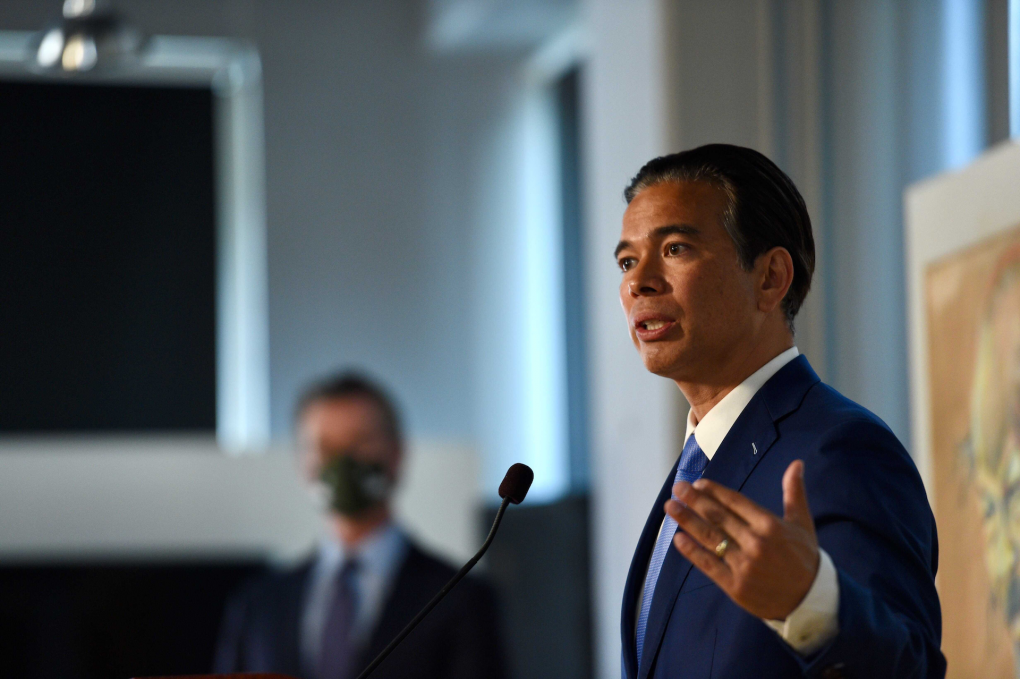
"caption": "Gov. Gavin Newsom speaks at a press conference to introduce his nominee for California attorney general, Assemblyman Rob Bonta, at the International Hotel Manilatown Center in San Francisco on March 24, 2021.",
"description": null,
"title": "RS48076_020_SanFrancisco_NewsomBontaPressConference_03242021-qut",
"credit": "Beth LaBerge/KQED",
"status": "inherit",
"altTag": null,
"isLoading": false,
"fetchFailed": false
},
"news_11867174": {
"type": "attachments",
"id": "news_11867174",
"meta": {
"index": "attachments_1716263798",
"site": "news",
"id": "11867174",
"found": true
},
"parent": 11866438,
"imgSizes": {
"twentyfourteen-full-width": {
"file": "https://ww2.kqed.org/app/uploads/sites/10/2021/03/GettyImages-84776357-2-1-1038x576.jpg",
"width": 1038,
"mimeType": "image/jpeg",
"height": 576
},
"thumbnail": {
"file": "https://ww2.kqed.org/app/uploads/sites/10/2021/03/GettyImages-84776357-2-1-160x107.jpg",
"width": 160,
"mimeType": "image/jpeg",
"height": 107
},
"post-thumbnail": {
"file": "https://ww2.kqed.org/app/uploads/sites/10/2021/03/GettyImages-84776357-2-1-672x372.jpg",
"width": 672,
"mimeType": "image/jpeg",
"height": 372
},
"kqedFullSize": {
"file": "https://ww2.kqed.org/app/uploads/sites/10/2021/03/GettyImages-84776357-2-1.jpg",
"width": 1920,
"height": 1278
},
"large": {
"file": "https://ww2.kqed.org/app/uploads/sites/10/2021/03/GettyImages-84776357-2-1-1020x679.jpg",
"width": 1020,
"mimeType": "image/jpeg",
"height": 679
},
"1536x1536": {
"file": "https://ww2.kqed.org/app/uploads/sites/10/2021/03/GettyImages-84776357-2-1-1536x1022.jpg",
"width": 1536,
"mimeType": "image/jpeg",
"height": 1022
},
"medium": {
"file": "https://ww2.kqed.org/app/uploads/sites/10/2021/03/GettyImages-84776357-2-1-800x533.jpg",
"width": 800,
"mimeType": "image/jpeg",
"height": 533
}
},
"publishDate": 1617143694,
"modified": 1617150041,
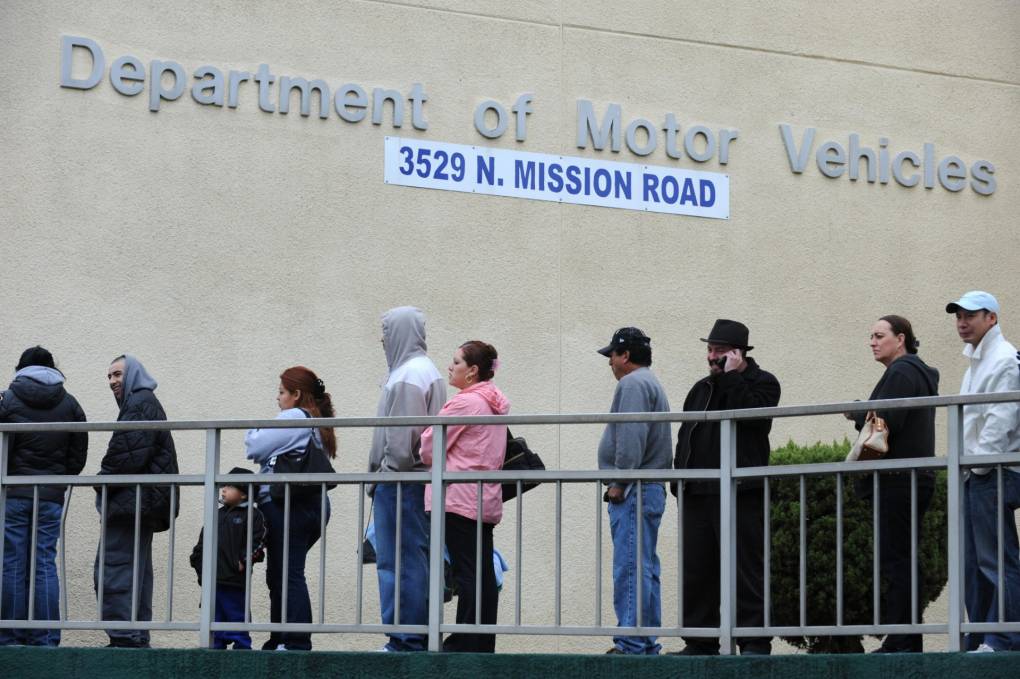
"caption": "People wait in line outside of the Department of Motor Vehicles in Los Angeles on Feb. 13, 2009.",
"description": "People wait in line outside of the State of California Department of Motor Vehicles (DMV) in Los Angeles, California on February 13, 2009.",
"title": "GettyImages-84776357 (2)",
"credit": "Robyn Beck/AFP via Getty Images",
"status": "inherit",
"altTag": null,
"isLoading": false,
"fetchFailed": false
},
"news_11866790": {
"type": "attachments",
"id": "news_11866790",
"meta": {
"index": "attachments_1716263798",
"site": "news",
"id": "11866790",
"found": true
},
"parent": 11866770,
"imgSizes": {
"twentyfourteen-full-width": {
"file": "https://ww2.kqed.org/app/uploads/sites/10/2021/03/MARQUEE_822-1038x576.jpg",
"width": 1038,
"mimeType": "image/jpeg",
"height": 576
},
"thumbnail": {
"file": "https://ww2.kqed.org/app/uploads/sites/10/2021/03/MARQUEE_822-160x90.jpg",
"width": 160,
"mimeType": "image/jpeg",
"height": 90
},
"post-thumbnail": {
"file": "https://ww2.kqed.org/app/uploads/sites/10/2021/03/MARQUEE_822-672x372.jpg",
"width": 672,
"mimeType": "image/jpeg",
"height": 372
},
"kqedFullSize": {
"file": "https://ww2.kqed.org/app/uploads/sites/10/2021/03/MARQUEE_822.jpg",
"width": 1920,
"height": 1080
},
"large": {
"file": "https://ww2.kqed.org/app/uploads/sites/10/2021/03/MARQUEE_822-1020x574.jpg",
"width": 1020,
"mimeType": "image/jpeg",
"height": 574
},
"1536x1536": {
"file": "https://ww2.kqed.org/app/uploads/sites/10/2021/03/MARQUEE_822-1536x864.jpg",
"width": 1536,
"mimeType": "image/jpeg",
"height": 864
},
"medium": {
"file": "https://ww2.kqed.org/app/uploads/sites/10/2021/03/MARQUEE_822-800x450.jpg",
"width": 800,
"mimeType": "image/jpeg",
"height": 450
}
},
"publishDate": 1616806208,
"modified": 1616806208,
"caption": null,
"description": null,
"title": "MARQUEE_822",
"credit": null,
"status": "inherit",
"altTag": null,
"isLoading": false,
"fetchFailed": false
},
"news_11866325": {
"type": "attachments",
"id": "news_11866325",
"meta": {
"index": "attachments_1716263798",
"site": "news",
"id": "11866325",
"found": true
},
"parent": 11865953,
"imgSizes": {
"twentyfourteen-full-width": {
"file": "https://ww2.kqed.org/app/uploads/sites/10/2021/03/image-1038x576.png",
"width": 1038,
"mimeType": "image/png",
"height": 576
},
"thumbnail": {
"file": "https://ww2.kqed.org/app/uploads/sites/10/2021/03/image-160x107.png",
"width": 160,
"mimeType": "image/png",
"height": 107
},
"post-thumbnail": {
"file": "https://ww2.kqed.org/app/uploads/sites/10/2021/03/image-672x372.png",
"width": 672,
"mimeType": "image/png",
"height": 372
},
"kqedFullSize": {
"file": "https://ww2.kqed.org/app/uploads/sites/10/2021/03/image.png",
"width": 1920,
"height": 1278
},
"large": {
"file": "https://ww2.kqed.org/app/uploads/sites/10/2021/03/image-1020x679.png",
"width": 1020,
"mimeType": "image/png",
"height": 679
},
"1536x1536": {
"file": "https://ww2.kqed.org/app/uploads/sites/10/2021/03/image-1536x1022.png",
"width": 1536,
"mimeType": "image/png",
"height": 1022
},
"medium": {
"file": "https://ww2.kqed.org/app/uploads/sites/10/2021/03/image-800x533.png",
"width": 800,
"mimeType": "image/png",
"height": 533
}
},
"publishDate": 1616625948,
"modified": 1616649412,
"caption": "East Bay Assemblyman Rob Bonta speaks during a press conference at the International Hotel in San Francisco's Chinatown on March 24, 2021, where he was nominated by Gov. Gavin Newsom to be California attorney general, replacing Xavier Becerra.",
"description": null,
"title": "Rob Bonta",
"credit": "Beth LaBerge/KQED",
"status": "inherit",
"altTag": "Rob Bonta",
"isLoading": false,
"fetchFailed": false
},
"news_11865731": {
"type": "attachments",
"id": "news_11865731",
"meta": {
"index": "attachments_1716263798",
"site": "news",
"id": "11865731",
"found": true
},
"parent": 11865699,
"imgSizes": {
"twentyfourteen-full-width": {
"file": "https://ww2.kqed.org/app/uploads/sites/10/2021/03/821_MARQUEE-1038x576.jpg",
"width": 1038,
"mimeType": "image/jpeg",
"height": 576
},
"thumbnail": {
"file": "https://ww2.kqed.org/app/uploads/sites/10/2021/03/821_MARQUEE-160x90.jpg",
"width": 160,
"mimeType": "image/jpeg",
"height": 90
},
"post-thumbnail": {
"file": "https://ww2.kqed.org/app/uploads/sites/10/2021/03/821_MARQUEE-672x372.jpg",
"width": 672,
"mimeType": "image/jpeg",
"height": 372
},
"kqedFullSize": {
"file": "https://ww2.kqed.org/app/uploads/sites/10/2021/03/821_MARQUEE.jpg",
"width": 1920,
"height": 1080
},
"large": {
"file": "https://ww2.kqed.org/app/uploads/sites/10/2021/03/821_MARQUEE-1020x574.jpg",
"width": 1020,
"mimeType": "image/jpeg",
"height": 574
},
"1536x1536": {
"file": "https://ww2.kqed.org/app/uploads/sites/10/2021/03/821_MARQUEE-1536x864.jpg",
"width": 1536,
"mimeType": "image/jpeg",
"height": 864
},
"medium": {
"file": "https://ww2.kqed.org/app/uploads/sites/10/2021/03/821_MARQUEE-800x450.jpg",
"width": 800,
"mimeType": "image/jpeg",
"height": 450
}
},
"publishDate": 1616194162,
"modified": 1616194162,
"caption": null,
"description": null,
"title": "821_MARQUEE",
"credit": null,
"status": "inherit",
"altTag": null,
"isLoading": false,
"fetchFailed": false
},
"news_11864795": {
"type": "attachments",
"id": "news_11864795",
"meta": {
"index": "attachments_1716263798",
"site": "news",
"id": "11864795",
"found": true
},
"parent": 11864783,
"imgSizes": {
"twentyfourteen-full-width": {
"file": "https://ww2.kqed.org/app/uploads/sites/10/2021/03/GettyImages-1231619984-1-1020x680-1-1020x576.jpeg",
"width": 1020,
"mimeType": "image/jpeg",
"height": 576
},
"thumbnail": {
"file": "https://ww2.kqed.org/app/uploads/sites/10/2021/03/GettyImages-1231619984-1-1020x680-1-160x107.jpeg",
"width": 160,
"mimeType": "image/jpeg",
"height": 107
},
"post-thumbnail": {
"file": "https://ww2.kqed.org/app/uploads/sites/10/2021/03/GettyImages-1231619984-1-1020x680-1-672x372.jpeg",
"width": 672,
"mimeType": "image/jpeg",
"height": 372
},
"kqedFullSize": {
"file": "https://ww2.kqed.org/app/uploads/sites/10/2021/03/GettyImages-1231619984-1-1020x680-1.jpeg",
"width": 1020,
"height": 680
},
"medium": {
"file": "https://ww2.kqed.org/app/uploads/sites/10/2021/03/GettyImages-1231619984-1-1020x680-1-800x533.jpeg",
"width": 800,
"mimeType": "image/jpeg",
"height": 533
}
},
"publishDate": 1615828959,
"modified": 1615829054,
"caption": "Gov. Gavin Newsom seen delivering the State of the State address at Dodger Stadium in Los Angeles on March 9, 2021. Newsom and his Democratic allies launched a political committee Monday, March 15 to stop a proposed recall election that could oust him from office.",
"description": "Gov. Gavin Newsom seen delivering the State of the State address at Dodger Stadium in Los Angeles on March 9, 2021. Newsom and his Democratic allies launched a political committee Monday, March 15 to stop a proposed recall election that could oust him from office.",
"title": "GettyImages-1231619984-1-1020x680",
"credit": "Patrick T. Fallon/AFP via Getty Images",
"status": "inherit",
"altTag": null,
"isLoading": false,
"fetchFailed": false
},
"news_11864612": {
"type": "attachments",
"id": "news_11864612",
"meta": {
"index": "attachments_1716263798",
"site": "news",
"id": "11864612",
"found": true
},
"parent": 11864577,
"imgSizes": {
"twentyfourteen-full-width": {
"file": "https://ww2.kqed.org/app/uploads/sites/10/2021/03/GettyImages-1306399364-1024x576.jpg",
"width": 1024,
"mimeType": "image/jpeg",
"height": 576
},
"thumbnail": {
"file": "https://ww2.kqed.org/app/uploads/sites/10/2021/03/GettyImages-1306399364-160x118.jpg",
"width": 160,
"mimeType": "image/jpeg",
"height": 118
},
"post-thumbnail": {
"file": "https://ww2.kqed.org/app/uploads/sites/10/2021/03/GettyImages-1306399364-672x372.jpg",
"width": 672,
"mimeType": "image/jpeg",
"height": 372
},
"kqedFullSize": {
"file": "https://ww2.kqed.org/app/uploads/sites/10/2021/03/GettyImages-1306399364.jpg",
"width": 1024,
"height": 758
},
"large": {
"file": "https://ww2.kqed.org/app/uploads/sites/10/2021/03/GettyImages-1306399364-1020x755.jpg",
"width": 1020,
"mimeType": "image/jpeg",
"height": 755
},
"medium": {
"file": "https://ww2.kqed.org/app/uploads/sites/10/2021/03/GettyImages-1306399364-800x592.jpg",
"width": 800,
"mimeType": "image/jpeg",
"height": 592
}
},
"publishDate": 1615597698,
"modified": 1623090334,
"caption": "Gov. Gavin Newsom on March 10, 2021, while visiting a mobile COVID-19 vaccination center in South Gate, California.",
"description": null,
"title": "California Governor Newsom Delivers Remarks At Southern California Vaccination Site",
"credit": "Mario Tama/Getty Images",
"status": "inherit",
"altTag": null,
"isLoading": false,
"fetchFailed": false
},
"news_11864316": {
"type": "attachments",
"id": "news_11864316",
"meta": {
"index": "attachments_1716263798",
"site": "news",
"id": "11864316",
"found": true
},
"parent": 11864287,
"imgSizes": {
"twentyfourteen-full-width": {
"file": "https://ww2.kqed.org/app/uploads/sites/10/2021/03/GettyImages-1231447271-1038x576.jpg",
"width": 1038,
"mimeType": "image/jpeg",
"height": 576
},
"thumbnail": {
"file": "https://ww2.kqed.org/app/uploads/sites/10/2021/03/GettyImages-1231447271-160x107.jpg",
"width": 160,
"mimeType": "image/jpeg",
"height": 107
},
"post-thumbnail": {
"file": "https://ww2.kqed.org/app/uploads/sites/10/2021/03/GettyImages-1231447271-672x372.jpg",
"width": 672,
"mimeType": "image/jpeg",
"height": 372
},
"kqedFullSize": {
"file": "https://ww2.kqed.org/app/uploads/sites/10/2021/03/GettyImages-1231447271-scaled.jpg",
"width": 2560,
"height": 1707
},
"2048x2048": {
"file": "https://ww2.kqed.org/app/uploads/sites/10/2021/03/GettyImages-1231447271-2048x1365.jpg",
"width": 2048,
"mimeType": "image/jpeg",
"height": 1365
},
"large": {
"file": "https://ww2.kqed.org/app/uploads/sites/10/2021/03/GettyImages-1231447271-1020x680.jpg",
"width": 1020,
"mimeType": "image/jpeg",
"height": 680
},
"1536x1536": {
"file": "https://ww2.kqed.org/app/uploads/sites/10/2021/03/GettyImages-1231447271-1536x1024.jpg",
"width": 1536,
"mimeType": "image/jpeg",
"height": 1024
},
"full-width": {
"file": "https://ww2.kqed.org/app/uploads/sites/10/2021/03/GettyImages-1231447271-1920x1280.jpg",
"width": 1920,
"mimeType": "image/jpeg",
"height": 1280
},
"medium": {
"file": "https://ww2.kqed.org/app/uploads/sites/10/2021/03/GettyImages-1231447271-800x533.jpg",
"width": 800,
"mimeType": "image/jpeg",
"height": 533
}
},
"publishDate": 1615503422,
"modified": 1615503481,
"caption": "Signage is seen near a booth where conservative activists gather signatures in a recall effort against California Governor Gavin Newsom near Pasadena City Hall, in Pasadena, California on February 28, 2021. (Photo by DAVID MCNEW / AFP) ",
"description": null,
"title": "US-POLITICS-CALIFORNIA-NEWSOM",
"credit": "(Photo by DAVID MCNEW/AFP via Getty Images)",
"status": "inherit",
"altTag": null,
"isLoading": false,
"fetchFailed": false
},
"news_11864233": {
"type": "attachments",
"id": "news_11864233",
"meta": {
"index": "attachments_1716263798",
"site": "news",
"id": "11864233",
"found": true
},
"parent": 11864223,
"imgSizes": {
"twentyfourteen-full-width": {
"file": "https://ww2.kqed.org/app/uploads/sites/10/2021/03/RS47629_GettyImages-1304962043-qut-1038x576.jpg",
"width": 1038,
"mimeType": "image/jpeg",
"height": 576
},
"thumbnail": {
"file": "https://ww2.kqed.org/app/uploads/sites/10/2021/03/RS47629_GettyImages-1304962043-qut-160x112.jpg",
"width": 160,
"mimeType": "image/jpeg",
"height": 112
},
"post-thumbnail": {
"file": "https://ww2.kqed.org/app/uploads/sites/10/2021/03/RS47629_GettyImages-1304962043-qut-672x372.jpg",
"width": 672,
"mimeType": "image/jpeg",
"height": 372
},
"kqedFullSize": {
"file": "https://ww2.kqed.org/app/uploads/sites/10/2021/03/RS47629_GettyImages-1304962043-qut.jpg",
"width": 1920,
"height": 1341
},
"large": {
"file": "https://ww2.kqed.org/app/uploads/sites/10/2021/03/RS47629_GettyImages-1304962043-qut-1020x712.jpg",
"width": 1020,
"mimeType": "image/jpeg",
"height": 712
},
"1536x1536": {
"file": "https://ww2.kqed.org/app/uploads/sites/10/2021/03/RS47629_GettyImages-1304962043-qut-1536x1073.jpg",
"width": 1536,
"mimeType": "image/jpeg",
"height": 1073
},
"medium": {
"file": "https://ww2.kqed.org/app/uploads/sites/10/2021/03/RS47629_GettyImages-1304962043-qut-800x559.jpg",
"width": 800,
"mimeType": "image/jpeg",
"height": 559
}
},
"publishDate": 1615486632,
"modified": 1615486722,
"caption": "Gov. Gavin Newsom looks on during a news conference after touring Barron Park Elementary School on March 2, 2021 in Palo Alto. About $15.9 billion from the federal coronavirus relief bill will go to public and private schools in California.",
"description": "Gov. Gavin Newsom looks on during a news conference after touring Barron Park Elementary School on March 2, 2021 in Palo Alto. About $15.9 billion from the federal coronavirus relief bill will go to public and private schools in California.",
"title": "California Governor Gavin Newsom Visits Reopened Elementary In Palo Alto",
"credit": "Justin Sullivan/Getty Images",
"status": "inherit",
"altTag": "Gavin Newsom with mask on school's basketball court",
"isLoading": false,
"fetchFailed": false
}
},
"audioPlayerReducer": {
"postId": "stream_live",
"isPaused": true,
"isPlaying": false,
"pfsActive": false,
"pledgeModalIsOpen": true,
"playerDrawerIsOpen": false,
"liveAudioPlayStartedAt": 0,
"liveAudioPlayContext": ""
},
"authorsReducer": {
"byline_news_11864783": {
"type": "authors",
"id": "byline_news_11864783",
"meta": {
"override": true
},
"slug": "byline_news_11864783",
"name": "Michael R. Blood\u003cbr>Associated Press",
"isLoading": false
},
"byline_news_11864223": {
"type": "authors",
"id": "byline_news_11864223",
"meta": {
"override": true
},
"slug": "byline_news_11864223",
"name": "Adam Beam \u003cbr> The Associated Press",
"isLoading": false
},
"gmarzorati": {
"type": "authors",
"id": "227",
"meta": {
"index": "authors_1716337520",
"id": "227",
"found": true
},
"name": "Guy Marzorati",
"firstName": "Guy",
"lastName": "Marzorati",
"slug": "gmarzorati",
"email": "gmarzorati@KQED.org",
"display_author_email": true,
"staff_mastheads": [
"news"
],
"title": "Correspondent",
"bio": "Guy Marzorati is a correspondent on KQED's California Politics and Government Desk, based in San Jose. A graduate of Santa Clara University, Guy joined KQED in 2013. He reports on state and local politics and produces KQED's digital voter guide.",
"avatar": "https://secure.gravatar.com/avatar/e7038b8dbfd55b104369b76b1cd0b9de?s=600&d=blank&r=g",
"twitter": "guymarzorati",
"facebook": null,
"instagram": null,
"linkedin": null,
"sites": [
{
"site": "",
"roles": [
"editor"
]
},
{
"site": "news",
"roles": [
"editor"
]
},
{
"site": "science",
"roles": [
"editor"
]
},
{
"site": "forum",
"roles": [
"editor"
]
},
{
"site": "elections",
"roles": [
"editor"
]
},
{
"site": "liveblog",
"roles": [
"editor"
]
}
],
"headData": {
"title": "Guy Marzorati | KQED",
"description": "Correspondent",
"ogImgSrc": "https://secure.gravatar.com/avatar/e7038b8dbfd55b104369b76b1cd0b9de?s=600&d=blank&r=g",
"twImgSrc": "https://secure.gravatar.com/avatar/e7038b8dbfd55b104369b76b1cd0b9de?s=600&d=blank&r=g"
},
"isLoading": false,
"link": "/author/gmarzorati"
},
"kqed": {
"type": "authors",
"id": "236",
"meta": {
"index": "authors_1716337520",
"id": "236",
"found": true
},
"name": "KQED News Staff",
"firstName": "KQED News Staff",
"lastName": null,
"slug": "kqed",
"email": "faq@kqed.org",
"display_author_email": false,
"staff_mastheads": [],
"title": null,
"bio": null,
"avatar": "https://secure.gravatar.com/avatar/ef0e801a68c4c54afa9180db14084167?s=600&d=blank&r=g",
"twitter": null,
"facebook": null,
"instagram": null,
"linkedin": null,
"sites": [
{
"site": "arts",
"roles": [
"contributor"
]
},
{
"site": "news",
"roles": [
"editor"
]
},
{
"site": "futureofyou",
"roles": [
"author"
]
}
],
"headData": {
"title": "KQED News Staff | KQED",
"description": null,
"ogImgSrc": "https://secure.gravatar.com/avatar/ef0e801a68c4c54afa9180db14084167?s=600&d=blank&r=g",
"twImgSrc": "https://secure.gravatar.com/avatar/ef0e801a68c4c54afa9180db14084167?s=600&d=blank&r=g"
},
"isLoading": false,
"link": "/author/kqed"
},
"kqednewsstaffandwires": {
"type": "authors",
"id": "237",
"meta": {
"index": "authors_1716337520",
"id": "237",
"found": true
},
"name": "KQED News Staff and Wires",
"firstName": "KQED News Staff and Wires",
"lastName": null,
"slug": "kqednewsstaffandwires",
"email": "onlinenewsstaff@kqed.org",
"display_author_email": false,
"staff_mastheads": [],
"title": null,
"bio": null,
"avatar": "https://secure.gravatar.com/avatar/72295af8ebbfbd19a4948f5271285664?s=600&d=blank&r=g",
"twitter": null,
"facebook": null,
"instagram": null,
"linkedin": null,
"sites": [
{
"site": "arts",
"roles": [
"contributor"
]
},
{
"site": "news",
"roles": [
"contributor"
]
},
{
"site": "lowdown",
"roles": [
"author"
]
},
{
"site": "stateofhealth",
"roles": [
"contributor"
]
},
{
"site": "food",
"roles": [
"author"
]
}
],
"headData": {
"title": "KQED News Staff and Wires | KQED",
"description": null,
"ogImgSrc": "https://secure.gravatar.com/avatar/72295af8ebbfbd19a4948f5271285664?s=600&d=blank&r=g",
"twImgSrc": "https://secure.gravatar.com/avatar/72295af8ebbfbd19a4948f5271285664?s=600&d=blank&r=g"
},
"isLoading": false,
"link": "/author/kqednewsstaffandwires"
},
"scottshafer": {
"type": "authors",
"id": "255",
"meta": {
"index": "authors_1716337520",
"id": "255",
"found": true
},
"name": "Scott Shafer",
"firstName": "Scott",
"lastName": "Shafer",
"slug": "scottshafer",
"email": "sshafer@kqed.org",
"display_author_email": false,
"staff_mastheads": [
"news"
],
"title": "KQED Contributor",
"bio": "Scott Shafer is a senior editor with the KQED Politics and Government desk. He is co-host of Political Breakdown, the award-winning radio show and podcast with a personal take on the world of politics. Scott came to KQED in 1998 to host the statewide\u003cem> California Report\u003c/em>. Prior to that he had extended stints in politics and government\u003cem>.\u003c/em> He uses that inside experience at KQED in his, reporting, hosting and analysis for the politics desk. Scott collaborated \u003cem>Political Breakdown a\u003c/em>nd on \u003cem>The Political Mind of Jerry Brown, \u003c/em>an eight-part series about the life and extraordinary political career of the former governor. For fun, he plays water polo with the San Francisco Tsunami.",
"avatar": "https://secure.gravatar.com/avatar/a62ebae45b79d7aed1a39a0e3bf68104?s=600&d=blank&r=g",
"twitter": "scottshafer",
"bluesky": null,
"facebook": null,
"instagram": null,
"linkedin": null,
"sites": [
{
"site": "news",
"roles": [
"editor"
]
},
{
"site": "stateofhealth",
"roles": [
"author"
]
},
{
"site": "science",
"roles": [
"author"
]
},
{
"site": "forum",
"roles": [
"subscriber"
]
},
{
"site": "liveblog",
"roles": [
"author"
]
}
],
"headData": {
"title": "Scott Shafer | KQED",
"description": "KQED Contributor",
"ogImgSrc": "https://secure.gravatar.com/avatar/a62ebae45b79d7aed1a39a0e3bf68104?s=600&d=blank&r=g",
"twImgSrc": "https://secure.gravatar.com/avatar/a62ebae45b79d7aed1a39a0e3bf68104?s=600&d=blank&r=g"
},
"isLoading": false,
"link": "/author/scottshafer"
},
"mlagos": {
"type": "authors",
"id": "3239",
"meta": {
"index": "authors_1716337520",
"id": "3239",
"found": true
},
"name": "Marisa Lagos",
"firstName": "Marisa",
"lastName": "Lagos",
"slug": "mlagos",
"email": "mlagos@kqed.org",
"display_author_email": false,
"staff_mastheads": [
"news"
],
"title": "KQED Contributor",
"bio": "Marisa Lagos is a correspondent for KQED’s California Politics and Government Desk and co-hosts the award-winning show and podcast, Political Breakdown. At KQED, Lagos also conducts reporting, analysis and investigations into state, local and national politics for radio, TV, online and onstage. In 2022, she and co-host, Scott Shafer, moderated the only gubernatorial debate in California. In 2020, the \u003ci>Washington Post\u003c/i> named her one of the top political journalists in California; she was nominated for a Peabody and won several other awards for her work investigating the 2017 California wildfires. She has worked at the \u003ci>San Francisco Chronicle\u003c/i>, \u003ci>San Francisco Examiner\u003c/i> and \u003ci>Los Angeles Times\u003c/i>. A UC Santa Barbara graduate, she lives in San Francisco with her two sons and husband.",
"avatar": "https://secure.gravatar.com/avatar/a261a0d3696fc066871ef96b85b5e7d2?s=600&d=blank&r=g",
"twitter": "@mlagos",
"facebook": null,
"instagram": null,
"linkedin": null,
"sites": [
{
"site": "arts",
"roles": [
"author"
]
},
{
"site": "news",
"roles": [
"editor"
]
},
{
"site": "science",
"roles": [
"editor"
]
},
{
"site": "forum",
"roles": [
"author"
]
},
{
"site": "liveblog",
"roles": [
"author"
]
}
],
"headData": {
"title": "Marisa Lagos | KQED",
"description": "KQED Contributor",
"ogImgSrc": "https://secure.gravatar.com/avatar/a261a0d3696fc066871ef96b85b5e7d2?s=600&d=blank&r=g",
"twImgSrc": "https://secure.gravatar.com/avatar/a261a0d3696fc066871ef96b85b5e7d2?s=600&d=blank&r=g"
},
"isLoading": false,
"link": "/author/mlagos"
},
"ecruzguevarra": {
"type": "authors",
"id": "8654",
"meta": {
"index": "authors_1716337520",
"id": "8654",
"found": true
},
"name": "Ericka Cruz Guevarra",
"firstName": "Ericka",
"lastName": "Cruz Guevarra",
"slug": "ecruzguevarra",
"email": "ecruzguevarra@kqed.org",
"display_author_email": true,
"staff_mastheads": [
"news"
],
"title": "Producer, The Bay Podcast",
"bio": "Ericka Cruz Guevarra is host of \u003ca href=\"https://www.kqed.org/podcasts/thebay\">\u003cem>The Bay\u003c/em>\u003c/a> podcast at KQED. Before host, she was the show’s producer. Her work in that capacity includes a three-part reported series on policing in Vallejo, which won a 2020 excellence in journalism award from the Society of Professional Journalists. Ericka has worked as a breaking news reporter at Oregon Public Broadcasting, helped produce the Code Switch podcast, and was KQED’s inaugural Raul Ramirez Diversity Fund intern. She’s also an alumna of NPR’s Next Generation Radio program. Send her an email if you have strong feelings about whether Fairfield and Suisun City are the Bay. Ericka is represented by SAG-AFTRA.",
"avatar": "https://secure.gravatar.com/avatar/accefc1de4bafc7e234b69bcb9b6f6536c130fd84709bc3069ef11a78787e1bb?s=600&d=blank&r=g",
"twitter": "NotoriousECG",
"bluesky": null,
"facebook": null,
"instagram": null,
"linkedin": null,
"sites": [
{
"site": "arts",
"roles": [
"subscriber"
]
},
{
"site": "news",
"roles": [
"editor",
"manage_categories"
]
},
{
"site": "futureofyou",
"roles": [
"subscriber"
]
},
{
"site": "stateofhealth",
"roles": [
"subscriber"
]
},
{
"site": "science",
"roles": [
"editor"
]
},
{
"site": "forum",
"roles": [
"subscriber"
]
}
],
"headData": {
"title": "Ericka Cruz Guevarra | KQED",
"description": "Producer, The Bay Podcast",
"ogImgSrc": "https://secure.gravatar.com/avatar/accefc1de4bafc7e234b69bcb9b6f6536c130fd84709bc3069ef11a78787e1bb?s=600&d=blank&r=g",
"twImgSrc": "https://secure.gravatar.com/avatar/accefc1de4bafc7e234b69bcb9b6f6536c130fd84709bc3069ef11a78787e1bb?s=600&d=blank&r=g"
},
"isLoading": false,
"link": "/author/ecruzguevarra"
},
"korr": {
"type": "authors",
"id": "11200",
"meta": {
"index": "authors_1716337520",
"id": "11200",
"found": true
},
"name": "Katie Orr",
"firstName": "Katie",
"lastName": "Orr",
"slug": "korr",
"email": "korr@kqed.org",
"display_author_email": false,
"staff_mastheads": [],
"title": "KQED Contributor",
"bio": "Katie Orr was a Sacramento-based reporter for KQED's Politics and Government Desk, covering the state Capitol and a variety of issues including women in politics, voting and elections and legislation. Prior to joining KQED in 2016, Katie was state government reporter for Capital Public Radio in Sacramento. She's also worked for KPBS in San Diego, where she covered City Hall.\r\n\r\nKatie received her masters degree in political science from San Diego State University and holds a Bachelors degree in broadcast journalism from Arizona State University.\r\n\r\nIn 2015 Katie won a national Clarion Award for a series of stories she did on women in California politics. She's been honored by the Society for Professional Journalists and, in 2013, was named by \u003cem>The Washington Post\u003c/em> as one of the country's top state Capitol reporters. She's also reported for the award-winning documentary series \u003cem>The View from Here \u003c/em>and was part of the team that won national PRNDI and Gabriel Awards in 2015. She lives in Sacramento with her husband. Twitter: @1KatieOrr",
"avatar": "https://secure.gravatar.com/avatar/41a40b25845adc78f50808670860449e?s=600&d=blank&r=g",
"twitter": "1katieorr",
"facebook": null,
"instagram": null,
"linkedin": null,
"sites": [
{
"site": "news",
"roles": [
"subscriber"
]
},
{
"site": "stateofhealth",
"roles": [
"author"
]
},
{
"site": "forum",
"roles": [
"author"
]
}
],
"headData": {
"title": "Katie Orr | KQED",
"description": "KQED Contributor",
"ogImgSrc": "https://secure.gravatar.com/avatar/41a40b25845adc78f50808670860449e?s=600&d=blank&r=g",
"twImgSrc": "https://secure.gravatar.com/avatar/41a40b25845adc78f50808670860449e?s=600&d=blank&r=g"
},
"isLoading": false,
"link": "/author/korr"
},
"aehsanipour": {
"type": "authors",
"id": "11580",
"meta": {
"index": "authors_1716337520",
"id": "11580",
"found": true
},
"name": "Asal Ehsanipour",
"firstName": "Asal",
"lastName": "Ehsanipour",
"slug": "aehsanipour",
"email": "aehsanipour@kqed.org",
"display_author_email": false,
"staff_mastheads": [],
"title": "Reporter and Producer",
"bio": "Asal Ehsanipour is a producer and reporter for Rightnowish, Bay Curious and The California Report Magazine. She is also a producer for \u003ca href=\"https://www.thedoubleshift.com/\">The Double Shift\u003c/a>, a podcast about a new generation of working mothers. In 2018, Asal was named an Emerging Journalist Fellow by the Journalism and Women’s Symposium. Her work has appeared on KQED, KALW, PRI’s The World, and in several food and travel publications.",
"avatar": "https://secure.gravatar.com/avatar/c0e210438f5dca1b76921ff9f0eada52?s=600&d=blank&r=g",
"twitter": null,
"facebook": null,
"instagram": null,
"linkedin": null,
"sites": [
{
"site": "arts",
"roles": []
},
{
"site": "news",
"roles": [
"author",
"edit_others_posts"
]
}
],
"headData": {
"title": "Asal Ehsanipour | KQED",
"description": "Reporter and Producer",
"ogImgSrc": "https://secure.gravatar.com/avatar/c0e210438f5dca1b76921ff9f0eada52?s=600&d=blank&r=g",
"twImgSrc": "https://secure.gravatar.com/avatar/c0e210438f5dca1b76921ff9f0eada52?s=600&d=blank&r=g"
},
"isLoading": false,
"link": "/author/aehsanipour"
},
"hmcdede": {
"type": "authors",
"id": "11635",
"meta": {
"index": "authors_1716337520",
"id": "11635",
"found": true
},
"name": "Holly McDede",
"firstName": "Holly",
"lastName": "McDede",
"slug": "hmcdede",
"email": "hmcdede@KQED.org",
"display_author_email": false,
"staff_mastheads": [],
"title": "KQED Contributor",
"bio": null,
"avatar": "https://secure.gravatar.com/avatar/999d9bf31bb3a2f0511932d99526cb3e?s=600&d=blank&r=g",
"twitter": null,
"facebook": null,
"instagram": null,
"linkedin": null,
"sites": [
{
"site": "arts",
"roles": [
"editor"
]
},
{
"site": "news",
"roles": [
"edit_others_posts",
"editor"
]
},
{
"site": "science",
"roles": [
"editor"
]
},
{
"site": "forum",
"roles": [
"editor"
]
},
{
"site": "perspectives",
"roles": [
"administrator"
]
}
],
"headData": {
"title": "Holly McDede | KQED",
"description": "KQED Contributor",
"ogImgSrc": "https://secure.gravatar.com/avatar/999d9bf31bb3a2f0511932d99526cb3e?s=600&d=blank&r=g",
"twImgSrc": "https://secure.gravatar.com/avatar/999d9bf31bb3a2f0511932d99526cb3e?s=600&d=blank&r=g"
},
"isLoading": false,
"link": "/author/hmcdede"
},
"amontecillo": {
"type": "authors",
"id": "11649",
"meta": {
"index": "authors_1716337520",
"id": "11649",
"found": true
},
"name": "Alan Montecillo",
"firstName": "Alan",
"lastName": "Montecillo",
"slug": "amontecillo",
"email": "amontecillo@kqed.org",
"display_author_email": false,
"staff_mastheads": [
"news"
],
"title": "KQED Contributor",
"bio": "Alan Montecillo is the senior editor of \u003cem>\u003ca href=\"http://kqed.org/thebay\">The Bay\u003c/a>, \u003c/em> KQED's local news podcast. Before moving to the Bay Area, he worked as a senior talk show producer for WILL in Champaign-Urbana, Illinois and at Oregon Public Broadcasting in Portland, Oregon. He has won journalism awards from the Society of Professional Journalists Northern California, the Public Media Journalists Association, The Signal Awards, and has also received a regional Edward R. Murrow award. Alan is a Filipino American from Hong Kong and a graduate of Reed College.",
"avatar": "https://secure.gravatar.com/avatar/268f53a2066899ea9efdd8a5900218b17c822d9862cbc9326cccec53ef41d349?s=600&d=blank&r=g",
"twitter": "alanmontecillo",
"bluesky": null,
"facebook": null,
"instagram": null,
"linkedin": null,
"sites": [
{
"site": "",
"roles": [
"editor"
]
},
{
"site": "news",
"roles": [
"editor",
"manage_categories"
]
}
],
"headData": {
"title": "Alan Montecillo | KQED",
"description": "KQED Contributor",
"ogImgSrc": "https://secure.gravatar.com/avatar/268f53a2066899ea9efdd8a5900218b17c822d9862cbc9326cccec53ef41d349?s=600&d=blank&r=g",
"twImgSrc": "https://secure.gravatar.com/avatar/268f53a2066899ea9efdd8a5900218b17c822d9862cbc9326cccec53ef41d349?s=600&d=blank&r=g"
},
"isLoading": false,
"link": "/author/amontecillo"
}
},
"pagesReducer": {
"news_tag_gavin-newsom": {
"type": "terms",
"id": "news_16",
"meta": {
"index": "terms_1716263798",
"site": "news",
"id": "16",
"score": 8.937016
},
"featImg": null,
"name": "Gavin Newsom",
"description": null,
"taxonomy": "tag",
"headData": {
"twImgId": null,
"twTitle": null,
"ogTitle": null,
"ogImgId": null,
"twDescription": null,
"description": null,
"title": "Gavin Newsom Archives | KQED News",
"ogDescription": null
},
"ttid": 16,
"slug": "gavin-newsom",
"isLoading": false,
"title": "Gavin Newsom",
"pageMeta": {
"site": "news",
"WpPageTemplate": "page-topic-editorial",
"currentPage": 62
},
"blocks": [
{
"blockName": "kqed/post-list",
"attrs": {
"layout": "cardArticle2",
"query": "posts/news?tag=gavin-newsom",
"seeMore": false,
"paginated": true,
"page": 62
}
},
{
"blockName": "kqed/ad"
}
]
}
},
"pfsSessionReducer": {},
"postsReducer": {
"stream_live": {
"type": "live",
"id": "stream_live",
"audioUrl": "https://streams.kqed.org/kqedradio",
"title": "Live Stream",
"excerpt": "Live Stream information currently unavailable.",
"link": "/radio",
"featImg": "",
"label": {
"name": "KQED Live",
"link": "/"
}
},
"stream_kqedNewscast": {
"type": "posts",
"id": "stream_kqedNewscast",
"audioUrl": "https://www.kqed.org/.stream/anon/radio/RDnews/newscast.mp3?_=1",
"title": "KQED Newscast",
"featImg": "",
"label": {
"name": "88.5 FM",
"link": "/"
}
},
"news_11868340": {
"type": "posts",
"id": "news_11868340",
"meta": {
"index": "posts_1716263798",
"site": "news",
"id": "11868340",
"score": null,
"sort": [
1617831036000
]
},
"guestAuthors": [],
"slug": "sf-school-board-commits-to-full-fall-reopening-suspends-school-renaming-effort",
"title": "SF School Board Commits to Full Fall Reopening, Suspends School Renaming Effort",
"publishDate": 1617831036,
"format": "standard",
"headTitle": "SF School Board Commits to Full Fall Reopening, Suspends School Renaming Effort | KQED",
"labelTerm": {
"site": "news"
},
"content": "\u003cp>The San Francisco Board of Education unanimously committed this week to fully reopening all district schools in time for the start of the fall semester.\u003c/p>\n\u003cp>During its lengthy meeting on Tuesday that ran late into the evening, the board also voted to suspend a contentious push to rename 44 of its schools that honor figures linked to historical racism or oppression, an issue it said it would revisit only after all students in the district have returned to their classrooms five days a week.\u003c/p>\n\u003cp>[pullquote align=\"right\" size=\"medium\" citation=\"Zoe Simotas, Lowell High School senior\"]‘If SFUSD crashes and burns, which it feels like it is, we have no other option. So please pull yourself together.’[/pullquote]\u003c/p>\n\u003cp>That move marks an effort by board members to fully invest in reopening schools and to shift focus away from the \u003ca href=\"https://www.npr.org/2021/04/07/984919925/san-francisco-school-board-rescinds-controversial-school-renaming-plan\">numerous controversies\u003c/a> it has recently been entangled in.\u003c/p>\n\u003cp>Under the resolution committing to a full return in the fall, authored by Commissioner Jenny Lam, students can still opt to continue with distance learning if they prefer.\u003c/p>\n\u003cp>In arguing for reopening, \u003ca href=\"https://go.boarddocs.com/ca/sfusd/Board.nsf/files/BZLAZB2A0FE5/%24file/Lam%20Return%20Students%20to%20School%2021-22.pdf\">the resolution\u003c/a> underscores the mental health toll that not being in school for a year has had on many students, citing a 66% increase in the number of suicidal children coming to the emergency room at UCSF Benioff Children’s Hospital in the past year, and a 75% increase in youth who have required hospitalization for mental health services.\u003c/p>\n\u003cp>Elementary school students in the district \u003ca href=\"https://www.sfusd.edu/covid-19-response-updates-and-resources/return-person-learning/timeline-returning-person-learning\">can return to in-person classes\u003c/a> starting next week, and some high-needs older students will return later this month. But there is still no plan in place for reopening most middle and high schools before the end of the school year.\u003c/p>\n\u003cp>“I think you all know how impassioned I feel about returning our students back to in-person learning after being in distance learning and navigating this pandemic for over a year,” Lam told attendees at the meeting. “I just want to acknowledge and share that I feel and hear the pain, the fear, the frustration, the heartbreak.”\u003c/p>\n\u003cp>[ad fullwidth]\u003cbr>\nThe vote comes on the heels of Gov. Gavin Newsom’s \u003ca href=\"https://www.kqed.org/news/11868240/newsom-announces-plan-to-open-up-business-as-usual-in-california-by-june-15\">announcement Tuesday\u003c/a> aiming for a “full reopening” of the state on June 15, should vaccination supplies be sufficiently high and hospitalizations remain low.\u003c/p>\n\u003cp>Newsom said that should clear the way for most students to return to their classrooms.\u003c/p>\n\u003cp>“I want kids back in person. I want kids back in schools safely for in-person instruction,” he said. “On June 15 we anticipate there’ll be no barrier to getting all our kids safely back.”\u003c/p>\n\u003cp>During the meeting, students and parents expressed frustration that the board has devoted so much time to issues unrelated to school reopenings.\u003c/p>\n\u003cp>Lowell High School senior Zoe Simotas implored board members to stay focused on the students they were elected to support.\u003c/p>\n\u003cp>“If you aren’t here to fight for students, we don’t want you here,” she said. “It feels like SFUSD is falling apart. I’m not part of a family that can afford private school. If SFUSD crashes and burns, which it feels like it is, we have no other option. So please pull yourself together.”\u003c/p>\n\u003cp>Along with the school renaming push, and the furor it sparked, the board has also \u003ca href=\"https://www.kqed.org/forum/2010101882638/turbulent-times-for-san-franciscos-school-district\">come under intense fire\u003c/a> for its recent move \u003ca href=\"https://www.sfexaminer.com/news/school-board-votes-5-2-to-end-selective-admissions-policy-at-lowell/\">to strip Lowell High School\u003c/a> of its merit-based admissions policies. And it is now entangled in a conflict involving one of its own board members, Alison Collins, \u003ca href=\"https://www.kqed.org/news/11867599/censured-sf-school-board-member-alison-collins-sues-district-colleagues-for-constitutional-rights-violations\">who was removed\u003c/a> last week from several leadership positions after the discovery of a set of inflammatory tweets she wrote in 2016, sharply criticizing Asian Americans. Collins has since sued the district and her fellow board members — to the tune of nearly $90 million — claiming her constitutional rights were violated.\u003c/p>\n\u003cp>[aside label=\"related coverage\" tag=\"sfusd\"]Amid the ongoing tumult, San Francisco Unified School District Superintendent Dr. Vincent Matthews, who recently announced plans to retire in June, \u003ca href=\"https://www.kqed.org/news/11868069/sfusd-superintendent-reverses-course-says-he-wont-retire-this-year-as-planned\">reversed course this week\u003c/a>, saying he would remain in the position for an additional year after board members requested he stay.\u003c/p>\n\u003cp>In January, \u003ca href=\"https://www.kqed.org/news/11857527/san-francisco-may-rename-schools-named-after-washington-lincoln-and-others\">the board was lambasted\u003c/a> by many parents and officials — as well conservative observers — for its 6-1 vote to rename dozens of schools, an effort that was later found to have been based on flimsy research, including an over-reliance on Wikipedia.\u003c/p>\n\u003cp>Other critics, including alumni association members of Abraham Lincoln High School — one of the schools that was slated to be renamed — said the board \u003ca href=\"https://www.npr.org/2021/04/07/984919925/san-francisco-school-board-rescinds-controversial-school-renaming-plan\">failed to adequately include\u003c/a> community members in the process.\u003c/p>\n\u003cp>The board on Tuesday unanimously approved the \u003ca href=\"https://go.boarddocs.com/ca/sfusd/Board.nsf/files/BZPR896CB91E/%24file/Second%20Amended%20Resolution%20Re%20Renaming%20Schools.pdf\">resolution\u003c/a> to suspend the effort, saying it “wishes to avoid the distraction and wasteful expenditure of public funds in frivolous litigation.”\u003c/p>\n\u003cp>San Francisco Mayor London Breed has for months criticized the board for taking on the issue in the midst of the pandemic.\u003c/p>\n\u003cp>“What I cannot understand is why the School Board is advancing a plan to have all these schools renamed by April, when there isn’t a plan to have our kids back in the classroom by then,” Breed said in a January statement.\u003c/p>\n\u003cp>“Our students are suffering, and we should be talking about getting them in classrooms, getting them mental health support, and getting them the resources they need in this challenging time.”\u003c/p>\n\u003cp>\u003cem>KQED’s Matthew Green and Joe Fitzgerald Rodriguez contributed to this article.\u003c/em>\u003c/p>\n\u003cp>\u003c/p>\n",
"blocks": [],
"excerpt": "The school board unanimously approved both resolutions, an effort to get students back in classrooms and shift focus away from the many other controversies it has been recently entangled in.",
"status": "publish",
"parent": 0,
"modified": 1722644494,
"stats": {
"hasAudio": false,
"hasVideo": false,
"hasChartOrMap": false,
"iframeSrcs": [],
"hasGoogleForm": false,
"hasGallery": false,
"hasHearkenModule": false,
"hasPolis": false,
"paragraphCount": 24,
"wordCount": 928
},
"headData": {
"title": "SF School Board Commits to Full Fall Reopening, Suspends School Renaming Effort | KQED",
"description": "The school board unanimously approved both resolutions, an effort to get students back in classrooms and shift focus away from the many other controversies it has been recently entangled in.",
"ogTitle": "",
"ogDescription": "",
"ogImgId": "",
"twTitle": "",
"twDescription": "",
"twImgId": "",
"schema": {
"@context": "https://schema.org",
"@type": "NewsArticle",
"headline": "SF School Board Commits to Full Fall Reopening, Suspends School Renaming Effort",
"datePublished": "2021-04-07T14:30:36-07:00",
"dateModified": "2024-08-02T17:21:34-07:00",
"image": "https://cdn.kqed.org/wp-content/uploads/2020/02/KQED-OG-Image@1x.png",
"isAccessibleForFree": "True",
"publisher": {
"@type": "NewsMediaOrganization",
"@id": "https://www.kqed.org/#organization",
"name": "KQED",
"logo": "https://cdn.kqed.org/wp-content/uploads/2020/02/KQED-OG-Image@1x.png",
"url": "https://www.kqed.org",
"sameAs": [
"https://www.facebook.com/KQED",
"https://twitter.com/KQED",
"https://www.instagram.com/kqed/",
"https://www.tiktok.com/@kqedofficial",
"https://www.linkedin.com/company/kqed",
"https://www.youtube.com/channel/UCeC0IOo7i1P_61zVUWbJ4nw"
]
}
}
},
"sticky": false,
"path": "/news/11868340/sf-school-board-commits-to-full-fall-reopening-suspends-school-renaming-effort",
"audioTrackLength": null,
"parsedContent": [
{
"type": "contentString",
"content": "\u003cdiv class=\"post-body\">\u003cp>\u003cp>The San Francisco Board of Education unanimously committed this week to fully reopening all district schools in time for the start of the fall semester.\u003c/p>\n\u003cp>During its lengthy meeting on Tuesday that ran late into the evening, the board also voted to suspend a contentious push to rename 44 of its schools that honor figures linked to historical racism or oppression, an issue it said it would revisit only after all students in the district have returned to their classrooms five days a week.\u003c/p>\n\u003cp>\u003c/p>\u003c/div>",
"attributes": {
"named": {},
"numeric": []
}
},
{
"type": "component",
"content": "‘If SFUSD crashes and burns, which it feels like it is, we have no other option. So please pull yourself together.’",
"name": "pullquote",
"attributes": {
"named": {
"align": "right",
"size": "medium",
"citation": "Zoe Simotas, Lowell High School senior",
"label": ""
},
"numeric": []
}
},
{
"type": "contentString",
"content": "\u003cdiv class=\"post-body\">\u003cp>\u003c/p>\n\u003cp>That move marks an effort by board members to fully invest in reopening schools and to shift focus away from the \u003ca href=\"https://www.npr.org/2021/04/07/984919925/san-francisco-school-board-rescinds-controversial-school-renaming-plan\">numerous controversies\u003c/a> it has recently been entangled in.\u003c/p>\n\u003cp>Under the resolution committing to a full return in the fall, authored by Commissioner Jenny Lam, students can still opt to continue with distance learning if they prefer.\u003c/p>\n\u003cp>In arguing for reopening, \u003ca href=\"https://go.boarddocs.com/ca/sfusd/Board.nsf/files/BZLAZB2A0FE5/%24file/Lam%20Return%20Students%20to%20School%2021-22.pdf\">the resolution\u003c/a> underscores the mental health toll that not being in school for a year has had on many students, citing a 66% increase in the number of suicidal children coming to the emergency room at UCSF Benioff Children’s Hospital in the past year, and a 75% increase in youth who have required hospitalization for mental health services.\u003c/p>\n\u003cp>Elementary school students in the district \u003ca href=\"https://www.sfusd.edu/covid-19-response-updates-and-resources/return-person-learning/timeline-returning-person-learning\">can return to in-person classes\u003c/a> starting next week, and some high-needs older students will return later this month. But there is still no plan in place for reopening most middle and high schools before the end of the school year.\u003c/p>\n\u003cp>“I think you all know how impassioned I feel about returning our students back to in-person learning after being in distance learning and navigating this pandemic for over a year,” Lam told attendees at the meeting. “I just want to acknowledge and share that I feel and hear the pain, the fear, the frustration, the heartbreak.”\u003c/p>\n\u003cp>\u003c/p>\u003c/div>",
"attributes": {
"named": {},
"numeric": []
}
},
{
"type": "component",
"content": "",
"name": "ad",
"attributes": {
"named": {
"label": "fullwidth"
},
"numeric": [
"fullwidth"
]
}
},
{
"type": "contentString",
"content": "\u003cdiv class=\"post-body\">\u003cp>\u003cbr>\nThe vote comes on the heels of Gov. Gavin Newsom’s \u003ca href=\"https://www.kqed.org/news/11868240/newsom-announces-plan-to-open-up-business-as-usual-in-california-by-june-15\">announcement Tuesday\u003c/a> aiming for a “full reopening” of the state on June 15, should vaccination supplies be sufficiently high and hospitalizations remain low.\u003c/p>\n\u003cp>Newsom said that should clear the way for most students to return to their classrooms.\u003c/p>\n\u003cp>“I want kids back in person. I want kids back in schools safely for in-person instruction,” he said. “On June 15 we anticipate there’ll be no barrier to getting all our kids safely back.”\u003c/p>\n\u003cp>During the meeting, students and parents expressed frustration that the board has devoted so much time to issues unrelated to school reopenings.\u003c/p>\n\u003cp>Lowell High School senior Zoe Simotas implored board members to stay focused on the students they were elected to support.\u003c/p>\n\u003cp>“If you aren’t here to fight for students, we don’t want you here,” she said. “It feels like SFUSD is falling apart. I’m not part of a family that can afford private school. If SFUSD crashes and burns, which it feels like it is, we have no other option. So please pull yourself together.”\u003c/p>\n\u003cp>Along with the school renaming push, and the furor it sparked, the board has also \u003ca href=\"https://www.kqed.org/forum/2010101882638/turbulent-times-for-san-franciscos-school-district\">come under intense fire\u003c/a> for its recent move \u003ca href=\"https://www.sfexaminer.com/news/school-board-votes-5-2-to-end-selective-admissions-policy-at-lowell/\">to strip Lowell High School\u003c/a> of its merit-based admissions policies. And it is now entangled in a conflict involving one of its own board members, Alison Collins, \u003ca href=\"https://www.kqed.org/news/11867599/censured-sf-school-board-member-alison-collins-sues-district-colleagues-for-constitutional-rights-violations\">who was removed\u003c/a> last week from several leadership positions after the discovery of a set of inflammatory tweets she wrote in 2016, sharply criticizing Asian Americans. Collins has since sued the district and her fellow board members — to the tune of nearly $90 million — claiming her constitutional rights were violated.\u003c/p>\n\u003cp>\u003c/p>\u003c/div>",
"attributes": {
"named": {},
"numeric": []
}
},
{
"type": "component",
"content": "",
"name": "aside",
"attributes": {
"named": {
"label": "related coverage ",
"tag": "sfusd"
},
"numeric": []
}
},
{
"type": "contentString",
"content": "\u003cdiv class=\"post-body\">\u003cp>Amid the ongoing tumult, San Francisco Unified School District Superintendent Dr. Vincent Matthews, who recently announced plans to retire in June, \u003ca href=\"https://www.kqed.org/news/11868069/sfusd-superintendent-reverses-course-says-he-wont-retire-this-year-as-planned\">reversed course this week\u003c/a>, saying he would remain in the position for an additional year after board members requested he stay.\u003c/p>\n\u003cp>In January, \u003ca href=\"https://www.kqed.org/news/11857527/san-francisco-may-rename-schools-named-after-washington-lincoln-and-others\">the board was lambasted\u003c/a> by many parents and officials — as well conservative observers — for its 6-1 vote to rename dozens of schools, an effort that was later found to have been based on flimsy research, including an over-reliance on Wikipedia.\u003c/p>\n\u003cp>Other critics, including alumni association members of Abraham Lincoln High School — one of the schools that was slated to be renamed — said the board \u003ca href=\"https://www.npr.org/2021/04/07/984919925/san-francisco-school-board-rescinds-controversial-school-renaming-plan\">failed to adequately include\u003c/a> community members in the process.\u003c/p>\n\u003cp>The board on Tuesday unanimously approved the \u003ca href=\"https://go.boarddocs.com/ca/sfusd/Board.nsf/files/BZPR896CB91E/%24file/Second%20Amended%20Resolution%20Re%20Renaming%20Schools.pdf\">resolution\u003c/a> to suspend the effort, saying it “wishes to avoid the distraction and wasteful expenditure of public funds in frivolous litigation.”\u003c/p>\n\u003cp>San Francisco Mayor London Breed has for months criticized the board for taking on the issue in the midst of the pandemic.\u003c/p>\n\u003cp>“What I cannot understand is why the School Board is advancing a plan to have all these schools renamed by April, when there isn’t a plan to have our kids back in the classroom by then,” Breed said in a January statement.\u003c/p>\n\u003cp>“Our students are suffering, and we should be talking about getting them in classrooms, getting them mental health support, and getting them the resources they need in this challenging time.”\u003c/p>\n\u003cp>\u003cem>KQED’s Matthew Green and Joe Fitzgerald Rodriguez contributed to this article.\u003c/em>\u003c/p>\n\u003cp>\u003c/p>\n\u003c/div>\u003c/p>",
"attributes": {
"named": {},
"numeric": []
}
}
],
"link": "/news/11868340/sf-school-board-commits-to-full-fall-reopening-suspends-school-renaming-effort",
"authors": [
"11635"
],
"categories": [
"news_18540",
"news_8"
],
"tags": [
"news_29311",
"news_16",
"news_29330",
"news_1290"
],
"featImg": "news_11868359",
"label": "news"
},
"news_11868240": {
"type": "posts",
"id": "news_11868240",
"meta": {
"index": "posts_1716263798",
"site": "news",
"id": "11868240",
"score": null,
"sort": [
1617735563000
]
},
"guestAuthors": [],
"slug": "newsom-announces-plan-to-open-up-business-as-usual-in-california-by-june-15",
"title": "California Aims to Fully Reopen for ‘Business as Usual’ by June 15",
"publishDate": 1617735563,
"format": "standard",
"headTitle": "California Aims to Fully Reopen for ‘Business as Usual’ by June 15 | KQED",
"labelTerm": {
"site": "news"
},
"content": "\u003cp>Amid plummeting COVID-19 case rates and a major spike in vaccinations, California plans to lift most coronavirus restrictions on businesses and workplaces by June 15, Gov. Gavin Newsom announced Tuesday.\u003c/p>\n\u003cp>“We can confidently say by June 15 that we can start to open up business as as usual, subject to ongoing mask-wearing and ongoing vigilance,” Newsom said during a press conference at the City College of San Francisco Ocean Campus vaccination site. “So this is a big day.”\u003c/p>\n\u003cp>But for that reopening plan to happen, he said, the vaccine supply has to be sufficient to accommodate everyone 16 and older who wants one, and hospitalization rates statewide must remain stable and low.\u003c/p>\n\u003cp>Officials, however, did not explain how they would assess those benchmarks or what would constitute a good trajectory. Both Newsom and Health and Human Services Secretary Dr. Mark Ghaly struggled at times Tuesday to explain the changes without adding caveats.\u003c/p>\n\u003cp>Under the new plan, businesses will be able to open with “common-sense risk-reduction measures” such as wearing masks and encouraging vaccinations, Ghaly said. Most capacity limits for businesses and recreational activities will be lifted, although larger indoor events, such as conventions, will be allowed only with testing or vaccination verification requirements, he added.\u003c/p>\n\u003cp>[ad fullwidth]\u003c/p>\n\u003cp>Dr. Monica Gandhi, infectious disease expert and professor of medicine at UCSF, said California can begin reopening because many residents were exposed to the virus during the winter surge and many others are getting vaccinated.\u003c/p>\n\u003cp>“He wouldn’t have been able to keep it closed past June 15 anyway, because the cases would have been so low,” she said.\u003c/p>\n\u003cp>Vaccine eligibility will expand to people in California ages 16 and older beginning April 15, although some counties have already started vaccinating young adults.\u003c/p>\n\u003cp>The state has so far administered more than 20 million doses, including 4 million in the hardest-hit ZIP codes. More than \u003ca href=\"https://www.kqed.org/news/11859829/see-how-many-people-got-the-covid-19-vaccine-in-your-county-so-far\">a third of residents in the state\u003c/a> — over 13.6 million people — have received at least one shot, according to the Centers for Disease Control and Prevention.\u003c/p>\n\u003cp>Newsom said he expects 30 million doses to be administered by the end of April, putting the state on track to inoculate most of the estimated 32 million people eligible to receive it.\u003c/p>\n\u003cp>The two-month advance notice should give people enough time to schedule their first dose, wait the recommended three to four weeks for a second shot and get through the two-week period for the vaccine to fully kick in, Ghaly said. It also gives businesses and other services ample time to prepare.\u003c/p>\n\u003cp>The announcement comes as states across the country have lifted health restrictions as more people get vaccinated, despite \u003ca href=\"https://apnews.com/article/nearly-half-us-coronavirus-infections-come-from-5-states-53888dc78894cc76cb1bb50f8300f102\">rising infection rates\u003c/a> in some places, new variants and concerns of another surge.\u003c/p>\n\u003cp>California had some of the nation’s strictest pandemic rules in the country, becoming the first to institute a statewide stay-at-home order last spring.\u003c/p>\n\u003cp>[aside label=\"related coverage\" tag=\"coronavirus\"]Tuesday’s announcement signals a potential end date to more than a year of isolation. While many other states have pushed ahead, California has generally resisted reopening too quickly and, in several instances, has moved to reinstate restrictions to stem rising new cases and hospitalizations.\u003c/p>\n\u003cp>But the pandemic has taken its toll, killing more than 58,000 Californians, while shuttering scores of businesses and forcing millions of students to attend school remotely for much of the year.\u003c/p>\n\u003cp>In the short term, California’s vaccination progress means that counties can more easily shift to less-restrictive tiers, allowing them to increase capacity limits for various activities like indoor dining, shopping, worship services and sporting events. Every county in the Bay Area, except Solano County, has recently moved into the second-least restrictive orange tier.\u003c/p>\n\u003cp>The vaccine milestone also triggers a lower threshold for counties to enter the least-restrictive yellow tier: an adjusted rate of fewer than two new daily cases per 100,000 residents.\u003c/p>\n\u003cp>“San Francisco is currently in the orange tier, and fingers crossed governor, we’ll be in the yellow tier next week,” said Mayor London Breed during Tuesday’s announcement.\u003c/p>\n\u003cp>The new reopening plan comes as the first-term Democratic governor faces a likely recall election pushed by those critical of his handling of the pandemic. Many Republicans across the state and nation contend that political pressure, not vaccination progress, is driving Newsom’s decision to loosen restrictions.\u003c/p>\n\u003cp>“It took millions of Californians signing a recall petition for him to finally begin reopening our state,” Kevin Faulconer, a former San Diego mayor and Republican who is hoping to replace Newsom, said in a statement Tuesday.\u003c/p>\n\u003cp>Joanna Rodriguez, a spokeswoman for the Republican Governors Association, called Newsom’s announcement “too little too late.”\u003c/p>\n\u003cp>“While Newsom continued to live by a different set of rules than those he mandated on everyone else,” she said, “his failed leadership wreaked havoc on the state.”\u003c/p>\n\u003cp>Nonetheless, Tuesday’s announcement was welcome news to millions of people across the state, eager to resume their normal lives.\u003c/p>\n\u003cp>Michael Rodriguez, owner and general manager of the Cadillac Bar & Grill in San Francisco’s near-empty downtown, can’t wait for customers to return for happy hour cocktails and for theaters to reopen to live audiences.\u003c/p>\n\u003cp>“Everybody has something to look forward to now,” he said.\u003c/p>\n\u003cp>\u003c/p>\n\u003cp>\u003cem>This post includes reporting from KQED’s Matthew Green, Carlos Cabrera-Lomelí, Guy Marzorati and The Associated Press.\u003c/em>\u003c/p>\n\n",
"blocks": [],
"excerpt": "Gov. Gavin Newsom said the state would be able to lift all pandemic restrictions by mid-June if hospitalization rates remain low and enough doses of the vaccine are available to anyone 16 and older who wants one.",
"status": "publish",
"parent": 0,
"modified": 1740614448,
"stats": {
"hasAudio": false,
"hasVideo": false,
"hasChartOrMap": false,
"iframeSrcs": [],
"hasGoogleForm": false,
"hasGallery": false,
"hasHearkenModule": false,
"hasPolis": false,
"paragraphCount": 28,
"wordCount": 936
},
"headData": {
"title": "California Aims to Fully Reopen for ‘Business as Usual’ by June 15 | KQED",
"description": "Gov. Gavin Newsom said the state would be able to lift all pandemic restrictions by mid-June if hospitalization rates remain low and enough doses of the vaccine are available to anyone 16 and older who wants one.",
"ogTitle": "",
"ogDescription": "",
"ogImgId": "",
"twTitle": "",
"twDescription": "",
"twImgId": "",
"schema": {
"@context": "https://schema.org",
"@type": "NewsArticle",
"headline": "California Aims to Fully Reopen for ‘Business as Usual’ by June 15",
"datePublished": "2021-04-06T11:59:23-07:00",
"dateModified": "2025-02-26T16:00:48-08:00",
"image": "https://cdn.kqed.org/wp-content/uploads/2020/02/KQED-OG-Image@1x.png",
"isAccessibleForFree": "True",
"publisher": {
"@type": "NewsMediaOrganization",
"@id": "https://www.kqed.org/#organization",
"name": "KQED",
"logo": "https://cdn.kqed.org/wp-content/uploads/2020/02/KQED-OG-Image@1x.png",
"url": "https://www.kqed.org",
"sameAs": [
"https://www.facebook.com/KQED",
"https://twitter.com/KQED",
"https://www.instagram.com/kqed/",
"https://www.tiktok.com/@kqedofficial",
"https://www.linkedin.com/company/kqed",
"https://www.youtube.com/channel/UCeC0IOo7i1P_61zVUWbJ4nw"
]
}
}
},
"sticky": false,
"path": "/news/11868240/newsom-announces-plan-to-open-up-business-as-usual-in-california-by-june-15",
"audioTrackLength": null,
"parsedContent": [
{
"type": "contentString",
"content": "\u003cdiv class=\"post-body\">\u003cp>\u003cp>Amid plummeting COVID-19 case rates and a major spike in vaccinations, California plans to lift most coronavirus restrictions on businesses and workplaces by June 15, Gov. Gavin Newsom announced Tuesday.\u003c/p>\n\u003cp>“We can confidently say by June 15 that we can start to open up business as as usual, subject to ongoing mask-wearing and ongoing vigilance,” Newsom said during a press conference at the City College of San Francisco Ocean Campus vaccination site. “So this is a big day.”\u003c/p>\n\u003cp>But for that reopening plan to happen, he said, the vaccine supply has to be sufficient to accommodate everyone 16 and older who wants one, and hospitalization rates statewide must remain stable and low.\u003c/p>\n\u003cp>Officials, however, did not explain how they would assess those benchmarks or what would constitute a good trajectory. Both Newsom and Health and Human Services Secretary Dr. Mark Ghaly struggled at times Tuesday to explain the changes without adding caveats.\u003c/p>\n\u003cp>Under the new plan, businesses will be able to open with “common-sense risk-reduction measures” such as wearing masks and encouraging vaccinations, Ghaly said. Most capacity limits for businesses and recreational activities will be lifted, although larger indoor events, such as conventions, will be allowed only with testing or vaccination verification requirements, he added.\u003c/p>\n\u003cp>\u003c/p>\u003c/div>",
"attributes": {
"named": {},
"numeric": []
}
},
{
"type": "component",
"content": "",
"name": "ad",
"attributes": {
"named": {
"label": "fullwidth"
},
"numeric": [
"fullwidth"
]
}
},
{
"type": "contentString",
"content": "\u003cdiv class=\"post-body\">\u003cp>\u003c/p>\n\u003cp>Dr. Monica Gandhi, infectious disease expert and professor of medicine at UCSF, said California can begin reopening because many residents were exposed to the virus during the winter surge and many others are getting vaccinated.\u003c/p>\n\u003cp>“He wouldn’t have been able to keep it closed past June 15 anyway, because the cases would have been so low,” she said.\u003c/p>\n\u003cp>Vaccine eligibility will expand to people in California ages 16 and older beginning April 15, although some counties have already started vaccinating young adults.\u003c/p>\n\u003cp>The state has so far administered more than 20 million doses, including 4 million in the hardest-hit ZIP codes. More than \u003ca href=\"https://www.kqed.org/news/11859829/see-how-many-people-got-the-covid-19-vaccine-in-your-county-so-far\">a third of residents in the state\u003c/a> — over 13.6 million people — have received at least one shot, according to the Centers for Disease Control and Prevention.\u003c/p>\n\u003cp>Newsom said he expects 30 million doses to be administered by the end of April, putting the state on track to inoculate most of the estimated 32 million people eligible to receive it.\u003c/p>\n\u003cp>The two-month advance notice should give people enough time to schedule their first dose, wait the recommended three to four weeks for a second shot and get through the two-week period for the vaccine to fully kick in, Ghaly said. It also gives businesses and other services ample time to prepare.\u003c/p>\n\u003cp>The announcement comes as states across the country have lifted health restrictions as more people get vaccinated, despite \u003ca href=\"https://apnews.com/article/nearly-half-us-coronavirus-infections-come-from-5-states-53888dc78894cc76cb1bb50f8300f102\">rising infection rates\u003c/a> in some places, new variants and concerns of another surge.\u003c/p>\n\u003cp>California had some of the nation’s strictest pandemic rules in the country, becoming the first to institute a statewide stay-at-home order last spring.\u003c/p>\n\u003cp>\u003c/p>\u003c/div>",
"attributes": {
"named": {},
"numeric": []
}
},
{
"type": "component",
"content": "",
"name": "aside",
"attributes": {
"named": {
"label": "related coverage ",
"tag": "coronavirus"
},
"numeric": []
}
},
{
"type": "contentString",
"content": "\u003cdiv class=\"post-body\">\u003cp>Tuesday’s announcement signals a potential end date to more than a year of isolation. While many other states have pushed ahead, California has generally resisted reopening too quickly and, in several instances, has moved to reinstate restrictions to stem rising new cases and hospitalizations.\u003c/p>\n\u003cp>But the pandemic has taken its toll, killing more than 58,000 Californians, while shuttering scores of businesses and forcing millions of students to attend school remotely for much of the year.\u003c/p>\n\u003cp>In the short term, California’s vaccination progress means that counties can more easily shift to less-restrictive tiers, allowing them to increase capacity limits for various activities like indoor dining, shopping, worship services and sporting events. Every county in the Bay Area, except Solano County, has recently moved into the second-least restrictive orange tier.\u003c/p>\n\u003cp>The vaccine milestone also triggers a lower threshold for counties to enter the least-restrictive yellow tier: an adjusted rate of fewer than two new daily cases per 100,000 residents.\u003c/p>\n\u003cp>“San Francisco is currently in the orange tier, and fingers crossed governor, we’ll be in the yellow tier next week,” said Mayor London Breed during Tuesday’s announcement.\u003c/p>\n\u003cp>The new reopening plan comes as the first-term Democratic governor faces a likely recall election pushed by those critical of his handling of the pandemic. Many Republicans across the state and nation contend that political pressure, not vaccination progress, is driving Newsom’s decision to loosen restrictions.\u003c/p>\n\u003cp>“It took millions of Californians signing a recall petition for him to finally begin reopening our state,” Kevin Faulconer, a former San Diego mayor and Republican who is hoping to replace Newsom, said in a statement Tuesday.\u003c/p>\n\u003cp>Joanna Rodriguez, a spokeswoman for the Republican Governors Association, called Newsom’s announcement “too little too late.”\u003c/p>\n\u003cp>“While Newsom continued to live by a different set of rules than those he mandated on everyone else,” she said, “his failed leadership wreaked havoc on the state.”\u003c/p>\n\u003cp>Nonetheless, Tuesday’s announcement was welcome news to millions of people across the state, eager to resume their normal lives.\u003c/p>\n\u003cp>Michael Rodriguez, owner and general manager of the Cadillac Bar & Grill in San Francisco’s near-empty downtown, can’t wait for customers to return for happy hour cocktails and for theaters to reopen to live audiences.\u003c/p>\n\u003cp>“Everybody has something to look forward to now,” he said.\u003c/p>\n\u003cp>\u003c/p>\n\u003cp>\u003cem>This post includes reporting from KQED’s Matthew Green, Carlos Cabrera-Lomelí, Guy Marzorati and The Associated Press.\u003c/em>\u003c/p>\n\n\u003c/div>\u003c/p>",
"attributes": {
"named": {},
"numeric": []
}
}
],
"link": "/news/11868240/newsom-announces-plan-to-open-up-business-as-usual-in-california-by-june-15",
"authors": [
"237"
],
"categories": [
"news_8"
],
"tags": [
"news_27350",
"news_28801",
"news_27504",
"news_16",
"news_27881"
],
"featImg": "news_11868243",
"label": "news"
},
"news_11867877": {
"type": "posts",
"id": "news_11867877",
"meta": {
"index": "posts_1716263798",
"site": "news",
"id": "11867877",
"score": null,
"sort": [
1617410561000
]
},
"guestAuthors": [],
"slug": "searching-for-exoplanets-this-week-in-california-politics",
"title": "Searching for Exoplanets | This Week in California Politics",
"publishDate": 1617410561,
"format": "video",
"headTitle": "Searching for Exoplanets | This Week in California Politics | KQED",
"labelTerm": {
"term": 7052,
"site": "news"
},
"content": "\u003cp>\u003cb>This Week in California Politics\u003cbr>\n\u003c/b>\u003cspan style=\"font-weight: 400;\">The state is reopening its economy as it opens up vaccinations for more and more residents. Meanwhile, a new poll from the Public Policy Institute of California indicated that Gov. Gavin Newsom could beat back a recall if an election was held now: 40% said they’re in favor of kicking him out, but 56% said they’d vote to keep him in office.\u003c/span>\u003c/p>\n\u003cp>\u003cspan style=\"font-weight: 400;\">Guests:\u003c/span>\u003c/p>\n\u003cul>\n\u003cli style=\"font-weight: 400;\">\u003cspan style=\"font-weight: 400;\">Joe Garofoli, San Francisco Chronicle senior political writer\u003c/span>\u003c/li>\n\u003cli style=\"font-weight: 400;\">\u003cspan style=\"font-weight: 400;\">Carla Marinucci, POLITICO senior writer\u003c/span>\u003c/li>\n\u003c/ul>\n\u003cp>\u003cb>Searching for Exoplanets\u003cbr>\n\u003c/b>\u003cspan style=\"font-weight: 400;\">Astrophysicist and astrobiologist Natalie Batalha studies exoplanets — planets outside our solar system. When she began in the mid-’90s, there were only a few known exoplanets, but as a leader on the recent Kepler Mission, she and her team discovered more than 4,000 additional exoplanets, some of them potentially harboring life. \u003c/span>\u003c/p>\n\u003cp>\u003cspan style=\"font-weight: 400;\">Her daughter, Natasha Batalha, is following in her footsteps as a NASA Ames research scientist working on the James Webb Telescope Space project. When it’s launched into space this fall, it will be the largest telescope yet created.\u003c/span>\u003c/p>\n\u003cp>\u003cspan style=\"font-weight: 400;\">Guests:\u003c/span>\u003c/p>\n\u003cul>\n\u003cli style=\"font-weight: 400;\">\u003cspan style=\"font-weight: 400;\">Natalie Batalha, professor of astrophysics and director of the Astrobiology Initiative, UC Santa Cruz\u003c/span>\u003c/li>\n\u003cli style=\"font-weight: 400;\">\u003cspan style=\"font-weight: 400;\">Natasha Batalha, NASA Ames research scientist\u003c/span>\u003c/li>\n\u003c/ul>\n\u003cp>\u003cb>Something Beautiful: KQED Headquarters\u003cbr>\n\u003c/b>\u003cspan style=\"font-weight: 400;\">For this week’s look at something beautiful, we bring you a glimpse of our building as it undergoes renovation — from architectural renderings of the new design to the current progress of construction.\u003c/span>\u003c/p>\n\u003cp>[ad fullwidth]\u003c/p>\n\u003cp>\u003c/p>\n\u003cp>\u003cb>A Program Note\u003cbr>\n\u003c/b>\u003cspan style=\"font-weight: 400;\">KQED Newsroom is going to be on a temporary hiatus as we prepare to move back into our headquarters, which are currently being renovated. That means we’ll be off air after April 2 through the end of July. Our new season will launch in August.\u003c/span>\u003c/p>\n\n",
"blocks": [],
"excerpt": null,
"status": "publish",
"parent": 0,
"modified": 1721753521,
"stats": {
"hasAudio": false,
"hasVideo": false,
"hasChartOrMap": false,
"iframeSrcs": [],
"hasGoogleForm": false,
"hasGallery": false,
"hasHearkenModule": false,
"hasPolis": false,
"paragraphCount": 9,
"wordCount": 295
},
"headData": {
"title": "Searching for Exoplanets | This Week in California Politics | KQED",
"description": "This Week in California Politics The state is reopening its economy as it opens up vaccinations for more and more residents. Meanwhile, a new poll from the Public Policy Institute of California indicated that Gov. Gavin Newsom could beat back a recall if an election was held now: 40% said they’re in favor of kicking him out, but 56% said they’d vote to keep him in office. Guests: Joe Garofoli, San Francisco Chronicle senior political writer Carla Marinucci, POLITICO senior writer Searching for Exoplanets Astrophysicist and astrobiologist Natalie Batalha studies exoplanets — planets outside our solar system. When she began",
"ogTitle": "",
"ogDescription": "",
"ogImgId": "",
"twTitle": "",
"twDescription": "",
"twImgId": "",
"schema": {
"@context": "https://schema.org",
"@type": "NewsArticle",
"headline": "Searching for Exoplanets | This Week in California Politics",
"datePublished": "2021-04-02T17:42:41-07:00",
"dateModified": "2024-07-23T09:52:01-07:00",
"image": "https://cdn.kqed.org/wp-content/uploads/2020/02/KQED-OG-Image@1x.png",
"isAccessibleForFree": "True",
"publisher": {
"@type": "NewsMediaOrganization",
"@id": "https://www.kqed.org/#organization",
"name": "KQED",
"logo": "https://cdn.kqed.org/wp-content/uploads/2020/02/KQED-OG-Image@1x.png",
"url": "https://www.kqed.org",
"sameAs": [
"https://www.facebook.com/KQED",
"https://twitter.com/KQED",
"https://www.instagram.com/kqed/",
"https://www.tiktok.com/@kqedofficial",
"https://www.linkedin.com/company/kqed",
"https://www.youtube.com/channel/UCeC0IOo7i1P_61zVUWbJ4nw"
]
}
}
},
"videoEmbed": "https://youtu.be/HD_02wsYlyU ",
"sticky": false,
"excludeFromSiteSearch": "Include",
"articleAge": "0",
"path": "/news/11867877/searching-for-exoplanets-this-week-in-california-politics",
"audioTrackLength": null,
"parsedContent": [
{
"type": "contentString",
"content": "\u003cdiv class=\"post-body\">\u003cp>\u003cp>\u003cb>This Week in California Politics\u003cbr>\n\u003c/b>\u003cspan style=\"font-weight: 400;\">The state is reopening its economy as it opens up vaccinations for more and more residents. Meanwhile, a new poll from the Public Policy Institute of California indicated that Gov. Gavin Newsom could beat back a recall if an election was held now: 40% said they’re in favor of kicking him out, but 56% said they’d vote to keep him in office.\u003c/span>\u003c/p>\n\u003cp>\u003cspan style=\"font-weight: 400;\">Guests:\u003c/span>\u003c/p>\n\u003cul>\n\u003cli style=\"font-weight: 400;\">\u003cspan style=\"font-weight: 400;\">Joe Garofoli, San Francisco Chronicle senior political writer\u003c/span>\u003c/li>\n\u003cli style=\"font-weight: 400;\">\u003cspan style=\"font-weight: 400;\">Carla Marinucci, POLITICO senior writer\u003c/span>\u003c/li>\n\u003c/ul>\n\u003cp>\u003cb>Searching for Exoplanets\u003cbr>\n\u003c/b>\u003cspan style=\"font-weight: 400;\">Astrophysicist and astrobiologist Natalie Batalha studies exoplanets — planets outside our solar system. When she began in the mid-’90s, there were only a few known exoplanets, but as a leader on the recent Kepler Mission, she and her team discovered more than 4,000 additional exoplanets, some of them potentially harboring life. \u003c/span>\u003c/p>\n\u003cp>\u003cspan style=\"font-weight: 400;\">Her daughter, Natasha Batalha, is following in her footsteps as a NASA Ames research scientist working on the James Webb Telescope Space project. When it’s launched into space this fall, it will be the largest telescope yet created.\u003c/span>\u003c/p>\n\u003cp>\u003cspan style=\"font-weight: 400;\">Guests:\u003c/span>\u003c/p>\n\u003cul>\n\u003cli style=\"font-weight: 400;\">\u003cspan style=\"font-weight: 400;\">Natalie Batalha, professor of astrophysics and director of the Astrobiology Initiative, UC Santa Cruz\u003c/span>\u003c/li>\n\u003cli style=\"font-weight: 400;\">\u003cspan style=\"font-weight: 400;\">Natasha Batalha, NASA Ames research scientist\u003c/span>\u003c/li>\n\u003c/ul>\n\u003cp>\u003cb>Something Beautiful: KQED Headquarters\u003cbr>\n\u003c/b>\u003cspan style=\"font-weight: 400;\">For this week’s look at something beautiful, we bring you a glimpse of our building as it undergoes renovation — from architectural renderings of the new design to the current progress of construction.\u003c/span>\u003c/p>\n\u003cp>\u003c/p>\u003c/div>",
"attributes": {
"named": {},
"numeric": []
}
},
{
"type": "component",
"content": "",
"name": "ad",
"attributes": {
"named": {
"label": "fullwidth"
},
"numeric": [
"fullwidth"
]
}
},
{
"type": "contentString",
"content": "\u003cdiv class=\"post-body\">\u003cp>\u003c/p>\n\u003cp>\u003c/p>\n\u003cp>\u003cb>A Program Note\u003cbr>\n\u003c/b>\u003cspan style=\"font-weight: 400;\">KQED Newsroom is going to be on a temporary hiatus as we prepare to move back into our headquarters, which are currently being renovated. That means we’ll be off air after April 2 through the end of July. Our new season will launch in August.\u003c/span>\u003c/p>\n\n\u003c/div>\u003c/p>",
"attributes": {
"named": {},
"numeric": []
}
}
],
"link": "/news/11867877/searching-for-exoplanets-this-week-in-california-politics",
"authors": [
"236"
],
"programs": [
"news_7052"
],
"categories": [
"news_6188",
"news_28250",
"news_8",
"news_13",
"news_356"
],
"tags": [
"news_262",
"news_16",
"news_20202",
"news_3682",
"news_61",
"news_20297",
"news_19177",
"news_565",
"news_28988",
"news_1770",
"news_25682"
],
"featImg": "news_11867938",
"label": "news_7052"
},
"news_11867074": {
"type": "posts",
"id": "news_11867074",
"meta": {
"index": "posts_1716263798",
"site": "news",
"id": "11867074",
"score": null,
"sort": [
1617163258000
]
},
"parent": 0,
"labelTerm": {
"site": "news",
"term": 72
},
"blocks": [],
"publishDate": 1617163258,
"format": "audio",
"disqusTitle": "Campaign to Recall Newsom Faces Uphill Climb With Voters, Survey Shows",
"title": "Campaign to Recall Newsom Faces Uphill Climb With Voters, Survey Shows",
"headTitle": "The California Report | KQED News",
"content": "\u003cp>The campaign to recall Gov. Gavin Newsom from office faces early opposition from the state's electorate, according to a \u003ca href=\"https://www.ppic.org/publication/ppic-statewide-survey-californians-and-their-government-march-2021/?utm_source=ppic&utm_medium=email&utm_campaign=epub\">survey released Tuesday by the Public Policy Institute of California\u003c/a>.\u003c/p>\n\u003cp>As election officials around the state review the voter signatures required to force a recall election, 56% of likely voters told the PPIC that they would vote against recalling Newsom, while 40% would vote to replace him.\u003c/p>\n\u003cp>Leaders of the recall campaign have expressed confidence that they have submitted far more than the 1,495,709 valid voter signatures that were required by March 17 to qualify an election. County officials are checking the signatures – an announcement on whether the recall has qualified could come in April.\u003c/p>\n\u003cp>But despite voter anxiety over the COVID-19 pandemic and California's economy, Newsom's admitted missteps and the increasing likelihood of a historic recall election, the poll exposes the static nature of voter opinions toward the governor.\u003c/p>\n\u003cp>After all, the 40% of likely voters willing to toss Newsom from office this year is about the same as the 38% who voted against him in 2018. And the 53% of likely voters who approve of his job performance in this survey is nearly identical to his pre-pandemic level of approval, measured at 52% of likely voters in February 2020.\u003c/p>\n\u003cp>And while backers of the bid to replace Newsom have \u003ca href=\"https://www.kqed.org/news/11866630/randy-economy-on-the-campaign-to-recall-governor-gavin-newsom\" target=\"_blank\" rel=\"noopener noreferrer\">touted the bipartisan bona fides\u003c/a> of their effort, the PPIC survey shows a stark divide in the feelings of California Democrats and Republicans.\u003c/p>\n\u003cp>\"Most importantly, Gov. Newsom enjoys overwhelming support among Democratic likely voters, and that's something that he has maintained in the last year,\" said Mark Baldassare, president and CEO of the PPIC. \"That is really his base and they've remained consistently with him.\"\u003c/p>\n\u003cp>[ad fullwidth]\u003c/p>\n\u003cp>Just 15% of likely Democratic voters support the recall, compared with 79% of Republicans. And only 4% of voters who approve of Newsom's performance (and 11% of voters who approve of President Biden) would vote to remove Newsom.\u003c/p>\n\u003cp>\"California voters are very divided politically and they very strongly take sides based on their partisanship,\" Baldassare added. \"For Newsom, the strong support that he has among Democrats today means a lot to his political survival this year.\"\u003c/p>\n\u003cp>The survey, conducted between March 14 and 23, presents a very different political landscape than former Gov. Gray Davis faced at the onset of the successful campaign to recall him from office in 2003.\u003c/p>\n\u003cp>[aside label='Politics Coverage' tag='politics']PPIC surveys released throughout that year showed a consistent majority of voters supporting the recall, while disapproval of Davis' performance hovered around 75%.\u003c/p>\n\u003cp>Davis and Newsom are \"worlds apart\" at this stage of the recall campaign, Baldassare said.\u003c/p>\n\u003cp>\"The biggest difference is among Democrats,\" he said. \"There were more Democrats who were willing to go along with the recall election because they disapproved [of Davis], and Newsom does not have those circumstances.\"\u003c/p>\n\u003cp>Baldassare said that the Newsom administration's response to the COVID-19 pandemic will continue to influence how voters view the governor.\u003c/p>\n\u003cp>Coronavirus response was the top issue for the electorate in the PPIC's January survey, and now 79% of likely voters responded that \"the worst is behind us\" in the pandemic.\u003c/p>\n\u003cp>And after a rocky rollout of vaccinations in California, voter perceptions have improved: While fewer than half of likely voters (45%), say the state is doing an excellent or good job with distribution, that number is up from the 28% who gave Newsom and his administration high marks in January.\u003c/p>\n\u003cp>\u003c/p>\n",
"disqusIdentifier": "11867074 https://ww2.kqed.org/news/?p=11867074",
"disqusUrl": "https://ww2.kqed.org/news/2021/03/30/campaign-to-recall-newsom-faces-uphill-climb-with-voters-survey-shows/",
"stats": {
"hasVideo": false,
"hasChartOrMap": false,
"hasAudio": false,
"hasPolis": false,
"wordCount": 591,
"hasGoogleForm": false,
"hasGallery": false,
"hasHearkenModule": false,
"iframeSrcs": [],
"paragraphCount": 18
},
"modified": 1617213135,
"excerpt": "Gov. Gavin Newsom is 'worlds apart' from former Gov. Gray Davis at this stage of the recall, according to the Public Policy Institute of California.",
"headData": {
"twImgId": "",
"twTitle": "",
"ogTitle": "",
"ogImgId": "",
"twDescription": "",
"description": "Gov. Gavin Newsom is 'worlds apart' from former Gov. Gray Davis at this stage of the recall, according to the Public Policy Institute of California.",
"title": "Campaign to Recall Newsom Faces Uphill Climb With Voters, Survey Shows | KQED",
"ogDescription": "",
"schema": {
"@context": "https://schema.org",
"@type": "NewsArticle",
"headline": "Campaign to Recall Newsom Faces Uphill Climb With Voters, Survey Shows",
"datePublished": "2021-03-30T21:00:58-07:00",
"dateModified": "2021-03-31T10:52:15-07:00",
"image": "https://cdn.kqed.org/wp-content/uploads/2020/02/KQED-OG-Image@1x.png",
"isAccessibleForFree": "True",
"publisher": {
"@type": "NewsMediaOrganization",
"@id": "https://www.kqed.org/#organization",
"name": "KQED",
"logo": "https://cdn.kqed.org/wp-content/uploads/2020/02/KQED-OG-Image@1x.png",
"url": "https://www.kqed.org",
"sameAs": [
"https://www.facebook.com/KQED",
"https://twitter.com/KQED",
"https://www.instagram.com/kqed/",
"https://www.tiktok.com/@kqedofficial",
"https://www.linkedin.com/company/kqed",
"https://www.youtube.com/channel/UCeC0IOo7i1P_61zVUWbJ4nw"
]
}
}
},
"guestAuthors": [],
"slug": "campaign-to-recall-newsom-faces-uphill-climb-with-voters-survey-shows",
"status": "publish",
"audioUrl": "https://traffic.omny.fm/d/clips/0af137ef-751e-4b19-a055-aaef00d2d578/ffca7e9f-6831-41c5-bcaf-aaef00f5a073/426cd8a8-89ac-4598-a586-acfc010380c8/audio.mp3",
"path": "/news/11867074/campaign-to-recall-newsom-faces-uphill-climb-with-voters-survey-shows",
"audioDuration": 59000,
"audioTrackLength": null,
"parsedContent": [
{
"type": "contentString",
"content": "\u003cdiv class=\"post-body\">\u003cp>\u003cp>The campaign to recall Gov. Gavin Newsom from office faces early opposition from the state's electorate, according to a \u003ca href=\"https://www.ppic.org/publication/ppic-statewide-survey-californians-and-their-government-march-2021/?utm_source=ppic&utm_medium=email&utm_campaign=epub\">survey released Tuesday by the Public Policy Institute of California\u003c/a>.\u003c/p>\n\u003cp>As election officials around the state review the voter signatures required to force a recall election, 56% of likely voters told the PPIC that they would vote against recalling Newsom, while 40% would vote to replace him.\u003c/p>\n\u003cp>Leaders of the recall campaign have expressed confidence that they have submitted far more than the 1,495,709 valid voter signatures that were required by March 17 to qualify an election. County officials are checking the signatures – an announcement on whether the recall has qualified could come in April.\u003c/p>\n\u003cp>But despite voter anxiety over the COVID-19 pandemic and California's economy, Newsom's admitted missteps and the increasing likelihood of a historic recall election, the poll exposes the static nature of voter opinions toward the governor.\u003c/p>\n\u003cp>After all, the 40% of likely voters willing to toss Newsom from office this year is about the same as the 38% who voted against him in 2018. And the 53% of likely voters who approve of his job performance in this survey is nearly identical to his pre-pandemic level of approval, measured at 52% of likely voters in February 2020.\u003c/p>\n\u003cp>And while backers of the bid to replace Newsom have \u003ca href=\"https://www.kqed.org/news/11866630/randy-economy-on-the-campaign-to-recall-governor-gavin-newsom\" target=\"_blank\" rel=\"noopener noreferrer\">touted the bipartisan bona fides\u003c/a> of their effort, the PPIC survey shows a stark divide in the feelings of California Democrats and Republicans.\u003c/p>\n\u003cp>\"Most importantly, Gov. Newsom enjoys overwhelming support among Democratic likely voters, and that's something that he has maintained in the last year,\" said Mark Baldassare, president and CEO of the PPIC. \"That is really his base and they've remained consistently with him.\"\u003c/p>\n\u003cp>\u003c/p>\u003c/div>",
"attributes": {
"named": {},
"numeric": []
}
},
{
"type": "component",
"content": "",
"name": "ad",
"attributes": {
"named": {
"label": "fullwidth"
},
"numeric": [
"fullwidth"
]
}
},
{
"type": "contentString",
"content": "\u003cdiv class=\"post-body\">\u003cp>\u003c/p>\n\u003cp>Just 15% of likely Democratic voters support the recall, compared with 79% of Republicans. And only 4% of voters who approve of Newsom's performance (and 11% of voters who approve of President Biden) would vote to remove Newsom.\u003c/p>\n\u003cp>\"California voters are very divided politically and they very strongly take sides based on their partisanship,\" Baldassare added. \"For Newsom, the strong support that he has among Democrats today means a lot to his political survival this year.\"\u003c/p>\n\u003cp>The survey, conducted between March 14 and 23, presents a very different political landscape than former Gov. Gray Davis faced at the onset of the successful campaign to recall him from office in 2003.\u003c/p>\n\u003cp>\u003c/p>\u003c/div>",
"attributes": {
"named": {},
"numeric": []
}
},
{
"type": "component",
"content": "",
"name": "aside",
"attributes": {
"named": {
"label": "Politics Coverage ",
"tag": "politics"
},
"numeric": []
}
},
{
"type": "contentString",
"content": "\u003cdiv class=\"post-body\">\u003cp>PPIC surveys released throughout that year showed a consistent majority of voters supporting the recall, while disapproval of Davis' performance hovered around 75%.\u003c/p>\n\u003cp>Davis and Newsom are \"worlds apart\" at this stage of the recall campaign, Baldassare said.\u003c/p>\n\u003cp>\"The biggest difference is among Democrats,\" he said. \"There were more Democrats who were willing to go along with the recall election because they disapproved [of Davis], and Newsom does not have those circumstances.\"\u003c/p>\n\u003cp>Baldassare said that the Newsom administration's response to the COVID-19 pandemic will continue to influence how voters view the governor.\u003c/p>\n\u003cp>Coronavirus response was the top issue for the electorate in the PPIC's January survey, and now 79% of likely voters responded that \"the worst is behind us\" in the pandemic.\u003c/p>\n\u003cp>And after a rocky rollout of vaccinations in California, voter perceptions have improved: While fewer than half of likely voters (45%), say the state is doing an excellent or good job with distribution, that number is up from the 28% who gave Newsom and his administration high marks in January.\u003c/p>\n\u003cp>\u003c/p>\n\u003c/div>\u003c/p>",
"attributes": {
"named": {},
"numeric": []
}
}
],
"link": "/news/11867074/campaign-to-recall-newsom-faces-uphill-climb-with-voters-survey-shows",
"authors": [
"227"
],
"programs": [
"news_72"
],
"categories": [
"news_8",
"news_13"
],
"tags": [
"news_18538",
"news_16",
"news_28988",
"news_17968",
"news_347",
"news_22362",
"news_21509"
],
"featImg": "news_11867127",
"label": "news_72"
},
"news_11866438": {
"type": "posts",
"id": "news_11866438",
"meta": {
"index": "posts_1716263798",
"site": "news",
"id": "11866438",
"score": null,
"sort": [
1617145439000
]
},
"guestAuthors": [],
"slug": "after-a-string-of-bungled-tech-upgrades-california-tries-a-new-approach",
"title": "After a String of Bungled Tech Upgrades, California Tries a New Approach",
"publishDate": 1617145439,
"format": "standard",
"headTitle": "After a String of Bungled Tech Upgrades, California Tries a New Approach | KQED",
"labelTerm": {
"site": "news"
},
"content": "\u003cp>California may be home to some of the biggest tech companies in the world, but as the pandemic unemployment payment scandal has shown, proximity to greatness doesn’t seem to have helped the state’s IT messes, much.\u003c/p>\n\u003cp>Throughout 2020, millions of Californians waited helplessly for delayed unemployment checks while the Employment Development Department mistakenly paid out billions of dollars to fraudsters.\u003c/p>\n\u003cp>That wasn’t the half of it: EDD was also overwhelmed by the sheer number of people filing for unemployment after losing their jobs during the pandemic. That’s partly because some of California’s largest agencies rely on a 60-year-old computer programming language called COBOL for some of their operations. That includes EDD, the DMV and Medi-Cal’s fee-for-service program.\u003c/p>\n\u003cp>It’s too late to prevent the unemployment disarray at EDD, but the state is hoping a new way of procuring and updating technology will help prevent similar computer meltdowns in the future. Some of these improvements are already underway, but reforms on some of the legacy systems may not bear fruit for at least three to five years.\u003c/p>\n\u003cp>https://twitter.com/KQED/status/1354957502077657099\u003c/p>\n\u003cp>[ad fullwidth]\u003c/p>\n\u003cp>Gov. Gavin Newsom has made improving the state’s technology and increasing innovation a big focus: In 2019, he created the Office of Digital Innovation and signed an executive order implementing a new method for choosing which vendors and programs to upgrade the state’s aging technology infrastructure. Amy Tong, California’s chief information officer and director of the Department of Technology, said the state used to have their priorities backward — they’d tell vendors what their department needed, and how they should get there.\u003c/p>\n\u003cp>Now, California is telling vendors what \u003cem>problem it needs solved\u003c/em> and asking vendors to not only provide solutions, but show proof that their solution is the best one.\u003c/p>\n\u003cp>“Tell me what idea you can bring forward in solving that and demonstrate to me how you would solve that,” Tong said. “So that’s a two-step process that we have implemented.”\u003c/p>\n\u003cp>The change is needed according to Assemblymember David Chiu, D-San Francisco. He said the state generally does a poor job managing \u003ca href=\"https://cdt.ca.gov/policy/it-project-tracking/\">IT modernization projects\u003c/a>. Chiu has served on the Assembly Budget Committee for six years. He said efforts to modernize these systems tend to go off the rails.\u003c/p>\n\u003cp>“As legislators, we are often asked to approve tens of millions of dollars, if not hundreds of millions of dollars on top of budgets that have been blown, projects that are years behind in being completed,” he said.[pullquote size=\"medium\" align=\"right\" citation=\"Amy Tong, CA Chief Information Officer and Director of the Department of Technology\"]‘We’re not saying, ‘Oh, not our problem.’ We own it, we fix it, we keep moving. That is a culture shift.’[/pullquote]\u003c/p>\n\u003cp>There are \u003ca href=\"https://www.independent.org/publications/article.asp?id=13241\">plenty of examples\u003c/a> to point to, but perhaps one of the largest is the implementation of \u003ca href=\"https://lao.ca.gov/reports/2020/4132/fiscal-project-update-080120.pdf\">FI$Cal\u003c/a>, a financial management system that is supposed to integrate the state’s accounting, budgeting, cash management and procurement processes. That effort started in 2005 with a six-year timeline and a $138 million budget. The cost has since ballooned to around $1 billion and the deadline has been pushed to 2022 as the scope of the project has gradually increased.\u003c/p>\n\u003cp>Chiu said lawmakers are often put in tough positions when dealing with half-done projects.\u003c/p>\n\u003cp>“From my perspective, the Legislature generally acquiesces to the incremental budget requests where we continue to throw good money after bad,” he said.\u003c/p>\n\u003cp>The state’s long history of bungling IT projects means a lot of legislators remain skeptical about whether the state can get these projects right. Tong knows that’s what she’s up against and said the state has become a lot more transparent about its challenges.\u003c/p>\n\u003cp>“We’re out front,” Tong said. “We’re not saying, ‘Oh, not our problem.’ We own it, we fix it, we keep moving. That is a culture shift.”\u003c/p>\n\u003cp>Tong said the cost of recent IT projects has been smaller compared with projects in the past. The California Department of Technology’s \u003ca href=\"https://cdt.ca.gov/policy/it-project-tracking/\">project tracker page\u003c/a> shows a number of IT efforts coming in at under $20 million, though there are also several costing hundreds of millions.\u003c/p>\n\u003cp>The department has laid out its goals in its \u003ca href=\"https://vision2023.cdt.ca.gov/\">Vision 2023\u003c/a> strategic plan, which includes delivering fast and secure public services and making common technology easy to use across government.\u003c/p>\n\u003cp>The state is also trying to shift how it approaches massive system upgrades. Some of its largest agencies are running on technology that’s decades old and specifically tailored to the agency that’s using it. Tong said that makes overhauling an entire system all at once impractical. So the state is taking a different approach.\u003c/p>\n\u003cp>[aside postID=\"news_11860924\" label=\"More on EDD's Problems\"]\u003c/p>\n\u003cp>“No more big rip and replace of a big system, because when you do that, imagine the retraining, the reprocessing, it’s just awful,” she said. “So rather than do that, let’s take a look at the big things you need to do, but do it in a more modular manner. And then you can do a lot quicker.”\u003c/p>\n\u003cp>Brian Metzker, senior fiscal and policy analyst with the nonpartisan Legislative Analyst’s Office, said the new method of asking for input from vendors and requiring them to demonstrate how their ideas work could help the state understand what its needs are and how different vendors could meet them.\u003c/p>\n\u003cp>“But I don’t think that there has been, necessarily, a good example of a legacy system being modernized that really is transformative yet,” he said.\u003c/p>\n\u003cp>The state could have a case study in how to fix an ailing department computer system soon from the Department of Motor Vehicles. The DMV has been plagued by \u003ca href=\"https://esd.dof.ca.gov/reports/reportPdf/C87E0788-C250-E911-9105-00505685B5D1/California%20Department%20of%20Motor%20Vehicles%20Performance%20Audit%20March%202019\">long wait times and system outages\u003c/a>, caused in part by outdated technology. DMV Director Steve Gordon said the agency has just begun the process of updating its computer system using the new proof-of-concept method.\u003c/p>\n\u003cp>“We’re just starting on the road, but it’s going to be a three- to five-year journey,” Gordon said. “We’re doing our first module, hopefully this calendar year, and then we’re going to be doing successive modules. And then at the end of it, hopefully, all the DMV will be on a new platform.”\u003c/p>\n\u003cp>[ad floatright]\u003c/p>\n\u003cp>It’s a project a lot of people will likely be watching closely to see whether this latest approach helps bring California into the future, or ends in another expensive IT mess.\u003c/p>\n\n",
"blocks": [],
"excerpt": "The massive failure of California’s unemployment insurance program during the pandemic has shined yet another spotlight on the state’s outdated technology.",
"status": "publish",
"parent": 0,
"modified": 1722644501,
"stats": {
"hasAudio": false,
"hasVideo": false,
"hasChartOrMap": false,
"iframeSrcs": [],
"hasGoogleForm": false,
"hasGallery": false,
"hasHearkenModule": false,
"hasPolis": false,
"paragraphCount": 26,
"wordCount": 1160
},
"headData": {
"title": "After a String of Bungled Tech Upgrades, California Tries a New Approach | KQED",
"description": "The massive failure of California’s unemployment insurance program during the pandemic has shined yet another spotlight on the state’s outdated technology.",
"ogTitle": "",
"ogDescription": "",
"ogImgId": "",
"twTitle": "",
"twDescription": "",
"twImgId": "",
"schema": {
"@context": "https://schema.org",
"@type": "NewsArticle",
"headline": "After a String of Bungled Tech Upgrades, California Tries a New Approach",
"datePublished": "2021-03-30T16:03:59-07:00",
"dateModified": "2024-08-02T17:21:41-07:00",
"image": "https://cdn.kqed.org/wp-content/uploads/2020/02/KQED-OG-Image@1x.png",
"isAccessibleForFree": "True",
"publisher": {
"@type": "NewsMediaOrganization",
"@id": "https://www.kqed.org/#organization",
"name": "KQED",
"logo": "https://cdn.kqed.org/wp-content/uploads/2020/02/KQED-OG-Image@1x.png",
"url": "https://www.kqed.org",
"sameAs": [
"https://www.facebook.com/KQED",
"https://twitter.com/KQED",
"https://www.instagram.com/kqed/",
"https://www.tiktok.com/@kqedofficial",
"https://www.linkedin.com/company/kqed",
"https://www.youtube.com/channel/UCeC0IOo7i1P_61zVUWbJ4nw"
]
}
}
},
"audioUrl": "https://ww2.kqed.org/app/uploads/sites/10/2021/03/EDD-Problems-Exemplify-Need-to-Update-California-Technology-Systems.mp3",
"sticky": false,
"path": "/news/11866438/after-a-string-of-bungled-tech-upgrades-california-tries-a-new-approach",
"audioTrackLength": null,
"parsedContent": [
{
"type": "contentString",
"content": "\u003cdiv class=\"post-body\">\u003cp>\u003cp>California may be home to some of the biggest tech companies in the world, but as the pandemic unemployment payment scandal has shown, proximity to greatness doesn’t seem to have helped the state’s IT messes, much.\u003c/p>\n\u003cp>Throughout 2020, millions of Californians waited helplessly for delayed unemployment checks while the Employment Development Department mistakenly paid out billions of dollars to fraudsters.\u003c/p>\n\u003cp>That wasn’t the half of it: EDD was also overwhelmed by the sheer number of people filing for unemployment after losing their jobs during the pandemic. That’s partly because some of California’s largest agencies rely on a 60-year-old computer programming language called COBOL for some of their operations. That includes EDD, the DMV and Medi-Cal’s fee-for-service program.\u003c/p>\n\u003cp>It’s too late to prevent the unemployment disarray at EDD, but the state is hoping a new way of procuring and updating technology will help prevent similar computer meltdowns in the future. Some of these improvements are already underway, but reforms on some of the legacy systems may not bear fruit for at least three to five years.\u003c/p>\u003c/p>\u003c/div>",
"attributes": {
"named": {},
"numeric": []
}
},
{
"type": "component",
"content": "",
"name": "singleTwitterStatus",
"attributes": {
"named": {
"id": "1354957502077657099"
},
"numeric": []
}
},
{
"type": "contentString",
"content": "\u003cdiv class=\"post-body\">\u003cp>\n\u003cp>\u003c/p>\u003c/div>",
"attributes": {
"named": {},
"numeric": []
}
},
{
"type": "component",
"content": "",
"name": "ad",
"attributes": {
"named": {
"label": "fullwidth"
},
"numeric": [
"fullwidth"
]
}
},
{
"type": "contentString",
"content": "\u003cdiv class=\"post-body\">\u003cp>\u003c/p>\n\u003cp>Gov. Gavin Newsom has made improving the state’s technology and increasing innovation a big focus: In 2019, he created the Office of Digital Innovation and signed an executive order implementing a new method for choosing which vendors and programs to upgrade the state’s aging technology infrastructure. Amy Tong, California’s chief information officer and director of the Department of Technology, said the state used to have their priorities backward — they’d tell vendors what their department needed, and how they should get there.\u003c/p>\n\u003cp>Now, California is telling vendors what \u003cem>problem it needs solved\u003c/em> and asking vendors to not only provide solutions, but show proof that their solution is the best one.\u003c/p>\n\u003cp>“Tell me what idea you can bring forward in solving that and demonstrate to me how you would solve that,” Tong said. “So that’s a two-step process that we have implemented.”\u003c/p>\n\u003cp>The change is needed according to Assemblymember David Chiu, D-San Francisco. He said the state generally does a poor job managing \u003ca href=\"https://cdt.ca.gov/policy/it-project-tracking/\">IT modernization projects\u003c/a>. Chiu has served on the Assembly Budget Committee for six years. He said efforts to modernize these systems tend to go off the rails.\u003c/p>\n\u003cp>“As legislators, we are often asked to approve tens of millions of dollars, if not hundreds of millions of dollars on top of budgets that have been blown, projects that are years behind in being completed,” he said.\u003c/p>\u003c/div>",
"attributes": {
"named": {},
"numeric": []
}
},
{
"type": "component",
"content": "‘We’re not saying, ‘Oh, not our problem.’ We own it, we fix it, we keep moving. That is a culture shift.’",
"name": "pullquote",
"attributes": {
"named": {
"size": "medium",
"align": "right",
"citation": "Amy Tong, CA Chief Information Officer and Director of the Department of Technology",
"label": ""
},
"numeric": []
}
},
{
"type": "contentString",
"content": "\u003cdiv class=\"post-body\">\u003cp>\u003c/p>\n\u003cp>There are \u003ca href=\"https://www.independent.org/publications/article.asp?id=13241\">plenty of examples\u003c/a> to point to, but perhaps one of the largest is the implementation of \u003ca href=\"https://lao.ca.gov/reports/2020/4132/fiscal-project-update-080120.pdf\">FI$Cal\u003c/a>, a financial management system that is supposed to integrate the state’s accounting, budgeting, cash management and procurement processes. That effort started in 2005 with a six-year timeline and a $138 million budget. The cost has since ballooned to around $1 billion and the deadline has been pushed to 2022 as the scope of the project has gradually increased.\u003c/p>\n\u003cp>Chiu said lawmakers are often put in tough positions when dealing with half-done projects.\u003c/p>\n\u003cp>“From my perspective, the Legislature generally acquiesces to the incremental budget requests where we continue to throw good money after bad,” he said.\u003c/p>\n\u003cp>The state’s long history of bungling IT projects means a lot of legislators remain skeptical about whether the state can get these projects right. Tong knows that’s what she’s up against and said the state has become a lot more transparent about its challenges.\u003c/p>\n\u003cp>“We’re out front,” Tong said. “We’re not saying, ‘Oh, not our problem.’ We own it, we fix it, we keep moving. That is a culture shift.”\u003c/p>\n\u003cp>Tong said the cost of recent IT projects has been smaller compared with projects in the past. The California Department of Technology’s \u003ca href=\"https://cdt.ca.gov/policy/it-project-tracking/\">project tracker page\u003c/a> shows a number of IT efforts coming in at under $20 million, though there are also several costing hundreds of millions.\u003c/p>\n\u003cp>The department has laid out its goals in its \u003ca href=\"https://vision2023.cdt.ca.gov/\">Vision 2023\u003c/a> strategic plan, which includes delivering fast and secure public services and making common technology easy to use across government.\u003c/p>\n\u003cp>The state is also trying to shift how it approaches massive system upgrades. Some of its largest agencies are running on technology that’s decades old and specifically tailored to the agency that’s using it. Tong said that makes overhauling an entire system all at once impractical. So the state is taking a different approach.\u003c/p>\n\u003cp>\u003c/p>\u003c/div>",
"attributes": {
"named": {},
"numeric": []
}
},
{
"type": "component",
"content": "",
"name": "aside",
"attributes": {
"named": {
"postid": "news_11860924",
"label": "More on EDD's Problems "
},
"numeric": []
}
},
{
"type": "contentString",
"content": "\u003cdiv class=\"post-body\">\u003cp>\u003c/p>\n\u003cp>“No more big rip and replace of a big system, because when you do that, imagine the retraining, the reprocessing, it’s just awful,” she said. “So rather than do that, let’s take a look at the big things you need to do, but do it in a more modular manner. And then you can do a lot quicker.”\u003c/p>\n\u003cp>Brian Metzker, senior fiscal and policy analyst with the nonpartisan Legislative Analyst’s Office, said the new method of asking for input from vendors and requiring them to demonstrate how their ideas work could help the state understand what its needs are and how different vendors could meet them.\u003c/p>\n\u003cp>“But I don’t think that there has been, necessarily, a good example of a legacy system being modernized that really is transformative yet,” he said.\u003c/p>\n\u003cp>The state could have a case study in how to fix an ailing department computer system soon from the Department of Motor Vehicles. The DMV has been plagued by \u003ca href=\"https://esd.dof.ca.gov/reports/reportPdf/C87E0788-C250-E911-9105-00505685B5D1/California%20Department%20of%20Motor%20Vehicles%20Performance%20Audit%20March%202019\">long wait times and system outages\u003c/a>, caused in part by outdated technology. DMV Director Steve Gordon said the agency has just begun the process of updating its computer system using the new proof-of-concept method.\u003c/p>\n\u003cp>“We’re just starting on the road, but it’s going to be a three- to five-year journey,” Gordon said. “We’re doing our first module, hopefully this calendar year, and then we’re going to be doing successive modules. And then at the end of it, hopefully, all the DMV will be on a new platform.”\u003c/p>\n\u003cp>\u003c/p>\u003c/div>",
"attributes": {
"named": {},
"numeric": []
}
},
{
"type": "component",
"content": "",
"name": "ad",
"attributes": {
"named": {
"label": "floatright"
},
"numeric": [
"floatright"
]
}
},
{
"type": "contentString",
"content": "\u003cdiv class=\"post-body\">\u003cp>\u003c/p>\n\u003cp>It’s a project a lot of people will likely be watching closely to see whether this latest approach helps bring California into the future, or ends in another expensive IT mess.\u003c/p>\n\n\u003c/div>\u003c/p>",
"attributes": {
"named": {},
"numeric": []
}
}
],
"link": "/news/11866438/after-a-string-of-bungled-tech-upgrades-california-tries-a-new-approach",
"authors": [
"11200"
],
"categories": [
"news_8",
"news_13",
"news_248"
],
"tags": [
"news_17636",
"news_28339",
"news_16",
"news_1852",
"news_1631",
"news_29254"
],
"featImg": "news_11867174",
"label": "news"
},
"news_11866770": {
"type": "posts",
"id": "news_11866770",
"meta": {
"index": "posts_1716263798",
"site": "news",
"id": "11866770",
"score": null,
"sort": [
1616806387000
]
},
"guestAuthors": [],
"slug": "opd-chief-leronne-armstrong-sfpd-chief-willam-scott",
"title": "OPD Chief LeRonne Armstrong | SFPD Chief Willam Scott",
"publishDate": 1616806387,
"format": "video",
"headTitle": "OPD Chief LeRonne Armstrong | SFPD Chief Willam Scott | KQED",
"labelTerm": {
"term": 7052,
"site": "news"
},
"content": "\u003cp>\u003cb>Bay Area Police Reform\u003cbr>\n\u003c/b>\u003cspan style=\"font-weight: 400\">Safer cities and equal justice for all? We talk to Oakland Police Chief LeRonne Armstrong and San Francisco Police Chief William Scott about their efforts to reform policing in their cities. We also speak with Lisa McNair, a social justice activist whose sister was one of the four girls killed in the Birmingham church bombing of 1963, as she visits San Francisco to contribute her perspective on police reform efforts. \u003c/span>\u003c/p>\n\u003cp>\u003cspan style=\"font-weight: 400\">Guests:\u003c/span>\u003c/p>\n\u003cul>\n\u003cli style=\"font-weight: 400\">\u003cspan style=\"font-weight: 400\">Chief LeRonne Armstrong, Oakland Police Department\u003c/span>\u003c/li>\n\u003cli style=\"font-weight: 400\">\u003cspan style=\"font-weight: 400\">Chief William Scott, San Francisco Police Department\u003c/span>\u003c/li>\n\u003cli style=\"font-weight: 400\">\u003cspan style=\"font-weight: 400\">Lisa McNair, social justice activist\u003c/span>\u003c/li>\n\u003c/ul>\n\u003cp>\u003cb>Something Beautiful: Sea Lions at Pier 39\u003cbr>\n\u003c/b>\u003cspan style=\"font-weight: 400\">After the Loma Prieta earthquake rocked the San Francisco Bay Area in October 1989, sea lions began hanging out at Pier 39’s K-Dock, where they found an abundance of food and safety from predators. Over the years, it’s become an attraction for tourists and locals alike, and it’s this week’s look at Something Beautiful.\u003c/span>\u003c/p>\n\u003cp>[ad fullwidth]\u003c/p>\u003cp>\u003c/p>\n",
"blocks": [],
"excerpt": null,
"status": "publish",
"parent": 0,
"modified": 1721155661,
"stats": {
"hasAudio": false,
"hasVideo": false,
"hasChartOrMap": false,
"iframeSrcs": [],
"hasGoogleForm": false,
"hasGallery": false,
"hasHearkenModule": false,
"hasPolis": false,
"paragraphCount": 5,
"wordCount": 166
},
"headData": {
"title": "OPD Chief LeRonne Armstrong | SFPD Chief Willam Scott | KQED",
"description": "Bay Area Police Reform Safer cities and equal justice for all? We talk to Oakland Police Chief LeRonne Armstrong and San Francisco Police Chief William Scott about their efforts to reform policing in their cities. We also speak with Lisa McNair, a social justice activist whose sister was one of the four girls killed in",
"ogTitle": "",
"ogDescription": "",
"ogImgId": "",
"twTitle": "",
"twDescription": "",
"twImgId": "",
"schema": {
"@context": "https://schema.org",
"@type": "NewsArticle",
"headline": "OPD Chief LeRonne Armstrong | SFPD Chief Willam Scott",
"datePublished": "2021-03-26T17:53:07-07:00",
"dateModified": "2024-07-16T11:47:41-07:00",
"image": "https://cdn.kqed.org/wp-content/uploads/2020/02/KQED-OG-Image@1x.png",
"isAccessibleForFree": "True",
"publisher": {
"@type": "NewsMediaOrganization",
"@id": "https://www.kqed.org/#organization",
"name": "KQED",
"logo": "https://cdn.kqed.org/wp-content/uploads/2020/02/KQED-OG-Image@1x.png",
"url": "https://www.kqed.org",
"sameAs": [
"https://www.facebook.com/KQED",
"https://twitter.com/KQED",
"https://www.instagram.com/kqed/",
"https://www.tiktok.com/@kqedofficial",
"https://www.linkedin.com/company/kqed",
"https://www.youtube.com/channel/UCeC0IOo7i1P_61zVUWbJ4nw"
]
}
}
},
"videoEmbed": "https://youtu.be/pJFlG9rEh0c ",
"sticky": false,
"path": "/news/11866770/opd-chief-leronne-armstrong-sfpd-chief-willam-scott",
"audioTrackLength": null,
"parsedContent": [
{
"type": "contentString",
"content": "\u003cdiv class=\"post-body\">\u003cp>\u003cp>\u003cb>Bay Area Police Reform\u003cbr>\n\u003c/b>\u003cspan style=\"font-weight: 400\">Safer cities and equal justice for all? We talk to Oakland Police Chief LeRonne Armstrong and San Francisco Police Chief William Scott about their efforts to reform policing in their cities. We also speak with Lisa McNair, a social justice activist whose sister was one of the four girls killed in the Birmingham church bombing of 1963, as she visits San Francisco to contribute her perspective on police reform efforts. \u003c/span>\u003c/p>\n\u003cp>\u003cspan style=\"font-weight: 400\">Guests:\u003c/span>\u003c/p>\n\u003cul>\n\u003cli style=\"font-weight: 400\">\u003cspan style=\"font-weight: 400\">Chief LeRonne Armstrong, Oakland Police Department\u003c/span>\u003c/li>\n\u003cli style=\"font-weight: 400\">\u003cspan style=\"font-weight: 400\">Chief William Scott, San Francisco Police Department\u003c/span>\u003c/li>\n\u003cli style=\"font-weight: 400\">\u003cspan style=\"font-weight: 400\">Lisa McNair, social justice activist\u003c/span>\u003c/li>\n\u003c/ul>\n\u003cp>\u003cb>Something Beautiful: Sea Lions at Pier 39\u003cbr>\n\u003c/b>\u003cspan style=\"font-weight: 400\">After the Loma Prieta earthquake rocked the San Francisco Bay Area in October 1989, sea lions began hanging out at Pier 39’s K-Dock, where they found an abundance of food and safety from predators. Over the years, it’s become an attraction for tourists and locals alike, and it’s this week’s look at Something Beautiful.\u003c/span>\u003c/p>\n\u003cp>\u003c/p>\u003c/div>",
"attributes": {
"named": {},
"numeric": []
}
},
{
"type": "component",
"content": "",
"name": "ad",
"attributes": {
"named": {
"label": "fullwidth"
},
"numeric": [
"fullwidth"
]
}
},
{
"type": "contentString",
"content": "\u003cdiv class=\"post-body\">\u003cp>\u003c/p>\u003cp>\u003c/p>\n\u003c/div>\u003c/p>",
"attributes": {
"named": {},
"numeric": []
}
}
],
"link": "/news/11866770/opd-chief-leronne-armstrong-sfpd-chief-willam-scott",
"authors": [
"236"
],
"programs": [
"news_7052"
],
"categories": [
"news_6188",
"news_28250",
"news_8",
"news_13"
],
"tags": [
"news_18132",
"news_17601",
"news_16",
"news_20297",
"news_19177",
"news_1526",
"news_116",
"news_20081",
"news_3674",
"news_20331",
"news_20441"
],
"featImg": "news_11866790",
"label": "news_7052"
},
"news_11865953": {
"type": "posts",
"id": "news_11865953",
"meta": {
"index": "posts_1716263798",
"site": "news",
"id": "11865953",
"score": null,
"sort": [
1616618745000
]
},
"guestAuthors": [],
"slug": "newsom-names-east-bay-assemblyman-rob-bonta-as-californias-new-attorney-general",
"title": "Newsom Names East Bay Assemblyman Rob Bonta to Be California Attorney General",
"publishDate": 1616618745,
"format": "standard",
"headTitle": "Newsom Names East Bay Assemblyman Rob Bonta to Be California Attorney General | KQED",
"labelTerm": {
"site": "news"
},
"content": "\u003cp>Gov. Gavin Newsom tapped Democratic East Bay Assemblyman Rob Bonta Wednesday to be California’s next attorney general, a position vacated by Xavier Becerra, who was recently confirmed as secretary of Health and Human Services for the Biden administration.\u003c/p>\n\u003cp>Bonta, a 48-year-old Filipino American, will take the job amid escalating violence against Asian Americans, an issue that has gained growing national prominence.\u003c/p>\n\u003cp>Newsom made the announcement at the International Hotel in San Francisco’s Chinatown. He praised Bonta, who will be the first Filipino American to hold the position, as having the history and experience to lead the powerful office in this moment.\u003c/p>\n\u003cp>“This is someone ready to hit the ground running. Someone who has been working hand in glove on many of the issues that are front and center and are certainly topical today,” Newsom said. “And I appreciate Rob bringing up the most salient and most obvious point around the issue of API hate in this state, in our region, in this city, our nation, for that matter, globally. And I think from his unique life and lived experience, we have someone that doesn’t need to be educated on these things, that truly will be a potent, powerful figure.”\u003c/p>\n\u003cp>[pullquote align=\"right\" size=\"medium\" citation=\"Gov. Gavin Newsom\"]‘This is someone ready to hit the ground running. Someone who has been working hand in glove on many of the issues that are front and center and are certainly topical today.’[/pullquote]\u003c/p>\n\u003cp>Bonta has represented the 18th Assembly District, which includes areas of Oakland, Alameda and San Leandro, since 2012.\u003c/p>\n\u003cp>If confirmed by the state Legislature, as is widely expected, Bonta will serve out the remainder of Becerra’s four-year term, which ends in 2022. As such, he would presumably run next year for a full term.\u003c/p>\n\u003cp>Bonta has authored several criminal justice reform bills, including ones that ban the use of private prisons, mandate independent reviews by the state Department of Justice of officer-involved shootings and eliminate cash bail. All three of those were signed into law, but Senate Bill 10 — the bail measure — never took effect and was \u003ca href=\"https://www.kqed.org/news/11845036/voters-reject-proposition-25-preserving-cash-bail-in-california\">overturned by voters\u003c/a> last year.\u003c/p>\n\u003cp>The assemblymember has also earned broad support from leaders in California’s criminal justice community, including Black Lives Matter co-founder Alicia Garza and Lenore Anderson, chief executive and president of Alliance for Safety and Justice.\u003c/p>\n\u003cp>“Rob has been a champion in the Legislature for safety and justice reform, and he has been a steadfast and forward-thinking partner for the reform movement,” Anderson said in a statement before Bonta was named.\u003c/p>\n\u003cp>[ad fullwidth]Civil rights advocate Tim Silard, president of the Rosenberg Foundation, called Bonta a leader in the fight to reform California’s criminal justice system.\u003c/p>\n\u003cp>“I’ve worked closely with him and have seen up close his resolve and determination to create a more just world,” Silard said.\u003c/p>\n\u003cp>When asked by a reporter on Wednesday how he plans to charge serious repeat offenders, including those convicted of hate crimes, Bonta doubled down on his commitment to criminal justice reform.\u003c/p>\n\u003cp>“My values don’t change when it comes to specific application to a certain type of crime,” he said. “We have enough enhancements, enough criminalization, enough mass incarceration, enough over-sentencing, more than we need. We need prevention. We need healing. Rather than retributive justice, we need restorative justice.”\u003c/p>\n\u003cp>Bonta was born in Quezon City, Philippines, in 1972 and came to California with his parents when he was just 2 months old, after Filipino President Ferdinand Marcos declared martial law. In California, his mother worked for the United Farm Workers union, helping to organize Filipino farmworkers.\u003c/p>\n\u003cp>Bonta graduated from Yale Law School in 1998 and served as San Francisco deputy city attorney from 2003 to 2012, until he was elected to the Assembly.\u003c/p>\n\u003cp>In a statement announcing the appointment, Bonta said he became a lawyer because he saw it “as the best way to make a positive difference for the most people.” He pledged to “work tirelessly every day to ensure that every Californian who has been wronged can find justice and that every person is treated fairly under the law.”\u003c/p>\n\u003cp>Even though he has won his recent elections overwhelmingly, Bonta is known as a prolific fundraiser, finishing 2020 with \u003ca href=\"https://cal-access.sos.ca.gov/Campaign/Committees/Detail.aspx?id=1434826&session=2019\">$2.4 million in the bank\u003c/a>, money that can now be used for his 2022 campaign for attorney general.\u003c/p>\n\u003cp>California’s attorney general is sometimes referred to as “the state’s top cop,” managing the Department of Justice, with broad jurisdiction and power.\u003c/p>\n\u003cfigure id=\"attachment_11866327\" class=\"wp-caption aligncenter\" style=\"max-width: 1920px\">\u003ca href=\"https://ww2.kqed.org/app/uploads/sites/10/2021/03/Image-from-iOS-14.jpg\">\u003cimg loading=\"lazy\" decoding=\"async\" class=\"size-full wp-image-11866327\" src=\"https://ww2.kqed.org/app/uploads/sites/10/2021/03/Image-from-iOS-14.jpg\" alt=\"Gov. Gavin Newsom and state Assemblymember Rob Bonta\" width=\"1920\" height=\"1278\" srcset=\"https://cdn.kqed.org/wp-content/uploads/sites/10/2021/03/Image-from-iOS-14.jpg 1920w, https://cdn.kqed.org/wp-content/uploads/sites/10/2021/03/Image-from-iOS-14-800x533.jpg 800w, https://cdn.kqed.org/wp-content/uploads/sites/10/2021/03/Image-from-iOS-14-1020x679.jpg 1020w, https://cdn.kqed.org/wp-content/uploads/sites/10/2021/03/Image-from-iOS-14-160x107.jpg 160w, https://cdn.kqed.org/wp-content/uploads/sites/10/2021/03/Image-from-iOS-14-1536x1022.jpg 1536w\" sizes=\"(max-width: 1920px) 100vw, 1920px\">\u003c/a>\u003cfigcaption class=\"wp-caption-text\">Gov. Gavin Newsom and state Assemblymember Rob Bonta exchange pandemic-style greetings at an event in San Francisco’s Chinatown on March 24, during which Newsom announced Bonta as his pick for California attorney general. \u003ccite>(Beth LaBerge/KQED)\u003c/cite>\u003c/figcaption>\u003c/figure>\n\u003cp>The office includes 4,500 attorneys, investigators and other employees who oversee a vast portfolio of legal issues, including public safety, hate crimes, consumer protection, environmental justice, elections, civil rights and narcotics enforcement. The office also handles \u003ca href=\"https://oag.ca.gov/civil/sections/policemis\">civil rights issues\u003c/a> related to police practices, including the review of allegations of misconduct by local law enforcement agencies and their officers.\u003c/p>\n\u003cp>Additionally, the state DOJ represents “the people of California” in all civil and criminal matters before trial and appellate courts as well as the state Supreme Court. It also provides legal counsel to state government boards, commissions and agencies.\u003c/p>\n\u003cp>[aside label=\"related coverage\" tag=\"rob-bonta\"]With a possible recall of Newsom on the electoral horizon, it’s notable that the attorney general’s office also writes ballot titles and summaries for statewide ballot measures and can offer legal opinions on election-related issues. While the office is supposed to be nonpartisan, its actions often reflect the political party of its chief.\u003c/p>\n\u003cp>But as the state’s top law enforcement official, the attorney general generally maintains good working relationships with county district attorneys, sheriffs and police departments. This can lead to friction, criticism or disappointment from criminal justice advocates when the AG does not go as far as they would like in pushing for reform on hot-button issues such as police misconduct.\u003c/p>\n\u003cp>Becerra was roundly criticized by media organizations, \u003ca href=\"https://www.kqed.org/news/11798901/state-attorney-general-must-disclose-police-misconduct-files-on-local-cops-appeals-court-rules\">including KQED\u003c/a>, for withholding thousands of records on police misconduct and shootings made public by a landmark transparency law, SB 1421. Becerra claimed the law was not retroactive, a position rejected by the courts.\u003c/p>\n\u003cp>The former attorney general also earned the wrath of Republicans for the more than 100 lawsuits his office filed against the Trump administration.\u003c/p>\n\u003cp>The attorney general post is considered an important springboard to higher office, In fact, there’s an old joke that “AG” stands for “aspiring governor.” In California, the last three AG’s — Jerry Brown, Kamala Harris and Xavier Becerra — went on to become governor, U.S. vice president and secretary for Health and Human Services, respectively.\u003c/p>\n\u003cp>Other Democrats that Newsom reportedly considered for the job included Sacramento Mayor Darrell Steinberg, U.S. Rep. Adam Schiff and Rick Chavez Zbur, executive director of Equality California, an LGBT rights organization.\u003c/p>\n\u003cp>The last Republican attorney general elected in California was Dan Lungren, who served two terms from 1991 to 1999.\u003c/p>\n\u003cp>The position pays about $182,000 a year.\u003c/p>\n\u003cp>[ad floatright]\u003c/p>\n",
"blocks": [],
"excerpt": "Gov. Gavin Newsom on Wednesday appointed Bonta to fill the position vacated by Xavier Becerra, who was recently confirmed as U.S. Health and Human Services secretary. If confirmed, Bonta will be the first Filipino American to lead the department.",
"status": "publish",
"parent": 0,
"modified": 1727137236,
"stats": {
"hasAudio": false,
"hasVideo": false,
"hasChartOrMap": false,
"iframeSrcs": [],
"hasGoogleForm": false,
"hasGallery": false,
"hasHearkenModule": false,
"hasPolis": false,
"paragraphCount": 30,
"wordCount": 1243
},
"headData": {
"title": "Newsom Names East Bay Assemblyman Rob Bonta to Be California Attorney General | KQED",
"description": "Gov. Gavin Newsom on Wednesday appointed Bonta to fill the position vacated by Xavier Becerra, who was recently confirmed as U.S. Health and Human Services secretary. If confirmed, Bonta will be the first Filipino American to lead the department.",
"ogTitle": "",
"ogDescription": "",
"ogImgId": "",
"twTitle": "",
"twDescription": "",
"twImgId": "",
"schema": {
"@context": "https://schema.org",
"@type": "NewsArticle",
"headline": "Newsom Names East Bay Assemblyman Rob Bonta to Be California Attorney General",
"datePublished": "2021-03-24T13:45:45-07:00",
"dateModified": "2024-09-23T17:20:36-07:00",
"image": "https://cdn.kqed.org/wp-content/uploads/2020/02/KQED-OG-Image@1x.png",
"isAccessibleForFree": "True",
"publisher": {
"@type": "NewsMediaOrganization",
"@id": "https://www.kqed.org/#organization",
"name": "KQED",
"logo": "https://cdn.kqed.org/wp-content/uploads/2020/02/KQED-OG-Image@1x.png",
"url": "https://www.kqed.org",
"sameAs": [
"https://www.facebook.com/KQED",
"https://twitter.com/KQED",
"https://www.instagram.com/kqed/",
"https://www.tiktok.com/@kqedofficial",
"https://www.linkedin.com/company/kqed",
"https://www.youtube.com/channel/UCeC0IOo7i1P_61zVUWbJ4nw"
]
}
}
},
"sticky": false,
"path": "/news/11865953/newsom-names-east-bay-assemblyman-rob-bonta-as-californias-new-attorney-general",
"audioTrackLength": null,
"parsedContent": [
{
"type": "contentString",
"content": "\u003cdiv class=\"post-body\">\u003cp>\u003cp>Gov. Gavin Newsom tapped Democratic East Bay Assemblyman Rob Bonta Wednesday to be California’s next attorney general, a position vacated by Xavier Becerra, who was recently confirmed as secretary of Health and Human Services for the Biden administration.\u003c/p>\n\u003cp>Bonta, a 48-year-old Filipino American, will take the job amid escalating violence against Asian Americans, an issue that has gained growing national prominence.\u003c/p>\n\u003cp>Newsom made the announcement at the International Hotel in San Francisco’s Chinatown. He praised Bonta, who will be the first Filipino American to hold the position, as having the history and experience to lead the powerful office in this moment.\u003c/p>\n\u003cp>“This is someone ready to hit the ground running. Someone who has been working hand in glove on many of the issues that are front and center and are certainly topical today,” Newsom said. “And I appreciate Rob bringing up the most salient and most obvious point around the issue of API hate in this state, in our region, in this city, our nation, for that matter, globally. And I think from his unique life and lived experience, we have someone that doesn’t need to be educated on these things, that truly will be a potent, powerful figure.”\u003c/p>\n\u003cp>\u003c/p>\u003c/div>",
"attributes": {
"named": {},
"numeric": []
}
},
{
"type": "component",
"content": "‘This is someone ready to hit the ground running. Someone who has been working hand in glove on many of the issues that are front and center and are certainly topical today.’",
"name": "pullquote",
"attributes": {
"named": {
"align": "right",
"size": "medium",
"citation": "Gov. Gavin Newsom",
"label": ""
},
"numeric": []
}
},
{
"type": "contentString",
"content": "\u003cdiv class=\"post-body\">\u003cp>\u003c/p>\n\u003cp>Bonta has represented the 18th Assembly District, which includes areas of Oakland, Alameda and San Leandro, since 2012.\u003c/p>\n\u003cp>If confirmed by the state Legislature, as is widely expected, Bonta will serve out the remainder of Becerra’s four-year term, which ends in 2022. As such, he would presumably run next year for a full term.\u003c/p>\n\u003cp>Bonta has authored several criminal justice reform bills, including ones that ban the use of private prisons, mandate independent reviews by the state Department of Justice of officer-involved shootings and eliminate cash bail. All three of those were signed into law, but Senate Bill 10 — the bail measure — never took effect and was \u003ca href=\"https://www.kqed.org/news/11845036/voters-reject-proposition-25-preserving-cash-bail-in-california\">overturned by voters\u003c/a> last year.\u003c/p>\n\u003cp>The assemblymember has also earned broad support from leaders in California’s criminal justice community, including Black Lives Matter co-founder Alicia Garza and Lenore Anderson, chief executive and president of Alliance for Safety and Justice.\u003c/p>\n\u003cp>“Rob has been a champion in the Legislature for safety and justice reform, and he has been a steadfast and forward-thinking partner for the reform movement,” Anderson said in a statement before Bonta was named.\u003c/p>\n\u003cp>\u003c/p>\u003c/div>",
"attributes": {
"named": {},
"numeric": []
}
},
{
"type": "component",
"content": "",
"name": "ad",
"attributes": {
"named": {
"label": "fullwidth"
},
"numeric": [
"fullwidth"
]
}
},
{
"type": "contentString",
"content": "\u003cdiv class=\"post-body\">\u003cp>Civil rights advocate Tim Silard, president of the Rosenberg Foundation, called Bonta a leader in the fight to reform California’s criminal justice system.\u003c/p>\n\u003cp>“I’ve worked closely with him and have seen up close his resolve and determination to create a more just world,” Silard said.\u003c/p>\n\u003cp>When asked by a reporter on Wednesday how he plans to charge serious repeat offenders, including those convicted of hate crimes, Bonta doubled down on his commitment to criminal justice reform.\u003c/p>\n\u003cp>“My values don’t change when it comes to specific application to a certain type of crime,” he said. “We have enough enhancements, enough criminalization, enough mass incarceration, enough over-sentencing, more than we need. We need prevention. We need healing. Rather than retributive justice, we need restorative justice.”\u003c/p>\n\u003cp>Bonta was born in Quezon City, Philippines, in 1972 and came to California with his parents when he was just 2 months old, after Filipino President Ferdinand Marcos declared martial law. In California, his mother worked for the United Farm Workers union, helping to organize Filipino farmworkers.\u003c/p>\n\u003cp>Bonta graduated from Yale Law School in 1998 and served as San Francisco deputy city attorney from 2003 to 2012, until he was elected to the Assembly.\u003c/p>\n\u003cp>In a statement announcing the appointment, Bonta said he became a lawyer because he saw it “as the best way to make a positive difference for the most people.” He pledged to “work tirelessly every day to ensure that every Californian who has been wronged can find justice and that every person is treated fairly under the law.”\u003c/p>\n\u003cp>Even though he has won his recent elections overwhelmingly, Bonta is known as a prolific fundraiser, finishing 2020 with \u003ca href=\"https://cal-access.sos.ca.gov/Campaign/Committees/Detail.aspx?id=1434826&session=2019\">$2.4 million in the bank\u003c/a>, money that can now be used for his 2022 campaign for attorney general.\u003c/p>\n\u003cp>California’s attorney general is sometimes referred to as “the state’s top cop,” managing the Department of Justice, with broad jurisdiction and power.\u003c/p>\n\u003cfigure id=\"attachment_11866327\" class=\"wp-caption aligncenter\" style=\"max-width: 1920px\">\u003ca href=\"https://ww2.kqed.org/app/uploads/sites/10/2021/03/Image-from-iOS-14.jpg\">\u003cimg loading=\"lazy\" decoding=\"async\" class=\"size-full wp-image-11866327\" src=\"https://ww2.kqed.org/app/uploads/sites/10/2021/03/Image-from-iOS-14.jpg\" alt=\"Gov. Gavin Newsom and state Assemblymember Rob Bonta\" width=\"1920\" height=\"1278\" srcset=\"https://cdn.kqed.org/wp-content/uploads/sites/10/2021/03/Image-from-iOS-14.jpg 1920w, https://cdn.kqed.org/wp-content/uploads/sites/10/2021/03/Image-from-iOS-14-800x533.jpg 800w, https://cdn.kqed.org/wp-content/uploads/sites/10/2021/03/Image-from-iOS-14-1020x679.jpg 1020w, https://cdn.kqed.org/wp-content/uploads/sites/10/2021/03/Image-from-iOS-14-160x107.jpg 160w, https://cdn.kqed.org/wp-content/uploads/sites/10/2021/03/Image-from-iOS-14-1536x1022.jpg 1536w\" sizes=\"(max-width: 1920px) 100vw, 1920px\">\u003c/a>\u003cfigcaption class=\"wp-caption-text\">Gov. Gavin Newsom and state Assemblymember Rob Bonta exchange pandemic-style greetings at an event in San Francisco’s Chinatown on March 24, during which Newsom announced Bonta as his pick for California attorney general. \u003ccite>(Beth LaBerge/KQED)\u003c/cite>\u003c/figcaption>\u003c/figure>\n\u003cp>The office includes 4,500 attorneys, investigators and other employees who oversee a vast portfolio of legal issues, including public safety, hate crimes, consumer protection, environmental justice, elections, civil rights and narcotics enforcement. The office also handles \u003ca href=\"https://oag.ca.gov/civil/sections/policemis\">civil rights issues\u003c/a> related to police practices, including the review of allegations of misconduct by local law enforcement agencies and their officers.\u003c/p>\n\u003cp>Additionally, the state DOJ represents “the people of California” in all civil and criminal matters before trial and appellate courts as well as the state Supreme Court. It also provides legal counsel to state government boards, commissions and agencies.\u003c/p>\n\u003cp>\u003c/p>\u003c/div>",
"attributes": {
"named": {},
"numeric": []
}
},
{
"type": "component",
"content": "",
"name": "aside",
"attributes": {
"named": {
"label": "related coverage ",
"tag": "rob-bonta"
},
"numeric": []
}
},
{
"type": "contentString",
"content": "\u003cdiv class=\"post-body\">\u003cp>With a possible recall of Newsom on the electoral horizon, it’s notable that the attorney general’s office also writes ballot titles and summaries for statewide ballot measures and can offer legal opinions on election-related issues. While the office is supposed to be nonpartisan, its actions often reflect the political party of its chief.\u003c/p>\n\u003cp>But as the state’s top law enforcement official, the attorney general generally maintains good working relationships with county district attorneys, sheriffs and police departments. This can lead to friction, criticism or disappointment from criminal justice advocates when the AG does not go as far as they would like in pushing for reform on hot-button issues such as police misconduct.\u003c/p>\n\u003cp>Becerra was roundly criticized by media organizations, \u003ca href=\"https://www.kqed.org/news/11798901/state-attorney-general-must-disclose-police-misconduct-files-on-local-cops-appeals-court-rules\">including KQED\u003c/a>, for withholding thousands of records on police misconduct and shootings made public by a landmark transparency law, SB 1421. Becerra claimed the law was not retroactive, a position rejected by the courts.\u003c/p>\n\u003cp>The former attorney general also earned the wrath of Republicans for the more than 100 lawsuits his office filed against the Trump administration.\u003c/p>\n\u003cp>The attorney general post is considered an important springboard to higher office, In fact, there’s an old joke that “AG” stands for “aspiring governor.” In California, the last three AG’s — Jerry Brown, Kamala Harris and Xavier Becerra — went on to become governor, U.S. vice president and secretary for Health and Human Services, respectively.\u003c/p>\n\u003cp>Other Democrats that Newsom reportedly considered for the job included Sacramento Mayor Darrell Steinberg, U.S. Rep. Adam Schiff and Rick Chavez Zbur, executive director of Equality California, an LGBT rights organization.\u003c/p>\n\u003cp>The last Republican attorney general elected in California was Dan Lungren, who served two terms from 1991 to 1999.\u003c/p>\n\u003cp>The position pays about $182,000 a year.\u003c/p>\n\u003cp>\u003c/p>\u003c/div>",
"attributes": {
"named": {},
"numeric": []
}
},
{
"type": "component",
"content": "",
"name": "ad",
"attributes": {
"named": {
"label": "floatright"
},
"numeric": [
"floatright"
]
}
},
{
"type": "contentString",
"content": "\u003cdiv class=\"post-body\">\u003cp>\u003c/p>\n\u003c/div>\u003c/p>",
"attributes": {
"named": {},
"numeric": []
}
}
],
"link": "/news/11865953/newsom-names-east-bay-assemblyman-rob-bonta-as-californias-new-attorney-general",
"authors": [
"255"
],
"categories": [
"news_6188",
"news_8",
"news_13"
],
"tags": [
"news_27626",
"news_16",
"news_17968",
"news_3674",
"news_20378"
],
"featImg": "news_11866325",
"label": "news"
},
"news_11865699": {
"type": "posts",
"id": "news_11865699",
"meta": {
"index": "posts_1716263798",
"site": "news",
"id": "11865699",
"score": null,
"sort": [
1616194316000
]
},
"guestAuthors": [],
"slug": "this-week-in-california-politics-assemblymember-buffy-wicks-interview",
"title": "This Week in California Politics | Assemblymember Buffy Wicks Interview",
"publishDate": 1616194316,
"format": "video",
"headTitle": "This Week in California Politics | Assemblymember Buffy Wicks Interview | KQED",
"labelTerm": {
"term": 7052,
"site": "news"
},
"content": "\u003cp>\u003cb>This Week in California Politics\u003cbr>\n\u003c/b>\u003cspan style=\"font-weight: 400\">In the wake of increased violence against Asian Americans, several California leaders are urging Gov. Gavin Newsom to appoint someone of Asian descent as the state’s next attorney general.\u003c/span> \u003cspan style=\"font-weight: 400\">Newsom is also turning his attention to his challengers in a potential recall, making national TV appearances to tout the progress he’s made in curbing the coronavirus, while painting his opponents as representatives of former President Donald Trump’s interests. \u003c/span>\u003c/p>\n\u003cp>\u003cb>Guests:\u003c/b>\u003c/p>\n\u003cul>\n\u003cli style=\"font-weight: 400\">\u003cspan style=\"font-weight: 400\">Lanhee Chen, Hoover Institution fellow\u003c/span>\u003c/li>\n\u003cli style=\"font-weight: 400\">\u003cspan style=\"font-weight: 400\">Marisa Lagos, KQED politics and government correspondent \u003c/span>\u003c/li>\n\u003c/ul>\n\u003cp>\u003cb>Assemblymember Buffy Wicks\u003cbr>\n\u003c/b>\u003cspan style=\"font-weight: 400\">State Assemblymember Buffy Wicks, D-Oakland,\u003c/span> \u003cspan style=\"font-weight: 400\">discusses her road to taking office, motherhood and work in the time of COVID-19, as well as her goals for her next years in office. \u003c/span>\u003c/p>\n\u003cp>\u003cb>Something Beautiful: Tiny House Empowerment Village\u003cbr>\n\u003c/b>\u003cspan style=\"font-weight: 400\">A colorful project to provide shelter for homeless youth in the East Bay has opened after two years of planning and construction. Tiny House Empowerment Village occupies an acre near the Oakland Coliseum and aims to give its young residents a sense of independence, safety and ownership.\u003c/span>\u003c/p>\n\u003cp>To learn more or support the effort visit: \u003ca href=\"https://protect-us.mimecast.com/s/yqd2CgJkvNFqr1l7FNxxKX?domain=youthspiritartworks.org\">www.youthspiritartworks.org\u003c/a>\u003c/p>\n\u003cp>[ad fullwidth]\u003c/p>\u003cp>\u003c/p>\n",
"blocks": [],
"excerpt": null,
"status": "publish",
"parent": 0,
"modified": 1721157034,
"stats": {
"hasAudio": false,
"hasVideo": false,
"hasChartOrMap": false,
"iframeSrcs": [],
"hasGoogleForm": false,
"hasGallery": false,
"hasHearkenModule": false,
"hasPolis": false,
"paragraphCount": 7,
"wordCount": 196
},
"headData": {
"title": "This Week in California Politics | Assemblymember Buffy Wicks Interview | KQED",
"description": "This Week in California Politics In the wake of increased violence against Asian Americans, several California leaders are urging Gov. Gavin Newsom to appoint someone of Asian descent as the state’s next attorney general. Newsom is also turning his attention to his challengers in a potential recall, making national TV appearances to tout the progress",
"ogTitle": "",
"ogDescription": "",
"ogImgId": "",
"twTitle": "",
"twDescription": "",
"twImgId": "",
"schema": {
"@context": "https://schema.org",
"@type": "NewsArticle",
"headline": "This Week in California Politics | Assemblymember Buffy Wicks Interview",
"datePublished": "2021-03-19T15:51:56-07:00",
"dateModified": "2024-07-16T12:10:34-07:00",
"image": "https://cdn.kqed.org/wp-content/uploads/2020/02/KQED-OG-Image@1x.png",
"isAccessibleForFree": "True",
"publisher": {
"@type": "NewsMediaOrganization",
"@id": "https://www.kqed.org/#organization",
"name": "KQED",
"logo": "https://cdn.kqed.org/wp-content/uploads/2020/02/KQED-OG-Image@1x.png",
"url": "https://www.kqed.org",
"sameAs": [
"https://www.facebook.com/KQED",
"https://twitter.com/KQED",
"https://www.instagram.com/kqed/",
"https://www.tiktok.com/@kqedofficial",
"https://www.linkedin.com/company/kqed",
"https://www.youtube.com/channel/UCeC0IOo7i1P_61zVUWbJ4nw"
]
}
}
},
"videoEmbed": "https://youtu.be/j0JOfrHMNQ4 ",
"sticky": false,
"path": "/news/11865699/this-week-in-california-politics-assemblymember-buffy-wicks-interview",
"audioTrackLength": null,
"parsedContent": [
{
"type": "contentString",
"content": "\u003cdiv class=\"post-body\">\u003cp>\u003cp>\u003cb>This Week in California Politics\u003cbr>\n\u003c/b>\u003cspan style=\"font-weight: 400\">In the wake of increased violence against Asian Americans, several California leaders are urging Gov. Gavin Newsom to appoint someone of Asian descent as the state’s next attorney general.\u003c/span> \u003cspan style=\"font-weight: 400\">Newsom is also turning his attention to his challengers in a potential recall, making national TV appearances to tout the progress he’s made in curbing the coronavirus, while painting his opponents as representatives of former President Donald Trump’s interests. \u003c/span>\u003c/p>\n\u003cp>\u003cb>Guests:\u003c/b>\u003c/p>\n\u003cul>\n\u003cli style=\"font-weight: 400\">\u003cspan style=\"font-weight: 400\">Lanhee Chen, Hoover Institution fellow\u003c/span>\u003c/li>\n\u003cli style=\"font-weight: 400\">\u003cspan style=\"font-weight: 400\">Marisa Lagos, KQED politics and government correspondent \u003c/span>\u003c/li>\n\u003c/ul>\n\u003cp>\u003cb>Assemblymember Buffy Wicks\u003cbr>\n\u003c/b>\u003cspan style=\"font-weight: 400\">State Assemblymember Buffy Wicks, D-Oakland,\u003c/span> \u003cspan style=\"font-weight: 400\">discusses her road to taking office, motherhood and work in the time of COVID-19, as well as her goals for her next years in office. \u003c/span>\u003c/p>\n\u003cp>\u003cb>Something Beautiful: Tiny House Empowerment Village\u003cbr>\n\u003c/b>\u003cspan style=\"font-weight: 400\">A colorful project to provide shelter for homeless youth in the East Bay has opened after two years of planning and construction. Tiny House Empowerment Village occupies an acre near the Oakland Coliseum and aims to give its young residents a sense of independence, safety and ownership.\u003c/span>\u003c/p>\n\u003cp>To learn more or support the effort visit: \u003ca href=\"https://protect-us.mimecast.com/s/yqd2CgJkvNFqr1l7FNxxKX?domain=youthspiritartworks.org\">www.youthspiritartworks.org\u003c/a>\u003c/p>\n\u003cp>\u003c/p>\u003c/div>",
"attributes": {
"named": {},
"numeric": []
}
},
{
"type": "component",
"content": "",
"name": "ad",
"attributes": {
"named": {
"label": "fullwidth"
},
"numeric": [
"fullwidth"
]
}
},
{
"type": "contentString",
"content": "\u003cdiv class=\"post-body\">\u003cp>\u003c/p>\u003cp>\u003c/p>\n\u003c/div>\u003c/p>",
"attributes": {
"named": {},
"numeric": []
}
}
],
"link": "/news/11865699/this-week-in-california-politics-assemblymember-buffy-wicks-interview",
"authors": [
"236"
],
"programs": [
"news_7052"
],
"categories": [
"news_6266",
"news_6188",
"news_28250",
"news_8",
"news_13"
],
"tags": [
"news_29182",
"news_19112",
"news_20179",
"news_27504",
"news_16",
"news_20297",
"news_19177",
"news_21899",
"news_20562",
"news_21509",
"news_38",
"news_29159"
],
"featImg": "news_11865731",
"label": "news_7052"
},
"news_11864783": {
"type": "posts",
"id": "news_11864783",
"meta": {
"index": "posts_1716263798",
"site": "news",
"id": "11864783",
"score": null,
"sort": [
1615833587000
]
},
"parent": 0,
"labelTerm": {
"site": "news"
},
"blocks": [],
"publishDate": 1615833587,
"format": "standard",
"disqusTitle": "Newsom Launches Campaign to Fight Recall Effort",
"title": "Newsom Launches Campaign to Fight Recall Effort",
"headTitle": "KQED News",
"content": "\u003cp>Gov. Gavin Newsom established a political committee Monday to begin raising money to defend his seat in a potential recall election, the strongest acknowledgment to date that he expects to be on the ballot this year.\u003c/p>\n\u003cp>The Democrat’s new fundraising arm could soon send a powerful message to his possible rivals: Under state rules, Newsom alone is allowed to raise money in unlimited amounts, while other candidates must adhere to contribution limits.[pullquote size=\"medium\" align=\"right\" citation=\"Dee Dee Myers, director of the Governor’s Office of Business and Economic Development\"]'As a governing strategy and as a political strategy, I think the governor just needs to do his job.'[/pullquote]It’s likely he will soon see a flood of cash from his familiar Democratic constituency, including powerful public worker unions that spent millions of dollars helping install him in office in 2018.\u003c/p>\n\u003cp>\u003ca href=\"https://www.kqed.org/news/11863841/newsom-recall-what-californias-gop-stands-to-win-even-if-they-lose\" target=\"_blank\" rel=\"noopener noreferrer\">Organizers behind the recall\u003c/a> say they have collected over 2 million petition signatures to place the election on the ballot – about 1.5 million are needed for it to qualify, though hundreds of thousands have yet to be validated by election officials.\u003c/p>\n\u003cp>Newsom has lined up support from state and national Democrats to defeat the campaign against him. The committee kicked off its drive with an advertisement attacking the recall effort as a Republican power grab, promoted by right wing radicals and conspiracy theorists.\u003c/p>\n\u003cp>The \u003ca href=\"https://www.youtube.com/watch?v=VD23893IYgI\" target=\"_blank\" rel=\"noopener noreferrer\">Stop the Republican Recall\u003c/a> ad begins by asking, \"Who's behind the recall of Governor Gavin Newsom?\" And answers with, \"Anti-vaccine, QAnon extremists, violent white supremacists, like the Proud Boys who attacked the nation's Capitol on January 6th.\"\u003c/p>\n\u003cp>The ad goes on to say that the recall campaign also takes away attention from fighting the pandemic.\u003c/p>\n\u003cp>Meanwhile, political figures including Sen. Bernie Sanders (D-VT), Sen. Elizabeth Warren (D-MA) and Sen. Cory Booker (D-NJ), simultaneously announced their opposition to the recall, citing Newsom's effort to protect Californians from the pandemic.\u003c/p>\n\u003cp>Booker said in a statement released by the committee that Newsom’s leadership during the pandemic “kept Californians safe and helped them recover financially.”\u003c/p>\n\u003cp>Defeating the recall “will be one of the most important priorities for Democrats this year,” he said.\u003c/p>\n\u003cp>https://twitter.com/GavinNewsom/status/1371478840963264516\u003c/p>\n\u003cp>Democrats have depicted the recall effort as seeded with extremists. However, recall organizers say 38% of petition signatures have come from independents and Democrats, but that could not be immediately verified.\u003c/p>\n\u003cp>For months Newsom sidestepped questions about the recall but more recently has started to ramp up his political operation and strategy.\u003c/p>\n\u003cp>[ad fullwidth]He’s been traveling the state holding events to highlight coronavirus vaccinations, while a string of supporters have started staging online news conferences in an attempt to turn public favor his way.\u003c/p>\n\u003cp>The governor made his most direct comments to date on the recall Friday in \u003ca href=\"https://www.kqed.org/news/11864577/in-exclusive-kqed-interview-newson-admits-making-mistakes-but-says-that-doesnt-justify-a-recall\" target=\"_blank\" rel=\"noopener noreferrer\">an interview with KQED\u003c/a>, depicting the effort as a challenge to his administration’s progressive policies, not a reaction to his leadership during the pandemic that has claimed over 55,000 lives in California.\u003c/p>\n\u003cp>“It’s about immigration. It’s about our health care policies. It’s about our criminal justice reform. It’s about the diversity of the state. It’s about our clean air, clean water programs, meeting our environmental strategies,” he told KQED.\u003c/p>\n\u003cp>Newsom received high praise for his aggressive approach to the coronavirus last spring, when he issued the nation’s first statewide stay-at-home order. But in more recent months he’s faced growing public anger over health orders that shuttered schools and businesses and a massive \u003ca href=\"https://www.kqed.org/coronavirusliveupdates/news/11857576/in-new-report-california-auditor-slams-edd-again-over-fake-unemployment-claims\" target=\"_blank\" rel=\"noopener noreferrer\">unemployment benefits fraud\u003c/a> scandal, while taking a public drubbing for \u003ca href=\"https://www.kqed.org/news/11847570/gov-newsom-went-to-party-violated-own-virus-rules\" target=\"_blank\" rel=\"noopener noreferrer\">attending a birthday party\u003c/a> with friends and lobbyists at the exclusive French Laundry restaurant, while telling residents to stay home for safety.[aside label=\"related coverage\" tag=\"newsom-recall\"]Two Republicans have announced their candidacy: Kevin Faulconer, the former Republican mayor of San Diego, and Republican businessman John Cox, who was defeated by Newsom in 2018. Another name being discussed in GOP circles is former President Donald Trump’s then-acting director of national intelligence, Richard Grenell, who has not responded to requests for comment on a possible candidacy.\u003c/p>\n\u003cp>It’s not uncommon in California for residents to seek recalls but they rarely get on the ballot — and even fewer succeed.\u003c/p>\n\u003cp>Asked about what direction the governor should take in light of the potential recall, Dee Dee Myers, director of the Governor’s Office of Business and Economic Development, said “as a governing strategy and as a political strategy, I think the governor just needs to do his job.”\u003c/p>\n\u003cp>“He just needs to get up every day and do what he’s been doing, which is get vaccines distributed ... continue to invest in our business and help them recover and get kids back in school,” said Myers, a former Warner Bros. executive who earlier served as former President Bill Clinton’s first White House press secretary. “I think that’s the path forward for the state to get through this and I don’t think anything else matters that much.”\u003c/p>\n\u003cp>“It’s been a tough year for everybody,” she added in an interview last week. “Some people are frustrated.”\u003c/p>\n\u003cp>\u003cem>KQED’s Saul Gonzalez contributed to this report.\u003c/em>\u003c/p>\n\u003cp>\u003c/p>\n",
"disqusIdentifier": "11864783 https://ww2.kqed.org/news/?p=11864783",
"disqusUrl": "https://ww2.kqed.org/news/2021/03/15/newsom-launches-campaign-to-fight-recall-effort/",
"stats": {
"hasVideo": false,
"hasChartOrMap": false,
"hasAudio": false,
"hasPolis": false,
"wordCount": 913,
"hasGoogleForm": false,
"hasGallery": false,
"hasHearkenModule": false,
"iframeSrcs": [],
"paragraphCount": 21
},
"modified": 1615854672,
"excerpt": "Newsom has lined up support from state and national Democrats to defeat the campaign against him, the strongest acknowledgment to date that he expects to be on the ballot this year.\r\n",
"headData": {
"twImgId": "",
"twTitle": "",
"ogTitle": "",
"ogImgId": "",
"twDescription": "",
"description": "Newsom has lined up support from state and national Democrats to defeat the campaign against him, the strongest acknowledgment to date that he expects to be on the ballot this year.\r\n",
"title": "Newsom Launches Campaign to Fight Recall Effort | KQED",
"ogDescription": "",
"schema": {
"@context": "https://schema.org",
"@type": "NewsArticle",
"headline": "Newsom Launches Campaign to Fight Recall Effort",
"datePublished": "2021-03-15T11:39:47-07:00",
"dateModified": "2021-03-15T17:31:12-07:00",
"image": "https://cdn.kqed.org/wp-content/uploads/2020/02/KQED-OG-Image@1x.png",
"isAccessibleForFree": "True",
"publisher": {
"@type": "NewsMediaOrganization",
"@id": "https://www.kqed.org/#organization",
"name": "KQED",
"logo": "https://cdn.kqed.org/wp-content/uploads/2020/02/KQED-OG-Image@1x.png",
"url": "https://www.kqed.org",
"sameAs": [
"https://www.facebook.com/KQED",
"https://twitter.com/KQED",
"https://www.instagram.com/kqed/",
"https://www.tiktok.com/@kqedofficial",
"https://www.linkedin.com/company/kqed",
"https://www.youtube.com/channel/UCeC0IOo7i1P_61zVUWbJ4nw"
]
}
}
},
"guestAuthors": [],
"slug": "newsom-launches-campaign-to-fight-recall-effort",
"status": "publish",
"nprByline": "Michael R. Blood\u003cbr>Associated Press",
"path": "/news/11864783/newsom-launches-campaign-to-fight-recall-effort",
"audioTrackLength": null,
"parsedContent": [
{
"type": "contentString",
"content": "\u003cdiv class=\"post-body\">\u003cp>\u003cp>Gov. Gavin Newsom established a political committee Monday to begin raising money to defend his seat in a potential recall election, the strongest acknowledgment to date that he expects to be on the ballot this year.\u003c/p>\n\u003cp>The Democrat’s new fundraising arm could soon send a powerful message to his possible rivals: Under state rules, Newsom alone is allowed to raise money in unlimited amounts, while other candidates must adhere to contribution limits.\u003c/p>\u003c/div>",
"attributes": {
"named": {},
"numeric": []
}
},
{
"type": "component",
"content": "'As a governing strategy and as a political strategy, I think the governor just needs to do his job.'",
"name": "pullquote",
"attributes": {
"named": {
"size": "medium",
"align": "right",
"citation": "Dee Dee Myers, director of the Governor’s Office of Business and Economic Development",
"label": ""
},
"numeric": []
}
},
{
"type": "contentString",
"content": "\u003cdiv class=\"post-body\">\u003cp>It’s likely he will soon see a flood of cash from his familiar Democratic constituency, including powerful public worker unions that spent millions of dollars helping install him in office in 2018.\u003c/p>\n\u003cp>\u003ca href=\"https://www.kqed.org/news/11863841/newsom-recall-what-californias-gop-stands-to-win-even-if-they-lose\" target=\"_blank\" rel=\"noopener noreferrer\">Organizers behind the recall\u003c/a> say they have collected over 2 million petition signatures to place the election on the ballot – about 1.5 million are needed for it to qualify, though hundreds of thousands have yet to be validated by election officials.\u003c/p>\n\u003cp>Newsom has lined up support from state and national Democrats to defeat the campaign against him. The committee kicked off its drive with an advertisement attacking the recall effort as a Republican power grab, promoted by right wing radicals and conspiracy theorists.\u003c/p>\n\u003cp>The \u003ca href=\"https://www.youtube.com/watch?v=VD23893IYgI\" target=\"_blank\" rel=\"noopener noreferrer\">Stop the Republican Recall\u003c/a> ad begins by asking, \"Who's behind the recall of Governor Gavin Newsom?\" And answers with, \"Anti-vaccine, QAnon extremists, violent white supremacists, like the Proud Boys who attacked the nation's Capitol on January 6th.\"\u003c/p>\n\u003cp>The ad goes on to say that the recall campaign also takes away attention from fighting the pandemic.\u003c/p>\n\u003cp>Meanwhile, political figures including Sen. Bernie Sanders (D-VT), Sen. Elizabeth Warren (D-MA) and Sen. Cory Booker (D-NJ), simultaneously announced their opposition to the recall, citing Newsom's effort to protect Californians from the pandemic.\u003c/p>\n\u003cp>Booker said in a statement released by the committee that Newsom’s leadership during the pandemic “kept Californians safe and helped them recover financially.”\u003c/p>\n\u003cp>Defeating the recall “will be one of the most important priorities for Democrats this year,” he said.\u003c/p>\u003c/p>\u003c/div>",
"attributes": {
"named": {},
"numeric": []
}
},
{
"type": "component",
"content": "",
"name": "singleTwitterStatus",
"attributes": {
"named": {
"id": "1371478840963264516"
},
"numeric": []
}
},
{
"type": "contentString",
"content": "\u003cdiv class=\"post-body\">\u003cp>\n\u003cp>Democrats have depicted the recall effort as seeded with extremists. However, recall organizers say 38% of petition signatures have come from independents and Democrats, but that could not be immediately verified.\u003c/p>\n\u003cp>For months Newsom sidestepped questions about the recall but more recently has started to ramp up his political operation and strategy.\u003c/p>\n\u003cp>\u003c/p>\u003c/div>",
"attributes": {
"named": {},
"numeric": []
}
},
{
"type": "component",
"content": "",
"name": "ad",
"attributes": {
"named": {
"label": "fullwidth"
},
"numeric": [
"fullwidth"
]
}
},
{
"type": "contentString",
"content": "\u003cdiv class=\"post-body\">\u003cp>He’s been traveling the state holding events to highlight coronavirus vaccinations, while a string of supporters have started staging online news conferences in an attempt to turn public favor his way.\u003c/p>\n\u003cp>The governor made his most direct comments to date on the recall Friday in \u003ca href=\"https://www.kqed.org/news/11864577/in-exclusive-kqed-interview-newson-admits-making-mistakes-but-says-that-doesnt-justify-a-recall\" target=\"_blank\" rel=\"noopener noreferrer\">an interview with KQED\u003c/a>, depicting the effort as a challenge to his administration’s progressive policies, not a reaction to his leadership during the pandemic that has claimed over 55,000 lives in California.\u003c/p>\n\u003cp>“It’s about immigration. It’s about our health care policies. It’s about our criminal justice reform. It’s about the diversity of the state. It’s about our clean air, clean water programs, meeting our environmental strategies,” he told KQED.\u003c/p>\n\u003cp>Newsom received high praise for his aggressive approach to the coronavirus last spring, when he issued the nation’s first statewide stay-at-home order. But in more recent months he’s faced growing public anger over health orders that shuttered schools and businesses and a massive \u003ca href=\"https://www.kqed.org/coronavirusliveupdates/news/11857576/in-new-report-california-auditor-slams-edd-again-over-fake-unemployment-claims\" target=\"_blank\" rel=\"noopener noreferrer\">unemployment benefits fraud\u003c/a> scandal, while taking a public drubbing for \u003ca href=\"https://www.kqed.org/news/11847570/gov-newsom-went-to-party-violated-own-virus-rules\" target=\"_blank\" rel=\"noopener noreferrer\">attending a birthday party\u003c/a> with friends and lobbyists at the exclusive French Laundry restaurant, while telling residents to stay home for safety.\u003c/p>\u003c/div>",
"attributes": {
"named": {},
"numeric": []
}
},
{
"type": "component",
"content": "",
"name": "aside",
"attributes": {
"named": {
"label": "related coverage ",
"tag": "newsom-recall"
},
"numeric": []
}
},
{
"type": "contentString",
"content": "\u003cdiv class=\"post-body\">\u003cp>Two Republicans have announced their candidacy: Kevin Faulconer, the former Republican mayor of San Diego, and Republican businessman John Cox, who was defeated by Newsom in 2018. Another name being discussed in GOP circles is former President Donald Trump’s then-acting director of national intelligence, Richard Grenell, who has not responded to requests for comment on a possible candidacy.\u003c/p>\n\u003cp>It’s not uncommon in California for residents to seek recalls but they rarely get on the ballot — and even fewer succeed.\u003c/p>\n\u003cp>Asked about what direction the governor should take in light of the potential recall, Dee Dee Myers, director of the Governor’s Office of Business and Economic Development, said “as a governing strategy and as a political strategy, I think the governor just needs to do his job.”\u003c/p>\n\u003cp>“He just needs to get up every day and do what he’s been doing, which is get vaccines distributed ... continue to invest in our business and help them recover and get kids back in school,” said Myers, a former Warner Bros. executive who earlier served as former President Bill Clinton’s first White House press secretary. “I think that’s the path forward for the state to get through this and I don’t think anything else matters that much.”\u003c/p>\n\u003cp>“It’s been a tough year for everybody,” she added in an interview last week. “Some people are frustrated.”\u003c/p>\n\u003cp>\u003cem>KQED’s Saul Gonzalez contributed to this report.\u003c/em>\u003c/p>\n\u003cp>\u003c/p>\n\u003c/div>\u003c/p>",
"attributes": {
"named": {},
"numeric": []
}
}
],
"link": "/news/11864783/newsom-launches-campaign-to-fight-recall-effort",
"authors": [
"byline_news_11864783"
],
"categories": [
"news_8",
"news_13"
],
"tags": [
"news_16",
"news_28988",
"news_21509"
],
"featImg": "news_11864795",
"label": "news"
},
"news_11864577": {
"type": "posts",
"id": "news_11864577",
"meta": {
"index": "posts_1716263798",
"site": "news",
"id": "11864577",
"score": null,
"sort": [
1615598557000
]
},
"parent": 0,
"labelTerm": {
"site": "news"
},
"blocks": [],
"publishDate": 1615598557,
"format": "standard",
"disqusTitle": "'You Learn From That': Newsom Admits Making Mistakes, But Says That Hardly Justifies Recall Effort",
"title": "'You Learn From That': Newsom Admits Making Mistakes, But Says That Hardly Justifies Recall Effort",
"headTitle": "KQED News",
"content": "\u003cp>Gov. Gavin Newsom said he has made mistakes over the past year as the state faced an unprecedented health crisis, but believes the recall effort against him has little to do with his handling of the pandemic.\u003c/p>\n\u003cp>\"This thing got started before the pandemic,\" he told KQED in an exclusive interview Friday. \"Look at the petition that's out on the streets.\"\u003c/p>\n\u003cp>[pullquote align=\"right\" size=\"medium\" citation=\"Gov. Gavin Newsom\"]'[More vaccine doses coming] should give everybody some confidence, some hope that there's a bright light at the end of this tunnel.'[/pullquote]\u003c/p>\n\u003cp>Newsom, who has been reticent to directly address the push to unseat him, said the recall petition takes aim at his broader progressive policy agenda.\u003c/p>\n\u003cp>\"It's about immigration. It's about our health care policies. It's about our criminal justice reform. It's about the diversity of the state. It's about our clean air, clean water programs, meeting our environmental strategies. So they were crystal clear what this is about,\" he said.\u003c/p>\n\u003cp>\u003ca href=\"https://www.kqed.org/news/11863841/newsom-recall-what-californias-gop-stands-to-win-even-if-they-lose\">Backers of the recall push\u003c/a> say they have well over the 1.5 million valid signatures that are needed to put the question before voters.\u003c/p>\n\u003cp>It’s an effort that picked up steam this winter, as coronavirus cases spiked in California, keeping schools and businesses shuttered to the frustration of millions of residents, and after Newsom was \u003ca href=\"https://www.kqed.org/news/11847570/gov-newsom-went-to-party-violated-own-virus-rules\">caught having dinner\u003c/a> at the high-end French Laundry restaurant in Napa, contrary to his own health advice.\u003c/p>\n\u003cp>Newsom said \"of course\" he regrets attending that dinner.\u003c/p>\n\u003cp>\"That's those things you can never get back. And, you know, I owned up to that. And no one hid it from that. And that was a mistake. Crystal clear,\" he said.\u003c/p>\n\u003cp>But the governor, who also faced criticism over the state's slow vaccine rollout earlier this year, said there are other, more substantive lessons he's learned in leading the state's fight against the pandemic.\u003c/p>\n\u003cp>For one, he said the state could have done a better job educating and communicating to the public as state restrictions changed throughout the past year.\u003c/p>\n\u003cp>[ad fullwidth]\u003c/p>\n\u003cp>And making sure California’s neediest and most hard-hit residents got the COVID-19 vaccine first, he said, should have been the priority all along.\u003c/p>\n\u003cp>To that end, Newsom\u003ca href=\"https://apnews.com/article/us-news-gavin-newsom-california-coronavirus-pandemic-d4896b54205b67af3bf607cb632155bf\"> recently announced\u003c/a> California would set aside 40% of all vaccines for people in the most vulnerable communities.\u003c/p>\n\u003cp>\"In many respects, we could have gone a little earlier with this overlay, and that's something in hindsight you consider and you reflect on at the same time. I said in the speech, you learn from that, you move forward,\" he said.\u003c/p>\n\u003cp>Newsom on Friday also rejected calls by Bay Area leaders to rethink the formula the state is using to identify those vulnerable areas, which has resulted in most of the reserved doses going to Southern California.\u003c/p>\n\u003cp>As for local politicians' request to change things?\u003c/p>\n\u003cp>\"No, we're committed to the 40% overlay because it's the right thing to do, the right thing to do,\" Newsom said. \"You've got to look at the disease burden. It's been overwhelming in the lower quartile. It's been overwhelming in communities of color and underserved communities. And so we have a moral obligation.\"\u003c/p>\n\u003cp>He said the Bay Area is still getting the same number of vaccine doses as before the change, so nothing is being taken away.\u003c/p>\n\u003cp>The biggest challenge, Newsom said, remains vaccine supply, which he expects will increase dramatically in the next six weeks, especially in light of President Biden's announcement Thursday that there will be enough doses available for all U.S. adults by May.\u003c/p>\n\u003cp>[aside label=\"related coverage\" tag=\"newsom-recall\"]\"I think that should give everybody some confidence, some hope that there's a bright light at the end of this tunnel,\" Newsom said.\u003c/p>\n\u003cp>The governor said the state now needs to find people where they are — particularly those in hard-to-reach communities.\u003c/p>\n\u003cp>He acknowledged that mass vaccination sites in cities like Oakland aren't accessible to everyone, both in terms of physical access and having to sign up for the appointments online.\u003c/p>\n\u003cp>\"[With] mass vaccination sites, issues of access to tools of technology, the ability to navigate the internet, get on the bike, turn out and or even navigate the streets and get into a car. You're right — we need to supplement these efforts,\" he said.\u003c/p>\n\u003cp>\"It's a yes and — mass vaccination sites and more culturally competent in language, door-to door efforts in neighborhoods, diverse communities,\" he added.\u003c/p>\n\u003cp>On the issue of school reopenings, Newsom said that about 9,000 of the state's roughly 11,000 schools are either open now or have a \"firm date\" to reopen, and that the billions of dollars in state and federal aid recently approved should help ensure that schools can offer summer programs and other supplemental learning to make up for lost time.\u003c/p>\n\u003cp>Asked if he's received the vaccine yet, Newsom said he won’t get it until it’s his turn as a healthy adult under 65 years old.\u003c/p>\n\u003cp>\u003c/p>\n",
"disqusIdentifier": "11864577 https://ww2.kqed.org/news/?p=11864577",
"disqusUrl": "https://ww2.kqed.org/news/2021/03/12/in-exclusive-kqed-interview-newson-admits-making-mistakes-but-says-that-doesnt-justify-a-recall/",
"stats": {
"hasVideo": false,
"hasChartOrMap": false,
"hasAudio": false,
"hasPolis": false,
"wordCount": 857,
"hasGoogleForm": false,
"hasGallery": false,
"hasHearkenModule": false,
"iframeSrcs": [],
"paragraphCount": 28
},
"modified": 1615750442,
"excerpt": "In an exclusive interview with KQED, Gov. Gavin Newsom called the recall effort against him an attack on his broader progressive policy agenda, and touted California's progress in emerging from the throes of the pandemic.",
"headData": {
"twImgId": "",
"twTitle": "",
"ogTitle": "",
"ogImgId": "",
"twDescription": "",
"description": "In an exclusive interview with KQED, Gov. Gavin Newsom called the recall effort against him an attack on his broader progressive policy agenda, and touted California's progress in emerging from the throes of the pandemic.",
"title": "'You Learn From That': Newsom Admits Making Mistakes, But Says That Hardly Justifies Recall Effort | KQED",
"ogDescription": "",
"schema": {
"@context": "https://schema.org",
"@type": "NewsArticle",
"headline": "'You Learn From That': Newsom Admits Making Mistakes, But Says That Hardly Justifies Recall Effort",
"datePublished": "2021-03-12T17:22:37-08:00",
"dateModified": "2021-03-14T12:34:02-07:00",
"image": "https://cdn.kqed.org/wp-content/uploads/2020/02/KQED-OG-Image@1x.png",
"isAccessibleForFree": "True",
"publisher": {
"@type": "NewsMediaOrganization",
"@id": "https://www.kqed.org/#organization",
"name": "KQED",
"logo": "https://cdn.kqed.org/wp-content/uploads/2020/02/KQED-OG-Image@1x.png",
"url": "https://www.kqed.org",
"sameAs": [
"https://www.facebook.com/KQED",
"https://twitter.com/KQED",
"https://www.instagram.com/kqed/",
"https://www.tiktok.com/@kqedofficial",
"https://www.linkedin.com/company/kqed",
"https://www.youtube.com/channel/UCeC0IOo7i1P_61zVUWbJ4nw"
]
}
}
},
"guestAuthors": [],
"slug": "in-exclusive-kqed-interview-newson-admits-making-mistakes-but-says-that-doesnt-justify-a-recall",
"status": "publish",
"audioUrl": "https://www.kqed.org/.stream/anon/radio/RDnews/2021/03/LagosNewsom2wayEditedFull.mp3",
"path": "/news/11864577/in-exclusive-kqed-interview-newson-admits-making-mistakes-but-says-that-doesnt-justify-a-recall",
"audioTrackLength": null,
"parsedContent": [
{
"type": "contentString",
"content": "\u003cdiv class=\"post-body\">\u003cp>\u003cp>Gov. Gavin Newsom said he has made mistakes over the past year as the state faced an unprecedented health crisis, but believes the recall effort against him has little to do with his handling of the pandemic.\u003c/p>\n\u003cp>\"This thing got started before the pandemic,\" he told KQED in an exclusive interview Friday. \"Look at the petition that's out on the streets.\"\u003c/p>\n\u003cp>\u003c/p>\u003c/div>",
"attributes": {
"named": {},
"numeric": []
}
},
{
"type": "component",
"content": "'[More vaccine doses coming] should give everybody some confidence, some hope that there's a bright light at the end of this tunnel.'",
"name": "pullquote",
"attributes": {
"named": {
"align": "right",
"size": "medium",
"citation": "Gov. Gavin Newsom",
"label": ""
},
"numeric": []
}
},
{
"type": "contentString",
"content": "\u003cdiv class=\"post-body\">\u003cp>\u003c/p>\n\u003cp>Newsom, who has been reticent to directly address the push to unseat him, said the recall petition takes aim at his broader progressive policy agenda.\u003c/p>\n\u003cp>\"It's about immigration. It's about our health care policies. It's about our criminal justice reform. It's about the diversity of the state. It's about our clean air, clean water programs, meeting our environmental strategies. So they were crystal clear what this is about,\" he said.\u003c/p>\n\u003cp>\u003ca href=\"https://www.kqed.org/news/11863841/newsom-recall-what-californias-gop-stands-to-win-even-if-they-lose\">Backers of the recall push\u003c/a> say they have well over the 1.5 million valid signatures that are needed to put the question before voters.\u003c/p>\n\u003cp>It’s an effort that picked up steam this winter, as coronavirus cases spiked in California, keeping schools and businesses shuttered to the frustration of millions of residents, and after Newsom was \u003ca href=\"https://www.kqed.org/news/11847570/gov-newsom-went-to-party-violated-own-virus-rules\">caught having dinner\u003c/a> at the high-end French Laundry restaurant in Napa, contrary to his own health advice.\u003c/p>\n\u003cp>Newsom said \"of course\" he regrets attending that dinner.\u003c/p>\n\u003cp>\"That's those things you can never get back. And, you know, I owned up to that. And no one hid it from that. And that was a mistake. Crystal clear,\" he said.\u003c/p>\n\u003cp>But the governor, who also faced criticism over the state's slow vaccine rollout earlier this year, said there are other, more substantive lessons he's learned in leading the state's fight against the pandemic.\u003c/p>\n\u003cp>For one, he said the state could have done a better job educating and communicating to the public as state restrictions changed throughout the past year.\u003c/p>\n\u003cp>\u003c/p>\u003c/div>",
"attributes": {
"named": {},
"numeric": []
}
},
{
"type": "component",
"content": "",
"name": "ad",
"attributes": {
"named": {
"label": "fullwidth"
},
"numeric": [
"fullwidth"
]
}
},
{
"type": "contentString",
"content": "\u003cdiv class=\"post-body\">\u003cp>\u003c/p>\n\u003cp>And making sure California’s neediest and most hard-hit residents got the COVID-19 vaccine first, he said, should have been the priority all along.\u003c/p>\n\u003cp>To that end, Newsom\u003ca href=\"https://apnews.com/article/us-news-gavin-newsom-california-coronavirus-pandemic-d4896b54205b67af3bf607cb632155bf\"> recently announced\u003c/a> California would set aside 40% of all vaccines for people in the most vulnerable communities.\u003c/p>\n\u003cp>\"In many respects, we could have gone a little earlier with this overlay, and that's something in hindsight you consider and you reflect on at the same time. I said in the speech, you learn from that, you move forward,\" he said.\u003c/p>\n\u003cp>Newsom on Friday also rejected calls by Bay Area leaders to rethink the formula the state is using to identify those vulnerable areas, which has resulted in most of the reserved doses going to Southern California.\u003c/p>\n\u003cp>As for local politicians' request to change things?\u003c/p>\n\u003cp>\"No, we're committed to the 40% overlay because it's the right thing to do, the right thing to do,\" Newsom said. \"You've got to look at the disease burden. It's been overwhelming in the lower quartile. It's been overwhelming in communities of color and underserved communities. And so we have a moral obligation.\"\u003c/p>\n\u003cp>He said the Bay Area is still getting the same number of vaccine doses as before the change, so nothing is being taken away.\u003c/p>\n\u003cp>The biggest challenge, Newsom said, remains vaccine supply, which he expects will increase dramatically in the next six weeks, especially in light of President Biden's announcement Thursday that there will be enough doses available for all U.S. adults by May.\u003c/p>\n\u003cp>\u003c/p>\u003c/div>",
"attributes": {
"named": {},
"numeric": []
}
},
{
"type": "component",
"content": "",
"name": "aside",
"attributes": {
"named": {
"label": "related coverage ",
"tag": "newsom-recall"
},
"numeric": []
}
},
{
"type": "contentString",
"content": "\u003cdiv class=\"post-body\">\u003cp>\"I think that should give everybody some confidence, some hope that there's a bright light at the end of this tunnel,\" Newsom said.\u003c/p>\n\u003cp>The governor said the state now needs to find people where they are — particularly those in hard-to-reach communities.\u003c/p>\n\u003cp>He acknowledged that mass vaccination sites in cities like Oakland aren't accessible to everyone, both in terms of physical access and having to sign up for the appointments online.\u003c/p>\n\u003cp>\"[With] mass vaccination sites, issues of access to tools of technology, the ability to navigate the internet, get on the bike, turn out and or even navigate the streets and get into a car. You're right — we need to supplement these efforts,\" he said.\u003c/p>\n\u003cp>\"It's a yes and — mass vaccination sites and more culturally competent in language, door-to door efforts in neighborhoods, diverse communities,\" he added.\u003c/p>\n\u003cp>On the issue of school reopenings, Newsom said that about 9,000 of the state's roughly 11,000 schools are either open now or have a \"firm date\" to reopen, and that the billions of dollars in state and federal aid recently approved should help ensure that schools can offer summer programs and other supplemental learning to make up for lost time.\u003c/p>\n\u003cp>Asked if he's received the vaccine yet, Newsom said he won’t get it until it’s his turn as a healthy adult under 65 years old.\u003c/p>\n\u003cp>\u003c/p>\n\u003c/div>\u003c/p>",
"attributes": {
"named": {},
"numeric": []
}
}
],
"link": "/news/11864577/in-exclusive-kqed-interview-newson-admits-making-mistakes-but-says-that-doesnt-justify-a-recall",
"authors": [
"3239"
],
"categories": [
"news_8",
"news_13"
],
"tags": [
"news_27350",
"news_27504",
"news_16",
"news_28988"
],
"featImg": "news_11864612",
"label": "news"
},
"news_11864287": {
"type": "posts",
"id": "news_11864287",
"meta": {
"index": "posts_1716263798",
"site": "news",
"id": "11864287",
"score": null,
"sort": [
1615546854000
]
},
"parent": 0,
"labelTerm": {},
"blocks": [],
"publishDate": 1615546854,
"format": "audio",
"title": "Why the Attempt to Recall Gov. Gavin Newsom Has Gained Traction",
"headTitle": "Why the Attempt to Recall Gov. Gavin Newsom Has Gained Traction | KQED",
"content": "\u003cp>Organizers behind the attempt to recall Gov. Gavin Newsom believe they will collect enough verified signatures to trigger a special election later this year.\u003c/p>\n\u003cp>It’s going to take a lot to actually unseat Newsom in a recall election and replace him with a Republican. But this campaign is already a lot bigger than any other effort to recall a California governor since 2003. So, why has it gained traction this time?\u003c/p>\n\u003cp>\u003cstrong>Guest: \u003c/strong>\u003ca href=\"https://twitter.com/scottshafer/\">Scott Shafer\u003c/a>, senior editor of KQED’s Politics and Government desk, co-host of the \u003ca href=\"https://www.kqed.org/podcasts/politicalbreakdown\">Political Breakdown podcast\u003c/a>\u003c/p>\n\u003cp>Episode transcript \u003ca href=\"http://bit.ly/38zV0MG\">\u003cem>here\u003c/em>\u003c/a>.\u003c/p>\n\u003cp>\u003ci>Subscribe to \u003c/i>\u003ca href=\"https://www.kqed.org/news/tag/the-bay\">\u003ci>The Bay\u003c/i>\u003c/a>\u003ci> to hear more local Bay Area stories like this one. New episodes are released Monday, Wednesday and Friday at 3 a.m. Find The Bay on \u003c/i>\u003ca href=\"https://podcasts.apple.com/us/podcast/the-bay/id1350043452?mt=2\">\u003ci>Apple Podcasts\u003c/i>\u003c/a>\u003ci>, \u003c/i>\u003ca href=\"https://open.spotify.com/show/4BIKBKIujizLHlIlBNaAqQ\">\u003ci>Spotify\u003c/i>\u003c/a>\u003ci>, \u003c/i>\u003ca href=\"https://www.stitcher.com/podcast/kqed/the-bay\">\u003ci>Stitcher\u003c/i>\u003c/a>\u003ci>, NPR One or via \u003c/i>\u003ca href=\"https://www.amazon.com/KQED-The-Bay-Flash-Briefing/dp/B07H6YYV23\">\u003ci>Alexa\u003c/i>\u003c/a>.\u003c/p>\n\u003cp>[ad fullwidth]\u003c/p>\u003cp>\u003c/p>\n",
"stats": {
"hasVideo": false,
"hasChartOrMap": false,
"hasAudio": false,
"hasPolis": false,
"wordCount": 137,
"hasGoogleForm": false,
"hasGallery": false,
"hasHearkenModule": false,
"iframeSrcs": [],
"paragraphCount": 7
},
"modified": 1700693108,
"excerpt": null,
"headData": {
"twImgId": "",
"twTitle": "",
"ogTitle": "",
"ogImgId": "",
"twDescription": "",
"description": "Organizers behind the attempt to recall Gov. Gavin Newsom believe they will collect enough verified signatures to trigger a special election later this year. It’s going to take a lot to actually unseat Newsom in a recall election and replace him with a Republican. But this campaign is already a lot bigger than any other",
"title": "Why the Attempt to Recall Gov. Gavin Newsom Has Gained Traction | KQED",
"ogDescription": "",
"schema": {
"@context": "https://schema.org",
"@type": "NewsArticle",
"headline": "Why the Attempt to Recall Gov. Gavin Newsom Has Gained Traction",
"datePublished": "2021-03-12T03:00:54-08:00",
"dateModified": "2023-11-22T14:45:08-08:00",
"image": "https://cdn.kqed.org/wp-content/uploads/2020/02/KQED-OG-Image@1x.png",
"isAccessibleForFree": "True",
"publisher": {
"@type": "NewsMediaOrganization",
"@id": "https://www.kqed.org/#organization",
"name": "KQED",
"logo": "https://cdn.kqed.org/wp-content/uploads/2020/02/KQED-OG-Image@1x.png",
"url": "https://www.kqed.org",
"sameAs": [
"https://www.facebook.com/KQED",
"https://twitter.com/KQED",
"https://www.instagram.com/kqed/",
"https://www.tiktok.com/@kqedofficial",
"https://www.linkedin.com/company/kqed",
"https://www.youtube.com/channel/UCeC0IOo7i1P_61zVUWbJ4nw"
]
}
}
},
"guestAuthors": [],
"slug": "the-campaign-to-recall-gov-gavin-newsom",
"status": "publish",
"sourceUrl": "https://www.kqed.org/podcasts/thebay",
"audioUrl": "https://www.podtrac.com/pts/redirect.mp3/traffic.megaphone.fm/KQINC5399256096.mp3?updated=1615521551",
"source": "The Bay",
"path": "/news/11864287/the-campaign-to-recall-gov-gavin-newsom",
"audioTrackLength": null,
"parsedContent": [
{
"type": "contentString",
"content": "\u003cdiv class=\"post-body\">\u003cp>\u003cp>Organizers behind the attempt to recall Gov. Gavin Newsom believe they will collect enough verified signatures to trigger a special election later this year.\u003c/p>\n\u003cp>It’s going to take a lot to actually unseat Newsom in a recall election and replace him with a Republican. But this campaign is already a lot bigger than any other effort to recall a California governor since 2003. So, why has it gained traction this time?\u003c/p>\n\u003cp>\u003cstrong>Guest: \u003c/strong>\u003ca href=\"https://twitter.com/scottshafer/\">Scott Shafer\u003c/a>, senior editor of KQED’s Politics and Government desk, co-host of the \u003ca href=\"https://www.kqed.org/podcasts/politicalbreakdown\">Political Breakdown podcast\u003c/a>\u003c/p>\n\u003cp>Episode transcript \u003ca href=\"http://bit.ly/38zV0MG\">\u003cem>here\u003c/em>\u003c/a>.\u003c/p>\n\u003cp>\u003ci>Subscribe to \u003c/i>\u003ca href=\"https://www.kqed.org/news/tag/the-bay\">\u003ci>The Bay\u003c/i>\u003c/a>\u003ci> to hear more local Bay Area stories like this one. New episodes are released Monday, Wednesday and Friday at 3 a.m. Find The Bay on \u003c/i>\u003ca href=\"https://podcasts.apple.com/us/podcast/the-bay/id1350043452?mt=2\">\u003ci>Apple Podcasts\u003c/i>\u003c/a>\u003ci>, \u003c/i>\u003ca href=\"https://open.spotify.com/show/4BIKBKIujizLHlIlBNaAqQ\">\u003ci>Spotify\u003c/i>\u003c/a>\u003ci>, \u003c/i>\u003ca href=\"https://www.stitcher.com/podcast/kqed/the-bay\">\u003ci>Stitcher\u003c/i>\u003c/a>\u003ci>, NPR One or via \u003c/i>\u003ca href=\"https://www.amazon.com/KQED-The-Bay-Flash-Briefing/dp/B07H6YYV23\">\u003ci>Alexa\u003c/i>\u003c/a>.\u003c/p>\n\u003cp>\u003c/p>\u003c/div>",
"attributes": {
"named": {},
"numeric": []
}
},
{
"type": "component",
"content": "",
"name": "ad",
"attributes": {
"named": {
"label": "fullwidth"
},
"numeric": [
"fullwidth"
]
}
},
{
"type": "contentString",
"content": "\u003cdiv class=\"post-body\">\u003cp>\u003c/p>\u003cp>\u003c/p>\n\u003c/div>\u003c/p>",
"attributes": {
"named": {},
"numeric": []
}
}
],
"link": "/news/11864287/the-campaign-to-recall-gov-gavin-newsom",
"authors": [
"11649",
"255",
"11580",
"8654"
],
"programs": [
"news_28779"
],
"categories": [
"news_8",
"news_33520"
],
"tags": [
"news_16",
"news_17968",
"news_21509",
"news_22598"
],
"featImg": "news_11864316",
"label": "source_news_11864287"
},
"news_11864223": {
"type": "posts",
"id": "news_11864223",
"meta": {
"index": "posts_1716263798",
"site": "news",
"id": "11864223",
"score": null,
"sort": [
1615486786000
]
},
"parent": 0,
"labelTerm": {
"site": "news"
},
"blocks": [],
"publishDate": 1615486786,
"format": "standard",
"disqusTitle": "California Could Get $150 Billion From Federal COVID-19 Relief Bill",
"title": "California Could Get $150 Billion From Federal COVID-19 Relief Bill",
"headTitle": "KQED News",
"content": "\u003cp>The massive COVID-19 relief bill Congress \u003ca href=\"https://www.kqed.org/news/11864120/bay-area-leaders-applaud-passage-of-1-9-trillion-covid-relief-package-heres-whats-in-it\">approved Wednesday\u003c/a> will pump more than $150 billion into California's economy, Gov. Gavin Newsom's administration said Wednesday, including a $26 billion windfall for the state's already burgeoning budget surplus.\u003c/p>\n\u003cp>Nearly half of the money will go to Californians directly in the form of $1,400 checks and expanded unemployment benefits. \u003c/p>\n\u003cp>Another $15.9 billion will go to public and private schools while $3.6 billion will boost the state's vaccination, testing and contact tracing efforts. There's also money for public transit agencies, airports and child care. \u003c/p>\n\u003cp>About $16 billion will go to local governments and will be split between cities and counties. And $26 billion will go directly to state government for services impacted by the pandemic. \u003c/p>\n\u003cp>Toni Atkins, Democratic president pro tempore of the California Senate, called it the state's \"fair share.\"\u003c/p>\n\u003cp>\"California has been a 'donor state' for decades, paying more to the federal government than we receive in federal services and investments,\" said Atkins, who represents the San Diego area. \"We're fortunate that our budget is healthy and balanced, but it's because we prioritized responsible fiscal planning.\"\u003c/p>\n\u003cp>[aside postID=news_11864120 hero='https://ww2.kqed.org/app/uploads/sites/10/2021/03/GettyImages-1231635017-1-1020x761.jpg']Like most states, California budget forecasters predicted a steep drop-off in revenue during the pandemic as businesses were forced to close and millions of people lost their jobs. \u003c/p>\n\u003cp>Newsom and the Legislature reacted quickly by raising taxes, cutting spending and pulling from the state's savings accounts to cover what they expected to be a $54.3 billion shortfall.\u003c/p>\n\u003cp>Instead, California's revenues went up, buoyed by taxes paid by a wealthy population that made a lot of money from the surging stock market. \u003c/p>\n\u003cp>In January, Newsom announced the state had a $15 billion one-time surplus. The state has already spent $7.6 billion of that via a state stimulus package that will, among other things, send $600 payments to millions of low- to moderate-income Californians. \u003c/p>\n\u003cp>State lawmakers also set aside $6.6 billion to help schools return students to classrooms. And they are preparing another bill that would give $2.3 billion in tax breaks to businesses, bringing the state's total aid package to more than $16 billion. Despite that, Atkins said \"the need is still much greater than the resources we have.\"\u003c/p>\n\u003cp>[ad fullwidth]\u003c/p>\n\u003cp>Now, state leaders are preparing for $26 billion in aid from the federal government with few limits on how they can spend it. State Department of Finance spokesman H.D. Palmer said Newsom will announce his plans for the money in May when the state updates its budget projections.\u003c/p>\n\u003cp>The Democrat-dominated Legislature will have to approve whatever Newsom proposes. Assembly Speaker Anthony Rendon, D-Lakewood, said lawmakers are interested in using the federal money to continue direct relief to families and small businesses.\u003c/p>\n\u003cp>[aside postID=news_11862122 hero='https://ww2.kqed.org/app/uploads/sites/10/2021/03/RS47577_iStock-915488206-qut-1020x538.jpg']He also suggested using some of the money to increase access to high-speed internet and to make up shortfalls in the state's cap and trade program that requires big polluters to purchase credits to let them pollute. The state uses that money to pay for various climate-related programs, including wildfire prevention and drinking water. \u003c/p>\n\u003cp>Democratic Assemblyman Phil Ting of San Francisco, chair of the Assembly Budget Committee, said priorities include restoring previous spending cuts and doing more to help small businesses and the unemployed. \u003c/p>\n\u003cp>He also said the state could spend the money on construction projects that include expanding high-speed internet access and creating jobs that last for years.\u003c/p>\n\u003cp>In January, state lawmakers agreed to use $2.6 billion in prior federal relief funding to pay off up to 80% of some tenants unpaid rent. Ting said he'd like the state to also help pay off unpaid commercial rents to prevent small business evictions.\u003c/p>\n\u003cp>\"The one thing we've learned about this year is the environment constantly shifts, the virus kind of moves and the impact constantly changes every day,\" Ting said. \"We have to keep monitoring how Californians and all the different small businesses are doing.\" \u003c/p>\n\u003cp>President Biden is expected to sign the bill into law on Friday. \u003c/p>\n\u003cp>The U.S. Treasury Department has told state governments they can't cut taxes and use the federal money to make up the money. \u003c/p>\n\u003cp>But they can use the money to respond to the public health emergency, provide government services or invest in water, sewer or broadband infrastructure.\u003c/p>\n\u003cp>\u003c/p>\n",
"disqusIdentifier": "11864223 https://ww2.kqed.org/news/?p=11864223",
"disqusUrl": "https://ww2.kqed.org/news/2021/03/11/california-could-get-150-billion-from-federal-covid-19-relief-bill/",
"stats": {
"hasVideo": false,
"hasChartOrMap": false,
"hasAudio": false,
"hasPolis": false,
"wordCount": 769,
"hasGoogleForm": false,
"hasGallery": false,
"hasHearkenModule": false,
"iframeSrcs": [],
"paragraphCount": 23
},
"modified": 1615490347,
"excerpt": "Nearly half of that money will go to Californians directly in the form of $1,400 checks and expanded unemployment benefits. Another $26 billion will go to the state government. ",
"headData": {
"twImgId": "",
"twTitle": "",
"ogTitle": "",
"ogImgId": "",
"twDescription": "",
"description": "Nearly half of that money will go to Californians directly in the form of $1,400 checks and expanded unemployment benefits. Another $26 billion will go to the state government. ",
"title": "California Could Get $150 Billion From Federal COVID-19 Relief Bill | KQED",
"ogDescription": "",
"schema": {
"@context": "https://schema.org",
"@type": "NewsArticle",
"headline": "California Could Get $150 Billion From Federal COVID-19 Relief Bill",
"datePublished": "2021-03-11T10:19:46-08:00",
"dateModified": "2021-03-11T11:19:07-08:00",
"image": "https://cdn.kqed.org/wp-content/uploads/2020/02/KQED-OG-Image@1x.png",
"isAccessibleForFree": "True",
"publisher": {
"@type": "NewsMediaOrganization",
"@id": "https://www.kqed.org/#organization",
"name": "KQED",
"logo": "https://cdn.kqed.org/wp-content/uploads/2020/02/KQED-OG-Image@1x.png",
"url": "https://www.kqed.org",
"sameAs": [
"https://www.facebook.com/KQED",
"https://twitter.com/KQED",
"https://www.instagram.com/kqed/",
"https://www.tiktok.com/@kqedofficial",
"https://www.linkedin.com/company/kqed",
"https://www.youtube.com/channel/UCeC0IOo7i1P_61zVUWbJ4nw"
]
}
}
},
"guestAuthors": [],
"slug": "california-could-get-150-billion-from-federal-covid-19-relief-bill",
"status": "publish",
"nprByline": "Adam Beam \u003cbr> The Associated Press",
"path": "/news/11864223/california-could-get-150-billion-from-federal-covid-19-relief-bill",
"audioTrackLength": null,
"parsedContent": [
{
"type": "contentString",
"content": "\u003cdiv class=\"post-body\">\u003cp>\u003cp>The massive COVID-19 relief bill Congress \u003ca href=\"https://www.kqed.org/news/11864120/bay-area-leaders-applaud-passage-of-1-9-trillion-covid-relief-package-heres-whats-in-it\">approved Wednesday\u003c/a> will pump more than $150 billion into California's economy, Gov. Gavin Newsom's administration said Wednesday, including a $26 billion windfall for the state's already burgeoning budget surplus.\u003c/p>\n\u003cp>Nearly half of the money will go to Californians directly in the form of $1,400 checks and expanded unemployment benefits. \u003c/p>\n\u003cp>Another $15.9 billion will go to public and private schools while $3.6 billion will boost the state's vaccination, testing and contact tracing efforts. There's also money for public transit agencies, airports and child care. \u003c/p>\n\u003cp>About $16 billion will go to local governments and will be split between cities and counties. And $26 billion will go directly to state government for services impacted by the pandemic. \u003c/p>\n\u003cp>Toni Atkins, Democratic president pro tempore of the California Senate, called it the state's \"fair share.\"\u003c/p>\n\u003cp>\"California has been a 'donor state' for decades, paying more to the federal government than we receive in federal services and investments,\" said Atkins, who represents the San Diego area. \"We're fortunate that our budget is healthy and balanced, but it's because we prioritized responsible fiscal planning.\"\u003c/p>\n\u003cp>\u003c/p>\u003c/div>",
"attributes": {
"named": {},
"numeric": []
}
},
{
"type": "component",
"content": "",
"name": "aside",
"attributes": {
"named": {
"postid": "news_11864120",
"hero": "https://ww2.kqed.org/app/uploads/sites/10/2021/03/GettyImages-1231635017-1-1020x761.jpg",
"label": ""
},
"numeric": []
}
},
{
"type": "contentString",
"content": "\u003cdiv class=\"post-body\">\u003cp>Like most states, California budget forecasters predicted a steep drop-off in revenue during the pandemic as businesses were forced to close and millions of people lost their jobs. \u003c/p>\n\u003cp>Newsom and the Legislature reacted quickly by raising taxes, cutting spending and pulling from the state's savings accounts to cover what they expected to be a $54.3 billion shortfall.\u003c/p>\n\u003cp>Instead, California's revenues went up, buoyed by taxes paid by a wealthy population that made a lot of money from the surging stock market. \u003c/p>\n\u003cp>In January, Newsom announced the state had a $15 billion one-time surplus. The state has already spent $7.6 billion of that via a state stimulus package that will, among other things, send $600 payments to millions of low- to moderate-income Californians. \u003c/p>\n\u003cp>State lawmakers also set aside $6.6 billion to help schools return students to classrooms. And they are preparing another bill that would give $2.3 billion in tax breaks to businesses, bringing the state's total aid package to more than $16 billion. Despite that, Atkins said \"the need is still much greater than the resources we have.\"\u003c/p>\n\u003cp>\u003c/p>\u003c/div>",
"attributes": {
"named": {},
"numeric": []
}
},
{
"type": "component",
"content": "",
"name": "ad",
"attributes": {
"named": {
"label": "fullwidth"
},
"numeric": [
"fullwidth"
]
}
},
{
"type": "contentString",
"content": "\u003cdiv class=\"post-body\">\u003cp>\u003c/p>\n\u003cp>Now, state leaders are preparing for $26 billion in aid from the federal government with few limits on how they can spend it. State Department of Finance spokesman H.D. Palmer said Newsom will announce his plans for the money in May when the state updates its budget projections.\u003c/p>\n\u003cp>The Democrat-dominated Legislature will have to approve whatever Newsom proposes. Assembly Speaker Anthony Rendon, D-Lakewood, said lawmakers are interested in using the federal money to continue direct relief to families and small businesses.\u003c/p>\n\u003cp>\u003c/p>\u003c/div>",
"attributes": {
"named": {},
"numeric": []
}
},
{
"type": "component",
"content": "",
"name": "aside",
"attributes": {
"named": {
"postid": "news_11862122",
"hero": "https://ww2.kqed.org/app/uploads/sites/10/2021/03/RS47577_iStock-915488206-qut-1020x538.jpg",
"label": ""
},
"numeric": []
}
},
{
"type": "contentString",
"content": "\u003cdiv class=\"post-body\">\u003cp>He also suggested using some of the money to increase access to high-speed internet and to make up shortfalls in the state's cap and trade program that requires big polluters to purchase credits to let them pollute. The state uses that money to pay for various climate-related programs, including wildfire prevention and drinking water. \u003c/p>\n\u003cp>Democratic Assemblyman Phil Ting of San Francisco, chair of the Assembly Budget Committee, said priorities include restoring previous spending cuts and doing more to help small businesses and the unemployed. \u003c/p>\n\u003cp>He also said the state could spend the money on construction projects that include expanding high-speed internet access and creating jobs that last for years.\u003c/p>\n\u003cp>In January, state lawmakers agreed to use $2.6 billion in prior federal relief funding to pay off up to 80% of some tenants unpaid rent. Ting said he'd like the state to also help pay off unpaid commercial rents to prevent small business evictions.\u003c/p>\n\u003cp>\"The one thing we've learned about this year is the environment constantly shifts, the virus kind of moves and the impact constantly changes every day,\" Ting said. \"We have to keep monitoring how Californians and all the different small businesses are doing.\" \u003c/p>\n\u003cp>President Biden is expected to sign the bill into law on Friday. \u003c/p>\n\u003cp>The U.S. Treasury Department has told state governments they can't cut taxes and use the federal money to make up the money. \u003c/p>\n\u003cp>But they can use the money to respond to the public health emergency, provide government services or invest in water, sewer or broadband infrastructure.\u003c/p>\n\u003cp>\u003c/p>\n\u003c/div>\u003c/p>",
"attributes": {
"named": {},
"numeric": []
}
}
],
"link": "/news/11864223/california-could-get-150-billion-from-federal-covid-19-relief-bill",
"authors": [
"byline_news_11864223"
],
"categories": [
"news_1758",
"news_457",
"news_8",
"news_13"
],
"tags": [
"news_18538",
"news_27350",
"news_27504",
"news_16",
"news_717",
"news_17968",
"news_397"
],
"featImg": "news_11864233",
"label": "news"
}
},
"podcastsReducer": {
"isFetching": false,
"fetchFailed": false,
"hasFetched": false,
"podcasts": {}
},
"radioProgramsReducer": {
"isFetching": false,
"fetchFailed": false,
"hasFetched": false,
"radioPrograms": {}
},
"radioSearchSegmentsReducer": {},
"programsReducer": {
"all-things-considered": {
"id": "all-things-considered",
"title": "All Things Considered",
"info": "Every weekday, \u003cem>All Things Considered\u003c/em> hosts Robert Siegel, Audie Cornish, Ari Shapiro, and Kelly McEvers present the program's trademark mix of news, interviews, commentaries, reviews, and offbeat features. Michel Martin hosts on the weekends.",
"airtime": "MON-FRI 1pm-2pm, 4:30pm-6:30pm\u003cbr />SAT-SUN 5pm-6pm",
"imageSrc": "https://cdn.kqed.org/wp-content/uploads/2024/04/All-Things-Considered-Podcast-Tile-360x360-1.jpg",
"officialWebsiteLink": "https://www.npr.org/programs/all-things-considered/",
"meta": {
"site": "news",
"source": "npr"
},
"link": "/radio/program/all-things-considered"
},
"american-suburb-podcast": {
"id": "american-suburb-podcast",
"title": "American Suburb: The Podcast",
"tagline": "The flip side of gentrification, told through one town",
"info": "Gentrification is changing cities across America, forcing people from neighborhoods they have long called home. Call them the displaced. Now those priced out of the Bay Area are looking for a better life in an unlikely place. American Suburb follows this migration to one California town along the Delta, 45 miles from San Francisco. But is this once sleepy suburb ready for them?",
"imageSrc": "https://cdn.kqed.org/wp-content/uploads/2024/04/American-Suburb-Podcast-Tile-703x703-1.jpg",
"officialWebsiteLink": "/news/series/american-suburb-podcast",
"meta": {
"site": "news",
"source": "kqed",
"order": 19
},
"link": "/news/series/american-suburb-podcast/",
"subscribe": {
"npr": "https://rpb3r.app.goo.gl/RBrW",
"apple": "https://itunes.apple.com/WebObjects/MZStore.woa/wa/viewPodcast?mt=2&id=1287748328",
"tuneIn": "https://tunein.com/radio/American-Suburb-p1086805/",
"rss": "https://ww2.kqed.org/news/series/american-suburb-podcast/feed/podcast",
"google": "https://podcasts.google.com/feed/aHR0cHM6Ly9mZWVkcy5tZWdhcGhvbmUuZm0vS1FJTkMzMDExODgxNjA5"
}
},
"baycurious": {
"id": "baycurious",
"title": "Bay Curious",
"tagline": "Exploring the Bay Area, one question at a time",
"info": "KQED’s new podcast, Bay Curious, gets to the bottom of the mysteries — both profound and peculiar — that give the Bay Area its unique identity. And we’ll do it with your help! You ask the questions. You decide what Bay Curious investigates. And you join us on the journey to find the answers.",
"imageSrc": "https://cdn.kqed.org/wp-content/uploads/2024/04/Bay-Curious-Podcast-Tile-703x703-1.jpg",
"imageAlt": "KQED Bay Curious",
"officialWebsiteLink": "/news/series/baycurious",
"meta": {
"site": "news",
"source": "kqed",
"order": 3
},
"link": "/podcasts/baycurious",
"subscribe": {
"apple": "https://podcasts.apple.com/us/podcast/bay-curious/id1172473406",
"npr": "https://www.npr.org/podcasts/500557090/bay-curious",
"rss": "https://ww2.kqed.org/news/category/bay-curious-podcast/feed/podcast",
"amazon": "https://music.amazon.com/podcasts/9a90d476-aa04-455d-9a4c-0871ed6216d4/bay-curious",
"stitcher": "https://www.stitcher.com/podcast/kqed/bay-curious",
"spotify": "https://open.spotify.com/show/6O76IdmhixfijmhTZLIJ8k"
}
},
"bbc-world-service": {
"id": "bbc-world-service",
"title": "BBC World Service",
"info": "The day's top stories from BBC News compiled twice daily in the week, once at weekends.",
"airtime": "MON-FRI 9pm-10pm, TUE-FRI 1am-2am",
"imageSrc": "https://cdn.kqed.org/wp-content/uploads/2024/04/BBC-World-Service-Podcast-Tile-360x360-1.jpg",
"officialWebsiteLink": "https://www.bbc.co.uk/sounds/play/live:bbc_world_service",
"meta": {
"site": "news",
"source": "BBC World Service"
},
"link": "/radio/program/bbc-world-service",
"subscribe": {
"apple": "https://itunes.apple.com/us/podcast/global-news-podcast/id135067274?mt=2",
"tuneIn": "https://tunein.com/radio/BBC-World-Service-p455581/",
"rss": "https://podcasts.files.bbci.co.uk/p02nq0gn.rss"
}
},
"californiareport": {
"id": "californiareport",
"title": "The California Report",
"tagline": "California, day by day",
"info": "KQED’s statewide radio news program providing daily coverage of issues, trends and public policy decisions.",
"imageSrc": "https://cdn.kqed.org/wp-content/uploads/2024/04/The-California-Report-Podcast-Tile-703x703-1.jpg",
"imageAlt": "KQED The California Report",
"officialWebsiteLink": "/californiareport",
"meta": {
"site": "news",
"source": "kqed",
"order": 8
},
"link": "/californiareport",
"subscribe": {
"apple": "https://podcasts.apple.com/us/podcast/kqeds-the-california-report/id79681292",
"amazon": "https://music.amazon.com/podcasts/26099305-72af-4542-9dde-ac1807fe36d5/kqed-s-the-california-report",
"npr": "https://www.npr.org/podcasts/432285393/the-california-report",
"stitcher": "https://www.stitcher.com/podcast/kqedfm-kqeds-the-california-report-podcast-8838",
"rss": "https://ww2.kqed.org/news/tag/tcram/feed/podcast"
}
},
"californiareportmagazine": {
"id": "californiareportmagazine",
"title": "The California Report Magazine",
"tagline": "Your state, your stories",
"info": "Every week, The California Report Magazine takes you on a road trip for the ears: to visit the places and meet the people who make California unique. The in-depth storytelling podcast from the California Report.",
"airtime": "FRI 4:30pm-5pm, 6:30pm-7pm, 11pm-11:30pm",
"imageSrc": "https://cdn.kqed.org/wp-content/uploads/2024/04/The-California-Report-Magazine-Podcast-Tile-703x703-1.jpg",
"imageAlt": "KQED The California Report Magazine",
"officialWebsiteLink": "/californiareportmagazine",
"meta": {
"site": "news",
"source": "kqed",
"order": 10
},
"link": "/californiareportmagazine",
"subscribe": {
"apple": "https://podcasts.apple.com/us/podcast/the-california-report-magazine/id1314750545",
"google": "https://podcasts.google.com/feed/aHR0cHM6Ly9mZWVkcy5tZWdhcGhvbmUuZm0vS1FJTkM3NjkwNjk1OTAz",
"npr": "https://www.npr.org/podcasts/564733126/the-california-report-magazine",
"stitcher": "https://www.stitcher.com/podcast/kqed/the-california-report-magazine",
"rss": "https://ww2.kqed.org/news/tag/tcrmag/feed/podcast"
}
},
"city-arts": {
"id": "city-arts",
"title": "City Arts & Lectures",
"info": "A one-hour radio program to hear celebrated writers, artists and thinkers address contemporary ideas and values, often discussing the creative process. Please note: tapes or transcripts are not available",
"imageSrc": "https://ww2.kqed.org/radio/wp-content/uploads/sites/50/2018/05/cityartsandlecture-300x300.jpg",
"officialWebsiteLink": "https://www.cityarts.net/",
"airtime": "SUN 1pm-2pm, TUE 10pm, WED 1am",
"meta": {
"site": "news",
"source": "City Arts & Lectures"
},
"link": "https://www.cityarts.net",
"subscribe": {
"tuneIn": "https://tunein.com/radio/City-Arts-and-Lectures-p692/",
"rss": "https://www.cityarts.net/feed/"
}
},
"closealltabs": {
"id": "closealltabs",
"title": "Close All Tabs",
"tagline": "Your irreverent guide to the trends redefining our world",
"info": "Close All Tabs breaks down how digital culture shapes our world through thoughtful insights and irreverent humor.",
"imageSrc": "https://cdn.kqed.org/wp-content/uploads/2025/02/CAT_2_Tile-scaled.jpg",
"imageAlt": "KQED Close All Tabs",
"officialWebsiteLink": "/podcasts/closealltabs",
"meta": {
"site": "news",
"source": "kqed",
"order": 1
},
"link": "/podcasts/closealltabs",
"subscribe": {
"apple": "https://podcasts.apple.com/us/podcast/close-all-tabs/id214663465",
"rss": "https://feeds.megaphone.fm/KQINC6993880386",
"amazon": "https://music.amazon.com/podcasts/92d9d4ac-67a3-4eed-b10a-fb45d45b1ef2/close-all-tabs",
"spotify": "https://open.spotify.com/show/6LAJFHnGK1pYXYzv6SIol6?si=deb0cae19813417c"
}
},
"code-switch-life-kit": {
"id": "code-switch-life-kit",
"title": "Code Switch / Life Kit",
"info": "\u003cem>Code Switch\u003c/em>, which listeners will hear in the first part of the hour, has fearless and much-needed conversations about race. Hosted by journalists of color, the show tackles the subject of race head-on, exploring how it impacts every part of society — from politics and pop culture to history, sports and more.\u003cbr />\u003cbr />\u003cem>Life Kit\u003c/em>, which will be in the second part of the hour, guides you through spaces and feelings no one prepares you for — from finances to mental health, from workplace microaggressions to imposter syndrome, from relationships to parenting. The show features experts with real world experience and shares their knowledge. Because everyone needs a little help being human.\u003cbr />\u003cbr />\u003ca href=\"https://www.npr.org/podcasts/510312/codeswitch\">\u003cem>Code Switch\u003c/em> offical site and podcast\u003c/a>\u003cbr />\u003ca href=\"https://www.npr.org/lifekit\">\u003cem>Life Kit\u003c/em> offical site and podcast\u003c/a>\u003cbr />",
"airtime": "SUN 9pm-10pm",
"imageSrc": "https://cdn.kqed.org/wp-content/uploads/2024/04/Code-Switch-Life-Kit-Podcast-Tile-360x360-1.jpg",
"meta": {
"site": "radio",
"source": "npr"
},
"link": "/radio/program/code-switch-life-kit",
"subscribe": {
"apple": "https://podcasts.apple.com/podcast/1112190608?mt=2&at=11l79Y&ct=nprdirectory",
"google": "https://podcasts.google.com/feed/aHR0cHM6Ly93d3cubnByLm9yZy9yc3MvcG9kY2FzdC5waHA_aWQ9NTEwMzEy",
"spotify": "https://open.spotify.com/show/3bExJ9JQpkwNhoHvaIIuyV",
"rss": "https://feeds.npr.org/510312/podcast.xml"
}
},
"commonwealth-club": {
"id": "commonwealth-club",
"title": "Commonwealth Club of California Podcast",
"info": "The Commonwealth Club of California is the nation's oldest and largest public affairs forum. As a non-partisan forum, The Club brings to the public airwaves diverse viewpoints on important topics. The Club's weekly radio broadcast - the oldest in the U.S., dating back to 1924 - is carried across the nation on public radio stations and is now podcasting. Our website archive features audio of our recent programs, as well as selected speeches from our long and distinguished history. This podcast feed is usually updated twice a week and is always un-edited.",
"airtime": "THU 10pm, FRI 1am",
"imageSrc": "https://cdn.kqed.org/wp-content/uploads/2024/04/Commonwealth-Club-Podcast-Tile-360x360-1.jpg",
"officialWebsiteLink": "https://www.commonwealthclub.org/podcasts",
"meta": {
"site": "news",
"source": "Commonwealth Club of California"
},
"link": "/radio/program/commonwealth-club",
"subscribe": {
"apple": "https://itunes.apple.com/us/podcast/commonwealth-club-of-california-podcast/id976334034?mt=2",
"google": "https://podcasts.google.com/feed/aHR0cDovL3d3dy5jb21tb253ZWFsdGhjbHViLm9yZy9hdWRpby9wb2RjYXN0L3dlZWtseS54bWw",
"tuneIn": "https://tunein.com/radio/Commonwealth-Club-of-California-p1060/"
}
},
"forum": {
"id": "forum",
"title": "Forum",
"tagline": "The conversation starts here",
"info": "KQED’s live call-in program discussing local, state, national and international issues, as well as in-depth interviews.",
"airtime": "MON-FRI 9am-11am, 10pm-11pm",
"imageSrc": "https://cdn.kqed.org/wp-content/uploads/2024/04/Forum-Podcast-Tile-703x703-1.jpg",
"imageAlt": "KQED Forum with Mina Kim and Alexis Madrigal",
"officialWebsiteLink": "/forum",
"meta": {
"site": "news",
"source": "kqed",
"order": 9
},
"link": "/forum",
"subscribe": {
"apple": "https://podcasts.apple.com/us/podcast/kqeds-forum/id73329719",
"google": "https://podcasts.google.com/feed/aHR0cHM6Ly9mZWVkcy5tZWdhcGhvbmUuZm0vS1FJTkM5NTU3MzgxNjMz",
"npr": "https://www.npr.org/podcasts/432307980/forum",
"stitcher": "https://www.stitcher.com/podcast/kqedfm-kqeds-forum-podcast",
"rss": "https://feeds.megaphone.fm/KQINC9557381633"
}
},
"freakonomics-radio": {
"id": "freakonomics-radio",
"title": "Freakonomics Radio",
"info": "Freakonomics Radio is a one-hour award-winning podcast and public-radio project hosted by Stephen Dubner, with co-author Steve Levitt as a regular guest. It is produced in partnership with WNYC.",
"imageSrc": "https://ww2.kqed.org/news/wp-content/uploads/sites/10/2018/05/freakonomicsRadio.png",
"officialWebsiteLink": "http://freakonomics.com/",
"airtime": "SUN 1am-2am, SAT 3pm-4pm",
"meta": {
"site": "radio",
"source": "WNYC"
},
"link": "/radio/program/freakonomics-radio",
"subscribe": {
"npr": "https://rpb3r.app.goo.gl/4s8b",
"apple": "https://itunes.apple.com/us/podcast/freakonomics-radio/id354668519",
"tuneIn": "https://tunein.com/podcasts/WNYC-Podcasts/Freakonomics-Radio-p272293/",
"rss": "https://feeds.feedburner.com/freakonomicsradio"
}
},
"fresh-air": {
"id": "fresh-air",
"title": "Fresh Air",
"info": "Hosted by Terry Gross, \u003cem>Fresh Air from WHYY\u003c/em> is the Peabody Award-winning weekday magazine of contemporary arts and issues. One of public radio's most popular programs, Fresh Air features intimate conversations with today's biggest luminaries.",
"airtime": "MON-FRI 7pm-8pm",
"imageSrc": "https://cdn.kqed.org/wp-content/uploads/2024/04/Fresh-Air-Podcast-Tile-360x360-1.jpg",
"officialWebsiteLink": "https://www.npr.org/programs/fresh-air/",
"meta": {
"site": "radio",
"source": "npr"
},
"link": "/radio/program/fresh-air",
"subscribe": {
"npr": "https://rpb3r.app.goo.gl/4s8b",
"apple": "https://itunes.apple.com/WebObjects/MZStore.woa/wa/viewPodcast?s=143441&mt=2&id=214089682&at=11l79Y&ct=nprdirectory",
"tuneIn": "https://tunein.com/radio/Fresh-Air-p17/",
"rss": "https://feeds.npr.org/381444908/podcast.xml"
}
},
"here-and-now": {
"id": "here-and-now",
"title": "Here & Now",
"info": "A live production of NPR and WBUR Boston, in collaboration with stations across the country, Here & Now reflects the fluid world of news as it's happening in the middle of the day, with timely, in-depth news, interviews and conversation. Hosted by Robin Young, Jeremy Hobson and Tonya Mosley.",
"airtime": "MON-THU 11am-12pm",
"imageSrc": "https://cdn.kqed.org/wp-content/uploads/2024/04/Here-And-Now-Podcast-Tile-360x360-1.jpg",
"officialWebsiteLink": "http://www.wbur.org/hereandnow",
"meta": {
"site": "news",
"source": "npr"
},
"link": "/radio/program/here-and-now",
"subsdcribe": {
"apple": "https://itunes.apple.com/WebObjects/MZStore.woa/wa/viewPodcast?mt=2&id=426698661",
"tuneIn": "https://tunein.com/radio/Here--Now-p211/",
"rss": "https://feeds.npr.org/510051/podcast.xml"
}
},
"hidden-brain": {
"id": "hidden-brain",
"title": "Hidden Brain",
"info": "Shankar Vedantam uses science and storytelling to reveal the unconscious patterns that drive human behavior, shape our choices and direct our relationships.",
"imageSrc": "https://ww2.kqed.org/radio/wp-content/uploads/sites/50/2018/05/hiddenbrain.jpg",
"officialWebsiteLink": "https://www.npr.org/series/423302056/hidden-brain",
"airtime": "SUN 7pm-8pm",
"meta": {
"site": "news",
"source": "NPR"
},
"link": "/radio/program/hidden-brain",
"subscribe": {
"apple": "https://itunes.apple.com/us/podcast/hidden-brain/id1028908750?mt=2",
"tuneIn": "https://tunein.com/podcasts/Science-Podcasts/Hidden-Brain-p787503/",
"rss": "https://feeds.npr.org/510308/podcast.xml"
}
},
"how-i-built-this": {
"id": "how-i-built-this",
"title": "How I Built This with Guy Raz",
"info": "Guy Raz dives into the stories behind some of the world's best known companies. How I Built This weaves a narrative journey about innovators, entrepreneurs and idealists—and the movements they built.",
"imageSrc": "https://ww2.kqed.org/news/wp-content/uploads/sites/10/2018/05/howIBuiltThis.png",
"officialWebsiteLink": "https://www.npr.org/podcasts/510313/how-i-built-this",
"airtime": "SUN 7:30pm-8pm",
"meta": {
"site": "news",
"source": "npr"
},
"link": "/radio/program/how-i-built-this",
"subscribe": {
"npr": "https://rpb3r.app.goo.gl/3zxy",
"apple": "https://itunes.apple.com/us/podcast/how-i-built-this-with-guy-raz/id1150510297?mt=2",
"tuneIn": "https://tunein.com/podcasts/Arts--Culture-Podcasts/How-I-Built-This-p910896/",
"rss": "https://feeds.npr.org/510313/podcast.xml"
}
},
"hyphenacion": {
"id": "hyphenacion",
"title": "Hyphenación",
"tagline": "Where conversation and cultura meet",
"info": "What kind of no sabo word is Hyphenación? For us, it’s about living within a hyphenation. Like being a third-gen Mexican-American from the Texas border now living that Bay Area Chicano life. Like Xorje! Each week we bring together a couple of hyphenated Latinos to talk all about personal life choices: family, careers, relationships, belonging … everything is on the table. ",
"imageSrc": "https://cdn.kqed.org/wp-content/uploads/2025/03/Hyphenacion_FinalAssets_PodcastTile.png",
"imageAlt": "KQED Hyphenación",
"officialWebsiteLink": "/podcasts/hyphenacion",
"meta": {
"site": "news",
"source": "kqed",
"order": 15
},
"link": "/podcasts/hyphenacion",
"subscribe": {
"apple": "https://podcasts.apple.com/us/podcast/hyphenaci%C3%B3n/id1191591838",
"spotify": "https://open.spotify.com/show/2p3Fifq96nw9BPcmFdIq0o?si=39209f7b25774f38",
"youtube": "https://www.youtube.com/c/kqedarts",
"amazon": "https://music.amazon.com/podcasts/6c3dd23c-93fb-4aab-97ba-1725fa6315f1/hyphenaci%C3%B3n",
"rss": "https://feeds.megaphone.fm/KQINC2275451163"
}
},
"jerrybrown": {
"id": "jerrybrown",
"title": "The Political Mind of Jerry Brown",
"tagline": "Lessons from a lifetime in politics",
"info": "The Political Mind of Jerry Brown brings listeners the wisdom of the former Governor, Mayor, and presidential candidate. Scott Shafer interviewed Brown for more than 40 hours, covering the former governor's life and half-century in the political game – and Brown has some lessons he'd like to share. ",
"imageSrc": "https://cdn.kqed.org/wp-content/uploads/2024/04/The-Political-Mind-of-Jerry-Brown-Podcast-Tile-703x703-1.jpg",
"imageAlt": "KQED The Political Mind of Jerry Brown",
"officialWebsiteLink": "/podcasts/jerrybrown",
"meta": {
"site": "news",
"source": "kqed",
"order": 18
},
"link": "/podcasts/jerrybrown",
"subscribe": {
"npr": "https://www.npr.org/podcasts/790253322/the-political-mind-of-jerry-brown",
"apple": "https://itunes.apple.com/us/podcast/id1492194549",
"rss": "https://ww2.kqed.org/news/series/jerrybrown/feed/podcast/",
"tuneIn": "http://tun.in/pjGcK",
"stitcher": "https://www.stitcher.com/podcast/kqed/the-political-mind-of-jerry-brown",
"spotify": "https://open.spotify.com/show/54C1dmuyFyKMFttY6X2j6r?si=K8SgRCoISNK6ZbjpXrX5-w",
"amazon": "https://music.amazon.com/podcasts/44420f75-3b0e-4301-ab3b-16da6b09e543/the-political-mind-of-jerry-brown"
}
},
"latino-usa": {
"id": "latino-usa",
"title": "Latino USA",
"airtime": "MON 1am-2am, SUN 6pm-7pm",
"info": "Latino USA, the radio journal of news and culture, is the only national, English-language radio program produced from a Latino perspective.",
"imageSrc": "https://ww2.kqed.org/radio/wp-content/uploads/sites/50/2018/04/latinoUsa.jpg",
"officialWebsiteLink": "http://latinousa.org/",
"meta": {
"site": "news",
"source": "npr"
},
"link": "/radio/program/latino-usa",
"subscribe": {
"npr": "https://rpb3r.app.goo.gl/xtTd",
"apple": "https://itunes.apple.com/WebObjects/MZStore.woa/wa/viewPodcast?s=143441&mt=2&id=79681317&at=11l79Y&ct=nprdirectory",
"tuneIn": "https://tunein.com/radio/Latino-USA-p621/",
"rss": "https://feeds.npr.org/510016/podcast.xml"
}
},
"marketplace": {
"id": "marketplace",
"title": "Marketplace",
"info": "Our flagship program, helmed by Kai Ryssdal, examines what the day in money delivered, through stories, conversations, newsworthy numbers and more. Updated Monday through Friday at about 3:30 p.m. PT.",
"airtime": "MON-FRI 4pm-4:30pm, MON-WED 6:30pm-7pm",
"imageSrc": "https://cdn.kqed.org/wp-content/uploads/2024/04/Marketplace-Podcast-Tile-360x360-1.jpg",
"officialWebsiteLink": "https://www.marketplace.org/",
"meta": {
"site": "news",
"source": "American Public Media"
},
"link": "/radio/program/marketplace",
"subscribe": {
"apple": "https://itunes.apple.com/WebObjects/MZStore.woa/wa/viewPodcast?s=143441&mt=2&id=201853034&at=11l79Y&ct=nprdirectory",
"tuneIn": "https://tunein.com/radio/APM-Marketplace-p88/",
"rss": "https://feeds.publicradio.org/public_feeds/marketplace-pm/rss/rss"
}
},
"masters-of-scale": {
"id": "masters-of-scale",
"title": "Masters of Scale",
"info": "Masters of Scale is an original podcast in which LinkedIn co-founder and Greylock Partner Reid Hoffman sets out to describe and prove theories that explain how great entrepreneurs take their companies from zero to a gazillion in ingenious fashion.",
"airtime": "Every other Wednesday June 12 through October 16 at 8pm (repeats Thursdays at 2am)",
"imageSrc": "https://cdn.kqed.org/wp-content/uploads/2024/04/Masters-of-Scale-Podcast-Tile-360x360-1.jpg",
"officialWebsiteLink": "https://mastersofscale.com/",
"meta": {
"site": "radio",
"source": "WaitWhat"
},
"link": "/radio/program/masters-of-scale",
"subscribe": {
"apple": "http://mastersofscale.app.link/",
"rss": "https://rss.art19.com/masters-of-scale"
}
},
"mindshift": {
"id": "mindshift",
"title": "MindShift",
"tagline": "A podcast about the future of learning and how we raise our kids",
"info": "The MindShift podcast explores the innovations in education that are shaping how kids learn. Hosts Ki Sung and Katrina Schwartz introduce listeners to educators, researchers, parents and students who are developing effective ways to improve how kids learn. We cover topics like how fed-up administrators are developing surprising tactics to deal with classroom disruptions; how listening to podcasts are helping kids develop reading skills; the consequences of overparenting; and why interdisciplinary learning can engage students on all ends of the traditional achievement spectrum. This podcast is part of the MindShift education site, a division of KQED News. KQED is an NPR/PBS member station based in San Francisco. You can also visit the MindShift website for episodes and supplemental blog posts or tweet us \u003ca href=\"https://twitter.com/MindShiftKQED\">@MindShiftKQED\u003c/a> or visit us at \u003ca href=\"/mindshift\">MindShift.KQED.org\u003c/a>",
"imageSrc": "https://cdn.kqed.org/wp-content/uploads/2024/04/Mindshift-Podcast-Tile-703x703-1.jpg",
"imageAlt": "KQED MindShift: How We Will Learn",
"officialWebsiteLink": "/mindshift/",
"meta": {
"site": "news",
"source": "kqed",
"order": 12
},
"link": "/podcasts/mindshift",
"subscribe": {
"apple": "https://podcasts.apple.com/us/podcast/mindshift-podcast/id1078765985",
"google": "https://podcasts.google.com/feed/aHR0cHM6Ly9mZWVkcy5tZWdhcGhvbmUuZm0vS1FJTkM1NzY0NjAwNDI5",
"npr": "https://www.npr.org/podcasts/464615685/mind-shift-podcast",
"stitcher": "https://www.stitcher.com/podcast/kqed/stories-teachers-share",
"spotify": "https://open.spotify.com/show/0MxSpNYZKNprFLCl7eEtyx"
}
},
"morning-edition": {
"id": "morning-edition",
"title": "Morning Edition",
"info": "\u003cem>Morning Edition\u003c/em> takes listeners around the country and the world with multi-faceted stories and commentaries every weekday. Hosts Steve Inskeep, David Greene and Rachel Martin bring you the latest breaking news and features to prepare you for the day.",
"airtime": "MON-FRI 3am-9am",
"imageSrc": "https://cdn.kqed.org/wp-content/uploads/2024/04/Morning-Edition-Podcast-Tile-360x360-1.jpg",
"officialWebsiteLink": "https://www.npr.org/programs/morning-edition/",
"meta": {
"site": "news",
"source": "npr"
},
"link": "/radio/program/morning-edition"
},
"onourwatch": {
"id": "onourwatch",
"title": "On Our Watch",
"tagline": "Deeply-reported investigative journalism",
"info": "For decades, the process for how police police themselves has been inconsistent – if not opaque. In some states, like California, these proceedings were completely hidden. After a new police transparency law unsealed scores of internal affairs files, our reporters set out to examine these cases and the shadow world of police discipline. On Our Watch brings listeners into the rooms where officers are questioned and witnesses are interrogated to find out who this system is really protecting. Is it the officers, or the public they've sworn to serve?",
"imageSrc": "https://cdn.kqed.org/wp-content/uploads/2024/04/On-Our-Watch-Podcast-Tile-703x703-1.jpg",
"imageAlt": "On Our Watch from NPR and KQED",
"officialWebsiteLink": "/podcasts/onourwatch",
"meta": {
"site": "news",
"source": "kqed",
"order": 11
},
"link": "/podcasts/onourwatch",
"subscribe": {
"apple": "https://podcasts.apple.com/podcast/id1567098962",
"google": "https://podcasts.google.com/feed/aHR0cHM6Ly9mZWVkcy5ucHIub3JnLzUxMDM2MC9wb2RjYXN0LnhtbD9zYz1nb29nbGVwb2RjYXN0cw",
"npr": "https://rpb3r.app.goo.gl/onourwatch",
"spotify": "https://open.spotify.com/show/0OLWoyizopu6tY1XiuX70x",
"tuneIn": "https://tunein.com/radio/On-Our-Watch-p1436229/",
"stitcher": "https://www.stitcher.com/show/on-our-watch",
"rss": "https://feeds.npr.org/510360/podcast.xml"
}
},
"on-the-media": {
"id": "on-the-media",
"title": "On The Media",
"info": "Our weekly podcast explores how the media 'sausage' is made, casts an incisive eye on fluctuations in the marketplace of ideas, and examines threats to the freedom of information and expression in America and abroad. For one hour a week, the show tries to lift the veil from the process of \"making media,\" especially news media, because it's through that lens that we see the world and the world sees us",
"airtime": "SUN 2pm-3pm, MON 12am-1am",
"imageSrc": "https://ww2.kqed.org/radio/wp-content/uploads/sites/50/2018/04/onTheMedia.png",
"officialWebsiteLink": "https://www.wnycstudios.org/shows/otm",
"meta": {
"site": "news",
"source": "wnyc"
},
"link": "/radio/program/on-the-media",
"subscribe": {
"apple": "https://itunes.apple.com/us/podcast/on-the-media/id73330715?mt=2",
"tuneIn": "https://tunein.com/radio/On-the-Media-p69/",
"rss": "http://feeds.wnyc.org/onthemedia"
}
},
"pbs-newshour": {
"id": "pbs-newshour",
"title": "PBS NewsHour",
"info": "Analysis, background reports and updates from the PBS NewsHour putting today's news in context.",
"airtime": "MON-FRI 3pm-4pm",
"imageSrc": "https://cdn.kqed.org/wp-content/uploads/2024/04/PBS-News-Hour-Podcast-Tile-360x360-1.jpg",
"officialWebsiteLink": "https://www.pbs.org/newshour/",
"meta": {
"site": "news",
"source": "pbs"
},
"link": "/radio/program/pbs-newshour",
"subscribe": {
"apple": "https://itunes.apple.com/us/podcast/pbs-newshour-full-show/id394432287?mt=2",
"tuneIn": "https://tunein.com/radio/PBS-NewsHour---Full-Show-p425698/",
"rss": "https://www.pbs.org/newshour/feeds/rss/podcasts/show"
}
},
"perspectives": {
"id": "perspectives",
"title": "Perspectives",
"tagline": "KQED's series of daily listener commentaries since 1991",
"info": "KQED's series of daily listener commentaries since 1991.",
"imageSrc": "https://cdn.kqed.org/wp-content/uploads/2025/01/Perspectives_Tile_Final.jpg",
"imageAlt": "KQED Perspectives",
"officialWebsiteLink": "/perspectives/",
"meta": {
"site": "radio",
"source": "kqed",
"order": 14
},
"link": "/perspectives",
"subscribe": {
"apple": "https://podcasts.apple.com/us/podcast/id73801135",
"npr": "https://www.npr.org/podcasts/432309616/perspectives",
"rss": "https://ww2.kqed.org/perspectives/category/perspectives/feed/",
"google": "https://podcasts.google.com/feed/aHR0cHM6Ly93dzIua3FlZC5vcmcvcGVyc3BlY3RpdmVzL2NhdGVnb3J5L3BlcnNwZWN0aXZlcy9mZWVkLw"
}
},
"planet-money": {
"id": "planet-money",
"title": "Planet Money",
"info": "The economy explained. Imagine you could call up a friend and say, Meet me at the bar and tell me what's going on with the economy. Now imagine that's actually a fun evening.",
"airtime": "SUN 3pm-4pm",
"imageSrc": "https://ww2.kqed.org/radio/wp-content/uploads/sites/50/2018/04/planetmoney.jpg",
"officialWebsiteLink": "https://www.npr.org/sections/money/",
"meta": {
"site": "news",
"source": "npr"
},
"link": "/radio/program/planet-money",
"subscribe": {
"npr": "https://rpb3r.app.goo.gl/M4f5",
"apple": "https://itunes.apple.com/us/podcast/planet-money/id290783428?mt=2",
"tuneIn": "https://tunein.com/podcasts/Business--Economics-Podcasts/Planet-Money-p164680/",
"rss": "https://feeds.npr.org/510289/podcast.xml"
}
},
"politicalbreakdown": {
"id": "politicalbreakdown",
"title": "Political Breakdown",
"tagline": "Politics from a personal perspective",
"info": "Political Breakdown is a new series that explores the political intersection of California and the nation. Each week hosts Scott Shafer and Marisa Lagos are joined with a new special guest to unpack politics -- with personality — and offer an insider’s glimpse at how politics happens.",
"airtime": "THU 6:30pm-7pm",
"imageSrc": "https://cdn.kqed.org/wp-content/uploads/2024/04/Political-Breakdown-2024-Podcast-Tile-703x703-1.jpg",
"imageAlt": "KQED Political Breakdown",
"officialWebsiteLink": "/podcasts/politicalbreakdown",
"meta": {
"site": "radio",
"source": "kqed",
"order": 5
},
"link": "/podcasts/politicalbreakdown",
"subscribe": {
"apple": "https://podcasts.apple.com/us/podcast/political-breakdown/id1327641087",
"amazon": "https://music.amazon.com/podcasts/e0c2d153-ad36-4c8d-901d-f1da6a724824/political-breakdown",
"npr": "https://www.npr.org/podcasts/572155894/political-breakdown",
"stitcher": "https://www.stitcher.com/podcast/kqed/political-breakdown",
"spotify": "https://open.spotify.com/show/07RVyIjIdk2WDuVehvBMoN",
"rss": "https://ww2.kqed.org/news/tag/political-breakdown/feed/podcast"
}
},
"possible": {
"id": "possible",
"title": "Possible",
"info": "Possible is hosted by entrepreneur Reid Hoffman and writer Aria Finger. Together in Possible, Hoffman and Finger lead enlightening discussions about building a brighter collective future. The show features interviews with visionary guests like Trevor Noah, Sam Altman and Janette Sadik-Khan. Possible paints an optimistic portrait of the world we can create through science, policy, business, art and our shared humanity. It asks: What if everything goes right for once? How can we get there? Each episode also includes a short fiction story generated by advanced AI GPT-4, serving as a thought-provoking springboard to speculate how humanity could leverage technology for good.",
"airtime": "SUN 2pm",
"imageSrc": "https://cdn.kqed.org/wp-content/uploads/2024/04/Possible-Podcast-Tile-360x360-1.jpg",
"officialWebsiteLink": "https://www.possible.fm/",
"meta": {
"site": "news",
"source": "Possible"
},
"link": "/radio/program/possible",
"subscribe": {
"apple": "https://podcasts.apple.com/us/podcast/possible/id1677184070",
"spotify": "https://open.spotify.com/show/730YpdUSNlMyPQwNnyjp4k"
}
},
"pri-the-world": {
"id": "pri-the-world",
"title": "PRI's The World: Latest Edition",
"info": "Each weekday, host Marco Werman and his team of producers bring you the world's most interesting stories in an hour of radio that reminds us just how small our planet really is.",
"airtime": "MON-FRI 2pm-3pm",
"imageSrc": "https://cdn.kqed.org/wp-content/uploads/2024/04/The-World-Podcast-Tile-360x360-1.jpg",
"officialWebsiteLink": "https://www.pri.org/programs/the-world",
"meta": {
"site": "news",
"source": "PRI"
},
"link": "/radio/program/pri-the-world",
"subscribe": {
"apple": "https://itunes.apple.com/us/podcast/pris-the-world-latest-edition/id278196007?mt=2",
"tuneIn": "https://tunein.com/podcasts/News--Politics-Podcasts/PRIs-The-World-p24/",
"rss": "http://feeds.feedburner.com/pri/theworld"
}
},
"radiolab": {
"id": "radiolab",
"title": "Radiolab",
"info": "A two-time Peabody Award-winner, Radiolab is an investigation told through sounds and stories, and centered around one big idea. In the Radiolab world, information sounds like music and science and culture collide. Hosted by Jad Abumrad and Robert Krulwich, the show is designed for listeners who demand skepticism, but appreciate wonder. WNYC Studios is the producer of other leading podcasts including Freakonomics Radio, Death, Sex & Money, On the Media and many more.",
"airtime": "SUN 12am-1am, SAT 2pm-3pm",
"imageSrc": "https://ww2.kqed.org/radio/wp-content/uploads/sites/50/2018/04/radiolab1400.png",
"officialWebsiteLink": "https://www.wnycstudios.org/shows/radiolab/",
"meta": {
"site": "science",
"source": "WNYC"
},
"link": "/radio/program/radiolab",
"subscribe": {
"apple": "https://itunes.apple.com/us/podcast/radiolab/id152249110?mt=2",
"tuneIn": "https://tunein.com/radio/RadioLab-p68032/",
"rss": "https://feeds.wnyc.org/radiolab"
}
},
"reveal": {
"id": "reveal",
"title": "Reveal",
"info": "Created by The Center for Investigative Reporting and PRX, Reveal is public radios first one-hour weekly radio show and podcast dedicated to investigative reporting. Credible, fact based and without a partisan agenda, Reveal combines the power and artistry of driveway moment storytelling with data-rich reporting on critically important issues. The result is stories that inform and inspire, arming our listeners with information to right injustices, hold the powerful accountable and improve lives.Reveal is hosted by Al Letson and showcases the award-winning work of CIR and newsrooms large and small across the nation. In a radio and podcast market crowded with choices, Reveal focuses on important and often surprising stories that illuminate the world for our listeners.",
"airtime": "SAT 4pm-5pm",
"imageSrc": "https://ww2.kqed.org/radio/wp-content/uploads/sites/50/2018/04/reveal300px.png",
"officialWebsiteLink": "https://www.revealnews.org/episodes/",
"meta": {
"site": "news",
"source": "npr"
},
"link": "/radio/program/reveal",
"subscribe": {
"apple": "https://itunes.apple.com/us/podcast/reveal/id886009669",
"tuneIn": "https://tunein.com/radio/Reveal-p679597/",
"rss": "http://feeds.revealradio.org/revealpodcast"
}
},
"rightnowish": {
"id": "rightnowish",
"title": "Rightnowish",
"tagline": "Art is where you find it",
"info": "Rightnowish digs into life in the Bay Area right now… ish. Journalist Pendarvis Harshaw takes us to galleries painted on the sides of liquor stores in West Oakland. We'll dance in warehouses in the Bayview, make smoothies with kids in South Berkeley, and listen to classical music in a 1984 Cutlass Supreme in Richmond. Every week, Pen talks to movers and shakers about how the Bay Area shapes what they create, and how they shape the place we call home.",
"imageSrc": "https://cdn.kqed.org/wp-content/uploads/2024/04/Rightnowish-Podcast-Tile-500x500-1.jpg",
"imageAlt": "KQED Rightnowish with Pendarvis Harshaw",
"officialWebsiteLink": "/podcasts/rightnowish",
"meta": {
"site": "arts",
"source": "kqed",
"order": 16
},
"link": "/podcasts/rightnowish",
"subscribe": {
"npr": "https://www.npr.org/podcasts/721590300/rightnowish",
"rss": "https://ww2.kqed.org/arts/programs/rightnowish/feed/podcast",
"apple": "https://podcasts.apple.com/us/podcast/rightnowish/id1482187648",
"stitcher": "https://www.stitcher.com/podcast/kqed/rightnowish",
"google": "https://podcasts.google.com/feed/aHR0cHM6Ly9mZWVkcy5tZWdhcGhvbmUuZm0vS1FJTkMxMjU5MTY3NDc4",
"spotify": "https://open.spotify.com/show/7kEJuafTzTVan7B78ttz1I"
}
},
"science-friday": {
"id": "science-friday",
"title": "Science Friday",
"info": "Science Friday is a weekly science talk show, broadcast live over public radio stations nationwide. Each week, the show focuses on science topics that are in the news and tries to bring an educated, balanced discussion to bear on the scientific issues at hand. Panels of expert guests join host Ira Flatow, a veteran science journalist, to discuss science and to take questions from listeners during the call-in portion of the program.",
"airtime": "FRI 11am-1pm",
"imageSrc": "https://cdn.kqed.org/wp-content/uploads/2024/04/Science-Friday-Podcast-Tile-360x360-1.jpg",
"officialWebsiteLink": "https://www.wnycstudios.org/shows/science-friday",
"meta": {
"site": "news",
"source": "npr"
},
"link": "/radio/program/science-friday",
"subscribe": {
"apple": "https://itunes.apple.com/WebObjects/MZStore.woa/wa/viewPodcast?s=143441&mt=2&id=73329284&at=11l79Y&ct=nprdirectory",
"tuneIn": "https://tunein.com/radio/Science-Friday-p394/",
"rss": "http://feeds.wnyc.org/science-friday"
}
},
"snap-judgment": {
"id": "snap-judgment",
"title": "Snap Judgment",
"tagline": "Real stories with killer beats",
"info": "The Snap Judgment radio show and podcast mixes real stories with killer beats to produce cinematic, dramatic radio. Snap's musical brand of storytelling dares listeners to see the world through the eyes of another. This is storytelling... with a BEAT!! Snap first aired on public radio stations nationwide in July 2010. Today, Snap Judgment airs on over 450 public radio stations and is brought to the airwaves by KQED & PRX.",
"airtime": "SAT 1pm-2pm, 9pm-10pm",
"imageSrc": "https://cdn.kqed.org/wp-content/uploads/2024/05/Snap-Judgment-Podcast-Tile-703x703-1.jpg",
"imageAlt": "KQED Snap Judgment",
"officialWebsiteLink": "https://snapjudgment.org",
"meta": {
"site": "arts",
"source": "kqed",
"order": 4
},
"link": "https://snapjudgment.org",
"subscribe": {
"apple": "https://podcasts.apple.com/us/podcast/snap-judgment/id283657561",
"npr": "https://www.npr.org/podcasts/449018144/snap-judgment",
"stitcher": "https://www.pandora.com/podcast/snap-judgment/PC:241?source=stitcher-sunset",
"spotify": "https://open.spotify.com/show/3Cct7ZWmxHNAtLgBTqjC5v",
"rss": "https://snap.feed.snapjudgment.org/"
}
},
"soldout": {
"id": "soldout",
"title": "SOLD OUT: Rethinking Housing in America",
"tagline": "A new future for housing",
"info": "Sold Out: Rethinking Housing in America",
"imageSrc": "https://cdn.kqed.org/wp-content/uploads/2024/04/Sold-Out-Podcast-Tile-703x703-1.jpg",
"imageAlt": "KQED Sold Out: Rethinking Housing in America",
"officialWebsiteLink": "/podcasts/soldout",
"meta": {
"site": "news",
"source": "kqed",
"order": 13
},
"link": "/podcasts/soldout",
"subscribe": {
"npr": "https://www.npr.org/podcasts/911586047/s-o-l-d-o-u-t-a-new-future-for-housing",
"apple": "https://podcasts.apple.com/us/podcast/introducing-sold-out-rethinking-housing-in-america/id1531354937",
"rss": "https://feeds.megaphone.fm/soldout",
"spotify": "https://open.spotify.com/show/38dTBSk2ISFoPiyYNoKn1X",
"stitcher": "https://www.stitcher.com/podcast/kqed/sold-out-rethinking-housing-in-america",
"tunein": "https://tunein.com/radio/SOLD-OUT-Rethinking-Housing-in-America-p1365871/"
}
},
"spooked": {
"id": "spooked",
"title": "Spooked",
"tagline": "True-life supernatural stories",
"info": "",
"imageSrc": "https://cdn.kqed.org/wp-content/uploads/2024/10/Spooked-Podcast-Tile-703x703-1.jpg",
"imageAlt": "KQED Spooked",
"officialWebsiteLink": "https://spookedpodcast.org/",
"meta": {
"site": "news",
"source": "kqed",
"order": 7
},
"link": "https://spookedpodcast.org/",
"subscribe": {
"apple": "https://podcasts.apple.com/us/podcast/spooked/id1279361017",
"npr": "https://www.npr.org/podcasts/549547848/snap-judgment-presents-spooked",
"spotify": "https://open.spotify.com/show/76571Rfl3m7PLJQZKQIGCT",
"rss": "https://feeds.simplecast.com/TBotaapn"
}
},
"tech-nation": {
"id": "tech-nation",
"title": "Tech Nation Radio Podcast",
"info": "Tech Nation is a weekly public radio program, hosted by Dr. Moira Gunn. Founded in 1993, it has grown from a simple interview show to a multi-faceted production, featuring conversations with noted technology and science leaders, and a weekly science and technology-related commentary.",
"airtime": "FRI 10pm",
"imageSrc": "https://cdn.kqed.org/wp-content/uploads/2024/04/Tech-Nation-Radio-Podcast-Tile-360x360-1.jpg",
"officialWebsiteLink": "http://technation.podomatic.com/",
"meta": {
"site": "science",
"source": "Tech Nation Media"
},
"link": "/radio/program/tech-nation",
"subscribe": {
"rss": "https://technation.podomatic.com/rss2.xml"
}
},
"ted-radio-hour": {
"id": "ted-radio-hour",
"title": "TED Radio Hour",
"info": "The TED Radio Hour is a journey through fascinating ideas, astonishing inventions, fresh approaches to old problems, and new ways to think and create.",
"airtime": "SUN 3pm-4pm, SAT 10pm-11pm",
"imageSrc": "https://ww2.kqed.org/radio/wp-content/uploads/sites/50/2018/04/tedRadioHour.jpg",
"officialWebsiteLink": "https://www.npr.org/programs/ted-radio-hour/?showDate=2018-06-22",
"meta": {
"site": "news",
"source": "npr"
},
"link": "/radio/program/ted-radio-hour",
"subscribe": {
"npr": "https://rpb3r.app.goo.gl/8vsS",
"apple": "https://itunes.apple.com/WebObjects/MZStore.woa/wa/viewPodcast?s=143441&mt=2&id=523121474&at=11l79Y&ct=nprdirectory",
"tuneIn": "https://tunein.com/radio/TED-Radio-Hour-p418021/",
"rss": "https://feeds.npr.org/510298/podcast.xml"
}
},
"thebay": {
"id": "thebay",
"title": "The Bay",
"tagline": "Local news to keep you rooted",
"info": "Host Devin Katayama walks you through the biggest story of the day with reporters and newsmakers.",
"imageSrc": "https://cdn.kqed.org/wp-content/uploads/2024/04/The-Bay-Podcast-Tile-703x703-1.jpg",
"imageAlt": "KQED The Bay",
"officialWebsiteLink": "/podcasts/thebay",
"meta": {
"site": "radio",
"source": "kqed",
"order": 2
},
"link": "/podcasts/thebay",
"subscribe": {
"apple": "https://podcasts.apple.com/us/podcast/the-bay/id1350043452",
"amazon": "https://music.amazon.com/podcasts/d800ea4c-7a2c-42f2-b861-edaf78a5db0b/the-bay",
"npr": "https://www.npr.org/podcasts/586725995/the-bay",
"stitcher": "https://www.stitcher.com/podcast/kqed/the-bay",
"spotify": "https://open.spotify.com/show/4BIKBKIujizLHlIlBNaAqQ",
"rss": "https://feeds.megaphone.fm/KQINC8259786327"
}
},
"thelatest": {
"id": "thelatest",
"title": "The Latest",
"tagline": "Trusted local news in real time",
"info": "",
"imageSrc": "https://cdn.kqed.org/wp-content/uploads/2025/05/The-Latest-2025-Podcast-Tile-703x703-1.jpg",
"imageAlt": "KQED The Latest",
"officialWebsiteLink": "/thelatest",
"meta": {
"site": "news",
"source": "kqed",
"order": 6
},
"link": "/thelatest",
"subscribe": {
"apple": "https://podcasts.apple.com/us/podcast/the-latest-from-kqed/id1197721799",
"npr": "https://www.npr.org/podcasts/1257949365/the-latest-from-k-q-e-d",
"spotify": "https://open.spotify.com/show/5KIIXMgM9GTi5AepwOYvIZ?si=bd3053fec7244dba",
"rss": "https://feeds.megaphone.fm/KQINC9137121918"
}
},
"theleap": {
"id": "theleap",
"title": "The Leap",
"tagline": "What if you closed your eyes, and jumped?",
"info": "Stories about people making dramatic, risky changes, told by award-winning public radio reporter Judy Campbell.",
"imageSrc": "https://cdn.kqed.org/wp-content/uploads/2024/04/The-Leap-Podcast-Tile-703x703-1.jpg",
"imageAlt": "KQED The Leap",
"officialWebsiteLink": "/podcasts/theleap",
"meta": {
"site": "news",
"source": "kqed",
"order": 17
},
"link": "/podcasts/theleap",
"subscribe": {
"apple": "https://podcasts.apple.com/us/podcast/the-leap/id1046668171",
"npr": "https://www.npr.org/podcasts/447248267/the-leap",
"stitcher": "https://www.stitcher.com/podcast/kqed/the-leap",
"spotify": "https://open.spotify.com/show/3sSlVHHzU0ytLwuGs1SD1U",
"rss": "https://ww2.kqed.org/news/programs/the-leap/feed/podcast"
}
},
"the-moth-radio-hour": {
"id": "the-moth-radio-hour",
"title": "The Moth Radio Hour",
"info": "Since its launch in 1997, The Moth has presented thousands of true stories, told live and without notes, to standing-room-only crowds worldwide. Moth storytellers stand alone, under a spotlight, with only a microphone and a roomful of strangers. The storyteller and the audience embark on a high-wire act of shared experience which is both terrifying and exhilarating. Since 2008, The Moth podcast has featured many of our favorite stories told live on Moth stages around the country. For information on all of our programs and live events, visit themoth.org.",
"airtime": "SAT 8pm-9pm and SUN 11am-12pm",
"imageSrc": "https://ww2.kqed.org/radio/wp-content/uploads/sites/50/2018/04/theMoth.jpg",
"officialWebsiteLink": "https://themoth.org/",
"meta": {
"site": "arts",
"source": "prx"
},
"link": "/radio/program/the-moth-radio-hour",
"subscribe": {
"apple": "https://itunes.apple.com/us/podcast/the-moth-podcast/id275699983?mt=2",
"tuneIn": "https://tunein.com/radio/The-Moth-p273888/",
"rss": "http://feeds.themoth.org/themothpodcast"
}
},
"the-new-yorker-radio-hour": {
"id": "the-new-yorker-radio-hour",
"title": "The New Yorker Radio Hour",
"info": "The New Yorker Radio Hour is a weekly program presented by the magazine's editor, David Remnick, and produced by WNYC Studios and The New Yorker. Each episode features a diverse mix of interviews, profiles, storytelling, and an occasional burst of humor inspired by the magazine, and shaped by its writers, artists, and editors. This isn't a radio version of a magazine, but something all its own, reflecting the rich possibilities of audio storytelling and conversation. Theme music for the show was composed and performed by Merrill Garbus of tUnE-YArDs.",
"airtime": "SAT 10am-11am",
"imageSrc": "https://cdn.kqed.org/wp-content/uploads/2024/04/The-New-Yorker-Podcast-Tile-360x360-1.jpg",
"officialWebsiteLink": "https://www.wnycstudios.org/shows/tnyradiohour",
"meta": {
"site": "arts",
"source": "WNYC"
},
"link": "/radio/program/the-new-yorker-radio-hour",
"subscribe": {
"apple": "https://itunes.apple.com/us/podcast/id1050430296",
"tuneIn": "https://tunein.com/podcasts/WNYC-Podcasts/New-Yorker-Radio-Hour-p803804/",
"rss": "https://feeds.feedburner.com/newyorkerradiohour"
}
},
"the-sam-sanders-show": {
"id": "the-sam-sanders-show",
"title": "The Sam Sanders Show",
"info": "One of public radio's most dynamic voices, Sam Sanders helped launch The NPR Politics Podcast and hosted NPR's hit show It's Been A Minute. Now, the award-winning host returns with something brand new, The Sam Sanders Show. Every week, Sam Sanders and friends dig into the culture that shapes our lives: what's driving the biggest trends, how artists really think, and even the memes you can't stop scrolling past. Sam is beloved for his way of unpacking the world and bringing you up close to fresh currents and engaging conversations. The Sam Sanders Show is smart, funny and always a good time.",
"airtime": "FRI 12-1pm AND SAT 11am-12pm",
"imageSrc": "https://cdn.kqed.org/wp-content/uploads/2025/11/The-Sam-Sanders-Show-Podcast-Tile-400x400-1.jpg",
"officialWebsiteLink": "https://www.kcrw.com/shows/the-sam-sanders-show/latest",
"meta": {
"site": "arts",
"source": "KCRW"
},
"link": "https://www.kcrw.com/shows/the-sam-sanders-show/latest",
"subscribe": {
"rss": "https://feed.cdnstream1.com/zjb/feed/download/ac/28/59/ac28594c-e1d0-4231-8728-61865cdc80e8.xml"
}
},
"the-splendid-table": {
"id": "the-splendid-table",
"title": "The Splendid Table",
"info": "\u003cem>The Splendid Table\u003c/em> hosts our nation's conversations about cooking, sustainability and food culture.",
"imageSrc": "https://cdn.kqed.org/wp-content/uploads/2024/04/The-Splendid-Table-Podcast-Tile-360x360-1.jpg",
"officialWebsiteLink": "https://www.splendidtable.org/",
"airtime": "SUN 10-11 pm",
"meta": {
"site": "radio",
"source": "npr"
},
"link": "/radio/program/the-splendid-table"
},
"this-american-life": {
"id": "this-american-life",
"title": "This American Life",
"info": "This American Life is a weekly public radio show, heard by 2.2 million people on more than 500 stations. Another 2.5 million people download the weekly podcast. It is hosted by Ira Glass, produced in collaboration with Chicago Public Media, delivered to stations by PRX The Public Radio Exchange, and has won all of the major broadcasting awards.",
"airtime": "SAT 12pm-1pm, 7pm-8pm",
"imageSrc": "https://ww2.kqed.org/radio/wp-content/uploads/sites/50/2018/04/thisAmericanLife.png",
"officialWebsiteLink": "https://www.thisamericanlife.org/",
"meta": {
"site": "news",
"source": "wbez"
},
"link": "/radio/program/this-american-life",
"subscribe": {
"apple": "https://itunes.apple.com/WebObjects/MZStore.woa/wa/viewPodcast?s=143441&mt=2&id=201671138&at=11l79Y&ct=nprdirectory",
"rss": "https://www.thisamericanlife.org/podcast/rss.xml"
}
},
"tinydeskradio": {
"id": "tinydeskradio",
"title": "Tiny Desk Radio",
"info": "We're bringing the best of Tiny Desk to the airwaves, only on public radio.",
"airtime": "SUN 8pm and SAT 9pm",
"imageSrc": "https://cdn.kqed.org/wp-content/uploads/2025/04/300x300-For-Member-Station-Logo-Tiny-Desk-Radio-@2x.png",
"officialWebsiteLink": "https://www.npr.org/series/g-s1-52030/tiny-desk-radio",
"meta": {
"site": "news",
"source": "npr"
},
"link": "/radio/program/tinydeskradio",
"subscribe": {
"rss": "https://feeds.npr.org/g-s1-52030/rss.xml"
}
},
"wait-wait-dont-tell-me": {
"id": "wait-wait-dont-tell-me",
"title": "Wait Wait... Don't Tell Me!",
"info": "Peter Sagal and Bill Kurtis host the weekly NPR News quiz show alongside some of the best and brightest news and entertainment personalities.",
"airtime": "SUN 10am-11am, SAT 11am-12pm, SAT 6pm-7pm",
"imageSrc": "https://cdn.kqed.org/wp-content/uploads/2024/04/Wait-Wait-Podcast-Tile-300x300-1.jpg",
"officialWebsiteLink": "https://www.npr.org/programs/wait-wait-dont-tell-me/",
"meta": {
"site": "news",
"source": "npr"
},
"link": "/radio/program/wait-wait-dont-tell-me",
"subscribe": {
"npr": "https://rpb3r.app.goo.gl/Xogv",
"apple": "https://itunes.apple.com/WebObjects/MZStore.woa/wa/viewPodcast?s=143441&mt=2&id=121493804&at=11l79Y&ct=nprdirectory",
"tuneIn": "https://tunein.com/radio/Wait-Wait-Dont-Tell-Me-p46/",
"rss": "https://feeds.npr.org/344098539/podcast.xml"
}
},
"weekend-edition-saturday": {
"id": "weekend-edition-saturday",
"title": "Weekend Edition Saturday",
"info": "Weekend Edition Saturday wraps up the week's news and offers a mix of analysis and features on a wide range of topics, including arts, sports, entertainment, and human interest stories. The two-hour program is hosted by NPR's Peabody Award-winning Scott Simon.",
"airtime": "SAT 5am-10am",
"imageSrc": "https://cdn.kqed.org/wp-content/uploads/2024/04/Weekend-Edition-Podcast-Tile-360x360-1.jpg",
"officialWebsiteLink": "https://www.npr.org/programs/weekend-edition-saturday/",
"meta": {
"site": "news",
"source": "npr"
},
"link": "/radio/program/weekend-edition-saturday"
},
"weekend-edition-sunday": {
"id": "weekend-edition-sunday",
"title": "Weekend Edition Sunday",
"info": "Weekend Edition Sunday features interviews with newsmakers, artists, scientists, politicians, musicians, writers, theologians and historians. The program has covered news events from Nelson Mandela's 1990 release from a South African prison to the capture of Saddam Hussein.",
"airtime": "SUN 5am-10am",
"imageSrc": "https://cdn.kqed.org/wp-content/uploads/2024/04/Weekend-Edition-Podcast-Tile-360x360-1.jpg",
"officialWebsiteLink": "https://www.npr.org/programs/weekend-edition-sunday/",
"meta": {
"site": "news",
"source": "npr"
},
"link": "/radio/program/weekend-edition-sunday"
}
},
"racesReducer": {},
"racesGenElectionReducer": {},
"racesGenElection2026Reducer": {},
"radioSchedulesReducer": {},
"listsReducer": {
"posts/news?tag=gavin-newsom": {
"isFetching": false,
"latestQuery": {
"from": 732,
"size": 12
},
"vitalsOnly": false,
"totalRequested": 12,
"isLoading": false,
"isLoadingMore": true,
"total": {
"value": 1221,
"relation": "eq"
},
"items": [
"news_11868340",
"news_11868240",
"news_11867877",
"news_11867074",
"news_11866438",
"news_11866770",
"news_11865953",
"news_11865699",
"news_11864783",
"news_11864577",
"news_11864287",
"news_11864223"
],
"complete": true
}
},
"recallGuideReducer": {
"intros": {},
"policy": {},
"candidates": {}
},
"savedArticleReducer": {
"articles": [],
"status": {}
},
"newslettersReducer": {
"isFetching": false,
"fetchFailed": false,
"hasFetched": false,
"newsletters": {},
"isSubscribing": false,
"isUnsubscribing": false,
"subscribedNewsletters": {}
},
"termsReducer": {
"about": {
"name": "About",
"type": "terms",
"id": "about",
"slug": "about",
"link": "/about",
"taxonomy": "site"
},
"arts": {
"name": "Arts & Culture",
"grouping": [
"arts",
"pop",
"trulyca"
],
"description": "KQED Arts provides daily in-depth coverage of the Bay Area's music, art, film, performing arts, literature and arts news, as well as cultural commentary and criticism.",
"type": "terms",
"id": "arts",
"slug": "arts",
"link": "/arts",
"taxonomy": "site"
},
"artschool": {
"name": "Art School",
"parent": "arts",
"type": "terms",
"id": "artschool",
"slug": "artschool",
"link": "/artschool",
"taxonomy": "site"
},
"bayareabites": {
"name": "KQED food",
"grouping": [
"food",
"bayareabites",
"checkplease"
],
"parent": "food",
"type": "terms",
"id": "bayareabites",
"slug": "bayareabites",
"link": "/food",
"taxonomy": "site"
},
"bayareahiphop": {
"name": "Bay Area Hiphop",
"type": "terms",
"id": "bayareahiphop",
"slug": "bayareahiphop",
"link": "/bayareahiphop",
"taxonomy": "site"
},
"campaign21": {
"name": "Campaign 21",
"type": "terms",
"id": "campaign21",
"slug": "campaign21",
"link": "/campaign21",
"taxonomy": "site"
},
"careers": {
"name": "Careers",
"type": "terms",
"id": "careers",
"slug": "careers",
"link": "/careers",
"taxonomy": "site"
},
"checkplease": {
"name": "KQED food",
"grouping": [
"food",
"bayareabites",
"checkplease"
],
"parent": "food",
"type": "terms",
"id": "checkplease",
"slug": "checkplease",
"link": "/food",
"taxonomy": "site"
},
"education": {
"name": "Education",
"grouping": [
"education"
],
"type": "terms",
"id": "education",
"slug": "education",
"link": "/education",
"taxonomy": "site"
},
"elections": {
"name": "Elections",
"type": "terms",
"id": "elections",
"slug": "elections",
"link": "/elections",
"taxonomy": "site"
},
"events": {
"name": "Events",
"type": "terms",
"id": "events",
"slug": "events",
"link": "/events",
"taxonomy": "site"
},
"event": {
"name": "Event",
"alias": "events",
"type": "terms",
"id": "event",
"slug": "event",
"link": "/event",
"taxonomy": "site"
},
"filmschoolshorts": {
"name": "Film School Shorts",
"type": "terms",
"id": "filmschoolshorts",
"slug": "filmschoolshorts",
"link": "/filmschoolshorts",
"taxonomy": "site"
},
"food": {
"name": "KQED food",
"grouping": [
"food",
"bayareabites",
"checkplease"
],
"type": "terms",
"id": "food",
"slug": "food",
"link": "/food",
"taxonomy": "site"
},
"forum": {
"name": "Forum",
"relatedContentQuery": "posts/forum?",
"parent": "news",
"type": "terms",
"id": "forum",
"slug": "forum",
"link": "/forum",
"taxonomy": "site"
},
"futureofyou": {
"name": "Future of You",
"grouping": [
"science",
"futureofyou"
],
"parent": "science",
"type": "terms",
"id": "futureofyou",
"slug": "futureofyou",
"link": "/futureofyou",
"taxonomy": "site"
},
"jpepinheart": {
"name": "KQED food",
"relatedContentQuery": "posts/food,bayareabites,checkplease",
"parent": "food",
"type": "terms",
"id": "jpepinheart",
"slug": "jpepinheart",
"link": "/food",
"taxonomy": "site"
},
"liveblog": {
"name": "Live Blog",
"type": "terms",
"id": "liveblog",
"slug": "liveblog",
"link": "/liveblog",
"taxonomy": "site"
},
"livetv": {
"name": "Live TV",
"parent": "tv",
"type": "terms",
"id": "livetv",
"slug": "livetv",
"link": "/livetv",
"taxonomy": "site"
},
"lowdown": {
"name": "The Lowdown",
"relatedContentQuery": "posts/lowdown?",
"parent": "news",
"type": "terms",
"id": "lowdown",
"slug": "lowdown",
"link": "/lowdown",
"taxonomy": "site"
},
"mindshift": {
"name": "Mindshift",
"parent": "news",
"description": "MindShift explores the future of education by highlighting the innovative – and sometimes counterintuitive – ways educators and parents are helping all children succeed.",
"type": "terms",
"id": "mindshift",
"slug": "mindshift",
"link": "/mindshift",
"taxonomy": "site"
},
"news": {
"name": "News",
"grouping": [
"news",
"forum"
],
"type": "terms",
"id": "news",
"slug": "news",
"link": "/news",
"taxonomy": "site"
},
"newsletters": {
"name": "newsletters",
"type": "terms",
"id": "newsletters",
"slug": "newsletters",
"link": "/newsletters",
"taxonomy": "site"
},
"perspectives": {
"name": "Perspectives",
"parent": "radio",
"type": "terms",
"id": "perspectives",
"slug": "perspectives",
"link": "/perspectives",
"taxonomy": "site"
},
"podcasts": {
"name": "Podcasts",
"type": "terms",
"id": "podcasts",
"slug": "podcasts",
"link": "/podcasts",
"taxonomy": "site"
},
"pop": {
"name": "Pop",
"parent": "arts",
"type": "terms",
"id": "pop",
"slug": "pop",
"link": "/pop",
"taxonomy": "site"
},
"pressroom": {
"name": "Pressroom",
"type": "terms",
"id": "pressroom",
"slug": "pressroom",
"link": "/pressroom",
"taxonomy": "site"
},
"quest": {
"name": "Quest",
"parent": "science",
"type": "terms",
"id": "quest",
"slug": "quest",
"link": "/quest",
"taxonomy": "site"
},
"radio": {
"name": "Radio",
"grouping": [
"forum",
"perspectives"
],
"description": "Listen to KQED Public Radio – home of Forum and The California Report – on 88.5 FM in San Francisco, 89.3 FM in Sacramento, 88.3 FM in Santa Rosa and 88.1 FM in Martinez.",
"type": "terms",
"id": "radio",
"slug": "radio",
"link": "/radio",
"taxonomy": "site"
},
"root": {
"name": "KQED",
"image": "https://ww2.kqed.org/app/uploads/2020/02/KQED-OG-Image@1x.png",
"imageWidth": 1200,
"imageHeight": 630,
"headData": {
"title": "KQED | News, Radio, Podcasts, TV | Public Media for Northern California",
"description": "KQED provides public radio, television, and independent reporting on issues that matter to the Bay Area. We’re the NPR and PBS member station for Northern California."
},
"type": "terms",
"id": "root",
"slug": "root",
"link": "/root",
"taxonomy": "site"
},
"science": {
"name": "Science",
"grouping": [
"science",
"futureofyou"
],
"description": "KQED Science brings you award-winning science and environment coverage from the Bay Area and beyond.",
"type": "terms",
"id": "science",
"slug": "science",
"link": "/science",
"taxonomy": "site"
},
"stateofhealth": {
"name": "State of Health",
"parent": "science",
"type": "terms",
"id": "stateofhealth",
"slug": "stateofhealth",
"link": "/stateofhealth",
"taxonomy": "site"
},
"support": {
"name": "Support",
"type": "terms",
"id": "support",
"slug": "support",
"link": "/support",
"taxonomy": "site"
},
"thedolist": {
"name": "The Do List",
"parent": "arts",
"type": "terms",
"id": "thedolist",
"slug": "thedolist",
"link": "/thedolist",
"taxonomy": "site"
},
"trulyca": {
"name": "Truly CA",
"grouping": [
"arts",
"pop",
"trulyca"
],
"parent": "arts",
"type": "terms",
"id": "trulyca",
"slug": "trulyca",
"link": "/trulyca",
"taxonomy": "site"
},
"tv": {
"name": "TV",
"type": "terms",
"id": "tv",
"slug": "tv",
"link": "/tv",
"taxonomy": "site"
},
"voterguide": {
"name": "Voter Guide",
"parent": "elections",
"alias": "elections",
"type": "terms",
"id": "voterguide",
"slug": "voterguide",
"link": "/voterguide",
"taxonomy": "site"
},
"guiaelectoral": {
"name": "Guia Electoral",
"parent": "elections",
"alias": "elections",
"type": "terms",
"id": "guiaelectoral",
"slug": "guiaelectoral",
"link": "/guiaelectoral",
"taxonomy": "site"
},
"news_tag_gavin-newsom": {
"isLoading": true
},
"news_16": {
"type": "terms",
"id": "news_16",
"meta": {
"index": "terms_1716263798",
"site": "news",
"id": "16",
"found": true
},
"relationships": {},
"featImg": null,
"name": "Gavin Newsom",
"description": null,
"taxonomy": "tag",
"headData": {
"twImgId": null,
"twTitle": null,
"ogTitle": null,
"ogImgId": null,
"twDescription": null,
"description": null,
"title": "Gavin Newsom Archives | KQED News",
"ogDescription": null
},
"ttid": 16,
"slug": "gavin-newsom",
"isLoading": false,
"link": "/news/tag/gavin-newsom"
},
"source_news_11864287": {
"type": "terms",
"id": "source_news_11864287",
"meta": {
"override": true
},
"name": "The Bay",
"link": "https://www.kqed.org/podcasts/thebay",
"isLoading": false
},
"news_18540": {
"type": "terms",
"id": "news_18540",
"meta": {
"index": "terms_1716263798",
"site": "news",
"id": "18540",
"found": true
},
"relationships": {},
"featImg": null,
"name": "Education",
"description": null,
"taxonomy": "category",
"headData": {
"twImgId": null,
"twTitle": null,
"ogTitle": null,
"ogImgId": null,
"twDescription": null,
"description": null,
"title": "Education Archives | KQED News",
"ogDescription": null
},
"ttid": 2595,
"slug": "education",
"isLoading": false,
"link": "/news/category/education"
},
"news_8": {
"type": "terms",
"id": "news_8",
"meta": {
"index": "terms_1716263798",
"site": "news",
"id": "8",
"found": true
},
"relationships": {},
"featImg": null,
"name": "News",
"description": null,
"taxonomy": "category",
"headData": {
"twImgId": null,
"twTitle": null,
"ogTitle": null,
"ogImgId": null,
"twDescription": null,
"description": null,
"title": "News Archives | KQED News",
"ogDescription": null
},
"ttid": 8,
"slug": "news",
"isLoading": false,
"link": "/news/category/news"
},
"news_29311": {
"type": "terms",
"id": "news_29311",
"meta": {
"index": "terms_1716263798",
"site": "news",
"id": "29311",
"found": true
},
"relationships": {},
"name": "alison collins",
"slug": "alison-collins",
"taxonomy": "tag",
"description": null,
"featImg": null,
"headData": {
"title": "alison collins | KQED News",
"description": null,
"ogTitle": null,
"ogDescription": null,
"ogImgId": null,
"twTitle": null,
"twDescription": null,
"twImgId": null,
"metaRobotsNoIndex": "noindex"
},
"ttid": 29328,
"isLoading": false,
"link": "/news/tag/alison-collins"
},
"news_29330": {
"type": "terms",
"id": "news_29330",
"meta": {
"index": "terms_1716263798",
"site": "news",
"id": "29330",
"found": true
},
"relationships": {},
"featImg": null,
"name": "San Francisco Board of Education",
"description": null,
"taxonomy": "tag",
"headData": {
"twImgId": null,
"twTitle": null,
"ogTitle": null,
"ogImgId": null,
"twDescription": null,
"description": null,
"title": "San Francisco Board of Education Archives | KQED News",
"ogDescription": null
},
"ttid": 29347,
"slug": "san-francisco-board-of-education",
"isLoading": false,
"link": "/news/tag/san-francisco-board-of-education"
},
"news_1290": {
"type": "terms",
"id": "news_1290",
"meta": {
"index": "terms_1716263798",
"site": "news",
"id": "1290",
"found": true
},
"relationships": {},
"featImg": null,
"name": "SFUSD",
"description": null,
"taxonomy": "tag",
"headData": {
"twImgId": null,
"twTitle": null,
"ogTitle": null,
"ogImgId": null,
"twDescription": null,
"description": null,
"title": "SFUSD Archives | KQED News",
"ogDescription": null
},
"ttid": 1302,
"slug": "sfusd",
"isLoading": false,
"link": "/news/tag/sfusd"
},
"news_27350": {
"type": "terms",
"id": "news_27350",
"meta": {
"index": "terms_1716263798",
"site": "news",
"id": "27350",
"found": true
},
"relationships": {},
"featImg": null,
"name": "coronavirus",
"description": null,
"taxonomy": "tag",
"headData": {
"twImgId": null,
"twTitle": null,
"ogTitle": null,
"ogImgId": null,
"twDescription": null,
"description": null,
"title": "coronavirus Archives | KQED News",
"ogDescription": null
},
"ttid": 27367,
"slug": "coronavirus",
"isLoading": false,
"link": "/news/tag/coronavirus"
},
"news_28801": {
"type": "terms",
"id": "news_28801",
"meta": {
"index": "terms_1716263798",
"site": "news",
"id": "28801",
"found": true
},
"relationships": {},
"name": "COVID vaccines",
"slug": "covid-vaccines",
"taxonomy": "tag",
"description": null,
"featImg": null,
"headData": {
"title": "COVID vaccines | KQED News",
"description": null,
"ogTitle": null,
"ogDescription": null,
"ogImgId": null,
"twTitle": null,
"twDescription": null,
"twImgId": null
},
"ttid": 28818,
"isLoading": false,
"link": "/news/tag/covid-vaccines"
},
"news_27504": {
"type": "terms",
"id": "news_27504",
"meta": {
"index": "terms_1716263798",
"site": "news",
"id": "27504",
"found": true
},
"relationships": {},
"featImg": null,
"name": "covid-19",
"description": null,
"taxonomy": "tag",
"headData": {
"twImgId": null,
"twTitle": null,
"ogTitle": null,
"ogImgId": null,
"twDescription": null,
"description": null,
"title": "covid-19 Archives | KQED News",
"ogDescription": null
},
"ttid": 27521,
"slug": "covid-19",
"isLoading": false,
"link": "/news/tag/covid-19"
},
"news_27881": {
"type": "terms",
"id": "news_27881",
"meta": {
"index": "terms_1716263798",
"site": "news",
"id": "27881",
"found": true
},
"relationships": {},
"featImg": null,
"name": "reopening",
"description": null,
"taxonomy": "tag",
"headData": {
"twImgId": null,
"twTitle": null,
"ogTitle": null,
"ogImgId": null,
"twDescription": null,
"description": null,
"title": "reopening Archives | KQED News",
"ogDescription": null
},
"ttid": 27898,
"slug": "reopening",
"isLoading": false,
"link": "/news/tag/reopening"
},
"news_7052": {
"type": "terms",
"id": "news_7052",
"meta": {
"index": "terms_1716263798",
"site": "news",
"id": "7052",
"found": true
},
"relationships": {
"ogImgId": {
"data": {
"type": "attachments",
"id": "news_117396"
}
}
},
"featImg": "https://ww2.kqed.org/app/uploads/sites/10/2014/10/KQED-Newsroom-Logo-Web-Banners-051.png",
"name": "KQED Newsroom",
"description": null,
"taxonomy": "program",
"headData": {
"twImgId": null,
"twTitle": null,
"ogTitle": "KQED Newsroom",
"ogImgId": "news_117396",
"twDescription": null,
"description": "KQED Newsroom airs every Friday on KQED-9",
"title": "KQED Newsroom | KQED Arts",
"ogDescription": "KQED Newsroom is our weekly show highlighting the issues that matter most to the people of Northern California."
},
"ttid": 7078,
"slug": "kqed-newsroom",
"isLoading": false,
"link": "/news/program/kqed-newsroom"
},
"news_6188": {
"type": "terms",
"id": "news_6188",
"meta": {
"index": "terms_1716263798",
"site": "news",
"id": "6188",
"found": true
},
"relationships": {},
"featImg": null,
"name": "Law and Justice",
"description": null,
"taxonomy": "category",
"headData": {
"twImgId": null,
"twTitle": null,
"ogTitle": null,
"ogImgId": null,
"twDescription": null,
"description": null,
"title": "Law and Justice Archives | KQED News",
"ogDescription": null
},
"ttid": 6212,
"slug": "law-and-justice",
"isLoading": false,
"link": "/news/category/law-and-justice"
},
"news_28250": {
"type": "terms",
"id": "news_28250",
"meta": {
"index": "terms_1716263798",
"site": "news",
"id": "28250",
"found": true
},
"relationships": {},
"featImg": null,
"name": "Local",
"description": null,
"taxonomy": "category",
"headData": {
"twImgId": null,
"twTitle": null,
"ogTitle": null,
"ogImgId": null,
"twDescription": null,
"description": null,
"title": "Local Archives | KQED News",
"ogDescription": null
},
"ttid": 28267,
"slug": "local",
"isLoading": false,
"link": "/news/category/local"
},
"news_13": {
"type": "terms",
"id": "news_13",
"meta": {
"index": "terms_1716263798",
"site": "news",
"id": "13",
"found": true
},
"relationships": {},
"name": "Politics",
"slug": "politics",
"taxonomy": "category",
"description": null,
"featImg": null,
"headData": {
"title": "Politics | KQED News",
"description": null,
"ogTitle": null,
"ogDescription": null,
"ogImgId": null,
"twTitle": null,
"twDescription": null,
"twImgId": null
},
"ttid": 13,
"isLoading": false,
"link": "/news/category/politics"
},
"news_356": {
"type": "terms",
"id": "news_356",
"meta": {
"index": "terms_1716263798",
"site": "news",
"id": "356",
"found": true
},
"relationships": {},
"featImg": null,
"name": "Science",
"description": null,
"taxonomy": "category",
"headData": {
"twImgId": null,
"twTitle": null,
"ogTitle": null,
"ogImgId": null,
"twDescription": null,
"description": null,
"title": "Science Archives | KQED News",
"ogDescription": null
},
"ttid": 364,
"slug": "science",
"isLoading": false,
"link": "/news/category/science"
},
"news_262": {
"type": "terms",
"id": "news_262",
"meta": {
"index": "terms_1716263798",
"site": "news",
"id": "262",
"found": true
},
"relationships": {},
"featImg": null,
"name": "Carla Marinucci",
"description": null,
"taxonomy": "tag",
"headData": {
"twImgId": null,
"twTitle": null,
"ogTitle": null,
"ogImgId": null,
"twDescription": null,
"description": null,
"title": "Carla Marinucci Archives | KQED News",
"ogDescription": null
},
"ttid": 270,
"slug": "carla-marinucci",
"isLoading": false,
"link": "/news/tag/carla-marinucci"
},
"news_20202": {
"type": "terms",
"id": "news_20202",
"meta": {
"index": "terms_1716263798",
"site": "news",
"id": "20202",
"found": true
},
"relationships": {},
"featImg": null,
"name": "immigration",
"description": null,
"taxonomy": "tag",
"headData": {
"twImgId": null,
"twTitle": null,
"ogTitle": null,
"ogImgId": null,
"twDescription": null,
"description": null,
"title": "immigration Archives | KQED News",
"ogDescription": null
},
"ttid": 20219,
"slug": "immigration",
"isLoading": false,
"link": "/news/tag/immigration"
},
"news_3682": {
"type": "terms",
"id": "news_3682",
"meta": {
"index": "terms_1716263798",
"site": "news",
"id": "3682",
"found": true
},
"relationships": {},
"featImg": null,
"name": "Joe Garofoli",
"description": null,
"taxonomy": "tag",
"headData": {
"twImgId": null,
"twTitle": null,
"ogTitle": null,
"ogImgId": null,
"twDescription": null,
"description": null,
"title": "Joe Garofoli Archives | KQED News",
"ogDescription": null
},
"ttid": 3700,
"slug": "joe-garofoli",
"isLoading": false,
"link": "/news/tag/joe-garofoli"
},
"news_61": {
"type": "terms",
"id": "news_61",
"meta": {
"index": "terms_1716263798",
"site": "news",
"id": "61",
"found": true
},
"relationships": {},
"name": "Kamala Harris",
"slug": "kamala-harris",
"taxonomy": "tag",
"description": "Browse all our stories on Vice President Kamala Harris, including archive coverage of her accomplishments — and controversies — during her time in Bay Area and California politics before 2020.\r\n\r\nThe Oakland-born, Berkeley-raised Harris was San Francisco district attorney from 2004–10, California attorney general from 2011–17 and United States senator for California from 2017–21. In 2020, she became the first woman, the first Black woman and the first South Asian woman to be elected to vice president.",
"featImg": null,
"headData": {
"title": "Kamala Harris Archives | KQED News",
"description": "Browse all our stories on Vice President Kamala Harris, including archive coverage of her accomplishments — and controversies — during her time in Bay Area and California politics before 2020. The Oakland-born, Berkeley-raised Harris was San Francisco district attorney from 2004–10, California attorney general from 2011–17 and United States senator for California from 2017–21. In 2020, she became the first woman, the first Black woman and the first South Asian woman to be elected to vice president.",
"ogTitle": null,
"ogDescription": null,
"ogImgId": null,
"twTitle": null,
"twDescription": null,
"twImgId": null
},
"ttid": 62,
"isLoading": false,
"link": "/news/tag/kamala-harris"
},
"news_20297": {
"type": "terms",
"id": "news_20297",
"meta": {
"index": "terms_1716263798",
"site": "news",
"id": "20297",
"found": true
},
"relationships": {},
"featImg": "https://ww2.kqed.org/app/uploads/sites/10/2014/10/KQED-Newsroom-Logo-Web-Banners-051.png",
"name": "KQED Newsroom Full Episodes",
"description": null,
"taxonomy": "tag",
"headData": {
"twImgId": null,
"twTitle": null,
"ogTitle": null,
"ogImgId": null,
"twDescription": null,
"description": null,
"title": "KQED Newsroom Full Episodes Archives | KQED News",
"ogDescription": null
},
"ttid": 20314,
"slug": "kqed-newsroom-episode",
"isLoading": false,
"link": "/news/tag/kqed-newsroom-episode"
},
"news_19177": {
"type": "terms",
"id": "news_19177",
"meta": {
"index": "terms_1716263798",
"site": "news",
"id": "19177",
"found": true
},
"relationships": {},
"featImg": null,
"name": "kqed-newsroom-featured",
"description": null,
"taxonomy": "tag",
"headData": {
"twImgId": null,
"twTitle": null,
"ogTitle": null,
"ogImgId": null,
"twDescription": null,
"description": null,
"title": "kqed-newsroom-featured Archives | KQED News",
"ogDescription": null
},
"ttid": 19194,
"slug": "kqed-newsroom-featured",
"isLoading": false,
"link": "/news/tag/kqed-newsroom-featured"
},
"news_565": {
"type": "terms",
"id": "news_565",
"meta": {
"index": "terms_1716263798",
"site": "news",
"id": "565",
"found": true
},
"relationships": {},
"featImg": null,
"name": "NASA Ames",
"description": null,
"taxonomy": "tag",
"headData": {
"twImgId": null,
"twTitle": null,
"ogTitle": null,
"ogImgId": null,
"twDescription": null,
"description": null,
"title": "NASA Ames Archives | KQED News",
"ogDescription": null
},
"ttid": 574,
"slug": "nasa-ames",
"isLoading": false,
"link": "/news/tag/nasa-ames"
},
"news_28988": {
"type": "terms",
"id": "news_28988",
"meta": {
"index": "terms_1716263798",
"site": "news",
"id": "28988",
"found": true
},
"relationships": {},
"featImg": null,
"name": "Newsom Recall",
"description": "KQED's coverage of the 2021 recall election.",
"taxonomy": "tag",
"headData": {
"twImgId": null,
"twTitle": null,
"ogTitle": null,
"ogImgId": null,
"twDescription": null,
"description": "KQED's coverage of the 2021 recall election.",
"title": "Newsom Recall Archives | KQED News",
"ogDescription": null
},
"ttid": 29005,
"slug": "newsom-recall",
"isLoading": false,
"link": "/news/tag/newsom-recall"
},
"news_1770": {
"type": "terms",
"id": "news_1770",
"meta": {
"index": "terms_1716263798",
"site": "news",
"id": "1770",
"found": true
},
"relationships": {},
"featImg": null,
"name": "space",
"description": null,
"taxonomy": "tag",
"headData": {
"twImgId": null,
"twTitle": null,
"ogTitle": null,
"ogImgId": null,
"twDescription": null,
"description": null,
"title": "space Archives | KQED News",
"ogDescription": null
},
"ttid": 1785,
"slug": "space",
"isLoading": false,
"link": "/news/tag/space"
},
"news_25682": {
"type": "terms",
"id": "news_25682",
"meta": {
"index": "terms_1716263798",
"site": "news",
"id": "25682",
"found": true
},
"relationships": {},
"featImg": null,
"name": "UC Santa Cruz",
"description": null,
"taxonomy": "tag",
"headData": {
"twImgId": null,
"twTitle": null,
"ogTitle": null,
"ogImgId": null,
"twDescription": null,
"description": null,
"title": "UC Santa Cruz Archives | KQED News",
"ogDescription": null
},
"ttid": 25699,
"slug": "uc-santa-cruz",
"isLoading": false,
"link": "/news/tag/uc-santa-cruz"
},
"news_72": {
"type": "terms",
"id": "news_72",
"meta": {
"index": "terms_1716263798",
"site": "news",
"id": "72",
"found": true
},
"relationships": {},
"featImg": "https://ww2.kqed.org/app/uploads/sites/10/2014/10/TCR-2-Logo-Web-Banners-03.png",
"name": "The California Report",
"description": null,
"taxonomy": "program",
"headData": {
"twImgId": null,
"twTitle": null,
"ogTitle": null,
"ogImgId": null,
"twDescription": null,
"description": null,
"title": "The California Report Archives | KQED News",
"ogDescription": null
},
"ttid": 6969,
"slug": "the-california-report",
"isLoading": false,
"link": "/news/program/the-california-report"
},
"news_18538": {
"type": "terms",
"id": "news_18538",
"meta": {
"index": "terms_1716263798",
"site": "news",
"id": "18538",
"found": true
},
"relationships": {},
"featImg": null,
"name": "California",
"description": null,
"taxonomy": "tag",
"headData": {
"twImgId": null,
"twTitle": null,
"ogTitle": null,
"ogImgId": null,
"twDescription": null,
"description": null,
"title": "California Archives | KQED News",
"ogDescription": null
},
"ttid": 31,
"slug": "california",
"isLoading": false,
"link": "/news/tag/california"
},
"news_17968": {
"type": "terms",
"id": "news_17968",
"meta": {
"index": "terms_1716263798",
"site": "news",
"id": "17968",
"found": true
},
"relationships": {},
"name": "Politics",
"slug": "politics",
"taxonomy": "tag",
"description": null,
"featImg": null,
"headData": {
"title": "Politics | KQED News",
"description": null,
"ogTitle": null,
"ogDescription": null,
"ogImgId": null,
"twTitle": null,
"twDescription": null,
"twImgId": null
},
"ttid": 18002,
"isLoading": false,
"link": "/news/tag/politics"
},
"news_347": {
"type": "terms",
"id": "news_347",
"meta": {
"index": "terms_1716263798",
"site": "news",
"id": "347",
"found": true
},
"relationships": {},
"featImg": null,
"name": "PPIC",
"description": null,
"taxonomy": "tag",
"headData": {
"twImgId": null,
"twTitle": null,
"ogTitle": null,
"ogImgId": null,
"twDescription": null,
"description": null,
"title": "PPIC Archives | KQED News",
"ogDescription": null
},
"ttid": 355,
"slug": "ppic",
"isLoading": false,
"link": "/news/tag/ppic"
},
"news_22362": {
"type": "terms",
"id": "news_22362",
"meta": {
"index": "terms_1716263798",
"site": "news",
"id": "22362",
"found": true
},
"relationships": {},
"featImg": null,
"name": "Public Policy Institute of California",
"description": null,
"taxonomy": "tag",
"headData": {
"twImgId": null,
"twTitle": null,
"ogTitle": null,
"ogImgId": null,
"twDescription": null,
"description": null,
"title": "Public Policy Institute of California Archives | KQED News",
"ogDescription": null
},
"ttid": 22379,
"slug": "public-policy-institute-of-california",
"isLoading": false,
"link": "/news/tag/public-policy-institute-of-california"
},
"news_21509": {
"type": "terms",
"id": "news_21509",
"meta": {
"index": "terms_1716263798",
"site": "news",
"id": "21509",
"found": true
},
"relationships": {},
"featImg": null,
"name": "recall",
"description": null,
"taxonomy": "tag",
"headData": {
"twImgId": null,
"twTitle": null,
"ogTitle": null,
"ogImgId": null,
"twDescription": null,
"description": null,
"title": "recall Archives | KQED News",
"ogDescription": null
},
"ttid": 21526,
"slug": "recall",
"isLoading": false,
"link": "/news/tag/recall"
},
"news_248": {
"type": "terms",
"id": "news_248",
"meta": {
"index": "terms_1716263798",
"site": "news",
"id": "248",
"found": true
},
"relationships": {},
"featImg": null,
"name": "Technology",
"description": null,
"taxonomy": "category",
"headData": {
"twImgId": null,
"twTitle": null,
"ogTitle": null,
"ogImgId": null,
"twDescription": null,
"description": null,
"title": "Technology Archives | KQED News",
"ogDescription": null
},
"ttid": 256,
"slug": "technology",
"isLoading": false,
"link": "/news/category/technology"
},
"news_17636": {
"type": "terms",
"id": "news_17636",
"meta": {
"index": "terms_1716263798",
"site": "news",
"id": "17636",
"found": true
},
"relationships": {},
"featImg": null,
"name": "DMV",
"description": null,
"taxonomy": "tag",
"headData": {
"twImgId": null,
"twTitle": null,
"ogTitle": null,
"ogImgId": null,
"twDescription": null,
"description": null,
"title": "DMV Archives | KQED News",
"ogDescription": null
},
"ttid": 17670,
"slug": "dmv",
"isLoading": false,
"link": "/news/tag/dmv"
},
"news_28339": {
"type": "terms",
"id": "news_28339",
"meta": {
"index": "terms_1716263798",
"site": "news",
"id": "28339",
"found": true
},
"relationships": {},
"featImg": null,
"name": "EDD",
"description": null,
"taxonomy": "tag",
"headData": {
"twImgId": null,
"twTitle": null,
"ogTitle": null,
"ogImgId": null,
"twDescription": null,
"description": null,
"title": "EDD Archives | KQED News",
"ogDescription": null
},
"ttid": 28356,
"slug": "edd",
"isLoading": false,
"link": "/news/tag/edd"
},
"news_1852": {
"type": "terms",
"id": "news_1852",
"meta": {
"index": "terms_1716263798",
"site": "news",
"id": "1852",
"found": true
},
"relationships": {},
"featImg": null,
"name": "legislature",
"description": null,
"taxonomy": "tag",
"headData": {
"twImgId": null,
"twTitle": null,
"ogTitle": null,
"ogImgId": null,
"twDescription": null,
"description": null,
"title": "legislature Archives | KQED News",
"ogDescription": null
},
"ttid": 1867,
"slug": "legislature",
"isLoading": false,
"link": "/news/tag/legislature"
},
"news_1631": {
"type": "terms",
"id": "news_1631",
"meta": {
"index": "terms_1716263798",
"site": "news",
"id": "1631",
"found": true
},
"relationships": {},
"name": "Technology",
"slug": "technology",
"taxonomy": "tag",
"description": null,
"featImg": null,
"headData": {
"title": "Technology | KQED News",
"description": null,
"ogTitle": null,
"ogDescription": null,
"ogImgId": null,
"twTitle": null,
"twDescription": null,
"twImgId": null
},
"ttid": 1643,
"isLoading": false,
"link": "/news/tag/technology"
},
"news_29254": {
"type": "terms",
"id": "news_29254",
"meta": {
"index": "terms_1716263798",
"site": "news",
"id": "29254",
"found": true
},
"relationships": {},
"featImg": null,
"name": "unemployment fraud",
"description": null,
"taxonomy": "tag",
"headData": {
"twImgId": null,
"twTitle": null,
"ogTitle": null,
"ogImgId": null,
"twDescription": null,
"description": null,
"title": "unemployment fraud Archives | KQED News",
"ogDescription": null
},
"ttid": 29271,
"slug": "unemployment-fraud",
"isLoading": false,
"link": "/news/tag/unemployment-fraud"
},
"news_18132": {
"type": "terms",
"id": "news_18132",
"meta": {
"index": "terms_1716263798",
"site": "news",
"id": "18132",
"found": true
},
"relationships": {},
"featImg": null,
"name": "animals",
"description": null,
"taxonomy": "tag",
"headData": {
"twImgId": null,
"twTitle": null,
"ogTitle": null,
"ogImgId": null,
"twDescription": null,
"description": null,
"title": "animals Archives | KQED News",
"ogDescription": null
},
"ttid": 18166,
"slug": "animals",
"isLoading": false,
"link": "/news/tag/animals"
},
"news_17601": {
"type": "terms",
"id": "news_17601",
"meta": {
"index": "terms_1716263798",
"site": "news",
"id": "17601",
"found": true
},
"relationships": {},
"featImg": null,
"name": "Drought",
"description": null,
"taxonomy": "tag",
"headData": {
"twImgId": null,
"twTitle": null,
"ogTitle": null,
"ogImgId": null,
"twDescription": null,
"description": null,
"title": "Drought Archives | KQED News",
"ogDescription": null
},
"ttid": 17635,
"slug": "drought",
"isLoading": false,
"link": "/news/tag/drought"
},
"news_1526": {
"type": "terms",
"id": "news_1526",
"meta": {
"index": "terms_1716263798",
"site": "news",
"id": "1526",
"found": true
},
"relationships": {},
"featImg": null,
"name": "OPD",
"description": null,
"taxonomy": "tag",
"headData": {
"twImgId": null,
"twTitle": null,
"ogTitle": null,
"ogImgId": null,
"twDescription": null,
"description": null,
"title": "OPD Archives | KQED News",
"ogDescription": null
},
"ttid": 1538,
"slug": "opd",
"isLoading": false,
"link": "/news/tag/opd"
},
"news_116": {
"type": "terms",
"id": "news_116",
"meta": {
"index": "terms_1716263798",
"site": "news",
"id": "116",
"found": true
},
"relationships": {},
"featImg": null,
"name": "police",
"description": null,
"taxonomy": "tag",
"headData": {
"twImgId": null,
"twTitle": null,
"ogTitle": null,
"ogImgId": null,
"twDescription": null,
"description": null,
"title": "police Archives | KQED News",
"ogDescription": null
},
"ttid": 120,
"slug": "police",
"isLoading": false,
"link": "/news/tag/police"
},
"news_20081": {
"type": "terms",
"id": "news_20081",
"meta": {
"index": "terms_1716263798",
"site": "news",
"id": "20081",
"found": true
},
"relationships": {},
"featImg": null,
"name": "police reform",
"description": null,
"taxonomy": "tag",
"headData": {
"twImgId": null,
"twTitle": null,
"ogTitle": null,
"ogImgId": null,
"twDescription": null,
"description": null,
"title": "police reform Archives | KQED News",
"ogDescription": null
},
"ttid": 20098,
"slug": "police-reform",
"isLoading": false,
"link": "/news/tag/police-reform"
},
"news_3674": {
"type": "terms",
"id": "news_3674",
"meta": {
"index": "terms_1716263798",
"site": "news",
"id": "3674",
"found": true
},
"relationships": {},
"featImg": null,
"name": "Rob Bonta",
"description": null,
"taxonomy": "tag",
"headData": {
"twImgId": null,
"twTitle": null,
"ogTitle": null,
"ogImgId": null,
"twDescription": null,
"description": null,
"title": "Rob Bonta Archives | KQED News",
"ogDescription": null
},
"ttid": 3692,
"slug": "rob-bonta",
"isLoading": false,
"link": "/news/tag/rob-bonta"
},
"news_20331": {
"type": "terms",
"id": "news_20331",
"meta": {
"index": "terms_1716263798",
"site": "news",
"id": "20331",
"found": true
},
"relationships": {},
"featImg": null,
"name": "SFPD",
"description": null,
"taxonomy": "tag",
"headData": {
"twImgId": null,
"twTitle": null,
"ogTitle": null,
"ogImgId": null,
"twDescription": null,
"description": null,
"title": "SFPD Archives | KQED News",
"ogDescription": null
},
"ttid": 20348,
"slug": "sfpd",
"isLoading": false,
"link": "/news/tag/sfpd"
},
"news_20441": {
"type": "terms",
"id": "news_20441",
"meta": {
"index": "terms_1716263798",
"site": "news",
"id": "20441",
"found": true
},
"relationships": {},
"featImg": null,
"name": "William Scott",
"description": null,
"taxonomy": "tag",
"headData": {
"twImgId": null,
"twTitle": null,
"ogTitle": null,
"ogImgId": null,
"twDescription": null,
"description": null,
"title": "William Scott Archives | KQED News",
"ogDescription": null
},
"ttid": 20458,
"slug": "william-scott",
"isLoading": false,
"link": "/news/tag/william-scott"
},
"news_27626": {
"type": "terms",
"id": "news_27626",
"meta": {
"index": "terms_1716263798",
"site": "news",
"id": "27626",
"found": true
},
"relationships": {},
"featImg": null,
"name": "featured-news",
"description": null,
"taxonomy": "tag",
"headData": {
"twImgId": null,
"twTitle": null,
"ogTitle": null,
"ogImgId": null,
"twDescription": null,
"description": null,
"title": "featured-news Archives | KQED News",
"ogDescription": null
},
"ttid": 27643,
"slug": "featured-news",
"isLoading": false,
"link": "/news/tag/featured-news"
},
"news_20378": {
"type": "terms",
"id": "news_20378",
"meta": {
"index": "terms_1716263798",
"site": "news",
"id": "20378",
"found": true
},
"relationships": {},
"featImg": null,
"name": "Xavier Becerra",
"description": null,
"taxonomy": "tag",
"headData": {
"twImgId": null,
"twTitle": null,
"ogTitle": null,
"ogImgId": null,
"twDescription": null,
"description": null,
"title": "Xavier Becerra Archives | KQED News",
"ogDescription": null
},
"ttid": 20395,
"slug": "xavier-becerra",
"isLoading": false,
"link": "/news/tag/xavier-becerra"
},
"news_6266": {
"type": "terms",
"id": "news_6266",
"meta": {
"index": "terms_1716263798",
"site": "news",
"id": "6266",
"found": true
},
"relationships": {},
"featImg": null,
"name": "Housing",
"description": null,
"taxonomy": "category",
"headData": {
"twImgId": null,
"twTitle": null,
"ogTitle": null,
"ogImgId": null,
"twDescription": null,
"description": null,
"title": "Housing Archives | KQED News",
"ogDescription": null
},
"ttid": 6290,
"slug": "housing",
"isLoading": false,
"link": "/news/category/housing"
},
"news_29182": {
"type": "terms",
"id": "news_29182",
"meta": {
"index": "terms_1716263798",
"site": "news",
"id": "29182",
"found": true
},
"relationships": {},
"featImg": null,
"name": "AAPI",
"description": null,
"taxonomy": "tag",
"headData": {
"twImgId": null,
"twTitle": null,
"ogTitle": null,
"ogImgId": null,
"twDescription": null,
"description": null,
"title": "AAPI Archives | KQED News",
"ogDescription": null
},
"ttid": 29199,
"slug": "aapi",
"isLoading": false,
"link": "/news/tag/aapi"
},
"news_19112": {
"type": "terms",
"id": "news_19112",
"meta": {
"index": "terms_1716263798",
"site": "news",
"id": "19112",
"found": true
},
"relationships": {},
"featImg": null,
"name": "Alex Padilla",
"description": null,
"taxonomy": "tag",
"headData": {
"twImgId": null,
"twTitle": null,
"ogTitle": null,
"ogImgId": null,
"twDescription": null,
"description": null,
"title": "Alex Padilla Archives | KQED News",
"ogDescription": null
},
"ttid": 19129,
"slug": "alex-padilla",
"isLoading": false,
"link": "/news/tag/alex-padilla"
},
"news_20179": {
"type": "terms",
"id": "news_20179",
"meta": {
"index": "terms_1716263798",
"site": "news",
"id": "20179",
"found": true
},
"relationships": {},
"featImg": null,
"name": "Buffy Wicks",
"description": null,
"taxonomy": "tag",
"headData": {
"twImgId": null,
"twTitle": null,
"ogTitle": null,
"ogImgId": null,
"twDescription": null,
"description": null,
"title": "Buffy Wicks Archives | KQED News",
"ogDescription": null
},
"ttid": 20196,
"slug": "buffy-wicks",
"isLoading": false,
"link": "/news/tag/buffy-wicks"
},
"news_21899": {
"type": "terms",
"id": "news_21899",
"meta": {
"index": "terms_1716263798",
"site": "news",
"id": "21899",
"found": true
},
"relationships": {},
"featImg": null,
"name": "Lanhee Chen",
"description": null,
"taxonomy": "tag",
"headData": {
"twImgId": null,
"twTitle": null,
"ogTitle": null,
"ogImgId": null,
"twDescription": null,
"description": null,
"title": "Lanhee Chen Archives | KQED News",
"ogDescription": null
},
"ttid": 21916,
"slug": "lanhee-chen",
"isLoading": false,
"link": "/news/tag/lanhee-chen"
},
"news_20562": {
"type": "terms",
"id": "news_20562",
"meta": {
"index": "terms_1716263798",
"site": "news",
"id": "20562",
"found": true
},
"relationships": {},
"featImg": null,
"name": "Marisa Lagos",
"description": null,
"taxonomy": "tag",
"headData": {
"twImgId": null,
"twTitle": null,
"ogTitle": null,
"ogImgId": null,
"twDescription": null,
"description": null,
"title": "Marisa Lagos Archives | KQED News",
"ogDescription": null
},
"ttid": 20579,
"slug": "marisa-lagos",
"isLoading": false,
"link": "/news/tag/marisa-lagos"
},
"news_38": {
"type": "terms",
"id": "news_38",
"meta": {
"index": "terms_1716263798",
"site": "news",
"id": "38",
"found": true
},
"relationships": {},
"featImg": null,
"name": "San Francisco",
"description": null,
"taxonomy": "tag",
"headData": {
"twImgId": null,
"twTitle": null,
"ogTitle": null,
"ogImgId": null,
"twDescription": null,
"description": null,
"title": "San Francisco Archives | KQED News",
"ogDescription": null
},
"ttid": 58,
"slug": "san-francisco",
"isLoading": false,
"link": "/news/tag/san-francisco"
},
"news_29159": {
"type": "terms",
"id": "news_29159",
"meta": {
"index": "terms_1716263798",
"site": "news",
"id": "29159",
"found": true
},
"relationships": {},
"featImg": null,
"name": "stop aapi hate",
"description": null,
"taxonomy": "tag",
"headData": {
"twImgId": null,
"twTitle": null,
"ogTitle": null,
"ogImgId": null,
"twDescription": null,
"description": null,
"title": "stop aapi hate Archives | KQED News",
"ogDescription": null
},
"ttid": 29176,
"slug": "stop-aapi-hate",
"isLoading": false,
"link": "/news/tag/stop-aapi-hate"
},
"news_28779": {
"type": "terms",
"id": "news_28779",
"meta": {
"index": "terms_1716263798",
"site": "news",
"id": "28779",
"found": true
},
"relationships": {},
"featImg": null,
"name": "The Bay",
"description": null,
"taxonomy": "program",
"headData": {
"twImgId": null,
"twTitle": null,
"ogTitle": null,
"ogImgId": null,
"twDescription": null,
"description": "The Bay is a daily news and culture program from KQED that covers the latest headlines, trends, and stories that matter to the Bay Area.",
"title": "The Bay Area Archives | KQED",
"ogDescription": null
},
"ttid": 28796,
"slug": "the-bay",
"isLoading": false,
"link": "/news/program/the-bay"
},
"news_33520": {
"type": "terms",
"id": "news_33520",
"meta": {
"index": "terms_1716263798",
"site": "news",
"id": "33520",
"found": true
},
"relationships": {},
"featImg": null,
"name": "Podcast",
"description": null,
"taxonomy": "category",
"headData": {
"twImgId": null,
"twTitle": null,
"ogTitle": null,
"ogImgId": null,
"twDescription": null,
"description": null,
"title": "Podcast Archives | KQED News",
"ogDescription": null
},
"ttid": 33537,
"slug": "podcast",
"isLoading": false,
"link": "/news/category/podcast"
},
"news_22598": {
"type": "terms",
"id": "news_22598",
"meta": {
"index": "terms_1716263798",
"site": "news",
"id": "22598",
"found": true
},
"relationships": {},
"featImg": null,
"name": "The Bay",
"description": "\u003cimg class=\"alignnone size-medium wp-image-11638190\" src=\"https://ww2.kqed.org/news/wp-content/uploads/sites/10/2018/02/TheBay_1200x6301.png\" alt=\"\" />\r\n\u003cbr/>\r\n\r\nEvery good story starts local. So that’s where we start. \u003ci>The Bay\u003c/i> is storytelling for daily news. KQED host Devin Katayama talks with reporters to help us make sense of what’s happening in the Bay Area. One story. One conversation. One idea.\r\n\r\n\u003cstrong>Subscribe to The Bay:\u003c/strong>\r\n\r\n\u003ca href=\"https://itunes.apple.com/us/podcast/the-bay/id1350043452?mt=2\">\u003cimg src=\"https://ww2.kqed.org/news/wp-content/uploads/sites/10/2018/01/Listen_on_Apple_Podcasts_sRGB_US-e1515635079510.png\" />\u003c/a>",
"taxonomy": "tag",
"headData": {
"twImgId": null,
"twTitle": null,
"ogTitle": null,
"ogImgId": null,
"twDescription": null,
"description": "Every good story starts local. So that’s where we start. The Bay is storytelling for daily news. KQED host Devin Katayama talks with reporters to help us make sense of what’s happening in the Bay Area. One story. One conversation. One idea. Subscribe to The Bay:",
"title": "The Bay Archives | KQED News",
"ogDescription": null
},
"ttid": 22615,
"slug": "the-bay",
"isLoading": false,
"link": "/news/tag/the-bay"
},
"news_1758": {
"type": "terms",
"id": "news_1758",
"meta": {
"index": "terms_1716263798",
"site": "news",
"id": "1758",
"found": true
},
"relationships": {},
"featImg": null,
"name": "Economy",
"description": null,
"taxonomy": "category",
"headData": {
"twImgId": null,
"twTitle": null,
"ogTitle": null,
"ogImgId": null,
"twDescription": null,
"description": "Full coverage of the economy",
"title": "Economy Archives | KQED News",
"ogDescription": null
},
"ttid": 2648,
"slug": "economy",
"isLoading": false,
"link": "/news/category/economy"
},
"news_457": {
"type": "terms",
"id": "news_457",
"meta": {
"index": "terms_1716263798",
"site": "news",
"id": "457",
"found": true
},
"relationships": {},
"featImg": null,
"name": "Health",
"description": null,
"taxonomy": "category",
"headData": {
"twImgId": null,
"twTitle": null,
"ogTitle": null,
"ogImgId": null,
"twDescription": null,
"description": null,
"title": "Health Archives | KQED News",
"ogDescription": null
},
"ttid": 16998,
"slug": "health",
"isLoading": false,
"link": "/news/category/health"
},
"news_717": {
"type": "terms",
"id": "news_717",
"meta": {
"index": "terms_1716263798",
"site": "news",
"id": "717",
"found": true
},
"relationships": {},
"featImg": null,
"name": "Joe Biden",
"description": null,
"taxonomy": "tag",
"headData": {
"twImgId": null,
"twTitle": null,
"ogTitle": null,
"ogImgId": null,
"twDescription": null,
"description": null,
"title": "Joe Biden Archives | KQED News",
"ogDescription": null
},
"ttid": 726,
"slug": "joe-biden",
"isLoading": false,
"link": "/news/tag/joe-biden"
},
"news_397": {
"type": "terms",
"id": "news_397",
"meta": {
"index": "terms_1716263798",
"site": "news",
"id": "397",
"found": true
},
"relationships": {},
"featImg": null,
"name": "stimulus",
"description": null,
"taxonomy": "tag",
"headData": {
"twImgId": null,
"twTitle": null,
"ogTitle": null,
"ogImgId": null,
"twDescription": null,
"description": null,
"title": "stimulus Archives | KQED News",
"ogDescription": null
},
"ttid": 405,
"slug": "stimulus",
"isLoading": false,
"link": "/news/tag/stimulus"
}
},
"userPermissionsReducer": {
"wpLoggedIn": false
},
"eventsReducer": {},
"fssReducer": {},
"tvDailyScheduleReducer": {},
"tvWeeklyScheduleReducer": {},
"tvPrimetimeScheduleReducer": {},
"tvMonthlyScheduleReducer": {},
"userAccountReducer": {
"user": {
"email": null,
"emailStatus": "EMAIL_UNVALIDATED",
"loggedStatus": "LOGGED_OUT",
"loggingChecked": false,
"articles": [],
"firstName": null,
"lastName": null,
"phoneNumber": null,
"fetchingMembership": false,
"membershipError": false,
"memberships": [
{
"id": null,
"startDate": null,
"firstName": null,
"lastName": null,
"familyNumber": null,
"memberNumber": null,
"memberSince": null,
"expirationDate": null,
"pfsEligible": false,
"isSustaining": false,
"membershipLevel": "Prospect",
"membershipStatus": "Non Member",
"lastGiftDate": null,
"renewalDate": null,
"lastDonationAmount": null
}
]
},
"authModal": {
"isOpen": false,
"view": "LANDING_VIEW"
},
"error": null
},
"youthMediaReducer": {},
"checkPleaseReducer": {
"filterData": {
"region": {
"key": "Restaurant Region",
"filters": [
"Any Region"
]
},
"cuisine": {
"key": "Restaurant Cuisine",
"filters": [
"Any Cuisine"
]
}
},
"restaurantDataById": {},
"restaurantIdsSorted": [],
"error": null
},
"userAgentReducer": {
"userAgent": "Mozilla/5.0 AppleWebKit/537.36 (KHTML, like Gecko; compatible; ClaudeBot/1.0; +claudebot@anthropic.com)",
"isBot": true
},
"requestOutcomesReducer": {
"notFound": []
}
}