window.__IS_SSR__=true
window.__INITIAL_STATE__={
"attachmentsReducer": {
"audio_0": {
"type": "attachments",
"id": "audio_0",
"imgSizes": {
"kqedFullSize": {
"file": "https://ww2.kqed.org/news/wp-content/themes/KQED-unified/img/audio_bgs/background0.jpg"
}
}
},
"audio_1": {
"type": "attachments",
"id": "audio_1",
"imgSizes": {
"kqedFullSize": {
"file": "https://ww2.kqed.org/news/wp-content/themes/KQED-unified/img/audio_bgs/background1.jpg"
}
}
},
"audio_2": {
"type": "attachments",
"id": "audio_2",
"imgSizes": {
"kqedFullSize": {
"file": "https://ww2.kqed.org/news/wp-content/themes/KQED-unified/img/audio_bgs/background2.jpg"
}
}
},
"audio_3": {
"type": "attachments",
"id": "audio_3",
"imgSizes": {
"kqedFullSize": {
"file": "https://ww2.kqed.org/news/wp-content/themes/KQED-unified/img/audio_bgs/background3.jpg"
}
}
},
"audio_4": {
"type": "attachments",
"id": "audio_4",
"imgSizes": {
"kqedFullSize": {
"file": "https://ww2.kqed.org/news/wp-content/themes/KQED-unified/img/audio_bgs/background4.jpg"
}
}
},
"placeholder": {
"type": "attachments",
"id": "placeholder",
"imgSizes": {
"thumbnail": {
"file": "https://cdn.kqed.org/wp-content/uploads/2024/12/KQED-Default-Image-816638274-2000x1333-1-160x107.jpg",
"width": 160,
"height": 107,
"mimeType": "image/jpeg"
},
"medium": {
"file": "https://cdn.kqed.org/wp-content/uploads/2024/12/KQED-Default-Image-816638274-2000x1333-1-800x533.jpg",
"width": 800,
"height": 533,
"mimeType": "image/jpeg"
},
"medium_large": {
"file": "https://cdn.kqed.org/wp-content/uploads/2024/12/KQED-Default-Image-816638274-2000x1333-1-768x512.jpg",
"width": 768,
"height": 512,
"mimeType": "image/jpeg"
},
"large": {
"file": "https://cdn.kqed.org/wp-content/uploads/2024/12/KQED-Default-Image-816638274-2000x1333-1-1020x680.jpg",
"width": 1020,
"height": 680,
"mimeType": "image/jpeg"
},
"1536x1536": {
"file": "https://cdn.kqed.org/wp-content/uploads/2024/12/KQED-Default-Image-816638274-2000x1333-1-1536x1024.jpg",
"width": 1536,
"height": 1024,
"mimeType": "image/jpeg"
},
"fd-lrg": {
"file": "https://cdn.kqed.org/wp-content/uploads/2024/12/KQED-Default-Image-816638274-2000x1333-1-1536x1024.jpg",
"width": 1536,
"height": 1024,
"mimeType": "image/jpeg"
},
"fd-med": {
"file": "https://cdn.kqed.org/wp-content/uploads/2024/12/KQED-Default-Image-816638274-2000x1333-1-1020x680.jpg",
"width": 1020,
"height": 680,
"mimeType": "image/jpeg"
},
"fd-sm": {
"file": "https://cdn.kqed.org/wp-content/uploads/2024/12/KQED-Default-Image-816638274-2000x1333-1-800x533.jpg",
"width": 800,
"height": 533,
"mimeType": "image/jpeg"
},
"post-thumbnail": {
"file": "https://cdn.kqed.org/wp-content/uploads/2024/12/KQED-Default-Image-816638274-2000x1333-1-672x372.jpg",
"width": 672,
"height": 372,
"mimeType": "image/jpeg"
},
"twentyfourteen-full-width": {
"file": "https://cdn.kqed.org/wp-content/uploads/2024/12/KQED-Default-Image-816638274-2000x1333-1-1038x576.jpg",
"width": 1038,
"height": 576,
"mimeType": "image/jpeg"
},
"xxsmall": {
"file": "https://cdn.kqed.org/wp-content/uploads/2024/12/KQED-Default-Image-816638274-2000x1333-1-160x107.jpg",
"width": 160,
"height": 107,
"mimeType": "image/jpeg"
},
"xsmall": {
"file": "https://cdn.kqed.org/wp-content/uploads/2024/12/KQED-Default-Image-816638274-2000x1333-1-672x372.jpg",
"width": 672,
"height": 372,
"mimeType": "image/jpeg"
},
"small": {
"file": "https://cdn.kqed.org/wp-content/uploads/2024/12/KQED-Default-Image-816638274-2000x1333-1-672x372.jpg",
"width": 672,
"height": 372,
"mimeType": "image/jpeg"
},
"xlarge": {
"file": "https://cdn.kqed.org/wp-content/uploads/2024/12/KQED-Default-Image-816638274-2000x1333-1-1020x680.jpg",
"width": 1020,
"height": 680,
"mimeType": "image/jpeg"
},
"full-width": {
"file": "https://cdn.kqed.org/wp-content/uploads/2024/12/KQED-Default-Image-816638274-2000x1333-1-1920x1280.jpg",
"width": 1920,
"height": 1280,
"mimeType": "image/jpeg"
},
"guest-author-32": {
"file": "https://cdn.kqed.org/wp-content/uploads/2025/01/KQED-Default-Image-816638274-1333x1333-1-160x160.jpg",
"width": 32,
"height": 32,
"mimeType": "image/jpeg"
},
"guest-author-50": {
"file": "https://cdn.kqed.org/wp-content/uploads/2025/01/KQED-Default-Image-816638274-1333x1333-1-160x160.jpg",
"width": 50,
"height": 50,
"mimeType": "image/jpeg"
},
"guest-author-64": {
"file": "https://cdn.kqed.org/wp-content/uploads/2025/01/KQED-Default-Image-816638274-1333x1333-1-160x160.jpg",
"width": 64,
"height": 64,
"mimeType": "image/jpeg"
},
"guest-author-96": {
"file": "https://cdn.kqed.org/wp-content/uploads/2025/01/KQED-Default-Image-816638274-1333x1333-1-160x160.jpg",
"width": 96,
"height": 96,
"mimeType": "image/jpeg"
},
"guest-author-128": {
"file": "https://cdn.kqed.org/wp-content/uploads/2025/01/KQED-Default-Image-816638274-1333x1333-1-160x160.jpg",
"width": 128,
"height": 128,
"mimeType": "image/jpeg"
},
"detail": {
"file": "https://cdn.kqed.org/wp-content/uploads/2025/01/KQED-Default-Image-816638274-1333x1333-1-160x160.jpg",
"width": 160,
"height": 160,
"mimeType": "image/jpeg"
},
"kqedFullSize": {
"file": "https://cdn.kqed.org/wp-content/uploads/2024/12/KQED-Default-Image-816638274-2000x1333-1.jpg",
"width": 2000,
"height": 1333
}
}
},
"news_11957424": {
"type": "attachments",
"id": "news_11957424",
"meta": {
"index": "attachments_1716263798",
"site": "news",
"id": "11957424",
"found": true
},
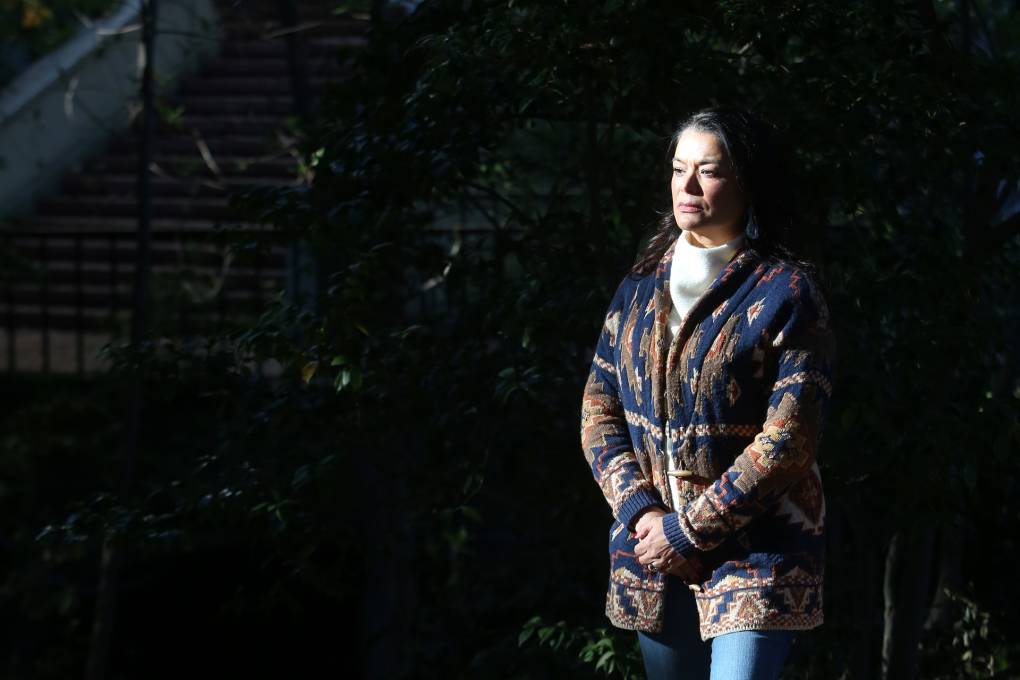
"title": "Charlene Nijmeh, chair of the Muwekma Ohlone tribe in the Bay Area, stands for a portrait next to Strawberry Creek on the UC Berkeley campus on Friday, November 27, 2020 in Berkeley, Calif.",
"publishDate": 1691171091,
"status": "inherit",
"parent": 12026194,
"modified": 1738971902,
"caption": "The Tribal Nature-Based Solutions grant program is an effort to meet the state’s land conservation goals and also a means to strengthen partnerships with native tribes. Some tribes, however, have raised concerns over its focus. Muwekma Ohlone Chairwoman Charlene Nijmeh said in an email that her tribe is open to developing a project for this grant, but 'too much focus is on plants and animals and not the native people. It's a perpetuation of colonialism and performative allyship.'",
"credit": "Lea Suzuki/The San Francisco Chronicle via Getty Images",
"altTag": "A woman stand in the shadows. Her face and body are illuminated by a spotlight. She has long, brown hair and wears a blue and tan-print jacket and jeans. She looks somber.",
"description": null,
"imgSizes": {
"medium": {
"file": "https://cdn.kqed.org/wp-content/uploads/sites/10/2023/08/TribalBuyBack01-800x533.jpg",
"width": 800,
"height": 533,
"mimeType": "image/jpeg"
},
"large": {
"file": "https://cdn.kqed.org/wp-content/uploads/sites/10/2023/08/TribalBuyBack01-1020x680.jpg",
"width": 1020,
"height": 680,
"mimeType": "image/jpeg"
},
"thumbnail": {
"file": "https://cdn.kqed.org/wp-content/uploads/sites/10/2023/08/TribalBuyBack01-160x107.jpg",
"width": 160,
"height": 107,
"mimeType": "image/jpeg"
},
"1536x1536": {
"file": "https://cdn.kqed.org/wp-content/uploads/sites/10/2023/08/TribalBuyBack01-1536x1024.jpg",
"width": 1536,
"height": 1024,
"mimeType": "image/jpeg"
},
"post-thumbnail": {
"file": "https://cdn.kqed.org/wp-content/uploads/sites/10/2023/08/TribalBuyBack01-672x372.jpg",
"width": 672,
"height": 372,
"mimeType": "image/jpeg"
},
"twentyfourteen-full-width": {
"file": "https://cdn.kqed.org/wp-content/uploads/sites/10/2023/08/TribalBuyBack01-1038x576.jpg",
"width": 1038,
"height": 576,
"mimeType": "image/jpeg"
},
"kqedFullSize": {
"file": "https://cdn.kqed.org/wp-content/uploads/sites/10/2023/08/TribalBuyBack01.jpg",
"width": 1920,
"height": 1280
}
},
"isLoading": false,
"fetchFailed": false
},
"news_11957185": {
"type": "attachments",
"id": "news_11957185",
"meta": {
"index": "attachments_1716263798",
"site": "news",
"id": "11957185",
"found": true
},
"parent": 0,
"imgSizes": {
"twentyfourteen-full-width": {
"file": "https://ww2.kqed.org/app/uploads/sites/10/2023/08/RS64826_009_KQED_AnnetteNicholsonDaycare_04272023-qut-1-1038x576.jpg",
"width": 1038,
"mimeType": "image/jpeg",
"height": 576
},
"thumbnail": {
"file": "https://ww2.kqed.org/app/uploads/sites/10/2023/08/RS64826_009_KQED_AnnetteNicholsonDaycare_04272023-qut-1-160x107.jpg",
"width": 160,
"mimeType": "image/jpeg",
"height": 107
},
"post-thumbnail": {
"file": "https://ww2.kqed.org/app/uploads/sites/10/2023/08/RS64826_009_KQED_AnnetteNicholsonDaycare_04272023-qut-1-672x372.jpg",
"width": 672,
"mimeType": "image/jpeg",
"height": 372
},
"kqedFullSize": {
"file": "https://ww2.kqed.org/app/uploads/sites/10/2023/08/RS64826_009_KQED_AnnetteNicholsonDaycare_04272023-qut-1.jpg",
"width": 1920,
"height": 1280
},
"large": {
"file": "https://ww2.kqed.org/app/uploads/sites/10/2023/08/RS64826_009_KQED_AnnetteNicholsonDaycare_04272023-qut-1-1020x680.jpg",
"width": 1020,
"mimeType": "image/jpeg",
"height": 680
},
"1536x1536": {
"file": "https://ww2.kqed.org/app/uploads/sites/10/2023/08/RS64826_009_KQED_AnnetteNicholsonDaycare_04272023-qut-1-1536x1024.jpg",
"width": 1536,
"mimeType": "image/jpeg",
"height": 1024
},
"medium": {
"file": "https://ww2.kqed.org/app/uploads/sites/10/2023/08/RS64826_009_KQED_AnnetteNicholsonDaycare_04272023-qut-1-800x533.jpg",
"width": 800,
"mimeType": "image/jpeg",
"height": 533
}
},
"publishDate": 1691000739,
"modified": 1691001837,
"caption": "If the plan is approved by the Legislature and signed by Gov. Gavin Newsom later this summer, it would provide an $80 million retirement fund for an underpaid workforce that is dominated by women of color. ",
"description": null,
"title": "RS64826_009_KQED_AnnetteNicholsonDaycare_04272023-qut (1)",
"credit": "Beth LaBerge/KQED",
"status": "inherit",
"altTag": "An older woman with gray and brown braids and a rainbow, tie-dye T-shirt reads to a group of children in her living room. Many colorful bins are in the background filled to the brim with toys.",
"isLoading": false,
"fetchFailed": false
},
"news_11956882": {
"type": "attachments",
"id": "news_11956882",
"meta": {
"index": "attachments_1716263798",
"site": "news",
"id": "11956882",
"found": true
},
"parent": 11956879,
"imgSizes": {
"twentyfourteen-full-width": {
"file": "https://ww2.kqed.org/app/uploads/sites/10/2023/07/GettyImages-1546204762-1038x576.jpg",
"width": 1038,
"mimeType": "image/jpeg",
"height": 576
},
"thumbnail": {
"file": "https://ww2.kqed.org/app/uploads/sites/10/2023/07/GettyImages-1546204762-160x119.jpg",
"width": 160,
"mimeType": "image/jpeg",
"height": 119
},
"post-thumbnail": {
"file": "https://ww2.kqed.org/app/uploads/sites/10/2023/07/GettyImages-1546204762-672x372.jpg",
"width": 672,
"mimeType": "image/jpeg",
"height": 372
},
"kqedFullSize": {
"file": "https://ww2.kqed.org/app/uploads/sites/10/2023/07/GettyImages-1546204762-scaled.jpg",
"width": 2560,
"height": 1898
},
"2048x2048": {
"file": "https://ww2.kqed.org/app/uploads/sites/10/2023/07/GettyImages-1546204762-2048x1518.jpg",
"width": 2048,
"mimeType": "image/jpeg",
"height": 1518
},
"large": {
"file": "https://ww2.kqed.org/app/uploads/sites/10/2023/07/GettyImages-1546204762-1020x756.jpg",
"width": 1020,
"mimeType": "image/jpeg",
"height": 756
},
"1536x1536": {
"file": "https://ww2.kqed.org/app/uploads/sites/10/2023/07/GettyImages-1546204762-1536x1139.jpg",
"width": 1536,
"mimeType": "image/jpeg",
"height": 1139
},
"full-width": {
"file": "https://ww2.kqed.org/app/uploads/sites/10/2023/07/GettyImages-1546204762-1920x1423.jpg",
"width": 1920,
"mimeType": "image/jpeg",
"height": 1423
},
"medium": {
"file": "https://ww2.kqed.org/app/uploads/sites/10/2023/07/GettyImages-1546204762-800x593.jpg",
"width": 800,
"mimeType": "image/jpeg",
"height": 593
}
},
"publishDate": 1690593633,
"modified": 1694095437,
"caption": "A contentious Chino Valley Unified School District board meeting over a policy to notify a student's parents if they identify as a gender they weren't assigned at birth ended with Superintendent of Public Instruction Tony Thurmond being escorted from the meeting.",
"description": null,
"title": "Chino Valley School District Passes Policy For Parental Rights",
"credit": "Photo by Will Lester/MediaNews Group/Inland Valley Daily Bulletin via Getty Images",
"status": "inherit",
"altTag": "a view from the back of a room filled with people, holding signs, facing a table with five chairs in front",
"isLoading": false,
"fetchFailed": false
},
"news_11956812": {
"type": "attachments",
"id": "news_11956812",
"meta": {
"index": "attachments_1716263798",
"site": "news",
"id": "11956812",
"found": true
},
"parent": 0,
"imgSizes": {
"twentyfourteen-full-width": {
"file": "https://ww2.kqed.org/app/uploads/sites/10/2023/07/RS67260_230726-SAN-QUENTIN-MHN-02-KQED-1038x576.jpg",
"width": 1038,
"mimeType": "image/jpeg",
"height": 576
},
"thumbnail": {
"file": "https://ww2.kqed.org/app/uploads/sites/10/2023/07/RS67260_230726-SAN-QUENTIN-MHN-02-KQED-160x107.jpg",
"width": 160,
"mimeType": "image/jpeg",
"height": 107
},
"post-thumbnail": {
"file": "https://ww2.kqed.org/app/uploads/sites/10/2023/07/RS67260_230726-SAN-QUENTIN-MHN-02-KQED-672x372.jpg",
"width": 672,
"mimeType": "image/jpeg",
"height": 372
},
"kqedFullSize": {
"file": "https://ww2.kqed.org/app/uploads/sites/10/2023/07/RS67260_230726-SAN-QUENTIN-MHN-02-KQED.jpg",
"width": 2000,
"height": 1333
},
"large": {
"file": "https://ww2.kqed.org/app/uploads/sites/10/2023/07/RS67260_230726-SAN-QUENTIN-MHN-02-KQED-1020x680.jpg",
"width": 1020,
"mimeType": "image/jpeg",
"height": 680
},
"1536x1536": {
"file": "https://ww2.kqed.org/app/uploads/sites/10/2023/07/RS67260_230726-SAN-QUENTIN-MHN-02-KQED-1536x1024.jpg",
"width": 1536,
"mimeType": "image/jpeg",
"height": 1024
},
"full-width": {
"file": "https://ww2.kqed.org/app/uploads/sites/10/2023/07/RS67260_230726-SAN-QUENTIN-MHN-02-KQED-1920x1280.jpg",
"width": 1920,
"mimeType": "image/jpeg",
"height": 1280
},
"medium": {
"file": "https://ww2.kqed.org/app/uploads/sites/10/2023/07/RS67260_230726-SAN-QUENTIN-MHN-02-KQED-800x533.jpg",
"width": 800,
"mimeType": "image/jpeg",
"height": 533
}
},
"publishDate": 1690571113,
"modified": 1690573943,
"caption": "San Quentin State Prison in San Quentin, Marin County, on July 26, 2023. In March, Gov. Gavin Newsom announced that the state would seek to transform the maximum security prison into a center focused on the rehabilitation of incarcerated individuals.",
"description": null,
"title": "RS67260_230726-SAN QUENTIN-MHN-02-KQED",
"credit": "Martin do Nascimento/KQED",
"status": "inherit",
"altTag": "A large walled series of buildings, a guard tower and dozens of parked cars.",
"isLoading": false,
"fetchFailed": false
},
"news_11878990": {
"type": "attachments",
"id": "news_11878990",
"meta": {
"index": "attachments_1716263798",
"site": "news",
"id": "11878990",
"found": true
},
"parent": 11878989,
"imgSizes": {
"thumbnail": {
"file": "https://ww2.kqed.org/app/uploads/sites/10/2021/06/gettyimages-1231093862_wide-4195c57f825738c502a8a11e343c9df96ca71caf-160x90.jpg",
"width": 160,
"mimeType": "image/jpeg",
"height": 90
},
"post-thumbnail": {
"file": "https://ww2.kqed.org/app/uploads/sites/10/2021/06/gettyimages-1231093862_wide-4195c57f825738c502a8a11e343c9df96ca71caf-672x372.jpg",
"width": 672,
"mimeType": "image/jpeg",
"height": 372
},
"kqedFullSize": {
"file": "https://ww2.kqed.org/app/uploads/sites/10/2021/06/gettyimages-1231093862_wide-4195c57f825738c502a8a11e343c9df96ca71caf.jpg",
"width": 1024,
"height": 576
},
"large": {
"file": "https://ww2.kqed.org/app/uploads/sites/10/2021/06/gettyimages-1231093862_wide-4195c57f825738c502a8a11e343c9df96ca71caf-1020x574.jpg",
"width": 1020,
"mimeType": "image/jpeg",
"height": 574
},
"medium": {
"file": "https://ww2.kqed.org/app/uploads/sites/10/2021/06/gettyimages-1231093862_wide-4195c57f825738c502a8a11e343c9df96ca71caf-800x450.jpg",
"width": 800,
"mimeType": "image/jpeg",
"height": 450
}
},
"publishDate": 1624465271,
"modified": 1690220476,
"caption": "Farmworkers harvest curly mustard in a field on Feb. 10, 2021 in Ventura County. ",
"description": "Farmworkers harvest curly mustard in a field on Feb. 10 in Ventura County. The Supreme Court handed the farmworkers union a loss Wednesday in a ruling about union organizers' access to farm property.",
"title": "Farmworkers harvest curly mustard in a field on Feb. 10 in Ventura County, Calif. The Supreme Court handed the farmworkers union a loss Wednesday in a ruling about union organizers' access to farm property.",
"credit": "Patrick T. Fallon/AFP via Getty Images",
"status": "inherit",
"altTag": "People bent over in a large field filled with rows of vegetables with a large vehicle in the background.",
"isLoading": false,
"fetchFailed": false
},
"news_11955872": {
"type": "attachments",
"id": "news_11955872",
"meta": {
"index": "attachments_1716263798",
"site": "news",
"id": "11955872",
"found": true
},
"parent": 0,
"imgSizes": {
"twentyfourteen-full-width": {
"file": "https://ww2.kqed.org/app/uploads/sites/10/2023/07/CalMattersNewsom-1038x576.jpg",
"width": 1038,
"mimeType": "image/jpeg",
"height": 576
},
"thumbnail": {
"file": "https://ww2.kqed.org/app/uploads/sites/10/2023/07/CalMattersNewsom-160x107.jpg",
"width": 160,
"mimeType": "image/jpeg",
"height": 107
},
"post-thumbnail": {
"file": "https://ww2.kqed.org/app/uploads/sites/10/2023/07/CalMattersNewsom-672x372.jpg",
"width": 672,
"mimeType": "image/jpeg",
"height": 372
},
"kqedFullSize": {
"file": "https://ww2.kqed.org/app/uploads/sites/10/2023/07/CalMattersNewsom.jpg",
"width": 2000,
"height": 1334
},
"large": {
"file": "https://ww2.kqed.org/app/uploads/sites/10/2023/07/CalMattersNewsom-1020x680.jpg",
"width": 1020,
"mimeType": "image/jpeg",
"height": 680
},
"1536x1536": {
"file": "https://ww2.kqed.org/app/uploads/sites/10/2023/07/CalMattersNewsom-1536x1025.jpg",
"width": 1536,
"mimeType": "image/jpeg",
"height": 1025
},
"full-width": {
"file": "https://ww2.kqed.org/app/uploads/sites/10/2023/07/CalMattersNewsom-1920x1281.jpg",
"width": 1920,
"mimeType": "image/jpeg",
"height": 1281
},
"medium": {
"file": "https://ww2.kqed.org/app/uploads/sites/10/2023/07/CalMattersNewsom-800x534.jpg",
"width": 800,
"mimeType": "image/jpeg",
"height": 534
}
},
"publishDate": 1689620343,
"modified": 1689620468,
"caption": "Gov. Gavin Newsom speaks at a news conference announcing a proposed a 2024 ballot initiative to improve mental health services across the state, at Alvarado Hospital in San Diego, on March 19, 2023.",
"description": null,
"title": "Califorina Governor",
"credit": "Adriana Heldiz/The San Diego Union-Tribune via AP, Pool",
"status": "inherit",
"altTag": "California Gov. Gavin Newsom in a navy blazer and white shirt speaks from behind a black podium with a sign on the front that reads, \"Better Mental Health Treatment.\" Eight men and women in business attire stand solemn-faced behind him.",
"isLoading": false,
"fetchFailed": false
},
"news_11955599": {
"type": "attachments",
"id": "news_11955599",
"meta": {
"index": "attachments_1716263798",
"site": "news",
"id": "11955599",
"found": true
},
"parent": 0,
"imgSizes": {
"twentyfourteen-full-width": {
"file": "https://ww2.kqed.org/app/uploads/sites/10/2023/07/CalMattersCaregiver01-1038x576.jpg",
"width": 1038,
"mimeType": "image/jpeg",
"height": 576
},
"thumbnail": {
"file": "https://ww2.kqed.org/app/uploads/sites/10/2023/07/CalMattersCaregiver01-160x107.jpg",
"width": 160,
"mimeType": "image/jpeg",
"height": 107
},
"post-thumbnail": {
"file": "https://ww2.kqed.org/app/uploads/sites/10/2023/07/CalMattersCaregiver01-672x372.jpg",
"width": 672,
"mimeType": "image/jpeg",
"height": 372
},
"kqedFullSize": {
"file": "https://ww2.kqed.org/app/uploads/sites/10/2023/07/CalMattersCaregiver01.jpg",
"width": 2000,
"height": 1333
},
"large": {
"file": "https://ww2.kqed.org/app/uploads/sites/10/2023/07/CalMattersCaregiver01-1020x680.jpg",
"width": 1020,
"mimeType": "image/jpeg",
"height": 680
},
"1536x1536": {
"file": "https://ww2.kqed.org/app/uploads/sites/10/2023/07/CalMattersCaregiver01-1536x1024.jpg",
"width": 1536,
"mimeType": "image/jpeg",
"height": 1024
},
"full-width": {
"file": "https://ww2.kqed.org/app/uploads/sites/10/2023/07/CalMattersCaregiver01-1920x1280.jpg",
"width": 1920,
"mimeType": "image/jpeg",
"height": 1280
},
"medium": {
"file": "https://ww2.kqed.org/app/uploads/sites/10/2023/07/CalMattersCaregiver01-800x533.jpg",
"width": 800,
"mimeType": "image/jpeg",
"height": 533
}
},
"publishDate": 1689268292,
"modified": 1689268453,
"caption": "Grace Diaz, a caregiver, at the home of her client in Orange County on June 7, 2023.",
"description": null,
"title": "CalMattersCaregiver01",
"credit": "Lauren Justice/CalMatters",
"status": "inherit",
"altTag": "A caregiver in scrubs is affectionately draping her arms over the shoulders of an older woman with gray hair who is sitting in a wheelchair. They're both inside the client's home. A cream-colored, floral-patterned couch is seen in the background.",
"isLoading": false,
"fetchFailed": false
},
"news_11954914": {
"type": "attachments",
"id": "news_11954914",
"meta": {
"index": "attachments_1716263798",
"site": "news",
"id": "11954914",
"found": true
},
"parent": 0,
"imgSizes": {
"twentyfourteen-full-width": {
"file": "https://ww2.kqed.org/app/uploads/sites/10/2023/07/CalMattersUnhousedLA01-1038x576.jpg",
"width": 1038,
"mimeType": "image/jpeg",
"height": 576
},
"thumbnail": {
"file": "https://ww2.kqed.org/app/uploads/sites/10/2023/07/CalMattersUnhousedLA01-160x107.jpg",
"width": 160,
"mimeType": "image/jpeg",
"height": 107
},
"post-thumbnail": {
"file": "https://ww2.kqed.org/app/uploads/sites/10/2023/07/CalMattersUnhousedLA01-672x372.jpg",
"width": 672,
"mimeType": "image/jpeg",
"height": 372
},
"kqedFullSize": {
"file": "https://ww2.kqed.org/app/uploads/sites/10/2023/07/CalMattersUnhousedLA01.jpg",
"width": 1920,
"height": 1280
},
"large": {
"file": "https://ww2.kqed.org/app/uploads/sites/10/2023/07/CalMattersUnhousedLA01-1020x680.jpg",
"width": 1020,
"mimeType": "image/jpeg",
"height": 680
},
"1536x1536": {
"file": "https://ww2.kqed.org/app/uploads/sites/10/2023/07/CalMattersUnhousedLA01-1536x1024.jpg",
"width": 1536,
"mimeType": "image/jpeg",
"height": 1024
},
"medium": {
"file": "https://ww2.kqed.org/app/uploads/sites/10/2023/07/CalMattersUnhousedLA01-800x533.jpg",
"width": 800,
"mimeType": "image/jpeg",
"height": 533
}
},
"publishDate": 1688402998,
"modified": 1688411064,
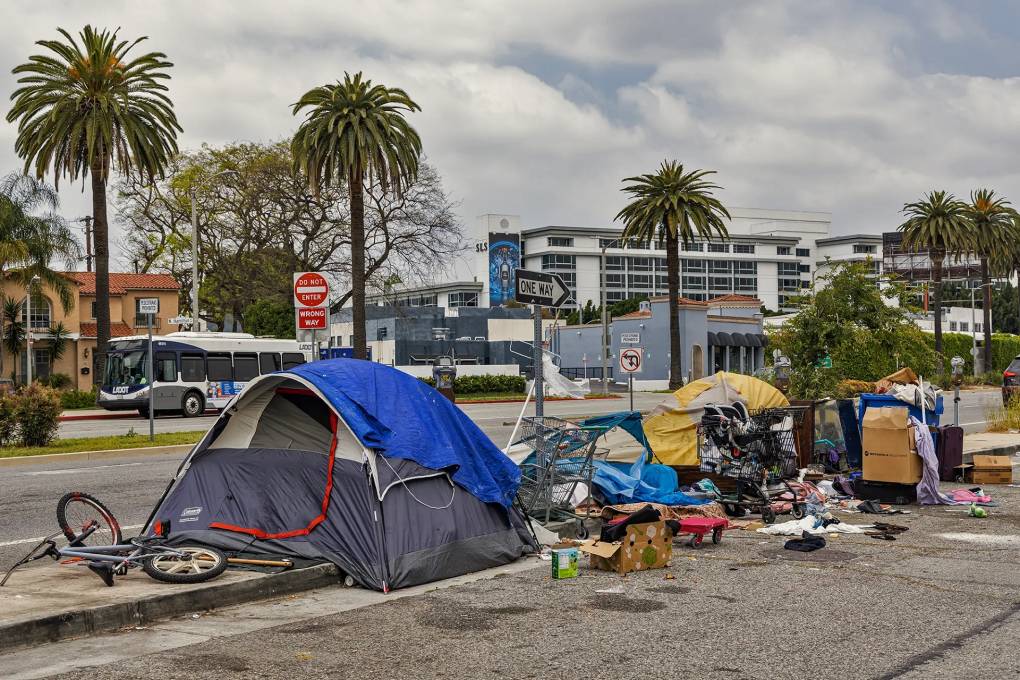
"caption": "The city of Los Angeles relocated a large homeless camp in the Beverly Grove area, next to Beverly Hills, on May 11, 2023.",
"description": null,
"title": "CalMattersUnhousedLA01",
"credit": "Ted Soqui/SIPA USA via Reuters",
"status": "inherit",
"altTag": "Tents line a paved road near a sidewalk. A bicycle is on its side in front of a gray and navy tent with a blue tarp covering its roof. Scattered belongings and cardboard boxes cover the spaces between each tent. A city bus is seen driving in the background.",
"isLoading": false,
"fetchFailed": false
},
"news_11954600": {
"type": "attachments",
"id": "news_11954600",
"meta": {
"index": "attachments_1716263798",
"site": "news",
"id": "11954600",
"found": true
},
"parent": 11954531,
"imgSizes": {
"twentyfourteen-full-width": {
"file": "https://ww2.kqed.org/app/uploads/sites/10/2023/06/sandhill-crane-ap-062923-1038x576.jpg",
"width": 1038,
"mimeType": "image/jpeg",
"height": 576
},
"thumbnail": {
"file": "https://ww2.kqed.org/app/uploads/sites/10/2023/06/sandhill-crane-ap-062923-160x107.jpg",
"width": 160,
"mimeType": "image/jpeg",
"height": 107
},
"post-thumbnail": {
"file": "https://ww2.kqed.org/app/uploads/sites/10/2023/06/sandhill-crane-ap-062923-672x372.jpg",
"width": 672,
"mimeType": "image/jpeg",
"height": 372
},
"kqedFullSize": {
"file": "https://ww2.kqed.org/app/uploads/sites/10/2023/06/sandhill-crane-ap-062923.jpg",
"width": 2000,
"height": 1333
},
"large": {
"file": "https://ww2.kqed.org/app/uploads/sites/10/2023/06/sandhill-crane-ap-062923-1020x680.jpg",
"width": 1020,
"mimeType": "image/jpeg",
"height": 680
},
"1536x1536": {
"file": "https://ww2.kqed.org/app/uploads/sites/10/2023/06/sandhill-crane-ap-062923-1536x1024.jpg",
"width": 1536,
"mimeType": "image/jpeg",
"height": 1024
},
"full-width": {
"file": "https://ww2.kqed.org/app/uploads/sites/10/2023/06/sandhill-crane-ap-062923-1920x1280.jpg",
"width": 1920,
"mimeType": "image/jpeg",
"height": 1280
},
"medium": {
"file": "https://ww2.kqed.org/app/uploads/sites/10/2023/06/sandhill-crane-ap-062923-800x533.jpg",
"width": 800,
"mimeType": "image/jpeg",
"height": 533
}
},
"publishDate": 1688068551,
"modified": 1688073905,
"caption": "Sandhill cranes fly over the Lower Klamath National Wildlife Refuge. Cranes are among the so-called 'fully protected' species that would lose some protection under the California infrastructure deal. ",
"description": null,
"title": "sandhill-crane-ap-062923",
"credit": "Jeff Barnard/AP",
"status": "inherit",
"altTag": "A group of birds flying in the sky.",
"isLoading": false,
"fetchFailed": false
},
"news_11954468": {
"type": "attachments",
"id": "news_11954468",
"meta": {
"index": "attachments_1716263798",
"site": "news",
"id": "11954468",
"found": true
},
"parent": 0,
"imgSizes": {
"twentyfourteen-full-width": {
"file": "https://ww2.kqed.org/app/uploads/sites/10/2023/06/CalMattersTexas02-1038x576.jpg",
"width": 1038,
"mimeType": "image/jpeg",
"height": 576
},
"thumbnail": {
"file": "https://ww2.kqed.org/app/uploads/sites/10/2023/06/CalMattersTexas02-160x107.jpg",
"width": 160,
"mimeType": "image/jpeg",
"height": 107
},
"post-thumbnail": {
"file": "https://ww2.kqed.org/app/uploads/sites/10/2023/06/CalMattersTexas02-672x372.jpg",
"width": 672,
"mimeType": "image/jpeg",
"height": 372
},
"kqedFullSize": {
"file": "https://ww2.kqed.org/app/uploads/sites/10/2023/06/CalMattersTexas02.jpg",
"width": 1920,
"height": 1279
},
"large": {
"file": "https://ww2.kqed.org/app/uploads/sites/10/2023/06/CalMattersTexas02-1020x679.jpg",
"width": 1020,
"mimeType": "image/jpeg",
"height": 679
},
"1536x1536": {
"file": "https://ww2.kqed.org/app/uploads/sites/10/2023/06/CalMattersTexas02-1536x1023.jpg",
"width": 1536,
"mimeType": "image/jpeg",
"height": 1023
},
"medium": {
"file": "https://ww2.kqed.org/app/uploads/sites/10/2023/06/CalMattersTexas02-800x533.jpg",
"width": 800,
"mimeType": "image/jpeg",
"height": 533
}
},
"publishDate": 1687996491,
"modified": 1687996652,
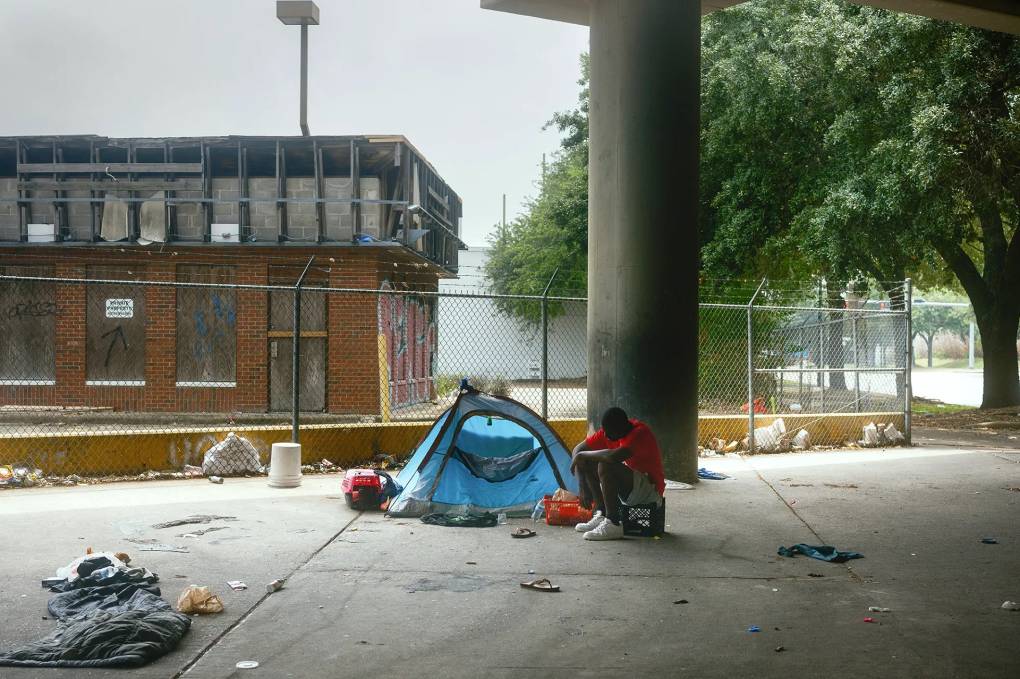
"caption": "A small homeless encampment in Houston, Texas on May 5, 2023.",
"description": null,
"title": "CalMattersTexas02",
"credit": "Jordan Vonderhaar/CalMatters",
"status": "inherit",
"altTag": "A man sits on a milk crate outside of his small, blue tent. A barbed-wire fence surrounds a building in the background. He appears to have set up a small camp under an overpass. A few trees are pictured in the background as well. The sky is gray. Trash is littered around his area.",
"isLoading": false,
"fetchFailed": false
},
"news_11954143": {
"type": "attachments",
"id": "news_11954143",
"meta": {
"index": "attachments_1716263798",
"site": "news",
"id": "11954143",
"found": true
},
"parent": 0,
"imgSizes": {
"twentyfourteen-full-width": {
"file": "https://ww2.kqed.org/app/uploads/sites/10/2023/06/RS55251_003_KQED_CAReparationsTaskForce_04132022-KQED-1038x576.jpg",
"width": 1038,
"mimeType": "image/jpeg",
"height": 576
},
"thumbnail": {
"file": "https://ww2.kqed.org/app/uploads/sites/10/2023/06/RS55251_003_KQED_CAReparationsTaskForce_04132022-KQED-160x106.jpg",
"width": 160,
"mimeType": "image/jpeg",
"height": 106
},
"post-thumbnail": {
"file": "https://ww2.kqed.org/app/uploads/sites/10/2023/06/RS55251_003_KQED_CAReparationsTaskForce_04132022-KQED-672x372.jpg",
"width": 672,
"mimeType": "image/jpeg",
"height": 372
},
"kqedFullSize": {
"file": "https://ww2.kqed.org/app/uploads/sites/10/2023/06/RS55251_003_KQED_CAReparationsTaskForce_04132022-KQED.jpg",
"width": 2000,
"height": 1331
},
"large": {
"file": "https://ww2.kqed.org/app/uploads/sites/10/2023/06/RS55251_003_KQED_CAReparationsTaskForce_04132022-KQED-1020x679.jpg",
"width": 1020,
"mimeType": "image/jpeg",
"height": 679
},
"1536x1536": {
"file": "https://ww2.kqed.org/app/uploads/sites/10/2023/06/RS55251_003_KQED_CAReparationsTaskForce_04132022-KQED-1536x1022.jpg",
"width": 1536,
"mimeType": "image/jpeg",
"height": 1022
},
"full-width": {
"file": "https://ww2.kqed.org/app/uploads/sites/10/2023/06/RS55251_003_KQED_CAReparationsTaskForce_04132022-KQED-1920x1278.jpg",
"width": 1920,
"mimeType": "image/jpeg",
"height": 1278
},
"medium": {
"file": "https://ww2.kqed.org/app/uploads/sites/10/2023/06/RS55251_003_KQED_CAReparationsTaskForce_04132022-KQED-800x532.jpg",
"width": 800,
"mimeType": "image/jpeg",
"height": 532
}
},
"publishDate": 1687820767,
"modified": 1687985197,
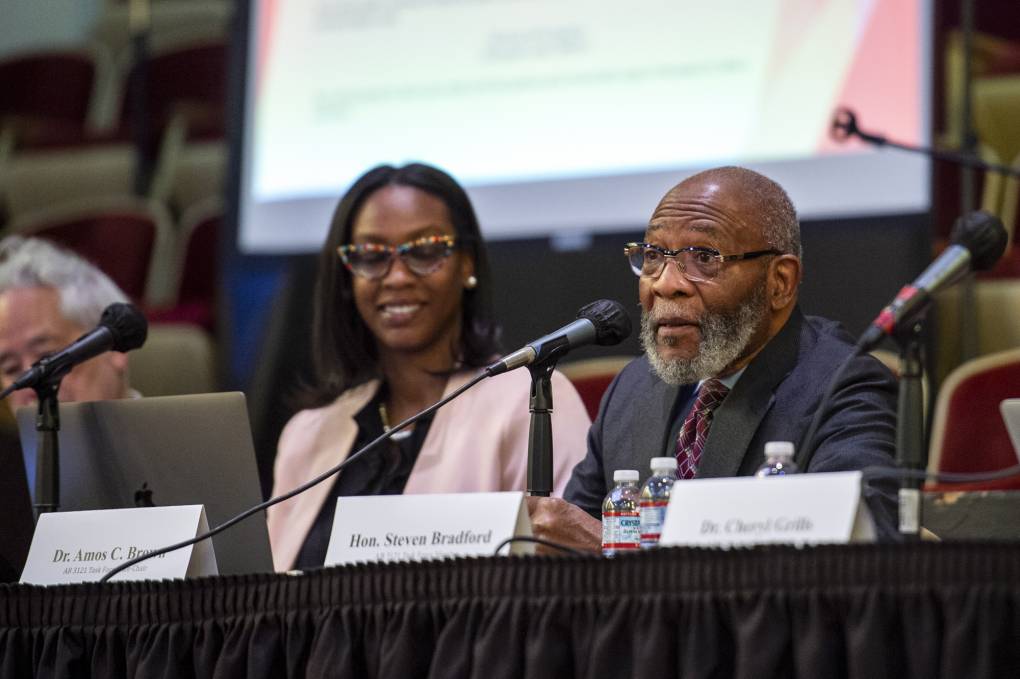
"caption": "Vice-Chair Dr. Amos C. Brown welcomes attendees to the first in-person meeting of the California Reparations Task Force at the Third Baptist Church in San Francisco's Fillmore District on April 14, 2022.",
"description": null,
"title": "RS55251_003_KQED_CAReparationsTaskForce_04132022-KQED",
"credit": "Beth LaBerge/KQED",
"status": "inherit",
"altTag": "A man in glasses speaks at a microphone from a long table with several people sitting beside him.",
"isLoading": false,
"fetchFailed": false
},
"news_11954323": {
"type": "attachments",
"id": "news_11954323",
"meta": {
"index": "attachments_1716263798",
"site": "news",
"id": "11954323",
"found": true
},
"parent": 11954314,
"imgSizes": {
"twentyfourteen-full-width": {
"file": "https://ww2.kqed.org/app/uploads/sites/10/2023/06/GettyImages-1246054727-1024x576.jpg",
"width": 1024,
"mimeType": "image/jpeg",
"height": 576
},
"thumbnail": {
"file": "https://ww2.kqed.org/app/uploads/sites/10/2023/06/GettyImages-1246054727-160x107.jpg",
"width": 160,
"mimeType": "image/jpeg",
"height": 107
},
"post-thumbnail": {
"file": "https://ww2.kqed.org/app/uploads/sites/10/2023/06/GettyImages-1246054727-672x372.jpg",
"width": 672,
"mimeType": "image/jpeg",
"height": 372
},
"kqedFullSize": {
"file": "https://ww2.kqed.org/app/uploads/sites/10/2023/06/GettyImages-1246054727.jpg",
"width": 1024,
"height": 683
},
"large": {
"file": "https://ww2.kqed.org/app/uploads/sites/10/2023/06/GettyImages-1246054727-1020x680.jpg",
"width": 1020,
"mimeType": "image/jpeg",
"height": 680
},
"medium": {
"file": "https://ww2.kqed.org/app/uploads/sites/10/2023/06/GettyImages-1246054727-800x534.jpg",
"width": 800,
"mimeType": "image/jpeg",
"height": 534
}
},
"publishDate": 1687913345,
"modified": 1687977909,
"caption": "Gov. Newsom in front of the California State Capitol in January 2023.",
"description": null,
"title": "Governor Gavin Newsom is set to be inaugurated for a second term on Friday, Jan. 6, and the preparations for the ceremony are underway in downtown Sacramento.",
"credit": "Gary Coronado/Los Angeles Times via Getty Images",
"status": "inherit",
"altTag": "Gavin Newsom stands at a speaking podium, with the dome of the capitol building in the background.",
"isLoading": false,
"fetchFailed": false
}
},
"audioPlayerReducer": {
"postId": "stream_live",
"isPaused": true,
"isPlaying": false,
"pfsActive": false,
"pledgeModalIsOpen": true,
"playerDrawerIsOpen": false,
"liveAudioPlayStartedAt": 0,
"liveAudioPlayContext": ""
},
"authorsReducer": {
"byline_news_11956879": {
"type": "authors",
"id": "byline_news_11956879",
"meta": {
"override": true
},
"slug": "byline_news_11956879",
"name": "\u003ca href=\"https://calmatters.org/author/carolyn-jones/\">Carolyn Jones\u003c/a>",
"isLoading": false
},
"byline_news_11956315": {
"type": "authors",
"id": "byline_news_11956315",
"meta": {
"override": true
},
"slug": "byline_news_11956315",
"name": "\u003ca href=\"https://calmatters.org/author/nicole-foy/\">Nicole Foy\u003c/a>",
"isLoading": false
},
"byline_news_11955844": {
"type": "authors",
"id": "byline_news_11955844",
"meta": {
"override": true
},
"slug": "byline_news_11955844",
"name": "\u003ca href=\"https://calmatters.org/author/kristen-hwang/\">Kristen Hwang\u003c/a>",
"isLoading": false
},
"byline_news_11955594": {
"type": "authors",
"id": "byline_news_11955594",
"meta": {
"override": true
},
"slug": "byline_news_11955594",
"name": "\u003ca href=\"https://calmatters.org/author/alejandra-reyesvelarde/\">Alejandra Reyes-Velarde\u003c/a>",
"isLoading": false
},
"byline_news_11954909": {
"type": "authors",
"id": "byline_news_11954909",
"meta": {
"override": true
},
"slug": "byline_news_11954909",
"name": "\u003ca href=\"https://calmatters.org/author/marisa-kendall/\">Marisa Kendall\u003c/a>",
"isLoading": false
},
"byline_news_11954531": {
"type": "authors",
"id": "byline_news_11954531",
"meta": {
"override": true
},
"slug": "byline_news_11954531",
"name": "\u003ca href=\"https://calmatters.org/author/rachel-becker/\">Rachel Becker\u003c/a>",
"isLoading": false
},
"byline_news_11954379": {
"type": "authors",
"id": "byline_news_11954379",
"meta": {
"override": true
},
"slug": "byline_news_11954379",
"name": "\u003ca href=\"https://calmatters.org/author/marisa-kendall/\">Marisa Kendall\u003c/a>",
"isLoading": false
},
"danbrekke": {
"type": "authors",
"id": "222",
"meta": {
"index": "authors_1716337520",
"id": "222",
"found": true
},
"name": "Dan Brekke",
"firstName": "Dan",
"lastName": "Brekke",
"slug": "danbrekke",
"email": "dbrekke@kqed.org",
"display_author_email": true,
"staff_mastheads": [
"news",
"science"
],
"title": "KQED Editor and Reporter",
"bio": "Dan Brekke is a reporter and editor for KQED News, responsible for coverage of topics ranging from California water issues to the Bay Area's transportation challenges. In a newsroom career that began in Chicago in 1972, Dan has worked for \u003cem>The San Francisco Examiner,\u003c/em> Wired and TechTV and has been published in The New York Times, The New York Times Magazine, Business 2.0, Salon and elsewhere.\r\n\r\nSince joining KQED in 2007, Dan has reported, edited and produced both radio and online features and breaking news pieces. He has shared as both editor and reporter in four Society of Professional Journalists Norcal Excellence in Journalism awards and one Edward R. Murrow regional award. He was chosen for a spring 2017 residency at the Mesa Refuge to advance his research on California salmon.\r\n\r\nEmail Dan at: \u003ca href=\"mailto:dbrekke@kqed.org\">dbrekke@kqed.org\u003c/a>\r\n\r\n\u003cstrong>Twitter:\u003c/strong> \u003ca href=\"https://twitter.com/danbrekke\" rel=\"noopener noreferrer\">twitter.com/danbrekke\u003c/a>\r\n\u003cstrong>Facebook:\u003c/strong> \u003ca href=\"https://www.facebook.com/danbrekke\" rel=\"noopener noreferrer\">www.facebook.com/danbrekke\u003c/a>\r\n\u003cstrong>LinkedIn:\u003c/strong> \u003ca href=\"https://www.linkedin.com/in/danbrekke\" rel=\"noopener noreferrer\">www.linkedin.com/in/danbrekke\u003c/a>",
"avatar": "https://secure.gravatar.com/avatar/c8126230345efca3f7aa89b1a402be45?s=600&d=mm&r=g",
"twitter": "danbrekke",
"facebook": null,
"instagram": "https://www.instagram.com/dan.brekke/",
"linkedin": "https://www.linkedin.com/in/danbrekke/",
"sites": [
{
"site": "news",
"roles": [
"administrator",
"create_posts"
]
},
{
"site": "stateofhealth",
"roles": [
"editor"
]
},
{
"site": "science",
"roles": [
"editor"
]
},
{
"site": "quest",
"roles": [
"contributor"
]
},
{
"site": "food",
"roles": [
"contributor"
]
},
{
"site": "forum",
"roles": [
"contributor"
]
},
{
"site": "liveblog",
"roles": [
"editor"
]
}
],
"headData": {
"title": "Dan Brekke | KQED",
"description": "KQED Editor and Reporter",
"ogImgSrc": "https://secure.gravatar.com/avatar/c8126230345efca3f7aa89b1a402be45?s=600&d=mm&r=g",
"twImgSrc": "https://secure.gravatar.com/avatar/c8126230345efca3f7aa89b1a402be45?s=600&d=mm&r=g"
},
"isLoading": false,
"link": "/author/danbrekke"
},
"gmarzorati": {
"type": "authors",
"id": "227",
"meta": {
"index": "authors_1716337520",
"id": "227",
"found": true
},
"name": "Guy Marzorati",
"firstName": "Guy",
"lastName": "Marzorati",
"slug": "gmarzorati",
"email": "gmarzorati@KQED.org",
"display_author_email": true,
"staff_mastheads": [
"news"
],
"title": "Correspondent",
"bio": "Guy Marzorati is a correspondent on KQED's California Politics and Government Desk, based in San Jose. A graduate of Santa Clara University, Guy joined KQED in 2013. He reports on state and local politics and produces KQED's digital voter guide.",
"avatar": "https://secure.gravatar.com/avatar/e7038b8dbfd55b104369b76b1cd0b9de?s=600&d=blank&r=g",
"twitter": "guymarzorati",
"facebook": null,
"instagram": null,
"linkedin": null,
"sites": [
{
"site": "",
"roles": [
"editor"
]
},
{
"site": "news",
"roles": [
"editor"
]
},
{
"site": "science",
"roles": [
"editor"
]
},
{
"site": "forum",
"roles": [
"editor"
]
},
{
"site": "elections",
"roles": [
"editor"
]
},
{
"site": "liveblog",
"roles": [
"editor"
]
}
],
"headData": {
"title": "Guy Marzorati | KQED",
"description": "Correspondent",
"ogImgSrc": "https://secure.gravatar.com/avatar/e7038b8dbfd55b104369b76b1cd0b9de?s=600&d=blank&r=g",
"twImgSrc": "https://secure.gravatar.com/avatar/e7038b8dbfd55b104369b76b1cd0b9de?s=600&d=blank&r=g"
},
"isLoading": false,
"link": "/author/gmarzorati"
},
"scottshafer": {
"type": "authors",
"id": "255",
"meta": {
"index": "authors_1716337520",
"id": "255",
"found": true
},
"name": "Scott Shafer",
"firstName": "Scott",
"lastName": "Shafer",
"slug": "scottshafer",
"email": "sshafer@kqed.org",
"display_author_email": false,
"staff_mastheads": [
"news"
],
"title": "KQED Contributor",
"bio": "Scott Shafer is a senior editor with the KQED Politics and Government desk. He is co-host of Political Breakdown, the award-winning radio show and podcast with a personal take on the world of politics. Scott came to KQED in 1998 to host the statewide\u003cem> California Report\u003c/em>. Prior to that he had extended stints in politics and government\u003cem>.\u003c/em> He uses that inside experience at KQED in his, reporting, hosting and analysis for the politics desk. Scott collaborated \u003cem>Political Breakdown a\u003c/em>nd on \u003cem>The Political Mind of Jerry Brown, \u003c/em>an eight-part series about the life and extraordinary political career of the former governor. For fun, he plays water polo with the San Francisco Tsunami.",
"avatar": "https://secure.gravatar.com/avatar/a62ebae45b79d7aed1a39a0e3bf68104?s=600&d=blank&r=g",
"twitter": "scottshafer",
"bluesky": null,
"facebook": null,
"instagram": null,
"linkedin": null,
"sites": [
{
"site": "news",
"roles": [
"editor"
]
},
{
"site": "stateofhealth",
"roles": [
"author"
]
},
{
"site": "science",
"roles": [
"author"
]
},
{
"site": "forum",
"roles": [
"subscriber"
]
},
{
"site": "liveblog",
"roles": [
"author"
]
}
],
"headData": {
"title": "Scott Shafer | KQED",
"description": "KQED Contributor",
"ogImgSrc": "https://secure.gravatar.com/avatar/a62ebae45b79d7aed1a39a0e3bf68104?s=600&d=blank&r=g",
"twImgSrc": "https://secure.gravatar.com/avatar/a62ebae45b79d7aed1a39a0e3bf68104?s=600&d=blank&r=g"
},
"isLoading": false,
"link": "/author/scottshafer"
},
"lsarah": {
"type": "authors",
"id": "11626",
"meta": {
"index": "authors_1716337520",
"id": "11626",
"found": true
},
"name": "Lakshmi Sarah",
"firstName": "Lakshmi",
"lastName": "Sarah",
"slug": "lsarah",
"email": "lsarah@kqed.org",
"display_author_email": false,
"staff_mastheads": [],
"title": "Digital Producer",
"bio": "Lakshmi Sarah is an educator, author and journalist with a focus on innovative storytelling. She has worked with newspapers, radio and magazines from Ahmedabad, India to Los Angeles, California. She has written and produced for Die Zeit, Global Voices, AJ+, KQED, Fusion Media Group and the New York Times.",
"avatar": "https://secure.gravatar.com/avatar/652dcaecd8b28826fc17a8b2d6bb4e93?s=600&d=blank&r=g",
"twitter": "lakitalki",
"facebook": null,
"instagram": "https://www.instagram.com/laki.talki/",
"linkedin": "https://www.linkedin.com/in/lakisarah/",
"sites": [
{
"site": "arts",
"roles": []
},
{
"site": "news",
"roles": []
},
{
"site": "bayareabites",
"roles": []
},
{
"site": "science",
"roles": []
}
],
"headData": {
"title": "Lakshmi Sarah | KQED",
"description": "Digital Producer",
"ogImgSrc": "https://secure.gravatar.com/avatar/652dcaecd8b28826fc17a8b2d6bb4e93?s=600&d=blank&r=g",
"twImgSrc": "https://secure.gravatar.com/avatar/652dcaecd8b28826fc17a8b2d6bb4e93?s=600&d=blank&r=g"
},
"isLoading": false,
"link": "/author/lsarah"
},
"daisynguyen": {
"type": "authors",
"id": "11829",
"meta": {
"index": "authors_1716337520",
"id": "11829",
"found": true
},
"name": "Daisy Nguyen",
"firstName": "Daisy",
"lastName": "Nguyen",
"slug": "daisynguyen",
"email": "daisynguyen@kqed.org",
"display_author_email": true,
"staff_mastheads": [
"news"
],
"title": "KQED Contributor",
"bio": "I have covered early childhood education and child care for KQED since 2022. I focus on policies aimed at increasing access to early care and education and how they shape individual lives. I've been a journalist for more than two decades, with most of that time devoted to covering breaking news throughout California for The Associated Press. I grew up in San Francisco and studied at UC Davis and Columbia University's Graduate School of Journalism. I live in Oakland with my husband and two kids.",
"avatar": "https://secure.gravatar.com/avatar/2da2127c27f7143b53ebd419800fd55f?s=600&d=blank&r=g",
"twitter": null,
"facebook": null,
"instagram": null,
"linkedin": "https://www.linkedin.com/in/daisynguyen/",
"sites": [
{
"site": "news",
"roles": [
"author"
]
},
{
"site": "liveblog",
"roles": [
"author"
]
}
],
"headData": {
"title": "Daisy Nguyen | KQED",
"description": "KQED Contributor",
"ogImgSrc": "https://secure.gravatar.com/avatar/2da2127c27f7143b53ebd419800fd55f?s=600&d=blank&r=g",
"twImgSrc": "https://secure.gravatar.com/avatar/2da2127c27f7143b53ebd419800fd55f?s=600&d=blank&r=g"
},
"isLoading": false,
"link": "/author/daisynguyen"
},
"naltenberg": {
"type": "authors",
"id": "11896",
"meta": {
"index": "authors_1716337520",
"id": "11896",
"found": true
},
"name": "Nik Altenberg",
"firstName": "Nik",
"lastName": "Altenberg",
"slug": "naltenberg",
"email": "naltenberg@kqed.org",
"display_author_email": false,
"staff_mastheads": [],
"title": "KQED Contributor",
"bio": "Nik Altenberg is an on-call reporter for KQED and a copy editor and fact checker for Santa Cruz Local. Nik’s reporting interests include policing, public health, environment, immigration, housing and the places where these issues intersect.",
"avatar": "https://secure.gravatar.com/avatar/e391b3a18ce4a53a7ca3f3065c74418b?s=600&d=blank&r=g",
"twitter": null,
"facebook": null,
"instagram": "https://www.instagram.com/nikaltenberg/",
"linkedin": null,
"sites": [
{
"site": "news",
"roles": []
}
],
"headData": {
"title": "Nik Altenberg | KQED",
"description": "KQED Contributor",
"ogImgSrc": "https://secure.gravatar.com/avatar/e391b3a18ce4a53a7ca3f3065c74418b?s=600&d=blank&r=g",
"twImgSrc": "https://secure.gravatar.com/avatar/e391b3a18ce4a53a7ca3f3065c74418b?s=600&d=blank&r=g"
},
"isLoading": false,
"link": "/author/naltenberg"
}
},
"pagesReducer": {
"news_tag_gavin-newsom": {
"type": "terms",
"id": "news_16",
"meta": {
"index": "terms_1716263798",
"site": "news",
"id": "16",
"score": 8.936995
},
"featImg": null,
"name": "Gavin Newsom",
"description": null,
"taxonomy": "tag",
"headData": {
"twImgId": null,
"twTitle": null,
"ogTitle": null,
"ogImgId": null,
"twDescription": null,
"description": null,
"title": "Gavin Newsom Archives | KQED News",
"ogDescription": null
},
"ttid": 16,
"slug": "gavin-newsom",
"isLoading": false,
"title": "Gavin Newsom",
"pageMeta": {
"site": "news",
"WpPageTemplate": "page-topic-editorial",
"currentPage": 38
},
"blocks": [
{
"blockName": "kqed/post-list",
"attrs": {
"layout": "cardArticle2",
"query": "posts/news?tag=gavin-newsom",
"seeMore": false,
"paginated": true,
"page": 38
}
},
{
"blockName": "kqed/ad"
}
]
}
},
"pfsSessionReducer": {},
"postsReducer": {
"stream_live": {
"type": "live",
"id": "stream_live",
"audioUrl": "https://streams.kqed.org/kqedradio",
"title": "Live Stream",
"excerpt": "Live Stream information currently unavailable.",
"link": "/radio",
"featImg": "",
"label": {
"name": "KQED Live",
"link": "/"
}
},
"stream_kqedNewscast": {
"type": "posts",
"id": "stream_kqedNewscast",
"audioUrl": "https://www.kqed.org/.stream/anon/radio/RDnews/newscast.mp3?_=1",
"title": "KQED Newscast",
"featImg": "",
"label": {
"name": "88.5 FM",
"link": "/"
}
},
"news_11957413": {
"type": "posts",
"id": "news_11957413",
"meta": {
"index": "posts_1716263798",
"site": "news",
"id": "11957413",
"score": null,
"sort": [
1691179204000
]
},
"parent": 0,
"labelTerm": {
"site": "news"
},
"blocks": [],
"publishDate": 1691179204,
"format": "standard",
"title": "$100 Million Grant to Assist California Native Tribes With Buying Back Land",
"headTitle": "$100 Million Grant to Assist California Native Tribes With Buying Back Land | KQED",
"content": "\u003cp>Native American tribes in California can apply for money to help buy back lands they lost during colonization, the California Natural Resources Agency announced Monday.\u003c/p>\n\u003cp>The intention of the $100 million Tribal Nature-Based Solutions grant program is to advance the state’s climate goals by giving tribes the opportunity to buy land for conservation and cultural projects.\u003c/p>\n\u003cp>“The purpose of the grant program really is to strengthen our partnerships with tribes in the natural resources conservation and environmental space,” said Geneva Thompson, Deputy Secretary of Tribal Affairs for the agency. The grant program is part of a broader strategy in Gov. Gavin Newsom’s administration to promote “nature-based” solutions to climate change, such as the \u003ca href=\"https://www.californianature.ca.gov/\">30×30 plan\u003c/a> to conserve 30% of California’s lands and coastal waters by 2030.\u003c/p>\n\u003cp>[ad fullwidth]\u003c/p>\n\u003cp>“We know that the lands benefit and are healthier by being stewarded by tribes and by being lived with in relation to tribal traditional ecological knowledge [and] cultural practices,” Thompson said. The grant will assist tribes to “reacquire those lands to ensure that tribes are back in the stewardship role.”\u003c/p>\n\u003cp>Forestry management and restoration through cultural burning, or the use of fire to manage land, is one type of project that tribes can propose to apply for this money. Initiatives to recover ancestral knowledge and practices, such as traditional food harvesting, will also be considered. Newsom announced the grant program during a Truth and Healing Council meeting last year.[pullquote size=\"medium\" align=\"right\" citation=\"Geneva Thompson, deputy secretary of tribal affairs, California Natural Resources Agency\"]‘We know that the lands benefit and are healthier by being stewarded by tribes and by being lived with in relation to tribal traditional ecological knowledge [and] cultural practices.’[/pullquote]Thompson said in the process of developing guidelines for this grant program, 45 tribes were consulted and ancestral land return was a top priority. Housing for tribal members was also a concern brought up by tribal representatives, she said, but lands purchased through this grant program cannot be lived on.\u003c/p>\n\u003cp>There are 109 federally-recognized tribes in California, and more than 40 tribes have applied for federal status. Thompson said that all California Native American tribes are eligible to apply for the grant, regardless of federally-recognized status.\u003c/p>\n\u003cp>However, some tribes have raised concerns over the focus of the grant program. Muwekma Ohlone Chairwoman Charlene Nijmeh said in an email that her tribe is open to developing a project for this grant, but “too much focus is on plants and animals and not the native people. It’s a perpetuation of colonialism and performative allyship.”\u003c/p>\n\u003cp>A representative for the tribe also wrote in an email that they were not informed of the grant program. Chairwoman Nijmeh also said her tribe was also not included in Newsom’s Truth and Healing Council initiative.[aside label='More on Envrionmental News' tag='environment']The Muwekma Ohlone Tribe, which currently has 614 members, is not a federally-recognized tribe. They lost that status in 1927 when their tribe, along with more than a hundred other tribes in California, were deemed not in need of land by a \u003ca href=\"https://digitalcommons.csumb.edu/cgi/viewcontent.cgi?article=1056&context=hornbeck_usa_3_d\">report on landless tribes (CGI)\u003c/a> issued by an agent for the Bureau of Indian Affairs (at the time called Indian Services).\u003c/p>\n\u003cp>With few exceptions, tribes that did not gain land then still are landless today, including the Muwekma Ohlone Tribe, whose members say they’ve called the San Francisco Bay Area home for more than 10,000 years.\u003c/p>\n\u003cp>In 1851 and 1852, tribes across California \u003ca href=\"https://americanindian.si.edu/nationtonation/unratified-california-treaty-k.html\">signed 18 treaties\u003c/a> with the U.S. government, relinquishing their territories in exchange for a total of 7.5 million acres of reservations — but the Senate never ratified them. Native people, who had already left their territories, were turned away from the lands allocated in the unratified treaties.\u003c/p>\n\u003cp>Governor’s Office of Tribal Affairs Secretary Christina Snider-Ashtari said in a press release that the grant program “is a step in the right direction to begin to address some of the historical wrongs committed against California Native peoples.”\u003c/p>\n\u003cp>\u003ca href=\"https://resources.ca.gov/Newsroom/Page-Content/News-List/California-Launches-Grant-Program-to-Support-California-Native-American-Tribes\">The California Natural Resources Agency\u003c/a> will be hosting a series of webinars for interested tribes, and the first round of applications will be due on Aug. 28.\u003c/p>\n\u003cp>\u003c/p>\n",
"stats": {
"hasVideo": false,
"hasChartOrMap": false,
"hasAudio": false,
"hasPolis": false,
"wordCount": 726,
"hasGoogleForm": false,
"hasGallery": false,
"hasHearkenModule": false,
"iframeSrcs": [],
"paragraphCount": 14
},
"modified": 1706904599,
"excerpt": "The Tribal Nature-Based Solutions program targets the state's climate goals by giving tribes the chance to buy land for conservation and cultural projects.",
"headData": {
"twImgId": "",
"twTitle": "",
"ogTitle": "",
"ogImgId": "",
"twDescription": "",
"description": "The Tribal Nature-Based Solutions program targets the state's climate goals by giving tribes the chance to buy land for conservation and cultural projects.",
"title": "$100 Million Grant to Assist California Native Tribes With Buying Back Land | KQED",
"ogDescription": "",
"schema": {
"@context": "https://schema.org",
"@type": "NewsArticle",
"headline": "$100 Million Grant to Assist California Native Tribes With Buying Back Land",
"datePublished": "2023-08-04T13:00:04-07:00",
"dateModified": "2024-02-02T12:09:59-08:00",
"image": "https://cdn.kqed.org/wp-content/uploads/2020/02/KQED-OG-Image@1x.png",
"isAccessibleForFree": "True",
"publisher": {
"@type": "NewsMediaOrganization",
"@id": "https://www.kqed.org/#organization",
"name": "KQED",
"logo": "https://cdn.kqed.org/wp-content/uploads/2020/02/KQED-OG-Image@1x.png",
"url": "https://www.kqed.org",
"sameAs": [
"https://www.facebook.com/KQED",
"https://twitter.com/KQED",
"https://www.instagram.com/kqed/",
"https://www.tiktok.com/@kqedofficial",
"https://www.linkedin.com/company/kqed",
"https://www.youtube.com/channel/UCeC0IOo7i1P_61zVUWbJ4nw"
]
}
}
},
"guestAuthors": [],
"slug": "100-million-grant-to-assist-california-native-tribes-with-buying-back-land",
"status": "publish",
"excludeFromSiteSearch": "Include",
"sticky": false,
"showOnAuthorArchivePages": "No",
"articleAge": "0",
"path": "/news/11957413/100-million-grant-to-assist-california-native-tribes-with-buying-back-land",
"audioTrackLength": null,
"parsedContent": [
{
"type": "contentString",
"content": "\u003cdiv class=\"post-body\">\u003cp>\u003cp>Native American tribes in California can apply for money to help buy back lands they lost during colonization, the California Natural Resources Agency announced Monday.\u003c/p>\n\u003cp>The intention of the $100 million Tribal Nature-Based Solutions grant program is to advance the state’s climate goals by giving tribes the opportunity to buy land for conservation and cultural projects.\u003c/p>\n\u003cp>“The purpose of the grant program really is to strengthen our partnerships with tribes in the natural resources conservation and environmental space,” said Geneva Thompson, Deputy Secretary of Tribal Affairs for the agency. The grant program is part of a broader strategy in Gov. Gavin Newsom’s administration to promote “nature-based” solutions to climate change, such as the \u003ca href=\"https://www.californianature.ca.gov/\">30×30 plan\u003c/a> to conserve 30% of California’s lands and coastal waters by 2030.\u003c/p>\n\u003cp>\u003c/p>\u003c/div>",
"attributes": {
"named": {},
"numeric": []
}
},
{
"type": "component",
"content": "",
"name": "ad",
"attributes": {
"named": {
"label": "fullwidth"
},
"numeric": [
"fullwidth"
]
}
},
{
"type": "contentString",
"content": "\u003cdiv class=\"post-body\">\u003cp>\u003c/p>\n\u003cp>“We know that the lands benefit and are healthier by being stewarded by tribes and by being lived with in relation to tribal traditional ecological knowledge [and] cultural practices,” Thompson said. The grant will assist tribes to “reacquire those lands to ensure that tribes are back in the stewardship role.”\u003c/p>\n\u003cp>Forestry management and restoration through cultural burning, or the use of fire to manage land, is one type of project that tribes can propose to apply for this money. Initiatives to recover ancestral knowledge and practices, such as traditional food harvesting, will also be considered. Newsom announced the grant program during a Truth and Healing Council meeting last year.\u003c/p>\u003c/div>",
"attributes": {
"named": {},
"numeric": []
}
},
{
"type": "component",
"content": "‘We know that the lands benefit and are healthier by being stewarded by tribes and by being lived with in relation to tribal traditional ecological knowledge [and] cultural practices.’",
"name": "pullquote",
"attributes": {
"named": {
"size": "medium",
"align": "right",
"citation": "Geneva Thompson, deputy secretary of tribal affairs, California Natural Resources Agency",
"label": ""
},
"numeric": []
}
},
{
"type": "contentString",
"content": "\u003cdiv class=\"post-body\">\u003cp>Thompson said in the process of developing guidelines for this grant program, 45 tribes were consulted and ancestral land return was a top priority. Housing for tribal members was also a concern brought up by tribal representatives, she said, but lands purchased through this grant program cannot be lived on.\u003c/p>\n\u003cp>There are 109 federally-recognized tribes in California, and more than 40 tribes have applied for federal status. Thompson said that all California Native American tribes are eligible to apply for the grant, regardless of federally-recognized status.\u003c/p>\n\u003cp>However, some tribes have raised concerns over the focus of the grant program. Muwekma Ohlone Chairwoman Charlene Nijmeh said in an email that her tribe is open to developing a project for this grant, but “too much focus is on plants and animals and not the native people. It’s a perpetuation of colonialism and performative allyship.”\u003c/p>\n\u003cp>A representative for the tribe also wrote in an email that they were not informed of the grant program. Chairwoman Nijmeh also said her tribe was also not included in Newsom’s Truth and Healing Council initiative.\u003c/p>\u003c/div>",
"attributes": {
"named": {},
"numeric": []
}
},
{
"type": "component",
"content": "",
"name": "aside",
"attributes": {
"named": {
"label": "More on Envrionmental News ",
"tag": "environment"
},
"numeric": []
}
},
{
"type": "contentString",
"content": "\u003cdiv class=\"post-body\">\u003cp>The Muwekma Ohlone Tribe, which currently has 614 members, is not a federally-recognized tribe. They lost that status in 1927 when their tribe, along with more than a hundred other tribes in California, were deemed not in need of land by a \u003ca href=\"https://digitalcommons.csumb.edu/cgi/viewcontent.cgi?article=1056&context=hornbeck_usa_3_d\">report on landless tribes (CGI)\u003c/a> issued by an agent for the Bureau of Indian Affairs (at the time called Indian Services).\u003c/p>\n\u003cp>With few exceptions, tribes that did not gain land then still are landless today, including the Muwekma Ohlone Tribe, whose members say they’ve called the San Francisco Bay Area home for more than 10,000 years.\u003c/p>\n\u003cp>In 1851 and 1852, tribes across California \u003ca href=\"https://americanindian.si.edu/nationtonation/unratified-california-treaty-k.html\">signed 18 treaties\u003c/a> with the U.S. government, relinquishing their territories in exchange for a total of 7.5 million acres of reservations — but the Senate never ratified them. Native people, who had already left their territories, were turned away from the lands allocated in the unratified treaties.\u003c/p>\n\u003cp>Governor’s Office of Tribal Affairs Secretary Christina Snider-Ashtari said in a press release that the grant program “is a step in the right direction to begin to address some of the historical wrongs committed against California Native peoples.”\u003c/p>\n\u003cp>\u003ca href=\"https://resources.ca.gov/Newsroom/Page-Content/News-List/California-Launches-Grant-Program-to-Support-California-Native-American-Tribes\">The California Natural Resources Agency\u003c/a> will be hosting a series of webinars for interested tribes, and the first round of applications will be due on Aug. 28.\u003c/p>\n\u003cp>\u003c/p>\n\u003c/div>\u003c/p>",
"attributes": {
"named": {},
"numeric": []
}
}
],
"link": "/news/11957413/100-million-grant-to-assist-california-native-tribes-with-buying-back-land",
"authors": [
"11896"
],
"categories": [
"news_31795",
"news_8"
],
"tags": [
"news_18538",
"news_31791",
"news_16",
"news_21512",
"news_1262",
"news_21733"
],
"featImg": "news_11957424",
"label": "news"
},
"news_11957166": {
"type": "posts",
"id": "news_11957166",
"meta": {
"index": "posts_1716263798",
"site": "news",
"id": "11957166",
"score": null,
"sort": [
1691005092000
]
},
"parent": 0,
"labelTerm": {},
"blocks": [],
"publishDate": 1691005092,
"format": "standard",
"title": "California Close to Launching $80 Million Child Care Worker Retirement Fund",
"headTitle": "California Close to Launching $80 Million Child Care Worker Retirement Fund | KQED",
"content": "\u003cp>California is one step closer to creating the nation’s first retirement fund for family child care providers after they overwhelmingly approved a new contract with the state, Child Care Providers United, \u003ca href=\"https://childcareprovidersunited.org/\">the union representing 40,000 of these workers\u003c/a>, announced late Monday.\u003c/p>\n\u003cp>The deal, which still needs to be approved by the Legislature and signed by Gov. Gavin Newsom this summer, would provide an $80 million retirement fund for an underpaid workforce that is dominated by women of color. This would make California the first of 11 states with family child care unions to offer such a plan.\u003c/p>\n\u003cp>“We’re exceedingly happy,” said Nancy Harvey, a 61-year-old family child care provider in West Oakland who helped negotiate the deal. “This is a historic moment for child care providers, not only here in California, but throughout the nation.”\u003c/p>\n\u003cp>[ad fullwidth]\u003c/p>\n\u003cp>A little over 50% of family child care providers in California are 50 years old or older, yet less than a quarter of them have any retirement savings, \u003ca href=\"https://cscce.berkeley.edu/publications/report/early-educator-compensation/\">according to research\u003c/a> from the Center for the Study of Child Care Employment at UC Berkeley.[pullquote size=\"medium\" align=\"right\" citation=\"Nancy Harvey, family child care provider\"]‘We’re exceedingly happy. This is a historic moment for child care providers, not only here in California, but throughout the nation.’[/pullquote]“It’s really a huge step forward in terms of equity when you think about who the workforce is,” said Brandy Jones Lawrence, a senior analyst at the UC Berkeley center.\u003c/p>\n\u003cp>She said improving work conditions will raise the quality of care for California’s youngest residents.\u003c/p>\n\u003cp>\u003cstrong>“\u003c/strong>If an educator is worrying about whether or not they’re going to be able to put food on the table or if they’re going to get their lights turned back on, they’re not going to be able to bring their whole self and all that they know and need to be for children at this age. … when [they’re] feeling much more professionally supported I think that they can show up the way they need to be.”\u003c/p>\n\u003cp>Family child care providers are small-business owners who care for children out of their homes. There are \u003ca href=\"https://cscce.berkeley.edu/wp-content/uploads/2022/10/CSCCE-California-ECE-Profiles-FCCs.pdf\">more than 24,700 (PDF)\u003c/a> licensed family child care providers in the state. When license-exempt carers are added (family members, friends or neighbors who care for children), that number rises to about 40,000, according to the union.\u003c/p>\n\u003cfigure id=\"attachment_11957186\" class=\"wp-caption aligncenter\" style=\"max-width: 1920px\">\u003cimg loading=\"lazy\" decoding=\"async\" class=\"size-full wp-image-11957186\" src=\"https://ww2.kqed.org/app/uploads/sites/10/2023/08/RS64819_015_KQED_EachOneTeachOneChildCare_04262023-qut.jpg\" alt=\"A woman with long, black braids and a brown hoodie plays with a baby in a sunhat in the backyard on a sunny day.\" width=\"1920\" height=\"1280\" srcset=\"https://cdn.kqed.org/wp-content/uploads/sites/10/2023/08/RS64819_015_KQED_EachOneTeachOneChildCare_04262023-qut.jpg 1920w, https://cdn.kqed.org/wp-content/uploads/sites/10/2023/08/RS64819_015_KQED_EachOneTeachOneChildCare_04262023-qut-800x533.jpg 800w, https://cdn.kqed.org/wp-content/uploads/sites/10/2023/08/RS64819_015_KQED_EachOneTeachOneChildCare_04262023-qut-1020x680.jpg 1020w, https://cdn.kqed.org/wp-content/uploads/sites/10/2023/08/RS64819_015_KQED_EachOneTeachOneChildCare_04262023-qut-160x107.jpg 160w, https://cdn.kqed.org/wp-content/uploads/sites/10/2023/08/RS64819_015_KQED_EachOneTeachOneChildCare_04262023-qut-1536x1024.jpg 1536w\" sizes=\"(max-width: 1920px) 100vw, 1920px\">\u003cfigcaption class=\"wp-caption-text\">A little over 50% of family child care providers in California are 50 years old or older, yet less than a quarter of them have any retirement savings, according to research from the Center for the Study of Child Care Employment at UC Berkeley. \u003ccite>(Beth LaBerge/KQED)\u003c/cite>\u003c/figcaption>\u003c/figure>\n\u003cp>For 16 years, family child care workers sought to form a union to improve their pay and obtain benefits such as health care, a retirement plan and access to professional development training.\u003c/p>\n\u003cp>In 2019, they won the right to collectively bargain by successfully arguing that they’re employees of the state because they receive public funding for serving lower-income families who qualify for subsidized care.[pullquote size=\"medium\" align=\"right\" citation=\"Shannon Benjamin, family child care provider\"]‘To finally set a plan to reimburse us for the entirety of our costs each month, means I can keep my doors open with the confidence that I can make ends meet and feel the dignity of my work.’[/pullquote]The contract deal addresses one of their biggest demands: a promise and a timeline from the state to overhaul the way providers get paid for subsidized child care.\u003c/p>\n\u003cp>\u003ca href=\"https://www.kqed.org/news/11948419/care-cant-wait-californias-child-care-workers-demand-better-funding-for-essential-services\">Family child care workers have long complained\u003c/a> that the state calculates reimbursement rates for subsidized child care based on outdated market prices. They’re currently paid based on rates from at least five years ago. The rates neither reflect the true cost of care nor keep pace with current costs of living, making it hard for these workers to stay financially afloat, according to an \u003ca href=\"https://calbudgetcenter.org/resources/californias-child-care-providers-need-a-substantial-pay-raise/\">analysis by the California Budget and Policy Center\u003c/a>.\u003c/p>\n\u003cp>Providers frequently set their prices below their true costs to fill the gap between what parents can afford — and what the government pays for subsidized care.\u003c/p>\n\u003cp>Under the new contract, the state will provide $600 million in temporary rate increases over two years until a new payment system takes effect. The increases represent a 20% average rate increase, but vary slightly by region. A family child care provider in the Bay Area, for example, will receive an additional $211 a month per child, while a license-exempt provider will get an extra $148.[aside label='More on Child Care' tag='child-care']“This rate increase, and most importantly, the state’s commitment to finally set a plan to reimburse us for the entirety of our costs each month, means I can keep my doors open with the confidence that I can make ends meet and feel the dignity of my work,” said Shannon Benjamin, a provider from Carson in Southern California and a member of the union’s bargaining committee, said in a statement.\u003c/p>\n\u003cp>While the new contract represents major progress, more sweeping changes are needed to ensure that all early childhood educators are making a living wage and can afford to stay in the profession, industry observers like Lawrence said.\u003c/p>\n\u003cp>She estimates that less than a quarter of the family child care workforce is represented by the union, while the larger majority of workers are not because they don’t receive public funding.\u003c/p>\n\u003cp>Once union-represented providers are paid for the true cost of care, she asked, “How then are we going to reproduce or recreate a system that actually gets to all of the educators … and treat [early childhood education] like the public good that it is, like elementary education, where everyone has access and it’s based on the costs of the care?”\u003c/p>\n\u003cp>\u003c/p>\n",
"stats": {
"hasVideo": false,
"hasChartOrMap": false,
"hasAudio": false,
"hasPolis": false,
"wordCount": 1011,
"hasGoogleForm": false,
"hasGallery": false,
"hasHearkenModule": false,
"iframeSrcs": [],
"paragraphCount": 17
},
"modified": 1706899911,
"excerpt": "If approved by the Legislature and Newsom, California could be the first of 11 states with family child care unions to offer a retirement fund for child care providers.",
"headData": {
"twImgId": "",
"twTitle": "",
"ogTitle": "",
"ogImgId": "",
"twDescription": "",
"description": "If approved by the Legislature and Newsom, California could be the first of 11 states with family child care unions to offer a retirement fund for child care providers.",
"title": "California Close to Launching $80 Million Child Care Worker Retirement Fund | KQED",
"ogDescription": "",
"schema": {
"@context": "https://schema.org",
"@type": "NewsArticle",
"headline": "California Close to Launching $80 Million Child Care Worker Retirement Fund",
"datePublished": "2023-08-02T12:38:12-07:00",
"dateModified": "2024-02-02T10:51:51-08:00",
"image": "https://cdn.kqed.org/wp-content/uploads/2020/02/KQED-OG-Image@1x.png",
"isAccessibleForFree": "True",
"publisher": {
"@type": "NewsMediaOrganization",
"@id": "https://www.kqed.org/#organization",
"name": "KQED",
"logo": "https://cdn.kqed.org/wp-content/uploads/2020/02/KQED-OG-Image@1x.png",
"url": "https://www.kqed.org",
"sameAs": [
"https://www.facebook.com/KQED",
"https://twitter.com/KQED",
"https://www.instagram.com/kqed/",
"https://www.tiktok.com/@kqedofficial",
"https://www.linkedin.com/company/kqed",
"https://www.youtube.com/channel/UCeC0IOo7i1P_61zVUWbJ4nw"
]
}
}
},
"guestAuthors": [],
"slug": "california-close-to-launch-80-billion-dollar-child-care-worker-retirement-plan",
"status": "publish",
"sourceUrl": "https://www.kqed.org/early-childhood-education-and-care",
"audioUrl": "https://traffic.omny.fm/d/clips/0af137ef-751e-4b19-a055-aaef00d2d578/ffca7e9f-6831-41c5-bcaf-aaef00f5a073/4f4ae689-ace7-4d2f-93fa-b05100fd8643/audio.mp3",
"excludeFromSiteSearch": "Include",
"sticky": false,
"source": "Early Childhood Education and Care",
"WpOldSlug": "californias-family-child-care-workers-closer-to-monumental-retirement-plan",
"articleAge": "0",
"path": "/news/11957166/california-close-to-launch-80-billion-dollar-child-care-worker-retirement-plan",
"audioTrackLength": null,
"parsedContent": [
{
"type": "contentString",
"content": "\u003cdiv class=\"post-body\">\u003cp>\u003cp>California is one step closer to creating the nation’s first retirement fund for family child care providers after they overwhelmingly approved a new contract with the state, Child Care Providers United, \u003ca href=\"https://childcareprovidersunited.org/\">the union representing 40,000 of these workers\u003c/a>, announced late Monday.\u003c/p>\n\u003cp>The deal, which still needs to be approved by the Legislature and signed by Gov. Gavin Newsom this summer, would provide an $80 million retirement fund for an underpaid workforce that is dominated by women of color. This would make California the first of 11 states with family child care unions to offer such a plan.\u003c/p>\n\u003cp>“We’re exceedingly happy,” said Nancy Harvey, a 61-year-old family child care provider in West Oakland who helped negotiate the deal. “This is a historic moment for child care providers, not only here in California, but throughout the nation.”\u003c/p>\n\u003cp>\u003c/p>\u003c/div>",
"attributes": {
"named": {},
"numeric": []
}
},
{
"type": "component",
"content": "",
"name": "ad",
"attributes": {
"named": {
"label": "fullwidth"
},
"numeric": [
"fullwidth"
]
}
},
{
"type": "contentString",
"content": "\u003cdiv class=\"post-body\">\u003cp>\u003c/p>\n\u003cp>A little over 50% of family child care providers in California are 50 years old or older, yet less than a quarter of them have any retirement savings, \u003ca href=\"https://cscce.berkeley.edu/publications/report/early-educator-compensation/\">according to research\u003c/a> from the Center for the Study of Child Care Employment at UC Berkeley.\u003c/p>\u003c/div>",
"attributes": {
"named": {},
"numeric": []
}
},
{
"type": "component",
"content": "‘We’re exceedingly happy. This is a historic moment for child care providers, not only here in California, but throughout the nation.’",
"name": "pullquote",
"attributes": {
"named": {
"size": "medium",
"align": "right",
"citation": "Nancy Harvey, family child care provider",
"label": ""
},
"numeric": []
}
},
{
"type": "contentString",
"content": "\u003cdiv class=\"post-body\">\u003cp>“It’s really a huge step forward in terms of equity when you think about who the workforce is,” said Brandy Jones Lawrence, a senior analyst at the UC Berkeley center.\u003c/p>\n\u003cp>She said improving work conditions will raise the quality of care for California’s youngest residents.\u003c/p>\n\u003cp>\u003cstrong>“\u003c/strong>If an educator is worrying about whether or not they’re going to be able to put food on the table or if they’re going to get their lights turned back on, they’re not going to be able to bring their whole self and all that they know and need to be for children at this age. … when [they’re] feeling much more professionally supported I think that they can show up the way they need to be.”\u003c/p>\n\u003cp>Family child care providers are small-business owners who care for children out of their homes. There are \u003ca href=\"https://cscce.berkeley.edu/wp-content/uploads/2022/10/CSCCE-California-ECE-Profiles-FCCs.pdf\">more than 24,700 (PDF)\u003c/a> licensed family child care providers in the state. When license-exempt carers are added (family members, friends or neighbors who care for children), that number rises to about 40,000, according to the union.\u003c/p>\n\u003cfigure id=\"attachment_11957186\" class=\"wp-caption aligncenter\" style=\"max-width: 1920px\">\u003cimg loading=\"lazy\" decoding=\"async\" class=\"size-full wp-image-11957186\" src=\"https://ww2.kqed.org/app/uploads/sites/10/2023/08/RS64819_015_KQED_EachOneTeachOneChildCare_04262023-qut.jpg\" alt=\"A woman with long, black braids and a brown hoodie plays with a baby in a sunhat in the backyard on a sunny day.\" width=\"1920\" height=\"1280\" srcset=\"https://cdn.kqed.org/wp-content/uploads/sites/10/2023/08/RS64819_015_KQED_EachOneTeachOneChildCare_04262023-qut.jpg 1920w, https://cdn.kqed.org/wp-content/uploads/sites/10/2023/08/RS64819_015_KQED_EachOneTeachOneChildCare_04262023-qut-800x533.jpg 800w, https://cdn.kqed.org/wp-content/uploads/sites/10/2023/08/RS64819_015_KQED_EachOneTeachOneChildCare_04262023-qut-1020x680.jpg 1020w, https://cdn.kqed.org/wp-content/uploads/sites/10/2023/08/RS64819_015_KQED_EachOneTeachOneChildCare_04262023-qut-160x107.jpg 160w, https://cdn.kqed.org/wp-content/uploads/sites/10/2023/08/RS64819_015_KQED_EachOneTeachOneChildCare_04262023-qut-1536x1024.jpg 1536w\" sizes=\"(max-width: 1920px) 100vw, 1920px\">\u003cfigcaption class=\"wp-caption-text\">A little over 50% of family child care providers in California are 50 years old or older, yet less than a quarter of them have any retirement savings, according to research from the Center for the Study of Child Care Employment at UC Berkeley. \u003ccite>(Beth LaBerge/KQED)\u003c/cite>\u003c/figcaption>\u003c/figure>\n\u003cp>For 16 years, family child care workers sought to form a union to improve their pay and obtain benefits such as health care, a retirement plan and access to professional development training.\u003c/p>\n\u003cp>In 2019, they won the right to collectively bargain by successfully arguing that they’re employees of the state because they receive public funding for serving lower-income families who qualify for subsidized care.\u003c/p>\u003c/div>",
"attributes": {
"named": {},
"numeric": []
}
},
{
"type": "component",
"content": "‘To finally set a plan to reimburse us for the entirety of our costs each month, means I can keep my doors open with the confidence that I can make ends meet and feel the dignity of my work.’",
"name": "pullquote",
"attributes": {
"named": {
"size": "medium",
"align": "right",
"citation": "Shannon Benjamin, family child care provider",
"label": ""
},
"numeric": []
}
},
{
"type": "contentString",
"content": "\u003cdiv class=\"post-body\">\u003cp>The contract deal addresses one of their biggest demands: a promise and a timeline from the state to overhaul the way providers get paid for subsidized child care.\u003c/p>\n\u003cp>\u003ca href=\"https://www.kqed.org/news/11948419/care-cant-wait-californias-child-care-workers-demand-better-funding-for-essential-services\">Family child care workers have long complained\u003c/a> that the state calculates reimbursement rates for subsidized child care based on outdated market prices. They’re currently paid based on rates from at least five years ago. The rates neither reflect the true cost of care nor keep pace with current costs of living, making it hard for these workers to stay financially afloat, according to an \u003ca href=\"https://calbudgetcenter.org/resources/californias-child-care-providers-need-a-substantial-pay-raise/\">analysis by the California Budget and Policy Center\u003c/a>.\u003c/p>\n\u003cp>Providers frequently set their prices below their true costs to fill the gap between what parents can afford — and what the government pays for subsidized care.\u003c/p>\n\u003cp>Under the new contract, the state will provide $600 million in temporary rate increases over two years until a new payment system takes effect. The increases represent a 20% average rate increase, but vary slightly by region. A family child care provider in the Bay Area, for example, will receive an additional $211 a month per child, while a license-exempt provider will get an extra $148.\u003c/p>\u003c/div>",
"attributes": {
"named": {},
"numeric": []
}
},
{
"type": "component",
"content": "",
"name": "aside",
"attributes": {
"named": {
"label": "More on Child Care ",
"tag": "child-care"
},
"numeric": []
}
},
{
"type": "contentString",
"content": "\u003cdiv class=\"post-body\">\u003cp>“This rate increase, and most importantly, the state’s commitment to finally set a plan to reimburse us for the entirety of our costs each month, means I can keep my doors open with the confidence that I can make ends meet and feel the dignity of my work,” said Shannon Benjamin, a provider from Carson in Southern California and a member of the union’s bargaining committee, said in a statement.\u003c/p>\n\u003cp>While the new contract represents major progress, more sweeping changes are needed to ensure that all early childhood educators are making a living wage and can afford to stay in the profession, industry observers like Lawrence said.\u003c/p>\n\u003cp>She estimates that less than a quarter of the family child care workforce is represented by the union, while the larger majority of workers are not because they don’t receive public funding.\u003c/p>\n\u003cp>Once union-represented providers are paid for the true cost of care, she asked, “How then are we going to reproduce or recreate a system that actually gets to all of the educators … and treat [early childhood education] like the public good that it is, like elementary education, where everyone has access and it’s based on the costs of the care?”\u003c/p>\n\u003cp>\u003c/p>\n\u003c/div>\u003c/p>",
"attributes": {
"named": {},
"numeric": []
}
}
],
"link": "/news/11957166/california-close-to-launch-80-billion-dollar-child-care-worker-retirement-plan",
"authors": [
"11829"
],
"categories": [
"news_31795",
"news_8"
],
"tags": [
"news_18538",
"news_20754",
"news_25966",
"news_32884",
"news_32102",
"news_16",
"news_2318"
],
"featImg": "news_11957185",
"label": "source_news_11957166"
},
"news_11956879": {
"type": "posts",
"id": "news_11956879",
"meta": {
"index": "posts_1716263798",
"site": "news",
"id": "11956879",
"score": null,
"sort": [
1690722012000
]
},
"guestAuthors": [],
"slug": "when-culture-wars-rip-through-school-boards-should-the-state-intervene",
"title": "When Culture Wars Rip Through School Boards, Should the State Intervene?",
"publishDate": 1690722012,
"format": "standard",
"headTitle": "When Culture Wars Rip Through School Boards, Should the State Intervene? | KQED",
"labelTerm": {
"term": 18481,
"site": "news"
},
"content": "\u003cp>Last week’s tussles between state officials and a pair of Southern California school boards may have died down, but they’ve thrown a spotlight on deeper tensions over who makes decisions for local schools — a rift that’s likely to grow as the culture wars escalate.\u003c/p>\n\u003cp>Both incidents, which garnered national attention, centered on LGBTQ issues and the state’s ability to rein in local boards that it says may have violated California’s education and civil rights laws.\u003c/p>\n\u003cp>“We can expect to see more of this as these right-wing groups now follow a scripted playbook and there’s a new level of organization,” said Bruce Fuller, a UC Berkeley professor of education and public policy. “And certainly as long as we have an ambitious governor, we can expect to see these battles repeated.”\u003c/p>\n\u003cp>[ad fullwidth]\u003c/p>\n\u003cp>Last week, Chino police \u003ca href=\"https://edsource.org/updates/conservative-school-board-kicks-out-state-superintendent-tony-thurmond-from-meeting\">escorted the state’s top education official\u003c/a>, Superintendent of Public Instruction Tony Thurmond, from a school board meeting after he urged the board to reject a plan he viewed as harmful to LGBTQ students. The plan, based on a stalled Assembly bill, called for school staff to notify parents if a child identifies as a gender they weren’t assigned at birth. The board ended up approving the proposal 4–1.\u003c/p>\n\u003cp>Earlier in the month, Gov. Gavin Newsom \u003ca href=\"https://www.gov.ca.gov/2023/07/21/temecula-curriculum-adoption/\">threatened\u003c/a> to fine Temecula Valley Unified $1.5 million for rejecting a state-approved textbook that included a supplemental lesson on Harvey Milk, the former San Francisco supervisor who was assassinated in 1978. Newsom said the state would order the new textbooks on its own and bill the district. Last week, the board relented and agreed to purchase the new textbooks but \u003ca href=\"https://simbli.eboardsolutions.com/SB_Meetings/ViewMeeting.aspx?S=36030186&MID=23246\">review\u003c/a> the material related to gay rights, replacing it with a curriculum that reflects “the board’s commitment to exclude sexualized topics of instruction from the elementary school grade levels.”\u003c/p>\n\u003ch2>Enforcing the education code\u003c/h2>\n\u003cp>State officials have several enforcement options when they believe districts have run afoul of the education code. Those include fines, like the one Newsom threatened in Temecula Valley; publicly voicing disapproval, such as Thurmond’s comments in Chino Valley; and investigation and litigation, which Attorney General Rob Bonta \u003ca href=\"https://oag.ca.gov/system/files/attachments/press-docs/Letter%20to%20TVUSD.pdf\">said (PDF)\u003c/a> he would pursue in Temecula Valley. The California Department of Education also has a complaint process, which anyone can use if they believe their district isn’t complying with state law.\u003c/p>\n\u003cp>There’s also legislation. Recently, Thurmond and Newsom have thrown their support behind \u003ca href=\"https://leginfo.legislature.ca.gov/faces/billNavClient.xhtml?bill_id=202320240AB1078\">AB 1078\u003c/a>, which would raise the threshold for school districts to ban books, from a simple board majority to a two-thirds majority. The bill would also strengthen the \u003ca href=\"https://www.cde.ca.gov/ci/cr/cf/senatebill48faq.asp\">FAIR Act\u003c/a>, a state law that requires districts to include the contributions of African American, Native American, Mexican American, LGBTQ and other under-represented groups in history and social studies curriculum.[pullquote align=\"right\" size=\"medium\" citation=\"Asm. Corey Jackson (D-Moreno Valley)\"]‘Once you start creating a climate that is not welcoming to all students you’re mandated to serve, districts need to know: We are coming for you.’[/pullquote]The bill’s author, Democratic Assemblymember Corey Jackson of Moreno Valley, said legislation like AB 1078 is more important than ever as the state seeks tougher tools to punish districts that stray from civil rights laws.\u003c/p>\n\u003cp>“These culture wars are being used to generate anger to achieve political goals,” Jackson said. “We have to close as many loopholes as possible.”\u003c/p>\n\u003cp>The crux of the issue, Jackson said, is local control, the decade-old policy that gives school districts a large degree of autonomy in how they operate. Put forth by then-Gov. Jerry Brown, \u003ca href=\"https://www.cde.ca.gov/fg/aa/lc/\">the Local Control Funding Formula\u003c/a> was meant to decentralize state education, allowing districts to tailor their spending policies to the unique needs of their students.\u003c/p>\n\u003cp>In some cases, Jackson said, local control has gone too far.\u003c/p>\n\u003cp>“I know my history too well to have faith in local control,” Jackson said. “If a school district discriminates against students, puts politics ahead of education, I honestly don’t have any limits when it comes to limiting local control. … Once you start creating a climate that is not welcoming to all students you’re mandated to serve, districts need to know: We are coming for you.”\u003c/p>\n\u003ch2>Nuances of local control\u003c/h2>\n\u003cp>Under the previous funding system, schools received money through grants earmarked for specific programs. Under local control, district funding comes through a formula based on how many lower-income students, English learners and foster youth are enrolled. School boards, not the state, decide how to spend the money, allowing them a degree of autonomy they didn’t have previously.\u003c/p>\n\u003cp>But some districts fear that with bills like Jackson’s and other recent moves, the state might be taking back some of that control. Recently, the state has added several categorical grants and mandated programs and increased its interest in local school board matters, such as in Temecula Valley and Chino Valley. That’s one reason the California School Boards Association has so far opposed Jackson’s bill, saying it would pose an unnecessary hardship for the vast majority of school districts that comply with the law, and that the state already has adequate safeguards.[aside postID=news_11953735 hero='https://ww2.kqed.org/app/uploads/sites/10/2023/06/RS55638_011_KQED_GrassValleyElementarySchoolOakland_04282022-KQED-1020x680.jpg']“We are greatly concerned with how (the bill) is drawn from the experience of two or three school districts to apply statewide,” the association wrote to the chair of the Senate Education Committee, noting that California has nearly 1,000 school districts.\u003c/p>\n\u003cp>Troy Flint, the school board association’s spokesperson, said districts are hoping that the trend does not continue, even as the culture wars intensify.\u003c/p>\n\u003cp>“There has been increased encroachment on local control from a budgetary, policy and administrative perspective,” he said. “School districts and county offices of education believe that their knowledge base and relationships, as members of the community, are essential in developing and implementing policies that make sense for their particular student populations. So naturally, they are very protective of local control.”\u003c/p>\n\u003cp>A spokesman for Newsom’s office said that the governor is committed to local control, and the incident in Temecula Valley was an isolated, egregious example of a district flouting the law.\u003c/p>\n\u003cp>“Local control is not — and has never been — a license to willfully violate the law,” said Ben Chida, the governor’s chief deputy cabinet secretary and senior education policy advisor.\u003c/p>\n\u003cp>Steve Zimmer, California’s deputy superintendent for student support services, reiterated the state’s support for local control.\u003c/p>\n\u003cp>“The Superintendent and I are both former school board members. We believe strongly in local control. Local control is a core value of the California public education system,” Zimmer said. “But there have to be checks and balances.”\u003c/p>\n\u003ch2>Increasing vitriol\u003c/h2>\n\u003cp>Regardless, school boards are likely to remain an epicenter of conflict, especially as the presidential election nears, said Julie Marsh, professor of education policy in the Rossier School of Education and the Sol Price School of Public Policy at the University of Southern California.\u003c/p>\n\u003cp>“I don’t think it’s going to die down. School boards have become a pawn in a broader national campaign,” Marsh said. “All of this is bringing to a head a classic conflict in education — what’s the role of the state? Local control has to be for everyone, but in some districts we’re now seeing a need for guardrails.”\u003c/p>\n\u003cfigure id=\"attachment_11956883\" class=\"wp-caption aligncenter\" style=\"max-width: 1024px\">\u003ca href=\"https://ww2.kqed.org/news/?attachment_id=11956883\" rel=\"attachment wp-att-11956883\">\u003cimg loading=\"lazy\" decoding=\"async\" class=\"size-full wp-image-11956883\" src=\"https://ww2.kqed.org/app/uploads/sites/10/2023/07/GettyImages-1258884803.jpg\" alt=\"a police officer, in riot gear, stands in front of a barricade, with a group of people holding signs behind it saying 'protect our children'\" width=\"1024\" height=\"683\" srcset=\"https://cdn.kqed.org/wp-content/uploads/sites/10/2023/07/GettyImages-1258884803.jpg 1024w, https://cdn.kqed.org/wp-content/uploads/sites/10/2023/07/GettyImages-1258884803-800x534.jpg 800w, https://cdn.kqed.org/wp-content/uploads/sites/10/2023/07/GettyImages-1258884803-1020x680.jpg 1020w, https://cdn.kqed.org/wp-content/uploads/sites/10/2023/07/GettyImages-1258884803-160x107.jpg 160w\" sizes=\"(max-width: 1024px) 100vw, 1024px\">\u003c/a>\u003cfigcaption class=\"wp-caption-text\">A school board meeting in Glendale in June required the police to intervene, coming 2 weeks after another meeting sparked violent protests over declaring June as Pride Month. \u003ccite>(David McNew/Getty Images)\u003c/cite>\u003c/figcaption>\u003c/figure>\n\u003cp>She worries about the growing lack of civility and threats of violence. In his response to Temecula Valley, Newsom described three of the board members as “radicalized zealots” and “extremists.” In Chino Valley, board President Sonja Shaw accused Thurmond of “proposing things that pervert children.”\u003c/p>\n\u003cp>Some of the vitriol began during the pandemic, when angry parents in some parts of the state protested school closures, mask mandates and vaccines. For some parents, the anger grew to encompass how schools teach subjects related to race, sex and other culture war issues.[pullquote align=\"right\" size=\"medium\" citation=\"Julie Marsh, professor of education policy, USC\"]‘All of this is bringing to a head a classic conflict in education — what’s the role of the state? Local control has to be for everyone, but in some districts we’re now seeing a need for guardrails.’[/pullquote]Capitalizing on some of the dissatisfaction, the state Republican party last year launched the \u003ca href=\"https://www.kqed.org/news/11932143/the-gop-wanted-to-flip-california-school-boards-it-looks-like-they-didnt-succeed\">“Parent Revolt” campaign\u003c/a>, urging \u003ca href=\"https://www.kqed.org/news/11922860/california-republicans-are-betting-big-on-local-school-board-races\">frustrated parents\u003c/a> to run for their local school boards. Shaw, the Chino Valley board president, was elected as part of that wave.\u003c/p>\n\u003cp>Angry rhetoric undoubtedly plays a role in the high turnover rate among superintendents, and the fact that some school boards can’t fill their vacancies, Marsh said. It also deters members of the public from speaking out, for fear of threats or intimidation.\u003c/p>\n\u003cp>“This is not unique to California and it’s not unique to school boards,” she said. “We’re very concerned about the extreme emotion, the tone, the polarization, the personal attacks. We need some kind of legislation to protect civility in public meetings.”\u003c/p>\n\u003cp>Fuller agreed that the rhetoric can have a corrosive effect on schools and other institutions. While the governor and state superintendent were right to step in, perhaps they could have settled the conflict behind the scenes, instead of drawing more attention to the matter.\u003c/p>\n\u003cp>“They could have deployed their influence to expand understanding and engage people with whom they disagree. Instead they became antagonistic to gain political attention,” Fuller said. “They could have settled the issue quietly, rather than spurring it on. There are compelling reasons for the state to intervene in some cases, but why not first try to negotiate an agreement.”\u003c/p>\n\u003cp>Meanwhile, the battle over the rights of LGBTQ students is likely to continue. Zimmer said the state is looking at various options to pressure Chino Valley to overturn its policy related to LGBTQ students.\u003c/p>\n\u003cp>The state is also urging students in that district to seek help if they need it. The state’s Department of Education offers numerous \u003ca href=\"https://www.cde.ca.gov/pd/ee/supportlgbtq.asp\">resources\u003c/a> for LGBTQ students, families and schools.\u003c/p>\n\u003cp>“We’re very clear that their dignity and humanity matters, and they have a right to a welcoming, safe school environment,” Zimmer said. “Superintendent Thurmond stands behind them and will continue to fight for them.”\u003c/p>\n\u003cp>[ad floatright]\u003c/p>\n",
"blocks": [],
"excerpt": "California laws give school boards a certain amount of local control, but recent events have pushed the state to rein that in.",
"status": "publish",
"parent": 0,
"modified": 1721132121,
"stats": {
"hasAudio": false,
"hasVideo": false,
"hasChartOrMap": false,
"iframeSrcs": [],
"hasGoogleForm": false,
"hasGallery": false,
"hasHearkenModule": false,
"hasPolis": false,
"paragraphCount": 32,
"wordCount": 1838
},
"headData": {
"title": "When Culture Wars Rip Through School Boards, Should the State Intervene? | KQED",
"description": "California laws give school boards a certain amount of local control, but recent events have pushed the state to rein that in.",
"ogTitle": "",
"ogDescription": "",
"ogImgId": "",
"twTitle": "",
"twDescription": "",
"twImgId": "",
"schema": {
"@context": "https://schema.org",
"@type": "NewsArticle",
"headline": "When Culture Wars Rip Through School Boards, Should the State Intervene?",
"datePublished": "2023-07-30T06:00:12-07:00",
"dateModified": "2024-07-16T05:15:21-07:00",
"image": "https://cdn.kqed.org/wp-content/uploads/2020/02/KQED-OG-Image@1x.png",
"isAccessibleForFree": "True",
"publisher": {
"@type": "NewsMediaOrganization",
"@id": "https://www.kqed.org/#organization",
"name": "KQED",
"logo": "https://cdn.kqed.org/wp-content/uploads/2020/02/KQED-OG-Image@1x.png",
"url": "https://www.kqed.org",
"sameAs": [
"https://www.facebook.com/KQED",
"https://twitter.com/KQED",
"https://www.instagram.com/kqed/",
"https://www.tiktok.com/@kqedofficial",
"https://www.linkedin.com/company/kqed",
"https://www.youtube.com/channel/UCeC0IOo7i1P_61zVUWbJ4nw"
]
}
}
},
"sticky": false,
"nprByline": "\u003ca href=\"https://calmatters.org/author/carolyn-jones/\">Carolyn Jones\u003c/a>",
"excludeFromSiteSearch": "Include",
"showOnAuthorArchivePages": "No",
"articleAge": "0",
"path": "/news/11956879/when-culture-wars-rip-through-school-boards-should-the-state-intervene",
"audioTrackLength": null,
"parsedContent": [
{
"type": "contentString",
"content": "\u003cdiv class=\"post-body\">\u003cp>\u003cp>Last week’s tussles between state officials and a pair of Southern California school boards may have died down, but they’ve thrown a spotlight on deeper tensions over who makes decisions for local schools — a rift that’s likely to grow as the culture wars escalate.\u003c/p>\n\u003cp>Both incidents, which garnered national attention, centered on LGBTQ issues and the state’s ability to rein in local boards that it says may have violated California’s education and civil rights laws.\u003c/p>\n\u003cp>“We can expect to see more of this as these right-wing groups now follow a scripted playbook and there’s a new level of organization,” said Bruce Fuller, a UC Berkeley professor of education and public policy. “And certainly as long as we have an ambitious governor, we can expect to see these battles repeated.”\u003c/p>\n\u003cp>\u003c/p>\u003c/div>",
"attributes": {
"named": {},
"numeric": []
}
},
{
"type": "component",
"content": "",
"name": "ad",
"attributes": {
"named": {
"label": "fullwidth"
},
"numeric": [
"fullwidth"
]
}
},
{
"type": "contentString",
"content": "\u003cdiv class=\"post-body\">\u003cp>\u003c/p>\n\u003cp>Last week, Chino police \u003ca href=\"https://edsource.org/updates/conservative-school-board-kicks-out-state-superintendent-tony-thurmond-from-meeting\">escorted the state’s top education official\u003c/a>, Superintendent of Public Instruction Tony Thurmond, from a school board meeting after he urged the board to reject a plan he viewed as harmful to LGBTQ students. The plan, based on a stalled Assembly bill, called for school staff to notify parents if a child identifies as a gender they weren’t assigned at birth. The board ended up approving the proposal 4–1.\u003c/p>\n\u003cp>Earlier in the month, Gov. Gavin Newsom \u003ca href=\"https://www.gov.ca.gov/2023/07/21/temecula-curriculum-adoption/\">threatened\u003c/a> to fine Temecula Valley Unified $1.5 million for rejecting a state-approved textbook that included a supplemental lesson on Harvey Milk, the former San Francisco supervisor who was assassinated in 1978. Newsom said the state would order the new textbooks on its own and bill the district. Last week, the board relented and agreed to purchase the new textbooks but \u003ca href=\"https://simbli.eboardsolutions.com/SB_Meetings/ViewMeeting.aspx?S=36030186&MID=23246\">review\u003c/a> the material related to gay rights, replacing it with a curriculum that reflects “the board’s commitment to exclude sexualized topics of instruction from the elementary school grade levels.”\u003c/p>\n\u003ch2>Enforcing the education code\u003c/h2>\n\u003cp>State officials have several enforcement options when they believe districts have run afoul of the education code. Those include fines, like the one Newsom threatened in Temecula Valley; publicly voicing disapproval, such as Thurmond’s comments in Chino Valley; and investigation and litigation, which Attorney General Rob Bonta \u003ca href=\"https://oag.ca.gov/system/files/attachments/press-docs/Letter%20to%20TVUSD.pdf\">said (PDF)\u003c/a> he would pursue in Temecula Valley. The California Department of Education also has a complaint process, which anyone can use if they believe their district isn’t complying with state law.\u003c/p>\n\u003cp>There’s also legislation. Recently, Thurmond and Newsom have thrown their support behind \u003ca href=\"https://leginfo.legislature.ca.gov/faces/billNavClient.xhtml?bill_id=202320240AB1078\">AB 1078\u003c/a>, which would raise the threshold for school districts to ban books, from a simple board majority to a two-thirds majority. The bill would also strengthen the \u003ca href=\"https://www.cde.ca.gov/ci/cr/cf/senatebill48faq.asp\">FAIR Act\u003c/a>, a state law that requires districts to include the contributions of African American, Native American, Mexican American, LGBTQ and other under-represented groups in history and social studies curriculum.\u003c/p>\u003c/div>",
"attributes": {
"named": {},
"numeric": []
}
},
{
"type": "component",
"content": "‘Once you start creating a climate that is not welcoming to all students you’re mandated to serve, districts need to know: We are coming for you.’",
"name": "pullquote",
"attributes": {
"named": {
"align": "right",
"size": "medium",
"citation": "Asm. Corey Jackson (D-Moreno Valley)",
"label": ""
},
"numeric": []
}
},
{
"type": "contentString",
"content": "\u003cdiv class=\"post-body\">\u003cp>The bill’s author, Democratic Assemblymember Corey Jackson of Moreno Valley, said legislation like AB 1078 is more important than ever as the state seeks tougher tools to punish districts that stray from civil rights laws.\u003c/p>\n\u003cp>“These culture wars are being used to generate anger to achieve political goals,” Jackson said. “We have to close as many loopholes as possible.”\u003c/p>\n\u003cp>The crux of the issue, Jackson said, is local control, the decade-old policy that gives school districts a large degree of autonomy in how they operate. Put forth by then-Gov. Jerry Brown, \u003ca href=\"https://www.cde.ca.gov/fg/aa/lc/\">the Local Control Funding Formula\u003c/a> was meant to decentralize state education, allowing districts to tailor their spending policies to the unique needs of their students.\u003c/p>\n\u003cp>In some cases, Jackson said, local control has gone too far.\u003c/p>\n\u003cp>“I know my history too well to have faith in local control,” Jackson said. “If a school district discriminates against students, puts politics ahead of education, I honestly don’t have any limits when it comes to limiting local control. … Once you start creating a climate that is not welcoming to all students you’re mandated to serve, districts need to know: We are coming for you.”\u003c/p>\n\u003ch2>Nuances of local control\u003c/h2>\n\u003cp>Under the previous funding system, schools received money through grants earmarked for specific programs. Under local control, district funding comes through a formula based on how many lower-income students, English learners and foster youth are enrolled. School boards, not the state, decide how to spend the money, allowing them a degree of autonomy they didn’t have previously.\u003c/p>\n\u003cp>But some districts fear that with bills like Jackson’s and other recent moves, the state might be taking back some of that control. Recently, the state has added several categorical grants and mandated programs and increased its interest in local school board matters, such as in Temecula Valley and Chino Valley. That’s one reason the California School Boards Association has so far opposed Jackson’s bill, saying it would pose an unnecessary hardship for the vast majority of school districts that comply with the law, and that the state already has adequate safeguards.\u003c/p>\u003c/div>",
"attributes": {
"named": {},
"numeric": []
}
},
{
"type": "component",
"content": "",
"name": "aside",
"attributes": {
"named": {
"postid": "news_11953735",
"hero": "https://ww2.kqed.org/app/uploads/sites/10/2023/06/RS55638_011_KQED_GrassValleyElementarySchoolOakland_04282022-KQED-1020x680.jpg",
"label": ""
},
"numeric": []
}
},
{
"type": "contentString",
"content": "\u003cdiv class=\"post-body\">\u003cp>“We are greatly concerned with how (the bill) is drawn from the experience of two or three school districts to apply statewide,” the association wrote to the chair of the Senate Education Committee, noting that California has nearly 1,000 school districts.\u003c/p>\n\u003cp>Troy Flint, the school board association’s spokesperson, said districts are hoping that the trend does not continue, even as the culture wars intensify.\u003c/p>\n\u003cp>“There has been increased encroachment on local control from a budgetary, policy and administrative perspective,” he said. “School districts and county offices of education believe that their knowledge base and relationships, as members of the community, are essential in developing and implementing policies that make sense for their particular student populations. So naturally, they are very protective of local control.”\u003c/p>\n\u003cp>A spokesman for Newsom’s office said that the governor is committed to local control, and the incident in Temecula Valley was an isolated, egregious example of a district flouting the law.\u003c/p>\n\u003cp>“Local control is not — and has never been — a license to willfully violate the law,” said Ben Chida, the governor’s chief deputy cabinet secretary and senior education policy advisor.\u003c/p>\n\u003cp>Steve Zimmer, California’s deputy superintendent for student support services, reiterated the state’s support for local control.\u003c/p>\n\u003cp>“The Superintendent and I are both former school board members. We believe strongly in local control. Local control is a core value of the California public education system,” Zimmer said. “But there have to be checks and balances.”\u003c/p>\n\u003ch2>Increasing vitriol\u003c/h2>\n\u003cp>Regardless, school boards are likely to remain an epicenter of conflict, especially as the presidential election nears, said Julie Marsh, professor of education policy in the Rossier School of Education and the Sol Price School of Public Policy at the University of Southern California.\u003c/p>\n\u003cp>“I don’t think it’s going to die down. School boards have become a pawn in a broader national campaign,” Marsh said. “All of this is bringing to a head a classic conflict in education — what’s the role of the state? Local control has to be for everyone, but in some districts we’re now seeing a need for guardrails.”\u003c/p>\n\u003cfigure id=\"attachment_11956883\" class=\"wp-caption aligncenter\" style=\"max-width: 1024px\">\u003ca href=\"https://ww2.kqed.org/news/?attachment_id=11956883\" rel=\"attachment wp-att-11956883\">\u003cimg loading=\"lazy\" decoding=\"async\" class=\"size-full wp-image-11956883\" src=\"https://ww2.kqed.org/app/uploads/sites/10/2023/07/GettyImages-1258884803.jpg\" alt=\"a police officer, in riot gear, stands in front of a barricade, with a group of people holding signs behind it saying 'protect our children'\" width=\"1024\" height=\"683\" srcset=\"https://cdn.kqed.org/wp-content/uploads/sites/10/2023/07/GettyImages-1258884803.jpg 1024w, https://cdn.kqed.org/wp-content/uploads/sites/10/2023/07/GettyImages-1258884803-800x534.jpg 800w, https://cdn.kqed.org/wp-content/uploads/sites/10/2023/07/GettyImages-1258884803-1020x680.jpg 1020w, https://cdn.kqed.org/wp-content/uploads/sites/10/2023/07/GettyImages-1258884803-160x107.jpg 160w\" sizes=\"(max-width: 1024px) 100vw, 1024px\">\u003c/a>\u003cfigcaption class=\"wp-caption-text\">A school board meeting in Glendale in June required the police to intervene, coming 2 weeks after another meeting sparked violent protests over declaring June as Pride Month. \u003ccite>(David McNew/Getty Images)\u003c/cite>\u003c/figcaption>\u003c/figure>\n\u003cp>She worries about the growing lack of civility and threats of violence. In his response to Temecula Valley, Newsom described three of the board members as “radicalized zealots” and “extremists.” In Chino Valley, board President Sonja Shaw accused Thurmond of “proposing things that pervert children.”\u003c/p>\n\u003cp>Some of the vitriol began during the pandemic, when angry parents in some parts of the state protested school closures, mask mandates and vaccines. For some parents, the anger grew to encompass how schools teach subjects related to race, sex and other culture war issues.\u003c/p>\u003c/div>",
"attributes": {
"named": {},
"numeric": []
}
},
{
"type": "component",
"content": "‘All of this is bringing to a head a classic conflict in education — what’s the role of the state? Local control has to be for everyone, but in some districts we’re now seeing a need for guardrails.’",
"name": "pullquote",
"attributes": {
"named": {
"align": "right",
"size": "medium",
"citation": "Julie Marsh, professor of education policy, USC",
"label": ""
},
"numeric": []
}
},
{
"type": "contentString",
"content": "\u003cdiv class=\"post-body\">\u003cp>Capitalizing on some of the dissatisfaction, the state Republican party last year launched the \u003ca href=\"https://www.kqed.org/news/11932143/the-gop-wanted-to-flip-california-school-boards-it-looks-like-they-didnt-succeed\">“Parent Revolt” campaign\u003c/a>, urging \u003ca href=\"https://www.kqed.org/news/11922860/california-republicans-are-betting-big-on-local-school-board-races\">frustrated parents\u003c/a> to run for their local school boards. Shaw, the Chino Valley board president, was elected as part of that wave.\u003c/p>\n\u003cp>Angry rhetoric undoubtedly plays a role in the high turnover rate among superintendents, and the fact that some school boards can’t fill their vacancies, Marsh said. It also deters members of the public from speaking out, for fear of threats or intimidation.\u003c/p>\n\u003cp>“This is not unique to California and it’s not unique to school boards,” she said. “We’re very concerned about the extreme emotion, the tone, the polarization, the personal attacks. We need some kind of legislation to protect civility in public meetings.”\u003c/p>\n\u003cp>Fuller agreed that the rhetoric can have a corrosive effect on schools and other institutions. While the governor and state superintendent were right to step in, perhaps they could have settled the conflict behind the scenes, instead of drawing more attention to the matter.\u003c/p>\n\u003cp>“They could have deployed their influence to expand understanding and engage people with whom they disagree. Instead they became antagonistic to gain political attention,” Fuller said. “They could have settled the issue quietly, rather than spurring it on. There are compelling reasons for the state to intervene in some cases, but why not first try to negotiate an agreement.”\u003c/p>\n\u003cp>Meanwhile, the battle over the rights of LGBTQ students is likely to continue. Zimmer said the state is looking at various options to pressure Chino Valley to overturn its policy related to LGBTQ students.\u003c/p>\n\u003cp>The state is also urging students in that district to seek help if they need it. The state’s Department of Education offers numerous \u003ca href=\"https://www.cde.ca.gov/pd/ee/supportlgbtq.asp\">resources\u003c/a> for LGBTQ students, families and schools.\u003c/p>\n\u003cp>“We’re very clear that their dignity and humanity matters, and they have a right to a welcoming, safe school environment,” Zimmer said. “Superintendent Thurmond stands behind them and will continue to fight for them.”\u003c/p>\n\u003cp>\u003c/p>\u003c/div>",
"attributes": {
"named": {},
"numeric": []
}
},
{
"type": "component",
"content": "",
"name": "ad",
"attributes": {
"named": {
"label": "floatright"
},
"numeric": [
"floatright"
]
}
},
{
"type": "contentString",
"content": "\u003cdiv class=\"post-body\">\u003cp>\u003c/p>\n\u003c/div>\u003c/p>",
"attributes": {
"named": {},
"numeric": []
}
}
],
"link": "/news/11956879/when-culture-wars-rip-through-school-boards-should-the-state-intervene",
"authors": [
"byline_news_11956879"
],
"categories": [
"news_18540",
"news_8"
],
"tags": [
"news_20013",
"news_16",
"news_20004",
"news_23313"
],
"affiliates": [
"news_18481"
],
"featImg": "news_11956882",
"label": "news_18481"
},
"news_11956776": {
"type": "posts",
"id": "news_11956776",
"meta": {
"index": "posts_1716263798",
"site": "news",
"id": "11956776",
"score": null,
"sort": [
1690575216000
]
},
"parent": 0,
"labelTerm": {
"site": "news"
},
"blocks": [],
"publishDate": 1690575216,
"format": "standard",
"title": "Can Newsom Really Transform San Quentin Into the 'Nation's Most Innovative Rehabilitation Facility'?",
"headTitle": "Can Newsom Really Transform San Quentin Into the ‘Nation’s Most Innovative Rehabilitation Facility’? | KQED",
"content": "\u003cp>Four months after Gov. Gavin Newsom announced an ambitious plan to transform San Quentin State Prison into a model for rehabilitation, reporters got a tour of the penitentiary best known as home to California’s largest execution chamber.\u003c/p>\n\u003cp>Newsom’s idea: to move condemned incarcerated people to other maximum security prisons in California and transform the prison on the San Francisco Bay into “the nation’s most innovative rehabilitation facility.”\u003c/p>\n\u003cp>“We want to create an atmosphere where the residents and the correctional officers are interacting as human beings,” said Sacramento Mayor Darrell Steinberg, the governor’s senior advisor on San Quentin’s future, during a walk through the prison this week.\u003c/p>\n\u003cfigure id=\"attachment_11956887\" class=\"wp-caption alignnone\" style=\"max-width: 2000px\">\u003cimg decoding=\"async\" loading=\"lazy\" class=\"wp-image-11956887 size-full\" src=\"https://ww2.kqed.org/app/uploads/sites/10/2023/07/230726-SAN-QUENTIN-MHN-23-KQED.jpg\" alt=\"A room full of men sitting at computers and working in blue uniforms.\" width=\"2000\" height=\"1333\" srcset=\"https://ww2.kqed.org/app/uploads/sites/10/2023/07/230726-SAN-QUENTIN-MHN-23-KQED.jpg 2000w, https://ww2.kqed.org/app/uploads/sites/10/2023/07/230726-SAN-QUENTIN-MHN-23-KQED-800x533.jpg 800w, https://ww2.kqed.org/app/uploads/sites/10/2023/07/230726-SAN-QUENTIN-MHN-23-KQED-1020x680.jpg 1020w, https://ww2.kqed.org/app/uploads/sites/10/2023/07/230726-SAN-QUENTIN-MHN-23-KQED-160x107.jpg 160w, https://ww2.kqed.org/app/uploads/sites/10/2023/07/230726-SAN-QUENTIN-MHN-23-KQED-1536x1024.jpg 1536w, https://ww2.kqed.org/app/uploads/sites/10/2023/07/230726-SAN-QUENTIN-MHN-23-KQED-1920x1280.jpg 1920w\" sizes=\"(max-width: 2000px) 100vw, 2000px\">\u003cfigcaption class=\"wp-caption-text\">Latice Collins (left) and other incarcerated individuals learn coding in the The Last Mile coding program at San Quentin State Prison. \u003ccite>(Martin do Nascimento/KQED)\u003c/cite>\u003c/figcaption>\u003c/figure>\n\u003cp>Steinberg and Ron Bloomfield, the prison’s warden, led about a dozen journalists through an update on the reimagined penitentiary that will focus on preparing incarcerated people for life on the outside.\u003c/p>\n\u003cp>“[It’s] a fundamental change in the way that personnel, starting with correctional officers, are trained and how they are recruited and retained,” Steinberg said.\u003c/p>\n\u003ch2>The Norway model\u003c/h2>\n\u003cp>Newsom’s plan for San Quentin is based largely on the way Norway and other Scandinavian countries approach crime and punishment, through de-emphasizing incarceration and deprivation of rights and prioritizing rehabilitation.\u003c/p>\n\u003cp>In a recent interview, state Assembly Public Safety Committee Chair Reggie Jones-Sawyer (D-Los Angeles) joked that “it’s my fault” Newsom is using Norway as a model.\u003c/p>\n\u003cp>A decade ago, Jones-Sawyer traveled to Norway to see how it approaches crime and punishment.\u003c/p>\n\u003cp>“And so what I learned is it’s completely different from the way we do it,” he said. “The most you can serve, whether you did murder, rape or whatever, you only would do 25 years, which means you’re going to get out, which means we have to rehabilitate this person no matter what in Norway.”\u003c/p>\n\u003cfigure id=\"attachment_11956886\" class=\"wp-caption alignnone\" style=\"max-width: 2000px\">\u003cimg decoding=\"async\" loading=\"lazy\" class=\"wp-image-11956886 size-full\" src=\"https://ww2.kqed.org/app/uploads/sites/10/2023/07/230726-SAN-QUENTIN-MHN-11-KQED-1.jpg\" alt=\"People jump for a ball on a basketball court.\" width=\"2000\" height=\"1333\" srcset=\"https://ww2.kqed.org/app/uploads/sites/10/2023/07/230726-SAN-QUENTIN-MHN-11-KQED-1.jpg 2000w, https://ww2.kqed.org/app/uploads/sites/10/2023/07/230726-SAN-QUENTIN-MHN-11-KQED-1-800x533.jpg 800w, https://ww2.kqed.org/app/uploads/sites/10/2023/07/230726-SAN-QUENTIN-MHN-11-KQED-1-1020x680.jpg 1020w, https://ww2.kqed.org/app/uploads/sites/10/2023/07/230726-SAN-QUENTIN-MHN-11-KQED-1-160x107.jpg 160w, https://ww2.kqed.org/app/uploads/sites/10/2023/07/230726-SAN-QUENTIN-MHN-11-KQED-1-1536x1024.jpg 1536w, https://ww2.kqed.org/app/uploads/sites/10/2023/07/230726-SAN-QUENTIN-MHN-11-KQED-1-1920x1280.jpg 1920w\" sizes=\"(max-width: 2000px) 100vw, 2000px\">\u003cfigcaption class=\"wp-caption-text\">Incarcerated people play basketball in the yard at San Quentin State Prison. \u003ccite>(Martin do Nascimento/KQED)\u003c/cite>\u003c/figcaption>\u003c/figure>\n\u003cp>Broomfield, San Quentin’s warden, acknowledged that comparing California to Norway, where the recidivism rate is less than a third of what it is in the United States, “is like comparing a grape to a watermelon,” but he says he’s 100% behind the shift.\u003c/p>\n\u003cp>The way Broomfield sees it, public safety requires humanizing incarcerated people and giving them real skills they can use once they are paroled.\u003c/p>\n\u003cp>“And we’re not going to do that by institutionalizing them,” he said. “We’re going to do that by treating them like citizens of our state. Preparing them with opportunities to really produce a better neighbor upon release.”[pullquote align=\"right\" size=\"medium\" citation=\"Rob Broomfield, warden of San Quentin Prison\"]‘And we’re not going to do that by institutionalizing them. We’re going to do that by treating them like citizens of our state. Preparing them with opportunities to really produce a better neighbor upon release.’[/pullquote]San Quentin, like the rest of California’s sprawling prison system, has had more than its share of bad news over the years. In 2009, \u003ca href=\"https://www.nytimes.com/2009/02/10/us/10prison.html\">a three-judge panel ordered the state\u003c/a> to reduce its overflowing prison population, which at one point had reached 167% of capacity. The court ruled that the state’s outdated prison health system amounted to cruel and unusual punishment, in violation of the Eighth Amendment of the U.S. Constitution.\u003c/p>\n\u003cp>And more recently, a \u003ca href=\"https://www.cbsnews.com/sanfrancisco/news/san-quentin-covid-outbreak-cruel-unusual-punishment-cdcr-inmates/\">Marin County Superior Court judge ruled\u003c/a> that California prison officials inflicted “cruel and unusual punishment” on people in San Quentin when more than 2,600 of them — including some staff — contracted COVID-19 in the summer of 2020. The massive outbreak happened shortly after the state transferred 121 inmates from another prison with the highest COVID rates into San Quentin’s general population without properly testing and quarantining them. In all, 28 incarcerated people, and one staff member, died of the disease.\u003c/p>\n\u003cfigure id=\"attachment_11956679\" class=\"wp-caption alignnone\" style=\"max-width: 2000px\">\u003ca href=\"https://ww2.kqed.org/app/uploads/sites/10/2023/07/230726-SAN-QUENTIN-MHN-05-KQED.jpg\">\u003cimg decoding=\"async\" loading=\"lazy\" class=\"size-full wp-image-11956679\" src=\"https://ww2.kqed.org/app/uploads/sites/10/2023/07/230726-SAN-QUENTIN-MHN-05-KQED.jpg\" alt=\"A man wearing sunglasses in front of a large building.\" width=\"2000\" height=\"1333\" srcset=\"https://ww2.kqed.org/app/uploads/sites/10/2023/07/230726-SAN-QUENTIN-MHN-05-KQED.jpg 2000w, https://ww2.kqed.org/app/uploads/sites/10/2023/07/230726-SAN-QUENTIN-MHN-05-KQED-800x533.jpg 800w, https://ww2.kqed.org/app/uploads/sites/10/2023/07/230726-SAN-QUENTIN-MHN-05-KQED-1020x680.jpg 1020w, https://ww2.kqed.org/app/uploads/sites/10/2023/07/230726-SAN-QUENTIN-MHN-05-KQED-160x107.jpg 160w, https://ww2.kqed.org/app/uploads/sites/10/2023/07/230726-SAN-QUENTIN-MHN-05-KQED-1536x1024.jpg 1536w, https://ww2.kqed.org/app/uploads/sites/10/2023/07/230726-SAN-QUENTIN-MHN-05-KQED-1920x1280.jpg 1920w\" sizes=\"(max-width: 2000px) 100vw, 2000px\">\u003c/a>\u003cfigcaption class=\"wp-caption-text\">Warden Ron Broomfield at San Quentin State Prison. \u003ccite>(Martin do Nascimento/KQED)\u003c/cite>\u003c/figcaption>\u003c/figure>\n\u003ch2>Can San Quentin really be transformed?\u003c/h2>\n\u003cp>Juan Haines, who has been incarcerated 27 years, is hopeful but also skeptical about the proposed changes.\u003c/p>\n\u003cp>“There’s a lot of people in California prisons, and just rehabilitation is the last thing on their minds,” Haines, an editor at the \u003cem>San Quentin News\u003c/em>, the prison’s award-winning newspaper, told me. “But then there’s a lot of people in California prisons that are really looking for opportunities to better their lives.”\u003c/p>\n\u003cp>Asked to put on his journalist’s hat and say what makes him question the success of this shift, Haines rattled off several things.\u003c/p>\n\u003cp>“I’m skeptical about California’s overcrowded prisons and I’m skeptical over buy-in from both sides,” he said. “I’ve talked to a lot of correctional officers that really love this idea. And then there’s some that don’t.”\u003c/p>\n\u003cfigure id=\"attachment_11956889\" class=\"wp-caption alignnone\" style=\"max-width: 2000px\">\u003cimg decoding=\"async\" loading=\"lazy\" class=\"size-full wp-image-11956889\" src=\"https://ww2.kqed.org/app/uploads/sites/10/2023/07/230726-SAN-QUENTIN-MHN-17-1-KQED.jpg\" alt=\"A man with glasses outdoors anA man with glasses outdoors and beside a chain-link fence topped with barbed wire.d beside a chain-link fence topped with barbed wire.\" width=\"2000\" height=\"1333\" srcset=\"https://ww2.kqed.org/app/uploads/sites/10/2023/07/230726-SAN-QUENTIN-MHN-17-1-KQED.jpg 2000w, https://ww2.kqed.org/app/uploads/sites/10/2023/07/230726-SAN-QUENTIN-MHN-17-1-KQED-800x533.jpg 800w, https://ww2.kqed.org/app/uploads/sites/10/2023/07/230726-SAN-QUENTIN-MHN-17-1-KQED-1020x680.jpg 1020w, https://ww2.kqed.org/app/uploads/sites/10/2023/07/230726-SAN-QUENTIN-MHN-17-1-KQED-160x107.jpg 160w, https://ww2.kqed.org/app/uploads/sites/10/2023/07/230726-SAN-QUENTIN-MHN-17-1-KQED-1536x1024.jpg 1536w, https://ww2.kqed.org/app/uploads/sites/10/2023/07/230726-SAN-QUENTIN-MHN-17-1-KQED-1920x1280.jpg 1920w\" sizes=\"(max-width: 2000px) 100vw, 2000px\">\u003cfigcaption class=\"wp-caption-text\">Juan Haines, who is incarcerated at San Quentin State Prison, where he is an editor of the prison’s award-winning newspaper, stands outside the prison’s adult learning center. \u003ccite>(Martin do Nascimento/KQED)\u003c/cite>\u003c/figcaption>\u003c/figure>\n\u003cp>Jones-Sawyer noted that when he first got to the Legislature over a decade ago, the state Department of Corrections and Rehabilitation, the agency had “a \u003cem>big\u003c/em> ‘C’” for corrections, and a “little bitty ‘R'” for rehabilitation — and said he’s pleased that is changing.\u003c/p>\n\u003cp>Newsom’s goal to transform the state’s oldest prison into a center of innovation and education is a notion that thrills many criminal justice reformers while antagonizing death penalty proponents and other conservatives.[aside label=\"related coverage\" tag=\"san-quentin\"]At a legislative budget hearing on Newsom’s plan in May, one Republican lawmaker found the lack of details disturbing. “I try not to consider it insulting, but it’s close,” said Assemblymember Tom Lackey (R-Palmdale). “I find it to be very disturbing that we’re following a pathway where we’re being asked to fund first and answers will come later.”\u003c/p>\n\u003cp>A \u003ca href=\"https://lao.ca.gov/Publications/Report/4771\">report\u003c/a> by California’s nonpartisan Legislative Analyst’s Office underscored those concerns, noting that the governor “has not set clear and specific objectives for meeting these goals.” The administration, it added, “has not identified any clear changes to policy, practice, or prison environments it deems necessary to achieve the goals.”\u003c/p>\n\u003cp>Some Democrats also raised concerns about the lack of detail in Newsom’s proposal. In the end, the Legislature approved the governor’s request for $360 million in this year’s budget to convert an old furniture warehouse at San Quentin into a kind of “college campus” with more space for classes.\u003c/p>\n\u003cp>There are also questions about the timeline. Newsom wants the first phase of construction and programming completed by 2025.\u003c/p>\n\u003cp>The elephant in the room, of course, is whether Newsom is insisting on a finish date to coincide with a widely anticipated run for president in 2028. When asked if the ribbon cutting for the new facility would be in Iowa, an early presidential primary state, members of the governor’s staff laughed, with a tacit acknowledgment that this is tied to Newsom’s ambitions.\u003c/p>\n\u003cfigure id=\"attachment_11956682\" class=\"wp-caption alignnone\" style=\"max-width: 2000px\">\u003ca href=\"https://ww2.kqed.org/app/uploads/sites/10/2023/07/230726-SAN-QUENTIN-MHN-15-KQED.jpg\">\u003cimg decoding=\"async\" loading=\"lazy\" class=\"size-full wp-image-11956682\" src=\"https://ww2.kqed.org/app/uploads/sites/10/2023/07/230726-SAN-QUENTIN-MHN-15-KQED.jpg\" alt=\"A large open indoor space.\" width=\"2000\" height=\"1333\" srcset=\"https://ww2.kqed.org/app/uploads/sites/10/2023/07/230726-SAN-QUENTIN-MHN-15-KQED.jpg 2000w, https://ww2.kqed.org/app/uploads/sites/10/2023/07/230726-SAN-QUENTIN-MHN-15-KQED-800x533.jpg 800w, https://ww2.kqed.org/app/uploads/sites/10/2023/07/230726-SAN-QUENTIN-MHN-15-KQED-1020x680.jpg 1020w, https://ww2.kqed.org/app/uploads/sites/10/2023/07/230726-SAN-QUENTIN-MHN-15-KQED-160x107.jpg 160w, https://ww2.kqed.org/app/uploads/sites/10/2023/07/230726-SAN-QUENTIN-MHN-15-KQED-1536x1024.jpg 1536w, https://ww2.kqed.org/app/uploads/sites/10/2023/07/230726-SAN-QUENTIN-MHN-15-KQED-1920x1280.jpg 1920w\" sizes=\"(max-width: 2000px) 100vw, 2000px\">\u003c/a>\u003cfigcaption class=\"wp-caption-text\">Warehouse space at San Quentin that is slated to be converted into an education facility as part of the prison’s transformation to a rehabilitation center. \u003ccite>(Martin do Nascimento/KQED)\u003c/cite>\u003c/figcaption>\u003c/figure>\n\u003cp>Jody Lewen, the president of Mount Tamalpais College, which runs college preparatory classes at San Quentin, has high hopes for the prison’s proposed transformation, but worries there won’t be enough space to accommodate many more students on top of the 300 already enrolled.\u003c/p>\n\u003cp>“I believe this whole process will be successful if the Department of Corrections and the governor’s office don’t allow themselves to be rushed, if they allow themselves a methodical planning process and they take the time that it takes to undertake something this massive,” said Lewen, who is on the council advising the prison’s transformation.\u003c/p>\n\u003cp>Lewen thinks the school could double or triple enrollment if the renovation is done properly, \u003cstrong>“\u003c/strong>but if they rush, it’s going to be really hard to develop the plans and the vision that will ultimately support the realization of the vision everybody’s hoping will come to fruition.”\u003c/p>\n\u003cp>There are other huge obstacles to success, such as transforming the culture of a prison system focused largely on punishment, where there has long been strict adherence to rules, and consequences for breaking them.\u003c/p>\n\u003cp>Newsom says he’s inspired by the Scandinavian model, where guards and people behind bars have a much less adversarial relationship than is the norm in California prisons. But whether the powerful California Correctional Peace Officers Association — the union representing prison guards — will embrace Newsom’s vision is very much an open question.\u003c/p>\n\u003cfigure id=\"attachment_11956819\" class=\"wp-caption alignnone\" style=\"max-width: 2000px\">\u003cimg decoding=\"async\" loading=\"lazy\" class=\"wp-image-11956819 size-full\" src=\"https://ww2.kqed.org/app/uploads/sites/10/2023/07/RS67271_230726-SAN-QUENTIN-MHN-14-KQED.jpg\" alt=\"A person in a green uniform stands in front of a chain link fence topped in barbed wire.\" width=\"2000\" height=\"1333\" srcset=\"https://ww2.kqed.org/app/uploads/sites/10/2023/07/RS67271_230726-SAN-QUENTIN-MHN-14-KQED.jpg 2000w, https://ww2.kqed.org/app/uploads/sites/10/2023/07/RS67271_230726-SAN-QUENTIN-MHN-14-KQED-800x533.jpg 800w, https://ww2.kqed.org/app/uploads/sites/10/2023/07/RS67271_230726-SAN-QUENTIN-MHN-14-KQED-1020x680.jpg 1020w, https://ww2.kqed.org/app/uploads/sites/10/2023/07/RS67271_230726-SAN-QUENTIN-MHN-14-KQED-160x107.jpg 160w, https://ww2.kqed.org/app/uploads/sites/10/2023/07/RS67271_230726-SAN-QUENTIN-MHN-14-KQED-1536x1024.jpg 1536w, https://ww2.kqed.org/app/uploads/sites/10/2023/07/RS67271_230726-SAN-QUENTIN-MHN-14-KQED-1920x1280.jpg 1920w\" sizes=\"(max-width: 2000px) 100vw, 2000px\">\u003cfigcaption class=\"wp-caption-text\">Officer T. Ascencio stands guard on the yard at San Quentin State Prison. \u003ccite>(Martin do Nascimento/KQED)\u003c/cite>\u003c/figcaption>\u003c/figure>\n\u003cp>“We are 100% behind the Norway project when it’s done right,” Glen Stailey, head of the CCPOA, \u003ca href=\"https://www.latimes.com/california/story/2023-03-16/newsom-wants-to-transform-san-quentin-using-a-scandinavian-model\">told the \u003cem>LA Times\u003c/em>\u003c/a> earlier this year, without elaborating on what exactly that may entail.\u003c/p>\n\u003cp>While challenges and problems still exist at the prison, one thing is nearly certain: San Quentin’s days as the place where most death sentences in California are carried out are over.\u003c/p>\n\u003cp>There hasn’t been an execution since Clarence Ray Allen was put to death in 2006.\u003c/p>\n\u003cp>Shortly after Newsom came into office, he issued an \u003ca href=\"https://www.gov.ca.gov/wp-content/uploads/2019/03/3.13.19-EO-N-09-19.pdf\">executive order (PDF)\u003c/a> putting a moratorium on executions, which remains in effect until he leaves office.\u003c/p>\n\u003cp>But Newsom will likely be long gone before the impact of his reimagined San Quentin is fully evaluated.\u003c/p>\n\u003cp>[ad fullwidth]\u003c/p>\n\u003cp>[ad floatright]\u003c/p>\n",
"stats": {
"hasVideo": false,
"hasChartOrMap": false,
"hasAudio": false,
"hasPolis": false,
"wordCount": 1723,
"hasGoogleForm": false,
"hasGallery": false,
"hasHearkenModule": false,
"iframeSrcs": [],
"paragraphCount": 35
},
"modified": 1690683079,
"excerpt": "Four months after the governor announced his ambitious plan to transform California's oldest prison into a model for rehabilitation, reporters got a tour of the infamous lockup that's home to the state's largest death row.",
"headData": {
"twImgId": "",
"twTitle": "",
"ogTitle": "",
"ogImgId": "",
"twDescription": "",
"description": "Four months after the governor announced his ambitious plan to transform California's oldest prison into a model for rehabilitation, reporters got a tour of the infamous lockup that's home to the state's largest death row.",
"title": "Can Newsom Really Transform San Quentin Into the 'Nation's Most Innovative Rehabilitation Facility'? | KQED",
"ogDescription": "",
"schema": {
"@context": "https://schema.org",
"@type": "NewsArticle",
"headline": "Can Newsom Really Transform San Quentin Into the 'Nation's Most Innovative Rehabilitation Facility'?",
"datePublished": "2023-07-28T13:13:36-07:00",
"dateModified": "2023-07-29T19:11:19-07:00",
"image": "https://cdn.kqed.org/wp-content/uploads/2020/02/KQED-OG-Image@1x.png",
"isAccessibleForFree": "True",
"publisher": {
"@type": "NewsMediaOrganization",
"@id": "https://www.kqed.org/#organization",
"name": "KQED",
"logo": "https://cdn.kqed.org/wp-content/uploads/2020/02/KQED-OG-Image@1x.png",
"url": "https://www.kqed.org",
"sameAs": [
"https://www.facebook.com/KQED",
"https://twitter.com/KQED",
"https://www.instagram.com/kqed/",
"https://www.tiktok.com/@kqedofficial",
"https://www.linkedin.com/company/kqed",
"https://www.youtube.com/channel/UCeC0IOo7i1P_61zVUWbJ4nw"
]
}
}
},
"guestAuthors": [],
"slug": "can-newsom-transform-san-quentin-prison-into-the-nations-most-innovative-rehabilitation-facility",
"status": "publish",
"excludeFromSiteSearch": "Include",
"articleAge": "0",
"path": "/news/11956776/can-newsom-transform-san-quentin-prison-into-the-nations-most-innovative-rehabilitation-facility",
"audioTrackLength": null,
"parsedContent": [
{
"type": "contentString",
"content": "\u003cdiv class=\"post-body\">\u003cp>\u003cp>Four months after Gov. Gavin Newsom announced an ambitious plan to transform San Quentin State Prison into a model for rehabilitation, reporters got a tour of the penitentiary best known as home to California’s largest execution chamber.\u003c/p>\n\u003cp>Newsom’s idea: to move condemned incarcerated people to other maximum security prisons in California and transform the prison on the San Francisco Bay into “the nation’s most innovative rehabilitation facility.”\u003c/p>\n\u003cp>“We want to create an atmosphere where the residents and the correctional officers are interacting as human beings,” said Sacramento Mayor Darrell Steinberg, the governor’s senior advisor on San Quentin’s future, during a walk through the prison this week.\u003c/p>\n\u003cfigure id=\"attachment_11956887\" class=\"wp-caption alignnone\" style=\"max-width: 2000px\">\u003cimg decoding=\"async\" loading=\"lazy\" class=\"wp-image-11956887 size-full\" src=\"https://ww2.kqed.org/app/uploads/sites/10/2023/07/230726-SAN-QUENTIN-MHN-23-KQED.jpg\" alt=\"A room full of men sitting at computers and working in blue uniforms.\" width=\"2000\" height=\"1333\" srcset=\"https://ww2.kqed.org/app/uploads/sites/10/2023/07/230726-SAN-QUENTIN-MHN-23-KQED.jpg 2000w, https://ww2.kqed.org/app/uploads/sites/10/2023/07/230726-SAN-QUENTIN-MHN-23-KQED-800x533.jpg 800w, https://ww2.kqed.org/app/uploads/sites/10/2023/07/230726-SAN-QUENTIN-MHN-23-KQED-1020x680.jpg 1020w, https://ww2.kqed.org/app/uploads/sites/10/2023/07/230726-SAN-QUENTIN-MHN-23-KQED-160x107.jpg 160w, https://ww2.kqed.org/app/uploads/sites/10/2023/07/230726-SAN-QUENTIN-MHN-23-KQED-1536x1024.jpg 1536w, https://ww2.kqed.org/app/uploads/sites/10/2023/07/230726-SAN-QUENTIN-MHN-23-KQED-1920x1280.jpg 1920w\" sizes=\"(max-width: 2000px) 100vw, 2000px\">\u003cfigcaption class=\"wp-caption-text\">Latice Collins (left) and other incarcerated individuals learn coding in the The Last Mile coding program at San Quentin State Prison. \u003ccite>(Martin do Nascimento/KQED)\u003c/cite>\u003c/figcaption>\u003c/figure>\n\u003cp>Steinberg and Ron Bloomfield, the prison’s warden, led about a dozen journalists through an update on the reimagined penitentiary that will focus on preparing incarcerated people for life on the outside.\u003c/p>\n\u003cp>“[It’s] a fundamental change in the way that personnel, starting with correctional officers, are trained and how they are recruited and retained,” Steinberg said.\u003c/p>\n\u003ch2>The Norway model\u003c/h2>\n\u003cp>Newsom’s plan for San Quentin is based largely on the way Norway and other Scandinavian countries approach crime and punishment, through de-emphasizing incarceration and deprivation of rights and prioritizing rehabilitation.\u003c/p>\n\u003cp>In a recent interview, state Assembly Public Safety Committee Chair Reggie Jones-Sawyer (D-Los Angeles) joked that “it’s my fault” Newsom is using Norway as a model.\u003c/p>\n\u003cp>A decade ago, Jones-Sawyer traveled to Norway to see how it approaches crime and punishment.\u003c/p>\n\u003cp>“And so what I learned is it’s completely different from the way we do it,” he said. “The most you can serve, whether you did murder, rape or whatever, you only would do 25 years, which means you’re going to get out, which means we have to rehabilitate this person no matter what in Norway.”\u003c/p>\n\u003cfigure id=\"attachment_11956886\" class=\"wp-caption alignnone\" style=\"max-width: 2000px\">\u003cimg decoding=\"async\" loading=\"lazy\" class=\"wp-image-11956886 size-full\" src=\"https://ww2.kqed.org/app/uploads/sites/10/2023/07/230726-SAN-QUENTIN-MHN-11-KQED-1.jpg\" alt=\"People jump for a ball on a basketball court.\" width=\"2000\" height=\"1333\" srcset=\"https://ww2.kqed.org/app/uploads/sites/10/2023/07/230726-SAN-QUENTIN-MHN-11-KQED-1.jpg 2000w, https://ww2.kqed.org/app/uploads/sites/10/2023/07/230726-SAN-QUENTIN-MHN-11-KQED-1-800x533.jpg 800w, https://ww2.kqed.org/app/uploads/sites/10/2023/07/230726-SAN-QUENTIN-MHN-11-KQED-1-1020x680.jpg 1020w, https://ww2.kqed.org/app/uploads/sites/10/2023/07/230726-SAN-QUENTIN-MHN-11-KQED-1-160x107.jpg 160w, https://ww2.kqed.org/app/uploads/sites/10/2023/07/230726-SAN-QUENTIN-MHN-11-KQED-1-1536x1024.jpg 1536w, https://ww2.kqed.org/app/uploads/sites/10/2023/07/230726-SAN-QUENTIN-MHN-11-KQED-1-1920x1280.jpg 1920w\" sizes=\"(max-width: 2000px) 100vw, 2000px\">\u003cfigcaption class=\"wp-caption-text\">Incarcerated people play basketball in the yard at San Quentin State Prison. \u003ccite>(Martin do Nascimento/KQED)\u003c/cite>\u003c/figcaption>\u003c/figure>\n\u003cp>Broomfield, San Quentin’s warden, acknowledged that comparing California to Norway, where the recidivism rate is less than a third of what it is in the United States, “is like comparing a grape to a watermelon,” but he says he’s 100% behind the shift.\u003c/p>\n\u003cp>The way Broomfield sees it, public safety requires humanizing incarcerated people and giving them real skills they can use once they are paroled.\u003c/p>\n\u003cp>“And we’re not going to do that by institutionalizing them,” he said. “We’re going to do that by treating them like citizens of our state. Preparing them with opportunities to really produce a better neighbor upon release.”\u003c/p>\u003c/div>",
"attributes": {
"named": {},
"numeric": []
}
},
{
"type": "component",
"content": "‘And we’re not going to do that by institutionalizing them. We’re going to do that by treating them like citizens of our state. Preparing them with opportunities to really produce a better neighbor upon release.’",
"name": "pullquote",
"attributes": {
"named": {
"align": "right",
"size": "medium",
"citation": "Rob Broomfield, warden of San Quentin Prison",
"label": ""
},
"numeric": []
}
},
{
"type": "contentString",
"content": "\u003cdiv class=\"post-body\">\u003cp>San Quentin, like the rest of California’s sprawling prison system, has had more than its share of bad news over the years. In 2009, \u003ca href=\"https://www.nytimes.com/2009/02/10/us/10prison.html\">a three-judge panel ordered the state\u003c/a> to reduce its overflowing prison population, which at one point had reached 167% of capacity. The court ruled that the state’s outdated prison health system amounted to cruel and unusual punishment, in violation of the Eighth Amendment of the U.S. Constitution.\u003c/p>\n\u003cp>And more recently, a \u003ca href=\"https://www.cbsnews.com/sanfrancisco/news/san-quentin-covid-outbreak-cruel-unusual-punishment-cdcr-inmates/\">Marin County Superior Court judge ruled\u003c/a> that California prison officials inflicted “cruel and unusual punishment” on people in San Quentin when more than 2,600 of them — including some staff — contracted COVID-19 in the summer of 2020. The massive outbreak happened shortly after the state transferred 121 inmates from another prison with the highest COVID rates into San Quentin’s general population without properly testing and quarantining them. In all, 28 incarcerated people, and one staff member, died of the disease.\u003c/p>\n\u003cfigure id=\"attachment_11956679\" class=\"wp-caption alignnone\" style=\"max-width: 2000px\">\u003ca href=\"https://ww2.kqed.org/app/uploads/sites/10/2023/07/230726-SAN-QUENTIN-MHN-05-KQED.jpg\">\u003cimg decoding=\"async\" loading=\"lazy\" class=\"size-full wp-image-11956679\" src=\"https://ww2.kqed.org/app/uploads/sites/10/2023/07/230726-SAN-QUENTIN-MHN-05-KQED.jpg\" alt=\"A man wearing sunglasses in front of a large building.\" width=\"2000\" height=\"1333\" srcset=\"https://ww2.kqed.org/app/uploads/sites/10/2023/07/230726-SAN-QUENTIN-MHN-05-KQED.jpg 2000w, https://ww2.kqed.org/app/uploads/sites/10/2023/07/230726-SAN-QUENTIN-MHN-05-KQED-800x533.jpg 800w, https://ww2.kqed.org/app/uploads/sites/10/2023/07/230726-SAN-QUENTIN-MHN-05-KQED-1020x680.jpg 1020w, https://ww2.kqed.org/app/uploads/sites/10/2023/07/230726-SAN-QUENTIN-MHN-05-KQED-160x107.jpg 160w, https://ww2.kqed.org/app/uploads/sites/10/2023/07/230726-SAN-QUENTIN-MHN-05-KQED-1536x1024.jpg 1536w, https://ww2.kqed.org/app/uploads/sites/10/2023/07/230726-SAN-QUENTIN-MHN-05-KQED-1920x1280.jpg 1920w\" sizes=\"(max-width: 2000px) 100vw, 2000px\">\u003c/a>\u003cfigcaption class=\"wp-caption-text\">Warden Ron Broomfield at San Quentin State Prison. \u003ccite>(Martin do Nascimento/KQED)\u003c/cite>\u003c/figcaption>\u003c/figure>\n\u003ch2>Can San Quentin really be transformed?\u003c/h2>\n\u003cp>Juan Haines, who has been incarcerated 27 years, is hopeful but also skeptical about the proposed changes.\u003c/p>\n\u003cp>“There’s a lot of people in California prisons, and just rehabilitation is the last thing on their minds,” Haines, an editor at the \u003cem>San Quentin News\u003c/em>, the prison’s award-winning newspaper, told me. “But then there’s a lot of people in California prisons that are really looking for opportunities to better their lives.”\u003c/p>\n\u003cp>Asked to put on his journalist’s hat and say what makes him question the success of this shift, Haines rattled off several things.\u003c/p>\n\u003cp>“I’m skeptical about California’s overcrowded prisons and I’m skeptical over buy-in from both sides,” he said. “I’ve talked to a lot of correctional officers that really love this idea. And then there’s some that don’t.”\u003c/p>\n\u003cfigure id=\"attachment_11956889\" class=\"wp-caption alignnone\" style=\"max-width: 2000px\">\u003cimg decoding=\"async\" loading=\"lazy\" class=\"size-full wp-image-11956889\" src=\"https://ww2.kqed.org/app/uploads/sites/10/2023/07/230726-SAN-QUENTIN-MHN-17-1-KQED.jpg\" alt=\"A man with glasses outdoors anA man with glasses outdoors and beside a chain-link fence topped with barbed wire.d beside a chain-link fence topped with barbed wire.\" width=\"2000\" height=\"1333\" srcset=\"https://ww2.kqed.org/app/uploads/sites/10/2023/07/230726-SAN-QUENTIN-MHN-17-1-KQED.jpg 2000w, https://ww2.kqed.org/app/uploads/sites/10/2023/07/230726-SAN-QUENTIN-MHN-17-1-KQED-800x533.jpg 800w, https://ww2.kqed.org/app/uploads/sites/10/2023/07/230726-SAN-QUENTIN-MHN-17-1-KQED-1020x680.jpg 1020w, https://ww2.kqed.org/app/uploads/sites/10/2023/07/230726-SAN-QUENTIN-MHN-17-1-KQED-160x107.jpg 160w, https://ww2.kqed.org/app/uploads/sites/10/2023/07/230726-SAN-QUENTIN-MHN-17-1-KQED-1536x1024.jpg 1536w, https://ww2.kqed.org/app/uploads/sites/10/2023/07/230726-SAN-QUENTIN-MHN-17-1-KQED-1920x1280.jpg 1920w\" sizes=\"(max-width: 2000px) 100vw, 2000px\">\u003cfigcaption class=\"wp-caption-text\">Juan Haines, who is incarcerated at San Quentin State Prison, where he is an editor of the prison’s award-winning newspaper, stands outside the prison’s adult learning center. \u003ccite>(Martin do Nascimento/KQED)\u003c/cite>\u003c/figcaption>\u003c/figure>\n\u003cp>Jones-Sawyer noted that when he first got to the Legislature over a decade ago, the state Department of Corrections and Rehabilitation, the agency had “a \u003cem>big\u003c/em> ‘C’” for corrections, and a “little bitty ‘R'” for rehabilitation — and said he’s pleased that is changing.\u003c/p>\n\u003cp>Newsom’s goal to transform the state’s oldest prison into a center of innovation and education is a notion that thrills many criminal justice reformers while antagonizing death penalty proponents and other conservatives.\u003c/p>\u003c/div>",
"attributes": {
"named": {},
"numeric": []
}
},
{
"type": "component",
"content": "",
"name": "aside",
"attributes": {
"named": {
"label": "related coverage ",
"tag": "san-quentin"
},
"numeric": []
}
},
{
"type": "contentString",
"content": "\u003cdiv class=\"post-body\">\u003cp>At a legislative budget hearing on Newsom’s plan in May, one Republican lawmaker found the lack of details disturbing. “I try not to consider it insulting, but it’s close,” said Assemblymember Tom Lackey (R-Palmdale). “I find it to be very disturbing that we’re following a pathway where we’re being asked to fund first and answers will come later.”\u003c/p>\n\u003cp>A \u003ca href=\"https://lao.ca.gov/Publications/Report/4771\">report\u003c/a> by California’s nonpartisan Legislative Analyst’s Office underscored those concerns, noting that the governor “has not set clear and specific objectives for meeting these goals.” The administration, it added, “has not identified any clear changes to policy, practice, or prison environments it deems necessary to achieve the goals.”\u003c/p>\n\u003cp>Some Democrats also raised concerns about the lack of detail in Newsom’s proposal. In the end, the Legislature approved the governor’s request for $360 million in this year’s budget to convert an old furniture warehouse at San Quentin into a kind of “college campus” with more space for classes.\u003c/p>\n\u003cp>There are also questions about the timeline. Newsom wants the first phase of construction and programming completed by 2025.\u003c/p>\n\u003cp>The elephant in the room, of course, is whether Newsom is insisting on a finish date to coincide with a widely anticipated run for president in 2028. When asked if the ribbon cutting for the new facility would be in Iowa, an early presidential primary state, members of the governor’s staff laughed, with a tacit acknowledgment that this is tied to Newsom’s ambitions.\u003c/p>\n\u003cfigure id=\"attachment_11956682\" class=\"wp-caption alignnone\" style=\"max-width: 2000px\">\u003ca href=\"https://ww2.kqed.org/app/uploads/sites/10/2023/07/230726-SAN-QUENTIN-MHN-15-KQED.jpg\">\u003cimg decoding=\"async\" loading=\"lazy\" class=\"size-full wp-image-11956682\" src=\"https://ww2.kqed.org/app/uploads/sites/10/2023/07/230726-SAN-QUENTIN-MHN-15-KQED.jpg\" alt=\"A large open indoor space.\" width=\"2000\" height=\"1333\" srcset=\"https://ww2.kqed.org/app/uploads/sites/10/2023/07/230726-SAN-QUENTIN-MHN-15-KQED.jpg 2000w, https://ww2.kqed.org/app/uploads/sites/10/2023/07/230726-SAN-QUENTIN-MHN-15-KQED-800x533.jpg 800w, https://ww2.kqed.org/app/uploads/sites/10/2023/07/230726-SAN-QUENTIN-MHN-15-KQED-1020x680.jpg 1020w, https://ww2.kqed.org/app/uploads/sites/10/2023/07/230726-SAN-QUENTIN-MHN-15-KQED-160x107.jpg 160w, https://ww2.kqed.org/app/uploads/sites/10/2023/07/230726-SAN-QUENTIN-MHN-15-KQED-1536x1024.jpg 1536w, https://ww2.kqed.org/app/uploads/sites/10/2023/07/230726-SAN-QUENTIN-MHN-15-KQED-1920x1280.jpg 1920w\" sizes=\"(max-width: 2000px) 100vw, 2000px\">\u003c/a>\u003cfigcaption class=\"wp-caption-text\">Warehouse space at San Quentin that is slated to be converted into an education facility as part of the prison’s transformation to a rehabilitation center. \u003ccite>(Martin do Nascimento/KQED)\u003c/cite>\u003c/figcaption>\u003c/figure>\n\u003cp>Jody Lewen, the president of Mount Tamalpais College, which runs college preparatory classes at San Quentin, has high hopes for the prison’s proposed transformation, but worries there won’t be enough space to accommodate many more students on top of the 300 already enrolled.\u003c/p>\n\u003cp>“I believe this whole process will be successful if the Department of Corrections and the governor’s office don’t allow themselves to be rushed, if they allow themselves a methodical planning process and they take the time that it takes to undertake something this massive,” said Lewen, who is on the council advising the prison’s transformation.\u003c/p>\n\u003cp>Lewen thinks the school could double or triple enrollment if the renovation is done properly, \u003cstrong>“\u003c/strong>but if they rush, it’s going to be really hard to develop the plans and the vision that will ultimately support the realization of the vision everybody’s hoping will come to fruition.”\u003c/p>\n\u003cp>There are other huge obstacles to success, such as transforming the culture of a prison system focused largely on punishment, where there has long been strict adherence to rules, and consequences for breaking them.\u003c/p>\n\u003cp>Newsom says he’s inspired by the Scandinavian model, where guards and people behind bars have a much less adversarial relationship than is the norm in California prisons. But whether the powerful California Correctional Peace Officers Association — the union representing prison guards — will embrace Newsom’s vision is very much an open question.\u003c/p>\n\u003cfigure id=\"attachment_11956819\" class=\"wp-caption alignnone\" style=\"max-width: 2000px\">\u003cimg decoding=\"async\" loading=\"lazy\" class=\"wp-image-11956819 size-full\" src=\"https://ww2.kqed.org/app/uploads/sites/10/2023/07/RS67271_230726-SAN-QUENTIN-MHN-14-KQED.jpg\" alt=\"A person in a green uniform stands in front of a chain link fence topped in barbed wire.\" width=\"2000\" height=\"1333\" srcset=\"https://ww2.kqed.org/app/uploads/sites/10/2023/07/RS67271_230726-SAN-QUENTIN-MHN-14-KQED.jpg 2000w, https://ww2.kqed.org/app/uploads/sites/10/2023/07/RS67271_230726-SAN-QUENTIN-MHN-14-KQED-800x533.jpg 800w, https://ww2.kqed.org/app/uploads/sites/10/2023/07/RS67271_230726-SAN-QUENTIN-MHN-14-KQED-1020x680.jpg 1020w, https://ww2.kqed.org/app/uploads/sites/10/2023/07/RS67271_230726-SAN-QUENTIN-MHN-14-KQED-160x107.jpg 160w, https://ww2.kqed.org/app/uploads/sites/10/2023/07/RS67271_230726-SAN-QUENTIN-MHN-14-KQED-1536x1024.jpg 1536w, https://ww2.kqed.org/app/uploads/sites/10/2023/07/RS67271_230726-SAN-QUENTIN-MHN-14-KQED-1920x1280.jpg 1920w\" sizes=\"(max-width: 2000px) 100vw, 2000px\">\u003cfigcaption class=\"wp-caption-text\">Officer T. Ascencio stands guard on the yard at San Quentin State Prison. \u003ccite>(Martin do Nascimento/KQED)\u003c/cite>\u003c/figcaption>\u003c/figure>\n\u003cp>“We are 100% behind the Norway project when it’s done right,” Glen Stailey, head of the CCPOA, \u003ca href=\"https://www.latimes.com/california/story/2023-03-16/newsom-wants-to-transform-san-quentin-using-a-scandinavian-model\">told the \u003cem>LA Times\u003c/em>\u003c/a> earlier this year, without elaborating on what exactly that may entail.\u003c/p>\n\u003cp>While challenges and problems still exist at the prison, one thing is nearly certain: San Quentin’s days as the place where most death sentences in California are carried out are over.\u003c/p>\n\u003cp>There hasn’t been an execution since Clarence Ray Allen was put to death in 2006.\u003c/p>\n\u003cp>Shortly after Newsom came into office, he issued an \u003ca href=\"https://www.gov.ca.gov/wp-content/uploads/2019/03/3.13.19-EO-N-09-19.pdf\">executive order (PDF)\u003c/a> putting a moratorium on executions, which remains in effect until he leaves office.\u003c/p>\n\u003cp>But Newsom will likely be long gone before the impact of his reimagined San Quentin is fully evaluated.\u003c/p>\n\u003cp>\u003c/p>\u003c/div>",
"attributes": {
"named": {},
"numeric": []
}
},
{
"type": "component",
"content": "",
"name": "ad",
"attributes": {
"named": {
"label": "fullwidth"
},
"numeric": [
"fullwidth"
]
}
},
{
"type": "contentString",
"content": "\u003cdiv class=\"post-body\">\u003cp>\u003c/p>\n\u003cp>\u003c/p>\u003c/div>",
"attributes": {
"named": {},
"numeric": []
}
},
{
"type": "component",
"content": "",
"name": "ad",
"attributes": {
"named": {
"label": "floatright"
},
"numeric": [
"floatright"
]
}
},
{
"type": "contentString",
"content": "\u003cdiv class=\"post-body\">\u003cp>\u003c/p>\n\u003c/div>\u003c/p>",
"attributes": {
"named": {},
"numeric": []
}
}
],
"link": "/news/11956776/can-newsom-transform-san-quentin-prison-into-the-nations-most-innovative-rehabilitation-facility",
"authors": [
"255"
],
"categories": [
"news_8"
],
"tags": [
"news_17725",
"news_27626",
"news_16",
"news_24020",
"news_486"
],
"featImg": "news_11956812",
"label": "news"
},
"news_11956315": {
"type": "posts",
"id": "news_11956315",
"meta": {
"index": "posts_1716263798",
"site": "news",
"id": "11956315",
"score": null,
"sort": [
1690227639000
]
},
"parent": 0,
"labelTerm": {},
"blocks": [],
"publishDate": 1690227639,
"format": "standard",
"title": "Some Migrant Farmworkers to Get Free Legal Help With Immigration",
"headTitle": "Some Migrant Farmworkers to Get Free Legal Help With Immigration | KQED",
"content": "\u003cp>California will begin paying for free legal help with immigration for undocumented farmworkers who are involved in state investigations of wage theft or other labor violations, Gov. Gavin Newsom’s office announced last week.\u003c/p>\n\u003cp>The $4.5 million pilot program will provide qualifying farmworkers with referrals for legal help with their immigration status. \u003c/p>\n\u003cp>Roughly half of California’s farmworker population is believed to be undocumented. Fear of deportation and difficulties finding jobs \u003ca href=\"https://www.kqed.org/news/11918317/blacklisted-for-speaking-up-how-california-farmworkers-fighting-abuses-are-vulnerable-to-retaliation\">can discourage workers from filing labor complaints\u003c/a> or serving as witnesses in cases alleging unsafe work temperatures, wage theft, or employer retaliation for unionizing, officials said. \u003c/p>\n\u003cp>[pullquote size=\"medium\" align=\"right\" citation=\"Maria Elena De La Garza, executive director, Community Action Board of Santa Cruz County\"]‘The time is now for us to ensure that immigrant labor rights are upheld and respected.’[/pullquote]“Farmworkers are the backbone of our economy, and we won’t stand by as bad actors use the threat of deportation as a form of exploitation,” Newsom \u003ca href=\"https://www.gov.ca.gov/2023/07/19/california-providing-free-legal-services-for-undocumented-farmworkers/\">said in a press release\u003c/a>. “In the absence of Congress modernizing our broken, outdated immigration system, California continues our efforts to support immigrant families.”\u003c/p>\n\u003cp>State labor investigations into wage theft and other violations often take years to resolve, a \u003ca href=\"https://calmatters.org/california-divide/2022/11/california-wage-theft-workers/?series=unpaid-wages-california-workers\">CalMatters investigation revealed last year\u003c/a>. \u003c/p>\n\u003cp>Sometimes workers give up the battle.\u003c/p>\n\u003cp>[ad fullwidth]\u003c/p>\n\u003ch2>Respecting immigrant rights\u003c/h2>\n\u003cp>Farmworkers in labor investigations who qualify for the new state program will receive a direct referral to legal services organizations that already offer immigration services, such as the Community Action Board of Santa Cruz County or the United Farm Workers Foundation, which spoke in support of the program. \u003c/p>\n\u003cp>[aside postID=news_11918317 hero='https://ww2.kqed.org/app/uploads/sites/10/2022/06/FarmworkersIlloVignet-1020x659.jpg']The free legal services workers could receive include case review, legal advice and representation by an attorney, according to Newsom’s office.\u003c/p>\n\u003cp>“The time is now for us to ensure that immigrant labor rights are upheld and respected,” said Maria Elena De La Garza, executive director of the Community Action Board of Santa Cruz County. “We commend the state for supporting this pilot, which will help ensure that legal services are available and accessible through partnerships with trusted community-based organizations across California.”\u003c/p>\n\u003cp>State officials did not answer questions about when the program would begin this year, which community organizations it would partner with, or how many cases the pilot program is expected to process.\u003c/p>\n\u003cp>Funding for the pilot program will come from the $45 million the state annually allocates for immigration services from the California Department of Social Services, said Erin Hickey, spokesperson for the California Labor & Workforce Development Agency. The state is still completing contracts with selected immigration service providers, she said. \u003c/p>\n\u003ch2>Deferred deportation\u003c/h2>\n\u003cp>State officials said the pilot program aligns with a \u003ca href=\"https://www.dhs.gov/news/2023/01/13/dhs-announces-process-enhancements-supporting-labor-enforcement-investigations\">new Biden administration policy\u003c/a> that makes it easier for undocumented workers who are victims of labor rights violations to request deferred action from deportation. Because the federal Department of Homeland Security can’t respond to all immigration violations, it exercises “prosecutorial discretion” to decide who to try to deport.\u003c/p>\n\u003cp>\u003ca href=\"https://www.dir.ca.gov/dlse/dhs_deferred_action_FAQ.htm\">State officials said\u003c/a> they won’t ask for workers’ immigration status, but noncitizens granted this deferred action may be eligible for work authorization.\u003c/p>\n\u003cp>[aside postID=\"news_11955359,news_11955083,news_11940316\" label=\"Related Stories\"]This year, California labor department officials \u003ca href=\"https://www.dir.ca.gov/dlse/dhs_deferred_action_FAQ.htm\">began supporting\u003c/a> undocumented workers’ \u003ca href=\"https://www.dhs.gov/news/2023/01/13/dhs-announces-process-enhancements-supporting-labor-enforcement-investigations\">requests for prosecutorial discretion\u003c/a> or deferred action from federal immigration officials, including when employers threaten workers with immigration enforcement to prevent workers from cooperating with state investigators. \u003c/p>\n\u003cp>“The Department of Industrial Relations’ Labor Commissioner’s Office … was the first state agency to request deferred action from DHS for employees in an active investigation, and that request was successful,” Hickey said. “This is an important process for undocumented workers to be aware of.” \u003c/p>\n\u003cp>A point person assigned to the pilot program will help connect farmworkers with legal service providers. Other state labor agencies already have staffers working with federal immigration officials on prosecutorial discretion cases.\u003c/p>\n\u003cp>Assemblymember \u003ca href=\"https://calmatters.org/legislator-tracker/esmeralda-soria-1982/\">Esmerelda Soria\u003c/a>, a Merced Democrat and new chairperson of the Assembly Agriculture Committee, said this is a welcome way to ensure farmworkers among her Central Valley constituents won’t be exploited. Although other organizations serving farmworkers provide similar types of legal aid, she said, funding rarely matches the need.\u003c/p>\n\u003cp>“I think that in the absence of comprehensive immigration reform, California acknowledges that we have a broken system,” Soria told CalMatters. “Especially in the region that I represent, farmworkers are really the backbone of one of the largest agricultural economies in the country.”\u003c/p>\n\u003cp>\u003c/p>\n",
"stats": {
"hasVideo": false,
"hasChartOrMap": false,
"hasAudio": false,
"hasPolis": false,
"wordCount": 777,
"hasGoogleForm": false,
"hasGallery": false,
"hasHearkenModule": false,
"iframeSrcs": [],
"paragraphCount": 20
},
"modified": 1701974436,
"excerpt": "Gov. Gavin Newsom said the state will spend $4.5 million on free legal services for undocumented workers involved in state investigations of wage theft or other labor violations.",
"headData": {
"twImgId": "",
"twTitle": "",
"ogTitle": "",
"ogImgId": "",
"twDescription": "",
"description": "Gov. Gavin Newsom said the state will spend $4.5 million on free legal services for undocumented workers involved in state investigations of wage theft or other labor violations.",
"title": "Some Migrant Farmworkers to Get Free Legal Help With Immigration | KQED",
"ogDescription": "",
"schema": {
"@context": "https://schema.org",
"@type": "NewsArticle",
"headline": "Some Migrant Farmworkers to Get Free Legal Help With Immigration",
"datePublished": "2023-07-24T12:40:39-07:00",
"dateModified": "2023-12-07T10:40:36-08:00",
"image": "https://cdn.kqed.org/wp-content/uploads/2020/02/KQED-OG-Image@1x.png",
"isAccessibleForFree": "True",
"publisher": {
"@type": "NewsMediaOrganization",
"@id": "https://www.kqed.org/#organization",
"name": "KQED",
"logo": "https://cdn.kqed.org/wp-content/uploads/2020/02/KQED-OG-Image@1x.png",
"url": "https://www.kqed.org",
"sameAs": [
"https://www.facebook.com/KQED",
"https://twitter.com/KQED",
"https://www.instagram.com/kqed/",
"https://www.tiktok.com/@kqedofficial",
"https://www.linkedin.com/company/kqed",
"https://www.youtube.com/channel/UCeC0IOo7i1P_61zVUWbJ4nw"
]
}
}
},
"guestAuthors": [],
"slug": "some-migrant-farmworkers-to-get-free-legal-help-with-immigration",
"status": "publish",
"sourceUrl": "https://calmatters.org/",
"nprByline": "\u003ca href=\"https://calmatters.org/author/nicole-foy/\">Nicole Foy\u003c/a>",
"excludeFromSiteSearch": "Include",
"sticky": false,
"source": "Calmatters",
"showOnAuthorArchivePages": "No",
"articleAge": "0",
"path": "/news/11956315/some-migrant-farmworkers-to-get-free-legal-help-with-immigration",
"audioTrackLength": null,
"parsedContent": [
{
"type": "contentString",
"content": "\u003cdiv class=\"post-body\">\u003cp>\u003cp>California will begin paying for free legal help with immigration for undocumented farmworkers who are involved in state investigations of wage theft or other labor violations, Gov. Gavin Newsom’s office announced last week.\u003c/p>\n\u003cp>The $4.5 million pilot program will provide qualifying farmworkers with referrals for legal help with their immigration status. \u003c/p>\n\u003cp>Roughly half of California’s farmworker population is believed to be undocumented. Fear of deportation and difficulties finding jobs \u003ca href=\"https://www.kqed.org/news/11918317/blacklisted-for-speaking-up-how-california-farmworkers-fighting-abuses-are-vulnerable-to-retaliation\">can discourage workers from filing labor complaints\u003c/a> or serving as witnesses in cases alleging unsafe work temperatures, wage theft, or employer retaliation for unionizing, officials said. \u003c/p>\n\u003cp>\u003c/p>\u003c/div>",
"attributes": {
"named": {},
"numeric": []
}
},
{
"type": "component",
"content": "‘The time is now for us to ensure that immigrant labor rights are upheld and respected.’",
"name": "pullquote",
"attributes": {
"named": {
"size": "medium",
"align": "right",
"citation": "Maria Elena De La Garza, executive director, Community Action Board of Santa Cruz County",
"label": ""
},
"numeric": []
}
},
{
"type": "contentString",
"content": "\u003cdiv class=\"post-body\">\u003cp>“Farmworkers are the backbone of our economy, and we won’t stand by as bad actors use the threat of deportation as a form of exploitation,” Newsom \u003ca href=\"https://www.gov.ca.gov/2023/07/19/california-providing-free-legal-services-for-undocumented-farmworkers/\">said in a press release\u003c/a>. “In the absence of Congress modernizing our broken, outdated immigration system, California continues our efforts to support immigrant families.”\u003c/p>\n\u003cp>State labor investigations into wage theft and other violations often take years to resolve, a \u003ca href=\"https://calmatters.org/california-divide/2022/11/california-wage-theft-workers/?series=unpaid-wages-california-workers\">CalMatters investigation revealed last year\u003c/a>. \u003c/p>\n\u003cp>Sometimes workers give up the battle.\u003c/p>\n\u003cp>\u003c/p>\u003c/div>",
"attributes": {
"named": {},
"numeric": []
}
},
{
"type": "component",
"content": "",
"name": "ad",
"attributes": {
"named": {
"label": "fullwidth"
},
"numeric": [
"fullwidth"
]
}
},
{
"type": "contentString",
"content": "\u003cdiv class=\"post-body\">\u003cp>\u003c/p>\n\u003ch2>Respecting immigrant rights\u003c/h2>\n\u003cp>Farmworkers in labor investigations who qualify for the new state program will receive a direct referral to legal services organizations that already offer immigration services, such as the Community Action Board of Santa Cruz County or the United Farm Workers Foundation, which spoke in support of the program. \u003c/p>\n\u003cp>\u003c/p>\u003c/div>",
"attributes": {
"named": {},
"numeric": []
}
},
{
"type": "component",
"content": "",
"name": "aside",
"attributes": {
"named": {
"postid": "news_11918317",
"hero": "https://ww2.kqed.org/app/uploads/sites/10/2022/06/FarmworkersIlloVignet-1020x659.jpg",
"label": ""
},
"numeric": []
}
},
{
"type": "contentString",
"content": "\u003cdiv class=\"post-body\">\u003cp>The free legal services workers could receive include case review, legal advice and representation by an attorney, according to Newsom’s office.\u003c/p>\n\u003cp>“The time is now for us to ensure that immigrant labor rights are upheld and respected,” said Maria Elena De La Garza, executive director of the Community Action Board of Santa Cruz County. “We commend the state for supporting this pilot, which will help ensure that legal services are available and accessible through partnerships with trusted community-based organizations across California.”\u003c/p>\n\u003cp>State officials did not answer questions about when the program would begin this year, which community organizations it would partner with, or how many cases the pilot program is expected to process.\u003c/p>\n\u003cp>Funding for the pilot program will come from the $45 million the state annually allocates for immigration services from the California Department of Social Services, said Erin Hickey, spokesperson for the California Labor & Workforce Development Agency. The state is still completing contracts with selected immigration service providers, she said. \u003c/p>\n\u003ch2>Deferred deportation\u003c/h2>\n\u003cp>State officials said the pilot program aligns with a \u003ca href=\"https://www.dhs.gov/news/2023/01/13/dhs-announces-process-enhancements-supporting-labor-enforcement-investigations\">new Biden administration policy\u003c/a> that makes it easier for undocumented workers who are victims of labor rights violations to request deferred action from deportation. Because the federal Department of Homeland Security can’t respond to all immigration violations, it exercises “prosecutorial discretion” to decide who to try to deport.\u003c/p>\n\u003cp>\u003ca href=\"https://www.dir.ca.gov/dlse/dhs_deferred_action_FAQ.htm\">State officials said\u003c/a> they won’t ask for workers’ immigration status, but noncitizens granted this deferred action may be eligible for work authorization.\u003c/p>\n\u003cp>\u003c/p>\u003c/div>",
"attributes": {
"named": {},
"numeric": []
}
},
{
"type": "component",
"content": "",
"name": "aside",
"attributes": {
"named": {
"postid": "news_11955359,news_11955083,news_11940316",
"label": "Related Stories "
},
"numeric": []
}
},
{
"type": "contentString",
"content": "\u003cdiv class=\"post-body\">\u003cp>This year, California labor department officials \u003ca href=\"https://www.dir.ca.gov/dlse/dhs_deferred_action_FAQ.htm\">began supporting\u003c/a> undocumented workers’ \u003ca href=\"https://www.dhs.gov/news/2023/01/13/dhs-announces-process-enhancements-supporting-labor-enforcement-investigations\">requests for prosecutorial discretion\u003c/a> or deferred action from federal immigration officials, including when employers threaten workers with immigration enforcement to prevent workers from cooperating with state investigators. \u003c/p>\n\u003cp>“The Department of Industrial Relations’ Labor Commissioner’s Office … was the first state agency to request deferred action from DHS for employees in an active investigation, and that request was successful,” Hickey said. “This is an important process for undocumented workers to be aware of.” \u003c/p>\n\u003cp>A point person assigned to the pilot program will help connect farmworkers with legal service providers. Other state labor agencies already have staffers working with federal immigration officials on prosecutorial discretion cases.\u003c/p>\n\u003cp>Assemblymember \u003ca href=\"https://calmatters.org/legislator-tracker/esmeralda-soria-1982/\">Esmerelda Soria\u003c/a>, a Merced Democrat and new chairperson of the Assembly Agriculture Committee, said this is a welcome way to ensure farmworkers among her Central Valley constituents won’t be exploited. Although other organizations serving farmworkers provide similar types of legal aid, she said, funding rarely matches the need.\u003c/p>\n\u003cp>“I think that in the absence of comprehensive immigration reform, California acknowledges that we have a broken system,” Soria told CalMatters. “Especially in the region that I represent, farmworkers are really the backbone of one of the largest agricultural economies in the country.”\u003c/p>\n\u003cp>\u003c/p>\n\u003c/div>\u003c/p>",
"attributes": {
"named": {},
"numeric": []
}
}
],
"link": "/news/11956315/some-migrant-farmworkers-to-get-free-legal-help-with-immigration",
"authors": [
"byline_news_11956315"
],
"categories": [
"news_8",
"news_13"
],
"tags": [
"news_18269",
"news_27626",
"news_16",
"news_19904",
"news_17968",
"news_32944",
"news_32380",
"news_18208"
],
"affiliates": [
"news_18481"
],
"featImg": "news_11878990",
"label": "source_news_11956315"
},
"news_11955844": {
"type": "posts",
"id": "news_11955844",
"meta": {
"index": "posts_1716263798",
"site": "news",
"id": "11955844",
"score": null,
"sort": [
1689628193000
]
},
"guestAuthors": [],
"slug": "newsom-mental-health-plan-strips-700-million-in-services",
"title": "Newsom’s Mental Health Plan Could Strip Over $700 Million in Services",
"publishDate": 1689628193,
"format": "standard",
"headTitle": "Newsom’s Mental Health Plan Could Strip Over $700 Million in Services | KQED",
"labelTerm": {},
"content": "\u003cp>A \u003ca href=\"https://www.kqed.org/news/11954314/3-big-takeaways-from-californias-311-billion-budget-deal\">major proposal from Gov. Gavin Newsom\u003c/a> to overhaul the state’s behavioral and mental health system is likely to take nearly $720 million away from services provided by county governments annually, according to a \u003ca href=\"https://lao.ca.gov/Publications/Report/4782\">new analysis\u003c/a> from the Legislative Analyst’s Office.\u003c/p>\n\u003cp>Although that money would be reallocated within the system, in part to \u003ca href=\"https://calmatters.org/health/mental-health/2023/06/mental-health-funding-2/\">house homeless individuals with severe mental illness\u003c/a> and addiction disorders, the report authors note that Newsom and key legislators supporting the proposal have neither provided a complete justification for the changes nor have they published an analysis on how the changes may “negatively impact current services.”\u003c/p>\n\u003cp>“Consequently, as the Legislature considers the proposal, we recommend asking the administration certain questions to assess whether the proposal is warranted,” the report states.\u003c/p>\n\u003cp>Newsom wants the Legislature to put his proposal before voters next year in tandem with a $4.68 billion bond measure to add psychiatric treatment beds. It would change how the state allocates money under the Mental Health Services Act, which levies a 1% tax on income above $1 million to fund behavioral health services.\u003c/p>\n\u003cp>[ad fullwidth]\u003c/p>\n\u003cp>Homelessness has become one of the most \u003ca href=\"https://calmatters.org/housing/homelessness/2023/04/california-homeless-spending-audit/\">high-profile challenges plaguing California\u003c/a>, increasing 32% in the past four years. Newsom, who promised to reduce homelessness, announced his intent during his \u003ca href=\"https://calmatters.org/politics/2023/03/gavin-newsom-legacy-tour/\">State of the State tour\u003c/a> to divert nearly one-third of the state’s Mental Health Services Act money to help address homelessness.\u003c/p>\n\u003cp>Since that time, \u003ca href=\"https://calmatters.org/health/2023/04/mental-health-funding/\">local behavioral health providers and county officials\u003c/a> have criticized the proposal because of its potential to cut services and pit mental health programs against homeless services. The state has spent more than $20 billion on \u003ca href=\"https://calmatters.org/housing/homelessness/2023/04/california-homeless-spending-audit/\">housing and homelessness since 2018\u003c/a>.\u003c/p>\n\u003cp>Supporters, meanwhile, say reprioritizing how the money is spent is long overdue in light of the growing needs of the state’s homeless population as well as the addition of new funding sources for mental health programs.\u003c/p>\n\u003cp>In a statement, Newsom’s Deputy Communications Director Brandon Richards said “upsetting the status quo” was necessary in light of California’s changing health care needs.\u003c/p>\n\u003ch2>Mental health needs among California homeless\u003c/h2>\n\u003cp>A recent study from UC San Francisco found that two-thirds of \u003ca href=\"https://calmatters.org/housing/2023/06/california-homeless-growth-report/\">homeless individuals experience mental health conditions\u003c/a>, although income loss is the driving force behind the state’s homelessness crisis.\u003c/p>\n\u003cp>“What’s more upsetting is watching people continue to suffer on the streets with ineffective interventions and inability to access much-needed treatment,” Richards said. “A California behavioral health system of care that is more focused, more transparent, and more accountable for results is what all Californians deserve and what this historic reform aims to achieve.”\u003c/p>\n\u003cp>Roughly one-third of the county mental health infrastructure in the state is supported by the Mental Health Services Act, which was approved by voters in 2004 as a ballot initiative. Substantial changes to the act, like the ones Newsom proposed, require voter approval. Last year the tax generated about $3.8 billion.\u003c/p>\n\u003cp>[pullquote size=\"medium\" align=\"right\" citation=\"Brandon Richards, deputy communications director, Gov. Gavin Newsom\"]‘What’s more upsetting, is watching people continue to suffer on the streets with ineffective interventions and inability to access much-needed treatment.’[/pullquote]\u003c/p>\n\u003cp>Critics of Newsom’s proposal say the new analysis bolsters their argument that the changes will result in significant cuts to current programs, particularly those that \u003ca href=\"https://calmatters.org/health/mental-health/2023/06/mental-health-funding-2/\">support children\u003c/a>.\u003c/p>\n\u003cp>Newsom’s office has so far “danced around” how much money would be cut, said Adrienne Shilton, a lobbyist for the California Alliance of Children and Family Services, which represents behavioral health providers in every county. The report is the first to quantify how the proposal would impact programs statewide.\u003c/p>\n\u003cp>“We’re seeing in real dollars what the impact would be,” Shilton said.\u003c/p>\n\u003cp>The analysis estimates spending on current programs would be reduced from $1.34 billion to $621 million under the plan.\u003c/p>\n\u003ch2>Housing money in Gavin Newsom’s plan\u003c/h2>\n\u003cp>The report identified several key changes and unanswered questions for the Legislature to consider in \u003ca href=\"https://lao.ca.gov/Publications/Series/3\">Newsom’s plan\u003c/a>:\u003c/p>\n\u003cul>\n\u003cli>\u003cstrong>Reduced flexibility: \u003c/strong>Counties would have less flexibility to determine how money is spent. Based on current expenditures, counties would be required to increase spending on housing by $493 million and on “full-service partnerships” by $121 million. “Full-service partnerships” include intensive wraparound services like case management, housing and employment support as well as clinical care.\u003c/li>\n\u003cli>\u003cstrong>Program cuts likely: \u003c/strong>To meet spending targets and caps, counties would likely need to reduce spending on current programs including “outpatient services, crisis response, prevention services, and outreach.”\u003c/li>\n\u003cli>\u003cstrong>Less independent oversight: \u003c/strong>The proposed restructuring moves much of the program implementation and oversight authority to the Department of Health Care Services. The change “significantly limits” the independent oversight of the current Mental Health Services Oversight and Accountability Commission.[aside label='More on Mental Health Care' tag='mental-health']Sacramento Mayor Darrell Steinberg, who helped author the original law and has been a key supporter of the changes, said the law was always meant to prioritize “the plight of people living with serious mental illness on our streets.”\u003c/li>\n\u003c/ul>\n\u003cp>“It’s appropriate, in fact, it’s necessary to set priority status,” Steinberg said.\u003c/p>\n\u003cp>Steinberg and Newsom’s office also contend that the state has invested heavily in the mental health safety net in other ways, including changes to the Medi-Cal system and a $4.4 billion one-time infusion into the \u003ca href=\"https://calmatters.org/health/2022/03/california-children-mental-health-crisis/\">Children and Youth Behavioral Health Initiative\u003c/a>.\u003c/p>\n\u003cp>“It’s no longer a funding source that stands alone,” Steinberg said. “[Now], the opportunity is to weave all these pieces together so that everyone has access to care, and nobody is left out or left behind.”\u003c/p>\n\u003cp>Still, advocates say it is premature to assume those investments have had a positive impact and that many have not yet been implemented. In an opposition letter, Lishaun Francis, senior director for behavioral health at Children Now said the state “has yet to demonstrate that it has delivered” on its promises and that the proposal deprioritizes children and youth.[pullquote size=\"medium\" align=\"right\" citation=\"Sacramento Mayor Darrell Steinberg\"]‘The opportunity is to weave all these pieces together so that everyone has access to care — and nobody is left out or left behind.’[/pullquote]Advocates also say those funding sources, particularly Medi-Cal, won’t reimburse for the non-clinical programs like classroom interventions and family resource centers that have historically been supported by the Mental Health Services Act. Medi-Cal is the state’s health insurance program for extremely low-income Californians.\u003c/p>\n\u003cp>“Families need flexibility,” said Christine Stoner-Mertz, chief executive officer of the California Alliance of Child and Family Services. “We need community-designed practices, and we haven’t been successful in doing that with just Medi-Cal.”\u003c/p>\n\u003cp>[ad floatright]\u003c/p>\n",
"blocks": [],
"excerpt": "Gov. Gavin Newsom wants to direct more funds from California's millionaire’s tax toward housing. Some county-run mental health programs could lose out.",
"status": "publish",
"parent": 0,
"modified": 1726004910,
"stats": {
"hasAudio": false,
"hasVideo": false,
"hasChartOrMap": false,
"iframeSrcs": [],
"hasGoogleForm": false,
"hasGallery": false,
"hasHearkenModule": false,
"hasPolis": false,
"paragraphCount": 24,
"wordCount": 1188
},
"headData": {
"title": "Newsom’s Mental Health Plan Could Strip Over $700 Million in Services | KQED",
"description": "Gov. Gavin Newsom wants to direct more funds from California's millionaire’s tax toward housing. Some county-run mental health programs could lose out.",
"ogTitle": "",
"ogDescription": "",
"ogImgId": "",
"twTitle": "",
"twDescription": "",
"twImgId": "",
"schema": {
"@context": "https://schema.org",
"@type": "NewsArticle",
"headline": "Newsom’s Mental Health Plan Could Strip Over $700 Million in Services",
"datePublished": "2023-07-17T14:09:53-07:00",
"dateModified": "2024-09-10T14:48:30-07:00",
"image": "https://cdn.kqed.org/wp-content/uploads/2020/02/KQED-OG-Image@1x.png",
"isAccessibleForFree": "True",
"publisher": {
"@type": "NewsMediaOrganization",
"@id": "https://www.kqed.org/#organization",
"name": "KQED",
"logo": "https://cdn.kqed.org/wp-content/uploads/2020/02/KQED-OG-Image@1x.png",
"url": "https://www.kqed.org",
"sameAs": [
"https://www.facebook.com/KQED",
"https://twitter.com/KQED",
"https://www.instagram.com/kqed/",
"https://www.tiktok.com/@kqedofficial",
"https://www.linkedin.com/company/kqed",
"https://www.youtube.com/channel/UCeC0IOo7i1P_61zVUWbJ4nw"
]
}
}
},
"source": "CalMatters",
"sourceUrl": "https://calmatters.org/",
"sticky": false,
"nprByline": "\u003ca href=\"https://calmatters.org/author/kristen-hwang/\">Kristen Hwang\u003c/a>",
"excludeFromSiteSearch": "Include",
"showOnAuthorArchivePages": "No",
"articleAge": "0",
"path": "/news/11955844/newsom-mental-health-plan-strips-700-million-in-services",
"audioTrackLength": null,
"parsedContent": [
{
"type": "contentString",
"content": "\u003cdiv class=\"post-body\">\u003cp>\u003cp>A \u003ca href=\"https://www.kqed.org/news/11954314/3-big-takeaways-from-californias-311-billion-budget-deal\">major proposal from Gov. Gavin Newsom\u003c/a> to overhaul the state’s behavioral and mental health system is likely to take nearly $720 million away from services provided by county governments annually, according to a \u003ca href=\"https://lao.ca.gov/Publications/Report/4782\">new analysis\u003c/a> from the Legislative Analyst’s Office.\u003c/p>\n\u003cp>Although that money would be reallocated within the system, in part to \u003ca href=\"https://calmatters.org/health/mental-health/2023/06/mental-health-funding-2/\">house homeless individuals with severe mental illness\u003c/a> and addiction disorders, the report authors note that Newsom and key legislators supporting the proposal have neither provided a complete justification for the changes nor have they published an analysis on how the changes may “negatively impact current services.”\u003c/p>\n\u003cp>“Consequently, as the Legislature considers the proposal, we recommend asking the administration certain questions to assess whether the proposal is warranted,” the report states.\u003c/p>\n\u003cp>Newsom wants the Legislature to put his proposal before voters next year in tandem with a $4.68 billion bond measure to add psychiatric treatment beds. It would change how the state allocates money under the Mental Health Services Act, which levies a 1% tax on income above $1 million to fund behavioral health services.\u003c/p>\n\u003cp>\u003c/p>\u003c/div>",
"attributes": {
"named": {},
"numeric": []
}
},
{
"type": "component",
"content": "",
"name": "ad",
"attributes": {
"named": {
"label": "fullwidth"
},
"numeric": [
"fullwidth"
]
}
},
{
"type": "contentString",
"content": "\u003cdiv class=\"post-body\">\u003cp>\u003c/p>\n\u003cp>Homelessness has become one of the most \u003ca href=\"https://calmatters.org/housing/homelessness/2023/04/california-homeless-spending-audit/\">high-profile challenges plaguing California\u003c/a>, increasing 32% in the past four years. Newsom, who promised to reduce homelessness, announced his intent during his \u003ca href=\"https://calmatters.org/politics/2023/03/gavin-newsom-legacy-tour/\">State of the State tour\u003c/a> to divert nearly one-third of the state’s Mental Health Services Act money to help address homelessness.\u003c/p>\n\u003cp>Since that time, \u003ca href=\"https://calmatters.org/health/2023/04/mental-health-funding/\">local behavioral health providers and county officials\u003c/a> have criticized the proposal because of its potential to cut services and pit mental health programs against homeless services. The state has spent more than $20 billion on \u003ca href=\"https://calmatters.org/housing/homelessness/2023/04/california-homeless-spending-audit/\">housing and homelessness since 2018\u003c/a>.\u003c/p>\n\u003cp>Supporters, meanwhile, say reprioritizing how the money is spent is long overdue in light of the growing needs of the state’s homeless population as well as the addition of new funding sources for mental health programs.\u003c/p>\n\u003cp>In a statement, Newsom’s Deputy Communications Director Brandon Richards said “upsetting the status quo” was necessary in light of California’s changing health care needs.\u003c/p>\n\u003ch2>Mental health needs among California homeless\u003c/h2>\n\u003cp>A recent study from UC San Francisco found that two-thirds of \u003ca href=\"https://calmatters.org/housing/2023/06/california-homeless-growth-report/\">homeless individuals experience mental health conditions\u003c/a>, although income loss is the driving force behind the state’s homelessness crisis.\u003c/p>\n\u003cp>“What’s more upsetting is watching people continue to suffer on the streets with ineffective interventions and inability to access much-needed treatment,” Richards said. “A California behavioral health system of care that is more focused, more transparent, and more accountable for results is what all Californians deserve and what this historic reform aims to achieve.”\u003c/p>\n\u003cp>Roughly one-third of the county mental health infrastructure in the state is supported by the Mental Health Services Act, which was approved by voters in 2004 as a ballot initiative. Substantial changes to the act, like the ones Newsom proposed, require voter approval. Last year the tax generated about $3.8 billion.\u003c/p>\n\u003cp>\u003c/p>\u003c/div>",
"attributes": {
"named": {},
"numeric": []
}
},
{
"type": "component",
"content": "‘What’s more upsetting, is watching people continue to suffer on the streets with ineffective interventions and inability to access much-needed treatment.’",
"name": "pullquote",
"attributes": {
"named": {
"size": "medium",
"align": "right",
"citation": "Brandon Richards, deputy communications director, Gov. Gavin Newsom",
"label": ""
},
"numeric": []
}
},
{
"type": "contentString",
"content": "\u003cdiv class=\"post-body\">\u003cp>\u003c/p>\n\u003cp>Critics of Newsom’s proposal say the new analysis bolsters their argument that the changes will result in significant cuts to current programs, particularly those that \u003ca href=\"https://calmatters.org/health/mental-health/2023/06/mental-health-funding-2/\">support children\u003c/a>.\u003c/p>\n\u003cp>Newsom’s office has so far “danced around” how much money would be cut, said Adrienne Shilton, a lobbyist for the California Alliance of Children and Family Services, which represents behavioral health providers in every county. The report is the first to quantify how the proposal would impact programs statewide.\u003c/p>\n\u003cp>“We’re seeing in real dollars what the impact would be,” Shilton said.\u003c/p>\n\u003cp>The analysis estimates spending on current programs would be reduced from $1.34 billion to $621 million under the plan.\u003c/p>\n\u003ch2>Housing money in Gavin Newsom’s plan\u003c/h2>\n\u003cp>The report identified several key changes and unanswered questions for the Legislature to consider in \u003ca href=\"https://lao.ca.gov/Publications/Series/3\">Newsom’s plan\u003c/a>:\u003c/p>\n\u003cul>\n\u003cli>\u003cstrong>Reduced flexibility: \u003c/strong>Counties would have less flexibility to determine how money is spent. Based on current expenditures, counties would be required to increase spending on housing by $493 million and on “full-service partnerships” by $121 million. “Full-service partnerships” include intensive wraparound services like case management, housing and employment support as well as clinical care.\u003c/li>\n\u003cli>\u003cstrong>Program cuts likely: \u003c/strong>To meet spending targets and caps, counties would likely need to reduce spending on current programs including “outpatient services, crisis response, prevention services, and outreach.”\u003c/li>\n\u003cli>\u003cstrong>Less independent oversight: \u003c/strong>The proposed restructuring moves much of the program implementation and oversight authority to the Department of Health Care Services. The change “significantly limits” the independent oversight of the current Mental Health Services Oversight and Accountability Commission.\u003c/p>\u003c/div>",
"attributes": {
"named": {},
"numeric": []
}
},
{
"type": "component",
"content": "",
"name": "aside",
"attributes": {
"named": {
"label": "More on Mental Health Care ",
"tag": "mental-health"
},
"numeric": []
}
},
{
"type": "contentString",
"content": "\u003cdiv class=\"post-body\">\u003cp>Sacramento Mayor Darrell Steinberg, who helped author the original law and has been a key supporter of the changes, said the law was always meant to prioritize “the plight of people living with serious mental illness on our streets.”\u003c/li>\n\u003c/ul>\n\u003cp>“It’s appropriate, in fact, it’s necessary to set priority status,” Steinberg said.\u003c/p>\n\u003cp>Steinberg and Newsom’s office also contend that the state has invested heavily in the mental health safety net in other ways, including changes to the Medi-Cal system and a $4.4 billion one-time infusion into the \u003ca href=\"https://calmatters.org/health/2022/03/california-children-mental-health-crisis/\">Children and Youth Behavioral Health Initiative\u003c/a>.\u003c/p>\n\u003cp>“It’s no longer a funding source that stands alone,” Steinberg said. “[Now], the opportunity is to weave all these pieces together so that everyone has access to care, and nobody is left out or left behind.”\u003c/p>\n\u003cp>Still, advocates say it is premature to assume those investments have had a positive impact and that many have not yet been implemented. In an opposition letter, Lishaun Francis, senior director for behavioral health at Children Now said the state “has yet to demonstrate that it has delivered” on its promises and that the proposal deprioritizes children and youth.\u003c/p>\u003c/div>",
"attributes": {
"named": {},
"numeric": []
}
},
{
"type": "component",
"content": "‘The opportunity is to weave all these pieces together so that everyone has access to care — and nobody is left out or left behind.’",
"name": "pullquote",
"attributes": {
"named": {
"size": "medium",
"align": "right",
"citation": "Sacramento Mayor Darrell Steinberg",
"label": ""
},
"numeric": []
}
},
{
"type": "contentString",
"content": "\u003cdiv class=\"post-body\">\u003cp>Advocates also say those funding sources, particularly Medi-Cal, won’t reimburse for the non-clinical programs like classroom interventions and family resource centers that have historically been supported by the Mental Health Services Act. Medi-Cal is the state’s health insurance program for extremely low-income Californians.\u003c/p>\n\u003cp>“Families need flexibility,” said Christine Stoner-Mertz, chief executive officer of the California Alliance of Child and Family Services. “We need community-designed practices, and we haven’t been successful in doing that with just Medi-Cal.”\u003c/p>\n\u003cp>\u003c/p>\u003c/div>",
"attributes": {
"named": {},
"numeric": []
}
},
{
"type": "component",
"content": "",
"name": "ad",
"attributes": {
"named": {
"label": "floatright"
},
"numeric": [
"floatright"
]
}
},
{
"type": "contentString",
"content": "\u003cdiv class=\"post-body\">\u003cp>\u003c/p>\n\u003c/div>\u003c/p>",
"attributes": {
"named": {},
"numeric": []
}
}
],
"link": "/news/11955844/newsom-mental-health-plan-strips-700-million-in-services",
"authors": [
"byline_news_11955844"
],
"categories": [
"news_457",
"news_6266",
"news_8"
],
"tags": [
"news_18538",
"news_596",
"news_16",
"news_18543",
"news_4020",
"news_1775",
"news_2109",
"news_17983"
],
"affiliates": [
"news_18481"
],
"featImg": "news_11955872",
"label": "source_news_11955844"
},
"news_11955594": {
"type": "posts",
"id": "news_11955594",
"meta": {
"index": "posts_1716263798",
"site": "news",
"id": "11955594",
"score": null,
"sort": [
1689283042000
]
},
"guestAuthors": [],
"slug": "demand-for-california-caregivers-is-rising-but-their-pay-isnt",
"title": "Demand for California Caregivers Is Rising, but Their Pay Isn't",
"publishDate": 1689283042,
"format": "standard",
"headTitle": "Demand for California Caregivers Is Rising, but Their Pay Isn’t | KQED",
"labelTerm": {},
"content": "\u003cp>The hardest parts of Grace Diaz’s caregiving job are the sleepless nights and aches and pains. And the time away from her family.\u003c/p>\n\u003cp>Even when Diaz’s client, an older Alzheimer’s patient, gets a good night’s sleep, Diaz wakes up at her slightest rustle or groan. Diaz’s shoulder bothers her because she often lifts her client from bed to wheelchair.\u003c/p>\n\u003cp>She lives with her client in Westminster, a city in Orange County, seven days a week, making $15.50 an hour and sending some to her children back home in the Philippines, from which she emigrated 20 years ago.\u003c/p>\n\u003cp>Diaz, who is 56, worries that when she needs care, she won’t be able to afford it.\u003c/p>\n\u003cp>[ad fullwidth]\u003c/p>\n\u003cp>“We take care of the elderly, but I’m not even sure that, if I stay here, I’m going to have the same care that I’m giving right now — if I’ll be able to afford it,” said Diaz.\u003c/p>\n\u003cp>Like many of California’s caregivers, Diaz says she needs a living wage, safer working conditions and benefits.\u003c/p>\n\u003cp>[pullquote size=\"medium\" align=\"right\" citation=\"Grace Diaz, caregiver\"]‘We take care of the elderly, but I’m not even sure that, if I stay here, I’m going to have the same care that I’m giving right now — if I’ll be able to afford it.’[/pullquote]\u003c/p>\n\u003cp>That’s important not just for in-home workers, advocates say, but for California’s Baby Boomers, who will need to hire them.\u003c/p>\n\u003cp>California’s caregiver workforce is already too small, experts say, and many are aging immigrants like Diaz, earning near-minimum wages. A few state lawmakers have introduced bills to protect workers and encourage growth in the workforce.\u003c/p>\n\u003cp>“The need for care is going to more than double in the next 12 years here in California, and it’s happening across the country,” said Arnulfo De La Cruz, president of the Service Employees International Union (SEIU) Local 2015, which represents long-term care workers throughout California. “We’re a country that’s aging, and how do we want to care for people when they age?”\u003c/p>\n\u003ch2>California caregivers undervalued, underpaid\u003c/h2>\n\u003cp>By 2030, \u003ca href=\"https://calmatters.org/health/2019/05/wave-of-seniors-will-strain-california-caregiver-network-even-more/\">nearly 1 in 5 Californians\u003c/a> will be age 65 or older, according to the nonprofit Public Policy Institute of California. The state will be facing a shortage of as many as \u003ca href=\"https://mpa.aging.ca.gov/Goals/4\">3.2 million care workers\u003c/a>\u003ca href=\"https://www.chcf.org/wp-content/uploads/2022/12/CaliforniaDirectCareWorkforce.pdf\"> by then\u003c/a>, said Susan DeMarois, director of the California Department of Aging.\u003c/p>\n\u003cp>Caregiving has been an undervalued field, largely because its workers are predominantly immigrant women, said Fernando Torres-Gil, director of the UCLA Center for Policy Research on Aging.\u003c/p>\n\u003cp>“We don’t, as a society, value or honor persons that do caregiving,” Torres-Gil said.\u003c/p>\n\u003cp>In California 80% of care workers are women, 74% are people of color and 47% are immigrants, \u003ca href=\"https://www.phinational.org/policy-research/workforce-data-center/#states=06&var=Citizenship\">according to PHI\u003c/a>, a New York-based research and elder policy nonprofit.\u003c/p>\n\u003cp>\u003c!-- iframe plugin v.4.3 wordpress.org/plugins/iframe/ -->\u003cbr>\n\u003ciframe loading=\"lazy\" title=\"Californiau2019s caregiver workforce is mostly women and people of color\" aria-label=\"Split Bars\" id=\"datawrapper-chart-LBBzY\" src=\"https://datawrapper.dwcdn.net/LBBzY/2/\" scrolling=\"no\" frameborder=\"0\" style=\"width: 0; min-width: 100% !important; border: none;\" height=\"366\" data-external=\"1\" width=\"100%\" class=\"iframe-class\">\u003c/iframe>\u003c/p>\n\u003cp>Caregivers who work in homes or nursing centers often earn minimum, or close to minimum, wages, Torres-Gil said, and they lack benefits and safety protections typical of 9-to-5 jobs.\u003c/p>\n\u003cp>That makes careers in long-term care a hard sell for young people, he said.\u003c/p>\n\u003cp>The solution is two-pronged, said Aquilina Soriano Versoza, executive director of the Pilipino Workers Center of Southern California. Long-term care workers should receive living wages and benefits good enough to attract and retain them, she said, and government systems should help Californians pay for the care they’ll need as they age.\u003c/p>\n\u003cp>“It’s a shortage of \u003cem>good\u003c/em> jobs,” she said of caregiving. “People are not going into care work, even though it’s one of the fastest growing jobs, because of the conditions and what it’s paid.”\u003c/p>\n\u003ch2>Caregivers’ pay\u003c/h2>\n\u003cp>The state and counties help set that pay. The state’s In-Home Supportive Services Program serves 700,000 Californians, paying for in-home care for low-income residents age 65 and older and others who are disabled.\u003c/p>\n\u003cp>It’s funded with a mix of government money. A state audit in \u003ca href=\"https://www.auditor.ca.gov/pdfs/reports/2020-109.pdf\">2020\u003c/a> showed California contributing $4.5 billion, counties $1.6 billion and the federal government $7.2 billion.\u003c/p>\n\u003cp>The in-home program pays caregivers, who help people stay in their homes. Caregivers’ pay rates are negotiated by the counties where they work and the unions that represent them.\u003c/p>\n\u003cp>Workers often complain about slow negotiations stymied by regional politics.\u003c/p>\n\u003cp>\u003c!-- iframe plugin v.4.3 wordpress.org/plugins/iframe/ -->\u003cbr>\n\u003ciframe loading=\"lazy\" title=\"Contracts for the stateu2019s In-Home Supportive Services Program are negotiated with each county. What does your county pay providers?\" aria-label=\"Table\" id=\"datawrapper-chart-TuUnA\" src=\"https://datawrapper.dwcdn.net/TuUnA/2/\" scrolling=\"no\" frameborder=\"0\" style=\"width: 0; min-width: 100% !important; border: none;\" height=\"406\" data-external=\"1\" width=\"100%\" class=\"iframe-class\">\u003c/iframe>\u003c/p>\n\u003cp>In Kern County, for instance, six years of bargaining for a new contract yielded a recent county offer of 50 cents an hour more on the $15.50 base pay. Sandy Moreno, who left a career in labor to care for her grandmother, said showing up at county supervisors’ meetings didn’t change things.\u003c/p>\n\u003cp>“It just feels like they don’t really care about IHSS providers,” she said. “No matter how many times we go to their sessions to talk about our work, to let them know we need to invest in this program, it just feels like we’re at the end of their list.”\u003c/p>\n\u003cp>The Fresno County Public Authority and SEIU Local 2015 also are in active negotiations for caregiver contracts. Sal Quintero, the only Latino Fresno County supervisor, said he supports organized labor and caregivers — his brother was a caregiver — but “we have to be careful with our county budget and see what’s affordable for us as well.”\u003c/p>\n\u003ch2>Statewide bargaining?\u003c/h2>\n\u003cp>A few state lawmakers introduced bills designed to improve pay and working conditions for caregivers.[aside label='More Stories on Caregivers' tag='caregivers']Assemblymember Matt Haney, a Democrat from San Francisco, \u003ca href=\"https://leginfo.legislature.ca.gov/faces/billNavClient.xhtml?bill_id=202320240AB1672\">authored a bill\u003c/a> earlier this year to shift collective bargaining for publicly funded caregiver contracts from counties to the state. Labor supporters said that would make contracts fairer across the state and allow care workers to move across county lines.\u003c/p>\n\u003cp>“Who would you want caring for someone you love,” asked De La Cruz, “someone who’s making poverty wages, no retirement and little benefits? Or someone who has a living wage and is able to have benefits to care for their own families?”\u003c/p>\n\u003cp>The bill passed the Assembly, but Haney said he pulled it before a Senate vote after agreeing, in discussions with Gov. Gavin Newsom’s administration, that the state needs time to flesh out logistics and finances for statewide bargaining for caregivers.\u003c/p>\n\u003cp>\u003c!-- iframe plugin v.4.3 wordpress.org/plugins/iframe/ -->\u003cbr>\n\u003ciframe loading=\"lazy\" src=\"https://flo.uri.sh/visualisation/14307615/embed?auto=1\" width=\"800\" height=\"1100\" scrolling=\"yes\" class=\"iframe-class\" frameborder=\"0\">\u003c/iframe>\u003c/p>\n\u003cp>\u003ca href=\"https://leginfo.legislature.ca.gov/faces/billTextClient.xhtml?bill_id=202320240AB102\">Newsom’s budget includes $1.5 million\u003c/a> for a working group on the issue. Haney said he expects its findings in 2025. Newsom also agreed to increase state fines for counties that fail to promptly reach contract agreements with caregivers.\u003c/p>\n\u003cp>The United Domestic Workers said in a statement, “This is a vital first step towards bringing equity and a true living wage” to in-home caregivers.\u003c/p>\n\u003cp>Opponents of Haney’s proposal said counties have varying needs and costs of living that statewide rates likely won’t address. Assemblymember Bill Essayli, a Riverside Republican, said in a statement he voted against the bill because it would impose a one-size-fits-all approach.\u003c/p>\n\u003cp>“The way we can actually support these workers is by focusing on policies in Sacramento that address our affordability crisis,” he said. “For example, stopping the upcoming gas tax increase July 1 would greatly benefit IHSS workers, who drive more than other workers.”\u003c/p>\n\u003ch2>In-home worker safety\u003c/h2>\n\u003cp>Senator María Elena Durazo, a Democrat from Los Angeles, \u003ca href=\"https://leginfo.legislature.ca.gov/faces/billNavClient.xhtml?bill_id=202320240SB686\">introduced a proposal this year\u003c/a> to include home caregivers in the state’s oversight of workplace safety. Her bill, which targets a variety of domestic workers, passed the Senate and is in the Assembly Appropriations Committee.\u003c/p>\n\u003cp>Currently, California’s safety work rules don’t apply to domestic workers, including caregivers in private homes. If approved, Durazo’s bill would \u003ca href=\"https://calmatters.org/california-divide/2023/03/domestic-worker-safety/\">change that\u003c/a>. It’s her third bill to improve domestic worker safety.\u003c/p>\n\u003cp>In 2020 she proposed extending the Division of Occupational Safety and Health (Cal/OSHA) protections to domestic workers, \u003ca href=\"https://calmatters.org/california-divide/2020/10/governor-vetoes-bill-domestic-workers/\">but Newsom vetoed it\u003c/a>.\u003c/p>\n\u003cfigure id=\"attachment_11955600\" class=\"wp-caption aligncenter\" style=\"max-width: 2000px\">\u003cimg loading=\"lazy\" decoding=\"async\" class=\"size-full wp-image-11955600\" src=\"https://ww2.kqed.org/app/uploads/sites/10/2023/07/CalMattersCaregiver02.jpg\" alt=\"A woman's hand is seen on the shoulder of another older woman's shoulder. The older woman is in a wheelchair and is looking up at her caregiver in blue scrubs.\" width=\"2000\" height=\"1333\" srcset=\"https://cdn.kqed.org/wp-content/uploads/sites/10/2023/07/CalMattersCaregiver02.jpg 2000w, https://cdn.kqed.org/wp-content/uploads/sites/10/2023/07/CalMattersCaregiver02-800x533.jpg 800w, https://cdn.kqed.org/wp-content/uploads/sites/10/2023/07/CalMattersCaregiver02-1020x680.jpg 1020w, https://cdn.kqed.org/wp-content/uploads/sites/10/2023/07/CalMattersCaregiver02-160x107.jpg 160w, https://cdn.kqed.org/wp-content/uploads/sites/10/2023/07/CalMattersCaregiver02-1536x1024.jpg 1536w, https://cdn.kqed.org/wp-content/uploads/sites/10/2023/07/CalMattersCaregiver02-1920x1280.jpg 1920w\" sizes=\"(max-width: 2000px) 100vw, 2000px\">\u003cfigcaption class=\"wp-caption-text\">Grace Diaz, a caregiver, at the home of her client in Orange County on June 7, 2023. \u003ccite>(Lauren Justice/CalMatters)\u003c/cite>\u003c/figcaption>\u003c/figure>\n\u003cp>In 2021, taking feedback from Newsom, she proposed creating an advisory committee on domestic workers for Cal/OSHA. That led to California’s first \u003ca href=\"https://www.dir.ca.gov/dosh/documents/Voluntary-Industry-Guidelines-SB-321.pdf\">voluntary occupational health and safety guidelines\u003c/a> for domestic workers.[pullquote size=\"medium\" align=\"right\" citation=\"Senator María Elena Durazo (D-Los Angeles)\"]‘It’s a very isolating job, to be one caregiver in a person’s home. They’re vulnerable to exploitation. So we want to make sure … they would have the same rights as other workers.’[/pullquote]If Durazo’s latest bill becomes law, Cal/OSHA would have the authority to develop and enforce its health and safety guidance for employers, making in-home work safer and more desirable, she said.\u003c/p>\n\u003cp>“It’s a very isolating job, to be one caregiver in a person’s home,” Durazo said. “They’re vulnerable to exploitation. So we want to make sure … they would have the same rights as other workers.”\u003c/p>\n\u003cp>That sounds like a good idea to Diaz, who said it would help caregivers in difficult employment situations. Caregiving is not for the faint of heart, she said. It requires physical and emotional strength.\u003c/p>\n\u003cp>Sometimes her client yells at her out of the blue, she said. On better days, they do arm exercises in the garden or listen to soothing music in the living room.\u003c/p>\n\u003cp>Diaz likes her work. With her own family thousands of miles away, Diaz said her client has become like family.\u003c/p>\n\u003cp>“She’s like a mother to me,” Diaz said.\u003c/p>\n\u003cp>[ad floatright]\u003c/p>\n",
"blocks": [],
"excerpt": "Many California caregivers are aging immigrants making near-minimum wage. Two bills to improve pay and safety could benefit older residents facing a caregiver shortage.",
"status": "publish",
"parent": 0,
"modified": 1721150356,
"stats": {
"hasAudio": false,
"hasVideo": false,
"hasChartOrMap": true,
"iframeSrcs": [
"https://datawrapper.dwcdn.net/LBBzY/2/",
"https://datawrapper.dwcdn.net/TuUnA/2/",
"https://flo.uri.sh/visualisation/14307615/embed"
],
"hasGoogleForm": false,
"hasGallery": false,
"hasHearkenModule": false,
"hasPolis": false,
"paragraphCount": 46,
"wordCount": 1704
},
"headData": {
"title": "Demand for California Caregivers Is Rising, but Their Pay Isn't | KQED",
"description": "Many California caregivers are aging immigrants making near-minimum wage. Two bills to improve pay and safety could benefit older residents facing a caregiver shortage.",
"ogTitle": "",
"ogDescription": "",
"ogImgId": "",
"twTitle": "",
"twDescription": "",
"twImgId": "",
"schema": {
"@context": "https://schema.org",
"@type": "NewsArticle",
"headline": "Demand for California Caregivers Is Rising, but Their Pay Isn't",
"datePublished": "2023-07-13T14:17:22-07:00",
"dateModified": "2024-07-16T10:19:16-07:00",
"image": "https://cdn.kqed.org/wp-content/uploads/2020/02/KQED-OG-Image@1x.png",
"isAccessibleForFree": "True",
"publisher": {
"@type": "NewsMediaOrganization",
"@id": "https://www.kqed.org/#organization",
"name": "KQED",
"logo": "https://cdn.kqed.org/wp-content/uploads/2020/02/KQED-OG-Image@1x.png",
"url": "https://www.kqed.org",
"sameAs": [
"https://www.facebook.com/KQED",
"https://twitter.com/KQED",
"https://www.instagram.com/kqed/",
"https://www.tiktok.com/@kqedofficial",
"https://www.linkedin.com/company/kqed",
"https://www.youtube.com/channel/UCeC0IOo7i1P_61zVUWbJ4nw"
]
}
}
},
"source": "CalMatters",
"sourceUrl": "https://calmatters.org/",
"sticky": false,
"nprByline": "\u003ca href=\"https://calmatters.org/author/alejandra-reyesvelarde/\">Alejandra Reyes-Velarde\u003c/a>",
"excludeFromSiteSearch": "Include",
"showOnAuthorArchivePages": "No",
"articleAge": "0",
"path": "/news/11955594/demand-for-california-caregivers-is-rising-but-their-pay-isnt",
"audioTrackLength": null,
"parsedContent": [
{
"type": "contentString",
"content": "\u003cdiv class=\"post-body\">\u003cp>\u003cp>The hardest parts of Grace Diaz’s caregiving job are the sleepless nights and aches and pains. And the time away from her family.\u003c/p>\n\u003cp>Even when Diaz’s client, an older Alzheimer’s patient, gets a good night’s sleep, Diaz wakes up at her slightest rustle or groan. Diaz’s shoulder bothers her because she often lifts her client from bed to wheelchair.\u003c/p>\n\u003cp>She lives with her client in Westminster, a city in Orange County, seven days a week, making $15.50 an hour and sending some to her children back home in the Philippines, from which she emigrated 20 years ago.\u003c/p>\n\u003cp>Diaz, who is 56, worries that when she needs care, she won’t be able to afford it.\u003c/p>\n\u003cp>\u003c/p>\u003c/div>",
"attributes": {
"named": {},
"numeric": []
}
},
{
"type": "component",
"content": "",
"name": "ad",
"attributes": {
"named": {
"label": "fullwidth"
},
"numeric": [
"fullwidth"
]
}
},
{
"type": "contentString",
"content": "\u003cdiv class=\"post-body\">\u003cp>\u003c/p>\n\u003cp>“We take care of the elderly, but I’m not even sure that, if I stay here, I’m going to have the same care that I’m giving right now — if I’ll be able to afford it,” said Diaz.\u003c/p>\n\u003cp>Like many of California’s caregivers, Diaz says she needs a living wage, safer working conditions and benefits.\u003c/p>\n\u003cp>\u003c/p>\u003c/div>",
"attributes": {
"named": {},
"numeric": []
}
},
{
"type": "component",
"content": "‘We take care of the elderly, but I’m not even sure that, if I stay here, I’m going to have the same care that I’m giving right now — if I’ll be able to afford it.’",
"name": "pullquote",
"attributes": {
"named": {
"size": "medium",
"align": "right",
"citation": "Grace Diaz, caregiver",
"label": ""
},
"numeric": []
}
},
{
"type": "contentString",
"content": "\u003cdiv class=\"post-body\">\u003cp>\u003c/p>\n\u003cp>That’s important not just for in-home workers, advocates say, but for California’s Baby Boomers, who will need to hire them.\u003c/p>\n\u003cp>California’s caregiver workforce is already too small, experts say, and many are aging immigrants like Diaz, earning near-minimum wages. A few state lawmakers have introduced bills to protect workers and encourage growth in the workforce.\u003c/p>\n\u003cp>“The need for care is going to more than double in the next 12 years here in California, and it’s happening across the country,” said Arnulfo De La Cruz, president of the Service Employees International Union (SEIU) Local 2015, which represents long-term care workers throughout California. “We’re a country that’s aging, and how do we want to care for people when they age?”\u003c/p>\n\u003ch2>California caregivers undervalued, underpaid\u003c/h2>\n\u003cp>By 2030, \u003ca href=\"https://calmatters.org/health/2019/05/wave-of-seniors-will-strain-california-caregiver-network-even-more/\">nearly 1 in 5 Californians\u003c/a> will be age 65 or older, according to the nonprofit Public Policy Institute of California. The state will be facing a shortage of as many as \u003ca href=\"https://mpa.aging.ca.gov/Goals/4\">3.2 million care workers\u003c/a>\u003ca href=\"https://www.chcf.org/wp-content/uploads/2022/12/CaliforniaDirectCareWorkforce.pdf\"> by then\u003c/a>, said Susan DeMarois, director of the California Department of Aging.\u003c/p>\n\u003cp>Caregiving has been an undervalued field, largely because its workers are predominantly immigrant women, said Fernando Torres-Gil, director of the UCLA Center for Policy Research on Aging.\u003c/p>\n\u003cp>“We don’t, as a society, value or honor persons that do caregiving,” Torres-Gil said.\u003c/p>\n\u003cp>In California 80% of care workers are women, 74% are people of color and 47% are immigrants, \u003ca href=\"https://www.phinational.org/policy-research/workforce-data-center/#states=06&var=Citizenship\">according to PHI\u003c/a>, a New York-based research and elder policy nonprofit.\u003c/p>\n\u003cp>\u003c!-- iframe plugin v.4.3 wordpress.org/plugins/iframe/ -->\u003cbr>\n\u003ciframe loading=\"lazy\" title=\"Californiau2019s caregiver workforce is mostly women and people of color\" aria-label=\"Split Bars\" id=\"datawrapper-chart-LBBzY\" src=\"https://datawrapper.dwcdn.net/LBBzY/2/\" scrolling=\"no\" frameborder=\"0\" style=\"width: 0; min-width: 100% !important; border: none;\" height=\"366\" data-external=\"1\" width=\"100%\" class=\"iframe-class\">\u003c/iframe>\u003c/p>\n\u003cp>Caregivers who work in homes or nursing centers often earn minimum, or close to minimum, wages, Torres-Gil said, and they lack benefits and safety protections typical of 9-to-5 jobs.\u003c/p>\n\u003cp>That makes careers in long-term care a hard sell for young people, he said.\u003c/p>\n\u003cp>The solution is two-pronged, said Aquilina Soriano Versoza, executive director of the Pilipino Workers Center of Southern California. Long-term care workers should receive living wages and benefits good enough to attract and retain them, she said, and government systems should help Californians pay for the care they’ll need as they age.\u003c/p>\n\u003cp>“It’s a shortage of \u003cem>good\u003c/em> jobs,” she said of caregiving. “People are not going into care work, even though it’s one of the fastest growing jobs, because of the conditions and what it’s paid.”\u003c/p>\n\u003ch2>Caregivers’ pay\u003c/h2>\n\u003cp>The state and counties help set that pay. The state’s In-Home Supportive Services Program serves 700,000 Californians, paying for in-home care for low-income residents age 65 and older and others who are disabled.\u003c/p>\n\u003cp>It’s funded with a mix of government money. A state audit in \u003ca href=\"https://www.auditor.ca.gov/pdfs/reports/2020-109.pdf\">2020\u003c/a> showed California contributing $4.5 billion, counties $1.6 billion and the federal government $7.2 billion.\u003c/p>\n\u003cp>The in-home program pays caregivers, who help people stay in their homes. Caregivers’ pay rates are negotiated by the counties where they work and the unions that represent them.\u003c/p>\n\u003cp>Workers often complain about slow negotiations stymied by regional politics.\u003c/p>\n\u003cp>\u003c!-- iframe plugin v.4.3 wordpress.org/plugins/iframe/ -->\u003cbr>\n\u003ciframe loading=\"lazy\" title=\"Contracts for the stateu2019s In-Home Supportive Services Program are negotiated with each county. What does your county pay providers?\" aria-label=\"Table\" id=\"datawrapper-chart-TuUnA\" src=\"https://datawrapper.dwcdn.net/TuUnA/2/\" scrolling=\"no\" frameborder=\"0\" style=\"width: 0; min-width: 100% !important; border: none;\" height=\"406\" data-external=\"1\" width=\"100%\" class=\"iframe-class\">\u003c/iframe>\u003c/p>\n\u003cp>In Kern County, for instance, six years of bargaining for a new contract yielded a recent county offer of 50 cents an hour more on the $15.50 base pay. Sandy Moreno, who left a career in labor to care for her grandmother, said showing up at county supervisors’ meetings didn’t change things.\u003c/p>\n\u003cp>“It just feels like they don’t really care about IHSS providers,” she said. “No matter how many times we go to their sessions to talk about our work, to let them know we need to invest in this program, it just feels like we’re at the end of their list.”\u003c/p>\n\u003cp>The Fresno County Public Authority and SEIU Local 2015 also are in active negotiations for caregiver contracts. Sal Quintero, the only Latino Fresno County supervisor, said he supports organized labor and caregivers — his brother was a caregiver — but “we have to be careful with our county budget and see what’s affordable for us as well.”\u003c/p>\n\u003ch2>Statewide bargaining?\u003c/h2>\n\u003cp>A few state lawmakers introduced bills designed to improve pay and working conditions for caregivers.\u003c/p>\u003c/div>",
"attributes": {
"named": {},
"numeric": []
}
},
{
"type": "component",
"content": "",
"name": "aside",
"attributes": {
"named": {
"label": "More Stories on Caregivers ",
"tag": "caregivers"
},
"numeric": []
}
},
{
"type": "contentString",
"content": "\u003cdiv class=\"post-body\">\u003cp>Assemblymember Matt Haney, a Democrat from San Francisco, \u003ca href=\"https://leginfo.legislature.ca.gov/faces/billNavClient.xhtml?bill_id=202320240AB1672\">authored a bill\u003c/a> earlier this year to shift collective bargaining for publicly funded caregiver contracts from counties to the state. Labor supporters said that would make contracts fairer across the state and allow care workers to move across county lines.\u003c/p>\n\u003cp>“Who would you want caring for someone you love,” asked De La Cruz, “someone who’s making poverty wages, no retirement and little benefits? Or someone who has a living wage and is able to have benefits to care for their own families?”\u003c/p>\n\u003cp>The bill passed the Assembly, but Haney said he pulled it before a Senate vote after agreeing, in discussions with Gov. Gavin Newsom’s administration, that the state needs time to flesh out logistics and finances for statewide bargaining for caregivers.\u003c/p>\n\u003cp>\u003c!-- iframe plugin v.4.3 wordpress.org/plugins/iframe/ -->\u003cbr>\n\u003ciframe loading=\"lazy\" src=\"https://flo.uri.sh/visualisation/14307615/embed?auto=1\" width=\"800\" height=\"1100\" scrolling=\"yes\" class=\"iframe-class\" frameborder=\"0\">\u003c/iframe>\u003c/p>\n\u003cp>\u003ca href=\"https://leginfo.legislature.ca.gov/faces/billTextClient.xhtml?bill_id=202320240AB102\">Newsom’s budget includes $1.5 million\u003c/a> for a working group on the issue. Haney said he expects its findings in 2025. Newsom also agreed to increase state fines for counties that fail to promptly reach contract agreements with caregivers.\u003c/p>\n\u003cp>The United Domestic Workers said in a statement, “This is a vital first step towards bringing equity and a true living wage” to in-home caregivers.\u003c/p>\n\u003cp>Opponents of Haney’s proposal said counties have varying needs and costs of living that statewide rates likely won’t address. Assemblymember Bill Essayli, a Riverside Republican, said in a statement he voted against the bill because it would impose a one-size-fits-all approach.\u003c/p>\n\u003cp>“The way we can actually support these workers is by focusing on policies in Sacramento that address our affordability crisis,” he said. “For example, stopping the upcoming gas tax increase July 1 would greatly benefit IHSS workers, who drive more than other workers.”\u003c/p>\n\u003ch2>In-home worker safety\u003c/h2>\n\u003cp>Senator María Elena Durazo, a Democrat from Los Angeles, \u003ca href=\"https://leginfo.legislature.ca.gov/faces/billNavClient.xhtml?bill_id=202320240SB686\">introduced a proposal this year\u003c/a> to include home caregivers in the state’s oversight of workplace safety. Her bill, which targets a variety of domestic workers, passed the Senate and is in the Assembly Appropriations Committee.\u003c/p>\n\u003cp>Currently, California’s safety work rules don’t apply to domestic workers, including caregivers in private homes. If approved, Durazo’s bill would \u003ca href=\"https://calmatters.org/california-divide/2023/03/domestic-worker-safety/\">change that\u003c/a>. It’s her third bill to improve domestic worker safety.\u003c/p>\n\u003cp>In 2020 she proposed extending the Division of Occupational Safety and Health (Cal/OSHA) protections to domestic workers, \u003ca href=\"https://calmatters.org/california-divide/2020/10/governor-vetoes-bill-domestic-workers/\">but Newsom vetoed it\u003c/a>.\u003c/p>\n\u003cfigure id=\"attachment_11955600\" class=\"wp-caption aligncenter\" style=\"max-width: 2000px\">\u003cimg loading=\"lazy\" decoding=\"async\" class=\"size-full wp-image-11955600\" src=\"https://ww2.kqed.org/app/uploads/sites/10/2023/07/CalMattersCaregiver02.jpg\" alt=\"A woman's hand is seen on the shoulder of another older woman's shoulder. The older woman is in a wheelchair and is looking up at her caregiver in blue scrubs.\" width=\"2000\" height=\"1333\" srcset=\"https://cdn.kqed.org/wp-content/uploads/sites/10/2023/07/CalMattersCaregiver02.jpg 2000w, https://cdn.kqed.org/wp-content/uploads/sites/10/2023/07/CalMattersCaregiver02-800x533.jpg 800w, https://cdn.kqed.org/wp-content/uploads/sites/10/2023/07/CalMattersCaregiver02-1020x680.jpg 1020w, https://cdn.kqed.org/wp-content/uploads/sites/10/2023/07/CalMattersCaregiver02-160x107.jpg 160w, https://cdn.kqed.org/wp-content/uploads/sites/10/2023/07/CalMattersCaregiver02-1536x1024.jpg 1536w, https://cdn.kqed.org/wp-content/uploads/sites/10/2023/07/CalMattersCaregiver02-1920x1280.jpg 1920w\" sizes=\"(max-width: 2000px) 100vw, 2000px\">\u003cfigcaption class=\"wp-caption-text\">Grace Diaz, a caregiver, at the home of her client in Orange County on June 7, 2023. \u003ccite>(Lauren Justice/CalMatters)\u003c/cite>\u003c/figcaption>\u003c/figure>\n\u003cp>In 2021, taking feedback from Newsom, she proposed creating an advisory committee on domestic workers for Cal/OSHA. That led to California’s first \u003ca href=\"https://www.dir.ca.gov/dosh/documents/Voluntary-Industry-Guidelines-SB-321.pdf\">voluntary occupational health and safety guidelines\u003c/a> for domestic workers.\u003c/p>\u003c/div>",
"attributes": {
"named": {},
"numeric": []
}
},
{
"type": "component",
"content": "‘It’s a very isolating job, to be one caregiver in a person’s home. They’re vulnerable to exploitation. So we want to make sure … they would have the same rights as other workers.’",
"name": "pullquote",
"attributes": {
"named": {
"size": "medium",
"align": "right",
"citation": "Senator María Elena Durazo (D-Los Angeles)",
"label": ""
},
"numeric": []
}
},
{
"type": "contentString",
"content": "\u003cdiv class=\"post-body\">\u003cp>If Durazo’s latest bill becomes law, Cal/OSHA would have the authority to develop and enforce its health and safety guidance for employers, making in-home work safer and more desirable, she said.\u003c/p>\n\u003cp>“It’s a very isolating job, to be one caregiver in a person’s home,” Durazo said. “They’re vulnerable to exploitation. So we want to make sure … they would have the same rights as other workers.”\u003c/p>\n\u003cp>That sounds like a good idea to Diaz, who said it would help caregivers in difficult employment situations. Caregiving is not for the faint of heart, she said. It requires physical and emotional strength.\u003c/p>\n\u003cp>Sometimes her client yells at her out of the blue, she said. On better days, they do arm exercises in the garden or listen to soothing music in the living room.\u003c/p>\n\u003cp>Diaz likes her work. With her own family thousands of miles away, Diaz said her client has become like family.\u003c/p>\n\u003cp>“She’s like a mother to me,” Diaz said.\u003c/p>\n\u003cp>\u003c/p>\u003c/div>",
"attributes": {
"named": {},
"numeric": []
}
},
{
"type": "component",
"content": "",
"name": "ad",
"attributes": {
"named": {
"label": "floatright"
},
"numeric": [
"floatright"
]
}
},
{
"type": "contentString",
"content": "\u003cdiv class=\"post-body\">\u003cp>\u003c/p>\n\u003c/div>\u003c/p>",
"attributes": {
"named": {},
"numeric": []
}
}
],
"link": "/news/11955594/demand-for-california-caregivers-is-rising-but-their-pay-isnt",
"authors": [
"byline_news_11955594"
],
"categories": [
"news_31795",
"news_8"
],
"tags": [
"news_18538",
"news_16"
],
"affiliates": [
"news_18481"
],
"featImg": "news_11955599",
"label": "source_news_11955594"
},
"news_11954909": {
"type": "posts",
"id": "news_11954909",
"meta": {
"index": "posts_1716263798",
"site": "news",
"id": "11954909",
"score": null,
"sort": [
1688411182000
]
},
"guestAuthors": [],
"slug": "this-california-city-made-a-huge-impact-on-homelessness-then-money-ran-out",
"title": "This California City Made a Huge Impact on Homelessness. Then Money Ran Out",
"publishDate": 1688411182,
"format": "standard",
"headTitle": "This California City Made a Huge Impact on Homelessness. Then Money Ran Out | KQED",
"labelTerm": {},
"content": "\u003cp>A new homeless outreach program pairing a social worker with a police officer in Grass Valley, a small town in the Sierra Nevada foothills, seemed to be working.\u003c/p>\n\u003cp>The state-funded effort sent the team to homeless encampments, where they helped build trust among vulnerable people and persuaded them to accept help, according to the nonprofit Hospitality House, which ran the program.\u003c/p>\n\u003cp>It blew past its goal of engaging 90 people in three years, instead meeting with more than 200. It even helped move some people directly into housing, including an 80-year-old veteran.\u003c/p>\n\u003cp>But when the three-year grant paying for that outreach ended in June, there was no money to replace it. So the program came to a screeching halt, to the disappointment of all involved.\u003c/p>\n\u003cp>[ad fullwidth]\u003c/p>\n\u003cp>“It is a profound loss to not be able to do this,” said Nancy Baglietto, executive director of Hospitality House.\u003c/p>\n\u003cp>That loss embodies the worst fears of homeless service providers across California, as they struggle to piece together new funding sources after their state grants expire.\u003c/p>\n\u003cp>[pullquote size=\"medium\" align=\"right\" citation=\"Carolyn Coleman, executive director and CEO, League of California Cities\"]‘It really defies logic that the state budget once again fails to include funding to match the scale of the crisis we are experiencing.’[/pullquote]\u003c/p>\n\u003cp>Many had hoped that Gov. Gavin Newsom and legislative leaders would change that dynamic in the state budget deal they announced last week by committing ongoing funds for homelessness that nonprofits, cities and counties could rely on year after year.\u003c/p>\n\u003cp>It didn’t happen.\u003c/p>\n\u003cp>Instead, Newsom and lawmakers settled on another round of one-time funding.\u003c/p>\n\u003cp>“It really defies logic that the state budget once again fails to include funding to match the scale of the crisis we are experiencing,” said Carolyn Coleman, executive director and CEO of the League of California Cities, which \u003ca href=\"https://calmatters.org/newsletters/whatmatters/2023/04/california-homeless-cities/\">pressed Newsom’s administration for a guaranteed $3 billion a year in homelessness funding\u003c/a>.\u003c/p>\n\u003ch2>‘Unprecedented’ homelessness funding under Newsom\u003c/h2>\n\u003cp>As California grapples with how to provide for its massive population of more than 170,000 unhoused residents, Newsom has stepped up homelessness funding to unprecedented levels. He’s funneled nearly $21 billion into housing and homelessness since the 2018–19 fiscal year.\u003c/p>\n\u003cp>This year, for the third year in a row, the state budget allocates $1 billion to the Homeless Housing, Assistance and Prevention fund, which local officials can use for housing, outreach at encampments, emergency shelters and more.\u003c/p>\n\u003cp>But the vast majority of Newsom’s homelessness spending has been in one-time grants, which providers say makes it difficult to fund the kind of long-term programs that could make a noticeable dent in the crisis.\u003c/p>\n\u003cfigure id=\"attachment_11954915\" class=\"wp-caption aligncenter\" style=\"max-width: 1200px\">\u003cimg loading=\"lazy\" decoding=\"async\" class=\"wp-image-11954915 size-full\" src=\"https://ww2.kqed.org/app/uploads/sites/10/2023/07/CalMattersUnhousedLA02.jpg\" alt=\"There are tents, belongings scattered and stacked, RVs in the background, a random shopping cart, and more. Many blue tarps cover the tops of the encampment area.\" width=\"1200\" height=\"800\" srcset=\"https://cdn.kqed.org/wp-content/uploads/sites/10/2023/07/CalMattersUnhousedLA02.jpg 1200w, https://cdn.kqed.org/wp-content/uploads/sites/10/2023/07/CalMattersUnhousedLA02-800x533.jpg 800w, https://cdn.kqed.org/wp-content/uploads/sites/10/2023/07/CalMattersUnhousedLA02-1020x680.jpg 1020w, https://cdn.kqed.org/wp-content/uploads/sites/10/2023/07/CalMattersUnhousedLA02-160x107.jpg 160w\" sizes=\"auto, (max-width: 1200px) 100vw, 1200px\">\u003cfigcaption class=\"wp-caption-text\">An encampment in Los Angeles, on June 20, 2023. \u003ccite>(Julie A Hotz/CalMatters)\u003c/cite>\u003c/figcaption>\u003c/figure>\n\u003cp>California would need to spend \u003ca href=\"https://www.mercurynews.com/2022/12/20/what-will-it-cost-to-end-homelessness-in-california-8-billion-a-year-for-12-years/\">$8.1 billion a year for a dozen years\u003c/a> to eliminate homelessness in the state, according to \u003ca href=\"https://calneeds.csh.org/\">a report by the Corporation for Supportive Housing and the California Housing Partnership\u003c/a>, two nonprofit advocacy groups.\u003c/p>\n\u003cp>The governor’s office defended this approach to funding homelessness, pointing out that the state has provided an “unprecedented” $15.3 billion for the issue since he took office at the start of 2019.[aside postID=news_11949327 hero='https://ww2.kqed.org/app/uploads/sites/10/2023/05/RS58533_080_KQED_WoodStreetOaklandCalTrans_09082022-1020x680.jpg']The governor has also \u003ca href=\"https://www.gov.ca.gov/2023/03/19/governor-newsom-proposes-modernization-of-californias-behavioral-health-system-and-more-mental-health-housing/#:~:text=Amend%20the%20Mental%20Health%20Services,people%20with%20substance%20use%20disorders.\">proposed a 2024 ballot measure to amend the Mental Health Services Act\u003c/a> that would provide $1 billion a year for housing for people with mental illnesses and substance abuse disorders. That amendment would require voter approval to take effect.\u003c/p>\n\u003cp>“This budget provides not just funding to address homelessness — it builds in the accountability needed to ensure that tax dollars are being maximized to produce real results,” Daniel Lopez, Newsom’s deputy communications director, said in an emailed statement. “Ultimately, the challenge of homelessness and housing must be met not only with dollars, but it also requires strong accountability coupled with financial resources to make lasting progress for our state.”\u003c/p>\n\u003cp>To be eligible for homelessness funding under this budget, cities and counties must submit homeless action plans — in coordination with other jurisdictions in their region — that detail the progress they’ve made.\u003c/p>\n\u003ch2>Short-term homeless services\u003c/h2>\n\u003cp>There was some momentum this year to move away from one-time spending on homelessness. More than two dozen state legislators \u003ca href=\"https://www.calcities.org/docs/default-source/advocacy/ad-67-2023-24-budget-request-housing-and-homelessness.pdf?sfvrsn=4fbcd4a9_3/AD-67-2023-24-Budget-Request-Housing-and-Homel\">signed a letter in May supporting the League of California Cities’ demand (PDF)\u003c/a> for $3 billion a year. A coalition led by the California State Association of Counties also called for ongoing funds and drafted bill language it urged legislators to adopt.\u003c/p>\n\u003cp>But that proved to be a tough ask with Newsom’s office projecting a $30 billion-plus budget deficit.\u003c/p>\n\u003cp>For years, city and county leaders, legislators and homelessness nonprofits have been clamoring for a source of ongoing funding to tackle the homelessness crisis. \u003ca href=\"https://calmatters.org/legislator-tracker/luz-rivas-1974/\">Assemblymember Luz Rivas, a Democrat from Arleta\u003c/a>, pushed a \u003ca href=\"https://leginfo.legislature.ca.gov/faces/billTextClient.xhtml?bill_id=202120220AB71\">bill in 2021\u003c/a> that would have established ongoing homelessness funding by \u003ca href=\"https://www.mercurynews.com/2021/01/13/new-bill-would-fight-homelessness-by-raising-californias-corporate-tax-rates/\">raising taxes on large businesses\u003c/a>, but the bill died without making it out of the Assembly. Last year, California voters rejected a \u003ca href=\"https://www.mercurynews.com/2022/01/31/could-betting-on-sports-games-help-solve-californias-homelessness-crisis/\">ballot measure to legalize sports betting\u003c/a>, which would have directed fees and taxes from those wages into a fund for homelessness.\u003c/p>\n\u003cp>Baglietto, of Hospitality House, says that type of permanent funding could have helped save her organization’s Grass Valley outreach program.[pullquote size=\"medium\" align=\"right\" citation=\"Nancy Baglietto, executive director, Hospitality House\"]‘We don’t know each year where the funding is going to come from. It’s kind of a nail-biting scenario.’[/pullquote]Hospitality House and the Grass Valley Police Department received $575,000 in 2020 through a state violence intervention program. The city put the money toward homeless outreach as a way to prevent unhoused people from experiencing violence in encampments, and also to reduce confrontations between police and unhoused people. By the time the grant ran out this year, Grass Valley’s crime rate had improved and the city was no longer eligible for the money, Baglietto said.\u003c/p>\n\u003cp>It wasn’t the first time the nonprofit was forced to scramble because of unreliable state funding. Hospitality House’s 65-bed homeless shelter was once largely funded by state grants. Several years ago, the state changed how that money was allocated — focusing on permanent housing instead of shelter — and Hospitality House’s portion dried up. So the nonprofit cobbled together funding from a dozen different sources to fill the hole left by the state money, Baglietto said.\u003c/p>\n\u003cp>Now, Hospitality House keeps its shelter open through money from \u003ca href=\"https://calmatters.org/health/2022/02/california-medi-cal-reform/\">CalAIM, Newsom’s recent Medi-Cal expansion\u003c/a>. The nonprofit still has a “massive” gap, which it is temporarily filling with federal COVID funds designed to help businesses retain employees. That money runs out next year.\u003c/p>\n\u003cp>“We don’t know each year where the funding is going to come from,” Baglietto said. “It’s kind of a nail-biting scenario.”\u003c/p>\n\u003ch2>‘Havoc’ for California nonprofits\u003c/h2>\n\u003cp>Union Station Homeless Services, which coordinates programs throughout the San Gabriel Valley in Los Angeles County, faces the same issues, said CEO Anne Miskey. Every budget cycle, her team has to spend two or three months piecing together their financing as the funding they get from the state changes or ends. Sometimes, the parameters for a state grant shift and clients Union Station has been working with for years suddenly are no longer eligible.[aside label='More on California’s Unhoused Community' tag='homelessness']“This is just creating havoc in our sector,” Miskey said. “And this is why people are leaving. It’s not the clients. It’s not the work. It’s this piece.”\u003c/p>\n\u003cp>The new state budget has some new language around homelessness funding. It requires that anyone applying for a grant be part of a regional plan that lays out the specific roles and responsibilities of each participant.\u003c/p>\n\u003cp>That was something the \u003ca href=\"https://www.counties.org/sites/main/files/file-attachments/at_home_-_accountability_details_-_final_5-19-23.pdf?1684533540\">California State Association of Counties pushed for (PDF)\u003c/a>, arguing that currently cities, counties and other groups too often fight over who should be building shelters, offering mental health help or providing other homeless services.\u003c/p>\n\u003cp>The budget also promises that it is the Legislature’s “intent” to provide additional the same funding in the 2024-25 fiscal year.\u003c/p>\n\u003cp>That’s not enough, said Graham Knaus, CEO of the California State Association of Counties.\u003c/p>\n\u003cp>“Counties cannot budget based on legislative intent,” he said. “Nobody can. We certainly can’t make multi-year commitments based upon intent where there’s no clarity about what’s going to happen next year.”\u003c/p>\n\u003cp>[ad floatright]\u003c/p>\n",
"blocks": [],
"excerpt": "Gov. Gavin Newsom poured 'unprecedented' money into homelessness, but providers say one-time grants do not allow for long-term solutions to the state's biggest crisis.",
"status": "publish",
"parent": 0,
"modified": 1740517971,
"stats": {
"hasAudio": false,
"hasVideo": false,
"hasChartOrMap": false,
"iframeSrcs": [],
"hasGoogleForm": false,
"hasGallery": false,
"hasHearkenModule": false,
"hasPolis": false,
"paragraphCount": 33,
"wordCount": 1502
},
"headData": {
"title": "This California City Made a Huge Impact on Homelessness. Then Money Ran Out | KQED",
"description": "Gov. Gavin Newsom poured 'unprecedented' money into homelessness, but providers say one-time grants do not allow for long-term solutions to the state's biggest crisis.",
"ogTitle": "",
"ogDescription": "",
"ogImgId": "",
"twTitle": "",
"twDescription": "",
"twImgId": "",
"schema": {
"@context": "https://schema.org",
"@type": "NewsArticle",
"headline": "This California City Made a Huge Impact on Homelessness. Then Money Ran Out",
"datePublished": "2023-07-03T12:06:22-07:00",
"dateModified": "2025-02-25T13:12:51-08:00",
"image": "https://cdn.kqed.org/wp-content/uploads/2020/02/KQED-OG-Image@1x.png",
"isAccessibleForFree": "True",
"publisher": {
"@type": "NewsMediaOrganization",
"@id": "https://www.kqed.org/#organization",
"name": "KQED",
"logo": "https://cdn.kqed.org/wp-content/uploads/2020/02/KQED-OG-Image@1x.png",
"url": "https://www.kqed.org",
"sameAs": [
"https://www.facebook.com/KQED",
"https://twitter.com/KQED",
"https://www.instagram.com/kqed/",
"https://www.tiktok.com/@kqedofficial",
"https://www.linkedin.com/company/kqed",
"https://www.youtube.com/channel/UCeC0IOo7i1P_61zVUWbJ4nw"
]
}
}
},
"source": "CalMatters",
"sourceUrl": "https://calmatters.org/",
"sticky": false,
"nprByline": "\u003ca href=\"https://calmatters.org/author/marisa-kendall/\">Marisa Kendall\u003c/a>",
"excludeFromSiteSearch": "Include",
"showOnAuthorArchivePages": "No",
"articleAge": "0",
"path": "/news/11954909/this-california-city-made-a-huge-impact-on-homelessness-then-money-ran-out",
"audioTrackLength": null,
"parsedContent": [
{
"type": "contentString",
"content": "\u003cdiv class=\"post-body\">\u003cp>\u003cp>A new homeless outreach program pairing a social worker with a police officer in Grass Valley, a small town in the Sierra Nevada foothills, seemed to be working.\u003c/p>\n\u003cp>The state-funded effort sent the team to homeless encampments, where they helped build trust among vulnerable people and persuaded them to accept help, according to the nonprofit Hospitality House, which ran the program.\u003c/p>\n\u003cp>It blew past its goal of engaging 90 people in three years, instead meeting with more than 200. It even helped move some people directly into housing, including an 80-year-old veteran.\u003c/p>\n\u003cp>But when the three-year grant paying for that outreach ended in June, there was no money to replace it. So the program came to a screeching halt, to the disappointment of all involved.\u003c/p>\n\u003cp>\u003c/p>\u003c/div>",
"attributes": {
"named": {},
"numeric": []
}
},
{
"type": "component",
"content": "",
"name": "ad",
"attributes": {
"named": {
"label": "fullwidth"
},
"numeric": [
"fullwidth"
]
}
},
{
"type": "contentString",
"content": "\u003cdiv class=\"post-body\">\u003cp>\u003c/p>\n\u003cp>“It is a profound loss to not be able to do this,” said Nancy Baglietto, executive director of Hospitality House.\u003c/p>\n\u003cp>That loss embodies the worst fears of homeless service providers across California, as they struggle to piece together new funding sources after their state grants expire.\u003c/p>\n\u003cp>\u003c/p>\u003c/div>",
"attributes": {
"named": {},
"numeric": []
}
},
{
"type": "component",
"content": "‘It really defies logic that the state budget once again fails to include funding to match the scale of the crisis we are experiencing.’",
"name": "pullquote",
"attributes": {
"named": {
"size": "medium",
"align": "right",
"citation": "Carolyn Coleman, executive director and CEO, League of California Cities",
"label": ""
},
"numeric": []
}
},
{
"type": "contentString",
"content": "\u003cdiv class=\"post-body\">\u003cp>\u003c/p>\n\u003cp>Many had hoped that Gov. Gavin Newsom and legislative leaders would change that dynamic in the state budget deal they announced last week by committing ongoing funds for homelessness that nonprofits, cities and counties could rely on year after year.\u003c/p>\n\u003cp>It didn’t happen.\u003c/p>\n\u003cp>Instead, Newsom and lawmakers settled on another round of one-time funding.\u003c/p>\n\u003cp>“It really defies logic that the state budget once again fails to include funding to match the scale of the crisis we are experiencing,” said Carolyn Coleman, executive director and CEO of the League of California Cities, which \u003ca href=\"https://calmatters.org/newsletters/whatmatters/2023/04/california-homeless-cities/\">pressed Newsom’s administration for a guaranteed $3 billion a year in homelessness funding\u003c/a>.\u003c/p>\n\u003ch2>‘Unprecedented’ homelessness funding under Newsom\u003c/h2>\n\u003cp>As California grapples with how to provide for its massive population of more than 170,000 unhoused residents, Newsom has stepped up homelessness funding to unprecedented levels. He’s funneled nearly $21 billion into housing and homelessness since the 2018–19 fiscal year.\u003c/p>\n\u003cp>This year, for the third year in a row, the state budget allocates $1 billion to the Homeless Housing, Assistance and Prevention fund, which local officials can use for housing, outreach at encampments, emergency shelters and more.\u003c/p>\n\u003cp>But the vast majority of Newsom’s homelessness spending has been in one-time grants, which providers say makes it difficult to fund the kind of long-term programs that could make a noticeable dent in the crisis.\u003c/p>\n\u003cfigure id=\"attachment_11954915\" class=\"wp-caption aligncenter\" style=\"max-width: 1200px\">\u003cimg loading=\"lazy\" decoding=\"async\" class=\"wp-image-11954915 size-full\" src=\"https://ww2.kqed.org/app/uploads/sites/10/2023/07/CalMattersUnhousedLA02.jpg\" alt=\"There are tents, belongings scattered and stacked, RVs in the background, a random shopping cart, and more. Many blue tarps cover the tops of the encampment area.\" width=\"1200\" height=\"800\" srcset=\"https://cdn.kqed.org/wp-content/uploads/sites/10/2023/07/CalMattersUnhousedLA02.jpg 1200w, https://cdn.kqed.org/wp-content/uploads/sites/10/2023/07/CalMattersUnhousedLA02-800x533.jpg 800w, https://cdn.kqed.org/wp-content/uploads/sites/10/2023/07/CalMattersUnhousedLA02-1020x680.jpg 1020w, https://cdn.kqed.org/wp-content/uploads/sites/10/2023/07/CalMattersUnhousedLA02-160x107.jpg 160w\" sizes=\"auto, (max-width: 1200px) 100vw, 1200px\">\u003cfigcaption class=\"wp-caption-text\">An encampment in Los Angeles, on June 20, 2023. \u003ccite>(Julie A Hotz/CalMatters)\u003c/cite>\u003c/figcaption>\u003c/figure>\n\u003cp>California would need to spend \u003ca href=\"https://www.mercurynews.com/2022/12/20/what-will-it-cost-to-end-homelessness-in-california-8-billion-a-year-for-12-years/\">$8.1 billion a year for a dozen years\u003c/a> to eliminate homelessness in the state, according to \u003ca href=\"https://calneeds.csh.org/\">a report by the Corporation for Supportive Housing and the California Housing Partnership\u003c/a>, two nonprofit advocacy groups.\u003c/p>\n\u003cp>The governor’s office defended this approach to funding homelessness, pointing out that the state has provided an “unprecedented” $15.3 billion for the issue since he took office at the start of 2019.\u003c/p>\u003c/div>",
"attributes": {
"named": {},
"numeric": []
}
},
{
"type": "component",
"content": "",
"name": "aside",
"attributes": {
"named": {
"postid": "news_11949327",
"hero": "https://ww2.kqed.org/app/uploads/sites/10/2023/05/RS58533_080_KQED_WoodStreetOaklandCalTrans_09082022-1020x680.jpg",
"label": ""
},
"numeric": []
}
},
{
"type": "contentString",
"content": "\u003cdiv class=\"post-body\">\u003cp>The governor has also \u003ca href=\"https://www.gov.ca.gov/2023/03/19/governor-newsom-proposes-modernization-of-californias-behavioral-health-system-and-more-mental-health-housing/#:~:text=Amend%20the%20Mental%20Health%20Services,people%20with%20substance%20use%20disorders.\">proposed a 2024 ballot measure to amend the Mental Health Services Act\u003c/a> that would provide $1 billion a year for housing for people with mental illnesses and substance abuse disorders. That amendment would require voter approval to take effect.\u003c/p>\n\u003cp>“This budget provides not just funding to address homelessness — it builds in the accountability needed to ensure that tax dollars are being maximized to produce real results,” Daniel Lopez, Newsom’s deputy communications director, said in an emailed statement. “Ultimately, the challenge of homelessness and housing must be met not only with dollars, but it also requires strong accountability coupled with financial resources to make lasting progress for our state.”\u003c/p>\n\u003cp>To be eligible for homelessness funding under this budget, cities and counties must submit homeless action plans — in coordination with other jurisdictions in their region — that detail the progress they’ve made.\u003c/p>\n\u003ch2>Short-term homeless services\u003c/h2>\n\u003cp>There was some momentum this year to move away from one-time spending on homelessness. More than two dozen state legislators \u003ca href=\"https://www.calcities.org/docs/default-source/advocacy/ad-67-2023-24-budget-request-housing-and-homelessness.pdf?sfvrsn=4fbcd4a9_3/AD-67-2023-24-Budget-Request-Housing-and-Homel\">signed a letter in May supporting the League of California Cities’ demand (PDF)\u003c/a> for $3 billion a year. A coalition led by the California State Association of Counties also called for ongoing funds and drafted bill language it urged legislators to adopt.\u003c/p>\n\u003cp>But that proved to be a tough ask with Newsom’s office projecting a $30 billion-plus budget deficit.\u003c/p>\n\u003cp>For years, city and county leaders, legislators and homelessness nonprofits have been clamoring for a source of ongoing funding to tackle the homelessness crisis. \u003ca href=\"https://calmatters.org/legislator-tracker/luz-rivas-1974/\">Assemblymember Luz Rivas, a Democrat from Arleta\u003c/a>, pushed a \u003ca href=\"https://leginfo.legislature.ca.gov/faces/billTextClient.xhtml?bill_id=202120220AB71\">bill in 2021\u003c/a> that would have established ongoing homelessness funding by \u003ca href=\"https://www.mercurynews.com/2021/01/13/new-bill-would-fight-homelessness-by-raising-californias-corporate-tax-rates/\">raising taxes on large businesses\u003c/a>, but the bill died without making it out of the Assembly. Last year, California voters rejected a \u003ca href=\"https://www.mercurynews.com/2022/01/31/could-betting-on-sports-games-help-solve-californias-homelessness-crisis/\">ballot measure to legalize sports betting\u003c/a>, which would have directed fees and taxes from those wages into a fund for homelessness.\u003c/p>\n\u003cp>Baglietto, of Hospitality House, says that type of permanent funding could have helped save her organization’s Grass Valley outreach program.\u003c/p>\u003c/div>",
"attributes": {
"named": {},
"numeric": []
}
},
{
"type": "component",
"content": "‘We don’t know each year where the funding is going to come from. It’s kind of a nail-biting scenario.’",
"name": "pullquote",
"attributes": {
"named": {
"size": "medium",
"align": "right",
"citation": "Nancy Baglietto, executive director, Hospitality House",
"label": ""
},
"numeric": []
}
},
{
"type": "contentString",
"content": "\u003cdiv class=\"post-body\">\u003cp>Hospitality House and the Grass Valley Police Department received $575,000 in 2020 through a state violence intervention program. The city put the money toward homeless outreach as a way to prevent unhoused people from experiencing violence in encampments, and also to reduce confrontations between police and unhoused people. By the time the grant ran out this year, Grass Valley’s crime rate had improved and the city was no longer eligible for the money, Baglietto said.\u003c/p>\n\u003cp>It wasn’t the first time the nonprofit was forced to scramble because of unreliable state funding. Hospitality House’s 65-bed homeless shelter was once largely funded by state grants. Several years ago, the state changed how that money was allocated — focusing on permanent housing instead of shelter — and Hospitality House’s portion dried up. So the nonprofit cobbled together funding from a dozen different sources to fill the hole left by the state money, Baglietto said.\u003c/p>\n\u003cp>Now, Hospitality House keeps its shelter open through money from \u003ca href=\"https://calmatters.org/health/2022/02/california-medi-cal-reform/\">CalAIM, Newsom’s recent Medi-Cal expansion\u003c/a>. The nonprofit still has a “massive” gap, which it is temporarily filling with federal COVID funds designed to help businesses retain employees. That money runs out next year.\u003c/p>\n\u003cp>“We don’t know each year where the funding is going to come from,” Baglietto said. “It’s kind of a nail-biting scenario.”\u003c/p>\n\u003ch2>‘Havoc’ for California nonprofits\u003c/h2>\n\u003cp>Union Station Homeless Services, which coordinates programs throughout the San Gabriel Valley in Los Angeles County, faces the same issues, said CEO Anne Miskey. Every budget cycle, her team has to spend two or three months piecing together their financing as the funding they get from the state changes or ends. Sometimes, the parameters for a state grant shift and clients Union Station has been working with for years suddenly are no longer eligible.\u003c/p>\u003c/div>",
"attributes": {
"named": {},
"numeric": []
}
},
{
"type": "component",
"content": "",
"name": "aside",
"attributes": {
"named": {
"label": "More on Californias Unhoused Community ",
"tag": "homelessness"
},
"numeric": []
}
},
{
"type": "contentString",
"content": "\u003cdiv class=\"post-body\">\u003cp>“This is just creating havoc in our sector,” Miskey said. “And this is why people are leaving. It’s not the clients. It’s not the work. It’s this piece.”\u003c/p>\n\u003cp>The new state budget has some new language around homelessness funding. It requires that anyone applying for a grant be part of a regional plan that lays out the specific roles and responsibilities of each participant.\u003c/p>\n\u003cp>That was something the \u003ca href=\"https://www.counties.org/sites/main/files/file-attachments/at_home_-_accountability_details_-_final_5-19-23.pdf?1684533540\">California State Association of Counties pushed for (PDF)\u003c/a>, arguing that currently cities, counties and other groups too often fight over who should be building shelters, offering mental health help or providing other homeless services.\u003c/p>\n\u003cp>The budget also promises that it is the Legislature’s “intent” to provide additional the same funding in the 2024-25 fiscal year.\u003c/p>\n\u003cp>That’s not enough, said Graham Knaus, CEO of the California State Association of Counties.\u003c/p>\n\u003cp>“Counties cannot budget based on legislative intent,” he said. “Nobody can. We certainly can’t make multi-year commitments based upon intent where there’s no clarity about what’s going to happen next year.”\u003c/p>\n\u003cp>\u003c/p>\u003c/div>",
"attributes": {
"named": {},
"numeric": []
}
},
{
"type": "component",
"content": "",
"name": "ad",
"attributes": {
"named": {
"label": "floatright"
},
"numeric": [
"floatright"
]
}
},
{
"type": "contentString",
"content": "\u003cdiv class=\"post-body\">\u003cp>\u003c/p>\n\u003c/div>\u003c/p>",
"attributes": {
"named": {},
"numeric": []
}
}
],
"link": "/news/11954909/this-california-city-made-a-huge-impact-on-homelessness-then-money-ran-out",
"authors": [
"byline_news_11954909"
],
"categories": [
"news_31795",
"news_6266",
"news_8"
],
"tags": [
"news_3921",
"news_24805",
"news_18538",
"news_27626",
"news_16",
"news_4020",
"news_4",
"news_2109",
"news_17983",
"news_29607"
],
"affiliates": [
"news_18481"
],
"featImg": "news_11954914",
"label": "source_news_11954909"
},
"news_11954531": {
"type": "posts",
"id": "news_11954531",
"meta": {
"index": "posts_1716263798",
"site": "news",
"id": "11954531",
"score": null,
"sort": [
1688076718000
]
},
"guestAuthors": [],
"slug": "will-californias-infrastructure-deal-speed-up-water-clean-energy-projects",
"title": "Will California's Infrastructure Deal Speed Up Water, Clean Energy Projects?",
"publishDate": 1688076718,
"format": "standard",
"headTitle": "Will California’s Infrastructure Deal Speed Up Water, Clean Energy Projects? | KQED",
"labelTerm": {},
"content": "\u003cp>California lawmakers and Gov. Gavin Newsom are poised to enact a package of bills that aim to speed up lawsuits that entangle large projects, such as solar farms and reservoirs, and relax protection of about three dozen wildlife species.\u003c/p>\n\u003cp>Newsom and Senate and Assembly leaders \u003ca href=\"https://www.senate.ca.gov/content/analyses\">unveiled the five bills\u003c/a> earlier this week as they negotiated the \u003ca href=\"https://calmatters.org/politics/2023/06/california-budget-deal-what-you-need-to-know/\">state’s $310 billion 2023-24 budget\u003c/a>. The deal ended a standoff over the governor’s infrastructure package, which \u003ca href=\"https://calmatters.org/environment/2023/05/gavin-newsom-ceqa-reform/\">he unveiled last month\u003c/a> in an effort to streamline renewable energy facilities, water reservoirs, bridges, railways and similar projects.\u003c/p>\n\u003cp>The package of bills will make its way through the Legislature on an accelerated schedule. The bills include an urgency clause — meaning they would take effect immediately when Newsom signs but they also will require a two-thirds vote to pass.\u003c/p>\n\u003cp>Hearings have been scheduled for committees in both houses today. Debate may largely end up being a formality as the package \u003ca href=\"https://calmatters.org/environment/2023/06/california-water-lawmakers-newsom-delta/\">has already been negotiated\u003c/a> by Newsom and lawmakers behind closed doors.\u003c/p>\n\u003cp>The debate and negotiations focused on how California can speed up major projects that benefit the public while ensuring the environment is protected. The wide-ranging collection of bills take aim at broad swaths of state environmental policies shaping how state agencies approve large projects. For instance, the plan to build the \u003ca href=\"https://calmatters.org/environment/2023/02/california-sites-reservoir/\">Sites reservoir\u003c/a> to add dams and store more Sacramento River water has been stalled for years as it undergoes environmental reviews and engineering planning.\u003c/p>\n\u003cp>One of the bills \u003ca href=\"https://www.senate.ca.gov/sites/senate.ca.gov/files/senate_select_committee_on_infrastructure_streamlining_and_workforce_equity_-_sb_149_ceqa_judicial_streamlining_final.pdf\">sets a time limit (PDF)\u003c/a> for legal challenges for specified water, transportation and energy projects under the landmark California Environmental Quality Act (CEQA), which can entangle projects in court for years.\u003c/p>\n\u003cp>Another gives the state Department of Fish and Wildlife new authority to issue permits \u003ca href=\"https://www.senate.ca.gov/sites/senate.ca.gov/files/senate_select_committee_on_infrastructure_streamlining_and_workforce_equity_-_sb_147_fps_final.pdf\">allowing species that are designated “fully protected,” (PDF)\u003c/a> such as the greater sandhill crane and golden eagle, to be harmed by similar types of projects.\u003c/p>\n\u003cp>The compromise that Newsom and lawmakers reached seems to have accomplished what compromises rarely do: Environmentalists \u003ca href=\"https://calmatters.org/environment/2023/05/gavin-newsom-ceqa-reform/\">who initially criticized Newsom’s package\u003c/a> say they are satisfied with the changes, and businesses and water agencies, which \u003ca href=\"https://antr.assembly.ca.gov/sites/antr.assembly.ca.gov/files/June%207%2C%202022%20Info%20Hearing%20Documents.pdf\">have backed the package from the beginning (PDF)\u003c/a>, support the changes, too.[pullquote size='medium' align='left' citation=\"Victoria Rome, director of California government affairs, Natural Resource Defense Council\"]‘It’s good that it’s resolved, and that it’s better than it was and that the budget was able to move forward. But I would say to accelerate clean energy infrastructure, we have a lot more to do as a state.’[/pullquote]The proposals “are really going to help move the needle on water infrastructure projects that are needed to address the impacts of climate change,” said Adam Quinonez, director of state legislative and regulatory relations at the Association of California Water Agencies.\u003c/p>\n\u003cp>The \u003ca href=\"https://www.nrdc.org/press-releases/california-legislature-strengthens-infrastructure-trailer-bill-package-protect\">changes won over the Natural Resources Defense Council\u003c/a>, which had pages of concerns about the potential environmental harms caused by Newsom’s original proposals, such as \u003ca href=\"https://calmatters.org/environment/2023/06/california-water-lawmakers-newsom-delta/\">provisions that might have expedited the deeply divisive Delta tunnel.\u003c/a>\u003c/p>\n\u003cp>“It’s good that it’s resolved, and that it’s better than it was and that the budget was able to move forward,” said Victoria Rome, the Natural Resource Defense Council’s director of California government affairs. “But I would say to accelerate clean energy infrastructure, we have a lot more to do as a state.”\u003c/p>\n\u003cp>Although the wildlife bill would ease some existing protections, \u003ca href=\"https://ca.audubon.org/contact/mike-lynes\">Mike Lynes\u003c/a>, Audubon California’s director of public policy, hopes that in practice it would actually increase enforcement.\u003c/p>\n\u003cp>“Ultimately, it really will fall on the Department of Fish and Wildlife to make sure that these are good permits, and that the law is enforced,” he said.\u003c/p>\n\u003cp>So what’s in these bills? And what impact will they have on infrastructure projects and the environment?\u003c/p>\n\u003ch2>What’s happening with CEQA?\u003c/h2>\n\u003cp>One of the bills, \u003ca href=\"https://leginfo.legislature.ca.gov/faces/billNavClient.xhtml?bill_id=202320240SB149\">SB 149,\u003c/a> takes aim at the often lengthy lawsuits brought under CEQA, which tasks public agencies with assessing possible harms of proposed development. Lawsuits by the public and advocacy groups can entangle projects like housing developments, highway interchanges, and solar farms for years.\u003c/p>\n\u003cp>The bill would set a 270-day limit for wrapping up these environmental challenges for water, energy, transportation and semiconductor projects. The projects must be \u003ca href=\"https://www.senate.ca.gov/sites/senate.ca.gov/files/senate_select_committee_on_infrastructure_streamlining_and_workforce_equity_-_sb_149_ceqa_judicial_streamlining_final.pdf\">certified by the governor by 2033 (PDF)\u003c/a> and meet certain criteria. These could potentially include water recycling plants, aqueduct repair, bikeways and railways, wildlife crossings, solar and wind farms, zero-emission vehicle infrastructure, among others.\u003c/p>\n\u003cp>In a nod to concerns that \u003ca href=\"https://calmatters.org/environment/2023/06/california-water-lawmakers-newsom-delta/\">this would expedite the Delta tunnel\u003c/a>, there’s now an explicit carveout saying that particular water project no longer qualifies for the faster timeline. [aside label=\"More Coverage\" tag=\"california-energy\"]There’s a big caveat, though: The 270-day limit only applies “to the extent feasible” — a decision that judges would make.\u003c/p>\n\u003cp>So will the time limit actually speed up cases? That remains to be seen, said \u003ca href=\"https://www.nrdc.org/bio/david-pettit\">David Pettit\u003c/a>, senior attorney at the Natural Resources Defense Council. “I think it sends a signal to the judiciary that the Legislature wants these cases hustled up,” Pettit said.\u003c/p>\n\u003cp>But in practice, he said, there are other major time sinks for the legal process beyond the length of litigation, such as preparing the paperwork behind an agency’s environmental assessment to create what’s called the administrative record. This is critical ammunition in legal challenges.\u003c/p>\n\u003cp>Newsom’s original version of the bill sparked a battle over which emails should be disclosed in the administrative record by excluding any internal communications that didn’t make it to the final decision makers. Assembly consultants warned this could allow state agencies to pick and choose which documents to disclose.\u003c/p>\n\u003cp>[ad fullwidth]\u003c/p>\n\u003cp>Now, under the latest iteration, all emails related to the project must continue to be revealed in the administrative record, and only emails over minutia like scheduling can be excluded.\u003c/p>\n\u003cp>“The bottom line is most emails that are actually pertinent to the project — not like, ‘How about those Dodgers?’ — they will go into the record,” Pettit said. “That is important, because sometimes people will talk candidly over email in a way that others might not.”\u003c/p>\n\u003ch2>What are the effects on wildlife?\u003c/h2>\n\u003cp>\u003ca href=\"https://leginfo.legislature.ca.gov/faces/billNavClient.xhtml?bill_id=202320240SB147\">SB 147\u003c/a> would allow projects to \u003ca href=\"https://www.senate.ca.gov/infrastructure-streamlining-and-workforce-equity\">receive permits to kill certain wildlife species\u003c/a> \u003ca href=\"https://wildlife.ca.gov/Conservation/Fully-Protected\">that are classified as “fully protected.”\u003c/a> Thirty-seven species — including the golden eagle, greater sandhill crane, bighorn sheep, several coastal marsh birds, 10 fish and several reptiles and amphibians — are listed as fully protected.\u003c/p>\n\u003cp>Under the bill, only certain types of projects that are considered beneficial to the public could get the new permits, including repairing aqueducts and other water infrastructure, building wind and solar installations, and transportation projects, including wildlife crossings, that don’t increase traffic.\u003c/p>\n\u003cp>State and federal Endangered Species Acts would still protect rare wildlife and be unaffected by the bill. But it would alter another, stronger protection under state law: “Fully protected” species \u003ca href=\"https://environs.law.ucdavis.edu/volumes/44/2/Biber.pdf\">began in the 1960s (PDF)\u003c/a> as part of an early effort to protect California’s animals, such as the \u003ca href=\"https://wildlife.ca.gov/Conservation/Fully-Protected\">California condor and southern sea otter.\u003c/a> Of those, all but 10 are also listed under the California Endangered Species Act.\u003c/p>\n\u003cfigure id=\"attachment_11954599\" class=\"wp-caption aligncenter\" style=\"max-width: 1568px\">\u003cimg loading=\"lazy\" decoding=\"async\" class=\"size-full wp-image-11954599\" src=\"https://ww2.kqed.org/app/uploads/sites/10/2023/06/peregrine-falcon-ap-062923.jpg\" alt=\"A falcon flies in the sky with the Bay Bridge in the background.\" width=\"1568\" height=\"1046\" srcset=\"https://cdn.kqed.org/wp-content/uploads/sites/10/2023/06/peregrine-falcon-ap-062923.jpg 1568w, https://cdn.kqed.org/wp-content/uploads/sites/10/2023/06/peregrine-falcon-ap-062923-800x534.jpg 800w, https://cdn.kqed.org/wp-content/uploads/sites/10/2023/06/peregrine-falcon-ap-062923-1020x680.jpg 1020w, https://cdn.kqed.org/wp-content/uploads/sites/10/2023/06/peregrine-falcon-ap-062923-160x107.jpg 160w, https://cdn.kqed.org/wp-content/uploads/sites/10/2023/06/peregrine-falcon-ap-062923-1536x1025.jpg 1536w\" sizes=\"(max-width: 1568px) 100vw, 1568px\">\u003cfigcaption class=\"wp-caption-text\">A peregrine falcon flies over the Bay Bridge in San Francisco. The falcons would no longer be classified as a ‘fully protected species’ under the infrastructure bills. \u003ccite>(Marcio Jose Sanchez/AP)\u003c/cite>\u003c/figcaption>\u003c/figure>\n\u003cp>Unlike the endangered species acts, which allow wildlife agencies to grant permission to “take” or harm a species, so-called “fully protected” species cannot be killed except in rare cases, such as scientific research.\u003c/p>\n\u003cp>To obtain the new permits, developers and other applicants would need to show that their plans to compensate for the harm to these species actually improves conservation — a more stringent standard than required by the California Endangered Species Act.\u003c/p>\n\u003cp>This addresses an enforcement gap: Regulators have little authority to make developers work with them to ensure projects take steps to reduce their impacts on those species. “There’s no hook for the regulatory agencies to demand avoidance and mitigation measures, because they’re unwilling to enforce the laws as written,” Audubon’s Lynes said.\u003c/p>\n\u003cp>Fish and Wildlife Director Chuck Bonham told a Senate committee that without a permit process to allow harm to fully protected species, project developers are left with little recourse if their projects could disrupt these animals. As a result, “every project proponent faces an unnecessary risk for project planning, financing and construction.” [pullquote size='medium' align='left' citation=\"Mike Lynes, director of public policy, Audubon California\"]‘We certainly don’t want to be reducing protections for pelicans and peregrine falcons, but it’s also understandable to be looking to transition them off the list.’[/pullquote]Three species would also lose their status as fully protected: the American peregrine falcon, brown pelican and a fish called the thicktail chub. The falcon and pelican had been listed as endangered species but are now considered recovered, largely due to the 1972 ban on the pesticide DDT; \u003ca href=\"http://www.nativefishlab.net/library/textpdf/18493.pdf\">the chub is considered extinct (PDF).\u003c/a>\u003c/p>\n\u003cp>“We certainly don’t want to be reducing protections for pelicans and peregrine falcons, but it’s also understandable to be looking to transition them off the list,” Lynes said.\u003c/p>\n\u003cp>The latest version overhauls Newsom’s original proposal to scrap the “fully protected” designation entirely, which environmentalists worried would significantly weaken protections for these species. Delta communities were especially concerned, seeing it as one of several moves to push the Delta tunnel project forward by targeting the greater sandhill crane, which winters in the region.\u003c/p>\n\u003cp>The new version of the bill explicitly says that a Delta tunnel project would not qualify for permits to take the crane or any other fully protected species.\u003c/p>\n\u003ch2>Will this actually streamline projects?\u003c/h2>\n\u003cp>The multibillion-dollar question is whether these regulations will \u003ca href=\"https://calmatters.org/environment/2023/05/gavin-newsom-ceqa-reform/\">actually help California build big things faster\u003c/a>.\u003c/p>\n\u003cp>The Newsom administration said they are critical to bolster California’s chances when competing against other states for $28 billion in discretionary funds from the federal Infrastructure Investment and Jobs Act and the Inflation Reduction Act.\u003c/p>\n\u003cp>“It’s going to be extremely difficult if not impossible to draw a straight line that if you pass judicial streamlining, we get the federal dollars here in California,” said Adam Regele, a vice president at the California Chamber of Commerce. “But what it does do is it makes us more competitive.”[pullquote size='medium' align='right' citation=\"David Pettit, senior attorney, Natural Resources Defense Council.\"]‘How do we know that this package will actually speed things up? Because I’m not seeing it.’[/pullquote]The Natural Resources Defense Council’s Pettit is skeptical that this will in fact streamline lengthy and litigious approvals under CEQA. He pointed to the loophole establishing a nine-month time limit for court challenges only “to the extent feasible.”\u003c/p>\n\u003cp>“How do we know that this package will actually speed things up? Because I’m not seeing it,” Pettit said.\u003c/p>\n\u003cp>Newsom’s deputy communications director, Alex Stack, said he couldn’t name any specific projects that would benefit or ones that had been specifically denied federal funding because of California’s existing laws.\u003c/p>\n\u003cp>But he said he expects the bills to cut the timeline for major builds in California by up to almost a third. That includes for transit projects, wind and solar installations, semiconductor plants and water storage projects like Sites reservoir.\u003c/p>\n\u003cp>“It’s climate denial to preserve the status quo — to delay these projects is to delay climate action, clean energy, safe drinking water, and put millions more Californians at risk of devastating climate impacts,” Stack told CalMatters last week.\u003c/p>\n\u003cp>[ad floatright]\u003c/p>\n",
"blocks": [],
"excerpt": "In a rare feat, the compromise reached by Newsom and lawmakers seems to satisfy environmentalists, water agencies and businesses. ",
"status": "publish",
"parent": 0,
"modified": 1721753396,
"stats": {
"hasAudio": false,
"hasVideo": false,
"hasChartOrMap": false,
"iframeSrcs": [],
"hasGoogleForm": false,
"hasGallery": false,
"hasHearkenModule": false,
"hasPolis": false,
"paragraphCount": 40,
"wordCount": 2059
},
"headData": {
"title": "Will California's Infrastructure Deal Speed Up Water, Clean Energy Projects? | KQED",
"description": "In a rare feat, the compromise reached by Newsom and lawmakers seems to satisfy environmentalists, water agencies and businesses. ",
"ogTitle": "",
"ogDescription": "",
"ogImgId": "",
"twTitle": "",
"twDescription": "",
"twImgId": "",
"schema": {
"@context": "https://schema.org",
"@type": "NewsArticle",
"headline": "Will California's Infrastructure Deal Speed Up Water, Clean Energy Projects?",
"datePublished": "2023-06-29T15:11:58-07:00",
"dateModified": "2024-07-23T09:49:56-07:00",
"image": "https://cdn.kqed.org/wp-content/uploads/2020/02/KQED-OG-Image@1x.png",
"isAccessibleForFree": "True",
"publisher": {
"@type": "NewsMediaOrganization",
"@id": "https://www.kqed.org/#organization",
"name": "KQED",
"logo": "https://cdn.kqed.org/wp-content/uploads/2020/02/KQED-OG-Image@1x.png",
"url": "https://www.kqed.org",
"sameAs": [
"https://www.facebook.com/KQED",
"https://twitter.com/KQED",
"https://www.instagram.com/kqed/",
"https://www.tiktok.com/@kqedofficial",
"https://www.linkedin.com/company/kqed",
"https://www.youtube.com/channel/UCeC0IOo7i1P_61zVUWbJ4nw"
]
}
}
},
"source": "CalMatters",
"sourceUrl": "https://calmatters.org/",
"sticky": false,
"nprByline": "\u003ca href=\"https://calmatters.org/author/rachel-becker/\">Rachel Becker\u003c/a>",
"excludeFromSiteSearch": "Include",
"showOnAuthorArchivePages": "No",
"articleAge": "0",
"path": "/news/11954531/will-californias-infrastructure-deal-speed-up-water-clean-energy-projects",
"audioTrackLength": null,
"parsedContent": [
{
"type": "contentString",
"content": "\u003cdiv class=\"post-body\">\u003cp>\u003cp>California lawmakers and Gov. Gavin Newsom are poised to enact a package of bills that aim to speed up lawsuits that entangle large projects, such as solar farms and reservoirs, and relax protection of about three dozen wildlife species.\u003c/p>\n\u003cp>Newsom and Senate and Assembly leaders \u003ca href=\"https://www.senate.ca.gov/content/analyses\">unveiled the five bills\u003c/a> earlier this week as they negotiated the \u003ca href=\"https://calmatters.org/politics/2023/06/california-budget-deal-what-you-need-to-know/\">state’s $310 billion 2023-24 budget\u003c/a>. The deal ended a standoff over the governor’s infrastructure package, which \u003ca href=\"https://calmatters.org/environment/2023/05/gavin-newsom-ceqa-reform/\">he unveiled last month\u003c/a> in an effort to streamline renewable energy facilities, water reservoirs, bridges, railways and similar projects.\u003c/p>\n\u003cp>The package of bills will make its way through the Legislature on an accelerated schedule. The bills include an urgency clause — meaning they would take effect immediately when Newsom signs but they also will require a two-thirds vote to pass.\u003c/p>\n\u003cp>Hearings have been scheduled for committees in both houses today. Debate may largely end up being a formality as the package \u003ca href=\"https://calmatters.org/environment/2023/06/california-water-lawmakers-newsom-delta/\">has already been negotiated\u003c/a> by Newsom and lawmakers behind closed doors.\u003c/p>\n\u003cp>The debate and negotiations focused on how California can speed up major projects that benefit the public while ensuring the environment is protected. The wide-ranging collection of bills take aim at broad swaths of state environmental policies shaping how state agencies approve large projects. For instance, the plan to build the \u003ca href=\"https://calmatters.org/environment/2023/02/california-sites-reservoir/\">Sites reservoir\u003c/a> to add dams and store more Sacramento River water has been stalled for years as it undergoes environmental reviews and engineering planning.\u003c/p>\n\u003cp>One of the bills \u003ca href=\"https://www.senate.ca.gov/sites/senate.ca.gov/files/senate_select_committee_on_infrastructure_streamlining_and_workforce_equity_-_sb_149_ceqa_judicial_streamlining_final.pdf\">sets a time limit (PDF)\u003c/a> for legal challenges for specified water, transportation and energy projects under the landmark California Environmental Quality Act (CEQA), which can entangle projects in court for years.\u003c/p>\n\u003cp>Another gives the state Department of Fish and Wildlife new authority to issue permits \u003ca href=\"https://www.senate.ca.gov/sites/senate.ca.gov/files/senate_select_committee_on_infrastructure_streamlining_and_workforce_equity_-_sb_147_fps_final.pdf\">allowing species that are designated “fully protected,” (PDF)\u003c/a> such as the greater sandhill crane and golden eagle, to be harmed by similar types of projects.\u003c/p>\n\u003cp>The compromise that Newsom and lawmakers reached seems to have accomplished what compromises rarely do: Environmentalists \u003ca href=\"https://calmatters.org/environment/2023/05/gavin-newsom-ceqa-reform/\">who initially criticized Newsom’s package\u003c/a> say they are satisfied with the changes, and businesses and water agencies, which \u003ca href=\"https://antr.assembly.ca.gov/sites/antr.assembly.ca.gov/files/June%207%2C%202022%20Info%20Hearing%20Documents.pdf\">have backed the package from the beginning (PDF)\u003c/a>, support the changes, too.\u003c/p>\u003c/div>",
"attributes": {
"named": {},
"numeric": []
}
},
{
"type": "component",
"content": "‘It’s good that it’s resolved, and that it’s better than it was and that the budget was able to move forward. But I would say to accelerate clean energy infrastructure, we have a lot more to do as a state.’",
"name": "pullquote",
"attributes": {
"named": {
"size": "medium",
"align": "left",
"citation": "Victoria Rome, director of California government affairs, Natural Resource Defense Council",
"label": ""
},
"numeric": []
}
},
{
"type": "contentString",
"content": "\u003cdiv class=\"post-body\">\u003cp>The proposals “are really going to help move the needle on water infrastructure projects that are needed to address the impacts of climate change,” said Adam Quinonez, director of state legislative and regulatory relations at the Association of California Water Agencies.\u003c/p>\n\u003cp>The \u003ca href=\"https://www.nrdc.org/press-releases/california-legislature-strengthens-infrastructure-trailer-bill-package-protect\">changes won over the Natural Resources Defense Council\u003c/a>, which had pages of concerns about the potential environmental harms caused by Newsom’s original proposals, such as \u003ca href=\"https://calmatters.org/environment/2023/06/california-water-lawmakers-newsom-delta/\">provisions that might have expedited the deeply divisive Delta tunnel.\u003c/a>\u003c/p>\n\u003cp>“It’s good that it’s resolved, and that it’s better than it was and that the budget was able to move forward,” said Victoria Rome, the Natural Resource Defense Council’s director of California government affairs. “But I would say to accelerate clean energy infrastructure, we have a lot more to do as a state.”\u003c/p>\n\u003cp>Although the wildlife bill would ease some existing protections, \u003ca href=\"https://ca.audubon.org/contact/mike-lynes\">Mike Lynes\u003c/a>, Audubon California’s director of public policy, hopes that in practice it would actually increase enforcement.\u003c/p>\n\u003cp>“Ultimately, it really will fall on the Department of Fish and Wildlife to make sure that these are good permits, and that the law is enforced,” he said.\u003c/p>\n\u003cp>So what’s in these bills? And what impact will they have on infrastructure projects and the environment?\u003c/p>\n\u003ch2>What’s happening with CEQA?\u003c/h2>\n\u003cp>One of the bills, \u003ca href=\"https://leginfo.legislature.ca.gov/faces/billNavClient.xhtml?bill_id=202320240SB149\">SB 149,\u003c/a> takes aim at the often lengthy lawsuits brought under CEQA, which tasks public agencies with assessing possible harms of proposed development. Lawsuits by the public and advocacy groups can entangle projects like housing developments, highway interchanges, and solar farms for years.\u003c/p>\n\u003cp>The bill would set a 270-day limit for wrapping up these environmental challenges for water, energy, transportation and semiconductor projects. The projects must be \u003ca href=\"https://www.senate.ca.gov/sites/senate.ca.gov/files/senate_select_committee_on_infrastructure_streamlining_and_workforce_equity_-_sb_149_ceqa_judicial_streamlining_final.pdf\">certified by the governor by 2033 (PDF)\u003c/a> and meet certain criteria. These could potentially include water recycling plants, aqueduct repair, bikeways and railways, wildlife crossings, solar and wind farms, zero-emission vehicle infrastructure, among others.\u003c/p>\n\u003cp>In a nod to concerns that \u003ca href=\"https://calmatters.org/environment/2023/06/california-water-lawmakers-newsom-delta/\">this would expedite the Delta tunnel\u003c/a>, there’s now an explicit carveout saying that particular water project no longer qualifies for the faster timeline. \u003c/p>\u003c/div>",
"attributes": {
"named": {},
"numeric": []
}
},
{
"type": "component",
"content": "",
"name": "aside",
"attributes": {
"named": {
"label": "More Coverage ",
"tag": "california-energy"
},
"numeric": []
}
},
{
"type": "contentString",
"content": "\u003cdiv class=\"post-body\">\u003cp>There’s a big caveat, though: The 270-day limit only applies “to the extent feasible” — a decision that judges would make.\u003c/p>\n\u003cp>So will the time limit actually speed up cases? That remains to be seen, said \u003ca href=\"https://www.nrdc.org/bio/david-pettit\">David Pettit\u003c/a>, senior attorney at the Natural Resources Defense Council. “I think it sends a signal to the judiciary that the Legislature wants these cases hustled up,” Pettit said.\u003c/p>\n\u003cp>But in practice, he said, there are other major time sinks for the legal process beyond the length of litigation, such as preparing the paperwork behind an agency’s environmental assessment to create what’s called the administrative record. This is critical ammunition in legal challenges.\u003c/p>\n\u003cp>Newsom’s original version of the bill sparked a battle over which emails should be disclosed in the administrative record by excluding any internal communications that didn’t make it to the final decision makers. Assembly consultants warned this could allow state agencies to pick and choose which documents to disclose.\u003c/p>\n\u003cp>\u003c/p>\u003c/div>",
"attributes": {
"named": {},
"numeric": []
}
},
{
"type": "component",
"content": "",
"name": "ad",
"attributes": {
"named": {
"label": "fullwidth"
},
"numeric": [
"fullwidth"
]
}
},
{
"type": "contentString",
"content": "\u003cdiv class=\"post-body\">\u003cp>\u003c/p>\n\u003cp>Now, under the latest iteration, all emails related to the project must continue to be revealed in the administrative record, and only emails over minutia like scheduling can be excluded.\u003c/p>\n\u003cp>“The bottom line is most emails that are actually pertinent to the project — not like, ‘How about those Dodgers?’ — they will go into the record,” Pettit said. “That is important, because sometimes people will talk candidly over email in a way that others might not.”\u003c/p>\n\u003ch2>What are the effects on wildlife?\u003c/h2>\n\u003cp>\u003ca href=\"https://leginfo.legislature.ca.gov/faces/billNavClient.xhtml?bill_id=202320240SB147\">SB 147\u003c/a> would allow projects to \u003ca href=\"https://www.senate.ca.gov/infrastructure-streamlining-and-workforce-equity\">receive permits to kill certain wildlife species\u003c/a> \u003ca href=\"https://wildlife.ca.gov/Conservation/Fully-Protected\">that are classified as “fully protected.”\u003c/a> Thirty-seven species — including the golden eagle, greater sandhill crane, bighorn sheep, several coastal marsh birds, 10 fish and several reptiles and amphibians — are listed as fully protected.\u003c/p>\n\u003cp>Under the bill, only certain types of projects that are considered beneficial to the public could get the new permits, including repairing aqueducts and other water infrastructure, building wind and solar installations, and transportation projects, including wildlife crossings, that don’t increase traffic.\u003c/p>\n\u003cp>State and federal Endangered Species Acts would still protect rare wildlife and be unaffected by the bill. But it would alter another, stronger protection under state law: “Fully protected” species \u003ca href=\"https://environs.law.ucdavis.edu/volumes/44/2/Biber.pdf\">began in the 1960s (PDF)\u003c/a> as part of an early effort to protect California’s animals, such as the \u003ca href=\"https://wildlife.ca.gov/Conservation/Fully-Protected\">California condor and southern sea otter.\u003c/a> Of those, all but 10 are also listed under the California Endangered Species Act.\u003c/p>\n\u003cfigure id=\"attachment_11954599\" class=\"wp-caption aligncenter\" style=\"max-width: 1568px\">\u003cimg loading=\"lazy\" decoding=\"async\" class=\"size-full wp-image-11954599\" src=\"https://ww2.kqed.org/app/uploads/sites/10/2023/06/peregrine-falcon-ap-062923.jpg\" alt=\"A falcon flies in the sky with the Bay Bridge in the background.\" width=\"1568\" height=\"1046\" srcset=\"https://cdn.kqed.org/wp-content/uploads/sites/10/2023/06/peregrine-falcon-ap-062923.jpg 1568w, https://cdn.kqed.org/wp-content/uploads/sites/10/2023/06/peregrine-falcon-ap-062923-800x534.jpg 800w, https://cdn.kqed.org/wp-content/uploads/sites/10/2023/06/peregrine-falcon-ap-062923-1020x680.jpg 1020w, https://cdn.kqed.org/wp-content/uploads/sites/10/2023/06/peregrine-falcon-ap-062923-160x107.jpg 160w, https://cdn.kqed.org/wp-content/uploads/sites/10/2023/06/peregrine-falcon-ap-062923-1536x1025.jpg 1536w\" sizes=\"(max-width: 1568px) 100vw, 1568px\">\u003cfigcaption class=\"wp-caption-text\">A peregrine falcon flies over the Bay Bridge in San Francisco. The falcons would no longer be classified as a ‘fully protected species’ under the infrastructure bills. \u003ccite>(Marcio Jose Sanchez/AP)\u003c/cite>\u003c/figcaption>\u003c/figure>\n\u003cp>Unlike the endangered species acts, which allow wildlife agencies to grant permission to “take” or harm a species, so-called “fully protected” species cannot be killed except in rare cases, such as scientific research.\u003c/p>\n\u003cp>To obtain the new permits, developers and other applicants would need to show that their plans to compensate for the harm to these species actually improves conservation — a more stringent standard than required by the California Endangered Species Act.\u003c/p>\n\u003cp>This addresses an enforcement gap: Regulators have little authority to make developers work with them to ensure projects take steps to reduce their impacts on those species. “There’s no hook for the regulatory agencies to demand avoidance and mitigation measures, because they’re unwilling to enforce the laws as written,” Audubon’s Lynes said.\u003c/p>\n\u003cp>Fish and Wildlife Director Chuck Bonham told a Senate committee that without a permit process to allow harm to fully protected species, project developers are left with little recourse if their projects could disrupt these animals. As a result, “every project proponent faces an unnecessary risk for project planning, financing and construction.” \u003c/p>\u003c/div>",
"attributes": {
"named": {},
"numeric": []
}
},
{
"type": "component",
"content": "‘We certainly don’t want to be reducing protections for pelicans and peregrine falcons, but it’s also understandable to be looking to transition them off the list.’",
"name": "pullquote",
"attributes": {
"named": {
"size": "medium",
"align": "left",
"citation": "Mike Lynes, director of public policy, Audubon California",
"label": ""
},
"numeric": []
}
},
{
"type": "contentString",
"content": "\u003cdiv class=\"post-body\">\u003cp>Three species would also lose their status as fully protected: the American peregrine falcon, brown pelican and a fish called the thicktail chub. The falcon and pelican had been listed as endangered species but are now considered recovered, largely due to the 1972 ban on the pesticide DDT; \u003ca href=\"http://www.nativefishlab.net/library/textpdf/18493.pdf\">the chub is considered extinct (PDF).\u003c/a>\u003c/p>\n\u003cp>“We certainly don’t want to be reducing protections for pelicans and peregrine falcons, but it’s also understandable to be looking to transition them off the list,” Lynes said.\u003c/p>\n\u003cp>The latest version overhauls Newsom’s original proposal to scrap the “fully protected” designation entirely, which environmentalists worried would significantly weaken protections for these species. Delta communities were especially concerned, seeing it as one of several moves to push the Delta tunnel project forward by targeting the greater sandhill crane, which winters in the region.\u003c/p>\n\u003cp>The new version of the bill explicitly says that a Delta tunnel project would not qualify for permits to take the crane or any other fully protected species.\u003c/p>\n\u003ch2>Will this actually streamline projects?\u003c/h2>\n\u003cp>The multibillion-dollar question is whether these regulations will \u003ca href=\"https://calmatters.org/environment/2023/05/gavin-newsom-ceqa-reform/\">actually help California build big things faster\u003c/a>.\u003c/p>\n\u003cp>The Newsom administration said they are critical to bolster California’s chances when competing against other states for $28 billion in discretionary funds from the federal Infrastructure Investment and Jobs Act and the Inflation Reduction Act.\u003c/p>\n\u003cp>“It’s going to be extremely difficult if not impossible to draw a straight line that if you pass judicial streamlining, we get the federal dollars here in California,” said Adam Regele, a vice president at the California Chamber of Commerce. “But what it does do is it makes us more competitive.”\u003c/p>\u003c/div>",
"attributes": {
"named": {},
"numeric": []
}
},
{
"type": "component",
"content": "‘How do we know that this package will actually speed things up? Because I’m not seeing it.’",
"name": "pullquote",
"attributes": {
"named": {
"size": "medium",
"align": "right",
"citation": "David Pettit, senior attorney, Natural Resources Defense Council.",
"label": ""
},
"numeric": []
}
},
{
"type": "contentString",
"content": "\u003cdiv class=\"post-body\">\u003cp>The Natural Resources Defense Council’s Pettit is skeptical that this will in fact streamline lengthy and litigious approvals under CEQA. He pointed to the loophole establishing a nine-month time limit for court challenges only “to the extent feasible.”\u003c/p>\n\u003cp>“How do we know that this package will actually speed things up? Because I’m not seeing it,” Pettit said.\u003c/p>\n\u003cp>Newsom’s deputy communications director, Alex Stack, said he couldn’t name any specific projects that would benefit or ones that had been specifically denied federal funding because of California’s existing laws.\u003c/p>\n\u003cp>But he said he expects the bills to cut the timeline for major builds in California by up to almost a third. That includes for transit projects, wind and solar installations, semiconductor plants and water storage projects like Sites reservoir.\u003c/p>\n\u003cp>“It’s climate denial to preserve the status quo — to delay these projects is to delay climate action, clean energy, safe drinking water, and put millions more Californians at risk of devastating climate impacts,” Stack told CalMatters last week.\u003c/p>\n\u003cp>\u003c/p>\u003c/div>",
"attributes": {
"named": {},
"numeric": []
}
},
{
"type": "component",
"content": "",
"name": "ad",
"attributes": {
"named": {
"label": "floatright"
},
"numeric": [
"floatright"
]
}
},
{
"type": "contentString",
"content": "\u003cdiv class=\"post-body\">\u003cp>\u003c/p>\n\u003c/div>\u003c/p>",
"attributes": {
"named": {},
"numeric": []
}
}
],
"link": "/news/11954531/will-californias-infrastructure-deal-speed-up-water-clean-energy-projects",
"authors": [
"byline_news_11954531"
],
"categories": [
"news_19906",
"news_8"
],
"tags": [
"news_20447",
"news_4248",
"news_21349",
"news_21863",
"news_21973",
"news_16",
"news_1730",
"news_30285",
"news_1307",
"news_464"
],
"affiliates": [
"news_18481"
],
"featImg": "news_11954600",
"label": "source_news_11954531"
},
"news_11954379": {
"type": "posts",
"id": "news_11954379",
"meta": {
"index": "posts_1716263798",
"site": "news",
"id": "11954379",
"score": null,
"sort": [
1688070698000
]
},
"guestAuthors": [],
"slug": "what-california-can-learn-from-texas-shrinking-unhoused-population",
"title": "What California Can Learn From Texas' Shrinking Unhoused Population",
"publishDate": 1688070698,
"format": "standard",
"headTitle": "What California Can Learn From Texas’ Shrinking Unhoused Population | KQED",
"labelTerm": {},
"content": "\u003cp>\u003cem>LaVoy Darden is looking for someone. \u003c/em>\u003c/p>\n\u003cp>\u003cem>Making the rounds through Houston’s homeless encampments as an outreach specialist for a local nonprofit group, he offers snacks, builds trust, and puts people on a waitlist for affordable housing. On good days he gets to tell them they’re moving into a home. \u003c/em>\u003c/p>\n\u003cp>\u003cem>But first, he has to find them. Today it’s a scorching 93 degrees, and there aren’t as many people out and about as usual. He spends hours combing the streets of Houston in his van — stopping along the way to update other clients on their housing searches — before he spots her.\u003c/em>\u003c/p>\n\u003cp>\u003cem>He leans out the driver’s-side window and yells. “Hey! You move in Monday!” \u003c/em>\u003c/p>\n\u003cp>[ad fullwidth]\u003c/p>\n\u003cp>Sending someone from the street into permanent housing is the ultimate goal for Darden and legions of other outreach workers like him all over America. But it seems to happen more often in Houston, where the unhoused population shrank by more than half over the past decade. Compare that to California’s major cities, where the population surged by double-digits, and in some cases triple-digits.\u003c/p>\n\u003cp>It’s not just Houston. Texas as a whole last year recorded a 28% drop in homelessness since 2012, while California’s unhoused population grew by 43% over the same period. In Texas, 81 people are unhoused for every 100,000 residents. In California, the rate is more than five times worse.\u003c/p>\n\u003cfigure id=\"attachment_11954467\" class=\"wp-caption aligncenter\" style=\"max-width: 1200px\">\u003cimg loading=\"lazy\" decoding=\"async\" class=\"size-full wp-image-11954467\" src=\"https://ww2.kqed.org/app/uploads/sites/10/2023/06/CalMattersTexas01.jpg\" alt=\"A man with long dreadlocks and a tan hat sits inside his vehicle as he writes on a piece of paper that's attached to a clipboard. A parking lot of cars is seen in the background, along with trees. The key is in the vehicle's ignition.\" width=\"1200\" height=\"800\" srcset=\"https://cdn.kqed.org/wp-content/uploads/sites/10/2023/06/CalMattersTexas01.jpg 1200w, https://cdn.kqed.org/wp-content/uploads/sites/10/2023/06/CalMattersTexas01-800x533.jpg 800w, https://cdn.kqed.org/wp-content/uploads/sites/10/2023/06/CalMattersTexas01-1020x680.jpg 1020w, https://cdn.kqed.org/wp-content/uploads/sites/10/2023/06/CalMattersTexas01-160x107.jpg 160w\" sizes=\"auto, (max-width: 1200px) 100vw, 1200px\">\u003cfigcaption class=\"wp-caption-text\">LaVoy Darden with Search Homeless Services drives through his service area looking for clients in Houston, Texas on May 5, 2023. \u003ccite>(Jordan Vonderhaar/CalMatters)\u003c/cite>\u003c/figcaption>\u003c/figure>\n\u003cp>And that’s despite the fact that Texas spends far fewer state dollars on homelessness. Last year, not counting federal money, Texas put $19.7 million into its three main homelessness programs — equal to about $806 per unhoused person. California, on the other hand, poured $1.85 billion into its three main programs — or $10,786 for every unhoused person.[aside postID=news_11949978 hero='https://ww2.kqed.org/app/uploads/sites/10/2023/05/001_KQED_WoodStreet_JessicaFountaine_01052023-1020x680.jpg']How do residents view homelessness in each state? The difference is stark: Homelessness is \u003ca href=\"https://poll.qu.edu/poll-release?releaseid=3868\">the No. 1 issue on California voters’ minds\u003c/a>, according to a recent Quinnipiac University poll. In a 2020 poll of Texas residents, \u003ca href=\"https://www.texaslyceum.org/assets/docs/Poll/2020/2020%20Lyceum%20Day%201%20Executive_Summary.pdf\">it didn’t even crack the top 10 (PDF)\u003c/a>.\u003c/p>\n\u003cp>Why is \u003ca href=\"https://calmatters.org/housing/2023/06/california-homeless-texas-comparison/\">Texas doing so much better\u003c/a> on homelessness? Right-leaning observers are quick to blame the discrepancy on California’s too-progressive policies. Liberals may distrust the statistics coming out of Texas. But the reality is more nuanced — as California leaders are realizing, while their cities and nonprofits send delegation after delegation to Texas.\u003c/p>\n\u003cp>With homelessness causing major tension in many California cities, and local and state efforts to get people off the streets continuing to fall short, Golden State leaders are desperate for new solutions. So desperate, that they’re going to a state whose deep-red policies California Democrats are better known for scorning than emulating.\u003c/p>\n\u003cp>\u003c!-- iframe plugin v.4.3 wordpress.org/plugins/iframe/ -->\u003cbr>\n\u003ciframe loading=\"lazy\" src=\"https://datawrapper.dwcdn.net/bRrVN/1/\" width=\"800\" height=\"800\" scrolling=\"yes\" class=\"iframe-class\" frameborder=\"0\">\u003c/iframe>\u003c/p>\n\u003cp>San José’s homelessness response team visited Houston earlier this year. City and county representatives from the Los Angeles area went last fall. They came away jealous of some of the advantages Houston has over California cities — such as the lower housing costs that make it easier for the Texas metropolis to find or build homes for people.\u003c/p>\n\u003cp>But the Californians also were impressed by the way the city coordinates with the county and other local organizations, prioritizes funding for permanent housing instead of temporary shelters and finds places for people before clearing encampments.\u003c/p>\n\u003cp>“What those folks are doing — really focusing on housing folks — is working,” said Alex Visotzky, senior California policy fellow for the National Alliance to End Homelessness.\u003c/p>\n\u003cp>In April, two city council members from the East Bay city of Richmond headed to \u003ca href=\"https://calmatters.org/housing/2023/06/austin-tiny-homes-california/\">Austin to tour a 51-acre tiny home community\u003c/a> that provides permanent housing for 350-and-counting unhoused residents. Elected officials from Sacramento trekked to \u003ca href=\"https://calmatters.org/housing/2023/06/texas-homeless-shelter/\">San Antonio to see a 1,600-person shelter\u003c/a> that offers everything from dental care to counseling — serving nearly the city’s entire unhoused population in one place.\u003c/p>\n\u003cfigure id=\"attachment_11954518\" class=\"wp-caption aligncenter\" style=\"max-width: 2560px\">\u003cimg loading=\"lazy\" decoding=\"async\" class=\"size-full wp-image-11954518\" src=\"https://ww2.kqed.org/app/uploads/sites/10/2023/06/230629-CM-TEXAS-COMBO-1-JV-KQED.jpg\" alt=\"Left: Tiny homes used as residences at Community First! Village in Austin, Texas on May 12, 2023. Right: An employee plants sunflowers at Community First! Village in Austin, Texas on May 12, 2023.\" width=\"2560\" height=\"847\" srcset=\"https://cdn.kqed.org/wp-content/uploads/sites/10/2023/06/230629-CM-TEXAS-COMBO-1-JV-KQED.jpg 2560w, https://cdn.kqed.org/wp-content/uploads/sites/10/2023/06/230629-CM-TEXAS-COMBO-1-JV-KQED-800x265.jpg 800w, https://cdn.kqed.org/wp-content/uploads/sites/10/2023/06/230629-CM-TEXAS-COMBO-1-JV-KQED-1020x337.jpg 1020w, https://cdn.kqed.org/wp-content/uploads/sites/10/2023/06/230629-CM-TEXAS-COMBO-1-JV-KQED-160x53.jpg 160w, https://cdn.kqed.org/wp-content/uploads/sites/10/2023/06/230629-CM-TEXAS-COMBO-1-JV-KQED-1536x508.jpg 1536w, https://cdn.kqed.org/wp-content/uploads/sites/10/2023/06/230629-CM-TEXAS-COMBO-1-JV-KQED-2048x678.jpg 2048w, https://cdn.kqed.org/wp-content/uploads/sites/10/2023/06/230629-CM-TEXAS-COMBO-1-JV-KQED-1920x635.jpg 1920w\" sizes=\"auto, (max-width: 2560px) 100vw, 2560px\">\u003cfigcaption class=\"wp-caption-text\">Left: Tiny homes used as residences at Community First! Village in Austin, Texas on May 12, 2023. Right: An employee plants sunflowers at Community First! Village in Austin, Texas on May 12, 2023. \u003ccite>(Jordan Vonderhaar/CalMatters)\u003c/cite>\u003c/figcaption>\u003c/figure>\n\u003cp>Many experts agree California can learn something from these homeless solutions. But unless the Golden State fixes its housing affordability crisis decades in the making, copying the Lone Star State will get us only so far, said Eric Tars, legal director of the National Homelessness Law Center.\u003c/p>\n\u003cp>“Elected officials in California are desperate for quick-fix solutions,” he said. “They want a silver bullet to be able to solve homelessness for them. And so when they see results like what’s happening in Houston … they say, ‘that’s great, we want that.’”\u003c/p>\n\u003ch2>California Democrats often at odds with Texas GOP\u003c/h2>\n\u003cp>Texas may seem like an unlikely place for California to find inspiration on anything — especially social services. After all, the Republican-led state is completely out of sync with California’s liberal majorities on everything from guns to abortion to LGBTQ rights — feeding an ongoing public feud between Gov. Gavin Newsom and his Texas counterpart, Gov. Greg Abbott.\u003c/p>\n\u003cp>Adding to the animosity, the California Legislature and some Golden State cities don’t even allow publicly funded travel to Texas. Some Californians who have made the trip have had to seek exemptions by arguing the travel is in their jurisdiction’s best interest.[pullquote size=\"medium\" align=\"right\" citation=\"California Gov. Gavin Newsom\"]‘I don’t want to see any more people die in the streets and call that compassion.’[/pullquote]“When best practices are happening somewhere, don’t worry about what state they’re in,” said state \u003ca href=\"https://calmatters.org/legislator-tracker/dave-cortese-1956/\">Sen. Dave Cortese\u003c/a>, a Silicon Valley Democrat. “I have no problem looking them right in the eye and saying, ‘I don’t like where you’re going in terms of reproductive rights. I don’t like where you’re going in terms of your stubbornness on mass shootings and gun safety. But I do like what you’re doing on the housing front and I’d like to replicate some of that.’”\u003c/p>\n\u003cp>Attitudes toward homelessness also differ widely between the two states. Earlier this year, \u003ca href=\"https://www.ppic.org/publication/ppic-statewide-survey-californians-and-their-government-february-2023/\">70% of Californians said homelessness is a “big problem”\u003c/a> in their part of the state, according to a Public Policy Institute of California poll. That’s \u003ca href=\"https://www.ppic.org/blog/californians-see-a-rise-in-homelessness-in-their-communities/\">up from 63% in 2019\u003c/a>. By contrast, just \u003ca href=\"https://www.texaslyceum.org/assets/docs/Poll/2020/2020%20Lyceum%20Day%201%20Executive_Summary.pdf\">3% of Texans polled in 2020 said homelessness was the most important issue facing their state (PDF)\u003c/a>, according to the nonprofit Texas Lyceum.[aside postID=news_11926519 hero='https://ww2.kqed.org/app/uploads/sites/10/2022/09/RS57341_027_KQED_WoodStreetEncampment_07192022-qut-1-1020x680.jpg']The three Texas cities getting the most attention from California — Houston, Austin and San Antonio — are blue islands in a red state. Houston, a bustling metropolis of 2.3 million people, is Texas’ largest city. Austin, the state’s capital and a mecca for artists, students and foodies, is famously quirky — and urges everyone to “keep Austin weird.” San Antonio lures tourists with the historic Alamo mission and picturesque, restaurant-lined river walk.\u003c/p>\n\u003cp>Cortese, who \u003ca href=\"https://calmatters.org/housing/homelessness/2023/04/california-homeless-spending-audit/\">recently called for an audit of California’s homelessness spending\u003c/a>, tried to bring a version of the Austin tiny home village to Santa Clara County while serving as a county supervisor several years ago, but the idea never got off the ground.\u003c/p>\n\u003cp>He and others in California argue what the Golden State is doing so far isn’t working, even though Newsom poured nearly $21 billion into housing and homelessness since he took office and vowed the issue is a top priority.\u003c/p>\n\u003cp>“I don’t want to see any more people die in the streets and call that compassion,” \u003ca href=\"https://calmatters.org/politics/2022/01/california-homelessness-camps-newsom/\">Newsom said last year\u003c/a>.\u003c/p>\n\u003cfigure id=\"attachment_11954471\" class=\"wp-caption aligncenter\" style=\"max-width: 1200px\">\u003cimg loading=\"lazy\" decoding=\"async\" class=\"size-full wp-image-11954471\" src=\"https://ww2.kqed.org/app/uploads/sites/10/2023/06/CalMattersTexas05.jpg\" alt=\"A man is seen outside of his makeshift tent, with a shopping cart full of his belongings, warming his hands by a small fire. It's nighttime. A "No Parking Anytime" sign in the background.\" width=\"1200\" height=\"800\" srcset=\"https://cdn.kqed.org/wp-content/uploads/sites/10/2023/06/CalMattersTexas05.jpg 1200w, https://cdn.kqed.org/wp-content/uploads/sites/10/2023/06/CalMattersTexas05-800x533.jpg 800w, https://cdn.kqed.org/wp-content/uploads/sites/10/2023/06/CalMattersTexas05-1020x680.jpg 1020w, https://cdn.kqed.org/wp-content/uploads/sites/10/2023/06/CalMattersTexas05-160x107.jpg 160w\" sizes=\"auto, (max-width: 1200px) 100vw, 1200px\">\u003cfigcaption class=\"wp-caption-text\">Muhammad, who declined to provide his last name, warms his hand at a fire near his tent in Sacramento. \u003ccite>(Miguel Gutierrez Jr./CalMatters)\u003c/cite>\u003c/figcaption>\u003c/figure>\n\u003cp>His administration is well aware of the buzz around the Texas programs. Hafsa Kaka, the governor’s new senior adviser on homelessness, said Newsom’s policies compare well against the Texas sites.[pullquote size=\"medium\" align=\"right\" citation=\"Hafsa Kaka, Gov. Gavin Newsom’s senior adviser on homelessness\"]‘California continues to make unprecedented investments into housing and homelessness which includes shelter and wrap-around supportive services, cleaning up encampments, and creating more housing.’[/pullquote]Houston, Austin and San Antonio employ the same “housing first” approach that California has used for years, she said.\u003c/p>\n\u003cp>“While Austin built 350 small homes, we are putting 1,200 across the state, including 500 in Los Angeles,” she said in an emailed statement sent on behalf of Newsom’s office. “California continues to make unprecedented investments into housing and homelessness which includes shelter and wrap-around supportive services, cleaning up encampments, and creating more housing. The state has invested more to increase housing supply than ever before in our history while holding local governments accountable.”\u003c/p>\n\u003cp>But the difference in outcomes in Texas versus California is unmistakable. The Houston area’s unhoused population dropped 57% between 2012 and last year, dipping to 3,124, according to the federally mandated point-in-time count. \u003ca href=\"https://www.nytimes.com/2022/06/14/headway/houston-homeless-people.html\">A New York Times article\u003c/a> published last year highlighted the “remarkable progress,” catapulting the city that was already known in wonky homeless policy circles into the national limelight — and catching California’s attention.\u003c/p>\n\u003cp>Los Angeles County’s unhoused population increased 106% over the same period. Sacramento County’s jumped a whopping 230%.\u003c/p>\n\u003cp>\u003c!-- iframe plugin v.4.3 wordpress.org/plugins/iframe/ -->\u003cbr>\n\u003ciframe loading=\"lazy\" src=\"https://datawrapper.dwcdn.net/2vIpF/10/\" width=\"800\" height=\"800\" scrolling=\"yes\" class=\"iframe-class\" frameborder=\"0\">\u003c/iframe>\u003c/p>\n\u003cp>Experts agree the point-in-time counts supplying those numbers — which generally rely on volunteers and outreach workers tallying every unhoused person they see over one night — miss portions of the unhoused community. But the counts can be a useful tool to measure the change in a city’s unhoused population.\u003c/p>\n\u003ch2>Cheaper rent, more housing\u003c/h2>\n\u003cp>One reason more people find housing in Texas: costs. The median rent for a one-bedroom home in the state was $1,233 in early June, according to Zillow. In California, it was $2,200 — making it harder for people to get and stay housed here.\u003c/p>\n\u003cp>Land and construction costs are cheaper in Texas, too, and the Lone Star State has fewer regulations that restrict construction. The city of Houston, for example, has no zoning — coupled with a strong mayor who can push projects through — making it easier to build and harder to block housing.\u003c/p>\n\u003cp>\u003ca href=\"https://ww2.kqed.org/app/uploads/sites/10/2023/06/Screenshot-2023-06-29-at-11.58.06-AM.png\">\u003cimg loading=\"lazy\" decoding=\"async\" class=\"aligncenter size-medium wp-image-11954580\" src=\"https://ww2.kqed.org/app/uploads/sites/10/2023/06/Screenshot-2023-06-29-at-11.58.06-AM-800x622.png\" alt=\"\" width=\"800\" height=\"622\" srcset=\"https://cdn.kqed.org/wp-content/uploads/sites/10/2023/06/Screenshot-2023-06-29-at-11.58.06-AM-800x622.png 800w, https://cdn.kqed.org/wp-content/uploads/sites/10/2023/06/Screenshot-2023-06-29-at-11.58.06-AM-1020x793.png 1020w, https://cdn.kqed.org/wp-content/uploads/sites/10/2023/06/Screenshot-2023-06-29-at-11.58.06-AM-160x124.png 160w, https://cdn.kqed.org/wp-content/uploads/sites/10/2023/06/Screenshot-2023-06-29-at-11.58.06-AM-1536x1194.png 1536w, https://cdn.kqed.org/wp-content/uploads/sites/10/2023/06/Screenshot-2023-06-29-at-11.58.06-AM.png 1610w\" sizes=\"auto, (max-width: 800px) 100vw, 800px\">\u003c/a>\u003c/p>\n\u003cp>Last year, \u003ca href=\"https://socds.huduser.gov/permits/output_annual.odb\">Texas permitted more than twice as many\u003c/a> new homes \u003ca href=\"https://socds.huduser.gov/permits/output_annual.odb\">as California\u003c/a>, even though California has about 9 million more residents.\u003c/p>\n\u003cp>That means even when a California city is doing everything right, it’s still not going to be as successful as its Texas counterpart in reducing homelessness, said Jennifer Loving, CEO of nonprofit Destination: Home in Santa Clara County, who visited Houston in March.\u003c/p>\n\u003cp>“We do all the same stuff,” she said. “And the major difference is how much housing they have, how quickly it’s getting built.”\u003c/p>\n\u003cp>\u003c!-- iframe plugin v.4.3 wordpress.org/plugins/iframe/ -->\u003cbr>\n\u003ciframe loading=\"lazy\" src=\"https://e.infogram.com/4cd4fb85-56dc-4fd9-bc53-a1a394daf2c8?parent_url=https%3A%2F%2Fcalmatters.org%2Fhousing%2F2023%2F06%2Fcalifornia-houston-homeless-solutions%2F&src=embed#async_embed\" width=\"800\" height=\"700\" scrolling=\"yes\" class=\"iframe-class\" frameborder=\"0\">\u003c/iframe>\u003c/p>\n\u003cp>But despite its lower housing costs and dramatic drop in homelessness, Houston hasn’t managed to get everyone off the street.\u003c/p>\n\u003cp>\u003cem>As Darden, the outreach worker, continues his rounds, he ends up under the Highway Spur 527 overpass, where seven tents are arranged on a dirt lot amid a few dining room chairs and other scattered furniture. \u003c/em>\u003c/p>\n\u003cp>\u003cem>Several of the people Darden speaks to at the camp already are housed or in the process of getting housing.\u003c/em>\u003c/p>\n\u003cfigure id=\"attachment_11954519\" class=\"wp-caption aligncenter\" style=\"max-width: 2560px\">\u003cimg loading=\"lazy\" decoding=\"async\" class=\"size-full wp-image-11954519\" src=\"https://ww2.kqed.org/app/uploads/sites/10/2023/06/230629-CM-TEXAS-COMBO-2-JV-KQED.jpg\" alt=\"Left: Allison Hillman, left, and LaVoy Darden, right, with Search Homeless Services speak with a client about potential future housing in Houston, Texas on May 5, 2023. Right: A homeless encampment under Interstate Highway 69 in downtown Houston on May 5, 2023.\" width=\"2560\" height=\"847\" srcset=\"https://cdn.kqed.org/wp-content/uploads/sites/10/2023/06/230629-CM-TEXAS-COMBO-2-JV-KQED.jpg 2560w, https://cdn.kqed.org/wp-content/uploads/sites/10/2023/06/230629-CM-TEXAS-COMBO-2-JV-KQED-800x265.jpg 800w, https://cdn.kqed.org/wp-content/uploads/sites/10/2023/06/230629-CM-TEXAS-COMBO-2-JV-KQED-1020x337.jpg 1020w, https://cdn.kqed.org/wp-content/uploads/sites/10/2023/06/230629-CM-TEXAS-COMBO-2-JV-KQED-160x53.jpg 160w, https://cdn.kqed.org/wp-content/uploads/sites/10/2023/06/230629-CM-TEXAS-COMBO-2-JV-KQED-1536x508.jpg 1536w, https://cdn.kqed.org/wp-content/uploads/sites/10/2023/06/230629-CM-TEXAS-COMBO-2-JV-KQED-2048x678.jpg 2048w, https://cdn.kqed.org/wp-content/uploads/sites/10/2023/06/230629-CM-TEXAS-COMBO-2-JV-KQED-1920x635.jpg 1920w\" sizes=\"auto, (max-width: 2560px) 100vw, 2560px\">\u003cfigcaption class=\"wp-caption-text\">Left: Allison Hillman, left, and LaVoy Darden, right, with Search Homeless Services speak with a client about potential future housing in Houston, Texas on May 5, 2023. Right: A homeless encampment under Interstate Highway 69 in downtown Houston on May 5, 2023. \u003ccite>(Jordan Vonderhaar/CalMatters)\u003c/cite>\u003c/figcaption>\u003c/figure>\n\u003cp>\u003cem>One of them is 71-year-old Albert Mack, who has been homeless in Houston off-and-on for 15 years, alternating time on the street with housing placements that didn’t pan out. He left his last apartment because the neighborhood was too dangerous, he said. Now, he’s once again on his way to living indoors — he’s just waiting for a copy of his birth certificate from his home state of Alabama. He’s excited. This time, Mack said, he’s going to stay housed.\u003c/em>\u003c/p>\n\u003cp>\u003cem>“I can take me a shower every day,” he said. “I can be inside. I don’t have to worry about nobody bothering me.”\u003c/em>\u003c/p>\n\u003ch2>More permanent housing, and collaboration\u003c/h2>\n\u003cp>When people like Mack get housed, it’s not only because rent is cheaper. Texas cities are doing other things differently than California, and Houston is a good example.\u003c/p>\n\u003cp>Texas’ largest city pours its homeless funding — including COVID emergency dollars — into long-term housing instead of shelters that offer a temporary fix. Most of that housing is in privately-owned apartments, where vouchers help formerly homeless people pay the rent.\u003c/p>\n\u003cp>California, on the other hand, divides its resources between temporary and permanent homeless solutions. The state funneled COVID funds into short-term hotels that as of last year had given 50,000 people — almost 30% of the state’s unhoused population — brief respites from the street. Newsom’s administration later used COVID and general funds to turn nearly 13,000 hotel rooms, apartments and other units into longer-term homeless housing.\u003c/p>\n\u003cp>\u003c!-- iframe plugin v.4.3 wordpress.org/plugins/iframe/ -->\u003cbr>\n\u003ciframe loading=\"lazy\" src=\"https://e.infogram.com/d528338b-0ce5-422e-b71e-2db4f5079124?parent_url=https%3A%2F%2Fcalmatters.org%2Fhousing%2F2023%2F06%2Fcalifornia-houston-homeless-solutions%2F&src=embed#async_embed\" width=\"800\" height=\"850\" scrolling=\"yes\" class=\"iframe-class\" frameborder=\"0\">\u003c/iframe>\u003c/p>\n\u003cp>And in Texas’ largest city, government agencies have a reputation for working together. Houston collaborates with Harris County and local nonprofits on a shared plan.\u003c/p>\n\u003cp>In Los Angeles County, by contrast, four different local government groups apply separately for limited homelessness funding from the state.\u003c/p>\n\u003cp>“I think that what we haven’t done is come together with a single plan,” said Cheri Todoroff, executive director of Los Angeles County’s Homeless Initiative, who went to Houston in September. “And that’s really what we were looking to learn from Houston.”\u003c/p>\n\u003cp>LA County is working on creating a collaborative leadership commission, mirroring Houston’s, that would include elected officials, businesses, nonprofits and other leaders.\u003c/p>\n\u003ch2>Strict homeless enforcement in Texas\u003c/h2>\n\u003cp>Other parts of Texas’ approach to homelessness are more punitive than practices favored by California cities and state officials.\u003c/p>\n\u003cp>The red state passed a law \u003ca href=\"https://www.texastribune.org/2021/05/20/texas-homeless-camps-ban-legislature/\">banning encampments throughout Texas\u003c/a> in 2021, obligating cities to clear camps and empowering law enforcement to cite and fine campers. California Republicans \u003ca href=\"https://calmatters.org/housing/2023/04/california-homeless-city-laws/\">proposed two similar bills this year\u003c/a>, but got no traction.\u003c/p>\n\u003cp>Individual cities in Texas also have their own local camping bans. In Austin, for example, police sometimes force unhoused residents to move out of encampments, even if they have nowhere else to go, and cite them if they don’t comply.\u003c/p>\n\u003cfigure id=\"attachment_11954474\" class=\"wp-caption aligncenter\" style=\"max-width: 1200px\">\u003cimg loading=\"lazy\" decoding=\"async\" class=\"size-full wp-image-11954474\" src=\"https://ww2.kqed.org/app/uploads/sites/10/2023/06/CalMattersTexas08.jpg\" alt=\"City workers in yellow and orange reflective vests work out in the hot Houston heat cleaning up an encampment. A man is pictured using a push-broom in the background.\" width=\"1200\" height=\"800\" srcset=\"https://cdn.kqed.org/wp-content/uploads/sites/10/2023/06/CalMattersTexas08.jpg 1200w, https://cdn.kqed.org/wp-content/uploads/sites/10/2023/06/CalMattersTexas08-800x533.jpg 800w, https://cdn.kqed.org/wp-content/uploads/sites/10/2023/06/CalMattersTexas08-1020x680.jpg 1020w, https://cdn.kqed.org/wp-content/uploads/sites/10/2023/06/CalMattersTexas08-160x107.jpg 160w\" sizes=\"auto, (max-width: 1200px) 100vw, 1200px\">\u003cfigcaption class=\"wp-caption-text\">Temporary Workers, contracted by the Texas Department of Transportation, remove trash and personal belongings from a homeless encampment under US Route 290 at Westgate Boulevard in Austin, Texas on Nov. 4, 2019. \u003ccite>(Jordan Vonderhaar/CalMatters)\u003c/cite>\u003c/figcaption>\u003c/figure>\n\u003cp>Texas Gov. Abbott cultivates a hard-line stance against homelessness — leading a charge to clear encampments on state property, publicly attacking Austin’s Democratic leaders for being too soft on homelessness and pushing for the state’s camping ban. “No one has a right to urinate & defecate wherever they want,” he tweeted before the camping ban passed.\u003c/p>\n\u003cp>Seeming to take a page out of Texas’ book, California cities also are growing increasingly punitive. For instance, San Diego recently \u003ca href=\"https://voiceofsandiego.org/2023/06/14/san-diego-city-council-approves-crack-down-on-homeless-camps/\">approved a controversial encampment ban\u003c/a>, and \u003ca href=\"https://calmatters.org/housing/2023/04/california-homeless-city-laws/\">other cities have taken similar steps\u003c/a>. But a major difference: Due to the \u003ca href=\"https://law.justia.com/cases/federal/appellate-courts/ca9/15-35845/15-35845-2018-09-04.html\">2018 federal court ruling Martin v. Boise\u003c/a>, California cities cannot clear camps or unilaterally ban encampments unless they have shelter beds to offer. Texas, in a different federal district, is not subject to that ruling.\u003c/p>\n\u003cp>Other aspects of Houston’s approach also might not translate well in California. Because Houston prioritizes long-term housing — the city and its county partners have moved more than 28,000 people into permanent housing since 2012 — it neglects the type of short-term shelters that quickly get someone off the street.\u003c/p>\n\u003cp>Five days a week, 60-year-old Rachel Gonzales goes to The Beacon day center to eat breakfast and lunch, shower and do her laundry. At night, when the center is closed, she heads across the street to sleep on the sidewalk — without even a tent to protect her from the elements.\u003c/p>\n\u003cp>Beacon staff are trained to connect clients to permanent housing, and last year, about two-thirds of those who signed up gained a place to live. But the process can take months.\u003c/p>\n\u003cp>Gonzales has been waiting since November.\u003c/p>\n\u003cp>“I don’t think it’s gonna be anytime soon,” she said. “You gotta think day by day. You can’t think about tomorrow, because if you think about tomorrow, think about a week from now, you’ll actually go crazy.”\u003c/p>\n\u003ch2>Encampments still visible in Houston\u003c/h2>\n\u003cp>Houston’s lack of shelter beds and long wait times for housing allowed homeless encampments to proliferate, frustrating local residents — as they have in California. In 2018, the city began a push to “decommission” homeless camps. Now, former homeless camps dot the landscape — grassy strips by the side of the road or patches of dirt under overpasses that used to hold dozens of tents, but now are empty and circled by chain-link fences.[pullquote size=\"medium\" align=\"right\" citation=\"Terry Hardison, Houston navigation center resident\"]‘They make you realize you somebody again.’[/pullquote]How homeless camps are removed is one of the most contentious issues of the homelessness debate in California. Though the Boise ruling prevents cities in the Golden State from clearing camps without offering the occupants shelter, activists say many people aren’t given options that work for them. Some people may not be willing to give up a beloved pet in exchange for a bed in an animal-free shelter, for example, while others may have mental health conditions that make it hard to sleep in a crowded room. As a result, they instead scatter throughout the streets, losing contact with their caseworkers.\u003c/p>\n\u003cp>In Houston, when it’s time to clear a camp, outreach workers spend a month or more getting to know the occupants and figuring out what they need. Anyone they can’t immediately house generally is offered a spot in the city’s 100-bed navigation center, which opened in January.\u003c/p>\n\u003cp>The navigation center is a big step up from traditional shelters where dozens of people sleep together, occupants have to leave early each morning, and residents often see no discernible path to long-term housing. At the navigation center, people sleep four to a room, can bring pets, and during the day can relax in a comfy living room with TVs, a pool table and snacks. Entire encampments move into the center at once, allowing people to maintain close friendships forged on the streets.\u003c/p>\n\u003cp>“They make you realize you somebody again,” said 51-year-old Terry Hardison, who has been unhoused off and on since 1999. He was living under a bridge before coming to the navigation center. On a recent Saturday afternoon, he sat on the couch in the center’s common room, watching “G.I. Joe” on the TV with friends.[aside label='More on California’s Unhoused Community' tag='wood-street']But with only 100 beds, the navigation center can’t come close to accommodating everyone. People Darden meets on the street constantly ask how they can get in. He has to tell them the hard truth: Most often, they can’t.\u003c/p>\n\u003cp>For those lucky enough to get a spot, there’s one big way the navigation center differs from a regular shelter: It gets people into permanent housing.\u003c/p>\n\u003cp>Of the 57 occupants who moved through the navigation center since it opened, as of early May, 91% went into permanent housing — and it generally takes just 30 days. Navigation center clients are bumped up to the top of Houston’s housing waitlist.\u003c/p>\n\u003cp>California also has navigation centers, but they haven’t been nearly as successful because there’s often no direct path from there into long-term housing. San Francisco’s largest center, for example, reported just 8% of the people who left its program ended up in permanent housing last year.\u003c/p>\n\u003cfigure id=\"attachment_11954475\" class=\"wp-caption aligncenter\" style=\"max-width: 1200px\">\u003cimg loading=\"lazy\" decoding=\"async\" class=\"size-full wp-image-11954475\" src=\"https://ww2.kqed.org/app/uploads/sites/10/2023/06/CalMattersTexas09.jpg\" alt='A man with calm expression and a friendly smile poses for a portrait. He has a T-shirt on that reads, \"Search.\"' width=\"1200\" height=\"800\" srcset=\"https://cdn.kqed.org/wp-content/uploads/sites/10/2023/06/CalMattersTexas09.jpg 1200w, https://cdn.kqed.org/wp-content/uploads/sites/10/2023/06/CalMattersTexas09-800x533.jpg 800w, https://cdn.kqed.org/wp-content/uploads/sites/10/2023/06/CalMattersTexas09-1020x680.jpg 1020w, https://cdn.kqed.org/wp-content/uploads/sites/10/2023/06/CalMattersTexas09-160x107.jpg 160w\" sizes=\"auto, (max-width: 1200px) 100vw, 1200px\">\u003cfigcaption class=\"wp-caption-text\">LaVoy Darden with Search Homeless Services in Houston, Texas on May 5, 2023. \u003ccite>(Jordan Vonderhaar/CalMatters)\u003c/cite>\u003c/figcaption>\u003c/figure>\n\u003cp>For other people, housing success stories play out outside the walls of the navigation center. Back in Darden’s outreach van, he’s making someone’s day.\u003c/p>\n\u003cp>\u003cem>The woman on the side of the road hears Darden yell, telling her she’s moving into her new apartment Monday. She’d been referred for a placement before and never followed through. But this time, after one of her friends recently died on the street, Darden believes she’s ready to end her homelessness.\u003c/em>\u003c/p>\n\u003cp>\u003cem>The woman stops what she’s doing and breaks into a happy dance. The dream of a permanent place to call home — something that seems so impossible for so many people living in tents and cars from Texas to California — is finally hers.\u003c/em>\u003c/p>\n\u003cp>\u003cem>Darden grins. “Whew, I feel a lot better now,” he says, steering the outreach van back toward his office.\u003c/em>\u003c/p>\n\u003cp>\u003cem>“It feels great. Just to see the look on their face.”\u003c/em>\u003c/p>\n\u003cp>[ad floatright]\u003c/p>\n",
"blocks": [],
"excerpt": "In Texas, 81 people are homeless for every 100,000 residents. In California, the rate is more than 5 times worse.",
"status": "publish",
"parent": 0,
"modified": 1740528345,
"stats": {
"hasAudio": false,
"hasVideo": false,
"hasChartOrMap": true,
"iframeSrcs": [
"https://datawrapper.dwcdn.net/bRrVN/1/",
"https://datawrapper.dwcdn.net/2vIpF/10/",
"https://e.infogram.com/4cd4fb85-56dc-4fd9-bc53-a1a394daf2c8",
"https://e.infogram.com/d528338b-0ce5-422e-b71e-2db4f5079124"
],
"hasGoogleForm": false,
"hasGallery": false,
"hasHearkenModule": false,
"hasPolis": false,
"paragraphCount": 72,
"wordCount": 3731
},
"headData": {
"title": "What California Can Learn From Texas' Shrinking Unhoused Population | KQED",
"description": "In Texas, 81 people are homeless for every 100,000 residents. In California, the rate is more than 5 times worse.",
"ogTitle": "",
"ogDescription": "",
"ogImgId": "",
"twTitle": "",
"twDescription": "",
"twImgId": "",
"schema": {
"@context": "https://schema.org",
"@type": "NewsArticle",
"headline": "What California Can Learn From Texas' Shrinking Unhoused Population",
"datePublished": "2023-06-29T13:31:38-07:00",
"dateModified": "2025-02-25T16:05:45-08:00",
"image": "https://cdn.kqed.org/wp-content/uploads/2020/02/KQED-OG-Image@1x.png",
"isAccessibleForFree": "True",
"publisher": {
"@type": "NewsMediaOrganization",
"@id": "https://www.kqed.org/#organization",
"name": "KQED",
"logo": "https://cdn.kqed.org/wp-content/uploads/2020/02/KQED-OG-Image@1x.png",
"url": "https://www.kqed.org",
"sameAs": [
"https://www.facebook.com/KQED",
"https://twitter.com/KQED",
"https://www.instagram.com/kqed/",
"https://www.tiktok.com/@kqedofficial",
"https://www.linkedin.com/company/kqed",
"https://www.youtube.com/channel/UCeC0IOo7i1P_61zVUWbJ4nw"
]
}
}
},
"source": "CalMatters",
"sourceUrl": "https://calmatters.org/",
"sticky": false,
"nprByline": "\u003ca href=\"https://calmatters.org/author/marisa-kendall/\">Marisa Kendall\u003c/a>",
"excludeFromSiteSearch": "Include",
"showOnAuthorArchivePages": "No",
"articleAge": "0",
"path": "/news/11954379/what-california-can-learn-from-texas-shrinking-unhoused-population",
"audioTrackLength": null,
"parsedContent": [
{
"type": "contentString",
"content": "\u003cdiv class=\"post-body\">\u003cp>\u003cp>\u003cem>LaVoy Darden is looking for someone. \u003c/em>\u003c/p>\n\u003cp>\u003cem>Making the rounds through Houston’s homeless encampments as an outreach specialist for a local nonprofit group, he offers snacks, builds trust, and puts people on a waitlist for affordable housing. On good days he gets to tell them they’re moving into a home. \u003c/em>\u003c/p>\n\u003cp>\u003cem>But first, he has to find them. Today it’s a scorching 93 degrees, and there aren’t as many people out and about as usual. He spends hours combing the streets of Houston in his van — stopping along the way to update other clients on their housing searches — before he spots her.\u003c/em>\u003c/p>\n\u003cp>\u003cem>He leans out the driver’s-side window and yells. “Hey! You move in Monday!” \u003c/em>\u003c/p>\n\u003cp>\u003c/p>\u003c/div>",
"attributes": {
"named": {},
"numeric": []
}
},
{
"type": "component",
"content": "",
"name": "ad",
"attributes": {
"named": {
"label": "fullwidth"
},
"numeric": [
"fullwidth"
]
}
},
{
"type": "contentString",
"content": "\u003cdiv class=\"post-body\">\u003cp>\u003c/p>\n\u003cp>Sending someone from the street into permanent housing is the ultimate goal for Darden and legions of other outreach workers like him all over America. But it seems to happen more often in Houston, where the unhoused population shrank by more than half over the past decade. Compare that to California’s major cities, where the population surged by double-digits, and in some cases triple-digits.\u003c/p>\n\u003cp>It’s not just Houston. Texas as a whole last year recorded a 28% drop in homelessness since 2012, while California’s unhoused population grew by 43% over the same period. In Texas, 81 people are unhoused for every 100,000 residents. In California, the rate is more than five times worse.\u003c/p>\n\u003cfigure id=\"attachment_11954467\" class=\"wp-caption aligncenter\" style=\"max-width: 1200px\">\u003cimg loading=\"lazy\" decoding=\"async\" class=\"size-full wp-image-11954467\" src=\"https://ww2.kqed.org/app/uploads/sites/10/2023/06/CalMattersTexas01.jpg\" alt=\"A man with long dreadlocks and a tan hat sits inside his vehicle as he writes on a piece of paper that's attached to a clipboard. A parking lot of cars is seen in the background, along with trees. The key is in the vehicle's ignition.\" width=\"1200\" height=\"800\" srcset=\"https://cdn.kqed.org/wp-content/uploads/sites/10/2023/06/CalMattersTexas01.jpg 1200w, https://cdn.kqed.org/wp-content/uploads/sites/10/2023/06/CalMattersTexas01-800x533.jpg 800w, https://cdn.kqed.org/wp-content/uploads/sites/10/2023/06/CalMattersTexas01-1020x680.jpg 1020w, https://cdn.kqed.org/wp-content/uploads/sites/10/2023/06/CalMattersTexas01-160x107.jpg 160w\" sizes=\"auto, (max-width: 1200px) 100vw, 1200px\">\u003cfigcaption class=\"wp-caption-text\">LaVoy Darden with Search Homeless Services drives through his service area looking for clients in Houston, Texas on May 5, 2023. \u003ccite>(Jordan Vonderhaar/CalMatters)\u003c/cite>\u003c/figcaption>\u003c/figure>\n\u003cp>And that’s despite the fact that Texas spends far fewer state dollars on homelessness. Last year, not counting federal money, Texas put $19.7 million into its three main homelessness programs — equal to about $806 per unhoused person. California, on the other hand, poured $1.85 billion into its three main programs — or $10,786 for every unhoused person.\u003c/p>\u003c/div>",
"attributes": {
"named": {},
"numeric": []
}
},
{
"type": "component",
"content": "",
"name": "aside",
"attributes": {
"named": {
"postid": "news_11949978",
"hero": "https://ww2.kqed.org/app/uploads/sites/10/2023/05/001_KQED_WoodStreet_JessicaFountaine_01052023-1020x680.jpg",
"label": ""
},
"numeric": []
}
},
{
"type": "contentString",
"content": "\u003cdiv class=\"post-body\">\u003cp>How do residents view homelessness in each state? The difference is stark: Homelessness is \u003ca href=\"https://poll.qu.edu/poll-release?releaseid=3868\">the No. 1 issue on California voters’ minds\u003c/a>, according to a recent Quinnipiac University poll. In a 2020 poll of Texas residents, \u003ca href=\"https://www.texaslyceum.org/assets/docs/Poll/2020/2020%20Lyceum%20Day%201%20Executive_Summary.pdf\">it didn’t even crack the top 10 (PDF)\u003c/a>.\u003c/p>\n\u003cp>Why is \u003ca href=\"https://calmatters.org/housing/2023/06/california-homeless-texas-comparison/\">Texas doing so much better\u003c/a> on homelessness? Right-leaning observers are quick to blame the discrepancy on California’s too-progressive policies. Liberals may distrust the statistics coming out of Texas. But the reality is more nuanced — as California leaders are realizing, while their cities and nonprofits send delegation after delegation to Texas.\u003c/p>\n\u003cp>With homelessness causing major tension in many California cities, and local and state efforts to get people off the streets continuing to fall short, Golden State leaders are desperate for new solutions. So desperate, that they’re going to a state whose deep-red policies California Democrats are better known for scorning than emulating.\u003c/p>\n\u003cp>\u003c!-- iframe plugin v.4.3 wordpress.org/plugins/iframe/ -->\u003cbr>\n\u003ciframe loading=\"lazy\" src=\"https://datawrapper.dwcdn.net/bRrVN/1/\" width=\"800\" height=\"800\" scrolling=\"yes\" class=\"iframe-class\" frameborder=\"0\">\u003c/iframe>\u003c/p>\n\u003cp>San José’s homelessness response team visited Houston earlier this year. City and county representatives from the Los Angeles area went last fall. They came away jealous of some of the advantages Houston has over California cities — such as the lower housing costs that make it easier for the Texas metropolis to find or build homes for people.\u003c/p>\n\u003cp>But the Californians also were impressed by the way the city coordinates with the county and other local organizations, prioritizes funding for permanent housing instead of temporary shelters and finds places for people before clearing encampments.\u003c/p>\n\u003cp>“What those folks are doing — really focusing on housing folks — is working,” said Alex Visotzky, senior California policy fellow for the National Alliance to End Homelessness.\u003c/p>\n\u003cp>In April, two city council members from the East Bay city of Richmond headed to \u003ca href=\"https://calmatters.org/housing/2023/06/austin-tiny-homes-california/\">Austin to tour a 51-acre tiny home community\u003c/a> that provides permanent housing for 350-and-counting unhoused residents. Elected officials from Sacramento trekked to \u003ca href=\"https://calmatters.org/housing/2023/06/texas-homeless-shelter/\">San Antonio to see a 1,600-person shelter\u003c/a> that offers everything from dental care to counseling — serving nearly the city’s entire unhoused population in one place.\u003c/p>\n\u003cfigure id=\"attachment_11954518\" class=\"wp-caption aligncenter\" style=\"max-width: 2560px\">\u003cimg loading=\"lazy\" decoding=\"async\" class=\"size-full wp-image-11954518\" src=\"https://ww2.kqed.org/app/uploads/sites/10/2023/06/230629-CM-TEXAS-COMBO-1-JV-KQED.jpg\" alt=\"Left: Tiny homes used as residences at Community First! Village in Austin, Texas on May 12, 2023. Right: An employee plants sunflowers at Community First! Village in Austin, Texas on May 12, 2023.\" width=\"2560\" height=\"847\" srcset=\"https://cdn.kqed.org/wp-content/uploads/sites/10/2023/06/230629-CM-TEXAS-COMBO-1-JV-KQED.jpg 2560w, https://cdn.kqed.org/wp-content/uploads/sites/10/2023/06/230629-CM-TEXAS-COMBO-1-JV-KQED-800x265.jpg 800w, https://cdn.kqed.org/wp-content/uploads/sites/10/2023/06/230629-CM-TEXAS-COMBO-1-JV-KQED-1020x337.jpg 1020w, https://cdn.kqed.org/wp-content/uploads/sites/10/2023/06/230629-CM-TEXAS-COMBO-1-JV-KQED-160x53.jpg 160w, https://cdn.kqed.org/wp-content/uploads/sites/10/2023/06/230629-CM-TEXAS-COMBO-1-JV-KQED-1536x508.jpg 1536w, https://cdn.kqed.org/wp-content/uploads/sites/10/2023/06/230629-CM-TEXAS-COMBO-1-JV-KQED-2048x678.jpg 2048w, https://cdn.kqed.org/wp-content/uploads/sites/10/2023/06/230629-CM-TEXAS-COMBO-1-JV-KQED-1920x635.jpg 1920w\" sizes=\"auto, (max-width: 2560px) 100vw, 2560px\">\u003cfigcaption class=\"wp-caption-text\">Left: Tiny homes used as residences at Community First! Village in Austin, Texas on May 12, 2023. Right: An employee plants sunflowers at Community First! Village in Austin, Texas on May 12, 2023. \u003ccite>(Jordan Vonderhaar/CalMatters)\u003c/cite>\u003c/figcaption>\u003c/figure>\n\u003cp>Many experts agree California can learn something from these homeless solutions. But unless the Golden State fixes its housing affordability crisis decades in the making, copying the Lone Star State will get us only so far, said Eric Tars, legal director of the National Homelessness Law Center.\u003c/p>\n\u003cp>“Elected officials in California are desperate for quick-fix solutions,” he said. “They want a silver bullet to be able to solve homelessness for them. And so when they see results like what’s happening in Houston … they say, ‘that’s great, we want that.’”\u003c/p>\n\u003ch2>California Democrats often at odds with Texas GOP\u003c/h2>\n\u003cp>Texas may seem like an unlikely place for California to find inspiration on anything — especially social services. After all, the Republican-led state is completely out of sync with California’s liberal majorities on everything from guns to abortion to LGBTQ rights — feeding an ongoing public feud between Gov. Gavin Newsom and his Texas counterpart, Gov. Greg Abbott.\u003c/p>\n\u003cp>Adding to the animosity, the California Legislature and some Golden State cities don’t even allow publicly funded travel to Texas. Some Californians who have made the trip have had to seek exemptions by arguing the travel is in their jurisdiction’s best interest.\u003c/p>\u003c/div>",
"attributes": {
"named": {},
"numeric": []
}
},
{
"type": "component",
"content": "‘I don’t want to see any more people die in the streets and call that compassion.’",
"name": "pullquote",
"attributes": {
"named": {
"size": "medium",
"align": "right",
"citation": "California Gov. Gavin Newsom",
"label": ""
},
"numeric": []
}
},
{
"type": "contentString",
"content": "\u003cdiv class=\"post-body\">\u003cp>“When best practices are happening somewhere, don’t worry about what state they’re in,” said state \u003ca href=\"https://calmatters.org/legislator-tracker/dave-cortese-1956/\">Sen. Dave Cortese\u003c/a>, a Silicon Valley Democrat. “I have no problem looking them right in the eye and saying, ‘I don’t like where you’re going in terms of reproductive rights. I don’t like where you’re going in terms of your stubbornness on mass shootings and gun safety. But I do like what you’re doing on the housing front and I’d like to replicate some of that.’”\u003c/p>\n\u003cp>Attitudes toward homelessness also differ widely between the two states. Earlier this year, \u003ca href=\"https://www.ppic.org/publication/ppic-statewide-survey-californians-and-their-government-february-2023/\">70% of Californians said homelessness is a “big problem”\u003c/a> in their part of the state, according to a Public Policy Institute of California poll. That’s \u003ca href=\"https://www.ppic.org/blog/californians-see-a-rise-in-homelessness-in-their-communities/\">up from 63% in 2019\u003c/a>. By contrast, just \u003ca href=\"https://www.texaslyceum.org/assets/docs/Poll/2020/2020%20Lyceum%20Day%201%20Executive_Summary.pdf\">3% of Texans polled in 2020 said homelessness was the most important issue facing their state (PDF)\u003c/a>, according to the nonprofit Texas Lyceum.\u003c/p>\u003c/div>",
"attributes": {
"named": {},
"numeric": []
}
},
{
"type": "component",
"content": "",
"name": "aside",
"attributes": {
"named": {
"postid": "news_11926519",
"hero": "https://ww2.kqed.org/app/uploads/sites/10/2022/09/RS57341_027_KQED_WoodStreetEncampment_07192022-qut-1-1020x680.jpg",
"label": ""
},
"numeric": []
}
},
{
"type": "contentString",
"content": "\u003cdiv class=\"post-body\">\u003cp>The three Texas cities getting the most attention from California — Houston, Austin and San Antonio — are blue islands in a red state. Houston, a bustling metropolis of 2.3 million people, is Texas’ largest city. Austin, the state’s capital and a mecca for artists, students and foodies, is famously quirky — and urges everyone to “keep Austin weird.” San Antonio lures tourists with the historic Alamo mission and picturesque, restaurant-lined river walk.\u003c/p>\n\u003cp>Cortese, who \u003ca href=\"https://calmatters.org/housing/homelessness/2023/04/california-homeless-spending-audit/\">recently called for an audit of California’s homelessness spending\u003c/a>, tried to bring a version of the Austin tiny home village to Santa Clara County while serving as a county supervisor several years ago, but the idea never got off the ground.\u003c/p>\n\u003cp>He and others in California argue what the Golden State is doing so far isn’t working, even though Newsom poured nearly $21 billion into housing and homelessness since he took office and vowed the issue is a top priority.\u003c/p>\n\u003cp>“I don’t want to see any more people die in the streets and call that compassion,” \u003ca href=\"https://calmatters.org/politics/2022/01/california-homelessness-camps-newsom/\">Newsom said last year\u003c/a>.\u003c/p>\n\u003cfigure id=\"attachment_11954471\" class=\"wp-caption aligncenter\" style=\"max-width: 1200px\">\u003cimg loading=\"lazy\" decoding=\"async\" class=\"size-full wp-image-11954471\" src=\"https://ww2.kqed.org/app/uploads/sites/10/2023/06/CalMattersTexas05.jpg\" alt=\"A man is seen outside of his makeshift tent, with a shopping cart full of his belongings, warming his hands by a small fire. It's nighttime. A "No Parking Anytime" sign in the background.\" width=\"1200\" height=\"800\" srcset=\"https://cdn.kqed.org/wp-content/uploads/sites/10/2023/06/CalMattersTexas05.jpg 1200w, https://cdn.kqed.org/wp-content/uploads/sites/10/2023/06/CalMattersTexas05-800x533.jpg 800w, https://cdn.kqed.org/wp-content/uploads/sites/10/2023/06/CalMattersTexas05-1020x680.jpg 1020w, https://cdn.kqed.org/wp-content/uploads/sites/10/2023/06/CalMattersTexas05-160x107.jpg 160w\" sizes=\"auto, (max-width: 1200px) 100vw, 1200px\">\u003cfigcaption class=\"wp-caption-text\">Muhammad, who declined to provide his last name, warms his hand at a fire near his tent in Sacramento. \u003ccite>(Miguel Gutierrez Jr./CalMatters)\u003c/cite>\u003c/figcaption>\u003c/figure>\n\u003cp>His administration is well aware of the buzz around the Texas programs. Hafsa Kaka, the governor’s new senior adviser on homelessness, said Newsom’s policies compare well against the Texas sites.\u003c/p>\u003c/div>",
"attributes": {
"named": {},
"numeric": []
}
},
{
"type": "component",
"content": "‘California continues to make unprecedented investments into housing and homelessness which includes shelter and wrap-around supportive services, cleaning up encampments, and creating more housing.’",
"name": "pullquote",
"attributes": {
"named": {
"size": "medium",
"align": "right",
"citation": "Hafsa Kaka, Gov. Gavin Newsom’s senior adviser on homelessness",
"label": ""
},
"numeric": []
}
},
{
"type": "contentString",
"content": "\u003cdiv class=\"post-body\">\u003cp>Houston, Austin and San Antonio employ the same “housing first” approach that California has used for years, she said.\u003c/p>\n\u003cp>“While Austin built 350 small homes, we are putting 1,200 across the state, including 500 in Los Angeles,” she said in an emailed statement sent on behalf of Newsom’s office. “California continues to make unprecedented investments into housing and homelessness which includes shelter and wrap-around supportive services, cleaning up encampments, and creating more housing. The state has invested more to increase housing supply than ever before in our history while holding local governments accountable.”\u003c/p>\n\u003cp>But the difference in outcomes in Texas versus California is unmistakable. The Houston area’s unhoused population dropped 57% between 2012 and last year, dipping to 3,124, according to the federally mandated point-in-time count. \u003ca href=\"https://www.nytimes.com/2022/06/14/headway/houston-homeless-people.html\">A New York Times article\u003c/a> published last year highlighted the “remarkable progress,” catapulting the city that was already known in wonky homeless policy circles into the national limelight — and catching California’s attention.\u003c/p>\n\u003cp>Los Angeles County’s unhoused population increased 106% over the same period. Sacramento County’s jumped a whopping 230%.\u003c/p>\n\u003cp>\u003c!-- iframe plugin v.4.3 wordpress.org/plugins/iframe/ -->\u003cbr>\n\u003ciframe loading=\"lazy\" src=\"https://datawrapper.dwcdn.net/2vIpF/10/\" width=\"800\" height=\"800\" scrolling=\"yes\" class=\"iframe-class\" frameborder=\"0\">\u003c/iframe>\u003c/p>\n\u003cp>Experts agree the point-in-time counts supplying those numbers — which generally rely on volunteers and outreach workers tallying every unhoused person they see over one night — miss portions of the unhoused community. But the counts can be a useful tool to measure the change in a city’s unhoused population.\u003c/p>\n\u003ch2>Cheaper rent, more housing\u003c/h2>\n\u003cp>One reason more people find housing in Texas: costs. The median rent for a one-bedroom home in the state was $1,233 in early June, according to Zillow. In California, it was $2,200 — making it harder for people to get and stay housed here.\u003c/p>\n\u003cp>Land and construction costs are cheaper in Texas, too, and the Lone Star State has fewer regulations that restrict construction. The city of Houston, for example, has no zoning — coupled with a strong mayor who can push projects through — making it easier to build and harder to block housing.\u003c/p>\n\u003cp>\u003ca href=\"https://ww2.kqed.org/app/uploads/sites/10/2023/06/Screenshot-2023-06-29-at-11.58.06-AM.png\">\u003cimg loading=\"lazy\" decoding=\"async\" class=\"aligncenter size-medium wp-image-11954580\" src=\"https://ww2.kqed.org/app/uploads/sites/10/2023/06/Screenshot-2023-06-29-at-11.58.06-AM-800x622.png\" alt=\"\" width=\"800\" height=\"622\" srcset=\"https://cdn.kqed.org/wp-content/uploads/sites/10/2023/06/Screenshot-2023-06-29-at-11.58.06-AM-800x622.png 800w, https://cdn.kqed.org/wp-content/uploads/sites/10/2023/06/Screenshot-2023-06-29-at-11.58.06-AM-1020x793.png 1020w, https://cdn.kqed.org/wp-content/uploads/sites/10/2023/06/Screenshot-2023-06-29-at-11.58.06-AM-160x124.png 160w, https://cdn.kqed.org/wp-content/uploads/sites/10/2023/06/Screenshot-2023-06-29-at-11.58.06-AM-1536x1194.png 1536w, https://cdn.kqed.org/wp-content/uploads/sites/10/2023/06/Screenshot-2023-06-29-at-11.58.06-AM.png 1610w\" sizes=\"auto, (max-width: 800px) 100vw, 800px\">\u003c/a>\u003c/p>\n\u003cp>Last year, \u003ca href=\"https://socds.huduser.gov/permits/output_annual.odb\">Texas permitted more than twice as many\u003c/a> new homes \u003ca href=\"https://socds.huduser.gov/permits/output_annual.odb\">as California\u003c/a>, even though California has about 9 million more residents.\u003c/p>\n\u003cp>That means even when a California city is doing everything right, it’s still not going to be as successful as its Texas counterpart in reducing homelessness, said Jennifer Loving, CEO of nonprofit Destination: Home in Santa Clara County, who visited Houston in March.\u003c/p>\n\u003cp>“We do all the same stuff,” she said. “And the major difference is how much housing they have, how quickly it’s getting built.”\u003c/p>\n\u003cp>\u003c!-- iframe plugin v.4.3 wordpress.org/plugins/iframe/ -->\u003cbr>\n\u003ciframe loading=\"lazy\" src=\"https://e.infogram.com/4cd4fb85-56dc-4fd9-bc53-a1a394daf2c8?parent_url=https%3A%2F%2Fcalmatters.org%2Fhousing%2F2023%2F06%2Fcalifornia-houston-homeless-solutions%2F&src=embed#async_embed\" width=\"800\" height=\"700\" scrolling=\"yes\" class=\"iframe-class\" frameborder=\"0\">\u003c/iframe>\u003c/p>\n\u003cp>But despite its lower housing costs and dramatic drop in homelessness, Houston hasn’t managed to get everyone off the street.\u003c/p>\n\u003cp>\u003cem>As Darden, the outreach worker, continues his rounds, he ends up under the Highway Spur 527 overpass, where seven tents are arranged on a dirt lot amid a few dining room chairs and other scattered furniture. \u003c/em>\u003c/p>\n\u003cp>\u003cem>Several of the people Darden speaks to at the camp already are housed or in the process of getting housing.\u003c/em>\u003c/p>\n\u003cfigure id=\"attachment_11954519\" class=\"wp-caption aligncenter\" style=\"max-width: 2560px\">\u003cimg loading=\"lazy\" decoding=\"async\" class=\"size-full wp-image-11954519\" src=\"https://ww2.kqed.org/app/uploads/sites/10/2023/06/230629-CM-TEXAS-COMBO-2-JV-KQED.jpg\" alt=\"Left: Allison Hillman, left, and LaVoy Darden, right, with Search Homeless Services speak with a client about potential future housing in Houston, Texas on May 5, 2023. Right: A homeless encampment under Interstate Highway 69 in downtown Houston on May 5, 2023.\" width=\"2560\" height=\"847\" srcset=\"https://cdn.kqed.org/wp-content/uploads/sites/10/2023/06/230629-CM-TEXAS-COMBO-2-JV-KQED.jpg 2560w, https://cdn.kqed.org/wp-content/uploads/sites/10/2023/06/230629-CM-TEXAS-COMBO-2-JV-KQED-800x265.jpg 800w, https://cdn.kqed.org/wp-content/uploads/sites/10/2023/06/230629-CM-TEXAS-COMBO-2-JV-KQED-1020x337.jpg 1020w, https://cdn.kqed.org/wp-content/uploads/sites/10/2023/06/230629-CM-TEXAS-COMBO-2-JV-KQED-160x53.jpg 160w, https://cdn.kqed.org/wp-content/uploads/sites/10/2023/06/230629-CM-TEXAS-COMBO-2-JV-KQED-1536x508.jpg 1536w, https://cdn.kqed.org/wp-content/uploads/sites/10/2023/06/230629-CM-TEXAS-COMBO-2-JV-KQED-2048x678.jpg 2048w, https://cdn.kqed.org/wp-content/uploads/sites/10/2023/06/230629-CM-TEXAS-COMBO-2-JV-KQED-1920x635.jpg 1920w\" sizes=\"auto, (max-width: 2560px) 100vw, 2560px\">\u003cfigcaption class=\"wp-caption-text\">Left: Allison Hillman, left, and LaVoy Darden, right, with Search Homeless Services speak with a client about potential future housing in Houston, Texas on May 5, 2023. Right: A homeless encampment under Interstate Highway 69 in downtown Houston on May 5, 2023. \u003ccite>(Jordan Vonderhaar/CalMatters)\u003c/cite>\u003c/figcaption>\u003c/figure>\n\u003cp>\u003cem>One of them is 71-year-old Albert Mack, who has been homeless in Houston off-and-on for 15 years, alternating time on the street with housing placements that didn’t pan out. He left his last apartment because the neighborhood was too dangerous, he said. Now, he’s once again on his way to living indoors — he’s just waiting for a copy of his birth certificate from his home state of Alabama. He’s excited. This time, Mack said, he’s going to stay housed.\u003c/em>\u003c/p>\n\u003cp>\u003cem>“I can take me a shower every day,” he said. “I can be inside. I don’t have to worry about nobody bothering me.”\u003c/em>\u003c/p>\n\u003ch2>More permanent housing, and collaboration\u003c/h2>\n\u003cp>When people like Mack get housed, it’s not only because rent is cheaper. Texas cities are doing other things differently than California, and Houston is a good example.\u003c/p>\n\u003cp>Texas’ largest city pours its homeless funding — including COVID emergency dollars — into long-term housing instead of shelters that offer a temporary fix. Most of that housing is in privately-owned apartments, where vouchers help formerly homeless people pay the rent.\u003c/p>\n\u003cp>California, on the other hand, divides its resources between temporary and permanent homeless solutions. The state funneled COVID funds into short-term hotels that as of last year had given 50,000 people — almost 30% of the state’s unhoused population — brief respites from the street. Newsom’s administration later used COVID and general funds to turn nearly 13,000 hotel rooms, apartments and other units into longer-term homeless housing.\u003c/p>\n\u003cp>\u003c!-- iframe plugin v.4.3 wordpress.org/plugins/iframe/ -->\u003cbr>\n\u003ciframe loading=\"lazy\" src=\"https://e.infogram.com/d528338b-0ce5-422e-b71e-2db4f5079124?parent_url=https%3A%2F%2Fcalmatters.org%2Fhousing%2F2023%2F06%2Fcalifornia-houston-homeless-solutions%2F&src=embed#async_embed\" width=\"800\" height=\"850\" scrolling=\"yes\" class=\"iframe-class\" frameborder=\"0\">\u003c/iframe>\u003c/p>\n\u003cp>And in Texas’ largest city, government agencies have a reputation for working together. Houston collaborates with Harris County and local nonprofits on a shared plan.\u003c/p>\n\u003cp>In Los Angeles County, by contrast, four different local government groups apply separately for limited homelessness funding from the state.\u003c/p>\n\u003cp>“I think that what we haven’t done is come together with a single plan,” said Cheri Todoroff, executive director of Los Angeles County’s Homeless Initiative, who went to Houston in September. “And that’s really what we were looking to learn from Houston.”\u003c/p>\n\u003cp>LA County is working on creating a collaborative leadership commission, mirroring Houston’s, that would include elected officials, businesses, nonprofits and other leaders.\u003c/p>\n\u003ch2>Strict homeless enforcement in Texas\u003c/h2>\n\u003cp>Other parts of Texas’ approach to homelessness are more punitive than practices favored by California cities and state officials.\u003c/p>\n\u003cp>The red state passed a law \u003ca href=\"https://www.texastribune.org/2021/05/20/texas-homeless-camps-ban-legislature/\">banning encampments throughout Texas\u003c/a> in 2021, obligating cities to clear camps and empowering law enforcement to cite and fine campers. California Republicans \u003ca href=\"https://calmatters.org/housing/2023/04/california-homeless-city-laws/\">proposed two similar bills this year\u003c/a>, but got no traction.\u003c/p>\n\u003cp>Individual cities in Texas also have their own local camping bans. In Austin, for example, police sometimes force unhoused residents to move out of encampments, even if they have nowhere else to go, and cite them if they don’t comply.\u003c/p>\n\u003cfigure id=\"attachment_11954474\" class=\"wp-caption aligncenter\" style=\"max-width: 1200px\">\u003cimg loading=\"lazy\" decoding=\"async\" class=\"size-full wp-image-11954474\" src=\"https://ww2.kqed.org/app/uploads/sites/10/2023/06/CalMattersTexas08.jpg\" alt=\"City workers in yellow and orange reflective vests work out in the hot Houston heat cleaning up an encampment. A man is pictured using a push-broom in the background.\" width=\"1200\" height=\"800\" srcset=\"https://cdn.kqed.org/wp-content/uploads/sites/10/2023/06/CalMattersTexas08.jpg 1200w, https://cdn.kqed.org/wp-content/uploads/sites/10/2023/06/CalMattersTexas08-800x533.jpg 800w, https://cdn.kqed.org/wp-content/uploads/sites/10/2023/06/CalMattersTexas08-1020x680.jpg 1020w, https://cdn.kqed.org/wp-content/uploads/sites/10/2023/06/CalMattersTexas08-160x107.jpg 160w\" sizes=\"auto, (max-width: 1200px) 100vw, 1200px\">\u003cfigcaption class=\"wp-caption-text\">Temporary Workers, contracted by the Texas Department of Transportation, remove trash and personal belongings from a homeless encampment under US Route 290 at Westgate Boulevard in Austin, Texas on Nov. 4, 2019. \u003ccite>(Jordan Vonderhaar/CalMatters)\u003c/cite>\u003c/figcaption>\u003c/figure>\n\u003cp>Texas Gov. Abbott cultivates a hard-line stance against homelessness — leading a charge to clear encampments on state property, publicly attacking Austin’s Democratic leaders for being too soft on homelessness and pushing for the state’s camping ban. “No one has a right to urinate & defecate wherever they want,” he tweeted before the camping ban passed.\u003c/p>\n\u003cp>Seeming to take a page out of Texas’ book, California cities also are growing increasingly punitive. For instance, San Diego recently \u003ca href=\"https://voiceofsandiego.org/2023/06/14/san-diego-city-council-approves-crack-down-on-homeless-camps/\">approved a controversial encampment ban\u003c/a>, and \u003ca href=\"https://calmatters.org/housing/2023/04/california-homeless-city-laws/\">other cities have taken similar steps\u003c/a>. But a major difference: Due to the \u003ca href=\"https://law.justia.com/cases/federal/appellate-courts/ca9/15-35845/15-35845-2018-09-04.html\">2018 federal court ruling Martin v. Boise\u003c/a>, California cities cannot clear camps or unilaterally ban encampments unless they have shelter beds to offer. Texas, in a different federal district, is not subject to that ruling.\u003c/p>\n\u003cp>Other aspects of Houston’s approach also might not translate well in California. Because Houston prioritizes long-term housing — the city and its county partners have moved more than 28,000 people into permanent housing since 2012 — it neglects the type of short-term shelters that quickly get someone off the street.\u003c/p>\n\u003cp>Five days a week, 60-year-old Rachel Gonzales goes to The Beacon day center to eat breakfast and lunch, shower and do her laundry. At night, when the center is closed, she heads across the street to sleep on the sidewalk — without even a tent to protect her from the elements.\u003c/p>\n\u003cp>Beacon staff are trained to connect clients to permanent housing, and last year, about two-thirds of those who signed up gained a place to live. But the process can take months.\u003c/p>\n\u003cp>Gonzales has been waiting since November.\u003c/p>\n\u003cp>“I don’t think it’s gonna be anytime soon,” she said. “You gotta think day by day. You can’t think about tomorrow, because if you think about tomorrow, think about a week from now, you’ll actually go crazy.”\u003c/p>\n\u003ch2>Encampments still visible in Houston\u003c/h2>\n\u003cp>Houston’s lack of shelter beds and long wait times for housing allowed homeless encampments to proliferate, frustrating local residents — as they have in California. In 2018, the city began a push to “decommission” homeless camps. Now, former homeless camps dot the landscape — grassy strips by the side of the road or patches of dirt under overpasses that used to hold dozens of tents, but now are empty and circled by chain-link fences.\u003c/p>\u003c/div>",
"attributes": {
"named": {},
"numeric": []
}
},
{
"type": "component",
"content": "‘They make you realize you somebody again.’",
"name": "pullquote",
"attributes": {
"named": {
"size": "medium",
"align": "right",
"citation": "Terry Hardison, Houston navigation center resident",
"label": ""
},
"numeric": []
}
},
{
"type": "contentString",
"content": "\u003cdiv class=\"post-body\">\u003cp>How homeless camps are removed is one of the most contentious issues of the homelessness debate in California. Though the Boise ruling prevents cities in the Golden State from clearing camps without offering the occupants shelter, activists say many people aren’t given options that work for them. Some people may not be willing to give up a beloved pet in exchange for a bed in an animal-free shelter, for example, while others may have mental health conditions that make it hard to sleep in a crowded room. As a result, they instead scatter throughout the streets, losing contact with their caseworkers.\u003c/p>\n\u003cp>In Houston, when it’s time to clear a camp, outreach workers spend a month or more getting to know the occupants and figuring out what they need. Anyone they can’t immediately house generally is offered a spot in the city’s 100-bed navigation center, which opened in January.\u003c/p>\n\u003cp>The navigation center is a big step up from traditional shelters where dozens of people sleep together, occupants have to leave early each morning, and residents often see no discernible path to long-term housing. At the navigation center, people sleep four to a room, can bring pets, and during the day can relax in a comfy living room with TVs, a pool table and snacks. Entire encampments move into the center at once, allowing people to maintain close friendships forged on the streets.\u003c/p>\n\u003cp>“They make you realize you somebody again,” said 51-year-old Terry Hardison, who has been unhoused off and on since 1999. He was living under a bridge before coming to the navigation center. On a recent Saturday afternoon, he sat on the couch in the center’s common room, watching “G.I. Joe” on the TV with friends.\u003c/p>\u003c/div>",
"attributes": {
"named": {},
"numeric": []
}
},
{
"type": "component",
"content": "",
"name": "aside",
"attributes": {
"named": {
"label": "More on Californias Unhoused Community ",
"tag": "wood-street"
},
"numeric": []
}
},
{
"type": "contentString",
"content": "\u003cdiv class=\"post-body\">\u003cp>But with only 100 beds, the navigation center can’t come close to accommodating everyone. People Darden meets on the street constantly ask how they can get in. He has to tell them the hard truth: Most often, they can’t.\u003c/p>\n\u003cp>For those lucky enough to get a spot, there’s one big way the navigation center differs from a regular shelter: It gets people into permanent housing.\u003c/p>\n\u003cp>Of the 57 occupants who moved through the navigation center since it opened, as of early May, 91% went into permanent housing — and it generally takes just 30 days. Navigation center clients are bumped up to the top of Houston’s housing waitlist.\u003c/p>\n\u003cp>California also has navigation centers, but they haven’t been nearly as successful because there’s often no direct path from there into long-term housing. San Francisco’s largest center, for example, reported just 8% of the people who left its program ended up in permanent housing last year.\u003c/p>\n\u003cfigure id=\"attachment_11954475\" class=\"wp-caption aligncenter\" style=\"max-width: 1200px\">\u003cimg loading=\"lazy\" decoding=\"async\" class=\"size-full wp-image-11954475\" src=\"https://ww2.kqed.org/app/uploads/sites/10/2023/06/CalMattersTexas09.jpg\" alt='A man with calm expression and a friendly smile poses for a portrait. He has a T-shirt on that reads, \"Search.\"' width=\"1200\" height=\"800\" srcset=\"https://cdn.kqed.org/wp-content/uploads/sites/10/2023/06/CalMattersTexas09.jpg 1200w, https://cdn.kqed.org/wp-content/uploads/sites/10/2023/06/CalMattersTexas09-800x533.jpg 800w, https://cdn.kqed.org/wp-content/uploads/sites/10/2023/06/CalMattersTexas09-1020x680.jpg 1020w, https://cdn.kqed.org/wp-content/uploads/sites/10/2023/06/CalMattersTexas09-160x107.jpg 160w\" sizes=\"auto, (max-width: 1200px) 100vw, 1200px\">\u003cfigcaption class=\"wp-caption-text\">LaVoy Darden with Search Homeless Services in Houston, Texas on May 5, 2023. \u003ccite>(Jordan Vonderhaar/CalMatters)\u003c/cite>\u003c/figcaption>\u003c/figure>\n\u003cp>For other people, housing success stories play out outside the walls of the navigation center. Back in Darden’s outreach van, he’s making someone’s day.\u003c/p>\n\u003cp>\u003cem>The woman on the side of the road hears Darden yell, telling her she’s moving into her new apartment Monday. She’d been referred for a placement before and never followed through. But this time, after one of her friends recently died on the street, Darden believes she’s ready to end her homelessness.\u003c/em>\u003c/p>\n\u003cp>\u003cem>The woman stops what she’s doing and breaks into a happy dance. The dream of a permanent place to call home — something that seems so impossible for so many people living in tents and cars from Texas to California — is finally hers.\u003c/em>\u003c/p>\n\u003cp>\u003cem>Darden grins. “Whew, I feel a lot better now,” he says, steering the outreach van back toward his office.\u003c/em>\u003c/p>\n\u003cp>\u003cem>“It feels great. Just to see the look on their face.”\u003c/em>\u003c/p>\n\u003cp>\u003c/p>\u003c/div>",
"attributes": {
"named": {},
"numeric": []
}
},
{
"type": "component",
"content": "",
"name": "ad",
"attributes": {
"named": {
"label": "floatright"
},
"numeric": [
"floatright"
]
}
},
{
"type": "contentString",
"content": "\u003cdiv class=\"post-body\">\u003cp>\u003c/p>\n\u003c/div>\u003c/p>",
"attributes": {
"named": {},
"numeric": []
}
}
],
"link": "/news/11954379/what-california-can-learn-from-texas-shrinking-unhoused-population",
"authors": [
"byline_news_11954379"
],
"categories": [
"news_6266",
"news_8"
],
"tags": [
"news_18538",
"news_16",
"news_21214",
"news_4020",
"news_1775",
"news_21540",
"news_29607"
],
"affiliates": [
"news_18481"
],
"featImg": "news_11954468",
"label": "source_news_11954379"
},
"news_11954129": {
"type": "posts",
"id": "news_11954129",
"meta": {
"index": "posts_1716263798",
"site": "news",
"id": "11954129",
"score": null,
"sort": [
1688036458000
]
},
"guestAuthors": [],
"slug": "how-californias-reparations-task-force-reached-its-final-proposal",
"title": "How California's Reparations Task Force Reached Its Final Proposal",
"publishDate": 1688036458,
"format": "standard",
"headTitle": "How California’s Reparations Task Force Reached Its Final Proposal | KQED",
"labelTerm": {
"term": 34369,
"site": "news"
},
"content": "\u003cp>In June 2022, I took an early-morning Amtrak train for a five-hour trip to \u003ca href=\"https://www.kqed.org/news/tag/allensworth\">Allensworth\u003c/a>, a town located 30 minutes off Interstate 5 near Bakersfield. It was founded in 1908 and envisioned as a Black utopia.\u003c/p>\n\u003cp>To escape racist violence after the Civil War, Black people built settlements known as freedmen’s towns in a number of states across the country.\u003c/p>\n\u003cp>Allensworth, founded by Lt. Col. Allen Allensworth, who was enslaved in Kentucky before fleeing and becoming a Union soldier, was the first of its kind in California, and it was governed entirely by Black people.\u003c/p>\n\u003cfigure id=\"attachment_11949153\" class=\"wp-caption aligncenter\" style=\"max-width: 1920px\">\u003cimg loading=\"lazy\" decoding=\"async\" class=\"size-full wp-image-11949153\" src=\"https://ww2.kqed.org/app/uploads/sites/10/2023/05/011_KQED_Allensworth_05042023.jpg\" alt='A gray building with a sign out front that reads, \"Allensworth Community Center.\" A white SUV is parked in the driveway and gray clouds hover above. The road surrounding the property is visibly wet from flooding.' width=\"1920\" height=\"1280\" srcset=\"https://cdn.kqed.org/wp-content/uploads/sites/10/2023/05/011_KQED_Allensworth_05042023.jpg 1920w, https://cdn.kqed.org/wp-content/uploads/sites/10/2023/05/011_KQED_Allensworth_05042023-800x533.jpg 800w, https://cdn.kqed.org/wp-content/uploads/sites/10/2023/05/011_KQED_Allensworth_05042023-1020x680.jpg 1020w, https://cdn.kqed.org/wp-content/uploads/sites/10/2023/05/011_KQED_Allensworth_05042023-160x107.jpg 160w, https://cdn.kqed.org/wp-content/uploads/sites/10/2023/05/011_KQED_Allensworth_05042023-1536x1024.jpg 1536w\" sizes=\"(max-width: 1920px) 100vw, 1920px\">\u003cfigcaption class=\"wp-caption-text\">The Allensworth Community Center in Allensworth, Tulare County, on May 4, 2023. \u003ccite>(Beth LaBerge/KQED)\u003c/cite>\u003c/figcaption>\u003c/figure>\n\u003cp>Before boarding, I noticed a Black, elderly woman with a walker and a colorful knit bag. She allowed me to carry her walker as we boarded the train. We found seats across from each other and shared food, stories and songs during the ride.\u003c/p>\n\u003cp>She leaned in when she spoke, her eyes scanning the passing scenery. Our conversation was lively. Her enthusiasm and soprano voice — she sang with the Oakland Symphony Chorus, and wasn’t shy about singing on the train — featured prominently in the story KQED published a few months later \u003ca href=\"https://www.kqed.org/news/11925020/promised-land-a-historically-black-california-town-honors-its-proud-painful-past-and-fights-for-its-future\">about the history of Allensworth and the state park in town\u003c/a>.\u003c/p>\n\u003cp>[aside postID=news_11905371 hero='https://ww2.kqed.org/app/uploads/sites/10/2022/02/CA-capitol-building-1020x574.jpg']\u003c/p>\n\u003cp>Maxine Butler died about a month after the story was published. She was 70. She died from COVID-19 and pancreatic cancer, according to her obituary. A fiercely religious woman, she told me God would take her when it was time. Yet, I couldn’t help but think of her death as part of a larger tragedy.\u003c/p>\n\u003cp>In 2021, the life expectancy for Black people was 70.8 years compared to 76.4 years for white people, \u003ca href=\"https://www.kff.org/racial-equity-and-health-policy/report/key-data-on-health-and-health-care-by-race-and-ethnicity/#:~:text=Provisional%20data%20from%202021%20show,77.7%20years%20for%20Hispanic%20people.\">according to the Kaiser Family Foundation\u003c/a>. If the U.S. had a more equitable health care system, would Butler have had a few more years to live?\u003c/p>\n\u003cp>There are over 30 pages of recommendations to address mental and physical harm in the California Reparations Task Force’s final report. The nine-member body examined California’s history over the last two years and submitted its final recommendations to the state Legislature on Thursday, June 29.\u003c/p>\n\u003cp>\u003cspan style=\"font-weight: 400\">[ad fullwidth]\u003c/span>\u003c/p>\n\u003cp>I attended nearly all of the meetings. I even canceled plans to be present because what we pay attention to is an expression of our values — as a society and as a media organization. Attending these meetings has been exciting, boring, confusing and heartwarming.\u003c/p>\n\u003cp>There were moments when I felt like I was at a live concert with songs, dance and verbal affirmations from the audience. At other times, it was like watching friends fight. There were family reunion vibes and also tedious moments when I started to think about my next meal. Through it all, I spent more time with this task force than I have with some of my close family members.\u003c/p>\n\u003cfigure id=\"attachment_11954291\" class=\"wp-caption aligncenter\" style=\"max-width: 1920px\">\u003cimg loading=\"lazy\" decoding=\"async\" class=\"size-full wp-image-11954291\" src=\"https://ww2.kqed.org/app/uploads/sites/10/2023/06/RS55329_038_KQED_CAReparationsTaskForce_04142022-qut.jpg\" alt=\"A man with calm expression stands with his hands folded in front of him as he speaks to a woman with her back toward the camera. They both stand inside a church located in San Francisco. Pews surround them.\" width=\"1920\" height=\"1280\" srcset=\"https://cdn.kqed.org/wp-content/uploads/sites/10/2023/06/RS55329_038_KQED_CAReparationsTaskForce_04142022-qut.jpg 1920w, https://cdn.kqed.org/wp-content/uploads/sites/10/2023/06/RS55329_038_KQED_CAReparationsTaskForce_04142022-qut-800x533.jpg 800w, https://cdn.kqed.org/wp-content/uploads/sites/10/2023/06/RS55329_038_KQED_CAReparationsTaskForce_04142022-qut-1020x680.jpg 1020w, https://cdn.kqed.org/wp-content/uploads/sites/10/2023/06/RS55329_038_KQED_CAReparationsTaskForce_04142022-qut-160x107.jpg 160w, https://cdn.kqed.org/wp-content/uploads/sites/10/2023/06/RS55329_038_KQED_CAReparationsTaskForce_04142022-qut-1536x1024.jpg 1536w\" sizes=\"(max-width: 1920px) 100vw, 1920px\">\u003cfigcaption class=\"wp-caption-text\">Task force member Dr. Jovan Scott Lewis speaks with an attendee during the second day of an in-person meeting of the California Reparations Task Force at the Third Baptist Church in San Francisco on April 14, 2022. \u003ccite>(Beth LaBerge/KQED)\u003c/cite>\u003c/figcaption>\u003c/figure>\n\u003cp>I know the cadence of their voices. I know to expect mini-sermons from Rev. Amos C. Brown. When needed, Dr. Jovan Scott Lewis, chair of UC Berkeley’s geography department, would calmly get members back on track by summarizing points while also posing questions. A colleague once described the skill as wizardry.\u003c/p>\n\u003cp>Lewis also reminded the audience to do their reading. I read and I researched. I live-tweeted the meetings. I talked to people. And then, I distilled the information into stories. Racism and systemic inequality are so deeply ingrained in society that I wondered if all the task force’s efforts will have any impact.\u003c/p>\n\u003cp>[aside postID=news_11892312 hero='https://ww2.kqed.org/app/uploads/sites/10/2021/10/RS47078_004_SanFrancisco_LowellBSURally_02052021-qut-1020x679.jpg']\u003c/p>\n\u003cp>Allensworth blossomed into a thriving town before racism squeezed it into submission. Once a destination where Black people from around the country moved for safety and an opportunity to flourish, Allensworth is now a dusty Central Valley outpost. Still, it was on Butler’s bucket list.\u003c/p>\n\u003cp>I can still hear her singing lyrics from a 1930s gospel hit by Sister Rosetta Tharpe that was later popularized by the folk singer Woody Guthrie. “This train is bound for glory,” she sang. “This train.”\u003c/p>\n\u003cp>The task force’s report could be bound for glory — or obscurity. Whether or not the recommendations are adopted will, in part, be determined by public pressure. Here’s a timeline of the first-in-the-nation statewide body to study reparations for Black people.\u003c/p>\n\u003cfigure id=\"attachment_11954302\" class=\"wp-caption aligncenter\" style=\"max-width: 1920px\">\u003cimg loading=\"lazy\" decoding=\"async\" class=\"size-full wp-image-11954302\" src=\"https://ww2.kqed.org/app/uploads/sites/10/2023/06/RS63563_008_KQED_DrShirleyWeber_03082023-qut.jpg\" alt=\"A woman with short, curly brown hair, dangly earrings and a red, blue and cream-patterned blouse sits as she poses for a portrait. A calm look on her face. She wears a simple gold pendant necklace.\" width=\"1920\" height=\"1280\" srcset=\"https://cdn.kqed.org/wp-content/uploads/sites/10/2023/06/RS63563_008_KQED_DrShirleyWeber_03082023-qut.jpg 1920w, https://cdn.kqed.org/wp-content/uploads/sites/10/2023/06/RS63563_008_KQED_DrShirleyWeber_03082023-qut-800x533.jpg 800w, https://cdn.kqed.org/wp-content/uploads/sites/10/2023/06/RS63563_008_KQED_DrShirleyWeber_03082023-qut-1020x680.jpg 1020w, https://cdn.kqed.org/wp-content/uploads/sites/10/2023/06/RS63563_008_KQED_DrShirleyWeber_03082023-qut-160x107.jpg 160w, https://cdn.kqed.org/wp-content/uploads/sites/10/2023/06/RS63563_008_KQED_DrShirleyWeber_03082023-qut-1536x1024.jpg 1536w\" sizes=\"(max-width: 1920px) 100vw, 1920px\">\u003cfigcaption class=\"wp-caption-text\">Assemblymember Dr. Shirley Weber poses for a portrait at the Commonwealth Club in San Francisco on March 8, 2023. \u003ccite>(Beth LaBerge/KQED)\u003c/cite>\u003c/figcaption>\u003c/figure>\n\u003cp>\u003cstrong>Feb. 21, 2020:\u003c/strong> Dr. Shirley Weber, then an Assembly member, introduces \u003ca href=\"https://leginfo.legislature.ca.gov/faces/billHistoryClient.xhtml?bill_id=201920200AB3121\">AB 3121\u003c/a>, the legislation that created the task force.\u003c/p>\n\u003cp>\u003cstrong>Aug. 29, 2020\u003c/strong>: The legislation passes the Assembly 33-3. The Assembly floor analysis states that the bill comes at an “opportune time” when there is an “increased willingness to undertake a thoughtful and informed discussion of the issue of reparations.” It also notes that the bill “gives California the opportunity to take the lead in fostering a critically important and long overdue official discussion.”\u003c/p>\n\u003cp>\u003cstrong>Aug. 30, 2020\u003c/strong>: AB 3121 passes the Senate 58-12. The final version of the bill changes the composition of the task force members from eight to nine and adds a “special consideration” clause: “Task Force to Study and Develop Reparation Proposals for African Americans” with “Special Consideration for African Americans Who are Descendants of Persons Enslaved in the United States.”\u003c/p>\n\u003cp>\u003cstrong>Sept. 30, 2020\u003c/strong>: Gov. Gavin Newsom signs AB 3121.\u003c/p>\n\u003cp>https://twitter.com/gavinnewsom/status/1311432334743273472?lang=en\u003c/p>\n\u003cp>\u003cstrong>Feb. 1, 2021:\u003c/strong> Senate President Pro Tempore Toni G. Atkins (D-San Diego) appoints Sen. Steven Bradford (D-Gardena) and San Diego City Council member Monica Montgomery Steppe to the task force. Atkins highlights Bradford’s work as chair of the California Legislative Black Caucus and the Committee on Public Safety.\u003c/p>\n\u003cp>\u003cstrong>May 7, 2021: \u003c/strong>Gov. Newsom announces his appointments to the task force: Dr. Cheryl Grills, Lisa Holder, Donald K. Tamaki, Rev. Amos C. Brown and Dr. Jovan Scott Lewis. “California is leading the nation, in a bipartisan way, on the issue of reparations and racial justice, which is a discussion that is long overdue and deserves our utmost attention,” Newsom said in a \u003ca href=\"https://www.gov.ca.gov/2021/05/07/governor-newsom-announces-appointments-to-first-in-the-nation-task-force-to-study-reparations-for-african-americans/\">press release\u003c/a>. Assembly Speaker Anthony Rendon (D-Lakewood) appoints Kamilah Moore and Assemblymember Reginald Jones-Sawyer (D-Los Angeles).\u003c/p>\n\u003cp>https://www.youtube.com/watch?v=TT_KXUR-zls\u003c/p>\n\u003cp>\u003cstrong>June 1, 2021: \u003c/strong>The task force meets for the first time. “Your task is to determine the depth of the harm and the ways in which we are to repair that harm,” Sec. of State Weber \u003ca href=\"https://www.kqed.org/news/11876194/first-in-the-us-californias-task-force-on-reparations-looks-at-harms-of-slavery\">told task force members\u003c/a>.\u003c/p>\n\u003cp>\u003cstrong>July 9, 2021: \u003c/strong>At the second task force meeting, members discussed the importance of community engagement and communications strategy. Both Holder and Grills propose plans, and the members adopt a joint plan to serve as a guide for the process.\u003c/p>\n\u003cp>\u003cstrong>Sept. 23-24, 2021: \u003c/strong>The task force has its first substantive meeting as the body hears from experts on national and international reparations efforts, slavery, political disenfranchisement, and the Great Migration when millions of Black Southerners left the rural South. Many settled in California.\u003c/p>\n\u003cp>[aside postID=news_11906054 hero='https://ww2.kqed.org/app/uploads/sites/10/2022/02/RS53887_GettyImages-1248797994-qut-800x505.jpg']\u003c/p>\n\u003cp>\u003cstrong>Sept. 24, 2021:\u003c/strong> William A. Darity Jr., the co-author of \u003cem>From Here to Equality, Reparations for Black Americans in the Twenty-First Century\u003c/em>, published an \u003ca href=\"https://www.nytimes.com/2021/09/24/business/reparations-wealth-gap.html\">article\u003c/a> in \u003cem>The New York Times\u003c/em> on the racial wealth gap. Darity is one of the task force’s economic consultants.\u003c/p>\n\u003cp>\u003cstrong>Oct. 12-13, 2021: \u003c/strong>The \u003ca href=\"https://www.kqed.org/forum/2010101886031/california-reparations-task-force-holds-latest-hearings-on-discrimination-in-housing-education-and-more\">task force heard from experts on housing\u003c/a>, education, environmental racism, banking and the racial wealth gap. The task force members began discussing eligibility. Dr. William Spriggs, a professor at Howard University, and Dr. Thomas Craemer, an associate professor in the Department of Public Policy at the University of Connecticut, provided testimony.\u003c/p>\n\u003cp>Craemer testified about the wealth gap and lost wages due to slavery, and Spriggs’ testimony focused on labor. Spriggs and Craemer were part of a team of economic experts working with the task force. Spriggs, 68, died earlier this month.\u003c/p>\n\u003cp>[aside postID=news_11897977 hero='https://ww2.kqed.org/app/uploads/sites/10/2018/08/College-Avenue-Apartment-complex.jpg']\u003c/p>\n\u003cp>\u003cstrong>Dec. 7-8, 2021: \u003c/strong>The task force heard from a series of experts on infrastructure, economics, homelessness and entertainment. Members also discussed the racist and xenophobic remarks posted in the online chat. A collaboration with UCLA’s Ralph J. Bunche Center for African American Studies to create reparations listening sessions throughout the state was approved.\u003c/p>\n\u003cp>\u003cstrong>Jan. 27-28, 2022: \u003c/strong>The task force listened to witnesses on \u003ca href=\"https://www.kqed.org/news/11903718/from-credit-scores-to-job-applications-californias-reparations-task-force-looks-to-algorithms\">discrimination in technology\u003c/a>, public health, mental health and physical health. The members had a robust discussion on eligibility. Weber provided expert testimony.\u003c/p>\n\u003cp>https://www.youtube.com/watch?v=ttDyjWSBTTk&t=3s\u003c/p>\n\u003cp>\u003cstrong>Feb. 23-24, 2022: \u003c/strong>The task force discussed past and current reparations efforts. Erwin Chemerinsky, the dean of the UC Berkeley School of Law, testified on the legal implications of Proposition 209, which prohibits the use of race, ethnicity or sex as criteria in public employment, public contracting and public education.\u003c/p>\n\u003cp>Dr. Kaycea Campbell, professor of economics at Pierce College, along with Craemer, Darity and Spriggs, were unanimously approved as economic consultants by task force members.\u003c/p>\n\u003cp>February marked the 80th year since people of Japanese descent, many of them Americans, were incarcerated during World War II. KQED’s Annelise Finney wrote about the incarceration of Tamaki’s parents and how the Civil Rights Movement inspired organizing for \u003ca href=\"https://www.kqed.org/news/11906015/how-japanese-americans-in-the-bay-area-are-carrying-forward-the-legacy-of-reparations\">Japanese reparations\u003c/a>.\u003c/p>\n\u003cp>https://www.youtube.com/watch?v=-0YLFtziiPk&t=597s\u003c/p>\n\u003cp>\u003cstrong>March 29-30, 2022: \u003c/strong>The task force discussed the criminal legal system, anti-Black hate crimes, the history of policing and the war on drugs. It also heard from a panel on genealogy and eligibility. The body voted in favor of a \u003ca href=\"https://www.kqed.org/news/11909471/unpacking-reparations-eligibility-in-california\">lineage-based\u003c/a> reparations model.\u003c/p>\n\u003cp>[aside postID=news_11944986 hero='https://ww2.kqed.org/app/uploads/sites/10/2023/03/RS63478_005_KQED_AlisonFordBerkeley_03022023-qut-1020x680.jpg']\u003c/p>\n\u003cp>\u003cstrong>April 13-14, 2022: \u003c/strong>The task force held the first in-person meeting at the Third Street Baptist Church in San Francisco, where Brown is the senior pastor. The meeting focused on educational institutions as well as updates on community engagement and strategic communications.\u003c/p>\n\u003cp>\u003cstrong>June 1, 2022:\u003c/strong> The task force published an \u003ca href=\"https://oag.ca.gov/ab3121/reports\">interim report\u003c/a>, which examined “the compounding harms experienced by African Americans as a result of slavery and \u003ca href=\"https://www.kqed.org/news/11942302/californias-legislature-has-roots-in-slavery-are-lawmakers-ready-to-confront-that\">its lingering effects on American society today\u003c/a>.”\u003c/p>\n\u003cp>\u003cstrong>Sept. 23-24, 2022: \u003c/strong>The task force meeting in Los Angeles focused on examples of domestic and international reparations models and the principles for effective reparations based on human rights law.\u003c/p>\n\u003cp>\u003cstrong>Dec. 14-15, 2022: \u003c/strong>The task force met in Oakland to go over a draft of the final recommendations. It heard from local reparations efforts in different cities and counties across California and also re-examined the scope of work for the communications firm.\u003c/p>\n\u003cp>[aside postID=news_11943263 hero='https://ww2.kqed.org/app/uploads/sites/10/2023/03/GettyImages-1317879072-1020x665.jpg']\u003c/p>\n\u003cp>\u003cstrong>Jan. 27-28, 2023: \u003c/strong>The task force met in San Diego. The members heard from experts on tax law, as well as local reparations efforts in San Francisco, Berkeley and Sacramento. Discussions on recommendations for changing laws and what an apology from the state might look like continued.\u003c/p>\n\u003cp>\u003cstrong>Feb. 21, 2023:\u003c/strong> “The Reasons for Reparations,” the first episode of KQED’s five-part YouTube series on reparations, is published.\u003c/p>\n\u003cp>https://www.youtube.com/watch?v=vnwBMVDCx_M\u003c/p>\n\u003cp>\u003cstrong>March 3-4, 2023: \u003c/strong>Much of the \u003ca href=\"https://www.kqed.org/news/11945690/californias-reparations-task-force-oks-method-to-calculate-lost-wealth-whats-next\">task force\u003c/a> meeting in Sacramento served as an update from advisory committees on communications and formal apologies. The members listened to a panel on implementation plans and approved the concept for a California Freedmen’s Affairs office.\u003c/p>\n\u003cp>\u003cstrong>March 29-30, 2023: \u003c/strong>The task force met in Sacramento again. Brown attended the meeting from Ghana as part of Vice President Kamala Harris’ delegation. The members received the final calculations from the economic experts.\u003c/p>\n\u003cp>https://twitter.com/lakitalki/status/1508832379971915785\u003c/p>\n\u003cp>\u003cstrong>May 6, 2023: \u003c/strong>The \u003ca href=\"https://www.kqed.org/news/11948385/californias-making-a-plan-for-reparations-but-will-anyone-hear-about-it\">task force held its last substantive meeting\u003c/a> in Oakland. Though more procedural in content, the audience interaction was contentious and two people were escorted out for disturbing the meeting. The draft of the final report and recommendations were approved.\u003c/p>\n\u003cp>\u003cstrong>June 29, 2023: \u003c/strong>The final task force meeting will be held in Sacramento.\u003c/p>\n\u003cp>[ad floatright]\u003c/p>\n",
"blocks": [],
"excerpt": "The 9-member body examined the state's history for 2 years. Follow this timeline of key moments as final recommendations are submitted to the Legislature.",
"status": "publish",
"parent": 0,
"modified": 1725920288,
"stats": {
"hasAudio": false,
"hasVideo": true,
"hasChartOrMap": false,
"iframeSrcs": [],
"hasGoogleForm": false,
"hasGallery": false,
"hasHearkenModule": false,
"hasPolis": false,
"paragraphCount": 51,
"wordCount": 2155
},
"headData": {
"title": "How California's Reparations Task Force Reached Its Final Proposal | KQED",
"description": "The 9-member body examined the state's history for 2 years. Follow this timeline of key moments as final recommendations are submitted to the Legislature.",
"ogTitle": "",
"ogDescription": "",
"ogImgId": "",
"twTitle": "",
"twDescription": "",
"twImgId": "",
"schema": {
"@context": "https://schema.org",
"@type": "NewsArticle",
"headline": "How California's Reparations Task Force Reached Its Final Proposal",
"datePublished": "2023-06-29T04:00:58-07:00",
"dateModified": "2024-09-09T15:18:08-07:00",
"image": "https://cdn.kqed.org/wp-content/uploads/2020/02/KQED-OG-Image@1x.png",
"isAccessibleForFree": "True",
"publisher": {
"@type": "NewsMediaOrganization",
"@id": "https://www.kqed.org/#organization",
"name": "KQED",
"logo": "https://cdn.kqed.org/wp-content/uploads/2020/02/KQED-OG-Image@1x.png",
"url": "https://www.kqed.org",
"sameAs": [
"https://www.facebook.com/KQED",
"https://twitter.com/KQED",
"https://www.instagram.com/kqed/",
"https://www.tiktok.com/@kqedofficial",
"https://www.linkedin.com/company/kqed",
"https://www.youtube.com/channel/UCeC0IOo7i1P_61zVUWbJ4nw"
]
}
}
},
"audioUrl": "https://ww2.kqed.org/app/uploads/sites/10/2023/06/Forum-2022-01-14b.mp3",
"sticky": false,
"excludeFromSiteSearch": "Include",
"articleAge": "0",
"path": "/news/11954129/how-californias-reparations-task-force-reached-its-final-proposal",
"audioTrackLength": null,
"parsedContent": [
{
"type": "contentString",
"content": "\u003cdiv class=\"post-body\">\u003cp>\u003cp>In June 2022, I took an early-morning Amtrak train for a five-hour trip to \u003ca href=\"https://www.kqed.org/news/tag/allensworth\">Allensworth\u003c/a>, a town located 30 minutes off Interstate 5 near Bakersfield. It was founded in 1908 and envisioned as a Black utopia.\u003c/p>\n\u003cp>To escape racist violence after the Civil War, Black people built settlements known as freedmen’s towns in a number of states across the country.\u003c/p>\n\u003cp>Allensworth, founded by Lt. Col. Allen Allensworth, who was enslaved in Kentucky before fleeing and becoming a Union soldier, was the first of its kind in California, and it was governed entirely by Black people.\u003c/p>\n\u003cfigure id=\"attachment_11949153\" class=\"wp-caption aligncenter\" style=\"max-width: 1920px\">\u003cimg loading=\"lazy\" decoding=\"async\" class=\"size-full wp-image-11949153\" src=\"https://ww2.kqed.org/app/uploads/sites/10/2023/05/011_KQED_Allensworth_05042023.jpg\" alt='A gray building with a sign out front that reads, \"Allensworth Community Center.\" A white SUV is parked in the driveway and gray clouds hover above. The road surrounding the property is visibly wet from flooding.' width=\"1920\" height=\"1280\" srcset=\"https://cdn.kqed.org/wp-content/uploads/sites/10/2023/05/011_KQED_Allensworth_05042023.jpg 1920w, https://cdn.kqed.org/wp-content/uploads/sites/10/2023/05/011_KQED_Allensworth_05042023-800x533.jpg 800w, https://cdn.kqed.org/wp-content/uploads/sites/10/2023/05/011_KQED_Allensworth_05042023-1020x680.jpg 1020w, https://cdn.kqed.org/wp-content/uploads/sites/10/2023/05/011_KQED_Allensworth_05042023-160x107.jpg 160w, https://cdn.kqed.org/wp-content/uploads/sites/10/2023/05/011_KQED_Allensworth_05042023-1536x1024.jpg 1536w\" sizes=\"(max-width: 1920px) 100vw, 1920px\">\u003cfigcaption class=\"wp-caption-text\">The Allensworth Community Center in Allensworth, Tulare County, on May 4, 2023. \u003ccite>(Beth LaBerge/KQED)\u003c/cite>\u003c/figcaption>\u003c/figure>\n\u003cp>Before boarding, I noticed a Black, elderly woman with a walker and a colorful knit bag. She allowed me to carry her walker as we boarded the train. We found seats across from each other and shared food, stories and songs during the ride.\u003c/p>\n\u003cp>She leaned in when she spoke, her eyes scanning the passing scenery. Our conversation was lively. Her enthusiasm and soprano voice — she sang with the Oakland Symphony Chorus, and wasn’t shy about singing on the train — featured prominently in the story KQED published a few months later \u003ca href=\"https://www.kqed.org/news/11925020/promised-land-a-historically-black-california-town-honors-its-proud-painful-past-and-fights-for-its-future\">about the history of Allensworth and the state park in town\u003c/a>.\u003c/p>\n\u003cp>\u003c/p>\u003c/div>",
"attributes": {
"named": {},
"numeric": []
}
},
{
"type": "component",
"content": "",
"name": "aside",
"attributes": {
"named": {
"postid": "news_11905371",
"hero": "https://ww2.kqed.org/app/uploads/sites/10/2022/02/CA-capitol-building-1020x574.jpg",
"label": ""
},
"numeric": []
}
},
{
"type": "contentString",
"content": "\u003cdiv class=\"post-body\">\u003cp>\u003c/p>\n\u003cp>Maxine Butler died about a month after the story was published. She was 70. She died from COVID-19 and pancreatic cancer, according to her obituary. A fiercely religious woman, she told me God would take her when it was time. Yet, I couldn’t help but think of her death as part of a larger tragedy.\u003c/p>\n\u003cp>In 2021, the life expectancy for Black people was 70.8 years compared to 76.4 years for white people, \u003ca href=\"https://www.kff.org/racial-equity-and-health-policy/report/key-data-on-health-and-health-care-by-race-and-ethnicity/#:~:text=Provisional%20data%20from%202021%20show,77.7%20years%20for%20Hispanic%20people.\">according to the Kaiser Family Foundation\u003c/a>. If the U.S. had a more equitable health care system, would Butler have had a few more years to live?\u003c/p>\n\u003cp>There are over 30 pages of recommendations to address mental and physical harm in the California Reparations Task Force’s final report. The nine-member body examined California’s history over the last two years and submitted its final recommendations to the state Legislature on Thursday, June 29.\u003c/p>\n\u003cp>\u003cspan style=\"font-weight: 400\">\u003c/p>\u003c/div>",
"attributes": {
"named": {},
"numeric": []
}
},
{
"type": "component",
"content": "",
"name": "ad",
"attributes": {
"named": {
"label": "fullwidth"
},
"numeric": [
"fullwidth"
]
}
},
{
"type": "contentString",
"content": "\u003cdiv class=\"post-body\">\u003cp>\u003c/span>\u003c/p>\n\u003cp>I attended nearly all of the meetings. I even canceled plans to be present because what we pay attention to is an expression of our values — as a society and as a media organization. Attending these meetings has been exciting, boring, confusing and heartwarming.\u003c/p>\n\u003cp>There were moments when I felt like I was at a live concert with songs, dance and verbal affirmations from the audience. At other times, it was like watching friends fight. There were family reunion vibes and also tedious moments when I started to think about my next meal. Through it all, I spent more time with this task force than I have with some of my close family members.\u003c/p>\n\u003cfigure id=\"attachment_11954291\" class=\"wp-caption aligncenter\" style=\"max-width: 1920px\">\u003cimg loading=\"lazy\" decoding=\"async\" class=\"size-full wp-image-11954291\" src=\"https://ww2.kqed.org/app/uploads/sites/10/2023/06/RS55329_038_KQED_CAReparationsTaskForce_04142022-qut.jpg\" alt=\"A man with calm expression stands with his hands folded in front of him as he speaks to a woman with her back toward the camera. They both stand inside a church located in San Francisco. Pews surround them.\" width=\"1920\" height=\"1280\" srcset=\"https://cdn.kqed.org/wp-content/uploads/sites/10/2023/06/RS55329_038_KQED_CAReparationsTaskForce_04142022-qut.jpg 1920w, https://cdn.kqed.org/wp-content/uploads/sites/10/2023/06/RS55329_038_KQED_CAReparationsTaskForce_04142022-qut-800x533.jpg 800w, https://cdn.kqed.org/wp-content/uploads/sites/10/2023/06/RS55329_038_KQED_CAReparationsTaskForce_04142022-qut-1020x680.jpg 1020w, https://cdn.kqed.org/wp-content/uploads/sites/10/2023/06/RS55329_038_KQED_CAReparationsTaskForce_04142022-qut-160x107.jpg 160w, https://cdn.kqed.org/wp-content/uploads/sites/10/2023/06/RS55329_038_KQED_CAReparationsTaskForce_04142022-qut-1536x1024.jpg 1536w\" sizes=\"(max-width: 1920px) 100vw, 1920px\">\u003cfigcaption class=\"wp-caption-text\">Task force member Dr. Jovan Scott Lewis speaks with an attendee during the second day of an in-person meeting of the California Reparations Task Force at the Third Baptist Church in San Francisco on April 14, 2022. \u003ccite>(Beth LaBerge/KQED)\u003c/cite>\u003c/figcaption>\u003c/figure>\n\u003cp>I know the cadence of their voices. I know to expect mini-sermons from Rev. Amos C. Brown. When needed, Dr. Jovan Scott Lewis, chair of UC Berkeley’s geography department, would calmly get members back on track by summarizing points while also posing questions. A colleague once described the skill as wizardry.\u003c/p>\n\u003cp>Lewis also reminded the audience to do their reading. I read and I researched. I live-tweeted the meetings. I talked to people. And then, I distilled the information into stories. Racism and systemic inequality are so deeply ingrained in society that I wondered if all the task force’s efforts will have any impact.\u003c/p>\n\u003cp>\u003c/p>\u003c/div>",
"attributes": {
"named": {},
"numeric": []
}
},
{
"type": "component",
"content": "",
"name": "aside",
"attributes": {
"named": {
"postid": "news_11892312",
"hero": "https://ww2.kqed.org/app/uploads/sites/10/2021/10/RS47078_004_SanFrancisco_LowellBSURally_02052021-qut-1020x679.jpg",
"label": ""
},
"numeric": []
}
},
{
"type": "contentString",
"content": "\u003cdiv class=\"post-body\">\u003cp>\u003c/p>\n\u003cp>Allensworth blossomed into a thriving town before racism squeezed it into submission. Once a destination where Black people from around the country moved for safety and an opportunity to flourish, Allensworth is now a dusty Central Valley outpost. Still, it was on Butler’s bucket list.\u003c/p>\n\u003cp>I can still hear her singing lyrics from a 1930s gospel hit by Sister Rosetta Tharpe that was later popularized by the folk singer Woody Guthrie. “This train is bound for glory,” she sang. “This train.”\u003c/p>\n\u003cp>The task force’s report could be bound for glory — or obscurity. Whether or not the recommendations are adopted will, in part, be determined by public pressure. Here’s a timeline of the first-in-the-nation statewide body to study reparations for Black people.\u003c/p>\n\u003cfigure id=\"attachment_11954302\" class=\"wp-caption aligncenter\" style=\"max-width: 1920px\">\u003cimg loading=\"lazy\" decoding=\"async\" class=\"size-full wp-image-11954302\" src=\"https://ww2.kqed.org/app/uploads/sites/10/2023/06/RS63563_008_KQED_DrShirleyWeber_03082023-qut.jpg\" alt=\"A woman with short, curly brown hair, dangly earrings and a red, blue and cream-patterned blouse sits as she poses for a portrait. A calm look on her face. She wears a simple gold pendant necklace.\" width=\"1920\" height=\"1280\" srcset=\"https://cdn.kqed.org/wp-content/uploads/sites/10/2023/06/RS63563_008_KQED_DrShirleyWeber_03082023-qut.jpg 1920w, https://cdn.kqed.org/wp-content/uploads/sites/10/2023/06/RS63563_008_KQED_DrShirleyWeber_03082023-qut-800x533.jpg 800w, https://cdn.kqed.org/wp-content/uploads/sites/10/2023/06/RS63563_008_KQED_DrShirleyWeber_03082023-qut-1020x680.jpg 1020w, https://cdn.kqed.org/wp-content/uploads/sites/10/2023/06/RS63563_008_KQED_DrShirleyWeber_03082023-qut-160x107.jpg 160w, https://cdn.kqed.org/wp-content/uploads/sites/10/2023/06/RS63563_008_KQED_DrShirleyWeber_03082023-qut-1536x1024.jpg 1536w\" sizes=\"(max-width: 1920px) 100vw, 1920px\">\u003cfigcaption class=\"wp-caption-text\">Assemblymember Dr. Shirley Weber poses for a portrait at the Commonwealth Club in San Francisco on March 8, 2023. \u003ccite>(Beth LaBerge/KQED)\u003c/cite>\u003c/figcaption>\u003c/figure>\n\u003cp>\u003cstrong>Feb. 21, 2020:\u003c/strong> Dr. Shirley Weber, then an Assembly member, introduces \u003ca href=\"https://leginfo.legislature.ca.gov/faces/billHistoryClient.xhtml?bill_id=201920200AB3121\">AB 3121\u003c/a>, the legislation that created the task force.\u003c/p>\n\u003cp>\u003cstrong>Aug. 29, 2020\u003c/strong>: The legislation passes the Assembly 33-3. The Assembly floor analysis states that the bill comes at an “opportune time” when there is an “increased willingness to undertake a thoughtful and informed discussion of the issue of reparations.” It also notes that the bill “gives California the opportunity to take the lead in fostering a critically important and long overdue official discussion.”\u003c/p>\n\u003cp>\u003cstrong>Aug. 30, 2020\u003c/strong>: AB 3121 passes the Senate 58-12. The final version of the bill changes the composition of the task force members from eight to nine and adds a “special consideration” clause: “Task Force to Study and Develop Reparation Proposals for African Americans” with “Special Consideration for African Americans Who are Descendants of Persons Enslaved in the United States.”\u003c/p>\n\u003cp>\u003cstrong>Sept. 30, 2020\u003c/strong>: Gov. Gavin Newsom signs AB 3121.\u003c/p>\u003c/p>\u003c/div>",
"attributes": {
"named": {},
"numeric": []
}
},
{
"type": "component",
"content": "",
"name": "singleTwitterStatus",
"attributes": {
"named": {
"id": "1311432334743273472"
},
"numeric": []
}
},
{
"type": "contentString",
"content": "\u003cdiv class=\"post-body\">\u003cp>\n\u003cp>\u003cstrong>Feb. 1, 2021:\u003c/strong> Senate President Pro Tempore Toni G. Atkins (D-San Diego) appoints Sen. Steven Bradford (D-Gardena) and San Diego City Council member Monica Montgomery Steppe to the task force. Atkins highlights Bradford’s work as chair of the California Legislative Black Caucus and the Committee on Public Safety.\u003c/p>\n\u003cp>\u003cstrong>May 7, 2021: \u003c/strong>Gov. Newsom announces his appointments to the task force: Dr. Cheryl Grills, Lisa Holder, Donald K. Tamaki, Rev. Amos C. Brown and Dr. Jovan Scott Lewis. “California is leading the nation, in a bipartisan way, on the issue of reparations and racial justice, which is a discussion that is long overdue and deserves our utmost attention,” Newsom said in a \u003ca href=\"https://www.gov.ca.gov/2021/05/07/governor-newsom-announces-appointments-to-first-in-the-nation-task-force-to-study-reparations-for-african-americans/\">press release\u003c/a>. Assembly Speaker Anthony Rendon (D-Lakewood) appoints Kamilah Moore and Assemblymember Reginald Jones-Sawyer (D-Los Angeles).\u003c/p>\u003c/p>\u003cp>\u003cspan class='utils-parseShortcode-shortcodes-__youtubeShortcode__embedYoutube'>\n \u003cspan class='utils-parseShortcode-shortcodes-__youtubeShortcode__embedYoutubeInside'>\n \u003ciframe\n loading='lazy'\n class='utils-parseShortcode-shortcodes-__youtubeShortcode__youtubePlayer'\n type='text/html'\n src='//www.youtube.com/embed/TT_KXUR-zls'\n title='//www.youtube.com/embed/TT_KXUR-zls'\n allowfullscreen='true'\n style='border:0;'>\u003c/iframe>\n \u003c/span>\n \u003c/span>\u003c/p>\u003cp>\u003cp>\u003cstrong>June 1, 2021: \u003c/strong>The task force meets for the first time. “Your task is to determine the depth of the harm and the ways in which we are to repair that harm,” Sec. of State Weber \u003ca href=\"https://www.kqed.org/news/11876194/first-in-the-us-californias-task-force-on-reparations-looks-at-harms-of-slavery\">told task force members\u003c/a>.\u003c/p>\n\u003cp>\u003cstrong>July 9, 2021: \u003c/strong>At the second task force meeting, members discussed the importance of community engagement and communications strategy. Both Holder and Grills propose plans, and the members adopt a joint plan to serve as a guide for the process.\u003c/p>\n\u003cp>\u003cstrong>Sept. 23-24, 2021: \u003c/strong>The task force has its first substantive meeting as the body hears from experts on national and international reparations efforts, slavery, political disenfranchisement, and the Great Migration when millions of Black Southerners left the rural South. Many settled in California.\u003c/p>\n\u003cp>\u003c/p>\u003c/div>",
"attributes": {
"named": {},
"numeric": []
}
},
{
"type": "component",
"content": "",
"name": "aside",
"attributes": {
"named": {
"postid": "news_11906054",
"hero": "https://ww2.kqed.org/app/uploads/sites/10/2022/02/RS53887_GettyImages-1248797994-qut-800x505.jpg",
"label": ""
},
"numeric": []
}
},
{
"type": "contentString",
"content": "\u003cdiv class=\"post-body\">\u003cp>\u003c/p>\n\u003cp>\u003cstrong>Sept. 24, 2021:\u003c/strong> William A. Darity Jr., the co-author of \u003cem>From Here to Equality, Reparations for Black Americans in the Twenty-First Century\u003c/em>, published an \u003ca href=\"https://www.nytimes.com/2021/09/24/business/reparations-wealth-gap.html\">article\u003c/a> in \u003cem>The New York Times\u003c/em> on the racial wealth gap. Darity is one of the task force’s economic consultants.\u003c/p>\n\u003cp>\u003cstrong>Oct. 12-13, 2021: \u003c/strong>The \u003ca href=\"https://www.kqed.org/forum/2010101886031/california-reparations-task-force-holds-latest-hearings-on-discrimination-in-housing-education-and-more\">task force heard from experts on housing\u003c/a>, education, environmental racism, banking and the racial wealth gap. The task force members began discussing eligibility. Dr. William Spriggs, a professor at Howard University, and Dr. Thomas Craemer, an associate professor in the Department of Public Policy at the University of Connecticut, provided testimony.\u003c/p>\n\u003cp>Craemer testified about the wealth gap and lost wages due to slavery, and Spriggs’ testimony focused on labor. Spriggs and Craemer were part of a team of economic experts working with the task force. Spriggs, 68, died earlier this month.\u003c/p>\n\u003cp>\u003c/p>\u003c/div>",
"attributes": {
"named": {},
"numeric": []
}
},
{
"type": "component",
"content": "",
"name": "aside",
"attributes": {
"named": {
"postid": "news_11897977",
"hero": "https://ww2.kqed.org/app/uploads/sites/10/2018/08/College-Avenue-Apartment-complex.jpg",
"label": ""
},
"numeric": []
}
},
{
"type": "contentString",
"content": "\u003cdiv class=\"post-body\">\u003cp>\u003c/p>\n\u003cp>\u003cstrong>Dec. 7-8, 2021: \u003c/strong>The task force heard from a series of experts on infrastructure, economics, homelessness and entertainment. Members also discussed the racist and xenophobic remarks posted in the online chat. A collaboration with UCLA’s Ralph J. Bunche Center for African American Studies to create reparations listening sessions throughout the state was approved.\u003c/p>\n\u003cp>\u003cstrong>Jan. 27-28, 2022: \u003c/strong>The task force listened to witnesses on \u003ca href=\"https://www.kqed.org/news/11903718/from-credit-scores-to-job-applications-californias-reparations-task-force-looks-to-algorithms\">discrimination in technology\u003c/a>, public health, mental health and physical health. The members had a robust discussion on eligibility. Weber provided expert testimony.\u003c/p>\u003c/p>\u003cp>\u003cspan class='utils-parseShortcode-shortcodes-__youtubeShortcode__embedYoutube'>\n \u003cspan class='utils-parseShortcode-shortcodes-__youtubeShortcode__embedYoutubeInside'>\n \u003ciframe\n loading='lazy'\n class='utils-parseShortcode-shortcodes-__youtubeShortcode__youtubePlayer'\n type='text/html'\n src='//www.youtube.com/embed/ttDyjWSBTTk'\n title='//www.youtube.com/embed/ttDyjWSBTTk'\n allowfullscreen='true'\n style='border:0;'>\u003c/iframe>\n \u003c/span>\n \u003c/span>\u003c/p>\u003cp>\u003cp>\u003cstrong>Feb. 23-24, 2022: \u003c/strong>The task force discussed past and current reparations efforts. Erwin Chemerinsky, the dean of the UC Berkeley School of Law, testified on the legal implications of Proposition 209, which prohibits the use of race, ethnicity or sex as criteria in public employment, public contracting and public education.\u003c/p>\n\u003cp>Dr. Kaycea Campbell, professor of economics at Pierce College, along with Craemer, Darity and Spriggs, were unanimously approved as economic consultants by task force members.\u003c/p>\n\u003cp>February marked the 80th year since people of Japanese descent, many of them Americans, were incarcerated during World War II. KQED’s Annelise Finney wrote about the incarceration of Tamaki’s parents and how the Civil Rights Movement inspired organizing for \u003ca href=\"https://www.kqed.org/news/11906015/how-japanese-americans-in-the-bay-area-are-carrying-forward-the-legacy-of-reparations\">Japanese reparations\u003c/a>.\u003c/p>\u003c/p>\u003cp>\u003cspan class='utils-parseShortcode-shortcodes-__youtubeShortcode__embedYoutube'>\n \u003cspan class='utils-parseShortcode-shortcodes-__youtubeShortcode__embedYoutubeInside'>\n \u003ciframe\n loading='lazy'\n class='utils-parseShortcode-shortcodes-__youtubeShortcode__youtubePlayer'\n type='text/html'\n src='//www.youtube.com/embed/-0YLFtziiPk'\n title='//www.youtube.com/embed/-0YLFtziiPk'\n allowfullscreen='true'\n style='border:0;'>\u003c/iframe>\n \u003c/span>\n \u003c/span>\u003c/p>\u003cp>\u003cp>\u003cstrong>March 29-30, 2022: \u003c/strong>The task force discussed the criminal legal system, anti-Black hate crimes, the history of policing and the war on drugs. It also heard from a panel on genealogy and eligibility. The body voted in favor of a \u003ca href=\"https://www.kqed.org/news/11909471/unpacking-reparations-eligibility-in-california\">lineage-based\u003c/a> reparations model.\u003c/p>\n\u003cp>\u003c/p>\u003c/div>",
"attributes": {
"named": {},
"numeric": []
}
},
{
"type": "component",
"content": "",
"name": "aside",
"attributes": {
"named": {
"postid": "news_11944986",
"hero": "https://ww2.kqed.org/app/uploads/sites/10/2023/03/RS63478_005_KQED_AlisonFordBerkeley_03022023-qut-1020x680.jpg",
"label": ""
},
"numeric": []
}
},
{
"type": "contentString",
"content": "\u003cdiv class=\"post-body\">\u003cp>\u003c/p>\n\u003cp>\u003cstrong>April 13-14, 2022: \u003c/strong>The task force held the first in-person meeting at the Third Street Baptist Church in San Francisco, where Brown is the senior pastor. The meeting focused on educational institutions as well as updates on community engagement and strategic communications.\u003c/p>\n\u003cp>\u003cstrong>June 1, 2022:\u003c/strong> The task force published an \u003ca href=\"https://oag.ca.gov/ab3121/reports\">interim report\u003c/a>, which examined “the compounding harms experienced by African Americans as a result of slavery and \u003ca href=\"https://www.kqed.org/news/11942302/californias-legislature-has-roots-in-slavery-are-lawmakers-ready-to-confront-that\">its lingering effects on American society today\u003c/a>.”\u003c/p>\n\u003cp>\u003cstrong>Sept. 23-24, 2022: \u003c/strong>The task force meeting in Los Angeles focused on examples of domestic and international reparations models and the principles for effective reparations based on human rights law.\u003c/p>\n\u003cp>\u003cstrong>Dec. 14-15, 2022: \u003c/strong>The task force met in Oakland to go over a draft of the final recommendations. It heard from local reparations efforts in different cities and counties across California and also re-examined the scope of work for the communications firm.\u003c/p>\n\u003cp>\u003c/p>\u003c/div>",
"attributes": {
"named": {},
"numeric": []
}
},
{
"type": "component",
"content": "",
"name": "aside",
"attributes": {
"named": {
"postid": "news_11943263",
"hero": "https://ww2.kqed.org/app/uploads/sites/10/2023/03/GettyImages-1317879072-1020x665.jpg",
"label": ""
},
"numeric": []
}
},
{
"type": "contentString",
"content": "\u003cdiv class=\"post-body\">\u003cp>\u003c/p>\n\u003cp>\u003cstrong>Jan. 27-28, 2023: \u003c/strong>The task force met in San Diego. The members heard from experts on tax law, as well as local reparations efforts in San Francisco, Berkeley and Sacramento. Discussions on recommendations for changing laws and what an apology from the state might look like continued.\u003c/p>\n\u003cp>\u003cstrong>Feb. 21, 2023:\u003c/strong> “The Reasons for Reparations,” the first episode of KQED’s five-part YouTube series on reparations, is published.\u003c/p>\u003c/p>\u003cp>\u003cspan class='utils-parseShortcode-shortcodes-__youtubeShortcode__embedYoutube'>\n \u003cspan class='utils-parseShortcode-shortcodes-__youtubeShortcode__embedYoutubeInside'>\n \u003ciframe\n loading='lazy'\n class='utils-parseShortcode-shortcodes-__youtubeShortcode__youtubePlayer'\n type='text/html'\n src='//www.youtube.com/embed/vnwBMVDCx_M'\n title='//www.youtube.com/embed/vnwBMVDCx_M'\n allowfullscreen='true'\n style='border:0;'>\u003c/iframe>\n \u003c/span>\n \u003c/span>\u003c/p>\u003cp>\u003cp>\u003cstrong>March 3-4, 2023: \u003c/strong>Much of the \u003ca href=\"https://www.kqed.org/news/11945690/californias-reparations-task-force-oks-method-to-calculate-lost-wealth-whats-next\">task force\u003c/a> meeting in Sacramento served as an update from advisory committees on communications and formal apologies. The members listened to a panel on implementation plans and approved the concept for a California Freedmen’s Affairs office.\u003c/p>\n\u003cp>\u003cstrong>March 29-30, 2023: \u003c/strong>The task force met in Sacramento again. Brown attended the meeting from Ghana as part of Vice President Kamala Harris’ delegation. The members received the final calculations from the economic experts.\u003c/p>\u003c/p>\u003c/div>",
"attributes": {
"named": {},
"numeric": []
}
},
{
"type": "component",
"content": "",
"name": "singleTwitterStatus",
"attributes": {
"named": {
"id": "1508832379971915785"
},
"numeric": []
}
},
{
"type": "contentString",
"content": "\u003cdiv class=\"post-body\">\u003cp>\n\u003cp>\u003cstrong>May 6, 2023: \u003c/strong>The \u003ca href=\"https://www.kqed.org/news/11948385/californias-making-a-plan-for-reparations-but-will-anyone-hear-about-it\">task force held its last substantive meeting\u003c/a> in Oakland. Though more procedural in content, the audience interaction was contentious and two people were escorted out for disturbing the meeting. The draft of the final report and recommendations were approved.\u003c/p>\n\u003cp>\u003cstrong>June 29, 2023: \u003c/strong>The final task force meeting will be held in Sacramento.\u003c/p>\n\u003cp>\u003c/p>\u003c/div>",
"attributes": {
"named": {},
"numeric": []
}
},
{
"type": "component",
"content": "",
"name": "ad",
"attributes": {
"named": {
"label": "floatright"
},
"numeric": [
"floatright"
]
}
},
{
"type": "contentString",
"content": "\u003cdiv class=\"post-body\">\u003cp>\u003c/p>\n\u003c/div>\u003c/p>",
"attributes": {
"named": {},
"numeric": []
}
}
],
"link": "/news/11954129/how-californias-reparations-task-force-reached-its-final-proposal",
"authors": [
"11626"
],
"series": [
"news_34369"
],
"categories": [
"news_31795",
"news_8"
],
"tags": [
"news_30345",
"news_26650",
"news_30652",
"news_4750",
"news_27626",
"news_16",
"news_686",
"news_6431",
"news_2267",
"news_2997",
"news_61",
"news_2923"
],
"featImg": "news_11954143",
"label": "news_34369"
},
"news_11954314": {
"type": "posts",
"id": "news_11954314",
"meta": {
"index": "posts_1716263798",
"site": "news",
"id": "11954314",
"score": null,
"sort": [
1687979755000
]
},
"guestAuthors": [],
"slug": "3-big-takeaways-from-californias-311-billion-budget-deal",
"title": "3 Big Takeaways from California's $311 Billion Budget Deal",
"publishDate": 1687979755,
"format": "standard",
"headTitle": "3 Big Takeaways from California’s $311 Billion Budget Deal | KQED",
"labelTerm": {
"site": "news"
},
"content": "\u003cp>Gov. Gavin Newsom and the Democrats who control the California Legislature agreed late Monday on how to spend $310.8 billion over the next year, endorsing a plan that covers a nearly $32 billion budget deficit without raiding the state’s savings account.\u003c/p>\n\u003cp>The state has had combined \u003ca href=\"https://www.kqed.org/news/11874125/californias-historic-budget-surplus-is-it-76-billion-or-38-billion\">budget surpluses\u003c/a> of well over $100 billion in the past few years, using that money to greatly expand government programs. But this year, \u003ca href=\"https://apnews.com/article/california-gavin-newsom-business-1035e53f9f5c0ebad2565a34192e2e13\">revenues slowed\u003c/a> as inflation soared and the stock market struggled. California gets most of its revenue from taxes paid by the wealthy, making it more vulnerable to changes in the economy than other states. Last month, \u003ca href=\"https://www.kqed.org/news/11949333/gov-newsom-says-california-budget-deficit-has-grown-to-nearly-32-billion\">the Newsom administration estimated the state’s spending would exceed revenues by over $30 billion\u003c/a>.\u003c/p>\n\u003cp>[pullquote size=\"medium\" align=\"right\" citation=\"Chris Hoene, California Budget and Policy Center\"]‘They took one-time investments that they had made commitments to in earlier budget years … and they basically took some of that money back.’[/pullquote]The final budget, which lawmakers are scheduled to vote on later this week, covers that deficit by cutting some spending — about $8 billion — while delaying other spending and shifting certain expenses to other funds. The plan would borrow $6.1 billion and set aside $37.8 billion in reserves, the most ever.\u003c/p>\n\u003cp>“In the face of continued global economic uncertainty, this budget increases our fiscal discipline by growing our budget reserves to a record $38 billion, while preserving historic investments in public education, health care, climate and public safety,” Newsom said.\u003c/p>\n\u003cp>However, Republicans criticized the budget plan as unsustainable, noting it would leave the state with projected multibillion-dollar deficits over the next few years.\u003c/p>\n\u003cp>Here are some big takeaways from the deal:\u003c/p>\n\u003ch2>Closing the deficit\u003c/h2>\n\u003cp>Chris Hoene, executive director of \u003ca href=\"https://calbudgetcenter.org/\">the California Budget and Policy Center\u003c/a>, said lawmakers were able to balance the budget without tapping reserves or increasing taxes, by canceling some future spending plans.\u003c/p>\n\u003cp>“They took one-time investments that they had made commitments to in earlier budget years, big pots of funding that they had set aside for climate change investments and infrastructure investments — and they basically took some of that money back,” Hoene said.\u003c/p>\n\u003cp>[ad fullwidth]\u003c/p>\n\u003cp>The trims include over $5 billion targeted toward infrastructure to reduce climate change, such as electric vehicle chargers. However, Hoene said, there’s still $40 billion in earlier years’ surplus committed to investments in climate change.\u003c/p>\n\u003cp>“Given that the state is confronting a deficit of $30-plus billion, state leaders did an adequate job of protecting the investments that they’ve made over the past decade,” he said.\u003c/p>\n\u003cp>While the budget does not raise income taxes to cover the deficit, it does impose a new tax on managed-care organizations — private companies that contract with the state to administer Medicaid benefits. The tax would generate an estimated $32 billion over the next four years, some of which would go toward increasing how much money doctors get for treating Medicaid patients. It would also offer $150 million in loans to hospitals that are at risk of failing.\u003c/p>\n\u003ch2>No fast track for Delta tunnel\u003c/h2>\n\u003cp>More contentious than any single spending issue was Newsom’s proposal to reform state environmental laws in order to expedite the construction of major infrastructure projects.\u003c/p>\n\u003cp>The governor argued that new clean energy developments and upgrades to water infrastructure were being derailed by the California Environmental Quality Act, and would lead to the state missing out on future federal funding. His plan would have required all CEQA court challenges to be resolved within 270 days, among other changes.[aside postID=science_1983092]Lawmakers, however, were wary of grappling with such major reforms against the rapidly-approaching budget deadline. And those representing the Sacramento Delta region feared the plan would fast-track approval of a giant tunnel to move Delta water to Southern California.\u003c/p>\n\u003cp>\u003ca href=\"https://leginfo.legislature.ca.gov/faces/billNavClient.xhtml?bill_id=202320240SB149\">The final agreement\u003c/a> threads the needle with a single line, which specifies that a project qualifying for streamlined approval “does not include the design or construction of through-Delta conveyance facilities of the Sacramento-San Joaquin Delta.”\u003c/p>\n\u003cp>State Sen. Bill Dodd, a Napa Democrat whose district includes Delta communities in Solano and Yolo counties, said although he largely agreed with the governor’s reforms, “I really worked hard to make sure [the tunnel plan] wasn’t included in the package.”\u003c/p>\n\u003cp>“It’s a highly problematic proposal that has incredible environmental implications and impact on the Delta communities that I serve,” Dodd said.\u003c/p>\n\u003ch2>Survival funds for transit agencies\u003c/h2>\n\u003cp>The budget agreement incorporates \u003ca href=\"https://www.kqed.org/news/11950403/some-bay-area-public-transit-lines-could-be-cut-this-summer-as-california-budget-deficit-looms\">a long-debated emergency relief package for transit agencies across the state\u003c/a>, including BART and Muni, that the Legislature passed earlier this month.\u003c/p>\n\u003cp>The funding is designed to help those agencies maintain current operating levels as they develop strategies to deal with a deepening pandemic-related financial crisis — a situation that’s come to be known as the “\u003ca href=\"https://www.kqed.org/news/11952821/1-1-billion-state-bailout-proposed-for-transit-agencies-facing-fiscal-cliff\">transit fiscal cliff\u003c/a>.”\u003c/p>\n\u003cp>The deal includes $1.1 billion, from the state’s cap-and-trade program, that transit agencies can use over the next four years for day-to-day operating expenses like salaries, maintenance and supplies.[aside postID=news_11952821,news_11950403,forum_2010101891806 label='Transit Funding']The pact also scraps Newsom’s proposed $2 billion cut to the state’s Transit and Intercity Rail Capital Program. Those funds are typically used for long-term system improvements and infrastructure projects.\u003c/p>\n\u003cp>The TIRCP deal restores $400 million to Bay Area projects, including the VTA-BART extension through downtown San José. The agreement allows transit operators to use their TIRCP funds for operating expenses under certain circumstances. But spending those capital dollars to keep systems running would carry a high cost in the loss of matching federal funds.\u003c/p>\n\u003cp>“We pulled a rabbit out of the hat by getting the transit money back,” said Assemblymember Phil Ting (D-San Francisco), chair of the Budget Committee. “We should hopefully help the transit operators from not falling over the ‘fiscal cliff.’ So that was a major win.”\u003c/p>\n\u003cp>State Sen. Scott Wiener (D-San Francisco) led the campaign to secure those transit survival funds, which he called “a critical lifeline that will help transit agencies maintain service while making critical improvements to cleanliness and safety.”\u003c/p>\n\u003cp>Those improvements are spelled out in \u003ca href=\"https://leginfo.legislature.ca.gov/faces/billNavClient.xhtml?bill_id=202320240AB125\">an accompanying trailer bill\u003c/a> listing “accountability” requirements for the Bay Area’s Metropolitan Transportation Commission and for transit operators who want a share of the state funding. The transit agencies must also detail plans to improve public safety and system cleanliness and simplify fare structures and payment systems.\u003c/p>\n\u003cp>Bay Area bus, rail and ferry operators still face a five-year deficit of $2.5 billion, according to MTC estimates, so the budget agreement is far from the last word the region will hear on transit funding.\u003c/p>\n\u003cp>On Monday, Wiener introduced \u003ca href=\"https://leginfo.legislature.ca.gov/faces/billNavClient.xhtml?bill_id=202320240SB532\">SB 532\u003c/a>, a bill that would tack on $1.50 to tolls on the region’s seven state-owned bridges and earmark the proceeds for transit operations. Under the proposal, which requires a two-thirds vote in the Legislature to pass, the toll increase would take effect next Jan. 1, and continue through the end of 2028.\u003c/p>\n\u003cp>Wiener said that the toll hike, along with the emergency state cash and other funding the MTC has identified, would still leave the region about $900 million short of closing its five-year transit deficit. That means a broad range of public transportation advocates will likely join in a push for a 2026 ballot measure aimed at providing stable long-term funding.\u003c/p>\n\u003cp>\u003cem>For a more detailed breakdown of the budget proposals — including how it will affect childcare subsidies, education spending, and programs for homebuyers: \u003ca href=\"https://calmatters.org/politics/2023/06/california-budget-deal-what-you-need-to-know/\">What You Need to Know in the California Budget Deal\u003c/a>\u003c/em>\u003c/p>\n\u003cp>\u003cem>This article includes reporting from Adam Beam of The Associated Press.\u003c/em>\u003c/p>\n\u003cp>[ad floatright]\u003c/p>\n",
"blocks": [],
"excerpt": "The agreement closes California's formidable budget deficit, sidelines a controversial new Delta tunnel proposal, and delivers desperately needed funds to the state's embattled transit agencies. ",
"status": "publish",
"parent": 0,
"modified": 1721119179,
"stats": {
"hasAudio": false,
"hasVideo": false,
"hasChartOrMap": false,
"iframeSrcs": [],
"hasGoogleForm": false,
"hasGallery": false,
"hasHearkenModule": false,
"hasPolis": false,
"paragraphCount": 30,
"wordCount": 1331
},
"headData": {
"title": "3 Big Takeaways from California's $311 Billion Budget Deal | KQED",
"description": "The agreement closes California's formidable budget deficit, sidelines a controversial new Delta tunnel proposal, and delivers desperately needed funds to the state's embattled transit agencies. ",
"ogTitle": "",
"ogDescription": "",
"ogImgId": "",
"twTitle": "",
"twDescription": "",
"twImgId": "",
"schema": {
"@context": "https://schema.org",
"@type": "NewsArticle",
"headline": "3 Big Takeaways from California's $311 Billion Budget Deal",
"datePublished": "2023-06-28T12:15:55-07:00",
"dateModified": "2024-07-16T01:39:39-07:00",
"image": "https://cdn.kqed.org/wp-content/uploads/2020/02/KQED-OG-Image@1x.png",
"isAccessibleForFree": "True",
"publisher": {
"@type": "NewsMediaOrganization",
"@id": "https://www.kqed.org/#organization",
"name": "KQED",
"logo": "https://cdn.kqed.org/wp-content/uploads/2020/02/KQED-OG-Image@1x.png",
"url": "https://www.kqed.org",
"sameAs": [
"https://www.facebook.com/KQED",
"https://twitter.com/KQED",
"https://www.instagram.com/kqed/",
"https://www.tiktok.com/@kqedofficial",
"https://www.linkedin.com/company/kqed",
"https://www.youtube.com/channel/UCeC0IOo7i1P_61zVUWbJ4nw"
]
}
}
},
"sticky": false,
"excludeFromSiteSearch": "Include",
"articleAge": "0",
"path": "/news/11954314/3-big-takeaways-from-californias-311-billion-budget-deal",
"audioTrackLength": null,
"parsedContent": [
{
"type": "contentString",
"content": "\u003cdiv class=\"post-body\">\u003cp>\u003cp>Gov. Gavin Newsom and the Democrats who control the California Legislature agreed late Monday on how to spend $310.8 billion over the next year, endorsing a plan that covers a nearly $32 billion budget deficit without raiding the state’s savings account.\u003c/p>\n\u003cp>The state has had combined \u003ca href=\"https://www.kqed.org/news/11874125/californias-historic-budget-surplus-is-it-76-billion-or-38-billion\">budget surpluses\u003c/a> of well over $100 billion in the past few years, using that money to greatly expand government programs. But this year, \u003ca href=\"https://apnews.com/article/california-gavin-newsom-business-1035e53f9f5c0ebad2565a34192e2e13\">revenues slowed\u003c/a> as inflation soared and the stock market struggled. California gets most of its revenue from taxes paid by the wealthy, making it more vulnerable to changes in the economy than other states. Last month, \u003ca href=\"https://www.kqed.org/news/11949333/gov-newsom-says-california-budget-deficit-has-grown-to-nearly-32-billion\">the Newsom administration estimated the state’s spending would exceed revenues by over $30 billion\u003c/a>.\u003c/p>\n\u003cp>\u003c/p>\u003c/div>",
"attributes": {
"named": {},
"numeric": []
}
},
{
"type": "component",
"content": "‘They took one-time investments that they had made commitments to in earlier budget years … and they basically took some of that money back.’",
"name": "pullquote",
"attributes": {
"named": {
"size": "medium",
"align": "right",
"citation": "Chris Hoene, California Budget and Policy Center",
"label": ""
},
"numeric": []
}
},
{
"type": "contentString",
"content": "\u003cdiv class=\"post-body\">\u003cp>The final budget, which lawmakers are scheduled to vote on later this week, covers that deficit by cutting some spending — about $8 billion — while delaying other spending and shifting certain expenses to other funds. The plan would borrow $6.1 billion and set aside $37.8 billion in reserves, the most ever.\u003c/p>\n\u003cp>“In the face of continued global economic uncertainty, this budget increases our fiscal discipline by growing our budget reserves to a record $38 billion, while preserving historic investments in public education, health care, climate and public safety,” Newsom said.\u003c/p>\n\u003cp>However, Republicans criticized the budget plan as unsustainable, noting it would leave the state with projected multibillion-dollar deficits over the next few years.\u003c/p>\n\u003cp>Here are some big takeaways from the deal:\u003c/p>\n\u003ch2>Closing the deficit\u003c/h2>\n\u003cp>Chris Hoene, executive director of \u003ca href=\"https://calbudgetcenter.org/\">the California Budget and Policy Center\u003c/a>, said lawmakers were able to balance the budget without tapping reserves or increasing taxes, by canceling some future spending plans.\u003c/p>\n\u003cp>“They took one-time investments that they had made commitments to in earlier budget years, big pots of funding that they had set aside for climate change investments and infrastructure investments — and they basically took some of that money back,” Hoene said.\u003c/p>\n\u003cp>\u003c/p>\u003c/div>",
"attributes": {
"named": {},
"numeric": []
}
},
{
"type": "component",
"content": "",
"name": "ad",
"attributes": {
"named": {
"label": "fullwidth"
},
"numeric": [
"fullwidth"
]
}
},
{
"type": "contentString",
"content": "\u003cdiv class=\"post-body\">\u003cp>\u003c/p>\n\u003cp>The trims include over $5 billion targeted toward infrastructure to reduce climate change, such as electric vehicle chargers. However, Hoene said, there’s still $40 billion in earlier years’ surplus committed to investments in climate change.\u003c/p>\n\u003cp>“Given that the state is confronting a deficit of $30-plus billion, state leaders did an adequate job of protecting the investments that they’ve made over the past decade,” he said.\u003c/p>\n\u003cp>While the budget does not raise income taxes to cover the deficit, it does impose a new tax on managed-care organizations — private companies that contract with the state to administer Medicaid benefits. The tax would generate an estimated $32 billion over the next four years, some of which would go toward increasing how much money doctors get for treating Medicaid patients. It would also offer $150 million in loans to hospitals that are at risk of failing.\u003c/p>\n\u003ch2>No fast track for Delta tunnel\u003c/h2>\n\u003cp>More contentious than any single spending issue was Newsom’s proposal to reform state environmental laws in order to expedite the construction of major infrastructure projects.\u003c/p>\n\u003cp>The governor argued that new clean energy developments and upgrades to water infrastructure were being derailed by the California Environmental Quality Act, and would lead to the state missing out on future federal funding. His plan would have required all CEQA court challenges to be resolved within 270 days, among other changes.\u003c/p>\u003c/div>",
"attributes": {
"named": {},
"numeric": []
}
},
{
"type": "component",
"content": "",
"name": "aside",
"attributes": {
"named": {
"postid": "science_1983092",
"label": ""
},
"numeric": []
}
},
{
"type": "contentString",
"content": "\u003cdiv class=\"post-body\">\u003cp>Lawmakers, however, were wary of grappling with such major reforms against the rapidly-approaching budget deadline. And those representing the Sacramento Delta region feared the plan would fast-track approval of a giant tunnel to move Delta water to Southern California.\u003c/p>\n\u003cp>\u003ca href=\"https://leginfo.legislature.ca.gov/faces/billNavClient.xhtml?bill_id=202320240SB149\">The final agreement\u003c/a> threads the needle with a single line, which specifies that a project qualifying for streamlined approval “does not include the design or construction of through-Delta conveyance facilities of the Sacramento-San Joaquin Delta.”\u003c/p>\n\u003cp>State Sen. Bill Dodd, a Napa Democrat whose district includes Delta communities in Solano and Yolo counties, said although he largely agreed with the governor’s reforms, “I really worked hard to make sure [the tunnel plan] wasn’t included in the package.”\u003c/p>\n\u003cp>“It’s a highly problematic proposal that has incredible environmental implications and impact on the Delta communities that I serve,” Dodd said.\u003c/p>\n\u003ch2>Survival funds for transit agencies\u003c/h2>\n\u003cp>The budget agreement incorporates \u003ca href=\"https://www.kqed.org/news/11950403/some-bay-area-public-transit-lines-could-be-cut-this-summer-as-california-budget-deficit-looms\">a long-debated emergency relief package for transit agencies across the state\u003c/a>, including BART and Muni, that the Legislature passed earlier this month.\u003c/p>\n\u003cp>The funding is designed to help those agencies maintain current operating levels as they develop strategies to deal with a deepening pandemic-related financial crisis — a situation that’s come to be known as the “\u003ca href=\"https://www.kqed.org/news/11952821/1-1-billion-state-bailout-proposed-for-transit-agencies-facing-fiscal-cliff\">transit fiscal cliff\u003c/a>.”\u003c/p>\n\u003cp>The deal includes $1.1 billion, from the state’s cap-and-trade program, that transit agencies can use over the next four years for day-to-day operating expenses like salaries, maintenance and supplies.\u003c/p>\u003c/div>",
"attributes": {
"named": {},
"numeric": []
}
},
{
"type": "component",
"content": "",
"name": "aside",
"attributes": {
"named": {
"postid": "news_11952821,news_11950403,forum_2010101891806",
"label": "Transit Funding "
},
"numeric": []
}
},
{
"type": "contentString",
"content": "\u003cdiv class=\"post-body\">\u003cp>The pact also scraps Newsom’s proposed $2 billion cut to the state’s Transit and Intercity Rail Capital Program. Those funds are typically used for long-term system improvements and infrastructure projects.\u003c/p>\n\u003cp>The TIRCP deal restores $400 million to Bay Area projects, including the VTA-BART extension through downtown San José. The agreement allows transit operators to use their TIRCP funds for operating expenses under certain circumstances. But spending those capital dollars to keep systems running would carry a high cost in the loss of matching federal funds.\u003c/p>\n\u003cp>“We pulled a rabbit out of the hat by getting the transit money back,” said Assemblymember Phil Ting (D-San Francisco), chair of the Budget Committee. “We should hopefully help the transit operators from not falling over the ‘fiscal cliff.’ So that was a major win.”\u003c/p>\n\u003cp>State Sen. Scott Wiener (D-San Francisco) led the campaign to secure those transit survival funds, which he called “a critical lifeline that will help transit agencies maintain service while making critical improvements to cleanliness and safety.”\u003c/p>\n\u003cp>Those improvements are spelled out in \u003ca href=\"https://leginfo.legislature.ca.gov/faces/billNavClient.xhtml?bill_id=202320240AB125\">an accompanying trailer bill\u003c/a> listing “accountability” requirements for the Bay Area’s Metropolitan Transportation Commission and for transit operators who want a share of the state funding. The transit agencies must also detail plans to improve public safety and system cleanliness and simplify fare structures and payment systems.\u003c/p>\n\u003cp>Bay Area bus, rail and ferry operators still face a five-year deficit of $2.5 billion, according to MTC estimates, so the budget agreement is far from the last word the region will hear on transit funding.\u003c/p>\n\u003cp>On Monday, Wiener introduced \u003ca href=\"https://leginfo.legislature.ca.gov/faces/billNavClient.xhtml?bill_id=202320240SB532\">SB 532\u003c/a>, a bill that would tack on $1.50 to tolls on the region’s seven state-owned bridges and earmark the proceeds for transit operations. Under the proposal, which requires a two-thirds vote in the Legislature to pass, the toll increase would take effect next Jan. 1, and continue through the end of 2028.\u003c/p>\n\u003cp>Wiener said that the toll hike, along with the emergency state cash and other funding the MTC has identified, would still leave the region about $900 million short of closing its five-year transit deficit. That means a broad range of public transportation advocates will likely join in a push for a 2026 ballot measure aimed at providing stable long-term funding.\u003c/p>\n\u003cp>\u003cem>For a more detailed breakdown of the budget proposals — including how it will affect childcare subsidies, education spending, and programs for homebuyers: \u003ca href=\"https://calmatters.org/politics/2023/06/california-budget-deal-what-you-need-to-know/\">What You Need to Know in the California Budget Deal\u003c/a>\u003c/em>\u003c/p>\n\u003cp>\u003cem>This article includes reporting from Adam Beam of The Associated Press.\u003c/em>\u003c/p>\n\u003cp>\u003c/p>\u003c/div>",
"attributes": {
"named": {},
"numeric": []
}
},
{
"type": "component",
"content": "",
"name": "ad",
"attributes": {
"named": {
"label": "floatright"
},
"numeric": [
"floatright"
]
}
},
{
"type": "contentString",
"content": "\u003cdiv class=\"post-body\">\u003cp>\u003c/p>\n\u003c/div>\u003c/p>",
"attributes": {
"named": {},
"numeric": []
}
}
],
"link": "/news/11954314/3-big-takeaways-from-californias-311-billion-budget-deal",
"authors": [
"227",
"222"
],
"categories": [
"news_8",
"news_13"
],
"tags": [
"news_31711",
"news_269",
"news_6179",
"news_2704",
"news_22178",
"news_27626",
"news_16",
"news_320",
"news_2684"
],
"featImg": "news_11954323",
"label": "news"
}
},
"podcastsReducer": {
"isFetching": false,
"fetchFailed": false,
"hasFetched": false,
"podcasts": {}
},
"radioProgramsReducer": {
"isFetching": false,
"fetchFailed": false,
"hasFetched": false,
"radioPrograms": {}
},
"radioSearchSegmentsReducer": {},
"programsReducer": {
"all-things-considered": {
"id": "all-things-considered",
"title": "All Things Considered",
"info": "Every weekday, \u003cem>All Things Considered\u003c/em> hosts Robert Siegel, Audie Cornish, Ari Shapiro, and Kelly McEvers present the program's trademark mix of news, interviews, commentaries, reviews, and offbeat features. Michel Martin hosts on the weekends.",
"airtime": "MON-FRI 1pm-2pm, 4:30pm-6:30pm\u003cbr />SAT-SUN 5pm-6pm",
"imageSrc": "https://cdn.kqed.org/wp-content/uploads/2024/04/All-Things-Considered-Podcast-Tile-360x360-1.jpg",
"officialWebsiteLink": "https://www.npr.org/programs/all-things-considered/",
"meta": {
"site": "news",
"source": "npr"
},
"link": "/radio/program/all-things-considered"
},
"american-suburb-podcast": {
"id": "american-suburb-podcast",
"title": "American Suburb: The Podcast",
"tagline": "The flip side of gentrification, told through one town",
"info": "Gentrification is changing cities across America, forcing people from neighborhoods they have long called home. Call them the displaced. Now those priced out of the Bay Area are looking for a better life in an unlikely place. American Suburb follows this migration to one California town along the Delta, 45 miles from San Francisco. But is this once sleepy suburb ready for them?",
"imageSrc": "https://cdn.kqed.org/wp-content/uploads/2024/04/American-Suburb-Podcast-Tile-703x703-1.jpg",
"officialWebsiteLink": "/news/series/american-suburb-podcast",
"meta": {
"site": "news",
"source": "kqed",
"order": 19
},
"link": "/news/series/american-suburb-podcast/",
"subscribe": {
"npr": "https://rpb3r.app.goo.gl/RBrW",
"apple": "https://itunes.apple.com/WebObjects/MZStore.woa/wa/viewPodcast?mt=2&id=1287748328",
"tuneIn": "https://tunein.com/radio/American-Suburb-p1086805/",
"rss": "https://ww2.kqed.org/news/series/american-suburb-podcast/feed/podcast",
"google": "https://podcasts.google.com/feed/aHR0cHM6Ly9mZWVkcy5tZWdhcGhvbmUuZm0vS1FJTkMzMDExODgxNjA5"
}
},
"baycurious": {
"id": "baycurious",
"title": "Bay Curious",
"tagline": "Exploring the Bay Area, one question at a time",
"info": "KQED’s new podcast, Bay Curious, gets to the bottom of the mysteries — both profound and peculiar — that give the Bay Area its unique identity. And we’ll do it with your help! You ask the questions. You decide what Bay Curious investigates. And you join us on the journey to find the answers.",
"imageSrc": "https://cdn.kqed.org/wp-content/uploads/2024/04/Bay-Curious-Podcast-Tile-703x703-1.jpg",
"imageAlt": "KQED Bay Curious",
"officialWebsiteLink": "/news/series/baycurious",
"meta": {
"site": "news",
"source": "kqed",
"order": 3
},
"link": "/podcasts/baycurious",
"subscribe": {
"apple": "https://podcasts.apple.com/us/podcast/bay-curious/id1172473406",
"npr": "https://www.npr.org/podcasts/500557090/bay-curious",
"rss": "https://ww2.kqed.org/news/category/bay-curious-podcast/feed/podcast",
"amazon": "https://music.amazon.com/podcasts/9a90d476-aa04-455d-9a4c-0871ed6216d4/bay-curious",
"stitcher": "https://www.stitcher.com/podcast/kqed/bay-curious",
"spotify": "https://open.spotify.com/show/6O76IdmhixfijmhTZLIJ8k"
}
},
"bbc-world-service": {
"id": "bbc-world-service",
"title": "BBC World Service",
"info": "The day's top stories from BBC News compiled twice daily in the week, once at weekends.",
"airtime": "MON-FRI 9pm-10pm, TUE-FRI 1am-2am",
"imageSrc": "https://cdn.kqed.org/wp-content/uploads/2024/04/BBC-World-Service-Podcast-Tile-360x360-1.jpg",
"officialWebsiteLink": "https://www.bbc.co.uk/sounds/play/live:bbc_world_service",
"meta": {
"site": "news",
"source": "BBC World Service"
},
"link": "/radio/program/bbc-world-service",
"subscribe": {
"apple": "https://itunes.apple.com/us/podcast/global-news-podcast/id135067274?mt=2",
"tuneIn": "https://tunein.com/radio/BBC-World-Service-p455581/",
"rss": "https://podcasts.files.bbci.co.uk/p02nq0gn.rss"
}
},
"californiareport": {
"id": "californiareport",
"title": "The California Report",
"tagline": "California, day by day",
"info": "KQED’s statewide radio news program providing daily coverage of issues, trends and public policy decisions.",
"imageSrc": "https://cdn.kqed.org/wp-content/uploads/2024/04/The-California-Report-Podcast-Tile-703x703-1.jpg",
"imageAlt": "KQED The California Report",
"officialWebsiteLink": "/californiareport",
"meta": {
"site": "news",
"source": "kqed",
"order": 8
},
"link": "/californiareport",
"subscribe": {
"apple": "https://podcasts.apple.com/us/podcast/kqeds-the-california-report/id79681292",
"amazon": "https://music.amazon.com/podcasts/26099305-72af-4542-9dde-ac1807fe36d5/kqed-s-the-california-report",
"npr": "https://www.npr.org/podcasts/432285393/the-california-report",
"stitcher": "https://www.stitcher.com/podcast/kqedfm-kqeds-the-california-report-podcast-8838",
"rss": "https://ww2.kqed.org/news/tag/tcram/feed/podcast"
}
},
"californiareportmagazine": {
"id": "californiareportmagazine",
"title": "The California Report Magazine",
"tagline": "Your state, your stories",
"info": "Every week, The California Report Magazine takes you on a road trip for the ears: to visit the places and meet the people who make California unique. The in-depth storytelling podcast from the California Report.",
"airtime": "FRI 4:30pm-5pm, 6:30pm-7pm, 11pm-11:30pm",
"imageSrc": "https://cdn.kqed.org/wp-content/uploads/2024/04/The-California-Report-Magazine-Podcast-Tile-703x703-1.jpg",
"imageAlt": "KQED The California Report Magazine",
"officialWebsiteLink": "/californiareportmagazine",
"meta": {
"site": "news",
"source": "kqed",
"order": 10
},
"link": "/californiareportmagazine",
"subscribe": {
"apple": "https://podcasts.apple.com/us/podcast/the-california-report-magazine/id1314750545",
"google": "https://podcasts.google.com/feed/aHR0cHM6Ly9mZWVkcy5tZWdhcGhvbmUuZm0vS1FJTkM3NjkwNjk1OTAz",
"npr": "https://www.npr.org/podcasts/564733126/the-california-report-magazine",
"stitcher": "https://www.stitcher.com/podcast/kqed/the-california-report-magazine",
"rss": "https://ww2.kqed.org/news/tag/tcrmag/feed/podcast"
}
},
"city-arts": {
"id": "city-arts",
"title": "City Arts & Lectures",
"info": "A one-hour radio program to hear celebrated writers, artists and thinkers address contemporary ideas and values, often discussing the creative process. Please note: tapes or transcripts are not available",
"imageSrc": "https://ww2.kqed.org/radio/wp-content/uploads/sites/50/2018/05/cityartsandlecture-300x300.jpg",
"officialWebsiteLink": "https://www.cityarts.net/",
"airtime": "SUN 1pm-2pm, TUE 10pm, WED 1am",
"meta": {
"site": "news",
"source": "City Arts & Lectures"
},
"link": "https://www.cityarts.net",
"subscribe": {
"tuneIn": "https://tunein.com/radio/City-Arts-and-Lectures-p692/",
"rss": "https://www.cityarts.net/feed/"
}
},
"closealltabs": {
"id": "closealltabs",
"title": "Close All Tabs",
"tagline": "Your irreverent guide to the trends redefining our world",
"info": "Close All Tabs breaks down how digital culture shapes our world through thoughtful insights and irreverent humor.",
"imageSrc": "https://cdn.kqed.org/wp-content/uploads/2025/02/CAT_2_Tile-scaled.jpg",
"imageAlt": "KQED Close All Tabs",
"officialWebsiteLink": "/podcasts/closealltabs",
"meta": {
"site": "news",
"source": "kqed",
"order": 1
},
"link": "/podcasts/closealltabs",
"subscribe": {
"apple": "https://podcasts.apple.com/us/podcast/close-all-tabs/id214663465",
"rss": "https://feeds.megaphone.fm/KQINC6993880386",
"amazon": "https://music.amazon.com/podcasts/92d9d4ac-67a3-4eed-b10a-fb45d45b1ef2/close-all-tabs",
"spotify": "https://open.spotify.com/show/6LAJFHnGK1pYXYzv6SIol6?si=deb0cae19813417c"
}
},
"code-switch-life-kit": {
"id": "code-switch-life-kit",
"title": "Code Switch / Life Kit",
"info": "\u003cem>Code Switch\u003c/em>, which listeners will hear in the first part of the hour, has fearless and much-needed conversations about race. Hosted by journalists of color, the show tackles the subject of race head-on, exploring how it impacts every part of society — from politics and pop culture to history, sports and more.\u003cbr />\u003cbr />\u003cem>Life Kit\u003c/em>, which will be in the second part of the hour, guides you through spaces and feelings no one prepares you for — from finances to mental health, from workplace microaggressions to imposter syndrome, from relationships to parenting. The show features experts with real world experience and shares their knowledge. Because everyone needs a little help being human.\u003cbr />\u003cbr />\u003ca href=\"https://www.npr.org/podcasts/510312/codeswitch\">\u003cem>Code Switch\u003c/em> offical site and podcast\u003c/a>\u003cbr />\u003ca href=\"https://www.npr.org/lifekit\">\u003cem>Life Kit\u003c/em> offical site and podcast\u003c/a>\u003cbr />",
"airtime": "SUN 9pm-10pm",
"imageSrc": "https://cdn.kqed.org/wp-content/uploads/2024/04/Code-Switch-Life-Kit-Podcast-Tile-360x360-1.jpg",
"meta": {
"site": "radio",
"source": "npr"
},
"link": "/radio/program/code-switch-life-kit",
"subscribe": {
"apple": "https://podcasts.apple.com/podcast/1112190608?mt=2&at=11l79Y&ct=nprdirectory",
"google": "https://podcasts.google.com/feed/aHR0cHM6Ly93d3cubnByLm9yZy9yc3MvcG9kY2FzdC5waHA_aWQ9NTEwMzEy",
"spotify": "https://open.spotify.com/show/3bExJ9JQpkwNhoHvaIIuyV",
"rss": "https://feeds.npr.org/510312/podcast.xml"
}
},
"commonwealth-club": {
"id": "commonwealth-club",
"title": "Commonwealth Club of California Podcast",
"info": "The Commonwealth Club of California is the nation's oldest and largest public affairs forum. As a non-partisan forum, The Club brings to the public airwaves diverse viewpoints on important topics. The Club's weekly radio broadcast - the oldest in the U.S., dating back to 1924 - is carried across the nation on public radio stations and is now podcasting. Our website archive features audio of our recent programs, as well as selected speeches from our long and distinguished history. This podcast feed is usually updated twice a week and is always un-edited.",
"airtime": "THU 10pm, FRI 1am",
"imageSrc": "https://cdn.kqed.org/wp-content/uploads/2024/04/Commonwealth-Club-Podcast-Tile-360x360-1.jpg",
"officialWebsiteLink": "https://www.commonwealthclub.org/podcasts",
"meta": {
"site": "news",
"source": "Commonwealth Club of California"
},
"link": "/radio/program/commonwealth-club",
"subscribe": {
"apple": "https://itunes.apple.com/us/podcast/commonwealth-club-of-california-podcast/id976334034?mt=2",
"google": "https://podcasts.google.com/feed/aHR0cDovL3d3dy5jb21tb253ZWFsdGhjbHViLm9yZy9hdWRpby9wb2RjYXN0L3dlZWtseS54bWw",
"tuneIn": "https://tunein.com/radio/Commonwealth-Club-of-California-p1060/"
}
},
"forum": {
"id": "forum",
"title": "Forum",
"tagline": "The conversation starts here",
"info": "KQED’s live call-in program discussing local, state, national and international issues, as well as in-depth interviews.",
"airtime": "MON-FRI 9am-11am, 10pm-11pm",
"imageSrc": "https://cdn.kqed.org/wp-content/uploads/2024/04/Forum-Podcast-Tile-703x703-1.jpg",
"imageAlt": "KQED Forum with Mina Kim and Alexis Madrigal",
"officialWebsiteLink": "/forum",
"meta": {
"site": "news",
"source": "kqed",
"order": 9
},
"link": "/forum",
"subscribe": {
"apple": "https://podcasts.apple.com/us/podcast/kqeds-forum/id73329719",
"google": "https://podcasts.google.com/feed/aHR0cHM6Ly9mZWVkcy5tZWdhcGhvbmUuZm0vS1FJTkM5NTU3MzgxNjMz",
"npr": "https://www.npr.org/podcasts/432307980/forum",
"stitcher": "https://www.stitcher.com/podcast/kqedfm-kqeds-forum-podcast",
"rss": "https://feeds.megaphone.fm/KQINC9557381633"
}
},
"freakonomics-radio": {
"id": "freakonomics-radio",
"title": "Freakonomics Radio",
"info": "Freakonomics Radio is a one-hour award-winning podcast and public-radio project hosted by Stephen Dubner, with co-author Steve Levitt as a regular guest. It is produced in partnership with WNYC.",
"imageSrc": "https://ww2.kqed.org/news/wp-content/uploads/sites/10/2018/05/freakonomicsRadio.png",
"officialWebsiteLink": "http://freakonomics.com/",
"airtime": "SUN 1am-2am, SAT 3pm-4pm",
"meta": {
"site": "radio",
"source": "WNYC"
},
"link": "/radio/program/freakonomics-radio",
"subscribe": {
"npr": "https://rpb3r.app.goo.gl/4s8b",
"apple": "https://itunes.apple.com/us/podcast/freakonomics-radio/id354668519",
"tuneIn": "https://tunein.com/podcasts/WNYC-Podcasts/Freakonomics-Radio-p272293/",
"rss": "https://feeds.feedburner.com/freakonomicsradio"
}
},
"fresh-air": {
"id": "fresh-air",
"title": "Fresh Air",
"info": "Hosted by Terry Gross, \u003cem>Fresh Air from WHYY\u003c/em> is the Peabody Award-winning weekday magazine of contemporary arts and issues. One of public radio's most popular programs, Fresh Air features intimate conversations with today's biggest luminaries.",
"airtime": "MON-FRI 7pm-8pm",
"imageSrc": "https://cdn.kqed.org/wp-content/uploads/2024/04/Fresh-Air-Podcast-Tile-360x360-1.jpg",
"officialWebsiteLink": "https://www.npr.org/programs/fresh-air/",
"meta": {
"site": "radio",
"source": "npr"
},
"link": "/radio/program/fresh-air",
"subscribe": {
"npr": "https://rpb3r.app.goo.gl/4s8b",
"apple": "https://itunes.apple.com/WebObjects/MZStore.woa/wa/viewPodcast?s=143441&mt=2&id=214089682&at=11l79Y&ct=nprdirectory",
"tuneIn": "https://tunein.com/radio/Fresh-Air-p17/",
"rss": "https://feeds.npr.org/381444908/podcast.xml"
}
},
"here-and-now": {
"id": "here-and-now",
"title": "Here & Now",
"info": "A live production of NPR and WBUR Boston, in collaboration with stations across the country, Here & Now reflects the fluid world of news as it's happening in the middle of the day, with timely, in-depth news, interviews and conversation. Hosted by Robin Young, Jeremy Hobson and Tonya Mosley.",
"airtime": "MON-THU 11am-12pm",
"imageSrc": "https://cdn.kqed.org/wp-content/uploads/2024/04/Here-And-Now-Podcast-Tile-360x360-1.jpg",
"officialWebsiteLink": "http://www.wbur.org/hereandnow",
"meta": {
"site": "news",
"source": "npr"
},
"link": "/radio/program/here-and-now",
"subsdcribe": {
"apple": "https://itunes.apple.com/WebObjects/MZStore.woa/wa/viewPodcast?mt=2&id=426698661",
"tuneIn": "https://tunein.com/radio/Here--Now-p211/",
"rss": "https://feeds.npr.org/510051/podcast.xml"
}
},
"hidden-brain": {
"id": "hidden-brain",
"title": "Hidden Brain",
"info": "Shankar Vedantam uses science and storytelling to reveal the unconscious patterns that drive human behavior, shape our choices and direct our relationships.",
"imageSrc": "https://ww2.kqed.org/radio/wp-content/uploads/sites/50/2018/05/hiddenbrain.jpg",
"officialWebsiteLink": "https://www.npr.org/series/423302056/hidden-brain",
"airtime": "SUN 7pm-8pm",
"meta": {
"site": "news",
"source": "NPR"
},
"link": "/radio/program/hidden-brain",
"subscribe": {
"apple": "https://itunes.apple.com/us/podcast/hidden-brain/id1028908750?mt=2",
"tuneIn": "https://tunein.com/podcasts/Science-Podcasts/Hidden-Brain-p787503/",
"rss": "https://feeds.npr.org/510308/podcast.xml"
}
},
"how-i-built-this": {
"id": "how-i-built-this",
"title": "How I Built This with Guy Raz",
"info": "Guy Raz dives into the stories behind some of the world's best known companies. How I Built This weaves a narrative journey about innovators, entrepreneurs and idealists—and the movements they built.",
"imageSrc": "https://ww2.kqed.org/news/wp-content/uploads/sites/10/2018/05/howIBuiltThis.png",
"officialWebsiteLink": "https://www.npr.org/podcasts/510313/how-i-built-this",
"airtime": "SUN 7:30pm-8pm",
"meta": {
"site": "news",
"source": "npr"
},
"link": "/radio/program/how-i-built-this",
"subscribe": {
"npr": "https://rpb3r.app.goo.gl/3zxy",
"apple": "https://itunes.apple.com/us/podcast/how-i-built-this-with-guy-raz/id1150510297?mt=2",
"tuneIn": "https://tunein.com/podcasts/Arts--Culture-Podcasts/How-I-Built-This-p910896/",
"rss": "https://feeds.npr.org/510313/podcast.xml"
}
},
"hyphenacion": {
"id": "hyphenacion",
"title": "Hyphenación",
"tagline": "Where conversation and cultura meet",
"info": "What kind of no sabo word is Hyphenación? For us, it’s about living within a hyphenation. Like being a third-gen Mexican-American from the Texas border now living that Bay Area Chicano life. Like Xorje! Each week we bring together a couple of hyphenated Latinos to talk all about personal life choices: family, careers, relationships, belonging … everything is on the table. ",
"imageSrc": "https://cdn.kqed.org/wp-content/uploads/2025/03/Hyphenacion_FinalAssets_PodcastTile.png",
"imageAlt": "KQED Hyphenación",
"officialWebsiteLink": "/podcasts/hyphenacion",
"meta": {
"site": "news",
"source": "kqed",
"order": 15
},
"link": "/podcasts/hyphenacion",
"subscribe": {
"apple": "https://podcasts.apple.com/us/podcast/hyphenaci%C3%B3n/id1191591838",
"spotify": "https://open.spotify.com/show/2p3Fifq96nw9BPcmFdIq0o?si=39209f7b25774f38",
"youtube": "https://www.youtube.com/c/kqedarts",
"amazon": "https://music.amazon.com/podcasts/6c3dd23c-93fb-4aab-97ba-1725fa6315f1/hyphenaci%C3%B3n",
"rss": "https://feeds.megaphone.fm/KQINC2275451163"
}
},
"jerrybrown": {
"id": "jerrybrown",
"title": "The Political Mind of Jerry Brown",
"tagline": "Lessons from a lifetime in politics",
"info": "The Political Mind of Jerry Brown brings listeners the wisdom of the former Governor, Mayor, and presidential candidate. Scott Shafer interviewed Brown for more than 40 hours, covering the former governor's life and half-century in the political game – and Brown has some lessons he'd like to share. ",
"imageSrc": "https://cdn.kqed.org/wp-content/uploads/2024/04/The-Political-Mind-of-Jerry-Brown-Podcast-Tile-703x703-1.jpg",
"imageAlt": "KQED The Political Mind of Jerry Brown",
"officialWebsiteLink": "/podcasts/jerrybrown",
"meta": {
"site": "news",
"source": "kqed",
"order": 18
},
"link": "/podcasts/jerrybrown",
"subscribe": {
"npr": "https://www.npr.org/podcasts/790253322/the-political-mind-of-jerry-brown",
"apple": "https://itunes.apple.com/us/podcast/id1492194549",
"rss": "https://ww2.kqed.org/news/series/jerrybrown/feed/podcast/",
"tuneIn": "http://tun.in/pjGcK",
"stitcher": "https://www.stitcher.com/podcast/kqed/the-political-mind-of-jerry-brown",
"spotify": "https://open.spotify.com/show/54C1dmuyFyKMFttY6X2j6r?si=K8SgRCoISNK6ZbjpXrX5-w",
"amazon": "https://music.amazon.com/podcasts/44420f75-3b0e-4301-ab3b-16da6b09e543/the-political-mind-of-jerry-brown"
}
},
"latino-usa": {
"id": "latino-usa",
"title": "Latino USA",
"airtime": "MON 1am-2am, SUN 6pm-7pm",
"info": "Latino USA, the radio journal of news and culture, is the only national, English-language radio program produced from a Latino perspective.",
"imageSrc": "https://ww2.kqed.org/radio/wp-content/uploads/sites/50/2018/04/latinoUsa.jpg",
"officialWebsiteLink": "http://latinousa.org/",
"meta": {
"site": "news",
"source": "npr"
},
"link": "/radio/program/latino-usa",
"subscribe": {
"npr": "https://rpb3r.app.goo.gl/xtTd",
"apple": "https://itunes.apple.com/WebObjects/MZStore.woa/wa/viewPodcast?s=143441&mt=2&id=79681317&at=11l79Y&ct=nprdirectory",
"tuneIn": "https://tunein.com/radio/Latino-USA-p621/",
"rss": "https://feeds.npr.org/510016/podcast.xml"
}
},
"marketplace": {
"id": "marketplace",
"title": "Marketplace",
"info": "Our flagship program, helmed by Kai Ryssdal, examines what the day in money delivered, through stories, conversations, newsworthy numbers and more. Updated Monday through Friday at about 3:30 p.m. PT.",
"airtime": "MON-FRI 4pm-4:30pm, MON-WED 6:30pm-7pm",
"imageSrc": "https://cdn.kqed.org/wp-content/uploads/2024/04/Marketplace-Podcast-Tile-360x360-1.jpg",
"officialWebsiteLink": "https://www.marketplace.org/",
"meta": {
"site": "news",
"source": "American Public Media"
},
"link": "/radio/program/marketplace",
"subscribe": {
"apple": "https://itunes.apple.com/WebObjects/MZStore.woa/wa/viewPodcast?s=143441&mt=2&id=201853034&at=11l79Y&ct=nprdirectory",
"tuneIn": "https://tunein.com/radio/APM-Marketplace-p88/",
"rss": "https://feeds.publicradio.org/public_feeds/marketplace-pm/rss/rss"
}
},
"masters-of-scale": {
"id": "masters-of-scale",
"title": "Masters of Scale",
"info": "Masters of Scale is an original podcast in which LinkedIn co-founder and Greylock Partner Reid Hoffman sets out to describe and prove theories that explain how great entrepreneurs take their companies from zero to a gazillion in ingenious fashion.",
"airtime": "Every other Wednesday June 12 through October 16 at 8pm (repeats Thursdays at 2am)",
"imageSrc": "https://cdn.kqed.org/wp-content/uploads/2024/04/Masters-of-Scale-Podcast-Tile-360x360-1.jpg",
"officialWebsiteLink": "https://mastersofscale.com/",
"meta": {
"site": "radio",
"source": "WaitWhat"
},
"link": "/radio/program/masters-of-scale",
"subscribe": {
"apple": "http://mastersofscale.app.link/",
"rss": "https://rss.art19.com/masters-of-scale"
}
},
"mindshift": {
"id": "mindshift",
"title": "MindShift",
"tagline": "A podcast about the future of learning and how we raise our kids",
"info": "The MindShift podcast explores the innovations in education that are shaping how kids learn. Hosts Ki Sung and Katrina Schwartz introduce listeners to educators, researchers, parents and students who are developing effective ways to improve how kids learn. We cover topics like how fed-up administrators are developing surprising tactics to deal with classroom disruptions; how listening to podcasts are helping kids develop reading skills; the consequences of overparenting; and why interdisciplinary learning can engage students on all ends of the traditional achievement spectrum. This podcast is part of the MindShift education site, a division of KQED News. KQED is an NPR/PBS member station based in San Francisco. You can also visit the MindShift website for episodes and supplemental blog posts or tweet us \u003ca href=\"https://twitter.com/MindShiftKQED\">@MindShiftKQED\u003c/a> or visit us at \u003ca href=\"/mindshift\">MindShift.KQED.org\u003c/a>",
"imageSrc": "https://cdn.kqed.org/wp-content/uploads/2024/04/Mindshift-Podcast-Tile-703x703-1.jpg",
"imageAlt": "KQED MindShift: How We Will Learn",
"officialWebsiteLink": "/mindshift/",
"meta": {
"site": "news",
"source": "kqed",
"order": 12
},
"link": "/podcasts/mindshift",
"subscribe": {
"apple": "https://podcasts.apple.com/us/podcast/mindshift-podcast/id1078765985",
"google": "https://podcasts.google.com/feed/aHR0cHM6Ly9mZWVkcy5tZWdhcGhvbmUuZm0vS1FJTkM1NzY0NjAwNDI5",
"npr": "https://www.npr.org/podcasts/464615685/mind-shift-podcast",
"stitcher": "https://www.stitcher.com/podcast/kqed/stories-teachers-share",
"spotify": "https://open.spotify.com/show/0MxSpNYZKNprFLCl7eEtyx"
}
},
"morning-edition": {
"id": "morning-edition",
"title": "Morning Edition",
"info": "\u003cem>Morning Edition\u003c/em> takes listeners around the country and the world with multi-faceted stories and commentaries every weekday. Hosts Steve Inskeep, David Greene and Rachel Martin bring you the latest breaking news and features to prepare you for the day.",
"airtime": "MON-FRI 3am-9am",
"imageSrc": "https://cdn.kqed.org/wp-content/uploads/2024/04/Morning-Edition-Podcast-Tile-360x360-1.jpg",
"officialWebsiteLink": "https://www.npr.org/programs/morning-edition/",
"meta": {
"site": "news",
"source": "npr"
},
"link": "/radio/program/morning-edition"
},
"onourwatch": {
"id": "onourwatch",
"title": "On Our Watch",
"tagline": "Deeply-reported investigative journalism",
"info": "For decades, the process for how police police themselves has been inconsistent – if not opaque. In some states, like California, these proceedings were completely hidden. After a new police transparency law unsealed scores of internal affairs files, our reporters set out to examine these cases and the shadow world of police discipline. On Our Watch brings listeners into the rooms where officers are questioned and witnesses are interrogated to find out who this system is really protecting. Is it the officers, or the public they've sworn to serve?",
"imageSrc": "https://cdn.kqed.org/wp-content/uploads/2024/04/On-Our-Watch-Podcast-Tile-703x703-1.jpg",
"imageAlt": "On Our Watch from NPR and KQED",
"officialWebsiteLink": "/podcasts/onourwatch",
"meta": {
"site": "news",
"source": "kqed",
"order": 11
},
"link": "/podcasts/onourwatch",
"subscribe": {
"apple": "https://podcasts.apple.com/podcast/id1567098962",
"google": "https://podcasts.google.com/feed/aHR0cHM6Ly9mZWVkcy5ucHIub3JnLzUxMDM2MC9wb2RjYXN0LnhtbD9zYz1nb29nbGVwb2RjYXN0cw",
"npr": "https://rpb3r.app.goo.gl/onourwatch",
"spotify": "https://open.spotify.com/show/0OLWoyizopu6tY1XiuX70x",
"tuneIn": "https://tunein.com/radio/On-Our-Watch-p1436229/",
"stitcher": "https://www.stitcher.com/show/on-our-watch",
"rss": "https://feeds.npr.org/510360/podcast.xml"
}
},
"on-the-media": {
"id": "on-the-media",
"title": "On The Media",
"info": "Our weekly podcast explores how the media 'sausage' is made, casts an incisive eye on fluctuations in the marketplace of ideas, and examines threats to the freedom of information and expression in America and abroad. For one hour a week, the show tries to lift the veil from the process of \"making media,\" especially news media, because it's through that lens that we see the world and the world sees us",
"airtime": "SUN 2pm-3pm, MON 12am-1am",
"imageSrc": "https://ww2.kqed.org/radio/wp-content/uploads/sites/50/2018/04/onTheMedia.png",
"officialWebsiteLink": "https://www.wnycstudios.org/shows/otm",
"meta": {
"site": "news",
"source": "wnyc"
},
"link": "/radio/program/on-the-media",
"subscribe": {
"apple": "https://itunes.apple.com/us/podcast/on-the-media/id73330715?mt=2",
"tuneIn": "https://tunein.com/radio/On-the-Media-p69/",
"rss": "http://feeds.wnyc.org/onthemedia"
}
},
"pbs-newshour": {
"id": "pbs-newshour",
"title": "PBS NewsHour",
"info": "Analysis, background reports and updates from the PBS NewsHour putting today's news in context.",
"airtime": "MON-FRI 3pm-4pm",
"imageSrc": "https://cdn.kqed.org/wp-content/uploads/2024/04/PBS-News-Hour-Podcast-Tile-360x360-1.jpg",
"officialWebsiteLink": "https://www.pbs.org/newshour/",
"meta": {
"site": "news",
"source": "pbs"
},
"link": "/radio/program/pbs-newshour",
"subscribe": {
"apple": "https://itunes.apple.com/us/podcast/pbs-newshour-full-show/id394432287?mt=2",
"tuneIn": "https://tunein.com/radio/PBS-NewsHour---Full-Show-p425698/",
"rss": "https://www.pbs.org/newshour/feeds/rss/podcasts/show"
}
},
"perspectives": {
"id": "perspectives",
"title": "Perspectives",
"tagline": "KQED's series of daily listener commentaries since 1991",
"info": "KQED's series of daily listener commentaries since 1991.",
"imageSrc": "https://cdn.kqed.org/wp-content/uploads/2025/01/Perspectives_Tile_Final.jpg",
"imageAlt": "KQED Perspectives",
"officialWebsiteLink": "/perspectives/",
"meta": {
"site": "radio",
"source": "kqed",
"order": 14
},
"link": "/perspectives",
"subscribe": {
"apple": "https://podcasts.apple.com/us/podcast/id73801135",
"npr": "https://www.npr.org/podcasts/432309616/perspectives",
"rss": "https://ww2.kqed.org/perspectives/category/perspectives/feed/",
"google": "https://podcasts.google.com/feed/aHR0cHM6Ly93dzIua3FlZC5vcmcvcGVyc3BlY3RpdmVzL2NhdGVnb3J5L3BlcnNwZWN0aXZlcy9mZWVkLw"
}
},
"planet-money": {
"id": "planet-money",
"title": "Planet Money",
"info": "The economy explained. Imagine you could call up a friend and say, Meet me at the bar and tell me what's going on with the economy. Now imagine that's actually a fun evening.",
"airtime": "SUN 3pm-4pm",
"imageSrc": "https://ww2.kqed.org/radio/wp-content/uploads/sites/50/2018/04/planetmoney.jpg",
"officialWebsiteLink": "https://www.npr.org/sections/money/",
"meta": {
"site": "news",
"source": "npr"
},
"link": "/radio/program/planet-money",
"subscribe": {
"npr": "https://rpb3r.app.goo.gl/M4f5",
"apple": "https://itunes.apple.com/us/podcast/planet-money/id290783428?mt=2",
"tuneIn": "https://tunein.com/podcasts/Business--Economics-Podcasts/Planet-Money-p164680/",
"rss": "https://feeds.npr.org/510289/podcast.xml"
}
},
"politicalbreakdown": {
"id": "politicalbreakdown",
"title": "Political Breakdown",
"tagline": "Politics from a personal perspective",
"info": "Political Breakdown is a new series that explores the political intersection of California and the nation. Each week hosts Scott Shafer and Marisa Lagos are joined with a new special guest to unpack politics -- with personality — and offer an insider’s glimpse at how politics happens.",
"airtime": "THU 6:30pm-7pm",
"imageSrc": "https://cdn.kqed.org/wp-content/uploads/2024/04/Political-Breakdown-2024-Podcast-Tile-703x703-1.jpg",
"imageAlt": "KQED Political Breakdown",
"officialWebsiteLink": "/podcasts/politicalbreakdown",
"meta": {
"site": "radio",
"source": "kqed",
"order": 5
},
"link": "/podcasts/politicalbreakdown",
"subscribe": {
"apple": "https://podcasts.apple.com/us/podcast/political-breakdown/id1327641087",
"amazon": "https://music.amazon.com/podcasts/e0c2d153-ad36-4c8d-901d-f1da6a724824/political-breakdown",
"npr": "https://www.npr.org/podcasts/572155894/political-breakdown",
"stitcher": "https://www.stitcher.com/podcast/kqed/political-breakdown",
"spotify": "https://open.spotify.com/show/07RVyIjIdk2WDuVehvBMoN",
"rss": "https://ww2.kqed.org/news/tag/political-breakdown/feed/podcast"
}
},
"possible": {
"id": "possible",
"title": "Possible",
"info": "Possible is hosted by entrepreneur Reid Hoffman and writer Aria Finger. Together in Possible, Hoffman and Finger lead enlightening discussions about building a brighter collective future. The show features interviews with visionary guests like Trevor Noah, Sam Altman and Janette Sadik-Khan. Possible paints an optimistic portrait of the world we can create through science, policy, business, art and our shared humanity. It asks: What if everything goes right for once? How can we get there? Each episode also includes a short fiction story generated by advanced AI GPT-4, serving as a thought-provoking springboard to speculate how humanity could leverage technology for good.",
"airtime": "SUN 2pm",
"imageSrc": "https://cdn.kqed.org/wp-content/uploads/2024/04/Possible-Podcast-Tile-360x360-1.jpg",
"officialWebsiteLink": "https://www.possible.fm/",
"meta": {
"site": "news",
"source": "Possible"
},
"link": "/radio/program/possible",
"subscribe": {
"apple": "https://podcasts.apple.com/us/podcast/possible/id1677184070",
"spotify": "https://open.spotify.com/show/730YpdUSNlMyPQwNnyjp4k"
}
},
"pri-the-world": {
"id": "pri-the-world",
"title": "PRI's The World: Latest Edition",
"info": "Each weekday, host Marco Werman and his team of producers bring you the world's most interesting stories in an hour of radio that reminds us just how small our planet really is.",
"airtime": "MON-FRI 2pm-3pm",
"imageSrc": "https://cdn.kqed.org/wp-content/uploads/2024/04/The-World-Podcast-Tile-360x360-1.jpg",
"officialWebsiteLink": "https://www.pri.org/programs/the-world",
"meta": {
"site": "news",
"source": "PRI"
},
"link": "/radio/program/pri-the-world",
"subscribe": {
"apple": "https://itunes.apple.com/us/podcast/pris-the-world-latest-edition/id278196007?mt=2",
"tuneIn": "https://tunein.com/podcasts/News--Politics-Podcasts/PRIs-The-World-p24/",
"rss": "http://feeds.feedburner.com/pri/theworld"
}
},
"radiolab": {
"id": "radiolab",
"title": "Radiolab",
"info": "A two-time Peabody Award-winner, Radiolab is an investigation told through sounds and stories, and centered around one big idea. In the Radiolab world, information sounds like music and science and culture collide. Hosted by Jad Abumrad and Robert Krulwich, the show is designed for listeners who demand skepticism, but appreciate wonder. WNYC Studios is the producer of other leading podcasts including Freakonomics Radio, Death, Sex & Money, On the Media and many more.",
"airtime": "SUN 12am-1am, SAT 2pm-3pm",
"imageSrc": "https://ww2.kqed.org/radio/wp-content/uploads/sites/50/2018/04/radiolab1400.png",
"officialWebsiteLink": "https://www.wnycstudios.org/shows/radiolab/",
"meta": {
"site": "science",
"source": "WNYC"
},
"link": "/radio/program/radiolab",
"subscribe": {
"apple": "https://itunes.apple.com/us/podcast/radiolab/id152249110?mt=2",
"tuneIn": "https://tunein.com/radio/RadioLab-p68032/",
"rss": "https://feeds.wnyc.org/radiolab"
}
},
"reveal": {
"id": "reveal",
"title": "Reveal",
"info": "Created by The Center for Investigative Reporting and PRX, Reveal is public radios first one-hour weekly radio show and podcast dedicated to investigative reporting. Credible, fact based and without a partisan agenda, Reveal combines the power and artistry of driveway moment storytelling with data-rich reporting on critically important issues. The result is stories that inform and inspire, arming our listeners with information to right injustices, hold the powerful accountable and improve lives.Reveal is hosted by Al Letson and showcases the award-winning work of CIR and newsrooms large and small across the nation. In a radio and podcast market crowded with choices, Reveal focuses on important and often surprising stories that illuminate the world for our listeners.",
"airtime": "SAT 4pm-5pm",
"imageSrc": "https://ww2.kqed.org/radio/wp-content/uploads/sites/50/2018/04/reveal300px.png",
"officialWebsiteLink": "https://www.revealnews.org/episodes/",
"meta": {
"site": "news",
"source": "npr"
},
"link": "/radio/program/reveal",
"subscribe": {
"apple": "https://itunes.apple.com/us/podcast/reveal/id886009669",
"tuneIn": "https://tunein.com/radio/Reveal-p679597/",
"rss": "http://feeds.revealradio.org/revealpodcast"
}
},
"rightnowish": {
"id": "rightnowish",
"title": "Rightnowish",
"tagline": "Art is where you find it",
"info": "Rightnowish digs into life in the Bay Area right now… ish. Journalist Pendarvis Harshaw takes us to galleries painted on the sides of liquor stores in West Oakland. We'll dance in warehouses in the Bayview, make smoothies with kids in South Berkeley, and listen to classical music in a 1984 Cutlass Supreme in Richmond. Every week, Pen talks to movers and shakers about how the Bay Area shapes what they create, and how they shape the place we call home.",
"imageSrc": "https://cdn.kqed.org/wp-content/uploads/2024/04/Rightnowish-Podcast-Tile-500x500-1.jpg",
"imageAlt": "KQED Rightnowish with Pendarvis Harshaw",
"officialWebsiteLink": "/podcasts/rightnowish",
"meta": {
"site": "arts",
"source": "kqed",
"order": 16
},
"link": "/podcasts/rightnowish",
"subscribe": {
"npr": "https://www.npr.org/podcasts/721590300/rightnowish",
"rss": "https://ww2.kqed.org/arts/programs/rightnowish/feed/podcast",
"apple": "https://podcasts.apple.com/us/podcast/rightnowish/id1482187648",
"stitcher": "https://www.stitcher.com/podcast/kqed/rightnowish",
"google": "https://podcasts.google.com/feed/aHR0cHM6Ly9mZWVkcy5tZWdhcGhvbmUuZm0vS1FJTkMxMjU5MTY3NDc4",
"spotify": "https://open.spotify.com/show/7kEJuafTzTVan7B78ttz1I"
}
},
"science-friday": {
"id": "science-friday",
"title": "Science Friday",
"info": "Science Friday is a weekly science talk show, broadcast live over public radio stations nationwide. Each week, the show focuses on science topics that are in the news and tries to bring an educated, balanced discussion to bear on the scientific issues at hand. Panels of expert guests join host Ira Flatow, a veteran science journalist, to discuss science and to take questions from listeners during the call-in portion of the program.",
"airtime": "FRI 11am-1pm",
"imageSrc": "https://cdn.kqed.org/wp-content/uploads/2024/04/Science-Friday-Podcast-Tile-360x360-1.jpg",
"officialWebsiteLink": "https://www.wnycstudios.org/shows/science-friday",
"meta": {
"site": "news",
"source": "npr"
},
"link": "/radio/program/science-friday",
"subscribe": {
"apple": "https://itunes.apple.com/WebObjects/MZStore.woa/wa/viewPodcast?s=143441&mt=2&id=73329284&at=11l79Y&ct=nprdirectory",
"tuneIn": "https://tunein.com/radio/Science-Friday-p394/",
"rss": "http://feeds.wnyc.org/science-friday"
}
},
"snap-judgment": {
"id": "snap-judgment",
"title": "Snap Judgment",
"tagline": "Real stories with killer beats",
"info": "The Snap Judgment radio show and podcast mixes real stories with killer beats to produce cinematic, dramatic radio. Snap's musical brand of storytelling dares listeners to see the world through the eyes of another. This is storytelling... with a BEAT!! Snap first aired on public radio stations nationwide in July 2010. Today, Snap Judgment airs on over 450 public radio stations and is brought to the airwaves by KQED & PRX.",
"airtime": "SAT 1pm-2pm, 9pm-10pm",
"imageSrc": "https://cdn.kqed.org/wp-content/uploads/2024/05/Snap-Judgment-Podcast-Tile-703x703-1.jpg",
"imageAlt": "KQED Snap Judgment",
"officialWebsiteLink": "https://snapjudgment.org",
"meta": {
"site": "arts",
"source": "kqed",
"order": 4
},
"link": "https://snapjudgment.org",
"subscribe": {
"apple": "https://podcasts.apple.com/us/podcast/snap-judgment/id283657561",
"npr": "https://www.npr.org/podcasts/449018144/snap-judgment",
"stitcher": "https://www.pandora.com/podcast/snap-judgment/PC:241?source=stitcher-sunset",
"spotify": "https://open.spotify.com/show/3Cct7ZWmxHNAtLgBTqjC5v",
"rss": "https://snap.feed.snapjudgment.org/"
}
},
"soldout": {
"id": "soldout",
"title": "SOLD OUT: Rethinking Housing in America",
"tagline": "A new future for housing",
"info": "Sold Out: Rethinking Housing in America",
"imageSrc": "https://cdn.kqed.org/wp-content/uploads/2024/04/Sold-Out-Podcast-Tile-703x703-1.jpg",
"imageAlt": "KQED Sold Out: Rethinking Housing in America",
"officialWebsiteLink": "/podcasts/soldout",
"meta": {
"site": "news",
"source": "kqed",
"order": 13
},
"link": "/podcasts/soldout",
"subscribe": {
"npr": "https://www.npr.org/podcasts/911586047/s-o-l-d-o-u-t-a-new-future-for-housing",
"apple": "https://podcasts.apple.com/us/podcast/introducing-sold-out-rethinking-housing-in-america/id1531354937",
"rss": "https://feeds.megaphone.fm/soldout",
"spotify": "https://open.spotify.com/show/38dTBSk2ISFoPiyYNoKn1X",
"stitcher": "https://www.stitcher.com/podcast/kqed/sold-out-rethinking-housing-in-america",
"tunein": "https://tunein.com/radio/SOLD-OUT-Rethinking-Housing-in-America-p1365871/"
}
},
"spooked": {
"id": "spooked",
"title": "Spooked",
"tagline": "True-life supernatural stories",
"info": "",
"imageSrc": "https://cdn.kqed.org/wp-content/uploads/2024/10/Spooked-Podcast-Tile-703x703-1.jpg",
"imageAlt": "KQED Spooked",
"officialWebsiteLink": "https://spookedpodcast.org/",
"meta": {
"site": "news",
"source": "kqed",
"order": 7
},
"link": "https://spookedpodcast.org/",
"subscribe": {
"apple": "https://podcasts.apple.com/us/podcast/spooked/id1279361017",
"npr": "https://www.npr.org/podcasts/549547848/snap-judgment-presents-spooked",
"spotify": "https://open.spotify.com/show/76571Rfl3m7PLJQZKQIGCT",
"rss": "https://feeds.simplecast.com/TBotaapn"
}
},
"tech-nation": {
"id": "tech-nation",
"title": "Tech Nation Radio Podcast",
"info": "Tech Nation is a weekly public radio program, hosted by Dr. Moira Gunn. Founded in 1993, it has grown from a simple interview show to a multi-faceted production, featuring conversations with noted technology and science leaders, and a weekly science and technology-related commentary.",
"airtime": "FRI 10pm",
"imageSrc": "https://cdn.kqed.org/wp-content/uploads/2024/04/Tech-Nation-Radio-Podcast-Tile-360x360-1.jpg",
"officialWebsiteLink": "http://technation.podomatic.com/",
"meta": {
"site": "science",
"source": "Tech Nation Media"
},
"link": "/radio/program/tech-nation",
"subscribe": {
"rss": "https://technation.podomatic.com/rss2.xml"
}
},
"ted-radio-hour": {
"id": "ted-radio-hour",
"title": "TED Radio Hour",
"info": "The TED Radio Hour is a journey through fascinating ideas, astonishing inventions, fresh approaches to old problems, and new ways to think and create.",
"airtime": "SUN 3pm-4pm, SAT 10pm-11pm",
"imageSrc": "https://ww2.kqed.org/radio/wp-content/uploads/sites/50/2018/04/tedRadioHour.jpg",
"officialWebsiteLink": "https://www.npr.org/programs/ted-radio-hour/?showDate=2018-06-22",
"meta": {
"site": "news",
"source": "npr"
},
"link": "/radio/program/ted-radio-hour",
"subscribe": {
"npr": "https://rpb3r.app.goo.gl/8vsS",
"apple": "https://itunes.apple.com/WebObjects/MZStore.woa/wa/viewPodcast?s=143441&mt=2&id=523121474&at=11l79Y&ct=nprdirectory",
"tuneIn": "https://tunein.com/radio/TED-Radio-Hour-p418021/",
"rss": "https://feeds.npr.org/510298/podcast.xml"
}
},
"thebay": {
"id": "thebay",
"title": "The Bay",
"tagline": "Local news to keep you rooted",
"info": "Host Devin Katayama walks you through the biggest story of the day with reporters and newsmakers.",
"imageSrc": "https://cdn.kqed.org/wp-content/uploads/2024/04/The-Bay-Podcast-Tile-703x703-1.jpg",
"imageAlt": "KQED The Bay",
"officialWebsiteLink": "/podcasts/thebay",
"meta": {
"site": "radio",
"source": "kqed",
"order": 2
},
"link": "/podcasts/thebay",
"subscribe": {
"apple": "https://podcasts.apple.com/us/podcast/the-bay/id1350043452",
"amazon": "https://music.amazon.com/podcasts/d800ea4c-7a2c-42f2-b861-edaf78a5db0b/the-bay",
"npr": "https://www.npr.org/podcasts/586725995/the-bay",
"stitcher": "https://www.stitcher.com/podcast/kqed/the-bay",
"spotify": "https://open.spotify.com/show/4BIKBKIujizLHlIlBNaAqQ",
"rss": "https://feeds.megaphone.fm/KQINC8259786327"
}
},
"thelatest": {
"id": "thelatest",
"title": "The Latest",
"tagline": "Trusted local news in real time",
"info": "",
"imageSrc": "https://cdn.kqed.org/wp-content/uploads/2025/05/The-Latest-2025-Podcast-Tile-703x703-1.jpg",
"imageAlt": "KQED The Latest",
"officialWebsiteLink": "/thelatest",
"meta": {
"site": "news",
"source": "kqed",
"order": 6
},
"link": "/thelatest",
"subscribe": {
"apple": "https://podcasts.apple.com/us/podcast/the-latest-from-kqed/id1197721799",
"npr": "https://www.npr.org/podcasts/1257949365/the-latest-from-k-q-e-d",
"spotify": "https://open.spotify.com/show/5KIIXMgM9GTi5AepwOYvIZ?si=bd3053fec7244dba",
"rss": "https://feeds.megaphone.fm/KQINC9137121918"
}
},
"theleap": {
"id": "theleap",
"title": "The Leap",
"tagline": "What if you closed your eyes, and jumped?",
"info": "Stories about people making dramatic, risky changes, told by award-winning public radio reporter Judy Campbell.",
"imageSrc": "https://cdn.kqed.org/wp-content/uploads/2024/04/The-Leap-Podcast-Tile-703x703-1.jpg",
"imageAlt": "KQED The Leap",
"officialWebsiteLink": "/podcasts/theleap",
"meta": {
"site": "news",
"source": "kqed",
"order": 17
},
"link": "/podcasts/theleap",
"subscribe": {
"apple": "https://podcasts.apple.com/us/podcast/the-leap/id1046668171",
"npr": "https://www.npr.org/podcasts/447248267/the-leap",
"stitcher": "https://www.stitcher.com/podcast/kqed/the-leap",
"spotify": "https://open.spotify.com/show/3sSlVHHzU0ytLwuGs1SD1U",
"rss": "https://ww2.kqed.org/news/programs/the-leap/feed/podcast"
}
},
"the-moth-radio-hour": {
"id": "the-moth-radio-hour",
"title": "The Moth Radio Hour",
"info": "Since its launch in 1997, The Moth has presented thousands of true stories, told live and without notes, to standing-room-only crowds worldwide. Moth storytellers stand alone, under a spotlight, with only a microphone and a roomful of strangers. The storyteller and the audience embark on a high-wire act of shared experience which is both terrifying and exhilarating. Since 2008, The Moth podcast has featured many of our favorite stories told live on Moth stages around the country. For information on all of our programs and live events, visit themoth.org.",
"airtime": "SAT 8pm-9pm and SUN 11am-12pm",
"imageSrc": "https://ww2.kqed.org/radio/wp-content/uploads/sites/50/2018/04/theMoth.jpg",
"officialWebsiteLink": "https://themoth.org/",
"meta": {
"site": "arts",
"source": "prx"
},
"link": "/radio/program/the-moth-radio-hour",
"subscribe": {
"apple": "https://itunes.apple.com/us/podcast/the-moth-podcast/id275699983?mt=2",
"tuneIn": "https://tunein.com/radio/The-Moth-p273888/",
"rss": "http://feeds.themoth.org/themothpodcast"
}
},
"the-new-yorker-radio-hour": {
"id": "the-new-yorker-radio-hour",
"title": "The New Yorker Radio Hour",
"info": "The New Yorker Radio Hour is a weekly program presented by the magazine's editor, David Remnick, and produced by WNYC Studios and The New Yorker. Each episode features a diverse mix of interviews, profiles, storytelling, and an occasional burst of humor inspired by the magazine, and shaped by its writers, artists, and editors. This isn't a radio version of a magazine, but something all its own, reflecting the rich possibilities of audio storytelling and conversation. Theme music for the show was composed and performed by Merrill Garbus of tUnE-YArDs.",
"airtime": "SAT 10am-11am",
"imageSrc": "https://cdn.kqed.org/wp-content/uploads/2024/04/The-New-Yorker-Podcast-Tile-360x360-1.jpg",
"officialWebsiteLink": "https://www.wnycstudios.org/shows/tnyradiohour",
"meta": {
"site": "arts",
"source": "WNYC"
},
"link": "/radio/program/the-new-yorker-radio-hour",
"subscribe": {
"apple": "https://itunes.apple.com/us/podcast/id1050430296",
"tuneIn": "https://tunein.com/podcasts/WNYC-Podcasts/New-Yorker-Radio-Hour-p803804/",
"rss": "https://feeds.feedburner.com/newyorkerradiohour"
}
},
"the-sam-sanders-show": {
"id": "the-sam-sanders-show",
"title": "The Sam Sanders Show",
"info": "One of public radio's most dynamic voices, Sam Sanders helped launch The NPR Politics Podcast and hosted NPR's hit show It's Been A Minute. Now, the award-winning host returns with something brand new, The Sam Sanders Show. Every week, Sam Sanders and friends dig into the culture that shapes our lives: what's driving the biggest trends, how artists really think, and even the memes you can't stop scrolling past. Sam is beloved for his way of unpacking the world and bringing you up close to fresh currents and engaging conversations. The Sam Sanders Show is smart, funny and always a good time.",
"airtime": "FRI 12-1pm AND SAT 11am-12pm",
"imageSrc": "https://cdn.kqed.org/wp-content/uploads/2025/11/The-Sam-Sanders-Show-Podcast-Tile-400x400-1.jpg",
"officialWebsiteLink": "https://www.kcrw.com/shows/the-sam-sanders-show/latest",
"meta": {
"site": "arts",
"source": "KCRW"
},
"link": "https://www.kcrw.com/shows/the-sam-sanders-show/latest",
"subscribe": {
"rss": "https://feed.cdnstream1.com/zjb/feed/download/ac/28/59/ac28594c-e1d0-4231-8728-61865cdc80e8.xml"
}
},
"the-splendid-table": {
"id": "the-splendid-table",
"title": "The Splendid Table",
"info": "\u003cem>The Splendid Table\u003c/em> hosts our nation's conversations about cooking, sustainability and food culture.",
"imageSrc": "https://cdn.kqed.org/wp-content/uploads/2024/04/The-Splendid-Table-Podcast-Tile-360x360-1.jpg",
"officialWebsiteLink": "https://www.splendidtable.org/",
"airtime": "SUN 10-11 pm",
"meta": {
"site": "radio",
"source": "npr"
},
"link": "/radio/program/the-splendid-table"
},
"this-american-life": {
"id": "this-american-life",
"title": "This American Life",
"info": "This American Life is a weekly public radio show, heard by 2.2 million people on more than 500 stations. Another 2.5 million people download the weekly podcast. It is hosted by Ira Glass, produced in collaboration with Chicago Public Media, delivered to stations by PRX The Public Radio Exchange, and has won all of the major broadcasting awards.",
"airtime": "SAT 12pm-1pm, 7pm-8pm",
"imageSrc": "https://ww2.kqed.org/radio/wp-content/uploads/sites/50/2018/04/thisAmericanLife.png",
"officialWebsiteLink": "https://www.thisamericanlife.org/",
"meta": {
"site": "news",
"source": "wbez"
},
"link": "/radio/program/this-american-life",
"subscribe": {
"apple": "https://itunes.apple.com/WebObjects/MZStore.woa/wa/viewPodcast?s=143441&mt=2&id=201671138&at=11l79Y&ct=nprdirectory",
"rss": "https://www.thisamericanlife.org/podcast/rss.xml"
}
},
"tinydeskradio": {
"id": "tinydeskradio",
"title": "Tiny Desk Radio",
"info": "We're bringing the best of Tiny Desk to the airwaves, only on public radio.",
"airtime": "SUN 8pm and SAT 9pm",
"imageSrc": "https://cdn.kqed.org/wp-content/uploads/2025/04/300x300-For-Member-Station-Logo-Tiny-Desk-Radio-@2x.png",
"officialWebsiteLink": "https://www.npr.org/series/g-s1-52030/tiny-desk-radio",
"meta": {
"site": "news",
"source": "npr"
},
"link": "/radio/program/tinydeskradio",
"subscribe": {
"rss": "https://feeds.npr.org/g-s1-52030/rss.xml"
}
},
"wait-wait-dont-tell-me": {
"id": "wait-wait-dont-tell-me",
"title": "Wait Wait... Don't Tell Me!",
"info": "Peter Sagal and Bill Kurtis host the weekly NPR News quiz show alongside some of the best and brightest news and entertainment personalities.",
"airtime": "SUN 10am-11am, SAT 11am-12pm, SAT 6pm-7pm",
"imageSrc": "https://cdn.kqed.org/wp-content/uploads/2024/04/Wait-Wait-Podcast-Tile-300x300-1.jpg",
"officialWebsiteLink": "https://www.npr.org/programs/wait-wait-dont-tell-me/",
"meta": {
"site": "news",
"source": "npr"
},
"link": "/radio/program/wait-wait-dont-tell-me",
"subscribe": {
"npr": "https://rpb3r.app.goo.gl/Xogv",
"apple": "https://itunes.apple.com/WebObjects/MZStore.woa/wa/viewPodcast?s=143441&mt=2&id=121493804&at=11l79Y&ct=nprdirectory",
"tuneIn": "https://tunein.com/radio/Wait-Wait-Dont-Tell-Me-p46/",
"rss": "https://feeds.npr.org/344098539/podcast.xml"
}
},
"weekend-edition-saturday": {
"id": "weekend-edition-saturday",
"title": "Weekend Edition Saturday",
"info": "Weekend Edition Saturday wraps up the week's news and offers a mix of analysis and features on a wide range of topics, including arts, sports, entertainment, and human interest stories. The two-hour program is hosted by NPR's Peabody Award-winning Scott Simon.",
"airtime": "SAT 5am-10am",
"imageSrc": "https://cdn.kqed.org/wp-content/uploads/2024/04/Weekend-Edition-Podcast-Tile-360x360-1.jpg",
"officialWebsiteLink": "https://www.npr.org/programs/weekend-edition-saturday/",
"meta": {
"site": "news",
"source": "npr"
},
"link": "/radio/program/weekend-edition-saturday"
},
"weekend-edition-sunday": {
"id": "weekend-edition-sunday",
"title": "Weekend Edition Sunday",
"info": "Weekend Edition Sunday features interviews with newsmakers, artists, scientists, politicians, musicians, writers, theologians and historians. The program has covered news events from Nelson Mandela's 1990 release from a South African prison to the capture of Saddam Hussein.",
"airtime": "SUN 5am-10am",
"imageSrc": "https://cdn.kqed.org/wp-content/uploads/2024/04/Weekend-Edition-Podcast-Tile-360x360-1.jpg",
"officialWebsiteLink": "https://www.npr.org/programs/weekend-edition-sunday/",
"meta": {
"site": "news",
"source": "npr"
},
"link": "/radio/program/weekend-edition-sunday"
}
},
"racesReducer": {},
"racesGenElectionReducer": {},
"racesGenElection2026Reducer": {},
"radioSchedulesReducer": {},
"listsReducer": {
"posts/news?tag=gavin-newsom": {
"isFetching": false,
"latestQuery": {
"from": 444,
"size": 12
},
"vitalsOnly": false,
"totalRequested": 12,
"isLoading": false,
"isLoadingMore": true,
"total": {
"value": 1221,
"relation": "eq"
},
"items": [
"news_11957413",
"news_11957166",
"news_11956879",
"news_11956776",
"news_11956315",
"news_11955844",
"news_11955594",
"news_11954909",
"news_11954531",
"news_11954379",
"news_11954129",
"news_11954314"
],
"complete": true
}
},
"recallGuideReducer": {
"intros": {},
"policy": {},
"candidates": {}
},
"savedArticleReducer": {
"articles": [],
"status": {}
},
"newslettersReducer": {
"isFetching": false,
"fetchFailed": false,
"hasFetched": false,
"newsletters": {},
"isSubscribing": false,
"isUnsubscribing": false,
"subscribedNewsletters": {}
},
"termsReducer": {
"about": {
"name": "About",
"type": "terms",
"id": "about",
"slug": "about",
"link": "/about",
"taxonomy": "site"
},
"arts": {
"name": "Arts & Culture",
"grouping": [
"arts",
"pop",
"trulyca"
],
"description": "KQED Arts provides daily in-depth coverage of the Bay Area's music, art, film, performing arts, literature and arts news, as well as cultural commentary and criticism.",
"type": "terms",
"id": "arts",
"slug": "arts",
"link": "/arts",
"taxonomy": "site"
},
"artschool": {
"name": "Art School",
"parent": "arts",
"type": "terms",
"id": "artschool",
"slug": "artschool",
"link": "/artschool",
"taxonomy": "site"
},
"bayareabites": {
"name": "KQED food",
"grouping": [
"food",
"bayareabites",
"checkplease"
],
"parent": "food",
"type": "terms",
"id": "bayareabites",
"slug": "bayareabites",
"link": "/food",
"taxonomy": "site"
},
"bayareahiphop": {
"name": "Bay Area Hiphop",
"type": "terms",
"id": "bayareahiphop",
"slug": "bayareahiphop",
"link": "/bayareahiphop",
"taxonomy": "site"
},
"campaign21": {
"name": "Campaign 21",
"type": "terms",
"id": "campaign21",
"slug": "campaign21",
"link": "/campaign21",
"taxonomy": "site"
},
"careers": {
"name": "Careers",
"type": "terms",
"id": "careers",
"slug": "careers",
"link": "/careers",
"taxonomy": "site"
},
"checkplease": {
"name": "KQED food",
"grouping": [
"food",
"bayareabites",
"checkplease"
],
"parent": "food",
"type": "terms",
"id": "checkplease",
"slug": "checkplease",
"link": "/food",
"taxonomy": "site"
},
"education": {
"name": "Education",
"grouping": [
"education"
],
"type": "terms",
"id": "education",
"slug": "education",
"link": "/education",
"taxonomy": "site"
},
"elections": {
"name": "Elections",
"type": "terms",
"id": "elections",
"slug": "elections",
"link": "/elections",
"taxonomy": "site"
},
"events": {
"name": "Events",
"type": "terms",
"id": "events",
"slug": "events",
"link": "/events",
"taxonomy": "site"
},
"event": {
"name": "Event",
"alias": "events",
"type": "terms",
"id": "event",
"slug": "event",
"link": "/event",
"taxonomy": "site"
},
"filmschoolshorts": {
"name": "Film School Shorts",
"type": "terms",
"id": "filmschoolshorts",
"slug": "filmschoolshorts",
"link": "/filmschoolshorts",
"taxonomy": "site"
},
"food": {
"name": "KQED food",
"grouping": [
"food",
"bayareabites",
"checkplease"
],
"type": "terms",
"id": "food",
"slug": "food",
"link": "/food",
"taxonomy": "site"
},
"forum": {
"name": "Forum",
"relatedContentQuery": "posts/forum?",
"parent": "news",
"type": "terms",
"id": "forum",
"slug": "forum",
"link": "/forum",
"taxonomy": "site"
},
"futureofyou": {
"name": "Future of You",
"grouping": [
"science",
"futureofyou"
],
"parent": "science",
"type": "terms",
"id": "futureofyou",
"slug": "futureofyou",
"link": "/futureofyou",
"taxonomy": "site"
},
"jpepinheart": {
"name": "KQED food",
"relatedContentQuery": "posts/food,bayareabites,checkplease",
"parent": "food",
"type": "terms",
"id": "jpepinheart",
"slug": "jpepinheart",
"link": "/food",
"taxonomy": "site"
},
"liveblog": {
"name": "Live Blog",
"type": "terms",
"id": "liveblog",
"slug": "liveblog",
"link": "/liveblog",
"taxonomy": "site"
},
"livetv": {
"name": "Live TV",
"parent": "tv",
"type": "terms",
"id": "livetv",
"slug": "livetv",
"link": "/livetv",
"taxonomy": "site"
},
"lowdown": {
"name": "The Lowdown",
"relatedContentQuery": "posts/lowdown?",
"parent": "news",
"type": "terms",
"id": "lowdown",
"slug": "lowdown",
"link": "/lowdown",
"taxonomy": "site"
},
"mindshift": {
"name": "Mindshift",
"parent": "news",
"description": "MindShift explores the future of education by highlighting the innovative – and sometimes counterintuitive – ways educators and parents are helping all children succeed.",
"type": "terms",
"id": "mindshift",
"slug": "mindshift",
"link": "/mindshift",
"taxonomy": "site"
},
"news": {
"name": "News",
"grouping": [
"news",
"forum"
],
"type": "terms",
"id": "news",
"slug": "news",
"link": "/news",
"taxonomy": "site"
},
"newsletters": {
"name": "newsletters",
"type": "terms",
"id": "newsletters",
"slug": "newsletters",
"link": "/newsletters",
"taxonomy": "site"
},
"perspectives": {
"name": "Perspectives",
"parent": "radio",
"type": "terms",
"id": "perspectives",
"slug": "perspectives",
"link": "/perspectives",
"taxonomy": "site"
},
"podcasts": {
"name": "Podcasts",
"type": "terms",
"id": "podcasts",
"slug": "podcasts",
"link": "/podcasts",
"taxonomy": "site"
},
"pop": {
"name": "Pop",
"parent": "arts",
"type": "terms",
"id": "pop",
"slug": "pop",
"link": "/pop",
"taxonomy": "site"
},
"pressroom": {
"name": "Pressroom",
"type": "terms",
"id": "pressroom",
"slug": "pressroom",
"link": "/pressroom",
"taxonomy": "site"
},
"quest": {
"name": "Quest",
"parent": "science",
"type": "terms",
"id": "quest",
"slug": "quest",
"link": "/quest",
"taxonomy": "site"
},
"radio": {
"name": "Radio",
"grouping": [
"forum",
"perspectives"
],
"description": "Listen to KQED Public Radio – home of Forum and The California Report – on 88.5 FM in San Francisco, 89.3 FM in Sacramento, 88.3 FM in Santa Rosa and 88.1 FM in Martinez.",
"type": "terms",
"id": "radio",
"slug": "radio",
"link": "/radio",
"taxonomy": "site"
},
"root": {
"name": "KQED",
"image": "https://ww2.kqed.org/app/uploads/2020/02/KQED-OG-Image@1x.png",
"imageWidth": 1200,
"imageHeight": 630,
"headData": {
"title": "KQED | News, Radio, Podcasts, TV | Public Media for Northern California",
"description": "KQED provides public radio, television, and independent reporting on issues that matter to the Bay Area. We’re the NPR and PBS member station for Northern California."
},
"type": "terms",
"id": "root",
"slug": "root",
"link": "/root",
"taxonomy": "site"
},
"science": {
"name": "Science",
"grouping": [
"science",
"futureofyou"
],
"description": "KQED Science brings you award-winning science and environment coverage from the Bay Area and beyond.",
"type": "terms",
"id": "science",
"slug": "science",
"link": "/science",
"taxonomy": "site"
},
"stateofhealth": {
"name": "State of Health",
"parent": "science",
"type": "terms",
"id": "stateofhealth",
"slug": "stateofhealth",
"link": "/stateofhealth",
"taxonomy": "site"
},
"support": {
"name": "Support",
"type": "terms",
"id": "support",
"slug": "support",
"link": "/support",
"taxonomy": "site"
},
"thedolist": {
"name": "The Do List",
"parent": "arts",
"type": "terms",
"id": "thedolist",
"slug": "thedolist",
"link": "/thedolist",
"taxonomy": "site"
},
"trulyca": {
"name": "Truly CA",
"grouping": [
"arts",
"pop",
"trulyca"
],
"parent": "arts",
"type": "terms",
"id": "trulyca",
"slug": "trulyca",
"link": "/trulyca",
"taxonomy": "site"
},
"tv": {
"name": "TV",
"type": "terms",
"id": "tv",
"slug": "tv",
"link": "/tv",
"taxonomy": "site"
},
"voterguide": {
"name": "Voter Guide",
"parent": "elections",
"alias": "elections",
"type": "terms",
"id": "voterguide",
"slug": "voterguide",
"link": "/voterguide",
"taxonomy": "site"
},
"guiaelectoral": {
"name": "Guia Electoral",
"parent": "elections",
"alias": "elections",
"type": "terms",
"id": "guiaelectoral",
"slug": "guiaelectoral",
"link": "/guiaelectoral",
"taxonomy": "site"
},
"news_tag_gavin-newsom": {
"isLoading": true
},
"news_16": {
"type": "terms",
"id": "news_16",
"meta": {
"index": "terms_1716263798",
"site": "news",
"id": "16",
"found": true
},
"relationships": {},
"featImg": null,
"name": "Gavin Newsom",
"description": null,
"taxonomy": "tag",
"headData": {
"twImgId": null,
"twTitle": null,
"ogTitle": null,
"ogImgId": null,
"twDescription": null,
"description": null,
"title": "Gavin Newsom Archives | KQED News",
"ogDescription": null
},
"ttid": 16,
"slug": "gavin-newsom",
"isLoading": false,
"link": "/news/tag/gavin-newsom"
},
"source_news_11957166": {
"type": "terms",
"id": "source_news_11957166",
"meta": {
"override": true
},
"name": "Early Childhood Education and Care",
"link": "https://www.kqed.org/early-childhood-education-and-care",
"isLoading": false
},
"source_news_11956315": {
"type": "terms",
"id": "source_news_11956315",
"meta": {
"override": true
},
"name": "Calmatters",
"link": "https://calmatters.org/",
"isLoading": false
},
"source_news_11955844": {
"type": "terms",
"id": "source_news_11955844",
"meta": {
"override": true
},
"name": "CalMatters",
"link": "https://calmatters.org/",
"isLoading": false
},
"source_news_11955594": {
"type": "terms",
"id": "source_news_11955594",
"meta": {
"override": true
},
"name": "CalMatters",
"link": "https://calmatters.org/",
"isLoading": false
},
"source_news_11954909": {
"type": "terms",
"id": "source_news_11954909",
"meta": {
"override": true
},
"name": "CalMatters",
"link": "https://calmatters.org/",
"isLoading": false
},
"source_news_11954531": {
"type": "terms",
"id": "source_news_11954531",
"meta": {
"override": true
},
"name": "CalMatters",
"link": "https://calmatters.org/",
"isLoading": false
},
"source_news_11954379": {
"type": "terms",
"id": "source_news_11954379",
"meta": {
"override": true
},
"name": "CalMatters",
"link": "https://calmatters.org/",
"isLoading": false
},
"news_31795": {
"type": "terms",
"id": "news_31795",
"meta": {
"index": "terms_1716263798",
"site": "news",
"id": "31795",
"found": true
},
"relationships": {},
"featImg": null,
"name": "California",
"description": null,
"taxonomy": "category",
"headData": {
"twImgId": null,
"twTitle": null,
"ogTitle": null,
"ogImgId": null,
"twDescription": null,
"description": null,
"title": "California Archives | KQED News",
"ogDescription": null
},
"ttid": 31812,
"slug": "california",
"isLoading": false,
"link": "/news/category/california"
},
"news_8": {
"type": "terms",
"id": "news_8",
"meta": {
"index": "terms_1716263798",
"site": "news",
"id": "8",
"found": true
},
"relationships": {},
"featImg": null,
"name": "News",
"description": null,
"taxonomy": "category",
"headData": {
"twImgId": null,
"twTitle": null,
"ogTitle": null,
"ogImgId": null,
"twDescription": null,
"description": null,
"title": "News Archives | KQED News",
"ogDescription": null
},
"ttid": 8,
"slug": "news",
"isLoading": false,
"link": "/news/category/news"
},
"news_18538": {
"type": "terms",
"id": "news_18538",
"meta": {
"index": "terms_1716263798",
"site": "news",
"id": "18538",
"found": true
},
"relationships": {},
"featImg": null,
"name": "California",
"description": null,
"taxonomy": "tag",
"headData": {
"twImgId": null,
"twTitle": null,
"ogTitle": null,
"ogImgId": null,
"twDescription": null,
"description": null,
"title": "California Archives | KQED News",
"ogDescription": null
},
"ttid": 31,
"slug": "california",
"isLoading": false,
"link": "/news/tag/california"
},
"news_31791": {
"type": "terms",
"id": "news_31791",
"meta": {
"index": "terms_1716263798",
"site": "news",
"id": "31791",
"found": true
},
"relationships": {},
"featImg": null,
"name": "California tribes",
"description": null,
"taxonomy": "tag",
"headData": {
"twImgId": null,
"twTitle": null,
"ogTitle": null,
"ogImgId": null,
"twDescription": null,
"description": null,
"title": "California tribes Archives | KQED News",
"ogDescription": null
},
"ttid": 31808,
"slug": "california-tribes",
"isLoading": false,
"link": "/news/tag/california-tribes"
},
"news_21512": {
"type": "terms",
"id": "news_21512",
"meta": {
"index": "terms_1716263798",
"site": "news",
"id": "21512",
"found": true
},
"relationships": {},
"featImg": null,
"name": "Native American",
"description": null,
"taxonomy": "tag",
"headData": {
"twImgId": null,
"twTitle": null,
"ogTitle": null,
"ogImgId": null,
"twDescription": null,
"description": null,
"title": "Native American Archives | KQED News",
"ogDescription": null
},
"ttid": 21529,
"slug": "native-american",
"isLoading": false,
"link": "/news/tag/native-american"
},
"news_1262": {
"type": "terms",
"id": "news_1262",
"meta": {
"index": "terms_1716263798",
"site": "news",
"id": "1262",
"found": true
},
"relationships": {},
"featImg": null,
"name": "native americans",
"description": null,
"taxonomy": "tag",
"headData": {
"twImgId": null,
"twTitle": null,
"ogTitle": null,
"ogImgId": null,
"twDescription": null,
"description": null,
"title": "native americans Archives | KQED News",
"ogDescription": null
},
"ttid": 1274,
"slug": "native-americans",
"isLoading": false,
"link": "/news/tag/native-americans"
},
"news_21733": {
"type": "terms",
"id": "news_21733",
"meta": {
"index": "terms_1716263798",
"site": "news",
"id": "21733",
"found": true
},
"relationships": {},
"featImg": null,
"name": "Ohlone",
"description": null,
"taxonomy": "tag",
"headData": {
"twImgId": null,
"twTitle": null,
"ogTitle": null,
"ogImgId": null,
"twDescription": null,
"description": null,
"title": "Ohlone Archives | KQED News",
"ogDescription": null
},
"ttid": 21750,
"slug": "ohlone",
"isLoading": false,
"link": "/news/tag/ohlone"
},
"news_20754": {
"type": "terms",
"id": "news_20754",
"meta": {
"index": "terms_1716263798",
"site": "news",
"id": "20754",
"found": true
},
"relationships": {},
"featImg": null,
"name": "child care",
"description": null,
"taxonomy": "tag",
"headData": {
"twImgId": null,
"twTitle": null,
"ogTitle": null,
"ogImgId": null,
"twDescription": null,
"description": null,
"title": "child care Archives | KQED News",
"ogDescription": null
},
"ttid": 20771,
"slug": "child-care",
"isLoading": false,
"link": "/news/tag/child-care"
},
"news_25966": {
"type": "terms",
"id": "news_25966",
"meta": {
"index": "terms_1716263798",
"site": "news",
"id": "25966",
"found": true
},
"relationships": {},
"featImg": null,
"name": "child care providers",
"description": null,
"taxonomy": "tag",
"headData": {
"twImgId": null,
"twTitle": null,
"ogTitle": null,
"ogImgId": null,
"twDescription": null,
"description": null,
"title": "child care providers Archives | KQED News",
"ogDescription": null
},
"ttid": 25983,
"slug": "child-care-providers",
"isLoading": false,
"link": "/news/tag/child-care-providers"
},
"news_32884": {
"type": "terms",
"id": "news_32884",
"meta": {
"index": "terms_1716263798",
"site": "news",
"id": "32884",
"found": true
},
"relationships": {},
"name": "Child Care Providers United",
"slug": "child-care-providers-united",
"taxonomy": "tag",
"description": null,
"featImg": null,
"headData": {
"title": "Child Care Providers United | KQED News",
"description": null,
"ogTitle": null,
"ogDescription": null,
"ogImgId": null,
"twTitle": null,
"twDescription": null,
"twImgId": null,
"metaRobotsNoIndex": "noindex"
},
"ttid": 32901,
"isLoading": false,
"link": "/news/tag/child-care-providers-united"
},
"news_32102": {
"type": "terms",
"id": "news_32102",
"meta": {
"index": "terms_1716263798",
"site": "news",
"id": "32102",
"found": true
},
"relationships": {},
"featImg": null,
"name": "early childhood education and care",
"description": null,
"taxonomy": "tag",
"headData": {
"twImgId": null,
"twTitle": null,
"ogTitle": null,
"ogImgId": null,
"twDescription": null,
"description": null,
"title": "early childhood education and care Archives | KQED News",
"ogDescription": null
},
"ttid": 32119,
"slug": "early-childhood-education-and-care",
"isLoading": false,
"link": "/news/tag/early-childhood-education-and-care"
},
"news_2318": {
"type": "terms",
"id": "news_2318",
"meta": {
"index": "terms_1716263798",
"site": "news",
"id": "2318",
"found": true
},
"relationships": {},
"featImg": null,
"name": "West Oakland",
"description": null,
"taxonomy": "tag",
"headData": {
"twImgId": null,
"twTitle": null,
"ogTitle": null,
"ogImgId": null,
"twDescription": null,
"description": null,
"title": "West Oakland Archives | KQED News",
"ogDescription": null
},
"ttid": 2333,
"slug": "west-oakland",
"isLoading": false,
"link": "/news/tag/west-oakland"
},
"news_18540": {
"type": "terms",
"id": "news_18540",
"meta": {
"index": "terms_1716263798",
"site": "news",
"id": "18540",
"found": true
},
"relationships": {},
"featImg": null,
"name": "Education",
"description": null,
"taxonomy": "category",
"headData": {
"twImgId": null,
"twTitle": null,
"ogTitle": null,
"ogImgId": null,
"twDescription": null,
"description": null,
"title": "Education Archives | KQED News",
"ogDescription": null
},
"ttid": 2595,
"slug": "education",
"isLoading": false,
"link": "/news/category/education"
},
"news_20013": {
"type": "terms",
"id": "news_20013",
"meta": {
"index": "terms_1716263798",
"site": "news",
"id": "20013",
"found": true
},
"relationships": {},
"featImg": null,
"name": "education",
"description": null,
"taxonomy": "tag",
"headData": {
"twImgId": null,
"twTitle": null,
"ogTitle": null,
"ogImgId": null,
"twDescription": null,
"description": null,
"title": "education Archives | KQED News",
"ogDescription": null
},
"ttid": 20030,
"slug": "education",
"isLoading": false,
"link": "/news/tag/education"
},
"news_20004": {
"type": "terms",
"id": "news_20004",
"meta": {
"index": "terms_1716263798",
"site": "news",
"id": "20004",
"found": true
},
"relationships": {},
"featImg": null,
"name": "LGBTQ",
"description": null,
"taxonomy": "tag",
"headData": {
"twImgId": null,
"twTitle": null,
"ogTitle": null,
"ogImgId": null,
"twDescription": null,
"description": null,
"title": "LGBTQ Archives | KQED News",
"ogDescription": null
},
"ttid": 20021,
"slug": "lgbtq",
"isLoading": false,
"link": "/news/tag/lgbtq"
},
"news_23313": {
"type": "terms",
"id": "news_23313",
"meta": {
"index": "terms_1716263798",
"site": "news",
"id": "23313",
"found": true
},
"relationships": {},
"featImg": null,
"name": "Tony Thurmond",
"description": null,
"taxonomy": "tag",
"headData": {
"twImgId": null,
"twTitle": null,
"ogTitle": null,
"ogImgId": null,
"twDescription": null,
"description": null,
"title": "Tony Thurmond Archives | KQED News",
"ogDescription": null
},
"ttid": 23330,
"slug": "tony-thurmond",
"isLoading": false,
"link": "/news/tag/tony-thurmond"
},
"news_18481": {
"type": "terms",
"id": "news_18481",
"meta": {
"index": "terms_1716263798",
"site": "news",
"id": "18481",
"found": true
},
"relationships": {},
"featImg": null,
"name": "CALmatters",
"description": null,
"taxonomy": "affiliate",
"headData": {
"twImgId": null,
"twTitle": null,
"ogTitle": null,
"ogImgId": null,
"twDescription": null,
"description": null,
"title": "CALmatters Archives | KQED Arts",
"ogDescription": null
},
"ttid": 18515,
"slug": "calmatters",
"isLoading": false,
"link": "/news/affiliate/calmatters"
},
"news_17725": {
"type": "terms",
"id": "news_17725",
"meta": {
"index": "terms_1716263798",
"site": "news",
"id": "17725",
"found": true
},
"relationships": {},
"featImg": null,
"name": "criminal justice",
"description": null,
"taxonomy": "tag",
"headData": {
"twImgId": null,
"twTitle": null,
"ogTitle": null,
"ogImgId": null,
"twDescription": null,
"description": null,
"title": "criminal justice Archives | KQED News",
"ogDescription": null
},
"ttid": 17759,
"slug": "criminal-justice",
"isLoading": false,
"link": "/news/tag/criminal-justice"
},
"news_27626": {
"type": "terms",
"id": "news_27626",
"meta": {
"index": "terms_1716263798",
"site": "news",
"id": "27626",
"found": true
},
"relationships": {},
"featImg": null,
"name": "featured-news",
"description": null,
"taxonomy": "tag",
"headData": {
"twImgId": null,
"twTitle": null,
"ogTitle": null,
"ogImgId": null,
"twDescription": null,
"description": null,
"title": "featured-news Archives | KQED News",
"ogDescription": null
},
"ttid": 27643,
"slug": "featured-news",
"isLoading": false,
"link": "/news/tag/featured-news"
},
"news_24020": {
"type": "terms",
"id": "news_24020",
"meta": {
"index": "terms_1716263798",
"site": "news",
"id": "24020",
"found": true
},
"relationships": {},
"featImg": null,
"name": "prison reform",
"description": null,
"taxonomy": "tag",
"headData": {
"twImgId": null,
"twTitle": null,
"ogTitle": null,
"ogImgId": null,
"twDescription": null,
"description": null,
"title": "prison reform Archives | KQED News",
"ogDescription": null
},
"ttid": 24037,
"slug": "prison-reform",
"isLoading": false,
"link": "/news/tag/prison-reform"
},
"news_486": {
"type": "terms",
"id": "news_486",
"meta": {
"index": "terms_1716263798",
"site": "news",
"id": "486",
"found": true
},
"relationships": {},
"featImg": null,
"name": "San Quentin",
"description": null,
"taxonomy": "tag",
"headData": {
"twImgId": null,
"twTitle": null,
"ogTitle": null,
"ogImgId": null,
"twDescription": null,
"description": null,
"title": "San Quentin Archives | KQED News",
"ogDescription": null
},
"ttid": 495,
"slug": "san-quentin",
"isLoading": false,
"link": "/news/tag/san-quentin"
},
"news_13": {
"type": "terms",
"id": "news_13",
"meta": {
"index": "terms_1716263798",
"site": "news",
"id": "13",
"found": true
},
"relationships": {},
"name": "Politics",
"slug": "politics",
"taxonomy": "category",
"description": null,
"featImg": null,
"headData": {
"title": "Politics | KQED News",
"description": null,
"ogTitle": null,
"ogDescription": null,
"ogImgId": null,
"twTitle": null,
"twDescription": null,
"twImgId": null
},
"ttid": 13,
"isLoading": false,
"link": "/news/category/politics"
},
"news_18269": {
"type": "terms",
"id": "news_18269",
"meta": {
"index": "terms_1716263798",
"site": "news",
"id": "18269",
"found": true
},
"relationships": {},
"featImg": null,
"name": "farmworkers",
"description": null,
"taxonomy": "tag",
"headData": {
"twImgId": null,
"twTitle": null,
"ogTitle": null,
"ogImgId": null,
"twDescription": null,
"description": null,
"title": "farmworkers Archives | KQED News",
"ogDescription": null
},
"ttid": 18303,
"slug": "farmworkers",
"isLoading": false,
"link": "/news/tag/farmworkers"
},
"news_19904": {
"type": "terms",
"id": "news_19904",
"meta": {
"index": "terms_1716263798",
"site": "news",
"id": "19904",
"found": true
},
"relationships": {},
"name": "Labor",
"slug": "labor",
"taxonomy": "tag",
"description": null,
"featImg": null,
"headData": {
"title": "Labor | KQED News",
"description": null,
"ogTitle": null,
"ogDescription": null,
"ogImgId": null,
"twTitle": null,
"twDescription": null,
"twImgId": null
},
"ttid": 19921,
"isLoading": false,
"link": "/news/tag/labor"
},
"news_17968": {
"type": "terms",
"id": "news_17968",
"meta": {
"index": "terms_1716263798",
"site": "news",
"id": "17968",
"found": true
},
"relationships": {},
"name": "Politics",
"slug": "politics",
"taxonomy": "tag",
"description": null,
"featImg": null,
"headData": {
"title": "Politics | KQED News",
"description": null,
"ogTitle": null,
"ogDescription": null,
"ogImgId": null,
"twTitle": null,
"twDescription": null,
"twImgId": null
},
"ttid": 18002,
"isLoading": false,
"link": "/news/tag/politics"
},
"news_32380": {
"type": "terms",
"id": "news_32380",
"meta": {
"index": "terms_1716263798",
"site": "news",
"id": "32380",
"found": true
},
"relationships": {},
"featImg": null,
"name": "undocumented workers",
"description": null,
"taxonomy": "tag",
"headData": {
"twImgId": null,
"twTitle": null,
"ogTitle": null,
"ogImgId": null,
"twDescription": null,
"description": null,
"title": "undocumented workers Archives | KQED News",
"ogDescription": null
},
"ttid": 32397,
"slug": "undocumented-workers",
"isLoading": false,
"link": "/news/tag/undocumented-workers"
},
"news_18208": {
"type": "terms",
"id": "news_18208",
"meta": {
"index": "terms_1716263798",
"site": "news",
"id": "18208",
"found": true
},
"relationships": {},
"featImg": null,
"name": "wage theft",
"description": null,
"taxonomy": "tag",
"headData": {
"twImgId": null,
"twTitle": null,
"ogTitle": null,
"ogImgId": null,
"twDescription": null,
"description": null,
"title": "wage theft Archives | KQED News",
"ogDescription": null
},
"ttid": 18242,
"slug": "wage-theft",
"isLoading": false,
"link": "/news/tag/wage-theft"
},
"news_457": {
"type": "terms",
"id": "news_457",
"meta": {
"index": "terms_1716263798",
"site": "news",
"id": "457",
"found": true
},
"relationships": {},
"featImg": null,
"name": "Health",
"description": null,
"taxonomy": "category",
"headData": {
"twImgId": null,
"twTitle": null,
"ogTitle": null,
"ogImgId": null,
"twDescription": null,
"description": null,
"title": "Health Archives | KQED News",
"ogDescription": null
},
"ttid": 16998,
"slug": "health",
"isLoading": false,
"link": "/news/category/health"
},
"news_6266": {
"type": "terms",
"id": "news_6266",
"meta": {
"index": "terms_1716263798",
"site": "news",
"id": "6266",
"found": true
},
"relationships": {},
"featImg": null,
"name": "Housing",
"description": null,
"taxonomy": "category",
"headData": {
"twImgId": null,
"twTitle": null,
"ogTitle": null,
"ogImgId": null,
"twDescription": null,
"description": null,
"title": "Housing Archives | KQED News",
"ogDescription": null
},
"ttid": 6290,
"slug": "housing",
"isLoading": false,
"link": "/news/category/housing"
},
"news_596": {
"type": "terms",
"id": "news_596",
"meta": {
"index": "terms_1716263798",
"site": "news",
"id": "596",
"found": true
},
"relationships": {},
"featImg": null,
"name": "Darrell Steinberg",
"description": null,
"taxonomy": "tag",
"headData": {
"twImgId": null,
"twTitle": null,
"ogTitle": null,
"ogImgId": null,
"twDescription": null,
"description": null,
"title": "Darrell Steinberg Archives | KQED News",
"ogDescription": null
},
"ttid": 605,
"slug": "darrell-steinberg",
"isLoading": false,
"link": "/news/tag/darrell-steinberg"
},
"news_18543": {
"type": "terms",
"id": "news_18543",
"meta": {
"index": "terms_1716263798",
"site": "news",
"id": "18543",
"found": true
},
"relationships": {},
"featImg": null,
"name": "Health",
"description": null,
"taxonomy": "tag",
"headData": {
"twImgId": null,
"twTitle": null,
"ogTitle": null,
"ogImgId": null,
"twDescription": null,
"description": null,
"title": "Health Archives | KQED News",
"ogDescription": null
},
"ttid": 466,
"slug": "health",
"isLoading": false,
"link": "/news/tag/health"
},
"news_4020": {
"type": "terms",
"id": "news_4020",
"meta": {
"index": "terms_1716263798",
"site": "news",
"id": "4020",
"found": true
},
"relationships": {},
"name": "Homelessness",
"slug": "homelessness",
"taxonomy": "tag",
"description": null,
"featImg": null,
"headData": {
"title": "Homelessness | KQED News",
"description": null,
"ogTitle": null,
"ogDescription": null,
"ogImgId": null,
"twTitle": null,
"twDescription": null,
"twImgId": null,
"metaRobotsNoIndex": "index"
},
"ttid": 4039,
"isLoading": false,
"link": "/news/tag/homelessness"
},
"news_1775": {
"type": "terms",
"id": "news_1775",
"meta": {
"index": "terms_1716263798",
"site": "news",
"id": "1775",
"found": true
},
"relationships": {},
"featImg": null,
"name": "housing",
"description": null,
"taxonomy": "tag",
"headData": {
"twImgId": null,
"twTitle": null,
"ogTitle": null,
"ogImgId": null,
"twDescription": null,
"description": null,
"title": "housing Archives | KQED News",
"ogDescription": null
},
"ttid": 1790,
"slug": "housing",
"isLoading": false,
"link": "/news/tag/housing"
},
"news_2109": {
"type": "terms",
"id": "news_2109",
"meta": {
"index": "terms_1716263798",
"site": "news",
"id": "2109",
"found": true
},
"relationships": {},
"featImg": null,
"name": "mental health",
"description": null,
"taxonomy": "tag",
"headData": {
"twImgId": null,
"twTitle": null,
"ogTitle": null,
"ogImgId": null,
"twDescription": null,
"description": null,
"title": "mental health Archives | KQED News",
"ogDescription": null
},
"ttid": 2124,
"slug": "mental-health",
"isLoading": false,
"link": "/news/tag/mental-health"
},
"news_17983": {
"type": "terms",
"id": "news_17983",
"meta": {
"index": "terms_1716263798",
"site": "news",
"id": "17983",
"found": true
},
"relationships": {},
"featImg": null,
"name": "mental illness",
"description": null,
"taxonomy": "tag",
"headData": {
"twImgId": null,
"twTitle": null,
"ogTitle": null,
"ogImgId": null,
"twDescription": null,
"description": null,
"title": "mental illness Archives | KQED News",
"ogDescription": null
},
"ttid": 18017,
"slug": "mental-illness",
"isLoading": false,
"link": "/news/tag/mental-illness"
},
"news_3921": {
"type": "terms",
"id": "news_3921",
"meta": {
"index": "terms_1716263798",
"site": "news",
"id": "3921",
"found": true
},
"relationships": {},
"featImg": null,
"name": "affordable housing",
"description": null,
"taxonomy": "tag",
"headData": {
"twImgId": null,
"twTitle": null,
"ogTitle": null,
"ogImgId": null,
"twDescription": null,
"description": null,
"title": "affordable housing Archives | KQED News",
"ogDescription": null
},
"ttid": 3940,
"slug": "affordable-housing",
"isLoading": false,
"link": "/news/tag/affordable-housing"
},
"news_24805": {
"type": "terms",
"id": "news_24805",
"meta": {
"index": "terms_1716263798",
"site": "news",
"id": "24805",
"found": true
},
"relationships": {},
"featImg": null,
"name": "affordable housing crisis",
"description": null,
"taxonomy": "tag",
"headData": {
"twImgId": null,
"twTitle": null,
"ogTitle": null,
"ogImgId": null,
"twDescription": null,
"description": null,
"title": "affordable housing crisis Archives | KQED News",
"ogDescription": null
},
"ttid": 24822,
"slug": "affordable-housing-crisis",
"isLoading": false,
"link": "/news/tag/affordable-housing-crisis"
},
"news_4": {
"type": "terms",
"id": "news_4",
"meta": {
"index": "terms_1716263798",
"site": "news",
"id": "4",
"found": true
},
"relationships": {},
"featImg": null,
"name": "los angeles",
"description": null,
"taxonomy": "tag",
"headData": {
"twImgId": null,
"twTitle": null,
"ogTitle": null,
"ogImgId": null,
"twDescription": null,
"description": null,
"title": "los angeles Archives | KQED News",
"ogDescription": null
},
"ttid": 4,
"slug": "los-angeles",
"isLoading": false,
"link": "/news/tag/los-angeles"
},
"news_29607": {
"type": "terms",
"id": "news_29607",
"meta": {
"index": "terms_1716263798",
"site": "news",
"id": "29607",
"found": true
},
"relationships": {},
"featImg": null,
"name": "unhoused",
"description": null,
"taxonomy": "tag",
"headData": {
"twImgId": null,
"twTitle": null,
"ogTitle": null,
"ogImgId": null,
"twDescription": null,
"description": null,
"title": "unhoused Archives | KQED News",
"ogDescription": null
},
"ttid": 29624,
"slug": "unhoused",
"isLoading": false,
"link": "/news/tag/unhoused"
},
"news_19906": {
"type": "terms",
"id": "news_19906",
"meta": {
"index": "terms_1716263798",
"site": "news",
"id": "19906",
"found": true
},
"relationships": {},
"featImg": null,
"name": "Environment",
"description": null,
"taxonomy": "category",
"headData": {
"twImgId": null,
"twTitle": null,
"ogTitle": null,
"ogImgId": null,
"twDescription": null,
"description": null,
"title": "Environment Archives | KQED News",
"ogDescription": null
},
"ttid": 19923,
"slug": "environment",
"isLoading": false,
"link": "/news/category/environment"
},
"news_20447": {
"type": "terms",
"id": "news_20447",
"meta": {
"index": "terms_1716263798",
"site": "news",
"id": "20447",
"found": true
},
"relationships": {},
"featImg": null,
"name": "California water",
"description": null,
"taxonomy": "tag",
"headData": {
"twImgId": null,
"twTitle": null,
"ogTitle": null,
"ogImgId": null,
"twDescription": null,
"description": null,
"title": "California water Archives | KQED News",
"ogDescription": null
},
"ttid": 20464,
"slug": "california-water",
"isLoading": false,
"link": "/news/tag/california-water"
},
"news_4248": {
"type": "terms",
"id": "news_4248",
"meta": {
"index": "terms_1716263798",
"site": "news",
"id": "4248",
"found": true
},
"relationships": {},
"featImg": null,
"name": "ceqa",
"description": null,
"taxonomy": "tag",
"headData": {
"twImgId": null,
"twTitle": null,
"ogTitle": null,
"ogImgId": null,
"twDescription": null,
"description": null,
"title": "ceqa Archives | KQED News",
"ogDescription": null
},
"ttid": 4267,
"slug": "ceqa",
"isLoading": false,
"link": "/news/tag/ceqa"
},
"news_21349": {
"type": "terms",
"id": "news_21349",
"meta": {
"index": "terms_1716263798",
"site": "news",
"id": "21349",
"found": true
},
"relationships": {},
"featImg": null,
"name": "clean energy",
"description": null,
"taxonomy": "tag",
"headData": {
"twImgId": null,
"twTitle": null,
"ogTitle": null,
"ogImgId": null,
"twDescription": null,
"description": null,
"title": "clean energy Archives | KQED News",
"ogDescription": null
},
"ttid": 21366,
"slug": "clean-energy",
"isLoading": false,
"link": "/news/tag/clean-energy"
},
"news_21863": {
"type": "terms",
"id": "news_21863",
"meta": {
"index": "terms_1716263798",
"site": "news",
"id": "21863",
"found": true
},
"relationships": {},
"featImg": null,
"name": "development",
"description": null,
"taxonomy": "tag",
"headData": {
"twImgId": null,
"twTitle": null,
"ogTitle": null,
"ogImgId": null,
"twDescription": null,
"description": null,
"title": "development Archives | KQED News",
"ogDescription": null
},
"ttid": 21880,
"slug": "development",
"isLoading": false,
"link": "/news/tag/development"
},
"news_21973": {
"type": "terms",
"id": "news_21973",
"meta": {
"index": "terms_1716263798",
"site": "news",
"id": "21973",
"found": true
},
"relationships": {},
"featImg": null,
"name": "energy",
"description": null,
"taxonomy": "tag",
"headData": {
"twImgId": null,
"twTitle": null,
"ogTitle": null,
"ogImgId": null,
"twDescription": null,
"description": null,
"title": "energy Archives | KQED News",
"ogDescription": null
},
"ttid": 21990,
"slug": "energy",
"isLoading": false,
"link": "/news/tag/energy"
},
"news_1730": {
"type": "terms",
"id": "news_1730",
"meta": {
"index": "terms_1716263798",
"site": "news",
"id": "1730",
"found": true
},
"relationships": {},
"featImg": null,
"name": "infrastructure",
"description": null,
"taxonomy": "tag",
"headData": {
"twImgId": null,
"twTitle": null,
"ogTitle": null,
"ogImgId": null,
"twDescription": null,
"description": null,
"title": "infrastructure Archives | KQED News",
"ogDescription": null
},
"ttid": 1742,
"slug": "infrastructure",
"isLoading": false,
"link": "/news/tag/infrastructure"
},
"news_30285": {
"type": "terms",
"id": "news_30285",
"meta": {
"index": "terms_1716263798",
"site": "news",
"id": "30285",
"found": true
},
"relationships": {},
"name": "infrastructure package",
"slug": "infrastructure-package",
"taxonomy": "tag",
"description": null,
"featImg": null,
"headData": {
"title": "infrastructure package | KQED News",
"description": null,
"ogTitle": null,
"ogDescription": null,
"ogImgId": null,
"twTitle": null,
"twDescription": null,
"twImgId": null,
"metaRobotsNoIndex": "noindex"
},
"ttid": 30302,
"isLoading": false,
"link": "/news/tag/infrastructure-package"
},
"news_1307": {
"type": "terms",
"id": "news_1307",
"meta": {
"index": "terms_1716263798",
"site": "news",
"id": "1307",
"found": true
},
"relationships": {},
"featImg": null,
"name": "peregrine falcons",
"description": null,
"taxonomy": "tag",
"headData": {
"twImgId": null,
"twTitle": null,
"ogTitle": null,
"ogImgId": null,
"twDescription": null,
"description": null,
"title": "peregrine falcons Archives | KQED News",
"ogDescription": null
},
"ttid": 1319,
"slug": "peregrine-falcons",
"isLoading": false,
"link": "/news/tag/peregrine-falcons"
},
"news_464": {
"type": "terms",
"id": "news_464",
"meta": {
"index": "terms_1716263798",
"site": "news",
"id": "464",
"found": true
},
"relationships": {},
"featImg": null,
"name": "reservoirs",
"description": null,
"taxonomy": "tag",
"headData": {
"twImgId": null,
"twTitle": null,
"ogTitle": null,
"ogImgId": null,
"twDescription": null,
"description": null,
"title": "reservoirs Archives | KQED News",
"ogDescription": null
},
"ttid": 473,
"slug": "reservoirs",
"isLoading": false,
"link": "/news/tag/reservoirs"
},
"news_21214": {
"type": "terms",
"id": "news_21214",
"meta": {
"index": "terms_1716263798",
"site": "news",
"id": "21214",
"found": true
},
"relationships": {},
"featImg": null,
"name": "homeless encampments",
"description": null,
"taxonomy": "tag",
"headData": {
"twImgId": null,
"twTitle": null,
"ogTitle": null,
"ogImgId": null,
"twDescription": null,
"description": null,
"title": "homeless encampments Archives | KQED News",
"ogDescription": null
},
"ttid": 21231,
"slug": "homeless-encampments",
"isLoading": false,
"link": "/news/tag/homeless-encampments"
},
"news_21540": {
"type": "terms",
"id": "news_21540",
"meta": {
"index": "terms_1716263798",
"site": "news",
"id": "21540",
"found": true
},
"relationships": {},
"featImg": null,
"name": "Texas",
"description": null,
"taxonomy": "tag",
"headData": {
"twImgId": null,
"twTitle": null,
"ogTitle": null,
"ogImgId": null,
"twDescription": null,
"description": null,
"title": "Texas Archives | KQED News",
"ogDescription": null
},
"ttid": 21557,
"slug": "texas",
"isLoading": false,
"link": "/news/tag/texas"
},
"news_34369": {
"type": "terms",
"id": "news_34369",
"meta": {
"index": "terms_1716263798",
"site": "news",
"id": "34369",
"found": true
},
"relationships": {},
"name": "Reparations",
"slug": "reparations",
"taxonomy": "series",
"description": null,
"featImg": null,
"headData": {
"title": "Reparations Archives | KQED News",
"description": null,
"ogTitle": null,
"ogDescription": null,
"ogImgId": null,
"twTitle": null,
"twDescription": null,
"twImgId": null
},
"ttid": 34386,
"isLoading": false,
"link": "/news/series/reparations"
},
"news_30345": {
"type": "terms",
"id": "news_30345",
"meta": {
"index": "terms_1716263798",
"site": "news",
"id": "30345",
"found": true
},
"relationships": {},
"featImg": null,
"name": "California reparations task force",
"description": null,
"taxonomy": "tag",
"headData": {
"twImgId": null,
"twTitle": null,
"ogTitle": null,
"ogImgId": null,
"twDescription": null,
"description": null,
"title": "California reparations task force Archives | KQED News",
"ogDescription": null
},
"ttid": 30362,
"slug": "california-reparations-task-force",
"isLoading": false,
"link": "/news/tag/california-reparations-task-force"
},
"news_26650": {
"type": "terms",
"id": "news_26650",
"meta": {
"index": "terms_1716263798",
"site": "news",
"id": "26650",
"found": true
},
"relationships": {},
"featImg": null,
"name": "California State Legislature",
"description": null,
"taxonomy": "tag",
"headData": {
"twImgId": null,
"twTitle": null,
"ogTitle": null,
"ogImgId": null,
"twDescription": null,
"description": null,
"title": "California State Legislature Archives | KQED News",
"ogDescription": null
},
"ttid": 26667,
"slug": "california-state-legislature",
"isLoading": false,
"link": "/news/tag/california-state-legislature"
},
"news_30652": {
"type": "terms",
"id": "news_30652",
"meta": {
"index": "terms_1716263798",
"site": "news",
"id": "30652",
"found": true
},
"relationships": {},
"featImg": null,
"name": "california-reparations",
"description": null,
"taxonomy": "tag",
"headData": {
"twImgId": null,
"twTitle": null,
"ogTitle": null,
"ogImgId": null,
"twDescription": null,
"description": null,
"title": "california-reparations Archives | KQED News",
"ogDescription": null
},
"ttid": 30669,
"slug": "california-reparations",
"isLoading": false,
"link": "/news/tag/california-reparations"
},
"news_4750": {
"type": "terms",
"id": "news_4750",
"meta": {
"index": "terms_1716263798",
"site": "news",
"id": "4750",
"found": true
},
"relationships": {},
"featImg": null,
"name": "civil rights",
"description": null,
"taxonomy": "tag",
"headData": {
"twImgId": null,
"twTitle": null,
"ogTitle": null,
"ogImgId": null,
"twDescription": null,
"description": null,
"title": "civil rights Archives | KQED News",
"ogDescription": null
},
"ttid": 4769,
"slug": "civil-rights",
"isLoading": false,
"link": "/news/tag/civil-rights"
},
"news_686": {
"type": "terms",
"id": "news_686",
"meta": {
"index": "terms_1716263798",
"site": "news",
"id": "686",
"found": true
},
"relationships": {},
"featImg": null,
"name": "Human Rights",
"description": null,
"taxonomy": "tag",
"headData": {
"twImgId": null,
"twTitle": null,
"ogTitle": null,
"ogImgId": null,
"twDescription": null,
"description": null,
"title": "Human Rights Archives | KQED News",
"ogDescription": null
},
"ttid": 695,
"slug": "human-rights",
"isLoading": false,
"link": "/news/tag/human-rights"
},
"news_6431": {
"type": "terms",
"id": "news_6431",
"meta": {
"index": "terms_1716263798",
"site": "news",
"id": "6431",
"found": true
},
"relationships": {},
"featImg": null,
"name": "Japanese American internment",
"description": null,
"taxonomy": "tag",
"headData": {
"twImgId": null,
"twTitle": null,
"ogTitle": null,
"ogImgId": null,
"twDescription": null,
"description": null,
"title": "Japanese American internment Archives | KQED News",
"ogDescription": null
},
"ttid": 6455,
"slug": "japanese-american-internment",
"isLoading": false,
"link": "/news/tag/japanese-american-internment"
},
"news_2267": {
"type": "terms",
"id": "news_2267",
"meta": {
"index": "terms_1716263798",
"site": "news",
"id": "2267",
"found": true
},
"relationships": {},
"featImg": null,
"name": "Japanese internment",
"description": null,
"taxonomy": "tag",
"headData": {
"twImgId": null,
"twTitle": null,
"ogTitle": null,
"ogImgId": null,
"twDescription": null,
"description": null,
"title": "Japanese internment Archives | KQED News",
"ogDescription": null
},
"ttid": 2282,
"slug": "japanese-internment",
"isLoading": false,
"link": "/news/tag/japanese-internment"
},
"news_2997": {
"type": "terms",
"id": "news_2997",
"meta": {
"index": "terms_1716263798",
"site": "news",
"id": "2997",
"found": true
},
"relationships": {},
"featImg": null,
"name": "justice",
"description": null,
"taxonomy": "tag",
"headData": {
"twImgId": null,
"twTitle": null,
"ogTitle": null,
"ogImgId": null,
"twDescription": null,
"description": null,
"title": "justice Archives | KQED News",
"ogDescription": null
},
"ttid": 3015,
"slug": "justice",
"isLoading": false,
"link": "/news/tag/justice"
},
"news_61": {
"type": "terms",
"id": "news_61",
"meta": {
"index": "terms_1716263798",
"site": "news",
"id": "61",
"found": true
},
"relationships": {},
"name": "Kamala Harris",
"slug": "kamala-harris",
"taxonomy": "tag",
"description": "Browse all our stories on Vice President Kamala Harris, including archive coverage of her accomplishments — and controversies — during her time in Bay Area and California politics before 2020.\r\n\r\nThe Oakland-born, Berkeley-raised Harris was San Francisco district attorney from 2004–10, California attorney general from 2011–17 and United States senator for California from 2017–21. In 2020, she became the first woman, the first Black woman and the first South Asian woman to be elected to vice president.",
"featImg": null,
"headData": {
"title": "Kamala Harris Archives | KQED News",
"description": "Browse all our stories on Vice President Kamala Harris, including archive coverage of her accomplishments — and controversies — during her time in Bay Area and California politics before 2020. The Oakland-born, Berkeley-raised Harris was San Francisco district attorney from 2004–10, California attorney general from 2011–17 and United States senator for California from 2017–21. In 2020, she became the first woman, the first Black woman and the first South Asian woman to be elected to vice president.",
"ogTitle": null,
"ogDescription": null,
"ogImgId": null,
"twTitle": null,
"twDescription": null,
"twImgId": null
},
"ttid": 62,
"isLoading": false,
"link": "/news/tag/kamala-harris"
},
"news_2923": {
"type": "terms",
"id": "news_2923",
"meta": {
"index": "terms_1716263798",
"site": "news",
"id": "2923",
"found": true
},
"relationships": {},
"featImg": null,
"name": "reparations",
"description": null,
"taxonomy": "tag",
"headData": {
"twImgId": null,
"twTitle": null,
"ogTitle": null,
"ogImgId": null,
"twDescription": null,
"description": null,
"title": "reparations Archives | KQED News",
"ogDescription": null
},
"ttid": 2941,
"slug": "reparations",
"isLoading": false,
"link": "/news/tag/reparations"
},
"news_31711": {
"type": "terms",
"id": "news_31711",
"meta": {
"index": "terms_1716263798",
"site": "news",
"id": "31711",
"found": true
},
"relationships": {},
"name": "#water",
"slug": "water",
"taxonomy": "tag",
"description": null,
"featImg": null,
"headData": {
"title": "#water | KQED News",
"description": null,
"ogTitle": null,
"ogDescription": null,
"ogImgId": null,
"twTitle": null,
"twDescription": null,
"twImgId": null
},
"ttid": 31728,
"isLoading": false,
"link": "/news/tag/water"
},
"news_269": {
"type": "terms",
"id": "news_269",
"meta": {
"index": "terms_1716263798",
"site": "news",
"id": "269",
"found": true
},
"relationships": {},
"featImg": null,
"name": "BART",
"description": null,
"taxonomy": "tag",
"headData": {
"twImgId": null,
"twTitle": null,
"ogTitle": null,
"ogImgId": null,
"twDescription": null,
"description": null,
"title": "BART Archives | KQED News",
"ogDescription": null
},
"ttid": 277,
"slug": "bart",
"isLoading": false,
"link": "/news/tag/bart"
},
"news_6179": {
"type": "terms",
"id": "news_6179",
"meta": {
"index": "terms_1716263798",
"site": "news",
"id": "6179",
"found": true
},
"relationships": {},
"featImg": null,
"name": "california delta",
"description": null,
"taxonomy": "tag",
"headData": {
"twImgId": null,
"twTitle": null,
"ogTitle": null,
"ogImgId": null,
"twDescription": null,
"description": null,
"title": "california delta Archives | KQED News",
"ogDescription": null
},
"ttid": 6203,
"slug": "california-delta",
"isLoading": false,
"link": "/news/tag/california-delta"
},
"news_2704": {
"type": "terms",
"id": "news_2704",
"meta": {
"index": "terms_1716263798",
"site": "news",
"id": "2704",
"found": true
},
"relationships": {},
"featImg": null,
"name": "California Legislature",
"description": null,
"taxonomy": "tag",
"headData": {
"twImgId": null,
"twTitle": null,
"ogTitle": null,
"ogImgId": null,
"twDescription": null,
"description": null,
"title": "California Legislature Archives | KQED News",
"ogDescription": null
},
"ttid": 2722,
"slug": "california-legislature",
"isLoading": false,
"link": "/news/tag/california-legislature"
},
"news_22178": {
"type": "terms",
"id": "news_22178",
"meta": {
"index": "terms_1716263798",
"site": "news",
"id": "22178",
"found": true
},
"relationships": {},
"featImg": null,
"name": "California State Budget",
"description": null,
"taxonomy": "tag",
"headData": {
"twImgId": null,
"twTitle": null,
"ogTitle": null,
"ogImgId": null,
"twDescription": null,
"description": null,
"title": "California State Budget Archives | KQED News",
"ogDescription": null
},
"ttid": 22195,
"slug": "california-state-budget",
"isLoading": false,
"link": "/news/tag/california-state-budget"
},
"news_320": {
"type": "terms",
"id": "news_320",
"meta": {
"index": "terms_1716263798",
"site": "news",
"id": "320",
"found": true
},
"relationships": {},
"featImg": null,
"name": "Muni",
"description": null,
"taxonomy": "tag",
"headData": {
"twImgId": null,
"twTitle": null,
"ogTitle": null,
"ogImgId": null,
"twDescription": null,
"description": null,
"title": "Muni Archives | KQED News",
"ogDescription": null
},
"ttid": 328,
"slug": "muni",
"isLoading": false,
"link": "/news/tag/muni"
},
"news_2684": {
"type": "terms",
"id": "news_2684",
"meta": {
"index": "terms_1716263798",
"site": "news",
"id": "2684",
"found": true
},
"relationships": {},
"featImg": null,
"name": "transit",
"description": null,
"taxonomy": "tag",
"headData": {
"twImgId": null,
"twTitle": null,
"ogTitle": null,
"ogImgId": null,
"twDescription": null,
"description": null,
"title": "transit Archives | KQED News",
"ogDescription": null
},
"ttid": 2701,
"slug": "transit",
"isLoading": false,
"link": "/news/tag/transit"
}
},
"userPermissionsReducer": {
"wpLoggedIn": false
},
"eventsReducer": {},
"fssReducer": {},
"tvDailyScheduleReducer": {},
"tvWeeklyScheduleReducer": {},
"tvPrimetimeScheduleReducer": {},
"tvMonthlyScheduleReducer": {},
"userAccountReducer": {
"user": {
"email": null,
"emailStatus": "EMAIL_UNVALIDATED",
"loggedStatus": "LOGGED_OUT",
"loggingChecked": false,
"articles": [],
"firstName": null,
"lastName": null,
"phoneNumber": null,
"fetchingMembership": false,
"membershipError": false,
"memberships": [
{
"id": null,
"startDate": null,
"firstName": null,
"lastName": null,
"familyNumber": null,
"memberNumber": null,
"memberSince": null,
"expirationDate": null,
"pfsEligible": false,
"isSustaining": false,
"membershipLevel": "Prospect",
"membershipStatus": "Non Member",
"lastGiftDate": null,
"renewalDate": null,
"lastDonationAmount": null
}
]
},
"authModal": {
"isOpen": false,
"view": "LANDING_VIEW"
},
"error": null
},
"youthMediaReducer": {},
"checkPleaseReducer": {
"filterData": {
"region": {
"key": "Restaurant Region",
"filters": [
"Any Region"
]
},
"cuisine": {
"key": "Restaurant Cuisine",
"filters": [
"Any Cuisine"
]
}
},
"restaurantDataById": {},
"restaurantIdsSorted": [],
"error": null
},
"userAgentReducer": {
"userAgent": "Mozilla/5.0 AppleWebKit/537.36 (KHTML, like Gecko; compatible; ClaudeBot/1.0; +claudebot@anthropic.com)",
"isBot": true
},
"requestOutcomesReducer": {
"notFound": []
}
}