window.__IS_SSR__=true
window.__INITIAL_STATE__={
"attachmentsReducer": {
"audio_0": {
"type": "attachments",
"id": "audio_0",
"imgSizes": {
"kqedFullSize": {
"file": "https://ww2.kqed.org/news/wp-content/themes/KQED-unified/img/audio_bgs/background0.jpg"
}
}
},
"audio_1": {
"type": "attachments",
"id": "audio_1",
"imgSizes": {
"kqedFullSize": {
"file": "https://ww2.kqed.org/news/wp-content/themes/KQED-unified/img/audio_bgs/background1.jpg"
}
}
},
"audio_2": {
"type": "attachments",
"id": "audio_2",
"imgSizes": {
"kqedFullSize": {
"file": "https://ww2.kqed.org/news/wp-content/themes/KQED-unified/img/audio_bgs/background2.jpg"
}
}
},
"audio_3": {
"type": "attachments",
"id": "audio_3",
"imgSizes": {
"kqedFullSize": {
"file": "https://ww2.kqed.org/news/wp-content/themes/KQED-unified/img/audio_bgs/background3.jpg"
}
}
},
"audio_4": {
"type": "attachments",
"id": "audio_4",
"imgSizes": {
"kqedFullSize": {
"file": "https://ww2.kqed.org/news/wp-content/themes/KQED-unified/img/audio_bgs/background4.jpg"
}
}
},
"placeholder": {
"type": "attachments",
"id": "placeholder",
"imgSizes": {
"thumbnail": {
"file": "https://cdn.kqed.org/wp-content/uploads/2024/12/KQED-Default-Image-816638274-2000x1333-1-160x107.jpg",
"width": 160,
"height": 107,
"mimeType": "image/jpeg"
},
"medium": {
"file": "https://cdn.kqed.org/wp-content/uploads/2024/12/KQED-Default-Image-816638274-2000x1333-1-800x533.jpg",
"width": 800,
"height": 533,
"mimeType": "image/jpeg"
},
"medium_large": {
"file": "https://cdn.kqed.org/wp-content/uploads/2024/12/KQED-Default-Image-816638274-2000x1333-1-768x512.jpg",
"width": 768,
"height": 512,
"mimeType": "image/jpeg"
},
"large": {
"file": "https://cdn.kqed.org/wp-content/uploads/2024/12/KQED-Default-Image-816638274-2000x1333-1-1020x680.jpg",
"width": 1020,
"height": 680,
"mimeType": "image/jpeg"
},
"1536x1536": {
"file": "https://cdn.kqed.org/wp-content/uploads/2024/12/KQED-Default-Image-816638274-2000x1333-1-1536x1024.jpg",
"width": 1536,
"height": 1024,
"mimeType": "image/jpeg"
},
"fd-lrg": {
"file": "https://cdn.kqed.org/wp-content/uploads/2024/12/KQED-Default-Image-816638274-2000x1333-1-1536x1024.jpg",
"width": 1536,
"height": 1024,
"mimeType": "image/jpeg"
},
"fd-med": {
"file": "https://cdn.kqed.org/wp-content/uploads/2024/12/KQED-Default-Image-816638274-2000x1333-1-1020x680.jpg",
"width": 1020,
"height": 680,
"mimeType": "image/jpeg"
},
"fd-sm": {
"file": "https://cdn.kqed.org/wp-content/uploads/2024/12/KQED-Default-Image-816638274-2000x1333-1-800x533.jpg",
"width": 800,
"height": 533,
"mimeType": "image/jpeg"
},
"post-thumbnail": {
"file": "https://cdn.kqed.org/wp-content/uploads/2024/12/KQED-Default-Image-816638274-2000x1333-1-672x372.jpg",
"width": 672,
"height": 372,
"mimeType": "image/jpeg"
},
"twentyfourteen-full-width": {
"file": "https://cdn.kqed.org/wp-content/uploads/2024/12/KQED-Default-Image-816638274-2000x1333-1-1038x576.jpg",
"width": 1038,
"height": 576,
"mimeType": "image/jpeg"
},
"xxsmall": {
"file": "https://cdn.kqed.org/wp-content/uploads/2024/12/KQED-Default-Image-816638274-2000x1333-1-160x107.jpg",
"width": 160,
"height": 107,
"mimeType": "image/jpeg"
},
"xsmall": {
"file": "https://cdn.kqed.org/wp-content/uploads/2024/12/KQED-Default-Image-816638274-2000x1333-1-672x372.jpg",
"width": 672,
"height": 372,
"mimeType": "image/jpeg"
},
"small": {
"file": "https://cdn.kqed.org/wp-content/uploads/2024/12/KQED-Default-Image-816638274-2000x1333-1-672x372.jpg",
"width": 672,
"height": 372,
"mimeType": "image/jpeg"
},
"xlarge": {
"file": "https://cdn.kqed.org/wp-content/uploads/2024/12/KQED-Default-Image-816638274-2000x1333-1-1020x680.jpg",
"width": 1020,
"height": 680,
"mimeType": "image/jpeg"
},
"full-width": {
"file": "https://cdn.kqed.org/wp-content/uploads/2024/12/KQED-Default-Image-816638274-2000x1333-1-1920x1280.jpg",
"width": 1920,
"height": 1280,
"mimeType": "image/jpeg"
},
"guest-author-32": {
"file": "https://cdn.kqed.org/wp-content/uploads/2025/01/KQED-Default-Image-816638274-1333x1333-1-160x160.jpg",
"width": 32,
"height": 32,
"mimeType": "image/jpeg"
},
"guest-author-50": {
"file": "https://cdn.kqed.org/wp-content/uploads/2025/01/KQED-Default-Image-816638274-1333x1333-1-160x160.jpg",
"width": 50,
"height": 50,
"mimeType": "image/jpeg"
},
"guest-author-64": {
"file": "https://cdn.kqed.org/wp-content/uploads/2025/01/KQED-Default-Image-816638274-1333x1333-1-160x160.jpg",
"width": 64,
"height": 64,
"mimeType": "image/jpeg"
},
"guest-author-96": {
"file": "https://cdn.kqed.org/wp-content/uploads/2025/01/KQED-Default-Image-816638274-1333x1333-1-160x160.jpg",
"width": 96,
"height": 96,
"mimeType": "image/jpeg"
},
"guest-author-128": {
"file": "https://cdn.kqed.org/wp-content/uploads/2025/01/KQED-Default-Image-816638274-1333x1333-1-160x160.jpg",
"width": 128,
"height": 128,
"mimeType": "image/jpeg"
},
"detail": {
"file": "https://cdn.kqed.org/wp-content/uploads/2025/01/KQED-Default-Image-816638274-1333x1333-1-160x160.jpg",
"width": 160,
"height": 160,
"mimeType": "image/jpeg"
},
"kqedFullSize": {
"file": "https://cdn.kqed.org/wp-content/uploads/2024/12/KQED-Default-Image-816638274-2000x1333-1.jpg",
"width": 2000,
"height": 1333
}
}
},
"news_11896455": {
"type": "attachments",
"id": "news_11896455",
"meta": {
"index": "attachments_1716263798",
"site": "news",
"id": "11896455",
"found": true
},
"parent": 11896443,
"imgSizes": {
"twentyfourteen-full-width": {
"file": "https://ww2.kqed.org/app/uploads/sites/10/2021/11/coalstorage_111621_final-1038x576.png",
"width": 1038,
"mimeType": "image/png",
"height": 576
},
"thumbnail": {
"file": "https://ww2.kqed.org/app/uploads/sites/10/2021/11/coalstorage_111621_final-160x114.png",
"width": 160,
"mimeType": "image/png",
"height": 114
},
"post-thumbnail": {
"file": "https://ww2.kqed.org/app/uploads/sites/10/2021/11/coalstorage_111621_final-672x372.png",
"width": 672,
"mimeType": "image/png",
"height": 372
},
"kqedFullSize": {
"file": "https://ww2.kqed.org/app/uploads/sites/10/2021/11/coalstorage_111621_final.png",
"width": 1920,
"height": 1364
},
"large": {
"file": "https://ww2.kqed.org/app/uploads/sites/10/2021/11/coalstorage_111621_final-1020x725.png",
"width": 1020,
"mimeType": "image/png",
"height": 725
},
"1536x1536": {
"file": "https://ww2.kqed.org/app/uploads/sites/10/2021/11/coalstorage_111621_final-1536x1091.png",
"width": 1536,
"mimeType": "image/png",
"height": 1091
},
"medium": {
"file": "https://ww2.kqed.org/app/uploads/sites/10/2021/11/coalstorage_111621_final-800x568.png",
"width": 800,
"mimeType": "image/png",
"height": 568
}
},
"publishDate": 1637107397,
"modified": 1637116440,
"caption": null,
"description": null,
"title": "coalstorage_111621_final",
"credit": null,
"status": "inherit",
"altTag": "Cartoon: A dirty coal train port terminal with a young boy and girl walking by. The boy says, \"the good news is they're banning coal storage by 2027, the bad news is it's 2021.\"",
"isLoading": false,
"fetchFailed": false
},
"news_11895981": {
"type": "attachments",
"id": "news_11895981",
"meta": {
"index": "attachments_1716263798",
"site": "news",
"id": "11895981",
"found": true
},
"parent": 11895977,
"imgSizes": {
"twentyfourteen-full-width": {
"file": "https://ww2.kqed.org/app/uploads/sites/10/2021/11/Coastal-Armoring-1038x576.jpg",
"width": 1038,
"mimeType": "image/jpeg",
"height": 576
},
"thumbnail": {
"file": "https://ww2.kqed.org/app/uploads/sites/10/2021/11/Coastal-Armoring-160x107.jpg",
"width": 160,
"mimeType": "image/jpeg",
"height": 107
},
"post-thumbnail": {
"file": "https://ww2.kqed.org/app/uploads/sites/10/2021/11/Coastal-Armoring-672x372.jpg",
"width": 672,
"mimeType": "image/jpeg",
"height": 372
},
"kqedFullSize": {
"file": "https://ww2.kqed.org/app/uploads/sites/10/2021/11/Coastal-Armoring-scaled.jpg",
"width": 2560,
"height": 1707
},
"2048x2048": {
"file": "https://ww2.kqed.org/app/uploads/sites/10/2021/11/Coastal-Armoring-2048x1365.jpg",
"width": 2048,
"mimeType": "image/jpeg",
"height": 1365
},
"large": {
"file": "https://ww2.kqed.org/app/uploads/sites/10/2021/11/Coastal-Armoring-1020x680.jpg",
"width": 1020,
"mimeType": "image/jpeg",
"height": 680
},
"1536x1536": {
"file": "https://ww2.kqed.org/app/uploads/sites/10/2021/11/Coastal-Armoring-1536x1024.jpg",
"width": 1536,
"mimeType": "image/jpeg",
"height": 1024
},
"full-width": {
"file": "https://ww2.kqed.org/app/uploads/sites/10/2021/11/Coastal-Armoring-1920x1280.jpg",
"width": 1920,
"mimeType": "image/jpeg",
"height": 1280
},
"medium": {
"file": "https://ww2.kqed.org/app/uploads/sites/10/2021/11/Coastal-Armoring-800x533.jpg",
"width": 800,
"mimeType": "image/jpeg",
"height": 533
}
},
"publishDate": 1636656737,
"modified": 1636761232,
"caption": "In Oceanside, residents have constructed sea walls in front of their homes.",
"description": "In Oceanside, residents have constructed seawalls in front of their homes, and giant boulders can be found between the ocean and the train tracks.",
"title": "Coastal Armoring",
"credit": "Saul Gonzalez/KQED",
"status": "inherit",
"altTag": "Large rocks separate a row of beachfront homes from the rising tide. A surfer looks on from a pier in the foreground.",
"isLoading": false,
"fetchFailed": false
},
"news_11895442": {
"type": "attachments",
"id": "news_11895442",
"meta": {
"index": "attachments_1716263798",
"site": "news",
"id": "11895442",
"found": true
},
"parent": 11895441,
"imgSizes": {
"twentyfourteen-full-width": {
"file": "https://ww2.kqed.org/app/uploads/sites/10/2021/11/RS52425_Image-from-iOS-1-qut-1038x576.jpg",
"width": 1038,
"mimeType": "image/jpeg",
"height": 576
},
"thumbnail": {
"file": "https://ww2.kqed.org/app/uploads/sites/10/2021/11/RS52425_Image-from-iOS-1-qut-160x96.jpg",
"width": 160,
"mimeType": "image/jpeg",
"height": 96
},
"post-thumbnail": {
"file": "https://ww2.kqed.org/app/uploads/sites/10/2021/11/RS52425_Image-from-iOS-1-qut-672x372.jpg",
"width": 672,
"mimeType": "image/jpeg",
"height": 372
},
"kqedFullSize": {
"file": "https://ww2.kqed.org/app/uploads/sites/10/2021/11/RS52425_Image-from-iOS-1-qut.jpg",
"width": 1920,
"height": 1155
},
"large": {
"file": "https://ww2.kqed.org/app/uploads/sites/10/2021/11/RS52425_Image-from-iOS-1-qut-1020x614.jpg",
"width": 1020,
"mimeType": "image/jpeg",
"height": 614
},
"1536x1536": {
"file": "https://ww2.kqed.org/app/uploads/sites/10/2021/11/RS52425_Image-from-iOS-1-qut-1536x924.jpg",
"width": 1536,
"mimeType": "image/jpeg",
"height": 924
},
"medium": {
"file": "https://ww2.kqed.org/app/uploads/sites/10/2021/11/RS52425_Image-from-iOS-1-qut-800x481.jpg",
"width": 800,
"mimeType": "image/jpeg",
"height": 481
}
},
"publishDate": 1636226505,
"modified": 1636408559,
"caption": "Young people in Berkeley joined the global day of action for climate justice on Nov. 6, 2021. ",
"description": null,
"title": "RS52425_Image from iOS (1)-qut",
"credit": "Azul Dahlstrom-Eckman/KQED",
"status": "inherit",
"altTag": "Young people walk down a street in Berkeley with small signs and big signs saying 'Climate Justice Now'.",
"isLoading": false,
"fetchFailed": false
},
"news_11895462": {
"type": "attachments",
"id": "news_11895462",
"meta": {
"index": "attachments_1716263798",
"site": "news",
"id": "11895462",
"found": true
},
"parent": 11895322,
"imgSizes": {
"twentyfourteen-full-width": {
"file": "https://ww2.kqed.org/app/uploads/sites/10/2021/11/RS50730_003_BoulderCreek_BigBasinRedwoods_08172021-qut-1038x576.jpg",
"width": 1038,
"mimeType": "image/jpeg",
"height": 576
},
"thumbnail": {
"file": "https://ww2.kqed.org/app/uploads/sites/10/2021/11/RS50730_003_BoulderCreek_BigBasinRedwoods_08172021-qut-160x107.jpg",
"width": 160,
"mimeType": "image/jpeg",
"height": 107
},
"post-thumbnail": {
"file": "https://ww2.kqed.org/app/uploads/sites/10/2021/11/RS50730_003_BoulderCreek_BigBasinRedwoods_08172021-qut-672x372.jpg",
"width": 672,
"mimeType": "image/jpeg",
"height": 372
},
"kqedFullSize": {
"file": "https://ww2.kqed.org/app/uploads/sites/10/2021/11/RS50730_003_BoulderCreek_BigBasinRedwoods_08172021-qut.jpg",
"width": 1920,
"height": 1280
},
"large": {
"file": "https://ww2.kqed.org/app/uploads/sites/10/2021/11/RS50730_003_BoulderCreek_BigBasinRedwoods_08172021-qut-1020x680.jpg",
"width": 1020,
"mimeType": "image/jpeg",
"height": 680
},
"1536x1536": {
"file": "https://ww2.kqed.org/app/uploads/sites/10/2021/11/RS50730_003_BoulderCreek_BigBasinRedwoods_08172021-qut-1536x1024.jpg",
"width": 1536,
"mimeType": "image/jpeg",
"height": 1024
},
"medium": {
"file": "https://ww2.kqed.org/app/uploads/sites/10/2021/11/RS50730_003_BoulderCreek_BigBasinRedwoods_08172021-qut-800x533.jpg",
"width": 800,
"mimeType": "image/jpeg",
"height": 533
}
},
"publishDate": 1636308408,
"modified": 1636402226,
"caption": "'California has a forest loss problem,' said Matthew D. Hurteau of the University of New Mexico. 'These significant tree-killing wildfire events are happening in the context of ongoing drought and high temperatures. It impedes the ability of new trees to grow.'\n\nTrees in Big Basin Redwoods State Park in Boulder Creek on Aug. 17, 2021, one year after the CZU Lightning Complex wildfire swept through the area.",
"description": null,
"title": "RS50730_003_BoulderCreek_BigBasinRedwoods_08172021-qut",
"credit": "Beth LaBerge/KQED",
"status": "inherit",
"altTag": "Silhouettes of trees with small bits of green against the backdrop of a blue sky with a slight twinkle of sunlight peering through.",
"isLoading": false,
"fetchFailed": false
},
"news_11894814": {
"type": "attachments",
"id": "news_11894814",
"meta": {
"index": "attachments_1716263798",
"site": "news",
"id": "11894814",
"found": true
},
"parent": 11894805,
"imgSizes": {
"twentyfourteen-full-width": {
"file": "https://ww2.kqed.org/app/uploads/sites/10/2021/11/monday_110221_final-1038x576.png",
"width": 1038,
"mimeType": "image/png",
"height": 576
},
"thumbnail": {
"file": "https://ww2.kqed.org/app/uploads/sites/10/2021/11/monday_110221_final-160x114.png",
"width": 160,
"mimeType": "image/png",
"height": 114
},
"post-thumbnail": {
"file": "https://ww2.kqed.org/app/uploads/sites/10/2021/11/monday_110221_final-672x372.png",
"width": 672,
"mimeType": "image/png",
"height": 372
},
"kqedFullSize": {
"file": "https://ww2.kqed.org/app/uploads/sites/10/2021/11/monday_110221_final.png",
"width": 1920,
"height": 1371
},
"large": {
"file": "https://ww2.kqed.org/app/uploads/sites/10/2021/11/monday_110221_final-1020x728.png",
"width": 1020,
"mimeType": "image/png",
"height": 728
},
"1536x1536": {
"file": "https://ww2.kqed.org/app/uploads/sites/10/2021/11/monday_110221_final-1536x1097.png",
"width": 1536,
"mimeType": "image/png",
"height": 1097
},
"medium": {
"file": "https://ww2.kqed.org/app/uploads/sites/10/2021/11/monday_110221_final-800x571.png",
"width": 800,
"mimeType": "image/png",
"height": 571
}
},
"publishDate": 1635889668,
"modified": 1635889749,
"caption": null,
"description": null,
"title": "monday_110221_final",
"credit": null,
"status": "inherit",
"altTag": "Cartoon: President Biden, at the G20 on Saturday, says, \"more oil! Hurry! Increase supply! Please!\" and at COP26 on Monday says, \"cut emissions now! Clean energy! Leadership!\"",
"isLoading": false,
"fetchFailed": false
},
"news_11894760": {
"type": "attachments",
"id": "news_11894760",
"meta": {
"index": "attachments_1716263798",
"site": "news",
"id": "11894760",
"found": true
},
"parent": 11894759,
"imgSizes": {
"twentyfourteen-full-width": {
"file": "https://ww2.kqed.org/app/uploads/sites/10/2021/11/ap21118034576950-00fbee95f2cc30a233a9d3f5752c90b9a3ff1a7c-1038x576.jpg",
"width": 1038,
"mimeType": "image/jpeg",
"height": 576
},
"thumbnail": {
"file": "https://ww2.kqed.org/app/uploads/sites/10/2021/11/ap21118034576950-00fbee95f2cc30a233a9d3f5752c90b9a3ff1a7c-160x120.jpg",
"width": 160,
"mimeType": "image/jpeg",
"height": 120
},
"post-thumbnail": {
"file": "https://ww2.kqed.org/app/uploads/sites/10/2021/11/ap21118034576950-00fbee95f2cc30a233a9d3f5752c90b9a3ff1a7c-672x372.jpg",
"width": 672,
"mimeType": "image/jpeg",
"height": 372
},
"kqedFullSize": {
"file": "https://ww2.kqed.org/app/uploads/sites/10/2021/11/ap21118034576950-00fbee95f2cc30a233a9d3f5752c90b9a3ff1a7c.jpg",
"width": 1044,
"height": 783
},
"large": {
"file": "https://ww2.kqed.org/app/uploads/sites/10/2021/11/ap21118034576950-00fbee95f2cc30a233a9d3f5752c90b9a3ff1a7c-1020x765.jpg",
"width": 1020,
"mimeType": "image/jpeg",
"height": 765
},
"medium": {
"file": "https://ww2.kqed.org/app/uploads/sites/10/2021/11/ap21118034576950-00fbee95f2cc30a233a9d3f5752c90b9a3ff1a7c-800x600.jpg",
"width": 800,
"mimeType": "image/jpeg",
"height": 600
}
},
"publishDate": 1635880835,
"modified": 1635891417,
"caption": "The Trans-Alaska Pipeline and pump station north of Fairbanks, Alaska. Congressional Democrats are moving to reinstate regulations designed to limit potent greenhouse gas emissions from oil and gas fields. It's part of a broader effort by the Biden administration to combat climate change.",
"description": "The Trans-Alaska pipeline and pump station north of Fairbanks, Alaska. Congressional Democrats are moving to reinstate regulations designed to limit potent greenhouse gas emissions from oil and gas fields. It's part of a broader effort by the Biden administration to combat climate change.",
"title": "The Biden administration is announcing new and proposed regulations to limit climate-warming methane emissions from oil and gas operations and pipelines. This undated file photo shows the Trans-Alaska pipeline and pump station north of Fairbanks.",
"credit": "Al Grillo/AP",
"status": "inherit",
"altTag": "A long metal pipeline stretching across a grassy field with an industrial plant in the background.",
"isLoading": false,
"fetchFailed": false
},
"news_11894722": {
"type": "attachments",
"id": "news_11894722",
"meta": {
"index": "attachments_1716263798",
"site": "news",
"id": "11894722",
"found": true
},
"parent": 11894721,
"imgSizes": {
"twentyfourteen-full-width": {
"file": "https://ww2.kqed.org/app/uploads/sites/10/2021/11/gettyimages-1154507864-3685ebcb7a5244571d8ed37b7bbaa9e854375daf-1038x576.jpg",
"width": 1038,
"mimeType": "image/jpeg",
"height": 576
},
"thumbnail": {
"file": "https://ww2.kqed.org/app/uploads/sites/10/2021/11/gettyimages-1154507864-3685ebcb7a5244571d8ed37b7bbaa9e854375daf-160x120.jpg",
"width": 160,
"mimeType": "image/jpeg",
"height": 120
},
"post-thumbnail": {
"file": "https://ww2.kqed.org/app/uploads/sites/10/2021/11/gettyimages-1154507864-3685ebcb7a5244571d8ed37b7bbaa9e854375daf-672x372.jpg",
"width": 672,
"mimeType": "image/jpeg",
"height": 372
},
"kqedFullSize": {
"file": "https://ww2.kqed.org/app/uploads/sites/10/2021/11/gettyimages-1154507864-3685ebcb7a5244571d8ed37b7bbaa9e854375daf-scaled.jpg",
"width": 2560,
"height": 1920
},
"2048x2048": {
"file": "https://ww2.kqed.org/app/uploads/sites/10/2021/11/gettyimages-1154507864-3685ebcb7a5244571d8ed37b7bbaa9e854375daf-2048x1536.jpg",
"width": 2048,
"mimeType": "image/jpeg",
"height": 1536
},
"large": {
"file": "https://ww2.kqed.org/app/uploads/sites/10/2021/11/gettyimages-1154507864-3685ebcb7a5244571d8ed37b7bbaa9e854375daf-1020x765.jpg",
"width": 1020,
"mimeType": "image/jpeg",
"height": 765
},
"1536x1536": {
"file": "https://ww2.kqed.org/app/uploads/sites/10/2021/11/gettyimages-1154507864-3685ebcb7a5244571d8ed37b7bbaa9e854375daf-1536x1152.jpg",
"width": 1536,
"mimeType": "image/jpeg",
"height": 1152
},
"full-width": {
"file": "https://ww2.kqed.org/app/uploads/sites/10/2021/11/gettyimages-1154507864-3685ebcb7a5244571d8ed37b7bbaa9e854375daf-1920x1440.jpg",
"width": 1920,
"mimeType": "image/jpeg",
"height": 1440
},
"medium": {
"file": "https://ww2.kqed.org/app/uploads/sites/10/2021/11/gettyimages-1154507864-3685ebcb7a5244571d8ed37b7bbaa9e854375daf-800x600.jpg",
"width": 800,
"mimeType": "image/jpeg",
"height": 600
}
},
"publishDate": 1635872263,
"modified": 1635899768,
"caption": "A dry landscape stands on Navajo Nation lands on June 7, 2019, in the town of Gallup, New Mexico. ",
"description": "CUT FROM CAPTION: Due to a legacy of marginalization, including poverty and disputed water rights, up to 40% of Navajo Nation households don't have clean running water at home and are forced to rely on weekly and daily visits to water pumps. ",
"title": "A dry landscape pictured on Navajo Nation lands on in the town of Gallup, New Mexico in June 2019. New research says the near-total loss of tribal lands in the U.S. has left Indigenous people more vulnerable to climate change.",
"credit": "Spencer Platt/Getty Images",
"status": "inherit",
"altTag": "A tiny green sprout pushes through otherwise completely dry, cracked, red ground under a blue sky.",
"isLoading": false,
"fetchFailed": false
},
"news_11894560": {
"type": "attachments",
"id": "news_11894560",
"meta": {
"index": "attachments_1716263798",
"site": "news",
"id": "11894560",
"found": true
},
"parent": 11894538,
"imgSizes": {
"twentyfourteen-full-width": {
"file": "https://ww2.kqed.org/app/uploads/sites/10/2021/11/GettyImages-1236276766-1038x576.jpg",
"width": 1038,
"mimeType": "image/jpeg",
"height": 576
},
"thumbnail": {
"file": "https://ww2.kqed.org/app/uploads/sites/10/2021/11/GettyImages-1236276766-160x107.jpg",
"width": 160,
"mimeType": "image/jpeg",
"height": 107
},
"post-thumbnail": {
"file": "https://ww2.kqed.org/app/uploads/sites/10/2021/11/GettyImages-1236276766-672x372.jpg",
"width": 672,
"mimeType": "image/jpeg",
"height": 372
},
"kqedFullSize": {
"file": "https://ww2.kqed.org/app/uploads/sites/10/2021/11/GettyImages-1236276766.jpg",
"width": 1920,
"height": 1278
},
"large": {
"file": "https://ww2.kqed.org/app/uploads/sites/10/2021/11/GettyImages-1236276766-1020x679.jpg",
"width": 1020,
"mimeType": "image/jpeg",
"height": 679
},
"1536x1536": {
"file": "https://ww2.kqed.org/app/uploads/sites/10/2021/11/GettyImages-1236276766-1536x1022.jpg",
"width": 1536,
"mimeType": "image/jpeg",
"height": 1022
},
"medium": {
"file": "https://ww2.kqed.org/app/uploads/sites/10/2021/11/GettyImages-1236276766-800x533.jpg",
"width": 800,
"mimeType": "image/jpeg",
"height": 533
}
},
"publishDate": 1635796738,
"modified": 1635812574,
"caption": "U.S. President Joe Biden presents his national statement during day two of COP26 on Nov. 1, 2021, in Glasgow, United Kingdom. 2021 sees the 26th United Nations Climate Change Conference.",
"description": null,
"title": "COP26 Summit - Day Two",
"credit": "Andy Buchanan/Pool/Getty Images",
"status": "inherit",
"altTag": "U.S. President Joe Biden, wearing a suit, stands behind a lectern before a blue, wall-size projection saying in white letters, \"United Nations Climate Change.\"",
"isLoading": false,
"fetchFailed": false
},
"news_11894454": {
"type": "attachments",
"id": "news_11894454",
"meta": {
"index": "attachments_1716263798",
"site": "news",
"id": "11894454",
"found": true
},
"parent": 11894453,
"imgSizes": {
"twentyfourteen-full-width": {
"file": "https://ww2.kqed.org/app/uploads/sites/10/2021/10/RS52230_008_SanFrancisco_YouthClimateStrike_10292021-qut-1038x576.jpg",
"width": 1038,
"mimeType": "image/jpeg",
"height": 576
},
"thumbnail": {
"file": "https://ww2.kqed.org/app/uploads/sites/10/2021/10/RS52230_008_SanFrancisco_YouthClimateStrike_10292021-qut-160x107.jpg",
"width": 160,
"mimeType": "image/jpeg",
"height": 107
},
"post-thumbnail": {
"file": "https://ww2.kqed.org/app/uploads/sites/10/2021/10/RS52230_008_SanFrancisco_YouthClimateStrike_10292021-qut-672x372.jpg",
"width": 672,
"mimeType": "image/jpeg",
"height": 372
},
"kqedFullSize": {
"file": "https://ww2.kqed.org/app/uploads/sites/10/2021/10/RS52230_008_SanFrancisco_YouthClimateStrike_10292021-qut.jpg",
"width": 1920,
"height": 1280
},
"large": {
"file": "https://ww2.kqed.org/app/uploads/sites/10/2021/10/RS52230_008_SanFrancisco_YouthClimateStrike_10292021-qut-1020x680.jpg",
"width": 1020,
"mimeType": "image/jpeg",
"height": 680
},
"1536x1536": {
"file": "https://ww2.kqed.org/app/uploads/sites/10/2021/10/RS52230_008_SanFrancisco_YouthClimateStrike_10292021-qut-1536x1024.jpg",
"width": 1536,
"mimeType": "image/jpeg",
"height": 1024
},
"medium": {
"file": "https://ww2.kqed.org/app/uploads/sites/10/2021/10/RS52230_008_SanFrancisco_YouthClimateStrike_10292021-qut-800x533.jpg",
"width": 800,
"mimeType": "image/jpeg",
"height": 533
}
},
"publishDate": 1635614542,
"modified": 1635798820,
"caption": "A few hundred people, primarily youth, march through downtown San Francisco in a youth-led protest against fossil fuels on Oct. 29, 2021, as part of a global day of climate action in advance of COP26, the Glasgow climate summit.",
"description": null,
"title": "RS52230_008_SanFrancisco_YouthClimateStrike_10292021-qut",
"credit": "Beth LaBerge/KQED",
"status": "inherit",
"altTag": "A young man walks through a crowd of students with a hand-made sign that reads \"Future on Fire\"",
"isLoading": false,
"fetchFailed": false
},
"news_11894398": {
"type": "attachments",
"id": "news_11894398",
"meta": {
"index": "attachments_1716263798",
"site": "news",
"id": "11894398",
"found": true
},
"parent": 11894391,
"imgSizes": {
"twentyfourteen-full-width": {
"file": "https://ww2.kqed.org/app/uploads/sites/10/2021/10/GettyImages-1344323430-1024x576.jpg",
"width": 1024,
"mimeType": "image/jpeg",
"height": 576
},
"thumbnail": {
"file": "https://ww2.kqed.org/app/uploads/sites/10/2021/10/GettyImages-1344323430-160x115.jpg",
"width": 160,
"mimeType": "image/jpeg",
"height": 115
},
"post-thumbnail": {
"file": "https://ww2.kqed.org/app/uploads/sites/10/2021/10/GettyImages-1344323430-672x372.jpg",
"width": 672,
"mimeType": "image/jpeg",
"height": 372
},
"kqedFullSize": {
"file": "https://ww2.kqed.org/app/uploads/sites/10/2021/10/GettyImages-1344323430.jpg",
"width": 1024,
"height": 739
},
"large": {
"file": "https://ww2.kqed.org/app/uploads/sites/10/2021/10/GettyImages-1344323430-1020x736.jpg",
"width": 1020,
"mimeType": "image/jpeg",
"height": 736
},
"medium": {
"file": "https://ww2.kqed.org/app/uploads/sites/10/2021/10/GettyImages-1344323430-800x577.jpg",
"width": 800,
"mimeType": "image/jpeg",
"height": 577
}
},
"publishDate": 1635541672,
"modified": 1646751034,
"caption": null,
"description": "Gov. Gavin Newsom speaks during a news conference after meeting with students at James Denman Middle School on Oct. 1, 2021 in San Francisco.",
"title": "Governor Gavin Newsom",
"credit": "Justin Sullivan/Getty Images",
"status": "inherit",
"altTag": "Gov. Gavin Newsom with his hands up.",
"isLoading": false,
"fetchFailed": false
},
"news_11894264": {
"type": "attachments",
"id": "news_11894264",
"meta": {
"index": "attachments_1716263798",
"site": "news",
"id": "11894264",
"found": true
},
"parent": 11894250,
"imgSizes": {
"twentyfourteen-full-width": {
"file": "https://ww2.kqed.org/app/uploads/sites/10/2021/10/letthem_102821_final-1038x576.png",
"width": 1038,
"mimeType": "image/png",
"height": 576
},
"thumbnail": {
"file": "https://ww2.kqed.org/app/uploads/sites/10/2021/10/letthem_102821_final-160x116.png",
"width": 160,
"mimeType": "image/png",
"height": 116
},
"post-thumbnail": {
"file": "https://ww2.kqed.org/app/uploads/sites/10/2021/10/letthem_102821_final-672x372.png",
"width": 672,
"mimeType": "image/png",
"height": 372
},
"kqedFullSize": {
"file": "https://ww2.kqed.org/app/uploads/sites/10/2021/10/letthem_102821_final.png",
"width": 1920,
"height": 1388
},
"large": {
"file": "https://ww2.kqed.org/app/uploads/sites/10/2021/10/letthem_102821_final-1020x737.png",
"width": 1020,
"mimeType": "image/png",
"height": 737
},
"1536x1536": {
"file": "https://ww2.kqed.org/app/uploads/sites/10/2021/10/letthem_102821_final-1536x1110.png",
"width": 1536,
"mimeType": "image/png",
"height": 1110
},
"medium": {
"file": "https://ww2.kqed.org/app/uploads/sites/10/2021/10/letthem_102821_final-800x578.png",
"width": 800,
"mimeType": "image/png",
"height": 578
}
},
"publishDate": 1635462114,
"modified": 1635538717,
"caption": null,
"description": null,
"title": "letthem_102821_final",
"credit": null,
"status": "inherit",
"altTag": "Cartoon: Chevron CEO Michael Wirth atop a castle-like refinery saying, \"let them plant trees,\" while pollution spews into the air and water and two small children look on from afar.",
"isLoading": false,
"fetchFailed": false
},
"news_11893671": {
"type": "attachments",
"id": "news_11893671",
"meta": {
"index": "attachments_1716263798",
"site": "news",
"id": "11893671",
"found": true
},
"parent": 11893660,
"imgSizes": {
"twentyfourteen-full-width": {
"file": "https://ww2.kqed.org/app/uploads/sites/10/2021/10/change_102521_final-1038x576.png",
"width": 1038,
"mimeType": "image/png",
"height": 576
},
"thumbnail": {
"file": "https://ww2.kqed.org/app/uploads/sites/10/2021/10/change_102521_final-160x111.png",
"width": 160,
"mimeType": "image/png",
"height": 111
},
"post-thumbnail": {
"file": "https://ww2.kqed.org/app/uploads/sites/10/2021/10/change_102521_final-672x372.png",
"width": 672,
"mimeType": "image/png",
"height": 372
},
"kqedFullSize": {
"file": "https://ww2.kqed.org/app/uploads/sites/10/2021/10/change_102521_final.png",
"width": 1920,
"height": 1337
},
"large": {
"file": "https://ww2.kqed.org/app/uploads/sites/10/2021/10/change_102521_final-1020x710.png",
"width": 1020,
"mimeType": "image/png",
"height": 710
},
"1536x1536": {
"file": "https://ww2.kqed.org/app/uploads/sites/10/2021/10/change_102521_final-1536x1070.png",
"width": 1536,
"mimeType": "image/png",
"height": 1070
},
"medium": {
"file": "https://ww2.kqed.org/app/uploads/sites/10/2021/10/change_102521_final-800x557.png",
"width": 800,
"mimeType": "image/png",
"height": 557
}
},
"publishDate": 1635196936,
"modified": 1635208769,
"caption": null,
"description": null,
"title": "change_102521_final",
"credit": null,
"status": "inherit",
"altTag": "Cartoon: Two National Park Service workers tread water above an \"extreme fire danger\" sign. One says, \"guess we can change the sign now.\"",
"isLoading": false,
"fetchFailed": false
}
},
"audioPlayerReducer": {
"postId": "stream_live",
"isPaused": true,
"isPlaying": false,
"pfsActive": false,
"pledgeModalIsOpen": true,
"playerDrawerIsOpen": false,
"liveAudioPlayStartedAt": 0,
"liveAudioPlayContext": ""
},
"authorsReducer": {
"byline_news_11895322": {
"type": "authors",
"id": "byline_news_11895322",
"meta": {
"override": true
},
"slug": "byline_news_11895322",
"name": "\u003ca href=\"https://calmatters.org/author/rachel-becker/\">Rachel Becker\u003c/a> and \u003ca href=\"https://calmatters.org/author/julie-cart/\">Julie Cart\u003c/a>",
"isLoading": false
},
"byline_news_11894759": {
"type": "authors",
"id": "byline_news_11894759",
"meta": {
"override": true
},
"slug": "byline_news_11894759",
"name": "Jeff Brady",
"isLoading": false
},
"byline_news_11894721": {
"type": "authors",
"id": "byline_news_11894721",
"meta": {
"override": true
},
"slug": "byline_news_11894721",
"name": "Rachel Treisman",
"isLoading": false
},
"byline_news_11894538": {
"type": "authors",
"id": "byline_news_11894538",
"meta": {
"override": true
},
"slug": "byline_news_11894538",
"name": "Brian Naylor",
"isLoading": false
},
"byline_news_11894391": {
"type": "authors",
"id": "byline_news_11894391",
"meta": {
"override": true
},
"slug": "byline_news_11894391",
"name": "Adam Beam and Kathleen Ronayne\u003cbr>Associated Press",
"isLoading": false
},
"markfiore": {
"type": "authors",
"id": "3236",
"meta": {
"index": "authors_1716337520",
"id": "3236",
"found": true
},
"name": "Mark Fiore",
"firstName": "Mark",
"lastName": "Fiore",
"slug": "markfiore",
"email": "mark@markfiore.com",
"display_author_email": false,
"staff_mastheads": [
"news"
],
"title": "KQED News Cartoonist",
"bio": "\u003ca href=\"http://www.MarkFiore.com\">MarkFiore.com\u003c/a> | \u003ca href=\"https://twitter.com/markfiore\">Follow on Twitter\u003c/a> | \u003ca href=\"https://www.facebook.com/pages/Mark-Fiore-Animated-Political-Cartoons/94451707396?ref=bookmarks\">Facebook\u003c/a> | \u003ca href=\"mailto:mark@markfiore.com\">email\u003c/a>\r\n\r\nPulitzer Prize-winner, Mark Fiore, who the Wall Street Journal has called “the undisputed guru of the form,” creates animated political cartoons in San Francisco, where his work has been featured regularly on the San Francisco Chronicle’s web site, SFGate.com. His work has appeared on Newsweek.com, Slate.com, CBSNews.com, MotherJones.com, DailyKos.com and NPR’s web site. Fiore’s political animation has appeared on CNN, Frontline, Bill Moyers Journal, Salon.com and cable and broadcast outlets across the globe.\r\n\r\nBeginning his professional life by drawing traditional political cartoons for newspapers, Fiore’s work appeared in publications ranging from the Washington Post to the Los Angeles Times. In the late 1990s, he began to experiment with animating political cartoons and, after a short stint at the San Jose Mercury News as their staff cartoonist, Fiore devoted all his energies to animation.\r\nGrowing up in California, Fiore also spent a good portion of his life in the backwoods of Idaho. It was this combination that shaped him politically. Mark majored in political science at Colorado College, where, in a perfect send-off for a cartoonist, he received his diploma in 1991 as commencement speaker Dick Cheney smiled approvingly.\r\nMark Fiore was awarded the Pulitzer Prize for political cartooning in 2010, a Robert F. Kennedy Journalism Award in 2004 and has twice received an Online Journalism Award for commentary from the Online News Association (2002, 2008). Fiore has received two awards for his work in new media from the National Cartoonists Society (2001, 2002), and in 2006 received The James Madison Freedom of Information Award from The Society of Professional Journalists.",
"avatar": "https://secure.gravatar.com/avatar/fc4e2a612b15b67bad0c6f0e1db4ca9b?s=600&d=blank&r=g",
"twitter": "MarkFiore",
"facebook": null,
"instagram": "https://www.instagram.com/markfiore/?hl=en",
"linkedin": null,
"sites": [
{
"site": "arts",
"roles": [
"contributor"
]
},
{
"site": "news",
"roles": [
"editor"
]
},
{
"site": "futureofyou",
"roles": [
"editor"
]
},
{
"site": "science",
"roles": [
"editor"
]
}
],
"headData": {
"title": "Mark Fiore | KQED",
"description": "KQED News Cartoonist",
"ogImgSrc": "https://secure.gravatar.com/avatar/fc4e2a612b15b67bad0c6f0e1db4ca9b?s=600&d=blank&r=g",
"twImgSrc": "https://secure.gravatar.com/avatar/fc4e2a612b15b67bad0c6f0e1db4ca9b?s=600&d=blank&r=g"
},
"isLoading": false,
"link": "/author/markfiore"
},
"sgonzalez": {
"type": "authors",
"id": "11621",
"meta": {
"index": "authors_1716337520",
"id": "11621",
"found": true
},
"name": "Saul Gonzalez",
"firstName": "Saul",
"lastName": "Gonzalez",
"slug": "sgonzalez",
"email": "sgonzalez@KQED.org",
"display_author_email": false,
"staff_mastheads": [
"news"
],
"title": "Host, The California Report",
"bio": "A Golden State native, Saul has been the Los Angeles co-host of \u003cem>The California Report\u003c/em>since 2019, covering such issues as homelessness and housing policy, the state's response to climate change and the ravages of the Covid pandemic. Whenever possible, tries to be outside of the studio, connecting these big issues to the daily lives of Californians experiencing them in very personal ways.\r\n\r\nBefore joining KQED, Saul worked for the PBS \u003cem>NewsHour, Religion & Ethics Newsweekly, \u003c/em>and public radio affiliate KCRW in Santa Monica, where he also hosted the podcast series \"There Goes the Neighborhood\" about gentrification. For his work, Saul has been honored with several Emmys and is a two-time winner of the L.A. Press Club's Radio Journalist of the Year Award.\r\n\r\nWhen not working, Saul spends his time trying to hone his amateur photography skills and spending as much time as possible in bookstores and coffee houses.",
"avatar": "https://secure.gravatar.com/avatar/06e10f8ad252ef896cc4dc6bbee5f901?s=600&d=blank&r=g",
"twitter": null,
"facebook": null,
"instagram": null,
"linkedin": null,
"sites": [
{
"site": "news",
"roles": [
"author"
]
}
],
"headData": {
"title": "Saul Gonzalez | KQED",
"description": "Host, The California Report",
"ogImgSrc": "https://secure.gravatar.com/avatar/06e10f8ad252ef896cc4dc6bbee5f901?s=600&d=blank&r=g",
"twImgSrc": "https://secure.gravatar.com/avatar/06e10f8ad252ef896cc4dc6bbee5f901?s=600&d=blank&r=g"
},
"isLoading": false,
"link": "/author/sgonzalez"
},
"lsarah": {
"type": "authors",
"id": "11626",
"meta": {
"index": "authors_1716337520",
"id": "11626",
"found": true
},
"name": "Lakshmi Sarah",
"firstName": "Lakshmi",
"lastName": "Sarah",
"slug": "lsarah",
"email": "lsarah@kqed.org",
"display_author_email": false,
"staff_mastheads": [],
"title": "Digital Producer",
"bio": "Lakshmi Sarah is an educator, author and journalist with a focus on innovative storytelling. She has worked with newspapers, radio and magazines from Ahmedabad, India to Los Angeles, California. She has written and produced for Die Zeit, Global Voices, AJ+, KQED, Fusion Media Group and the New York Times.",
"avatar": "https://secure.gravatar.com/avatar/652dcaecd8b28826fc17a8b2d6bb4e93?s=600&d=blank&r=g",
"twitter": "lakitalki",
"facebook": null,
"instagram": "https://www.instagram.com/laki.talki/",
"linkedin": "https://www.linkedin.com/in/lakisarah/",
"sites": [
{
"site": "arts",
"roles": []
},
{
"site": "news",
"roles": []
},
{
"site": "bayareabites",
"roles": []
},
{
"site": "science",
"roles": []
}
],
"headData": {
"title": "Lakshmi Sarah | KQED",
"description": "Digital Producer",
"ogImgSrc": "https://secure.gravatar.com/avatar/652dcaecd8b28826fc17a8b2d6bb4e93?s=600&d=blank&r=g",
"twImgSrc": "https://secure.gravatar.com/avatar/652dcaecd8b28826fc17a8b2d6bb4e93?s=600&d=blank&r=g"
},
"isLoading": false,
"link": "/author/lsarah"
},
"blaberge": {
"type": "authors",
"id": "11667",
"meta": {
"index": "authors_1716337520",
"id": "11667",
"found": true
},
"name": "Beth LaBerge",
"firstName": "Beth",
"lastName": "LaBerge",
"slug": "blaberge",
"email": "blaberge@KQED.org",
"display_author_email": true,
"staff_mastheads": [
"news"
],
"title": "Photographer, News",
"bio": "Beth LaBerge is a visual journalist for \u003ca href=\"https://www.kqed.org/news\">KQED News\u003c/a>.",
"avatar": "https://secure.gravatar.com/avatar/ce49ecd7a1306685637b45a1f6f5dedfc4ae9481966eb596fea5160466dd6319?s=600&d=blank&r=g",
"twitter": null,
"bluesky": null,
"facebook": null,
"instagram": "https://www.instagram.com/bethlaberge/",
"linkedin": null,
"sites": [
{
"site": "arts",
"roles": [
"editor",
"manage_categories"
]
},
{
"site": "news",
"roles": [
"editor",
"edit_plugins",
"manage_categories"
]
},
{
"site": "science",
"roles": [
"editor",
"contributor",
"author",
"manage_categories"
]
},
{
"site": "perspectives",
"roles": [
"editor"
]
},
{
"site": "liveblog",
"roles": [
"editor"
]
}
],
"headData": {
"title": "Beth LaBerge | KQED",
"description": "Photographer, News",
"ogImgSrc": "https://secure.gravatar.com/avatar/ce49ecd7a1306685637b45a1f6f5dedfc4ae9481966eb596fea5160466dd6319?s=600&d=blank&r=g",
"twImgSrc": "https://secure.gravatar.com/avatar/ce49ecd7a1306685637b45a1f6f5dedfc4ae9481966eb596fea5160466dd6319?s=600&d=blank&r=g"
},
"isLoading": false,
"link": "/author/blaberge"
},
"adahlstromeckman": {
"type": "authors",
"id": "11785",
"meta": {
"index": "authors_1716337520",
"id": "11785",
"found": true
},
"name": "Azul Dahlstrom-Eckman",
"firstName": "Azul",
"lastName": "Dahlstrom-Eckman",
"slug": "adahlstromeckman",
"email": "adahlstrom-eckman@kqed.org",
"display_author_email": true,
"staff_mastheads": [],
"title": "Reporter",
"bio": "Azul is a reporter for KQED focusing on transportation and features. He joined KQED in 2021 as an alumna of KALW's Audio Academy radio journalism training program.",
"avatar": "https://secure.gravatar.com/avatar/9cb750298435add7815a777f55bf1f46845c1386bb8452555c60a7b820b5aba3?s=600&d=blank&r=g",
"twitter": "@zuliemann",
"bluesky": "@azul415.bsky.social",
"facebook": null,
"instagram": null,
"linkedin": null,
"sites": [
{
"site": "arts",
"roles": [
"editor"
]
},
{
"site": "news",
"roles": [
"editor"
]
},
{
"site": "science",
"roles": [
"editor"
]
},
{
"site": "liveblog",
"roles": [
"author"
]
}
],
"headData": {
"title": "Azul Dahlstrom-Eckman | KQED",
"description": "Reporter",
"ogImgSrc": "https://secure.gravatar.com/avatar/9cb750298435add7815a777f55bf1f46845c1386bb8452555c60a7b820b5aba3?s=600&d=blank&r=g",
"twImgSrc": "https://secure.gravatar.com/avatar/9cb750298435add7815a777f55bf1f46845c1386bb8452555c60a7b820b5aba3?s=600&d=blank&r=g"
},
"isLoading": false,
"link": "/author/adahlstromeckman"
}
},
"pagesReducer": {
"news_tag_climate-change": {
"type": "terms",
"id": "news_255",
"meta": {
"index": "terms_1716263798",
"site": "news",
"id": "255",
"score": 7.946617
},
"featImg": null,
"name": "climate change",
"description": null,
"taxonomy": "tag",
"headData": {
"twImgId": null,
"twTitle": null,
"ogTitle": null,
"ogImgId": null,
"twDescription": null,
"description": null,
"title": "climate change Archives | KQED News",
"ogDescription": null
},
"ttid": 263,
"slug": "climate-change",
"isLoading": false,
"title": "climate change",
"pageMeta": {
"site": "news",
"WpPageTemplate": "page-topic-editorial",
"currentPage": 22
},
"blocks": [
{
"blockName": "kqed/post-list",
"attrs": {
"layout": "cardArticle2",
"query": "posts/news?tag=climate-change",
"seeMore": false,
"paginated": true,
"page": 22
}
},
{
"blockName": "kqed/ad"
}
]
}
},
"pfsSessionReducer": {},
"postsReducer": {
"stream_live": {
"type": "live",
"id": "stream_live",
"audioUrl": "https://streams.kqed.org/kqedradio",
"title": "Live Stream",
"excerpt": "Live Stream information currently unavailable.",
"link": "/radio",
"featImg": "",
"label": {
"name": "KQED Live",
"link": "/"
}
},
"stream_kqedNewscast": {
"type": "posts",
"id": "stream_kqedNewscast",
"audioUrl": "https://www.kqed.org/.stream/anon/radio/RDnews/newscast.mp3?_=1",
"title": "KQED Newscast",
"featImg": "",
"label": {
"name": "88.5 FM",
"link": "/"
}
},
"news_11896443": {
"type": "posts",
"id": "news_11896443",
"meta": {
"index": "posts_1716263798",
"site": "news",
"id": "11896443",
"score": null,
"sort": [
1637115798000
]
},
"guestAuthors": [],
"slug": "time-to-switch-tracks",
"title": "Time to Switch Tracks",
"publishDate": 1637115798,
"format": "aside",
"headTitle": "Time to Switch Tracks | KQED",
"labelTerm": {
"term": 18515,
"site": "news"
},
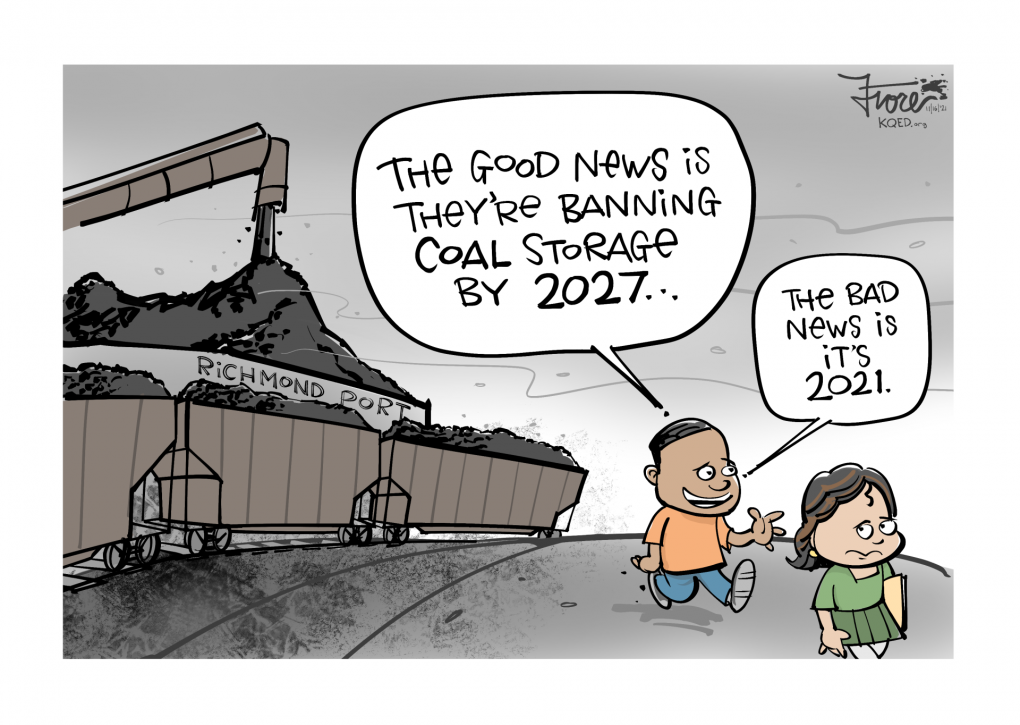
"content": "\u003cp>\u003ca href=\"https://ww2.kqed.org/app/uploads/sites/10/2021/11/coalstorage_111621_final.png\">\u003cimg loading=\"lazy\" decoding=\"async\" class=\"alignnone size-full wp-image-11896455\" src=\"https://ww2.kqed.org/app/uploads/sites/10/2021/11/coalstorage_111621_final.png\" alt=\"Cartoon: a dirty coal train port terminal with a young boy and girl walking by. The boy says, "the good news is they're banning coal storage by 2027, the bad news is it's 2021."\" width=\"1920\" height=\"1364\" srcset=\"https://cdn.kqed.org/wp-content/uploads/sites/10/2021/11/coalstorage_111621_final.png 1920w, https://cdn.kqed.org/wp-content/uploads/sites/10/2021/11/coalstorage_111621_final-800x568.png 800w, https://cdn.kqed.org/wp-content/uploads/sites/10/2021/11/coalstorage_111621_final-1020x725.png 1020w, https://cdn.kqed.org/wp-content/uploads/sites/10/2021/11/coalstorage_111621_final-160x114.png 160w, https://cdn.kqed.org/wp-content/uploads/sites/10/2021/11/coalstorage_111621_final-1536x1091.png 1536w\" sizes=\"(max-width: 1920px) 100vw, 1920px\">\u003c/a>Richmond officials reached a settlement with port operator Levin-Richmond Terminal Corp., along with two fossil fuel companies and the state of Utah, to \u003ca href=\"https://bit.ly/fiorerichmondcoalban\">ban coal storage at the port\u003c/a>.\u003c/p>\n\u003cp>The coal currently going through the shipping terminal is mined in Utah, transported by train across the West, stored for a while at the port and then loaded on a ship and sent to Japan or other destinations in Asia.\u003c/p>\n\u003cp>This is definitely not the most efficient or climate-friendly operation, and the declining market for coal in the United States has led desperate fossil fuel companies to look abroad for their profits.\u003c/p>\n\u003cp>Along the way, the health of people in Richmond suffers alongside the health of the planet.\u003c/p>\n\u003cp>This settlement is great news. I only wish we didn’t have to wait until 2027 to stop coal trafficking through Richmond.\u003c/p>\n\u003cp>[ad fullwidth]\u003c/p>\n\u003cp>\u003c/p>\n",
"blocks": [],
"excerpt": "Richmond officials reached a settlement with port operator Levin-Richmond Terminal Corp., along with two fossil fuel companies and the state of Utah, to ban coal storage at the port.",
"status": "publish",
"parent": 0,
"modified": 1726004063,
"stats": {
"hasAudio": false,
"hasVideo": false,
"hasChartOrMap": false,
"iframeSrcs": [],
"hasGoogleForm": false,
"hasGallery": false,
"hasHearkenModule": false,
"hasPolis": false,
"paragraphCount": 7,
"wordCount": 144
},
"headData": {
"title": "Time to Switch Tracks | KQED",
"description": "Richmond officials reached a settlement with port operator Levin-Richmond Terminal Corp., along with two fossil fuel companies and the state of Utah, to ban coal storage at the port.",
"ogTitle": "",
"ogDescription": "",
"ogImgId": "",
"twTitle": "",
"twDescription": "",
"twImgId": "",
"schema": {
"@context": "https://schema.org",
"@type": "NewsArticle",
"headline": "Time to Switch Tracks",
"datePublished": "2021-11-16T18:23:18-08:00",
"dateModified": "2024-09-10T14:34:23-07:00",
"image": "https://cdn.kqed.org/wp-content/uploads/2020/02/KQED-OG-Image@1x.png",
"isAccessibleForFree": "True",
"publisher": {
"@type": "NewsMediaOrganization",
"@id": "https://www.kqed.org/#organization",
"name": "KQED",
"logo": "https://cdn.kqed.org/wp-content/uploads/2020/02/KQED-OG-Image@1x.png",
"url": "https://www.kqed.org",
"sameAs": [
"https://www.facebook.com/KQED",
"https://twitter.com/KQED",
"https://www.instagram.com/kqed/",
"https://www.tiktok.com/@kqedofficial",
"https://www.linkedin.com/company/kqed",
"https://www.youtube.com/channel/UCeC0IOo7i1P_61zVUWbJ4nw"
]
}
}
},
"sticky": false,
"excludeFromSiteSearch": "Include",
"path": "/news/11896443/time-to-switch-tracks",
"audioTrackLength": null,
"parsedContent": [
{
"type": "contentString",
"content": "\u003cdiv class=\"post-body\">\u003cp>\u003cp>\u003ca href=\"https://ww2.kqed.org/app/uploads/sites/10/2021/11/coalstorage_111621_final.png\">\u003cimg loading=\"lazy\" decoding=\"async\" class=\"alignnone size-full wp-image-11896455\" src=\"https://ww2.kqed.org/app/uploads/sites/10/2021/11/coalstorage_111621_final.png\" alt=\"Cartoon: a dirty coal train port terminal with a young boy and girl walking by. The boy says, "the good news is they're banning coal storage by 2027, the bad news is it's 2021."\" width=\"1920\" height=\"1364\" srcset=\"https://cdn.kqed.org/wp-content/uploads/sites/10/2021/11/coalstorage_111621_final.png 1920w, https://cdn.kqed.org/wp-content/uploads/sites/10/2021/11/coalstorage_111621_final-800x568.png 800w, https://cdn.kqed.org/wp-content/uploads/sites/10/2021/11/coalstorage_111621_final-1020x725.png 1020w, https://cdn.kqed.org/wp-content/uploads/sites/10/2021/11/coalstorage_111621_final-160x114.png 160w, https://cdn.kqed.org/wp-content/uploads/sites/10/2021/11/coalstorage_111621_final-1536x1091.png 1536w\" sizes=\"(max-width: 1920px) 100vw, 1920px\">\u003c/a>Richmond officials reached a settlement with port operator Levin-Richmond Terminal Corp., along with two fossil fuel companies and the state of Utah, to \u003ca href=\"https://bit.ly/fiorerichmondcoalban\">ban coal storage at the port\u003c/a>.\u003c/p>\n\u003cp>The coal currently going through the shipping terminal is mined in Utah, transported by train across the West, stored for a while at the port and then loaded on a ship and sent to Japan or other destinations in Asia.\u003c/p>\n\u003cp>This is definitely not the most efficient or climate-friendly operation, and the declining market for coal in the United States has led desperate fossil fuel companies to look abroad for their profits.\u003c/p>\n\u003cp>Along the way, the health of people in Richmond suffers alongside the health of the planet.\u003c/p>\n\u003cp>This settlement is great news. I only wish we didn’t have to wait until 2027 to stop coal trafficking through Richmond.\u003c/p>\n\u003cp>\u003c/p>\u003c/div>",
"attributes": {
"named": {},
"numeric": []
}
},
{
"type": "component",
"content": "",
"name": "ad",
"attributes": {
"named": {
"label": "fullwidth"
},
"numeric": [
"fullwidth"
]
}
},
{
"type": "contentString",
"content": "\u003cdiv class=\"post-body\">\u003cp>\u003c/p>\n\u003cp>\u003c/p>\n\u003c/div>\u003c/p>",
"attributes": {
"named": {},
"numeric": []
}
}
],
"link": "/news/11896443/time-to-switch-tracks",
"authors": [
"3236"
],
"series": [
"news_18515"
],
"categories": [
"news_34165",
"news_19906",
"news_8",
"news_1397"
],
"tags": [
"news_255",
"news_6253",
"news_30247",
"news_328",
"news_20949",
"news_579"
],
"featImg": "news_11896455",
"label": "news_18515"
},
"news_11895977": {
"type": "posts",
"id": "news_11895977",
"meta": {
"index": "posts_1716263798",
"site": "news",
"id": "11895977",
"score": null,
"sort": [
1636748296000
]
},
"guestAuthors": [],
"slug": "southern-california-amtrak-line-offers-up-close-view-of-climate-changes-impact-on-beaches",
"title": "Southern California Amtrak Line Offers Up-Close View of Climate Change's Impact on Beaches",
"publishDate": 1636748296,
"format": "standard",
"headTitle": "Southern California Amtrak Line Offers Up-Close View of Climate Change’s Impact on Beaches | KQED",
"labelTerm": {
"term": 72,
"site": "news"
},
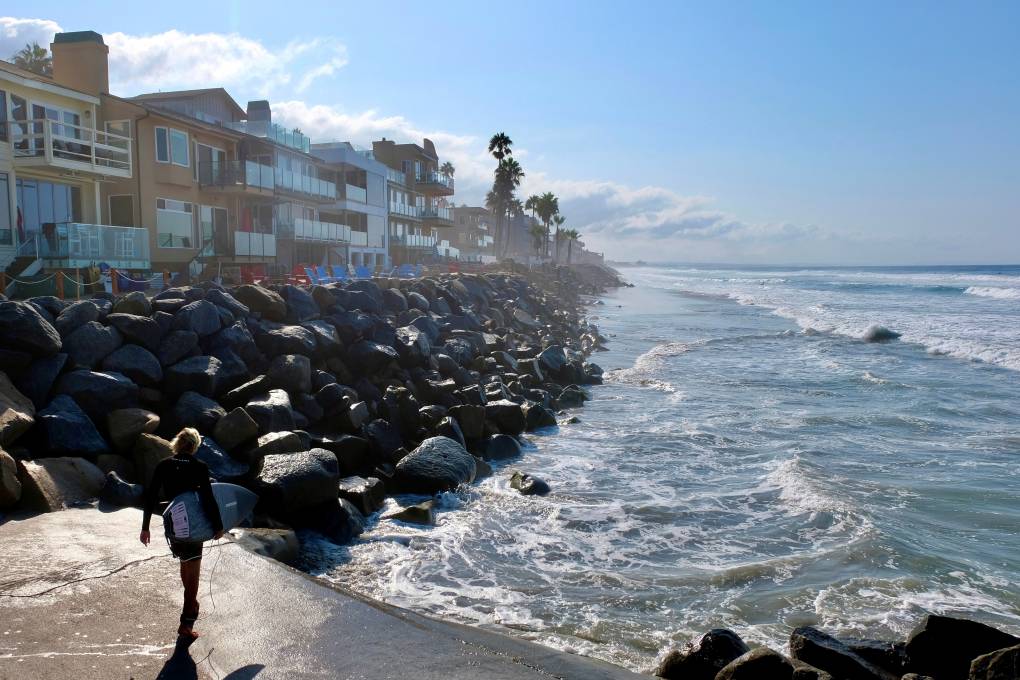
"content": "\u003cp>The United States and China — the world’s top two greenhouse gas-emitting countries, which together account for about 40% of the world’s annual carbon output — \u003ca href=\"https://www.npr.org/2021/11/11/1054648598/u-s-and-china-announce-surprise-climate-agreement-at-cop26-summit\">announced Wednesday they have agreed to cooperate on limiting emissions\u003c/a> to address the global climate crisis.\u003c/p>\n\u003cp>The agreement, announced at the United Nations climate change conference in Glasgow, Scotland, known as COP26, aims to accelerate emissions reductions toward the goals set in the 2015 Paris agreement, which include keeping the global temperature rise “well below” 2 degrees Celsius (3.6 degrees Fahrenheit), with a target of 1.5 degrees Celsius (2.7 degrees Fahrenheit).\u003c/p>\n\u003cp>Despite the encouraging news, experts predict that \u003ca href=\"https://unfccc.int/news/climate-commitments-not-on-track-to-meet-paris-agreement-goals-as-ndc-synthesis-report-is-published\">most countries are currently not on track to meet the commitments they agreed to in Paris\u003c/a>. In the U.S., the West Coast is already experiencing more frequent and severe weather, and rising seas are already \u003ca href=\"https://www.kqed.org/science/1973805/climate-solutions-in-east-palo-alto\">putting some Bay Area communities at risk\u003c/a>.\u003c/p>\n\u003cp>In Southern California in September, Amtrak \u003ca href=\"https://losangeles.cbslocal.com/2021/09/16/beach-erosion-suspends-all-metrolink-amtrak-service-between-oc-san-diego/\">suspended service on their Pacific Surfliner route\u003c/a> for a few weeks between Orange and San Diego counties for emergency repairs due to beach erosion. The scenic coastline route connects San Diego and other cities on its way to San Luis Obispo.\u003c/p>\n\u003cp>https://twitter.com/PacSurfliners/status/1438320674506821632\u003c/p>\n\u003cp>Beach erosion, the process in which \u003ca href=\"https://toolkit.climate.gov/topics/coastal-flood-risk/coastal-erosion\">the sand and rocks that make up a coastline are carried away by rising seas and stronger waves\u003c/a>, presents an ongoing threat to the tracks of the Pacific Surfliner and the oceanfront homes, roads, piers and power plants in the vicinity.\u003c/p>\n\u003cp>Rick Behl, professor of geological sciences at Cal State Long Beach, points out that even in normal times, California’s coast can be a hazardous place to build things.\u003c/p>\n\u003cp>“The coastline is a super-dynamic place naturally,” he said. “It’s where everything comes together: the ocean, the atmosphere, the land, the rivers. It’s constantly changing.”\u003c/p>\n\u003cfigure id=\"attachment_11895980\" class=\"wp-caption alignnone\" style=\"max-width: 771px\">\u003cimg loading=\"lazy\" decoding=\"async\" class=\"wp-image-11895980 size-full\" src=\"https://ww2.kqed.org/app/uploads/sites/10/2021/11/Amtrak-Pacific-Sunsurfer-916x515-1.jpg\" alt=\"An aerial shot of a long, silver-and-blue train on tracks, with only a few yards of beach between it and ocean waves, with low, green hills on the immediate opposite side.\" width=\"771\" height=\"514\" srcset=\"https://cdn.kqed.org/wp-content/uploads/sites/10/2021/11/Amtrak-Pacific-Sunsurfer-916x515-1.jpg 771w, https://cdn.kqed.org/wp-content/uploads/sites/10/2021/11/Amtrak-Pacific-Sunsurfer-916x515-1-160x107.jpg 160w\" sizes=\"(max-width: 771px) 100vw, 771px\">\u003cfigcaption class=\"wp-caption-text\">Amtrak’s Pacific Surfliner train travels along the Southern California coast. \u003ccite>(Courtesy of Amtrak)\u003c/cite>\u003c/figcaption>\u003c/figure>\n\u003cp>He adds that climate change is supercharging these changes, making storms stronger, tides higher and the coastal erosion of beaches and cliffs worse.\u003c/p>\n\u003cp>Riding the Pacific Surfliner provides a unique vantage point to this transformation. As the train crosses San Diego County into Orange County, the tracks come really close to the Pacific Ocean, making it clear how vulnerable the train and nearby homes are to climate change.\u003c/p>\n\u003cfigure id=\"attachment_11896117\" class=\"wp-caption aligncenter\" style=\"max-width: 800px\">\u003cimg loading=\"lazy\" decoding=\"async\" class=\"wp-image-11896117 size-medium\" src=\"https://ww2.kqed.org/app/uploads/sites/10/2021/11/GettyImages-1352379110-800x543.jpg\" alt=\"View inside the interior of a train car taken from the back, with rows of four seats and an aisle up the middle. The bright sun makes the interior mostly dark. A man with short hair, glasses, and a mask takes a photo with his phone out through the window, where a receding wave seems to come up almost to the train itself.\" width=\"800\" height=\"543\">\u003cfigcaption class=\"wp-caption-text\">A passenger takes a photo as an Amtrak train passes near the Pacific Ocean on Nov. 9, 2021, near Oceanside, California. \u003ccite>(Mario Tama/Getty Images)\u003c/cite>\u003c/figcaption>\u003c/figure>\n\u003cp>In nearby towns like San Clemente and Oceanside, seawalls have been built in front of many homes, and giant boulders have been placed between the ocean and the train tracks.\u003c/p>\n\u003cp>But Behl warns that “coastal armoring” actually makes erosion worse in the long term by starving beaches of new sources of sand.\u003c/p>\n\u003cp>“It increases the energy on the beach, causes more erosion, drops the sand and makes less beach,” he said.\u003c/p>\n\u003cp>The cycle can possibly reach a point where “there really is no beach left.”\u003c/p>\n\u003cp>[aside postID=\"science_1973805\" hero=\"https://ww2.kqed.org/app/uploads/sites/35/2021/04/RS48686_EPA_image_selects_fullsize-3-qut.jpg\"]Looking ahead, Behl says Californians will likely face the expensive challenge of moving some homes and critical infrastructure, including parts of this train route, away from the coast. That’s called “planned retreat.”\u003c/p>\n\u003cp>Behl also says we have to stop thinking about sea level rise as something that’s happening so slowly we just don’t have to worry about it yet.\u003c/p>\n\u003cp>“Beach erosion, cliff retreat is not a gradual process, it’s episodic,” he said. “So when someone says that’s long in the future, far in the future, it may be, or it may not be.”\u003c/p>\n\u003cp>\u003cem>This post includes reporting from KQED’s Carlos Cabrera-Lomelí and NPR.\u003c/em>\u003c/p>\n\u003cp>[ad fullwidth]\u003c/p>\n\u003cp>\u003c/p>\n",
"blocks": [],
"excerpt": "Rising seas are transforming California's coast, putting beachfront communities and public transportation systems in danger. Some methods to protect against rising seas may actually worsen coastal erosion.",
"status": "publish",
"parent": 0,
"modified": 1721153273,
"stats": {
"hasAudio": false,
"hasVideo": false,
"hasChartOrMap": false,
"iframeSrcs": [],
"hasGoogleForm": false,
"hasGallery": false,
"hasHearkenModule": false,
"hasPolis": false,
"paragraphCount": 19,
"wordCount": 665
},
"headData": {
"title": "Southern California Amtrak Line Offers Up-Close View of Climate Change's Impact on Beaches | KQED",
"description": "Rising seas are transforming California's coast, putting beachfront communities and public transportation systems in danger. Some methods to protect against rising seas may actually worsen coastal erosion.",
"ogTitle": "",
"ogDescription": "",
"ogImgId": "",
"twTitle": "",
"twDescription": "",
"twImgId": "",
"schema": {
"@context": "https://schema.org",
"@type": "NewsArticle",
"headline": "Southern California Amtrak Line Offers Up-Close View of Climate Change's Impact on Beaches",
"datePublished": "2021-11-12T12:18:16-08:00",
"dateModified": "2024-07-16T11:07:53-07:00",
"image": "https://cdn.kqed.org/wp-content/uploads/2020/02/KQED-OG-Image@1x.png",
"isAccessibleForFree": "True",
"publisher": {
"@type": "NewsMediaOrganization",
"@id": "https://www.kqed.org/#organization",
"name": "KQED",
"logo": "https://cdn.kqed.org/wp-content/uploads/2020/02/KQED-OG-Image@1x.png",
"url": "https://www.kqed.org",
"sameAs": [
"https://www.facebook.com/KQED",
"https://twitter.com/KQED",
"https://www.instagram.com/kqed/",
"https://www.tiktok.com/@kqedofficial",
"https://www.linkedin.com/company/kqed",
"https://www.youtube.com/channel/UCeC0IOo7i1P_61zVUWbJ4nw"
]
}
}
},
"audioUrl": "https://traffic.omny.fm/d/clips/0af137ef-751e-4b19-a055-aaef00d2d578/ffca7e9f-6831-41c5-bcaf-aaef00f5a073/6d16d53e-fbf7-40db-b285-add600f26f94/audio.mp3",
"sticky": false,
"excludeFromSiteSearch": "Include",
"path": "/news/11895977/southern-california-amtrak-line-offers-up-close-view-of-climate-changes-impact-on-beaches",
"audioTrackLength": null,
"parsedContent": [
{
"type": "contentString",
"content": "\u003cdiv class=\"post-body\">\u003cp>\u003cp>The United States and China — the world’s top two greenhouse gas-emitting countries, which together account for about 40% of the world’s annual carbon output — \u003ca href=\"https://www.npr.org/2021/11/11/1054648598/u-s-and-china-announce-surprise-climate-agreement-at-cop26-summit\">announced Wednesday they have agreed to cooperate on limiting emissions\u003c/a> to address the global climate crisis.\u003c/p>\n\u003cp>The agreement, announced at the United Nations climate change conference in Glasgow, Scotland, known as COP26, aims to accelerate emissions reductions toward the goals set in the 2015 Paris agreement, which include keeping the global temperature rise “well below” 2 degrees Celsius (3.6 degrees Fahrenheit), with a target of 1.5 degrees Celsius (2.7 degrees Fahrenheit).\u003c/p>\n\u003cp>Despite the encouraging news, experts predict that \u003ca href=\"https://unfccc.int/news/climate-commitments-not-on-track-to-meet-paris-agreement-goals-as-ndc-synthesis-report-is-published\">most countries are currently not on track to meet the commitments they agreed to in Paris\u003c/a>. In the U.S., the West Coast is already experiencing more frequent and severe weather, and rising seas are already \u003ca href=\"https://www.kqed.org/science/1973805/climate-solutions-in-east-palo-alto\">putting some Bay Area communities at risk\u003c/a>.\u003c/p>\n\u003cp>In Southern California in September, Amtrak \u003ca href=\"https://losangeles.cbslocal.com/2021/09/16/beach-erosion-suspends-all-metrolink-amtrak-service-between-oc-san-diego/\">suspended service on their Pacific Surfliner route\u003c/a> for a few weeks between Orange and San Diego counties for emergency repairs due to beach erosion. The scenic coastline route connects San Diego and other cities on its way to San Luis Obispo.\u003c/p>\u003c/p>\u003c/div>",
"attributes": {
"named": {},
"numeric": []
}
},
{
"type": "component",
"content": "",
"name": "singleTwitterStatus",
"attributes": {
"named": {
"id": "1438320674506821632"
},
"numeric": []
}
},
{
"type": "contentString",
"content": "\u003cdiv class=\"post-body\">\u003cp>\n\u003cp>Beach erosion, the process in which \u003ca href=\"https://toolkit.climate.gov/topics/coastal-flood-risk/coastal-erosion\">the sand and rocks that make up a coastline are carried away by rising seas and stronger waves\u003c/a>, presents an ongoing threat to the tracks of the Pacific Surfliner and the oceanfront homes, roads, piers and power plants in the vicinity.\u003c/p>\n\u003cp>Rick Behl, professor of geological sciences at Cal State Long Beach, points out that even in normal times, California’s coast can be a hazardous place to build things.\u003c/p>\n\u003cp>“The coastline is a super-dynamic place naturally,” he said. “It’s where everything comes together: the ocean, the atmosphere, the land, the rivers. It’s constantly changing.”\u003c/p>\n\u003cfigure id=\"attachment_11895980\" class=\"wp-caption alignnone\" style=\"max-width: 771px\">\u003cimg loading=\"lazy\" decoding=\"async\" class=\"wp-image-11895980 size-full\" src=\"https://ww2.kqed.org/app/uploads/sites/10/2021/11/Amtrak-Pacific-Sunsurfer-916x515-1.jpg\" alt=\"An aerial shot of a long, silver-and-blue train on tracks, with only a few yards of beach between it and ocean waves, with low, green hills on the immediate opposite side.\" width=\"771\" height=\"514\" srcset=\"https://cdn.kqed.org/wp-content/uploads/sites/10/2021/11/Amtrak-Pacific-Sunsurfer-916x515-1.jpg 771w, https://cdn.kqed.org/wp-content/uploads/sites/10/2021/11/Amtrak-Pacific-Sunsurfer-916x515-1-160x107.jpg 160w\" sizes=\"(max-width: 771px) 100vw, 771px\">\u003cfigcaption class=\"wp-caption-text\">Amtrak’s Pacific Surfliner train travels along the Southern California coast. \u003ccite>(Courtesy of Amtrak)\u003c/cite>\u003c/figcaption>\u003c/figure>\n\u003cp>He adds that climate change is supercharging these changes, making storms stronger, tides higher and the coastal erosion of beaches and cliffs worse.\u003c/p>\n\u003cp>Riding the Pacific Surfliner provides a unique vantage point to this transformation. As the train crosses San Diego County into Orange County, the tracks come really close to the Pacific Ocean, making it clear how vulnerable the train and nearby homes are to climate change.\u003c/p>\n\u003cfigure id=\"attachment_11896117\" class=\"wp-caption aligncenter\" style=\"max-width: 800px\">\u003cimg loading=\"lazy\" decoding=\"async\" class=\"wp-image-11896117 size-medium\" src=\"https://ww2.kqed.org/app/uploads/sites/10/2021/11/GettyImages-1352379110-800x543.jpg\" alt=\"View inside the interior of a train car taken from the back, with rows of four seats and an aisle up the middle. The bright sun makes the interior mostly dark. A man with short hair, glasses, and a mask takes a photo with his phone out through the window, where a receding wave seems to come up almost to the train itself.\" width=\"800\" height=\"543\">\u003cfigcaption class=\"wp-caption-text\">A passenger takes a photo as an Amtrak train passes near the Pacific Ocean on Nov. 9, 2021, near Oceanside, California. \u003ccite>(Mario Tama/Getty Images)\u003c/cite>\u003c/figcaption>\u003c/figure>\n\u003cp>In nearby towns like San Clemente and Oceanside, seawalls have been built in front of many homes, and giant boulders have been placed between the ocean and the train tracks.\u003c/p>\n\u003cp>But Behl warns that “coastal armoring” actually makes erosion worse in the long term by starving beaches of new sources of sand.\u003c/p>\n\u003cp>“It increases the energy on the beach, causes more erosion, drops the sand and makes less beach,” he said.\u003c/p>\n\u003cp>The cycle can possibly reach a point where “there really is no beach left.”\u003c/p>\n\u003cp>\u003c/p>\u003c/div>",
"attributes": {
"named": {},
"numeric": []
}
},
{
"type": "component",
"content": "",
"name": "aside",
"attributes": {
"named": {
"postid": "science_1973805",
"hero": "https://ww2.kqed.org/app/uploads/sites/35/2021/04/RS48686_EPA_image_selects_fullsize-3-qut.jpg",
"label": ""
},
"numeric": []
}
},
{
"type": "contentString",
"content": "\u003cdiv class=\"post-body\">\u003cp>Looking ahead, Behl says Californians will likely face the expensive challenge of moving some homes and critical infrastructure, including parts of this train route, away from the coast. That’s called “planned retreat.”\u003c/p>\n\u003cp>Behl also says we have to stop thinking about sea level rise as something that’s happening so slowly we just don’t have to worry about it yet.\u003c/p>\n\u003cp>“Beach erosion, cliff retreat is not a gradual process, it’s episodic,” he said. “So when someone says that’s long in the future, far in the future, it may be, or it may not be.”\u003c/p>\n\u003cp>\u003cem>This post includes reporting from KQED’s Carlos Cabrera-Lomelí and NPR.\u003c/em>\u003c/p>\n\u003cp>\u003c/p>\u003c/div>",
"attributes": {
"named": {},
"numeric": []
}
},
{
"type": "component",
"content": "",
"name": "ad",
"attributes": {
"named": {
"label": "fullwidth"
},
"numeric": [
"fullwidth"
]
}
},
{
"type": "contentString",
"content": "\u003cdiv class=\"post-body\">\u003cp>\u003c/p>\n\u003cp>\u003c/p>\n\u003c/div>\u003c/p>",
"attributes": {
"named": {},
"numeric": []
}
}
],
"link": "/news/11895977/southern-california-amtrak-line-offers-up-close-view-of-climate-changes-impact-on-beaches",
"authors": [
"11621"
],
"programs": [
"news_72"
],
"categories": [
"news_19906",
"news_8",
"news_356"
],
"tags": [
"news_1970",
"news_18538",
"news_255",
"news_28199",
"news_1764",
"news_1533",
"news_2181",
"news_20517"
],
"featImg": "news_11895981",
"label": "news_72"
},
"news_11895441": {
"type": "posts",
"id": "news_11895441",
"meta": {
"index": "posts_1716263798",
"site": "news",
"id": "11895441",
"score": null,
"sort": [
1636317235000
]
},
"guestAuthors": [],
"slug": "were-kind-of-running-out-of-time-berkeley-joins-global-day-of-action-for-climate-justice",
"title": "'We're Kind of Running Out of Time': Berkeley Joins Global Day of Action for Climate Justice",
"publishDate": 1636317235,
"format": "audio",
"headTitle": "‘We’re Kind of Running Out of Time’: Berkeley Joins Global Day of Action for Climate Justice | KQED",
"labelTerm": {
"site": "news"
},
"content": "\u003cp>Over 100 people took to the streets of Berkeley on Saturday morning in solidarity with a global day of action for climate justice. Youth organizers coordinated the event, aligning their demands with a collective of grassroots community campaigns, racial justice networks and global groups focused on climate justice and ecological equity.\u003c/p>\n\u003cp>“We’re here rallying today to show that we have the power … and we’re paying attention,” said Zoe Jonick, a youth activist and organizer with \u003ca href=\"https://350bayarea.org/\" target=\"_blank\" rel=\"noopener noreferrer\">350 Bay Area\u003c/a>. “We’re going to make sure that those in charge are making decisions that will actually do something.” [pullquote size=\"medium\" align=\"right\" citation=\"Lauren Sanchez, senior climate adviser to Gov. Gavin Newsom\"]‘For Californians who look outside their window during fire season, we’re not doing enough and there’s so much more the state and communities and global leaders need to be doing.’[/pullquote]\u003c/p>\n\u003cp>“Things at COP are not as inclusive as they should be,” Jonick added, referring to the 2021 United Nations Climate Change Conference. “There’s a lot of exclusion of places in the Global South that don’t have the resources or the vaccines to attend.” \u003ca href=\"https://www.sei.org/perspectives/vaccine-apartheid-threatens-equity-climate-negotiations/\">Global organizations have cited “vaccine apartheid” as a threat to the equity of climate negotiations\u003c/a>, and in September over \u003ca href=\"https://www.commondreams.org/news/2021/09/07/citing-vaccine-apartheid-1500-global-groups-urge-delay-un-climate-summit\">1,500 global groups urged for a delay of the summit\u003c/a>.\u003c/p>\n\u003cp>“There’s voices that aren’t being heard, that aren’t coming to the table,” said Jonick.\u003c/p>\n\u003cp>Marches took place in \u003ca href=\"https://www.npr.org/2021/11/06/1053218525/cop26-glasgow-global-climate-action-protests\" target=\"_blank\" rel=\"noopener noreferrer\">Glasgow, Scotland, where COP26 is now happening, and around the world\u003c/a>. Demonstrators outlined a list of demands in solidarity with \u003ca href=\"https://cop26coalition.org/about/the-coalition/\" target=\"_blank\" rel=\"noopener noreferrer\">COP26 Coalition\u003c/a> and the \u003ca href=\"https://www.gcclp.org/\">Gulf Coast Center for Law and Policy\u003c/a>, according to one \u003ca href=\"https://docs.google.com/document/d/1pPXZMXdw3X-Aa_kUyHyD4uGvRpyhdqXA_9RBJPynBW0/edit#\" target=\"_blank\" rel=\"noopener noreferrer\">toolkit\u003c/a> shared in advance of the event.\u003c/p>\n\u003cp>The \u003ca href=\"https://docs.google.com/document/d/1pPXZMXdw3X-Aa_kUyHyD4uGvRpyhdqXA_9RBJPynBW0/edit#\">Berkeley march laid out a more specific set of local demands\u003c/a>, including closing the Richmond Chevron refinery; calling on CalSTRS, the second largest pension fund in the U.S. to divest from fossil fuels; ending development at the \u003ca href=\"https://www.kqed.org/news/11704679/there-were-once-more-than-425-shellmounds-in-the-bay-area-where-did-they-go\" target=\"_blank\" rel=\"noopener noreferrer\">Berkeley shellmound\u003c/a> and returning the area to “the care and vision of the Confederated Villages of Lisjan”; and investing in communities disproportionately affected by climate change and pollution.\u003c/p>\n\u003cp>“We’re already starting to see some of the really bigger effects of climate change,” said Aniya Butler, a 15-year-old Oakland activist with \u003ca href=\"https://www.youthvsapocalypse.org/\" target=\"_blank\" rel=\"noopener noreferrer\">Youth Vs. Apocalypse\u003c/a> who came out to help others get involved. [aside postID=\"news_11894453\"]\u003c/p>\n\u003cp>For Karly Hampshire, a medical student at UCSF who attended the march, the climate is directly related to health. “Climate solutions are health solutions, and the health of every person alive today on the planet will be fundamentally affected by climate change,” she said. “Health institutions need to join together and start taking climate change seriously.”\u003c/p>\n\u003cp>On the state level, Lauren Sanchez, Gov. Newsom’s senior climate adviser, also sees climate as a multilayered issue. “Truly tackling this crisis means integrating this issue into everything we do: the governor’s entire agenda on health care, on immigration, on education, and so much more,” she said. “We know that climate justice can deliver social and economic justice.”\u003c/p>\n\u003cp>Sanchez told KQED on Wednesday through a recorded message from Glasgow that her top agenda item is “to save the planet from our certain doom.” Sanchez said the state of California brings two important messages to the global stage and world leaders in Scotland: “One is around hope and the other around the urgency of this crisis,” she said.\u003c/p>\n\u003cp>While she said she’s been to many of these conferences, this one “feels different,” because of the sense of urgency. Her top concern when it comes to climate change is “the disproportionate impacts that we know this crisis has on low-income Californians and our communities of color that are already suffering from too many environmental and social burdens.”\u003c/p>\n\u003cp>Speaking alongside Sanchez from Glasgow, Jared Blumenfeld, the secretary of California’s Environmental Protection Agency echoed the importance of taking action quickly.\u003cspan style=\"font-weight: 400\">[pullquote size=\"medium\" citation=\"Wade Crowfoot, California's natural resources secretary\"]‘This is an all-hands-on-deck response to a five-alarm fire, and that’s the level of urgency that we’re bringing from California to Scotland.’[/pullquote] \u003c/span>“We’re kind of running out of time,” he said. The governor and the whole state are balancing the immediate emergency response to wildfires and heat waves alongside tackling the root causes of climate change, “and we need to do it really, really quickly,” he said. \u003ca href=\"https://www.ipcc.ch/2021/08/09/ar6-wg1-20210809-pr/\">Many of the changes to the climate are unprecedented\u003c/a>, and some changes — like sea-level rise — are irreversible in our lifetime.\u003c/p>\n\u003cp>Wade Crowfoot, California’s natural resources secretary, who spoke with KQED just before leaving for Scotland, put it in slightly starker terms: “This is an all-hands-on-deck response to a five-alarm fire, and that’s the level of urgency that we’re bringing from California to Scotland.”\u003c/p>\n\u003cp>“We need to maintain hope and we maintain hope through taking action,” he said. From his perspective, he sees that the only option is to understand the threat, and take the level of action that is needed.[aside tag=\"climate-change, cop-26\" label=\"More Related Coverage\"]\u003c/p>\n\u003cp>Blumenfeld also noted the importance of action at both the local and state levels, referencing what seems to be a glimmer of hope, should the pledges swiftly be converted into policy: “If the promises made actually can be turned into action, we can turn this crisis around,” he said.\u003c/p>\n\u003cp>Despite the promises to \u003ca href=\"https://www.bbc.com/news/science-environment-59088498\" target=\"_blank\" rel=\"noopener noreferrer\">end deforestation\u003c/a>, “for Californians who look outside their window during fire season,” Sanchez said, “we’re not doing enough and there’s so much more the state and communities and global leaders need to be doing.”\u003c/p>\n\u003cp>For Blumenfeld, it’s all about accountability. “These leaders go home, and you never hear about what happens next,” he said.\u003c/p>\n\u003cp>But, he said, California is unique because \u003ca href=\"https://calepa.ca.gov/climate-action/#icat\">the state is tracking each of the goals\u003c/a>, which allows the public to see what’s happening.\u003c/p>\n\u003cp>For many other states and countries, “there’s a lot of speeches … but really, what we need is action,” he said.\u003c/p>\n\u003cp>\u003cem>KQED’s Azul Dahlstrom-Eckman and Monica Lam contributed to this story.\u003c/em>\u003c/p>\n\u003cp>[ad fullwidth]\u003c/p>\n\u003cp>\u003c/p>\n",
"blocks": [],
"excerpt": "'We're here rallying today to show that we have the power … and we're paying attention,' said Zoe Jonick, a youth activist and organizer with 350 Bay Area.",
"status": "publish",
"parent": 0,
"modified": 1727905316,
"stats": {
"hasAudio": false,
"hasVideo": false,
"hasChartOrMap": false,
"iframeSrcs": [],
"hasGoogleForm": false,
"hasGallery": false,
"hasHearkenModule": false,
"hasPolis": false,
"paragraphCount": 22,
"wordCount": 1106
},
"headData": {
"title": "'We're Kind of Running Out of Time': Berkeley Joins Global Day of Action for Climate Justice | KQED",
"description": "'We're here rallying today to show that we have the power … and we're paying attention,' said Zoe Jonick, a youth activist and organizer with 350 Bay Area.",
"ogTitle": "",
"ogDescription": "",
"ogImgId": "",
"twTitle": "",
"twDescription": "",
"twImgId": "",
"schema": {
"@context": "https://schema.org",
"@type": "NewsArticle",
"headline": "'We're Kind of Running Out of Time': Berkeley Joins Global Day of Action for Climate Justice",
"datePublished": "2021-11-07T12:33:55-08:00",
"dateModified": "2024-10-02T14:41:56-07:00",
"image": "https://cdn.kqed.org/wp-content/uploads/2020/02/KQED-OG-Image@1x.png",
"isAccessibleForFree": "True",
"publisher": {
"@type": "NewsMediaOrganization",
"@id": "https://www.kqed.org/#organization",
"name": "KQED",
"logo": "https://cdn.kqed.org/wp-content/uploads/2020/02/KQED-OG-Image@1x.png",
"url": "https://www.kqed.org",
"sameAs": [
"https://www.facebook.com/KQED",
"https://twitter.com/KQED",
"https://www.instagram.com/kqed/",
"https://www.tiktok.com/@kqedofficial",
"https://www.linkedin.com/company/kqed",
"https://www.youtube.com/channel/UCeC0IOo7i1P_61zVUWbJ4nw"
]
}
}
},
"audioUrl": "https://traffic.omny.fm/d/clips/0af137ef-751e-4b19-a055-aaef00d2d578/ffca7e9f-6831-4[%E2%80%A6]f-aaef00f5a073/85a2ca88-de4d-493f-8e5e-adda0185289b/audio.mp3",
"sticky": false,
"excludeFromSiteSearch": "Include",
"path": "/news/11895441/were-kind-of-running-out-of-time-berkeley-joins-global-day-of-action-for-climate-justice",
"audioTrackLength": null,
"parsedContent": [
{
"type": "contentString",
"content": "\u003cdiv class=\"post-body\">\u003cp>\u003cp>Over 100 people took to the streets of Berkeley on Saturday morning in solidarity with a global day of action for climate justice. Youth organizers coordinated the event, aligning their demands with a collective of grassroots community campaigns, racial justice networks and global groups focused on climate justice and ecological equity.\u003c/p>\n\u003cp>“We’re here rallying today to show that we have the power … and we’re paying attention,” said Zoe Jonick, a youth activist and organizer with \u003ca href=\"https://350bayarea.org/\" target=\"_blank\" rel=\"noopener noreferrer\">350 Bay Area\u003c/a>. “We’re going to make sure that those in charge are making decisions that will actually do something.” \u003c/p>\u003c/div>",
"attributes": {
"named": {},
"numeric": []
}
},
{
"type": "component",
"content": "‘For Californians who look outside their window during fire season, we’re not doing enough and there’s so much more the state and communities and global leaders need to be doing.’",
"name": "pullquote",
"attributes": {
"named": {
"size": "medium",
"align": "right",
"citation": "Lauren Sanchez, senior climate adviser to Gov. Gavin Newsom",
"label": ""
},
"numeric": []
}
},
{
"type": "contentString",
"content": "\u003cdiv class=\"post-body\">\u003cp>\u003c/p>\n\u003cp>“Things at COP are not as inclusive as they should be,” Jonick added, referring to the 2021 United Nations Climate Change Conference. “There’s a lot of exclusion of places in the Global South that don’t have the resources or the vaccines to attend.” \u003ca href=\"https://www.sei.org/perspectives/vaccine-apartheid-threatens-equity-climate-negotiations/\">Global organizations have cited “vaccine apartheid” as a threat to the equity of climate negotiations\u003c/a>, and in September over \u003ca href=\"https://www.commondreams.org/news/2021/09/07/citing-vaccine-apartheid-1500-global-groups-urge-delay-un-climate-summit\">1,500 global groups urged for a delay of the summit\u003c/a>.\u003c/p>\n\u003cp>“There’s voices that aren’t being heard, that aren’t coming to the table,” said Jonick.\u003c/p>\n\u003cp>Marches took place in \u003ca href=\"https://www.npr.org/2021/11/06/1053218525/cop26-glasgow-global-climate-action-protests\" target=\"_blank\" rel=\"noopener noreferrer\">Glasgow, Scotland, where COP26 is now happening, and around the world\u003c/a>. Demonstrators outlined a list of demands in solidarity with \u003ca href=\"https://cop26coalition.org/about/the-coalition/\" target=\"_blank\" rel=\"noopener noreferrer\">COP26 Coalition\u003c/a> and the \u003ca href=\"https://www.gcclp.org/\">Gulf Coast Center for Law and Policy\u003c/a>, according to one \u003ca href=\"https://docs.google.com/document/d/1pPXZMXdw3X-Aa_kUyHyD4uGvRpyhdqXA_9RBJPynBW0/edit#\" target=\"_blank\" rel=\"noopener noreferrer\">toolkit\u003c/a> shared in advance of the event.\u003c/p>\n\u003cp>The \u003ca href=\"https://docs.google.com/document/d/1pPXZMXdw3X-Aa_kUyHyD4uGvRpyhdqXA_9RBJPynBW0/edit#\">Berkeley march laid out a more specific set of local demands\u003c/a>, including closing the Richmond Chevron refinery; calling on CalSTRS, the second largest pension fund in the U.S. to divest from fossil fuels; ending development at the \u003ca href=\"https://www.kqed.org/news/11704679/there-were-once-more-than-425-shellmounds-in-the-bay-area-where-did-they-go\" target=\"_blank\" rel=\"noopener noreferrer\">Berkeley shellmound\u003c/a> and returning the area to “the care and vision of the Confederated Villages of Lisjan”; and investing in communities disproportionately affected by climate change and pollution.\u003c/p>\n\u003cp>“We’re already starting to see some of the really bigger effects of climate change,” said Aniya Butler, a 15-year-old Oakland activist with \u003ca href=\"https://www.youthvsapocalypse.org/\" target=\"_blank\" rel=\"noopener noreferrer\">Youth Vs. Apocalypse\u003c/a> who came out to help others get involved. \u003c/p>\u003c/div>",
"attributes": {
"named": {},
"numeric": []
}
},
{
"type": "component",
"content": "",
"name": "aside",
"attributes": {
"named": {
"postid": "news_11894453",
"label": ""
},
"numeric": []
}
},
{
"type": "contentString",
"content": "\u003cdiv class=\"post-body\">\u003cp>\u003c/p>\n\u003cp>For Karly Hampshire, a medical student at UCSF who attended the march, the climate is directly related to health. “Climate solutions are health solutions, and the health of every person alive today on the planet will be fundamentally affected by climate change,” she said. “Health institutions need to join together and start taking climate change seriously.”\u003c/p>\n\u003cp>On the state level, Lauren Sanchez, Gov. Newsom’s senior climate adviser, also sees climate as a multilayered issue. “Truly tackling this crisis means integrating this issue into everything we do: the governor’s entire agenda on health care, on immigration, on education, and so much more,” she said. “We know that climate justice can deliver social and economic justice.”\u003c/p>\n\u003cp>Sanchez told KQED on Wednesday through a recorded message from Glasgow that her top agenda item is “to save the planet from our certain doom.” Sanchez said the state of California brings two important messages to the global stage and world leaders in Scotland: “One is around hope and the other around the urgency of this crisis,” she said.\u003c/p>\n\u003cp>While she said she’s been to many of these conferences, this one “feels different,” because of the sense of urgency. Her top concern when it comes to climate change is “the disproportionate impacts that we know this crisis has on low-income Californians and our communities of color that are already suffering from too many environmental and social burdens.”\u003c/p>\n\u003cp>Speaking alongside Sanchez from Glasgow, Jared Blumenfeld, the secretary of California’s Environmental Protection Agency echoed the importance of taking action quickly.\u003cspan style=\"font-weight: 400\">\u003c/p>\u003c/div>",
"attributes": {
"named": {},
"numeric": []
}
},
{
"type": "component",
"content": "‘This is an all-hands-on-deck response to a five-alarm fire, and that’s the level of urgency that we’re bringing from California to Scotland.’",
"name": "pullquote",
"attributes": {
"named": {
"size": "medium",
"citation": "Wade Crowfoot, California's natural resources secretary",
"label": ""
},
"numeric": []
}
},
{
"type": "contentString",
"content": "\u003cdiv class=\"post-body\">\u003cp> \u003c/span>“We’re kind of running out of time,” he said. The governor and the whole state are balancing the immediate emergency response to wildfires and heat waves alongside tackling the root causes of climate change, “and we need to do it really, really quickly,” he said. \u003ca href=\"https://www.ipcc.ch/2021/08/09/ar6-wg1-20210809-pr/\">Many of the changes to the climate are unprecedented\u003c/a>, and some changes — like sea-level rise — are irreversible in our lifetime.\u003c/p>\n\u003cp>Wade Crowfoot, California’s natural resources secretary, who spoke with KQED just before leaving for Scotland, put it in slightly starker terms: “This is an all-hands-on-deck response to a five-alarm fire, and that’s the level of urgency that we’re bringing from California to Scotland.”\u003c/p>\n\u003cp>“We need to maintain hope and we maintain hope through taking action,” he said. From his perspective, he sees that the only option is to understand the threat, and take the level of action that is needed.\u003c/p>\u003c/div>",
"attributes": {
"named": {},
"numeric": []
}
},
{
"type": "component",
"content": "",
"name": "aside",
"attributes": {
"named": {
"tag": "climate-change, cop-26",
"label": "More Related Coverage "
},
"numeric": []
}
},
{
"type": "contentString",
"content": "\u003cdiv class=\"post-body\">\u003cp>\u003c/p>\n\u003cp>Blumenfeld also noted the importance of action at both the local and state levels, referencing what seems to be a glimmer of hope, should the pledges swiftly be converted into policy: “If the promises made actually can be turned into action, we can turn this crisis around,” he said.\u003c/p>\n\u003cp>Despite the promises to \u003ca href=\"https://www.bbc.com/news/science-environment-59088498\" target=\"_blank\" rel=\"noopener noreferrer\">end deforestation\u003c/a>, “for Californians who look outside their window during fire season,” Sanchez said, “we’re not doing enough and there’s so much more the state and communities and global leaders need to be doing.”\u003c/p>\n\u003cp>For Blumenfeld, it’s all about accountability. “These leaders go home, and you never hear about what happens next,” he said.\u003c/p>\n\u003cp>But, he said, California is unique because \u003ca href=\"https://calepa.ca.gov/climate-action/#icat\">the state is tracking each of the goals\u003c/a>, which allows the public to see what’s happening.\u003c/p>\n\u003cp>For many other states and countries, “there’s a lot of speeches … but really, what we need is action,” he said.\u003c/p>\n\u003cp>\u003cem>KQED’s Azul Dahlstrom-Eckman and Monica Lam contributed to this story.\u003c/em>\u003c/p>\n\u003cp>\u003c/p>\u003c/div>",
"attributes": {
"named": {},
"numeric": []
}
},
{
"type": "component",
"content": "",
"name": "ad",
"attributes": {
"named": {
"label": "fullwidth"
},
"numeric": [
"fullwidth"
]
}
},
{
"type": "contentString",
"content": "\u003cdiv class=\"post-body\">\u003cp>\u003c/p>\n\u003cp>\u003c/p>\n\u003c/div>\u003c/p>",
"attributes": {
"named": {},
"numeric": []
}
}
],
"link": "/news/11895441/were-kind-of-running-out-of-time-berkeley-joins-global-day-of-action-for-climate-justice",
"authors": [
"11626",
"11785"
],
"categories": [
"news_34165",
"news_19906",
"news_28250",
"news_8"
],
"tags": [
"news_129",
"news_18538",
"news_19204",
"news_255",
"news_30169",
"news_27626"
],
"featImg": "news_11895442",
"label": "news"
},
"news_11895322": {
"type": "posts",
"id": "news_11895322",
"meta": {
"index": "posts_1716263798",
"site": "news",
"id": "11895322",
"score": null,
"sort": [
1636309408000
]
},
"guestAuthors": [],
"slug": "methane-and-deforestation-the-twin-climate-threats-that-the-un-and-california-are-struggling-to-tackle",
"title": "Methane and Deforestation: The Twin Climate Threats That the UN, and California, Are Struggling to Tackle",
"publishDate": 1636309408,
"format": "standard",
"headTitle": "Methane and Deforestation: The Twin Climate Threats That the UN, and California, Are Struggling to Tackle | KQED",
"labelTerm": {},
"content": "\u003cp>Nations around the globe this week have pledged to tackle two thorny and critical threats to Earth’s climate: methane, which is the most potent planet-warming pollutant, and widespread destruction of forests.\u003c/p>\n\u003cp>Both of these are major contributors to climate change that California has tried — yet struggled — to address.\u003c/p>\n\u003cp>More than \u003ca href=\"https://ec.europa.eu/commission/presscorner/detail/en/statement_21_5766\">100 countries inched toward progress on tackling climate change by signing an international pledge\u003c/a>, launched Tuesday at the \u003ca href=\"https://calmatters.org/environment/2021/10/california-climate-change-newsom-pulls-out-conference/\">United Nations’ climate conference in Glasgow, Scotland\u003c/a>, to slash methane pollution by nearly a third over the next 10 years. [pullquote size=\"medium\" align=\"right\" citation=\"Wade Crowfoot, California's Resource Secretary \"]‘The role of nature has been underappreciated as a part of our climate solution.’[/pullquote]\u003c/p>\n\u003cp>The nations also promised to end worldwide deforestation — a widespread practice that warms the planet — in the same time period, an ambitious goal that would be backed by nearly $20 billion in public and private funds.\u003c/p>\n\u003cp>\u003ca href=\"https://www.whitehouse.gov/briefing-room/speeches-remarks/2021/11/02/remarks-by-president-biden-at-an-event-highlighting-the-progress-of-the-global-methane-pledge/\">President Biden paired the pledges with an announcement\u003c/a> of an expansive \u003ca href=\"https://www.whitehouse.gov/wp-content/uploads/2021/11/US-Methane-Emissions-Reduction-Action-Plan-1.pdf\">strategy to cut methane\u003c/a>, following the lead of states, including California, that years earlier began crafting policies to stop it from seeping into the atmosphere.\u003c/p>\n\u003cp>[ad fullwidth]\u003c/p>\n\u003cp>“It was remarkable to be able to already have a great outline of a methane action plan,” National Climate Advisor Gina McCarthy said at the international summit. “We can do this because of the work that has been done by everyone else.”\u003c/p>\n\u003cp>California has long-standing rules tackling methane from landfills, the oil and gas industry, dairies and other major sources. But it’s also home to a large \u003ca href=\"https://www.cpuc.ca.gov/regulatory-services/safety/pipeline-safety/aliso-canyon-well-failure\">natural gas storage facility that had a major leak\u003c/a> starting in 2015. \u003ca href=\"https://www.cpuc.ca.gov/news-and-updates/all-news/cpuc-helps-ensure-energy-reliability-for-southern-california\">State officials voted Thursday to increase natural gas storage at the facility while they evaluate how to shut it down.\u003c/a>\u003c/p>\n\u003cp>\u003ca href=\"https://ww3.arb.ca.gov/cc/inventory/data/tables/ghg_inventory_sector_sum_2000-19ch4.pdf\">California’s methane emissions largely haven’t increased\u003c/a> over the past decade, but they also haven’t dropped significantly — signaling the challenge ahead for governments that signed on to the pledge.\u003c/p>\n\u003cp>The pledge from the U.N. nations “is sort of the lowest common denominator that you could get everyone to agree to,” said \u003ca href=\"https://www.pge.utexas.edu/facultystaff/faculty-directory/ravikumar\" target=\"_blank\" rel=\"noopener noreferrer\">Arvind Ravikumar\u003c/a>, an engineering professor at the University of Texas at Austin. “That said, 30% does not mean it’s easy.”\u003c/p>\n\u003cp>When it comes to forests, California’s trees are losing their ability to store planet-warming carbon. The state’s forests are no longer burned or razed to clear land for agriculture, as is common in the Global North, but large tracts are burning nonetheless — from wildfires.\u003c/p>\n\u003cp>“The role of nature has been underappreciated as a part of our climate solution,” California Natural Resources Secretary Wade Crowfoot said in an interview.\u003c/p>\n\u003cp>“The world’s forests are burning up,” he said. “In the Southern Hemisphere it’s through a policy of land clearing. In California our forests are burning as a result of climate change or forest management.”\u003c/p>\n\u003cfigure id=\"attachment_11895332\" class=\"wp-caption alignnone\" style=\"max-width: 800px\">\u003cimg loading=\"lazy\" decoding=\"async\" class=\"wp-image-11895332 size-medium\" src=\"https://ww2.kqed.org/app/uploads/sites/10/2021/11/GettyImages-480337041-800x534.jpg\" alt=\"The silhouette of a pump against a yellowish smoggy-looking sky.\" width=\"800\" height=\"534\" srcset=\"https://cdn.kqed.org/wp-content/uploads/sites/10/2021/11/GettyImages-480337041-800x534.jpg 800w, https://cdn.kqed.org/wp-content/uploads/sites/10/2021/11/GettyImages-480337041-1020x680.jpg 1020w, https://cdn.kqed.org/wp-content/uploads/sites/10/2021/11/GettyImages-480337041-160x107.jpg 160w, https://cdn.kqed.org/wp-content/uploads/sites/10/2021/11/GettyImages-480337041.jpg 1024w\" sizes=\"(max-width: 800px) 100vw, 800px\">\u003cfigcaption class=\"wp-caption-text\">Pumping jacks at dawn in an oil field over the Monterey shale formation near Lost Hills, California, in 2014. \u003ccite>(David McNew/Getty Images)\u003c/cite>\u003c/figcaption>\u003c/figure>\n\u003ch3 id=\"h-cows-and-landfills\">Cows and landfills\u003c/h3>\n\u003cp>Methane, the \u003ca href=\"https://www.nature.com/articles/d41586-021-02287-y\" target=\"_blank\" rel=\"noopener noreferrer\">key ingredient in natural gas\u003c/a>, is a shorter-lived but more powerful greenhouse gas than the more-infamous carbon dioxide. \u003ca href=\"https://www.whitehouse.gov/wp-content/uploads/2021/11/US-Methane-Emissions-Reduction-Action-Plan-1.pdf\">It makes up about 10% of greenhouse gases that people pump out across the United States\u003c/a>, but accounts for \u003ca href=\"https://www.whitehouse.gov/wp-content/uploads/2021/11/US-Methane-Emissions-Reduction-Action-Plan-1.pdf\" target=\"_blank\" rel=\"noopener noreferrer\">about 30% of today’s warming\u003c/a>.\u003c/p>\n\u003cp>It’s largely regulated by the federal government, except where states have stepped in.\u003c/p>\n\u003cp>Biden’s new plans include \u003ca href=\"https://www.epa.gov/newsreleases/us-sharply-cut-methane-pollution-threatens-climate-and-public-health\" target=\"_blank\" rel=\"noopener noreferrer\">proposing a rule under the Clean Air Act\u003c/a> to cut methane pollution from new and existing oil and gas facilities, and \u003ca href=\"https://www.phmsa.dot.gov/news/new-federal-regulations-add-more-400000-miles-gas-gathering-pipelines-under-federal-oversight\" target=\"_blank\" rel=\"noopener noreferrer\">finalizing another\u003c/a> that would increase oversight of certain natural gas pipelines. The White House also said \u003ca href=\"https://www.whitehouse.gov/briefing-room/statements-releases/2021/11/02/fact-sheet-president-biden-tackles-methane-emissions-spurs-innovations-and-supports-sustainable-agriculture-to-build-a-clean-energy-economy-and-create-jobs/\">state agencies would ramp up incentives\u003c/a> and other efforts to curb methane from landfills and agriculture.\u003c/p>\n\u003cp>The \u003ca href=\"https://www.epa.gov/system/files/documents/2021-11/2021-oil-and-gas-proposal.-overview-fact-sheet.pdf\">Environmental Protection Agency’s draft oil and gas rule\u003c/a>, expected to be finalized \u003ca href=\"https://www.epa.gov/newsreleases/us-sharply-cut-methane-pollution-threatens-climate-and-public-health\" target=\"_blank\" rel=\"noopener noreferrer\">by the end of 2022\u003c/a>, is one more example of the regulatory whiplash that industries have faced over the past five years.\u003c/p>\n\u003cp>No sooner had President Barack \u003ca href=\"https://obamawhitehouse.archives.gov/blog/2016/05/12/administration-takes-historic-action-reduce-methane-emission-oil-and-gas-sector\">Obama finalized in 2016\u003c/a> the \u003ca href=\"https://www.washingtonpost.com/news/energy-environment/wp/2016/05/12/obama-administration-announces-historic-new-regulations-for-methane-emissions-from-oil-and-gas/\" target=\"_blank\" rel=\"noopener noreferrer\">first-ever federal rules\u003c/a> to directly regulate methane from \u003ca href=\"https://archive.epa.gov/epa/newsreleases/epa-releases-first-ever-standards-cut-methane-emissions-oil-and-gas-sector.html\" target=\"_blank\" rel=\"noopener noreferrer\">new and modified oil and gas sources\u003c/a>, than President \u003ca href=\"https://law.justia.com/cases/federal/appellate-courts/cadc/17-1145/17-1145-2017-07-03.html\">Donald Trump’s administration began trying to undo them\u003c/a>. Congress \u003ca href=\"https://www.nytimes.com/2021/04/28/climate/climate-change-methane.html\" target=\"_blank\" rel=\"noopener noreferrer\">undid the Trump administration’s rollbacks\u003c/a> this year, and now even more stringent rules are set to take their place.\u003c/p>\n\u003cp>“\u003ca href=\"https://calmatters.org/environment/2021/10/california-climate-change-conference-newsom/\">On methane, specifically for oil and gas companies, they have seen quite a bit of change in Washington\u003c/a>,” Lauren Sanchez, senior adviser to Gov. Gavin Newsom on climate, told CalMatters from Scotland. “What California brings is kind of a consistency in message and, for them, consistency in business direction.”\u003c/p>\n\u003cp>The California Air Resources Board is still figuring out how the federal proposal and California’s existing methane rules overlap, said Carolyn Lozo, who leads the air board’s oil and gas and greenhouse gas mitigation branch.\u003c/p>\n\u003cp>“In many ways, the state methane rule has very similar controls to what the EPA proposal has,” said Lozo.\u003c/p>\n\u003cp>Since the landmark \u003ca href=\"https://ww2.arb.ca.gov/resources/fact-sheets/ab-32-global-warming-solutions-act-2006\" target=\"_blank\" rel=\"noopener noreferrer\">California Global Warming Solutions Act passed in 2006\u003c/a>, the state has adopted a number of methane policies: \u003ca href=\"https://ww2.arb.ca.gov/our-work/programs/landfill-methane-regulation/about\">rolling out\u003c/a> requirements for \u003ca href=\"https://ww2.arb.ca.gov/sites/default/files/barcu/regact/2009/landfills09/landfillfinalfro.pdf\">methane capture\u003c/a> at \u003ca href=\"https://ww2.arb.ca.gov/our-work/programs/ca-state-plan-landfills\" target=\"_blank\" rel=\"noopener noreferrer\">landfills\u003c/a>, increasing oversight and monitoring to prevent leaks \u003ca href=\"https://leginfo.legislature.ca.gov/faces/billNavClient.xhtml?bill_id=201320140SB1371\" target=\"_blank\" rel=\"noopener noreferrer\">in natural gas pipelines\u003c/a> and \u003ca href=\"https://leginfo.legislature.ca.gov/faces/billAnalysisClient.xhtml?bill_id=201520160SB887\" target=\"_blank\" rel=\"noopener noreferrer\">storage facilities\u003c/a>, and setting a statewide target \u003ca href=\"https://leginfo.legislature.ca.gov/faces/billNavClient.xhtml?bill_id=201520160SB1383\">to cut methane pollution to 40% below 2013 levels by 2030\u003c/a>.\u003c/p>\n\u003cp>The \u003ca href=\"https://ww2.arb.ca.gov/resources/fact-sheets/oil-and-gas-methane-regulation\" target=\"_blank\" rel=\"noopener noreferrer\">air board adopted regulations\u003c/a> in 2017 requiring regular monitoring, leak detection and repair at both new and existing oil and gas facilities, and the setting of emissions standards and other requirements for certain oil and gas equipment. The rules expanded on a patchwork of existing policies to \u003ca href=\"https://www.energy.gov/sites/prod/files/2019/08/f66/California_0.pdf\" target=\"_blank\" rel=\"noopener noreferrer\">prevent toxic compounds and gases escaping from wells\u003c/a> enacted by some air districts, which can also reduce methane emissions, Lozo said.\u003c/p>\n\u003cp>“We need to dig down a little deeper and see, is there a delta? Is there a place that we need to shore up the state regulation?” Lozo said.\u003c/p>\n\u003cp>Kevin Slagle, a spokesperson for the influential Western States Petroleum Association, said it’s too soon to contrast California’s program and the yet-to-be finalized EPA rules, which he said they will review.\u003c/p>\n\u003cp>Echoing the \u003ca href=\"https://www.api.org/news-policy-and-issues/news/2021/11/02/epa-methane-regulations#:~:text=%E2%80%9CWe%20support%20the%20direct%20regulation,reviewing%20it%20in%20its%20entirety.\">American Petroleum Institute\u003c/a>, he said, “We support the direct regulation of methane from new and existing sources and are committed to building on the progress we have achieved in reducing methane emissions.”\u003c/p>\n\u003cp>More controversial is \u003ca href=\"https://ww2.arb.ca.gov/ghg-slcp-inventory\">California’s approach to regulating methane from the dairy industry\u003c/a>, which accounted for nearly half of the state’s methane emissions in 2013. California’s regulators tackle those emissions entirely with incentive programs, funding efforts to harness and convert methane emissions from manure into fuel.\u003c/p>\n\u003cp>Environmental justice groups say these incentives encourage the persistence of large-scale farming operations near communities.\u003c/p>\n\u003cp>“The state has pumped hundreds of millions of dollars of taxpayer and ratepayer money into programs that benefit the factory farm and gas industries and that do not address either the air quality or water quality or climate crises impacting San Joaquin Valley residents,” said Phoebe Seaton, co-director of Leadership Counsel for Justice and Accountability. “It’s past time to take our dairy problem seriously.”\u003c/p>\n\u003cp>Like California, the \u003ca href=\"https://www.whitehouse.gov/wp-content/uploads/2021/11/US-Methane-Emissions-Reduction-Action-Plan-1.pdf\">Biden administration’s plans rely largely on voluntary incentive programs\u003c/a> for agriculture.\u003c/p>\n\u003cp>“USDA does not regulate greenhouse gas emissions from the agriculture sector,” said Mirvat Sewadeh, a spokesperson for the United States Department of Agriculture. “Our climate strategy is farmer, rancher and landowner led and will ensure that rural America plays a key role in our transition to cleaner sources of energy.”\u003c/p>\n\u003cp>That’s a problem, said Jamie Katz, staff attorney at the Leadership Counsel for Justice and Accountability. The Biden administration is “failing to learn from the mistakes that California has made over the last decade.”\u003c/p>\n\u003cp>And methane pollution continues. \u003ca href=\"https://climate.nasa.gov/faq/33/which-is-a-bigger-methane-source-cow-belching-or-cow-flatulence/#:~:text=Contrary%20to%20common%20belief%2C%20it%27s,as%20a%20by%2Dproduct.)\">Cows’ digestive tracts produce methane\u003c/a>, and the gas released by their belches is unregulated in California, which could \u003ca href=\"https://ww2.arb.ca.gov/sites/default/files/2021-06/draft-2030-dairy-livestock-ch4-analysis.pdf\" target=\"_blank\" rel=\"noopener noreferrer\">hinder future methane reductions\u003c/a>. And \u003ca href=\"https://ww2.arb.ca.gov/our-work/programs/california-satellite-partnership/california-methane-surveys\" target=\"_blank\" rel=\"noopener noreferrer\">an aerial survey\u003c/a>\u003cem> \u003c/em>reported\u003cem> \u003c/em>\u003ca href=\"https://www.nature.com/articles/s41586-019-1720-3\" target=\"_blank\" rel=\"noopener noreferrer\">massive plumes of methane\u003c/a> released by some landfills.\u003c/p>\n\u003cp>Still, California’s climate regulators say there’s more progress ahead. State law requires \u003ca href=\"https://www.calrecycle.ca.gov/organics/slcp\">diverting 75% of all rotting, methane-spewing organic waste\u003c/a> from landfills by 2025. California’s \u003ca href=\"https://ww2.arb.ca.gov/news/carbon-mapper-launches-satellite-program-pinpoint-methane-and-co2-super-emitters\" target=\"_blank\" rel=\"noopener noreferrer\">air board announced a collaborative plan\u003c/a> to launch a flock of carbon-sniffing satellites to detect methane and other gases. More incentive-funded manure-digesters are expected to come online, and scientists are working to crack the problem of bovine belches.\u003c/p>\n\u003cp>“What we need to do is really deploy more dairy digesters, cap more fugitive methane emissions, move off of fossil natural gas — which will hopefully reduce our fossil fugitive methane emissions as well,” said Matthew Botill, chief of the air board’s Industrial Strategies Division. “And doing that, over this next decade, is really pivotal.”\u003c/p>\n\u003ch3 id=\"h-protecting-forests-to-protect-climate\">Protecting forests to protect climate\u003c/h3>\n\u003cp>Assemblymember Ash Kalra, a Democrat from San José, says the state hasn’t gone far enough to address deforestation, including on an international scale. He sponsored a bill that would have \u003ca href=\"https://leginfo.legislature.ca.gov/faces/billTextClient.xhtml?bill_id=202120220AB416\">required companies doing business with the state to certify their products were not harvested from areas where tropical deforestation occurred\u003c/a>.\u003c/p>\n\u003cp>The legislation passed but was vetoed by Newsom last month. Kalra said he welcomes the international pledges to end deforestation and attention to the problem but “we can do more.”\u003c/p>\n\u003cp>“A lot of countries make pledges, and you don’t see much follow-up. I’m not interested in pledges, I’m interested in action to save this planet,” he said.\u003c/p>\n\u003cp>Land use practices, including agriculture and burning forests for development, account for about \u003ca href=\"https://www.ipcc.ch/srccl/chapter/summary-for-policymakers/\" target=\"_blank\" rel=\"noopener noreferrer\">23% of total annual greenhouse gas emissions\u003c/a>, according to the U.N. Intergovernmental Panel on Climate Change.\u003c/p>\n\u003cp>It’s a circular problem: Burning forests to clear land releases carbon. And losing trees means losing their ability to pull carbon from the atmosphere.\u003c/p>\n\u003cp>California policymakers came to the same conclusion. \u003ca href=\"https://www.gov.ca.gov/wp-content/uploads/2020/10/10.07.2020-EO-N-82-20-.pdf\">An executive order signed by Newsom last year\u003c/a> made it a priority to harness natural landscapes to promote biodiversity and “accelerate natural removal of carbon and build climate resilience in our forests … .”\u003c/p>\n\u003cp>The initiative is still in \u003ca href=\"https://ww2.arb.ca.gov/sites/default/files/2019-06/draft-nwl-ip-040419.pdf\">draft form\u003c/a> but much of the focus is on forest loss through wildfires and will set goals for carbon storage in forests and soils.\u003c/p>\n\u003cp>\u003ca href=\"https://ww3.arb.ca.gov/cc/inventory/pubs/ca_ghg_wildfire_forestmanagement.pdf\">The state has increased its measurements\u003c/a> of both carbon stored — or sequestered — in California’s forests and the alarming increase in emissions from severe fires.\u003c/p>\n\u003cp>“Our challenge in California is to restore the health of our forests to enable them to be carbon sinks instead of carbon sources,” Crowfoot said.[aside tag=\"climate-change, cop26\" label=\"More Related Stories\"]\u003c/p>\n\u003cp>Matthew D. Hurteau of the University of New Mexico has been studying forests in the southern Sierra Nevada, \u003ca href=\"http://www.hurteaulab.org/serdp.html\">measuring climate change and fire\u003c/a> and their impact on healthy forest function. His research has been used as the underpinning for much of California’s forest and fire management policy.\u003c/p>\n\u003cp>“California has a forest loss problem,” he said. “These significant tree-killing wildfire events are happening in the context of ongoing drought and high temperatures. It impedes the ability of new trees to grow.”\u003c/p>\n\u003cp>He modeled historical, low-severity burns that occurred every 17 years. Those moderate fires took out smaller trees and emitted carbon, but that was offset by the surviving larger trees, which absorbed the carbon from the fires.\u003c/p>\n\u003cp>“The big trees are where the carbon uptake happens,” Hurteau said.\u003c/p>\n\u003cp>He said the practice by fire agencies of thinning forests with low-intensity burns that target the removal of smaller trees achieves the twin goals of making forests more fire-resistant and maintaining their ability to store carbon.\u003c/p>\n\u003cp>Using forests and other lands to address the climate crisis is overdue, he said.\u003c/p>\n\u003cp>[ad floatright]\u003c/p>\n\u003cp>“We’ve paid lip service to the role of natural systems in helping to regulate the climate,” he said.\u003c/p>\n\n",
"blocks": [],
"excerpt": "California's methane emissions largely haven't increased over the past decade, but they also haven't dropped significantly — signaling the challenge ahead for governments that signed on to a recent pledge.",
"status": "publish",
"parent": 0,
"modified": 1721131376,
"stats": {
"hasAudio": false,
"hasVideo": false,
"hasChartOrMap": false,
"iframeSrcs": [],
"hasGoogleForm": false,
"hasGallery": false,
"hasHearkenModule": false,
"hasPolis": false,
"paragraphCount": 52,
"wordCount": 2113
},
"headData": {
"title": "Methane and Deforestation: The Twin Climate Threats That the UN, and California, Are Struggling to Tackle | KQED",
"description": "California's methane emissions largely haven't increased over the past decade, but they also haven't dropped significantly — signaling the challenge ahead for governments that signed on to a recent pledge.",
"ogTitle": "",
"ogDescription": "",
"ogImgId": "",
"twTitle": "",
"twDescription": "",
"twImgId": "",
"schema": {
"@context": "https://schema.org",
"@type": "NewsArticle",
"headline": "Methane and Deforestation: The Twin Climate Threats That the UN, and California, Are Struggling to Tackle",
"datePublished": "2021-11-07T10:23:28-08:00",
"dateModified": "2024-07-16T05:02:56-07:00",
"image": "https://cdn.kqed.org/wp-content/uploads/2020/02/KQED-OG-Image@1x.png",
"isAccessibleForFree": "True",
"publisher": {
"@type": "NewsMediaOrganization",
"@id": "https://www.kqed.org/#organization",
"name": "KQED",
"logo": "https://cdn.kqed.org/wp-content/uploads/2020/02/KQED-OG-Image@1x.png",
"url": "https://www.kqed.org",
"sameAs": [
"https://www.facebook.com/KQED",
"https://twitter.com/KQED",
"https://www.instagram.com/kqed/",
"https://www.tiktok.com/@kqedofficial",
"https://www.linkedin.com/company/kqed",
"https://www.youtube.com/channel/UCeC0IOo7i1P_61zVUWbJ4nw"
]
}
}
},
"source": "CalMatters",
"sourceUrl": "https://calmatters.org/",
"sticky": false,
"nprByline": "\u003ca href=\"https://calmatters.org/author/rachel-becker/\">Rachel Becker\u003c/a> and \u003ca href=\"https://calmatters.org/author/julie-cart/\">Julie Cart\u003c/a>",
"excludeFromSiteSearch": "Include",
"path": "/news/11895322/methane-and-deforestation-the-twin-climate-threats-that-the-un-and-california-are-struggling-to-tackle",
"audioTrackLength": null,
"parsedContent": [
{
"type": "contentString",
"content": "\u003cdiv class=\"post-body\">\u003cp>\u003cp>Nations around the globe this week have pledged to tackle two thorny and critical threats to Earth’s climate: methane, which is the most potent planet-warming pollutant, and widespread destruction of forests.\u003c/p>\n\u003cp>Both of these are major contributors to climate change that California has tried — yet struggled — to address.\u003c/p>\n\u003cp>More than \u003ca href=\"https://ec.europa.eu/commission/presscorner/detail/en/statement_21_5766\">100 countries inched toward progress on tackling climate change by signing an international pledge\u003c/a>, launched Tuesday at the \u003ca href=\"https://calmatters.org/environment/2021/10/california-climate-change-newsom-pulls-out-conference/\">United Nations’ climate conference in Glasgow, Scotland\u003c/a>, to slash methane pollution by nearly a third over the next 10 years. \u003c/p>\u003c/div>",
"attributes": {
"named": {},
"numeric": []
}
},
{
"type": "component",
"content": "‘The role of nature has been underappreciated as a part of our climate solution.’",
"name": "pullquote",
"attributes": {
"named": {
"size": "medium",
"align": "right",
"citation": "Wade Crowfoot, California's Resource Secretary ",
"label": ""
},
"numeric": []
}
},
{
"type": "contentString",
"content": "\u003cdiv class=\"post-body\">\u003cp>\u003c/p>\n\u003cp>The nations also promised to end worldwide deforestation — a widespread practice that warms the planet — in the same time period, an ambitious goal that would be backed by nearly $20 billion in public and private funds.\u003c/p>\n\u003cp>\u003ca href=\"https://www.whitehouse.gov/briefing-room/speeches-remarks/2021/11/02/remarks-by-president-biden-at-an-event-highlighting-the-progress-of-the-global-methane-pledge/\">President Biden paired the pledges with an announcement\u003c/a> of an expansive \u003ca href=\"https://www.whitehouse.gov/wp-content/uploads/2021/11/US-Methane-Emissions-Reduction-Action-Plan-1.pdf\">strategy to cut methane\u003c/a>, following the lead of states, including California, that years earlier began crafting policies to stop it from seeping into the atmosphere.\u003c/p>\n\u003cp>\u003c/p>\u003c/div>",
"attributes": {
"named": {},
"numeric": []
}
},
{
"type": "component",
"content": "",
"name": "ad",
"attributes": {
"named": {
"label": "fullwidth"
},
"numeric": [
"fullwidth"
]
}
},
{
"type": "contentString",
"content": "\u003cdiv class=\"post-body\">\u003cp>\u003c/p>\n\u003cp>“It was remarkable to be able to already have a great outline of a methane action plan,” National Climate Advisor Gina McCarthy said at the international summit. “We can do this because of the work that has been done by everyone else.”\u003c/p>\n\u003cp>California has long-standing rules tackling methane from landfills, the oil and gas industry, dairies and other major sources. But it’s also home to a large \u003ca href=\"https://www.cpuc.ca.gov/regulatory-services/safety/pipeline-safety/aliso-canyon-well-failure\">natural gas storage facility that had a major leak\u003c/a> starting in 2015. \u003ca href=\"https://www.cpuc.ca.gov/news-and-updates/all-news/cpuc-helps-ensure-energy-reliability-for-southern-california\">State officials voted Thursday to increase natural gas storage at the facility while they evaluate how to shut it down.\u003c/a>\u003c/p>\n\u003cp>\u003ca href=\"https://ww3.arb.ca.gov/cc/inventory/data/tables/ghg_inventory_sector_sum_2000-19ch4.pdf\">California’s methane emissions largely haven’t increased\u003c/a> over the past decade, but they also haven’t dropped significantly — signaling the challenge ahead for governments that signed on to the pledge.\u003c/p>\n\u003cp>The pledge from the U.N. nations “is sort of the lowest common denominator that you could get everyone to agree to,” said \u003ca href=\"https://www.pge.utexas.edu/facultystaff/faculty-directory/ravikumar\" target=\"_blank\" rel=\"noopener noreferrer\">Arvind Ravikumar\u003c/a>, an engineering professor at the University of Texas at Austin. “That said, 30% does not mean it’s easy.”\u003c/p>\n\u003cp>When it comes to forests, California’s trees are losing their ability to store planet-warming carbon. The state’s forests are no longer burned or razed to clear land for agriculture, as is common in the Global North, but large tracts are burning nonetheless — from wildfires.\u003c/p>\n\u003cp>“The role of nature has been underappreciated as a part of our climate solution,” California Natural Resources Secretary Wade Crowfoot said in an interview.\u003c/p>\n\u003cp>“The world’s forests are burning up,” he said. “In the Southern Hemisphere it’s through a policy of land clearing. In California our forests are burning as a result of climate change or forest management.”\u003c/p>\n\u003cfigure id=\"attachment_11895332\" class=\"wp-caption alignnone\" style=\"max-width: 800px\">\u003cimg loading=\"lazy\" decoding=\"async\" class=\"wp-image-11895332 size-medium\" src=\"https://ww2.kqed.org/app/uploads/sites/10/2021/11/GettyImages-480337041-800x534.jpg\" alt=\"The silhouette of a pump against a yellowish smoggy-looking sky.\" width=\"800\" height=\"534\" srcset=\"https://cdn.kqed.org/wp-content/uploads/sites/10/2021/11/GettyImages-480337041-800x534.jpg 800w, https://cdn.kqed.org/wp-content/uploads/sites/10/2021/11/GettyImages-480337041-1020x680.jpg 1020w, https://cdn.kqed.org/wp-content/uploads/sites/10/2021/11/GettyImages-480337041-160x107.jpg 160w, https://cdn.kqed.org/wp-content/uploads/sites/10/2021/11/GettyImages-480337041.jpg 1024w\" sizes=\"(max-width: 800px) 100vw, 800px\">\u003cfigcaption class=\"wp-caption-text\">Pumping jacks at dawn in an oil field over the Monterey shale formation near Lost Hills, California, in 2014. \u003ccite>(David McNew/Getty Images)\u003c/cite>\u003c/figcaption>\u003c/figure>\n\u003ch3 id=\"h-cows-and-landfills\">Cows and landfills\u003c/h3>\n\u003cp>Methane, the \u003ca href=\"https://www.nature.com/articles/d41586-021-02287-y\" target=\"_blank\" rel=\"noopener noreferrer\">key ingredient in natural gas\u003c/a>, is a shorter-lived but more powerful greenhouse gas than the more-infamous carbon dioxide. \u003ca href=\"https://www.whitehouse.gov/wp-content/uploads/2021/11/US-Methane-Emissions-Reduction-Action-Plan-1.pdf\">It makes up about 10% of greenhouse gases that people pump out across the United States\u003c/a>, but accounts for \u003ca href=\"https://www.whitehouse.gov/wp-content/uploads/2021/11/US-Methane-Emissions-Reduction-Action-Plan-1.pdf\" target=\"_blank\" rel=\"noopener noreferrer\">about 30% of today’s warming\u003c/a>.\u003c/p>\n\u003cp>It’s largely regulated by the federal government, except where states have stepped in.\u003c/p>\n\u003cp>Biden’s new plans include \u003ca href=\"https://www.epa.gov/newsreleases/us-sharply-cut-methane-pollution-threatens-climate-and-public-health\" target=\"_blank\" rel=\"noopener noreferrer\">proposing a rule under the Clean Air Act\u003c/a> to cut methane pollution from new and existing oil and gas facilities, and \u003ca href=\"https://www.phmsa.dot.gov/news/new-federal-regulations-add-more-400000-miles-gas-gathering-pipelines-under-federal-oversight\" target=\"_blank\" rel=\"noopener noreferrer\">finalizing another\u003c/a> that would increase oversight of certain natural gas pipelines. The White House also said \u003ca href=\"https://www.whitehouse.gov/briefing-room/statements-releases/2021/11/02/fact-sheet-president-biden-tackles-methane-emissions-spurs-innovations-and-supports-sustainable-agriculture-to-build-a-clean-energy-economy-and-create-jobs/\">state agencies would ramp up incentives\u003c/a> and other efforts to curb methane from landfills and agriculture.\u003c/p>\n\u003cp>The \u003ca href=\"https://www.epa.gov/system/files/documents/2021-11/2021-oil-and-gas-proposal.-overview-fact-sheet.pdf\">Environmental Protection Agency’s draft oil and gas rule\u003c/a>, expected to be finalized \u003ca href=\"https://www.epa.gov/newsreleases/us-sharply-cut-methane-pollution-threatens-climate-and-public-health\" target=\"_blank\" rel=\"noopener noreferrer\">by the end of 2022\u003c/a>, is one more example of the regulatory whiplash that industries have faced over the past five years.\u003c/p>\n\u003cp>No sooner had President Barack \u003ca href=\"https://obamawhitehouse.archives.gov/blog/2016/05/12/administration-takes-historic-action-reduce-methane-emission-oil-and-gas-sector\">Obama finalized in 2016\u003c/a> the \u003ca href=\"https://www.washingtonpost.com/news/energy-environment/wp/2016/05/12/obama-administration-announces-historic-new-regulations-for-methane-emissions-from-oil-and-gas/\" target=\"_blank\" rel=\"noopener noreferrer\">first-ever federal rules\u003c/a> to directly regulate methane from \u003ca href=\"https://archive.epa.gov/epa/newsreleases/epa-releases-first-ever-standards-cut-methane-emissions-oil-and-gas-sector.html\" target=\"_blank\" rel=\"noopener noreferrer\">new and modified oil and gas sources\u003c/a>, than President \u003ca href=\"https://law.justia.com/cases/federal/appellate-courts/cadc/17-1145/17-1145-2017-07-03.html\">Donald Trump’s administration began trying to undo them\u003c/a>. Congress \u003ca href=\"https://www.nytimes.com/2021/04/28/climate/climate-change-methane.html\" target=\"_blank\" rel=\"noopener noreferrer\">undid the Trump administration’s rollbacks\u003c/a> this year, and now even more stringent rules are set to take their place.\u003c/p>\n\u003cp>“\u003ca href=\"https://calmatters.org/environment/2021/10/california-climate-change-conference-newsom/\">On methane, specifically for oil and gas companies, they have seen quite a bit of change in Washington\u003c/a>,” Lauren Sanchez, senior adviser to Gov. Gavin Newsom on climate, told CalMatters from Scotland. “What California brings is kind of a consistency in message and, for them, consistency in business direction.”\u003c/p>\n\u003cp>The California Air Resources Board is still figuring out how the federal proposal and California’s existing methane rules overlap, said Carolyn Lozo, who leads the air board’s oil and gas and greenhouse gas mitigation branch.\u003c/p>\n\u003cp>“In many ways, the state methane rule has very similar controls to what the EPA proposal has,” said Lozo.\u003c/p>\n\u003cp>Since the landmark \u003ca href=\"https://ww2.arb.ca.gov/resources/fact-sheets/ab-32-global-warming-solutions-act-2006\" target=\"_blank\" rel=\"noopener noreferrer\">California Global Warming Solutions Act passed in 2006\u003c/a>, the state has adopted a number of methane policies: \u003ca href=\"https://ww2.arb.ca.gov/our-work/programs/landfill-methane-regulation/about\">rolling out\u003c/a> requirements for \u003ca href=\"https://ww2.arb.ca.gov/sites/default/files/barcu/regact/2009/landfills09/landfillfinalfro.pdf\">methane capture\u003c/a> at \u003ca href=\"https://ww2.arb.ca.gov/our-work/programs/ca-state-plan-landfills\" target=\"_blank\" rel=\"noopener noreferrer\">landfills\u003c/a>, increasing oversight and monitoring to prevent leaks \u003ca href=\"https://leginfo.legislature.ca.gov/faces/billNavClient.xhtml?bill_id=201320140SB1371\" target=\"_blank\" rel=\"noopener noreferrer\">in natural gas pipelines\u003c/a> and \u003ca href=\"https://leginfo.legislature.ca.gov/faces/billAnalysisClient.xhtml?bill_id=201520160SB887\" target=\"_blank\" rel=\"noopener noreferrer\">storage facilities\u003c/a>, and setting a statewide target \u003ca href=\"https://leginfo.legislature.ca.gov/faces/billNavClient.xhtml?bill_id=201520160SB1383\">to cut methane pollution to 40% below 2013 levels by 2030\u003c/a>.\u003c/p>\n\u003cp>The \u003ca href=\"https://ww2.arb.ca.gov/resources/fact-sheets/oil-and-gas-methane-regulation\" target=\"_blank\" rel=\"noopener noreferrer\">air board adopted regulations\u003c/a> in 2017 requiring regular monitoring, leak detection and repair at both new and existing oil and gas facilities, and the setting of emissions standards and other requirements for certain oil and gas equipment. The rules expanded on a patchwork of existing policies to \u003ca href=\"https://www.energy.gov/sites/prod/files/2019/08/f66/California_0.pdf\" target=\"_blank\" rel=\"noopener noreferrer\">prevent toxic compounds and gases escaping from wells\u003c/a> enacted by some air districts, which can also reduce methane emissions, Lozo said.\u003c/p>\n\u003cp>“We need to dig down a little deeper and see, is there a delta? Is there a place that we need to shore up the state regulation?” Lozo said.\u003c/p>\n\u003cp>Kevin Slagle, a spokesperson for the influential Western States Petroleum Association, said it’s too soon to contrast California’s program and the yet-to-be finalized EPA rules, which he said they will review.\u003c/p>\n\u003cp>Echoing the \u003ca href=\"https://www.api.org/news-policy-and-issues/news/2021/11/02/epa-methane-regulations#:~:text=%E2%80%9CWe%20support%20the%20direct%20regulation,reviewing%20it%20in%20its%20entirety.\">American Petroleum Institute\u003c/a>, he said, “We support the direct regulation of methane from new and existing sources and are committed to building on the progress we have achieved in reducing methane emissions.”\u003c/p>\n\u003cp>More controversial is \u003ca href=\"https://ww2.arb.ca.gov/ghg-slcp-inventory\">California’s approach to regulating methane from the dairy industry\u003c/a>, which accounted for nearly half of the state’s methane emissions in 2013. California’s regulators tackle those emissions entirely with incentive programs, funding efforts to harness and convert methane emissions from manure into fuel.\u003c/p>\n\u003cp>Environmental justice groups say these incentives encourage the persistence of large-scale farming operations near communities.\u003c/p>\n\u003cp>“The state has pumped hundreds of millions of dollars of taxpayer and ratepayer money into programs that benefit the factory farm and gas industries and that do not address either the air quality or water quality or climate crises impacting San Joaquin Valley residents,” said Phoebe Seaton, co-director of Leadership Counsel for Justice and Accountability. “It’s past time to take our dairy problem seriously.”\u003c/p>\n\u003cp>Like California, the \u003ca href=\"https://www.whitehouse.gov/wp-content/uploads/2021/11/US-Methane-Emissions-Reduction-Action-Plan-1.pdf\">Biden administration’s plans rely largely on voluntary incentive programs\u003c/a> for agriculture.\u003c/p>\n\u003cp>“USDA does not regulate greenhouse gas emissions from the agriculture sector,” said Mirvat Sewadeh, a spokesperson for the United States Department of Agriculture. “Our climate strategy is farmer, rancher and landowner led and will ensure that rural America plays a key role in our transition to cleaner sources of energy.”\u003c/p>\n\u003cp>That’s a problem, said Jamie Katz, staff attorney at the Leadership Counsel for Justice and Accountability. The Biden administration is “failing to learn from the mistakes that California has made over the last decade.”\u003c/p>\n\u003cp>And methane pollution continues. \u003ca href=\"https://climate.nasa.gov/faq/33/which-is-a-bigger-methane-source-cow-belching-or-cow-flatulence/#:~:text=Contrary%20to%20common%20belief%2C%20it%27s,as%20a%20by%2Dproduct.)\">Cows’ digestive tracts produce methane\u003c/a>, and the gas released by their belches is unregulated in California, which could \u003ca href=\"https://ww2.arb.ca.gov/sites/default/files/2021-06/draft-2030-dairy-livestock-ch4-analysis.pdf\" target=\"_blank\" rel=\"noopener noreferrer\">hinder future methane reductions\u003c/a>. And \u003ca href=\"https://ww2.arb.ca.gov/our-work/programs/california-satellite-partnership/california-methane-surveys\" target=\"_blank\" rel=\"noopener noreferrer\">an aerial survey\u003c/a>\u003cem> \u003c/em>reported\u003cem> \u003c/em>\u003ca href=\"https://www.nature.com/articles/s41586-019-1720-3\" target=\"_blank\" rel=\"noopener noreferrer\">massive plumes of methane\u003c/a> released by some landfills.\u003c/p>\n\u003cp>Still, California’s climate regulators say there’s more progress ahead. State law requires \u003ca href=\"https://www.calrecycle.ca.gov/organics/slcp\">diverting 75% of all rotting, methane-spewing organic waste\u003c/a> from landfills by 2025. California’s \u003ca href=\"https://ww2.arb.ca.gov/news/carbon-mapper-launches-satellite-program-pinpoint-methane-and-co2-super-emitters\" target=\"_blank\" rel=\"noopener noreferrer\">air board announced a collaborative plan\u003c/a> to launch a flock of carbon-sniffing satellites to detect methane and other gases. More incentive-funded manure-digesters are expected to come online, and scientists are working to crack the problem of bovine belches.\u003c/p>\n\u003cp>“What we need to do is really deploy more dairy digesters, cap more fugitive methane emissions, move off of fossil natural gas — which will hopefully reduce our fossil fugitive methane emissions as well,” said Matthew Botill, chief of the air board’s Industrial Strategies Division. “And doing that, over this next decade, is really pivotal.”\u003c/p>\n\u003ch3 id=\"h-protecting-forests-to-protect-climate\">Protecting forests to protect climate\u003c/h3>\n\u003cp>Assemblymember Ash Kalra, a Democrat from San José, says the state hasn’t gone far enough to address deforestation, including on an international scale. He sponsored a bill that would have \u003ca href=\"https://leginfo.legislature.ca.gov/faces/billTextClient.xhtml?bill_id=202120220AB416\">required companies doing business with the state to certify their products were not harvested from areas where tropical deforestation occurred\u003c/a>.\u003c/p>\n\u003cp>The legislation passed but was vetoed by Newsom last month. Kalra said he welcomes the international pledges to end deforestation and attention to the problem but “we can do more.”\u003c/p>\n\u003cp>“A lot of countries make pledges, and you don’t see much follow-up. I’m not interested in pledges, I’m interested in action to save this planet,” he said.\u003c/p>\n\u003cp>Land use practices, including agriculture and burning forests for development, account for about \u003ca href=\"https://www.ipcc.ch/srccl/chapter/summary-for-policymakers/\" target=\"_blank\" rel=\"noopener noreferrer\">23% of total annual greenhouse gas emissions\u003c/a>, according to the U.N. Intergovernmental Panel on Climate Change.\u003c/p>\n\u003cp>It’s a circular problem: Burning forests to clear land releases carbon. And losing trees means losing their ability to pull carbon from the atmosphere.\u003c/p>\n\u003cp>California policymakers came to the same conclusion. \u003ca href=\"https://www.gov.ca.gov/wp-content/uploads/2020/10/10.07.2020-EO-N-82-20-.pdf\">An executive order signed by Newsom last year\u003c/a> made it a priority to harness natural landscapes to promote biodiversity and “accelerate natural removal of carbon and build climate resilience in our forests … .”\u003c/p>\n\u003cp>The initiative is still in \u003ca href=\"https://ww2.arb.ca.gov/sites/default/files/2019-06/draft-nwl-ip-040419.pdf\">draft form\u003c/a> but much of the focus is on forest loss through wildfires and will set goals for carbon storage in forests and soils.\u003c/p>\n\u003cp>\u003ca href=\"https://ww3.arb.ca.gov/cc/inventory/pubs/ca_ghg_wildfire_forestmanagement.pdf\">The state has increased its measurements\u003c/a> of both carbon stored — or sequestered — in California’s forests and the alarming increase in emissions from severe fires.\u003c/p>\n\u003cp>“Our challenge in California is to restore the health of our forests to enable them to be carbon sinks instead of carbon sources,” Crowfoot said.\u003c/p>\u003c/div>",
"attributes": {
"named": {},
"numeric": []
}
},
{
"type": "component",
"content": "",
"name": "aside",
"attributes": {
"named": {
"tag": "climate-change, cop26",
"label": "More Related Stories "
},
"numeric": []
}
},
{
"type": "contentString",
"content": "\u003cdiv class=\"post-body\">\u003cp>\u003c/p>\n\u003cp>Matthew D. Hurteau of the University of New Mexico has been studying forests in the southern Sierra Nevada, \u003ca href=\"http://www.hurteaulab.org/serdp.html\">measuring climate change and fire\u003c/a> and their impact on healthy forest function. His research has been used as the underpinning for much of California’s forest and fire management policy.\u003c/p>\n\u003cp>“California has a forest loss problem,” he said. “These significant tree-killing wildfire events are happening in the context of ongoing drought and high temperatures. It impedes the ability of new trees to grow.”\u003c/p>\n\u003cp>He modeled historical, low-severity burns that occurred every 17 years. Those moderate fires took out smaller trees and emitted carbon, but that was offset by the surviving larger trees, which absorbed the carbon from the fires.\u003c/p>\n\u003cp>“The big trees are where the carbon uptake happens,” Hurteau said.\u003c/p>\n\u003cp>He said the practice by fire agencies of thinning forests with low-intensity burns that target the removal of smaller trees achieves the twin goals of making forests more fire-resistant and maintaining their ability to store carbon.\u003c/p>\n\u003cp>Using forests and other lands to address the climate crisis is overdue, he said.\u003c/p>\n\u003cp>\u003c/p>\u003c/div>",
"attributes": {
"named": {},
"numeric": []
}
},
{
"type": "component",
"content": "",
"name": "ad",
"attributes": {
"named": {
"label": "floatright"
},
"numeric": [
"floatright"
]
}
},
{
"type": "contentString",
"content": "\u003cdiv class=\"post-body\">\u003cp>\u003c/p>\n\u003cp>“We’ve paid lip service to the role of natural systems in helping to regulate the climate,” he said.\u003c/p>\n\n\u003c/div>\u003c/p>",
"attributes": {
"named": {},
"numeric": []
}
}
],
"link": "/news/11895322/methane-and-deforestation-the-twin-climate-threats-that-the-un-and-california-are-struggling-to-tackle",
"authors": [
"byline_news_11895322"
],
"categories": [
"news_19906",
"news_8",
"news_356"
],
"tags": [
"news_255",
"news_30169",
"news_20023",
"news_28199"
],
"featImg": "news_11895462",
"label": "source_news_11895322"
},
"news_11894805": {
"type": "posts",
"id": "news_11894805",
"meta": {
"index": "posts_1716263798",
"site": "news",
"id": "11894805",
"score": null,
"sort": [
1635891129000
]
},
"guestAuthors": [],
"slug": "say-it-aint-so-joe",
"title": "Say It Ain't So, Joe",
"publishDate": 1635891129,
"format": "aside",
"headTitle": "Say It Ain’t So, Joe | KQED",
"labelTerm": {
"term": 18515,
"site": "news"
},
"content": "\u003cp>\u003ca href=\"https://ww2.kqed.org/app/uploads/sites/10/2021/11/monday_110221_final.png\">\u003cimg loading=\"lazy\" decoding=\"async\" class=\"alignnone size-full wp-image-11894814\" src=\"https://ww2.kqed.org/app/uploads/sites/10/2021/11/monday_110221_final.png\" alt='Cartoon: President Biden, at the G20 on Saturday, says, \"more oil! Hurry! Increase supply! Please!\" and at COP26 on Monday says, \"cut emissions now! Clean energy! Leadership!\"' width=\"1920\" height=\"1371\" srcset=\"https://cdn.kqed.org/wp-content/uploads/sites/10/2021/11/monday_110221_final.png 1920w, https://cdn.kqed.org/wp-content/uploads/sites/10/2021/11/monday_110221_final-800x571.png 800w, https://cdn.kqed.org/wp-content/uploads/sites/10/2021/11/monday_110221_final-1020x728.png 1020w, https://cdn.kqed.org/wp-content/uploads/sites/10/2021/11/monday_110221_final-160x114.png 160w, https://cdn.kqed.org/wp-content/uploads/sites/10/2021/11/monday_110221_final-1536x1097.png 1536w\" sizes=\"(max-width: 1920px) 100vw, 1920px\">\u003c/a>\u003c/p>\n\u003cp>At the U.N. climate conference on Monday, \u003ca href=\"https://bit.ly/fiorebidencop26\">President Biden pledged that the U.S. would dramatically cut back carbon emissions\u003c/a>.\u003c/p>\n\u003cp>Just a few days before \u003ca href=\"https://www.reuters.com/business/energy/biden-push-g20-energy-producers-boost-capacity-ease-price-pressures-2021-10-30/\">at the G20 meeting, he asked top energy-producing countries to boost oil production\u003c/a>.\u003c/p>\n\u003cp>Of course, Biden is correct when he points out that \u003ca href=\"https://www.nytimes.com/2021/11/01/climate/biden-oil-gas-cop26.html\">we can’t turn off the oil tap and go entirely green immediately\u003c/a>, but do we really need to \u003cem>increase \u003c/em>production as we try to avoid climate catastrophe?\u003c/p>\n\u003cp>If we’re trying to make things better, maybe we should stop making things worse.\u003c/p>\n\u003cp>[ad fullwidth]\u003c/p>\n\u003cp>\u003c/p>\n",
"blocks": [],
"excerpt": "At the U.N. climate conference, President Biden pledged that the U.S. would dramatically cut back carbon emissions. Just a few days before, at the G20 meeting, he asked top energy-producing countries to boost oil production.",
"status": "publish",
"parent": 0,
"modified": 1726004066,
"stats": {
"hasAudio": false,
"hasVideo": false,
"hasChartOrMap": false,
"iframeSrcs": [],
"hasGoogleForm": false,
"hasGallery": false,
"hasHearkenModule": false,
"hasPolis": false,
"paragraphCount": 7,
"wordCount": 97
},
"headData": {
"title": "Say It Ain't So, Joe | KQED",
"description": "At the U.N. climate conference, President Biden pledged that the U.S. would dramatically cut back carbon emissions. Just a few days before, at the G20 meeting, he asked top energy-producing countries to boost oil production.",
"ogTitle": "",
"ogDescription": "",
"ogImgId": "",
"twTitle": "",
"twDescription": "",
"twImgId": "",
"schema": {
"@context": "https://schema.org",
"@type": "NewsArticle",
"headline": "Say It Ain't So, Joe",
"datePublished": "2021-11-02T15:12:09-07:00",
"dateModified": "2024-09-10T14:34:26-07:00",
"image": "https://cdn.kqed.org/wp-content/uploads/2020/02/KQED-OG-Image@1x.png",
"isAccessibleForFree": "True",
"publisher": {
"@type": "NewsMediaOrganization",
"@id": "https://www.kqed.org/#organization",
"name": "KQED",
"logo": "https://cdn.kqed.org/wp-content/uploads/2020/02/KQED-OG-Image@1x.png",
"url": "https://www.kqed.org",
"sameAs": [
"https://www.facebook.com/KQED",
"https://twitter.com/KQED",
"https://www.instagram.com/kqed/",
"https://www.tiktok.com/@kqedofficial",
"https://www.linkedin.com/company/kqed",
"https://www.youtube.com/channel/UCeC0IOo7i1P_61zVUWbJ4nw"
]
}
}
},
"sticky": false,
"excludeFromSiteSearch": "Include",
"path": "/news/11894805/say-it-aint-so-joe",
"audioTrackLength": null,
"parsedContent": [
{
"type": "contentString",
"content": "\u003cdiv class=\"post-body\">\u003cp>\u003cp>\u003ca href=\"https://ww2.kqed.org/app/uploads/sites/10/2021/11/monday_110221_final.png\">\u003cimg loading=\"lazy\" decoding=\"async\" class=\"alignnone size-full wp-image-11894814\" src=\"https://ww2.kqed.org/app/uploads/sites/10/2021/11/monday_110221_final.png\" alt='Cartoon: President Biden, at the G20 on Saturday, says, \"more oil! Hurry! Increase supply! Please!\" and at COP26 on Monday says, \"cut emissions now! Clean energy! Leadership!\"' width=\"1920\" height=\"1371\" srcset=\"https://cdn.kqed.org/wp-content/uploads/sites/10/2021/11/monday_110221_final.png 1920w, https://cdn.kqed.org/wp-content/uploads/sites/10/2021/11/monday_110221_final-800x571.png 800w, https://cdn.kqed.org/wp-content/uploads/sites/10/2021/11/monday_110221_final-1020x728.png 1020w, https://cdn.kqed.org/wp-content/uploads/sites/10/2021/11/monday_110221_final-160x114.png 160w, https://cdn.kqed.org/wp-content/uploads/sites/10/2021/11/monday_110221_final-1536x1097.png 1536w\" sizes=\"(max-width: 1920px) 100vw, 1920px\">\u003c/a>\u003c/p>\n\u003cp>At the U.N. climate conference on Monday, \u003ca href=\"https://bit.ly/fiorebidencop26\">President Biden pledged that the U.S. would dramatically cut back carbon emissions\u003c/a>.\u003c/p>\n\u003cp>Just a few days before \u003ca href=\"https://www.reuters.com/business/energy/biden-push-g20-energy-producers-boost-capacity-ease-price-pressures-2021-10-30/\">at the G20 meeting, he asked top energy-producing countries to boost oil production\u003c/a>.\u003c/p>\n\u003cp>Of course, Biden is correct when he points out that \u003ca href=\"https://www.nytimes.com/2021/11/01/climate/biden-oil-gas-cop26.html\">we can’t turn off the oil tap and go entirely green immediately\u003c/a>, but do we really need to \u003cem>increase \u003c/em>production as we try to avoid climate catastrophe?\u003c/p>\n\u003cp>If we’re trying to make things better, maybe we should stop making things worse.\u003c/p>\n\u003cp>\u003c/p>\u003c/div>",
"attributes": {
"named": {},
"numeric": []
}
},
{
"type": "component",
"content": "",
"name": "ad",
"attributes": {
"named": {
"label": "fullwidth"
},
"numeric": [
"fullwidth"
]
}
},
{
"type": "contentString",
"content": "\u003cdiv class=\"post-body\">\u003cp>\u003c/p>\n\u003cp>\u003c/p>\n\u003c/div>\u003c/p>",
"attributes": {
"named": {},
"numeric": []
}
}
],
"link": "/news/11894805/say-it-aint-so-joe",
"authors": [
"3236"
],
"series": [
"news_18515"
],
"categories": [
"news_34165",
"news_19906",
"news_8",
"news_13"
],
"tags": [
"news_255",
"news_30169",
"news_6252",
"news_328",
"news_717",
"news_20949"
],
"featImg": "news_11894814",
"label": "news_18515"
},
"news_11894759": {
"type": "posts",
"id": "news_11894759",
"meta": {
"index": "posts_1716263798",
"site": "news",
"id": "11894759",
"score": null,
"sort": [
1635881459000
]
},
"guestAuthors": [],
"slug": "biden-joins-global-push-to-cut-climate-warming-methane-emissions",
"title": "Biden Joins Global Push to Cut Climate-Warming Methane Emissions",
"publishDate": 1635881459,
"format": "standard",
"headTitle": "Biden Joins Global Push to Cut Climate-Warming Methane Emissions | KQED",
"labelTerm": {},
"content": "\u003cdiv class=\"storyMajorUpdateDate\">\n\u003cp>\u003cem>Updated 11:30 a.m. Tuesday\u003c/em>\u003c/p>\n\u003c/div>\n\u003cp>The Biden administration is proposing stricter regulations to reduce leaks of methane from oil and gas industry operations. It comes as world leaders at the U.N. climate meeting in Glasgow, Scotland, are pushing countries to join a \u003ca href=\"https://www.bloomberg.com/news/articles/2021-11-01/why-the-low-key-methane-pledge-is-a-big-deal-for-the-climate\">global pledge to cut methane\u003c/a>, a climate-warming gas that’s even more potent than carbon dioxide.\u003c/p>\n\u003cp>Methane is the main ingredient in natural gas. But it doesn’t stay in the atmosphere nearly as long as carbon dioxide, the most common human-caused greenhouse gas. That’s why the \u003ca href=\"https://www.epa.gov/gmi/importance-methane\">Environmental Protection Agency says\u003c/a> reducing methane emissions now “would have a rapid and significant effect” on global warming.\u003c/p>\n\u003cp>Last April, \u003ca href=\"https://www.npr.org/2021/04/28/991635101/congress-votes-to-restore-regulations-on-climate-warming-methane-emissions\">Congress restored Obama-era methane regulations\u003c/a>, but they only apply to new and modified operations. In a major expansion, these new rules also will apply to existing facilities.\u003c/p>\n\u003cp>“America is back and leading by example in confronting the climate crisis with bold ambition,” said EPA Administrator Michael Regan.\u003c/p>\n\u003cp>His agency estimates the proposed regulations would reduce 41 million tons of methane emissions by 2035, more than the equivalent carbon dioxide emitted from all passenger cars and commercial aircraft in the country in 2019.\u003c/p>\n\u003cp>[ad fullwidth]\u003c/p>\n\u003cp>Another agency, the Pipeline and Hazardous Materials Safety Administration (PHMSA), is issuing a final rule that expands federal oversight of more natural gas pipelines. For the first time, more than 425,000 miles of “gathering pipelines” that move gas from production sites to interstate pipelines will be regulated by the U.S. Department of Transportation.\u003c/p>\n\u003cp>“After years in development, these new regulations represent a major step to enhance and modernize pipeline safety and environmental standards,” said U.S. Transportation Secretary Pete Buttigieg.\u003c/p>\n\u003cp>A senior administration official says that next year PHMSA also will propose a safety rule to regulate methane leaks from 2.3 million miles of distribution pipelines in cities.\u003c/p>\n\u003ch3>\u003cstrong>The oil industry is split on strict methane regulation\u003c/strong>\u003c/h3>\n\u003cp>The oil, gas and coal industries are the \u003ca href=\"https://svs.gsfc.nasa.gov/4799\">largest source of human-caused methane emissions\u003c/a>. A study from organizations including the Environmental Defense Fund found that \u003ca href=\"https://iopscience.iop.org/article/10.1088/1748-9326/abf9c8/pdf\">cutting methane emissions now could slow the near-term rate of global warming by as much as 30%\u003c/a>.[aside label=\"related coverage\" tag=\"climate-change\"]But the industry is split on whether there should be more government regulations. Big oil companies are generally supportive of more rules, while smaller ones typically oppose them.\u003c/p>\n\u003cp>The large companies are heavily invested in natural gas. They worry that if methane emissions aren’t controlled, that could undermine arguments that gas is cleaner-burning than coal for generating electricity.\u003c/p>\n\u003cp>BP says it “applauds the EPA for proposing new rules aimed at reducing methane emissions.” In a statement, BP America Chair and President David Lawler says the company “supports the direct federal regulation of methane emissions from new and existing sources.”\u003c/p>\n\u003cp>But smaller drillers worry the new rules will make it harder for them to stay in business.\u003c/p>\n\u003cp>“The methane regulations proposed today by EPA will likely result in significant new costs associated with compliance,” says Anne Bradbury, CEO of the American Exploration and Production Council. Hinting at a possible legal challenge, Bradbury says her group will work with the EPA to craft regulations that “are cost-effective and workable” and “can withstand legal scrutiny.”\u003c/p>\n\u003cp>In 2014, \u003ca href=\"https://www.cpr.org/2021/11/01/colorado-oil-and-gas-methane-emissions-testing/\">Colorado was the first state to regulate methane\u003c/a> produced by the oil and gas industry. Since then, the state has found — based on reports from oil and gas companies — that methane emissions have increased more slowly than oil production. But in Boston, a new study using a different method finds that \u003ca href=\"https://www.wgbh.org/news/local-news/2021/10/25/emissions-of-climate-changing-methane-are-6-times-higher-in-boston-than-state-estimates-study-finds\">methane leaks along smaller distribution lines are six times higher than state estimates\u003c/a>. The study authors indicate \u003ca href=\"https://www.pnas.org/content/118/44/e2105804118\">methane leaks in other cities may also be higher\u003c/a> than what the EPA has estimated.\u003c/p>\n\u003ch3>\u003cstrong>Methane is getting more attention globally\u003c/strong>\u003c/h3>\n\u003cp>Carbon dioxide gets most of the attention when it comes to greenhouse gases, but lately there’s been an increasing focus on methane. In May, \u003ca href=\"https://www.unep.org/news-and-stories/press-release/global-assessment-urgent-steps-must-be-taken-reduce-methane\">a U.N. report urged immediate cuts in methane\u003c/a>, calling it “the strongest lever we have to slow climate change over the next 25 years.”\u003c/p>\n\u003cp>As President Biden seeks to pass budget legislation to support his climate change plans, Democrats have drafted several forms of a methane fee. The \u003ca href=\"https://www.reuters.com/world/us/democrats-float-new-methane-fee-spending-bill-2021-10-29/\">details are still being worked out in Congress\u003c/a>, but essentially the fee would charge oil and gas companies for releasing certain amounts of methane and potentially pay them to monitor and reduce emissions. Past methane-fee proposals have faced opposition from the oil industry and even Democrats in fossil fuel states.\u003c/p>\n\u003cp>In Glasgow, the U.S. and the European Union are leading an effort for a \u003ca href=\"https://www.whitehouse.gov/briefing-room/statements-releases/2021/09/18/joint-us-eu-press-release-on-the-global-methane-pledge/\">Global Methane Pledge\u003c/a>. Countries that sign it commit to collectively reduce global methane emissions by at least 30% by 2030.\u003c/p>\n\u003cp>“It’s one of the most potent greenhouse gases there is,” said Biden as he addressed the U.N. climate meeting Tuesday. “It amounts to about half — half the warming we’re experiencing today — just methane.”\u003c/p>\n\u003cp>The White House says meeting that goal would reduce warming by at least 0.2 degrees Celsius (0.36 degrees Fahrenheit).\u003c/p>\n\u003cp>More than 100 countries have signed the pledge so far. Notably absent are some of the world’s largest methane emitters, including China, India and Russia. Biden didn’t mention those countries specifically, but he did encourage more countries to sign on to the pledge.\u003c/p>\n\u003cp>“For too long this potent super-pollutant has fallen off the agenda at major climate summits while its emissions have risen to all-time highs,” said Sarah Smith of the Clean Air Task Force. She said this risks “pushing our planet closer to potentially irreversible tipping points.”\u003c/p>\n\u003cp>\u003c/p>\n\u003cp>What the EPA announced today is just a proposed regulation. Now the agency will collect comments, with final rules expected by the end of 2022.\u003c/p>\n\u003cdiv class=\"fullattribution\">Copyright 2021 NPR. To see more, visit npr.org.\u003cimg decoding=\"async\" src=\"https://www.google-analytics.com/__utm.gif?utmac=UA-5828686-4&utmdt=Biden+joins+global+push+to+cut+climate-warming+methane+emissions&utme=8(APIKey)9(MDAxOTAwOTE4MDEyMTkxMDAzNjczZDljZA004)\">\u003c/div>\n\n",
"blocks": [],
"excerpt": "The expanded rules proposed by Biden would apply not only to new oil and gas operations but also older ones. Limiting the emissions of methane, a potent greenhouse gas, is considered key to slowing global warming.",
"status": "publish",
"parent": 0,
"modified": 1727905319,
"stats": {
"hasAudio": false,
"hasVideo": false,
"hasChartOrMap": false,
"iframeSrcs": [],
"hasGoogleForm": false,
"hasGallery": false,
"hasHearkenModule": false,
"hasPolis": false,
"paragraphCount": 25,
"wordCount": 1018
},
"headData": {
"title": "Biden Joins Global Push to Cut Climate-Warming Methane Emissions | KQED",
"description": "The expanded rules proposed by Biden would apply not only to new oil and gas operations but also older ones. Limiting the emissions of methane, a potent greenhouse gas, is considered key to slowing global warming.",
"ogTitle": "",
"ogDescription": "",
"ogImgId": "",
"twTitle": "",
"twDescription": "",
"twImgId": "",
"schema": {
"@context": "https://schema.org",
"@type": "NewsArticle",
"headline": "Biden Joins Global Push to Cut Climate-Warming Methane Emissions",
"datePublished": "2021-11-02T12:30:59-07:00",
"dateModified": "2024-10-02T14:41:59-07:00",
"image": "https://cdn.kqed.org/wp-content/uploads/2020/02/KQED-OG-Image@1x.png",
"isAccessibleForFree": "True",
"publisher": {
"@type": "NewsMediaOrganization",
"@id": "https://www.kqed.org/#organization",
"name": "KQED",
"logo": "https://cdn.kqed.org/wp-content/uploads/2020/02/KQED-OG-Image@1x.png",
"url": "https://www.kqed.org",
"sameAs": [
"https://www.facebook.com/KQED",
"https://twitter.com/KQED",
"https://www.instagram.com/kqed/",
"https://www.tiktok.com/@kqedofficial",
"https://www.linkedin.com/company/kqed",
"https://www.youtube.com/channel/UCeC0IOo7i1P_61zVUWbJ4nw"
]
}
}
},
"source": "NPR",
"sourceUrl": "https://www.npr.org",
"sticky": false,
"nprImageCredit": "Al Grillo",
"nprByline": "Jeff Brady",
"nprImageAgency": "AP",
"nprStoryId": "1051302469",
"nprApiLink": "http://api.npr.org/query?id=1051302469&apiKey=MDAxOTAwOTE4MDEyMTkxMDAzNjczZDljZA004",
"nprHtmlLink": "https://www.npr.org/2021/11/02/1051302469/biden-proposes-new-rules-to-cut-climate-warming-methane-emissions?ft=nprml&f=1051302469",
"nprRetrievedStory": "1",
"nprPubDate": "Tue, 02 Nov 2021 14:36:00 -0400",
"nprStoryDate": "Tue, 02 Nov 2021 01:02:21 -0400",
"nprLastModifiedDate": "Tue, 02 Nov 2021 14:36:31 -0400",
"excludeFromSiteSearch": "Include",
"path": "/news/11894759/biden-joins-global-push-to-cut-climate-warming-methane-emissions",
"audioTrackLength": null,
"parsedContent": [
{
"type": "contentString",
"content": "\u003cdiv class=\"post-body\">\u003cp>\u003cdiv class=\"storyMajorUpdateDate\">\n\u003cp>\u003cem>Updated 11:30 a.m. Tuesday\u003c/em>\u003c/p>\n\u003c/div>\n\u003cp>The Biden administration is proposing stricter regulations to reduce leaks of methane from oil and gas industry operations. It comes as world leaders at the U.N. climate meeting in Glasgow, Scotland, are pushing countries to join a \u003ca href=\"https://www.bloomberg.com/news/articles/2021-11-01/why-the-low-key-methane-pledge-is-a-big-deal-for-the-climate\">global pledge to cut methane\u003c/a>, a climate-warming gas that’s even more potent than carbon dioxide.\u003c/p>\n\u003cp>Methane is the main ingredient in natural gas. But it doesn’t stay in the atmosphere nearly as long as carbon dioxide, the most common human-caused greenhouse gas. That’s why the \u003ca href=\"https://www.epa.gov/gmi/importance-methane\">Environmental Protection Agency says\u003c/a> reducing methane emissions now “would have a rapid and significant effect” on global warming.\u003c/p>\n\u003cp>Last April, \u003ca href=\"https://www.npr.org/2021/04/28/991635101/congress-votes-to-restore-regulations-on-climate-warming-methane-emissions\">Congress restored Obama-era methane regulations\u003c/a>, but they only apply to new and modified operations. In a major expansion, these new rules also will apply to existing facilities.\u003c/p>\n\u003cp>“America is back and leading by example in confronting the climate crisis with bold ambition,” said EPA Administrator Michael Regan.\u003c/p>\n\u003cp>His agency estimates the proposed regulations would reduce 41 million tons of methane emissions by 2035, more than the equivalent carbon dioxide emitted from all passenger cars and commercial aircraft in the country in 2019.\u003c/p>\n\u003cp>\u003c/p>\u003c/div>",
"attributes": {
"named": {},
"numeric": []
}
},
{
"type": "component",
"content": "",
"name": "ad",
"attributes": {
"named": {
"label": "fullwidth"
},
"numeric": [
"fullwidth"
]
}
},
{
"type": "contentString",
"content": "\u003cdiv class=\"post-body\">\u003cp>\u003c/p>\n\u003cp>Another agency, the Pipeline and Hazardous Materials Safety Administration (PHMSA), is issuing a final rule that expands federal oversight of more natural gas pipelines. For the first time, more than 425,000 miles of “gathering pipelines” that move gas from production sites to interstate pipelines will be regulated by the U.S. Department of Transportation.\u003c/p>\n\u003cp>“After years in development, these new regulations represent a major step to enhance and modernize pipeline safety and environmental standards,” said U.S. Transportation Secretary Pete Buttigieg.\u003c/p>\n\u003cp>A senior administration official says that next year PHMSA also will propose a safety rule to regulate methane leaks from 2.3 million miles of distribution pipelines in cities.\u003c/p>\n\u003ch3>\u003cstrong>The oil industry is split on strict methane regulation\u003c/strong>\u003c/h3>\n\u003cp>The oil, gas and coal industries are the \u003ca href=\"https://svs.gsfc.nasa.gov/4799\">largest source of human-caused methane emissions\u003c/a>. A study from organizations including the Environmental Defense Fund found that \u003ca href=\"https://iopscience.iop.org/article/10.1088/1748-9326/abf9c8/pdf\">cutting methane emissions now could slow the near-term rate of global warming by as much as 30%\u003c/a>.\u003c/p>\u003c/div>",
"attributes": {
"named": {},
"numeric": []
}
},
{
"type": "component",
"content": "",
"name": "aside",
"attributes": {
"named": {
"label": "related coverage ",
"tag": "climate-change"
},
"numeric": []
}
},
{
"type": "contentString",
"content": "\u003cdiv class=\"post-body\">\u003cp>But the industry is split on whether there should be more government regulations. Big oil companies are generally supportive of more rules, while smaller ones typically oppose them.\u003c/p>\n\u003cp>The large companies are heavily invested in natural gas. They worry that if methane emissions aren’t controlled, that could undermine arguments that gas is cleaner-burning than coal for generating electricity.\u003c/p>\n\u003cp>BP says it “applauds the EPA for proposing new rules aimed at reducing methane emissions.” In a statement, BP America Chair and President David Lawler says the company “supports the direct federal regulation of methane emissions from new and existing sources.”\u003c/p>\n\u003cp>But smaller drillers worry the new rules will make it harder for them to stay in business.\u003c/p>\n\u003cp>“The methane regulations proposed today by EPA will likely result in significant new costs associated with compliance,” says Anne Bradbury, CEO of the American Exploration and Production Council. Hinting at a possible legal challenge, Bradbury says her group will work with the EPA to craft regulations that “are cost-effective and workable” and “can withstand legal scrutiny.”\u003c/p>\n\u003cp>In 2014, \u003ca href=\"https://www.cpr.org/2021/11/01/colorado-oil-and-gas-methane-emissions-testing/\">Colorado was the first state to regulate methane\u003c/a> produced by the oil and gas industry. Since then, the state has found — based on reports from oil and gas companies — that methane emissions have increased more slowly than oil production. But in Boston, a new study using a different method finds that \u003ca href=\"https://www.wgbh.org/news/local-news/2021/10/25/emissions-of-climate-changing-methane-are-6-times-higher-in-boston-than-state-estimates-study-finds\">methane leaks along smaller distribution lines are six times higher than state estimates\u003c/a>. The study authors indicate \u003ca href=\"https://www.pnas.org/content/118/44/e2105804118\">methane leaks in other cities may also be higher\u003c/a> than what the EPA has estimated.\u003c/p>\n\u003ch3>\u003cstrong>Methane is getting more attention globally\u003c/strong>\u003c/h3>\n\u003cp>Carbon dioxide gets most of the attention when it comes to greenhouse gases, but lately there’s been an increasing focus on methane. In May, \u003ca href=\"https://www.unep.org/news-and-stories/press-release/global-assessment-urgent-steps-must-be-taken-reduce-methane\">a U.N. report urged immediate cuts in methane\u003c/a>, calling it “the strongest lever we have to slow climate change over the next 25 years.”\u003c/p>\n\u003cp>As President Biden seeks to pass budget legislation to support his climate change plans, Democrats have drafted several forms of a methane fee. The \u003ca href=\"https://www.reuters.com/world/us/democrats-float-new-methane-fee-spending-bill-2021-10-29/\">details are still being worked out in Congress\u003c/a>, but essentially the fee would charge oil and gas companies for releasing certain amounts of methane and potentially pay them to monitor and reduce emissions. Past methane-fee proposals have faced opposition from the oil industry and even Democrats in fossil fuel states.\u003c/p>\n\u003cp>In Glasgow, the U.S. and the European Union are leading an effort for a \u003ca href=\"https://www.whitehouse.gov/briefing-room/statements-releases/2021/09/18/joint-us-eu-press-release-on-the-global-methane-pledge/\">Global Methane Pledge\u003c/a>. Countries that sign it commit to collectively reduce global methane emissions by at least 30% by 2030.\u003c/p>\n\u003cp>“It’s one of the most potent greenhouse gases there is,” said Biden as he addressed the U.N. climate meeting Tuesday. “It amounts to about half — half the warming we’re experiencing today — just methane.”\u003c/p>\n\u003cp>The White House says meeting that goal would reduce warming by at least 0.2 degrees Celsius (0.36 degrees Fahrenheit).\u003c/p>\n\u003cp>More than 100 countries have signed the pledge so far. Notably absent are some of the world’s largest methane emitters, including China, India and Russia. Biden didn’t mention those countries specifically, but he did encourage more countries to sign on to the pledge.\u003c/p>\n\u003cp>“For too long this potent super-pollutant has fallen off the agenda at major climate summits while its emissions have risen to all-time highs,” said Sarah Smith of the Clean Air Task Force. She said this risks “pushing our planet closer to potentially irreversible tipping points.”\u003c/p>\n\u003cp>\u003c/p>\n\u003cp>What the EPA announced today is just a proposed regulation. Now the agency will collect comments, with final rules expected by the end of 2022.\u003c/p>\n\u003cdiv class=\"fullattribution\">Copyright 2021 NPR. To see more, visit npr.org.\u003cimg decoding=\"async\" src=\"https://www.google-analytics.com/__utm.gif?utmac=UA-5828686-4&utmdt=Biden+joins+global+push+to+cut+climate-warming+methane+emissions&utme=8(APIKey)9(MDAxOTAwOTE4MDEyMTkxMDAzNjczZDljZA004)\">\u003c/div>\n\n\u003c/div>\u003c/p>",
"attributes": {
"named": {},
"numeric": []
}
}
],
"link": "/news/11894759/biden-joins-global-push-to-cut-climate-warming-methane-emissions",
"authors": [
"byline_news_11894759"
],
"categories": [
"news_34165",
"news_19906",
"news_8"
],
"tags": [
"news_19204",
"news_255",
"news_30169",
"news_717"
],
"featImg": "news_11894760",
"label": "source_news_11894759"
},
"news_11894721": {
"type": "posts",
"id": "news_11894721",
"meta": {
"index": "posts_1716263798",
"site": "news",
"id": "11894721",
"score": null,
"sort": [
1635881322000
]
},
"guestAuthors": [],
"slug": "this-new-tool-could-help-native-american-tribes-disproportionately-impacted-by-climate-change-reclaim-their-lands",
"title": "This New Tool Could Help Native American Tribes Disproportionately Impacted by Climate Change Reclaim Their Lands",
"publishDate": 1635881322,
"format": "standard",
"headTitle": "This New Tool Could Help Native American Tribes Disproportionately Impacted by Climate Change Reclaim Their Lands | KQED",
"labelTerm": {},
"content": "\u003cp>Indigenous nations across the U.S. have lost nearly 99% of their historical land base over time. And it’s not just the quantity of land that matters, but the quality, too: Tribes were displaced to areas that are now more exposed to a wide variety of climate change risks.\u003c/p>\n\u003cp>Those are among the key findings of \u003ca href=\"https://www.science.org/doi/10.1126/science.abe4943\">a multiyear study published last week in the journal “Science.” Researchers at Yale University\u003c/a>, Colorado State University and the University of Michigan constructed a first-of-its-kind data set to quantify the history of land dispossession and forced migration in the U.S., and examine its long-term environmental and economic impacts.\u003c/p>\n\u003cp>As a result of the near-total loss of their tribal lands, the researchers say, Indigenous people are forced to live in areas that are, on average, more exposed to climate change hazards like extreme heat and decreased precipitation. Those lands are also less likely to lie over valuable subsurface oil and gas resources.\u003c/p>\n\u003cp>“When we think about how to address climate change, we sometimes forget that past U.S. policies and actions have led to conditions in which some groups are burdened more by climate change than others,” said Justin Farrell, a professor at the\u003ca href=\"https://environment.yale.edu/news/article/near-total-loss-historical-lands-leaves-indigenous-nations-us-more-vulnerable-climate\"> Yale School of the Environment\u003c/a> and the study’s lead author.\u003c/p>\n\u003cp>“And so when we’re talking about Native land dispossession [and] forced migration, in the American narrative at least, it’s this story of past harm done … There’s less attention to, how is this an ongoing story about current climate risk? How is this an ongoing story about future climate risk?” he said.\u003c/p>\n\u003ch3>Many tribes are facing more extreme environmental conditions\u003c/h3>\n\u003cfigure id=\"attachment_11894739\" class=\"wp-caption aligncenter\" style=\"max-width: 1920px\">\u003ca href=\"https://ww2.kqed.org/app/uploads/sites/10/2021/11/GettyImages-498470006.jpg\">\u003cimg loading=\"lazy\" decoding=\"async\" class=\"wp-image-11894739 size-full\" src=\"https://ww2.kqed.org/app/uploads/sites/10/2021/11/GettyImages-498470006.jpg\" alt=\"A brown tree with most of its branches broken off and lying on the ground, in a desert landscape at twilight.\" width=\"1920\" height=\"1297\" srcset=\"https://cdn.kqed.org/wp-content/uploads/sites/10/2021/11/GettyImages-498470006.jpg 1920w, https://cdn.kqed.org/wp-content/uploads/sites/10/2021/11/GettyImages-498470006-800x540.jpg 800w, https://cdn.kqed.org/wp-content/uploads/sites/10/2021/11/GettyImages-498470006-1020x689.jpg 1020w, https://cdn.kqed.org/wp-content/uploads/sites/10/2021/11/GettyImages-498470006-160x108.jpg 160w, https://cdn.kqed.org/wp-content/uploads/sites/10/2021/11/GettyImages-498470006-1536x1038.jpg 1536w\" sizes=\"(max-width: 1920px) 100vw, 1920px\">\u003c/a>\u003cfigcaption class=\"wp-caption-text\">A dying Joshua Tree in Joshua Tree National Park on Nov. 22, 2015. California’s epic drought is having a devastating effect on the iconic trees, which normally can live to 200 years and are native only to the Mojave Desert region. \u003ccite>(Mark Ralston/AFP via Getty Images)\u003c/cite>\u003c/figcaption>\u003c/figure>\n\u003cp>We know that European and American settlers forced Indigenous people off their lands and that colonialism laid the groundwork for systemic inequalities that persist to this day.\u003c/p>\n\u003cp>But experts have not previously been able to fully quantify the extent of that displacement, or measure how contemporary Indigenous lands compare to those that they lost in terms of environmental conditions and economic potential.\u003c/p>\n\u003cp>The study offers one of the most complete accountings of that history, and presents a stark illustration of how, more than two centuries later, the legacy of displacement has compounded the challenges faced by Indigenous groups as they confront the growing threat posed by climate change.\u003c/p>\n\u003cp>Indigenous nations in the U.S. have lost 98.9% of their historical land base since Europeans began colonizing the continent, the researchers found.[aside postID=news_11883520,news_11888310,news_11877591 label='Related Posts']\u003c/p>\n\u003cp>More than 42% of tribes from the historical period now have no federally or state-recognized land, and the present-day lands that tribes do possess are an average of 2.6% the size of their estimated historical area.\u003c/p>\n\u003cp>Present-day lands are also generally far from historical lands, averaging a distance of roughly 150 miles.\u003c/p>\n\u003cp>In terms of climate change, the analysis found that tribes’ current lands face more extreme heat and less precipitation. The \u003ca href=\"https://www.fortmojaveindiantribe.com/\">Fort Mojave Indian Tribe\u003c/a> (along the Colorado River), for example, experiences an average 62 more days of extreme heat per year than it did on its historical lands. Nearly half of tribes experience heightened wildfire hazard exposure.\u003c/p>\n\u003cp>The study also found that Native lands are less likely to include economically valuable oil and gas resources. And about half of tribes saw an increase in their proximity to federal lands, leaving them limited in how they can manage and use the land.\u003c/p>\n\u003ch3>Researchers say this isn’t necessarily a coincidence\u003c/h3>\n\u003cfigure id=\"attachment_11894738\" class=\"wp-caption aligncenter\" style=\"max-width: 1920px\">\u003ca href=\"https://ww2.kqed.org/app/uploads/sites/10/2021/11/GettyImages-469919480.jpg\">\u003cimg loading=\"lazy\" decoding=\"async\" class=\"wp-image-11894738 size-full\" src=\"https://ww2.kqed.org/app/uploads/sites/10/2021/11/GettyImages-469919480.jpg\" alt=\"A teenager in a dark blue T-shirt and shorts crouches as he seems to leap out of a conical-shaped hut as sunlight dapples the dusty ground beyond a chain-link fence.\" width=\"1920\" height=\"1280\" srcset=\"https://cdn.kqed.org/wp-content/uploads/sites/10/2021/11/GettyImages-469919480.jpg 1920w, https://cdn.kqed.org/wp-content/uploads/sites/10/2021/11/GettyImages-469919480-800x533.jpg 800w, https://cdn.kqed.org/wp-content/uploads/sites/10/2021/11/GettyImages-469919480-1020x680.jpg 1020w, https://cdn.kqed.org/wp-content/uploads/sites/10/2021/11/GettyImages-469919480-160x107.jpg 160w, https://cdn.kqed.org/wp-content/uploads/sites/10/2021/11/GettyImages-469919480-1536x1024.jpg 1536w\" sizes=\"(max-width: 1920px) 100vw, 1920px\">\u003c/a>\u003cfigcaption class=\"wp-caption-text\">A boy emerges from a hut made of native desert palm fronds at the Malki Museum during the annual traditional agave roast on the Morongo Reservation near Banning, California, April 11, 2015. \u003ccite>(David McNew/AFP via Getty Images)\u003c/cite>\u003c/figcaption>\u003c/figure>\n\u003cp>When it comes to the climate change vulnerabilities of today, Kyle Whyte, one of the study’s co-authors, said many people mistakenly perceive the situation as one of tribes being in the wrong place at the wrong time. But it’s no accident, he said.\u003c/p>\n\u003cp>“The reason why tribal nations are located in the places they are is because the U.S. tried to remove them and get them out of the way, so that the U.S. could build this massive industrial economy, that we now know contributes to increased concentrations of increased greenhouse gasses in the atmosphere,” he said.\u003c/p>\n\u003cp>Farrell said there was no knowledge of rising temperatures at the time, but that colonizers’ economic interests motivated them to push tribes to areas they viewed as “less important” to the building of a nation.\u003c/p>\n\u003ch3>The study was seven years in the making\u003c/h3>\n\u003cp>To arrive at their findings, the researchers examined everything from Indigenous nations’ archives and territory maps to federal records and digitized treaties. This data is now publicly available in the \u003ca href=\"https://nativeland.info/\">Native Land Information System\u003c/a>.\u003c/p>\n\u003cp>They classified each tribe’s land base data within the historical and present-day periods, then turned to statistical models to answer their driving questions: What was the full extent of land dispossession and forced migration for tribes, and did their new lands offer improved or reduced environmental conditions and economic opportunities over time?\u003c/p>\n\u003cp>The project took seven years, and meant having to navigate myriad methodological and ethical challenges.\u003c/p>\n\u003cp>For example, Farrell said that accurately representing the ways in which Indigenous nations see their relationship with land meant resisting the more traditional academic approach of imposing strict boundary lines on tribes (and instead allowing for the fact that multiple tribes may occupy the same land). He also noted that most of their historical sources came from colonizer records.\u003c/p>\n\u003cfigure id=\"attachment_11894740\" class=\"wp-caption aligncenter\" style=\"max-width: 1920px\">\u003ca href=\"https://ww2.kqed.org/app/uploads/sites/10/2021/11/GettyImages-840307466.jpg\">\u003cimg loading=\"lazy\" decoding=\"async\" class=\"size-full wp-image-11894740\" src=\"https://ww2.kqed.org/app/uploads/sites/10/2021/11/GettyImages-840307466.jpg\" alt=\"\" width=\"1920\" height=\"1280\" srcset=\"https://cdn.kqed.org/wp-content/uploads/sites/10/2021/11/GettyImages-840307466.jpg 1920w, https://cdn.kqed.org/wp-content/uploads/sites/10/2021/11/GettyImages-840307466-800x533.jpg 800w, https://cdn.kqed.org/wp-content/uploads/sites/10/2021/11/GettyImages-840307466-1020x680.jpg 1020w, https://cdn.kqed.org/wp-content/uploads/sites/10/2021/11/GettyImages-840307466-160x107.jpg 160w, https://cdn.kqed.org/wp-content/uploads/sites/10/2021/11/GettyImages-840307466-1536x1024.jpg 1536w\" sizes=\"(max-width: 1920px) 100vw, 1920px\">\u003c/a>\u003cfigcaption class=\"wp-caption-text\">Four mature desert bighorn rams are seen in the Trilobite Wilderness region of Mojave Trails National Monument on Aug. 27, 2017, near Essex, California. \u003ccite>(David McNew/Getty Images)\u003c/cite>\u003c/figcaption>\u003c/figure>\n\u003cp>“That’s a limitation in the study, and why we see this collection as more of a start than a finish,” Farrell explained.\u003c/p>\n\u003cp>Whyte, a professor at the University of Michigan and an enrolled member of the Citizen Potawatomi Nation, also noted that the number of Native American professors is relatively small, and that few non-Native scholars are interested — or qualified — in documenting complex situations of land dispossession.\u003c/p>\n\u003ch3>The authors want the public’s help in painting a fuller picture\u003c/h3>\n\u003cp>After nearly a decade of work on the project, the researchers are now making their data public in the hopes that other scholars and members of Indigenous nations will review and improve upon their findings to provide an even more specific picture.\u003c/p>\n\u003cp>They say that information is crucial for establishing policies aimed at mitigating future impacts of climate change, as well as remediating the land dispossession that caused these vulnerabilities in the first place.\u003c/p>\n\u003cp>For his part, Whyte said that the tools and data sets that the federal government has historically used to assess environmental justice issues facing Indigenous people have been lacking.\u003c/p>\n\u003cp>He thinks this new data offers tribes an important tool in being able to articulate the land loss issues that they face and argue for greater support for tribal sovereignty and the capacity to manage their own lands — including so that they can deal with the effects of climate change.\u003c/p>\n\u003cp>Specifically, he said, it could help identify the tribal communities that would benefit from a \u003ca href=\"https://www.whitehouse.gov/omb/briefing-room/2021/07/20/the-path-to-achieving-justice40/\">Biden administration pledge to deliver at least 40% of the overall benefits from federal investments in climate and clean energy to marginalized communities\u003c/a>.\u003c/p>\n\u003cp>The data also holds important takeaways for those outside the Indigenous community and federal government.\u003c/p>\n\u003cp>Whyte, who serves as a member of the White House Environmental Justice Advisory Council, encouraged the general public to advocate for the importance of the federal government engaging in “nation-to-nation consultation with tribes,” noting that voters don’t typically evaluate politicians based on their track records for working with tribes.\u003c/p>\n\u003cp>“Our study shows that the U.S. needs to strengthen its consultative work with tribes to figure out — for each tribe — how to deal with the effects of land dispossession, how to engage in landback and how to promote self-governance and sovereignty of Native people,” he said. “Readers need to hold the government accountable for that whether they live in Indian country or not.”\u003c/p>\n\u003cdiv class=\"fullattribution\">Copyright 2021 NPR. To see more, visit https://www.npr.org.\u003cimg decoding=\"async\" src=\"https://www.google-analytics.com/__utm.gif?utmac=UA-5828686-4&utmdt=How+loss+of+historical+lands+makes+Native+Americans+more+vulnerable+to+climate+change&utme=8(APIKey)9(MDAxOTAwOTE4MDEyMTkxMDAzNjczZDljZA004)\">\u003c/div>\n\u003cp>[ad fullwidth]\u003c/p>\n\u003cp>[ad floatright]\u003c/p>\n",
"blocks": [],
"excerpt": "Indigenous nations across the U.S. lost nearly 99% of their historical land base over time, new research shows. What little land they have left is especially vulnerable to climate change risks.",
"status": "publish",
"parent": 0,
"modified": 1728943825,
"stats": {
"hasAudio": false,
"hasVideo": false,
"hasChartOrMap": false,
"iframeSrcs": [],
"hasGoogleForm": false,
"hasGallery": false,
"hasHearkenModule": false,
"hasPolis": false,
"paragraphCount": 32,
"wordCount": 1464
},
"headData": {
"title": "This New Tool Could Help Native American Tribes Disproportionately Impacted by Climate Change Reclaim Their Lands | KQED",
"description": "Indigenous nations across the U.S. lost nearly 99% of their historical land base over time, new research shows. What little land they have left is especially vulnerable to climate change risks.",
"ogTitle": "",
"ogDescription": "",
"ogImgId": "",
"twTitle": "",
"twDescription": "",
"twImgId": "",
"schema": {
"@context": "https://schema.org",
"@type": "NewsArticle",
"headline": "This New Tool Could Help Native American Tribes Disproportionately Impacted by Climate Change Reclaim Their Lands",
"datePublished": "2021-11-02T12:28:42-07:00",
"dateModified": "2024-10-14T15:10:25-07:00",
"image": "https://cdn.kqed.org/wp-content/uploads/2020/02/KQED-OG-Image@1x.png",
"isAccessibleForFree": "True",
"publisher": {
"@type": "NewsMediaOrganization",
"@id": "https://www.kqed.org/#organization",
"name": "KQED",
"logo": "https://cdn.kqed.org/wp-content/uploads/2020/02/KQED-OG-Image@1x.png",
"url": "https://www.kqed.org",
"sameAs": [
"https://www.facebook.com/KQED",
"https://twitter.com/KQED",
"https://www.instagram.com/kqed/",
"https://www.tiktok.com/@kqedofficial",
"https://www.linkedin.com/company/kqed",
"https://www.youtube.com/channel/UCeC0IOo7i1P_61zVUWbJ4nw"
]
}
}
},
"source": "NPR",
"sourceUrl": "https://www.npr.org/",
"sticky": false,
"nprImageCredit": "Spencer Platt",
"nprByline": "Rachel Treisman",
"nprImageAgency": "Getty Images",
"nprStoryId": "1051146572",
"nprApiLink": "http://api.npr.org/query?id=1051146572&apiKey=MDAxOTAwOTE4MDEyMTkxMDAzNjczZDljZA004",
"nprHtmlLink": "https://www.npr.org/2021/11/02/1051146572/forced-relocation-native-american-tribes-vulnerable-climate-change-risks?ft=nprml&f=1051146572",
"nprRetrievedStory": "1",
"nprPubDate": "Tue, 02 Nov 2021 07:00:00 -0400",
"nprStoryDate": "Tue, 02 Nov 2021 07:00:52 -0400",
"nprLastModifiedDate": "Tue, 02 Nov 2021 07:00:52 -0400",
"excludeFromSiteSearch": "Include",
"path": "/news/11894721/this-new-tool-could-help-native-american-tribes-disproportionately-impacted-by-climate-change-reclaim-their-lands",
"audioTrackLength": null,
"parsedContent": [
{
"type": "contentString",
"content": "\u003cdiv class=\"post-body\">\u003cp>\u003cp>Indigenous nations across the U.S. have lost nearly 99% of their historical land base over time. And it’s not just the quantity of land that matters, but the quality, too: Tribes were displaced to areas that are now more exposed to a wide variety of climate change risks.\u003c/p>\n\u003cp>Those are among the key findings of \u003ca href=\"https://www.science.org/doi/10.1126/science.abe4943\">a multiyear study published last week in the journal “Science.” Researchers at Yale University\u003c/a>, Colorado State University and the University of Michigan constructed a first-of-its-kind data set to quantify the history of land dispossession and forced migration in the U.S., and examine its long-term environmental and economic impacts.\u003c/p>\n\u003cp>As a result of the near-total loss of their tribal lands, the researchers say, Indigenous people are forced to live in areas that are, on average, more exposed to climate change hazards like extreme heat and decreased precipitation. Those lands are also less likely to lie over valuable subsurface oil and gas resources.\u003c/p>\n\u003cp>“When we think about how to address climate change, we sometimes forget that past U.S. policies and actions have led to conditions in which some groups are burdened more by climate change than others,” said Justin Farrell, a professor at the\u003ca href=\"https://environment.yale.edu/news/article/near-total-loss-historical-lands-leaves-indigenous-nations-us-more-vulnerable-climate\"> Yale School of the Environment\u003c/a> and the study’s lead author.\u003c/p>\n\u003cp>“And so when we’re talking about Native land dispossession [and] forced migration, in the American narrative at least, it’s this story of past harm done … There’s less attention to, how is this an ongoing story about current climate risk? How is this an ongoing story about future climate risk?” he said.\u003c/p>\n\u003ch3>Many tribes are facing more extreme environmental conditions\u003c/h3>\n\u003cfigure id=\"attachment_11894739\" class=\"wp-caption aligncenter\" style=\"max-width: 1920px\">\u003ca href=\"https://ww2.kqed.org/app/uploads/sites/10/2021/11/GettyImages-498470006.jpg\">\u003cimg loading=\"lazy\" decoding=\"async\" class=\"wp-image-11894739 size-full\" src=\"https://ww2.kqed.org/app/uploads/sites/10/2021/11/GettyImages-498470006.jpg\" alt=\"A brown tree with most of its branches broken off and lying on the ground, in a desert landscape at twilight.\" width=\"1920\" height=\"1297\" srcset=\"https://cdn.kqed.org/wp-content/uploads/sites/10/2021/11/GettyImages-498470006.jpg 1920w, https://cdn.kqed.org/wp-content/uploads/sites/10/2021/11/GettyImages-498470006-800x540.jpg 800w, https://cdn.kqed.org/wp-content/uploads/sites/10/2021/11/GettyImages-498470006-1020x689.jpg 1020w, https://cdn.kqed.org/wp-content/uploads/sites/10/2021/11/GettyImages-498470006-160x108.jpg 160w, https://cdn.kqed.org/wp-content/uploads/sites/10/2021/11/GettyImages-498470006-1536x1038.jpg 1536w\" sizes=\"(max-width: 1920px) 100vw, 1920px\">\u003c/a>\u003cfigcaption class=\"wp-caption-text\">A dying Joshua Tree in Joshua Tree National Park on Nov. 22, 2015. California’s epic drought is having a devastating effect on the iconic trees, which normally can live to 200 years and are native only to the Mojave Desert region. \u003ccite>(Mark Ralston/AFP via Getty Images)\u003c/cite>\u003c/figcaption>\u003c/figure>\n\u003cp>We know that European and American settlers forced Indigenous people off their lands and that colonialism laid the groundwork for systemic inequalities that persist to this day.\u003c/p>\n\u003cp>But experts have not previously been able to fully quantify the extent of that displacement, or measure how contemporary Indigenous lands compare to those that they lost in terms of environmental conditions and economic potential.\u003c/p>\n\u003cp>The study offers one of the most complete accountings of that history, and presents a stark illustration of how, more than two centuries later, the legacy of displacement has compounded the challenges faced by Indigenous groups as they confront the growing threat posed by climate change.\u003c/p>\n\u003cp>Indigenous nations in the U.S. have lost 98.9% of their historical land base since Europeans began colonizing the continent, the researchers found.\u003c/p>\u003c/div>",
"attributes": {
"named": {},
"numeric": []
}
},
{
"type": "component",
"content": "",
"name": "aside",
"attributes": {
"named": {
"postid": "news_11883520,news_11888310,news_11877591",
"label": "Related Posts "
},
"numeric": []
}
},
{
"type": "contentString",
"content": "\u003cdiv class=\"post-body\">\u003cp>\u003c/p>\n\u003cp>More than 42% of tribes from the historical period now have no federally or state-recognized land, and the present-day lands that tribes do possess are an average of 2.6% the size of their estimated historical area.\u003c/p>\n\u003cp>Present-day lands are also generally far from historical lands, averaging a distance of roughly 150 miles.\u003c/p>\n\u003cp>In terms of climate change, the analysis found that tribes’ current lands face more extreme heat and less precipitation. The \u003ca href=\"https://www.fortmojaveindiantribe.com/\">Fort Mojave Indian Tribe\u003c/a> (along the Colorado River), for example, experiences an average 62 more days of extreme heat per year than it did on its historical lands. Nearly half of tribes experience heightened wildfire hazard exposure.\u003c/p>\n\u003cp>The study also found that Native lands are less likely to include economically valuable oil and gas resources. And about half of tribes saw an increase in their proximity to federal lands, leaving them limited in how they can manage and use the land.\u003c/p>\n\u003ch3>Researchers say this isn’t necessarily a coincidence\u003c/h3>\n\u003cfigure id=\"attachment_11894738\" class=\"wp-caption aligncenter\" style=\"max-width: 1920px\">\u003ca href=\"https://ww2.kqed.org/app/uploads/sites/10/2021/11/GettyImages-469919480.jpg\">\u003cimg loading=\"lazy\" decoding=\"async\" class=\"wp-image-11894738 size-full\" src=\"https://ww2.kqed.org/app/uploads/sites/10/2021/11/GettyImages-469919480.jpg\" alt=\"A teenager in a dark blue T-shirt and shorts crouches as he seems to leap out of a conical-shaped hut as sunlight dapples the dusty ground beyond a chain-link fence.\" width=\"1920\" height=\"1280\" srcset=\"https://cdn.kqed.org/wp-content/uploads/sites/10/2021/11/GettyImages-469919480.jpg 1920w, https://cdn.kqed.org/wp-content/uploads/sites/10/2021/11/GettyImages-469919480-800x533.jpg 800w, https://cdn.kqed.org/wp-content/uploads/sites/10/2021/11/GettyImages-469919480-1020x680.jpg 1020w, https://cdn.kqed.org/wp-content/uploads/sites/10/2021/11/GettyImages-469919480-160x107.jpg 160w, https://cdn.kqed.org/wp-content/uploads/sites/10/2021/11/GettyImages-469919480-1536x1024.jpg 1536w\" sizes=\"(max-width: 1920px) 100vw, 1920px\">\u003c/a>\u003cfigcaption class=\"wp-caption-text\">A boy emerges from a hut made of native desert palm fronds at the Malki Museum during the annual traditional agave roast on the Morongo Reservation near Banning, California, April 11, 2015. \u003ccite>(David McNew/AFP via Getty Images)\u003c/cite>\u003c/figcaption>\u003c/figure>\n\u003cp>When it comes to the climate change vulnerabilities of today, Kyle Whyte, one of the study’s co-authors, said many people mistakenly perceive the situation as one of tribes being in the wrong place at the wrong time. But it’s no accident, he said.\u003c/p>\n\u003cp>“The reason why tribal nations are located in the places they are is because the U.S. tried to remove them and get them out of the way, so that the U.S. could build this massive industrial economy, that we now know contributes to increased concentrations of increased greenhouse gasses in the atmosphere,” he said.\u003c/p>\n\u003cp>Farrell said there was no knowledge of rising temperatures at the time, but that colonizers’ economic interests motivated them to push tribes to areas they viewed as “less important” to the building of a nation.\u003c/p>\n\u003ch3>The study was seven years in the making\u003c/h3>\n\u003cp>To arrive at their findings, the researchers examined everything from Indigenous nations’ archives and territory maps to federal records and digitized treaties. This data is now publicly available in the \u003ca href=\"https://nativeland.info/\">Native Land Information System\u003c/a>.\u003c/p>\n\u003cp>They classified each tribe’s land base data within the historical and present-day periods, then turned to statistical models to answer their driving questions: What was the full extent of land dispossession and forced migration for tribes, and did their new lands offer improved or reduced environmental conditions and economic opportunities over time?\u003c/p>\n\u003cp>The project took seven years, and meant having to navigate myriad methodological and ethical challenges.\u003c/p>\n\u003cp>For example, Farrell said that accurately representing the ways in which Indigenous nations see their relationship with land meant resisting the more traditional academic approach of imposing strict boundary lines on tribes (and instead allowing for the fact that multiple tribes may occupy the same land). He also noted that most of their historical sources came from colonizer records.\u003c/p>\n\u003cfigure id=\"attachment_11894740\" class=\"wp-caption aligncenter\" style=\"max-width: 1920px\">\u003ca href=\"https://ww2.kqed.org/app/uploads/sites/10/2021/11/GettyImages-840307466.jpg\">\u003cimg loading=\"lazy\" decoding=\"async\" class=\"size-full wp-image-11894740\" src=\"https://ww2.kqed.org/app/uploads/sites/10/2021/11/GettyImages-840307466.jpg\" alt=\"\" width=\"1920\" height=\"1280\" srcset=\"https://cdn.kqed.org/wp-content/uploads/sites/10/2021/11/GettyImages-840307466.jpg 1920w, https://cdn.kqed.org/wp-content/uploads/sites/10/2021/11/GettyImages-840307466-800x533.jpg 800w, https://cdn.kqed.org/wp-content/uploads/sites/10/2021/11/GettyImages-840307466-1020x680.jpg 1020w, https://cdn.kqed.org/wp-content/uploads/sites/10/2021/11/GettyImages-840307466-160x107.jpg 160w, https://cdn.kqed.org/wp-content/uploads/sites/10/2021/11/GettyImages-840307466-1536x1024.jpg 1536w\" sizes=\"(max-width: 1920px) 100vw, 1920px\">\u003c/a>\u003cfigcaption class=\"wp-caption-text\">Four mature desert bighorn rams are seen in the Trilobite Wilderness region of Mojave Trails National Monument on Aug. 27, 2017, near Essex, California. \u003ccite>(David McNew/Getty Images)\u003c/cite>\u003c/figcaption>\u003c/figure>\n\u003cp>“That’s a limitation in the study, and why we see this collection as more of a start than a finish,” Farrell explained.\u003c/p>\n\u003cp>Whyte, a professor at the University of Michigan and an enrolled member of the Citizen Potawatomi Nation, also noted that the number of Native American professors is relatively small, and that few non-Native scholars are interested — or qualified — in documenting complex situations of land dispossession.\u003c/p>\n\u003ch3>The authors want the public’s help in painting a fuller picture\u003c/h3>\n\u003cp>After nearly a decade of work on the project, the researchers are now making their data public in the hopes that other scholars and members of Indigenous nations will review and improve upon their findings to provide an even more specific picture.\u003c/p>\n\u003cp>They say that information is crucial for establishing policies aimed at mitigating future impacts of climate change, as well as remediating the land dispossession that caused these vulnerabilities in the first place.\u003c/p>\n\u003cp>For his part, Whyte said that the tools and data sets that the federal government has historically used to assess environmental justice issues facing Indigenous people have been lacking.\u003c/p>\n\u003cp>He thinks this new data offers tribes an important tool in being able to articulate the land loss issues that they face and argue for greater support for tribal sovereignty and the capacity to manage their own lands — including so that they can deal with the effects of climate change.\u003c/p>\n\u003cp>Specifically, he said, it could help identify the tribal communities that would benefit from a \u003ca href=\"https://www.whitehouse.gov/omb/briefing-room/2021/07/20/the-path-to-achieving-justice40/\">Biden administration pledge to deliver at least 40% of the overall benefits from federal investments in climate and clean energy to marginalized communities\u003c/a>.\u003c/p>\n\u003cp>The data also holds important takeaways for those outside the Indigenous community and federal government.\u003c/p>\n\u003cp>Whyte, who serves as a member of the White House Environmental Justice Advisory Council, encouraged the general public to advocate for the importance of the federal government engaging in “nation-to-nation consultation with tribes,” noting that voters don’t typically evaluate politicians based on their track records for working with tribes.\u003c/p>\n\u003cp>“Our study shows that the U.S. needs to strengthen its consultative work with tribes to figure out — for each tribe — how to deal with the effects of land dispossession, how to engage in landback and how to promote self-governance and sovereignty of Native people,” he said. “Readers need to hold the government accountable for that whether they live in Indian country or not.”\u003c/p>\n\u003cdiv class=\"fullattribution\">Copyright 2021 NPR. To see more, visit https://www.npr.org.\u003cimg decoding=\"async\" src=\"https://www.google-analytics.com/__utm.gif?utmac=UA-5828686-4&utmdt=How+loss+of+historical+lands+makes+Native+Americans+more+vulnerable+to+climate+change&utme=8(APIKey)9(MDAxOTAwOTE4MDEyMTkxMDAzNjczZDljZA004)\">\u003c/div>\n\u003cp>\u003c/p>\u003c/div>",
"attributes": {
"named": {},
"numeric": []
}
},
{
"type": "component",
"content": "",
"name": "ad",
"attributes": {
"named": {
"label": "fullwidth"
},
"numeric": [
"fullwidth"
]
}
},
{
"type": "contentString",
"content": "\u003cdiv class=\"post-body\">\u003cp>\u003c/p>\n\u003cp>\u003c/p>\u003c/div>",
"attributes": {
"named": {},
"numeric": []
}
},
{
"type": "component",
"content": "",
"name": "ad",
"attributes": {
"named": {
"label": "floatright"
},
"numeric": [
"floatright"
]
}
},
{
"type": "contentString",
"content": "\u003cdiv class=\"post-body\">\u003cp>\u003c/p>\n\u003c/div>\u003c/p>",
"attributes": {
"named": {},
"numeric": []
}
}
],
"link": "/news/11894721/this-new-tool-could-help-native-american-tribes-disproportionately-impacted-by-climate-change-reclaim-their-lands",
"authors": [
"byline_news_11894721"
],
"categories": [
"news_34165",
"news_19906",
"news_8"
],
"tags": [
"news_255",
"news_27966",
"news_1262",
"news_30174"
],
"featImg": "news_11894722",
"label": "source_news_11894721"
},
"news_11894538": {
"type": "posts",
"id": "news_11894538",
"meta": {
"index": "posts_1716263798",
"site": "news",
"id": "11894538",
"score": null,
"sort": [
1635796885000
]
},
"guestAuthors": [],
"slug": "at-glasgow-biden-unveils-financing-plan-to-help-the-world-adapt-to-climate-change",
"title": "At Glasgow, Biden Unveils Financing Plan to Help the World Adapt to Climate Change",
"publishDate": 1635796885,
"format": "standard",
"headTitle": "At Glasgow, Biden Unveils Financing Plan to Help the World Adapt to Climate Change | KQED",
"labelTerm": {},
"content": "\u003cdiv class=\"storyMajorUpdateDate\">\u003cem>Updated 9:23 a.m. Monday\u003c/em>\u003c/div>\n\u003cdiv>\u003c/div>\n\u003cp>President Biden pledged sharp cutbacks in U.S. carbon emissions on Monday, telling delegates to the U.N. climate summit in Glasgow, Scotland, that “there’s no more time to hang back or sit on the fence or argue among ourselves.”\u003c/p>\n\u003cp>Biden reiterated that the U.S. will reduce carbon emissions by 50%-52% below 2005 levels by 2030. The action, he said, “will demonstrate to the world,” that the U.S. is “not only back at the table” but will “hopefully lead by the power of our example.”\u003c/p>\n\u003cp>“I know it hasn’t been the case,” Biden said pointedly, adding that his administration “is working overtime to show that our climate commitment is action, not words.”\u003c/p>\n\u003cp>Biden told delegates at the COP26 summit that the U.S. will also seek to become a “net-zero-emissions economy” by no later than 2050. “We want to do more to help countries around the world, especially developing countries, accelerate their clean energy transition, address pollution and ensure the world we all must share a cleaner, safer, [healthier] planet,” he said.\u003c/p>\n\u003cp>Biden touted his \u003ca href=\"https://www.npr.org/1047975012\">legislative proposals, still awaiting passage by his fellow Democrats in Congress, that would allocate more than $500 billion to addressing climate change\u003c/a>, which he called “the most significant investment to deal with the climate crisis that any advanced nation has made. Ever.”\u003c/p>\n\u003cp>Biden concluded his 11-minute speech with a twist on his usual closing sentiments, saying, “God bless you all, and may God save the planet.”\u003c/p>\n\u003ch3>There’s a lot more work ahead\u003c/h3>\n\u003cp>While Biden cast the summit as a historic inflection point, his top national security adviser, Jake Sullivan, had a more pragmatic take, saying that Glasgow was only a starting point to reach climate goals. “We’re going to have to come back in ’22, ’23, ’24, ’25, ’26, ’27, ’28, ’29, and ’30 to ultimately be able to achieve what’s necessary to achieve,” he told reporters traveling to Scotland with Biden.\u003c/p>\n\u003cp>Biden’s national climate adviser Gina McCarthy earlier said that the carbon-reduction plan “illustrates how, within three decades, the U.S. can meet our global climate commitments by decarbonizing the power sector, electrifying transportation and buildings, transforming industry, reducing non-CO2 emissions and reinvigorating our natural lands,” she said.[aside postID=news_11894391,news_11894453,news_11894513 label='Related Posts']\u003c/p>\n\u003cp>Biden also plans to launch a new program to help countries with emerging economices adapt to climate change that he hopes will provide $3 billion in financing per year by fiscal year 2024, the White House said. The program, known by the acronym PREPARE, for the President’s Emergency Plan for Adaptation and Resilience, will need the approval of Congress. There also will be new commitments from private sector companies to help with finance, said John Kerry, Biden’s special envoy for climate.\u003c/p>\n\u003cp>Biden told reporters on Sunday that the United States would be able to meet its climate goals even though a key measure was cut from his sweeping spending package of climate incentives and social safety net programs.\u003c/p>\n\u003cp>That package, combined with \u003ca href=\"https://www.npr.org/2021/06/24/1009923468/heres-whats-included-in-the-infrastructure-deal-that-biden-struck-with-senators\">an infrastructure bill that has been passed by the Senate\u003c/a>, together contain $900 billion in climate and resilience measures, he said. Democrats, who hold a narrow majority in the U.S. Congress, have not yet agreed to the size and scope of the package, though Biden said he was confident they would vote on it in the coming days.\u003c/p>\n\u003ch3>Still to come during this year’s summit\u003c/h3>\n\u003cp>The summit, known as COP26, lasts for two weeks. Biden is in Glasgow for two days, meeting with leaders to press them to take bigger steps to cut their emissions. Over the next two weeks, more than 10 of his Cabinet secretaries and agency heads will be at the summit, as will more than 50 members of Congress, Kerry said.\u003c/p>\n\u003cp>Kerry said the United States plans to work with a number of countries to help them reach targets — for example:\u003c/p>\n\u003cul>\n\u003cli>Saudi Arabia, on a clean hydrogen initiative to boost the use of renewables for power\u003c/li>\n\u003cli>Indonesia, in an alliance to reduce the rate of deforestation\u003c/li>\n\u003cli>India, in a partnership to deploy more renewable power\u003c/li>\n\u003c/ul>\n\u003cp>Kerry said that countries representing 65% of global GDP have signed on to the goal of limiting global warming to 1.5 degrees Celsius (2.7 degrees Fahrenheit).\u003c/p>\n\u003cp>“Obviously, if you have 65% in, you got 35% out, and that’s the challenge coming out of Glasgow,” he said. “Can those countries step up? How fast will they step up? What will they pledge to do over the course of the next years?”\u003c/p>\n\u003cdiv class=\"fullattribution\">Copyright 2021 NPR. To see more, visit npr.org.\u003cimg decoding=\"async\" src=\"https://www.google-analytics.com/__utm.gif?utmac=UA-5828686-4&utmdt=Biden+announces+plan+in+Glasgow+to+help+poorer+countries+with+climate+change&utme=8(APIKey)9(MDAxOTAwOTE4MDEyMTkxMDAzNjczZDljZA004)\">\u003c/div>\n\u003cp>[ad fullwidth]\u003c/p>\n\u003cp>\u003c/p>\n",
"blocks": [],
"excerpt": "In a speech to the U.N. climate summit on Monday, President Biden laid out his strategy for reaching goals to curb emissions — and a plan to help countries with emerging economies adapt to climate change.",
"status": "publish",
"parent": 0,
"modified": 1727905322,
"stats": {
"hasAudio": false,
"hasVideo": false,
"hasChartOrMap": false,
"iframeSrcs": [],
"hasGoogleForm": false,
"hasGallery": false,
"hasHearkenModule": false,
"hasPolis": false,
"paragraphCount": 17,
"wordCount": 829
},
"headData": {
"title": "At Glasgow, Biden Unveils Financing Plan to Help the World Adapt to Climate Change | KQED",
"description": "In a speech to the U.N. climate summit on Monday, President Biden laid out his strategy for reaching goals to curb emissions — and a plan to help countries with emerging economies adapt to climate change.",
"ogTitle": "",
"ogDescription": "",
"ogImgId": "",
"twTitle": "",
"twDescription": "",
"twImgId": "",
"schema": {
"@context": "https://schema.org",
"@type": "NewsArticle",
"headline": "At Glasgow, Biden Unveils Financing Plan to Help the World Adapt to Climate Change",
"datePublished": "2021-11-01T13:01:25-07:00",
"dateModified": "2024-10-02T14:42:02-07:00",
"image": "https://cdn.kqed.org/wp-content/uploads/2020/02/KQED-OG-Image@1x.png",
"isAccessibleForFree": "True",
"publisher": {
"@type": "NewsMediaOrganization",
"@id": "https://www.kqed.org/#organization",
"name": "KQED",
"logo": "https://cdn.kqed.org/wp-content/uploads/2020/02/KQED-OG-Image@1x.png",
"url": "https://www.kqed.org",
"sameAs": [
"https://www.facebook.com/KQED",
"https://twitter.com/KQED",
"https://www.instagram.com/kqed/",
"https://www.tiktok.com/@kqedofficial",
"https://www.linkedin.com/company/kqed",
"https://www.youtube.com/channel/UCeC0IOo7i1P_61zVUWbJ4nw"
]
}
}
},
"source": "NPR",
"sourceUrl": "https://www.npr.org/",
"sticky": false,
"nprImageCredit": "Brendan Smialowski",
"nprByline": "Brian Naylor",
"nprImageAgency": "AFP via Getty Images",
"nprStoryId": "1050999296",
"nprApiLink": "http://api.npr.org/query?id=1050999296&apiKey=MDAxOTAwOTE4MDEyMTkxMDAzNjczZDljZA004",
"nprHtmlLink": "https://www.npr.org/2021/11/01/1050999296/biden-will-announce-a-plan-in-glasgow-to-help-poorer-countries-with-climate-chan?ft=nprml&f=1050999296",
"nprRetrievedStory": "1",
"nprPubDate": "Mon, 01 Nov 2021 12:23:00 -0400",
"nprStoryDate": "Mon, 01 Nov 2021 01:00:30 -0400",
"nprLastModifiedDate": "Mon, 01 Nov 2021 12:24:29 -0400",
"excludeFromSiteSearch": "Include",
"path": "/news/11894538/at-glasgow-biden-unveils-financing-plan-to-help-the-world-adapt-to-climate-change",
"audioTrackLength": null,
"parsedContent": [
{
"type": "contentString",
"content": "\u003cdiv class=\"post-body\">\u003cp>\u003cdiv class=\"storyMajorUpdateDate\">\u003cem>Updated 9:23 a.m. Monday\u003c/em>\u003c/div>\n\u003cdiv>\u003c/div>\n\u003cp>President Biden pledged sharp cutbacks in U.S. carbon emissions on Monday, telling delegates to the U.N. climate summit in Glasgow, Scotland, that “there’s no more time to hang back or sit on the fence or argue among ourselves.”\u003c/p>\n\u003cp>Biden reiterated that the U.S. will reduce carbon emissions by 50%-52% below 2005 levels by 2030. The action, he said, “will demonstrate to the world,” that the U.S. is “not only back at the table” but will “hopefully lead by the power of our example.”\u003c/p>\n\u003cp>“I know it hasn’t been the case,” Biden said pointedly, adding that his administration “is working overtime to show that our climate commitment is action, not words.”\u003c/p>\n\u003cp>Biden told delegates at the COP26 summit that the U.S. will also seek to become a “net-zero-emissions economy” by no later than 2050. “We want to do more to help countries around the world, especially developing countries, accelerate their clean energy transition, address pollution and ensure the world we all must share a cleaner, safer, [healthier] planet,” he said.\u003c/p>\n\u003cp>Biden touted his \u003ca href=\"https://www.npr.org/1047975012\">legislative proposals, still awaiting passage by his fellow Democrats in Congress, that would allocate more than $500 billion to addressing climate change\u003c/a>, which he called “the most significant investment to deal with the climate crisis that any advanced nation has made. Ever.”\u003c/p>\n\u003cp>Biden concluded his 11-minute speech with a twist on his usual closing sentiments, saying, “God bless you all, and may God save the planet.”\u003c/p>\n\u003ch3>There’s a lot more work ahead\u003c/h3>\n\u003cp>While Biden cast the summit as a historic inflection point, his top national security adviser, Jake Sullivan, had a more pragmatic take, saying that Glasgow was only a starting point to reach climate goals. “We’re going to have to come back in ’22, ’23, ’24, ’25, ’26, ’27, ’28, ’29, and ’30 to ultimately be able to achieve what’s necessary to achieve,” he told reporters traveling to Scotland with Biden.\u003c/p>\n\u003cp>Biden’s national climate adviser Gina McCarthy earlier said that the carbon-reduction plan “illustrates how, within three decades, the U.S. can meet our global climate commitments by decarbonizing the power sector, electrifying transportation and buildings, transforming industry, reducing non-CO2 emissions and reinvigorating our natural lands,” she said.\u003c/p>\u003c/div>",
"attributes": {
"named": {},
"numeric": []
}
},
{
"type": "component",
"content": "",
"name": "aside",
"attributes": {
"named": {
"postid": "news_11894391,news_11894453,news_11894513",
"label": "Related Posts "
},
"numeric": []
}
},
{
"type": "contentString",
"content": "\u003cdiv class=\"post-body\">\u003cp>\u003c/p>\n\u003cp>Biden also plans to launch a new program to help countries with emerging economices adapt to climate change that he hopes will provide $3 billion in financing per year by fiscal year 2024, the White House said. The program, known by the acronym PREPARE, for the President’s Emergency Plan for Adaptation and Resilience, will need the approval of Congress. There also will be new commitments from private sector companies to help with finance, said John Kerry, Biden’s special envoy for climate.\u003c/p>\n\u003cp>Biden told reporters on Sunday that the United States would be able to meet its climate goals even though a key measure was cut from his sweeping spending package of climate incentives and social safety net programs.\u003c/p>\n\u003cp>That package, combined with \u003ca href=\"https://www.npr.org/2021/06/24/1009923468/heres-whats-included-in-the-infrastructure-deal-that-biden-struck-with-senators\">an infrastructure bill that has been passed by the Senate\u003c/a>, together contain $900 billion in climate and resilience measures, he said. Democrats, who hold a narrow majority in the U.S. Congress, have not yet agreed to the size and scope of the package, though Biden said he was confident they would vote on it in the coming days.\u003c/p>\n\u003ch3>Still to come during this year’s summit\u003c/h3>\n\u003cp>The summit, known as COP26, lasts for two weeks. Biden is in Glasgow for two days, meeting with leaders to press them to take bigger steps to cut their emissions. Over the next two weeks, more than 10 of his Cabinet secretaries and agency heads will be at the summit, as will more than 50 members of Congress, Kerry said.\u003c/p>\n\u003cp>Kerry said the United States plans to work with a number of countries to help them reach targets — for example:\u003c/p>\n\u003cul>\n\u003cli>Saudi Arabia, on a clean hydrogen initiative to boost the use of renewables for power\u003c/li>\n\u003cli>Indonesia, in an alliance to reduce the rate of deforestation\u003c/li>\n\u003cli>India, in a partnership to deploy more renewable power\u003c/li>\n\u003c/ul>\n\u003cp>Kerry said that countries representing 65% of global GDP have signed on to the goal of limiting global warming to 1.5 degrees Celsius (2.7 degrees Fahrenheit).\u003c/p>\n\u003cp>“Obviously, if you have 65% in, you got 35% out, and that’s the challenge coming out of Glasgow,” he said. “Can those countries step up? How fast will they step up? What will they pledge to do over the course of the next years?”\u003c/p>\n\u003cdiv class=\"fullattribution\">Copyright 2021 NPR. To see more, visit npr.org.\u003cimg decoding=\"async\" src=\"https://www.google-analytics.com/__utm.gif?utmac=UA-5828686-4&utmdt=Biden+announces+plan+in+Glasgow+to+help+poorer+countries+with+climate+change&utme=8(APIKey)9(MDAxOTAwOTE4MDEyMTkxMDAzNjczZDljZA004)\">\u003c/div>\n\u003cp>\u003c/p>\u003c/div>",
"attributes": {
"named": {},
"numeric": []
}
},
{
"type": "component",
"content": "",
"name": "ad",
"attributes": {
"named": {
"label": "fullwidth"
},
"numeric": [
"fullwidth"
]
}
},
{
"type": "contentString",
"content": "\u003cdiv class=\"post-body\">\u003cp>\u003c/p>\n\u003cp>\u003c/p>\n\u003c/div>\u003c/p>",
"attributes": {
"named": {},
"numeric": []
}
}
],
"link": "/news/11894538/at-glasgow-biden-unveils-financing-plan-to-help-the-world-adapt-to-climate-change",
"authors": [
"byline_news_11894538"
],
"categories": [
"news_34165",
"news_19906",
"news_8"
],
"tags": [
"news_19204",
"news_255",
"news_30169",
"news_717"
],
"featImg": "news_11894560",
"label": "source_news_11894538"
},
"news_11894453": {
"type": "posts",
"id": "news_11894453",
"meta": {
"index": "posts_1716263798",
"site": "news",
"id": "11894453",
"score": null,
"sort": [
1635621596000
]
},
"guestAuthors": [],
"slug": "youth-environmental-activists-call-out-funders-of-climate-chaos",
"title": "Youth Environmental Activists Call Out Funders of 'Climate Chaos'",
"publishDate": 1635621596,
"format": "standard",
"headTitle": "Youth Environmental Activists Call Out Funders of ‘Climate Chaos’ | KQED",
"labelTerm": {
"site": "news"
},
"content": "\u003cp>Climate demonstrators gathered outside the San Francisco headquarters of investment management company BlackRock on Friday, as part of a global day of action demanding financial institutions “\u003ca href=\"https://bankonourfuture.org/defund-climate-chaos/\" target=\"_blank\" rel=\"noopener noreferrer\">defund climate chaos\u003c/a>” — end funding of corporations that perpetuate climate destruction.\u003c/p>\n\u003cp>The day of action, which took place in at least 100 cities around the world, was timed ahead of \u003ca href=\"https://unfccc.int/conference/glasgow-climate-change-conference-october-november-2021\" target=\"_blank\" rel=\"noopener noreferrer\">COP26\u003c/a>, the United Nations climate conference beginning in Glasgow on Sunday.\u003c/p>\n\u003cfigure id=\"attachment_11894455\" class=\"wp-caption alignnone\" style=\"max-width: 800px\">\u003cimg loading=\"lazy\" decoding=\"async\" class=\"size-medium wp-image-11894455\" src=\"https://ww2.kqed.org/app/uploads/sites/10/2021/10/RS52223_002_SanFrancisco_YouthClimateStrike_10292021-qut-800x533.jpg\" alt=\"A drawn picture of a fist with a carrot can be seen, and several people paint and do art on the street \" width=\"800\" height=\"533\" srcset=\"https://cdn.kqed.org/wp-content/uploads/sites/10/2021/10/RS52223_002_SanFrancisco_YouthClimateStrike_10292021-qut-800x533.jpg 800w, https://cdn.kqed.org/wp-content/uploads/sites/10/2021/10/RS52223_002_SanFrancisco_YouthClimateStrike_10292021-qut-1020x680.jpg 1020w, https://cdn.kqed.org/wp-content/uploads/sites/10/2021/10/RS52223_002_SanFrancisco_YouthClimateStrike_10292021-qut-160x107.jpg 160w, https://cdn.kqed.org/wp-content/uploads/sites/10/2021/10/RS52223_002_SanFrancisco_YouthClimateStrike_10292021-qut-1536x1024.jpg 1536w, https://cdn.kqed.org/wp-content/uploads/sites/10/2021/10/RS52223_002_SanFrancisco_YouthClimateStrike_10292021-qut.jpg 1920w\" sizes=\"(max-width: 800px) 100vw, 800px\">\u003cfigcaption class=\"wp-caption-text\">Members of Urban Tilth paint a mural on the 400 block of Howard Street in San Francisco on Oct. 29, 2021, part of a climate strike in advance of the Glasgow climate summit. \u003ccite>(Beth LaBerge/KQED)\u003c/cite>\u003c/figcaption>\u003c/figure>\n\u003cp>The \u003ca href=\"https://bankonourfuture.org/defund-climate-chaos/home/\" target=\"_blank\" rel=\"noopener noreferrer\">Bank on Our Future\u003c/a> campaign says that stopping the funding of asset managers like BlackRock would help stop the flow of funding for oil and gas.\u003c/p>\n\u003cp>At least 200 kids left school in a climate strike, joined by survivors of wildfires across the state and Indigenous leaders. Eight demonstrators blocked the entrances to BlackRock’s building throughout the day, and two were arrested after hanging a banner saying, “Investments set the world on fire from CA to Amazon #DefundClimateChaos” from the nearby Salesforce Transit Center.\u003c/p>\n\u003cp>In addition to a march and rally, participants painted a block-long street mural with paint made from California wildfire ash. \u003ca href=\"https://www.youthvsapocalypse.org/\" target=\"_blank\" rel=\"noopener noreferrer\">Youth Vs. Apocalypse\u003c/a>, a group of young climate justice activists who focus on youth of color and working class youth, organized the march.\u003c/p>\n\u003cp>[ad fullwidth]\u003c/p>\n\u003cp>“It hits home for us because we’re from Richmond,” said Marco Lemus, a 26-year-old community organizer with \u003ca href=\"https://urbantilth.org/\" target=\"_blank\" rel=\"noopener noreferrer\">Urban Tilth\u003c/a>. “We have Chevron, which is a huge corporation, polluting our air constantly and flaring — stuff that we deal with on a daily basis.” Lemus was headed to Glasgow to participate in direct action.\u003c/p>\n\u003cfigure id=\"attachment_11894456\" class=\"wp-caption alignnone\" style=\"max-width: 800px\">\u003cimg loading=\"lazy\" decoding=\"async\" class=\"wp-image-11894456 size-medium\" src=\"https://ww2.kqed.org/app/uploads/sites/10/2021/10/RS52232_009_SanFrancisco_YouthClimateStrike_10292021-qut-800x533.jpg\" alt=\"A crowd of many different people — mostly young people of color — walk with signs and drums: 'divest from death' and 'people vs fossil fuels.' \" width=\"800\" height=\"533\" srcset=\"https://cdn.kqed.org/wp-content/uploads/sites/10/2021/10/RS52232_009_SanFrancisco_YouthClimateStrike_10292021-qut-800x533.jpg 800w, https://cdn.kqed.org/wp-content/uploads/sites/10/2021/10/RS52232_009_SanFrancisco_YouthClimateStrike_10292021-qut-1020x680.jpg 1020w, https://cdn.kqed.org/wp-content/uploads/sites/10/2021/10/RS52232_009_SanFrancisco_YouthClimateStrike_10292021-qut-160x107.jpg 160w, https://cdn.kqed.org/wp-content/uploads/sites/10/2021/10/RS52232_009_SanFrancisco_YouthClimateStrike_10292021-qut-1536x1024.jpg 1536w, https://cdn.kqed.org/wp-content/uploads/sites/10/2021/10/RS52232_009_SanFrancisco_YouthClimateStrike_10292021-qut.jpg 1920w\" sizes=\"(max-width: 800px) 100vw, 800px\">\u003cfigcaption class=\"wp-caption-text\">A few hundred people, primarily youth, march through downtown San Francisco in a youth-led protest against fossil fuels on Oct. 29, 2021, as part of a global day of climate action in advance of COP26, the Glasgow climate summit.\u003c/figcaption>\u003c/figure>\n\u003cp>Others, like Solwazi Allah, a 24-year-old Richmond resident who also works for Urban Tilth, called out BlackRock for investing in fossil fuel companies. [pullquote size=\"medium\" align=\"right\" citation=\"Solwazi Allah, Richmond resident who works for Urban Tilth\"]‘The fossil fuel industry is enemy No. 1 for us personally.’[/pullquote]\u003c/p>\n\u003cp>“The fossil fuel industry is enemy No. 1 for us personally,” Allah said.\u003c/p>\n\u003cp>BlackRock representatives did not respond to a request for comment.\u003c/p>\n\u003cp>Many young people decided to take the day to strike, and \u003ca href=\"https://www.youthvsapocalypse.org/\">organizers included a school excusal notice on their website\u003c/a>.\u003c/p>\n\u003cp>“Asthma is the most common reason for school absences, and climate change is linked to several well-known asthma triggers, including extreme heat, air pollution, allergies, and mold,” the note reads. “Students around the world are asserting their right to inherit a livable planet, and we stand with them in this fight.”\u003c/p>\n\u003cp>Seventeen-year-old Lizbeth Ibarra, a high school student and organizer with Youth vs. Apocalypse, said, “Investments in the fossil fuel industry are also investments in the destruction of my future.”\u003c/p>\n\u003cp>Loryan Boyette Tindall, a fifth grader at Manzanita SEED Elementary School in Oakland, said he has asthma.\u003c/p>\n\u003cp>“It doesn’t help when there are smoky days,” he said.\u003c/p>\n\u003cp>Boyette Tindall came with parent chaperones and classmates to send the message that young people are invested in keeping fossil fuels in the ground. He said he plans to be a climate activist for the rest of his life.\u003c/p>\n\u003cfigure id=\"attachment_11894466\" class=\"wp-caption alignnone\" style=\"max-width: 800px\">\u003cimg loading=\"lazy\" decoding=\"async\" class=\"size-medium wp-image-11894466\" src=\"https://ww2.kqed.org/app/uploads/sites/10/2021/10/RS52224_001_SanFrancisco_YouthClimateStrike_10292021-qut-800x533.jpg\" alt=\"A young woman in a purple skirt paints with green on a San Francisco street as part of a climate rally\" width=\"800\" height=\"533\" srcset=\"https://cdn.kqed.org/wp-content/uploads/sites/10/2021/10/RS52224_001_SanFrancisco_YouthClimateStrike_10292021-qut-800x533.jpg 800w, https://cdn.kqed.org/wp-content/uploads/sites/10/2021/10/RS52224_001_SanFrancisco_YouthClimateStrike_10292021-qut-1020x680.jpg 1020w, https://cdn.kqed.org/wp-content/uploads/sites/10/2021/10/RS52224_001_SanFrancisco_YouthClimateStrike_10292021-qut-160x107.jpg 160w, https://cdn.kqed.org/wp-content/uploads/sites/10/2021/10/RS52224_001_SanFrancisco_YouthClimateStrike_10292021-qut-1536x1024.jpg 1536w, https://cdn.kqed.org/wp-content/uploads/sites/10/2021/10/RS52224_001_SanFrancisco_YouthClimateStrike_10292021-qut.jpg 1920w\" sizes=\"(max-width: 800px) 100vw, 800px\">\u003cfigcaption class=\"wp-caption-text\">Elizabeth Hoover paints a mural that says ‘Water Is Life,’ along with the group Idle No More SF Bay, on the 400 block of Howard Street in San Francisco on Oct. 29, 2021, part of a climate strike in advance of the Glasgow climate summit. \u003ccite>(Beth LaBerge/KQED)\u003c/cite>\u003c/figcaption>\u003c/figure>\n\u003cp>Many demonstrators took aim at BlackRock, where CEO Larry Fink helms \u003ca href=\"https://www.theguardian.com/environment/2019/oct/12/top-three-asset-managers-fossil-fuel-investments\">one of the world’s largest fossil fuel investment portfolios, worth $87 billion\u003c/a>. Fink pushed BlackRock to vote against shareholder resolutions that were pro-climate, according to The Guardian. Other reports say the company has\u003ca href=\"https://finance.yahoo.com/news/blackrock-larry-fink-climate-letter-greenwashing-reclaim-finance-urgewald-070023916.html\" target=\"_blank\" rel=\"noopener noreferrer\"> $85 billion invested in coal\u003c/a>. As of 2019, BlackRock also was one of the the largest investors in PG&E.[aside tag=\"climate-change\" label=\"More Related Stories\"]\u003c/p>\n\u003cp>“By now, it should be no surprise to Larry Fink that we are at the doorsteps of BlackRock here in San Francisco,” said Isabella Zizi of \u003ca href=\"http://www.idlenomoresfbay.org/\" target=\"_blank\" rel=\"noopener noreferrer\">Idle No More SF Bay\u003c/a>, in a press release ahead of the event. “Yet again, we continue to demand he take initiative on climate change and make immediate and needed decisions that are going to ensure a clean and safe future.”\u003c/p>\n\u003cp>Fink has been called \u003ca href=\"https://www.nytimes.com/2021/10/08/business/dealbook/blackrock-shareholder-voting-power.html\" target=\"_blank\" rel=\"noopener noreferrer\">the world’s most powerful investor\u003c/a> as well as one of \u003ca href=\"https://www.theguardian.com/commentisfree/2021/oct/27/climate-crisis-villains-americas-dirty-dozen\" target=\"_blank\" rel=\"noopener noreferrer\">America’s top climate villains\u003c/a>.\u003c/p>\n\u003cp>Survivors of California’s many wildfires made their voices heard at the protest. “How many more disasters must we witness, must our kids witness?” asked Wendy McCall, who said she lost her home in the 2018 Camp Fire, which destroyed the town of Paradise.\u003c/p>\n\u003cfigure id=\"attachment_11894464\" class=\"wp-caption alignnone\" style=\"max-width: 800px\">\u003cimg loading=\"lazy\" decoding=\"async\" class=\"wp-image-11894464 size-medium\" src=\"https://ww2.kqed.org/app/uploads/sites/10/2021/10/RS52244_022_SanFrancisco_YouthClimateStrike_10292021-qut-800x533.jpg\" alt='A woman stands back to camera with a \"youth vs apocalypse\" sign on her back and holding a bullhorn.' width=\"800\" height=\"533\" srcset=\"https://cdn.kqed.org/wp-content/uploads/sites/10/2021/10/RS52244_022_SanFrancisco_YouthClimateStrike_10292021-qut-800x533.jpg 800w, https://cdn.kqed.org/wp-content/uploads/sites/10/2021/10/RS52244_022_SanFrancisco_YouthClimateStrike_10292021-qut-1020x680.jpg 1020w, https://cdn.kqed.org/wp-content/uploads/sites/10/2021/10/RS52244_022_SanFrancisco_YouthClimateStrike_10292021-qut-160x107.jpg 160w, https://cdn.kqed.org/wp-content/uploads/sites/10/2021/10/RS52244_022_SanFrancisco_YouthClimateStrike_10292021-qut-1536x1024.jpg 1536w, https://cdn.kqed.org/wp-content/uploads/sites/10/2021/10/RS52244_022_SanFrancisco_YouthClimateStrike_10292021-qut.jpg 1920w\" sizes=\"(max-width: 800px) 100vw, 800px\">\u003cfigcaption class=\"wp-caption-text\">A few hundred people, primarily youth, march through downtown San Francisco in a youth-led protest against fossil fuels on Oct. 29, 2021, as a part of a global day of climate action in advance of COP26, the Glasgow climate summit. \u003ccite>(Beth LaBerge/KQED)\u003c/cite>\u003c/figcaption>\u003c/figure>\n\u003cp>Allen Myers, who was born and raised in Paradise and who founded an organization called \u003ca href=\"https://www.regeneratingparadise.org/\" target=\"_blank\" rel=\"noopener noreferrer\">Regenerating Paradise\u003c/a> in the aftermath of the Camp Fire, also turned out in support. He previously delivered ashes from his hometown to Senator Dianne Feinstein and Speaker Nancy Pelosi.\u003c/p>\n\u003cp>“We are here today to call upon corporations like BlackRock and elected leaders to stop extracting fossil fuels,” Myers said.\u003c/p>\n\u003cp>\u003c/p>\n\u003cp>Hannah Wilson-James, who lost her family home in the CZU Complex Fire of August 2020, echoed other fire survivors and emphasized the importance of taking action immediately. “Unless BlackRock takes meaningful action now to drive down emissions, more towns will burn, and our pain and dispossession will be the price paid for their profits,” she said.\u003c/p>\n\n",
"blocks": [],
"excerpt": "Climate demonstrators gathered outside BlackRock's San Francisco headquarters on Friday, as part of a global day of action. ",
"status": "publish",
"parent": 0,
"modified": 1726000970,
"stats": {
"hasAudio": false,
"hasVideo": false,
"hasChartOrMap": false,
"iframeSrcs": [],
"hasGoogleForm": false,
"hasGallery": false,
"hasHearkenModule": false,
"hasPolis": false,
"paragraphCount": 24,
"wordCount": 1039
},
"headData": {
"title": "Youth Environmental Activists Call Out Funders of 'Climate Chaos' | KQED",
"description": "Climate demonstrators gathered outside BlackRock's San Francisco headquarters on Friday, as part of a global day of action. ",
"ogTitle": "",
"ogDescription": "",
"ogImgId": "",
"twTitle": "",
"twDescription": "",
"twImgId": "",
"schema": {
"@context": "https://schema.org",
"@type": "NewsArticle",
"headline": "Youth Environmental Activists Call Out Funders of 'Climate Chaos'",
"datePublished": "2021-10-30T12:19:56-07:00",
"dateModified": "2024-09-10T13:42:50-07:00",
"image": "https://cdn.kqed.org/wp-content/uploads/2020/02/KQED-OG-Image@1x.png",
"isAccessibleForFree": "True",
"publisher": {
"@type": "NewsMediaOrganization",
"@id": "https://www.kqed.org/#organization",
"name": "KQED",
"logo": "https://cdn.kqed.org/wp-content/uploads/2020/02/KQED-OG-Image@1x.png",
"url": "https://www.kqed.org",
"sameAs": [
"https://www.facebook.com/KQED",
"https://twitter.com/KQED",
"https://www.instagram.com/kqed/",
"https://www.tiktok.com/@kqedofficial",
"https://www.linkedin.com/company/kqed",
"https://www.youtube.com/channel/UCeC0IOo7i1P_61zVUWbJ4nw"
]
}
}
},
"sticky": false,
"excludeFromSiteSearch": "Include",
"path": "/news/11894453/youth-environmental-activists-call-out-funders-of-climate-chaos",
"audioTrackLength": null,
"parsedContent": [
{
"type": "contentString",
"content": "\u003cdiv class=\"post-body\">\u003cp>\u003cp>Climate demonstrators gathered outside the San Francisco headquarters of investment management company BlackRock on Friday, as part of a global day of action demanding financial institutions “\u003ca href=\"https://bankonourfuture.org/defund-climate-chaos/\" target=\"_blank\" rel=\"noopener noreferrer\">defund climate chaos\u003c/a>” — end funding of corporations that perpetuate climate destruction.\u003c/p>\n\u003cp>The day of action, which took place in at least 100 cities around the world, was timed ahead of \u003ca href=\"https://unfccc.int/conference/glasgow-climate-change-conference-october-november-2021\" target=\"_blank\" rel=\"noopener noreferrer\">COP26\u003c/a>, the United Nations climate conference beginning in Glasgow on Sunday.\u003c/p>\n\u003cfigure id=\"attachment_11894455\" class=\"wp-caption alignnone\" style=\"max-width: 800px\">\u003cimg loading=\"lazy\" decoding=\"async\" class=\"size-medium wp-image-11894455\" src=\"https://ww2.kqed.org/app/uploads/sites/10/2021/10/RS52223_002_SanFrancisco_YouthClimateStrike_10292021-qut-800x533.jpg\" alt=\"A drawn picture of a fist with a carrot can be seen, and several people paint and do art on the street \" width=\"800\" height=\"533\" srcset=\"https://cdn.kqed.org/wp-content/uploads/sites/10/2021/10/RS52223_002_SanFrancisco_YouthClimateStrike_10292021-qut-800x533.jpg 800w, https://cdn.kqed.org/wp-content/uploads/sites/10/2021/10/RS52223_002_SanFrancisco_YouthClimateStrike_10292021-qut-1020x680.jpg 1020w, https://cdn.kqed.org/wp-content/uploads/sites/10/2021/10/RS52223_002_SanFrancisco_YouthClimateStrike_10292021-qut-160x107.jpg 160w, https://cdn.kqed.org/wp-content/uploads/sites/10/2021/10/RS52223_002_SanFrancisco_YouthClimateStrike_10292021-qut-1536x1024.jpg 1536w, https://cdn.kqed.org/wp-content/uploads/sites/10/2021/10/RS52223_002_SanFrancisco_YouthClimateStrike_10292021-qut.jpg 1920w\" sizes=\"(max-width: 800px) 100vw, 800px\">\u003cfigcaption class=\"wp-caption-text\">Members of Urban Tilth paint a mural on the 400 block of Howard Street in San Francisco on Oct. 29, 2021, part of a climate strike in advance of the Glasgow climate summit. \u003ccite>(Beth LaBerge/KQED)\u003c/cite>\u003c/figcaption>\u003c/figure>\n\u003cp>The \u003ca href=\"https://bankonourfuture.org/defund-climate-chaos/home/\" target=\"_blank\" rel=\"noopener noreferrer\">Bank on Our Future\u003c/a> campaign says that stopping the funding of asset managers like BlackRock would help stop the flow of funding for oil and gas.\u003c/p>\n\u003cp>At least 200 kids left school in a climate strike, joined by survivors of wildfires across the state and Indigenous leaders. Eight demonstrators blocked the entrances to BlackRock’s building throughout the day, and two were arrested after hanging a banner saying, “Investments set the world on fire from CA to Amazon #DefundClimateChaos” from the nearby Salesforce Transit Center.\u003c/p>\n\u003cp>In addition to a march and rally, participants painted a block-long street mural with paint made from California wildfire ash. \u003ca href=\"https://www.youthvsapocalypse.org/\" target=\"_blank\" rel=\"noopener noreferrer\">Youth Vs. Apocalypse\u003c/a>, a group of young climate justice activists who focus on youth of color and working class youth, organized the march.\u003c/p>\n\u003cp>\u003c/p>\u003c/div>",
"attributes": {
"named": {},
"numeric": []
}
},
{
"type": "component",
"content": "",
"name": "ad",
"attributes": {
"named": {
"label": "fullwidth"
},
"numeric": [
"fullwidth"
]
}
},
{
"type": "contentString",
"content": "\u003cdiv class=\"post-body\">\u003cp>\u003c/p>\n\u003cp>“It hits home for us because we’re from Richmond,” said Marco Lemus, a 26-year-old community organizer with \u003ca href=\"https://urbantilth.org/\" target=\"_blank\" rel=\"noopener noreferrer\">Urban Tilth\u003c/a>. “We have Chevron, which is a huge corporation, polluting our air constantly and flaring — stuff that we deal with on a daily basis.” Lemus was headed to Glasgow to participate in direct action.\u003c/p>\n\u003cfigure id=\"attachment_11894456\" class=\"wp-caption alignnone\" style=\"max-width: 800px\">\u003cimg loading=\"lazy\" decoding=\"async\" class=\"wp-image-11894456 size-medium\" src=\"https://ww2.kqed.org/app/uploads/sites/10/2021/10/RS52232_009_SanFrancisco_YouthClimateStrike_10292021-qut-800x533.jpg\" alt=\"A crowd of many different people — mostly young people of color — walk with signs and drums: 'divest from death' and 'people vs fossil fuels.' \" width=\"800\" height=\"533\" srcset=\"https://cdn.kqed.org/wp-content/uploads/sites/10/2021/10/RS52232_009_SanFrancisco_YouthClimateStrike_10292021-qut-800x533.jpg 800w, https://cdn.kqed.org/wp-content/uploads/sites/10/2021/10/RS52232_009_SanFrancisco_YouthClimateStrike_10292021-qut-1020x680.jpg 1020w, https://cdn.kqed.org/wp-content/uploads/sites/10/2021/10/RS52232_009_SanFrancisco_YouthClimateStrike_10292021-qut-160x107.jpg 160w, https://cdn.kqed.org/wp-content/uploads/sites/10/2021/10/RS52232_009_SanFrancisco_YouthClimateStrike_10292021-qut-1536x1024.jpg 1536w, https://cdn.kqed.org/wp-content/uploads/sites/10/2021/10/RS52232_009_SanFrancisco_YouthClimateStrike_10292021-qut.jpg 1920w\" sizes=\"(max-width: 800px) 100vw, 800px\">\u003cfigcaption class=\"wp-caption-text\">A few hundred people, primarily youth, march through downtown San Francisco in a youth-led protest against fossil fuels on Oct. 29, 2021, as part of a global day of climate action in advance of COP26, the Glasgow climate summit.\u003c/figcaption>\u003c/figure>\n\u003cp>Others, like Solwazi Allah, a 24-year-old Richmond resident who also works for Urban Tilth, called out BlackRock for investing in fossil fuel companies. \u003c/p>\u003c/div>",
"attributes": {
"named": {},
"numeric": []
}
},
{
"type": "component",
"content": "‘The fossil fuel industry is enemy No. 1 for us personally.’",
"name": "pullquote",
"attributes": {
"named": {
"size": "medium",
"align": "right",
"citation": "Solwazi Allah, Richmond resident who works for Urban Tilth",
"label": ""
},
"numeric": []
}
},
{
"type": "contentString",
"content": "\u003cdiv class=\"post-body\">\u003cp>\u003c/p>\n\u003cp>“The fossil fuel industry is enemy No. 1 for us personally,” Allah said.\u003c/p>\n\u003cp>BlackRock representatives did not respond to a request for comment.\u003c/p>\n\u003cp>Many young people decided to take the day to strike, and \u003ca href=\"https://www.youthvsapocalypse.org/\">organizers included a school excusal notice on their website\u003c/a>.\u003c/p>\n\u003cp>“Asthma is the most common reason for school absences, and climate change is linked to several well-known asthma triggers, including extreme heat, air pollution, allergies, and mold,” the note reads. “Students around the world are asserting their right to inherit a livable planet, and we stand with them in this fight.”\u003c/p>\n\u003cp>Seventeen-year-old Lizbeth Ibarra, a high school student and organizer with Youth vs. Apocalypse, said, “Investments in the fossil fuel industry are also investments in the destruction of my future.”\u003c/p>\n\u003cp>Loryan Boyette Tindall, a fifth grader at Manzanita SEED Elementary School in Oakland, said he has asthma.\u003c/p>\n\u003cp>“It doesn’t help when there are smoky days,” he said.\u003c/p>\n\u003cp>Boyette Tindall came with parent chaperones and classmates to send the message that young people are invested in keeping fossil fuels in the ground. He said he plans to be a climate activist for the rest of his life.\u003c/p>\n\u003cfigure id=\"attachment_11894466\" class=\"wp-caption alignnone\" style=\"max-width: 800px\">\u003cimg loading=\"lazy\" decoding=\"async\" class=\"size-medium wp-image-11894466\" src=\"https://ww2.kqed.org/app/uploads/sites/10/2021/10/RS52224_001_SanFrancisco_YouthClimateStrike_10292021-qut-800x533.jpg\" alt=\"A young woman in a purple skirt paints with green on a San Francisco street as part of a climate rally\" width=\"800\" height=\"533\" srcset=\"https://cdn.kqed.org/wp-content/uploads/sites/10/2021/10/RS52224_001_SanFrancisco_YouthClimateStrike_10292021-qut-800x533.jpg 800w, https://cdn.kqed.org/wp-content/uploads/sites/10/2021/10/RS52224_001_SanFrancisco_YouthClimateStrike_10292021-qut-1020x680.jpg 1020w, https://cdn.kqed.org/wp-content/uploads/sites/10/2021/10/RS52224_001_SanFrancisco_YouthClimateStrike_10292021-qut-160x107.jpg 160w, https://cdn.kqed.org/wp-content/uploads/sites/10/2021/10/RS52224_001_SanFrancisco_YouthClimateStrike_10292021-qut-1536x1024.jpg 1536w, https://cdn.kqed.org/wp-content/uploads/sites/10/2021/10/RS52224_001_SanFrancisco_YouthClimateStrike_10292021-qut.jpg 1920w\" sizes=\"(max-width: 800px) 100vw, 800px\">\u003cfigcaption class=\"wp-caption-text\">Elizabeth Hoover paints a mural that says ‘Water Is Life,’ along with the group Idle No More SF Bay, on the 400 block of Howard Street in San Francisco on Oct. 29, 2021, part of a climate strike in advance of the Glasgow climate summit. \u003ccite>(Beth LaBerge/KQED)\u003c/cite>\u003c/figcaption>\u003c/figure>\n\u003cp>Many demonstrators took aim at BlackRock, where CEO Larry Fink helms \u003ca href=\"https://www.theguardian.com/environment/2019/oct/12/top-three-asset-managers-fossil-fuel-investments\">one of the world’s largest fossil fuel investment portfolios, worth $87 billion\u003c/a>. Fink pushed BlackRock to vote against shareholder resolutions that were pro-climate, according to The Guardian. Other reports say the company has\u003ca href=\"https://finance.yahoo.com/news/blackrock-larry-fink-climate-letter-greenwashing-reclaim-finance-urgewald-070023916.html\" target=\"_blank\" rel=\"noopener noreferrer\"> $85 billion invested in coal\u003c/a>. As of 2019, BlackRock also was one of the the largest investors in PG&E.\u003c/p>\u003c/div>",
"attributes": {
"named": {},
"numeric": []
}
},
{
"type": "component",
"content": "",
"name": "aside",
"attributes": {
"named": {
"tag": "climate-change",
"label": "More Related Stories "
},
"numeric": []
}
},
{
"type": "contentString",
"content": "\u003cdiv class=\"post-body\">\u003cp>\u003c/p>\n\u003cp>“By now, it should be no surprise to Larry Fink that we are at the doorsteps of BlackRock here in San Francisco,” said Isabella Zizi of \u003ca href=\"http://www.idlenomoresfbay.org/\" target=\"_blank\" rel=\"noopener noreferrer\">Idle No More SF Bay\u003c/a>, in a press release ahead of the event. “Yet again, we continue to demand he take initiative on climate change and make immediate and needed decisions that are going to ensure a clean and safe future.”\u003c/p>\n\u003cp>Fink has been called \u003ca href=\"https://www.nytimes.com/2021/10/08/business/dealbook/blackrock-shareholder-voting-power.html\" target=\"_blank\" rel=\"noopener noreferrer\">the world’s most powerful investor\u003c/a> as well as one of \u003ca href=\"https://www.theguardian.com/commentisfree/2021/oct/27/climate-crisis-villains-americas-dirty-dozen\" target=\"_blank\" rel=\"noopener noreferrer\">America’s top climate villains\u003c/a>.\u003c/p>\n\u003cp>Survivors of California’s many wildfires made their voices heard at the protest. “How many more disasters must we witness, must our kids witness?” asked Wendy McCall, who said she lost her home in the 2018 Camp Fire, which destroyed the town of Paradise.\u003c/p>\n\u003cfigure id=\"attachment_11894464\" class=\"wp-caption alignnone\" style=\"max-width: 800px\">\u003cimg loading=\"lazy\" decoding=\"async\" class=\"wp-image-11894464 size-medium\" src=\"https://ww2.kqed.org/app/uploads/sites/10/2021/10/RS52244_022_SanFrancisco_YouthClimateStrike_10292021-qut-800x533.jpg\" alt='A woman stands back to camera with a \"youth vs apocalypse\" sign on her back and holding a bullhorn.' width=\"800\" height=\"533\" srcset=\"https://cdn.kqed.org/wp-content/uploads/sites/10/2021/10/RS52244_022_SanFrancisco_YouthClimateStrike_10292021-qut-800x533.jpg 800w, https://cdn.kqed.org/wp-content/uploads/sites/10/2021/10/RS52244_022_SanFrancisco_YouthClimateStrike_10292021-qut-1020x680.jpg 1020w, https://cdn.kqed.org/wp-content/uploads/sites/10/2021/10/RS52244_022_SanFrancisco_YouthClimateStrike_10292021-qut-160x107.jpg 160w, https://cdn.kqed.org/wp-content/uploads/sites/10/2021/10/RS52244_022_SanFrancisco_YouthClimateStrike_10292021-qut-1536x1024.jpg 1536w, https://cdn.kqed.org/wp-content/uploads/sites/10/2021/10/RS52244_022_SanFrancisco_YouthClimateStrike_10292021-qut.jpg 1920w\" sizes=\"(max-width: 800px) 100vw, 800px\">\u003cfigcaption class=\"wp-caption-text\">A few hundred people, primarily youth, march through downtown San Francisco in a youth-led protest against fossil fuels on Oct. 29, 2021, as a part of a global day of climate action in advance of COP26, the Glasgow climate summit. \u003ccite>(Beth LaBerge/KQED)\u003c/cite>\u003c/figcaption>\u003c/figure>\n\u003cp>Allen Myers, who was born and raised in Paradise and who founded an organization called \u003ca href=\"https://www.regeneratingparadise.org/\" target=\"_blank\" rel=\"noopener noreferrer\">Regenerating Paradise\u003c/a> in the aftermath of the Camp Fire, also turned out in support. He previously delivered ashes from his hometown to Senator Dianne Feinstein and Speaker Nancy Pelosi.\u003c/p>\n\u003cp>“We are here today to call upon corporations like BlackRock and elected leaders to stop extracting fossil fuels,” Myers said.\u003c/p>\n\u003cp>\u003c/p>\n\u003cp>Hannah Wilson-James, who lost her family home in the CZU Complex Fire of August 2020, echoed other fire survivors and emphasized the importance of taking action immediately. “Unless BlackRock takes meaningful action now to drive down emissions, more towns will burn, and our pain and dispossession will be the price paid for their profits,” she said.\u003c/p>\n\n\u003c/div>\u003c/p>",
"attributes": {
"named": {},
"numeric": []
}
}
],
"link": "/news/11894453/youth-environmental-activists-call-out-funders-of-climate-chaos",
"authors": [
"11626",
"11667"
],
"categories": [
"news_34165",
"news_1758",
"news_18540",
"news_19906",
"news_457",
"news_28250",
"news_8",
"news_356"
],
"tags": [
"news_255",
"news_30169",
"news_28199",
"news_98"
],
"featImg": "news_11894454",
"label": "news"
},
"news_11894391": {
"type": "posts",
"id": "news_11894391",
"meta": {
"index": "posts_1716263798",
"site": "news",
"id": "11894391",
"score": null,
"sort": [
1635541757000
]
},
"guestAuthors": [],
"slug": "gov-newsom-abruptly-cancels-trip-to-un-climate-conference",
"title": "Gov. Newsom Abruptly Cancels Trip to UN Climate Conference",
"publishDate": 1635541757,
"format": "standard",
"headTitle": "Gov. Newsom Abruptly Cancels Trip to UN Climate Conference | KQED",
"labelTerm": {
"site": "news"
},
"content": "\u003cp>Gov. Gavin Newsom on Friday abruptly canceled his trip to the United Nations Climate Change Conference, just two days before it begins, forgoing a much-anticipated chance to appear on an international stage devoted to one of his signature issues.\u003c/p>\n\u003cp>Newsom, who has four children ages 5 to 12, won’t go because of “family obligations,” his spokesperson Erin Mellon said without elaborating. Instead, Newsom will participate virtually.\u003c/p>\n\u003cp>Lt. Gov. Eleni Kounalakis, a fellow Democrat, will lead California’s delegation to Glasgow, Scotland, in Newsom’s place. In an interview with The Associated Press, Kounalakis said she spoke to Newsom on Thursday and had a sense she might be asked to go.\u003c/p>\n\u003cp>“The governor has a young family and we should all be understanding, especially those of us who have been there,” said Kounalakis, who has two grown sons.\u003c/p>\n\u003cp>California has long been a global leader on climate issues, dating back to the 1970s when the federal government gave the state permission to set its own, tougher, emission standards for cars and trucks. While President Donald Trump was in office, California filed more than 100 lawsuits against the federal government, mostly over environmental issues.\u003c/p>\n\u003cp>[ad fullwidth]\u003c/p>\n\u003cp>Newsom has sought to extend California’s influence further through a series of ambitious executive orders, that should they survive a lengthy and contentious rule-making process, could fundamentally change how people live. So far, Newsom has proposed a bans on the sale of all new \u003ca href=\"https://apnews.com/article/technology-gavin-newsom-california-4956d87b72b000a917eed27392d16d8b\">gas-powered cars\u003c/a> in California by 2035, \u003ca href=\"https://apnews.com/article/business-government-and-politics-california-238524dd70f11e3754858197b8efeeb3\">all oil drilling \u003c/a>by 2045, and the sale of \u003ca href=\"https://apnews.com/article/business-gavin-newsom-california-pollution-environment-and-nature-a0110d773785d920558134c0009ba694\">gas-powered lawn equipment\u003c/a> by 2024 or whenever state regulators determine that is feasible.\u003c/p>\n\u003cp>[aside label=\"related coverage\" tag=\"gavin-newsom\"]Most recently, Newsom proposed a \u003ca href=\"https://apnews.com/article/climate-business-environment-and-nature-california-environment-bb336e5c302811249b97c17431b325f4\">ban on new oil and gas drilling\u003c/a> within 3,200 feet of schools, homes and hospitals in what would be the largest buffer zone in the U.S. in a state that is the country’s seventh-largest oil producer.\u003c/p>\n\u003cp>Newsom easily defeated a Republican-backed recall election last month that sought to remove him from office, solidifying his power in the nation’s most populous state. Newsom’s trip to Scotland would have been his most significant international trip as governor so far, providing him a global platform to highlight his agenda while pushing world leaders to do the same.\u003c/p>\n\u003cp>“Coming off after beating the recall, he’s got a buzz and of course he’s going to move on from governor to something else [someday]. It is a missed opportunity, so of course you have to think it’s something serious with his family,” said Shaun Bowler, a UC Riverside political science professor. “That’s what these events do, they give you good press at home.”\u003c/p>\n\u003cp>Newsom is up for reelection in 2022 and is a heavy favorite to remain in office for a second term. Under California law, governors are limited to two terms.\u003c/p>\n\u003cp>Newsom had only recently decided to attend the conference, which starts Sunday, sending staff, media organizations and other lawmakers scrambling to prepare for the trip without much notice. His decision not to go was equally abrupt and more surprising.\u003c/p>\n\u003cp>“I don’t think we want to read something into it,” said state Senate Majority Leader Bob Hertzberg, D-Van Nuys, who is attending the conference. “My sense is the person who’s probably most disappointed that he’s not going is Gavin Newsom, because I don’t think I’ve ever walked into his office without him talking about climate change. He loves this issue, he cares about it a lot. It’s a big deal to him, and I’m sure he desperately wanted to go.”\u003c/p>\n\u003cp>Hertzberg credited Newsom for putting his children first, while noting that the governor’s plan to attend virtually has become far more common since it became all but standard during the worst of the coronavirus pandemic.\u003c/p>\n\u003cp>Nor will it be too costly politically, Hertzberg said.\u003c/p>\n\u003cp>“Maybe he might miss some photo ops that might be happening,” he said. “The fact that he’s there or not there doesn’t impact California’s importance in this discussion on the one hand, and certainly doesn’t impact the political aspects in California, where he has to get reelected in the primary and the general [election].”\u003c/p>\n\u003cp>\u003c/p>\n\u003cp>“At some point, as much as we want to be out there in politics, you’re a human being. You’ve got to take care of your family,” Hertzberg said. And he’s doing it, and I think that’s a good thing.”\u003c/p>\n\n",
"blocks": [],
"excerpt": "In canceling his trip just two days before the start of the conference, Gov. Gavin Newsom is forgoing a much-anticipated chance to appear on an international stage devoted to one of his signature issues.\r\n",
"status": "publish",
"parent": 0,
"modified": 1727905325,
"stats": {
"hasAudio": false,
"hasVideo": false,
"hasChartOrMap": false,
"iframeSrcs": [],
"hasGoogleForm": false,
"hasGallery": false,
"hasHearkenModule": false,
"hasPolis": false,
"paragraphCount": 18,
"wordCount": 803
},
"headData": {
"title": "Gov. Newsom Abruptly Cancels Trip to UN Climate Conference | KQED",
"description": "In canceling his trip just two days before the start of the conference, Gov. Gavin Newsom is forgoing a much-anticipated chance to appear on an international stage devoted to one of his signature issues.\r\n",
"ogTitle": "",
"ogDescription": "",
"ogImgId": "",
"twTitle": "",
"twDescription": "",
"twImgId": "",
"schema": {
"@context": "https://schema.org",
"@type": "NewsArticle",
"headline": "Gov. Newsom Abruptly Cancels Trip to UN Climate Conference",
"datePublished": "2021-10-29T14:09:17-07:00",
"dateModified": "2024-10-02T14:42:05-07:00",
"image": "https://cdn.kqed.org/wp-content/uploads/2020/02/KQED-OG-Image@1x.png",
"isAccessibleForFree": "True",
"publisher": {
"@type": "NewsMediaOrganization",
"@id": "https://www.kqed.org/#organization",
"name": "KQED",
"logo": "https://cdn.kqed.org/wp-content/uploads/2020/02/KQED-OG-Image@1x.png",
"url": "https://www.kqed.org",
"sameAs": [
"https://www.facebook.com/KQED",
"https://twitter.com/KQED",
"https://www.instagram.com/kqed/",
"https://www.tiktok.com/@kqedofficial",
"https://www.linkedin.com/company/kqed",
"https://www.youtube.com/channel/UCeC0IOo7i1P_61zVUWbJ4nw"
]
}
}
},
"sticky": false,
"nprByline": "Adam Beam and Kathleen Ronayne\u003cbr>Associated Press",
"excludeFromSiteSearch": "Include",
"path": "/news/11894391/gov-newsom-abruptly-cancels-trip-to-un-climate-conference",
"audioTrackLength": null,
"parsedContent": [
{
"type": "contentString",
"content": "\u003cdiv class=\"post-body\">\u003cp>\u003cp>Gov. Gavin Newsom on Friday abruptly canceled his trip to the United Nations Climate Change Conference, just two days before it begins, forgoing a much-anticipated chance to appear on an international stage devoted to one of his signature issues.\u003c/p>\n\u003cp>Newsom, who has four children ages 5 to 12, won’t go because of “family obligations,” his spokesperson Erin Mellon said without elaborating. Instead, Newsom will participate virtually.\u003c/p>\n\u003cp>Lt. Gov. Eleni Kounalakis, a fellow Democrat, will lead California’s delegation to Glasgow, Scotland, in Newsom’s place. In an interview with The Associated Press, Kounalakis said she spoke to Newsom on Thursday and had a sense she might be asked to go.\u003c/p>\n\u003cp>“The governor has a young family and we should all be understanding, especially those of us who have been there,” said Kounalakis, who has two grown sons.\u003c/p>\n\u003cp>California has long been a global leader on climate issues, dating back to the 1970s when the federal government gave the state permission to set its own, tougher, emission standards for cars and trucks. While President Donald Trump was in office, California filed more than 100 lawsuits against the federal government, mostly over environmental issues.\u003c/p>\n\u003cp>\u003c/p>\u003c/div>",
"attributes": {
"named": {},
"numeric": []
}
},
{
"type": "component",
"content": "",
"name": "ad",
"attributes": {
"named": {
"label": "fullwidth"
},
"numeric": [
"fullwidth"
]
}
},
{
"type": "contentString",
"content": "\u003cdiv class=\"post-body\">\u003cp>\u003c/p>\n\u003cp>Newsom has sought to extend California’s influence further through a series of ambitious executive orders, that should they survive a lengthy and contentious rule-making process, could fundamentally change how people live. So far, Newsom has proposed a bans on the sale of all new \u003ca href=\"https://apnews.com/article/technology-gavin-newsom-california-4956d87b72b000a917eed27392d16d8b\">gas-powered cars\u003c/a> in California by 2035, \u003ca href=\"https://apnews.com/article/business-government-and-politics-california-238524dd70f11e3754858197b8efeeb3\">all oil drilling \u003c/a>by 2045, and the sale of \u003ca href=\"https://apnews.com/article/business-gavin-newsom-california-pollution-environment-and-nature-a0110d773785d920558134c0009ba694\">gas-powered lawn equipment\u003c/a> by 2024 or whenever state regulators determine that is feasible.\u003c/p>\n\u003cp>\u003c/p>\u003c/div>",
"attributes": {
"named": {},
"numeric": []
}
},
{
"type": "component",
"content": "",
"name": "aside",
"attributes": {
"named": {
"label": "related coverage ",
"tag": "gavin-newsom"
},
"numeric": []
}
},
{
"type": "contentString",
"content": "\u003cdiv class=\"post-body\">\u003cp>Most recently, Newsom proposed a \u003ca href=\"https://apnews.com/article/climate-business-environment-and-nature-california-environment-bb336e5c302811249b97c17431b325f4\">ban on new oil and gas drilling\u003c/a> within 3,200 feet of schools, homes and hospitals in what would be the largest buffer zone in the U.S. in a state that is the country’s seventh-largest oil producer.\u003c/p>\n\u003cp>Newsom easily defeated a Republican-backed recall election last month that sought to remove him from office, solidifying his power in the nation’s most populous state. Newsom’s trip to Scotland would have been his most significant international trip as governor so far, providing him a global platform to highlight his agenda while pushing world leaders to do the same.\u003c/p>\n\u003cp>“Coming off after beating the recall, he’s got a buzz and of course he’s going to move on from governor to something else [someday]. It is a missed opportunity, so of course you have to think it’s something serious with his family,” said Shaun Bowler, a UC Riverside political science professor. “That’s what these events do, they give you good press at home.”\u003c/p>\n\u003cp>Newsom is up for reelection in 2022 and is a heavy favorite to remain in office for a second term. Under California law, governors are limited to two terms.\u003c/p>\n\u003cp>Newsom had only recently decided to attend the conference, which starts Sunday, sending staff, media organizations and other lawmakers scrambling to prepare for the trip without much notice. His decision not to go was equally abrupt and more surprising.\u003c/p>\n\u003cp>“I don’t think we want to read something into it,” said state Senate Majority Leader Bob Hertzberg, D-Van Nuys, who is attending the conference. “My sense is the person who’s probably most disappointed that he’s not going is Gavin Newsom, because I don’t think I’ve ever walked into his office without him talking about climate change. He loves this issue, he cares about it a lot. It’s a big deal to him, and I’m sure he desperately wanted to go.”\u003c/p>\n\u003cp>Hertzberg credited Newsom for putting his children first, while noting that the governor’s plan to attend virtually has become far more common since it became all but standard during the worst of the coronavirus pandemic.\u003c/p>\n\u003cp>Nor will it be too costly politically, Hertzberg said.\u003c/p>\n\u003cp>“Maybe he might miss some photo ops that might be happening,” he said. “The fact that he’s there or not there doesn’t impact California’s importance in this discussion on the one hand, and certainly doesn’t impact the political aspects in California, where he has to get reelected in the primary and the general [election].”\u003c/p>\n\u003cp>\u003c/p>\n\u003cp>“At some point, as much as we want to be out there in politics, you’re a human being. You’ve got to take care of your family,” Hertzberg said. And he’s doing it, and I think that’s a good thing.”\u003c/p>\n\n\u003c/div>\u003c/p>",
"attributes": {
"named": {},
"numeric": []
}
}
],
"link": "/news/11894391/gov-newsom-abruptly-cancels-trip-to-un-climate-conference",
"authors": [
"byline_news_11894391"
],
"categories": [
"news_34165",
"news_19906",
"news_8",
"news_13"
],
"tags": [
"news_19204",
"news_255",
"news_16"
],
"featImg": "news_11894398",
"label": "news"
},
"news_11894250": {
"type": "posts",
"id": "news_11894250",
"meta": {
"index": "posts_1716263798",
"site": "news",
"id": "11894250",
"score": null,
"sort": [
1635471797000
]
},
"guestAuthors": [],
"slug": "all-pollution-is-local",
"title": "All Pollution Is Local",
"publishDate": 1635471797,
"format": "aside",
"headTitle": "All Pollution Is Local | KQED",
"labelTerm": {
"term": 18515,
"site": "news"
},
"content": "\u003cp>\u003ca href=\"https://ww2.kqed.org/app/uploads/sites/10/2021/10/letthem_102821_final.png\">\u003cimg loading=\"lazy\" decoding=\"async\" class=\"alignnone size-full wp-image-11894264\" src=\"https://ww2.kqed.org/app/uploads/sites/10/2021/10/letthem_102821_final.png\" alt='Cartoon: we see Chevron CEO Michael Wirth atop a castle-like refinery saying, \"let them plant trees,\" while pollution spews into the air and water and two small children look on from afar.' width=\"1920\" height=\"1388\" srcset=\"https://cdn.kqed.org/wp-content/uploads/sites/10/2021/10/letthem_102821_final.png 1920w, https://cdn.kqed.org/wp-content/uploads/sites/10/2021/10/letthem_102821_final-800x578.png 800w, https://cdn.kqed.org/wp-content/uploads/sites/10/2021/10/letthem_102821_final-1020x737.png 1020w, https://cdn.kqed.org/wp-content/uploads/sites/10/2021/10/letthem_102821_final-160x116.png 160w, https://cdn.kqed.org/wp-content/uploads/sites/10/2021/10/letthem_102821_final-1536x1110.png 1536w\" sizes=\"(max-width: 1920px) 100vw, 1920px\">\u003c/a>While Chevron CEO Michael Wirth faced accusations in Congress of spreading climate change disinformation, \u003ca href=\"https://bit.ly/fiorechevrontoxicflaring\">a fire and toxic flaring at his company’s Richmond refinery is being investigated\u003c/a> by Bay Area air regulators.\u003c/p>\n\u003cp>In explaining why Chevron isn’t investing in renewable technology like wind and solar, Wirth recently said the money is better spent on dividends, saying of investors, “\u003ca href=\"https://gizmodo.com/chevron-ceo-let-them-plant-trees-1847696141\">let them plant trees\u003c/a>.”\u003c/p>\n\u003cp>Yes, he went fully Marie Antoinette.\u003c/p>\n\u003cp>The oil giant right here in our backyard leads the pack of investor-owned companies who, together with state-owned entities, are \u003ca href=\"https://www.theguardian.com/environment/2019/oct/09/revealed-20-firms-third-carbon-emissions\">responsible for a third of all carbon emissions worldwide\u003c/a>.\u003c/p>\n\u003cp>Bikes and electric cars never looked so good …\u003c/p>\n\u003cp>[ad fullwidth]\u003c/p>\n\u003cp> \u003c/p>\n\u003cp>\u003c/p>\n",
"blocks": [],
"excerpt": "While Chevron CEO Michael Wirth faced accusations in Congress of spreading climate change disinformation, a fire and toxic flaring at the company's Richmond refinery is being investigated by Bay Area air regulators. ",
"status": "publish",
"parent": 0,
"modified": 1726004069,
"stats": {
"hasAudio": false,
"hasVideo": false,
"hasChartOrMap": false,
"iframeSrcs": [],
"hasGoogleForm": false,
"hasGallery": false,
"hasHearkenModule": false,
"hasPolis": false,
"paragraphCount": 7,
"wordCount": 117
},
"headData": {
"title": "All Pollution Is Local | KQED",
"description": "While Chevron CEO Michael Wirth faced accusations in Congress of spreading climate change disinformation, a fire and toxic flaring at the company's Richmond refinery is being investigated by Bay Area air regulators. ",
"ogTitle": "",
"ogDescription": "",
"ogImgId": "",
"twTitle": "",
"twDescription": "",
"twImgId": "",
"schema": {
"@context": "https://schema.org",
"@type": "NewsArticle",
"headline": "All Pollution Is Local",
"datePublished": "2021-10-28T18:43:17-07:00",
"dateModified": "2024-09-10T14:34:29-07:00",
"image": "https://cdn.kqed.org/wp-content/uploads/2020/02/KQED-OG-Image@1x.png",
"isAccessibleForFree": "True",
"publisher": {
"@type": "NewsMediaOrganization",
"@id": "https://www.kqed.org/#organization",
"name": "KQED",
"logo": "https://cdn.kqed.org/wp-content/uploads/2020/02/KQED-OG-Image@1x.png",
"url": "https://www.kqed.org",
"sameAs": [
"https://www.facebook.com/KQED",
"https://twitter.com/KQED",
"https://www.instagram.com/kqed/",
"https://www.tiktok.com/@kqedofficial",
"https://www.linkedin.com/company/kqed",
"https://www.youtube.com/channel/UCeC0IOo7i1P_61zVUWbJ4nw"
]
}
}
},
"sticky": false,
"excludeFromSiteSearch": "Include",
"path": "/news/11894250/all-pollution-is-local",
"audioTrackLength": null,
"parsedContent": [
{
"type": "contentString",
"content": "\u003cdiv class=\"post-body\">\u003cp>\u003cp>\u003ca href=\"https://ww2.kqed.org/app/uploads/sites/10/2021/10/letthem_102821_final.png\">\u003cimg loading=\"lazy\" decoding=\"async\" class=\"alignnone size-full wp-image-11894264\" src=\"https://ww2.kqed.org/app/uploads/sites/10/2021/10/letthem_102821_final.png\" alt='Cartoon: we see Chevron CEO Michael Wirth atop a castle-like refinery saying, \"let them plant trees,\" while pollution spews into the air and water and two small children look on from afar.' width=\"1920\" height=\"1388\" srcset=\"https://cdn.kqed.org/wp-content/uploads/sites/10/2021/10/letthem_102821_final.png 1920w, https://cdn.kqed.org/wp-content/uploads/sites/10/2021/10/letthem_102821_final-800x578.png 800w, https://cdn.kqed.org/wp-content/uploads/sites/10/2021/10/letthem_102821_final-1020x737.png 1020w, https://cdn.kqed.org/wp-content/uploads/sites/10/2021/10/letthem_102821_final-160x116.png 160w, https://cdn.kqed.org/wp-content/uploads/sites/10/2021/10/letthem_102821_final-1536x1110.png 1536w\" sizes=\"(max-width: 1920px) 100vw, 1920px\">\u003c/a>While Chevron CEO Michael Wirth faced accusations in Congress of spreading climate change disinformation, \u003ca href=\"https://bit.ly/fiorechevrontoxicflaring\">a fire and toxic flaring at his company’s Richmond refinery is being investigated\u003c/a> by Bay Area air regulators.\u003c/p>\n\u003cp>In explaining why Chevron isn’t investing in renewable technology like wind and solar, Wirth recently said the money is better spent on dividends, saying of investors, “\u003ca href=\"https://gizmodo.com/chevron-ceo-let-them-plant-trees-1847696141\">let them plant trees\u003c/a>.”\u003c/p>\n\u003cp>Yes, he went fully Marie Antoinette.\u003c/p>\n\u003cp>The oil giant right here in our backyard leads the pack of investor-owned companies who, together with state-owned entities, are \u003ca href=\"https://www.theguardian.com/environment/2019/oct/09/revealed-20-firms-third-carbon-emissions\">responsible for a third of all carbon emissions worldwide\u003c/a>.\u003c/p>\n\u003cp>Bikes and electric cars never looked so good …\u003c/p>\n\u003cp>\u003c/p>\u003c/div>",
"attributes": {
"named": {},
"numeric": []
}
},
{
"type": "component",
"content": "",
"name": "ad",
"attributes": {
"named": {
"label": "fullwidth"
},
"numeric": [
"fullwidth"
]
}
},
{
"type": "contentString",
"content": "\u003cdiv class=\"post-body\">\u003cp>\u003c/p>\n\u003cp> \u003c/p>\n\u003cp>\u003c/p>\n\u003c/div>\u003c/p>",
"attributes": {
"named": {},
"numeric": []
}
}
],
"link": "/news/11894250/all-pollution-is-local",
"authors": [
"3236"
],
"series": [
"news_18515"
],
"categories": [
"news_34165",
"news_19906",
"news_6188",
"news_8",
"news_13"
],
"tags": [
"news_424",
"news_4223",
"news_255",
"news_328",
"news_20949",
"news_579",
"news_4276"
],
"featImg": "news_11894264",
"label": "news_18515"
},
"news_11893660": {
"type": "posts",
"id": "news_11893660",
"meta": {
"index": "posts_1716263798",
"site": "news",
"id": "11893660",
"score": null,
"sort": [
1635199085000
]
},
"guestAuthors": [],
"slug": "when-it-rains-it-pours",
"title": "When It Rains, It Pours",
"publishDate": 1635199085,
"format": "aside",
"headTitle": "When It Rains, It Pours | KQED",
"labelTerm": {
"term": 18515,
"site": "news"
},
"content": "\u003cp>\u003ca href=\"https://ww2.kqed.org/app/uploads/sites/10/2021/10/change_102521_final.png\">\u003cimg loading=\"lazy\" decoding=\"async\" class=\"alignnone size-full wp-image-11893671\" src=\"https://ww2.kqed.org/app/uploads/sites/10/2021/10/change_102521_final.png\" alt='Cartoon: we see two National Park Service employees treading water above an \"extreme fire danger\" sign. One says, \"guess we can change the sign now.\"' width=\"1920\" height=\"1337\" srcset=\"https://cdn.kqed.org/wp-content/uploads/sites/10/2021/10/change_102521_final.png 1920w, https://cdn.kqed.org/wp-content/uploads/sites/10/2021/10/change_102521_final-800x557.png 800w, https://cdn.kqed.org/wp-content/uploads/sites/10/2021/10/change_102521_final-1020x710.png 1020w, https://cdn.kqed.org/wp-content/uploads/sites/10/2021/10/change_102521_final-160x111.png 160w, https://cdn.kqed.org/wp-content/uploads/sites/10/2021/10/change_102521_final-1536x1070.png 1536w\" sizes=\"(max-width: 1920px) 100vw, 1920px\">\u003c/a>While the \u003ca href=\"https://bit.ly/fioreweekendstorm\">deluge over the weekend may have put an end to wildfire season\u003c/a>, ending the drought is going to take a lot more than one atmospheric river.\u003c/p>\n\u003cp>Meteorologist Jan Null, a longtime weather guru, estimates that California will need more than 140% of our normal rainfall to end the drought.\u003c/p>\n\u003cp>Here’s hoping we get more atmospheric rivers, “\u003ca href=\"https://www.npr.org/2021/10/24/1048862514/powerful-storm-brings-heavy-rain-flooding-and-mud-flows-to-northern-california\">bomb cyclones\u003c/a>” or whatever develops as the latest wet, catchy term.\u003c/p>\n\u003cp>I, for one, am breathing a sigh of relief after months of being on hair-trigger fire alert.\u003c/p>\n\u003cp>[ad fullwidth]\u003c/p>\n\u003cp>\u003c/p>\n",
"blocks": [],
"excerpt": "While the deluge over the weekend may have put an end to wildfire season, ending the drought is going to take a lot more than one atmospheric river. ",
"status": "publish",
"parent": 0,
"modified": 1726000981,
"stats": {
"hasAudio": false,
"hasVideo": false,
"hasChartOrMap": false,
"iframeSrcs": [],
"hasGoogleForm": false,
"hasGallery": false,
"hasHearkenModule": false,
"hasPolis": false,
"paragraphCount": 6,
"wordCount": 93
},
"headData": {
"title": "When It Rains, It Pours | KQED",
"description": "While the deluge over the weekend may have put an end to wildfire season, ending the drought is going to take a lot more than one atmospheric river. ",
"ogTitle": "",
"ogDescription": "",
"ogImgId": "",
"twTitle": "",
"twDescription": "",
"twImgId": "",
"schema": {
"@context": "https://schema.org",
"@type": "NewsArticle",
"headline": "When It Rains, It Pours",
"datePublished": "2021-10-25T14:58:05-07:00",
"dateModified": "2024-09-10T13:43:01-07:00",
"image": "https://cdn.kqed.org/wp-content/uploads/2020/02/KQED-OG-Image@1x.png",
"isAccessibleForFree": "True",
"publisher": {
"@type": "NewsMediaOrganization",
"@id": "https://www.kqed.org/#organization",
"name": "KQED",
"logo": "https://cdn.kqed.org/wp-content/uploads/2020/02/KQED-OG-Image@1x.png",
"url": "https://www.kqed.org",
"sameAs": [
"https://www.facebook.com/KQED",
"https://twitter.com/KQED",
"https://www.instagram.com/kqed/",
"https://www.tiktok.com/@kqedofficial",
"https://www.linkedin.com/company/kqed",
"https://www.youtube.com/channel/UCeC0IOo7i1P_61zVUWbJ4nw"
]
}
}
},
"sticky": false,
"path": "/news/11893660/when-it-rains-it-pours",
"audioTrackLength": null,
"parsedContent": [
{
"type": "contentString",
"content": "\u003cdiv class=\"post-body\">\u003cp>\u003cp>\u003ca href=\"https://ww2.kqed.org/app/uploads/sites/10/2021/10/change_102521_final.png\">\u003cimg loading=\"lazy\" decoding=\"async\" class=\"alignnone size-full wp-image-11893671\" src=\"https://ww2.kqed.org/app/uploads/sites/10/2021/10/change_102521_final.png\" alt='Cartoon: we see two National Park Service employees treading water above an \"extreme fire danger\" sign. One says, \"guess we can change the sign now.\"' width=\"1920\" height=\"1337\" srcset=\"https://cdn.kqed.org/wp-content/uploads/sites/10/2021/10/change_102521_final.png 1920w, https://cdn.kqed.org/wp-content/uploads/sites/10/2021/10/change_102521_final-800x557.png 800w, https://cdn.kqed.org/wp-content/uploads/sites/10/2021/10/change_102521_final-1020x710.png 1020w, https://cdn.kqed.org/wp-content/uploads/sites/10/2021/10/change_102521_final-160x111.png 160w, https://cdn.kqed.org/wp-content/uploads/sites/10/2021/10/change_102521_final-1536x1070.png 1536w\" sizes=\"(max-width: 1920px) 100vw, 1920px\">\u003c/a>While the \u003ca href=\"https://bit.ly/fioreweekendstorm\">deluge over the weekend may have put an end to wildfire season\u003c/a>, ending the drought is going to take a lot more than one atmospheric river.\u003c/p>\n\u003cp>Meteorologist Jan Null, a longtime weather guru, estimates that California will need more than 140% of our normal rainfall to end the drought.\u003c/p>\n\u003cp>Here’s hoping we get more atmospheric rivers, “\u003ca href=\"https://www.npr.org/2021/10/24/1048862514/powerful-storm-brings-heavy-rain-flooding-and-mud-flows-to-northern-california\">bomb cyclones\u003c/a>” or whatever develops as the latest wet, catchy term.\u003c/p>\n\u003cp>I, for one, am breathing a sigh of relief after months of being on hair-trigger fire alert.\u003c/p>\n\u003cp>\u003c/p>\u003c/div>",
"attributes": {
"named": {},
"numeric": []
}
},
{
"type": "component",
"content": "",
"name": "ad",
"attributes": {
"named": {
"label": "fullwidth"
},
"numeric": [
"fullwidth"
]
}
},
{
"type": "contentString",
"content": "\u003cdiv class=\"post-body\">\u003cp>\u003c/p>\n\u003cp>\u003c/p>\n\u003c/div>\u003c/p>",
"attributes": {
"named": {},
"numeric": []
}
}
],
"link": "/news/11893660/when-it-rains-it-pours",
"authors": [
"3236"
],
"series": [
"news_18515"
],
"categories": [
"news_34165",
"news_19906",
"news_8"
],
"tags": [
"news_20061",
"news_30126",
"news_255",
"news_17601",
"news_20023",
"news_20949",
"news_29387",
"news_3"
],
"featImg": "news_11893671",
"label": "news_18515"
}
},
"podcastsReducer": {
"isFetching": false,
"fetchFailed": false,
"hasFetched": false,
"podcasts": {}
},
"radioProgramsReducer": {
"isFetching": false,
"fetchFailed": false,
"hasFetched": false,
"radioPrograms": {}
},
"radioSearchSegmentsReducer": {},
"programsReducer": {
"all-things-considered": {
"id": "all-things-considered",
"title": "All Things Considered",
"info": "Every weekday, \u003cem>All Things Considered\u003c/em> hosts Robert Siegel, Audie Cornish, Ari Shapiro, and Kelly McEvers present the program's trademark mix of news, interviews, commentaries, reviews, and offbeat features. Michel Martin hosts on the weekends.",
"airtime": "MON-FRI 1pm-2pm, 4:30pm-6:30pm\u003cbr />SAT-SUN 5pm-6pm",
"imageSrc": "https://cdn.kqed.org/wp-content/uploads/2024/04/All-Things-Considered-Podcast-Tile-360x360-1.jpg",
"officialWebsiteLink": "https://www.npr.org/programs/all-things-considered/",
"meta": {
"site": "news",
"source": "npr"
},
"link": "/radio/program/all-things-considered"
},
"american-suburb-podcast": {
"id": "american-suburb-podcast",
"title": "American Suburb: The Podcast",
"tagline": "The flip side of gentrification, told through one town",
"info": "Gentrification is changing cities across America, forcing people from neighborhoods they have long called home. Call them the displaced. Now those priced out of the Bay Area are looking for a better life in an unlikely place. American Suburb follows this migration to one California town along the Delta, 45 miles from San Francisco. But is this once sleepy suburb ready for them?",
"imageSrc": "https://cdn.kqed.org/wp-content/uploads/2024/04/American-Suburb-Podcast-Tile-703x703-1.jpg",
"officialWebsiteLink": "/news/series/american-suburb-podcast",
"meta": {
"site": "news",
"source": "kqed",
"order": 19
},
"link": "/news/series/american-suburb-podcast/",
"subscribe": {
"npr": "https://rpb3r.app.goo.gl/RBrW",
"apple": "https://itunes.apple.com/WebObjects/MZStore.woa/wa/viewPodcast?mt=2&id=1287748328",
"tuneIn": "https://tunein.com/radio/American-Suburb-p1086805/",
"rss": "https://ww2.kqed.org/news/series/american-suburb-podcast/feed/podcast",
"google": "https://podcasts.google.com/feed/aHR0cHM6Ly9mZWVkcy5tZWdhcGhvbmUuZm0vS1FJTkMzMDExODgxNjA5"
}
},
"baycurious": {
"id": "baycurious",
"title": "Bay Curious",
"tagline": "Exploring the Bay Area, one question at a time",
"info": "KQED’s new podcast, Bay Curious, gets to the bottom of the mysteries — both profound and peculiar — that give the Bay Area its unique identity. And we’ll do it with your help! You ask the questions. You decide what Bay Curious investigates. And you join us on the journey to find the answers.",
"imageSrc": "https://cdn.kqed.org/wp-content/uploads/2024/04/Bay-Curious-Podcast-Tile-703x703-1.jpg",
"imageAlt": "KQED Bay Curious",
"officialWebsiteLink": "/news/series/baycurious",
"meta": {
"site": "news",
"source": "kqed",
"order": 3
},
"link": "/podcasts/baycurious",
"subscribe": {
"apple": "https://podcasts.apple.com/us/podcast/bay-curious/id1172473406",
"npr": "https://www.npr.org/podcasts/500557090/bay-curious",
"rss": "https://ww2.kqed.org/news/category/bay-curious-podcast/feed/podcast",
"amazon": "https://music.amazon.com/podcasts/9a90d476-aa04-455d-9a4c-0871ed6216d4/bay-curious",
"stitcher": "https://www.stitcher.com/podcast/kqed/bay-curious",
"spotify": "https://open.spotify.com/show/6O76IdmhixfijmhTZLIJ8k"
}
},
"bbc-world-service": {
"id": "bbc-world-service",
"title": "BBC World Service",
"info": "The day's top stories from BBC News compiled twice daily in the week, once at weekends.",
"airtime": "MON-FRI 9pm-10pm, TUE-FRI 1am-2am",
"imageSrc": "https://cdn.kqed.org/wp-content/uploads/2024/04/BBC-World-Service-Podcast-Tile-360x360-1.jpg",
"officialWebsiteLink": "https://www.bbc.co.uk/sounds/play/live:bbc_world_service",
"meta": {
"site": "news",
"source": "BBC World Service"
},
"link": "/radio/program/bbc-world-service",
"subscribe": {
"apple": "https://itunes.apple.com/us/podcast/global-news-podcast/id135067274?mt=2",
"tuneIn": "https://tunein.com/radio/BBC-World-Service-p455581/",
"rss": "https://podcasts.files.bbci.co.uk/p02nq0gn.rss"
}
},
"californiareport": {
"id": "californiareport",
"title": "The California Report",
"tagline": "California, day by day",
"info": "KQED’s statewide radio news program providing daily coverage of issues, trends and public policy decisions.",
"imageSrc": "https://cdn.kqed.org/wp-content/uploads/2024/04/The-California-Report-Podcast-Tile-703x703-1.jpg",
"imageAlt": "KQED The California Report",
"officialWebsiteLink": "/californiareport",
"meta": {
"site": "news",
"source": "kqed",
"order": 8
},
"link": "/californiareport",
"subscribe": {
"apple": "https://podcasts.apple.com/us/podcast/kqeds-the-california-report/id79681292",
"amazon": "https://music.amazon.com/podcasts/26099305-72af-4542-9dde-ac1807fe36d5/kqed-s-the-california-report",
"npr": "https://www.npr.org/podcasts/432285393/the-california-report",
"stitcher": "https://www.stitcher.com/podcast/kqedfm-kqeds-the-california-report-podcast-8838",
"rss": "https://ww2.kqed.org/news/tag/tcram/feed/podcast"
}
},
"californiareportmagazine": {
"id": "californiareportmagazine",
"title": "The California Report Magazine",
"tagline": "Your state, your stories",
"info": "Every week, The California Report Magazine takes you on a road trip for the ears: to visit the places and meet the people who make California unique. The in-depth storytelling podcast from the California Report.",
"airtime": "FRI 4:30pm-5pm, 6:30pm-7pm, 11pm-11:30pm",
"imageSrc": "https://cdn.kqed.org/wp-content/uploads/2024/04/The-California-Report-Magazine-Podcast-Tile-703x703-1.jpg",
"imageAlt": "KQED The California Report Magazine",
"officialWebsiteLink": "/californiareportmagazine",
"meta": {
"site": "news",
"source": "kqed",
"order": 10
},
"link": "/californiareportmagazine",
"subscribe": {
"apple": "https://podcasts.apple.com/us/podcast/the-california-report-magazine/id1314750545",
"google": "https://podcasts.google.com/feed/aHR0cHM6Ly9mZWVkcy5tZWdhcGhvbmUuZm0vS1FJTkM3NjkwNjk1OTAz",
"npr": "https://www.npr.org/podcasts/564733126/the-california-report-magazine",
"stitcher": "https://www.stitcher.com/podcast/kqed/the-california-report-magazine",
"rss": "https://ww2.kqed.org/news/tag/tcrmag/feed/podcast"
}
},
"city-arts": {
"id": "city-arts",
"title": "City Arts & Lectures",
"info": "A one-hour radio program to hear celebrated writers, artists and thinkers address contemporary ideas and values, often discussing the creative process. Please note: tapes or transcripts are not available",
"imageSrc": "https://ww2.kqed.org/radio/wp-content/uploads/sites/50/2018/05/cityartsandlecture-300x300.jpg",
"officialWebsiteLink": "https://www.cityarts.net/",
"airtime": "SUN 1pm-2pm, TUE 10pm, WED 1am",
"meta": {
"site": "news",
"source": "City Arts & Lectures"
},
"link": "https://www.cityarts.net",
"subscribe": {
"tuneIn": "https://tunein.com/radio/City-Arts-and-Lectures-p692/",
"rss": "https://www.cityarts.net/feed/"
}
},
"closealltabs": {
"id": "closealltabs",
"title": "Close All Tabs",
"tagline": "Your irreverent guide to the trends redefining our world",
"info": "Close All Tabs breaks down how digital culture shapes our world through thoughtful insights and irreverent humor.",
"imageSrc": "https://cdn.kqed.org/wp-content/uploads/2025/02/CAT_2_Tile-scaled.jpg",
"imageAlt": "KQED Close All Tabs",
"officialWebsiteLink": "/podcasts/closealltabs",
"meta": {
"site": "news",
"source": "kqed",
"order": 1
},
"link": "/podcasts/closealltabs",
"subscribe": {
"apple": "https://podcasts.apple.com/us/podcast/close-all-tabs/id214663465",
"rss": "https://feeds.megaphone.fm/KQINC6993880386",
"amazon": "https://music.amazon.com/podcasts/92d9d4ac-67a3-4eed-b10a-fb45d45b1ef2/close-all-tabs",
"spotify": "https://open.spotify.com/show/6LAJFHnGK1pYXYzv6SIol6?si=deb0cae19813417c"
}
},
"code-switch-life-kit": {
"id": "code-switch-life-kit",
"title": "Code Switch / Life Kit",
"info": "\u003cem>Code Switch\u003c/em>, which listeners will hear in the first part of the hour, has fearless and much-needed conversations about race. Hosted by journalists of color, the show tackles the subject of race head-on, exploring how it impacts every part of society — from politics and pop culture to history, sports and more.\u003cbr />\u003cbr />\u003cem>Life Kit\u003c/em>, which will be in the second part of the hour, guides you through spaces and feelings no one prepares you for — from finances to mental health, from workplace microaggressions to imposter syndrome, from relationships to parenting. The show features experts with real world experience and shares their knowledge. Because everyone needs a little help being human.\u003cbr />\u003cbr />\u003ca href=\"https://www.npr.org/podcasts/510312/codeswitch\">\u003cem>Code Switch\u003c/em> offical site and podcast\u003c/a>\u003cbr />\u003ca href=\"https://www.npr.org/lifekit\">\u003cem>Life Kit\u003c/em> offical site and podcast\u003c/a>\u003cbr />",
"airtime": "SUN 9pm-10pm",
"imageSrc": "https://cdn.kqed.org/wp-content/uploads/2024/04/Code-Switch-Life-Kit-Podcast-Tile-360x360-1.jpg",
"meta": {
"site": "radio",
"source": "npr"
},
"link": "/radio/program/code-switch-life-kit",
"subscribe": {
"apple": "https://podcasts.apple.com/podcast/1112190608?mt=2&at=11l79Y&ct=nprdirectory",
"google": "https://podcasts.google.com/feed/aHR0cHM6Ly93d3cubnByLm9yZy9yc3MvcG9kY2FzdC5waHA_aWQ9NTEwMzEy",
"spotify": "https://open.spotify.com/show/3bExJ9JQpkwNhoHvaIIuyV",
"rss": "https://feeds.npr.org/510312/podcast.xml"
}
},
"commonwealth-club": {
"id": "commonwealth-club",
"title": "Commonwealth Club of California Podcast",
"info": "The Commonwealth Club of California is the nation's oldest and largest public affairs forum. As a non-partisan forum, The Club brings to the public airwaves diverse viewpoints on important topics. The Club's weekly radio broadcast - the oldest in the U.S., dating back to 1924 - is carried across the nation on public radio stations and is now podcasting. Our website archive features audio of our recent programs, as well as selected speeches from our long and distinguished history. This podcast feed is usually updated twice a week and is always un-edited.",
"airtime": "THU 10pm, FRI 1am",
"imageSrc": "https://cdn.kqed.org/wp-content/uploads/2024/04/Commonwealth-Club-Podcast-Tile-360x360-1.jpg",
"officialWebsiteLink": "https://www.commonwealthclub.org/podcasts",
"meta": {
"site": "news",
"source": "Commonwealth Club of California"
},
"link": "/radio/program/commonwealth-club",
"subscribe": {
"apple": "https://itunes.apple.com/us/podcast/commonwealth-club-of-california-podcast/id976334034?mt=2",
"google": "https://podcasts.google.com/feed/aHR0cDovL3d3dy5jb21tb253ZWFsdGhjbHViLm9yZy9hdWRpby9wb2RjYXN0L3dlZWtseS54bWw",
"tuneIn": "https://tunein.com/radio/Commonwealth-Club-of-California-p1060/"
}
},
"forum": {
"id": "forum",
"title": "Forum",
"tagline": "The conversation starts here",
"info": "KQED’s live call-in program discussing local, state, national and international issues, as well as in-depth interviews.",
"airtime": "MON-FRI 9am-11am, 10pm-11pm",
"imageSrc": "https://cdn.kqed.org/wp-content/uploads/2024/04/Forum-Podcast-Tile-703x703-1.jpg",
"imageAlt": "KQED Forum with Mina Kim and Alexis Madrigal",
"officialWebsiteLink": "/forum",
"meta": {
"site": "news",
"source": "kqed",
"order": 9
},
"link": "/forum",
"subscribe": {
"apple": "https://podcasts.apple.com/us/podcast/kqeds-forum/id73329719",
"google": "https://podcasts.google.com/feed/aHR0cHM6Ly9mZWVkcy5tZWdhcGhvbmUuZm0vS1FJTkM5NTU3MzgxNjMz",
"npr": "https://www.npr.org/podcasts/432307980/forum",
"stitcher": "https://www.stitcher.com/podcast/kqedfm-kqeds-forum-podcast",
"rss": "https://feeds.megaphone.fm/KQINC9557381633"
}
},
"freakonomics-radio": {
"id": "freakonomics-radio",
"title": "Freakonomics Radio",
"info": "Freakonomics Radio is a one-hour award-winning podcast and public-radio project hosted by Stephen Dubner, with co-author Steve Levitt as a regular guest. It is produced in partnership with WNYC.",
"imageSrc": "https://ww2.kqed.org/news/wp-content/uploads/sites/10/2018/05/freakonomicsRadio.png",
"officialWebsiteLink": "http://freakonomics.com/",
"airtime": "SUN 1am-2am, SAT 3pm-4pm",
"meta": {
"site": "radio",
"source": "WNYC"
},
"link": "/radio/program/freakonomics-radio",
"subscribe": {
"npr": "https://rpb3r.app.goo.gl/4s8b",
"apple": "https://itunes.apple.com/us/podcast/freakonomics-radio/id354668519",
"tuneIn": "https://tunein.com/podcasts/WNYC-Podcasts/Freakonomics-Radio-p272293/",
"rss": "https://feeds.feedburner.com/freakonomicsradio"
}
},
"fresh-air": {
"id": "fresh-air",
"title": "Fresh Air",
"info": "Hosted by Terry Gross, \u003cem>Fresh Air from WHYY\u003c/em> is the Peabody Award-winning weekday magazine of contemporary arts and issues. One of public radio's most popular programs, Fresh Air features intimate conversations with today's biggest luminaries.",
"airtime": "MON-FRI 7pm-8pm",
"imageSrc": "https://cdn.kqed.org/wp-content/uploads/2024/04/Fresh-Air-Podcast-Tile-360x360-1.jpg",
"officialWebsiteLink": "https://www.npr.org/programs/fresh-air/",
"meta": {
"site": "radio",
"source": "npr"
},
"link": "/radio/program/fresh-air",
"subscribe": {
"npr": "https://rpb3r.app.goo.gl/4s8b",
"apple": "https://itunes.apple.com/WebObjects/MZStore.woa/wa/viewPodcast?s=143441&mt=2&id=214089682&at=11l79Y&ct=nprdirectory",
"tuneIn": "https://tunein.com/radio/Fresh-Air-p17/",
"rss": "https://feeds.npr.org/381444908/podcast.xml"
}
},
"here-and-now": {
"id": "here-and-now",
"title": "Here & Now",
"info": "A live production of NPR and WBUR Boston, in collaboration with stations across the country, Here & Now reflects the fluid world of news as it's happening in the middle of the day, with timely, in-depth news, interviews and conversation. Hosted by Robin Young, Jeremy Hobson and Tonya Mosley.",
"airtime": "MON-THU 11am-12pm",
"imageSrc": "https://cdn.kqed.org/wp-content/uploads/2024/04/Here-And-Now-Podcast-Tile-360x360-1.jpg",
"officialWebsiteLink": "http://www.wbur.org/hereandnow",
"meta": {
"site": "news",
"source": "npr"
},
"link": "/radio/program/here-and-now",
"subsdcribe": {
"apple": "https://itunes.apple.com/WebObjects/MZStore.woa/wa/viewPodcast?mt=2&id=426698661",
"tuneIn": "https://tunein.com/radio/Here--Now-p211/",
"rss": "https://feeds.npr.org/510051/podcast.xml"
}
},
"hidden-brain": {
"id": "hidden-brain",
"title": "Hidden Brain",
"info": "Shankar Vedantam uses science and storytelling to reveal the unconscious patterns that drive human behavior, shape our choices and direct our relationships.",
"imageSrc": "https://ww2.kqed.org/radio/wp-content/uploads/sites/50/2018/05/hiddenbrain.jpg",
"officialWebsiteLink": "https://www.npr.org/series/423302056/hidden-brain",
"airtime": "SUN 7pm-8pm",
"meta": {
"site": "news",
"source": "NPR"
},
"link": "/radio/program/hidden-brain",
"subscribe": {
"apple": "https://itunes.apple.com/us/podcast/hidden-brain/id1028908750?mt=2",
"tuneIn": "https://tunein.com/podcasts/Science-Podcasts/Hidden-Brain-p787503/",
"rss": "https://feeds.npr.org/510308/podcast.xml"
}
},
"how-i-built-this": {
"id": "how-i-built-this",
"title": "How I Built This with Guy Raz",
"info": "Guy Raz dives into the stories behind some of the world's best known companies. How I Built This weaves a narrative journey about innovators, entrepreneurs and idealists—and the movements they built.",
"imageSrc": "https://ww2.kqed.org/news/wp-content/uploads/sites/10/2018/05/howIBuiltThis.png",
"officialWebsiteLink": "https://www.npr.org/podcasts/510313/how-i-built-this",
"airtime": "SUN 7:30pm-8pm",
"meta": {
"site": "news",
"source": "npr"
},
"link": "/radio/program/how-i-built-this",
"subscribe": {
"npr": "https://rpb3r.app.goo.gl/3zxy",
"apple": "https://itunes.apple.com/us/podcast/how-i-built-this-with-guy-raz/id1150510297?mt=2",
"tuneIn": "https://tunein.com/podcasts/Arts--Culture-Podcasts/How-I-Built-This-p910896/",
"rss": "https://feeds.npr.org/510313/podcast.xml"
}
},
"hyphenacion": {
"id": "hyphenacion",
"title": "Hyphenación",
"tagline": "Where conversation and cultura meet",
"info": "What kind of no sabo word is Hyphenación? For us, it’s about living within a hyphenation. Like being a third-gen Mexican-American from the Texas border now living that Bay Area Chicano life. Like Xorje! Each week we bring together a couple of hyphenated Latinos to talk all about personal life choices: family, careers, relationships, belonging … everything is on the table. ",
"imageSrc": "https://cdn.kqed.org/wp-content/uploads/2025/03/Hyphenacion_FinalAssets_PodcastTile.png",
"imageAlt": "KQED Hyphenación",
"officialWebsiteLink": "/podcasts/hyphenacion",
"meta": {
"site": "news",
"source": "kqed",
"order": 15
},
"link": "/podcasts/hyphenacion",
"subscribe": {
"apple": "https://podcasts.apple.com/us/podcast/hyphenaci%C3%B3n/id1191591838",
"spotify": "https://open.spotify.com/show/2p3Fifq96nw9BPcmFdIq0o?si=39209f7b25774f38",
"youtube": "https://www.youtube.com/c/kqedarts",
"amazon": "https://music.amazon.com/podcasts/6c3dd23c-93fb-4aab-97ba-1725fa6315f1/hyphenaci%C3%B3n",
"rss": "https://feeds.megaphone.fm/KQINC2275451163"
}
},
"jerrybrown": {
"id": "jerrybrown",
"title": "The Political Mind of Jerry Brown",
"tagline": "Lessons from a lifetime in politics",
"info": "The Political Mind of Jerry Brown brings listeners the wisdom of the former Governor, Mayor, and presidential candidate. Scott Shafer interviewed Brown for more than 40 hours, covering the former governor's life and half-century in the political game – and Brown has some lessons he'd like to share. ",
"imageSrc": "https://cdn.kqed.org/wp-content/uploads/2024/04/The-Political-Mind-of-Jerry-Brown-Podcast-Tile-703x703-1.jpg",
"imageAlt": "KQED The Political Mind of Jerry Brown",
"officialWebsiteLink": "/podcasts/jerrybrown",
"meta": {
"site": "news",
"source": "kqed",
"order": 18
},
"link": "/podcasts/jerrybrown",
"subscribe": {
"npr": "https://www.npr.org/podcasts/790253322/the-political-mind-of-jerry-brown",
"apple": "https://itunes.apple.com/us/podcast/id1492194549",
"rss": "https://ww2.kqed.org/news/series/jerrybrown/feed/podcast/",
"tuneIn": "http://tun.in/pjGcK",
"stitcher": "https://www.stitcher.com/podcast/kqed/the-political-mind-of-jerry-brown",
"spotify": "https://open.spotify.com/show/54C1dmuyFyKMFttY6X2j6r?si=K8SgRCoISNK6ZbjpXrX5-w",
"amazon": "https://music.amazon.com/podcasts/44420f75-3b0e-4301-ab3b-16da6b09e543/the-political-mind-of-jerry-brown"
}
},
"latino-usa": {
"id": "latino-usa",
"title": "Latino USA",
"airtime": "MON 1am-2am, SUN 6pm-7pm",
"info": "Latino USA, the radio journal of news and culture, is the only national, English-language radio program produced from a Latino perspective.",
"imageSrc": "https://ww2.kqed.org/radio/wp-content/uploads/sites/50/2018/04/latinoUsa.jpg",
"officialWebsiteLink": "http://latinousa.org/",
"meta": {
"site": "news",
"source": "npr"
},
"link": "/radio/program/latino-usa",
"subscribe": {
"npr": "https://rpb3r.app.goo.gl/xtTd",
"apple": "https://itunes.apple.com/WebObjects/MZStore.woa/wa/viewPodcast?s=143441&mt=2&id=79681317&at=11l79Y&ct=nprdirectory",
"tuneIn": "https://tunein.com/radio/Latino-USA-p621/",
"rss": "https://feeds.npr.org/510016/podcast.xml"
}
},
"marketplace": {
"id": "marketplace",
"title": "Marketplace",
"info": "Our flagship program, helmed by Kai Ryssdal, examines what the day in money delivered, through stories, conversations, newsworthy numbers and more. Updated Monday through Friday at about 3:30 p.m. PT.",
"airtime": "MON-FRI 4pm-4:30pm, MON-WED 6:30pm-7pm",
"imageSrc": "https://cdn.kqed.org/wp-content/uploads/2024/04/Marketplace-Podcast-Tile-360x360-1.jpg",
"officialWebsiteLink": "https://www.marketplace.org/",
"meta": {
"site": "news",
"source": "American Public Media"
},
"link": "/radio/program/marketplace",
"subscribe": {
"apple": "https://itunes.apple.com/WebObjects/MZStore.woa/wa/viewPodcast?s=143441&mt=2&id=201853034&at=11l79Y&ct=nprdirectory",
"tuneIn": "https://tunein.com/radio/APM-Marketplace-p88/",
"rss": "https://feeds.publicradio.org/public_feeds/marketplace-pm/rss/rss"
}
},
"masters-of-scale": {
"id": "masters-of-scale",
"title": "Masters of Scale",
"info": "Masters of Scale is an original podcast in which LinkedIn co-founder and Greylock Partner Reid Hoffman sets out to describe and prove theories that explain how great entrepreneurs take their companies from zero to a gazillion in ingenious fashion.",
"airtime": "Every other Wednesday June 12 through October 16 at 8pm (repeats Thursdays at 2am)",
"imageSrc": "https://cdn.kqed.org/wp-content/uploads/2024/04/Masters-of-Scale-Podcast-Tile-360x360-1.jpg",
"officialWebsiteLink": "https://mastersofscale.com/",
"meta": {
"site": "radio",
"source": "WaitWhat"
},
"link": "/radio/program/masters-of-scale",
"subscribe": {
"apple": "http://mastersofscale.app.link/",
"rss": "https://rss.art19.com/masters-of-scale"
}
},
"mindshift": {
"id": "mindshift",
"title": "MindShift",
"tagline": "A podcast about the future of learning and how we raise our kids",
"info": "The MindShift podcast explores the innovations in education that are shaping how kids learn. Hosts Ki Sung and Katrina Schwartz introduce listeners to educators, researchers, parents and students who are developing effective ways to improve how kids learn. We cover topics like how fed-up administrators are developing surprising tactics to deal with classroom disruptions; how listening to podcasts are helping kids develop reading skills; the consequences of overparenting; and why interdisciplinary learning can engage students on all ends of the traditional achievement spectrum. This podcast is part of the MindShift education site, a division of KQED News. KQED is an NPR/PBS member station based in San Francisco. You can also visit the MindShift website for episodes and supplemental blog posts or tweet us \u003ca href=\"https://twitter.com/MindShiftKQED\">@MindShiftKQED\u003c/a> or visit us at \u003ca href=\"/mindshift\">MindShift.KQED.org\u003c/a>",
"imageSrc": "https://cdn.kqed.org/wp-content/uploads/2024/04/Mindshift-Podcast-Tile-703x703-1.jpg",
"imageAlt": "KQED MindShift: How We Will Learn",
"officialWebsiteLink": "/mindshift/",
"meta": {
"site": "news",
"source": "kqed",
"order": 12
},
"link": "/podcasts/mindshift",
"subscribe": {
"apple": "https://podcasts.apple.com/us/podcast/mindshift-podcast/id1078765985",
"google": "https://podcasts.google.com/feed/aHR0cHM6Ly9mZWVkcy5tZWdhcGhvbmUuZm0vS1FJTkM1NzY0NjAwNDI5",
"npr": "https://www.npr.org/podcasts/464615685/mind-shift-podcast",
"stitcher": "https://www.stitcher.com/podcast/kqed/stories-teachers-share",
"spotify": "https://open.spotify.com/show/0MxSpNYZKNprFLCl7eEtyx"
}
},
"morning-edition": {
"id": "morning-edition",
"title": "Morning Edition",
"info": "\u003cem>Morning Edition\u003c/em> takes listeners around the country and the world with multi-faceted stories and commentaries every weekday. Hosts Steve Inskeep, David Greene and Rachel Martin bring you the latest breaking news and features to prepare you for the day.",
"airtime": "MON-FRI 3am-9am",
"imageSrc": "https://cdn.kqed.org/wp-content/uploads/2024/04/Morning-Edition-Podcast-Tile-360x360-1.jpg",
"officialWebsiteLink": "https://www.npr.org/programs/morning-edition/",
"meta": {
"site": "news",
"source": "npr"
},
"link": "/radio/program/morning-edition"
},
"onourwatch": {
"id": "onourwatch",
"title": "On Our Watch",
"tagline": "Deeply-reported investigative journalism",
"info": "For decades, the process for how police police themselves has been inconsistent – if not opaque. In some states, like California, these proceedings were completely hidden. After a new police transparency law unsealed scores of internal affairs files, our reporters set out to examine these cases and the shadow world of police discipline. On Our Watch brings listeners into the rooms where officers are questioned and witnesses are interrogated to find out who this system is really protecting. Is it the officers, or the public they've sworn to serve?",
"imageSrc": "https://cdn.kqed.org/wp-content/uploads/2024/04/On-Our-Watch-Podcast-Tile-703x703-1.jpg",
"imageAlt": "On Our Watch from NPR and KQED",
"officialWebsiteLink": "/podcasts/onourwatch",
"meta": {
"site": "news",
"source": "kqed",
"order": 11
},
"link": "/podcasts/onourwatch",
"subscribe": {
"apple": "https://podcasts.apple.com/podcast/id1567098962",
"google": "https://podcasts.google.com/feed/aHR0cHM6Ly9mZWVkcy5ucHIub3JnLzUxMDM2MC9wb2RjYXN0LnhtbD9zYz1nb29nbGVwb2RjYXN0cw",
"npr": "https://rpb3r.app.goo.gl/onourwatch",
"spotify": "https://open.spotify.com/show/0OLWoyizopu6tY1XiuX70x",
"tuneIn": "https://tunein.com/radio/On-Our-Watch-p1436229/",
"stitcher": "https://www.stitcher.com/show/on-our-watch",
"rss": "https://feeds.npr.org/510360/podcast.xml"
}
},
"on-the-media": {
"id": "on-the-media",
"title": "On The Media",
"info": "Our weekly podcast explores how the media 'sausage' is made, casts an incisive eye on fluctuations in the marketplace of ideas, and examines threats to the freedom of information and expression in America and abroad. For one hour a week, the show tries to lift the veil from the process of \"making media,\" especially news media, because it's through that lens that we see the world and the world sees us",
"airtime": "SUN 2pm-3pm, MON 12am-1am",
"imageSrc": "https://ww2.kqed.org/radio/wp-content/uploads/sites/50/2018/04/onTheMedia.png",
"officialWebsiteLink": "https://www.wnycstudios.org/shows/otm",
"meta": {
"site": "news",
"source": "wnyc"
},
"link": "/radio/program/on-the-media",
"subscribe": {
"apple": "https://itunes.apple.com/us/podcast/on-the-media/id73330715?mt=2",
"tuneIn": "https://tunein.com/radio/On-the-Media-p69/",
"rss": "http://feeds.wnyc.org/onthemedia"
}
},
"pbs-newshour": {
"id": "pbs-newshour",
"title": "PBS NewsHour",
"info": "Analysis, background reports and updates from the PBS NewsHour putting today's news in context.",
"airtime": "MON-FRI 3pm-4pm",
"imageSrc": "https://cdn.kqed.org/wp-content/uploads/2024/04/PBS-News-Hour-Podcast-Tile-360x360-1.jpg",
"officialWebsiteLink": "https://www.pbs.org/newshour/",
"meta": {
"site": "news",
"source": "pbs"
},
"link": "/radio/program/pbs-newshour",
"subscribe": {
"apple": "https://itunes.apple.com/us/podcast/pbs-newshour-full-show/id394432287?mt=2",
"tuneIn": "https://tunein.com/radio/PBS-NewsHour---Full-Show-p425698/",
"rss": "https://www.pbs.org/newshour/feeds/rss/podcasts/show"
}
},
"perspectives": {
"id": "perspectives",
"title": "Perspectives",
"tagline": "KQED's series of daily listener commentaries since 1991",
"info": "KQED's series of daily listener commentaries since 1991.",
"imageSrc": "https://cdn.kqed.org/wp-content/uploads/2025/01/Perspectives_Tile_Final.jpg",
"imageAlt": "KQED Perspectives",
"officialWebsiteLink": "/perspectives/",
"meta": {
"site": "radio",
"source": "kqed",
"order": 14
},
"link": "/perspectives",
"subscribe": {
"apple": "https://podcasts.apple.com/us/podcast/id73801135",
"npr": "https://www.npr.org/podcasts/432309616/perspectives",
"rss": "https://ww2.kqed.org/perspectives/category/perspectives/feed/",
"google": "https://podcasts.google.com/feed/aHR0cHM6Ly93dzIua3FlZC5vcmcvcGVyc3BlY3RpdmVzL2NhdGVnb3J5L3BlcnNwZWN0aXZlcy9mZWVkLw"
}
},
"planet-money": {
"id": "planet-money",
"title": "Planet Money",
"info": "The economy explained. Imagine you could call up a friend and say, Meet me at the bar and tell me what's going on with the economy. Now imagine that's actually a fun evening.",
"airtime": "SUN 3pm-4pm",
"imageSrc": "https://ww2.kqed.org/radio/wp-content/uploads/sites/50/2018/04/planetmoney.jpg",
"officialWebsiteLink": "https://www.npr.org/sections/money/",
"meta": {
"site": "news",
"source": "npr"
},
"link": "/radio/program/planet-money",
"subscribe": {
"npr": "https://rpb3r.app.goo.gl/M4f5",
"apple": "https://itunes.apple.com/us/podcast/planet-money/id290783428?mt=2",
"tuneIn": "https://tunein.com/podcasts/Business--Economics-Podcasts/Planet-Money-p164680/",
"rss": "https://feeds.npr.org/510289/podcast.xml"
}
},
"politicalbreakdown": {
"id": "politicalbreakdown",
"title": "Political Breakdown",
"tagline": "Politics from a personal perspective",
"info": "Political Breakdown is a new series that explores the political intersection of California and the nation. Each week hosts Scott Shafer and Marisa Lagos are joined with a new special guest to unpack politics -- with personality — and offer an insider’s glimpse at how politics happens.",
"airtime": "THU 6:30pm-7pm",
"imageSrc": "https://cdn.kqed.org/wp-content/uploads/2024/04/Political-Breakdown-2024-Podcast-Tile-703x703-1.jpg",
"imageAlt": "KQED Political Breakdown",
"officialWebsiteLink": "/podcasts/politicalbreakdown",
"meta": {
"site": "radio",
"source": "kqed",
"order": 5
},
"link": "/podcasts/politicalbreakdown",
"subscribe": {
"apple": "https://podcasts.apple.com/us/podcast/political-breakdown/id1327641087",
"amazon": "https://music.amazon.com/podcasts/e0c2d153-ad36-4c8d-901d-f1da6a724824/political-breakdown",
"npr": "https://www.npr.org/podcasts/572155894/political-breakdown",
"stitcher": "https://www.stitcher.com/podcast/kqed/political-breakdown",
"spotify": "https://open.spotify.com/show/07RVyIjIdk2WDuVehvBMoN",
"rss": "https://ww2.kqed.org/news/tag/political-breakdown/feed/podcast"
}
},
"possible": {
"id": "possible",
"title": "Possible",
"info": "Possible is hosted by entrepreneur Reid Hoffman and writer Aria Finger. Together in Possible, Hoffman and Finger lead enlightening discussions about building a brighter collective future. The show features interviews with visionary guests like Trevor Noah, Sam Altman and Janette Sadik-Khan. Possible paints an optimistic portrait of the world we can create through science, policy, business, art and our shared humanity. It asks: What if everything goes right for once? How can we get there? Each episode also includes a short fiction story generated by advanced AI GPT-4, serving as a thought-provoking springboard to speculate how humanity could leverage technology for good.",
"airtime": "SUN 2pm",
"imageSrc": "https://cdn.kqed.org/wp-content/uploads/2024/04/Possible-Podcast-Tile-360x360-1.jpg",
"officialWebsiteLink": "https://www.possible.fm/",
"meta": {
"site": "news",
"source": "Possible"
},
"link": "/radio/program/possible",
"subscribe": {
"apple": "https://podcasts.apple.com/us/podcast/possible/id1677184070",
"spotify": "https://open.spotify.com/show/730YpdUSNlMyPQwNnyjp4k"
}
},
"pri-the-world": {
"id": "pri-the-world",
"title": "PRI's The World: Latest Edition",
"info": "Each weekday, host Marco Werman and his team of producers bring you the world's most interesting stories in an hour of radio that reminds us just how small our planet really is.",
"airtime": "MON-FRI 2pm-3pm",
"imageSrc": "https://cdn.kqed.org/wp-content/uploads/2024/04/The-World-Podcast-Tile-360x360-1.jpg",
"officialWebsiteLink": "https://www.pri.org/programs/the-world",
"meta": {
"site": "news",
"source": "PRI"
},
"link": "/radio/program/pri-the-world",
"subscribe": {
"apple": "https://itunes.apple.com/us/podcast/pris-the-world-latest-edition/id278196007?mt=2",
"tuneIn": "https://tunein.com/podcasts/News--Politics-Podcasts/PRIs-The-World-p24/",
"rss": "http://feeds.feedburner.com/pri/theworld"
}
},
"radiolab": {
"id": "radiolab",
"title": "Radiolab",
"info": "A two-time Peabody Award-winner, Radiolab is an investigation told through sounds and stories, and centered around one big idea. In the Radiolab world, information sounds like music and science and culture collide. Hosted by Jad Abumrad and Robert Krulwich, the show is designed for listeners who demand skepticism, but appreciate wonder. WNYC Studios is the producer of other leading podcasts including Freakonomics Radio, Death, Sex & Money, On the Media and many more.",
"airtime": "SUN 12am-1am, SAT 2pm-3pm",
"imageSrc": "https://ww2.kqed.org/radio/wp-content/uploads/sites/50/2018/04/radiolab1400.png",
"officialWebsiteLink": "https://www.wnycstudios.org/shows/radiolab/",
"meta": {
"site": "science",
"source": "WNYC"
},
"link": "/radio/program/radiolab",
"subscribe": {
"apple": "https://itunes.apple.com/us/podcast/radiolab/id152249110?mt=2",
"tuneIn": "https://tunein.com/radio/RadioLab-p68032/",
"rss": "https://feeds.wnyc.org/radiolab"
}
},
"reveal": {
"id": "reveal",
"title": "Reveal",
"info": "Created by The Center for Investigative Reporting and PRX, Reveal is public radios first one-hour weekly radio show and podcast dedicated to investigative reporting. Credible, fact based and without a partisan agenda, Reveal combines the power and artistry of driveway moment storytelling with data-rich reporting on critically important issues. The result is stories that inform and inspire, arming our listeners with information to right injustices, hold the powerful accountable and improve lives.Reveal is hosted by Al Letson and showcases the award-winning work of CIR and newsrooms large and small across the nation. In a radio and podcast market crowded with choices, Reveal focuses on important and often surprising stories that illuminate the world for our listeners.",
"airtime": "SAT 4pm-5pm",
"imageSrc": "https://ww2.kqed.org/radio/wp-content/uploads/sites/50/2018/04/reveal300px.png",
"officialWebsiteLink": "https://www.revealnews.org/episodes/",
"meta": {
"site": "news",
"source": "npr"
},
"link": "/radio/program/reveal",
"subscribe": {
"apple": "https://itunes.apple.com/us/podcast/reveal/id886009669",
"tuneIn": "https://tunein.com/radio/Reveal-p679597/",
"rss": "http://feeds.revealradio.org/revealpodcast"
}
},
"rightnowish": {
"id": "rightnowish",
"title": "Rightnowish",
"tagline": "Art is where you find it",
"info": "Rightnowish digs into life in the Bay Area right now… ish. Journalist Pendarvis Harshaw takes us to galleries painted on the sides of liquor stores in West Oakland. We'll dance in warehouses in the Bayview, make smoothies with kids in South Berkeley, and listen to classical music in a 1984 Cutlass Supreme in Richmond. Every week, Pen talks to movers and shakers about how the Bay Area shapes what they create, and how they shape the place we call home.",
"imageSrc": "https://cdn.kqed.org/wp-content/uploads/2024/04/Rightnowish-Podcast-Tile-500x500-1.jpg",
"imageAlt": "KQED Rightnowish with Pendarvis Harshaw",
"officialWebsiteLink": "/podcasts/rightnowish",
"meta": {
"site": "arts",
"source": "kqed",
"order": 16
},
"link": "/podcasts/rightnowish",
"subscribe": {
"npr": "https://www.npr.org/podcasts/721590300/rightnowish",
"rss": "https://ww2.kqed.org/arts/programs/rightnowish/feed/podcast",
"apple": "https://podcasts.apple.com/us/podcast/rightnowish/id1482187648",
"stitcher": "https://www.stitcher.com/podcast/kqed/rightnowish",
"google": "https://podcasts.google.com/feed/aHR0cHM6Ly9mZWVkcy5tZWdhcGhvbmUuZm0vS1FJTkMxMjU5MTY3NDc4",
"spotify": "https://open.spotify.com/show/7kEJuafTzTVan7B78ttz1I"
}
},
"science-friday": {
"id": "science-friday",
"title": "Science Friday",
"info": "Science Friday is a weekly science talk show, broadcast live over public radio stations nationwide. Each week, the show focuses on science topics that are in the news and tries to bring an educated, balanced discussion to bear on the scientific issues at hand. Panels of expert guests join host Ira Flatow, a veteran science journalist, to discuss science and to take questions from listeners during the call-in portion of the program.",
"airtime": "FRI 11am-1pm",
"imageSrc": "https://cdn.kqed.org/wp-content/uploads/2024/04/Science-Friday-Podcast-Tile-360x360-1.jpg",
"officialWebsiteLink": "https://www.wnycstudios.org/shows/science-friday",
"meta": {
"site": "news",
"source": "npr"
},
"link": "/radio/program/science-friday",
"subscribe": {
"apple": "https://itunes.apple.com/WebObjects/MZStore.woa/wa/viewPodcast?s=143441&mt=2&id=73329284&at=11l79Y&ct=nprdirectory",
"tuneIn": "https://tunein.com/radio/Science-Friday-p394/",
"rss": "http://feeds.wnyc.org/science-friday"
}
},
"snap-judgment": {
"id": "snap-judgment",
"title": "Snap Judgment",
"tagline": "Real stories with killer beats",
"info": "The Snap Judgment radio show and podcast mixes real stories with killer beats to produce cinematic, dramatic radio. Snap's musical brand of storytelling dares listeners to see the world through the eyes of another. This is storytelling... with a BEAT!! Snap first aired on public radio stations nationwide in July 2010. Today, Snap Judgment airs on over 450 public radio stations and is brought to the airwaves by KQED & PRX.",
"airtime": "SAT 1pm-2pm, 9pm-10pm",
"imageSrc": "https://cdn.kqed.org/wp-content/uploads/2024/05/Snap-Judgment-Podcast-Tile-703x703-1.jpg",
"imageAlt": "KQED Snap Judgment",
"officialWebsiteLink": "https://snapjudgment.org",
"meta": {
"site": "arts",
"source": "kqed",
"order": 4
},
"link": "https://snapjudgment.org",
"subscribe": {
"apple": "https://podcasts.apple.com/us/podcast/snap-judgment/id283657561",
"npr": "https://www.npr.org/podcasts/449018144/snap-judgment",
"stitcher": "https://www.pandora.com/podcast/snap-judgment/PC:241?source=stitcher-sunset",
"spotify": "https://open.spotify.com/show/3Cct7ZWmxHNAtLgBTqjC5v",
"rss": "https://snap.feed.snapjudgment.org/"
}
},
"soldout": {
"id": "soldout",
"title": "SOLD OUT: Rethinking Housing in America",
"tagline": "A new future for housing",
"info": "Sold Out: Rethinking Housing in America",
"imageSrc": "https://cdn.kqed.org/wp-content/uploads/2024/04/Sold-Out-Podcast-Tile-703x703-1.jpg",
"imageAlt": "KQED Sold Out: Rethinking Housing in America",
"officialWebsiteLink": "/podcasts/soldout",
"meta": {
"site": "news",
"source": "kqed",
"order": 13
},
"link": "/podcasts/soldout",
"subscribe": {
"npr": "https://www.npr.org/podcasts/911586047/s-o-l-d-o-u-t-a-new-future-for-housing",
"apple": "https://podcasts.apple.com/us/podcast/introducing-sold-out-rethinking-housing-in-america/id1531354937",
"rss": "https://feeds.megaphone.fm/soldout",
"spotify": "https://open.spotify.com/show/38dTBSk2ISFoPiyYNoKn1X",
"stitcher": "https://www.stitcher.com/podcast/kqed/sold-out-rethinking-housing-in-america",
"tunein": "https://tunein.com/radio/SOLD-OUT-Rethinking-Housing-in-America-p1365871/"
}
},
"spooked": {
"id": "spooked",
"title": "Spooked",
"tagline": "True-life supernatural stories",
"info": "",
"imageSrc": "https://cdn.kqed.org/wp-content/uploads/2024/10/Spooked-Podcast-Tile-703x703-1.jpg",
"imageAlt": "KQED Spooked",
"officialWebsiteLink": "https://spookedpodcast.org/",
"meta": {
"site": "news",
"source": "kqed",
"order": 7
},
"link": "https://spookedpodcast.org/",
"subscribe": {
"apple": "https://podcasts.apple.com/us/podcast/spooked/id1279361017",
"npr": "https://www.npr.org/podcasts/549547848/snap-judgment-presents-spooked",
"spotify": "https://open.spotify.com/show/76571Rfl3m7PLJQZKQIGCT",
"rss": "https://feeds.simplecast.com/TBotaapn"
}
},
"tech-nation": {
"id": "tech-nation",
"title": "Tech Nation Radio Podcast",
"info": "Tech Nation is a weekly public radio program, hosted by Dr. Moira Gunn. Founded in 1993, it has grown from a simple interview show to a multi-faceted production, featuring conversations with noted technology and science leaders, and a weekly science and technology-related commentary.",
"airtime": "FRI 10pm",
"imageSrc": "https://cdn.kqed.org/wp-content/uploads/2024/04/Tech-Nation-Radio-Podcast-Tile-360x360-1.jpg",
"officialWebsiteLink": "http://technation.podomatic.com/",
"meta": {
"site": "science",
"source": "Tech Nation Media"
},
"link": "/radio/program/tech-nation",
"subscribe": {
"rss": "https://technation.podomatic.com/rss2.xml"
}
},
"ted-radio-hour": {
"id": "ted-radio-hour",
"title": "TED Radio Hour",
"info": "The TED Radio Hour is a journey through fascinating ideas, astonishing inventions, fresh approaches to old problems, and new ways to think and create.",
"airtime": "SUN 3pm-4pm, SAT 10pm-11pm",
"imageSrc": "https://ww2.kqed.org/radio/wp-content/uploads/sites/50/2018/04/tedRadioHour.jpg",
"officialWebsiteLink": "https://www.npr.org/programs/ted-radio-hour/?showDate=2018-06-22",
"meta": {
"site": "news",
"source": "npr"
},
"link": "/radio/program/ted-radio-hour",
"subscribe": {
"npr": "https://rpb3r.app.goo.gl/8vsS",
"apple": "https://itunes.apple.com/WebObjects/MZStore.woa/wa/viewPodcast?s=143441&mt=2&id=523121474&at=11l79Y&ct=nprdirectory",
"tuneIn": "https://tunein.com/radio/TED-Radio-Hour-p418021/",
"rss": "https://feeds.npr.org/510298/podcast.xml"
}
},
"thebay": {
"id": "thebay",
"title": "The Bay",
"tagline": "Local news to keep you rooted",
"info": "Host Devin Katayama walks you through the biggest story of the day with reporters and newsmakers.",
"imageSrc": "https://cdn.kqed.org/wp-content/uploads/2024/04/The-Bay-Podcast-Tile-703x703-1.jpg",
"imageAlt": "KQED The Bay",
"officialWebsiteLink": "/podcasts/thebay",
"meta": {
"site": "radio",
"source": "kqed",
"order": 2
},
"link": "/podcasts/thebay",
"subscribe": {
"apple": "https://podcasts.apple.com/us/podcast/the-bay/id1350043452",
"amazon": "https://music.amazon.com/podcasts/d800ea4c-7a2c-42f2-b861-edaf78a5db0b/the-bay",
"npr": "https://www.npr.org/podcasts/586725995/the-bay",
"stitcher": "https://www.stitcher.com/podcast/kqed/the-bay",
"spotify": "https://open.spotify.com/show/4BIKBKIujizLHlIlBNaAqQ",
"rss": "https://feeds.megaphone.fm/KQINC8259786327"
}
},
"thelatest": {
"id": "thelatest",
"title": "The Latest",
"tagline": "Trusted local news in real time",
"info": "",
"imageSrc": "https://cdn.kqed.org/wp-content/uploads/2025/05/The-Latest-2025-Podcast-Tile-703x703-1.jpg",
"imageAlt": "KQED The Latest",
"officialWebsiteLink": "/thelatest",
"meta": {
"site": "news",
"source": "kqed",
"order": 6
},
"link": "/thelatest",
"subscribe": {
"apple": "https://podcasts.apple.com/us/podcast/the-latest-from-kqed/id1197721799",
"npr": "https://www.npr.org/podcasts/1257949365/the-latest-from-k-q-e-d",
"spotify": "https://open.spotify.com/show/5KIIXMgM9GTi5AepwOYvIZ?si=bd3053fec7244dba",
"rss": "https://feeds.megaphone.fm/KQINC9137121918"
}
},
"theleap": {
"id": "theleap",
"title": "The Leap",
"tagline": "What if you closed your eyes, and jumped?",
"info": "Stories about people making dramatic, risky changes, told by award-winning public radio reporter Judy Campbell.",
"imageSrc": "https://cdn.kqed.org/wp-content/uploads/2024/04/The-Leap-Podcast-Tile-703x703-1.jpg",
"imageAlt": "KQED The Leap",
"officialWebsiteLink": "/podcasts/theleap",
"meta": {
"site": "news",
"source": "kqed",
"order": 17
},
"link": "/podcasts/theleap",
"subscribe": {
"apple": "https://podcasts.apple.com/us/podcast/the-leap/id1046668171",
"npr": "https://www.npr.org/podcasts/447248267/the-leap",
"stitcher": "https://www.stitcher.com/podcast/kqed/the-leap",
"spotify": "https://open.spotify.com/show/3sSlVHHzU0ytLwuGs1SD1U",
"rss": "https://ww2.kqed.org/news/programs/the-leap/feed/podcast"
}
},
"the-moth-radio-hour": {
"id": "the-moth-radio-hour",
"title": "The Moth Radio Hour",
"info": "Since its launch in 1997, The Moth has presented thousands of true stories, told live and without notes, to standing-room-only crowds worldwide. Moth storytellers stand alone, under a spotlight, with only a microphone and a roomful of strangers. The storyteller and the audience embark on a high-wire act of shared experience which is both terrifying and exhilarating. Since 2008, The Moth podcast has featured many of our favorite stories told live on Moth stages around the country. For information on all of our programs and live events, visit themoth.org.",
"airtime": "SAT 8pm-9pm and SUN 11am-12pm",
"imageSrc": "https://ww2.kqed.org/radio/wp-content/uploads/sites/50/2018/04/theMoth.jpg",
"officialWebsiteLink": "https://themoth.org/",
"meta": {
"site": "arts",
"source": "prx"
},
"link": "/radio/program/the-moth-radio-hour",
"subscribe": {
"apple": "https://itunes.apple.com/us/podcast/the-moth-podcast/id275699983?mt=2",
"tuneIn": "https://tunein.com/radio/The-Moth-p273888/",
"rss": "http://feeds.themoth.org/themothpodcast"
}
},
"the-new-yorker-radio-hour": {
"id": "the-new-yorker-radio-hour",
"title": "The New Yorker Radio Hour",
"info": "The New Yorker Radio Hour is a weekly program presented by the magazine's editor, David Remnick, and produced by WNYC Studios and The New Yorker. Each episode features a diverse mix of interviews, profiles, storytelling, and an occasional burst of humor inspired by the magazine, and shaped by its writers, artists, and editors. This isn't a radio version of a magazine, but something all its own, reflecting the rich possibilities of audio storytelling and conversation. Theme music for the show was composed and performed by Merrill Garbus of tUnE-YArDs.",
"airtime": "SAT 10am-11am",
"imageSrc": "https://cdn.kqed.org/wp-content/uploads/2024/04/The-New-Yorker-Podcast-Tile-360x360-1.jpg",
"officialWebsiteLink": "https://www.wnycstudios.org/shows/tnyradiohour",
"meta": {
"site": "arts",
"source": "WNYC"
},
"link": "/radio/program/the-new-yorker-radio-hour",
"subscribe": {
"apple": "https://itunes.apple.com/us/podcast/id1050430296",
"tuneIn": "https://tunein.com/podcasts/WNYC-Podcasts/New-Yorker-Radio-Hour-p803804/",
"rss": "https://feeds.feedburner.com/newyorkerradiohour"
}
},
"the-sam-sanders-show": {
"id": "the-sam-sanders-show",
"title": "The Sam Sanders Show",
"info": "One of public radio's most dynamic voices, Sam Sanders helped launch The NPR Politics Podcast and hosted NPR's hit show It's Been A Minute. Now, the award-winning host returns with something brand new, The Sam Sanders Show. Every week, Sam Sanders and friends dig into the culture that shapes our lives: what's driving the biggest trends, how artists really think, and even the memes you can't stop scrolling past. Sam is beloved for his way of unpacking the world and bringing you up close to fresh currents and engaging conversations. The Sam Sanders Show is smart, funny and always a good time.",
"airtime": "FRI 12-1pm AND SAT 11am-12pm",
"imageSrc": "https://cdn.kqed.org/wp-content/uploads/2025/11/The-Sam-Sanders-Show-Podcast-Tile-400x400-1.jpg",
"officialWebsiteLink": "https://www.kcrw.com/shows/the-sam-sanders-show/latest",
"meta": {
"site": "arts",
"source": "KCRW"
},
"link": "https://www.kcrw.com/shows/the-sam-sanders-show/latest",
"subscribe": {
"rss": "https://feed.cdnstream1.com/zjb/feed/download/ac/28/59/ac28594c-e1d0-4231-8728-61865cdc80e8.xml"
}
},
"the-splendid-table": {
"id": "the-splendid-table",
"title": "The Splendid Table",
"info": "\u003cem>The Splendid Table\u003c/em> hosts our nation's conversations about cooking, sustainability and food culture.",
"imageSrc": "https://cdn.kqed.org/wp-content/uploads/2024/04/The-Splendid-Table-Podcast-Tile-360x360-1.jpg",
"officialWebsiteLink": "https://www.splendidtable.org/",
"airtime": "SUN 10-11 pm",
"meta": {
"site": "radio",
"source": "npr"
},
"link": "/radio/program/the-splendid-table"
},
"this-american-life": {
"id": "this-american-life",
"title": "This American Life",
"info": "This American Life is a weekly public radio show, heard by 2.2 million people on more than 500 stations. Another 2.5 million people download the weekly podcast. It is hosted by Ira Glass, produced in collaboration with Chicago Public Media, delivered to stations by PRX The Public Radio Exchange, and has won all of the major broadcasting awards.",
"airtime": "SAT 12pm-1pm, 7pm-8pm",
"imageSrc": "https://ww2.kqed.org/radio/wp-content/uploads/sites/50/2018/04/thisAmericanLife.png",
"officialWebsiteLink": "https://www.thisamericanlife.org/",
"meta": {
"site": "news",
"source": "wbez"
},
"link": "/radio/program/this-american-life",
"subscribe": {
"apple": "https://itunes.apple.com/WebObjects/MZStore.woa/wa/viewPodcast?s=143441&mt=2&id=201671138&at=11l79Y&ct=nprdirectory",
"rss": "https://www.thisamericanlife.org/podcast/rss.xml"
}
},
"tinydeskradio": {
"id": "tinydeskradio",
"title": "Tiny Desk Radio",
"info": "We're bringing the best of Tiny Desk to the airwaves, only on public radio.",
"airtime": "SUN 8pm and SAT 9pm",
"imageSrc": "https://cdn.kqed.org/wp-content/uploads/2025/04/300x300-For-Member-Station-Logo-Tiny-Desk-Radio-@2x.png",
"officialWebsiteLink": "https://www.npr.org/series/g-s1-52030/tiny-desk-radio",
"meta": {
"site": "news",
"source": "npr"
},
"link": "/radio/program/tinydeskradio",
"subscribe": {
"rss": "https://feeds.npr.org/g-s1-52030/rss.xml"
}
},
"wait-wait-dont-tell-me": {
"id": "wait-wait-dont-tell-me",
"title": "Wait Wait... Don't Tell Me!",
"info": "Peter Sagal and Bill Kurtis host the weekly NPR News quiz show alongside some of the best and brightest news and entertainment personalities.",
"airtime": "SUN 10am-11am, SAT 11am-12pm, SAT 6pm-7pm",
"imageSrc": "https://cdn.kqed.org/wp-content/uploads/2024/04/Wait-Wait-Podcast-Tile-300x300-1.jpg",
"officialWebsiteLink": "https://www.npr.org/programs/wait-wait-dont-tell-me/",
"meta": {
"site": "news",
"source": "npr"
},
"link": "/radio/program/wait-wait-dont-tell-me",
"subscribe": {
"npr": "https://rpb3r.app.goo.gl/Xogv",
"apple": "https://itunes.apple.com/WebObjects/MZStore.woa/wa/viewPodcast?s=143441&mt=2&id=121493804&at=11l79Y&ct=nprdirectory",
"tuneIn": "https://tunein.com/radio/Wait-Wait-Dont-Tell-Me-p46/",
"rss": "https://feeds.npr.org/344098539/podcast.xml"
}
},
"weekend-edition-saturday": {
"id": "weekend-edition-saturday",
"title": "Weekend Edition Saturday",
"info": "Weekend Edition Saturday wraps up the week's news and offers a mix of analysis and features on a wide range of topics, including arts, sports, entertainment, and human interest stories. The two-hour program is hosted by NPR's Peabody Award-winning Scott Simon.",
"airtime": "SAT 5am-10am",
"imageSrc": "https://cdn.kqed.org/wp-content/uploads/2024/04/Weekend-Edition-Podcast-Tile-360x360-1.jpg",
"officialWebsiteLink": "https://www.npr.org/programs/weekend-edition-saturday/",
"meta": {
"site": "news",
"source": "npr"
},
"link": "/radio/program/weekend-edition-saturday"
},
"weekend-edition-sunday": {
"id": "weekend-edition-sunday",
"title": "Weekend Edition Sunday",
"info": "Weekend Edition Sunday features interviews with newsmakers, artists, scientists, politicians, musicians, writers, theologians and historians. The program has covered news events from Nelson Mandela's 1990 release from a South African prison to the capture of Saddam Hussein.",
"airtime": "SUN 5am-10am",
"imageSrc": "https://cdn.kqed.org/wp-content/uploads/2024/04/Weekend-Edition-Podcast-Tile-360x360-1.jpg",
"officialWebsiteLink": "https://www.npr.org/programs/weekend-edition-sunday/",
"meta": {
"site": "news",
"source": "npr"
},
"link": "/radio/program/weekend-edition-sunday"
}
},
"racesReducer": {},
"racesGenElectionReducer": {},
"racesGenElection2026Reducer": {},
"radioSchedulesReducer": {},
"listsReducer": {
"posts/news?tag=climate-change": {
"isFetching": false,
"latestQuery": {
"from": 252,
"size": 12
},
"vitalsOnly": false,
"totalRequested": 12,
"isLoading": false,
"isLoadingMore": true,
"total": {
"value": 578,
"relation": "eq"
},
"items": [
"news_11896443",
"news_11895977",
"news_11895441",
"news_11895322",
"news_11894805",
"news_11894759",
"news_11894721",
"news_11894538",
"news_11894453",
"news_11894391",
"news_11894250",
"news_11893660"
],
"complete": true
}
},
"recallGuideReducer": {
"intros": {},
"policy": {},
"candidates": {}
},
"savedArticleReducer": {
"articles": [],
"status": {}
},
"newslettersReducer": {
"isFetching": false,
"fetchFailed": false,
"hasFetched": false,
"newsletters": {},
"isSubscribing": false,
"isUnsubscribing": false,
"subscribedNewsletters": {}
},
"termsReducer": {
"about": {
"name": "About",
"type": "terms",
"id": "about",
"slug": "about",
"link": "/about",
"taxonomy": "site"
},
"arts": {
"name": "Arts & Culture",
"grouping": [
"arts",
"pop",
"trulyca"
],
"description": "KQED Arts provides daily in-depth coverage of the Bay Area's music, art, film, performing arts, literature and arts news, as well as cultural commentary and criticism.",
"type": "terms",
"id": "arts",
"slug": "arts",
"link": "/arts",
"taxonomy": "site"
},
"artschool": {
"name": "Art School",
"parent": "arts",
"type": "terms",
"id": "artschool",
"slug": "artschool",
"link": "/artschool",
"taxonomy": "site"
},
"bayareabites": {
"name": "KQED food",
"grouping": [
"food",
"bayareabites",
"checkplease"
],
"parent": "food",
"type": "terms",
"id": "bayareabites",
"slug": "bayareabites",
"link": "/food",
"taxonomy": "site"
},
"bayareahiphop": {
"name": "Bay Area Hiphop",
"type": "terms",
"id": "bayareahiphop",
"slug": "bayareahiphop",
"link": "/bayareahiphop",
"taxonomy": "site"
},
"campaign21": {
"name": "Campaign 21",
"type": "terms",
"id": "campaign21",
"slug": "campaign21",
"link": "/campaign21",
"taxonomy": "site"
},
"careers": {
"name": "Careers",
"type": "terms",
"id": "careers",
"slug": "careers",
"link": "/careers",
"taxonomy": "site"
},
"checkplease": {
"name": "KQED food",
"grouping": [
"food",
"bayareabites",
"checkplease"
],
"parent": "food",
"type": "terms",
"id": "checkplease",
"slug": "checkplease",
"link": "/food",
"taxonomy": "site"
},
"education": {
"name": "Education",
"grouping": [
"education"
],
"type": "terms",
"id": "education",
"slug": "education",
"link": "/education",
"taxonomy": "site"
},
"elections": {
"name": "Elections",
"type": "terms",
"id": "elections",
"slug": "elections",
"link": "/elections",
"taxonomy": "site"
},
"events": {
"name": "Events",
"type": "terms",
"id": "events",
"slug": "events",
"link": "/events",
"taxonomy": "site"
},
"event": {
"name": "Event",
"alias": "events",
"type": "terms",
"id": "event",
"slug": "event",
"link": "/event",
"taxonomy": "site"
},
"filmschoolshorts": {
"name": "Film School Shorts",
"type": "terms",
"id": "filmschoolshorts",
"slug": "filmschoolshorts",
"link": "/filmschoolshorts",
"taxonomy": "site"
},
"food": {
"name": "KQED food",
"grouping": [
"food",
"bayareabites",
"checkplease"
],
"type": "terms",
"id": "food",
"slug": "food",
"link": "/food",
"taxonomy": "site"
},
"forum": {
"name": "Forum",
"relatedContentQuery": "posts/forum?",
"parent": "news",
"type": "terms",
"id": "forum",
"slug": "forum",
"link": "/forum",
"taxonomy": "site"
},
"futureofyou": {
"name": "Future of You",
"grouping": [
"science",
"futureofyou"
],
"parent": "science",
"type": "terms",
"id": "futureofyou",
"slug": "futureofyou",
"link": "/futureofyou",
"taxonomy": "site"
},
"jpepinheart": {
"name": "KQED food",
"relatedContentQuery": "posts/food,bayareabites,checkplease",
"parent": "food",
"type": "terms",
"id": "jpepinheart",
"slug": "jpepinheart",
"link": "/food",
"taxonomy": "site"
},
"liveblog": {
"name": "Live Blog",
"type": "terms",
"id": "liveblog",
"slug": "liveblog",
"link": "/liveblog",
"taxonomy": "site"
},
"livetv": {
"name": "Live TV",
"parent": "tv",
"type": "terms",
"id": "livetv",
"slug": "livetv",
"link": "/livetv",
"taxonomy": "site"
},
"lowdown": {
"name": "The Lowdown",
"relatedContentQuery": "posts/lowdown?",
"parent": "news",
"type": "terms",
"id": "lowdown",
"slug": "lowdown",
"link": "/lowdown",
"taxonomy": "site"
},
"mindshift": {
"name": "Mindshift",
"parent": "news",
"description": "MindShift explores the future of education by highlighting the innovative – and sometimes counterintuitive – ways educators and parents are helping all children succeed.",
"type": "terms",
"id": "mindshift",
"slug": "mindshift",
"link": "/mindshift",
"taxonomy": "site"
},
"news": {
"name": "News",
"grouping": [
"news",
"forum"
],
"type": "terms",
"id": "news",
"slug": "news",
"link": "/news",
"taxonomy": "site"
},
"newsletters": {
"name": "newsletters",
"type": "terms",
"id": "newsletters",
"slug": "newsletters",
"link": "/newsletters",
"taxonomy": "site"
},
"perspectives": {
"name": "Perspectives",
"parent": "radio",
"type": "terms",
"id": "perspectives",
"slug": "perspectives",
"link": "/perspectives",
"taxonomy": "site"
},
"podcasts": {
"name": "Podcasts",
"type": "terms",
"id": "podcasts",
"slug": "podcasts",
"link": "/podcasts",
"taxonomy": "site"
},
"pop": {
"name": "Pop",
"parent": "arts",
"type": "terms",
"id": "pop",
"slug": "pop",
"link": "/pop",
"taxonomy": "site"
},
"pressroom": {
"name": "Pressroom",
"type": "terms",
"id": "pressroom",
"slug": "pressroom",
"link": "/pressroom",
"taxonomy": "site"
},
"quest": {
"name": "Quest",
"parent": "science",
"type": "terms",
"id": "quest",
"slug": "quest",
"link": "/quest",
"taxonomy": "site"
},
"radio": {
"name": "Radio",
"grouping": [
"forum",
"perspectives"
],
"description": "Listen to KQED Public Radio – home of Forum and The California Report – on 88.5 FM in San Francisco, 89.3 FM in Sacramento, 88.3 FM in Santa Rosa and 88.1 FM in Martinez.",
"type": "terms",
"id": "radio",
"slug": "radio",
"link": "/radio",
"taxonomy": "site"
},
"root": {
"name": "KQED",
"image": "https://ww2.kqed.org/app/uploads/2020/02/KQED-OG-Image@1x.png",
"imageWidth": 1200,
"imageHeight": 630,
"headData": {
"title": "KQED | News, Radio, Podcasts, TV | Public Media for Northern California",
"description": "KQED provides public radio, television, and independent reporting on issues that matter to the Bay Area. We’re the NPR and PBS member station for Northern California."
},
"type": "terms",
"id": "root",
"slug": "root",
"link": "/root",
"taxonomy": "site"
},
"science": {
"name": "Science",
"grouping": [
"science",
"futureofyou"
],
"description": "KQED Science brings you award-winning science and environment coverage from the Bay Area and beyond.",
"type": "terms",
"id": "science",
"slug": "science",
"link": "/science",
"taxonomy": "site"
},
"stateofhealth": {
"name": "State of Health",
"parent": "science",
"type": "terms",
"id": "stateofhealth",
"slug": "stateofhealth",
"link": "/stateofhealth",
"taxonomy": "site"
},
"support": {
"name": "Support",
"type": "terms",
"id": "support",
"slug": "support",
"link": "/support",
"taxonomy": "site"
},
"thedolist": {
"name": "The Do List",
"parent": "arts",
"type": "terms",
"id": "thedolist",
"slug": "thedolist",
"link": "/thedolist",
"taxonomy": "site"
},
"trulyca": {
"name": "Truly CA",
"grouping": [
"arts",
"pop",
"trulyca"
],
"parent": "arts",
"type": "terms",
"id": "trulyca",
"slug": "trulyca",
"link": "/trulyca",
"taxonomy": "site"
},
"tv": {
"name": "TV",
"type": "terms",
"id": "tv",
"slug": "tv",
"link": "/tv",
"taxonomy": "site"
},
"voterguide": {
"name": "Voter Guide",
"parent": "elections",
"alias": "elections",
"type": "terms",
"id": "voterguide",
"slug": "voterguide",
"link": "/voterguide",
"taxonomy": "site"
},
"guiaelectoral": {
"name": "Guia Electoral",
"parent": "elections",
"alias": "elections",
"type": "terms",
"id": "guiaelectoral",
"slug": "guiaelectoral",
"link": "/guiaelectoral",
"taxonomy": "site"
},
"news_tag_climate-change": {
"isLoading": true
},
"news_255": {
"type": "terms",
"id": "news_255",
"meta": {
"index": "terms_1716263798",
"site": "news",
"id": "255",
"found": true
},
"relationships": {},
"featImg": null,
"name": "climate change",
"description": null,
"taxonomy": "tag",
"headData": {
"twImgId": null,
"twTitle": null,
"ogTitle": null,
"ogImgId": null,
"twDescription": null,
"description": null,
"title": "climate change Archives | KQED News",
"ogDescription": null
},
"ttid": 263,
"slug": "climate-change",
"isLoading": false,
"link": "/news/tag/climate-change"
},
"source_news_11895322": {
"type": "terms",
"id": "source_news_11895322",
"meta": {
"override": true
},
"name": "CalMatters",
"link": "https://calmatters.org/",
"isLoading": false
},
"source_news_11894759": {
"type": "terms",
"id": "source_news_11894759",
"meta": {
"override": true
},
"name": "NPR",
"link": "https://www.npr.org",
"isLoading": false
},
"source_news_11894721": {
"type": "terms",
"id": "source_news_11894721",
"meta": {
"override": true
},
"name": "NPR",
"link": "https://www.npr.org/",
"isLoading": false
},
"source_news_11894538": {
"type": "terms",
"id": "source_news_11894538",
"meta": {
"override": true
},
"name": "NPR",
"link": "https://www.npr.org/",
"isLoading": false
},
"news_18515": {
"type": "terms",
"id": "news_18515",
"meta": {
"index": "terms_1716263798",
"site": "news",
"id": "18515",
"found": true
},
"relationships": {},
"featImg": "https://ww2.kqed.org/app/uploads/sites/10/2015/09/DrawnBayHeader.jpg",
"name": "Mark Fiore: Drawn to the Bay",
"description": "\"Mark Fiore: Drawn to the Bay\" is a look at the Bay Area through the eyes of a longtime local cartoonist. Sometimes current, sometimes quirky, always interesting and engaging, you can find Drawn to the Bay here and on KQED’s Facebook, Twitter and Instagram feeds Monday through Friday. Mark Fiore is a Pulitzer Prize-winning political animator and cartoonist who hatched in California before the Intertubes were even invented.\r\n",
"taxonomy": "series",
"headData": {
"twImgId": null,
"twTitle": null,
"ogTitle": null,
"ogImgId": null,
"twDescription": null,
"description": "\"Mark Fiore: Drawn to the Bay\" is a look at the Bay Area through the eyes of a longtime local cartoonist. Sometimes current, sometimes quirky, always interesting and engaging, you can find Drawn to the Bay here and on KQED’s Facebook, Twitter and Instagram feeds Monday through Friday. Mark Fiore is a Pulitzer Prize-winning political animator and cartoonist who hatched in California before the Intertubes were even invented.",
"title": "Mark Fiore: Drawn to the Bay Archives | KQED News",
"ogDescription": null
},
"ttid": 18549,
"slug": "mark-fiore-drawn-to-the-bay",
"isLoading": false,
"link": "/news/series/mark-fiore-drawn-to-the-bay"
},
"news_34165": {
"type": "terms",
"id": "news_34165",
"meta": {
"index": "terms_1716263798",
"site": "news",
"id": "34165",
"found": true
},
"relationships": {},
"name": "Climate",
"slug": "climate",
"taxonomy": "category",
"description": null,
"featImg": null,
"headData": {
"title": "Climate Archives | KQED News",
"description": null,
"ogTitle": null,
"ogDescription": null,
"ogImgId": null,
"twTitle": null,
"twDescription": null,
"twImgId": null
},
"ttid": 34182,
"isLoading": false,
"link": "/news/category/climate"
},
"news_19906": {
"type": "terms",
"id": "news_19906",
"meta": {
"index": "terms_1716263798",
"site": "news",
"id": "19906",
"found": true
},
"relationships": {},
"featImg": null,
"name": "Environment",
"description": null,
"taxonomy": "category",
"headData": {
"twImgId": null,
"twTitle": null,
"ogTitle": null,
"ogImgId": null,
"twDescription": null,
"description": null,
"title": "Environment Archives | KQED News",
"ogDescription": null
},
"ttid": 19923,
"slug": "environment",
"isLoading": false,
"link": "/news/category/environment"
},
"news_8": {
"type": "terms",
"id": "news_8",
"meta": {
"index": "terms_1716263798",
"site": "news",
"id": "8",
"found": true
},
"relationships": {},
"featImg": null,
"name": "News",
"description": null,
"taxonomy": "category",
"headData": {
"twImgId": null,
"twTitle": null,
"ogTitle": null,
"ogImgId": null,
"twDescription": null,
"description": null,
"title": "News Archives | KQED News",
"ogDescription": null
},
"ttid": 8,
"slug": "news",
"isLoading": false,
"link": "/news/category/news"
},
"news_1397": {
"type": "terms",
"id": "news_1397",
"meta": {
"index": "terms_1716263798",
"site": "news",
"id": "1397",
"found": true
},
"relationships": {},
"featImg": null,
"name": "Transportation",
"description": null,
"taxonomy": "category",
"headData": {
"twImgId": null,
"twTitle": null,
"ogTitle": null,
"ogImgId": null,
"twDescription": null,
"description": null,
"title": "Transportation Archives | KQED News",
"ogDescription": null
},
"ttid": 1409,
"slug": "transportation",
"isLoading": false,
"link": "/news/category/transportation"
},
"news_6253": {
"type": "terms",
"id": "news_6253",
"meta": {
"index": "terms_1716263798",
"site": "news",
"id": "6253",
"found": true
},
"relationships": {},
"featImg": null,
"name": "coal",
"description": null,
"taxonomy": "tag",
"headData": {
"twImgId": null,
"twTitle": null,
"ogTitle": null,
"ogImgId": null,
"twDescription": null,
"description": null,
"title": "coal Archives | KQED News",
"ogDescription": null
},
"ttid": 6277,
"slug": "coal",
"isLoading": false,
"link": "/news/tag/coal"
},
"news_30247": {
"type": "terms",
"id": "news_30247",
"meta": {
"index": "terms_1716263798",
"site": "news",
"id": "30247",
"found": true
},
"relationships": {},
"featImg": null,
"name": "fossil fuels",
"description": null,
"taxonomy": "tag",
"headData": {
"twImgId": null,
"twTitle": null,
"ogTitle": null,
"ogImgId": null,
"twDescription": null,
"description": null,
"title": "fossil fuels Archives | KQED News",
"ogDescription": null
},
"ttid": 30264,
"slug": "fossil-fuels",
"isLoading": false,
"link": "/news/tag/fossil-fuels"
},
"news_328": {
"type": "terms",
"id": "news_328",
"meta": {
"index": "terms_1716263798",
"site": "news",
"id": "328",
"found": true
},
"relationships": {},
"featImg": null,
"name": "global warming",
"description": null,
"taxonomy": "tag",
"headData": {
"twImgId": null,
"twTitle": null,
"ogTitle": null,
"ogImgId": null,
"twDescription": null,
"description": null,
"title": "global warming Archives | KQED News",
"ogDescription": null
},
"ttid": 336,
"slug": "global-warming",
"isLoading": false,
"link": "/news/tag/global-warming"
},
"news_20949": {
"type": "terms",
"id": "news_20949",
"meta": {
"index": "terms_1716263798",
"site": "news",
"id": "20949",
"found": true
},
"relationships": {},
"featImg": null,
"name": "mark-fiore-drawn-to-the-bay-featured",
"description": null,
"taxonomy": "tag",
"headData": {
"twImgId": null,
"twTitle": null,
"ogTitle": null,
"ogImgId": null,
"twDescription": null,
"description": null,
"title": "mark-fiore-drawn-to-the-bay-featured Archives | KQED News",
"ogDescription": null
},
"ttid": 20966,
"slug": "mark-fiore-drawn-to-the-bay-featured",
"isLoading": false,
"link": "/news/tag/mark-fiore-drawn-to-the-bay-featured"
},
"news_579": {
"type": "terms",
"id": "news_579",
"meta": {
"index": "terms_1716263798",
"site": "news",
"id": "579",
"found": true
},
"relationships": {},
"featImg": null,
"name": "Richmond",
"description": null,
"taxonomy": "tag",
"headData": {
"twImgId": null,
"twTitle": null,
"ogTitle": null,
"ogImgId": null,
"twDescription": null,
"description": null,
"title": "Richmond Archives | KQED News",
"ogDescription": null
},
"ttid": 2717,
"slug": "richmond",
"isLoading": false,
"link": "/news/tag/richmond"
},
"news_72": {
"type": "terms",
"id": "news_72",
"meta": {
"index": "terms_1716263798",
"site": "news",
"id": "72",
"found": true
},
"relationships": {},
"featImg": "https://ww2.kqed.org/app/uploads/sites/10/2014/10/TCR-2-Logo-Web-Banners-03.png",
"name": "The California Report",
"description": null,
"taxonomy": "program",
"headData": {
"twImgId": null,
"twTitle": null,
"ogTitle": null,
"ogImgId": null,
"twDescription": null,
"description": null,
"title": "The California Report Archives | KQED News",
"ogDescription": null
},
"ttid": 6969,
"slug": "the-california-report",
"isLoading": false,
"link": "/news/program/the-california-report"
},
"news_356": {
"type": "terms",
"id": "news_356",
"meta": {
"index": "terms_1716263798",
"site": "news",
"id": "356",
"found": true
},
"relationships": {},
"featImg": null,
"name": "Science",
"description": null,
"taxonomy": "category",
"headData": {
"twImgId": null,
"twTitle": null,
"ogTitle": null,
"ogImgId": null,
"twDescription": null,
"description": null,
"title": "Science Archives | KQED News",
"ogDescription": null
},
"ttid": 364,
"slug": "science",
"isLoading": false,
"link": "/news/category/science"
},
"news_1970": {
"type": "terms",
"id": "news_1970",
"meta": {
"index": "terms_1716263798",
"site": "news",
"id": "1970",
"found": true
},
"relationships": {},
"name": "Amtrak",
"slug": "amtrak",
"taxonomy": "tag",
"description": null,
"featImg": null,
"headData": {
"title": "Amtrak | KQED News",
"description": null,
"ogTitle": null,
"ogDescription": null,
"ogImgId": null,
"twTitle": null,
"twDescription": null,
"twImgId": null,
"metaRobotsNoIndex": "noindex"
},
"ttid": 1985,
"isLoading": false,
"link": "/news/tag/amtrak"
},
"news_18538": {
"type": "terms",
"id": "news_18538",
"meta": {
"index": "terms_1716263798",
"site": "news",
"id": "18538",
"found": true
},
"relationships": {},
"featImg": null,
"name": "California",
"description": null,
"taxonomy": "tag",
"headData": {
"twImgId": null,
"twTitle": null,
"ogTitle": null,
"ogImgId": null,
"twDescription": null,
"description": null,
"title": "California Archives | KQED News",
"ogDescription": null
},
"ttid": 31,
"slug": "california",
"isLoading": false,
"link": "/news/tag/california"
},
"news_28199": {
"type": "terms",
"id": "news_28199",
"meta": {
"index": "terms_1716263798",
"site": "news",
"id": "28199",
"found": true
},
"relationships": {},
"featImg": null,
"name": "featured-science",
"description": null,
"taxonomy": "tag",
"headData": {
"twImgId": null,
"twTitle": null,
"ogTitle": null,
"ogImgId": null,
"twDescription": null,
"description": null,
"title": "featured-science Archives | KQED News",
"ogDescription": null
},
"ttid": 28216,
"slug": "featured-science",
"isLoading": false,
"link": "/news/tag/featured-science"
},
"news_1764": {
"type": "terms",
"id": "news_1764",
"meta": {
"index": "terms_1716263798",
"site": "news",
"id": "1764",
"found": true
},
"relationships": {},
"featImg": null,
"name": "public transit",
"description": null,
"taxonomy": "tag",
"headData": {
"twImgId": null,
"twTitle": null,
"ogTitle": null,
"ogImgId": null,
"twDescription": null,
"description": null,
"title": "public transit Archives | KQED News",
"ogDescription": null
},
"ttid": 1777,
"slug": "public-transit",
"isLoading": false,
"link": "/news/tag/public-transit"
},
"news_1533": {
"type": "terms",
"id": "news_1533",
"meta": {
"index": "terms_1716263798",
"site": "news",
"id": "1533",
"found": true
},
"relationships": {},
"featImg": null,
"name": "public transportation",
"description": null,
"taxonomy": "tag",
"headData": {
"twImgId": null,
"twTitle": null,
"ogTitle": null,
"ogImgId": null,
"twDescription": null,
"description": null,
"title": "public transportation Archives | KQED News",
"ogDescription": null
},
"ttid": 1545,
"slug": "public-transportation",
"isLoading": false,
"link": "/news/tag/public-transportation"
},
"news_2181": {
"type": "terms",
"id": "news_2181",
"meta": {
"index": "terms_1716263798",
"site": "news",
"id": "2181",
"found": true
},
"relationships": {},
"featImg": null,
"name": "sea-level rise",
"description": null,
"taxonomy": "tag",
"headData": {
"twImgId": null,
"twTitle": null,
"ogTitle": null,
"ogImgId": null,
"twDescription": null,
"description": null,
"title": "sea-level rise Archives | KQED News",
"ogDescription": null
},
"ttid": 2196,
"slug": "sea-level-rise",
"isLoading": false,
"link": "/news/tag/sea-level-rise"
},
"news_20517": {
"type": "terms",
"id": "news_20517",
"meta": {
"index": "terms_1716263798",
"site": "news",
"id": "20517",
"found": true
},
"relationships": {},
"featImg": null,
"name": "transportation",
"description": null,
"taxonomy": "tag",
"headData": {
"twImgId": null,
"twTitle": null,
"ogTitle": null,
"ogImgId": null,
"twDescription": null,
"description": null,
"title": "transportation Archives | KQED News",
"ogDescription": null
},
"ttid": 20534,
"slug": "transportation",
"isLoading": false,
"link": "/news/tag/transportation"
},
"news_28250": {
"type": "terms",
"id": "news_28250",
"meta": {
"index": "terms_1716263798",
"site": "news",
"id": "28250",
"found": true
},
"relationships": {},
"featImg": null,
"name": "Local",
"description": null,
"taxonomy": "category",
"headData": {
"twImgId": null,
"twTitle": null,
"ogTitle": null,
"ogImgId": null,
"twDescription": null,
"description": null,
"title": "Local Archives | KQED News",
"ogDescription": null
},
"ttid": 28267,
"slug": "local",
"isLoading": false,
"link": "/news/category/local"
},
"news_129": {
"type": "terms",
"id": "news_129",
"meta": {
"index": "terms_1716263798",
"site": "news",
"id": "129",
"found": true
},
"relationships": {},
"featImg": null,
"name": "Berkeley",
"description": null,
"taxonomy": "tag",
"headData": {
"twImgId": null,
"twTitle": null,
"ogTitle": null,
"ogImgId": null,
"twDescription": null,
"description": null,
"title": "Berkeley Archives | KQED News",
"ogDescription": null
},
"ttid": 133,
"slug": "berkeley",
"isLoading": false,
"link": "/news/tag/berkeley"
},
"news_19204": {
"type": "terms",
"id": "news_19204",
"meta": {
"index": "terms_1716263798",
"site": "news",
"id": "19204",
"found": true
},
"relationships": {},
"featImg": null,
"name": "climate",
"description": null,
"taxonomy": "tag",
"headData": {
"twImgId": null,
"twTitle": null,
"ogTitle": null,
"ogImgId": null,
"twDescription": null,
"description": null,
"title": "climate Archives | KQED News",
"ogDescription": null
},
"ttid": 19221,
"slug": "climate",
"isLoading": false,
"link": "/news/tag/climate"
},
"news_30169": {
"type": "terms",
"id": "news_30169",
"meta": {
"index": "terms_1716263798",
"site": "news",
"id": "30169",
"found": true
},
"relationships": {},
"featImg": null,
"name": "COP26",
"description": null,
"taxonomy": "tag",
"headData": {
"twImgId": null,
"twTitle": null,
"ogTitle": null,
"ogImgId": null,
"twDescription": null,
"description": null,
"title": "COP26 Archives | KQED News",
"ogDescription": null
},
"ttid": 30186,
"slug": "cop26",
"isLoading": false,
"link": "/news/tag/cop26"
},
"news_27626": {
"type": "terms",
"id": "news_27626",
"meta": {
"index": "terms_1716263798",
"site": "news",
"id": "27626",
"found": true
},
"relationships": {},
"featImg": null,
"name": "featured-news",
"description": null,
"taxonomy": "tag",
"headData": {
"twImgId": null,
"twTitle": null,
"ogTitle": null,
"ogImgId": null,
"twDescription": null,
"description": null,
"title": "featured-news Archives | KQED News",
"ogDescription": null
},
"ttid": 27643,
"slug": "featured-news",
"isLoading": false,
"link": "/news/tag/featured-news"
},
"news_20023": {
"type": "terms",
"id": "news_20023",
"meta": {
"index": "terms_1716263798",
"site": "news",
"id": "20023",
"found": true
},
"relationships": {},
"featImg": null,
"name": "environment",
"description": null,
"taxonomy": "tag",
"headData": {
"twImgId": null,
"twTitle": null,
"ogTitle": null,
"ogImgId": null,
"twDescription": null,
"description": null,
"title": "environment Archives | KQED News",
"ogDescription": null
},
"ttid": 20040,
"slug": "environment",
"isLoading": false,
"link": "/news/tag/environment"
},
"news_13": {
"type": "terms",
"id": "news_13",
"meta": {
"index": "terms_1716263798",
"site": "news",
"id": "13",
"found": true
},
"relationships": {},
"name": "Politics",
"slug": "politics",
"taxonomy": "category",
"description": null,
"featImg": null,
"headData": {
"title": "Politics | KQED News",
"description": null,
"ogTitle": null,
"ogDescription": null,
"ogImgId": null,
"twTitle": null,
"twDescription": null,
"twImgId": null
},
"ttid": 13,
"isLoading": false,
"link": "/news/category/politics"
},
"news_6252": {
"type": "terms",
"id": "news_6252",
"meta": {
"index": "terms_1716263798",
"site": "news",
"id": "6252",
"found": true
},
"relationships": {},
"featImg": null,
"name": "fossil fuel",
"description": null,
"taxonomy": "tag",
"headData": {
"twImgId": null,
"twTitle": null,
"ogTitle": null,
"ogImgId": null,
"twDescription": null,
"description": null,
"title": "fossil fuel Archives | KQED News",
"ogDescription": null
},
"ttid": 6276,
"slug": "fossil-fuel",
"isLoading": false,
"link": "/news/tag/fossil-fuel"
},
"news_717": {
"type": "terms",
"id": "news_717",
"meta": {
"index": "terms_1716263798",
"site": "news",
"id": "717",
"found": true
},
"relationships": {},
"featImg": null,
"name": "Joe Biden",
"description": null,
"taxonomy": "tag",
"headData": {
"twImgId": null,
"twTitle": null,
"ogTitle": null,
"ogImgId": null,
"twDescription": null,
"description": null,
"title": "Joe Biden Archives | KQED News",
"ogDescription": null
},
"ttid": 726,
"slug": "joe-biden",
"isLoading": false,
"link": "/news/tag/joe-biden"
},
"news_27966": {
"type": "terms",
"id": "news_27966",
"meta": {
"index": "terms_1716263798",
"site": "news",
"id": "27966",
"found": true
},
"relationships": {},
"featImg": null,
"name": "indigenous",
"description": null,
"taxonomy": "tag",
"headData": {
"twImgId": null,
"twTitle": null,
"ogTitle": null,
"ogImgId": null,
"twDescription": null,
"description": null,
"title": "indigenous Archives | KQED News",
"ogDescription": null
},
"ttid": 27983,
"slug": "indigenous",
"isLoading": false,
"link": "/news/tag/indigenous"
},
"news_1262": {
"type": "terms",
"id": "news_1262",
"meta": {
"index": "terms_1716263798",
"site": "news",
"id": "1262",
"found": true
},
"relationships": {},
"featImg": null,
"name": "native americans",
"description": null,
"taxonomy": "tag",
"headData": {
"twImgId": null,
"twTitle": null,
"ogTitle": null,
"ogImgId": null,
"twDescription": null,
"description": null,
"title": "native americans Archives | KQED News",
"ogDescription": null
},
"ttid": 1274,
"slug": "native-americans",
"isLoading": false,
"link": "/news/tag/native-americans"
},
"news_30174": {
"type": "terms",
"id": "news_30174",
"meta": {
"index": "terms_1716263798",
"site": "news",
"id": "30174",
"found": true
},
"relationships": {},
"name": "tribe",
"slug": "tribe",
"taxonomy": "tag",
"description": null,
"featImg": null,
"headData": {
"title": "tribe | KQED News",
"description": null,
"ogTitle": null,
"ogDescription": null,
"ogImgId": null,
"twTitle": null,
"twDescription": null,
"twImgId": null,
"metaRobotsNoIndex": "noindex"
},
"ttid": 30191,
"isLoading": false,
"link": "/news/tag/tribe"
},
"news_1758": {
"type": "terms",
"id": "news_1758",
"meta": {
"index": "terms_1716263798",
"site": "news",
"id": "1758",
"found": true
},
"relationships": {},
"featImg": null,
"name": "Economy",
"description": null,
"taxonomy": "category",
"headData": {
"twImgId": null,
"twTitle": null,
"ogTitle": null,
"ogImgId": null,
"twDescription": null,
"description": "Full coverage of the economy",
"title": "Economy Archives | KQED News",
"ogDescription": null
},
"ttid": 2648,
"slug": "economy",
"isLoading": false,
"link": "/news/category/economy"
},
"news_18540": {
"type": "terms",
"id": "news_18540",
"meta": {
"index": "terms_1716263798",
"site": "news",
"id": "18540",
"found": true
},
"relationships": {},
"featImg": null,
"name": "Education",
"description": null,
"taxonomy": "category",
"headData": {
"twImgId": null,
"twTitle": null,
"ogTitle": null,
"ogImgId": null,
"twDescription": null,
"description": null,
"title": "Education Archives | KQED News",
"ogDescription": null
},
"ttid": 2595,
"slug": "education",
"isLoading": false,
"link": "/news/category/education"
},
"news_457": {
"type": "terms",
"id": "news_457",
"meta": {
"index": "terms_1716263798",
"site": "news",
"id": "457",
"found": true
},
"relationships": {},
"featImg": null,
"name": "Health",
"description": null,
"taxonomy": "category",
"headData": {
"twImgId": null,
"twTitle": null,
"ogTitle": null,
"ogImgId": null,
"twDescription": null,
"description": null,
"title": "Health Archives | KQED News",
"ogDescription": null
},
"ttid": 16998,
"slug": "health",
"isLoading": false,
"link": "/news/category/health"
},
"news_98": {
"type": "terms",
"id": "news_98",
"meta": {
"index": "terms_1716263798",
"site": "news",
"id": "98",
"found": true
},
"relationships": {},
"featImg": null,
"name": "Youth",
"description": null,
"taxonomy": "tag",
"headData": {
"twImgId": null,
"twTitle": null,
"ogTitle": null,
"ogImgId": null,
"twDescription": null,
"description": null,
"title": "Youth Archives | KQED News",
"ogDescription": null
},
"ttid": 101,
"slug": "youth",
"isLoading": false,
"link": "/news/tag/youth"
},
"news_16": {
"type": "terms",
"id": "news_16",
"meta": {
"index": "terms_1716263798",
"site": "news",
"id": "16",
"found": true
},
"relationships": {},
"featImg": null,
"name": "Gavin Newsom",
"description": null,
"taxonomy": "tag",
"headData": {
"twImgId": null,
"twTitle": null,
"ogTitle": null,
"ogImgId": null,
"twDescription": null,
"description": null,
"title": "Gavin Newsom Archives | KQED News",
"ogDescription": null
},
"ttid": 16,
"slug": "gavin-newsom",
"isLoading": false,
"link": "/news/tag/gavin-newsom"
},
"news_6188": {
"type": "terms",
"id": "news_6188",
"meta": {
"index": "terms_1716263798",
"site": "news",
"id": "6188",
"found": true
},
"relationships": {},
"featImg": null,
"name": "Law and Justice",
"description": null,
"taxonomy": "category",
"headData": {
"twImgId": null,
"twTitle": null,
"ogTitle": null,
"ogImgId": null,
"twDescription": null,
"description": null,
"title": "Law and Justice Archives | KQED News",
"ogDescription": null
},
"ttid": 6212,
"slug": "law-and-justice",
"isLoading": false,
"link": "/news/category/law-and-justice"
},
"news_424": {
"type": "terms",
"id": "news_424",
"meta": {
"index": "terms_1716263798",
"site": "news",
"id": "424",
"found": true
},
"relationships": {},
"featImg": null,
"name": "Chevron",
"description": null,
"taxonomy": "tag",
"headData": {
"twImgId": null,
"twTitle": null,
"ogTitle": null,
"ogImgId": null,
"twDescription": null,
"description": null,
"title": "Chevron Archives | KQED News",
"ogDescription": null
},
"ttid": 433,
"slug": "chevron",
"isLoading": false,
"link": "/news/tag/chevron"
},
"news_4223": {
"type": "terms",
"id": "news_4223",
"meta": {
"index": "terms_1716263798",
"site": "news",
"id": "4223",
"found": true
},
"relationships": {},
"featImg": null,
"name": "Chevron refinery",
"description": null,
"taxonomy": "tag",
"headData": {
"twImgId": null,
"twTitle": null,
"ogTitle": null,
"ogImgId": null,
"twDescription": null,
"description": null,
"title": "Chevron refinery Archives | KQED News",
"ogDescription": null
},
"ttid": 4242,
"slug": "chevron-refinery",
"isLoading": false,
"link": "/news/tag/chevron-refinery"
},
"news_4276": {
"type": "terms",
"id": "news_4276",
"meta": {
"index": "terms_1716263798",
"site": "news",
"id": "4276",
"found": true
},
"relationships": {},
"featImg": null,
"name": "richmond refinery",
"description": null,
"taxonomy": "tag",
"headData": {
"twImgId": null,
"twTitle": null,
"ogTitle": null,
"ogImgId": null,
"twDescription": null,
"description": null,
"title": "richmond refinery Archives | KQED News",
"ogDescription": null
},
"ttid": 4295,
"slug": "richmond-refinery",
"isLoading": false,
"link": "/news/tag/richmond-refinery"
},
"news_20061": {
"type": "terms",
"id": "news_20061",
"meta": {
"index": "terms_1716263798",
"site": "news",
"id": "20061",
"found": true
},
"relationships": {},
"featImg": null,
"name": "Atmospheric River",
"description": null,
"taxonomy": "tag",
"headData": {
"twImgId": null,
"twTitle": null,
"ogTitle": null,
"ogImgId": null,
"twDescription": null,
"description": null,
"title": "Atmospheric River Archives | KQED News",
"ogDescription": null
},
"ttid": 20078,
"slug": "atmospheric-river",
"isLoading": false,
"link": "/news/tag/atmospheric-river"
},
"news_30126": {
"type": "terms",
"id": "news_30126",
"meta": {
"index": "terms_1716263798",
"site": "news",
"id": "30126",
"found": true
},
"relationships": {},
"featImg": null,
"name": "bomb cyclone",
"description": null,
"taxonomy": "tag",
"headData": {
"twImgId": null,
"twTitle": null,
"ogTitle": null,
"ogImgId": null,
"twDescription": null,
"description": null,
"title": "bomb cyclone Archives | KQED News",
"ogDescription": null
},
"ttid": 30143,
"slug": "bomb-cyclone",
"isLoading": false,
"link": "/news/tag/bomb-cyclone"
},
"news_17601": {
"type": "terms",
"id": "news_17601",
"meta": {
"index": "terms_1716263798",
"site": "news",
"id": "17601",
"found": true
},
"relationships": {},
"featImg": null,
"name": "Drought",
"description": null,
"taxonomy": "tag",
"headData": {
"twImgId": null,
"twTitle": null,
"ogTitle": null,
"ogImgId": null,
"twDescription": null,
"description": null,
"title": "Drought Archives | KQED News",
"ogDescription": null
},
"ttid": 17635,
"slug": "drought",
"isLoading": false,
"link": "/news/tag/drought"
},
"news_29387": {
"type": "terms",
"id": "news_29387",
"meta": {
"index": "terms_1716263798",
"site": "news",
"id": "29387",
"found": true
},
"relationships": {},
"featImg": null,
"name": "megadrought",
"description": null,
"taxonomy": "tag",
"headData": {
"twImgId": null,
"twTitle": null,
"ogTitle": null,
"ogImgId": null,
"twDescription": null,
"description": null,
"title": "megadrought Archives | KQED News",
"ogDescription": null
},
"ttid": 29404,
"slug": "megadrought",
"isLoading": false,
"link": "/news/tag/megadrought"
},
"news_3": {
"type": "terms",
"id": "news_3",
"meta": {
"index": "terms_1716263798",
"site": "news",
"id": "3",
"found": true
},
"relationships": {},
"featImg": null,
"name": "weather",
"description": null,
"taxonomy": "tag",
"headData": {
"twImgId": null,
"twTitle": null,
"ogTitle": null,
"ogImgId": null,
"twDescription": null,
"description": null,
"title": "weather Archives | KQED News",
"ogDescription": null
},
"ttid": 3,
"slug": "weather",
"isLoading": false,
"link": "/news/tag/weather"
}
},
"userPermissionsReducer": {
"wpLoggedIn": false
},
"eventsReducer": {},
"fssReducer": {},
"tvDailyScheduleReducer": {},
"tvWeeklyScheduleReducer": {},
"tvPrimetimeScheduleReducer": {},
"tvMonthlyScheduleReducer": {},
"userAccountReducer": {
"user": {
"email": null,
"emailStatus": "EMAIL_UNVALIDATED",
"loggedStatus": "LOGGED_OUT",
"loggingChecked": false,
"articles": [],
"firstName": null,
"lastName": null,
"phoneNumber": null,
"fetchingMembership": false,
"membershipError": false,
"memberships": [
{
"id": null,
"startDate": null,
"firstName": null,
"lastName": null,
"familyNumber": null,
"memberNumber": null,
"memberSince": null,
"expirationDate": null,
"pfsEligible": false,
"isSustaining": false,
"membershipLevel": "Prospect",
"membershipStatus": "Non Member",
"lastGiftDate": null,
"renewalDate": null,
"lastDonationAmount": null
}
]
},
"authModal": {
"isOpen": false,
"view": "LANDING_VIEW"
},
"error": null
},
"youthMediaReducer": {},
"checkPleaseReducer": {
"filterData": {
"region": {
"key": "Restaurant Region",
"filters": [
"Any Region"
]
},
"cuisine": {
"key": "Restaurant Cuisine",
"filters": [
"Any Cuisine"
]
}
},
"restaurantDataById": {},
"restaurantIdsSorted": [],
"error": null
},
"userAgentReducer": {
"userAgent": "Mozilla/5.0 AppleWebKit/537.36 (KHTML, like Gecko; compatible; ClaudeBot/1.0; +claudebot@anthropic.com)",
"isBot": true
},
"requestOutcomesReducer": {
"notFound": []
}
}