window.__IS_SSR__=true
window.__INITIAL_STATE__={
"attachmentsReducer": {
"audio_0": {
"type": "attachments",
"id": "audio_0",
"imgSizes": {
"kqedFullSize": {
"file": "https://ww2.kqed.org/news/wp-content/themes/KQED-unified/img/audio_bgs/background0.jpg"
}
}
},
"audio_1": {
"type": "attachments",
"id": "audio_1",
"imgSizes": {
"kqedFullSize": {
"file": "https://ww2.kqed.org/news/wp-content/themes/KQED-unified/img/audio_bgs/background1.jpg"
}
}
},
"audio_2": {
"type": "attachments",
"id": "audio_2",
"imgSizes": {
"kqedFullSize": {
"file": "https://ww2.kqed.org/news/wp-content/themes/KQED-unified/img/audio_bgs/background2.jpg"
}
}
},
"audio_3": {
"type": "attachments",
"id": "audio_3",
"imgSizes": {
"kqedFullSize": {
"file": "https://ww2.kqed.org/news/wp-content/themes/KQED-unified/img/audio_bgs/background3.jpg"
}
}
},
"audio_4": {
"type": "attachments",
"id": "audio_4",
"imgSizes": {
"kqedFullSize": {
"file": "https://ww2.kqed.org/news/wp-content/themes/KQED-unified/img/audio_bgs/background4.jpg"
}
}
},
"placeholder": {
"type": "attachments",
"id": "placeholder",
"imgSizes": {
"thumbnail": {
"file": "https://cdn.kqed.org/wp-content/uploads/2024/12/KQED-Default-Image-816638274-2000x1333-1-160x107.jpg",
"width": 160,
"height": 107,
"mimeType": "image/jpeg"
},
"medium": {
"file": "https://cdn.kqed.org/wp-content/uploads/2024/12/KQED-Default-Image-816638274-2000x1333-1-800x533.jpg",
"width": 800,
"height": 533,
"mimeType": "image/jpeg"
},
"medium_large": {
"file": "https://cdn.kqed.org/wp-content/uploads/2024/12/KQED-Default-Image-816638274-2000x1333-1-768x512.jpg",
"width": 768,
"height": 512,
"mimeType": "image/jpeg"
},
"large": {
"file": "https://cdn.kqed.org/wp-content/uploads/2024/12/KQED-Default-Image-816638274-2000x1333-1-1020x680.jpg",
"width": 1020,
"height": 680,
"mimeType": "image/jpeg"
},
"1536x1536": {
"file": "https://cdn.kqed.org/wp-content/uploads/2024/12/KQED-Default-Image-816638274-2000x1333-1-1536x1024.jpg",
"width": 1536,
"height": 1024,
"mimeType": "image/jpeg"
},
"fd-lrg": {
"file": "https://cdn.kqed.org/wp-content/uploads/2024/12/KQED-Default-Image-816638274-2000x1333-1-1536x1024.jpg",
"width": 1536,
"height": 1024,
"mimeType": "image/jpeg"
},
"fd-med": {
"file": "https://cdn.kqed.org/wp-content/uploads/2024/12/KQED-Default-Image-816638274-2000x1333-1-1020x680.jpg",
"width": 1020,
"height": 680,
"mimeType": "image/jpeg"
},
"fd-sm": {
"file": "https://cdn.kqed.org/wp-content/uploads/2024/12/KQED-Default-Image-816638274-2000x1333-1-800x533.jpg",
"width": 800,
"height": 533,
"mimeType": "image/jpeg"
},
"post-thumbnail": {
"file": "https://cdn.kqed.org/wp-content/uploads/2024/12/KQED-Default-Image-816638274-2000x1333-1-672x372.jpg",
"width": 672,
"height": 372,
"mimeType": "image/jpeg"
},
"twentyfourteen-full-width": {
"file": "https://cdn.kqed.org/wp-content/uploads/2024/12/KQED-Default-Image-816638274-2000x1333-1-1038x576.jpg",
"width": 1038,
"height": 576,
"mimeType": "image/jpeg"
},
"xxsmall": {
"file": "https://cdn.kqed.org/wp-content/uploads/2024/12/KQED-Default-Image-816638274-2000x1333-1-160x107.jpg",
"width": 160,
"height": 107,
"mimeType": "image/jpeg"
},
"xsmall": {
"file": "https://cdn.kqed.org/wp-content/uploads/2024/12/KQED-Default-Image-816638274-2000x1333-1-672x372.jpg",
"width": 672,
"height": 372,
"mimeType": "image/jpeg"
},
"small": {
"file": "https://cdn.kqed.org/wp-content/uploads/2024/12/KQED-Default-Image-816638274-2000x1333-1-672x372.jpg",
"width": 672,
"height": 372,
"mimeType": "image/jpeg"
},
"xlarge": {
"file": "https://cdn.kqed.org/wp-content/uploads/2024/12/KQED-Default-Image-816638274-2000x1333-1-1020x680.jpg",
"width": 1020,
"height": 680,
"mimeType": "image/jpeg"
},
"full-width": {
"file": "https://cdn.kqed.org/wp-content/uploads/2024/12/KQED-Default-Image-816638274-2000x1333-1-1920x1280.jpg",
"width": 1920,
"height": 1280,
"mimeType": "image/jpeg"
},
"guest-author-32": {
"file": "https://cdn.kqed.org/wp-content/uploads/2025/01/KQED-Default-Image-816638274-1333x1333-1-160x160.jpg",
"width": 32,
"height": 32,
"mimeType": "image/jpeg"
},
"guest-author-50": {
"file": "https://cdn.kqed.org/wp-content/uploads/2025/01/KQED-Default-Image-816638274-1333x1333-1-160x160.jpg",
"width": 50,
"height": 50,
"mimeType": "image/jpeg"
},
"guest-author-64": {
"file": "https://cdn.kqed.org/wp-content/uploads/2025/01/KQED-Default-Image-816638274-1333x1333-1-160x160.jpg",
"width": 64,
"height": 64,
"mimeType": "image/jpeg"
},
"guest-author-96": {
"file": "https://cdn.kqed.org/wp-content/uploads/2025/01/KQED-Default-Image-816638274-1333x1333-1-160x160.jpg",
"width": 96,
"height": 96,
"mimeType": "image/jpeg"
},
"guest-author-128": {
"file": "https://cdn.kqed.org/wp-content/uploads/2025/01/KQED-Default-Image-816638274-1333x1333-1-160x160.jpg",
"width": 128,
"height": 128,
"mimeType": "image/jpeg"
},
"detail": {
"file": "https://cdn.kqed.org/wp-content/uploads/2025/01/KQED-Default-Image-816638274-1333x1333-1-160x160.jpg",
"width": 160,
"height": 160,
"mimeType": "image/jpeg"
},
"kqedFullSize": {
"file": "https://cdn.kqed.org/wp-content/uploads/2024/12/KQED-Default-Image-816638274-2000x1333-1.jpg",
"width": 2000,
"height": 1333
}
}
},
"news_11923225": {
"type": "attachments",
"id": "news_11923225",
"meta": {
"index": "attachments_1716263798",
"site": "news",
"id": "11923225",
"found": true
},
"parent": 11923224,
"imgSizes": {
"twentyfourteen-full-width": {
"file": "https://ww2.kqed.org/app/uploads/sites/10/2022/08/gettyimages-1232464481-bf200986fcc5c2b3277d97edd495ddd6381625b7-1038x576.jpg",
"width": 1038,
"mimeType": "image/jpeg",
"height": 576
},
"thumbnail": {
"file": "https://ww2.kqed.org/app/uploads/sites/10/2022/08/gettyimages-1232464481-bf200986fcc5c2b3277d97edd495ddd6381625b7-160x120.jpg",
"width": 160,
"mimeType": "image/jpeg",
"height": 120
},
"post-thumbnail": {
"file": "https://ww2.kqed.org/app/uploads/sites/10/2022/08/gettyimages-1232464481-bf200986fcc5c2b3277d97edd495ddd6381625b7-672x372.jpg",
"width": 672,
"mimeType": "image/jpeg",
"height": 372
},
"kqedFullSize": {
"file": "https://ww2.kqed.org/app/uploads/sites/10/2022/08/gettyimages-1232464481-bf200986fcc5c2b3277d97edd495ddd6381625b7-scaled.jpg",
"width": 2560,
"height": 1920
},
"2048x2048": {
"file": "https://ww2.kqed.org/app/uploads/sites/10/2022/08/gettyimages-1232464481-bf200986fcc5c2b3277d97edd495ddd6381625b7-2048x1536.jpg",
"width": 2048,
"mimeType": "image/jpeg",
"height": 1536
},
"large": {
"file": "https://ww2.kqed.org/app/uploads/sites/10/2022/08/gettyimages-1232464481-bf200986fcc5c2b3277d97edd495ddd6381625b7-1020x765.jpg",
"width": 1020,
"mimeType": "image/jpeg",
"height": 765
},
"1536x1536": {
"file": "https://ww2.kqed.org/app/uploads/sites/10/2022/08/gettyimages-1232464481-bf200986fcc5c2b3277d97edd495ddd6381625b7-1536x1152.jpg",
"width": 1536,
"mimeType": "image/jpeg",
"height": 1152
},
"full-width": {
"file": "https://ww2.kqed.org/app/uploads/sites/10/2022/08/gettyimages-1232464481-bf200986fcc5c2b3277d97edd495ddd6381625b7-1920x1440.jpg",
"width": 1920,
"mimeType": "image/jpeg",
"height": 1440
},
"medium": {
"file": "https://ww2.kqed.org/app/uploads/sites/10/2022/08/gettyimages-1232464481-bf200986fcc5c2b3277d97edd495ddd6381625b7-800x600.jpg",
"width": 800,
"mimeType": "image/jpeg",
"height": 600
}
},
"publishDate": 1661231210,
"modified": 1667983070,
"caption": "Proposition 30 would have taxed California's richest residents to fund electric-vehicle infrastructure projects and wildfire mitigation.",
"description": "Electric vehicles are displayed before a news conference with White House Climate Adviser Gina McCarthy and U.S. Secretary of Transportation Pete Buttigieg about the American Jobs Plan and to highlight electric vehicles at Union Station near Capitol Hill on April 22, 2021 in Washington, DC. The Biden administration has proposed over $170 billion in spending to boost the production of zero-emission buses and cars and increase the number of EV charging stations. ",
"title": "Electric vehicles are displayed at a news conference with White House Climate Adviser Gina McCarthy and Secretary of Transportation Pete Buttigieg in Washington, D.C., on April 22, 2021. The Biden administration's climate and health care bill passed by Congress last week revamps a tax credit for buyers of electric cars.",
"credit": "Drew Angerer/Getty Images",
"status": "inherit",
"altTag": "electric vehicles in a parking lot",
"isLoading": false,
"fetchFailed": false
},
"news_11901453": {
"type": "attachments",
"id": "news_11901453",
"meta": {
"index": "attachments_1716263798",
"site": "news",
"id": "11901453",
"found": true
},
"parent": 11901288,
"imgSizes": {
"twentyfourteen-full-width": {
"file": "https://ww2.kqed.org/app/uploads/sites/10/2022/01/RS52998_DSC_1298_edit-qut-1038x576.jpeg",
"width": 1038,
"mimeType": "image/jpeg",
"height": 576
},
"thumbnail": {
"file": "https://ww2.kqed.org/app/uploads/sites/10/2022/01/RS52998_DSC_1298_edit-qut-160x94.jpeg",
"width": 160,
"mimeType": "image/jpeg",
"height": 94
},
"post-thumbnail": {
"file": "https://ww2.kqed.org/app/uploads/sites/10/2022/01/RS52998_DSC_1298_edit-qut-672x372.jpeg",
"width": 672,
"mimeType": "image/jpeg",
"height": 372
},
"kqedFullSize": {
"file": "https://ww2.kqed.org/app/uploads/sites/10/2022/01/RS52998_DSC_1298_edit-qut.jpeg",
"width": 1920,
"height": 1125
},
"large": {
"file": "https://ww2.kqed.org/app/uploads/sites/10/2022/01/RS52998_DSC_1298_edit-qut-1020x598.jpeg",
"width": 1020,
"mimeType": "image/jpeg",
"height": 598
},
"1536x1536": {
"file": "https://ww2.kqed.org/app/uploads/sites/10/2022/01/RS52998_DSC_1298_edit-qut-1536x900.jpeg",
"width": 1536,
"mimeType": "image/jpeg",
"height": 900
},
"medium": {
"file": "https://ww2.kqed.org/app/uploads/sites/10/2022/01/RS52998_DSC_1298_edit-qut-800x469.jpeg",
"width": 800,
"mimeType": "image/jpeg",
"height": 469
}
},
"publishDate": 1641952806,
"modified": 1643065760,
"caption": "The massive sorting floor at the Republic Services recycling facility in Milpitas, which processes up to 1,000 tons of household recyclables each day.",
"description": "Republic Services’ Milpitas facility processes between 800 to 1,000 tons of household recyclables every day, according to Vice President of Sustainability Peter Keller.\n",
"title": "waste handler recycling facility tip floor",
"credit": "Monica Lam/KQED",
"status": "inherit",
"altTag": "A large backhoe sorts through a large pile of recycling in a factory.",
"isLoading": false,
"fetchFailed": false
},
"news_11930289": {
"type": "attachments",
"id": "news_11930289",
"meta": {
"index": "attachments_1716263798",
"site": "news",
"id": "11930289",
"found": true
},
"parent": 11930288,
"imgSizes": {
"twentyfourteen-full-width": {
"file": "https://ww2.kqed.org/app/uploads/sites/10/2022/10/ap19336075061345_custom-ecd134a2baf7b127acb6250a90b7ecf294a0cfbe-1038x576.jpg",
"width": 1038,
"mimeType": "image/jpeg",
"height": 576
},
"thumbnail": {
"file": "https://ww2.kqed.org/app/uploads/sites/10/2022/10/ap19336075061345_custom-ecd134a2baf7b127acb6250a90b7ecf294a0cfbe-160x107.jpg",
"width": 160,
"mimeType": "image/jpeg",
"height": 107
},
"post-thumbnail": {
"file": "https://ww2.kqed.org/app/uploads/sites/10/2022/10/ap19336075061345_custom-ecd134a2baf7b127acb6250a90b7ecf294a0cfbe-672x372.jpg",
"width": 672,
"mimeType": "image/jpeg",
"height": 372
},
"kqedFullSize": {
"file": "https://ww2.kqed.org/app/uploads/sites/10/2022/10/ap19336075061345_custom-ecd134a2baf7b127acb6250a90b7ecf294a0cfbe.jpg",
"width": 2200,
"height": 1465
},
"2048x2048": {
"file": "https://ww2.kqed.org/app/uploads/sites/10/2022/10/ap19336075061345_custom-ecd134a2baf7b127acb6250a90b7ecf294a0cfbe-2048x1364.jpg",
"width": 2048,
"mimeType": "image/jpeg",
"height": 1364
},
"large": {
"file": "https://ww2.kqed.org/app/uploads/sites/10/2022/10/ap19336075061345_custom-ecd134a2baf7b127acb6250a90b7ecf294a0cfbe-1020x679.jpg",
"width": 1020,
"mimeType": "image/jpeg",
"height": 679
},
"1536x1536": {
"file": "https://ww2.kqed.org/app/uploads/sites/10/2022/10/ap19336075061345_custom-ecd134a2baf7b127acb6250a90b7ecf294a0cfbe-1536x1023.jpg",
"width": 1536,
"mimeType": "image/jpeg",
"height": 1023
},
"full-width": {
"file": "https://ww2.kqed.org/app/uploads/sites/10/2022/10/ap19336075061345_custom-ecd134a2baf7b127acb6250a90b7ecf294a0cfbe-1920x1279.jpg",
"width": 1920,
"mimeType": "image/jpeg",
"height": 1279
},
"medium": {
"file": "https://ww2.kqed.org/app/uploads/sites/10/2022/10/ap19336075061345_custom-ecd134a2baf7b127acb6250a90b7ecf294a0cfbe-800x533.jpg",
"width": 800,
"mimeType": "image/jpeg",
"height": 533
}
},
"publishDate": 1666897153,
"modified": 1666897732,
"caption": "Smoke and steam rise from a coal processing plant in Hejin in central China's Shanxi Province in November, 2019.",
"description": "CORRECTS TO REMOVE THE REFERENCES TO CARBON BLACK AND STEEL MANUFACTURING - In this Nov. 28, 2019 file photo, smoke and steam rise from a coal processing plant in Hejin in central China's Shanxi Province. As world leaders gather in Madrid to discuss how to slow the warming of the planet, a spotlight is falling on China, the top emitter of greenhouse gases. China burns about half the coal used globally each year. Yet it's also the leading market for solar panels, wind turbines and electric vehicles. (AP Photo/Olivia Zhang)",
"title": "Coal power has resurged since the pandemic, like at this coal processing plant in China's Shanxi Province, but research shows it should be phased out by 2030 to avoid extreme climate change.",
"credit": "AP Photo/Olivia Zhang",
"status": "inherit",
"altTag": "A coal power plant spewing smoke and steam.",
"isLoading": false,
"fetchFailed": false
},
"news_11930041": {
"type": "attachments",
"id": "news_11930041",
"meta": {
"index": "attachments_1716263798",
"site": "news",
"id": "11930041",
"found": true
},
"parent": 11930040,
"imgSizes": {
"twentyfourteen-full-width": {
"file": "https://ww2.kqed.org/app/uploads/sites/10/2022/10/trashphoto-9a79168e79dc0182e65f39d0accbc498ac3ca828-1038x576.jpg",
"width": 1038,
"mimeType": "image/jpeg",
"height": 576
},
"thumbnail": {
"file": "https://ww2.kqed.org/app/uploads/sites/10/2022/10/trashphoto-9a79168e79dc0182e65f39d0accbc498ac3ca828-160x120.jpg",
"width": 160,
"mimeType": "image/jpeg",
"height": 120
},
"post-thumbnail": {
"file": "https://ww2.kqed.org/app/uploads/sites/10/2022/10/trashphoto-9a79168e79dc0182e65f39d0accbc498ac3ca828-672x372.jpg",
"width": 672,
"mimeType": "image/jpeg",
"height": 372
},
"kqedFullSize": {
"file": "https://ww2.kqed.org/app/uploads/sites/10/2022/10/trashphoto-9a79168e79dc0182e65f39d0accbc498ac3ca828.jpg",
"width": 1229,
"height": 922
},
"large": {
"file": "https://ww2.kqed.org/app/uploads/sites/10/2022/10/trashphoto-9a79168e79dc0182e65f39d0accbc498ac3ca828-1020x765.jpg",
"width": 1020,
"mimeType": "image/jpeg",
"height": 765
},
"medium": {
"file": "https://ww2.kqed.org/app/uploads/sites/10/2022/10/trashphoto-9a79168e79dc0182e65f39d0accbc498ac3ca828-800x600.jpg",
"width": 800,
"mimeType": "image/jpeg",
"height": 600
}
},
"publishDate": 1666655111,
"modified": 1666655282,
"caption": "Plastic piles up at recycling facility in Salem, Oregon.",
"description": null,
"title": "Plastic piles up at recycling facility in Salem, Oregon.",
"credit": "Laura Sullivan/NPR",
"status": "inherit",
"altTag": "a very large pile of plastic at a recycling facility",
"isLoading": false,
"fetchFailed": false
},
"news_11929377": {
"type": "attachments",
"id": "news_11929377",
"meta": {
"index": "attachments_1716263798",
"site": "news",
"id": "11929377",
"found": true
},
"parent": 11929330,
"imgSizes": {
"twentyfourteen-full-width": {
"file": "https://ww2.kqed.org/app/uploads/sites/10/2022/10/RS51299_067_Meyers_CaldorFire_08312021-qut-1038x576.jpg",
"width": 1038,
"mimeType": "image/jpeg",
"height": 576
},
"thumbnail": {
"file": "https://ww2.kqed.org/app/uploads/sites/10/2022/10/RS51299_067_Meyers_CaldorFire_08312021-qut-160x107.jpg",
"width": 160,
"mimeType": "image/jpeg",
"height": 107
},
"post-thumbnail": {
"file": "https://ww2.kqed.org/app/uploads/sites/10/2022/10/RS51299_067_Meyers_CaldorFire_08312021-qut-672x372.jpg",
"width": 672,
"mimeType": "image/jpeg",
"height": 372
},
"kqedFullSize": {
"file": "https://ww2.kqed.org/app/uploads/sites/10/2022/10/RS51299_067_Meyers_CaldorFire_08312021-qut.jpg",
"width": 1920,
"height": 1280
},
"large": {
"file": "https://ww2.kqed.org/app/uploads/sites/10/2022/10/RS51299_067_Meyers_CaldorFire_08312021-qut-1020x680.jpg",
"width": 1020,
"mimeType": "image/jpeg",
"height": 680
},
"1536x1536": {
"file": "https://ww2.kqed.org/app/uploads/sites/10/2022/10/RS51299_067_Meyers_CaldorFire_08312021-qut-1536x1024.jpg",
"width": 1536,
"mimeType": "image/jpeg",
"height": 1024
},
"medium": {
"file": "https://ww2.kqed.org/app/uploads/sites/10/2022/10/RS51299_067_Meyers_CaldorFire_08312021-qut-800x533.jpg",
"width": 800,
"mimeType": "image/jpeg",
"height": 533
}
},
"publishDate": 1666120470,
"modified": 1666133103,
"caption": "A Cal Fire truck drives on a smoke-filled Highway 50 between Pollock Pines and Strawberry on Tuesday, Aug. 31, 2021, as the Caldor Fire burns nearby.",
"description": null,
"title": "RS51299_067_Meyers_CaldorFire_08312021-qut",
"credit": "Beth LaBerge/KQED",
"status": "inherit",
"altTag": "A smoke-filled view of woods with a fire truck on one side of the road.",
"isLoading": false,
"fetchFailed": false
},
"news_11925952": {
"type": "attachments",
"id": "news_11925952",
"meta": {
"index": "attachments_1716263798",
"site": "news",
"id": "11925952",
"found": true
},
"parent": 11925951,
"imgSizes": {
"twentyfourteen-full-width": {
"file": "https://ww2.kqed.org/app/uploads/sites/10/2022/09/0b6a0499-5f9c7e37bc34cea6a024478c7f4f27a275f2c24d-1038x576.jpg",
"width": 1038,
"mimeType": "image/jpeg",
"height": 576
},
"thumbnail": {
"file": "https://ww2.kqed.org/app/uploads/sites/10/2022/09/0b6a0499-5f9c7e37bc34cea6a024478c7f4f27a275f2c24d-160x120.jpg",
"width": 160,
"mimeType": "image/jpeg",
"height": 120
},
"post-thumbnail": {
"file": "https://ww2.kqed.org/app/uploads/sites/10/2022/09/0b6a0499-5f9c7e37bc34cea6a024478c7f4f27a275f2c24d-672x372.jpg",
"width": 672,
"mimeType": "image/jpeg",
"height": 372
},
"kqedFullSize": {
"file": "https://ww2.kqed.org/app/uploads/sites/10/2022/09/0b6a0499-5f9c7e37bc34cea6a024478c7f4f27a275f2c24d.jpg",
"width": 2220,
"height": 1665
},
"2048x2048": {
"file": "https://ww2.kqed.org/app/uploads/sites/10/2022/09/0b6a0499-5f9c7e37bc34cea6a024478c7f4f27a275f2c24d-2048x1536.jpg",
"width": 2048,
"mimeType": "image/jpeg",
"height": 1536
},
"large": {
"file": "https://ww2.kqed.org/app/uploads/sites/10/2022/09/0b6a0499-5f9c7e37bc34cea6a024478c7f4f27a275f2c24d-1020x765.jpg",
"width": 1020,
"mimeType": "image/jpeg",
"height": 765
},
"1536x1536": {
"file": "https://ww2.kqed.org/app/uploads/sites/10/2022/09/0b6a0499-5f9c7e37bc34cea6a024478c7f4f27a275f2c24d-1536x1152.jpg",
"width": 1536,
"mimeType": "image/jpeg",
"height": 1152
},
"full-width": {
"file": "https://ww2.kqed.org/app/uploads/sites/10/2022/09/0b6a0499-5f9c7e37bc34cea6a024478c7f4f27a275f2c24d-1920x1440.jpg",
"width": 1920,
"mimeType": "image/jpeg",
"height": 1440
},
"medium": {
"file": "https://ww2.kqed.org/app/uploads/sites/10/2022/09/0b6a0499-5f9c7e37bc34cea6a024478c7f4f27a275f2c24d-800x600.jpg",
"width": 800,
"mimeType": "image/jpeg",
"height": 600
}
},
"publishDate": 1663346402,
"modified": 1663351742,
"caption": "Heat is common in places like Phoenix, so it can be difficult to warn the public when heat waves pose abnormally high danger.",
"description": "Heat is common in places like Phoenix, so it can be difficult to warn the public when heat waves pose abnormally high danger.",
"title": "Heat is common in places like Phoenix, so it can be difficult to warn the public when heat waves pose abnormally high danger.",
"credit": "Ryan Kellman/NPR",
"status": "inherit",
"altTag": null,
"isLoading": false,
"fetchFailed": false
},
"news_11925713": {
"type": "attachments",
"id": "news_11925713",
"meta": {
"index": "attachments_1716263798",
"site": "news",
"id": "11925713",
"found": true
},
"parent": 11925703,
"imgSizes": {
"twentyfourteen-full-width": {
"file": "https://ww2.kqed.org/app/uploads/sites/10/2022/09/GettyImages-1219033486-1038x576.jpg",
"width": 1038,
"mimeType": "image/jpeg",
"height": 576
},
"thumbnail": {
"file": "https://ww2.kqed.org/app/uploads/sites/10/2022/09/GettyImages-1219033486-160x107.jpg",
"width": 160,
"mimeType": "image/jpeg",
"height": 107
},
"post-thumbnail": {
"file": "https://ww2.kqed.org/app/uploads/sites/10/2022/09/GettyImages-1219033486-672x372.jpg",
"width": 672,
"mimeType": "image/jpeg",
"height": 372
},
"kqedFullSize": {
"file": "https://ww2.kqed.org/app/uploads/sites/10/2022/09/GettyImages-1219033486-scaled.jpg",
"width": 2560,
"height": 1707
},
"2048x2048": {
"file": "https://ww2.kqed.org/app/uploads/sites/10/2022/09/GettyImages-1219033486-2048x1365.jpg",
"width": 2048,
"mimeType": "image/jpeg",
"height": 1365
},
"large": {
"file": "https://ww2.kqed.org/app/uploads/sites/10/2022/09/GettyImages-1219033486-1020x680.jpg",
"width": 1020,
"mimeType": "image/jpeg",
"height": 680
},
"1536x1536": {
"file": "https://ww2.kqed.org/app/uploads/sites/10/2022/09/GettyImages-1219033486-1536x1024.jpg",
"width": 1536,
"mimeType": "image/jpeg",
"height": 1024
},
"full-width": {
"file": "https://ww2.kqed.org/app/uploads/sites/10/2022/09/GettyImages-1219033486-1920x1280.jpg",
"width": 1920,
"mimeType": "image/jpeg",
"height": 1280
},
"medium": {
"file": "https://ww2.kqed.org/app/uploads/sites/10/2022/09/GettyImages-1219033486-800x533.jpg",
"width": 800,
"mimeType": "image/jpeg",
"height": 533
}
},
"publishDate": 1663202437,
"modified": 1663208004,
"caption": "Electric vehicle charging station, Los Angeles.",
"description": "Electric Vehicle charging station, Los Angeles, California ",
"title": "Electric Vehicle charging station",
"credit": "Citizen of the Planet/Education Images/Universal Images Group via Getty Images",
"status": "inherit",
"altTag": "The image shows two electric car charging stations on either side of an empty parking space. The stations are tall white booths with long black hoses that plug into and charge electric cars. A worker in a white hard hat, blue jeans and a blue jacket reaches up toward the top of one charging station. In the background of the image are cars in a mall parking lot in front of unidentified storefronts, a large, leafy green tree and a tall palm tree.",
"isLoading": false,
"fetchFailed": false
},
"news_11914732": {
"type": "attachments",
"id": "news_11914732",
"meta": {
"index": "attachments_1716263798",
"site": "news",
"id": "11914732",
"found": true
},
"parent": 11914731,
"imgSizes": {
"twentyfourteen-full-width": {
"file": "https://ww2.kqed.org/app/uploads/sites/10/2022/05/GettyImages-1397970522-1038x576.jpg",
"width": 1038,
"mimeType": "image/jpeg",
"height": 576
},
"thumbnail": {
"file": "https://ww2.kqed.org/app/uploads/sites/10/2022/05/GettyImages-1397970522-160x109.jpg",
"width": 160,
"mimeType": "image/jpeg",
"height": 109
},
"post-thumbnail": {
"file": "https://ww2.kqed.org/app/uploads/sites/10/2022/05/GettyImages-1397970522-672x372.jpg",
"width": 672,
"mimeType": "image/jpeg",
"height": 372
},
"kqedFullSize": {
"file": "https://ww2.kqed.org/app/uploads/sites/10/2022/05/GettyImages-1397970522-scaled.jpg",
"width": 2560,
"height": 1738
},
"2048x2048": {
"file": "https://ww2.kqed.org/app/uploads/sites/10/2022/05/GettyImages-1397970522-2048x1390.jpg",
"width": 2048,
"mimeType": "image/jpeg",
"height": 1390
},
"large": {
"file": "https://ww2.kqed.org/app/uploads/sites/10/2022/05/GettyImages-1397970522-1020x692.jpg",
"width": 1020,
"mimeType": "image/jpeg",
"height": 692
},
"1536x1536": {
"file": "https://ww2.kqed.org/app/uploads/sites/10/2022/05/GettyImages-1397970522-1536x1043.jpg",
"width": 1536,
"mimeType": "image/jpeg",
"height": 1043
},
"full-width": {
"file": "https://ww2.kqed.org/app/uploads/sites/10/2022/05/GettyImages-1397970522-1920x1303.jpg",
"width": 1920,
"mimeType": "image/jpeg",
"height": 1303
},
"medium": {
"file": "https://ww2.kqed.org/app/uploads/sites/10/2022/05/GettyImages-1397970522-800x543.jpg",
"width": 800,
"mimeType": "image/jpeg",
"height": 543
}
},
"publishDate": 1653053502,
"modified": 1662498518,
"caption": null,
"description": "PETALUMA, CALIFORNIA - MAY 18: A customer pumps gas into their car at a gas station on May 18, 2022 in Petaluma, California.",
"title": "Gas Prices Hit Record Highs In San Francisco Area",
"credit": "Justin Sullivan/Getty Images",
"status": "inherit",
"altTag": "Driver filling up gas in the Bay Area",
"isLoading": false,
"fetchFailed": false
},
"news_11924750": {
"type": "attachments",
"id": "news_11924750",
"meta": {
"index": "attachments_1716263798",
"site": "news",
"id": "11924750",
"found": true
},
"parent": 11924709,
"imgSizes": {
"twentyfourteen-full-width": {
"file": "https://ww2.kqed.org/app/uploads/sites/10/2022/09/RS3237_heatwavepower220120813-1038x576.jpg",
"width": 1038,
"mimeType": "image/jpeg",
"height": 576
},
"thumbnail": {
"file": "https://ww2.kqed.org/app/uploads/sites/10/2022/09/RS3237_heatwavepower220120813-160x109.jpg",
"width": 160,
"mimeType": "image/jpeg",
"height": 109
},
"post-thumbnail": {
"file": "https://ww2.kqed.org/app/uploads/sites/10/2022/09/RS3237_heatwavepower220120813-672x372.jpg",
"width": 672,
"mimeType": "image/jpeg",
"height": 372
},
"kqedFullSize": {
"file": "https://ww2.kqed.org/app/uploads/sites/10/2022/09/RS3237_heatwavepower220120813-scaled.jpg",
"width": 2560,
"height": 1746
},
"2048x2048": {
"file": "https://ww2.kqed.org/app/uploads/sites/10/2022/09/RS3237_heatwavepower220120813-2048x1397.jpg",
"width": 2048,
"mimeType": "image/jpeg",
"height": 1397
},
"large": {
"file": "https://ww2.kqed.org/app/uploads/sites/10/2022/09/RS3237_heatwavepower220120813-1020x696.jpg",
"width": 1020,
"mimeType": "image/jpeg",
"height": 696
},
"1536x1536": {
"file": "https://ww2.kqed.org/app/uploads/sites/10/2022/09/RS3237_heatwavepower220120813-1536x1048.jpg",
"width": 1536,
"mimeType": "image/jpeg",
"height": 1048
},
"full-width": {
"file": "https://ww2.kqed.org/app/uploads/sites/10/2022/09/RS3237_heatwavepower220120813-1920x1309.jpg",
"width": 1920,
"mimeType": "image/jpeg",
"height": 1309
},
"medium": {
"file": "https://ww2.kqed.org/app/uploads/sites/10/2022/09/RS3237_heatwavepower220120813-800x546.jpg",
"width": 800,
"mimeType": "image/jpeg",
"height": 546
}
},
"publishDate": 1662493339,
"modified": 1662496444,
"caption": "The sun shines over towers carrying electrical lines in South San Francisco. Authorities say California is facing its highest chance of blackouts this week as a brutal heat wave continues to blanket the state with triple-digit heat.",
"description": null,
"title": "California Power Grid Strained By Heat Wave",
"credit": "Justin Sullivan/Getty Images",
"status": "inherit",
"altTag": "a sun flare over an electric tower",
"isLoading": false,
"fetchFailed": false
},
"news_11923987": {
"type": "attachments",
"id": "news_11923987",
"meta": {
"index": "attachments_1716263798",
"site": "news",
"id": "11923987",
"found": true
},
"parent": 11923920,
"imgSizes": {
"twentyfourteen-full-width": {
"file": "https://ww2.kqed.org/app/uploads/sites/10/2022/08/BL2_6010-1038x576.jpg",
"width": 1038,
"mimeType": "image/jpeg",
"height": 576
},
"thumbnail": {
"file": "https://ww2.kqed.org/app/uploads/sites/10/2022/08/BL2_6010-160x107.jpg",
"width": 160,
"mimeType": "image/jpeg",
"height": 107
},
"post-thumbnail": {
"file": "https://ww2.kqed.org/app/uploads/sites/10/2022/08/BL2_6010-672x372.jpg",
"width": 672,
"mimeType": "image/jpeg",
"height": 372
},
"kqedFullSize": {
"file": "https://ww2.kqed.org/app/uploads/sites/10/2022/08/BL2_6010.jpg",
"width": 1620,
"height": 1080
},
"large": {
"file": "https://ww2.kqed.org/app/uploads/sites/10/2022/08/BL2_6010-1020x680.jpg",
"width": 1020,
"mimeType": "image/jpeg",
"height": 680
},
"1536x1536": {
"file": "https://ww2.kqed.org/app/uploads/sites/10/2022/08/BL2_6010-1536x1024.jpg",
"width": 1536,
"mimeType": "image/jpeg",
"height": 1024
},
"medium": {
"file": "https://ww2.kqed.org/app/uploads/sites/10/2022/08/BL2_6010-800x533.jpg",
"width": 800,
"mimeType": "image/jpeg",
"height": 533
}
},
"publishDate": 1661805819,
"modified": 1661805843,
"caption": "Dead fish line the shoreline of Lake Merritt in Oakland on Aug. 29, 2022.",
"description": null,
"title": "BL2_6010",
"credit": "Beth LaBerge/KQED",
"status": "inherit",
"altTag": "dead fish in the mud",
"isLoading": false,
"fetchFailed": false
},
"news_11924395": {
"type": "attachments",
"id": "news_11924395",
"meta": {
"index": "attachments_1716263798",
"site": "news",
"id": "11924395",
"found": true
},
"parent": 11924381,
"imgSizes": {
"twentyfourteen-full-width": {
"file": "https://ww2.kqed.org/app/uploads/sites/10/2022/09/Heatwave-Main-1038x576.jpg",
"width": 1038,
"mimeType": "image/jpeg",
"height": 576
},
"thumbnail": {
"file": "https://ww2.kqed.org/app/uploads/sites/10/2022/09/Heatwave-Main-160x107.jpg",
"width": 160,
"mimeType": "image/jpeg",
"height": 107
},
"post-thumbnail": {
"file": "https://ww2.kqed.org/app/uploads/sites/10/2022/09/Heatwave-Main-672x372.jpg",
"width": 672,
"mimeType": "image/jpeg",
"height": 372
},
"kqedFullSize": {
"file": "https://ww2.kqed.org/app/uploads/sites/10/2022/09/Heatwave-Main.jpg",
"width": 1980,
"height": 1320
},
"large": {
"file": "https://ww2.kqed.org/app/uploads/sites/10/2022/09/Heatwave-Main-1020x680.jpg",
"width": 1020,
"mimeType": "image/jpeg",
"height": 680
},
"1536x1536": {
"file": "https://ww2.kqed.org/app/uploads/sites/10/2022/09/Heatwave-Main-1536x1024.jpg",
"width": 1536,
"mimeType": "image/jpeg",
"height": 1024
},
"full-width": {
"file": "https://ww2.kqed.org/app/uploads/sites/10/2022/09/Heatwave-Main-1920x1280.jpg",
"width": 1920,
"mimeType": "image/jpeg",
"height": 1280
},
"medium": {
"file": "https://ww2.kqed.org/app/uploads/sites/10/2022/09/Heatwave-Main-800x533.jpg",
"width": 800,
"mimeType": "image/jpeg",
"height": 533
}
},
"publishDate": 1662064900,
"modified": 1662070975,
"caption": "Dot, of the House of Dots art gallery, relaxes in her pool with her dog as they cool off amid a heat wave on Aug. 31, 2022, in Slab City near Niland. The National Weather Service issued excessive heat warnings for Southern California as an intense heat wave is expected to bring temperatures of up to 115 degrees Fahrenheit to the area this week.",
"description": "Dot of House of Dots art gallery relaxes in her pool with her dog as they cool off amid a heatwave on August 31, 2022 in Slab City near Niland, California. The National Weather Service issued excessive heat warnings in Southern California as an intense heatwave is expected to bring temperatures of up to 115 degrees Fahrenheit to the area this week. ",
"title": "Heatwave Main",
"credit": "Ariana Drehsler/Getty Images",
"status": "inherit",
"altTag": null,
"isLoading": false,
"fetchFailed": false
}
},
"audioPlayerReducer": {
"postId": "stream_live",
"isPaused": true,
"isPlaying": false,
"pfsActive": false,
"pledgeModalIsOpen": true,
"playerDrawerIsOpen": false,
"liveAudioPlayStartedAt": 0,
"liveAudioPlayContext": ""
},
"authorsReducer": {
"byline_news_11930288": {
"type": "authors",
"id": "byline_news_11930288",
"meta": {
"override": true
},
"slug": "byline_news_11930288",
"name": "Lauren Sommer",
"isLoading": false
},
"byline_news_11930040": {
"type": "authors",
"id": "byline_news_11930040",
"meta": {
"override": true
},
"slug": "byline_news_11930040",
"name": "Laura Sullivan",
"isLoading": false
},
"byline_news_11929330": {
"type": "authors",
"id": "byline_news_11929330",
"meta": {
"override": true
},
"slug": "byline_news_11929330",
"name": "Molly Peterson (The California Newsroom), Dillon Bergin (MuckRock) and George LeVines (The California Newsroom)",
"isLoading": false
},
"byline_news_11925951": {
"type": "authors",
"id": "byline_news_11925951",
"meta": {
"override": true
},
"slug": "byline_news_11925951",
"name": "Lauren Sommer",
"isLoading": false
},
"byline_news_11924381": {
"type": "authors",
"id": "byline_news_11924381",
"meta": {
"override": true
},
"slug": "byline_news_11924381",
"name": "John Antczak and Brian Melley, Associated Press",
"isLoading": false
},
"byline_news_11923224": {
"type": "authors",
"id": "byline_news_11923224",
"meta": {
"override": true
},
"slug": "byline_news_11923224",
"name": "Arezou Rezvani",
"isLoading": false
},
"kqednewsstaffandwires": {
"type": "authors",
"id": "237",
"meta": {
"index": "authors_1716337520",
"id": "237",
"found": true
},
"name": "KQED News Staff and Wires",
"firstName": "KQED News Staff and Wires",
"lastName": null,
"slug": "kqednewsstaffandwires",
"email": "onlinenewsstaff@kqed.org",
"display_author_email": false,
"staff_mastheads": [],
"title": null,
"bio": null,
"avatar": "https://secure.gravatar.com/avatar/72295af8ebbfbd19a4948f5271285664?s=600&d=blank&r=g",
"twitter": null,
"facebook": null,
"instagram": null,
"linkedin": null,
"sites": [
{
"site": "arts",
"roles": [
"contributor"
]
},
{
"site": "news",
"roles": [
"contributor"
]
},
{
"site": "lowdown",
"roles": [
"author"
]
},
{
"site": "stateofhealth",
"roles": [
"contributor"
]
},
{
"site": "food",
"roles": [
"author"
]
}
],
"headData": {
"title": "KQED News Staff and Wires | KQED",
"description": null,
"ogImgSrc": "https://secure.gravatar.com/avatar/72295af8ebbfbd19a4948f5271285664?s=600&d=blank&r=g",
"twImgSrc": "https://secure.gravatar.com/avatar/72295af8ebbfbd19a4948f5271285664?s=600&d=blank&r=g"
},
"isLoading": false,
"link": "/author/kqednewsstaffandwires"
},
"mlam": {
"type": "authors",
"id": "244",
"meta": {
"index": "authors_1716337520",
"id": "244",
"found": true
},
"name": "Monica Lam",
"firstName": "Monica Z.",
"lastName": "Lam",
"slug": "mlam",
"email": "mlam@kqed.org",
"display_author_email": true,
"staff_mastheads": [
"news"
],
"title": "KQED Senior Producer",
"bio": "Monica is senior producer of the weekly current affairs program, \"KQED Newsroom.\" She's also served as senior editor of digital content at KQED. She likes to report and edit as well as produce video and take photos.\r\n\r\nBefore joining KQED, Monica worked at the Center for Investigative Reporting, where she examined conditions inside \u003cspan style=\"font-weight: 400;\">maximum security \u003c/span>prisons and abuse in state-run institutions for the developmentally disabled. Prior to that, she produced and directed \u003cem>Journey of the Bonesetter's Daughter,\u003c/em> a documentary that follows novelist Amy Tan as she creates an opera based on her family history.\r\n\r\nMonica's work has been honored with a duPont Award, five Emmys, regional and national Murrow Awards, and has been recognized by Investigative Reporters and Editors, the Society of Professional Journalists, Religion Newswriters Association and the San Francisco Peninsula Press Club. Monica studied urban studies at Stanford University and earned a master's in journalism at University of California at Berkeley. Follow her on twitter: @monicazlam",
"avatar": "https://secure.gravatar.com/avatar/018c474b2b71f43e0e6ca9b15a0ad36f?s=600&d=blank&r=g",
"twitter": "@monicazlam",
"facebook": null,
"instagram": null,
"linkedin": null,
"sites": [
{
"site": "arts",
"roles": [
"administrator"
]
},
{
"site": "news",
"roles": [
"editor"
]
},
{
"site": "trulyca",
"roles": [
"editor"
]
},
{
"site": "science",
"roles": [
"editor"
]
},
{
"site": "breakingnews",
"roles": [
"editor"
]
}
],
"headData": {
"title": "Monica Lam | KQED",
"description": "KQED Senior Producer",
"ogImgSrc": "https://secure.gravatar.com/avatar/018c474b2b71f43e0e6ca9b15a0ad36f?s=600&d=blank&r=g",
"twImgSrc": "https://secure.gravatar.com/avatar/018c474b2b71f43e0e6ca9b15a0ad36f?s=600&d=blank&r=g"
},
"isLoading": false,
"link": "/author/mlam"
},
"ecruzguevarra": {
"type": "authors",
"id": "8654",
"meta": {
"index": "authors_1716337520",
"id": "8654",
"found": true
},
"name": "Ericka Cruz Guevarra",
"firstName": "Ericka",
"lastName": "Cruz Guevarra",
"slug": "ecruzguevarra",
"email": "ecruzguevarra@kqed.org",
"display_author_email": true,
"staff_mastheads": [
"news"
],
"title": "Producer, The Bay Podcast",
"bio": "Ericka Cruz Guevarra is host of \u003ca href=\"https://www.kqed.org/podcasts/thebay\">\u003cem>The Bay\u003c/em>\u003c/a> podcast at KQED. Before host, she was the show’s producer. Her work in that capacity includes a three-part reported series on policing in Vallejo, which won a 2020 excellence in journalism award from the Society of Professional Journalists. Ericka has worked as a breaking news reporter at Oregon Public Broadcasting, helped produce the Code Switch podcast, and was KQED’s inaugural Raul Ramirez Diversity Fund intern. She’s also an alumna of NPR’s Next Generation Radio program. Send her an email if you have strong feelings about whether Fairfield and Suisun City are the Bay. Ericka is represented by SAG-AFTRA.",
"avatar": "https://secure.gravatar.com/avatar/accefc1de4bafc7e234b69bcb9b6f6536c130fd84709bc3069ef11a78787e1bb?s=600&d=blank&r=g",
"twitter": "NotoriousECG",
"bluesky": null,
"facebook": null,
"instagram": null,
"linkedin": null,
"sites": [
{
"site": "arts",
"roles": [
"subscriber"
]
},
{
"site": "news",
"roles": [
"editor",
"manage_categories"
]
},
{
"site": "futureofyou",
"roles": [
"subscriber"
]
},
{
"site": "stateofhealth",
"roles": [
"subscriber"
]
},
{
"site": "science",
"roles": [
"editor"
]
},
{
"site": "forum",
"roles": [
"subscriber"
]
}
],
"headData": {
"title": "Ericka Cruz Guevarra | KQED",
"description": "Producer, The Bay Podcast",
"ogImgSrc": "https://secure.gravatar.com/avatar/accefc1de4bafc7e234b69bcb9b6f6536c130fd84709bc3069ef11a78787e1bb?s=600&d=blank&r=g",
"twImgSrc": "https://secure.gravatar.com/avatar/accefc1de4bafc7e234b69bcb9b6f6536c130fd84709bc3069ef11a78787e1bb?s=600&d=blank&r=g"
},
"isLoading": false,
"link": "/author/ecruzguevarra"
},
"kevinstark": {
"type": "authors",
"id": "11608",
"meta": {
"index": "authors_1716337520",
"id": "11608",
"found": true
},
"name": "Kevin Stark",
"firstName": "Kevin",
"lastName": "Stark",
"slug": "kevinstark",
"email": "kstark@kqed.org",
"display_author_email": true,
"staff_mastheads": [
"science"
],
"title": "Senior Editor",
"bio": "Kevin is a senior editor for KQED Science, managing the station's health and climate desks. His journalism career began in the Pacific Northwest, and he later became a lead reporter for the San Francisco Public Press. His work has appeared in Pacific Standard magazine, the Energy News Network, the Center for Investigative Reporting's Reveal and WBEZ in Chicago. Kevin joined KQED in 2019, and has covered issues related to energy, wildfire, climate change and the environment.",
"avatar": "https://secure.gravatar.com/avatar/365aaa4b597d3a8374f67504ff0facd323d7906e8eb4be0a7efd2427408e802c?s=600&d=blank&r=g",
"twitter": "starkkev",
"bluesky": null,
"facebook": null,
"instagram": null,
"linkedin": null,
"sites": [
{
"site": "",
"roles": [
"editor"
]
},
{
"site": "news",
"roles": [
"editor"
]
},
{
"site": "science",
"roles": [
"administrator"
]
}
],
"headData": {
"title": "Kevin Stark | KQED",
"description": "Senior Editor",
"ogImgSrc": "https://secure.gravatar.com/avatar/365aaa4b597d3a8374f67504ff0facd323d7906e8eb4be0a7efd2427408e802c?s=600&d=blank&r=g",
"twImgSrc": "https://secure.gravatar.com/avatar/365aaa4b597d3a8374f67504ff0facd323d7906e8eb4be0a7efd2427408e802c?s=600&d=blank&r=g"
},
"isLoading": false,
"link": "/author/kevinstark"
},
"amontecillo": {
"type": "authors",
"id": "11649",
"meta": {
"index": "authors_1716337520",
"id": "11649",
"found": true
},
"name": "Alan Montecillo",
"firstName": "Alan",
"lastName": "Montecillo",
"slug": "amontecillo",
"email": "amontecillo@kqed.org",
"display_author_email": false,
"staff_mastheads": [
"news"
],
"title": "KQED Contributor",
"bio": "Alan Montecillo is the senior editor of \u003cem>\u003ca href=\"http://kqed.org/thebay\">The Bay\u003c/a>, \u003c/em> KQED's local news podcast. Before moving to the Bay Area, he worked as a senior talk show producer for WILL in Champaign-Urbana, Illinois and at Oregon Public Broadcasting in Portland, Oregon. He has won journalism awards from the Society of Professional Journalists Northern California, the Public Media Journalists Association, The Signal Awards, and has also received a regional Edward R. Murrow award. Alan is a Filipino American from Hong Kong and a graduate of Reed College.",
"avatar": "https://secure.gravatar.com/avatar/268f53a2066899ea9efdd8a5900218b17c822d9862cbc9326cccec53ef41d349?s=600&d=blank&r=g",
"twitter": "alanmontecillo",
"bluesky": null,
"facebook": null,
"instagram": null,
"linkedin": null,
"sites": [
{
"site": "",
"roles": [
"editor"
]
},
{
"site": "news",
"roles": [
"editor",
"manage_categories"
]
}
],
"headData": {
"title": "Alan Montecillo | KQED",
"description": "KQED Contributor",
"ogImgSrc": "https://secure.gravatar.com/avatar/268f53a2066899ea9efdd8a5900218b17c822d9862cbc9326cccec53ef41d349?s=600&d=blank&r=g",
"twImgSrc": "https://secure.gravatar.com/avatar/268f53a2066899ea9efdd8a5900218b17c822d9862cbc9326cccec53ef41d349?s=600&d=blank&r=g"
},
"isLoading": false,
"link": "/author/amontecillo"
},
"mesquinca": {
"type": "authors",
"id": "11802",
"meta": {
"index": "authors_1716337520",
"id": "11802",
"found": true
},
"name": "Maria Esquinca",
"firstName": "Maria",
"lastName": "Esquinca",
"slug": "mesquinca",
"email": "mesquinca@kqed.org",
"display_author_email": false,
"staff_mastheads": [],
"title": "Producer, The Bay",
"bio": "María Esquinca is a producer of The Bay. Before that, she was a New York Women’s Foundation IGNITE Fellow at Latino USA. She worked at Radio Bilingue where she covered the San Joaquin Valley. Maria has interned at WLRN, News 21, The New York Times Student Journalism Institute and at Crain’s Detroit Business as a Dow Jones News Fund Business Reporting Intern. She is an MFA graduate from the University of Miami. In 2017, she graduated from the Walter Cronkite School of Journalism and Mass Communication with a Master of Mass Communication. A fronteriza, she was born in Ciudad Juárez, Chihuahua, Mexico and grew up in El Paso, Texas.",
"avatar": "https://secure.gravatar.com/avatar/77cedba18aae91da775038ba06dcd8d0?s=600&d=blank&r=g",
"twitter": "@m_esquinca",
"facebook": null,
"instagram": null,
"linkedin": null,
"sites": [
{
"site": "news",
"roles": []
}
],
"headData": {
"title": "Maria Esquinca | KQED",
"description": "Producer, The Bay",
"ogImgSrc": "https://secure.gravatar.com/avatar/77cedba18aae91da775038ba06dcd8d0?s=600&d=blank&r=g",
"twImgSrc": "https://secure.gravatar.com/avatar/77cedba18aae91da775038ba06dcd8d0?s=600&d=blank&r=g"
},
"isLoading": false,
"link": "/author/mesquinca"
}
},
"pagesReducer": {
"news_tag_climate-change": {
"type": "terms",
"id": "news_255",
"meta": {
"index": "terms_1716263798",
"site": "news",
"id": "255",
"score": 7.9465127
},
"featImg": null,
"name": "climate change",
"description": null,
"taxonomy": "tag",
"headData": {
"twImgId": null,
"twTitle": null,
"ogTitle": null,
"ogImgId": null,
"twDescription": null,
"description": null,
"title": "climate change Archives | KQED News",
"ogDescription": null
},
"ttid": 263,
"slug": "climate-change",
"isLoading": false,
"title": "climate change",
"pageMeta": {
"site": "news",
"WpPageTemplate": "page-topic-editorial",
"currentPage": 19
},
"blocks": [
{
"blockName": "kqed/post-list",
"attrs": {
"layout": "cardArticle2",
"query": "posts/news?tag=climate-change",
"seeMore": false,
"paginated": true,
"page": 19
}
},
{
"blockName": "kqed/ad"
}
]
}
},
"pfsSessionReducer": {},
"postsReducer": {
"stream_live": {
"type": "live",
"id": "stream_live",
"audioUrl": "https://streams.kqed.org/kqedradio",
"title": "Live Stream",
"excerpt": "Live Stream information currently unavailable.",
"link": "/radio",
"featImg": "",
"label": {
"name": "KQED Live",
"link": "/"
}
},
"stream_kqedNewscast": {
"type": "posts",
"id": "stream_kqedNewscast",
"audioUrl": "https://www.kqed.org/.stream/anon/radio/RDnews/newscast.mp3?_=1",
"title": "KQED Newscast",
"featImg": "",
"label": {
"name": "88.5 FM",
"link": "/"
}
},
"news_11931410": {
"type": "posts",
"id": "news_11931410",
"meta": {
"index": "posts_1716263798",
"site": "news",
"id": "11931410",
"score": null,
"sort": [
1667980783000
]
},
"guestAuthors": [],
"slug": "california-voters-reject-tax-on-rich-to-boost-electric-vehicle-use",
"title": "California Voters Reject Tax on Rich to Boost Electric Vehicle Use",
"publishDate": 1667980783,
"format": "standard",
"headTitle": "California Voters Reject Tax on Rich to Boost Electric Vehicle Use | KQED",
"labelTerm": {
"site": "news"
},
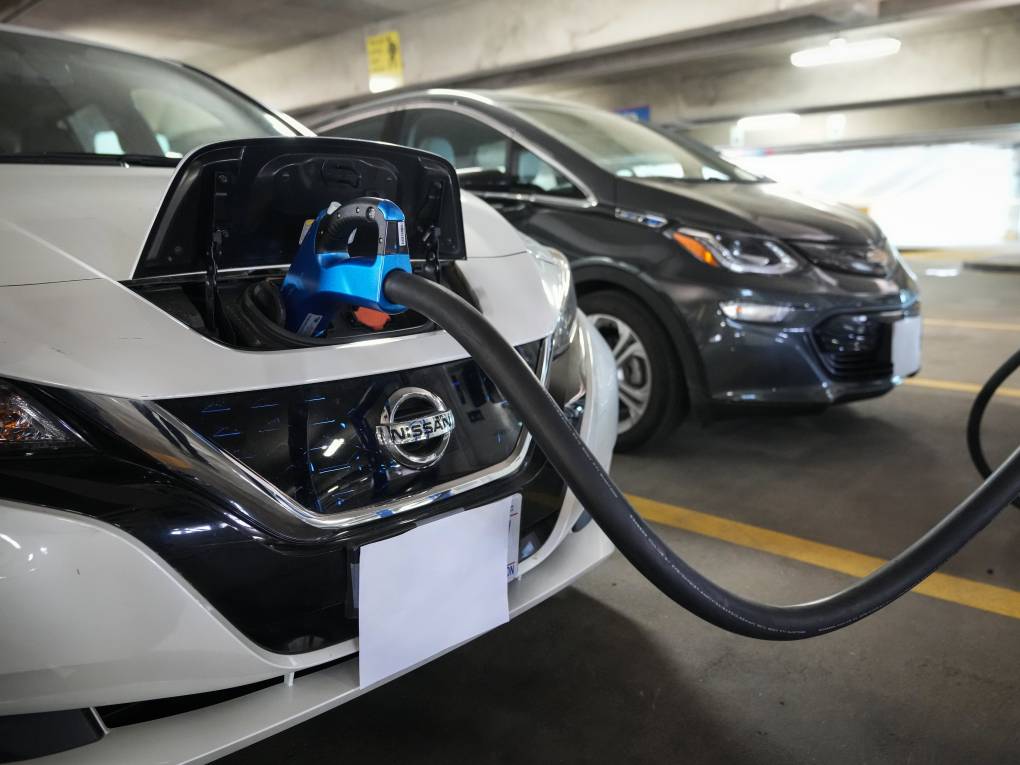
"content": "\u003cp>California voters decisively rejected a bid to raise billions of dollars for the state’s electric-vehicle infrastructure by increasing income taxes on its wealthiest residents — a measure staunchly opposed by Gov. Gavin Newsom and a coalition of business groups and billionaires.\u003c/p>\n\u003cp>Proposition 30 would have levied an additional 1.75% personal income tax on individual Californians or married couples who make more than $2 million a year, raising up to an estimated $5 billion annually.\u003c/p>\n\u003cp>The state would have been required to spend 80% of that revenue on electric-vehicle rebates and on the installation of charging stations in public places and residences. The remaining funds would have gone toward wildfire mitigation efforts.\u003c/p>\n\u003cp>Transportation is the largest source of planet-warming emissions in California, accounting for roughly 40%. Wildfires, meanwhile, are spewing tens of millions of tons of carbon into the air as they burn up California’s forests, threatening to set back the state’s progress on meeting its climate goals.[aside label=\"related coverage\" tag=\"electric-vehicles\"]The measure’s defeat marks a win for Newsom, who campaigned against it despite his administration’s moves to ban the sale of most new gas-powered cars next decade. He branded it a taxpayer-funded giveaway to rideshare companies, which, under California regulations, must ensure that nearly all trips booked through their services are zero-emission by 2030.\u003c/p>\n\u003cp>“California voters decisively rejected this poorly crafted and unnecessary tax hike,” the No campaign said in a statement. “The fact is Proposition 30 was a solution to an issue the state is already addressing.”\u003c/p>\n\u003cp>Environmental groups who backed Proposition 30 said it was a vital investment in the fight against climate change and bad air quality.\u003c/p>\n\u003cp>\u003ca href=\"https://electionresults.sos.ca.gov/returns/ballot-measures\">In early returns\u003c/a>, the measure had garnered just over 40% support.\u003c/p>\n\u003cp>“So little was actually discussed about the actual policy and so much was talked about the money,” said Steven Maviglio, spokesperson for the Yes campaign. “I think the early indicators and the polling showed that Californians really wanted some bold climate action, and that’s what Prop. 30 represented. Unfortunately, we had a governor who rallied against all his own programs that would be funded, for whatever reason. Still unclear.”\u003c/p>\n\u003cp>Notably, Newsom’s opposition split him from the California Democratic Party. He instead sided with conservatives, anti-tax and business groups and billionaires who spent millions to defeat it.\u003c/p>\n\u003cp>Newsom argued that Proposition 30 would disrupt the state’s finances and that it was unnecessary in California, which has already committed billions from its record budget surplus to funding electric-vehicle initiatives. He called the measure a corporate tax grab on the part of Lyft, the largest donor to the Yes campaign.\u003c/p>\n\u003cp>Support among likely voters for the measure started out high and over the summer hovered well above the 50% support it needed to pass, according to polls. But Newsom’s aggressive opposition to it found an audience with voters and chiseled away at that advantage.\u003c/p>\n\u003cp>At Newsom’s direction earlier this year, California air regulators adopted a ban on the sale of new cars that run solely on gasoline, starting in 2035. Car companies would have to sell vehicles powered by hydrogen or batteries, or hybrids that run on a gas-battery combo. People could still drive their gas-powered cars or buy used ones.\u003c/p>\n\u003cp>Newsom noted his administration has already dedicated $10 billion over the next six years to boost electric transportation.\u003c/p>\n\u003cp>Backers of the measure, including most major environmental groups, argued the state needs a dedicated, robust source of funding to set up infrastructure that can handle more plug-in cars and help Californians of all income levels buy them.\u003c/p>\n\u003cp>This year, about 18% of new car sales in California have been for fully electric or hybrid cars, according to Newsom’s office.\u003c/p>\n\u003cp>That will have to double by 2026 to meet new state mandates for car sales.\u003c/p>\n\u003cp>By 2045, the state wants to be “carbon neutral,” which means it wouldn’t put any emissions into the air that it can’t remove. That will require a massive reduction in emissions from vehicles and other sources, as well as the buildup of technologies that can capture carbon as it is emitted, or pull it from the air and store it underground.\u003c/p>\n\u003cp>\u003ci>This story includes reporting from The Associated Press.\u003c/i>\u003c/p>\n\u003cp>[ad fullwidth]\u003c/p>\n\u003cp>\u003c/p>\n",
"blocks": [],
"excerpt": "Proposition 30 would have levied an additional 1.75% personal income tax on individual Californians or married couples who make more than $2 million a year, raising up to an estimated $5 billion annually.",
"status": "publish",
"parent": 0,
"modified": 1726000720,
"stats": {
"hasAudio": false,
"hasVideo": false,
"hasChartOrMap": false,
"iframeSrcs": [],
"hasGoogleForm": false,
"hasGallery": false,
"hasHearkenModule": false,
"hasPolis": false,
"paragraphCount": 20,
"wordCount": 745
},
"headData": {
"title": "California Voters Reject Tax on Rich to Boost Electric Vehicle Use | KQED",
"description": "Proposition 30 would have levied an additional 1.75% personal income tax on individual Californians or married couples who make more than $2 million a year, raising up to an estimated $5 billion annually.",
"ogTitle": "",
"ogDescription": "",
"ogImgId": "",
"twTitle": "",
"twDescription": "",
"twImgId": "",
"schema": {
"@context": "https://schema.org",
"@type": "NewsArticle",
"headline": "California Voters Reject Tax on Rich to Boost Electric Vehicle Use",
"datePublished": "2022-11-08T23:59:43-08:00",
"dateModified": "2024-09-10T13:38:40-07:00",
"image": "https://cdn.kqed.org/wp-content/uploads/2020/02/KQED-OG-Image@1x.png",
"isAccessibleForFree": "True",
"publisher": {
"@type": "NewsMediaOrganization",
"@id": "https://www.kqed.org/#organization",
"name": "KQED",
"logo": "https://cdn.kqed.org/wp-content/uploads/2020/02/KQED-OG-Image@1x.png",
"url": "https://www.kqed.org",
"sameAs": [
"https://www.facebook.com/KQED",
"https://twitter.com/KQED",
"https://www.instagram.com/kqed/",
"https://www.tiktok.com/@kqedofficial",
"https://www.linkedin.com/company/kqed",
"https://www.youtube.com/channel/UCeC0IOo7i1P_61zVUWbJ4nw"
]
}
}
},
"sticky": false,
"WpOldSlug": "elex-pre-write-prop-30",
"excludeFromSiteSearch": "Include",
"path": "/news/11931410/california-voters-reject-tax-on-rich-to-boost-electric-vehicle-use",
"audioTrackLength": null,
"parsedContent": [
{
"type": "contentString",
"content": "\u003cdiv class=\"post-body\">\u003cp>\u003cp>California voters decisively rejected a bid to raise billions of dollars for the state’s electric-vehicle infrastructure by increasing income taxes on its wealthiest residents — a measure staunchly opposed by Gov. Gavin Newsom and a coalition of business groups and billionaires.\u003c/p>\n\u003cp>Proposition 30 would have levied an additional 1.75% personal income tax on individual Californians or married couples who make more than $2 million a year, raising up to an estimated $5 billion annually.\u003c/p>\n\u003cp>The state would have been required to spend 80% of that revenue on electric-vehicle rebates and on the installation of charging stations in public places and residences. The remaining funds would have gone toward wildfire mitigation efforts.\u003c/p>\n\u003cp>Transportation is the largest source of planet-warming emissions in California, accounting for roughly 40%. Wildfires, meanwhile, are spewing tens of millions of tons of carbon into the air as they burn up California’s forests, threatening to set back the state’s progress on meeting its climate goals.\u003c/p>\u003c/div>",
"attributes": {
"named": {},
"numeric": []
}
},
{
"type": "component",
"content": "",
"name": "aside",
"attributes": {
"named": {
"label": "related coverage ",
"tag": "electric-vehicles"
},
"numeric": []
}
},
{
"type": "contentString",
"content": "\u003cdiv class=\"post-body\">\u003cp>The measure’s defeat marks a win for Newsom, who campaigned against it despite his administration’s moves to ban the sale of most new gas-powered cars next decade. He branded it a taxpayer-funded giveaway to rideshare companies, which, under California regulations, must ensure that nearly all trips booked through their services are zero-emission by 2030.\u003c/p>\n\u003cp>“California voters decisively rejected this poorly crafted and unnecessary tax hike,” the No campaign said in a statement. “The fact is Proposition 30 was a solution to an issue the state is already addressing.”\u003c/p>\n\u003cp>Environmental groups who backed Proposition 30 said it was a vital investment in the fight against climate change and bad air quality.\u003c/p>\n\u003cp>\u003ca href=\"https://electionresults.sos.ca.gov/returns/ballot-measures\">In early returns\u003c/a>, the measure had garnered just over 40% support.\u003c/p>\n\u003cp>“So little was actually discussed about the actual policy and so much was talked about the money,” said Steven Maviglio, spokesperson for the Yes campaign. “I think the early indicators and the polling showed that Californians really wanted some bold climate action, and that’s what Prop. 30 represented. Unfortunately, we had a governor who rallied against all his own programs that would be funded, for whatever reason. Still unclear.”\u003c/p>\n\u003cp>Notably, Newsom’s opposition split him from the California Democratic Party. He instead sided with conservatives, anti-tax and business groups and billionaires who spent millions to defeat it.\u003c/p>\n\u003cp>Newsom argued that Proposition 30 would disrupt the state’s finances and that it was unnecessary in California, which has already committed billions from its record budget surplus to funding electric-vehicle initiatives. He called the measure a corporate tax grab on the part of Lyft, the largest donor to the Yes campaign.\u003c/p>\n\u003cp>Support among likely voters for the measure started out high and over the summer hovered well above the 50% support it needed to pass, according to polls. But Newsom’s aggressive opposition to it found an audience with voters and chiseled away at that advantage.\u003c/p>\n\u003cp>At Newsom’s direction earlier this year, California air regulators adopted a ban on the sale of new cars that run solely on gasoline, starting in 2035. Car companies would have to sell vehicles powered by hydrogen or batteries, or hybrids that run on a gas-battery combo. People could still drive their gas-powered cars or buy used ones.\u003c/p>\n\u003cp>Newsom noted his administration has already dedicated $10 billion over the next six years to boost electric transportation.\u003c/p>\n\u003cp>Backers of the measure, including most major environmental groups, argued the state needs a dedicated, robust source of funding to set up infrastructure that can handle more plug-in cars and help Californians of all income levels buy them.\u003c/p>\n\u003cp>This year, about 18% of new car sales in California have been for fully electric or hybrid cars, according to Newsom’s office.\u003c/p>\n\u003cp>That will have to double by 2026 to meet new state mandates for car sales.\u003c/p>\n\u003cp>By 2045, the state wants to be “carbon neutral,” which means it wouldn’t put any emissions into the air that it can’t remove. That will require a massive reduction in emissions from vehicles and other sources, as well as the buildup of technologies that can capture carbon as it is emitted, or pull it from the air and store it underground.\u003c/p>\n\u003cp>\u003ci>This story includes reporting from The Associated Press.\u003c/i>\u003c/p>\n\u003cp>\u003c/p>\u003c/div>",
"attributes": {
"named": {},
"numeric": []
}
},
{
"type": "component",
"content": "",
"name": "ad",
"attributes": {
"named": {
"label": "fullwidth"
},
"numeric": [
"fullwidth"
]
}
},
{
"type": "contentString",
"content": "\u003cdiv class=\"post-body\">\u003cp>\u003c/p>\n\u003cp>\u003c/p>\n\u003c/div>\u003c/p>",
"attributes": {
"named": {},
"numeric": []
}
}
],
"link": "/news/11931410/california-voters-reject-tax-on-rich-to-boost-electric-vehicle-use",
"authors": [
"11608"
],
"categories": [
"news_34165",
"news_19906",
"news_8"
],
"tags": [
"news_255",
"news_30879",
"news_21348",
"news_16",
"news_4524",
"news_17602"
],
"featImg": "news_11923225",
"label": "news"
},
"news_11901288": {
"type": "posts",
"id": "news_11901288",
"meta": {
"index": "posts_1716263798",
"site": "news",
"id": "11901288",
"score": null,
"sort": [
1667469635000
]
},
"guestAuthors": [],
"slug": "you-cant-recycle-your-way-out-californias-plastic-problem-and-what-to-do-about-it",
"title": "'You Can't Recycle Your Way Out': California's Plastic Problem and What We Can Do About It",
"publishDate": 1667469635,
"format": "standard",
"headTitle": "‘You Can’t Recycle Your Way Out’: California’s Plastic Problem and What We Can Do About It | KQED",
"labelTerm": {
"term": 33523,
"site": "news"
},
"content": "\u003cp>\u003cem>Updated Nov. 2, 2022: This story was originally published Jan. 24, 2022. Since then, \u003ca href=\"https://leginfo.legislature.ca.gov/faces/billTextClient.xhtml?bill_id=202120220SB54\">a version of Senate Bill 54\u003c/a>, covered in this article, was signed into law in June. The new law requires most single-use plastic packaging and foodware be reusable, compostable, refillable or recyclable by 2032 — with definitions for what is “recyclable” to be set by state agency CalRecycle. Plastic producers will also be required to pay into a plastic pollution mitigation fund. Because of the passage of SB 54, proponents of a voter initiative addressing very similar goals removed their measure from the November 2022 ballot.\u003c/em>\u003c/p>\n\u003cp>\u003cstrong>Original Article:\u003c/strong>\u003c/p>\n\u003cp>California dumps more than 12,000 tons of plastic into landfills every day — enough to fill 219 Olympic-size swimming pools, according to \u003ca href=\"https://www2.calrecycle.ca.gov/Publications/Details/1666\">CalRecycle\u003c/a>, the state’s recycling and waste management agency. The state boasts one of the highest recycling rates in the country, especially of cans and bottles, but despite decades of investment in infrastructure and machinery, the system remains overwhelmed by plastic.\u003c/p>\n\u003cp>A trip to a recycling processing center helps explain why.\u003c/p>\n\u003cp>Inside one of Republic Services’ massive facilities in Milpitas, an impressive array of high-tech machines sort through tons of material from residents’ recycling bins, separating metal from plastic from paper. Some of the machines use magnets, eddy currents or puffs of air blown through hundreds of nozzles to sort the materials; others identify different kinds of plastic with optical scanners. Whizzing conveyor belts ferry it all from one machine to the next, until the recyclables are sorted, baled, and eventually shipped and sold.\u003c/p>\n\u003ch3>Not all plastic is created equal\u003c/h3>\n\u003cp>One of plastic recycling’s success stories is HDPE, or high-density polyethylene, the translucent plastic commonly used in milk jugs, shampoo bottles and cutting boards.\u003c/p>\n\u003cp>“In today’s marketplace, this is the most valuable commodity that we produce at this location,” said Pete Keller, the company’s vice president of sustainability. “These materials are non-pigmented, so any downstream consumer of this material could turn it into any color they want to.”\u003c/p>\n\u003cp>HDPE is currently fetching a price of $1 per pound, or over $2,000 per ton, according to Keller. “I wish we had more of it,” he said.\u003c/p>\n\u003cp>That price is partially driven by demand resulting from so-called sustainability commitments major manufacturers have made to use recycled plastic. Naked Juice, for instance, \u003ca href=\"https://www.nakedjuice.com/goodness-outside/\">makes its juice bottles\u003c/a> from 100% post-consumer recycled plastic, while Danone has \u003ca href=\"https://www.danone.com/impact/planet/packaging-positive-circular-economy.html\">pledged\u003c/a> to make all of its evian water bottles from 100% recycled plastic by 2025.\u003c/p>\n\u003cp>https://youtu.be/-bTCCB6wbks\u003c/p>\n\u003cp>In a push to boost demand for plastic that is recycled, like HDPE, California lawmakers in 2020 passed a “minimum recycled content” bill. \u003ca href=\"https://leginfo.legislature.ca.gov/faces/billNavClient.xhtml?bill_id=201920200AB793\">Assembly Bill 793\u003c/a>, which went into effect on Jan. 1, mandates that most plastic beverage bottles contain a minimum amount of recycled content. Specifically, all plastic bottles that can be redeemed for $0.05 or $0.10 must contain no less than:\u003c/p>\n\u003cul>\n\u003cli>15% recycled plastic starting Jan. 1, 2022\u003c/li>\n\u003cli>25% recycled plastic starting Jan. 1, 2025\u003c/li>\n\u003cli>50% recycled plastic starting Jan. 1, 2030\u003c/li>\n\u003c/ul>\n\u003cp>The law, one of the first of its kind in the nation, is targeted at bottle manufacturers, most of whom still use new plastic — or “virgin resin” — which is typically cheaper than recycled plastic.\u003c/p>\n\u003cfigure id=\"attachment_11901454\" class=\"wp-caption alignnone\" style=\"max-width: 800px\">\u003cimg loading=\"lazy\" decoding=\"async\" class=\"wp-image-11901454 size-medium\" src=\"https://ww2.kqed.org/app/uploads/sites/10/2022/01/RS52999_IMG_5331_v2-qut-800x450.jpeg\" alt=\"Workers in green safety jackets and helmets sort trash along a conveyor belt. \" width=\"800\" height=\"450\" srcset=\"https://cdn.kqed.org/wp-content/uploads/sites/10/2022/01/RS52999_IMG_5331_v2-qut-800x450.jpeg 800w, https://cdn.kqed.org/wp-content/uploads/sites/10/2022/01/RS52999_IMG_5331_v2-qut-1020x574.jpeg 1020w, https://cdn.kqed.org/wp-content/uploads/sites/10/2022/01/RS52999_IMG_5331_v2-qut-160x90.jpeg 160w, https://cdn.kqed.org/wp-content/uploads/sites/10/2022/01/RS52999_IMG_5331_v2-qut-1536x864.jpeg 1536w, https://cdn.kqed.org/wp-content/uploads/sites/10/2022/01/RS52999_IMG_5331_v2-qut.jpeg 1920w\" sizes=\"auto, (max-width: 800px) 100vw, 800px\">\u003cfigcaption class=\"wp-caption-text\">Workers at Recology’s San Francisco recycling facility pick out plastic that can’t be recycled, including plastic bags, on July 16, 2021. \u003ccite>(Monica Lam/KQED)\u003c/cite>\u003c/figcaption>\u003c/figure>\n\u003cp>In addition to HDPE, PET plastic, or polyethylene terephthalate, can be recycled into clamshells — the clear boxes that strawberries are often packed in — or spun into polyester for clothing. Some denser plastics can also be recycled into pipes, plastic lumber, carpets or buckets.\u003c/p>\n\u003cp>But current recycling markets only accept a fraction of the plastic that’s marked with the three-arrow recycling symbol. Until a few years ago, this problem was largely concealed because the U.S. shipped most of its plastic waste to China, where it was ostensibly being recycled. But in 2018, citing its own environmental concerns, \u003ca href=\"https://www.nature.com/articles/s41467-020-20741-9#:~:text=In%202017%2C%20China%20announced%20an,are%20enormous%20but%20yet%20unexamined\">China began banning imports of most solid materials\u003c/a>, including most plastics.\u003c/p>\n\u003cp>That’s forcing domestic recyclers to confront the real challenges of recycling plastic. For one, plastic comes in a myriad of chemical formulations, densities, transparencies and colors. Many products are made of mixed materials: a bottle of hand soap, for example, might contain four different kinds of plastic, plus a metal spring nestled inside the pump.\u003c/p>\n\u003cp>Even if there were markets for all these different kinds of plastic, sorting and separating them would be a gargantuan task.\u003c/p>\n\u003cp>“There’s just so many types of plastic. We can’t recycle them all. We can’t manage them all,” said Robert Reed, public relations manager for Recology, which handles San Francisco’s waste and recycling. “You can’t recycle your way out of the larger plastic problem.”\u003c/p>\n\u003cp>So most plastic — in fact, almost all of it — ends up in landfills: plastic forks and knives, coffee cups and takeout boxes, used cosmetics, styrofoam trays, and most kinds of plastic bags, from shopping bags to those used for frozen peas.\u003c/p>\n\u003cfigure id=\"attachment_11901455\" class=\"wp-caption alignnone\" style=\"max-width: 800px\">\u003cimg loading=\"lazy\" decoding=\"async\" class=\"wp-image-11901455 size-medium\" src=\"https://ww2.kqed.org/app/uploads/sites/10/2022/01/RS53000_IMG_5387_edit_v3-qut-800x532.jpeg\" alt=\"Three men talk underneath an open-air canopy in a parking lot. \" width=\"800\" height=\"532\" srcset=\"https://cdn.kqed.org/wp-content/uploads/sites/10/2022/01/RS53000_IMG_5387_edit_v3-qut-800x532.jpeg 800w, https://cdn.kqed.org/wp-content/uploads/sites/10/2022/01/RS53000_IMG_5387_edit_v3-qut-1020x678.jpeg 1020w, https://cdn.kqed.org/wp-content/uploads/sites/10/2022/01/RS53000_IMG_5387_edit_v3-qut-160x106.jpeg 160w, https://cdn.kqed.org/wp-content/uploads/sites/10/2022/01/RS53000_IMG_5387_edit_v3-qut-1536x1021.jpeg 1536w, https://cdn.kqed.org/wp-content/uploads/sites/10/2022/01/RS53000_IMG_5387_edit_v3-qut.jpeg 1920w\" sizes=\"auto, (max-width: 800px) 100vw, 800px\">\u003cfigcaption class=\"wp-caption-text\">State Assemblymember Phil Ting visits a prototype for a mobile recycling program that aims to bring recycling collection trucks to various San Francisco neighborhoods, on July 16, 2021. \u003ccite>(Monica Lam/KQED)\u003c/cite>\u003c/figcaption>\u003c/figure>\n\u003ch3>Legislative efforts bogged down\u003c/h3>\n\u003cp>San Francisco Democratic Assemblymember Phil Ting, who introduced AB 793, has tried to expand the law’s reach by proposing a similar bill requiring the recycling of \u003ca href=\"https://leginfo.legislature.ca.gov/faces/billNavClient.xhtml?bill_id=202120220AB478\">thermoform plastic\u003c/a>, a group of plastics formed using heat. That legislation, however, got bogged down last year over concerns that infrastructure wasn’t yet in place to accommodate an additional plastic recycling mandate.\u003c/p>\n\u003cp>In fact, many of the more ambitious plastic recycling-related bills floated last year didn’t survive, including \u003ca href=\"https://leginfo.legislature.ca.gov/faces/billVotesClient.xhtml?bill_id=202120220AB1371\">AB 1371\u003c/a>, introduced by state Assemblymember Laura Friedman, D-Burbank, which would have banned the use of plastic packaging for online purchases. The bill failed to receive the 41 votes necessary to make it out of the Assembly.\u003c/p>\n\u003cp>“Globally, the e-commerce industry uses nearly 2.1 billion, with a ‘B,’ pounds of plastic packaging. … With almost a third of the world’s population now buying online, the amount of plastic packaging generated is estimated to double by 2025,” Friedman told the Assembly Natural Resources Committee last April. “This is low-hanging fruit, members, and something that is really, really a scourge.”[pullquote size=\"medium\" align=\"right\" citation=\"Jennifer Fearing, president, Fearless Advocacy\"]‘I can’t tell you and point to a particular member of the Legislature who’s been ‘bought,’ but I can tell you, we are deeply outgunned on the environmental front.’[/pullquote]“Even with our super-duper Democratic majority and consistently two-thirds of Californians saying this is a huge problem that needs to get addressed, we have really struggled to get enough votes,” said Jennifer Fearing, an environmental lobbyist who helped promote AB 1371.\u003c/p>\n\u003cp>Meanwhile, state Sen. Ben Allen, D-Santa Monica, last year shelved \u003ca href=\"https://leginfo.legislature.ca.gov/faces/billNavClient.xhtml?bill_id=202120220SB54\">SB 54\u003c/a>, his bill to ban all single-use plastic products that aren’t recyclable or compostable — opting to buy more time to work out details with various stakeholders, in the face of formidable industry opposition.\u003c/p>\n\u003ch3>‘Deeply outgunned’\u003c/h3>\n\u003cp>The list of trade groups that weighed in against the bill underscores the depth of plastic’s reach within multiple industries. During an early hearing on SB 54, associations representing farming and agriculture, pet food, personal care, household products and restaurants voiced their opposition — in addition to the Plastics Industry Association, the American Institute for Packaging and the Environment, and the Flexible Packaging Association.\u003c/p>\n\u003cp>“I can’t tell you and point to a particular member of the Legislature who’s been ‘bought,’” said Fearing. “But I can tell you, we are deeply outgunned on the environmental front.”[aside postID=news_11898724,news_11883400,lowdown_29456 label=\"Related Stories\"]More incremental efforts to reduce plastic waste, however, have proved fruitful, including a \u003ca href=\"https://leginfo.legislature.ca.gov/faces/billNavClient.xhtml?bill_id=202120220SB343\">“Truth in Labeling” bill\u003c/a>, approved by lawmakers last year, which prohibits manufacturers from calling their products recyclable or using recycling symbols or other suggestions of recyclability unless they meet CalRecycle’s criteria. The agency has until Jan. 1, 2024, to formalize a list of products it deems recyclable.\u003c/p>\n\u003cp>Tim Shestek, the American Chemistry Council’s senior director of state affairs, said his organization opposed SB 54 and several other bills last year because they failed to recognize why so many businesses use plastic over other materials in the first place: its durability and value.\u003c/p>\n\u003cp>“Does it go too far? Does it provide opportunities for the business community to comply in a reasonable fashion?” Shestek said. “In our view, it didn’t take into account some of the other trade-offs that we like to discuss: lightweighting, fuel efficiency, greenhouse gas emissions associated with potential alternatives.”\u003c/p>\n\u003cp>Still, Shestek acknowledged that more can be done to cut down on plastic waste. His group, for example, has \u003ca href=\"https://www.americanchemistry.com/chemistry-in-america/chemistry-sustainability/circularity\">set goals\u003c/a> for its members to produce 100% recyclable plastic packaging containing at least 30% recycled plastic by 2030.\u003c/p>\n\u003cp>“Our focus is trying to get that circular loop completely closed and to be part of the solution,” he said. “I think we recognize that we have a role to play.”\u003c/p>\n\u003cfigure id=\"attachment_11901452\" class=\"wp-caption alignnone\" style=\"max-width: 800px\">\u003cimg loading=\"lazy\" decoding=\"async\" class=\"wp-image-11901452 size-medium\" src=\"https://ww2.kqed.org/app/uploads/sites/10/2022/01/RS52997_DSC_1513_edit-qut-800x450.jpeg\" alt=\"Two women standing near the bay pour water samples.\" width=\"800\" height=\"450\" srcset=\"https://cdn.kqed.org/wp-content/uploads/sites/10/2022/01/RS52997_DSC_1513_edit-qut-800x450.jpeg 800w, https://cdn.kqed.org/wp-content/uploads/sites/10/2022/01/RS52997_DSC_1513_edit-qut-1020x574.jpeg 1020w, https://cdn.kqed.org/wp-content/uploads/sites/10/2022/01/RS52997_DSC_1513_edit-qut-160x90.jpeg 160w, https://cdn.kqed.org/wp-content/uploads/sites/10/2022/01/RS52997_DSC_1513_edit-qut-1536x864.jpeg 1536w, https://cdn.kqed.org/wp-content/uploads/sites/10/2022/01/RS52997_DSC_1513_edit-qut.jpeg 1920w\" sizes=\"auto, (max-width: 800px) 100vw, 800px\">\u003cfigcaption class=\"wp-caption-text\">Rebecca Sutton, left, and Alicia Gilbreath of the San Francisco Estuary Institute strain water collected from the San Francisco Bay through two sieves to sample for microplastics. \u003ccite>(Monica Lam/KQED)\u003c/cite>\u003c/figcaption>\u003c/figure>\n\u003ch3>Microplastics and human health\u003c/h3>\n\u003cp>Since plastic was first invented in the mid-1800s, worldwide production has grown to an estimated 400 million tons annually. In the U.S., \u003ca href=\"https://www.epa.gov/facts-and-figures-about-materials-waste-and-recycling/plastics-material-specific-data\">less than 9%\u003c/a> of plastic gets recycled, according to U.S. Environmental Protection Agency estimates. Meanwhile, the production of plastic, which is made from petroleum and natural gas, is projected to increase as the fossil-fuel industry faces competition from alternative energy sources. Dozens of plastic plants are currently being built or planned, most of them on the Gulf Coast and in the Ohio River Valley.\u003c/p>\n\u003cp>While a fair bit of attention has been paid to the impact of plastic pollution on marine animals, who often ingest it, research on human health has only recently started to ramp up. In 2018, California legislators directed the State Water Resources Control Board to \u003ca href=\"https://leginfo.legislature.ca.gov/faces/billNavClient.xhtml?bill_id=201720180SB1422\">start studying levels of microplastics\u003c/a> — plastic particles smaller than 5 millimeters — detected in municipal drinking water supplies. Some microplastics, like those used in adhesives or paints, are manufactured at a small size, while some are generated when larger pieces of plastic degrade over time. [pullquote size=\"medium\" align=\"right\" citation=\"Scott Coffin, senior scientist, California State Water Resources Control Board\"]‘I think a better question would be, where have microplastics not been found? We’ve found them from Mount Everest to the Mariana Trench. … I’m not sure that there exists a place that is not impacted by plastic pollution.’[/pullquote]“One of the reasons that plastic in drinking water has received recent attention, especially by California’s legislators, is that we know that the amount is increasing,” said Scott Coffin, a senior scientist with the state water board. “Additionally, plastic never goes away. So these two factors, they necessitate some concern.”\u003c/p>\n\u003cp>Coffin’s team is tasked with eventually establishing safety thresholds for the level of microplastics in the state’s water supply. He estimates that there are more than \u003ca href=\"https://pubs.acs.org/doi/10.1021/acs.est.1c00976\">2,400 chemicals\u003c/a> commonly added to plastic that are potentially dangerous for human health, including known toxins like bisphenol A (commonly known as BPA), phthalates, and a class of flame retardants called \u003ca href=\"https://oceanservice.noaa.gov/facts/pbde.html\">PBDEs\u003c/a>, or polybrominated diphenyl ethers.\u003c/p>\n\u003cp>“You can think of plastic as a carrier for other chemicals, and in many ways, it’s like a sponge,” Coffin said. “Once it’s in the environment, it can pick up all of the other pollutants that are already there.”\u003c/p>\n\u003cp>Some microplastics are even small enough to enter into our cells, he noted. \u003ca href=\"https://www.mdpi.com/1999-4923/13/7/921\">One German study\u003c/a> found microplastics in the placentas of pregnant women — on both the maternal and fetal side.\u003c/p>\n\u003cp>“The smaller the particle, the deeper it’s going to make it into our bodies, and the more likely it is to interact with our cells, causing toxicity,” Coffin said.\u003c/p>\n\u003cp>One major \u003ca href=\"https://www.sfei.org/projects/microplastics\">study \u003c/a>published in 2019 by the San Francisco Estuary Institute found microplastics throughout the San Francisco Bay — in the water, the mud, and both stormwater runoff and treated wastewater. The study’s authors concluded that the bay likely has higher levels of microplastic pollution than most major water bodies in the United States because it’s surrounded by dense, urban areas and has a relatively restricted water flow. The two most common particles found were fibers from clothing and bits from tires.\u003c/p>\n\u003cp>“We found microplastics in just about every sample we collected,” said Rebecca Sutton, who led the three-year study. “This is pretty consistent with what you see all around the world. Pretty much everywhere you look for it, you are going to find microplastics.”\u003c/p>\n\u003cp>Coffin echoed that sentiment.\u003c/p>\n\u003cp>“I think a better question would be, where have microplastics not been found?” he said. “We’ve found them from Mount Everest to the Mariana Trench. Every organism that we’ve ever looked at, we’ve found some levels, and at this point, I’m not sure that there exists a place that is not impacted by plastic pollution.”\u003c/p>\n\u003ch3>The climate change impact\u003c/h3>\n\u003cp>With that grim assessment in mind, the students in Jacqueline Omania’s fifth grade class at Oxford Elementary in Berkeley have set themselves an ambitious goal: to make so little trash over the course of the school year that the entire class’s garbage fits into a tiny little container about the size of a jam jar.\u003c/p>\n\u003cp>“The larger issue is that these youth are growing up in a climate crisis,” said Omania.\u003c/p>\n\u003cp>The main type of trash that ends up in the class’s container is plastic, so for starters, every student brings a reusable cutlery kit to school to use while eating lunch. Inside the classroom, they use unpainted pencils so that the shavings can be composted. Birthday parties feature home-baked treats instead of anything that comes in a plastic wrapper.\u003c/p>\n\u003cp>Omania’s students were part of a successful campaign to pass a citywide ordinance in 2019 \u003ca href=\"https://www.berkeleyside.org/2019/01/23/berkeley-says-good-riddance-mostly-to-disposable-plastic-foodware\">limiting single-use plastics in Berkeley restaurants\u003c/a>. Her students even showed city councilmembers the tiny container they were using as a garbage can.\u003c/p>\n\u003cfigure id=\"attachment_11901451\" class=\"wp-caption alignnone\" style=\"max-width: 800px\">\u003cimg loading=\"lazy\" decoding=\"async\" class=\"wp-image-11901451 size-medium\" src=\"https://ww2.kqed.org/app/uploads/sites/10/2022/01/RS52996_Copy-of-beach-cleanup-2_edit-qut-800x450.jpeg\" alt=\"Three young people stand on a rock pile. One hands an orange bucket to another.\" width=\"800\" height=\"450\" srcset=\"https://cdn.kqed.org/wp-content/uploads/sites/10/2022/01/RS52996_Copy-of-beach-cleanup-2_edit-qut-800x450.jpeg 800w, https://cdn.kqed.org/wp-content/uploads/sites/10/2022/01/RS52996_Copy-of-beach-cleanup-2_edit-qut-1020x574.jpeg 1020w, https://cdn.kqed.org/wp-content/uploads/sites/10/2022/01/RS52996_Copy-of-beach-cleanup-2_edit-qut-160x90.jpeg 160w, https://cdn.kqed.org/wp-content/uploads/sites/10/2022/01/RS52996_Copy-of-beach-cleanup-2_edit-qut-1536x864.jpeg 1536w, https://cdn.kqed.org/wp-content/uploads/sites/10/2022/01/RS52996_Copy-of-beach-cleanup-2_edit-qut.jpeg 1920w\" sizes=\"auto, (max-width: 800px) 100vw, 800px\">\u003cfigcaption class=\"wp-caption-text\">Students Sam (left), Alina and Sasha pick up trash off the beach at the Berkeley Marina, Oct. 7, 2021. \u003ccite>(Rick Santangelo/KQED)\u003c/cite>\u003c/figcaption>\u003c/figure>\n\u003cp>“I believe the adults need to step up so we don’t make the environmental waste in the first place,” Oxford student Jae Marie Howard told a crowded council meeting on the night the ordinance was approved.\u003c/p>\n\u003cp>More recently, Omania’s students helped successfully push the Berkeley Unified School District to include \u003ca href=\"https://www.dailycal.org/2021/11/04/berkeley-school-board-passes-65k-climate-literacy-resolution/\">climate literacy in the K-12 curriculum\u003c/a>.\u003c/p>\n\u003cp>[pullquote size=\"medium\" align=\"right\" citation=\"Jacqueline Omania, teacher, Oxford Elementary\"]‘The larger issue is that these youth are growing up in a climate crisis.’[/pullquote]An increasing number of studies draw a connection between the production of plastic and climate change. One \u003ca href=\"https://www.beyondplastics.org/plastics-and-climate\">report\u003c/a> from a Vermont-based environmental group found that “as of 2020, the U.S. plastics industry is responsible for at least 232 million tons of CO2e [carbon dioxide equivalent] gas emissions per year. This amount is equivalent to the average emissions from 116 average-sized [500-megawatt] coal-fired power plants.”\u003c/p>\n\u003ch3>New opportunities\u003c/h3>\n\u003cp>Entrepreneurs have been tapping into growing public awareness about plastic waste. Dispatch Goods, a San Francisco-based start-up, is partnering with local restaurants, like Zuni Cafe and Mixt, to provide reusable takeout containers made of stainless steel. Customers must pay extra for the service, which includes picking up the used containers from their homes, but many do it willingly because it alleviates “eco-guilt,” said company CEO Lindsey Hoell.\u003c/p>\n\u003cp>It’s like an “avocado upcharge,” she said.\u003c/p>\n\u003cp>“We have data showing that we’re driving business to restaurants that are making that shift,” she added. “It’s not just a sustainability decision, but it’s a good business decision.”\u003c/p>\n\u003cp>[ad fullwidth]At Fillgood’s small storefront in Berkeley, customers can refill their own containers with common household products like dish detergent and shampoo, while LimeLoop, another Bay Area-based start-up, makes reusable packaging for shipping — among the growing number of novel business ventures offering alternatives to plastic.\u003c/p>\n\u003cp>This fall, Californians will get to weigh in directly on just how much the state should regulate and limit plastic production and consumption. The \u003ca href=\"https://ballotpedia.org/California_Plastic_Waste_Reduction_Regulations_Initiative_(2022)\">California Plastic Waste Reduction Regulations Initiative\u003c/a>, which has qualified for the statewide ballot in November, would not only push through some of the efforts legislators failed to pass last year, but also levy a $0.01 fee — which critics call a tax — on all plastic packaging and disposable food service items.\u003c/p>\n\u003cp>The ACC’s Shestek said the ballot measure is “flawed” and hopes instead to work directly with lawmakers “to hash something out that gets to the same objective, but in a fashion that isn’t so punitive.”\u003c/p>\n\u003cp>But Allen, the state lawmaker, sees the initiative as a good opportunity to advance his SB 54 legislation, banning single-use plastic products that aren’t recyclable or compostable. He’s confident, he said, the business community will work with him to avoid the costly political hurdle of winning a statewide vote. He’s already moved the bill out of the inactive file and back to the Senate floor to be considered during the 2022 legislative session.\u003c/p>\n\u003cp>“The ballot measure polls very well. It’s very popular,” Allen said. “And while it’s true [that] industry could raise a lot of money and try to defeat it, I think there’s also going to be some serious money raised on the environmental side. It could really be a knock-down-drag-out fight at the end of the day.”\u003c/p>\n\u003cp>\u003cem>KQED’s Crystal Consaul and Kat Shok contributed to this story. Want more? Check out our half-hour documentary on this topic, \u003ca href=\"https://www.youtube.com/watch?v=-bTCCB6wbks\">California’s Plastic Problem\u003c/a>. Are you a teacher? Here’s more about Jacqueline Omania’s \u003ca href=\"https://sites.google.com/bennington.edu/plastic-free-planet/home?authuser=0\">curriculum\u003c/a>.\u003c/em>\u003c/p>\n\u003cp>[ad floatright]\u003c/p>\n",
"blocks": [],
"excerpt": "Like much of the rest of the world, California uses and discards far more plastic than it has the capacity to recycle, with about 4.5 million tons ending up in landfills every year. But some state lawmakers and new business ventures are aiming to significantly reduce that amount of waste.",
"status": "publish",
"parent": 0,
"modified": 1740011943,
"stats": {
"hasAudio": false,
"hasVideo": false,
"hasChartOrMap": false,
"iframeSrcs": [],
"hasGoogleForm": false,
"hasGallery": false,
"hasHearkenModule": false,
"hasPolis": false,
"paragraphCount": 54,
"wordCount": 3183
},
"headData": {
"title": "'You Can't Recycle Your Way Out': California's Plastic Problem and What We Can Do About It | KQED",
"description": "Every year 4.5 million tons of plastic end up in California landfills because the amount produced and used far outstrips our ability to recycle it.",
"ogTitle": "",
"ogDescription": "",
"ogImgId": "",
"twTitle": "",
"twDescription": "",
"twImgId": "",
"socialDescription": "Every year 4.5 million tons of plastic end up in California landfills because the amount produced and used far outstrips our ability to recycle it.",
"schema": {
"@context": "https://schema.org",
"@type": "NewsArticle",
"headline": "'You Can't Recycle Your Way Out': California's Plastic Problem and What We Can Do About It",
"datePublished": "2022-11-03T03:00:35-07:00",
"dateModified": "2025-02-19T16:39:03-08:00",
"image": "https://cdn.kqed.org/wp-content/uploads/2020/02/KQED-OG-Image@1x.png",
"isAccessibleForFree": "True",
"publisher": {
"@type": "NewsMediaOrganization",
"@id": "https://www.kqed.org/#organization",
"name": "KQED",
"logo": "https://cdn.kqed.org/wp-content/uploads/2020/02/KQED-OG-Image@1x.png",
"url": "https://www.kqed.org",
"sameAs": [
"https://www.facebook.com/KQED",
"https://twitter.com/KQED",
"https://www.instagram.com/kqed/",
"https://www.tiktok.com/@kqedofficial",
"https://www.linkedin.com/company/kqed",
"https://www.youtube.com/channel/UCeC0IOo7i1P_61zVUWbJ4nw"
]
}
}
},
"audioUrl": "https://dcs.megaphone.fm/KQINC1521122259.mp3?key=0ab206398a489a3e4172db531d5775f2",
"sticky": false,
"excludeFromSiteSearch": "Include",
"path": "/news/11901288/you-cant-recycle-your-way-out-californias-plastic-problem-and-what-to-do-about-it",
"audioTrackLength": null,
"parsedContent": [
{
"type": "contentString",
"content": "\u003cdiv class=\"post-body\">\u003cp>\u003cp>\u003cem>Updated Nov. 2, 2022: This story was originally published Jan. 24, 2022. Since then, \u003ca href=\"https://leginfo.legislature.ca.gov/faces/billTextClient.xhtml?bill_id=202120220SB54\">a version of Senate Bill 54\u003c/a>, covered in this article, was signed into law in June. The new law requires most single-use plastic packaging and foodware be reusable, compostable, refillable or recyclable by 2032 — with definitions for what is “recyclable” to be set by state agency CalRecycle. Plastic producers will also be required to pay into a plastic pollution mitigation fund. Because of the passage of SB 54, proponents of a voter initiative addressing very similar goals removed their measure from the November 2022 ballot.\u003c/em>\u003c/p>\n\u003cp>\u003cstrong>Original Article:\u003c/strong>\u003c/p>\n\u003cp>California dumps more than 12,000 tons of plastic into landfills every day — enough to fill 219 Olympic-size swimming pools, according to \u003ca href=\"https://www2.calrecycle.ca.gov/Publications/Details/1666\">CalRecycle\u003c/a>, the state’s recycling and waste management agency. The state boasts one of the highest recycling rates in the country, especially of cans and bottles, but despite decades of investment in infrastructure and machinery, the system remains overwhelmed by plastic.\u003c/p>\n\u003cp>A trip to a recycling processing center helps explain why.\u003c/p>\n\u003cp>Inside one of Republic Services’ massive facilities in Milpitas, an impressive array of high-tech machines sort through tons of material from residents’ recycling bins, separating metal from plastic from paper. Some of the machines use magnets, eddy currents or puffs of air blown through hundreds of nozzles to sort the materials; others identify different kinds of plastic with optical scanners. Whizzing conveyor belts ferry it all from one machine to the next, until the recyclables are sorted, baled, and eventually shipped and sold.\u003c/p>\n\u003ch3>Not all plastic is created equal\u003c/h3>\n\u003cp>One of plastic recycling’s success stories is HDPE, or high-density polyethylene, the translucent plastic commonly used in milk jugs, shampoo bottles and cutting boards.\u003c/p>\n\u003cp>“In today’s marketplace, this is the most valuable commodity that we produce at this location,” said Pete Keller, the company’s vice president of sustainability. “These materials are non-pigmented, so any downstream consumer of this material could turn it into any color they want to.”\u003c/p>\n\u003cp>HDPE is currently fetching a price of $1 per pound, or over $2,000 per ton, according to Keller. “I wish we had more of it,” he said.\u003c/p>\n\u003cp>That price is partially driven by demand resulting from so-called sustainability commitments major manufacturers have made to use recycled plastic. Naked Juice, for instance, \u003ca href=\"https://www.nakedjuice.com/goodness-outside/\">makes its juice bottles\u003c/a> from 100% post-consumer recycled plastic, while Danone has \u003ca href=\"https://www.danone.com/impact/planet/packaging-positive-circular-economy.html\">pledged\u003c/a> to make all of its evian water bottles from 100% recycled plastic by 2025.\u003c/p>\u003c/p>\u003cp>\u003cspan class='utils-parseShortcode-shortcodes-__youtubeShortcode__embedYoutube'>\n \u003cspan class='utils-parseShortcode-shortcodes-__youtubeShortcode__embedYoutubeInside'>\n \u003ciframe\n loading='lazy'\n class='utils-parseShortcode-shortcodes-__youtubeShortcode__youtubePlayer'\n type='text/html'\n src='//www.youtube.com/embed/-bTCCB6wbks'\n title='//www.youtube.com/embed/-bTCCB6wbks'\n allowfullscreen='true'\n style='border:0;'>\u003c/iframe>\n \u003c/span>\n \u003c/span>\u003c/p>\u003cp>\u003cp>In a push to boost demand for plastic that is recycled, like HDPE, California lawmakers in 2020 passed a “minimum recycled content” bill. \u003ca href=\"https://leginfo.legislature.ca.gov/faces/billNavClient.xhtml?bill_id=201920200AB793\">Assembly Bill 793\u003c/a>, which went into effect on Jan. 1, mandates that most plastic beverage bottles contain a minimum amount of recycled content. Specifically, all plastic bottles that can be redeemed for $0.05 or $0.10 must contain no less than:\u003c/p>\n\u003cul>\n\u003cli>15% recycled plastic starting Jan. 1, 2022\u003c/li>\n\u003cli>25% recycled plastic starting Jan. 1, 2025\u003c/li>\n\u003cli>50% recycled plastic starting Jan. 1, 2030\u003c/li>\n\u003c/ul>\n\u003cp>The law, one of the first of its kind in the nation, is targeted at bottle manufacturers, most of whom still use new plastic — or “virgin resin” — which is typically cheaper than recycled plastic.\u003c/p>\n\u003cfigure id=\"attachment_11901454\" class=\"wp-caption alignnone\" style=\"max-width: 800px\">\u003cimg loading=\"lazy\" decoding=\"async\" class=\"wp-image-11901454 size-medium\" src=\"https://ww2.kqed.org/app/uploads/sites/10/2022/01/RS52999_IMG_5331_v2-qut-800x450.jpeg\" alt=\"Workers in green safety jackets and helmets sort trash along a conveyor belt. \" width=\"800\" height=\"450\" srcset=\"https://cdn.kqed.org/wp-content/uploads/sites/10/2022/01/RS52999_IMG_5331_v2-qut-800x450.jpeg 800w, https://cdn.kqed.org/wp-content/uploads/sites/10/2022/01/RS52999_IMG_5331_v2-qut-1020x574.jpeg 1020w, https://cdn.kqed.org/wp-content/uploads/sites/10/2022/01/RS52999_IMG_5331_v2-qut-160x90.jpeg 160w, https://cdn.kqed.org/wp-content/uploads/sites/10/2022/01/RS52999_IMG_5331_v2-qut-1536x864.jpeg 1536w, https://cdn.kqed.org/wp-content/uploads/sites/10/2022/01/RS52999_IMG_5331_v2-qut.jpeg 1920w\" sizes=\"auto, (max-width: 800px) 100vw, 800px\">\u003cfigcaption class=\"wp-caption-text\">Workers at Recology’s San Francisco recycling facility pick out plastic that can’t be recycled, including plastic bags, on July 16, 2021. \u003ccite>(Monica Lam/KQED)\u003c/cite>\u003c/figcaption>\u003c/figure>\n\u003cp>In addition to HDPE, PET plastic, or polyethylene terephthalate, can be recycled into clamshells — the clear boxes that strawberries are often packed in — or spun into polyester for clothing. Some denser plastics can also be recycled into pipes, plastic lumber, carpets or buckets.\u003c/p>\n\u003cp>But current recycling markets only accept a fraction of the plastic that’s marked with the three-arrow recycling symbol. Until a few years ago, this problem was largely concealed because the U.S. shipped most of its plastic waste to China, where it was ostensibly being recycled. But in 2018, citing its own environmental concerns, \u003ca href=\"https://www.nature.com/articles/s41467-020-20741-9#:~:text=In%202017%2C%20China%20announced%20an,are%20enormous%20but%20yet%20unexamined\">China began banning imports of most solid materials\u003c/a>, including most plastics.\u003c/p>\n\u003cp>That’s forcing domestic recyclers to confront the real challenges of recycling plastic. For one, plastic comes in a myriad of chemical formulations, densities, transparencies and colors. Many products are made of mixed materials: a bottle of hand soap, for example, might contain four different kinds of plastic, plus a metal spring nestled inside the pump.\u003c/p>\n\u003cp>Even if there were markets for all these different kinds of plastic, sorting and separating them would be a gargantuan task.\u003c/p>\n\u003cp>“There’s just so many types of plastic. We can’t recycle them all. We can’t manage them all,” said Robert Reed, public relations manager for Recology, which handles San Francisco’s waste and recycling. “You can’t recycle your way out of the larger plastic problem.”\u003c/p>\n\u003cp>So most plastic — in fact, almost all of it — ends up in landfills: plastic forks and knives, coffee cups and takeout boxes, used cosmetics, styrofoam trays, and most kinds of plastic bags, from shopping bags to those used for frozen peas.\u003c/p>\n\u003cfigure id=\"attachment_11901455\" class=\"wp-caption alignnone\" style=\"max-width: 800px\">\u003cimg loading=\"lazy\" decoding=\"async\" class=\"wp-image-11901455 size-medium\" src=\"https://ww2.kqed.org/app/uploads/sites/10/2022/01/RS53000_IMG_5387_edit_v3-qut-800x532.jpeg\" alt=\"Three men talk underneath an open-air canopy in a parking lot. \" width=\"800\" height=\"532\" srcset=\"https://cdn.kqed.org/wp-content/uploads/sites/10/2022/01/RS53000_IMG_5387_edit_v3-qut-800x532.jpeg 800w, https://cdn.kqed.org/wp-content/uploads/sites/10/2022/01/RS53000_IMG_5387_edit_v3-qut-1020x678.jpeg 1020w, https://cdn.kqed.org/wp-content/uploads/sites/10/2022/01/RS53000_IMG_5387_edit_v3-qut-160x106.jpeg 160w, https://cdn.kqed.org/wp-content/uploads/sites/10/2022/01/RS53000_IMG_5387_edit_v3-qut-1536x1021.jpeg 1536w, https://cdn.kqed.org/wp-content/uploads/sites/10/2022/01/RS53000_IMG_5387_edit_v3-qut.jpeg 1920w\" sizes=\"auto, (max-width: 800px) 100vw, 800px\">\u003cfigcaption class=\"wp-caption-text\">State Assemblymember Phil Ting visits a prototype for a mobile recycling program that aims to bring recycling collection trucks to various San Francisco neighborhoods, on July 16, 2021. \u003ccite>(Monica Lam/KQED)\u003c/cite>\u003c/figcaption>\u003c/figure>\n\u003ch3>Legislative efforts bogged down\u003c/h3>\n\u003cp>San Francisco Democratic Assemblymember Phil Ting, who introduced AB 793, has tried to expand the law’s reach by proposing a similar bill requiring the recycling of \u003ca href=\"https://leginfo.legislature.ca.gov/faces/billNavClient.xhtml?bill_id=202120220AB478\">thermoform plastic\u003c/a>, a group of plastics formed using heat. That legislation, however, got bogged down last year over concerns that infrastructure wasn’t yet in place to accommodate an additional plastic recycling mandate.\u003c/p>\n\u003cp>In fact, many of the more ambitious plastic recycling-related bills floated last year didn’t survive, including \u003ca href=\"https://leginfo.legislature.ca.gov/faces/billVotesClient.xhtml?bill_id=202120220AB1371\">AB 1371\u003c/a>, introduced by state Assemblymember Laura Friedman, D-Burbank, which would have banned the use of plastic packaging for online purchases. The bill failed to receive the 41 votes necessary to make it out of the Assembly.\u003c/p>\n\u003cp>“Globally, the e-commerce industry uses nearly 2.1 billion, with a ‘B,’ pounds of plastic packaging. … With almost a third of the world’s population now buying online, the amount of plastic packaging generated is estimated to double by 2025,” Friedman told the Assembly Natural Resources Committee last April. “This is low-hanging fruit, members, and something that is really, really a scourge.”\u003c/p>\u003c/div>",
"attributes": {
"named": {},
"numeric": []
}
},
{
"type": "component",
"content": "‘I can’t tell you and point to a particular member of the Legislature who’s been ‘bought,’ but I can tell you, we are deeply outgunned on the environmental front.’",
"name": "pullquote",
"attributes": {
"named": {
"size": "medium",
"align": "right",
"citation": "Jennifer Fearing, president, Fearless Advocacy",
"label": ""
},
"numeric": []
}
},
{
"type": "contentString",
"content": "\u003cdiv class=\"post-body\">\u003cp>“Even with our super-duper Democratic majority and consistently two-thirds of Californians saying this is a huge problem that needs to get addressed, we have really struggled to get enough votes,” said Jennifer Fearing, an environmental lobbyist who helped promote AB 1371.\u003c/p>\n\u003cp>Meanwhile, state Sen. Ben Allen, D-Santa Monica, last year shelved \u003ca href=\"https://leginfo.legislature.ca.gov/faces/billNavClient.xhtml?bill_id=202120220SB54\">SB 54\u003c/a>, his bill to ban all single-use plastic products that aren’t recyclable or compostable — opting to buy more time to work out details with various stakeholders, in the face of formidable industry opposition.\u003c/p>\n\u003ch3>‘Deeply outgunned’\u003c/h3>\n\u003cp>The list of trade groups that weighed in against the bill underscores the depth of plastic’s reach within multiple industries. During an early hearing on SB 54, associations representing farming and agriculture, pet food, personal care, household products and restaurants voiced their opposition — in addition to the Plastics Industry Association, the American Institute for Packaging and the Environment, and the Flexible Packaging Association.\u003c/p>\n\u003cp>“I can’t tell you and point to a particular member of the Legislature who’s been ‘bought,’” said Fearing. “But I can tell you, we are deeply outgunned on the environmental front.”\u003c/p>\u003c/div>",
"attributes": {
"named": {},
"numeric": []
}
},
{
"type": "component",
"content": "",
"name": "aside",
"attributes": {
"named": {
"postid": "news_11898724,news_11883400,lowdown_29456",
"label": "Related Stories "
},
"numeric": []
}
},
{
"type": "contentString",
"content": "\u003cdiv class=\"post-body\">\u003cp>More incremental efforts to reduce plastic waste, however, have proved fruitful, including a \u003ca href=\"https://leginfo.legislature.ca.gov/faces/billNavClient.xhtml?bill_id=202120220SB343\">“Truth in Labeling” bill\u003c/a>, approved by lawmakers last year, which prohibits manufacturers from calling their products recyclable or using recycling symbols or other suggestions of recyclability unless they meet CalRecycle’s criteria. The agency has until Jan. 1, 2024, to formalize a list of products it deems recyclable.\u003c/p>\n\u003cp>Tim Shestek, the American Chemistry Council’s senior director of state affairs, said his organization opposed SB 54 and several other bills last year because they failed to recognize why so many businesses use plastic over other materials in the first place: its durability and value.\u003c/p>\n\u003cp>“Does it go too far? Does it provide opportunities for the business community to comply in a reasonable fashion?” Shestek said. “In our view, it didn’t take into account some of the other trade-offs that we like to discuss: lightweighting, fuel efficiency, greenhouse gas emissions associated with potential alternatives.”\u003c/p>\n\u003cp>Still, Shestek acknowledged that more can be done to cut down on plastic waste. His group, for example, has \u003ca href=\"https://www.americanchemistry.com/chemistry-in-america/chemistry-sustainability/circularity\">set goals\u003c/a> for its members to produce 100% recyclable plastic packaging containing at least 30% recycled plastic by 2030.\u003c/p>\n\u003cp>“Our focus is trying to get that circular loop completely closed and to be part of the solution,” he said. “I think we recognize that we have a role to play.”\u003c/p>\n\u003cfigure id=\"attachment_11901452\" class=\"wp-caption alignnone\" style=\"max-width: 800px\">\u003cimg loading=\"lazy\" decoding=\"async\" class=\"wp-image-11901452 size-medium\" src=\"https://ww2.kqed.org/app/uploads/sites/10/2022/01/RS52997_DSC_1513_edit-qut-800x450.jpeg\" alt=\"Two women standing near the bay pour water samples.\" width=\"800\" height=\"450\" srcset=\"https://cdn.kqed.org/wp-content/uploads/sites/10/2022/01/RS52997_DSC_1513_edit-qut-800x450.jpeg 800w, https://cdn.kqed.org/wp-content/uploads/sites/10/2022/01/RS52997_DSC_1513_edit-qut-1020x574.jpeg 1020w, https://cdn.kqed.org/wp-content/uploads/sites/10/2022/01/RS52997_DSC_1513_edit-qut-160x90.jpeg 160w, https://cdn.kqed.org/wp-content/uploads/sites/10/2022/01/RS52997_DSC_1513_edit-qut-1536x864.jpeg 1536w, https://cdn.kqed.org/wp-content/uploads/sites/10/2022/01/RS52997_DSC_1513_edit-qut.jpeg 1920w\" sizes=\"auto, (max-width: 800px) 100vw, 800px\">\u003cfigcaption class=\"wp-caption-text\">Rebecca Sutton, left, and Alicia Gilbreath of the San Francisco Estuary Institute strain water collected from the San Francisco Bay through two sieves to sample for microplastics. \u003ccite>(Monica Lam/KQED)\u003c/cite>\u003c/figcaption>\u003c/figure>\n\u003ch3>Microplastics and human health\u003c/h3>\n\u003cp>Since plastic was first invented in the mid-1800s, worldwide production has grown to an estimated 400 million tons annually. In the U.S., \u003ca href=\"https://www.epa.gov/facts-and-figures-about-materials-waste-and-recycling/plastics-material-specific-data\">less than 9%\u003c/a> of plastic gets recycled, according to U.S. Environmental Protection Agency estimates. Meanwhile, the production of plastic, which is made from petroleum and natural gas, is projected to increase as the fossil-fuel industry faces competition from alternative energy sources. Dozens of plastic plants are currently being built or planned, most of them on the Gulf Coast and in the Ohio River Valley.\u003c/p>\n\u003cp>While a fair bit of attention has been paid to the impact of plastic pollution on marine animals, who often ingest it, research on human health has only recently started to ramp up. In 2018, California legislators directed the State Water Resources Control Board to \u003ca href=\"https://leginfo.legislature.ca.gov/faces/billNavClient.xhtml?bill_id=201720180SB1422\">start studying levels of microplastics\u003c/a> — plastic particles smaller than 5 millimeters — detected in municipal drinking water supplies. Some microplastics, like those used in adhesives or paints, are manufactured at a small size, while some are generated when larger pieces of plastic degrade over time. \u003c/p>\u003c/div>",
"attributes": {
"named": {},
"numeric": []
}
},
{
"type": "component",
"content": "‘I think a better question would be, where have microplastics not been found? We’ve found them from Mount Everest to the Mariana Trench. … I’m not sure that there exists a place that is not impacted by plastic pollution.’",
"name": "pullquote",
"attributes": {
"named": {
"size": "medium",
"align": "right",
"citation": "Scott Coffin, senior scientist, California State Water Resources Control Board",
"label": ""
},
"numeric": []
}
},
{
"type": "contentString",
"content": "\u003cdiv class=\"post-body\">\u003cp>“One of the reasons that plastic in drinking water has received recent attention, especially by California’s legislators, is that we know that the amount is increasing,” said Scott Coffin, a senior scientist with the state water board. “Additionally, plastic never goes away. So these two factors, they necessitate some concern.”\u003c/p>\n\u003cp>Coffin’s team is tasked with eventually establishing safety thresholds for the level of microplastics in the state’s water supply. He estimates that there are more than \u003ca href=\"https://pubs.acs.org/doi/10.1021/acs.est.1c00976\">2,400 chemicals\u003c/a> commonly added to plastic that are potentially dangerous for human health, including known toxins like bisphenol A (commonly known as BPA), phthalates, and a class of flame retardants called \u003ca href=\"https://oceanservice.noaa.gov/facts/pbde.html\">PBDEs\u003c/a>, or polybrominated diphenyl ethers.\u003c/p>\n\u003cp>“You can think of plastic as a carrier for other chemicals, and in many ways, it’s like a sponge,” Coffin said. “Once it’s in the environment, it can pick up all of the other pollutants that are already there.”\u003c/p>\n\u003cp>Some microplastics are even small enough to enter into our cells, he noted. \u003ca href=\"https://www.mdpi.com/1999-4923/13/7/921\">One German study\u003c/a> found microplastics in the placentas of pregnant women — on both the maternal and fetal side.\u003c/p>\n\u003cp>“The smaller the particle, the deeper it’s going to make it into our bodies, and the more likely it is to interact with our cells, causing toxicity,” Coffin said.\u003c/p>\n\u003cp>One major \u003ca href=\"https://www.sfei.org/projects/microplastics\">study \u003c/a>published in 2019 by the San Francisco Estuary Institute found microplastics throughout the San Francisco Bay — in the water, the mud, and both stormwater runoff and treated wastewater. The study’s authors concluded that the bay likely has higher levels of microplastic pollution than most major water bodies in the United States because it’s surrounded by dense, urban areas and has a relatively restricted water flow. The two most common particles found were fibers from clothing and bits from tires.\u003c/p>\n\u003cp>“We found microplastics in just about every sample we collected,” said Rebecca Sutton, who led the three-year study. “This is pretty consistent with what you see all around the world. Pretty much everywhere you look for it, you are going to find microplastics.”\u003c/p>\n\u003cp>Coffin echoed that sentiment.\u003c/p>\n\u003cp>“I think a better question would be, where have microplastics not been found?” he said. “We’ve found them from Mount Everest to the Mariana Trench. Every organism that we’ve ever looked at, we’ve found some levels, and at this point, I’m not sure that there exists a place that is not impacted by plastic pollution.”\u003c/p>\n\u003ch3>The climate change impact\u003c/h3>\n\u003cp>With that grim assessment in mind, the students in Jacqueline Omania’s fifth grade class at Oxford Elementary in Berkeley have set themselves an ambitious goal: to make so little trash over the course of the school year that the entire class’s garbage fits into a tiny little container about the size of a jam jar.\u003c/p>\n\u003cp>“The larger issue is that these youth are growing up in a climate crisis,” said Omania.\u003c/p>\n\u003cp>The main type of trash that ends up in the class’s container is plastic, so for starters, every student brings a reusable cutlery kit to school to use while eating lunch. Inside the classroom, they use unpainted pencils so that the shavings can be composted. Birthday parties feature home-baked treats instead of anything that comes in a plastic wrapper.\u003c/p>\n\u003cp>Omania’s students were part of a successful campaign to pass a citywide ordinance in 2019 \u003ca href=\"https://www.berkeleyside.org/2019/01/23/berkeley-says-good-riddance-mostly-to-disposable-plastic-foodware\">limiting single-use plastics in Berkeley restaurants\u003c/a>. Her students even showed city councilmembers the tiny container they were using as a garbage can.\u003c/p>\n\u003cfigure id=\"attachment_11901451\" class=\"wp-caption alignnone\" style=\"max-width: 800px\">\u003cimg loading=\"lazy\" decoding=\"async\" class=\"wp-image-11901451 size-medium\" src=\"https://ww2.kqed.org/app/uploads/sites/10/2022/01/RS52996_Copy-of-beach-cleanup-2_edit-qut-800x450.jpeg\" alt=\"Three young people stand on a rock pile. One hands an orange bucket to another.\" width=\"800\" height=\"450\" srcset=\"https://cdn.kqed.org/wp-content/uploads/sites/10/2022/01/RS52996_Copy-of-beach-cleanup-2_edit-qut-800x450.jpeg 800w, https://cdn.kqed.org/wp-content/uploads/sites/10/2022/01/RS52996_Copy-of-beach-cleanup-2_edit-qut-1020x574.jpeg 1020w, https://cdn.kqed.org/wp-content/uploads/sites/10/2022/01/RS52996_Copy-of-beach-cleanup-2_edit-qut-160x90.jpeg 160w, https://cdn.kqed.org/wp-content/uploads/sites/10/2022/01/RS52996_Copy-of-beach-cleanup-2_edit-qut-1536x864.jpeg 1536w, https://cdn.kqed.org/wp-content/uploads/sites/10/2022/01/RS52996_Copy-of-beach-cleanup-2_edit-qut.jpeg 1920w\" sizes=\"auto, (max-width: 800px) 100vw, 800px\">\u003cfigcaption class=\"wp-caption-text\">Students Sam (left), Alina and Sasha pick up trash off the beach at the Berkeley Marina, Oct. 7, 2021. \u003ccite>(Rick Santangelo/KQED)\u003c/cite>\u003c/figcaption>\u003c/figure>\n\u003cp>“I believe the adults need to step up so we don’t make the environmental waste in the first place,” Oxford student Jae Marie Howard told a crowded council meeting on the night the ordinance was approved.\u003c/p>\n\u003cp>More recently, Omania’s students helped successfully push the Berkeley Unified School District to include \u003ca href=\"https://www.dailycal.org/2021/11/04/berkeley-school-board-passes-65k-climate-literacy-resolution/\">climate literacy in the K-12 curriculum\u003c/a>.\u003c/p>\n\u003cp>\u003c/p>\u003c/div>",
"attributes": {
"named": {},
"numeric": []
}
},
{
"type": "component",
"content": "‘The larger issue is that these youth are growing up in a climate crisis.’",
"name": "pullquote",
"attributes": {
"named": {
"size": "medium",
"align": "right",
"citation": "Jacqueline Omania, teacher, Oxford Elementary",
"label": ""
},
"numeric": []
}
},
{
"type": "contentString",
"content": "\u003cdiv class=\"post-body\">\u003cp>An increasing number of studies draw a connection between the production of plastic and climate change. One \u003ca href=\"https://www.beyondplastics.org/plastics-and-climate\">report\u003c/a> from a Vermont-based environmental group found that “as of 2020, the U.S. plastics industry is responsible for at least 232 million tons of CO2e [carbon dioxide equivalent] gas emissions per year. This amount is equivalent to the average emissions from 116 average-sized [500-megawatt] coal-fired power plants.”\u003c/p>\n\u003ch3>New opportunities\u003c/h3>\n\u003cp>Entrepreneurs have been tapping into growing public awareness about plastic waste. Dispatch Goods, a San Francisco-based start-up, is partnering with local restaurants, like Zuni Cafe and Mixt, to provide reusable takeout containers made of stainless steel. Customers must pay extra for the service, which includes picking up the used containers from their homes, but many do it willingly because it alleviates “eco-guilt,” said company CEO Lindsey Hoell.\u003c/p>\n\u003cp>It’s like an “avocado upcharge,” she said.\u003c/p>\n\u003cp>“We have data showing that we’re driving business to restaurants that are making that shift,” she added. “It’s not just a sustainability decision, but it’s a good business decision.”\u003c/p>\n\u003cp>\u003c/p>\u003c/div>",
"attributes": {
"named": {},
"numeric": []
}
},
{
"type": "component",
"content": "",
"name": "ad",
"attributes": {
"named": {
"label": "fullwidth"
},
"numeric": [
"fullwidth"
]
}
},
{
"type": "contentString",
"content": "\u003cdiv class=\"post-body\">\u003cp>At Fillgood’s small storefront in Berkeley, customers can refill their own containers with common household products like dish detergent and shampoo, while LimeLoop, another Bay Area-based start-up, makes reusable packaging for shipping — among the growing number of novel business ventures offering alternatives to plastic.\u003c/p>\n\u003cp>This fall, Californians will get to weigh in directly on just how much the state should regulate and limit plastic production and consumption. The \u003ca href=\"https://ballotpedia.org/California_Plastic_Waste_Reduction_Regulations_Initiative_(2022)\">California Plastic Waste Reduction Regulations Initiative\u003c/a>, which has qualified for the statewide ballot in November, would not only push through some of the efforts legislators failed to pass last year, but also levy a $0.01 fee — which critics call a tax — on all plastic packaging and disposable food service items.\u003c/p>\n\u003cp>The ACC’s Shestek said the ballot measure is “flawed” and hopes instead to work directly with lawmakers “to hash something out that gets to the same objective, but in a fashion that isn’t so punitive.”\u003c/p>\n\u003cp>But Allen, the state lawmaker, sees the initiative as a good opportunity to advance his SB 54 legislation, banning single-use plastic products that aren’t recyclable or compostable. He’s confident, he said, the business community will work with him to avoid the costly political hurdle of winning a statewide vote. He’s already moved the bill out of the inactive file and back to the Senate floor to be considered during the 2022 legislative session.\u003c/p>\n\u003cp>“The ballot measure polls very well. It’s very popular,” Allen said. “And while it’s true [that] industry could raise a lot of money and try to defeat it, I think there’s also going to be some serious money raised on the environmental side. It could really be a knock-down-drag-out fight at the end of the day.”\u003c/p>\n\u003cp>\u003cem>KQED’s Crystal Consaul and Kat Shok contributed to this story. Want more? Check out our half-hour documentary on this topic, \u003ca href=\"https://www.youtube.com/watch?v=-bTCCB6wbks\">California’s Plastic Problem\u003c/a>. Are you a teacher? Here’s more about Jacqueline Omania’s \u003ca href=\"https://sites.google.com/bennington.edu/plastic-free-planet/home?authuser=0\">curriculum\u003c/a>.\u003c/em>\u003c/p>\n\u003cp>\u003c/p>\u003c/div>",
"attributes": {
"named": {},
"numeric": []
}
},
{
"type": "component",
"content": "",
"name": "ad",
"attributes": {
"named": {
"label": "floatright"
},
"numeric": [
"floatright"
]
}
},
{
"type": "contentString",
"content": "\u003cdiv class=\"post-body\">\u003cp>\u003c/p>\n\u003c/div>\u003c/p>",
"attributes": {
"named": {},
"numeric": []
}
}
],
"link": "/news/11901288/you-cant-recycle-your-way-out-californias-plastic-problem-and-what-to-do-about-it",
"authors": [
"244"
],
"programs": [
"news_28779",
"news_34552",
"news_33523"
],
"series": [
"news_17986"
],
"categories": [
"news_34165",
"news_1758",
"news_19906",
"news_8",
"news_33520",
"news_13"
],
"tags": [
"news_255",
"news_20023",
"news_21648",
"news_25428",
"news_382"
],
"featImg": "news_11901453",
"label": "news_33523"
},
"news_11930288": {
"type": "posts",
"id": "news_11930288",
"meta": {
"index": "posts_1716263798",
"site": "news",
"id": "11930288",
"score": null,
"sort": [
1666897978000
]
},
"guestAuthors": [],
"slug": "heres-how-far-behind-the-world-is-on-reining-in-climate-change",
"title": "Here's How Far Behind the World Is on Reining in Climate Change",
"publishDate": 1666897978,
"format": "standard",
"headTitle": "Here’s How Far Behind the World Is on Reining in Climate Change | KQED",
"labelTerm": {
"term": 253,
"site": "news"
},
"content": "\u003cp>World leaders will begin climate talks in Egypt in a little over a week, and tensions are expected to run high in the negotiations to reduce heat-trapping emissions.\u003c/p>\n\u003cp>Now, new research shows the world has already fallen drastically behind in adopting the changes needed to avoid a future with even more extreme storms, heat waves and floods.\u003c/p>\n\u003cp>Collectively, countries have promised to reduce heat-trapping emissions by about 3% by 2030, compared to 2020 levels. That’s far from the 45% drop that’s needed, according to a new report from the United Nations Environment Program.\u003c/p>\n\u003cp>Cutting emissions nearly in half by the end of the decade would put the world on track to limiting warming to 2.7 degrees Fahrenheit (1.5 degrees Celsius) by 2100. But at the current pace of emissions, the planet would heat up by 5 degrees Fahrenheit, leading to \u003ca href=\"https://www.npr.org/2021/11/08/1052198840/1-5-degrees-warming-climate-change\">more deadly heat waves and storms and the flooding of coastal cities due to polar ice melt\u003c/a>. \u003c/p>\n\u003cp>At last year’s climate summit in Glasgow, Scotland, world \u003ca href=\"https://www.npr.org/2021/11/13/1055542738/cop26-climate-summit-final-decision\">leaders agreed to strengthen their commitments\u003c/a> to cut emissions rapidly. But as of late September, only 24 out of 193 countries submitted more ambitious climate goals, according to a recent \u003ca href=\"https://unfccc.int/news/climate-plans-remain-insufficient-more-ambitious-action-needed-now\">report by another UN body\u003c/a>, the United Nations Framework Convention on Climate Change (UNFCCC). \u003c/p>\n\u003cp>[ad fullwidth]\u003c/p>\n\u003cp>Expectations are low that countries will make new, bolder pledges at the upcoming climate meeting in Egypt. The war in Ukraine and inflation are drawing governments’ focus, and climate talks have been frozen in recent months between the two largest emitters, the United States and China.\u003c/p>\n\u003ch2>\u003cstrong>Emissions are still rising but they need to fall 45% by 2030\u003c/strong>\u003c/h2>\n\u003cp>At the 2015 Paris climate summit, world leaders agreed that limiting climate change to 1.5 degrees Celsius was a critical target. Extreme hurricanes, floods and heat waves could displace billions of people around the globe, making their lives and livelihoods untenable where they reside now.\u003c/p>\n\u003cp>Still, the new UN report shows that current climate pledges, known as Nationally Determined Contributions (NDCs), are substantially short of that goal.\u003c/p>\n\u003cp>In reality, most countries are already falling behind on their pledges. After a short dip during the pandemic, emissions are on the rise again and are expected to keep rising through 2030. In 2021, emissions from burning coal reached their highest levels in history, \u003ca href=\"https://www.iea.org/news/global-co2-emissions-rebounded-to-their-highest-level-in-history-in-2021\">largely driven by China\u003c/a>.\u003c/p>\n\u003cp>[aside label=\"related coverage\" tag=\"climate-change\"]Strengthening national pledges is on the agenda for discussion at the upcoming COP27 talks in Egypt, but major emitters aren’t expected to make dramatically larger commitments. The European Union announced it could update its climate goals only \u003ca href=\"https://www.consilium.europa.eu/en/press/press-releases/2022/10/24/council-sets-out-eu-position-for-un-climate-summit-in-sharm-el-sheikh-cop27/\">after the negotiations are complete\u003c/a>.\u003c/p>\n\u003cp>Last year, the US committed to \u003ca href=\"https://www.whitehouse.gov/briefing-room/statements-releases/2021/04/22/fact-sheet-president-biden-sets-2030-greenhouse-gas-pollution-reduction-target-aimed-at-creating-good-paying-union-jobs-and-securing-u-s-leadership-on-clean-energy-technologies/\">reducing emissions 50-52% by 2030\u003c/a>, a goal that was bolstered recently by the passage of the Inflation Reduction Act, which provides billions of dollars for electric cars and more efficient buildings and homes. The administration has not signaled that it’s considering a stronger target. \u003c/p>\n\u003cp>“We want the COP to make sure that everybody understands we’re doing the things necessary to keep 1.5 degrees alive,” US special climate envoy John Kerry said this week. “We need to have the NDCs, not just of developed countries, but developing countries around the world, need to step up and put in their NDCs because everybody needs to do their part here.”\u003c/p>\n\u003ch2>\u003cstrong>The transition from fossil fuels to renewables isn’t fast enough\u003c/strong>\u003c/h2>\n\u003cp>The world’s largest emitter, China, will continue to increase its greenhouse gas emissions until 2030 under its national plan. India, the third-largest source of emissions, is planning to do the same. \u003c/p>\n\u003cp>While both countries are rolling out significant amounts of renewable energy, they’re still building new coal-fired power plants, too. At last year’s summit, the two countries joined others in \u003ca href=\"https://www.npr.org/2021/11/13/1055542738/cop26-climate-summit-final-decision\">pushing back against policies\u003c/a> that would phase out the use of coal, arguing that developing economies have the right to use it as richer nations have done.\u003c/p>\n\u003cp>With the cost of solar and wind often cheaper than building new fossil fuel power plants, renewable energy has grown by leaps and bounds. From 2019 to 2021, solar grew by 47%. But the transition to cleaner energy sources needs to speed up six times faster, according to a \u003ca href=\"https://www.wri.org/research/state-climate-action-2022\">new report\u003c/a> from a number of climate think tanks, including the World Resources Institute. \u003c/p>\n\u003cp>Action is lagging on many other fronts, too. The report found the rate of deforestation needs to slow down by 2.5 times. Electric cars need to be adopted five times faster than they are now.\u003c/p>\n\u003cp>\u003c/p>\n\u003cp>“We’ve never known more about the climate crisis, and we’ve never known more about what we need to do about it and how,” says Claire Fyson of Climate Analytics. “This global report card about climate action makes clear that we’re not moving fast enough.” \u003c/p>\n\u003cdiv class=\"fullattribution\">Copyright 2022 NPR. To see more, visit https://www.npr.org.\u003cimg decoding=\"async\" src=\"https://www.google-analytics.com/__utm.gif?utmac=UA-5828686-4&utmdt=Here%27s+how+far+behind+the+world+is+on+reining+in+climate+change&utme=8(APIKey)9(MDAxOTAwOTE4MDEyMTkxMDAzNjczZDljZA004)\">\u003c/div>\n\n",
"blocks": [],
"excerpt": "The world is set to start crucial climate change negotiations soon. To avoid extreme warming, nations have to make deep cuts in heat-trapping emissions, fast. ",
"status": "publish",
"parent": 0,
"modified": 1727905266,
"stats": {
"hasAudio": false,
"hasVideo": false,
"hasChartOrMap": false,
"iframeSrcs": [],
"hasGoogleForm": false,
"hasGallery": false,
"hasHearkenModule": false,
"hasPolis": false,
"paragraphCount": 19,
"wordCount": 842
},
"headData": {
"title": "Here's How Far Behind the World Is on Reining in Climate Change | KQED",
"description": "The world is set to start crucial climate change negotiations soon. To avoid extreme warming, nations have to make deep cuts in heat-trapping emissions, fast. ",
"ogTitle": "",
"ogDescription": "",
"ogImgId": "",
"twTitle": "",
"twDescription": "",
"twImgId": "",
"schema": {
"@context": "https://schema.org",
"@type": "NewsArticle",
"headline": "Here's How Far Behind the World Is on Reining in Climate Change",
"datePublished": "2022-10-27T12:12:58-07:00",
"dateModified": "2024-10-02T14:41:06-07:00",
"image": "https://cdn.kqed.org/wp-content/uploads/2020/02/KQED-OG-Image@1x.png",
"isAccessibleForFree": "True",
"publisher": {
"@type": "NewsMediaOrganization",
"@id": "https://www.kqed.org/#organization",
"name": "KQED",
"logo": "https://cdn.kqed.org/wp-content/uploads/2020/02/KQED-OG-Image@1x.png",
"url": "https://www.kqed.org",
"sameAs": [
"https://www.facebook.com/KQED",
"https://twitter.com/KQED",
"https://www.instagram.com/kqed/",
"https://www.tiktok.com/@kqedofficial",
"https://www.linkedin.com/company/kqed",
"https://www.youtube.com/channel/UCeC0IOo7i1P_61zVUWbJ4nw"
]
}
}
},
"sticky": false,
"nprImageCredit": "Olivia Zhang",
"nprByline": "Lauren Sommer",
"nprImageAgency": "AP",
"nprStoryId": "1131687504",
"nprApiLink": "http://api.npr.org/query?id=1131687504&apiKey=MDAxOTAwOTE4MDEyMTkxMDAzNjczZDljZA004",
"nprHtmlLink": "https://www.npr.org/2022/10/27/1131687504/heres-how-far-behind-the-world-is-on-reining-in-climate-change?ft=nprml&f=1131687504",
"nprRetrievedStory": "1",
"nprPubDate": "Thu, 27 Oct 2022 08:06:00 -0400",
"nprStoryDate": "Thu, 27 Oct 2022 08:06:11 -0400",
"nprLastModifiedDate": "Thu, 27 Oct 2022 08:06:11 -0400",
"excludeFromSiteSearch": "Include",
"showOnAuthorArchivePages": "No",
"path": "/news/11930288/heres-how-far-behind-the-world-is-on-reining-in-climate-change",
"audioTrackLength": null,
"parsedContent": [
{
"type": "contentString",
"content": "\u003cdiv class=\"post-body\">\u003cp>\u003cp>World leaders will begin climate talks in Egypt in a little over a week, and tensions are expected to run high in the negotiations to reduce heat-trapping emissions.\u003c/p>\n\u003cp>Now, new research shows the world has already fallen drastically behind in adopting the changes needed to avoid a future with even more extreme storms, heat waves and floods.\u003c/p>\n\u003cp>Collectively, countries have promised to reduce heat-trapping emissions by about 3% by 2030, compared to 2020 levels. That’s far from the 45% drop that’s needed, according to a new report from the United Nations Environment Program.\u003c/p>\n\u003cp>Cutting emissions nearly in half by the end of the decade would put the world on track to limiting warming to 2.7 degrees Fahrenheit (1.5 degrees Celsius) by 2100. But at the current pace of emissions, the planet would heat up by 5 degrees Fahrenheit, leading to \u003ca href=\"https://www.npr.org/2021/11/08/1052198840/1-5-degrees-warming-climate-change\">more deadly heat waves and storms and the flooding of coastal cities due to polar ice melt\u003c/a>. \u003c/p>\n\u003cp>At last year’s climate summit in Glasgow, Scotland, world \u003ca href=\"https://www.npr.org/2021/11/13/1055542738/cop26-climate-summit-final-decision\">leaders agreed to strengthen their commitments\u003c/a> to cut emissions rapidly. But as of late September, only 24 out of 193 countries submitted more ambitious climate goals, according to a recent \u003ca href=\"https://unfccc.int/news/climate-plans-remain-insufficient-more-ambitious-action-needed-now\">report by another UN body\u003c/a>, the United Nations Framework Convention on Climate Change (UNFCCC). \u003c/p>\n\u003cp>\u003c/p>\u003c/div>",
"attributes": {
"named": {},
"numeric": []
}
},
{
"type": "component",
"content": "",
"name": "ad",
"attributes": {
"named": {
"label": "fullwidth"
},
"numeric": [
"fullwidth"
]
}
},
{
"type": "contentString",
"content": "\u003cdiv class=\"post-body\">\u003cp>\u003c/p>\n\u003cp>Expectations are low that countries will make new, bolder pledges at the upcoming climate meeting in Egypt. The war in Ukraine and inflation are drawing governments’ focus, and climate talks have been frozen in recent months between the two largest emitters, the United States and China.\u003c/p>\n\u003ch2>\u003cstrong>Emissions are still rising but they need to fall 45% by 2030\u003c/strong>\u003c/h2>\n\u003cp>At the 2015 Paris climate summit, world leaders agreed that limiting climate change to 1.5 degrees Celsius was a critical target. Extreme hurricanes, floods and heat waves could displace billions of people around the globe, making their lives and livelihoods untenable where they reside now.\u003c/p>\n\u003cp>Still, the new UN report shows that current climate pledges, known as Nationally Determined Contributions (NDCs), are substantially short of that goal.\u003c/p>\n\u003cp>In reality, most countries are already falling behind on their pledges. After a short dip during the pandemic, emissions are on the rise again and are expected to keep rising through 2030. In 2021, emissions from burning coal reached their highest levels in history, \u003ca href=\"https://www.iea.org/news/global-co2-emissions-rebounded-to-their-highest-level-in-history-in-2021\">largely driven by China\u003c/a>.\u003c/p>\n\u003cp>\u003c/p>\u003c/div>",
"attributes": {
"named": {},
"numeric": []
}
},
{
"type": "component",
"content": "",
"name": "aside",
"attributes": {
"named": {
"label": "related coverage ",
"tag": "climate-change"
},
"numeric": []
}
},
{
"type": "contentString",
"content": "\u003cdiv class=\"post-body\">\u003cp>Strengthening national pledges is on the agenda for discussion at the upcoming COP27 talks in Egypt, but major emitters aren’t expected to make dramatically larger commitments. The European Union announced it could update its climate goals only \u003ca href=\"https://www.consilium.europa.eu/en/press/press-releases/2022/10/24/council-sets-out-eu-position-for-un-climate-summit-in-sharm-el-sheikh-cop27/\">after the negotiations are complete\u003c/a>.\u003c/p>\n\u003cp>Last year, the US committed to \u003ca href=\"https://www.whitehouse.gov/briefing-room/statements-releases/2021/04/22/fact-sheet-president-biden-sets-2030-greenhouse-gas-pollution-reduction-target-aimed-at-creating-good-paying-union-jobs-and-securing-u-s-leadership-on-clean-energy-technologies/\">reducing emissions 50-52% by 2030\u003c/a>, a goal that was bolstered recently by the passage of the Inflation Reduction Act, which provides billions of dollars for electric cars and more efficient buildings and homes. The administration has not signaled that it’s considering a stronger target. \u003c/p>\n\u003cp>“We want the COP to make sure that everybody understands we’re doing the things necessary to keep 1.5 degrees alive,” US special climate envoy John Kerry said this week. “We need to have the NDCs, not just of developed countries, but developing countries around the world, need to step up and put in their NDCs because everybody needs to do their part here.”\u003c/p>\n\u003ch2>\u003cstrong>The transition from fossil fuels to renewables isn’t fast enough\u003c/strong>\u003c/h2>\n\u003cp>The world’s largest emitter, China, will continue to increase its greenhouse gas emissions until 2030 under its national plan. India, the third-largest source of emissions, is planning to do the same. \u003c/p>\n\u003cp>While both countries are rolling out significant amounts of renewable energy, they’re still building new coal-fired power plants, too. At last year’s summit, the two countries joined others in \u003ca href=\"https://www.npr.org/2021/11/13/1055542738/cop26-climate-summit-final-decision\">pushing back against policies\u003c/a> that would phase out the use of coal, arguing that developing economies have the right to use it as richer nations have done.\u003c/p>\n\u003cp>With the cost of solar and wind often cheaper than building new fossil fuel power plants, renewable energy has grown by leaps and bounds. From 2019 to 2021, solar grew by 47%. But the transition to cleaner energy sources needs to speed up six times faster, according to a \u003ca href=\"https://www.wri.org/research/state-climate-action-2022\">new report\u003c/a> from a number of climate think tanks, including the World Resources Institute. \u003c/p>\n\u003cp>Action is lagging on many other fronts, too. The report found the rate of deforestation needs to slow down by 2.5 times. Electric cars need to be adopted five times faster than they are now.\u003c/p>\n\u003cp>\u003c/p>\n\u003cp>“We’ve never known more about the climate crisis, and we’ve never known more about what we need to do about it and how,” says Claire Fyson of Climate Analytics. “This global report card about climate action makes clear that we’re not moving fast enough.” \u003c/p>\n\u003cdiv class=\"fullattribution\">Copyright 2022 NPR. To see more, visit https://www.npr.org.\u003cimg decoding=\"async\" src=\"https://www.google-analytics.com/__utm.gif?utmac=UA-5828686-4&utmdt=Here%27s+how+far+behind+the+world+is+on+reining+in+climate+change&utme=8(APIKey)9(MDAxOTAwOTE4MDEyMTkxMDAzNjczZDljZA004)\">\u003c/div>\n\n\u003c/div>\u003c/p>",
"attributes": {
"named": {},
"numeric": []
}
}
],
"link": "/news/11930288/heres-how-far-behind-the-world-is-on-reining-in-climate-change",
"authors": [
"byline_news_11930288"
],
"categories": [
"news_34165",
"news_19906",
"news_8"
],
"tags": [
"news_19204",
"news_255",
"news_6253",
"news_30247",
"news_18305"
],
"affiliates": [
"news_253"
],
"featImg": "news_11930289",
"label": "news_253"
},
"news_11930040": {
"type": "posts",
"id": "news_11930040",
"meta": {
"index": "posts_1716263798",
"site": "news",
"id": "11930040",
"score": null,
"sort": [
1666656086000
]
},
"guestAuthors": [],
"slug": "recycling-plastic-is-practically-impossible-and-the-problem-is-getting-worse",
"title": "Recycling Plastic Is Practically Impossible – and the Problem Is Getting Worse",
"publishDate": 1666656086,
"format": "standard",
"headTitle": "Recycling Plastic Is Practically Impossible – and the Problem Is Getting Worse | KQED",
"labelTerm": {
"term": 253,
"site": "news"
},
"content": "\u003cp>The vast majority of plastic that people put into recycling bins is headed to landfills, or worse, according to a \u003ca href=\"https://www.greenpeace.org/usa/reports/circular-claims-fall-flat-again/\">report\u003c/a> from Greenpeace on the state of plastic recycling in the U.S.\u003c/p>\n\u003cp>The report cites separate \u003ca href=\"https://www.lastbeachcleanup.org/_files/ugd/dba7d7_9450ed6b848d4db098de1090df1f9e99.pdf\">data \u003c/a>published this May which revealed that the amount of plastic actually turned into new things has fallen to new lows of around 5%. That number is expected to drop further as more plastic is produced.\u003c/p>\n\u003cp>Greenpeace found that no plastic — not even soda bottles, one of the most prolific items thrown into recycling bins — meets the threshold to be called “recyclable” according to \u003ca href=\"https://ellenmacarthurfoundation.org/topics/plastics/overview\">standards\u003c/a> set by the Ellen MacArthur Foundation New Plastic Economy Initiative. Plastic must have a recycling rate of 30% to reach that standard; no plastic has ever been recycled and reused close to that rate.\u003c/p>\n\u003cp>“More plastic is being produced, and an even smaller percentage of it is being recycled,” says Lisa Ramsden, senior plastic campaigner for Greenpeace USA. “The crisis just gets worse and worse, and without drastic change will continue to worsen, as the industry plans to triple plastic production by 2050.”\u003c/p>\n\u003cp>Waste management experts say the problem with plastic is that it is expensive to collect and sort. There are now thousands of different types of plastic, and none of them can be melted down together. Plastic also degrades after one or two uses. Greenpeace found the more plastic is reused the more toxic it becomes.\u003c/p>\n\u003cp>[ad fullwidth]\u003c/p>\n\u003cp>New plastic, on the other hand, is cheap and easy to produce. The result is that plastic trash has few markets — a reality the public has not wanted to hear.\u003c/p>\n\u003cp>Trent Carpenter, the general manager of Southern Oregon Sanitation, says when they told customers a couple years ago that they could no longer take any plastic trash other than soda bottles and jugs — like milk containers and detergent bottles — people were upset. They wanted to put their strawberry containers, bags, yogurt cups and all manner of plastic trash in their recycling bin.\u003c/p>\n\u003cp>“We had to re-educate individuals that a great deal of that material is ending up in a landfill,” Carpenter said. “It’s not going to a recycling facility and being recycled. It’s going to a recycling facility and being landfilled someplace else because [you] can’t do anything with that material.”\u003c/p>\n\u003cp>That message has been difficult for the public to absorb with so many different bins in public spaces, and their own communities telling them to put their plastic in recycling containers.\u003c/p>\n\u003cp>Carpenter says they wanted to be transparent with their customers and tell them the truth, unlike companies that continue to tell customers that plastic, such as bags and containers, is being turned into new things.\u003c/p>\n\u003cp>“Politically it’s easier to just say ‘Gosh, we’re going to take everything and we think we can get it recycled,’ and then look the other way,” Carpenter said of the other companies. “That’s greenwashing at its best.”\u003c/p>\n\u003cp>[pullquote align=\"right\" size=\"medium\" citation=\"Lisa Ramsden, senior plastic campaigner, Greenpeace USA\"]‘The crisis just gets worse and worse, and without drastic change will continue to worsen, as the industry plans to triple plastic production by 2050.’[/pullquote]Greenpeace found a couple facilities are trying to reprocess cups and containers — sometimes called “number 5s” because of the markings on the containers. But the numbers are low. While 52 percent of recycling facilities in the U.S. accept that kind of plastic, the report found less than 5% of it is actually repurposed — and the rest is put into a landfill.\u003c/p>\n\u003cp>The low reprocessing rates are at odds with plans from the oil and gas industry. Industry lobbyists say they plan to recycle every piece of plastic they make into something new by 2040. In interviews with NPR, industry officials were unable to explain how they planned to reach a 100% recycling rate.\u003c/p>\n\u003cp>An NPR investigative \u003ca href=\"https://www.npr.org/2020/09/11/897692090/how-big-oil-misled-the-public-into-believing-plastic-would-be-recycled\">report\u003c/a> found in 2020 that industry officials misled the public about the recyclability of plastic even though their own reports showed they knew as early as the 1970s and 1980s that plastic could not be economically recycled.\u003c/p>\n\u003cp>The American Chemistry Council, an industry lobby group, did not respond to NPR’s request for comment on the Greenpeace report.\u003c/p>\n\u003cp>Environmentalists and lawmakers in some states are now pushing for legislation that bans single use plastics, and for “bottle bills” which pay customers to bring back their plastic bottles. The bills have led to successful recycling rates for plastic bottles in places like Oregon and Michigan, but have faced steep resistance from plastic and oil industry lobbyists.\u003c/p>\n\u003cp>“The real solution is to switch to systems of reuse and refill,” Ramsden said. “We are at a decision point on plastic pollution. It is time for corporations to turn off the plastic tap.”\u003c/p>\n\u003cp>\u003c/p>\n\u003cp>After years of embracing plastic recycling, many environmental groups say they hope the public will finally see plastic for what they say it is — trash — and that people will ask themselves if there is something else they could be using instead.\u003c/p>\n\u003cdiv class=\"fullattribution\">Copyright 2022 NPR. To see more, visit https://www.npr.org.\u003cimg decoding=\"async\" src=\"https://www.google-analytics.com/__utm.gif?utmac=UA-5828686-4&utmdt=Recycling+plastic+is+practically+impossible+%E2%80%93+and+the+problem+is+getting+worse&utme=8(APIKey)9(MDAxOTAwOTE4MDEyMTkxMDAzNjczZDljZA004)\">\u003c/div>\n\n",
"blocks": [],
"excerpt": "A new report from Greenpeace found that people may be putting plastic into recycling bins — but almost none of it is actually being recycled. Meanwhile, plastic production is ramping up. ",
"status": "publish",
"parent": 0,
"modified": 1726000731,
"stats": {
"hasAudio": false,
"hasVideo": false,
"hasChartOrMap": false,
"iframeSrcs": [],
"hasGoogleForm": false,
"hasGallery": false,
"hasHearkenModule": false,
"hasPolis": false,
"paragraphCount": 20,
"wordCount": 892
},
"headData": {
"title": "Recycling Plastic Is Practically Impossible – and the Problem Is Getting Worse | KQED",
"description": "A new report from Greenpeace found that people may be putting plastic into recycling bins — but almost none of it is actually being recycled. Meanwhile, plastic production is ramping up. ",
"ogTitle": "",
"ogDescription": "",
"ogImgId": "",
"twTitle": "",
"twDescription": "",
"twImgId": "",
"schema": {
"@context": "https://schema.org",
"@type": "NewsArticle",
"headline": "Recycling Plastic Is Practically Impossible – and the Problem Is Getting Worse",
"datePublished": "2022-10-24T17:01:26-07:00",
"dateModified": "2024-09-10T13:38:51-07:00",
"image": "https://cdn.kqed.org/wp-content/uploads/2020/02/KQED-OG-Image@1x.png",
"isAccessibleForFree": "True",
"publisher": {
"@type": "NewsMediaOrganization",
"@id": "https://www.kqed.org/#organization",
"name": "KQED",
"logo": "https://cdn.kqed.org/wp-content/uploads/2020/02/KQED-OG-Image@1x.png",
"url": "https://www.kqed.org",
"sameAs": [
"https://www.facebook.com/KQED",
"https://twitter.com/KQED",
"https://www.instagram.com/kqed/",
"https://www.tiktok.com/@kqedofficial",
"https://www.linkedin.com/company/kqed",
"https://www.youtube.com/channel/UCeC0IOo7i1P_61zVUWbJ4nw"
]
}
}
},
"sticky": false,
"nprImageCredit": "Laura Sullivan",
"nprByline": "Laura Sullivan",
"nprImageAgency": "NPR",
"nprStoryId": "1131131088",
"nprApiLink": "http://api.npr.org/query?id=1131131088&apiKey=MDAxOTAwOTE4MDEyMTkxMDAzNjczZDljZA004",
"nprHtmlLink": "https://www.npr.org/2022/10/24/1131131088/recycling-plastic-is-practically-impossible-and-the-problem-is-getting-worse?ft=nprml&f=1131131088",
"nprRetrievedStory": "1",
"nprPubDate": "Mon, 24 Oct 2022 19:22:00 -0400",
"nprStoryDate": "Mon, 24 Oct 2022 18:31:15 -0400",
"nprLastModifiedDate": "Mon, 24 Oct 2022 18:31:15 -0400",
"nprAudio": "https://ondemand.npr.org/anon.npr-mp3/npr/atc/2022/10/20221024_atc_plastic_recycling_is_practically_impossible_and_the_problem_is_getting_worse.mp3?orgId=1&topicId=1150&d=260&p=2&story=1131131088&ft=nprml&f=1131131088",
"nprAudioM3u": "http://api.npr.org/m3u/11131190816-847fd3.m3u?orgId=1&topicId=1150&d=260&p=2&story=1131131088&ft=nprml&f=1131131088",
"excludeFromSiteSearch": "Include",
"showOnAuthorArchivePages": "No",
"path": "/news/11930040/recycling-plastic-is-practically-impossible-and-the-problem-is-getting-worse",
"audioUrl": "https://ondemand.npr.org/anon.npr-mp3/npr/atc/2022/10/20221024_atc_plastic_recycling_is_practically_impossible_and_the_problem_is_getting_worse.mp3?orgId=1&topicId=1150&d=260&p=2&story=1131131088&ft=nprml&f=1131131088",
"audioTrackLength": null,
"parsedContent": [
{
"type": "contentString",
"content": "\u003cdiv class=\"post-body\">\u003cp>\u003cp>The vast majority of plastic that people put into recycling bins is headed to landfills, or worse, according to a \u003ca href=\"https://www.greenpeace.org/usa/reports/circular-claims-fall-flat-again/\">report\u003c/a> from Greenpeace on the state of plastic recycling in the U.S.\u003c/p>\n\u003cp>The report cites separate \u003ca href=\"https://www.lastbeachcleanup.org/_files/ugd/dba7d7_9450ed6b848d4db098de1090df1f9e99.pdf\">data \u003c/a>published this May which revealed that the amount of plastic actually turned into new things has fallen to new lows of around 5%. That number is expected to drop further as more plastic is produced.\u003c/p>\n\u003cp>Greenpeace found that no plastic — not even soda bottles, one of the most prolific items thrown into recycling bins — meets the threshold to be called “recyclable” according to \u003ca href=\"https://ellenmacarthurfoundation.org/topics/plastics/overview\">standards\u003c/a> set by the Ellen MacArthur Foundation New Plastic Economy Initiative. Plastic must have a recycling rate of 30% to reach that standard; no plastic has ever been recycled and reused close to that rate.\u003c/p>\n\u003cp>“More plastic is being produced, and an even smaller percentage of it is being recycled,” says Lisa Ramsden, senior plastic campaigner for Greenpeace USA. “The crisis just gets worse and worse, and without drastic change will continue to worsen, as the industry plans to triple plastic production by 2050.”\u003c/p>\n\u003cp>Waste management experts say the problem with plastic is that it is expensive to collect and sort. There are now thousands of different types of plastic, and none of them can be melted down together. Plastic also degrades after one or two uses. Greenpeace found the more plastic is reused the more toxic it becomes.\u003c/p>\n\u003cp>\u003c/p>\u003c/div>",
"attributes": {
"named": {},
"numeric": []
}
},
{
"type": "component",
"content": "",
"name": "ad",
"attributes": {
"named": {
"label": "fullwidth"
},
"numeric": [
"fullwidth"
]
}
},
{
"type": "contentString",
"content": "\u003cdiv class=\"post-body\">\u003cp>\u003c/p>\n\u003cp>New plastic, on the other hand, is cheap and easy to produce. The result is that plastic trash has few markets — a reality the public has not wanted to hear.\u003c/p>\n\u003cp>Trent Carpenter, the general manager of Southern Oregon Sanitation, says when they told customers a couple years ago that they could no longer take any plastic trash other than soda bottles and jugs — like milk containers and detergent bottles — people were upset. They wanted to put their strawberry containers, bags, yogurt cups and all manner of plastic trash in their recycling bin.\u003c/p>\n\u003cp>“We had to re-educate individuals that a great deal of that material is ending up in a landfill,” Carpenter said. “It’s not going to a recycling facility and being recycled. It’s going to a recycling facility and being landfilled someplace else because [you] can’t do anything with that material.”\u003c/p>\n\u003cp>That message has been difficult for the public to absorb with so many different bins in public spaces, and their own communities telling them to put their plastic in recycling containers.\u003c/p>\n\u003cp>Carpenter says they wanted to be transparent with their customers and tell them the truth, unlike companies that continue to tell customers that plastic, such as bags and containers, is being turned into new things.\u003c/p>\n\u003cp>“Politically it’s easier to just say ‘Gosh, we’re going to take everything and we think we can get it recycled,’ and then look the other way,” Carpenter said of the other companies. “That’s greenwashing at its best.”\u003c/p>\n\u003cp>\u003c/p>\u003c/div>",
"attributes": {
"named": {},
"numeric": []
}
},
{
"type": "component",
"content": "‘The crisis just gets worse and worse, and without drastic change will continue to worsen, as the industry plans to triple plastic production by 2050.’",
"name": "pullquote",
"attributes": {
"named": {
"align": "right",
"size": "medium",
"citation": "Lisa Ramsden, senior plastic campaigner, Greenpeace USA",
"label": ""
},
"numeric": []
}
},
{
"type": "contentString",
"content": "\u003cdiv class=\"post-body\">\u003cp>Greenpeace found a couple facilities are trying to reprocess cups and containers — sometimes called “number 5s” because of the markings on the containers. But the numbers are low. While 52 percent of recycling facilities in the U.S. accept that kind of plastic, the report found less than 5% of it is actually repurposed — and the rest is put into a landfill.\u003c/p>\n\u003cp>The low reprocessing rates are at odds with plans from the oil and gas industry. Industry lobbyists say they plan to recycle every piece of plastic they make into something new by 2040. In interviews with NPR, industry officials were unable to explain how they planned to reach a 100% recycling rate.\u003c/p>\n\u003cp>An NPR investigative \u003ca href=\"https://www.npr.org/2020/09/11/897692090/how-big-oil-misled-the-public-into-believing-plastic-would-be-recycled\">report\u003c/a> found in 2020 that industry officials misled the public about the recyclability of plastic even though their own reports showed they knew as early as the 1970s and 1980s that plastic could not be economically recycled.\u003c/p>\n\u003cp>The American Chemistry Council, an industry lobby group, did not respond to NPR’s request for comment on the Greenpeace report.\u003c/p>\n\u003cp>Environmentalists and lawmakers in some states are now pushing for legislation that bans single use plastics, and for “bottle bills” which pay customers to bring back their plastic bottles. The bills have led to successful recycling rates for plastic bottles in places like Oregon and Michigan, but have faced steep resistance from plastic and oil industry lobbyists.\u003c/p>\n\u003cp>“The real solution is to switch to systems of reuse and refill,” Ramsden said. “We are at a decision point on plastic pollution. It is time for corporations to turn off the plastic tap.”\u003c/p>\n\u003cp>\u003c/p>\n\u003cp>After years of embracing plastic recycling, many environmental groups say they hope the public will finally see plastic for what they say it is — trash — and that people will ask themselves if there is something else they could be using instead.\u003c/p>\n\u003cdiv class=\"fullattribution\">Copyright 2022 NPR. To see more, visit https://www.npr.org.\u003cimg decoding=\"async\" src=\"https://www.google-analytics.com/__utm.gif?utmac=UA-5828686-4&utmdt=Recycling+plastic+is+practically+impossible+%E2%80%93+and+the+problem+is+getting+worse&utme=8(APIKey)9(MDAxOTAwOTE4MDEyMTkxMDAzNjczZDljZA004)\">\u003c/div>\n\n\u003c/div>\u003c/p>",
"attributes": {
"named": {},
"numeric": []
}
}
],
"link": "/news/11930040/recycling-plastic-is-practically-impossible-and-the-problem-is-getting-worse",
"authors": [
"byline_news_11930040"
],
"categories": [
"news_34165",
"news_8"
],
"tags": [
"news_255",
"news_4265",
"news_25428",
"news_2920",
"news_382"
],
"affiliates": [
"news_253"
],
"featImg": "news_11930041",
"label": "news_253"
},
"news_11929330": {
"type": "posts",
"id": "news_11929330",
"meta": {
"index": "posts_1716263798",
"site": "news",
"id": "11929330",
"score": null,
"sort": [
1666132853000
]
},
"guestAuthors": [],
"slug": "in-california-unhealthy-pollution-from-wildfire-smoke-has-become-dangerously-common",
"title": "In California, Unhealthy Pollution From Wildfire Smoke Has Become Dangerously Common",
"publishDate": 1666132853,
"format": "standard",
"headTitle": "In California, Unhealthy Pollution From Wildfire Smoke Has Become Dangerously Common | KQED",
"labelTerm": {
"site": "news"
},
"content": "\u003cp>As wildfires have choked skies in the western United States, turning them vivid orange or sickly ochre, millions of people now live where smoke regularly makes breathing unhealthy, according to new estimates from a team based at Stanford University. That includes 21 times more Californians than a decade ago, scattered among vulnerable communities from the Oregon border to the foothills of the Sierra Nevada and down through the Central Valley.\u003c/p>\n\u003cp>“We were shocked by this,” said Marissa Childs, lead author of \u003ca href=\"https://pubs.acs.org/doi/abs/10.1021/acs.est.2c02934\">a paper published this month\u003c/a> in Environmental Science and Technology.\u003c/p>\n\u003cp>Wildland fires spew tiny particles of pollution into the air, one-thirtieth the width of a human hair. Breathed in, they aggravate health problems including asthma, lung and cardiac illnesses. In children, the consequences to their immune systems can be irreversible.\u003c/p>\n\u003cp>Childs and her colleagues found that in 2020, when five of the largest fires in recorded history burned uncontrolled for many weeks, over 12 million Californians were exposed to at least one day of air so choked with smoke that anyone, including healthy adults, who spent time outside would feel its negative effects. On the federal air quality index, or AQI, these extreme smoke days reach a level of around 175, the middle of the “unhealthy” range.[pullquote size=\"medium\" align=\"right\" citation=\"Marshall Burke, climate economist\"]‘It’s hard to think of another environmental exposure where things have changed so quickly.’[/pullquote]\u003c/p>\n\u003cp>As a fire year, 2020 is both extreme and part of a broader shift.\u003c/p>\n\u003cp>During that year, particulate pollution from wildfires was, on average, twice the yearly average of the previous decade, \u003ca href=\"https://github.com/MuckRock/california-wildfire-pollution\">according to an analysis of the paper’s data\u003c/a> by The California Newsroom, MuckRock and Columbia University’s Brown Institute for Media Innovation.\u003c/p>\n\u003cp>The findings suggest that, for people living around the state, once-rare smoke has become almost routine. A decade earlier, about 200,000 Californians a year lived in areas where they were exposed to extreme smoke days. By 2020, about 4.5 million did.\u003c/p>\n\u003cp>\u003c!-- iframe plugin v.4.3 wordpress.org/plugins/iframe/ -->\u003cbr>\n\u003ciframe loading=\"lazy\" title=\"Californians exposed to extreme wildfire smoke up 21x\" aria-label=\"Interactive line chart\" id=\"datawrapper-chart-h5N3A\" src=\"https://datawrapper.dwcdn.net/h5N3A/4/\" scrolling=\"no\" frameborder=\"0\" style=\"width: 0; min-width: 100% !important; border: none;\" height=\"488\" width=\"100%\" class=\"iframe-class\">\u003c/iframe>\u003c/p>\n\u003cp>Childs, who earned her doctorate in environmental studies at Stanford University while working on this research, says it’s far more than she expected when the project began.\u003c/p>\n\u003cp>“We really underestimated the dramatic increase, especially in extreme days, and the number of people being exposed to even one of these extreme days,” said Childs, now a fellow at the Harvard University Center for the Environment and Harvard School of Public Health.[aside postID=\"science_1926793,news_11922692\" label=\"Related Posts\"]Measuring how much fires worsen air quality has proven challenging, in part because ground-based federal sensors don’t distinguish soot and ash from particulate matter spewed by other sources, like cars and trucks. To address this, Childs and other scientists used statistical techniques combined with existing meteorological and satellite data to model the intensity of wildfire smoke pollution over time.\u003c/p>\n\u003cp>\u003ca href=\"https://ww2.kqed.org/app/uploads/sites/10/2022/10/jenks_small_multiples.png\">\u003cimg loading=\"lazy\" decoding=\"async\" class=\"aligncenter size-medium wp-image-11929331\" src=\"https://ww2.kqed.org/app/uploads/sites/10/2022/10/jenks_small_multiples-800x656.png\" alt=\"\" width=\"800\" height=\"656\" srcset=\"https://cdn.kqed.org/wp-content/uploads/sites/10/2022/10/jenks_small_multiples-800x656.png 800w, https://cdn.kqed.org/wp-content/uploads/sites/10/2022/10/jenks_small_multiples-1020x836.png 1020w, https://cdn.kqed.org/wp-content/uploads/sites/10/2022/10/jenks_small_multiples-160x131.png 160w, https://cdn.kqed.org/wp-content/uploads/sites/10/2022/10/jenks_small_multiples-1536x1259.png 1536w, https://cdn.kqed.org/wp-content/uploads/sites/10/2022/10/jenks_small_multiples-2048x1678.png 2048w, https://cdn.kqed.org/wp-content/uploads/sites/10/2022/10/jenks_small_multiples-1920x1573.png 1920w\" sizes=\"(max-width: 800px) 100vw, 800px\">\u003c/a>\u003c/p>\n\u003cp>Where federal regulation has cleaned up air quality, wildfires may be reversing progress. Patches of Oregon and Washington are especially at risk. Near California’s northern border, in Trinity, Siskiyou, Shasta, Tehama and Glenn counties, pollution from wildfires is 70% higher than the state’s yearly average.\u003c/p>\n\u003cp>In parts of the state, the risk it compounds is already significant and intractable. The San Joaquin Valley has long exceeded federal limits for particulate pollution, its air fouled by diesel-burning industrial equipment and traffic along the valley’s freeway spines. The valley’s topography worsens the problem: A ring of mountain ranges traps pollution. But wildfire smoke now is making conditions noticeably worse. Based on the reporting team’s analysis, smoke accounts for an estimated one-fourth of the annual federal limit for fine particulate pollution.\u003c/p>\n\u003cp>“It’s hard to think of another environmental exposure where things have changed so quickly,” said climate economist Marshall Burke, associate professor of Earth system science at the Stanford Doerr School of Sustainability and co-author of the paper.\u003c/p>\n\u003cp>While that risk has grown, California has deepened its reach into the wildland-urban interface, introducing the twin hazards of more people and more development further into lands that can burn. Along those risky seams, scientists from the U.S. Forest Service and the University of Wisconsin now count \u003ca href=\"https://www.fs.usda.gov/rds/archive/catalog/RDS-2015-0012-3\">more than 5 million homes\u003c/a>.\u003c/p>\n\u003cp>And a changing climate is transforming wildfires themselves, another reason why tracking smoke is difficult. Superheated by tinder-dry vegetation and long, hot summer seasons, wildfires drive smoke higher into the atmosphere, where it can travel far from its source. When that smoke later cools, hundreds or thousands of miles away, descending particulate pollution reacts with sunlight and atmospheric chemicals as it ages.\u003c/p>\n\u003cp>“It might dissipate, but that doesn’t mean it’s getting safer. A lot of the byproducts get worse over time,” said Dr. Kari Nadeau, who directs the Sean N. Parker Center for Allergy and Asthma Research at Stanford Medicine. “Unfortunately, even though it might be less concentrated, it’s more toxic.”\u003c/p>\n\u003cp>Nadeau, who was not involved in the new research, says those conditions emphasize the importance of the work, which she says “is going to help us understand more about the public health effects,” especially from extreme spikes in smoke pollution.\u003c/p>\n\u003cp>Katelyn O’Dell, postdoctoral research scientist at George Washington University who \u003ca href=\"https://agupubs.onlinelibrary.wiley.com/doi/10.1029/2021GH000457\">has investigated wildfire smoke and health\u003c/a>, also called the Stanford team’s work “an exciting advancement.”\u003c/p>\n\u003cp>“The analysis in the paper highlights the growing threat wildfire smoke poses to public health,” she said.\u003c/p>\n\u003cp>Knowing with certainty exactly how many people are exposed to fire smoke remains elusive. As a further step toward that goal, Stanford’s Burke says his team hopes to better establish how and when people take shelter from smoky air.\u003c/p>\n\u003cp>“When things are really bad, they’ll stay inside their home. They don’t go to work, they travel less, like we see all of these changes in behavior,” Burke said. “On days that are less bad, people notice less and they don’t change their behavior.”\u003c/p>\n\u003cp>Smoke is a democratic hazard, threatening rich and poor Californians. But the ability to take evasive measures from it is uneven. Some people work outside; others live in buildings where air is poorly filtered. That’s why Stanford researchers say their findings point to the growing importance of policies that could minimize smoky threats for large numbers of people at once, even far away.\u003c/p>\n\u003cp>“We have the tools at our disposal to really change what happens here,” Burke said. By tools, he added, he meant better forest management, including reducing vegetation and using prescribed fires where possible.\u003c/p>\n\u003cp>“Every year does not have to look like 2020,” he said.\u003c/p>\n\u003cp>\u003ci>\u003cspan style=\"font-weight: 400\">We want to know from you: \u003c/span>\u003c/i>\u003ca href=\"https://airtable.com/shrtUxclfxepSjs9C\">\u003cb>\u003ci>How is wildfire smoke changing your daily life?\u003c/i>\u003c/b>\u003c/a>\u003c/p>\n\u003cp>\u003ci>\u003cspan style=\"font-weight: 400\">The California Newsroom is a collaboration of California’s public radio stations, NPR and CalMatters. MuckRock collects and shares government documents and works on investigative journalism projects with partner newsrooms.\u003c/span>\u003c/i>\u003c/p>\n\u003cp> \u003c/p>\n\u003cp>[ad fullwidth]\u003c/p>\n\u003cp>[ad floatright]\u003c/p>\n",
"blocks": [],
"excerpt": "A decade ago, about 200,000 Californians lived in areas where they were exposed to extreme smoke. By 2020, 4.5 million did. ",
"status": "publish",
"parent": 0,
"modified": 1726000734,
"stats": {
"hasAudio": false,
"hasVideo": false,
"hasChartOrMap": true,
"iframeSrcs": [
"https://datawrapper.dwcdn.net/h5N3A/4/"
],
"hasGoogleForm": false,
"hasGallery": false,
"hasHearkenModule": false,
"hasPolis": false,
"paragraphCount": 29,
"wordCount": 1194
},
"headData": {
"title": "In California, Unhealthy Pollution From Wildfire Smoke Has Become Dangerously Common | KQED",
"description": "A decade ago, about 200,000 Californians lived in areas where they were exposed to extreme smoke. By 2020, 4.5 million did. ",
"ogTitle": "",
"ogDescription": "",
"ogImgId": "",
"twTitle": "",
"twDescription": "",
"twImgId": "",
"schema": {
"@context": "https://schema.org",
"@type": "NewsArticle",
"headline": "In California, Unhealthy Pollution From Wildfire Smoke Has Become Dangerously Common",
"datePublished": "2022-10-18T15:40:53-07:00",
"dateModified": "2024-09-10T13:38:54-07:00",
"image": "https://cdn.kqed.org/wp-content/uploads/2020/02/KQED-OG-Image@1x.png",
"isAccessibleForFree": "True",
"publisher": {
"@type": "NewsMediaOrganization",
"@id": "https://www.kqed.org/#organization",
"name": "KQED",
"logo": "https://cdn.kqed.org/wp-content/uploads/2020/02/KQED-OG-Image@1x.png",
"url": "https://www.kqed.org",
"sameAs": [
"https://www.facebook.com/KQED",
"https://twitter.com/KQED",
"https://www.instagram.com/kqed/",
"https://www.tiktok.com/@kqedofficial",
"https://www.linkedin.com/company/kqed",
"https://www.youtube.com/channel/UCeC0IOo7i1P_61zVUWbJ4nw"
]
}
}
},
"sticky": false,
"nprByline": "Molly Peterson (The California Newsroom), Dillon Bergin (MuckRock) and George LeVines (The California Newsroom)",
"excludeFromSiteSearch": "Include",
"showOnAuthorArchivePages": "No",
"path": "/news/11929330/in-california-unhealthy-pollution-from-wildfire-smoke-has-become-dangerously-common",
"audioTrackLength": null,
"parsedContent": [
{
"type": "contentString",
"content": "\u003cdiv class=\"post-body\">\u003cp>\u003cp>As wildfires have choked skies in the western United States, turning them vivid orange or sickly ochre, millions of people now live where smoke regularly makes breathing unhealthy, according to new estimates from a team based at Stanford University. That includes 21 times more Californians than a decade ago, scattered among vulnerable communities from the Oregon border to the foothills of the Sierra Nevada and down through the Central Valley.\u003c/p>\n\u003cp>“We were shocked by this,” said Marissa Childs, lead author of \u003ca href=\"https://pubs.acs.org/doi/abs/10.1021/acs.est.2c02934\">a paper published this month\u003c/a> in Environmental Science and Technology.\u003c/p>\n\u003cp>Wildland fires spew tiny particles of pollution into the air, one-thirtieth the width of a human hair. Breathed in, they aggravate health problems including asthma, lung and cardiac illnesses. In children, the consequences to their immune systems can be irreversible.\u003c/p>\n\u003cp>Childs and her colleagues found that in 2020, when five of the largest fires in recorded history burned uncontrolled for many weeks, over 12 million Californians were exposed to at least one day of air so choked with smoke that anyone, including healthy adults, who spent time outside would feel its negative effects. On the federal air quality index, or AQI, these extreme smoke days reach a level of around 175, the middle of the “unhealthy” range.\u003c/p>\u003c/div>",
"attributes": {
"named": {},
"numeric": []
}
},
{
"type": "component",
"content": "‘It’s hard to think of another environmental exposure where things have changed so quickly.’",
"name": "pullquote",
"attributes": {
"named": {
"size": "medium",
"align": "right",
"citation": "Marshall Burke, climate economist",
"label": ""
},
"numeric": []
}
},
{
"type": "contentString",
"content": "\u003cdiv class=\"post-body\">\u003cp>\u003c/p>\n\u003cp>As a fire year, 2020 is both extreme and part of a broader shift.\u003c/p>\n\u003cp>During that year, particulate pollution from wildfires was, on average, twice the yearly average of the previous decade, \u003ca href=\"https://github.com/MuckRock/california-wildfire-pollution\">according to an analysis of the paper’s data\u003c/a> by The California Newsroom, MuckRock and Columbia University’s Brown Institute for Media Innovation.\u003c/p>\n\u003cp>The findings suggest that, for people living around the state, once-rare smoke has become almost routine. A decade earlier, about 200,000 Californians a year lived in areas where they were exposed to extreme smoke days. By 2020, about 4.5 million did.\u003c/p>\n\u003cp>\u003c!-- iframe plugin v.4.3 wordpress.org/plugins/iframe/ -->\u003cbr>\n\u003ciframe loading=\"lazy\" title=\"Californians exposed to extreme wildfire smoke up 21x\" aria-label=\"Interactive line chart\" id=\"datawrapper-chart-h5N3A\" src=\"https://datawrapper.dwcdn.net/h5N3A/4/\" scrolling=\"no\" frameborder=\"0\" style=\"width: 0; min-width: 100% !important; border: none;\" height=\"488\" width=\"100%\" class=\"iframe-class\">\u003c/iframe>\u003c/p>\n\u003cp>Childs, who earned her doctorate in environmental studies at Stanford University while working on this research, says it’s far more than she expected when the project began.\u003c/p>\n\u003cp>“We really underestimated the dramatic increase, especially in extreme days, and the number of people being exposed to even one of these extreme days,” said Childs, now a fellow at the Harvard University Center for the Environment and Harvard School of Public Health.\u003c/p>\u003c/div>",
"attributes": {
"named": {},
"numeric": []
}
},
{
"type": "component",
"content": "",
"name": "aside",
"attributes": {
"named": {
"postid": "science_1926793,news_11922692",
"label": "Related Posts "
},
"numeric": []
}
},
{
"type": "contentString",
"content": "\u003cdiv class=\"post-body\">\u003cp>Measuring how much fires worsen air quality has proven challenging, in part because ground-based federal sensors don’t distinguish soot and ash from particulate matter spewed by other sources, like cars and trucks. To address this, Childs and other scientists used statistical techniques combined with existing meteorological and satellite data to model the intensity of wildfire smoke pollution over time.\u003c/p>\n\u003cp>\u003ca href=\"https://ww2.kqed.org/app/uploads/sites/10/2022/10/jenks_small_multiples.png\">\u003cimg loading=\"lazy\" decoding=\"async\" class=\"aligncenter size-medium wp-image-11929331\" src=\"https://ww2.kqed.org/app/uploads/sites/10/2022/10/jenks_small_multiples-800x656.png\" alt=\"\" width=\"800\" height=\"656\" srcset=\"https://cdn.kqed.org/wp-content/uploads/sites/10/2022/10/jenks_small_multiples-800x656.png 800w, https://cdn.kqed.org/wp-content/uploads/sites/10/2022/10/jenks_small_multiples-1020x836.png 1020w, https://cdn.kqed.org/wp-content/uploads/sites/10/2022/10/jenks_small_multiples-160x131.png 160w, https://cdn.kqed.org/wp-content/uploads/sites/10/2022/10/jenks_small_multiples-1536x1259.png 1536w, https://cdn.kqed.org/wp-content/uploads/sites/10/2022/10/jenks_small_multiples-2048x1678.png 2048w, https://cdn.kqed.org/wp-content/uploads/sites/10/2022/10/jenks_small_multiples-1920x1573.png 1920w\" sizes=\"(max-width: 800px) 100vw, 800px\">\u003c/a>\u003c/p>\n\u003cp>Where federal regulation has cleaned up air quality, wildfires may be reversing progress. Patches of Oregon and Washington are especially at risk. Near California’s northern border, in Trinity, Siskiyou, Shasta, Tehama and Glenn counties, pollution from wildfires is 70% higher than the state’s yearly average.\u003c/p>\n\u003cp>In parts of the state, the risk it compounds is already significant and intractable. The San Joaquin Valley has long exceeded federal limits for particulate pollution, its air fouled by diesel-burning industrial equipment and traffic along the valley’s freeway spines. The valley’s topography worsens the problem: A ring of mountain ranges traps pollution. But wildfire smoke now is making conditions noticeably worse. Based on the reporting team’s analysis, smoke accounts for an estimated one-fourth of the annual federal limit for fine particulate pollution.\u003c/p>\n\u003cp>“It’s hard to think of another environmental exposure where things have changed so quickly,” said climate economist Marshall Burke, associate professor of Earth system science at the Stanford Doerr School of Sustainability and co-author of the paper.\u003c/p>\n\u003cp>While that risk has grown, California has deepened its reach into the wildland-urban interface, introducing the twin hazards of more people and more development further into lands that can burn. Along those risky seams, scientists from the U.S. Forest Service and the University of Wisconsin now count \u003ca href=\"https://www.fs.usda.gov/rds/archive/catalog/RDS-2015-0012-3\">more than 5 million homes\u003c/a>.\u003c/p>\n\u003cp>And a changing climate is transforming wildfires themselves, another reason why tracking smoke is difficult. Superheated by tinder-dry vegetation and long, hot summer seasons, wildfires drive smoke higher into the atmosphere, where it can travel far from its source. When that smoke later cools, hundreds or thousands of miles away, descending particulate pollution reacts with sunlight and atmospheric chemicals as it ages.\u003c/p>\n\u003cp>“It might dissipate, but that doesn’t mean it’s getting safer. A lot of the byproducts get worse over time,” said Dr. Kari Nadeau, who directs the Sean N. Parker Center for Allergy and Asthma Research at Stanford Medicine. “Unfortunately, even though it might be less concentrated, it’s more toxic.”\u003c/p>\n\u003cp>Nadeau, who was not involved in the new research, says those conditions emphasize the importance of the work, which she says “is going to help us understand more about the public health effects,” especially from extreme spikes in smoke pollution.\u003c/p>\n\u003cp>Katelyn O’Dell, postdoctoral research scientist at George Washington University who \u003ca href=\"https://agupubs.onlinelibrary.wiley.com/doi/10.1029/2021GH000457\">has investigated wildfire smoke and health\u003c/a>, also called the Stanford team’s work “an exciting advancement.”\u003c/p>\n\u003cp>“The analysis in the paper highlights the growing threat wildfire smoke poses to public health,” she said.\u003c/p>\n\u003cp>Knowing with certainty exactly how many people are exposed to fire smoke remains elusive. As a further step toward that goal, Stanford’s Burke says his team hopes to better establish how and when people take shelter from smoky air.\u003c/p>\n\u003cp>“When things are really bad, they’ll stay inside their home. They don’t go to work, they travel less, like we see all of these changes in behavior,” Burke said. “On days that are less bad, people notice less and they don’t change their behavior.”\u003c/p>\n\u003cp>Smoke is a democratic hazard, threatening rich and poor Californians. But the ability to take evasive measures from it is uneven. Some people work outside; others live in buildings where air is poorly filtered. That’s why Stanford researchers say their findings point to the growing importance of policies that could minimize smoky threats for large numbers of people at once, even far away.\u003c/p>\n\u003cp>“We have the tools at our disposal to really change what happens here,” Burke said. By tools, he added, he meant better forest management, including reducing vegetation and using prescribed fires where possible.\u003c/p>\n\u003cp>“Every year does not have to look like 2020,” he said.\u003c/p>\n\u003cp>\u003ci>\u003cspan style=\"font-weight: 400\">We want to know from you: \u003c/span>\u003c/i>\u003ca href=\"https://airtable.com/shrtUxclfxepSjs9C\">\u003cb>\u003ci>How is wildfire smoke changing your daily life?\u003c/i>\u003c/b>\u003c/a>\u003c/p>\n\u003cp>\u003ci>\u003cspan style=\"font-weight: 400\">The California Newsroom is a collaboration of California’s public radio stations, NPR and CalMatters. MuckRock collects and shares government documents and works on investigative journalism projects with partner newsrooms.\u003c/span>\u003c/i>\u003c/p>\n\u003cp> \u003c/p>\n\u003cp>\u003c/p>\u003c/div>",
"attributes": {
"named": {},
"numeric": []
}
},
{
"type": "component",
"content": "",
"name": "ad",
"attributes": {
"named": {
"label": "fullwidth"
},
"numeric": [
"fullwidth"
]
}
},
{
"type": "contentString",
"content": "\u003cdiv class=\"post-body\">\u003cp>\u003c/p>\n\u003cp>\u003c/p>\u003c/div>",
"attributes": {
"named": {},
"numeric": []
}
},
{
"type": "component",
"content": "",
"name": "ad",
"attributes": {
"named": {
"label": "floatright"
},
"numeric": [
"floatright"
]
}
},
{
"type": "contentString",
"content": "\u003cdiv class=\"post-body\">\u003cp>\u003c/p>\n\u003c/div>\u003c/p>",
"attributes": {
"named": {},
"numeric": []
}
}
],
"link": "/news/11929330/in-california-unhealthy-pollution-from-wildfire-smoke-has-become-dangerously-common",
"authors": [
"byline_news_11929330"
],
"categories": [
"news_34165",
"news_8"
],
"tags": [
"news_2036",
"news_2928",
"news_255",
"news_29851"
],
"featImg": "news_11929377",
"label": "news"
},
"news_11925951": {
"type": "posts",
"id": "news_11925951",
"meta": {
"index": "posts_1716263798",
"site": "news",
"id": "11925951",
"score": null,
"sort": [
1663354926000
]
},
"guestAuthors": [],
"slug": "why-heat-wave-warnings-are-falling-short-in-the-u-s",
"title": "Why Heat Wave Warnings Are Falling Short in the US",
"publishDate": 1663354926,
"format": "standard",
"headTitle": "Why Heat Wave Warnings Are Falling Short in the US | KQED",
"labelTerm": {},
"content": "\u003cp>In July 1995, weather reports in Chicago started warning residents about an incoming heat wave. It was going to be hot — around 100 degrees — but nothing that was unheard of for a Chicago summer.\u003c/p>\n\u003cp>That heat wave turned out to be one of the deadliest in recorded U.S. history.\u003c/p>\n\u003cp>More than \u003ca href=\"https://www.weather.gov/mkx/1995_heat-wave\">1,000 people died\u003c/a> across the larger region. In Chicago, \u003ca href=\"https://www.cdc.gov/mmwr/preview/mmwrhtml/00038443.htm\">Black residents made up half the deaths\u003c/a>. Many were older people who had succumbed inside their homes, as they tried to ride out the sweltering heat.\u003c/p>\n\u003cp>[pullquote size='small' citation='Kristie Ebi Center for Health and the Global Environment University of Washington']‘We’re seeing people die needlessly. We certainly need a better understanding of how to communicate to people that, in fact, they do need to take action.’[/pullquote]The heat wave’s heavy toll was largely \u003ca href=\"https://www.weather.gov/lot/1995_heatwave_anniversary\">due to its high humidity\u003c/a>. In muggy, humid air, the human body struggles to cool off, because sweat doesn’t evaporate as well.\u003c/p>\n\u003cp>As \u003ca href=\"https://www.epa.gov/climate-indicators/climate-change-indicators-heat-waves#:~:text=Data%20%7C%20Technical%20Documentation-,Key%20Points,2020s%20(see%20Figure%201).\">heat waves get more frequent, longer and more intense with climate change\u003c/a>, disaster experts say the country’s current heat warning system is falling short. Many heat waves are deceptively deadly, but traditional weather forecasts often don’t capture the full extent of the risk.\u003c/p>\n\u003cp>[aside label='This Story in a Podcast' link1='https://www.npr.org/2022/09/14/1122983558/heat-can-take-a-deadly-toll-on-humans/,Heat Can Take a Deadly Toll on Humans']The National Weather Service’s main heat alert system, the \u003ca href=\"https://www.weather.gov/ama/heatindex\">heat index\u003c/a>, may be leading the public to misjudge the dangers. It shows how humidity makes the temperature feel hotter, \u003ca href=\"https://www.weather.gov/ama/heatindex\">but only for a person sitting in the shade\u003c/a>, leaving out outdoor workers and others who spend hours in the sun.\u003c/p>\n\u003cp>New research also shows the heat index may also be underestimating the effect of temperatures on the human body as they get more extreme, low-balling the hazard from heat.\u003c/p>\n\u003cp>[aside postID='news_11878134,news_11924900']“We’re seeing people die needlessly,” says Kristie Ebi, a professor at the Center for Health and the Global Environment at the University of Washington. “We certainly need a better understanding of how to communicate to people that, in fact, they do need to take action.”\u003c/p>\n\u003ch2>Dangerous heat is more than just the temperature\u003c/h2>\n\u003cp>Humans have a powerful mechanism to keep themselves cool, \u003ca href=\"https://www.npr.org/2022/08/19/1118521003/do-animals-sweat-heres-a-poem-to-answer-that-question\">not shared by much of the animal kingdom\u003c/a>. Sweating reduces our core temperature, since it carries heat away when it evaporates from our skin.\u003c/p>\n\u003cp>Without evaporation, humans are out of luck. And in humid air, it’s much harder for sweat to evaporate effectively.\u003c/p>\n\u003cp>“Only sweat that evaporates has any ability to cool the body,” says Larry Kenny, professor of physiology at Penn State University. “When it gets close to the humidity of the sweat on the skin, it can no longer evaporate.”\u003c/p>\n\u003cp>When high heat and humidity pass a threshold where almost no evaporation takes place, \u003ca href=\"https://climate.nasa.gov/ask-nasa-climate/3151/too-hot-to-handle-how-climate-change-may-make-some-places-too-hot-to-live/\">people can die within a matter of hours, even just sitting in the shade\u003c/a>.\u003c/p>\n\u003ch2>The heat index shows the full danger, but only for people in the shade\u003c/h2>\n\u003cp>To capture the real impact of a heat wave, the National Weather Service uses its heat index. It portrays what the temperature and humidity really “feel like” to the human body. So if the temperature is 88 degrees and the humidity is at 75%, it really feels like 103 degrees.\u003c/p>\n\u003cp>[aside postID='science_1933237,science_1932692']The calculations are based on seminal research from 1979, which models how humans physiologically handle heat. But the equations leave out an important factor: sunlight.\u003c/p>\n\u003cp>The heat index only shows what temperatures feel like in the shade, without the added heat from standing in the sun.\u003c/p>\n\u003cp>“When you’re in direct sunlight, it can feel about 15 degrees warmer,” says Kimberly McMahon, public weather services program manager at the National Weather Service. “If you’re doing vigorous physical activity and you are in direct sunlight, not to mention, say you are over blacktop as opposed to standing above grass, the heat can have a different impact.”\u003c/p>\n\u003cp>That means the heat index isn’t applicable for outdoor workers, sports teams and other groups who must spend hours in the sun. Using the current heat index could lead them to underestimate the danger they’re in.\u003c/p>\n\u003cfigure id=\"attachment_11925955\" class=\"wp-caption alignright\" style=\"max-width: 800px\">\u003ca href=\"https://ww2.kqed.org/app/uploads/sites/10/2022/09/20heatindex_nws-copy_enl-0dc36ada57af67b87c8ebab47fe98c530ef17b1e-scaled.jpg\">\u003cimg loading=\"lazy\" decoding=\"async\" class=\"size-medium wp-image-11925955\" src=\"https://ww2.kqed.org/app/uploads/sites/10/2022/09/20heatindex_nws-copy_enl-0dc36ada57af67b87c8ebab47fe98c530ef17b1e-800x1202.jpg\" alt=\"The image shows three charts showing the heat index, which is what the temperature feels like when you combine temperature and humidity. The upshot is that at every level of humidity from 40% to 100%, the National Weather Service underreports the heat index by 12 to 23 degrees.\" width=\"800\" height=\"1202\" srcset=\"https://cdn.kqed.org/wp-content/uploads/sites/10/2022/09/20heatindex_nws-copy_enl-0dc36ada57af67b87c8ebab47fe98c530ef17b1e-800x1202.jpg 800w, https://cdn.kqed.org/wp-content/uploads/sites/10/2022/09/20heatindex_nws-copy_enl-0dc36ada57af67b87c8ebab47fe98c530ef17b1e-1020x1532.jpg 1020w, https://cdn.kqed.org/wp-content/uploads/sites/10/2022/09/20heatindex_nws-copy_enl-0dc36ada57af67b87c8ebab47fe98c530ef17b1e-160x240.jpg 160w, https://cdn.kqed.org/wp-content/uploads/sites/10/2022/09/20heatindex_nws-copy_enl-0dc36ada57af67b87c8ebab47fe98c530ef17b1e-1023x1536.jpg 1023w, https://cdn.kqed.org/wp-content/uploads/sites/10/2022/09/20heatindex_nws-copy_enl-0dc36ada57af67b87c8ebab47fe98c530ef17b1e-1363x2048.jpg 1363w, https://cdn.kqed.org/wp-content/uploads/sites/10/2022/09/20heatindex_nws-copy_enl-0dc36ada57af67b87c8ebab47fe98c530ef17b1e-1920x2884.jpg 1920w, https://cdn.kqed.org/wp-content/uploads/sites/10/2022/09/20heatindex_nws-copy_enl-0dc36ada57af67b87c8ebab47fe98c530ef17b1e-scaled.jpg 1704w\" sizes=\"(max-width: 800px) 100vw, 800px\">\u003c/a>\u003cfigcaption class=\"wp-caption-text\">The National Weather Service’s heat index shows what a heat wave really feels like, when humidity is taken into account. New research shows it may be underestimating the effect of higher temperatures. \u003ccite>(American Meteorological Society. Used with Permission)\u003c/cite>\u003c/figcaption>\u003c/figure>\n\u003cp>The heat index is also modeled on how a healthy person responds to heat — and a \u003ca href=\"https://www.weather.gov/media/ffc/ta_htindx.PDF\">specific one at that\u003c/a>: 5 foot 7 inches and 147 pounds. Other groups — older people, pregnant people and those with chronic health conditions — have a much harder time coping with heat and are much more susceptible to its effects.\u003c/p>\n\u003ch2>Heat index also lowballs the impact of higher temperatures for everyone\u003c/h2>\n\u003cp>As pivotal as the heat index research was, it had a flaw. It models how humans physiologically feel heat, but at higher temperatures, the model broke down and it couldn’t calculate the effects of high heat and humidity. To complete the heat index, the National Weather Service extrapolated using the lower temperature to fill in the gaps for the higher temperatures.\u003c/p>\n\u003cp>New research suggests that method doesn’t capture how much more dangerous higher temperatures can be. UC Berkeley researchers David Romps and Yi-Chuan Lu worked with the original model to allow it to calculate higher temperatures.\u003c/p>\n\u003cp>[aside postID='news_11886628']They found the National Weather Service’s current heat index is \u003ca href=\"https://journals.ametsoc.org/view/journals/apme/aop/JAMC-D-22-0021.1/JAMC-D-22-0021.1.xml\">underestimating the effect of high heat by as much as 28 degrees\u003c/a>. One example: in the 1995 Chicago heat wave, the heat index at the time showed the temperature and humidity felt like 124 degrees. Romps says using a corrected heat index, \u003ca href=\"https://romps.berkeley.edu/papers/pubdata/2022/heatwave/22heatwave.pdf\">conditions actually felt like 141 degrees\u003c/a>, putting the human body under an immense amount of cardiovascular stress.\u003c/p>\n\u003cp>“Using the correct heat index would allow us to identify those handful of times where the heat is so severe that it is pushing our bodies close to the breaking point,” Romps says. “What’s so important about it is that we can identify the times where the warnings really need to be made with clarity, and people really need to pay attention.”\u003c/p>\n\u003cp>The National Weather Service says it’s currently reviewing the results of Romps’ research.\u003c/p>\n\u003cp>“We’re trying to always learn more and take into consideration how we can improve not just our communication on heat, but how we can improve the different heat stress indicators,” McMahon says. “So we are working with the CDC, EPA and as well as many other of our federal partners to continue to try to find better and more widespread ways of alerting the general public, our emergency managers and our decision makers.”\u003c/p>\n\u003ch2>Convincing the public that heat is more than a nuisance\u003c/h2>\n\u003cp>For many, heat is all too common in the summertime and seems like more of a nuisance than a real danger. But climate change is making heat waves hotter, longer and more frequent.\u003c/p>\n\u003cp>“These are outside of people’s envelope of experience and they don’t expect them,” says Ann Bostrom, professor of environmental policy at the University of Washington. “So in those kinds of contexts, it’s very difficult for people, understandably, to understand the risks they’re exposed to.”\u003c/p>\n\u003cp>In addition to the heat index, the National Weather Service releases an “\u003ca href=\"https://www.weather.gov/safety/heat-ww\">excessive heat warning\u003c/a>” when a heat wave gets dangerous. But critics say that language is too general and not specific enough for vulnerable groups.\u003c/p>\n\u003cp>“There is a big difference between knowing it’s hot and knowing what I need to do individually,” Ebi says. “We do need to work better on the messaging.”\u003c/p>\n\u003cp>The weather service is \u003ca href=\"https://www.wrh.noaa.gov/wrh/heatrisk/\">piloting a new kind of heat alert\u003c/a> in the Western U.S., known as HeatRisk. It provides heat alerts at four different levels, with specific warnings for who is at risk. It also takes into account how long a heat wave has been going on, as well as whether people are enduring high nighttime temperatures, giving them little respite.\u003c/p>\n\u003cp>Last week, California also approved a \u003ca href=\"https://leginfo.legislature.ca.gov/faces/billTextClient.xhtml?bill_id=202120220AB2238\">first-of-kind bill\u003c/a> that requires the state to develop a heat wave ranking system, which will establish warnings based on the health impacts of heat on vulnerable populations.\u003c/p>\n\u003cp>Disaster experts say even the most targeted messages aren’t useful unless they’re actually reaching people. A key step is working with local groups to reach vulnerable populations, like senior centers, neighborhood groups or church groups.\u003c/p>\n\u003cp>As temperatures keep rising, even cities that aren’t known for blistering summers will need to begin that kind of planning.\u003c/p>\n\u003cp>“It’s not just the hottest cities that need to be addressing heat,” says Sara Meerow, associate professor at Arizona State University who works on heat. “Communities everywhere do. Places that have not had to worry as much about excessive heat need to now.”\u003c/p>\n\u003cdiv class=\"fullattribution\">Copyright 2022 NPR. To see more, visit https://www.npr.org.\u003cimg decoding=\"async\" src=\"https://www.google-analytics.com/__utm.gif?utmac=UA-5828686-4&utmdt=Why+heat+wave+warnings+are+falling+short+in+the+U.S.&utme=8(APIKey)9(MDAxOTAwOTE4MDEyMTkxMDAzNjczZDljZA004)\">\u003c/div>\n\u003cdiv>[ad fullwidth]\u003c/div>\n\u003cp>[ad floatright]\u003c/p>\n",
"blocks": [],
"excerpt": "Unprecedented heat waves are on the rise as the climate gets hotter. But experts say the country's heat warning system may be leading the public to underestimate the dangers.",
"status": "publish",
"parent": 0,
"modified": 1726000737,
"stats": {
"hasAudio": false,
"hasVideo": false,
"hasChartOrMap": false,
"iframeSrcs": [],
"hasGoogleForm": false,
"hasGallery": false,
"hasHearkenModule": false,
"hasPolis": false,
"paragraphCount": 34,
"wordCount": 1583
},
"headData": {
"title": "Why Heat Wave Warnings Are Falling Short in the US | KQED",
"description": "Unprecedented heat waves are on the rise as the climate gets hotter. But experts say the country's heat warning system may be leading the public to underestimate the dangers.",
"ogTitle": "",
"ogDescription": "",
"ogImgId": "",
"twTitle": "",
"twDescription": "",
"twImgId": "",
"schema": {
"@context": "https://schema.org",
"@type": "NewsArticle",
"headline": "Why Heat Wave Warnings Are Falling Short in the US",
"datePublished": "2022-09-16T12:02:06-07:00",
"dateModified": "2024-09-10T13:38:57-07:00",
"image": "https://cdn.kqed.org/wp-content/uploads/2020/02/KQED-OG-Image@1x.png",
"isAccessibleForFree": "True",
"publisher": {
"@type": "NewsMediaOrganization",
"@id": "https://www.kqed.org/#organization",
"name": "KQED",
"logo": "https://cdn.kqed.org/wp-content/uploads/2020/02/KQED-OG-Image@1x.png",
"url": "https://www.kqed.org",
"sameAs": [
"https://www.facebook.com/KQED",
"https://twitter.com/KQED",
"https://www.instagram.com/kqed/",
"https://www.tiktok.com/@kqedofficial",
"https://www.linkedin.com/company/kqed",
"https://www.youtube.com/channel/UCeC0IOo7i1P_61zVUWbJ4nw"
]
}
}
},
"source": "NPR",
"sticky": false,
"nprImageCredit": "Ryan Kellman",
"nprByline": "Lauren Sommer",
"nprImageAgency": "NPR",
"nprStoryId": "1122491546",
"nprApiLink": "http://api.npr.org/query?id=1122491546&apiKey=MDAxOTAwOTE4MDEyMTkxMDAzNjczZDljZA004",
"nprHtmlLink": "https://www.npr.org/2022/09/13/1122491546/why-heat-wave-warnings-are-falling-short-in-the-u-s?ft=nprml&f=1122491546",
"nprRetrievedStory": "1",
"nprPubDate": "Tue, 13 Sep 2022 17:46:00 -0400",
"nprStoryDate": "Tue, 13 Sep 2022 05:00:00 -0400",
"nprLastModifiedDate": "Tue, 13 Sep 2022 17:46:10 -0400",
"excludeFromSiteSearch": "Include",
"showOnAuthorArchivePages": "No",
"path": "/news/11925951/why-heat-wave-warnings-are-falling-short-in-the-u-s",
"audioTrackLength": null,
"parsedContent": [
{
"type": "contentString",
"content": "\u003cdiv class=\"post-body\">\u003cp>\u003cp>In July 1995, weather reports in Chicago started warning residents about an incoming heat wave. It was going to be hot — around 100 degrees — but nothing that was unheard of for a Chicago summer.\u003c/p>\n\u003cp>That heat wave turned out to be one of the deadliest in recorded U.S. history.\u003c/p>\n\u003cp>More than \u003ca href=\"https://www.weather.gov/mkx/1995_heat-wave\">1,000 people died\u003c/a> across the larger region. In Chicago, \u003ca href=\"https://www.cdc.gov/mmwr/preview/mmwrhtml/00038443.htm\">Black residents made up half the deaths\u003c/a>. Many were older people who had succumbed inside their homes, as they tried to ride out the sweltering heat.\u003c/p>\n\u003cp>\u003c/p>\u003c/div>",
"attributes": {
"named": {},
"numeric": []
}
},
{
"type": "component",
"content": "‘We’re seeing people die needlessly. We certainly need a better understanding of how to communicate to people that, in fact, they do need to take action.’",
"name": "pullquote",
"attributes": {
"named": {
"size": "small",
"citation": "Kristie Ebi Center for Health and the Global Environment University of Washington",
"label": ""
},
"numeric": []
}
},
{
"type": "contentString",
"content": "\u003cdiv class=\"post-body\">\u003cp>The heat wave’s heavy toll was largely \u003ca href=\"https://www.weather.gov/lot/1995_heatwave_anniversary\">due to its high humidity\u003c/a>. In muggy, humid air, the human body struggles to cool off, because sweat doesn’t evaporate as well.\u003c/p>\n\u003cp>As \u003ca href=\"https://www.epa.gov/climate-indicators/climate-change-indicators-heat-waves#:~:text=Data%20%7C%20Technical%20Documentation-,Key%20Points,2020s%20(see%20Figure%201).\">heat waves get more frequent, longer and more intense with climate change\u003c/a>, disaster experts say the country’s current heat warning system is falling short. Many heat waves are deceptively deadly, but traditional weather forecasts often don’t capture the full extent of the risk.\u003c/p>\n\u003cp>\u003c/p>\u003c/div>",
"attributes": {
"named": {},
"numeric": []
}
},
{
"type": "component",
"content": "",
"name": "aside",
"attributes": {
"named": {
"label": "This Story in a Podcast ",
"link1": "https://www.npr.org/2022/09/14/1122983558/heat-can-take-a-deadly-toll-on-humans/,Heat Can Take a Deadly Toll on Humans"
},
"numeric": []
}
},
{
"type": "contentString",
"content": "\u003cdiv class=\"post-body\">\u003cp>The National Weather Service’s main heat alert system, the \u003ca href=\"https://www.weather.gov/ama/heatindex\">heat index\u003c/a>, may be leading the public to misjudge the dangers. It shows how humidity makes the temperature feel hotter, \u003ca href=\"https://www.weather.gov/ama/heatindex\">but only for a person sitting in the shade\u003c/a>, leaving out outdoor workers and others who spend hours in the sun.\u003c/p>\n\u003cp>New research also shows the heat index may also be underestimating the effect of temperatures on the human body as they get more extreme, low-balling the hazard from heat.\u003c/p>\n\u003cp>\u003c/p>\u003c/div>",
"attributes": {
"named": {},
"numeric": []
}
},
{
"type": "component",
"content": "",
"name": "aside",
"attributes": {
"named": {
"postid": "news_11878134,news_11924900",
"label": ""
},
"numeric": []
}
},
{
"type": "contentString",
"content": "\u003cdiv class=\"post-body\">\u003cp>“We’re seeing people die needlessly,” says Kristie Ebi, a professor at the Center for Health and the Global Environment at the University of Washington. “We certainly need a better understanding of how to communicate to people that, in fact, they do need to take action.”\u003c/p>\n\u003ch2>Dangerous heat is more than just the temperature\u003c/h2>\n\u003cp>Humans have a powerful mechanism to keep themselves cool, \u003ca href=\"https://www.npr.org/2022/08/19/1118521003/do-animals-sweat-heres-a-poem-to-answer-that-question\">not shared by much of the animal kingdom\u003c/a>. Sweating reduces our core temperature, since it carries heat away when it evaporates from our skin.\u003c/p>\n\u003cp>Without evaporation, humans are out of luck. And in humid air, it’s much harder for sweat to evaporate effectively.\u003c/p>\n\u003cp>“Only sweat that evaporates has any ability to cool the body,” says Larry Kenny, professor of physiology at Penn State University. “When it gets close to the humidity of the sweat on the skin, it can no longer evaporate.”\u003c/p>\n\u003cp>When high heat and humidity pass a threshold where almost no evaporation takes place, \u003ca href=\"https://climate.nasa.gov/ask-nasa-climate/3151/too-hot-to-handle-how-climate-change-may-make-some-places-too-hot-to-live/\">people can die within a matter of hours, even just sitting in the shade\u003c/a>.\u003c/p>\n\u003ch2>The heat index shows the full danger, but only for people in the shade\u003c/h2>\n\u003cp>To capture the real impact of a heat wave, the National Weather Service uses its heat index. It portrays what the temperature and humidity really “feel like” to the human body. So if the temperature is 88 degrees and the humidity is at 75%, it really feels like 103 degrees.\u003c/p>\n\u003cp>\u003c/p>\u003c/div>",
"attributes": {
"named": {},
"numeric": []
}
},
{
"type": "component",
"content": "",
"name": "aside",
"attributes": {
"named": {
"postid": "science_1933237,science_1932692",
"label": ""
},
"numeric": []
}
},
{
"type": "contentString",
"content": "\u003cdiv class=\"post-body\">\u003cp>The calculations are based on seminal research from 1979, which models how humans physiologically handle heat. But the equations leave out an important factor: sunlight.\u003c/p>\n\u003cp>The heat index only shows what temperatures feel like in the shade, without the added heat from standing in the sun.\u003c/p>\n\u003cp>“When you’re in direct sunlight, it can feel about 15 degrees warmer,” says Kimberly McMahon, public weather services program manager at the National Weather Service. “If you’re doing vigorous physical activity and you are in direct sunlight, not to mention, say you are over blacktop as opposed to standing above grass, the heat can have a different impact.”\u003c/p>\n\u003cp>That means the heat index isn’t applicable for outdoor workers, sports teams and other groups who must spend hours in the sun. Using the current heat index could lead them to underestimate the danger they’re in.\u003c/p>\n\u003cfigure id=\"attachment_11925955\" class=\"wp-caption alignright\" style=\"max-width: 800px\">\u003ca href=\"https://ww2.kqed.org/app/uploads/sites/10/2022/09/20heatindex_nws-copy_enl-0dc36ada57af67b87c8ebab47fe98c530ef17b1e-scaled.jpg\">\u003cimg loading=\"lazy\" decoding=\"async\" class=\"size-medium wp-image-11925955\" src=\"https://ww2.kqed.org/app/uploads/sites/10/2022/09/20heatindex_nws-copy_enl-0dc36ada57af67b87c8ebab47fe98c530ef17b1e-800x1202.jpg\" alt=\"The image shows three charts showing the heat index, which is what the temperature feels like when you combine temperature and humidity. The upshot is that at every level of humidity from 40% to 100%, the National Weather Service underreports the heat index by 12 to 23 degrees.\" width=\"800\" height=\"1202\" srcset=\"https://cdn.kqed.org/wp-content/uploads/sites/10/2022/09/20heatindex_nws-copy_enl-0dc36ada57af67b87c8ebab47fe98c530ef17b1e-800x1202.jpg 800w, https://cdn.kqed.org/wp-content/uploads/sites/10/2022/09/20heatindex_nws-copy_enl-0dc36ada57af67b87c8ebab47fe98c530ef17b1e-1020x1532.jpg 1020w, https://cdn.kqed.org/wp-content/uploads/sites/10/2022/09/20heatindex_nws-copy_enl-0dc36ada57af67b87c8ebab47fe98c530ef17b1e-160x240.jpg 160w, https://cdn.kqed.org/wp-content/uploads/sites/10/2022/09/20heatindex_nws-copy_enl-0dc36ada57af67b87c8ebab47fe98c530ef17b1e-1023x1536.jpg 1023w, https://cdn.kqed.org/wp-content/uploads/sites/10/2022/09/20heatindex_nws-copy_enl-0dc36ada57af67b87c8ebab47fe98c530ef17b1e-1363x2048.jpg 1363w, https://cdn.kqed.org/wp-content/uploads/sites/10/2022/09/20heatindex_nws-copy_enl-0dc36ada57af67b87c8ebab47fe98c530ef17b1e-1920x2884.jpg 1920w, https://cdn.kqed.org/wp-content/uploads/sites/10/2022/09/20heatindex_nws-copy_enl-0dc36ada57af67b87c8ebab47fe98c530ef17b1e-scaled.jpg 1704w\" sizes=\"(max-width: 800px) 100vw, 800px\">\u003c/a>\u003cfigcaption class=\"wp-caption-text\">The National Weather Service’s heat index shows what a heat wave really feels like, when humidity is taken into account. New research shows it may be underestimating the effect of higher temperatures. \u003ccite>(American Meteorological Society. Used with Permission)\u003c/cite>\u003c/figcaption>\u003c/figure>\n\u003cp>The heat index is also modeled on how a healthy person responds to heat — and a \u003ca href=\"https://www.weather.gov/media/ffc/ta_htindx.PDF\">specific one at that\u003c/a>: 5 foot 7 inches and 147 pounds. Other groups — older people, pregnant people and those with chronic health conditions — have a much harder time coping with heat and are much more susceptible to its effects.\u003c/p>\n\u003ch2>Heat index also lowballs the impact of higher temperatures for everyone\u003c/h2>\n\u003cp>As pivotal as the heat index research was, it had a flaw. It models how humans physiologically feel heat, but at higher temperatures, the model broke down and it couldn’t calculate the effects of high heat and humidity. To complete the heat index, the National Weather Service extrapolated using the lower temperature to fill in the gaps for the higher temperatures.\u003c/p>\n\u003cp>New research suggests that method doesn’t capture how much more dangerous higher temperatures can be. UC Berkeley researchers David Romps and Yi-Chuan Lu worked with the original model to allow it to calculate higher temperatures.\u003c/p>\n\u003cp>\u003c/p>\u003c/div>",
"attributes": {
"named": {},
"numeric": []
}
},
{
"type": "component",
"content": "",
"name": "aside",
"attributes": {
"named": {
"postid": "news_11886628",
"label": ""
},
"numeric": []
}
},
{
"type": "contentString",
"content": "\u003cdiv class=\"post-body\">\u003cp>They found the National Weather Service’s current heat index is \u003ca href=\"https://journals.ametsoc.org/view/journals/apme/aop/JAMC-D-22-0021.1/JAMC-D-22-0021.1.xml\">underestimating the effect of high heat by as much as 28 degrees\u003c/a>. One example: in the 1995 Chicago heat wave, the heat index at the time showed the temperature and humidity felt like 124 degrees. Romps says using a corrected heat index, \u003ca href=\"https://romps.berkeley.edu/papers/pubdata/2022/heatwave/22heatwave.pdf\">conditions actually felt like 141 degrees\u003c/a>, putting the human body under an immense amount of cardiovascular stress.\u003c/p>\n\u003cp>“Using the correct heat index would allow us to identify those handful of times where the heat is so severe that it is pushing our bodies close to the breaking point,” Romps says. “What’s so important about it is that we can identify the times where the warnings really need to be made with clarity, and people really need to pay attention.”\u003c/p>\n\u003cp>The National Weather Service says it’s currently reviewing the results of Romps’ research.\u003c/p>\n\u003cp>“We’re trying to always learn more and take into consideration how we can improve not just our communication on heat, but how we can improve the different heat stress indicators,” McMahon says. “So we are working with the CDC, EPA and as well as many other of our federal partners to continue to try to find better and more widespread ways of alerting the general public, our emergency managers and our decision makers.”\u003c/p>\n\u003ch2>Convincing the public that heat is more than a nuisance\u003c/h2>\n\u003cp>For many, heat is all too common in the summertime and seems like more of a nuisance than a real danger. But climate change is making heat waves hotter, longer and more frequent.\u003c/p>\n\u003cp>“These are outside of people’s envelope of experience and they don’t expect them,” says Ann Bostrom, professor of environmental policy at the University of Washington. “So in those kinds of contexts, it’s very difficult for people, understandably, to understand the risks they’re exposed to.”\u003c/p>\n\u003cp>In addition to the heat index, the National Weather Service releases an “\u003ca href=\"https://www.weather.gov/safety/heat-ww\">excessive heat warning\u003c/a>” when a heat wave gets dangerous. But critics say that language is too general and not specific enough for vulnerable groups.\u003c/p>\n\u003cp>“There is a big difference between knowing it’s hot and knowing what I need to do individually,” Ebi says. “We do need to work better on the messaging.”\u003c/p>\n\u003cp>The weather service is \u003ca href=\"https://www.wrh.noaa.gov/wrh/heatrisk/\">piloting a new kind of heat alert\u003c/a> in the Western U.S., known as HeatRisk. It provides heat alerts at four different levels, with specific warnings for who is at risk. It also takes into account how long a heat wave has been going on, as well as whether people are enduring high nighttime temperatures, giving them little respite.\u003c/p>\n\u003cp>Last week, California also approved a \u003ca href=\"https://leginfo.legislature.ca.gov/faces/billTextClient.xhtml?bill_id=202120220AB2238\">first-of-kind bill\u003c/a> that requires the state to develop a heat wave ranking system, which will establish warnings based on the health impacts of heat on vulnerable populations.\u003c/p>\n\u003cp>Disaster experts say even the most targeted messages aren’t useful unless they’re actually reaching people. A key step is working with local groups to reach vulnerable populations, like senior centers, neighborhood groups or church groups.\u003c/p>\n\u003cp>As temperatures keep rising, even cities that aren’t known for blistering summers will need to begin that kind of planning.\u003c/p>\n\u003cp>“It’s not just the hottest cities that need to be addressing heat,” says Sara Meerow, associate professor at Arizona State University who works on heat. “Communities everywhere do. Places that have not had to worry as much about excessive heat need to now.”\u003c/p>\n\u003cdiv class=\"fullattribution\">Copyright 2022 NPR. To see more, visit https://www.npr.org.\u003cimg decoding=\"async\" src=\"https://www.google-analytics.com/__utm.gif?utmac=UA-5828686-4&utmdt=Why+heat+wave+warnings+are+falling+short+in+the+U.S.&utme=8(APIKey)9(MDAxOTAwOTE4MDEyMTkxMDAzNjczZDljZA004)\">\u003c/div>\n\u003cdiv>\u003c/p>\u003c/div>",
"attributes": {
"named": {},
"numeric": []
}
},
{
"type": "component",
"content": "",
"name": "ad",
"attributes": {
"named": {
"label": "fullwidth"
},
"numeric": [
"fullwidth"
]
}
},
{
"type": "contentString",
"content": "\u003cdiv class=\"post-body\">\u003cp>\u003c/div>\n\u003cp>\u003c/p>\u003c/div>",
"attributes": {
"named": {},
"numeric": []
}
},
{
"type": "component",
"content": "",
"name": "ad",
"attributes": {
"named": {
"label": "floatright"
},
"numeric": [
"floatright"
]
}
},
{
"type": "contentString",
"content": "\u003cdiv class=\"post-body\">\u003cp>\u003c/p>\n\u003c/div>\u003c/p>",
"attributes": {
"named": {},
"numeric": []
}
}
],
"link": "/news/11925951/why-heat-wave-warnings-are-falling-short-in-the-u-s",
"authors": [
"byline_news_11925951"
],
"categories": [
"news_34165",
"news_8",
"news_356"
],
"tags": [
"news_255",
"news_28199",
"news_2929"
],
"featImg": "news_11925952",
"label": "source_news_11925951"
},
"news_11925703": {
"type": "posts",
"id": "news_11925703",
"meta": {
"index": "posts_1716263798",
"site": "news",
"id": "11925703",
"score": null,
"sort": [
1663243257000
]
},
"guestAuthors": [],
"slug": "ballot-fight-over-electric-car-tax-splits-newsom-from-fellow-democrats",
"title": "Ballot Fight Over Electric Car Tax Splits Newsom From Fellow Democrats",
"publishDate": 1663243257,
"format": "standard",
"headTitle": "Ballot Fight Over Electric Car Tax Splits Newsom From Fellow Democrats | KQED",
"labelTerm": {
"site": "news"
},
"content": "\u003cp>\u003ca href=\"https://oag.ca.gov/system/files/initiatives/pdfs/21-0037A1%20%28Electric%20Vehicle%20Funding%20%29.pdf\">Proposition 30\u003c/a>, a “clean air initiative” that would tax the wealthiest Californians to pay for electric car rebates and charging stations, has majority support among likely voters.\u003c/p>\n\u003cp>According to a survey from the Public Policy Institute of California, 55% of likely voters support the measure.\u003c/p>\n\u003cp>At least, that’s for now. The November election is still a ways out, but Prop. 30 has already generated major debate, breaking old alliances in the Democratic party and making odd political bedfellows of Gov. Gavin Newsom, the \u003ca href=\"https://www.calchamber.com/\">California Chamber of Commerce\u003c/a> and the conservative \u003ca href=\"https://www.hjta.org/\">Howard Jarvis Taxpayers Association\u003c/a>.\u003c/p>\n\u003cp>\u003ca href=\"https://ballotpedia.org/California_Proposition_30,_Tax_on_Income_Above_%242_Million_for_Zero-Emissions_Vehicles_and_Wildfire_Prevention_Initiative_(2022)\">Prop. 30 would raise the state income tax by 1.75% for people who make more than $2 million dollars each year.\u003c/a>\u003c/p>\n\u003cp>The state would spend about half of that revenue on zero-emission vehicle rebates, while some of it would be spent on chargers and infrastructure and the rest would fund firefighting and suppression programs and hiring and training firefighters.\u003c/p>\n\u003cp>[aside postID='news_11923634,news_11923224']Newsom, who remains popular and influential in California, went all-in against the measure this week, making himself\u003cspan style=\"font-weight: 400\"> \u003c/span>\u003ca href=\"https://calmatters.org/newsletters/whatmatters/2022/09/california-propositions-newsom/\">\u003cspan style=\"font-weight: 400\">the face of the opposition\u003c/span>\u003c/a> by starring solo in an advertisement “warning” Californians not to vote for it, calling Prop. 30 a “Trojan horse” and a “cynical scheme” by the ride-hailing giant Lyft to “to grab a huge taxpayer-funded subsidy” to pay for a fleet of electric vehicles.\u003c/p>\n\u003cp>The day after Newsom’s ad dropped, Lyft dumped an additional $10 million in support of Proposition 30. Big-money donors supporting the measure also include San Francisco venture capitalist Ron Conway and former presidential candidate Tom Steyer. But Lyft has contributed by far the most, a total of around $25 million.\u003c/p>\n\u003cp>On Wednesday, Bay Area heavyweights from the Democratic Party (and Newsom allies) rallied in support of Prop. 30 at a kickoff event in front of Oakland’s City Hall, arguing in stark and personal terms that passing the measure is absolutely necessary to reduce greenhouse gas emissions and fight air pollution from the state’s biggest offenders: cars and wildfires.\u003c/p>\n\u003cp>Oakland Mayor Libby Schaaf said pollution is not only killing our planet, it is killing our people and “Prop. 30 will fix that. [It] is an innovative measure that all Californians must support, as if their lives depend on it.”\u003c/p>\n\u003cp>[aside postID='news_11921266']Assemblymember Buffy Wicks (D-Oakland) grew up in the community of Foresthill, now located at the eastern flank of the monstrous Mosquito Fire, which has burned through more than 60,000 acres and into that town.\u003c/p>\n\u003cp>“The community I grew up in Foresthill is at threat of being completely wiped off the face of the Earth right now for me,” she said. “That compels me to take action and to ask everyone to take action on this really critical issue.”\u003c/p>\n\u003ch2>\u003cstrong>Newsom’s argument to voters: Prop. 30 is about Lyft, not climate\u003c/strong>\u003c/h2>\n\u003cp>“Don’t be fooled,” Newsom said in his campaign ad, reportedly the only one Newsom will personally appear in this year. “Prop. 30 is being advertised as a climate initiative but in reality it was devised by a single corporation to funnel state income taxes to benefit their company.”\u003c/p>\n\u003cp>Newsom’s ad is a huge expenditure of political capital against a proposition that would fund electrical vehicle rebates and charging infrastructure — and comes only weeks after California solidified its \u003ca href=\"https://www.kqed.org/news/11923540/california-poised-to-phase-out-sale-of-new-gas-powered-cars\">\u003cspan style=\"font-weight: 400\">plan to phase out the sale of gasoline-powered cars next decade\u003c/span>\u003c/a>.\u003c/p>\n\u003cp>The San Francisco Chronicle’s Joe Garofoli \u003ca href=\"https://www.sfchronicle.com/politics/article/Newsom-s-allies-support-Prop-30-here-s-why-17439855.php\">\u003cspan style=\"font-weight: 400\">reported that Newsom’s traditional political enemies are loving him for starring in the ad\u003c/span>\u003c/a>.\u003c/p>\n\u003cp>Maybe it’s good politics, if you’re going to oppose Prop. 30, to paint it as a corporate bailout. But critics say it’s a cynical and disingenuous take on the measure, which was actually devised by transit and environmental justice groups such as the Bay Area \u003ca href=\"https://www.spur.org/\">nonprofit think tank SPUR\u003c/a> and \u003ca href=\"https://www.movela.org/\">\u003cspan style=\"font-weight: 400\">Move LA\u003c/span>\u003c/a> from the Los Angeles area.\u003c/p>\n\u003cp>For years, those groups have pushed California to reduce its top source of greenhouse gas emissions: transportation.\u003c/p>\n\u003cp>Back in 2020, they convened a bunch of California’s climate intelligentsia — including Mary Nichols, Newsom’s former top air regulator — and asked them this question: If you had $30 billion to spend fighting climate change, what would you do?\u003c/p>\n\u003cp>The answer: Invest in electric vehicle rebates and chargers.\u003c/p>\n\u003cp>“Build out charging infrastructure for passenger cars,” said Kevin de León, former leader of the state Senate, during that event. “The infrastructure has to be there.”\u003c/p>\n\u003cp>[aside postID='forum_2010101890398' label='Electric Car Mandate']Lyft president John Zimmer did not say the governor’s name at Wednesday’s rally for Prop. 30 in Oakland, but he did push back on Newsom’s assertion that the measure was “devised” by the company he co-founded.\u003c/p>\n\u003cp>“This issue is far, far bigger than one company or a single industry,” he said. “This is about the health of our neighbors and communities. That’s why we agreed to get involved when environmental leaders approached us with their plan to reduce California emissions.”\u003c/p>\n\u003cp>Last year California approved a mandate for ride-hailing companies: Ninety percent of their miles logged must be with electric cars by 2030. The company has said it supports that goal but has called it unrealistic without government subsidies to support charging infrastructure, which Prop. 30 would provide.\u003c/p>\n\u003cp>Zimmer said Prop. 30 would help “millions of Californians finally make the transition to electric vehicles,” which would presumably include many of the company’s drivers, too. “[Electric vehicles] should be for everyone,” he said.\u003c/p>\n\u003ch2>\u003cstrong>Californians support Prop. 1 and Prop. 27, too\u003c/strong>\u003c/h2>\n\u003cp>The PPIC poll also surveyed likely California voters about two other hot-button ballot measures: Proposition 1, to enshrine the right to abortion in the state constitution; and Proposition 27, to legalize online sports betting.\u003c/p>\n\u003cp>[aside postID='news_11918098,news_11918631']The state Legislature placed Prop. 1 on the ballot in the wake of the Supreme Court’s decision overturning the constitutional right to abortion and referring the issue to the states. In the months since, Democrats in California have made it a centerpiece of their midterm campaigns, seeing it as an attractive wedge issue for the state’s swing voters.\u003c/p>\n\u003cp>The PPIC survey finds overwhelming support for the measure, with 69% of likely voters and 67% of independents planning to vote yes. Just as important for supporters hoping the measure will boost turnout in competitive congressional seats: Sixty-one percent of the electorate says the outcome of Proposition 1 is “very important.” The measure also enjoys the support of 70% of likely voters in districts deemed “competitive” by the Cook Political Report, which provides independent, nonpartisan analysis of federal and state election issues.\u003c/p>\n\u003cp>Despite an avalanche of campaign advertisements on both sides of Proposition 27, voters seem less invested in the outcome of that one, with just 29% naming the fate of online sports betting as “very important.”\u003c/p>\n\u003cp>Gambling companies supporting the measure and the Native American tribes opposing it have raised a combined $260 million to blanket the airwaves with ads. With a month until voting begins, a majority of the electorate (54%) is opposed to allowing wagering on phones and computers, the poll found, compared to just 34% who support it.\u003c/p>\n\u003cp>The PPIC did not ask about Proposition 26, also on the November ballot, which would legalize roulette, games of dice and sports betting in tribal casinos.\u003c/p>\n\u003cp>\u003cem>KQED’s Guy Marzorati contributed to this report.\u003c/em>\u003c/p>\n\u003cp>[ad fullwidth]\u003c/p>\n\u003cp>[ad floatright]\u003c/p>\n",
"blocks": [],
"excerpt": "New polling finds tax on millionaires to fund electric car rebates has big support, but Newsom's opposition advertising could shift that.",
"status": "publish",
"parent": 0,
"modified": 1727130483,
"stats": {
"hasAudio": false,
"hasVideo": false,
"hasChartOrMap": false,
"iframeSrcs": [],
"hasGoogleForm": false,
"hasGallery": false,
"hasHearkenModule": false,
"hasPolis": false,
"paragraphCount": 32,
"wordCount": 1303
},
"headData": {
"title": "Ballot Fight Over Electric Car Tax Splits Newsom From Fellow Democrats | KQED",
"description": "New polling finds tax on millionaires to fund electric car rebates has big support, but Newsom's opposition advertising could shift that.",
"ogTitle": "",
"ogDescription": "",
"ogImgId": "",
"twTitle": "",
"twDescription": "",
"twImgId": "",
"schema": {
"@context": "https://schema.org",
"@type": "NewsArticle",
"headline": "Ballot Fight Over Electric Car Tax Splits Newsom From Fellow Democrats",
"datePublished": "2022-09-15T05:00:57-07:00",
"dateModified": "2024-09-23T15:28:03-07:00",
"image": "https://cdn.kqed.org/wp-content/uploads/2020/02/KQED-OG-Image@1x.png",
"isAccessibleForFree": "True",
"publisher": {
"@type": "NewsMediaOrganization",
"@id": "https://www.kqed.org/#organization",
"name": "KQED",
"logo": "https://cdn.kqed.org/wp-content/uploads/2020/02/KQED-OG-Image@1x.png",
"url": "https://www.kqed.org",
"sameAs": [
"https://www.facebook.com/KQED",
"https://twitter.com/KQED",
"https://www.instagram.com/kqed/",
"https://www.tiktok.com/@kqedofficial",
"https://www.linkedin.com/company/kqed",
"https://www.youtube.com/channel/UCeC0IOo7i1P_61zVUWbJ4nw"
]
}
}
},
"sticky": false,
"excludeFromSiteSearch": "Include",
"path": "/news/11925703/ballot-fight-over-electric-car-tax-splits-newsom-from-fellow-democrats",
"audioTrackLength": null,
"parsedContent": [
{
"type": "contentString",
"content": "\u003cdiv class=\"post-body\">\u003cp>\u003cp>\u003ca href=\"https://oag.ca.gov/system/files/initiatives/pdfs/21-0037A1%20%28Electric%20Vehicle%20Funding%20%29.pdf\">Proposition 30\u003c/a>, a “clean air initiative” that would tax the wealthiest Californians to pay for electric car rebates and charging stations, has majority support among likely voters.\u003c/p>\n\u003cp>According to a survey from the Public Policy Institute of California, 55% of likely voters support the measure.\u003c/p>\n\u003cp>At least, that’s for now. The November election is still a ways out, but Prop. 30 has already generated major debate, breaking old alliances in the Democratic party and making odd political bedfellows of Gov. Gavin Newsom, the \u003ca href=\"https://www.calchamber.com/\">California Chamber of Commerce\u003c/a> and the conservative \u003ca href=\"https://www.hjta.org/\">Howard Jarvis Taxpayers Association\u003c/a>.\u003c/p>\n\u003cp>\u003ca href=\"https://ballotpedia.org/California_Proposition_30,_Tax_on_Income_Above_%242_Million_for_Zero-Emissions_Vehicles_and_Wildfire_Prevention_Initiative_(2022)\">Prop. 30 would raise the state income tax by 1.75% for people who make more than $2 million dollars each year.\u003c/a>\u003c/p>\n\u003cp>The state would spend about half of that revenue on zero-emission vehicle rebates, while some of it would be spent on chargers and infrastructure and the rest would fund firefighting and suppression programs and hiring and training firefighters.\u003c/p>\n\u003cp>\u003c/p>\u003c/div>",
"attributes": {
"named": {},
"numeric": []
}
},
{
"type": "component",
"content": "",
"name": "aside",
"attributes": {
"named": {
"postid": "news_11923634,news_11923224",
"label": ""
},
"numeric": []
}
},
{
"type": "contentString",
"content": "\u003cdiv class=\"post-body\">\u003cp>Newsom, who remains popular and influential in California, went all-in against the measure this week, making himself\u003cspan style=\"font-weight: 400\"> \u003c/span>\u003ca href=\"https://calmatters.org/newsletters/whatmatters/2022/09/california-propositions-newsom/\">\u003cspan style=\"font-weight: 400\">the face of the opposition\u003c/span>\u003c/a> by starring solo in an advertisement “warning” Californians not to vote for it, calling Prop. 30 a “Trojan horse” and a “cynical scheme” by the ride-hailing giant Lyft to “to grab a huge taxpayer-funded subsidy” to pay for a fleet of electric vehicles.\u003c/p>\n\u003cp>The day after Newsom’s ad dropped, Lyft dumped an additional $10 million in support of Proposition 30. Big-money donors supporting the measure also include San Francisco venture capitalist Ron Conway and former presidential candidate Tom Steyer. But Lyft has contributed by far the most, a total of around $25 million.\u003c/p>\n\u003cp>On Wednesday, Bay Area heavyweights from the Democratic Party (and Newsom allies) rallied in support of Prop. 30 at a kickoff event in front of Oakland’s City Hall, arguing in stark and personal terms that passing the measure is absolutely necessary to reduce greenhouse gas emissions and fight air pollution from the state’s biggest offenders: cars and wildfires.\u003c/p>\n\u003cp>Oakland Mayor Libby Schaaf said pollution is not only killing our planet, it is killing our people and “Prop. 30 will fix that. [It] is an innovative measure that all Californians must support, as if their lives depend on it.”\u003c/p>\n\u003cp>\u003c/p>\u003c/div>",
"attributes": {
"named": {},
"numeric": []
}
},
{
"type": "component",
"content": "",
"name": "aside",
"attributes": {
"named": {
"postid": "news_11921266",
"label": ""
},
"numeric": []
}
},
{
"type": "contentString",
"content": "\u003cdiv class=\"post-body\">\u003cp>Assemblymember Buffy Wicks (D-Oakland) grew up in the community of Foresthill, now located at the eastern flank of the monstrous Mosquito Fire, which has burned through more than 60,000 acres and into that town.\u003c/p>\n\u003cp>“The community I grew up in Foresthill is at threat of being completely wiped off the face of the Earth right now for me,” she said. “That compels me to take action and to ask everyone to take action on this really critical issue.”\u003c/p>\n\u003ch2>\u003cstrong>Newsom’s argument to voters: Prop. 30 is about Lyft, not climate\u003c/strong>\u003c/h2>\n\u003cp>“Don’t be fooled,” Newsom said in his campaign ad, reportedly the only one Newsom will personally appear in this year. “Prop. 30 is being advertised as a climate initiative but in reality it was devised by a single corporation to funnel state income taxes to benefit their company.”\u003c/p>\n\u003cp>Newsom’s ad is a huge expenditure of political capital against a proposition that would fund electrical vehicle rebates and charging infrastructure — and comes only weeks after California solidified its \u003ca href=\"https://www.kqed.org/news/11923540/california-poised-to-phase-out-sale-of-new-gas-powered-cars\">\u003cspan style=\"font-weight: 400\">plan to phase out the sale of gasoline-powered cars next decade\u003c/span>\u003c/a>.\u003c/p>\n\u003cp>The San Francisco Chronicle’s Joe Garofoli \u003ca href=\"https://www.sfchronicle.com/politics/article/Newsom-s-allies-support-Prop-30-here-s-why-17439855.php\">\u003cspan style=\"font-weight: 400\">reported that Newsom’s traditional political enemies are loving him for starring in the ad\u003c/span>\u003c/a>.\u003c/p>\n\u003cp>Maybe it’s good politics, if you’re going to oppose Prop. 30, to paint it as a corporate bailout. But critics say it’s a cynical and disingenuous take on the measure, which was actually devised by transit and environmental justice groups such as the Bay Area \u003ca href=\"https://www.spur.org/\">nonprofit think tank SPUR\u003c/a> and \u003ca href=\"https://www.movela.org/\">\u003cspan style=\"font-weight: 400\">Move LA\u003c/span>\u003c/a> from the Los Angeles area.\u003c/p>\n\u003cp>For years, those groups have pushed California to reduce its top source of greenhouse gas emissions: transportation.\u003c/p>\n\u003cp>Back in 2020, they convened a bunch of California’s climate intelligentsia — including Mary Nichols, Newsom’s former top air regulator — and asked them this question: If you had $30 billion to spend fighting climate change, what would you do?\u003c/p>\n\u003cp>The answer: Invest in electric vehicle rebates and chargers.\u003c/p>\n\u003cp>“Build out charging infrastructure for passenger cars,” said Kevin de León, former leader of the state Senate, during that event. “The infrastructure has to be there.”\u003c/p>\n\u003cp>\u003c/p>\u003c/div>",
"attributes": {
"named": {},
"numeric": []
}
},
{
"type": "component",
"content": "",
"name": "aside",
"attributes": {
"named": {
"postid": "forum_2010101890398",
"label": "Electric Car Mandate "
},
"numeric": []
}
},
{
"type": "contentString",
"content": "\u003cdiv class=\"post-body\">\u003cp>Lyft president John Zimmer did not say the governor’s name at Wednesday’s rally for Prop. 30 in Oakland, but he did push back on Newsom’s assertion that the measure was “devised” by the company he co-founded.\u003c/p>\n\u003cp>“This issue is far, far bigger than one company or a single industry,” he said. “This is about the health of our neighbors and communities. That’s why we agreed to get involved when environmental leaders approached us with their plan to reduce California emissions.”\u003c/p>\n\u003cp>Last year California approved a mandate for ride-hailing companies: Ninety percent of their miles logged must be with electric cars by 2030. The company has said it supports that goal but has called it unrealistic without government subsidies to support charging infrastructure, which Prop. 30 would provide.\u003c/p>\n\u003cp>Zimmer said Prop. 30 would help “millions of Californians finally make the transition to electric vehicles,” which would presumably include many of the company’s drivers, too. “[Electric vehicles] should be for everyone,” he said.\u003c/p>\n\u003ch2>\u003cstrong>Californians support Prop. 1 and Prop. 27, too\u003c/strong>\u003c/h2>\n\u003cp>The PPIC poll also surveyed likely California voters about two other hot-button ballot measures: Proposition 1, to enshrine the right to abortion in the state constitution; and Proposition 27, to legalize online sports betting.\u003c/p>\n\u003cp>\u003c/p>\u003c/div>",
"attributes": {
"named": {},
"numeric": []
}
},
{
"type": "component",
"content": "",
"name": "aside",
"attributes": {
"named": {
"postid": "news_11918098,news_11918631",
"label": ""
},
"numeric": []
}
},
{
"type": "contentString",
"content": "\u003cdiv class=\"post-body\">\u003cp>The state Legislature placed Prop. 1 on the ballot in the wake of the Supreme Court’s decision overturning the constitutional right to abortion and referring the issue to the states. In the months since, Democrats in California have made it a centerpiece of their midterm campaigns, seeing it as an attractive wedge issue for the state’s swing voters.\u003c/p>\n\u003cp>The PPIC survey finds overwhelming support for the measure, with 69% of likely voters and 67% of independents planning to vote yes. Just as important for supporters hoping the measure will boost turnout in competitive congressional seats: Sixty-one percent of the electorate says the outcome of Proposition 1 is “very important.” The measure also enjoys the support of 70% of likely voters in districts deemed “competitive” by the Cook Political Report, which provides independent, nonpartisan analysis of federal and state election issues.\u003c/p>\n\u003cp>Despite an avalanche of campaign advertisements on both sides of Proposition 27, voters seem less invested in the outcome of that one, with just 29% naming the fate of online sports betting as “very important.”\u003c/p>\n\u003cp>Gambling companies supporting the measure and the Native American tribes opposing it have raised a combined $260 million to blanket the airwaves with ads. With a month until voting begins, a majority of the electorate (54%) is opposed to allowing wagering on phones and computers, the poll found, compared to just 34% who support it.\u003c/p>\n\u003cp>The PPIC did not ask about Proposition 26, also on the November ballot, which would legalize roulette, games of dice and sports betting in tribal casinos.\u003c/p>\n\u003cp>\u003cem>KQED’s Guy Marzorati contributed to this report.\u003c/em>\u003c/p>\n\u003cp>\u003c/p>\u003c/div>",
"attributes": {
"named": {},
"numeric": []
}
},
{
"type": "component",
"content": "",
"name": "ad",
"attributes": {
"named": {
"label": "fullwidth"
},
"numeric": [
"fullwidth"
]
}
},
{
"type": "contentString",
"content": "\u003cdiv class=\"post-body\">\u003cp>\u003c/p>\n\u003cp>\u003c/p>\u003c/div>",
"attributes": {
"named": {},
"numeric": []
}
},
{
"type": "component",
"content": "",
"name": "ad",
"attributes": {
"named": {
"label": "floatright"
},
"numeric": [
"floatright"
]
}
},
{
"type": "contentString",
"content": "\u003cdiv class=\"post-body\">\u003cp>\u003c/p>\n\u003c/div>\u003c/p>",
"attributes": {
"named": {},
"numeric": []
}
}
],
"link": "/news/11925703/ballot-fight-over-electric-car-tax-splits-newsom-from-fellow-democrats",
"authors": [
"11608"
],
"categories": [
"news_34165",
"news_8",
"news_13",
"news_356"
],
"tags": [
"news_255",
"news_30879",
"news_22457",
"news_27626",
"news_20008",
"news_17968",
"news_17602"
],
"featImg": "news_11925713",
"label": "news"
},
"news_11924765": {
"type": "posts",
"id": "news_11924765",
"meta": {
"index": "posts_1716263798",
"site": "news",
"id": "11924765",
"score": null,
"sort": [
1662544811000
]
},
"guestAuthors": [],
"slug": "in-sonoma-county-cities-are-banning-new-gas-stations",
"title": "In Sonoma County, Cities Are Banning New Gas Stations",
"publishDate": 1662544811,
"format": "audio",
"headTitle": "In Sonoma County, Cities Are Banning New Gas Stations | KQED",
"labelTerm": {},
"content": "\u003cp>\u003cspan style=\"font-weight: 400\">Sonoma County is trying to set a trend for other cities in banning the construction of new gas stations. In 2021, Petaluma became the first city in the whole country to do so. Now nearly half of the county has followed suit, including Santa Rosa.\u003c/span>\u003c/p>\n\u003cp>\u003cspan style=\"font-weight: 400\">For the residents who’ve pushed this forward, these bans are a small but important step to fighting climate change, in a county that has experienced some of the worst wildfires in the state.\u003c/span>\u003c/p>\n\u003cp>\u003cb>Guest\u003c/b>\u003cspan style=\"font-weight: 400\">: \u003ca href=\"https://twitter.com/paulinapineda22\">Paulina Pineda\u003c/a>, Santa Rosa Press Democrat city hall reporter\u003c/span>\u003c/p>\n\u003cp>\u003cem>\u003ca href=\"https://bit.ly/3RnelFm\" target=\"_blank\" rel=\"noopener noreferrer\">Read the Transcript\u003c/a>\u003c/em>\u003c/p>\n\u003cdiv class=\"card card--enclosed grey\">\n\u003cp id=\"embed-code\" class=\"inconsolata\">\n\u003c!-- iframe plugin v.4.3 wordpress.org/plugins/iframe/ -->\u003cbr>\n\u003ciframe loading=\"lazy\" frameborder=\"0\" height=\"200\" scrolling=\"no\" src=\"https://playlist.megaphone.fm?e=KQINC1392911565&light=true\" width=\"100%\" class=\"iframe-class\">\u003c/iframe>\n\u003c/p>\n\u003c/div>\n\u003cp>\u003cem>Your support makes KQED podcasts possible. You can show your love by going to \u003ca class=\"c-link\" href=\"https://kqed.org/donate/podcasts\" target=\"_blank\" rel=\"noopener noreferrer\" data-stringify-link=\"https://kqed.org/donate/podcasts\" data-sk=\"tooltip_parent\" data-remove-tab-index=\"true\">kqed.org/donate/podcasts.\u003c/a>\u003c/em>\u003c/p>\n\u003cp>[ad fullwidth]\u003c/p>\u003cp>\u003c/p>\n",
"blocks": [],
"excerpt": null,
"status": "publish",
"parent": 0,
"modified": 1726000744,
"stats": {
"hasAudio": true,
"hasVideo": false,
"hasChartOrMap": false,
"iframeSrcs": [],
"hasGoogleForm": false,
"hasGallery": false,
"hasHearkenModule": false,
"hasPolis": false,
"paragraphCount": 7,
"wordCount": 114
},
"headData": {
"title": "In Sonoma County, Cities Are Banning New Gas Stations | KQED",
"description": "Sonoma County is trying to set a trend for other cities in banning the construction of new gas stations. In 2021, Petaluma became the first city in the whole country to do so. Now nearly half of the county has followed suit, including Santa Rosa. For the residents who’ve pushed this forward, these bans are a small but important step to fighting climate change, in a county that has experienced some of the worst wildfires in the state. Guest: Paulina Pineda, Santa Rosa Press Democrat city hall reporter Read the Transcript Your support makes KQED podcasts possible. You can show",
"ogTitle": "",
"ogDescription": "",
"ogImgId": "",
"twTitle": "",
"twDescription": "",
"twImgId": "",
"schema": {
"@context": "https://schema.org",
"@type": "NewsArticle",
"headline": "In Sonoma County, Cities Are Banning New Gas Stations",
"datePublished": "2022-09-07T03:00:11-07:00",
"dateModified": "2024-09-10T13:39:04-07:00",
"image": "https://cdn.kqed.org/wp-content/uploads/2020/02/KQED-OG-Image@1x.png",
"isAccessibleForFree": "True",
"publisher": {
"@type": "NewsMediaOrganization",
"@id": "https://www.kqed.org/#organization",
"name": "KQED",
"logo": "https://cdn.kqed.org/wp-content/uploads/2020/02/KQED-OG-Image@1x.png",
"url": "https://www.kqed.org",
"sameAs": [
"https://www.facebook.com/KQED",
"https://twitter.com/KQED",
"https://www.instagram.com/kqed/",
"https://www.tiktok.com/@kqedofficial",
"https://www.linkedin.com/company/kqed",
"https://www.youtube.com/channel/UCeC0IOo7i1P_61zVUWbJ4nw"
]
}
}
},
"source": "The Bay",
"sourceUrl": "https://www.kqed.org/podcasts/thebay",
"audioUrl": "https://www.podtrac.com/pts/redirect.mp3/traffic.megaphone.fm/KQINC1392911565.mp3",
"sticky": false,
"excludeFromSiteSearch": "Include",
"path": "/news/11924765/in-sonoma-county-cities-are-banning-new-gas-stations",
"audioTrackLength": null,
"parsedContent": [
{
"type": "contentString",
"content": "\u003cdiv class=\"post-body\">\u003cp>\u003cp>\u003cspan style=\"font-weight: 400\">Sonoma County is trying to set a trend for other cities in banning the construction of new gas stations. In 2021, Petaluma became the first city in the whole country to do so. Now nearly half of the county has followed suit, including Santa Rosa.\u003c/span>\u003c/p>\n\u003cp>\u003cspan style=\"font-weight: 400\">For the residents who’ve pushed this forward, these bans are a small but important step to fighting climate change, in a county that has experienced some of the worst wildfires in the state.\u003c/span>\u003c/p>\n\u003cp>\u003cb>Guest\u003c/b>\u003cspan style=\"font-weight: 400\">: \u003ca href=\"https://twitter.com/paulinapineda22\">Paulina Pineda\u003c/a>, Santa Rosa Press Democrat city hall reporter\u003c/span>\u003c/p>\n\u003cp>\u003cem>\u003ca href=\"https://bit.ly/3RnelFm\" target=\"_blank\" rel=\"noopener noreferrer\">Read the Transcript\u003c/a>\u003c/em>\u003c/p>\n\u003cdiv class=\"card card--enclosed grey\">\n\u003cp id=\"embed-code\" class=\"inconsolata\">\n\u003c!-- iframe plugin v.4.3 wordpress.org/plugins/iframe/ -->\u003cbr>\n\u003ciframe loading=\"lazy\" frameborder=\"0\" height=\"200\" scrolling=\"no\" src=\"https://playlist.megaphone.fm?e=KQINC1392911565&light=true\" width=\"100%\" class=\"iframe-class\">\u003c/iframe>\n\u003c/p>\n\u003c/div>\n\u003cp>\u003cem>Your support makes KQED podcasts possible. You can show your love by going to \u003ca class=\"c-link\" href=\"https://kqed.org/donate/podcasts\" target=\"_blank\" rel=\"noopener noreferrer\" data-stringify-link=\"https://kqed.org/donate/podcasts\" data-sk=\"tooltip_parent\" data-remove-tab-index=\"true\">kqed.org/donate/podcasts.\u003c/a>\u003c/em>\u003c/p>\n\u003cp>\u003c/p>\u003c/div>",
"attributes": {
"named": {},
"numeric": []
}
},
{
"type": "component",
"content": "",
"name": "ad",
"attributes": {
"named": {
"label": "fullwidth"
},
"numeric": [
"fullwidth"
]
}
},
{
"type": "contentString",
"content": "\u003cdiv class=\"post-body\">\u003cp>\u003c/p>\u003cp>\u003c/p>\n\u003c/div>\u003c/p>",
"attributes": {
"named": {},
"numeric": []
}
}
],
"link": "/news/11924765/in-sonoma-county-cities-are-banning-new-gas-stations",
"authors": [
"8654",
"11649"
],
"programs": [
"news_28779"
],
"categories": [
"news_34165",
"news_8",
"news_33520"
],
"tags": [
"news_255",
"news_474",
"news_22598",
"news_20517"
],
"featImg": "news_11914732",
"label": "source_news_11924765"
},
"news_11924709": {
"type": "posts",
"id": "news_11924709",
"meta": {
"index": "posts_1716263798",
"site": "news",
"id": "11924709",
"score": null,
"sort": [
1662494064000
]
},
"guestAuthors": [],
"slug": "sf-and-coast-included-in-heat-advisory-as-scorching-temperatures-increase-risk-of-blackouts-extreme-fire-danger",
"title": "Entire Bay Area Under Heat Advisory as Scorching Temperatures Increase Risk of Blackouts, Extreme Fire Danger",
"publishDate": 1662494064,
"format": "standard",
"headTitle": "Entire Bay Area Under Heat Advisory as Scorching Temperatures Increase Risk of Blackouts, Extreme Fire Danger | KQED",
"labelTerm": {
"site": "news"
},
"content": "\u003cp>\u003cem>This article was updated at 5 p.m. Tuesday.\u003c/em>\u003c/p>\n\u003cp>Looking for a cooling center near you? \u003ca href=\"#anchor\">Find one here.\u003c/a>\u003c/p>\n\u003cp>Even San Francisco and other typically cooler Bay Area regions sweltered Tuesday amid a brutal heat wave that continued to blanket much of California with record-breaking triple-digit temperatures, as state officials pleaded with residents and businesses to conserve energy to avoid blackouts.\u003c/p>\n\u003cp>The scorching temperatures have been particularly tough on firefighters as they battle 14 different large blazes around the state. In Northern California, two people were killed by the Mill Fire, which has burned more than 4,000 acres in and around the town of Weed. In Southern California, two people were killed and one was injured by the Fairview Fire, which has burned more than 2,000 acres near the city of Hemet, southeast of Riverside.\u003c/p>\n\u003ch2>Heat advisory expanded to SF and coast\u003c/h2>\n\u003cp>[aside label=\"Related Stories\" postID=\"news_11880497,news_11878134,news_11924244\"]Early Tuesday, the National Weather Service had expanded its heat advisory to include San Francisco, as well as the entire Pacific coastline stretching from Sonoma County to Big Sur. The advisory is in effect through 8 p.m. Tuesday.\u003c/p>\n\u003cp>San Francisco’s downtown and its neighborhoods along the bay could see highs reach into the low 90s Tuesday, before cooling slightly Wednesday but then climbing again Thursday.\u003c/p>\n\u003cp>Along the coast on the peninsula, temperatures are expected to be in the upper 70s, in the mid-90s in Santa Cruz and in the 80s down the coast in Monterey County. Among the hottest will be in Big Sur, which could reach 102 degrees Tuesday and maintain highs in the 90s through the end of the week.\u003c/p>\n\u003cp>The service considers these conditions a moderate risk for heat-related illness. This warning encompasses a wide geographic area, including the coastal mountains of Marin County, north Monterey Bay, the northern Salinas Valley, Hollister Valley and Carmel Valley. Highs in these additional areas will range from the upper 80s to the low 100s, with lows falling only into the 60s and 70s through Thursday.\u003c/p>\n\u003cp>On Tuesday afternoon, the Bay Area Air Quality Management District issued a Spare the Air alert for Wednesday, the fifth straight day the district has issued the alert for unhealthy levels of smog caused by the ongoing heat wave in the region.\u003c/p>\n\u003cp>“It is a genuinely dangerous event from a human health perspective,” said Daniel Swain, a climate scientist with the University of California, Los Angeles Institute of the Environment and Sustainability.\u003c/p>\n\u003cp>https://twitter.com/NWSBayArea/status/1567064106280316931\u003c/p>\n\u003cp>Meteorologist Jan Null with Golden Gate Weather Services said that while hot weather isn’t unusual at this time of year in the Bay Area, the length of the heat wave is rare. The high temperatures afflicting even normally cooler cities like San Francisco, he said, are in part due to a high-pressure system that has prevented greater circulation, or “cut off our natural air-conditioning, the sea breeze.”\u003c/p>\n\u003cp>https://twitter.com/RobMayeda/status/1567299918368481280\u003c/p>\n\u003cp>Inland areas, as usual, are seeing the hottest temperatures, which the service considers an extreme risk for heat-related illness. The areas affected by the most severe temperatures include the interior areas of the North Bay and East Bay, the Santa Clara Valley, the Santa Cruz Mountains, interior Monterey County, southern Salinas Valley and San Benito County.\u003c/p>\n\u003cp>Overnight lows will likely drop only into the mid- to upper 60s in interior valleys, with 70s and 80s in the hills.\u003c/p>\n\u003cfigure id=\"attachment_11924771\" class=\"wp-caption aligncenter\" style=\"max-width: 2560px\">\u003ca href=\"https://ww2.kqed.org/app/uploads/sites/10/2022/09/GettyImages-1421418793-scaled.jpg\">\u003cimg loading=\"lazy\" decoding=\"async\" class=\"size-full wp-image-11924771\" src=\"https://ww2.kqed.org/app/uploads/sites/10/2022/09/GettyImages-1421418793-scaled.jpg\" alt=\"a sign displaying a temperature of 109 degrees\" width=\"2560\" height=\"1663\" srcset=\"https://cdn.kqed.org/wp-content/uploads/sites/10/2022/09/GettyImages-1421418793-scaled.jpg 2560w, https://cdn.kqed.org/wp-content/uploads/sites/10/2022/09/GettyImages-1421418793-800x520.jpg 800w, https://cdn.kqed.org/wp-content/uploads/sites/10/2022/09/GettyImages-1421418793-1020x663.jpg 1020w, https://cdn.kqed.org/wp-content/uploads/sites/10/2022/09/GettyImages-1421418793-160x104.jpg 160w, https://cdn.kqed.org/wp-content/uploads/sites/10/2022/09/GettyImages-1421418793-1536x998.jpg 1536w, https://cdn.kqed.org/wp-content/uploads/sites/10/2022/09/GettyImages-1421418793-2048x1331.jpg 2048w, https://cdn.kqed.org/wp-content/uploads/sites/10/2022/09/GettyImages-1421418793-1920x1248.jpg 1920w\" sizes=\"(max-width: 2560px) 100vw, 2560px\">\u003c/a>\u003cfigcaption class=\"wp-caption-text\">A sign displays a temperature of 109 degrees on Sept. 6, 2022, in Petaluma. A major heat wave continues in the Bay Area, with some temperatures reaching over 115 degrees. \u003ccite>(Justin Sullivan/Getty Images)\u003c/cite>\u003c/figcaption>\u003c/figure>\n\u003ch2>Conservation ‘absolutely essential’ to avoid blackouts\u003c/h2>\n\u003cp>As people crank up their air conditioners, California officials forecasted record levels of energy use, predicting the electrical load Tuesday evening could top 52,000 megawatts, the highest demand the state has ever seen. Monday’s peak demand was 49,020 megawatts.\u003c/p>\n\u003cp>Elliot Mainzer, president of California Independent System Operators, which runs the state’s electrical grid, said the state has additional energy capacity at the moment “but blackouts, rolling, rotating outages, are a possibility.” Mainzer called additional conservation “absolutely essential.”\u003c/p>\n\u003cp>The CAISO site Tuesday morning showed that California could fall more than 5,000 megawatts short of its power supply at peak demand, forecasted for 5:30 p.m. Tuesday afternoon, CAISO said it expected to declare an Energy Emergency Alert 3 around 5:30 p.m., a procedural move that puts it one step away from ordering rotating power outages. If power reserves are exhausted, the power grid operator says it will order utilities like PG&E to begin rotating outages until the demand meets available supplies.\u003cbr>\nPG&E had more than 12,000 customers reporting outages around the Bay Area as of shortly before 4 p.m. Tuesday, including more than 8,200 in the East Bay, utility spokesperson Tamar Sarkissian said.\u003c/p>\n\u003cp>https://twitter.com/danbrekke/status/1567222501587173377\u003c/p>\n\u003cp>Gov. Gavin Newsom on Tuesday extended an earlier statewide emergency proclamation and an \u003ca href=\"https://www.gov.ca.gov/wp-content/uploads/2022/09/9.6.22-Labor-Day-Heat-Event-EO.pdf?emrc=631eef\">executive order\u003c/a> intended to reduce the strain on California’s grid and increase the state’s energy capacity. Both are in effect through Friday, September 9.\u003c/p>\n\u003cp>“Californians have stepped up in a big way during this record heat wave, but with the hottest temperatures here now, the risk of outages is real. We all have to double down on conserving energy to reduce the unprecedented strain on the grid,” said Newsom. “We need everyone — individuals, businesses, the state and energy producers — to do their part in the coming days and help California continue to meet this challenge.”\u003c/p>\n\u003cp>https://twitter.com/CAgovernor/status/1567198723746443266\u003c/p>\n\u003cp>California’s energy grid runs on a mix of mostly solar and natural gas during the day, along with some imports of power from other states. But solar power begins to fall off during the late afternoon and into the evening, which is the hottest time of day in some parts of the state. And some of the aging natural gas plants California relies on for backup power aren’t as reliable in hot weather.\u003c/p>\n\u003cp>At CAISO’s request on Monday, four temporary emergency power generators deployed by the Department of Water Resources in Roseville and Yuba City were activated for the first time since they were installed last year, providing up to 120 megawatts, enough electricity for 120,000 homes.\u003c/p>\n\u003cp>CAISO also has issued a Flex Alert call for voluntary conservation between 4 p.m. and 10 p.m. Tuesday, making seven alerts in as many days. Consumers were urged to keep air conditioners at 78 degrees or higher during the period and avoid using major appliances such as ovens and dishwashers.\u003c/p>\n\u003cfigure id=\"attachment_11924772\" class=\"wp-caption aligncenter\" style=\"max-width: 2560px\">\u003ca href=\"https://ww2.kqed.org/app/uploads/sites/10/2022/09/GettyImages-1242997343-scaled.jpg\">\u003cimg loading=\"lazy\" decoding=\"async\" class=\"size-full wp-image-11924772\" src=\"https://ww2.kqed.org/app/uploads/sites/10/2022/09/GettyImages-1242997343-scaled.jpg\" alt=\"sun shines through electric tower\" width=\"2560\" height=\"1707\" srcset=\"https://cdn.kqed.org/wp-content/uploads/sites/10/2022/09/GettyImages-1242997343-scaled.jpg 2560w, https://cdn.kqed.org/wp-content/uploads/sites/10/2022/09/GettyImages-1242997343-800x533.jpg 800w, https://cdn.kqed.org/wp-content/uploads/sites/10/2022/09/GettyImages-1242997343-1020x680.jpg 1020w, https://cdn.kqed.org/wp-content/uploads/sites/10/2022/09/GettyImages-1242997343-160x107.jpg 160w, https://cdn.kqed.org/wp-content/uploads/sites/10/2022/09/GettyImages-1242997343-1536x1024.jpg 1536w, https://cdn.kqed.org/wp-content/uploads/sites/10/2022/09/GettyImages-1242997343-2048x1365.jpg 2048w, https://cdn.kqed.org/wp-content/uploads/sites/10/2022/09/GettyImages-1242997343-1920x1280.jpg 1920w\" sizes=\"(max-width: 2560px) 100vw, 2560px\">\u003c/a>\u003cfigcaption class=\"wp-caption-text\">The sun shines behind electrical power lines during a heat wave in Hawthorne. Gov. Newsom extended an emergency order on Tuesday intended to reduce the strain of the heat wave on California’s energy grid. \u003ccite>(Patrick T. Fallon/AFP via Getty Image)\u003c/cite>\u003c/figcaption>\u003c/figure>\n\u003cp>The efforts have worked to keep the lights on “but we have now entered the most intense phase of this heat wave” that could last into the week, and two to three times the level of conservation will be needed from people and businesses, Mainzer said.\u003c/p>\n\u003cp>CAISO also issued a Stage 2 Energy Emergency Alert from 6:30 p.m. to 8 p.m. Monday. The second of three emergency alert stages means taking emergency energy-saving measures “such as tapping backup generators, buying more power from other states and using so-called demand response programs,” according to a CAISO website. Stage 3 would be rolling blackouts.\u003c/p>\n\u003cp>Several hundred thousand Californians lost power in rolling blackouts in August 2020 amid hot weather, but the state avoided a similar scenario last summer. Newsom signed legislation on Friday that could allow the state’s last remaining nuclear plant to stay open beyond its planned 2025 closure, to ensure more power.\u003c/p>\n\u003ch2>Wildfires turn deadly\u003c/h2>\n\u003cp>The danger of wildfires has grown extreme as scorching heat and low humidity turn brush to tinder. Four deaths were reported over the Labor Day weekend as some 4,400 firefighters battled 14 large fires around California, with 45 new blazes on Sunday alone, said Anale Burlew, a deputy chief with the California Department of Forestry and Fire Protection.\u003c/p>\n\u003cp>In Northern California, Siskiyou County’s Mill Fire was 55% contained Tuesday morning after killing two people, injuring others and \u003ca href=\"https://twitter.com/phila_lex/status/1566213344427577345\">destroying at least 88 homes and other buildings since it erupted last week\u003c/a>, Cal Fire said. The bodies of the two women, age 66 and 73, were found in the city of Weed on Friday, the Siskiyou County Sheriff’s Office announced Monday. Details weren’t immediately released.\u003c/p>\n\u003cp>A few miles away, the Mountain Fire grew to nearly 18 square miles and was only 20% contained, with winds threatening to renew its eastward spread in steep terrain, fire officials said.\u003c/p>\n\u003cfigure id=\"attachment_11924774\" class=\"wp-caption aligncenter\" style=\"max-width: 1024px\">\u003ca href=\"https://ww2.kqed.org/app/uploads/sites/10/2022/09/GettyImages-1420578800-1.jpg\">\u003cimg loading=\"lazy\" decoding=\"async\" class=\"size-full wp-image-11924774\" src=\"https://ww2.kqed.org/app/uploads/sites/10/2022/09/GettyImages-1420578800-1.jpg\" alt=\"fire consumes a forest\" width=\"1024\" height=\"683\" srcset=\"https://cdn.kqed.org/wp-content/uploads/sites/10/2022/09/GettyImages-1420578800-1.jpg 1024w, https://cdn.kqed.org/wp-content/uploads/sites/10/2022/09/GettyImages-1420578800-1-800x534.jpg 800w, https://cdn.kqed.org/wp-content/uploads/sites/10/2022/09/GettyImages-1420578800-1-1020x680.jpg 1020w, https://cdn.kqed.org/wp-content/uploads/sites/10/2022/09/GettyImages-1420578800-1-160x107.jpg 160w\" sizes=\"(max-width: 1024px) 100vw, 1024px\">\u003c/a>\u003cfigcaption class=\"wp-caption-text\">The Mountain Fire consumes a forest Friday evening, Sept. 2, 2022, along Gazelle Callahan Road, west of Weed, after another fire, the Mill Fire, tore through town earlier, destroying dozens of homes. \u003ccite>(Karl Mondon/MediaNews Group/The Mercury News via Getty Images)\u003c/cite>\u003c/figcaption>\u003c/figure>\n\u003cp>In Southern California, two people were killed and one injured by the Fairview Fire, which started Monday near the city of Hemet, the Riverside County Fire Department said. Roughly 50 miles southeast of Los Angeles, the fire quickly spread to at least 2,400 acres, prompting evacuations, and was only 5% contained. Multiple residential structures burned.\u003c/p>\n\u003cp>The dead people were not immediately identified. Authorities said both were found in the same area but it was not known whether they were from the same household. They were apparently trying to flee when they were overcome.\u003c/p>\n\u003cp>Ironically, unsettled weather also brought the chance of thunderstorms over Southern California and into the Sierra Nevada, with a few isolated areas of rain but nothing widespread. The storms also could produce lightning, forecasters said, which can spark wildfires.\u003c/p>\n\u003cp>Scientists say climate change has made the West warmer and drier over the last three decades and will continue to make weather more extreme and wildfires more frequent and destructive.\u003c/p>\n\u003cp> \u003c/p>\n\u003ch2>Cooling centers\u003c/h2>\n\u003cp>Officials in all nine Bay Area counties have opened cooling centers for those looking to beat the heat. In most counties, public libraries are also serving as cooling centers. Find more information at the links below.\u003c/p>\n\u003cul>\n\u003cli>\u003ca href=\"https://veoci.com/v/p/dashboard/ewxv8granu\">Alameda County\u003c/a>\u003c/li>\n\u003cli>\u003ca href=\"https://www.contracosta.ca.gov/CivicAlerts.aspx?AID=3065\">Contra Costa County\u003c/a>\u003c/li>\n\u003cli>\u003ca href=\"https://emergency.marincounty.org/pages/weather\">Marin County\u003c/a>\u003c/li>\n\u003cli>\u003ca href=\"https://readynapacounty.org/\">Napa County\u003c/a>\u003c/li>\n\u003cli>\u003ca href=\"https://sfpl.org/services/cooling-centers\">San Francisco County\u003c/a>\u003c/li>\n\u003cli>\u003ca href=\"https://www.smchealth.org/news/san-mateo-county-health-system-offers-guidance-heat-related-illnesses-during-labor-day-weekend\">San Mateo County\u003c/a>\u003c/li>\n\u003cli>\u003ca href=\"https://emergencymanagement.sccgov.org/residents/hot-weather-safety\">Santa Clara County\u003c/a>\u003c/li>\n\u003cli>\u003ca href=\"https://www.solanocounty.com/depts/oes/cooling_centers.asp\">Solano County\u003c/a>\u003c/li>\n\u003cli>\u003ca href=\"https://socoemergency.org/emergency/cooling-centers/\">Sonoma County\u003c/a>\u003c/li>\n\u003c/ul>\n\u003cp>\u003ca href=\"https://www.caloes.ca.gov/cooling-centers/\">California’s state-sponsored cooling center locator is online\u003c/a>, and the PG&E website also offers a \u003ca href=\"https://www.pge.com/en_US/residential/save-energy-money/savings-programs/cooler-locator/cooling-center-locations.page\">cooling center locator for Bay Area and Northern California residents\u003c/a>.\u003c/p>\n\u003cp>In San Francisco, \u003ca href=\"https://sfrecpark.org/482/Swimming-Pools\">S.F. Recreation and Parks announced the city’s swimming pools would be free for several hours in the afternoon on both September 6 and 7\u003c/a>.\u003c/p>\n\u003cp>\u003ci>This article includes reporting from The Associated Press and Bay City News.\u003c/i>\u003c/p>\n\u003cp>\u003cspan style=\"font-weight: 400\">[ad fullwidth]\u003c/span>\u003c/p>\n\u003cp>[ad floatright]\u003c/p>\n",
"blocks": [],
"excerpt": "As a brutal heat wave continues to blanket the state with triple-digit temperatures, California faces a high chance of blackouts, while firefighters battle 14 blazes statewide.",
"status": "publish",
"parent": 0,
"modified": 1726000748,
"stats": {
"hasAudio": false,
"hasVideo": false,
"hasChartOrMap": false,
"iframeSrcs": [],
"hasGoogleForm": false,
"hasGallery": false,
"hasHearkenModule": false,
"hasPolis": false,
"paragraphCount": 37,
"wordCount": 1855
},
"headData": {
"title": "Entire Bay Area Under Heat Advisory as Scorching Temperatures Increase Risk of Blackouts, Extreme Fire Danger | KQED",
"description": "As a brutal heat wave continues to blanket the state with triple-digit temperatures, California faces a high chance of blackouts, while firefighters battle 14 blazes statewide.",
"ogTitle": "",
"ogDescription": "",
"ogImgId": "",
"twTitle": "",
"twDescription": "",
"twImgId": "",
"schema": {
"@context": "https://schema.org",
"@type": "NewsArticle",
"headline": "Entire Bay Area Under Heat Advisory as Scorching Temperatures Increase Risk of Blackouts, Extreme Fire Danger",
"datePublished": "2022-09-06T12:54:24-07:00",
"dateModified": "2024-09-10T13:39:08-07:00",
"image": "https://cdn.kqed.org/wp-content/uploads/2020/02/KQED-OG-Image@1x.png",
"isAccessibleForFree": "True",
"publisher": {
"@type": "NewsMediaOrganization",
"@id": "https://www.kqed.org/#organization",
"name": "KQED",
"logo": "https://cdn.kqed.org/wp-content/uploads/2020/02/KQED-OG-Image@1x.png",
"url": "https://www.kqed.org",
"sameAs": [
"https://www.facebook.com/KQED",
"https://twitter.com/KQED",
"https://www.instagram.com/kqed/",
"https://www.tiktok.com/@kqedofficial",
"https://www.linkedin.com/company/kqed",
"https://www.youtube.com/channel/UCeC0IOo7i1P_61zVUWbJ4nw"
]
}
}
},
"sticky": false,
"excludeFromSiteSearch": "Include",
"showOnAuthorArchivePages": "No",
"path": "/news/11924709/sf-and-coast-included-in-heat-advisory-as-scorching-temperatures-increase-risk-of-blackouts-extreme-fire-danger",
"audioTrackLength": null,
"parsedContent": [
{
"type": "contentString",
"content": "\u003cdiv class=\"post-body\">\u003cp>\u003cp>\u003cem>This article was updated at 5 p.m. Tuesday.\u003c/em>\u003c/p>\n\u003cp>Looking for a cooling center near you? \u003ca href=\"#anchor\">Find one here.\u003c/a>\u003c/p>\n\u003cp>Even San Francisco and other typically cooler Bay Area regions sweltered Tuesday amid a brutal heat wave that continued to blanket much of California with record-breaking triple-digit temperatures, as state officials pleaded with residents and businesses to conserve energy to avoid blackouts.\u003c/p>\n\u003cp>The scorching temperatures have been particularly tough on firefighters as they battle 14 different large blazes around the state. In Northern California, two people were killed by the Mill Fire, which has burned more than 4,000 acres in and around the town of Weed. In Southern California, two people were killed and one was injured by the Fairview Fire, which has burned more than 2,000 acres near the city of Hemet, southeast of Riverside.\u003c/p>\n\u003ch2>Heat advisory expanded to SF and coast\u003c/h2>\n\u003cp>\u003c/p>\u003c/div>",
"attributes": {
"named": {},
"numeric": []
}
},
{
"type": "component",
"content": "",
"name": "aside",
"attributes": {
"named": {
"label": "Related Stories ",
"postid": "news_11880497,news_11878134,news_11924244"
},
"numeric": []
}
},
{
"type": "contentString",
"content": "\u003cdiv class=\"post-body\">\u003cp>Early Tuesday, the National Weather Service had expanded its heat advisory to include San Francisco, as well as the entire Pacific coastline stretching from Sonoma County to Big Sur. The advisory is in effect through 8 p.m. Tuesday.\u003c/p>\n\u003cp>San Francisco’s downtown and its neighborhoods along the bay could see highs reach into the low 90s Tuesday, before cooling slightly Wednesday but then climbing again Thursday.\u003c/p>\n\u003cp>Along the coast on the peninsula, temperatures are expected to be in the upper 70s, in the mid-90s in Santa Cruz and in the 80s down the coast in Monterey County. Among the hottest will be in Big Sur, which could reach 102 degrees Tuesday and maintain highs in the 90s through the end of the week.\u003c/p>\n\u003cp>The service considers these conditions a moderate risk for heat-related illness. This warning encompasses a wide geographic area, including the coastal mountains of Marin County, north Monterey Bay, the northern Salinas Valley, Hollister Valley and Carmel Valley. Highs in these additional areas will range from the upper 80s to the low 100s, with lows falling only into the 60s and 70s through Thursday.\u003c/p>\n\u003cp>On Tuesday afternoon, the Bay Area Air Quality Management District issued a Spare the Air alert for Wednesday, the fifth straight day the district has issued the alert for unhealthy levels of smog caused by the ongoing heat wave in the region.\u003c/p>\n\u003cp>“It is a genuinely dangerous event from a human health perspective,” said Daniel Swain, a climate scientist with the University of California, Los Angeles Institute of the Environment and Sustainability.\u003c/p>\u003c/p>\u003c/div>",
"attributes": {
"named": {},
"numeric": []
}
},
{
"type": "component",
"content": "",
"name": "singleTwitterStatus",
"attributes": {
"named": {
"id": "1567064106280316931"
},
"numeric": []
}
},
{
"type": "contentString",
"content": "\u003cdiv class=\"post-body\">\u003cp>\n\u003cp>Meteorologist Jan Null with Golden Gate Weather Services said that while hot weather isn’t unusual at this time of year in the Bay Area, the length of the heat wave is rare. The high temperatures afflicting even normally cooler cities like San Francisco, he said, are in part due to a high-pressure system that has prevented greater circulation, or “cut off our natural air-conditioning, the sea breeze.”\u003c/p>\u003c/p>\u003c/div>",
"attributes": {
"named": {},
"numeric": []
}
},
{
"type": "component",
"content": "",
"name": "singleTwitterStatus",
"attributes": {
"named": {
"id": "1567299918368481280"
},
"numeric": []
}
},
{
"type": "contentString",
"content": "\u003cdiv class=\"post-body\">\u003cp>\n\u003cp>Inland areas, as usual, are seeing the hottest temperatures, which the service considers an extreme risk for heat-related illness. The areas affected by the most severe temperatures include the interior areas of the North Bay and East Bay, the Santa Clara Valley, the Santa Cruz Mountains, interior Monterey County, southern Salinas Valley and San Benito County.\u003c/p>\n\u003cp>Overnight lows will likely drop only into the mid- to upper 60s in interior valleys, with 70s and 80s in the hills.\u003c/p>\n\u003cfigure id=\"attachment_11924771\" class=\"wp-caption aligncenter\" style=\"max-width: 2560px\">\u003ca href=\"https://ww2.kqed.org/app/uploads/sites/10/2022/09/GettyImages-1421418793-scaled.jpg\">\u003cimg loading=\"lazy\" decoding=\"async\" class=\"size-full wp-image-11924771\" src=\"https://ww2.kqed.org/app/uploads/sites/10/2022/09/GettyImages-1421418793-scaled.jpg\" alt=\"a sign displaying a temperature of 109 degrees\" width=\"2560\" height=\"1663\" srcset=\"https://cdn.kqed.org/wp-content/uploads/sites/10/2022/09/GettyImages-1421418793-scaled.jpg 2560w, https://cdn.kqed.org/wp-content/uploads/sites/10/2022/09/GettyImages-1421418793-800x520.jpg 800w, https://cdn.kqed.org/wp-content/uploads/sites/10/2022/09/GettyImages-1421418793-1020x663.jpg 1020w, https://cdn.kqed.org/wp-content/uploads/sites/10/2022/09/GettyImages-1421418793-160x104.jpg 160w, https://cdn.kqed.org/wp-content/uploads/sites/10/2022/09/GettyImages-1421418793-1536x998.jpg 1536w, https://cdn.kqed.org/wp-content/uploads/sites/10/2022/09/GettyImages-1421418793-2048x1331.jpg 2048w, https://cdn.kqed.org/wp-content/uploads/sites/10/2022/09/GettyImages-1421418793-1920x1248.jpg 1920w\" sizes=\"(max-width: 2560px) 100vw, 2560px\">\u003c/a>\u003cfigcaption class=\"wp-caption-text\">A sign displays a temperature of 109 degrees on Sept. 6, 2022, in Petaluma. A major heat wave continues in the Bay Area, with some temperatures reaching over 115 degrees. \u003ccite>(Justin Sullivan/Getty Images)\u003c/cite>\u003c/figcaption>\u003c/figure>\n\u003ch2>Conservation ‘absolutely essential’ to avoid blackouts\u003c/h2>\n\u003cp>As people crank up their air conditioners, California officials forecasted record levels of energy use, predicting the electrical load Tuesday evening could top 52,000 megawatts, the highest demand the state has ever seen. Monday’s peak demand was 49,020 megawatts.\u003c/p>\n\u003cp>Elliot Mainzer, president of California Independent System Operators, which runs the state’s electrical grid, said the state has additional energy capacity at the moment “but blackouts, rolling, rotating outages, are a possibility.” Mainzer called additional conservation “absolutely essential.”\u003c/p>\n\u003cp>The CAISO site Tuesday morning showed that California could fall more than 5,000 megawatts short of its power supply at peak demand, forecasted for 5:30 p.m. Tuesday afternoon, CAISO said it expected to declare an Energy Emergency Alert 3 around 5:30 p.m., a procedural move that puts it one step away from ordering rotating power outages. If power reserves are exhausted, the power grid operator says it will order utilities like PG&E to begin rotating outages until the demand meets available supplies.\u003cbr>\nPG&E had more than 12,000 customers reporting outages around the Bay Area as of shortly before 4 p.m. Tuesday, including more than 8,200 in the East Bay, utility spokesperson Tamar Sarkissian said.\u003c/p>\u003c/p>\u003c/div>",
"attributes": {
"named": {},
"numeric": []
}
},
{
"type": "component",
"content": "",
"name": "singleTwitterStatus",
"attributes": {
"named": {
"id": "1567222501587173377"
},
"numeric": []
}
},
{
"type": "contentString",
"content": "\u003cdiv class=\"post-body\">\u003cp>\n\u003cp>Gov. Gavin Newsom on Tuesday extended an earlier statewide emergency proclamation and an \u003ca href=\"https://www.gov.ca.gov/wp-content/uploads/2022/09/9.6.22-Labor-Day-Heat-Event-EO.pdf?emrc=631eef\">executive order\u003c/a> intended to reduce the strain on California’s grid and increase the state’s energy capacity. Both are in effect through Friday, September 9.\u003c/p>\n\u003cp>“Californians have stepped up in a big way during this record heat wave, but with the hottest temperatures here now, the risk of outages is real. We all have to double down on conserving energy to reduce the unprecedented strain on the grid,” said Newsom. “We need everyone — individuals, businesses, the state and energy producers — to do their part in the coming days and help California continue to meet this challenge.”\u003c/p>\u003c/p>\u003c/div>",
"attributes": {
"named": {},
"numeric": []
}
},
{
"type": "component",
"content": "",
"name": "singleTwitterStatus",
"attributes": {
"named": {
"id": "1567198723746443266"
},
"numeric": []
}
},
{
"type": "contentString",
"content": "\u003cdiv class=\"post-body\">\u003cp>\n\u003cp>California’s energy grid runs on a mix of mostly solar and natural gas during the day, along with some imports of power from other states. But solar power begins to fall off during the late afternoon and into the evening, which is the hottest time of day in some parts of the state. And some of the aging natural gas plants California relies on for backup power aren’t as reliable in hot weather.\u003c/p>\n\u003cp>At CAISO’s request on Monday, four temporary emergency power generators deployed by the Department of Water Resources in Roseville and Yuba City were activated for the first time since they were installed last year, providing up to 120 megawatts, enough electricity for 120,000 homes.\u003c/p>\n\u003cp>CAISO also has issued a Flex Alert call for voluntary conservation between 4 p.m. and 10 p.m. Tuesday, making seven alerts in as many days. Consumers were urged to keep air conditioners at 78 degrees or higher during the period and avoid using major appliances such as ovens and dishwashers.\u003c/p>\n\u003cfigure id=\"attachment_11924772\" class=\"wp-caption aligncenter\" style=\"max-width: 2560px\">\u003ca href=\"https://ww2.kqed.org/app/uploads/sites/10/2022/09/GettyImages-1242997343-scaled.jpg\">\u003cimg loading=\"lazy\" decoding=\"async\" class=\"size-full wp-image-11924772\" src=\"https://ww2.kqed.org/app/uploads/sites/10/2022/09/GettyImages-1242997343-scaled.jpg\" alt=\"sun shines through electric tower\" width=\"2560\" height=\"1707\" srcset=\"https://cdn.kqed.org/wp-content/uploads/sites/10/2022/09/GettyImages-1242997343-scaled.jpg 2560w, https://cdn.kqed.org/wp-content/uploads/sites/10/2022/09/GettyImages-1242997343-800x533.jpg 800w, https://cdn.kqed.org/wp-content/uploads/sites/10/2022/09/GettyImages-1242997343-1020x680.jpg 1020w, https://cdn.kqed.org/wp-content/uploads/sites/10/2022/09/GettyImages-1242997343-160x107.jpg 160w, https://cdn.kqed.org/wp-content/uploads/sites/10/2022/09/GettyImages-1242997343-1536x1024.jpg 1536w, https://cdn.kqed.org/wp-content/uploads/sites/10/2022/09/GettyImages-1242997343-2048x1365.jpg 2048w, https://cdn.kqed.org/wp-content/uploads/sites/10/2022/09/GettyImages-1242997343-1920x1280.jpg 1920w\" sizes=\"(max-width: 2560px) 100vw, 2560px\">\u003c/a>\u003cfigcaption class=\"wp-caption-text\">The sun shines behind electrical power lines during a heat wave in Hawthorne. Gov. Newsom extended an emergency order on Tuesday intended to reduce the strain of the heat wave on California’s energy grid. \u003ccite>(Patrick T. Fallon/AFP via Getty Image)\u003c/cite>\u003c/figcaption>\u003c/figure>\n\u003cp>The efforts have worked to keep the lights on “but we have now entered the most intense phase of this heat wave” that could last into the week, and two to three times the level of conservation will be needed from people and businesses, Mainzer said.\u003c/p>\n\u003cp>CAISO also issued a Stage 2 Energy Emergency Alert from 6:30 p.m. to 8 p.m. Monday. The second of three emergency alert stages means taking emergency energy-saving measures “such as tapping backup generators, buying more power from other states and using so-called demand response programs,” according to a CAISO website. Stage 3 would be rolling blackouts.\u003c/p>\n\u003cp>Several hundred thousand Californians lost power in rolling blackouts in August 2020 amid hot weather, but the state avoided a similar scenario last summer. Newsom signed legislation on Friday that could allow the state’s last remaining nuclear plant to stay open beyond its planned 2025 closure, to ensure more power.\u003c/p>\n\u003ch2>Wildfires turn deadly\u003c/h2>\n\u003cp>The danger of wildfires has grown extreme as scorching heat and low humidity turn brush to tinder. Four deaths were reported over the Labor Day weekend as some 4,400 firefighters battled 14 large fires around California, with 45 new blazes on Sunday alone, said Anale Burlew, a deputy chief with the California Department of Forestry and Fire Protection.\u003c/p>\n\u003cp>In Northern California, Siskiyou County’s Mill Fire was 55% contained Tuesday morning after killing two people, injuring others and \u003ca href=\"https://twitter.com/phila_lex/status/1566213344427577345\">destroying at least 88 homes and other buildings since it erupted last week\u003c/a>, Cal Fire said. The bodies of the two women, age 66 and 73, were found in the city of Weed on Friday, the Siskiyou County Sheriff’s Office announced Monday. Details weren’t immediately released.\u003c/p>\n\u003cp>A few miles away, the Mountain Fire grew to nearly 18 square miles and was only 20% contained, with winds threatening to renew its eastward spread in steep terrain, fire officials said.\u003c/p>\n\u003cfigure id=\"attachment_11924774\" class=\"wp-caption aligncenter\" style=\"max-width: 1024px\">\u003ca href=\"https://ww2.kqed.org/app/uploads/sites/10/2022/09/GettyImages-1420578800-1.jpg\">\u003cimg loading=\"lazy\" decoding=\"async\" class=\"size-full wp-image-11924774\" src=\"https://ww2.kqed.org/app/uploads/sites/10/2022/09/GettyImages-1420578800-1.jpg\" alt=\"fire consumes a forest\" width=\"1024\" height=\"683\" srcset=\"https://cdn.kqed.org/wp-content/uploads/sites/10/2022/09/GettyImages-1420578800-1.jpg 1024w, https://cdn.kqed.org/wp-content/uploads/sites/10/2022/09/GettyImages-1420578800-1-800x534.jpg 800w, https://cdn.kqed.org/wp-content/uploads/sites/10/2022/09/GettyImages-1420578800-1-1020x680.jpg 1020w, https://cdn.kqed.org/wp-content/uploads/sites/10/2022/09/GettyImages-1420578800-1-160x107.jpg 160w\" sizes=\"(max-width: 1024px) 100vw, 1024px\">\u003c/a>\u003cfigcaption class=\"wp-caption-text\">The Mountain Fire consumes a forest Friday evening, Sept. 2, 2022, along Gazelle Callahan Road, west of Weed, after another fire, the Mill Fire, tore through town earlier, destroying dozens of homes. \u003ccite>(Karl Mondon/MediaNews Group/The Mercury News via Getty Images)\u003c/cite>\u003c/figcaption>\u003c/figure>\n\u003cp>In Southern California, two people were killed and one injured by the Fairview Fire, which started Monday near the city of Hemet, the Riverside County Fire Department said. Roughly 50 miles southeast of Los Angeles, the fire quickly spread to at least 2,400 acres, prompting evacuations, and was only 5% contained. Multiple residential structures burned.\u003c/p>\n\u003cp>The dead people were not immediately identified. Authorities said both were found in the same area but it was not known whether they were from the same household. They were apparently trying to flee when they were overcome.\u003c/p>\n\u003cp>Ironically, unsettled weather also brought the chance of thunderstorms over Southern California and into the Sierra Nevada, with a few isolated areas of rain but nothing widespread. The storms also could produce lightning, forecasters said, which can spark wildfires.\u003c/p>\n\u003cp>Scientists say climate change has made the West warmer and drier over the last three decades and will continue to make weather more extreme and wildfires more frequent and destructive.\u003c/p>\n\u003cp> \u003c/p>\n\u003ch2>Cooling centers\u003c/h2>\n\u003cp>Officials in all nine Bay Area counties have opened cooling centers for those looking to beat the heat. In most counties, public libraries are also serving as cooling centers. Find more information at the links below.\u003c/p>\n\u003cul>\n\u003cli>\u003ca href=\"https://veoci.com/v/p/dashboard/ewxv8granu\">Alameda County\u003c/a>\u003c/li>\n\u003cli>\u003ca href=\"https://www.contracosta.ca.gov/CivicAlerts.aspx?AID=3065\">Contra Costa County\u003c/a>\u003c/li>\n\u003cli>\u003ca href=\"https://emergency.marincounty.org/pages/weather\">Marin County\u003c/a>\u003c/li>\n\u003cli>\u003ca href=\"https://readynapacounty.org/\">Napa County\u003c/a>\u003c/li>\n\u003cli>\u003ca href=\"https://sfpl.org/services/cooling-centers\">San Francisco County\u003c/a>\u003c/li>\n\u003cli>\u003ca href=\"https://www.smchealth.org/news/san-mateo-county-health-system-offers-guidance-heat-related-illnesses-during-labor-day-weekend\">San Mateo County\u003c/a>\u003c/li>\n\u003cli>\u003ca href=\"https://emergencymanagement.sccgov.org/residents/hot-weather-safety\">Santa Clara County\u003c/a>\u003c/li>\n\u003cli>\u003ca href=\"https://www.solanocounty.com/depts/oes/cooling_centers.asp\">Solano County\u003c/a>\u003c/li>\n\u003cli>\u003ca href=\"https://socoemergency.org/emergency/cooling-centers/\">Sonoma County\u003c/a>\u003c/li>\n\u003c/ul>\n\u003cp>\u003ca href=\"https://www.caloes.ca.gov/cooling-centers/\">California’s state-sponsored cooling center locator is online\u003c/a>, and the PG&E website also offers a \u003ca href=\"https://www.pge.com/en_US/residential/save-energy-money/savings-programs/cooler-locator/cooling-center-locations.page\">cooling center locator for Bay Area and Northern California residents\u003c/a>.\u003c/p>\n\u003cp>In San Francisco, \u003ca href=\"https://sfrecpark.org/482/Swimming-Pools\">S.F. Recreation and Parks announced the city’s swimming pools would be free for several hours in the afternoon on both September 6 and 7\u003c/a>.\u003c/p>\n\u003cp>\u003ci>This article includes reporting from The Associated Press and Bay City News.\u003c/i>\u003c/p>\n\u003cp>\u003cspan style=\"font-weight: 400\">\u003c/p>\u003c/div>",
"attributes": {
"named": {},
"numeric": []
}
},
{
"type": "component",
"content": "",
"name": "ad",
"attributes": {
"named": {
"label": "fullwidth"
},
"numeric": [
"fullwidth"
]
}
},
{
"type": "contentString",
"content": "\u003cdiv class=\"post-body\">\u003cp>\u003c/span>\u003c/p>\n\u003cp>\u003c/p>\u003c/div>",
"attributes": {
"named": {},
"numeric": []
}
},
{
"type": "component",
"content": "",
"name": "ad",
"attributes": {
"named": {
"label": "floatright"
},
"numeric": [
"floatright"
]
}
},
{
"type": "contentString",
"content": "\u003cdiv class=\"post-body\">\u003cp>\u003c/p>\n\u003c/div>\u003c/p>",
"attributes": {
"named": {},
"numeric": []
}
}
],
"link": "/news/11924709/sf-and-coast-included-in-heat-advisory-as-scorching-temperatures-increase-risk-of-blackouts-extreme-fire-danger",
"authors": [
"237"
],
"categories": [
"news_34165",
"news_19906",
"news_8"
],
"tags": [
"news_25135",
"news_255",
"news_21973",
"news_27626",
"news_4462",
"news_2929",
"news_18578"
],
"featImg": "news_11924750",
"label": "news"
},
"news_11924463": {
"type": "posts",
"id": "news_11924463",
"meta": {
"index": "posts_1716263798",
"site": "news",
"id": "11924463",
"score": null,
"sort": [
1662112807000
]
},
"guestAuthors": [],
"slug": "its-an-unimaginable-number-of-fish",
"title": "‘It’s an Unimaginable Number of Fish’",
"publishDate": 1662112807,
"format": "audio",
"headTitle": "‘It’s an Unimaginable Number of Fish’ | KQED",
"labelTerm": {},
"content": "\u003cp>\u003cspan style=\"font-weight: 400\">You’ve probably seen pictures or even smelled them by now. This past week, thousands upon thousands of dead fish washed up on shorelines all over the Bay Area. And there are way more beneath the surface. \u003c/span>\u003c/p>\n\u003cp>\u003cspan style=\"font-weight: 400\">So, what’s behind this? And is this a one-off, or a sign that we need to do something to prevent it from happening again?\u003c/span>\u003c/p>\n\u003cp>\u003cb>Guest\u003c/b>\u003cspan style=\"font-weight: 400\">: \u003ca href=\"https://twitter.com/jarosenfield\">Jon Rosenfield\u003c/a>, senior scientist with \u003ca href=\"https://twitter.com/SFBaykeeper\">SF Baykeeper\u003c/a>\u003c/span>\u003c/p>\n\u003cp>\u003ca href=\"https://drive.google.com/file/d/1kvWirA3uksBE_oQRhtR1Q2YncQLsu0Om/view\" target=\"_blank\" rel=\"noopener noreferrer\">\u003cem>Read the Transcript\u003c/em>\u003c/a>\u003c/p>\n\u003cdiv class=\"card card--enclosed grey\">\n\u003cp id=\"embed-code\" class=\"inconsolata\">\n\u003c!-- iframe plugin v.4.3 wordpress.org/plugins/iframe/ -->\u003cbr>\n\u003ciframe loading=\"lazy\" frameborder=\"0\" height=\"200\" scrolling=\"no\" src=\"https://playlist.megaphone.fm?e=KQINC1031855459&light=true\" width=\"100%\" class=\"iframe-class\">\u003c/iframe>\n\u003c/p>\n\u003c/div>\n\u003cp>\u003cstrong>Links:\u003c/strong>\u003c/p>\n\u003cul>\n\u003cli>\u003ca href=\"https://www.kqed.org/news/11923920/dead-fish-are-piling-up-across-shores-of-san-francisco-bay-lake-merritt-as-algal-bloom-grows\" target=\"_blank\" rel=\"noopener noreferrer\">Dead Fish Are Piling Up Across Shores of San Francisco Bay, Lake Merritt, As Algal Bloom Grows\u003c/a>, Aug. 28, 2022.\u003c/li>\n\u003c/ul>\n\u003cp>\u003cstrong>How you can help\u003c/strong>\u003c/p>\n\u003cul>\n\u003cli>\u003ca href=\"https://lakemerrittinstitute.org/how-you-can-help/\" target=\"_blank\" rel=\"noopener noreferrer\">https://lakemerrittinstitute.org/how-you-can-help/\u003c/a>\u003c/li>\n\u003cli>\u003ca href=\"https://www.inaturalist.org/\" target=\"_blank\" rel=\"noopener noreferrer\">https://www.inaturalist.org/\u003c/a>\u003c/li>\n\u003c/ul>\n\u003cp>\u003cem>Your support makes KQED podcasts possible. You can show your love by going to \u003c/em>\u003ca href=\"https://kqedpbs.pledgecart.org/pledgecart3/user/home?campaign=9E9C371E-3394-4F8C-B1BA-772C97A52841&source=\" target=\"_blank\" rel=\"noopener noreferrer\">\u003cem>kqed.org/donate/podcasts\u003c/em>\u003c/a>\u003cem>.\u003c/em>\u003c/p>\n\u003cp>[ad fullwidth]\u003c/p>\u003cp>\u003c/p>\n",
"blocks": [],
"excerpt": null,
"status": "publish",
"parent": 0,
"modified": 1726000752,
"stats": {
"hasAudio": true,
"hasVideo": false,
"hasChartOrMap": false,
"iframeSrcs": [],
"hasGoogleForm": false,
"hasGallery": false,
"hasHearkenModule": false,
"hasPolis": false,
"paragraphCount": 9,
"wordCount": 132
},
"headData": {
"title": "‘It’s an Unimaginable Number of Fish’ | KQED",
"description": "You’ve probably seen pictures or even smelled them by now. This past week, thousands upon thousands of dead fish washed up on shorelines all over the Bay Area. And there are way more beneath the surface. So, what's behind this? And is this a one-off, or a sign that we need to do something to prevent it from happening again? Guest: Jon Rosenfield, senior scientist with SF Baykeeper Read the Transcript Links: Dead Fish Are Piling Up Across Shores of San Francisco Bay, Lake Merritt, As Algal Bloom Grows, Aug. 28, 2022. How you can help https://lakemerrittinstitute.org/how-you-can-help/ https://www.inaturalist.org/ Your support",
"ogTitle": "",
"ogDescription": "",
"ogImgId": "",
"twTitle": "",
"twDescription": "",
"twImgId": "",
"schema": {
"@context": "https://schema.org",
"@type": "NewsArticle",
"headline": "‘It’s an Unimaginable Number of Fish’",
"datePublished": "2022-09-02T03:00:07-07:00",
"dateModified": "2024-09-10T13:39:12-07:00",
"image": "https://cdn.kqed.org/wp-content/uploads/2020/02/KQED-OG-Image@1x.png",
"isAccessibleForFree": "True",
"publisher": {
"@type": "NewsMediaOrganization",
"@id": "https://www.kqed.org/#organization",
"name": "KQED",
"logo": "https://cdn.kqed.org/wp-content/uploads/2020/02/KQED-OG-Image@1x.png",
"url": "https://www.kqed.org",
"sameAs": [
"https://www.facebook.com/KQED",
"https://twitter.com/KQED",
"https://www.instagram.com/kqed/",
"https://www.tiktok.com/@kqedofficial",
"https://www.linkedin.com/company/kqed",
"https://www.youtube.com/channel/UCeC0IOo7i1P_61zVUWbJ4nw"
]
}
}
},
"source": "The Bay",
"sourceUrl": "https://www.kqed.org/podcasts/thebay",
"audioUrl": "https://www.podtrac.com/pts/redirect.mp3/traffic.megaphone.fm/KQINC1031855459.mp3?updated=1662077726",
"sticky": false,
"subhead": "You've probably seen (or smelled) them by now: huge numbers of dead fish washed up on shorelines all over the Bay Area this past week. Why?",
"excludeFromSiteSearch": "Include",
"path": "/news/11924463/its-an-unimaginable-number-of-fish",
"audioTrackLength": null,
"parsedContent": [
{
"type": "contentString",
"content": "\u003cdiv class=\"post-body\">\u003cp>\u003cp>\u003cspan style=\"font-weight: 400\">You’ve probably seen pictures or even smelled them by now. This past week, thousands upon thousands of dead fish washed up on shorelines all over the Bay Area. And there are way more beneath the surface. \u003c/span>\u003c/p>\n\u003cp>\u003cspan style=\"font-weight: 400\">So, what’s behind this? And is this a one-off, or a sign that we need to do something to prevent it from happening again?\u003c/span>\u003c/p>\n\u003cp>\u003cb>Guest\u003c/b>\u003cspan style=\"font-weight: 400\">: \u003ca href=\"https://twitter.com/jarosenfield\">Jon Rosenfield\u003c/a>, senior scientist with \u003ca href=\"https://twitter.com/SFBaykeeper\">SF Baykeeper\u003c/a>\u003c/span>\u003c/p>\n\u003cp>\u003ca href=\"https://drive.google.com/file/d/1kvWirA3uksBE_oQRhtR1Q2YncQLsu0Om/view\" target=\"_blank\" rel=\"noopener noreferrer\">\u003cem>Read the Transcript\u003c/em>\u003c/a>\u003c/p>\n\u003cdiv class=\"card card--enclosed grey\">\n\u003cp id=\"embed-code\" class=\"inconsolata\">\n\u003c!-- iframe plugin v.4.3 wordpress.org/plugins/iframe/ -->\u003cbr>\n\u003ciframe loading=\"lazy\" frameborder=\"0\" height=\"200\" scrolling=\"no\" src=\"https://playlist.megaphone.fm?e=KQINC1031855459&light=true\" width=\"100%\" class=\"iframe-class\">\u003c/iframe>\n\u003c/p>\n\u003c/div>\n\u003cp>\u003cstrong>Links:\u003c/strong>\u003c/p>\n\u003cul>\n\u003cli>\u003ca href=\"https://www.kqed.org/news/11923920/dead-fish-are-piling-up-across-shores-of-san-francisco-bay-lake-merritt-as-algal-bloom-grows\" target=\"_blank\" rel=\"noopener noreferrer\">Dead Fish Are Piling Up Across Shores of San Francisco Bay, Lake Merritt, As Algal Bloom Grows\u003c/a>, Aug. 28, 2022.\u003c/li>\n\u003c/ul>\n\u003cp>\u003cstrong>How you can help\u003c/strong>\u003c/p>\n\u003cul>\n\u003cli>\u003ca href=\"https://lakemerrittinstitute.org/how-you-can-help/\" target=\"_blank\" rel=\"noopener noreferrer\">https://lakemerrittinstitute.org/how-you-can-help/\u003c/a>\u003c/li>\n\u003cli>\u003ca href=\"https://www.inaturalist.org/\" target=\"_blank\" rel=\"noopener noreferrer\">https://www.inaturalist.org/\u003c/a>\u003c/li>\n\u003c/ul>\n\u003cp>\u003cem>Your support makes KQED podcasts possible. You can show your love by going to \u003c/em>\u003ca href=\"https://kqedpbs.pledgecart.org/pledgecart3/user/home?campaign=9E9C371E-3394-4F8C-B1BA-772C97A52841&source=\" target=\"_blank\" rel=\"noopener noreferrer\">\u003cem>kqed.org/donate/podcasts\u003c/em>\u003c/a>\u003cem>.\u003c/em>\u003c/p>\n\u003cp>\u003c/p>\u003c/div>",
"attributes": {
"named": {},
"numeric": []
}
},
{
"type": "component",
"content": "",
"name": "ad",
"attributes": {
"named": {
"label": "fullwidth"
},
"numeric": [
"fullwidth"
]
}
},
{
"type": "contentString",
"content": "\u003cdiv class=\"post-body\">\u003cp>\u003c/p>\u003cp>\u003c/p>\n\u003c/div>\u003c/p>",
"attributes": {
"named": {},
"numeric": []
}
}
],
"link": "/news/11924463/its-an-unimaginable-number-of-fish",
"authors": [
"11649",
"11802",
"8654"
],
"programs": [
"news_28779"
],
"categories": [
"news_34165",
"news_8",
"news_33520"
],
"tags": [
"news_255",
"news_20023",
"news_1604",
"news_22598",
"news_20287"
],
"featImg": "news_11923987",
"label": "source_news_11924463"
},
"news_11924381": {
"type": "posts",
"id": "news_11924381",
"meta": {
"index": "posts_1716263798",
"site": "news",
"id": "11924381",
"score": null,
"sort": [
1662069247000
]
},
"guestAuthors": [],
"slug": "california-heat-wave-raises-risk-of-power-outages-fires",
"title": "California Heat Wave Raises Risk of Power Outages, Fires",
"publishDate": 1662069247,
"format": "standard",
"headTitle": "California Heat Wave Raises Risk of Power Outages, Fires | KQED",
"labelTerm": {
"site": "news"
},
"content": "\u003cp>California was in a state of emergency Thursday as a brutal heat wave brought the threat of power outages and wildfires.\u003c/p>\n\u003cp>Temperatures will continue to reach triple digits in many areas of the state through Labor Day, forecasters said, prompting concerns that people will turn up the air-conditioning and strain the state’s electrical grid.\u003c/p>\n\u003cp>Gov. Gavin Newsom on Wednesday \u003ca href=\"https://www.gov.ca.gov/2022/08/31/as-heat-wave-grips-western-u-s-governor-newsom-takes-action-to-increase-energy-supplies-and-reduce-demand/\">declared an emergency\u003c/a> to increase energy production and relaxed rules aimed at curbing air pollution and global warming gases. He emphasized the role climate change was playing in the heat wave.\u003c/p>\n\u003cp>“All of us have been trying to outrun Mother Nature, but it’s pretty clear Mother Nature has outrun us,” Newsom said. “The reality is we’re living in an era of extremes: extreme heat, extreme drought — and with the flooding we’re experiencing around the globe.”[aside label=\"Related Stories\" postID=news_11878134,science_1979812,forum_2010101884331]\u003c/p>\n\u003cp>David Lawrence, a meteorologist with the National Weather Service, told KQED’s Forum on Thursday that extreme heat events have become increasingly frequent and intense in the western United States over the past few decades.\u003c/p>\n\u003cp>Newsom’s declaration followed a Flex Alert call for energy conservation on Wednesday afternoon and again Thursday afternoon by the California Independent System Operator, which oversees the state’s electrical grid.\u003c/p>\n\u003cp>In August 2020, a record heat wave caused a surge in power use for air-conditioning that overtaxed the grid. That caused \u003ca href=\"https://www.kqed.org/news/11842647/what-caused-augusts-rolling-blackouts-experts-say-its-still-not-totally-clear\">two consecutive nights of rolling blackouts\u003c/a>, affecting hundreds of thousands of residential and business customers.\u003c/p>\n\u003cp>Rolling blackouts “are a possibility but not an inevitability” during the current heat wave, said Elliot Mainzer, president and CEO of California Independent System Operator.\u003c/p>\n\u003cp>Lawrence of the National Weather Service said the triple-digit temperatures could continue for five to seven days, and night temperatures are likely to remain high, increasing the risk of health complications from the heat.\u003c/p>\n\u003cp>Cooling centers were being opened across the state and officials encouraged people to seek comfort at public libraries and stores — even if just for a few hours to prevent overheating.[ad fullwidth]On Skid Row in downtown Los Angeles, where thousands of unhoused people live on the street without access to air-conditioning or refrigerators, many of the cooling centers they’ve relied on in past years remain closed due to COVID-19 restrictions.\u003c/p>\n\u003cp>The sight of a half dozen volunteers wheeling carts full of ice-cold water bottles was a welcome sight.\u003c/p>\n\u003cp>“It’s hotter than heck out here,” said Dan, an unhoused man huddled with others in the shade of a building. “All of us have to stay outside here, look for shade and count on people coming by with water. … These five days are going to be rough.”\u003c/p>\n\u003cp>Dr. Gina Solomon, a clinical professor of medicine at UC San Francisco, said that heat kills hundreds to thousands of Californians each year.\u003c/p>\n\u003cp>Headaches, fatigue and dizziness are signs of heat-related illness to look out for, Solomon said on KQED’s Forum.\u003c/p>\n\u003cp>Temperatures Wednesday soared as high as 112 degrees in Los Angeles’ San Fernando Valley neighborhoods. Anaheim, home to Disneyland, had an all-time August record of 106. Death Valley fried at 123.[pullquote size=\"medium\" align=\"right\" citation=\"Gov. Gavin Newsom\"]‘All of us have been trying to outrun Mother Nature, but it’s pretty clear Mother Nature has outrun us.’[/pullquote]Excessive-heat warnings were in effect for Southern California and up into the Central Valley. The heat was expected to spread into Northern California and could top 100 degrees in San Francisco Bay Area hills, although San Francisco probably would only have highs in the 70s and 80s, forecasters said.\u003c/p>\n\u003cp>The National Weather Service warned of \u003ca href=\"https://www.wpc.ncep.noaa.gov/discussions/hpcdiscussions.php?disc=pmdspd\">an increased risk of wildfires\u003c/a>. The California Department of Forestry and Fire Protection planned to stage fire crews in strategic locations, based on humidity and wind forecasts, said Mark Ghilarducci, director of the Office of Emergency Services.\u003c/p>\n\u003cp>On Wednesday afternoon, wildfires broke out in bone-dry brush in rural San Diego County and Castaic in the Santa Clarita Valley north of Los Angeles, where a mobile home park was evacuated.\u003c/p>\n\u003cp>The wildfires quickly burned several thousand acres and shut down highways. Eight firefighters battling the Castaic blaze were treated for heat-related problems and six were taken to the hospital, Los Angeles County Fire Department Deputy Chief Thomas Ewald said.\u003c/p>\n\u003cp>“Wearing heavy firefighting gear, carrying packs, dragging hose, swinging tools, the folks out there are just taking a beating,” he said.\u003c/p>\n\u003cp>The risk of fire could also increase over the Labor Day weekend when crowds are expected to descend on wilderness areas to camp, hike or fish and a spark or an ember from an untended fire could set brush ablaze, authorities said.\u003c/p>\n\u003cp>Meanwhile, California’s power concerns come in the midst of rising temperatures and a drought, both of which have affected much of the West.\u003c/p>\n\u003cp>Anticipated imports of hydropower from the Pacific Northwest and energy from the desert Southwest dried up because warmer weather in those regions drove up demand there, Mainzer said.\u003c/p>\n\u003cp>Despite more than 160 projects to increase power supply and storage by 4,000 megawatts after outages two years ago, the state’s power supply was partly flattened by the impact of the ongoing drought, which has sapped a significant share of the state’s hydropower production as reservoir levels drop.\u003c/p>\n\u003cp>Newsom’s order allows use of backup diesel generators to put less strain on the system and won’t require ships at port to plug into onshore electricity sources. The move is expected to increase air pollution, but Karen Douglas, the governor’s senior energy advisor, said the priority was to keep the lights on.\u003c/p>\n\u003cp>On Wednesday, the Legislature approved extending the life of the state’s \u003ca class=\"c-link\" href=\"https://www.kqed.org/news/11924367/california-lawmakers-extend-the-life-of-the-states-last-nuclear-power-plant\" target=\"_blank\" rel=\"noopener noreferrer\" data-stringify-link=\"https://www.kqed.org/news/11924367/california-lawmakers-extend-the-life-of-the-states-last-nuclear-power-plant\" data-sk=\"tooltip_parent\" data-remove-tab-index=\"true\">last operating nuclear power plant\u003c/a> by five years to maintain reliable power supplies in the climate change era. The bill, which Newsom is expected to sign, would keep Pacific Gas and Electric’s Diablo Canyon Power Plant running beyond a scheduled closing by 2025.\u003c/p>\n\u003cp>\u003cem>This story includes reporting from KQED’s Juan Carlos Lara and Mina Kim.\u003c/em>\u003c/p>\n\u003cp>\u003c/p>\n",
"blocks": [],
"excerpt": "A heat wave is raising temperatures throughout California into the triple digits, potentially increasing strain on the state's power grid and the threat of wildfires.",
"status": "publish",
"parent": 0,
"modified": 1726000756,
"stats": {
"hasAudio": false,
"hasVideo": false,
"hasChartOrMap": false,
"iframeSrcs": [],
"hasGoogleForm": false,
"hasGallery": false,
"hasHearkenModule": false,
"hasPolis": false,
"paragraphCount": 27,
"wordCount": 1051
},
"headData": {
"title": "California Heat Wave Raises Risk of Power Outages, Fires | KQED",
"description": "A heat wave is raising temperatures throughout California into the triple digits, potentially increasing strain on the state's power grid and the threat of wildfires.",
"ogTitle": "",
"ogDescription": "",
"ogImgId": "",
"twTitle": "",
"twDescription": "",
"twImgId": "",
"schema": {
"@context": "https://schema.org",
"@type": "NewsArticle",
"headline": "California Heat Wave Raises Risk of Power Outages, Fires",
"datePublished": "2022-09-01T14:54:07-07:00",
"dateModified": "2024-09-10T13:39:16-07:00",
"image": "https://cdn.kqed.org/wp-content/uploads/2020/02/KQED-OG-Image@1x.png",
"isAccessibleForFree": "True",
"publisher": {
"@type": "NewsMediaOrganization",
"@id": "https://www.kqed.org/#organization",
"name": "KQED",
"logo": "https://cdn.kqed.org/wp-content/uploads/2020/02/KQED-OG-Image@1x.png",
"url": "https://www.kqed.org",
"sameAs": [
"https://www.facebook.com/KQED",
"https://twitter.com/KQED",
"https://www.instagram.com/kqed/",
"https://www.tiktok.com/@kqedofficial",
"https://www.linkedin.com/company/kqed",
"https://www.youtube.com/channel/UCeC0IOo7i1P_61zVUWbJ4nw"
]
}
}
},
"sticky": false,
"nprByline": "John Antczak and Brian Melley, Associated Press",
"excludeFromSiteSearch": "Include",
"showOnAuthorArchivePages": "No",
"path": "/news/11924381/california-heat-wave-raises-risk-of-power-outages-fires",
"audioTrackLength": null,
"parsedContent": [
{
"type": "contentString",
"content": "\u003cdiv class=\"post-body\">\u003cp>\u003cp>California was in a state of emergency Thursday as a brutal heat wave brought the threat of power outages and wildfires.\u003c/p>\n\u003cp>Temperatures will continue to reach triple digits in many areas of the state through Labor Day, forecasters said, prompting concerns that people will turn up the air-conditioning and strain the state’s electrical grid.\u003c/p>\n\u003cp>Gov. Gavin Newsom on Wednesday \u003ca href=\"https://www.gov.ca.gov/2022/08/31/as-heat-wave-grips-western-u-s-governor-newsom-takes-action-to-increase-energy-supplies-and-reduce-demand/\">declared an emergency\u003c/a> to increase energy production and relaxed rules aimed at curbing air pollution and global warming gases. He emphasized the role climate change was playing in the heat wave.\u003c/p>\n\u003cp>“All of us have been trying to outrun Mother Nature, but it’s pretty clear Mother Nature has outrun us,” Newsom said. “The reality is we’re living in an era of extremes: extreme heat, extreme drought — and with the flooding we’re experiencing around the globe.”\u003c/p>\u003c/div>",
"attributes": {
"named": {},
"numeric": []
}
},
{
"type": "component",
"content": "",
"name": "aside",
"attributes": {
"named": {
"label": "Related Stories ",
"postid": "news_11878134,science_1979812,forum_2010101884331"
},
"numeric": []
}
},
{
"type": "contentString",
"content": "\u003cdiv class=\"post-body\">\u003cp>\u003c/p>\n\u003cp>David Lawrence, a meteorologist with the National Weather Service, told KQED’s Forum on Thursday that extreme heat events have become increasingly frequent and intense in the western United States over the past few decades.\u003c/p>\n\u003cp>Newsom’s declaration followed a Flex Alert call for energy conservation on Wednesday afternoon and again Thursday afternoon by the California Independent System Operator, which oversees the state’s electrical grid.\u003c/p>\n\u003cp>In August 2020, a record heat wave caused a surge in power use for air-conditioning that overtaxed the grid. That caused \u003ca href=\"https://www.kqed.org/news/11842647/what-caused-augusts-rolling-blackouts-experts-say-its-still-not-totally-clear\">two consecutive nights of rolling blackouts\u003c/a>, affecting hundreds of thousands of residential and business customers.\u003c/p>\n\u003cp>Rolling blackouts “are a possibility but not an inevitability” during the current heat wave, said Elliot Mainzer, president and CEO of California Independent System Operator.\u003c/p>\n\u003cp>Lawrence of the National Weather Service said the triple-digit temperatures could continue for five to seven days, and night temperatures are likely to remain high, increasing the risk of health complications from the heat.\u003c/p>\n\u003cp>Cooling centers were being opened across the state and officials encouraged people to seek comfort at public libraries and stores — even if just for a few hours to prevent overheating.\u003c/p>\u003c/div>",
"attributes": {
"named": {},
"numeric": []
}
},
{
"type": "component",
"content": "",
"name": "ad",
"attributes": {
"named": {
"label": "fullwidth"
},
"numeric": [
"fullwidth"
]
}
},
{
"type": "contentString",
"content": "\u003cdiv class=\"post-body\">\u003cp>On Skid Row in downtown Los Angeles, where thousands of unhoused people live on the street without access to air-conditioning or refrigerators, many of the cooling centers they’ve relied on in past years remain closed due to COVID-19 restrictions.\u003c/p>\n\u003cp>The sight of a half dozen volunteers wheeling carts full of ice-cold water bottles was a welcome sight.\u003c/p>\n\u003cp>“It’s hotter than heck out here,” said Dan, an unhoused man huddled with others in the shade of a building. “All of us have to stay outside here, look for shade and count on people coming by with water. … These five days are going to be rough.”\u003c/p>\n\u003cp>Dr. Gina Solomon, a clinical professor of medicine at UC San Francisco, said that heat kills hundreds to thousands of Californians each year.\u003c/p>\n\u003cp>Headaches, fatigue and dizziness are signs of heat-related illness to look out for, Solomon said on KQED’s Forum.\u003c/p>\n\u003cp>Temperatures Wednesday soared as high as 112 degrees in Los Angeles’ San Fernando Valley neighborhoods. Anaheim, home to Disneyland, had an all-time August record of 106. Death Valley fried at 123.\u003c/p>\u003c/div>",
"attributes": {
"named": {},
"numeric": []
}
},
{
"type": "component",
"content": "‘All of us have been trying to outrun Mother Nature, but it’s pretty clear Mother Nature has outrun us.’",
"name": "pullquote",
"attributes": {
"named": {
"size": "medium",
"align": "right",
"citation": "Gov. Gavin Newsom",
"label": ""
},
"numeric": []
}
},
{
"type": "contentString",
"content": "\u003cdiv class=\"post-body\">\u003cp>Excessive-heat warnings were in effect for Southern California and up into the Central Valley. The heat was expected to spread into Northern California and could top 100 degrees in San Francisco Bay Area hills, although San Francisco probably would only have highs in the 70s and 80s, forecasters said.\u003c/p>\n\u003cp>The National Weather Service warned of \u003ca href=\"https://www.wpc.ncep.noaa.gov/discussions/hpcdiscussions.php?disc=pmdspd\">an increased risk of wildfires\u003c/a>. The California Department of Forestry and Fire Protection planned to stage fire crews in strategic locations, based on humidity and wind forecasts, said Mark Ghilarducci, director of the Office of Emergency Services.\u003c/p>\n\u003cp>On Wednesday afternoon, wildfires broke out in bone-dry brush in rural San Diego County and Castaic in the Santa Clarita Valley north of Los Angeles, where a mobile home park was evacuated.\u003c/p>\n\u003cp>The wildfires quickly burned several thousand acres and shut down highways. Eight firefighters battling the Castaic blaze were treated for heat-related problems and six were taken to the hospital, Los Angeles County Fire Department Deputy Chief Thomas Ewald said.\u003c/p>\n\u003cp>“Wearing heavy firefighting gear, carrying packs, dragging hose, swinging tools, the folks out there are just taking a beating,” he said.\u003c/p>\n\u003cp>The risk of fire could also increase over the Labor Day weekend when crowds are expected to descend on wilderness areas to camp, hike or fish and a spark or an ember from an untended fire could set brush ablaze, authorities said.\u003c/p>\n\u003cp>Meanwhile, California’s power concerns come in the midst of rising temperatures and a drought, both of which have affected much of the West.\u003c/p>\n\u003cp>Anticipated imports of hydropower from the Pacific Northwest and energy from the desert Southwest dried up because warmer weather in those regions drove up demand there, Mainzer said.\u003c/p>\n\u003cp>Despite more than 160 projects to increase power supply and storage by 4,000 megawatts after outages two years ago, the state’s power supply was partly flattened by the impact of the ongoing drought, which has sapped a significant share of the state’s hydropower production as reservoir levels drop.\u003c/p>\n\u003cp>Newsom’s order allows use of backup diesel generators to put less strain on the system and won’t require ships at port to plug into onshore electricity sources. The move is expected to increase air pollution, but Karen Douglas, the governor’s senior energy advisor, said the priority was to keep the lights on.\u003c/p>\n\u003cp>On Wednesday, the Legislature approved extending the life of the state’s \u003ca class=\"c-link\" href=\"https://www.kqed.org/news/11924367/california-lawmakers-extend-the-life-of-the-states-last-nuclear-power-plant\" target=\"_blank\" rel=\"noopener noreferrer\" data-stringify-link=\"https://www.kqed.org/news/11924367/california-lawmakers-extend-the-life-of-the-states-last-nuclear-power-plant\" data-sk=\"tooltip_parent\" data-remove-tab-index=\"true\">last operating nuclear power plant\u003c/a> by five years to maintain reliable power supplies in the climate change era. The bill, which Newsom is expected to sign, would keep Pacific Gas and Electric’s Diablo Canyon Power Plant running beyond a scheduled closing by 2025.\u003c/p>\n\u003cp>\u003cem>This story includes reporting from KQED’s Juan Carlos Lara and Mina Kim.\u003c/em>\u003c/p>\n\u003cp>\u003c/p>\n\u003c/div>\u003c/p>",
"attributes": {
"named": {},
"numeric": []
}
}
],
"link": "/news/11924381/california-heat-wave-raises-risk-of-power-outages-fires",
"authors": [
"byline_news_11924381"
],
"categories": [
"news_34165",
"news_19906",
"news_457",
"news_8"
],
"tags": [
"news_255",
"news_27626",
"news_16",
"news_2929",
"news_18578",
"news_26823",
"news_28700",
"news_4463"
],
"featImg": "news_11924395",
"label": "news"
},
"news_11923224": {
"type": "posts",
"id": "news_11923224",
"meta": {
"index": "posts_1716263798",
"site": "news",
"id": "11923224",
"score": null,
"sort": [
1661259601000
]
},
"guestAuthors": [],
"slug": "you-can-get-a-7500-tax-credit-to-buy-an-electric-car-but-its-really-complicated",
"title": "You Can Get a $7,500 Tax Credit to Buy an Electric Car, But It's Really Complicated",
"publishDate": 1661259601,
"format": "standard",
"headTitle": "You Can Get a $7,500 Tax Credit to Buy an Electric Car, But It’s Really Complicated | KQED",
"labelTerm": {
"term": 253,
"site": "news"
},
"content": "\u003cp>The big climate and health care bill signed into law by President Biden has what at first sight looks like a big incentive for those shopping for a car: a revamped $7,500 tax credit if you buy a new electric vehicle, or $4,000 if you get a used one.\u003c/p>\n\u003cp>Although tax credits for electric cars have been offered before, the new bill revamps those incentives. But there are so many caveats — on everything from the buyers’ income level to which models can qualify — that many electric cars may actually not be eligible for the tax credit.\u003c/p>\n\u003cp>Nonetheless, the caveats are there for two key reasons: to eventually make electric cars more affordable for more Americans and to bring more of the production across the supply chain to the U.S.\u003c/p>\n\u003cp>If the bill succeeds in accomplishing those two goals, experts believe the law could catapult the electric vehicle market into the mainstream in ways the country hasn’t seen before.\u003c/p>\n\u003cp>Here’s what to know about the tax credits.\u003c/p>\n\u003ch2>So, who qualifies for the revamped tax credits?\u003c/h2>\n\u003cp>Not everybody.\u003c/p>\n\u003cp>[ad fullwidth]\u003c/p>\n\u003cp>Only singles with incomes up to $150,000 a year and couples who file taxes jointly who earn up to $300,000 will qualify.\u003c/p>\n\u003cp>This income cap requirement is meant to help less affluent people afford electric cars — and incentivize automakers to expand their customer base.\u003c/p>\n\u003cp>The high cost of electric cars has long been seen as a major impediment to the adoption of these vehicles. Currently \u003ca href=\"https://electrek.co/2022/07/25/average-electric-car-price-hit-66000-us-whole-story/\">the average price of an electric vehicle \u003c/a>is $66,000.\u003c/p>\n\u003ch2>What about the requirements for the electric vehicles?\u003c/h2>\n\u003cp>There are some major requirements, both on how the car — and its battery — is produced and the overall price of the vehicle.\u003c/p>\n\u003cp>To start with, to get the full tax credit, the car has to be assembled in North America. This provision of the law went into effect when President Biden signed the legislation into law last week. There are more than two dozen vehicles that meet this requirement, according to the \u003ca href=\"https://afdc.energy.gov/laws/inflation-reduction-act\">U.S. Department of Energy\u003c/a>, but dozens more have already been disqualified from the tax credit with this requirement alone.\u003c/p>\n\u003cp>Starting Jan. 1, 2023, more caveats come into effect.\u003c/p>\n\u003cp>Sedans have to be under $55,000 to qualify, and the cost of trucks, vans, and sports utility vehicles can’t exceed $80,000.\u003c/p>\n\u003cp>The price caps for used electric vehicles is $25,000, but the cars won’t have to comply with the made-in-America requirements.\u003c/p>\n\u003ch2>Are there requirements for the batteries as well?\u003c/h2>\n\u003cp>Yes, and that’s important because batteries are the most important part of any electric car\u003c/p>\n\u003cp>[aside label=\"related coverage\" tag=\"electric-vehicles\"]A certain percentage of minerals in the EV battery must come from North America or a country that has a free trade agreement with the U.S.\u003c/p>\n\u003cp>Much of the battery components must also be manufactured or assembled in North America.\u003c/p>\n\u003cp>That’s expected to complicate things for auto companies.\u003c/p>\n\u003cp>“That’s going to be a huge burden and hurdle to overcome,” says Carla Bailo, CEO of the Center for Automotive Research. “We don’t have the mining, we don’t have the critical minerals that are needed in North America or from our free trade partners, and almost 90% of the refining is done in China.”\u003c/p>\n\u003cp>Currently, no electric vehicle on the market will qualify for the full tax credit when battery requirements take effect in 2023, according to the \u003ca href=\"https://www.autosinnovate.org/posts/blog/what-if-no-evs-qualify-for-the-ev-tax-credit\">Alliance for Automotive Innovation\u003c/a>.\u003c/p>\n\u003ch2>Is it possible to qualify for a partial tax credit?\u003c/h2>\n\u003cp>It is.\u003c/p>\n\u003cp>A buyer could get a partial credit of $3,750 if 40% of the critical minerals in EV batteries are sourced from countries with which the U.S. has a free trade agreement.\u003c/p>\n\u003cp>The other $3,750 is linked to battery components. Starting in 2023, 50% of components will have to be manufactured or assembled in North America.\u003c/p>\n\u003cp>Over time, the required amount of minerals in the EV batteries sourced from the U.S. or trading partners will increase. So too will the required amount of components manufactured or assembled in North America.\u003c/p>\n\u003ch2>Which automakers win and lose under this law?\u003c/h2>\n\u003cp>Based on what’s currently available on the market, higher-end electric car companies like Rivian stand to lose customers who qualify for the tax credit based on the cost of their vehicles.\u003c/p>\n\u003cp>Companies like Tesla or General Motors that have been producing cars in the U.S. and have already shifted their supply chains are better poised to meet the many requirements.\u003c/p>\n\u003cp>“They’re probably at the forefront of this technology right now with some vehicles on the market and many more on the way,” says Jessica Caldwell, executive director of insights at Edmunds.\u003c/p>\n\u003cp>Meanwhile, international automakers, like Toyota and Hyundai, face some big decisions.\u003c/p>\n\u003cp>“For the Asian and European automakers who have some limited production in North America, that’s where we might see some more weighing of the scales in terms of, ‘Is it worthwhile for us to shift production of vehicles or sourcing of materials to qualify for this, or do we just walk away?,’ ” says Michael Fiske, associated director of Powertrain and Compliance for S&P Global Mobility.\u003c/p>\n\u003ch2>Don’t these caveats make it hard to get the tax credit?\u003c/h2>\n\u003cp>Initially, yes.\u003c/p>\n\u003cp>It will be difficult, if not impossible, for buyers to qualify for the full $7,500 tax credit as automakers rethink their operations to meet the various requirements.\u003c/p>\n\u003cp>But this is a long-term play by the Biden administration. By incentivizing automakers to cater to a less affluent crowd and by pushing automakers to bring their supply chains to the U.S., the administration believes it can make EVs more mainstream and accelerate toward an ambitious goal: to have half of all new car sales be for electric models by 2030, up from only 3% today.\u003c/p>\n\u003cp>Another motivating factor is China.\u003c/p>\n\u003cp>China controls about \u003ca href=\"https://www.npr.org/2022/03/13/1085707854/how-a-handful-of-metals-could-determine-the-future-of-the-electric-car-industry\">three-quarters of the market for the minerals\u003c/a> that are essential for batteries and the Biden administration has been worried about continued access to those minerals. By bolstering domestic supply chains, the administration intends to reduce China’s ability to roil the electric vehicle market.\u003c/p>\n\u003cp>[ad floatright]\u003c/p>\n\u003cp>“This is about protecting American national security” says Fiske. ” We’ve seen a lot of the challenges that have come from being reliant on the Middle East for oil for the last half century or more. Now, I think there are valid concerns about becoming overly reliant on Asian countries for processing and manufacturing of batteries and battery-related materials for the next decade or 50 years.”\u003c/p>\n\u003cdiv class=\"fullattribution\">Copyright 2022 NPR. To see more, visit https://www.npr.org.\u003cimg decoding=\"async\" src=\"https://www.google-analytics.com/__utm.gif?utmac=UA-5828686-4&utmdt=You+can+get+a+%247%2C500+tax+credit+to+buy+an+electric+car%2C+but+it%27s+really+complicated&utme=8(APIKey)9(MDAxOTAwOTE4MDEyMTkxMDAzNjczZDljZA004)\">\u003c/div>\n\n",
"blocks": [],
"excerpt": "The Biden administration's climate and health care bill revamps the available tax credits for buyers of electric cars. Here's what to know about how they work.",
"status": "publish",
"parent": 0,
"modified": 1726000760,
"stats": {
"hasAudio": false,
"hasVideo": false,
"hasChartOrMap": false,
"iframeSrcs": [],
"hasGoogleForm": false,
"hasGallery": false,
"hasHearkenModule": false,
"hasPolis": false,
"paragraphCount": 37,
"wordCount": 1148
},
"headData": {
"title": "You Can Get a $7,500 Tax Credit to Buy an Electric Car, But It's Really Complicated | KQED",
"description": "The Biden administration's climate and health care bill revamps the available tax credits for buyers of electric cars. Here's what to know about how they work.",
"ogTitle": "",
"ogDescription": "",
"ogImgId": "",
"twTitle": "",
"twDescription": "",
"twImgId": "",
"schema": {
"@context": "https://schema.org",
"@type": "NewsArticle",
"headline": "You Can Get a $7,500 Tax Credit to Buy an Electric Car, But It's Really Complicated",
"datePublished": "2022-08-23T06:00:01-07:00",
"dateModified": "2024-09-10T13:39:20-07:00",
"image": "https://cdn.kqed.org/wp-content/uploads/2020/02/KQED-OG-Image@1x.png",
"isAccessibleForFree": "True",
"publisher": {
"@type": "NewsMediaOrganization",
"@id": "https://www.kqed.org/#organization",
"name": "KQED",
"logo": "https://cdn.kqed.org/wp-content/uploads/2020/02/KQED-OG-Image@1x.png",
"url": "https://www.kqed.org",
"sameAs": [
"https://www.facebook.com/KQED",
"https://twitter.com/KQED",
"https://www.instagram.com/kqed/",
"https://www.tiktok.com/@kqedofficial",
"https://www.linkedin.com/company/kqed",
"https://www.youtube.com/channel/UCeC0IOo7i1P_61zVUWbJ4nw"
]
}
}
},
"sticky": false,
"nprImageCredit": "Drew Angerer",
"nprByline": "Arezou Rezvani",
"nprImageAgency": "Getty Images",
"nprStoryId": "1118052620",
"nprApiLink": "http://api.npr.org/query?id=1118052620&apiKey=MDAxOTAwOTE4MDEyMTkxMDAzNjczZDljZA004",
"nprHtmlLink": "https://www.npr.org/2022/08/22/1118052620/tax-credit-electric-cars-vehicles-tesla-gm-inflation-reduction-act-climate?ft=nprml&f=1118052620",
"nprRetrievedStory": "1",
"nprPubDate": "Mon, 22 Aug 2022 17:07:00 -0400",
"nprStoryDate": "Mon, 22 Aug 2022 05:00:40 -0400",
"nprLastModifiedDate": "Mon, 22 Aug 2022 17:07:06 -0400",
"nprAudio": "https://ondemand.npr.org/anon.npr-mp3/npr/atc/2022/08/20220819_atc_what_the_inflation_reduction_act_means_for_electric_car_buyers_and_auto_companies.mp3?orgId=1&topicId=1006&d=220&story=1118052620&ft=nprml&f=1118052620",
"nprAudioM3u": "http://api.npr.org/m3u/11118676540-70191f.m3u?orgId=1&topicId=1006&d=220&story=1118052620&ft=nprml&f=1118052620",
"excludeFromSiteSearch": "Include",
"showOnAuthorArchivePages": "No",
"path": "/news/11923224/you-can-get-a-7500-tax-credit-to-buy-an-electric-car-but-its-really-complicated",
"audioUrl": "https://ondemand.npr.org/anon.npr-mp3/npr/atc/2022/08/20220819_atc_what_the_inflation_reduction_act_means_for_electric_car_buyers_and_auto_companies.mp3?orgId=1&topicId=1006&d=220&story=1118052620&ft=nprml&f=1118052620",
"audioTrackLength": null,
"parsedContent": [
{
"type": "contentString",
"content": "\u003cdiv class=\"post-body\">\u003cp>\u003cp>The big climate and health care bill signed into law by President Biden has what at first sight looks like a big incentive for those shopping for a car: a revamped $7,500 tax credit if you buy a new electric vehicle, or $4,000 if you get a used one.\u003c/p>\n\u003cp>Although tax credits for electric cars have been offered before, the new bill revamps those incentives. But there are so many caveats — on everything from the buyers’ income level to which models can qualify — that many electric cars may actually not be eligible for the tax credit.\u003c/p>\n\u003cp>Nonetheless, the caveats are there for two key reasons: to eventually make electric cars more affordable for more Americans and to bring more of the production across the supply chain to the U.S.\u003c/p>\n\u003cp>If the bill succeeds in accomplishing those two goals, experts believe the law could catapult the electric vehicle market into the mainstream in ways the country hasn’t seen before.\u003c/p>\n\u003cp>Here’s what to know about the tax credits.\u003c/p>\n\u003ch2>So, who qualifies for the revamped tax credits?\u003c/h2>\n\u003cp>Not everybody.\u003c/p>\n\u003cp>\u003c/p>\u003c/div>",
"attributes": {
"named": {},
"numeric": []
}
},
{
"type": "component",
"content": "",
"name": "ad",
"attributes": {
"named": {
"label": "fullwidth"
},
"numeric": [
"fullwidth"
]
}
},
{
"type": "contentString",
"content": "\u003cdiv class=\"post-body\">\u003cp>\u003c/p>\n\u003cp>Only singles with incomes up to $150,000 a year and couples who file taxes jointly who earn up to $300,000 will qualify.\u003c/p>\n\u003cp>This income cap requirement is meant to help less affluent people afford electric cars — and incentivize automakers to expand their customer base.\u003c/p>\n\u003cp>The high cost of electric cars has long been seen as a major impediment to the adoption of these vehicles. Currently \u003ca href=\"https://electrek.co/2022/07/25/average-electric-car-price-hit-66000-us-whole-story/\">the average price of an electric vehicle \u003c/a>is $66,000.\u003c/p>\n\u003ch2>What about the requirements for the electric vehicles?\u003c/h2>\n\u003cp>There are some major requirements, both on how the car — and its battery — is produced and the overall price of the vehicle.\u003c/p>\n\u003cp>To start with, to get the full tax credit, the car has to be assembled in North America. This provision of the law went into effect when President Biden signed the legislation into law last week. There are more than two dozen vehicles that meet this requirement, according to the \u003ca href=\"https://afdc.energy.gov/laws/inflation-reduction-act\">U.S. Department of Energy\u003c/a>, but dozens more have already been disqualified from the tax credit with this requirement alone.\u003c/p>\n\u003cp>Starting Jan. 1, 2023, more caveats come into effect.\u003c/p>\n\u003cp>Sedans have to be under $55,000 to qualify, and the cost of trucks, vans, and sports utility vehicles can’t exceed $80,000.\u003c/p>\n\u003cp>The price caps for used electric vehicles is $25,000, but the cars won’t have to comply with the made-in-America requirements.\u003c/p>\n\u003ch2>Are there requirements for the batteries as well?\u003c/h2>\n\u003cp>Yes, and that’s important because batteries are the most important part of any electric car\u003c/p>\n\u003cp>\u003c/p>\u003c/div>",
"attributes": {
"named": {},
"numeric": []
}
},
{
"type": "component",
"content": "",
"name": "aside",
"attributes": {
"named": {
"label": "related coverage ",
"tag": "electric-vehicles"
},
"numeric": []
}
},
{
"type": "contentString",
"content": "\u003cdiv class=\"post-body\">\u003cp>A certain percentage of minerals in the EV battery must come from North America or a country that has a free trade agreement with the U.S.\u003c/p>\n\u003cp>Much of the battery components must also be manufactured or assembled in North America.\u003c/p>\n\u003cp>That’s expected to complicate things for auto companies.\u003c/p>\n\u003cp>“That’s going to be a huge burden and hurdle to overcome,” says Carla Bailo, CEO of the Center for Automotive Research. “We don’t have the mining, we don’t have the critical minerals that are needed in North America or from our free trade partners, and almost 90% of the refining is done in China.”\u003c/p>\n\u003cp>Currently, no electric vehicle on the market will qualify for the full tax credit when battery requirements take effect in 2023, according to the \u003ca href=\"https://www.autosinnovate.org/posts/blog/what-if-no-evs-qualify-for-the-ev-tax-credit\">Alliance for Automotive Innovation\u003c/a>.\u003c/p>\n\u003ch2>Is it possible to qualify for a partial tax credit?\u003c/h2>\n\u003cp>It is.\u003c/p>\n\u003cp>A buyer could get a partial credit of $3,750 if 40% of the critical minerals in EV batteries are sourced from countries with which the U.S. has a free trade agreement.\u003c/p>\n\u003cp>The other $3,750 is linked to battery components. Starting in 2023, 50% of components will have to be manufactured or assembled in North America.\u003c/p>\n\u003cp>Over time, the required amount of minerals in the EV batteries sourced from the U.S. or trading partners will increase. So too will the required amount of components manufactured or assembled in North America.\u003c/p>\n\u003ch2>Which automakers win and lose under this law?\u003c/h2>\n\u003cp>Based on what’s currently available on the market, higher-end electric car companies like Rivian stand to lose customers who qualify for the tax credit based on the cost of their vehicles.\u003c/p>\n\u003cp>Companies like Tesla or General Motors that have been producing cars in the U.S. and have already shifted their supply chains are better poised to meet the many requirements.\u003c/p>\n\u003cp>“They’re probably at the forefront of this technology right now with some vehicles on the market and many more on the way,” says Jessica Caldwell, executive director of insights at Edmunds.\u003c/p>\n\u003cp>Meanwhile, international automakers, like Toyota and Hyundai, face some big decisions.\u003c/p>\n\u003cp>“For the Asian and European automakers who have some limited production in North America, that’s where we might see some more weighing of the scales in terms of, ‘Is it worthwhile for us to shift production of vehicles or sourcing of materials to qualify for this, or do we just walk away?,’ ” says Michael Fiske, associated director of Powertrain and Compliance for S&P Global Mobility.\u003c/p>\n\u003ch2>Don’t these caveats make it hard to get the tax credit?\u003c/h2>\n\u003cp>Initially, yes.\u003c/p>\n\u003cp>It will be difficult, if not impossible, for buyers to qualify for the full $7,500 tax credit as automakers rethink their operations to meet the various requirements.\u003c/p>\n\u003cp>But this is a long-term play by the Biden administration. By incentivizing automakers to cater to a less affluent crowd and by pushing automakers to bring their supply chains to the U.S., the administration believes it can make EVs more mainstream and accelerate toward an ambitious goal: to have half of all new car sales be for electric models by 2030, up from only 3% today.\u003c/p>\n\u003cp>Another motivating factor is China.\u003c/p>\n\u003cp>China controls about \u003ca href=\"https://www.npr.org/2022/03/13/1085707854/how-a-handful-of-metals-could-determine-the-future-of-the-electric-car-industry\">three-quarters of the market for the minerals\u003c/a> that are essential for batteries and the Biden administration has been worried about continued access to those minerals. By bolstering domestic supply chains, the administration intends to reduce China’s ability to roil the electric vehicle market.\u003c/p>\n\u003cp>\u003c/p>\u003c/div>",
"attributes": {
"named": {},
"numeric": []
}
},
{
"type": "component",
"content": "",
"name": "ad",
"attributes": {
"named": {
"label": "floatright"
},
"numeric": [
"floatright"
]
}
},
{
"type": "contentString",
"content": "\u003cdiv class=\"post-body\">\u003cp>\u003c/p>\n\u003cp>“This is about protecting American national security” says Fiske. ” We’ve seen a lot of the challenges that have come from being reliant on the Middle East for oil for the last half century or more. Now, I think there are valid concerns about becoming overly reliant on Asian countries for processing and manufacturing of batteries and battery-related materials for the next decade or 50 years.”\u003c/p>\n\u003cdiv class=\"fullattribution\">Copyright 2022 NPR. To see more, visit https://www.npr.org.\u003cimg decoding=\"async\" src=\"https://www.google-analytics.com/__utm.gif?utmac=UA-5828686-4&utmdt=You+can+get+a+%247%2C500+tax+credit+to+buy+an+electric+car%2C+but+it%27s+really+complicated&utme=8(APIKey)9(MDAxOTAwOTE4MDEyMTkxMDAzNjczZDljZA004)\">\u003c/div>\n\n\u003c/div>\u003c/p>",
"attributes": {
"named": {},
"numeric": []
}
}
],
"link": "/news/11923224/you-can-get-a-7500-tax-credit-to-buy-an-electric-car-but-its-really-complicated",
"authors": [
"byline_news_11923224"
],
"categories": [
"news_34165",
"news_19906",
"news_8"
],
"tags": [
"news_29052",
"news_255",
"news_21348",
"news_423"
],
"affiliates": [
"news_253"
],
"featImg": "news_11923225",
"label": "news_253"
}
},
"podcastsReducer": {
"isFetching": false,
"fetchFailed": false,
"hasFetched": false,
"podcasts": {}
},
"radioProgramsReducer": {
"isFetching": false,
"fetchFailed": false,
"hasFetched": false,
"radioPrograms": {}
},
"radioSearchSegmentsReducer": {},
"programsReducer": {
"all-things-considered": {
"id": "all-things-considered",
"title": "All Things Considered",
"info": "Every weekday, \u003cem>All Things Considered\u003c/em> hosts Robert Siegel, Audie Cornish, Ari Shapiro, and Kelly McEvers present the program's trademark mix of news, interviews, commentaries, reviews, and offbeat features. Michel Martin hosts on the weekends.",
"airtime": "MON-FRI 1pm-2pm, 4:30pm-6:30pm\u003cbr />SAT-SUN 5pm-6pm",
"imageSrc": "https://cdn.kqed.org/wp-content/uploads/2024/04/All-Things-Considered-Podcast-Tile-360x360-1.jpg",
"officialWebsiteLink": "https://www.npr.org/programs/all-things-considered/",
"meta": {
"site": "news",
"source": "npr"
},
"link": "/radio/program/all-things-considered"
},
"american-suburb-podcast": {
"id": "american-suburb-podcast",
"title": "American Suburb: The Podcast",
"tagline": "The flip side of gentrification, told through one town",
"info": "Gentrification is changing cities across America, forcing people from neighborhoods they have long called home. Call them the displaced. Now those priced out of the Bay Area are looking for a better life in an unlikely place. American Suburb follows this migration to one California town along the Delta, 45 miles from San Francisco. But is this once sleepy suburb ready for them?",
"imageSrc": "https://cdn.kqed.org/wp-content/uploads/2024/04/American-Suburb-Podcast-Tile-703x703-1.jpg",
"officialWebsiteLink": "/news/series/american-suburb-podcast",
"meta": {
"site": "news",
"source": "kqed",
"order": 19
},
"link": "/news/series/american-suburb-podcast/",
"subscribe": {
"npr": "https://rpb3r.app.goo.gl/RBrW",
"apple": "https://itunes.apple.com/WebObjects/MZStore.woa/wa/viewPodcast?mt=2&id=1287748328",
"tuneIn": "https://tunein.com/radio/American-Suburb-p1086805/",
"rss": "https://ww2.kqed.org/news/series/american-suburb-podcast/feed/podcast",
"google": "https://podcasts.google.com/feed/aHR0cHM6Ly9mZWVkcy5tZWdhcGhvbmUuZm0vS1FJTkMzMDExODgxNjA5"
}
},
"baycurious": {
"id": "baycurious",
"title": "Bay Curious",
"tagline": "Exploring the Bay Area, one question at a time",
"info": "KQED’s new podcast, Bay Curious, gets to the bottom of the mysteries — both profound and peculiar — that give the Bay Area its unique identity. And we’ll do it with your help! You ask the questions. You decide what Bay Curious investigates. And you join us on the journey to find the answers.",
"imageSrc": "https://cdn.kqed.org/wp-content/uploads/2024/04/Bay-Curious-Podcast-Tile-703x703-1.jpg",
"imageAlt": "KQED Bay Curious",
"officialWebsiteLink": "/news/series/baycurious",
"meta": {
"site": "news",
"source": "kqed",
"order": 3
},
"link": "/podcasts/baycurious",
"subscribe": {
"apple": "https://podcasts.apple.com/us/podcast/bay-curious/id1172473406",
"npr": "https://www.npr.org/podcasts/500557090/bay-curious",
"rss": "https://ww2.kqed.org/news/category/bay-curious-podcast/feed/podcast",
"amazon": "https://music.amazon.com/podcasts/9a90d476-aa04-455d-9a4c-0871ed6216d4/bay-curious",
"stitcher": "https://www.stitcher.com/podcast/kqed/bay-curious",
"spotify": "https://open.spotify.com/show/6O76IdmhixfijmhTZLIJ8k"
}
},
"bbc-world-service": {
"id": "bbc-world-service",
"title": "BBC World Service",
"info": "The day's top stories from BBC News compiled twice daily in the week, once at weekends.",
"airtime": "MON-FRI 9pm-10pm, TUE-FRI 1am-2am",
"imageSrc": "https://cdn.kqed.org/wp-content/uploads/2024/04/BBC-World-Service-Podcast-Tile-360x360-1.jpg",
"officialWebsiteLink": "https://www.bbc.co.uk/sounds/play/live:bbc_world_service",
"meta": {
"site": "news",
"source": "BBC World Service"
},
"link": "/radio/program/bbc-world-service",
"subscribe": {
"apple": "https://itunes.apple.com/us/podcast/global-news-podcast/id135067274?mt=2",
"tuneIn": "https://tunein.com/radio/BBC-World-Service-p455581/",
"rss": "https://podcasts.files.bbci.co.uk/p02nq0gn.rss"
}
},
"californiareport": {
"id": "californiareport",
"title": "The California Report",
"tagline": "California, day by day",
"info": "KQED’s statewide radio news program providing daily coverage of issues, trends and public policy decisions.",
"imageSrc": "https://cdn.kqed.org/wp-content/uploads/2024/04/The-California-Report-Podcast-Tile-703x703-1.jpg",
"imageAlt": "KQED The California Report",
"officialWebsiteLink": "/californiareport",
"meta": {
"site": "news",
"source": "kqed",
"order": 8
},
"link": "/californiareport",
"subscribe": {
"apple": "https://podcasts.apple.com/us/podcast/kqeds-the-california-report/id79681292",
"amazon": "https://music.amazon.com/podcasts/26099305-72af-4542-9dde-ac1807fe36d5/kqed-s-the-california-report",
"npr": "https://www.npr.org/podcasts/432285393/the-california-report",
"stitcher": "https://www.stitcher.com/podcast/kqedfm-kqeds-the-california-report-podcast-8838",
"rss": "https://ww2.kqed.org/news/tag/tcram/feed/podcast"
}
},
"californiareportmagazine": {
"id": "californiareportmagazine",
"title": "The California Report Magazine",
"tagline": "Your state, your stories",
"info": "Every week, The California Report Magazine takes you on a road trip for the ears: to visit the places and meet the people who make California unique. The in-depth storytelling podcast from the California Report.",
"airtime": "FRI 4:30pm-5pm, 6:30pm-7pm, 11pm-11:30pm",
"imageSrc": "https://cdn.kqed.org/wp-content/uploads/2024/04/The-California-Report-Magazine-Podcast-Tile-703x703-1.jpg",
"imageAlt": "KQED The California Report Magazine",
"officialWebsiteLink": "/californiareportmagazine",
"meta": {
"site": "news",
"source": "kqed",
"order": 10
},
"link": "/californiareportmagazine",
"subscribe": {
"apple": "https://podcasts.apple.com/us/podcast/the-california-report-magazine/id1314750545",
"google": "https://podcasts.google.com/feed/aHR0cHM6Ly9mZWVkcy5tZWdhcGhvbmUuZm0vS1FJTkM3NjkwNjk1OTAz",
"npr": "https://www.npr.org/podcasts/564733126/the-california-report-magazine",
"stitcher": "https://www.stitcher.com/podcast/kqed/the-california-report-magazine",
"rss": "https://ww2.kqed.org/news/tag/tcrmag/feed/podcast"
}
},
"city-arts": {
"id": "city-arts",
"title": "City Arts & Lectures",
"info": "A one-hour radio program to hear celebrated writers, artists and thinkers address contemporary ideas and values, often discussing the creative process. Please note: tapes or transcripts are not available",
"imageSrc": "https://ww2.kqed.org/radio/wp-content/uploads/sites/50/2018/05/cityartsandlecture-300x300.jpg",
"officialWebsiteLink": "https://www.cityarts.net/",
"airtime": "SUN 1pm-2pm, TUE 10pm, WED 1am",
"meta": {
"site": "news",
"source": "City Arts & Lectures"
},
"link": "https://www.cityarts.net",
"subscribe": {
"tuneIn": "https://tunein.com/radio/City-Arts-and-Lectures-p692/",
"rss": "https://www.cityarts.net/feed/"
}
},
"closealltabs": {
"id": "closealltabs",
"title": "Close All Tabs",
"tagline": "Your irreverent guide to the trends redefining our world",
"info": "Close All Tabs breaks down how digital culture shapes our world through thoughtful insights and irreverent humor.",
"imageSrc": "https://cdn.kqed.org/wp-content/uploads/2025/02/CAT_2_Tile-scaled.jpg",
"imageAlt": "KQED Close All Tabs",
"officialWebsiteLink": "/podcasts/closealltabs",
"meta": {
"site": "news",
"source": "kqed",
"order": 1
},
"link": "/podcasts/closealltabs",
"subscribe": {
"apple": "https://podcasts.apple.com/us/podcast/close-all-tabs/id214663465",
"rss": "https://feeds.megaphone.fm/KQINC6993880386",
"amazon": "https://music.amazon.com/podcasts/92d9d4ac-67a3-4eed-b10a-fb45d45b1ef2/close-all-tabs",
"spotify": "https://open.spotify.com/show/6LAJFHnGK1pYXYzv6SIol6?si=deb0cae19813417c"
}
},
"code-switch-life-kit": {
"id": "code-switch-life-kit",
"title": "Code Switch / Life Kit",
"info": "\u003cem>Code Switch\u003c/em>, which listeners will hear in the first part of the hour, has fearless and much-needed conversations about race. Hosted by journalists of color, the show tackles the subject of race head-on, exploring how it impacts every part of society — from politics and pop culture to history, sports and more.\u003cbr />\u003cbr />\u003cem>Life Kit\u003c/em>, which will be in the second part of the hour, guides you through spaces and feelings no one prepares you for — from finances to mental health, from workplace microaggressions to imposter syndrome, from relationships to parenting. The show features experts with real world experience and shares their knowledge. Because everyone needs a little help being human.\u003cbr />\u003cbr />\u003ca href=\"https://www.npr.org/podcasts/510312/codeswitch\">\u003cem>Code Switch\u003c/em> offical site and podcast\u003c/a>\u003cbr />\u003ca href=\"https://www.npr.org/lifekit\">\u003cem>Life Kit\u003c/em> offical site and podcast\u003c/a>\u003cbr />",
"airtime": "SUN 9pm-10pm",
"imageSrc": "https://cdn.kqed.org/wp-content/uploads/2024/04/Code-Switch-Life-Kit-Podcast-Tile-360x360-1.jpg",
"meta": {
"site": "radio",
"source": "npr"
},
"link": "/radio/program/code-switch-life-kit",
"subscribe": {
"apple": "https://podcasts.apple.com/podcast/1112190608?mt=2&at=11l79Y&ct=nprdirectory",
"google": "https://podcasts.google.com/feed/aHR0cHM6Ly93d3cubnByLm9yZy9yc3MvcG9kY2FzdC5waHA_aWQ9NTEwMzEy",
"spotify": "https://open.spotify.com/show/3bExJ9JQpkwNhoHvaIIuyV",
"rss": "https://feeds.npr.org/510312/podcast.xml"
}
},
"commonwealth-club": {
"id": "commonwealth-club",
"title": "Commonwealth Club of California Podcast",
"info": "The Commonwealth Club of California is the nation's oldest and largest public affairs forum. As a non-partisan forum, The Club brings to the public airwaves diverse viewpoints on important topics. The Club's weekly radio broadcast - the oldest in the U.S., dating back to 1924 - is carried across the nation on public radio stations and is now podcasting. Our website archive features audio of our recent programs, as well as selected speeches from our long and distinguished history. This podcast feed is usually updated twice a week and is always un-edited.",
"airtime": "THU 10pm, FRI 1am",
"imageSrc": "https://cdn.kqed.org/wp-content/uploads/2024/04/Commonwealth-Club-Podcast-Tile-360x360-1.jpg",
"officialWebsiteLink": "https://www.commonwealthclub.org/podcasts",
"meta": {
"site": "news",
"source": "Commonwealth Club of California"
},
"link": "/radio/program/commonwealth-club",
"subscribe": {
"apple": "https://itunes.apple.com/us/podcast/commonwealth-club-of-california-podcast/id976334034?mt=2",
"google": "https://podcasts.google.com/feed/aHR0cDovL3d3dy5jb21tb253ZWFsdGhjbHViLm9yZy9hdWRpby9wb2RjYXN0L3dlZWtseS54bWw",
"tuneIn": "https://tunein.com/radio/Commonwealth-Club-of-California-p1060/"
}
},
"forum": {
"id": "forum",
"title": "Forum",
"tagline": "The conversation starts here",
"info": "KQED’s live call-in program discussing local, state, national and international issues, as well as in-depth interviews.",
"airtime": "MON-FRI 9am-11am, 10pm-11pm",
"imageSrc": "https://cdn.kqed.org/wp-content/uploads/2024/04/Forum-Podcast-Tile-703x703-1.jpg",
"imageAlt": "KQED Forum with Mina Kim and Alexis Madrigal",
"officialWebsiteLink": "/forum",
"meta": {
"site": "news",
"source": "kqed",
"order": 9
},
"link": "/forum",
"subscribe": {
"apple": "https://podcasts.apple.com/us/podcast/kqeds-forum/id73329719",
"google": "https://podcasts.google.com/feed/aHR0cHM6Ly9mZWVkcy5tZWdhcGhvbmUuZm0vS1FJTkM5NTU3MzgxNjMz",
"npr": "https://www.npr.org/podcasts/432307980/forum",
"stitcher": "https://www.stitcher.com/podcast/kqedfm-kqeds-forum-podcast",
"rss": "https://feeds.megaphone.fm/KQINC9557381633"
}
},
"freakonomics-radio": {
"id": "freakonomics-radio",
"title": "Freakonomics Radio",
"info": "Freakonomics Radio is a one-hour award-winning podcast and public-radio project hosted by Stephen Dubner, with co-author Steve Levitt as a regular guest. It is produced in partnership with WNYC.",
"imageSrc": "https://ww2.kqed.org/news/wp-content/uploads/sites/10/2018/05/freakonomicsRadio.png",
"officialWebsiteLink": "http://freakonomics.com/",
"airtime": "SUN 1am-2am, SAT 3pm-4pm",
"meta": {
"site": "radio",
"source": "WNYC"
},
"link": "/radio/program/freakonomics-radio",
"subscribe": {
"npr": "https://rpb3r.app.goo.gl/4s8b",
"apple": "https://itunes.apple.com/us/podcast/freakonomics-radio/id354668519",
"tuneIn": "https://tunein.com/podcasts/WNYC-Podcasts/Freakonomics-Radio-p272293/",
"rss": "https://feeds.feedburner.com/freakonomicsradio"
}
},
"fresh-air": {
"id": "fresh-air",
"title": "Fresh Air",
"info": "Hosted by Terry Gross, \u003cem>Fresh Air from WHYY\u003c/em> is the Peabody Award-winning weekday magazine of contemporary arts and issues. One of public radio's most popular programs, Fresh Air features intimate conversations with today's biggest luminaries.",
"airtime": "MON-FRI 7pm-8pm",
"imageSrc": "https://cdn.kqed.org/wp-content/uploads/2024/04/Fresh-Air-Podcast-Tile-360x360-1.jpg",
"officialWebsiteLink": "https://www.npr.org/programs/fresh-air/",
"meta": {
"site": "radio",
"source": "npr"
},
"link": "/radio/program/fresh-air",
"subscribe": {
"npr": "https://rpb3r.app.goo.gl/4s8b",
"apple": "https://itunes.apple.com/WebObjects/MZStore.woa/wa/viewPodcast?s=143441&mt=2&id=214089682&at=11l79Y&ct=nprdirectory",
"tuneIn": "https://tunein.com/radio/Fresh-Air-p17/",
"rss": "https://feeds.npr.org/381444908/podcast.xml"
}
},
"here-and-now": {
"id": "here-and-now",
"title": "Here & Now",
"info": "A live production of NPR and WBUR Boston, in collaboration with stations across the country, Here & Now reflects the fluid world of news as it's happening in the middle of the day, with timely, in-depth news, interviews and conversation. Hosted by Robin Young, Jeremy Hobson and Tonya Mosley.",
"airtime": "MON-THU 11am-12pm",
"imageSrc": "https://cdn.kqed.org/wp-content/uploads/2024/04/Here-And-Now-Podcast-Tile-360x360-1.jpg",
"officialWebsiteLink": "http://www.wbur.org/hereandnow",
"meta": {
"site": "news",
"source": "npr"
},
"link": "/radio/program/here-and-now",
"subsdcribe": {
"apple": "https://itunes.apple.com/WebObjects/MZStore.woa/wa/viewPodcast?mt=2&id=426698661",
"tuneIn": "https://tunein.com/radio/Here--Now-p211/",
"rss": "https://feeds.npr.org/510051/podcast.xml"
}
},
"hidden-brain": {
"id": "hidden-brain",
"title": "Hidden Brain",
"info": "Shankar Vedantam uses science and storytelling to reveal the unconscious patterns that drive human behavior, shape our choices and direct our relationships.",
"imageSrc": "https://ww2.kqed.org/radio/wp-content/uploads/sites/50/2018/05/hiddenbrain.jpg",
"officialWebsiteLink": "https://www.npr.org/series/423302056/hidden-brain",
"airtime": "SUN 7pm-8pm",
"meta": {
"site": "news",
"source": "NPR"
},
"link": "/radio/program/hidden-brain",
"subscribe": {
"apple": "https://itunes.apple.com/us/podcast/hidden-brain/id1028908750?mt=2",
"tuneIn": "https://tunein.com/podcasts/Science-Podcasts/Hidden-Brain-p787503/",
"rss": "https://feeds.npr.org/510308/podcast.xml"
}
},
"how-i-built-this": {
"id": "how-i-built-this",
"title": "How I Built This with Guy Raz",
"info": "Guy Raz dives into the stories behind some of the world's best known companies. How I Built This weaves a narrative journey about innovators, entrepreneurs and idealists—and the movements they built.",
"imageSrc": "https://ww2.kqed.org/news/wp-content/uploads/sites/10/2018/05/howIBuiltThis.png",
"officialWebsiteLink": "https://www.npr.org/podcasts/510313/how-i-built-this",
"airtime": "SUN 7:30pm-8pm",
"meta": {
"site": "news",
"source": "npr"
},
"link": "/radio/program/how-i-built-this",
"subscribe": {
"npr": "https://rpb3r.app.goo.gl/3zxy",
"apple": "https://itunes.apple.com/us/podcast/how-i-built-this-with-guy-raz/id1150510297?mt=2",
"tuneIn": "https://tunein.com/podcasts/Arts--Culture-Podcasts/How-I-Built-This-p910896/",
"rss": "https://feeds.npr.org/510313/podcast.xml"
}
},
"hyphenacion": {
"id": "hyphenacion",
"title": "Hyphenación",
"tagline": "Where conversation and cultura meet",
"info": "What kind of no sabo word is Hyphenación? For us, it’s about living within a hyphenation. Like being a third-gen Mexican-American from the Texas border now living that Bay Area Chicano life. Like Xorje! Each week we bring together a couple of hyphenated Latinos to talk all about personal life choices: family, careers, relationships, belonging … everything is on the table. ",
"imageSrc": "https://cdn.kqed.org/wp-content/uploads/2025/03/Hyphenacion_FinalAssets_PodcastTile.png",
"imageAlt": "KQED Hyphenación",
"officialWebsiteLink": "/podcasts/hyphenacion",
"meta": {
"site": "news",
"source": "kqed",
"order": 15
},
"link": "/podcasts/hyphenacion",
"subscribe": {
"apple": "https://podcasts.apple.com/us/podcast/hyphenaci%C3%B3n/id1191591838",
"spotify": "https://open.spotify.com/show/2p3Fifq96nw9BPcmFdIq0o?si=39209f7b25774f38",
"youtube": "https://www.youtube.com/c/kqedarts",
"amazon": "https://music.amazon.com/podcasts/6c3dd23c-93fb-4aab-97ba-1725fa6315f1/hyphenaci%C3%B3n",
"rss": "https://feeds.megaphone.fm/KQINC2275451163"
}
},
"jerrybrown": {
"id": "jerrybrown",
"title": "The Political Mind of Jerry Brown",
"tagline": "Lessons from a lifetime in politics",
"info": "The Political Mind of Jerry Brown brings listeners the wisdom of the former Governor, Mayor, and presidential candidate. Scott Shafer interviewed Brown for more than 40 hours, covering the former governor's life and half-century in the political game – and Brown has some lessons he'd like to share. ",
"imageSrc": "https://cdn.kqed.org/wp-content/uploads/2024/04/The-Political-Mind-of-Jerry-Brown-Podcast-Tile-703x703-1.jpg",
"imageAlt": "KQED The Political Mind of Jerry Brown",
"officialWebsiteLink": "/podcasts/jerrybrown",
"meta": {
"site": "news",
"source": "kqed",
"order": 18
},
"link": "/podcasts/jerrybrown",
"subscribe": {
"npr": "https://www.npr.org/podcasts/790253322/the-political-mind-of-jerry-brown",
"apple": "https://itunes.apple.com/us/podcast/id1492194549",
"rss": "https://ww2.kqed.org/news/series/jerrybrown/feed/podcast/",
"tuneIn": "http://tun.in/pjGcK",
"stitcher": "https://www.stitcher.com/podcast/kqed/the-political-mind-of-jerry-brown",
"spotify": "https://open.spotify.com/show/54C1dmuyFyKMFttY6X2j6r?si=K8SgRCoISNK6ZbjpXrX5-w",
"amazon": "https://music.amazon.com/podcasts/44420f75-3b0e-4301-ab3b-16da6b09e543/the-political-mind-of-jerry-brown"
}
},
"latino-usa": {
"id": "latino-usa",
"title": "Latino USA",
"airtime": "MON 1am-2am, SUN 6pm-7pm",
"info": "Latino USA, the radio journal of news and culture, is the only national, English-language radio program produced from a Latino perspective.",
"imageSrc": "https://ww2.kqed.org/radio/wp-content/uploads/sites/50/2018/04/latinoUsa.jpg",
"officialWebsiteLink": "http://latinousa.org/",
"meta": {
"site": "news",
"source": "npr"
},
"link": "/radio/program/latino-usa",
"subscribe": {
"npr": "https://rpb3r.app.goo.gl/xtTd",
"apple": "https://itunes.apple.com/WebObjects/MZStore.woa/wa/viewPodcast?s=143441&mt=2&id=79681317&at=11l79Y&ct=nprdirectory",
"tuneIn": "https://tunein.com/radio/Latino-USA-p621/",
"rss": "https://feeds.npr.org/510016/podcast.xml"
}
},
"marketplace": {
"id": "marketplace",
"title": "Marketplace",
"info": "Our flagship program, helmed by Kai Ryssdal, examines what the day in money delivered, through stories, conversations, newsworthy numbers and more. Updated Monday through Friday at about 3:30 p.m. PT.",
"airtime": "MON-FRI 4pm-4:30pm, MON-WED 6:30pm-7pm",
"imageSrc": "https://cdn.kqed.org/wp-content/uploads/2024/04/Marketplace-Podcast-Tile-360x360-1.jpg",
"officialWebsiteLink": "https://www.marketplace.org/",
"meta": {
"site": "news",
"source": "American Public Media"
},
"link": "/radio/program/marketplace",
"subscribe": {
"apple": "https://itunes.apple.com/WebObjects/MZStore.woa/wa/viewPodcast?s=143441&mt=2&id=201853034&at=11l79Y&ct=nprdirectory",
"tuneIn": "https://tunein.com/radio/APM-Marketplace-p88/",
"rss": "https://feeds.publicradio.org/public_feeds/marketplace-pm/rss/rss"
}
},
"masters-of-scale": {
"id": "masters-of-scale",
"title": "Masters of Scale",
"info": "Masters of Scale is an original podcast in which LinkedIn co-founder and Greylock Partner Reid Hoffman sets out to describe and prove theories that explain how great entrepreneurs take their companies from zero to a gazillion in ingenious fashion.",
"airtime": "Every other Wednesday June 12 through October 16 at 8pm (repeats Thursdays at 2am)",
"imageSrc": "https://cdn.kqed.org/wp-content/uploads/2024/04/Masters-of-Scale-Podcast-Tile-360x360-1.jpg",
"officialWebsiteLink": "https://mastersofscale.com/",
"meta": {
"site": "radio",
"source": "WaitWhat"
},
"link": "/radio/program/masters-of-scale",
"subscribe": {
"apple": "http://mastersofscale.app.link/",
"rss": "https://rss.art19.com/masters-of-scale"
}
},
"mindshift": {
"id": "mindshift",
"title": "MindShift",
"tagline": "A podcast about the future of learning and how we raise our kids",
"info": "The MindShift podcast explores the innovations in education that are shaping how kids learn. Hosts Ki Sung and Katrina Schwartz introduce listeners to educators, researchers, parents and students who are developing effective ways to improve how kids learn. We cover topics like how fed-up administrators are developing surprising tactics to deal with classroom disruptions; how listening to podcasts are helping kids develop reading skills; the consequences of overparenting; and why interdisciplinary learning can engage students on all ends of the traditional achievement spectrum. This podcast is part of the MindShift education site, a division of KQED News. KQED is an NPR/PBS member station based in San Francisco. You can also visit the MindShift website for episodes and supplemental blog posts or tweet us \u003ca href=\"https://twitter.com/MindShiftKQED\">@MindShiftKQED\u003c/a> or visit us at \u003ca href=\"/mindshift\">MindShift.KQED.org\u003c/a>",
"imageSrc": "https://cdn.kqed.org/wp-content/uploads/2024/04/Mindshift-Podcast-Tile-703x703-1.jpg",
"imageAlt": "KQED MindShift: How We Will Learn",
"officialWebsiteLink": "/mindshift/",
"meta": {
"site": "news",
"source": "kqed",
"order": 12
},
"link": "/podcasts/mindshift",
"subscribe": {
"apple": "https://podcasts.apple.com/us/podcast/mindshift-podcast/id1078765985",
"google": "https://podcasts.google.com/feed/aHR0cHM6Ly9mZWVkcy5tZWdhcGhvbmUuZm0vS1FJTkM1NzY0NjAwNDI5",
"npr": "https://www.npr.org/podcasts/464615685/mind-shift-podcast",
"stitcher": "https://www.stitcher.com/podcast/kqed/stories-teachers-share",
"spotify": "https://open.spotify.com/show/0MxSpNYZKNprFLCl7eEtyx"
}
},
"morning-edition": {
"id": "morning-edition",
"title": "Morning Edition",
"info": "\u003cem>Morning Edition\u003c/em> takes listeners around the country and the world with multi-faceted stories and commentaries every weekday. Hosts Steve Inskeep, David Greene and Rachel Martin bring you the latest breaking news and features to prepare you for the day.",
"airtime": "MON-FRI 3am-9am",
"imageSrc": "https://cdn.kqed.org/wp-content/uploads/2024/04/Morning-Edition-Podcast-Tile-360x360-1.jpg",
"officialWebsiteLink": "https://www.npr.org/programs/morning-edition/",
"meta": {
"site": "news",
"source": "npr"
},
"link": "/radio/program/morning-edition"
},
"onourwatch": {
"id": "onourwatch",
"title": "On Our Watch",
"tagline": "Deeply-reported investigative journalism",
"info": "For decades, the process for how police police themselves has been inconsistent – if not opaque. In some states, like California, these proceedings were completely hidden. After a new police transparency law unsealed scores of internal affairs files, our reporters set out to examine these cases and the shadow world of police discipline. On Our Watch brings listeners into the rooms where officers are questioned and witnesses are interrogated to find out who this system is really protecting. Is it the officers, or the public they've sworn to serve?",
"imageSrc": "https://cdn.kqed.org/wp-content/uploads/2024/04/On-Our-Watch-Podcast-Tile-703x703-1.jpg",
"imageAlt": "On Our Watch from NPR and KQED",
"officialWebsiteLink": "/podcasts/onourwatch",
"meta": {
"site": "news",
"source": "kqed",
"order": 11
},
"link": "/podcasts/onourwatch",
"subscribe": {
"apple": "https://podcasts.apple.com/podcast/id1567098962",
"google": "https://podcasts.google.com/feed/aHR0cHM6Ly9mZWVkcy5ucHIub3JnLzUxMDM2MC9wb2RjYXN0LnhtbD9zYz1nb29nbGVwb2RjYXN0cw",
"npr": "https://rpb3r.app.goo.gl/onourwatch",
"spotify": "https://open.spotify.com/show/0OLWoyizopu6tY1XiuX70x",
"tuneIn": "https://tunein.com/radio/On-Our-Watch-p1436229/",
"stitcher": "https://www.stitcher.com/show/on-our-watch",
"rss": "https://feeds.npr.org/510360/podcast.xml"
}
},
"on-the-media": {
"id": "on-the-media",
"title": "On The Media",
"info": "Our weekly podcast explores how the media 'sausage' is made, casts an incisive eye on fluctuations in the marketplace of ideas, and examines threats to the freedom of information and expression in America and abroad. For one hour a week, the show tries to lift the veil from the process of \"making media,\" especially news media, because it's through that lens that we see the world and the world sees us",
"airtime": "SUN 2pm-3pm, MON 12am-1am",
"imageSrc": "https://ww2.kqed.org/radio/wp-content/uploads/sites/50/2018/04/onTheMedia.png",
"officialWebsiteLink": "https://www.wnycstudios.org/shows/otm",
"meta": {
"site": "news",
"source": "wnyc"
},
"link": "/radio/program/on-the-media",
"subscribe": {
"apple": "https://itunes.apple.com/us/podcast/on-the-media/id73330715?mt=2",
"tuneIn": "https://tunein.com/radio/On-the-Media-p69/",
"rss": "http://feeds.wnyc.org/onthemedia"
}
},
"pbs-newshour": {
"id": "pbs-newshour",
"title": "PBS NewsHour",
"info": "Analysis, background reports and updates from the PBS NewsHour putting today's news in context.",
"airtime": "MON-FRI 3pm-4pm",
"imageSrc": "https://cdn.kqed.org/wp-content/uploads/2024/04/PBS-News-Hour-Podcast-Tile-360x360-1.jpg",
"officialWebsiteLink": "https://www.pbs.org/newshour/",
"meta": {
"site": "news",
"source": "pbs"
},
"link": "/radio/program/pbs-newshour",
"subscribe": {
"apple": "https://itunes.apple.com/us/podcast/pbs-newshour-full-show/id394432287?mt=2",
"tuneIn": "https://tunein.com/radio/PBS-NewsHour---Full-Show-p425698/",
"rss": "https://www.pbs.org/newshour/feeds/rss/podcasts/show"
}
},
"perspectives": {
"id": "perspectives",
"title": "Perspectives",
"tagline": "KQED's series of daily listener commentaries since 1991",
"info": "KQED's series of daily listener commentaries since 1991.",
"imageSrc": "https://cdn.kqed.org/wp-content/uploads/2025/01/Perspectives_Tile_Final.jpg",
"imageAlt": "KQED Perspectives",
"officialWebsiteLink": "/perspectives/",
"meta": {
"site": "radio",
"source": "kqed",
"order": 14
},
"link": "/perspectives",
"subscribe": {
"apple": "https://podcasts.apple.com/us/podcast/id73801135",
"npr": "https://www.npr.org/podcasts/432309616/perspectives",
"rss": "https://ww2.kqed.org/perspectives/category/perspectives/feed/",
"google": "https://podcasts.google.com/feed/aHR0cHM6Ly93dzIua3FlZC5vcmcvcGVyc3BlY3RpdmVzL2NhdGVnb3J5L3BlcnNwZWN0aXZlcy9mZWVkLw"
}
},
"planet-money": {
"id": "planet-money",
"title": "Planet Money",
"info": "The economy explained. Imagine you could call up a friend and say, Meet me at the bar and tell me what's going on with the economy. Now imagine that's actually a fun evening.",
"airtime": "SUN 3pm-4pm",
"imageSrc": "https://ww2.kqed.org/radio/wp-content/uploads/sites/50/2018/04/planetmoney.jpg",
"officialWebsiteLink": "https://www.npr.org/sections/money/",
"meta": {
"site": "news",
"source": "npr"
},
"link": "/radio/program/planet-money",
"subscribe": {
"npr": "https://rpb3r.app.goo.gl/M4f5",
"apple": "https://itunes.apple.com/us/podcast/planet-money/id290783428?mt=2",
"tuneIn": "https://tunein.com/podcasts/Business--Economics-Podcasts/Planet-Money-p164680/",
"rss": "https://feeds.npr.org/510289/podcast.xml"
}
},
"politicalbreakdown": {
"id": "politicalbreakdown",
"title": "Political Breakdown",
"tagline": "Politics from a personal perspective",
"info": "Political Breakdown is a new series that explores the political intersection of California and the nation. Each week hosts Scott Shafer and Marisa Lagos are joined with a new special guest to unpack politics -- with personality — and offer an insider’s glimpse at how politics happens.",
"airtime": "THU 6:30pm-7pm",
"imageSrc": "https://cdn.kqed.org/wp-content/uploads/2024/04/Political-Breakdown-2024-Podcast-Tile-703x703-1.jpg",
"imageAlt": "KQED Political Breakdown",
"officialWebsiteLink": "/podcasts/politicalbreakdown",
"meta": {
"site": "radio",
"source": "kqed",
"order": 5
},
"link": "/podcasts/politicalbreakdown",
"subscribe": {
"apple": "https://podcasts.apple.com/us/podcast/political-breakdown/id1327641087",
"amazon": "https://music.amazon.com/podcasts/e0c2d153-ad36-4c8d-901d-f1da6a724824/political-breakdown",
"npr": "https://www.npr.org/podcasts/572155894/political-breakdown",
"stitcher": "https://www.stitcher.com/podcast/kqed/political-breakdown",
"spotify": "https://open.spotify.com/show/07RVyIjIdk2WDuVehvBMoN",
"rss": "https://ww2.kqed.org/news/tag/political-breakdown/feed/podcast"
}
},
"possible": {
"id": "possible",
"title": "Possible",
"info": "Possible is hosted by entrepreneur Reid Hoffman and writer Aria Finger. Together in Possible, Hoffman and Finger lead enlightening discussions about building a brighter collective future. The show features interviews with visionary guests like Trevor Noah, Sam Altman and Janette Sadik-Khan. Possible paints an optimistic portrait of the world we can create through science, policy, business, art and our shared humanity. It asks: What if everything goes right for once? How can we get there? Each episode also includes a short fiction story generated by advanced AI GPT-4, serving as a thought-provoking springboard to speculate how humanity could leverage technology for good.",
"airtime": "SUN 2pm",
"imageSrc": "https://cdn.kqed.org/wp-content/uploads/2024/04/Possible-Podcast-Tile-360x360-1.jpg",
"officialWebsiteLink": "https://www.possible.fm/",
"meta": {
"site": "news",
"source": "Possible"
},
"link": "/radio/program/possible",
"subscribe": {
"apple": "https://podcasts.apple.com/us/podcast/possible/id1677184070",
"spotify": "https://open.spotify.com/show/730YpdUSNlMyPQwNnyjp4k"
}
},
"pri-the-world": {
"id": "pri-the-world",
"title": "PRI's The World: Latest Edition",
"info": "Each weekday, host Marco Werman and his team of producers bring you the world's most interesting stories in an hour of radio that reminds us just how small our planet really is.",
"airtime": "MON-FRI 2pm-3pm",
"imageSrc": "https://cdn.kqed.org/wp-content/uploads/2024/04/The-World-Podcast-Tile-360x360-1.jpg",
"officialWebsiteLink": "https://www.pri.org/programs/the-world",
"meta": {
"site": "news",
"source": "PRI"
},
"link": "/radio/program/pri-the-world",
"subscribe": {
"apple": "https://itunes.apple.com/us/podcast/pris-the-world-latest-edition/id278196007?mt=2",
"tuneIn": "https://tunein.com/podcasts/News--Politics-Podcasts/PRIs-The-World-p24/",
"rss": "http://feeds.feedburner.com/pri/theworld"
}
},
"radiolab": {
"id": "radiolab",
"title": "Radiolab",
"info": "A two-time Peabody Award-winner, Radiolab is an investigation told through sounds and stories, and centered around one big idea. In the Radiolab world, information sounds like music and science and culture collide. Hosted by Jad Abumrad and Robert Krulwich, the show is designed for listeners who demand skepticism, but appreciate wonder. WNYC Studios is the producer of other leading podcasts including Freakonomics Radio, Death, Sex & Money, On the Media and many more.",
"airtime": "SUN 12am-1am, SAT 2pm-3pm",
"imageSrc": "https://ww2.kqed.org/radio/wp-content/uploads/sites/50/2018/04/radiolab1400.png",
"officialWebsiteLink": "https://www.wnycstudios.org/shows/radiolab/",
"meta": {
"site": "science",
"source": "WNYC"
},
"link": "/radio/program/radiolab",
"subscribe": {
"apple": "https://itunes.apple.com/us/podcast/radiolab/id152249110?mt=2",
"tuneIn": "https://tunein.com/radio/RadioLab-p68032/",
"rss": "https://feeds.wnyc.org/radiolab"
}
},
"reveal": {
"id": "reveal",
"title": "Reveal",
"info": "Created by The Center for Investigative Reporting and PRX, Reveal is public radios first one-hour weekly radio show and podcast dedicated to investigative reporting. Credible, fact based and without a partisan agenda, Reveal combines the power and artistry of driveway moment storytelling with data-rich reporting on critically important issues. The result is stories that inform and inspire, arming our listeners with information to right injustices, hold the powerful accountable and improve lives.Reveal is hosted by Al Letson and showcases the award-winning work of CIR and newsrooms large and small across the nation. In a radio and podcast market crowded with choices, Reveal focuses on important and often surprising stories that illuminate the world for our listeners.",
"airtime": "SAT 4pm-5pm",
"imageSrc": "https://ww2.kqed.org/radio/wp-content/uploads/sites/50/2018/04/reveal300px.png",
"officialWebsiteLink": "https://www.revealnews.org/episodes/",
"meta": {
"site": "news",
"source": "npr"
},
"link": "/radio/program/reveal",
"subscribe": {
"apple": "https://itunes.apple.com/us/podcast/reveal/id886009669",
"tuneIn": "https://tunein.com/radio/Reveal-p679597/",
"rss": "http://feeds.revealradio.org/revealpodcast"
}
},
"rightnowish": {
"id": "rightnowish",
"title": "Rightnowish",
"tagline": "Art is where you find it",
"info": "Rightnowish digs into life in the Bay Area right now… ish. Journalist Pendarvis Harshaw takes us to galleries painted on the sides of liquor stores in West Oakland. We'll dance in warehouses in the Bayview, make smoothies with kids in South Berkeley, and listen to classical music in a 1984 Cutlass Supreme in Richmond. Every week, Pen talks to movers and shakers about how the Bay Area shapes what they create, and how they shape the place we call home.",
"imageSrc": "https://cdn.kqed.org/wp-content/uploads/2024/04/Rightnowish-Podcast-Tile-500x500-1.jpg",
"imageAlt": "KQED Rightnowish with Pendarvis Harshaw",
"officialWebsiteLink": "/podcasts/rightnowish",
"meta": {
"site": "arts",
"source": "kqed",
"order": 16
},
"link": "/podcasts/rightnowish",
"subscribe": {
"npr": "https://www.npr.org/podcasts/721590300/rightnowish",
"rss": "https://ww2.kqed.org/arts/programs/rightnowish/feed/podcast",
"apple": "https://podcasts.apple.com/us/podcast/rightnowish/id1482187648",
"stitcher": "https://www.stitcher.com/podcast/kqed/rightnowish",
"google": "https://podcasts.google.com/feed/aHR0cHM6Ly9mZWVkcy5tZWdhcGhvbmUuZm0vS1FJTkMxMjU5MTY3NDc4",
"spotify": "https://open.spotify.com/show/7kEJuafTzTVan7B78ttz1I"
}
},
"science-friday": {
"id": "science-friday",
"title": "Science Friday",
"info": "Science Friday is a weekly science talk show, broadcast live over public radio stations nationwide. Each week, the show focuses on science topics that are in the news and tries to bring an educated, balanced discussion to bear on the scientific issues at hand. Panels of expert guests join host Ira Flatow, a veteran science journalist, to discuss science and to take questions from listeners during the call-in portion of the program.",
"airtime": "FRI 11am-1pm",
"imageSrc": "https://cdn.kqed.org/wp-content/uploads/2024/04/Science-Friday-Podcast-Tile-360x360-1.jpg",
"officialWebsiteLink": "https://www.wnycstudios.org/shows/science-friday",
"meta": {
"site": "news",
"source": "npr"
},
"link": "/radio/program/science-friday",
"subscribe": {
"apple": "https://itunes.apple.com/WebObjects/MZStore.woa/wa/viewPodcast?s=143441&mt=2&id=73329284&at=11l79Y&ct=nprdirectory",
"tuneIn": "https://tunein.com/radio/Science-Friday-p394/",
"rss": "http://feeds.wnyc.org/science-friday"
}
},
"snap-judgment": {
"id": "snap-judgment",
"title": "Snap Judgment",
"tagline": "Real stories with killer beats",
"info": "The Snap Judgment radio show and podcast mixes real stories with killer beats to produce cinematic, dramatic radio. Snap's musical brand of storytelling dares listeners to see the world through the eyes of another. This is storytelling... with a BEAT!! Snap first aired on public radio stations nationwide in July 2010. Today, Snap Judgment airs on over 450 public radio stations and is brought to the airwaves by KQED & PRX.",
"airtime": "SAT 1pm-2pm, 9pm-10pm",
"imageSrc": "https://cdn.kqed.org/wp-content/uploads/2024/05/Snap-Judgment-Podcast-Tile-703x703-1.jpg",
"imageAlt": "KQED Snap Judgment",
"officialWebsiteLink": "https://snapjudgment.org",
"meta": {
"site": "arts",
"source": "kqed",
"order": 4
},
"link": "https://snapjudgment.org",
"subscribe": {
"apple": "https://podcasts.apple.com/us/podcast/snap-judgment/id283657561",
"npr": "https://www.npr.org/podcasts/449018144/snap-judgment",
"stitcher": "https://www.pandora.com/podcast/snap-judgment/PC:241?source=stitcher-sunset",
"spotify": "https://open.spotify.com/show/3Cct7ZWmxHNAtLgBTqjC5v",
"rss": "https://snap.feed.snapjudgment.org/"
}
},
"soldout": {
"id": "soldout",
"title": "SOLD OUT: Rethinking Housing in America",
"tagline": "A new future for housing",
"info": "Sold Out: Rethinking Housing in America",
"imageSrc": "https://cdn.kqed.org/wp-content/uploads/2024/04/Sold-Out-Podcast-Tile-703x703-1.jpg",
"imageAlt": "KQED Sold Out: Rethinking Housing in America",
"officialWebsiteLink": "/podcasts/soldout",
"meta": {
"site": "news",
"source": "kqed",
"order": 13
},
"link": "/podcasts/soldout",
"subscribe": {
"npr": "https://www.npr.org/podcasts/911586047/s-o-l-d-o-u-t-a-new-future-for-housing",
"apple": "https://podcasts.apple.com/us/podcast/introducing-sold-out-rethinking-housing-in-america/id1531354937",
"rss": "https://feeds.megaphone.fm/soldout",
"spotify": "https://open.spotify.com/show/38dTBSk2ISFoPiyYNoKn1X",
"stitcher": "https://www.stitcher.com/podcast/kqed/sold-out-rethinking-housing-in-america",
"tunein": "https://tunein.com/radio/SOLD-OUT-Rethinking-Housing-in-America-p1365871/"
}
},
"spooked": {
"id": "spooked",
"title": "Spooked",
"tagline": "True-life supernatural stories",
"info": "",
"imageSrc": "https://cdn.kqed.org/wp-content/uploads/2024/10/Spooked-Podcast-Tile-703x703-1.jpg",
"imageAlt": "KQED Spooked",
"officialWebsiteLink": "https://spookedpodcast.org/",
"meta": {
"site": "news",
"source": "kqed",
"order": 7
},
"link": "https://spookedpodcast.org/",
"subscribe": {
"apple": "https://podcasts.apple.com/us/podcast/spooked/id1279361017",
"npr": "https://www.npr.org/podcasts/549547848/snap-judgment-presents-spooked",
"spotify": "https://open.spotify.com/show/76571Rfl3m7PLJQZKQIGCT",
"rss": "https://feeds.simplecast.com/TBotaapn"
}
},
"tech-nation": {
"id": "tech-nation",
"title": "Tech Nation Radio Podcast",
"info": "Tech Nation is a weekly public radio program, hosted by Dr. Moira Gunn. Founded in 1993, it has grown from a simple interview show to a multi-faceted production, featuring conversations with noted technology and science leaders, and a weekly science and technology-related commentary.",
"airtime": "FRI 10pm",
"imageSrc": "https://cdn.kqed.org/wp-content/uploads/2024/04/Tech-Nation-Radio-Podcast-Tile-360x360-1.jpg",
"officialWebsiteLink": "http://technation.podomatic.com/",
"meta": {
"site": "science",
"source": "Tech Nation Media"
},
"link": "/radio/program/tech-nation",
"subscribe": {
"rss": "https://technation.podomatic.com/rss2.xml"
}
},
"ted-radio-hour": {
"id": "ted-radio-hour",
"title": "TED Radio Hour",
"info": "The TED Radio Hour is a journey through fascinating ideas, astonishing inventions, fresh approaches to old problems, and new ways to think and create.",
"airtime": "SUN 3pm-4pm, SAT 10pm-11pm",
"imageSrc": "https://ww2.kqed.org/radio/wp-content/uploads/sites/50/2018/04/tedRadioHour.jpg",
"officialWebsiteLink": "https://www.npr.org/programs/ted-radio-hour/?showDate=2018-06-22",
"meta": {
"site": "news",
"source": "npr"
},
"link": "/radio/program/ted-radio-hour",
"subscribe": {
"npr": "https://rpb3r.app.goo.gl/8vsS",
"apple": "https://itunes.apple.com/WebObjects/MZStore.woa/wa/viewPodcast?s=143441&mt=2&id=523121474&at=11l79Y&ct=nprdirectory",
"tuneIn": "https://tunein.com/radio/TED-Radio-Hour-p418021/",
"rss": "https://feeds.npr.org/510298/podcast.xml"
}
},
"thebay": {
"id": "thebay",
"title": "The Bay",
"tagline": "Local news to keep you rooted",
"info": "Host Devin Katayama walks you through the biggest story of the day with reporters and newsmakers.",
"imageSrc": "https://cdn.kqed.org/wp-content/uploads/2024/04/The-Bay-Podcast-Tile-703x703-1.jpg",
"imageAlt": "KQED The Bay",
"officialWebsiteLink": "/podcasts/thebay",
"meta": {
"site": "radio",
"source": "kqed",
"order": 2
},
"link": "/podcasts/thebay",
"subscribe": {
"apple": "https://podcasts.apple.com/us/podcast/the-bay/id1350043452",
"amazon": "https://music.amazon.com/podcasts/d800ea4c-7a2c-42f2-b861-edaf78a5db0b/the-bay",
"npr": "https://www.npr.org/podcasts/586725995/the-bay",
"stitcher": "https://www.stitcher.com/podcast/kqed/the-bay",
"spotify": "https://open.spotify.com/show/4BIKBKIujizLHlIlBNaAqQ",
"rss": "https://feeds.megaphone.fm/KQINC8259786327"
}
},
"thelatest": {
"id": "thelatest",
"title": "The Latest",
"tagline": "Trusted local news in real time",
"info": "",
"imageSrc": "https://cdn.kqed.org/wp-content/uploads/2025/05/The-Latest-2025-Podcast-Tile-703x703-1.jpg",
"imageAlt": "KQED The Latest",
"officialWebsiteLink": "/thelatest",
"meta": {
"site": "news",
"source": "kqed",
"order": 6
},
"link": "/thelatest",
"subscribe": {
"apple": "https://podcasts.apple.com/us/podcast/the-latest-from-kqed/id1197721799",
"npr": "https://www.npr.org/podcasts/1257949365/the-latest-from-k-q-e-d",
"spotify": "https://open.spotify.com/show/5KIIXMgM9GTi5AepwOYvIZ?si=bd3053fec7244dba",
"rss": "https://feeds.megaphone.fm/KQINC9137121918"
}
},
"theleap": {
"id": "theleap",
"title": "The Leap",
"tagline": "What if you closed your eyes, and jumped?",
"info": "Stories about people making dramatic, risky changes, told by award-winning public radio reporter Judy Campbell.",
"imageSrc": "https://cdn.kqed.org/wp-content/uploads/2024/04/The-Leap-Podcast-Tile-703x703-1.jpg",
"imageAlt": "KQED The Leap",
"officialWebsiteLink": "/podcasts/theleap",
"meta": {
"site": "news",
"source": "kqed",
"order": 17
},
"link": "/podcasts/theleap",
"subscribe": {
"apple": "https://podcasts.apple.com/us/podcast/the-leap/id1046668171",
"npr": "https://www.npr.org/podcasts/447248267/the-leap",
"stitcher": "https://www.stitcher.com/podcast/kqed/the-leap",
"spotify": "https://open.spotify.com/show/3sSlVHHzU0ytLwuGs1SD1U",
"rss": "https://ww2.kqed.org/news/programs/the-leap/feed/podcast"
}
},
"the-moth-radio-hour": {
"id": "the-moth-radio-hour",
"title": "The Moth Radio Hour",
"info": "Since its launch in 1997, The Moth has presented thousands of true stories, told live and without notes, to standing-room-only crowds worldwide. Moth storytellers stand alone, under a spotlight, with only a microphone and a roomful of strangers. The storyteller and the audience embark on a high-wire act of shared experience which is both terrifying and exhilarating. Since 2008, The Moth podcast has featured many of our favorite stories told live on Moth stages around the country. For information on all of our programs and live events, visit themoth.org.",
"airtime": "SAT 8pm-9pm and SUN 11am-12pm",
"imageSrc": "https://ww2.kqed.org/radio/wp-content/uploads/sites/50/2018/04/theMoth.jpg",
"officialWebsiteLink": "https://themoth.org/",
"meta": {
"site": "arts",
"source": "prx"
},
"link": "/radio/program/the-moth-radio-hour",
"subscribe": {
"apple": "https://itunes.apple.com/us/podcast/the-moth-podcast/id275699983?mt=2",
"tuneIn": "https://tunein.com/radio/The-Moth-p273888/",
"rss": "http://feeds.themoth.org/themothpodcast"
}
},
"the-new-yorker-radio-hour": {
"id": "the-new-yorker-radio-hour",
"title": "The New Yorker Radio Hour",
"info": "The New Yorker Radio Hour is a weekly program presented by the magazine's editor, David Remnick, and produced by WNYC Studios and The New Yorker. Each episode features a diverse mix of interviews, profiles, storytelling, and an occasional burst of humor inspired by the magazine, and shaped by its writers, artists, and editors. This isn't a radio version of a magazine, but something all its own, reflecting the rich possibilities of audio storytelling and conversation. Theme music for the show was composed and performed by Merrill Garbus of tUnE-YArDs.",
"airtime": "SAT 10am-11am",
"imageSrc": "https://cdn.kqed.org/wp-content/uploads/2024/04/The-New-Yorker-Podcast-Tile-360x360-1.jpg",
"officialWebsiteLink": "https://www.wnycstudios.org/shows/tnyradiohour",
"meta": {
"site": "arts",
"source": "WNYC"
},
"link": "/radio/program/the-new-yorker-radio-hour",
"subscribe": {
"apple": "https://itunes.apple.com/us/podcast/id1050430296",
"tuneIn": "https://tunein.com/podcasts/WNYC-Podcasts/New-Yorker-Radio-Hour-p803804/",
"rss": "https://feeds.feedburner.com/newyorkerradiohour"
}
},
"the-sam-sanders-show": {
"id": "the-sam-sanders-show",
"title": "The Sam Sanders Show",
"info": "One of public radio's most dynamic voices, Sam Sanders helped launch The NPR Politics Podcast and hosted NPR's hit show It's Been A Minute. Now, the award-winning host returns with something brand new, The Sam Sanders Show. Every week, Sam Sanders and friends dig into the culture that shapes our lives: what's driving the biggest trends, how artists really think, and even the memes you can't stop scrolling past. Sam is beloved for his way of unpacking the world and bringing you up close to fresh currents and engaging conversations. The Sam Sanders Show is smart, funny and always a good time.",
"airtime": "FRI 12-1pm AND SAT 11am-12pm",
"imageSrc": "https://cdn.kqed.org/wp-content/uploads/2025/11/The-Sam-Sanders-Show-Podcast-Tile-400x400-1.jpg",
"officialWebsiteLink": "https://www.kcrw.com/shows/the-sam-sanders-show/latest",
"meta": {
"site": "arts",
"source": "KCRW"
},
"link": "https://www.kcrw.com/shows/the-sam-sanders-show/latest",
"subscribe": {
"rss": "https://feed.cdnstream1.com/zjb/feed/download/ac/28/59/ac28594c-e1d0-4231-8728-61865cdc80e8.xml"
}
},
"the-splendid-table": {
"id": "the-splendid-table",
"title": "The Splendid Table",
"info": "\u003cem>The Splendid Table\u003c/em> hosts our nation's conversations about cooking, sustainability and food culture.",
"imageSrc": "https://cdn.kqed.org/wp-content/uploads/2024/04/The-Splendid-Table-Podcast-Tile-360x360-1.jpg",
"officialWebsiteLink": "https://www.splendidtable.org/",
"airtime": "SUN 10-11 pm",
"meta": {
"site": "radio",
"source": "npr"
},
"link": "/radio/program/the-splendid-table"
},
"this-american-life": {
"id": "this-american-life",
"title": "This American Life",
"info": "This American Life is a weekly public radio show, heard by 2.2 million people on more than 500 stations. Another 2.5 million people download the weekly podcast. It is hosted by Ira Glass, produced in collaboration with Chicago Public Media, delivered to stations by PRX The Public Radio Exchange, and has won all of the major broadcasting awards.",
"airtime": "SAT 12pm-1pm, 7pm-8pm",
"imageSrc": "https://ww2.kqed.org/radio/wp-content/uploads/sites/50/2018/04/thisAmericanLife.png",
"officialWebsiteLink": "https://www.thisamericanlife.org/",
"meta": {
"site": "news",
"source": "wbez"
},
"link": "/radio/program/this-american-life",
"subscribe": {
"apple": "https://itunes.apple.com/WebObjects/MZStore.woa/wa/viewPodcast?s=143441&mt=2&id=201671138&at=11l79Y&ct=nprdirectory",
"rss": "https://www.thisamericanlife.org/podcast/rss.xml"
}
},
"tinydeskradio": {
"id": "tinydeskradio",
"title": "Tiny Desk Radio",
"info": "We're bringing the best of Tiny Desk to the airwaves, only on public radio.",
"airtime": "SUN 8pm and SAT 9pm",
"imageSrc": "https://cdn.kqed.org/wp-content/uploads/2025/04/300x300-For-Member-Station-Logo-Tiny-Desk-Radio-@2x.png",
"officialWebsiteLink": "https://www.npr.org/series/g-s1-52030/tiny-desk-radio",
"meta": {
"site": "news",
"source": "npr"
},
"link": "/radio/program/tinydeskradio",
"subscribe": {
"rss": "https://feeds.npr.org/g-s1-52030/rss.xml"
}
},
"wait-wait-dont-tell-me": {
"id": "wait-wait-dont-tell-me",
"title": "Wait Wait... Don't Tell Me!",
"info": "Peter Sagal and Bill Kurtis host the weekly NPR News quiz show alongside some of the best and brightest news and entertainment personalities.",
"airtime": "SUN 10am-11am, SAT 11am-12pm, SAT 6pm-7pm",
"imageSrc": "https://cdn.kqed.org/wp-content/uploads/2024/04/Wait-Wait-Podcast-Tile-300x300-1.jpg",
"officialWebsiteLink": "https://www.npr.org/programs/wait-wait-dont-tell-me/",
"meta": {
"site": "news",
"source": "npr"
},
"link": "/radio/program/wait-wait-dont-tell-me",
"subscribe": {
"npr": "https://rpb3r.app.goo.gl/Xogv",
"apple": "https://itunes.apple.com/WebObjects/MZStore.woa/wa/viewPodcast?s=143441&mt=2&id=121493804&at=11l79Y&ct=nprdirectory",
"tuneIn": "https://tunein.com/radio/Wait-Wait-Dont-Tell-Me-p46/",
"rss": "https://feeds.npr.org/344098539/podcast.xml"
}
},
"weekend-edition-saturday": {
"id": "weekend-edition-saturday",
"title": "Weekend Edition Saturday",
"info": "Weekend Edition Saturday wraps up the week's news and offers a mix of analysis and features on a wide range of topics, including arts, sports, entertainment, and human interest stories. The two-hour program is hosted by NPR's Peabody Award-winning Scott Simon.",
"airtime": "SAT 5am-10am",
"imageSrc": "https://cdn.kqed.org/wp-content/uploads/2024/04/Weekend-Edition-Podcast-Tile-360x360-1.jpg",
"officialWebsiteLink": "https://www.npr.org/programs/weekend-edition-saturday/",
"meta": {
"site": "news",
"source": "npr"
},
"link": "/radio/program/weekend-edition-saturday"
},
"weekend-edition-sunday": {
"id": "weekend-edition-sunday",
"title": "Weekend Edition Sunday",
"info": "Weekend Edition Sunday features interviews with newsmakers, artists, scientists, politicians, musicians, writers, theologians and historians. The program has covered news events from Nelson Mandela's 1990 release from a South African prison to the capture of Saddam Hussein.",
"airtime": "SUN 5am-10am",
"imageSrc": "https://cdn.kqed.org/wp-content/uploads/2024/04/Weekend-Edition-Podcast-Tile-360x360-1.jpg",
"officialWebsiteLink": "https://www.npr.org/programs/weekend-edition-sunday/",
"meta": {
"site": "news",
"source": "npr"
},
"link": "/radio/program/weekend-edition-sunday"
}
},
"racesReducer": {},
"racesGenElectionReducer": {},
"racesGenElection2026Reducer": {},
"radioSchedulesReducer": {},
"listsReducer": {
"posts/news?tag=climate-change": {
"isFetching": false,
"latestQuery": {
"from": 216,
"size": 12
},
"vitalsOnly": false,
"totalRequested": 12,
"isLoading": false,
"isLoadingMore": true,
"total": {
"value": 578,
"relation": "eq"
},
"items": [
"news_11931410",
"news_11901288",
"news_11930288",
"news_11930040",
"news_11929330",
"news_11925951",
"news_11925703",
"news_11924765",
"news_11924709",
"news_11924463",
"news_11924381",
"news_11923224"
],
"complete": true
}
},
"recallGuideReducer": {
"intros": {},
"policy": {},
"candidates": {}
},
"savedArticleReducer": {
"articles": [],
"status": {}
},
"newslettersReducer": {
"isFetching": false,
"fetchFailed": false,
"hasFetched": false,
"newsletters": {},
"isSubscribing": false,
"isUnsubscribing": false,
"subscribedNewsletters": {}
},
"termsReducer": {
"about": {
"name": "About",
"type": "terms",
"id": "about",
"slug": "about",
"link": "/about",
"taxonomy": "site"
},
"arts": {
"name": "Arts & Culture",
"grouping": [
"arts",
"pop",
"trulyca"
],
"description": "KQED Arts provides daily in-depth coverage of the Bay Area's music, art, film, performing arts, literature and arts news, as well as cultural commentary and criticism.",
"type": "terms",
"id": "arts",
"slug": "arts",
"link": "/arts",
"taxonomy": "site"
},
"artschool": {
"name": "Art School",
"parent": "arts",
"type": "terms",
"id": "artschool",
"slug": "artschool",
"link": "/artschool",
"taxonomy": "site"
},
"bayareabites": {
"name": "KQED food",
"grouping": [
"food",
"bayareabites",
"checkplease"
],
"parent": "food",
"type": "terms",
"id": "bayareabites",
"slug": "bayareabites",
"link": "/food",
"taxonomy": "site"
},
"bayareahiphop": {
"name": "Bay Area Hiphop",
"type": "terms",
"id": "bayareahiphop",
"slug": "bayareahiphop",
"link": "/bayareahiphop",
"taxonomy": "site"
},
"campaign21": {
"name": "Campaign 21",
"type": "terms",
"id": "campaign21",
"slug": "campaign21",
"link": "/campaign21",
"taxonomy": "site"
},
"careers": {
"name": "Careers",
"type": "terms",
"id": "careers",
"slug": "careers",
"link": "/careers",
"taxonomy": "site"
},
"checkplease": {
"name": "KQED food",
"grouping": [
"food",
"bayareabites",
"checkplease"
],
"parent": "food",
"type": "terms",
"id": "checkplease",
"slug": "checkplease",
"link": "/food",
"taxonomy": "site"
},
"education": {
"name": "Education",
"grouping": [
"education"
],
"type": "terms",
"id": "education",
"slug": "education",
"link": "/education",
"taxonomy": "site"
},
"elections": {
"name": "Elections",
"type": "terms",
"id": "elections",
"slug": "elections",
"link": "/elections",
"taxonomy": "site"
},
"events": {
"name": "Events",
"type": "terms",
"id": "events",
"slug": "events",
"link": "/events",
"taxonomy": "site"
},
"event": {
"name": "Event",
"alias": "events",
"type": "terms",
"id": "event",
"slug": "event",
"link": "/event",
"taxonomy": "site"
},
"filmschoolshorts": {
"name": "Film School Shorts",
"type": "terms",
"id": "filmschoolshorts",
"slug": "filmschoolshorts",
"link": "/filmschoolshorts",
"taxonomy": "site"
},
"food": {
"name": "KQED food",
"grouping": [
"food",
"bayareabites",
"checkplease"
],
"type": "terms",
"id": "food",
"slug": "food",
"link": "/food",
"taxonomy": "site"
},
"forum": {
"name": "Forum",
"relatedContentQuery": "posts/forum?",
"parent": "news",
"type": "terms",
"id": "forum",
"slug": "forum",
"link": "/forum",
"taxonomy": "site"
},
"futureofyou": {
"name": "Future of You",
"grouping": [
"science",
"futureofyou"
],
"parent": "science",
"type": "terms",
"id": "futureofyou",
"slug": "futureofyou",
"link": "/futureofyou",
"taxonomy": "site"
},
"jpepinheart": {
"name": "KQED food",
"relatedContentQuery": "posts/food,bayareabites,checkplease",
"parent": "food",
"type": "terms",
"id": "jpepinheart",
"slug": "jpepinheart",
"link": "/food",
"taxonomy": "site"
},
"liveblog": {
"name": "Live Blog",
"type": "terms",
"id": "liveblog",
"slug": "liveblog",
"link": "/liveblog",
"taxonomy": "site"
},
"livetv": {
"name": "Live TV",
"parent": "tv",
"type": "terms",
"id": "livetv",
"slug": "livetv",
"link": "/livetv",
"taxonomy": "site"
},
"lowdown": {
"name": "The Lowdown",
"relatedContentQuery": "posts/lowdown?",
"parent": "news",
"type": "terms",
"id": "lowdown",
"slug": "lowdown",
"link": "/lowdown",
"taxonomy": "site"
},
"mindshift": {
"name": "Mindshift",
"parent": "news",
"description": "MindShift explores the future of education by highlighting the innovative – and sometimes counterintuitive – ways educators and parents are helping all children succeed.",
"type": "terms",
"id": "mindshift",
"slug": "mindshift",
"link": "/mindshift",
"taxonomy": "site"
},
"news": {
"name": "News",
"grouping": [
"news",
"forum"
],
"type": "terms",
"id": "news",
"slug": "news",
"link": "/news",
"taxonomy": "site"
},
"newsletters": {
"name": "newsletters",
"type": "terms",
"id": "newsletters",
"slug": "newsletters",
"link": "/newsletters",
"taxonomy": "site"
},
"perspectives": {
"name": "Perspectives",
"parent": "radio",
"type": "terms",
"id": "perspectives",
"slug": "perspectives",
"link": "/perspectives",
"taxonomy": "site"
},
"podcasts": {
"name": "Podcasts",
"type": "terms",
"id": "podcasts",
"slug": "podcasts",
"link": "/podcasts",
"taxonomy": "site"
},
"pop": {
"name": "Pop",
"parent": "arts",
"type": "terms",
"id": "pop",
"slug": "pop",
"link": "/pop",
"taxonomy": "site"
},
"pressroom": {
"name": "Pressroom",
"type": "terms",
"id": "pressroom",
"slug": "pressroom",
"link": "/pressroom",
"taxonomy": "site"
},
"quest": {
"name": "Quest",
"parent": "science",
"type": "terms",
"id": "quest",
"slug": "quest",
"link": "/quest",
"taxonomy": "site"
},
"radio": {
"name": "Radio",
"grouping": [
"forum",
"perspectives"
],
"description": "Listen to KQED Public Radio – home of Forum and The California Report – on 88.5 FM in San Francisco, 89.3 FM in Sacramento, 88.3 FM in Santa Rosa and 88.1 FM in Martinez.",
"type": "terms",
"id": "radio",
"slug": "radio",
"link": "/radio",
"taxonomy": "site"
},
"root": {
"name": "KQED",
"image": "https://ww2.kqed.org/app/uploads/2020/02/KQED-OG-Image@1x.png",
"imageWidth": 1200,
"imageHeight": 630,
"headData": {
"title": "KQED | News, Radio, Podcasts, TV | Public Media for Northern California",
"description": "KQED provides public radio, television, and independent reporting on issues that matter to the Bay Area. We’re the NPR and PBS member station for Northern California."
},
"type": "terms",
"id": "root",
"slug": "root",
"link": "/root",
"taxonomy": "site"
},
"science": {
"name": "Science",
"grouping": [
"science",
"futureofyou"
],
"description": "KQED Science brings you award-winning science and environment coverage from the Bay Area and beyond.",
"type": "terms",
"id": "science",
"slug": "science",
"link": "/science",
"taxonomy": "site"
},
"stateofhealth": {
"name": "State of Health",
"parent": "science",
"type": "terms",
"id": "stateofhealth",
"slug": "stateofhealth",
"link": "/stateofhealth",
"taxonomy": "site"
},
"support": {
"name": "Support",
"type": "terms",
"id": "support",
"slug": "support",
"link": "/support",
"taxonomy": "site"
},
"thedolist": {
"name": "The Do List",
"parent": "arts",
"type": "terms",
"id": "thedolist",
"slug": "thedolist",
"link": "/thedolist",
"taxonomy": "site"
},
"trulyca": {
"name": "Truly CA",
"grouping": [
"arts",
"pop",
"trulyca"
],
"parent": "arts",
"type": "terms",
"id": "trulyca",
"slug": "trulyca",
"link": "/trulyca",
"taxonomy": "site"
},
"tv": {
"name": "TV",
"type": "terms",
"id": "tv",
"slug": "tv",
"link": "/tv",
"taxonomy": "site"
},
"voterguide": {
"name": "Voter Guide",
"parent": "elections",
"alias": "elections",
"type": "terms",
"id": "voterguide",
"slug": "voterguide",
"link": "/voterguide",
"taxonomy": "site"
},
"guiaelectoral": {
"name": "Guia Electoral",
"parent": "elections",
"alias": "elections",
"type": "terms",
"id": "guiaelectoral",
"slug": "guiaelectoral",
"link": "/guiaelectoral",
"taxonomy": "site"
},
"news_tag_climate-change": {
"isLoading": true
},
"news_255": {
"type": "terms",
"id": "news_255",
"meta": {
"index": "terms_1716263798",
"site": "news",
"id": "255",
"found": true
},
"relationships": {},
"featImg": null,
"name": "climate change",
"description": null,
"taxonomy": "tag",
"headData": {
"twImgId": null,
"twTitle": null,
"ogTitle": null,
"ogImgId": null,
"twDescription": null,
"description": null,
"title": "climate change Archives | KQED News",
"ogDescription": null
},
"ttid": 263,
"slug": "climate-change",
"isLoading": false,
"link": "/news/tag/climate-change"
},
"source_news_11925951": {
"type": "terms",
"id": "source_news_11925951",
"meta": {
"override": true
},
"name": "NPR",
"isLoading": false
},
"source_news_11924765": {
"type": "terms",
"id": "source_news_11924765",
"meta": {
"override": true
},
"name": "The Bay",
"link": "https://www.kqed.org/podcasts/thebay",
"isLoading": false
},
"source_news_11924463": {
"type": "terms",
"id": "source_news_11924463",
"meta": {
"override": true
},
"name": "The Bay",
"link": "https://www.kqed.org/podcasts/thebay",
"isLoading": false
},
"news_34165": {
"type": "terms",
"id": "news_34165",
"meta": {
"index": "terms_1716263798",
"site": "news",
"id": "34165",
"found": true
},
"relationships": {},
"name": "Climate",
"slug": "climate",
"taxonomy": "category",
"description": null,
"featImg": null,
"headData": {
"title": "Climate Archives | KQED News",
"description": null,
"ogTitle": null,
"ogDescription": null,
"ogImgId": null,
"twTitle": null,
"twDescription": null,
"twImgId": null
},
"ttid": 34182,
"isLoading": false,
"link": "/news/category/climate"
},
"news_19906": {
"type": "terms",
"id": "news_19906",
"meta": {
"index": "terms_1716263798",
"site": "news",
"id": "19906",
"found": true
},
"relationships": {},
"featImg": null,
"name": "Environment",
"description": null,
"taxonomy": "category",
"headData": {
"twImgId": null,
"twTitle": null,
"ogTitle": null,
"ogImgId": null,
"twDescription": null,
"description": null,
"title": "Environment Archives | KQED News",
"ogDescription": null
},
"ttid": 19923,
"slug": "environment",
"isLoading": false,
"link": "/news/category/environment"
},
"news_8": {
"type": "terms",
"id": "news_8",
"meta": {
"index": "terms_1716263798",
"site": "news",
"id": "8",
"found": true
},
"relationships": {},
"featImg": null,
"name": "News",
"description": null,
"taxonomy": "category",
"headData": {
"twImgId": null,
"twTitle": null,
"ogTitle": null,
"ogImgId": null,
"twDescription": null,
"description": null,
"title": "News Archives | KQED News",
"ogDescription": null
},
"ttid": 8,
"slug": "news",
"isLoading": false,
"link": "/news/category/news"
},
"news_30879": {
"type": "terms",
"id": "news_30879",
"meta": {
"index": "terms_1716263798",
"site": "news",
"id": "30879",
"found": true
},
"relationships": {},
"name": "Election 2022",
"slug": "election-2022",
"taxonomy": "tag",
"description": null,
"featImg": null,
"headData": {
"title": "Election 2022 | KQED News",
"description": null,
"ogTitle": null,
"ogDescription": null,
"ogImgId": null,
"twTitle": null,
"twDescription": null,
"twImgId": null
},
"ttid": 30896,
"isLoading": false,
"link": "/news/tag/election-2022"
},
"news_21348": {
"type": "terms",
"id": "news_21348",
"meta": {
"index": "terms_1716263798",
"site": "news",
"id": "21348",
"found": true
},
"relationships": {},
"featImg": null,
"name": "electric vehicles;",
"description": null,
"taxonomy": "tag",
"headData": {
"twImgId": null,
"twTitle": null,
"ogTitle": null,
"ogImgId": null,
"twDescription": null,
"description": null,
"title": "electric vehicles; Archives | KQED News",
"ogDescription": null
},
"ttid": 21365,
"slug": "electric-vehicles",
"isLoading": false,
"link": "/news/tag/electric-vehicles"
},
"news_16": {
"type": "terms",
"id": "news_16",
"meta": {
"index": "terms_1716263798",
"site": "news",
"id": "16",
"found": true
},
"relationships": {},
"featImg": null,
"name": "Gavin Newsom",
"description": null,
"taxonomy": "tag",
"headData": {
"twImgId": null,
"twTitle": null,
"ogTitle": null,
"ogImgId": null,
"twDescription": null,
"description": null,
"title": "Gavin Newsom Archives | KQED News",
"ogDescription": null
},
"ttid": 16,
"slug": "gavin-newsom",
"isLoading": false,
"link": "/news/tag/gavin-newsom"
},
"news_4524": {
"type": "terms",
"id": "news_4524",
"meta": {
"index": "terms_1716263798",
"site": "news",
"id": "4524",
"found": true
},
"relationships": {},
"featImg": null,
"name": "Lyft",
"description": null,
"taxonomy": "tag",
"headData": {
"twImgId": null,
"twTitle": null,
"ogTitle": null,
"ogImgId": null,
"twDescription": null,
"description": null,
"title": "Lyft Archives | KQED News",
"ogDescription": null
},
"ttid": 4543,
"slug": "lyft",
"isLoading": false,
"link": "/news/tag/lyft"
},
"news_17602": {
"type": "terms",
"id": "news_17602",
"meta": {
"index": "terms_1716263798",
"site": "news",
"id": "17602",
"found": true
},
"relationships": {},
"featImg": null,
"name": "Proposition 30",
"description": null,
"taxonomy": "tag",
"headData": {
"twImgId": null,
"twTitle": null,
"ogTitle": null,
"ogImgId": null,
"twDescription": null,
"description": null,
"title": "Proposition 30 Archives | KQED News",
"ogDescription": null
},
"ttid": 17636,
"slug": "proposition-30",
"isLoading": false,
"link": "/news/tag/proposition-30"
},
"news_28779": {
"type": "terms",
"id": "news_28779",
"meta": {
"index": "terms_1716263798",
"site": "news",
"id": "28779",
"found": true
},
"relationships": {},
"featImg": null,
"name": "The Bay",
"description": null,
"taxonomy": "program",
"headData": {
"twImgId": null,
"twTitle": null,
"ogTitle": null,
"ogImgId": null,
"twDescription": null,
"description": "The Bay is a daily news and culture program from KQED that covers the latest headlines, trends, and stories that matter to the Bay Area.",
"title": "The Bay Area Archives | KQED",
"ogDescription": null
},
"ttid": 28796,
"slug": "the-bay",
"isLoading": false,
"link": "/news/program/the-bay"
},
"news_34552": {
"type": "terms",
"id": "news_34552",
"meta": {
"index": "terms_1716263798",
"site": "news",
"id": "34552",
"found": true
},
"relationships": {},
"name": "baycurious",
"slug": "baycurious",
"taxonomy": "program",
"description": null,
"featImg": null,
"headData": {
"title": "baycurious | KQED News",
"description": null,
"ogTitle": null,
"ogDescription": null,
"ogImgId": null,
"twTitle": null,
"twDescription": null,
"twImgId": null
},
"ttid": 34569,
"isLoading": false,
"link": "/news/program/baycurious"
},
"news_33523": {
"type": "terms",
"id": "news_33523",
"meta": {
"index": "terms_1716263798",
"site": "news",
"id": "33523",
"found": true
},
"relationships": {},
"featImg": null,
"name": "Bay Curious",
"description": null,
"taxonomy": "program",
"headData": {
"twImgId": null,
"twTitle": null,
"ogTitle": null,
"ogImgId": null,
"twDescription": null,
"description": null,
"title": "Bay Curious Archives | KQED News",
"ogDescription": null
},
"ttid": 33540,
"slug": "bay-curious",
"isLoading": false,
"link": "/news/program/bay-curious"
},
"news_17986": {
"type": "terms",
"id": "news_17986",
"meta": {
"index": "terms_1716263798",
"site": "news",
"id": "17986",
"found": true
},
"relationships": {},
"featImg": "https://ww2.kqed.org/app/uploads/sites/10/2016/11/BayCuriousLogoFinal01-e1493662037229.png",
"name": "Bay Curious",
"description": "\u003ch2>A podcast exploring the Bay Area one question at a time\u003c/h2>\r\n\r\n\u003caside>\r\n\u003cdiv style=\"width: 100%; padding-right: 20px;\">\r\n\r\nKQED’s \u003cstrong>Bay Curious\u003c/strong> gets to the bottom of the mysteries — both profound and peculiar — that give the Bay Area its unique identity. And we’ll do it with your help! You ask the questions. You decide what Bay Curious investigates. And you join us on the journey to find the answers.\r\n\u003cbr />\r\n\u003cspan class=\"alignleft\">\u003ca href=\"https://itunes.apple.com/us/podcast/id1172473406\">\u003cimg width=\"75px\" src=\"https://ww2.kqed.org/news/wp-content/uploads/sites/10/2016/11/DownloadOniTunes_100x100.png\">\u003c/a> \u003ca href=\"https://goo.gl/app/playmusic?ibi=com.google.PlayMusic&isi=691797987&ius=googleplaymusic&link=https://play.google.com/music/m/Ipi2mc5aqfen4nr2daayiziiyuy?t%3DBay_Curious\">\u003cimg width=\"75px\" src=\"https://ww2.kqed.org/news/wp-content/uploads/sites/10/2016/11/Google_Play_100x100.png\">\u003c/a>\u003c/span>\u003c/div>\r\n\u003c/aside> \r\n\u003ch2>What's your question?\u003c/h2>\r\n\u003cdiv id=\"huxq6\" class=\"curiosity-module\" data-pym-src=\"//modules.wearehearken.com/kqed/curiosity_modules/133\">\u003c/div>\r\n\u003cscript src=\"//assets.wearehearken.com/production/thirdparty/p.m.js\">\u003c/script>\r\n\u003ch2>Bay Curious monthly newsletter\u003c/h2>\r\nWe're launching it soon! \u003ca href=\"https://docs.google.com/forms/d/e/1FAIpQLSdEtzbyNbSQkRHCCAkKhoGiAl3Bd0zWxhk0ZseJ1KH_o_ZDjQ/viewform\" target=\"_blank\">Sign up\u003c/a> so you don't miss it when it drops.\r\n",
"taxonomy": "series",
"headData": {
"twImgId": null,
"twTitle": null,
"ogTitle": null,
"ogImgId": null,
"twDescription": null,
"description": "A podcast exploring the Bay Area one question at a time KQED’s Bay Curious gets to the bottom of the mysteries — both profound and peculiar — that give the Bay Area its unique identity. And we’ll do it with your help! You ask the questions. You decide what Bay Curious investigates. And you join us on the journey to find the answers. What's your question? Bay Curious monthly newsletter We're launching it soon! Sign up so you don't miss it when it drops.",
"title": "Bay Curious Archives | KQED News",
"ogDescription": null
},
"ttid": 18020,
"slug": "baycurious",
"isLoading": false,
"link": "/news/series/baycurious"
},
"news_1758": {
"type": "terms",
"id": "news_1758",
"meta": {
"index": "terms_1716263798",
"site": "news",
"id": "1758",
"found": true
},
"relationships": {},
"featImg": null,
"name": "Economy",
"description": null,
"taxonomy": "category",
"headData": {
"twImgId": null,
"twTitle": null,
"ogTitle": null,
"ogImgId": null,
"twDescription": null,
"description": "Full coverage of the economy",
"title": "Economy Archives | KQED News",
"ogDescription": null
},
"ttid": 2648,
"slug": "economy",
"isLoading": false,
"link": "/news/category/economy"
},
"news_33520": {
"type": "terms",
"id": "news_33520",
"meta": {
"index": "terms_1716263798",
"site": "news",
"id": "33520",
"found": true
},
"relationships": {},
"featImg": null,
"name": "Podcast",
"description": null,
"taxonomy": "category",
"headData": {
"twImgId": null,
"twTitle": null,
"ogTitle": null,
"ogImgId": null,
"twDescription": null,
"description": null,
"title": "Podcast Archives | KQED News",
"ogDescription": null
},
"ttid": 33537,
"slug": "podcast",
"isLoading": false,
"link": "/news/category/podcast"
},
"news_13": {
"type": "terms",
"id": "news_13",
"meta": {
"index": "terms_1716263798",
"site": "news",
"id": "13",
"found": true
},
"relationships": {},
"name": "Politics",
"slug": "politics",
"taxonomy": "category",
"description": null,
"featImg": null,
"headData": {
"title": "Politics | KQED News",
"description": null,
"ogTitle": null,
"ogDescription": null,
"ogImgId": null,
"twTitle": null,
"twDescription": null,
"twImgId": null
},
"ttid": 13,
"isLoading": false,
"link": "/news/category/politics"
},
"news_20023": {
"type": "terms",
"id": "news_20023",
"meta": {
"index": "terms_1716263798",
"site": "news",
"id": "20023",
"found": true
},
"relationships": {},
"featImg": null,
"name": "environment",
"description": null,
"taxonomy": "tag",
"headData": {
"twImgId": null,
"twTitle": null,
"ogTitle": null,
"ogImgId": null,
"twDescription": null,
"description": null,
"title": "environment Archives | KQED News",
"ogDescription": null
},
"ttid": 20040,
"slug": "environment",
"isLoading": false,
"link": "/news/tag/environment"
},
"news_21648": {
"type": "terms",
"id": "news_21648",
"meta": {
"index": "terms_1716263798",
"site": "news",
"id": "21648",
"found": true
},
"relationships": {},
"featImg": null,
"name": "microplastics",
"description": null,
"taxonomy": "tag",
"headData": {
"twImgId": null,
"twTitle": null,
"ogTitle": null,
"ogImgId": null,
"twDescription": null,
"description": null,
"title": "microplastics Archives | KQED News",
"ogDescription": null
},
"ttid": 21665,
"slug": "microplastics",
"isLoading": false,
"link": "/news/tag/microplastics"
},
"news_25428": {
"type": "terms",
"id": "news_25428",
"meta": {
"index": "terms_1716263798",
"site": "news",
"id": "25428",
"found": true
},
"relationships": {},
"featImg": null,
"name": "plastic",
"description": null,
"taxonomy": "tag",
"headData": {
"twImgId": null,
"twTitle": null,
"ogTitle": null,
"ogImgId": null,
"twDescription": null,
"description": null,
"title": "plastic Archives | KQED News",
"ogDescription": null
},
"ttid": 25445,
"slug": "plastic",
"isLoading": false,
"link": "/news/tag/plastic"
},
"news_382": {
"type": "terms",
"id": "news_382",
"meta": {
"index": "terms_1716263798",
"site": "news",
"id": "382",
"found": true
},
"relationships": {},
"featImg": null,
"name": "recycling",
"description": null,
"taxonomy": "tag",
"headData": {
"twImgId": null,
"twTitle": null,
"ogTitle": null,
"ogImgId": null,
"twDescription": null,
"description": null,
"title": "recycling Archives | KQED News",
"ogDescription": null
},
"ttid": 390,
"slug": "recycling",
"isLoading": false,
"link": "/news/tag/recycling"
},
"news_19204": {
"type": "terms",
"id": "news_19204",
"meta": {
"index": "terms_1716263798",
"site": "news",
"id": "19204",
"found": true
},
"relationships": {},
"featImg": null,
"name": "climate",
"description": null,
"taxonomy": "tag",
"headData": {
"twImgId": null,
"twTitle": null,
"ogTitle": null,
"ogImgId": null,
"twDescription": null,
"description": null,
"title": "climate Archives | KQED News",
"ogDescription": null
},
"ttid": 19221,
"slug": "climate",
"isLoading": false,
"link": "/news/tag/climate"
},
"news_6253": {
"type": "terms",
"id": "news_6253",
"meta": {
"index": "terms_1716263798",
"site": "news",
"id": "6253",
"found": true
},
"relationships": {},
"featImg": null,
"name": "coal",
"description": null,
"taxonomy": "tag",
"headData": {
"twImgId": null,
"twTitle": null,
"ogTitle": null,
"ogImgId": null,
"twDescription": null,
"description": null,
"title": "coal Archives | KQED News",
"ogDescription": null
},
"ttid": 6277,
"slug": "coal",
"isLoading": false,
"link": "/news/tag/coal"
},
"news_30247": {
"type": "terms",
"id": "news_30247",
"meta": {
"index": "terms_1716263798",
"site": "news",
"id": "30247",
"found": true
},
"relationships": {},
"featImg": null,
"name": "fossil fuels",
"description": null,
"taxonomy": "tag",
"headData": {
"twImgId": null,
"twTitle": null,
"ogTitle": null,
"ogImgId": null,
"twDescription": null,
"description": null,
"title": "fossil fuels Archives | KQED News",
"ogDescription": null
},
"ttid": 30264,
"slug": "fossil-fuels",
"isLoading": false,
"link": "/news/tag/fossil-fuels"
},
"news_18305": {
"type": "terms",
"id": "news_18305",
"meta": {
"index": "terms_1716263798",
"site": "news",
"id": "18305",
"found": true
},
"relationships": {},
"featImg": null,
"name": "Renewable Energy",
"description": null,
"taxonomy": "tag",
"headData": {
"twImgId": null,
"twTitle": null,
"ogTitle": null,
"ogImgId": null,
"twDescription": null,
"description": null,
"title": "Renewable Energy Archives | KQED News",
"ogDescription": null
},
"ttid": 18339,
"slug": "renewable-energy",
"isLoading": false,
"link": "/news/tag/renewable-energy"
},
"news_253": {
"type": "terms",
"id": "news_253",
"meta": {
"index": "terms_1716263798",
"site": "news",
"id": "253",
"found": true
},
"relationships": {},
"featImg": null,
"name": "NPR",
"description": null,
"taxonomy": "affiliate",
"headData": {
"twImgId": null,
"twTitle": null,
"ogTitle": null,
"ogImgId": null,
"twDescription": null,
"description": "KQED is the NPR station for the Bay Area, providing award-winning news, programming, and community engagement.",
"title": "NPR Archives - Get the Latest News and Reports from California | KQED",
"ogDescription": null
},
"ttid": 7083,
"slug": "npr",
"isLoading": false,
"link": "/news/affiliate/npr"
},
"news_4265": {
"type": "terms",
"id": "news_4265",
"meta": {
"index": "terms_1716263798",
"site": "news",
"id": "4265",
"found": true
},
"relationships": {},
"featImg": null,
"name": "garbage",
"description": null,
"taxonomy": "tag",
"headData": {
"twImgId": null,
"twTitle": null,
"ogTitle": null,
"ogImgId": null,
"twDescription": null,
"description": null,
"title": "garbage Archives | KQED News",
"ogDescription": null
},
"ttid": 4284,
"slug": "garbage",
"isLoading": false,
"link": "/news/tag/garbage"
},
"news_2920": {
"type": "terms",
"id": "news_2920",
"meta": {
"index": "terms_1716263798",
"site": "news",
"id": "2920",
"found": true
},
"relationships": {},
"featImg": null,
"name": "pollution",
"description": null,
"taxonomy": "tag",
"headData": {
"twImgId": null,
"twTitle": null,
"ogTitle": null,
"ogImgId": null,
"twDescription": null,
"description": null,
"title": "pollution Archives | KQED News",
"ogDescription": null
},
"ttid": 2938,
"slug": "pollution",
"isLoading": false,
"link": "/news/tag/pollution"
},
"news_2036": {
"type": "terms",
"id": "news_2036",
"meta": {
"index": "terms_1716263798",
"site": "news",
"id": "2036",
"found": true
},
"relationships": {},
"featImg": null,
"name": "air pollution",
"description": null,
"taxonomy": "tag",
"headData": {
"twImgId": null,
"twTitle": null,
"ogTitle": null,
"ogImgId": null,
"twDescription": null,
"description": null,
"title": "air pollution Archives | KQED News",
"ogDescription": null
},
"ttid": 2051,
"slug": "air-pollution",
"isLoading": false,
"link": "/news/tag/air-pollution"
},
"news_2928": {
"type": "terms",
"id": "news_2928",
"meta": {
"index": "terms_1716263798",
"site": "news",
"id": "2928",
"found": true
},
"relationships": {},
"featImg": null,
"name": "air quality",
"description": null,
"taxonomy": "tag",
"headData": {
"twImgId": null,
"twTitle": null,
"ogTitle": null,
"ogImgId": null,
"twDescription": null,
"description": null,
"title": "air quality Archives | KQED News",
"ogDescription": null
},
"ttid": 2946,
"slug": "air-quality",
"isLoading": false,
"link": "/news/tag/air-quality"
},
"news_29851": {
"type": "terms",
"id": "news_29851",
"meta": {
"index": "terms_1716263798",
"site": "news",
"id": "29851",
"found": true
},
"relationships": {},
"featImg": null,
"name": "wildfire smoke",
"description": null,
"taxonomy": "tag",
"headData": {
"twImgId": null,
"twTitle": null,
"ogTitle": null,
"ogImgId": null,
"twDescription": null,
"description": null,
"title": "wildfire smoke Archives | KQED News",
"ogDescription": null
},
"ttid": 29868,
"slug": "wildfire-smoke",
"isLoading": false,
"link": "/news/tag/wildfire-smoke"
},
"news_356": {
"type": "terms",
"id": "news_356",
"meta": {
"index": "terms_1716263798",
"site": "news",
"id": "356",
"found": true
},
"relationships": {},
"featImg": null,
"name": "Science",
"description": null,
"taxonomy": "category",
"headData": {
"twImgId": null,
"twTitle": null,
"ogTitle": null,
"ogImgId": null,
"twDescription": null,
"description": null,
"title": "Science Archives | KQED News",
"ogDescription": null
},
"ttid": 364,
"slug": "science",
"isLoading": false,
"link": "/news/category/science"
},
"news_28199": {
"type": "terms",
"id": "news_28199",
"meta": {
"index": "terms_1716263798",
"site": "news",
"id": "28199",
"found": true
},
"relationships": {},
"featImg": null,
"name": "featured-science",
"description": null,
"taxonomy": "tag",
"headData": {
"twImgId": null,
"twTitle": null,
"ogTitle": null,
"ogImgId": null,
"twDescription": null,
"description": null,
"title": "featured-science Archives | KQED News",
"ogDescription": null
},
"ttid": 28216,
"slug": "featured-science",
"isLoading": false,
"link": "/news/tag/featured-science"
},
"news_2929": {
"type": "terms",
"id": "news_2929",
"meta": {
"index": "terms_1716263798",
"site": "news",
"id": "2929",
"found": true
},
"relationships": {},
"featImg": null,
"name": "heat",
"description": null,
"taxonomy": "tag",
"headData": {
"twImgId": null,
"twTitle": null,
"ogTitle": null,
"ogImgId": null,
"twDescription": null,
"description": null,
"title": "heat Archives | KQED News",
"ogDescription": null
},
"ttid": 2947,
"slug": "heat",
"isLoading": false,
"link": "/news/tag/heat"
},
"news_22457": {
"type": "terms",
"id": "news_22457",
"meta": {
"index": "terms_1716263798",
"site": "news",
"id": "22457",
"found": true
},
"relationships": {},
"featImg": null,
"name": "electric cars",
"description": null,
"taxonomy": "tag",
"headData": {
"twImgId": null,
"twTitle": null,
"ogTitle": null,
"ogImgId": null,
"twDescription": null,
"description": null,
"title": "electric cars Archives | KQED News",
"ogDescription": null
},
"ttid": 22474,
"slug": "electric-cars",
"isLoading": false,
"link": "/news/tag/electric-cars"
},
"news_27626": {
"type": "terms",
"id": "news_27626",
"meta": {
"index": "terms_1716263798",
"site": "news",
"id": "27626",
"found": true
},
"relationships": {},
"featImg": null,
"name": "featured-news",
"description": null,
"taxonomy": "tag",
"headData": {
"twImgId": null,
"twTitle": null,
"ogTitle": null,
"ogImgId": null,
"twDescription": null,
"description": null,
"title": "featured-news Archives | KQED News",
"ogDescription": null
},
"ttid": 27643,
"slug": "featured-news",
"isLoading": false,
"link": "/news/tag/featured-news"
},
"news_20008": {
"type": "terms",
"id": "news_20008",
"meta": {
"index": "terms_1716263798",
"site": "news",
"id": "20008",
"found": true
},
"relationships": {},
"featImg": null,
"name": "Metropolitan Transportation Commission",
"description": null,
"taxonomy": "tag",
"headData": {
"twImgId": null,
"twTitle": null,
"ogTitle": null,
"ogImgId": null,
"twDescription": null,
"description": null,
"title": "Metropolitan Transportation Commission Archives | KQED News",
"ogDescription": null
},
"ttid": 20025,
"slug": "metropolitan-transportation-commission",
"isLoading": false,
"link": "/news/tag/metropolitan-transportation-commission"
},
"news_17968": {
"type": "terms",
"id": "news_17968",
"meta": {
"index": "terms_1716263798",
"site": "news",
"id": "17968",
"found": true
},
"relationships": {},
"name": "Politics",
"slug": "politics",
"taxonomy": "tag",
"description": null,
"featImg": null,
"headData": {
"title": "Politics | KQED News",
"description": null,
"ogTitle": null,
"ogDescription": null,
"ogImgId": null,
"twTitle": null,
"twDescription": null,
"twImgId": null
},
"ttid": 18002,
"isLoading": false,
"link": "/news/tag/politics"
},
"news_474": {
"type": "terms",
"id": "news_474",
"meta": {
"index": "terms_1716263798",
"site": "news",
"id": "474",
"found": true
},
"relationships": {},
"featImg": null,
"name": "Santa Rosa",
"description": null,
"taxonomy": "tag",
"headData": {
"twImgId": null,
"twTitle": null,
"ogTitle": null,
"ogImgId": null,
"twDescription": null,
"description": null,
"title": "Santa Rosa Archives | KQED News",
"ogDescription": null
},
"ttid": 483,
"slug": "santa-rosa",
"isLoading": false,
"link": "/news/tag/santa-rosa"
},
"news_22598": {
"type": "terms",
"id": "news_22598",
"meta": {
"index": "terms_1716263798",
"site": "news",
"id": "22598",
"found": true
},
"relationships": {},
"featImg": null,
"name": "The Bay",
"description": "\u003cimg class=\"alignnone size-medium wp-image-11638190\" src=\"https://ww2.kqed.org/news/wp-content/uploads/sites/10/2018/02/TheBay_1200x6301.png\" alt=\"\" />\r\n\u003cbr/>\r\n\r\nEvery good story starts local. So that’s where we start. \u003ci>The Bay\u003c/i> is storytelling for daily news. KQED host Devin Katayama talks with reporters to help us make sense of what’s happening in the Bay Area. One story. One conversation. One idea.\r\n\r\n\u003cstrong>Subscribe to The Bay:\u003c/strong>\r\n\r\n\u003ca href=\"https://itunes.apple.com/us/podcast/the-bay/id1350043452?mt=2\">\u003cimg src=\"https://ww2.kqed.org/news/wp-content/uploads/sites/10/2018/01/Listen_on_Apple_Podcasts_sRGB_US-e1515635079510.png\" />\u003c/a>",
"taxonomy": "tag",
"headData": {
"twImgId": null,
"twTitle": null,
"ogTitle": null,
"ogImgId": null,
"twDescription": null,
"description": "Every good story starts local. So that’s where we start. The Bay is storytelling for daily news. KQED host Devin Katayama talks with reporters to help us make sense of what’s happening in the Bay Area. One story. One conversation. One idea. Subscribe to The Bay:",
"title": "The Bay Archives | KQED News",
"ogDescription": null
},
"ttid": 22615,
"slug": "the-bay",
"isLoading": false,
"link": "/news/tag/the-bay"
},
"news_20517": {
"type": "terms",
"id": "news_20517",
"meta": {
"index": "terms_1716263798",
"site": "news",
"id": "20517",
"found": true
},
"relationships": {},
"featImg": null,
"name": "transportation",
"description": null,
"taxonomy": "tag",
"headData": {
"twImgId": null,
"twTitle": null,
"ogTitle": null,
"ogImgId": null,
"twDescription": null,
"description": null,
"title": "transportation Archives | KQED News",
"ogDescription": null
},
"ttid": 20534,
"slug": "transportation",
"isLoading": false,
"link": "/news/tag/transportation"
},
"news_25135": {
"type": "terms",
"id": "news_25135",
"meta": {
"index": "terms_1716263798",
"site": "news",
"id": "25135",
"found": true
},
"relationships": {},
"featImg": null,
"name": "California fires",
"description": null,
"taxonomy": "tag",
"headData": {
"twImgId": null,
"twTitle": null,
"ogTitle": null,
"ogImgId": null,
"twDescription": null,
"description": null,
"title": "California fires Archives | KQED News",
"ogDescription": null
},
"ttid": 25152,
"slug": "california-fires",
"isLoading": false,
"link": "/news/tag/california-fires"
},
"news_21973": {
"type": "terms",
"id": "news_21973",
"meta": {
"index": "terms_1716263798",
"site": "news",
"id": "21973",
"found": true
},
"relationships": {},
"featImg": null,
"name": "energy",
"description": null,
"taxonomy": "tag",
"headData": {
"twImgId": null,
"twTitle": null,
"ogTitle": null,
"ogImgId": null,
"twDescription": null,
"description": null,
"title": "energy Archives | KQED News",
"ogDescription": null
},
"ttid": 21990,
"slug": "energy",
"isLoading": false,
"link": "/news/tag/energy"
},
"news_4462": {
"type": "terms",
"id": "news_4462",
"meta": {
"index": "terms_1716263798",
"site": "news",
"id": "4462",
"found": true
},
"relationships": {},
"featImg": null,
"name": "fires",
"description": null,
"taxonomy": "tag",
"headData": {
"twImgId": null,
"twTitle": null,
"ogTitle": null,
"ogImgId": null,
"twDescription": null,
"description": null,
"title": "fires Archives | KQED News",
"ogDescription": null
},
"ttid": 4481,
"slug": "fires",
"isLoading": false,
"link": "/news/tag/fires"
},
"news_18578": {
"type": "terms",
"id": "news_18578",
"meta": {
"index": "terms_1716263798",
"site": "news",
"id": "18578",
"found": true
},
"relationships": {},
"featImg": null,
"name": "heat wave",
"description": null,
"taxonomy": "tag",
"headData": {
"twImgId": null,
"twTitle": null,
"ogTitle": null,
"ogImgId": null,
"twDescription": null,
"description": null,
"title": "heat wave Archives | KQED News",
"ogDescription": null
},
"ttid": 18595,
"slug": "heat-wave",
"isLoading": false,
"link": "/news/tag/heat-wave"
},
"news_1604": {
"type": "terms",
"id": "news_1604",
"meta": {
"index": "terms_1716263798",
"site": "news",
"id": "1604",
"found": true
},
"relationships": {},
"featImg": null,
"name": "Lake Merritt",
"description": null,
"taxonomy": "tag",
"headData": {
"twImgId": null,
"twTitle": null,
"ogTitle": null,
"ogImgId": null,
"twDescription": null,
"description": null,
"title": "Lake Merritt Archives | KQED News",
"ogDescription": null
},
"ttid": 1616,
"slug": "lake-merritt",
"isLoading": false,
"link": "/news/tag/lake-merritt"
},
"news_20287": {
"type": "terms",
"id": "news_20287",
"meta": {
"index": "terms_1716263798",
"site": "news",
"id": "20287",
"found": true
},
"relationships": {},
"featImg": null,
"name": "wastewater",
"description": null,
"taxonomy": "tag",
"headData": {
"twImgId": null,
"twTitle": null,
"ogTitle": null,
"ogImgId": null,
"twDescription": null,
"description": null,
"title": "wastewater Archives | KQED News",
"ogDescription": null
},
"ttid": 20304,
"slug": "wastewater",
"isLoading": false,
"link": "/news/tag/wastewater"
},
"news_457": {
"type": "terms",
"id": "news_457",
"meta": {
"index": "terms_1716263798",
"site": "news",
"id": "457",
"found": true
},
"relationships": {},
"featImg": null,
"name": "Health",
"description": null,
"taxonomy": "category",
"headData": {
"twImgId": null,
"twTitle": null,
"ogTitle": null,
"ogImgId": null,
"twDescription": null,
"description": null,
"title": "Health Archives | KQED News",
"ogDescription": null
},
"ttid": 16998,
"slug": "health",
"isLoading": false,
"link": "/news/category/health"
},
"news_26823": {
"type": "terms",
"id": "news_26823",
"meta": {
"index": "terms_1716263798",
"site": "news",
"id": "26823",
"found": true
},
"relationships": {},
"featImg": null,
"name": "power outages",
"description": null,
"taxonomy": "tag",
"headData": {
"twImgId": null,
"twTitle": null,
"ogTitle": null,
"ogImgId": null,
"twDescription": null,
"description": null,
"title": "power outages Archives | KQED News",
"ogDescription": null
},
"ttid": 26840,
"slug": "power-outages",
"isLoading": false,
"link": "/news/tag/power-outages"
},
"news_28700": {
"type": "terms",
"id": "news_28700",
"meta": {
"index": "terms_1716263798",
"site": "news",
"id": "28700",
"found": true
},
"relationships": {},
"featImg": null,
"name": "rolling blackouts",
"description": null,
"taxonomy": "tag",
"headData": {
"twImgId": null,
"twTitle": null,
"ogTitle": null,
"ogImgId": null,
"twDescription": null,
"description": null,
"title": "rolling blackouts Archives | KQED News",
"ogDescription": null
},
"ttid": 28717,
"slug": "rolling-blackouts",
"isLoading": false,
"link": "/news/tag/rolling-blackouts"
},
"news_4463": {
"type": "terms",
"id": "news_4463",
"meta": {
"index": "terms_1716263798",
"site": "news",
"id": "4463",
"found": true
},
"relationships": {},
"featImg": null,
"name": "wildfires",
"description": null,
"taxonomy": "tag",
"headData": {
"twImgId": null,
"twTitle": null,
"ogTitle": null,
"ogImgId": null,
"twDescription": null,
"description": null,
"title": "wildfires Archives | KQED News",
"ogDescription": null
},
"ttid": 4482,
"slug": "wildfires",
"isLoading": false,
"link": "/news/tag/wildfires"
},
"news_29052": {
"type": "terms",
"id": "news_29052",
"meta": {
"index": "terms_1716263798",
"site": "news",
"id": "29052",
"found": true
},
"relationships": {},
"featImg": null,
"name": "biden administration",
"description": null,
"taxonomy": "tag",
"headData": {
"twImgId": null,
"twTitle": null,
"ogTitle": null,
"ogImgId": null,
"twDescription": null,
"description": null,
"title": "biden administration Archives | KQED News",
"ogDescription": null
},
"ttid": 29069,
"slug": "biden-administration",
"isLoading": false,
"link": "/news/tag/biden-administration"
},
"news_423": {
"type": "terms",
"id": "news_423",
"meta": {
"index": "terms_1716263798",
"site": "news",
"id": "423",
"found": true
},
"relationships": {},
"featImg": null,
"name": "taxes",
"description": null,
"taxonomy": "tag",
"headData": {
"twImgId": null,
"twTitle": null,
"ogTitle": null,
"ogImgId": null,
"twDescription": null,
"description": null,
"title": "taxes Archives | KQED News",
"ogDescription": null
},
"ttid": 432,
"slug": "taxes",
"isLoading": false,
"link": "/news/tag/taxes"
}
},
"userPermissionsReducer": {
"wpLoggedIn": false
},
"eventsReducer": {},
"fssReducer": {},
"tvDailyScheduleReducer": {},
"tvWeeklyScheduleReducer": {},
"tvPrimetimeScheduleReducer": {},
"tvMonthlyScheduleReducer": {},
"userAccountReducer": {
"user": {
"email": null,
"emailStatus": "EMAIL_UNVALIDATED",
"loggedStatus": "LOGGED_OUT",
"loggingChecked": false,
"articles": [],
"firstName": null,
"lastName": null,
"phoneNumber": null,
"fetchingMembership": false,
"membershipError": false,
"memberships": [
{
"id": null,
"startDate": null,
"firstName": null,
"lastName": null,
"familyNumber": null,
"memberNumber": null,
"memberSince": null,
"expirationDate": null,
"pfsEligible": false,
"isSustaining": false,
"membershipLevel": "Prospect",
"membershipStatus": "Non Member",
"lastGiftDate": null,
"renewalDate": null,
"lastDonationAmount": null
}
]
},
"authModal": {
"isOpen": false,
"view": "LANDING_VIEW"
},
"error": null
},
"youthMediaReducer": {},
"checkPleaseReducer": {
"filterData": {
"region": {
"key": "Restaurant Region",
"filters": [
"Any Region"
]
},
"cuisine": {
"key": "Restaurant Cuisine",
"filters": [
"Any Cuisine"
]
}
},
"restaurantDataById": {},
"restaurantIdsSorted": [],
"error": null
},
"userAgentReducer": {
"userAgent": "Mozilla/5.0 AppleWebKit/537.36 (KHTML, like Gecko; compatible; ClaudeBot/1.0; +claudebot@anthropic.com)",
"isBot": true
},
"requestOutcomesReducer": {
"notFound": []
}
}