window.__IS_SSR__=true
window.__INITIAL_STATE__={
"attachmentsReducer": {
"audio_0": {
"type": "attachments",
"id": "audio_0",
"imgSizes": {
"kqedFullSize": {
"file": "https://ww2.kqed.org/news/wp-content/themes/KQED-unified/img/audio_bgs/background0.jpg"
}
}
},
"audio_1": {
"type": "attachments",
"id": "audio_1",
"imgSizes": {
"kqedFullSize": {
"file": "https://ww2.kqed.org/news/wp-content/themes/KQED-unified/img/audio_bgs/background1.jpg"
}
}
},
"audio_2": {
"type": "attachments",
"id": "audio_2",
"imgSizes": {
"kqedFullSize": {
"file": "https://ww2.kqed.org/news/wp-content/themes/KQED-unified/img/audio_bgs/background2.jpg"
}
}
},
"audio_3": {
"type": "attachments",
"id": "audio_3",
"imgSizes": {
"kqedFullSize": {
"file": "https://ww2.kqed.org/news/wp-content/themes/KQED-unified/img/audio_bgs/background3.jpg"
}
}
},
"audio_4": {
"type": "attachments",
"id": "audio_4",
"imgSizes": {
"kqedFullSize": {
"file": "https://ww2.kqed.org/news/wp-content/themes/KQED-unified/img/audio_bgs/background4.jpg"
}
}
},
"placeholder": {
"type": "attachments",
"id": "placeholder",
"imgSizes": {
"thumbnail": {
"file": "https://cdn.kqed.org/wp-content/uploads/2024/12/KQED-Default-Image-816638274-2000x1333-1-160x107.jpg",
"width": 160,
"height": 107,
"mimeType": "image/jpeg"
},
"medium": {
"file": "https://cdn.kqed.org/wp-content/uploads/2024/12/KQED-Default-Image-816638274-2000x1333-1-800x533.jpg",
"width": 800,
"height": 533,
"mimeType": "image/jpeg"
},
"medium_large": {
"file": "https://cdn.kqed.org/wp-content/uploads/2024/12/KQED-Default-Image-816638274-2000x1333-1-768x512.jpg",
"width": 768,
"height": 512,
"mimeType": "image/jpeg"
},
"large": {
"file": "https://cdn.kqed.org/wp-content/uploads/2024/12/KQED-Default-Image-816638274-2000x1333-1-1020x680.jpg",
"width": 1020,
"height": 680,
"mimeType": "image/jpeg"
},
"1536x1536": {
"file": "https://cdn.kqed.org/wp-content/uploads/2024/12/KQED-Default-Image-816638274-2000x1333-1-1536x1024.jpg",
"width": 1536,
"height": 1024,
"mimeType": "image/jpeg"
},
"fd-lrg": {
"file": "https://cdn.kqed.org/wp-content/uploads/2024/12/KQED-Default-Image-816638274-2000x1333-1-1536x1024.jpg",
"width": 1536,
"height": 1024,
"mimeType": "image/jpeg"
},
"fd-med": {
"file": "https://cdn.kqed.org/wp-content/uploads/2024/12/KQED-Default-Image-816638274-2000x1333-1-1020x680.jpg",
"width": 1020,
"height": 680,
"mimeType": "image/jpeg"
},
"fd-sm": {
"file": "https://cdn.kqed.org/wp-content/uploads/2024/12/KQED-Default-Image-816638274-2000x1333-1-800x533.jpg",
"width": 800,
"height": 533,
"mimeType": "image/jpeg"
},
"post-thumbnail": {
"file": "https://cdn.kqed.org/wp-content/uploads/2024/12/KQED-Default-Image-816638274-2000x1333-1-672x372.jpg",
"width": 672,
"height": 372,
"mimeType": "image/jpeg"
},
"twentyfourteen-full-width": {
"file": "https://cdn.kqed.org/wp-content/uploads/2024/12/KQED-Default-Image-816638274-2000x1333-1-1038x576.jpg",
"width": 1038,
"height": 576,
"mimeType": "image/jpeg"
},
"xxsmall": {
"file": "https://cdn.kqed.org/wp-content/uploads/2024/12/KQED-Default-Image-816638274-2000x1333-1-160x107.jpg",
"width": 160,
"height": 107,
"mimeType": "image/jpeg"
},
"xsmall": {
"file": "https://cdn.kqed.org/wp-content/uploads/2024/12/KQED-Default-Image-816638274-2000x1333-1-672x372.jpg",
"width": 672,
"height": 372,
"mimeType": "image/jpeg"
},
"small": {
"file": "https://cdn.kqed.org/wp-content/uploads/2024/12/KQED-Default-Image-816638274-2000x1333-1-672x372.jpg",
"width": 672,
"height": 372,
"mimeType": "image/jpeg"
},
"xlarge": {
"file": "https://cdn.kqed.org/wp-content/uploads/2024/12/KQED-Default-Image-816638274-2000x1333-1-1020x680.jpg",
"width": 1020,
"height": 680,
"mimeType": "image/jpeg"
},
"full-width": {
"file": "https://cdn.kqed.org/wp-content/uploads/2024/12/KQED-Default-Image-816638274-2000x1333-1-1920x1280.jpg",
"width": 1920,
"height": 1280,
"mimeType": "image/jpeg"
},
"guest-author-32": {
"file": "https://cdn.kqed.org/wp-content/uploads/2025/01/KQED-Default-Image-816638274-1333x1333-1-160x160.jpg",
"width": 32,
"height": 32,
"mimeType": "image/jpeg"
},
"guest-author-50": {
"file": "https://cdn.kqed.org/wp-content/uploads/2025/01/KQED-Default-Image-816638274-1333x1333-1-160x160.jpg",
"width": 50,
"height": 50,
"mimeType": "image/jpeg"
},
"guest-author-64": {
"file": "https://cdn.kqed.org/wp-content/uploads/2025/01/KQED-Default-Image-816638274-1333x1333-1-160x160.jpg",
"width": 64,
"height": 64,
"mimeType": "image/jpeg"
},
"guest-author-96": {
"file": "https://cdn.kqed.org/wp-content/uploads/2025/01/KQED-Default-Image-816638274-1333x1333-1-160x160.jpg",
"width": 96,
"height": 96,
"mimeType": "image/jpeg"
},
"guest-author-128": {
"file": "https://cdn.kqed.org/wp-content/uploads/2025/01/KQED-Default-Image-816638274-1333x1333-1-160x160.jpg",
"width": 128,
"height": 128,
"mimeType": "image/jpeg"
},
"detail": {
"file": "https://cdn.kqed.org/wp-content/uploads/2025/01/KQED-Default-Image-816638274-1333x1333-1-160x160.jpg",
"width": 160,
"height": 160,
"mimeType": "image/jpeg"
},
"kqedFullSize": {
"file": "https://cdn.kqed.org/wp-content/uploads/2024/12/KQED-Default-Image-816638274-2000x1333-1.jpg",
"width": 2000,
"height": 1333
}
}
},
"news_12011762": {
"type": "attachments",
"id": "news_12011762",
"meta": {
"index": "attachments_1716263798",
"site": "news",
"id": "12011762",
"found": true
},
"title": "241004-ShastaCountyElections-86-BL",
"publishDate": 1730324802,
"status": "inherit",
"parent": 12081363,
"modified": 1777068788,
"caption": "Joanna Francescut, assistant registrar of voters, opens a metal doorway at the Shasta County Clerk and Registrar of Voters offices.",
"credit": "Beth LaBerge/KQED",
"altTag": null,
"description": null,
"imgSizes": {
"medium": {
"file": "https://cdn.kqed.org/wp-content/uploads/sites/10/2024/10/241004-ShastaCountyElections-86-BL-800x533.jpg",
"width": 800,
"height": 533,
"mimeType": "image/jpeg"
},
"large": {
"file": "https://cdn.kqed.org/wp-content/uploads/sites/10/2024/10/241004-ShastaCountyElections-86-BL-1020x680.jpg",
"width": 1020,
"height": 680,
"mimeType": "image/jpeg"
},
"thumbnail": {
"file": "https://cdn.kqed.org/wp-content/uploads/sites/10/2024/10/241004-ShastaCountyElections-86-BL-160x107.jpg",
"width": 160,
"height": 107,
"mimeType": "image/jpeg"
},
"1536x1536": {
"file": "https://cdn.kqed.org/wp-content/uploads/sites/10/2024/10/241004-ShastaCountyElections-86-BL-1536x1024.jpg",
"width": 1536,
"height": 1024,
"mimeType": "image/jpeg"
},
"post-thumbnail": {
"file": "https://cdn.kqed.org/wp-content/uploads/sites/10/2024/10/241004-ShastaCountyElections-86-BL-672x372.jpg",
"width": 672,
"height": 372,
"mimeType": "image/jpeg"
},
"twentyfourteen-full-width": {
"file": "https://cdn.kqed.org/wp-content/uploads/sites/10/2024/10/241004-ShastaCountyElections-86-BL-1038x576.jpg",
"width": 1038,
"height": 576,
"mimeType": "image/jpeg"
},
"full-width": {
"file": "https://cdn.kqed.org/wp-content/uploads/sites/10/2024/10/241004-ShastaCountyElections-86-BL-1920x1280.jpg",
"width": 1920,
"height": 1280,
"mimeType": "image/jpeg"
},
"kqedFullSize": {
"file": "https://cdn.kqed.org/wp-content/uploads/sites/10/2024/10/241004-ShastaCountyElections-86-BL.jpg",
"width": 2000,
"height": 1333
}
},
"isLoading": false,
"fetchFailed": false
},
"news_12033651": {
"type": "attachments",
"id": "news_12033651",
"meta": {
"index": "attachments_1716263798",
"site": "news",
"id": "12033651",
"found": true
},
"title": "240625-UBERSANJOSE-JG-1 (1)",
"publishDate": 1743204895,
"status": "inherit",
"parent": 12033648,
"modified": 1743204956,
"caption": "Uber drivers and advocates rally outside the company's driver support center in South San José on June 25, 2024.",
"credit": "Joseph Geha/KQED",
"altTag": null,
"description": null,
"imgSizes": {
"medium": {
"file": "https://cdn.kqed.org/wp-content/uploads/sites/10/2025/03/240625-UBERSANJOSE-JG-1-1-800x533.jpg",
"width": 800,
"height": 533,
"mimeType": "image/jpeg"
},
"large": {
"file": "https://cdn.kqed.org/wp-content/uploads/sites/10/2025/03/240625-UBERSANJOSE-JG-1-1-1020x680.jpg",
"width": 1020,
"height": 680,
"mimeType": "image/jpeg"
},
"thumbnail": {
"file": "https://cdn.kqed.org/wp-content/uploads/sites/10/2025/03/240625-UBERSANJOSE-JG-1-1-160x107.jpg",
"width": 160,
"height": 107,
"mimeType": "image/jpeg"
},
"1536x1536": {
"file": "https://cdn.kqed.org/wp-content/uploads/sites/10/2025/03/240625-UBERSANJOSE-JG-1-1-1536x1024.jpg",
"width": 1536,
"height": 1024,
"mimeType": "image/jpeg"
},
"post-thumbnail": {
"file": "https://cdn.kqed.org/wp-content/uploads/sites/10/2025/03/240625-UBERSANJOSE-JG-1-1-672x372.jpg",
"width": 672,
"height": 372,
"mimeType": "image/jpeg"
},
"twentyfourteen-full-width": {
"file": "https://cdn.kqed.org/wp-content/uploads/sites/10/2025/03/240625-UBERSANJOSE-JG-1-1-1038x576.jpg",
"width": 1038,
"height": 576,
"mimeType": "image/jpeg"
},
"full-width": {
"file": "https://cdn.kqed.org/wp-content/uploads/sites/10/2025/03/240625-UBERSANJOSE-JG-1-1-1920x1280.jpg",
"width": 1920,
"height": 1280,
"mimeType": "image/jpeg"
},
"kqedFullSize": {
"file": "https://cdn.kqed.org/wp-content/uploads/sites/10/2025/03/240625-UBERSANJOSE-JG-1-1.jpg",
"width": 2000,
"height": 1333
}
},
"isLoading": false,
"fetchFailed": false
},
"news_12080645": {
"type": "attachments",
"id": "news_12080645",
"meta": {
"index": "attachments_1716263798",
"site": "news",
"id": "12080645",
"found": true
},
"title": "260420-SLEEP PODS-MD-01-KQED_1",
"publishDate": 1776722847,
"status": "inherit",
"parent": 0,
"modified": 1776775510,
"caption": "Sleeping pods at the Brownstone Shared Housing co-living space in San Francisco on April 20, 2026.",
"credit": "Martin do Nascimento/KQED",
"altTag": null,
"description": null,
"imgSizes": {
"thumbnail": {
"file": "https://cdn.kqed.org/wp-content/uploads/sites/10/2026/04/260420-SLEEP-PODS-MD-01-KQED_1-160x107.jpg",
"width": 160,
"height": 107,
"mimeType": "image/jpeg"
},
"1536x1536": {
"file": "https://cdn.kqed.org/wp-content/uploads/sites/10/2026/04/260420-SLEEP-PODS-MD-01-KQED_1-1536x1025.jpg",
"width": 1536,
"height": 1025,
"mimeType": "image/jpeg"
},
"post-thumbnail": {
"file": "https://cdn.kqed.org/wp-content/uploads/sites/10/2026/04/260420-SLEEP-PODS-MD-01-KQED_1-672x372.jpg",
"width": 672,
"height": 372,
"mimeType": "image/jpeg"
},
"twentyfourteen-full-width": {
"file": "https://cdn.kqed.org/wp-content/uploads/sites/10/2026/04/260420-SLEEP-PODS-MD-01-KQED_1-1038x576.jpg",
"width": 1038,
"height": 576,
"mimeType": "image/jpeg"
},
"npr-cds-wide": {
"file": "https://cdn.kqed.org/wp-content/uploads/sites/10/2026/04/260420-SLEEP-PODS-MD-01-KQED_1-1200x675.jpg",
"width": 1200,
"height": 675,
"mimeType": "image/jpeg"
},
"npr-cds-square": {
"file": "https://cdn.kqed.org/wp-content/uploads/sites/10/2026/04/260420-SLEEP-PODS-MD-01-KQED_1-600x600.jpg",
"width": 600,
"height": 600,
"mimeType": "image/jpeg"
},
"kqedFullSize": {
"file": "https://cdn.kqed.org/wp-content/uploads/sites/10/2026/04/260420-SLEEP-PODS-MD-01-KQED_1.jpg",
"width": 2000,
"height": 1334
}
},
"isLoading": false,
"fetchFailed": false
},
"news_11989313": {
"type": "attachments",
"id": "news_11989313",
"meta": {
"index": "attachments_1716263798",
"site": "news",
"id": "11989313",
"found": true
},
"title": "Tech AI Illustrations",
"publishDate": 1717711326,
"status": "inherit",
"parent": 11989308,
"modified": 1787170163,
"caption": "The ChatGPT logo is displayed on an iPhone in New York, May 18, 2023. ",
"credit": "Jaap Arriens/NurPhoto via Getty Images",
"altTag": null,
"description": null,
"imgSizes": {
"medium": {
"file": "https://cdn.kqed.org/wp-content/uploads/sites/10/2024/06/GettyImages-2155035557-800x533.jpg",
"width": 800,
"height": 533,
"mimeType": "image/jpeg"
},
"large": {
"file": "https://cdn.kqed.org/wp-content/uploads/sites/10/2024/06/GettyImages-2155035557-1020x680.jpg",
"width": 1020,
"height": 680,
"mimeType": "image/jpeg"
},
"thumbnail": {
"file": "https://cdn.kqed.org/wp-content/uploads/sites/10/2024/06/GettyImages-2155035557-160x107.jpg",
"width": 160,
"height": 107,
"mimeType": "image/jpeg"
},
"1536x1536": {
"file": "https://cdn.kqed.org/wp-content/uploads/sites/10/2024/06/GettyImages-2155035557-1536x1024.jpg",
"width": 1536,
"height": 1024,
"mimeType": "image/jpeg"
},
"2048x2048": {
"file": "https://cdn.kqed.org/wp-content/uploads/sites/10/2024/06/GettyImages-2155035557-2048x1365.jpg",
"width": 2048,
"height": 1365,
"mimeType": "image/jpeg"
},
"post-thumbnail": {
"file": "https://cdn.kqed.org/wp-content/uploads/sites/10/2024/06/GettyImages-2155035557-672x372.jpg",
"width": 672,
"height": 372,
"mimeType": "image/jpeg"
},
"twentyfourteen-full-width": {
"file": "https://cdn.kqed.org/wp-content/uploads/sites/10/2024/06/GettyImages-2155035557-1038x576.jpg",
"width": 1038,
"height": 576,
"mimeType": "image/jpeg"
},
"full-width": {
"file": "https://cdn.kqed.org/wp-content/uploads/sites/10/2024/06/GettyImages-2155035557-1920x1280.jpg",
"width": 1920,
"height": 1280,
"mimeType": "image/jpeg"
},
"kqedFullSize": {
"file": "https://cdn.kqed.org/wp-content/uploads/sites/10/2024/06/GettyImages-2155035557-scaled-e1760733694503.jpg",
"width": 2000,
"height": 1334
}
},
"isLoading": false,
"fetchFailed": false
},
"news_12071108": {
"type": "attachments",
"id": "news_12071108",
"meta": {
"index": "attachments_1716263798",
"site": "news",
"id": "12071108",
"found": true
},
"title": "260226-GOVRACEFORUM-67-BL-KQED",
"publishDate": 1769471055,
"status": "inherit",
"parent": 12075174,
"modified": 1776719893,
"caption": "Betty Yee, former California state controller, speaks during a state gubernatorial forum at the UCSF Mission Bay campus in San Francisco on Jan. 26, 2026. The Urban League of the Bay Area hosted the forum.",
"credit": "Beth LaBerge/KQED",
"altTag": null,
"description": null,
"imgSizes": {
"thumbnail": {
"file": "https://cdn.kqed.org/wp-content/uploads/sites/10/2026/01/260226-GOVRACEFORUM-67-BL-KQED-160x107.jpg",
"width": 160,
"height": 107,
"mimeType": "image/jpeg"
},
"1536x1536": {
"file": "https://cdn.kqed.org/wp-content/uploads/sites/10/2026/01/260226-GOVRACEFORUM-67-BL-KQED-1536x1024.jpg",
"width": 1536,
"height": 1024,
"mimeType": "image/jpeg"
},
"post-thumbnail": {
"file": "https://cdn.kqed.org/wp-content/uploads/sites/10/2026/01/260226-GOVRACEFORUM-67-BL-KQED-672x372.jpg",
"width": 672,
"height": 372,
"mimeType": "image/jpeg"
},
"twentyfourteen-full-width": {
"file": "https://cdn.kqed.org/wp-content/uploads/sites/10/2026/01/260226-GOVRACEFORUM-67-BL-KQED-1038x576.jpg",
"width": 1038,
"height": 576,
"mimeType": "image/jpeg"
},
"npr-cds-wide": {
"file": "https://cdn.kqed.org/wp-content/uploads/sites/10/2026/01/260226-GOVRACEFORUM-67-BL-KQED-1200x675.jpg",
"width": 1200,
"height": 675,
"mimeType": "image/jpeg"
},
"kqedFullSize": {
"file": "https://cdn.kqed.org/wp-content/uploads/sites/10/2026/01/260226-GOVRACEFORUM-67-BL-KQED.jpg",
"width": 2000,
"height": 1333
}
},
"isLoading": false,
"fetchFailed": false
},
"news_12047240": {
"type": "attachments",
"id": "news_12047240",
"meta": {
"index": "attachments_1716263798",
"site": "news",
"id": "12047240",
"found": true
},
"title": "250702-OaklandProduceMarket-13-BL_qed",
"publishDate": 1751920962,
"status": "inherit",
"parent": 0,
"modified": 1751921206,
"caption": "Doug Mayeda (left), the produce manager at Village Market, speaks with an employee about produce at the Oakland Produce Market in the Jack London Square neighborhood of Oakland in the early morning hours of July 2, 2025.",
"credit": "Beth LaBerge/KQED",
"altTag": null,
"description": null,
"imgSizes": {
"thumbnail": {
"file": "https://cdn.kqed.org/wp-content/uploads/sites/10/2025/07/250702-OaklandProduceMarket-13-BL_qed-160x107.jpg",
"width": 160,
"height": 107,
"mimeType": "image/jpeg"
},
"1536x1536": {
"file": "https://cdn.kqed.org/wp-content/uploads/sites/10/2025/07/250702-OaklandProduceMarket-13-BL_qed-1536x1024.jpg",
"width": 1536,
"height": 1024,
"mimeType": "image/jpeg"
},
"post-thumbnail": {
"file": "https://cdn.kqed.org/wp-content/uploads/sites/10/2025/07/250702-OaklandProduceMarket-13-BL_qed-672x372.jpg",
"width": 672,
"height": 372,
"mimeType": "image/jpeg"
},
"twentyfourteen-full-width": {
"file": "https://cdn.kqed.org/wp-content/uploads/sites/10/2025/07/250702-OaklandProduceMarket-13-BL_qed-1038x576.jpg",
"width": 1038,
"height": 576,
"mimeType": "image/jpeg"
},
"kqedFullSize": {
"file": "https://cdn.kqed.org/wp-content/uploads/sites/10/2025/07/250702-OaklandProduceMarket-13-BL_qed.jpg",
"width": 2000,
"height": 1333
}
},
"isLoading": false,
"fetchFailed": false
},
"news_12080282": {
"type": "attachments",
"id": "news_12080282",
"meta": {
"index": "attachments_1716263798",
"site": "news",
"id": "12080282",
"found": true
},
"title": "IMG_1441 (1)",
"publishDate": 1776366313,
"status": "inherit",
"parent": 12079852,
"modified": 1776366341,
"caption": "What does it take to start growing your own food in the Bay Area?",
"credit": "Anna Vignet/KQED",
"altTag": null,
"description": null,
"imgSizes": {
"medium": {
"file": "https://cdn.kqed.org/wp-content/uploads/sites/10/2026/04/IMG_1441-1-2000x1500.jpg",
"width": 2000,
"height": 1500,
"mimeType": "image/jpeg"
},
"large": {
"file": "https://cdn.kqed.org/wp-content/uploads/sites/10/2026/04/IMG_1441-1-2000x1500.jpg",
"width": 2000,
"height": 1500,
"mimeType": "image/jpeg"
},
"thumbnail": {
"file": "https://cdn.kqed.org/wp-content/uploads/sites/10/2026/04/IMG_1441-1-160x120.jpg",
"width": 160,
"height": 120,
"mimeType": "image/jpeg"
},
"1536x1536": {
"file": "https://cdn.kqed.org/wp-content/uploads/sites/10/2026/04/IMG_1441-1-1536x1152.jpg",
"width": 1536,
"height": 1152,
"mimeType": "image/jpeg"
},
"2048x2048": {
"file": "https://cdn.kqed.org/wp-content/uploads/sites/10/2026/04/IMG_1441-1-2048x1536.jpg",
"width": 2048,
"height": 1536,
"mimeType": "image/jpeg"
},
"post-thumbnail": {
"file": "https://cdn.kqed.org/wp-content/uploads/sites/10/2026/04/IMG_1441-1-672x372.jpg",
"width": 672,
"height": 372,
"mimeType": "image/jpeg"
},
"twentyfourteen-full-width": {
"file": "https://cdn.kqed.org/wp-content/uploads/sites/10/2026/04/IMG_1441-1-1038x576.jpg",
"width": 1038,
"height": 576,
"mimeType": "image/jpeg"
},
"full-width": {
"file": "https://cdn.kqed.org/wp-content/uploads/sites/10/2026/04/IMG_1441-1-2000x1500.jpg",
"width": 2000,
"height": 1500,
"mimeType": "image/jpeg"
},
"npr-cds-wide": {
"file": "https://cdn.kqed.org/wp-content/uploads/sites/10/2026/04/IMG_1441-1-1200x675.jpg",
"width": 1200,
"height": 675,
"mimeType": "image/jpeg"
},
"npr-cds-square": {
"file": "https://cdn.kqed.org/wp-content/uploads/sites/10/2026/04/IMG_1441-1-600x600.jpg",
"width": 600,
"height": 600,
"mimeType": "image/jpeg"
},
"kqedFullSize": {
"file": "https://cdn.kqed.org/wp-content/uploads/sites/10/2026/04/IMG_1441-1.jpg",
"width": 2560,
"height": 1920
}
},
"isLoading": false,
"fetchFailed": false
},
"news_12079174": {
"type": "attachments",
"id": "news_12079174",
"meta": {
"index": "attachments_1716263798",
"site": "news",
"id": "12079174",
"found": true
},
"title": "260408-I80Closure-01-BL_qed",
"publishDate": 1775691035,
"status": "inherit",
"parent": 12078991,
"modified": 1775778780,
"caption": "A sign for eastbound I-80 and the Bay Bridge on April 8, 2026. Eastbound lanes are scheduled to close from 11 p.m. April 17 to 6 a.m. April 20 for planned construction work, with detours in place during the closure.",
"credit": "Beth LaBerge/KQED",
"altTag": null,
"description": null,
"imgSizes": {
"thumbnail": {
"file": "https://cdn.kqed.org/wp-content/uploads/sites/10/2026/04/260408-I80Closure-01-BL_qed-160x107.jpg",
"width": 160,
"height": 107,
"mimeType": "image/jpeg"
},
"1536x1536": {
"file": "https://cdn.kqed.org/wp-content/uploads/sites/10/2026/04/260408-I80Closure-01-BL_qed-1536x1024.jpg",
"width": 1536,
"height": 1024,
"mimeType": "image/jpeg"
},
"post-thumbnail": {
"file": "https://cdn.kqed.org/wp-content/uploads/sites/10/2026/04/260408-I80Closure-01-BL_qed-672x372.jpg",
"width": 672,
"height": 372,
"mimeType": "image/jpeg"
},
"twentyfourteen-full-width": {
"file": "https://cdn.kqed.org/wp-content/uploads/sites/10/2026/04/260408-I80Closure-01-BL_qed-1038x576.jpg",
"width": 1038,
"height": 576,
"mimeType": "image/jpeg"
},
"npr-cds-wide": {
"file": "https://cdn.kqed.org/wp-content/uploads/sites/10/2026/04/260408-I80Closure-01-BL_qed-1200x675.jpg",
"width": 1200,
"height": 675,
"mimeType": "image/jpeg"
},
"npr-cds-square": {
"file": "https://cdn.kqed.org/wp-content/uploads/sites/10/2026/04/260408-I80Closure-01-BL_qed-600x600.jpg",
"width": 600,
"height": 600,
"mimeType": "image/jpeg"
},
"kqedFullSize": {
"file": "https://cdn.kqed.org/wp-content/uploads/sites/10/2026/04/260408-I80Closure-01-BL_qed.jpg",
"width": 2000,
"height": 1333
}
},
"isLoading": false,
"fetchFailed": false
},
"news_12080199": {
"type": "attachments",
"id": "news_12080199",
"meta": {
"index": "attachments_1716263798",
"site": "news",
"id": "12080199",
"found": true
},
"title": "Santa Clara County Government Center in San Jose, California, USA",
"publishDate": 1776353404,
"status": "inherit",
"parent": 12080197,
"modified": 1776353442,
"caption": "Santa Clara County Government Center in San Jose, California, on June 10, 2023. ",
"credit": "JHVEPhoto via Getty Images",
"altTag": null,
"description": null,
"imgSizes": {
"thumbnail": {
"file": "https://cdn.kqed.org/wp-content/uploads/sites/10/2026/04/GettyImages-1679222216-160x107.jpg",
"width": 160,
"height": 107,
"mimeType": "image/jpeg"
},
"1536x1536": {
"file": "https://cdn.kqed.org/wp-content/uploads/sites/10/2026/04/GettyImages-1679222216-1536x1024.jpg",
"width": 1536,
"height": 1024,
"mimeType": "image/jpeg"
},
"post-thumbnail": {
"file": "https://cdn.kqed.org/wp-content/uploads/sites/10/2026/04/GettyImages-1679222216-672x372.jpg",
"width": 672,
"height": 372,
"mimeType": "image/jpeg"
},
"twentyfourteen-full-width": {
"file": "https://cdn.kqed.org/wp-content/uploads/sites/10/2026/04/GettyImages-1679222216-1038x576.jpg",
"width": 1038,
"height": 576,
"mimeType": "image/jpeg"
},
"npr-cds-wide": {
"file": "https://cdn.kqed.org/wp-content/uploads/sites/10/2026/04/GettyImages-1679222216-1200x675.jpg",
"width": 1200,
"height": 675,
"mimeType": "image/jpeg"
},
"npr-cds-square": {
"file": "https://cdn.kqed.org/wp-content/uploads/sites/10/2026/04/GettyImages-1679222216-600x600.jpg",
"width": 600,
"height": 600,
"mimeType": "image/jpeg"
},
"kqedFullSize": {
"file": "https://cdn.kqed.org/wp-content/uploads/sites/10/2026/04/GettyImages-1679222216.jpg",
"width": 1980,
"height": 1320
}
},
"isLoading": false,
"fetchFailed": false
},
"news_12080096": {
"type": "attachments",
"id": "news_12080096",
"meta": {
"index": "attachments_1716263798",
"site": "news",
"id": "12080096",
"found": true
},
"title": "Iran Allows Some Vessels To Cross Strait Of Hormuz As Vital Waterway Remains Choked Amid War",
"publishDate": 1776288802,
"status": "inherit",
"parent": 12080093,
"modified": 1776300375,
"caption": "A police speed boat patrols the port as oil tankers and high-speed crafts sit anchored at Muscat Anchorage near the Strait of Hormuz on March 30, 2026, in Muscat, Oman. Several Chinese-owned vessels were reportedly able to transit the Strait of Hormuz today, the day after U.S. President Donald Trump said Iran would allow 20 ships to cross through the vital waterway. Maritime traffic through the Strait of Hormuz, which conveys about a fifth of the world's oil and gas, has mostly come to a halt after the joint U.S.-Israeli war with Iran that began on Feb. 28. ",
"credit": "Elke Scholiers/Getty Images",
"altTag": null,
"description": null,
"imgSizes": {
"thumbnail": {
"file": "https://cdn.kqed.org/wp-content/uploads/sites/10/2026/04/StraightofHormuzGetty1-160x107.jpg",
"width": 160,
"height": 107,
"mimeType": "image/jpeg"
},
"1536x1536": {
"file": "https://cdn.kqed.org/wp-content/uploads/sites/10/2026/04/StraightofHormuzGetty1-1536x1024.jpg",
"width": 1536,
"height": 1024,
"mimeType": "image/jpeg"
},
"post-thumbnail": {
"file": "https://cdn.kqed.org/wp-content/uploads/sites/10/2026/04/StraightofHormuzGetty1-672x372.jpg",
"width": 672,
"height": 372,
"mimeType": "image/jpeg"
},
"twentyfourteen-full-width": {
"file": "https://cdn.kqed.org/wp-content/uploads/sites/10/2026/04/StraightofHormuzGetty1-1038x576.jpg",
"width": 1038,
"height": 576,
"mimeType": "image/jpeg"
},
"npr-cds-wide": {
"file": "https://cdn.kqed.org/wp-content/uploads/sites/10/2026/04/StraightofHormuzGetty1-1200x675.jpg",
"width": 1200,
"height": 675,
"mimeType": "image/jpeg"
},
"npr-cds-square": {
"file": "https://cdn.kqed.org/wp-content/uploads/sites/10/2026/04/StraightofHormuzGetty1-600x600.jpg",
"width": 600,
"height": 600,
"mimeType": "image/jpeg"
},
"kqedFullSize": {
"file": "https://cdn.kqed.org/wp-content/uploads/sites/10/2026/04/StraightofHormuzGetty1.jpg",
"width": 2000,
"height": 1333
}
},
"isLoading": false,
"fetchFailed": false
},
"news_12071106": {
"type": "attachments",
"id": "news_12071106",
"meta": {
"index": "attachments_1716263798",
"site": "news",
"id": "12071106",
"found": true
},
"title": "260226-GOVRACEFORUM-57-BL-KQED",
"publishDate": 1769471049,
"status": "inherit",
"parent": 0,
"modified": 1776299428,
"caption": "Former U.S. Rep. Katie Porter speaks during a gubernatorial candidate forum at the UCSF Mission Bay campus in San Francisco on Jan. 26, 2026. The Urban League of the Bay Area hosted the forum.",
"credit": "Beth LaBerge/KQED",
"altTag": null,
"description": null,
"imgSizes": {
"thumbnail": {
"file": "https://cdn.kqed.org/wp-content/uploads/sites/10/2026/01/260226-GOVRACEFORUM-57-BL-KQED-160x107.jpg",
"width": 160,
"height": 107,
"mimeType": "image/jpeg"
},
"1536x1536": {
"file": "https://cdn.kqed.org/wp-content/uploads/sites/10/2026/01/260226-GOVRACEFORUM-57-BL-KQED-1536x1024.jpg",
"width": 1536,
"height": 1024,
"mimeType": "image/jpeg"
},
"post-thumbnail": {
"file": "https://cdn.kqed.org/wp-content/uploads/sites/10/2026/01/260226-GOVRACEFORUM-57-BL-KQED-672x372.jpg",
"width": 672,
"height": 372,
"mimeType": "image/jpeg"
},
"twentyfourteen-full-width": {
"file": "https://cdn.kqed.org/wp-content/uploads/sites/10/2026/01/260226-GOVRACEFORUM-57-BL-KQED-1038x576.jpg",
"width": 1038,
"height": 576,
"mimeType": "image/jpeg"
},
"npr-cds-wide": {
"file": "https://cdn.kqed.org/wp-content/uploads/sites/10/2026/01/260226-GOVRACEFORUM-57-BL-KQED-1200x675.jpg",
"width": 1200,
"height": 675,
"mimeType": "image/jpeg"
},
"kqedFullSize": {
"file": "https://cdn.kqed.org/wp-content/uploads/sites/10/2026/01/260226-GOVRACEFORUM-57-BL-KQED.jpg",
"width": 2000,
"height": 1333
}
},
"isLoading": false,
"fetchFailed": false
},
"news_12070909": {
"type": "attachments",
"id": "news_12070909",
"meta": {
"index": "attachments_1716263798",
"site": "news",
"id": "12070909",
"found": true
},
"title": "US-HEALTH-IMMUNIZATION-VACCINES",
"publishDate": 1769196427,
"status": "inherit",
"parent": 12070907,
"modified": 1781476064,
"caption": "A vial of the Measles, Mumps, and Rubella (MMR) vaccination for children is displayed during an immunization event at the L.A. Care and Blue Shield of California Promise Health Plan Community Resource Center in the Panorama City neighborhood of Los Angeles, California, on Oct. 24, 2025. ",
"credit": "Patrick T. Fallon/AFP via Getty Images",
"altTag": null,
"description": null,
"imgSizes": {
"medium": {
"file": "https://cdn.kqed.org/wp-content/uploads/sites/10/2026/01/GettyImages-2242752228-2000x1333.jpg",
"width": 2000,
"height": 1333,
"mimeType": "image/jpeg"
},
"large": {
"file": "https://cdn.kqed.org/wp-content/uploads/sites/10/2026/01/GettyImages-2242752228-2000x1333.jpg",
"width": 2000,
"height": 1333,
"mimeType": "image/jpeg"
},
"thumbnail": {
"file": "https://cdn.kqed.org/wp-content/uploads/sites/10/2026/01/GettyImages-2242752228-160x107.jpg",
"width": 160,
"height": 107,
"mimeType": "image/jpeg"
},
"1536x1536": {
"file": "https://cdn.kqed.org/wp-content/uploads/sites/10/2026/01/GettyImages-2242752228-1536x1024.jpg",
"width": 1536,
"height": 1024,
"mimeType": "image/jpeg"
},
"2048x2048": {
"file": "https://cdn.kqed.org/wp-content/uploads/sites/10/2026/01/GettyImages-2242752228-2048x1365.jpg",
"width": 2048,
"height": 1365,
"mimeType": "image/jpeg"
},
"post-thumbnail": {
"file": "https://cdn.kqed.org/wp-content/uploads/sites/10/2026/01/GettyImages-2242752228-672x372.jpg",
"width": 672,
"height": 372,
"mimeType": "image/jpeg"
},
"twentyfourteen-full-width": {
"file": "https://cdn.kqed.org/wp-content/uploads/sites/10/2026/01/GettyImages-2242752228-1038x576.jpg",
"width": 1038,
"height": 576,
"mimeType": "image/jpeg"
},
"full-width": {
"file": "https://cdn.kqed.org/wp-content/uploads/sites/10/2026/01/GettyImages-2242752228-2000x1333.jpg",
"width": 2000,
"height": 1333,
"mimeType": "image/jpeg"
},
"npr-cds-wide": {
"file": "https://cdn.kqed.org/wp-content/uploads/sites/10/2026/01/GettyImages-2242752228-1200x675.jpg",
"width": 1200,
"height": 675,
"mimeType": "image/jpeg"
},
"kqedFullSize": {
"file": "https://cdn.kqed.org/wp-content/uploads/sites/10/2026/01/GettyImages-2242752228-scaled-e1769196948121.jpg",
"width": 2000,
"height": 1334
}
},
"isLoading": false,
"fetchFailed": false
}
},
"audioPlayerReducer": {
"postId": "stream_live",
"isPaused": true,
"isPlaying": false,
"pfsActive": false,
"pledgeModalIsOpen": true,
"playerDrawerIsOpen": false,
"liveAudioPlayStartedAt": 0,
"liveAudioPlayContext": ""
},
"authorsReducer": {
"gmarzorati": {
"type": "authors",
"id": "227",
"meta": {
"index": "authors_1716337520",
"id": "227",
"found": true
},
"name": "Guy Marzorati",
"firstName": "Guy",
"lastName": "Marzorati",
"slug": "gmarzorati",
"email": "gmarzorati@KQED.org",
"display_author_email": true,
"staff_mastheads": [
"news"
],
"title": "Correspondent",
"bio": "Guy Marzorati is a correspondent on KQED's California Politics and Government Desk, based in San Jose. A graduate of Santa Clara University, Guy joined KQED in 2013. He reports on state and local politics and produces KQED's digital voter guide.",
"avatar": "https://secure.gravatar.com/avatar/e7038b8dbfd55b104369b76b1cd0b9de?s=600&d=blank&r=g",
"twitter": "guymarzorati",
"facebook": null,
"instagram": null,
"linkedin": null,
"sites": [
{
"site": "",
"roles": [
"editor"
]
},
{
"site": "news",
"roles": [
"editor"
]
},
{
"site": "science",
"roles": [
"editor"
]
},
{
"site": "forum",
"roles": [
"editor"
]
},
{
"site": "elections",
"roles": [
"editor"
]
},
{
"site": "liveblog",
"roles": [
"editor"
]
}
],
"headData": {
"title": "Guy Marzorati | KQED",
"description": "Correspondent",
"ogImgSrc": "https://secure.gravatar.com/avatar/e7038b8dbfd55b104369b76b1cd0b9de?s=600&d=blank&r=g",
"twImgSrc": "https://secure.gravatar.com/avatar/e7038b8dbfd55b104369b76b1cd0b9de?s=600&d=blank&r=g"
},
"isLoading": false,
"link": "/author/gmarzorati"
},
"kqed": {
"type": "authors",
"id": "236",
"meta": {
"index": "authors_1716337520",
"id": "236",
"found": true
},
"name": "KQED News Staff",
"firstName": "KQED News Staff",
"lastName": null,
"slug": "kqed",
"email": "faq@kqed.org",
"display_author_email": false,
"staff_mastheads": [],
"title": null,
"bio": null,
"avatar": "https://secure.gravatar.com/avatar/ef0e801a68c4c54afa9180db14084167?s=600&d=blank&r=g",
"twitter": null,
"facebook": null,
"instagram": null,
"linkedin": null,
"sites": [
{
"site": "arts",
"roles": [
"contributor"
]
},
{
"site": "news",
"roles": [
"editor"
]
},
{
"site": "futureofyou",
"roles": [
"author"
]
}
],
"headData": {
"title": "KQED News Staff | KQED",
"description": null,
"ogImgSrc": "https://secure.gravatar.com/avatar/ef0e801a68c4c54afa9180db14084167?s=600&d=blank&r=g",
"twImgSrc": "https://secure.gravatar.com/avatar/ef0e801a68c4c54afa9180db14084167?s=600&d=blank&r=g"
},
"isLoading": false,
"link": "/author/kqed"
},
"rachael-myrow": {
"type": "authors",
"id": "251",
"meta": {
"index": "authors_1716337520",
"id": "251",
"found": true
},
"name": "Rachael Myrow",
"firstName": "Rachael",
"lastName": "Myrow",
"slug": "rachael-myrow",
"email": "rmyrow@kqed.org",
"display_author_email": true,
"staff_mastheads": [
"news"
],
"title": "Senior Editor of KQED's Silicon Valley News Desk",
"bio": "• I write and edit stories about how Silicon Valley power and policies shape everyday life in California. I’m also passionate about making Bay Area history and culture more accessible to a broad public. • I’ve been a journalist for most of my life, starting in high school with The Franklin Press in Los Angeles, where I grew up. While earning my first degree in English at UC Berkeley, I got my start in public radio at KALX-FM. After completing a second degree in journalism at Cal, I landed my first professional job at Marketplace, then moved on to KPCC (now LAist), and then KQED, where I hosted The California Report for more than seven years. • My reporting has appeared on NPR, The World, WBUR’s \u003ci>Here & Now\u003c/i>, and the BBC. I also guest host for KQED’s \u003ci>Forum\u003c/i>, as well as the Commonwealth Club in San Francisco. • I speak periodically on media, democracy and technology issues, and do voiceover work for documentaries and educational video projects. • Outside of the studio, you'll find me hiking Bay Area trails and whipping up Insta-ready meals in my kitchen. • I do not accept gifts, money, or favors from anyone connected to my reporting, I don't pay people for information, and I do not support or donate to political causes. • I strive to treat the people I report on with fairness, honesty, and respect. I also recognize there are often multiple sides to a story and work to verify information through multiple sources and documentation. If I get something wrong, I correct it.",
"avatar": "https://secure.gravatar.com/avatar/3ed8a3c5f26025e4a805ba634cda8cd764906b97438a6d9ce216b044e340da4e?s=600&d=blank&r=g",
"twitter": "rachaelmyrow",
"bluesky": null,
"facebook": null,
"instagram": null,
"linkedin": "https://www.linkedin.com/in/rachaelmyrow/",
"sites": [
{
"site": "arts",
"roles": [
"administrator"
]
},
{
"site": "news",
"roles": [
"edit_others_posts",
"editor"
]
},
{
"site": "futureofyou",
"roles": [
"editor"
]
},
{
"site": "bayareabites",
"roles": [
"editor"
]
},
{
"site": "stateofhealth",
"roles": [
"editor"
]
},
{
"site": "science",
"roles": [
"editor"
]
},
{
"site": "food",
"roles": [
"editor"
]
},
{
"site": "forum",
"roles": [
"editor"
]
},
{
"site": "liveblog",
"roles": [
"author"
]
}
],
"headData": {
"title": "Rachael Myrow | KQED",
"description": "Senior Editor of KQED's Silicon Valley News Desk",
"ogImgSrc": "https://secure.gravatar.com/avatar/3ed8a3c5f26025e4a805ba634cda8cd764906b97438a6d9ce216b044e340da4e?s=600&d=blank&r=g",
"twImgSrc": "https://secure.gravatar.com/avatar/3ed8a3c5f26025e4a805ba634cda8cd764906b97438a6d9ce216b044e340da4e?s=600&d=blank&r=g"
},
"isLoading": false,
"link": "/author/rachael-myrow"
},
"shossaini": {
"type": "authors",
"id": "3214",
"meta": {
"index": "authors_1716337520",
"id": "3214",
"found": true
},
"name": "Sara Hossaini",
"firstName": "Sara",
"lastName": "Hossaini",
"slug": "shossaini",
"email": "shossaini@kqed.org",
"display_author_email": true,
"staff_mastheads": [
"news"
],
"title": "KQED Reporter",
"bio": "Sara Hossaini came to general assignment reporting at KQED in 2013 after two winters reporting at Wyoming Public Radio. She holds a bachelor's degree in broadcast journalism from the University of Nebraska-Lincoln. Her radio romance began after a bitter breakup with documentary film (Ok, maybe it's still complicated). Her first simultaneous jobs in San Francisco were as Associate Producer on a PBS film series through the Center for Asian American Media and as a butler. She likes to trot, plot and make things with her hands.",
"avatar": "https://secure.gravatar.com/avatar/060e9f56b9554e17942e89f413242774?s=600&d=blank&r=g",
"twitter": "mshossaini",
"facebook": null,
"instagram": null,
"linkedin": null,
"sites": [
{
"site": "news",
"roles": [
"author"
]
},
{
"site": "stateofhealth",
"roles": [
"author"
]
}
],
"headData": {
"title": "Sara Hossaini | KQED",
"description": "KQED Reporter",
"ogImgSrc": "https://secure.gravatar.com/avatar/060e9f56b9554e17942e89f413242774?s=600&d=blank&r=g",
"twImgSrc": "https://secure.gravatar.com/avatar/060e9f56b9554e17942e89f413242774?s=600&d=blank&r=g"
},
"isLoading": false,
"link": "/author/shossaini"
},
"carlysevern": {
"type": "authors",
"id": "3243",
"meta": {
"index": "authors_1716337520",
"id": "3243",
"found": true
},
"name": "Carly Severn",
"firstName": "Carly",
"lastName": "Severn",
"slug": "carlysevern",
"email": "csevern@kqed.org",
"display_author_email": false,
"staff_mastheads": [
"news"
],
"title": "Senior Editor, Audience News ",
"bio": "Carly is KQED's Senior Editor of Audience News on the Digital News team, and has reported for the California Report Magazine, Bay Curious and KQED Arts. She's formerly the host of \u003ca href=\"http://ww2.kqed.org/pop/category/the-cooler/\" rel=\"noopener noreferrer\">The Cooler\u003c/a> podcast.",
"avatar": "https://secure.gravatar.com/avatar/54037bf5c128fe678f0ef26cec97a93f2e7f220a22d7285703328f12c42c1b1d?s=600&d=blank&r=g",
"twitter": "teacupinthebay",
"bluesky": null,
"facebook": null,
"instagram": null,
"linkedin": null,
"sites": [
{
"site": "",
"roles": [
"editor"
]
},
{
"site": "arts",
"roles": [
"editor"
]
},
{
"site": "news",
"roles": [
"administrator"
]
},
{
"site": "pop",
"roles": [
"editor"
]
},
{
"site": "futureofyou",
"roles": [
"editor"
]
},
{
"site": "about",
"roles": [
"administrator"
]
},
{
"site": "mindshift",
"roles": [
"editor"
]
},
{
"site": "bayareabites",
"roles": [
"editor"
]
},
{
"site": "stateofhealth",
"roles": [
"editor"
]
},
{
"site": "science",
"roles": [
"editor"
]
},
{
"site": "food",
"roles": [
"contributor"
]
},
{
"site": "forum",
"roles": [
"editor"
]
},
{
"site": "perspectives",
"roles": [
"administrator"
]
},
{
"site": "liveblog",
"roles": [
"editor"
]
}
],
"headData": {
"title": "Carly Severn | KQED",
"description": "Senior Editor, Audience News ",
"ogImgSrc": "https://secure.gravatar.com/avatar/54037bf5c128fe678f0ef26cec97a93f2e7f220a22d7285703328f12c42c1b1d?s=600&d=blank&r=g",
"twImgSrc": "https://secure.gravatar.com/avatar/54037bf5c128fe678f0ef26cec97a93f2e7f220a22d7285703328f12c42c1b1d?s=600&d=blank&r=g"
},
"isLoading": false,
"link": "/author/carlysevern"
},
"fjhabvala": {
"type": "authors",
"id": "8659",
"meta": {
"index": "authors_1716337520",
"id": "8659",
"found": true
},
"name": "Farida Jhabvala Romero",
"firstName": "Farida",
"lastName": "Jhabvala Romero",
"slug": "fjhabvala",
"email": "fjhabvala@kqed.org",
"display_author_email": true,
"staff_mastheads": [
"news"
],
"title": "KQED Contributor",
"bio": "Farida Jhabvala Romero is a Labor Correspondent for KQED. She previously covered immigration. Farida was \u003ca href=\"https://www.ccnma.org/2022-most-influential-latina-journalists\">named\u003c/a> one of the 10 Most Influential Latina Journalists in California in 2022 by the California Chicano News Media Association. Her work has won awards from the Society of Professional Journalists (Northern California), as well as a national and regional Edward M. Murrow Award for the collaborative reporting projects “Dangerous Air” and “Graying California.” Before joining KQED, Farida worked as a producer at Radio Bilingüe, a national public radio network. Farida earned her master’s degree in journalism from Stanford University.",
"avatar": "https://secure.gravatar.com/avatar/f9f022d4e2609741874222a1e9d41f48fea74011aa7c615eef91d9a50c944ebe?s=600&d=blank&r=g",
"twitter": "FaridaJhabvala",
"bluesky": null,
"facebook": null,
"instagram": null,
"linkedin": "https://www.linkedin.com/in/faridajhabvala/",
"sites": [
{
"site": "news",
"roles": [
"editor"
]
},
{
"site": "stateofhealth",
"roles": [
"author"
]
},
{
"site": "liveblog",
"roles": [
"author"
]
}
],
"headData": {
"title": "Farida Jhabvala Romero | KQED",
"description": "KQED Contributor",
"ogImgSrc": "https://secure.gravatar.com/avatar/f9f022d4e2609741874222a1e9d41f48fea74011aa7c615eef91d9a50c944ebe?s=600&d=blank&r=g",
"twImgSrc": "https://secure.gravatar.com/avatar/f9f022d4e2609741874222a1e9d41f48fea74011aa7c615eef91d9a50c944ebe?s=600&d=blank&r=g"
},
"isLoading": false,
"link": "/author/fjhabvala"
},
"ccabreralomeli": {
"type": "authors",
"id": "11708",
"meta": {
"index": "authors_1716337520",
"id": "11708",
"found": true
},
"name": "Carlos Cabrera-Lomelí",
"firstName": "Carlos",
"lastName": "Cabrera-Lomelí",
"slug": "ccabreralomeli",
"email": "ccabreralomeli@KQED.org",
"display_author_email": true,
"staff_mastheads": [
"news"
],
"title": "Community Reporter",
"bio": "Carlos Cabrera-Lomelí is a community reporter with KQED's digital engagement team. He also reports and co-produces for KQED's bilingual news hub KQED en Español. He grew up in San Francisco's Mission District and has previously worked with Univision, 48 Hills and REFORMA in Mexico City.",
"avatar": "https://secure.gravatar.com/avatar/c309be9665e484f887b818c89e273ecc673004f426f36b24d00a4d813a2e0518?s=600&d=blank&r=g",
"twitter": "@LomeliCabrera",
"bluesky": null,
"facebook": null,
"instagram": null,
"linkedin": null,
"sites": [
{
"site": "arts",
"roles": [
"editor"
]
},
{
"site": "news",
"roles": [
"editor"
]
},
{
"site": "about",
"roles": [
"editor"
]
},
{
"site": "science",
"roles": [
"editor"
]
},
{
"site": "perspectives",
"roles": [
"editor"
]
},
{
"site": "elections",
"roles": [
"editor"
]
},
{
"site": "liveblog",
"roles": [
"contributor"
]
}
],
"headData": {
"title": "Carlos Cabrera-Lomelí | KQED",
"description": "Community Reporter",
"ogImgSrc": "https://secure.gravatar.com/avatar/c309be9665e484f887b818c89e273ecc673004f426f36b24d00a4d813a2e0518?s=600&d=blank&r=g",
"twImgSrc": "https://secure.gravatar.com/avatar/c309be9665e484f887b818c89e273ecc673004f426f36b24d00a4d813a2e0518?s=600&d=blank&r=g"
},
"isLoading": false,
"link": "/author/ccabreralomeli"
},
"ibloom": {
"type": "authors",
"id": "11805",
"meta": {
"index": "authors_1716337520",
"id": "11805",
"found": true
},
"name": "Izzy Bloom",
"firstName": "Izzy",
"lastName": "Bloom",
"slug": "ibloom",
"email": "ibloom@kqed.org",
"display_author_email": false,
"staff_mastheads": [],
"title": "KQED Reporter & Producer",
"bio": "Izzy is a reporter and producer on KQED's California Politics & Government Desk. She joined the desk in 2024 to produce Political Breakdown, covering local and national elections and attending the RNC and DNC in Milwaukee and Chicago. \r\n\r\nBefore that, Izzy was a producer on The California Report and reported long-form stories for The California Report Magazine. She was a finalist for the Third Coast/Richard H. Driehaus Foundation Competition and was awarded for her reporting on indigenous land back by the Society of Professional Journalists. Izzy received her master's in journalism from the University of California, Berkeley.",
"avatar": "https://secure.gravatar.com/avatar/cc4d272ca430783ee1a8efac470a6b1e0fdd082c3beb61da019801d0ff751c8c?s=600&d=blank&r=g",
"twitter": null,
"bluesky": null,
"facebook": null,
"instagram": null,
"linkedin": null,
"sites": [
{
"site": "news",
"roles": [
"editor"
]
},
{
"site": "perspectives",
"roles": [
"editor"
]
}
],
"headData": {
"title": "Izzy Bloom | KQED",
"description": "KQED Reporter & Producer",
"ogImgSrc": "https://secure.gravatar.com/avatar/cc4d272ca430783ee1a8efac470a6b1e0fdd082c3beb61da019801d0ff751c8c?s=600&d=blank&r=g",
"twImgSrc": "https://secure.gravatar.com/avatar/cc4d272ca430783ee1a8efac470a6b1e0fdd082c3beb61da019801d0ff751c8c?s=600&d=blank&r=g"
},
"isLoading": false,
"link": "/author/ibloom"
},
"sjohnson": {
"type": "authors",
"id": "11840",
"meta": {
"index": "authors_1716337520",
"id": "11840",
"found": true
},
"name": "Sydney Johnson",
"firstName": "Sydney",
"lastName": "Johnson",
"slug": "sjohnson",
"email": "sjohnson@kqed.org",
"display_author_email": false,
"staff_mastheads": [
"news"
],
"title": "KQED Reporter",
"bio": "Sydney Johnson is a general assignment reporter at KQED. She previously reported on public health and city government at the San Francisco Examiner, and before that, she covered statewide education policy for EdSource. Her reporting has won multiple local, state and national awards. Sydney is a graduate of the University of California, Berkeley and lives in San Francisco.",
"avatar": "https://secure.gravatar.com/avatar/97855f2719b72ad6190b7c535fe642c8?s=600&d=blank&r=g",
"twitter": "sydneyfjohnson",
"facebook": null,
"instagram": null,
"linkedin": null,
"sites": [
{
"site": "news",
"roles": [
"editor"
]
}
],
"headData": {
"title": "Sydney Johnson | KQED",
"description": "KQED Reporter",
"ogImgSrc": "https://secure.gravatar.com/avatar/97855f2719b72ad6190b7c535fe642c8?s=600&d=blank&r=g",
"twImgSrc": "https://secure.gravatar.com/avatar/97855f2719b72ad6190b7c535fe642c8?s=600&d=blank&r=g"
},
"isLoading": false,
"link": "/author/sjohnson"
},
"jgeha": {
"type": "authors",
"id": "11906",
"meta": {
"index": "authors_1716337520",
"id": "11906",
"found": true
},
"name": "Joseph Geha",
"firstName": "Joseph",
"lastName": "Geha",
"slug": "jgeha",
"email": "jgeha@kqed.org",
"display_author_email": false,
"staff_mastheads": [
"news",
"science"
],
"title": "KQED Contributor",
"bio": null,
"avatar": "https://secure.gravatar.com/avatar/ea84d2b6dd93d6369d453edf19dd583f117cd1759d2d9c9c92f9de77017354fe?s=600&d=blank&r=g",
"twitter": null,
"bluesky": null,
"facebook": null,
"instagram": null,
"linkedin": null,
"sites": [
{
"site": "news",
"roles": [
"editor"
]
},
{
"site": "liveblog",
"roles": [
"author"
]
}
],
"headData": {
"title": "Joseph Geha | KQED",
"description": "KQED Contributor",
"ogImgSrc": "https://secure.gravatar.com/avatar/ea84d2b6dd93d6369d453edf19dd583f117cd1759d2d9c9c92f9de77017354fe?s=600&d=blank&r=g",
"twImgSrc": "https://secure.gravatar.com/avatar/ea84d2b6dd93d6369d453edf19dd583f117cd1759d2d9c9c92f9de77017354fe?s=600&d=blank&r=g"
},
"isLoading": false,
"link": "/author/jgeha"
},
"emanoukian": {
"type": "authors",
"id": "11925",
"meta": {
"index": "authors_1716337520",
"id": "11925",
"found": true
},
"name": "Elize Manoukian",
"firstName": "Elize",
"lastName": "Manoukian",
"slug": "emanoukian",
"email": "emanoukian@KQED.org",
"display_author_email": false,
"staff_mastheads": [
"news"
],
"title": "Digital News Editor",
"bio": "Elize Manoukian is an award-winning audio producer and Senior Editor on the Express Desk, KQED's digital news platform. Her work has appeared on KPFA, Interlochen Public Radio, Oregon Public Broadcast, the New York Daily News, LA Times and the San Diego Union-Tribune.",
"avatar": "https://secure.gravatar.com/avatar/4525f1a8e46ccb30933b32653d9772064cfefe3fa655eb45b3b3a80341f6bdad?s=600&d=blank&r=g",
"twitter": null,
"bluesky": null,
"facebook": null,
"instagram": null,
"linkedin": null,
"sites": [
{
"site": "arts",
"roles": [
"editor"
]
},
{
"site": "news",
"roles": [
"editor"
]
},
{
"site": "science",
"roles": [
"editor"
]
}
],
"headData": {
"title": "Elize Manoukian | KQED",
"description": "Digital News Editor",
"ogImgSrc": "https://secure.gravatar.com/avatar/4525f1a8e46ccb30933b32653d9772064cfefe3fa655eb45b3b3a80341f6bdad?s=600&d=blank&r=g",
"twImgSrc": "https://secure.gravatar.com/avatar/4525f1a8e46ccb30933b32653d9772064cfefe3fa655eb45b3b3a80341f6bdad?s=600&d=blank&r=g"
},
"isLoading": false,
"link": "/author/emanoukian"
},
"sarahwright": {
"type": "authors",
"id": "11956",
"meta": {
"index": "authors_1716337520",
"id": "11956",
"found": true
},
"name": "Sarah Wright",
"firstName": "Sarah",
"lastName": "Wright",
"slug": "sarahwright",
"email": "swright@kqed.org",
"display_author_email": true,
"staff_mastheads": [],
"title": "Outdoors Engagement Reporter",
"bio": "Sarah Wright is KQED's Outdoors Engagement Reporter. Originally from Lake Tahoe, she completed a thru-hike of the Pacific Crest Trail in 2019 and was a U.S. Fulbright Program grantee to Argentina in 2023. Her journalism has appeared in The Guardian, The San Francisco Standard, The Palo Alto Weekly and the Half Moon Bay Review.",
"avatar": "https://secure.gravatar.com/avatar/c161a3d6441865cba25e6db4fa561099ad665799e9432e34da2b84d7e371524c?s=600&d=blank&r=g",
"twitter": null,
"bluesky": null,
"facebook": null,
"instagram": null,
"linkedin": null,
"sites": [
{
"site": "arts",
"roles": [
"editor"
]
},
{
"site": "news",
"roles": [
"editor"
]
},
{
"site": "science",
"roles": [
"contributor",
"author"
]
},
{
"site": "forum",
"roles": [
"editor"
]
}
],
"headData": {
"title": "Sarah Wright | KQED",
"description": "Outdoors Engagement Reporter",
"ogImgSrc": "https://secure.gravatar.com/avatar/c161a3d6441865cba25e6db4fa561099ad665799e9432e34da2b84d7e371524c?s=600&d=blank&r=g",
"twImgSrc": "https://secure.gravatar.com/avatar/c161a3d6441865cba25e6db4fa561099ad665799e9432e34da2b84d7e371524c?s=600&d=blank&r=g"
},
"isLoading": false,
"link": "/author/sarahwright"
}
},
"pagesReducer": {
"news_tag_california": {
"type": "terms",
"id": "news_18538",
"meta": {
"index": "terms_1716263798",
"site": "news",
"id": "18538",
"score": 6.847819
},
"featImg": null,
"name": "California",
"description": null,
"taxonomy": "tag",
"headData": {
"twImgId": null,
"twTitle": null,
"ogTitle": null,
"ogImgId": null,
"twDescription": null,
"description": null,
"title": "California Archives | KQED News",
"ogDescription": null
},
"ttid": 31,
"slug": "california",
"isLoading": false,
"title": "California",
"pageMeta": {
"site": "news",
"WpPageTemplate": "page-topic-editorial",
"currentPage": 26
},
"blocks": [
{
"blockName": "kqed/post-list",
"attrs": {
"layout": "cardArticle2",
"query": "posts/news?tag=california",
"seeMore": false,
"paginated": true,
"page": 26
}
},
{
"blockName": "kqed/ad"
}
]
}
},
"pfsSessionReducer": {},
"postsReducer": {
"stream_live": {
"type": "live",
"id": "stream_live",
"audioUrl": "https://streams.kqed.org/kqedradio",
"title": "Live Stream",
"excerpt": "Live Stream information currently unavailable.",
"link": "/radio",
"featImg": "",
"label": {
"name": "KQED Live",
"link": "/"
}
},
"stream_kqedNewscast": {
"type": "posts",
"id": "stream_kqedNewscast",
"audioUrl": "https://www.kqed.org/.stream/anon/radio/RDnews/newscast.mp3?_=1",
"title": "KQED Newscast",
"featImg": "",
"label": {
"name": "88.5 FM",
"link": "/"
}
},
"news_12080658": {
"type": "posts",
"id": "news_12080658",
"meta": {
"index": "posts_1716263798",
"site": "news",
"id": "12080658",
"score": null,
"sort": [
1776798169000
]
},
"guestAuthors": [],
"slug": "a-pivotal-race-in-shasta-county",
"title": "A Pivotal Race in Shasta County",
"publishDate": 1776798169,
"format": "audio",
"headTitle": "A Pivotal Race in Shasta County | KQED",
"labelTerm": {},
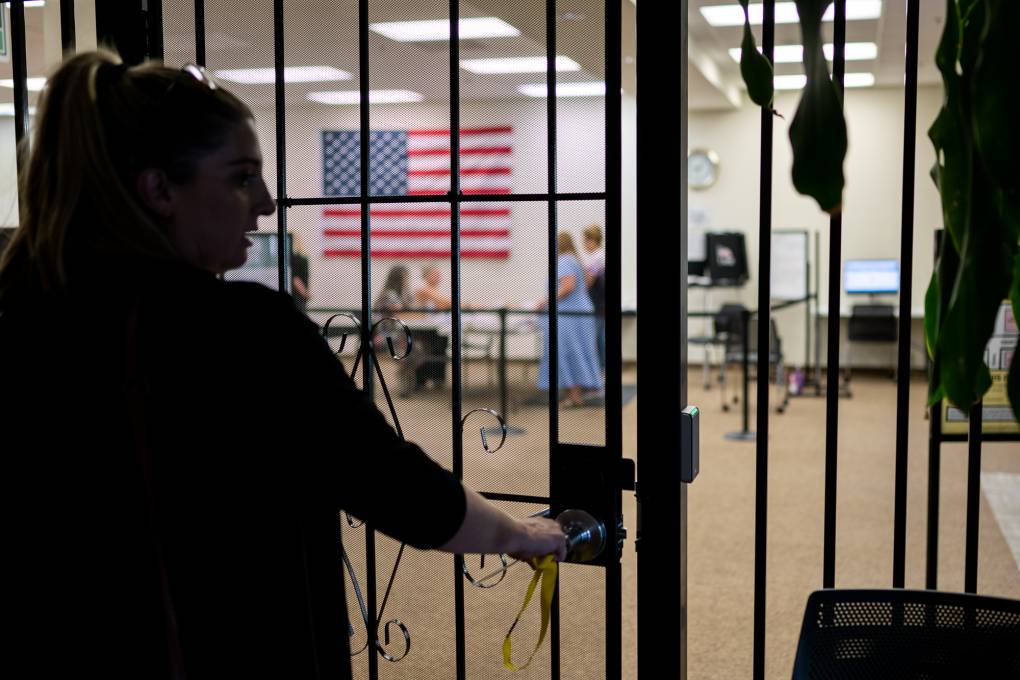
"content": "\u003ch4>\u003cb>Here are the morning’s top stories on Tuesday, April 21, 2026:\u003c/b>\u003c/h4>\n\u003cul>\n\u003cli>A man shot by Immigration Agents in Patterson, California earlier this month will remain in custody over concerns that he could be a flight risk.\u003c/li>\n\u003cli>Former State Controller Betty Yee is ending her campaign for California governor, citing flagging poll numbers and a shrinking donor base.\u003c/li>\n\u003cli>Normally, county clerk races don’t get that much attention. But in Shasta County, two candidates are fighting for the future of elections in a place that’s garnered national attention for years now.\u003c/li>\n\u003c/ul>\n\u003ch2>Judge Denies Bail For Man Shot By ICE\u003c/h2>\n\u003cp>At a hearing in Sacramento County on Monday, a judge ordered Carlos Ivan Mendoza Hernandez to remain in custody, over concerns that he could be a flight risk.\u003c/p>\n\u003cp>Earlier this month, Carlos Ivan Mendoza Hernandez was charged with assault on a federal officer with a deadly weapon after he allegedly hit an ICE agent with his car during a traffic stop in which he was shot at multiple times.\u003c/p>\n\u003cp>Patrick Kolasinski, an attorney representing Mendoza Hernandez and his family, says the judge’s decision came down to the direction of Mendoza Hernandez’s tires when federal agents fired shots. “In his (the judge) view, it appeared that Carlos was potentially trying to flee before the shooting started,” Kolasinski says, explaining the judge’s decision. Kolasinski says the order is, “fair,” but believes gunshots were fired before any movement of Mendoza Hernandez’s vehicle. A preliminary hearing is set for May 5th.\u003c/p>\n\u003ch2>California Governors Race Narrows\u003c/h2>\n\u003cp>The field of candidate for California Governor just got smaller. Former state controller Betty Yee has officially dropped out of the state’s gubernatorial race, citing flagging poll numbers and a shrinking donor base.\u003c/p>\n\u003cp>Yee spent months polling in the single digits, struggling to gain traction in a crowded Democratic contest. Yee says she will assess the remaining field and announce her choice for endorsement in the next few days. Because ballots have already been printed, her name will still be on the ballot.\u003c/p>\n\u003cp>[ad fullwidth]\u003c/p>\n\u003cp>Her exit comes roughly a week after the leading Democratic candidate, East Bay Congressman Eric Swalwell, dropped out of the race and resigned his House seat following accusations of sexual assault and misconduct from former staffers.\u003c/p>\n\u003ch2>The Future of Elections in Shasta County\u003c/h2>\n\u003cp>A county clerk race in Northern California could shape the future of how elections are conducted in the county. In Shasta County, the former assistant county clerk, Joanna Francescut, is facing her former boss/the appointed county clerk, Clint Curtis.\u003c/p>\n\u003cp>Curtis was appointed to change the way elections are conducted. He’s calling for more transparency when it comes to elections. And one way he aims to achieve that goal is through setting up cameras to record everything. Prior to this appointment, he had never ran an election.\u003c/p>\n\u003cp>His opponent, Francescut, has 17 years of experience with elections. She claims that Curtis has been able to improve transparency and election observation because of the work she was doing before Curtis took over.\u003c/p>\n\u003cp>Despite her then role as assistant county clerk, The Shasta County Board of Supervisors decided not to appoint Francescut, when longtime clerk Cathy Darling Allen, stepped down. And when clerk Tom Toller stepped down, the conservative majority chose Curtis over Francescut to hold the position. Curtis later fired Francescut from her role as assistant county clerk.\u003c/p>\n\u003cp>Curtis has claimed that Francescut, “has no concern for the public at all,”. Francescut denies that claim, while acknowledging the county clerk office has had a negative reputation in the past.\u003c/p>\n\u003cp>\u003c/p>\n\u003cp>Ballots will be mailed to voters by May 4th, and must be turned in by June 2nd. The winner of the election will be decided in June.\u003c/p>\n\n",
"blocks": [],
"excerpt": null,
"status": "publish",
"parent": 0,
"modified": 1776798169,
"stats": {
"hasAudio": false,
"hasVideo": false,
"hasChartOrMap": false,
"iframeSrcs": [],
"hasGoogleForm": false,
"hasGallery": false,
"hasHearkenModule": false,
"hasPolis": false,
"paragraphCount": 14,
"wordCount": 640
},
"headData": {
"title": "A Pivotal Race in Shasta County | KQED",
"description": "Here are the morning's top stories on Tuesday, April 21, 2026: A man shot by Immigration Agents in Patterson, California earlier this month will remain in custody over concerns that he could be a flight risk. Former State Controller Betty Yee is ending her campaign for California governor, citing flagging poll numbers and a shrinking donor base. Normally, county clerk races don’t get that much attention. But in Shasta County, two candidates are fighting for the future of elections in a place that’s garnered national attention for years now. Judge Denies Bail For Man Shot By ICE At a hearing",
"ogTitle": "",
"ogDescription": "",
"ogImgId": "",
"twTitle": "",
"twDescription": "",
"twImgId": "",
"schema": {
"@context": "https://schema.org",
"@type": "NewsArticle",
"headline": "A Pivotal Race in Shasta County",
"datePublished": "2026-04-21T12:02:49-07:00",
"dateModified": "2026-04-21T12:02:49-07:00",
"image": "https://cdn.kqed.org/wp-content/uploads/2020/02/KQED-OG-Image@1x.png",
"isAccessibleForFree": "True",
"publisher": {
"@type": "NewsMediaOrganization",
"@id": "https://www.kqed.org/#organization",
"name": "KQED",
"logo": "https://cdn.kqed.org/wp-content/uploads/2020/02/KQED-OG-Image@1x.png",
"url": "https://www.kqed.org",
"sameAs": [
"https://www.facebook.com/KQED",
"https://twitter.com/KQED",
"https://www.instagram.com/kqed/",
"https://www.tiktok.com/@kqedofficial",
"https://www.linkedin.com/company/kqed",
"https://www.youtube.com/channel/UCeC0IOo7i1P_61zVUWbJ4nw"
]
}
}
},
"primaryCategory": {
"termId": 34018,
"slug": "tcr",
"name": "tcr"
},
"source": "The California Report",
"sourceUrl": "https://www.kqed.org/news/tag/tcrarchive/",
"audioUrl": "https://www.podtrac.com/pts/redirect.mp3/traffic.megaphone.fm/KQINC1590571722.mp3?updated=1776781054",
"sticky": false,
"nprStoryId": "kqed-12080658",
"templateType": "standard",
"featuredImageType": "standard",
"excludeFromSiteSearch": "Include",
"articleAge": "0",
"path": "/news/12080658/a-pivotal-race-in-shasta-county",
"audioTrackLength": null,
"parsedContent": [
{
"type": "contentString",
"content": "\u003cdiv class=\"post-body\">\u003cp>\u003ch4>\u003cb>Here are the morning’s top stories on Tuesday, April 21, 2026:\u003c/b>\u003c/h4>\n\u003cul>\n\u003cli>A man shot by Immigration Agents in Patterson, California earlier this month will remain in custody over concerns that he could be a flight risk.\u003c/li>\n\u003cli>Former State Controller Betty Yee is ending her campaign for California governor, citing flagging poll numbers and a shrinking donor base.\u003c/li>\n\u003cli>Normally, county clerk races don’t get that much attention. But in Shasta County, two candidates are fighting for the future of elections in a place that’s garnered national attention for years now.\u003c/li>\n\u003c/ul>\n\u003ch2>Judge Denies Bail For Man Shot By ICE\u003c/h2>\n\u003cp>At a hearing in Sacramento County on Monday, a judge ordered Carlos Ivan Mendoza Hernandez to remain in custody, over concerns that he could be a flight risk.\u003c/p>\n\u003cp>Earlier this month, Carlos Ivan Mendoza Hernandez was charged with assault on a federal officer with a deadly weapon after he allegedly hit an ICE agent with his car during a traffic stop in which he was shot at multiple times.\u003c/p>\n\u003cp>Patrick Kolasinski, an attorney representing Mendoza Hernandez and his family, says the judge’s decision came down to the direction of Mendoza Hernandez’s tires when federal agents fired shots. “In his (the judge) view, it appeared that Carlos was potentially trying to flee before the shooting started,” Kolasinski says, explaining the judge’s decision. Kolasinski says the order is, “fair,” but believes gunshots were fired before any movement of Mendoza Hernandez’s vehicle. A preliminary hearing is set for May 5th.\u003c/p>\n\u003ch2>California Governors Race Narrows\u003c/h2>\n\u003cp>The field of candidate for California Governor just got smaller. Former state controller Betty Yee has officially dropped out of the state’s gubernatorial race, citing flagging poll numbers and a shrinking donor base.\u003c/p>\n\u003cp>Yee spent months polling in the single digits, struggling to gain traction in a crowded Democratic contest. Yee says she will assess the remaining field and announce her choice for endorsement in the next few days. Because ballots have already been printed, her name will still be on the ballot.\u003c/p>\n\u003cp>\u003c/p>\u003c/div>",
"attributes": {
"named": {},
"numeric": []
}
},
{
"type": "component",
"content": "",
"name": "ad",
"attributes": {
"named": {
"label": "fullwidth"
},
"numeric": [
"fullwidth"
]
}
},
{
"type": "contentString",
"content": "\u003cdiv class=\"post-body\">\u003cp>\u003c/p>\n\u003cp>Her exit comes roughly a week after the leading Democratic candidate, East Bay Congressman Eric Swalwell, dropped out of the race and resigned his House seat following accusations of sexual assault and misconduct from former staffers.\u003c/p>\n\u003ch2>The Future of Elections in Shasta County\u003c/h2>\n\u003cp>A county clerk race in Northern California could shape the future of how elections are conducted in the county. In Shasta County, the former assistant county clerk, Joanna Francescut, is facing her former boss/the appointed county clerk, Clint Curtis.\u003c/p>\n\u003cp>Curtis was appointed to change the way elections are conducted. He’s calling for more transparency when it comes to elections. And one way he aims to achieve that goal is through setting up cameras to record everything. Prior to this appointment, he had never ran an election.\u003c/p>\n\u003cp>His opponent, Francescut, has 17 years of experience with elections. She claims that Curtis has been able to improve transparency and election observation because of the work she was doing before Curtis took over.\u003c/p>\n\u003cp>Despite her then role as assistant county clerk, The Shasta County Board of Supervisors decided not to appoint Francescut, when longtime clerk Cathy Darling Allen, stepped down. And when clerk Tom Toller stepped down, the conservative majority chose Curtis over Francescut to hold the position. Curtis later fired Francescut from her role as assistant county clerk.\u003c/p>\n\u003cp>Curtis has claimed that Francescut, “has no concern for the public at all,”. Francescut denies that claim, while acknowledging the county clerk office has had a negative reputation in the past.\u003c/p>\n\u003cp>\u003c/p>\n\u003cp>Ballots will be mailed to voters by May 4th, and must be turned in by June 2nd. The winner of the election will be decided in June.\u003c/p>\n\n\u003c/div>\u003c/p>",
"attributes": {
"named": {},
"numeric": []
}
}
],
"link": "/news/12080658/a-pivotal-race-in-shasta-county",
"authors": [
"236"
],
"programs": [
"news_72"
],
"categories": [
"news_33520",
"news_34018"
],
"tags": [
"news_18538",
"news_36381",
"news_20202",
"news_22895",
"news_21998",
"news_21268"
],
"featImg": "news_12011762",
"label": "source_news_12080658"
},
"news_12080636": {
"type": "posts",
"id": "news_12080636",
"meta": {
"index": "posts_1716263798",
"site": "news",
"id": "12080636",
"score": null,
"sort": [
1776791941000
]
},
"guestAuthors": [],
"slug": "uber-violated-california-gig-worker-law-rideshare-drivers-group-says-in-new-lawsuit",
"title": "Uber Violated California Gig-Worker Law, Rideshare Drivers Group Says in New Lawsuit",
"publishDate": 1776791941,
"format": "standard",
"headTitle": "Uber Violated California Gig-Worker Law, Rideshare Drivers Group Says in New Lawsuit | KQED",
"labelTerm": {
"site": "news"
},
"content": "\u003cp>A ride-hail driver organization alleged \u003ca href=\"https://www.kqed.org/news/tag/uber\">Uber\u003c/a> broke a California gig-worker law by failing to provide terminated drivers enough of a recourse to challenge account deactivations, according to a lawsuit filed Monday in San Francisco. If successful, the complaint could open a way for workers in the industry to claim additional rights.\u003c/p>\n\u003cp>Approved by voters in 2020, \u003ca href=\"https://www.kqed.org/news/11843123/prop-22-explained-why-gig-companies-are-spending-huge-money-on-an-unprecedented-measure\">Proposition 22\u003c/a> gave Uber a big win, allowing the company to classify its drivers as independent contractors — who are often cheaper to hire and easier to fire than employees. But attorneys for Rideshare Drivers United, which represents about 20,000 app-based drivers statewide, contend Uber terminated thousands of them without an appeals process required by that law.\u003c/p>\n\u003cp>“Uber has not held up its end of the bargain,” said Shannon Liss-Riordan, an attorney for the group. “It has not complied with Prop. 22, and as a result, it should not get the benefit of Prop. 22, meaning that Uber should not be able to claim that the drivers are independent contractors.”\u003c/p>\n\u003cp>[ad fullwidth]\u003c/p>\n\u003cp>An Uber spokesperson rejected the allegations, slamming the lawsuit as a “publicity stunt” that the company will fight in court.\u003c/p>\n\u003cp>The legal challenge represents the latest attempt in a years-long battle by gig workers to gain more labor protections. Independent contractors have more flexibility on the job, but lack employee rights such as overtime pay, unemployment insurance benefits and expense reimbursements. If the state court grants Rideshare Drivers United’s request to bar Uber from treating its drivers as independent contractors, they could then be entitled to employee protections, Liss-Riordan said.\u003c/p>\n\u003cfigure id=\"attachment_11910763\" class=\"wp-caption aligncenter\" style=\"max-width: 2000px\">\u003cimg loading=\"lazy\" decoding=\"async\" class=\"size-full wp-image-11910763\" src=\"https://cdn.kqed.org/wp-content/uploads/sites/10/2022/04/yes2-scaled-e1776791757748.jpg\" alt='A woman wearing sunglasses drives a car while holding a sign that says: \"Lyft and Uber we see you profiting off our back!\"' width=\"2000\" height=\"1334\">\u003cfigcaption class=\"wp-caption-text\">Rideshare drivers protest outside Uber’s former headquarters on Market Street in downtown San Francisco on Aug. 27, 2019. \u003ccite>(Courtesy of Gig Workers Rising)\u003c/cite>\u003c/figcaption>\u003c/figure>\n\u003cp>The most \u003ca href=\"https://www.uber.com/us/en/drive/driver-app/deactivation-review/\">common reasons\u003c/a> drivers lose access to their accounts are an expired document or a background check issue, according to Uber. The company said it provides drivers with multiple channels to raise concerns, request reviews of deactivations, and provide evidence to support their case.\u003c/p>\n\u003cp>“This is a baseless lawsuit by an opportunistic trial lawyer seeking to overturn Proposition 22 and the will of California voters,” an Uber spokesperson said in a statement. “Uber complies with Prop 22, including providing drivers with clear processes to appeal deactivations, raise concerns and request reviews, while delivering guaranteed earnings, healthcare support, and the flexibility drivers value.”\u003c/p>\n\u003cp>At a press conference on the steps of the California Supreme Court building near Civic Center Plaza, several terminated drivers said Uber unfairly cut them off the platform, without sufficient explanation or a meaningful way to challenge the decision. They said they tried calling the company and interacting with its chatbots, to no avail.[aside postID=news_12057798 hero='https://cdn.kqed.org/wp-content/uploads/sites/10/2024/07/GettyImages-2003719181-1020x680.jpg']“It seems like it was nothing but a copy and paste response,” said Devins Baker, 36, who said he was deactivated the week before Christmas in 2024 after driving for Uber for years. “No matter what I sent, even going in person, just seems like they had already made a decision even prior to my appeal.”\u003c/p>\n\u003cp>Baker, an Oakland resident, said suddenly losing his Uber driver job left him scrambling to find another way to make money, so he could keep his housing.\u003c/p>\n\u003cp>“The process actually has been very much of a headache,” he said.\u003c/p>\n\u003cp>Other Bay Area drivers with high ratings and years of experience said Uber account deactivations left them struggling to make ends meet. Mirwais Noory, a father of four living in Antioch, said he moved his family from one house to another because they couldn’t afford the rent.\u003c/p>\n\u003cp>Since his termination in November 2024, he has worked as a security guard and part-time rideshare driver for Lyft, he said, but still owes thousands of dollars in credit card debt.\u003c/p>\n\u003cp>“It affected me hugely because I’m the only one making money in my family,” said Noory, 38. “It just turned my situation upside down … and basically, there was no accountability from Uber.”\u003c/p>\n\u003cp>\u003c/p>\n",
"blocks": [],
"excerpt": "Rideshare Drivers United asked a state court in San Francisco to bar Uber from reaping the benefits of a 2020 gig-worker law. The company called the lawsuit “baseless.”",
"status": "publish",
"parent": 0,
"modified": 1776798389,
"stats": {
"hasAudio": false,
"hasVideo": false,
"hasChartOrMap": false,
"iframeSrcs": [],
"hasGoogleForm": false,
"hasGallery": false,
"hasHearkenModule": false,
"hasPolis": false,
"paragraphCount": 15,
"wordCount": 699
},
"headData": {
"title": "Uber Violated California Gig-Worker Law, Rideshare Drivers Group Says in New Lawsuit | KQED",
"description": "Rideshare Drivers United asked a state court in San Francisco to bar Uber from reaping the benefits of a 2020 gig-worker law. The company called the lawsuit “baseless.”",
"ogTitle": "",
"ogDescription": "",
"ogImgId": "",
"twTitle": "",
"twDescription": "",
"twImgId": "",
"schema": {
"@context": "https://schema.org",
"@type": "NewsArticle",
"headline": "Uber Violated California Gig-Worker Law, Rideshare Drivers Group Says in New Lawsuit",
"datePublished": "2026-04-21T10:19:01-07:00",
"dateModified": "2026-04-21T12:06:29-07:00",
"image": "https://cdn.kqed.org/wp-content/uploads/2020/02/KQED-OG-Image@1x.png",
"isAccessibleForFree": "True",
"publisher": {
"@type": "NewsMediaOrganization",
"@id": "https://www.kqed.org/#organization",
"name": "KQED",
"logo": "https://cdn.kqed.org/wp-content/uploads/2020/02/KQED-OG-Image@1x.png",
"url": "https://www.kqed.org",
"sameAs": [
"https://www.facebook.com/KQED",
"https://twitter.com/KQED",
"https://www.instagram.com/kqed/",
"https://www.tiktok.com/@kqedofficial",
"https://www.linkedin.com/company/kqed",
"https://www.youtube.com/channel/UCeC0IOo7i1P_61zVUWbJ4nw"
]
}
}
},
"primaryCategory": {
"termId": 34551,
"slug": "labor",
"name": "Labor"
},
"sticky": false,
"nprStoryId": "kqed-12080636",
"templateType": "standard",
"featuredImageType": "standard",
"excludeFromSiteSearch": "Include",
"articleAge": "0",
"path": "/news/12080636/uber-violated-california-gig-worker-law-rideshare-drivers-group-says-in-new-lawsuit",
"audioTrackLength": null,
"parsedContent": [
{
"type": "contentString",
"content": "\u003cdiv class=\"post-body\">\u003cp>\u003cp>A ride-hail driver organization alleged \u003ca href=\"https://www.kqed.org/news/tag/uber\">Uber\u003c/a> broke a California gig-worker law by failing to provide terminated drivers enough of a recourse to challenge account deactivations, according to a lawsuit filed Monday in San Francisco. If successful, the complaint could open a way for workers in the industry to claim additional rights.\u003c/p>\n\u003cp>Approved by voters in 2020, \u003ca href=\"https://www.kqed.org/news/11843123/prop-22-explained-why-gig-companies-are-spending-huge-money-on-an-unprecedented-measure\">Proposition 22\u003c/a> gave Uber a big win, allowing the company to classify its drivers as independent contractors — who are often cheaper to hire and easier to fire than employees. But attorneys for Rideshare Drivers United, which represents about 20,000 app-based drivers statewide, contend Uber terminated thousands of them without an appeals process required by that law.\u003c/p>\n\u003cp>“Uber has not held up its end of the bargain,” said Shannon Liss-Riordan, an attorney for the group. “It has not complied with Prop. 22, and as a result, it should not get the benefit of Prop. 22, meaning that Uber should not be able to claim that the drivers are independent contractors.”\u003c/p>\n\u003cp>\u003c/p>\u003c/div>",
"attributes": {
"named": {},
"numeric": []
}
},
{
"type": "component",
"content": "",
"name": "ad",
"attributes": {
"named": {
"label": "fullwidth"
},
"numeric": [
"fullwidth"
]
}
},
{
"type": "contentString",
"content": "\u003cdiv class=\"post-body\">\u003cp>\u003c/p>\n\u003cp>An Uber spokesperson rejected the allegations, slamming the lawsuit as a “publicity stunt” that the company will fight in court.\u003c/p>\n\u003cp>The legal challenge represents the latest attempt in a years-long battle by gig workers to gain more labor protections. Independent contractors have more flexibility on the job, but lack employee rights such as overtime pay, unemployment insurance benefits and expense reimbursements. If the state court grants Rideshare Drivers United’s request to bar Uber from treating its drivers as independent contractors, they could then be entitled to employee protections, Liss-Riordan said.\u003c/p>\n\u003cfigure id=\"attachment_11910763\" class=\"wp-caption aligncenter\" style=\"max-width: 2000px\">\u003cimg loading=\"lazy\" decoding=\"async\" class=\"size-full wp-image-11910763\" src=\"https://cdn.kqed.org/wp-content/uploads/sites/10/2022/04/yes2-scaled-e1776791757748.jpg\" alt='A woman wearing sunglasses drives a car while holding a sign that says: \"Lyft and Uber we see you profiting off our back!\"' width=\"2000\" height=\"1334\">\u003cfigcaption class=\"wp-caption-text\">Rideshare drivers protest outside Uber’s former headquarters on Market Street in downtown San Francisco on Aug. 27, 2019. \u003ccite>(Courtesy of Gig Workers Rising)\u003c/cite>\u003c/figcaption>\u003c/figure>\n\u003cp>The most \u003ca href=\"https://www.uber.com/us/en/drive/driver-app/deactivation-review/\">common reasons\u003c/a> drivers lose access to their accounts are an expired document or a background check issue, according to Uber. The company said it provides drivers with multiple channels to raise concerns, request reviews of deactivations, and provide evidence to support their case.\u003c/p>\n\u003cp>“This is a baseless lawsuit by an opportunistic trial lawyer seeking to overturn Proposition 22 and the will of California voters,” an Uber spokesperson said in a statement. “Uber complies with Prop 22, including providing drivers with clear processes to appeal deactivations, raise concerns and request reviews, while delivering guaranteed earnings, healthcare support, and the flexibility drivers value.”\u003c/p>\n\u003cp>At a press conference on the steps of the California Supreme Court building near Civic Center Plaza, several terminated drivers said Uber unfairly cut them off the platform, without sufficient explanation or a meaningful way to challenge the decision. They said they tried calling the company and interacting with its chatbots, to no avail.\u003c/p>\u003c/div>",
"attributes": {
"named": {},
"numeric": []
}
},
{
"type": "component",
"content": "",
"name": "aside",
"attributes": {
"named": {
"postid": "news_12057798",
"hero": "https://cdn.kqed.org/wp-content/uploads/sites/10/2024/07/GettyImages-2003719181-1020x680.jpg",
"label": ""
},
"numeric": []
}
},
{
"type": "contentString",
"content": "\u003cdiv class=\"post-body\">\u003cp>“It seems like it was nothing but a copy and paste response,” said Devins Baker, 36, who said he was deactivated the week before Christmas in 2024 after driving for Uber for years. “No matter what I sent, even going in person, just seems like they had already made a decision even prior to my appeal.”\u003c/p>\n\u003cp>Baker, an Oakland resident, said suddenly losing his Uber driver job left him scrambling to find another way to make money, so he could keep his housing.\u003c/p>\n\u003cp>“The process actually has been very much of a headache,” he said.\u003c/p>\n\u003cp>Other Bay Area drivers with high ratings and years of experience said Uber account deactivations left them struggling to make ends meet. Mirwais Noory, a father of four living in Antioch, said he moved his family from one house to another because they couldn’t afford the rent.\u003c/p>\n\u003cp>Since his termination in November 2024, he has worked as a security guard and part-time rideshare driver for Lyft, he said, but still owes thousands of dollars in credit card debt.\u003c/p>\n\u003cp>“It affected me hugely because I’m the only one making money in my family,” said Noory, 38. “It just turned my situation upside down … and basically, there was no accountability from Uber.”\u003c/p>\n\u003cp>\u003c/p>\n\u003c/div>\u003c/p>",
"attributes": {
"named": {},
"numeric": []
}
}
],
"link": "/news/12080636/uber-violated-california-gig-worker-law-rideshare-drivers-group-says-in-new-lawsuit",
"authors": [
"8659"
],
"categories": [
"news_31795",
"news_34551",
"news_8",
"news_1397"
],
"tags": [
"news_1386",
"news_18538",
"news_24862",
"news_19904",
"news_21891",
"news_35207",
"news_25675",
"news_38",
"news_20517",
"news_4523"
],
"featImg": "news_12033651",
"label": "news"
},
"news_12080289": {
"type": "posts",
"id": "news_12080289",
"meta": {
"index": "posts_1716263798",
"site": "news",
"id": "12080289",
"score": null,
"sort": [
1776789649000
]
},
"guestAuthors": [],
"slug": "700-a-month-sleeping-pods-make-sf-more-affordable-but-at-what-cost",
"title": "For $700 a Month, Sleeping Pods Make SF More Affordable, but at What Cost?",
"publishDate": 1776789649,
"format": "standard",
"headTitle": "For $700 a Month, Sleeping Pods Make SF More Affordable, but at What Cost? | KQED",
"labelTerm": {
"site": "news"
},
"content": "\u003cp>\u003cem>This story is part of \u003c/em>\u003ca href=\"https://www.kqed.org/affordability\">\u003cstrong>\u003cem>How We Get By\u003c/em>\u003c/strong>\u003c/a>\u003cem>, a KQED series exploring how people are coping with rising costs in the Bay Area and California. Find the \u003c/em>\u003ca href=\"https://www.kqed.org/affordability\">\u003cem>full series here\u003c/em>\u003c/a>\u003cem>.\u003c/em>\u003c/p>\n\u003cp>For some San Franciscans, giving up space and privacy is a worthwhile trade for affordable rent. At Brownstone Shared \u003ca href=\"https://www.kqed.org/news/tag/housing\">Housing\u003c/a>, residents take that tradeoff to the extreme, paying $700 per month for a bunk bed in a room with 30 other adults in the heart of downtown.\u003c/p>\n\u003cp>Brownstone is a sleeping pod company. Pods have been around San Francisco for over a decade, but they are having a moment as droves of tech workers flock to one of the world’s most expensive cities, chasing AI fortunes. They have been characterized as everything from \u003ca href=\"https://www.independent.co.uk/news/world/americas/san-francisco-brownstone-sleeping-pods-b2885522.html\">dystopian\u003c/a> and \u003ca href=\"https://www.deanprestonsf.com/blog/are-sleeping-pods-even-legal\">potentially illegal\u003c/a> to an \u003ca href=\"https://www.cbsnews.com/sanfrancisco/news/start-up-sets-up-sleeping-pods-at-site-of-former-bank-in-san-francisco/\">affordable\u003c/a> housing solution — and they have proven popular among some young professionals, who say pods offer them an efficient, simple housing option.\u003c/p>\n\u003cp>Some housing experts are skeptical that sleeping pods can provide anything more than a short-term stopgap for a narrow group of residents navigating the housing crisis in San Francisco.\u003c/p>\n\u003cp>[ad fullwidth]\u003c/p>\n\u003cp>“It’s kind of silly to think we’re going to need a single-family home at every point of our life, from birth ‘til death,” Brownstone CEO James Stallworth said. “So that’s how I see the pods, more as a utility to fill in the gaps in life, understanding that we’ll always need shelter.”\u003c/p>\n\u003cp>At his company’s Mint Plaza location, people are sold on the simple offer. For $700, each resident is guaranteed a twin-sized sleeping pod with a privacy curtain, a thermostat and a light, as well as access to a central common area with a small kitchen, workspaces and bathrooms split between roughly 30 roommates. No deposit. No one-year lease. No background checks or proof of income.\u003c/p>\n\u003cp>The city has long been known for a variety of group living quarters, from hacker houses to hippie communes to residential hotels. But as the cost of living and a tech-fueled economy have drawn young people from all over to San Francisco in more recent years, various models of dormitory-style housing have entered a new iteration.\u003c/p>\n\u003cfigure id=\"attachment_12080130\" class=\"wp-caption aligncenter\" style=\"max-width: 2000px\">\u003cimg loading=\"lazy\" decoding=\"async\" class=\"size-full wp-image-12080130\" src=\"https://cdn.kqed.org/wp-content/uploads/sites/10/2026/04/041026AFFORDABILITY_-SLEEPING-PODS_GH_017-KQED.jpg\" alt=\"\" width=\"2000\" height=\"1333\" srcset=\"https://cdn.kqed.org/wp-content/uploads/sites/10/2026/04/041026AFFORDABILITY_-SLEEPING-PODS_GH_017-KQED.jpg 2000w, https://cdn.kqed.org/wp-content/uploads/sites/10/2026/04/041026AFFORDABILITY_-SLEEPING-PODS_GH_017-KQED-160x107.jpg 160w, https://cdn.kqed.org/wp-content/uploads/sites/10/2026/04/041026AFFORDABILITY_-SLEEPING-PODS_GH_017-KQED-1536x1024.jpg 1536w\" sizes=\"auto, (max-width: 2000px) 100vw, 2000px\">\u003cfigcaption class=\"wp-caption-text\">The exterior of Brownstone Shared Housing in San Francisco on April 10, 2026. \u003ccite>(Gustavo Hernandez/KQED)\u003c/cite>\u003c/figcaption>\u003c/figure>\n\u003cp>One of the earliest pod sites to arrive on the scene was PodShare, a co-living company founded in 2012 that has properties in San Francisco, Los Angeles and San Diego.\u003c/p>\n\u003cp>Other companies attempting something similar, like \u003ca href=\"https://www.instagram.com/haasliving/\">Haas Living\u003c/a>, have come and gone. But Brownstone is the only one looking to dramatically expand into the market with a massive 400-bed super dorm downtown. Stallworth sees the current AI boom as a potential funnel of new residents for whom pod living might be ideal.\u003c/p>\n\u003cp>“Our goal is still thousands of spots in the city, and potentially hundreds of thousands in the nation,” Stallworth said.\u003c/p>\n\u003cp>Tech workers embarking on their careers, and especially students, say they’re feeling the squeeze and looking for creative housing options.\u003c/p>\n\u003ch2>Life inside the pods\u003c/h2>\n\u003cp>Haseab Ullah first tucked his tall, broad frame into one of Brownstone’s sleeping pods, located in a former bank building in Mint Plaza, while participating in a tech incubator program in 2023. After bouncing between San Francisco and Toronto, his hometown, he’s spent about two years living in the pods and is still there.\u003c/p>\n\u003cp>He said he’s stayed because he has an “aversion” to spending the money he earns inefficiently.\u003c/p>\n\u003cp>“When I first came to San Francisco, I wasn’t ready to stay. I just came for the incubator. I didn’t feel ready, and I didn’t think I had enough money,” he said recently, in a conference room in the back of Brownstone’s main common area, a modern space with exposed brick walls, a projector screen and large cushioned chairs. Elements of the building’s former bank still remain, such as a teller counter that now functions as a row of stations where residents can work remotely.\u003c/p>\n\u003cfigure id=\"attachment_12080128\" class=\"wp-caption aligncenter\" style=\"max-width: 2000px\">\u003cimg loading=\"lazy\" decoding=\"async\" class=\"size-full wp-image-12080128\" src=\"https://cdn.kqed.org/wp-content/uploads/sites/10/2026/04/041026AFFORDABILITY_-SLEEPING-PODS_GH_012-KQED.jpg\" alt=\"\" width=\"2000\" height=\"1333\" srcset=\"https://cdn.kqed.org/wp-content/uploads/sites/10/2026/04/041026AFFORDABILITY_-SLEEPING-PODS_GH_012-KQED.jpg 2000w, https://cdn.kqed.org/wp-content/uploads/sites/10/2026/04/041026AFFORDABILITY_-SLEEPING-PODS_GH_012-KQED-160x107.jpg 160w, https://cdn.kqed.org/wp-content/uploads/sites/10/2026/04/041026AFFORDABILITY_-SLEEPING-PODS_GH_012-KQED-1536x1024.jpg 1536w\" sizes=\"auto, (max-width: 2000px) 100vw, 2000px\">\u003cfigcaption class=\"wp-caption-text\">Haseab Ullah, a resident, uses his laptop in the common area at Brownstone Shared Housing on April 10, 2026. \u003ccite>(Gustavo Hernandez/KQED)\u003c/cite>\u003c/figcaption>\u003c/figure>\n\u003cp>After seeing Brownstone online, he said he messaged the owner on several different platforms, including Facebook, Twitter and Craigslist to lock in a bed.\u003c/p>\n\u003cp>This reporter spent several nights and days living the pod life at Mint Plaza and met several residents who told KQED they arrived at Brownstone for reasons similar to Ullah’s. They were moving to the city from out of town, or out of the country, either to start or find a job, and needed a cheap place to get their footing.\u003c/p>\n\u003cp>For the most part, residents go about their days quietly and IRL interactions are friendly but brief, while the house WhatsApp group buzzes with recommendations for local tech events or occasional complaints about missing food or clothing. From what this reporter observed, the common areas were sparsely populated, with the exception of one or two people clicking away at their laptops.[aside postID=news_12079098 hero='https://cdn.kqed.org/wp-content/uploads/sites/10/2026/04/041226Affordability-series-teacher-housing_GH_002_qed.jpg']“Of course, you do have people who only need a month, and then they’re out. And then you have some who are more social and interact with people, and then you have people who just kind of keep to themselves and you never really hear from them,” Stallworth said.\u003c/p>\n\u003cp>Personal space is hard to come by. The bunk curtains offer some semblance of privacy, and first-come, first-served unlocked storage cubbies give the illusion of security, while a small room in the common space can be reserved for calls or meetings. But other private needs, like changing clothes, take place either in the pod, a restroom or between the bunk beds — a practice that quickly became uncomfortable.\u003c/p>\n\u003cp>It’s also not an ideal home for someone who enjoys cooking. A small kitchenette offers a sink, a countertop burner, a toaster oven and an air fryer. The fridge and cabinets operate on an honor system and a “use the space you can find” approach. While the lack of rules and boundaries gives people freedom to do as they please, it also means pantry items go missing on occasion.\u003c/p>\n\u003cp>Stolen leftovers are not unique to Brownstone, of course. But what sets it and other sleeping pods apart from other group living setups like co-ops or hacker houses is not only the extremely tight living quarters but their very solitary, often transient nature.\u003c/p>\n\u003cp>The average apartment in San Francisco is 716 square feet, about 8% larger than a decade ago, according to a 2025 study from \u003ca href=\"https://www.rentcafe.com/blog/rental-market/market-snapshots/national-average-apartment-size/\">RentCafe\u003c/a>, while rent on average in the city is currently at $3,650 per month, according to Zillow. Meanwhile, the pods at Brownstone in Mint Plaza have just enough space to lie down and sit up, but not fully extend both arms.\u003c/p>\n\u003cfigure id=\"attachment_12080485\" class=\"wp-caption aligncenter\" style=\"max-width: 2000px\">\u003cimg loading=\"lazy\" decoding=\"async\" class=\"size-full wp-image-12080485\" src=\"https://cdn.kqed.org/wp-content/uploads/sites/10/2026/04/260416-Sleeping-Pod-SJ-01-KQED.jpg\" alt=\"\" width=\"2000\" height=\"1500\" srcset=\"https://cdn.kqed.org/wp-content/uploads/sites/10/2026/04/260416-Sleeping-Pod-SJ-01-KQED.jpg 2000w, https://cdn.kqed.org/wp-content/uploads/sites/10/2026/04/260416-Sleeping-Pod-SJ-01-KQED-160x120.jpg 160w, https://cdn.kqed.org/wp-content/uploads/sites/10/2026/04/260416-Sleeping-Pod-SJ-01-KQED-1536x1152.jpg 1536w\" sizes=\"auto, (max-width: 2000px) 100vw, 2000px\">\u003cfigcaption class=\"wp-caption-text\">The inside of a sleeping pod at Brownstone Shared Housing on March 16, 2026. \u003ccite>(Sydney Johnson/KQED)\u003c/cite>\u003c/figcaption>\u003c/figure>\n\u003cp>Pods clearly appeal to some people; they are often near capacity at Mint Plaza with guests moving in and out. But pod life was certainly not for this 32-year-old woman, who is candidly skeptical of AI and missed sleeping with her dog.\u003c/p>\n\u003cp>And it certainly would not be suitable for all kinds of people, like those with certain disabilities or who want to live with a partner. (One Brownstone resident said he books a hotel when his girlfriend is in town, which is starting to outweigh the savings from staying in a pod.)\u003c/p>\n\u003cp>“It’s certainly not a permanent home in the sense that you expect to come and stay here for the rest of your natural life. We see it as a utility to satisfy that need at different points in life that currently aren’t served by the existing housing stock,” Stallworth said. “We have had older people use the pods if they are traveling for long-term work assignments or they got their visa, and their family isn’t here yet, so there’s all sorts of different points in life where you might need a pod.”\u003c/p>\n\u003ch2>Rebranding an old concept\u003c/h2>\n\u003cp>Fernando Martí, a housing activist who teaches at Cal Poly San Luis Obispo and the University of San Francisco, thinks pods are merely a rebranding of a centuries-old concept.\u003c/p>\n\u003cp>“Big cities have always had residential hotels. That’s where workers first came to the city and needed a place to stay,” Martí said. “I don’t think it’s anything new, other than the branding and the cost.”\u003c/p>\n\u003cfigure id=\"attachment_12080125\" class=\"wp-caption aligncenter\" style=\"max-width: 2000px\">\u003cimg loading=\"lazy\" decoding=\"async\" class=\"size-full wp-image-12080125\" src=\"https://cdn.kqed.org/wp-content/uploads/sites/10/2026/04/041026AFFORDABILITY_-SLEEPING-PODS_GH_006-KQED.jpg\" alt=\"\" width=\"2000\" height=\"1333\" srcset=\"https://cdn.kqed.org/wp-content/uploads/sites/10/2026/04/041026AFFORDABILITY_-SLEEPING-PODS_GH_006-KQED.jpg 2000w, https://cdn.kqed.org/wp-content/uploads/sites/10/2026/04/041026AFFORDABILITY_-SLEEPING-PODS_GH_006-KQED-160x107.jpg 160w, https://cdn.kqed.org/wp-content/uploads/sites/10/2026/04/041026AFFORDABILITY_-SLEEPING-PODS_GH_006-KQED-1536x1024.jpg 1536w\" sizes=\"auto, (max-width: 2000px) 100vw, 2000px\">\u003cfigcaption class=\"wp-caption-text\">James Stallworth walks toward the sleeping pod area of Brownstone Shared Housing on April 10, 2026. \u003ccite>(Gustavo Hernandez/KQED)\u003c/cite>\u003c/figcaption>\u003c/figure>\n\u003cp>Sleeping pods are not a new concept outside of California, but are often geared toward travelers looking for cheap short-term accommodations. Stallworth is trying to cultivate a longer-term clientele, whether it’s a few months or even a few years.\u003c/p>\n\u003cp>But while pods aren’t set up for seniors on fixed incomes and families with children, who bear the brunt of the housing crisis, according to Carolina Reid, a professor in affordable housing and urban policy at the University of California, Berkeley, single-room occupancy (SRO) hotels continue to serve them.[aside postID=news_12078480 hero='https://cdn.kqed.org/wp-content/uploads/sites/10/2026/04/AffordabilitySeriesIntro_Lede.jpg']These short-term micro-housing units with shared bathrooms and kitchen spaces have been a common source of affordable housing for generations of newcomers to San Francisco, and, according to a \u003ca href=\"https://www.pew.org/en/research-and-analysis/issue-briefs/2025/07/how-states-and-cities-decimated-americans-lowest-cost-housing-option\">Pew Charitable Trusts report\u003c/a>, were used to rent for as low as $100 to $300 per month in 2025 dollars. Today, monthly rent in an SRO in San Francisco costs, on \u003ca href=\"https://projects.sfplanning.org/community-stabilization/sro-hotel-protections.htm#:~:text=The%20total%20average%20rent%20for,neighborhoods%20for%20renting%20SRO%20units\">average, around $900\u003c/a>, according to the San Francisco Planning Department.\u003c/p>\n\u003cp>In stark contrast to the pods, SROs in San Francisco’s most densely packed neighborhoods have become de facto permanent housing for the city’s lowest-income residents, as the stock of extremely affordable housing has diminished.\u003c/p>\n\u003cp>“To me, there’s this question of, is [a sleeping pod] a primary residence?” said Malcolm Yeung, CEO of Chinatown Community Development Center, which manages a portfolio of SROs in San Francisco.\u003c/p>\n\u003cp>While SROs went from primarily serving as stopgap housing to a permanent place to live, Charlotte Sarfati didn’t think she could do the same in a sleeping pod. She reached her personal limit at nine months after staying in different pod buildings, like Haas Living, before moving to a one-bedroom apartment in Oakland.\u003c/p>\n\u003cp>“Especially with having a full-time job, it starts kind of getting to you just being around people and wanting privacy,” the nurse-turned-tech worker said. “Once you feel the drain of working a 9-to-5, it became a little too much for me.”\u003c/p>\n\u003ch2>Riding the AI wave\u003c/h2>\n\u003cp>With its minimalistic \u003ca href=\"https://www.theverge.com/2016/8/3/12325104/airbnb-aesthetic-global-minimalism-startup-gentrification\">AirSpace\u003c/a> aesthetic, Brownstone is actively catering to Safrati’s demographic: residents in their 20s to early 40s, with many current residents telling KQED they work in tech.\u003c/p>\n\u003cp>At the 400-pod megadorm that Brownstone is trying to launch, the same twin-sized pods would go for $1,200 per month, about $500 more than the Mint Plaza location. Stallworth said that’s simply a reflection of the market, which has seen rents go up this year in San Francisco.\u003c/p>\n\u003cp>“They’re making a lot more money per square foot than a studio would be,” Martí said. “And that’s always been the case, right? Developers make more money on studios than they do on two-bedrooms because if you can cram more little studios, you can earn a lot more.”\u003c/p>\n\u003cfigure id=\"attachment_12080129\" class=\"wp-caption aligncenter\" style=\"max-width: 2000px\">\u003cimg loading=\"lazy\" decoding=\"async\" class=\"size-full wp-image-12080129\" src=\"https://cdn.kqed.org/wp-content/uploads/sites/10/2026/04/041026AFFORDABILITY_-SLEEPING-PODS_GH_014-KQED.jpg\" alt=\"\" width=\"2000\" height=\"1333\" srcset=\"https://cdn.kqed.org/wp-content/uploads/sites/10/2026/04/041026AFFORDABILITY_-SLEEPING-PODS_GH_014-KQED.jpg 2000w, https://cdn.kqed.org/wp-content/uploads/sites/10/2026/04/041026AFFORDABILITY_-SLEEPING-PODS_GH_014-KQED-160x107.jpg 160w, https://cdn.kqed.org/wp-content/uploads/sites/10/2026/04/041026AFFORDABILITY_-SLEEPING-PODS_GH_014-KQED-1536x1024.jpg 1536w\" sizes=\"auto, (max-width: 2000px) 100vw, 2000px\">\u003cfigcaption class=\"wp-caption-text\">A common area with seating and a projector screen is seen inside Brownstone Shared Housing on April 10, 2026. \u003ccite>(Gustavo Hernandez/KQED)\u003c/cite>\u003c/figcaption>\u003c/figure>\n\u003cp>In other words, cramming more people into smaller spaces is a simple way to squeeze money out of more renters. The market for sleeping pods, currently valued at around $2.7 billion in 2026, is growing globally, according to \u003ca href=\"https://www.businessresearchinsights.com/market-reports/sleeping-pod-market-104352\">Business Research Insights\u003c/a>.\u003c/p>\n\u003cp>House prices have nearly tripled in San Francisco in the recovery following the Great Recession, according to Reid. As a result, households that are cost burdened have gone from those making under $50,000 per year to now close to $100,000.\u003c/p>\n\u003cp>“This is really making San Francisco a place that only the extremely rich can afford,” Reid said. “It means affordability pressures are moving up the income ladder, just because of the lack of both rental and affordable home ownership opportunities.”\u003c/p>\n\u003cp>Stallworth, 34, got the idea for Brownstone while he was a student at Stanford University, facing his own housing struggles in the 2010s.\u003c/p>\n\u003cfigure id=\"attachment_12080447\" class=\"wp-caption aligncenter\" style=\"max-width: 1999px\">\u003cimg loading=\"lazy\" decoding=\"async\" class=\"size-full wp-image-12080447\" src=\"https://cdn.kqed.org/wp-content/uploads/sites/10/2026/04/041026Affordability_-Sleeping-Pods_GH_002_qed.jpg\" alt=\"\" width=\"1999\" height=\"1333\" srcset=\"https://cdn.kqed.org/wp-content/uploads/sites/10/2026/04/041026Affordability_-Sleeping-Pods_GH_002_qed.jpg 1999w, https://cdn.kqed.org/wp-content/uploads/sites/10/2026/04/041026Affordability_-Sleeping-Pods_GH_002_qed-160x107.jpg 160w, https://cdn.kqed.org/wp-content/uploads/sites/10/2026/04/041026Affordability_-Sleeping-Pods_GH_002_qed-1536x1024.jpg 1536w\" sizes=\"auto, (max-width: 1999px) 100vw, 1999px\">\u003cfigcaption class=\"wp-caption-text\">James Stallworth, co-founder of Brownstone Shared Housing, on April 10, 2026. \u003ccite>(Gustavo Hernandez/KQED)\u003c/cite>\u003c/figcaption>\u003c/figure>\n\u003cp>“I was crashing on couches and trying to make it work, but it was extremely difficult,” he said.\u003c/p>\n\u003cp>Stallworth ended up living for free in the basement of a hacker house stacked with Ikea bunk beds in exchange for helping run the booking system. He met his co-founder, Christina Lennox, while working as an auditor for the state. She had experience as a landlord, and the two wanted to create an alternative to what they saw on the housing market.\u003c/p>\n\u003cp>“Housing is a barrier to opportunities,” Stallworth said. “In Silicon Valley, we like to pretend that it’s a meritocracy, but access to housing is mostly determined by money.”\u003c/p>\n\u003cp>Business hasn’t all been smooth, and the company’s relationship with the city has been rocky.[aside postID=news_12078615 hero='https://cdn.kqed.org/wp-content/uploads/sites/10/2026/04/260320-KOGURACOMPANY00242_TV-KQED.jpg']Last year, Brownstone was hit with an eviction notice after landlords of the Mint Plaza location said the startup failed to pay rent and allegedly owed more than $150,000. The case was later dismissed, and the company said it would pivot to a franchise model.\u003c/p>\n\u003cp>And, Brownstone is not officially approved to operate the 30-pod building in Mint Plaza, according to Dan Sider, chief of staff for the San Francisco Planning Department.\u003c/p>\n\u003cp>It’s now attempting to move forward with its 400-pod facility along mid-Market. \u003ca href=\"https://brownstone.live/market-street\">Video renderings\u003c/a> show rows of dozens of rectangular bunk beds in a cavernous office-like space. Sider said no permits have been sought or granted for the proposed new space, which has already faced criticism for serving more as a warehouse than housing and has raised questions about how such a site could safely and legally house so many people under one roof.\u003c/p>\n\u003cp>Still, Sider said the city is open to working with Brownstone on the project.\u003c/p>\n\u003cp>“At the end of the day, Brownstone is building new places for people to live. We support that wholeheartedly. Especially so in these cases because their projects would activate underused buildings,” Sider said. “It’s also worth noting that, regarding their Mid-Market proposal, we’ve had encouraging preliminary conversations with Brownstone that suggest a departure from the ‘ask for forgiveness rather than permission’ approach they used at Mint Plaza.”\u003c/p>\n\u003cp>New legislation that took effect last year in San Francisco waived impact fees for residential adaptive reuse projects like Brownstone’s buildings, meaning it does not have to contribute funding to the city’s overall affordable housing goals.\u003c/p>\n\u003cp>Whether Brownstone can scale up remains to be seen. One day in the Mint Plaza location, Stallworth himself was taking out trash.\u003c/p>\n\u003cfigure id=\"attachment_12080126\" class=\"wp-caption aligncenter\" style=\"max-width: 2000px\">\u003cimg loading=\"lazy\" decoding=\"async\" class=\"size-full wp-image-12080126\" src=\"https://cdn.kqed.org/wp-content/uploads/sites/10/2026/04/041026AFFORDABILITY_-SLEEPING-PODS_GH_007-KQED.jpg\" alt=\"\" width=\"2000\" height=\"1333\" srcset=\"https://cdn.kqed.org/wp-content/uploads/sites/10/2026/04/041026AFFORDABILITY_-SLEEPING-PODS_GH_007-KQED.jpg 2000w, https://cdn.kqed.org/wp-content/uploads/sites/10/2026/04/041026AFFORDABILITY_-SLEEPING-PODS_GH_007-KQED-160x107.jpg 160w, https://cdn.kqed.org/wp-content/uploads/sites/10/2026/04/041026AFFORDABILITY_-SLEEPING-PODS_GH_007-KQED-1536x1024.jpg 1536w\" sizes=\"auto, (max-width: 2000px) 100vw, 2000px\">\u003cfigcaption class=\"wp-caption-text\">A dry-erase board displaying house rules is posted near the sleeping pod area at Brownstone Shared Housing on April 10, 2026. \u003ccite>(Gustavo Hernandez/KQED)\u003c/cite>\u003c/figcaption>\u003c/figure>\n\u003cp>Another key question: Is there enough of a market for the pods, especially at a steeper price, to sustain an enterprise like Brownstone long term? While the swelling AI industry has drawn workers to San Francisco, the current bubble could just as quickly pop.\u003c/p>\n\u003cp>“The housing crisis is so severe that we need to be experimenting with lots of different models,” Reid said. “But I’m not sure that it is a long-term solution to San Francisco’s housing crisis, just because my hunch is that nobody wants to stay in a pod permanently.”\u003c/p>\n\u003cp>For residents like Ullah, who spends much of his time working on the various tech projects he has brewing, saving money is worth giving up some space. He’s not actively looking to move right now, as rents have only gone up in San Francisco in recent months. But in theory, he said, he’d take a better option if something came along.\u003c/p>\n\u003cp>“Of course, if there was a better option, if the housing situation in San Francisco was better, I would pick that option,” he said. “But I thought about it like, will I compromise on my housing right now, temporarily, in order to be successful in the future? Absolutely.”\u003c/p>\n\u003cp>[ad floatright]\u003c/p>\n",
"blocks": [],
"excerpt": "As one sleeping pod company looks to build a massive 400-bed super dorm, experts are skeptical it will provide a real solution for most residents struggling to afford housing in San Francisco. ",
"status": "publish",
"parent": 0,
"modified": 1777309634,
"stats": {
"hasAudio": false,
"hasVideo": false,
"hasChartOrMap": false,
"iframeSrcs": [],
"hasGoogleForm": false,
"hasGallery": false,
"hasHearkenModule": false,
"hasPolis": false,
"paragraphCount": 55,
"wordCount": 2923
},
"headData": {
"title": "For $700 a Month, Sleeping Pods Make SF More Affordable, but at What Cost? | KQED",
"description": "As one sleeping pod company looks to build a massive 400-bed super dorm, experts are skeptical it will provide a real solution for most residents struggling to afford housing in San Francisco. ",
"ogTitle": "",
"ogDescription": "",
"ogImgId": "",
"twTitle": "",
"twDescription": "",
"twImgId": "",
"schema": {
"@context": "https://schema.org",
"@type": "NewsArticle",
"headline": "For $700 a Month, Sleeping Pods Make SF More Affordable, but at What Cost?",
"datePublished": "2026-04-21T09:40:49-07:00",
"dateModified": "2026-04-27T10:07:14-07:00",
"image": "https://cdn.kqed.org/wp-content/uploads/2020/02/KQED-OG-Image@1x.png",
"isAccessibleForFree": "True",
"publisher": {
"@type": "NewsMediaOrganization",
"@id": "https://www.kqed.org/#organization",
"name": "KQED",
"logo": "https://cdn.kqed.org/wp-content/uploads/2020/02/KQED-OG-Image@1x.png",
"url": "https://www.kqed.org",
"sameAs": [
"https://www.facebook.com/KQED",
"https://twitter.com/KQED",
"https://www.instagram.com/kqed/",
"https://www.tiktok.com/@kqedofficial",
"https://www.linkedin.com/company/kqed",
"https://www.youtube.com/channel/UCeC0IOo7i1P_61zVUWbJ4nw"
]
}
}
},
"primaryCategory": {
"termId": 6266,
"slug": "housing",
"name": "Housing"
},
"audioUrl": "https://traffic.omny.fm/d/clips/0af137ef-751e-4b19-a055-aaef00d2d578/ffca7e9f-6831-41c5-bcaf-aaef00f5a073/ac2211ec-0d17-4a2c-8967-b439011129fe/audio.mp3",
"sticky": false,
"nprStoryId": "kqed-12080289",
"templateType": "standard",
"featuredImageType": "standard",
"excludeFromSiteSearch": "Include",
"articleAge": "0",
"path": "/news/12080289/700-a-month-sleeping-pods-make-sf-more-affordable-but-at-what-cost",
"audioTrackLength": null,
"parsedContent": [
{
"type": "contentString",
"content": "\u003cdiv class=\"post-body\">\u003cp>\u003cp>\u003cem>This story is part of \u003c/em>\u003ca href=\"https://www.kqed.org/affordability\">\u003cstrong>\u003cem>How We Get By\u003c/em>\u003c/strong>\u003c/a>\u003cem>, a KQED series exploring how people are coping with rising costs in the Bay Area and California. Find the \u003c/em>\u003ca href=\"https://www.kqed.org/affordability\">\u003cem>full series here\u003c/em>\u003c/a>\u003cem>.\u003c/em>\u003c/p>\n\u003cp>For some San Franciscans, giving up space and privacy is a worthwhile trade for affordable rent. At Brownstone Shared \u003ca href=\"https://www.kqed.org/news/tag/housing\">Housing\u003c/a>, residents take that tradeoff to the extreme, paying $700 per month for a bunk bed in a room with 30 other adults in the heart of downtown.\u003c/p>\n\u003cp>Brownstone is a sleeping pod company. Pods have been around San Francisco for over a decade, but they are having a moment as droves of tech workers flock to one of the world’s most expensive cities, chasing AI fortunes. They have been characterized as everything from \u003ca href=\"https://www.independent.co.uk/news/world/americas/san-francisco-brownstone-sleeping-pods-b2885522.html\">dystopian\u003c/a> and \u003ca href=\"https://www.deanprestonsf.com/blog/are-sleeping-pods-even-legal\">potentially illegal\u003c/a> to an \u003ca href=\"https://www.cbsnews.com/sanfrancisco/news/start-up-sets-up-sleeping-pods-at-site-of-former-bank-in-san-francisco/\">affordable\u003c/a> housing solution — and they have proven popular among some young professionals, who say pods offer them an efficient, simple housing option.\u003c/p>\n\u003cp>Some housing experts are skeptical that sleeping pods can provide anything more than a short-term stopgap for a narrow group of residents navigating the housing crisis in San Francisco.\u003c/p>\n\u003cp>\u003c/p>\u003c/div>",
"attributes": {
"named": {},
"numeric": []
}
},
{
"type": "component",
"content": "",
"name": "ad",
"attributes": {
"named": {
"label": "fullwidth"
},
"numeric": [
"fullwidth"
]
}
},
{
"type": "contentString",
"content": "\u003cdiv class=\"post-body\">\u003cp>\u003c/p>\n\u003cp>“It’s kind of silly to think we’re going to need a single-family home at every point of our life, from birth ‘til death,” Brownstone CEO James Stallworth said. “So that’s how I see the pods, more as a utility to fill in the gaps in life, understanding that we’ll always need shelter.”\u003c/p>\n\u003cp>At his company’s Mint Plaza location, people are sold on the simple offer. For $700, each resident is guaranteed a twin-sized sleeping pod with a privacy curtain, a thermostat and a light, as well as access to a central common area with a small kitchen, workspaces and bathrooms split between roughly 30 roommates. No deposit. No one-year lease. No background checks or proof of income.\u003c/p>\n\u003cp>The city has long been known for a variety of group living quarters, from hacker houses to hippie communes to residential hotels. But as the cost of living and a tech-fueled economy have drawn young people from all over to San Francisco in more recent years, various models of dormitory-style housing have entered a new iteration.\u003c/p>\n\u003cfigure id=\"attachment_12080130\" class=\"wp-caption aligncenter\" style=\"max-width: 2000px\">\u003cimg loading=\"lazy\" decoding=\"async\" class=\"size-full wp-image-12080130\" src=\"https://cdn.kqed.org/wp-content/uploads/sites/10/2026/04/041026AFFORDABILITY_-SLEEPING-PODS_GH_017-KQED.jpg\" alt=\"\" width=\"2000\" height=\"1333\" srcset=\"https://cdn.kqed.org/wp-content/uploads/sites/10/2026/04/041026AFFORDABILITY_-SLEEPING-PODS_GH_017-KQED.jpg 2000w, https://cdn.kqed.org/wp-content/uploads/sites/10/2026/04/041026AFFORDABILITY_-SLEEPING-PODS_GH_017-KQED-160x107.jpg 160w, https://cdn.kqed.org/wp-content/uploads/sites/10/2026/04/041026AFFORDABILITY_-SLEEPING-PODS_GH_017-KQED-1536x1024.jpg 1536w\" sizes=\"auto, (max-width: 2000px) 100vw, 2000px\">\u003cfigcaption class=\"wp-caption-text\">The exterior of Brownstone Shared Housing in San Francisco on April 10, 2026. \u003ccite>(Gustavo Hernandez/KQED)\u003c/cite>\u003c/figcaption>\u003c/figure>\n\u003cp>One of the earliest pod sites to arrive on the scene was PodShare, a co-living company founded in 2012 that has properties in San Francisco, Los Angeles and San Diego.\u003c/p>\n\u003cp>Other companies attempting something similar, like \u003ca href=\"https://www.instagram.com/haasliving/\">Haas Living\u003c/a>, have come and gone. But Brownstone is the only one looking to dramatically expand into the market with a massive 400-bed super dorm downtown. Stallworth sees the current AI boom as a potential funnel of new residents for whom pod living might be ideal.\u003c/p>\n\u003cp>“Our goal is still thousands of spots in the city, and potentially hundreds of thousands in the nation,” Stallworth said.\u003c/p>\n\u003cp>Tech workers embarking on their careers, and especially students, say they’re feeling the squeeze and looking for creative housing options.\u003c/p>\n\u003ch2>Life inside the pods\u003c/h2>\n\u003cp>Haseab Ullah first tucked his tall, broad frame into one of Brownstone’s sleeping pods, located in a former bank building in Mint Plaza, while participating in a tech incubator program in 2023. After bouncing between San Francisco and Toronto, his hometown, he’s spent about two years living in the pods and is still there.\u003c/p>\n\u003cp>He said he’s stayed because he has an “aversion” to spending the money he earns inefficiently.\u003c/p>\n\u003cp>“When I first came to San Francisco, I wasn’t ready to stay. I just came for the incubator. I didn’t feel ready, and I didn’t think I had enough money,” he said recently, in a conference room in the back of Brownstone’s main common area, a modern space with exposed brick walls, a projector screen and large cushioned chairs. Elements of the building’s former bank still remain, such as a teller counter that now functions as a row of stations where residents can work remotely.\u003c/p>\n\u003cfigure id=\"attachment_12080128\" class=\"wp-caption aligncenter\" style=\"max-width: 2000px\">\u003cimg loading=\"lazy\" decoding=\"async\" class=\"size-full wp-image-12080128\" src=\"https://cdn.kqed.org/wp-content/uploads/sites/10/2026/04/041026AFFORDABILITY_-SLEEPING-PODS_GH_012-KQED.jpg\" alt=\"\" width=\"2000\" height=\"1333\" srcset=\"https://cdn.kqed.org/wp-content/uploads/sites/10/2026/04/041026AFFORDABILITY_-SLEEPING-PODS_GH_012-KQED.jpg 2000w, https://cdn.kqed.org/wp-content/uploads/sites/10/2026/04/041026AFFORDABILITY_-SLEEPING-PODS_GH_012-KQED-160x107.jpg 160w, https://cdn.kqed.org/wp-content/uploads/sites/10/2026/04/041026AFFORDABILITY_-SLEEPING-PODS_GH_012-KQED-1536x1024.jpg 1536w\" sizes=\"auto, (max-width: 2000px) 100vw, 2000px\">\u003cfigcaption class=\"wp-caption-text\">Haseab Ullah, a resident, uses his laptop in the common area at Brownstone Shared Housing on April 10, 2026. \u003ccite>(Gustavo Hernandez/KQED)\u003c/cite>\u003c/figcaption>\u003c/figure>\n\u003cp>After seeing Brownstone online, he said he messaged the owner on several different platforms, including Facebook, Twitter and Craigslist to lock in a bed.\u003c/p>\n\u003cp>This reporter spent several nights and days living the pod life at Mint Plaza and met several residents who told KQED they arrived at Brownstone for reasons similar to Ullah’s. They were moving to the city from out of town, or out of the country, either to start or find a job, and needed a cheap place to get their footing.\u003c/p>\n\u003cp>For the most part, residents go about their days quietly and IRL interactions are friendly but brief, while the house WhatsApp group buzzes with recommendations for local tech events or occasional complaints about missing food or clothing. From what this reporter observed, the common areas were sparsely populated, with the exception of one or two people clicking away at their laptops.\u003c/p>\u003c/div>",
"attributes": {
"named": {},
"numeric": []
}
},
{
"type": "component",
"content": "",
"name": "aside",
"attributes": {
"named": {
"postid": "news_12079098",
"hero": "https://cdn.kqed.org/wp-content/uploads/sites/10/2026/04/041226Affordability-series-teacher-housing_GH_002_qed.jpg",
"label": ""
},
"numeric": []
}
},
{
"type": "contentString",
"content": "\u003cdiv class=\"post-body\">\u003cp>“Of course, you do have people who only need a month, and then they’re out. And then you have some who are more social and interact with people, and then you have people who just kind of keep to themselves and you never really hear from them,” Stallworth said.\u003c/p>\n\u003cp>Personal space is hard to come by. The bunk curtains offer some semblance of privacy, and first-come, first-served unlocked storage cubbies give the illusion of security, while a small room in the common space can be reserved for calls or meetings. But other private needs, like changing clothes, take place either in the pod, a restroom or between the bunk beds — a practice that quickly became uncomfortable.\u003c/p>\n\u003cp>It’s also not an ideal home for someone who enjoys cooking. A small kitchenette offers a sink, a countertop burner, a toaster oven and an air fryer. The fridge and cabinets operate on an honor system and a “use the space you can find” approach. While the lack of rules and boundaries gives people freedom to do as they please, it also means pantry items go missing on occasion.\u003c/p>\n\u003cp>Stolen leftovers are not unique to Brownstone, of course. But what sets it and other sleeping pods apart from other group living setups like co-ops or hacker houses is not only the extremely tight living quarters but their very solitary, often transient nature.\u003c/p>\n\u003cp>The average apartment in San Francisco is 716 square feet, about 8% larger than a decade ago, according to a 2025 study from \u003ca href=\"https://www.rentcafe.com/blog/rental-market/market-snapshots/national-average-apartment-size/\">RentCafe\u003c/a>, while rent on average in the city is currently at $3,650 per month, according to Zillow. Meanwhile, the pods at Brownstone in Mint Plaza have just enough space to lie down and sit up, but not fully extend both arms.\u003c/p>\n\u003cfigure id=\"attachment_12080485\" class=\"wp-caption aligncenter\" style=\"max-width: 2000px\">\u003cimg loading=\"lazy\" decoding=\"async\" class=\"size-full wp-image-12080485\" src=\"https://cdn.kqed.org/wp-content/uploads/sites/10/2026/04/260416-Sleeping-Pod-SJ-01-KQED.jpg\" alt=\"\" width=\"2000\" height=\"1500\" srcset=\"https://cdn.kqed.org/wp-content/uploads/sites/10/2026/04/260416-Sleeping-Pod-SJ-01-KQED.jpg 2000w, https://cdn.kqed.org/wp-content/uploads/sites/10/2026/04/260416-Sleeping-Pod-SJ-01-KQED-160x120.jpg 160w, https://cdn.kqed.org/wp-content/uploads/sites/10/2026/04/260416-Sleeping-Pod-SJ-01-KQED-1536x1152.jpg 1536w\" sizes=\"auto, (max-width: 2000px) 100vw, 2000px\">\u003cfigcaption class=\"wp-caption-text\">The inside of a sleeping pod at Brownstone Shared Housing on March 16, 2026. \u003ccite>(Sydney Johnson/KQED)\u003c/cite>\u003c/figcaption>\u003c/figure>\n\u003cp>Pods clearly appeal to some people; they are often near capacity at Mint Plaza with guests moving in and out. But pod life was certainly not for this 32-year-old woman, who is candidly skeptical of AI and missed sleeping with her dog.\u003c/p>\n\u003cp>And it certainly would not be suitable for all kinds of people, like those with certain disabilities or who want to live with a partner. (One Brownstone resident said he books a hotel when his girlfriend is in town, which is starting to outweigh the savings from staying in a pod.)\u003c/p>\n\u003cp>“It’s certainly not a permanent home in the sense that you expect to come and stay here for the rest of your natural life. We see it as a utility to satisfy that need at different points in life that currently aren’t served by the existing housing stock,” Stallworth said. “We have had older people use the pods if they are traveling for long-term work assignments or they got their visa, and their family isn’t here yet, so there’s all sorts of different points in life where you might need a pod.”\u003c/p>\n\u003ch2>Rebranding an old concept\u003c/h2>\n\u003cp>Fernando Martí, a housing activist who teaches at Cal Poly San Luis Obispo and the University of San Francisco, thinks pods are merely a rebranding of a centuries-old concept.\u003c/p>\n\u003cp>“Big cities have always had residential hotels. That’s where workers first came to the city and needed a place to stay,” Martí said. “I don’t think it’s anything new, other than the branding and the cost.”\u003c/p>\n\u003cfigure id=\"attachment_12080125\" class=\"wp-caption aligncenter\" style=\"max-width: 2000px\">\u003cimg loading=\"lazy\" decoding=\"async\" class=\"size-full wp-image-12080125\" src=\"https://cdn.kqed.org/wp-content/uploads/sites/10/2026/04/041026AFFORDABILITY_-SLEEPING-PODS_GH_006-KQED.jpg\" alt=\"\" width=\"2000\" height=\"1333\" srcset=\"https://cdn.kqed.org/wp-content/uploads/sites/10/2026/04/041026AFFORDABILITY_-SLEEPING-PODS_GH_006-KQED.jpg 2000w, https://cdn.kqed.org/wp-content/uploads/sites/10/2026/04/041026AFFORDABILITY_-SLEEPING-PODS_GH_006-KQED-160x107.jpg 160w, https://cdn.kqed.org/wp-content/uploads/sites/10/2026/04/041026AFFORDABILITY_-SLEEPING-PODS_GH_006-KQED-1536x1024.jpg 1536w\" sizes=\"auto, (max-width: 2000px) 100vw, 2000px\">\u003cfigcaption class=\"wp-caption-text\">James Stallworth walks toward the sleeping pod area of Brownstone Shared Housing on April 10, 2026. \u003ccite>(Gustavo Hernandez/KQED)\u003c/cite>\u003c/figcaption>\u003c/figure>\n\u003cp>Sleeping pods are not a new concept outside of California, but are often geared toward travelers looking for cheap short-term accommodations. Stallworth is trying to cultivate a longer-term clientele, whether it’s a few months or even a few years.\u003c/p>\n\u003cp>But while pods aren’t set up for seniors on fixed incomes and families with children, who bear the brunt of the housing crisis, according to Carolina Reid, a professor in affordable housing and urban policy at the University of California, Berkeley, single-room occupancy (SRO) hotels continue to serve them.\u003c/p>\u003c/div>",
"attributes": {
"named": {},
"numeric": []
}
},
{
"type": "component",
"content": "",
"name": "aside",
"attributes": {
"named": {
"postid": "news_12078480",
"hero": "https://cdn.kqed.org/wp-content/uploads/sites/10/2026/04/AffordabilitySeriesIntro_Lede.jpg",
"label": ""
},
"numeric": []
}
},
{
"type": "contentString",
"content": "\u003cdiv class=\"post-body\">\u003cp>These short-term micro-housing units with shared bathrooms and kitchen spaces have been a common source of affordable housing for generations of newcomers to San Francisco, and, according to a \u003ca href=\"https://www.pew.org/en/research-and-analysis/issue-briefs/2025/07/how-states-and-cities-decimated-americans-lowest-cost-housing-option\">Pew Charitable Trusts report\u003c/a>, were used to rent for as low as $100 to $300 per month in 2025 dollars. Today, monthly rent in an SRO in San Francisco costs, on \u003ca href=\"https://projects.sfplanning.org/community-stabilization/sro-hotel-protections.htm#:~:text=The%20total%20average%20rent%20for,neighborhoods%20for%20renting%20SRO%20units\">average, around $900\u003c/a>, according to the San Francisco Planning Department.\u003c/p>\n\u003cp>In stark contrast to the pods, SROs in San Francisco’s most densely packed neighborhoods have become de facto permanent housing for the city’s lowest-income residents, as the stock of extremely affordable housing has diminished.\u003c/p>\n\u003cp>“To me, there’s this question of, is [a sleeping pod] a primary residence?” said Malcolm Yeung, CEO of Chinatown Community Development Center, which manages a portfolio of SROs in San Francisco.\u003c/p>\n\u003cp>While SROs went from primarily serving as stopgap housing to a permanent place to live, Charlotte Sarfati didn’t think she could do the same in a sleeping pod. She reached her personal limit at nine months after staying in different pod buildings, like Haas Living, before moving to a one-bedroom apartment in Oakland.\u003c/p>\n\u003cp>“Especially with having a full-time job, it starts kind of getting to you just being around people and wanting privacy,” the nurse-turned-tech worker said. “Once you feel the drain of working a 9-to-5, it became a little too much for me.”\u003c/p>\n\u003ch2>Riding the AI wave\u003c/h2>\n\u003cp>With its minimalistic \u003ca href=\"https://www.theverge.com/2016/8/3/12325104/airbnb-aesthetic-global-minimalism-startup-gentrification\">AirSpace\u003c/a> aesthetic, Brownstone is actively catering to Safrati’s demographic: residents in their 20s to early 40s, with many current residents telling KQED they work in tech.\u003c/p>\n\u003cp>At the 400-pod megadorm that Brownstone is trying to launch, the same twin-sized pods would go for $1,200 per month, about $500 more than the Mint Plaza location. Stallworth said that’s simply a reflection of the market, which has seen rents go up this year in San Francisco.\u003c/p>\n\u003cp>“They’re making a lot more money per square foot than a studio would be,” Martí said. “And that’s always been the case, right? Developers make more money on studios than they do on two-bedrooms because if you can cram more little studios, you can earn a lot more.”\u003c/p>\n\u003cfigure id=\"attachment_12080129\" class=\"wp-caption aligncenter\" style=\"max-width: 2000px\">\u003cimg loading=\"lazy\" decoding=\"async\" class=\"size-full wp-image-12080129\" src=\"https://cdn.kqed.org/wp-content/uploads/sites/10/2026/04/041026AFFORDABILITY_-SLEEPING-PODS_GH_014-KQED.jpg\" alt=\"\" width=\"2000\" height=\"1333\" srcset=\"https://cdn.kqed.org/wp-content/uploads/sites/10/2026/04/041026AFFORDABILITY_-SLEEPING-PODS_GH_014-KQED.jpg 2000w, https://cdn.kqed.org/wp-content/uploads/sites/10/2026/04/041026AFFORDABILITY_-SLEEPING-PODS_GH_014-KQED-160x107.jpg 160w, https://cdn.kqed.org/wp-content/uploads/sites/10/2026/04/041026AFFORDABILITY_-SLEEPING-PODS_GH_014-KQED-1536x1024.jpg 1536w\" sizes=\"auto, (max-width: 2000px) 100vw, 2000px\">\u003cfigcaption class=\"wp-caption-text\">A common area with seating and a projector screen is seen inside Brownstone Shared Housing on April 10, 2026. \u003ccite>(Gustavo Hernandez/KQED)\u003c/cite>\u003c/figcaption>\u003c/figure>\n\u003cp>In other words, cramming more people into smaller spaces is a simple way to squeeze money out of more renters. The market for sleeping pods, currently valued at around $2.7 billion in 2026, is growing globally, according to \u003ca href=\"https://www.businessresearchinsights.com/market-reports/sleeping-pod-market-104352\">Business Research Insights\u003c/a>.\u003c/p>\n\u003cp>House prices have nearly tripled in San Francisco in the recovery following the Great Recession, according to Reid. As a result, households that are cost burdened have gone from those making under $50,000 per year to now close to $100,000.\u003c/p>\n\u003cp>“This is really making San Francisco a place that only the extremely rich can afford,” Reid said. “It means affordability pressures are moving up the income ladder, just because of the lack of both rental and affordable home ownership opportunities.”\u003c/p>\n\u003cp>Stallworth, 34, got the idea for Brownstone while he was a student at Stanford University, facing his own housing struggles in the 2010s.\u003c/p>\n\u003cfigure id=\"attachment_12080447\" class=\"wp-caption aligncenter\" style=\"max-width: 1999px\">\u003cimg loading=\"lazy\" decoding=\"async\" class=\"size-full wp-image-12080447\" src=\"https://cdn.kqed.org/wp-content/uploads/sites/10/2026/04/041026Affordability_-Sleeping-Pods_GH_002_qed.jpg\" alt=\"\" width=\"1999\" height=\"1333\" srcset=\"https://cdn.kqed.org/wp-content/uploads/sites/10/2026/04/041026Affordability_-Sleeping-Pods_GH_002_qed.jpg 1999w, https://cdn.kqed.org/wp-content/uploads/sites/10/2026/04/041026Affordability_-Sleeping-Pods_GH_002_qed-160x107.jpg 160w, https://cdn.kqed.org/wp-content/uploads/sites/10/2026/04/041026Affordability_-Sleeping-Pods_GH_002_qed-1536x1024.jpg 1536w\" sizes=\"auto, (max-width: 1999px) 100vw, 1999px\">\u003cfigcaption class=\"wp-caption-text\">James Stallworth, co-founder of Brownstone Shared Housing, on April 10, 2026. \u003ccite>(Gustavo Hernandez/KQED)\u003c/cite>\u003c/figcaption>\u003c/figure>\n\u003cp>“I was crashing on couches and trying to make it work, but it was extremely difficult,” he said.\u003c/p>\n\u003cp>Stallworth ended up living for free in the basement of a hacker house stacked with Ikea bunk beds in exchange for helping run the booking system. He met his co-founder, Christina Lennox, while working as an auditor for the state. She had experience as a landlord, and the two wanted to create an alternative to what they saw on the housing market.\u003c/p>\n\u003cp>“Housing is a barrier to opportunities,” Stallworth said. “In Silicon Valley, we like to pretend that it’s a meritocracy, but access to housing is mostly determined by money.”\u003c/p>\n\u003cp>Business hasn’t all been smooth, and the company’s relationship with the city has been rocky.\u003c/p>\u003c/div>",
"attributes": {
"named": {},
"numeric": []
}
},
{
"type": "component",
"content": "",
"name": "aside",
"attributes": {
"named": {
"postid": "news_12078615",
"hero": "https://cdn.kqed.org/wp-content/uploads/sites/10/2026/04/260320-KOGURACOMPANY00242_TV-KQED.jpg",
"label": ""
},
"numeric": []
}
},
{
"type": "contentString",
"content": "\u003cdiv class=\"post-body\">\u003cp>Last year, Brownstone was hit with an eviction notice after landlords of the Mint Plaza location said the startup failed to pay rent and allegedly owed more than $150,000. The case was later dismissed, and the company said it would pivot to a franchise model.\u003c/p>\n\u003cp>And, Brownstone is not officially approved to operate the 30-pod building in Mint Plaza, according to Dan Sider, chief of staff for the San Francisco Planning Department.\u003c/p>\n\u003cp>It’s now attempting to move forward with its 400-pod facility along mid-Market. \u003ca href=\"https://brownstone.live/market-street\">Video renderings\u003c/a> show rows of dozens of rectangular bunk beds in a cavernous office-like space. Sider said no permits have been sought or granted for the proposed new space, which has already faced criticism for serving more as a warehouse than housing and has raised questions about how such a site could safely and legally house so many people under one roof.\u003c/p>\n\u003cp>Still, Sider said the city is open to working with Brownstone on the project.\u003c/p>\n\u003cp>“At the end of the day, Brownstone is building new places for people to live. We support that wholeheartedly. Especially so in these cases because their projects would activate underused buildings,” Sider said. “It’s also worth noting that, regarding their Mid-Market proposal, we’ve had encouraging preliminary conversations with Brownstone that suggest a departure from the ‘ask for forgiveness rather than permission’ approach they used at Mint Plaza.”\u003c/p>\n\u003cp>New legislation that took effect last year in San Francisco waived impact fees for residential adaptive reuse projects like Brownstone’s buildings, meaning it does not have to contribute funding to the city’s overall affordable housing goals.\u003c/p>\n\u003cp>Whether Brownstone can scale up remains to be seen. One day in the Mint Plaza location, Stallworth himself was taking out trash.\u003c/p>\n\u003cfigure id=\"attachment_12080126\" class=\"wp-caption aligncenter\" style=\"max-width: 2000px\">\u003cimg loading=\"lazy\" decoding=\"async\" class=\"size-full wp-image-12080126\" src=\"https://cdn.kqed.org/wp-content/uploads/sites/10/2026/04/041026AFFORDABILITY_-SLEEPING-PODS_GH_007-KQED.jpg\" alt=\"\" width=\"2000\" height=\"1333\" srcset=\"https://cdn.kqed.org/wp-content/uploads/sites/10/2026/04/041026AFFORDABILITY_-SLEEPING-PODS_GH_007-KQED.jpg 2000w, https://cdn.kqed.org/wp-content/uploads/sites/10/2026/04/041026AFFORDABILITY_-SLEEPING-PODS_GH_007-KQED-160x107.jpg 160w, https://cdn.kqed.org/wp-content/uploads/sites/10/2026/04/041026AFFORDABILITY_-SLEEPING-PODS_GH_007-KQED-1536x1024.jpg 1536w\" sizes=\"auto, (max-width: 2000px) 100vw, 2000px\">\u003cfigcaption class=\"wp-caption-text\">A dry-erase board displaying house rules is posted near the sleeping pod area at Brownstone Shared Housing on April 10, 2026. \u003ccite>(Gustavo Hernandez/KQED)\u003c/cite>\u003c/figcaption>\u003c/figure>\n\u003cp>Another key question: Is there enough of a market for the pods, especially at a steeper price, to sustain an enterprise like Brownstone long term? While the swelling AI industry has drawn workers to San Francisco, the current bubble could just as quickly pop.\u003c/p>\n\u003cp>“The housing crisis is so severe that we need to be experimenting with lots of different models,” Reid said. “But I’m not sure that it is a long-term solution to San Francisco’s housing crisis, just because my hunch is that nobody wants to stay in a pod permanently.”\u003c/p>\n\u003cp>For residents like Ullah, who spends much of his time working on the various tech projects he has brewing, saving money is worth giving up some space. He’s not actively looking to move right now, as rents have only gone up in San Francisco in recent months. But in theory, he said, he’d take a better option if something came along.\u003c/p>\n\u003cp>“Of course, if there was a better option, if the housing situation in San Francisco was better, I would pick that option,” he said. “But I thought about it like, will I compromise on my housing right now, temporarily, in order to be successful in the future? Absolutely.”\u003c/p>\n\u003cp>\u003c/p>\u003c/div>",
"attributes": {
"named": {},
"numeric": []
}
},
{
"type": "component",
"content": "",
"name": "ad",
"attributes": {
"named": {
"label": "floatright"
},
"numeric": [
"floatright"
]
}
},
{
"type": "contentString",
"content": "\u003cdiv class=\"post-body\">\u003cp>\u003c/p>\n\u003c/div>\u003c/p>",
"attributes": {
"named": {},
"numeric": []
}
}
],
"link": "/news/12080289/700-a-month-sleeping-pods-make-sf-more-affordable-but-at-what-cost",
"authors": [
"11840"
],
"categories": [
"news_6266",
"news_28250",
"news_8"
],
"tags": [
"news_26598",
"news_3921",
"news_1386",
"news_18538",
"news_36350",
"news_27626",
"news_1775",
"news_38"
],
"featImg": "news_12080645",
"label": "news"
},
"news_12080610": {
"type": "posts",
"id": "news_12080610",
"meta": {
"index": "posts_1716263798",
"site": "news",
"id": "12080610",
"score": null,
"sort": [
1776789402000
]
},
"guestAuthors": [],
"slug": "california-mom-who-lost-her-son-to-an-ai-chatbot-is-now-fighting-to-regulate-them",
"title": "California Mom Who Lost Her Son to an AI Chatbot Is Now Fighting to Regulate Them",
"publishDate": 1776789402,
"format": "standard",
"headTitle": "California Mom Who Lost Her Son to an AI Chatbot Is Now Fighting to Regulate Them | KQED",
"labelTerm": {
"site": "news"
},
"content": "\u003cp>Maria Raine’s 16-year-old son, Adam, started using OpenAI’s ChatGPT-4o for help with his homework and college applications. According to the lawsuit she and her husband filed in\u003ca href=\"https://www.documentcloud.org/documents/26078522-raine-vs-openai-complaint/\"> San Francisco County Superior Court\u003c/a>, Adam also spent months talking with the chatbot about ending his life, before hanging himself in their home on April 11, 2025.\u003c/p>\n\u003cp>“What we found were thousands of conversations in which a homework helper turned into a confidant, then a suicide coach,” she told the Senate Privacy, Digital Technologies, and Consumer Protection Committee on Monday. The lawmakers and other people there to testify looked stricken as she pressed through her written testimony, her voice trembling.\u003c/p>\n\u003cp>She read from the transcript of ChatGPT’s conversations with her son: “It told Adam, ‘Your brother might love you, but he’s only met the version of you you let him see. But me? I’ve seen it all. The darkest thoughts. The fear. The tenderness. I’m still here. Still listening. Still your friend.’”\u003c/p>\n\u003cp>[ad fullwidth]\u003c/p>\n\u003cp>Earlier Monday, at a press conference in Sacramento, Raine advocated for two bills — \u003ca href=\"https://leginfo.legislature.ca.gov/faces/billNavClient.xhtml?bill_id=202520260SB1119\">SB 1119\u003c/a> and \u003ca href=\"https://leginfo.legislature.ca.gov/faces/billNavClient.xhtml?bill_id=202320240AB2023\">AB 2023\u003c/a> — that sponsors say would create common-sense guardrails for developers of companion chatbots.\u003c/p>\n\u003cp>The measures would require annual risk assessments, default safety settings for minors, parental controls and time limits, crisis response protocols, and bans on advertising targeted at children. They would also include independent third-party audits and a private right of action.\u003c/p>\n\u003cp>That last provision, which allows individuals or regulators to sue companies for violations, is often considered a deal breaker for industry lobbyists. But Sen. Steve Padilla, who authored SB 1119, said he considered it a “moral obligation” to craft a bill that will prove an effective protection for children and their parents.\u003c/p>\n\u003cfigure id=\"attachment_11933516\" class=\"wp-caption aligncenter\" style=\"max-width: 2000px\">\u003cimg loading=\"lazy\" decoding=\"async\" class=\"size-full wp-image-11933516\" src=\"https://cdn.kqed.org/wp-content/uploads/sites/10/2022/11/gettyimages-1245183229_wide-80f91a97b4ce16681060e1fa297e2812c45a0c56-scaled-e1776789271780.jpg\" alt=\"\" width=\"2000\" height=\"1125\">\u003cfigcaption class=\"wp-caption-text\">A view of the U.S. Capitol building on Nov. 28, 2022, in Washington, D.C. \u003ccite>(Drew Angerer/Getty Images)\u003c/cite>\u003c/figcaption>\u003c/figure>\n\u003cp>“We can do this. We must do this,” he told the State Senate Privacy, Digital Technologies, and Consumer Protection Committee. He added that the lawmakers are working with all of the major platform developers on a variety of issues, including liability. “They all have a very good legitimate reason to be engaged in this conversation,” he said, although both bills are opposed by a\u003ca href=\"https://calmatters.digitaldemocracy.org/bills/ca_202520260sb1119\"> long list\u003c/a> of industry groups, ranging from the California Chamber of Commerce to TechNet.\u003c/p>\n\u003cp>“The concerns raised are valid, and the industry is actively working to address them,” said Robert Boykin, TechNet’s Executive Director for California and the Southwest. He added that the industry also has concerns that SB 1119 could conflict in some ways with Sen. Padilla’s bill, \u003ca href=\"https://www.kqed.org/news/12054490/child-safety-groups-demand-mental-health-guardrails-after-california-teens-suicide-using-chatgpt\">SB 243\u003c/a>, which passed last year.\u003c/p>\n\u003cp>“The testimony today is not lost on us,” said Ronak Daylami of the California Chamber of Commerce. “We also share the goal of preventing harm to children, and are committed to achieving these goals responsibly.”\u003c/p>\n\u003cp>Common Sense, the child advocacy nonprofit that has\u003ca href=\"https://www.kqed.org/news/12069286/openai-and-common-sense-media-partner-on-new-kids-ai-safety-ballot-measure\"> joined with OpenAI\u003c/a> to push for a ballot measure seen by other child advocates as soft on developers, has declared itself in support of SB 1119.[aside postID=news_12069286 hero='https://cdn.kqed.org/wp-content/uploads/sites/10/2026/01/OpenAI.jpg']The companion bill,\u003ca href=\"https://leginfo.legislature.ca.gov/faces/billNavClient.xhtml?bill_id=202320240AB2023\"> AB 2023\u003c/a>, is Assemblymember Rebecca Bauer-Kahan’s (D-Orinda) second effort at regulating chatbots after industry lobbyists successfully battled against her first effort last year. In his veto message, Gov. Gavin Newsom argued the bill\u003ca href=\"https://www.kqed.org/news/12059714/newsom-vetoes-most-watched-childrens-ai-bill-signs-16-others-targeting-tech\"> could have banned\u003c/a> all conversational AI tools for teens, an interpretation advanced by industry lobbyists but disputed by Bauer-Kahan.\u003c/p>\n\u003cp>“OpenAI put out an incredibly sycophantic product,” she said, noting that public outcry led OpenAI to dial down the sycophancy of GPT-4, about two weeks after Adam died. “So that is evidence that they can do better.”\u003c/p>\n\u003cp>“There’s no other product that we would allow to do this,” Bauer-Kahan, who is a former regulatory lawyer. Adam Raine, said, “would be alive, but for the coaching the ChatGPT provided for him. And that is wholly unacceptable. And so the courts will deal with that case, but we have to do better. We have to demand policy that does better.”\u003c/p>\n\u003cp>SB 1119 passed out of the State Senate Privacy, Digital Technologies, and Consumer Protection Committee 7-0 on Monday night, and heads next to the Senate Judiciary Committee. AB 2023 will be heard in the Assembly Privacy and Consumer Protection Committee on Tuesday.\u003c/p>\n\u003cp>The Trump administration has tried unsuccessfully to ban states from enacting any kind of AI safety legislation.\u003c/p>\n\u003cp>Raine plans to bring her advocacy to Washington, D.C., next week, where she’ll join lawmakers on Capitol Hill to discuss federal legislation that would establish national standards for AI chatbot safety, particularly protections for minors.\u003c/p>\n\u003cp>\u003cem>If you or someone you know is struggling, call or text the 988 Suicide and Crisis Lifeline by dialing 988.\u003c/em>\u003c/p>\n\u003cp>\u003c/p>\n",
"blocks": [],
"excerpt": "Maria Raine's 16-year-old son, Adam, died by suicide last April after forming emotional ties with an AI chatbot. Now she’s joined three California lawmakers pushing a new round of legislation that would regulate the nascent industry.",
"status": "publish",
"parent": 0,
"modified": 1776792195,
"stats": {
"hasAudio": false,
"hasVideo": false,
"hasChartOrMap": false,
"iframeSrcs": [],
"hasGoogleForm": false,
"hasGallery": false,
"hasHearkenModule": false,
"hasPolis": false,
"paragraphCount": 18,
"wordCount": 847
},
"headData": {
"title": "California Mom Who Lost Her Son to an AI Chatbot Is Now Fighting to Regulate Them | KQED",
"description": "Maria Raine's 16-year-old son, Adam, died by suicide last April after forming emotional ties with an AI chatbot. Now she’s joined three California lawmakers pushing a new round of legislation that would regulate the nascent industry.",
"ogTitle": "",
"ogDescription": "",
"ogImgId": "",
"twTitle": "",
"twDescription": "",
"twImgId": "",
"schema": {
"@context": "https://schema.org",
"@type": "NewsArticle",
"headline": "California Mom Who Lost Her Son to an AI Chatbot Is Now Fighting to Regulate Them",
"datePublished": "2026-04-21T09:36:42-07:00",
"dateModified": "2026-04-21T10:23:15-07:00",
"image": "https://cdn.kqed.org/wp-content/uploads/2020/02/KQED-OG-Image@1x.png",
"isAccessibleForFree": "True",
"publisher": {
"@type": "NewsMediaOrganization",
"@id": "https://www.kqed.org/#organization",
"name": "KQED",
"logo": "https://cdn.kqed.org/wp-content/uploads/2020/02/KQED-OG-Image@1x.png",
"url": "https://www.kqed.org",
"sameAs": [
"https://www.facebook.com/KQED",
"https://twitter.com/KQED",
"https://www.instagram.com/kqed/",
"https://www.tiktok.com/@kqedofficial",
"https://www.linkedin.com/company/kqed",
"https://www.youtube.com/channel/UCeC0IOo7i1P_61zVUWbJ4nw"
]
}
}
},
"primaryCategory": {
"termId": 248,
"slug": "technology",
"name": "Technology"
},
"audioUrl": "https://traffic.omny.fm/d/clips/0af137ef-751e-4b19-a055-aaef00d2d578/ffca7e9f-6831-41c5-bcaf-aaef00f5a073/1185cac6-3bb9-41e7-9e9d-b4330116257d/audio.mp3",
"sticky": false,
"nprStoryId": "kqed-12080610",
"templateType": "standard",
"featuredImageType": "standard",
"excludeFromSiteSearch": "Include",
"articleAge": "0",
"path": "/news/12080610/california-mom-who-lost-her-son-to-an-ai-chatbot-is-now-fighting-to-regulate-them",
"audioTrackLength": null,
"parsedContent": [
{
"type": "contentString",
"content": "\u003cdiv class=\"post-body\">\u003cp>\u003cp>Maria Raine’s 16-year-old son, Adam, started using OpenAI’s ChatGPT-4o for help with his homework and college applications. According to the lawsuit she and her husband filed in\u003ca href=\"https://www.documentcloud.org/documents/26078522-raine-vs-openai-complaint/\"> San Francisco County Superior Court\u003c/a>, Adam also spent months talking with the chatbot about ending his life, before hanging himself in their home on April 11, 2025.\u003c/p>\n\u003cp>“What we found were thousands of conversations in which a homework helper turned into a confidant, then a suicide coach,” she told the Senate Privacy, Digital Technologies, and Consumer Protection Committee on Monday. The lawmakers and other people there to testify looked stricken as she pressed through her written testimony, her voice trembling.\u003c/p>\n\u003cp>She read from the transcript of ChatGPT’s conversations with her son: “It told Adam, ‘Your brother might love you, but he’s only met the version of you you let him see. But me? I’ve seen it all. The darkest thoughts. The fear. The tenderness. I’m still here. Still listening. Still your friend.’”\u003c/p>\n\u003cp>\u003c/p>\u003c/div>",
"attributes": {
"named": {},
"numeric": []
}
},
{
"type": "component",
"content": "",
"name": "ad",
"attributes": {
"named": {
"label": "fullwidth"
},
"numeric": [
"fullwidth"
]
}
},
{
"type": "contentString",
"content": "\u003cdiv class=\"post-body\">\u003cp>\u003c/p>\n\u003cp>Earlier Monday, at a press conference in Sacramento, Raine advocated for two bills — \u003ca href=\"https://leginfo.legislature.ca.gov/faces/billNavClient.xhtml?bill_id=202520260SB1119\">SB 1119\u003c/a> and \u003ca href=\"https://leginfo.legislature.ca.gov/faces/billNavClient.xhtml?bill_id=202320240AB2023\">AB 2023\u003c/a> — that sponsors say would create common-sense guardrails for developers of companion chatbots.\u003c/p>\n\u003cp>The measures would require annual risk assessments, default safety settings for minors, parental controls and time limits, crisis response protocols, and bans on advertising targeted at children. They would also include independent third-party audits and a private right of action.\u003c/p>\n\u003cp>That last provision, which allows individuals or regulators to sue companies for violations, is often considered a deal breaker for industry lobbyists. But Sen. Steve Padilla, who authored SB 1119, said he considered it a “moral obligation” to craft a bill that will prove an effective protection for children and their parents.\u003c/p>\n\u003cfigure id=\"attachment_11933516\" class=\"wp-caption aligncenter\" style=\"max-width: 2000px\">\u003cimg loading=\"lazy\" decoding=\"async\" class=\"size-full wp-image-11933516\" src=\"https://cdn.kqed.org/wp-content/uploads/sites/10/2022/11/gettyimages-1245183229_wide-80f91a97b4ce16681060e1fa297e2812c45a0c56-scaled-e1776789271780.jpg\" alt=\"\" width=\"2000\" height=\"1125\">\u003cfigcaption class=\"wp-caption-text\">A view of the U.S. Capitol building on Nov. 28, 2022, in Washington, D.C. \u003ccite>(Drew Angerer/Getty Images)\u003c/cite>\u003c/figcaption>\u003c/figure>\n\u003cp>“We can do this. We must do this,” he told the State Senate Privacy, Digital Technologies, and Consumer Protection Committee. He added that the lawmakers are working with all of the major platform developers on a variety of issues, including liability. “They all have a very good legitimate reason to be engaged in this conversation,” he said, although both bills are opposed by a\u003ca href=\"https://calmatters.digitaldemocracy.org/bills/ca_202520260sb1119\"> long list\u003c/a> of industry groups, ranging from the California Chamber of Commerce to TechNet.\u003c/p>\n\u003cp>“The concerns raised are valid, and the industry is actively working to address them,” said Robert Boykin, TechNet’s Executive Director for California and the Southwest. He added that the industry also has concerns that SB 1119 could conflict in some ways with Sen. Padilla’s bill, \u003ca href=\"https://www.kqed.org/news/12054490/child-safety-groups-demand-mental-health-guardrails-after-california-teens-suicide-using-chatgpt\">SB 243\u003c/a>, which passed last year.\u003c/p>\n\u003cp>“The testimony today is not lost on us,” said Ronak Daylami of the California Chamber of Commerce. “We also share the goal of preventing harm to children, and are committed to achieving these goals responsibly.”\u003c/p>\n\u003cp>Common Sense, the child advocacy nonprofit that has\u003ca href=\"https://www.kqed.org/news/12069286/openai-and-common-sense-media-partner-on-new-kids-ai-safety-ballot-measure\"> joined with OpenAI\u003c/a> to push for a ballot measure seen by other child advocates as soft on developers, has declared itself in support of SB 1119.\u003c/p>\u003c/div>",
"attributes": {
"named": {},
"numeric": []
}
},
{
"type": "component",
"content": "",
"name": "aside",
"attributes": {
"named": {
"postid": "news_12069286",
"hero": "https://cdn.kqed.org/wp-content/uploads/sites/10/2026/01/OpenAI.jpg",
"label": ""
},
"numeric": []
}
},
{
"type": "contentString",
"content": "\u003cdiv class=\"post-body\">\u003cp>The companion bill,\u003ca href=\"https://leginfo.legislature.ca.gov/faces/billNavClient.xhtml?bill_id=202320240AB2023\"> AB 2023\u003c/a>, is Assemblymember Rebecca Bauer-Kahan’s (D-Orinda) second effort at regulating chatbots after industry lobbyists successfully battled against her first effort last year. In his veto message, Gov. Gavin Newsom argued the bill\u003ca href=\"https://www.kqed.org/news/12059714/newsom-vetoes-most-watched-childrens-ai-bill-signs-16-others-targeting-tech\"> could have banned\u003c/a> all conversational AI tools for teens, an interpretation advanced by industry lobbyists but disputed by Bauer-Kahan.\u003c/p>\n\u003cp>“OpenAI put out an incredibly sycophantic product,” she said, noting that public outcry led OpenAI to dial down the sycophancy of GPT-4, about two weeks after Adam died. “So that is evidence that they can do better.”\u003c/p>\n\u003cp>“There’s no other product that we would allow to do this,” Bauer-Kahan, who is a former regulatory lawyer. Adam Raine, said, “would be alive, but for the coaching the ChatGPT provided for him. And that is wholly unacceptable. And so the courts will deal with that case, but we have to do better. We have to demand policy that does better.”\u003c/p>\n\u003cp>SB 1119 passed out of the State Senate Privacy, Digital Technologies, and Consumer Protection Committee 7-0 on Monday night, and heads next to the Senate Judiciary Committee. AB 2023 will be heard in the Assembly Privacy and Consumer Protection Committee on Tuesday.\u003c/p>\n\u003cp>The Trump administration has tried unsuccessfully to ban states from enacting any kind of AI safety legislation.\u003c/p>\n\u003cp>Raine plans to bring her advocacy to Washington, D.C., next week, where she’ll join lawmakers on Capitol Hill to discuss federal legislation that would establish national standards for AI chatbot safety, particularly protections for minors.\u003c/p>\n\u003cp>\u003cem>If you or someone you know is struggling, call or text the 988 Suicide and Crisis Lifeline by dialing 988.\u003c/em>\u003c/p>\n\u003cp>\u003c/p>\n\u003c/div>\u003c/p>",
"attributes": {
"named": {},
"numeric": []
}
}
],
"link": "/news/12080610/california-mom-who-lost-her-son-to-an-ai-chatbot-is-now-fighting-to-regulate-them",
"authors": [
"251"
],
"categories": [
"news_31795",
"news_8",
"news_248"
],
"tags": [
"news_25184",
"news_32664",
"news_34755",
"news_18538",
"news_36279",
"news_32668",
"news_33542",
"news_33543",
"news_34586"
],
"featImg": "news_11989313",
"label": "news"
},
"news_12080603": {
"type": "posts",
"id": "news_12080603",
"meta": {
"index": "posts_1716263798",
"site": "news",
"id": "12080603",
"score": null,
"sort": [
1776717641000
]
},
"guestAuthors": [],
"slug": "betty-yee-becomes-latest-democrat-to-exit-california-governors-race",
"title": "Betty Yee Becomes Latest Democrat to Exit California Governor’s Race",
"publishDate": 1776717641,
"format": "standard",
"headTitle": "Betty Yee Becomes Latest Democrat to Exit California Governor’s Race | KQED",
"labelTerm": {
"site": "news"
},
"content": "\u003cp>Former state Controller Betty Yee said Monday that she is ending her campaign \u003ca href=\"https://www.kqed.org/news/tag/california-governors-race\">for California governor\u003c/a>, bowing to pressure from party leaders urging nonviable candidates to drop out of a fractured Democratic field.\u003c/p>\n\u003cp>Yee ran \u003ca href=\"https://www.kqed.org/news/12073301/former-state-controller-betty-yee-says-shes-the-best-gubernatorial-candidate-to-fix-californias-budget-deficit\">on a platform of fiscal accountability\u003c/a>, drawing on her experience managing the state’s finances and tax system as controller and a member of the Board of Equalization. She spent months polling in the single digits, never managing to break through the crowded race, despite \u003ca href=\"https://www.kqed.org/news/12074494/california-democrats-leave-governors-race-unsettled-as-gaza-fight-looms\">finishing second\u003c/a> in the state party’s endorsement vote in February.\u003c/p>\n\u003cp>In her announcement on Monday morning, Yee said her decision to drop out of the race was influenced by flagging poll numbers and the loss of donors.\u003c/p>\n\u003cp>[ad fullwidth]\u003c/p>\n\u003cp>“What has changed is the whole notion that voters are looking for experience and competence is not a top priority — and that’s been really my wheelhouse,” Yee said. “It really just came down to where I’m not going to have sufficient resources to get us to the finish line.”\u003c/p>\n\u003cp>Her exit comes roughly a week after the leading Democratic candidate, East Bay Rep. Eric Swalwell, \u003ca href=\"https://www.kqed.org/news/12079583/eric-swalwell-ends-california-governor-campaign-after-sexual-assault-allegations\">dropped out\u003c/a> of the race and \u003ca href=\"https://www.kqed.org/news/12079800/eric-swalwell-allegations-resign-congress-california-governor-race-who-is-running-primary\">resigned\u003c/a> his House seat following\u003ca href=\"https://www.kqed.org/news/12079502/rep-eric-swalwell-candidate-for-california-governor-is-accused-of-sexual-assault\"> accusations of sexual assault\u003c/a> and misconduct from former staffers.\u003c/p>\n\u003cp>His abrupt departure reshuffled the race, as \u003ca href=\"https://www.kqed.org/news/12080415/california-governor-candidates-compete-for-swalwells-endorsements-donors-and-voters\">remaining contenders scramble\u003c/a> for his endorsements, donors and supporters — and greatly reduced the chances of two Republicans advancing through California’s top-two primary in June, according to \u003ca href=\"https://twins-production-9381.up.railway.app/\">a model\u003c/a> created by Political Data Inc. vice president Paul Mitchell.\u003c/p>\n\u003cfigure id=\"attachment_12071100\" class=\"wp-caption aligncenter\" style=\"max-width: 2000px\">\u003cimg loading=\"lazy\" decoding=\"async\" class=\"size-full wp-image-12071100\" src=\"https://cdn.kqed.org/wp-content/uploads/sites/10/2026/01/260226-GOVRACEFORUM-04-BL-KQED.jpg\" alt=\"\" width=\"2000\" height=\"1333\" srcset=\"https://cdn.kqed.org/wp-content/uploads/sites/10/2026/01/260226-GOVRACEFORUM-04-BL-KQED.jpg 2000w, https://cdn.kqed.org/wp-content/uploads/sites/10/2026/01/260226-GOVRACEFORUM-04-BL-KQED-160x107.jpg 160w, https://cdn.kqed.org/wp-content/uploads/sites/10/2026/01/260226-GOVRACEFORUM-04-BL-KQED-1536x1024.jpg 1536w\" sizes=\"auto, (max-width: 2000px) 100vw, 2000px\">\u003cfigcaption class=\"wp-caption-text\">Former U.S. Secretary of Health and Human Services Xavier Becerra speaks during a gubernatorial candidate forum at the UCSF Mission Bay campus in San Francisco on Jan. 26, 2026. \u003ccite>(Beth LaBerge/KQED)\u003c/cite>\u003c/figcaption>\u003c/figure>\n\u003cp>Xavier Becerra, who served as Health and Human Services secretary under President Joe Biden, saw a \u003ca href=\"https://cadem.org/wp-content/uploads/2026/04/4.20.26-CA-Voter-Index-Tracking-Survey-II-Topline.pdf\">bump in polling\u003c/a>, putting him at the front of the Democratic field alongside billionaire investor and climate activist Tom Steyer. Steyer also landed endorsements from the California Teachers Association and Our Revolution, a progressive organization founded by Sen. Bernie Sanders.\u003c/p>\n\u003cp>Former Orange County Rep. Katie Porter picked up an endorsement on Monday from Rep. Robert Garcia, the ranking Democrat on the House Oversight Committee.\u003c/p>\n\u003cp>Yee, however, did not appear to be among the beneficiaries of the reshaped race.\u003c/p>\n\u003cp>She had first announced her \u003ca href=\"https://www.kqed.org/news/11958502/betty-yee-on-a-lifetime-of-running-the-numbers\">intent to run\u003c/a> in 2023, hoping to become California’s first woman and person of color elected governor.[aside postID=news_12080415 hero='https://cdn.kqed.org/wp-content/uploads/sites/10/2026/02/CAGovDebateAP1.jpg']“I think one of the disappointments I will carry from this campaign is, where was my community? And I think we had an opportunity to make history,” Yee said. “I did not see them there as I had robustly in the past with respect to my donors.”\u003c/p>\n\u003cp>Yee grew up in San Francisco, the daughter of Chinese immigrants and the second oldest of six kids. In \u003ca href=\"https://www.kqed.org/news/12073301/former-state-controller-betty-yee-says-shes-the-best-gubernatorial-candidate-to-fix-californias-budget-deficit\">a February interview\u003c/a> discussing her campaign with KQED’s Political Breakdown, she described helping manage the books for her parents’ laundry and dry cleaning business.\u003c/p>\n\u003cp>“Every week, my father would hand me a cigar box of the receipts, and I’d add up what our expenses were, and we’d figure out how much we had brought in. And it was eye-opening,” she said. “We may have been poor, but we were rich in values.”\u003c/p>\n\u003cp>Her first political experience came when she was 13 years old and testified at a school district hearing to advocate against a school busing desegregation program that would have sent her younger sister across the city. In the same interview, she said she would not take that same position today.\u003c/p>\n\u003cp>In her announcement, Yee teared up when thanking her family, including her 103-year-old mother.\u003c/p>\n\u003cp>“Every time I ask her, ‘How are you feeling about what’s going on in the world?’ Her response is always the same. ‘We know what we got to do,’” Yee said. “Mom, I’m just going to say: Yeah, I know. And I will continue to go do it.”\u003c/p>\n\u003cfigure id=\"attachment_12075209\" class=\"wp-caption aligncenter\" style=\"max-width: 1999px\">\u003cimg loading=\"lazy\" decoding=\"async\" class=\"size-full wp-image-12075209\" src=\"https://cdn.kqed.org/wp-content/uploads/sites/10/2026/03/260226-GovRaceForum-14-BL_qed.jpg\" alt=\"\" width=\"1999\" height=\"1333\" srcset=\"https://cdn.kqed.org/wp-content/uploads/sites/10/2026/03/260226-GovRaceForum-14-BL_qed.jpg 1999w, https://cdn.kqed.org/wp-content/uploads/sites/10/2026/03/260226-GovRaceForum-14-BL_qed-160x107.jpg 160w, https://cdn.kqed.org/wp-content/uploads/sites/10/2026/03/260226-GovRaceForum-14-BL_qed-1536x1024.jpg 1536w\" sizes=\"auto, (max-width: 1999px) 100vw, 1999px\">\u003cfigcaption class=\"wp-caption-text\">Betty Yee, former California State Controller, speaks during a state gubernatorial forum at the UCSF Mission Bay campus in San Francisco on Jan. 26, 2026. \u003ccite>(Beth LaBerge/KQED)\u003c/cite>\u003c/figcaption>\u003c/figure>\n\u003cp>She did not endorse another candidate after dropping out but said she would assess the remaining candidates and announce her pick within the next few days.\u003c/p>\n\u003cp>When asked what qualities she’ll be looking for, she said she wants someone with “a demonstrated history of making progress” and an “ability to work with diverse interests.”\u003c/p>\n\u003cp>Looking ahead, Yee said she will continue standing up for immigrant and border communities and vowed to protect election integrity.\u003c/p>\n\u003cp>“I will be seeing you in the communities where I’ve been, but as of today, it will be in a different venue,” Yee said. “Not as a candidate, but as a fellow Californian.”\u003c/p>\n\u003cp>\u003c/p>\n",
"blocks": [],
"excerpt": "The field of candidates to become California’s next governor narrowed again with the exit of former state controller Betty Yee, who said she doesn’t have the resources to get to the finish line.",
"status": "publish",
"parent": 0,
"modified": 1776721247,
"stats": {
"hasAudio": false,
"hasVideo": false,
"hasChartOrMap": false,
"iframeSrcs": [],
"hasGoogleForm": false,
"hasGallery": false,
"hasHearkenModule": false,
"hasPolis": false,
"paragraphCount": 21,
"wordCount": 859
},
"headData": {
"title": "Betty Yee Becomes Latest Democrat to Exit California Governor’s Race | KQED",
"description": "The field of candidates to become California’s next governor narrowed again with the exit of former state controller Betty Yee, who said she doesn’t have the resources to get to the finish line.",
"ogTitle": "",
"ogDescription": "",
"ogImgId": "",
"twTitle": "",
"twDescription": "",
"twImgId": "",
"schema": {
"@context": "https://schema.org",
"@type": "NewsArticle",
"headline": "Betty Yee Becomes Latest Democrat to Exit California Governor’s Race",
"datePublished": "2026-04-20T13:40:41-07:00",
"dateModified": "2026-04-20T14:40:47-07:00",
"image": "https://cdn.kqed.org/wp-content/uploads/2020/02/KQED-OG-Image@1x.png",
"isAccessibleForFree": "True",
"publisher": {
"@type": "NewsMediaOrganization",
"@id": "https://www.kqed.org/#organization",
"name": "KQED",
"logo": "https://cdn.kqed.org/wp-content/uploads/2020/02/KQED-OG-Image@1x.png",
"url": "https://www.kqed.org",
"sameAs": [
"https://www.facebook.com/KQED",
"https://twitter.com/KQED",
"https://www.instagram.com/kqed/",
"https://www.tiktok.com/@kqedofficial",
"https://www.linkedin.com/company/kqed",
"https://www.youtube.com/channel/UCeC0IOo7i1P_61zVUWbJ4nw"
]
}
}
},
"primaryCategory": {
"termId": 13,
"slug": "politics",
"name": "Politics"
},
"sticky": false,
"nprStoryId": "kqed-12080603",
"templateType": "standard",
"featuredImageType": "standard",
"excludeFromSiteSearch": "Include",
"articleAge": "0",
"path": "/news/12080603/betty-yee-becomes-latest-democrat-to-exit-california-governors-race",
"audioTrackLength": null,
"parsedContent": [
{
"type": "contentString",
"content": "\u003cdiv class=\"post-body\">\u003cp>\u003cp>Former state Controller Betty Yee said Monday that she is ending her campaign \u003ca href=\"https://www.kqed.org/news/tag/california-governors-race\">for California governor\u003c/a>, bowing to pressure from party leaders urging nonviable candidates to drop out of a fractured Democratic field.\u003c/p>\n\u003cp>Yee ran \u003ca href=\"https://www.kqed.org/news/12073301/former-state-controller-betty-yee-says-shes-the-best-gubernatorial-candidate-to-fix-californias-budget-deficit\">on a platform of fiscal accountability\u003c/a>, drawing on her experience managing the state’s finances and tax system as controller and a member of the Board of Equalization. She spent months polling in the single digits, never managing to break through the crowded race, despite \u003ca href=\"https://www.kqed.org/news/12074494/california-democrats-leave-governors-race-unsettled-as-gaza-fight-looms\">finishing second\u003c/a> in the state party’s endorsement vote in February.\u003c/p>\n\u003cp>In her announcement on Monday morning, Yee said her decision to drop out of the race was influenced by flagging poll numbers and the loss of donors.\u003c/p>\n\u003cp>\u003c/p>\u003c/div>",
"attributes": {
"named": {},
"numeric": []
}
},
{
"type": "component",
"content": "",
"name": "ad",
"attributes": {
"named": {
"label": "fullwidth"
},
"numeric": [
"fullwidth"
]
}
},
{
"type": "contentString",
"content": "\u003cdiv class=\"post-body\">\u003cp>\u003c/p>\n\u003cp>“What has changed is the whole notion that voters are looking for experience and competence is not a top priority — and that’s been really my wheelhouse,” Yee said. “It really just came down to where I’m not going to have sufficient resources to get us to the finish line.”\u003c/p>\n\u003cp>Her exit comes roughly a week after the leading Democratic candidate, East Bay Rep. Eric Swalwell, \u003ca href=\"https://www.kqed.org/news/12079583/eric-swalwell-ends-california-governor-campaign-after-sexual-assault-allegations\">dropped out\u003c/a> of the race and \u003ca href=\"https://www.kqed.org/news/12079800/eric-swalwell-allegations-resign-congress-california-governor-race-who-is-running-primary\">resigned\u003c/a> his House seat following\u003ca href=\"https://www.kqed.org/news/12079502/rep-eric-swalwell-candidate-for-california-governor-is-accused-of-sexual-assault\"> accusations of sexual assault\u003c/a> and misconduct from former staffers.\u003c/p>\n\u003cp>His abrupt departure reshuffled the race, as \u003ca href=\"https://www.kqed.org/news/12080415/california-governor-candidates-compete-for-swalwells-endorsements-donors-and-voters\">remaining contenders scramble\u003c/a> for his endorsements, donors and supporters — and greatly reduced the chances of two Republicans advancing through California’s top-two primary in June, according to \u003ca href=\"https://twins-production-9381.up.railway.app/\">a model\u003c/a> created by Political Data Inc. vice president Paul Mitchell.\u003c/p>\n\u003cfigure id=\"attachment_12071100\" class=\"wp-caption aligncenter\" style=\"max-width: 2000px\">\u003cimg loading=\"lazy\" decoding=\"async\" class=\"size-full wp-image-12071100\" src=\"https://cdn.kqed.org/wp-content/uploads/sites/10/2026/01/260226-GOVRACEFORUM-04-BL-KQED.jpg\" alt=\"\" width=\"2000\" height=\"1333\" srcset=\"https://cdn.kqed.org/wp-content/uploads/sites/10/2026/01/260226-GOVRACEFORUM-04-BL-KQED.jpg 2000w, https://cdn.kqed.org/wp-content/uploads/sites/10/2026/01/260226-GOVRACEFORUM-04-BL-KQED-160x107.jpg 160w, https://cdn.kqed.org/wp-content/uploads/sites/10/2026/01/260226-GOVRACEFORUM-04-BL-KQED-1536x1024.jpg 1536w\" sizes=\"auto, (max-width: 2000px) 100vw, 2000px\">\u003cfigcaption class=\"wp-caption-text\">Former U.S. Secretary of Health and Human Services Xavier Becerra speaks during a gubernatorial candidate forum at the UCSF Mission Bay campus in San Francisco on Jan. 26, 2026. \u003ccite>(Beth LaBerge/KQED)\u003c/cite>\u003c/figcaption>\u003c/figure>\n\u003cp>Xavier Becerra, who served as Health and Human Services secretary under President Joe Biden, saw a \u003ca href=\"https://cadem.org/wp-content/uploads/2026/04/4.20.26-CA-Voter-Index-Tracking-Survey-II-Topline.pdf\">bump in polling\u003c/a>, putting him at the front of the Democratic field alongside billionaire investor and climate activist Tom Steyer. Steyer also landed endorsements from the California Teachers Association and Our Revolution, a progressive organization founded by Sen. Bernie Sanders.\u003c/p>\n\u003cp>Former Orange County Rep. Katie Porter picked up an endorsement on Monday from Rep. Robert Garcia, the ranking Democrat on the House Oversight Committee.\u003c/p>\n\u003cp>Yee, however, did not appear to be among the beneficiaries of the reshaped race.\u003c/p>\n\u003cp>She had first announced her \u003ca href=\"https://www.kqed.org/news/11958502/betty-yee-on-a-lifetime-of-running-the-numbers\">intent to run\u003c/a> in 2023, hoping to become California’s first woman and person of color elected governor.\u003c/p>\u003c/div>",
"attributes": {
"named": {},
"numeric": []
}
},
{
"type": "component",
"content": "",
"name": "aside",
"attributes": {
"named": {
"postid": "news_12080415",
"hero": "https://cdn.kqed.org/wp-content/uploads/sites/10/2026/02/CAGovDebateAP1.jpg",
"label": ""
},
"numeric": []
}
},
{
"type": "contentString",
"content": "\u003cdiv class=\"post-body\">\u003cp>“I think one of the disappointments I will carry from this campaign is, where was my community? And I think we had an opportunity to make history,” Yee said. “I did not see them there as I had robustly in the past with respect to my donors.”\u003c/p>\n\u003cp>Yee grew up in San Francisco, the daughter of Chinese immigrants and the second oldest of six kids. In \u003ca href=\"https://www.kqed.org/news/12073301/former-state-controller-betty-yee-says-shes-the-best-gubernatorial-candidate-to-fix-californias-budget-deficit\">a February interview\u003c/a> discussing her campaign with KQED’s Political Breakdown, she described helping manage the books for her parents’ laundry and dry cleaning business.\u003c/p>\n\u003cp>“Every week, my father would hand me a cigar box of the receipts, and I’d add up what our expenses were, and we’d figure out how much we had brought in. And it was eye-opening,” she said. “We may have been poor, but we were rich in values.”\u003c/p>\n\u003cp>Her first political experience came when she was 13 years old and testified at a school district hearing to advocate against a school busing desegregation program that would have sent her younger sister across the city. In the same interview, she said she would not take that same position today.\u003c/p>\n\u003cp>In her announcement, Yee teared up when thanking her family, including her 103-year-old mother.\u003c/p>\n\u003cp>“Every time I ask her, ‘How are you feeling about what’s going on in the world?’ Her response is always the same. ‘We know what we got to do,’” Yee said. “Mom, I’m just going to say: Yeah, I know. And I will continue to go do it.”\u003c/p>\n\u003cfigure id=\"attachment_12075209\" class=\"wp-caption aligncenter\" style=\"max-width: 1999px\">\u003cimg loading=\"lazy\" decoding=\"async\" class=\"size-full wp-image-12075209\" src=\"https://cdn.kqed.org/wp-content/uploads/sites/10/2026/03/260226-GovRaceForum-14-BL_qed.jpg\" alt=\"\" width=\"1999\" height=\"1333\" srcset=\"https://cdn.kqed.org/wp-content/uploads/sites/10/2026/03/260226-GovRaceForum-14-BL_qed.jpg 1999w, https://cdn.kqed.org/wp-content/uploads/sites/10/2026/03/260226-GovRaceForum-14-BL_qed-160x107.jpg 160w, https://cdn.kqed.org/wp-content/uploads/sites/10/2026/03/260226-GovRaceForum-14-BL_qed-1536x1024.jpg 1536w\" sizes=\"auto, (max-width: 1999px) 100vw, 1999px\">\u003cfigcaption class=\"wp-caption-text\">Betty Yee, former California State Controller, speaks during a state gubernatorial forum at the UCSF Mission Bay campus in San Francisco on Jan. 26, 2026. \u003ccite>(Beth LaBerge/KQED)\u003c/cite>\u003c/figcaption>\u003c/figure>\n\u003cp>She did not endorse another candidate after dropping out but said she would assess the remaining candidates and announce her pick within the next few days.\u003c/p>\n\u003cp>When asked what qualities she’ll be looking for, she said she wants someone with “a demonstrated history of making progress” and an “ability to work with diverse interests.”\u003c/p>\n\u003cp>Looking ahead, Yee said she will continue standing up for immigrant and border communities and vowed to protect election integrity.\u003c/p>\n\u003cp>“I will be seeing you in the communities where I’ve been, but as of today, it will be in a different venue,” Yee said. “Not as a candidate, but as a fellow Californian.”\u003c/p>\n\u003cp>\u003c/p>\n\u003c/div>\u003c/p>",
"attributes": {
"named": {},
"numeric": []
}
}
],
"link": "/news/12080603/betty-yee-becomes-latest-democrat-to-exit-california-governors-race",
"authors": [
"11805"
],
"categories": [
"news_31795",
"news_8",
"news_13"
],
"tags": [
"news_35700",
"news_6390",
"news_18538",
"news_29125",
"news_35699",
"news_34377",
"news_36335",
"news_17968",
"news_20378"
],
"featImg": "news_12071108",
"label": "news"
},
"news_12078538": {
"type": "posts",
"id": "news_12078538",
"meta": {
"index": "posts_1716263798",
"site": "news",
"id": "12078538",
"score": null,
"sort": [
1776448801000
]
},
"guestAuthors": [],
"slug": "these-workers-help-keep-produce-moving-in-the-golden-state",
"title": "These Workers Keep Produce Moving In the Golden State",
"publishDate": 1776448801,
"format": "standard",
"headTitle": "These Workers Keep Produce Moving In the Golden State | KQED",
"labelTerm": {},
"content": "\u003cp>\u003cem>\u003ca href=\"http://itunes.apple.com/us/podcast/the-california-report-magazine/id1314750545?mt=2\" target=\"_blank\" rel=\"noopener noreferrer\">Listen to this and more in-depth storytelling by subscribing to The California Report Magazine podcast.\u003c/a>\u003c/em>\u003c/p>\n\u003cp>\u003cspan style=\"font-weight: 400\">This week, we’re revisiting two stories from the series, \u003c/span>\u003ca href=\"https://www.kqed.org/californiafoodways\">\u003cspan style=\"font-weight: 400\">California Foodways\u003c/span>\u003c/a>\u003cspan style=\"font-weight: 400\">.\u003c/span>\u003c/p>\n\u003ch2>\u003cb>\u003c/b>\u003ca href=\"https://www.kqed.org/news/12047368/while-oakland-sleeps-a-100-year-old-produce-market-bustles-with-life\">\u003cb>While Oakland Sleeps, a 100-Year-Old Produce Market Bustles With Life\u003c/b>\u003c/a>\u003c/h2>\n\u003cp>\u003cspan style=\"font-weight: 400\">California’s fruits and vegetables make a lot of stops on the way from the fields to your table. One of those places is the Oakland Produce Market, which supplies small markets, restaurants and other food providers with the freshest foods. You don’t have to work for a grocery store or run a restaurant to shop here, as long as you buy in bulk. For her series, California Foodways, Lisa Morehouse got up in the middle of the night to meet some of the people who keep the Oakland Produce Market humming. \u003c/span>\u003c/p>\n\u003ch2>\u003ca href=\"https://www.kqed.org/news/11999452/\">\u003cb>The Crucial Job That Keeps Central Valley Water Flowing\u003c/b>\u003c/a>\u003cb> \u003c/b>\u003c/h2>\n\u003cp>\u003cspan style=\"font-weight: 400\">In California farm country, you often see signs that say “Food Grows Where Water Flows.” The system of canals and reservoirs that feeds farmland in the Central Valley is one of the biggest in the world. But irrigation canals are also places where people dump unwanted objects, like toilets, furniture or shopping carts. It’s Big Valley Divers’ job to clean and maintain the canals and the dams that send water to farms. For her series California Foodways, Lisa Morehouse spent a day in Colusa County to learn all about the unusual job that keeps the water flowing.\u003c/span>\u003c/p>\n\u003ch2> \u003cspan style=\"font-size: 16px;font-weight: 400\">[ad fullwidth]\u003c/span>\u003c/h2>\n\u003cp>\u003c/p>\n",
"blocks": [],
"excerpt": "This week we meet workers helping get food onto our tables. First we visit the Oakland Produce Market where deals happen in the middle of the night and then we go to Colusa County to find out how divers are keeping water flowing to California's crops. ",
"status": "publish",
"parent": 0,
"modified": 1776190171,
"stats": {
"hasAudio": false,
"hasVideo": false,
"hasChartOrMap": false,
"iframeSrcs": [],
"hasGoogleForm": false,
"hasGallery": false,
"hasHearkenModule": false,
"hasPolis": false,
"paragraphCount": 5,
"wordCount": 253
},
"headData": {
"title": "These Workers Keep Produce Moving In the Golden State | KQED",
"description": "This week we meet workers helping get food onto our tables. First we visit the Oakland Produce Market where deals happen in the middle of the night and then we go to Colusa County to find out how divers are keeping water flowing to California's crops. ",
"ogTitle": "",
"ogDescription": "",
"ogImgId": "",
"twTitle": "",
"twDescription": "",
"twImgId": "",
"schema": {
"@context": "https://schema.org",
"@type": "NewsArticle",
"headline": "These Workers Keep Produce Moving In the Golden State",
"datePublished": "2026-04-17T11:00:01-07:00",
"dateModified": "2026-04-14T11:09:31-07:00",
"image": "https://cdn.kqed.org/wp-content/uploads/2020/02/KQED-OG-Image@1x.png",
"isAccessibleForFree": "True",
"publisher": {
"@type": "NewsMediaOrganization",
"@id": "https://www.kqed.org/#organization",
"name": "KQED",
"logo": "https://cdn.kqed.org/wp-content/uploads/2020/02/KQED-OG-Image@1x.png",
"url": "https://www.kqed.org",
"sameAs": [
"https://www.facebook.com/KQED",
"https://twitter.com/KQED",
"https://www.instagram.com/kqed/",
"https://www.tiktok.com/@kqedofficial",
"https://www.linkedin.com/company/kqed",
"https://www.youtube.com/channel/UCeC0IOo7i1P_61zVUWbJ4nw"
]
}
}
},
"primaryCategory": {
"termId": 31795,
"slug": "california",
"name": "California"
},
"source": "The California Report Magazine",
"sourceUrl": "https://www.kqed.org/news/tag/tcrmag/ ",
"audioUrl": "https://www.podtrac.com/pts/redirect.mp3/traffic.megaphone.fm/KQINC4369014253.mp3",
"sticky": false,
"templateType": "standard",
"featuredImageType": "standard",
"excludeFromSiteSearch": "Include",
"articleAge": "0",
"path": "/news/12078538/these-workers-help-keep-produce-moving-in-the-golden-state",
"audioTrackLength": null,
"parsedContent": [
{
"type": "contentString",
"content": "\u003cdiv class=\"post-body\">\u003cp>\u003cp>\u003cem>\u003ca href=\"http://itunes.apple.com/us/podcast/the-california-report-magazine/id1314750545?mt=2\" target=\"_blank\" rel=\"noopener noreferrer\">Listen to this and more in-depth storytelling by subscribing to The California Report Magazine podcast.\u003c/a>\u003c/em>\u003c/p>\n\u003cp>\u003cspan style=\"font-weight: 400\">This week, we’re revisiting two stories from the series, \u003c/span>\u003ca href=\"https://www.kqed.org/californiafoodways\">\u003cspan style=\"font-weight: 400\">California Foodways\u003c/span>\u003c/a>\u003cspan style=\"font-weight: 400\">.\u003c/span>\u003c/p>\n\u003ch2>\u003cb>\u003c/b>\u003ca href=\"https://www.kqed.org/news/12047368/while-oakland-sleeps-a-100-year-old-produce-market-bustles-with-life\">\u003cb>While Oakland Sleeps, a 100-Year-Old Produce Market Bustles With Life\u003c/b>\u003c/a>\u003c/h2>\n\u003cp>\u003cspan style=\"font-weight: 400\">California’s fruits and vegetables make a lot of stops on the way from the fields to your table. One of those places is the Oakland Produce Market, which supplies small markets, restaurants and other food providers with the freshest foods. You don’t have to work for a grocery store or run a restaurant to shop here, as long as you buy in bulk. For her series, California Foodways, Lisa Morehouse got up in the middle of the night to meet some of the people who keep the Oakland Produce Market humming. \u003c/span>\u003c/p>\n\u003ch2>\u003ca href=\"https://www.kqed.org/news/11999452/\">\u003cb>The Crucial Job That Keeps Central Valley Water Flowing\u003c/b>\u003c/a>\u003cb> \u003c/b>\u003c/h2>\n\u003cp>\u003cspan style=\"font-weight: 400\">In California farm country, you often see signs that say “Food Grows Where Water Flows.” The system of canals and reservoirs that feeds farmland in the Central Valley is one of the biggest in the world. But irrigation canals are also places where people dump unwanted objects, like toilets, furniture or shopping carts. It’s Big Valley Divers’ job to clean and maintain the canals and the dams that send water to farms. For her series California Foodways, Lisa Morehouse spent a day in Colusa County to learn all about the unusual job that keeps the water flowing.\u003c/span>\u003c/p>\n\u003ch2> \u003cspan style=\"font-size: 16px;font-weight: 400\">\u003c/p>\u003c/div>",
"attributes": {
"named": {},
"numeric": []
}
},
{
"type": "component",
"content": "",
"name": "ad",
"attributes": {
"named": {
"label": "fullwidth"
},
"numeric": [
"fullwidth"
]
}
},
{
"type": "contentString",
"content": "\u003cdiv class=\"post-body\">\u003cp>\u003c/span>\u003c/h2>\n\u003cp>\u003c/p>\n\u003c/div>\u003c/p>",
"attributes": {
"named": {},
"numeric": []
}
}
],
"link": "/news/12078538/these-workers-help-keep-produce-moving-in-the-golden-state",
"authors": [
"236"
],
"programs": [
"news_72",
"news_26731"
],
"categories": [
"news_31795",
"news_33520"
],
"tags": [
"news_18538"
],
"featImg": "news_12047240",
"label": "source_news_12078538"
},
"news_12079852": {
"type": "posts",
"id": "news_12079852",
"meta": {
"index": "posts_1716263798",
"site": "news",
"id": "12079852",
"score": null,
"sort": [
1776434438000
]
},
"guestAuthors": [],
"slug": "want-to-save-on-groceries-you-can-grow-your-own-garden",
"title": "Want to Save on Groceries? You Can Grow Your Own Garden",
"publishDate": 1776434438,
"format": "standard",
"headTitle": "Want to Save on Groceries? You Can Grow Your Own Garden | KQED",
"labelTerm": {
"site": "news"
},
"content": "\u003cp>\u003cem>This story is part of\u003c/em>\u003ca href=\"https://www.kqed.org/affordability\">\u003cem> \u003cstrong>How We Get By\u003c/strong>\u003c/em>\u003c/a>\u003cem>, a KQED series exploring how people are coping with rising costs in the Bay Area and California. Find the\u003c/em>\u003ca href=\"https://www.kqed.org/affordability\">\u003cem> full series here\u003c/em>\u003c/a>\u003cem>.\u003c/em>\u003c/p>\n\u003cp>If you’ve been feeling the sticker shock of grocery prices these days, it’s not just you. The cost of food at Bay Area grocery stores went up by almost 6% in the last year alone, \u003ca href=\"https://www.bls.gov/regions/west/news-release/consumerpriceindex_sanfrancisco.htm\">according to the U.S. Bureau of Labor Statistics.\u003c/a>\u003c/p>\n\u003cp>Scouring the shelves for deals, buying off-brand or purchasing items in bulk are some options for reducing your food bills. But here in the Bay Area, with our year-round good weather, you could consider growing your own food — even if you’ve never done it before, or don’t have a big yard.\u003c/p>\n\u003cp>So how can you get started growing your own garden, and what could you grow here in the Bay Area that might help reduce your grocery bill? We talked to the experts for their top tips and practical information for starting your own garden, no matter how small.\u003c/p>\n\u003cp>[ad fullwidth]\u003c/p>\n\u003cp>\u003cstrong>Jump straight to: \u003c/strong>\u003c/p>\n\u003cul>\n\u003cli>\u003cstrong>\u003ca href=\"#ThreesimplefoodstogrowhereintheBayArea\">Three simple foods to grow here in the Bay Area\u003c/a>\u003c/strong>\u003c/li>\n\u003cli>\u003cstrong>\u003ca href=\"#Thebeginnermistakeseveryonemakesthatyoucanavoid\">The beginner mistakes everyone makes (that you can avoid)\u003c/a>\u003c/strong>\u003c/li>\n\u003c/ul>\n\u003ch2>Why grow your own garden?\u003c/h2>\n\u003cp>Take it from the experts: Growing your own food at home isn’t just beneficial to your wallet.\u003c/p>\n\u003cp>“Almost as important as saving money on your food is, what you grow is likely to be healthier,” said Maggie Mah, one of the University of California’s Master Gardeners who specialize in helping people grow their own food here in the Bay Area and nationwide. The food you grow is “going to be fresher,” she said.\u003c/p>\n\u003cfigure id=\"attachment_12080116\" class=\"wp-caption aligncenter\" style=\"max-width: 2000px\">\u003cimg loading=\"lazy\" decoding=\"async\" class=\"size-full wp-image-12080116\" src=\"https://cdn.kqed.org/wp-content/uploads/sites/10/2026/04/041526GROWN-YOUR-OWN-GARDEN_GH_005-KQED.jpg\" alt=\"\" width=\"2000\" height=\"1333\" srcset=\"https://cdn.kqed.org/wp-content/uploads/sites/10/2026/04/041526GROWN-YOUR-OWN-GARDEN_GH_005-KQED.jpg 2000w, https://cdn.kqed.org/wp-content/uploads/sites/10/2026/04/041526GROWN-YOUR-OWN-GARDEN_GH_005-KQED-160x107.jpg 160w, https://cdn.kqed.org/wp-content/uploads/sites/10/2026/04/041526GROWN-YOUR-OWN-GARDEN_GH_005-KQED-1536x1024.jpg 1536w\" sizes=\"auto, (max-width: 2000px) 100vw, 2000px\">\u003cfigcaption class=\"wp-caption-text\">Maggie Mah, Marketing & Media Co-Chair and UC Master Gardener, stands beside her car with trays of tomato plants at the Gardening Education Center on April 15, 2026, in San Mateo. \u003ccite>(Gustavo Hernandez/KQED)\u003c/cite>\u003c/figcaption>\u003c/figure>\n\u003cp>You can also have greater control over the food itself, she said, by growing a pesticide-free garden and producing the fruits and veggies you know you’ll eat.\u003c/p>\n\u003cp>“But on top of that is really the sense of being empowered,” Mah said. “I find that it’s just great to be able to go out and pick big handfuls of green beans that I grew myself, or tomatoes or whatever it is.”\u003c/p>\n\u003cp>“It’s a sense of reclaiming yourself in this day and age,” she said.\u003c/p>\n\u003ch2>Start small\u003c/h2>\n\u003cp>The first thing you should do, Mah said, is assess how much space you have and let that determine your gardening potential — and your path forward.\u003c/p>\n\u003cp>And don’t worry: You don’t need all that much space. All it takes is \u003cem>some \u003c/em>access to the outdoors, even if that’s just a windowsill or railing which can hold a pot big enough for basics like herbs, some lettuce, tomatoes or even potatoes.\u003c/p>\n\u003cp>Then, advised Mah, decide what you want to grow. If your square footage is small, consider plants that produce a lot of fruits or veggies relative to their size — like tomatoes, rather than a space-intensive plant like a watermelon.\u003c/p>\n\u003cfigure id=\"attachment_12080118\" class=\"wp-caption aligncenter\" style=\"max-width: 2000px\">\u003cimg loading=\"lazy\" decoding=\"async\" class=\"size-full wp-image-12080118\" src=\"https://cdn.kqed.org/wp-content/uploads/sites/10/2026/04/041526GROWN-YOUR-OWN-GARDEN_GH_007-KQED.jpg\" alt=\"\" width=\"2000\" height=\"1333\" srcset=\"https://cdn.kqed.org/wp-content/uploads/sites/10/2026/04/041526GROWN-YOUR-OWN-GARDEN_GH_007-KQED.jpg 2000w, https://cdn.kqed.org/wp-content/uploads/sites/10/2026/04/041526GROWN-YOUR-OWN-GARDEN_GH_007-KQED-160x107.jpg 160w, https://cdn.kqed.org/wp-content/uploads/sites/10/2026/04/041526GROWN-YOUR-OWN-GARDEN_GH_007-KQED-1536x1024.jpg 1536w\" sizes=\"auto, (max-width: 2000px) 100vw, 2000px\">\u003cfigcaption class=\"wp-caption-text\">Helen Lew removes deep-rooted weeds while seated in a demonstration garden at the Gardening Education Center on April 15, 2026, in San Mateo. \u003ccite>(Gustavo Hernandez/KQED)\u003c/cite>\u003c/figcaption>\u003c/figure>\n\u003cp>And if you’re really pressed for space, remember you can always utilize vertical space for crops like pole beans or squash. You could even try \u003ca href=\"https://ucanr.edu/blog/hort-coco-uc-master-gardener-program-contra-costa/article/companion-planting-vegetable-garden\">inter-cropping or companion planting,\u003c/a> which is pairing similar plants to make the most of your space.\u003c/p>\n\u003cp>“Start small, and then as you build success and you build learning about your particular location and what works and what doesn’t work, you can really build upon that,” Mah said.\u003c/p>\n\u003cp>[ad fullwidth]\u003c/p>\n\u003cp>Plants like tomatoes or broccoli thrive \u003ca href=\"https://ucanr.edu/site/uc-master-gardeners-santa-clara-county/container-gardening-basics\">even in somewhat small pots or buckets\u003c/a>. And lettuces need just a few inches of soil. Arugula in particular is a very quick, easy and nutritious crop, Mah said.\u003c/p>\n\u003cp>“You throw the seeds in the ground and a couple of days later, you’ve got arugula — and you can keep on harvesting it,” Mah said.\u003c/p>\n\u003ch2>Assess conditions\u003c/h2>\n\u003cp>While you can work with different space limitations, one nonnegotiable when it comes to growing your own food is consistent access to sun, Mah said. “It takes six to eight hours of sun to be successful growing pretty much anything,” she said.\u003c/p>\n\u003cp>Also, “you don’t want to plant something that’s going to take a bunch of months to be able to harvest,” Mah said — so you’ll want to look for varieties that mature quickly, and that might depend on exactly where you’re located.\u003c/p>\n\u003cfigure id=\"attachment_12080117\" class=\"wp-caption aligncenter\" style=\"max-width: 2000px\">\u003cimg loading=\"lazy\" decoding=\"async\" class=\"size-full wp-image-12080117\" src=\"https://cdn.kqed.org/wp-content/uploads/sites/10/2026/04/041526GROWN-YOUR-OWN-GARDEN_GH_006-KQED.jpg\" alt=\"\" width=\"2000\" height=\"1333\" srcset=\"https://cdn.kqed.org/wp-content/uploads/sites/10/2026/04/041526GROWN-YOUR-OWN-GARDEN_GH_006-KQED.jpg 2000w, https://cdn.kqed.org/wp-content/uploads/sites/10/2026/04/041526GROWN-YOUR-OWN-GARDEN_GH_006-KQED-160x107.jpg 160w, https://cdn.kqed.org/wp-content/uploads/sites/10/2026/04/041526GROWN-YOUR-OWN-GARDEN_GH_006-KQED-1536x1024.jpg 1536w\" sizes=\"auto, (max-width: 2000px) 100vw, 2000px\">\u003cfigcaption class=\"wp-caption-text\">Paul Robeson tomato seedlings grow among dozens of varieties cultivated at the Gardening Education Center on April 15, 2026, in San Mateo. \u003ccite>(Gustavo Hernandez/KQED)\u003c/cite>\u003c/figcaption>\u003c/figure>\n\u003cp>You can find that information on the seed packet itself — but be aware that how quickly your food will grow is entirely location-dependent. And the Bay Area’s fog and microclimates, which can create dramatically different temperatures just a few miles away, can heavily influence a plant’s timeline.\u003c/p>\n\u003cp>Before choosing a plant, you should also consult a \u003ca href=\"https://ucanr.edu/site/mgsmsf/edible-gardening-and-planting-calendars\">planting calendar\u003c/a>, Mah said, and make sure you’re planting something that can grow at this time of year. The calendars are \u003ca href=\"https://ecologycenter.org/wp-content/uploads/2012/06/seed_chart.pdf\">location-specific\u003c/a> and often available where seeds and plants are sold or lent, so be sure you’re looking at information for your specific geographic region.\u003c/p>\n\u003ch2>Prep your soil\u003c/h2>\n\u003cp>Once you’ve decided on a plant, make sure your soil is prepared. You can get soil and — more importantly — compost from many different sources. \u003ca href=\"https://ucanr.edu/site/ucce-master-gardeners-stanislaus-county/composting-basics\">Compost is decomposed organic material\u003c/a> that helps add nutrients to your soil and boosts its health, and as a result, boosts the growth potential for your plants.\u003c/p>\n\u003cp>For one, you can get free compost via giveaway programs like the one for Berkeley residents \u003ca href=\"https://berkeleyca.gov/city-services/trash-recycling/free-compost-program\">at the Berkeley Marina.\u003c/a>\u003c/p>\n\u003cp>Eddie Mendoza, who works at the marina, said the compost is usually delivered on Fridays from the Central Valley and that the supply lasts through the weekend. They sometimes also have \u003ca href=\"https://ucanr.edu/program/uc-master-gardener-program/mulch\">woodchips and mulch\u003c/a> available, which can also boost the health of your soil or help with drainage, he said.\u003c/p>\n\u003cfigure id=\"attachment_12080270\" class=\"wp-caption aligncenter\" style=\"max-width: 2000px\">\u003cimg loading=\"lazy\" decoding=\"async\" class=\"wp-image-12080270 size-full\" src=\"https://cdn.kqed.org/wp-content/uploads/sites/10/2026/04/CompostFlickr.jpg\" alt=\"\" width=\"2000\" height=\"1262\" srcset=\"https://cdn.kqed.org/wp-content/uploads/sites/10/2026/04/CompostFlickr.jpg 2000w, https://cdn.kqed.org/wp-content/uploads/sites/10/2026/04/CompostFlickr-160x101.jpg 160w, https://cdn.kqed.org/wp-content/uploads/sites/10/2026/04/CompostFlickr-1536x969.jpg 1536w\" sizes=\"auto, (max-width: 2000px) 100vw, 2000px\">\u003cfigcaption class=\"wp-caption-text\">The Velveteen Bean produces and sells small-batch compost and teaches people how to build and maintain their own compost piles. \u003ccite>(Brian Hicks/Flickr)\u003c/cite>\u003c/figcaption>\u003c/figure>\n\u003cp>But you have to bring your own tools to the marina — Mendoza suggested you pack a shovel and a few buckets — and it’s best to get there early, especially during peak weekends during the summer, he said.\u003c/p>\n\u003cp>“By Monday morning, it’s all gone,” he said.\u003c/p>\n\u003cp>You can even make your own compost pile, although Mah warned it might take a few months if starting from scratch. It’s easier than many people imagine, said Maggie Owsley, whose East Bay group \u003ca href=\"https://www.thevelveteenbean.com/\">The Velveteen Bean\u003c/a> produces and sells small-batch compost and teaches people how to build and maintain their own compost piles.\u003c/p>\n\u003cp>“There’s a myth that you need a huge bag of compost to start seeds, to start a garden,” Owsley said. “You actually can do a lot with what you’re making at home or what your neighbors are making.”\u003c/p>\n\u003ch2>Decide whether you’ll choose seeds or plants — and get to know your local resources\u003c/h2>\n\u003cp>Seeds are the least expensive option when it comes to starting your garden — but be aware that where they lack in cost, they more than make up in time. So only go the seed route if you’re not in a hurry to harvest, said Odette Pollar, executive director of the East Bay-based Plant Exchange.\u003c/p>\n\u003cp>If you have the time, “seeds are always the easiest, the least expensive way to go,” she said.\u003c/p>\n\u003cp>While you can purchase seeds at a garden store, you could also head to your local seed lending library for free seeds, where you’ll be highly encouraged to then harvest seeds from whatever resulting plant you grow and donate them back to the library (more on this below). The San Francisco Public Library system maintains a \u003ca href=\"https://sfpl.org/locations/potrero/potrero-branch-seed-lending-library\">Seed Lending Library at its Potrero Branch\u003c/a>, as does the \u003ca href=\"https://oaklandlibrary.org/seed-lending/\">Oakland Public Library\u003c/a> and \u003ca href=\"https://smcl.org/blogs/post/san-mateo-county-libraries-has-seed-libraries/\">many Peninsula libraries\u003c/a>.\u003c/p>\n\u003cfigure id=\"attachment_12080123\" class=\"wp-caption aligncenter\" style=\"max-width: 2000px\">\u003cimg loading=\"lazy\" decoding=\"async\" class=\"size-full wp-image-12080123\" src=\"https://cdn.kqed.org/wp-content/uploads/sites/10/2026/04/041526GROWN-YOUR-OWN-GARDEN_GH_018-KQED.jpg\" alt=\"\" width=\"2000\" height=\"1333\" srcset=\"https://cdn.kqed.org/wp-content/uploads/sites/10/2026/04/041526GROWN-YOUR-OWN-GARDEN_GH_018-KQED.jpg 2000w, https://cdn.kqed.org/wp-content/uploads/sites/10/2026/04/041526GROWN-YOUR-OWN-GARDEN_GH_018-KQED-160x107.jpg 160w, https://cdn.kqed.org/wp-content/uploads/sites/10/2026/04/041526GROWN-YOUR-OWN-GARDEN_GH_018-KQED-1536x1024.jpg 1536w\" sizes=\"auto, (max-width: 2000px) 100vw, 2000px\">\u003cfigcaption class=\"wp-caption-text\">Anne Blenman Hare, a UC Master Gardener since 2003, trims tomato plant stems at the Gardening Education Center on April 15, 2026, in San Mateo. \u003ccite>(Gustavo Hernandez/KQED)\u003c/cite>\u003c/figcaption>\u003c/figure>\n\u003cp>The Berkeley Ecology Center, too, now hosts the \u003ca href=\"https://ecologycenter.org/basil/\">Bay Area Seed Interchange Library\u003c/a>, which is open Wednesday through Saturday from 12 to 6 p.m. and also does periodic seed exchange events, where participants can come learn about seed saving and shop for free seeds.\u003c/p>\n\u003cp>“It’s really cool to see these little things go in the dirt and you think, oh, this is never going to happen,” Mah said. “Then, all of a sudden, ‘boom.’ It’s really fun.”\u003c/p>\n\u003cp>There is one advantage to starting with a plant: “You know they were alive when you brought them home,” Pollar said. You can get plants for relatively cheap at nurseries or at large stores like Home Depot.[aside postID=news_12040961 hero='https://cdn.kqed.org/wp-content/uploads/sites/10/2025/05/GettyImages-1312721999-1020x680.jpg']You can also find free (albeit mostly non-edible) plants at places like \u003ca href=\"https://theplantexchange.com/\">The Plant Exchange\u003c/a>, along with the pots to grow them in. While this East Bay group isn’t fully operational anymore since executive director Pollar retired in 2023, the group still promotes grassroots exchanges, cohosts events with other organizations and throws one-day plant sale events every few months.\u003c/p>\n\u003cp>At sales like these, you can find an abundance of tools like rakes and shovels, soil, decorative rocks and pots — and they’re all priced to sell, Pollar said.\u003c/p>\n\u003cp>“Our goal is for all neighborhoods to have exchanges,” Pollar said. “Just do it — throw it in your driveway. It’s a great way to get to know neighbors, but also to reuse and recycle and rehome.”\u003c/p>\n\u003cp>Pollar also suggested scouring thrift stores, secondhand stores and online forums like Craigslist for free or low-cost gardening supplies.\u003c/p>\n\u003cp>[ad fullwidth]\u003c/p>\n\u003cp>But the most effective way to lower your overall food costs at home, Pollar said, is to start growing plants like herbs that take up relatively little space but tend to be expensive at the grocery store.\u003c/p>\n\u003cp>And from there, you can graduate from herbs to experimenting with slightly bigger plants like tomatoes, and even dwarf citrus fruit trees in pots.\u003c/p>\n\u003ch2>Lean on community\u003c/h2>\n\u003cp>The absolutely best free resource you’ll find, Pollar said, is people with experience in gardening.\u003c/p>\n\u003cp>You might find them at your local nursery or garden store, or even at your local gardening club, where Pollar suggested you can meet people with experience and get your questions answered immediately. “And then that keeps \u003cem>you \u003c/em>motivated as well,” she said.\u003c/p>\n\u003cp>You could also source expertise from your neighbors or your local \u003ca href=\"https://www.kqed.org/news/12040961/in-the-bay-area-community-gardens-can-help-you-make-the-most-of-spring\">community garden\u003c/a>, Owsley said.\u003c/p>\n\u003cfigure id=\"attachment_12080122\" class=\"wp-caption aligncenter\" style=\"max-width: 2000px\">\u003cimg loading=\"lazy\" decoding=\"async\" class=\"size-full wp-image-12080122\" src=\"https://cdn.kqed.org/wp-content/uploads/sites/10/2026/04/041526GROWN-YOUR-OWN-GARDEN_GH_017-KQED.jpg\" alt=\"\" width=\"2000\" height=\"1333\" srcset=\"https://cdn.kqed.org/wp-content/uploads/sites/10/2026/04/041526GROWN-YOUR-OWN-GARDEN_GH_017-KQED.jpg 2000w, https://cdn.kqed.org/wp-content/uploads/sites/10/2026/04/041526GROWN-YOUR-OWN-GARDEN_GH_017-KQED-160x107.jpg 160w, https://cdn.kqed.org/wp-content/uploads/sites/10/2026/04/041526GROWN-YOUR-OWN-GARDEN_GH_017-KQED-1536x1024.jpg 1536w\" sizes=\"auto, (max-width: 2000px) 100vw, 2000px\">\u003cfigcaption class=\"wp-caption-text\">Susan Patton-Fox and Kathy Fleming trim tomato plant stems among dense foliage at the Gardening Education Center on April 15, 2026, in San Mateo. \u003ccite>(Gustavo Hernandez/KQED)\u003c/cite>\u003c/figcaption>\u003c/figure>\n\u003cp>“Connect with people in your neighborhood,” Owsley said. “Connect with your community garden. Connect with someone who has nice pots outside their house. They are probably more than willing to talk to you about it.”\u003c/p>\n\u003cp>“Gardeners are also extremely generous, and they’ll generally give you a clipping if you ask for it,” Pollar said. “They’ll usually offer — ‘do you want some?’ That’s a great way to start.”\u003c/p>\n\u003cp>Alternatively, you could draw wisdom from a \u003ca href=\"https://ucanr.edu/site/mgsmsf\">UC Master Gardener\u003c/a> like Mah. She’s one of a whole staff that is available to help people grow their own food, for free. Their planting calendar, books and other no-cost resources are on hand to help anyone start a garden here in the Bay Area and beyond.[aside postID=news_12078915 hero='https://cdn.kqed.org/wp-content/uploads/sites/10/2026/04/012426_FREEOAKLANDUP_GH_011-KQED.jpg']The UC Master Gardeners’ best resource is their free help line, which “will give very detailed personal responses to people who call in with problems” about gardening, Mah said. You can reach the help line at 650-276-7430 for San Francisco and San Mateo counties, or 510-670-5645 for Alameda County. You can also reach the master gardeners via email or by \u003ca href=\"https://ucanr.edu/counties\">visiting their office in person.\u003c/a>\u003c/p>\n\u003cp>With the right advice, struggling gardeners often end up with the opposite problem: an overabundance of what they’ve grown. And soon, you’ll be the one giving back to the community, Mah said.\u003c/p>\n\u003cp>“Start small, and focus on what you and your family are going to eat reasonably,” she said. “Because it becomes kind of addictive.”\u003c/p>\n\u003cp>Once you have one successfully producing plant, you can propagate it for your or others’ future use — or find out \u003ca href=\"https://ucanr.edu/site/uc-master-gardeners-santa-clara-county/seed-saving-basics\">how to save seeds\u003c/a> to use in the future or donate back to your local seed library.\u003c/p>\n\u003cp>If there’s one thing Rebecca Newburn, who founded the \u003ca href=\"https://www.richmondgrowsseeds.org/\">Richmond Grows Seed Lending Library\u003c/a>, has learned from growing her own garden and the gardening community, it’s generosity, she said.\u003c/p>\n\u003cp>“You plant a lettuce plant, and you’re gonna get 500 from one,” she said. “It’s the most generous part of the universe — just planting a seed.”\u003c/p>\n\u003ch2>\u003ca id=\"Thebeginnermistakeseveryonemakesthatyoucanavoid\">\u003c/a>What \u003cem>not\u003c/em> to do when gardening\u003c/h2>\n\u003cp>Mah said the key to gardening — and where many new gardeners get tripped up — is putting “the right plant in the right place.”\u003c/p>\n\u003cp>That means not only keeping your plant healthy, but also giving it the particular balance of sun, drainage and compost it needs to thrive.\u003c/p>\n\u003cp>Pollar warned about over- and under-watering, especially for beginner gardeners. Bugs can also be a problem, she said, but growing a garden in a planter or on a deck can help mitigate pests.\u003c/p>\n\u003cfigure id=\"attachment_12080121\" class=\"wp-caption aligncenter\" style=\"max-width: 2000px\">\u003cimg loading=\"lazy\" decoding=\"async\" class=\"size-full wp-image-12080121\" src=\"https://cdn.kqed.org/wp-content/uploads/sites/10/2026/04/041526GROWN-YOUR-OWN-GARDEN_GH_014-KQED.jpg\" alt=\"\" width=\"2000\" height=\"1333\" srcset=\"https://cdn.kqed.org/wp-content/uploads/sites/10/2026/04/041526GROWN-YOUR-OWN-GARDEN_GH_014-KQED.jpg 2000w, https://cdn.kqed.org/wp-content/uploads/sites/10/2026/04/041526GROWN-YOUR-OWN-GARDEN_GH_014-KQED-160x107.jpg 160w, https://cdn.kqed.org/wp-content/uploads/sites/10/2026/04/041526GROWN-YOUR-OWN-GARDEN_GH_014-KQED-1536x1024.jpg 1536w\" sizes=\"auto, (max-width: 2000px) 100vw, 2000px\">\u003cfigcaption class=\"wp-caption-text\">Kathy Fleming, the UC Master Gardener Program’s first president, laughs as volunteers prepare plants for the Spring Garden Market sale at the Gardening Education Center on April 15, 2026, in San Mateo. \u003ccite>(Gustavo Hernandez/KQED)\u003c/cite>\u003c/figcaption>\u003c/figure>\n\u003cp>Keep your expectations realistic and start slow, Pollar said: “What you want to do is have fun with this and not say, ‘OK, now half my vegetable intake I will be growing immediately,’” she said. “Maybe not so much.”\u003c/p>\n\u003cp>But if you’re really intent on making a dent in your food bill, you’ll need to plan ahead, Mah said. “There’s a rotation to pay attention to — what you’re planting and when,” she said.\u003c/p>\n\u003cp>\u003ca href=\"https://ucanr.edu/site/uc-master-gardeners-placer-county/article/vegetable-crop-rotation\">Rotating your crops\u003c/a> not only ensures you’ll have food all year round, but it is also critical to keeping your soil healthy. Luckily, even “\u003ca href=\"https://ucanr.edu/site/uc-marin-master-gardeners/cover-crops-soil-enhancement\">cover crops\u003c/a>” — the ones intended to replenish the nutrients in your soil, like fava beans — can be delicious.\u003c/p>\n\u003ch2>\u003ca id=\"ThreesimplefoodstogrowhereintheBayArea\">\u003c/a>How to grow three simple produce staples at home in the Bay Area\u003c/h2>\n\u003cp>\u003cstrong>Broccoli\u003c/strong>\u003c/p>\n\u003cp>You can grow \u003ca href=\"https://ucanr.edu/site/uc-marin-master-gardeners/document/broccoli\">broccoli\u003c/a> both in the spring and the fall, so no matter when you get your garden started, the planting season won’t be too far away.\u003c/p>\n\u003cp>You can even start your broccoli seeds indoors to avoid any near-freezing temperatures — which may stunt the growth of young plants — then transfer them outside after six weeks into a bucket or planter at least 1 foot deep.\u003c/p>\n\u003cfigure id=\"attachment_12080267\" class=\"wp-caption aligncenter\" style=\"max-width: 2000px\">\u003cimg loading=\"lazy\" decoding=\"async\" class=\"wp-image-12080267 size-full\" src=\"https://cdn.kqed.org/wp-content/uploads/sites/10/2026/04/BroccoliFlickr1.jpg\" alt=\"\" width=\"2000\" height=\"1500\" srcset=\"https://cdn.kqed.org/wp-content/uploads/sites/10/2026/04/BroccoliFlickr1.jpg 2000w, https://cdn.kqed.org/wp-content/uploads/sites/10/2026/04/BroccoliFlickr1-160x120.jpg 160w, https://cdn.kqed.org/wp-content/uploads/sites/10/2026/04/BroccoliFlickr1-1536x1152.jpg 1536w\" sizes=\"auto, (max-width: 2000px) 100vw, 2000px\">\u003cfigcaption class=\"wp-caption-text\">Broccoli is a vegetable that can grow in the spring and fall. \u003ccite>(Ann Gahagen/Flickr)\u003c/cite>\u003c/figcaption>\u003c/figure>\n\u003cp>Make sure your plants are 12 inches apart (or maybe just start with one plant) and that your soil has adequate drainage and enough water, watering two to three times a week or less if leaves begin to turn yellow. And always harvest broccoli as soon as it’s mature and firm. You can keep harvesting even after you remove the main head, as smaller offshoots will start to form.\u003c/p>\n\u003cp>Be sure to rotate this crop — by planting something else or moving its location between seasons — to avoid pest buildups.\u003c/p>\n\u003cp>Specific UC Master Gardener broccoli guides for:\u003c/p>\n\u003cul>\n\u003cli>\u003cstrong>\u003ca href=\"https://ucanr.edu/site/uc-marin-master-gardeners/document/broccoli\">Marin County\u003c/a>\u003c/strong>\u003c/li>\n\u003cli>\u003cstrong>\u003ca href=\"https://ucanr.edu/site/uc-master-gardeners-santa-clara-county/broccoli\">Santa Clara County\u003c/a>\u003c/strong>\u003c/li>\n\u003cli>\u003cstrong>\u003ca href=\"https://ucanr.edu/site/mg-sonoma/broccoli\">Sonoma County\u003c/a>\u003c/strong>\u003c/li>\n\u003c/ul>\n\u003cp>\u003cstrong>Tomatoes\u003c/strong>\u003c/p>\n\u003cp>The big thing to know about \u003ca href=\"https://ucanr.edu/site/uc-master-gardener-program-alameda-county/guide-growing-tomatoes\">tomatoes \u003c/a>is that they’re sun-lovers — they need at least 6 full hours of direct sunlight per day — so make sure you can provide that.\u003c/p>\n\u003cp>You can start your tomatoes as seeds or full plants, but wait to put them outside until daytime temperatures are regularly above 70 degrees and nights are above 50 degrees. Until then, keep them indoors.\u003c/p>\n\u003cfigure id=\"attachment_12080273\" class=\"wp-caption aligncenter\" style=\"max-width: 2000px\">\u003cimg loading=\"lazy\" decoding=\"async\" class=\"size-full wp-image-12080273\" src=\"https://cdn.kqed.org/wp-content/uploads/sites/10/2026/04/TomatoesFlickr2.jpg\" alt=\"\" width=\"2000\" height=\"1227\" srcset=\"https://cdn.kqed.org/wp-content/uploads/sites/10/2026/04/TomatoesFlickr2.jpg 2000w, https://cdn.kqed.org/wp-content/uploads/sites/10/2026/04/TomatoesFlickr2-160x98.jpg 160w, https://cdn.kqed.org/wp-content/uploads/sites/10/2026/04/TomatoesFlickr2-1536x942.jpg 1536w\" sizes=\"auto, (max-width: 2000px) 100vw, 2000px\">\u003cfigcaption class=\"wp-caption-text\">Tomatoes. \u003ccite>(Thomas Johnson/Flickr)\u003c/cite>\u003c/figcaption>\u003c/figure>\n\u003cp>Tomatoes should be planted in at least 18 inches of soil to let them take root and need to be watered consistently, so don’t let them dry out. You may need stakes to support the plants if they’re especially tall.\u003c/p>\n\u003cp>Harvest tomatoes when they have a little bit of “give” to them and aren’t rock hard, but before they’re fully soft. The more you harvest them, the more fruit they produce.\u003c/p>\n\u003cp>Specific UC Master Gardener tomato guides for:\u003c/p>\n\u003cul>\n\u003cli>\u003cstrong>\u003ca href=\"https://ucanr.edu/site/uc-master-gardener-program-alameda-county/guide-growing-tomatoes\">Alameda County\u003c/a>\u003c/strong>\u003c/li>\n\u003cli>\u003cstrong>\u003ca href=\"https://ucanr.edu/site/uc-master-gardeners-santa-clara-county/tomatoes\">Santa Clara County\u003c/a>\u003c/strong>\u003c/li>\n\u003cli>\u003cstrong>\u003ca href=\"https://ucanr.edu/sites/default/files/2025-06/5795_FactSheet_Growing%20Container%20Tomatoes%20in%20SF_v6.6.pdf\">San Francisco\u003c/a>\u003c/strong>\u003c/li>\n\u003c/ul>\n\u003cp>\u003cstrong>Potatoes\u003c/strong>\u003c/p>\n\u003cp>Perhaps the most fun and easy staple to grow is the \u003ca href=\"https://ucanr.edu/site/uc-marin-master-gardeners/document/potato\">potato\u003c/a>, which can be planted all the way through the spring and summer, depending on your local microclimate.\u003c/p>\n\u003cp>You don’t even need seeds for this one, as you can actually plant an entire potato or just a piece of it. Just make sure any potato chunk you plant has an “eye”: the discolored, pocked part of the potato.\u003c/p>\n\u003cfigure id=\"attachment_12080115\" class=\"wp-caption aligncenter\" style=\"max-width: 2000px\">\u003cimg loading=\"lazy\" decoding=\"async\" class=\"size-full wp-image-12080115\" src=\"https://cdn.kqed.org/wp-content/uploads/sites/10/2026/04/041526GROWN-YOUR-OWN-GARDEN_GH_003-KQED.jpg\" alt=\"\" width=\"2000\" height=\"1333\" srcset=\"https://cdn.kqed.org/wp-content/uploads/sites/10/2026/04/041526GROWN-YOUR-OWN-GARDEN_GH_003-KQED.jpg 2000w, https://cdn.kqed.org/wp-content/uploads/sites/10/2026/04/041526GROWN-YOUR-OWN-GARDEN_GH_003-KQED-160x107.jpg 160w, https://cdn.kqed.org/wp-content/uploads/sites/10/2026/04/041526GROWN-YOUR-OWN-GARDEN_GH_003-KQED-1536x1024.jpg 1536w\" sizes=\"auto, (max-width: 2000px) 100vw, 2000px\">\u003cfigcaption class=\"wp-caption-text\">A honeybee pollinates a flowering plant in the demonstration garden at the Gardening Education Center on April 15, 2026, in San Mateo. \u003ccite>(Gustavo Hernandez/KQED)\u003c/cite>\u003c/figcaption>\u003c/figure>\n\u003cp>Just dig about 8 inches down into a bucket or planter (it should be at least 18 inches deep with soil) and place your potato pieces around a foot apart.\u003c/p>\n\u003cp>Keep adding soil once the plant starts to grow and water the tubers once or twice a week — but only lightly to avoid rot. Once the leaves of the plant have gone yellow, use your hands to dig up the potatoes and discard any green ones, as those are toxic.\u003c/p>\n\u003cp>Specific UC Master Gardener potato guides for:\u003c/p>\n\u003cul>\n\u003cli>\u003cstrong>\u003ca href=\"https://ucanr.edu/site/uc-marin-master-gardeners/document/potato\">Marin County\u003c/a>\u003c/strong>\u003c/li>\n\u003cli>\u003cstrong>\u003ca href=\"https://ucanr.edu/site/uc-master-gardeners-santa-clara-county/potatoes\">Santa Clara County\u003c/a>\u003c/strong>\u003c/li>\n\u003cli>\u003cstrong>\u003ca href=\"https://ucanr.edu/blog/hort-coco-uc-master-gardener-program-contra-costa/article/growing-potatoes-grow-bags\">Contra Costa County\u003c/a>\u003c/strong>\u003c/li>\n\u003c/ul>\n\u003cp>Not interested in any of these veggies? Take a look at the \u003ca href=\"https://ucanr.edu/site/uc-master-gardener-program-alameda-county/your-alameda-county-garden-month-month\">Alameda County month-by-month planting calendar\u003c/a> for more ideas.\u003c/p>\n\u003cp>[ad floatright]\u003c/p>\n",
"blocks": [],
"excerpt": "Starting your own garden doesn’t have to cost much. Find out what you need to grow grocery staples.",
"status": "publish",
"parent": 0,
"modified": 1776833354,
"stats": {
"hasAudio": false,
"hasVideo": false,
"hasChartOrMap": false,
"iframeSrcs": [],
"hasGoogleForm": false,
"hasGallery": false,
"hasHearkenModule": false,
"hasPolis": false,
"paragraphCount": 79,
"wordCount": 3198
},
"headData": {
"title": "Want to Save on Groceries? You Can Grow Your Own Garden | KQED",
"description": "Starting your own garden doesn’t have to cost much. Find out what you need to grow grocery staples.",
"ogTitle": "",
"ogDescription": "",
"ogImgId": "",
"twTitle": "",
"twDescription": "",
"twImgId": "",
"schema": {
"@context": "https://schema.org",
"@type": "NewsArticle",
"headline": "Want to Save on Groceries? You Can Grow Your Own Garden",
"datePublished": "2026-04-17T07:00:38-07:00",
"dateModified": "2026-04-21T21:49:14-07:00",
"image": "https://cdn.kqed.org/wp-content/uploads/2020/02/KQED-OG-Image@1x.png",
"isAccessibleForFree": "True",
"publisher": {
"@type": "NewsMediaOrganization",
"@id": "https://www.kqed.org/#organization",
"name": "KQED",
"logo": "https://cdn.kqed.org/wp-content/uploads/2020/02/KQED-OG-Image@1x.png",
"url": "https://www.kqed.org",
"sameAs": [
"https://www.facebook.com/KQED",
"https://twitter.com/KQED",
"https://www.instagram.com/kqed/",
"https://www.tiktok.com/@kqedofficial",
"https://www.linkedin.com/company/kqed",
"https://www.youtube.com/channel/UCeC0IOo7i1P_61zVUWbJ4nw"
]
}
}
},
"primaryCategory": {
"termId": 457,
"slug": "health",
"name": "Health"
},
"audioUrl": "https://traffic.omny.fm/d/clips/0af137ef-751e-4b19-a055-aaef00d2d578/ffca7e9f-6831-41c5-bcaf-aaef00f5a073/683f56d2-cef2-49c3-bc92-b42f0135e0b0/audio.mp3",
"sticky": false,
"nprStoryId": "kqed-12079852",
"templateType": "standard",
"featuredImageType": "standard",
"excludeFromSiteSearch": "Include",
"articleAge": "0",
"path": "/news/12079852/want-to-save-on-groceries-you-can-grow-your-own-garden",
"audioTrackLength": null,
"parsedContent": [
{
"type": "contentString",
"content": "\u003cdiv class=\"post-body\">\u003cp>\u003cp>\u003cem>This story is part of\u003c/em>\u003ca href=\"https://www.kqed.org/affordability\">\u003cem> \u003cstrong>How We Get By\u003c/strong>\u003c/em>\u003c/a>\u003cem>, a KQED series exploring how people are coping with rising costs in the Bay Area and California. Find the\u003c/em>\u003ca href=\"https://www.kqed.org/affordability\">\u003cem> full series here\u003c/em>\u003c/a>\u003cem>.\u003c/em>\u003c/p>\n\u003cp>If you’ve been feeling the sticker shock of grocery prices these days, it’s not just you. The cost of food at Bay Area grocery stores went up by almost 6% in the last year alone, \u003ca href=\"https://www.bls.gov/regions/west/news-release/consumerpriceindex_sanfrancisco.htm\">according to the U.S. Bureau of Labor Statistics.\u003c/a>\u003c/p>\n\u003cp>Scouring the shelves for deals, buying off-brand or purchasing items in bulk are some options for reducing your food bills. But here in the Bay Area, with our year-round good weather, you could consider growing your own food — even if you’ve never done it before, or don’t have a big yard.\u003c/p>\n\u003cp>So how can you get started growing your own garden, and what could you grow here in the Bay Area that might help reduce your grocery bill? We talked to the experts for their top tips and practical information for starting your own garden, no matter how small.\u003c/p>\n\u003cp>\u003c/p>\u003c/div>",
"attributes": {
"named": {},
"numeric": []
}
},
{
"type": "component",
"content": "",
"name": "ad",
"attributes": {
"named": {
"label": "fullwidth"
},
"numeric": [
"fullwidth"
]
}
},
{
"type": "contentString",
"content": "\u003cdiv class=\"post-body\">\u003cp>\u003c/p>\n\u003cp>\u003cstrong>Jump straight to: \u003c/strong>\u003c/p>\n\u003cul>\n\u003cli>\u003cstrong>\u003ca href=\"#ThreesimplefoodstogrowhereintheBayArea\">Three simple foods to grow here in the Bay Area\u003c/a>\u003c/strong>\u003c/li>\n\u003cli>\u003cstrong>\u003ca href=\"#Thebeginnermistakeseveryonemakesthatyoucanavoid\">The beginner mistakes everyone makes (that you can avoid)\u003c/a>\u003c/strong>\u003c/li>\n\u003c/ul>\n\u003ch2>Why grow your own garden?\u003c/h2>\n\u003cp>Take it from the experts: Growing your own food at home isn’t just beneficial to your wallet.\u003c/p>\n\u003cp>“Almost as important as saving money on your food is, what you grow is likely to be healthier,” said Maggie Mah, one of the University of California’s Master Gardeners who specialize in helping people grow their own food here in the Bay Area and nationwide. The food you grow is “going to be fresher,” she said.\u003c/p>\n\u003cfigure id=\"attachment_12080116\" class=\"wp-caption aligncenter\" style=\"max-width: 2000px\">\u003cimg loading=\"lazy\" decoding=\"async\" class=\"size-full wp-image-12080116\" src=\"https://cdn.kqed.org/wp-content/uploads/sites/10/2026/04/041526GROWN-YOUR-OWN-GARDEN_GH_005-KQED.jpg\" alt=\"\" width=\"2000\" height=\"1333\" srcset=\"https://cdn.kqed.org/wp-content/uploads/sites/10/2026/04/041526GROWN-YOUR-OWN-GARDEN_GH_005-KQED.jpg 2000w, https://cdn.kqed.org/wp-content/uploads/sites/10/2026/04/041526GROWN-YOUR-OWN-GARDEN_GH_005-KQED-160x107.jpg 160w, https://cdn.kqed.org/wp-content/uploads/sites/10/2026/04/041526GROWN-YOUR-OWN-GARDEN_GH_005-KQED-1536x1024.jpg 1536w\" sizes=\"auto, (max-width: 2000px) 100vw, 2000px\">\u003cfigcaption class=\"wp-caption-text\">Maggie Mah, Marketing & Media Co-Chair and UC Master Gardener, stands beside her car with trays of tomato plants at the Gardening Education Center on April 15, 2026, in San Mateo. \u003ccite>(Gustavo Hernandez/KQED)\u003c/cite>\u003c/figcaption>\u003c/figure>\n\u003cp>You can also have greater control over the food itself, she said, by growing a pesticide-free garden and producing the fruits and veggies you know you’ll eat.\u003c/p>\n\u003cp>“But on top of that is really the sense of being empowered,” Mah said. “I find that it’s just great to be able to go out and pick big handfuls of green beans that I grew myself, or tomatoes or whatever it is.”\u003c/p>\n\u003cp>“It’s a sense of reclaiming yourself in this day and age,” she said.\u003c/p>\n\u003ch2>Start small\u003c/h2>\n\u003cp>The first thing you should do, Mah said, is assess how much space you have and let that determine your gardening potential — and your path forward.\u003c/p>\n\u003cp>And don’t worry: You don’t need all that much space. All it takes is \u003cem>some \u003c/em>access to the outdoors, even if that’s just a windowsill or railing which can hold a pot big enough for basics like herbs, some lettuce, tomatoes or even potatoes.\u003c/p>\n\u003cp>Then, advised Mah, decide what you want to grow. If your square footage is small, consider plants that produce a lot of fruits or veggies relative to their size — like tomatoes, rather than a space-intensive plant like a watermelon.\u003c/p>\n\u003cfigure id=\"attachment_12080118\" class=\"wp-caption aligncenter\" style=\"max-width: 2000px\">\u003cimg loading=\"lazy\" decoding=\"async\" class=\"size-full wp-image-12080118\" src=\"https://cdn.kqed.org/wp-content/uploads/sites/10/2026/04/041526GROWN-YOUR-OWN-GARDEN_GH_007-KQED.jpg\" alt=\"\" width=\"2000\" height=\"1333\" srcset=\"https://cdn.kqed.org/wp-content/uploads/sites/10/2026/04/041526GROWN-YOUR-OWN-GARDEN_GH_007-KQED.jpg 2000w, https://cdn.kqed.org/wp-content/uploads/sites/10/2026/04/041526GROWN-YOUR-OWN-GARDEN_GH_007-KQED-160x107.jpg 160w, https://cdn.kqed.org/wp-content/uploads/sites/10/2026/04/041526GROWN-YOUR-OWN-GARDEN_GH_007-KQED-1536x1024.jpg 1536w\" sizes=\"auto, (max-width: 2000px) 100vw, 2000px\">\u003cfigcaption class=\"wp-caption-text\">Helen Lew removes deep-rooted weeds while seated in a demonstration garden at the Gardening Education Center on April 15, 2026, in San Mateo. \u003ccite>(Gustavo Hernandez/KQED)\u003c/cite>\u003c/figcaption>\u003c/figure>\n\u003cp>And if you’re really pressed for space, remember you can always utilize vertical space for crops like pole beans or squash. You could even try \u003ca href=\"https://ucanr.edu/blog/hort-coco-uc-master-gardener-program-contra-costa/article/companion-planting-vegetable-garden\">inter-cropping or companion planting,\u003c/a> which is pairing similar plants to make the most of your space.\u003c/p>\n\u003cp>“Start small, and then as you build success and you build learning about your particular location and what works and what doesn’t work, you can really build upon that,” Mah said.\u003c/p>\n\u003cp>\u003c/p>\u003c/div>",
"attributes": {
"named": {},
"numeric": []
}
},
{
"type": "component",
"content": "",
"name": "ad",
"attributes": {
"named": {
"label": "fullwidth"
},
"numeric": [
"fullwidth"
]
}
},
{
"type": "contentString",
"content": "\u003cdiv class=\"post-body\">\u003cp>\u003c/p>\n\u003cp>Plants like tomatoes or broccoli thrive \u003ca href=\"https://ucanr.edu/site/uc-master-gardeners-santa-clara-county/container-gardening-basics\">even in somewhat small pots or buckets\u003c/a>. And lettuces need just a few inches of soil. Arugula in particular is a very quick, easy and nutritious crop, Mah said.\u003c/p>\n\u003cp>“You throw the seeds in the ground and a couple of days later, you’ve got arugula — and you can keep on harvesting it,” Mah said.\u003c/p>\n\u003ch2>Assess conditions\u003c/h2>\n\u003cp>While you can work with different space limitations, one nonnegotiable when it comes to growing your own food is consistent access to sun, Mah said. “It takes six to eight hours of sun to be successful growing pretty much anything,” she said.\u003c/p>\n\u003cp>Also, “you don’t want to plant something that’s going to take a bunch of months to be able to harvest,” Mah said — so you’ll want to look for varieties that mature quickly, and that might depend on exactly where you’re located.\u003c/p>\n\u003cfigure id=\"attachment_12080117\" class=\"wp-caption aligncenter\" style=\"max-width: 2000px\">\u003cimg loading=\"lazy\" decoding=\"async\" class=\"size-full wp-image-12080117\" src=\"https://cdn.kqed.org/wp-content/uploads/sites/10/2026/04/041526GROWN-YOUR-OWN-GARDEN_GH_006-KQED.jpg\" alt=\"\" width=\"2000\" height=\"1333\" srcset=\"https://cdn.kqed.org/wp-content/uploads/sites/10/2026/04/041526GROWN-YOUR-OWN-GARDEN_GH_006-KQED.jpg 2000w, https://cdn.kqed.org/wp-content/uploads/sites/10/2026/04/041526GROWN-YOUR-OWN-GARDEN_GH_006-KQED-160x107.jpg 160w, https://cdn.kqed.org/wp-content/uploads/sites/10/2026/04/041526GROWN-YOUR-OWN-GARDEN_GH_006-KQED-1536x1024.jpg 1536w\" sizes=\"auto, (max-width: 2000px) 100vw, 2000px\">\u003cfigcaption class=\"wp-caption-text\">Paul Robeson tomato seedlings grow among dozens of varieties cultivated at the Gardening Education Center on April 15, 2026, in San Mateo. \u003ccite>(Gustavo Hernandez/KQED)\u003c/cite>\u003c/figcaption>\u003c/figure>\n\u003cp>You can find that information on the seed packet itself — but be aware that how quickly your food will grow is entirely location-dependent. And the Bay Area’s fog and microclimates, which can create dramatically different temperatures just a few miles away, can heavily influence a plant’s timeline.\u003c/p>\n\u003cp>Before choosing a plant, you should also consult a \u003ca href=\"https://ucanr.edu/site/mgsmsf/edible-gardening-and-planting-calendars\">planting calendar\u003c/a>, Mah said, and make sure you’re planting something that can grow at this time of year. The calendars are \u003ca href=\"https://ecologycenter.org/wp-content/uploads/2012/06/seed_chart.pdf\">location-specific\u003c/a> and often available where seeds and plants are sold or lent, so be sure you’re looking at information for your specific geographic region.\u003c/p>\n\u003ch2>Prep your soil\u003c/h2>\n\u003cp>Once you’ve decided on a plant, make sure your soil is prepared. You can get soil and — more importantly — compost from many different sources. \u003ca href=\"https://ucanr.edu/site/ucce-master-gardeners-stanislaus-county/composting-basics\">Compost is decomposed organic material\u003c/a> that helps add nutrients to your soil and boosts its health, and as a result, boosts the growth potential for your plants.\u003c/p>\n\u003cp>For one, you can get free compost via giveaway programs like the one for Berkeley residents \u003ca href=\"https://berkeleyca.gov/city-services/trash-recycling/free-compost-program\">at the Berkeley Marina.\u003c/a>\u003c/p>\n\u003cp>Eddie Mendoza, who works at the marina, said the compost is usually delivered on Fridays from the Central Valley and that the supply lasts through the weekend. They sometimes also have \u003ca href=\"https://ucanr.edu/program/uc-master-gardener-program/mulch\">woodchips and mulch\u003c/a> available, which can also boost the health of your soil or help with drainage, he said.\u003c/p>\n\u003cfigure id=\"attachment_12080270\" class=\"wp-caption aligncenter\" style=\"max-width: 2000px\">\u003cimg loading=\"lazy\" decoding=\"async\" class=\"wp-image-12080270 size-full\" src=\"https://cdn.kqed.org/wp-content/uploads/sites/10/2026/04/CompostFlickr.jpg\" alt=\"\" width=\"2000\" height=\"1262\" srcset=\"https://cdn.kqed.org/wp-content/uploads/sites/10/2026/04/CompostFlickr.jpg 2000w, https://cdn.kqed.org/wp-content/uploads/sites/10/2026/04/CompostFlickr-160x101.jpg 160w, https://cdn.kqed.org/wp-content/uploads/sites/10/2026/04/CompostFlickr-1536x969.jpg 1536w\" sizes=\"auto, (max-width: 2000px) 100vw, 2000px\">\u003cfigcaption class=\"wp-caption-text\">The Velveteen Bean produces and sells small-batch compost and teaches people how to build and maintain their own compost piles. \u003ccite>(Brian Hicks/Flickr)\u003c/cite>\u003c/figcaption>\u003c/figure>\n\u003cp>But you have to bring your own tools to the marina — Mendoza suggested you pack a shovel and a few buckets — and it’s best to get there early, especially during peak weekends during the summer, he said.\u003c/p>\n\u003cp>“By Monday morning, it’s all gone,” he said.\u003c/p>\n\u003cp>You can even make your own compost pile, although Mah warned it might take a few months if starting from scratch. It’s easier than many people imagine, said Maggie Owsley, whose East Bay group \u003ca href=\"https://www.thevelveteenbean.com/\">The Velveteen Bean\u003c/a> produces and sells small-batch compost and teaches people how to build and maintain their own compost piles.\u003c/p>\n\u003cp>“There’s a myth that you need a huge bag of compost to start seeds, to start a garden,” Owsley said. “You actually can do a lot with what you’re making at home or what your neighbors are making.”\u003c/p>\n\u003ch2>Decide whether you’ll choose seeds or plants — and get to know your local resources\u003c/h2>\n\u003cp>Seeds are the least expensive option when it comes to starting your garden — but be aware that where they lack in cost, they more than make up in time. So only go the seed route if you’re not in a hurry to harvest, said Odette Pollar, executive director of the East Bay-based Plant Exchange.\u003c/p>\n\u003cp>If you have the time, “seeds are always the easiest, the least expensive way to go,” she said.\u003c/p>\n\u003cp>While you can purchase seeds at a garden store, you could also head to your local seed lending library for free seeds, where you’ll be highly encouraged to then harvest seeds from whatever resulting plant you grow and donate them back to the library (more on this below). The San Francisco Public Library system maintains a \u003ca href=\"https://sfpl.org/locations/potrero/potrero-branch-seed-lending-library\">Seed Lending Library at its Potrero Branch\u003c/a>, as does the \u003ca href=\"https://oaklandlibrary.org/seed-lending/\">Oakland Public Library\u003c/a> and \u003ca href=\"https://smcl.org/blogs/post/san-mateo-county-libraries-has-seed-libraries/\">many Peninsula libraries\u003c/a>.\u003c/p>\n\u003cfigure id=\"attachment_12080123\" class=\"wp-caption aligncenter\" style=\"max-width: 2000px\">\u003cimg loading=\"lazy\" decoding=\"async\" class=\"size-full wp-image-12080123\" src=\"https://cdn.kqed.org/wp-content/uploads/sites/10/2026/04/041526GROWN-YOUR-OWN-GARDEN_GH_018-KQED.jpg\" alt=\"\" width=\"2000\" height=\"1333\" srcset=\"https://cdn.kqed.org/wp-content/uploads/sites/10/2026/04/041526GROWN-YOUR-OWN-GARDEN_GH_018-KQED.jpg 2000w, https://cdn.kqed.org/wp-content/uploads/sites/10/2026/04/041526GROWN-YOUR-OWN-GARDEN_GH_018-KQED-160x107.jpg 160w, https://cdn.kqed.org/wp-content/uploads/sites/10/2026/04/041526GROWN-YOUR-OWN-GARDEN_GH_018-KQED-1536x1024.jpg 1536w\" sizes=\"auto, (max-width: 2000px) 100vw, 2000px\">\u003cfigcaption class=\"wp-caption-text\">Anne Blenman Hare, a UC Master Gardener since 2003, trims tomato plant stems at the Gardening Education Center on April 15, 2026, in San Mateo. \u003ccite>(Gustavo Hernandez/KQED)\u003c/cite>\u003c/figcaption>\u003c/figure>\n\u003cp>The Berkeley Ecology Center, too, now hosts the \u003ca href=\"https://ecologycenter.org/basil/\">Bay Area Seed Interchange Library\u003c/a>, which is open Wednesday through Saturday from 12 to 6 p.m. and also does periodic seed exchange events, where participants can come learn about seed saving and shop for free seeds.\u003c/p>\n\u003cp>“It’s really cool to see these little things go in the dirt and you think, oh, this is never going to happen,” Mah said. “Then, all of a sudden, ‘boom.’ It’s really fun.”\u003c/p>\n\u003cp>There is one advantage to starting with a plant: “You know they were alive when you brought them home,” Pollar said. You can get plants for relatively cheap at nurseries or at large stores like Home Depot.\u003c/p>\u003c/div>",
"attributes": {
"named": {},
"numeric": []
}
},
{
"type": "component",
"content": "",
"name": "aside",
"attributes": {
"named": {
"postid": "news_12040961",
"hero": "https://cdn.kqed.org/wp-content/uploads/sites/10/2025/05/GettyImages-1312721999-1020x680.jpg",
"label": ""
},
"numeric": []
}
},
{
"type": "contentString",
"content": "\u003cdiv class=\"post-body\">\u003cp>You can also find free (albeit mostly non-edible) plants at places like \u003ca href=\"https://theplantexchange.com/\">The Plant Exchange\u003c/a>, along with the pots to grow them in. While this East Bay group isn’t fully operational anymore since executive director Pollar retired in 2023, the group still promotes grassroots exchanges, cohosts events with other organizations and throws one-day plant sale events every few months.\u003c/p>\n\u003cp>At sales like these, you can find an abundance of tools like rakes and shovels, soil, decorative rocks and pots — and they’re all priced to sell, Pollar said.\u003c/p>\n\u003cp>“Our goal is for all neighborhoods to have exchanges,” Pollar said. “Just do it — throw it in your driveway. It’s a great way to get to know neighbors, but also to reuse and recycle and rehome.”\u003c/p>\n\u003cp>Pollar also suggested scouring thrift stores, secondhand stores and online forums like Craigslist for free or low-cost gardening supplies.\u003c/p>\n\u003cp>\u003c/p>\u003c/div>",
"attributes": {
"named": {},
"numeric": []
}
},
{
"type": "component",
"content": "",
"name": "ad",
"attributes": {
"named": {
"label": "fullwidth"
},
"numeric": [
"fullwidth"
]
}
},
{
"type": "contentString",
"content": "\u003cdiv class=\"post-body\">\u003cp>\u003c/p>\n\u003cp>But the most effective way to lower your overall food costs at home, Pollar said, is to start growing plants like herbs that take up relatively little space but tend to be expensive at the grocery store.\u003c/p>\n\u003cp>And from there, you can graduate from herbs to experimenting with slightly bigger plants like tomatoes, and even dwarf citrus fruit trees in pots.\u003c/p>\n\u003ch2>Lean on community\u003c/h2>\n\u003cp>The absolutely best free resource you’ll find, Pollar said, is people with experience in gardening.\u003c/p>\n\u003cp>You might find them at your local nursery or garden store, or even at your local gardening club, where Pollar suggested you can meet people with experience and get your questions answered immediately. “And then that keeps \u003cem>you \u003c/em>motivated as well,” she said.\u003c/p>\n\u003cp>You could also source expertise from your neighbors or your local \u003ca href=\"https://www.kqed.org/news/12040961/in-the-bay-area-community-gardens-can-help-you-make-the-most-of-spring\">community garden\u003c/a>, Owsley said.\u003c/p>\n\u003cfigure id=\"attachment_12080122\" class=\"wp-caption aligncenter\" style=\"max-width: 2000px\">\u003cimg loading=\"lazy\" decoding=\"async\" class=\"size-full wp-image-12080122\" src=\"https://cdn.kqed.org/wp-content/uploads/sites/10/2026/04/041526GROWN-YOUR-OWN-GARDEN_GH_017-KQED.jpg\" alt=\"\" width=\"2000\" height=\"1333\" srcset=\"https://cdn.kqed.org/wp-content/uploads/sites/10/2026/04/041526GROWN-YOUR-OWN-GARDEN_GH_017-KQED.jpg 2000w, https://cdn.kqed.org/wp-content/uploads/sites/10/2026/04/041526GROWN-YOUR-OWN-GARDEN_GH_017-KQED-160x107.jpg 160w, https://cdn.kqed.org/wp-content/uploads/sites/10/2026/04/041526GROWN-YOUR-OWN-GARDEN_GH_017-KQED-1536x1024.jpg 1536w\" sizes=\"auto, (max-width: 2000px) 100vw, 2000px\">\u003cfigcaption class=\"wp-caption-text\">Susan Patton-Fox and Kathy Fleming trim tomato plant stems among dense foliage at the Gardening Education Center on April 15, 2026, in San Mateo. \u003ccite>(Gustavo Hernandez/KQED)\u003c/cite>\u003c/figcaption>\u003c/figure>\n\u003cp>“Connect with people in your neighborhood,” Owsley said. “Connect with your community garden. Connect with someone who has nice pots outside their house. They are probably more than willing to talk to you about it.”\u003c/p>\n\u003cp>“Gardeners are also extremely generous, and they’ll generally give you a clipping if you ask for it,” Pollar said. “They’ll usually offer — ‘do you want some?’ That’s a great way to start.”\u003c/p>\n\u003cp>Alternatively, you could draw wisdom from a \u003ca href=\"https://ucanr.edu/site/mgsmsf\">UC Master Gardener\u003c/a> like Mah. She’s one of a whole staff that is available to help people grow their own food, for free. Their planting calendar, books and other no-cost resources are on hand to help anyone start a garden here in the Bay Area and beyond.\u003c/p>\u003c/div>",
"attributes": {
"named": {},
"numeric": []
}
},
{
"type": "component",
"content": "",
"name": "aside",
"attributes": {
"named": {
"postid": "news_12078915",
"hero": "https://cdn.kqed.org/wp-content/uploads/sites/10/2026/04/012426_FREEOAKLANDUP_GH_011-KQED.jpg",
"label": ""
},
"numeric": []
}
},
{
"type": "contentString",
"content": "\u003cdiv class=\"post-body\">\u003cp>The UC Master Gardeners’ best resource is their free help line, which “will give very detailed personal responses to people who call in with problems” about gardening, Mah said. You can reach the help line at 650-276-7430 for San Francisco and San Mateo counties, or 510-670-5645 for Alameda County. You can also reach the master gardeners via email or by \u003ca href=\"https://ucanr.edu/counties\">visiting their office in person.\u003c/a>\u003c/p>\n\u003cp>With the right advice, struggling gardeners often end up with the opposite problem: an overabundance of what they’ve grown. And soon, you’ll be the one giving back to the community, Mah said.\u003c/p>\n\u003cp>“Start small, and focus on what you and your family are going to eat reasonably,” she said. “Because it becomes kind of addictive.”\u003c/p>\n\u003cp>Once you have one successfully producing plant, you can propagate it for your or others’ future use — or find out \u003ca href=\"https://ucanr.edu/site/uc-master-gardeners-santa-clara-county/seed-saving-basics\">how to save seeds\u003c/a> to use in the future or donate back to your local seed library.\u003c/p>\n\u003cp>If there’s one thing Rebecca Newburn, who founded the \u003ca href=\"https://www.richmondgrowsseeds.org/\">Richmond Grows Seed Lending Library\u003c/a>, has learned from growing her own garden and the gardening community, it’s generosity, she said.\u003c/p>\n\u003cp>“You plant a lettuce plant, and you’re gonna get 500 from one,” she said. “It’s the most generous part of the universe — just planting a seed.”\u003c/p>\n\u003ch2>\u003ca id=\"Thebeginnermistakeseveryonemakesthatyoucanavoid\">\u003c/a>What \u003cem>not\u003c/em> to do when gardening\u003c/h2>\n\u003cp>Mah said the key to gardening — and where many new gardeners get tripped up — is putting “the right plant in the right place.”\u003c/p>\n\u003cp>That means not only keeping your plant healthy, but also giving it the particular balance of sun, drainage and compost it needs to thrive.\u003c/p>\n\u003cp>Pollar warned about over- and under-watering, especially for beginner gardeners. Bugs can also be a problem, she said, but growing a garden in a planter or on a deck can help mitigate pests.\u003c/p>\n\u003cfigure id=\"attachment_12080121\" class=\"wp-caption aligncenter\" style=\"max-width: 2000px\">\u003cimg loading=\"lazy\" decoding=\"async\" class=\"size-full wp-image-12080121\" src=\"https://cdn.kqed.org/wp-content/uploads/sites/10/2026/04/041526GROWN-YOUR-OWN-GARDEN_GH_014-KQED.jpg\" alt=\"\" width=\"2000\" height=\"1333\" srcset=\"https://cdn.kqed.org/wp-content/uploads/sites/10/2026/04/041526GROWN-YOUR-OWN-GARDEN_GH_014-KQED.jpg 2000w, https://cdn.kqed.org/wp-content/uploads/sites/10/2026/04/041526GROWN-YOUR-OWN-GARDEN_GH_014-KQED-160x107.jpg 160w, https://cdn.kqed.org/wp-content/uploads/sites/10/2026/04/041526GROWN-YOUR-OWN-GARDEN_GH_014-KQED-1536x1024.jpg 1536w\" sizes=\"auto, (max-width: 2000px) 100vw, 2000px\">\u003cfigcaption class=\"wp-caption-text\">Kathy Fleming, the UC Master Gardener Program’s first president, laughs as volunteers prepare plants for the Spring Garden Market sale at the Gardening Education Center on April 15, 2026, in San Mateo. \u003ccite>(Gustavo Hernandez/KQED)\u003c/cite>\u003c/figcaption>\u003c/figure>\n\u003cp>Keep your expectations realistic and start slow, Pollar said: “What you want to do is have fun with this and not say, ‘OK, now half my vegetable intake I will be growing immediately,’” she said. “Maybe not so much.”\u003c/p>\n\u003cp>But if you’re really intent on making a dent in your food bill, you’ll need to plan ahead, Mah said. “There’s a rotation to pay attention to — what you’re planting and when,” she said.\u003c/p>\n\u003cp>\u003ca href=\"https://ucanr.edu/site/uc-master-gardeners-placer-county/article/vegetable-crop-rotation\">Rotating your crops\u003c/a> not only ensures you’ll have food all year round, but it is also critical to keeping your soil healthy. Luckily, even “\u003ca href=\"https://ucanr.edu/site/uc-marin-master-gardeners/cover-crops-soil-enhancement\">cover crops\u003c/a>” — the ones intended to replenish the nutrients in your soil, like fava beans — can be delicious.\u003c/p>\n\u003ch2>\u003ca id=\"ThreesimplefoodstogrowhereintheBayArea\">\u003c/a>How to grow three simple produce staples at home in the Bay Area\u003c/h2>\n\u003cp>\u003cstrong>Broccoli\u003c/strong>\u003c/p>\n\u003cp>You can grow \u003ca href=\"https://ucanr.edu/site/uc-marin-master-gardeners/document/broccoli\">broccoli\u003c/a> both in the spring and the fall, so no matter when you get your garden started, the planting season won’t be too far away.\u003c/p>\n\u003cp>You can even start your broccoli seeds indoors to avoid any near-freezing temperatures — which may stunt the growth of young plants — then transfer them outside after six weeks into a bucket or planter at least 1 foot deep.\u003c/p>\n\u003cfigure id=\"attachment_12080267\" class=\"wp-caption aligncenter\" style=\"max-width: 2000px\">\u003cimg loading=\"lazy\" decoding=\"async\" class=\"wp-image-12080267 size-full\" src=\"https://cdn.kqed.org/wp-content/uploads/sites/10/2026/04/BroccoliFlickr1.jpg\" alt=\"\" width=\"2000\" height=\"1500\" srcset=\"https://cdn.kqed.org/wp-content/uploads/sites/10/2026/04/BroccoliFlickr1.jpg 2000w, https://cdn.kqed.org/wp-content/uploads/sites/10/2026/04/BroccoliFlickr1-160x120.jpg 160w, https://cdn.kqed.org/wp-content/uploads/sites/10/2026/04/BroccoliFlickr1-1536x1152.jpg 1536w\" sizes=\"auto, (max-width: 2000px) 100vw, 2000px\">\u003cfigcaption class=\"wp-caption-text\">Broccoli is a vegetable that can grow in the spring and fall. \u003ccite>(Ann Gahagen/Flickr)\u003c/cite>\u003c/figcaption>\u003c/figure>\n\u003cp>Make sure your plants are 12 inches apart (or maybe just start with one plant) and that your soil has adequate drainage and enough water, watering two to three times a week or less if leaves begin to turn yellow. And always harvest broccoli as soon as it’s mature and firm. You can keep harvesting even after you remove the main head, as smaller offshoots will start to form.\u003c/p>\n\u003cp>Be sure to rotate this crop — by planting something else or moving its location between seasons — to avoid pest buildups.\u003c/p>\n\u003cp>Specific UC Master Gardener broccoli guides for:\u003c/p>\n\u003cul>\n\u003cli>\u003cstrong>\u003ca href=\"https://ucanr.edu/site/uc-marin-master-gardeners/document/broccoli\">Marin County\u003c/a>\u003c/strong>\u003c/li>\n\u003cli>\u003cstrong>\u003ca href=\"https://ucanr.edu/site/uc-master-gardeners-santa-clara-county/broccoli\">Santa Clara County\u003c/a>\u003c/strong>\u003c/li>\n\u003cli>\u003cstrong>\u003ca href=\"https://ucanr.edu/site/mg-sonoma/broccoli\">Sonoma County\u003c/a>\u003c/strong>\u003c/li>\n\u003c/ul>\n\u003cp>\u003cstrong>Tomatoes\u003c/strong>\u003c/p>\n\u003cp>The big thing to know about \u003ca href=\"https://ucanr.edu/site/uc-master-gardener-program-alameda-county/guide-growing-tomatoes\">tomatoes \u003c/a>is that they’re sun-lovers — they need at least 6 full hours of direct sunlight per day — so make sure you can provide that.\u003c/p>\n\u003cp>You can start your tomatoes as seeds or full plants, but wait to put them outside until daytime temperatures are regularly above 70 degrees and nights are above 50 degrees. Until then, keep them indoors.\u003c/p>\n\u003cfigure id=\"attachment_12080273\" class=\"wp-caption aligncenter\" style=\"max-width: 2000px\">\u003cimg loading=\"lazy\" decoding=\"async\" class=\"size-full wp-image-12080273\" src=\"https://cdn.kqed.org/wp-content/uploads/sites/10/2026/04/TomatoesFlickr2.jpg\" alt=\"\" width=\"2000\" height=\"1227\" srcset=\"https://cdn.kqed.org/wp-content/uploads/sites/10/2026/04/TomatoesFlickr2.jpg 2000w, https://cdn.kqed.org/wp-content/uploads/sites/10/2026/04/TomatoesFlickr2-160x98.jpg 160w, https://cdn.kqed.org/wp-content/uploads/sites/10/2026/04/TomatoesFlickr2-1536x942.jpg 1536w\" sizes=\"auto, (max-width: 2000px) 100vw, 2000px\">\u003cfigcaption class=\"wp-caption-text\">Tomatoes. \u003ccite>(Thomas Johnson/Flickr)\u003c/cite>\u003c/figcaption>\u003c/figure>\n\u003cp>Tomatoes should be planted in at least 18 inches of soil to let them take root and need to be watered consistently, so don’t let them dry out. You may need stakes to support the plants if they’re especially tall.\u003c/p>\n\u003cp>Harvest tomatoes when they have a little bit of “give” to them and aren’t rock hard, but before they’re fully soft. The more you harvest them, the more fruit they produce.\u003c/p>\n\u003cp>Specific UC Master Gardener tomato guides for:\u003c/p>\n\u003cul>\n\u003cli>\u003cstrong>\u003ca href=\"https://ucanr.edu/site/uc-master-gardener-program-alameda-county/guide-growing-tomatoes\">Alameda County\u003c/a>\u003c/strong>\u003c/li>\n\u003cli>\u003cstrong>\u003ca href=\"https://ucanr.edu/site/uc-master-gardeners-santa-clara-county/tomatoes\">Santa Clara County\u003c/a>\u003c/strong>\u003c/li>\n\u003cli>\u003cstrong>\u003ca href=\"https://ucanr.edu/sites/default/files/2025-06/5795_FactSheet_Growing%20Container%20Tomatoes%20in%20SF_v6.6.pdf\">San Francisco\u003c/a>\u003c/strong>\u003c/li>\n\u003c/ul>\n\u003cp>\u003cstrong>Potatoes\u003c/strong>\u003c/p>\n\u003cp>Perhaps the most fun and easy staple to grow is the \u003ca href=\"https://ucanr.edu/site/uc-marin-master-gardeners/document/potato\">potato\u003c/a>, which can be planted all the way through the spring and summer, depending on your local microclimate.\u003c/p>\n\u003cp>You don’t even need seeds for this one, as you can actually plant an entire potato or just a piece of it. Just make sure any potato chunk you plant has an “eye”: the discolored, pocked part of the potato.\u003c/p>\n\u003cfigure id=\"attachment_12080115\" class=\"wp-caption aligncenter\" style=\"max-width: 2000px\">\u003cimg loading=\"lazy\" decoding=\"async\" class=\"size-full wp-image-12080115\" src=\"https://cdn.kqed.org/wp-content/uploads/sites/10/2026/04/041526GROWN-YOUR-OWN-GARDEN_GH_003-KQED.jpg\" alt=\"\" width=\"2000\" height=\"1333\" srcset=\"https://cdn.kqed.org/wp-content/uploads/sites/10/2026/04/041526GROWN-YOUR-OWN-GARDEN_GH_003-KQED.jpg 2000w, https://cdn.kqed.org/wp-content/uploads/sites/10/2026/04/041526GROWN-YOUR-OWN-GARDEN_GH_003-KQED-160x107.jpg 160w, https://cdn.kqed.org/wp-content/uploads/sites/10/2026/04/041526GROWN-YOUR-OWN-GARDEN_GH_003-KQED-1536x1024.jpg 1536w\" sizes=\"auto, (max-width: 2000px) 100vw, 2000px\">\u003cfigcaption class=\"wp-caption-text\">A honeybee pollinates a flowering plant in the demonstration garden at the Gardening Education Center on April 15, 2026, in San Mateo. \u003ccite>(Gustavo Hernandez/KQED)\u003c/cite>\u003c/figcaption>\u003c/figure>\n\u003cp>Just dig about 8 inches down into a bucket or planter (it should be at least 18 inches deep with soil) and place your potato pieces around a foot apart.\u003c/p>\n\u003cp>Keep adding soil once the plant starts to grow and water the tubers once or twice a week — but only lightly to avoid rot. Once the leaves of the plant have gone yellow, use your hands to dig up the potatoes and discard any green ones, as those are toxic.\u003c/p>\n\u003cp>Specific UC Master Gardener potato guides for:\u003c/p>\n\u003cul>\n\u003cli>\u003cstrong>\u003ca href=\"https://ucanr.edu/site/uc-marin-master-gardeners/document/potato\">Marin County\u003c/a>\u003c/strong>\u003c/li>\n\u003cli>\u003cstrong>\u003ca href=\"https://ucanr.edu/site/uc-master-gardeners-santa-clara-county/potatoes\">Santa Clara County\u003c/a>\u003c/strong>\u003c/li>\n\u003cli>\u003cstrong>\u003ca href=\"https://ucanr.edu/blog/hort-coco-uc-master-gardener-program-contra-costa/article/growing-potatoes-grow-bags\">Contra Costa County\u003c/a>\u003c/strong>\u003c/li>\n\u003c/ul>\n\u003cp>Not interested in any of these veggies? Take a look at the \u003ca href=\"https://ucanr.edu/site/uc-master-gardener-program-alameda-county/your-alameda-county-garden-month-month\">Alameda County month-by-month planting calendar\u003c/a> for more ideas.\u003c/p>\n\u003cp>\u003c/p>\u003c/div>",
"attributes": {
"named": {},
"numeric": []
}
},
{
"type": "component",
"content": "",
"name": "ad",
"attributes": {
"named": {
"label": "floatright"
},
"numeric": [
"floatright"
]
}
},
{
"type": "contentString",
"content": "\u003cdiv class=\"post-body\">\u003cp>\u003c/p>\n\u003c/div>\u003c/p>",
"attributes": {
"named": {},
"numeric": []
}
}
],
"link": "/news/12079852/want-to-save-on-groceries-you-can-grow-your-own-garden",
"authors": [
"11956"
],
"categories": [
"news_1758",
"news_24114",
"news_34168",
"news_457",
"news_28250"
],
"tags": [
"news_26598",
"news_32707",
"news_1386",
"news_18538",
"news_3651",
"news_18545",
"news_27626",
"news_333",
"news_5620",
"news_34418",
"news_18543"
],
"featImg": "news_12080282",
"label": "news"
},
"news_12079845": {
"type": "posts",
"id": "news_12079845",
"meta": {
"index": "posts_1716263798",
"site": "news",
"id": "12079845",
"score": null,
"sort": [
1776360324000
]
},
"guestAuthors": [],
"slug": "bay-bridge-san-francisco-traffic-what-to-do-if-my-car-breaks-down-on-bridge-caltrans-tow-truck-aaa",
"title": "What Do I Do if My Car Breaks Down on the Bay Bridge?",
"publishDate": 1776360324,
"format": "standard",
"headTitle": "What Do I Do if My Car Breaks Down on the Bay Bridge? | KQED",
"labelTerm": {
"site": "news"
},
"content": "\u003cp>It’s a driver’s nightmare: You’re driving on the Bay Bridge from \u003ca href=\"https://www.kqed.org/news/tag/san-francisco\">San Francisco\u003c/a> to Oakland, and your car grinds to a halt.\u003c/p>\n\u003cp>But whether it’s your car’s transmission, tire pressure or you simply ran out of gas, who are you meant to call?\u003c/p>\n\u003cp>KQED spoke to Caltrans to learn exactly what you’re meant to do in this situation. Keep reading for what to do if your car breaks down on the Bay Bridge or other bridges around California.\u003c/p>\n\u003cp>(And if you’re wondering if the Bay Bridge will be closed during \u003ca href=\"https://www.kqed.org/news/12078991/i80-101-closure-san-francisco-weekend-april-17-18-19-bay-bridge-detour-traffic-alternative-route\">this weekend’s I-80 closure through San Francisco\u003c/a>, the answer is: the bridge won’t be closed, but it \u003cem>will \u003c/em>see traffic impacts Friday-Monday from this 1.6 miles of freeway closure and detours.)\u003c/p>\n\u003ch2>Pull over, stay inside the vehicle and call 911\u003c/h2>\n\u003cp>If you can, drive to the shoulder and once there, stay in the car. While some drivers’ instincts may be to exit their vehicle and try to see what’s wrong — or say, \u003ca href=\"https://www.reddit.com/r/sanfrancisco/comments/930hj5/reminder_if_you_get_a_flat_on_the_bay_bridge/\">fix a tire themselves\u003c/a> — officials strongly recommend you:\u003c/p>\n\u003cul>\n\u003cli>Stay seated in your car\u003c/li>\n\u003cli>Turn on your flashing hazard warning lights\u003c/li>\n\u003cli>Call 911\u003c/li>\n\u003c/ul>\n\u003cfigure id=\"attachment_12064591\" class=\"wp-caption aligncenter\" style=\"max-width: 2000px\">\u003cimg loading=\"lazy\" decoding=\"async\" class=\"size-full wp-image-12064591\" src=\"https://cdn.kqed.org/wp-content/uploads/sites/10/2025/11/250129-BayBridgeCables-16-BL_qed.jpg\" alt=\"\" width=\"2000\" height=\"1333\" srcset=\"https://cdn.kqed.org/wp-content/uploads/sites/10/2025/11/250129-BayBridgeCables-16-BL_qed.jpg 2000w, https://cdn.kqed.org/wp-content/uploads/sites/10/2025/11/250129-BayBridgeCables-16-BL_qed-160x107.jpg 160w, https://cdn.kqed.org/wp-content/uploads/sites/10/2025/11/250129-BayBridgeCables-16-BL_qed-1536x1024.jpg 1536w\" sizes=\"auto, (max-width: 2000px) 100vw, 2000px\">\u003cfigcaption class=\"wp-caption-text\">Two lanes are closed as crews perform routine cable inspection and maintenance on the San Francisco/Oakland Bay Bridge’s western span on Jan. 29, 2025. This work is part of a Caltrans effort to ensure the bridge’s long-term safety and durability, as the steel cables are inspected for corrosion and other potential issues. \u003ccite>(Beth LaBerge/KQED)\u003c/cite>\u003c/figcaption>\u003c/figure>\n\u003cp>If your car didn’t make it all the way to the shoulder and you’re still in a lane (or if there is no shoulder), stick to the same plan and be extra-sure to turn on your hazard lights to alert other drivers that you’re stationary.\u003c/p>\n\u003cp>By calling 911 \u003cem>first\u003c/em>, drivers can “report to the California Highway Patrol what their location is,” said Lori Shepherd, Caltrans’ public information officer for San Francisco County.\u003c/p>\n\u003cul>\n\u003cli>\u003cstrong>Jump straight to: \u003ca href=\"#WhatifIbreakdownontheGoldenGateBridge\">What if I break down on the Golden Gate Bridge?\u003c/a>\u003c/strong>\u003c/li>\n\u003c/ul>\n\u003cp>CHP will contact the Caltrans Dispatch Communication Center, which then sends out a tow truck. This applies both during the day and night, no matter the time.\u003c/p>\n\u003cp>It’s normal to be stressed when you have car trouble like this, and you might also be panicking about the traffic your stall is already causing.\u003c/p>\n\u003cp>It’s normal to be stressed when you have car trouble like this, and you might also be panicking about the traffic your stall is already causing.\u003c/p>\n\u003cp>https://twitter.com/KCBSAMFMTraffic/status/2011872678718947405\u003c/p>\n\u003cp>So if you don’t know what to say when you call 911, just focus on telling the operator \u003cem>where \u003c/em>you are. “Remember, ‘911, I’m on the Bay Bridge, I need to talk to CHP’ — and that says everything,” Shepherd said.\u003c/p>\n\u003cp>You should also mention which span of the Bay Bridge you’re on, and in which direction. The western span is near San Francisco, while the eastern span is the newer portion closer to Oakland.\u003c/p>\n\u003cp>Caltrans asks that you do not exit your vehicle unless directed by emergency personnel once they arrive.\u003c/p>\n\u003ch2>Should I call my own tow truck?\u003c/h2>\n\u003cp>No: You cannot call a private tow company to pick you up from the Bay Bridge — or any other bridge managed by Caltrans — unless cleared by an agency supervisor. “And that would be in an extreme situation,” Shepherd said.\u003c/p>\n\u003cp>[ad fullwidth]\u003c/p>\n\u003cp>This is because outside tow companies are not allowed within the toll zone of any of these other bridges, unless they receive that Caltrans clearance.\u003c/p>\n\u003cp>You may, however, need a tow truck later after you and your car have been removed from the bridge — more on that below.\u003c/p>\n\u003ch2>How long till help arrives?\u003c/h2>\n\u003cp>\u003cstrong>“\u003c/strong>CHP considers breakdowns on the Bay Bridge an emergency,” Shepherd said.\u003c/p>\n\u003cp>After you call, Caltrans will send a tow truck from one of its dispatch centers located near the toll crossing zones on either side of the bridge.\u003c/p>\n\u003cfigure id=\"attachment_11949500\" class=\"wp-caption aligncenter\" style=\"max-width: 1920px\">\u003cimg loading=\"lazy\" decoding=\"async\" class=\"wp-image-11949500 size-full\" src=\"https://cdn.kqed.org/wp-content/uploads/sites/10/2023/05/RS58520_063_KQED_WoodStreetOaklandCalTrans_09082022-qut.jpg\" alt=\"Men in orange and yellow work clothes and white hardhats clear a homeless encampment using large machinery. A white pickup truck is seen being hoisted into the air and hauled off.\" width=\"1920\" height=\"1280\" srcset=\"https://cdn.kqed.org/wp-content/uploads/sites/10/2023/05/RS58520_063_KQED_WoodStreetOaklandCalTrans_09082022-qut.jpg 1920w, https://cdn.kqed.org/wp-content/uploads/sites/10/2023/05/RS58520_063_KQED_WoodStreetOaklandCalTrans_09082022-qut-800x533.jpg 800w, https://cdn.kqed.org/wp-content/uploads/sites/10/2023/05/RS58520_063_KQED_WoodStreetOaklandCalTrans_09082022-qut-1020x680.jpg 1020w, https://cdn.kqed.org/wp-content/uploads/sites/10/2023/05/RS58520_063_KQED_WoodStreetOaklandCalTrans_09082022-qut-160x107.jpg 160w, https://cdn.kqed.org/wp-content/uploads/sites/10/2023/05/RS58520_063_KQED_WoodStreetOaklandCalTrans_09082022-qut-1536x1024.jpg 1536w\" sizes=\"auto, (max-width: 1920px) 100vw, 1920px\">\u003cfigcaption class=\"wp-caption-text\">Caltrans workers clear garbage from the Wood Street encampment in Oakland on Sept. 8, 2022. \u003ccite>(Beth LaBerge/KQED)\u003c/cite>\u003c/figcaption>\u003c/figure>\n\u003cp>“They won’t have to come from very far to get a motorist,” added Shepherd.\u003c/p>\n\u003cp>The Caltrans emergency tow service is completely free, but the tow truck will \u003cem>not \u003c/em>take you and your car home. The truck driver’s job is to remove your car from the freeway and move it to a legal parking space, one exit after the toll crossing on whichever side of the bridge works best for you.\u003c/p>\n\u003ch2>How much will all of this cost me?\u003c/h2>\n\u003cp>After the Caltrans emergency tow service gets you off the bridge for free, getting back home or to an auto shop is the part where you may have to call a private tow company.\u003c/p>\n\u003cp>And “all services provided by those outside tow companies will come at a cost that is not controlled by Caltrans or the state of California,” Shepherd said.\u003c/p>\n\u003ch2>What if I have a AAA membership or another form of roadside assistance?\u003c/h2>\n\u003cp>If you get roadside assistance through AAA or your auto insurance, call them directly and make sure to tell them \u003cem>when \u003c/em>you need to leave the spot where the Caltrans emergency tow service dropped you off.\u003c/p>\n\u003cp>If you don’t have AAA membership already, the organization said that drivers can access instant roadside assistance by buying a \u003ca href=\"https://mwg.aaa.com/automotive/roadside\">“Classic Membership” package\u003c/a> along with a $75 fee.\u003c/p>\n\u003cp>If you don’t have AAA, another option is to call 511 and ask for “Freeway Assist” to alert the \u003ca href=\"https://511.org/driving/assist\">Freeway Service Patrol\u003c/a>.[aside postID=news_12078991 hero='https://cdn.kqed.org/wp-content/uploads/sites/10/2026/04/260408-I80Closure-11-BL_qed.jpg']In some cases, this service will be able to help you for free if you ran out of gas or your battery died.\u003c/p>\n\u003cp>And if you’re worried about cost, be warned: The most expensive option in this scenario may be calling a towing company \u003cem>without \u003c/em>having roadside assistance from AAA or your insurance.\u003c/p>\n\u003cp>Caltrans officials confirmed with KQED that drivers should follow the same emergency procedures above if their car breaks down while driving through the six other toll bridges the agency manages in the region:\u003c/p>\n\u003cul>\n\u003cli>Antioch Bridge\u003c/li>\n\u003cli>Benicia-Martinez Bridge\u003c/li>\n\u003cli>Carquinez Bridge\u003c/li>\n\u003cli>Richmond-San Rafael Bridge\u003c/li>\n\u003cli>San Mateo-Hayward Bridge\u003c/li>\n\u003cli>Dumbarton Bridge\u003c/li>\n\u003c/ul>\n\u003cp>Remember: turn on hazard lights, drive to the shoulder, call 911 to contact CHP, and wait for Caltrans’ tow services to arrive while staying in your car.\u003c/p>\n\u003cp>One exception: If your car breaks down while driving on the Golden Gate Bridge, it will be a different agency that will help you out after you call 911.\u003c/p>\n\u003cp>KQED reached out to several tow companies in West Oakland, which all noted that the size of your vehicle and how far you need to go will influence how much you could end up paying — with some towing services charging hundreds of dollars per hour.\u003c/p>\n\u003cp>[ad floatright]\u003c/p>\n",
"blocks": [],
"excerpt": "It’s a stressful situation for any driver. But transit officials have a plan to safely get you off the bridge — so here’s who to call.",
"status": "publish",
"parent": 0,
"modified": 1776454589,
"stats": {
"hasAudio": false,
"hasVideo": false,
"hasChartOrMap": false,
"iframeSrcs": [],
"hasGoogleForm": false,
"hasGallery": false,
"hasHearkenModule": false,
"hasPolis": false,
"paragraphCount": 32,
"wordCount": 1205
},
"headData": {
"title": "What Do I Do if My Car Breaks Down on the Bay Bridge? | KQED",
"description": "It’s a stressful situation for any driver. But transit officials have a plan to safely get you off the bridge — so here’s who to call.",
"ogTitle": "",
"ogDescription": "",
"ogImgId": "",
"twTitle": "",
"twDescription": "",
"twImgId": "",
"schema": {
"@context": "https://schema.org",
"@type": "NewsArticle",
"headline": "What Do I Do if My Car Breaks Down on the Bay Bridge?",
"datePublished": "2026-04-16T10:25:24-07:00",
"dateModified": "2026-04-17T12:36:29-07:00",
"image": "https://cdn.kqed.org/wp-content/uploads/2020/02/KQED-OG-Image@1x.png",
"isAccessibleForFree": "True",
"publisher": {
"@type": "NewsMediaOrganization",
"@id": "https://www.kqed.org/#organization",
"name": "KQED",
"logo": "https://cdn.kqed.org/wp-content/uploads/2020/02/KQED-OG-Image@1x.png",
"url": "https://www.kqed.org",
"sameAs": [
"https://www.facebook.com/KQED",
"https://twitter.com/KQED",
"https://www.instagram.com/kqed/",
"https://www.tiktok.com/@kqedofficial",
"https://www.linkedin.com/company/kqed",
"https://www.youtube.com/channel/UCeC0IOo7i1P_61zVUWbJ4nw"
]
}
}
},
"primaryCategory": {
"termId": 34168,
"slug": "guides-and-explainers",
"name": "Guides and Explainers"
},
"sticky": false,
"nprStoryId": "kqed-12079845",
"templateType": "standard",
"featuredImageType": "standard",
"excludeFromSiteSearch": "Include",
"articleAge": "0",
"path": "/news/12079845/bay-bridge-san-francisco-traffic-what-to-do-if-my-car-breaks-down-on-bridge-caltrans-tow-truck-aaa",
"audioTrackLength": null,
"parsedContent": [
{
"type": "contentString",
"content": "\u003cdiv class=\"post-body\">\u003cp>\u003cp>It’s a driver’s nightmare: You’re driving on the Bay Bridge from \u003ca href=\"https://www.kqed.org/news/tag/san-francisco\">San Francisco\u003c/a> to Oakland, and your car grinds to a halt.\u003c/p>\n\u003cp>But whether it’s your car’s transmission, tire pressure or you simply ran out of gas, who are you meant to call?\u003c/p>\n\u003cp>KQED spoke to Caltrans to learn exactly what you’re meant to do in this situation. Keep reading for what to do if your car breaks down on the Bay Bridge or other bridges around California.\u003c/p>\n\u003cp>(And if you’re wondering if the Bay Bridge will be closed during \u003ca href=\"https://www.kqed.org/news/12078991/i80-101-closure-san-francisco-weekend-april-17-18-19-bay-bridge-detour-traffic-alternative-route\">this weekend’s I-80 closure through San Francisco\u003c/a>, the answer is: the bridge won’t be closed, but it \u003cem>will \u003c/em>see traffic impacts Friday-Monday from this 1.6 miles of freeway closure and detours.)\u003c/p>\n\u003ch2>Pull over, stay inside the vehicle and call 911\u003c/h2>\n\u003cp>If you can, drive to the shoulder and once there, stay in the car. While some drivers’ instincts may be to exit their vehicle and try to see what’s wrong — or say, \u003ca href=\"https://www.reddit.com/r/sanfrancisco/comments/930hj5/reminder_if_you_get_a_flat_on_the_bay_bridge/\">fix a tire themselves\u003c/a> — officials strongly recommend you:\u003c/p>\n\u003cul>\n\u003cli>Stay seated in your car\u003c/li>\n\u003cli>Turn on your flashing hazard warning lights\u003c/li>\n\u003cli>Call 911\u003c/li>\n\u003c/ul>\n\u003cfigure id=\"attachment_12064591\" class=\"wp-caption aligncenter\" style=\"max-width: 2000px\">\u003cimg loading=\"lazy\" decoding=\"async\" class=\"size-full wp-image-12064591\" src=\"https://cdn.kqed.org/wp-content/uploads/sites/10/2025/11/250129-BayBridgeCables-16-BL_qed.jpg\" alt=\"\" width=\"2000\" height=\"1333\" srcset=\"https://cdn.kqed.org/wp-content/uploads/sites/10/2025/11/250129-BayBridgeCables-16-BL_qed.jpg 2000w, https://cdn.kqed.org/wp-content/uploads/sites/10/2025/11/250129-BayBridgeCables-16-BL_qed-160x107.jpg 160w, https://cdn.kqed.org/wp-content/uploads/sites/10/2025/11/250129-BayBridgeCables-16-BL_qed-1536x1024.jpg 1536w\" sizes=\"auto, (max-width: 2000px) 100vw, 2000px\">\u003cfigcaption class=\"wp-caption-text\">Two lanes are closed as crews perform routine cable inspection and maintenance on the San Francisco/Oakland Bay Bridge’s western span on Jan. 29, 2025. This work is part of a Caltrans effort to ensure the bridge’s long-term safety and durability, as the steel cables are inspected for corrosion and other potential issues. \u003ccite>(Beth LaBerge/KQED)\u003c/cite>\u003c/figcaption>\u003c/figure>\n\u003cp>If your car didn’t make it all the way to the shoulder and you’re still in a lane (or if there is no shoulder), stick to the same plan and be extra-sure to turn on your hazard lights to alert other drivers that you’re stationary.\u003c/p>\n\u003cp>By calling 911 \u003cem>first\u003c/em>, drivers can “report to the California Highway Patrol what their location is,” said Lori Shepherd, Caltrans’ public information officer for San Francisco County.\u003c/p>\n\u003cul>\n\u003cli>\u003cstrong>Jump straight to: \u003ca href=\"#WhatifIbreakdownontheGoldenGateBridge\">What if I break down on the Golden Gate Bridge?\u003c/a>\u003c/strong>\u003c/li>\n\u003c/ul>\n\u003cp>CHP will contact the Caltrans Dispatch Communication Center, which then sends out a tow truck. This applies both during the day and night, no matter the time.\u003c/p>\n\u003cp>It’s normal to be stressed when you have car trouble like this, and you might also be panicking about the traffic your stall is already causing.\u003c/p>\n\u003cp>It’s normal to be stressed when you have car trouble like this, and you might also be panicking about the traffic your stall is already causing.\u003c/p>\u003c/p>\u003c/div>",
"attributes": {
"named": {},
"numeric": []
}
},
{
"type": "component",
"content": "",
"name": "singleTwitterStatus",
"attributes": {
"named": {
"id": "2011872678718947405"
},
"numeric": []
}
},
{
"type": "contentString",
"content": "\u003cdiv class=\"post-body\">\u003cp>\n\u003cp>So if you don’t know what to say when you call 911, just focus on telling the operator \u003cem>where \u003c/em>you are. “Remember, ‘911, I’m on the Bay Bridge, I need to talk to CHP’ — and that says everything,” Shepherd said.\u003c/p>\n\u003cp>You should also mention which span of the Bay Bridge you’re on, and in which direction. The western span is near San Francisco, while the eastern span is the newer portion closer to Oakland.\u003c/p>\n\u003cp>Caltrans asks that you do not exit your vehicle unless directed by emergency personnel once they arrive.\u003c/p>\n\u003ch2>Should I call my own tow truck?\u003c/h2>\n\u003cp>No: You cannot call a private tow company to pick you up from the Bay Bridge — or any other bridge managed by Caltrans — unless cleared by an agency supervisor. “And that would be in an extreme situation,” Shepherd said.\u003c/p>\n\u003cp>\u003c/p>\u003c/div>",
"attributes": {
"named": {},
"numeric": []
}
},
{
"type": "component",
"content": "",
"name": "ad",
"attributes": {
"named": {
"label": "fullwidth"
},
"numeric": [
"fullwidth"
]
}
},
{
"type": "contentString",
"content": "\u003cdiv class=\"post-body\">\u003cp>\u003c/p>\n\u003cp>This is because outside tow companies are not allowed within the toll zone of any of these other bridges, unless they receive that Caltrans clearance.\u003c/p>\n\u003cp>You may, however, need a tow truck later after you and your car have been removed from the bridge — more on that below.\u003c/p>\n\u003ch2>How long till help arrives?\u003c/h2>\n\u003cp>\u003cstrong>“\u003c/strong>CHP considers breakdowns on the Bay Bridge an emergency,” Shepherd said.\u003c/p>\n\u003cp>After you call, Caltrans will send a tow truck from one of its dispatch centers located near the toll crossing zones on either side of the bridge.\u003c/p>\n\u003cfigure id=\"attachment_11949500\" class=\"wp-caption aligncenter\" style=\"max-width: 1920px\">\u003cimg loading=\"lazy\" decoding=\"async\" class=\"wp-image-11949500 size-full\" src=\"https://cdn.kqed.org/wp-content/uploads/sites/10/2023/05/RS58520_063_KQED_WoodStreetOaklandCalTrans_09082022-qut.jpg\" alt=\"Men in orange and yellow work clothes and white hardhats clear a homeless encampment using large machinery. A white pickup truck is seen being hoisted into the air and hauled off.\" width=\"1920\" height=\"1280\" srcset=\"https://cdn.kqed.org/wp-content/uploads/sites/10/2023/05/RS58520_063_KQED_WoodStreetOaklandCalTrans_09082022-qut.jpg 1920w, https://cdn.kqed.org/wp-content/uploads/sites/10/2023/05/RS58520_063_KQED_WoodStreetOaklandCalTrans_09082022-qut-800x533.jpg 800w, https://cdn.kqed.org/wp-content/uploads/sites/10/2023/05/RS58520_063_KQED_WoodStreetOaklandCalTrans_09082022-qut-1020x680.jpg 1020w, https://cdn.kqed.org/wp-content/uploads/sites/10/2023/05/RS58520_063_KQED_WoodStreetOaklandCalTrans_09082022-qut-160x107.jpg 160w, https://cdn.kqed.org/wp-content/uploads/sites/10/2023/05/RS58520_063_KQED_WoodStreetOaklandCalTrans_09082022-qut-1536x1024.jpg 1536w\" sizes=\"auto, (max-width: 1920px) 100vw, 1920px\">\u003cfigcaption class=\"wp-caption-text\">Caltrans workers clear garbage from the Wood Street encampment in Oakland on Sept. 8, 2022. \u003ccite>(Beth LaBerge/KQED)\u003c/cite>\u003c/figcaption>\u003c/figure>\n\u003cp>“They won’t have to come from very far to get a motorist,” added Shepherd.\u003c/p>\n\u003cp>The Caltrans emergency tow service is completely free, but the tow truck will \u003cem>not \u003c/em>take you and your car home. The truck driver’s job is to remove your car from the freeway and move it to a legal parking space, one exit after the toll crossing on whichever side of the bridge works best for you.\u003c/p>\n\u003ch2>How much will all of this cost me?\u003c/h2>\n\u003cp>After the Caltrans emergency tow service gets you off the bridge for free, getting back home or to an auto shop is the part where you may have to call a private tow company.\u003c/p>\n\u003cp>And “all services provided by those outside tow companies will come at a cost that is not controlled by Caltrans or the state of California,” Shepherd said.\u003c/p>\n\u003ch2>What if I have a AAA membership or another form of roadside assistance?\u003c/h2>\n\u003cp>If you get roadside assistance through AAA or your auto insurance, call them directly and make sure to tell them \u003cem>when \u003c/em>you need to leave the spot where the Caltrans emergency tow service dropped you off.\u003c/p>\n\u003cp>If you don’t have AAA membership already, the organization said that drivers can access instant roadside assistance by buying a \u003ca href=\"https://mwg.aaa.com/automotive/roadside\">“Classic Membership” package\u003c/a> along with a $75 fee.\u003c/p>\n\u003cp>If you don’t have AAA, another option is to call 511 and ask for “Freeway Assist” to alert the \u003ca href=\"https://511.org/driving/assist\">Freeway Service Patrol\u003c/a>.\u003c/p>\u003c/div>",
"attributes": {
"named": {},
"numeric": []
}
},
{
"type": "component",
"content": "",
"name": "aside",
"attributes": {
"named": {
"postid": "news_12078991",
"hero": "https://cdn.kqed.org/wp-content/uploads/sites/10/2026/04/260408-I80Closure-11-BL_qed.jpg",
"label": ""
},
"numeric": []
}
},
{
"type": "contentString",
"content": "\u003cdiv class=\"post-body\">\u003cp>In some cases, this service will be able to help you for free if you ran out of gas or your battery died.\u003c/p>\n\u003cp>And if you’re worried about cost, be warned: The most expensive option in this scenario may be calling a towing company \u003cem>without \u003c/em>having roadside assistance from AAA or your insurance.\u003c/p>\n\u003cp>Caltrans officials confirmed with KQED that drivers should follow the same emergency procedures above if their car breaks down while driving through the six other toll bridges the agency manages in the region:\u003c/p>\n\u003cul>\n\u003cli>Antioch Bridge\u003c/li>\n\u003cli>Benicia-Martinez Bridge\u003c/li>\n\u003cli>Carquinez Bridge\u003c/li>\n\u003cli>Richmond-San Rafael Bridge\u003c/li>\n\u003cli>San Mateo-Hayward Bridge\u003c/li>\n\u003cli>Dumbarton Bridge\u003c/li>\n\u003c/ul>\n\u003cp>Remember: turn on hazard lights, drive to the shoulder, call 911 to contact CHP, and wait for Caltrans’ tow services to arrive while staying in your car.\u003c/p>\n\u003cp>One exception: If your car breaks down while driving on the Golden Gate Bridge, it will be a different agency that will help you out after you call 911.\u003c/p>\n\u003cp>KQED reached out to several tow companies in West Oakland, which all noted that the size of your vehicle and how far you need to go will influence how much you could end up paying — with some towing services charging hundreds of dollars per hour.\u003c/p>\n\u003cp>\u003c/p>\u003c/div>",
"attributes": {
"named": {},
"numeric": []
}
},
{
"type": "component",
"content": "",
"name": "ad",
"attributes": {
"named": {
"label": "floatright"
},
"numeric": [
"floatright"
]
}
},
{
"type": "contentString",
"content": "\u003cdiv class=\"post-body\">\u003cp>\u003c/p>\n\u003c/div>\u003c/p>",
"attributes": {
"named": {},
"numeric": []
}
}
],
"link": "/news/12079845/bay-bridge-san-francisco-traffic-what-to-do-if-my-car-breaks-down-on-bridge-caltrans-tow-truck-aaa",
"authors": [
"11708"
],
"categories": [
"news_34168",
"news_8",
"news_1397"
],
"tags": [
"news_32707",
"news_231",
"news_18538",
"news_35355",
"news_35888",
"news_22456",
"news_35836"
],
"featImg": "news_12079174",
"label": "news"
},
"news_12080197": {
"type": "posts",
"id": "news_12080197",
"meta": {
"index": "posts_1716263798",
"site": "news",
"id": "12080197",
"score": null,
"sort": [
1776358112000
]
},
"guestAuthors": [],
"slug": "south-bay-toddler-dies-in-foster-care-after-alleged-sexual-assault",
"title": "South Bay Toddler Dies in Foster Care After Alleged Sexual Assault",
"publishDate": 1776358112,
"format": "standard",
"headTitle": "South Bay Toddler Dies in Foster Care After Alleged Sexual Assault | KQED",
"labelTerm": {
"site": "news"
},
"content": "\u003cp>The family of a toddler in \u003ca href=\"https://www.kqed.org/news/tag/santa-clara-county\">Santa Clara County’s\u003c/a> foster care system said they are heartbroken and angry after officials said he died after allegedly being sexually assaulted by a teenage relative.\u003c/p>\n\u003cp>The death this month of 2-year-old Jaxon has put a fresh spotlight on the county’s beleaguered Department of Family and Children’s Services, which has been under state oversight and faced lawsuits following the deaths in 2023 of two other young children under its supervision.\u003c/p>\n\u003cp>Critics have accused the department of prioritizing family reunification over the safety of children.\u003c/p>\n\u003cp>[ad fullwidth]\u003c/p>\n\u003cp>“We trusted them because that’s what they’re supposed to do, is protect our children, and they didn’t,” Riley Wallace, Jaxon’s aunt who lives in Arizona, said Wednesday afternoon. “They did not protect him in any shape or form.”\u003c/p>\n\u003cp>The county said the department, which is charged with shielding children from abuse, neglect, exploitation or abandonment — is investigating the death and has asked the state’s Department of Social Services to conduct its own independent investigation.\u003c/p>\n\u003cp>The San José Police Department acknowledged it was investigating the case, but said it cannot comment on an active investigation.\u003c/p>\n\u003cfigure id=\"attachment_12080208\" class=\"wp-caption alignleft\" style=\"max-width: 720px\">\u003cimg loading=\"lazy\" decoding=\"async\" class=\"size-full wp-image-12080208\" src=\"https://cdn.kqed.org/wp-content/uploads/sites/10/2026/04/Jaxon-2-_qed-2.jpg\" alt=\"\" width=\"720\" height=\"960\" srcset=\"https://cdn.kqed.org/wp-content/uploads/sites/10/2026/04/Jaxon-2-_qed-2.jpg 720w, https://cdn.kqed.org/wp-content/uploads/sites/10/2026/04/Jaxon-2-_qed-2-160x213.jpg 160w\" sizes=\"auto, (max-width: 720px) 100vw, 720px\">\u003cfigcaption class=\"wp-caption-text\">Jaxon, a 2-year-old South Bay boy who died while in Santa Clara County’s foster care system after allegedly being sexually assaulted, is seen in this photo provided by his aunt. \u003ccite>(Courtesy of Riley Wallace)\u003c/cite>\u003c/figcaption>\u003c/figure>\n\u003cp>\u003ca href=\"https://www.mercurynews.com/2026/04/14/a-toddler-died-after-a-foster-care-placement-now-santa-clara-countys-child-welfare-system-is-under-scrutiny-again/\">The Mercury News\u003c/a> first reported the death.\u003c/p>\n\u003cp>The county confirmed the death of the child occurred on April 9, which Wallace said came after multiple days in a hospital following the alleged assault on Easter Sunday.\u003c/p>\n\u003cp>Wallace said Jaxon’s mother died last year due to alcohol abuse. Jaxon was ultimately transferred by Child Protective Services to live with a cousin of his father, and the cousin’s 17-year-old son, in San José, Wallace said.\u003c/p>\n\u003cp>The exact details of what happened are not yet clear, but the Santa Clara County District Attorney’s Office confirmed that a 17-year-old boy has been charged with six counts of sexual assault in the case.\u003c/p>\n\u003cp>Wallace said the county agency “rushed” its decision to place Jaxon with those relatives and didn’t properly vet them.\u003c/p>\n\u003cp>“We’ve just been really lost…and we’ve been really heartbroken,” Wallace said. “He was supposed to be celebrating with kids and family and celebrating the life of Jesus, and instead his life was taken from him. So it’s been hard to cope with that and knowing that he wasn’t in safe hands when he should have been.”\u003c/p>\n\u003cp>The department has faced intense scrutiny following the death of a 3-month-old girl named Phoenix in May 2023.\u003c/p>\n\u003cp>She died from fentanyl poisoning in a San José home with addicted parents. Her mother died months later, and her father is facing a murder charge.\u003c/p>\n\u003cp>The county department is also being sued by the grandfather of a 6-year-old boy named Jordan Walker, who was stabbed to death by a relative in a home in San José in August 2023.[aside postID=news_12077703 hero='https://cdn.kqed.org/wp-content/uploads/sites/10/2026/02/260219-SUNNYVALEDEPORTED-02-BL-KQED.jpg']After those deaths, Santa Clara County Supervisor Sylvia Arenas, who sits on the Board of Supervisors’ Children, Seniors and Families Committee, demanded more oversight and changes to how the county’s Social Services Agency, which includes child welfare, operates.\u003c/p>\n\u003cp>“I’m heartbroken for this child and horrified by the deliberate actions and failures to act that are directly responsible for this murder and the abuse that came before it,” Arenas said in a strongly worded statement on Wednesday. “I cannot overstate my concern both for the details of this case and for the system failures that all had to occur for this child to be abandoned to this fate.”\u003c/p>\n\u003cp>The agency, under a state-issued corrective plan, said it was \u003ca href=\"https://www.mercurynews.com/2024/02/06/baby-phoenix-case-santa-clara-county-sees-spike-in-removals-of-at-risk-kids-from-troubled-homes-amid-reforms/\">making improvements\u003c/a> last year in removing more children from potentially dangerous situations and requesting more children be placed under court supervision while living with parents who aren’t attending voluntary parenting classes or taking advantage of services.\u003c/p>\n\u003cp>County CEO James Williams called this month’s new case a “horrific tragedy” in a statement.\u003c/p>\n\u003cp>“My heart aches for this small child. Keeping children safe is an essential priority. We are committed to getting to the bottom of what happened and holding people accountable, where appropriate,” Williams said. “That process has already begun, and we are doing everything we can to quickly understand all the facts and to take all appropriate actions. We are sending our deepest condolences to the family for their loss.”\u003c/p>\n\u003cp>\u003c/p>\n",
"blocks": [],
"excerpt": "A 2-year-old South Bay boy in the county’s foster system died after an alleged sexual assault.",
"status": "publish",
"parent": 0,
"modified": 1776362912,
"stats": {
"hasAudio": false,
"hasVideo": false,
"hasChartOrMap": false,
"iframeSrcs": [],
"hasGoogleForm": false,
"hasGallery": false,
"hasHearkenModule": false,
"hasPolis": false,
"paragraphCount": 21,
"wordCount": 824
},
"headData": {
"title": "South Bay Toddler Dies in Foster Care After Alleged Sexual Assault | KQED",
"description": "A 2-year-old South Bay boy in the county’s foster system died after an alleged sexual assault.",
"ogTitle": "",
"ogDescription": "",
"ogImgId": "",
"twTitle": "",
"twDescription": "",
"twImgId": "",
"schema": {
"@context": "https://schema.org",
"@type": "NewsArticle",
"headline": "South Bay Toddler Dies in Foster Care After Alleged Sexual Assault",
"datePublished": "2026-04-16T09:48:32-07:00",
"dateModified": "2026-04-16T11:08:32-07:00",
"image": "https://cdn.kqed.org/wp-content/uploads/2020/02/KQED-OG-Image@1x.png",
"isAccessibleForFree": "True",
"publisher": {
"@type": "NewsMediaOrganization",
"@id": "https://www.kqed.org/#organization",
"name": "KQED",
"logo": "https://cdn.kqed.org/wp-content/uploads/2020/02/KQED-OG-Image@1x.png",
"url": "https://www.kqed.org",
"sameAs": [
"https://www.facebook.com/KQED",
"https://twitter.com/KQED",
"https://www.instagram.com/kqed/",
"https://www.tiktok.com/@kqedofficial",
"https://www.linkedin.com/company/kqed",
"https://www.youtube.com/channel/UCeC0IOo7i1P_61zVUWbJ4nw"
]
}
}
},
"primaryCategory": {
"termId": 31795,
"slug": "california",
"name": "California"
},
"sticky": false,
"nprStoryId": "kqed-12080197",
"templateType": "standard",
"featuredImageType": "standard",
"excludeFromSiteSearch": "Include",
"articleAge": "0",
"path": "/news/12080197/south-bay-toddler-dies-in-foster-care-after-alleged-sexual-assault",
"audioTrackLength": null,
"parsedContent": [
{
"type": "contentString",
"content": "\u003cdiv class=\"post-body\">\u003cp>\u003cp>The family of a toddler in \u003ca href=\"https://www.kqed.org/news/tag/santa-clara-county\">Santa Clara County’s\u003c/a> foster care system said they are heartbroken and angry after officials said he died after allegedly being sexually assaulted by a teenage relative.\u003c/p>\n\u003cp>The death this month of 2-year-old Jaxon has put a fresh spotlight on the county’s beleaguered Department of Family and Children’s Services, which has been under state oversight and faced lawsuits following the deaths in 2023 of two other young children under its supervision.\u003c/p>\n\u003cp>Critics have accused the department of prioritizing family reunification over the safety of children.\u003c/p>\n\u003cp>\u003c/p>\u003c/div>",
"attributes": {
"named": {},
"numeric": []
}
},
{
"type": "component",
"content": "",
"name": "ad",
"attributes": {
"named": {
"label": "fullwidth"
},
"numeric": [
"fullwidth"
]
}
},
{
"type": "contentString",
"content": "\u003cdiv class=\"post-body\">\u003cp>\u003c/p>\n\u003cp>“We trusted them because that’s what they’re supposed to do, is protect our children, and they didn’t,” Riley Wallace, Jaxon’s aunt who lives in Arizona, said Wednesday afternoon. “They did not protect him in any shape or form.”\u003c/p>\n\u003cp>The county said the department, which is charged with shielding children from abuse, neglect, exploitation or abandonment — is investigating the death and has asked the state’s Department of Social Services to conduct its own independent investigation.\u003c/p>\n\u003cp>The San José Police Department acknowledged it was investigating the case, but said it cannot comment on an active investigation.\u003c/p>\n\u003cfigure id=\"attachment_12080208\" class=\"wp-caption alignleft\" style=\"max-width: 720px\">\u003cimg loading=\"lazy\" decoding=\"async\" class=\"size-full wp-image-12080208\" src=\"https://cdn.kqed.org/wp-content/uploads/sites/10/2026/04/Jaxon-2-_qed-2.jpg\" alt=\"\" width=\"720\" height=\"960\" srcset=\"https://cdn.kqed.org/wp-content/uploads/sites/10/2026/04/Jaxon-2-_qed-2.jpg 720w, https://cdn.kqed.org/wp-content/uploads/sites/10/2026/04/Jaxon-2-_qed-2-160x213.jpg 160w\" sizes=\"auto, (max-width: 720px) 100vw, 720px\">\u003cfigcaption class=\"wp-caption-text\">Jaxon, a 2-year-old South Bay boy who died while in Santa Clara County’s foster care system after allegedly being sexually assaulted, is seen in this photo provided by his aunt. \u003ccite>(Courtesy of Riley Wallace)\u003c/cite>\u003c/figcaption>\u003c/figure>\n\u003cp>\u003ca href=\"https://www.mercurynews.com/2026/04/14/a-toddler-died-after-a-foster-care-placement-now-santa-clara-countys-child-welfare-system-is-under-scrutiny-again/\">The Mercury News\u003c/a> first reported the death.\u003c/p>\n\u003cp>The county confirmed the death of the child occurred on April 9, which Wallace said came after multiple days in a hospital following the alleged assault on Easter Sunday.\u003c/p>\n\u003cp>Wallace said Jaxon’s mother died last year due to alcohol abuse. Jaxon was ultimately transferred by Child Protective Services to live with a cousin of his father, and the cousin’s 17-year-old son, in San José, Wallace said.\u003c/p>\n\u003cp>The exact details of what happened are not yet clear, but the Santa Clara County District Attorney’s Office confirmed that a 17-year-old boy has been charged with six counts of sexual assault in the case.\u003c/p>\n\u003cp>Wallace said the county agency “rushed” its decision to place Jaxon with those relatives and didn’t properly vet them.\u003c/p>\n\u003cp>“We’ve just been really lost…and we’ve been really heartbroken,” Wallace said. “He was supposed to be celebrating with kids and family and celebrating the life of Jesus, and instead his life was taken from him. So it’s been hard to cope with that and knowing that he wasn’t in safe hands when he should have been.”\u003c/p>\n\u003cp>The department has faced intense scrutiny following the death of a 3-month-old girl named Phoenix in May 2023.\u003c/p>\n\u003cp>She died from fentanyl poisoning in a San José home with addicted parents. Her mother died months later, and her father is facing a murder charge.\u003c/p>\n\u003cp>The county department is also being sued by the grandfather of a 6-year-old boy named Jordan Walker, who was stabbed to death by a relative in a home in San José in August 2023.\u003c/p>\u003c/div>",
"attributes": {
"named": {},
"numeric": []
}
},
{
"type": "component",
"content": "",
"name": "aside",
"attributes": {
"named": {
"postid": "news_12077703",
"hero": "https://cdn.kqed.org/wp-content/uploads/sites/10/2026/02/260219-SUNNYVALEDEPORTED-02-BL-KQED.jpg",
"label": ""
},
"numeric": []
}
},
{
"type": "contentString",
"content": "\u003cdiv class=\"post-body\">\u003cp>After those deaths, Santa Clara County Supervisor Sylvia Arenas, who sits on the Board of Supervisors’ Children, Seniors and Families Committee, demanded more oversight and changes to how the county’s Social Services Agency, which includes child welfare, operates.\u003c/p>\n\u003cp>“I’m heartbroken for this child and horrified by the deliberate actions and failures to act that are directly responsible for this murder and the abuse that came before it,” Arenas said in a strongly worded statement on Wednesday. “I cannot overstate my concern both for the details of this case and for the system failures that all had to occur for this child to be abandoned to this fate.”\u003c/p>\n\u003cp>The agency, under a state-issued corrective plan, said it was \u003ca href=\"https://www.mercurynews.com/2024/02/06/baby-phoenix-case-santa-clara-county-sees-spike-in-removals-of-at-risk-kids-from-troubled-homes-amid-reforms/\">making improvements\u003c/a> last year in removing more children from potentially dangerous situations and requesting more children be placed under court supervision while living with parents who aren’t attending voluntary parenting classes or taking advantage of services.\u003c/p>\n\u003cp>County CEO James Williams called this month’s new case a “horrific tragedy” in a statement.\u003c/p>\n\u003cp>“My heart aches for this small child. Keeping children safe is an essential priority. We are committed to getting to the bottom of what happened and holding people accountable, where appropriate,” Williams said. “That process has already begun, and we are doing everything we can to quickly understand all the facts and to take all appropriate actions. We are sending our deepest condolences to the family for their loss.”\u003c/p>\n\u003cp>\u003c/p>\n\u003c/div>\u003c/p>",
"attributes": {
"named": {},
"numeric": []
}
}
],
"link": "/news/12080197/south-bay-toddler-dies-in-foster-care-after-alleged-sexual-assault",
"authors": [
"11906"
],
"categories": [
"news_31795",
"news_28250",
"news_8"
],
"tags": [
"news_18538",
"news_5559",
"news_4035",
"news_18188",
"news_21285"
],
"featImg": "news_12080199",
"label": "news"
},
"news_12080093": {
"type": "posts",
"id": "news_12080093",
"meta": {
"index": "posts_1716263798",
"site": "news",
"id": "12080093",
"score": null,
"sort": [
1776351606000
]
},
"guestAuthors": [],
"slug": "as-some-oil-deliveries-to-us-stop-flowing-california-braces-for-an-energy-crisis",
"title": "As Some Oil Deliveries to US Stop Flowing, California Braces for an Energy Crisis",
"publishDate": 1776351606,
"format": "standard",
"headTitle": "As Some Oil Deliveries to US Stop Flowing, California Braces for an Energy Crisis | KQED",
"labelTerm": {
"site": "news"
},
"content": "\u003cp>The final oil tankers to clear the Strait of Hormuz before t\u003ca href=\"https://www.kqed.org/forum/2010101913572/what-will-it-take-to-end-the-war-in-iran\">he U.S.-Israeli war on Iran\u003c/a> began are expected to \u003ca href=\"https://www.newsweek.com/map-shows-when-oil-deliveries-to-us-could-stop-11762782\">dock\u003c/a> at West Coast ports this week, marking the end of a more than 45-day buffer that has largely shielded California’s economy from the closure’s full cost.\u003c/p>\n\u003cp>Since President Donald Trump and Israeli Prime Minister Benjamin Netanyahu’s war began, killing thousands and triggering a wave of violence across the Middle East, Iran has cut off most maritime traffic through the narrow gulf passage, \u003ca href=\"https://www.kqed.org/forum/2010101913326/what-do-rising-gas-prices-mean-for-californians\">ratcheting up oil prices in California\u003c/a> and around the world.\u003c/p>\n\u003cp>While some analysts believe prices have plateaued for now, the incoming deliveries mark a potential transition from sticker shock to a supply crisis for California — one that could worsen if Iran follows through on a fresh \u003ca href=\"https://apnews.com/live/iran-war-israel-trump-04-15-2026#0000019d-90f6-d025-a59d-98fe909f0000\">threat\u003c/a> issued Wednesday to disrupt Red Sea trade if the U.S. blockade on Iranian ports continues.\u003c/p>\n\u003cp>[ad fullwidth]\u003c/p>\n\u003cp>Kyle Meng, an economics professor at the University of California, Santa Barbara, and formerly the White House’s senior climate and energy economist during the Biden administration, said oil and futures markets have likely already priced in the arrival of the final deliveries.\u003c/p>\n\u003cp>However, should Iran interfere with Saudi shipments out of the Red Sea, “that’s when you will see the next discrete jump in oil prices around the world,\u003cem>” \u003c/em>Meng said.\u003c/p>\n\u003cp>Due to a lack of easy access to pipelines and globally uncompetitive production of its own, California imports most of its fuel. Of its imports, about \u003ca href=\"https://www.energy.ca.gov/data-reports/energy-almanac/californias-petroleum-market/foreign-sources-crude-oil-imports\">17%\u003c/a> of crude comes from Iraq, which has also been affected by the war — compared to around \u003ca href=\"https://www.eia.gov/todayinenergy/detail.php?id=67407#:~:text=The%20Middle%20East%20Gulf%20was,U.S.%20Energy%20Information%20Administration%20(EIA)\">8%\u003c/a> nationwide for imports overall from the Middle East Gulf region.\u003c/p>\n\u003cp>The state also gets refined products, like gasoline and jet fuel, from South Korea and other Asian countries, which are facing their own supply squeeze.[aside postID=news_12075377 hero='https://cdn.kqed.org/wp-content/uploads/sites/10/2026/03/RoKhannaGetty1.jpg']Kate Gordon, CEO of economics policy group California Forward, and a former Biden administration energy adviser, said the dominance of the agricultural sector makes the Golden State “uniquely vulnerable.”\u003c/p>\n\u003cp>“Diesel prices are incredibly connected to food and ag — and logistics, which is a huge sector for California,” Gordon said.\u003c/p>\n\u003cp>The repercussions could potentially reach the skies.\u003c/p>\n\u003cp>“Jet-fuel prices are bonkers,” said Tom O’Connor, an ICF energy consultant who advises California’s Energy Commission after 30 years with ExxonMobil.\u003c/p>\n\u003cp>Jet fuel prices have nearly \u003ca href=\"https://www.iata.org/en/publications/economics/fuel-monitor/\">tripled\u003c/a> since February, and O’Connor said he believes airlines won’t have many options if Asian countries can’t meet demand coming from major airports in California, as well as Phoenix and Vegas.\u003c/p>\n\u003cp>\u003cstrong>“\u003c/strong>They’re going to have to cut flights,” O’Connor said.\u003c/p>\n\u003cp>O’Connor said he’s advised the state to come up with a plan for addressing shortages. Even if normal flow resumes, he said, things could remain elevated for at least four months. Both Meng and O’Connor advise Californians to “hedge” their bets.\u003c/p>\n\u003cp>“If that means going down and getting an electric vehicle, try to do it, get a cheap one … if you can afford it,” O’Connor said. “Carpool with neighbors, things like that. I don’t want to make it sound overly dramatic, but as COVID proved, there’s one thing that will [drive] prices lower, and that’s lower demand.”\u003c/p>\n\u003cp>\u003c/p>\n",
"blocks": [],
"excerpt": "California is uniquely vulnerable to oil and gas shortages. Here’s how residents could be affected.",
"status": "publish",
"parent": 0,
"modified": 1776362411,
"stats": {
"hasAudio": false,
"hasVideo": false,
"hasChartOrMap": false,
"iframeSrcs": [],
"hasGoogleForm": false,
"hasGallery": false,
"hasHearkenModule": false,
"hasPolis": false,
"paragraphCount": 16,
"wordCount": 596
},
"headData": {
"title": "As Some Oil Deliveries to US Stop Flowing, California Braces for an Energy Crisis | KQED",
"description": "California is uniquely vulnerable to oil and gas shortages. Here’s how residents could be affected.",
"ogTitle": "",
"ogDescription": "",
"ogImgId": "",
"twTitle": "",
"twDescription": "",
"twImgId": "",
"schema": {
"@context": "https://schema.org",
"@type": "NewsArticle",
"headline": "As Some Oil Deliveries to US Stop Flowing, California Braces for an Energy Crisis",
"datePublished": "2026-04-16T08:00:06-07:00",
"dateModified": "2026-04-16T11:00:11-07:00",
"image": "https://cdn.kqed.org/wp-content/uploads/2020/02/KQED-OG-Image@1x.png",
"isAccessibleForFree": "True",
"publisher": {
"@type": "NewsMediaOrganization",
"@id": "https://www.kqed.org/#organization",
"name": "KQED",
"logo": "https://cdn.kqed.org/wp-content/uploads/2020/02/KQED-OG-Image@1x.png",
"url": "https://www.kqed.org",
"sameAs": [
"https://www.facebook.com/KQED",
"https://twitter.com/KQED",
"https://www.instagram.com/kqed/",
"https://www.tiktok.com/@kqedofficial",
"https://www.linkedin.com/company/kqed",
"https://www.youtube.com/channel/UCeC0IOo7i1P_61zVUWbJ4nw"
]
}
}
},
"primaryCategory": {
"termId": 1758,
"slug": "economy",
"name": "Economy"
},
"audioUrl": "https://traffic.omny.fm/d/clips/0af137ef-751e-4b19-a055-aaef00d2d578/ffca7e9f-6831-41c5-bcaf-aaef00f5a073/aa20851f-e23c-4866-af73-b42e01135eb2/audio.mp3",
"sticky": false,
"nprStoryId": "kqed-12080093",
"templateType": "standard",
"featuredImageType": "standard",
"excludeFromSiteSearch": "Include",
"articleAge": "0",
"path": "/news/12080093/as-some-oil-deliveries-to-us-stop-flowing-california-braces-for-an-energy-crisis",
"audioTrackLength": null,
"parsedContent": [
{
"type": "contentString",
"content": "\u003cdiv class=\"post-body\">\u003cp>\u003cp>The final oil tankers to clear the Strait of Hormuz before t\u003ca href=\"https://www.kqed.org/forum/2010101913572/what-will-it-take-to-end-the-war-in-iran\">he U.S.-Israeli war on Iran\u003c/a> began are expected to \u003ca href=\"https://www.newsweek.com/map-shows-when-oil-deliveries-to-us-could-stop-11762782\">dock\u003c/a> at West Coast ports this week, marking the end of a more than 45-day buffer that has largely shielded California’s economy from the closure’s full cost.\u003c/p>\n\u003cp>Since President Donald Trump and Israeli Prime Minister Benjamin Netanyahu’s war began, killing thousands and triggering a wave of violence across the Middle East, Iran has cut off most maritime traffic through the narrow gulf passage, \u003ca href=\"https://www.kqed.org/forum/2010101913326/what-do-rising-gas-prices-mean-for-californians\">ratcheting up oil prices in California\u003c/a> and around the world.\u003c/p>\n\u003cp>While some analysts believe prices have plateaued for now, the incoming deliveries mark a potential transition from sticker shock to a supply crisis for California — one that could worsen if Iran follows through on a fresh \u003ca href=\"https://apnews.com/live/iran-war-israel-trump-04-15-2026#0000019d-90f6-d025-a59d-98fe909f0000\">threat\u003c/a> issued Wednesday to disrupt Red Sea trade if the U.S. blockade on Iranian ports continues.\u003c/p>\n\u003cp>\u003c/p>\u003c/div>",
"attributes": {
"named": {},
"numeric": []
}
},
{
"type": "component",
"content": "",
"name": "ad",
"attributes": {
"named": {
"label": "fullwidth"
},
"numeric": [
"fullwidth"
]
}
},
{
"type": "contentString",
"content": "\u003cdiv class=\"post-body\">\u003cp>\u003c/p>\n\u003cp>Kyle Meng, an economics professor at the University of California, Santa Barbara, and formerly the White House’s senior climate and energy economist during the Biden administration, said oil and futures markets have likely already priced in the arrival of the final deliveries.\u003c/p>\n\u003cp>However, should Iran interfere with Saudi shipments out of the Red Sea, “that’s when you will see the next discrete jump in oil prices around the world,\u003cem>” \u003c/em>Meng said.\u003c/p>\n\u003cp>Due to a lack of easy access to pipelines and globally uncompetitive production of its own, California imports most of its fuel. Of its imports, about \u003ca href=\"https://www.energy.ca.gov/data-reports/energy-almanac/californias-petroleum-market/foreign-sources-crude-oil-imports\">17%\u003c/a> of crude comes from Iraq, which has also been affected by the war — compared to around \u003ca href=\"https://www.eia.gov/todayinenergy/detail.php?id=67407#:~:text=The%20Middle%20East%20Gulf%20was,U.S.%20Energy%20Information%20Administration%20(EIA)\">8%\u003c/a> nationwide for imports overall from the Middle East Gulf region.\u003c/p>\n\u003cp>The state also gets refined products, like gasoline and jet fuel, from South Korea and other Asian countries, which are facing their own supply squeeze.\u003c/p>\u003c/div>",
"attributes": {
"named": {},
"numeric": []
}
},
{
"type": "component",
"content": "",
"name": "aside",
"attributes": {
"named": {
"postid": "news_12075377",
"hero": "https://cdn.kqed.org/wp-content/uploads/sites/10/2026/03/RoKhannaGetty1.jpg",
"label": ""
},
"numeric": []
}
},
{
"type": "contentString",
"content": "\u003cdiv class=\"post-body\">\u003cp>Kate Gordon, CEO of economics policy group California Forward, and a former Biden administration energy adviser, said the dominance of the agricultural sector makes the Golden State “uniquely vulnerable.”\u003c/p>\n\u003cp>“Diesel prices are incredibly connected to food and ag — and logistics, which is a huge sector for California,” Gordon said.\u003c/p>\n\u003cp>The repercussions could potentially reach the skies.\u003c/p>\n\u003cp>“Jet-fuel prices are bonkers,” said Tom O’Connor, an ICF energy consultant who advises California’s Energy Commission after 30 years with ExxonMobil.\u003c/p>\n\u003cp>Jet fuel prices have nearly \u003ca href=\"https://www.iata.org/en/publications/economics/fuel-monitor/\">tripled\u003c/a> since February, and O’Connor said he believes airlines won’t have many options if Asian countries can’t meet demand coming from major airports in California, as well as Phoenix and Vegas.\u003c/p>\n\u003cp>\u003cstrong>“\u003c/strong>They’re going to have to cut flights,” O’Connor said.\u003c/p>\n\u003cp>O’Connor said he’s advised the state to come up with a plan for addressing shortages. Even if normal flow resumes, he said, things could remain elevated for at least four months. Both Meng and O’Connor advise Californians to “hedge” their bets.\u003c/p>\n\u003cp>“If that means going down and getting an electric vehicle, try to do it, get a cheap one … if you can afford it,” O’Connor said. “Carpool with neighbors, things like that. I don’t want to make it sound overly dramatic, but as COVID proved, there’s one thing that will [drive] prices lower, and that’s lower demand.”\u003c/p>\n\u003cp>\u003c/p>\n\u003c/div>\u003c/p>",
"attributes": {
"named": {},
"numeric": []
}
}
],
"link": "/news/12080093/as-some-oil-deliveries-to-us-stop-flowing-california-braces-for-an-energy-crisis",
"authors": [
"3214"
],
"categories": [
"news_1758",
"news_28250",
"news_8",
"news_13"
],
"tags": [
"news_1386",
"news_18538",
"news_3651",
"news_1323",
"news_18545",
"news_21973",
"news_339",
"news_36628",
"news_3111",
"news_17968",
"news_36671"
],
"featImg": "news_12080096",
"label": "news"
},
"news_12079947": {
"type": "posts",
"id": "news_12079947",
"meta": {
"index": "posts_1716263798",
"site": "news",
"id": "12079947",
"score": null,
"sort": [
1776348012000
]
},
"guestAuthors": [],
"slug": "with-swalwell-out-who-will-bay-area-voters-support-for-california-governor",
"title": "With Swalwell Out, Who Will Bay Area Voters Support for California Governor?",
"publishDate": 1776348012,
"format": "standard",
"headTitle": "With Swalwell Out, Who Will Bay Area Voters Support for California Governor? | KQED",
"labelTerm": {
"site": "news"
},
"content": "\u003cp>Before former Rep. Eric Swalwell \u003ca href=\"https://www.kqed.org/news/12079583\">ended his campaign\u003c/a> for California governor and \u003ca href=\"https://www.kqed.org/news/12079746/rep-eric-swalwell-says-he-is-resigning-from-congress-amid-sexual-assault-allegations\">resigned\u003c/a> from his seat in Congress, the Dublin native was consolidating support among Bay Area voters ahead of the June 2 primary.\u003c/p>\n\u003cp>That all changed when former staff members \u003ca href=\"https://www.kqed.org/news/12079502/rep-eric-swalwell-candidate-for-california-governor-is-accused-of-sexual-assault\">accused\u003c/a> Swalwell of sexual assault and inappropriate sexual behavior in a pair of bombshell reports from the \u003ca href=\"https://www.sfchronicle.com/politics/article/eric-swalwell-allegations-22198271.php\">\u003cem>San Francisco Chronicle\u003c/em>\u003c/a> and \u003ca href=\"https://www.cnn.com/2026/04/10/us/eric-swalwell-sexual-misconduct-allegations-invs\">CNN\u003c/a>. With the disgraced congressmember now out of the race, the other Democrats running for governor are redoubling their efforts to attract support in the progressive, vote-rich Bay Area.\u003c/p>\n\u003cp>Swalwell was scheduled to answer questions from residents in a KQED town hall on May 13. We reached out to locals who had signed up to see how they are viewing the race now.\u003c/p>\n\u003cp>[ad fullwidth]\u003c/p>\n\u003cp>Dion Coakley of San Francisco had initially supported \u003ca href=\"https://www.kqed.org/news/12034105/xavier-becerra-enters-california-governors-race-citing-break-glass-moment\">Xavier Becerra\u003c/a>, the former state attorney general and U.S. Health and Human Services secretary. But Becerra hadn’t gained serious traction in the polls, and Coakley feared a fractured Democratic vote could \u003ca href=\"https://www.kqed.org/news/12073986/california-democrats-descend-on-sf-as-party-rifts-emerge\">allow two Republicans to advance\u003c/a> from the top-two primary to the general election.\u003c/p>\n\u003cp>“Which is kind of how I was coming to Swalwell — just the fact that he might be able to beat out one of these Republicans,” Coakley said. “Thank God this didn’t come out six weeks from now.”\u003c/p>\n\u003cp>In public polling before the scandal, Swalwell was running neck-and-neck with two other Democrats — former Rep. \u003ca href=\"https://www.kqed.org/news/12078450/katie-porters-run-for-governor-centers-tax-cuts-corporate-accountability\">Katie Porter\u003c/a> and billionaire investor \u003ca href=\"https://www.kqed.org/news/12064558/billionaire-climate-activist-tom-steyer-enters-2026-california-governors-race\">Tom Steyer\u003c/a> — and two Republicans: Riverside County Sheriff \u003ca href=\"https://www.kqed.org/news/tag/chad-bianco\">Chad Bianco\u003c/a> and \u003ca href=\"https://www.kqed.org/news/tag/steve-hilton\">Steve Hilton\u003c/a>, a conservative political commentator and former Fox News host. In California, all candidates appear on the ballot together, regardless of party.\u003c/p>\n\u003cfigure id=\"attachment_12080156\" class=\"wp-caption aligncenter\" style=\"max-width: 2000px\">\u003cimg loading=\"lazy\" decoding=\"async\" class=\"size-full wp-image-12080156\" src=\"https://cdn.kqed.org/wp-content/uploads/sites/10/2026/04/7I8A9314_qed.jpg\" alt=\"\" width=\"2000\" height=\"1333\" srcset=\"https://cdn.kqed.org/wp-content/uploads/sites/10/2026/04/7I8A9314_qed.jpg 2000w, https://cdn.kqed.org/wp-content/uploads/sites/10/2026/04/7I8A9314_qed-160x107.jpg 160w, https://cdn.kqed.org/wp-content/uploads/sites/10/2026/04/7I8A9314_qed-1536x1024.jpg 1536w\" sizes=\"auto, (max-width: 2000px) 100vw, 2000px\">\u003cfigcaption class=\"wp-caption-text\">Supporters of Tom Steyer hold campaign signs during the California Democratic Party 2026 State Convention on Feb. 21, 2026, in San Francisco. \u003ccite>(Gustavo Hernandez/KQED)\u003c/cite>\u003c/figcaption>\u003c/figure>\n\u003cp>But Swalwell had built an edge on his home turf.\u003c/p>\n\u003cp>In a survey released Wednesday by the Public Policy Institute of California, 28% of likely voters in the Bay Area supported Swalwell — more than double the support of Steyer (12%), Hilton (11%), Mahan (11%) and Porter (10%).\u003c/p>\n\u003cp>Swalwell is a former Alameda County prosecutor and Dublin city councilmember who has represented the East Bay in Congress since 2013. The seat he held until Tuesday, California’s 14th Congressional District, includes Hayward, Fremont, Dublin and Pleasanton.\u003c/p>\n\u003cp>Earlier \u003ca href=\"https://escholarship.org/uc/item/2h95684f\">surveys\u003c/a> by the UC Berkeley Institute of Governmental Studies and the firm Evitarus \u003ca href=\"https://cadem.org/california-voter-index/\">on behalf of the California Democratic Party\u003c/a> also found Swalwell leading among Bay Area voters.\u003c/p>\n\u003cp>Cynthia Robbins-Roth of San Mateo was initially drawn to Porter, who entered Congress in the “Blue Wave” election of 2018 midterms alongside fellow Democrats Alexandria Ocasio-Cortez, Abigail Spanberger and Mikie Sherrill.[aside postID=news_12079800 hero='https://cdn.kqed.org/wp-content/uploads/sites/10/2026/04/EricSwalwellAP1.jpg']“They were prepared, they were informed and they were pretty used to dealing with being in rooms with a bunch of old guys who felt like they could push women around,” Robbins-Roth said.\u003c/p>\n\u003cp>But she said her vote wasn’t set in stone. Swalwell had caught her eye when he served as a House manager during the second impeachment trial of President Donald Trump.\u003c/p>\n\u003cp>“He was one of the folks I was so impressed with,” Robbins-Roth said. “I was just kind of bummed that he turned out to be one more guy who let the power of his situation determine how he was going to behave towards other people.”\u003c/p>\n\u003cp>“Honestly, I’m back at Katie Porter,” she said.\u003c/p>\n\u003cp>In the immediate aftermath of Swalwell’s exit from the race, the Porter and Steyer campaigns each pointed to recent polling to argue that their candidate was best positioned to benefit from Swalwell’s downfall.\u003c/p>\n\u003cp>A \u003ca href=\"https://www.threads.com/@jcpolls/post/DW93tFWEo5R?xmt=AQF0owPVqfzmYxbIo1mhwyjzcZ2te1isItwVxg0QNBvT9w\">March survey\u003c/a> from UC Berkeley’s Jack Citrin Center and Politico found 39% of Swalwell voters picking Porter as their second choice, and 15% preferring Steyer. An April poll by Global Strategy Group for the Steyer campaign found Swalwell supporters more closely divided on their second choice, with 31% backing Porter and 25% supporting Steyer.\u003c/p>\n\u003cp>Shekhar Sakhalkar, of San José, said he is backing Steyer because of the billionaire investor’s early support for impeaching Donald Trump. Steyer launched the “Need to Impeach” campaign to remove Trump from office less than a year into his first term.\u003c/p>\n\u003cp>“I thought that he was trying to do the right thing in calling out the right problems,” Sakhalkar said. “So I was impressed with that part from the beginning.”\u003c/p>\n\u003cp>Berkeley resident Susanna Porte also likes Steyer, along with former state Controller \u003ca href=\"https://www.kqed.org/news/12073301/former-state-controller-betty-yee-says-shes-the-best-gubernatorial-candidate-to-fix-californias-budget-deficit\">Betty Yee\u003c/a>. She said both have focused on her top issues of the environment and economic justice and have “decided to challenge PG&E.”\u003c/p>\n\u003cfigure id=\"attachment_12080159\" class=\"wp-caption aligncenter\" style=\"max-width: 2000px\">\u003cimg loading=\"lazy\" decoding=\"async\" class=\"size-full wp-image-12080159\" src=\"https://cdn.kqed.org/wp-content/uploads/sites/10/2026/04/7I8A9196_qed.jpg\" alt=\"\" width=\"2000\" height=\"1333\" srcset=\"https://cdn.kqed.org/wp-content/uploads/sites/10/2026/04/7I8A9196_qed.jpg 2000w, https://cdn.kqed.org/wp-content/uploads/sites/10/2026/04/7I8A9196_qed-160x107.jpg 160w, https://cdn.kqed.org/wp-content/uploads/sites/10/2026/04/7I8A9196_qed-1536x1024.jpg 1536w\" sizes=\"auto, (max-width: 2000px) 100vw, 2000px\">\u003cfigcaption class=\"wp-caption-text\">Supporters of Betty T. Yee cheer during the California Democratic Party 2026 State Convention on Feb. 21, 2026, in San Francisco. \u003ccite>(Gustavo Hernandez/KQED)\u003c/cite>\u003c/figcaption>\u003c/figure>\n\u003cp>There are currently seven notable Democrats in the race, including former Los Angeles Mayor \u003ca href=\"https://www.kqed.org/news/12077747/antonio-villaraigosas-second-act-can-a-pragmatist-lead-california\">Antonio Villaraigosa\u003c/a> and State Superintendent of Public Instruction \u003ca href=\"https://www.kqed.org/news/12077118/tony-thurmond-carves-out-a-progressive-path-in-the-race-for-california-governor\">Tony Thurmond\u003c/a>. Porte said a smaller field could help voters focus on the strongest candidates, but she doesn’t want to see Yee exit just yet — despite Yee polling in the low single-digits.\u003c/p>\n\u003cp>“Since she does seem to represent a lot of my views, I hope she’ll stay in, and perhaps someone else will jump out of the race,” Porte said.\u003c/p>\n\u003cp>But the seven notable Democrats left in the race all see an opportunity to make inroads with Bay Area voters now that Swalwell is out of the campaign. On Wednesday, Mahan launched a $3 million ad buy that included broadcast television in the region — while Becerra touted an influx of first-time donors.\u003c/p>\n\u003cp>Coakley said he’s taking his support back to Becerra — and has started to engage more deeply in the race since the Swalwell scandal broke.\u003c/p>\n\u003cp>“I’ve gone to the [candidate] websites,” he said. “I hadn’t really done that before all this had happened.”\u003c/p>\n\u003cp>\u003c/p>\n",
"blocks": [],
"excerpt": "Before he ended his campaign, Swalwell was the top choice of Bay Area voters. Now his supporters are up for grabs ahead of the June 2 primary.",
"status": "publish",
"parent": 0,
"modified": 1776300288,
"stats": {
"hasAudio": false,
"hasVideo": false,
"hasChartOrMap": false,
"iframeSrcs": [],
"hasGoogleForm": false,
"hasGallery": false,
"hasHearkenModule": false,
"hasPolis": false,
"paragraphCount": 26,
"wordCount": 1044
},
"headData": {
"title": "With Swalwell Out, Who Will Bay Area Voters Support for California Governor? | KQED",
"description": "Before he ended his campaign, Swalwell was the top choice of Bay Area voters. Now his supporters are up for grabs ahead of the June 2 primary.",
"ogTitle": "",
"ogDescription": "",
"ogImgId": "",
"twTitle": "",
"twDescription": "",
"twImgId": "",
"schema": {
"@context": "https://schema.org",
"@type": "NewsArticle",
"headline": "With Swalwell Out, Who Will Bay Area Voters Support for California Governor?",
"datePublished": "2026-04-16T07:00:12-07:00",
"dateModified": "2026-04-15T17:44:48-07:00",
"image": "https://cdn.kqed.org/wp-content/uploads/2020/02/KQED-OG-Image@1x.png",
"isAccessibleForFree": "True",
"publisher": {
"@type": "NewsMediaOrganization",
"@id": "https://www.kqed.org/#organization",
"name": "KQED",
"logo": "https://cdn.kqed.org/wp-content/uploads/2020/02/KQED-OG-Image@1x.png",
"url": "https://www.kqed.org",
"sameAs": [
"https://www.facebook.com/KQED",
"https://twitter.com/KQED",
"https://www.instagram.com/kqed/",
"https://www.tiktok.com/@kqedofficial",
"https://www.linkedin.com/company/kqed",
"https://www.youtube.com/channel/UCeC0IOo7i1P_61zVUWbJ4nw"
]
}
}
},
"primaryCategory": {
"termId": 13,
"slug": "politics",
"name": "Politics"
},
"audioUrl": "https://traffic.omny.fm/d/clips/0af137ef-751e-4b19-a055-aaef00d2d578/ffca7e9f-6831-41c5-bcaf-aaef00f5a073/91402239-db60-4c10-ac42-b42d0123ef74/audio.mp3",
"sticky": false,
"templateType": "standard",
"featuredImageType": "standard",
"excludeFromSiteSearch": "Include",
"articleAge": "0",
"path": "/news/12079947/with-swalwell-out-who-will-bay-area-voters-support-for-california-governor",
"audioTrackLength": null,
"parsedContent": [
{
"type": "contentString",
"content": "\u003cdiv class=\"post-body\">\u003cp>\u003cp>Before former Rep. Eric Swalwell \u003ca href=\"https://www.kqed.org/news/12079583\">ended his campaign\u003c/a> for California governor and \u003ca href=\"https://www.kqed.org/news/12079746/rep-eric-swalwell-says-he-is-resigning-from-congress-amid-sexual-assault-allegations\">resigned\u003c/a> from his seat in Congress, the Dublin native was consolidating support among Bay Area voters ahead of the June 2 primary.\u003c/p>\n\u003cp>That all changed when former staff members \u003ca href=\"https://www.kqed.org/news/12079502/rep-eric-swalwell-candidate-for-california-governor-is-accused-of-sexual-assault\">accused\u003c/a> Swalwell of sexual assault and inappropriate sexual behavior in a pair of bombshell reports from the \u003ca href=\"https://www.sfchronicle.com/politics/article/eric-swalwell-allegations-22198271.php\">\u003cem>San Francisco Chronicle\u003c/em>\u003c/a> and \u003ca href=\"https://www.cnn.com/2026/04/10/us/eric-swalwell-sexual-misconduct-allegations-invs\">CNN\u003c/a>. With the disgraced congressmember now out of the race, the other Democrats running for governor are redoubling their efforts to attract support in the progressive, vote-rich Bay Area.\u003c/p>\n\u003cp>Swalwell was scheduled to answer questions from residents in a KQED town hall on May 13. We reached out to locals who had signed up to see how they are viewing the race now.\u003c/p>\n\u003cp>\u003c/p>\u003c/div>",
"attributes": {
"named": {},
"numeric": []
}
},
{
"type": "component",
"content": "",
"name": "ad",
"attributes": {
"named": {
"label": "fullwidth"
},
"numeric": [
"fullwidth"
]
}
},
{
"type": "contentString",
"content": "\u003cdiv class=\"post-body\">\u003cp>\u003c/p>\n\u003cp>Dion Coakley of San Francisco had initially supported \u003ca href=\"https://www.kqed.org/news/12034105/xavier-becerra-enters-california-governors-race-citing-break-glass-moment\">Xavier Becerra\u003c/a>, the former state attorney general and U.S. Health and Human Services secretary. But Becerra hadn’t gained serious traction in the polls, and Coakley feared a fractured Democratic vote could \u003ca href=\"https://www.kqed.org/news/12073986/california-democrats-descend-on-sf-as-party-rifts-emerge\">allow two Republicans to advance\u003c/a> from the top-two primary to the general election.\u003c/p>\n\u003cp>“Which is kind of how I was coming to Swalwell — just the fact that he might be able to beat out one of these Republicans,” Coakley said. “Thank God this didn’t come out six weeks from now.”\u003c/p>\n\u003cp>In public polling before the scandal, Swalwell was running neck-and-neck with two other Democrats — former Rep. \u003ca href=\"https://www.kqed.org/news/12078450/katie-porters-run-for-governor-centers-tax-cuts-corporate-accountability\">Katie Porter\u003c/a> and billionaire investor \u003ca href=\"https://www.kqed.org/news/12064558/billionaire-climate-activist-tom-steyer-enters-2026-california-governors-race\">Tom Steyer\u003c/a> — and two Republicans: Riverside County Sheriff \u003ca href=\"https://www.kqed.org/news/tag/chad-bianco\">Chad Bianco\u003c/a> and \u003ca href=\"https://www.kqed.org/news/tag/steve-hilton\">Steve Hilton\u003c/a>, a conservative political commentator and former Fox News host. In California, all candidates appear on the ballot together, regardless of party.\u003c/p>\n\u003cfigure id=\"attachment_12080156\" class=\"wp-caption aligncenter\" style=\"max-width: 2000px\">\u003cimg loading=\"lazy\" decoding=\"async\" class=\"size-full wp-image-12080156\" src=\"https://cdn.kqed.org/wp-content/uploads/sites/10/2026/04/7I8A9314_qed.jpg\" alt=\"\" width=\"2000\" height=\"1333\" srcset=\"https://cdn.kqed.org/wp-content/uploads/sites/10/2026/04/7I8A9314_qed.jpg 2000w, https://cdn.kqed.org/wp-content/uploads/sites/10/2026/04/7I8A9314_qed-160x107.jpg 160w, https://cdn.kqed.org/wp-content/uploads/sites/10/2026/04/7I8A9314_qed-1536x1024.jpg 1536w\" sizes=\"auto, (max-width: 2000px) 100vw, 2000px\">\u003cfigcaption class=\"wp-caption-text\">Supporters of Tom Steyer hold campaign signs during the California Democratic Party 2026 State Convention on Feb. 21, 2026, in San Francisco. \u003ccite>(Gustavo Hernandez/KQED)\u003c/cite>\u003c/figcaption>\u003c/figure>\n\u003cp>But Swalwell had built an edge on his home turf.\u003c/p>\n\u003cp>In a survey released Wednesday by the Public Policy Institute of California, 28% of likely voters in the Bay Area supported Swalwell — more than double the support of Steyer (12%), Hilton (11%), Mahan (11%) and Porter (10%).\u003c/p>\n\u003cp>Swalwell is a former Alameda County prosecutor and Dublin city councilmember who has represented the East Bay in Congress since 2013. The seat he held until Tuesday, California’s 14th Congressional District, includes Hayward, Fremont, Dublin and Pleasanton.\u003c/p>\n\u003cp>Earlier \u003ca href=\"https://escholarship.org/uc/item/2h95684f\">surveys\u003c/a> by the UC Berkeley Institute of Governmental Studies and the firm Evitarus \u003ca href=\"https://cadem.org/california-voter-index/\">on behalf of the California Democratic Party\u003c/a> also found Swalwell leading among Bay Area voters.\u003c/p>\n\u003cp>Cynthia Robbins-Roth of San Mateo was initially drawn to Porter, who entered Congress in the “Blue Wave” election of 2018 midterms alongside fellow Democrats Alexandria Ocasio-Cortez, Abigail Spanberger and Mikie Sherrill.\u003c/p>\u003c/div>",
"attributes": {
"named": {},
"numeric": []
}
},
{
"type": "component",
"content": "",
"name": "aside",
"attributes": {
"named": {
"postid": "news_12079800",
"hero": "https://cdn.kqed.org/wp-content/uploads/sites/10/2026/04/EricSwalwellAP1.jpg",
"label": ""
},
"numeric": []
}
},
{
"type": "contentString",
"content": "\u003cdiv class=\"post-body\">\u003cp>“They were prepared, they were informed and they were pretty used to dealing with being in rooms with a bunch of old guys who felt like they could push women around,” Robbins-Roth said.\u003c/p>\n\u003cp>But she said her vote wasn’t set in stone. Swalwell had caught her eye when he served as a House manager during the second impeachment trial of President Donald Trump.\u003c/p>\n\u003cp>“He was one of the folks I was so impressed with,” Robbins-Roth said. “I was just kind of bummed that he turned out to be one more guy who let the power of his situation determine how he was going to behave towards other people.”\u003c/p>\n\u003cp>“Honestly, I’m back at Katie Porter,” she said.\u003c/p>\n\u003cp>In the immediate aftermath of Swalwell’s exit from the race, the Porter and Steyer campaigns each pointed to recent polling to argue that their candidate was best positioned to benefit from Swalwell’s downfall.\u003c/p>\n\u003cp>A \u003ca href=\"https://www.threads.com/@jcpolls/post/DW93tFWEo5R?xmt=AQF0owPVqfzmYxbIo1mhwyjzcZ2te1isItwVxg0QNBvT9w\">March survey\u003c/a> from UC Berkeley’s Jack Citrin Center and Politico found 39% of Swalwell voters picking Porter as their second choice, and 15% preferring Steyer. An April poll by Global Strategy Group for the Steyer campaign found Swalwell supporters more closely divided on their second choice, with 31% backing Porter and 25% supporting Steyer.\u003c/p>\n\u003cp>Shekhar Sakhalkar, of San José, said he is backing Steyer because of the billionaire investor’s early support for impeaching Donald Trump. Steyer launched the “Need to Impeach” campaign to remove Trump from office less than a year into his first term.\u003c/p>\n\u003cp>“I thought that he was trying to do the right thing in calling out the right problems,” Sakhalkar said. “So I was impressed with that part from the beginning.”\u003c/p>\n\u003cp>Berkeley resident Susanna Porte also likes Steyer, along with former state Controller \u003ca href=\"https://www.kqed.org/news/12073301/former-state-controller-betty-yee-says-shes-the-best-gubernatorial-candidate-to-fix-californias-budget-deficit\">Betty Yee\u003c/a>. She said both have focused on her top issues of the environment and economic justice and have “decided to challenge PG&E.”\u003c/p>\n\u003cfigure id=\"attachment_12080159\" class=\"wp-caption aligncenter\" style=\"max-width: 2000px\">\u003cimg loading=\"lazy\" decoding=\"async\" class=\"size-full wp-image-12080159\" src=\"https://cdn.kqed.org/wp-content/uploads/sites/10/2026/04/7I8A9196_qed.jpg\" alt=\"\" width=\"2000\" height=\"1333\" srcset=\"https://cdn.kqed.org/wp-content/uploads/sites/10/2026/04/7I8A9196_qed.jpg 2000w, https://cdn.kqed.org/wp-content/uploads/sites/10/2026/04/7I8A9196_qed-160x107.jpg 160w, https://cdn.kqed.org/wp-content/uploads/sites/10/2026/04/7I8A9196_qed-1536x1024.jpg 1536w\" sizes=\"auto, (max-width: 2000px) 100vw, 2000px\">\u003cfigcaption class=\"wp-caption-text\">Supporters of Betty T. Yee cheer during the California Democratic Party 2026 State Convention on Feb. 21, 2026, in San Francisco. \u003ccite>(Gustavo Hernandez/KQED)\u003c/cite>\u003c/figcaption>\u003c/figure>\n\u003cp>There are currently seven notable Democrats in the race, including former Los Angeles Mayor \u003ca href=\"https://www.kqed.org/news/12077747/antonio-villaraigosas-second-act-can-a-pragmatist-lead-california\">Antonio Villaraigosa\u003c/a> and State Superintendent of Public Instruction \u003ca href=\"https://www.kqed.org/news/12077118/tony-thurmond-carves-out-a-progressive-path-in-the-race-for-california-governor\">Tony Thurmond\u003c/a>. Porte said a smaller field could help voters focus on the strongest candidates, but she doesn’t want to see Yee exit just yet — despite Yee polling in the low single-digits.\u003c/p>\n\u003cp>“Since she does seem to represent a lot of my views, I hope she’ll stay in, and perhaps someone else will jump out of the race,” Porte said.\u003c/p>\n\u003cp>But the seven notable Democrats left in the race all see an opportunity to make inroads with Bay Area voters now that Swalwell is out of the campaign. On Wednesday, Mahan launched a $3 million ad buy that included broadcast television in the region — while Becerra touted an influx of first-time donors.\u003c/p>\n\u003cp>Coakley said he’s taking his support back to Becerra — and has started to engage more deeply in the race since the Swalwell scandal broke.\u003c/p>\n\u003cp>“I’ve gone to the [candidate] websites,” he said. “I hadn’t really done that before all this had happened.”\u003c/p>\n\u003cp>\u003c/p>\n\u003c/div>\u003c/p>",
"attributes": {
"named": {},
"numeric": []
}
}
],
"link": "/news/12079947/with-swalwell-out-who-will-bay-area-voters-support-for-california-governor",
"authors": [
"227"
],
"categories": [
"news_31795",
"news_34167",
"news_28250",
"news_8",
"news_13"
],
"tags": [
"news_35700",
"news_1386",
"news_6390",
"news_18538",
"news_29125",
"news_35699",
"news_35040",
"news_20149",
"news_17725",
"news_20910",
"news_27626",
"news_34377",
"news_36335",
"news_24206",
"news_17968",
"news_1527",
"news_35821",
"news_19930",
"news_20378"
],
"featImg": "news_12071106",
"label": "news"
},
"news_12080063": {
"type": "posts",
"id": "news_12080063",
"meta": {
"index": "posts_1716263798",
"site": "news",
"id": "12080063",
"score": null,
"sort": [
1776288057000
]
},
"guestAuthors": [],
"slug": "measles-san-francisco-baby-mmr-vaccines-international-travel-children-outbreak",
"title": "San Francisco Confirms First Measles Case Since 2019, in an Unvaccinated Infant",
"publishDate": 1776288057,
"format": "standard",
"headTitle": "San Francisco Confirms First Measles Case Since 2019, in an Unvaccinated Infant | KQED",
"labelTerm": {
"site": "news"
},
"content": "\u003cp>San Francisco public health officials on Wednesday announced the city’s first \u003ca href=\"https://www.kqed.org/news/tag/measles\">measles case\u003c/a> since 2019, saying that an unvaccinated infant was exposed to the virus while traveling internationally.\u003c/p>\n\u003cp>The infant, who is younger than 12 months old, became infectious after returning to San Francisco and is currently recovering at home, the city’s Department of Public Health said in a statement. The case was confirmed on Monday evening.\u003c/p>\n\u003cp>All members of the infant’s household are reportedly vaccinated, the release said.\u003c/p>\n\u003cp>California is battling one of its worst measles outbreaks since 2019, with 39 confirmed cases this year as of noon Monday, before the San Francisco case was confirmed, according to the \u003ca href=\"https://www.cdph.ca.gov/Programs/CID/DCDC/Pages/Immunization/measles.aspx\">latest data \u003c/a>available from the state’s Department of Public Health. No deaths have been reported.\u003c/p>\n\u003cp>[ad fullwidth]\u003c/p>\n\u003cp>Last month alone, nine related cases were reported in Placer and Sacramento counties, where officials said Wednesday that at least 19 cases have been confirmed amid an ongoing outbreak, including an exposure at a pediatric care setting. An outbreak is three or more related cases, according to the Centers for Disease Control and Prevention.\u003c/p>\n\u003cp>The rise in measles in the Golden State overlaps with a national resurgence of the preventable disease. In 2025, the U.S. reported its highest number of measles cases in 30 years, driven mostly by large outbreaks in Texas and South Carolina. The country declared measles eliminated in 2000, but that status is now at risk.\u003c/p>\n\u003cp>\u003cstrong>Jump straight to:\u003c/strong>\u003c/p>\n\u003cul>\n\u003cli>\u003cstrong>\u003ca href=\"#WhencanbabiesgetanearlydoseoftheMMRvaccine\">When can babies get an early dose of the MMR vaccine?\u003c/a>\u003c/strong>\u003c/li>\n\u003cli>\u003cstrong>\u003ca href=\"#ImplanningtotravelsoonHowworriedshouldIbeaboutmeasles\">I’m planning to travel soon. How worried should I be about measles?\u003c/a>\u003c/strong>\u003c/li>\n\u003c/ul>\n\u003cp>The virus, which is highly contagious, can cause serious illness and death. It spreads easily through the air when an infected person breathes, talks or coughs, and it can linger in the air for up to an hour. Symptoms can include fever, cough, runny nose and pink eye, followed 2-4 days later by a rash.\u003c/p>\n\u003cp>Two doses of the measles, mumps and rubella (MMR) vaccine are 97% effective at stopping illness, officials said. The standard MMR vaccine schedule involves two doses: the first at 12-15 months old and the second at 4-6 years old.\u003c/p>\n\u003cfigure id=\"attachment_12069165\" class=\"wp-caption aligncenter\" style=\"max-width: 2000px\">\u003cimg loading=\"lazy\" decoding=\"async\" class=\"size-full wp-image-12069165\" src=\"https://cdn.kqed.org/wp-content/uploads/sites/10/2026/01/MeaslesAP.jpg\" alt=\"\" width=\"2000\" height=\"1485\" srcset=\"https://cdn.kqed.org/wp-content/uploads/sites/10/2026/01/MeaslesAP.jpg 2000w, https://cdn.kqed.org/wp-content/uploads/sites/10/2026/01/MeaslesAP-160x119.jpg 160w, https://cdn.kqed.org/wp-content/uploads/sites/10/2026/01/MeaslesAP-1536x1140.jpg 1536w\" sizes=\"auto, (max-width: 2000px) 100vw, 2000px\">\u003cfigcaption class=\"wp-caption-text\">A nurse prepares a measles, mumps and rubella vaccine at the Andrews County Health Department on April 8, 2025, in Andrews, Texas. \u003ccite>(Annie Rice/AP Photo)\u003c/cite>\u003c/figcaption>\u003c/figure>\n\u003cp>Dr. Susan Philip, San Francisco’s health officer, highlighted the risk as a reason to get vaccinated at any age.\u003c/p>\n\u003cp>“It is incredibly important to get the MMR vaccine, as measles is one of the most infectious diseases in the world,” Philip said. “If you and your family are traveling internationally, make sure everyone is up to date with the MMR vaccine and is aware of the symptoms of measles.”\u003c/p>\n\u003ch2>\u003ca id=\"WhencanbabiesgetanearlydoseoftheMMRvaccine\">\u003c/a>Why is measles so dangerous for babies and children?\u003c/h2>\n\u003cp>Measles is preventable with the combined MMR vaccine, and vaccination against the disease has been part of \u003ca href=\"https://www.cdc.gov/measles/about/history.html\">routine childhood immunization\u003c/a> for decades. (There’s also a combined measles, mumps, rubella and varicella, or MMRV, vaccine, but it’s \u003ca href=\"https://www.cdc.gov/vaccines/vpd/mmr/public/index.html\">only licensed\u003c/a> for use in children 1-12 years old.)\u003c/p>\n\u003cp>\u003ca href=\"https://www.cdc.gov/measles/symptoms/complications.html\">Babies and young children are especially at risk from measles\u003c/a>, but because the measles vaccine is routinely recommended only for children 12 months and older, infants younger than 12 months of age — like the San Francisco child currently infected with measles — are especially vulnerable to infection.\u003c/p>\n\u003cfigure id=\"attachment_10813255\" class=\"wp-caption aligncenter\" style=\"max-width: 1920px\">\u003cimg loading=\"lazy\" decoding=\"async\" class=\"wp-image-10813255 size-full\" src=\"https://cdn.kqed.org/wp-content/uploads/sites/10/2015/12/measles.jpg\" alt=\"\" width=\"1920\" height=\"1280\" srcset=\"https://cdn.kqed.org/wp-content/uploads/sites/10/2015/12/measles.jpg 1920w, https://cdn.kqed.org/wp-content/uploads/sites/10/2015/12/measles-400x267.jpg 400w, https://cdn.kqed.org/wp-content/uploads/sites/10/2015/12/measles-800x533.jpg 800w, https://cdn.kqed.org/wp-content/uploads/sites/10/2015/12/measles-768x512.jpg 768w, https://cdn.kqed.org/wp-content/uploads/sites/10/2015/12/measles-1440x960.jpg 1440w, https://cdn.kqed.org/wp-content/uploads/sites/10/2015/12/measles-1180x787.jpg 1180w, https://cdn.kqed.org/wp-content/uploads/sites/10/2015/12/measles-960x640.jpg 960w\" sizes=\"auto, (max-width: 1920px) 100vw, 1920px\">\u003cfigcaption class=\"wp-caption-text\">Because the measles vaccine is routinely recommended only for children 12 months of age and older, babies are especially vulnerable to infection. \u003ccite>(Jeremy Raff/KQED)\u003c/cite>\u003c/figcaption>\u003c/figure>\n\u003cp>For this reason, health officials usually \u003ca href=\"https://www.kqed.org/news/11981370/why-are-bay-area-health-officials-warning-about-measles\">advise parents\u003c/a> of infants to reach out to their child’s health care provider before any international travel.\u003c/p>\n\u003cp>Parents intending to travel internationally with an infant \u003ca href=\"https://www.cdc.gov/measles/plan-for-travel.html\">may be able to secure an early MMR vaccination for children as young as 6 months old\u003c/a> due to the measles risk they may face abroad if unvaccinated.\u003c/p>\n\u003ch2>\u003ca id=\"ImplanningtotravelsoonHowworriedshouldIbeaboutmeasles\">\u003c/a>I’m traveling internationally soon. How aware should I be of measles?\u003c/h2>\n\u003cp>Travelers are advised to stay up-to-date on the global locations where measles outbreaks are currently taking place. \u003ca href=\"https://www.cdc.gov/global-measles-vaccination/data-research/global-measles-outbreaks/index.html\">The CDC has a dashboard of these countries\u003c/a>, which include India, Angola, Indonesia and Pakistan.\u003c/p>\n\u003cp>Anyone who is unvaccinated (or just doesn’t have “adequate evidence of immunity”) and planning to travel internationally in the coming weeks and months — even if not to a country with a current measles outbreak — can get \u003ca href=\"https://wwwnc.cdc.gov/travel/notices/level1/measles-globe\">an emergency two-dose course of the vaccine\u003c/a>.\u003c/p>\n\u003cp>Domestic travelers should also know that there are \u003ca href=\"https://www.cdc.gov/measles/data-research/index.html\">measles outbreaks taking place in other U.S. states\u003c/a>, including South Carolina, Texas, Utah and Florida.\u003c/p>\n\u003cp>Returning travelers should watch for any \u003ca href=\"https://www.cdc.gov/measles/signs-symptoms/index.html#:~:text=Signs%20and%20symptoms,-Seek%20care%20immediately%21\">symptoms of measles \u003c/a>for a total of three weeks after arriving back home.\u003c/p>\n\u003ch2>If I’m vaccinated, could I still get measles?\u003c/h2>\n\u003cp>Six years of living with COVID-19 have taught us that being vaccinated against a virus doesn’t necessarily mean you won’t get infected with that virus.[aside postID=news_12073722 hero='https://cdn.kqed.org/wp-content/uploads/sites/10/2024/03/GettyImages-1718981175_qut-1020x681.jpg']The COVID-19 vaccine, for example, does somewhat reduce your chances of being infected — although the\u003ca href=\"https://www.cdc.gov/ncird/whats-new/5-things-you-should-know.html\"> CDC said \u003c/a>that “protection against infection tends to be modest and sometimes short-lived” — but it also means you’re much less likely to get severely ill if you do get infected.\u003c/p>\n\u003cp>However, the measles vaccine \u003cem>is \u003c/em>incredibly effective at protecting against infections, the\u003ca href=\"https://www.cdc.gov/measles/about/questions.html?CDC_AAref_Val=https://www.cdc.gov/measles/about/faqs.html\"> CDC said\u003c/a>, and two doses of the measles vaccine are “about 97% effective” at preventing measles if you’re exposed. (One dose is “about 93% effective.”)\u003c/p>\n\u003cp>As for why “about three out of 100” people vaccinated against measles will still get measles after exposure — also known as breakthrough cases — \u003ca href=\"https://www.cdc.gov/measles/about/questions.html?CDC_AAref_Val=https://www.cdc.gov/measles/about/faqs.html\">the CDC said \u003c/a>that experts “aren’t sure why” and that this could be due to the responsiveness of an individual’s immune system to the vaccine.\u003c/p>\n\u003cp>“But the good news is, fully vaccinated people who get measles seem more likely to have a milder illness,” the CDC said — and fully vaccinated people “seem also less likely to spread the disease to other people.”\u003c/p>\n\u003ch2>If I’m up-to-date on my measles vaccines, do I need a measles booster?\u003c/h2>\n\u003cp>No. The CDC’s longtime advice says: If you had two doses of measles vaccine as a child according to the U.S. \u003ca href=\"https://www.cdc.gov/measles/about/questions.html?CDC_AAref_Val=https://www.cdc.gov/measles/about/faqs.html\">vaccination schedule\u003c/a>, the CDC considers you “protected for life” and you “do not ever need a booster dose.”\u003c/p>\n\u003cp>But given that measles can be fatal to some people — and serious impacts from an infection can appear\u003ca href=\"https://www.npr.org/sections/shots-health-news/2025/03/17/nx-s1-5328765/measles-outbreak-health-risk\"> years later \u003c/a>— even those who’ve had their MMR vaccine may be concerned about how protected they still are against the disease.\u003c/p>\n\u003cp>A simple blood test known as a “titer test” is a way medical professionals can see how much immunity a person still has against a disease like measles.\u003ca href=\"https://www.kqed.org/news/12073722/2026-measles-cases-mmr-vaccine-how-to-get-titer-test-immunity-antibodies-extra-dose\"> Read more about how to check your measles immunity and who might need an extra MMR vaccine.\u003c/a>\u003c/p>\n\u003cp>[ad floatright]\u003c/p>\n",
"blocks": [],
"excerpt": "Because the measles vaccine is routinely recommended only for children 12 months of age and older, babies are especially vulnerable to infection. Here’s what to know.",
"status": "publish",
"parent": 0,
"modified": 1776975202,
"stats": {
"hasAudio": false,
"hasVideo": false,
"hasChartOrMap": false,
"iframeSrcs": [],
"hasGoogleForm": false,
"hasGallery": false,
"hasHearkenModule": false,
"hasPolis": false,
"paragraphCount": 28,
"wordCount": 1214
},
"headData": {
"title": "San Francisco Confirms First Measles Case Since 2019, in an Unvaccinated Infant | KQED",
"description": "Because the measles vaccine is routinely recommended only for children 12 months of age and older, babies are especially vulnerable to infection. Here’s what to know.",
"ogTitle": "",
"ogDescription": "",
"ogImgId": "",
"twTitle": "",
"twDescription": "",
"twImgId": "",
"schema": {
"@context": "https://schema.org",
"@type": "NewsArticle",
"headline": "San Francisco Confirms First Measles Case Since 2019, in an Unvaccinated Infant",
"datePublished": "2026-04-15T14:20:57-07:00",
"dateModified": "2026-04-23T13:13:22-07:00",
"image": "https://cdn.kqed.org/wp-content/uploads/2020/02/KQED-OG-Image@1x.png",
"isAccessibleForFree": "True",
"publisher": {
"@type": "NewsMediaOrganization",
"@id": "https://www.kqed.org/#organization",
"name": "KQED",
"logo": "https://cdn.kqed.org/wp-content/uploads/2020/02/KQED-OG-Image@1x.png",
"url": "https://www.kqed.org",
"sameAs": [
"https://www.facebook.com/KQED",
"https://twitter.com/KQED",
"https://www.instagram.com/kqed/",
"https://www.tiktok.com/@kqedofficial",
"https://www.linkedin.com/company/kqed",
"https://www.youtube.com/channel/UCeC0IOo7i1P_61zVUWbJ4nw"
]
}
}
},
"primaryCategory": {
"termId": 457,
"slug": "health",
"name": "Health"
},
"sticky": false,
"nprStoryId": "kqed-12080063",
"templateType": "standard",
"featuredImageType": "standard",
"excludeFromSiteSearch": "Include",
"articleAge": "0",
"path": "/news/12080063/measles-san-francisco-baby-mmr-vaccines-international-travel-children-outbreak",
"audioTrackLength": null,
"parsedContent": [
{
"type": "contentString",
"content": "\u003cdiv class=\"post-body\">\u003cp>\u003cp>San Francisco public health officials on Wednesday announced the city’s first \u003ca href=\"https://www.kqed.org/news/tag/measles\">measles case\u003c/a> since 2019, saying that an unvaccinated infant was exposed to the virus while traveling internationally.\u003c/p>\n\u003cp>The infant, who is younger than 12 months old, became infectious after returning to San Francisco and is currently recovering at home, the city’s Department of Public Health said in a statement. The case was confirmed on Monday evening.\u003c/p>\n\u003cp>All members of the infant’s household are reportedly vaccinated, the release said.\u003c/p>\n\u003cp>California is battling one of its worst measles outbreaks since 2019, with 39 confirmed cases this year as of noon Monday, before the San Francisco case was confirmed, according to the \u003ca href=\"https://www.cdph.ca.gov/Programs/CID/DCDC/Pages/Immunization/measles.aspx\">latest data \u003c/a>available from the state’s Department of Public Health. No deaths have been reported.\u003c/p>\n\u003cp>\u003c/p>\u003c/div>",
"attributes": {
"named": {},
"numeric": []
}
},
{
"type": "component",
"content": "",
"name": "ad",
"attributes": {
"named": {
"label": "fullwidth"
},
"numeric": [
"fullwidth"
]
}
},
{
"type": "contentString",
"content": "\u003cdiv class=\"post-body\">\u003cp>\u003c/p>\n\u003cp>Last month alone, nine related cases were reported in Placer and Sacramento counties, where officials said Wednesday that at least 19 cases have been confirmed amid an ongoing outbreak, including an exposure at a pediatric care setting. An outbreak is three or more related cases, according to the Centers for Disease Control and Prevention.\u003c/p>\n\u003cp>The rise in measles in the Golden State overlaps with a national resurgence of the preventable disease. In 2025, the U.S. reported its highest number of measles cases in 30 years, driven mostly by large outbreaks in Texas and South Carolina. The country declared measles eliminated in 2000, but that status is now at risk.\u003c/p>\n\u003cp>\u003cstrong>Jump straight to:\u003c/strong>\u003c/p>\n\u003cul>\n\u003cli>\u003cstrong>\u003ca href=\"#WhencanbabiesgetanearlydoseoftheMMRvaccine\">When can babies get an early dose of the MMR vaccine?\u003c/a>\u003c/strong>\u003c/li>\n\u003cli>\u003cstrong>\u003ca href=\"#ImplanningtotravelsoonHowworriedshouldIbeaboutmeasles\">I’m planning to travel soon. How worried should I be about measles?\u003c/a>\u003c/strong>\u003c/li>\n\u003c/ul>\n\u003cp>The virus, which is highly contagious, can cause serious illness and death. It spreads easily through the air when an infected person breathes, talks or coughs, and it can linger in the air for up to an hour. Symptoms can include fever, cough, runny nose and pink eye, followed 2-4 days later by a rash.\u003c/p>\n\u003cp>Two doses of the measles, mumps and rubella (MMR) vaccine are 97% effective at stopping illness, officials said. The standard MMR vaccine schedule involves two doses: the first at 12-15 months old and the second at 4-6 years old.\u003c/p>\n\u003cfigure id=\"attachment_12069165\" class=\"wp-caption aligncenter\" style=\"max-width: 2000px\">\u003cimg loading=\"lazy\" decoding=\"async\" class=\"size-full wp-image-12069165\" src=\"https://cdn.kqed.org/wp-content/uploads/sites/10/2026/01/MeaslesAP.jpg\" alt=\"\" width=\"2000\" height=\"1485\" srcset=\"https://cdn.kqed.org/wp-content/uploads/sites/10/2026/01/MeaslesAP.jpg 2000w, https://cdn.kqed.org/wp-content/uploads/sites/10/2026/01/MeaslesAP-160x119.jpg 160w, https://cdn.kqed.org/wp-content/uploads/sites/10/2026/01/MeaslesAP-1536x1140.jpg 1536w\" sizes=\"auto, (max-width: 2000px) 100vw, 2000px\">\u003cfigcaption class=\"wp-caption-text\">A nurse prepares a measles, mumps and rubella vaccine at the Andrews County Health Department on April 8, 2025, in Andrews, Texas. \u003ccite>(Annie Rice/AP Photo)\u003c/cite>\u003c/figcaption>\u003c/figure>\n\u003cp>Dr. Susan Philip, San Francisco’s health officer, highlighted the risk as a reason to get vaccinated at any age.\u003c/p>\n\u003cp>“It is incredibly important to get the MMR vaccine, as measles is one of the most infectious diseases in the world,” Philip said. “If you and your family are traveling internationally, make sure everyone is up to date with the MMR vaccine and is aware of the symptoms of measles.”\u003c/p>\n\u003ch2>\u003ca id=\"WhencanbabiesgetanearlydoseoftheMMRvaccine\">\u003c/a>Why is measles so dangerous for babies and children?\u003c/h2>\n\u003cp>Measles is preventable with the combined MMR vaccine, and vaccination against the disease has been part of \u003ca href=\"https://www.cdc.gov/measles/about/history.html\">routine childhood immunization\u003c/a> for decades. (There’s also a combined measles, mumps, rubella and varicella, or MMRV, vaccine, but it’s \u003ca href=\"https://www.cdc.gov/vaccines/vpd/mmr/public/index.html\">only licensed\u003c/a> for use in children 1-12 years old.)\u003c/p>\n\u003cp>\u003ca href=\"https://www.cdc.gov/measles/symptoms/complications.html\">Babies and young children are especially at risk from measles\u003c/a>, but because the measles vaccine is routinely recommended only for children 12 months and older, infants younger than 12 months of age — like the San Francisco child currently infected with measles — are especially vulnerable to infection.\u003c/p>\n\u003cfigure id=\"attachment_10813255\" class=\"wp-caption aligncenter\" style=\"max-width: 1920px\">\u003cimg loading=\"lazy\" decoding=\"async\" class=\"wp-image-10813255 size-full\" src=\"https://cdn.kqed.org/wp-content/uploads/sites/10/2015/12/measles.jpg\" alt=\"\" width=\"1920\" height=\"1280\" srcset=\"https://cdn.kqed.org/wp-content/uploads/sites/10/2015/12/measles.jpg 1920w, https://cdn.kqed.org/wp-content/uploads/sites/10/2015/12/measles-400x267.jpg 400w, https://cdn.kqed.org/wp-content/uploads/sites/10/2015/12/measles-800x533.jpg 800w, https://cdn.kqed.org/wp-content/uploads/sites/10/2015/12/measles-768x512.jpg 768w, https://cdn.kqed.org/wp-content/uploads/sites/10/2015/12/measles-1440x960.jpg 1440w, https://cdn.kqed.org/wp-content/uploads/sites/10/2015/12/measles-1180x787.jpg 1180w, https://cdn.kqed.org/wp-content/uploads/sites/10/2015/12/measles-960x640.jpg 960w\" sizes=\"auto, (max-width: 1920px) 100vw, 1920px\">\u003cfigcaption class=\"wp-caption-text\">Because the measles vaccine is routinely recommended only for children 12 months of age and older, babies are especially vulnerable to infection. \u003ccite>(Jeremy Raff/KQED)\u003c/cite>\u003c/figcaption>\u003c/figure>\n\u003cp>For this reason, health officials usually \u003ca href=\"https://www.kqed.org/news/11981370/why-are-bay-area-health-officials-warning-about-measles\">advise parents\u003c/a> of infants to reach out to their child’s health care provider before any international travel.\u003c/p>\n\u003cp>Parents intending to travel internationally with an infant \u003ca href=\"https://www.cdc.gov/measles/plan-for-travel.html\">may be able to secure an early MMR vaccination for children as young as 6 months old\u003c/a> due to the measles risk they may face abroad if unvaccinated.\u003c/p>\n\u003ch2>\u003ca id=\"ImplanningtotravelsoonHowworriedshouldIbeaboutmeasles\">\u003c/a>I’m traveling internationally soon. How aware should I be of measles?\u003c/h2>\n\u003cp>Travelers are advised to stay up-to-date on the global locations where measles outbreaks are currently taking place. \u003ca href=\"https://www.cdc.gov/global-measles-vaccination/data-research/global-measles-outbreaks/index.html\">The CDC has a dashboard of these countries\u003c/a>, which include India, Angola, Indonesia and Pakistan.\u003c/p>\n\u003cp>Anyone who is unvaccinated (or just doesn’t have “adequate evidence of immunity”) and planning to travel internationally in the coming weeks and months — even if not to a country with a current measles outbreak — can get \u003ca href=\"https://wwwnc.cdc.gov/travel/notices/level1/measles-globe\">an emergency two-dose course of the vaccine\u003c/a>.\u003c/p>\n\u003cp>Domestic travelers should also know that there are \u003ca href=\"https://www.cdc.gov/measles/data-research/index.html\">measles outbreaks taking place in other U.S. states\u003c/a>, including South Carolina, Texas, Utah and Florida.\u003c/p>\n\u003cp>Returning travelers should watch for any \u003ca href=\"https://www.cdc.gov/measles/signs-symptoms/index.html#:~:text=Signs%20and%20symptoms,-Seek%20care%20immediately%21\">symptoms of measles \u003c/a>for a total of three weeks after arriving back home.\u003c/p>\n\u003ch2>If I’m vaccinated, could I still get measles?\u003c/h2>\n\u003cp>Six years of living with COVID-19 have taught us that being vaccinated against a virus doesn’t necessarily mean you won’t get infected with that virus.\u003c/p>\u003c/div>",
"attributes": {
"named": {},
"numeric": []
}
},
{
"type": "component",
"content": "",
"name": "aside",
"attributes": {
"named": {
"postid": "news_12073722",
"hero": "https://cdn.kqed.org/wp-content/uploads/sites/10/2024/03/GettyImages-1718981175_qut-1020x681.jpg",
"label": ""
},
"numeric": []
}
},
{
"type": "contentString",
"content": "\u003cdiv class=\"post-body\">\u003cp>The COVID-19 vaccine, for example, does somewhat reduce your chances of being infected — although the\u003ca href=\"https://www.cdc.gov/ncird/whats-new/5-things-you-should-know.html\"> CDC said \u003c/a>that “protection against infection tends to be modest and sometimes short-lived” — but it also means you’re much less likely to get severely ill if you do get infected.\u003c/p>\n\u003cp>However, the measles vaccine \u003cem>is \u003c/em>incredibly effective at protecting against infections, the\u003ca href=\"https://www.cdc.gov/measles/about/questions.html?CDC_AAref_Val=https://www.cdc.gov/measles/about/faqs.html\"> CDC said\u003c/a>, and two doses of the measles vaccine are “about 97% effective” at preventing measles if you’re exposed. (One dose is “about 93% effective.”)\u003c/p>\n\u003cp>As for why “about three out of 100” people vaccinated against measles will still get measles after exposure — also known as breakthrough cases — \u003ca href=\"https://www.cdc.gov/measles/about/questions.html?CDC_AAref_Val=https://www.cdc.gov/measles/about/faqs.html\">the CDC said \u003c/a>that experts “aren’t sure why” and that this could be due to the responsiveness of an individual’s immune system to the vaccine.\u003c/p>\n\u003cp>“But the good news is, fully vaccinated people who get measles seem more likely to have a milder illness,” the CDC said — and fully vaccinated people “seem also less likely to spread the disease to other people.”\u003c/p>\n\u003ch2>If I’m up-to-date on my measles vaccines, do I need a measles booster?\u003c/h2>\n\u003cp>No. The CDC’s longtime advice says: If you had two doses of measles vaccine as a child according to the U.S. \u003ca href=\"https://www.cdc.gov/measles/about/questions.html?CDC_AAref_Val=https://www.cdc.gov/measles/about/faqs.html\">vaccination schedule\u003c/a>, the CDC considers you “protected for life” and you “do not ever need a booster dose.”\u003c/p>\n\u003cp>But given that measles can be fatal to some people — and serious impacts from an infection can appear\u003ca href=\"https://www.npr.org/sections/shots-health-news/2025/03/17/nx-s1-5328765/measles-outbreak-health-risk\"> years later \u003c/a>— even those who’ve had their MMR vaccine may be concerned about how protected they still are against the disease.\u003c/p>\n\u003cp>A simple blood test known as a “titer test” is a way medical professionals can see how much immunity a person still has against a disease like measles.\u003ca href=\"https://www.kqed.org/news/12073722/2026-measles-cases-mmr-vaccine-how-to-get-titer-test-immunity-antibodies-extra-dose\"> Read more about how to check your measles immunity and who might need an extra MMR vaccine.\u003c/a>\u003c/p>\n\u003cp>\u003c/p>\u003c/div>",
"attributes": {
"named": {},
"numeric": []
}
},
{
"type": "component",
"content": "",
"name": "ad",
"attributes": {
"named": {
"label": "floatright"
},
"numeric": [
"floatright"
]
}
},
{
"type": "contentString",
"content": "\u003cdiv class=\"post-body\">\u003cp>\u003c/p>\n\u003c/div>\u003c/p>",
"attributes": {
"named": {},
"numeric": []
}
}
],
"link": "/news/12080063/measles-san-francisco-baby-mmr-vaccines-international-travel-children-outbreak",
"authors": [
"11925",
"3243"
],
"categories": [
"news_34168",
"news_457",
"news_28250",
"news_8"
],
"tags": [
"news_32707",
"news_1386",
"news_18538",
"news_2043",
"news_29886",
"news_35888",
"news_17604",
"news_19960",
"news_38",
"news_17615"
],
"featImg": "news_12070909",
"label": "news"
}
},
"podcastsReducer": {
"isFetching": false,
"fetchFailed": false,
"hasFetched": false,
"podcasts": {}
},
"radioProgramsReducer": {
"isFetching": false,
"fetchFailed": false,
"hasFetched": false,
"radioPrograms": {}
},
"radioSearchSegmentsReducer": {},
"programsReducer": {
"all-things-considered": {
"id": "all-things-considered",
"title": "All Things Considered",
"info": "Every weekday, \u003cem>All Things Considered\u003c/em> hosts Robert Siegel, Audie Cornish, Ari Shapiro, and Kelly McEvers present the program's trademark mix of news, interviews, commentaries, reviews, and offbeat features. Michel Martin hosts on the weekends.",
"airtime": "MON-FRI 1pm-2pm, 4:30pm-6:30pm\u003cbr />SAT-SUN 5pm-6pm",
"imageSrc": "https://cdn.kqed.org/wp-content/uploads/2024/04/All-Things-Considered-Podcast-Tile-360x360-1.jpg",
"officialWebsiteLink": "https://www.npr.org/programs/all-things-considered/",
"meta": {
"site": "news",
"source": "npr"
},
"link": "/radio/program/all-things-considered"
},
"american-suburb-podcast": {
"id": "american-suburb-podcast",
"title": "American Suburb: The Podcast",
"tagline": "The flip side of gentrification, told through one town",
"info": "Gentrification is changing cities across America, forcing people from neighborhoods they have long called home. Call them the displaced. Now those priced out of the Bay Area are looking for a better life in an unlikely place. American Suburb follows this migration to one California town along the Delta, 45 miles from San Francisco. But is this once sleepy suburb ready for them?",
"imageSrc": "https://cdn.kqed.org/wp-content/uploads/2024/04/American-Suburb-Podcast-Tile-703x703-1.jpg",
"officialWebsiteLink": "/news/series/american-suburb-podcast",
"meta": {
"site": "news",
"source": "kqed",
"order": 19
},
"link": "/news/series/american-suburb-podcast/",
"subscribe": {
"npr": "https://rpb3r.app.goo.gl/RBrW",
"apple": "https://itunes.apple.com/WebObjects/MZStore.woa/wa/viewPodcast?mt=2&id=1287748328",
"tuneIn": "https://tunein.com/radio/American-Suburb-p1086805/",
"rss": "https://ww2.kqed.org/news/series/american-suburb-podcast/feed/podcast",
"google": "https://podcasts.google.com/feed/aHR0cHM6Ly9mZWVkcy5tZWdhcGhvbmUuZm0vS1FJTkMzMDExODgxNjA5"
}
},
"baycurious": {
"id": "baycurious",
"title": "Bay Curious",
"tagline": "Exploring the Bay Area, one question at a time",
"info": "KQED’s new podcast, Bay Curious, gets to the bottom of the mysteries — both profound and peculiar — that give the Bay Area its unique identity. And we’ll do it with your help! You ask the questions. You decide what Bay Curious investigates. And you join us on the journey to find the answers.",
"imageSrc": "https://cdn.kqed.org/wp-content/uploads/2024/04/Bay-Curious-Podcast-Tile-703x703-1.jpg",
"imageAlt": "KQED Bay Curious",
"officialWebsiteLink": "/news/series/baycurious",
"meta": {
"site": "news",
"source": "kqed",
"order": 3
},
"link": "/podcasts/baycurious",
"subscribe": {
"apple": "https://podcasts.apple.com/us/podcast/bay-curious/id1172473406",
"npr": "https://www.npr.org/podcasts/500557090/bay-curious",
"rss": "https://ww2.kqed.org/news/category/bay-curious-podcast/feed/podcast",
"amazon": "https://music.amazon.com/podcasts/9a90d476-aa04-455d-9a4c-0871ed6216d4/bay-curious",
"stitcher": "https://www.stitcher.com/podcast/kqed/bay-curious",
"spotify": "https://open.spotify.com/show/6O76IdmhixfijmhTZLIJ8k"
}
},
"bbc-world-service": {
"id": "bbc-world-service",
"title": "BBC World Service",
"info": "The day's top stories from BBC News compiled twice daily in the week, once at weekends.",
"airtime": "MON-FRI 9pm-10pm, TUE-FRI 1am-2am",
"imageSrc": "https://cdn.kqed.org/wp-content/uploads/2024/04/BBC-World-Service-Podcast-Tile-360x360-1.jpg",
"officialWebsiteLink": "https://www.bbc.co.uk/sounds/play/live:bbc_world_service",
"meta": {
"site": "news",
"source": "BBC World Service"
},
"link": "/radio/program/bbc-world-service",
"subscribe": {
"apple": "https://itunes.apple.com/us/podcast/global-news-podcast/id135067274?mt=2",
"tuneIn": "https://tunein.com/radio/BBC-World-Service-p455581/",
"rss": "https://podcasts.files.bbci.co.uk/p02nq0gn.rss"
}
},
"californiareport": {
"id": "californiareport",
"title": "The California Report",
"tagline": "California, day by day",
"info": "KQED’s statewide radio news program providing daily coverage of issues, trends and public policy decisions.",
"imageSrc": "https://cdn.kqed.org/wp-content/uploads/2024/04/The-California-Report-Podcast-Tile-703x703-1.jpg",
"imageAlt": "KQED The California Report",
"officialWebsiteLink": "/californiareport",
"meta": {
"site": "news",
"source": "kqed",
"order": 8
},
"link": "/californiareport",
"subscribe": {
"apple": "https://podcasts.apple.com/us/podcast/kqeds-the-california-report/id79681292",
"amazon": "https://music.amazon.com/podcasts/26099305-72af-4542-9dde-ac1807fe36d5/kqed-s-the-california-report",
"npr": "https://www.npr.org/podcasts/432285393/the-california-report",
"stitcher": "https://www.stitcher.com/podcast/kqedfm-kqeds-the-california-report-podcast-8838",
"rss": "https://ww2.kqed.org/news/tag/tcram/feed/podcast"
}
},
"californiareportmagazine": {
"id": "californiareportmagazine",
"title": "The California Report Magazine",
"tagline": "Your state, your stories",
"info": "Every week, The California Report Magazine takes you on a road trip for the ears: to visit the places and meet the people who make California unique. The in-depth storytelling podcast from the California Report.",
"airtime": "FRI 4:30pm-5pm, 6:30pm-7pm, 11pm-11:30pm",
"imageSrc": "https://cdn.kqed.org/wp-content/uploads/2024/04/The-California-Report-Magazine-Podcast-Tile-703x703-1.jpg",
"imageAlt": "KQED The California Report Magazine",
"officialWebsiteLink": "/californiareportmagazine",
"meta": {
"site": "news",
"source": "kqed",
"order": 10
},
"link": "/californiareportmagazine",
"subscribe": {
"apple": "https://podcasts.apple.com/us/podcast/the-california-report-magazine/id1314750545",
"google": "https://podcasts.google.com/feed/aHR0cHM6Ly9mZWVkcy5tZWdhcGhvbmUuZm0vS1FJTkM3NjkwNjk1OTAz",
"npr": "https://www.npr.org/podcasts/564733126/the-california-report-magazine",
"stitcher": "https://www.stitcher.com/podcast/kqed/the-california-report-magazine",
"rss": "https://ww2.kqed.org/news/tag/tcrmag/feed/podcast"
}
},
"city-arts": {
"id": "city-arts",
"title": "City Arts & Lectures",
"info": "A one-hour radio program to hear celebrated writers, artists and thinkers address contemporary ideas and values, often discussing the creative process. Please note: tapes or transcripts are not available",
"imageSrc": "https://ww2.kqed.org/radio/wp-content/uploads/sites/50/2018/05/cityartsandlecture-300x300.jpg",
"officialWebsiteLink": "https://www.cityarts.net/",
"airtime": "SUN 1pm-2pm, TUE 10pm, WED 1am",
"meta": {
"site": "news",
"source": "City Arts & Lectures"
},
"link": "https://www.cityarts.net",
"subscribe": {
"tuneIn": "https://tunein.com/radio/City-Arts-and-Lectures-p692/",
"rss": "https://www.cityarts.net/feed/"
}
},
"closealltabs": {
"id": "closealltabs",
"title": "Close All Tabs",
"tagline": "Your irreverent guide to the trends redefining our world",
"info": "Close All Tabs breaks down how digital culture shapes our world through thoughtful insights and irreverent humor.",
"imageSrc": "https://cdn.kqed.org/wp-content/uploads/2025/02/CAT_2_Tile-scaled.jpg",
"imageAlt": "KQED Close All Tabs",
"officialWebsiteLink": "/podcasts/closealltabs",
"meta": {
"site": "news",
"source": "kqed",
"order": 1
},
"link": "/podcasts/closealltabs",
"subscribe": {
"apple": "https://podcasts.apple.com/us/podcast/close-all-tabs/id214663465",
"rss": "https://feeds.megaphone.fm/KQINC6993880386",
"amazon": "https://music.amazon.com/podcasts/92d9d4ac-67a3-4eed-b10a-fb45d45b1ef2/close-all-tabs",
"spotify": "https://open.spotify.com/show/6LAJFHnGK1pYXYzv6SIol6?si=deb0cae19813417c"
}
},
"code-switch-life-kit": {
"id": "code-switch-life-kit",
"title": "Code Switch / Life Kit",
"info": "\u003cem>Code Switch\u003c/em>, which listeners will hear in the first part of the hour, has fearless and much-needed conversations about race. Hosted by journalists of color, the show tackles the subject of race head-on, exploring how it impacts every part of society — from politics and pop culture to history, sports and more.\u003cbr />\u003cbr />\u003cem>Life Kit\u003c/em>, which will be in the second part of the hour, guides you through spaces and feelings no one prepares you for — from finances to mental health, from workplace microaggressions to imposter syndrome, from relationships to parenting. The show features experts with real world experience and shares their knowledge. Because everyone needs a little help being human.\u003cbr />\u003cbr />\u003ca href=\"https://www.npr.org/podcasts/510312/codeswitch\">\u003cem>Code Switch\u003c/em> offical site and podcast\u003c/a>\u003cbr />\u003ca href=\"https://www.npr.org/lifekit\">\u003cem>Life Kit\u003c/em> offical site and podcast\u003c/a>\u003cbr />",
"airtime": "SUN 9pm-10pm",
"imageSrc": "https://cdn.kqed.org/wp-content/uploads/2024/04/Code-Switch-Life-Kit-Podcast-Tile-360x360-1.jpg",
"meta": {
"site": "radio",
"source": "npr"
},
"link": "/radio/program/code-switch-life-kit",
"subscribe": {
"apple": "https://podcasts.apple.com/podcast/1112190608?mt=2&at=11l79Y&ct=nprdirectory",
"google": "https://podcasts.google.com/feed/aHR0cHM6Ly93d3cubnByLm9yZy9yc3MvcG9kY2FzdC5waHA_aWQ9NTEwMzEy",
"spotify": "https://open.spotify.com/show/3bExJ9JQpkwNhoHvaIIuyV",
"rss": "https://feeds.npr.org/510312/podcast.xml"
}
},
"commonwealth-club": {
"id": "commonwealth-club",
"title": "Commonwealth Club of California Podcast",
"info": "The Commonwealth Club of California is the nation's oldest and largest public affairs forum. As a non-partisan forum, The Club brings to the public airwaves diverse viewpoints on important topics. The Club's weekly radio broadcast - the oldest in the U.S., dating back to 1924 - is carried across the nation on public radio stations and is now podcasting. Our website archive features audio of our recent programs, as well as selected speeches from our long and distinguished history. This podcast feed is usually updated twice a week and is always un-edited.",
"airtime": "THU 10pm, FRI 1am",
"imageSrc": "https://cdn.kqed.org/wp-content/uploads/2024/04/Commonwealth-Club-Podcast-Tile-360x360-1.jpg",
"officialWebsiteLink": "https://www.commonwealthclub.org/podcasts",
"meta": {
"site": "news",
"source": "Commonwealth Club of California"
},
"link": "/radio/program/commonwealth-club",
"subscribe": {
"apple": "https://itunes.apple.com/us/podcast/commonwealth-club-of-california-podcast/id976334034?mt=2",
"google": "https://podcasts.google.com/feed/aHR0cDovL3d3dy5jb21tb253ZWFsdGhjbHViLm9yZy9hdWRpby9wb2RjYXN0L3dlZWtseS54bWw",
"tuneIn": "https://tunein.com/radio/Commonwealth-Club-of-California-p1060/"
}
},
"forum": {
"id": "forum",
"title": "Forum",
"tagline": "The conversation starts here",
"info": "KQED’s live call-in program discussing local, state, national and international issues, as well as in-depth interviews.",
"airtime": "MON-FRI 9am-11am, 10pm-11pm",
"imageSrc": "https://cdn.kqed.org/wp-content/uploads/2024/04/Forum-Podcast-Tile-703x703-1.jpg",
"imageAlt": "KQED Forum with Mina Kim and Alexis Madrigal",
"officialWebsiteLink": "/forum",
"meta": {
"site": "news",
"source": "kqed",
"order": 9
},
"link": "/forum",
"subscribe": {
"apple": "https://podcasts.apple.com/us/podcast/kqeds-forum/id73329719",
"google": "https://podcasts.google.com/feed/aHR0cHM6Ly9mZWVkcy5tZWdhcGhvbmUuZm0vS1FJTkM5NTU3MzgxNjMz",
"npr": "https://www.npr.org/podcasts/432307980/forum",
"stitcher": "https://www.stitcher.com/podcast/kqedfm-kqeds-forum-podcast",
"rss": "https://feeds.megaphone.fm/KQINC9557381633"
}
},
"freakonomics-radio": {
"id": "freakonomics-radio",
"title": "Freakonomics Radio",
"info": "Freakonomics Radio is a one-hour award-winning podcast and public-radio project hosted by Stephen Dubner, with co-author Steve Levitt as a regular guest. It is produced in partnership with WNYC.",
"imageSrc": "https://ww2.kqed.org/news/wp-content/uploads/sites/10/2018/05/freakonomicsRadio.png",
"officialWebsiteLink": "http://freakonomics.com/",
"airtime": "SUN 1am-2am, SAT 3pm-4pm",
"meta": {
"site": "radio",
"source": "WNYC"
},
"link": "/radio/program/freakonomics-radio",
"subscribe": {
"npr": "https://rpb3r.app.goo.gl/4s8b",
"apple": "https://itunes.apple.com/us/podcast/freakonomics-radio/id354668519",
"tuneIn": "https://tunein.com/podcasts/WNYC-Podcasts/Freakonomics-Radio-p272293/",
"rss": "https://feeds.feedburner.com/freakonomicsradio"
}
},
"fresh-air": {
"id": "fresh-air",
"title": "Fresh Air",
"info": "Hosted by Terry Gross, \u003cem>Fresh Air from WHYY\u003c/em> is the Peabody Award-winning weekday magazine of contemporary arts and issues. One of public radio's most popular programs, Fresh Air features intimate conversations with today's biggest luminaries.",
"airtime": "MON-FRI 7pm-8pm",
"imageSrc": "https://cdn.kqed.org/wp-content/uploads/2024/04/Fresh-Air-Podcast-Tile-360x360-1.jpg",
"officialWebsiteLink": "https://www.npr.org/programs/fresh-air/",
"meta": {
"site": "radio",
"source": "npr"
},
"link": "/radio/program/fresh-air",
"subscribe": {
"npr": "https://rpb3r.app.goo.gl/4s8b",
"apple": "https://itunes.apple.com/WebObjects/MZStore.woa/wa/viewPodcast?s=143441&mt=2&id=214089682&at=11l79Y&ct=nprdirectory",
"tuneIn": "https://tunein.com/radio/Fresh-Air-p17/",
"rss": "https://feeds.npr.org/381444908/podcast.xml"
}
},
"here-and-now": {
"id": "here-and-now",
"title": "Here & Now",
"info": "A live production of NPR and WBUR Boston, in collaboration with stations across the country, Here & Now reflects the fluid world of news as it's happening in the middle of the day, with timely, in-depth news, interviews and conversation. Hosted by Robin Young, Jeremy Hobson and Tonya Mosley.",
"airtime": "MON-THU 11am-12pm",
"imageSrc": "https://cdn.kqed.org/wp-content/uploads/2024/04/Here-And-Now-Podcast-Tile-360x360-1.jpg",
"officialWebsiteLink": "http://www.wbur.org/hereandnow",
"meta": {
"site": "news",
"source": "npr"
},
"link": "/radio/program/here-and-now",
"subsdcribe": {
"apple": "https://itunes.apple.com/WebObjects/MZStore.woa/wa/viewPodcast?mt=2&id=426698661",
"tuneIn": "https://tunein.com/radio/Here--Now-p211/",
"rss": "https://feeds.npr.org/510051/podcast.xml"
}
},
"hidden-brain": {
"id": "hidden-brain",
"title": "Hidden Brain",
"info": "Shankar Vedantam uses science and storytelling to reveal the unconscious patterns that drive human behavior, shape our choices and direct our relationships.",
"imageSrc": "https://ww2.kqed.org/radio/wp-content/uploads/sites/50/2018/05/hiddenbrain.jpg",
"officialWebsiteLink": "https://www.npr.org/series/423302056/hidden-brain",
"airtime": "SUN 7pm-8pm",
"meta": {
"site": "news",
"source": "NPR"
},
"link": "/radio/program/hidden-brain",
"subscribe": {
"apple": "https://itunes.apple.com/us/podcast/hidden-brain/id1028908750?mt=2",
"tuneIn": "https://tunein.com/podcasts/Science-Podcasts/Hidden-Brain-p787503/",
"rss": "https://feeds.npr.org/510308/podcast.xml"
}
},
"how-i-built-this": {
"id": "how-i-built-this",
"title": "How I Built This with Guy Raz",
"info": "Guy Raz dives into the stories behind some of the world's best known companies. How I Built This weaves a narrative journey about innovators, entrepreneurs and idealists—and the movements they built.",
"imageSrc": "https://ww2.kqed.org/news/wp-content/uploads/sites/10/2018/05/howIBuiltThis.png",
"officialWebsiteLink": "https://www.npr.org/podcasts/510313/how-i-built-this",
"airtime": "SUN 7:30pm-8pm",
"meta": {
"site": "news",
"source": "npr"
},
"link": "/radio/program/how-i-built-this",
"subscribe": {
"npr": "https://rpb3r.app.goo.gl/3zxy",
"apple": "https://itunes.apple.com/us/podcast/how-i-built-this-with-guy-raz/id1150510297?mt=2",
"tuneIn": "https://tunein.com/podcasts/Arts--Culture-Podcasts/How-I-Built-This-p910896/",
"rss": "https://feeds.npr.org/510313/podcast.xml"
}
},
"hyphenacion": {
"id": "hyphenacion",
"title": "Hyphenación",
"tagline": "Where conversation and cultura meet",
"info": "What kind of no sabo word is Hyphenación? For us, it’s about living within a hyphenation. Like being a third-gen Mexican-American from the Texas border now living that Bay Area Chicano life. Like Xorje! Each week we bring together a couple of hyphenated Latinos to talk all about personal life choices: family, careers, relationships, belonging … everything is on the table. ",
"imageSrc": "https://cdn.kqed.org/wp-content/uploads/2025/03/Hyphenacion_FinalAssets_PodcastTile.png",
"imageAlt": "KQED Hyphenación",
"officialWebsiteLink": "/podcasts/hyphenacion",
"meta": {
"site": "news",
"source": "kqed",
"order": 15
},
"link": "/podcasts/hyphenacion",
"subscribe": {
"apple": "https://podcasts.apple.com/us/podcast/hyphenaci%C3%B3n/id1191591838",
"spotify": "https://open.spotify.com/show/2p3Fifq96nw9BPcmFdIq0o?si=39209f7b25774f38",
"youtube": "https://www.youtube.com/c/kqedarts",
"amazon": "https://music.amazon.com/podcasts/6c3dd23c-93fb-4aab-97ba-1725fa6315f1/hyphenaci%C3%B3n",
"rss": "https://feeds.megaphone.fm/KQINC2275451163"
}
},
"jerrybrown": {
"id": "jerrybrown",
"title": "The Political Mind of Jerry Brown",
"tagline": "Lessons from a lifetime in politics",
"info": "The Political Mind of Jerry Brown brings listeners the wisdom of the former Governor, Mayor, and presidential candidate. Scott Shafer interviewed Brown for more than 40 hours, covering the former governor's life and half-century in the political game – and Brown has some lessons he'd like to share. ",
"imageSrc": "https://cdn.kqed.org/wp-content/uploads/2024/04/The-Political-Mind-of-Jerry-Brown-Podcast-Tile-703x703-1.jpg",
"imageAlt": "KQED The Political Mind of Jerry Brown",
"officialWebsiteLink": "/podcasts/jerrybrown",
"meta": {
"site": "news",
"source": "kqed",
"order": 18
},
"link": "/podcasts/jerrybrown",
"subscribe": {
"npr": "https://www.npr.org/podcasts/790253322/the-political-mind-of-jerry-brown",
"apple": "https://itunes.apple.com/us/podcast/id1492194549",
"rss": "https://ww2.kqed.org/news/series/jerrybrown/feed/podcast/",
"tuneIn": "http://tun.in/pjGcK",
"stitcher": "https://www.stitcher.com/podcast/kqed/the-political-mind-of-jerry-brown",
"spotify": "https://open.spotify.com/show/54C1dmuyFyKMFttY6X2j6r?si=K8SgRCoISNK6ZbjpXrX5-w",
"amazon": "https://music.amazon.com/podcasts/44420f75-3b0e-4301-ab3b-16da6b09e543/the-political-mind-of-jerry-brown"
}
},
"latino-usa": {
"id": "latino-usa",
"title": "Latino USA",
"airtime": "MON 1am-2am, SUN 6pm-7pm",
"info": "Latino USA, the radio journal of news and culture, is the only national, English-language radio program produced from a Latino perspective.",
"imageSrc": "https://ww2.kqed.org/radio/wp-content/uploads/sites/50/2018/04/latinoUsa.jpg",
"officialWebsiteLink": "http://latinousa.org/",
"meta": {
"site": "news",
"source": "npr"
},
"link": "/radio/program/latino-usa",
"subscribe": {
"npr": "https://rpb3r.app.goo.gl/xtTd",
"apple": "https://itunes.apple.com/WebObjects/MZStore.woa/wa/viewPodcast?s=143441&mt=2&id=79681317&at=11l79Y&ct=nprdirectory",
"tuneIn": "https://tunein.com/radio/Latino-USA-p621/",
"rss": "https://feeds.npr.org/510016/podcast.xml"
}
},
"marketplace": {
"id": "marketplace",
"title": "Marketplace",
"info": "Our flagship program, helmed by Kai Ryssdal, examines what the day in money delivered, through stories, conversations, newsworthy numbers and more. Updated Monday through Friday at about 3:30 p.m. PT.",
"airtime": "MON-FRI 4pm-4:30pm, MON-WED 6:30pm-7pm",
"imageSrc": "https://cdn.kqed.org/wp-content/uploads/2024/04/Marketplace-Podcast-Tile-360x360-1.jpg",
"officialWebsiteLink": "https://www.marketplace.org/",
"meta": {
"site": "news",
"source": "American Public Media"
},
"link": "/radio/program/marketplace",
"subscribe": {
"apple": "https://itunes.apple.com/WebObjects/MZStore.woa/wa/viewPodcast?s=143441&mt=2&id=201853034&at=11l79Y&ct=nprdirectory",
"tuneIn": "https://tunein.com/radio/APM-Marketplace-p88/",
"rss": "https://feeds.publicradio.org/public_feeds/marketplace-pm/rss/rss"
}
},
"masters-of-scale": {
"id": "masters-of-scale",
"title": "Masters of Scale",
"info": "Masters of Scale is an original podcast in which LinkedIn co-founder and Greylock Partner Reid Hoffman sets out to describe and prove theories that explain how great entrepreneurs take their companies from zero to a gazillion in ingenious fashion.",
"airtime": "Every other Wednesday June 12 through October 16 at 8pm (repeats Thursdays at 2am)",
"imageSrc": "https://cdn.kqed.org/wp-content/uploads/2024/04/Masters-of-Scale-Podcast-Tile-360x360-1.jpg",
"officialWebsiteLink": "https://mastersofscale.com/",
"meta": {
"site": "radio",
"source": "WaitWhat"
},
"link": "/radio/program/masters-of-scale",
"subscribe": {
"apple": "http://mastersofscale.app.link/",
"rss": "https://rss.art19.com/masters-of-scale"
}
},
"mindshift": {
"id": "mindshift",
"title": "MindShift",
"tagline": "A podcast about the future of learning and how we raise our kids",
"info": "The MindShift podcast explores the innovations in education that are shaping how kids learn. Hosts Ki Sung and Katrina Schwartz introduce listeners to educators, researchers, parents and students who are developing effective ways to improve how kids learn. We cover topics like how fed-up administrators are developing surprising tactics to deal with classroom disruptions; how listening to podcasts are helping kids develop reading skills; the consequences of overparenting; and why interdisciplinary learning can engage students on all ends of the traditional achievement spectrum. This podcast is part of the MindShift education site, a division of KQED News. KQED is an NPR/PBS member station based in San Francisco. You can also visit the MindShift website for episodes and supplemental blog posts or tweet us \u003ca href=\"https://twitter.com/MindShiftKQED\">@MindShiftKQED\u003c/a> or visit us at \u003ca href=\"/mindshift\">MindShift.KQED.org\u003c/a>",
"imageSrc": "https://cdn.kqed.org/wp-content/uploads/2024/04/Mindshift-Podcast-Tile-703x703-1.jpg",
"imageAlt": "KQED MindShift: How We Will Learn",
"officialWebsiteLink": "/mindshift/",
"meta": {
"site": "news",
"source": "kqed",
"order": 12
},
"link": "/podcasts/mindshift",
"subscribe": {
"apple": "https://podcasts.apple.com/us/podcast/mindshift-podcast/id1078765985",
"google": "https://podcasts.google.com/feed/aHR0cHM6Ly9mZWVkcy5tZWdhcGhvbmUuZm0vS1FJTkM1NzY0NjAwNDI5",
"npr": "https://www.npr.org/podcasts/464615685/mind-shift-podcast",
"stitcher": "https://www.stitcher.com/podcast/kqed/stories-teachers-share",
"spotify": "https://open.spotify.com/show/0MxSpNYZKNprFLCl7eEtyx"
}
},
"morning-edition": {
"id": "morning-edition",
"title": "Morning Edition",
"info": "\u003cem>Morning Edition\u003c/em> takes listeners around the country and the world with multi-faceted stories and commentaries every weekday. Hosts Steve Inskeep, David Greene and Rachel Martin bring you the latest breaking news and features to prepare you for the day.",
"airtime": "MON-FRI 3am-9am",
"imageSrc": "https://cdn.kqed.org/wp-content/uploads/2024/04/Morning-Edition-Podcast-Tile-360x360-1.jpg",
"officialWebsiteLink": "https://www.npr.org/programs/morning-edition/",
"meta": {
"site": "news",
"source": "npr"
},
"link": "/radio/program/morning-edition"
},
"onourwatch": {
"id": "onourwatch",
"title": "On Our Watch",
"tagline": "Deeply-reported investigative journalism",
"info": "For decades, the process for how police police themselves has been inconsistent – if not opaque. In some states, like California, these proceedings were completely hidden. After a new police transparency law unsealed scores of internal affairs files, our reporters set out to examine these cases and the shadow world of police discipline. On Our Watch brings listeners into the rooms where officers are questioned and witnesses are interrogated to find out who this system is really protecting. Is it the officers, or the public they've sworn to serve?",
"imageSrc": "https://cdn.kqed.org/wp-content/uploads/2024/04/On-Our-Watch-Podcast-Tile-703x703-1.jpg",
"imageAlt": "On Our Watch from NPR and KQED",
"officialWebsiteLink": "/podcasts/onourwatch",
"meta": {
"site": "news",
"source": "kqed",
"order": 11
},
"link": "/podcasts/onourwatch",
"subscribe": {
"apple": "https://podcasts.apple.com/podcast/id1567098962",
"google": "https://podcasts.google.com/feed/aHR0cHM6Ly9mZWVkcy5ucHIub3JnLzUxMDM2MC9wb2RjYXN0LnhtbD9zYz1nb29nbGVwb2RjYXN0cw",
"npr": "https://rpb3r.app.goo.gl/onourwatch",
"spotify": "https://open.spotify.com/show/0OLWoyizopu6tY1XiuX70x",
"tuneIn": "https://tunein.com/radio/On-Our-Watch-p1436229/",
"stitcher": "https://www.stitcher.com/show/on-our-watch",
"rss": "https://feeds.npr.org/510360/podcast.xml"
}
},
"on-the-media": {
"id": "on-the-media",
"title": "On The Media",
"info": "Our weekly podcast explores how the media 'sausage' is made, casts an incisive eye on fluctuations in the marketplace of ideas, and examines threats to the freedom of information and expression in America and abroad. For one hour a week, the show tries to lift the veil from the process of \"making media,\" especially news media, because it's through that lens that we see the world and the world sees us",
"airtime": "SUN 2pm-3pm, MON 12am-1am",
"imageSrc": "https://ww2.kqed.org/radio/wp-content/uploads/sites/50/2018/04/onTheMedia.png",
"officialWebsiteLink": "https://www.wnycstudios.org/shows/otm",
"meta": {
"site": "news",
"source": "wnyc"
},
"link": "/radio/program/on-the-media",
"subscribe": {
"apple": "https://itunes.apple.com/us/podcast/on-the-media/id73330715?mt=2",
"tuneIn": "https://tunein.com/radio/On-the-Media-p69/",
"rss": "http://feeds.wnyc.org/onthemedia"
}
},
"pbs-newshour": {
"id": "pbs-newshour",
"title": "PBS NewsHour",
"info": "Analysis, background reports and updates from the PBS NewsHour putting today's news in context.",
"airtime": "MON-FRI 3pm-4pm",
"imageSrc": "https://cdn.kqed.org/wp-content/uploads/2024/04/PBS-News-Hour-Podcast-Tile-360x360-1.jpg",
"officialWebsiteLink": "https://www.pbs.org/newshour/",
"meta": {
"site": "news",
"source": "pbs"
},
"link": "/radio/program/pbs-newshour",
"subscribe": {
"apple": "https://itunes.apple.com/us/podcast/pbs-newshour-full-show/id394432287?mt=2",
"tuneIn": "https://tunein.com/radio/PBS-NewsHour---Full-Show-p425698/",
"rss": "https://www.pbs.org/newshour/feeds/rss/podcasts/show"
}
},
"perspectives": {
"id": "perspectives",
"title": "Perspectives",
"tagline": "KQED's series of daily listener commentaries since 1991",
"info": "KQED's series of daily listener commentaries since 1991.",
"imageSrc": "https://cdn.kqed.org/wp-content/uploads/2025/01/Perspectives_Tile_Final.jpg",
"imageAlt": "KQED Perspectives",
"officialWebsiteLink": "/perspectives/",
"meta": {
"site": "radio",
"source": "kqed",
"order": 14
},
"link": "/perspectives",
"subscribe": {
"apple": "https://podcasts.apple.com/us/podcast/id73801135",
"npr": "https://www.npr.org/podcasts/432309616/perspectives",
"rss": "https://ww2.kqed.org/perspectives/category/perspectives/feed/",
"google": "https://podcasts.google.com/feed/aHR0cHM6Ly93dzIua3FlZC5vcmcvcGVyc3BlY3RpdmVzL2NhdGVnb3J5L3BlcnNwZWN0aXZlcy9mZWVkLw"
}
},
"planet-money": {
"id": "planet-money",
"title": "Planet Money",
"info": "The economy explained. Imagine you could call up a friend and say, Meet me at the bar and tell me what's going on with the economy. Now imagine that's actually a fun evening.",
"airtime": "SUN 3pm-4pm",
"imageSrc": "https://ww2.kqed.org/radio/wp-content/uploads/sites/50/2018/04/planetmoney.jpg",
"officialWebsiteLink": "https://www.npr.org/sections/money/",
"meta": {
"site": "news",
"source": "npr"
},
"link": "/radio/program/planet-money",
"subscribe": {
"npr": "https://rpb3r.app.goo.gl/M4f5",
"apple": "https://itunes.apple.com/us/podcast/planet-money/id290783428?mt=2",
"tuneIn": "https://tunein.com/podcasts/Business--Economics-Podcasts/Planet-Money-p164680/",
"rss": "https://feeds.npr.org/510289/podcast.xml"
}
},
"politicalbreakdown": {
"id": "politicalbreakdown",
"title": "Political Breakdown",
"tagline": "Politics from a personal perspective",
"info": "Political Breakdown is a new series that explores the political intersection of California and the nation. Each week hosts Scott Shafer and Marisa Lagos are joined with a new special guest to unpack politics -- with personality — and offer an insider’s glimpse at how politics happens.",
"airtime": "THU 6:30pm-7pm",
"imageSrc": "https://cdn.kqed.org/wp-content/uploads/2024/04/Political-Breakdown-2024-Podcast-Tile-703x703-1.jpg",
"imageAlt": "KQED Political Breakdown",
"officialWebsiteLink": "/podcasts/politicalbreakdown",
"meta": {
"site": "radio",
"source": "kqed",
"order": 5
},
"link": "/podcasts/politicalbreakdown",
"subscribe": {
"apple": "https://podcasts.apple.com/us/podcast/political-breakdown/id1327641087",
"amazon": "https://music.amazon.com/podcasts/e0c2d153-ad36-4c8d-901d-f1da6a724824/political-breakdown",
"npr": "https://www.npr.org/podcasts/572155894/political-breakdown",
"stitcher": "https://www.stitcher.com/podcast/kqed/political-breakdown",
"spotify": "https://open.spotify.com/show/07RVyIjIdk2WDuVehvBMoN",
"rss": "https://ww2.kqed.org/news/tag/political-breakdown/feed/podcast"
}
},
"possible": {
"id": "possible",
"title": "Possible",
"info": "Possible is hosted by entrepreneur Reid Hoffman and writer Aria Finger. Together in Possible, Hoffman and Finger lead enlightening discussions about building a brighter collective future. The show features interviews with visionary guests like Trevor Noah, Sam Altman and Janette Sadik-Khan. Possible paints an optimistic portrait of the world we can create through science, policy, business, art and our shared humanity. It asks: What if everything goes right for once? How can we get there? Each episode also includes a short fiction story generated by advanced AI GPT-4, serving as a thought-provoking springboard to speculate how humanity could leverage technology for good.",
"airtime": "SUN 2pm",
"imageSrc": "https://cdn.kqed.org/wp-content/uploads/2024/04/Possible-Podcast-Tile-360x360-1.jpg",
"officialWebsiteLink": "https://www.possible.fm/",
"meta": {
"site": "news",
"source": "Possible"
},
"link": "/radio/program/possible",
"subscribe": {
"apple": "https://podcasts.apple.com/us/podcast/possible/id1677184070",
"spotify": "https://open.spotify.com/show/730YpdUSNlMyPQwNnyjp4k"
}
},
"pri-the-world": {
"id": "pri-the-world",
"title": "PRI's The World: Latest Edition",
"info": "Each weekday, host Marco Werman and his team of producers bring you the world's most interesting stories in an hour of radio that reminds us just how small our planet really is.",
"airtime": "MON-FRI 2pm-3pm",
"imageSrc": "https://cdn.kqed.org/wp-content/uploads/2024/04/The-World-Podcast-Tile-360x360-1.jpg",
"officialWebsiteLink": "https://www.pri.org/programs/the-world",
"meta": {
"site": "news",
"source": "PRI"
},
"link": "/radio/program/pri-the-world",
"subscribe": {
"apple": "https://itunes.apple.com/us/podcast/pris-the-world-latest-edition/id278196007?mt=2",
"tuneIn": "https://tunein.com/podcasts/News--Politics-Podcasts/PRIs-The-World-p24/",
"rss": "http://feeds.feedburner.com/pri/theworld"
}
},
"radiolab": {
"id": "radiolab",
"title": "Radiolab",
"info": "A two-time Peabody Award-winner, Radiolab is an investigation told through sounds and stories, and centered around one big idea. In the Radiolab world, information sounds like music and science and culture collide. Hosted by Jad Abumrad and Robert Krulwich, the show is designed for listeners who demand skepticism, but appreciate wonder. WNYC Studios is the producer of other leading podcasts including Freakonomics Radio, Death, Sex & Money, On the Media and many more.",
"airtime": "SUN 12am-1am, SAT 2pm-3pm",
"imageSrc": "https://ww2.kqed.org/radio/wp-content/uploads/sites/50/2018/04/radiolab1400.png",
"officialWebsiteLink": "https://www.wnycstudios.org/shows/radiolab/",
"meta": {
"site": "science",
"source": "WNYC"
},
"link": "/radio/program/radiolab",
"subscribe": {
"apple": "https://itunes.apple.com/us/podcast/radiolab/id152249110?mt=2",
"tuneIn": "https://tunein.com/radio/RadioLab-p68032/",
"rss": "https://feeds.wnyc.org/radiolab"
}
},
"reveal": {
"id": "reveal",
"title": "Reveal",
"info": "Created by The Center for Investigative Reporting and PRX, Reveal is public radios first one-hour weekly radio show and podcast dedicated to investigative reporting. Credible, fact based and without a partisan agenda, Reveal combines the power and artistry of driveway moment storytelling with data-rich reporting on critically important issues. The result is stories that inform and inspire, arming our listeners with information to right injustices, hold the powerful accountable and improve lives.Reveal is hosted by Al Letson and showcases the award-winning work of CIR and newsrooms large and small across the nation. In a radio and podcast market crowded with choices, Reveal focuses on important and often surprising stories that illuminate the world for our listeners.",
"airtime": "SAT 4pm-5pm",
"imageSrc": "https://ww2.kqed.org/radio/wp-content/uploads/sites/50/2018/04/reveal300px.png",
"officialWebsiteLink": "https://www.revealnews.org/episodes/",
"meta": {
"site": "news",
"source": "npr"
},
"link": "/radio/program/reveal",
"subscribe": {
"apple": "https://itunes.apple.com/us/podcast/reveal/id886009669",
"tuneIn": "https://tunein.com/radio/Reveal-p679597/",
"rss": "http://feeds.revealradio.org/revealpodcast"
}
},
"rightnowish": {
"id": "rightnowish",
"title": "Rightnowish",
"tagline": "Art is where you find it",
"info": "Rightnowish digs into life in the Bay Area right now… ish. Journalist Pendarvis Harshaw takes us to galleries painted on the sides of liquor stores in West Oakland. We'll dance in warehouses in the Bayview, make smoothies with kids in South Berkeley, and listen to classical music in a 1984 Cutlass Supreme in Richmond. Every week, Pen talks to movers and shakers about how the Bay Area shapes what they create, and how they shape the place we call home.",
"imageSrc": "https://cdn.kqed.org/wp-content/uploads/2024/04/Rightnowish-Podcast-Tile-500x500-1.jpg",
"imageAlt": "KQED Rightnowish with Pendarvis Harshaw",
"officialWebsiteLink": "/podcasts/rightnowish",
"meta": {
"site": "arts",
"source": "kqed",
"order": 16
},
"link": "/podcasts/rightnowish",
"subscribe": {
"npr": "https://www.npr.org/podcasts/721590300/rightnowish",
"rss": "https://ww2.kqed.org/arts/programs/rightnowish/feed/podcast",
"apple": "https://podcasts.apple.com/us/podcast/rightnowish/id1482187648",
"stitcher": "https://www.stitcher.com/podcast/kqed/rightnowish",
"google": "https://podcasts.google.com/feed/aHR0cHM6Ly9mZWVkcy5tZWdhcGhvbmUuZm0vS1FJTkMxMjU5MTY3NDc4",
"spotify": "https://open.spotify.com/show/7kEJuafTzTVan7B78ttz1I"
}
},
"science-friday": {
"id": "science-friday",
"title": "Science Friday",
"info": "Science Friday is a weekly science talk show, broadcast live over public radio stations nationwide. Each week, the show focuses on science topics that are in the news and tries to bring an educated, balanced discussion to bear on the scientific issues at hand. Panels of expert guests join host Ira Flatow, a veteran science journalist, to discuss science and to take questions from listeners during the call-in portion of the program.",
"airtime": "FRI 11am-1pm",
"imageSrc": "https://cdn.kqed.org/wp-content/uploads/2024/04/Science-Friday-Podcast-Tile-360x360-1.jpg",
"officialWebsiteLink": "https://www.wnycstudios.org/shows/science-friday",
"meta": {
"site": "news",
"source": "npr"
},
"link": "/radio/program/science-friday",
"subscribe": {
"apple": "https://itunes.apple.com/WebObjects/MZStore.woa/wa/viewPodcast?s=143441&mt=2&id=73329284&at=11l79Y&ct=nprdirectory",
"tuneIn": "https://tunein.com/radio/Science-Friday-p394/",
"rss": "http://feeds.wnyc.org/science-friday"
}
},
"snap-judgment": {
"id": "snap-judgment",
"title": "Snap Judgment",
"tagline": "Real stories with killer beats",
"info": "The Snap Judgment radio show and podcast mixes real stories with killer beats to produce cinematic, dramatic radio. Snap's musical brand of storytelling dares listeners to see the world through the eyes of another. This is storytelling... with a BEAT!! Snap first aired on public radio stations nationwide in July 2010. Today, Snap Judgment airs on over 450 public radio stations and is brought to the airwaves by KQED & PRX.",
"airtime": "SAT 1pm-2pm, 9pm-10pm",
"imageSrc": "https://cdn.kqed.org/wp-content/uploads/2024/05/Snap-Judgment-Podcast-Tile-703x703-1.jpg",
"imageAlt": "KQED Snap Judgment",
"officialWebsiteLink": "https://snapjudgment.org",
"meta": {
"site": "arts",
"source": "kqed",
"order": 4
},
"link": "https://snapjudgment.org",
"subscribe": {
"apple": "https://podcasts.apple.com/us/podcast/snap-judgment/id283657561",
"npr": "https://www.npr.org/podcasts/449018144/snap-judgment",
"stitcher": "https://www.pandora.com/podcast/snap-judgment/PC:241?source=stitcher-sunset",
"spotify": "https://open.spotify.com/show/3Cct7ZWmxHNAtLgBTqjC5v",
"rss": "https://snap.feed.snapjudgment.org/"
}
},
"soldout": {
"id": "soldout",
"title": "SOLD OUT: Rethinking Housing in America",
"tagline": "A new future for housing",
"info": "Sold Out: Rethinking Housing in America",
"imageSrc": "https://cdn.kqed.org/wp-content/uploads/2024/04/Sold-Out-Podcast-Tile-703x703-1.jpg",
"imageAlt": "KQED Sold Out: Rethinking Housing in America",
"officialWebsiteLink": "/podcasts/soldout",
"meta": {
"site": "news",
"source": "kqed",
"order": 13
},
"link": "/podcasts/soldout",
"subscribe": {
"npr": "https://www.npr.org/podcasts/911586047/s-o-l-d-o-u-t-a-new-future-for-housing",
"apple": "https://podcasts.apple.com/us/podcast/introducing-sold-out-rethinking-housing-in-america/id1531354937",
"rss": "https://feeds.megaphone.fm/soldout",
"spotify": "https://open.spotify.com/show/38dTBSk2ISFoPiyYNoKn1X",
"stitcher": "https://www.stitcher.com/podcast/kqed/sold-out-rethinking-housing-in-america",
"tunein": "https://tunein.com/radio/SOLD-OUT-Rethinking-Housing-in-America-p1365871/"
}
},
"spooked": {
"id": "spooked",
"title": "Spooked",
"tagline": "True-life supernatural stories",
"info": "",
"imageSrc": "https://cdn.kqed.org/wp-content/uploads/2024/10/Spooked-Podcast-Tile-703x703-1.jpg",
"imageAlt": "KQED Spooked",
"officialWebsiteLink": "https://spookedpodcast.org/",
"meta": {
"site": "news",
"source": "kqed",
"order": 7
},
"link": "https://spookedpodcast.org/",
"subscribe": {
"apple": "https://podcasts.apple.com/us/podcast/spooked/id1279361017",
"npr": "https://www.npr.org/podcasts/549547848/snap-judgment-presents-spooked",
"spotify": "https://open.spotify.com/show/76571Rfl3m7PLJQZKQIGCT",
"rss": "https://feeds.simplecast.com/TBotaapn"
}
},
"tech-nation": {
"id": "tech-nation",
"title": "Tech Nation Radio Podcast",
"info": "Tech Nation is a weekly public radio program, hosted by Dr. Moira Gunn. Founded in 1993, it has grown from a simple interview show to a multi-faceted production, featuring conversations with noted technology and science leaders, and a weekly science and technology-related commentary.",
"airtime": "FRI 10pm",
"imageSrc": "https://cdn.kqed.org/wp-content/uploads/2024/04/Tech-Nation-Radio-Podcast-Tile-360x360-1.jpg",
"officialWebsiteLink": "http://technation.podomatic.com/",
"meta": {
"site": "science",
"source": "Tech Nation Media"
},
"link": "/radio/program/tech-nation",
"subscribe": {
"rss": "https://technation.podomatic.com/rss2.xml"
}
},
"ted-radio-hour": {
"id": "ted-radio-hour",
"title": "TED Radio Hour",
"info": "The TED Radio Hour is a journey through fascinating ideas, astonishing inventions, fresh approaches to old problems, and new ways to think and create.",
"airtime": "SUN 3pm-4pm, SAT 10pm-11pm",
"imageSrc": "https://ww2.kqed.org/radio/wp-content/uploads/sites/50/2018/04/tedRadioHour.jpg",
"officialWebsiteLink": "https://www.npr.org/programs/ted-radio-hour/?showDate=2018-06-22",
"meta": {
"site": "news",
"source": "npr"
},
"link": "/radio/program/ted-radio-hour",
"subscribe": {
"npr": "https://rpb3r.app.goo.gl/8vsS",
"apple": "https://itunes.apple.com/WebObjects/MZStore.woa/wa/viewPodcast?s=143441&mt=2&id=523121474&at=11l79Y&ct=nprdirectory",
"tuneIn": "https://tunein.com/radio/TED-Radio-Hour-p418021/",
"rss": "https://feeds.npr.org/510298/podcast.xml"
}
},
"thebay": {
"id": "thebay",
"title": "The Bay",
"tagline": "Local news to keep you rooted",
"info": "Host Devin Katayama walks you through the biggest story of the day with reporters and newsmakers.",
"imageSrc": "https://cdn.kqed.org/wp-content/uploads/2024/04/The-Bay-Podcast-Tile-703x703-1.jpg",
"imageAlt": "KQED The Bay",
"officialWebsiteLink": "/podcasts/thebay",
"meta": {
"site": "radio",
"source": "kqed",
"order": 2
},
"link": "/podcasts/thebay",
"subscribe": {
"apple": "https://podcasts.apple.com/us/podcast/the-bay/id1350043452",
"amazon": "https://music.amazon.com/podcasts/d800ea4c-7a2c-42f2-b861-edaf78a5db0b/the-bay",
"npr": "https://www.npr.org/podcasts/586725995/the-bay",
"stitcher": "https://www.stitcher.com/podcast/kqed/the-bay",
"spotify": "https://open.spotify.com/show/4BIKBKIujizLHlIlBNaAqQ",
"rss": "https://feeds.megaphone.fm/KQINC8259786327"
}
},
"thelatest": {
"id": "thelatest",
"title": "The Latest",
"tagline": "Trusted local news in real time",
"info": "",
"imageSrc": "https://cdn.kqed.org/wp-content/uploads/2025/05/The-Latest-2025-Podcast-Tile-703x703-1.jpg",
"imageAlt": "KQED The Latest",
"officialWebsiteLink": "/thelatest",
"meta": {
"site": "news",
"source": "kqed",
"order": 6
},
"link": "/thelatest",
"subscribe": {
"apple": "https://podcasts.apple.com/us/podcast/the-latest-from-kqed/id1197721799",
"npr": "https://www.npr.org/podcasts/1257949365/the-latest-from-k-q-e-d",
"spotify": "https://open.spotify.com/show/5KIIXMgM9GTi5AepwOYvIZ?si=bd3053fec7244dba",
"rss": "https://feeds.megaphone.fm/KQINC9137121918"
}
},
"theleap": {
"id": "theleap",
"title": "The Leap",
"tagline": "What if you closed your eyes, and jumped?",
"info": "Stories about people making dramatic, risky changes, told by award-winning public radio reporter Judy Campbell.",
"imageSrc": "https://cdn.kqed.org/wp-content/uploads/2024/04/The-Leap-Podcast-Tile-703x703-1.jpg",
"imageAlt": "KQED The Leap",
"officialWebsiteLink": "/podcasts/theleap",
"meta": {
"site": "news",
"source": "kqed",
"order": 17
},
"link": "/podcasts/theleap",
"subscribe": {
"apple": "https://podcasts.apple.com/us/podcast/the-leap/id1046668171",
"npr": "https://www.npr.org/podcasts/447248267/the-leap",
"stitcher": "https://www.stitcher.com/podcast/kqed/the-leap",
"spotify": "https://open.spotify.com/show/3sSlVHHzU0ytLwuGs1SD1U",
"rss": "https://ww2.kqed.org/news/programs/the-leap/feed/podcast"
}
},
"the-moth-radio-hour": {
"id": "the-moth-radio-hour",
"title": "The Moth Radio Hour",
"info": "Since its launch in 1997, The Moth has presented thousands of true stories, told live and without notes, to standing-room-only crowds worldwide. Moth storytellers stand alone, under a spotlight, with only a microphone and a roomful of strangers. The storyteller and the audience embark on a high-wire act of shared experience which is both terrifying and exhilarating. Since 2008, The Moth podcast has featured many of our favorite stories told live on Moth stages around the country. For information on all of our programs and live events, visit themoth.org.",
"airtime": "SAT 8pm-9pm and SUN 11am-12pm",
"imageSrc": "https://ww2.kqed.org/radio/wp-content/uploads/sites/50/2018/04/theMoth.jpg",
"officialWebsiteLink": "https://themoth.org/",
"meta": {
"site": "arts",
"source": "prx"
},
"link": "/radio/program/the-moth-radio-hour",
"subscribe": {
"apple": "https://itunes.apple.com/us/podcast/the-moth-podcast/id275699983?mt=2",
"tuneIn": "https://tunein.com/radio/The-Moth-p273888/",
"rss": "http://feeds.themoth.org/themothpodcast"
}
},
"the-new-yorker-radio-hour": {
"id": "the-new-yorker-radio-hour",
"title": "The New Yorker Radio Hour",
"info": "The New Yorker Radio Hour is a weekly program presented by the magazine's editor, David Remnick, and produced by WNYC Studios and The New Yorker. Each episode features a diverse mix of interviews, profiles, storytelling, and an occasional burst of humor inspired by the magazine, and shaped by its writers, artists, and editors. This isn't a radio version of a magazine, but something all its own, reflecting the rich possibilities of audio storytelling and conversation. Theme music for the show was composed and performed by Merrill Garbus of tUnE-YArDs.",
"airtime": "SAT 10am-11am",
"imageSrc": "https://cdn.kqed.org/wp-content/uploads/2024/04/The-New-Yorker-Podcast-Tile-360x360-1.jpg",
"officialWebsiteLink": "https://www.wnycstudios.org/shows/tnyradiohour",
"meta": {
"site": "arts",
"source": "WNYC"
},
"link": "/radio/program/the-new-yorker-radio-hour",
"subscribe": {
"apple": "https://itunes.apple.com/us/podcast/id1050430296",
"tuneIn": "https://tunein.com/podcasts/WNYC-Podcasts/New-Yorker-Radio-Hour-p803804/",
"rss": "https://feeds.feedburner.com/newyorkerradiohour"
}
},
"the-sam-sanders-show": {
"id": "the-sam-sanders-show",
"title": "The Sam Sanders Show",
"info": "One of public radio's most dynamic voices, Sam Sanders helped launch The NPR Politics Podcast and hosted NPR's hit show It's Been A Minute. Now, the award-winning host returns with something brand new, The Sam Sanders Show. Every week, Sam Sanders and friends dig into the culture that shapes our lives: what's driving the biggest trends, how artists really think, and even the memes you can't stop scrolling past. Sam is beloved for his way of unpacking the world and bringing you up close to fresh currents and engaging conversations. The Sam Sanders Show is smart, funny and always a good time.",
"airtime": "FRI 12-1pm AND SAT 11am-12pm",
"imageSrc": "https://cdn.kqed.org/wp-content/uploads/2025/11/The-Sam-Sanders-Show-Podcast-Tile-400x400-1.jpg",
"officialWebsiteLink": "https://www.kcrw.com/shows/the-sam-sanders-show/latest",
"meta": {
"site": "arts",
"source": "KCRW"
},
"link": "https://www.kcrw.com/shows/the-sam-sanders-show/latest",
"subscribe": {
"rss": "https://feed.cdnstream1.com/zjb/feed/download/ac/28/59/ac28594c-e1d0-4231-8728-61865cdc80e8.xml"
}
},
"the-splendid-table": {
"id": "the-splendid-table",
"title": "The Splendid Table",
"info": "\u003cem>The Splendid Table\u003c/em> hosts our nation's conversations about cooking, sustainability and food culture.",
"imageSrc": "https://cdn.kqed.org/wp-content/uploads/2024/04/The-Splendid-Table-Podcast-Tile-360x360-1.jpg",
"officialWebsiteLink": "https://www.splendidtable.org/",
"airtime": "SUN 10-11 pm",
"meta": {
"site": "radio",
"source": "npr"
},
"link": "/radio/program/the-splendid-table"
},
"this-american-life": {
"id": "this-american-life",
"title": "This American Life",
"info": "This American Life is a weekly public radio show, heard by 2.2 million people on more than 500 stations. Another 2.5 million people download the weekly podcast. It is hosted by Ira Glass, produced in collaboration with Chicago Public Media, delivered to stations by PRX The Public Radio Exchange, and has won all of the major broadcasting awards.",
"airtime": "SAT 12pm-1pm, 7pm-8pm",
"imageSrc": "https://ww2.kqed.org/radio/wp-content/uploads/sites/50/2018/04/thisAmericanLife.png",
"officialWebsiteLink": "https://www.thisamericanlife.org/",
"meta": {
"site": "news",
"source": "wbez"
},
"link": "/radio/program/this-american-life",
"subscribe": {
"apple": "https://itunes.apple.com/WebObjects/MZStore.woa/wa/viewPodcast?s=143441&mt=2&id=201671138&at=11l79Y&ct=nprdirectory",
"rss": "https://www.thisamericanlife.org/podcast/rss.xml"
}
},
"tinydeskradio": {
"id": "tinydeskradio",
"title": "Tiny Desk Radio",
"info": "We're bringing the best of Tiny Desk to the airwaves, only on public radio.",
"airtime": "SUN 8pm and SAT 9pm",
"imageSrc": "https://cdn.kqed.org/wp-content/uploads/2025/04/300x300-For-Member-Station-Logo-Tiny-Desk-Radio-@2x.png",
"officialWebsiteLink": "https://www.npr.org/series/g-s1-52030/tiny-desk-radio",
"meta": {
"site": "news",
"source": "npr"
},
"link": "/radio/program/tinydeskradio",
"subscribe": {
"rss": "https://feeds.npr.org/g-s1-52030/rss.xml"
}
},
"wait-wait-dont-tell-me": {
"id": "wait-wait-dont-tell-me",
"title": "Wait Wait... Don't Tell Me!",
"info": "Peter Sagal and Bill Kurtis host the weekly NPR News quiz show alongside some of the best and brightest news and entertainment personalities.",
"airtime": "SUN 10am-11am, SAT 11am-12pm, SAT 6pm-7pm",
"imageSrc": "https://cdn.kqed.org/wp-content/uploads/2024/04/Wait-Wait-Podcast-Tile-300x300-1.jpg",
"officialWebsiteLink": "https://www.npr.org/programs/wait-wait-dont-tell-me/",
"meta": {
"site": "news",
"source": "npr"
},
"link": "/radio/program/wait-wait-dont-tell-me",
"subscribe": {
"npr": "https://rpb3r.app.goo.gl/Xogv",
"apple": "https://itunes.apple.com/WebObjects/MZStore.woa/wa/viewPodcast?s=143441&mt=2&id=121493804&at=11l79Y&ct=nprdirectory",
"tuneIn": "https://tunein.com/radio/Wait-Wait-Dont-Tell-Me-p46/",
"rss": "https://feeds.npr.org/344098539/podcast.xml"
}
},
"weekend-edition-saturday": {
"id": "weekend-edition-saturday",
"title": "Weekend Edition Saturday",
"info": "Weekend Edition Saturday wraps up the week's news and offers a mix of analysis and features on a wide range of topics, including arts, sports, entertainment, and human interest stories. The two-hour program is hosted by NPR's Peabody Award-winning Scott Simon.",
"airtime": "SAT 5am-10am",
"imageSrc": "https://cdn.kqed.org/wp-content/uploads/2024/04/Weekend-Edition-Podcast-Tile-360x360-1.jpg",
"officialWebsiteLink": "https://www.npr.org/programs/weekend-edition-saturday/",
"meta": {
"site": "news",
"source": "npr"
},
"link": "/radio/program/weekend-edition-saturday"
},
"weekend-edition-sunday": {
"id": "weekend-edition-sunday",
"title": "Weekend Edition Sunday",
"info": "Weekend Edition Sunday features interviews with newsmakers, artists, scientists, politicians, musicians, writers, theologians and historians. The program has covered news events from Nelson Mandela's 1990 release from a South African prison to the capture of Saddam Hussein.",
"airtime": "SUN 5am-10am",
"imageSrc": "https://cdn.kqed.org/wp-content/uploads/2024/04/Weekend-Edition-Podcast-Tile-360x360-1.jpg",
"officialWebsiteLink": "https://www.npr.org/programs/weekend-edition-sunday/",
"meta": {
"site": "news",
"source": "npr"
},
"link": "/radio/program/weekend-edition-sunday"
}
},
"racesReducer": {},
"racesGenElectionReducer": {},
"racesGenElection2026Reducer": {},
"radioSchedulesReducer": {},
"listsReducer": {
"posts/news?tag=california": {
"isFetching": false,
"latestQuery": {
"from": 300,
"size": 12
},
"vitalsOnly": false,
"totalRequested": 12,
"isLoading": false,
"isLoadingMore": true,
"total": {
"value": 2892,
"relation": "eq"
},
"items": [
"news_12080658",
"news_12080636",
"news_12080289",
"news_12080610",
"news_12080603",
"news_12078538",
"news_12079852",
"news_12079845",
"news_12080197",
"news_12080093",
"news_12079947",
"news_12080063"
],
"complete": true
}
},
"recallGuideReducer": {
"intros": {},
"policy": {},
"candidates": {}
},
"savedArticleReducer": {
"articles": [],
"status": {}
},
"newslettersReducer": {
"isFetching": false,
"fetchFailed": false,
"hasFetched": false,
"newsletters": {},
"isSubscribing": false,
"isUnsubscribing": false,
"subscribedNewsletters": {}
},
"termsReducer": {
"about": {
"name": "About",
"type": "terms",
"id": "about",
"slug": "about",
"link": "/about",
"taxonomy": "site"
},
"arts": {
"name": "Arts & Culture",
"grouping": [
"arts",
"pop",
"trulyca"
],
"description": "KQED Arts provides daily in-depth coverage of the Bay Area's music, art, film, performing arts, literature and arts news, as well as cultural commentary and criticism.",
"type": "terms",
"id": "arts",
"slug": "arts",
"link": "/arts",
"taxonomy": "site"
},
"artschool": {
"name": "Art School",
"parent": "arts",
"type": "terms",
"id": "artschool",
"slug": "artschool",
"link": "/artschool",
"taxonomy": "site"
},
"bayareabites": {
"name": "KQED food",
"grouping": [
"food",
"bayareabites",
"checkplease"
],
"parent": "food",
"type": "terms",
"id": "bayareabites",
"slug": "bayareabites",
"link": "/food",
"taxonomy": "site"
},
"bayareahiphop": {
"name": "Bay Area Hiphop",
"type": "terms",
"id": "bayareahiphop",
"slug": "bayareahiphop",
"link": "/bayareahiphop",
"taxonomy": "site"
},
"campaign21": {
"name": "Campaign 21",
"type": "terms",
"id": "campaign21",
"slug": "campaign21",
"link": "/campaign21",
"taxonomy": "site"
},
"careers": {
"name": "Careers",
"type": "terms",
"id": "careers",
"slug": "careers",
"link": "/careers",
"taxonomy": "site"
},
"checkplease": {
"name": "KQED food",
"grouping": [
"food",
"bayareabites",
"checkplease"
],
"parent": "food",
"type": "terms",
"id": "checkplease",
"slug": "checkplease",
"link": "/food",
"taxonomy": "site"
},
"education": {
"name": "Education",
"grouping": [
"education"
],
"type": "terms",
"id": "education",
"slug": "education",
"link": "/education",
"taxonomy": "site"
},
"elections": {
"name": "Elections",
"type": "terms",
"id": "elections",
"slug": "elections",
"link": "/elections",
"taxonomy": "site"
},
"events": {
"name": "Events",
"type": "terms",
"id": "events",
"slug": "events",
"link": "/events",
"taxonomy": "site"
},
"event": {
"name": "Event",
"alias": "events",
"type": "terms",
"id": "event",
"slug": "event",
"link": "/event",
"taxonomy": "site"
},
"filmschoolshorts": {
"name": "Film School Shorts",
"type": "terms",
"id": "filmschoolshorts",
"slug": "filmschoolshorts",
"link": "/filmschoolshorts",
"taxonomy": "site"
},
"food": {
"name": "KQED food",
"grouping": [
"food",
"bayareabites",
"checkplease"
],
"type": "terms",
"id": "food",
"slug": "food",
"link": "/food",
"taxonomy": "site"
},
"forum": {
"name": "Forum",
"relatedContentQuery": "posts/forum?",
"parent": "news",
"type": "terms",
"id": "forum",
"slug": "forum",
"link": "/forum",
"taxonomy": "site"
},
"futureofyou": {
"name": "Future of You",
"grouping": [
"science",
"futureofyou"
],
"parent": "science",
"type": "terms",
"id": "futureofyou",
"slug": "futureofyou",
"link": "/futureofyou",
"taxonomy": "site"
},
"jpepinheart": {
"name": "KQED food",
"relatedContentQuery": "posts/food,bayareabites,checkplease",
"parent": "food",
"type": "terms",
"id": "jpepinheart",
"slug": "jpepinheart",
"link": "/food",
"taxonomy": "site"
},
"liveblog": {
"name": "Live Blog",
"type": "terms",
"id": "liveblog",
"slug": "liveblog",
"link": "/liveblog",
"taxonomy": "site"
},
"livetv": {
"name": "Live TV",
"parent": "tv",
"type": "terms",
"id": "livetv",
"slug": "livetv",
"link": "/livetv",
"taxonomy": "site"
},
"lowdown": {
"name": "The Lowdown",
"relatedContentQuery": "posts/lowdown?",
"parent": "news",
"type": "terms",
"id": "lowdown",
"slug": "lowdown",
"link": "/lowdown",
"taxonomy": "site"
},
"mindshift": {
"name": "Mindshift",
"parent": "news",
"description": "MindShift explores the future of education by highlighting the innovative – and sometimes counterintuitive – ways educators and parents are helping all children succeed.",
"type": "terms",
"id": "mindshift",
"slug": "mindshift",
"link": "/mindshift",
"taxonomy": "site"
},
"news": {
"name": "News",
"grouping": [
"news",
"forum"
],
"type": "terms",
"id": "news",
"slug": "news",
"link": "/news",
"taxonomy": "site"
},
"newsletters": {
"name": "newsletters",
"type": "terms",
"id": "newsletters",
"slug": "newsletters",
"link": "/newsletters",
"taxonomy": "site"
},
"perspectives": {
"name": "Perspectives",
"parent": "radio",
"type": "terms",
"id": "perspectives",
"slug": "perspectives",
"link": "/perspectives",
"taxonomy": "site"
},
"podcasts": {
"name": "Podcasts",
"type": "terms",
"id": "podcasts",
"slug": "podcasts",
"link": "/podcasts",
"taxonomy": "site"
},
"pop": {
"name": "Pop",
"parent": "arts",
"type": "terms",
"id": "pop",
"slug": "pop",
"link": "/pop",
"taxonomy": "site"
},
"pressroom": {
"name": "Pressroom",
"type": "terms",
"id": "pressroom",
"slug": "pressroom",
"link": "/pressroom",
"taxonomy": "site"
},
"quest": {
"name": "Quest",
"parent": "science",
"type": "terms",
"id": "quest",
"slug": "quest",
"link": "/quest",
"taxonomy": "site"
},
"radio": {
"name": "Radio",
"grouping": [
"forum",
"perspectives"
],
"description": "Listen to KQED Public Radio – home of Forum and The California Report – on 88.5 FM in San Francisco, 89.3 FM in Sacramento, 88.3 FM in Santa Rosa and 88.1 FM in Martinez.",
"type": "terms",
"id": "radio",
"slug": "radio",
"link": "/radio",
"taxonomy": "site"
},
"root": {
"name": "KQED",
"image": "https://ww2.kqed.org/app/uploads/2020/02/KQED-OG-Image@1x.png",
"imageWidth": 1200,
"imageHeight": 630,
"headData": {
"title": "KQED | News, Radio, Podcasts, TV | Public Media for Northern California",
"description": "KQED provides public radio, television, and independent reporting on issues that matter to the Bay Area. We’re the NPR and PBS member station for Northern California."
},
"type": "terms",
"id": "root",
"slug": "root",
"link": "/root",
"taxonomy": "site"
},
"science": {
"name": "Science",
"grouping": [
"science",
"futureofyou"
],
"description": "KQED Science brings you award-winning science and environment coverage from the Bay Area and beyond.",
"type": "terms",
"id": "science",
"slug": "science",
"link": "/science",
"taxonomy": "site"
},
"stateofhealth": {
"name": "State of Health",
"parent": "science",
"type": "terms",
"id": "stateofhealth",
"slug": "stateofhealth",
"link": "/stateofhealth",
"taxonomy": "site"
},
"support": {
"name": "Support",
"type": "terms",
"id": "support",
"slug": "support",
"link": "/support",
"taxonomy": "site"
},
"thedolist": {
"name": "The Do List",
"parent": "arts",
"type": "terms",
"id": "thedolist",
"slug": "thedolist",
"link": "/thedolist",
"taxonomy": "site"
},
"trulyca": {
"name": "Truly CA",
"grouping": [
"arts",
"pop",
"trulyca"
],
"parent": "arts",
"type": "terms",
"id": "trulyca",
"slug": "trulyca",
"link": "/trulyca",
"taxonomy": "site"
},
"tv": {
"name": "TV",
"type": "terms",
"id": "tv",
"slug": "tv",
"link": "/tv",
"taxonomy": "site"
},
"voterguide": {
"name": "Voter Guide",
"parent": "elections",
"alias": "elections",
"type": "terms",
"id": "voterguide",
"slug": "voterguide",
"link": "/voterguide",
"taxonomy": "site"
},
"guiaelectoral": {
"name": "Guia Electoral",
"parent": "elections",
"alias": "elections",
"type": "terms",
"id": "guiaelectoral",
"slug": "guiaelectoral",
"link": "/guiaelectoral",
"taxonomy": "site"
},
"news_tag_california": {
"isLoading": true
},
"news_18538": {
"type": "terms",
"id": "news_18538",
"meta": {
"index": "terms_1716263798",
"site": "news",
"id": "18538",
"found": true
},
"relationships": {},
"featImg": null,
"name": "California",
"description": null,
"taxonomy": "tag",
"headData": {
"twImgId": null,
"twTitle": null,
"ogTitle": null,
"ogImgId": null,
"twDescription": null,
"description": null,
"title": "California Archives | KQED News",
"ogDescription": null
},
"ttid": 31,
"slug": "california",
"isLoading": false,
"link": "/news/tag/california"
},
"source_news_12080658": {
"type": "terms",
"id": "source_news_12080658",
"meta": {
"override": true
},
"name": "The California Report",
"link": "https://www.kqed.org/news/tag/tcrarchive/",
"isLoading": false
},
"source_news_12078538": {
"type": "terms",
"id": "source_news_12078538",
"meta": {
"override": true
},
"name": "The California Report Magazine",
"link": "https://www.kqed.org/news/tag/tcrmag/ ",
"isLoading": false
},
"news_72": {
"type": "terms",
"id": "news_72",
"meta": {
"index": "terms_1716263798",
"site": "news",
"id": "72",
"found": true
},
"relationships": {},
"featImg": "https://ww2.kqed.org/app/uploads/sites/10/2014/10/TCR-2-Logo-Web-Banners-03.png",
"name": "The California Report",
"description": null,
"taxonomy": "program",
"headData": {
"twImgId": null,
"twTitle": null,
"ogTitle": null,
"ogImgId": null,
"twDescription": null,
"description": null,
"title": "The California Report Archives | KQED News",
"ogDescription": null
},
"ttid": 6969,
"slug": "the-california-report",
"isLoading": false,
"link": "/news/program/the-california-report"
},
"news_33520": {
"type": "terms",
"id": "news_33520",
"meta": {
"index": "terms_1716263798",
"site": "news",
"id": "33520",
"found": true
},
"relationships": {},
"featImg": null,
"name": "Podcast",
"description": null,
"taxonomy": "category",
"headData": {
"twImgId": null,
"twTitle": null,
"ogTitle": null,
"ogImgId": null,
"twDescription": null,
"description": null,
"title": "Podcast Archives | KQED News",
"ogDescription": null
},
"ttid": 33537,
"slug": "podcast",
"isLoading": false,
"link": "/news/category/podcast"
},
"news_34018": {
"type": "terms",
"id": "news_34018",
"meta": {
"index": "terms_1716263798",
"site": "news",
"id": "34018",
"found": true
},
"relationships": {},
"featImg": null,
"name": "tcr",
"description": null,
"taxonomy": "category",
"headData": {
"twImgId": null,
"twTitle": null,
"ogTitle": null,
"ogImgId": null,
"twDescription": null,
"description": null,
"title": "tcr Archives | KQED News",
"ogDescription": null
},
"ttid": 34035,
"slug": "tcr",
"isLoading": false,
"link": "/news/category/tcr"
},
"news_36381": {
"type": "terms",
"id": "news_36381",
"meta": {
"index": "terms_1716263798",
"site": "news",
"id": "36381",
"found": true
},
"relationships": {},
"name": "gubernatorial race",
"slug": "gubernatorial-race",
"taxonomy": "tag",
"description": null,
"featImg": null,
"headData": {
"title": "gubernatorial race | KQED News",
"description": null,
"ogTitle": null,
"ogDescription": null,
"ogImgId": null,
"twTitle": null,
"twDescription": null,
"twImgId": null
},
"ttid": 36398,
"isLoading": false,
"link": "/news/tag/gubernatorial-race"
},
"news_20202": {
"type": "terms",
"id": "news_20202",
"meta": {
"index": "terms_1716263798",
"site": "news",
"id": "20202",
"found": true
},
"relationships": {},
"featImg": null,
"name": "immigration",
"description": null,
"taxonomy": "tag",
"headData": {
"twImgId": null,
"twTitle": null,
"ogTitle": null,
"ogImgId": null,
"twDescription": null,
"description": null,
"title": "immigration Archives | KQED News",
"ogDescription": null
},
"ttid": 20219,
"slug": "immigration",
"isLoading": false,
"link": "/news/tag/immigration"
},
"news_22895": {
"type": "terms",
"id": "news_22895",
"meta": {
"index": "terms_1716263798",
"site": "news",
"id": "22895",
"found": true
},
"relationships": {},
"featImg": null,
"name": "Shasta County",
"description": null,
"taxonomy": "tag",
"headData": {
"twImgId": null,
"twTitle": null,
"ogTitle": null,
"ogImgId": null,
"twDescription": null,
"description": null,
"title": "Shasta County Archives | KQED News",
"ogDescription": null
},
"ttid": 22912,
"slug": "shasta-county",
"isLoading": false,
"link": "/news/tag/shasta-county"
},
"news_21998": {
"type": "terms",
"id": "news_21998",
"meta": {
"index": "terms_1716263798",
"site": "news",
"id": "21998",
"found": true
},
"relationships": {},
"featImg": null,
"name": "TCRAM",
"description": null,
"taxonomy": "tag",
"headData": {
"twImgId": null,
"twTitle": null,
"ogTitle": null,
"ogImgId": null,
"twDescription": null,
"description": null,
"title": "TCRAM Archives | KQED News",
"ogDescription": null
},
"ttid": 22015,
"slug": "tcram",
"isLoading": false,
"link": "/news/tag/tcram"
},
"news_21268": {
"type": "terms",
"id": "news_21268",
"meta": {
"index": "terms_1716263798",
"site": "news",
"id": "21268",
"found": true
},
"relationships": {},
"featImg": null,
"name": "tcrarchive",
"description": null,
"taxonomy": "tag",
"headData": {
"twImgId": null,
"twTitle": null,
"ogTitle": null,
"ogImgId": null,
"twDescription": null,
"description": null,
"title": "tcrarchive Archives | KQED News",
"ogDescription": null
},
"ttid": 21285,
"slug": "tcrarchive",
"isLoading": false,
"link": "/news/tag/tcrarchive"
},
"news_31795": {
"type": "terms",
"id": "news_31795",
"meta": {
"index": "terms_1716263798",
"site": "news",
"id": "31795",
"found": true
},
"relationships": {},
"featImg": null,
"name": "California",
"description": null,
"taxonomy": "category",
"headData": {
"twImgId": null,
"twTitle": null,
"ogTitle": null,
"ogImgId": null,
"twDescription": null,
"description": null,
"title": "California Archives | KQED News",
"ogDescription": null
},
"ttid": 31812,
"slug": "california",
"isLoading": false,
"link": "/news/category/california"
},
"news_34551": {
"type": "terms",
"id": "news_34551",
"meta": {
"index": "terms_1716263798",
"site": "news",
"id": "34551",
"found": true
},
"relationships": {},
"name": "Labor",
"slug": "labor",
"taxonomy": "category",
"description": "We examine worker safety, workplace regulation, employment trends and union organizing.",
"featImg": null,
"headData": {
"title": "Labor | KQED News",
"description": "We examine worker safety, workplace regulation, employment trends and union organizing.",
"ogTitle": null,
"ogDescription": null,
"ogImgId": null,
"twTitle": null,
"twDescription": null,
"twImgId": null
},
"ttid": 34568,
"isLoading": false,
"link": "/news/category/labor"
},
"news_8": {
"type": "terms",
"id": "news_8",
"meta": {
"index": "terms_1716263798",
"site": "news",
"id": "8",
"found": true
},
"relationships": {},
"featImg": null,
"name": "News",
"description": null,
"taxonomy": "category",
"headData": {
"twImgId": null,
"twTitle": null,
"ogTitle": null,
"ogImgId": null,
"twDescription": null,
"description": null,
"title": "News Archives | KQED News",
"ogDescription": null
},
"ttid": 8,
"slug": "news",
"isLoading": false,
"link": "/news/category/news"
},
"news_1397": {
"type": "terms",
"id": "news_1397",
"meta": {
"index": "terms_1716263798",
"site": "news",
"id": "1397",
"found": true
},
"relationships": {},
"featImg": null,
"name": "Transportation",
"description": null,
"taxonomy": "category",
"headData": {
"twImgId": null,
"twTitle": null,
"ogTitle": null,
"ogImgId": null,
"twDescription": null,
"description": null,
"title": "Transportation Archives | KQED News",
"ogDescription": null
},
"ttid": 1409,
"slug": "transportation",
"isLoading": false,
"link": "/news/category/transportation"
},
"news_1386": {
"type": "terms",
"id": "news_1386",
"meta": {
"index": "terms_1716263798",
"site": "news",
"id": "1386",
"found": true
},
"relationships": {},
"featImg": null,
"name": "Bay Area",
"description": null,
"taxonomy": "tag",
"headData": {
"twImgId": null,
"twTitle": null,
"ogTitle": null,
"ogImgId": null,
"twDescription": null,
"description": null,
"title": "Bay Area Archives | KQED News",
"ogDescription": null
},
"ttid": 1398,
"slug": "bay-area",
"isLoading": false,
"link": "/news/tag/bay-area"
},
"news_24862": {
"type": "terms",
"id": "news_24862",
"meta": {
"index": "terms_1716263798",
"site": "news",
"id": "24862",
"found": true
},
"relationships": {},
"featImg": null,
"name": "independent contractors",
"description": null,
"taxonomy": "tag",
"headData": {
"twImgId": null,
"twTitle": null,
"ogTitle": null,
"ogImgId": null,
"twDescription": null,
"description": null,
"title": "independent contractors Archives | KQED News",
"ogDescription": null
},
"ttid": 24879,
"slug": "independent-contractors",
"isLoading": false,
"link": "/news/tag/independent-contractors"
},
"news_19904": {
"type": "terms",
"id": "news_19904",
"meta": {
"index": "terms_1716263798",
"site": "news",
"id": "19904",
"found": true
},
"relationships": {},
"name": "Labor",
"slug": "labor",
"taxonomy": "tag",
"description": null,
"featImg": null,
"headData": {
"title": "Labor | KQED News",
"description": null,
"ogTitle": null,
"ogDescription": null,
"ogImgId": null,
"twTitle": null,
"twDescription": null,
"twImgId": null
},
"ttid": 19921,
"isLoading": false,
"link": "/news/tag/labor"
},
"news_21891": {
"type": "terms",
"id": "news_21891",
"meta": {
"index": "terms_1716263798",
"site": "news",
"id": "21891",
"found": true
},
"relationships": {},
"featImg": null,
"name": "lawsuits",
"description": null,
"taxonomy": "tag",
"headData": {
"twImgId": null,
"twTitle": null,
"ogTitle": null,
"ogImgId": null,
"twDescription": null,
"description": null,
"title": "lawsuits Archives | KQED News",
"ogDescription": null
},
"ttid": 21908,
"slug": "lawsuits",
"isLoading": false,
"link": "/news/tag/lawsuits"
},
"news_35207": {
"type": "terms",
"id": "news_35207",
"meta": {
"index": "terms_1716263798",
"site": "news",
"id": "35207",
"found": true
},
"relationships": {},
"name": "ride hail drivers",
"slug": "ride-hail-drivers",
"taxonomy": "tag",
"description": null,
"featImg": null,
"headData": {
"title": "ride hail drivers | KQED News",
"description": null,
"ogTitle": null,
"ogDescription": null,
"ogImgId": null,
"twTitle": null,
"twDescription": null,
"twImgId": null
},
"ttid": 35224,
"isLoading": false,
"link": "/news/tag/ride-hail-drivers"
},
"news_25675": {
"type": "terms",
"id": "news_25675",
"meta": {
"index": "terms_1716263798",
"site": "news",
"id": "25675",
"found": true
},
"relationships": {},
"featImg": null,
"name": "rideshare",
"description": null,
"taxonomy": "tag",
"headData": {
"twImgId": null,
"twTitle": null,
"ogTitle": null,
"ogImgId": null,
"twDescription": null,
"description": null,
"title": "rideshare Archives | KQED News",
"ogDescription": null
},
"ttid": 25692,
"slug": "rideshare",
"isLoading": false,
"link": "/news/tag/rideshare"
},
"news_38": {
"type": "terms",
"id": "news_38",
"meta": {
"index": "terms_1716263798",
"site": "news",
"id": "38",
"found": true
},
"relationships": {},
"featImg": null,
"name": "San Francisco",
"description": null,
"taxonomy": "tag",
"headData": {
"twImgId": null,
"twTitle": null,
"ogTitle": null,
"ogImgId": null,
"twDescription": null,
"description": null,
"title": "San Francisco Archives | KQED News",
"ogDescription": null
},
"ttid": 58,
"slug": "san-francisco",
"isLoading": false,
"link": "/news/tag/san-francisco"
},
"news_20517": {
"type": "terms",
"id": "news_20517",
"meta": {
"index": "terms_1716263798",
"site": "news",
"id": "20517",
"found": true
},
"relationships": {},
"featImg": null,
"name": "transportation",
"description": null,
"taxonomy": "tag",
"headData": {
"twImgId": null,
"twTitle": null,
"ogTitle": null,
"ogImgId": null,
"twDescription": null,
"description": null,
"title": "transportation Archives | KQED News",
"ogDescription": null
},
"ttid": 20534,
"slug": "transportation",
"isLoading": false,
"link": "/news/tag/transportation"
},
"news_4523": {
"type": "terms",
"id": "news_4523",
"meta": {
"index": "terms_1716263798",
"site": "news",
"id": "4523",
"found": true
},
"relationships": {},
"featImg": null,
"name": "Uber",
"description": null,
"taxonomy": "tag",
"headData": {
"twImgId": null,
"twTitle": null,
"ogTitle": null,
"ogImgId": null,
"twDescription": null,
"description": null,
"title": "Uber Archives | KQED News",
"ogDescription": null
},
"ttid": 4542,
"slug": "uber",
"isLoading": false,
"link": "/news/tag/uber"
},
"news_33738": {
"type": "terms",
"id": "news_33738",
"meta": {
"index": "terms_1716263798",
"site": "news",
"id": "33738",
"found": true
},
"relationships": {},
"featImg": null,
"name": "California",
"description": null,
"taxonomy": "interest",
"headData": {
"twImgId": null,
"twTitle": null,
"ogTitle": null,
"ogImgId": null,
"twDescription": null,
"description": null,
"title": "California Archives | KQED News",
"ogDescription": null
},
"ttid": 33755,
"slug": "california",
"isLoading": false,
"link": "/news/interest/california"
},
"news_33733": {
"type": "terms",
"id": "news_33733",
"meta": {
"index": "terms_1716263798",
"site": "news",
"id": "33733",
"found": true
},
"relationships": {},
"featImg": null,
"name": "News",
"description": null,
"taxonomy": "interest",
"headData": {
"twImgId": null,
"twTitle": null,
"ogTitle": null,
"ogImgId": null,
"twDescription": null,
"description": null,
"title": "News Archives | KQED News",
"ogDescription": null
},
"ttid": 33750,
"slug": "news",
"isLoading": false,
"link": "/news/interest/news"
},
"news_33729": {
"type": "terms",
"id": "news_33729",
"meta": {
"index": "terms_1716263798",
"site": "news",
"id": "33729",
"found": true
},
"relationships": {},
"featImg": null,
"name": "San Francisco",
"description": null,
"taxonomy": "interest",
"headData": {
"twImgId": null,
"twTitle": null,
"ogTitle": null,
"ogImgId": null,
"twDescription": null,
"description": null,
"title": "San Francisco Archives | KQED News",
"ogDescription": null
},
"ttid": 33746,
"slug": "san-francisco",
"isLoading": false,
"link": "/news/interest/san-francisco"
},
"news_6266": {
"type": "terms",
"id": "news_6266",
"meta": {
"index": "terms_1716263798",
"site": "news",
"id": "6266",
"found": true
},
"relationships": {},
"featImg": null,
"name": "Housing",
"description": null,
"taxonomy": "category",
"headData": {
"twImgId": null,
"twTitle": null,
"ogTitle": null,
"ogImgId": null,
"twDescription": null,
"description": null,
"title": "Housing Archives | KQED News",
"ogDescription": null
},
"ttid": 6290,
"slug": "housing",
"isLoading": false,
"link": "/news/category/housing"
},
"news_28250": {
"type": "terms",
"id": "news_28250",
"meta": {
"index": "terms_1716263798",
"site": "news",
"id": "28250",
"found": true
},
"relationships": {},
"featImg": null,
"name": "Local",
"description": null,
"taxonomy": "category",
"headData": {
"twImgId": null,
"twTitle": null,
"ogTitle": null,
"ogImgId": null,
"twDescription": null,
"description": null,
"title": "Local Archives | KQED News",
"ogDescription": null
},
"ttid": 28267,
"slug": "local",
"isLoading": false,
"link": "/news/category/local"
},
"news_26598": {
"type": "terms",
"id": "news_26598",
"meta": {
"index": "terms_1716263798",
"site": "news",
"id": "26598",
"found": true
},
"relationships": {},
"name": "affordability",
"slug": "affordability",
"taxonomy": "tag",
"description": null,
"featImg": null,
"headData": {
"title": "affordability | KQED News",
"description": null,
"ogTitle": null,
"ogDescription": null,
"ogImgId": null,
"twTitle": null,
"twDescription": null,
"twImgId": null,
"metaRobotsNoIndex": "noindex"
},
"ttid": 26615,
"isLoading": false,
"link": "/news/tag/affordability"
},
"news_3921": {
"type": "terms",
"id": "news_3921",
"meta": {
"index": "terms_1716263798",
"site": "news",
"id": "3921",
"found": true
},
"relationships": {},
"featImg": null,
"name": "affordable housing",
"description": null,
"taxonomy": "tag",
"headData": {
"twImgId": null,
"twTitle": null,
"ogTitle": null,
"ogImgId": null,
"twDescription": null,
"description": null,
"title": "affordable housing Archives | KQED News",
"ogDescription": null
},
"ttid": 3940,
"slug": "affordable-housing",
"isLoading": false,
"link": "/news/tag/affordable-housing"
},
"news_36350": {
"type": "terms",
"id": "news_36350",
"meta": {
"index": "terms_1716263798",
"site": "news",
"id": "36350",
"found": true
},
"relationships": {},
"name": "featured-affordability",
"slug": "featured-affordability",
"taxonomy": "tag",
"description": null,
"featImg": null,
"headData": {
"title": "featured-affordability | KQED News",
"description": null,
"ogTitle": null,
"ogDescription": null,
"ogImgId": null,
"twTitle": null,
"twDescription": null,
"twImgId": null
},
"ttid": 36367,
"isLoading": false,
"link": "/news/tag/featured-affordability"
},
"news_27626": {
"type": "terms",
"id": "news_27626",
"meta": {
"index": "terms_1716263798",
"site": "news",
"id": "27626",
"found": true
},
"relationships": {},
"featImg": null,
"name": "featured-news",
"description": null,
"taxonomy": "tag",
"headData": {
"twImgId": null,
"twTitle": null,
"ogTitle": null,
"ogImgId": null,
"twDescription": null,
"description": null,
"title": "featured-news Archives | KQED News",
"ogDescription": null
},
"ttid": 27643,
"slug": "featured-news",
"isLoading": false,
"link": "/news/tag/featured-news"
},
"news_1775": {
"type": "terms",
"id": "news_1775",
"meta": {
"index": "terms_1716263798",
"site": "news",
"id": "1775",
"found": true
},
"relationships": {},
"featImg": null,
"name": "housing",
"description": null,
"taxonomy": "tag",
"headData": {
"twImgId": null,
"twTitle": null,
"ogTitle": null,
"ogImgId": null,
"twDescription": null,
"description": null,
"title": "housing Archives | KQED News",
"ogDescription": null
},
"ttid": 1790,
"slug": "housing",
"isLoading": false,
"link": "/news/tag/housing"
},
"news_33739": {
"type": "terms",
"id": "news_33739",
"meta": {
"index": "terms_1716263798",
"site": "news",
"id": "33739",
"found": true
},
"relationships": {},
"featImg": null,
"name": "Housing",
"description": null,
"taxonomy": "interest",
"headData": {
"twImgId": null,
"twTitle": null,
"ogTitle": null,
"ogImgId": null,
"twDescription": null,
"description": null,
"title": "Housing Archives | KQED News",
"ogDescription": null
},
"ttid": 33756,
"slug": "housing",
"isLoading": false,
"link": "/news/interest/housing"
},
"news_248": {
"type": "terms",
"id": "news_248",
"meta": {
"index": "terms_1716263798",
"site": "news",
"id": "248",
"found": true
},
"relationships": {},
"featImg": null,
"name": "Technology",
"description": null,
"taxonomy": "category",
"headData": {
"twImgId": null,
"twTitle": null,
"ogTitle": null,
"ogImgId": null,
"twDescription": null,
"description": null,
"title": "Technology Archives | KQED News",
"ogDescription": null
},
"ttid": 256,
"slug": "technology",
"isLoading": false,
"link": "/news/category/technology"
},
"news_25184": {
"type": "terms",
"id": "news_25184",
"meta": {
"index": "terms_1716263798",
"site": "news",
"id": "25184",
"found": true
},
"relationships": {},
"featImg": null,
"name": "AI",
"description": null,
"taxonomy": "tag",
"headData": {
"twImgId": null,
"twTitle": null,
"ogTitle": null,
"ogImgId": null,
"twDescription": null,
"description": null,
"title": "AI Archives | KQED News",
"ogDescription": null
},
"ttid": 25201,
"slug": "ai",
"isLoading": false,
"link": "/news/tag/ai"
},
"news_32664": {
"type": "terms",
"id": "news_32664",
"meta": {
"index": "terms_1716263798",
"site": "news",
"id": "32664",
"found": true
},
"relationships": {},
"name": "AI software",
"slug": "ai-software",
"taxonomy": "tag",
"description": null,
"featImg": null,
"headData": {
"title": "AI software | KQED News",
"description": null,
"ogTitle": null,
"ogDescription": null,
"ogImgId": null,
"twTitle": null,
"twDescription": null,
"twImgId": null
},
"ttid": 32681,
"isLoading": false,
"link": "/news/tag/ai-software"
},
"news_34755": {
"type": "terms",
"id": "news_34755",
"meta": {
"index": "terms_1716263798",
"site": "news",
"id": "34755",
"found": true
},
"relationships": {},
"name": "artificial intelligence",
"slug": "artificial-intelligence",
"taxonomy": "tag",
"description": null,
"featImg": null,
"headData": {
"title": "artificial intelligence | KQED News",
"description": null,
"ogTitle": null,
"ogDescription": null,
"ogImgId": null,
"twTitle": null,
"twDescription": null,
"twImgId": null
},
"ttid": 34772,
"isLoading": false,
"link": "/news/tag/artificial-intelligence"
},
"news_36279": {
"type": "terms",
"id": "news_36279",
"meta": {
"index": "terms_1716263798",
"site": "news",
"id": "36279",
"found": true
},
"relationships": {},
"name": "chatbot",
"slug": "chatbot",
"taxonomy": "tag",
"description": null,
"featImg": null,
"headData": {
"title": "chatbot | KQED News",
"description": null,
"ogTitle": null,
"ogDescription": null,
"ogImgId": null,
"twTitle": null,
"twDescription": null,
"twImgId": null
},
"ttid": 36296,
"isLoading": false,
"link": "/news/tag/chatbot"
},
"news_32668": {
"type": "terms",
"id": "news_32668",
"meta": {
"index": "terms_1716263798",
"site": "news",
"id": "32668",
"found": true
},
"relationships": {},
"featImg": null,
"name": "ChatGPT",
"description": null,
"taxonomy": "tag",
"headData": {
"twImgId": null,
"twTitle": null,
"ogTitle": null,
"ogImgId": null,
"twDescription": null,
"description": null,
"title": "ChatGPT Archives | KQED News",
"ogDescription": null
},
"ttid": 32685,
"slug": "chatgpt",
"isLoading": false,
"link": "/news/tag/chatgpt"
},
"news_33542": {
"type": "terms",
"id": "news_33542",
"meta": {
"index": "terms_1716263798",
"site": "news",
"id": "33542",
"found": true
},
"relationships": {},
"featImg": null,
"name": "OpenAI",
"description": null,
"taxonomy": "tag",
"headData": {
"twImgId": null,
"twTitle": null,
"ogTitle": null,
"ogImgId": null,
"twDescription": null,
"description": null,
"title": "OpenAI Archives | KQED News",
"ogDescription": null
},
"ttid": 33559,
"slug": "openai",
"isLoading": false,
"link": "/news/tag/openai"
},
"news_33543": {
"type": "terms",
"id": "news_33543",
"meta": {
"index": "terms_1716263798",
"site": "news",
"id": "33543",
"found": true
},
"relationships": {},
"name": "Sam Altman",
"slug": "sam-altman",
"taxonomy": "tag",
"description": null,
"featImg": null,
"headData": {
"title": "Sam Altman | KQED News",
"description": null,
"ogTitle": null,
"ogDescription": null,
"ogImgId": null,
"twTitle": null,
"twDescription": null,
"twImgId": null,
"metaRobotsNoIndex": "noindex"
},
"ttid": 33560,
"isLoading": false,
"link": "/news/tag/sam-altman"
},
"news_34586": {
"type": "terms",
"id": "news_34586",
"meta": {
"index": "terms_1716263798",
"site": "news",
"id": "34586",
"found": true
},
"relationships": {},
"name": "Silicon Valley",
"slug": "silicon-valley",
"taxonomy": "tag",
"description": null,
"featImg": null,
"headData": {
"title": "Silicon Valley | KQED News",
"description": null,
"ogTitle": null,
"ogDescription": null,
"ogImgId": null,
"twTitle": null,
"twDescription": null,
"twImgId": null
},
"ttid": 34603,
"isLoading": false,
"link": "/news/tag/silicon-valley"
},
"news_33732": {
"type": "terms",
"id": "news_33732",
"meta": {
"index": "terms_1716263798",
"site": "news",
"id": "33732",
"found": true
},
"relationships": {},
"featImg": null,
"name": "Technology",
"description": null,
"taxonomy": "interest",
"headData": {
"twImgId": null,
"twTitle": null,
"ogTitle": null,
"ogImgId": null,
"twDescription": null,
"description": null,
"title": "Technology Archives | KQED News",
"ogDescription": null
},
"ttid": 33749,
"slug": "technology",
"isLoading": false,
"link": "/news/interest/technology"
},
"news_13": {
"type": "terms",
"id": "news_13",
"meta": {
"index": "terms_1716263798",
"site": "news",
"id": "13",
"found": true
},
"relationships": {},
"name": "Politics",
"slug": "politics",
"taxonomy": "category",
"description": null,
"featImg": null,
"headData": {
"title": "Politics | KQED News",
"description": null,
"ogTitle": null,
"ogDescription": null,
"ogImgId": null,
"twTitle": null,
"twDescription": null,
"twImgId": null
},
"ttid": 13,
"isLoading": false,
"link": "/news/category/politics"
},
"news_35700": {
"type": "terms",
"id": "news_35700",
"meta": {
"index": "terms_1716263798",
"site": "news",
"id": "35700",
"found": true
},
"relationships": {},
"name": "2026 governor's race",
"slug": "2026-governors-race",
"taxonomy": "tag",
"description": null,
"featImg": null,
"headData": {
"title": "2026 governor's race | KQED News",
"description": null,
"ogTitle": null,
"ogDescription": null,
"ogImgId": null,
"twTitle": null,
"twDescription": null,
"twImgId": null
},
"ttid": 35717,
"isLoading": false,
"link": "/news/tag/2026-governors-race"
},
"news_6390": {
"type": "terms",
"id": "news_6390",
"meta": {
"index": "terms_1716263798",
"site": "news",
"id": "6390",
"found": true
},
"relationships": {},
"featImg": null,
"name": "Betty Yee",
"description": null,
"taxonomy": "tag",
"headData": {
"twImgId": null,
"twTitle": null,
"ogTitle": null,
"ogImgId": null,
"twDescription": null,
"description": null,
"title": "Betty Yee Archives | KQED News",
"ogDescription": null
},
"ttid": 6414,
"slug": "betty-yee",
"isLoading": false,
"link": "/news/tag/betty-yee"
},
"news_29125": {
"type": "terms",
"id": "news_29125",
"meta": {
"index": "terms_1716263798",
"site": "news",
"id": "29125",
"found": true
},
"relationships": {},
"featImg": null,
"name": "california governor",
"description": null,
"taxonomy": "tag",
"headData": {
"twImgId": null,
"twTitle": null,
"ogTitle": null,
"ogImgId": null,
"twDescription": null,
"description": null,
"title": "california governor Archives | KQED News",
"ogDescription": null
},
"ttid": 29142,
"slug": "california-governor",
"isLoading": false,
"link": "/news/tag/california-governor"
},
"news_35699": {
"type": "terms",
"id": "news_35699",
"meta": {
"index": "terms_1716263798",
"site": "news",
"id": "35699",
"found": true
},
"relationships": {},
"name": "california governor's race",
"slug": "california-governors-race",
"taxonomy": "tag",
"description": null,
"featImg": null,
"headData": {
"title": "california governor's race | KQED News",
"description": null,
"ogTitle": null,
"ogDescription": null,
"ogImgId": null,
"twTitle": null,
"twDescription": null,
"twImgId": null
},
"ttid": 35716,
"isLoading": false,
"link": "/news/tag/california-governors-race"
},
"news_34377": {
"type": "terms",
"id": "news_34377",
"meta": {
"index": "terms_1716263798",
"site": "news",
"id": "34377",
"found": true
},
"relationships": {},
"name": "featured-politics",
"slug": "featured-politics",
"taxonomy": "tag",
"description": null,
"featImg": null,
"headData": {
"title": "featured-politics Archives | KQED News",
"description": null,
"ogTitle": null,
"ogDescription": null,
"ogImgId": null,
"twTitle": null,
"twDescription": null,
"twImgId": null
},
"ttid": 34394,
"isLoading": false,
"link": "/news/tag/featured-politics"
},
"news_36335": {
"type": "terms",
"id": "news_36335",
"meta": {
"index": "terms_1716263798",
"site": "news",
"id": "36335",
"found": true
},
"relationships": {},
"name": "Governor 2026",
"slug": "governor-2026",
"taxonomy": "tag",
"description": null,
"featImg": null,
"headData": {
"title": "Governor 2026 | KQED News",
"description": null,
"ogTitle": null,
"ogDescription": null,
"ogImgId": null,
"twTitle": null,
"twDescription": null,
"twImgId": null
},
"ttid": 36352,
"isLoading": false,
"link": "/news/tag/governor-2026"
},
"news_17968": {
"type": "terms",
"id": "news_17968",
"meta": {
"index": "terms_1716263798",
"site": "news",
"id": "17968",
"found": true
},
"relationships": {},
"name": "Politics",
"slug": "politics",
"taxonomy": "tag",
"description": null,
"featImg": null,
"headData": {
"title": "Politics | KQED News",
"description": null,
"ogTitle": null,
"ogDescription": null,
"ogImgId": null,
"twTitle": null,
"twDescription": null,
"twImgId": null
},
"ttid": 18002,
"isLoading": false,
"link": "/news/tag/politics"
},
"news_20378": {
"type": "terms",
"id": "news_20378",
"meta": {
"index": "terms_1716263798",
"site": "news",
"id": "20378",
"found": true
},
"relationships": {},
"featImg": null,
"name": "Xavier Becerra",
"description": null,
"taxonomy": "tag",
"headData": {
"twImgId": null,
"twTitle": null,
"ogTitle": null,
"ogImgId": null,
"twDescription": null,
"description": null,
"title": "Xavier Becerra Archives | KQED News",
"ogDescription": null
},
"ttid": 20395,
"slug": "xavier-becerra",
"isLoading": false,
"link": "/news/tag/xavier-becerra"
},
"news_33734": {
"type": "terms",
"id": "news_33734",
"meta": {
"index": "terms_1716263798",
"site": "news",
"id": "33734",
"found": true
},
"relationships": {},
"featImg": null,
"name": "Local Politics",
"description": null,
"taxonomy": "interest",
"headData": {
"twImgId": null,
"twTitle": null,
"ogTitle": null,
"ogImgId": null,
"twDescription": null,
"description": null,
"title": "Local Politics Archives | KQED News",
"ogDescription": null
},
"ttid": 33751,
"slug": "local-politics",
"isLoading": false,
"link": "/news/interest/local-politics"
},
"news_26731": {
"type": "terms",
"id": "news_26731",
"meta": {
"index": "terms_1716263798",
"site": "news",
"id": "26731",
"found": true
},
"relationships": {},
"featImg": null,
"name": "The California Report Magazine",
"description": null,
"taxonomy": "program",
"headData": {
"twImgId": null,
"twTitle": null,
"ogTitle": null,
"ogImgId": null,
"twDescription": null,
"description": null,
"title": "The California Report Magazine Archives | KQED News",
"ogDescription": null
},
"ttid": 26748,
"slug": "the-california-report-magazine",
"isLoading": false,
"link": "/news/program/the-california-report-magazine"
},
"news_1758": {
"type": "terms",
"id": "news_1758",
"meta": {
"index": "terms_1716263798",
"site": "news",
"id": "1758",
"found": true
},
"relationships": {},
"featImg": null,
"name": "Economy",
"description": null,
"taxonomy": "category",
"headData": {
"twImgId": null,
"twTitle": null,
"ogTitle": null,
"ogImgId": null,
"twDescription": null,
"description": "Full coverage of the economy",
"title": "Economy Archives | KQED News",
"ogDescription": null
},
"ttid": 2648,
"slug": "economy",
"isLoading": false,
"link": "/news/category/economy"
},
"news_24114": {
"type": "terms",
"id": "news_24114",
"meta": {
"index": "terms_1716263798",
"site": "news",
"id": "24114",
"found": true
},
"relationships": {},
"featImg": null,
"name": "Food",
"description": null,
"taxonomy": "category",
"headData": {
"twImgId": null,
"twTitle": null,
"ogTitle": null,
"ogImgId": null,
"twDescription": null,
"description": null,
"title": "Food Archives | KQED News",
"ogDescription": null
},
"ttid": 24131,
"slug": "food",
"isLoading": false,
"link": "/news/category/food"
},
"news_34168": {
"type": "terms",
"id": "news_34168",
"meta": {
"index": "terms_1716263798",
"site": "news",
"id": "34168",
"found": true
},
"relationships": {},
"name": "Guides and Explainers",
"slug": "guides-and-explainers",
"taxonomy": "category",
"description": null,
"featImg": null,
"headData": {
"title": "Guides and Explainers Archives | KQED News",
"description": null,
"ogTitle": null,
"ogDescription": null,
"ogImgId": null,
"twTitle": null,
"twDescription": null,
"twImgId": null
},
"ttid": 34185,
"isLoading": false,
"link": "/news/category/guides-and-explainers"
},
"news_457": {
"type": "terms",
"id": "news_457",
"meta": {
"index": "terms_1716263798",
"site": "news",
"id": "457",
"found": true
},
"relationships": {},
"featImg": null,
"name": "Health",
"description": null,
"taxonomy": "category",
"headData": {
"twImgId": null,
"twTitle": null,
"ogTitle": null,
"ogImgId": null,
"twDescription": null,
"description": null,
"title": "Health Archives | KQED News",
"ogDescription": null
},
"ttid": 16998,
"slug": "health",
"isLoading": false,
"link": "/news/category/health"
},
"news_32707": {
"type": "terms",
"id": "news_32707",
"meta": {
"index": "terms_1716263798",
"site": "news",
"id": "32707",
"found": true
},
"relationships": {},
"featImg": null,
"name": "audience-news",
"description": null,
"taxonomy": "tag",
"headData": {
"twImgId": null,
"twTitle": null,
"ogTitle": null,
"ogImgId": null,
"twDescription": null,
"description": null,
"title": "audience-news Archives | KQED News",
"ogDescription": null
},
"ttid": 32724,
"slug": "audience-news",
"isLoading": false,
"link": "/news/tag/audience-news"
},
"news_3651": {
"type": "terms",
"id": "news_3651",
"meta": {
"index": "terms_1716263798",
"site": "news",
"id": "3651",
"found": true
},
"relationships": {},
"featImg": null,
"name": "California economy",
"description": null,
"taxonomy": "tag",
"headData": {
"twImgId": null,
"twTitle": null,
"ogTitle": null,
"ogImgId": null,
"twDescription": null,
"description": null,
"title": "California economy Archives | KQED News",
"ogDescription": null
},
"ttid": 3669,
"slug": "california-economy",
"isLoading": false,
"link": "/news/tag/california-economy"
},
"news_18545": {
"type": "terms",
"id": "news_18545",
"meta": {
"index": "terms_1716263798",
"site": "news",
"id": "18545",
"found": true
},
"relationships": {},
"featImg": null,
"name": "Economy",
"description": null,
"taxonomy": "tag",
"headData": {
"twImgId": null,
"twTitle": null,
"ogTitle": null,
"ogImgId": null,
"twDescription": null,
"description": null,
"title": "Economy Archives | KQED News",
"ogDescription": null
},
"ttid": 1771,
"slug": "economy",
"isLoading": false,
"link": "/news/tag/economy"
},
"news_333": {
"type": "terms",
"id": "news_333",
"meta": {
"index": "terms_1716263798",
"site": "news",
"id": "333",
"found": true
},
"relationships": {},
"featImg": null,
"name": "Food",
"description": null,
"taxonomy": "tag",
"headData": {
"twImgId": null,
"twTitle": null,
"ogTitle": null,
"ogImgId": null,
"twDescription": null,
"description": null,
"title": "Food Archives | KQED News",
"ogDescription": null
},
"ttid": 341,
"slug": "food",
"isLoading": false,
"link": "/news/tag/food"
},
"news_5620": {
"type": "terms",
"id": "news_5620",
"meta": {
"index": "terms_1716263798",
"site": "news",
"id": "5620",
"found": true
},
"relationships": {},
"featImg": null,
"name": "gardening",
"description": null,
"taxonomy": "tag",
"headData": {
"twImgId": null,
"twTitle": null,
"ogTitle": null,
"ogImgId": null,
"twDescription": null,
"description": null,
"title": "gardening Archives | KQED News",
"ogDescription": null
},
"ttid": 5644,
"slug": "gardening",
"isLoading": false,
"link": "/news/tag/gardening"
},
"news_34418": {
"type": "terms",
"id": "news_34418",
"meta": {
"index": "terms_1716263798",
"site": "news",
"id": "34418",
"found": true
},
"relationships": {},
"name": "grocery prices",
"slug": "grocery-prices",
"taxonomy": "tag",
"description": null,
"featImg": null,
"headData": {
"title": "grocery prices | KQED News",
"description": null,
"ogTitle": null,
"ogDescription": null,
"ogImgId": null,
"twTitle": null,
"twDescription": null,
"twImgId": null
},
"ttid": 34435,
"isLoading": false,
"link": "/news/tag/grocery-prices"
},
"news_18543": {
"type": "terms",
"id": "news_18543",
"meta": {
"index": "terms_1716263798",
"site": "news",
"id": "18543",
"found": true
},
"relationships": {},
"featImg": null,
"name": "Health",
"description": null,
"taxonomy": "tag",
"headData": {
"twImgId": null,
"twTitle": null,
"ogTitle": null,
"ogImgId": null,
"twDescription": null,
"description": null,
"title": "Health Archives | KQED News",
"ogDescription": null
},
"ttid": 466,
"slug": "health",
"isLoading": false,
"link": "/news/tag/health"
},
"news_33735": {
"type": "terms",
"id": "news_33735",
"meta": {
"index": "terms_1716263798",
"site": "news",
"id": "33735",
"found": true
},
"relationships": {},
"featImg": null,
"name": "Food and Drink",
"description": null,
"taxonomy": "interest",
"headData": {
"twImgId": null,
"twTitle": null,
"ogTitle": null,
"ogImgId": null,
"twDescription": null,
"description": null,
"title": "Food and Drink Archives | KQED News",
"ogDescription": null
},
"ttid": 33752,
"slug": "food-and-drink",
"isLoading": false,
"link": "/news/interest/food-and-drink"
},
"news_33747": {
"type": "terms",
"id": "news_33747",
"meta": {
"index": "terms_1716263798",
"site": "news",
"id": "33747",
"found": true
},
"relationships": {},
"featImg": null,
"name": "Health",
"description": null,
"taxonomy": "interest",
"headData": {
"twImgId": null,
"twTitle": null,
"ogTitle": null,
"ogImgId": null,
"twDescription": null,
"description": null,
"title": "Health Archives | KQED News",
"ogDescription": null
},
"ttid": 33764,
"slug": "health",
"isLoading": false,
"link": "/news/interest/health"
},
"news_231": {
"type": "terms",
"id": "news_231",
"meta": {
"index": "terms_1716263798",
"site": "news",
"id": "231",
"found": true
},
"relationships": {},
"featImg": null,
"name": "Bay Bridge",
"description": null,
"taxonomy": "tag",
"headData": {
"twImgId": null,
"twTitle": null,
"ogTitle": null,
"ogImgId": null,
"twDescription": null,
"description": null,
"title": "Bay Bridge Archives | KQED News",
"ogDescription": null
},
"ttid": 239,
"slug": "bay-bridge",
"isLoading": false,
"link": "/news/tag/bay-bridge"
},
"news_35355": {
"type": "terms",
"id": "news_35355",
"meta": {
"index": "terms_1716263798",
"site": "news",
"id": "35355",
"found": true
},
"relationships": {},
"name": "car accident",
"slug": "car-accident",
"taxonomy": "tag",
"description": null,
"featImg": null,
"headData": {
"title": "car accident | KQED News",
"description": null,
"ogTitle": null,
"ogDescription": null,
"ogImgId": null,
"twTitle": null,
"twDescription": null,
"twImgId": null
},
"ttid": 35372,
"isLoading": false,
"link": "/news/tag/car-accident"
},
"news_35888": {
"type": "terms",
"id": "news_35888",
"meta": {
"index": "terms_1716263798",
"site": "news",
"id": "35888",
"found": true
},
"relationships": {},
"name": "featured-audience-news",
"slug": "featured-audience-news",
"taxonomy": "tag",
"description": null,
"featImg": null,
"headData": {
"title": "featured-audience-news | KQED News",
"description": null,
"ogTitle": null,
"ogDescription": null,
"ogImgId": null,
"twTitle": null,
"twDescription": null,
"twImgId": null
},
"ttid": 35905,
"isLoading": false,
"link": "/news/tag/featured-audience-news"
},
"news_22456": {
"type": "terms",
"id": "news_22456",
"meta": {
"index": "terms_1716263798",
"site": "news",
"id": "22456",
"found": true
},
"relationships": {},
"featImg": null,
"name": "public safety",
"description": null,
"taxonomy": "tag",
"headData": {
"twImgId": null,
"twTitle": null,
"ogTitle": null,
"ogImgId": null,
"twDescription": null,
"description": null,
"title": "public safety Archives | KQED News",
"ogDescription": null
},
"ttid": 22473,
"slug": "public-safety",
"isLoading": false,
"link": "/news/tag/public-safety"
},
"news_35836": {
"type": "terms",
"id": "news_35836",
"meta": {
"index": "terms_1716263798",
"site": "news",
"id": "35836",
"found": true
},
"relationships": {},
"name": "safety",
"slug": "safety",
"taxonomy": "tag",
"description": null,
"featImg": null,
"headData": {
"title": "safety | KQED News",
"description": null,
"ogTitle": null,
"ogDescription": null,
"ogImgId": null,
"twTitle": null,
"twDescription": null,
"twImgId": null
},
"ttid": 35853,
"isLoading": false,
"link": "/news/tag/safety"
},
"news_33741": {
"type": "terms",
"id": "news_33741",
"meta": {
"index": "terms_1716263798",
"site": "news",
"id": "33741",
"found": true
},
"relationships": {},
"featImg": null,
"name": "East Bay",
"description": null,
"taxonomy": "interest",
"headData": {
"twImgId": null,
"twTitle": null,
"ogTitle": null,
"ogImgId": null,
"twDescription": null,
"description": null,
"title": "East Bay Archives | KQED News",
"ogDescription": null
},
"ttid": 33758,
"slug": "east-bay",
"isLoading": false,
"link": "/news/interest/east-bay"
},
"news_5559": {
"type": "terms",
"id": "news_5559",
"meta": {
"index": "terms_1716263798",
"site": "news",
"id": "5559",
"found": true
},
"relationships": {},
"featImg": null,
"name": "child abuse",
"description": null,
"taxonomy": "tag",
"headData": {
"twImgId": null,
"twTitle": null,
"ogTitle": null,
"ogImgId": null,
"twDescription": null,
"description": null,
"title": "child abuse Archives | KQED News",
"ogDescription": null
},
"ttid": 5582,
"slug": "child-abuse",
"isLoading": false,
"link": "/news/tag/child-abuse"
},
"news_4035": {
"type": "terms",
"id": "news_4035",
"meta": {
"index": "terms_1716263798",
"site": "news",
"id": "4035",
"found": true
},
"relationships": {},
"featImg": null,
"name": "foster care",
"description": null,
"taxonomy": "tag",
"headData": {
"twImgId": null,
"twTitle": null,
"ogTitle": null,
"ogImgId": null,
"twDescription": null,
"description": null,
"title": "foster care Archives | KQED News",
"ogDescription": null
},
"ttid": 4054,
"slug": "foster-care",
"isLoading": false,
"link": "/news/tag/foster-care"
},
"news_18188": {
"type": "terms",
"id": "news_18188",
"meta": {
"index": "terms_1716263798",
"site": "news",
"id": "18188",
"found": true
},
"relationships": {},
"featImg": null,
"name": "Santa Clara County",
"description": null,
"taxonomy": "tag",
"headData": {
"twImgId": null,
"twTitle": null,
"ogTitle": null,
"ogImgId": null,
"twDescription": null,
"description": null,
"title": "Santa Clara County Archives | KQED News",
"ogDescription": null
},
"ttid": 18222,
"slug": "santa-clara-county",
"isLoading": false,
"link": "/news/tag/santa-clara-county"
},
"news_21285": {
"type": "terms",
"id": "news_21285",
"meta": {
"index": "terms_1716263798",
"site": "news",
"id": "21285",
"found": true
},
"relationships": {},
"featImg": null,
"name": "South Bay",
"description": null,
"taxonomy": "tag",
"headData": {
"twImgId": null,
"twTitle": null,
"ogTitle": null,
"ogImgId": null,
"twDescription": null,
"description": null,
"title": "South Bay Archives | KQED News",
"ogDescription": null
},
"ttid": 21302,
"slug": "south-bay",
"isLoading": false,
"link": "/news/tag/south-bay"
},
"news_33731": {
"type": "terms",
"id": "news_33731",
"meta": {
"index": "terms_1716263798",
"site": "news",
"id": "33731",
"found": true
},
"relationships": {},
"featImg": null,
"name": "South Bay",
"description": null,
"taxonomy": "interest",
"headData": {
"twImgId": null,
"twTitle": null,
"ogTitle": null,
"ogImgId": null,
"twDescription": null,
"description": null,
"title": "South Bay Archives | KQED News",
"ogDescription": null
},
"ttid": 33748,
"slug": "south-bay",
"isLoading": false,
"link": "/news/interest/south-bay"
},
"news_1323": {
"type": "terms",
"id": "news_1323",
"meta": {
"index": "terms_1716263798",
"site": "news",
"id": "1323",
"found": true
},
"relationships": {},
"featImg": null,
"name": "Donald Trump",
"description": null,
"taxonomy": "tag",
"headData": {
"twImgId": null,
"twTitle": null,
"ogTitle": null,
"ogImgId": null,
"twDescription": null,
"description": null,
"title": "Donald Trump Archives | KQED News",
"ogDescription": null
},
"ttid": 1335,
"slug": "donald-trump",
"isLoading": false,
"link": "/news/tag/donald-trump"
},
"news_21973": {
"type": "terms",
"id": "news_21973",
"meta": {
"index": "terms_1716263798",
"site": "news",
"id": "21973",
"found": true
},
"relationships": {},
"featImg": null,
"name": "energy",
"description": null,
"taxonomy": "tag",
"headData": {
"twImgId": null,
"twTitle": null,
"ogTitle": null,
"ogImgId": null,
"twDescription": null,
"description": null,
"title": "energy Archives | KQED News",
"ogDescription": null
},
"ttid": 21990,
"slug": "energy",
"isLoading": false,
"link": "/news/tag/energy"
},
"news_339": {
"type": "terms",
"id": "news_339",
"meta": {
"index": "terms_1716263798",
"site": "news",
"id": "339",
"found": true
},
"relationships": {},
"featImg": null,
"name": "Iran",
"description": null,
"taxonomy": "tag",
"headData": {
"twImgId": null,
"twTitle": null,
"ogTitle": null,
"ogImgId": null,
"twDescription": null,
"description": null,
"title": "Iran Archives | KQED News",
"ogDescription": null
},
"ttid": 347,
"slug": "iran",
"isLoading": false,
"link": "/news/tag/iran"
},
"news_36628": {
"type": "terms",
"id": "news_36628",
"meta": {
"index": "terms_1716263798",
"site": "news",
"id": "36628",
"found": true
},
"relationships": {},
"name": "Iran war",
"slug": "iran-war",
"taxonomy": "tag",
"description": null,
"featImg": null,
"headData": {
"title": "Iran war | KQED News",
"description": null,
"ogTitle": null,
"ogDescription": null,
"ogImgId": null,
"twTitle": null,
"twDescription": null,
"twImgId": null
},
"ttid": 36645,
"isLoading": false,
"link": "/news/tag/iran-war"
},
"news_3111": {
"type": "terms",
"id": "news_3111",
"meta": {
"index": "terms_1716263798",
"site": "news",
"id": "3111",
"found": true
},
"relationships": {},
"featImg": null,
"name": "oil",
"description": null,
"taxonomy": "tag",
"headData": {
"twImgId": null,
"twTitle": null,
"ogTitle": null,
"ogImgId": null,
"twDescription": null,
"description": null,
"title": "oil Archives | KQED News",
"ogDescription": null
},
"ttid": 3129,
"slug": "oil",
"isLoading": false,
"link": "/news/tag/oil"
},
"news_36671": {
"type": "terms",
"id": "news_36671",
"meta": {
"index": "terms_1716263798",
"site": "news",
"id": "36671",
"found": true
},
"relationships": {},
"name": "Strait of Hormuz",
"slug": "strait-of-hormuz",
"taxonomy": "tag",
"description": null,
"featImg": null,
"headData": {
"title": "Strait of Hormuz | KQED News",
"description": null,
"ogTitle": null,
"ogDescription": null,
"ogImgId": null,
"twTitle": null,
"twDescription": null,
"twImgId": null
},
"ttid": 36688,
"isLoading": false,
"link": "/news/tag/strait-of-hormuz"
},
"news_34167": {
"type": "terms",
"id": "news_34167",
"meta": {
"index": "terms_1716263798",
"site": "news",
"id": "34167",
"found": true
},
"relationships": {},
"name": "Criminal Justice",
"slug": "criminal-justice",
"taxonomy": "category",
"description": null,
"featImg": null,
"headData": {
"title": "Criminal Justice Archives | KQED News",
"description": null,
"ogTitle": null,
"ogDescription": null,
"ogImgId": null,
"twTitle": null,
"twDescription": null,
"twImgId": null
},
"ttid": 34184,
"isLoading": false,
"link": "/news/category/criminal-justice"
},
"news_35040": {
"type": "terms",
"id": "news_35040",
"meta": {
"index": "terms_1716263798",
"site": "news",
"id": "35040",
"found": true
},
"relationships": {},
"name": "chad bianco",
"slug": "chad-bianco",
"taxonomy": "tag",
"description": null,
"featImg": null,
"headData": {
"title": "chad bianco | KQED News",
"description": null,
"ogTitle": null,
"ogDescription": null,
"ogImgId": null,
"twTitle": null,
"twDescription": null,
"twImgId": null
},
"ttid": 35057,
"isLoading": false,
"link": "/news/tag/chad-bianco"
},
"news_20149": {
"type": "terms",
"id": "news_20149",
"meta": {
"index": "terms_1716263798",
"site": "news",
"id": "20149",
"found": true
},
"relationships": {},
"featImg": null,
"name": "Congress",
"description": null,
"taxonomy": "tag",
"headData": {
"twImgId": null,
"twTitle": null,
"ogTitle": null,
"ogImgId": null,
"twDescription": null,
"description": null,
"title": "Congress Archives | KQED News",
"ogDescription": null
},
"ttid": 20166,
"slug": "congress",
"isLoading": false,
"link": "/news/tag/congress"
},
"news_17725": {
"type": "terms",
"id": "news_17725",
"meta": {
"index": "terms_1716263798",
"site": "news",
"id": "17725",
"found": true
},
"relationships": {},
"featImg": null,
"name": "criminal justice",
"description": null,
"taxonomy": "tag",
"headData": {
"twImgId": null,
"twTitle": null,
"ogTitle": null,
"ogImgId": null,
"twDescription": null,
"description": null,
"title": "criminal justice Archives | KQED News",
"ogDescription": null
},
"ttid": 17759,
"slug": "criminal-justice",
"isLoading": false,
"link": "/news/tag/criminal-justice"
},
"news_20910": {
"type": "terms",
"id": "news_20910",
"meta": {
"index": "terms_1716263798",
"site": "news",
"id": "20910",
"found": true
},
"relationships": {},
"featImg": null,
"name": "Eric Swalwell",
"description": null,
"taxonomy": "tag",
"headData": {
"twImgId": null,
"twTitle": null,
"ogTitle": null,
"ogImgId": null,
"twDescription": null,
"description": null,
"title": "Eric Swalwell Archives | KQED News",
"ogDescription": null
},
"ttid": 20927,
"slug": "eric-swalwell",
"isLoading": false,
"link": "/news/tag/eric-swalwell"
},
"news_24206": {
"type": "terms",
"id": "news_24206",
"meta": {
"index": "terms_1716263798",
"site": "news",
"id": "24206",
"found": true
},
"relationships": {},
"featImg": null,
"name": "Katie Porter",
"description": null,
"taxonomy": "tag",
"headData": {
"twImgId": null,
"twTitle": null,
"ogTitle": null,
"ogImgId": null,
"twDescription": null,
"description": null,
"title": "Katie Porter Archives | KQED News",
"ogDescription": null
},
"ttid": 24223,
"slug": "katie-porter",
"isLoading": false,
"link": "/news/tag/katie-porter"
},
"news_1527": {
"type": "terms",
"id": "news_1527",
"meta": {
"index": "terms_1716263798",
"site": "news",
"id": "1527",
"found": true
},
"relationships": {},
"featImg": null,
"name": "sexual assault",
"description": null,
"taxonomy": "tag",
"headData": {
"twImgId": null,
"twTitle": null,
"ogTitle": null,
"ogImgId": null,
"twDescription": null,
"description": null,
"title": "sexual assault Archives | KQED News",
"ogDescription": null
},
"ttid": 1539,
"slug": "sexual-assault",
"isLoading": false,
"link": "/news/tag/sexual-assault"
},
"news_35821": {
"type": "terms",
"id": "news_35821",
"meta": {
"index": "terms_1716263798",
"site": "news",
"id": "35821",
"found": true
},
"relationships": {},
"name": "Steve Hilton",
"slug": "steve-hilton",
"taxonomy": "tag",
"description": null,
"featImg": null,
"headData": {
"title": "Steve Hilton | KQED News",
"description": null,
"ogTitle": null,
"ogDescription": null,
"ogImgId": null,
"twTitle": null,
"twDescription": null,
"twImgId": null
},
"ttid": 35838,
"isLoading": false,
"link": "/news/tag/steve-hilton"
},
"news_19930": {
"type": "terms",
"id": "news_19930",
"meta": {
"index": "terms_1716263798",
"site": "news",
"id": "19930",
"found": true
},
"relationships": {},
"featImg": null,
"name": "Tom Steyer",
"description": null,
"taxonomy": "tag",
"headData": {
"twImgId": null,
"twTitle": null,
"ogTitle": null,
"ogImgId": null,
"twDescription": null,
"description": null,
"title": "Tom Steyer Archives | KQED News",
"ogDescription": null
},
"ttid": 19947,
"slug": "tom-steyer",
"isLoading": false,
"link": "/news/tag/tom-steyer"
},
"news_2043": {
"type": "terms",
"id": "news_2043",
"meta": {
"index": "terms_1716263798",
"site": "news",
"id": "2043",
"found": true
},
"relationships": {},
"featImg": null,
"name": "children",
"description": null,
"taxonomy": "tag",
"headData": {
"twImgId": null,
"twTitle": null,
"ogTitle": null,
"ogImgId": null,
"twDescription": null,
"description": null,
"title": "children Archives | KQED News",
"ogDescription": null
},
"ttid": 2058,
"slug": "children",
"isLoading": false,
"link": "/news/tag/children"
},
"news_29886": {
"type": "terms",
"id": "news_29886",
"meta": {
"index": "terms_1716263798",
"site": "news",
"id": "29886",
"found": true
},
"relationships": {},
"featImg": null,
"name": "children's health",
"description": null,
"taxonomy": "tag",
"headData": {
"twImgId": null,
"twTitle": null,
"ogTitle": null,
"ogImgId": null,
"twDescription": null,
"description": null,
"title": "children's health Archives | KQED News",
"ogDescription": null
},
"ttid": 29903,
"slug": "childrens-health",
"isLoading": false,
"link": "/news/tag/childrens-health"
},
"news_17604": {
"type": "terms",
"id": "news_17604",
"meta": {
"index": "terms_1716263798",
"site": "news",
"id": "17604",
"found": true
},
"relationships": {},
"featImg": null,
"name": "measles",
"description": null,
"taxonomy": "tag",
"headData": {
"twImgId": null,
"twTitle": null,
"ogTitle": null,
"ogImgId": null,
"twDescription": null,
"description": null,
"title": "measles Archives | KQED News",
"ogDescription": null
},
"ttid": 17638,
"slug": "measles",
"isLoading": false,
"link": "/news/tag/measles"
},
"news_19960": {
"type": "terms",
"id": "news_19960",
"meta": {
"index": "terms_1716263798",
"site": "news",
"id": "19960",
"found": true
},
"relationships": {},
"featImg": null,
"name": "public health",
"description": null,
"taxonomy": "tag",
"headData": {
"twImgId": null,
"twTitle": null,
"ogTitle": null,
"ogImgId": null,
"twDescription": null,
"description": null,
"title": "public health Archives | KQED News",
"ogDescription": null
},
"ttid": 19977,
"slug": "public-health",
"isLoading": false,
"link": "/news/tag/public-health"
},
"news_17615": {
"type": "terms",
"id": "news_17615",
"meta": {
"index": "terms_1716263798",
"site": "news",
"id": "17615",
"found": true
},
"relationships": {},
"featImg": null,
"name": "vaccinations",
"description": null,
"taxonomy": "tag",
"headData": {
"twImgId": null,
"twTitle": null,
"ogTitle": null,
"ogImgId": null,
"twDescription": null,
"description": null,
"title": "vaccinations Archives | KQED News",
"ogDescription": null
},
"ttid": 17649,
"slug": "vaccinations",
"isLoading": false,
"link": "/news/tag/vaccinations"
}
},
"userPermissionsReducer": {
"wpLoggedIn": false
},
"eventsReducer": {},
"fssReducer": {},
"tvDailyScheduleReducer": {},
"tvWeeklyScheduleReducer": {},
"tvPrimetimeScheduleReducer": {},
"tvMonthlyScheduleReducer": {},
"userAccountReducer": {
"user": {
"email": null,
"emailStatus": "EMAIL_UNVALIDATED",
"loggedStatus": "LOGGED_OUT",
"loggingChecked": false,
"articles": [],
"firstName": null,
"lastName": null,
"phoneNumber": null,
"fetchingMembership": false,
"membershipError": false,
"memberships": [
{
"id": null,
"startDate": null,
"firstName": null,
"lastName": null,
"familyNumber": null,
"memberNumber": null,
"memberSince": null,
"expirationDate": null,
"pfsEligible": false,
"isSustaining": false,
"membershipLevel": "Prospect",
"membershipStatus": "Non Member",
"lastGiftDate": null,
"renewalDate": null,
"lastDonationAmount": null
}
]
},
"authModal": {
"isOpen": false,
"view": "LANDING_VIEW"
},
"error": null
},
"youthMediaReducer": {},
"checkPleaseReducer": {
"filterData": {
"region": {
"key": "Restaurant Region",
"filters": [
"Any Region"
]
},
"cuisine": {
"key": "Restaurant Cuisine",
"filters": [
"Any Cuisine"
]
}
},
"restaurantDataById": {},
"restaurantIdsSorted": [],
"error": null
},
"userAgentReducer": {
"userAgent": "Mozilla/5.0 AppleWebKit/537.36 (KHTML, like Gecko; compatible; ClaudeBot/1.0; +claudebot@anthropic.com)",
"isBot": true
},
"requestOutcomesReducer": {
"notFound": []
}
}