window.__IS_SSR__=true
window.__INITIAL_STATE__={
"attachmentsReducer": {
"audio_0": {
"type": "attachments",
"id": "audio_0",
"imgSizes": {
"kqedFullSize": {
"file": "https://ww2.kqed.org/news/wp-content/themes/KQED-unified/img/audio_bgs/background0.jpg"
}
}
},
"audio_1": {
"type": "attachments",
"id": "audio_1",
"imgSizes": {
"kqedFullSize": {
"file": "https://ww2.kqed.org/news/wp-content/themes/KQED-unified/img/audio_bgs/background1.jpg"
}
}
},
"audio_2": {
"type": "attachments",
"id": "audio_2",
"imgSizes": {
"kqedFullSize": {
"file": "https://ww2.kqed.org/news/wp-content/themes/KQED-unified/img/audio_bgs/background2.jpg"
}
}
},
"audio_3": {
"type": "attachments",
"id": "audio_3",
"imgSizes": {
"kqedFullSize": {
"file": "https://ww2.kqed.org/news/wp-content/themes/KQED-unified/img/audio_bgs/background3.jpg"
}
}
},
"audio_4": {
"type": "attachments",
"id": "audio_4",
"imgSizes": {
"kqedFullSize": {
"file": "https://ww2.kqed.org/news/wp-content/themes/KQED-unified/img/audio_bgs/background4.jpg"
}
}
},
"placeholder": {
"type": "attachments",
"id": "placeholder",
"imgSizes": {
"thumbnail": {
"file": "https://cdn.kqed.org/wp-content/uploads/2024/12/KQED-Default-Image-816638274-2000x1333-1-160x107.jpg",
"width": 160,
"height": 107,
"mimeType": "image/jpeg"
},
"medium": {
"file": "https://cdn.kqed.org/wp-content/uploads/2024/12/KQED-Default-Image-816638274-2000x1333-1-800x533.jpg",
"width": 800,
"height": 533,
"mimeType": "image/jpeg"
},
"medium_large": {
"file": "https://cdn.kqed.org/wp-content/uploads/2024/12/KQED-Default-Image-816638274-2000x1333-1-768x512.jpg",
"width": 768,
"height": 512,
"mimeType": "image/jpeg"
},
"large": {
"file": "https://cdn.kqed.org/wp-content/uploads/2024/12/KQED-Default-Image-816638274-2000x1333-1-1020x680.jpg",
"width": 1020,
"height": 680,
"mimeType": "image/jpeg"
},
"1536x1536": {
"file": "https://cdn.kqed.org/wp-content/uploads/2024/12/KQED-Default-Image-816638274-2000x1333-1-1536x1024.jpg",
"width": 1536,
"height": 1024,
"mimeType": "image/jpeg"
},
"fd-lrg": {
"file": "https://cdn.kqed.org/wp-content/uploads/2024/12/KQED-Default-Image-816638274-2000x1333-1-1536x1024.jpg",
"width": 1536,
"height": 1024,
"mimeType": "image/jpeg"
},
"fd-med": {
"file": "https://cdn.kqed.org/wp-content/uploads/2024/12/KQED-Default-Image-816638274-2000x1333-1-1020x680.jpg",
"width": 1020,
"height": 680,
"mimeType": "image/jpeg"
},
"fd-sm": {
"file": "https://cdn.kqed.org/wp-content/uploads/2024/12/KQED-Default-Image-816638274-2000x1333-1-800x533.jpg",
"width": 800,
"height": 533,
"mimeType": "image/jpeg"
},
"post-thumbnail": {
"file": "https://cdn.kqed.org/wp-content/uploads/2024/12/KQED-Default-Image-816638274-2000x1333-1-672x372.jpg",
"width": 672,
"height": 372,
"mimeType": "image/jpeg"
},
"twentyfourteen-full-width": {
"file": "https://cdn.kqed.org/wp-content/uploads/2024/12/KQED-Default-Image-816638274-2000x1333-1-1038x576.jpg",
"width": 1038,
"height": 576,
"mimeType": "image/jpeg"
},
"xxsmall": {
"file": "https://cdn.kqed.org/wp-content/uploads/2024/12/KQED-Default-Image-816638274-2000x1333-1-160x107.jpg",
"width": 160,
"height": 107,
"mimeType": "image/jpeg"
},
"xsmall": {
"file": "https://cdn.kqed.org/wp-content/uploads/2024/12/KQED-Default-Image-816638274-2000x1333-1-672x372.jpg",
"width": 672,
"height": 372,
"mimeType": "image/jpeg"
},
"small": {
"file": "https://cdn.kqed.org/wp-content/uploads/2024/12/KQED-Default-Image-816638274-2000x1333-1-672x372.jpg",
"width": 672,
"height": 372,
"mimeType": "image/jpeg"
},
"xlarge": {
"file": "https://cdn.kqed.org/wp-content/uploads/2024/12/KQED-Default-Image-816638274-2000x1333-1-1020x680.jpg",
"width": 1020,
"height": 680,
"mimeType": "image/jpeg"
},
"full-width": {
"file": "https://cdn.kqed.org/wp-content/uploads/2024/12/KQED-Default-Image-816638274-2000x1333-1-1920x1280.jpg",
"width": 1920,
"height": 1280,
"mimeType": "image/jpeg"
},
"guest-author-32": {
"file": "https://cdn.kqed.org/wp-content/uploads/2025/01/KQED-Default-Image-816638274-1333x1333-1-160x160.jpg",
"width": 32,
"height": 32,
"mimeType": "image/jpeg"
},
"guest-author-50": {
"file": "https://cdn.kqed.org/wp-content/uploads/2025/01/KQED-Default-Image-816638274-1333x1333-1-160x160.jpg",
"width": 50,
"height": 50,
"mimeType": "image/jpeg"
},
"guest-author-64": {
"file": "https://cdn.kqed.org/wp-content/uploads/2025/01/KQED-Default-Image-816638274-1333x1333-1-160x160.jpg",
"width": 64,
"height": 64,
"mimeType": "image/jpeg"
},
"guest-author-96": {
"file": "https://cdn.kqed.org/wp-content/uploads/2025/01/KQED-Default-Image-816638274-1333x1333-1-160x160.jpg",
"width": 96,
"height": 96,
"mimeType": "image/jpeg"
},
"guest-author-128": {
"file": "https://cdn.kqed.org/wp-content/uploads/2025/01/KQED-Default-Image-816638274-1333x1333-1-160x160.jpg",
"width": 128,
"height": 128,
"mimeType": "image/jpeg"
},
"detail": {
"file": "https://cdn.kqed.org/wp-content/uploads/2025/01/KQED-Default-Image-816638274-1333x1333-1-160x160.jpg",
"width": 160,
"height": 160,
"mimeType": "image/jpeg"
},
"kqedFullSize": {
"file": "https://cdn.kqed.org/wp-content/uploads/2024/12/KQED-Default-Image-816638274-2000x1333-1.jpg",
"width": 2000,
"height": 1333
}
}
},
"news_11868865": {
"type": "attachments",
"id": "news_11868865",
"meta": {
"index": "attachments_1716263798",
"site": "news",
"id": "11868865",
"found": true
},
"parent": 11868843,
"imgSizes": {
"twentyfourteen-full-width": {
"file": "https://ww2.kqed.org/app/uploads/sites/10/2021/04/RS47932_037_SanFrancisco_StopAAPIHateRally_0320201-qut-1038x576.jpeg",
"width": 1038,
"mimeType": "image/jpeg",
"height": 576
},
"thumbnail": {
"file": "https://ww2.kqed.org/app/uploads/sites/10/2021/04/RS47932_037_SanFrancisco_StopAAPIHateRally_0320201-qut-160x107.jpeg",
"width": 160,
"mimeType": "image/jpeg",
"height": 107
},
"post-thumbnail": {
"file": "https://ww2.kqed.org/app/uploads/sites/10/2021/04/RS47932_037_SanFrancisco_StopAAPIHateRally_0320201-qut-672x372.jpeg",
"width": 672,
"mimeType": "image/jpeg",
"height": 372
},
"kqedFullSize": {
"file": "https://ww2.kqed.org/app/uploads/sites/10/2021/04/RS47932_037_SanFrancisco_StopAAPIHateRally_0320201-qut.jpeg",
"width": 1920,
"height": 1278
},
"large": {
"file": "https://ww2.kqed.org/app/uploads/sites/10/2021/04/RS47932_037_SanFrancisco_StopAAPIHateRally_0320201-qut-1020x679.jpeg",
"width": 1020,
"mimeType": "image/jpeg",
"height": 679
},
"1536x1536": {
"file": "https://ww2.kqed.org/app/uploads/sites/10/2021/04/RS47932_037_SanFrancisco_StopAAPIHateRally_0320201-qut-1536x1022.jpeg",
"width": 1536,
"mimeType": "image/jpeg",
"height": 1022
},
"medium": {
"file": "https://ww2.kqed.org/app/uploads/sites/10/2021/04/RS47932_037_SanFrancisco_StopAAPIHateRally_0320201-qut-800x533.jpeg",
"width": 800,
"mimeType": "image/jpeg",
"height": 533
}
},
"publishDate": 1618005286,
"modified": 1618005509,
"caption": "A demonstrator holds a sign reading, 'Protect our Mothers, Fathers, Grandmas, Grandpas' during a vigil and rally in San Francisco on March 20, 2021. New community-based efforts are pooling funds for taxi or app-based rides for Asian Americans and Pacific Islanders who feel unsafe walking or taking public transit.",
"description": "A demonstrator holds a sign reading, 'Protect our Mothers, Fathers, Grandmas, Grandpas' during a vigil and rally in San Francisco on March 20, 2021. New community-based efforts are pooling funds for taxi or app-based rides for Asian Americans and Pacific Islanders who feel unsafe walking or taking public transit.",
"title": "RS47932_037_SanFrancisco_StopAAPIHateRally_0320201-qut",
"credit": "Beth LaBerge/KQED",
"status": "inherit",
"altTag": null,
"isLoading": false,
"fetchFailed": false
},
"news_11867987": {
"type": "attachments",
"id": "news_11867987",
"meta": {
"index": "attachments_1716263798",
"site": "news",
"id": "11867987",
"found": true
},
"parent": 11866881,
"imgSizes": {
"twentyfourteen-full-width": {
"file": "https://ww2.kqed.org/app/uploads/sites/10/2021/04/RS47945_054_SanFrancisco_StopAAPIHateRally_0320201-qut-1038x576.jpeg",
"width": 1038,
"mimeType": "image/jpeg",
"height": 576
},
"thumbnail": {
"file": "https://ww2.kqed.org/app/uploads/sites/10/2021/04/RS47945_054_SanFrancisco_StopAAPIHateRally_0320201-qut-160x107.jpeg",
"width": 160,
"mimeType": "image/jpeg",
"height": 107
},
"post-thumbnail": {
"file": "https://ww2.kqed.org/app/uploads/sites/10/2021/04/RS47945_054_SanFrancisco_StopAAPIHateRally_0320201-qut-672x372.jpeg",
"width": 672,
"mimeType": "image/jpeg",
"height": 372
},
"kqedFullSize": {
"file": "https://ww2.kqed.org/app/uploads/sites/10/2021/04/RS47945_054_SanFrancisco_StopAAPIHateRally_0320201-qut.jpeg",
"width": 1920,
"height": 1278
},
"large": {
"file": "https://ww2.kqed.org/app/uploads/sites/10/2021/04/RS47945_054_SanFrancisco_StopAAPIHateRally_0320201-qut-1020x679.jpeg",
"width": 1020,
"mimeType": "image/jpeg",
"height": 679
},
"1536x1536": {
"file": "https://ww2.kqed.org/app/uploads/sites/10/2021/04/RS47945_054_SanFrancisco_StopAAPIHateRally_0320201-qut-1536x1022.jpeg",
"width": 1536,
"mimeType": "image/jpeg",
"height": 1022
},
"medium": {
"file": "https://ww2.kqed.org/app/uploads/sites/10/2021/04/RS47945_054_SanFrancisco_StopAAPIHateRally_0320201-qut-800x533.jpeg",
"width": 800,
"mimeType": "image/jpeg",
"height": 533
}
},
"publishDate": 1617485804,
"modified": 1617646187,
"caption": "A 'Hate Is the Virus ' sign. Hundreds gather at Portsmouth Square in San Francisco’s Chinatown on March 20, 2021, for a Stop AAPI Hate rally which made space for people to grieve, make art and to honor the lives lost to recent anti-Asian violence.",
"description": null,
"title": "RS47945_054_SanFrancisco_StopAAPIHateRally_0320201-qut",
"credit": "Beth LaBerge/KQED",
"status": "inherit",
"altTag": "A 'Hate is the Virus ' sign. Hundreds gather at Portsmouth Square in San Francisco’s Chinatown on March 20, 2021, for a Stop AAPI Hate rally which made space for people to grieve, make art and to honor the lives lost to recent anti-Asian violence.",
"isLoading": false,
"fetchFailed": false
},
"news_11867514": {
"type": "attachments",
"id": "news_11867514",
"meta": {
"index": "attachments_1716263798",
"site": "news",
"id": "11867514",
"found": true
},
"parent": 11867492,
"imgSizes": {
"twentyfourteen-full-width": {
"file": "https://ww2.kqed.org/app/uploads/sites/10/2021/03/Enough_AAPI_AD-1-1038x576.jpg",
"width": 1038,
"mimeType": "image/jpeg",
"height": 576
},
"thumbnail": {
"file": "https://ww2.kqed.org/app/uploads/sites/10/2021/03/Enough_AAPI_AD-1-160x85.jpg",
"width": 160,
"mimeType": "image/jpeg",
"height": 85
},
"post-thumbnail": {
"file": "https://ww2.kqed.org/app/uploads/sites/10/2021/03/Enough_AAPI_AD-1-672x372.jpg",
"width": 672,
"mimeType": "image/jpeg",
"height": 372
},
"kqedFullSize": {
"file": "https://ww2.kqed.org/app/uploads/sites/10/2021/03/Enough_AAPI_AD-1.jpg",
"width": 1920,
"height": 1022
},
"large": {
"file": "https://ww2.kqed.org/app/uploads/sites/10/2021/03/Enough_AAPI_AD-1-1020x543.jpg",
"width": 1020,
"mimeType": "image/jpeg",
"height": 543
},
"1536x1536": {
"file": "https://ww2.kqed.org/app/uploads/sites/10/2021/03/Enough_AAPI_AD-1-1536x818.jpg",
"width": 1536,
"mimeType": "image/jpeg",
"height": 818
},
"medium": {
"file": "https://ww2.kqed.org/app/uploads/sites/10/2021/03/Enough_AAPI_AD-1-800x426.jpg",
"width": 800,
"mimeType": "image/jpeg",
"height": 426
}
},
"publishDate": 1617251288,
"modified": 1617251319,
"caption": "A screenshot of an open letter that ran as an advertisement in the Wall Street Journal in support of the AAPI community. ",
"description": "A screenshot of an open letter that ran as an advertisement in the Wall Street Journal in support of the AAPI community. ",
"title": "Enough_AAPI_AD (1)",
"credit": null,
"status": "inherit",
"altTag": null,
"isLoading": false,
"fetchFailed": false
},
"news_11867067": {
"type": "attachments",
"id": "news_11867067",
"meta": {
"index": "attachments_1716263798",
"site": "news",
"id": "11867067",
"found": true
},
"parent": 11867051,
"imgSizes": {
"twentyfourteen-full-width": {
"file": "https://ww2.kqed.org/app/uploads/sites/10/2021/03/IMG_1308-1-1038x576.jpg",
"width": 1038,
"mimeType": "image/jpeg",
"height": 576
},
"thumbnail": {
"file": "https://ww2.kqed.org/app/uploads/sites/10/2021/03/IMG_1308-1-160x119.jpg",
"width": 160,
"mimeType": "image/jpeg",
"height": 119
},
"post-thumbnail": {
"file": "https://ww2.kqed.org/app/uploads/sites/10/2021/03/IMG_1308-1-672x372.jpg",
"width": 672,
"mimeType": "image/jpeg",
"height": 372
},
"kqedFullSize": {
"file": "https://ww2.kqed.org/app/uploads/sites/10/2021/03/IMG_1308-1.jpg",
"width": 1349,
"height": 1000
},
"large": {
"file": "https://ww2.kqed.org/app/uploads/sites/10/2021/03/IMG_1308-1-1020x756.jpg",
"width": 1020,
"mimeType": "image/jpeg",
"height": 756
},
"medium": {
"file": "https://ww2.kqed.org/app/uploads/sites/10/2021/03/IMG_1308-1-800x593.jpg",
"width": 800,
"mimeType": "image/jpeg",
"height": 593
}
},
"publishDate": 1617123482,
"modified": 1617146169,
"caption": "Bay Area parents and families demonstrate against anti-Asian hate during a rally on the San Francisco Peninsula on Sunday, March 28, 2021. Parents say they want to be role models for Asian American youth and empower them to stand up against racism.",
"description": "Bay Area parents and families rallied against anti-Asian hate in the Peninsula on Sunday, March 28, 2021. Parents say they wanted to be role models for Asian youth and empower them to stand up against racism.",
"title": "IMG_1308 (1)",
"credit": "Esther Lee/KQED",
"status": "inherit",
"altTag": null,
"isLoading": false,
"fetchFailed": false
},
"news_11866784": {
"type": "attachments",
"id": "news_11866784",
"meta": {
"index": "attachments_1716263798",
"site": "news",
"id": "11866784",
"found": true
},
"parent": 11866776,
"imgSizes": {
"twentyfourteen-full-width": {
"file": "https://ww2.kqed.org/app/uploads/sites/10/2021/03/iStock-1302861526-1020x674-1-1020x576.jpg",
"width": 1020,
"mimeType": "image/jpeg",
"height": 576
},
"thumbnail": {
"file": "https://ww2.kqed.org/app/uploads/sites/10/2021/03/iStock-1302861526-1020x674-1-160x106.jpg",
"width": 160,
"mimeType": "image/jpeg",
"height": 106
},
"post-thumbnail": {
"file": "https://ww2.kqed.org/app/uploads/sites/10/2021/03/iStock-1302861526-1020x674-1-672x372.jpg",
"width": 672,
"mimeType": "image/jpeg",
"height": 372
},
"kqedFullSize": {
"file": "https://ww2.kqed.org/app/uploads/sites/10/2021/03/iStock-1302861526-1020x674-1.jpg",
"width": 1020,
"height": 674
},
"medium": {
"file": "https://ww2.kqed.org/app/uploads/sites/10/2021/03/iStock-1302861526-1020x674-1-800x529.jpg",
"width": 800,
"mimeType": "image/jpeg",
"height": 529
}
},
"publishDate": 1616804027,
"modified": 1616804048,
"caption": "Katherine Kim teachers high school journalists in LA's Koreatown. Grief is mobilizing her students to speak out against anti-Asian stereotypes and violence.",
"description": null,
"title": "iStock-1302861526-1020x674",
"credit": "(Liusia Voloshka/iStock)",
"status": "inherit",
"altTag": null,
"isLoading": false,
"fetchFailed": false
},
"news_11866643": {
"type": "attachments",
"id": "news_11866643",
"meta": {
"index": "attachments_1716263798",
"site": "news",
"id": "11866643",
"found": true
},
"parent": 11866642,
"imgSizes": {
"twentyfourteen-full-width": {
"file": "https://ww2.kqed.org/app/uploads/sites/10/2021/03/DSC_9679-1038x576.jpg",
"width": 1038,
"mimeType": "image/jpeg",
"height": 576
},
"thumbnail": {
"file": "https://ww2.kqed.org/app/uploads/sites/10/2021/03/DSC_9679-160x106.jpg",
"width": 160,
"mimeType": "image/jpeg",
"height": 106
},
"post-thumbnail": {
"file": "https://ww2.kqed.org/app/uploads/sites/10/2021/03/DSC_9679-672x372.jpg",
"width": 672,
"mimeType": "image/jpeg",
"height": 372
},
"kqedFullSize": {
"file": "https://ww2.kqed.org/app/uploads/sites/10/2021/03/DSC_9679-scaled-e1616788457664.jpg",
"width": 1920,
"height": 1275
},
"2048x2048": {
"file": "https://ww2.kqed.org/app/uploads/sites/10/2021/03/DSC_9679-2048x1360.jpg",
"width": 2048,
"mimeType": "image/jpeg",
"height": 1360
},
"large": {
"file": "https://ww2.kqed.org/app/uploads/sites/10/2021/03/DSC_9679-1020x677.jpg",
"width": 1020,
"mimeType": "image/jpeg",
"height": 677
},
"1536x1536": {
"file": "https://ww2.kqed.org/app/uploads/sites/10/2021/03/DSC_9679-1536x1020.jpg",
"width": 1536,
"mimeType": "image/jpeg",
"height": 1020
},
"full-width": {
"file": "https://ww2.kqed.org/app/uploads/sites/10/2021/03/DSC_9679-1920x1275.jpg",
"width": 1920,
"mimeType": "image/jpeg",
"height": 1275
},
"medium": {
"file": "https://ww2.kqed.org/app/uploads/sites/10/2021/03/DSC_9679-800x531.jpg",
"width": 800,
"mimeType": "image/jpeg",
"height": 531
}
},
"publishDate": 1616731710,
"modified": 1616794650,
"caption": "Rich Saito (left), Jean Yoshida (center) and Ray Chin get ready to patrol the streets of Japantown near downtown San Jose. Their group, Japantown Prepared, recently started patrolling the neighborhood after an increase in attacks against Asian Americans.",
"description": "Rich Saito (left), Jean Yoshida and Ray Chin are getting ready to patrol the streets of Japantown near downtown San Jose with their group Japantown Prepared. The group started patrolling streets after an increase in attacks against Asian Americans.",
"title": "Rich Saito, Jean Yoshida and Ray Chin are getting ready to patrol the streets of Japantown near downtown San Jose with their group Japantown Prepared. The group started patrolling streets after an increase in attacks against Asian Americans.",
"credit": "Adhiti Bandlamudi/KQED",
"status": "inherit",
"altTag": "Rich Saito, Jean Yoshida and Ray Chin are getting ready to patrol the streets of Japantown near downtown San Jose with their group Japantown Prepared. The group started patrolling streets after an increase in attacks against Asian Americans.",
"isLoading": false,
"fetchFailed": false
},
"news_11866549": {
"type": "attachments",
"id": "news_11866549",
"meta": {
"index": "attachments_1716263798",
"site": "news",
"id": "11866549",
"found": true
},
"parent": 11866541,
"imgSizes": {
"twentyfourteen-full-width": {
"file": "https://ww2.kqed.org/app/uploads/sites/10/2021/03/xiao_032521_final-1038x576.png",
"width": 1038,
"mimeType": "image/png",
"height": 576
},
"thumbnail": {
"file": "https://ww2.kqed.org/app/uploads/sites/10/2021/03/xiao_032521_final-160x110.png",
"width": 160,
"mimeType": "image/png",
"height": 110
},
"post-thumbnail": {
"file": "https://ww2.kqed.org/app/uploads/sites/10/2021/03/xiao_032521_final-672x372.png",
"width": 672,
"mimeType": "image/png",
"height": 372
},
"kqedFullSize": {
"file": "https://ww2.kqed.org/app/uploads/sites/10/2021/03/xiao_032521_final.png",
"width": 1920,
"height": 1322
},
"large": {
"file": "https://ww2.kqed.org/app/uploads/sites/10/2021/03/xiao_032521_final-1020x702.png",
"width": 1020,
"mimeType": "image/png",
"height": 702
},
"1536x1536": {
"file": "https://ww2.kqed.org/app/uploads/sites/10/2021/03/xiao_032521_final-1536x1058.png",
"width": 1536,
"mimeType": "image/png",
"height": 1058
},
"medium": {
"file": "https://ww2.kqed.org/app/uploads/sites/10/2021/03/xiao_032521_final-800x551.png",
"width": 800,
"mimeType": "image/png",
"height": 551
}
},
"publishDate": 1616713537,
"modified": 1616713625,
"caption": null,
"description": null,
"title": "xiao_032521_final",
"credit": null,
"status": "inherit",
"altTag": "A Mark Fiore cartoon showing Xiao Zhen Xie, a 75-year-old woman attacked in San Francisco who defended herself with a board, as a superhero. Xie's family says she will donate the $1 million raised for her medical costs to help fight racism against the Asian American community.",
"isLoading": false,
"fetchFailed": false
},
"news_11865799": {
"type": "attachments",
"id": "news_11865799",
"meta": {
"index": "attachments_1716263798",
"site": "news",
"id": "11865799",
"found": true
},
"parent": 11865791,
"imgSizes": {
"twentyfourteen-full-width": {
"file": "https://ww2.kqed.org/app/uploads/sites/10/2021/03/1920_Lun-Fong-1038x576.jpg",
"width": 1038,
"mimeType": "image/jpeg",
"height": 576
},
"thumbnail": {
"file": "https://ww2.kqed.org/app/uploads/sites/10/2021/03/1920_Lun-Fong-160x90.jpg",
"width": 160,
"mimeType": "image/jpeg",
"height": 90
},
"post-thumbnail": {
"file": "https://ww2.kqed.org/app/uploads/sites/10/2021/03/1920_Lun-Fong-672x372.jpg",
"width": 672,
"mimeType": "image/jpeg",
"height": 372
},
"kqedFullSize": {
"file": "https://ww2.kqed.org/app/uploads/sites/10/2021/03/1920_Lun-Fong.jpg",
"width": 1546,
"height": 870
},
"large": {
"file": "https://ww2.kqed.org/app/uploads/sites/10/2021/03/1920_Lun-Fong-1020x574.jpg",
"width": 1020,
"mimeType": "image/jpeg",
"height": 574
},
"1536x1536": {
"file": "https://ww2.kqed.org/app/uploads/sites/10/2021/03/1920_Lun-Fong-1536x864.jpg",
"width": 1536,
"mimeType": "image/jpeg",
"height": 864
},
"medium": {
"file": "https://ww2.kqed.org/app/uploads/sites/10/2021/03/1920_Lun-Fong-800x450.jpg",
"width": 800,
"mimeType": "image/jpeg",
"height": 450
}
},
"publishDate": 1616274094,
"modified": 1616694785,
"caption": "Lun Fong, 87, holds a yellow rose at a gathering in Portsmouth Square in San Francisco’s Chinatown on March 20, 2021.",
"description": "Lun Fong, 87, holds a yellow rose at a gathering in Portsmouth Square, SF’s Chinatown on March 20, 2021.",
"title": "1920_Lun Fong",
"credit": "Beth LaBerge/KQED",
"status": "inherit",
"altTag": null,
"isLoading": false,
"fetchFailed": false
},
"news_11866190": {
"type": "attachments",
"id": "news_11866190",
"meta": {
"index": "attachments_1716263798",
"site": "news",
"id": "11866190",
"found": true
},
"parent": 11865879,
"imgSizes": {
"twentyfourteen-full-width": {
"file": "https://ww2.kqed.org/app/uploads/sites/10/2021/03/berkeley1920-1920x1280-1-1038x576.jpeg",
"width": 1038,
"mimeType": "image/jpeg",
"height": 576
},
"thumbnail": {
"file": "https://ww2.kqed.org/app/uploads/sites/10/2021/03/berkeley1920-1920x1280-1-160x107.jpeg",
"width": 160,
"mimeType": "image/jpeg",
"height": 107
},
"post-thumbnail": {
"file": "https://ww2.kqed.org/app/uploads/sites/10/2021/03/berkeley1920-1920x1280-1-672x372.jpeg",
"width": 672,
"mimeType": "image/jpeg",
"height": 372
},
"kqedFullSize": {
"file": "https://ww2.kqed.org/app/uploads/sites/10/2021/03/berkeley1920-1920x1280-1.jpeg",
"width": 1920,
"height": 1280
},
"large": {
"file": "https://ww2.kqed.org/app/uploads/sites/10/2021/03/berkeley1920-1920x1280-1-1020x680.jpeg",
"width": 1020,
"mimeType": "image/jpeg",
"height": 680
},
"1536x1536": {
"file": "https://ww2.kqed.org/app/uploads/sites/10/2021/03/berkeley1920-1920x1280-1-1536x1024.jpeg",
"width": 1536,
"mimeType": "image/jpeg",
"height": 1024
},
"medium": {
"file": "https://ww2.kqed.org/app/uploads/sites/10/2021/03/berkeley1920-1920x1280-1-800x533.jpeg",
"width": 800,
"mimeType": "image/jpeg",
"height": 533
}
},
"publishDate": 1616552403,
"modified": 1616552581,
"caption": "UC Berkeley's Doe Library pictured. The university withdrew its proposal to close the South/Southeast Asia Library and integrate it with the larger library collection to create more office space amid mounting pressure from students, faculty, alumni and others.",
"description": "UC Berkeley's Doe Library pictured. The university withdrew its proposal to close the South/Southeast Asia Library and integrate it with the larger library collection to create more office space amid mounting pressure from students, faculty, alumni and others.",
"title": "berkeley1920-1920x1280",
"credit": "K.Oliver/\u003ca href=\"https://www.flickr.com/photos/63544355@N04/6011128252/in/photolist-aabB1h-6VWYDq-8WZBDf-dztwRQ-8KU2Ke-bpvQs1-6xbAR-78nMeh-wGiB8x-5fE57A-nVX4p8-bCqLgx-ccFqJs-bCAnKH-btzyLk-6nk5VZ-6GPXw7-cZ1wxy-4tA9Ez-bCCvAK-QUGBm-6K2nmD-QUvyC-p85B9-aVbEv-8GhUku-r54qc-6GKUvM-8GeJnM-QVZka-8GeK2i-4WonLf-6GPXRh-4dLdJ8-sNMKQ-QUvt1-4tEd1j-kTyGA-frpZkG-8fam9H-QVZcK-4tAa6V-QW5R4-op5aV-QVVhr-QVVXH-sNMEF-QW6nz-QUvPs-QUAhC\">Flickr\u003c/a>",
"status": "inherit",
"altTag": null,
"isLoading": false,
"fetchFailed": false
},
"news_11865808": {
"type": "attachments",
"id": "news_11865808",
"meta": {
"index": "attachments_1716263798",
"site": "news",
"id": "11865808",
"found": true
},
"parent": 11865791,
"imgSizes": {
"twentyfourteen-full-width": {
"file": "https://ww2.kqed.org/app/uploads/sites/10/2021/03/Image-from-iOS-37-1038x576.jpg",
"width": 1038,
"mimeType": "image/jpeg",
"height": 576
},
"thumbnail": {
"file": "https://ww2.kqed.org/app/uploads/sites/10/2021/03/Image-from-iOS-37-160x106.jpg",
"width": 160,
"mimeType": "image/jpeg",
"height": 106
},
"post-thumbnail": {
"file": "https://ww2.kqed.org/app/uploads/sites/10/2021/03/Image-from-iOS-37-672x372.jpg",
"width": 672,
"mimeType": "image/jpeg",
"height": 372
},
"kqedFullSize": {
"file": "https://ww2.kqed.org/app/uploads/sites/10/2021/03/Image-from-iOS-37-scaled-e1616348826100.jpg",
"width": 1920,
"height": 1278
},
"2048x2048": {
"file": "https://ww2.kqed.org/app/uploads/sites/10/2021/03/Image-from-iOS-37-2048x1363.jpg",
"width": 2048,
"mimeType": "image/jpeg",
"height": 1363
},
"large": {
"file": "https://ww2.kqed.org/app/uploads/sites/10/2021/03/Image-from-iOS-37-1020x679.jpg",
"width": 1020,
"mimeType": "image/jpeg",
"height": 679
},
"1536x1536": {
"file": "https://ww2.kqed.org/app/uploads/sites/10/2021/03/Image-from-iOS-37-1536x1022.jpg",
"width": 1536,
"mimeType": "image/jpeg",
"height": 1022
},
"full-width": {
"file": "https://ww2.kqed.org/app/uploads/sites/10/2021/03/Image-from-iOS-37-1920x1278.jpg",
"width": 1920,
"mimeType": "image/jpeg",
"height": 1278
},
"medium": {
"file": "https://ww2.kqed.org/app/uploads/sites/10/2021/03/Image-from-iOS-37-800x532.jpg",
"width": 800,
"mimeType": "image/jpeg",
"height": 532
}
},
"publishDate": 1616293945,
"modified": 1616438951,
"caption": "A group of demonstrators hold signs that say 'Stop Asian Hate' during a vigil and rally in San Francisco’s Chinatown on March 20, 2021.",
"description": "A group of demonstrators hold signs that say, “Stop Asian Hate” during a vigil and rally in San Francisco’s Chinatown on March 20, 2021.",
"title": "Stop Asian Hate",
"credit": "Beth LaBerge/KQED",
"status": "inherit",
"altTag": "A group of demonstrators hold signs that say, 'Stop Asian Hate' during a vigil and rally in San Francisco’s Chinatown on March 20, 2021.",
"isLoading": false,
"fetchFailed": false
},
"news_11865731": {
"type": "attachments",
"id": "news_11865731",
"meta": {
"index": "attachments_1716263798",
"site": "news",
"id": "11865731",
"found": true
},
"parent": 11865699,
"imgSizes": {
"twentyfourteen-full-width": {
"file": "https://ww2.kqed.org/app/uploads/sites/10/2021/03/821_MARQUEE-1038x576.jpg",
"width": 1038,
"mimeType": "image/jpeg",
"height": 576
},
"thumbnail": {
"file": "https://ww2.kqed.org/app/uploads/sites/10/2021/03/821_MARQUEE-160x90.jpg",
"width": 160,
"mimeType": "image/jpeg",
"height": 90
},
"post-thumbnail": {
"file": "https://ww2.kqed.org/app/uploads/sites/10/2021/03/821_MARQUEE-672x372.jpg",
"width": 672,
"mimeType": "image/jpeg",
"height": 372
},
"kqedFullSize": {
"file": "https://ww2.kqed.org/app/uploads/sites/10/2021/03/821_MARQUEE.jpg",
"width": 1920,
"height": 1080
},
"large": {
"file": "https://ww2.kqed.org/app/uploads/sites/10/2021/03/821_MARQUEE-1020x574.jpg",
"width": 1020,
"mimeType": "image/jpeg",
"height": 574
},
"1536x1536": {
"file": "https://ww2.kqed.org/app/uploads/sites/10/2021/03/821_MARQUEE-1536x864.jpg",
"width": 1536,
"mimeType": "image/jpeg",
"height": 864
},
"medium": {
"file": "https://ww2.kqed.org/app/uploads/sites/10/2021/03/821_MARQUEE-800x450.jpg",
"width": 800,
"mimeType": "image/jpeg",
"height": 450
}
},
"publishDate": 1616194162,
"modified": 1616194162,
"caption": null,
"description": null,
"title": "821_MARQUEE",
"credit": null,
"status": "inherit",
"altTag": null,
"isLoading": false,
"fetchFailed": false
},
"news_11861198": {
"type": "attachments",
"id": "news_11861198",
"meta": {
"index": "attachments_1716263798",
"site": "news",
"id": "11861198",
"found": true
},
"parent": 11861010,
"imgSizes": {
"apple_news_ca_landscape_5_5": {
"file": "https://ww2.kqed.org/app/uploads/sites/10/2021/02/RS47225_IMG_5086-qut-1044x783.jpg",
"width": 1044,
"mimeType": "image/jpeg",
"height": 783
},
"apple_news_ca_square_4_0": {
"file": "https://ww2.kqed.org/app/uploads/sites/10/2021/02/RS47225_IMG_5086-qut-470x470.jpg",
"width": 470,
"mimeType": "image/jpeg",
"height": 470
},
"twentyfourteen-full-width": {
"file": "https://ww2.kqed.org/app/uploads/sites/10/2021/02/RS47225_IMG_5086-qut-1038x576.jpg",
"width": 1038,
"mimeType": "image/jpeg",
"height": 576
},
"thumbnail": {
"file": "https://ww2.kqed.org/app/uploads/sites/10/2021/02/RS47225_IMG_5086-qut-160x120.jpg",
"width": 160,
"mimeType": "image/jpeg",
"height": 120
},
"post-thumbnail": {
"file": "https://ww2.kqed.org/app/uploads/sites/10/2021/02/RS47225_IMG_5086-qut-672x372.jpg",
"width": 672,
"mimeType": "image/jpeg",
"height": 372
},
"kqedFullSize": {
"file": "https://ww2.kqed.org/app/uploads/sites/10/2021/02/RS47225_IMG_5086-qut.jpg",
"width": 1920,
"height": 1440
},
"apple_news_ca_landscape_4_7": {
"file": "https://ww2.kqed.org/app/uploads/sites/10/2021/02/RS47225_IMG_5086-qut-632x474.jpg",
"width": 632,
"mimeType": "image/jpeg",
"height": 474
},
"large": {
"file": "https://ww2.kqed.org/app/uploads/sites/10/2021/02/RS47225_IMG_5086-qut-1020x765.jpg",
"width": 1020,
"mimeType": "image/jpeg",
"height": 765
},
"apple_news_ca_landscape_4_0": {
"file": "https://ww2.kqed.org/app/uploads/sites/10/2021/02/RS47225_IMG_5086-qut-536x402.jpg",
"width": 536,
"mimeType": "image/jpeg",
"height": 402
},
"apple_news_ca_portrait_12_9": {
"file": "https://ww2.kqed.org/app/uploads/sites/10/2021/02/RS47225_IMG_5086-qut-1122x1440.jpg",
"width": 1122,
"mimeType": "image/jpeg",
"height": 1440
},
"medium": {
"file": "https://ww2.kqed.org/app/uploads/sites/10/2021/02/RS47225_IMG_5086-qut-800x600.jpg",
"width": 800,
"mimeType": "image/jpeg",
"height": 600
},
"apple_news_ca_portrait_4_0": {
"file": "https://ww2.kqed.org/app/uploads/sites/10/2021/02/RS47225_IMG_5086-qut-354x472.jpg",
"width": 354,
"mimeType": "image/jpeg",
"height": 472
},
"apple_news_ca_portrait_9_7": {
"file": "https://ww2.kqed.org/app/uploads/sites/10/2021/02/RS47225_IMG_5086-qut-840x1120.jpg",
"width": 840,
"mimeType": "image/jpeg",
"height": 1120
},
"apple_news_ca_landscape_12_9": {
"file": "https://ww2.kqed.org/app/uploads/sites/10/2021/02/RS47225_IMG_5086-qut-1832x1374.jpg",
"width": 1832,
"mimeType": "image/jpeg",
"height": 1374
},
"apple_news_ca_square_9_7": {
"file": "https://ww2.kqed.org/app/uploads/sites/10/2021/02/RS47225_IMG_5086-qut-1104x1104.jpg",
"width": 1104,
"mimeType": "image/jpeg",
"height": 1104
},
"1536x1536": {
"file": "https://ww2.kqed.org/app/uploads/sites/10/2021/02/RS47225_IMG_5086-qut-1536x1152.jpg",
"width": 1536,
"mimeType": "image/jpeg",
"height": 1152
},
"apple_news_ca_portrait_4_7": {
"file": "https://ww2.kqed.org/app/uploads/sites/10/2021/02/RS47225_IMG_5086-qut-414x552.jpg",
"width": 414,
"mimeType": "image/jpeg",
"height": 552
},
"apple_news_ca_square_12_9": {
"file": "https://ww2.kqed.org/app/uploads/sites/10/2021/02/RS47225_IMG_5086-qut-1472x1440.jpg",
"width": 1472,
"mimeType": "image/jpeg",
"height": 1440
},
"apple_news_ca_portrait_5_5": {
"file": "https://ww2.kqed.org/app/uploads/sites/10/2021/02/RS47225_IMG_5086-qut-687x916.jpg",
"width": 687,
"mimeType": "image/jpeg",
"height": 916
},
"apple_news_ca_square_4_7": {
"file": "https://ww2.kqed.org/app/uploads/sites/10/2021/02/RS47225_IMG_5086-qut-550x550.jpg",
"width": 550,
"mimeType": "image/jpeg",
"height": 550
},
"apple_news_ca_landscape_9_7": {
"file": "https://ww2.kqed.org/app/uploads/sites/10/2021/02/RS47225_IMG_5086-qut-1376x1032.jpg",
"width": 1376,
"mimeType": "image/jpeg",
"height": 1032
},
"apple_news_ca_square_5_5": {
"file": "https://ww2.kqed.org/app/uploads/sites/10/2021/02/RS47225_IMG_5086-qut-912x912.jpg",
"width": 912,
"mimeType": "image/jpeg",
"height": 912
}
},
"publishDate": 1613764623,
"modified": 1613778292,
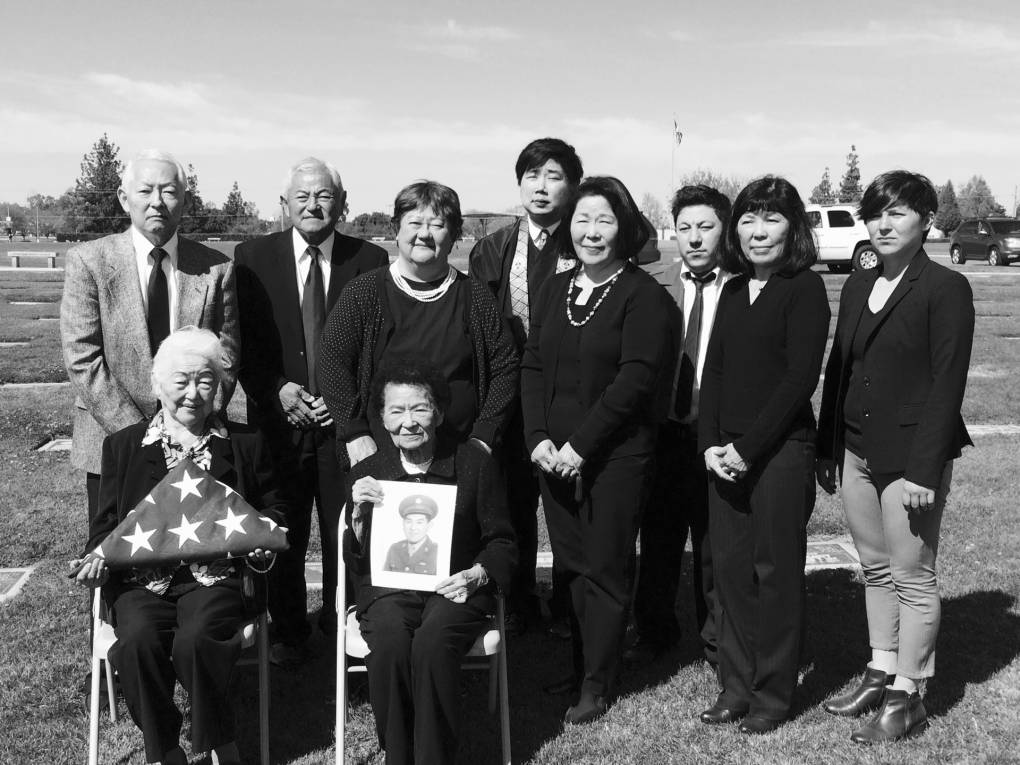
"caption": "Generations of the Masumoto family gathered in Selma, CA in 2017 for a memorial service. Yoshi Masumoto Yamagiwa (center) is holding a photo of her brother, George Masumoto, who was killed fighting for the U.S. in World War 2, while his family was incarcerated in a prison camp for Japanese Americans in Gila River, Arizona. ",
"description": "Generations of the Masumoto family gathered in Selma, California, in 2017 for a memorial service. Yoshi Masumoto Yamagiwa (center) is holding a photo of her brother, George Masumoto, who was killed fighting for the U.S. in World War II, while his family was incarcerated in a prison camp for Japanese Americans in Gila River, Arizona. ",
"title": "RS47225_IMG_5086-qut",
"credit": "Courtesy Masumoto Family",
"status": "inherit",
"altTag": null,
"isLoading": false,
"fetchFailed": false
}
},
"audioPlayerReducer": {
"postId": "stream_live",
"isPaused": true,
"isPlaying": false,
"pfsActive": false,
"pledgeModalIsOpen": true,
"playerDrawerIsOpen": false,
"liveAudioPlayStartedAt": 0,
"liveAudioPlayContext": ""
},
"authorsReducer": {
"byline_news_11868843": {
"type": "authors",
"id": "byline_news_11868843",
"meta": {
"override": true
},
"slug": "byline_news_11868843",
"name": "\u003ca href=\"https://www.npr.org/people/728257568/chloee-weiner\">Chloee Weiner\u003c/a>",
"isLoading": false
},
"kqed": {
"type": "authors",
"id": "236",
"meta": {
"index": "authors_1716337520",
"id": "236",
"found": true
},
"name": "KQED News Staff",
"firstName": "KQED News Staff",
"lastName": null,
"slug": "kqed",
"email": "faq@kqed.org",
"display_author_email": false,
"staff_mastheads": [],
"title": null,
"bio": null,
"avatar": "https://secure.gravatar.com/avatar/ef0e801a68c4c54afa9180db14084167?s=600&d=blank&r=g",
"twitter": null,
"facebook": null,
"instagram": null,
"linkedin": null,
"sites": [
{
"site": "arts",
"roles": [
"contributor"
]
},
{
"site": "news",
"roles": [
"editor"
]
},
{
"site": "futureofyou",
"roles": [
"author"
]
}
],
"headData": {
"title": "KQED News Staff | KQED",
"description": null,
"ogImgSrc": "https://secure.gravatar.com/avatar/ef0e801a68c4c54afa9180db14084167?s=600&d=blank&r=g",
"twImgSrc": "https://secure.gravatar.com/avatar/ef0e801a68c4c54afa9180db14084167?s=600&d=blank&r=g"
},
"isLoading": false,
"link": "/author/kqed"
},
"kqednewsstaffandwires": {
"type": "authors",
"id": "237",
"meta": {
"index": "authors_1716337520",
"id": "237",
"found": true
},
"name": "KQED News Staff and Wires",
"firstName": "KQED News Staff and Wires",
"lastName": null,
"slug": "kqednewsstaffandwires",
"email": "onlinenewsstaff@kqed.org",
"display_author_email": false,
"staff_mastheads": [],
"title": null,
"bio": null,
"avatar": "https://secure.gravatar.com/avatar/72295af8ebbfbd19a4948f5271285664?s=600&d=blank&r=g",
"twitter": null,
"facebook": null,
"instagram": null,
"linkedin": null,
"sites": [
{
"site": "arts",
"roles": [
"contributor"
]
},
{
"site": "news",
"roles": [
"contributor"
]
},
{
"site": "lowdown",
"roles": [
"author"
]
},
{
"site": "stateofhealth",
"roles": [
"contributor"
]
},
{
"site": "food",
"roles": [
"author"
]
}
],
"headData": {
"title": "KQED News Staff and Wires | KQED",
"description": null,
"ogImgSrc": "https://secure.gravatar.com/avatar/72295af8ebbfbd19a4948f5271285664?s=600&d=blank&r=g",
"twImgSrc": "https://secure.gravatar.com/avatar/72295af8ebbfbd19a4948f5271285664?s=600&d=blank&r=g"
},
"isLoading": false,
"link": "/author/kqednewsstaffandwires"
},
"sasha-khokha": {
"type": "authors",
"id": "254",
"meta": {
"index": "authors_1716337520",
"id": "254",
"found": true
},
"name": "Sasha Khokha",
"firstName": "Sasha",
"lastName": "Khokha",
"slug": "sasha-khokha",
"email": "skhokha@kqed.org",
"display_author_email": true,
"staff_mastheads": [
"news"
],
"title": "Host, The California Report Magazine",
"bio": "Sasha Khokha is the host of \u003cem>The California Report's \u003c/em> weekly magazine program, which takes listeners on sound-rich excursions to meet the people that make the Golden State unique -- through audio documentaries and long-form stories. As \u003cem>The California Report's\u003c/em> Central Valley Bureau Chief based in Fresno for nearly a dozen years, Sasha brought the lives and concerns of rural Californians to listeners around the state. Her reporting helped expose the hidden price immigrant women janitors and farmworkers may pay to keep their jobs: sexual assault at work. It inspired two new California laws to protect them from sexual harassment. She was a key member of the reporting team for the Frontline film \u003cem>Rape on the Night Shift, \u003c/em>which was nominated for two national Emmys. Sasha has also won a national Edward R. Murrow and a national PRNDI award for investigative reporting, as well as multiple prizes from the Society for Professional Journalists. Sasha is a proud alum of the UC Berkeley Graduate School of Journalism and Brown University and a member of the South Asian Journalists Association.",
"avatar": "https://secure.gravatar.com/avatar/e4b5e1541aaeea2aa356aa1fb2a68950?s=600&d=blank&r=g",
"twitter": "KQEDSashaKhokha",
"facebook": null,
"instagram": null,
"linkedin": null,
"sites": [
{
"site": "news",
"roles": [
"editor"
]
},
{
"site": "stateofhealth",
"roles": [
"author"
]
},
{
"site": "science",
"roles": [
"author"
]
},
{
"site": "quest",
"roles": [
"subscriber"
]
}
],
"headData": {
"title": "Sasha Khokha | KQED",
"description": "Host, The California Report Magazine",
"ogImgSrc": "https://secure.gravatar.com/avatar/e4b5e1541aaeea2aa356aa1fb2a68950?s=600&d=blank&r=g",
"twImgSrc": "https://secure.gravatar.com/avatar/e4b5e1541aaeea2aa356aa1fb2a68950?s=600&d=blank&r=g"
},
"isLoading": false,
"link": "/author/sasha-khokha"
},
"markfiore": {
"type": "authors",
"id": "3236",
"meta": {
"index": "authors_1716337520",
"id": "3236",
"found": true
},
"name": "Mark Fiore",
"firstName": "Mark",
"lastName": "Fiore",
"slug": "markfiore",
"email": "mark@markfiore.com",
"display_author_email": false,
"staff_mastheads": [
"news"
],
"title": "KQED News Cartoonist",
"bio": "\u003ca href=\"http://www.MarkFiore.com\">MarkFiore.com\u003c/a> | \u003ca href=\"https://twitter.com/markfiore\">Follow on Twitter\u003c/a> | \u003ca href=\"https://www.facebook.com/pages/Mark-Fiore-Animated-Political-Cartoons/94451707396?ref=bookmarks\">Facebook\u003c/a> | \u003ca href=\"mailto:mark@markfiore.com\">email\u003c/a>\r\n\r\nPulitzer Prize-winner, Mark Fiore, who the Wall Street Journal has called “the undisputed guru of the form,” creates animated political cartoons in San Francisco, where his work has been featured regularly on the San Francisco Chronicle’s web site, SFGate.com. His work has appeared on Newsweek.com, Slate.com, CBSNews.com, MotherJones.com, DailyKos.com and NPR’s web site. Fiore’s political animation has appeared on CNN, Frontline, Bill Moyers Journal, Salon.com and cable and broadcast outlets across the globe.\r\n\r\nBeginning his professional life by drawing traditional political cartoons for newspapers, Fiore’s work appeared in publications ranging from the Washington Post to the Los Angeles Times. In the late 1990s, he began to experiment with animating political cartoons and, after a short stint at the San Jose Mercury News as their staff cartoonist, Fiore devoted all his energies to animation.\r\nGrowing up in California, Fiore also spent a good portion of his life in the backwoods of Idaho. It was this combination that shaped him politically. Mark majored in political science at Colorado College, where, in a perfect send-off for a cartoonist, he received his diploma in 1991 as commencement speaker Dick Cheney smiled approvingly.\r\nMark Fiore was awarded the Pulitzer Prize for political cartooning in 2010, a Robert F. Kennedy Journalism Award in 2004 and has twice received an Online Journalism Award for commentary from the Online News Association (2002, 2008). Fiore has received two awards for his work in new media from the National Cartoonists Society (2001, 2002), and in 2006 received The James Madison Freedom of Information Award from The Society of Professional Journalists.",
"avatar": "https://secure.gravatar.com/avatar/fc4e2a612b15b67bad0c6f0e1db4ca9b?s=600&d=blank&r=g",
"twitter": "MarkFiore",
"facebook": null,
"instagram": "https://www.instagram.com/markfiore/?hl=en",
"linkedin": null,
"sites": [
{
"site": "arts",
"roles": [
"contributor"
]
},
{
"site": "news",
"roles": [
"editor"
]
},
{
"site": "futureofyou",
"roles": [
"editor"
]
},
{
"site": "science",
"roles": [
"editor"
]
}
],
"headData": {
"title": "Mark Fiore | KQED",
"description": "KQED News Cartoonist",
"ogImgSrc": "https://secure.gravatar.com/avatar/fc4e2a612b15b67bad0c6f0e1db4ca9b?s=600&d=blank&r=g",
"twImgSrc": "https://secure.gravatar.com/avatar/fc4e2a612b15b67bad0c6f0e1db4ca9b?s=600&d=blank&r=g"
},
"isLoading": false,
"link": "/author/markfiore"
},
"afont": {
"type": "authors",
"id": "8637",
"meta": {
"index": "authors_1716337520",
"id": "8637",
"found": true
},
"name": "Amanda Font",
"firstName": "Amanda",
"lastName": "Font",
"slug": "afont",
"email": "afont@kqed.org",
"display_author_email": false,
"staff_mastheads": [],
"title": "KQED Contributor",
"bio": "Amanda Font is a producer on \u003cem>The Latest\u003c/em> podcast, and the host and co-producer of the series \u003cem>Audible Cosmos\u003c/em>. She has previously worked as a producer and reporter on the \u003cem>Bay Curious\u003c/em> podcast, and director of \u003cem>The California Report Magazine\u003c/em>. She grew up in the deserts of Southern California and moved north for the trees. Amanda earned a B.A. from the BECA program at San Francisco State, where she worked in the university's radio station. Amanda Font is represented by SAG-AFTRA.",
"avatar": "https://secure.gravatar.com/avatar/d9e81cf0117d5849b9cfb7ab4b1422f1?s=600&d=blank&r=g",
"twitter": null,
"facebook": null,
"instagram": null,
"linkedin": null,
"sites": [
{
"site": "news",
"roles": [
"add_users",
"create_users"
]
},
{
"site": "science",
"roles": []
},
{
"site": "forum",
"roles": [
"administrator"
]
},
{
"site": "perspectives",
"roles": [
"administrator"
]
},
{
"site": "radio",
"roles": [
"administrator"
]
}
],
"headData": {
"title": "Amanda Font | KQED",
"description": "KQED Contributor",
"ogImgSrc": "https://secure.gravatar.com/avatar/d9e81cf0117d5849b9cfb7ab4b1422f1?s=600&d=blank&r=g",
"twImgSrc": "https://secure.gravatar.com/avatar/d9e81cf0117d5849b9cfb7ab4b1422f1?s=600&d=blank&r=g"
},
"isLoading": false,
"link": "/author/afont"
},
"lsarah": {
"type": "authors",
"id": "11626",
"meta": {
"index": "authors_1716337520",
"id": "11626",
"found": true
},
"name": "Lakshmi Sarah",
"firstName": "Lakshmi",
"lastName": "Sarah",
"slug": "lsarah",
"email": "lsarah@kqed.org",
"display_author_email": false,
"staff_mastheads": [],
"title": "Digital Producer",
"bio": "Lakshmi Sarah is an educator, author and journalist with a focus on innovative storytelling. She has worked with newspapers, radio and magazines from Ahmedabad, India to Los Angeles, California. She has written and produced for Die Zeit, Global Voices, AJ+, KQED, Fusion Media Group and the New York Times.",
"avatar": "https://secure.gravatar.com/avatar/652dcaecd8b28826fc17a8b2d6bb4e93?s=600&d=blank&r=g",
"twitter": "lakitalki",
"facebook": null,
"instagram": "https://www.instagram.com/laki.talki/",
"linkedin": "https://www.linkedin.com/in/lakisarah/",
"sites": [
{
"site": "arts",
"roles": []
},
{
"site": "news",
"roles": []
},
{
"site": "bayareabites",
"roles": []
},
{
"site": "science",
"roles": []
}
],
"headData": {
"title": "Lakshmi Sarah | KQED",
"description": "Digital Producer",
"ogImgSrc": "https://secure.gravatar.com/avatar/652dcaecd8b28826fc17a8b2d6bb4e93?s=600&d=blank&r=g",
"twImgSrc": "https://secure.gravatar.com/avatar/652dcaecd8b28826fc17a8b2d6bb4e93?s=600&d=blank&r=g"
},
"isLoading": false,
"link": "/author/lsarah"
},
"jchang": {
"type": "authors",
"id": "11642",
"meta": {
"index": "authors_1716337520",
"id": "11642",
"found": true
},
"name": "Julie Chang",
"firstName": "Julie",
"lastName": "Chang",
"slug": "jchang",
"email": "jchang@kqed.org",
"display_author_email": false,
"staff_mastheads": [
"news"
],
"title": "KQED Contributor",
"bio": "Julie Chang is a reporter and producer (and occasional anchor) with the radio and digital teams at KQED. Before KQED, she worked at WAMU 88.5 in Washington D.C. and 89.3 KPCC in Los Angeles County. Her work has been featured on NPR’s Morning Edition and All Things Considered, Here & Now, the New York Times, and more. Julie graduated from UC Berkeley’s Graduate School of Journalism. She previously taught English at Pasadena City College, Fullerton College and Cal Poly Pomona. Julie earned her M.A. in English from Cal Poly Pomona and her B.A. in English from UCI with a minor in criminology.",
"avatar": "https://secure.gravatar.com/avatar/a7afce94ef127082c5475116b4a3b77d?s=600&d=blank&r=g",
"twitter": "BayAreaJulie",
"facebook": null,
"instagram": null,
"linkedin": "https://www.linkedin.com/in/julieyc/",
"sites": [
{
"site": "",
"roles": [
"editor"
]
},
{
"site": "news",
"roles": [
"author"
]
},
{
"site": "science",
"roles": [
"editor"
]
}
],
"headData": {
"title": "Julie Chang | KQED",
"description": "KQED Contributor",
"ogImgSrc": "https://secure.gravatar.com/avatar/a7afce94ef127082c5475116b4a3b77d?s=600&d=blank&r=g",
"twImgSrc": "https://secure.gravatar.com/avatar/a7afce94ef127082c5475116b4a3b77d?s=600&d=blank&r=g"
},
"isLoading": false,
"link": "/author/jchang"
},
"abandlamudi": {
"type": "authors",
"id": "11672",
"meta": {
"index": "authors_1716337520",
"id": "11672",
"found": true
},
"name": "Adhiti Bandlamudi",
"firstName": "Adhiti",
"lastName": "Bandlamudi",
"slug": "abandlamudi",
"email": "abandlamudi@kqed.org",
"display_author_email": false,
"staff_mastheads": [
"news"
],
"title": "KQED Housing Reporter",
"bio": "Adhiti Bandlamudi reports for KQED's Housing desk. She focuses on how housing gets built across the Bay Area. Before joining KQED in 2020, she reported for WUNC in Durham, North Carolina, WABE in Atlanta, Georgia and Capital Public Radio in Sacramento. In 2017, she was awarded a Kroc Fellowship at NPR where she reported on everything from sprinkles to the Golden State Killer's arrest. When she's not reporting, she's baking new recipes in her kitchen or watching movies with friends and family. She's originally from Georgia and has strong opinions about Great British Bake Off.",
"avatar": "https://secure.gravatar.com/avatar/868129c8b257bb99a3500e2c86a65400?s=600&d=mm&r=g",
"twitter": "oddity_adhiti",
"facebook": null,
"instagram": null,
"linkedin": null,
"sites": [
{
"site": "arts",
"roles": [
"author"
]
},
{
"site": "news",
"roles": [
"editor"
]
},
{
"site": "liveblog",
"roles": [
"author"
]
}
],
"headData": {
"title": "Adhiti Bandlamudi | KQED",
"description": "KQED Housing Reporter",
"ogImgSrc": "https://secure.gravatar.com/avatar/868129c8b257bb99a3500e2c86a65400?s=600&d=mm&r=g",
"twImgSrc": "https://secure.gravatar.com/avatar/868129c8b257bb99a3500e2c86a65400?s=600&d=mm&r=g"
},
"isLoading": false,
"link": "/author/abandlamudi"
},
"jrodriguez": {
"type": "authors",
"id": "11690",
"meta": {
"index": "authors_1716337520",
"id": "11690",
"found": true
},
"name": "Joe Fitzgerald Rodriguez",
"firstName": "Joe",
"lastName": "Fitzgerald Rodriguez",
"slug": "jrodriguez",
"email": "jrodriguez@kqed.org",
"display_author_email": true,
"staff_mastheads": [
"news"
],
"title": "Reporter and Producer",
"bio": "Joe Fitzgerald Rodriguez is a reporter and digital producer for KQED covering politics. Joe most recently wrote for the \u003cem>San Francisco Examiner\u003c/em> as a political columnist covering The City. He was raised in San Francisco and has spent his reporting career in his beloved, foggy, city by the bay. Joe was 12-years-old when he conducted his first interview in journalism, grilling former San Francisco Mayor Willie Brown for the Marina Middle School newspaper, \u003cem>The Penguin Press, \u003c/em>and he continues to report on the San Francisco Bay Area to this day.",
"avatar": "https://secure.gravatar.com/avatar/2247beb0564c1e9c62228d5649d2edac?s=600&d=blank&r=g",
"twitter": "FitztheReporter",
"facebook": null,
"instagram": "https://www.instagram.com/fitzthereporter/",
"linkedin": null,
"sites": [
{
"site": "",
"roles": [
"editor"
]
},
{
"site": "arts",
"roles": [
"editor"
]
},
{
"site": "news",
"roles": [
"editor"
]
},
{
"site": "science",
"roles": [
"editor"
]
},
{
"site": "elections",
"roles": [
"editor"
]
},
{
"site": "liveblog",
"roles": [
"editor"
]
}
],
"headData": {
"title": "Joe Fitzgerald Rodriguez | KQED",
"description": "Reporter and Producer",
"ogImgSrc": "https://secure.gravatar.com/avatar/2247beb0564c1e9c62228d5649d2edac?s=600&d=blank&r=g",
"twImgSrc": "https://secure.gravatar.com/avatar/2247beb0564c1e9c62228d5649d2edac?s=600&d=blank&r=g"
},
"isLoading": false,
"link": "/author/jrodriguez"
},
"mjohnson": {
"type": "authors",
"id": "11729",
"meta": {
"index": "authors_1716337520",
"id": "11729",
"found": true
},
"name": "MJ Johnson",
"firstName": "MJ",
"lastName": "Johnson",
"slug": "mjohnson",
"email": "mjohnson@kqed.org",
"display_author_email": false,
"staff_mastheads": [],
"title": "KQED Contributor",
"bio": " \u003ci>MJ Johnson is a visual journalist and writer who was born and raised in Japan. She received her B.A. in Journalism from San Francisco State University and has worked as a local reporter for the San Francisco Examiner and the Golden Gate Xpress. Her interest in journalism comes from a desire to absorb and understand media through a multicultural lens, leading her to cover stories on race, identity and history. \u003c/i>",
"avatar": "https://secure.gravatar.com/avatar/62308b3d5f2db77681f1d24bbe76b6de?s=600&d=blank&r=g",
"twitter": null,
"facebook": null,
"instagram": null,
"linkedin": null,
"sites": [
{
"site": "news",
"roles": []
}
],
"headData": {
"title": "MJ Johnson | KQED",
"description": "KQED Contributor",
"ogImgSrc": "https://secure.gravatar.com/avatar/62308b3d5f2db77681f1d24bbe76b6de?s=600&d=blank&r=g",
"twImgSrc": "https://secure.gravatar.com/avatar/62308b3d5f2db77681f1d24bbe76b6de?s=600&d=blank&r=g"
},
"isLoading": false,
"link": "/author/mjohnson"
}
},
"pagesReducer": {
"news_tag_aapi": {
"type": "terms",
"id": "news_29182",
"meta": {
"index": "terms_1716263798",
"site": "news",
"id": "29182",
"score": 9.892831
},
"featImg": null,
"name": "AAPI",
"description": null,
"taxonomy": "tag",
"headData": {
"twImgId": null,
"twTitle": null,
"ogTitle": null,
"ogImgId": null,
"twDescription": null,
"description": null,
"title": "AAPI Archives | KQED News",
"ogDescription": null
},
"ttid": 29199,
"slug": "aapi",
"isLoading": false,
"title": "AAPI",
"pageMeta": {
"site": "news",
"WpPageTemplate": "page-topic-editorial",
"currentPage": 3
},
"blocks": [
{
"blockName": "kqed/post-list",
"attrs": {
"layout": "cardArticle2",
"query": "posts/news?tag=aapi",
"seeMore": false,
"paginated": true,
"page": 3
}
},
{
"blockName": "kqed/ad"
}
]
}
},
"pfsSessionReducer": {},
"postsReducer": {
"stream_live": {
"type": "live",
"id": "stream_live",
"audioUrl": "https://streams.kqed.org/kqedradio",
"title": "Live Stream",
"excerpt": "Live Stream information currently unavailable.",
"link": "/radio",
"featImg": "",
"label": {
"name": "KQED Live",
"link": "/"
}
},
"stream_kqedNewscast": {
"type": "posts",
"id": "stream_kqedNewscast",
"audioUrl": "https://www.kqed.org/.stream/anon/radio/RDnews/newscast.mp3?_=1",
"title": "KQED Newscast",
"featImg": "",
"label": {
"name": "88.5 FM",
"link": "/"
}
},
"news_11868843": {
"type": "posts",
"id": "news_11868843",
"meta": {
"index": "posts_1716263798",
"site": "news",
"id": "11868843",
"score": null,
"sort": [
1618006066000
]
},
"parent": 0,
"labelTerm": {},
"blocks": [],
"publishDate": 1618006066,
"format": "standard",
"disqusTitle": "'Feel More Protected': Crowdfunded Cab Rides Aim to Get Asian Americans Home Safe",
"title": "'Feel More Protected': Crowdfunded Cab Rides Aim to Get Asian Americans Home Safe",
"headTitle": "KQED News",
"content": "\u003cp>Lately, Candy has been running to the bus stop on her way home from work. The 26-year-old dance instructor said it's usually dark outside by the time she finishes her shift at a studio in San Francisco — and she's started to dread commuting in the \"pitch black.\"\u003c/p>\n\u003cp>\"I usually call my best friend who lives in New York,\" she said. \"I have him on the phone with me while I run to the bus stop and shiver, nervously waiting for the bus to come.\"\u003c/p>\n\u003cp>Candy, who's Filipina American and asked that NPR not use her full name out of concern she could be targeted, said the recent wave of anti-Asian violence \u003ca href=\"https://www.kqed.org/news/11859965/700-anti-asian-hate-incidents-reported-in-bay-area-during-pandemic-true-figures-might-be-even-worse\">around the Bay Area\u003c/a> and elsewhere has made her fear for her own safety, especially when walking alone in the city.\u003c/p>\n\u003cp>Now, a new effort is helping to get her home safe.\u003c/p>\n\u003cp>[pullquote size=\"medium\" align=\"right\" citation=\"Candy, San Francisco dance instructor\"]'It was a sigh of relief. But it's also very sad to have these thoughts constantly running through your mind when you're just trying to walk.'[/pullquote]In response to recent attacks against Asian Americans, community-based efforts in the Bay Area, New York and Boston are pooling funds for taxi or app-based rides for Asian Americans and Pacific Islanders who feel unsafe walking or taking public transit.\u003c/p>\n\u003cp>Over the last month alone, Asian Americans have been attacked \u003ca href=\"https://www.npr.org/2021/03/31/983273270/san-francisco-man-who-threatened-asian-woman-in-bakery-arrested-for-hate-crime\">at work\u003c/a>, on the way \u003ca href=\"https://www.npr.org/2021/03/30/982745950/attack-on-asian-woman-in-manhattan-as-bystanders-watched-to-be-probed-as-hate-cr\">to church\u003c/a> and while \u003ca href=\"https://www.kqed.org/news/11866439/asian-grandmother-who-smacked-her-attacker-with-a-board-donates-nearly-1-million\">waiting to cross the street\u003c/a>. In a \u003ca href=\"https://secureservercdn.net/104.238.69.231/a1w.90d.myftpupload.com/wp-content/uploads/2021/03/210312-Stop-AAPI-Hate-National-Report-.pdf\">widely cited report\u003c/a>, the organization Stop AAPI Hate said it received close to 3,800 reports of incidents ranging from verbal harassment to physical assault from last March to this February.\u003c/p>\n\u003cp>Candy said her fears worsened last month, after a shooter in Atlanta \u003ca href=\"https://www.npr.org/2021/03/18/978742409/what-we-know-about-the-victims-of-the-atlanta-area-shootings\">killed eight people\u003c/a>, including six Asian women.\u003c/p>\n\u003cp>\"The Atlanta shootings debilitated me,\" she said. \"I called out of work that day and just could not focus at all.\"\u003c/p>\n\u003cp>[ad fullwidth]\u003c/p>\n\u003cp>As anti-Asian violence has come into sharp focus over the course of the pandemic, community members have rallied to provide protection for Asian Americans facing potential harassment, from \u003ca href=\"https://www.npr.org/2021/04/03/983406365/in-response-to-anti-asian-hate-incidents-groups-step-up-trainings-for-bystanders\">bystander intervention training\u003c/a> to volunteer programs \u003ca href=\"https://www.cnn.com/2021/02/15/us/volunteer-group-helps-to-keep-elderly-asian-americans-safe-trnd/index.html\">offering to accompany older Asian Americans\u003c/a> in some major U.S. cities.\u003c/p>\n\u003ch3>A Community Effort That Spread on Instagram \u003c/h3>\n\u003cp>On Monday, Candy had been waiting at the bus stop for longer than usual when she remembered a post she'd seen on Instagram. An account called \u003ca href=\"https://www.instagram.com/calikyecab/\">Cali Kye Cab\u003c/a> was reimbursing rides up to $40 for Asian Americans in the Bay Area for essential travel, particularly for women, seniors and LGBTQ people.\u003c/p>\n\u003cp>She decided to call a Lyft ride home.\u003c/p>\n\u003cp>Once she arrived safely, Candy submitted a Venmo request to the account, along with a screenshot of the ride and a selfie. The next day, she had been fully reimbursed for the trip.\u003c/p>\n\u003cp>\"It was a sigh of relief,\" Candy said. \"But it's also very sad to have these thoughts constantly running through your mind when you're just trying to walk.\"\u003c/p>\n\u003cp>https://www.instagram.com/p/CNYUEelhiPY/?utm_source=ig_embed\u003c/p>\n\u003cp>Cali Kye Cab is one of a handful of Instagram accounts pooling funds for AAPI people who could not otherwise afford to use ride-hailing apps such as Uber and Lyft or call a taxi. The original account, \u003ca href=\"https://www.instagram.com/cafemaddycab/\">Cafe Maddy Cab\u003c/a>, was started last week by 28-year-old Maddy Park, a Korean-American dentist and food blogger who lives in Brooklyn, New York.\u003c/p>\n\u003cp>Park said she had the idea when she was riding the subway and felt \"absolutely terrified\" thinking of headlines she'd read about anti-Asian incidents, including \u003ca href=\"https://apnews.com/article/race-and-ethnicity-new-york-new-york-city-hate-crimes-crime-08dd454f15a3d6c90222c3976f86c138\">attacks on the subway\u003c/a> and in train stations.\u003c/p>\n\u003cp>\"I started thinking about all my student days when I couldn't afford to take cabs and I chose to take the train or walk, even if it was late at night, just to save money,\" Park said. \"I thought, there must be so many people who can't afford these car rides that might be putting themselves at risk.\"\u003c/p>\n\u003cp>Last week, Park posted to \u003ca href=\"https://www.instagram.com/cafemaddy/\">her Instagram account\u003c/a>, which has more than 50,000 followers, offering to cover ride costs for AAPI New Yorkers in need. (Her Instagram following comes in part from TikTok, where she posts popular videos \u003ca href=\"https://www.tiktok.com/@cafemaddy/video/6915470849327844614\">featuring Korean cooking and other recipes\u003c/a>.)\u003c/p>\n\u003cp>Park planned to cover the costs herself, but soon donations started flooding into her Venmo account. Within the first two days, Park said she and a team of four friends had raised more than $100,000 — and requests for ride reimbursements were pouring in.\u003c/p>\n\u003cp>https://www.instagram.com/p/CNU-b1TnjoY/?utm_source=ig_embed\u003c/p>\n\u003cp>By Thursday, Cafe Maddy Cab had reimbursed at least 400 of more than 1,000 requests. Park said many of the requests have come from nurses, medical personnel and other essential workers who often work night shifts. She's also received messages from people escorting older relatives to COVID-19 vaccinations and doctor appointments.\u003c/p>\n\u003cp>\"I've gotten a lot of messages of gratitude from people saying they weren't able to afford the rides and it's a huge financial relief and a safety relief that they have this option,\" Park said.\u003c/p>\n\u003ch3>Reaching Older Asian Americans\u003c/h3>\n\u003cp>Kye Perrot, a 39-year-old business consultant who helped organize a similar program in the Bay Area, said reaching older Asian Americans who might not be on social media is one of her top priorities. With help from a small group of volunteers, Perrot, who's Korean American, plans to pass out flyers around Bay Area bus and train stations advertising ride reimbursements in languages including Korean, Chinese, Vietnamese, Japanese and Tagalog.\u003c/p>\n\u003cp>Her team also hopes younger community members will help coordinate trips for older family members who may be less familiar with ride-hailing apps.\u003c/p>\n\u003cp>\"I just wanted it to be a resource for some people to feel a little bit more protected,\" Perrot said. \"And to not feel so scared and feel like they have a way out.\"\u003c/p>\n\u003cp>[aside label='Related Coverage' tag='anti-asian-attacks']For Perrot and Park, their work on these programs has become like a part-time job, especially since neither were previously familiar with organizing mutual aid.\u003c/p>\n\u003cp>Perrot said she spends at least five to six hours a day going through direct messages, comments and ride requests. Meanwhile, Park said she put a hold on all her other social media accounts while she works on making her reimbursement system more efficient.\u003c/p>\n\u003cp>\"I'm working around the clock,\" Park said. \"If I'm not eating or sleeping or seeing a patient, I'm working on this.\"\u003c/p>\n\u003cp>Park said she is partnering with groups in Los Angeles, Seattle and other cities hoping to get similar ride funds off the ground within the next few weeks. As the network broadens, she hopes to be able to support community members as long as the fear of more anti-Asian attacks persists.\u003c/p>\n\u003cp>\"As long as we need it, I hope we can keep running it,\" Park said. \"But the goal is for this to be unnecessary ASAP.\" \u003c/p>\n\u003cdiv class=\"fullattribution\">Copyright 2021 NPR. To see more, visit \u003ca href=\"https://www.npr.org\">NPR.org\u003c/a>.\u003cimg src=\"https://www.google-analytics.com/__utm.gif?utmac=UA-5828686-4&utmdt=%27A+Sigh+Of+Relief%27%3A+Crowdfunded+Cab+Rides+Aim+To+Get+Asian+Americans+Home+Safe&utme=8(APIKey)9(MDAxOTAwOTE4MDEyMTkxMDAzNjczZDljZA004)\">\u003c/div>\n\u003cp>[ad floatright]\u003c/p>\n",
"disqusIdentifier": "11868843 https://ww2.kqed.org/news/?p=11868843",
"disqusUrl": "https://ww2.kqed.org/news/2021/04/09/feel-more-protected-crowdfunded-cab-rides-aim-to-get-asian-americans-home-safe/",
"stats": {
"hasVideo": false,
"hasChartOrMap": false,
"hasAudio": false,
"hasPolis": false,
"wordCount": 1192,
"hasGoogleForm": false,
"hasGallery": false,
"hasHearkenModule": false,
"iframeSrcs": [],
"paragraphCount": 30
},
"modified": 1618007235,
"excerpt": "In response to attacks against Asian Americans, efforts in cities including San Francisco pool funds for taxi or app-based rides for people who feel unsafe walking or taking public transport.",
"headData": {
"twImgId": "",
"twTitle": "",
"ogTitle": "",
"ogImgId": "",
"twDescription": "",
"description": "In response to attacks against Asian Americans, efforts in cities including San Francisco pool funds for taxi or app-based rides for people who feel unsafe walking or taking public transport.",
"title": "'Feel More Protected': Crowdfunded Cab Rides Aim to Get Asian Americans Home Safe | KQED",
"ogDescription": "",
"schema": {
"@context": "https://schema.org",
"@type": "NewsArticle",
"headline": "'Feel More Protected': Crowdfunded Cab Rides Aim to Get Asian Americans Home Safe",
"datePublished": "2021-04-09T15:07:46-07:00",
"dateModified": "2021-04-09T15:27:15-07:00",
"image": "https://cdn.kqed.org/wp-content/uploads/2020/02/KQED-OG-Image@1x.png",
"isAccessibleForFree": "True",
"publisher": {
"@type": "NewsMediaOrganization",
"@id": "https://www.kqed.org/#organization",
"name": "KQED",
"logo": "https://cdn.kqed.org/wp-content/uploads/2020/02/KQED-OG-Image@1x.png",
"url": "https://www.kqed.org",
"sameAs": [
"https://www.facebook.com/KQED",
"https://twitter.com/KQED",
"https://www.instagram.com/kqed/",
"https://www.tiktok.com/@kqedofficial",
"https://www.linkedin.com/company/kqed",
"https://www.youtube.com/channel/UCeC0IOo7i1P_61zVUWbJ4nw"
]
}
}
},
"guestAuthors": [],
"slug": "feel-more-protected-crowdfunded-cab-rides-aim-to-get-asian-americans-home-safe",
"status": "publish",
"sourceUrl": "https://www.npr.org/",
"nprApiLink": "http://api.npr.org/query?id=985698836&apiKey=MDAxOTAwOTE4MDEyMTkxMDAzNjczZDljZA004",
"nprByline": "\u003ca href=\"https://www.npr.org/people/728257568/chloee-weiner\">Chloee Weiner\u003c/a>",
"nprStoryDate": "Fri, 09 Apr 2021 15:41:34 -0400",
"nprLastModifiedDate": "Fri, 09 Apr 2021 16:03:21 -0400",
"nprHtmlLink": "https://www.npr.org/2021/04/09/985698836/a-sigh-of-relief-crowdfunded-cab-rides-aim-to-get-asian-americans-home-safe?ft=nprml&f=985698836",
"nprImageAgency": "AFP via Getty Images",
"nprImageCredit": "Angela Weiss",
"source": "NPR",
"nprStoryId": "985698836",
"nprRetrievedStory": "1",
"nprPubDate": "Fri, 09 Apr 2021 16:03:00 -0400",
"path": "/news/11868843/feel-more-protected-crowdfunded-cab-rides-aim-to-get-asian-americans-home-safe",
"audioTrackLength": null,
"parsedContent": [
{
"type": "contentString",
"content": "\u003cdiv class=\"post-body\">\u003cp>\u003cp>Lately, Candy has been running to the bus stop on her way home from work. The 26-year-old dance instructor said it's usually dark outside by the time she finishes her shift at a studio in San Francisco — and she's started to dread commuting in the \"pitch black.\"\u003c/p>\n\u003cp>\"I usually call my best friend who lives in New York,\" she said. \"I have him on the phone with me while I run to the bus stop and shiver, nervously waiting for the bus to come.\"\u003c/p>\n\u003cp>Candy, who's Filipina American and asked that NPR not use her full name out of concern she could be targeted, said the recent wave of anti-Asian violence \u003ca href=\"https://www.kqed.org/news/11859965/700-anti-asian-hate-incidents-reported-in-bay-area-during-pandemic-true-figures-might-be-even-worse\">around the Bay Area\u003c/a> and elsewhere has made her fear for her own safety, especially when walking alone in the city.\u003c/p>\n\u003cp>Now, a new effort is helping to get her home safe.\u003c/p>\n\u003cp>\u003c/p>\u003c/div>",
"attributes": {
"named": {},
"numeric": []
}
},
{
"type": "component",
"content": "'It was a sigh of relief. But it's also very sad to have these thoughts constantly running through your mind when you're just trying to walk.'",
"name": "pullquote",
"attributes": {
"named": {
"size": "medium",
"align": "right",
"citation": "Candy, San Francisco dance instructor",
"label": ""
},
"numeric": []
}
},
{
"type": "contentString",
"content": "\u003cdiv class=\"post-body\">\u003cp>In response to recent attacks against Asian Americans, community-based efforts in the Bay Area, New York and Boston are pooling funds for taxi or app-based rides for Asian Americans and Pacific Islanders who feel unsafe walking or taking public transit.\u003c/p>\n\u003cp>Over the last month alone, Asian Americans have been attacked \u003ca href=\"https://www.npr.org/2021/03/31/983273270/san-francisco-man-who-threatened-asian-woman-in-bakery-arrested-for-hate-crime\">at work\u003c/a>, on the way \u003ca href=\"https://www.npr.org/2021/03/30/982745950/attack-on-asian-woman-in-manhattan-as-bystanders-watched-to-be-probed-as-hate-cr\">to church\u003c/a> and while \u003ca href=\"https://www.kqed.org/news/11866439/asian-grandmother-who-smacked-her-attacker-with-a-board-donates-nearly-1-million\">waiting to cross the street\u003c/a>. In a \u003ca href=\"https://secureservercdn.net/104.238.69.231/a1w.90d.myftpupload.com/wp-content/uploads/2021/03/210312-Stop-AAPI-Hate-National-Report-.pdf\">widely cited report\u003c/a>, the organization Stop AAPI Hate said it received close to 3,800 reports of incidents ranging from verbal harassment to physical assault from last March to this February.\u003c/p>\n\u003cp>Candy said her fears worsened last month, after a shooter in Atlanta \u003ca href=\"https://www.npr.org/2021/03/18/978742409/what-we-know-about-the-victims-of-the-atlanta-area-shootings\">killed eight people\u003c/a>, including six Asian women.\u003c/p>\n\u003cp>\"The Atlanta shootings debilitated me,\" she said. \"I called out of work that day and just could not focus at all.\"\u003c/p>\n\u003cp>\u003c/p>\u003c/div>",
"attributes": {
"named": {},
"numeric": []
}
},
{
"type": "component",
"content": "",
"name": "ad",
"attributes": {
"named": {
"label": "fullwidth"
},
"numeric": [
"fullwidth"
]
}
},
{
"type": "contentString",
"content": "\u003cdiv class=\"post-body\">\u003cp>\u003c/p>\n\u003cp>As anti-Asian violence has come into sharp focus over the course of the pandemic, community members have rallied to provide protection for Asian Americans facing potential harassment, from \u003ca href=\"https://www.npr.org/2021/04/03/983406365/in-response-to-anti-asian-hate-incidents-groups-step-up-trainings-for-bystanders\">bystander intervention training\u003c/a> to volunteer programs \u003ca href=\"https://www.cnn.com/2021/02/15/us/volunteer-group-helps-to-keep-elderly-asian-americans-safe-trnd/index.html\">offering to accompany older Asian Americans\u003c/a> in some major U.S. cities.\u003c/p>\n\u003ch3>A Community Effort That Spread on Instagram \u003c/h3>\n\u003cp>On Monday, Candy had been waiting at the bus stop for longer than usual when she remembered a post she'd seen on Instagram. An account called \u003ca href=\"https://www.instagram.com/calikyecab/\">Cali Kye Cab\u003c/a> was reimbursing rides up to $40 for Asian Americans in the Bay Area for essential travel, particularly for women, seniors and LGBTQ people.\u003c/p>\n\u003cp>She decided to call a Lyft ride home.\u003c/p>\n\u003cp>Once she arrived safely, Candy submitted a Venmo request to the account, along with a screenshot of the ride and a selfie. The next day, she had been fully reimbursed for the trip.\u003c/p>\n\u003cp>\"It was a sigh of relief,\" Candy said. \"But it's also very sad to have these thoughts constantly running through your mind when you're just trying to walk.\"\u003c/p>\u003c/p>\u003c/div>",
"attributes": {
"named": {},
"numeric": []
}
},
{
"type": "component",
"content": "",
"name": "instagramLink",
"attributes": {
"named": {
"instagramUrl": "https://www.instagram.com/p/CNYUEelhiPY/?utm_source=ig_embed"
},
"numeric": []
}
},
{
"type": "contentString",
"content": "\u003cdiv class=\"post-body\">\u003cp>\u003cp>Cali Kye Cab is one of a handful of Instagram accounts pooling funds for AAPI people who could not otherwise afford to use ride-hailing apps such as Uber and Lyft or call a taxi. The original account, \u003ca href=\"https://www.instagram.com/cafemaddycab/\">Cafe Maddy Cab\u003c/a>, was started last week by 28-year-old Maddy Park, a Korean-American dentist and food blogger who lives in Brooklyn, New York.\u003c/p>\n\u003cp>Park said she had the idea when she was riding the subway and felt \"absolutely terrified\" thinking of headlines she'd read about anti-Asian incidents, including \u003ca href=\"https://apnews.com/article/race-and-ethnicity-new-york-new-york-city-hate-crimes-crime-08dd454f15a3d6c90222c3976f86c138\">attacks on the subway\u003c/a> and in train stations.\u003c/p>\n\u003cp>\"I started thinking about all my student days when I couldn't afford to take cabs and I chose to take the train or walk, even if it was late at night, just to save money,\" Park said. \"I thought, there must be so many people who can't afford these car rides that might be putting themselves at risk.\"\u003c/p>\n\u003cp>Last week, Park posted to \u003ca href=\"https://www.instagram.com/cafemaddy/\">her Instagram account\u003c/a>, which has more than 50,000 followers, offering to cover ride costs for AAPI New Yorkers in need. (Her Instagram following comes in part from TikTok, where she posts popular videos \u003ca href=\"https://www.tiktok.com/@cafemaddy/video/6915470849327844614\">featuring Korean cooking and other recipes\u003c/a>.)\u003c/p>\n\u003cp>Park planned to cover the costs herself, but soon donations started flooding into her Venmo account. Within the first two days, Park said she and a team of four friends had raised more than $100,000 — and requests for ride reimbursements were pouring in.\u003c/p>\u003c/p>\u003c/div>",
"attributes": {
"named": {},
"numeric": []
}
},
{
"type": "component",
"content": "",
"name": "instagramLink",
"attributes": {
"named": {
"instagramUrl": "https://www.instagram.com/p/CNU-b1TnjoY/?utm_source=ig_embed"
},
"numeric": []
}
},
{
"type": "contentString",
"content": "\u003cdiv class=\"post-body\">\u003cp>\u003cp>By Thursday, Cafe Maddy Cab had reimbursed at least 400 of more than 1,000 requests. Park said many of the requests have come from nurses, medical personnel and other essential workers who often work night shifts. She's also received messages from people escorting older relatives to COVID-19 vaccinations and doctor appointments.\u003c/p>\n\u003cp>\"I've gotten a lot of messages of gratitude from people saying they weren't able to afford the rides and it's a huge financial relief and a safety relief that they have this option,\" Park said.\u003c/p>\n\u003ch3>Reaching Older Asian Americans\u003c/h3>\n\u003cp>Kye Perrot, a 39-year-old business consultant who helped organize a similar program in the Bay Area, said reaching older Asian Americans who might not be on social media is one of her top priorities. With help from a small group of volunteers, Perrot, who's Korean American, plans to pass out flyers around Bay Area bus and train stations advertising ride reimbursements in languages including Korean, Chinese, Vietnamese, Japanese and Tagalog.\u003c/p>\n\u003cp>Her team also hopes younger community members will help coordinate trips for older family members who may be less familiar with ride-hailing apps.\u003c/p>\n\u003cp>\"I just wanted it to be a resource for some people to feel a little bit more protected,\" Perrot said. \"And to not feel so scared and feel like they have a way out.\"\u003c/p>\n\u003cp>\u003c/p>\u003c/div>",
"attributes": {
"named": {},
"numeric": []
}
},
{
"type": "component",
"content": "",
"name": "aside",
"attributes": {
"named": {
"label": "Related Coverage ",
"tag": "anti-asian-attacks"
},
"numeric": []
}
},
{
"type": "contentString",
"content": "\u003cdiv class=\"post-body\">\u003cp>For Perrot and Park, their work on these programs has become like a part-time job, especially since neither were previously familiar with organizing mutual aid.\u003c/p>\n\u003cp>Perrot said she spends at least five to six hours a day going through direct messages, comments and ride requests. Meanwhile, Park said she put a hold on all her other social media accounts while she works on making her reimbursement system more efficient.\u003c/p>\n\u003cp>\"I'm working around the clock,\" Park said. \"If I'm not eating or sleeping or seeing a patient, I'm working on this.\"\u003c/p>\n\u003cp>Park said she is partnering with groups in Los Angeles, Seattle and other cities hoping to get similar ride funds off the ground within the next few weeks. As the network broadens, she hopes to be able to support community members as long as the fear of more anti-Asian attacks persists.\u003c/p>\n\u003cp>\"As long as we need it, I hope we can keep running it,\" Park said. \"But the goal is for this to be unnecessary ASAP.\" \u003c/p>\n\u003cdiv class=\"fullattribution\">Copyright 2021 NPR. To see more, visit \u003ca href=\"https://www.npr.org\">NPR.org\u003c/a>.\u003cimg src=\"https://www.google-analytics.com/__utm.gif?utmac=UA-5828686-4&utmdt=%27A+Sigh+Of+Relief%27%3A+Crowdfunded+Cab+Rides+Aim+To+Get+Asian+Americans+Home+Safe&utme=8(APIKey)9(MDAxOTAwOTE4MDEyMTkxMDAzNjczZDljZA004)\">\u003c/div>\n\u003cp>\u003c/p>\u003c/div>",
"attributes": {
"named": {},
"numeric": []
}
},
{
"type": "component",
"content": "",
"name": "ad",
"attributes": {
"named": {
"label": "floatright"
},
"numeric": [
"floatright"
]
}
},
{
"type": "contentString",
"content": "\u003cdiv class=\"post-body\">\u003cp>\u003c/p>\n\u003c/div>\u003c/p>",
"attributes": {
"named": {},
"numeric": []
}
}
],
"link": "/news/11868843/feel-more-protected-crowdfunded-cab-rides-aim-to-get-asian-americans-home-safe",
"authors": [
"byline_news_11868843"
],
"categories": [
"news_457",
"news_8",
"news_1397"
],
"tags": [
"news_29276",
"news_29182",
"news_29173",
"news_29272",
"news_4273",
"news_28508",
"news_19216",
"news_38"
],
"featImg": "news_11868865",
"label": "source_news_11868843"
},
"news_11866881": {
"type": "posts",
"id": "news_11866881",
"meta": {
"index": "posts_1716263798",
"site": "news",
"id": "11866881",
"score": null,
"sort": [
1617572582000
]
},
"guestAuthors": [],
"slug": "how-to-start-educating-yourself-and-others-on-aapi-history",
"title": "How to Start Educating Yourself and Others on AAPI History",
"publishDate": 1617572582,
"format": "standard",
"headTitle": "How to Start Educating Yourself and Others on AAPI History | KQED",
"labelTerm": {
"site": "news"
},
"content": "\u003cp>\u003ca href=\"https://faculty.sfsu.edu/~dariotis/\" target=\"_blank\" rel=\"noopener noreferrer\">Wei Ming Dariotis\u003c/a>, who is now a professor in Asian American Studies at San Francisco State University, still remembers being a graduate student at UC Santa Barbara in 1992 — during the Los Angeles uprisings (what people also call the \u003ca href=\"https://www.npr.org/2017/04/26/524744989/when-la-erupted-in-anger-a-look-back-at-the-rodney-king-riots\" target=\"_blank\" rel=\"noopener noreferrer\">Rodney King Riots\u003c/a>).\u003c/p>\n\u003cp>“Basically all of our Asian students were from L.A. and most of them were losing family businesses — they were on fire, literally,” she said.\u003c/p>\n\u003cp>“There was so much pain and anguish going on,” Dariotis said, for the Black, Latinx and Asian students impacted by the L.A. uprisings, “their communities were on fire.” [pullquote size=\"medium\" align=\"right\" citation=\"Wei Ming Dariotis, Asian American Studies, San Francisco State\"]‘The answer to Asian violence is not more policing … The solution is education, conversation and also creating systems to protect everybody.’[/pullquote]\u003c/p>\n\u003cp>Yet, during this time, Dariotis said the university didn’t do much to support its students or staff. There were no discussions of what was happening in Los Angeles in the classroom and no lessons that brought the history and economics of the current moment back into class discussions — a teachable moment was lost.\u003c/p>\n\u003cp>Dariotis said the university failed to provide any kind of counseling or grief services, and she remembers being one of few Asian people on campus at the time. It’s now nearly 30 years later — she’s now in a position to bridge the gap between what is happening in the world outside the classroom, and bringing history and racial justice into a broader educational framework for what is happening today.\u003c/p>\n\u003cp>[ad fullwidth]\u003c/p>\n\u003cp>Just days after the March 16 Atlanta mass shootings that killed eight, including six Asian women, Dariotis, who is the faculty director of the SFSU Center for Equity and Excellence in Teaching and Learning, channeled her energy into creating teaching \u003ca href=\"https://ceetl.sfsu.edu/aapi-solidarity-statement\" target=\"_blank\" rel=\"noopener noreferrer\">resources\u003c/a> to help illuminate the issues facing AAPI communities. She’s also inviting broader collaboration.\u003c/p>\n\u003cp>“I’ve had several meetings with my private cohort of friends from graduate school who are all in academic leadership positions at schools in the Bay Area. And one of them said, ‘These attacks don’t come from nowhere,’ ” Dariotis said. “They start with images and perspectives … something that we, as educators, can have a huge influence on.” [aside tag=\"asian, aapi, anti-asian\" label=\"More Related Stories\"]\u003c/p>\n\u003cp>It’s now been over two weeks, and what she initially created as a shared Google document is publicly available for anyone to access and serves as a curriculum resource in an effort to ensure a better understanding of the experiences of Asians in the U.S. and of U.S. colonization, more broadly.\u003c/p>\n\u003cp>The recommendations from the Center for Equity and Excellence in Teaching and Learning includes a solidarity statement, resources on intersectional racism — a collection of toolkits on allyship, racial justice and domestic violence, BIPOC solidarity, white allyship as well as a history of anti-Asian racism, in addition to AAPI mental health resources.\u003c/p>\n\u003cp>As an educator and one of the founders of \u003ca href=\"https://criticalmixedracestudies.com/\" target=\"_blank\" rel=\"noopener noreferrer\">Critical Mixed Race Studies\u003c/a>, Dariotis sees a clear need for examining inequities in all fields, even when it come to higher education. On a national scale, in academia, Asian American women make up a small percentage of faculty positions, and on SFSU campus, she said the faculty-to-student ratio for white faculty and students is 1 to 7, but it is 1 to 25 for Asian faculty, and 1 to 90 for Latinx faculty.\u003c/p>\n\u003cp>For Dariotis and many educators, the solution, in part, lies in education. “The answer to Asian violence is not more policing … The solution is education, conversation and also creating systems to protect everybody,” Dariotis said.\u003c/p>\n\u003ch3>Resources\u003c/h3>\n\u003cp>Teaching Resources from SFSU’s \u003ca href=\"https://ceetl.sfsu.edu/aapi-solidarity-statement\" target=\"_blank\" rel=\"noopener noreferrer\">Center for Equity and Excellence in Teaching and Learning\u003c/a>\u003c/p>\n\u003cp>PBS has made the series “\u003ca href=\"https://www.pbs.org/show/asian-americans/\" target=\"_blank\" rel=\"noopener noreferrer\">Asian Americans\u003c/a>” temporarily free to stream.\u003c/p>\n\u003cp>SFSU campus-related racism may be reported to the \u003ca href=\"https://equity.sfsu.edu/content/bias-incident-education-team-sf-state\" target=\"_blank\" rel=\"noopener noreferrer\">Bias Incident Reporting Team\u003c/a>.\u003c/p>\n\u003cp>\u003c/p>\n\u003cp>\u003cem>Lakshmi Sarah teaches a class at SFSU in the journalism department. \u003c/em>\u003c/p>\n\n",
"blocks": [],
"excerpt": "One San Francisco State University professor channeled her energy into creating a collaborative resource for others originally titled 'Teaching in Days After ... Anti-Asian Violence Guide.'",
"status": "publish",
"parent": 0,
"modified": 1730493361,
"stats": {
"hasAudio": false,
"hasVideo": false,
"hasChartOrMap": false,
"iframeSrcs": [],
"hasGoogleForm": false,
"hasGallery": false,
"hasHearkenModule": false,
"hasPolis": false,
"paragraphCount": 17,
"wordCount": 694
},
"headData": {
"title": "How to Start Educating Yourself and Others on AAPI History | KQED",
"description": "One San Francisco State University professor channeled her energy into creating a collaborative resource for others originally titled 'Teaching in Days After ... Anti-Asian Violence Guide.'",
"ogTitle": "",
"ogDescription": "",
"ogImgId": "",
"twTitle": "",
"twDescription": "",
"twImgId": "",
"schema": {
"@context": "https://schema.org",
"@type": "NewsArticle",
"headline": "How to Start Educating Yourself and Others on AAPI History",
"datePublished": "2021-04-04T14:43:02-07:00",
"dateModified": "2024-11-01T13:36:01-07:00",
"image": "https://cdn.kqed.org/wp-content/uploads/2020/02/KQED-OG-Image@1x.png",
"isAccessibleForFree": "True",
"publisher": {
"@type": "NewsMediaOrganization",
"@id": "https://www.kqed.org/#organization",
"name": "KQED",
"logo": "https://cdn.kqed.org/wp-content/uploads/2020/02/KQED-OG-Image@1x.png",
"url": "https://www.kqed.org",
"sameAs": [
"https://www.facebook.com/KQED",
"https://twitter.com/KQED",
"https://www.instagram.com/kqed/",
"https://www.tiktok.com/@kqedofficial",
"https://www.linkedin.com/company/kqed",
"https://www.youtube.com/channel/UCeC0IOo7i1P_61zVUWbJ4nw"
]
}
}
},
"sticky": false,
"path": "/news/11866881/how-to-start-educating-yourself-and-others-on-aapi-history",
"audioTrackLength": null,
"parsedContent": [
{
"type": "contentString",
"content": "\u003cdiv class=\"post-body\">\u003cp>\u003cp>\u003ca href=\"https://faculty.sfsu.edu/~dariotis/\" target=\"_blank\" rel=\"noopener noreferrer\">Wei Ming Dariotis\u003c/a>, who is now a professor in Asian American Studies at San Francisco State University, still remembers being a graduate student at UC Santa Barbara in 1992 — during the Los Angeles uprisings (what people also call the \u003ca href=\"https://www.npr.org/2017/04/26/524744989/when-la-erupted-in-anger-a-look-back-at-the-rodney-king-riots\" target=\"_blank\" rel=\"noopener noreferrer\">Rodney King Riots\u003c/a>).\u003c/p>\n\u003cp>“Basically all of our Asian students were from L.A. and most of them were losing family businesses — they were on fire, literally,” she said.\u003c/p>\n\u003cp>“There was so much pain and anguish going on,” Dariotis said, for the Black, Latinx and Asian students impacted by the L.A. uprisings, “their communities were on fire.” \u003c/p>\u003c/div>",
"attributes": {
"named": {},
"numeric": []
}
},
{
"type": "component",
"content": "‘The answer to Asian violence is not more policing … The solution is education, conversation and also creating systems to protect everybody.’",
"name": "pullquote",
"attributes": {
"named": {
"size": "medium",
"align": "right",
"citation": "Wei Ming Dariotis, Asian American Studies, San Francisco State",
"label": ""
},
"numeric": []
}
},
{
"type": "contentString",
"content": "\u003cdiv class=\"post-body\">\u003cp>\u003c/p>\n\u003cp>Yet, during this time, Dariotis said the university didn’t do much to support its students or staff. There were no discussions of what was happening in Los Angeles in the classroom and no lessons that brought the history and economics of the current moment back into class discussions — a teachable moment was lost.\u003c/p>\n\u003cp>Dariotis said the university failed to provide any kind of counseling or grief services, and she remembers being one of few Asian people on campus at the time. It’s now nearly 30 years later — she’s now in a position to bridge the gap between what is happening in the world outside the classroom, and bringing history and racial justice into a broader educational framework for what is happening today.\u003c/p>\n\u003cp>\u003c/p>\u003c/div>",
"attributes": {
"named": {},
"numeric": []
}
},
{
"type": "component",
"content": "",
"name": "ad",
"attributes": {
"named": {
"label": "fullwidth"
},
"numeric": [
"fullwidth"
]
}
},
{
"type": "contentString",
"content": "\u003cdiv class=\"post-body\">\u003cp>\u003c/p>\n\u003cp>Just days after the March 16 Atlanta mass shootings that killed eight, including six Asian women, Dariotis, who is the faculty director of the SFSU Center for Equity and Excellence in Teaching and Learning, channeled her energy into creating teaching \u003ca href=\"https://ceetl.sfsu.edu/aapi-solidarity-statement\" target=\"_blank\" rel=\"noopener noreferrer\">resources\u003c/a> to help illuminate the issues facing AAPI communities. She’s also inviting broader collaboration.\u003c/p>\n\u003cp>“I’ve had several meetings with my private cohort of friends from graduate school who are all in academic leadership positions at schools in the Bay Area. And one of them said, ‘These attacks don’t come from nowhere,’ ” Dariotis said. “They start with images and perspectives … something that we, as educators, can have a huge influence on.” \u003c/p>\u003c/div>",
"attributes": {
"named": {},
"numeric": []
}
},
{
"type": "component",
"content": "",
"name": "aside",
"attributes": {
"named": {
"tag": "asian, aapi, anti-asian",
"label": "More Related Stories "
},
"numeric": []
}
},
{
"type": "contentString",
"content": "\u003cdiv class=\"post-body\">\u003cp>\u003c/p>\n\u003cp>It’s now been over two weeks, and what she initially created as a shared Google document is publicly available for anyone to access and serves as a curriculum resource in an effort to ensure a better understanding of the experiences of Asians in the U.S. and of U.S. colonization, more broadly.\u003c/p>\n\u003cp>The recommendations from the Center for Equity and Excellence in Teaching and Learning includes a solidarity statement, resources on intersectional racism — a collection of toolkits on allyship, racial justice and domestic violence, BIPOC solidarity, white allyship as well as a history of anti-Asian racism, in addition to AAPI mental health resources.\u003c/p>\n\u003cp>As an educator and one of the founders of \u003ca href=\"https://criticalmixedracestudies.com/\" target=\"_blank\" rel=\"noopener noreferrer\">Critical Mixed Race Studies\u003c/a>, Dariotis sees a clear need for examining inequities in all fields, even when it come to higher education. On a national scale, in academia, Asian American women make up a small percentage of faculty positions, and on SFSU campus, she said the faculty-to-student ratio for white faculty and students is 1 to 7, but it is 1 to 25 for Asian faculty, and 1 to 90 for Latinx faculty.\u003c/p>\n\u003cp>For Dariotis and many educators, the solution, in part, lies in education. “The answer to Asian violence is not more policing … The solution is education, conversation and also creating systems to protect everybody,” Dariotis said.\u003c/p>\n\u003ch3>Resources\u003c/h3>\n\u003cp>Teaching Resources from SFSU’s \u003ca href=\"https://ceetl.sfsu.edu/aapi-solidarity-statement\" target=\"_blank\" rel=\"noopener noreferrer\">Center for Equity and Excellence in Teaching and Learning\u003c/a>\u003c/p>\n\u003cp>PBS has made the series “\u003ca href=\"https://www.pbs.org/show/asian-americans/\" target=\"_blank\" rel=\"noopener noreferrer\">Asian Americans\u003c/a>” temporarily free to stream.\u003c/p>\n\u003cp>SFSU campus-related racism may be reported to the \u003ca href=\"https://equity.sfsu.edu/content/bias-incident-education-team-sf-state\" target=\"_blank\" rel=\"noopener noreferrer\">Bias Incident Reporting Team\u003c/a>.\u003c/p>\n\u003cp>\u003c/p>\n\u003cp>\u003cem>Lakshmi Sarah teaches a class at SFSU in the journalism department. \u003c/em>\u003c/p>\n\n\u003c/div>\u003c/p>",
"attributes": {
"named": {},
"numeric": []
}
}
],
"link": "/news/11866881/how-to-start-educating-yourself-and-others-on-aapi-history",
"authors": [
"11626"
],
"categories": [
"news_8"
],
"tags": [
"news_29276",
"news_29182",
"news_29267",
"news_24788",
"news_4273",
"news_28289",
"news_19216",
"news_38",
"news_2200"
],
"featImg": "news_11867987",
"label": "news"
},
"news_11867492": {
"type": "posts",
"id": "news_11867492",
"meta": {
"index": "posts_1716263798",
"site": "news",
"id": "11867492",
"score": null,
"sort": [
1617314310000
]
},
"guestAuthors": [],
"slug": "thousands-of-business-leaders-commit-10m-to-aapi-organizations-fighting-racism",
"title": "Thousands of Business Leaders Commit $10 Million to AAPI Organizations Fighting Racism",
"publishDate": 1617314310,
"format": "standard",
"headTitle": "Thousands of Business Leaders Commit $10 Million to AAPI Organizations Fighting Racism | KQED",
"labelTerm": {
"site": "news"
},
"content": "\u003cp>Like many in the Asian American and Pacific Islander community, Dave Lu found himself horrified at the \u003ca href=\"https://www.kqed.org/news/11865791/bay-area-vigils-remember-atlanta-shooting-victims-challenge-white-supremacy\">Atlanta shootings\u003c/a> that left eight people dead, six of whom were Asian women.\u003c/p>\n\u003cp>Anger. Hopelessness. These emotions and more were publicly voiced by many. And even living in faraway San Francisco — his home of two decades — Lu felt them all, too.\u003c/p>\n\u003cp>“A lot of us were like, I didn’t know what to do,” he said. “We felt hopeless.”\u003c/p>\n\u003cp>And like many in the AAPI community, Lu turned to his own networks to rally support. Lu’s networks, however, are perhaps more jaw-dropping than most. Lu, co-founder of the food staffing app Pared and a managing partner at the AAPI-connecting Hyphen Capital, put out the call to Silicon Valley, and titans of industry answered.\u003c/p>\n\u003cp>Highly placed AAPI business leaders and their allies, from Google, Walmart, Zoom, the Golden State Warriors, TikTok, the Brooklyn Nets — even Pizza Hut — signed onto Lu’s joint letter stating, “Enough,” which published in the Wall Street Journal as a full-page advertisement on Wednesday.\u003c/p>\n\u003cp>\u003cem>\u003ca href=\"#fullletter\">Read the full letter here.\u003c/a>\u003c/em>\u003c/p>\n\u003cp>“We, the Asian American business leaders of America, are tired, angry and afraid — and not for the first time. We are tired of being treated as less than American, subject to harassment and now, every day, we read about another member of our community being physically attacked — simply for being Asian,” the letter reads.\u003c/p>\n\u003cp>Those business leaders, now numbering at nearly 3,850 signatories and counting, committed to fund efforts to support AAPI communities. At first, Lu asked for $1 million from his network, but the response was so great that he adjusted that total to $10 million in support over the next year.\u003c/p>\n\u003cp>[pullquote size='medium' align='right' citation='An excerpt from the letter published in the Wall Street Journal']‘We, the Asian American business leaders of America, are tired, angry and afraid — and not for the first time. We are tired of being treated as less than American, subject to harassment and now, every day, we read about another member of our community being physically attacked — simply for being Asian.’[/pullquote]\u003c/p>\n\u003cp>The letter name-checked organizations like \u003ca href=\"https://stopaapihate.org\">Stop AAPI Hate\u003c/a>, which is tallying incidents of hate against the AAPI community, AAPI Women Lead, the Asian Americans Advancing Justice network, Association for Asian American Studies, and more, all of which were nodded to as beneficiaries of the fundraising effort.\u003c/p>\n\u003cp>Lu was joined in this effort by Yul Kwon, a senior director of product management at Google, who is also the first Asian American winner of the reality TV show “Survivor.” Speaking to KQED, Kwon acknowledged both he and Lu have a perhaps loftier reach than most, but said they had a responsibility to use those connections to help their community.\u003c/p>\n\u003cp>“Regardless of how much we’ve succeeded, people have seen us as foreigners,” Kwon said. “I’m just as worried about my friends and my parents, I’ve had friends just punched in the face walking down [in] San Francisco.”\u003c/p>\n\u003cp>“None of this success protects us from violence and hate,” Kwon said. And he isn’t the only one speaking out in his family. His wife, Sophie, helped organize \u003ca href=\"https://www.kqed.org/news/11867051/role-models-asian-american-parents-in-the-bay-area-step-up-to-rally-against-racism\">a Bay Area rally against hate just last weekend\u003c/a>.\u003c/p>\n\u003cfigure id=\"attachment_11867053\" class=\"wp-caption alignnone\" style=\"max-width: 1920px\">\u003cimg loading=\"lazy\" decoding=\"async\" class=\"size-full wp-image-11867053\" src=\"https://ww2.kqed.org/app/uploads/sites/10/2021/03/IMG_1303.jpg\" alt=\"\" width=\"1920\" height=\"1278\" srcset=\"https://cdn.kqed.org/wp-content/uploads/sites/10/2021/03/IMG_1303.jpg 1920w, https://cdn.kqed.org/wp-content/uploads/sites/10/2021/03/IMG_1303-800x533.jpg 800w, https://cdn.kqed.org/wp-content/uploads/sites/10/2021/03/IMG_1303-1020x679.jpg 1020w, https://cdn.kqed.org/wp-content/uploads/sites/10/2021/03/IMG_1303-160x107.jpg 160w, https://cdn.kqed.org/wp-content/uploads/sites/10/2021/03/IMG_1303-1536x1022.jpg 1536w\" sizes=\"(max-width: 1920px) 100vw, 1920px\">\u003cfigcaption class=\"wp-caption-text\">Yul Kwon helped organize a rally against anti-Asian hate on the Peninsula on Sunday, March 28, 2021. Kwon was the first Asian American winner of the show ‘Survivor.’ He says he went on the show to serve as a role model for Asian children and to defy Asian stereotypes. \u003ccite>(Esther Lee/KQED)\u003c/cite>\u003c/figcaption>\u003c/figure>\n\u003cp>In Silicon Valley, Kwon said, people tend to lump all the diverse cultures who identify as Asian together. But they represent “the richest to the poorest,” and need to band together to support the broad spectrum of the community.\u003c/p>\n\u003cp>Lu said that manifests as educating their own communities, from Silicon Valley to the readers of the Wall Street Journal, where their joint letter ran.\u003c/p>\n\u003cp>“Do you guys even know, like, what’s happening to Asians?” Lu said. “We’re not going to be invisible anymore. I think we’re standing up and rising up together. I think seeing the names on this list kind of really encourages a lot of people to do that without fear.”\u003c/p>\n\u003cp>Some of the signatories — from Rick Welts, president of the Golden State Warriors, to Tony Xu, co-founder and CEO of DoorDash, or Kenneth Lin, CEO of Credit Karma — have “huge platforms,” Lu said.\u003c/p>\n\u003cp>“These have folks have thousands and thousands of employees that are the ones who are listening,” Lu said. “So if they put their names from pen to paper, or a digital kind of paper, and they report this, it makes people take note.”\u003c/p>\n\u003cp>[pullquote size='medium' align='right' citation='Dave Lu']‘We’re not going to be invisible anymore. I think we’re standing up and rising up together. I think seeing the names on this list kind of really encourages a lot of people to do that without fear.’[/pullquote]\u003c/p>\n\u003cp>Cynthia Choi, co-executive director of Chinese for Affirmative Action and co-founder of Stop AAPI Hate, said it was too early to tell how much of a funding boost their effort netted from Lu’s WSJ ad — it was only the first day.\u003c/p>\n\u003cp>Still, she said, “we have seen an overall increase in support,” in their funding of late.\u003c/p>\n\u003cp>Between March 19, 2020 and Feb. 28, 2021, there were at least 3,795 incidents of anti-Asian hate across the nation, ranging from physical assault and verbal harassment to various civil rights violations, according to data collected by Stop AAPI Hate.\u003c/p>\n\u003cp>\u003ca href=\"https://www.kqed.org/news/11859965/700-anti-asian-hate-incidents-reported-in-bay-area-during-pandemic-true-figures-might-be-even-worse\">More than 700 of those incidents\u003c/a> took place in the Bay Area.\u003c/p>\n\u003cp>That’s no surprise to Kwon — his own mother encountered community racism just a few weeks ago.\u003c/p>\n\u003cp>Kwon’s mother, a decades-long Concord resident who emigrated from South Korea, drove to Martinez to get a COVID-19 vaccination at a local Kaiser Permanente hospital. Lost, she stopped at a gas station to ask for help, only to find her car blocked in by an aggressive stranger. [aside tag=\"stop-aapi-hate\" label=\"more coverage\"]\u003c/p>\n\u003cp>“When she asked him, ‘Can you please let me go?’ He basically yelled at her, ‘You can’t tell me what to do, this is my country,’ ” Kwon recalled. She locked herself in her car and waited for him to leave.\u003c/p>\n\u003cp>But Kwon has some hope. “I asked my mom, are you scared of white people now? She said no.”\u003c/p>\n\u003cp>After the man left, a white woman inside the gas station came out and comforted Kwon’s mother and helped guide her to the Kaiser hospital personally.\u003c/p>\n\u003cp>“She had my mom follow her in her car … that was just such an extraordinary act of kindness, of humanity,” Kwon said. “I’d like to believe that most people in my own experience, most people are good here.”\u003c/p>\n\u003cp>And for those who aren’t? Lu and Kwon hope their efforts will drown them out, and help amplify those doing good works for the AAPI community. [ad fullwidth]\u003c/p>\n\u003cp>\u003cem>\u003ca id=\"fullletter\">\u003c/a>Below, read the full letter signed by AAPI business leaders and their allies Lu published in the Wall Street Journal on Wednesday: \u003c/em>\u003c/p>\n\u003cblockquote>\u003cp>\u003cem>We, the Asian American business leaders of America, are tired, angry and afraid — and not for the first time. We are tired of being treated as less than American, subject to harassment and now, every day, we read about another member of our community being physically attacked — simply for being Asian. We are afraid for the safety of our loved ones. We are angry that our families can no longer go outside in their own neighborhoods where they have lived for decades because it might not be safe.\u003c/em>\u003c/p>\n\u003cp>\u003cem>We have given a lot to this country where we were born or to which we immigrated. Our community includes your cashiers, your teachers, your cooks, your doctors, your lawyers, your dry cleaners, your colleagues, your friends. We cut your nails. We write your code. We’ve launched rovers to Mars and back. Many of us have created jobs for hundreds of thousands of Americans. We chose to make America our home and we strive every day to make America better — just like you.\u003c/em>\u003c/p>\n\u003cp>\u003cem>We don’t deserve to live in fear in our own country. The vitriol has made Asians the targets of this blame. Rhetoric matters. The “China Virus.” “Kung Flu.” Those words were an open invitation to hate and the result has been a 150% rise over the past year in reported hate crimes against the Asian American community, disproportionately against Asian women.\u003c/em>\u003c/p>\n\u003cp>\u003cem>We ask for your support in ending violence against Asian Americans. We no longer want to fear being stabbed from behind, fatally knocked to the ground, having acid thrown on our face or gunned down like the mothers and grandmothers in Atlanta. We no longer want to see photos of bruised and battered Asian seniors with GoFundMe links asking for support. It is critical that we also acknowledge that the violence we are experiencing has been the daily reality for our Black, Latinx, Indigenous and LGBTQ communities.\u003c/em>\u003c/p>\n\u003cp>\u003cem>The Asian American business leaders in our community are committed to fighting for change. The change that is needed requires a national awakening and a dialogue that involves leaders from every community if we are to undo the generations of systemic bias and racism. We are business leaders. We can help make change happen.\u003c/em>\u003c/p>\n\u003cp>\u003cem>\u003cstrong>Today, we pledge:\u003c/strong>\u003c/em>\u003c/p>\n\u003cp>\u003cem>To stop Asian violence, we are collectively committing $1M to fight Asian hate by supporting the following organizations that are doing the grassroots work to support our communities.\u003c/em>\u003c/p>\n\u003cp>\u003cem>Reporting and documenting hate crimes is critical to stopping them so we will invest in the StopAAPIHate effort.\u003c/em>\u003c/p>\n\u003cp>\u003cem>We commit that our fight for Asian American recognition and justice will be intersectional, addressing the unequal injustices faced by women, the less educated, and persons with disabilities in our community, and we advocate for resources to protect and empower Asian women by donating to AAPI Women Lead and NAPAWF.\u003c/em>\u003cbr>\n\u003cem>We will defend those impacted by hate crimes and ensure that they have proper legal representation and will donate to the Asian-Americans Advancing Justice network.\u003c/em>\u003c/p>\n\u003cp>\u003cem>We will fund research and education on the causes and solutions to Asian racism of all forms by donating to the Association for Asian American Studies.\u003c/em>\u003c/p>\n\u003cp>\u003cem>To support Asian employees, we commit to creating and funding AAPI employee resource groups to ensure Asian employees, especially women who bear the brunt of the harassment, have a safe space to tell their stories, receive support and report discrimination without fear of retaliation.\u003c/em>\u003c/p>\n\u003cp>\u003cem>To ensure representation, we commit to reporting out on diversity of all groups and to redefine Asian Americans as a group worth representation at all levels of the organization.\u003c/em>\u003c/p>\n\u003cp>\u003cem>As Asian American community activist Grace Lee Boggs said: \u003c/em>\u003cem>“You cannot change any society unless you take responsibility for it, unless you see yourself as belonging to it and responsible for changing it.”\u003c/em>\u003c/p>\n\u003cp>\u003cem>We, your friends, colleagues, and neighbors, ask that you join us in ending discrimination and violence against the Asian community and all marginalized communities. Enough is enough. Stand with us.\u003c/em>\u003c/p>\u003c/blockquote>\n\u003cp>[ad fullwidth]\u003c/p>\n\u003cp>[ad floatright]\u003c/p>\n",
"blocks": [],
"excerpt": "Highly placed AAPI business leaders and their allies, from Google, Walmart, Zoom, the Golden State Warriors, TikTok, the Brooklyn Nets — even Pizza Hut — signed onto a joint letter stating, 'Enough,' which published in the Wall Street Journal as a full-page advertisement on Wednesday.",
"status": "publish",
"parent": 0,
"modified": 1721157030,
"stats": {
"hasAudio": false,
"hasVideo": false,
"hasChartOrMap": false,
"iframeSrcs": [],
"hasGoogleForm": false,
"hasGallery": false,
"hasHearkenModule": false,
"hasPolis": false,
"paragraphCount": 47,
"wordCount": 1964
},
"headData": {
"title": "Thousands of Business Leaders Commit $10 Million to AAPI Organizations Fighting Racism | KQED",
"description": "Highly placed AAPI business leaders and their allies, from Google, Walmart, Zoom, the Golden State Warriors, TikTok, the Brooklyn Nets — even Pizza Hut — signed onto a joint letter stating, 'Enough,' which published in the Wall Street Journal as a full-page advertisement on Wednesday.",
"ogTitle": "",
"ogDescription": "",
"ogImgId": "",
"twTitle": "",
"twDescription": "",
"twImgId": "",
"schema": {
"@context": "https://schema.org",
"@type": "NewsArticle",
"headline": "Thousands of Business Leaders Commit $10 Million to AAPI Organizations Fighting Racism",
"datePublished": "2021-04-01T14:58:30-07:00",
"dateModified": "2024-07-16T12:10:30-07:00",
"image": "https://cdn.kqed.org/wp-content/uploads/2020/02/KQED-OG-Image@1x.png",
"isAccessibleForFree": "True",
"publisher": {
"@type": "NewsMediaOrganization",
"@id": "https://www.kqed.org/#organization",
"name": "KQED",
"logo": "https://cdn.kqed.org/wp-content/uploads/2020/02/KQED-OG-Image@1x.png",
"url": "https://www.kqed.org",
"sameAs": [
"https://www.facebook.com/KQED",
"https://twitter.com/KQED",
"https://www.instagram.com/kqed/",
"https://www.tiktok.com/@kqedofficial",
"https://www.linkedin.com/company/kqed",
"https://www.youtube.com/channel/UCeC0IOo7i1P_61zVUWbJ4nw"
]
}
}
},
"sticky": false,
"path": "/news/11867492/thousands-of-business-leaders-commit-10m-to-aapi-organizations-fighting-racism",
"audioTrackLength": null,
"parsedContent": [
{
"type": "contentString",
"content": "\u003cdiv class=\"post-body\">\u003cp>\u003cp>Like many in the Asian American and Pacific Islander community, Dave Lu found himself horrified at the \u003ca href=\"https://www.kqed.org/news/11865791/bay-area-vigils-remember-atlanta-shooting-victims-challenge-white-supremacy\">Atlanta shootings\u003c/a> that left eight people dead, six of whom were Asian women.\u003c/p>\n\u003cp>Anger. Hopelessness. These emotions and more were publicly voiced by many. And even living in faraway San Francisco — his home of two decades — Lu felt them all, too.\u003c/p>\n\u003cp>“A lot of us were like, I didn’t know what to do,” he said. “We felt hopeless.”\u003c/p>\n\u003cp>And like many in the AAPI community, Lu turned to his own networks to rally support. Lu’s networks, however, are perhaps more jaw-dropping than most. Lu, co-founder of the food staffing app Pared and a managing partner at the AAPI-connecting Hyphen Capital, put out the call to Silicon Valley, and titans of industry answered.\u003c/p>\n\u003cp>Highly placed AAPI business leaders and their allies, from Google, Walmart, Zoom, the Golden State Warriors, TikTok, the Brooklyn Nets — even Pizza Hut — signed onto Lu’s joint letter stating, “Enough,” which published in the Wall Street Journal as a full-page advertisement on Wednesday.\u003c/p>\n\u003cp>\u003cem>\u003ca href=\"#fullletter\">Read the full letter here.\u003c/a>\u003c/em>\u003c/p>\n\u003cp>“We, the Asian American business leaders of America, are tired, angry and afraid — and not for the first time. We are tired of being treated as less than American, subject to harassment and now, every day, we read about another member of our community being physically attacked — simply for being Asian,” the letter reads.\u003c/p>\n\u003cp>Those business leaders, now numbering at nearly 3,850 signatories and counting, committed to fund efforts to support AAPI communities. At first, Lu asked for $1 million from his network, but the response was so great that he adjusted that total to $10 million in support over the next year.\u003c/p>\n\u003cp>\u003c/p>\u003c/div>",
"attributes": {
"named": {},
"numeric": []
}
},
{
"type": "component",
"content": "‘We, the Asian American business leaders of America, are tired, angry and afraid — and not for the first time. We are tired of being treated as less than American, subject to harassment and now, every day, we read about another member of our community being physically attacked — simply for being Asian.’",
"name": "pullquote",
"attributes": {
"named": {
"size": "medium",
"align": "right",
"citation": "An excerpt from the letter published in the Wall Street Journal",
"label": ""
},
"numeric": []
}
},
{
"type": "contentString",
"content": "\u003cdiv class=\"post-body\">\u003cp>\u003c/p>\n\u003cp>The letter name-checked organizations like \u003ca href=\"https://stopaapihate.org\">Stop AAPI Hate\u003c/a>, which is tallying incidents of hate against the AAPI community, AAPI Women Lead, the Asian Americans Advancing Justice network, Association for Asian American Studies, and more, all of which were nodded to as beneficiaries of the fundraising effort.\u003c/p>\n\u003cp>Lu was joined in this effort by Yul Kwon, a senior director of product management at Google, who is also the first Asian American winner of the reality TV show “Survivor.” Speaking to KQED, Kwon acknowledged both he and Lu have a perhaps loftier reach than most, but said they had a responsibility to use those connections to help their community.\u003c/p>\n\u003cp>“Regardless of how much we’ve succeeded, people have seen us as foreigners,” Kwon said. “I’m just as worried about my friends and my parents, I’ve had friends just punched in the face walking down [in] San Francisco.”\u003c/p>\n\u003cp>“None of this success protects us from violence and hate,” Kwon said. And he isn’t the only one speaking out in his family. His wife, Sophie, helped organize \u003ca href=\"https://www.kqed.org/news/11867051/role-models-asian-american-parents-in-the-bay-area-step-up-to-rally-against-racism\">a Bay Area rally against hate just last weekend\u003c/a>.\u003c/p>\n\u003cfigure id=\"attachment_11867053\" class=\"wp-caption alignnone\" style=\"max-width: 1920px\">\u003cimg loading=\"lazy\" decoding=\"async\" class=\"size-full wp-image-11867053\" src=\"https://ww2.kqed.org/app/uploads/sites/10/2021/03/IMG_1303.jpg\" alt=\"\" width=\"1920\" height=\"1278\" srcset=\"https://cdn.kqed.org/wp-content/uploads/sites/10/2021/03/IMG_1303.jpg 1920w, https://cdn.kqed.org/wp-content/uploads/sites/10/2021/03/IMG_1303-800x533.jpg 800w, https://cdn.kqed.org/wp-content/uploads/sites/10/2021/03/IMG_1303-1020x679.jpg 1020w, https://cdn.kqed.org/wp-content/uploads/sites/10/2021/03/IMG_1303-160x107.jpg 160w, https://cdn.kqed.org/wp-content/uploads/sites/10/2021/03/IMG_1303-1536x1022.jpg 1536w\" sizes=\"(max-width: 1920px) 100vw, 1920px\">\u003cfigcaption class=\"wp-caption-text\">Yul Kwon helped organize a rally against anti-Asian hate on the Peninsula on Sunday, March 28, 2021. Kwon was the first Asian American winner of the show ‘Survivor.’ He says he went on the show to serve as a role model for Asian children and to defy Asian stereotypes. \u003ccite>(Esther Lee/KQED)\u003c/cite>\u003c/figcaption>\u003c/figure>\n\u003cp>In Silicon Valley, Kwon said, people tend to lump all the diverse cultures who identify as Asian together. But they represent “the richest to the poorest,” and need to band together to support the broad spectrum of the community.\u003c/p>\n\u003cp>Lu said that manifests as educating their own communities, from Silicon Valley to the readers of the Wall Street Journal, where their joint letter ran.\u003c/p>\n\u003cp>“Do you guys even know, like, what’s happening to Asians?” Lu said. “We’re not going to be invisible anymore. I think we’re standing up and rising up together. I think seeing the names on this list kind of really encourages a lot of people to do that without fear.”\u003c/p>\n\u003cp>Some of the signatories — from Rick Welts, president of the Golden State Warriors, to Tony Xu, co-founder and CEO of DoorDash, or Kenneth Lin, CEO of Credit Karma — have “huge platforms,” Lu said.\u003c/p>\n\u003cp>“These have folks have thousands and thousands of employees that are the ones who are listening,” Lu said. “So if they put their names from pen to paper, or a digital kind of paper, and they report this, it makes people take note.”\u003c/p>\n\u003cp>\u003c/p>\u003c/div>",
"attributes": {
"named": {},
"numeric": []
}
},
{
"type": "component",
"content": "‘We’re not going to be invisible anymore. I think we’re standing up and rising up together. I think seeing the names on this list kind of really encourages a lot of people to do that without fear.’",
"name": "pullquote",
"attributes": {
"named": {
"size": "medium",
"align": "right",
"citation": "Dave Lu",
"label": ""
},
"numeric": []
}
},
{
"type": "contentString",
"content": "\u003cdiv class=\"post-body\">\u003cp>\u003c/p>\n\u003cp>Cynthia Choi, co-executive director of Chinese for Affirmative Action and co-founder of Stop AAPI Hate, said it was too early to tell how much of a funding boost their effort netted from Lu’s WSJ ad — it was only the first day.\u003c/p>\n\u003cp>Still, she said, “we have seen an overall increase in support,” in their funding of late.\u003c/p>\n\u003cp>Between March 19, 2020 and Feb. 28, 2021, there were at least 3,795 incidents of anti-Asian hate across the nation, ranging from physical assault and verbal harassment to various civil rights violations, according to data collected by Stop AAPI Hate.\u003c/p>\n\u003cp>\u003ca href=\"https://www.kqed.org/news/11859965/700-anti-asian-hate-incidents-reported-in-bay-area-during-pandemic-true-figures-might-be-even-worse\">More than 700 of those incidents\u003c/a> took place in the Bay Area.\u003c/p>\n\u003cp>That’s no surprise to Kwon — his own mother encountered community racism just a few weeks ago.\u003c/p>\n\u003cp>Kwon’s mother, a decades-long Concord resident who emigrated from South Korea, drove to Martinez to get a COVID-19 vaccination at a local Kaiser Permanente hospital. Lost, she stopped at a gas station to ask for help, only to find her car blocked in by an aggressive stranger. \u003c/p>\u003c/div>",
"attributes": {
"named": {},
"numeric": []
}
},
{
"type": "component",
"content": "",
"name": "aside",
"attributes": {
"named": {
"tag": "stop-aapi-hate",
"label": "more coverage "
},
"numeric": []
}
},
{
"type": "contentString",
"content": "\u003cdiv class=\"post-body\">\u003cp>\u003c/p>\n\u003cp>“When she asked him, ‘Can you please let me go?’ He basically yelled at her, ‘You can’t tell me what to do, this is my country,’ ” Kwon recalled. She locked herself in her car and waited for him to leave.\u003c/p>\n\u003cp>But Kwon has some hope. “I asked my mom, are you scared of white people now? She said no.”\u003c/p>\n\u003cp>After the man left, a white woman inside the gas station came out and comforted Kwon’s mother and helped guide her to the Kaiser hospital personally.\u003c/p>\n\u003cp>“She had my mom follow her in her car … that was just such an extraordinary act of kindness, of humanity,” Kwon said. “I’d like to believe that most people in my own experience, most people are good here.”\u003c/p>\n\u003cp>And for those who aren’t? Lu and Kwon hope their efforts will drown them out, and help amplify those doing good works for the AAPI community. \u003c/p>\u003c/div>",
"attributes": {
"named": {},
"numeric": []
}
},
{
"type": "component",
"content": "",
"name": "ad",
"attributes": {
"named": {
"label": "fullwidth"
},
"numeric": [
"fullwidth"
]
}
},
{
"type": "contentString",
"content": "\u003cdiv class=\"post-body\">\u003cp>\u003c/p>\n\u003cp>\u003cem>\u003ca id=\"fullletter\">\u003c/a>Below, read the full letter signed by AAPI business leaders and their allies Lu published in the Wall Street Journal on Wednesday: \u003c/em>\u003c/p>\n\u003cblockquote>\u003cp>\u003cem>We, the Asian American business leaders of America, are tired, angry and afraid — and not for the first time. We are tired of being treated as less than American, subject to harassment and now, every day, we read about another member of our community being physically attacked — simply for being Asian. We are afraid for the safety of our loved ones. We are angry that our families can no longer go outside in their own neighborhoods where they have lived for decades because it might not be safe.\u003c/em>\u003c/p>\n\u003cp>\u003cem>We have given a lot to this country where we were born or to which we immigrated. Our community includes your cashiers, your teachers, your cooks, your doctors, your lawyers, your dry cleaners, your colleagues, your friends. We cut your nails. We write your code. We’ve launched rovers to Mars and back. Many of us have created jobs for hundreds of thousands of Americans. We chose to make America our home and we strive every day to make America better — just like you.\u003c/em>\u003c/p>\n\u003cp>\u003cem>We don’t deserve to live in fear in our own country. The vitriol has made Asians the targets of this blame. Rhetoric matters. The “China Virus.” “Kung Flu.” Those words were an open invitation to hate and the result has been a 150% rise over the past year in reported hate crimes against the Asian American community, disproportionately against Asian women.\u003c/em>\u003c/p>\n\u003cp>\u003cem>We ask for your support in ending violence against Asian Americans. We no longer want to fear being stabbed from behind, fatally knocked to the ground, having acid thrown on our face or gunned down like the mothers and grandmothers in Atlanta. We no longer want to see photos of bruised and battered Asian seniors with GoFundMe links asking for support. It is critical that we also acknowledge that the violence we are experiencing has been the daily reality for our Black, Latinx, Indigenous and LGBTQ communities.\u003c/em>\u003c/p>\n\u003cp>\u003cem>The Asian American business leaders in our community are committed to fighting for change. The change that is needed requires a national awakening and a dialogue that involves leaders from every community if we are to undo the generations of systemic bias and racism. We are business leaders. We can help make change happen.\u003c/em>\u003c/p>\n\u003cp>\u003cem>\u003cstrong>Today, we pledge:\u003c/strong>\u003c/em>\u003c/p>\n\u003cp>\u003cem>To stop Asian violence, we are collectively committing $1M to fight Asian hate by supporting the following organizations that are doing the grassroots work to support our communities.\u003c/em>\u003c/p>\n\u003cp>\u003cem>Reporting and documenting hate crimes is critical to stopping them so we will invest in the StopAAPIHate effort.\u003c/em>\u003c/p>\n\u003cp>\u003cem>We commit that our fight for Asian American recognition and justice will be intersectional, addressing the unequal injustices faced by women, the less educated, and persons with disabilities in our community, and we advocate for resources to protect and empower Asian women by donating to AAPI Women Lead and NAPAWF.\u003c/em>\u003cbr>\n\u003cem>We will defend those impacted by hate crimes and ensure that they have proper legal representation and will donate to the Asian-Americans Advancing Justice network.\u003c/em>\u003c/p>\n\u003cp>\u003cem>We will fund research and education on the causes and solutions to Asian racism of all forms by donating to the Association for Asian American Studies.\u003c/em>\u003c/p>\n\u003cp>\u003cem>To support Asian employees, we commit to creating and funding AAPI employee resource groups to ensure Asian employees, especially women who bear the brunt of the harassment, have a safe space to tell their stories, receive support and report discrimination without fear of retaliation.\u003c/em>\u003c/p>\n\u003cp>\u003cem>To ensure representation, we commit to reporting out on diversity of all groups and to redefine Asian Americans as a group worth representation at all levels of the organization.\u003c/em>\u003c/p>\n\u003cp>\u003cem>As Asian American community activist Grace Lee Boggs said: \u003c/em>\u003cem>“You cannot change any society unless you take responsibility for it, unless you see yourself as belonging to it and responsible for changing it.”\u003c/em>\u003c/p>\n\u003cp>\u003cem>We, your friends, colleagues, and neighbors, ask that you join us in ending discrimination and violence against the Asian community and all marginalized communities. Enough is enough. Stand with us.\u003c/em>\u003c/p>\u003c/blockquote>\n\u003cp>\u003c/p>\u003c/div>",
"attributes": {
"named": {},
"numeric": []
}
},
{
"type": "component",
"content": "",
"name": "ad",
"attributes": {
"named": {
"label": "fullwidth"
},
"numeric": [
"fullwidth"
]
}
},
{
"type": "contentString",
"content": "\u003cdiv class=\"post-body\">\u003cp>\u003c/p>\n\u003cp>\u003c/p>\u003c/div>",
"attributes": {
"named": {},
"numeric": []
}
},
{
"type": "component",
"content": "",
"name": "ad",
"attributes": {
"named": {
"label": "floatright"
},
"numeric": [
"floatright"
]
}
},
{
"type": "contentString",
"content": "\u003cdiv class=\"post-body\">\u003cp>\u003c/p>\n\u003c/div>\u003c/p>",
"attributes": {
"named": {},
"numeric": []
}
}
],
"link": "/news/11867492/thousands-of-business-leaders-commit-10m-to-aapi-organizations-fighting-racism",
"authors": [
"11690"
],
"categories": [
"news_8"
],
"tags": [
"news_29276",
"news_29182",
"news_23074",
"news_29159"
],
"featImg": "news_11867514",
"label": "news"
},
"news_11867051": {
"type": "posts",
"id": "news_11867051",
"meta": {
"index": "posts_1716263798",
"site": "news",
"id": "11867051",
"score": null,
"sort": [
1617146569000
]
},
"parent": 0,
"labelTerm": {
"site": "news"
},
"blocks": [],
"publishDate": 1617146569,
"format": "standard",
"disqusTitle": "'Role Models': Asian American Parents in the Bay Area Step Up to Rally Against Racism",
"title": "'Role Models': Asian American Parents in the Bay Area Step Up to Rally Against Racism",
"headTitle": "KQED News",
"content": "\u003cp>On Sunday, hundreds of demonstrators on the San Francisco Peninsula marched from Hillsborough to Burlingame in support of Asian and Asian American communities, chanting, “Hate is a virus, we won’t be silenced!” and “Where are you from? America!”\u003c/p>\n\u003cp>But unlike most other \u003ca href=\"https://www.kqed.org/news/11865791/bay-area-vigils-remember-atlanta-shooting-victims-challenge-white-supremacy\" target=\"_blank\" rel=\"noopener noreferrer\">rallies\u003c/a> that have sprung up across the region in recent weeks in support of Asian Americans and Pacific Islanders — including youth-led demonstrations in Berkeley and \u003ca href=\"https://www.kqed.org/news/11866831/students-have-been-yelling-for-decades-sf-youth-led-rally-for-aapi-community-remembers-angelo-quinto\" target=\"_blank\" rel=\"noopener noreferrer\">downtown San Francisco\u003c/a>, and an LGBTQ solidarity march in San Francisco’s Castro District — this one was organized by five Asian American mothers.\u003c/p>\n\u003cp>“We want our children to know that their parents are engaged, that their parents have a voice, and that they have a voice as well,” said Catherine Dao, one of the organizers of Sunday’s rally.\u003c/p>\n\u003cfigure id=\"attachment_11867055\" class=\"wp-caption alignnone\" style=\"max-width: 800px\">\u003cimg class=\"size-medium wp-image-11867055\" src=\"https://ww2.kqed.org/app/uploads/sites/10/2021/03/IMG_1251-800x1202.jpg\" alt=\"\" width=\"800\" height=\"1202\" srcset=\"https://ww2.kqed.org/app/uploads/sites/10/2021/03/IMG_1251-800x1202.jpg 800w, https://ww2.kqed.org/app/uploads/sites/10/2021/03/IMG_1251-1020x1532.jpg 1020w, https://ww2.kqed.org/app/uploads/sites/10/2021/03/IMG_1251-160x240.jpg 160w, https://ww2.kqed.org/app/uploads/sites/10/2021/03/IMG_1251-1022x1536.jpg 1022w, https://ww2.kqed.org/app/uploads/sites/10/2021/03/IMG_1251.jpg 1278w\" sizes=\"(max-width: 800px) 100vw, 800px\">\u003cfigcaption class=\"wp-caption-text\">Catherine Dao, one of the five moms who organized Sunday's rally in support of Asian communities, addresses the crowd. 'We want our children to know that their parents are engaged, that their parents have a voice, and that they have a voice as well,' Dao said. \u003ccite>(Esther Lee/KQED)\u003c/cite>\u003c/figcaption>\u003c/figure>\n\u003cp>[aside label=\"related coverage\" tag=\"aapi\"]Amid the recent wave of violence against Asian and Asian American people in the Bay Area and across the nation — including a mass shooting in Georgia earlier this month that left six Asian women and two others dead — a growing number of Asian American parents are making a concerted effort to serve as strong role models for their children. Many of those involved say there was a lack of such role models when they were growing up, largely because their parents were recently arrived immigrants who were simply trying to survive in a new country, or who lacked the resources and know-how to collectively advocate for themselves.\u003c/p>\n\u003cp>Natalie Louie, another organizer of Sunday’s rally, said one of her goals was to help start conversations around the recent attacks against Asian and Asian American people, “because we know coming from an Asian American background, we don't talk about these things” she said. “We've never had that conversation with our parents. Our parents don't talk about it.”\u003c/p>\n\u003cp>Louie added that in trying to arrange Sunday’s event, organizers initially had trouble finding speakers due to a general reluctance within the AAPI community to speak out. But to help find solutions, Louie stressed, people must first engage in discussions, and be open and willing to be uncomfortable.\u003c/p>\n\u003cp>“Anything that you're feeling, it's OK,” she said. But when we begin talking about it and sharing, that's when we can begin to take action.”\u003c/p>\n\u003cfigure id=\"attachment_11867056\" class=\"wp-caption alignnone\" style=\"max-width: 800px\">\u003cimg class=\"size-medium wp-image-11867056\" src=\"https://ww2.kqed.org/app/uploads/sites/10/2021/03/DSC4609-800x532.jpeg\" alt=\"\" width=\"800\" height=\"532\" srcset=\"https://ww2.kqed.org/app/uploads/sites/10/2021/03/DSC4609-800x532.jpeg 800w, https://ww2.kqed.org/app/uploads/sites/10/2021/03/DSC4609-1020x678.jpeg 1020w, https://ww2.kqed.org/app/uploads/sites/10/2021/03/DSC4609-160x106.jpeg 160w, https://ww2.kqed.org/app/uploads/sites/10/2021/03/DSC4609-1536x1022.jpeg 1536w, https://ww2.kqed.org/app/uploads/sites/10/2021/03/DSC4609.jpeg 1920w\" sizes=\"(max-width: 800px) 100vw, 800px\">\u003cfigcaption class=\"wp-caption-text\">Bay Area families on the San Francisco Peninsula march from Hillsborough to Burlingame on March 28, 2021, in support of the Asian American community, \u003ccite>(Esther Lee/KQED)\u003c/cite>\u003c/figcaption>\u003c/figure>\n\u003cp>Among the speakers at the rally was \u003ca href=\"https://en.wikipedia.org/wiki/Yul_Kwon\" target=\"_blank\" rel=\"noopener noreferrer\">Yul Kwon\u003c/a>, who 14 years ago became the first Asian American winner of the TV show \"Survivor,\" a challenge he said he took on to be a role model for Asian American children and to defy stereotypes.\u003c/p>\n\u003cp>Now married to one of the organizers of the rally, Kwon said his 76-year-old mother was accosted by a man at a gas station in Martinez several weeks ago. And more recently, he said, a friend of his was verbally assaulted while walking down a street in Washington, D.C., with her 10-year-old daughter.\u003c/p>\n\u003cp>Incidents like these aren’t new, Kwon noted, recalling being frequently bullied and harassed throughout his childhood in the East Bay city of Concord, including once being attacked by his elementary school classmates in the bathroom.\u003c/p>\n\u003cp>He vividly remembers when someone spray painted “gook lives here” on the street in front of his family’s home, and how almost every year, someone would smash their Christmas lights.\u003c/p>\n\u003cfigure id=\"attachment_11867068\" class=\"wp-caption alignnone\" style=\"max-width: 800px\">\u003cimg class=\"size-medium wp-image-11867068\" src=\"https://ww2.kqed.org/app/uploads/sites/10/2021/03/IMG_1286-800x533.jpg\" alt=\"\" width=\"800\" height=\"533\" srcset=\"https://ww2.kqed.org/app/uploads/sites/10/2021/03/IMG_1286-800x533.jpg 800w, https://ww2.kqed.org/app/uploads/sites/10/2021/03/IMG_1286-1020x679.jpg 1020w, https://ww2.kqed.org/app/uploads/sites/10/2021/03/IMG_1286-160x107.jpg 160w, https://ww2.kqed.org/app/uploads/sites/10/2021/03/IMG_1286-1536x1022.jpg 1536w, https://ww2.kqed.org/app/uploads/sites/10/2021/03/IMG_1286.jpg 1920w\" sizes=\"(max-width: 800px) 100vw, 800px\">\u003cfigcaption class=\"wp-caption-text\">Natalie Louie (right), one of the five moms who organized Sunday's event, said she wanted to help start conversations around the recent rise of hate crimes and racist acts against the AAPI community, “because we know coming from an Asian American background, we don't talk about these things.\" \u003ccite>(Esther Lee/KQED)\u003c/cite>\u003c/figcaption>\u003c/figure>\n\u003cp>While growing up, Kwon said, he didn’t see members of the AAPI community speaking out against injustices, and believes that maybe if they had, things may have been much different for him.\u003c/p>\n\u003cp>“No fault to our parents or the first generation. They just weren't even in a place where they could organize,” said Kwon, whose parents left South Korea after the Korean War to find better opportunities for their children. “They knew it was going to be super hard,” Kwon said, adding that during his childhood, “financially, it was always a struggle.”\u003c/p>\n\u003cp>But Kwon said he and his brother have been able to take advantage of opportunities that his parents didn’t have. “We were able to make a better life for ourselves,” he said.\u003c/p>\n\u003cfigure id=\"attachment_11867053\" class=\"wp-caption alignnone\" style=\"max-width: 800px\">\u003cimg class=\"size-medium wp-image-11867053\" src=\"https://ww2.kqed.org/app/uploads/sites/10/2021/03/IMG_1303-800x533.jpg\" alt=\"\" width=\"800\" height=\"533\" srcset=\"https://ww2.kqed.org/app/uploads/sites/10/2021/03/IMG_1303-800x533.jpg 800w, https://ww2.kqed.org/app/uploads/sites/10/2021/03/IMG_1303-1020x679.jpg 1020w, https://ww2.kqed.org/app/uploads/sites/10/2021/03/IMG_1303-160x107.jpg 160w, https://ww2.kqed.org/app/uploads/sites/10/2021/03/IMG_1303-1536x1022.jpg 1536w, https://ww2.kqed.org/app/uploads/sites/10/2021/03/IMG_1303.jpg 1920w\" sizes=\"(max-width: 800px) 100vw, 800px\">\u003cfigcaption class=\"wp-caption-text\">Yul Kwon addresses demonstrators at Sunday's rally. Kwon was the first Asian American winner of the show 'Survivor.' He says he went on the show to serve as a role model for Asian American children and to defy Asian stereotypes. \u003ccite>(Esther Lee/KQED)\u003c/cite>\u003c/figcaption>\u003c/figure>\n\u003cp>But that success, he said, comes with the responsibility to speak out against injustice — a message he emphasized on Sunday, after making his way on to the stage to address the crowd.\u003c/p>\n\u003cp>“Our parents came here and they're just struggling to survive,” he told demonstrators. \"They didn't have the voice, they didn't have the platform — but we do.”\u003c/p>\n\u003cp>Toward the end of the event, several Asian American youth, including Kwon’s daughter, also took the stage.\u003cbr>\n[ad fullwidth]\u003c/p>\n\u003cp>\u003ca href=\"https://www.youtube.com/channel/UCLuR42wJEtpX5I-FaTcvViA\" target=\"_blank\" rel=\"noopener noreferrer\">Matthew Huo\u003c/a>, a YouTube celebrity, urged parents to keep coming out to demonstrations to encourage Asian American youth to take risks and assume leadership roles, as they “will soon be taking the baton.”\u003c/p>\n\u003cp>Huo also urged his own generation to “take that baton” and stand adamantly against racism and bigotry, and understand that being vocal “is not making a scene, it's standing up for yourself.”\u003c/p>\n\u003cp>\u003c/p>\n",
"disqusIdentifier": "11867051 https://ww2.kqed.org/news/?p=11867051",
"disqusUrl": "https://ww2.kqed.org/news/2021/03/30/role-models-asian-american-parents-in-the-bay-area-step-up-to-rally-against-racism/",
"stats": {
"hasVideo": false,
"hasChartOrMap": false,
"hasAudio": false,
"hasPolis": false,
"wordCount": 1047,
"hasGoogleForm": false,
"hasGallery": false,
"hasHearkenModule": false,
"iframeSrcs": [],
"paragraphCount": 20
},
"modified": 1618005983,
"excerpt": "Five Asian American mothers organized Sunday's rally on the San Francisco Peninsula — an effort to be role models for Asian American youth and empower them to stand up against racism.",
"headData": {
"twImgId": "",
"twTitle": "",
"ogTitle": "",
"ogImgId": "",
"twDescription": "",
"description": "Five Asian American mothers organized Sunday's rally on the San Francisco Peninsula — an effort to be role models for Asian American youth and empower them to stand up against racism.",
"title": "'Role Models': Asian American Parents in the Bay Area Step Up to Rally Against Racism | KQED",
"ogDescription": "",
"schema": {
"@context": "https://schema.org",
"@type": "NewsArticle",
"headline": "'Role Models': Asian American Parents in the Bay Area Step Up to Rally Against Racism",
"datePublished": "2021-03-30T16:22:49-07:00",
"dateModified": "2021-04-09T15:06:23-07:00",
"image": "https://cdn.kqed.org/wp-content/uploads/2020/02/KQED-OG-Image@1x.png",
"isAccessibleForFree": "True",
"publisher": {
"@type": "NewsMediaOrganization",
"@id": "https://www.kqed.org/#organization",
"name": "KQED",
"logo": "https://cdn.kqed.org/wp-content/uploads/2020/02/KQED-OG-Image@1x.png",
"url": "https://www.kqed.org",
"sameAs": [
"https://www.facebook.com/KQED",
"https://twitter.com/KQED",
"https://www.instagram.com/kqed/",
"https://www.tiktok.com/@kqedofficial",
"https://www.linkedin.com/company/kqed",
"https://www.youtube.com/channel/UCeC0IOo7i1P_61zVUWbJ4nw"
]
}
}
},
"guestAuthors": [],
"slug": "role-models-asian-american-parents-in-the-bay-area-step-up-to-rally-against-racism",
"status": "publish",
"path": "/news/11867051/role-models-asian-american-parents-in-the-bay-area-step-up-to-rally-against-racism",
"audioTrackLength": null,
"parsedContent": [
{
"type": "contentString",
"content": "\u003cdiv class=\"post-body\">\u003cp>\u003cp>On Sunday, hundreds of demonstrators on the San Francisco Peninsula marched from Hillsborough to Burlingame in support of Asian and Asian American communities, chanting, “Hate is a virus, we won’t be silenced!” and “Where are you from? America!”\u003c/p>\n\u003cp>But unlike most other \u003ca href=\"https://www.kqed.org/news/11865791/bay-area-vigils-remember-atlanta-shooting-victims-challenge-white-supremacy\" target=\"_blank\" rel=\"noopener noreferrer\">rallies\u003c/a> that have sprung up across the region in recent weeks in support of Asian Americans and Pacific Islanders — including youth-led demonstrations in Berkeley and \u003ca href=\"https://www.kqed.org/news/11866831/students-have-been-yelling-for-decades-sf-youth-led-rally-for-aapi-community-remembers-angelo-quinto\" target=\"_blank\" rel=\"noopener noreferrer\">downtown San Francisco\u003c/a>, and an LGBTQ solidarity march in San Francisco’s Castro District — this one was organized by five Asian American mothers.\u003c/p>\n\u003cp>“We want our children to know that their parents are engaged, that their parents have a voice, and that they have a voice as well,” said Catherine Dao, one of the organizers of Sunday’s rally.\u003c/p>\n\u003cfigure id=\"attachment_11867055\" class=\"wp-caption alignnone\" style=\"max-width: 800px\">\u003cimg class=\"size-medium wp-image-11867055\" src=\"https://ww2.kqed.org/app/uploads/sites/10/2021/03/IMG_1251-800x1202.jpg\" alt=\"\" width=\"800\" height=\"1202\" srcset=\"https://ww2.kqed.org/app/uploads/sites/10/2021/03/IMG_1251-800x1202.jpg 800w, https://ww2.kqed.org/app/uploads/sites/10/2021/03/IMG_1251-1020x1532.jpg 1020w, https://ww2.kqed.org/app/uploads/sites/10/2021/03/IMG_1251-160x240.jpg 160w, https://ww2.kqed.org/app/uploads/sites/10/2021/03/IMG_1251-1022x1536.jpg 1022w, https://ww2.kqed.org/app/uploads/sites/10/2021/03/IMG_1251.jpg 1278w\" sizes=\"(max-width: 800px) 100vw, 800px\">\u003cfigcaption class=\"wp-caption-text\">Catherine Dao, one of the five moms who organized Sunday's rally in support of Asian communities, addresses the crowd. 'We want our children to know that their parents are engaged, that their parents have a voice, and that they have a voice as well,' Dao said. \u003ccite>(Esther Lee/KQED)\u003c/cite>\u003c/figcaption>\u003c/figure>\n\u003cp>\u003c/p>\u003c/div>",
"attributes": {
"named": {},
"numeric": []
}
},
{
"type": "component",
"content": "",
"name": "aside",
"attributes": {
"named": {
"label": "related coverage ",
"tag": "aapi"
},
"numeric": []
}
},
{
"type": "contentString",
"content": "\u003cdiv class=\"post-body\">\u003cp>Amid the recent wave of violence against Asian and Asian American people in the Bay Area and across the nation — including a mass shooting in Georgia earlier this month that left six Asian women and two others dead — a growing number of Asian American parents are making a concerted effort to serve as strong role models for their children. Many of those involved say there was a lack of such role models when they were growing up, largely because their parents were recently arrived immigrants who were simply trying to survive in a new country, or who lacked the resources and know-how to collectively advocate for themselves.\u003c/p>\n\u003cp>Natalie Louie, another organizer of Sunday’s rally, said one of her goals was to help start conversations around the recent attacks against Asian and Asian American people, “because we know coming from an Asian American background, we don't talk about these things” she said. “We've never had that conversation with our parents. Our parents don't talk about it.”\u003c/p>\n\u003cp>Louie added that in trying to arrange Sunday’s event, organizers initially had trouble finding speakers due to a general reluctance within the AAPI community to speak out. But to help find solutions, Louie stressed, people must first engage in discussions, and be open and willing to be uncomfortable.\u003c/p>\n\u003cp>“Anything that you're feeling, it's OK,” she said. But when we begin talking about it and sharing, that's when we can begin to take action.”\u003c/p>\n\u003cfigure id=\"attachment_11867056\" class=\"wp-caption alignnone\" style=\"max-width: 800px\">\u003cimg class=\"size-medium wp-image-11867056\" src=\"https://ww2.kqed.org/app/uploads/sites/10/2021/03/DSC4609-800x532.jpeg\" alt=\"\" width=\"800\" height=\"532\" srcset=\"https://ww2.kqed.org/app/uploads/sites/10/2021/03/DSC4609-800x532.jpeg 800w, https://ww2.kqed.org/app/uploads/sites/10/2021/03/DSC4609-1020x678.jpeg 1020w, https://ww2.kqed.org/app/uploads/sites/10/2021/03/DSC4609-160x106.jpeg 160w, https://ww2.kqed.org/app/uploads/sites/10/2021/03/DSC4609-1536x1022.jpeg 1536w, https://ww2.kqed.org/app/uploads/sites/10/2021/03/DSC4609.jpeg 1920w\" sizes=\"(max-width: 800px) 100vw, 800px\">\u003cfigcaption class=\"wp-caption-text\">Bay Area families on the San Francisco Peninsula march from Hillsborough to Burlingame on March 28, 2021, in support of the Asian American community, \u003ccite>(Esther Lee/KQED)\u003c/cite>\u003c/figcaption>\u003c/figure>\n\u003cp>Among the speakers at the rally was \u003ca href=\"https://en.wikipedia.org/wiki/Yul_Kwon\" target=\"_blank\" rel=\"noopener noreferrer\">Yul Kwon\u003c/a>, who 14 years ago became the first Asian American winner of the TV show \"Survivor,\" a challenge he said he took on to be a role model for Asian American children and to defy stereotypes.\u003c/p>\n\u003cp>Now married to one of the organizers of the rally, Kwon said his 76-year-old mother was accosted by a man at a gas station in Martinez several weeks ago. And more recently, he said, a friend of his was verbally assaulted while walking down a street in Washington, D.C., with her 10-year-old daughter.\u003c/p>\n\u003cp>Incidents like these aren’t new, Kwon noted, recalling being frequently bullied and harassed throughout his childhood in the East Bay city of Concord, including once being attacked by his elementary school classmates in the bathroom.\u003c/p>\n\u003cp>He vividly remembers when someone spray painted “gook lives here” on the street in front of his family’s home, and how almost every year, someone would smash their Christmas lights.\u003c/p>\n\u003cfigure id=\"attachment_11867068\" class=\"wp-caption alignnone\" style=\"max-width: 800px\">\u003cimg class=\"size-medium wp-image-11867068\" src=\"https://ww2.kqed.org/app/uploads/sites/10/2021/03/IMG_1286-800x533.jpg\" alt=\"\" width=\"800\" height=\"533\" srcset=\"https://ww2.kqed.org/app/uploads/sites/10/2021/03/IMG_1286-800x533.jpg 800w, https://ww2.kqed.org/app/uploads/sites/10/2021/03/IMG_1286-1020x679.jpg 1020w, https://ww2.kqed.org/app/uploads/sites/10/2021/03/IMG_1286-160x107.jpg 160w, https://ww2.kqed.org/app/uploads/sites/10/2021/03/IMG_1286-1536x1022.jpg 1536w, https://ww2.kqed.org/app/uploads/sites/10/2021/03/IMG_1286.jpg 1920w\" sizes=\"(max-width: 800px) 100vw, 800px\">\u003cfigcaption class=\"wp-caption-text\">Natalie Louie (right), one of the five moms who organized Sunday's event, said she wanted to help start conversations around the recent rise of hate crimes and racist acts against the AAPI community, “because we know coming from an Asian American background, we don't talk about these things.\" \u003ccite>(Esther Lee/KQED)\u003c/cite>\u003c/figcaption>\u003c/figure>\n\u003cp>While growing up, Kwon said, he didn’t see members of the AAPI community speaking out against injustices, and believes that maybe if they had, things may have been much different for him.\u003c/p>\n\u003cp>“No fault to our parents or the first generation. They just weren't even in a place where they could organize,” said Kwon, whose parents left South Korea after the Korean War to find better opportunities for their children. “They knew it was going to be super hard,” Kwon said, adding that during his childhood, “financially, it was always a struggle.”\u003c/p>\n\u003cp>But Kwon said he and his brother have been able to take advantage of opportunities that his parents didn’t have. “We were able to make a better life for ourselves,” he said.\u003c/p>\n\u003cfigure id=\"attachment_11867053\" class=\"wp-caption alignnone\" style=\"max-width: 800px\">\u003cimg class=\"size-medium wp-image-11867053\" src=\"https://ww2.kqed.org/app/uploads/sites/10/2021/03/IMG_1303-800x533.jpg\" alt=\"\" width=\"800\" height=\"533\" srcset=\"https://ww2.kqed.org/app/uploads/sites/10/2021/03/IMG_1303-800x533.jpg 800w, https://ww2.kqed.org/app/uploads/sites/10/2021/03/IMG_1303-1020x679.jpg 1020w, https://ww2.kqed.org/app/uploads/sites/10/2021/03/IMG_1303-160x107.jpg 160w, https://ww2.kqed.org/app/uploads/sites/10/2021/03/IMG_1303-1536x1022.jpg 1536w, https://ww2.kqed.org/app/uploads/sites/10/2021/03/IMG_1303.jpg 1920w\" sizes=\"(max-width: 800px) 100vw, 800px\">\u003cfigcaption class=\"wp-caption-text\">Yul Kwon addresses demonstrators at Sunday's rally. Kwon was the first Asian American winner of the show 'Survivor.' He says he went on the show to serve as a role model for Asian American children and to defy Asian stereotypes. \u003ccite>(Esther Lee/KQED)\u003c/cite>\u003c/figcaption>\u003c/figure>\n\u003cp>But that success, he said, comes with the responsibility to speak out against injustice — a message he emphasized on Sunday, after making his way on to the stage to address the crowd.\u003c/p>\n\u003cp>“Our parents came here and they're just struggling to survive,” he told demonstrators. \"They didn't have the voice, they didn't have the platform — but we do.”\u003c/p>\n\u003cp>Toward the end of the event, several Asian American youth, including Kwon’s daughter, also took the stage.\u003cbr>\n\u003c/p>\u003c/div>",
"attributes": {
"named": {},
"numeric": []
}
},
{
"type": "component",
"content": "",
"name": "ad",
"attributes": {
"named": {
"label": "fullwidth"
},
"numeric": [
"fullwidth"
]
}
},
{
"type": "contentString",
"content": "\u003cdiv class=\"post-body\">\u003cp>\u003c/p>\n\u003cp>\u003ca href=\"https://www.youtube.com/channel/UCLuR42wJEtpX5I-FaTcvViA\" target=\"_blank\" rel=\"noopener noreferrer\">Matthew Huo\u003c/a>, a YouTube celebrity, urged parents to keep coming out to demonstrations to encourage Asian American youth to take risks and assume leadership roles, as they “will soon be taking the baton.”\u003c/p>\n\u003cp>Huo also urged his own generation to “take that baton” and stand adamantly against racism and bigotry, and understand that being vocal “is not making a scene, it's standing up for yourself.”\u003c/p>\n\u003cp>\u003c/p>\n\u003c/div>\u003c/p>",
"attributes": {
"named": {},
"numeric": []
}
}
],
"link": "/news/11867051/role-models-asian-american-parents-in-the-bay-area-step-up-to-rally-against-racism",
"authors": [
"11642"
],
"categories": [
"news_223",
"news_6188",
"news_8"
],
"tags": [
"news_29182",
"news_29267",
"news_29173",
"news_29272",
"news_24788",
"news_19216",
"news_29159"
],
"featImg": "news_11867067",
"label": "news"
},
"news_11866776": {
"type": "posts",
"id": "news_11866776",
"meta": {
"index": "posts_1716263798",
"site": "news",
"id": "11866776",
"score": null,
"sort": [
1616804103000
]
},
"parent": 0,
"labelTerm": {
"site": "news",
"term": 26731
},
"blocks": [],
"publishDate": 1616804103,
"format": "audio",
"disqusTitle": "Help for COVID 'Long-Haulers' and Grappling With Anti-Asian Violence",
"title": "Help for COVID 'Long-Haulers' and Grappling With Anti-Asian Violence",
"headTitle": "The California Report Magazine | KQED News",
"content": "\u003cp>\u003cem>\u003ca href=\"http://itunes.apple.com/us/podcast/the-california-report-magazine/id1314750545?mt=2\" target=\"_blank\" rel=\"noopener noreferrer\">Listen to this and more in-depth storytelling by subscribing to The California Report Magazine podcast.\u003c/a>\u003c/em>\u003c/p>\n\u003ch2>\u003ca href=\"https://www.kqed.org/news/11867660/trainer-to-bay-area-sports-stars-looks-to-help-covid-long-haulers\">Athletic Trainer Pivots to Help COVID ‘Long-Haulers’\u003c/a>\u003c/h2>\n\u003cp>Harvey Shields has worked with some of the Bay Area’s best professional athletes, like Jerry Rice, Barry Bonds, and Willie McCovey. He’s also someone people turn to when they’re recovering from injuries. So when the pandemic hit, and clients started asking for help with lingering COVID symptoms, Shields switched gears, and has been doing video sessions with people to train them in deep breathing techniques. Producer Amanda Font brings us this story.\u003c/p>\n\u003ch2>\u003ca href=\"https://www.kqed.org/arts/13894686/my-asian-american-students-courageous-conversations-after-the-atlanta-shooting\">\u003cstrong>My Asian American Students’ Courageous Conversations After the Atlanta Shooting\u003c/strong>\u003c/a>\u003c/h2>\n\u003cp>Katherine Kim runs an oral history workshop at the Koreatown Youth and Community Center. Four of the women killed in the Atlanta-area shootings were Korean. That's sparked an intergenerational dialogue with the high school students in Katherine's workshop about how to navigate life as Korean-American women in a climate where there's already so much uncertainty.\u003c/p>\n\u003ch2>\u003ca href=\"https://www.kqed.org/news/11865351/getting-the-covid-vaccine-can-stir-big-emotions-and-memories\">‘So Much Hope’: COVID Vaccine Liberation Echoes Advances in AIDS Treatments\u003c/a>\u003c/h2>\n\u003cp>Getting a COVID 19 vaccine shot can be very emotional. Some people cry with relief. For those who survived HIV the newfound freedom is something they’ve felt before. KQED science reporter Lesley McClurg has the story of two gay men in San Francisco celebrating the second time a medical advancement has changed their lives.\u003c/p>\n\u003ch2>\u003ca href=\"https://www.kqed.org/news/11863423/everybodys-hoping-to-see-you-at-their-door-lila-downs-song-honors-essential-workers\">'Everybody’s Hoping to See You at Their Door': Lila Downs Song Honors Essential Workers\u003c/a>\u003c/h2>\n\u003cp>It’s been just over a year since Governor Newsom first issued the state’s mandatory stay-at-home order. For some people, that marks a year of working from home and ordering food for delivery. But that hasn’t been everyone’s experience throughout the pandemic. The California Report’s intern Hector Arzate tells us about a new song that honors essential workers.\u003c/p>\n\u003ch2>\u003ca href=\"https://www.kqed.org/news/11751183/what-its-like-to-live-in-an-rv-and-work-in-silicon-valley-but-call-fresno-home\">What It's Like to Live in an RV and Work in Silicon Valley, But Call Fresno Home\u003c/a>\u003c/h2>\n\u003cp>We pay tribute to our beloved colleague \u003ca href=\"https://www.kqed.org/news/11865578/love-laughter-song-remembering-kqeds-penny-nelson\">Penny Nelson\u003c/a>, by reprising a memorable story she filed in 2019. It’s about a house painter named Arturo Torres. He lives in his RV on a busy Palo Alto street during the work week and returns home to his family in Fresno on the weekend. Like many others living in a home on wheels, he doesn’t see himself as homeless, but rather as a commuter.\u003c/p>\n\u003cp>[ad fullwidth]\u003c/p>\u003cp>\u003c/p>\n",
"disqusIdentifier": "11866776 https://ww2.kqed.org/news/?p=11866776",
"disqusUrl": "https://ww2.kqed.org/news/2021/03/26/help-for-covid-long-haulers-and-grappling-with-anti-asian-violence/",
"stats": {
"hasVideo": false,
"hasChartOrMap": false,
"hasAudio": false,
"hasPolis": false,
"wordCount": 425,
"hasGoogleForm": false,
"hasGallery": false,
"hasHearkenModule": false,
"iframeSrcs": [],
"paragraphCount": 8
},
"modified": 1617915690,
"excerpt": null,
"headData": {
"twImgId": "",
"twTitle": "",
"ogTitle": "",
"ogImgId": "",
"twDescription": "",
"description": "Listen to this and more in-depth storytelling by subscribing to The California Report Magazine podcast. Athletic Trainer Pivots to Help COVID ‘Long-Haulers’ Harvey Shields has worked with some of the Bay Area’s best professional athletes, like Jerry Rice, Barry Bonds, and Willie McCovey. He’s also someone people turn to when they’re recovering from injuries. So",
"title": "Help for COVID 'Long-Haulers' and Grappling With Anti-Asian Violence | KQED",
"ogDescription": "",
"schema": {
"@context": "https://schema.org",
"@type": "NewsArticle",
"headline": "Help for COVID 'Long-Haulers' and Grappling With Anti-Asian Violence",
"datePublished": "2021-03-26T17:15:03-07:00",
"dateModified": "2021-04-08T14:01:30-07:00",
"image": "https://cdn.kqed.org/wp-content/uploads/2020/02/KQED-OG-Image@1x.png",
"isAccessibleForFree": "True",
"publisher": {
"@type": "NewsMediaOrganization",
"@id": "https://www.kqed.org/#organization",
"name": "KQED",
"logo": "https://cdn.kqed.org/wp-content/uploads/2020/02/KQED-OG-Image@1x.png",
"url": "https://www.kqed.org",
"sameAs": [
"https://www.facebook.com/KQED",
"https://twitter.com/KQED",
"https://www.instagram.com/kqed/",
"https://www.tiktok.com/@kqedofficial",
"https://www.linkedin.com/company/kqed",
"https://www.youtube.com/channel/UCeC0IOo7i1P_61zVUWbJ4nw"
]
}
}
},
"guestAuthors": [],
"slug": "help-for-covid-long-haulers-and-grappling-with-anti-asian-violence",
"status": "publish",
"sourceUrl": "https://www.kqed.org/californiareportmagazine",
"audioUrl": "https://www.podtrac.com/pts/redirect.mp3/traffic.megaphone.fm/KQINC6660230368.mp3",
"path": "/news/11866776/help-for-covid-long-haulers-and-grappling-with-anti-asian-violence",
"audioTrackLength": null,
"parsedContent": [
{
"type": "contentString",
"content": "\u003cdiv class=\"post-body\">\u003cp>\u003cp>\u003cem>\u003ca href=\"http://itunes.apple.com/us/podcast/the-california-report-magazine/id1314750545?mt=2\" target=\"_blank\" rel=\"noopener noreferrer\">Listen to this and more in-depth storytelling by subscribing to The California Report Magazine podcast.\u003c/a>\u003c/em>\u003c/p>\n\u003ch2>\u003ca href=\"https://www.kqed.org/news/11867660/trainer-to-bay-area-sports-stars-looks-to-help-covid-long-haulers\">Athletic Trainer Pivots to Help COVID ‘Long-Haulers’\u003c/a>\u003c/h2>\n\u003cp>Harvey Shields has worked with some of the Bay Area’s best professional athletes, like Jerry Rice, Barry Bonds, and Willie McCovey. He’s also someone people turn to when they’re recovering from injuries. So when the pandemic hit, and clients started asking for help with lingering COVID symptoms, Shields switched gears, and has been doing video sessions with people to train them in deep breathing techniques. Producer Amanda Font brings us this story.\u003c/p>\n\u003ch2>\u003ca href=\"https://www.kqed.org/arts/13894686/my-asian-american-students-courageous-conversations-after-the-atlanta-shooting\">\u003cstrong>My Asian American Students’ Courageous Conversations After the Atlanta Shooting\u003c/strong>\u003c/a>\u003c/h2>\n\u003cp>Katherine Kim runs an oral history workshop at the Koreatown Youth and Community Center. Four of the women killed in the Atlanta-area shootings were Korean. That's sparked an intergenerational dialogue with the high school students in Katherine's workshop about how to navigate life as Korean-American women in a climate where there's already so much uncertainty.\u003c/p>\n\u003ch2>\u003ca href=\"https://www.kqed.org/news/11865351/getting-the-covid-vaccine-can-stir-big-emotions-and-memories\">‘So Much Hope’: COVID Vaccine Liberation Echoes Advances in AIDS Treatments\u003c/a>\u003c/h2>\n\u003cp>Getting a COVID 19 vaccine shot can be very emotional. Some people cry with relief. For those who survived HIV the newfound freedom is something they’ve felt before. KQED science reporter Lesley McClurg has the story of two gay men in San Francisco celebrating the second time a medical advancement has changed their lives.\u003c/p>\n\u003ch2>\u003ca href=\"https://www.kqed.org/news/11863423/everybodys-hoping-to-see-you-at-their-door-lila-downs-song-honors-essential-workers\">'Everybody’s Hoping to See You at Their Door': Lila Downs Song Honors Essential Workers\u003c/a>\u003c/h2>\n\u003cp>It’s been just over a year since Governor Newsom first issued the state’s mandatory stay-at-home order. For some people, that marks a year of working from home and ordering food for delivery. But that hasn’t been everyone’s experience throughout the pandemic. The California Report’s intern Hector Arzate tells us about a new song that honors essential workers.\u003c/p>\n\u003ch2>\u003ca href=\"https://www.kqed.org/news/11751183/what-its-like-to-live-in-an-rv-and-work-in-silicon-valley-but-call-fresno-home\">What It's Like to Live in an RV and Work in Silicon Valley, But Call Fresno Home\u003c/a>\u003c/h2>\n\u003cp>We pay tribute to our beloved colleague \u003ca href=\"https://www.kqed.org/news/11865578/love-laughter-song-remembering-kqeds-penny-nelson\">Penny Nelson\u003c/a>, by reprising a memorable story she filed in 2019. It’s about a house painter named Arturo Torres. He lives in his RV on a busy Palo Alto street during the work week and returns home to his family in Fresno on the weekend. Like many others living in a home on wheels, he doesn’t see himself as homeless, but rather as a commuter.\u003c/p>\n\u003cp>\u003c/p>\u003c/div>",
"attributes": {
"named": {},
"numeric": []
}
},
{
"type": "component",
"content": "",
"name": "ad",
"attributes": {
"named": {
"label": "fullwidth"
},
"numeric": [
"fullwidth"
]
}
},
{
"type": "contentString",
"content": "\u003cdiv class=\"post-body\">\u003cp>\u003c/p>\u003cp>\u003c/p>\n\u003c/div>\u003c/p>",
"attributes": {
"named": {},
"numeric": []
}
}
],
"link": "/news/11866776/help-for-covid-long-haulers-and-grappling-with-anti-asian-violence",
"authors": [
"236"
],
"programs": [
"news_72",
"news_26731"
],
"categories": [
"news_21291"
],
"tags": [
"news_29276",
"news_29182",
"news_27504",
"news_27698"
],
"featImg": "news_11866784",
"label": "news_26731"
},
"news_11866642": {
"type": "posts",
"id": "news_11866642",
"meta": {
"index": "posts_1716263798",
"site": "news",
"id": "11866642",
"score": null,
"sort": [
1616793057000
]
},
"guestAuthors": [],
"slug": "japantown-prepared-wants-to-keep-san-jose-asian-seniors-safe",
"title": "Fueled by Volunteers, ‘Japantown Prepared’ Strives to Keep San Jose's Asian Seniors Safe",
"publishDate": 1616793057,
"format": "standard",
"headTitle": "Fueled by Volunteers, ‘Japantown Prepared’ Strives to Keep San Jose’s Asian Seniors Safe | KQED",
"labelTerm": {
"site": "news"
},
"content": "\u003cp>Jean Yoshida lives a few blocks from Japantown near downtown San Jose. She jogs around the neighborhood often, and these days, does so on high alert.\u003c/p>\n\u003cp>“It really made me think that if I’m feeling this way, I couldn’t imagine how the senior population [is] feeling,” said Yoshida, a young Asian-American woman. “Just to get out of their house, go to the market, just run their daily errands.”\u003c/p>\n\u003cp>Recent attacks in Atlanta and in various parts of the Bay Area have alarmed members of the local Asian American community and prompted some of them to take measures into their own hands.\u003c/p>\n\u003cp>Yoshida says she’s been worried about her elderly relatives in Milpitas and her parents in San Diego.\u003c/p>\n\u003cp>[pullquote align=\"right\" size=\"medium\" citation=\"Rich Saito, head of Japantown Prepared\"]‘I don’t want people to be paranoid, but I want them to be aware of what’s around them.’[/pullquote]\u003c/p>\n\u003cp>“That was really one of the things that got me thinking I need to be out there, I need to be an extra set of eyes,” she said. “If I can help make them feel a little bit safer.”\u003c/p>\n\u003cp>So Yoshida joined \u003ca href=\"https://japantownprepared.wordpress.com/\">Japantown Prepared\u003c/a>, a group originally started by a retired San Jose police officer in 2011 to prepare residents for natural disasters. But last year, when \u003ca href=\"https://secureservercdn.net/104.238.69.231/a1w.90d.myftpupload.com/wp-content/uploads/2021/02/Press-Statement-re_-Bay-Area-Elderly-Incidents-2.9.2021-1.pdf\">attacks against elderly Asian residents\u003c/a> began to rise, Rich Saito, who founded the group, grew increasingly concerned.\u003c/p>\n\u003cp>“I get angry that people take out their aggressions on unsuspecting, undeserving, defenseless people,” Saito said. “So, it makes me want to do things. Something!”\u003c/p>\n\u003cp>The frequency of \u003ca href=\"https://www.csusb.edu/sites/default/files/FACT%20SHEET-%20Anti-Asian%20Hate%202020%203.2.21.pdf\">attacks against Asian Americans\u003c/a> more than doubled last year in San Jose alone, according to the Center for the Study of Hate and Extremism at Cal State San Bernardino.\u003c/p>\n\u003cp>[ad fullwidth]A few days after the mass shooting in Atlanta on March 16, in which six of the eight people killed were Asian women, Saito expanded his group’s emergency response routine to include a patrol unit. Now, volunteers wear bright red vests and walk the neighborhood during the day and night, introducing themselves to everyone on the streets, especially seniors.\u003c/p>\n\u003cp>“I don’t want people to be paranoid, but I want them to be aware of what’s around them,” Saito said.\u003c/p>\n\u003cp>Saito is modeling his program after the \u003ca href=\"https://unitedpeacecollaborative.org/about-us\">United Peace Collaborative\u003c/a>, a volunteer patrol group based in San Francisco’s Chinatown. Leanna Louie started the group early last year after the first spike in attacks against elderly Asian residents there.\u003c/p>\n\u003cp>“We love to believe that love solves all of the world’s problems, but we know that it hasn’t. Sometimes, you love them but they don’t love you back,” Louie said. “And when they come on the offense, you have to have a defense.”\u003c/p>\n\u003cp>For Louie, the mission is personal. Her mother was attacked and robbed three times in the past decade. She now wants to empower Asian elders to speak up and fight back.\u003c/p>\n\u003cp>“Always be alert. I see people, they’re looking at the floor, looking at their phone. They’re not paying attention to their surroundings, they’re not looking people in the eye,” Louie said. “You have to always be alert.”\u003c/p>\n\u003cp>[aside label=\"Related Stories\" postID=\"news_11866439,news_11865333,news_11865171\"]That’s the same advice Saito is giving elderly Asian residents in San Jose’s Japantown. Both Louie and Saito’s programs focus on de-escalation — an effort to reduce tensions and avoid conflict. But volunteers are also trained to call the police when it becomes clear that a situation is escalating.\u003c/p>\n\u003cp>“During training, we explicitly tell our volunteers we are looking for unusual or suspicious behavior,” Saito said. “To make people feel welcome, I encourage [volunteers] to introduce themselves, explain what we are doing, and ask them if they have any questions or if there is anything we can do for them.”\u003c/p>\n\u003cp>Similar patrol programs have started in \u003ca href=\"https://www.nbcbayarea.com/news/local/new-oakland-chinatown-foot-patrol-forms-to-protect-asian-american-community/2481091/\">Oakland\u003c/a> and some other cities across the Bay Area. The San Jose Police Department has also increased patrols in Japantown and in \u003ca href=\"https://twitter.com/SJPD_PIO/status/1373420464672960514?s=20\">Little Saigon\u003c/a>, one of California’s largest Vietnamese American communities.\u003c/p>\n\u003cp>In an effort to spread the word about Japantown Prepared among San Jose’s senior community, Saito is working with the \u003ca href=\"https://yuaikai.org/\">Yu-Ai Kai Senior Center\u003c/a> in Japantown, which serves about 700 seniors a week.\u003c/p>\n\u003cp>“The seniors and majority of the AAPI community are feeling on edge with their personal safety as AAPI hate crimes are in the news daily,” said Jennifer Masuda, the center’s executive director.\u003c/p>\n\u003cp>“I hope the patrol will give our elders the confidence and freedom to leave their home; to know it is safe to pick up their lunch, grocery shop, go to church — basically to do what they want,” Masuda said.\u003c/p>\n\u003cp>Since Saito recently started his patrol program, he says his email inbox has been overflowing with requests to volunteer.\u003c/p>\n\u003cp>“I have over 330 emails of people interested in finding out about [the program],” he said. “There’s a lot of really good people out there who care about what’s going on, and they want to do something about it.”\u003c/p>\n\u003cp>\u003c/p>\n",
"blocks": [],
"excerpt": "In response to the sharp rise in attacks against Asian Americans since the start of the COVID-19 pandemic, a group of concerned citizens in San Jose has decided to take measures into their own hands. ",
"status": "publish",
"parent": 0,
"modified": 1729027932,
"stats": {
"hasAudio": false,
"hasVideo": false,
"hasChartOrMap": false,
"iframeSrcs": [],
"hasGoogleForm": false,
"hasGallery": false,
"hasHearkenModule": false,
"hasPolis": false,
"paragraphCount": 24,
"wordCount": 913
},
"headData": {
"title": "Fueled by Volunteers, ‘Japantown Prepared’ Strives to Keep San Jose's Asian Seniors Safe | KQED",
"description": "In response to the sharp rise in attacks against Asian Americans since the start of the COVID-19 pandemic, a group of concerned citizens in San Jose has decided to take measures into their own hands. ",
"ogTitle": "",
"ogDescription": "",
"ogImgId": "",
"twTitle": "",
"twDescription": "",
"twImgId": "",
"schema": {
"@context": "https://schema.org",
"@type": "NewsArticle",
"headline": "Fueled by Volunteers, ‘Japantown Prepared’ Strives to Keep San Jose's Asian Seniors Safe",
"datePublished": "2021-03-26T14:10:57-07:00",
"dateModified": "2024-10-15T14:32:12-07:00",
"image": "https://cdn.kqed.org/wp-content/uploads/2020/02/KQED-OG-Image@1x.png",
"isAccessibleForFree": "True",
"publisher": {
"@type": "NewsMediaOrganization",
"@id": "https://www.kqed.org/#organization",
"name": "KQED",
"logo": "https://cdn.kqed.org/wp-content/uploads/2020/02/KQED-OG-Image@1x.png",
"url": "https://www.kqed.org",
"sameAs": [
"https://www.facebook.com/KQED",
"https://twitter.com/KQED",
"https://www.instagram.com/kqed/",
"https://www.tiktok.com/@kqedofficial",
"https://www.linkedin.com/company/kqed",
"https://www.youtube.com/channel/UCeC0IOo7i1P_61zVUWbJ4nw"
]
}
}
},
"audioUrl": "https://traffic.omny.fm/d/clips/0af137ef-751e-4b19-a055-aaef00d2d578/ffca7e9f-6831-4[…]f-aaef00f5a073/fef4f1f7-9f92-40b9-bce8-acf701232bf9/audio.mp3",
"sticky": false,
"path": "/news/11866642/japantown-prepared-wants-to-keep-san-jose-asian-seniors-safe",
"audioTrackLength": null,
"parsedContent": [
{
"type": "contentString",
"content": "\u003cdiv class=\"post-body\">\u003cp>\u003cp>Jean Yoshida lives a few blocks from Japantown near downtown San Jose. She jogs around the neighborhood often, and these days, does so on high alert.\u003c/p>\n\u003cp>“It really made me think that if I’m feeling this way, I couldn’t imagine how the senior population [is] feeling,” said Yoshida, a young Asian-American woman. “Just to get out of their house, go to the market, just run their daily errands.”\u003c/p>\n\u003cp>Recent attacks in Atlanta and in various parts of the Bay Area have alarmed members of the local Asian American community and prompted some of them to take measures into their own hands.\u003c/p>\n\u003cp>Yoshida says she’s been worried about her elderly relatives in Milpitas and her parents in San Diego.\u003c/p>\n\u003cp>\u003c/p>\u003c/div>",
"attributes": {
"named": {},
"numeric": []
}
},
{
"type": "component",
"content": "‘I don’t want people to be paranoid, but I want them to be aware of what’s around them.’",
"name": "pullquote",
"attributes": {
"named": {
"align": "right",
"size": "medium",
"citation": "Rich Saito, head of Japantown Prepared",
"label": ""
},
"numeric": []
}
},
{
"type": "contentString",
"content": "\u003cdiv class=\"post-body\">\u003cp>\u003c/p>\n\u003cp>“That was really one of the things that got me thinking I need to be out there, I need to be an extra set of eyes,” she said. “If I can help make them feel a little bit safer.”\u003c/p>\n\u003cp>So Yoshida joined \u003ca href=\"https://japantownprepared.wordpress.com/\">Japantown Prepared\u003c/a>, a group originally started by a retired San Jose police officer in 2011 to prepare residents for natural disasters. But last year, when \u003ca href=\"https://secureservercdn.net/104.238.69.231/a1w.90d.myftpupload.com/wp-content/uploads/2021/02/Press-Statement-re_-Bay-Area-Elderly-Incidents-2.9.2021-1.pdf\">attacks against elderly Asian residents\u003c/a> began to rise, Rich Saito, who founded the group, grew increasingly concerned.\u003c/p>\n\u003cp>“I get angry that people take out their aggressions on unsuspecting, undeserving, defenseless people,” Saito said. “So, it makes me want to do things. Something!”\u003c/p>\n\u003cp>The frequency of \u003ca href=\"https://www.csusb.edu/sites/default/files/FACT%20SHEET-%20Anti-Asian%20Hate%202020%203.2.21.pdf\">attacks against Asian Americans\u003c/a> more than doubled last year in San Jose alone, according to the Center for the Study of Hate and Extremism at Cal State San Bernardino.\u003c/p>\n\u003cp>\u003c/p>\u003c/div>",
"attributes": {
"named": {},
"numeric": []
}
},
{
"type": "component",
"content": "",
"name": "ad",
"attributes": {
"named": {
"label": "fullwidth"
},
"numeric": [
"fullwidth"
]
}
},
{
"type": "contentString",
"content": "\u003cdiv class=\"post-body\">\u003cp>A few days after the mass shooting in Atlanta on March 16, in which six of the eight people killed were Asian women, Saito expanded his group’s emergency response routine to include a patrol unit. Now, volunteers wear bright red vests and walk the neighborhood during the day and night, introducing themselves to everyone on the streets, especially seniors.\u003c/p>\n\u003cp>“I don’t want people to be paranoid, but I want them to be aware of what’s around them,” Saito said.\u003c/p>\n\u003cp>Saito is modeling his program after the \u003ca href=\"https://unitedpeacecollaborative.org/about-us\">United Peace Collaborative\u003c/a>, a volunteer patrol group based in San Francisco’s Chinatown. Leanna Louie started the group early last year after the first spike in attacks against elderly Asian residents there.\u003c/p>\n\u003cp>“We love to believe that love solves all of the world’s problems, but we know that it hasn’t. Sometimes, you love them but they don’t love you back,” Louie said. “And when they come on the offense, you have to have a defense.”\u003c/p>\n\u003cp>For Louie, the mission is personal. Her mother was attacked and robbed three times in the past decade. She now wants to empower Asian elders to speak up and fight back.\u003c/p>\n\u003cp>“Always be alert. I see people, they’re looking at the floor, looking at their phone. They’re not paying attention to their surroundings, they’re not looking people in the eye,” Louie said. “You have to always be alert.”\u003c/p>\n\u003cp>\u003c/p>\u003c/div>",
"attributes": {
"named": {},
"numeric": []
}
},
{
"type": "component",
"content": "",
"name": "aside",
"attributes": {
"named": {
"label": "Related Stories ",
"postid": "news_11866439,news_11865333,news_11865171"
},
"numeric": []
}
},
{
"type": "contentString",
"content": "\u003cdiv class=\"post-body\">\u003cp>That’s the same advice Saito is giving elderly Asian residents in San Jose’s Japantown. Both Louie and Saito’s programs focus on de-escalation — an effort to reduce tensions and avoid conflict. But volunteers are also trained to call the police when it becomes clear that a situation is escalating.\u003c/p>\n\u003cp>“During training, we explicitly tell our volunteers we are looking for unusual or suspicious behavior,” Saito said. “To make people feel welcome, I encourage [volunteers] to introduce themselves, explain what we are doing, and ask them if they have any questions or if there is anything we can do for them.”\u003c/p>\n\u003cp>Similar patrol programs have started in \u003ca href=\"https://www.nbcbayarea.com/news/local/new-oakland-chinatown-foot-patrol-forms-to-protect-asian-american-community/2481091/\">Oakland\u003c/a> and some other cities across the Bay Area. The San Jose Police Department has also increased patrols in Japantown and in \u003ca href=\"https://twitter.com/SJPD_PIO/status/1373420464672960514?s=20\">Little Saigon\u003c/a>, one of California’s largest Vietnamese American communities.\u003c/p>\n\u003cp>In an effort to spread the word about Japantown Prepared among San Jose’s senior community, Saito is working with the \u003ca href=\"https://yuaikai.org/\">Yu-Ai Kai Senior Center\u003c/a> in Japantown, which serves about 700 seniors a week.\u003c/p>\n\u003cp>“The seniors and majority of the AAPI community are feeling on edge with their personal safety as AAPI hate crimes are in the news daily,” said Jennifer Masuda, the center’s executive director.\u003c/p>\n\u003cp>“I hope the patrol will give our elders the confidence and freedom to leave their home; to know it is safe to pick up their lunch, grocery shop, go to church — basically to do what they want,” Masuda said.\u003c/p>\n\u003cp>Since Saito recently started his patrol program, he says his email inbox has been overflowing with requests to volunteer.\u003c/p>\n\u003cp>“I have over 330 emails of people interested in finding out about [the program],” he said. “There’s a lot of really good people out there who care about what’s going on, and they want to do something about it.”\u003c/p>\n\u003cp>\u003c/p>\n\u003c/div>\u003c/p>",
"attributes": {
"named": {},
"numeric": []
}
}
],
"link": "/news/11866642/japantown-prepared-wants-to-keep-san-jose-asian-seniors-safe",
"authors": [
"11672"
],
"categories": [
"news_8",
"news_248"
],
"tags": [
"news_29182",
"news_29173",
"news_29272",
"news_393",
"news_4273",
"news_23056",
"news_38",
"news_18541",
"news_1631"
],
"featImg": "news_11866643",
"label": "news"
},
"news_11866541": {
"type": "posts",
"id": "news_11866541",
"meta": {
"index": "posts_1716263798",
"site": "news",
"id": "11866541",
"score": null,
"sort": [
1616715275000
]
},
"parent": 0,
"labelTerm": {
"site": "news",
"term": 18515
},
"blocks": [],
"publishDate": 1616715275,
"format": "standard",
"disqusTitle": "She's My Superhero",
"title": "She's My Superhero",
"headTitle": "Mark Fiore: Drawn to the Bay | KQED News",
"content": "\u003cp>Xiao Zhen Xie, the 75-year-old San Francisco woman who fought off her attacker by hitting him with a board, \u003ca href=\"http://bit.ly/fiorexiaozhenxie\">will donate the $1 million\u003c/a> raised by donors to cover her medical expenses to help fight racism against Asian Americans.\u003c/p>\n\u003cp>Not that this is the entire solution to the \u003ca href=\"https://www.kqed.org/news/11859965/700-anti-asian-hate-incidents-reported-in-bay-area-during-pandemic-true-figures-might-be-even-worse\">startling increase\u003c/a> in attacks against members of AAPI communities – but we could use more superheroes like Xie.\u003c/p>\n\u003cp>Get well soon, Xie, the city (and country) needs you.\u003c/p>\n\u003cp>[ad fullwidth]\u003c/p>\n\u003cp>\u003c/p>\n",
"disqusIdentifier": "11866541 https://ww2.kqed.org/news/?p=11866541",
"disqusUrl": "https://ww2.kqed.org/news/2021/03/25/shes-my-superhero/",
"stats": {
"hasVideo": false,
"hasChartOrMap": false,
"hasAudio": false,
"hasPolis": false,
"wordCount": 80,
"hasGoogleForm": false,
"hasGallery": false,
"hasHearkenModule": false,
"iframeSrcs": [],
"paragraphCount": 5
},
"modified": 1616717179,
"excerpt": "Xiao Zhen Xie, the 75-year-old San Francisco woman who fought off her attacker with a board, donated the $1 million raised to cover her medical expenses to help fight racism against Asian Americans.",
"headData": {
"twImgId": "",
"twTitle": "",
"ogTitle": "",
"ogImgId": "",
"twDescription": "",
"description": "Xiao Zhen Xie, the 75-year-old San Francisco woman who fought off her attacker with a board, donated the $1 million raised to cover her medical expenses to help fight racism against Asian Americans.",
"title": "She's My Superhero | KQED",
"ogDescription": "",
"schema": {
"@context": "https://schema.org",
"@type": "NewsArticle",
"headline": "She's My Superhero",
"datePublished": "2021-03-25T16:34:35-07:00",
"dateModified": "2021-03-25T17:06:19-07:00",
"image": "https://cdn.kqed.org/wp-content/uploads/2020/02/KQED-OG-Image@1x.png",
"isAccessibleForFree": "True",
"publisher": {
"@type": "NewsMediaOrganization",
"@id": "https://www.kqed.org/#organization",
"name": "KQED",
"logo": "https://cdn.kqed.org/wp-content/uploads/2020/02/KQED-OG-Image@1x.png",
"url": "https://www.kqed.org",
"sameAs": [
"https://www.facebook.com/KQED",
"https://twitter.com/KQED",
"https://www.instagram.com/kqed/",
"https://www.tiktok.com/@kqedofficial",
"https://www.linkedin.com/company/kqed",
"https://www.youtube.com/channel/UCeC0IOo7i1P_61zVUWbJ4nw"
]
}
}
},
"guestAuthors": [],
"slug": "shes-my-superhero",
"status": "publish",
"path": "/news/11866541/shes-my-superhero",
"audioTrackLength": null,
"parsedContent": [
{
"type": "contentString",
"content": "\u003cdiv class=\"post-body\">\u003cp>\u003cp>Xiao Zhen Xie, the 75-year-old San Francisco woman who fought off her attacker by hitting him with a board, \u003ca href=\"http://bit.ly/fiorexiaozhenxie\">will donate the $1 million\u003c/a> raised by donors to cover her medical expenses to help fight racism against Asian Americans.\u003c/p>\n\u003cp>Not that this is the entire solution to the \u003ca href=\"https://www.kqed.org/news/11859965/700-anti-asian-hate-incidents-reported-in-bay-area-during-pandemic-true-figures-might-be-even-worse\">startling increase\u003c/a> in attacks against members of AAPI communities – but we could use more superheroes like Xie.\u003c/p>\n\u003cp>Get well soon, Xie, the city (and country) needs you.\u003c/p>\n\u003cp>\u003c/p>\u003c/div>",
"attributes": {
"named": {},
"numeric": []
}
},
{
"type": "component",
"content": "",
"name": "ad",
"attributes": {
"named": {
"label": "fullwidth"
},
"numeric": [
"fullwidth"
]
}
},
{
"type": "contentString",
"content": "\u003cdiv class=\"post-body\">\u003cp>\u003c/p>\n\u003cp>\u003c/p>\n\u003c/div>\u003c/p>",
"attributes": {
"named": {},
"numeric": []
}
}
],
"link": "/news/11866541/shes-my-superhero",
"authors": [
"3236"
],
"series": [
"news_18515"
],
"categories": [
"news_6188"
],
"tags": [
"news_29276",
"news_29182",
"news_20075",
"news_20949",
"news_29159"
],
"featImg": "news_11866549",
"label": "news_18515"
},
"news_11866311": {
"type": "posts",
"id": "news_11866311",
"meta": {
"index": "posts_1716263798",
"site": "news",
"id": "11866311",
"score": null,
"sort": [
1616635673000
]
},
"guestAuthors": [],
"slug": "in-the-wake-of-anti-aapi-violence-sf-launches-community-safety-teams-expands-escorts-for-seniors",
"title": "In the Wake of Anti-AAPI Violence, SF Launches 'Community Safety Teams,' Expands Escorts for Seniors",
"publishDate": 1616635673,
"format": "standard",
"headTitle": "In the Wake of Anti-AAPI Violence, SF Launches ‘Community Safety Teams,’ Expands Escorts for Seniors | KQED",
"labelTerm": {
"site": "news"
},
"content": "\u003cp>San Francisco is launching a new community safety team effort and is expanding its senior escort program to protect members of Asian American and Pacific Islander communities in the face of rising attacks.\u003c/p>\n\u003cp>Mayor London Breed announced the new safety measures at a press event at Portsmouth Square in Chinatown on Wednesday.\u003c/p>\n\u003cp>“In an effort to create a meaningful and sustainable response to protect our residents we’re providing a proactive, culturally competent, community-based response,” Breed said in a statement. She said the efforts are meant to build trust among the diverse communities in the city.\u003c/p>\n\u003cp>[ad fullwidth]\u003c/p>\n\u003cp>The safety teams will provide outreach and support along key corridors throughout the city in Chinatown, Inner Richmond, Portola, Visitacion Valley and the Tenderloin. These teams will consist of culturally competent outreach workers who can increase public safety and neighborhood engagement. The city hopes to implement them on the streets come early summer, as an expansion of the existing Street Violence Intervention Program.\u003c/p>\n\u003cp>The senior escort program, which provides individuals to accompany seniors to medical and personal appointments, will expand to include outreach efforts for AAPI elders who feel unsafe. Breed said the city is working with organizations that represent San Francisco’s AAPI community in these efforts.\u003c/p>\n\u003cp>[aside postID=\"news_11866101\" label=\"More coverage of anti-AAPI violence\"]\u003c/p>\n\u003cp>This is the latest safety measure from San Francisco aiming to protect the AAPI community. Last week, in a response to the shooting deaths of eight in Atlanta, including six Asian women, \u003ca href=\"https://www.kqed.org/news/11865171/enough-is-enough-asian-american-community-leaders-and-bay-area-officials-react-to-atlanta-shootings\">Breed announced the San Francisco Police Department would ramp up police patrols\u003c/a> in neighborhoods with higher numbers of Asian residents, visitors and businesses.\u003c/p>\n\u003cp>“Any type of violent crime is horrific, but when people appear to be being targeted because of their race or ethnicity that is unacceptable,” San Francisco Police Department Chief Bill Scott said at a press conference last week.\u003c/p>\n\u003cp>Still, anti-AAPI attacks have continued in the Bay Area more broadly and in San Francisco. \u003ca href=\"https://abc7news.com/woman-attacked-nob-hill-san-francisco-robbery-caught-on-video-stop-asian-hate/10442340/\">On Monday, a woman was attacked, robbed and dragged by a car\u003c/a> at the intersection of Polk and Bush streets in San Francisco’s Nob Hill. A video of the incident has been shared widely on social media. According to a report released by Stop AAPI Hate, a project based out of San Francisco State University that asks members of AAPI communities to self-report acts of hate and discrimination, there have been \u003ca href=\"https://www.kqed.org/news/11859965/700-anti-asian-hate-incidents-reported-in-bay-area-during-pandemic-true-figures-might-be-even-worse\">more than 700 anti-Asian hate incidents reported in the Bay Area\u003c/a> between March 2020 and February 2021. Stop AAPI Hate reported at least 3,795 incidents of anti-Asian hate across the nation in the same time frame.\u003c/p>\n\u003cp>One group decided to take matters into their own hands. Forrest Liu created the \u003ca href=\"https://www.chinatownsafetypatrol.org/\">Chinatown Safety Patrol\u003c/a> after he watched a video of an attack on \u003ca href=\"https://www.cnn.com/2021/02/16/us/san-francisco-vicha-ratanapakdee-asian-american-attacks/index.html\">Vicha Ratanapakdee\u003c/a>, an 84-year-old Thai man who died in January after the attack.\u003c/p>\n\u003cp>Liu said he’s seen the increased police presence while on patrol with volunteers in Chinatown. He appreciates the officers he’s interacted with because some of them are from the community and speak Chinese. [aside postID=\"news_11865791\" label=\"The Bay Area Responds\"]\u003c/p>\n\u003cp>“We want people to be out there, and we want people to be aware that they can’t come to Chinatown and get away with this,” he said.\u003c/p>\n\u003cp>His group has seen a rise in volunteers since last week. Volunteers walk the streets of Chinatown and try to deter any violence that may occur. Liu hopes the mayor’s efforts are a start to finding a long-term solution so the patrol group won’t have to be out on the streets forever.\u003c/p>\n\u003cp>“The solution to the problem is not very simple, it’s not just let’s have more police, it’s about taking the time to listen and understand the situation, and we’re out there doing that basically every day,” Liu said.\u003c/p>\n\u003cp>\u003c/p>\n",
"blocks": [],
"excerpt": "Mayor London Breed announced the community safety effort and the expansion of a senior escort program on Wednesday to protect members of Asian American and Pacific Islander communities in the face of rising attacks.",
"status": "publish",
"parent": 0,
"modified": 1722986883,
"stats": {
"hasAudio": false,
"hasVideo": false,
"hasChartOrMap": false,
"iframeSrcs": [],
"hasGoogleForm": false,
"hasGallery": false,
"hasHearkenModule": false,
"hasPolis": false,
"paragraphCount": 16,
"wordCount": 668
},
"headData": {
"title": "In the Wake of Anti-AAPI Violence, SF Launches 'Community Safety Teams,' Expands Escorts for Seniors | KQED",
"description": "San Francisco launches community safety teams and senior escort program after violent anti-Asian attacks continue",
"ogTitle": "",
"ogDescription": "",
"ogImgId": "",
"twTitle": "",
"twDescription": "",
"twImgId": "",
"socialDescription": "San Francisco launches community safety teams and senior escort program after violent anti-Asian attacks continue",
"schema": {
"@context": "https://schema.org",
"@type": "NewsArticle",
"headline": "In the Wake of Anti-AAPI Violence, SF Launches 'Community Safety Teams,' Expands Escorts for Seniors",
"datePublished": "2021-03-24T18:27:53-07:00",
"dateModified": "2024-08-06T16:28:03-07:00",
"image": "https://cdn.kqed.org/wp-content/uploads/2020/02/KQED-OG-Image@1x.png",
"isAccessibleForFree": "True",
"publisher": {
"@type": "NewsMediaOrganization",
"@id": "https://www.kqed.org/#organization",
"name": "KQED",
"logo": "https://cdn.kqed.org/wp-content/uploads/2020/02/KQED-OG-Image@1x.png",
"url": "https://www.kqed.org",
"sameAs": [
"https://www.facebook.com/KQED",
"https://twitter.com/KQED",
"https://www.instagram.com/kqed/",
"https://www.tiktok.com/@kqedofficial",
"https://www.linkedin.com/company/kqed",
"https://www.youtube.com/channel/UCeC0IOo7i1P_61zVUWbJ4nw"
]
}
}
},
"sticky": false,
"path": "/news/11866311/in-the-wake-of-anti-aapi-violence-sf-launches-community-safety-teams-expands-escorts-for-seniors",
"audioTrackLength": null,
"parsedContent": [
{
"type": "contentString",
"content": "\u003cdiv class=\"post-body\">\u003cp>\u003cp>San Francisco is launching a new community safety team effort and is expanding its senior escort program to protect members of Asian American and Pacific Islander communities in the face of rising attacks.\u003c/p>\n\u003cp>Mayor London Breed announced the new safety measures at a press event at Portsmouth Square in Chinatown on Wednesday.\u003c/p>\n\u003cp>“In an effort to create a meaningful and sustainable response to protect our residents we’re providing a proactive, culturally competent, community-based response,” Breed said in a statement. She said the efforts are meant to build trust among the diverse communities in the city.\u003c/p>\n\u003cp>\u003c/p>\u003c/div>",
"attributes": {
"named": {},
"numeric": []
}
},
{
"type": "component",
"content": "",
"name": "ad",
"attributes": {
"named": {
"label": "fullwidth"
},
"numeric": [
"fullwidth"
]
}
},
{
"type": "contentString",
"content": "\u003cdiv class=\"post-body\">\u003cp>\u003c/p>\n\u003cp>The safety teams will provide outreach and support along key corridors throughout the city in Chinatown, Inner Richmond, Portola, Visitacion Valley and the Tenderloin. These teams will consist of culturally competent outreach workers who can increase public safety and neighborhood engagement. The city hopes to implement them on the streets come early summer, as an expansion of the existing Street Violence Intervention Program.\u003c/p>\n\u003cp>The senior escort program, which provides individuals to accompany seniors to medical and personal appointments, will expand to include outreach efforts for AAPI elders who feel unsafe. Breed said the city is working with organizations that represent San Francisco’s AAPI community in these efforts.\u003c/p>\n\u003cp>\u003c/p>\u003c/div>",
"attributes": {
"named": {},
"numeric": []
}
},
{
"type": "component",
"content": "",
"name": "aside",
"attributes": {
"named": {
"postid": "news_11866101",
"label": "More coverage of anti-AAPI violence "
},
"numeric": []
}
},
{
"type": "contentString",
"content": "\u003cdiv class=\"post-body\">\u003cp>\u003c/p>\n\u003cp>This is the latest safety measure from San Francisco aiming to protect the AAPI community. Last week, in a response to the shooting deaths of eight in Atlanta, including six Asian women, \u003ca href=\"https://www.kqed.org/news/11865171/enough-is-enough-asian-american-community-leaders-and-bay-area-officials-react-to-atlanta-shootings\">Breed announced the San Francisco Police Department would ramp up police patrols\u003c/a> in neighborhoods with higher numbers of Asian residents, visitors and businesses.\u003c/p>\n\u003cp>“Any type of violent crime is horrific, but when people appear to be being targeted because of their race or ethnicity that is unacceptable,” San Francisco Police Department Chief Bill Scott said at a press conference last week.\u003c/p>\n\u003cp>Still, anti-AAPI attacks have continued in the Bay Area more broadly and in San Francisco. \u003ca href=\"https://abc7news.com/woman-attacked-nob-hill-san-francisco-robbery-caught-on-video-stop-asian-hate/10442340/\">On Monday, a woman was attacked, robbed and dragged by a car\u003c/a> at the intersection of Polk and Bush streets in San Francisco’s Nob Hill. A video of the incident has been shared widely on social media. According to a report released by Stop AAPI Hate, a project based out of San Francisco State University that asks members of AAPI communities to self-report acts of hate and discrimination, there have been \u003ca href=\"https://www.kqed.org/news/11859965/700-anti-asian-hate-incidents-reported-in-bay-area-during-pandemic-true-figures-might-be-even-worse\">more than 700 anti-Asian hate incidents reported in the Bay Area\u003c/a> between March 2020 and February 2021. Stop AAPI Hate reported at least 3,795 incidents of anti-Asian hate across the nation in the same time frame.\u003c/p>\n\u003cp>One group decided to take matters into their own hands. Forrest Liu created the \u003ca href=\"https://www.chinatownsafetypatrol.org/\">Chinatown Safety Patrol\u003c/a> after he watched a video of an attack on \u003ca href=\"https://www.cnn.com/2021/02/16/us/san-francisco-vicha-ratanapakdee-asian-american-attacks/index.html\">Vicha Ratanapakdee\u003c/a>, an 84-year-old Thai man who died in January after the attack.\u003c/p>\n\u003cp>Liu said he’s seen the increased police presence while on patrol with volunteers in Chinatown. He appreciates the officers he’s interacted with because some of them are from the community and speak Chinese. \u003c/p>\u003c/div>",
"attributes": {
"named": {},
"numeric": []
}
},
{
"type": "component",
"content": "",
"name": "aside",
"attributes": {
"named": {
"postid": "news_11865791",
"label": "The Bay Area Responds "
},
"numeric": []
}
},
{
"type": "contentString",
"content": "\u003cdiv class=\"post-body\">\u003cp>\u003c/p>\n\u003cp>“We want people to be out there, and we want people to be aware that they can’t come to Chinatown and get away with this,” he said.\u003c/p>\n\u003cp>His group has seen a rise in volunteers since last week. Volunteers walk the streets of Chinatown and try to deter any violence that may occur. Liu hopes the mayor’s efforts are a start to finding a long-term solution so the patrol group won’t have to be out on the streets forever.\u003c/p>\n\u003cp>“The solution to the problem is not very simple, it’s not just let’s have more police, it’s about taking the time to listen and understand the situation, and we’re out there doing that basically every day,” Liu said.\u003c/p>\n\u003cp>\u003c/p>\n\u003c/div>\u003c/p>",
"attributes": {
"named": {},
"numeric": []
}
}
],
"link": "/news/11866311/in-the-wake-of-anti-aapi-violence-sf-launches-community-safety-teams-expands-escorts-for-seniors",
"authors": [
"11729"
],
"categories": [
"news_28250",
"news_8"
],
"tags": [
"news_29182",
"news_393",
"news_27626",
"news_6931",
"news_20331"
],
"featImg": "news_11865799",
"label": "news"
},
"news_11865879": {
"type": "posts",
"id": "news_11865879",
"meta": {
"index": "posts_1716263798",
"site": "news",
"id": "11865879",
"score": null,
"sort": [
1616615751000
]
},
"parent": 0,
"labelTerm": {
"site": "news"
},
"blocks": [],
"publishDate": 1616615751,
"format": "standard",
"disqusTitle": "South and Southeast Asian Studies Community at UC Berkeley Celebrate, School Won’t Close Library",
"title": "South and Southeast Asian Studies Community at UC Berkeley Celebrate, School Won’t Close Library",
"headTitle": "KQED News",
"content": "\u003cp>After massive uproar from the Berkeley community and beyond, UC Berkeley has withdrawn its plan to shutter its much-beloved 50-year-old South/Southeast Asia Library, or S/SEAL, in order to turn the area into more office space.\u003c/p>\n\u003cp>The university issued a \u003ca href=\"https://update.lib.berkeley.edu/2021/03/08/library-call-for-comment/\" target=\"_blank\" rel=\"noopener noreferrer\">call for comments\u003c/a> on their proposal on March 8 to the university community, with a deadline to submit comments by April 9, but \u003ca href=\"https://news.lib.berkeley.edu/sseal\" target=\"_blank\" rel=\"noopener noreferrer\">called off\u003c/a> the potential closure more than two weeks before the original deadline in the face of mounting pressure.\u003c/p>\n\u003cp>Monday’s announcement has “brought untold relief” said Paula Varsano, chair of the Department of South and Southeast Asian Studies. “The immediate outcry that the proposal provoked, not just on this campus or in our state, but from around the world, was so heartfelt and so powerfully expressed,” adding that “the repercussions of moving forward with the plan would have been much more severe than they [the university and library leadership] had imagined.”\u003c/p>\n\u003cp>Varsano thanked all those who advocated on behalf of preserving the “precious resource.”\u003c/p>\n\u003cp>The S/SEAL is a 2,200-square-foot room on the first floor of the school's Doe Library. Its collection covers 19 countries, represents over 30 languages and is made up of roughly 6,400 reference materials and periodicals, according to the \u003ca href=\"https://www.lib.berkeley.edu/libraries/ssea-library\" target=\"_blank\" rel=\"noopener noreferrer\">school\u003c/a>.\u003c/p>\n\u003cp>[ad fullwidth]\u003c/p>\n\u003cp>Those who use the S/SEAL describe it as a cozy and intimate space — a \u003ca href=\"https://news.lib.berkeley.edu/intellectual-legacy-campus-historian-endures-southsoutheast-asia-library\" target=\"_blank\" rel=\"noopener noreferrer\">space\u003c/a> that's more than just to study or check out books.\u003c/p>\n\u003cp>\"It's a place where they can find a sense of community,\" said Khatharya Um, an associate professor in the Asian American and Asian Diaspora Studies program who also teaches and conducts research at the Center for Southeast Asian Studies at UC Berkeley. \"It's the only dedicated space on this campus for them.\"\u003c/p>\n\u003cp>Under the now-scrapped proposal, the S/SEAL would've made room for more offices, and the small library's collections, services and staffing would've been integrated \"with the rest of Doe Library,\" according to the call for comments \u003ca href=\"https://www.lib.berkeley.edu/sites/default/files/call_for_public_comment_for_south_southeast_asia_library.pdf\" target=\"_blank\" rel=\"noopener noreferrer\">announcement\u003c/a>.\u003c/p>\n\u003cp>In other words, the S/SEAL would've been swallowed up by the larger library system and no longer provide a single dedicated space for South and Southeast Asian works.\u003c/p>\n\u003cp>The announcement prompted a swift and vocal mobilization. The ripples traveled beyond the school's — and even the nation's — borders. Students, staff, faculty and alumni amassed support from thousands.\u003c/p>\n\u003cp>A \u003ca href=\"https://www.change.org/p/uc-berkeley-library-save-the-south-southeast-asia-library-at-uc-berkeley?redirect=false\" target=\"_blank\" rel=\"noopener noreferrer\">petition\u003c/a> to save the S/SEAL has garnered more than 8,500 signatures so far.\u003c/p>\n\u003cp>Um says the growing and highly diverse South Asian and Southeast Asian student population on campus were, among others, at the core of this mobilization.\u003c/p>\n\u003cp>https://twitter.com/psejenks/status/1374202787181981696\u003c/p>\n\u003cp>UC Berkeley declined to speak to KQED on Monday afternoon, and announced it was withdrawing its proposal to close S/SEAL later that evening.\u003c/p>\n\u003cp>University Librarian Jeffrey MacKie-Mason said since opening the public comment period two weeks ago, they \"received substantial input from scholars at Berkeley and beyond, and discussions on this feedback began almost immediately. We spent over a week consulting with decision makers; the decision that resulted from those discussions was announced Monday.\"\u003c/p>\n\u003cp>He said, \"As soon as it became clear that the university had enough information to make a decision on the proposal, there was no reason to prolong the process.\"\u003c/p>\n\u003ch3>A Second Home; A Space for Rediscovery\u003c/h3>\n\u003cp>Kashi Gomez is a Ph.D. candidate in the Department of South and Southeast Asian Studies at UC Berkeley. She's been a Cal student since 2009, when she began her undergraduate studies. And for the past 12 years, the S/SEAL — a room that fits only 40 seats and the university refers to as \"the smallest of our campus libraries\" — was to Gomez a place of solace.\u003c/p>\n\u003cp>As a first-generation college student who opted to live in an apartment in South Berkeley because dorms were too expensive, Gomez spent a considerable amount of time at the S/SEAL. She didn't have the social community one builds when living in a dorm, and it was easier for her to camp out at the library than traverse back and forth between her home and school.\u003c/p>\n\u003cp>To Gomez, the S/SEAL felt like \"a space that's mine. It was a place that I felt really connected to, that made me feel like I was part of a community, and I hadn't found that elsewhere.\"[pullquote size=\"medium\" align=\"right\" citation=\"Paula Varsano, chair of the Department of South and Southeast Asian Studies\"]'There's this terrible irony that while the campus absolutely seems to be behind these values [of diversity, equity and inclusion], that they would actually eliminate one of the rare spaces that serves this community both intellectually and culturally.'[/pullquote]\u003c/p>\n\u003cp>So when the university library announced on March 8 its plan to shutter the S/SEAL, Gomez felt a deep personal sadness.\u003c/p>\n\u003cp>Rose Schweis, an undergraduate student in the Southeast Asian Studies Department who's in her last semester at Cal, moved to the U.S. when she was 5 years old, and says, like \"a typical immigration story,\" there was an expectation for her and her sister to move away from their Thai roots and instead assimilate. \"And usually in America, that means closer proximity to whiteness,\" she said.\u003c/p>\n\u003cp>The S/SEAL gave Schweis access to something she didn't have before: resources to her cultural history. Resources centralized in one location and carefully curated by the staff.\u003c/p>\n\u003cp>As a result, the space holds a special place in her heart and was integral to her \"process of rediscovery.\" And she hoped other Southeast Asian students like herself would have the opportunity to embark upon a similar journey.\u003c/p>\n\u003cp>She, and many others, said the university's reasoning to close the S/SEAL because it \"attracts the lowest foot traffic\" felt like the school was betraying its values to celebrate diversity.\u003c/p>\n\u003cp>Varsano, the department chair, showed deep concern about the message S/SEAL's closure would send to the Asian community during a time when there have been increasing reports anti-Asian racism and violence against the AAPI community.\u003c/p>\n\u003cp>\"There's this terrible irony that while the campus absolutely seems to be behind these values [of diversity, equity and inclusion], that they would actually eliminate one of the rare spaces that serves this community both intellectually and culturally,\" Varsano said.\u003c/p>\n\u003cp>Last Wednesday, UC Berkeley Chancellor Carol Christ released \u003ca href=\"https://news.berkeley.edu/2021/03/17/chancellor-christ-were-united-in-support-of-our-asian-american-community-members/\" target=\"_blank\" rel=\"noopener noreferrer\">a letter\u003c/a> in support of the Asian American community and condemning the shootings in Atlanta, Georgia, that left eight people dead, six of whom were Asian women.\u003c/p>\n\u003cp>Varsano, and many others, wrote letters to administrators, library officials and the Chancellor, asking they reconsider the closure.\u003c/p>\n\u003cp>Dismantling the S/SEAL would be \"reinforcing the logic that's behind a lot of the the violence and discrimination against Asians and Asian Americans in this country\" both in the present and in the past, said Trent Walker, an alum of UC Berkeley, where he earned a Ph.D. in Buddhist studies and now teaches at Stanford University.\u003c/p>\n\u003cp>https://twitter.com/vivientngo/status/1373759384937897987\u003c/p>\n\u003cp>He said the loss of that space would contribute to the \"erasure and marginalization of Asians and Asian Americans in American society\" by devaluing languages and cultures that aren't Western, European and connected with white people.\u003c/p>\n\u003cp>South and Southeast Asia represent more than 19 countries and have about 2.5 billion people. \"A huge proportion of the world. And yet, this is a part of the world that many Americans know very little about,\" and they're the \"homeland of many vibrant diaspora communities, particularly in the Bay Area,\" Walker said.\u003c/p>\n\u003cp>Kathleen Gutierrez, also an alum of UC Berkeley who earned a Ph.D. in South and Southeast Asian Studies and is now teaching at UC Santa Cruz, said while she's pleased by the university's decision to withdraw its proposal and look for space elsewhere, the need for students, faculty, alumni and others to fight for a dedicated learning space is \"an all-too-common experience for marginalized fields of study.\"\u003c/p>\n\u003cp>Um, the associate professor, says the UC Berkeley student community is highly diverse, but South and Southeast Asian students are often lumped in with the larger Asian group, and that \"inherent diversity and complexity of the Asian American student population is often lost to the administration\" and makes many of those students feel \"invisible, marginalized and isolated on this campus.\"\u003c/p>\n\u003cp>[ad floatright]\u003c/p>\n\u003cp>Um says the school's decision to preserve the S/SEAL serves as \"an important statement that they [South and Southeast Asian students] matter.\"\u003c/p>\n\n",
"disqusIdentifier": "11865879 https://ww2.kqed.org/news/?p=11865879",
"disqusUrl": "https://ww2.kqed.org/news/2021/03/24/south-and-southeast-asian-studies-community-at-uc-berkeley-celebrate-school-wont-close-library/",
"stats": {
"hasVideo": false,
"hasChartOrMap": false,
"hasAudio": false,
"hasPolis": false,
"wordCount": 1445,
"hasGoogleForm": false,
"hasGallery": false,
"hasHearkenModule": false,
"iframeSrcs": [],
"paragraphCount": 35
},
"modified": 1616619162,
"excerpt": "The university proposed a plan to turn the dedicated space into more offices, which drew massive criticism, especially at a time when there have been increasing reports of anti-Asian racism and violence.",
"headData": {
"twImgId": "",
"twTitle": "",
"ogTitle": "",
"ogImgId": "",
"twDescription": "",
"description": "The university proposed a plan to turn the dedicated space into more offices, which drew massive criticism, especially at a time when there have been increasing reports of anti-Asian racism and violence.",
"title": "South and Southeast Asian Studies Community at UC Berkeley Celebrate, School Won’t Close Library | KQED",
"ogDescription": "",
"schema": {
"@context": "https://schema.org",
"@type": "NewsArticle",
"headline": "South and Southeast Asian Studies Community at UC Berkeley Celebrate, School Won’t Close Library",
"datePublished": "2021-03-24T12:55:51-07:00",
"dateModified": "2021-03-24T13:52:42-07:00",
"image": "https://cdn.kqed.org/wp-content/uploads/2020/02/KQED-OG-Image@1x.png",
"isAccessibleForFree": "True",
"publisher": {
"@type": "NewsMediaOrganization",
"@id": "https://www.kqed.org/#organization",
"name": "KQED",
"logo": "https://cdn.kqed.org/wp-content/uploads/2020/02/KQED-OG-Image@1x.png",
"url": "https://www.kqed.org",
"sameAs": [
"https://www.facebook.com/KQED",
"https://twitter.com/KQED",
"https://www.instagram.com/kqed/",
"https://www.tiktok.com/@kqedofficial",
"https://www.linkedin.com/company/kqed",
"https://www.youtube.com/channel/UCeC0IOo7i1P_61zVUWbJ4nw"
]
}
}
},
"guestAuthors": [],
"slug": "south-and-southeast-asian-studies-community-at-uc-berkeley-celebrate-school-wont-close-library",
"status": "publish",
"path": "/news/11865879/south-and-southeast-asian-studies-community-at-uc-berkeley-celebrate-school-wont-close-library",
"audioTrackLength": null,
"parsedContent": [
{
"type": "contentString",
"content": "\u003cdiv class=\"post-body\">\u003cp>\u003cp>After massive uproar from the Berkeley community and beyond, UC Berkeley has withdrawn its plan to shutter its much-beloved 50-year-old South/Southeast Asia Library, or S/SEAL, in order to turn the area into more office space.\u003c/p>\n\u003cp>The university issued a \u003ca href=\"https://update.lib.berkeley.edu/2021/03/08/library-call-for-comment/\" target=\"_blank\" rel=\"noopener noreferrer\">call for comments\u003c/a> on their proposal on March 8 to the university community, with a deadline to submit comments by April 9, but \u003ca href=\"https://news.lib.berkeley.edu/sseal\" target=\"_blank\" rel=\"noopener noreferrer\">called off\u003c/a> the potential closure more than two weeks before the original deadline in the face of mounting pressure.\u003c/p>\n\u003cp>Monday’s announcement has “brought untold relief” said Paula Varsano, chair of the Department of South and Southeast Asian Studies. “The immediate outcry that the proposal provoked, not just on this campus or in our state, but from around the world, was so heartfelt and so powerfully expressed,” adding that “the repercussions of moving forward with the plan would have been much more severe than they [the university and library leadership] had imagined.”\u003c/p>\n\u003cp>Varsano thanked all those who advocated on behalf of preserving the “precious resource.”\u003c/p>\n\u003cp>The S/SEAL is a 2,200-square-foot room on the first floor of the school's Doe Library. Its collection covers 19 countries, represents over 30 languages and is made up of roughly 6,400 reference materials and periodicals, according to the \u003ca href=\"https://www.lib.berkeley.edu/libraries/ssea-library\" target=\"_blank\" rel=\"noopener noreferrer\">school\u003c/a>.\u003c/p>\n\u003cp>\u003c/p>\u003c/div>",
"attributes": {
"named": {},
"numeric": []
}
},
{
"type": "component",
"content": "",
"name": "ad",
"attributes": {
"named": {
"label": "fullwidth"
},
"numeric": [
"fullwidth"
]
}
},
{
"type": "contentString",
"content": "\u003cdiv class=\"post-body\">\u003cp>\u003c/p>\n\u003cp>Those who use the S/SEAL describe it as a cozy and intimate space — a \u003ca href=\"https://news.lib.berkeley.edu/intellectual-legacy-campus-historian-endures-southsoutheast-asia-library\" target=\"_blank\" rel=\"noopener noreferrer\">space\u003c/a> that's more than just to study or check out books.\u003c/p>\n\u003cp>\"It's a place where they can find a sense of community,\" said Khatharya Um, an associate professor in the Asian American and Asian Diaspora Studies program who also teaches and conducts research at the Center for Southeast Asian Studies at UC Berkeley. \"It's the only dedicated space on this campus for them.\"\u003c/p>\n\u003cp>Under the now-scrapped proposal, the S/SEAL would've made room for more offices, and the small library's collections, services and staffing would've been integrated \"with the rest of Doe Library,\" according to the call for comments \u003ca href=\"https://www.lib.berkeley.edu/sites/default/files/call_for_public_comment_for_south_southeast_asia_library.pdf\" target=\"_blank\" rel=\"noopener noreferrer\">announcement\u003c/a>.\u003c/p>\n\u003cp>In other words, the S/SEAL would've been swallowed up by the larger library system and no longer provide a single dedicated space for South and Southeast Asian works.\u003c/p>\n\u003cp>The announcement prompted a swift and vocal mobilization. The ripples traveled beyond the school's — and even the nation's — borders. Students, staff, faculty and alumni amassed support from thousands.\u003c/p>\n\u003cp>A \u003ca href=\"https://www.change.org/p/uc-berkeley-library-save-the-south-southeast-asia-library-at-uc-berkeley?redirect=false\" target=\"_blank\" rel=\"noopener noreferrer\">petition\u003c/a> to save the S/SEAL has garnered more than 8,500 signatures so far.\u003c/p>\n\u003cp>Um says the growing and highly diverse South Asian and Southeast Asian student population on campus were, among others, at the core of this mobilization.\u003c/p>\u003c/p>\u003c/div>",
"attributes": {
"named": {},
"numeric": []
}
},
{
"type": "component",
"content": "",
"name": "singleTwitterStatus",
"attributes": {
"named": {
"id": "1374202787181981696"
},
"numeric": []
}
},
{
"type": "contentString",
"content": "\u003cdiv class=\"post-body\">\u003cp>\n\u003cp>UC Berkeley declined to speak to KQED on Monday afternoon, and announced it was withdrawing its proposal to close S/SEAL later that evening.\u003c/p>\n\u003cp>University Librarian Jeffrey MacKie-Mason said since opening the public comment period two weeks ago, they \"received substantial input from scholars at Berkeley and beyond, and discussions on this feedback began almost immediately. We spent over a week consulting with decision makers; the decision that resulted from those discussions was announced Monday.\"\u003c/p>\n\u003cp>He said, \"As soon as it became clear that the university had enough information to make a decision on the proposal, there was no reason to prolong the process.\"\u003c/p>\n\u003ch3>A Second Home; A Space for Rediscovery\u003c/h3>\n\u003cp>Kashi Gomez is a Ph.D. candidate in the Department of South and Southeast Asian Studies at UC Berkeley. She's been a Cal student since 2009, when she began her undergraduate studies. And for the past 12 years, the S/SEAL — a room that fits only 40 seats and the university refers to as \"the smallest of our campus libraries\" — was to Gomez a place of solace.\u003c/p>\n\u003cp>As a first-generation college student who opted to live in an apartment in South Berkeley because dorms were too expensive, Gomez spent a considerable amount of time at the S/SEAL. She didn't have the social community one builds when living in a dorm, and it was easier for her to camp out at the library than traverse back and forth between her home and school.\u003c/p>\n\u003cp>To Gomez, the S/SEAL felt like \"a space that's mine. It was a place that I felt really connected to, that made me feel like I was part of a community, and I hadn't found that elsewhere.\"\u003c/p>\u003c/div>",
"attributes": {
"named": {},
"numeric": []
}
},
{
"type": "component",
"content": "'There's this terrible irony that while the campus absolutely seems to be behind these values [of diversity, equity and inclusion], that they would actually eliminate one of the rare spaces that serves this community both intellectually and culturally.'",
"name": "pullquote",
"attributes": {
"named": {
"size": "medium",
"align": "right",
"citation": "Paula Varsano, chair of the Department of South and Southeast Asian Studies",
"label": ""
},
"numeric": []
}
},
{
"type": "contentString",
"content": "\u003cdiv class=\"post-body\">\u003cp>\u003c/p>\n\u003cp>So when the university library announced on March 8 its plan to shutter the S/SEAL, Gomez felt a deep personal sadness.\u003c/p>\n\u003cp>Rose Schweis, an undergraduate student in the Southeast Asian Studies Department who's in her last semester at Cal, moved to the U.S. when she was 5 years old, and says, like \"a typical immigration story,\" there was an expectation for her and her sister to move away from their Thai roots and instead assimilate. \"And usually in America, that means closer proximity to whiteness,\" she said.\u003c/p>\n\u003cp>The S/SEAL gave Schweis access to something she didn't have before: resources to her cultural history. Resources centralized in one location and carefully curated by the staff.\u003c/p>\n\u003cp>As a result, the space holds a special place in her heart and was integral to her \"process of rediscovery.\" And she hoped other Southeast Asian students like herself would have the opportunity to embark upon a similar journey.\u003c/p>\n\u003cp>She, and many others, said the university's reasoning to close the S/SEAL because it \"attracts the lowest foot traffic\" felt like the school was betraying its values to celebrate diversity.\u003c/p>\n\u003cp>Varsano, the department chair, showed deep concern about the message S/SEAL's closure would send to the Asian community during a time when there have been increasing reports anti-Asian racism and violence against the AAPI community.\u003c/p>\n\u003cp>\"There's this terrible irony that while the campus absolutely seems to be behind these values [of diversity, equity and inclusion], that they would actually eliminate one of the rare spaces that serves this community both intellectually and culturally,\" Varsano said.\u003c/p>\n\u003cp>Last Wednesday, UC Berkeley Chancellor Carol Christ released \u003ca href=\"https://news.berkeley.edu/2021/03/17/chancellor-christ-were-united-in-support-of-our-asian-american-community-members/\" target=\"_blank\" rel=\"noopener noreferrer\">a letter\u003c/a> in support of the Asian American community and condemning the shootings in Atlanta, Georgia, that left eight people dead, six of whom were Asian women.\u003c/p>\n\u003cp>Varsano, and many others, wrote letters to administrators, library officials and the Chancellor, asking they reconsider the closure.\u003c/p>\n\u003cp>Dismantling the S/SEAL would be \"reinforcing the logic that's behind a lot of the the violence and discrimination against Asians and Asian Americans in this country\" both in the present and in the past, said Trent Walker, an alum of UC Berkeley, where he earned a Ph.D. in Buddhist studies and now teaches at Stanford University.\u003c/p>\u003c/p>\u003c/div>",
"attributes": {
"named": {},
"numeric": []
}
},
{
"type": "component",
"content": "",
"name": "singleTwitterStatus",
"attributes": {
"named": {
"id": "1373759384937897987"
},
"numeric": []
}
},
{
"type": "contentString",
"content": "\u003cdiv class=\"post-body\">\u003cp>\n\u003cp>He said the loss of that space would contribute to the \"erasure and marginalization of Asians and Asian Americans in American society\" by devaluing languages and cultures that aren't Western, European and connected with white people.\u003c/p>\n\u003cp>South and Southeast Asia represent more than 19 countries and have about 2.5 billion people. \"A huge proportion of the world. And yet, this is a part of the world that many Americans know very little about,\" and they're the \"homeland of many vibrant diaspora communities, particularly in the Bay Area,\" Walker said.\u003c/p>\n\u003cp>Kathleen Gutierrez, also an alum of UC Berkeley who earned a Ph.D. in South and Southeast Asian Studies and is now teaching at UC Santa Cruz, said while she's pleased by the university's decision to withdraw its proposal and look for space elsewhere, the need for students, faculty, alumni and others to fight for a dedicated learning space is \"an all-too-common experience for marginalized fields of study.\"\u003c/p>\n\u003cp>Um, the associate professor, says the UC Berkeley student community is highly diverse, but South and Southeast Asian students are often lumped in with the larger Asian group, and that \"inherent diversity and complexity of the Asian American student population is often lost to the administration\" and makes many of those students feel \"invisible, marginalized and isolated on this campus.\"\u003c/p>\n\u003cp>\u003c/p>\u003c/div>",
"attributes": {
"named": {},
"numeric": []
}
},
{
"type": "component",
"content": "",
"name": "ad",
"attributes": {
"named": {
"label": "floatright"
},
"numeric": [
"floatright"
]
}
},
{
"type": "contentString",
"content": "\u003cdiv class=\"post-body\">\u003cp>\u003c/p>\n\u003cp>Um says the school's decision to preserve the S/SEAL serves as \"an important statement that they [South and Southeast Asian students] matter.\"\u003c/p>\n\n\u003c/div>\u003c/p>",
"attributes": {
"named": {},
"numeric": []
}
}
],
"link": "/news/11865879/south-and-southeast-asian-studies-community-at-uc-berkeley-celebrate-school-wont-close-library",
"authors": [
"11642"
],
"categories": [
"news_18540",
"news_8"
],
"tags": [
"news_29182",
"news_316",
"news_29277",
"news_17597"
],
"featImg": "news_11866190",
"label": "news"
},
"news_11865791": {
"type": "posts",
"id": "news_11865791",
"meta": {
"index": "posts_1716263798",
"site": "news",
"id": "11865791",
"score": null,
"sort": [
1616295181000
]
},
"parent": 0,
"labelTerm": {
"site": "news"
},
"blocks": [],
"publishDate": 1616295181,
"format": "standard",
"disqusTitle": "Bay Area Vigils Remember Atlanta Shooting Victims, Challenge White Supremacy",
"title": "Bay Area Vigils Remember Atlanta Shooting Victims, Challenge White Supremacy",
"headTitle": "KQED News",
"content": "\u003cp>Dressed in a traditional Korean hanbok, Stella Kim stood among hundreds in San Francisco's Chinatown to support the Asian American and Pacific Islander community. Kim sees the shooting of eight people in Atlanta, including six Asian women, as a backlash against progress and an assertion of white supremacy.\u003c/p>\n\u003cp>That can't stand, she said, and people who want progress need to keep showing up.\u003c/p>\n\u003cp>\"I wore a hanbok as a sign of resistance,\" she said.\u003c/p>\n\u003cp>The Bay Area at large joined in that resistance. Hundreds gathered, marched and even skated on Saturday, to mourn the lives of those killed or hurt by the recent rise of anti-AAPI violence.\u003c/p>\n\u003cfigure id=\"attachment_11865809\" class=\"wp-caption alignnone\" style=\"max-width: 1152px\">\u003cimg class=\"size-full wp-image-11865809\" src=\"https://ww2.kqed.org/app/uploads/sites/10/2021/03/Image-from-iOS-39.jpg\" alt=\"\" width=\"1152\" height=\"767\" srcset=\"https://ww2.kqed.org/app/uploads/sites/10/2021/03/Image-from-iOS-39.jpg 1152w, https://ww2.kqed.org/app/uploads/sites/10/2021/03/Image-from-iOS-39-800x533.jpg 800w, https://ww2.kqed.org/app/uploads/sites/10/2021/03/Image-from-iOS-39-1020x679.jpg 1020w, https://ww2.kqed.org/app/uploads/sites/10/2021/03/Image-from-iOS-39-160x107.jpg 160w\" sizes=\"(max-width: 1152px) 100vw, 1152px\">\u003cfigcaption class=\"wp-caption-text\">Names of victims in the Atlanta spa shootings on March 16 are written on the Portsmouth Square Bridge on March 20, 2021, during a vigil and rally in support of the AAPI community. \u003ccite>(Beth LaBerge/KQED)\u003c/cite>\u003c/figcaption>\u003c/figure>\n\u003cp>From a vigil in San Francisco's Chinatown to a solidarity glide on roller skates in Oakland, with actions also planned soon in San Jose and elsewhere, people across the region are showing their support for the AAPI community.\u003c/p>\n\u003cp>[ad fullwidth]\u003c/p>\n\u003cp>https://twitter.com/BayAreaJulie/status/1373359012914196483\u003c/p>\n\u003cp>That community has grappled with rising racism and violence, including in the Bay Area.\u003c/p>\n\u003cp>Between March 19, 2020 and Feb. 28, 2021, there were at least 3,795 incidents of anti-Asian hate across the nation, ranging from physical assault and verbal harassment to various civil rights violations, according to a report released Tuesday by \u003ca href=\"https://stopaapihate.org/reports/\" target=\"_blank\" rel=\"noopener noreferrer\">Stop AAPI Hate\u003c/a>. The project, based out of San Francisco State University, asks members of AAPI communities to self-report acts of hate and discrimination.\u003c/p>\n\u003cp>More than 700 of those incidents occurred in the Bay Area, according to a report from the same organization released last month.\u003c/p>\n\u003ch3>'These Are Our Community Members'\u003c/h3>\n\u003cp>In San Francisco, people hung love letters to friends, family or the AAPI community at large on a clothesline, which was strung across a bridge connecting Portsmouth Square to the Chinese Culture Center.\u003c/p>\n\u003cp>One sign simply read \"grandma,\" written in Korean.\u003c/p>\n\u003cp>Many AAPI people attacked in the Bay Area have been seniors, including a Thai man killed in North Beach, a neighborhood adjacent to the peaceful vigil.\u003c/p>\n\u003cp>“Whether it’s San Francisco or Oakland, I think a lot of people are facing similar things,\" said Hyejin Shim, who works at Asian Pacific Institute on Gender-Based Violence, Oakland.\u003c/p>\n\u003cfigure id=\"attachment_11865827\" class=\"wp-caption alignnone\" style=\"max-width: 800px\">\u003cimg class=\"size-medium wp-image-11865827\" src=\"https://ww2.kqed.org/app/uploads/sites/10/2021/03/1920Lun_Fong-800x450.jpg\" alt=\"un Fong, 87, holds a yellow rose while listening to speakers at Portsmouth Square during a vigil and rally in support of the AAPI community on March 20, 2021.\" width=\"800\" height=\"450\" srcset=\"https://ww2.kqed.org/app/uploads/sites/10/2021/03/1920Lun_Fong-800x450.jpg 800w, https://ww2.kqed.org/app/uploads/sites/10/2021/03/1920Lun_Fong-1020x574.jpg 1020w, https://ww2.kqed.org/app/uploads/sites/10/2021/03/1920Lun_Fong-160x90.jpg 160w, https://ww2.kqed.org/app/uploads/sites/10/2021/03/1920Lun_Fong.jpg 1503w\" sizes=\"(max-width: 800px) 100vw, 800px\">\u003cfigcaption class=\"wp-caption-text\">Lun Fong, 87, holds a yellow rose while listening to speakers at Portsmouth Square during a vigil and rally in support of the AAPI community on March 20, 2021. \u003ccite>(Beth LaBerge/KQED)\u003c/cite>\u003c/figcaption>\u003c/figure>\n\u003cp>She says the public discussions of whether or not the Atlanta women were engaging in sex work is a distraction — and dehumanizes people who lost their lives.\u003c/p>\n\u003cp>“The reality is that sex workers have always been a part of the community,\" Shim said. \"And so I think the question of whether these massage parlor workers were or were not is irrelevant. But the fact is that massage parlor workers who are Asian are often hypersexualized without their consent or their workplaces become a site of sexual harassment from clients. And that is both about race and gender.”\u003c/p>\n\u003cp>Also at the San Francisco vigil was Esther Leong, who works at the nonprofit Asian Pacific Islander Legal Outreach. A San Franciscan with roots in Chinatown, Leong brought enlarged photos from books and family photos to the event to show the historic racism AAPI San Franciscans have faced, and to highlight AAPI's contributions to the city.\u003c/p>\n\u003cp>She says she’s upset law enforcement in Atlanta hasn't called the shootings a hate crime. Leong said she wants government to figure out a way to determine that an incident is a hate crime without having the assailant utter words of hate.[aside postID=news_11860549 hero='https://ww2.kqed.org/app/uploads/sites/10/2021/02/AAPI-1038x576.jpg']\u003c/p>\n\u003cp>Leong says the way the law is written is too high a burden because people have to show that the attacker said hateful words as evidence. “I mean, how often does someone say, 'I’m going to hit you because you’re Chinese?' ”\u003c/p>\n\u003cp>The San Francisco vigil was organized by a wide breadth of AAPI groups, including the Chinese Progressive Association, the API Council, Filipina Women's Network, Manilatown Heritage Foundation, Center for Asian American Media, Rose Pak Democratic Club and at least a dozen other organizations.\u003c/p>\n\u003cp>“All of us, including women and low-wage workers, deserve to be safe,\" said Shaw San Liu, executive director of the Chinese Progressive Association, in a statement.\u003c/p>\n\u003cp>\"Our members — many of whom are women, mothers living in the [single room occupancy hotels], and young women — are already risking their safety to go to work, providing childcare and caring for family members, navigating distance learning, and trying their best to preserve their mental health during these trying times.\"\u003c/p>\n\u003cfigure id=\"attachment_11865810\" class=\"wp-caption alignnone\" style=\"max-width: 1377px\">\u003cimg class=\"size-full wp-image-11865810\" src=\"https://ww2.kqed.org/app/uploads/sites/10/2021/03/Image-from-iOS-34.jpg\" alt=\"\" width=\"1377\" height=\"941\" srcset=\"https://ww2.kqed.org/app/uploads/sites/10/2021/03/Image-from-iOS-34.jpg 1377w, https://ww2.kqed.org/app/uploads/sites/10/2021/03/Image-from-iOS-34-800x547.jpg 800w, https://ww2.kqed.org/app/uploads/sites/10/2021/03/Image-from-iOS-34-1020x697.jpg 1020w, https://ww2.kqed.org/app/uploads/sites/10/2021/03/Image-from-iOS-34-160x109.jpg 160w\" sizes=\"(max-width: 1377px) 100vw, 1377px\">\u003cfigcaption class=\"wp-caption-text\">Roller skaters, skate boarders and bicyclists roll through Oakland on March 20, 2021, in solidarity with the AAPI community. \u003ccite>(Beth LaBerge/KQED)\u003c/cite>\u003c/figcaption>\u003c/figure>\n\u003cp>In Oakland, dozens came out in rollerskates to garner more attention for their support for the AAPI community.\u003c/p>\n\u003cp>One of those skaters, Ashley Silva, said she fears for her community.\u003c/p>\n\u003cp>“I’m also a Filipino and Hawaiian. I’m hapa,\" Silva said. \"I have my grandmother who goes out and my grandpa used to walk every single day. These could be our family members. These are our community members. And we have to keep each other safe. It’s really dangerous out there. And there are so many attacks. We really need to address the racism and take care of it.”\u003c/p>\n\u003cp>Also in Oakland, Lani Lee Marsden said the Atlanta shooting was a culmination of varying forms of hate.[aside postID=news_11865171 hero='https://ww2.kqed.org/app/uploads/sites/10/2021/03/RS47867_GettyImages-1231773402-qut-1020x680.jpg']\u003c/p>\n\u003cp>“I’m here because I’m half Chinese and I am really devastated and upset and I feel helpless, hurt and really mad about what happened in Atlanta as well as sexism, racism and classism combined,\" she said.\u003c/p>\n\u003ch3>City of Brisbane 'With you in Solidarity'\u003c/h3>\n\u003cp>The city of Brisbane in northern San Mateo County, where Asian Americans make up nearly 30% of the total population, held an afternoon rally in a park and made similar pleas.\u003c/p>\n\u003cp>The crowd heard speeches from local government and law enforcement officials calling for an end to hate crimes against Asian Americans and Pacific islanders. \u003c/p>\n\u003cp>“On behalf of the Brisbane police officers and myself, we stand here with you in solidarity to denounce violence and racism and promote peace, respect and safety for everyone,” Police Chief Elizabeth Macias said.\u003c/p>\n\u003cp>“In San Mateo County, we stand united against hate. Unprovoked attacks against our neighbors for simply being Asian cannot and will not be tolerated,” said San Mateo County Board of Supervisors President David J. Canepa in a statement in February. “We need to celebrate who we are and not let racist behavior divide us.”\u003c/p>\n\u003cp>Asian American parents and business owners are fearful of their children or places of work being targeted, and many community members are afraid to go out in public, activists have said.\u003c/p>\n\u003ch3>Taking Action Against Hate\u003c/h3>\n\u003cp>Even before the deadly shootings at spas in the Atlanta area killed six women of Asian descent, President Biden had taken steps to address the recent surge of violence against Asians and Asian Americans by making forceful statements against hate and harassment, banning the federal government from employing the sort of \"inflammatory and xenophobic\" language used by his predecessor and tasking senior administration leaders to hold \"listening sessions\" with community leaders and advocates.\u003c/p>\n\u003cfigure id=\"attachment_11865813\" class=\"wp-caption alignnone\" style=\"max-width: 1920px\">\u003cimg class=\"size-full wp-image-11865813\" src=\"https://ww2.kqed.org/app/uploads/sites/10/2021/03/GettyImages-1231817018-1.jpg\" alt=\"\" width=\"1920\" height=\"1252\" srcset=\"https://ww2.kqed.org/app/uploads/sites/10/2021/03/GettyImages-1231817018-1.jpg 1920w, https://ww2.kqed.org/app/uploads/sites/10/2021/03/GettyImages-1231817018-1-800x522.jpg 800w, https://ww2.kqed.org/app/uploads/sites/10/2021/03/GettyImages-1231817018-1-1020x665.jpg 1020w, https://ww2.kqed.org/app/uploads/sites/10/2021/03/GettyImages-1231817018-1-160x104.jpg 160w, https://ww2.kqed.org/app/uploads/sites/10/2021/03/GettyImages-1231817018-1-1536x1002.jpg 1536w\" sizes=\"(max-width: 1920px) 100vw, 1920px\">\u003cfigcaption class=\"wp-caption-text\">President Biden salutes Marines as he steps off Marine One after a series of meetings in Atlanta, Georgia, on March 19, 2021. President Biden leaves Atlanta, Georgia, after touring the Centers for Disease Control and Prevention, and meeting with Georgia Asian American leaders, following the Atlanta spa shootings. \u003ccite>(Eric Baradat/AFP via Getty Images)\u003c/cite>\u003c/figcaption>\u003c/figure>\n\u003cp>Now, with a sharp focus on the disturbing trend, Asian American and Pacific Islander community leaders are calling for concrete, measurable responses from Biden and his Justice Department.\u003c/p>\n\u003cp>\"Right now, people are afraid to leave their homes,\" said Cynthia Choi, a co-founder of Stop AAPI Hate. \"I think that basic denial of your sense of safety, it is a violation of our human rights. And I think that this does need to be taken seriously and urgently.\"\u003c/p>\n\u003cp>[pullquote size=\"medium\" align=\"right\" citation=\"Lani Lee Marsden, Oakland\"]'I’m here because I’m half-Chinese and I am really devastated and upset and I feel helpless, hurt and really mad about what happened in Atlanta as well as sexism, racism and classism combined.'[/pullquote]\u003c/p>\n\u003cp>This week, Biden and Vice President Harris, the first Asian American elected to that position, refocused a trip planned to tout the benefits of the coronavirus relief package to instead meet with Asian American lawmakers and other community leaders in Georgia.\u003c/p>\n\u003cp>\"Too many Asian Americans have been walking up and down the streets and worrying, waking up each morning the past year feeling their safety and the safety of their loved ones are stake,\" Biden said after the meeting. \"They've been attacked, blamed, scapegoated and harassed.\"\u003c/p>\n\u003cp>There are a wide variety of proposed solutions aimed at curbing violence, many of which are focused on the role that the Justice Department could play. Attorney General Merrick Garland and other Justice Department officials have been meeting with leaders of Asian and Pacific Islander groups, including several meetings this week, according to multiple sources familiar with the meetings.\u003c/p>\n\u003cp>Gregg Orton, the national director of the National Council of Asian Pacific Americans, said that when Biden releases his budget, it should significantly increase funding for programs at the Department of Justice that are designed to engage communities.\u003c/p>\n\u003cp>\"We can have as many listening sessions as we'd like, and I think it's great that a department makes themselves available to that kind of engagement,\" Orton said. \"But truly, until we reach the people on the ground and support not just the community organizers, but the communities themselves, it's difficult to see a lot of progress being made.\"\u003c/p>\n\u003cp>\u003cem>KQED's Julie Chang, Lakshmi Sarah, Beth LaBerge and Joe Fitzgerald Rodriguez contributed to this report.\u003c/em>\u003c/p>\n\u003cp>[ad floatright]\u003c/p>\n\u003cp>\u003cem>NPR reporter Juana Summers contributed to this report.\u003c/em>\u003c/p>\n\n",
"disqusIdentifier": "11865791 https://ww2.kqed.org/news/?p=11865791",
"disqusUrl": "https://ww2.kqed.org/news/2021/03/20/bay-area-vigils-remember-atlanta-shooting-victims-challenge-white-supremacy/",
"stats": {
"hasVideo": false,
"hasChartOrMap": false,
"hasAudio": false,
"hasPolis": false,
"wordCount": 1745,
"hasGoogleForm": false,
"hasGallery": false,
"hasHearkenModule": false,
"iframeSrcs": [],
"paragraphCount": 43
},
"modified": 1616438953,
"excerpt": "#StopAsianHate and #HateIsAVirus solidarity rallies in Portsmouth Square, Madison Square Park and Brisbane Community Park commemorate Atlanta shooting victims.",
"headData": {
"twImgId": "",
"twTitle": "",
"ogTitle": "",
"ogImgId": "",
"twDescription": "",
"description": "#StopAsianHate and #HateIsAVirus solidarity rallies in Portsmouth Square, Madison Square Park and Brisbane Community Park commemorate Atlanta shooting victims.",
"title": "Bay Area Vigils Remember Atlanta Shooting Victims, Challenge White Supremacy | KQED",
"ogDescription": "",
"schema": {
"@context": "https://schema.org",
"@type": "NewsArticle",
"headline": "Bay Area Vigils Remember Atlanta Shooting Victims, Challenge White Supremacy",
"datePublished": "2021-03-20T19:53:01-07:00",
"dateModified": "2021-03-22T11:49:13-07:00",
"image": "https://cdn.kqed.org/wp-content/uploads/2020/02/KQED-OG-Image@1x.png",
"isAccessibleForFree": "True",
"publisher": {
"@type": "NewsMediaOrganization",
"@id": "https://www.kqed.org/#organization",
"name": "KQED",
"logo": "https://cdn.kqed.org/wp-content/uploads/2020/02/KQED-OG-Image@1x.png",
"url": "https://www.kqed.org",
"sameAs": [
"https://www.facebook.com/KQED",
"https://twitter.com/KQED",
"https://www.instagram.com/kqed/",
"https://www.tiktok.com/@kqedofficial",
"https://www.linkedin.com/company/kqed",
"https://www.youtube.com/channel/UCeC0IOo7i1P_61zVUWbJ4nw"
]
}
}
},
"guestAuthors": [],
"slug": "bay-area-vigils-remember-atlanta-shooting-victims-challenge-white-supremacy",
"status": "publish",
"path": "/news/11865791/bay-area-vigils-remember-atlanta-shooting-victims-challenge-white-supremacy",
"audioTrackLength": null,
"parsedContent": [
{
"type": "contentString",
"content": "\u003cdiv class=\"post-body\">\u003cp>\u003cp>Dressed in a traditional Korean hanbok, Stella Kim stood among hundreds in San Francisco's Chinatown to support the Asian American and Pacific Islander community. Kim sees the shooting of eight people in Atlanta, including six Asian women, as a backlash against progress and an assertion of white supremacy.\u003c/p>\n\u003cp>That can't stand, she said, and people who want progress need to keep showing up.\u003c/p>\n\u003cp>\"I wore a hanbok as a sign of resistance,\" she said.\u003c/p>\n\u003cp>The Bay Area at large joined in that resistance. Hundreds gathered, marched and even skated on Saturday, to mourn the lives of those killed or hurt by the recent rise of anti-AAPI violence.\u003c/p>\n\u003cfigure id=\"attachment_11865809\" class=\"wp-caption alignnone\" style=\"max-width: 1152px\">\u003cimg class=\"size-full wp-image-11865809\" src=\"https://ww2.kqed.org/app/uploads/sites/10/2021/03/Image-from-iOS-39.jpg\" alt=\"\" width=\"1152\" height=\"767\" srcset=\"https://ww2.kqed.org/app/uploads/sites/10/2021/03/Image-from-iOS-39.jpg 1152w, https://ww2.kqed.org/app/uploads/sites/10/2021/03/Image-from-iOS-39-800x533.jpg 800w, https://ww2.kqed.org/app/uploads/sites/10/2021/03/Image-from-iOS-39-1020x679.jpg 1020w, https://ww2.kqed.org/app/uploads/sites/10/2021/03/Image-from-iOS-39-160x107.jpg 160w\" sizes=\"(max-width: 1152px) 100vw, 1152px\">\u003cfigcaption class=\"wp-caption-text\">Names of victims in the Atlanta spa shootings on March 16 are written on the Portsmouth Square Bridge on March 20, 2021, during a vigil and rally in support of the AAPI community. \u003ccite>(Beth LaBerge/KQED)\u003c/cite>\u003c/figcaption>\u003c/figure>\n\u003cp>From a vigil in San Francisco's Chinatown to a solidarity glide on roller skates in Oakland, with actions also planned soon in San Jose and elsewhere, people across the region are showing their support for the AAPI community.\u003c/p>\n\u003cp>\u003c/p>\u003c/div>",
"attributes": {
"named": {},
"numeric": []
}
},
{
"type": "component",
"content": "",
"name": "ad",
"attributes": {
"named": {
"label": "fullwidth"
},
"numeric": [
"fullwidth"
]
}
},
{
"type": "contentString",
"content": "\u003cdiv class=\"post-body\">\u003cp>\u003c/p>\u003c/p>\u003c/div>",
"attributes": {
"named": {},
"numeric": []
}
},
{
"type": "component",
"content": "",
"name": "singleTwitterStatus",
"attributes": {
"named": {
"id": "1373359012914196483"
},
"numeric": []
}
},
{
"type": "contentString",
"content": "\u003cdiv class=\"post-body\">\u003cp>\n\u003cp>That community has grappled with rising racism and violence, including in the Bay Area.\u003c/p>\n\u003cp>Between March 19, 2020 and Feb. 28, 2021, there were at least 3,795 incidents of anti-Asian hate across the nation, ranging from physical assault and verbal harassment to various civil rights violations, according to a report released Tuesday by \u003ca href=\"https://stopaapihate.org/reports/\" target=\"_blank\" rel=\"noopener noreferrer\">Stop AAPI Hate\u003c/a>. The project, based out of San Francisco State University, asks members of AAPI communities to self-report acts of hate and discrimination.\u003c/p>\n\u003cp>More than 700 of those incidents occurred in the Bay Area, according to a report from the same organization released last month.\u003c/p>\n\u003ch3>'These Are Our Community Members'\u003c/h3>\n\u003cp>In San Francisco, people hung love letters to friends, family or the AAPI community at large on a clothesline, which was strung across a bridge connecting Portsmouth Square to the Chinese Culture Center.\u003c/p>\n\u003cp>One sign simply read \"grandma,\" written in Korean.\u003c/p>\n\u003cp>Many AAPI people attacked in the Bay Area have been seniors, including a Thai man killed in North Beach, a neighborhood adjacent to the peaceful vigil.\u003c/p>\n\u003cp>“Whether it’s San Francisco or Oakland, I think a lot of people are facing similar things,\" said Hyejin Shim, who works at Asian Pacific Institute on Gender-Based Violence, Oakland.\u003c/p>\n\u003cfigure id=\"attachment_11865827\" class=\"wp-caption alignnone\" style=\"max-width: 800px\">\u003cimg class=\"size-medium wp-image-11865827\" src=\"https://ww2.kqed.org/app/uploads/sites/10/2021/03/1920Lun_Fong-800x450.jpg\" alt=\"un Fong, 87, holds a yellow rose while listening to speakers at Portsmouth Square during a vigil and rally in support of the AAPI community on March 20, 2021.\" width=\"800\" height=\"450\" srcset=\"https://ww2.kqed.org/app/uploads/sites/10/2021/03/1920Lun_Fong-800x450.jpg 800w, https://ww2.kqed.org/app/uploads/sites/10/2021/03/1920Lun_Fong-1020x574.jpg 1020w, https://ww2.kqed.org/app/uploads/sites/10/2021/03/1920Lun_Fong-160x90.jpg 160w, https://ww2.kqed.org/app/uploads/sites/10/2021/03/1920Lun_Fong.jpg 1503w\" sizes=\"(max-width: 800px) 100vw, 800px\">\u003cfigcaption class=\"wp-caption-text\">Lun Fong, 87, holds a yellow rose while listening to speakers at Portsmouth Square during a vigil and rally in support of the AAPI community on March 20, 2021. \u003ccite>(Beth LaBerge/KQED)\u003c/cite>\u003c/figcaption>\u003c/figure>\n\u003cp>She says the public discussions of whether or not the Atlanta women were engaging in sex work is a distraction — and dehumanizes people who lost their lives.\u003c/p>\n\u003cp>“The reality is that sex workers have always been a part of the community,\" Shim said. \"And so I think the question of whether these massage parlor workers were or were not is irrelevant. But the fact is that massage parlor workers who are Asian are often hypersexualized without their consent or their workplaces become a site of sexual harassment from clients. And that is both about race and gender.”\u003c/p>\n\u003cp>Also at the San Francisco vigil was Esther Leong, who works at the nonprofit Asian Pacific Islander Legal Outreach. A San Franciscan with roots in Chinatown, Leong brought enlarged photos from books and family photos to the event to show the historic racism AAPI San Franciscans have faced, and to highlight AAPI's contributions to the city.\u003c/p>\n\u003cp>She says she’s upset law enforcement in Atlanta hasn't called the shootings a hate crime. Leong said she wants government to figure out a way to determine that an incident is a hate crime without having the assailant utter words of hate.\u003c/p>\u003c/div>",
"attributes": {
"named": {},
"numeric": []
}
},
{
"type": "component",
"content": "",
"name": "aside",
"attributes": {
"named": {
"postid": "news_11860549",
"hero": "https://ww2.kqed.org/app/uploads/sites/10/2021/02/AAPI-1038x576.jpg",
"label": ""
},
"numeric": []
}
},
{
"type": "contentString",
"content": "\u003cdiv class=\"post-body\">\u003cp>\u003c/p>\n\u003cp>Leong says the way the law is written is too high a burden because people have to show that the attacker said hateful words as evidence. “I mean, how often does someone say, 'I’m going to hit you because you’re Chinese?' ”\u003c/p>\n\u003cp>The San Francisco vigil was organized by a wide breadth of AAPI groups, including the Chinese Progressive Association, the API Council, Filipina Women's Network, Manilatown Heritage Foundation, Center for Asian American Media, Rose Pak Democratic Club and at least a dozen other organizations.\u003c/p>\n\u003cp>“All of us, including women and low-wage workers, deserve to be safe,\" said Shaw San Liu, executive director of the Chinese Progressive Association, in a statement.\u003c/p>\n\u003cp>\"Our members — many of whom are women, mothers living in the [single room occupancy hotels], and young women — are already risking their safety to go to work, providing childcare and caring for family members, navigating distance learning, and trying their best to preserve their mental health during these trying times.\"\u003c/p>\n\u003cfigure id=\"attachment_11865810\" class=\"wp-caption alignnone\" style=\"max-width: 1377px\">\u003cimg class=\"size-full wp-image-11865810\" src=\"https://ww2.kqed.org/app/uploads/sites/10/2021/03/Image-from-iOS-34.jpg\" alt=\"\" width=\"1377\" height=\"941\" srcset=\"https://ww2.kqed.org/app/uploads/sites/10/2021/03/Image-from-iOS-34.jpg 1377w, https://ww2.kqed.org/app/uploads/sites/10/2021/03/Image-from-iOS-34-800x547.jpg 800w, https://ww2.kqed.org/app/uploads/sites/10/2021/03/Image-from-iOS-34-1020x697.jpg 1020w, https://ww2.kqed.org/app/uploads/sites/10/2021/03/Image-from-iOS-34-160x109.jpg 160w\" sizes=\"(max-width: 1377px) 100vw, 1377px\">\u003cfigcaption class=\"wp-caption-text\">Roller skaters, skate boarders and bicyclists roll through Oakland on March 20, 2021, in solidarity with the AAPI community. \u003ccite>(Beth LaBerge/KQED)\u003c/cite>\u003c/figcaption>\u003c/figure>\n\u003cp>In Oakland, dozens came out in rollerskates to garner more attention for their support for the AAPI community.\u003c/p>\n\u003cp>One of those skaters, Ashley Silva, said she fears for her community.\u003c/p>\n\u003cp>“I’m also a Filipino and Hawaiian. I’m hapa,\" Silva said. \"I have my grandmother who goes out and my grandpa used to walk every single day. These could be our family members. These are our community members. And we have to keep each other safe. It’s really dangerous out there. And there are so many attacks. We really need to address the racism and take care of it.”\u003c/p>\n\u003cp>Also in Oakland, Lani Lee Marsden said the Atlanta shooting was a culmination of varying forms of hate.\u003c/p>\u003c/div>",
"attributes": {
"named": {},
"numeric": []
}
},
{
"type": "component",
"content": "",
"name": "aside",
"attributes": {
"named": {
"postid": "news_11865171",
"hero": "https://ww2.kqed.org/app/uploads/sites/10/2021/03/RS47867_GettyImages-1231773402-qut-1020x680.jpg",
"label": ""
},
"numeric": []
}
},
{
"type": "contentString",
"content": "\u003cdiv class=\"post-body\">\u003cp>\u003c/p>\n\u003cp>“I’m here because I’m half Chinese and I am really devastated and upset and I feel helpless, hurt and really mad about what happened in Atlanta as well as sexism, racism and classism combined,\" she said.\u003c/p>\n\u003ch3>City of Brisbane 'With you in Solidarity'\u003c/h3>\n\u003cp>The city of Brisbane in northern San Mateo County, where Asian Americans make up nearly 30% of the total population, held an afternoon rally in a park and made similar pleas.\u003c/p>\n\u003cp>The crowd heard speeches from local government and law enforcement officials calling for an end to hate crimes against Asian Americans and Pacific islanders. \u003c/p>\n\u003cp>“On behalf of the Brisbane police officers and myself, we stand here with you in solidarity to denounce violence and racism and promote peace, respect and safety for everyone,” Police Chief Elizabeth Macias said.\u003c/p>\n\u003cp>“In San Mateo County, we stand united against hate. Unprovoked attacks against our neighbors for simply being Asian cannot and will not be tolerated,” said San Mateo County Board of Supervisors President David J. Canepa in a statement in February. “We need to celebrate who we are and not let racist behavior divide us.”\u003c/p>\n\u003cp>Asian American parents and business owners are fearful of their children or places of work being targeted, and many community members are afraid to go out in public, activists have said.\u003c/p>\n\u003ch3>Taking Action Against Hate\u003c/h3>\n\u003cp>Even before the deadly shootings at spas in the Atlanta area killed six women of Asian descent, President Biden had taken steps to address the recent surge of violence against Asians and Asian Americans by making forceful statements against hate and harassment, banning the federal government from employing the sort of \"inflammatory and xenophobic\" language used by his predecessor and tasking senior administration leaders to hold \"listening sessions\" with community leaders and advocates.\u003c/p>\n\u003cfigure id=\"attachment_11865813\" class=\"wp-caption alignnone\" style=\"max-width: 1920px\">\u003cimg class=\"size-full wp-image-11865813\" src=\"https://ww2.kqed.org/app/uploads/sites/10/2021/03/GettyImages-1231817018-1.jpg\" alt=\"\" width=\"1920\" height=\"1252\" srcset=\"https://ww2.kqed.org/app/uploads/sites/10/2021/03/GettyImages-1231817018-1.jpg 1920w, https://ww2.kqed.org/app/uploads/sites/10/2021/03/GettyImages-1231817018-1-800x522.jpg 800w, https://ww2.kqed.org/app/uploads/sites/10/2021/03/GettyImages-1231817018-1-1020x665.jpg 1020w, https://ww2.kqed.org/app/uploads/sites/10/2021/03/GettyImages-1231817018-1-160x104.jpg 160w, https://ww2.kqed.org/app/uploads/sites/10/2021/03/GettyImages-1231817018-1-1536x1002.jpg 1536w\" sizes=\"(max-width: 1920px) 100vw, 1920px\">\u003cfigcaption class=\"wp-caption-text\">President Biden salutes Marines as he steps off Marine One after a series of meetings in Atlanta, Georgia, on March 19, 2021. President Biden leaves Atlanta, Georgia, after touring the Centers for Disease Control and Prevention, and meeting with Georgia Asian American leaders, following the Atlanta spa shootings. \u003ccite>(Eric Baradat/AFP via Getty Images)\u003c/cite>\u003c/figcaption>\u003c/figure>\n\u003cp>Now, with a sharp focus on the disturbing trend, Asian American and Pacific Islander community leaders are calling for concrete, measurable responses from Biden and his Justice Department.\u003c/p>\n\u003cp>\"Right now, people are afraid to leave their homes,\" said Cynthia Choi, a co-founder of Stop AAPI Hate. \"I think that basic denial of your sense of safety, it is a violation of our human rights. And I think that this does need to be taken seriously and urgently.\"\u003c/p>\n\u003cp>\u003c/p>\u003c/div>",
"attributes": {
"named": {},
"numeric": []
}
},
{
"type": "component",
"content": "'I’m here because I’m half-Chinese and I am really devastated and upset and I feel helpless, hurt and really mad about what happened in Atlanta as well as sexism, racism and classism combined.'",
"name": "pullquote",
"attributes": {
"named": {
"size": "medium",
"align": "right",
"citation": "Lani Lee Marsden, Oakland",
"label": ""
},
"numeric": []
}
},
{
"type": "contentString",
"content": "\u003cdiv class=\"post-body\">\u003cp>\u003c/p>\n\u003cp>This week, Biden and Vice President Harris, the first Asian American elected to that position, refocused a trip planned to tout the benefits of the coronavirus relief package to instead meet with Asian American lawmakers and other community leaders in Georgia.\u003c/p>\n\u003cp>\"Too many Asian Americans have been walking up and down the streets and worrying, waking up each morning the past year feeling their safety and the safety of their loved ones are stake,\" Biden said after the meeting. \"They've been attacked, blamed, scapegoated and harassed.\"\u003c/p>\n\u003cp>There are a wide variety of proposed solutions aimed at curbing violence, many of which are focused on the role that the Justice Department could play. Attorney General Merrick Garland and other Justice Department officials have been meeting with leaders of Asian and Pacific Islander groups, including several meetings this week, according to multiple sources familiar with the meetings.\u003c/p>\n\u003cp>Gregg Orton, the national director of the National Council of Asian Pacific Americans, said that when Biden releases his budget, it should significantly increase funding for programs at the Department of Justice that are designed to engage communities.\u003c/p>\n\u003cp>\"We can have as many listening sessions as we'd like, and I think it's great that a department makes themselves available to that kind of engagement,\" Orton said. \"But truly, until we reach the people on the ground and support not just the community organizers, but the communities themselves, it's difficult to see a lot of progress being made.\"\u003c/p>\n\u003cp>\u003cem>KQED's Julie Chang, Lakshmi Sarah, Beth LaBerge and Joe Fitzgerald Rodriguez contributed to this report.\u003c/em>\u003c/p>\n\u003cp>\u003c/p>\u003c/div>",
"attributes": {
"named": {},
"numeric": []
}
},
{
"type": "component",
"content": "",
"name": "ad",
"attributes": {
"named": {
"label": "floatright"
},
"numeric": [
"floatright"
]
}
},
{
"type": "contentString",
"content": "\u003cdiv class=\"post-body\">\u003cp>\u003c/p>\n\u003cp>\u003cem>NPR reporter Juana Summers contributed to this report.\u003c/em>\u003c/p>\n\n\u003c/div>\u003c/p>",
"attributes": {
"named": {},
"numeric": []
}
}
],
"link": "/news/11865791/bay-area-vigils-remember-atlanta-shooting-victims-challenge-white-supremacy",
"authors": [
"237"
],
"categories": [
"news_6188",
"news_28250",
"news_8"
],
"tags": [
"news_29182",
"news_29267",
"news_29173",
"news_1386",
"news_393",
"news_27626",
"news_28289",
"news_19216",
"news_38"
],
"featImg": "news_11865808",
"label": "news"
},
"news_11865699": {
"type": "posts",
"id": "news_11865699",
"meta": {
"index": "posts_1716263798",
"site": "news",
"id": "11865699",
"score": null,
"sort": [
1616194316000
]
},
"guestAuthors": [],
"slug": "this-week-in-california-politics-assemblymember-buffy-wicks-interview",
"title": "This Week in California Politics | Assemblymember Buffy Wicks Interview",
"publishDate": 1616194316,
"format": "video",
"headTitle": "This Week in California Politics | Assemblymember Buffy Wicks Interview | KQED",
"labelTerm": {
"term": 7052,
"site": "news"
},
"content": "\u003cp>\u003cb>This Week in California Politics\u003cbr>\n\u003c/b>\u003cspan style=\"font-weight: 400\">In the wake of increased violence against Asian Americans, several California leaders are urging Gov. Gavin Newsom to appoint someone of Asian descent as the state’s next attorney general.\u003c/span> \u003cspan style=\"font-weight: 400\">Newsom is also turning his attention to his challengers in a potential recall, making national TV appearances to tout the progress he’s made in curbing the coronavirus, while painting his opponents as representatives of former President Donald Trump’s interests. \u003c/span>\u003c/p>\n\u003cp>\u003cb>Guests:\u003c/b>\u003c/p>\n\u003cul>\n\u003cli style=\"font-weight: 400\">\u003cspan style=\"font-weight: 400\">Lanhee Chen, Hoover Institution fellow\u003c/span>\u003c/li>\n\u003cli style=\"font-weight: 400\">\u003cspan style=\"font-weight: 400\">Marisa Lagos, KQED politics and government correspondent \u003c/span>\u003c/li>\n\u003c/ul>\n\u003cp>\u003cb>Assemblymember Buffy Wicks\u003cbr>\n\u003c/b>\u003cspan style=\"font-weight: 400\">State Assemblymember Buffy Wicks, D-Oakland,\u003c/span> \u003cspan style=\"font-weight: 400\">discusses her road to taking office, motherhood and work in the time of COVID-19, as well as her goals for her next years in office. \u003c/span>\u003c/p>\n\u003cp>\u003cb>Something Beautiful: Tiny House Empowerment Village\u003cbr>\n\u003c/b>\u003cspan style=\"font-weight: 400\">A colorful project to provide shelter for homeless youth in the East Bay has opened after two years of planning and construction. Tiny House Empowerment Village occupies an acre near the Oakland Coliseum and aims to give its young residents a sense of independence, safety and ownership.\u003c/span>\u003c/p>\n\u003cp>To learn more or support the effort visit: \u003ca href=\"https://protect-us.mimecast.com/s/yqd2CgJkvNFqr1l7FNxxKX?domain=youthspiritartworks.org\">www.youthspiritartworks.org\u003c/a>\u003c/p>\n\u003cp>[ad fullwidth]\u003c/p>\u003cp>\u003c/p>\n",
"blocks": [],
"excerpt": null,
"status": "publish",
"parent": 0,
"modified": 1721157034,
"stats": {
"hasAudio": false,
"hasVideo": false,
"hasChartOrMap": false,
"iframeSrcs": [],
"hasGoogleForm": false,
"hasGallery": false,
"hasHearkenModule": false,
"hasPolis": false,
"paragraphCount": 7,
"wordCount": 196
},
"headData": {
"title": "This Week in California Politics | Assemblymember Buffy Wicks Interview | KQED",
"description": "This Week in California Politics In the wake of increased violence against Asian Americans, several California leaders are urging Gov. Gavin Newsom to appoint someone of Asian descent as the state’s next attorney general. Newsom is also turning his attention to his challengers in a potential recall, making national TV appearances to tout the progress",
"ogTitle": "",
"ogDescription": "",
"ogImgId": "",
"twTitle": "",
"twDescription": "",
"twImgId": "",
"schema": {
"@context": "https://schema.org",
"@type": "NewsArticle",
"headline": "This Week in California Politics | Assemblymember Buffy Wicks Interview",
"datePublished": "2021-03-19T15:51:56-07:00",
"dateModified": "2024-07-16T12:10:34-07:00",
"image": "https://cdn.kqed.org/wp-content/uploads/2020/02/KQED-OG-Image@1x.png",
"isAccessibleForFree": "True",
"publisher": {
"@type": "NewsMediaOrganization",
"@id": "https://www.kqed.org/#organization",
"name": "KQED",
"logo": "https://cdn.kqed.org/wp-content/uploads/2020/02/KQED-OG-Image@1x.png",
"url": "https://www.kqed.org",
"sameAs": [
"https://www.facebook.com/KQED",
"https://twitter.com/KQED",
"https://www.instagram.com/kqed/",
"https://www.tiktok.com/@kqedofficial",
"https://www.linkedin.com/company/kqed",
"https://www.youtube.com/channel/UCeC0IOo7i1P_61zVUWbJ4nw"
]
}
}
},
"videoEmbed": "https://youtu.be/j0JOfrHMNQ4 ",
"sticky": false,
"path": "/news/11865699/this-week-in-california-politics-assemblymember-buffy-wicks-interview",
"audioTrackLength": null,
"parsedContent": [
{
"type": "contentString",
"content": "\u003cdiv class=\"post-body\">\u003cp>\u003cp>\u003cb>This Week in California Politics\u003cbr>\n\u003c/b>\u003cspan style=\"font-weight: 400\">In the wake of increased violence against Asian Americans, several California leaders are urging Gov. Gavin Newsom to appoint someone of Asian descent as the state’s next attorney general.\u003c/span> \u003cspan style=\"font-weight: 400\">Newsom is also turning his attention to his challengers in a potential recall, making national TV appearances to tout the progress he’s made in curbing the coronavirus, while painting his opponents as representatives of former President Donald Trump’s interests. \u003c/span>\u003c/p>\n\u003cp>\u003cb>Guests:\u003c/b>\u003c/p>\n\u003cul>\n\u003cli style=\"font-weight: 400\">\u003cspan style=\"font-weight: 400\">Lanhee Chen, Hoover Institution fellow\u003c/span>\u003c/li>\n\u003cli style=\"font-weight: 400\">\u003cspan style=\"font-weight: 400\">Marisa Lagos, KQED politics and government correspondent \u003c/span>\u003c/li>\n\u003c/ul>\n\u003cp>\u003cb>Assemblymember Buffy Wicks\u003cbr>\n\u003c/b>\u003cspan style=\"font-weight: 400\">State Assemblymember Buffy Wicks, D-Oakland,\u003c/span> \u003cspan style=\"font-weight: 400\">discusses her road to taking office, motherhood and work in the time of COVID-19, as well as her goals for her next years in office. \u003c/span>\u003c/p>\n\u003cp>\u003cb>Something Beautiful: Tiny House Empowerment Village\u003cbr>\n\u003c/b>\u003cspan style=\"font-weight: 400\">A colorful project to provide shelter for homeless youth in the East Bay has opened after two years of planning and construction. Tiny House Empowerment Village occupies an acre near the Oakland Coliseum and aims to give its young residents a sense of independence, safety and ownership.\u003c/span>\u003c/p>\n\u003cp>To learn more or support the effort visit: \u003ca href=\"https://protect-us.mimecast.com/s/yqd2CgJkvNFqr1l7FNxxKX?domain=youthspiritartworks.org\">www.youthspiritartworks.org\u003c/a>\u003c/p>\n\u003cp>\u003c/p>\u003c/div>",
"attributes": {
"named": {},
"numeric": []
}
},
{
"type": "component",
"content": "",
"name": "ad",
"attributes": {
"named": {
"label": "fullwidth"
},
"numeric": [
"fullwidth"
]
}
},
{
"type": "contentString",
"content": "\u003cdiv class=\"post-body\">\u003cp>\u003c/p>\u003cp>\u003c/p>\n\u003c/div>\u003c/p>",
"attributes": {
"named": {},
"numeric": []
}
}
],
"link": "/news/11865699/this-week-in-california-politics-assemblymember-buffy-wicks-interview",
"authors": [
"236"
],
"programs": [
"news_7052"
],
"categories": [
"news_6266",
"news_6188",
"news_28250",
"news_8",
"news_13"
],
"tags": [
"news_29182",
"news_19112",
"news_20179",
"news_27504",
"news_16",
"news_20297",
"news_19177",
"news_21899",
"news_20562",
"news_21509",
"news_38",
"news_29159"
],
"featImg": "news_11865731",
"label": "news_7052"
},
"news_11861010": {
"type": "posts",
"id": "news_11861010",
"meta": {
"index": "posts_1716263798",
"site": "news",
"id": "11861010",
"score": null,
"sort": [
1613776252000
]
},
"guestAuthors": [],
"slug": "memories-of-japanese-american-incarceration-across-generations",
"title": "Memories of Japanese American Incarceration, Across Generations",
"publishDate": 1613776252,
"format": "audio",
"headTitle": "Memories of Japanese American Incarceration, Across Generations | KQED",
"labelTerm": {
"term": 26731,
"site": "news"
},
"content": "\u003cp>For Japanese Americans across California, Feb. 19 marks the Day of Remembrance, the solemn anniversary of the day in 1942 when President Franklin Roosevelt signed \u003ca href=\"https://www.kqed.org/news/11802883/california-apologizes-but-scars-remain\">Executive Order 9066\u003c/a>, which led to the forced relocation and incarceration of more than 120,000 Japanese Americans in prison camps across the U.S.\u003c/p>\n\u003cp>As the Japanese Americans who experienced imprisonment get older, a California project wants to preserve their memories of what happened, while it’s still possible.\u003c/p>\n\u003cp>\u003ca href=\"https://www.yonseimemoryproject.com/\">The Yonsei Memory Project\u003c/a>, based in Fresno, is an intergenerational effort to capture family stories of World War II and beyond — and the diversity of the Japanese American experience in the Central Valley.\u003c/p>\n\u003cp>Today, Gov. Gavin Newsom \u003ca href=\"https://www.gov.ca.gov/2021/02/19/governor-newsom-issues-proclamation-declaring-a-day-of-remembrance-japanese-american-evacuation-2/\">signed a proclamation\u003c/a> to make Feb. 19 an official Day of Remembrance, calling the executive order “a decision motivated by discrimination and xenophobia” and “a betrayal of our most sacred values as a nation that we must never repeat.”\u003c/p>\n\u003cp>On this day in 2020, shortly before COVID-19 lockdowns began, Yonsei Memory Project organizers collaborated with \u003ca href=\"https://storycorps.org/\">StoryCorps\u003c/a> to record conversations between family members and friends across generations.\u003c/p>\n\u003cp>\u003ci>These interviews have been edited for brevity and clarity.\u003c/i>\u003c/p>\n\u003ch3>Gary Tsudama and Yutaka Yamamoto\u003c/h3>\n\u003cfigure id=\"attachment_11861094\" class=\"wp-caption aligncenter\" style=\"max-width: 800px\">\u003ca href=\"https://ww2.kqed.org/app/uploads/sites/10/2021/02/Gary-and-Yutaka.jpg\">\u003cimg loading=\"lazy\" decoding=\"async\" class=\"wp-image-11861094 size-medium\" src=\"https://ww2.kqed.org/app/uploads/sites/10/2021/02/Gary-and-Yutaka-800x503.jpg\" alt=\"\" width=\"800\" height=\"503\" srcset=\"https://cdn.kqed.org/wp-content/uploads/sites/10/2021/02/Gary-and-Yutaka-800x503.jpg 800w, https://cdn.kqed.org/wp-content/uploads/sites/10/2021/02/Gary-and-Yutaka-1020x641.jpg 1020w, https://cdn.kqed.org/wp-content/uploads/sites/10/2021/02/Gary-and-Yutaka-160x101.jpg 160w, https://cdn.kqed.org/wp-content/uploads/sites/10/2021/02/Gary-and-Yutaka-1536x966.jpg 1536w, https://cdn.kqed.org/wp-content/uploads/sites/10/2021/02/Gary-and-Yutaka.jpg 1920w\" sizes=\"(max-width: 800px) 100vw, 800px\">\u003c/a>\u003cfigcaption class=\"wp-caption-text\">Yutaka Yamamoto (left) and Gary Tsudama (right) have been friends since 1951. Both men were sent to incarceration camps as children during World War II. (Courtesy of StoryCorps)\u003c/figcaption>\u003c/figure>\n\u003cp>\u003cem>Lifelong friends Gary Tsudama, 95, and Yutaka Yamamoto, 88, on memories of the days after Japanese Americans were ordered to leave their homes:\u003c/em>\u003c/p>\n\u003cp>\u003cstrong>Gary\u003c/strong>: My dad came over from Hiroshima when he was 16 years old. He came into the city of Stockton and opened up a grocery store. When the war broke out, we were given the notice of one week to clean up our business, so my dad went around Stockton to find us some grocer who’d buy the stock that was in the store. He found a man to buy it for 60 cents on the dollar. My dad had to agree to it, and then he waited and waited for them to come pick it up. [The] day before we had to leave, he came and gave my dad 15 cents on the dollar. And my dad had no way to get out of it, so he took it.\u003c/p>\n\u003cp>\u003cstrong>Yutaka\u003c/strong>: At that time, nobody said we were Japanese. They used the nickname ‘Jap.’ That was one of the things that, to this day, I have never forgotten. It’s very painful to hear people call you a ‘Jap.’ I remember that was a big shock. I remember going to school. I was in the fourth grade then, and I told my teacher, who was a Caucasian, I wouldn’t be coming to school from tomorrow. And her only reply was, “Oh.” No, not goodbye or nothing.\u003c/p>\n\u003ch3>Harumi Sasaki\u003c/h3>\n\u003cfigure id=\"attachment_11861187\" class=\"wp-caption aligncenter\" style=\"max-width: 800px\">\u003ca href=\"https://ww2.kqed.org/app/uploads/sites/10/2021/02/Harumi-and-Nadine.jpg\">\u003cimg loading=\"lazy\" decoding=\"async\" class=\"wp-image-11861187 size-medium\" src=\"https://ww2.kqed.org/app/uploads/sites/10/2021/02/Harumi-and-Nadine-800x533.jpg\" alt=\"\" width=\"800\" height=\"533\" srcset=\"https://cdn.kqed.org/wp-content/uploads/sites/10/2021/02/Harumi-and-Nadine-800x533.jpg 800w, https://cdn.kqed.org/wp-content/uploads/sites/10/2021/02/Harumi-and-Nadine-1020x680.jpg 1020w, https://cdn.kqed.org/wp-content/uploads/sites/10/2021/02/Harumi-and-Nadine-160x107.jpg 160w, https://cdn.kqed.org/wp-content/uploads/sites/10/2021/02/Harumi-and-Nadine-1536x1024.jpg 1536w, https://cdn.kqed.org/wp-content/uploads/sites/10/2021/02/Harumi-and-Nadine.jpg 1920w\" sizes=\"(max-width: 800px) 100vw, 800px\">\u003c/a>\u003cfigcaption class=\"wp-caption-text\">Nadine Takeuchi with her mother Harumi Sasaki. Harumi was born in California, but her family returned to Japan during World War II, and witnessed the bombing of Hiroshima from the nearby countryside where they lived. (Courtesy of StoryCorps)\u003c/figcaption>\u003c/figure>\n\u003cp>\u003cem>Harumi Sasaki, 88, telling her daughter, Nadine Takeuchi, about watching the bombing of Hiroshima, from a cave in the mountains:\u003c/em>\u003c/p>\n\u003cp>\u003cstrong>Nadine\u003c/strong>: I know you were born in El Centro, California, but you never said what it was like. What did your parents do in El Centro?\u003c/p>\n\u003cp>\u003cstrong>Harumi\u003c/strong>: Picked strawberries. It was real hot. We played outside, and no shoes. [aside tag=\"internment,japanese-americans\" label=\"more coverage\"]\u003c/p>\n\u003cp>\u003cstrong>Nadine\u003c/strong>: How old were you when you moved to Japan?\u003c/p>\n\u003cp>\u003cstrong>Harumi\u003c/strong>: 4 or 5 years old.\u003c/p>\n\u003cp>\u003cstrong>Nadine\u003c/strong>: So as you were growing up, World War II was going on. [You were living in the countryside.] So what happened right before they dropped the bomb? Do you remember? Did you hear airplanes?\u003c/p>\n\u003cp>\u003cstrong>Harumi\u003c/strong>: Everybody was scared and hiding [in the cave]. A little later, we couldn’t hear the noise. So we thought, oh, OK. And then, the bomb came out, boom!\u003c/p>\n\u003cp>\u003cstrong>Nadine\u003c/strong>: You heard a big boom! Did you see it? What did it look like?\u003c/p>\n\u003cp>\u003cstrong>Harumi\u003c/strong>: Smoke, like a mushroom cloud. People are running into our village, little ones, adults, skin hanging, burned.\u003c/p>\n\u003cp>\u003cstrong>Nadine\u003c/strong>: [After the war] I remember you had a hard time getting back to California. Even though you were a United States citizen, and so was Dad. Why?\u003c/p>\n\u003cp>\u003cstrong>Harumi\u003c/strong>: Because they think we were a spy.\u003c/p>\n\u003cp>\u003cstrong>Nadine\u003c/strong>: Part of the reason was because Dad was in the camps and answered the questionnaire. He said he would not serve in the army and he would not be loyal to the United States because he was mad [about the treatment of Japanese Americans]. [ad fullwidth]\u003c/p>\n\u003ch3>\u003cstrong>The Masumoto Family\u003c/strong>\u003c/h3>\n\u003cfigure id=\"attachment_11861049\" class=\"wp-caption aligncenter\" style=\"max-width: 800px\">\u003ca href=\"https://ww2.kqed.org/app/uploads/sites/10/2021/02/RS47226_IMG_4620-qut.jpg\">\u003cimg loading=\"lazy\" decoding=\"async\" class=\"size-medium wp-image-11861049\" src=\"https://ww2.kqed.org/app/uploads/sites/10/2021/02/RS47226_IMG_4620-qut-800x600.jpg\" alt=\"\" width=\"800\" height=\"600\" srcset=\"https://cdn.kqed.org/wp-content/uploads/sites/10/2021/02/RS47226_IMG_4620-qut-800x600.jpg 800w, https://cdn.kqed.org/wp-content/uploads/sites/10/2021/02/RS47226_IMG_4620-qut-1020x765.jpg 1020w, https://cdn.kqed.org/wp-content/uploads/sites/10/2021/02/RS47226_IMG_4620-qut-160x120.jpg 160w, https://cdn.kqed.org/wp-content/uploads/sites/10/2021/02/RS47226_IMG_4620-qut-1536x1152.jpg 1536w, https://cdn.kqed.org/wp-content/uploads/sites/10/2021/02/RS47226_IMG_4620-qut-1832x1374.jpg 1832w, https://cdn.kqed.org/wp-content/uploads/sites/10/2021/02/RS47226_IMG_4620-qut-1376x1032.jpg 1376w, https://cdn.kqed.org/wp-content/uploads/sites/10/2021/02/RS47226_IMG_4620-qut-1044x783.jpg 1044w, https://cdn.kqed.org/wp-content/uploads/sites/10/2021/02/RS47226_IMG_4620-qut-632x474.jpg 632w, https://cdn.kqed.org/wp-content/uploads/sites/10/2021/02/RS47226_IMG_4620-qut-536x402.jpg 536w, https://cdn.kqed.org/wp-content/uploads/sites/10/2021/02/RS47226_IMG_4620-qut.jpg 1920w\" sizes=\"(max-width: 800px) 100vw, 800px\">\u003c/a>\u003cfigcaption class=\"wp-caption-text\">Nikiko Masumoto (pictured right), with her grandmother Carol and younger brother Korio in 2020. Carol met their grandfather as a teenager in an incarceration camp in Gila River, Arizona. \u003ccite>(Courtey of the Masumoto Family)\u003c/cite>\u003c/figcaption>\u003c/figure>\n\u003cp>\u003cem>Nikiko Masumoto, peach farmer, author, queer activist and co-founder of the Yonsei Memory Project:\u003c/em>\u003c/p>\n\u003cp>\u003cstrong>Nikiko\u003c/strong>: I’m Yonsei, which means fourth-generation Japanese American. My great grandparents immigrated from Japan. [We’re] this tipping point generation, because in most of our families, we’re the last generation to know personally the survivors of World War II and incarceration camps. Storytelling implores us to listen deeply. I think when we’re able to develop our skills of listening deeply, we can bear witness to each other’s pain and then, in turn, we can no longer become vectors of violence. We keep on trying to invite people in to listen. Because I think once someone’s story touches your heart, it transforms you in a way that you can no longer hate them. My wish is that we can continue to do those brave acts of deep listening.\u003c/p>\n\u003cp>\u003cem>Carol Masumoto, Nikiko’s grandmother, on lessons for the next generation\u003c/em>\u003c/p>\n\u003cp>\u003cstrong>Nikiko\u003c/strong>: What do you want me and my generation to remember about camp, and after camp?\u003c/p>\n\u003cp>\u003cstrong>Carol\u003c/strong>: It was a bad thing. My brother got wounded and died [in the war]. I mean, here we were in camp and then they died for our country.\u003c/p>\n\u003cp>\u003cstrong>Nikiko\u003c/strong>: Hopefully we’ll learn as a human population to be better to one another.\u003c/p>\n\u003cp>\u003cstrong>Carol\u003c/strong>: The younger generation is a lot more understanding, I noticed. Of course, there are more mixed-race people. You get a lot of good understanding, so we all get close to each other.\u003c/p>\n\u003cfigure id=\"attachment_11861090\" class=\"wp-caption aligncenter\" style=\"max-width: 800px\">\u003ca href=\"https://ww2.kqed.org/app/uploads/sites/10/2021/02/Mas-and-Marcy-Then-and-Now.jpg\">\u003cimg loading=\"lazy\" decoding=\"async\" class=\"wp-image-11861090 size-medium\" src=\"https://ww2.kqed.org/app/uploads/sites/10/2021/02/Mas-and-Marcy-Then-and-Now-800x450.jpg\" alt=\"\" width=\"800\" height=\"450\" srcset=\"https://cdn.kqed.org/wp-content/uploads/sites/10/2021/02/Mas-and-Marcy-Then-and-Now-800x450.jpg 800w, https://cdn.kqed.org/wp-content/uploads/sites/10/2021/02/Mas-and-Marcy-Then-and-Now-1020x574.jpg 1020w, https://cdn.kqed.org/wp-content/uploads/sites/10/2021/02/Mas-and-Marcy-Then-and-Now-160x90.jpg 160w, https://cdn.kqed.org/wp-content/uploads/sites/10/2021/02/Mas-and-Marcy-Then-and-Now-1536x864.jpg 1536w, https://cdn.kqed.org/wp-content/uploads/sites/10/2021/02/Mas-and-Marcy-Then-and-Now.jpg 1920w\" sizes=\"(max-width: 800px) 100vw, 800px\">\u003c/a>\u003cfigcaption class=\"wp-caption-text\">Marcy and David Mas Masumoto standing in a vineyard shortly after they became engaged in the early 80s (left) and in 2020 (right). \u003ccite>(Courtesy of the Masumoto Family)\u003c/cite>\u003c/figcaption>\u003c/figure>\n\u003cp>\u003cem>Marcy and Mas Masumoto (Nikiko’s parents) on the challenges of navigating racism against Japanese Americans in Marcy’s German American family\u003c/em>\u003c/p>\n\u003cp>\u003cstrong>Marcy\u003c/strong>: [My father’s] formative years were during World War II. He carried some very, very strong biases against Japanese, in particular, stemming from the war. The fact that you were Japanese American, he could not separate that. After about 30 years [of our marriage], on the outside, he seemed to be much more accepting. I’m not sure if actually he ever really was on the inside.\u003c/p>\n\u003cp>\u003cstrong>Mas\u003c/strong>: I think he represented a lot of America, especially during the war, when ‘these people were aliens and foreigners.’ Suddenly we were the enemy, based on how you looked. That led up to internment and Japanese American relocation during World War II. Your understanding of that story, that legacy part of our family history, and that part of me — when you could grasp that, understand it, it was love.\u003c/p>\n\u003ch3>\u003cstrong>Yuriko Uno Kaku\u003c/strong>\u003c/h3>\n\u003cfigure id=\"attachment_11861186\" class=\"wp-caption aligncenter\" style=\"max-width: 800px\">\u003ca href=\"https://ww2.kqed.org/app/uploads/sites/10/2021/02/Kaku.jpg\">\u003cimg loading=\"lazy\" decoding=\"async\" class=\"wp-image-11861186 size-medium\" src=\"https://ww2.kqed.org/app/uploads/sites/10/2021/02/Kaku-800x533.jpg\" alt=\"\" width=\"800\" height=\"533\" srcset=\"https://cdn.kqed.org/wp-content/uploads/sites/10/2021/02/Kaku-800x533.jpg 800w, https://cdn.kqed.org/wp-content/uploads/sites/10/2021/02/Kaku-1020x680.jpg 1020w, https://cdn.kqed.org/wp-content/uploads/sites/10/2021/02/Kaku-160x107.jpg 160w, https://cdn.kqed.org/wp-content/uploads/sites/10/2021/02/Kaku-1536x1024.jpg 1536w, https://cdn.kqed.org/wp-content/uploads/sites/10/2021/02/Kaku.jpg 1920w\" sizes=\"(max-width: 800px) 100vw, 800px\">\u003c/a>\u003cfigcaption class=\"wp-caption-text\">Yuriko Uno Kaku with her grandson, Karl Kaku, and granddaughter-in-law, Sasha Khokha. (Courtesy of StoryCorps)\u003c/figcaption>\u003c/figure>\n\u003cp>\u003cem>The California Report’s Sasha Khokha also participated in an interview with her own grandmother-in-law. \u003c/em>\u003cem>Yuriko Uno Kaku, 97, spoke with Khokha and Karl Kaku about living through the war in Japan as a Japanese American\u003c/em>\u003c/p>\n\u003cp>\u003cstrong>Yuriko\u003c/strong>: I was born in Oakland, grew up in Alameda until I was 9 years old. My dad was a good painter, did lots of watercolor. He painted this picture of Lake Merritt in 1914. Back then, there were no homes on the hills, it was wide open space.\u003c/p>\n\u003cfigure id=\"attachment_11861192\" class=\"wp-caption aligncenter\" style=\"max-width: 800px\">\u003ca href=\"https://ww2.kqed.org/app/uploads/sites/10/2021/02/Lake-Merritt-Painting.jpg\">\u003cimg loading=\"lazy\" decoding=\"async\" class=\"wp-image-11861192 size-medium\" src=\"https://ww2.kqed.org/app/uploads/sites/10/2021/02/Lake-Merritt-Painting-800x590.jpg\" alt=\"\" width=\"800\" height=\"590\" srcset=\"https://cdn.kqed.org/wp-content/uploads/sites/10/2021/02/Lake-Merritt-Painting-800x590.jpg 800w, https://cdn.kqed.org/wp-content/uploads/sites/10/2021/02/Lake-Merritt-Painting-1020x752.jpg 1020w, https://cdn.kqed.org/wp-content/uploads/sites/10/2021/02/Lake-Merritt-Painting-160x118.jpg 160w, https://cdn.kqed.org/wp-content/uploads/sites/10/2021/02/Lake-Merritt-Painting-1536x1132.jpg 1536w, https://cdn.kqed.org/wp-content/uploads/sites/10/2021/02/Lake-Merritt-Painting.jpg 1920w\" sizes=\"(max-width: 800px) 100vw, 800px\">\u003c/a>\u003cfigcaption class=\"wp-caption-text\">A watercolor painting of Oakland’s Lake Merritt, circa 1914, by Yuriko Uno Kaku’s father, Masamichi Uno. (Sasha Khoka/KQED)\u003c/figcaption>\u003c/figure>\n\u003cp>\u003cstrong>Sasha\u003c/strong>: Your family went back to live in Japan when you were 9, and when you were a young woman, the war broke out.\u003c/p>\n\u003cp>\u003cstrong>Yuriko\u003c/strong>: Born in the United States, [the Japanese government] thought we were the enemy. They came to check on us, the [Japanese equivalent of the] FBI. We just hid that we had anything to do with America.\u003c/p>\n\u003cp>\u003cstrong>Sasha\u003c/strong>: Did you stop speaking English during that time?\u003c/p>\n\u003cp>\u003cstrong>Yuriko\u003c/strong>: Yes, we did.\u003c/p>\n\u003cp>\u003cstrong>Sasha\u003c/strong>: At the same time that your family was trying to hide your Americanness in Tokyo, your family back here in California, incarcerated in the camps all around the country, were trying to prove their Americanness.\u003c/p>\n\u003cp>\u003cstrong>Yuriko\u003c/strong>: Yeah, my cousin \u003ca href=\"https://encyclopedia.densho.org/Edison_Uno/\">Edison Uno\u003c/a> did a big job with the Japanese American Citizens League [to help launch efforts to get reparations] for Japanese Americans.\u003c/p>\n\u003cp>[ad floatright]\u003c/p>\n",
"blocks": [],
"excerpt": "Shortly before COVID-19 lockdowns began, Yonsei Memory Project organizers collaborated with StoryCorps to record conversations between family members and friends to capture the complexity of Japanese American identity across generations. ",
"status": "publish",
"parent": 0,
"modified": 1721152416,
"stats": {
"hasAudio": false,
"hasVideo": false,
"hasChartOrMap": false,
"iframeSrcs": [],
"hasGoogleForm": false,
"hasGallery": false,
"hasHearkenModule": false,
"hasPolis": false,
"paragraphCount": 40,
"wordCount": 1546
},
"headData": {
"title": "Memories of Japanese American Incarceration, Across Generations | KQED",
"description": "Shortly before COVID-19 lockdowns began, Yonsei Memory Project organizers collaborated with StoryCorps to record conversations between family members and friends to capture the complexity of Japanese American identity across generations. ",
"ogTitle": "",
"ogDescription": "",
"ogImgId": "",
"twTitle": "",
"twDescription": "",
"twImgId": "",
"schema": {
"@context": "https://schema.org",
"@type": "NewsArticle",
"headline": "Memories of Japanese American Incarceration, Across Generations",
"datePublished": "2021-02-19T15:10:52-08:00",
"dateModified": "2024-07-16T10:53:36-07:00",
"image": "https://cdn.kqed.org/wp-content/uploads/2020/02/KQED-OG-Image@1x.png",
"isAccessibleForFree": "True",
"publisher": {
"@type": "NewsMediaOrganization",
"@id": "https://www.kqed.org/#organization",
"name": "KQED",
"logo": "https://cdn.kqed.org/wp-content/uploads/2020/02/KQED-OG-Image@1x.png",
"url": "https://www.kqed.org",
"sameAs": [
"https://www.facebook.com/KQED",
"https://twitter.com/KQED",
"https://www.instagram.com/kqed/",
"https://www.tiktok.com/@kqedofficial",
"https://www.linkedin.com/company/kqed",
"https://www.youtube.com/channel/UCeC0IOo7i1P_61zVUWbJ4nw"
]
}
}
},
"audioUrl": "https://www.podtrac.com/pts/redirect.mp3/traffic.megaphone.fm/KQINC3030064749.mp3",
"sticky": false,
"path": "/news/11861010/memories-of-japanese-american-incarceration-across-generations",
"audioTrackLength": null,
"parsedContent": [
{
"type": "contentString",
"content": "\u003cdiv class=\"post-body\">\u003cp>\u003cp>For Japanese Americans across California, Feb. 19 marks the Day of Remembrance, the solemn anniversary of the day in 1942 when President Franklin Roosevelt signed \u003ca href=\"https://www.kqed.org/news/11802883/california-apologizes-but-scars-remain\">Executive Order 9066\u003c/a>, which led to the forced relocation and incarceration of more than 120,000 Japanese Americans in prison camps across the U.S.\u003c/p>\n\u003cp>As the Japanese Americans who experienced imprisonment get older, a California project wants to preserve their memories of what happened, while it’s still possible.\u003c/p>\n\u003cp>\u003ca href=\"https://www.yonseimemoryproject.com/\">The Yonsei Memory Project\u003c/a>, based in Fresno, is an intergenerational effort to capture family stories of World War II and beyond — and the diversity of the Japanese American experience in the Central Valley.\u003c/p>\n\u003cp>Today, Gov. Gavin Newsom \u003ca href=\"https://www.gov.ca.gov/2021/02/19/governor-newsom-issues-proclamation-declaring-a-day-of-remembrance-japanese-american-evacuation-2/\">signed a proclamation\u003c/a> to make Feb. 19 an official Day of Remembrance, calling the executive order “a decision motivated by discrimination and xenophobia” and “a betrayal of our most sacred values as a nation that we must never repeat.”\u003c/p>\n\u003cp>On this day in 2020, shortly before COVID-19 lockdowns began, Yonsei Memory Project organizers collaborated with \u003ca href=\"https://storycorps.org/\">StoryCorps\u003c/a> to record conversations between family members and friends across generations.\u003c/p>\n\u003cp>\u003ci>These interviews have been edited for brevity and clarity.\u003c/i>\u003c/p>\n\u003ch3>Gary Tsudama and Yutaka Yamamoto\u003c/h3>\n\u003cfigure id=\"attachment_11861094\" class=\"wp-caption aligncenter\" style=\"max-width: 800px\">\u003ca href=\"https://ww2.kqed.org/app/uploads/sites/10/2021/02/Gary-and-Yutaka.jpg\">\u003cimg loading=\"lazy\" decoding=\"async\" class=\"wp-image-11861094 size-medium\" src=\"https://ww2.kqed.org/app/uploads/sites/10/2021/02/Gary-and-Yutaka-800x503.jpg\" alt=\"\" width=\"800\" height=\"503\" srcset=\"https://cdn.kqed.org/wp-content/uploads/sites/10/2021/02/Gary-and-Yutaka-800x503.jpg 800w, https://cdn.kqed.org/wp-content/uploads/sites/10/2021/02/Gary-and-Yutaka-1020x641.jpg 1020w, https://cdn.kqed.org/wp-content/uploads/sites/10/2021/02/Gary-and-Yutaka-160x101.jpg 160w, https://cdn.kqed.org/wp-content/uploads/sites/10/2021/02/Gary-and-Yutaka-1536x966.jpg 1536w, https://cdn.kqed.org/wp-content/uploads/sites/10/2021/02/Gary-and-Yutaka.jpg 1920w\" sizes=\"(max-width: 800px) 100vw, 800px\">\u003c/a>\u003cfigcaption class=\"wp-caption-text\">Yutaka Yamamoto (left) and Gary Tsudama (right) have been friends since 1951. Both men were sent to incarceration camps as children during World War II. (Courtesy of StoryCorps)\u003c/figcaption>\u003c/figure>\n\u003cp>\u003cem>Lifelong friends Gary Tsudama, 95, and Yutaka Yamamoto, 88, on memories of the days after Japanese Americans were ordered to leave their homes:\u003c/em>\u003c/p>\n\u003cp>\u003cstrong>Gary\u003c/strong>: My dad came over from Hiroshima when he was 16 years old. He came into the city of Stockton and opened up a grocery store. When the war broke out, we were given the notice of one week to clean up our business, so my dad went around Stockton to find us some grocer who’d buy the stock that was in the store. He found a man to buy it for 60 cents on the dollar. My dad had to agree to it, and then he waited and waited for them to come pick it up. [The] day before we had to leave, he came and gave my dad 15 cents on the dollar. And my dad had no way to get out of it, so he took it.\u003c/p>\n\u003cp>\u003cstrong>Yutaka\u003c/strong>: At that time, nobody said we were Japanese. They used the nickname ‘Jap.’ That was one of the things that, to this day, I have never forgotten. It’s very painful to hear people call you a ‘Jap.’ I remember that was a big shock. I remember going to school. I was in the fourth grade then, and I told my teacher, who was a Caucasian, I wouldn’t be coming to school from tomorrow. And her only reply was, “Oh.” No, not goodbye or nothing.\u003c/p>\n\u003ch3>Harumi Sasaki\u003c/h3>\n\u003cfigure id=\"attachment_11861187\" class=\"wp-caption aligncenter\" style=\"max-width: 800px\">\u003ca href=\"https://ww2.kqed.org/app/uploads/sites/10/2021/02/Harumi-and-Nadine.jpg\">\u003cimg loading=\"lazy\" decoding=\"async\" class=\"wp-image-11861187 size-medium\" src=\"https://ww2.kqed.org/app/uploads/sites/10/2021/02/Harumi-and-Nadine-800x533.jpg\" alt=\"\" width=\"800\" height=\"533\" srcset=\"https://cdn.kqed.org/wp-content/uploads/sites/10/2021/02/Harumi-and-Nadine-800x533.jpg 800w, https://cdn.kqed.org/wp-content/uploads/sites/10/2021/02/Harumi-and-Nadine-1020x680.jpg 1020w, https://cdn.kqed.org/wp-content/uploads/sites/10/2021/02/Harumi-and-Nadine-160x107.jpg 160w, https://cdn.kqed.org/wp-content/uploads/sites/10/2021/02/Harumi-and-Nadine-1536x1024.jpg 1536w, https://cdn.kqed.org/wp-content/uploads/sites/10/2021/02/Harumi-and-Nadine.jpg 1920w\" sizes=\"(max-width: 800px) 100vw, 800px\">\u003c/a>\u003cfigcaption class=\"wp-caption-text\">Nadine Takeuchi with her mother Harumi Sasaki. Harumi was born in California, but her family returned to Japan during World War II, and witnessed the bombing of Hiroshima from the nearby countryside where they lived. (Courtesy of StoryCorps)\u003c/figcaption>\u003c/figure>\n\u003cp>\u003cem>Harumi Sasaki, 88, telling her daughter, Nadine Takeuchi, about watching the bombing of Hiroshima, from a cave in the mountains:\u003c/em>\u003c/p>\n\u003cp>\u003cstrong>Nadine\u003c/strong>: I know you were born in El Centro, California, but you never said what it was like. What did your parents do in El Centro?\u003c/p>\n\u003cp>\u003cstrong>Harumi\u003c/strong>: Picked strawberries. It was real hot. We played outside, and no shoes. \u003c/p>\u003c/div>",
"attributes": {
"named": {},
"numeric": []
}
},
{
"type": "component",
"content": "",
"name": "aside",
"attributes": {
"named": {
"tag": "internment,japanese-americans",
"label": "more coverage "
},
"numeric": []
}
},
{
"type": "contentString",
"content": "\u003cdiv class=\"post-body\">\u003cp>\u003c/p>\n\u003cp>\u003cstrong>Nadine\u003c/strong>: How old were you when you moved to Japan?\u003c/p>\n\u003cp>\u003cstrong>Harumi\u003c/strong>: 4 or 5 years old.\u003c/p>\n\u003cp>\u003cstrong>Nadine\u003c/strong>: So as you were growing up, World War II was going on. [You were living in the countryside.] So what happened right before they dropped the bomb? Do you remember? Did you hear airplanes?\u003c/p>\n\u003cp>\u003cstrong>Harumi\u003c/strong>: Everybody was scared and hiding [in the cave]. A little later, we couldn’t hear the noise. So we thought, oh, OK. And then, the bomb came out, boom!\u003c/p>\n\u003cp>\u003cstrong>Nadine\u003c/strong>: You heard a big boom! Did you see it? What did it look like?\u003c/p>\n\u003cp>\u003cstrong>Harumi\u003c/strong>: Smoke, like a mushroom cloud. People are running into our village, little ones, adults, skin hanging, burned.\u003c/p>\n\u003cp>\u003cstrong>Nadine\u003c/strong>: [After the war] I remember you had a hard time getting back to California. Even though you were a United States citizen, and so was Dad. Why?\u003c/p>\n\u003cp>\u003cstrong>Harumi\u003c/strong>: Because they think we were a spy.\u003c/p>\n\u003cp>\u003cstrong>Nadine\u003c/strong>: Part of the reason was because Dad was in the camps and answered the questionnaire. He said he would not serve in the army and he would not be loyal to the United States because he was mad [about the treatment of Japanese Americans]. \u003c/p>\u003c/div>",
"attributes": {
"named": {},
"numeric": []
}
},
{
"type": "component",
"content": "",
"name": "ad",
"attributes": {
"named": {
"label": "fullwidth"
},
"numeric": [
"fullwidth"
]
}
},
{
"type": "contentString",
"content": "\u003cdiv class=\"post-body\">\u003cp>\u003c/p>\n\u003ch3>\u003cstrong>The Masumoto Family\u003c/strong>\u003c/h3>\n\u003cfigure id=\"attachment_11861049\" class=\"wp-caption aligncenter\" style=\"max-width: 800px\">\u003ca href=\"https://ww2.kqed.org/app/uploads/sites/10/2021/02/RS47226_IMG_4620-qut.jpg\">\u003cimg loading=\"lazy\" decoding=\"async\" class=\"size-medium wp-image-11861049\" src=\"https://ww2.kqed.org/app/uploads/sites/10/2021/02/RS47226_IMG_4620-qut-800x600.jpg\" alt=\"\" width=\"800\" height=\"600\" srcset=\"https://cdn.kqed.org/wp-content/uploads/sites/10/2021/02/RS47226_IMG_4620-qut-800x600.jpg 800w, https://cdn.kqed.org/wp-content/uploads/sites/10/2021/02/RS47226_IMG_4620-qut-1020x765.jpg 1020w, https://cdn.kqed.org/wp-content/uploads/sites/10/2021/02/RS47226_IMG_4620-qut-160x120.jpg 160w, https://cdn.kqed.org/wp-content/uploads/sites/10/2021/02/RS47226_IMG_4620-qut-1536x1152.jpg 1536w, https://cdn.kqed.org/wp-content/uploads/sites/10/2021/02/RS47226_IMG_4620-qut-1832x1374.jpg 1832w, https://cdn.kqed.org/wp-content/uploads/sites/10/2021/02/RS47226_IMG_4620-qut-1376x1032.jpg 1376w, https://cdn.kqed.org/wp-content/uploads/sites/10/2021/02/RS47226_IMG_4620-qut-1044x783.jpg 1044w, https://cdn.kqed.org/wp-content/uploads/sites/10/2021/02/RS47226_IMG_4620-qut-632x474.jpg 632w, https://cdn.kqed.org/wp-content/uploads/sites/10/2021/02/RS47226_IMG_4620-qut-536x402.jpg 536w, https://cdn.kqed.org/wp-content/uploads/sites/10/2021/02/RS47226_IMG_4620-qut.jpg 1920w\" sizes=\"(max-width: 800px) 100vw, 800px\">\u003c/a>\u003cfigcaption class=\"wp-caption-text\">Nikiko Masumoto (pictured right), with her grandmother Carol and younger brother Korio in 2020. Carol met their grandfather as a teenager in an incarceration camp in Gila River, Arizona. \u003ccite>(Courtey of the Masumoto Family)\u003c/cite>\u003c/figcaption>\u003c/figure>\n\u003cp>\u003cem>Nikiko Masumoto, peach farmer, author, queer activist and co-founder of the Yonsei Memory Project:\u003c/em>\u003c/p>\n\u003cp>\u003cstrong>Nikiko\u003c/strong>: I’m Yonsei, which means fourth-generation Japanese American. My great grandparents immigrated from Japan. [We’re] this tipping point generation, because in most of our families, we’re the last generation to know personally the survivors of World War II and incarceration camps. Storytelling implores us to listen deeply. I think when we’re able to develop our skills of listening deeply, we can bear witness to each other’s pain and then, in turn, we can no longer become vectors of violence. We keep on trying to invite people in to listen. Because I think once someone’s story touches your heart, it transforms you in a way that you can no longer hate them. My wish is that we can continue to do those brave acts of deep listening.\u003c/p>\n\u003cp>\u003cem>Carol Masumoto, Nikiko’s grandmother, on lessons for the next generation\u003c/em>\u003c/p>\n\u003cp>\u003cstrong>Nikiko\u003c/strong>: What do you want me and my generation to remember about camp, and after camp?\u003c/p>\n\u003cp>\u003cstrong>Carol\u003c/strong>: It was a bad thing. My brother got wounded and died [in the war]. I mean, here we were in camp and then they died for our country.\u003c/p>\n\u003cp>\u003cstrong>Nikiko\u003c/strong>: Hopefully we’ll learn as a human population to be better to one another.\u003c/p>\n\u003cp>\u003cstrong>Carol\u003c/strong>: The younger generation is a lot more understanding, I noticed. Of course, there are more mixed-race people. You get a lot of good understanding, so we all get close to each other.\u003c/p>\n\u003cfigure id=\"attachment_11861090\" class=\"wp-caption aligncenter\" style=\"max-width: 800px\">\u003ca href=\"https://ww2.kqed.org/app/uploads/sites/10/2021/02/Mas-and-Marcy-Then-and-Now.jpg\">\u003cimg loading=\"lazy\" decoding=\"async\" class=\"wp-image-11861090 size-medium\" src=\"https://ww2.kqed.org/app/uploads/sites/10/2021/02/Mas-and-Marcy-Then-and-Now-800x450.jpg\" alt=\"\" width=\"800\" height=\"450\" srcset=\"https://cdn.kqed.org/wp-content/uploads/sites/10/2021/02/Mas-and-Marcy-Then-and-Now-800x450.jpg 800w, https://cdn.kqed.org/wp-content/uploads/sites/10/2021/02/Mas-and-Marcy-Then-and-Now-1020x574.jpg 1020w, https://cdn.kqed.org/wp-content/uploads/sites/10/2021/02/Mas-and-Marcy-Then-and-Now-160x90.jpg 160w, https://cdn.kqed.org/wp-content/uploads/sites/10/2021/02/Mas-and-Marcy-Then-and-Now-1536x864.jpg 1536w, https://cdn.kqed.org/wp-content/uploads/sites/10/2021/02/Mas-and-Marcy-Then-and-Now.jpg 1920w\" sizes=\"(max-width: 800px) 100vw, 800px\">\u003c/a>\u003cfigcaption class=\"wp-caption-text\">Marcy and David Mas Masumoto standing in a vineyard shortly after they became engaged in the early 80s (left) and in 2020 (right). \u003ccite>(Courtesy of the Masumoto Family)\u003c/cite>\u003c/figcaption>\u003c/figure>\n\u003cp>\u003cem>Marcy and Mas Masumoto (Nikiko’s parents) on the challenges of navigating racism against Japanese Americans in Marcy’s German American family\u003c/em>\u003c/p>\n\u003cp>\u003cstrong>Marcy\u003c/strong>: [My father’s] formative years were during World War II. He carried some very, very strong biases against Japanese, in particular, stemming from the war. The fact that you were Japanese American, he could not separate that. After about 30 years [of our marriage], on the outside, he seemed to be much more accepting. I’m not sure if actually he ever really was on the inside.\u003c/p>\n\u003cp>\u003cstrong>Mas\u003c/strong>: I think he represented a lot of America, especially during the war, when ‘these people were aliens and foreigners.’ Suddenly we were the enemy, based on how you looked. That led up to internment and Japanese American relocation during World War II. Your understanding of that story, that legacy part of our family history, and that part of me — when you could grasp that, understand it, it was love.\u003c/p>\n\u003ch3>\u003cstrong>Yuriko Uno Kaku\u003c/strong>\u003c/h3>\n\u003cfigure id=\"attachment_11861186\" class=\"wp-caption aligncenter\" style=\"max-width: 800px\">\u003ca href=\"https://ww2.kqed.org/app/uploads/sites/10/2021/02/Kaku.jpg\">\u003cimg loading=\"lazy\" decoding=\"async\" class=\"wp-image-11861186 size-medium\" src=\"https://ww2.kqed.org/app/uploads/sites/10/2021/02/Kaku-800x533.jpg\" alt=\"\" width=\"800\" height=\"533\" srcset=\"https://cdn.kqed.org/wp-content/uploads/sites/10/2021/02/Kaku-800x533.jpg 800w, https://cdn.kqed.org/wp-content/uploads/sites/10/2021/02/Kaku-1020x680.jpg 1020w, https://cdn.kqed.org/wp-content/uploads/sites/10/2021/02/Kaku-160x107.jpg 160w, https://cdn.kqed.org/wp-content/uploads/sites/10/2021/02/Kaku-1536x1024.jpg 1536w, https://cdn.kqed.org/wp-content/uploads/sites/10/2021/02/Kaku.jpg 1920w\" sizes=\"(max-width: 800px) 100vw, 800px\">\u003c/a>\u003cfigcaption class=\"wp-caption-text\">Yuriko Uno Kaku with her grandson, Karl Kaku, and granddaughter-in-law, Sasha Khokha. (Courtesy of StoryCorps)\u003c/figcaption>\u003c/figure>\n\u003cp>\u003cem>The California Report’s Sasha Khokha also participated in an interview with her own grandmother-in-law. \u003c/em>\u003cem>Yuriko Uno Kaku, 97, spoke with Khokha and Karl Kaku about living through the war in Japan as a Japanese American\u003c/em>\u003c/p>\n\u003cp>\u003cstrong>Yuriko\u003c/strong>: I was born in Oakland, grew up in Alameda until I was 9 years old. My dad was a good painter, did lots of watercolor. He painted this picture of Lake Merritt in 1914. Back then, there were no homes on the hills, it was wide open space.\u003c/p>\n\u003cfigure id=\"attachment_11861192\" class=\"wp-caption aligncenter\" style=\"max-width: 800px\">\u003ca href=\"https://ww2.kqed.org/app/uploads/sites/10/2021/02/Lake-Merritt-Painting.jpg\">\u003cimg loading=\"lazy\" decoding=\"async\" class=\"wp-image-11861192 size-medium\" src=\"https://ww2.kqed.org/app/uploads/sites/10/2021/02/Lake-Merritt-Painting-800x590.jpg\" alt=\"\" width=\"800\" height=\"590\" srcset=\"https://cdn.kqed.org/wp-content/uploads/sites/10/2021/02/Lake-Merritt-Painting-800x590.jpg 800w, https://cdn.kqed.org/wp-content/uploads/sites/10/2021/02/Lake-Merritt-Painting-1020x752.jpg 1020w, https://cdn.kqed.org/wp-content/uploads/sites/10/2021/02/Lake-Merritt-Painting-160x118.jpg 160w, https://cdn.kqed.org/wp-content/uploads/sites/10/2021/02/Lake-Merritt-Painting-1536x1132.jpg 1536w, https://cdn.kqed.org/wp-content/uploads/sites/10/2021/02/Lake-Merritt-Painting.jpg 1920w\" sizes=\"(max-width: 800px) 100vw, 800px\">\u003c/a>\u003cfigcaption class=\"wp-caption-text\">A watercolor painting of Oakland’s Lake Merritt, circa 1914, by Yuriko Uno Kaku’s father, Masamichi Uno. (Sasha Khoka/KQED)\u003c/figcaption>\u003c/figure>\n\u003cp>\u003cstrong>Sasha\u003c/strong>: Your family went back to live in Japan when you were 9, and when you were a young woman, the war broke out.\u003c/p>\n\u003cp>\u003cstrong>Yuriko\u003c/strong>: Born in the United States, [the Japanese government] thought we were the enemy. They came to check on us, the [Japanese equivalent of the] FBI. We just hid that we had anything to do with America.\u003c/p>\n\u003cp>\u003cstrong>Sasha\u003c/strong>: Did you stop speaking English during that time?\u003c/p>\n\u003cp>\u003cstrong>Yuriko\u003c/strong>: Yes, we did.\u003c/p>\n\u003cp>\u003cstrong>Sasha\u003c/strong>: At the same time that your family was trying to hide your Americanness in Tokyo, your family back here in California, incarcerated in the camps all around the country, were trying to prove their Americanness.\u003c/p>\n\u003cp>\u003cstrong>Yuriko\u003c/strong>: Yeah, my cousin \u003ca href=\"https://encyclopedia.densho.org/Edison_Uno/\">Edison Uno\u003c/a> did a big job with the Japanese American Citizens League [to help launch efforts to get reparations] for Japanese Americans.\u003c/p>\n\u003cp>\u003c/p>\u003c/div>",
"attributes": {
"named": {},
"numeric": []
}
},
{
"type": "component",
"content": "",
"name": "ad",
"attributes": {
"named": {
"label": "floatright"
},
"numeric": [
"floatright"
]
}
},
{
"type": "contentString",
"content": "\u003cdiv class=\"post-body\">\u003cp>\u003c/p>\n\u003c/div>\u003c/p>",
"attributes": {
"named": {},
"numeric": []
}
}
],
"link": "/news/11861010/memories-of-japanese-american-incarceration-across-generations",
"authors": [
"254",
"8637"
],
"programs": [
"news_72",
"news_26731"
],
"categories": [
"news_223",
"news_8"
],
"tags": [
"news_29182",
"news_24788",
"news_20397",
"news_37",
"news_2842",
"news_17856",
"news_2266",
"news_6501",
"news_28704"
],
"affiliates": [
"news_29183"
],
"featImg": "news_11861198",
"label": "news_26731"
}
},
"podcastsReducer": {
"isFetching": false,
"fetchFailed": false,
"hasFetched": false,
"podcasts": {}
},
"radioProgramsReducer": {
"isFetching": false,
"fetchFailed": false,
"hasFetched": false,
"radioPrograms": {}
},
"radioSearchSegmentsReducer": {},
"programsReducer": {
"all-things-considered": {
"id": "all-things-considered",
"title": "All Things Considered",
"info": "Every weekday, \u003cem>All Things Considered\u003c/em> hosts Robert Siegel, Audie Cornish, Ari Shapiro, and Kelly McEvers present the program's trademark mix of news, interviews, commentaries, reviews, and offbeat features. Michel Martin hosts on the weekends.",
"airtime": "MON-FRI 1pm-2pm, 4:30pm-6:30pm\u003cbr />SAT-SUN 5pm-6pm",
"imageSrc": "https://cdn.kqed.org/wp-content/uploads/2024/04/All-Things-Considered-Podcast-Tile-360x360-1.jpg",
"officialWebsiteLink": "https://www.npr.org/programs/all-things-considered/",
"meta": {
"site": "news",
"source": "npr"
},
"link": "/radio/program/all-things-considered"
},
"american-suburb-podcast": {
"id": "american-suburb-podcast",
"title": "American Suburb: The Podcast",
"tagline": "The flip side of gentrification, told through one town",
"info": "Gentrification is changing cities across America, forcing people from neighborhoods they have long called home. Call them the displaced. Now those priced out of the Bay Area are looking for a better life in an unlikely place. American Suburb follows this migration to one California town along the Delta, 45 miles from San Francisco. But is this once sleepy suburb ready for them?",
"imageSrc": "https://cdn.kqed.org/wp-content/uploads/2024/04/American-Suburb-Podcast-Tile-703x703-1.jpg",
"officialWebsiteLink": "/news/series/american-suburb-podcast",
"meta": {
"site": "news",
"source": "kqed",
"order": 19
},
"link": "/news/series/american-suburb-podcast/",
"subscribe": {
"npr": "https://rpb3r.app.goo.gl/RBrW",
"apple": "https://itunes.apple.com/WebObjects/MZStore.woa/wa/viewPodcast?mt=2&id=1287748328",
"tuneIn": "https://tunein.com/radio/American-Suburb-p1086805/",
"rss": "https://ww2.kqed.org/news/series/american-suburb-podcast/feed/podcast",
"google": "https://podcasts.google.com/feed/aHR0cHM6Ly9mZWVkcy5tZWdhcGhvbmUuZm0vS1FJTkMzMDExODgxNjA5"
}
},
"baycurious": {
"id": "baycurious",
"title": "Bay Curious",
"tagline": "Exploring the Bay Area, one question at a time",
"info": "KQED’s new podcast, Bay Curious, gets to the bottom of the mysteries — both profound and peculiar — that give the Bay Area its unique identity. And we’ll do it with your help! You ask the questions. You decide what Bay Curious investigates. And you join us on the journey to find the answers.",
"imageSrc": "https://cdn.kqed.org/wp-content/uploads/2024/04/Bay-Curious-Podcast-Tile-703x703-1.jpg",
"imageAlt": "KQED Bay Curious",
"officialWebsiteLink": "/news/series/baycurious",
"meta": {
"site": "news",
"source": "kqed",
"order": 3
},
"link": "/podcasts/baycurious",
"subscribe": {
"apple": "https://podcasts.apple.com/us/podcast/bay-curious/id1172473406",
"npr": "https://www.npr.org/podcasts/500557090/bay-curious",
"rss": "https://ww2.kqed.org/news/category/bay-curious-podcast/feed/podcast",
"amazon": "https://music.amazon.com/podcasts/9a90d476-aa04-455d-9a4c-0871ed6216d4/bay-curious",
"stitcher": "https://www.stitcher.com/podcast/kqed/bay-curious",
"spotify": "https://open.spotify.com/show/6O76IdmhixfijmhTZLIJ8k"
}
},
"bbc-world-service": {
"id": "bbc-world-service",
"title": "BBC World Service",
"info": "The day's top stories from BBC News compiled twice daily in the week, once at weekends.",
"airtime": "MON-FRI 9pm-10pm, TUE-FRI 1am-2am",
"imageSrc": "https://cdn.kqed.org/wp-content/uploads/2024/04/BBC-World-Service-Podcast-Tile-360x360-1.jpg",
"officialWebsiteLink": "https://www.bbc.co.uk/sounds/play/live:bbc_world_service",
"meta": {
"site": "news",
"source": "BBC World Service"
},
"link": "/radio/program/bbc-world-service",
"subscribe": {
"apple": "https://itunes.apple.com/us/podcast/global-news-podcast/id135067274?mt=2",
"tuneIn": "https://tunein.com/radio/BBC-World-Service-p455581/",
"rss": "https://podcasts.files.bbci.co.uk/p02nq0gn.rss"
}
},
"californiareport": {
"id": "californiareport",
"title": "The California Report",
"tagline": "California, day by day",
"info": "KQED’s statewide radio news program providing daily coverage of issues, trends and public policy decisions.",
"imageSrc": "https://cdn.kqed.org/wp-content/uploads/2024/04/The-California-Report-Podcast-Tile-703x703-1.jpg",
"imageAlt": "KQED The California Report",
"officialWebsiteLink": "/californiareport",
"meta": {
"site": "news",
"source": "kqed",
"order": 8
},
"link": "/californiareport",
"subscribe": {
"apple": "https://podcasts.apple.com/us/podcast/kqeds-the-california-report/id79681292",
"amazon": "https://music.amazon.com/podcasts/26099305-72af-4542-9dde-ac1807fe36d5/kqed-s-the-california-report",
"npr": "https://www.npr.org/podcasts/432285393/the-california-report",
"stitcher": "https://www.stitcher.com/podcast/kqedfm-kqeds-the-california-report-podcast-8838",
"rss": "https://ww2.kqed.org/news/tag/tcram/feed/podcast"
}
},
"californiareportmagazine": {
"id": "californiareportmagazine",
"title": "The California Report Magazine",
"tagline": "Your state, your stories",
"info": "Every week, The California Report Magazine takes you on a road trip for the ears: to visit the places and meet the people who make California unique. The in-depth storytelling podcast from the California Report.",
"airtime": "FRI 4:30pm-5pm, 6:30pm-7pm, 11pm-11:30pm",
"imageSrc": "https://cdn.kqed.org/wp-content/uploads/2024/04/The-California-Report-Magazine-Podcast-Tile-703x703-1.jpg",
"imageAlt": "KQED The California Report Magazine",
"officialWebsiteLink": "/californiareportmagazine",
"meta": {
"site": "news",
"source": "kqed",
"order": 10
},
"link": "/californiareportmagazine",
"subscribe": {
"apple": "https://podcasts.apple.com/us/podcast/the-california-report-magazine/id1314750545",
"google": "https://podcasts.google.com/feed/aHR0cHM6Ly9mZWVkcy5tZWdhcGhvbmUuZm0vS1FJTkM3NjkwNjk1OTAz",
"npr": "https://www.npr.org/podcasts/564733126/the-california-report-magazine",
"stitcher": "https://www.stitcher.com/podcast/kqed/the-california-report-magazine",
"rss": "https://ww2.kqed.org/news/tag/tcrmag/feed/podcast"
}
},
"city-arts": {
"id": "city-arts",
"title": "City Arts & Lectures",
"info": "A one-hour radio program to hear celebrated writers, artists and thinkers address contemporary ideas and values, often discussing the creative process. Please note: tapes or transcripts are not available",
"imageSrc": "https://ww2.kqed.org/radio/wp-content/uploads/sites/50/2018/05/cityartsandlecture-300x300.jpg",
"officialWebsiteLink": "https://www.cityarts.net/",
"airtime": "SUN 1pm-2pm, TUE 10pm, WED 1am",
"meta": {
"site": "news",
"source": "City Arts & Lectures"
},
"link": "https://www.cityarts.net",
"subscribe": {
"tuneIn": "https://tunein.com/radio/City-Arts-and-Lectures-p692/",
"rss": "https://www.cityarts.net/feed/"
}
},
"closealltabs": {
"id": "closealltabs",
"title": "Close All Tabs",
"tagline": "Your irreverent guide to the trends redefining our world",
"info": "Close All Tabs breaks down how digital culture shapes our world through thoughtful insights and irreverent humor.",
"imageSrc": "https://cdn.kqed.org/wp-content/uploads/2025/02/CAT_2_Tile-scaled.jpg",
"imageAlt": "KQED Close All Tabs",
"officialWebsiteLink": "/podcasts/closealltabs",
"meta": {
"site": "news",
"source": "kqed",
"order": 1
},
"link": "/podcasts/closealltabs",
"subscribe": {
"apple": "https://podcasts.apple.com/us/podcast/close-all-tabs/id214663465",
"rss": "https://feeds.megaphone.fm/KQINC6993880386",
"amazon": "https://music.amazon.com/podcasts/92d9d4ac-67a3-4eed-b10a-fb45d45b1ef2/close-all-tabs",
"spotify": "https://open.spotify.com/show/6LAJFHnGK1pYXYzv6SIol6?si=deb0cae19813417c"
}
},
"code-switch-life-kit": {
"id": "code-switch-life-kit",
"title": "Code Switch / Life Kit",
"info": "\u003cem>Code Switch\u003c/em>, which listeners will hear in the first part of the hour, has fearless and much-needed conversations about race. Hosted by journalists of color, the show tackles the subject of race head-on, exploring how it impacts every part of society — from politics and pop culture to history, sports and more.\u003cbr />\u003cbr />\u003cem>Life Kit\u003c/em>, which will be in the second part of the hour, guides you through spaces and feelings no one prepares you for — from finances to mental health, from workplace microaggressions to imposter syndrome, from relationships to parenting. The show features experts with real world experience and shares their knowledge. Because everyone needs a little help being human.\u003cbr />\u003cbr />\u003ca href=\"https://www.npr.org/podcasts/510312/codeswitch\">\u003cem>Code Switch\u003c/em> offical site and podcast\u003c/a>\u003cbr />\u003ca href=\"https://www.npr.org/lifekit\">\u003cem>Life Kit\u003c/em> offical site and podcast\u003c/a>\u003cbr />",
"airtime": "SUN 9pm-10pm",
"imageSrc": "https://cdn.kqed.org/wp-content/uploads/2024/04/Code-Switch-Life-Kit-Podcast-Tile-360x360-1.jpg",
"meta": {
"site": "radio",
"source": "npr"
},
"link": "/radio/program/code-switch-life-kit",
"subscribe": {
"apple": "https://podcasts.apple.com/podcast/1112190608?mt=2&at=11l79Y&ct=nprdirectory",
"google": "https://podcasts.google.com/feed/aHR0cHM6Ly93d3cubnByLm9yZy9yc3MvcG9kY2FzdC5waHA_aWQ9NTEwMzEy",
"spotify": "https://open.spotify.com/show/3bExJ9JQpkwNhoHvaIIuyV",
"rss": "https://feeds.npr.org/510312/podcast.xml"
}
},
"commonwealth-club": {
"id": "commonwealth-club",
"title": "Commonwealth Club of California Podcast",
"info": "The Commonwealth Club of California is the nation's oldest and largest public affairs forum. As a non-partisan forum, The Club brings to the public airwaves diverse viewpoints on important topics. The Club's weekly radio broadcast - the oldest in the U.S., dating back to 1924 - is carried across the nation on public radio stations and is now podcasting. Our website archive features audio of our recent programs, as well as selected speeches from our long and distinguished history. This podcast feed is usually updated twice a week and is always un-edited.",
"airtime": "THU 10pm, FRI 1am",
"imageSrc": "https://cdn.kqed.org/wp-content/uploads/2024/04/Commonwealth-Club-Podcast-Tile-360x360-1.jpg",
"officialWebsiteLink": "https://www.commonwealthclub.org/podcasts",
"meta": {
"site": "news",
"source": "Commonwealth Club of California"
},
"link": "/radio/program/commonwealth-club",
"subscribe": {
"apple": "https://itunes.apple.com/us/podcast/commonwealth-club-of-california-podcast/id976334034?mt=2",
"google": "https://podcasts.google.com/feed/aHR0cDovL3d3dy5jb21tb253ZWFsdGhjbHViLm9yZy9hdWRpby9wb2RjYXN0L3dlZWtseS54bWw",
"tuneIn": "https://tunein.com/radio/Commonwealth-Club-of-California-p1060/"
}
},
"forum": {
"id": "forum",
"title": "Forum",
"tagline": "The conversation starts here",
"info": "KQED’s live call-in program discussing local, state, national and international issues, as well as in-depth interviews.",
"airtime": "MON-FRI 9am-11am, 10pm-11pm",
"imageSrc": "https://cdn.kqed.org/wp-content/uploads/2024/04/Forum-Podcast-Tile-703x703-1.jpg",
"imageAlt": "KQED Forum with Mina Kim and Alexis Madrigal",
"officialWebsiteLink": "/forum",
"meta": {
"site": "news",
"source": "kqed",
"order": 9
},
"link": "/forum",
"subscribe": {
"apple": "https://podcasts.apple.com/us/podcast/kqeds-forum/id73329719",
"google": "https://podcasts.google.com/feed/aHR0cHM6Ly9mZWVkcy5tZWdhcGhvbmUuZm0vS1FJTkM5NTU3MzgxNjMz",
"npr": "https://www.npr.org/podcasts/432307980/forum",
"stitcher": "https://www.stitcher.com/podcast/kqedfm-kqeds-forum-podcast",
"rss": "https://feeds.megaphone.fm/KQINC9557381633"
}
},
"freakonomics-radio": {
"id": "freakonomics-radio",
"title": "Freakonomics Radio",
"info": "Freakonomics Radio is a one-hour award-winning podcast and public-radio project hosted by Stephen Dubner, with co-author Steve Levitt as a regular guest. It is produced in partnership with WNYC.",
"imageSrc": "https://ww2.kqed.org/news/wp-content/uploads/sites/10/2018/05/freakonomicsRadio.png",
"officialWebsiteLink": "http://freakonomics.com/",
"airtime": "SUN 1am-2am, SAT 3pm-4pm",
"meta": {
"site": "radio",
"source": "WNYC"
},
"link": "/radio/program/freakonomics-radio",
"subscribe": {
"npr": "https://rpb3r.app.goo.gl/4s8b",
"apple": "https://itunes.apple.com/us/podcast/freakonomics-radio/id354668519",
"tuneIn": "https://tunein.com/podcasts/WNYC-Podcasts/Freakonomics-Radio-p272293/",
"rss": "https://feeds.feedburner.com/freakonomicsradio"
}
},
"fresh-air": {
"id": "fresh-air",
"title": "Fresh Air",
"info": "Hosted by Terry Gross, \u003cem>Fresh Air from WHYY\u003c/em> is the Peabody Award-winning weekday magazine of contemporary arts and issues. One of public radio's most popular programs, Fresh Air features intimate conversations with today's biggest luminaries.",
"airtime": "MON-FRI 7pm-8pm",
"imageSrc": "https://cdn.kqed.org/wp-content/uploads/2024/04/Fresh-Air-Podcast-Tile-360x360-1.jpg",
"officialWebsiteLink": "https://www.npr.org/programs/fresh-air/",
"meta": {
"site": "radio",
"source": "npr"
},
"link": "/radio/program/fresh-air",
"subscribe": {
"npr": "https://rpb3r.app.goo.gl/4s8b",
"apple": "https://itunes.apple.com/WebObjects/MZStore.woa/wa/viewPodcast?s=143441&mt=2&id=214089682&at=11l79Y&ct=nprdirectory",
"tuneIn": "https://tunein.com/radio/Fresh-Air-p17/",
"rss": "https://feeds.npr.org/381444908/podcast.xml"
}
},
"here-and-now": {
"id": "here-and-now",
"title": "Here & Now",
"info": "A live production of NPR and WBUR Boston, in collaboration with stations across the country, Here & Now reflects the fluid world of news as it's happening in the middle of the day, with timely, in-depth news, interviews and conversation. Hosted by Robin Young, Jeremy Hobson and Tonya Mosley.",
"airtime": "MON-THU 11am-12pm",
"imageSrc": "https://cdn.kqed.org/wp-content/uploads/2024/04/Here-And-Now-Podcast-Tile-360x360-1.jpg",
"officialWebsiteLink": "http://www.wbur.org/hereandnow",
"meta": {
"site": "news",
"source": "npr"
},
"link": "/radio/program/here-and-now",
"subsdcribe": {
"apple": "https://itunes.apple.com/WebObjects/MZStore.woa/wa/viewPodcast?mt=2&id=426698661",
"tuneIn": "https://tunein.com/radio/Here--Now-p211/",
"rss": "https://feeds.npr.org/510051/podcast.xml"
}
},
"hidden-brain": {
"id": "hidden-brain",
"title": "Hidden Brain",
"info": "Shankar Vedantam uses science and storytelling to reveal the unconscious patterns that drive human behavior, shape our choices and direct our relationships.",
"imageSrc": "https://ww2.kqed.org/radio/wp-content/uploads/sites/50/2018/05/hiddenbrain.jpg",
"officialWebsiteLink": "https://www.npr.org/series/423302056/hidden-brain",
"airtime": "SUN 7pm-8pm",
"meta": {
"site": "news",
"source": "NPR"
},
"link": "/radio/program/hidden-brain",
"subscribe": {
"apple": "https://itunes.apple.com/us/podcast/hidden-brain/id1028908750?mt=2",
"tuneIn": "https://tunein.com/podcasts/Science-Podcasts/Hidden-Brain-p787503/",
"rss": "https://feeds.npr.org/510308/podcast.xml"
}
},
"how-i-built-this": {
"id": "how-i-built-this",
"title": "How I Built This with Guy Raz",
"info": "Guy Raz dives into the stories behind some of the world's best known companies. How I Built This weaves a narrative journey about innovators, entrepreneurs and idealists—and the movements they built.",
"imageSrc": "https://ww2.kqed.org/news/wp-content/uploads/sites/10/2018/05/howIBuiltThis.png",
"officialWebsiteLink": "https://www.npr.org/podcasts/510313/how-i-built-this",
"airtime": "SUN 7:30pm-8pm",
"meta": {
"site": "news",
"source": "npr"
},
"link": "/radio/program/how-i-built-this",
"subscribe": {
"npr": "https://rpb3r.app.goo.gl/3zxy",
"apple": "https://itunes.apple.com/us/podcast/how-i-built-this-with-guy-raz/id1150510297?mt=2",
"tuneIn": "https://tunein.com/podcasts/Arts--Culture-Podcasts/How-I-Built-This-p910896/",
"rss": "https://feeds.npr.org/510313/podcast.xml"
}
},
"hyphenacion": {
"id": "hyphenacion",
"title": "Hyphenación",
"tagline": "Where conversation and cultura meet",
"info": "What kind of no sabo word is Hyphenación? For us, it’s about living within a hyphenation. Like being a third-gen Mexican-American from the Texas border now living that Bay Area Chicano life. Like Xorje! Each week we bring together a couple of hyphenated Latinos to talk all about personal life choices: family, careers, relationships, belonging … everything is on the table. ",
"imageSrc": "https://cdn.kqed.org/wp-content/uploads/2025/03/Hyphenacion_FinalAssets_PodcastTile.png",
"imageAlt": "KQED Hyphenación",
"officialWebsiteLink": "/podcasts/hyphenacion",
"meta": {
"site": "news",
"source": "kqed",
"order": 15
},
"link": "/podcasts/hyphenacion",
"subscribe": {
"apple": "https://podcasts.apple.com/us/podcast/hyphenaci%C3%B3n/id1191591838",
"spotify": "https://open.spotify.com/show/2p3Fifq96nw9BPcmFdIq0o?si=39209f7b25774f38",
"youtube": "https://www.youtube.com/c/kqedarts",
"amazon": "https://music.amazon.com/podcasts/6c3dd23c-93fb-4aab-97ba-1725fa6315f1/hyphenaci%C3%B3n",
"rss": "https://feeds.megaphone.fm/KQINC2275451163"
}
},
"jerrybrown": {
"id": "jerrybrown",
"title": "The Political Mind of Jerry Brown",
"tagline": "Lessons from a lifetime in politics",
"info": "The Political Mind of Jerry Brown brings listeners the wisdom of the former Governor, Mayor, and presidential candidate. Scott Shafer interviewed Brown for more than 40 hours, covering the former governor's life and half-century in the political game – and Brown has some lessons he'd like to share. ",
"imageSrc": "https://cdn.kqed.org/wp-content/uploads/2024/04/The-Political-Mind-of-Jerry-Brown-Podcast-Tile-703x703-1.jpg",
"imageAlt": "KQED The Political Mind of Jerry Brown",
"officialWebsiteLink": "/podcasts/jerrybrown",
"meta": {
"site": "news",
"source": "kqed",
"order": 18
},
"link": "/podcasts/jerrybrown",
"subscribe": {
"npr": "https://www.npr.org/podcasts/790253322/the-political-mind-of-jerry-brown",
"apple": "https://itunes.apple.com/us/podcast/id1492194549",
"rss": "https://ww2.kqed.org/news/series/jerrybrown/feed/podcast/",
"tuneIn": "http://tun.in/pjGcK",
"stitcher": "https://www.stitcher.com/podcast/kqed/the-political-mind-of-jerry-brown",
"spotify": "https://open.spotify.com/show/54C1dmuyFyKMFttY6X2j6r?si=K8SgRCoISNK6ZbjpXrX5-w",
"amazon": "https://music.amazon.com/podcasts/44420f75-3b0e-4301-ab3b-16da6b09e543/the-political-mind-of-jerry-brown"
}
},
"latino-usa": {
"id": "latino-usa",
"title": "Latino USA",
"airtime": "MON 1am-2am, SUN 6pm-7pm",
"info": "Latino USA, the radio journal of news and culture, is the only national, English-language radio program produced from a Latino perspective.",
"imageSrc": "https://ww2.kqed.org/radio/wp-content/uploads/sites/50/2018/04/latinoUsa.jpg",
"officialWebsiteLink": "http://latinousa.org/",
"meta": {
"site": "news",
"source": "npr"
},
"link": "/radio/program/latino-usa",
"subscribe": {
"npr": "https://rpb3r.app.goo.gl/xtTd",
"apple": "https://itunes.apple.com/WebObjects/MZStore.woa/wa/viewPodcast?s=143441&mt=2&id=79681317&at=11l79Y&ct=nprdirectory",
"tuneIn": "https://tunein.com/radio/Latino-USA-p621/",
"rss": "https://feeds.npr.org/510016/podcast.xml"
}
},
"marketplace": {
"id": "marketplace",
"title": "Marketplace",
"info": "Our flagship program, helmed by Kai Ryssdal, examines what the day in money delivered, through stories, conversations, newsworthy numbers and more. Updated Monday through Friday at about 3:30 p.m. PT.",
"airtime": "MON-FRI 4pm-4:30pm, MON-WED 6:30pm-7pm",
"imageSrc": "https://cdn.kqed.org/wp-content/uploads/2024/04/Marketplace-Podcast-Tile-360x360-1.jpg",
"officialWebsiteLink": "https://www.marketplace.org/",
"meta": {
"site": "news",
"source": "American Public Media"
},
"link": "/radio/program/marketplace",
"subscribe": {
"apple": "https://itunes.apple.com/WebObjects/MZStore.woa/wa/viewPodcast?s=143441&mt=2&id=201853034&at=11l79Y&ct=nprdirectory",
"tuneIn": "https://tunein.com/radio/APM-Marketplace-p88/",
"rss": "https://feeds.publicradio.org/public_feeds/marketplace-pm/rss/rss"
}
},
"masters-of-scale": {
"id": "masters-of-scale",
"title": "Masters of Scale",
"info": "Masters of Scale is an original podcast in which LinkedIn co-founder and Greylock Partner Reid Hoffman sets out to describe and prove theories that explain how great entrepreneurs take their companies from zero to a gazillion in ingenious fashion.",
"airtime": "Every other Wednesday June 12 through October 16 at 8pm (repeats Thursdays at 2am)",
"imageSrc": "https://cdn.kqed.org/wp-content/uploads/2024/04/Masters-of-Scale-Podcast-Tile-360x360-1.jpg",
"officialWebsiteLink": "https://mastersofscale.com/",
"meta": {
"site": "radio",
"source": "WaitWhat"
},
"link": "/radio/program/masters-of-scale",
"subscribe": {
"apple": "http://mastersofscale.app.link/",
"rss": "https://rss.art19.com/masters-of-scale"
}
},
"mindshift": {
"id": "mindshift",
"title": "MindShift",
"tagline": "A podcast about the future of learning and how we raise our kids",
"info": "The MindShift podcast explores the innovations in education that are shaping how kids learn. Hosts Ki Sung and Katrina Schwartz introduce listeners to educators, researchers, parents and students who are developing effective ways to improve how kids learn. We cover topics like how fed-up administrators are developing surprising tactics to deal with classroom disruptions; how listening to podcasts are helping kids develop reading skills; the consequences of overparenting; and why interdisciplinary learning can engage students on all ends of the traditional achievement spectrum. This podcast is part of the MindShift education site, a division of KQED News. KQED is an NPR/PBS member station based in San Francisco. You can also visit the MindShift website for episodes and supplemental blog posts or tweet us \u003ca href=\"https://twitter.com/MindShiftKQED\">@MindShiftKQED\u003c/a> or visit us at \u003ca href=\"/mindshift\">MindShift.KQED.org\u003c/a>",
"imageSrc": "https://cdn.kqed.org/wp-content/uploads/2024/04/Mindshift-Podcast-Tile-703x703-1.jpg",
"imageAlt": "KQED MindShift: How We Will Learn",
"officialWebsiteLink": "/mindshift/",
"meta": {
"site": "news",
"source": "kqed",
"order": 12
},
"link": "/podcasts/mindshift",
"subscribe": {
"apple": "https://podcasts.apple.com/us/podcast/mindshift-podcast/id1078765985",
"google": "https://podcasts.google.com/feed/aHR0cHM6Ly9mZWVkcy5tZWdhcGhvbmUuZm0vS1FJTkM1NzY0NjAwNDI5",
"npr": "https://www.npr.org/podcasts/464615685/mind-shift-podcast",
"stitcher": "https://www.stitcher.com/podcast/kqed/stories-teachers-share",
"spotify": "https://open.spotify.com/show/0MxSpNYZKNprFLCl7eEtyx"
}
},
"morning-edition": {
"id": "morning-edition",
"title": "Morning Edition",
"info": "\u003cem>Morning Edition\u003c/em> takes listeners around the country and the world with multi-faceted stories and commentaries every weekday. Hosts Steve Inskeep, David Greene and Rachel Martin bring you the latest breaking news and features to prepare you for the day.",
"airtime": "MON-FRI 3am-9am",
"imageSrc": "https://cdn.kqed.org/wp-content/uploads/2024/04/Morning-Edition-Podcast-Tile-360x360-1.jpg",
"officialWebsiteLink": "https://www.npr.org/programs/morning-edition/",
"meta": {
"site": "news",
"source": "npr"
},
"link": "/radio/program/morning-edition"
},
"onourwatch": {
"id": "onourwatch",
"title": "On Our Watch",
"tagline": "Deeply-reported investigative journalism",
"info": "For decades, the process for how police police themselves has been inconsistent – if not opaque. In some states, like California, these proceedings were completely hidden. After a new police transparency law unsealed scores of internal affairs files, our reporters set out to examine these cases and the shadow world of police discipline. On Our Watch brings listeners into the rooms where officers are questioned and witnesses are interrogated to find out who this system is really protecting. Is it the officers, or the public they've sworn to serve?",
"imageSrc": "https://cdn.kqed.org/wp-content/uploads/2024/04/On-Our-Watch-Podcast-Tile-703x703-1.jpg",
"imageAlt": "On Our Watch from NPR and KQED",
"officialWebsiteLink": "/podcasts/onourwatch",
"meta": {
"site": "news",
"source": "kqed",
"order": 11
},
"link": "/podcasts/onourwatch",
"subscribe": {
"apple": "https://podcasts.apple.com/podcast/id1567098962",
"google": "https://podcasts.google.com/feed/aHR0cHM6Ly9mZWVkcy5ucHIub3JnLzUxMDM2MC9wb2RjYXN0LnhtbD9zYz1nb29nbGVwb2RjYXN0cw",
"npr": "https://rpb3r.app.goo.gl/onourwatch",
"spotify": "https://open.spotify.com/show/0OLWoyizopu6tY1XiuX70x",
"tuneIn": "https://tunein.com/radio/On-Our-Watch-p1436229/",
"stitcher": "https://www.stitcher.com/show/on-our-watch",
"rss": "https://feeds.npr.org/510360/podcast.xml"
}
},
"on-the-media": {
"id": "on-the-media",
"title": "On The Media",
"info": "Our weekly podcast explores how the media 'sausage' is made, casts an incisive eye on fluctuations in the marketplace of ideas, and examines threats to the freedom of information and expression in America and abroad. For one hour a week, the show tries to lift the veil from the process of \"making media,\" especially news media, because it's through that lens that we see the world and the world sees us",
"airtime": "SUN 2pm-3pm, MON 12am-1am",
"imageSrc": "https://ww2.kqed.org/radio/wp-content/uploads/sites/50/2018/04/onTheMedia.png",
"officialWebsiteLink": "https://www.wnycstudios.org/shows/otm",
"meta": {
"site": "news",
"source": "wnyc"
},
"link": "/radio/program/on-the-media",
"subscribe": {
"apple": "https://itunes.apple.com/us/podcast/on-the-media/id73330715?mt=2",
"tuneIn": "https://tunein.com/radio/On-the-Media-p69/",
"rss": "http://feeds.wnyc.org/onthemedia"
}
},
"pbs-newshour": {
"id": "pbs-newshour",
"title": "PBS NewsHour",
"info": "Analysis, background reports and updates from the PBS NewsHour putting today's news in context.",
"airtime": "MON-FRI 3pm-4pm",
"imageSrc": "https://cdn.kqed.org/wp-content/uploads/2024/04/PBS-News-Hour-Podcast-Tile-360x360-1.jpg",
"officialWebsiteLink": "https://www.pbs.org/newshour/",
"meta": {
"site": "news",
"source": "pbs"
},
"link": "/radio/program/pbs-newshour",
"subscribe": {
"apple": "https://itunes.apple.com/us/podcast/pbs-newshour-full-show/id394432287?mt=2",
"tuneIn": "https://tunein.com/radio/PBS-NewsHour---Full-Show-p425698/",
"rss": "https://www.pbs.org/newshour/feeds/rss/podcasts/show"
}
},
"perspectives": {
"id": "perspectives",
"title": "Perspectives",
"tagline": "KQED's series of daily listener commentaries since 1991",
"info": "KQED's series of daily listener commentaries since 1991.",
"imageSrc": "https://cdn.kqed.org/wp-content/uploads/2025/01/Perspectives_Tile_Final.jpg",
"imageAlt": "KQED Perspectives",
"officialWebsiteLink": "/perspectives/",
"meta": {
"site": "radio",
"source": "kqed",
"order": 14
},
"link": "/perspectives",
"subscribe": {
"apple": "https://podcasts.apple.com/us/podcast/id73801135",
"npr": "https://www.npr.org/podcasts/432309616/perspectives",
"rss": "https://ww2.kqed.org/perspectives/category/perspectives/feed/",
"google": "https://podcasts.google.com/feed/aHR0cHM6Ly93dzIua3FlZC5vcmcvcGVyc3BlY3RpdmVzL2NhdGVnb3J5L3BlcnNwZWN0aXZlcy9mZWVkLw"
}
},
"planet-money": {
"id": "planet-money",
"title": "Planet Money",
"info": "The economy explained. Imagine you could call up a friend and say, Meet me at the bar and tell me what's going on with the economy. Now imagine that's actually a fun evening.",
"airtime": "SUN 3pm-4pm",
"imageSrc": "https://ww2.kqed.org/radio/wp-content/uploads/sites/50/2018/04/planetmoney.jpg",
"officialWebsiteLink": "https://www.npr.org/sections/money/",
"meta": {
"site": "news",
"source": "npr"
},
"link": "/radio/program/planet-money",
"subscribe": {
"npr": "https://rpb3r.app.goo.gl/M4f5",
"apple": "https://itunes.apple.com/us/podcast/planet-money/id290783428?mt=2",
"tuneIn": "https://tunein.com/podcasts/Business--Economics-Podcasts/Planet-Money-p164680/",
"rss": "https://feeds.npr.org/510289/podcast.xml"
}
},
"politicalbreakdown": {
"id": "politicalbreakdown",
"title": "Political Breakdown",
"tagline": "Politics from a personal perspective",
"info": "Political Breakdown is a new series that explores the political intersection of California and the nation. Each week hosts Scott Shafer and Marisa Lagos are joined with a new special guest to unpack politics -- with personality — and offer an insider’s glimpse at how politics happens.",
"airtime": "THU 6:30pm-7pm",
"imageSrc": "https://cdn.kqed.org/wp-content/uploads/2024/04/Political-Breakdown-2024-Podcast-Tile-703x703-1.jpg",
"imageAlt": "KQED Political Breakdown",
"officialWebsiteLink": "/podcasts/politicalbreakdown",
"meta": {
"site": "radio",
"source": "kqed",
"order": 5
},
"link": "/podcasts/politicalbreakdown",
"subscribe": {
"apple": "https://podcasts.apple.com/us/podcast/political-breakdown/id1327641087",
"amazon": "https://music.amazon.com/podcasts/e0c2d153-ad36-4c8d-901d-f1da6a724824/political-breakdown",
"npr": "https://www.npr.org/podcasts/572155894/political-breakdown",
"stitcher": "https://www.stitcher.com/podcast/kqed/political-breakdown",
"spotify": "https://open.spotify.com/show/07RVyIjIdk2WDuVehvBMoN",
"rss": "https://ww2.kqed.org/news/tag/political-breakdown/feed/podcast"
}
},
"possible": {
"id": "possible",
"title": "Possible",
"info": "Possible is hosted by entrepreneur Reid Hoffman and writer Aria Finger. Together in Possible, Hoffman and Finger lead enlightening discussions about building a brighter collective future. The show features interviews with visionary guests like Trevor Noah, Sam Altman and Janette Sadik-Khan. Possible paints an optimistic portrait of the world we can create through science, policy, business, art and our shared humanity. It asks: What if everything goes right for once? How can we get there? Each episode also includes a short fiction story generated by advanced AI GPT-4, serving as a thought-provoking springboard to speculate how humanity could leverage technology for good.",
"airtime": "SUN 2pm",
"imageSrc": "https://cdn.kqed.org/wp-content/uploads/2024/04/Possible-Podcast-Tile-360x360-1.jpg",
"officialWebsiteLink": "https://www.possible.fm/",
"meta": {
"site": "news",
"source": "Possible"
},
"link": "/radio/program/possible",
"subscribe": {
"apple": "https://podcasts.apple.com/us/podcast/possible/id1677184070",
"spotify": "https://open.spotify.com/show/730YpdUSNlMyPQwNnyjp4k"
}
},
"pri-the-world": {
"id": "pri-the-world",
"title": "PRI's The World: Latest Edition",
"info": "Each weekday, host Marco Werman and his team of producers bring you the world's most interesting stories in an hour of radio that reminds us just how small our planet really is.",
"airtime": "MON-FRI 2pm-3pm",
"imageSrc": "https://cdn.kqed.org/wp-content/uploads/2024/04/The-World-Podcast-Tile-360x360-1.jpg",
"officialWebsiteLink": "https://www.pri.org/programs/the-world",
"meta": {
"site": "news",
"source": "PRI"
},
"link": "/radio/program/pri-the-world",
"subscribe": {
"apple": "https://itunes.apple.com/us/podcast/pris-the-world-latest-edition/id278196007?mt=2",
"tuneIn": "https://tunein.com/podcasts/News--Politics-Podcasts/PRIs-The-World-p24/",
"rss": "http://feeds.feedburner.com/pri/theworld"
}
},
"radiolab": {
"id": "radiolab",
"title": "Radiolab",
"info": "A two-time Peabody Award-winner, Radiolab is an investigation told through sounds and stories, and centered around one big idea. In the Radiolab world, information sounds like music and science and culture collide. Hosted by Jad Abumrad and Robert Krulwich, the show is designed for listeners who demand skepticism, but appreciate wonder. WNYC Studios is the producer of other leading podcasts including Freakonomics Radio, Death, Sex & Money, On the Media and many more.",
"airtime": "SUN 12am-1am, SAT 2pm-3pm",
"imageSrc": "https://ww2.kqed.org/radio/wp-content/uploads/sites/50/2018/04/radiolab1400.png",
"officialWebsiteLink": "https://www.wnycstudios.org/shows/radiolab/",
"meta": {
"site": "science",
"source": "WNYC"
},
"link": "/radio/program/radiolab",
"subscribe": {
"apple": "https://itunes.apple.com/us/podcast/radiolab/id152249110?mt=2",
"tuneIn": "https://tunein.com/radio/RadioLab-p68032/",
"rss": "https://feeds.wnyc.org/radiolab"
}
},
"reveal": {
"id": "reveal",
"title": "Reveal",
"info": "Created by The Center for Investigative Reporting and PRX, Reveal is public radios first one-hour weekly radio show and podcast dedicated to investigative reporting. Credible, fact based and without a partisan agenda, Reveal combines the power and artistry of driveway moment storytelling with data-rich reporting on critically important issues. The result is stories that inform and inspire, arming our listeners with information to right injustices, hold the powerful accountable and improve lives.Reveal is hosted by Al Letson and showcases the award-winning work of CIR and newsrooms large and small across the nation. In a radio and podcast market crowded with choices, Reveal focuses on important and often surprising stories that illuminate the world for our listeners.",
"airtime": "SAT 4pm-5pm",
"imageSrc": "https://ww2.kqed.org/radio/wp-content/uploads/sites/50/2018/04/reveal300px.png",
"officialWebsiteLink": "https://www.revealnews.org/episodes/",
"meta": {
"site": "news",
"source": "npr"
},
"link": "/radio/program/reveal",
"subscribe": {
"apple": "https://itunes.apple.com/us/podcast/reveal/id886009669",
"tuneIn": "https://tunein.com/radio/Reveal-p679597/",
"rss": "http://feeds.revealradio.org/revealpodcast"
}
},
"rightnowish": {
"id": "rightnowish",
"title": "Rightnowish",
"tagline": "Art is where you find it",
"info": "Rightnowish digs into life in the Bay Area right now… ish. Journalist Pendarvis Harshaw takes us to galleries painted on the sides of liquor stores in West Oakland. We'll dance in warehouses in the Bayview, make smoothies with kids in South Berkeley, and listen to classical music in a 1984 Cutlass Supreme in Richmond. Every week, Pen talks to movers and shakers about how the Bay Area shapes what they create, and how they shape the place we call home.",
"imageSrc": "https://cdn.kqed.org/wp-content/uploads/2024/04/Rightnowish-Podcast-Tile-500x500-1.jpg",
"imageAlt": "KQED Rightnowish with Pendarvis Harshaw",
"officialWebsiteLink": "/podcasts/rightnowish",
"meta": {
"site": "arts",
"source": "kqed",
"order": 16
},
"link": "/podcasts/rightnowish",
"subscribe": {
"npr": "https://www.npr.org/podcasts/721590300/rightnowish",
"rss": "https://ww2.kqed.org/arts/programs/rightnowish/feed/podcast",
"apple": "https://podcasts.apple.com/us/podcast/rightnowish/id1482187648",
"stitcher": "https://www.stitcher.com/podcast/kqed/rightnowish",
"google": "https://podcasts.google.com/feed/aHR0cHM6Ly9mZWVkcy5tZWdhcGhvbmUuZm0vS1FJTkMxMjU5MTY3NDc4",
"spotify": "https://open.spotify.com/show/7kEJuafTzTVan7B78ttz1I"
}
},
"science-friday": {
"id": "science-friday",
"title": "Science Friday",
"info": "Science Friday is a weekly science talk show, broadcast live over public radio stations nationwide. Each week, the show focuses on science topics that are in the news and tries to bring an educated, balanced discussion to bear on the scientific issues at hand. Panels of expert guests join host Ira Flatow, a veteran science journalist, to discuss science and to take questions from listeners during the call-in portion of the program.",
"airtime": "FRI 11am-1pm",
"imageSrc": "https://cdn.kqed.org/wp-content/uploads/2024/04/Science-Friday-Podcast-Tile-360x360-1.jpg",
"officialWebsiteLink": "https://www.wnycstudios.org/shows/science-friday",
"meta": {
"site": "news",
"source": "npr"
},
"link": "/radio/program/science-friday",
"subscribe": {
"apple": "https://itunes.apple.com/WebObjects/MZStore.woa/wa/viewPodcast?s=143441&mt=2&id=73329284&at=11l79Y&ct=nprdirectory",
"tuneIn": "https://tunein.com/radio/Science-Friday-p394/",
"rss": "http://feeds.wnyc.org/science-friday"
}
},
"snap-judgment": {
"id": "snap-judgment",
"title": "Snap Judgment",
"tagline": "Real stories with killer beats",
"info": "The Snap Judgment radio show and podcast mixes real stories with killer beats to produce cinematic, dramatic radio. Snap's musical brand of storytelling dares listeners to see the world through the eyes of another. This is storytelling... with a BEAT!! Snap first aired on public radio stations nationwide in July 2010. Today, Snap Judgment airs on over 450 public radio stations and is brought to the airwaves by KQED & PRX.",
"airtime": "SAT 1pm-2pm, 9pm-10pm",
"imageSrc": "https://cdn.kqed.org/wp-content/uploads/2024/05/Snap-Judgment-Podcast-Tile-703x703-1.jpg",
"imageAlt": "KQED Snap Judgment",
"officialWebsiteLink": "https://snapjudgment.org",
"meta": {
"site": "arts",
"source": "kqed",
"order": 4
},
"link": "https://snapjudgment.org",
"subscribe": {
"apple": "https://podcasts.apple.com/us/podcast/snap-judgment/id283657561",
"npr": "https://www.npr.org/podcasts/449018144/snap-judgment",
"stitcher": "https://www.pandora.com/podcast/snap-judgment/PC:241?source=stitcher-sunset",
"spotify": "https://open.spotify.com/show/3Cct7ZWmxHNAtLgBTqjC5v",
"rss": "https://snap.feed.snapjudgment.org/"
}
},
"soldout": {
"id": "soldout",
"title": "SOLD OUT: Rethinking Housing in America",
"tagline": "A new future for housing",
"info": "Sold Out: Rethinking Housing in America",
"imageSrc": "https://cdn.kqed.org/wp-content/uploads/2024/04/Sold-Out-Podcast-Tile-703x703-1.jpg",
"imageAlt": "KQED Sold Out: Rethinking Housing in America",
"officialWebsiteLink": "/podcasts/soldout",
"meta": {
"site": "news",
"source": "kqed",
"order": 13
},
"link": "/podcasts/soldout",
"subscribe": {
"npr": "https://www.npr.org/podcasts/911586047/s-o-l-d-o-u-t-a-new-future-for-housing",
"apple": "https://podcasts.apple.com/us/podcast/introducing-sold-out-rethinking-housing-in-america/id1531354937",
"rss": "https://feeds.megaphone.fm/soldout",
"spotify": "https://open.spotify.com/show/38dTBSk2ISFoPiyYNoKn1X",
"stitcher": "https://www.stitcher.com/podcast/kqed/sold-out-rethinking-housing-in-america",
"tunein": "https://tunein.com/radio/SOLD-OUT-Rethinking-Housing-in-America-p1365871/"
}
},
"spooked": {
"id": "spooked",
"title": "Spooked",
"tagline": "True-life supernatural stories",
"info": "",
"imageSrc": "https://cdn.kqed.org/wp-content/uploads/2024/10/Spooked-Podcast-Tile-703x703-1.jpg",
"imageAlt": "KQED Spooked",
"officialWebsiteLink": "https://spookedpodcast.org/",
"meta": {
"site": "news",
"source": "kqed",
"order": 7
},
"link": "https://spookedpodcast.org/",
"subscribe": {
"apple": "https://podcasts.apple.com/us/podcast/spooked/id1279361017",
"npr": "https://www.npr.org/podcasts/549547848/snap-judgment-presents-spooked",
"spotify": "https://open.spotify.com/show/76571Rfl3m7PLJQZKQIGCT",
"rss": "https://feeds.simplecast.com/TBotaapn"
}
},
"tech-nation": {
"id": "tech-nation",
"title": "Tech Nation Radio Podcast",
"info": "Tech Nation is a weekly public radio program, hosted by Dr. Moira Gunn. Founded in 1993, it has grown from a simple interview show to a multi-faceted production, featuring conversations with noted technology and science leaders, and a weekly science and technology-related commentary.",
"airtime": "FRI 10pm",
"imageSrc": "https://cdn.kqed.org/wp-content/uploads/2024/04/Tech-Nation-Radio-Podcast-Tile-360x360-1.jpg",
"officialWebsiteLink": "http://technation.podomatic.com/",
"meta": {
"site": "science",
"source": "Tech Nation Media"
},
"link": "/radio/program/tech-nation",
"subscribe": {
"rss": "https://technation.podomatic.com/rss2.xml"
}
},
"ted-radio-hour": {
"id": "ted-radio-hour",
"title": "TED Radio Hour",
"info": "The TED Radio Hour is a journey through fascinating ideas, astonishing inventions, fresh approaches to old problems, and new ways to think and create.",
"airtime": "SUN 3pm-4pm, SAT 10pm-11pm",
"imageSrc": "https://ww2.kqed.org/radio/wp-content/uploads/sites/50/2018/04/tedRadioHour.jpg",
"officialWebsiteLink": "https://www.npr.org/programs/ted-radio-hour/?showDate=2018-06-22",
"meta": {
"site": "news",
"source": "npr"
},
"link": "/radio/program/ted-radio-hour",
"subscribe": {
"npr": "https://rpb3r.app.goo.gl/8vsS",
"apple": "https://itunes.apple.com/WebObjects/MZStore.woa/wa/viewPodcast?s=143441&mt=2&id=523121474&at=11l79Y&ct=nprdirectory",
"tuneIn": "https://tunein.com/radio/TED-Radio-Hour-p418021/",
"rss": "https://feeds.npr.org/510298/podcast.xml"
}
},
"thebay": {
"id": "thebay",
"title": "The Bay",
"tagline": "Local news to keep you rooted",
"info": "Host Devin Katayama walks you through the biggest story of the day with reporters and newsmakers.",
"imageSrc": "https://cdn.kqed.org/wp-content/uploads/2024/04/The-Bay-Podcast-Tile-703x703-1.jpg",
"imageAlt": "KQED The Bay",
"officialWebsiteLink": "/podcasts/thebay",
"meta": {
"site": "radio",
"source": "kqed",
"order": 2
},
"link": "/podcasts/thebay",
"subscribe": {
"apple": "https://podcasts.apple.com/us/podcast/the-bay/id1350043452",
"amazon": "https://music.amazon.com/podcasts/d800ea4c-7a2c-42f2-b861-edaf78a5db0b/the-bay",
"npr": "https://www.npr.org/podcasts/586725995/the-bay",
"stitcher": "https://www.stitcher.com/podcast/kqed/the-bay",
"spotify": "https://open.spotify.com/show/4BIKBKIujizLHlIlBNaAqQ",
"rss": "https://feeds.megaphone.fm/KQINC8259786327"
}
},
"thelatest": {
"id": "thelatest",
"title": "The Latest",
"tagline": "Trusted local news in real time",
"info": "",
"imageSrc": "https://cdn.kqed.org/wp-content/uploads/2025/05/The-Latest-2025-Podcast-Tile-703x703-1.jpg",
"imageAlt": "KQED The Latest",
"officialWebsiteLink": "/thelatest",
"meta": {
"site": "news",
"source": "kqed",
"order": 6
},
"link": "/thelatest",
"subscribe": {
"apple": "https://podcasts.apple.com/us/podcast/the-latest-from-kqed/id1197721799",
"npr": "https://www.npr.org/podcasts/1257949365/the-latest-from-k-q-e-d",
"spotify": "https://open.spotify.com/show/5KIIXMgM9GTi5AepwOYvIZ?si=bd3053fec7244dba",
"rss": "https://feeds.megaphone.fm/KQINC9137121918"
}
},
"theleap": {
"id": "theleap",
"title": "The Leap",
"tagline": "What if you closed your eyes, and jumped?",
"info": "Stories about people making dramatic, risky changes, told by award-winning public radio reporter Judy Campbell.",
"imageSrc": "https://cdn.kqed.org/wp-content/uploads/2024/04/The-Leap-Podcast-Tile-703x703-1.jpg",
"imageAlt": "KQED The Leap",
"officialWebsiteLink": "/podcasts/theleap",
"meta": {
"site": "news",
"source": "kqed",
"order": 17
},
"link": "/podcasts/theleap",
"subscribe": {
"apple": "https://podcasts.apple.com/us/podcast/the-leap/id1046668171",
"npr": "https://www.npr.org/podcasts/447248267/the-leap",
"stitcher": "https://www.stitcher.com/podcast/kqed/the-leap",
"spotify": "https://open.spotify.com/show/3sSlVHHzU0ytLwuGs1SD1U",
"rss": "https://ww2.kqed.org/news/programs/the-leap/feed/podcast"
}
},
"the-moth-radio-hour": {
"id": "the-moth-radio-hour",
"title": "The Moth Radio Hour",
"info": "Since its launch in 1997, The Moth has presented thousands of true stories, told live and without notes, to standing-room-only crowds worldwide. Moth storytellers stand alone, under a spotlight, with only a microphone and a roomful of strangers. The storyteller and the audience embark on a high-wire act of shared experience which is both terrifying and exhilarating. Since 2008, The Moth podcast has featured many of our favorite stories told live on Moth stages around the country. For information on all of our programs and live events, visit themoth.org.",
"airtime": "SAT 8pm-9pm and SUN 11am-12pm",
"imageSrc": "https://ww2.kqed.org/radio/wp-content/uploads/sites/50/2018/04/theMoth.jpg",
"officialWebsiteLink": "https://themoth.org/",
"meta": {
"site": "arts",
"source": "prx"
},
"link": "/radio/program/the-moth-radio-hour",
"subscribe": {
"apple": "https://itunes.apple.com/us/podcast/the-moth-podcast/id275699983?mt=2",
"tuneIn": "https://tunein.com/radio/The-Moth-p273888/",
"rss": "http://feeds.themoth.org/themothpodcast"
}
},
"the-new-yorker-radio-hour": {
"id": "the-new-yorker-radio-hour",
"title": "The New Yorker Radio Hour",
"info": "The New Yorker Radio Hour is a weekly program presented by the magazine's editor, David Remnick, and produced by WNYC Studios and The New Yorker. Each episode features a diverse mix of interviews, profiles, storytelling, and an occasional burst of humor inspired by the magazine, and shaped by its writers, artists, and editors. This isn't a radio version of a magazine, but something all its own, reflecting the rich possibilities of audio storytelling and conversation. Theme music for the show was composed and performed by Merrill Garbus of tUnE-YArDs.",
"airtime": "SAT 10am-11am",
"imageSrc": "https://cdn.kqed.org/wp-content/uploads/2024/04/The-New-Yorker-Podcast-Tile-360x360-1.jpg",
"officialWebsiteLink": "https://www.wnycstudios.org/shows/tnyradiohour",
"meta": {
"site": "arts",
"source": "WNYC"
},
"link": "/radio/program/the-new-yorker-radio-hour",
"subscribe": {
"apple": "https://itunes.apple.com/us/podcast/id1050430296",
"tuneIn": "https://tunein.com/podcasts/WNYC-Podcasts/New-Yorker-Radio-Hour-p803804/",
"rss": "https://feeds.feedburner.com/newyorkerradiohour"
}
},
"the-sam-sanders-show": {
"id": "the-sam-sanders-show",
"title": "The Sam Sanders Show",
"info": "One of public radio's most dynamic voices, Sam Sanders helped launch The NPR Politics Podcast and hosted NPR's hit show It's Been A Minute. Now, the award-winning host returns with something brand new, The Sam Sanders Show. Every week, Sam Sanders and friends dig into the culture that shapes our lives: what's driving the biggest trends, how artists really think, and even the memes you can't stop scrolling past. Sam is beloved for his way of unpacking the world and bringing you up close to fresh currents and engaging conversations. The Sam Sanders Show is smart, funny and always a good time.",
"airtime": "FRI 12-1pm AND SAT 11am-12pm",
"imageSrc": "https://cdn.kqed.org/wp-content/uploads/2025/11/The-Sam-Sanders-Show-Podcast-Tile-400x400-1.jpg",
"officialWebsiteLink": "https://www.kcrw.com/shows/the-sam-sanders-show/latest",
"meta": {
"site": "arts",
"source": "KCRW"
},
"link": "https://www.kcrw.com/shows/the-sam-sanders-show/latest",
"subscribe": {
"rss": "https://feed.cdnstream1.com/zjb/feed/download/ac/28/59/ac28594c-e1d0-4231-8728-61865cdc80e8.xml"
}
},
"the-splendid-table": {
"id": "the-splendid-table",
"title": "The Splendid Table",
"info": "\u003cem>The Splendid Table\u003c/em> hosts our nation's conversations about cooking, sustainability and food culture.",
"imageSrc": "https://cdn.kqed.org/wp-content/uploads/2024/04/The-Splendid-Table-Podcast-Tile-360x360-1.jpg",
"officialWebsiteLink": "https://www.splendidtable.org/",
"airtime": "SUN 10-11 pm",
"meta": {
"site": "radio",
"source": "npr"
},
"link": "/radio/program/the-splendid-table"
},
"this-american-life": {
"id": "this-american-life",
"title": "This American Life",
"info": "This American Life is a weekly public radio show, heard by 2.2 million people on more than 500 stations. Another 2.5 million people download the weekly podcast. It is hosted by Ira Glass, produced in collaboration with Chicago Public Media, delivered to stations by PRX The Public Radio Exchange, and has won all of the major broadcasting awards.",
"airtime": "SAT 12pm-1pm, 7pm-8pm",
"imageSrc": "https://ww2.kqed.org/radio/wp-content/uploads/sites/50/2018/04/thisAmericanLife.png",
"officialWebsiteLink": "https://www.thisamericanlife.org/",
"meta": {
"site": "news",
"source": "wbez"
},
"link": "/radio/program/this-american-life",
"subscribe": {
"apple": "https://itunes.apple.com/WebObjects/MZStore.woa/wa/viewPodcast?s=143441&mt=2&id=201671138&at=11l79Y&ct=nprdirectory",
"rss": "https://www.thisamericanlife.org/podcast/rss.xml"
}
},
"tinydeskradio": {
"id": "tinydeskradio",
"title": "Tiny Desk Radio",
"info": "We're bringing the best of Tiny Desk to the airwaves, only on public radio.",
"airtime": "SUN 8pm and SAT 9pm",
"imageSrc": "https://cdn.kqed.org/wp-content/uploads/2025/04/300x300-For-Member-Station-Logo-Tiny-Desk-Radio-@2x.png",
"officialWebsiteLink": "https://www.npr.org/series/g-s1-52030/tiny-desk-radio",
"meta": {
"site": "news",
"source": "npr"
},
"link": "/radio/program/tinydeskradio",
"subscribe": {
"rss": "https://feeds.npr.org/g-s1-52030/rss.xml"
}
},
"wait-wait-dont-tell-me": {
"id": "wait-wait-dont-tell-me",
"title": "Wait Wait... Don't Tell Me!",
"info": "Peter Sagal and Bill Kurtis host the weekly NPR News quiz show alongside some of the best and brightest news and entertainment personalities.",
"airtime": "SUN 10am-11am, SAT 11am-12pm, SAT 6pm-7pm",
"imageSrc": "https://cdn.kqed.org/wp-content/uploads/2024/04/Wait-Wait-Podcast-Tile-300x300-1.jpg",
"officialWebsiteLink": "https://www.npr.org/programs/wait-wait-dont-tell-me/",
"meta": {
"site": "news",
"source": "npr"
},
"link": "/radio/program/wait-wait-dont-tell-me",
"subscribe": {
"npr": "https://rpb3r.app.goo.gl/Xogv",
"apple": "https://itunes.apple.com/WebObjects/MZStore.woa/wa/viewPodcast?s=143441&mt=2&id=121493804&at=11l79Y&ct=nprdirectory",
"tuneIn": "https://tunein.com/radio/Wait-Wait-Dont-Tell-Me-p46/",
"rss": "https://feeds.npr.org/344098539/podcast.xml"
}
},
"weekend-edition-saturday": {
"id": "weekend-edition-saturday",
"title": "Weekend Edition Saturday",
"info": "Weekend Edition Saturday wraps up the week's news and offers a mix of analysis and features on a wide range of topics, including arts, sports, entertainment, and human interest stories. The two-hour program is hosted by NPR's Peabody Award-winning Scott Simon.",
"airtime": "SAT 5am-10am",
"imageSrc": "https://cdn.kqed.org/wp-content/uploads/2024/04/Weekend-Edition-Podcast-Tile-360x360-1.jpg",
"officialWebsiteLink": "https://www.npr.org/programs/weekend-edition-saturday/",
"meta": {
"site": "news",
"source": "npr"
},
"link": "/radio/program/weekend-edition-saturday"
},
"weekend-edition-sunday": {
"id": "weekend-edition-sunday",
"title": "Weekend Edition Sunday",
"info": "Weekend Edition Sunday features interviews with newsmakers, artists, scientists, politicians, musicians, writers, theologians and historians. The program has covered news events from Nelson Mandela's 1990 release from a South African prison to the capture of Saddam Hussein.",
"airtime": "SUN 5am-10am",
"imageSrc": "https://cdn.kqed.org/wp-content/uploads/2024/04/Weekend-Edition-Podcast-Tile-360x360-1.jpg",
"officialWebsiteLink": "https://www.npr.org/programs/weekend-edition-sunday/",
"meta": {
"site": "news",
"source": "npr"
},
"link": "/radio/program/weekend-edition-sunday"
}
},
"racesReducer": {},
"racesGenElectionReducer": {},
"racesGenElection2026Reducer": {},
"radioSchedulesReducer": {},
"listsReducer": {
"posts/news?tag=aapi": {
"isFetching": false,
"latestQuery": {
"from": 24,
"size": 12
},
"vitalsOnly": false,
"totalRequested": 12,
"isLoading": false,
"isLoadingMore": true,
"total": {
"value": 36,
"relation": "eq"
},
"items": [
"news_11868843",
"news_11866881",
"news_11867492",
"news_11867051",
"news_11866776",
"news_11866642",
"news_11866541",
"news_11866311",
"news_11865879",
"news_11865791",
"news_11865699",
"news_11861010"
],
"complete": true
}
},
"recallGuideReducer": {
"intros": {},
"policy": {},
"candidates": {}
},
"savedArticleReducer": {
"articles": [],
"status": {}
},
"newslettersReducer": {
"isFetching": false,
"fetchFailed": false,
"hasFetched": false,
"newsletters": {},
"isSubscribing": false,
"isUnsubscribing": false,
"subscribedNewsletters": {}
},
"termsReducer": {
"about": {
"name": "About",
"type": "terms",
"id": "about",
"slug": "about",
"link": "/about",
"taxonomy": "site"
},
"arts": {
"name": "Arts & Culture",
"grouping": [
"arts",
"pop",
"trulyca"
],
"description": "KQED Arts provides daily in-depth coverage of the Bay Area's music, art, film, performing arts, literature and arts news, as well as cultural commentary and criticism.",
"type": "terms",
"id": "arts",
"slug": "arts",
"link": "/arts",
"taxonomy": "site"
},
"artschool": {
"name": "Art School",
"parent": "arts",
"type": "terms",
"id": "artschool",
"slug": "artschool",
"link": "/artschool",
"taxonomy": "site"
},
"bayareabites": {
"name": "KQED food",
"grouping": [
"food",
"bayareabites",
"checkplease"
],
"parent": "food",
"type": "terms",
"id": "bayareabites",
"slug": "bayareabites",
"link": "/food",
"taxonomy": "site"
},
"bayareahiphop": {
"name": "Bay Area Hiphop",
"type": "terms",
"id": "bayareahiphop",
"slug": "bayareahiphop",
"link": "/bayareahiphop",
"taxonomy": "site"
},
"campaign21": {
"name": "Campaign 21",
"type": "terms",
"id": "campaign21",
"slug": "campaign21",
"link": "/campaign21",
"taxonomy": "site"
},
"careers": {
"name": "Careers",
"type": "terms",
"id": "careers",
"slug": "careers",
"link": "/careers",
"taxonomy": "site"
},
"checkplease": {
"name": "KQED food",
"grouping": [
"food",
"bayareabites",
"checkplease"
],
"parent": "food",
"type": "terms",
"id": "checkplease",
"slug": "checkplease",
"link": "/food",
"taxonomy": "site"
},
"education": {
"name": "Education",
"grouping": [
"education"
],
"type": "terms",
"id": "education",
"slug": "education",
"link": "/education",
"taxonomy": "site"
},
"elections": {
"name": "Elections",
"type": "terms",
"id": "elections",
"slug": "elections",
"link": "/elections",
"taxonomy": "site"
},
"events": {
"name": "Events",
"type": "terms",
"id": "events",
"slug": "events",
"link": "/events",
"taxonomy": "site"
},
"event": {
"name": "Event",
"alias": "events",
"type": "terms",
"id": "event",
"slug": "event",
"link": "/event",
"taxonomy": "site"
},
"filmschoolshorts": {
"name": "Film School Shorts",
"type": "terms",
"id": "filmschoolshorts",
"slug": "filmschoolshorts",
"link": "/filmschoolshorts",
"taxonomy": "site"
},
"food": {
"name": "KQED food",
"grouping": [
"food",
"bayareabites",
"checkplease"
],
"type": "terms",
"id": "food",
"slug": "food",
"link": "/food",
"taxonomy": "site"
},
"forum": {
"name": "Forum",
"relatedContentQuery": "posts/forum?",
"parent": "news",
"type": "terms",
"id": "forum",
"slug": "forum",
"link": "/forum",
"taxonomy": "site"
},
"futureofyou": {
"name": "Future of You",
"grouping": [
"science",
"futureofyou"
],
"parent": "science",
"type": "terms",
"id": "futureofyou",
"slug": "futureofyou",
"link": "/futureofyou",
"taxonomy": "site"
},
"jpepinheart": {
"name": "KQED food",
"relatedContentQuery": "posts/food,bayareabites,checkplease",
"parent": "food",
"type": "terms",
"id": "jpepinheart",
"slug": "jpepinheart",
"link": "/food",
"taxonomy": "site"
},
"liveblog": {
"name": "Live Blog",
"type": "terms",
"id": "liveblog",
"slug": "liveblog",
"link": "/liveblog",
"taxonomy": "site"
},
"livetv": {
"name": "Live TV",
"parent": "tv",
"type": "terms",
"id": "livetv",
"slug": "livetv",
"link": "/livetv",
"taxonomy": "site"
},
"lowdown": {
"name": "The Lowdown",
"relatedContentQuery": "posts/lowdown?",
"parent": "news",
"type": "terms",
"id": "lowdown",
"slug": "lowdown",
"link": "/lowdown",
"taxonomy": "site"
},
"mindshift": {
"name": "Mindshift",
"parent": "news",
"description": "MindShift explores the future of education by highlighting the innovative – and sometimes counterintuitive – ways educators and parents are helping all children succeed.",
"type": "terms",
"id": "mindshift",
"slug": "mindshift",
"link": "/mindshift",
"taxonomy": "site"
},
"news": {
"name": "News",
"grouping": [
"news",
"forum"
],
"type": "terms",
"id": "news",
"slug": "news",
"link": "/news",
"taxonomy": "site"
},
"newsletters": {
"name": "newsletters",
"type": "terms",
"id": "newsletters",
"slug": "newsletters",
"link": "/newsletters",
"taxonomy": "site"
},
"perspectives": {
"name": "Perspectives",
"parent": "radio",
"type": "terms",
"id": "perspectives",
"slug": "perspectives",
"link": "/perspectives",
"taxonomy": "site"
},
"podcasts": {
"name": "Podcasts",
"type": "terms",
"id": "podcasts",
"slug": "podcasts",
"link": "/podcasts",
"taxonomy": "site"
},
"pop": {
"name": "Pop",
"parent": "arts",
"type": "terms",
"id": "pop",
"slug": "pop",
"link": "/pop",
"taxonomy": "site"
},
"pressroom": {
"name": "Pressroom",
"type": "terms",
"id": "pressroom",
"slug": "pressroom",
"link": "/pressroom",
"taxonomy": "site"
},
"quest": {
"name": "Quest",
"parent": "science",
"type": "terms",
"id": "quest",
"slug": "quest",
"link": "/quest",
"taxonomy": "site"
},
"radio": {
"name": "Radio",
"grouping": [
"forum",
"perspectives"
],
"description": "Listen to KQED Public Radio – home of Forum and The California Report – on 88.5 FM in San Francisco, 89.3 FM in Sacramento, 88.3 FM in Santa Rosa and 88.1 FM in Martinez.",
"type": "terms",
"id": "radio",
"slug": "radio",
"link": "/radio",
"taxonomy": "site"
},
"root": {
"name": "KQED",
"image": "https://ww2.kqed.org/app/uploads/2020/02/KQED-OG-Image@1x.png",
"imageWidth": 1200,
"imageHeight": 630,
"headData": {
"title": "KQED | News, Radio, Podcasts, TV | Public Media for Northern California",
"description": "KQED provides public radio, television, and independent reporting on issues that matter to the Bay Area. We’re the NPR and PBS member station for Northern California."
},
"type": "terms",
"id": "root",
"slug": "root",
"link": "/root",
"taxonomy": "site"
},
"science": {
"name": "Science",
"grouping": [
"science",
"futureofyou"
],
"description": "KQED Science brings you award-winning science and environment coverage from the Bay Area and beyond.",
"type": "terms",
"id": "science",
"slug": "science",
"link": "/science",
"taxonomy": "site"
},
"stateofhealth": {
"name": "State of Health",
"parent": "science",
"type": "terms",
"id": "stateofhealth",
"slug": "stateofhealth",
"link": "/stateofhealth",
"taxonomy": "site"
},
"support": {
"name": "Support",
"type": "terms",
"id": "support",
"slug": "support",
"link": "/support",
"taxonomy": "site"
},
"thedolist": {
"name": "The Do List",
"parent": "arts",
"type": "terms",
"id": "thedolist",
"slug": "thedolist",
"link": "/thedolist",
"taxonomy": "site"
},
"trulyca": {
"name": "Truly CA",
"grouping": [
"arts",
"pop",
"trulyca"
],
"parent": "arts",
"type": "terms",
"id": "trulyca",
"slug": "trulyca",
"link": "/trulyca",
"taxonomy": "site"
},
"tv": {
"name": "TV",
"type": "terms",
"id": "tv",
"slug": "tv",
"link": "/tv",
"taxonomy": "site"
},
"voterguide": {
"name": "Voter Guide",
"parent": "elections",
"alias": "elections",
"type": "terms",
"id": "voterguide",
"slug": "voterguide",
"link": "/voterguide",
"taxonomy": "site"
},
"guiaelectoral": {
"name": "Guia Electoral",
"parent": "elections",
"alias": "elections",
"type": "terms",
"id": "guiaelectoral",
"slug": "guiaelectoral",
"link": "/guiaelectoral",
"taxonomy": "site"
},
"news_tag_aapi": {
"isLoading": true
},
"news_29182": {
"type": "terms",
"id": "news_29182",
"meta": {
"index": "terms_1716263798",
"site": "news",
"id": "29182",
"found": true
},
"relationships": {},
"featImg": null,
"name": "AAPI",
"description": null,
"taxonomy": "tag",
"headData": {
"twImgId": null,
"twTitle": null,
"ogTitle": null,
"ogImgId": null,
"twDescription": null,
"description": null,
"title": "AAPI Archives | KQED News",
"ogDescription": null
},
"ttid": 29199,
"slug": "aapi",
"isLoading": false,
"link": "/news/tag/aapi"
},
"source_news_11868843": {
"type": "terms",
"id": "source_news_11868843",
"meta": {
"override": true
},
"name": "NPR",
"link": "https://www.npr.org/",
"isLoading": false
},
"news_457": {
"type": "terms",
"id": "news_457",
"meta": {
"index": "terms_1716263798",
"site": "news",
"id": "457",
"found": true
},
"relationships": {},
"featImg": null,
"name": "Health",
"description": null,
"taxonomy": "category",
"headData": {
"twImgId": null,
"twTitle": null,
"ogTitle": null,
"ogImgId": null,
"twDescription": null,
"description": null,
"title": "Health Archives | KQED News",
"ogDescription": null
},
"ttid": 16998,
"slug": "health",
"isLoading": false,
"link": "/news/category/health"
},
"news_8": {
"type": "terms",
"id": "news_8",
"meta": {
"index": "terms_1716263798",
"site": "news",
"id": "8",
"found": true
},
"relationships": {},
"featImg": null,
"name": "News",
"description": null,
"taxonomy": "category",
"headData": {
"twImgId": null,
"twTitle": null,
"ogTitle": null,
"ogImgId": null,
"twDescription": null,
"description": null,
"title": "News Archives | KQED News",
"ogDescription": null
},
"ttid": 8,
"slug": "news",
"isLoading": false,
"link": "/news/category/news"
},
"news_1397": {
"type": "terms",
"id": "news_1397",
"meta": {
"index": "terms_1716263798",
"site": "news",
"id": "1397",
"found": true
},
"relationships": {},
"featImg": null,
"name": "Transportation",
"description": null,
"taxonomy": "category",
"headData": {
"twImgId": null,
"twTitle": null,
"ogTitle": null,
"ogImgId": null,
"twDescription": null,
"description": null,
"title": "Transportation Archives | KQED News",
"ogDescription": null
},
"ttid": 1409,
"slug": "transportation",
"isLoading": false,
"link": "/news/category/transportation"
},
"news_29276": {
"type": "terms",
"id": "news_29276",
"meta": {
"index": "terms_1716263798",
"site": "news",
"id": "29276",
"found": true
},
"relationships": {},
"name": "#stopaapihate",
"slug": "stopaapihate",
"taxonomy": "tag",
"description": null,
"featImg": null,
"headData": {
"title": "#stopaapihate | KQED News",
"description": null,
"ogTitle": null,
"ogDescription": null,
"ogImgId": null,
"twTitle": null,
"twDescription": null,
"twImgId": null,
"metaRobotsNoIndex": "index"
},
"ttid": 29293,
"isLoading": false,
"link": "/news/tag/stopaapihate"
},
"news_29173": {
"type": "terms",
"id": "news_29173",
"meta": {
"index": "terms_1716263798",
"site": "news",
"id": "29173",
"found": true
},
"relationships": {},
"featImg": null,
"name": "anti-Asian attacks",
"description": null,
"taxonomy": "tag",
"headData": {
"twImgId": null,
"twTitle": null,
"ogTitle": null,
"ogImgId": null,
"twDescription": null,
"description": null,
"title": "anti-Asian attacks Archives | KQED News",
"ogDescription": null
},
"ttid": 29190,
"slug": "anti-asian-attacks",
"isLoading": false,
"link": "/news/tag/anti-asian-attacks"
},
"news_29272": {
"type": "terms",
"id": "news_29272",
"meta": {
"index": "terms_1716263798",
"site": "news",
"id": "29272",
"found": true
},
"relationships": {},
"featImg": null,
"name": "anti-asian violence",
"description": null,
"taxonomy": "tag",
"headData": {
"twImgId": null,
"twTitle": null,
"ogTitle": null,
"ogImgId": null,
"twDescription": null,
"description": null,
"title": "anti-asian violence Archives | KQED News",
"ogDescription": null
},
"ttid": 29289,
"slug": "anti-asian-violence",
"isLoading": false,
"link": "/news/tag/anti-asian-violence"
},
"news_4273": {
"type": "terms",
"id": "news_4273",
"meta": {
"index": "terms_1716263798",
"site": "news",
"id": "4273",
"found": true
},
"relationships": {},
"featImg": null,
"name": "hate crimes",
"description": null,
"taxonomy": "tag",
"headData": {
"twImgId": null,
"twTitle": null,
"ogTitle": null,
"ogImgId": null,
"twDescription": null,
"description": null,
"title": "hate crimes Archives | KQED News",
"ogDescription": null
},
"ttid": 4292,
"slug": "hate-crimes",
"isLoading": false,
"link": "/news/tag/hate-crimes"
},
"news_28508": {
"type": "terms",
"id": "news_28508",
"meta": {
"index": "terms_1716263798",
"site": "news",
"id": "28508",
"found": true
},
"relationships": {},
"featImg": null,
"name": "mutual aid",
"description": null,
"taxonomy": "tag",
"headData": {
"twImgId": null,
"twTitle": null,
"ogTitle": null,
"ogImgId": null,
"twDescription": null,
"description": null,
"title": "mutual aid Archives | KQED News",
"ogDescription": null
},
"ttid": 28525,
"slug": "mutual-aid",
"isLoading": false,
"link": "/news/tag/mutual-aid"
},
"news_19216": {
"type": "terms",
"id": "news_19216",
"meta": {
"index": "terms_1716263798",
"site": "news",
"id": "19216",
"found": true
},
"relationships": {},
"featImg": null,
"name": "racism",
"description": null,
"taxonomy": "tag",
"headData": {
"twImgId": null,
"twTitle": null,
"ogTitle": null,
"ogImgId": null,
"twDescription": null,
"description": null,
"title": "racism Archives | KQED News",
"ogDescription": null
},
"ttid": 19233,
"slug": "racism",
"isLoading": false,
"link": "/news/tag/racism"
},
"news_38": {
"type": "terms",
"id": "news_38",
"meta": {
"index": "terms_1716263798",
"site": "news",
"id": "38",
"found": true
},
"relationships": {},
"featImg": null,
"name": "San Francisco",
"description": null,
"taxonomy": "tag",
"headData": {
"twImgId": null,
"twTitle": null,
"ogTitle": null,
"ogImgId": null,
"twDescription": null,
"description": null,
"title": "San Francisco Archives | KQED News",
"ogDescription": null
},
"ttid": 58,
"slug": "san-francisco",
"isLoading": false,
"link": "/news/tag/san-francisco"
},
"news_29267": {
"type": "terms",
"id": "news_29267",
"meta": {
"index": "terms_1716263798",
"site": "news",
"id": "29267",
"found": true
},
"relationships": {},
"featImg": null,
"name": "anti-asian",
"description": null,
"taxonomy": "tag",
"headData": {
"twImgId": null,
"twTitle": null,
"ogTitle": null,
"ogImgId": null,
"twDescription": null,
"description": null,
"title": "anti-asian Archives | KQED News",
"ogDescription": null
},
"ttid": 29284,
"slug": "anti-asian",
"isLoading": false,
"link": "/news/tag/anti-asian"
},
"news_24788": {
"type": "terms",
"id": "news_24788",
"meta": {
"index": "terms_1716263798",
"site": "news",
"id": "24788",
"found": true
},
"relationships": {},
"featImg": null,
"name": "Asian American",
"description": null,
"taxonomy": "tag",
"headData": {
"twImgId": null,
"twTitle": null,
"ogTitle": null,
"ogImgId": null,
"twDescription": null,
"description": null,
"title": "Asian American Archives | KQED News",
"ogDescription": null
},
"ttid": 24805,
"slug": "asian-american",
"isLoading": false,
"link": "/news/tag/asian-american"
},
"news_28289": {
"type": "terms",
"id": "news_28289",
"meta": {
"index": "terms_1716263798",
"site": "news",
"id": "28289",
"found": true
},
"relationships": {},
"featImg": null,
"name": "racial reckoning",
"description": null,
"taxonomy": "tag",
"headData": {
"twImgId": null,
"twTitle": null,
"ogTitle": null,
"ogImgId": null,
"twDescription": null,
"description": null,
"title": "racial reckoning Archives | KQED News",
"ogDescription": null
},
"ttid": 28306,
"slug": "racial-reckoning",
"isLoading": false,
"link": "/news/tag/racial-reckoning"
},
"news_2200": {
"type": "terms",
"id": "news_2200",
"meta": {
"index": "terms_1716263798",
"site": "news",
"id": "2200",
"found": true
},
"relationships": {},
"featImg": null,
"name": "San Francisco State University",
"description": null,
"taxonomy": "tag",
"headData": {
"twImgId": null,
"twTitle": null,
"ogTitle": null,
"ogImgId": null,
"twDescription": null,
"description": null,
"title": "San Francisco State University Archives | KQED News",
"ogDescription": null
},
"ttid": 2215,
"slug": "san-francisco-state-university",
"isLoading": false,
"link": "/news/tag/san-francisco-state-university"
},
"news_23074": {
"type": "terms",
"id": "news_23074",
"meta": {
"index": "terms_1716263798",
"site": "news",
"id": "23074",
"found": true
},
"relationships": {},
"featImg": null,
"name": "shootings",
"description": null,
"taxonomy": "tag",
"headData": {
"twImgId": null,
"twTitle": null,
"ogTitle": null,
"ogImgId": null,
"twDescription": null,
"description": null,
"title": "shootings Archives | KQED News",
"ogDescription": null
},
"ttid": 23091,
"slug": "shootings",
"isLoading": false,
"link": "/news/tag/shootings"
},
"news_29159": {
"type": "terms",
"id": "news_29159",
"meta": {
"index": "terms_1716263798",
"site": "news",
"id": "29159",
"found": true
},
"relationships": {},
"featImg": null,
"name": "stop aapi hate",
"description": null,
"taxonomy": "tag",
"headData": {
"twImgId": null,
"twTitle": null,
"ogTitle": null,
"ogImgId": null,
"twDescription": null,
"description": null,
"title": "stop aapi hate Archives | KQED News",
"ogDescription": null
},
"ttid": 29176,
"slug": "stop-aapi-hate",
"isLoading": false,
"link": "/news/tag/stop-aapi-hate"
},
"news_223": {
"type": "terms",
"id": "news_223",
"meta": {
"index": "terms_1716263798",
"site": "news",
"id": "223",
"found": true
},
"relationships": {},
"featImg": null,
"name": "Arts and Culture",
"description": null,
"taxonomy": "category",
"headData": {
"twImgId": null,
"twTitle": null,
"ogTitle": null,
"ogImgId": null,
"twDescription": null,
"description": null,
"title": "Arts and Culture Archives | KQED News",
"ogDescription": null
},
"ttid": 231,
"slug": "arts-and-culture",
"isLoading": false,
"link": "/news/category/arts-and-culture"
},
"news_6188": {
"type": "terms",
"id": "news_6188",
"meta": {
"index": "terms_1716263798",
"site": "news",
"id": "6188",
"found": true
},
"relationships": {},
"featImg": null,
"name": "Law and Justice",
"description": null,
"taxonomy": "category",
"headData": {
"twImgId": null,
"twTitle": null,
"ogTitle": null,
"ogImgId": null,
"twDescription": null,
"description": null,
"title": "Law and Justice Archives | KQED News",
"ogDescription": null
},
"ttid": 6212,
"slug": "law-and-justice",
"isLoading": false,
"link": "/news/category/law-and-justice"
},
"news_72": {
"type": "terms",
"id": "news_72",
"meta": {
"index": "terms_1716263798",
"site": "news",
"id": "72",
"found": true
},
"relationships": {},
"featImg": "https://ww2.kqed.org/app/uploads/sites/10/2014/10/TCR-2-Logo-Web-Banners-03.png",
"name": "The California Report",
"description": null,
"taxonomy": "program",
"headData": {
"twImgId": null,
"twTitle": null,
"ogTitle": null,
"ogImgId": null,
"twDescription": null,
"description": null,
"title": "The California Report Archives | KQED News",
"ogDescription": null
},
"ttid": 6969,
"slug": "the-california-report",
"isLoading": false,
"link": "/news/program/the-california-report"
},
"news_26731": {
"type": "terms",
"id": "news_26731",
"meta": {
"index": "terms_1716263798",
"site": "news",
"id": "26731",
"found": true
},
"relationships": {},
"featImg": null,
"name": "The California Report Magazine",
"description": null,
"taxonomy": "program",
"headData": {
"twImgId": null,
"twTitle": null,
"ogTitle": null,
"ogImgId": null,
"twDescription": null,
"description": null,
"title": "The California Report Magazine Archives | KQED News",
"ogDescription": null
},
"ttid": 26748,
"slug": "the-california-report-magazine",
"isLoading": false,
"link": "/news/program/the-california-report-magazine"
},
"news_21291": {
"type": "terms",
"id": "news_21291",
"meta": {
"index": "terms_1716263798",
"site": "news",
"id": "21291",
"found": true
},
"relationships": {},
"featImg": null,
"name": "Uncategorized",
"description": null,
"taxonomy": "category",
"headData": {
"twImgId": null,
"twTitle": null,
"ogTitle": null,
"ogImgId": null,
"twDescription": null,
"description": null,
"title": "Uncategorized Archives | KQED News",
"ogDescription": null
},
"ttid": 21308,
"slug": "uncategorized",
"isLoading": false,
"link": "/news/category/uncategorized"
},
"news_27504": {
"type": "terms",
"id": "news_27504",
"meta": {
"index": "terms_1716263798",
"site": "news",
"id": "27504",
"found": true
},
"relationships": {},
"featImg": null,
"name": "covid-19",
"description": null,
"taxonomy": "tag",
"headData": {
"twImgId": null,
"twTitle": null,
"ogTitle": null,
"ogImgId": null,
"twDescription": null,
"description": null,
"title": "covid-19 Archives | KQED News",
"ogDescription": null
},
"ttid": 27521,
"slug": "covid-19",
"isLoading": false,
"link": "/news/tag/covid-19"
},
"news_27698": {
"type": "terms",
"id": "news_27698",
"meta": {
"index": "terms_1716263798",
"site": "news",
"id": "27698",
"found": true
},
"relationships": {},
"featImg": null,
"name": "essential workers",
"description": null,
"taxonomy": "tag",
"headData": {
"twImgId": null,
"twTitle": null,
"ogTitle": null,
"ogImgId": null,
"twDescription": null,
"description": null,
"title": "essential workers Archives | KQED News",
"ogDescription": null
},
"ttid": 27715,
"slug": "essential-workers",
"isLoading": false,
"link": "/news/tag/essential-workers"
},
"news_248": {
"type": "terms",
"id": "news_248",
"meta": {
"index": "terms_1716263798",
"site": "news",
"id": "248",
"found": true
},
"relationships": {},
"featImg": null,
"name": "Technology",
"description": null,
"taxonomy": "category",
"headData": {
"twImgId": null,
"twTitle": null,
"ogTitle": null,
"ogImgId": null,
"twDescription": null,
"description": null,
"title": "Technology Archives | KQED News",
"ogDescription": null
},
"ttid": 256,
"slug": "technology",
"isLoading": false,
"link": "/news/category/technology"
},
"news_393": {
"type": "terms",
"id": "news_393",
"meta": {
"index": "terms_1716263798",
"site": "news",
"id": "393",
"found": true
},
"relationships": {},
"featImg": null,
"name": "Chinatown",
"description": null,
"taxonomy": "tag",
"headData": {
"twImgId": null,
"twTitle": null,
"ogTitle": null,
"ogImgId": null,
"twDescription": null,
"description": null,
"title": "Chinatown Archives | KQED News",
"ogDescription": null
},
"ttid": 401,
"slug": "chinatown",
"isLoading": false,
"link": "/news/tag/chinatown"
},
"news_23056": {
"type": "terms",
"id": "news_23056",
"meta": {
"index": "terms_1716263798",
"site": "news",
"id": "23056",
"found": true
},
"relationships": {},
"featImg": null,
"name": "japantown",
"description": null,
"taxonomy": "tag",
"headData": {
"twImgId": null,
"twTitle": null,
"ogTitle": null,
"ogImgId": null,
"twDescription": null,
"description": null,
"title": "japantown Archives | KQED News",
"ogDescription": null
},
"ttid": 23073,
"slug": "japantown",
"isLoading": false,
"link": "/news/tag/japantown"
},
"news_18541": {
"type": "terms",
"id": "news_18541",
"meta": {
"index": "terms_1716263798",
"site": "news",
"id": "18541",
"found": true
},
"relationships": {},
"featImg": null,
"name": "San Jose",
"description": null,
"taxonomy": "tag",
"headData": {
"twImgId": null,
"twTitle": null,
"ogTitle": null,
"ogImgId": null,
"twDescription": null,
"description": null,
"title": "San Jose Archives | KQED News",
"ogDescription": null
},
"ttid": 91,
"slug": "san-jose",
"isLoading": false,
"link": "/news/tag/san-jose"
},
"news_1631": {
"type": "terms",
"id": "news_1631",
"meta": {
"index": "terms_1716263798",
"site": "news",
"id": "1631",
"found": true
},
"relationships": {},
"name": "Technology",
"slug": "technology",
"taxonomy": "tag",
"description": null,
"featImg": null,
"headData": {
"title": "Technology | KQED News",
"description": null,
"ogTitle": null,
"ogDescription": null,
"ogImgId": null,
"twTitle": null,
"twDescription": null,
"twImgId": null
},
"ttid": 1643,
"isLoading": false,
"link": "/news/tag/technology"
},
"news_18515": {
"type": "terms",
"id": "news_18515",
"meta": {
"index": "terms_1716263798",
"site": "news",
"id": "18515",
"found": true
},
"relationships": {},
"featImg": "https://ww2.kqed.org/app/uploads/sites/10/2015/09/DrawnBayHeader.jpg",
"name": "Mark Fiore: Drawn to the Bay",
"description": "\"Mark Fiore: Drawn to the Bay\" is a look at the Bay Area through the eyes of a longtime local cartoonist. Sometimes current, sometimes quirky, always interesting and engaging, you can find Drawn to the Bay here and on KQED’s Facebook, Twitter and Instagram feeds Monday through Friday. Mark Fiore is a Pulitzer Prize-winning political animator and cartoonist who hatched in California before the Intertubes were even invented.\r\n",
"taxonomy": "series",
"headData": {
"twImgId": null,
"twTitle": null,
"ogTitle": null,
"ogImgId": null,
"twDescription": null,
"description": "\"Mark Fiore: Drawn to the Bay\" is a look at the Bay Area through the eyes of a longtime local cartoonist. Sometimes current, sometimes quirky, always interesting and engaging, you can find Drawn to the Bay here and on KQED’s Facebook, Twitter and Instagram feeds Monday through Friday. Mark Fiore is a Pulitzer Prize-winning political animator and cartoonist who hatched in California before the Intertubes were even invented.",
"title": "Mark Fiore: Drawn to the Bay Archives | KQED News",
"ogDescription": null
},
"ttid": 18549,
"slug": "mark-fiore-drawn-to-the-bay",
"isLoading": false,
"link": "/news/series/mark-fiore-drawn-to-the-bay"
},
"news_20075": {
"type": "terms",
"id": "news_20075",
"meta": {
"index": "terms_1716263798",
"site": "news",
"id": "20075",
"found": true
},
"relationships": {},
"featImg": null,
"name": "asian americans",
"description": null,
"taxonomy": "tag",
"headData": {
"twImgId": null,
"twTitle": null,
"ogTitle": null,
"ogImgId": null,
"twDescription": null,
"description": null,
"title": "asian americans Archives | KQED News",
"ogDescription": null
},
"ttid": 20092,
"slug": "asian-americans",
"isLoading": false,
"link": "/news/tag/asian-americans"
},
"news_20949": {
"type": "terms",
"id": "news_20949",
"meta": {
"index": "terms_1716263798",
"site": "news",
"id": "20949",
"found": true
},
"relationships": {},
"featImg": null,
"name": "mark-fiore-drawn-to-the-bay-featured",
"description": null,
"taxonomy": "tag",
"headData": {
"twImgId": null,
"twTitle": null,
"ogTitle": null,
"ogImgId": null,
"twDescription": null,
"description": null,
"title": "mark-fiore-drawn-to-the-bay-featured Archives | KQED News",
"ogDescription": null
},
"ttid": 20966,
"slug": "mark-fiore-drawn-to-the-bay-featured",
"isLoading": false,
"link": "/news/tag/mark-fiore-drawn-to-the-bay-featured"
},
"news_28250": {
"type": "terms",
"id": "news_28250",
"meta": {
"index": "terms_1716263798",
"site": "news",
"id": "28250",
"found": true
},
"relationships": {},
"featImg": null,
"name": "Local",
"description": null,
"taxonomy": "category",
"headData": {
"twImgId": null,
"twTitle": null,
"ogTitle": null,
"ogImgId": null,
"twDescription": null,
"description": null,
"title": "Local Archives | KQED News",
"ogDescription": null
},
"ttid": 28267,
"slug": "local",
"isLoading": false,
"link": "/news/category/local"
},
"news_27626": {
"type": "terms",
"id": "news_27626",
"meta": {
"index": "terms_1716263798",
"site": "news",
"id": "27626",
"found": true
},
"relationships": {},
"featImg": null,
"name": "featured-news",
"description": null,
"taxonomy": "tag",
"headData": {
"twImgId": null,
"twTitle": null,
"ogTitle": null,
"ogImgId": null,
"twDescription": null,
"description": null,
"title": "featured-news Archives | KQED News",
"ogDescription": null
},
"ttid": 27643,
"slug": "featured-news",
"isLoading": false,
"link": "/news/tag/featured-news"
},
"news_6931": {
"type": "terms",
"id": "news_6931",
"meta": {
"index": "terms_1716263798",
"site": "news",
"id": "6931",
"found": true
},
"relationships": {},
"featImg": null,
"name": "London Breed",
"description": null,
"taxonomy": "tag",
"headData": {
"twImgId": null,
"twTitle": null,
"ogTitle": null,
"ogImgId": null,
"twDescription": null,
"description": null,
"title": "London Breed Archives | KQED News",
"ogDescription": null
},
"ttid": 6955,
"slug": "london-breed",
"isLoading": false,
"link": "/news/tag/london-breed"
},
"news_20331": {
"type": "terms",
"id": "news_20331",
"meta": {
"index": "terms_1716263798",
"site": "news",
"id": "20331",
"found": true
},
"relationships": {},
"featImg": null,
"name": "SFPD",
"description": null,
"taxonomy": "tag",
"headData": {
"twImgId": null,
"twTitle": null,
"ogTitle": null,
"ogImgId": null,
"twDescription": null,
"description": null,
"title": "SFPD Archives | KQED News",
"ogDescription": null
},
"ttid": 20348,
"slug": "sfpd",
"isLoading": false,
"link": "/news/tag/sfpd"
},
"news_18540": {
"type": "terms",
"id": "news_18540",
"meta": {
"index": "terms_1716263798",
"site": "news",
"id": "18540",
"found": true
},
"relationships": {},
"featImg": null,
"name": "Education",
"description": null,
"taxonomy": "category",
"headData": {
"twImgId": null,
"twTitle": null,
"ogTitle": null,
"ogImgId": null,
"twDescription": null,
"description": null,
"title": "Education Archives | KQED News",
"ogDescription": null
},
"ttid": 2595,
"slug": "education",
"isLoading": false,
"link": "/news/category/education"
},
"news_316": {
"type": "terms",
"id": "news_316",
"meta": {
"index": "terms_1716263798",
"site": "news",
"id": "316",
"found": true
},
"relationships": {},
"featImg": null,
"name": "Cal",
"description": null,
"taxonomy": "tag",
"headData": {
"twImgId": null,
"twTitle": null,
"ogTitle": null,
"ogImgId": null,
"twDescription": null,
"description": null,
"title": "Cal Archives | KQED News",
"ogDescription": null
},
"ttid": 324,
"slug": "cal",
"isLoading": false,
"link": "/news/tag/cal"
},
"news_17597": {
"type": "terms",
"id": "news_17597",
"meta": {
"index": "terms_1716263798",
"site": "news",
"id": "17597",
"found": true
},
"relationships": {},
"featImg": null,
"name": "UC Berkeley",
"description": null,
"taxonomy": "tag",
"headData": {
"twImgId": null,
"twTitle": null,
"ogTitle": null,
"ogImgId": null,
"twDescription": null,
"description": null,
"title": "UC Berkeley Archives | KQED News",
"ogDescription": null
},
"ttid": 17631,
"slug": "uc-berkeley",
"isLoading": false,
"link": "/news/tag/uc-berkeley"
},
"news_1386": {
"type": "terms",
"id": "news_1386",
"meta": {
"index": "terms_1716263798",
"site": "news",
"id": "1386",
"found": true
},
"relationships": {},
"featImg": null,
"name": "Bay Area",
"description": null,
"taxonomy": "tag",
"headData": {
"twImgId": null,
"twTitle": null,
"ogTitle": null,
"ogImgId": null,
"twDescription": null,
"description": null,
"title": "Bay Area Archives | KQED News",
"ogDescription": null
},
"ttid": 1398,
"slug": "bay-area",
"isLoading": false,
"link": "/news/tag/bay-area"
},
"news_7052": {
"type": "terms",
"id": "news_7052",
"meta": {
"index": "terms_1716263798",
"site": "news",
"id": "7052",
"found": true
},
"relationships": {
"ogImgId": {
"data": {
"type": "attachments",
"id": "news_117396"
}
}
},
"featImg": "https://ww2.kqed.org/app/uploads/sites/10/2014/10/KQED-Newsroom-Logo-Web-Banners-051.png",
"name": "KQED Newsroom",
"description": null,
"taxonomy": "program",
"headData": {
"twImgId": null,
"twTitle": null,
"ogTitle": "KQED Newsroom",
"ogImgId": "news_117396",
"twDescription": null,
"description": "KQED Newsroom airs every Friday on KQED-9",
"title": "KQED Newsroom | KQED Arts",
"ogDescription": "KQED Newsroom is our weekly show highlighting the issues that matter most to the people of Northern California."
},
"ttid": 7078,
"slug": "kqed-newsroom",
"isLoading": false,
"link": "/news/program/kqed-newsroom"
},
"news_6266": {
"type": "terms",
"id": "news_6266",
"meta": {
"index": "terms_1716263798",
"site": "news",
"id": "6266",
"found": true
},
"relationships": {},
"featImg": null,
"name": "Housing",
"description": null,
"taxonomy": "category",
"headData": {
"twImgId": null,
"twTitle": null,
"ogTitle": null,
"ogImgId": null,
"twDescription": null,
"description": null,
"title": "Housing Archives | KQED News",
"ogDescription": null
},
"ttid": 6290,
"slug": "housing",
"isLoading": false,
"link": "/news/category/housing"
},
"news_13": {
"type": "terms",
"id": "news_13",
"meta": {
"index": "terms_1716263798",
"site": "news",
"id": "13",
"found": true
},
"relationships": {},
"name": "Politics",
"slug": "politics",
"taxonomy": "category",
"description": null,
"featImg": null,
"headData": {
"title": "Politics | KQED News",
"description": null,
"ogTitle": null,
"ogDescription": null,
"ogImgId": null,
"twTitle": null,
"twDescription": null,
"twImgId": null
},
"ttid": 13,
"isLoading": false,
"link": "/news/category/politics"
},
"news_19112": {
"type": "terms",
"id": "news_19112",
"meta": {
"index": "terms_1716263798",
"site": "news",
"id": "19112",
"found": true
},
"relationships": {},
"featImg": null,
"name": "Alex Padilla",
"description": null,
"taxonomy": "tag",
"headData": {
"twImgId": null,
"twTitle": null,
"ogTitle": null,
"ogImgId": null,
"twDescription": null,
"description": null,
"title": "Alex Padilla Archives | KQED News",
"ogDescription": null
},
"ttid": 19129,
"slug": "alex-padilla",
"isLoading": false,
"link": "/news/tag/alex-padilla"
},
"news_20179": {
"type": "terms",
"id": "news_20179",
"meta": {
"index": "terms_1716263798",
"site": "news",
"id": "20179",
"found": true
},
"relationships": {},
"featImg": null,
"name": "Buffy Wicks",
"description": null,
"taxonomy": "tag",
"headData": {
"twImgId": null,
"twTitle": null,
"ogTitle": null,
"ogImgId": null,
"twDescription": null,
"description": null,
"title": "Buffy Wicks Archives | KQED News",
"ogDescription": null
},
"ttid": 20196,
"slug": "buffy-wicks",
"isLoading": false,
"link": "/news/tag/buffy-wicks"
},
"news_16": {
"type": "terms",
"id": "news_16",
"meta": {
"index": "terms_1716263798",
"site": "news",
"id": "16",
"found": true
},
"relationships": {},
"featImg": null,
"name": "Gavin Newsom",
"description": null,
"taxonomy": "tag",
"headData": {
"twImgId": null,
"twTitle": null,
"ogTitle": null,
"ogImgId": null,
"twDescription": null,
"description": null,
"title": "Gavin Newsom Archives | KQED News",
"ogDescription": null
},
"ttid": 16,
"slug": "gavin-newsom",
"isLoading": false,
"link": "/news/tag/gavin-newsom"
},
"news_20297": {
"type": "terms",
"id": "news_20297",
"meta": {
"index": "terms_1716263798",
"site": "news",
"id": "20297",
"found": true
},
"relationships": {},
"featImg": "https://ww2.kqed.org/app/uploads/sites/10/2014/10/KQED-Newsroom-Logo-Web-Banners-051.png",
"name": "KQED Newsroom Full Episodes",
"description": null,
"taxonomy": "tag",
"headData": {
"twImgId": null,
"twTitle": null,
"ogTitle": null,
"ogImgId": null,
"twDescription": null,
"description": null,
"title": "KQED Newsroom Full Episodes Archives | KQED News",
"ogDescription": null
},
"ttid": 20314,
"slug": "kqed-newsroom-episode",
"isLoading": false,
"link": "/news/tag/kqed-newsroom-episode"
},
"news_19177": {
"type": "terms",
"id": "news_19177",
"meta": {
"index": "terms_1716263798",
"site": "news",
"id": "19177",
"found": true
},
"relationships": {},
"featImg": null,
"name": "kqed-newsroom-featured",
"description": null,
"taxonomy": "tag",
"headData": {
"twImgId": null,
"twTitle": null,
"ogTitle": null,
"ogImgId": null,
"twDescription": null,
"description": null,
"title": "kqed-newsroom-featured Archives | KQED News",
"ogDescription": null
},
"ttid": 19194,
"slug": "kqed-newsroom-featured",
"isLoading": false,
"link": "/news/tag/kqed-newsroom-featured"
},
"news_21899": {
"type": "terms",
"id": "news_21899",
"meta": {
"index": "terms_1716263798",
"site": "news",
"id": "21899",
"found": true
},
"relationships": {},
"featImg": null,
"name": "Lanhee Chen",
"description": null,
"taxonomy": "tag",
"headData": {
"twImgId": null,
"twTitle": null,
"ogTitle": null,
"ogImgId": null,
"twDescription": null,
"description": null,
"title": "Lanhee Chen Archives | KQED News",
"ogDescription": null
},
"ttid": 21916,
"slug": "lanhee-chen",
"isLoading": false,
"link": "/news/tag/lanhee-chen"
},
"news_20562": {
"type": "terms",
"id": "news_20562",
"meta": {
"index": "terms_1716263798",
"site": "news",
"id": "20562",
"found": true
},
"relationships": {},
"featImg": null,
"name": "Marisa Lagos",
"description": null,
"taxonomy": "tag",
"headData": {
"twImgId": null,
"twTitle": null,
"ogTitle": null,
"ogImgId": null,
"twDescription": null,
"description": null,
"title": "Marisa Lagos Archives | KQED News",
"ogDescription": null
},
"ttid": 20579,
"slug": "marisa-lagos",
"isLoading": false,
"link": "/news/tag/marisa-lagos"
},
"news_21509": {
"type": "terms",
"id": "news_21509",
"meta": {
"index": "terms_1716263798",
"site": "news",
"id": "21509",
"found": true
},
"relationships": {},
"featImg": null,
"name": "recall",
"description": null,
"taxonomy": "tag",
"headData": {
"twImgId": null,
"twTitle": null,
"ogTitle": null,
"ogImgId": null,
"twDescription": null,
"description": null,
"title": "recall Archives | KQED News",
"ogDescription": null
},
"ttid": 21526,
"slug": "recall",
"isLoading": false,
"link": "/news/tag/recall"
},
"news_20397": {
"type": "terms",
"id": "news_20397",
"meta": {
"index": "terms_1716263798",
"site": "news",
"id": "20397",
"found": true
},
"relationships": {},
"featImg": null,
"name": "California history",
"description": null,
"taxonomy": "tag",
"headData": {
"twImgId": null,
"twTitle": null,
"ogTitle": null,
"ogImgId": null,
"twDescription": null,
"description": null,
"title": "California history Archives | KQED News",
"ogDescription": null
},
"ttid": 20414,
"slug": "california-history",
"isLoading": false,
"link": "/news/tag/california-history"
},
"news_37": {
"type": "terms",
"id": "news_37",
"meta": {
"index": "terms_1716263798",
"site": "news",
"id": "37",
"found": true
},
"relationships": {},
"featImg": null,
"name": "Fresno",
"description": null,
"taxonomy": "tag",
"headData": {
"twImgId": null,
"twTitle": null,
"ogTitle": null,
"ogImgId": null,
"twDescription": null,
"description": null,
"title": "Fresno Archives | KQED News",
"ogDescription": null
},
"ttid": 37,
"slug": "fresno",
"isLoading": false,
"link": "/news/tag/fresno"
},
"news_2842": {
"type": "terms",
"id": "news_2842",
"meta": {
"index": "terms_1716263798",
"site": "news",
"id": "2842",
"found": true
},
"relationships": {},
"featImg": null,
"name": "incarceration",
"description": null,
"taxonomy": "tag",
"headData": {
"twImgId": null,
"twTitle": null,
"ogTitle": null,
"ogImgId": null,
"twDescription": null,
"description": null,
"title": "incarceration Archives | KQED News",
"ogDescription": null
},
"ttid": 2860,
"slug": "incarceration",
"isLoading": false,
"link": "/news/tag/incarceration"
},
"news_17856": {
"type": "terms",
"id": "news_17856",
"meta": {
"index": "terms_1716263798",
"site": "news",
"id": "17856",
"found": true
},
"relationships": {},
"featImg": null,
"name": "Japanese Americans",
"description": null,
"taxonomy": "tag",
"headData": {
"twImgId": null,
"twTitle": null,
"ogTitle": null,
"ogImgId": null,
"twDescription": null,
"description": null,
"title": "Japanese Americans Archives | KQED News",
"ogDescription": null
},
"ttid": 17890,
"slug": "japanese-americans",
"isLoading": false,
"link": "/news/tag/japanese-americans"
},
"news_2266": {
"type": "terms",
"id": "news_2266",
"meta": {
"index": "terms_1716263798",
"site": "news",
"id": "2266",
"found": true
},
"relationships": {},
"featImg": null,
"name": "Oakland history",
"description": null,
"taxonomy": "tag",
"headData": {
"twImgId": null,
"twTitle": null,
"ogTitle": null,
"ogImgId": null,
"twDescription": null,
"description": null,
"title": "Oakland history Archives | KQED News",
"ogDescription": null
},
"ttid": 2281,
"slug": "oakland-history",
"isLoading": false,
"link": "/news/tag/oakland-history"
},
"news_6501": {
"type": "terms",
"id": "news_6501",
"meta": {
"index": "terms_1716263798",
"site": "news",
"id": "6501",
"found": true
},
"relationships": {},
"featImg": null,
"name": "racial profiling",
"description": null,
"taxonomy": "tag",
"headData": {
"twImgId": null,
"twTitle": null,
"ogTitle": null,
"ogImgId": null,
"twDescription": null,
"description": null,
"title": "racial profiling Archives | KQED News",
"ogDescription": null
},
"ttid": 6525,
"slug": "racial-profiling",
"isLoading": false,
"link": "/news/tag/racial-profiling"
},
"news_28704": {
"type": "terms",
"id": "news_28704",
"meta": {
"index": "terms_1716263798",
"site": "news",
"id": "28704",
"found": true
},
"relationships": {},
"name": "storycorps",
"slug": "storycorps",
"taxonomy": "tag",
"description": null,
"featImg": null,
"headData": {
"title": "storycorps | KQED News",
"description": null,
"ogTitle": null,
"ogDescription": null,
"ogImgId": null,
"twTitle": null,
"twDescription": null,
"twImgId": null,
"metaRobotsNoIndex": "noindex"
},
"ttid": 28721,
"isLoading": false,
"link": "/news/tag/storycorps"
},
"news_29183": {
"type": "terms",
"id": "news_29183",
"meta": {
"index": "terms_1716263798",
"site": "news",
"id": "29183",
"found": true
},
"relationships": {},
"featImg": null,
"name": "Storycorps",
"description": null,
"taxonomy": "affiliate",
"headData": {
"twImgId": null,
"twTitle": null,
"ogTitle": null,
"ogImgId": null,
"twDescription": null,
"description": null,
"title": "Storycorps Archives | KQED Arts",
"ogDescription": null
},
"ttid": 29200,
"slug": "storycorps",
"isLoading": false,
"link": "/news/affiliate/storycorps"
}
},
"userPermissionsReducer": {
"wpLoggedIn": false
},
"eventsReducer": {},
"fssReducer": {},
"tvDailyScheduleReducer": {},
"tvWeeklyScheduleReducer": {},
"tvPrimetimeScheduleReducer": {},
"tvMonthlyScheduleReducer": {},
"userAccountReducer": {
"user": {
"email": null,
"emailStatus": "EMAIL_UNVALIDATED",
"loggedStatus": "LOGGED_OUT",
"loggingChecked": false,
"articles": [],
"firstName": null,
"lastName": null,
"phoneNumber": null,
"fetchingMembership": false,
"membershipError": false,
"memberships": [
{
"id": null,
"startDate": null,
"firstName": null,
"lastName": null,
"familyNumber": null,
"memberNumber": null,
"memberSince": null,
"expirationDate": null,
"pfsEligible": false,
"isSustaining": false,
"membershipLevel": "Prospect",
"membershipStatus": "Non Member",
"lastGiftDate": null,
"renewalDate": null,
"lastDonationAmount": null
}
]
},
"authModal": {
"isOpen": false,
"view": "LANDING_VIEW"
},
"error": null
},
"youthMediaReducer": {},
"checkPleaseReducer": {
"filterData": {
"region": {
"key": "Restaurant Region",
"filters": [
"Any Region"
]
},
"cuisine": {
"key": "Restaurant Cuisine",
"filters": [
"Any Cuisine"
]
}
},
"restaurantDataById": {},
"restaurantIdsSorted": [],
"error": null
},
"userAgentReducer": {
"userAgent": "Mozilla/5.0 AppleWebKit/537.36 (KHTML, like Gecko; compatible; ClaudeBot/1.0; +claudebot@anthropic.com)",
"isBot": true
},
"requestOutcomesReducer": {
"notFound": []
}
}