window.__IS_SSR__=true
window.__INITIAL_STATE__={
"attachmentsReducer": {
"audio_0": {
"type": "attachments",
"id": "audio_0",
"imgSizes": {
"kqedFullSize": {
"file": "https://ww2.kqed.org/news/wp-content/themes/KQED-unified/img/audio_bgs/background0.jpg"
}
}
},
"audio_1": {
"type": "attachments",
"id": "audio_1",
"imgSizes": {
"kqedFullSize": {
"file": "https://ww2.kqed.org/news/wp-content/themes/KQED-unified/img/audio_bgs/background1.jpg"
}
}
},
"audio_2": {
"type": "attachments",
"id": "audio_2",
"imgSizes": {
"kqedFullSize": {
"file": "https://ww2.kqed.org/news/wp-content/themes/KQED-unified/img/audio_bgs/background2.jpg"
}
}
},
"audio_3": {
"type": "attachments",
"id": "audio_3",
"imgSizes": {
"kqedFullSize": {
"file": "https://ww2.kqed.org/news/wp-content/themes/KQED-unified/img/audio_bgs/background3.jpg"
}
}
},
"audio_4": {
"type": "attachments",
"id": "audio_4",
"imgSizes": {
"kqedFullSize": {
"file": "https://ww2.kqed.org/news/wp-content/themes/KQED-unified/img/audio_bgs/background4.jpg"
}
}
},
"placeholder": {
"type": "attachments",
"id": "placeholder",
"imgSizes": {
"thumbnail": {
"file": "https://cdn.kqed.org/wp-content/uploads/2024/12/KQED-Default-Image-816638274-2000x1333-1-160x107.jpg",
"width": 160,
"height": 107,
"mimeType": "image/jpeg"
},
"medium": {
"file": "https://cdn.kqed.org/wp-content/uploads/2024/12/KQED-Default-Image-816638274-2000x1333-1-800x533.jpg",
"width": 800,
"height": 533,
"mimeType": "image/jpeg"
},
"medium_large": {
"file": "https://cdn.kqed.org/wp-content/uploads/2024/12/KQED-Default-Image-816638274-2000x1333-1-768x512.jpg",
"width": 768,
"height": 512,
"mimeType": "image/jpeg"
},
"large": {
"file": "https://cdn.kqed.org/wp-content/uploads/2024/12/KQED-Default-Image-816638274-2000x1333-1-1020x680.jpg",
"width": 1020,
"height": 680,
"mimeType": "image/jpeg"
},
"1536x1536": {
"file": "https://cdn.kqed.org/wp-content/uploads/2024/12/KQED-Default-Image-816638274-2000x1333-1-1536x1024.jpg",
"width": 1536,
"height": 1024,
"mimeType": "image/jpeg"
},
"fd-lrg": {
"file": "https://cdn.kqed.org/wp-content/uploads/2024/12/KQED-Default-Image-816638274-2000x1333-1-1536x1024.jpg",
"width": 1536,
"height": 1024,
"mimeType": "image/jpeg"
},
"fd-med": {
"file": "https://cdn.kqed.org/wp-content/uploads/2024/12/KQED-Default-Image-816638274-2000x1333-1-1020x680.jpg",
"width": 1020,
"height": 680,
"mimeType": "image/jpeg"
},
"fd-sm": {
"file": "https://cdn.kqed.org/wp-content/uploads/2024/12/KQED-Default-Image-816638274-2000x1333-1-800x533.jpg",
"width": 800,
"height": 533,
"mimeType": "image/jpeg"
},
"post-thumbnail": {
"file": "https://cdn.kqed.org/wp-content/uploads/2024/12/KQED-Default-Image-816638274-2000x1333-1-672x372.jpg",
"width": 672,
"height": 372,
"mimeType": "image/jpeg"
},
"twentyfourteen-full-width": {
"file": "https://cdn.kqed.org/wp-content/uploads/2024/12/KQED-Default-Image-816638274-2000x1333-1-1038x576.jpg",
"width": 1038,
"height": 576,
"mimeType": "image/jpeg"
},
"xxsmall": {
"file": "https://cdn.kqed.org/wp-content/uploads/2024/12/KQED-Default-Image-816638274-2000x1333-1-160x107.jpg",
"width": 160,
"height": 107,
"mimeType": "image/jpeg"
},
"xsmall": {
"file": "https://cdn.kqed.org/wp-content/uploads/2024/12/KQED-Default-Image-816638274-2000x1333-1-672x372.jpg",
"width": 672,
"height": 372,
"mimeType": "image/jpeg"
},
"small": {
"file": "https://cdn.kqed.org/wp-content/uploads/2024/12/KQED-Default-Image-816638274-2000x1333-1-672x372.jpg",
"width": 672,
"height": 372,
"mimeType": "image/jpeg"
},
"xlarge": {
"file": "https://cdn.kqed.org/wp-content/uploads/2024/12/KQED-Default-Image-816638274-2000x1333-1-1020x680.jpg",
"width": 1020,
"height": 680,
"mimeType": "image/jpeg"
},
"full-width": {
"file": "https://cdn.kqed.org/wp-content/uploads/2024/12/KQED-Default-Image-816638274-2000x1333-1-1920x1280.jpg",
"width": 1920,
"height": 1280,
"mimeType": "image/jpeg"
},
"guest-author-32": {
"file": "https://cdn.kqed.org/wp-content/uploads/2025/01/KQED-Default-Image-816638274-1333x1333-1-160x160.jpg",
"width": 32,
"height": 32,
"mimeType": "image/jpeg"
},
"guest-author-50": {
"file": "https://cdn.kqed.org/wp-content/uploads/2025/01/KQED-Default-Image-816638274-1333x1333-1-160x160.jpg",
"width": 50,
"height": 50,
"mimeType": "image/jpeg"
},
"guest-author-64": {
"file": "https://cdn.kqed.org/wp-content/uploads/2025/01/KQED-Default-Image-816638274-1333x1333-1-160x160.jpg",
"width": 64,
"height": 64,
"mimeType": "image/jpeg"
},
"guest-author-96": {
"file": "https://cdn.kqed.org/wp-content/uploads/2025/01/KQED-Default-Image-816638274-1333x1333-1-160x160.jpg",
"width": 96,
"height": 96,
"mimeType": "image/jpeg"
},
"guest-author-128": {
"file": "https://cdn.kqed.org/wp-content/uploads/2025/01/KQED-Default-Image-816638274-1333x1333-1-160x160.jpg",
"width": 128,
"height": 128,
"mimeType": "image/jpeg"
},
"detail": {
"file": "https://cdn.kqed.org/wp-content/uploads/2025/01/KQED-Default-Image-816638274-1333x1333-1-160x160.jpg",
"width": 160,
"height": 160,
"mimeType": "image/jpeg"
},
"kqedFullSize": {
"file": "https://cdn.kqed.org/wp-content/uploads/2024/12/KQED-Default-Image-816638274-2000x1333-1.jpg",
"width": 2000,
"height": 1333
}
}
},
"news_11942243": {
"type": "attachments",
"id": "news_11942243",
"meta": {
"index": "attachments_1716263798",
"site": "news",
"id": "11942243",
"found": true
},
"parent": 11942239,
"imgSizes": {
"twentyfourteen-full-width": {
"file": "https://ww2.kqed.org/app/uploads/sites/10/2023/03/004_KQED_KeitaONeilRallySF_03012023-1038x576.jpg",
"width": 1038,
"mimeType": "image/jpeg",
"height": 576
},
"thumbnail": {
"file": "https://ww2.kqed.org/app/uploads/sites/10/2023/03/004_KQED_KeitaONeilRallySF_03012023-160x107.jpg",
"width": 160,
"mimeType": "image/jpeg",
"height": 107
},
"post-thumbnail": {
"file": "https://ww2.kqed.org/app/uploads/sites/10/2023/03/004_KQED_KeitaONeilRallySF_03012023-672x372.jpg",
"width": 672,
"mimeType": "image/jpeg",
"height": 372
},
"kqedFullSize": {
"file": "https://ww2.kqed.org/app/uploads/sites/10/2023/03/004_KQED_KeitaONeilRallySF_03012023.jpg",
"width": 1920,
"height": 1280
},
"large": {
"file": "https://ww2.kqed.org/app/uploads/sites/10/2023/03/004_KQED_KeitaONeilRallySF_03012023-1020x680.jpg",
"width": 1020,
"mimeType": "image/jpeg",
"height": 680
},
"1536x1536": {
"file": "https://ww2.kqed.org/app/uploads/sites/10/2023/03/004_KQED_KeitaONeilRallySF_03012023-1536x1024.jpg",
"width": 1536,
"mimeType": "image/jpeg",
"height": 1024
},
"medium": {
"file": "https://ww2.kqed.org/app/uploads/sites/10/2023/03/004_KQED_KeitaONeilRallySF_03012023-800x533.jpg",
"width": 800,
"mimeType": "image/jpeg",
"height": 533
}
},
"publishDate": 1677703949,
"modified": 1677714788,
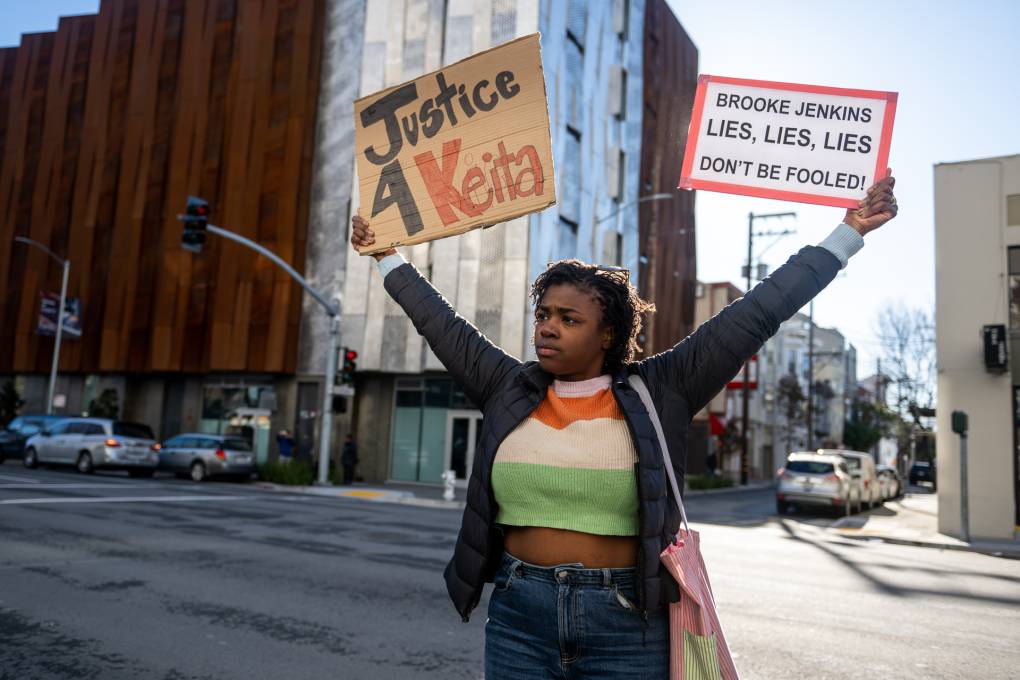
"caption": "Kaylah Williams May holds signs while listening to a speaker during a rally for Keita O'Neil outside the Hall of Justice at 850 Bryant Street in San Francisco on March 1, 2023.",
"description": null,
"title": "004_KQED_KeitaONeilRallySF_03012023",
"credit": "Beth LaBerge/KQED",
"status": "inherit",
"altTag": "Kaylah Williams May holds signs while listening to a speaker during a rally for Keita O'Neil outside the Hall of Justice at 850 Bryant Street in San Francisco on March 1, 2023.",
"isLoading": false,
"fetchFailed": false
},
"news_11941432": {
"type": "attachments",
"id": "news_11941432",
"meta": {
"index": "attachments_1716263798",
"site": "news",
"id": "11941432",
"found": true
},
"parent": 11941430,
"imgSizes": {
"twentyfourteen-full-width": {
"file": "https://ww2.kqed.org/app/uploads/sites/10/2023/02/RS49470_036_Oakland_NAACPGeorgeFloyd_05252021-qut-1038x576.jpg",
"width": 1038,
"mimeType": "image/jpeg",
"height": 576
},
"thumbnail": {
"file": "https://ww2.kqed.org/app/uploads/sites/10/2023/02/RS49470_036_Oakland_NAACPGeorgeFloyd_05252021-qut-160x107.jpg",
"width": 160,
"mimeType": "image/jpeg",
"height": 107
},
"post-thumbnail": {
"file": "https://ww2.kqed.org/app/uploads/sites/10/2023/02/RS49470_036_Oakland_NAACPGeorgeFloyd_05252021-qut-672x372.jpg",
"width": 672,
"mimeType": "image/jpeg",
"height": 372
},
"kqedFullSize": {
"file": "https://ww2.kqed.org/app/uploads/sites/10/2023/02/RS49470_036_Oakland_NAACPGeorgeFloyd_05252021-qut.jpg",
"width": 1920,
"height": 1278
},
"large": {
"file": "https://ww2.kqed.org/app/uploads/sites/10/2023/02/RS49470_036_Oakland_NAACPGeorgeFloyd_05252021-qut-1020x679.jpg",
"width": 1020,
"mimeType": "image/jpeg",
"height": 679
},
"1536x1536": {
"file": "https://ww2.kqed.org/app/uploads/sites/10/2023/02/RS49470_036_Oakland_NAACPGeorgeFloyd_05252021-qut-1536x1022.jpg",
"width": 1536,
"mimeType": "image/jpeg",
"height": 1022
},
"medium": {
"file": "https://ww2.kqed.org/app/uploads/sites/10/2023/02/RS49470_036_Oakland_NAACPGeorgeFloyd_05252021-qut-800x533.jpg",
"width": 800,
"mimeType": "image/jpeg",
"height": 533
}
},
"publishDate": 1676927320,
"modified": 1677034728,
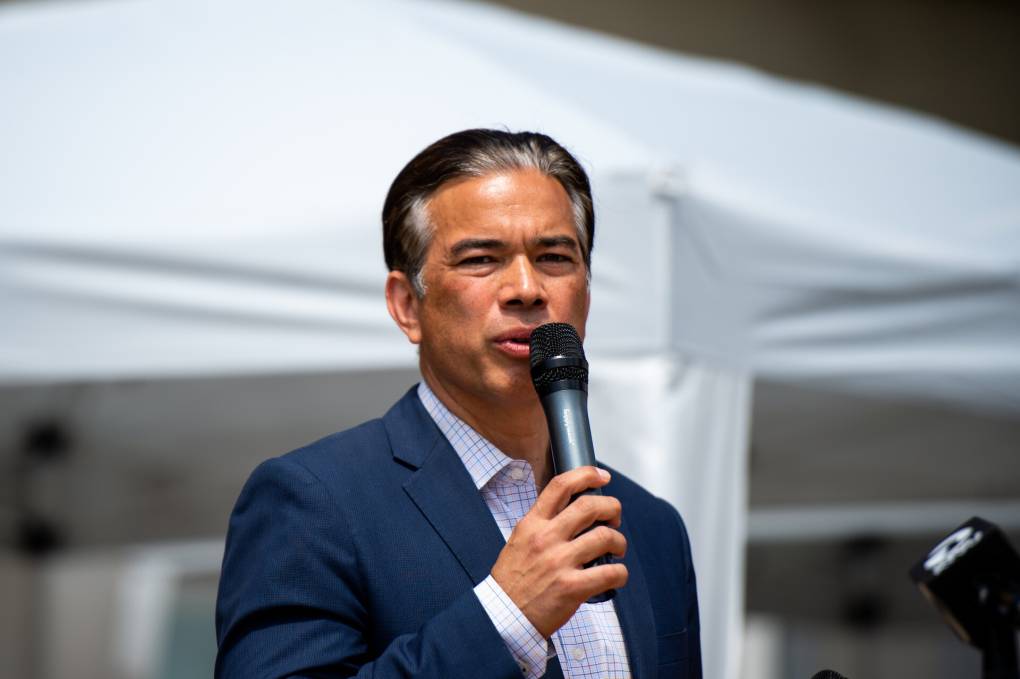
"caption": "Attorney General Rob Bonta speaks during a remembrance event to pay tribute to George Floyd held by the Oakland NAACP at Youth UpRising in Oakland on May 25, 2021.",
"description": null,
"title": "RS49470_036_Oakland_NAACPGeorgeFloyd_05252021-qut",
"credit": "Beth LaBerge/KQED",
"status": "inherit",
"altTag": "Rob Bonta stands center frame wearing a navy blue suit and white dress shirt while speaking into a microphone. Behind him is a large white canopy.",
"isLoading": false,
"fetchFailed": false
},
"news_11935711": {
"type": "attachments",
"id": "news_11935711",
"meta": {
"index": "attachments_1716263798",
"site": "news",
"id": "11935711",
"found": true
},
"title": "pamela-price-recall-potential",
"publishDate": 1671308307,
"status": "inherit",
"parent": 11935709,
"modified": 1721177829,
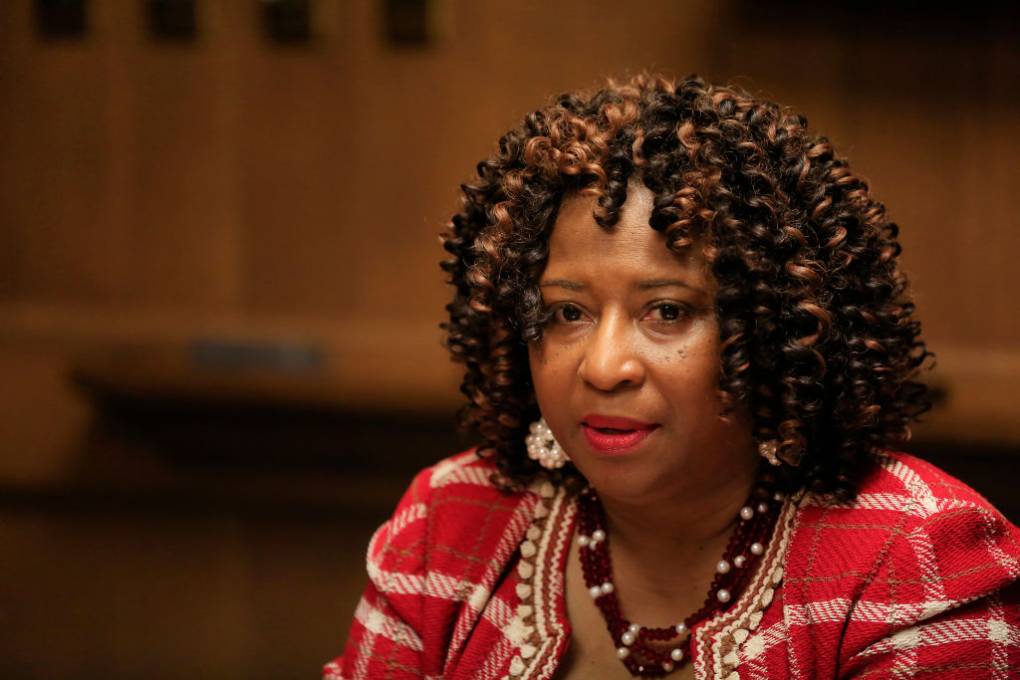
"caption": "Pamela Price, in a photo from May 23, 2018, in San Francisco.",
"credit": "Lea Suzuki/The San Francisco Chronicle via Getty Images",
"altTag": "A Black woman looks at the camera, wearing a red dress and a necklace with shoulder-length hair.",
"description": null,
"imgSizes": {
"medium": {
"file": "https://cdn.kqed.org/wp-content/uploads/sites/10/2022/12/GettyImages-1322370857-800x534.jpg",
"width": 800,
"height": 534,
"mimeType": "image/jpeg"
},
"large": {
"file": "https://cdn.kqed.org/wp-content/uploads/sites/10/2022/12/GettyImages-1322370857-1020x680.jpg",
"width": 1020,
"height": 680,
"mimeType": "image/jpeg"
},
"thumbnail": {
"file": "https://cdn.kqed.org/wp-content/uploads/sites/10/2022/12/GettyImages-1322370857-160x107.jpg",
"width": 160,
"height": 107,
"mimeType": "image/jpeg"
},
"post-thumbnail": {
"file": "https://cdn.kqed.org/wp-content/uploads/sites/10/2022/12/GettyImages-1322370857-672x372.jpg",
"width": 672,
"height": 372,
"mimeType": "image/jpeg"
},
"twentyfourteen-full-width": {
"file": "https://cdn.kqed.org/wp-content/uploads/sites/10/2022/12/GettyImages-1322370857-1024x576.jpg",
"width": 1024,
"height": 576,
"mimeType": "image/jpeg"
},
"kqedFullSize": {
"file": "https://cdn.kqed.org/wp-content/uploads/sites/10/2022/12/GettyImages-1322370857.jpg",
"width": 1024,
"height": 683
}
},
"isLoading": false,
"fetchFailed": false
},
"news_11937202": {
"type": "attachments",
"id": "news_11937202",
"meta": {
"index": "attachments_1716263798",
"site": "news",
"id": "11937202",
"found": true
},
"parent": 11937183,
"imgSizes": {
"twentyfourteen-full-width": {
"file": "https://ww2.kqed.org/app/uploads/sites/10/2023/01/KNR1011_Liccardo_VR-2_frame_16481-1038x576.jpeg",
"width": 1038,
"mimeType": "image/jpeg",
"height": 576
},
"thumbnail": {
"file": "https://ww2.kqed.org/app/uploads/sites/10/2023/01/KNR1011_Liccardo_VR-2_frame_16481-160x90.jpeg",
"width": 160,
"mimeType": "image/jpeg",
"height": 90
},
"post-thumbnail": {
"file": "https://ww2.kqed.org/app/uploads/sites/10/2023/01/KNR1011_Liccardo_VR-2_frame_16481-672x372.jpeg",
"width": 672,
"mimeType": "image/jpeg",
"height": 372
},
"kqedFullSize": {
"file": "https://ww2.kqed.org/app/uploads/sites/10/2023/01/KNR1011_Liccardo_VR-2_frame_16481.jpeg",
"width": 1920,
"height": 1080
},
"large": {
"file": "https://ww2.kqed.org/app/uploads/sites/10/2023/01/KNR1011_Liccardo_VR-2_frame_16481-1020x574.jpeg",
"width": 1020,
"mimeType": "image/jpeg",
"height": 574
},
"1536x1536": {
"file": "https://ww2.kqed.org/app/uploads/sites/10/2023/01/KNR1011_Liccardo_VR-2_frame_16481-1536x864.jpeg",
"width": 1536,
"mimeType": "image/jpeg",
"height": 864
},
"medium": {
"file": "https://ww2.kqed.org/app/uploads/sites/10/2023/01/KNR1011_Liccardo_VR-2_frame_16481-800x450.jpeg",
"width": 800,
"mimeType": "image/jpeg",
"height": 450
}
},
"publishDate": 1673044303,
"modified": 1673044303,
"caption": null,
"description": null,
"title": "KNR1011_Liccardo_VR 2_frame_16481",
"credit": null,
"status": "inherit",
"altTag": null,
"isLoading": false,
"fetchFailed": false
},
"news_11934074": {
"type": "attachments",
"id": "news_11934074",
"meta": {
"index": "attachments_1716263798",
"site": "news",
"id": "11934074",
"found": true
},
"parent": 11934072,
"imgSizes": {
"twentyfourteen-full-width": {
"file": "https://ww2.kqed.org/app/uploads/sites/10/2022/12/Screen-Shot-2022-12-04-at-1.39.43-PM-1038x576.png",
"width": 1038,
"mimeType": "image/png",
"height": 576
},
"thumbnail": {
"file": "https://ww2.kqed.org/app/uploads/sites/10/2022/12/Screen-Shot-2022-12-04-at-1.39.43-PM-160x106.png",
"width": 160,
"mimeType": "image/png",
"height": 106
},
"post-thumbnail": {
"file": "https://ww2.kqed.org/app/uploads/sites/10/2022/12/Screen-Shot-2022-12-04-at-1.39.43-PM-672x372.png",
"width": 672,
"mimeType": "image/png",
"height": 372
},
"kqedFullSize": {
"file": "https://ww2.kqed.org/app/uploads/sites/10/2022/12/Screen-Shot-2022-12-04-at-1.39.43-PM.png",
"width": 1566,
"height": 1036
},
"large": {
"file": "https://ww2.kqed.org/app/uploads/sites/10/2022/12/Screen-Shot-2022-12-04-at-1.39.43-PM-1020x675.png",
"width": 1020,
"mimeType": "image/png",
"height": 675
},
"1536x1536": {
"file": "https://ww2.kqed.org/app/uploads/sites/10/2022/12/Screen-Shot-2022-12-04-at-1.39.43-PM-1536x1016.png",
"width": 1536,
"mimeType": "image/png",
"height": 1016
},
"medium": {
"file": "https://ww2.kqed.org/app/uploads/sites/10/2022/12/Screen-Shot-2022-12-04-at-1.39.43-PM-800x529.png",
"width": 800,
"mimeType": "image/png",
"height": 529
}
},
"publishDate": 1670191003,
"modified": 1670277559,
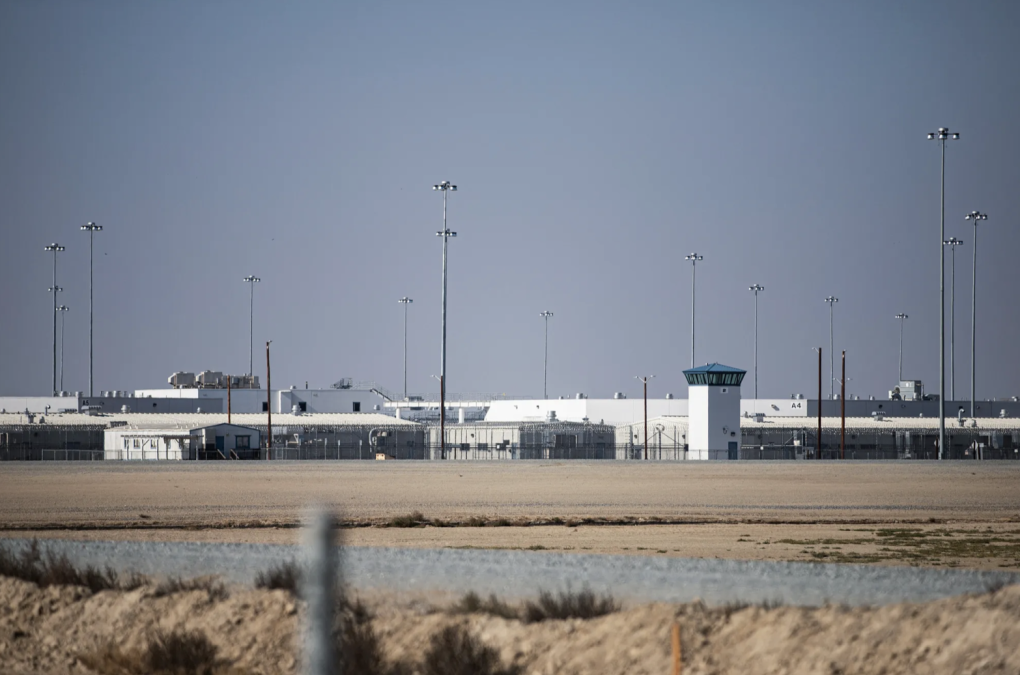
"caption": "Kern Valley State Prison in Delano on Nov. 15, 2022.",
"description": null,
"title": "Screen Shot 2022-12-04 at 1.39.43 PM",
"credit": "Larry Valenzuela/CalMatters/CatchLight Local",
"status": "inherit",
"altTag": "A wide angle shot of a prison.",
"isLoading": false,
"fetchFailed": false
},
"news_11931878": {
"type": "attachments",
"id": "news_11931878",
"meta": {
"index": "attachments_1716263798",
"site": "news",
"id": "11931878",
"found": true
},
"parent": 11931853,
"imgSizes": {
"twentyfourteen-full-width": {
"file": "https://ww2.kqed.org/app/uploads/sites/10/2022/11/GettyImages-1236329285-1024x576.jpg",
"width": 1024,
"mimeType": "image/jpeg",
"height": 576
},
"thumbnail": {
"file": "https://ww2.kqed.org/app/uploads/sites/10/2022/11/GettyImages-1236329285-160x107.jpg",
"width": 160,
"mimeType": "image/jpeg",
"height": 107
},
"post-thumbnail": {
"file": "https://ww2.kqed.org/app/uploads/sites/10/2022/11/GettyImages-1236329285-672x372.jpg",
"width": 672,
"mimeType": "image/jpeg",
"height": 372
},
"kqedFullSize": {
"file": "https://ww2.kqed.org/app/uploads/sites/10/2022/11/GettyImages-1236329285.jpg",
"width": 1024,
"height": 683
},
"large": {
"file": "https://ww2.kqed.org/app/uploads/sites/10/2022/11/GettyImages-1236329285-1020x680.jpg",
"width": 1020,
"mimeType": "image/jpeg",
"height": 680
},
"medium": {
"file": "https://ww2.kqed.org/app/uploads/sites/10/2022/11/GettyImages-1236329285-800x534.jpg",
"width": 800,
"mimeType": "image/jpeg",
"height": 534
}
},
"publishDate": 1668043215,
"modified": 1668105591,
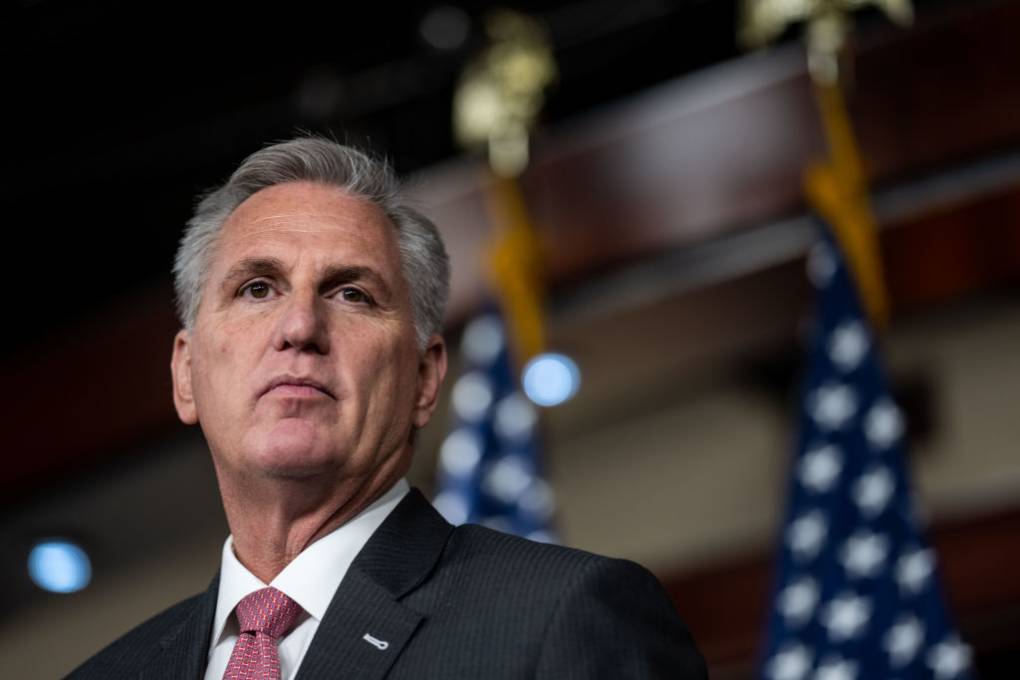
"caption": "House Minority Leader Kevin McCarthy (R-Calif.) speaks during a news conference in Washington, DC. After the 2022 midterms' 'red wave' failed to materialize, McCarthy's future is uncertain.",
"description": null,
"title": "House Minority Leader Kevin McCarthy and Republican Conference Press Conference",
"credit": "Kent Nishimura/Los Angeles Times via Getty Images",
"status": "inherit",
"altTag": "a white man in a suit",
"isLoading": false,
"fetchFailed": false
},
"news_11879666": {
"type": "attachments",
"id": "news_11879666",
"meta": {
"index": "attachments_1716263798",
"site": "news",
"id": "11879666",
"found": true
},
"parent": 11879644,
"imgSizes": {
"twentyfourteen-full-width": {
"file": "https://ww2.kqed.org/app/uploads/sites/10/2021/06/RS48084_028_SanFrancisco_NewsomBontaPressConference_03242021-qut-1038x576.jpeg",
"width": 1038,
"mimeType": "image/jpeg",
"height": 576
},
"thumbnail": {
"file": "https://ww2.kqed.org/app/uploads/sites/10/2021/06/RS48084_028_SanFrancisco_NewsomBontaPressConference_03242021-qut-160x107.jpeg",
"width": 160,
"mimeType": "image/jpeg",
"height": 107
},
"post-thumbnail": {
"file": "https://ww2.kqed.org/app/uploads/sites/10/2021/06/RS48084_028_SanFrancisco_NewsomBontaPressConference_03242021-qut-672x372.jpeg",
"width": 672,
"mimeType": "image/jpeg",
"height": 372
},
"kqedFullSize": {
"file": "https://ww2.kqed.org/app/uploads/sites/10/2021/06/RS48084_028_SanFrancisco_NewsomBontaPressConference_03242021-qut.jpeg",
"width": 1920,
"height": 1278
},
"large": {
"file": "https://ww2.kqed.org/app/uploads/sites/10/2021/06/RS48084_028_SanFrancisco_NewsomBontaPressConference_03242021-qut-1020x679.jpeg",
"width": 1020,
"mimeType": "image/jpeg",
"height": 679
},
"1536x1536": {
"file": "https://ww2.kqed.org/app/uploads/sites/10/2021/06/RS48084_028_SanFrancisco_NewsomBontaPressConference_03242021-qut-1536x1022.jpeg",
"width": 1536,
"mimeType": "image/jpeg",
"height": 1022
},
"medium": {
"file": "https://ww2.kqed.org/app/uploads/sites/10/2021/06/RS48084_028_SanFrancisco_NewsomBontaPressConference_03242021-qut-800x533.jpeg",
"width": 800,
"mimeType": "image/jpeg",
"height": 533
}
},
"publishDate": 1624925790,
"modified": 1667866925,
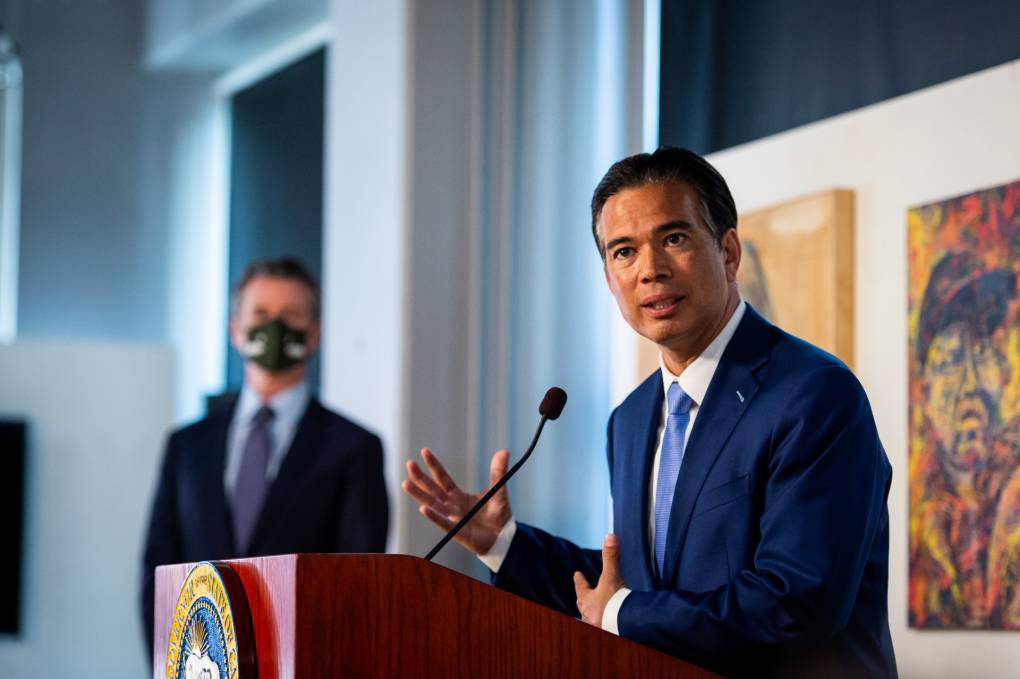
"caption": "Rob Bonta speaks during a press conference in San Francisco on March 24, 2021.",
"description": null,
"title": "RS48084_028_SanFrancisco_NewsomBontaPressConference_03242021-qut",
"credit": "Beth LaBerge/KQED",
"status": "inherit",
"altTag": "AG Rob Bonta speaks at a lectern, with Gov. Gavin Newsom standing in the background.",
"isLoading": false,
"fetchFailed": false
},
"news_11927612": {
"type": "attachments",
"id": "news_11927612",
"meta": {
"index": "attachments_1716263798",
"site": "news",
"id": "11927612",
"found": true
},
"parent": 11927577,
"imgSizes": {
"twentyfourteen-full-width": {
"file": "https://ww2.kqed.org/app/uploads/sites/10/2022/10/GettyImages-589931216-1024x576.jpg",
"width": 1024,
"mimeType": "image/jpeg",
"height": 576
},
"thumbnail": {
"file": "https://ww2.kqed.org/app/uploads/sites/10/2022/10/GettyImages-589931216-160x106.jpg",
"width": 160,
"mimeType": "image/jpeg",
"height": 106
},
"post-thumbnail": {
"file": "https://ww2.kqed.org/app/uploads/sites/10/2022/10/GettyImages-589931216-672x372.jpg",
"width": 672,
"mimeType": "image/jpeg",
"height": 372
},
"kqedFullSize": {
"file": "https://ww2.kqed.org/app/uploads/sites/10/2022/10/GettyImages-589931216.jpg",
"width": 1024,
"height": 679
},
"large": {
"file": "https://ww2.kqed.org/app/uploads/sites/10/2022/10/GettyImages-589931216-1020x676.jpg",
"width": 1020,
"mimeType": "image/jpeg",
"height": 676
},
"medium": {
"file": "https://ww2.kqed.org/app/uploads/sites/10/2022/10/GettyImages-589931216-800x530.jpg",
"width": 800,
"mimeType": "image/jpeg",
"height": 530
}
},
"publishDate": 1664841750,
"modified": 1665002679,
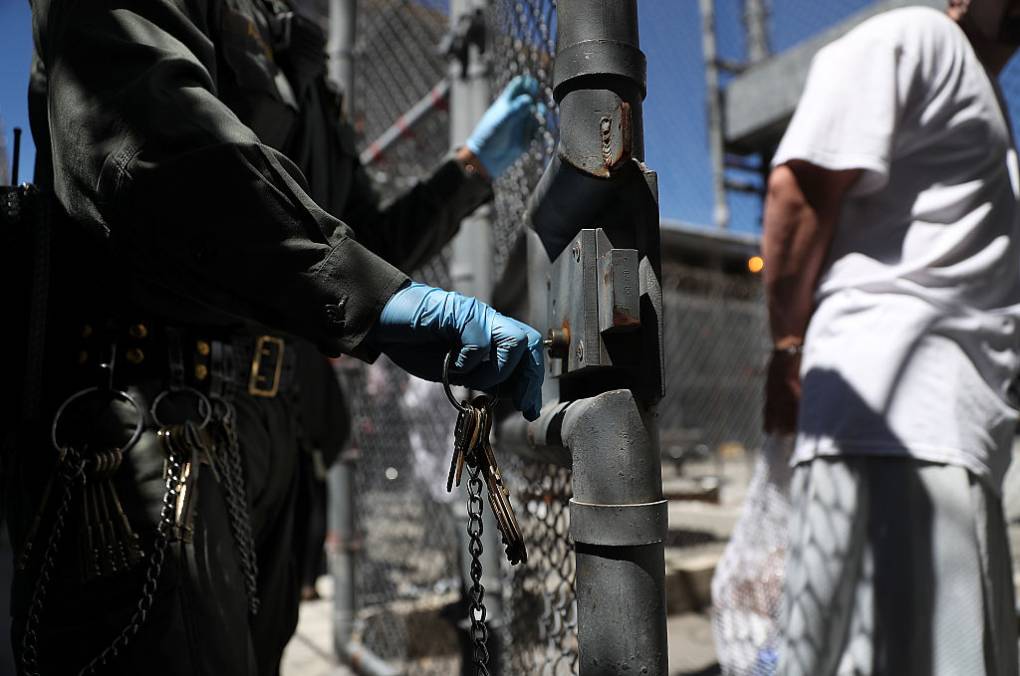
"caption": "A California Department of Corrections and Rehabilitation (CDCR) officer opens the gate for an incarcerated person who is leaving the exercise yard at San Quentin State Prison. KQED is suing CDCR to compel the agency to release records about staff use of force and misconduct.",
"description": "A California Department of Corrections and Rehabilitation (CDCR) officer opens the gate for an incarcerated person who is leaving the exercise yard at San Quentin State Prison. KQED is suing CDCR to compel the agency to release records about staff use of force and misconduct.",
"title": "San Quentin State Prison's Death Row",
"credit": "Justin Sullivan/Getty Images",
"status": "inherit",
"altTag": "a man in a prison uniform unlocks a gate for an inmate",
"isLoading": false,
"fetchFailed": false
},
"news_11926686": {
"type": "attachments",
"id": "news_11926686",
"meta": {
"index": "attachments_1716263798",
"site": "news",
"id": "11926686",
"found": true
},
"parent": 11926565,
"imgSizes": {
"twentyfourteen-full-width": {
"file": "https://ww2.kqed.org/app/uploads/sites/10/2022/09/dalle-1038x576.jpg",
"width": 1038,
"mimeType": "image/jpeg",
"height": 576
},
"thumbnail": {
"file": "https://ww2.kqed.org/app/uploads/sites/10/2022/09/dalle-160x107.jpg",
"width": 160,
"mimeType": "image/jpeg",
"height": 107
},
"post-thumbnail": {
"file": "https://ww2.kqed.org/app/uploads/sites/10/2022/09/dalle-672x372.jpg",
"width": 672,
"mimeType": "image/jpeg",
"height": 372
},
"kqedFullSize": {
"file": "https://ww2.kqed.org/app/uploads/sites/10/2022/09/dalle.jpg",
"width": 1920,
"height": 1280
},
"large": {
"file": "https://ww2.kqed.org/app/uploads/sites/10/2022/09/dalle-1020x680.jpg",
"width": 1020,
"mimeType": "image/jpeg",
"height": 680
},
"1536x1536": {
"file": "https://ww2.kqed.org/app/uploads/sites/10/2022/09/dalle-1536x1024.jpg",
"width": 1536,
"mimeType": "image/jpeg",
"height": 1024
},
"medium": {
"file": "https://ww2.kqed.org/app/uploads/sites/10/2022/09/dalle-800x533.jpg",
"width": 800,
"mimeType": "image/jpeg",
"height": 533
}
},
"publishDate": 1664214982,
"modified": 1664225133,
"caption": "\"Purple kittens snorkeling in the style of Picasso,\" an image generated by OpenAI's DALL-E 2.",
"description": null,
"title": "dalle-ai",
"credit": "Image via OpenAI",
"status": "inherit",
"altTag": "An illustration of three purple kittens wearing snorkeling masks. The illustration is in a style reminiscent of Pablo Picasso's artwork.",
"isLoading": false,
"fetchFailed": false
},
"news_11916789": {
"type": "attachments",
"id": "news_11916789",
"meta": {
"index": "attachments_1716263798",
"site": "news",
"id": "11916789",
"found": true
},
"parent": 11916767,
"imgSizes": {
"twentyfourteen-full-width": {
"file": "https://ww2.kqed.org/app/uploads/sites/10/2022/06/RS55239_012_KQED_SistersCircleBayview_04062022-qut-1038x576.jpg",
"width": 1038,
"mimeType": "image/jpeg",
"height": 576
},
"thumbnail": {
"file": "https://ww2.kqed.org/app/uploads/sites/10/2022/06/RS55239_012_KQED_SistersCircleBayview_04062022-qut-160x107.jpg",
"width": 160,
"mimeType": "image/jpeg",
"height": 107
},
"post-thumbnail": {
"file": "https://ww2.kqed.org/app/uploads/sites/10/2022/06/RS55239_012_KQED_SistersCircleBayview_04062022-qut-672x372.jpg",
"width": 672,
"mimeType": "image/jpeg",
"height": 372
},
"kqedFullSize": {
"file": "https://ww2.kqed.org/app/uploads/sites/10/2022/06/RS55239_012_KQED_SistersCircleBayview_04062022-qut.jpg",
"width": 1920,
"height": 1280
},
"large": {
"file": "https://ww2.kqed.org/app/uploads/sites/10/2022/06/RS55239_012_KQED_SistersCircleBayview_04062022-qut-1020x680.jpg",
"width": 1020,
"mimeType": "image/jpeg",
"height": 680
},
"1536x1536": {
"file": "https://ww2.kqed.org/app/uploads/sites/10/2022/06/RS55239_012_KQED_SistersCircleBayview_04062022-qut-1536x1024.jpg",
"width": 1536,
"mimeType": "image/jpeg",
"height": 1024
},
"medium": {
"file": "https://ww2.kqed.org/app/uploads/sites/10/2022/06/RS55239_012_KQED_SistersCircleBayview_04062022-qut-800x533.jpg",
"width": 800,
"mimeType": "image/jpeg",
"height": 533
}
},
"publishDate": 1654896408,
"modified": 1654909561,
"caption": "Lisa Wood (center, in blue jacket) holds hands with other members of the Seeking Safety group during a prayer after a meeting of the support network in San Francisco's Bayview neighborhood on April 6, 2022.",
"description": null,
"title": "RS55239_012_KQED_SistersCircleBayview_04062022-qut",
"credit": "Beth LaBerge/KQED",
"status": "inherit",
"altTag": "a group of women holding hands and smiling at each other",
"isLoading": false,
"fetchFailed": false
},
"news_11916429": {
"type": "attachments",
"id": "news_11916429",
"meta": {
"index": "attachments_1716263798",
"site": "news",
"id": "11916429",
"found": true
},
"parent": 11916206,
"imgSizes": {
"twentyfourteen-full-width": {
"file": "https://ww2.kqed.org/app/uploads/sites/10/2022/06/RS48085_029_SanFrancisco_NewsomBontaPressConference_03242021-qut-1038x576.jpg",
"width": 1038,
"mimeType": "image/jpeg",
"height": 576
},
"thumbnail": {
"file": "https://ww2.kqed.org/app/uploads/sites/10/2022/06/RS48085_029_SanFrancisco_NewsomBontaPressConference_03242021-qut-160x107.jpg",
"width": 160,
"mimeType": "image/jpeg",
"height": 107
},
"post-thumbnail": {
"file": "https://ww2.kqed.org/app/uploads/sites/10/2022/06/RS48085_029_SanFrancisco_NewsomBontaPressConference_03242021-qut-672x372.jpg",
"width": 672,
"mimeType": "image/jpeg",
"height": 372
},
"kqedFullSize": {
"file": "https://ww2.kqed.org/app/uploads/sites/10/2022/06/RS48085_029_SanFrancisco_NewsomBontaPressConference_03242021-qut.jpg",
"width": 1920,
"height": 1278
},
"large": {
"file": "https://ww2.kqed.org/app/uploads/sites/10/2022/06/RS48085_029_SanFrancisco_NewsomBontaPressConference_03242021-qut-1020x679.jpg",
"width": 1020,
"mimeType": "image/jpeg",
"height": 679
},
"1536x1536": {
"file": "https://ww2.kqed.org/app/uploads/sites/10/2022/06/RS48085_029_SanFrancisco_NewsomBontaPressConference_03242021-qut-1536x1022.jpg",
"width": 1536,
"mimeType": "image/jpeg",
"height": 1022
},
"medium": {
"file": "https://ww2.kqed.org/app/uploads/sites/10/2022/06/RS48085_029_SanFrancisco_NewsomBontaPressConference_03242021-qut-800x533.jpg",
"width": 800,
"mimeType": "image/jpeg",
"height": 533
}
},
"publishDate": 1654667098,
"modified": 1654670491,
"caption": "Rob Bonta (right) speaks at a press conference in San Francisco on March 24, 2021, after being appointed by Gov. Gavin Newsom to serve as California's attorney general.",
"description": null,
"title": "RS48085_029_SanFrancisco_NewsomBontaPressConference_03242021-qut",
"credit": "Beth LaBerge/KQED",
"status": "inherit",
"altTag": "A fit, middle-aged Filipino man, with black hair slicked away from his head, stands at a wooden lectern inside a room, speaking toward, but beyond, the camera at his left. We see a sliver of the Seal of California at the top of the front of the lectern, and a skinny microphone neck extending from the lectern toward him. He wears a dark blue suit jacket, a white dress shirt, and a glossy powder blue tie. On a wall behind him are two paintings; the one visible behind him seems to be an oil or acrylic portrait in blues, pinks, and yellows or a man wearing a baseball cap and jacket, with a surprised or distraught look on his face. A tall man also dressed in a suit and wearing a black face mask stands at a distance in a doorway to Bonta's right; it appears to be Gov. Gavin Newsom.",
"isLoading": false,
"fetchFailed": false
},
"news_11915847": {
"type": "attachments",
"id": "news_11915847",
"meta": {
"index": "attachments_1716263798",
"site": "news",
"id": "11915847",
"found": true
},
"parent": 11915841,
"imgSizes": {
"twentyfourteen-full-width": {
"file": "https://ww2.kqed.org/app/uploads/sites/10/2022/06/IMG_2110-1038x576.jpg",
"width": 1038,
"mimeType": "image/jpeg",
"height": 576
},
"thumbnail": {
"file": "https://ww2.kqed.org/app/uploads/sites/10/2022/06/IMG_2110-160x120.jpg",
"width": 160,
"mimeType": "image/jpeg",
"height": 120
},
"post-thumbnail": {
"file": "https://ww2.kqed.org/app/uploads/sites/10/2022/06/IMG_2110-672x372.jpg",
"width": 672,
"mimeType": "image/jpeg",
"height": 372
},
"kqedFullSize": {
"file": "https://ww2.kqed.org/app/uploads/sites/10/2022/06/IMG_2110-scaled.jpg",
"width": 2560,
"height": 1920
},
"2048x2048": {
"file": "https://ww2.kqed.org/app/uploads/sites/10/2022/06/IMG_2110-2048x1536.jpg",
"width": 2048,
"mimeType": "image/jpeg",
"height": 1536
},
"large": {
"file": "https://ww2.kqed.org/app/uploads/sites/10/2022/06/IMG_2110-1020x765.jpg",
"width": 1020,
"mimeType": "image/jpeg",
"height": 765
},
"1536x1536": {
"file": "https://ww2.kqed.org/app/uploads/sites/10/2022/06/IMG_2110-1536x1152.jpg",
"width": 1536,
"mimeType": "image/jpeg",
"height": 1152
},
"full-width": {
"file": "https://ww2.kqed.org/app/uploads/sites/10/2022/06/IMG_2110-1920x1440.jpg",
"width": 1920,
"mimeType": "image/jpeg",
"height": 1440
},
"medium": {
"file": "https://ww2.kqed.org/app/uploads/sites/10/2022/06/IMG_2110-800x600.jpg",
"width": 800,
"mimeType": "image/jpeg",
"height": 600
}
},
"publishDate": 1654194898,
"modified": 1654203164,
"caption": "Manuel and Olga Jimenez designed and created a 13-acre botanical garden to beautify their small town of Woodlake and help kids get interested in agriculture.",
"description": null,
"title": "IMG_2110",
"credit": "Alice Daniel/KVPR",
"status": "inherit",
"altTag": null,
"isLoading": false,
"fetchFailed": false
}
},
"audioPlayerReducer": {
"postId": "stream_live",
"isPaused": true,
"isPlaying": false,
"pfsActive": false,
"pledgeModalIsOpen": true,
"playerDrawerIsOpen": false,
"liveAudioPlayStartedAt": 0,
"liveAudioPlayContext": ""
},
"authorsReducer": {
"byline_news_11941430": {
"type": "authors",
"id": "byline_news_11941430",
"meta": {
"override": true
},
"slug": "byline_news_11941430",
"name": "Adam Beam\u003cbr>Associated Press",
"isLoading": false
},
"byline_news_11934072": {
"type": "authors",
"id": "byline_news_11934072",
"meta": {
"override": true
},
"slug": "byline_news_11934072",
"name": "Nigel Duara\u003cbr>CalMatters",
"isLoading": false
},
"byline_news_11916767": {
"type": "authors",
"id": "byline_news_11916767",
"meta": {
"override": true
},
"slug": "byline_news_11916767",
"name": "\u003ca href=\"https://twitter.com/hwright24\">Hannah Maria Wright\u003c/a>",
"isLoading": false
},
"kqed": {
"type": "authors",
"id": "236",
"meta": {
"index": "authors_1716337520",
"id": "236",
"found": true
},
"name": "KQED News Staff",
"firstName": "KQED News Staff",
"lastName": null,
"slug": "kqed",
"email": "faq@kqed.org",
"display_author_email": false,
"staff_mastheads": [],
"title": null,
"bio": null,
"avatar": "https://secure.gravatar.com/avatar/ef0e801a68c4c54afa9180db14084167?s=600&d=blank&r=g",
"twitter": null,
"facebook": null,
"instagram": null,
"linkedin": null,
"sites": [
{
"site": "arts",
"roles": [
"contributor"
]
},
{
"site": "news",
"roles": [
"editor"
]
},
{
"site": "futureofyou",
"roles": [
"author"
]
}
],
"headData": {
"title": "KQED News Staff | KQED",
"description": null,
"ogImgSrc": "https://secure.gravatar.com/avatar/ef0e801a68c4c54afa9180db14084167?s=600&d=blank&r=g",
"twImgSrc": "https://secure.gravatar.com/avatar/ef0e801a68c4c54afa9180db14084167?s=600&d=blank&r=g"
},
"isLoading": false,
"link": "/author/kqed"
},
"minakim": {
"type": "authors",
"id": "243",
"meta": {
"index": "authors_1716337520",
"id": "243",
"found": true
},
"name": "Mina Kim",
"firstName": "Mina",
"lastName": "Kim",
"slug": "minakim",
"email": "mkim@kqed.org",
"display_author_email": false,
"staff_mastheads": [
"news"
],
"title": "Host, Forum",
"bio": "Mina Kim is host of the 10 a.m. statewide hour of Forum; a live daily talk show for curious Californians on issues that matter to the state and nation, with a particular emphasis on race and equity.\r\n\r\nBefore joining the Forum team, Mina was KQED’s evening news anchor, and health reporter for The California Report. Her award-winning work has included natural disasters in Napa and gun violence in Oakland. Mina grew up in St. John’s, Newfoundland.",
"avatar": "https://secure.gravatar.com/avatar/145ce657a2d08cb86d93686beb958982?s=600&d=blank&r=g",
"twitter": "mkimreporter",
"facebook": null,
"instagram": null,
"linkedin": null,
"sites": [
{
"site": "news",
"roles": [
"contributor"
]
},
{
"site": "stateofhealth",
"roles": [
"author"
]
},
{
"site": "forum",
"roles": [
"editor"
]
}
],
"headData": {
"title": "Mina Kim | KQED",
"description": "Host, Forum",
"ogImgSrc": "https://secure.gravatar.com/avatar/145ce657a2d08cb86d93686beb958982?s=600&d=blank&r=g",
"twImgSrc": "https://secure.gravatar.com/avatar/145ce657a2d08cb86d93686beb958982?s=600&d=blank&r=g"
},
"isLoading": false,
"link": "/author/minakim"
},
"scottshafer": {
"type": "authors",
"id": "255",
"meta": {
"index": "authors_1716337520",
"id": "255",
"found": true
},
"name": "Scott Shafer",
"firstName": "Scott",
"lastName": "Shafer",
"slug": "scottshafer",
"email": "sshafer@kqed.org",
"display_author_email": false,
"staff_mastheads": [
"news"
],
"title": "KQED Contributor",
"bio": "Scott Shafer is a senior editor with the KQED Politics and Government desk. He is co-host of Political Breakdown, the award-winning radio show and podcast with a personal take on the world of politics. Scott came to KQED in 1998 to host the statewide\u003cem> California Report\u003c/em>. Prior to that he had extended stints in politics and government\u003cem>.\u003c/em> He uses that inside experience at KQED in his, reporting, hosting and analysis for the politics desk. Scott collaborated \u003cem>Political Breakdown a\u003c/em>nd on \u003cem>The Political Mind of Jerry Brown, \u003c/em>an eight-part series about the life and extraordinary political career of the former governor. For fun, he plays water polo with the San Francisco Tsunami.",
"avatar": "https://secure.gravatar.com/avatar/a62ebae45b79d7aed1a39a0e3bf68104?s=600&d=blank&r=g",
"twitter": "scottshafer",
"bluesky": null,
"facebook": null,
"instagram": null,
"linkedin": null,
"sites": [
{
"site": "news",
"roles": [
"editor"
]
},
{
"site": "stateofhealth",
"roles": [
"author"
]
},
{
"site": "science",
"roles": [
"author"
]
},
{
"site": "forum",
"roles": [
"subscriber"
]
},
{
"site": "liveblog",
"roles": [
"author"
]
}
],
"headData": {
"title": "Scott Shafer | KQED",
"description": "KQED Contributor",
"ogImgSrc": "https://secure.gravatar.com/avatar/a62ebae45b79d7aed1a39a0e3bf68104?s=600&d=blank&r=g",
"twImgSrc": "https://secure.gravatar.com/avatar/a62ebae45b79d7aed1a39a0e3bf68104?s=600&d=blank&r=g"
},
"isLoading": false,
"link": "/author/scottshafer"
},
"mlagos": {
"type": "authors",
"id": "3239",
"meta": {
"index": "authors_1716337520",
"id": "3239",
"found": true
},
"name": "Marisa Lagos",
"firstName": "Marisa",
"lastName": "Lagos",
"slug": "mlagos",
"email": "mlagos@kqed.org",
"display_author_email": false,
"staff_mastheads": [
"news"
],
"title": "KQED Contributor",
"bio": "Marisa Lagos is a correspondent for KQED’s California Politics and Government Desk and co-hosts the award-winning show and podcast, Political Breakdown. At KQED, Lagos also conducts reporting, analysis and investigations into state, local and national politics for radio, TV, online and onstage. In 2022, she and co-host, Scott Shafer, moderated the only gubernatorial debate in California. In 2020, the \u003ci>Washington Post\u003c/i> named her one of the top political journalists in California; she was nominated for a Peabody and won several other awards for her work investigating the 2017 California wildfires. She has worked at the \u003ci>San Francisco Chronicle\u003c/i>, \u003ci>San Francisco Examiner\u003c/i> and \u003ci>Los Angeles Times\u003c/i>. A UC Santa Barbara graduate, she lives in San Francisco with her two sons and husband.",
"avatar": "https://secure.gravatar.com/avatar/a261a0d3696fc066871ef96b85b5e7d2?s=600&d=blank&r=g",
"twitter": "@mlagos",
"facebook": null,
"instagram": null,
"linkedin": null,
"sites": [
{
"site": "arts",
"roles": [
"author"
]
},
{
"site": "news",
"roles": [
"editor"
]
},
{
"site": "science",
"roles": [
"editor"
]
},
{
"site": "forum",
"roles": [
"author"
]
},
{
"site": "liveblog",
"roles": [
"author"
]
}
],
"headData": {
"title": "Marisa Lagos | KQED",
"description": "KQED Contributor",
"ogImgSrc": "https://secure.gravatar.com/avatar/a261a0d3696fc066871ef96b85b5e7d2?s=600&d=blank&r=g",
"twImgSrc": "https://secure.gravatar.com/avatar/a261a0d3696fc066871ef96b85b5e7d2?s=600&d=blank&r=g"
},
"isLoading": false,
"link": "/author/mlagos"
},
"slewis": {
"type": "authors",
"id": "8676",
"meta": {
"index": "authors_1716337520",
"id": "8676",
"found": true
},
"name": "Sukey Lewis",
"firstName": "Sukey",
"lastName": "Lewis",
"slug": "slewis",
"email": "slewis@kqed.org",
"display_author_email": true,
"staff_mastheads": [
"news"
],
"title": "KQED Contributor",
"bio": "Sukey Lewis is a criminal justice reporter and host of \u003cem>On Our Watch\u003c/em>, a new podcast from NPR and KQED about the shadow world of police discipline. In 2018, she co-founded the California Reporting Project, a coalition of newsrooms across the state focused on obtaining previously sealed internal affairs records from law enforcement. In addition to her reporting on police accountability, Sukey has investigated the bail bonds industry, California's wildfires and the high cost of prison phone calls. Sukey earned a master's degree in journalism from the University of California at Berkeley. Send news tips to slewis@kqed.org.",
"avatar": "https://secure.gravatar.com/avatar/03fd6b21024f99d8b0a1966654586de7?s=600&d=blank&r=g",
"twitter": "SukeyLewis",
"facebook": null,
"instagram": null,
"linkedin": null,
"sites": [
{
"site": "news",
"roles": [
"author",
"edit_others_posts"
]
}
],
"headData": {
"title": "Sukey Lewis | KQED",
"description": "KQED Contributor",
"ogImgSrc": "https://secure.gravatar.com/avatar/03fd6b21024f99d8b0a1966654586de7?s=600&d=blank&r=g",
"twImgSrc": "https://secure.gravatar.com/avatar/03fd6b21024f99d8b0a1966654586de7?s=600&d=blank&r=g"
},
"isLoading": false,
"link": "/author/slewis"
},
"smohamad": {
"type": "authors",
"id": "11631",
"meta": {
"index": "authors_1716337520",
"id": "11631",
"found": true
},
"name": "Sarah Mohamad",
"firstName": "Sarah",
"lastName": "Mohamad",
"slug": "smohamad",
"email": "smohamad@KQED.org",
"display_author_email": true,
"staff_mastheads": [],
"title": "Engagement Producer and Reporter, KQED Science",
"bio": "Sarah Mohamad is an audience engagement reporter and producer for KQED Science. She reports on audience-focused science and environment stories and manages the team's social media, newsletter, and engagement efforts. Prior to this role, she played a key role as project manager for NSF's \u003ca href=\"https://www.kqed.org/crackingthecode\">\u003cem>Cracking the Code: Influencing Millennial Science Engagement\u003c/em> \u003c/a>audience research.",
"avatar": "https://secure.gravatar.com/avatar/e6224957cd82d015183756ddde1f928013a563d7ca2e4565f8c4de1ec64886c5?s=600&d=blank&r=g",
"twitter": "sarahkmohamad",
"bluesky": null,
"facebook": null,
"instagram": null,
"linkedin": null,
"sites": [
{
"site": "",
"roles": [
"editor"
]
},
{
"site": "arts",
"roles": [
"editor"
]
},
{
"site": "news",
"roles": [
"editor"
]
},
{
"site": "about",
"roles": [
"editor"
]
},
{
"site": "science",
"roles": [
"editor"
]
}
],
"headData": {
"title": "Sarah Mohamad | KQED",
"description": "Engagement Producer and Reporter, KQED Science",
"ogImgSrc": "https://secure.gravatar.com/avatar/e6224957cd82d015183756ddde1f928013a563d7ca2e4565f8c4de1ec64886c5?s=600&d=blank&r=g",
"twImgSrc": "https://secure.gravatar.com/avatar/e6224957cd82d015183756ddde1f928013a563d7ca2e4565f8c4de1ec64886c5?s=600&d=blank&r=g"
},
"isLoading": false,
"link": "/author/smohamad"
},
"jrodriguez": {
"type": "authors",
"id": "11690",
"meta": {
"index": "authors_1716337520",
"id": "11690",
"found": true
},
"name": "Joe Fitzgerald Rodriguez",
"firstName": "Joe",
"lastName": "Fitzgerald Rodriguez",
"slug": "jrodriguez",
"email": "jrodriguez@kqed.org",
"display_author_email": true,
"staff_mastheads": [
"news"
],
"title": "Reporter and Producer",
"bio": "Joe Fitzgerald Rodriguez is a reporter and digital producer for KQED covering politics. Joe most recently wrote for the \u003cem>San Francisco Examiner\u003c/em> as a political columnist covering The City. He was raised in San Francisco and has spent his reporting career in his beloved, foggy, city by the bay. Joe was 12-years-old when he conducted his first interview in journalism, grilling former San Francisco Mayor Willie Brown for the Marina Middle School newspaper, \u003cem>The Penguin Press, \u003c/em>and he continues to report on the San Francisco Bay Area to this day.",
"avatar": "https://secure.gravatar.com/avatar/2247beb0564c1e9c62228d5649d2edac?s=600&d=blank&r=g",
"twitter": "FitztheReporter",
"facebook": null,
"instagram": "https://www.instagram.com/fitzthereporter/",
"linkedin": null,
"sites": [
{
"site": "",
"roles": [
"editor"
]
},
{
"site": "arts",
"roles": [
"editor"
]
},
{
"site": "news",
"roles": [
"editor"
]
},
{
"site": "science",
"roles": [
"editor"
]
},
{
"site": "elections",
"roles": [
"editor"
]
},
{
"site": "liveblog",
"roles": [
"editor"
]
}
],
"headData": {
"title": "Joe Fitzgerald Rodriguez | KQED",
"description": "Reporter and Producer",
"ogImgSrc": "https://secure.gravatar.com/avatar/2247beb0564c1e9c62228d5649d2edac?s=600&d=blank&r=g",
"twImgSrc": "https://secure.gravatar.com/avatar/2247beb0564c1e9c62228d5649d2edac?s=600&d=blank&r=g"
},
"isLoading": false,
"link": "/author/jrodriguez"
},
"sjohnson": {
"type": "authors",
"id": "11840",
"meta": {
"index": "authors_1716337520",
"id": "11840",
"found": true
},
"name": "Sydney Johnson",
"firstName": "Sydney",
"lastName": "Johnson",
"slug": "sjohnson",
"email": "sjohnson@kqed.org",
"display_author_email": false,
"staff_mastheads": [
"news"
],
"title": "KQED Reporter",
"bio": "Sydney Johnson is a general assignment reporter at KQED. She previously reported on public health and city government at the San Francisco Examiner, and before that, she covered statewide education policy for EdSource. Her reporting has won multiple local, state and national awards. Sydney is a graduate of the University of California, Berkeley and lives in San Francisco.",
"avatar": "https://secure.gravatar.com/avatar/97855f2719b72ad6190b7c535fe642c8?s=600&d=blank&r=g",
"twitter": "sydneyfjohnson",
"facebook": null,
"instagram": null,
"linkedin": null,
"sites": [
{
"site": "news",
"roles": [
"editor"
]
}
],
"headData": {
"title": "Sydney Johnson | KQED",
"description": "KQED Reporter",
"ogImgSrc": "https://secure.gravatar.com/avatar/97855f2719b72ad6190b7c535fe642c8?s=600&d=blank&r=g",
"twImgSrc": "https://secure.gravatar.com/avatar/97855f2719b72ad6190b7c535fe642c8?s=600&d=blank&r=g"
},
"isLoading": false,
"link": "/author/sjohnson"
}
},
"pagesReducer": {
"news_category_criminal-justice": {
"type": "terms",
"id": "news_34167",
"meta": {
"index": "terms_1716263798",
"site": "news",
"id": "34167",
"score": 11.18808
},
"name": "Criminal Justice",
"slug": "criminal-justice",
"taxonomy": "category",
"description": null,
"featImg": null,
"headData": {
"title": "Criminal Justice Archives | KQED News",
"description": null,
"ogTitle": null,
"ogDescription": null,
"ogImgId": null,
"twTitle": null,
"twDescription": null,
"twImgId": null
},
"ttid": 34184,
"isLoading": false,
"title": "Criminal Justice",
"pageMeta": {
"site": "news",
"WpPageTemplate": "page-topic-editorial",
"currentPage": 44
},
"blocks": [
{
"blockName": "kqed/post-list",
"attrs": {
"layout": "cardArticle2",
"query": "posts/news?category=criminal-justice",
"seeMore": false,
"paginated": true,
"page": 44
}
},
{
"blockName": "kqed/ad"
}
]
}
},
"pfsSessionReducer": {},
"postsReducer": {
"stream_live": {
"type": "live",
"id": "stream_live",
"audioUrl": "https://streams.kqed.org/kqedradio",
"title": "Live Stream",
"excerpt": "Live Stream information currently unavailable.",
"link": "/radio",
"featImg": "",
"label": {
"name": "KQED Live",
"link": "/"
}
},
"stream_kqedNewscast": {
"type": "posts",
"id": "stream_kqedNewscast",
"audioUrl": "https://www.kqed.org/.stream/anon/radio/RDnews/newscast.mp3?_=1",
"title": "KQED Newscast",
"featImg": "",
"label": {
"name": "88.5 FM",
"link": "/"
}
},
"news_11942239": {
"type": "posts",
"id": "news_11942239",
"meta": {
"index": "posts_1716263798",
"site": "news",
"id": "11942239",
"score": null,
"sort": [
1677715211000
]
},
"guestAuthors": [],
"slug": "judge-delays-sf-das-move-to-dismiss-homicide-case-against-officer-who-killed-keita-oneil",
"title": "Judge Delays SF DA's Move to Dismiss Homicide Case Against Officer Who Killed Keita O'Neil",
"publishDate": 1677715211,
"format": "standard",
"headTitle": "Judge Delays SF DA’s Move to Dismiss Homicide Case Against Officer Who Killed Keita O’Neil | KQED",
"labelTerm": {
"site": "news"
},
"content": "\u003cp>A judge on Wednesday delayed a motion from San Francisco’s district attorney to dismiss the historic prosecution of a city police officer charged with shooting and killing a carjacking suspect.\u003c/p>\n\u003cp>The one-week delay is intended to give California Attorney General Rob Bonta additional time to determine whether to pursue the case against the officer.\u003c/p>\n\u003cp>[aside label=\"related coverage\" tag=\"keita-oneil\"]“My hope is that the attorney general will give this case fresh eyes,” said San Francisco County Superior Court Judge Loretta Giorgi at a hearing on Wednesday.\u003c/p>\n\u003cp>If Bonta does not pursue the case or request an extension by March 7, charges against Christopher Samayoa, a former San Francisco police officer, will officially be dismissed.\u003c/p>\n\u003cp>The delay comes in response to San Francisco District Attorney Brooke Jenkins’ move last month to dismiss charges against Samayoa, who killed Keita O’Neil during a police chase in December 2017, after O’Neil allegedly stole a California Lottery van.\u003c/p>\n\u003cp>Samayoa, who was in his fourth day of a field training program, is shown on body camera firing his weapon through the window of his patrol car and hitting O’Neil, a 42-year-old Black man, as he tried to escape on foot. Samayoa was subsequently fired.\u003c/p>\n\u003cp>Nearly three years after the incident, Chesa Boudin, Jenkins’ predecessor who was recalled from office last summer, charged Samayoa with multiple counts of manslaughter and assault, marking the first homicide prosecution in San Francisco history against a police officer for an on-duty killing.\u003c/p>\n\u003cp>In a Feb. 8 letter to Bonta, Jenkins argued that Boudin wrongly pursued manslaughter charges against Samayoa for “political reasons and not in the interest of justice.” She said her office had also “discovered an internal conflict in the case that impacts our ability to handle the matter,” referring to opposing statements from the attorney in Boudin’s office who initially handled the case and the DA investigator who signed the arrest warrant.\u003c/p>\n\u003cp>The judge announced her decision to delay the dismissal after hearing a heartfelt plea from O’Neil’s aunt, April Green, who told reporters she hopes to meet with Bonta during the stay order.\u003c/p>\n\u003cfigure id=\"attachment_11942244\" class=\"wp-caption alignnone\" style=\"max-width: 1920px\">\u003ca href=\"https://ww2.kqed.org/app/uploads/sites/10/2023/03/014_KQED_KeitaONeilRallySF_03012023.jpg\">\u003cimg loading=\"lazy\" decoding=\"async\" class=\"wp-image-11942244 size-full\" src=\"https://ww2.kqed.org/app/uploads/sites/10/2023/03/014_KQED_KeitaONeilRallySF_03012023.jpg\" alt=\"A middle-aged woman with light, freckled skin and short dark hair is seated in a wheelchair holding a microphone, next to a photo of a Black man with long black locs. The woman wears a beige leather jacket and a patterned matching blouse, with gold earrings and a necklace.\" width=\"1920\" height=\"1280\" srcset=\"https://cdn.kqed.org/wp-content/uploads/sites/10/2023/03/014_KQED_KeitaONeilRallySF_03012023.jpg 1920w, https://cdn.kqed.org/wp-content/uploads/sites/10/2023/03/014_KQED_KeitaONeilRallySF_03012023-800x533.jpg 800w, https://cdn.kqed.org/wp-content/uploads/sites/10/2023/03/014_KQED_KeitaONeilRallySF_03012023-1020x680.jpg 1020w, https://cdn.kqed.org/wp-content/uploads/sites/10/2023/03/014_KQED_KeitaONeilRallySF_03012023-160x107.jpg 160w, https://cdn.kqed.org/wp-content/uploads/sites/10/2023/03/014_KQED_KeitaONeilRallySF_03012023-1536x1024.jpg 1536w\" sizes=\"(max-width: 1920px) 100vw, 1920px\">\u003c/a>\u003cfigcaption class=\"wp-caption-text\">April Green, aunt of Keita O’Neil, speaks at a rally for her nephew outside the Hall of Justice in San Francisco on March 1, 2023. \u003ccite>(Beth LaBerge/ KQED)\u003c/cite>\u003c/figcaption>\u003c/figure>\n\u003cp>“My family has been through so much. My sister suffers every day. She lost her child,” Green said, noting that O’Neil’s mother has dementia. “All we need is some time. My nephew’s case is still alive. It’s still breathing.”\u003c/p>\n\u003cp>Separate from the pending criminal case, the city of San Francisco in 2021 paid O’Neil’s family $2.5 million to settle a civil lawsuit.\u003c/p>\n\u003cp>Green’s attorney also sent Bonta a letter last month, asking his office to take over the case.\u003c/p>\n\u003cp>Both letters — from Jenkins and Green — cite Assembly Bill 1506, which puts all officer-involved shootings resulting in the death of an unarmed person within the purview of the state Department of Justice.\u003c/p>\n\u003cp>In a statement on Wednesday, Jenkins said she respects the court’s decision to give Bonta’s office more time to review the case, noting her staff had already transferred the entire file to them.\u003c/p>\n\u003cp>“We are not opposing that decision. We understand the complexity of this case … and welcome their independent review,” she said.\u003c/p>\n\u003cp>“A fair prosecution of this case from our office is not possible because the facts and laws do not support prosecution,” Jenkins added. “The prior administration’s desire to make history blinded them; they chose to press on for personal political gain. They went to extraordinary lengths to ‘find a path,’ where there was none.”\u003c/p>\n\u003cp>Outside the courthouse, dozens of community members gathered to protest the dismissal with signs and chants in support of O’Neil and his family.\u003c/p>\n\u003cp>“The idea that the district attorney’s office is going to effectively immunize every San Francisco police officer for anything they do up to and including murder is outrageous, and folks are right to be out here protesting in the street,” said San Francisco Supervisor Dean Preston, who joined protesters on Wednesday.\u003c/p>\n\u003cfigure id=\"attachment_11942282\" class=\"wp-caption alignnone\" style=\"max-width: 1920px\">\u003ca href=\"https://ww2.kqed.org/app/uploads/sites/10/2023/03/025_KQED_KeitaONeilRallySF_03012023.jpg\">\u003cimg loading=\"lazy\" decoding=\"async\" class=\"wp-image-11942282 size-full\" src=\"https://ww2.kqed.org/app/uploads/sites/10/2023/03/025_KQED_KeitaONeilRallySF_03012023.jpg\" alt=\"Protesters holding signs march on the street behind an 'SFPD' barricade. It is a sunny day and their shadows are long beside them.\" width=\"1920\" height=\"1280\" srcset=\"https://cdn.kqed.org/wp-content/uploads/sites/10/2023/03/025_KQED_KeitaONeilRallySF_03012023.jpg 1920w, https://cdn.kqed.org/wp-content/uploads/sites/10/2023/03/025_KQED_KeitaONeilRallySF_03012023-800x533.jpg 800w, https://cdn.kqed.org/wp-content/uploads/sites/10/2023/03/025_KQED_KeitaONeilRallySF_03012023-1020x680.jpg 1020w, https://cdn.kqed.org/wp-content/uploads/sites/10/2023/03/025_KQED_KeitaONeilRallySF_03012023-160x107.jpg 160w, https://cdn.kqed.org/wp-content/uploads/sites/10/2023/03/025_KQED_KeitaONeilRallySF_03012023-1536x1024.jpg 1536w\" sizes=\"(max-width: 1920px) 100vw, 1920px\">\u003c/a>\u003cfigcaption class=\"wp-caption-text\">Demonstrators march outside San Francisco’s Hall of Justice on March 1, 2023, protesting the district attorney’s effort to dismiss charges against the police officer who killed Keita O’Neil in 2017. \u003ccite>(Beth LaBerge/KQED)\u003c/cite>\u003c/figcaption>\u003c/figure>\n\u003cp>At his confirmation hearing in 2021, Bonta pledged to ramp up police accountability and chart a new path for reform, in a shift from his predecessor, Xavier Becerra, who largely avoided prosecuting police officers charged with shooting unarmed civilians.\u003c/p>\n\u003cp>“A Black man was murdered. And he’s caught up in a political football,” Green said at Wednesday’s rally outside the courthouse. “This is my nephew, but it’s also about the future of how our Black and Brown men interact with police.”\u003c/p>\n\u003cp>In a response letter sent this week to Green and Jenkins, Bonta pushed back on the district attorney’s conflict-of-interest assertion.\u003c/p>\n\u003cp>“That some personnel within the District Attorney’s office may have different opinions about the case does not give rise to a recusal conflict mandating the Attorney General assume responsibility for the prosecution,” Bonta said.\u003c/p>\n\u003cp>[ad fullwidth]\u003c/p>\n\u003cp>\u003c/p>\n",
"blocks": [],
"excerpt": "The court's six-day stay buys California's attorney general more time to decide whether to pursue the historic case, the city's first homicide prosecution of an on-duty officer.",
"status": "publish",
"parent": 0,
"modified": 1727136970,
"stats": {
"hasAudio": false,
"hasVideo": false,
"hasChartOrMap": false,
"iframeSrcs": [],
"hasGoogleForm": false,
"hasGallery": false,
"hasHearkenModule": false,
"hasPolis": false,
"paragraphCount": 24,
"wordCount": 931
},
"headData": {
"title": "Judge Delays SF DA's Move to Dismiss Homicide Case Against Officer Who Killed Keita O'Neil | KQED",
"description": "The court's six-day stay buys California's attorney general more time to decide whether to pursue the historic case, the city's first homicide prosecution of an on-duty officer.",
"ogTitle": "",
"ogDescription": "",
"ogImgId": "",
"twTitle": "",
"twDescription": "",
"twImgId": "",
"schema": {
"@context": "https://schema.org",
"@type": "NewsArticle",
"headline": "Judge Delays SF DA's Move to Dismiss Homicide Case Against Officer Who Killed Keita O'Neil",
"datePublished": "2023-03-01T16:00:11-08:00",
"dateModified": "2024-09-23T17:16:10-07:00",
"image": "https://cdn.kqed.org/wp-content/uploads/2020/02/KQED-OG-Image@1x.png",
"isAccessibleForFree": "True",
"publisher": {
"@type": "NewsMediaOrganization",
"@id": "https://www.kqed.org/#organization",
"name": "KQED",
"logo": "https://cdn.kqed.org/wp-content/uploads/2020/02/KQED-OG-Image@1x.png",
"url": "https://www.kqed.org",
"sameAs": [
"https://www.facebook.com/KQED",
"https://twitter.com/KQED",
"https://www.instagram.com/kqed/",
"https://www.tiktok.com/@kqedofficial",
"https://www.linkedin.com/company/kqed",
"https://www.youtube.com/channel/UCeC0IOo7i1P_61zVUWbJ4nw"
]
}
}
},
"sticky": false,
"excludeFromSiteSearch": "Include",
"articleAge": "0",
"path": "/news/11942239/judge-delays-sf-das-move-to-dismiss-homicide-case-against-officer-who-killed-keita-oneil",
"audioTrackLength": null,
"parsedContent": [
{
"type": "contentString",
"content": "\u003cdiv class=\"post-body\">\u003cp>\u003cp>A judge on Wednesday delayed a motion from San Francisco’s district attorney to dismiss the historic prosecution of a city police officer charged with shooting and killing a carjacking suspect.\u003c/p>\n\u003cp>The one-week delay is intended to give California Attorney General Rob Bonta additional time to determine whether to pursue the case against the officer.\u003c/p>\n\u003cp>\u003c/p>\u003c/div>",
"attributes": {
"named": {},
"numeric": []
}
},
{
"type": "component",
"content": "",
"name": "aside",
"attributes": {
"named": {
"label": "related coverage ",
"tag": "keita-oneil"
},
"numeric": []
}
},
{
"type": "contentString",
"content": "\u003cdiv class=\"post-body\">\u003cp>“My hope is that the attorney general will give this case fresh eyes,” said San Francisco County Superior Court Judge Loretta Giorgi at a hearing on Wednesday.\u003c/p>\n\u003cp>If Bonta does not pursue the case or request an extension by March 7, charges against Christopher Samayoa, a former San Francisco police officer, will officially be dismissed.\u003c/p>\n\u003cp>The delay comes in response to San Francisco District Attorney Brooke Jenkins’ move last month to dismiss charges against Samayoa, who killed Keita O’Neil during a police chase in December 2017, after O’Neil allegedly stole a California Lottery van.\u003c/p>\n\u003cp>Samayoa, who was in his fourth day of a field training program, is shown on body camera firing his weapon through the window of his patrol car and hitting O’Neil, a 42-year-old Black man, as he tried to escape on foot. Samayoa was subsequently fired.\u003c/p>\n\u003cp>Nearly three years after the incident, Chesa Boudin, Jenkins’ predecessor who was recalled from office last summer, charged Samayoa with multiple counts of manslaughter and assault, marking the first homicide prosecution in San Francisco history against a police officer for an on-duty killing.\u003c/p>\n\u003cp>In a Feb. 8 letter to Bonta, Jenkins argued that Boudin wrongly pursued manslaughter charges against Samayoa for “political reasons and not in the interest of justice.” She said her office had also “discovered an internal conflict in the case that impacts our ability to handle the matter,” referring to opposing statements from the attorney in Boudin’s office who initially handled the case and the DA investigator who signed the arrest warrant.\u003c/p>\n\u003cp>The judge announced her decision to delay the dismissal after hearing a heartfelt plea from O’Neil’s aunt, April Green, who told reporters she hopes to meet with Bonta during the stay order.\u003c/p>\n\u003cfigure id=\"attachment_11942244\" class=\"wp-caption alignnone\" style=\"max-width: 1920px\">\u003ca href=\"https://ww2.kqed.org/app/uploads/sites/10/2023/03/014_KQED_KeitaONeilRallySF_03012023.jpg\">\u003cimg loading=\"lazy\" decoding=\"async\" class=\"wp-image-11942244 size-full\" src=\"https://ww2.kqed.org/app/uploads/sites/10/2023/03/014_KQED_KeitaONeilRallySF_03012023.jpg\" alt=\"A middle-aged woman with light, freckled skin and short dark hair is seated in a wheelchair holding a microphone, next to a photo of a Black man with long black locs. The woman wears a beige leather jacket and a patterned matching blouse, with gold earrings and a necklace.\" width=\"1920\" height=\"1280\" srcset=\"https://cdn.kqed.org/wp-content/uploads/sites/10/2023/03/014_KQED_KeitaONeilRallySF_03012023.jpg 1920w, https://cdn.kqed.org/wp-content/uploads/sites/10/2023/03/014_KQED_KeitaONeilRallySF_03012023-800x533.jpg 800w, https://cdn.kqed.org/wp-content/uploads/sites/10/2023/03/014_KQED_KeitaONeilRallySF_03012023-1020x680.jpg 1020w, https://cdn.kqed.org/wp-content/uploads/sites/10/2023/03/014_KQED_KeitaONeilRallySF_03012023-160x107.jpg 160w, https://cdn.kqed.org/wp-content/uploads/sites/10/2023/03/014_KQED_KeitaONeilRallySF_03012023-1536x1024.jpg 1536w\" sizes=\"(max-width: 1920px) 100vw, 1920px\">\u003c/a>\u003cfigcaption class=\"wp-caption-text\">April Green, aunt of Keita O’Neil, speaks at a rally for her nephew outside the Hall of Justice in San Francisco on March 1, 2023. \u003ccite>(Beth LaBerge/ KQED)\u003c/cite>\u003c/figcaption>\u003c/figure>\n\u003cp>“My family has been through so much. My sister suffers every day. She lost her child,” Green said, noting that O’Neil’s mother has dementia. “All we need is some time. My nephew’s case is still alive. It’s still breathing.”\u003c/p>\n\u003cp>Separate from the pending criminal case, the city of San Francisco in 2021 paid O’Neil’s family $2.5 million to settle a civil lawsuit.\u003c/p>\n\u003cp>Green’s attorney also sent Bonta a letter last month, asking his office to take over the case.\u003c/p>\n\u003cp>Both letters — from Jenkins and Green — cite Assembly Bill 1506, which puts all officer-involved shootings resulting in the death of an unarmed person within the purview of the state Department of Justice.\u003c/p>\n\u003cp>In a statement on Wednesday, Jenkins said she respects the court’s decision to give Bonta’s office more time to review the case, noting her staff had already transferred the entire file to them.\u003c/p>\n\u003cp>“We are not opposing that decision. We understand the complexity of this case … and welcome their independent review,” she said.\u003c/p>\n\u003cp>“A fair prosecution of this case from our office is not possible because the facts and laws do not support prosecution,” Jenkins added. “The prior administration’s desire to make history blinded them; they chose to press on for personal political gain. They went to extraordinary lengths to ‘find a path,’ where there was none.”\u003c/p>\n\u003cp>Outside the courthouse, dozens of community members gathered to protest the dismissal with signs and chants in support of O’Neil and his family.\u003c/p>\n\u003cp>“The idea that the district attorney’s office is going to effectively immunize every San Francisco police officer for anything they do up to and including murder is outrageous, and folks are right to be out here protesting in the street,” said San Francisco Supervisor Dean Preston, who joined protesters on Wednesday.\u003c/p>\n\u003cfigure id=\"attachment_11942282\" class=\"wp-caption alignnone\" style=\"max-width: 1920px\">\u003ca href=\"https://ww2.kqed.org/app/uploads/sites/10/2023/03/025_KQED_KeitaONeilRallySF_03012023.jpg\">\u003cimg loading=\"lazy\" decoding=\"async\" class=\"wp-image-11942282 size-full\" src=\"https://ww2.kqed.org/app/uploads/sites/10/2023/03/025_KQED_KeitaONeilRallySF_03012023.jpg\" alt=\"Protesters holding signs march on the street behind an 'SFPD' barricade. It is a sunny day and their shadows are long beside them.\" width=\"1920\" height=\"1280\" srcset=\"https://cdn.kqed.org/wp-content/uploads/sites/10/2023/03/025_KQED_KeitaONeilRallySF_03012023.jpg 1920w, https://cdn.kqed.org/wp-content/uploads/sites/10/2023/03/025_KQED_KeitaONeilRallySF_03012023-800x533.jpg 800w, https://cdn.kqed.org/wp-content/uploads/sites/10/2023/03/025_KQED_KeitaONeilRallySF_03012023-1020x680.jpg 1020w, https://cdn.kqed.org/wp-content/uploads/sites/10/2023/03/025_KQED_KeitaONeilRallySF_03012023-160x107.jpg 160w, https://cdn.kqed.org/wp-content/uploads/sites/10/2023/03/025_KQED_KeitaONeilRallySF_03012023-1536x1024.jpg 1536w\" sizes=\"(max-width: 1920px) 100vw, 1920px\">\u003c/a>\u003cfigcaption class=\"wp-caption-text\">Demonstrators march outside San Francisco’s Hall of Justice on March 1, 2023, protesting the district attorney’s effort to dismiss charges against the police officer who killed Keita O’Neil in 2017. \u003ccite>(Beth LaBerge/KQED)\u003c/cite>\u003c/figcaption>\u003c/figure>\n\u003cp>At his confirmation hearing in 2021, Bonta pledged to ramp up police accountability and chart a new path for reform, in a shift from his predecessor, Xavier Becerra, who largely avoided prosecuting police officers charged with shooting unarmed civilians.\u003c/p>\n\u003cp>“A Black man was murdered. And he’s caught up in a political football,” Green said at Wednesday’s rally outside the courthouse. “This is my nephew, but it’s also about the future of how our Black and Brown men interact with police.”\u003c/p>\n\u003cp>In a response letter sent this week to Green and Jenkins, Bonta pushed back on the district attorney’s conflict-of-interest assertion.\u003c/p>\n\u003cp>“That some personnel within the District Attorney’s office may have different opinions about the case does not give rise to a recusal conflict mandating the Attorney General assume responsibility for the prosecution,” Bonta said.\u003c/p>\n\u003cp>\u003c/p>\u003c/div>",
"attributes": {
"named": {},
"numeric": []
}
},
{
"type": "component",
"content": "",
"name": "ad",
"attributes": {
"named": {
"label": "fullwidth"
},
"numeric": [
"fullwidth"
]
}
},
{
"type": "contentString",
"content": "\u003cdiv class=\"post-body\">\u003cp>\u003c/p>\n\u003cp>\u003c/p>\n\u003c/div>\u003c/p>",
"attributes": {
"named": {},
"numeric": []
}
}
],
"link": "/news/11942239/judge-delays-sf-das-move-to-dismiss-homicide-case-against-officer-who-killed-keita-oneil",
"authors": [
"11840"
],
"categories": [
"news_34167",
"news_8"
],
"tags": [
"news_31298",
"news_24162",
"news_17725",
"news_28847",
"news_28780",
"news_17968",
"news_28211",
"news_3674",
"news_38",
"news_559"
],
"featImg": "news_11942243",
"label": "news"
},
"news_11941430": {
"type": "posts",
"id": "news_11941430",
"meta": {
"index": "posts_1716263798",
"site": "news",
"id": "11941430",
"score": null,
"sort": [
1676931560000
]
},
"guestAuthors": [],
"slug": "a-new-california-unit-will-review-old-cases-in-search-of-wrongful-convictions",
"title": "A New California Unit Will Review Old Cases in Search of Wrongful Convictions",
"publishDate": 1676931560,
"format": "standard",
"headTitle": "A New California Unit Will Review Old Cases in Search of Wrongful Convictions | KQED",
"labelTerm": {
"site": "news"
},
"content": "\u003cp>California Attorney General Rob Bonta announced on Friday a review of criminal cases statewide to search for possible wrongful convictions, pledging to look for new evidence and scrutinize prosecutors’ conduct that could prompt a new round of exonerations for people in prison.[aside label=\"Related Stories\" postID=\"news_11940089,forum_2010101859999,forum_201503161000\"]\u003c/p>\n\u003cp>Bonta said the Post-Conviction Justice Unit within the California Department of Justice will have “broad discretion” to investigate wrongful or improper convictions. He said the unit will partner with local district attorneys, many of whom already have their own teams that review wrongful convictions. He said the unit will pay particular attention to cases in counties where local prosecutors do not have what he called a “conviction integrity unit.”\u003c/p>\n\u003cp>“We can’t be knee-jerk every time at all times, blindly defending convictions when they’re indefensible because of innocence, or because of error, or because of an excessive sentence,” Bonta said.\u003c/p>\n\u003cp>Prosecutors have historically not gone out of their way to overturn convictions secured by their offices. But technological advances in DNA testing and other forensic evidence have brought forward lots of new evidence on old cases, raising questions about the convictions.\u003c/p>\n\u003cp>Nationally, exonerations have been increasing steadily since 1989, with a peak of 282 recorded in 2022, according to the National Registry of Exonerations, a project of the Newkirk Center for Science and Society at UC Irvine; the University of Michigan Law School; and Michigan State University College of Law. The project has recorded \u003ca href=\"https://www.law.umich.edu/special/exoneration/Pages/about.aspx\">3,381 exonerations since 1989\u003c/a>, according to its website.\u003c/p>\n\u003cp>State and local prosecutors across the country have established internal review units to evaluate this evidence, including in Minnesota and New York. In California, prosecutors in Contra Costa and Sacramento counties have similar units.\u003c/p>\n\u003cp>In San Francisco, the district attorney’s Innocence Commission spent 18 months investigating the conviction of Joaquin Ciria, who was sentenced in 1990 to life in prison for the shooting death of Felix Bastarrica. A judge \u003ca href=\"https://apnews.com/article/crime-shootings-california-san-francisco-7f8d56cfcabbd244048970b1808af187\">overturned Ciria’s conviction last year\u003c/a> after the district attorney’s office found new witnesses and evidence of “a cascade of errors” in how the case was handled.\u003c/p>\n\u003cp>Greg Totten, CEO of the California District Attorneys Association, said such cases are “truly rare, but they are very troubling.” The former district attorney in Ventura County started his own internal review unit, resulting in two high-profile exonerations during his time in office.\u003c/p>\n\u003cp>“When you see those things as a prosecutor and you recognize the grave, the solemn responsibility we have to individuals charged with crimes to ensure they are justly prosecuted and justly sentenced, it really compels a response,” he said.\u003c/p>\n\u003cp>Totten said the district attorneys association “wholeheartedly” supports Bonta’s review and said it “will largely be embraced” by local prosecutors. He said some jurisdictions in California have only one or two prosecutors, noting they don’t have the resources to conduct these types of reviews on their own.\u003c/p>\n\u003cp>[ad fullwidth]\u003c/p>\n\u003cp>\u003c/p>\n",
"blocks": [],
"excerpt": "California will soon begin reviewing criminal cases for possible wrongful convictions. Attorney General Rob Bonta announced Friday that he will create a Post-Conviction Justice Unit within the California Department of Justice.",
"status": "publish",
"parent": 0,
"modified": 1730494448,
"stats": {
"hasAudio": false,
"hasVideo": false,
"hasChartOrMap": false,
"iframeSrcs": [],
"hasGoogleForm": false,
"hasGallery": false,
"hasHearkenModule": false,
"hasPolis": false,
"paragraphCount": 12,
"wordCount": 514
},
"headData": {
"title": "A New California Unit Will Review Old Cases in Search of Wrongful Convictions | KQED",
"description": "California will soon begin reviewing criminal cases for possible wrongful convictions. Attorney General Rob Bonta announced Friday that he will create a Post-Conviction Justice Unit within the California Department of Justice.",
"ogTitle": "",
"ogDescription": "",
"ogImgId": "",
"twTitle": "",
"twDescription": "",
"twImgId": "",
"schema": {
"@context": "https://schema.org",
"@type": "NewsArticle",
"headline": "A New California Unit Will Review Old Cases in Search of Wrongful Convictions",
"datePublished": "2023-02-20T14:19:20-08:00",
"dateModified": "2024-11-01T13:54:08-07:00",
"image": "https://cdn.kqed.org/wp-content/uploads/2020/02/KQED-OG-Image@1x.png",
"isAccessibleForFree": "True",
"publisher": {
"@type": "NewsMediaOrganization",
"@id": "https://www.kqed.org/#organization",
"name": "KQED",
"logo": "https://cdn.kqed.org/wp-content/uploads/2020/02/KQED-OG-Image@1x.png",
"url": "https://www.kqed.org",
"sameAs": [
"https://www.facebook.com/KQED",
"https://twitter.com/KQED",
"https://www.instagram.com/kqed/",
"https://www.tiktok.com/@kqedofficial",
"https://www.linkedin.com/company/kqed",
"https://www.youtube.com/channel/UCeC0IOo7i1P_61zVUWbJ4nw"
]
}
}
},
"sticky": false,
"nprByline": "Adam Beam\u003cbr>Associated Press",
"excludeFromSiteSearch": "Include",
"showOnAuthorArchivePages": "No",
"articleAge": "0",
"path": "/news/11941430/a-new-california-unit-will-review-old-cases-in-search-of-wrongful-convictions",
"audioTrackLength": null,
"parsedContent": [
{
"type": "contentString",
"content": "\u003cdiv class=\"post-body\">\u003cp>\u003cp>California Attorney General Rob Bonta announced on Friday a review of criminal cases statewide to search for possible wrongful convictions, pledging to look for new evidence and scrutinize prosecutors’ conduct that could prompt a new round of exonerations for people in prison.\u003c/p>\u003c/div>",
"attributes": {
"named": {},
"numeric": []
}
},
{
"type": "component",
"content": "",
"name": "aside",
"attributes": {
"named": {
"label": "Related Stories ",
"postid": "news_11940089,forum_2010101859999,forum_201503161000"
},
"numeric": []
}
},
{
"type": "contentString",
"content": "\u003cdiv class=\"post-body\">\u003cp>\u003c/p>\n\u003cp>Bonta said the Post-Conviction Justice Unit within the California Department of Justice will have “broad discretion” to investigate wrongful or improper convictions. He said the unit will partner with local district attorneys, many of whom already have their own teams that review wrongful convictions. He said the unit will pay particular attention to cases in counties where local prosecutors do not have what he called a “conviction integrity unit.”\u003c/p>\n\u003cp>“We can’t be knee-jerk every time at all times, blindly defending convictions when they’re indefensible because of innocence, or because of error, or because of an excessive sentence,” Bonta said.\u003c/p>\n\u003cp>Prosecutors have historically not gone out of their way to overturn convictions secured by their offices. But technological advances in DNA testing and other forensic evidence have brought forward lots of new evidence on old cases, raising questions about the convictions.\u003c/p>\n\u003cp>Nationally, exonerations have been increasing steadily since 1989, with a peak of 282 recorded in 2022, according to the National Registry of Exonerations, a project of the Newkirk Center for Science and Society at UC Irvine; the University of Michigan Law School; and Michigan State University College of Law. The project has recorded \u003ca href=\"https://www.law.umich.edu/special/exoneration/Pages/about.aspx\">3,381 exonerations since 1989\u003c/a>, according to its website.\u003c/p>\n\u003cp>State and local prosecutors across the country have established internal review units to evaluate this evidence, including in Minnesota and New York. In California, prosecutors in Contra Costa and Sacramento counties have similar units.\u003c/p>\n\u003cp>In San Francisco, the district attorney’s Innocence Commission spent 18 months investigating the conviction of Joaquin Ciria, who was sentenced in 1990 to life in prison for the shooting death of Felix Bastarrica. A judge \u003ca href=\"https://apnews.com/article/crime-shootings-california-san-francisco-7f8d56cfcabbd244048970b1808af187\">overturned Ciria’s conviction last year\u003c/a> after the district attorney’s office found new witnesses and evidence of “a cascade of errors” in how the case was handled.\u003c/p>\n\u003cp>Greg Totten, CEO of the California District Attorneys Association, said such cases are “truly rare, but they are very troubling.” The former district attorney in Ventura County started his own internal review unit, resulting in two high-profile exonerations during his time in office.\u003c/p>\n\u003cp>“When you see those things as a prosecutor and you recognize the grave, the solemn responsibility we have to individuals charged with crimes to ensure they are justly prosecuted and justly sentenced, it really compels a response,” he said.\u003c/p>\n\u003cp>Totten said the district attorneys association “wholeheartedly” supports Bonta’s review and said it “will largely be embraced” by local prosecutors. He said some jurisdictions in California have only one or two prosecutors, noting they don’t have the resources to conduct these types of reviews on their own.\u003c/p>\n\u003cp>\u003c/p>\u003c/div>",
"attributes": {
"named": {},
"numeric": []
}
},
{
"type": "component",
"content": "",
"name": "ad",
"attributes": {
"named": {
"label": "fullwidth"
},
"numeric": [
"fullwidth"
]
}
},
{
"type": "contentString",
"content": "\u003cdiv class=\"post-body\">\u003cp>\u003c/p>\n\u003cp>\u003c/p>\n\u003c/div>\u003c/p>",
"attributes": {
"named": {},
"numeric": []
}
}
],
"link": "/news/11941430/a-new-california-unit-will-review-old-cases-in-search-of-wrongful-convictions",
"authors": [
"byline_news_11941430"
],
"categories": [
"news_31795",
"news_34167",
"news_8"
],
"tags": [
"news_17725",
"news_3674"
],
"featImg": "news_11941432",
"label": "news"
},
"news_11940920": {
"type": "posts",
"id": "news_11940920",
"meta": {
"index": "posts_1716263798",
"site": "news",
"id": "11940920",
"score": null,
"sort": [
1676331880000
]
},
"guestAuthors": [],
"slug": "when-da-boudin-investigated-police-killings-arrests-slowed-that-may-not-happen-with-da-pamela-price",
"title": "When DA Boudin Investigated Police Killings, Arrests Slowed. That May Not Happen With DA Pamela Price",
"publishDate": 1676331880,
"format": "standard",
"headTitle": "When DA Boudin Investigated Police Killings, Arrests Slowed. That May Not Happen With DA Pamela Price | KQED",
"labelTerm": {
"site": "news"
},
"content": "\u003cp>At first blush, the comparisons are almost too easy to draw.\u003c/p>\n\u003cp>A progressive prosecutor is elected to office in a liberal city, riding a wave of promises to reform the criminal justice system. One of those promises: reopening old police killing cases.\u003c/p>\n\u003cp>A little over a month in, Alameda County District Attorney Pamela Price is already making \u003ca href=\"https://oaklandside.org/2023/01/31/district-attorney-price-reopen-8-police-killings-possible-criminal-prosecution/\">headline-grabbing moves\u003c/a> that echo former District Attorney Chesa Boudin in San Francisco.\u003c/p>\n\u003cp>Earlier this month, Price announced she’d reopen cases in eight police killings and in-custody deaths. Law enforcement agencies were asked to return evidence to her office, so Price and her staff can review the cases and decide whether to file charges.[pullquote size=\"medium\" align=\"right\" citation=\"Alameda County District Attorney Pamela Price\"]‘I’m the only one who was a candidate for district attorney that has both represented cops and sued cops. I will stand for constitutional policing and for officers who respect the law, who serve our community.’[/pullquote]\u003c/p>\n\u003cp>While it’s easy to draw parallels between the ousted Boudin and Price, experts say it’s still too early to tell whether Price’s tenure will prompt police to slow down arrests, as they did in San Francisco under Boudin. Just \u003ca href=\"https://www.sfchronicle.com/crime/article/brooke-jenkins-sf-policing-17550839.php\">what caused that slowdown was a matter of debate\u003c/a>, with some accusing cops of trying to undermine a progressive DA, while others said it was simply a morale issue.\u003c/p>\n\u003cp>The response to Price’s decisions, however, may differ in Alameda County.\u003c/p>\n\u003cp>The cases Price reopened include some that are more than a decade old, like the death of Mack “Jody” Woodfox at the hands of Oakland police officers in 2008. They also include more recent cases, like Mario Gonzalez, who died after losing consciousness when Alameda police officers pinned him to the ground in 2021.\u003c/p>\n\u003cp>When asked on \u003ca href=\"https://www.kqed.org/news/11939363/pamela-price-on-bringing-civil-rights-experience-to-the-alameda-county-district-attorneys-office\">a recent episode of KQED’s Political Breakdown\u003c/a> whether she was prepared for law enforcement to undermine her administration’s promise to investigate police misconduct, Price said she was ready.\u003c/p>\n\u003cp>“It’s my responsibility as a minister of justice to hold them accountable,” Price said. “I’m the only one who was a candidate for district attorney that has both represented cops and sued cops. I will stand for constitutional policing and for officers who respect the law, who serve our community.”\u003c/p>\n\u003cp>Longtime civil rights attorney John Burris has worked closely with Price for years, and even sent some of these cases — in which Burris represented clients — to Price to review.\u003c/p>\n\u003cp>“That’s not to say all of them will be charged, but the conduct is so egregious some of them should be,” Burris said.\u003c/p>\n\u003cp>There is a risk, though, Burris acknowledged. “It can fracture relationships,” he said, and officers can “band together and basically be in opposition to the local DA who tries those cases.”[aside postID=\"news_11935709,news_11939363,news_11938655\" label=\"Related Posts\"]Price has one advantage Boudin didn’t, Burris said: There are a lot more law enforcement agencies in Alameda County than in San Francisco.\u003c/p>\n\u003cp>“Alameda County is substantially different because we have multiple police agencies, large and small,” he said. And Alameda County law enforcement agencies “have different philosophies,” Burris said.\u003c/p>\n\u003cp>It’s a sentiment various sources echoed. Even if one law enforcement agency is dissatisfied with Price, they said, that doesn’t mean officers in another city would be. It’s not a unified front like San Francisco’s dissatisfied officers and detractors were with Boudin.\u003c/p>\n\u003cp>But opposition in just one of Alameda County’s major cities — for example, Oakland — could affect the work output of Price’s office, said Tom Orloff, \u003ca href=\"https://www.mercurynews.com/2009/09/08/alameda-county-da-tom-orloff-unexpectedly-resigns-today/?clearUserState=true\">who served as Alameda County District Attorney for more than two decades\u003c/a>.\u003c/p>\n\u003cp>Orloff said “depolicing,” where police stop enforcing the law at higher rates, is a real threat if police feel they’re targeted unjustly.\u003c/p>\n\u003cp>“I mean, if everything that you do is going to be questioned, then maybe it’s easier just to ride around your car for eight hours and then go back to the station and go home,” Orloff said.\u003c/p>\n\u003cp>Barry Donelan, president of the Oakland Police Officers’ Association, thinks a work stoppage by his union members is unlikely, but for a reason people may not expect. Oakland cops didn’t much like Price’s predecessor, Nancy O’Malley, either, he said.\u003c/p>\n\u003cp>“This is not a new phenomenon for us,” Donelan said. And he’s willing to give Price a bit of time. “You give people grace and an opportunity to see where people are going,” he said.\u003c/p>\n\u003cp>But Orloff sees Price’s upcoming decision — on which law enforcement officers to charge, if any — as a bellwether.\u003c/p>\n\u003cp>In San Francisco, he said, you could see the difference between the city’s two former progressive district attorneys, George Gascón and Boudin, in which police cases they decided to pursue. Gascón’s decision to not charge, even during public outcry, was a mark of “realism,” Orloff said. \u003ca href=\"https://sfstandard.com/criminal-justice/da-boudin-dealt-blow-as-sf-police-officer-found-not-guilty-in-landmark-excessive-force-case/\">Boudin famously lost one of his early landmark cases\u003c/a> against a San Francisco police officer, who was accused of assault and battery charges and use of excessive force in a Fisherman’s Wharf domestic violence call in 2019.\u003c/p>\n\u003cp>“You need some experience to be able to tell whether these cases are actually winnable,” Orloff said.\u003c/p>\n\u003cp>Building stronger cases is partly why Price formed a new Public Accountability Unit to help review those older law enforcement cases, said Cristine Soto DeBerry, president of the Prosecutors Alliance of California, an organization working to reform the criminal justice system. DeBerry also served on Price’s transition team.\u003c/p>\n\u003cp>Price’s Public Accountability Unit is analogous to the Independent Investigations Bureau started in San Francisco under Gascón in 2015, after \u003ca href=\"https://www.kqed.org/news/10476086/sfpd-suspends-eight-officers-in-text-messaging-scandal\">racist text messages between officers were discovered\u003c/a>.\u003c/p>\n\u003cp>As Alameda County saw with numerous police cover-ups of misconduct during the \u003ca href=\"https://www.kqed.org/news/11910447/from-scandal-to-scrutiny-how-vigilant-citizen-oversight-helped-reshape-oaklands-police-force\">Oakland Riders scandal\u003c/a>, and as DeBerry saw firsthand when she worked under Gascón in San Francisco, police are often not equipped to investigate themselves.\u003c/p>\n\u003cp>“So many cases were not well-investigated before we set up our unit,” DeBerry said. “We had several instances in San Francisco where civilian witnesses weren’t identified. Where valuable experts to evaluate trajectories of gunshots or positions of vehicles and officers weren’t conducted with enough detail. Where interviews had leading questions that filled in the gaps for the witness.”\u003c/p>\n\u003cp>Investigations that are found lacking can seriously slow down a DA’s process. Notably, one of the cases Price reopened, the 2007 death of Andrew Wahnee Moppin-Buckskin at a traffic stop in East Oakland by rookie officers Hector Jimenez and Jessica Borello, \u003ca href=\"https://oaklandside.org/2023/01/31/district-attorney-price-reopen-8-police-killings-possible-criminal-prosecution/\">took the Alameda County DA’s office six years to review\u003c/a>.\u003c/p>\n\u003cp>Orloff, who was the district attorney at that time, said he couldn’t recall why that case took so long to resolve.\u003c/p>\n\u003cp>“That’s something that just got lost along the way. That should never happen. Maybe I’m partly to blame for that, I don’t know,” Orloff told KQED.\u003c/p>\n\u003cp>He may not know, but Price will want to find out. Fixing flaws in the investigation process may be a major benefit of reopening these older cases, even if few are charged, DeBerry said. That can help the DA’s office succeed in the future.\u003c/p>\n\u003cp>“Her team needs to know where the failings were,” DeBerry said.\u003c/p>\n\u003cp>Putting the realm of the political aside, there’s a more personal risk. Rev. Wanda Johnson learned that firsthand when former Alameda County District Attorney Nancy O’Malley reopened the investigation into the death of her son, Oscar Grant, in 2020. Grant was killed in 2009 by a BART police officer.\u003c/p>\n\u003cp>“It is a flood of emotions that cannot be described,” Johnson said. “It opens up that wound again. You’re in a waiting position. You’re in a hoping position. You’re in a praying position. You’re hoping that they get it right this time, and do what is right.”\u003c/p>\n\u003cp>O’Malley ultimately did not bring any new charges, a decision that was not only disappointing but also retraumatizing for Johnson.\u003c/p>\n\u003cp>Johnson counts herself as a major supporter of Price — she even spoke at Price’s inauguration — and she cautioned that the East Bay is far different from San Francisco. Unlike the repudiation of Boudin for pursuing cases against police, if Price doesn’t keep her campaign promise to pursue justice against law enforcement officers who wrongfully kill, Alameda County voters won’t let Price forget it.\u003c/p>\n\u003cp>“If she doesn’t do what’s right, the citizens will hold her accountable for her actions,” Johnson said.\u003c/p>\n\u003cp>And, Johnson said, she’d hold Price accountable, too.\u003c/p>\n\u003cp>[ad fullwidth]\u003c/p>\n\u003cp>[ad floatright]\u003c/p>\n",
"blocks": [],
"excerpt": "Alameda County District Attorney Pamela Price's decision to reopen cases in eight police killings and in-custody deaths prompted a discussion on whether the decision will cause police to slow down arrests, as they did in San Francisco under Chesa Boudin.",
"status": "publish",
"parent": 0,
"modified": 1727476947,
"stats": {
"hasAudio": false,
"hasVideo": false,
"hasChartOrMap": false,
"iframeSrcs": [],
"hasGoogleForm": false,
"hasGallery": false,
"hasHearkenModule": false,
"hasPolis": false,
"paragraphCount": 39,
"wordCount": 1543
},
"headData": {
"title": "When DA Boudin Investigated Police Killings, Arrests Slowed. That May Not Happen With DA Pamela Price | KQED",
"description": "Alameda County District Attorney Pamela Price's decision to reopen cases in eight police killings and in-custody deaths prompted a discussion on whether the decision will cause police to slow down arrests, as they did in San Francisco under Chesa Boudin.",
"ogTitle": "",
"ogDescription": "",
"ogImgId": "",
"twTitle": "",
"twDescription": "",
"twImgId": "",
"schema": {
"@context": "https://schema.org",
"@type": "NewsArticle",
"headline": "When DA Boudin Investigated Police Killings, Arrests Slowed. That May Not Happen With DA Pamela Price",
"datePublished": "2023-02-13T15:44:40-08:00",
"dateModified": "2024-09-27T15:42:27-07:00",
"image": "https://cdn.kqed.org/wp-content/uploads/2020/02/KQED-OG-Image@1x.png",
"isAccessibleForFree": "True",
"publisher": {
"@type": "NewsMediaOrganization",
"@id": "https://www.kqed.org/#organization",
"name": "KQED",
"logo": "https://cdn.kqed.org/wp-content/uploads/2020/02/KQED-OG-Image@1x.png",
"url": "https://www.kqed.org",
"sameAs": [
"https://www.facebook.com/KQED",
"https://twitter.com/KQED",
"https://www.instagram.com/kqed/",
"https://www.tiktok.com/@kqedofficial",
"https://www.linkedin.com/company/kqed",
"https://www.youtube.com/channel/UCeC0IOo7i1P_61zVUWbJ4nw"
]
}
}
},
"sticky": false,
"excludeFromSiteSearch": "Include",
"articleAge": "0",
"path": "/news/11940920/when-da-boudin-investigated-police-killings-arrests-slowed-that-may-not-happen-with-da-pamela-price",
"audioTrackLength": null,
"parsedContent": [
{
"type": "contentString",
"content": "\u003cdiv class=\"post-body\">\u003cp>\u003cp>At first blush, the comparisons are almost too easy to draw.\u003c/p>\n\u003cp>A progressive prosecutor is elected to office in a liberal city, riding a wave of promises to reform the criminal justice system. One of those promises: reopening old police killing cases.\u003c/p>\n\u003cp>A little over a month in, Alameda County District Attorney Pamela Price is already making \u003ca href=\"https://oaklandside.org/2023/01/31/district-attorney-price-reopen-8-police-killings-possible-criminal-prosecution/\">headline-grabbing moves\u003c/a> that echo former District Attorney Chesa Boudin in San Francisco.\u003c/p>\n\u003cp>Earlier this month, Price announced she’d reopen cases in eight police killings and in-custody deaths. Law enforcement agencies were asked to return evidence to her office, so Price and her staff can review the cases and decide whether to file charges.\u003c/p>\u003c/div>",
"attributes": {
"named": {},
"numeric": []
}
},
{
"type": "component",
"content": "‘I’m the only one who was a candidate for district attorney that has both represented cops and sued cops. I will stand for constitutional policing and for officers who respect the law, who serve our community.’",
"name": "pullquote",
"attributes": {
"named": {
"size": "medium",
"align": "right",
"citation": "Alameda County District Attorney Pamela Price",
"label": ""
},
"numeric": []
}
},
{
"type": "contentString",
"content": "\u003cdiv class=\"post-body\">\u003cp>\u003c/p>\n\u003cp>While it’s easy to draw parallels between the ousted Boudin and Price, experts say it’s still too early to tell whether Price’s tenure will prompt police to slow down arrests, as they did in San Francisco under Boudin. Just \u003ca href=\"https://www.sfchronicle.com/crime/article/brooke-jenkins-sf-policing-17550839.php\">what caused that slowdown was a matter of debate\u003c/a>, with some accusing cops of trying to undermine a progressive DA, while others said it was simply a morale issue.\u003c/p>\n\u003cp>The response to Price’s decisions, however, may differ in Alameda County.\u003c/p>\n\u003cp>The cases Price reopened include some that are more than a decade old, like the death of Mack “Jody” Woodfox at the hands of Oakland police officers in 2008. They also include more recent cases, like Mario Gonzalez, who died after losing consciousness when Alameda police officers pinned him to the ground in 2021.\u003c/p>\n\u003cp>When asked on \u003ca href=\"https://www.kqed.org/news/11939363/pamela-price-on-bringing-civil-rights-experience-to-the-alameda-county-district-attorneys-office\">a recent episode of KQED’s Political Breakdown\u003c/a> whether she was prepared for law enforcement to undermine her administration’s promise to investigate police misconduct, Price said she was ready.\u003c/p>\n\u003cp>“It’s my responsibility as a minister of justice to hold them accountable,” Price said. “I’m the only one who was a candidate for district attorney that has both represented cops and sued cops. I will stand for constitutional policing and for officers who respect the law, who serve our community.”\u003c/p>\n\u003cp>Longtime civil rights attorney John Burris has worked closely with Price for years, and even sent some of these cases — in which Burris represented clients — to Price to review.\u003c/p>\n\u003cp>“That’s not to say all of them will be charged, but the conduct is so egregious some of them should be,” Burris said.\u003c/p>\n\u003cp>There is a risk, though, Burris acknowledged. “It can fracture relationships,” he said, and officers can “band together and basically be in opposition to the local DA who tries those cases.”\u003c/p>\u003c/div>",
"attributes": {
"named": {},
"numeric": []
}
},
{
"type": "component",
"content": "",
"name": "aside",
"attributes": {
"named": {
"postid": "news_11935709,news_11939363,news_11938655",
"label": "Related Posts "
},
"numeric": []
}
},
{
"type": "contentString",
"content": "\u003cdiv class=\"post-body\">\u003cp>Price has one advantage Boudin didn’t, Burris said: There are a lot more law enforcement agencies in Alameda County than in San Francisco.\u003c/p>\n\u003cp>“Alameda County is substantially different because we have multiple police agencies, large and small,” he said. And Alameda County law enforcement agencies “have different philosophies,” Burris said.\u003c/p>\n\u003cp>It’s a sentiment various sources echoed. Even if one law enforcement agency is dissatisfied with Price, they said, that doesn’t mean officers in another city would be. It’s not a unified front like San Francisco’s dissatisfied officers and detractors were with Boudin.\u003c/p>\n\u003cp>But opposition in just one of Alameda County’s major cities — for example, Oakland — could affect the work output of Price’s office, said Tom Orloff, \u003ca href=\"https://www.mercurynews.com/2009/09/08/alameda-county-da-tom-orloff-unexpectedly-resigns-today/?clearUserState=true\">who served as Alameda County District Attorney for more than two decades\u003c/a>.\u003c/p>\n\u003cp>Orloff said “depolicing,” where police stop enforcing the law at higher rates, is a real threat if police feel they’re targeted unjustly.\u003c/p>\n\u003cp>“I mean, if everything that you do is going to be questioned, then maybe it’s easier just to ride around your car for eight hours and then go back to the station and go home,” Orloff said.\u003c/p>\n\u003cp>Barry Donelan, president of the Oakland Police Officers’ Association, thinks a work stoppage by his union members is unlikely, but for a reason people may not expect. Oakland cops didn’t much like Price’s predecessor, Nancy O’Malley, either, he said.\u003c/p>\n\u003cp>“This is not a new phenomenon for us,” Donelan said. And he’s willing to give Price a bit of time. “You give people grace and an opportunity to see where people are going,” he said.\u003c/p>\n\u003cp>But Orloff sees Price’s upcoming decision — on which law enforcement officers to charge, if any — as a bellwether.\u003c/p>\n\u003cp>In San Francisco, he said, you could see the difference between the city’s two former progressive district attorneys, George Gascón and Boudin, in which police cases they decided to pursue. Gascón’s decision to not charge, even during public outcry, was a mark of “realism,” Orloff said. \u003ca href=\"https://sfstandard.com/criminal-justice/da-boudin-dealt-blow-as-sf-police-officer-found-not-guilty-in-landmark-excessive-force-case/\">Boudin famously lost one of his early landmark cases\u003c/a> against a San Francisco police officer, who was accused of assault and battery charges and use of excessive force in a Fisherman’s Wharf domestic violence call in 2019.\u003c/p>\n\u003cp>“You need some experience to be able to tell whether these cases are actually winnable,” Orloff said.\u003c/p>\n\u003cp>Building stronger cases is partly why Price formed a new Public Accountability Unit to help review those older law enforcement cases, said Cristine Soto DeBerry, president of the Prosecutors Alliance of California, an organization working to reform the criminal justice system. DeBerry also served on Price’s transition team.\u003c/p>\n\u003cp>Price’s Public Accountability Unit is analogous to the Independent Investigations Bureau started in San Francisco under Gascón in 2015, after \u003ca href=\"https://www.kqed.org/news/10476086/sfpd-suspends-eight-officers-in-text-messaging-scandal\">racist text messages between officers were discovered\u003c/a>.\u003c/p>\n\u003cp>As Alameda County saw with numerous police cover-ups of misconduct during the \u003ca href=\"https://www.kqed.org/news/11910447/from-scandal-to-scrutiny-how-vigilant-citizen-oversight-helped-reshape-oaklands-police-force\">Oakland Riders scandal\u003c/a>, and as DeBerry saw firsthand when she worked under Gascón in San Francisco, police are often not equipped to investigate themselves.\u003c/p>\n\u003cp>“So many cases were not well-investigated before we set up our unit,” DeBerry said. “We had several instances in San Francisco where civilian witnesses weren’t identified. Where valuable experts to evaluate trajectories of gunshots or positions of vehicles and officers weren’t conducted with enough detail. Where interviews had leading questions that filled in the gaps for the witness.”\u003c/p>\n\u003cp>Investigations that are found lacking can seriously slow down a DA’s process. Notably, one of the cases Price reopened, the 2007 death of Andrew Wahnee Moppin-Buckskin at a traffic stop in East Oakland by rookie officers Hector Jimenez and Jessica Borello, \u003ca href=\"https://oaklandside.org/2023/01/31/district-attorney-price-reopen-8-police-killings-possible-criminal-prosecution/\">took the Alameda County DA’s office six years to review\u003c/a>.\u003c/p>\n\u003cp>Orloff, who was the district attorney at that time, said he couldn’t recall why that case took so long to resolve.\u003c/p>\n\u003cp>“That’s something that just got lost along the way. That should never happen. Maybe I’m partly to blame for that, I don’t know,” Orloff told KQED.\u003c/p>\n\u003cp>He may not know, but Price will want to find out. Fixing flaws in the investigation process may be a major benefit of reopening these older cases, even if few are charged, DeBerry said. That can help the DA’s office succeed in the future.\u003c/p>\n\u003cp>“Her team needs to know where the failings were,” DeBerry said.\u003c/p>\n\u003cp>Putting the realm of the political aside, there’s a more personal risk. Rev. Wanda Johnson learned that firsthand when former Alameda County District Attorney Nancy O’Malley reopened the investigation into the death of her son, Oscar Grant, in 2020. Grant was killed in 2009 by a BART police officer.\u003c/p>\n\u003cp>“It is a flood of emotions that cannot be described,” Johnson said. “It opens up that wound again. You’re in a waiting position. You’re in a hoping position. You’re in a praying position. You’re hoping that they get it right this time, and do what is right.”\u003c/p>\n\u003cp>O’Malley ultimately did not bring any new charges, a decision that was not only disappointing but also retraumatizing for Johnson.\u003c/p>\n\u003cp>Johnson counts herself as a major supporter of Price — she even spoke at Price’s inauguration — and she cautioned that the East Bay is far different from San Francisco. Unlike the repudiation of Boudin for pursuing cases against police, if Price doesn’t keep her campaign promise to pursue justice against law enforcement officers who wrongfully kill, Alameda County voters won’t let Price forget it.\u003c/p>\n\u003cp>“If she doesn’t do what’s right, the citizens will hold her accountable for her actions,” Johnson said.\u003c/p>\n\u003cp>And, Johnson said, she’d hold Price accountable, too.\u003c/p>\n\u003cp>\u003c/p>\u003c/div>",
"attributes": {
"named": {},
"numeric": []
}
},
{
"type": "component",
"content": "",
"name": "ad",
"attributes": {
"named": {
"label": "fullwidth"
},
"numeric": [
"fullwidth"
]
}
},
{
"type": "contentString",
"content": "\u003cdiv class=\"post-body\">\u003cp>\u003c/p>\n\u003cp>\u003c/p>\u003c/div>",
"attributes": {
"named": {},
"numeric": []
}
},
{
"type": "component",
"content": "",
"name": "ad",
"attributes": {
"named": {
"label": "floatright"
},
"numeric": [
"floatright"
]
}
},
{
"type": "contentString",
"content": "\u003cdiv class=\"post-body\">\u003cp>\u003c/p>\n\u003c/div>\u003c/p>",
"attributes": {
"named": {},
"numeric": []
}
}
],
"link": "/news/11940920/when-da-boudin-investigated-police-killings-arrests-slowed-that-may-not-happen-with-da-pamela-price",
"authors": [
"11690"
],
"categories": [
"news_34167",
"news_8"
],
"tags": [
"news_23318",
"news_17725",
"news_21479",
"news_27626",
"news_24461"
],
"featImg": "news_11935711",
"label": "news"
},
"news_11937183": {
"type": "posts",
"id": "news_11937183",
"meta": {
"index": "posts_1716263798",
"site": "news",
"id": "11937183",
"score": null,
"sort": [
1673046323000
]
},
"guestAuthors": [],
"slug": "former-mayor-sam-liccardo-gridlock-in-d-c",
"title": "Former Mayor Sam Liccardo | Gridlock in D.C.",
"publishDate": 1673046323,
"format": "video",
"headTitle": "Former Mayor Sam Liccardo | Gridlock in D.C. | KQED",
"labelTerm": {
"term": 7052,
"site": "news"
},
"content": "\u003cp>\u003cb>Gridlock in DC\u003c/b>\u003c/p>\n\u003cp>\u003cspan style=\"font-weight: 400\">A slim majority of ultraconservatives are holding Washington, D.C., hostage. So what’s the outlook for the 118th Congress and its ability to govern? \u003c/span>\u003cb>Representative Ro Khanna\u003c/b>\u003cspan style=\"font-weight: 400\"> joins us to share the latest on the almost unprecedented gridlock on Capitol Hill. Plus a look at the January 6th Select Committee findings and the future of California’s U.S. Senate seat.\u003c/span>\u003c/p>\n\u003cp> \u003c/p>\n\u003cp>\u003cb>Former San Jos\u003c/b>\u003cb>é\u003c/b>\u003cb> Mayor Sam Liccardo\u003c/b>\u003c/p>\n\u003cp>\u003cspan style=\"font-weight: 400\">After two terms in office, \u003c/span>\u003cb>Sam Liccardo\u003c/b>\u003cspan style=\"font-weight: 400\"> stepped down as mayor of San Jos\u003c/span>\u003cspan style=\"font-weight: 400\">é\u003c/span>\u003cspan style=\"font-weight: 400\">, the 10th largest city in the country. During that time he led the city through pension reform, new housing development, a mass shooting at the Valley Transportation Railyard, and a spike in homelessness. We talk with him about his legacy and lessons learned from his time in office. \u003c/span>\u003c/p>\n\u003cp>[ad fullwidth]\u003c/p>\n\u003cp>\u003cb>Something Beautiful: San Francisco Ferry Building\u003c/b>\u003c/p>\n\u003cp>\u003cspan style=\"font-weight: 400\">San Francisco’s Ferry Building opened in 1898 as a transportation hub for anyone arriving to the city by train. For many years, the ferry was the only way travelers and commuters could reach the East Bay and Marin. The building survived both the 1906 and 1989 earthquakes and it’s this week’s look at Something Beautiful.\u003c/span>\u003c/p>\n\u003cp>\u003c/p>\n\u003cp> \u003c/p>\n\n",
"blocks": [],
"excerpt": null,
"status": "publish",
"parent": 0,
"modified": 1729027583,
"stats": {
"hasAudio": false,
"hasVideo": false,
"hasChartOrMap": false,
"iframeSrcs": [],
"hasGoogleForm": false,
"hasGallery": false,
"hasHearkenModule": false,
"hasPolis": false,
"paragraphCount": 8,
"wordCount": 209
},
"headData": {
"title": "Former Mayor Sam Liccardo | Gridlock in D.C. | KQED",
"description": "Gridlock in DC A slim majority of ultraconservatives are holding Washington, D.C., hostage. So what's the outlook for the 118th Congress and its ability to govern? Representative Ro Khanna joins us to share the latest on the almost unprecedented gridlock on Capitol Hill. Plus a look at the January 6th Select Committee findings and the future of California's U.S. Senate seat. Former San José Mayor Sam Liccardo After two terms in office, Sam Liccardo stepped down as mayor of San José, the 10th largest city in the country. During that time he led the city through pension reform, new",
"ogTitle": "",
"ogDescription": "",
"ogImgId": "",
"twTitle": "",
"twDescription": "",
"twImgId": "",
"schema": {
"@context": "https://schema.org",
"@type": "NewsArticle",
"headline": "Former Mayor Sam Liccardo | Gridlock in D.C.",
"datePublished": "2023-01-06T15:05:23-08:00",
"dateModified": "2024-10-15T14:26:23-07:00",
"image": "https://cdn.kqed.org/wp-content/uploads/2020/02/KQED-OG-Image@1x.png",
"isAccessibleForFree": "True",
"publisher": {
"@type": "NewsMediaOrganization",
"@id": "https://www.kqed.org/#organization",
"name": "KQED",
"logo": "https://cdn.kqed.org/wp-content/uploads/2020/02/KQED-OG-Image@1x.png",
"url": "https://www.kqed.org",
"sameAs": [
"https://www.facebook.com/KQED",
"https://twitter.com/KQED",
"https://www.instagram.com/kqed/",
"https://www.tiktok.com/@kqedofficial",
"https://www.linkedin.com/company/kqed",
"https://www.youtube.com/channel/UCeC0IOo7i1P_61zVUWbJ4nw"
]
}
}
},
"videoEmbed": "https://youtu.be/jx3Tv2wY0hc",
"sticky": false,
"excludeFromSiteSearch": "Include",
"articleAge": "0",
"path": "/news/11937183/former-mayor-sam-liccardo-gridlock-in-d-c",
"audioTrackLength": null,
"parsedContent": [
{
"type": "contentString",
"content": "\u003cdiv class=\"post-body\">\u003cp>\u003cp>\u003cb>Gridlock in DC\u003c/b>\u003c/p>\n\u003cp>\u003cspan style=\"font-weight: 400\">A slim majority of ultraconservatives are holding Washington, D.C., hostage. So what’s the outlook for the 118th Congress and its ability to govern? \u003c/span>\u003cb>Representative Ro Khanna\u003c/b>\u003cspan style=\"font-weight: 400\"> joins us to share the latest on the almost unprecedented gridlock on Capitol Hill. Plus a look at the January 6th Select Committee findings and the future of California’s U.S. Senate seat.\u003c/span>\u003c/p>\n\u003cp> \u003c/p>\n\u003cp>\u003cb>Former San Jos\u003c/b>\u003cb>é\u003c/b>\u003cb> Mayor Sam Liccardo\u003c/b>\u003c/p>\n\u003cp>\u003cspan style=\"font-weight: 400\">After two terms in office, \u003c/span>\u003cb>Sam Liccardo\u003c/b>\u003cspan style=\"font-weight: 400\"> stepped down as mayor of San Jos\u003c/span>\u003cspan style=\"font-weight: 400\">é\u003c/span>\u003cspan style=\"font-weight: 400\">, the 10th largest city in the country. During that time he led the city through pension reform, new housing development, a mass shooting at the Valley Transportation Railyard, and a spike in homelessness. We talk with him about his legacy and lessons learned from his time in office. \u003c/span>\u003c/p>\n\u003cp>\u003c/p>\u003c/div>",
"attributes": {
"named": {},
"numeric": []
}
},
{
"type": "component",
"content": "",
"name": "ad",
"attributes": {
"named": {
"label": "fullwidth"
},
"numeric": [
"fullwidth"
]
}
},
{
"type": "contentString",
"content": "\u003cdiv class=\"post-body\">\u003cp>\u003c/p>\n\u003cp>\u003cb>Something Beautiful: San Francisco Ferry Building\u003c/b>\u003c/p>\n\u003cp>\u003cspan style=\"font-weight: 400\">San Francisco’s Ferry Building opened in 1898 as a transportation hub for anyone arriving to the city by train. For many years, the ferry was the only way travelers and commuters could reach the East Bay and Marin. The building survived both the 1906 and 1989 earthquakes and it’s this week’s look at Something Beautiful.\u003c/span>\u003c/p>\n\u003cp>\u003c/p>\n\u003cp> \u003c/p>\n\n\u003c/div>\u003c/p>",
"attributes": {
"named": {},
"numeric": []
}
}
],
"link": "/news/11937183/former-mayor-sam-liccardo-gridlock-in-d-c",
"authors": [
"236"
],
"programs": [
"news_7052"
],
"categories": [
"news_31795",
"news_34167",
"news_1758",
"news_6266",
"news_6188",
"news_28250",
"news_13",
"news_248"
],
"tags": [
"news_6417",
"news_17725",
"news_1323",
"news_4020",
"news_1891",
"news_17968",
"news_6238",
"news_6413",
"news_18541",
"news_21285",
"news_1631",
"news_387",
"news_29553"
],
"featImg": "news_11937202",
"label": "news_7052"
},
"news_11934072": {
"type": "posts",
"id": "news_11934072",
"meta": {
"index": "posts_1716263798",
"site": "news",
"id": "11934072",
"score": null,
"sort": [
1670198702000
]
},
"guestAuthors": [],
"slug": "a-top-prison-expert-on-the-california-disaster-and-how-to-salvage-it",
"title": "A Top Prison Expert on the California 'Disaster' and How to Salvage It",
"publishDate": 1670198702,
"format": "standard",
"headTitle": "A Top Prison Expert on the California ‘Disaster’ and How to Salvage It | KQED",
"labelTerm": {},
"content": "\u003cp>\u003cem>At the end of a year in which Gov. Gavin Newsom vetoed several bills that would have fundamentally changed how California prisons operate, CalMatters conducted a Q&A with the 2022 recipient of the \u003ca href=\"https://www.su.se/english/about-the-university/prizes-and-academic-ceremonies/the-stockholm-prize-in-criminology/2021-and-2022-winners-of-the-stockholm-prize-in-criminology-1.599679\">Stockholm Prize in Criminology\u003c/a>, which Stanford University’s Institute of International Studies calls “\u003ca href=\"https://fsi.stanford.edu/news/beatriz-magaloni-awarded-stockholm-prize-criminology\">equivalent to the Nobel in criminology\u003c/a>.”\u003c/em>\u003c/p>\n\u003cp>\u003cem>That recipient, Francis Cullen, is a former president of the Academy of Criminal Justice Sciences, and his research has been cited \u003ca href=\"https://scholar.google.com/citations?user=zpxZFNUAAAAJ&hl=en\">tens of thousands of times\u003c/a>. The California Department of Corrections and Rehabilitation has brought him in to address its administrators, particularly concerning community corrections programs.\u003c/em>\u003c/p>\n\u003cp>\u003cem>Cullen discussed how California went from being an international model for rehabilitation to being a cautionary tale. Among his thoughts: This state needs to learn the difference between liberal and stupid.\u003c/em>\u003c/p>\n\u003cp>\u003cem>This interview has been condensed for clarity and length.\u003c/em>\u003c/p>\n\u003cp>\u003cstrong>CALMATTERS: The California Department of Corrections and Rehabilitation, in its most recent update to a federal court mandate that it reduce its prison population, reported that its facilities were filled to 112% of their capacity. Even that is a big improvement over the drastic overcrowding that prompted the order. Can you help put in context how California got into this situation?\u003c/strong>[pullquote size=\"medium\" align=\"right\" citation=\"Francis Cullen, former president, Academy of Criminal Justice Sciences\"]‘We spend money on punishment, building prisons and locking people away for a long time. So why can’t we spend money on things that are humane and effective?’[/pullquote]\u003c/p>\n\u003cp>\u003cstrong>FRANCIS CULLEN:\u003c/strong> It used to be the model of prisons in the country. Even when Ronald Reagan was the governor of California, he \u003ca href=\"https://www.prisonpolicy.org/blog/2020/04/09/large-scale-releases/\">cut the prison population\u003c/a> from about 26,000 to 18,000. They used to have a big treatment orientation, they hired social workers, and basically it was at the forefront of a rehabilitative model of incarceration.\u003c/p>\n\u003cp>And then in the ‘60s and into the ‘70s, there was an attack on rehabilitation, for a whole bunch of reasons. But the biggest reason is, if you have a rehabilitation model, then you give a lot of discretion to judges and parole boards. In 1976, California … went to determinate sentencing, and basically gave up rehabilitation as a part of their mission. And you gotta understand, liberals went along with that, because they didn’t like parole. They felt the parole boards were keeping in people that were politically active and weren’t letting them out.\u003c/p>\n\u003cp>(\u003ca href=\"https://www.prisonlegalnews.org/news/2006/jun/15/california-legislature-reorganizes-doc-to-add-rehabilitation/\">“Rehabilitation” would be added to the prison system’s name in 2006.\u003c/a>)\u003c/p>\n\u003cp>California became punitive with its politics. The things that were done, not just in California, but generally, were all justified on the notion that we want inmates to suffer. The more they suffer, the less likely they will be to reoffend, which actually isn’t true. But that was the logic. And the result, I think, was a disaster. When you get rid of rehabilitation, you take the conscience out of the system.[aside postID=\"news_11926841,news_11924214,news_11918025\" label=\"Related Posts\"]\u003cstrong>In California this year, we had what has been called \u003ca href=\"https://calmatters.org/justice/criminal-justice/2022/06/prison-rehabilitation-norway-model/\">the “Norway Prison Bill,”\u003c/a> which would have created a pilot program in prisons, with campuses that resemble the prisons in Norway — prisoners who were chosen could cook their own meals and live in communal spaces while getting job training. Newsom vetoed it along with two other measures related to prisons. His veto message wasn’t that these won’t work — it was that we cannot afford to spend the money right now. How do you respond to that assertion?\u003c/strong>\u003c/p>\n\u003cp>It was stupid to veto that legislation for this reason: The Norway model works. Now, would it work here in the United States, where you have issues of race and other conflict in prison? We have a different population here, we have racial conflict, we have other issues. But having said that, why not do an experiment?\u003c/p>\n\u003cp>That is, if you did a Norway unit in our prison, you could have studied it for its effectiveness. Can I say definitively that it would have worked here? No. Do I think it would have? Yes, because the principles make sense.\u003c/p>\n\u003cp>We have had court cases showing that the medical treatment of inmates is insufficient and the conditions in prison are bad. The recidivism rate is high, and there’s a lot of [probation] revocations. It seems to me that arguing that we shouldn’t spend money is a pretty weak rationale. We spend money on punishment, building prisons and locking people away for a long time. So why can’t we spend money on things that are humane and effective?\u003c/p>\n\u003cp>The other problem with this is, if you don’t invest in people and they come out and they commit crimes, do people understand the cost of that? There was one study that looked at the cost of, if somebody is a juvenile and becomes a serious offender for a number of years, it’s like $1.3 million dollars.\u003c/p>\n\u003cp>Not wanting to spend money, when spending money is the only way you invest in people and make them less criminal — it saves money later on. How much is that worth to you?\u003c/p>\n\u003cp>\u003cstrong>California had a major prison realignment in 2011. Now, \u003ca href=\"https://calmatters.org/justice/2022/09/california-solitary-confinement-bill/\">the sheriffs who run county jails\u003c/a> say that realignment simply shifted prison populations — and prison politics and prison gangs — into jails. You’ve written, specific to realignment, that “\u003ca href=\"https://law.stanford.edu/publications/liberal-but-not-stupid-meeting-the-promise-of-downsizing-prisons/\">successful downsizing must be liberal but not stupid\u003c/a>.” What’s a liberal idea here, and what in your view is a stupid one?\u003c/strong>\u003c/p>\n\u003cp>What we’re basically saying by “liberal” is concern for social justice, not focusing on punishment — an attempt to see that crime is rooted in diverse factors, whether it’s poverty or mental health concerns, rather than saying that crime is just simply a choice, that we need to get tough.\u003c/p>\n\u003cp>“Not stupid” meant that whatever we do in the system should be evidence-based, based on the best science, so the interventions we use should be based on what criminology has shown works to change people’s behavior.\u003c/p>\n\u003cp>The question is, when liberals make suggestions about what to do, are they making it based on ideology? Are they making it based on science? Are they looking at the research? Recommending programs that are not rooted in solid science can end up being stupid.\u003c/p>\n\u003cp>Let’s take bail reform. Now, I’m not against bail reform. There’s some evidence that it works, right? But some bail laws don’t pay enough attention to the risk that people pose. You’ve had problems in San Francisco, where they recalled the prosecutor (\u003ca href=\"https://calmatters.org/politics/2022/06/chesa-boudin-criminal-justice-reform/\">former San Francisco District Attorney Chesa Boudin\u003c/a>, who had \u003ca href=\"https://www.sfdistrictattorney.org/policy/no-cash-bail/\">ended his office’s practice of asking for money bail\u003c/a>).\u003c/p>\n\u003cp>And maybe that was a bad thing to do. But if you implement bail reform that doesn’t have the support of the staff, that is going to end up letting people out who inevitably are going to commit serious crimes. That’s the kind of thing that can delegitimize liberal approaches. Now bail reform is being attacked all over the country.\u003c/p>\n\u003cp>So that would be an example of, did they do an empirical investigation of what the effect of bail would be? In other words, you can do bill reform scientifically, or you can do it politically.\u003c/p>\n\u003cp>\u003cstrong>Is that what you meant when you wrote, “The failure of past reforms aimed at decarceration stand as a sobering reminder that good intentions do not easily translate into good results”?\u003c/strong>\u003c/p>\n\u003cp>Yeah, one would probably be when we decided to pretty much empty and close down most mental institutions, the hospitals for the mentally ill.\u003c/p>\n\u003cp>We dumped a lot of people onto the street, and didn’t have services for them. And so it was a good thing that people weren’t in mental hospitals, right? But we didn’t create a system to care for those people in the community, so a lot of those people ended up on the street, homeless, in the jail system, in the criminal justice system. And we still haven’t completely dealt with that.\u003c/p>\n\u003cp>It’s one of the sources of homelessness. It’s not the only one, but that would be the biggest example of when we essentially deinstitutionalized a whole bunch of people and then didn’t have any programs to deal with that.\u003c/p>\n\u003cp>The point is, even today, I mean we do have more [post-prison] reentry programs, but a lot of people we let out of prison, they have mental problems, they don’t have medicine, they don’t have a place to live, they don’t have a job. And it makes no sense to do that.\u003c/p>\n\u003cp>\u003cstrong>It seems, in California, that there’s an attitude that nothing works, and nothing will work, to reduce the prison population and improve rehabilitative outcomes. You’ve written about that sentiment in corrections, which you describe as \u003ca href=\"https://www.journals.uchicago.edu/doi/abs/10.1086/670395?mobileUi=0\">a period of pessimism\u003c/a>. Is there a feeling of helplessness when you study this issue?\u003c/strong>\u003c/p>\n\u003cp>(Cullen sighs.)\u003c/p>\n\u003cp>Corrections is sort of like trying to fight cancer. You gotta chip away at it, look for the small benefits. But over 20 years, it can make a difference.\u003c/p>\n\u003cp>It’s almost like no one whose responsibility it is to change what’s happening is doing anything about it. If no one takes responsibility, then it won’t change. There needs to be almost a social movement, a demand that we do prisons better. Any other business that was run like the prisons would be out of business. They’d be bankrupt.\u003c/p>\n\u003cp>We do not hold the wardens responsible for the recidivism rates of the people in their prisons. Think about this, OK: If you look at people who are released from prison, which would include both the people who are in for the first time and people in for the second, third, fourth time, you get 50% to 60% recidivism rates.\u003c/p>\n\u003cp>If you’re spending that much money and you’re having a failure rate of 60%, what does that cost us? Not just the money, but people injured and dying or property damaged? I mean, that degree of failure shouldn’t be acceptable. Think about a hospital where 60% of the people die or get worse.\u003c/p>\n\u003cp>What’s disappointing is that something as small as a Norway experiment can’t even be funded. It’s just gonna lead to a lot of misery inside institutions and a lot of high recidivism rates.\u003c/p>\n\u003cp>It’s like, you’re California! You should want a return to greatness. You should be the best in the world.\u003c/p>\n\u003cp>[ad fullwidth]\u003c/p>\n\u003cp>[ad floatright]\u003c/p>\n",
"blocks": [],
"excerpt": "The state's prisons are no longer a world rehabilitation model, but Stockholm Prize winner Francis Cullen says the system could return to greatness.",
"status": "publish",
"parent": 0,
"modified": 1738778178,
"stats": {
"hasAudio": false,
"hasVideo": false,
"hasChartOrMap": false,
"iframeSrcs": [],
"hasGoogleForm": false,
"hasGallery": false,
"hasHearkenModule": false,
"hasPolis": false,
"paragraphCount": 36,
"wordCount": 1840
},
"headData": {
"title": "A Top Prison Expert on the California 'Disaster' and How to Salvage It | KQED",
"description": "The state's prisons are no longer a world rehabilitation model, but Stockholm Prize winner Francis Cullen says the system could return to greatness.",
"ogTitle": "",
"ogDescription": "",
"ogImgId": "",
"twTitle": "",
"twDescription": "",
"twImgId": "",
"schema": {
"@context": "https://schema.org",
"@type": "NewsArticle",
"headline": "A Top Prison Expert on the California 'Disaster' and How to Salvage It",
"datePublished": "2022-12-04T16:05:02-08:00",
"dateModified": "2025-02-05T09:56:18-08:00",
"image": "https://cdn.kqed.org/wp-content/uploads/2020/02/KQED-OG-Image@1x.png",
"isAccessibleForFree": "True",
"publisher": {
"@type": "NewsMediaOrganization",
"@id": "https://www.kqed.org/#organization",
"name": "KQED",
"logo": "https://cdn.kqed.org/wp-content/uploads/2020/02/KQED-OG-Image@1x.png",
"url": "https://www.kqed.org",
"sameAs": [
"https://www.facebook.com/KQED",
"https://twitter.com/KQED",
"https://www.instagram.com/kqed/",
"https://www.tiktok.com/@kqedofficial",
"https://www.linkedin.com/company/kqed",
"https://www.youtube.com/channel/UCeC0IOo7i1P_61zVUWbJ4nw"
]
}
}
},
"source": "CalMatters",
"sourceUrl": "https://calmatters.org/",
"sticky": false,
"nprByline": "Nigel Duara\u003cbr>CalMatters",
"excludeFromSiteSearch": "Include",
"showOnAuthorArchivePages": "No",
"path": "/news/11934072/a-top-prison-expert-on-the-california-disaster-and-how-to-salvage-it",
"audioTrackLength": null,
"parsedContent": [
{
"type": "contentString",
"content": "\u003cdiv class=\"post-body\">\u003cp>\u003cp>\u003cem>At the end of a year in which Gov. Gavin Newsom vetoed several bills that would have fundamentally changed how California prisons operate, CalMatters conducted a Q&A with the 2022 recipient of the \u003ca href=\"https://www.su.se/english/about-the-university/prizes-and-academic-ceremonies/the-stockholm-prize-in-criminology/2021-and-2022-winners-of-the-stockholm-prize-in-criminology-1.599679\">Stockholm Prize in Criminology\u003c/a>, which Stanford University’s Institute of International Studies calls “\u003ca href=\"https://fsi.stanford.edu/news/beatriz-magaloni-awarded-stockholm-prize-criminology\">equivalent to the Nobel in criminology\u003c/a>.”\u003c/em>\u003c/p>\n\u003cp>\u003cem>That recipient, Francis Cullen, is a former president of the Academy of Criminal Justice Sciences, and his research has been cited \u003ca href=\"https://scholar.google.com/citations?user=zpxZFNUAAAAJ&hl=en\">tens of thousands of times\u003c/a>. The California Department of Corrections and Rehabilitation has brought him in to address its administrators, particularly concerning community corrections programs.\u003c/em>\u003c/p>\n\u003cp>\u003cem>Cullen discussed how California went from being an international model for rehabilitation to being a cautionary tale. Among his thoughts: This state needs to learn the difference between liberal and stupid.\u003c/em>\u003c/p>\n\u003cp>\u003cem>This interview has been condensed for clarity and length.\u003c/em>\u003c/p>\n\u003cp>\u003cstrong>CALMATTERS: The California Department of Corrections and Rehabilitation, in its most recent update to a federal court mandate that it reduce its prison population, reported that its facilities were filled to 112% of their capacity. Even that is a big improvement over the drastic overcrowding that prompted the order. Can you help put in context how California got into this situation?\u003c/strong>\u003c/p>\u003c/div>",
"attributes": {
"named": {},
"numeric": []
}
},
{
"type": "component",
"content": "‘We spend money on punishment, building prisons and locking people away for a long time. So why can’t we spend money on things that are humane and effective?’",
"name": "pullquote",
"attributes": {
"named": {
"size": "medium",
"align": "right",
"citation": "Francis Cullen, former president, Academy of Criminal Justice Sciences",
"label": ""
},
"numeric": []
}
},
{
"type": "contentString",
"content": "\u003cdiv class=\"post-body\">\u003cp>\u003c/p>\n\u003cp>\u003cstrong>FRANCIS CULLEN:\u003c/strong> It used to be the model of prisons in the country. Even when Ronald Reagan was the governor of California, he \u003ca href=\"https://www.prisonpolicy.org/blog/2020/04/09/large-scale-releases/\">cut the prison population\u003c/a> from about 26,000 to 18,000. They used to have a big treatment orientation, they hired social workers, and basically it was at the forefront of a rehabilitative model of incarceration.\u003c/p>\n\u003cp>And then in the ‘60s and into the ‘70s, there was an attack on rehabilitation, for a whole bunch of reasons. But the biggest reason is, if you have a rehabilitation model, then you give a lot of discretion to judges and parole boards. In 1976, California … went to determinate sentencing, and basically gave up rehabilitation as a part of their mission. And you gotta understand, liberals went along with that, because they didn’t like parole. They felt the parole boards were keeping in people that were politically active and weren’t letting them out.\u003c/p>\n\u003cp>(\u003ca href=\"https://www.prisonlegalnews.org/news/2006/jun/15/california-legislature-reorganizes-doc-to-add-rehabilitation/\">“Rehabilitation” would be added to the prison system’s name in 2006.\u003c/a>)\u003c/p>\n\u003cp>California became punitive with its politics. The things that were done, not just in California, but generally, were all justified on the notion that we want inmates to suffer. The more they suffer, the less likely they will be to reoffend, which actually isn’t true. But that was the logic. And the result, I think, was a disaster. When you get rid of rehabilitation, you take the conscience out of the system.\u003c/p>\u003c/div>",
"attributes": {
"named": {},
"numeric": []
}
},
{
"type": "component",
"content": "",
"name": "aside",
"attributes": {
"named": {
"postid": "news_11926841,news_11924214,news_11918025",
"label": "Related Posts "
},
"numeric": []
}
},
{
"type": "contentString",
"content": "\u003cdiv class=\"post-body\">\u003cp>\u003cstrong>In California this year, we had what has been called \u003ca href=\"https://calmatters.org/justice/criminal-justice/2022/06/prison-rehabilitation-norway-model/\">the “Norway Prison Bill,”\u003c/a> which would have created a pilot program in prisons, with campuses that resemble the prisons in Norway — prisoners who were chosen could cook their own meals and live in communal spaces while getting job training. Newsom vetoed it along with two other measures related to prisons. His veto message wasn’t that these won’t work — it was that we cannot afford to spend the money right now. How do you respond to that assertion?\u003c/strong>\u003c/p>\n\u003cp>It was stupid to veto that legislation for this reason: The Norway model works. Now, would it work here in the United States, where you have issues of race and other conflict in prison? We have a different population here, we have racial conflict, we have other issues. But having said that, why not do an experiment?\u003c/p>\n\u003cp>That is, if you did a Norway unit in our prison, you could have studied it for its effectiveness. Can I say definitively that it would have worked here? No. Do I think it would have? Yes, because the principles make sense.\u003c/p>\n\u003cp>We have had court cases showing that the medical treatment of inmates is insufficient and the conditions in prison are bad. The recidivism rate is high, and there’s a lot of [probation] revocations. It seems to me that arguing that we shouldn’t spend money is a pretty weak rationale. We spend money on punishment, building prisons and locking people away for a long time. So why can’t we spend money on things that are humane and effective?\u003c/p>\n\u003cp>The other problem with this is, if you don’t invest in people and they come out and they commit crimes, do people understand the cost of that? There was one study that looked at the cost of, if somebody is a juvenile and becomes a serious offender for a number of years, it’s like $1.3 million dollars.\u003c/p>\n\u003cp>Not wanting to spend money, when spending money is the only way you invest in people and make them less criminal — it saves money later on. How much is that worth to you?\u003c/p>\n\u003cp>\u003cstrong>California had a major prison realignment in 2011. Now, \u003ca href=\"https://calmatters.org/justice/2022/09/california-solitary-confinement-bill/\">the sheriffs who run county jails\u003c/a> say that realignment simply shifted prison populations — and prison politics and prison gangs — into jails. You’ve written, specific to realignment, that “\u003ca href=\"https://law.stanford.edu/publications/liberal-but-not-stupid-meeting-the-promise-of-downsizing-prisons/\">successful downsizing must be liberal but not stupid\u003c/a>.” What’s a liberal idea here, and what in your view is a stupid one?\u003c/strong>\u003c/p>\n\u003cp>What we’re basically saying by “liberal” is concern for social justice, not focusing on punishment — an attempt to see that crime is rooted in diverse factors, whether it’s poverty or mental health concerns, rather than saying that crime is just simply a choice, that we need to get tough.\u003c/p>\n\u003cp>“Not stupid” meant that whatever we do in the system should be evidence-based, based on the best science, so the interventions we use should be based on what criminology has shown works to change people’s behavior.\u003c/p>\n\u003cp>The question is, when liberals make suggestions about what to do, are they making it based on ideology? Are they making it based on science? Are they looking at the research? Recommending programs that are not rooted in solid science can end up being stupid.\u003c/p>\n\u003cp>Let’s take bail reform. Now, I’m not against bail reform. There’s some evidence that it works, right? But some bail laws don’t pay enough attention to the risk that people pose. You’ve had problems in San Francisco, where they recalled the prosecutor (\u003ca href=\"https://calmatters.org/politics/2022/06/chesa-boudin-criminal-justice-reform/\">former San Francisco District Attorney Chesa Boudin\u003c/a>, who had \u003ca href=\"https://www.sfdistrictattorney.org/policy/no-cash-bail/\">ended his office’s practice of asking for money bail\u003c/a>).\u003c/p>\n\u003cp>And maybe that was a bad thing to do. But if you implement bail reform that doesn’t have the support of the staff, that is going to end up letting people out who inevitably are going to commit serious crimes. That’s the kind of thing that can delegitimize liberal approaches. Now bail reform is being attacked all over the country.\u003c/p>\n\u003cp>So that would be an example of, did they do an empirical investigation of what the effect of bail would be? In other words, you can do bill reform scientifically, or you can do it politically.\u003c/p>\n\u003cp>\u003cstrong>Is that what you meant when you wrote, “The failure of past reforms aimed at decarceration stand as a sobering reminder that good intentions do not easily translate into good results”?\u003c/strong>\u003c/p>\n\u003cp>Yeah, one would probably be when we decided to pretty much empty and close down most mental institutions, the hospitals for the mentally ill.\u003c/p>\n\u003cp>We dumped a lot of people onto the street, and didn’t have services for them. And so it was a good thing that people weren’t in mental hospitals, right? But we didn’t create a system to care for those people in the community, so a lot of those people ended up on the street, homeless, in the jail system, in the criminal justice system. And we still haven’t completely dealt with that.\u003c/p>\n\u003cp>It’s one of the sources of homelessness. It’s not the only one, but that would be the biggest example of when we essentially deinstitutionalized a whole bunch of people and then didn’t have any programs to deal with that.\u003c/p>\n\u003cp>The point is, even today, I mean we do have more [post-prison] reentry programs, but a lot of people we let out of prison, they have mental problems, they don’t have medicine, they don’t have a place to live, they don’t have a job. And it makes no sense to do that.\u003c/p>\n\u003cp>\u003cstrong>It seems, in California, that there’s an attitude that nothing works, and nothing will work, to reduce the prison population and improve rehabilitative outcomes. You’ve written about that sentiment in corrections, which you describe as \u003ca href=\"https://www.journals.uchicago.edu/doi/abs/10.1086/670395?mobileUi=0\">a period of pessimism\u003c/a>. Is there a feeling of helplessness when you study this issue?\u003c/strong>\u003c/p>\n\u003cp>(Cullen sighs.)\u003c/p>\n\u003cp>Corrections is sort of like trying to fight cancer. You gotta chip away at it, look for the small benefits. But over 20 years, it can make a difference.\u003c/p>\n\u003cp>It’s almost like no one whose responsibility it is to change what’s happening is doing anything about it. If no one takes responsibility, then it won’t change. There needs to be almost a social movement, a demand that we do prisons better. Any other business that was run like the prisons would be out of business. They’d be bankrupt.\u003c/p>\n\u003cp>We do not hold the wardens responsible for the recidivism rates of the people in their prisons. Think about this, OK: If you look at people who are released from prison, which would include both the people who are in for the first time and people in for the second, third, fourth time, you get 50% to 60% recidivism rates.\u003c/p>\n\u003cp>If you’re spending that much money and you’re having a failure rate of 60%, what does that cost us? Not just the money, but people injured and dying or property damaged? I mean, that degree of failure shouldn’t be acceptable. Think about a hospital where 60% of the people die or get worse.\u003c/p>\n\u003cp>What’s disappointing is that something as small as a Norway experiment can’t even be funded. It’s just gonna lead to a lot of misery inside institutions and a lot of high recidivism rates.\u003c/p>\n\u003cp>It’s like, you’re California! You should want a return to greatness. You should be the best in the world.\u003c/p>\n\u003cp>\u003c/p>\u003c/div>",
"attributes": {
"named": {},
"numeric": []
}
},
{
"type": "component",
"content": "",
"name": "ad",
"attributes": {
"named": {
"label": "fullwidth"
},
"numeric": [
"fullwidth"
]
}
},
{
"type": "contentString",
"content": "\u003cdiv class=\"post-body\">\u003cp>\u003c/p>\n\u003cp>\u003c/p>\u003c/div>",
"attributes": {
"named": {},
"numeric": []
}
},
{
"type": "component",
"content": "",
"name": "ad",
"attributes": {
"named": {
"label": "floatright"
},
"numeric": [
"floatright"
]
}
},
{
"type": "contentString",
"content": "\u003cdiv class=\"post-body\">\u003cp>\u003c/p>\n\u003c/div>\u003c/p>",
"attributes": {
"named": {},
"numeric": []
}
}
],
"link": "/news/11934072/a-top-prison-expert-on-the-california-disaster-and-how-to-salvage-it",
"authors": [
"byline_news_11934072"
],
"categories": [
"news_34167",
"news_8"
],
"tags": [
"news_17725",
"news_1471",
"news_765"
],
"affiliates": [
"news_18481"
],
"featImg": "news_11934074",
"label": "source_news_11934072"
},
"news_11931853": {
"type": "posts",
"id": "news_11931853",
"meta": {
"index": "posts_1716263798",
"site": "news",
"id": "11931853",
"score": null,
"sort": [
1668105921000
]
},
"guestAuthors": [],
"slug": "trump-loyalists-could-complicate-kevin-mccarthys-bid-to-become-house-speaker",
"title": "Trump Loyalists Could Complicate Kevin McCarthy's Bid to Become House Speaker",
"publishDate": 1668105921,
"format": "standard",
"headTitle": "Trump Loyalists Could Complicate Kevin McCarthy’s Bid to Become House Speaker | KQED",
"labelTerm": {
"site": "news"
},
"content": "\u003cp>As the polls closed Tuesday night, House Minority Leader Kevin McCarthy told his caucus they would soon be in the majority. But the GOP celebration was put on ice as that so-called “red wave” failed to materialize, leaving McCarthy’s future in doubt. While his party is likely to control the House of Representatives, he won’t have much room to maneuver as speaker.\u003c/p>\n\u003cp>“A narrow margin for McCarthy means he’ll be much, much more dependent on Trump’s strongest supporters because he won’t have any other options for putting together a voting majority on the issue and on the legislation that he wants,” said Dan Schnur, who teaches political communications at the University of Southern California and UC Berkeley.\u003c/p>\n\u003cp>[aside label=\"Related Stories\" postID=\"news_11874105,news_11873509,news_11895797\"]Schnur added that although Republicans failed to win a sweeping victory, McCarthy has positioned himself to fulfill his longtime dream of becoming speaker.\u003c/p>\n\u003cp>“Unlike some speakers in the past, he’s less of a policy specialist or ideologue, but is much more a relationship builder, and it clearly has served him well within the Republican caucus,” Schnur said.\u003c/p>\n\u003cp>Jim Brulte, who served with McCarthy in the state Assembly, said if there’s one thing McCarthy knows how to do, it’s avoid arguments within his caucus.\u003c/p>\n\u003cp>“Kevin understands that politics is a team sport and you have to keep the team together,” said Brulte. “When you keep the team together, you can bank wins. And it’s much more difficult to keep the team together today than it was a few years ago.”\u003c/p>\n\u003ch2>Politics over policy\u003c/h2>\n\u003cp>Republicans and Democrats agree that McCarthy is more a creature of \u003ci>politics\u003c/i> than a master of \u003ci>policy\u003c/i>. GOP consultant Mike Madrid, who also worked with McCarthy in Sacramento, said that as speaker, McCarthy is likely to have one goal.\u003c/p>\n\u003cp>“Republicans are not interested in advancing any sort of a policy agenda,” Madrid said. “I think it’s going to be more performative than policy and substance. I think they simply need to be masters at obstructing and slowing things down. And I think Kevin’s probably quite capable of that.”\u003c/p>\n\u003cp>[ad fullwidth]\u003c/p>\n\u003cp>After the FBI raid on Donald Trump’s Mar-a-Lago club earlier this year, McCarthy warned Attorney General Merrick Garland to prepare for oversight hearings if Republicans control the House. That’s one promise Madrid is sure McCarthy will keep.\u003c/p>\n\u003cp>“I think you’re going to see Hunter Biden [the president’s son] brought up before investigative committees. I think you’ll probably see an effort to impeach the president, Joe Biden. I think you’ll probably see an effort to impeach Merrick Garland,” Madrid said. It’s the same playbook McCarthy embraced with hearings into the attack on the U.S. Embassy in Benghazi, Libya, when Hillary Clinton was secretary of state.\u003c/p>\n\u003cp>McCarthy acknowledged that the hearings were intended to drag down Clinton’s approval rating and raise questions about her leadership before the 2016 presidential election.\u003c/p>\n\u003cfigure id=\"attachment_11931883\" class=\"wp-caption aligncenter\" style=\"max-width: 800px\">\u003ca href=\"https://ww2.kqed.org/app/uploads/sites/10/2022/11/GettyImages-1135110341.jpg\">\u003cimg loading=\"lazy\" decoding=\"async\" class=\"size-medium wp-image-11931883\" src=\"https://ww2.kqed.org/app/uploads/sites/10/2022/11/GettyImages-1135110341-800x559.jpg\" alt=\"two white men get off a private plane\" width=\"800\" height=\"559\" srcset=\"https://cdn.kqed.org/wp-content/uploads/sites/10/2022/11/GettyImages-1135110341-800x559.jpg 800w, https://cdn.kqed.org/wp-content/uploads/sites/10/2022/11/GettyImages-1135110341-1020x712.jpg 1020w, https://cdn.kqed.org/wp-content/uploads/sites/10/2022/11/GettyImages-1135110341-160x112.jpg 160w, https://cdn.kqed.org/wp-content/uploads/sites/10/2022/11/GettyImages-1135110341.jpg 1024w\" sizes=\"(max-width: 800px) 100vw, 800px\">\u003c/a>\u003cfigcaption class=\"wp-caption-text\">US House Minority Leader Kevin McCarthy departs Air Force One with then-President Donald Trump at the Los Angeles International Airport in 2019. \u003ccite>(Michael Kovac/WireImage)\u003c/cite>\u003c/figcaption>\u003c/figure>\n\u003cp>\u003cspan style=\"font-weight: 400\">The transition from Nancy Pelosi to Kevin McCarthy as speaker is enough to give some whiplash.\u003c/span>\u003c/p>\n\u003cp>\u003cspan style=\"font-weight: 400\">“I can’t imagine a much more different approach to leadership, not just ideologically but programmatically, between Pelosi and McCarthy in the same role,” said Schnur.\u003c/span>\u003c/p>\n\u003cp>“It’s hard to think of anything that Nancy Pelosi and Kevin McCarthy have in common. They’re bipeds. They have opposable thumbs. They both serve in the U.S. House of Representatives and come from the state of California. That pretty much covers it,” he joked.\u003c/p>\n\u003cp>Marc Sandalow with the University of California’s Washington Center says it might be tough for McCarthy to keep his members together — especially do-or-die Trump loyalists, and a growing number of members who embrace QAnon conspiracy theories.\u003c/p>\n\u003cp>“There’s a group of maybe three dozen Freedom Caucus members who are willing to go sort of off the deep end on conservative issues. They want to shut down government, not raise the debt ceiling. McCarthy has never been one of those, and that’s been a problem for him,” said Sandalow.\u003c/p>\n\u003cp>Sandalow said the challenge for McCarthy, especially with a small majority, is that he lacks trust with the far right wing of his caucus.\u003c/p>\n\u003cp>“Nancy Pelosi has the credibility to go to the left and say, ‘I, my heart’s with you. Trust me on this.’ Kevin McCarthy does not have that credibility with the right,” Sandalow said.\u003c/p>\n\u003cp>That lack of trust stems from things like McCarthy’s comments on the House floor after the January 6 attack on the Capitol.\u003c/p>\n\u003cp>“The violence, the destruction and chaos we saw earlier today were unacceptable and un-American,” McCarthy said after the House returned to session. ”It was the saddest day I ever had serving as a member of this institution.”\u003c/p>\n\u003cp>Praising members “who helped hold the line,” McCarthy said, “both Democrats and Republicans showed courage, calm and resolve” during the attack on the Capitol.\u003c/p>\n\u003cp>[pullquote align=\"right\" size=\"medium\" citation=\"U.S. Rep Jackie Speier, D-San Mateo\"]‘I think that Kevin McCarthy will do whatever the fringe element of the Republican caucus wants him to do. So it’s going to be a bit of a ‘Gong Show,’ I’m afraid.’[/pullquote]McCarthy quickly pivoted, heading down to Mar-a-Lago to meet with Trump and make amends. Retiring California U.S. Rep. Jackie Speier said it showed that McCarthy will have very little independence as speaker.\u003c/p>\n\u003cp>“I think that Kevin McCarthy will do whatever the fringe element of the Republican caucus wants him to do. So it’s going to be a bit of a ‘Gong Show,’ I’m afraid,” Speier said.\u003c/p>\n\u003cp>As speaker, Nancy Pelosi has directed federal aid to California for things like protecting the San Francisco Bay Delta or supporting public transportation. Speier isn’t sure McCarthy will do the same thing.\u003c/p>\n\u003cp>“California will potentially be hurt unless there is a magnifying glass on what he does relative to protecting the interests of the state,” she said.\u003c/p>\n\u003ch2>A lack of visibility\u003c/h2>\n\u003cp>Unlike Pelosi, who is extremely visible in her home district, McCarthy in recent years has been much less present for things like town hall meetings with constituents. And, said political science professor Ivy Cargile from CSU Bakersfield, McCarthy hasn’t shown much interest in helping Kern County address its many problems, like poverty and health care disparities.\u003c/p>\n\u003cp>“We have lots of problems with even access to clean water. Unfortunately, the air quality in the area is also very bad. I personally have not seen Mr. McCarthy discuss these issues,” she said.\u003c/p>\n\u003cp>In fact, Cargile thinks McCarthy will work to mitigate the impact California’s environmental regulations have on Kern County’s oil and agriculture industries.\u003c/p>\n\u003cp>“Oil and gas are huge in the area. And so I’m sure that there are hopes that he might be able to, to help out with the continuing of the power of oil and gas in the area — and if not, perhaps maybe even expanding it, is my assumption,” Cargile said.\u003c/p>\n\u003cp>Given the small majority McCarthy is facing, he might need to cut deals with Democrats to get things done. Dan Schnur said that could have an unanticipated outcome: more bipartisanship.\u003c/p>\n\u003cp>“He’s a really good people person,” Schnur said. “He’s very smart at reading a room and reading an individual. And as a result, he’s actually like Biden. I would put Biden and [George W.] Bush in the same category in this regard.”\u003c/p>\n\u003cp>Whether the most conservative members of his caucus would even allow that is another question. In any case, McCarthy as speaker will likely be on a very short leash, with more conservative Republicans waiting in the wings if he stumbles.\u003c/p>\n\u003cp>[ad floatright]\u003c/p>\n",
"blocks": [],
"excerpt": "The GOP was expecting to celebrate a 'red wave' after the midterms — but when that failed to materialize, so did a sure path forward for the House minority leader.",
"status": "publish",
"parent": 0,
"modified": 1727475558,
"stats": {
"hasAudio": false,
"hasVideo": false,
"hasChartOrMap": false,
"iframeSrcs": [],
"hasGoogleForm": false,
"hasGallery": false,
"hasHearkenModule": false,
"hasPolis": false,
"paragraphCount": 34,
"wordCount": 1407
},
"headData": {
"title": "Trump Loyalists Could Complicate Kevin McCarthy's Bid to Become House Speaker | KQED",
"description": "The GOP was expecting to celebrate a 'red wave' after the midterms — but when that failed to materialize, so did a sure path forward for the House minority leader.",
"ogTitle": "",
"ogDescription": "",
"ogImgId": "",
"twTitle": "",
"twDescription": "",
"twImgId": "",
"schema": {
"@context": "https://schema.org",
"@type": "NewsArticle",
"headline": "Trump Loyalists Could Complicate Kevin McCarthy's Bid to Become House Speaker",
"datePublished": "2022-11-10T10:45:21-08:00",
"dateModified": "2024-09-27T15:19:18-07:00",
"image": "https://cdn.kqed.org/wp-content/uploads/2020/02/KQED-OG-Image@1x.png",
"isAccessibleForFree": "True",
"publisher": {
"@type": "NewsMediaOrganization",
"@id": "https://www.kqed.org/#organization",
"name": "KQED",
"logo": "https://cdn.kqed.org/wp-content/uploads/2020/02/KQED-OG-Image@1x.png",
"url": "https://www.kqed.org",
"sameAs": [
"https://www.facebook.com/KQED",
"https://twitter.com/KQED",
"https://www.instagram.com/kqed/",
"https://www.tiktok.com/@kqedofficial",
"https://www.linkedin.com/company/kqed",
"https://www.youtube.com/channel/UCeC0IOo7i1P_61zVUWbJ4nw"
]
}
}
},
"sticky": false,
"excludeFromSiteSearch": "Include",
"path": "/news/11931853/trump-loyalists-could-complicate-kevin-mccarthys-bid-to-become-house-speaker",
"audioTrackLength": null,
"parsedContent": [
{
"type": "contentString",
"content": "\u003cdiv class=\"post-body\">\u003cp>\u003cp>As the polls closed Tuesday night, House Minority Leader Kevin McCarthy told his caucus they would soon be in the majority. But the GOP celebration was put on ice as that so-called “red wave” failed to materialize, leaving McCarthy’s future in doubt. While his party is likely to control the House of Representatives, he won’t have much room to maneuver as speaker.\u003c/p>\n\u003cp>“A narrow margin for McCarthy means he’ll be much, much more dependent on Trump’s strongest supporters because he won’t have any other options for putting together a voting majority on the issue and on the legislation that he wants,” said Dan Schnur, who teaches political communications at the University of Southern California and UC Berkeley.\u003c/p>\n\u003cp>\u003c/p>\u003c/div>",
"attributes": {
"named": {},
"numeric": []
}
},
{
"type": "component",
"content": "",
"name": "aside",
"attributes": {
"named": {
"label": "Related Stories ",
"postid": "news_11874105,news_11873509,news_11895797"
},
"numeric": []
}
},
{
"type": "contentString",
"content": "\u003cdiv class=\"post-body\">\u003cp>Schnur added that although Republicans failed to win a sweeping victory, McCarthy has positioned himself to fulfill his longtime dream of becoming speaker.\u003c/p>\n\u003cp>“Unlike some speakers in the past, he’s less of a policy specialist or ideologue, but is much more a relationship builder, and it clearly has served him well within the Republican caucus,” Schnur said.\u003c/p>\n\u003cp>Jim Brulte, who served with McCarthy in the state Assembly, said if there’s one thing McCarthy knows how to do, it’s avoid arguments within his caucus.\u003c/p>\n\u003cp>“Kevin understands that politics is a team sport and you have to keep the team together,” said Brulte. “When you keep the team together, you can bank wins. And it’s much more difficult to keep the team together today than it was a few years ago.”\u003c/p>\n\u003ch2>Politics over policy\u003c/h2>\n\u003cp>Republicans and Democrats agree that McCarthy is more a creature of \u003ci>politics\u003c/i> than a master of \u003ci>policy\u003c/i>. GOP consultant Mike Madrid, who also worked with McCarthy in Sacramento, said that as speaker, McCarthy is likely to have one goal.\u003c/p>\n\u003cp>“Republicans are not interested in advancing any sort of a policy agenda,” Madrid said. “I think it’s going to be more performative than policy and substance. I think they simply need to be masters at obstructing and slowing things down. And I think Kevin’s probably quite capable of that.”\u003c/p>\n\u003cp>\u003c/p>\u003c/div>",
"attributes": {
"named": {},
"numeric": []
}
},
{
"type": "component",
"content": "",
"name": "ad",
"attributes": {
"named": {
"label": "fullwidth"
},
"numeric": [
"fullwidth"
]
}
},
{
"type": "contentString",
"content": "\u003cdiv class=\"post-body\">\u003cp>\u003c/p>\n\u003cp>After the FBI raid on Donald Trump’s Mar-a-Lago club earlier this year, McCarthy warned Attorney General Merrick Garland to prepare for oversight hearings if Republicans control the House. That’s one promise Madrid is sure McCarthy will keep.\u003c/p>\n\u003cp>“I think you’re going to see Hunter Biden [the president’s son] brought up before investigative committees. I think you’ll probably see an effort to impeach the president, Joe Biden. I think you’ll probably see an effort to impeach Merrick Garland,” Madrid said. It’s the same playbook McCarthy embraced with hearings into the attack on the U.S. Embassy in Benghazi, Libya, when Hillary Clinton was secretary of state.\u003c/p>\n\u003cp>McCarthy acknowledged that the hearings were intended to drag down Clinton’s approval rating and raise questions about her leadership before the 2016 presidential election.\u003c/p>\n\u003cfigure id=\"attachment_11931883\" class=\"wp-caption aligncenter\" style=\"max-width: 800px\">\u003ca href=\"https://ww2.kqed.org/app/uploads/sites/10/2022/11/GettyImages-1135110341.jpg\">\u003cimg loading=\"lazy\" decoding=\"async\" class=\"size-medium wp-image-11931883\" src=\"https://ww2.kqed.org/app/uploads/sites/10/2022/11/GettyImages-1135110341-800x559.jpg\" alt=\"two white men get off a private plane\" width=\"800\" height=\"559\" srcset=\"https://cdn.kqed.org/wp-content/uploads/sites/10/2022/11/GettyImages-1135110341-800x559.jpg 800w, https://cdn.kqed.org/wp-content/uploads/sites/10/2022/11/GettyImages-1135110341-1020x712.jpg 1020w, https://cdn.kqed.org/wp-content/uploads/sites/10/2022/11/GettyImages-1135110341-160x112.jpg 160w, https://cdn.kqed.org/wp-content/uploads/sites/10/2022/11/GettyImages-1135110341.jpg 1024w\" sizes=\"(max-width: 800px) 100vw, 800px\">\u003c/a>\u003cfigcaption class=\"wp-caption-text\">US House Minority Leader Kevin McCarthy departs Air Force One with then-President Donald Trump at the Los Angeles International Airport in 2019. \u003ccite>(Michael Kovac/WireImage)\u003c/cite>\u003c/figcaption>\u003c/figure>\n\u003cp>\u003cspan style=\"font-weight: 400\">The transition from Nancy Pelosi to Kevin McCarthy as speaker is enough to give some whiplash.\u003c/span>\u003c/p>\n\u003cp>\u003cspan style=\"font-weight: 400\">“I can’t imagine a much more different approach to leadership, not just ideologically but programmatically, between Pelosi and McCarthy in the same role,” said Schnur.\u003c/span>\u003c/p>\n\u003cp>“It’s hard to think of anything that Nancy Pelosi and Kevin McCarthy have in common. They’re bipeds. They have opposable thumbs. They both serve in the U.S. House of Representatives and come from the state of California. That pretty much covers it,” he joked.\u003c/p>\n\u003cp>Marc Sandalow with the University of California’s Washington Center says it might be tough for McCarthy to keep his members together — especially do-or-die Trump loyalists, and a growing number of members who embrace QAnon conspiracy theories.\u003c/p>\n\u003cp>“There’s a group of maybe three dozen Freedom Caucus members who are willing to go sort of off the deep end on conservative issues. They want to shut down government, not raise the debt ceiling. McCarthy has never been one of those, and that’s been a problem for him,” said Sandalow.\u003c/p>\n\u003cp>Sandalow said the challenge for McCarthy, especially with a small majority, is that he lacks trust with the far right wing of his caucus.\u003c/p>\n\u003cp>“Nancy Pelosi has the credibility to go to the left and say, ‘I, my heart’s with you. Trust me on this.’ Kevin McCarthy does not have that credibility with the right,” Sandalow said.\u003c/p>\n\u003cp>That lack of trust stems from things like McCarthy’s comments on the House floor after the January 6 attack on the Capitol.\u003c/p>\n\u003cp>“The violence, the destruction and chaos we saw earlier today were unacceptable and un-American,” McCarthy said after the House returned to session. ”It was the saddest day I ever had serving as a member of this institution.”\u003c/p>\n\u003cp>Praising members “who helped hold the line,” McCarthy said, “both Democrats and Republicans showed courage, calm and resolve” during the attack on the Capitol.\u003c/p>\n\u003cp>\u003c/p>\u003c/div>",
"attributes": {
"named": {},
"numeric": []
}
},
{
"type": "component",
"content": "‘I think that Kevin McCarthy will do whatever the fringe element of the Republican caucus wants him to do. So it’s going to be a bit of a ‘Gong Show,’ I’m afraid.’",
"name": "pullquote",
"attributes": {
"named": {
"align": "right",
"size": "medium",
"citation": "U.S. Rep Jackie Speier, D-San Mateo",
"label": ""
},
"numeric": []
}
},
{
"type": "contentString",
"content": "\u003cdiv class=\"post-body\">\u003cp>McCarthy quickly pivoted, heading down to Mar-a-Lago to meet with Trump and make amends. Retiring California U.S. Rep. Jackie Speier said it showed that McCarthy will have very little independence as speaker.\u003c/p>\n\u003cp>“I think that Kevin McCarthy will do whatever the fringe element of the Republican caucus wants him to do. So it’s going to be a bit of a ‘Gong Show,’ I’m afraid,” Speier said.\u003c/p>\n\u003cp>As speaker, Nancy Pelosi has directed federal aid to California for things like protecting the San Francisco Bay Delta or supporting public transportation. Speier isn’t sure McCarthy will do the same thing.\u003c/p>\n\u003cp>“California will potentially be hurt unless there is a magnifying glass on what he does relative to protecting the interests of the state,” she said.\u003c/p>\n\u003ch2>A lack of visibility\u003c/h2>\n\u003cp>Unlike Pelosi, who is extremely visible in her home district, McCarthy in recent years has been much less present for things like town hall meetings with constituents. And, said political science professor Ivy Cargile from CSU Bakersfield, McCarthy hasn’t shown much interest in helping Kern County address its many problems, like poverty and health care disparities.\u003c/p>\n\u003cp>“We have lots of problems with even access to clean water. Unfortunately, the air quality in the area is also very bad. I personally have not seen Mr. McCarthy discuss these issues,” she said.\u003c/p>\n\u003cp>In fact, Cargile thinks McCarthy will work to mitigate the impact California’s environmental regulations have on Kern County’s oil and agriculture industries.\u003c/p>\n\u003cp>“Oil and gas are huge in the area. And so I’m sure that there are hopes that he might be able to, to help out with the continuing of the power of oil and gas in the area — and if not, perhaps maybe even expanding it, is my assumption,” Cargile said.\u003c/p>\n\u003cp>Given the small majority McCarthy is facing, he might need to cut deals with Democrats to get things done. Dan Schnur said that could have an unanticipated outcome: more bipartisanship.\u003c/p>\n\u003cp>“He’s a really good people person,” Schnur said. “He’s very smart at reading a room and reading an individual. And as a result, he’s actually like Biden. I would put Biden and [George W.] Bush in the same category in this regard.”\u003c/p>\n\u003cp>Whether the most conservative members of his caucus would even allow that is another question. In any case, McCarthy as speaker will likely be on a very short leash, with more conservative Republicans waiting in the wings if he stumbles.\u003c/p>\n\u003cp>\u003c/p>\u003c/div>",
"attributes": {
"named": {},
"numeric": []
}
},
{
"type": "component",
"content": "",
"name": "ad",
"attributes": {
"named": {
"label": "floatright"
},
"numeric": [
"floatright"
]
}
},
{
"type": "contentString",
"content": "\u003cdiv class=\"post-body\">\u003cp>\u003c/p>\n\u003c/div>\u003c/p>",
"attributes": {
"named": {},
"numeric": []
}
}
],
"link": "/news/11931853/trump-loyalists-could-complicate-kevin-mccarthys-bid-to-become-house-speaker",
"authors": [
"255"
],
"categories": [
"news_34167",
"news_8",
"news_13"
],
"tags": [
"news_17725",
"news_1323",
"news_30879",
"news_1891"
],
"featImg": "news_11931878",
"label": "news"
},
"news_11931395": {
"type": "posts",
"id": "news_11931395",
"meta": {
"index": "posts_1716263798",
"site": "news",
"id": "11931395",
"score": null,
"sort": [
1667968234000
]
},
"guestAuthors": [],
"slug": "california-attorney-general",
"title": "Rob Bonta on Track to Victory in Largely Overlooked California Attorney General Race",
"publishDate": 1667968234,
"format": "standard",
"headTitle": "Rob Bonta on Track to Victory in Largely Overlooked California Attorney General Race | KQED",
"labelTerm": {
"site": "news"
},
"content": "\u003cp>Attorney General Rob Bonta appears likely to keep his job as California’s top cop, with voters decisively backing his first electoral bid for the statewide post.\u003c/p>\n\u003cp>By late Tuesday night, nearly 59% of the vote had gone to Bonta, offering him a sizable lead over his Republican challenger, attorney Nathan Hochman.\u003c/p>\n\u003cp>The results in this largely overlooked race come as no surprise: In a state where Democrat-affiliated voters outnumber registered Republicans nearly 2 to 1, Bonta was the natural favorite, and his allies \u003ca href=\"https://www.kqed.org/news/11916206/california-attorney-general-rob-bonta-easily-advances-to-november-election-to-face-republican-challenger\">worked in the primary\u003c/a> to ensure that he faced a Republican, rather than an independent, challenger.[aside label=\"related coverage\" tag=\"rob-bonta\"]Bonta was \u003ca href=\"https://www.kqed.org/news/11865953/newsom-names-east-bay-assemblyman-rob-bonta-as-californias-new-attorney-general\">appointed attorney general by Gov. Gavin Newsom in 2021\u003c/a>, replacing Xavier Becerra, who became U.S. Secretary of Health and Human Services. The state’s \u003ca href=\"https://apnews.com/article/biden-cabinet-legislature-san-francisco-sacramento-asia-8aab1247ba594e148c9b2d914fa7c9be\">first Filipino American attorney general\u003c/a>, Bonta previously spent nine years representing Oakland in the state Assembly, where he pushed criminal justice reforms and was a reliable progressive Democratic vote. He \u003ca href=\"https://www.kqed.org/news/11926496/rob-bonta-shares-his-vision-for-public-safety-in-california\">sought to strike a balance\u003c/a> in this campaign between his progressive roots and his role as the state’s top law enforcement officer.\u003c/p>\n\u003cp>Bonta on Tuesday thanked voters for their “vote of confidence” and said he is readying to battle potentially renewed Republican influence at the federal level, much as when his predecessor filed \u003ca href=\"https://apnews.com/article/immigration-north-america-donald-trump-us-news-ca-state-wire-2a41bfdffd344b3a954a98bd44bd9ac9\">dozens of lawsuits\u003c/a> challenging initiatives by then-president Donald Trump.\u003c/p>\n\u003cp>With Trump signaling that he could \u003ca href=\"https://apnews.com/article/2022-midterm-elections-ohio-florida-donald-trump-a8e9a5134a478c5c24f581d3cd7129d6\">soon announce\u003c/a> a run to regain the office in 2024, Bonta criticized the former president’s “legacy of lawlessness” that he said has “left a wound that continues to deepen.”\u003c/p>\n\u003cp>“What is next for our nation remains unknown, but what is known is that no matter what happens in Washington, D.C., no matter what radical Republicans try to throw our way in statehouses, your attorney general will go to court, sue and fight back,” Bonta said.\u003c/p>\n\u003cp>Bonta’s wife, Mia Bonta, won a special election last year to replace her husband in the state Assembly. Her election made the pair one of the state’s top power couples.\u003c/p>\n\u003cp>Challenger Hochman, who has worked both as a federal prosecutor and a private defense lawyer, \u003ca href=\"https://www.kqed.org/news/11927129/nathan-hochman-makes-his-case-to-be-californias-attorney-general\">tried to strike a centrist tone even as he staked out positions far to the right\u003c/a> of Bonta on public safety issues. He centered his campaign on prosecuting fentanyl dealers and on his opposition to criminal justice reforms, including Proposition 47, a 2014 ballot measure that Bonta supported.\u003c/p>\n\u003cp>But Hochman’s \u003ca href=\"https://www.kqed.org/news/11914988/meet-the-right-leaning-candidates-vying-to-replace-rob-bonta-as-california-attorney-general\">tougher-on-crime message\u003c/a> didn’t resonate enough with voters for him to overcome the structural party advantages Democrats enjoy in California.\u003c/p>\n\u003cp>Bonta, who received support from the entire Democratic establishment, raised nearly $9 million for his campaign, to Hochman’s $3.8 million.\u003c/p>\n\u003cp>Bonta released a single \u003ca href=\"https://www.youtube.com/watch?v=1kCOSdhi7oU\">online ad\u003c/a> two weeks before Election Day that emphasized his defense of reproductive rights, while never even mentioning his opponent. He also recently announced forming a California Reproductive Rights Task Force along with 14 local law enforcement officials to confront abortion restrictions in other states and protect access and privacy in California.\u003c/p>\n\u003cp>“We seek to be the strongest reproductive freedom state that there is in the nation,” Bonta said.\u003c/p>\n\u003cp>He also recently stood before a large, colorful mural depicting a victim of a deadly shooting to announce that he was creating a first-in-the-nation Office of Gun Violence Prevention within his state Department of Justice. The office, Bonta said, represents “a paradigm shift,” and aims to “prevent gun violence from happening in the first place.”\u003c/p>\n\u003cp>\u003cem>This story includes additional reporting from the Associated Press.\u003c/em>\u003c/p>\n\u003cp>[ad fullwidth]\u003c/p>\n\u003cp> \u003c/p>\n\u003cp>\u003c/p>\n",
"blocks": [],
"excerpt": "Bonta's expected victory comes as no surprise in a state where Democrat-affiliated voters outnumber registered Republicans nearly 2 to 1.",
"status": "publish",
"parent": 0,
"modified": 1727137199,
"stats": {
"hasAudio": false,
"hasVideo": false,
"hasChartOrMap": false,
"iframeSrcs": [],
"hasGoogleForm": false,
"hasGallery": false,
"hasHearkenModule": false,
"hasPolis": false,
"paragraphCount": 16,
"wordCount": 625
},
"headData": {
"title": "Rob Bonta on Track to Victory in Largely Overlooked California Attorney General Race | KQED",
"description": "Bonta's expected victory comes as no surprise in a state where Democrat-affiliated voters outnumber registered Republicans nearly 2 to 1.",
"ogTitle": "",
"ogDescription": "",
"ogImgId": "",
"twTitle": "",
"twDescription": "",
"twImgId": "",
"schema": {
"@context": "https://schema.org",
"@type": "NewsArticle",
"headline": "Rob Bonta on Track to Victory in Largely Overlooked California Attorney General Race",
"datePublished": "2022-11-08T20:30:34-08:00",
"dateModified": "2024-09-23T17:19:59-07:00",
"image": "https://cdn.kqed.org/wp-content/uploads/2020/02/KQED-OG-Image@1x.png",
"isAccessibleForFree": "True",
"publisher": {
"@type": "NewsMediaOrganization",
"@id": "https://www.kqed.org/#organization",
"name": "KQED",
"logo": "https://cdn.kqed.org/wp-content/uploads/2020/02/KQED-OG-Image@1x.png",
"url": "https://www.kqed.org",
"sameAs": [
"https://www.facebook.com/KQED",
"https://twitter.com/KQED",
"https://www.instagram.com/kqed/",
"https://www.tiktok.com/@kqedofficial",
"https://www.linkedin.com/company/kqed",
"https://www.youtube.com/channel/UCeC0IOo7i1P_61zVUWbJ4nw"
]
}
}
},
"sticky": false,
"WpOldSlug": "elex-pre-write-ca-ag",
"excludeFromSiteSearch": "Include",
"path": "/news/11931395/california-attorney-general",
"audioTrackLength": null,
"parsedContent": [
{
"type": "contentString",
"content": "\u003cdiv class=\"post-body\">\u003cp>\u003cp>Attorney General Rob Bonta appears likely to keep his job as California’s top cop, with voters decisively backing his first electoral bid for the statewide post.\u003c/p>\n\u003cp>By late Tuesday night, nearly 59% of the vote had gone to Bonta, offering him a sizable lead over his Republican challenger, attorney Nathan Hochman.\u003c/p>\n\u003cp>The results in this largely overlooked race come as no surprise: In a state where Democrat-affiliated voters outnumber registered Republicans nearly 2 to 1, Bonta was the natural favorite, and his allies \u003ca href=\"https://www.kqed.org/news/11916206/california-attorney-general-rob-bonta-easily-advances-to-november-election-to-face-republican-challenger\">worked in the primary\u003c/a> to ensure that he faced a Republican, rather than an independent, challenger.\u003c/p>\u003c/div>",
"attributes": {
"named": {},
"numeric": []
}
},
{
"type": "component",
"content": "",
"name": "aside",
"attributes": {
"named": {
"label": "related coverage ",
"tag": "rob-bonta"
},
"numeric": []
}
},
{
"type": "contentString",
"content": "\u003cdiv class=\"post-body\">\u003cp>Bonta was \u003ca href=\"https://www.kqed.org/news/11865953/newsom-names-east-bay-assemblyman-rob-bonta-as-californias-new-attorney-general\">appointed attorney general by Gov. Gavin Newsom in 2021\u003c/a>, replacing Xavier Becerra, who became U.S. Secretary of Health and Human Services. The state’s \u003ca href=\"https://apnews.com/article/biden-cabinet-legislature-san-francisco-sacramento-asia-8aab1247ba594e148c9b2d914fa7c9be\">first Filipino American attorney general\u003c/a>, Bonta previously spent nine years representing Oakland in the state Assembly, where he pushed criminal justice reforms and was a reliable progressive Democratic vote. He \u003ca href=\"https://www.kqed.org/news/11926496/rob-bonta-shares-his-vision-for-public-safety-in-california\">sought to strike a balance\u003c/a> in this campaign between his progressive roots and his role as the state’s top law enforcement officer.\u003c/p>\n\u003cp>Bonta on Tuesday thanked voters for their “vote of confidence” and said he is readying to battle potentially renewed Republican influence at the federal level, much as when his predecessor filed \u003ca href=\"https://apnews.com/article/immigration-north-america-donald-trump-us-news-ca-state-wire-2a41bfdffd344b3a954a98bd44bd9ac9\">dozens of lawsuits\u003c/a> challenging initiatives by then-president Donald Trump.\u003c/p>\n\u003cp>With Trump signaling that he could \u003ca href=\"https://apnews.com/article/2022-midterm-elections-ohio-florida-donald-trump-a8e9a5134a478c5c24f581d3cd7129d6\">soon announce\u003c/a> a run to regain the office in 2024, Bonta criticized the former president’s “legacy of lawlessness” that he said has “left a wound that continues to deepen.”\u003c/p>\n\u003cp>“What is next for our nation remains unknown, but what is known is that no matter what happens in Washington, D.C., no matter what radical Republicans try to throw our way in statehouses, your attorney general will go to court, sue and fight back,” Bonta said.\u003c/p>\n\u003cp>Bonta’s wife, Mia Bonta, won a special election last year to replace her husband in the state Assembly. Her election made the pair one of the state’s top power couples.\u003c/p>\n\u003cp>Challenger Hochman, who has worked both as a federal prosecutor and a private defense lawyer, \u003ca href=\"https://www.kqed.org/news/11927129/nathan-hochman-makes-his-case-to-be-californias-attorney-general\">tried to strike a centrist tone even as he staked out positions far to the right\u003c/a> of Bonta on public safety issues. He centered his campaign on prosecuting fentanyl dealers and on his opposition to criminal justice reforms, including Proposition 47, a 2014 ballot measure that Bonta supported.\u003c/p>\n\u003cp>But Hochman’s \u003ca href=\"https://www.kqed.org/news/11914988/meet-the-right-leaning-candidates-vying-to-replace-rob-bonta-as-california-attorney-general\">tougher-on-crime message\u003c/a> didn’t resonate enough with voters for him to overcome the structural party advantages Democrats enjoy in California.\u003c/p>\n\u003cp>Bonta, who received support from the entire Democratic establishment, raised nearly $9 million for his campaign, to Hochman’s $3.8 million.\u003c/p>\n\u003cp>Bonta released a single \u003ca href=\"https://www.youtube.com/watch?v=1kCOSdhi7oU\">online ad\u003c/a> two weeks before Election Day that emphasized his defense of reproductive rights, while never even mentioning his opponent. He also recently announced forming a California Reproductive Rights Task Force along with 14 local law enforcement officials to confront abortion restrictions in other states and protect access and privacy in California.\u003c/p>\n\u003cp>“We seek to be the strongest reproductive freedom state that there is in the nation,” Bonta said.\u003c/p>\n\u003cp>He also recently stood before a large, colorful mural depicting a victim of a deadly shooting to announce that he was creating a first-in-the-nation Office of Gun Violence Prevention within his state Department of Justice. The office, Bonta said, represents “a paradigm shift,” and aims to “prevent gun violence from happening in the first place.”\u003c/p>\n\u003cp>\u003cem>This story includes additional reporting from the Associated Press.\u003c/em>\u003c/p>\n\u003cp>\u003c/p>\u003c/div>",
"attributes": {
"named": {},
"numeric": []
}
},
{
"type": "component",
"content": "",
"name": "ad",
"attributes": {
"named": {
"label": "fullwidth"
},
"numeric": [
"fullwidth"
]
}
},
{
"type": "contentString",
"content": "\u003cdiv class=\"post-body\">\u003cp>\u003c/p>\n\u003cp> \u003c/p>\n\u003cp>\u003c/p>\n\u003c/div>\u003c/p>",
"attributes": {
"named": {},
"numeric": []
}
}
],
"link": "/news/11931395/california-attorney-general",
"authors": [
"3239"
],
"categories": [
"news_34167",
"news_8"
],
"tags": [
"news_17725",
"news_30879",
"news_17968",
"news_3674"
],
"featImg": "news_11879666",
"label": "news"
},
"news_11927577": {
"type": "posts",
"id": "news_11927577",
"meta": {
"index": "posts_1716263798",
"site": "news",
"id": "11927577",
"score": null,
"sort": [
1664974834000
]
},
"guestAuthors": [],
"slug": "kqed-sues-california-department-of-corrections-for-staff-use-of-force-and-misconduct-records",
"title": "KQED Sues California Department of Corrections for Records on Staff Use of Force and Misconduct",
"publishDate": 1664974834,
"format": "standard",
"headTitle": "KQED Sues California Department of Corrections for Records on Staff Use of Force and Misconduct | KQED",
"labelTerm": {
"site": "news"
},
"content": "\u003cp>KQED is suing the California Department of Corrections and Rehabilitation to compel the agency to comply with state law enforcement transparency laws. The prison agency’s response to KQED’s requests for public records “has been both wildly delayed and seriously insufficient,” the complaint alleges.\u003c/p>\n\u003cp>CDCR did not respond to a request for comment on the filing.\u003c/p>\n\u003cp>Four years ago, Gov. Jerry Brown \u003ca href=\"https://www.kqed.org/news/11695714/new-state-laws-reduce-secrecy-around-police-misconduct-shootings\">signed Senate Bill 1421\u003c/a>, the landmark “Right to Know” police transparency act, which provides public access to records related to internal investigations into serious use of force, dishonesty and sexual misconduct by peace officers. Last year, the Legislature imposed \u003ca href=\"https://leginfo.legislature.ca.gov/faces/billCompareClient.xhtml?bill_id=202120220SB16&showamends=false\">a 45-day deadline on agencies to provide records\u003c/a> in response to requests.\u003c/p>\n\u003cp>KQED’s suit comes after more than three and a half years of correspondence between CDCR, the largest employer of peace officers in the state, and The California Reporting Project, a statewide coalition of news organizations. The coalition requested records of internal investigations dating back to 2014.\u003c/p>\n\u003cp>[ad fullwidth]\u003c/p>\n\u003cp>CDCR has provided complete files for around 260 cases of dishonesty, \u003ca href=\"https://www.kqed.org/news/11786495/metoo-behind-bars-new-records-shed-light-on-sexual-abuse-inside-state-womens-prisons\">sexual assault\u003c/a> and use of force by prison guards. But the prison agency still hasn’t made public any reports of deadly force or serious misconduct after 2019.\u003c/p>\n\u003cp>[aside label=\"Related Stories\" postID=\"news_11908340,news_11695714,news_11786495\"]CDCR has said that its disclosure of all cases between 2014 and 2019 is complete. But KQED has uncovered at least 10 incidents before 2019 in which officers were found to have lied and/or seriously injured incarcerated people that the agency failed to disclose.\u003c/p>\n\u003cp>Additionally, declarations signed in a lawsuit brought by Rosen Bien Galvan & Grunfeld on behalf of incarcerated disabled people detail dozens of incidents alleging officers broke their ribs or their eye sockets or severely injured them in other ways. Only one of those incidents was disclosed to KQED by the department.\u003c/p>\n\u003cp>The agency’s disregard for statutory deadlines, illegal redactions and hidden incidents leaves KQED with “no choice but to file this action,” the complaint filed Tuesday in Sacramento County Superior Court said.\u003c/p>\n\u003cp>“It’s an outrage that they have not adopted sufficient systems and processes for full compliance,” said David Loy, legal director for the First Amendment Coalition, a nonprofit public interest organization that advocated for SB 1421. “Transparency is the oxygen of accountability, and delayed disclosure can be as bad as no disclosure.”\u003c/p>\n\u003cp>CDCR has “been responsive to all of KQED’s questions and records requests,” spokesperson Dana Simas said in an email before the suit was filed. She said the agency will “continue to work through several years of disciplinary records, make redactions to hundreds of thousands of pages of documents, and provide documents to numerous entities.”\u003c/p>\n\u003cp>[pullquote align=\"right\" size=\"medium\" citation=\"David Loy, legal director, First Amendment Coalition\"]‘Transparency is the oxygen of accountability, and delayed disclosure can be as bad as no disclosure.’[/pullquote]Simas did not respond to questions about how the public records unit has been staffed or how it prepared for the new deadlines set by the Legislature. She also did not answer specific questions about how cases discovered by KQED were overlooked by the unit.\u003c/p>\n\u003cp>CDCR has a month to respond after being served with KQED’s complaint.\u003c/p>\n\u003cp>One internal investigation that, KQED’s reporting uncovered, was withheld by the agency occurred in 2016, when officers severely beat two men incarcerated at the California Correctional Institution in Tehachapi, and then attempted to cover up the beatings. According to documents obtained from the state’s inspector general of prisons through a public records request, \u003ca href=\"https://www.documentcloud.org/documents/23077328-72016-cci-case-docs\">in that instance at least 12 officers, four sergeants and three lieutenants were disciplined or fired\u003c/a> for a range of misconduct, including excessive force, dishonesty and engaging in a “code of silence.”\u003c/p>\n\u003cp>The trouble started on July 20, 2016, when officers in the receiving area at the state prison in Tehachapi, a city about 35 miles east of Bakersfield, started handing out hot meals to 23 men who had just arrived from another prison. The officers didn’t give the men, who were being held in holding cages, any utensils to eat with.\u003c/p>\n\u003cp>One man, Richard Carrasco, told officers the incarcerated men shouldn’t have to eat like dogs or animals, according to court records. Officer Johnny Cababe told Carrasco he didn’t have to eat at all. In response, Carrasco challenged Cababe to open his cage door.\u003c/p>\n\u003cp>The officer took the bait, according to court records.\u003c/p>\n\u003cp>“I remember the look on the inmate’s face when he looked at us like, ‘Oh, crap, I shouldn’t have opened my mouth,’” Joshua Heckathorn, who was among the men being held in the receiving area that day, said in a recent phone interview from Kern Valley State Prison, where he is now held.\u003c/p>\n\u003cp>Heckathorn, who was sent to prison for attempted murder in 2010, said Tehachapi’s correctional officers had a reputation for violence and corruption, but he “didn’t trip on it” until he saw what the officers did to Carrasco.\u003c/p>\n\u003cp>As Cababe and Carrasco fought, other correctional officers joined in beating the incarcerated man with their batons while pepper-spraying him. After he was handcuffed, Sgt. Robert Ruiz kicked him in the neck, back and stomach, according to \u003ca href=\"https://www.documentcloud.org/documents/23109882-carrascocomplaint\">a lawsuit filed by Carrasco\u003c/a>. The officers severely injured his spine and he permanently lost vision in one eye, the lawsuit states.\u003c/p>\n\u003cfigure id=\"attachment_11927595\" class=\"wp-caption aligncenter\" style=\"max-width: 800px\">\u003ca href=\"https://ww2.kqed.org/app/uploads/sites/10/2022/10/Heckathorn.png\">\u003cimg loading=\"lazy\" decoding=\"async\" class=\"size-medium wp-image-11927595\" src=\"https://ww2.kqed.org/app/uploads/sites/10/2022/10/Heckathorn-800x590.png\" alt=\"a diagram of injuries\" width=\"800\" height=\"590\" srcset=\"https://cdn.kqed.org/wp-content/uploads/sites/10/2022/10/Heckathorn-800x590.png 800w, https://cdn.kqed.org/wp-content/uploads/sites/10/2022/10/Heckathorn-160x118.png 160w, https://cdn.kqed.org/wp-content/uploads/sites/10/2022/10/Heckathorn.png 968w\" sizes=\"auto, (max-width: 800px) 100vw, 800px\">\u003c/a>\u003cfigcaption class=\"wp-caption-text\">Medical staff diagrammed the injuries an incarcerated man named Joshua Heckathorn received at the hands of Tehachapi prison officers on July 20, 2016. Both his hands were fractured, and he needed 13 staples to close the wound on his head. \u003ccite>(Courtesy of Mark Redmond)\u003c/cite>\u003c/figcaption>\u003c/figure>\n\u003cp>Heckathorn, who has asthma, struggled to breathe once the pepper spray the officers released worked its way into his lungs. Heckathorn alleged that Ruiz mocked him and told him to “stop crying like a girl.”\u003c/p>\n\u003cp>“I passed out a couple times,” Heckathorn said, recalling how his body slumped against the sides of the narrow cage that had only enough room to stand in.\u003c/p>\n\u003cp>At some point a nurse was brought in to check the then-29-year-old as Ruiz continued to mock him, Heckathorn said.\u003c/p>\n\u003cp>“So I said, ‘Do you think my life’s a joke or what?’” Heckathorn recalled.\u003c/p>\n\u003cp>Ruiz threw his sunglasses on the ground and, Heckathorn said, came toward him with his “fist balled up.” Jumping up, Heckathorn said he ripped off his blood pressure cuff and met the sergeant halfway.\u003c/p>\n\u003cp>“It just exploded from there,” said Heckathorn, who told KQED that he fought with Ruiz and a handful of other officers until he couldn’t fight back any more. One of the guards split his head open with a baton, Heckathorn said, and he lost consciousness.\u003c/p>\n\u003cp>“I can hear it tear my scalp open,” he said.\u003c/p>\n\u003cp>Officers continued to beat Heckathorn after he was on the ground and handcuffed, according to court filings. Heckathorn said he doesn’t know how long the beating lasted because he kept passing out.\u003c/p>\n\u003cp>“I remember the third time I woke up, I had handcuffs on behind my back, and they were just hitting my hands, only my hands with the stick as hard as they can,” he said.\u003c/p>\n\u003cp>Then a sergeant shot Heckathorn point-blank in the leg with a less-lethal rubber bullet, tearing his leg open. Both of his hands were broken, and the injuries to his head and leg were stapled shut at the hospital, medical records show.\u003c/p>\n\u003cfigure id=\"attachment_11927604\" class=\"wp-caption alignright\" style=\"max-width: 800px\">\u003ca href=\"https://ww2.kqed.org/app/uploads/sites/10/2022/10/heckathorn_corcoran-med-file-2-2-pages-14.jpg\">\u003cimg loading=\"lazy\" decoding=\"async\" class=\"size-medium wp-image-11927604\" src=\"https://ww2.kqed.org/app/uploads/sites/10/2022/10/heckathorn_corcoran-med-file-2-2-pages-14-800x1035.jpg\" alt=\"a medical record photo showing the back of a man's head with staples\" width=\"800\" height=\"1035\" srcset=\"https://cdn.kqed.org/wp-content/uploads/sites/10/2022/10/heckathorn_corcoran-med-file-2-2-pages-14-800x1035.jpg 800w, https://cdn.kqed.org/wp-content/uploads/sites/10/2022/10/heckathorn_corcoran-med-file-2-2-pages-14-1020x1320.jpg 1020w, https://cdn.kqed.org/wp-content/uploads/sites/10/2022/10/heckathorn_corcoran-med-file-2-2-pages-14-160x207.jpg 160w, https://cdn.kqed.org/wp-content/uploads/sites/10/2022/10/heckathorn_corcoran-med-file-2-2-pages-14-1187x1536.jpg 1187w, https://cdn.kqed.org/wp-content/uploads/sites/10/2022/10/heckathorn_corcoran-med-file-2-2-pages-14-1583x2048.jpg 1583w, https://cdn.kqed.org/wp-content/uploads/sites/10/2022/10/heckathorn_corcoran-med-file-2-2-pages-14.jpg 1700w\" sizes=\"auto, (max-width: 800px) 100vw, 800px\">\u003c/a>\u003cfigcaption class=\"wp-caption-text\">Medical records show staples on the back of Joshua Heckathorn’s head, due to injuries he received at the hands of Tehachapi prison officers on July 20, 2016. \u003ccite>(Courtesy of Mark Redmond)\u003c/cite>\u003c/figcaption>\u003c/figure>\n\u003cp>The incident was described very differently in official reports, documents obtained from the inspector general of prisons show.\u003c/p>\n\u003cp>Capt. Edward Yett, whose job it was to review the incident, found the official reports, which justified the use of force, had “inconsistencies” with what incarcerated witnesses said happened, according to emails between the warden and a sergeant.\u003c/p>\n\u003cp>The officer whom Heckathorn said shot him in his leg wrote it up as an accidental discharge. And the names of some officers who were there were missing from official reports entirely.\u003c/p>\n\u003cp>Yett put in a request for internal affairs to take a look at the case. A couple of weeks later, records show that Yett found his vehicle in the prison parking lot with the word “rat” written in dust.\u003c/p>\n\u003cp>CDCR’s office of internal affairs investigated 21 correctional officers and three nurses, according to documents from the inspector general of prisons. The investigation concluded that officers failed to report use of force, wrote false information in reports, falsified logs and lied in interviews.\u003c/p>\n\u003cp>Warden John Garza was transferred to a prison in Bakersfield, where he ran things until he was arrested for the \u003ca href=\"https://www.facebook.com/SJCDA/posts/1804165879630077\">solicitation of prostitution\u003c/a> in 2018.\u003c/p>\n\u003cp>Attorneys for the involved officers either did not respond or declined requests for comment. Four officers appealed their firing all the way to the superior court in Sacramento. KQED discovered the incident through those petitions, the last of which a judge heard in August. A final decision in that case is still pending. The other three appeals were denied.\u003c/p>\n\u003cp>A lieutenant and seven officers — including Cababe, who opened the cage door to fight Carrasco — were fired, according to court records and documents from the inspector general of prisons. CDCR settled with Ruiz, another sergeant and two officers, allowing them to resign. Three officers, two sergeants and two lieutenants were suspended or had their pay cut, but kept their jobs.\u003c/p>\n\u003cfigure id=\"attachment_11927602\" class=\"wp-caption aligncenter\" style=\"max-width: 800px\">\u003ca href=\"https://ww2.kqed.org/app/uploads/sites/10/2022/10/RatCarImage.jpg\">\u003cimg loading=\"lazy\" decoding=\"async\" class=\"size-medium wp-image-11927602\" src=\"https://ww2.kqed.org/app/uploads/sites/10/2022/10/RatCarImage-800x525.jpg\" alt=\"a car window with the word 'rat' written in dust\" width=\"800\" height=\"525\" srcset=\"https://cdn.kqed.org/wp-content/uploads/sites/10/2022/10/RatCarImage-800x525.jpg 800w, https://cdn.kqed.org/wp-content/uploads/sites/10/2022/10/RatCarImage-160x105.jpg 160w, https://cdn.kqed.org/wp-content/uploads/sites/10/2022/10/RatCarImage.jpg 1020w\" sizes=\"auto, (max-width: 800px) 100vw, 800px\">\u003c/a>\u003cfigcaption class=\"wp-caption-text\">Capt. Edward Yett’s vehicle with the word ‘rat’ written in dust. Yett asked internal affairs to open an investigation into the July 20, 2016, incident after he found inconsistencies in officers’ reports. \u003ccite>(Courtesy of California's inspector general of prisons)\u003c/cite>\u003c/figcaption>\u003c/figure>\n\u003cp>“We took swift and significant action to hold all culpable staff accountable for their involvement in this incident,” CDCR spokesperson Simas wrote in an email. “This incident was abhorrent and in complete conflict with the way that we train our officers and staff.”\u003c/p>\n\u003cp>CDCR also sent the case to the Kern County district attorney, recommending that more than a dozen officers and their supervisors be charged with crimes ranging from writing false reports to battery and inhumanity to prisoners. The civil rights division of the U.S. Department of Justice also reviewed the case. \u003ca href=\"https://www.documentcloud.org/documents/23109909-lewisescalantepointsandauthorities\">Both agencies declined to file charges against the correctional staff\u003c/a>, according to court filings. The DA said “there was insufficient evidence” to prove the charges. The DOJ didn’t respond to requests for comment.\u003c/p>\n\u003cp>Heckathorn was written up for battery on a peace officer with a deadly weapon. According to the rules violation report written by Ruiz, Heckathorn grabbed an officer’s baton during the fight, hitting another officer on the head with it. Heckathorn said he never had a weapon. He said he was put in solitary housing for about 16 months.\u003c/p>\n\u003cp>Heckathorn filed grievances against the officers, which were denied. While in solitary, he got in touch with attorney Mark Redmond, who agreed to help him file a civil suit.\u003c/p>\n\u003cp>Redmond said the agency moved to resolve the case quickly, settling with Heckathorn in 2018 for $575,000. The agency paid out $400,000 to Carrasco in late 2020.\u003c/p>\n\u003cp>“Sometimes, defense is wise enough to know how bad the skeletons are,” Redmond said.\u003c/p>\n\u003cp>Heckathorn, who said he’d always wondered why no one asked about his story sooner, believes the officers who beat him should have been criminally charged.\u003c/p>\n\u003cp>“You’re a correction officer, and you take an oath, and you’re just betraying that oath,” he said. “You’re supposed to protect us. You’re not supposed to try to kill us.”\u003c/p>\n\u003cp>\u003cem>Special thanks to KQED’s Julie Small, and to Will Jenkins, Julietta Bisharyan and Armon Owlia, students at UC Berkeley Graduate School of Journalism’s Investigative Reporting Program, for their work sifting through the records CDCR provided.\u003c/em>\u003c/p>\n\u003cp>\u003cem>This story was produced with The California Reporting Project, a coalition of 40 news organizations across the state, including KQED, UC Berkeley’s Investigative Reporting Program and Stanford University’s Big Local News. The project was formed in 2018 to request and report on previously secret records of law enforcement misconduct and use of force in California.\u003c/em>\u003c/p>\n\u003cp>[ad floatright]\u003c/p>\n",
"blocks": [],
"excerpt": "KQED's suit alleges that the department has failed to comply with the state's 'Right to Know' law, meant to provide public access to internal investigations into serious use of force, dishonesty and sexual misconduct by peace officers.",
"status": "publish",
"parent": 0,
"modified": 1738782751,
"stats": {
"hasAudio": false,
"hasVideo": false,
"hasChartOrMap": false,
"iframeSrcs": [],
"hasGoogleForm": false,
"hasGallery": false,
"hasHearkenModule": false,
"hasPolis": false,
"paragraphCount": 49,
"wordCount": 2134
},
"headData": {
"title": "KQED Sues California Department of Corrections for Records on Staff Use of Force and Misconduct | KQED",
"description": "KQED's suit alleges that the department has failed to comply with the state's 'Right to Know' law, meant to provide public access to internal investigations into serious use of force, dishonesty and sexual misconduct by peace officers.",
"ogTitle": "",
"ogDescription": "",
"ogImgId": "",
"twTitle": "",
"twDescription": "",
"twImgId": "",
"schema": {
"@context": "https://schema.org",
"@type": "NewsArticle",
"headline": "KQED Sues California Department of Corrections for Records on Staff Use of Force and Misconduct",
"datePublished": "2022-10-05T06:00:34-07:00",
"dateModified": "2025-02-05T11:12:31-08:00",
"image": "https://cdn.kqed.org/wp-content/uploads/2020/02/KQED-OG-Image@1x.png",
"isAccessibleForFree": "True",
"publisher": {
"@type": "NewsMediaOrganization",
"@id": "https://www.kqed.org/#organization",
"name": "KQED",
"logo": "https://cdn.kqed.org/wp-content/uploads/2020/02/KQED-OG-Image@1x.png",
"url": "https://www.kqed.org",
"sameAs": [
"https://www.facebook.com/KQED",
"https://twitter.com/KQED",
"https://www.instagram.com/kqed/",
"https://www.tiktok.com/@kqedofficial",
"https://www.linkedin.com/company/kqed",
"https://www.youtube.com/channel/UCeC0IOo7i1P_61zVUWbJ4nw"
]
}
}
},
"sticky": false,
"excludeFromSiteSearch": "Include",
"path": "/news/11927577/kqed-sues-california-department-of-corrections-for-staff-use-of-force-and-misconduct-records",
"audioTrackLength": null,
"parsedContent": [
{
"type": "contentString",
"content": "\u003cdiv class=\"post-body\">\u003cp>\u003cp>KQED is suing the California Department of Corrections and Rehabilitation to compel the agency to comply with state law enforcement transparency laws. The prison agency’s response to KQED’s requests for public records “has been both wildly delayed and seriously insufficient,” the complaint alleges.\u003c/p>\n\u003cp>CDCR did not respond to a request for comment on the filing.\u003c/p>\n\u003cp>Four years ago, Gov. Jerry Brown \u003ca href=\"https://www.kqed.org/news/11695714/new-state-laws-reduce-secrecy-around-police-misconduct-shootings\">signed Senate Bill 1421\u003c/a>, the landmark “Right to Know” police transparency act, which provides public access to records related to internal investigations into serious use of force, dishonesty and sexual misconduct by peace officers. Last year, the Legislature imposed \u003ca href=\"https://leginfo.legislature.ca.gov/faces/billCompareClient.xhtml?bill_id=202120220SB16&showamends=false\">a 45-day deadline on agencies to provide records\u003c/a> in response to requests.\u003c/p>\n\u003cp>KQED’s suit comes after more than three and a half years of correspondence between CDCR, the largest employer of peace officers in the state, and The California Reporting Project, a statewide coalition of news organizations. The coalition requested records of internal investigations dating back to 2014.\u003c/p>\n\u003cp>\u003c/p>\u003c/div>",
"attributes": {
"named": {},
"numeric": []
}
},
{
"type": "component",
"content": "",
"name": "ad",
"attributes": {
"named": {
"label": "fullwidth"
},
"numeric": [
"fullwidth"
]
}
},
{
"type": "contentString",
"content": "\u003cdiv class=\"post-body\">\u003cp>\u003c/p>\n\u003cp>CDCR has provided complete files for around 260 cases of dishonesty, \u003ca href=\"https://www.kqed.org/news/11786495/metoo-behind-bars-new-records-shed-light-on-sexual-abuse-inside-state-womens-prisons\">sexual assault\u003c/a> and use of force by prison guards. But the prison agency still hasn’t made public any reports of deadly force or serious misconduct after 2019.\u003c/p>\n\u003cp>\u003c/p>\u003c/div>",
"attributes": {
"named": {},
"numeric": []
}
},
{
"type": "component",
"content": "",
"name": "aside",
"attributes": {
"named": {
"label": "Related Stories ",
"postid": "news_11908340,news_11695714,news_11786495"
},
"numeric": []
}
},
{
"type": "contentString",
"content": "\u003cdiv class=\"post-body\">\u003cp>CDCR has said that its disclosure of all cases between 2014 and 2019 is complete. But KQED has uncovered at least 10 incidents before 2019 in which officers were found to have lied and/or seriously injured incarcerated people that the agency failed to disclose.\u003c/p>\n\u003cp>Additionally, declarations signed in a lawsuit brought by Rosen Bien Galvan & Grunfeld on behalf of incarcerated disabled people detail dozens of incidents alleging officers broke their ribs or their eye sockets or severely injured them in other ways. Only one of those incidents was disclosed to KQED by the department.\u003c/p>\n\u003cp>The agency’s disregard for statutory deadlines, illegal redactions and hidden incidents leaves KQED with “no choice but to file this action,” the complaint filed Tuesday in Sacramento County Superior Court said.\u003c/p>\n\u003cp>“It’s an outrage that they have not adopted sufficient systems and processes for full compliance,” said David Loy, legal director for the First Amendment Coalition, a nonprofit public interest organization that advocated for SB 1421. “Transparency is the oxygen of accountability, and delayed disclosure can be as bad as no disclosure.”\u003c/p>\n\u003cp>CDCR has “been responsive to all of KQED’s questions and records requests,” spokesperson Dana Simas said in an email before the suit was filed. She said the agency will “continue to work through several years of disciplinary records, make redactions to hundreds of thousands of pages of documents, and provide documents to numerous entities.”\u003c/p>\n\u003cp>\u003c/p>\u003c/div>",
"attributes": {
"named": {},
"numeric": []
}
},
{
"type": "component",
"content": "‘Transparency is the oxygen of accountability, and delayed disclosure can be as bad as no disclosure.’",
"name": "pullquote",
"attributes": {
"named": {
"align": "right",
"size": "medium",
"citation": "David Loy, legal director, First Amendment Coalition",
"label": ""
},
"numeric": []
}
},
{
"type": "contentString",
"content": "\u003cdiv class=\"post-body\">\u003cp>Simas did not respond to questions about how the public records unit has been staffed or how it prepared for the new deadlines set by the Legislature. She also did not answer specific questions about how cases discovered by KQED were overlooked by the unit.\u003c/p>\n\u003cp>CDCR has a month to respond after being served with KQED’s complaint.\u003c/p>\n\u003cp>One internal investigation that, KQED’s reporting uncovered, was withheld by the agency occurred in 2016, when officers severely beat two men incarcerated at the California Correctional Institution in Tehachapi, and then attempted to cover up the beatings. According to documents obtained from the state’s inspector general of prisons through a public records request, \u003ca href=\"https://www.documentcloud.org/documents/23077328-72016-cci-case-docs\">in that instance at least 12 officers, four sergeants and three lieutenants were disciplined or fired\u003c/a> for a range of misconduct, including excessive force, dishonesty and engaging in a “code of silence.”\u003c/p>\n\u003cp>The trouble started on July 20, 2016, when officers in the receiving area at the state prison in Tehachapi, a city about 35 miles east of Bakersfield, started handing out hot meals to 23 men who had just arrived from another prison. The officers didn’t give the men, who were being held in holding cages, any utensils to eat with.\u003c/p>\n\u003cp>One man, Richard Carrasco, told officers the incarcerated men shouldn’t have to eat like dogs or animals, according to court records. Officer Johnny Cababe told Carrasco he didn’t have to eat at all. In response, Carrasco challenged Cababe to open his cage door.\u003c/p>\n\u003cp>The officer took the bait, according to court records.\u003c/p>\n\u003cp>“I remember the look on the inmate’s face when he looked at us like, ‘Oh, crap, I shouldn’t have opened my mouth,’” Joshua Heckathorn, who was among the men being held in the receiving area that day, said in a recent phone interview from Kern Valley State Prison, where he is now held.\u003c/p>\n\u003cp>Heckathorn, who was sent to prison for attempted murder in 2010, said Tehachapi’s correctional officers had a reputation for violence and corruption, but he “didn’t trip on it” until he saw what the officers did to Carrasco.\u003c/p>\n\u003cp>As Cababe and Carrasco fought, other correctional officers joined in beating the incarcerated man with their batons while pepper-spraying him. After he was handcuffed, Sgt. Robert Ruiz kicked him in the neck, back and stomach, according to \u003ca href=\"https://www.documentcloud.org/documents/23109882-carrascocomplaint\">a lawsuit filed by Carrasco\u003c/a>. The officers severely injured his spine and he permanently lost vision in one eye, the lawsuit states.\u003c/p>\n\u003cfigure id=\"attachment_11927595\" class=\"wp-caption aligncenter\" style=\"max-width: 800px\">\u003ca href=\"https://ww2.kqed.org/app/uploads/sites/10/2022/10/Heckathorn.png\">\u003cimg loading=\"lazy\" decoding=\"async\" class=\"size-medium wp-image-11927595\" src=\"https://ww2.kqed.org/app/uploads/sites/10/2022/10/Heckathorn-800x590.png\" alt=\"a diagram of injuries\" width=\"800\" height=\"590\" srcset=\"https://cdn.kqed.org/wp-content/uploads/sites/10/2022/10/Heckathorn-800x590.png 800w, https://cdn.kqed.org/wp-content/uploads/sites/10/2022/10/Heckathorn-160x118.png 160w, https://cdn.kqed.org/wp-content/uploads/sites/10/2022/10/Heckathorn.png 968w\" sizes=\"auto, (max-width: 800px) 100vw, 800px\">\u003c/a>\u003cfigcaption class=\"wp-caption-text\">Medical staff diagrammed the injuries an incarcerated man named Joshua Heckathorn received at the hands of Tehachapi prison officers on July 20, 2016. Both his hands were fractured, and he needed 13 staples to close the wound on his head. \u003ccite>(Courtesy of Mark Redmond)\u003c/cite>\u003c/figcaption>\u003c/figure>\n\u003cp>Heckathorn, who has asthma, struggled to breathe once the pepper spray the officers released worked its way into his lungs. Heckathorn alleged that Ruiz mocked him and told him to “stop crying like a girl.”\u003c/p>\n\u003cp>“I passed out a couple times,” Heckathorn said, recalling how his body slumped against the sides of the narrow cage that had only enough room to stand in.\u003c/p>\n\u003cp>At some point a nurse was brought in to check the then-29-year-old as Ruiz continued to mock him, Heckathorn said.\u003c/p>\n\u003cp>“So I said, ‘Do you think my life’s a joke or what?’” Heckathorn recalled.\u003c/p>\n\u003cp>Ruiz threw his sunglasses on the ground and, Heckathorn said, came toward him with his “fist balled up.” Jumping up, Heckathorn said he ripped off his blood pressure cuff and met the sergeant halfway.\u003c/p>\n\u003cp>“It just exploded from there,” said Heckathorn, who told KQED that he fought with Ruiz and a handful of other officers until he couldn’t fight back any more. One of the guards split his head open with a baton, Heckathorn said, and he lost consciousness.\u003c/p>\n\u003cp>“I can hear it tear my scalp open,” he said.\u003c/p>\n\u003cp>Officers continued to beat Heckathorn after he was on the ground and handcuffed, according to court filings. Heckathorn said he doesn’t know how long the beating lasted because he kept passing out.\u003c/p>\n\u003cp>“I remember the third time I woke up, I had handcuffs on behind my back, and they were just hitting my hands, only my hands with the stick as hard as they can,” he said.\u003c/p>\n\u003cp>Then a sergeant shot Heckathorn point-blank in the leg with a less-lethal rubber bullet, tearing his leg open. Both of his hands were broken, and the injuries to his head and leg were stapled shut at the hospital, medical records show.\u003c/p>\n\u003cfigure id=\"attachment_11927604\" class=\"wp-caption alignright\" style=\"max-width: 800px\">\u003ca href=\"https://ww2.kqed.org/app/uploads/sites/10/2022/10/heckathorn_corcoran-med-file-2-2-pages-14.jpg\">\u003cimg loading=\"lazy\" decoding=\"async\" class=\"size-medium wp-image-11927604\" src=\"https://ww2.kqed.org/app/uploads/sites/10/2022/10/heckathorn_corcoran-med-file-2-2-pages-14-800x1035.jpg\" alt=\"a medical record photo showing the back of a man's head with staples\" width=\"800\" height=\"1035\" srcset=\"https://cdn.kqed.org/wp-content/uploads/sites/10/2022/10/heckathorn_corcoran-med-file-2-2-pages-14-800x1035.jpg 800w, https://cdn.kqed.org/wp-content/uploads/sites/10/2022/10/heckathorn_corcoran-med-file-2-2-pages-14-1020x1320.jpg 1020w, https://cdn.kqed.org/wp-content/uploads/sites/10/2022/10/heckathorn_corcoran-med-file-2-2-pages-14-160x207.jpg 160w, https://cdn.kqed.org/wp-content/uploads/sites/10/2022/10/heckathorn_corcoran-med-file-2-2-pages-14-1187x1536.jpg 1187w, https://cdn.kqed.org/wp-content/uploads/sites/10/2022/10/heckathorn_corcoran-med-file-2-2-pages-14-1583x2048.jpg 1583w, https://cdn.kqed.org/wp-content/uploads/sites/10/2022/10/heckathorn_corcoran-med-file-2-2-pages-14.jpg 1700w\" sizes=\"auto, (max-width: 800px) 100vw, 800px\">\u003c/a>\u003cfigcaption class=\"wp-caption-text\">Medical records show staples on the back of Joshua Heckathorn’s head, due to injuries he received at the hands of Tehachapi prison officers on July 20, 2016. \u003ccite>(Courtesy of Mark Redmond)\u003c/cite>\u003c/figcaption>\u003c/figure>\n\u003cp>The incident was described very differently in official reports, documents obtained from the inspector general of prisons show.\u003c/p>\n\u003cp>Capt. Edward Yett, whose job it was to review the incident, found the official reports, which justified the use of force, had “inconsistencies” with what incarcerated witnesses said happened, according to emails between the warden and a sergeant.\u003c/p>\n\u003cp>The officer whom Heckathorn said shot him in his leg wrote it up as an accidental discharge. And the names of some officers who were there were missing from official reports entirely.\u003c/p>\n\u003cp>Yett put in a request for internal affairs to take a look at the case. A couple of weeks later, records show that Yett found his vehicle in the prison parking lot with the word “rat” written in dust.\u003c/p>\n\u003cp>CDCR’s office of internal affairs investigated 21 correctional officers and three nurses, according to documents from the inspector general of prisons. The investigation concluded that officers failed to report use of force, wrote false information in reports, falsified logs and lied in interviews.\u003c/p>\n\u003cp>Warden John Garza was transferred to a prison in Bakersfield, where he ran things until he was arrested for the \u003ca href=\"https://www.facebook.com/SJCDA/posts/1804165879630077\">solicitation of prostitution\u003c/a> in 2018.\u003c/p>\n\u003cp>Attorneys for the involved officers either did not respond or declined requests for comment. Four officers appealed their firing all the way to the superior court in Sacramento. KQED discovered the incident through those petitions, the last of which a judge heard in August. A final decision in that case is still pending. The other three appeals were denied.\u003c/p>\n\u003cp>A lieutenant and seven officers — including Cababe, who opened the cage door to fight Carrasco — were fired, according to court records and documents from the inspector general of prisons. CDCR settled with Ruiz, another sergeant and two officers, allowing them to resign. Three officers, two sergeants and two lieutenants were suspended or had their pay cut, but kept their jobs.\u003c/p>\n\u003cfigure id=\"attachment_11927602\" class=\"wp-caption aligncenter\" style=\"max-width: 800px\">\u003ca href=\"https://ww2.kqed.org/app/uploads/sites/10/2022/10/RatCarImage.jpg\">\u003cimg loading=\"lazy\" decoding=\"async\" class=\"size-medium wp-image-11927602\" src=\"https://ww2.kqed.org/app/uploads/sites/10/2022/10/RatCarImage-800x525.jpg\" alt=\"a car window with the word 'rat' written in dust\" width=\"800\" height=\"525\" srcset=\"https://cdn.kqed.org/wp-content/uploads/sites/10/2022/10/RatCarImage-800x525.jpg 800w, https://cdn.kqed.org/wp-content/uploads/sites/10/2022/10/RatCarImage-160x105.jpg 160w, https://cdn.kqed.org/wp-content/uploads/sites/10/2022/10/RatCarImage.jpg 1020w\" sizes=\"auto, (max-width: 800px) 100vw, 800px\">\u003c/a>\u003cfigcaption class=\"wp-caption-text\">Capt. Edward Yett’s vehicle with the word ‘rat’ written in dust. Yett asked internal affairs to open an investigation into the July 20, 2016, incident after he found inconsistencies in officers’ reports. \u003ccite>(Courtesy of California's inspector general of prisons)\u003c/cite>\u003c/figcaption>\u003c/figure>\n\u003cp>“We took swift and significant action to hold all culpable staff accountable for their involvement in this incident,” CDCR spokesperson Simas wrote in an email. “This incident was abhorrent and in complete conflict with the way that we train our officers and staff.”\u003c/p>\n\u003cp>CDCR also sent the case to the Kern County district attorney, recommending that more than a dozen officers and their supervisors be charged with crimes ranging from writing false reports to battery and inhumanity to prisoners. The civil rights division of the U.S. Department of Justice also reviewed the case. \u003ca href=\"https://www.documentcloud.org/documents/23109909-lewisescalantepointsandauthorities\">Both agencies declined to file charges against the correctional staff\u003c/a>, according to court filings. The DA said “there was insufficient evidence” to prove the charges. The DOJ didn’t respond to requests for comment.\u003c/p>\n\u003cp>Heckathorn was written up for battery on a peace officer with a deadly weapon. According to the rules violation report written by Ruiz, Heckathorn grabbed an officer’s baton during the fight, hitting another officer on the head with it. Heckathorn said he never had a weapon. He said he was put in solitary housing for about 16 months.\u003c/p>\n\u003cp>Heckathorn filed grievances against the officers, which were denied. While in solitary, he got in touch with attorney Mark Redmond, who agreed to help him file a civil suit.\u003c/p>\n\u003cp>Redmond said the agency moved to resolve the case quickly, settling with Heckathorn in 2018 for $575,000. The agency paid out $400,000 to Carrasco in late 2020.\u003c/p>\n\u003cp>“Sometimes, defense is wise enough to know how bad the skeletons are,” Redmond said.\u003c/p>\n\u003cp>Heckathorn, who said he’d always wondered why no one asked about his story sooner, believes the officers who beat him should have been criminally charged.\u003c/p>\n\u003cp>“You’re a correction officer, and you take an oath, and you’re just betraying that oath,” he said. “You’re supposed to protect us. You’re not supposed to try to kill us.”\u003c/p>\n\u003cp>\u003cem>Special thanks to KQED’s Julie Small, and to Will Jenkins, Julietta Bisharyan and Armon Owlia, students at UC Berkeley Graduate School of Journalism’s Investigative Reporting Program, for their work sifting through the records CDCR provided.\u003c/em>\u003c/p>\n\u003cp>\u003cem>This story was produced with The California Reporting Project, a coalition of 40 news organizations across the state, including KQED, UC Berkeley’s Investigative Reporting Program and Stanford University’s Big Local News. The project was formed in 2018 to request and report on previously secret records of law enforcement misconduct and use of force in California.\u003c/em>\u003c/p>\n\u003cp>\u003c/p>\u003c/div>",
"attributes": {
"named": {},
"numeric": []
}
},
{
"type": "component",
"content": "",
"name": "ad",
"attributes": {
"named": {
"label": "floatright"
},
"numeric": [
"floatright"
]
}
},
{
"type": "contentString",
"content": "\u003cdiv class=\"post-body\">\u003cp>\u003c/p>\n\u003c/div>\u003c/p>",
"attributes": {
"named": {},
"numeric": []
}
}
],
"link": "/news/11927577/kqed-sues-california-department-of-corrections-for-staff-use-of-force-and-misconduct-records",
"authors": [
"8676"
],
"categories": [
"news_34167",
"news_8"
],
"tags": [
"news_1629",
"news_17725",
"news_27626",
"news_20199",
"news_1305",
"news_1471"
],
"featImg": "news_11927612",
"label": "news"
},
"news_11926565": {
"type": "posts",
"id": "news_11926565",
"meta": {
"index": "posts_1716263798",
"site": "news",
"id": "11926565",
"score": null,
"sort": [
1664226666000
]
},
"guestAuthors": [],
"slug": "the-cat-is-out-of-the-bag-the-possibilities-and-pitfalls-of-ai-imagery",
"title": "'The Cat Is Out of the Bag': As DALL-E Becomes Public, the Possibilities — and Pitfalls — of AI Imagery",
"publishDate": 1664226666,
"format": "standard",
"headTitle": "‘The Cat Is Out of the Bag’: As DALL-E Becomes Public, the Possibilities — and Pitfalls — of AI Imagery | KQED",
"labelTerm": {
"site": "news"
},
"content": "\u003cp>\u003cstrong>Update, 11:50 a.m. Wednesday:\u003c/strong> DALL-E was previously only accessible to the public via invite, but the AI generator has now been made available to all without a waitlist. \u003ca href=\"https://openai.com/blog/dall-e-now-available-without-waitlist/\">Read more about signing up to use DALL-E here.\u003c/a>\u003c/p>\n\u003cp>\u003cb>Original post, 2:10 p.m. Monday: \u003c/b>Think of something, type it in, and wait for it …\u003c/p>\n\u003cp>Imagine an image generated from your thoughts and words in just minutes, all ready for the world to see. That’s what \u003ca href=\"https://openai.com/dall-e-2/\">OpenAI’s DALL-E \u003c/a>— a neural network designed to convert text descriptions into images — and its newest version, DALL-E 2, is for.\u003c/p>\n\u003cp>This artificial intelligence-powered image generator seems futuristic and fun, but is it necessary? More importantly, is it \u003cem>safe\u003c/em>? And how can technologies like these handle things like online disinformation, bias, violent content and other harms?\u003c/p>\n\u003cp>In \u003ca href=\"https://www.kqed.org/forum/2010101890327/dall-e-deepfakes-and-the-new-frontier-of-online-misinformation\">a recent episode of KQED Forum\u003c/a>, host Mina Kim hosted a conversation on the possibilities and pitfalls of this technology with:\u003c/p>\n\u003cul>\n\u003cli>Lama Ahmad, policy researcher from DALL-E creator OpenAI;\u003c/li>\n\u003cli>Hany Farid, deepfake expert at UC Berkeley.\u003c/li>\n\u003c/ul>\n\u003cp>\u003cem>The following interview has been edited for length and clarity.\u003c/em>\u003c/p>\n\u003cp>\u003cstrong>MINA KIN: What is DALL-E, and how does it work?\u003c/strong>\u003c/p>\n\u003cp>\u003cstrong>LAMA AHMAD:\u003c/strong> DALL-E is an AI that basically does text-to-image. So someone can type in a prompt and the output would be anything you can imagine. It learned from pairs of lots and lots of images, and lots and lots of captions, and basically is able to construct those concepts entirely from scratch. Even though it learned from existing images, words and language, it will be able to construct what that image \u003cem>would\u003c/em> look like.\u003c/p>\n\u003cp>You can also use \u003ca href=\"https://theinpaint.com/\">Inpaint\u003c/a> to select a region of an image and modify it also using words. And you can also create variations on existing images, or images generated by the software itself.\u003c/p>\n\u003cp>The images can look hyperrealistic, fantastical or abstract, if that’s what you would like. Sort of all in the words that you use and how you craft your prompts.\u003c/p>\n\u003cp>https://twitter.com/OpenAI/status/1511714516345651204\u003c/p>\n\u003cp>You can also upload images to DALL-E. That goes to that Inpainting functionality where you can edit regions of an image. That being said, you cannot upload images of people, and that was a concerted effort on the part of OpenAI to really combat misinformation and disinformation related to people.\u003c/p>\n\u003cp>It was really important to OpenAI that we are putting out the AI that is most helpful, and most beneficial to people. And at the end of the day, uploading images of people was not something we wanted to allow.\u003c/p>\n\u003cp>\u003cstrong>DALL-E doesn’t allow uploading images of people. But, how can DALL-E be used in a malicious way?\u003c/strong>\u003c/p>\n\u003cp>\u003cstrong>LAMA AHMAD:\u003c/strong> Before we even deployed DALL-E, we worked with researchers at lots of universities, academic institutions, civil society organizations that have been thinking deeply about these problems. Not just disinformation, but things like bias, things like representations of harmful imagery around children, violent content — a whole host of things.\u003c/p>\n\u003cp>And so we really thought about this, all the way from training the model and what sorts of images we include, all the way up into the development of the system, and how it would be presented to the world.\u003c/p>\n\u003cp>Including external researchers was a really important part of that because it’s not just people at OpenAI who are thinking about it, it’s the minds of lots of great people that helped us to develop our mitigations and make sure that they were working.\u003c/p>\n\u003cp>\u003cstrong>What benefit does DALL-E provide?\u003c/strong>\u003c/p>\n\u003cp>\u003cstrong>LAMA AHMAD:\u003c/strong> I think some of the exciting things that we’ve seen happen with DALL-E are changes in how artists are doing their work, a new genre of art, and the emerging accessibility of creating images. Not everyone has the skills to do Photoshop. I certainly don’t.\u003c/p>\n\u003cp>Being able to make those kinds of things accessible to a broad range of people is something that we hope will be unlocked as a benefit of models like DALL-E. But it’s certainly something that we think about, like, how do you deploy? Or should you even deploy at all?\u003c/p>\n\u003cp>https://twitter.com/OpenAI/status/1565009366951989248\u003c/p>\n\u003cp> \u003c/p>\n\u003cp>\u003cstrong>Are the safeguards really good that DALL-E puts in?\u003c/strong>\u003c/p>\n\u003cp>\u003cstrong>HANY FARID:\u003c/strong> They’re not perfect.\u003c/p>\n\u003cp>Shortly after DALL-E was released, another version of this image synthesis was released called Stable Diffusion, with zero guardrails. You can put in anybody’s name, create violent or sexually explicit material — no rules. And it’s completely open-source. It took us all of an hour to get one running up on one of our computers, and all of the safeguards — that OpenAI very thoughtfully put in — in some ways don’t matter anymore.\u003c/p>\n\u003cp>We’ve seen three very different approaches to this technology. We’ve been talking about OpenAI’s thoughtful methods with safeguards; I’ve mentioned Stable Diffusion with zero safeguards; Google has a version of this and they refuse to release it. I couldn’t even get access as a forensic scientist saying I wanted to just do forensic analysis. Google’s rationale was they are concerned about misuse and they are not releasing it.\u003c/p>\n\u003cp>And so now you’ve seen three very different approaches to this. But of course, it’s the lowest common denominator that matters. And the lowest common denominator is, no rules.\u003c/p>\n\u003cp>\u003cstrong>Can you talk a little bit about regulating tools like this?\u003c/strong>\u003c/p>\n\u003cp>\u003cstrong>HANY FARID:\u003c/strong> What we spend most of our time doing here in my lab is, somebody sends me an image or a video, and we try to determine if it’s real or fake.\u003c/p>\n\u003cp>Another way to think about this problem is that when you record an image or a video at the point of recording, you can authenticate. And there’s a really nice initiative called the \u003ca href=\"https://c2pa.org/\">C2PA, the Coalition for Content Provenance and Authenticity\u003c/a>, building a system that would allow your device so that when I take an image or a video or audio, it will authenticate the date and time, the location, who took it, and all the pixels are authentic so that when that piece of content makes its way onto the internet, then I can trust that it has been authentic. And I like that technology a lot because it’s here, it works, and it will scale. But it doesn’t mean we can simply ignore all the other problems.\u003c/p>\n\u003cp>But I think it’s part of a larger solution that includes education, government regulation and technology. And also, more corporate responsibility. OpenAI has done a good job, but I don’t think you can say that all companies have the same thoughtfulness that we have seen coming out of OpenAI.\u003c/p>\n\u003cp>https://twitter.com/OpenAI/status/1511714540785860611\u003c/p>\n\u003cp> \u003c/p>\n\u003cp>\u003cstrong>What are the dangers of tools like DALL-E in cases like predictive policing, facial recognition and surveillance regimes?\u003c/strong>\u003c/p>\n\u003cp>\u003cstrong>HANY FARID:\u003c/strong> I think that a legitimate point to make is, how are these systems being trained? And also is there bias in the data?\u003c/p>\n\u003cp>So for example, in policing, if we use historical data, that historical data is biased against people of color. And if you simply train an AI algorithm, you are simply going to repeat history. So I think that it’s a legitimate and reasonable concern to have, both from a bias perspective, but also from a fairness perspective.\u003c/p>\n\u003cp>\u003cstrong>California does have two laws about deepfakes. One allows anyone whose images are nonconsensually used in pornography to sue, and the other prohibits the malicious use of deepfakes for a candidate for office. What do you think of those?\u003c/strong>\u003c/p>\n\u003cp>\u003cstrong>HANY FARID:\u003c/strong> There are some problems with the laws. You have to prove intent to harm. It’s not just that it’s illegal to create it. You have to prove that it was in your intent to harm somebody. And proving intent is very, very difficult.\u003c/p>\n\u003cp>And also, this works within the borders of California. What happens when this is coming from wherever — Romania? Russia? China? We have no ability to litigate this here. Once those images are on the internet, they don’t come down and the harm is done and maybe you’ll have some retribution a year, 10 years from now. But it doesn’t really deal with the problem.\u003cspan style=\"font-weight: 400\">[pullquote size='medium' align='right' citation=\"Hany Farid, deepfake expert, UC Berkeley\"]‘If we enter this world where any image, any audio, any video, any tweet, any article can be fake, well, then — nothing has to be real.’[/pullquote]\u003c/span>\u003c/p>\n\u003cp>I think also the deepfake bill on politics is problematic, because it’s very narrowly tailored. There are all kinds of things you have to show. And again, within the California borders, I think they were well-intentioned. But I think they are largely impotent.\u003c/p>\n\u003cp>\u003cstrong>You’ve talked about “the liar’s dividend.” Can you explain what that is?\u003c/strong>\u003c/p>\n\u003cp>\u003cstrong>HANY FARID:\u003c/strong> The thing I really worry about is that if we enter this world where any image, any audio, any video, any tweet, any article can be fake, well, then — nothing has to be real. We can simply dismiss things that we don’t like or agree with. And now we are living in a completely alternate universe relative to those around us.\u003c/p>\n\u003cp>You see this playing out on a regular basis. For example, in 2015 Trump gets himself in trouble for the act of saying awful things about women on the “Access Hollywood” tape. A year and a half later, deepfakes are now on the horizon — they come into our vocabulary. He’s asked about the audio and he says it’s fake.\u003c/p>\n\u003cp>Now we are living in alternate realities, the so-called “liar’s dividend.” And now we have a double-fisted weapon. I can create fake content and I can deny reality by using exactly the same specter of that technology.\u003c/p>\n\u003cp>https://www.instagram.com/p/CgZmhlmrcWx\u003c/p>\n\u003cp>\u003cstrong>What about democratizing access to knowledge?\u003c/strong>\u003c/p>\n\u003cp>\u003cstrong>HANY FARID:\u003c/strong> I think the paradox of the internet was that the idea was to democratize access to knowledge and information and to wrestle away from the handful of publishers the ability to publish. And therefore, that was a big leap. Now the world would be better off.\u003c/p>\n\u003cp>But of course, what we’ve done is we’ve just traded off who controls information. It went from CBS, ABC, NBC Nightly News to Facebook. And if you asked me which one I would prefer, I would rather go back to the nightly news. Why? Because they have editorial standards.\u003c/p>\n\u003cp>There are now five tech companies that control the internet, and I think that has been to the detriment, because they have not brought in the editorial standards and the journalistic standards that, although they are not perfect, the mainstream media has.\u003c/p>\n\u003cp>\u003cstrong>In which ways do you see this technology being used for good?\u003c/strong>\u003c/p>\n\u003cp>\u003cstrong>HANY FARID:\u003c/strong> I’m not 100% convinced that we should have done this stuff. And I’m not referring specifically to DALL-E. I’m referring to the general world of synthetic media.\u003c/p>\n\u003cp>If you go back for decades now, the computer-graphics community has developed technology that allows for really cool special effects and Hollywood studios. And now we’ve just democratized access to that.\u003c/p>\n\u003cp>I think it’s fun and creative. But are those outweighed by the downsides, and if so, by how much? And if so, then what do we do about it?\u003c/p>\n\u003cp>I admit that I have a biased worldview because I come at it from the other side. I see more on the downside than the upside. That’s not to say that we can’t mitigate the harm. But the reality today is the cat is out of the bag. We’re not putting this technology back in, and we’re going to have to start to get more serious about dealing with and mitigating the harm that is coming from these types of technologies.\u003c/p>\n\u003cp>[ad fullwidth]\u003c/p>\n\u003cp>\u003cstrong>What about the impact on manual and creative labor?\u003c/strong>\u003c/p>\n\u003cp>\u003cstrong>HANY FARID: \u003c/strong>We tend to think of the disruption of technology impacting manual labor. But now we’re talking about AI disrupting creative tasks — the one thing that we thought we had over the machines.\u003c/p>\n\u003cp>By the way, it’s not just creative, it’s doctors, radiologists. AI systems are getting so good now that they can read X-rays and CT scans and MRIs on par with or better than physicians. So you are talking about disrupting not just what would be considered manual labor, but also things that we thought were safe for a while.\u003c/p>\n\u003cp>Also \u003cem>my\u003c/em> job: Computer scientists are now starting to develop technology to write computer code that will then build the next generation of AI. And so it’s a really interesting landscape because you’re seeing how AI is starting to disrupt.\u003c/p>\n\u003cp>I don’t think you can stop this. So it’s a question of how we come to grips with this massive disruption on the scale of the industrial revolution.\u003c/p>\n\u003cp>\u003cstrong>You are constantly deep in it and you see some of the worst things that people can generate using these kinds of technologies. So how do you not freak out?\u003c/strong>\u003c/p>\n\u003cp>\u003cstrong>HANY FARID: \u003c/strong>It’s been a rough few years, in combination with COVID and world events. And while I am quick to blame the Mark Zuckerbergs and the Facebooks of the world for that, the chaos that they have induced on society, at the end of the day, we as individuals can’t escape responsibility. We’re the idiots on Facebook clicking on this stuff. We’re the jerks on Twitter yelling and screaming at each other. We are contributing to this.\u003c/p>\n\u003cp>So I think we all have to look inward and also outward. And I think we have to look to our government regulators, to do a better job than they have done over the last 20 years.\u003c/p>\n\u003cp>[ad floatright]\u003c/p>\n",
"blocks": [],
"excerpt": "You've probably encountered images made by DALL-E, a neural network designed to convert text descriptions into images. But what are the implications of this artificial intelligence-powered image generator?",
"status": "publish",
"parent": 0,
"modified": 1729027634,
"stats": {
"hasAudio": false,
"hasVideo": false,
"hasChartOrMap": false,
"iframeSrcs": [],
"hasGoogleForm": false,
"hasGallery": false,
"hasHearkenModule": false,
"hasPolis": false,
"paragraphCount": 58,
"wordCount": 2418
},
"headData": {
"title": "'The Cat Is Out of the Bag': As DALL-E Becomes Public, the Possibilities — and Pitfalls — of AI Imagery | KQED",
"description": "You've probably encountered images made by DALL-E, a neural network designed to convert text descriptions into images. But what are the implications of this artificial intelligence-powered image generator?",
"ogTitle": "",
"ogDescription": "",
"ogImgId": "",
"twTitle": "",
"twDescription": "",
"twImgId": "",
"schema": {
"@context": "https://schema.org",
"@type": "NewsArticle",
"headline": "'The Cat Is Out of the Bag': As DALL-E Becomes Public, the Possibilities — and Pitfalls — of AI Imagery",
"datePublished": "2022-09-26T14:11:06-07:00",
"dateModified": "2024-10-15T14:27:14-07:00",
"image": "https://cdn.kqed.org/wp-content/uploads/2020/02/KQED-OG-Image@1x.png",
"isAccessibleForFree": "True",
"publisher": {
"@type": "NewsMediaOrganization",
"@id": "https://www.kqed.org/#organization",
"name": "KQED",
"logo": "https://cdn.kqed.org/wp-content/uploads/2020/02/KQED-OG-Image@1x.png",
"url": "https://www.kqed.org",
"sameAs": [
"https://www.facebook.com/KQED",
"https://twitter.com/KQED",
"https://www.instagram.com/kqed/",
"https://www.tiktok.com/@kqedofficial",
"https://www.linkedin.com/company/kqed",
"https://www.youtube.com/channel/UCeC0IOo7i1P_61zVUWbJ4nw"
]
}
}
},
"sticky": false,
"excludeFromSiteSearch": "Include",
"path": "/news/11926565/the-cat-is-out-of-the-bag-the-possibilities-and-pitfalls-of-ai-imagery",
"audioTrackLength": null,
"parsedContent": [
{
"type": "contentString",
"content": "\u003cdiv class=\"post-body\">\u003cp>\u003cp>\u003cstrong>Update, 11:50 a.m. Wednesday:\u003c/strong> DALL-E was previously only accessible to the public via invite, but the AI generator has now been made available to all without a waitlist. \u003ca href=\"https://openai.com/blog/dall-e-now-available-without-waitlist/\">Read more about signing up to use DALL-E here.\u003c/a>\u003c/p>\n\u003cp>\u003cb>Original post, 2:10 p.m. Monday: \u003c/b>Think of something, type it in, and wait for it …\u003c/p>\n\u003cp>Imagine an image generated from your thoughts and words in just minutes, all ready for the world to see. That’s what \u003ca href=\"https://openai.com/dall-e-2/\">OpenAI’s DALL-E \u003c/a>— a neural network designed to convert text descriptions into images — and its newest version, DALL-E 2, is for.\u003c/p>\n\u003cp>This artificial intelligence-powered image generator seems futuristic and fun, but is it necessary? More importantly, is it \u003cem>safe\u003c/em>? And how can technologies like these handle things like online disinformation, bias, violent content and other harms?\u003c/p>\n\u003cp>In \u003ca href=\"https://www.kqed.org/forum/2010101890327/dall-e-deepfakes-and-the-new-frontier-of-online-misinformation\">a recent episode of KQED Forum\u003c/a>, host Mina Kim hosted a conversation on the possibilities and pitfalls of this technology with:\u003c/p>\n\u003cul>\n\u003cli>Lama Ahmad, policy researcher from DALL-E creator OpenAI;\u003c/li>\n\u003cli>Hany Farid, deepfake expert at UC Berkeley.\u003c/li>\n\u003c/ul>\n\u003cp>\u003cem>The following interview has been edited for length and clarity.\u003c/em>\u003c/p>\n\u003cp>\u003cstrong>MINA KIN: What is DALL-E, and how does it work?\u003c/strong>\u003c/p>\n\u003cp>\u003cstrong>LAMA AHMAD:\u003c/strong> DALL-E is an AI that basically does text-to-image. So someone can type in a prompt and the output would be anything you can imagine. It learned from pairs of lots and lots of images, and lots and lots of captions, and basically is able to construct those concepts entirely from scratch. Even though it learned from existing images, words and language, it will be able to construct what that image \u003cem>would\u003c/em> look like.\u003c/p>\n\u003cp>You can also use \u003ca href=\"https://theinpaint.com/\">Inpaint\u003c/a> to select a region of an image and modify it also using words. And you can also create variations on existing images, or images generated by the software itself.\u003c/p>\n\u003cp>The images can look hyperrealistic, fantastical or abstract, if that’s what you would like. Sort of all in the words that you use and how you craft your prompts.\u003c/p>\u003c/p>\u003c/div>",
"attributes": {
"named": {},
"numeric": []
}
},
{
"type": "component",
"content": "",
"name": "singleTwitterStatus",
"attributes": {
"named": {
"id": "1511714516345651204"
},
"numeric": []
}
},
{
"type": "contentString",
"content": "\u003cdiv class=\"post-body\">\u003cp>\n\u003cp>You can also upload images to DALL-E. That goes to that Inpainting functionality where you can edit regions of an image. That being said, you cannot upload images of people, and that was a concerted effort on the part of OpenAI to really combat misinformation and disinformation related to people.\u003c/p>\n\u003cp>It was really important to OpenAI that we are putting out the AI that is most helpful, and most beneficial to people. And at the end of the day, uploading images of people was not something we wanted to allow.\u003c/p>\n\u003cp>\u003cstrong>DALL-E doesn’t allow uploading images of people. But, how can DALL-E be used in a malicious way?\u003c/strong>\u003c/p>\n\u003cp>\u003cstrong>LAMA AHMAD:\u003c/strong> Before we even deployed DALL-E, we worked with researchers at lots of universities, academic institutions, civil society organizations that have been thinking deeply about these problems. Not just disinformation, but things like bias, things like representations of harmful imagery around children, violent content — a whole host of things.\u003c/p>\n\u003cp>And so we really thought about this, all the way from training the model and what sorts of images we include, all the way up into the development of the system, and how it would be presented to the world.\u003c/p>\n\u003cp>Including external researchers was a really important part of that because it’s not just people at OpenAI who are thinking about it, it’s the minds of lots of great people that helped us to develop our mitigations and make sure that they were working.\u003c/p>\n\u003cp>\u003cstrong>What benefit does DALL-E provide?\u003c/strong>\u003c/p>\n\u003cp>\u003cstrong>LAMA AHMAD:\u003c/strong> I think some of the exciting things that we’ve seen happen with DALL-E are changes in how artists are doing their work, a new genre of art, and the emerging accessibility of creating images. Not everyone has the skills to do Photoshop. I certainly don’t.\u003c/p>\n\u003cp>Being able to make those kinds of things accessible to a broad range of people is something that we hope will be unlocked as a benefit of models like DALL-E. But it’s certainly something that we think about, like, how do you deploy? Or should you even deploy at all?\u003c/p>\u003c/p>\u003c/div>",
"attributes": {
"named": {},
"numeric": []
}
},
{
"type": "component",
"content": "",
"name": "singleTwitterStatus",
"attributes": {
"named": {
"id": "1565009366951989248"
},
"numeric": []
}
},
{
"type": "contentString",
"content": "\u003cdiv class=\"post-body\">\u003cp>\n\u003cp> \u003c/p>\n\u003cp>\u003cstrong>Are the safeguards really good that DALL-E puts in?\u003c/strong>\u003c/p>\n\u003cp>\u003cstrong>HANY FARID:\u003c/strong> They’re not perfect.\u003c/p>\n\u003cp>Shortly after DALL-E was released, another version of this image synthesis was released called Stable Diffusion, with zero guardrails. You can put in anybody’s name, create violent or sexually explicit material — no rules. And it’s completely open-source. It took us all of an hour to get one running up on one of our computers, and all of the safeguards — that OpenAI very thoughtfully put in — in some ways don’t matter anymore.\u003c/p>\n\u003cp>We’ve seen three very different approaches to this technology. We’ve been talking about OpenAI’s thoughtful methods with safeguards; I’ve mentioned Stable Diffusion with zero safeguards; Google has a version of this and they refuse to release it. I couldn’t even get access as a forensic scientist saying I wanted to just do forensic analysis. Google’s rationale was they are concerned about misuse and they are not releasing it.\u003c/p>\n\u003cp>And so now you’ve seen three very different approaches to this. But of course, it’s the lowest common denominator that matters. And the lowest common denominator is, no rules.\u003c/p>\n\u003cp>\u003cstrong>Can you talk a little bit about regulating tools like this?\u003c/strong>\u003c/p>\n\u003cp>\u003cstrong>HANY FARID:\u003c/strong> What we spend most of our time doing here in my lab is, somebody sends me an image or a video, and we try to determine if it’s real or fake.\u003c/p>\n\u003cp>Another way to think about this problem is that when you record an image or a video at the point of recording, you can authenticate. And there’s a really nice initiative called the \u003ca href=\"https://c2pa.org/\">C2PA, the Coalition for Content Provenance and Authenticity\u003c/a>, building a system that would allow your device so that when I take an image or a video or audio, it will authenticate the date and time, the location, who took it, and all the pixels are authentic so that when that piece of content makes its way onto the internet, then I can trust that it has been authentic. And I like that technology a lot because it’s here, it works, and it will scale. But it doesn’t mean we can simply ignore all the other problems.\u003c/p>\n\u003cp>But I think it’s part of a larger solution that includes education, government regulation and technology. And also, more corporate responsibility. OpenAI has done a good job, but I don’t think you can say that all companies have the same thoughtfulness that we have seen coming out of OpenAI.\u003c/p>\u003c/p>\u003c/div>",
"attributes": {
"named": {},
"numeric": []
}
},
{
"type": "component",
"content": "",
"name": "singleTwitterStatus",
"attributes": {
"named": {
"id": "1511714540785860611"
},
"numeric": []
}
},
{
"type": "contentString",
"content": "\u003cdiv class=\"post-body\">\u003cp>\n\u003cp> \u003c/p>\n\u003cp>\u003cstrong>What are the dangers of tools like DALL-E in cases like predictive policing, facial recognition and surveillance regimes?\u003c/strong>\u003c/p>\n\u003cp>\u003cstrong>HANY FARID:\u003c/strong> I think that a legitimate point to make is, how are these systems being trained? And also is there bias in the data?\u003c/p>\n\u003cp>So for example, in policing, if we use historical data, that historical data is biased against people of color. And if you simply train an AI algorithm, you are simply going to repeat history. So I think that it’s a legitimate and reasonable concern to have, both from a bias perspective, but also from a fairness perspective.\u003c/p>\n\u003cp>\u003cstrong>California does have two laws about deepfakes. One allows anyone whose images are nonconsensually used in pornography to sue, and the other prohibits the malicious use of deepfakes for a candidate for office. What do you think of those?\u003c/strong>\u003c/p>\n\u003cp>\u003cstrong>HANY FARID:\u003c/strong> There are some problems with the laws. You have to prove intent to harm. It’s not just that it’s illegal to create it. You have to prove that it was in your intent to harm somebody. And proving intent is very, very difficult.\u003c/p>\n\u003cp>And also, this works within the borders of California. What happens when this is coming from wherever — Romania? Russia? China? We have no ability to litigate this here. Once those images are on the internet, they don’t come down and the harm is done and maybe you’ll have some retribution a year, 10 years from now. But it doesn’t really deal with the problem.\u003cspan style=\"font-weight: 400\">\u003c/p>\u003c/div>",
"attributes": {
"named": {},
"numeric": []
}
},
{
"type": "component",
"content": "‘If we enter this world where any image, any audio, any video, any tweet, any article can be fake, well, then — nothing has to be real.’",
"name": "pullquote",
"attributes": {
"named": {
"size": "medium",
"align": "right",
"citation": "Hany Farid, deepfake expert, UC Berkeley",
"label": ""
},
"numeric": []
}
},
{
"type": "contentString",
"content": "\u003cdiv class=\"post-body\">\u003cp>\u003c/span>\u003c/p>\n\u003cp>I think also the deepfake bill on politics is problematic, because it’s very narrowly tailored. There are all kinds of things you have to show. And again, within the California borders, I think they were well-intentioned. But I think they are largely impotent.\u003c/p>\n\u003cp>\u003cstrong>You’ve talked about “the liar’s dividend.” Can you explain what that is?\u003c/strong>\u003c/p>\n\u003cp>\u003cstrong>HANY FARID:\u003c/strong> The thing I really worry about is that if we enter this world where any image, any audio, any video, any tweet, any article can be fake, well, then — nothing has to be real. We can simply dismiss things that we don’t like or agree with. And now we are living in a completely alternate universe relative to those around us.\u003c/p>\n\u003cp>You see this playing out on a regular basis. For example, in 2015 Trump gets himself in trouble for the act of saying awful things about women on the “Access Hollywood” tape. A year and a half later, deepfakes are now on the horizon — they come into our vocabulary. He’s asked about the audio and he says it’s fake.\u003c/p>\n\u003cp>Now we are living in alternate realities, the so-called “liar’s dividend.” And now we have a double-fisted weapon. I can create fake content and I can deny reality by using exactly the same specter of that technology.\u003c/p>\u003c/p>\u003c/div>",
"attributes": {
"named": {},
"numeric": []
}
},
{
"type": "component",
"content": "",
"name": "instagramLink",
"attributes": {
"named": {
"instagramUrl": "https://www.instagram.com/p/CgZmhlmrcWx"
},
"numeric": []
}
},
{
"type": "contentString",
"content": "\u003cdiv class=\"post-body\">\u003cp>\u003cp>\u003cstrong>What about democratizing access to knowledge?\u003c/strong>\u003c/p>\n\u003cp>\u003cstrong>HANY FARID:\u003c/strong> I think the paradox of the internet was that the idea was to democratize access to knowledge and information and to wrestle away from the handful of publishers the ability to publish. And therefore, that was a big leap. Now the world would be better off.\u003c/p>\n\u003cp>But of course, what we’ve done is we’ve just traded off who controls information. It went from CBS, ABC, NBC Nightly News to Facebook. And if you asked me which one I would prefer, I would rather go back to the nightly news. Why? Because they have editorial standards.\u003c/p>\n\u003cp>There are now five tech companies that control the internet, and I think that has been to the detriment, because they have not brought in the editorial standards and the journalistic standards that, although they are not perfect, the mainstream media has.\u003c/p>\n\u003cp>\u003cstrong>In which ways do you see this technology being used for good?\u003c/strong>\u003c/p>\n\u003cp>\u003cstrong>HANY FARID:\u003c/strong> I’m not 100% convinced that we should have done this stuff. And I’m not referring specifically to DALL-E. I’m referring to the general world of synthetic media.\u003c/p>\n\u003cp>If you go back for decades now, the computer-graphics community has developed technology that allows for really cool special effects and Hollywood studios. And now we’ve just democratized access to that.\u003c/p>\n\u003cp>I think it’s fun and creative. But are those outweighed by the downsides, and if so, by how much? And if so, then what do we do about it?\u003c/p>\n\u003cp>I admit that I have a biased worldview because I come at it from the other side. I see more on the downside than the upside. That’s not to say that we can’t mitigate the harm. But the reality today is the cat is out of the bag. We’re not putting this technology back in, and we’re going to have to start to get more serious about dealing with and mitigating the harm that is coming from these types of technologies.\u003c/p>\n\u003cp>\u003c/p>\u003c/div>",
"attributes": {
"named": {},
"numeric": []
}
},
{
"type": "component",
"content": "",
"name": "ad",
"attributes": {
"named": {
"label": "fullwidth"
},
"numeric": [
"fullwidth"
]
}
},
{
"type": "contentString",
"content": "\u003cdiv class=\"post-body\">\u003cp>\u003c/p>\n\u003cp>\u003cstrong>What about the impact on manual and creative labor?\u003c/strong>\u003c/p>\n\u003cp>\u003cstrong>HANY FARID: \u003c/strong>We tend to think of the disruption of technology impacting manual labor. But now we’re talking about AI disrupting creative tasks — the one thing that we thought we had over the machines.\u003c/p>\n\u003cp>By the way, it’s not just creative, it’s doctors, radiologists. AI systems are getting so good now that they can read X-rays and CT scans and MRIs on par with or better than physicians. So you are talking about disrupting not just what would be considered manual labor, but also things that we thought were safe for a while.\u003c/p>\n\u003cp>Also \u003cem>my\u003c/em> job: Computer scientists are now starting to develop technology to write computer code that will then build the next generation of AI. And so it’s a really interesting landscape because you’re seeing how AI is starting to disrupt.\u003c/p>\n\u003cp>I don’t think you can stop this. So it’s a question of how we come to grips with this massive disruption on the scale of the industrial revolution.\u003c/p>\n\u003cp>\u003cstrong>You are constantly deep in it and you see some of the worst things that people can generate using these kinds of technologies. So how do you not freak out?\u003c/strong>\u003c/p>\n\u003cp>\u003cstrong>HANY FARID: \u003c/strong>It’s been a rough few years, in combination with COVID and world events. And while I am quick to blame the Mark Zuckerbergs and the Facebooks of the world for that, the chaos that they have induced on society, at the end of the day, we as individuals can’t escape responsibility. We’re the idiots on Facebook clicking on this stuff. We’re the jerks on Twitter yelling and screaming at each other. We are contributing to this.\u003c/p>\n\u003cp>So I think we all have to look inward and also outward. And I think we have to look to our government regulators, to do a better job than they have done over the last 20 years.\u003c/p>\n\u003cp>\u003c/p>\u003c/div>",
"attributes": {
"named": {},
"numeric": []
}
},
{
"type": "component",
"content": "",
"name": "ad",
"attributes": {
"named": {
"label": "floatright"
},
"numeric": [
"floatright"
]
}
},
{
"type": "contentString",
"content": "\u003cdiv class=\"post-body\">\u003cp>\u003c/p>\n\u003c/div>\u003c/p>",
"attributes": {
"named": {},
"numeric": []
}
}
],
"link": "/news/11926565/the-cat-is-out-of-the-bag-the-possibilities-and-pitfalls-of-ai-imagery",
"authors": [
"243",
"11631"
],
"categories": [
"news_34167",
"news_8",
"news_248"
],
"tags": [
"news_25184",
"news_17725",
"news_1631"
],
"featImg": "news_11926686",
"label": "news"
},
"news_11916767": {
"type": "posts",
"id": "news_11916767",
"meta": {
"index": "posts_1716263798",
"site": "news",
"id": "11916767",
"score": null,
"sort": [
1654948887000
]
},
"guestAuthors": [],
"slug": "navigating-freedom-reentry-and-motherhood-the-challenges-for-formerly-incarcerated-moms",
"title": "Navigating Freedom, Reentry and Motherhood: The Challenges for Formerly Incarcerated Moms",
"publishDate": 1654948887,
"format": "standard",
"headTitle": "Navigating Freedom, Reentry and Motherhood: The Challenges for Formerly Incarcerated Moms | KQED",
"labelTerm": {
"site": "news"
},
"content": "\u003cp>[dropcap]A[/dropcap] group of women, many of them mothers, sat in a circle in San Francisco’s Bayview neighborhood in early April, talking about the challenges they’ve faced and victories they’ve celebrated recently. The group, called Seeking Safety — a project of the Bayview-based organization \u003ca href=\"https://positivedirectionsequalschange.org/\">Positive Directions Equals Change\u003c/a> — provides support for women in recovery from substance use disorder and for the formerly incarcerated.\u003c/p>\n\u003cp>This group is facilitated by other legal-system-impacted women like Lisa Wood, who spent time locked up in the 1980s.\u003c/p>\n\u003cp>“A lot of us who leave our children and go to prison come from broken cycles,” she said. “We don’t know how to put the pieces together and so we really need support before coming out of prison.”\u003c/p>\n\u003cp>There isn’t a lot of support for women, especially mothers leaving prison and jail; and the support that does exist is mostly scattered among various nonprofits and government agencies.\u003c/p>\n\u003cp>Over the last several years, \u003ca href=\"https://www.cdcr.ca.gov/research/wp-content/uploads/sites/174/2022/01/Fall-2021-Population-Projections.pdf\">a record number of incarcerated people have been released in California\u003c/a>. The reasons include a number of early release laws that California has passed, and the fact that prisons became deadly hotbeds for COVID-19 during the pandemic. The state’s incarcerated population \u003ca href=\"https://www.ppic.org/blog/californias-prison-population-drops-sharply-but-overcrowding-still-threatens-prisoner-health/\">declined by more than 20%\u003c/a> in 2020 alone — and the rate of decline in women’s prisons was even greater.\u003c/p>\n\u003cp>With the number of incarcerated people being released at an all-time high, advocates say that more resources to help people reenter society could lower recidivism rates, help family instability and improve the mental health of formerly incarcerated people. But the obstacles facing those reentering society are daunting, and the amount of helpful resources, especially for mothers, hasn’t kept up with the need.\u003c/p>\n\u003cp>[pullquote size=\"medium\" align=\"right\" citation=\"Lisa Wood\"]‘[My daughter] is in the same struggle that I was in all those years. Now I’m trying to break this cycle.’[/pullquote]\u003ca href=\"https://imrp.dpp.uconn.edu/wp-content/uploads/sites/3351/2021/09/March-2015-Seven-out-of-ten.pdf\">Studies show\u003c/a> there can be \u003ca href=\"https://www.ncbi.nlm.nih.gov/pmc/articles/PMC6124689/#R53\">even stronger negative effects\u003c/a> on the children of incarcerated parents, who can be three times more likely to become involved with the legal system themselves.\u003c/p>\n\u003cp>For the children of women who give birth while they’re incarcerated, the generational impacts \u003ca href=\"https://www.ncbi.nlm.nih.gov/pmc/articles/PMC4655430/\">can start when they are separated shortly after birth\u003c/a>.\u003c/p>\n\u003ch2>‘My son followed me into that pattern’\u003c/h2>\n\u003cp>Lisa Wood watched crack destroy her community of West Philadelphia in the 1980s. She herself was introduced to drugs at 13 years old, and she spent 12 years in and out of prison.\u003c/p>\n\u003cp>“I watched how the drugs changed my community, and saw how it destroyed the African American community,” she said.\u003c/p>\n\u003cp>When Wood was incarcerated for the first time in 1985, she was pregnant.\u003c/p>\n\u003cp>Most women who are incarcerated in prisons and jails across the U.S. are mothers, \u003ca href=\"https://www.prisonpolicy.org/blog/2021/05/05/mothers-day-2021/\">according to the Prison Policy Initiative\u003c/a> — and an estimated 58,000 women every year are pregnant when they are admitted.\u003c/p>\n\u003cp>“I had my daughter in prison,” Wood said. “She went home at 3 days old.”\u003c/p>\n\u003cp>[ad fullwidth]\u003c/p>\n\u003cp>How much time incarcerated mothers spend with their newborns depends on a prison’s policy. Some women are only allowed a day or two before their child is either placed with relatives or in foster care. Wood had only a couple of days before her daughter went into the care of Wood’s mother.\u003c/p>\n\u003cp>When she was released in 1988, she had a 4-year-old son and 2-year-old daughter to take care of while she was still trying to manage her addiction. She struggled to get better and wound up returning to prison one more time.\u003c/p>\n\u003cp>Wood was at risk of an 18-year sentence after being arrested a third time because of the California habitual offender law, otherwise known as the “three strikes law.”\u003c/p>\n\u003cp>“So I said to the judge, you know, I’ve actually been a junkie my whole life and no one’s ever asked me, can I give you any treatment or help?” she said.\u003c/p>\n\u003cp>[aside postID=news_11832910,news_11882320,news_11904298 label='Related Coverage']The judge sentenced Wood to complete a residential drug addiction program with the \u003ca href=\"http://www.delanceystreetfoundation.org/\">Delancey Street Foundation\u003c/a> in San Francisco. If she didn’t complete the program, she would be back in prison.\u003c/p>\n\u003cp>“I still was thinking of leaving and going back to hustling and the whole drug scene,” said Wood.\u003c/p>\n\u003cp>Instead, she made the decision to stay in the Delancey Street program for six years and eventually started working in the intake department and mentoring other residents.\u003c/p>\n\u003cp>Meanwhile, while Wood was doing work on herself in Delancey Street, her children were growing older and facing their own challenges. Wood’s son went into prison for the first time at age 14.\u003c/p>\n\u003cp>“My son kind of followed me into that pattern that I was in with the gangs and drugs,” Wood said.\u003c/p>\n\u003cp>He was released when he was 25 and has been out for years. He and Wood have a great relationship today, she said.\u003c/p>\n\u003cp>But Wood’s daughter still resents her absence and struggles with mental health and substance use disorder like Wood did. As a result Wood is now raising her daughter’s three sons.\u003c/p>\n\u003cp>“She’s in the same struggle that I was in all those years,” she said. “Now I’m trying to break this cycle.”\u003c/p>\n\u003cfigure id=\"attachment_11916828\" class=\"wp-caption aligncenter\" style=\"max-width: 1920px\">\u003cimg loading=\"lazy\" decoding=\"async\" class=\"size-full wp-image-11916828\" src=\"https://ww2.kqed.org/app/uploads/sites/10/2022/06/RS55246_019_KQED_SistersCircleBayview_04062022-qut.jpg\" alt=\"Woman laughing, holding bouquet as two other women smile and laugh in background\" width=\"1920\" height=\"1280\" srcset=\"https://cdn.kqed.org/wp-content/uploads/sites/10/2022/06/RS55246_019_KQED_SistersCircleBayview_04062022-qut.jpg 1920w, https://cdn.kqed.org/wp-content/uploads/sites/10/2022/06/RS55246_019_KQED_SistersCircleBayview_04062022-qut-800x533.jpg 800w, https://cdn.kqed.org/wp-content/uploads/sites/10/2022/06/RS55246_019_KQED_SistersCircleBayview_04062022-qut-1020x680.jpg 1020w, https://cdn.kqed.org/wp-content/uploads/sites/10/2022/06/RS55246_019_KQED_SistersCircleBayview_04062022-qut-160x107.jpg 160w, https://cdn.kqed.org/wp-content/uploads/sites/10/2022/06/RS55246_019_KQED_SistersCircleBayview_04062022-qut-1536x1024.jpg 1536w\" sizes=\"auto, (max-width: 1920px) 100vw, 1920px\">\u003cfigcaption class=\"wp-caption-text\">Lisa Wood holds a bouquet of candy after being recognized for her achievements at a Seeking Safety support meeting in San Francisco on April 6, 2022. \u003ccite>(Beth LaBerge/KQED)\u003c/cite>\u003c/figcaption>\u003c/figure>\n\u003cp>At Seeking Safety, most of the women Wood sees are Black and brown. She’s trying to make the strong connections women like her need, and she knows that success is not guaranteed.\u003c/p>\n\u003cp>“We can see the potential in them, but they can’t see it in themselves,” she said. “Until they’re able to see it, it doesn’t matter.”\u003c/p>\n\u003ch2>‘You’re pretty much on your own’\u003c/h2>\n\u003cp>Many formerly incarcerated parents have to navigate how to rekindle family relationships after they’re released. Damage from years of separation can be hard to repair, and advocates say parents are often given no help in child custody cases while incarcerated.\u003c/p>\n\u003cp>A week before Linette Galindo’s eldest son turned 7, back in 2004, she was incarcerated. Her sentence lasted almost 17 years. While she was away, her ex-husband, who had custody of her children, didn’t allow her regular communication with her kids.\u003c/p>\n\u003cp>“I had to fight through the courts to be able to at least try to get letters and pictures,” she said. “Which is very hard to do when it is just you by yourself trying to figure this out.”\u003c/p>\n\u003cp>While in prison, Galindo’s ex-husband remarried and relocated her children to Colorado. For six years she didn’t know where her children were, she said. Like many mothers in her position, Galindo became a regular in the prison library and started studying child custody laws.\u003c/p>\n\u003cp>Then, in 2019, a year before her release from the California Institution for Women in Chino, her ex-husband filed for adoption of their kids. Like many incarcerated parents, Galindo received no legal help in her adoption hearings.\u003c/p>\n\u003cp>“I had to represent myself,” she said. “I had to become an attorney.”\u003c/p>\n\u003cp>Galindo lost her case, and when she was released she tried contacting her kids.\u003c/p>\n\u003cp>“I went on social media, like anybody would, and tried to find pictures of them on Facebook, Instagram. Just to see what they look like,” she said.\u003c/p>\n\u003cp>Galindo’s ex-husband discovered she was looking for pictures of her children and reported it to her parole officer, who advised her to stop looking them up on social media, and she stopped.\u003c/p>\n\u003cp>She has now been out of prison for almost two years and is currently living in San Bernardino with her sister, working at a local factory for minimum wage.\u003c/p>\n\u003cfigure id=\"attachment_11916833\" class=\"wp-caption aligncenter\" style=\"max-width: 800px\">\u003cimg loading=\"lazy\" decoding=\"async\" class=\"size-full wp-image-11916833\" src=\"https://ww2.kqed.org/app/uploads/sites/10/2022/06/Galindo.jpg\" alt=\"\" width=\"800\" height=\"591\" srcset=\"https://cdn.kqed.org/wp-content/uploads/sites/10/2022/06/Galindo.jpg 800w, https://cdn.kqed.org/wp-content/uploads/sites/10/2022/06/Galindo-160x118.jpg 160w\" sizes=\"auto, (max-width: 800px) 100vw, 800px\">\u003cfigcaption class=\"wp-caption-text\">Linette Galindo (left), stands with her family in San Bernardino. \u003ccite>(Courtesy Linette Galindo)\u003c/cite>\u003c/figcaption>\u003c/figure>\n\u003cp>Eventually, she wants to become a drug and alcohol counselor to help women who have had similar experiences.\u003c/p>\n\u003cp>“A lot of my determination comes because one day I know my kids are going to come looking for me,” she said. “I believe that in my heart.”\u003c/p>\n\u003ch2>‘There’s not a lot of resources, especially for us undocumented people’\u003c/h2>\n\u003cp>Much of the success for formerly incarcerated people reentering society depends on their social networks and how many barriers they have to overcome.\u003c/p>\n\u003cp>Laura Garibay came to the U.S. from Mexico and was granted Deferred Action for Childhood Arrivals status in 2013, prior to her incarceration.\u003c/p>\n\u003cp>Garibay, 37, is a survivor of domestic violence and went to jail after an incident with an abusive ex-boyfriend. The case was later dismissed. Garibay served only four months in jail — but during that time, she was unable to reapply for DACA status, making her ineligible for government assistance, including food stamps and supplemental income, when she was released in 2019.\u003c/p>\n\u003cp>Garibay, who lives in Fresno, slept in motels and sometimes even in cars, she recalls.\u003c/p>\n\u003cp>A glimmer of hope arrived in March 2020, when a judge granted Garibay full custody of her daughter after she proved that the ex-boyfriend, who was her daughter’s caretaker, was not providing a safe living environment.\u003c/p>\n\u003cp>“As soon as I saw my daughter, she ran towards me and I ran towards her,” said Garibay. “We just didn’t want to let it go.”\u003c/p>\n\u003cp>But after winning custody, she and her daughter still had very little money and nowhere to live, so they had to seek support from the abusive ex-boyfriend, who helped pay for an illegal sublet in Shafter, a small farming town in the Central Valley, she said.\u003c/p>\n\u003cp>“There are no other people that could help me out — so typical of a person who’s in an abusive relationship,” she said. “That toxic cycle continues.”\u003c/p>\n\u003cp>Garibay ended up getting pregnant with the ex-boyfriend. Shortly after, they were evicted when the landlord found out they were illegally subletting, and Garibay took her daughter to live with a friend in Tehachapi. Garibay said that’s when she was diagnosed with depression and anxiety and started seeing a therapist.\u003c/p>\n\u003cp>“They saw how severe my depression was,” she said. “The thing that kept me going was my little girl. I need my little girl. My little girl needs me.”\u003c/p>\n\u003cfigure id=\"attachment_11916835\" class=\"wp-caption alignright\" style=\"max-width: 800px\">\u003cimg loading=\"lazy\" decoding=\"async\" class=\"size-full wp-image-11916835\" src=\"https://ww2.kqed.org/app/uploads/sites/10/2022/06/Garibay.jpg\" alt=\"\" width=\"800\" height=\"940\" srcset=\"https://cdn.kqed.org/wp-content/uploads/sites/10/2022/06/Garibay.jpg 800w, https://cdn.kqed.org/wp-content/uploads/sites/10/2022/06/Garibay-160x188.jpg 160w\" sizes=\"auto, (max-width: 800px) 100vw, 800px\">\u003cfigcaption class=\"wp-caption-text\">Laura Garibay (left), with her daughter. \u003ccite>(Courtesy Laura Garibay)\u003c/cite>\u003c/figcaption>\u003c/figure>\n\u003cp>A \u003ca href=\"http://whopaysreport.org/who-pays-full-report/\">2015 study\u003c/a> found that half of formerly incarcerated people and their family members surveyed nationally experienced negative mental health impacts related to their incarceration, such as depression and anxiety; in California this \u003ca href=\"https://www.vera.org/downloads/pdfdownloads/state-incarceration-trends-california.pdf\">disproportionately hits Black and Latinx incarcerated people\u003c/a>.\u003c/p>\n\u003cp>When Garibay finally separated from her ex-boyfriend, she was 7 months pregnant. Again, she was homeless. But she was going to a support group, which eventually referred her to a reentry program called Root & Rebound, which provides services in the Bay Area, Los Angeles and the Central Valley. They helped her find a place to live in Fresno.\u003c/p>\n\u003cp>“They said, you’re going to have to pack whatever you could fit in a car. That’s all we’re bringing,” she said. “We’re placing you in a program that has a lot of security. You’re going to be safe there.”\u003c/p>\n\u003cp>Garibay was referred to another nonprofit program in Fresno called Rescue the Children, where she lived for 18 months and received clothing, housing and therapy. It’s common for women reentering society to have to seek out many different resources from different places because prisons and state governments don’t provide enough help, said Claudia Gonzalez, who works with Root & Rebound and helped Garibay navigate the resources available to her.\u003c/p>\n\u003cp>“Nothing is mandated. There’s no law stating that parole officers have to find resources for you,” said Gonzalez.\u003c/p>\n\u003cp>Garibay currently attends Fresno City College and is pursuing a career in the legal field. But she is still waiting for her DACA approval, which means she still can’t legally apply for jobs. Her college will stop paying for her housing in September.\u003c/p>\n\u003cp>“What does this mean for me and my girls again?” she asked. “You know, it puts us back in a limbo.”\u003c/p>\n\u003cp>Garibay depends on scholarship money and small amounts of government assistance that her two daughters get since they are U.S. citizens. There are still days when her depression feels overwhelming.\u003c/p>\n\u003cp>“I have a 1-year-old and I have a 13-year-old that depend on me,” she said. “They have nobody else, and because of that reason, that’s the reason I push forward.”\u003c/p>\n\u003cp>[ad floatright]\u003c/p>\n",
"blocks": [],
"excerpt": "With the number of incarcerated people being released at an all-time high, advocates say more resources to help them reenter society could lower recidivism rates, boost family stability and improve the mental health of formerly incarcerated people. But the obstacles facing those reentering society are daunting, and the amount of helpful resources — especially for mothers — hasn't kept up with the need.",
"status": "publish",
"parent": 0,
"modified": 1738778195,
"stats": {
"hasAudio": false,
"hasVideo": false,
"hasChartOrMap": false,
"iframeSrcs": [],
"hasGoogleForm": false,
"hasGallery": false,
"hasHearkenModule": false,
"hasPolis": false,
"paragraphCount": 60,
"wordCount": 2219
},
"headData": {
"title": "Navigating Freedom, Reentry and Motherhood: The Challenges for Formerly Incarcerated Moms | KQED",
"description": "With the number of incarcerated people being released at an all-time high, advocates say more resources to help them reenter society could lower recidivism rates, boost family stability and improve the mental health of formerly incarcerated people. But the obstacles facing those reentering society are daunting, and the amount of helpful resources — especially for mothers — hasn't kept up with the need.",
"ogTitle": "",
"ogDescription": "",
"ogImgId": "",
"twTitle": "",
"twDescription": "",
"twImgId": "",
"schema": {
"@context": "https://schema.org",
"@type": "NewsArticle",
"headline": "Navigating Freedom, Reentry and Motherhood: The Challenges for Formerly Incarcerated Moms",
"datePublished": "2022-06-11T05:01:27-07:00",
"dateModified": "2025-02-05T09:56:35-08:00",
"image": "https://cdn.kqed.org/wp-content/uploads/2020/02/KQED-OG-Image@1x.png",
"isAccessibleForFree": "True",
"publisher": {
"@type": "NewsMediaOrganization",
"@id": "https://www.kqed.org/#organization",
"name": "KQED",
"logo": "https://cdn.kqed.org/wp-content/uploads/2020/02/KQED-OG-Image@1x.png",
"url": "https://www.kqed.org",
"sameAs": [
"https://www.facebook.com/KQED",
"https://twitter.com/KQED",
"https://www.instagram.com/kqed/",
"https://www.tiktok.com/@kqedofficial",
"https://www.linkedin.com/company/kqed",
"https://www.youtube.com/channel/UCeC0IOo7i1P_61zVUWbJ4nw"
]
}
}
},
"sticky": false,
"nprByline": "\u003ca href=\"https://twitter.com/hwright24\">Hannah Maria Wright\u003c/a>",
"excludeFromSiteSearch": "Include",
"showOnAuthorArchivePages": "No",
"path": "/news/11916767/navigating-freedom-reentry-and-motherhood-the-challenges-for-formerly-incarcerated-moms",
"audioTrackLength": null,
"parsedContent": [
{
"type": "contentString",
"content": "\u003cdiv class=\"post-body\">\u003cp>\u003cp>\u003c/p>\u003cp>\u003cspan class=\"utils-parseShortcode-shortcodes-__dropcapShortcode__dropcap\">A\u003c/span>\u003c/p>\u003cp> group of women, many of them mothers, sat in a circle in San Francisco’s Bayview neighborhood in early April, talking about the challenges they’ve faced and victories they’ve celebrated recently. The group, called Seeking Safety — a project of the Bayview-based organization \u003ca href=\"https://positivedirectionsequalschange.org/\">Positive Directions Equals Change\u003c/a> — provides support for women in recovery from substance use disorder and for the formerly incarcerated.\u003c/p>\n\u003cp>This group is facilitated by other legal-system-impacted women like Lisa Wood, who spent time locked up in the 1980s.\u003c/p>\n\u003cp>“A lot of us who leave our children and go to prison come from broken cycles,” she said. “We don’t know how to put the pieces together and so we really need support before coming out of prison.”\u003c/p>\n\u003cp>There isn’t a lot of support for women, especially mothers leaving prison and jail; and the support that does exist is mostly scattered among various nonprofits and government agencies.\u003c/p>\n\u003cp>Over the last several years, \u003ca href=\"https://www.cdcr.ca.gov/research/wp-content/uploads/sites/174/2022/01/Fall-2021-Population-Projections.pdf\">a record number of incarcerated people have been released in California\u003c/a>. The reasons include a number of early release laws that California has passed, and the fact that prisons became deadly hotbeds for COVID-19 during the pandemic. The state’s incarcerated population \u003ca href=\"https://www.ppic.org/blog/californias-prison-population-drops-sharply-but-overcrowding-still-threatens-prisoner-health/\">declined by more than 20%\u003c/a> in 2020 alone — and the rate of decline in women’s prisons was even greater.\u003c/p>\n\u003cp>With the number of incarcerated people being released at an all-time high, advocates say that more resources to help people reenter society could lower recidivism rates, help family instability and improve the mental health of formerly incarcerated people. But the obstacles facing those reentering society are daunting, and the amount of helpful resources, especially for mothers, hasn’t kept up with the need.\u003c/p>\n\u003cp>\u003c/p>\u003c/div>",
"attributes": {
"named": {},
"numeric": []
}
},
{
"type": "component",
"content": "‘[My daughter] is in the same struggle that I was in all those years. Now I’m trying to break this cycle.’",
"name": "pullquote",
"attributes": {
"named": {
"size": "medium",
"align": "right",
"citation": "Lisa Wood",
"label": ""
},
"numeric": []
}
},
{
"type": "contentString",
"content": "\u003cdiv class=\"post-body\">\u003cp>\u003ca href=\"https://imrp.dpp.uconn.edu/wp-content/uploads/sites/3351/2021/09/March-2015-Seven-out-of-ten.pdf\">Studies show\u003c/a> there can be \u003ca href=\"https://www.ncbi.nlm.nih.gov/pmc/articles/PMC6124689/#R53\">even stronger negative effects\u003c/a> on the children of incarcerated parents, who can be three times more likely to become involved with the legal system themselves.\u003c/p>\n\u003cp>For the children of women who give birth while they’re incarcerated, the generational impacts \u003ca href=\"https://www.ncbi.nlm.nih.gov/pmc/articles/PMC4655430/\">can start when they are separated shortly after birth\u003c/a>.\u003c/p>\n\u003ch2>‘My son followed me into that pattern’\u003c/h2>\n\u003cp>Lisa Wood watched crack destroy her community of West Philadelphia in the 1980s. She herself was introduced to drugs at 13 years old, and she spent 12 years in and out of prison.\u003c/p>\n\u003cp>“I watched how the drugs changed my community, and saw how it destroyed the African American community,” she said.\u003c/p>\n\u003cp>When Wood was incarcerated for the first time in 1985, she was pregnant.\u003c/p>\n\u003cp>Most women who are incarcerated in prisons and jails across the U.S. are mothers, \u003ca href=\"https://www.prisonpolicy.org/blog/2021/05/05/mothers-day-2021/\">according to the Prison Policy Initiative\u003c/a> — and an estimated 58,000 women every year are pregnant when they are admitted.\u003c/p>\n\u003cp>“I had my daughter in prison,” Wood said. “She went home at 3 days old.”\u003c/p>\n\u003cp>\u003c/p>\u003c/div>",
"attributes": {
"named": {},
"numeric": []
}
},
{
"type": "component",
"content": "",
"name": "ad",
"attributes": {
"named": {
"label": "fullwidth"
},
"numeric": [
"fullwidth"
]
}
},
{
"type": "contentString",
"content": "\u003cdiv class=\"post-body\">\u003cp>\u003c/p>\n\u003cp>How much time incarcerated mothers spend with their newborns depends on a prison’s policy. Some women are only allowed a day or two before their child is either placed with relatives or in foster care. Wood had only a couple of days before her daughter went into the care of Wood’s mother.\u003c/p>\n\u003cp>When she was released in 1988, she had a 4-year-old son and 2-year-old daughter to take care of while she was still trying to manage her addiction. She struggled to get better and wound up returning to prison one more time.\u003c/p>\n\u003cp>Wood was at risk of an 18-year sentence after being arrested a third time because of the California habitual offender law, otherwise known as the “three strikes law.”\u003c/p>\n\u003cp>“So I said to the judge, you know, I’ve actually been a junkie my whole life and no one’s ever asked me, can I give you any treatment or help?” she said.\u003c/p>\n\u003cp>\u003c/p>\u003c/div>",
"attributes": {
"named": {},
"numeric": []
}
},
{
"type": "component",
"content": "",
"name": "aside",
"attributes": {
"named": {
"postid": "news_11832910,news_11882320,news_11904298",
"label": "Related Coverage "
},
"numeric": []
}
},
{
"type": "contentString",
"content": "\u003cdiv class=\"post-body\">\u003cp>The judge sentenced Wood to complete a residential drug addiction program with the \u003ca href=\"http://www.delanceystreetfoundation.org/\">Delancey Street Foundation\u003c/a> in San Francisco. If she didn’t complete the program, she would be back in prison.\u003c/p>\n\u003cp>“I still was thinking of leaving and going back to hustling and the whole drug scene,” said Wood.\u003c/p>\n\u003cp>Instead, she made the decision to stay in the Delancey Street program for six years and eventually started working in the intake department and mentoring other residents.\u003c/p>\n\u003cp>Meanwhile, while Wood was doing work on herself in Delancey Street, her children were growing older and facing their own challenges. Wood’s son went into prison for the first time at age 14.\u003c/p>\n\u003cp>“My son kind of followed me into that pattern that I was in with the gangs and drugs,” Wood said.\u003c/p>\n\u003cp>He was released when he was 25 and has been out for years. He and Wood have a great relationship today, she said.\u003c/p>\n\u003cp>But Wood’s daughter still resents her absence and struggles with mental health and substance use disorder like Wood did. As a result Wood is now raising her daughter’s three sons.\u003c/p>\n\u003cp>“She’s in the same struggle that I was in all those years,” she said. “Now I’m trying to break this cycle.”\u003c/p>\n\u003cfigure id=\"attachment_11916828\" class=\"wp-caption aligncenter\" style=\"max-width: 1920px\">\u003cimg loading=\"lazy\" decoding=\"async\" class=\"size-full wp-image-11916828\" src=\"https://ww2.kqed.org/app/uploads/sites/10/2022/06/RS55246_019_KQED_SistersCircleBayview_04062022-qut.jpg\" alt=\"Woman laughing, holding bouquet as two other women smile and laugh in background\" width=\"1920\" height=\"1280\" srcset=\"https://cdn.kqed.org/wp-content/uploads/sites/10/2022/06/RS55246_019_KQED_SistersCircleBayview_04062022-qut.jpg 1920w, https://cdn.kqed.org/wp-content/uploads/sites/10/2022/06/RS55246_019_KQED_SistersCircleBayview_04062022-qut-800x533.jpg 800w, https://cdn.kqed.org/wp-content/uploads/sites/10/2022/06/RS55246_019_KQED_SistersCircleBayview_04062022-qut-1020x680.jpg 1020w, https://cdn.kqed.org/wp-content/uploads/sites/10/2022/06/RS55246_019_KQED_SistersCircleBayview_04062022-qut-160x107.jpg 160w, https://cdn.kqed.org/wp-content/uploads/sites/10/2022/06/RS55246_019_KQED_SistersCircleBayview_04062022-qut-1536x1024.jpg 1536w\" sizes=\"auto, (max-width: 1920px) 100vw, 1920px\">\u003cfigcaption class=\"wp-caption-text\">Lisa Wood holds a bouquet of candy after being recognized for her achievements at a Seeking Safety support meeting in San Francisco on April 6, 2022. \u003ccite>(Beth LaBerge/KQED)\u003c/cite>\u003c/figcaption>\u003c/figure>\n\u003cp>At Seeking Safety, most of the women Wood sees are Black and brown. She’s trying to make the strong connections women like her need, and she knows that success is not guaranteed.\u003c/p>\n\u003cp>“We can see the potential in them, but they can’t see it in themselves,” she said. “Until they’re able to see it, it doesn’t matter.”\u003c/p>\n\u003ch2>‘You’re pretty much on your own’\u003c/h2>\n\u003cp>Many formerly incarcerated parents have to navigate how to rekindle family relationships after they’re released. Damage from years of separation can be hard to repair, and advocates say parents are often given no help in child custody cases while incarcerated.\u003c/p>\n\u003cp>A week before Linette Galindo’s eldest son turned 7, back in 2004, she was incarcerated. Her sentence lasted almost 17 years. While she was away, her ex-husband, who had custody of her children, didn’t allow her regular communication with her kids.\u003c/p>\n\u003cp>“I had to fight through the courts to be able to at least try to get letters and pictures,” she said. “Which is very hard to do when it is just you by yourself trying to figure this out.”\u003c/p>\n\u003cp>While in prison, Galindo’s ex-husband remarried and relocated her children to Colorado. For six years she didn’t know where her children were, she said. Like many mothers in her position, Galindo became a regular in the prison library and started studying child custody laws.\u003c/p>\n\u003cp>Then, in 2019, a year before her release from the California Institution for Women in Chino, her ex-husband filed for adoption of their kids. Like many incarcerated parents, Galindo received no legal help in her adoption hearings.\u003c/p>\n\u003cp>“I had to represent myself,” she said. “I had to become an attorney.”\u003c/p>\n\u003cp>Galindo lost her case, and when she was released she tried contacting her kids.\u003c/p>\n\u003cp>“I went on social media, like anybody would, and tried to find pictures of them on Facebook, Instagram. Just to see what they look like,” she said.\u003c/p>\n\u003cp>Galindo’s ex-husband discovered she was looking for pictures of her children and reported it to her parole officer, who advised her to stop looking them up on social media, and she stopped.\u003c/p>\n\u003cp>She has now been out of prison for almost two years and is currently living in San Bernardino with her sister, working at a local factory for minimum wage.\u003c/p>\n\u003cfigure id=\"attachment_11916833\" class=\"wp-caption aligncenter\" style=\"max-width: 800px\">\u003cimg loading=\"lazy\" decoding=\"async\" class=\"size-full wp-image-11916833\" src=\"https://ww2.kqed.org/app/uploads/sites/10/2022/06/Galindo.jpg\" alt=\"\" width=\"800\" height=\"591\" srcset=\"https://cdn.kqed.org/wp-content/uploads/sites/10/2022/06/Galindo.jpg 800w, https://cdn.kqed.org/wp-content/uploads/sites/10/2022/06/Galindo-160x118.jpg 160w\" sizes=\"auto, (max-width: 800px) 100vw, 800px\">\u003cfigcaption class=\"wp-caption-text\">Linette Galindo (left), stands with her family in San Bernardino. \u003ccite>(Courtesy Linette Galindo)\u003c/cite>\u003c/figcaption>\u003c/figure>\n\u003cp>Eventually, she wants to become a drug and alcohol counselor to help women who have had similar experiences.\u003c/p>\n\u003cp>“A lot of my determination comes because one day I know my kids are going to come looking for me,” she said. “I believe that in my heart.”\u003c/p>\n\u003ch2>‘There’s not a lot of resources, especially for us undocumented people’\u003c/h2>\n\u003cp>Much of the success for formerly incarcerated people reentering society depends on their social networks and how many barriers they have to overcome.\u003c/p>\n\u003cp>Laura Garibay came to the U.S. from Mexico and was granted Deferred Action for Childhood Arrivals status in 2013, prior to her incarceration.\u003c/p>\n\u003cp>Garibay, 37, is a survivor of domestic violence and went to jail after an incident with an abusive ex-boyfriend. The case was later dismissed. Garibay served only four months in jail — but during that time, she was unable to reapply for DACA status, making her ineligible for government assistance, including food stamps and supplemental income, when she was released in 2019.\u003c/p>\n\u003cp>Garibay, who lives in Fresno, slept in motels and sometimes even in cars, she recalls.\u003c/p>\n\u003cp>A glimmer of hope arrived in March 2020, when a judge granted Garibay full custody of her daughter after she proved that the ex-boyfriend, who was her daughter’s caretaker, was not providing a safe living environment.\u003c/p>\n\u003cp>“As soon as I saw my daughter, she ran towards me and I ran towards her,” said Garibay. “We just didn’t want to let it go.”\u003c/p>\n\u003cp>But after winning custody, she and her daughter still had very little money and nowhere to live, so they had to seek support from the abusive ex-boyfriend, who helped pay for an illegal sublet in Shafter, a small farming town in the Central Valley, she said.\u003c/p>\n\u003cp>“There are no other people that could help me out — so typical of a person who’s in an abusive relationship,” she said. “That toxic cycle continues.”\u003c/p>\n\u003cp>Garibay ended up getting pregnant with the ex-boyfriend. Shortly after, they were evicted when the landlord found out they were illegally subletting, and Garibay took her daughter to live with a friend in Tehachapi. Garibay said that’s when she was diagnosed with depression and anxiety and started seeing a therapist.\u003c/p>\n\u003cp>“They saw how severe my depression was,” she said. “The thing that kept me going was my little girl. I need my little girl. My little girl needs me.”\u003c/p>\n\u003cfigure id=\"attachment_11916835\" class=\"wp-caption alignright\" style=\"max-width: 800px\">\u003cimg loading=\"lazy\" decoding=\"async\" class=\"size-full wp-image-11916835\" src=\"https://ww2.kqed.org/app/uploads/sites/10/2022/06/Garibay.jpg\" alt=\"\" width=\"800\" height=\"940\" srcset=\"https://cdn.kqed.org/wp-content/uploads/sites/10/2022/06/Garibay.jpg 800w, https://cdn.kqed.org/wp-content/uploads/sites/10/2022/06/Garibay-160x188.jpg 160w\" sizes=\"auto, (max-width: 800px) 100vw, 800px\">\u003cfigcaption class=\"wp-caption-text\">Laura Garibay (left), with her daughter. \u003ccite>(Courtesy Laura Garibay)\u003c/cite>\u003c/figcaption>\u003c/figure>\n\u003cp>A \u003ca href=\"http://whopaysreport.org/who-pays-full-report/\">2015 study\u003c/a> found that half of formerly incarcerated people and their family members surveyed nationally experienced negative mental health impacts related to their incarceration, such as depression and anxiety; in California this \u003ca href=\"https://www.vera.org/downloads/pdfdownloads/state-incarceration-trends-california.pdf\">disproportionately hits Black and Latinx incarcerated people\u003c/a>.\u003c/p>\n\u003cp>When Garibay finally separated from her ex-boyfriend, she was 7 months pregnant. Again, she was homeless. But she was going to a support group, which eventually referred her to a reentry program called Root & Rebound, which provides services in the Bay Area, Los Angeles and the Central Valley. They helped her find a place to live in Fresno.\u003c/p>\n\u003cp>“They said, you’re going to have to pack whatever you could fit in a car. That’s all we’re bringing,” she said. “We’re placing you in a program that has a lot of security. You’re going to be safe there.”\u003c/p>\n\u003cp>Garibay was referred to another nonprofit program in Fresno called Rescue the Children, where she lived for 18 months and received clothing, housing and therapy. It’s common for women reentering society to have to seek out many different resources from different places because prisons and state governments don’t provide enough help, said Claudia Gonzalez, who works with Root & Rebound and helped Garibay navigate the resources available to her.\u003c/p>\n\u003cp>“Nothing is mandated. There’s no law stating that parole officers have to find resources for you,” said Gonzalez.\u003c/p>\n\u003cp>Garibay currently attends Fresno City College and is pursuing a career in the legal field. But she is still waiting for her DACA approval, which means she still can’t legally apply for jobs. Her college will stop paying for her housing in September.\u003c/p>\n\u003cp>“What does this mean for me and my girls again?” she asked. “You know, it puts us back in a limbo.”\u003c/p>\n\u003cp>Garibay depends on scholarship money and small amounts of government assistance that her two daughters get since they are U.S. citizens. There are still days when her depression feels overwhelming.\u003c/p>\n\u003cp>“I have a 1-year-old and I have a 13-year-old that depend on me,” she said. “They have nobody else, and because of that reason, that’s the reason I push forward.”\u003c/p>\n\u003cp>\u003c/p>\u003c/div>",
"attributes": {
"named": {},
"numeric": []
}
},
{
"type": "component",
"content": "",
"name": "ad",
"attributes": {
"named": {
"label": "floatright"
},
"numeric": [
"floatright"
]
}
},
{
"type": "contentString",
"content": "\u003cdiv class=\"post-body\">\u003cp>\u003c/p>\n\u003c/div>\u003c/p>",
"attributes": {
"named": {},
"numeric": []
}
}
],
"link": "/news/11916767/navigating-freedom-reentry-and-motherhood-the-challenges-for-formerly-incarcerated-moms",
"authors": [
"byline_news_11916767"
],
"categories": [
"news_34167",
"news_457",
"news_6188",
"news_8"
],
"tags": [
"news_18538",
"news_17725",
"news_27626",
"news_28654",
"news_2842",
"news_19743",
"news_1471"
],
"featImg": "news_11916789",
"label": "news"
},
"news_11916206": {
"type": "posts",
"id": "news_11916206",
"meta": {
"index": "posts_1716263798",
"site": "news",
"id": "11916206",
"score": null,
"sort": [
1654668158000
]
},
"guestAuthors": [],
"slug": "california-attorney-general-rob-bonta-easily-advances-to-november-election-to-face-republican-challenger",
"title": "California Attorney General Rob Bonta Easily Advances to November Election to Face Republican Challenger",
"publishDate": 1654668158,
"format": "standard",
"headTitle": "California Attorney General Rob Bonta Easily Advances to November Election to Face Republican Challenger | KQED",
"labelTerm": {
"site": "news"
},
"content": "\u003cp>California Attorney General Rob Bonta will face a Republican challenger in November, a matchup that Bonta and his allies had hoped for, viewing it as one that offers him the best odds of winning a full term in November.\u003c/p>\n\u003cp>As ballot counts came in Tuesday night, Bonta quickly took a commanding lead — \u003ca href=\"https://electionresults.sos.ca.gov/returns/attorney-general\">with more than 50%\u003c/a> of the votes — over \u003ca href=\"https://www.kqed.org/news/11914988/meet-the-right-leaning-candidates-vying-to-replace-rob-bonta-as-california-attorney-general\">his GOP challengers\u003c/a>, Nathan Hochman, a moderate lawyer, and Eric Early, a Trump-affiliated attorney. As of Friday, Hochman had maintained a narrow lead — of just 1.6 points — over Early for the second-place spot.\u003c/p>\n\u003cp>While Bonta’s place on the November ballot has always seemed inevitable, the wild card in the race has been the No. 2 spot, for which three serious right-leaning candidates fiercely competed in the primary.\u003c/p>\n\u003cp>Bonta’s camp viewed No Party Preference candidate Anne Marie Schubert, the Sacramento County District Attorney, as his most formidable challenger. But Schubert’s bid as an independent — embracing a mix of conservative and Democratic criminal justice policies — fell incredibly short Tuesday night, with the candidate garnering less than 8% of the vote, despite California’s growing percentage of independent voters.\u003c/p>\n\u003cp>In a concession statement, Schubert said she hopes the next attorney general will fight “to change our laws so that violent felons are not released early from prison without rehabilitation and that serial criminals will once again be held accountable.”\u003c/p>\n\u003cp>[ad fullwidth]\u003c/p>\n\u003cp>[aside label='More Election Coverage' tag='election-2022']“Law and order was on the ballot,” Cristine Soto DeBerry, executive director of the Prosecutors Alliance, a progressive criminal justice group in California, \u003ca href=\"https://www.kqed.org/news/11916667/recapping-californias-primary-election\">told KQED’s Political Breakdown\u003c/a>. “Schubert ran as that candidate. She said, ‘I’m going to end the chaos in San Francisco and Los Angeles. I will take over those offices.’ Her entire platform was a critique of those two cities. She didn’t break double digits.”\u003c/p>\n\u003cp>Early was Bonta’s biggest hope: An anti-abortion, pro-Trump Los Angeles attorney who subscribes to the unfounded belief that the 2020 presidential election was stolen. Unions backing Bonta’s campaign poured more than $2 million into an independent committee that spent most of its cash running ads propping up Early — viewing him as an opponent who would be easy to steamroll in a deep blue state.\u003c/p>\n\u003cp>Meanwhile, Early raised only a little over $300,000 for his campaign — a sum that pales in comparison to the more than $7 million Bonta has amassed over the past year, $3 million of which he still has on hand.\u003c/p>\n\u003cp>But Hochman, a former U.S. attorney and defense lawyer who received the state GOP party endorsement, was leading Early Tuesday night. He’s campaigned as a middle-of-the-road, reasonable Republican and is hoping his more moderate positions, including support for greater police funding and more investment in social services, can eat into Bonta’s strong Democratic base.\u003c/p>\n\u003cp>Hochman has already raised more than $2 million.\u003c/p>\n\u003cp>Gov. Gavin Newsom appointed Bonta attorney general last year, after Xavier Becerra vacated the post to lead the U.S. Department of Health and Human Services. As a longtime Oakland assemblymember, Bonta embraced the criminal justice reforms backed by voters over the past two decades, and even authored a\u003ca href=\"https://www.kqed.org/news/11687917/california-assembly-approves-bail-reform-over-opposition-from-civil-rights-groups\"> bail reform law\u003c/a>, which was ultimately \u003ca href=\"https://www.kqed.org/news/11845036/voters-reject-proposition-25-preserving-cash-bail-in-california\">overturned by voters\u003c/a> in 2020.\u003c/p>\n\u003cp>Bonta has the backing of the Democratic Party and virtually every elected Democratic official in California. But in a year where voters are anxious about crime rates and Democrats have been on the defensive on criminal justice reform, he enters the general election campaign more vulnerable than he’d like. That’s one of the reasons his allies worked so hard to box Schubert out of the race, viewing her No Party Preference affiliation as a threat in the general election, in a state where there are nearly as many No Party Preference voters (5 million) as Republicans (5.2 million).\u003c/p>\n\u003cp>\u003cb>“\u003c/b>I think the statewide results are really encouraging,” Soto DeBerry said. “In San Francisco, on the same ballot where people said we’re \u003ca href=\"https://www.kqed.org/news/11916212/chesa-boudin-recall-sf-voters-on-track-to-oust-district-attorney\">going to make a change\u003c/a> in our district attorney, they voted overwhelmingly for the attorney general that has espoused very strong reform credentials.”\u003c/p>\n\u003cp>\u003c/p>\n\u003cp>And with the contest now set between the two major political parties, Bonta is likely breathing easier, as there are more than 10 million registered Democrats in the state, and no Republican has won statewide office since 2006.\u003c/p>\n\n",
"blocks": [],
"excerpt": "With more than 50% of the vote, Bonta took a commanding lead over his GOP challengers, Nathan Hochman, a moderate lawyer, and Eric Early, a Trump-affiliated attorney. Meanwhile, No Party Preference candidate Marie Anne Schubert, considered Bonta's biggest potential threat in the general election, received less than 8% of the vote.",
"status": "publish",
"parent": 0,
"modified": 1727137213,
"stats": {
"hasAudio": false,
"hasVideo": false,
"hasChartOrMap": false,
"iframeSrcs": [],
"hasGoogleForm": false,
"hasGallery": false,
"hasHearkenModule": false,
"hasPolis": false,
"paragraphCount": 16,
"wordCount": 771
},
"headData": {
"title": "California Attorney General Rob Bonta Easily Advances to November Election to Face Republican Challenger | KQED",
"description": "With more than 50% of the vote, Bonta took a commanding lead over his GOP challengers, Nathan Hochman, a moderate lawyer, and Eric Early, a Trump-affiliated attorney. Meanwhile, No Party Preference candidate Marie Anne Schubert, considered Bonta's biggest potential threat in the general election, received less than 8% of the vote.",
"ogTitle": "",
"ogDescription": "",
"ogImgId": "",
"twTitle": "",
"twDescription": "",
"twImgId": "",
"schema": {
"@context": "https://schema.org",
"@type": "NewsArticle",
"headline": "California Attorney General Rob Bonta Easily Advances to November Election to Face Republican Challenger",
"datePublished": "2022-06-07T23:02:38-07:00",
"dateModified": "2024-09-23T17:20:13-07:00",
"image": "https://cdn.kqed.org/wp-content/uploads/2020/02/KQED-OG-Image@1x.png",
"isAccessibleForFree": "True",
"publisher": {
"@type": "NewsMediaOrganization",
"@id": "https://www.kqed.org/#organization",
"name": "KQED",
"logo": "https://cdn.kqed.org/wp-content/uploads/2020/02/KQED-OG-Image@1x.png",
"url": "https://www.kqed.org",
"sameAs": [
"https://www.facebook.com/KQED",
"https://twitter.com/KQED",
"https://www.instagram.com/kqed/",
"https://www.tiktok.com/@kqedofficial",
"https://www.linkedin.com/company/kqed",
"https://www.youtube.com/channel/UCeC0IOo7i1P_61zVUWbJ4nw"
]
}
}
},
"sticky": false,
"excludeFromSiteSearch": "Include",
"path": "/news/11916206/california-attorney-general-rob-bonta-easily-advances-to-november-election-to-face-republican-challenger",
"audioTrackLength": null,
"parsedContent": [
{
"type": "contentString",
"content": "\u003cdiv class=\"post-body\">\u003cp>\u003cp>California Attorney General Rob Bonta will face a Republican challenger in November, a matchup that Bonta and his allies had hoped for, viewing it as one that offers him the best odds of winning a full term in November.\u003c/p>\n\u003cp>As ballot counts came in Tuesday night, Bonta quickly took a commanding lead — \u003ca href=\"https://electionresults.sos.ca.gov/returns/attorney-general\">with more than 50%\u003c/a> of the votes — over \u003ca href=\"https://www.kqed.org/news/11914988/meet-the-right-leaning-candidates-vying-to-replace-rob-bonta-as-california-attorney-general\">his GOP challengers\u003c/a>, Nathan Hochman, a moderate lawyer, and Eric Early, a Trump-affiliated attorney. As of Friday, Hochman had maintained a narrow lead — of just 1.6 points — over Early for the second-place spot.\u003c/p>\n\u003cp>While Bonta’s place on the November ballot has always seemed inevitable, the wild card in the race has been the No. 2 spot, for which three serious right-leaning candidates fiercely competed in the primary.\u003c/p>\n\u003cp>Bonta’s camp viewed No Party Preference candidate Anne Marie Schubert, the Sacramento County District Attorney, as his most formidable challenger. But Schubert’s bid as an independent — embracing a mix of conservative and Democratic criminal justice policies — fell incredibly short Tuesday night, with the candidate garnering less than 8% of the vote, despite California’s growing percentage of independent voters.\u003c/p>\n\u003cp>In a concession statement, Schubert said she hopes the next attorney general will fight “to change our laws so that violent felons are not released early from prison without rehabilitation and that serial criminals will once again be held accountable.”\u003c/p>\n\u003cp>\u003c/p>\u003c/div>",
"attributes": {
"named": {},
"numeric": []
}
},
{
"type": "component",
"content": "",
"name": "ad",
"attributes": {
"named": {
"label": "fullwidth"
},
"numeric": [
"fullwidth"
]
}
},
{
"type": "contentString",
"content": "\u003cdiv class=\"post-body\">\u003cp>\u003c/p>\n\u003cp>\u003c/p>\u003c/div>",
"attributes": {
"named": {},
"numeric": []
}
},
{
"type": "component",
"content": "",
"name": "aside",
"attributes": {
"named": {
"label": "More Election Coverage ",
"tag": "election-2022"
},
"numeric": []
}
},
{
"type": "contentString",
"content": "\u003cdiv class=\"post-body\">\u003cp>“Law and order was on the ballot,” Cristine Soto DeBerry, executive director of the Prosecutors Alliance, a progressive criminal justice group in California, \u003ca href=\"https://www.kqed.org/news/11916667/recapping-californias-primary-election\">told KQED’s Political Breakdown\u003c/a>. “Schubert ran as that candidate. She said, ‘I’m going to end the chaos in San Francisco and Los Angeles. I will take over those offices.’ Her entire platform was a critique of those two cities. She didn’t break double digits.”\u003c/p>\n\u003cp>Early was Bonta’s biggest hope: An anti-abortion, pro-Trump Los Angeles attorney who subscribes to the unfounded belief that the 2020 presidential election was stolen. Unions backing Bonta’s campaign poured more than $2 million into an independent committee that spent most of its cash running ads propping up Early — viewing him as an opponent who would be easy to steamroll in a deep blue state.\u003c/p>\n\u003cp>Meanwhile, Early raised only a little over $300,000 for his campaign — a sum that pales in comparison to the more than $7 million Bonta has amassed over the past year, $3 million of which he still has on hand.\u003c/p>\n\u003cp>But Hochman, a former U.S. attorney and defense lawyer who received the state GOP party endorsement, was leading Early Tuesday night. He’s campaigned as a middle-of-the-road, reasonable Republican and is hoping his more moderate positions, including support for greater police funding and more investment in social services, can eat into Bonta’s strong Democratic base.\u003c/p>\n\u003cp>Hochman has already raised more than $2 million.\u003c/p>\n\u003cp>Gov. Gavin Newsom appointed Bonta attorney general last year, after Xavier Becerra vacated the post to lead the U.S. Department of Health and Human Services. As a longtime Oakland assemblymember, Bonta embraced the criminal justice reforms backed by voters over the past two decades, and even authored a\u003ca href=\"https://www.kqed.org/news/11687917/california-assembly-approves-bail-reform-over-opposition-from-civil-rights-groups\"> bail reform law\u003c/a>, which was ultimately \u003ca href=\"https://www.kqed.org/news/11845036/voters-reject-proposition-25-preserving-cash-bail-in-california\">overturned by voters\u003c/a> in 2020.\u003c/p>\n\u003cp>Bonta has the backing of the Democratic Party and virtually every elected Democratic official in California. But in a year where voters are anxious about crime rates and Democrats have been on the defensive on criminal justice reform, he enters the general election campaign more vulnerable than he’d like. That’s one of the reasons his allies worked so hard to box Schubert out of the race, viewing her No Party Preference affiliation as a threat in the general election, in a state where there are nearly as many No Party Preference voters (5 million) as Republicans (5.2 million).\u003c/p>\n\u003cp>\u003cb>“\u003c/b>I think the statewide results are really encouraging,” Soto DeBerry said. “In San Francisco, on the same ballot where people said we’re \u003ca href=\"https://www.kqed.org/news/11916212/chesa-boudin-recall-sf-voters-on-track-to-oust-district-attorney\">going to make a change\u003c/a> in our district attorney, they voted overwhelmingly for the attorney general that has espoused very strong reform credentials.”\u003c/p>\n\u003cp>\u003c/p>\n\u003cp>And with the contest now set between the two major political parties, Bonta is likely breathing easier, as there are more than 10 million registered Democrats in the state, and no Republican has won statewide office since 2006.\u003c/p>\n\n\u003c/div>\u003c/p>",
"attributes": {
"named": {},
"numeric": []
}
}
],
"link": "/news/11916206/california-attorney-general-rob-bonta-easily-advances-to-november-election-to-face-republican-challenger",
"authors": [
"3239"
],
"categories": [
"news_34167",
"news_8",
"news_13"
],
"tags": [
"news_6317",
"news_17725",
"news_30879",
"news_19903",
"news_17968",
"news_3674"
],
"featImg": "news_11916429",
"label": "news"
},
"news_11915841": {
"type": "posts",
"id": "news_11915841",
"meta": {
"index": "posts_1716263798",
"site": "news",
"id": "11915841",
"score": null,
"sort": [
1654196407000
]
},
"guestAuthors": [],
"slug": "new-podcast-visits-central-valley-towns-celebrating-the-other-california",
"title": "New Podcast Visits Central Valley Towns, Celebrating 'The Other California'",
"publishDate": 1654196407,
"format": "standard",
"headTitle": "New Podcast Visits Central Valley Towns, Celebrating ‘The Other California’ | KQED",
"labelTerm": {},
"content": "\u003cp>\u003cem>\u003ca href=\"http://itunes.apple.com/us/podcast/the-california-report-magazine/id1314750545?mt=2\" target=\"_blank\" rel=\"noopener noreferrer\">Listen to this and more in-depth storytelling by subscribing to The California Report Magazine podcast.\u003c/a>\u003c/em>\u003c/p>\n\u003cp>To a lot of people outside our state, California is one of two places: L.A. or San Francisco. Hollywood or high tech. The beaches or the redwoods. And frankly, to a lot of Californians who live here, there’s a vast part of our state that people consider “drive-through” country: the San Joaquin Valley, which stretches from the Sierra Nevada to the Coastal range, from Stockton to Bakersfield. It’s a place that – culturally, politically, and geographically – could almost be its own state. It’s “\u003ca href=\"https://www.kvpr.org/podcast/the-other-california\">The Other California\u003c/a>.” That’s the name of a new podcast from our friends at KVPR that explores the richness of this region. Each episode takes listeners on a journey to visit a different small town. We chat with host Alice Daniel and reporter Kathleen Schock, and hear excerpts from the podcast, including a profile of an 87-year-old rodeo star, and a visit to the historically Black farmworker community of Fairmead.\u003c/p>\n\u003cp>[ad fullwidth]\u003c/p>\n\u003cp>\u003c/p>\n",
"blocks": [],
"excerpt": null,
"status": "publish",
"parent": 0,
"modified": 1728933399,
"stats": {
"hasAudio": false,
"hasVideo": false,
"hasChartOrMap": false,
"iframeSrcs": [],
"hasGoogleForm": false,
"hasGallery": false,
"hasHearkenModule": false,
"hasPolis": false,
"paragraphCount": 4,
"wordCount": 188
},
"headData": {
"title": "New Podcast Visits Central Valley Towns, Celebrating 'The Other California' | KQED",
"description": "Listen to this and more in-depth storytelling by subscribing to The California Report Magazine podcast. To a lot of people outside our state, California is one of two places: L.A. or San Francisco. Hollywood or high tech. The beaches or the redwoods. And frankly, to a lot of Californians who live here, there’s a vast part of our state that people consider “drive-through” country: the San Joaquin Valley, which stretches from the Sierra Nevada to the Coastal range, from Stockton to Bakersfield. It’s a place that – culturally, politically, and geographically – could almost be its own state. It’s “The",
"ogTitle": "",
"ogDescription": "",
"ogImgId": "",
"twTitle": "",
"twDescription": "",
"twImgId": "",
"schema": {
"@context": "https://schema.org",
"@type": "NewsArticle",
"headline": "New Podcast Visits Central Valley Towns, Celebrating 'The Other California'",
"datePublished": "2022-06-02T12:00:07-07:00",
"dateModified": "2024-10-14T12:16:39-07:00",
"image": "https://cdn.kqed.org/wp-content/uploads/2020/02/KQED-OG-Image@1x.png",
"isAccessibleForFree": "True",
"publisher": {
"@type": "NewsMediaOrganization",
"@id": "https://www.kqed.org/#organization",
"name": "KQED",
"logo": "https://cdn.kqed.org/wp-content/uploads/2020/02/KQED-OG-Image@1x.png",
"url": "https://www.kqed.org",
"sameAs": [
"https://www.facebook.com/KQED",
"https://twitter.com/KQED",
"https://www.instagram.com/kqed/",
"https://www.tiktok.com/@kqedofficial",
"https://www.linkedin.com/company/kqed",
"https://www.youtube.com/channel/UCeC0IOo7i1P_61zVUWbJ4nw"
]
}
}
},
"source": "The California Report Magazine",
"sourceUrl": "https://www.kqed.org/news/tag/tcrmag/ ",
"audioUrl": "https://www.podtrac.com/pts/redirect.mp3/traffic.megaphone.fm/KQINC1210054384.mp3?updated=1654205604",
"sticky": false,
"templateType": "standard",
"featuredImageType": "standard",
"excludeFromSiteSearch": "Include",
"path": "/news/11915841/new-podcast-visits-central-valley-towns-celebrating-the-other-california",
"audioTrackLength": null,
"parsedContent": [
{
"type": "contentString",
"content": "\u003cdiv class=\"post-body\">\u003cp>\u003cp>\u003cem>\u003ca href=\"http://itunes.apple.com/us/podcast/the-california-report-magazine/id1314750545?mt=2\" target=\"_blank\" rel=\"noopener noreferrer\">Listen to this and more in-depth storytelling by subscribing to The California Report Magazine podcast.\u003c/a>\u003c/em>\u003c/p>\n\u003cp>To a lot of people outside our state, California is one of two places: L.A. or San Francisco. Hollywood or high tech. The beaches or the redwoods. And frankly, to a lot of Californians who live here, there’s a vast part of our state that people consider “drive-through” country: the San Joaquin Valley, which stretches from the Sierra Nevada to the Coastal range, from Stockton to Bakersfield. It’s a place that – culturally, politically, and geographically – could almost be its own state. It’s “\u003ca href=\"https://www.kvpr.org/podcast/the-other-california\">The Other California\u003c/a>.” That’s the name of a new podcast from our friends at KVPR that explores the richness of this region. Each episode takes listeners on a journey to visit a different small town. We chat with host Alice Daniel and reporter Kathleen Schock, and hear excerpts from the podcast, including a profile of an 87-year-old rodeo star, and a visit to the historically Black farmworker community of Fairmead.\u003c/p>\n\u003cp>\u003c/p>\u003c/div>",
"attributes": {
"named": {},
"numeric": []
}
},
{
"type": "component",
"content": "",
"name": "ad",
"attributes": {
"named": {
"label": "fullwidth"
},
"numeric": [
"fullwidth"
]
}
},
{
"type": "contentString",
"content": "\u003cdiv class=\"post-body\">\u003cp>\u003c/p>\n\u003cp>\u003c/p>\n\u003c/div>\u003c/p>",
"attributes": {
"named": {},
"numeric": []
}
}
],
"link": "/news/11915841/new-podcast-visits-central-valley-towns-celebrating-the-other-california",
"authors": [
"236"
],
"programs": [
"news_72",
"news_26731"
],
"categories": [
"news_223",
"news_34167",
"news_457",
"news_6266",
"news_1169",
"news_33520"
],
"tags": [
"news_311",
"news_17725",
"news_18269",
"news_21216",
"news_27966",
"news_25409",
"news_2410",
"news_28426",
"news_6032",
"news_21603",
"news_312",
"news_29941"
],
"featImg": "news_11915847",
"label": "source_news_11915841"
}
},
"podcastsReducer": {
"isFetching": false,
"fetchFailed": false,
"hasFetched": false,
"podcasts": {}
},
"radioProgramsReducer": {
"isFetching": false,
"fetchFailed": false,
"hasFetched": false,
"radioPrograms": {}
},
"radioSearchSegmentsReducer": {},
"programsReducer": {
"all-things-considered": {
"id": "all-things-considered",
"title": "All Things Considered",
"info": "Every weekday, \u003cem>All Things Considered\u003c/em> hosts Robert Siegel, Audie Cornish, Ari Shapiro, and Kelly McEvers present the program's trademark mix of news, interviews, commentaries, reviews, and offbeat features. Michel Martin hosts on the weekends.",
"airtime": "MON-FRI 1pm-2pm, 4:30pm-6:30pm\u003cbr />SAT-SUN 5pm-6pm",
"imageSrc": "https://cdn.kqed.org/wp-content/uploads/2024/04/All-Things-Considered-Podcast-Tile-360x360-1.jpg",
"officialWebsiteLink": "https://www.npr.org/programs/all-things-considered/",
"meta": {
"site": "news",
"source": "npr"
},
"link": "/radio/program/all-things-considered"
},
"american-suburb-podcast": {
"id": "american-suburb-podcast",
"title": "American Suburb: The Podcast",
"tagline": "The flip side of gentrification, told through one town",
"info": "Gentrification is changing cities across America, forcing people from neighborhoods they have long called home. Call them the displaced. Now those priced out of the Bay Area are looking for a better life in an unlikely place. American Suburb follows this migration to one California town along the Delta, 45 miles from San Francisco. But is this once sleepy suburb ready for them?",
"imageSrc": "https://cdn.kqed.org/wp-content/uploads/2024/04/American-Suburb-Podcast-Tile-703x703-1.jpg",
"officialWebsiteLink": "/news/series/american-suburb-podcast",
"meta": {
"site": "news",
"source": "kqed",
"order": 19
},
"link": "/news/series/american-suburb-podcast/",
"subscribe": {
"npr": "https://rpb3r.app.goo.gl/RBrW",
"apple": "https://itunes.apple.com/WebObjects/MZStore.woa/wa/viewPodcast?mt=2&id=1287748328",
"tuneIn": "https://tunein.com/radio/American-Suburb-p1086805/",
"rss": "https://ww2.kqed.org/news/series/american-suburb-podcast/feed/podcast",
"google": "https://podcasts.google.com/feed/aHR0cHM6Ly9mZWVkcy5tZWdhcGhvbmUuZm0vS1FJTkMzMDExODgxNjA5"
}
},
"baycurious": {
"id": "baycurious",
"title": "Bay Curious",
"tagline": "Exploring the Bay Area, one question at a time",
"info": "KQED’s new podcast, Bay Curious, gets to the bottom of the mysteries — both profound and peculiar — that give the Bay Area its unique identity. And we’ll do it with your help! You ask the questions. You decide what Bay Curious investigates. And you join us on the journey to find the answers.",
"imageSrc": "https://cdn.kqed.org/wp-content/uploads/2024/04/Bay-Curious-Podcast-Tile-703x703-1.jpg",
"imageAlt": "KQED Bay Curious",
"officialWebsiteLink": "/news/series/baycurious",
"meta": {
"site": "news",
"source": "kqed",
"order": 3
},
"link": "/podcasts/baycurious",
"subscribe": {
"apple": "https://podcasts.apple.com/us/podcast/bay-curious/id1172473406",
"npr": "https://www.npr.org/podcasts/500557090/bay-curious",
"rss": "https://ww2.kqed.org/news/category/bay-curious-podcast/feed/podcast",
"amazon": "https://music.amazon.com/podcasts/9a90d476-aa04-455d-9a4c-0871ed6216d4/bay-curious",
"stitcher": "https://www.stitcher.com/podcast/kqed/bay-curious",
"spotify": "https://open.spotify.com/show/6O76IdmhixfijmhTZLIJ8k"
}
},
"bbc-world-service": {
"id": "bbc-world-service",
"title": "BBC World Service",
"info": "The day's top stories from BBC News compiled twice daily in the week, once at weekends.",
"airtime": "MON-FRI 9pm-10pm, TUE-FRI 1am-2am",
"imageSrc": "https://cdn.kqed.org/wp-content/uploads/2024/04/BBC-World-Service-Podcast-Tile-360x360-1.jpg",
"officialWebsiteLink": "https://www.bbc.co.uk/sounds/play/live:bbc_world_service",
"meta": {
"site": "news",
"source": "BBC World Service"
},
"link": "/radio/program/bbc-world-service",
"subscribe": {
"apple": "https://itunes.apple.com/us/podcast/global-news-podcast/id135067274?mt=2",
"tuneIn": "https://tunein.com/radio/BBC-World-Service-p455581/",
"rss": "https://podcasts.files.bbci.co.uk/p02nq0gn.rss"
}
},
"californiareport": {
"id": "californiareport",
"title": "The California Report",
"tagline": "California, day by day",
"info": "KQED’s statewide radio news program providing daily coverage of issues, trends and public policy decisions.",
"imageSrc": "https://cdn.kqed.org/wp-content/uploads/2024/04/The-California-Report-Podcast-Tile-703x703-1.jpg",
"imageAlt": "KQED The California Report",
"officialWebsiteLink": "/californiareport",
"meta": {
"site": "news",
"source": "kqed",
"order": 8
},
"link": "/californiareport",
"subscribe": {
"apple": "https://podcasts.apple.com/us/podcast/kqeds-the-california-report/id79681292",
"amazon": "https://music.amazon.com/podcasts/26099305-72af-4542-9dde-ac1807fe36d5/kqed-s-the-california-report",
"npr": "https://www.npr.org/podcasts/432285393/the-california-report",
"stitcher": "https://www.stitcher.com/podcast/kqedfm-kqeds-the-california-report-podcast-8838",
"rss": "https://ww2.kqed.org/news/tag/tcram/feed/podcast"
}
},
"californiareportmagazine": {
"id": "californiareportmagazine",
"title": "The California Report Magazine",
"tagline": "Your state, your stories",
"info": "Every week, The California Report Magazine takes you on a road trip for the ears: to visit the places and meet the people who make California unique. The in-depth storytelling podcast from the California Report.",
"airtime": "FRI 4:30pm-5pm, 6:30pm-7pm, 11pm-11:30pm",
"imageSrc": "https://cdn.kqed.org/wp-content/uploads/2024/04/The-California-Report-Magazine-Podcast-Tile-703x703-1.jpg",
"imageAlt": "KQED The California Report Magazine",
"officialWebsiteLink": "/californiareportmagazine",
"meta": {
"site": "news",
"source": "kqed",
"order": 10
},
"link": "/californiareportmagazine",
"subscribe": {
"apple": "https://podcasts.apple.com/us/podcast/the-california-report-magazine/id1314750545",
"google": "https://podcasts.google.com/feed/aHR0cHM6Ly9mZWVkcy5tZWdhcGhvbmUuZm0vS1FJTkM3NjkwNjk1OTAz",
"npr": "https://www.npr.org/podcasts/564733126/the-california-report-magazine",
"stitcher": "https://www.stitcher.com/podcast/kqed/the-california-report-magazine",
"rss": "https://ww2.kqed.org/news/tag/tcrmag/feed/podcast"
}
},
"city-arts": {
"id": "city-arts",
"title": "City Arts & Lectures",
"info": "A one-hour radio program to hear celebrated writers, artists and thinkers address contemporary ideas and values, often discussing the creative process. Please note: tapes or transcripts are not available",
"imageSrc": "https://ww2.kqed.org/radio/wp-content/uploads/sites/50/2018/05/cityartsandlecture-300x300.jpg",
"officialWebsiteLink": "https://www.cityarts.net/",
"airtime": "SUN 1pm-2pm, TUE 10pm, WED 1am",
"meta": {
"site": "news",
"source": "City Arts & Lectures"
},
"link": "https://www.cityarts.net",
"subscribe": {
"tuneIn": "https://tunein.com/radio/City-Arts-and-Lectures-p692/",
"rss": "https://www.cityarts.net/feed/"
}
},
"closealltabs": {
"id": "closealltabs",
"title": "Close All Tabs",
"tagline": "Your irreverent guide to the trends redefining our world",
"info": "Close All Tabs breaks down how digital culture shapes our world through thoughtful insights and irreverent humor.",
"imageSrc": "https://cdn.kqed.org/wp-content/uploads/2025/02/CAT_2_Tile-scaled.jpg",
"imageAlt": "KQED Close All Tabs",
"officialWebsiteLink": "/podcasts/closealltabs",
"meta": {
"site": "news",
"source": "kqed",
"order": 1
},
"link": "/podcasts/closealltabs",
"subscribe": {
"apple": "https://podcasts.apple.com/us/podcast/close-all-tabs/id214663465",
"rss": "https://feeds.megaphone.fm/KQINC6993880386",
"amazon": "https://music.amazon.com/podcasts/92d9d4ac-67a3-4eed-b10a-fb45d45b1ef2/close-all-tabs",
"spotify": "https://open.spotify.com/show/6LAJFHnGK1pYXYzv6SIol6?si=deb0cae19813417c"
}
},
"code-switch-life-kit": {
"id": "code-switch-life-kit",
"title": "Code Switch / Life Kit",
"info": "\u003cem>Code Switch\u003c/em>, which listeners will hear in the first part of the hour, has fearless and much-needed conversations about race. Hosted by journalists of color, the show tackles the subject of race head-on, exploring how it impacts every part of society — from politics and pop culture to history, sports and more.\u003cbr />\u003cbr />\u003cem>Life Kit\u003c/em>, which will be in the second part of the hour, guides you through spaces and feelings no one prepares you for — from finances to mental health, from workplace microaggressions to imposter syndrome, from relationships to parenting. The show features experts with real world experience and shares their knowledge. Because everyone needs a little help being human.\u003cbr />\u003cbr />\u003ca href=\"https://www.npr.org/podcasts/510312/codeswitch\">\u003cem>Code Switch\u003c/em> offical site and podcast\u003c/a>\u003cbr />\u003ca href=\"https://www.npr.org/lifekit\">\u003cem>Life Kit\u003c/em> offical site and podcast\u003c/a>\u003cbr />",
"airtime": "SUN 9pm-10pm",
"imageSrc": "https://cdn.kqed.org/wp-content/uploads/2024/04/Code-Switch-Life-Kit-Podcast-Tile-360x360-1.jpg",
"meta": {
"site": "radio",
"source": "npr"
},
"link": "/radio/program/code-switch-life-kit",
"subscribe": {
"apple": "https://podcasts.apple.com/podcast/1112190608?mt=2&at=11l79Y&ct=nprdirectory",
"google": "https://podcasts.google.com/feed/aHR0cHM6Ly93d3cubnByLm9yZy9yc3MvcG9kY2FzdC5waHA_aWQ9NTEwMzEy",
"spotify": "https://open.spotify.com/show/3bExJ9JQpkwNhoHvaIIuyV",
"rss": "https://feeds.npr.org/510312/podcast.xml"
}
},
"commonwealth-club": {
"id": "commonwealth-club",
"title": "Commonwealth Club of California Podcast",
"info": "The Commonwealth Club of California is the nation's oldest and largest public affairs forum. As a non-partisan forum, The Club brings to the public airwaves diverse viewpoints on important topics. The Club's weekly radio broadcast - the oldest in the U.S., dating back to 1924 - is carried across the nation on public radio stations and is now podcasting. Our website archive features audio of our recent programs, as well as selected speeches from our long and distinguished history. This podcast feed is usually updated twice a week and is always un-edited.",
"airtime": "THU 10pm, FRI 1am",
"imageSrc": "https://cdn.kqed.org/wp-content/uploads/2024/04/Commonwealth-Club-Podcast-Tile-360x360-1.jpg",
"officialWebsiteLink": "https://www.commonwealthclub.org/podcasts",
"meta": {
"site": "news",
"source": "Commonwealth Club of California"
},
"link": "/radio/program/commonwealth-club",
"subscribe": {
"apple": "https://itunes.apple.com/us/podcast/commonwealth-club-of-california-podcast/id976334034?mt=2",
"google": "https://podcasts.google.com/feed/aHR0cDovL3d3dy5jb21tb253ZWFsdGhjbHViLm9yZy9hdWRpby9wb2RjYXN0L3dlZWtseS54bWw",
"tuneIn": "https://tunein.com/radio/Commonwealth-Club-of-California-p1060/"
}
},
"forum": {
"id": "forum",
"title": "Forum",
"tagline": "The conversation starts here",
"info": "KQED’s live call-in program discussing local, state, national and international issues, as well as in-depth interviews.",
"airtime": "MON-FRI 9am-11am, 10pm-11pm",
"imageSrc": "https://cdn.kqed.org/wp-content/uploads/2024/04/Forum-Podcast-Tile-703x703-1.jpg",
"imageAlt": "KQED Forum with Mina Kim and Alexis Madrigal",
"officialWebsiteLink": "/forum",
"meta": {
"site": "news",
"source": "kqed",
"order": 9
},
"link": "/forum",
"subscribe": {
"apple": "https://podcasts.apple.com/us/podcast/kqeds-forum/id73329719",
"google": "https://podcasts.google.com/feed/aHR0cHM6Ly9mZWVkcy5tZWdhcGhvbmUuZm0vS1FJTkM5NTU3MzgxNjMz",
"npr": "https://www.npr.org/podcasts/432307980/forum",
"stitcher": "https://www.stitcher.com/podcast/kqedfm-kqeds-forum-podcast",
"rss": "https://feeds.megaphone.fm/KQINC9557381633"
}
},
"freakonomics-radio": {
"id": "freakonomics-radio",
"title": "Freakonomics Radio",
"info": "Freakonomics Radio is a one-hour award-winning podcast and public-radio project hosted by Stephen Dubner, with co-author Steve Levitt as a regular guest. It is produced in partnership with WNYC.",
"imageSrc": "https://ww2.kqed.org/news/wp-content/uploads/sites/10/2018/05/freakonomicsRadio.png",
"officialWebsiteLink": "http://freakonomics.com/",
"airtime": "SUN 1am-2am, SAT 3pm-4pm",
"meta": {
"site": "radio",
"source": "WNYC"
},
"link": "/radio/program/freakonomics-radio",
"subscribe": {
"npr": "https://rpb3r.app.goo.gl/4s8b",
"apple": "https://itunes.apple.com/us/podcast/freakonomics-radio/id354668519",
"tuneIn": "https://tunein.com/podcasts/WNYC-Podcasts/Freakonomics-Radio-p272293/",
"rss": "https://feeds.feedburner.com/freakonomicsradio"
}
},
"fresh-air": {
"id": "fresh-air",
"title": "Fresh Air",
"info": "Hosted by Terry Gross, \u003cem>Fresh Air from WHYY\u003c/em> is the Peabody Award-winning weekday magazine of contemporary arts and issues. One of public radio's most popular programs, Fresh Air features intimate conversations with today's biggest luminaries.",
"airtime": "MON-FRI 7pm-8pm",
"imageSrc": "https://cdn.kqed.org/wp-content/uploads/2024/04/Fresh-Air-Podcast-Tile-360x360-1.jpg",
"officialWebsiteLink": "https://www.npr.org/programs/fresh-air/",
"meta": {
"site": "radio",
"source": "npr"
},
"link": "/radio/program/fresh-air",
"subscribe": {
"npr": "https://rpb3r.app.goo.gl/4s8b",
"apple": "https://itunes.apple.com/WebObjects/MZStore.woa/wa/viewPodcast?s=143441&mt=2&id=214089682&at=11l79Y&ct=nprdirectory",
"tuneIn": "https://tunein.com/radio/Fresh-Air-p17/",
"rss": "https://feeds.npr.org/381444908/podcast.xml"
}
},
"here-and-now": {
"id": "here-and-now",
"title": "Here & Now",
"info": "A live production of NPR and WBUR Boston, in collaboration with stations across the country, Here & Now reflects the fluid world of news as it's happening in the middle of the day, with timely, in-depth news, interviews and conversation. Hosted by Robin Young, Jeremy Hobson and Tonya Mosley.",
"airtime": "MON-THU 11am-12pm",
"imageSrc": "https://cdn.kqed.org/wp-content/uploads/2024/04/Here-And-Now-Podcast-Tile-360x360-1.jpg",
"officialWebsiteLink": "http://www.wbur.org/hereandnow",
"meta": {
"site": "news",
"source": "npr"
},
"link": "/radio/program/here-and-now",
"subsdcribe": {
"apple": "https://itunes.apple.com/WebObjects/MZStore.woa/wa/viewPodcast?mt=2&id=426698661",
"tuneIn": "https://tunein.com/radio/Here--Now-p211/",
"rss": "https://feeds.npr.org/510051/podcast.xml"
}
},
"hidden-brain": {
"id": "hidden-brain",
"title": "Hidden Brain",
"info": "Shankar Vedantam uses science and storytelling to reveal the unconscious patterns that drive human behavior, shape our choices and direct our relationships.",
"imageSrc": "https://ww2.kqed.org/radio/wp-content/uploads/sites/50/2018/05/hiddenbrain.jpg",
"officialWebsiteLink": "https://www.npr.org/series/423302056/hidden-brain",
"airtime": "SUN 7pm-8pm",
"meta": {
"site": "news",
"source": "NPR"
},
"link": "/radio/program/hidden-brain",
"subscribe": {
"apple": "https://itunes.apple.com/us/podcast/hidden-brain/id1028908750?mt=2",
"tuneIn": "https://tunein.com/podcasts/Science-Podcasts/Hidden-Brain-p787503/",
"rss": "https://feeds.npr.org/510308/podcast.xml"
}
},
"how-i-built-this": {
"id": "how-i-built-this",
"title": "How I Built This with Guy Raz",
"info": "Guy Raz dives into the stories behind some of the world's best known companies. How I Built This weaves a narrative journey about innovators, entrepreneurs and idealists—and the movements they built.",
"imageSrc": "https://ww2.kqed.org/news/wp-content/uploads/sites/10/2018/05/howIBuiltThis.png",
"officialWebsiteLink": "https://www.npr.org/podcasts/510313/how-i-built-this",
"airtime": "SUN 7:30pm-8pm",
"meta": {
"site": "news",
"source": "npr"
},
"link": "/radio/program/how-i-built-this",
"subscribe": {
"npr": "https://rpb3r.app.goo.gl/3zxy",
"apple": "https://itunes.apple.com/us/podcast/how-i-built-this-with-guy-raz/id1150510297?mt=2",
"tuneIn": "https://tunein.com/podcasts/Arts--Culture-Podcasts/How-I-Built-This-p910896/",
"rss": "https://feeds.npr.org/510313/podcast.xml"
}
},
"hyphenacion": {
"id": "hyphenacion",
"title": "Hyphenación",
"tagline": "Where conversation and cultura meet",
"info": "What kind of no sabo word is Hyphenación? For us, it’s about living within a hyphenation. Like being a third-gen Mexican-American from the Texas border now living that Bay Area Chicano life. Like Xorje! Each week we bring together a couple of hyphenated Latinos to talk all about personal life choices: family, careers, relationships, belonging … everything is on the table. ",
"imageSrc": "https://cdn.kqed.org/wp-content/uploads/2025/03/Hyphenacion_FinalAssets_PodcastTile.png",
"imageAlt": "KQED Hyphenación",
"officialWebsiteLink": "/podcasts/hyphenacion",
"meta": {
"site": "news",
"source": "kqed",
"order": 15
},
"link": "/podcasts/hyphenacion",
"subscribe": {
"apple": "https://podcasts.apple.com/us/podcast/hyphenaci%C3%B3n/id1191591838",
"spotify": "https://open.spotify.com/show/2p3Fifq96nw9BPcmFdIq0o?si=39209f7b25774f38",
"youtube": "https://www.youtube.com/c/kqedarts",
"amazon": "https://music.amazon.com/podcasts/6c3dd23c-93fb-4aab-97ba-1725fa6315f1/hyphenaci%C3%B3n",
"rss": "https://feeds.megaphone.fm/KQINC2275451163"
}
},
"jerrybrown": {
"id": "jerrybrown",
"title": "The Political Mind of Jerry Brown",
"tagline": "Lessons from a lifetime in politics",
"info": "The Political Mind of Jerry Brown brings listeners the wisdom of the former Governor, Mayor, and presidential candidate. Scott Shafer interviewed Brown for more than 40 hours, covering the former governor's life and half-century in the political game – and Brown has some lessons he'd like to share. ",
"imageSrc": "https://cdn.kqed.org/wp-content/uploads/2024/04/The-Political-Mind-of-Jerry-Brown-Podcast-Tile-703x703-1.jpg",
"imageAlt": "KQED The Political Mind of Jerry Brown",
"officialWebsiteLink": "/podcasts/jerrybrown",
"meta": {
"site": "news",
"source": "kqed",
"order": 18
},
"link": "/podcasts/jerrybrown",
"subscribe": {
"npr": "https://www.npr.org/podcasts/790253322/the-political-mind-of-jerry-brown",
"apple": "https://itunes.apple.com/us/podcast/id1492194549",
"rss": "https://ww2.kqed.org/news/series/jerrybrown/feed/podcast/",
"tuneIn": "http://tun.in/pjGcK",
"stitcher": "https://www.stitcher.com/podcast/kqed/the-political-mind-of-jerry-brown",
"spotify": "https://open.spotify.com/show/54C1dmuyFyKMFttY6X2j6r?si=K8SgRCoISNK6ZbjpXrX5-w",
"amazon": "https://music.amazon.com/podcasts/44420f75-3b0e-4301-ab3b-16da6b09e543/the-political-mind-of-jerry-brown"
}
},
"latino-usa": {
"id": "latino-usa",
"title": "Latino USA",
"airtime": "MON 1am-2am, SUN 6pm-7pm",
"info": "Latino USA, the radio journal of news and culture, is the only national, English-language radio program produced from a Latino perspective.",
"imageSrc": "https://ww2.kqed.org/radio/wp-content/uploads/sites/50/2018/04/latinoUsa.jpg",
"officialWebsiteLink": "http://latinousa.org/",
"meta": {
"site": "news",
"source": "npr"
},
"link": "/radio/program/latino-usa",
"subscribe": {
"npr": "https://rpb3r.app.goo.gl/xtTd",
"apple": "https://itunes.apple.com/WebObjects/MZStore.woa/wa/viewPodcast?s=143441&mt=2&id=79681317&at=11l79Y&ct=nprdirectory",
"tuneIn": "https://tunein.com/radio/Latino-USA-p621/",
"rss": "https://feeds.npr.org/510016/podcast.xml"
}
},
"marketplace": {
"id": "marketplace",
"title": "Marketplace",
"info": "Our flagship program, helmed by Kai Ryssdal, examines what the day in money delivered, through stories, conversations, newsworthy numbers and more. Updated Monday through Friday at about 3:30 p.m. PT.",
"airtime": "MON-FRI 4pm-4:30pm, MON-WED 6:30pm-7pm",
"imageSrc": "https://cdn.kqed.org/wp-content/uploads/2024/04/Marketplace-Podcast-Tile-360x360-1.jpg",
"officialWebsiteLink": "https://www.marketplace.org/",
"meta": {
"site": "news",
"source": "American Public Media"
},
"link": "/radio/program/marketplace",
"subscribe": {
"apple": "https://itunes.apple.com/WebObjects/MZStore.woa/wa/viewPodcast?s=143441&mt=2&id=201853034&at=11l79Y&ct=nprdirectory",
"tuneIn": "https://tunein.com/radio/APM-Marketplace-p88/",
"rss": "https://feeds.publicradio.org/public_feeds/marketplace-pm/rss/rss"
}
},
"masters-of-scale": {
"id": "masters-of-scale",
"title": "Masters of Scale",
"info": "Masters of Scale is an original podcast in which LinkedIn co-founder and Greylock Partner Reid Hoffman sets out to describe and prove theories that explain how great entrepreneurs take their companies from zero to a gazillion in ingenious fashion.",
"airtime": "Every other Wednesday June 12 through October 16 at 8pm (repeats Thursdays at 2am)",
"imageSrc": "https://cdn.kqed.org/wp-content/uploads/2024/04/Masters-of-Scale-Podcast-Tile-360x360-1.jpg",
"officialWebsiteLink": "https://mastersofscale.com/",
"meta": {
"site": "radio",
"source": "WaitWhat"
},
"link": "/radio/program/masters-of-scale",
"subscribe": {
"apple": "http://mastersofscale.app.link/",
"rss": "https://rss.art19.com/masters-of-scale"
}
},
"mindshift": {
"id": "mindshift",
"title": "MindShift",
"tagline": "A podcast about the future of learning and how we raise our kids",
"info": "The MindShift podcast explores the innovations in education that are shaping how kids learn. Hosts Ki Sung and Katrina Schwartz introduce listeners to educators, researchers, parents and students who are developing effective ways to improve how kids learn. We cover topics like how fed-up administrators are developing surprising tactics to deal with classroom disruptions; how listening to podcasts are helping kids develop reading skills; the consequences of overparenting; and why interdisciplinary learning can engage students on all ends of the traditional achievement spectrum. This podcast is part of the MindShift education site, a division of KQED News. KQED is an NPR/PBS member station based in San Francisco. You can also visit the MindShift website for episodes and supplemental blog posts or tweet us \u003ca href=\"https://twitter.com/MindShiftKQED\">@MindShiftKQED\u003c/a> or visit us at \u003ca href=\"/mindshift\">MindShift.KQED.org\u003c/a>",
"imageSrc": "https://cdn.kqed.org/wp-content/uploads/2024/04/Mindshift-Podcast-Tile-703x703-1.jpg",
"imageAlt": "KQED MindShift: How We Will Learn",
"officialWebsiteLink": "/mindshift/",
"meta": {
"site": "news",
"source": "kqed",
"order": 12
},
"link": "/podcasts/mindshift",
"subscribe": {
"apple": "https://podcasts.apple.com/us/podcast/mindshift-podcast/id1078765985",
"google": "https://podcasts.google.com/feed/aHR0cHM6Ly9mZWVkcy5tZWdhcGhvbmUuZm0vS1FJTkM1NzY0NjAwNDI5",
"npr": "https://www.npr.org/podcasts/464615685/mind-shift-podcast",
"stitcher": "https://www.stitcher.com/podcast/kqed/stories-teachers-share",
"spotify": "https://open.spotify.com/show/0MxSpNYZKNprFLCl7eEtyx"
}
},
"morning-edition": {
"id": "morning-edition",
"title": "Morning Edition",
"info": "\u003cem>Morning Edition\u003c/em> takes listeners around the country and the world with multi-faceted stories and commentaries every weekday. Hosts Steve Inskeep, David Greene and Rachel Martin bring you the latest breaking news and features to prepare you for the day.",
"airtime": "MON-FRI 3am-9am",
"imageSrc": "https://cdn.kqed.org/wp-content/uploads/2024/04/Morning-Edition-Podcast-Tile-360x360-1.jpg",
"officialWebsiteLink": "https://www.npr.org/programs/morning-edition/",
"meta": {
"site": "news",
"source": "npr"
},
"link": "/radio/program/morning-edition"
},
"onourwatch": {
"id": "onourwatch",
"title": "On Our Watch",
"tagline": "Deeply-reported investigative journalism",
"info": "For decades, the process for how police police themselves has been inconsistent – if not opaque. In some states, like California, these proceedings were completely hidden. After a new police transparency law unsealed scores of internal affairs files, our reporters set out to examine these cases and the shadow world of police discipline. On Our Watch brings listeners into the rooms where officers are questioned and witnesses are interrogated to find out who this system is really protecting. Is it the officers, or the public they've sworn to serve?",
"imageSrc": "https://cdn.kqed.org/wp-content/uploads/2024/04/On-Our-Watch-Podcast-Tile-703x703-1.jpg",
"imageAlt": "On Our Watch from NPR and KQED",
"officialWebsiteLink": "/podcasts/onourwatch",
"meta": {
"site": "news",
"source": "kqed",
"order": 11
},
"link": "/podcasts/onourwatch",
"subscribe": {
"apple": "https://podcasts.apple.com/podcast/id1567098962",
"google": "https://podcasts.google.com/feed/aHR0cHM6Ly9mZWVkcy5ucHIub3JnLzUxMDM2MC9wb2RjYXN0LnhtbD9zYz1nb29nbGVwb2RjYXN0cw",
"npr": "https://rpb3r.app.goo.gl/onourwatch",
"spotify": "https://open.spotify.com/show/0OLWoyizopu6tY1XiuX70x",
"tuneIn": "https://tunein.com/radio/On-Our-Watch-p1436229/",
"stitcher": "https://www.stitcher.com/show/on-our-watch",
"rss": "https://feeds.npr.org/510360/podcast.xml"
}
},
"on-the-media": {
"id": "on-the-media",
"title": "On The Media",
"info": "Our weekly podcast explores how the media 'sausage' is made, casts an incisive eye on fluctuations in the marketplace of ideas, and examines threats to the freedom of information and expression in America and abroad. For one hour a week, the show tries to lift the veil from the process of \"making media,\" especially news media, because it's through that lens that we see the world and the world sees us",
"airtime": "SUN 2pm-3pm, MON 12am-1am",
"imageSrc": "https://ww2.kqed.org/radio/wp-content/uploads/sites/50/2018/04/onTheMedia.png",
"officialWebsiteLink": "https://www.wnycstudios.org/shows/otm",
"meta": {
"site": "news",
"source": "wnyc"
},
"link": "/radio/program/on-the-media",
"subscribe": {
"apple": "https://itunes.apple.com/us/podcast/on-the-media/id73330715?mt=2",
"tuneIn": "https://tunein.com/radio/On-the-Media-p69/",
"rss": "http://feeds.wnyc.org/onthemedia"
}
},
"pbs-newshour": {
"id": "pbs-newshour",
"title": "PBS NewsHour",
"info": "Analysis, background reports and updates from the PBS NewsHour putting today's news in context.",
"airtime": "MON-FRI 3pm-4pm",
"imageSrc": "https://cdn.kqed.org/wp-content/uploads/2024/04/PBS-News-Hour-Podcast-Tile-360x360-1.jpg",
"officialWebsiteLink": "https://www.pbs.org/newshour/",
"meta": {
"site": "news",
"source": "pbs"
},
"link": "/radio/program/pbs-newshour",
"subscribe": {
"apple": "https://itunes.apple.com/us/podcast/pbs-newshour-full-show/id394432287?mt=2",
"tuneIn": "https://tunein.com/radio/PBS-NewsHour---Full-Show-p425698/",
"rss": "https://www.pbs.org/newshour/feeds/rss/podcasts/show"
}
},
"perspectives": {
"id": "perspectives",
"title": "Perspectives",
"tagline": "KQED's series of daily listener commentaries since 1991",
"info": "KQED's series of daily listener commentaries since 1991.",
"imageSrc": "https://cdn.kqed.org/wp-content/uploads/2025/01/Perspectives_Tile_Final.jpg",
"imageAlt": "KQED Perspectives",
"officialWebsiteLink": "/perspectives/",
"meta": {
"site": "radio",
"source": "kqed",
"order": 14
},
"link": "/perspectives",
"subscribe": {
"apple": "https://podcasts.apple.com/us/podcast/id73801135",
"npr": "https://www.npr.org/podcasts/432309616/perspectives",
"rss": "https://ww2.kqed.org/perspectives/category/perspectives/feed/",
"google": "https://podcasts.google.com/feed/aHR0cHM6Ly93dzIua3FlZC5vcmcvcGVyc3BlY3RpdmVzL2NhdGVnb3J5L3BlcnNwZWN0aXZlcy9mZWVkLw"
}
},
"planet-money": {
"id": "planet-money",
"title": "Planet Money",
"info": "The economy explained. Imagine you could call up a friend and say, Meet me at the bar and tell me what's going on with the economy. Now imagine that's actually a fun evening.",
"airtime": "SUN 3pm-4pm",
"imageSrc": "https://ww2.kqed.org/radio/wp-content/uploads/sites/50/2018/04/planetmoney.jpg",
"officialWebsiteLink": "https://www.npr.org/sections/money/",
"meta": {
"site": "news",
"source": "npr"
},
"link": "/radio/program/planet-money",
"subscribe": {
"npr": "https://rpb3r.app.goo.gl/M4f5",
"apple": "https://itunes.apple.com/us/podcast/planet-money/id290783428?mt=2",
"tuneIn": "https://tunein.com/podcasts/Business--Economics-Podcasts/Planet-Money-p164680/",
"rss": "https://feeds.npr.org/510289/podcast.xml"
}
},
"politicalbreakdown": {
"id": "politicalbreakdown",
"title": "Political Breakdown",
"tagline": "Politics from a personal perspective",
"info": "Political Breakdown is a new series that explores the political intersection of California and the nation. Each week hosts Scott Shafer and Marisa Lagos are joined with a new special guest to unpack politics -- with personality — and offer an insider’s glimpse at how politics happens.",
"airtime": "THU 6:30pm-7pm",
"imageSrc": "https://cdn.kqed.org/wp-content/uploads/2024/04/Political-Breakdown-2024-Podcast-Tile-703x703-1.jpg",
"imageAlt": "KQED Political Breakdown",
"officialWebsiteLink": "/podcasts/politicalbreakdown",
"meta": {
"site": "radio",
"source": "kqed",
"order": 5
},
"link": "/podcasts/politicalbreakdown",
"subscribe": {
"apple": "https://podcasts.apple.com/us/podcast/political-breakdown/id1327641087",
"amazon": "https://music.amazon.com/podcasts/e0c2d153-ad36-4c8d-901d-f1da6a724824/political-breakdown",
"npr": "https://www.npr.org/podcasts/572155894/political-breakdown",
"stitcher": "https://www.stitcher.com/podcast/kqed/political-breakdown",
"spotify": "https://open.spotify.com/show/07RVyIjIdk2WDuVehvBMoN",
"rss": "https://ww2.kqed.org/news/tag/political-breakdown/feed/podcast"
}
},
"possible": {
"id": "possible",
"title": "Possible",
"info": "Possible is hosted by entrepreneur Reid Hoffman and writer Aria Finger. Together in Possible, Hoffman and Finger lead enlightening discussions about building a brighter collective future. The show features interviews with visionary guests like Trevor Noah, Sam Altman and Janette Sadik-Khan. Possible paints an optimistic portrait of the world we can create through science, policy, business, art and our shared humanity. It asks: What if everything goes right for once? How can we get there? Each episode also includes a short fiction story generated by advanced AI GPT-4, serving as a thought-provoking springboard to speculate how humanity could leverage technology for good.",
"airtime": "SUN 2pm",
"imageSrc": "https://cdn.kqed.org/wp-content/uploads/2024/04/Possible-Podcast-Tile-360x360-1.jpg",
"officialWebsiteLink": "https://www.possible.fm/",
"meta": {
"site": "news",
"source": "Possible"
},
"link": "/radio/program/possible",
"subscribe": {
"apple": "https://podcasts.apple.com/us/podcast/possible/id1677184070",
"spotify": "https://open.spotify.com/show/730YpdUSNlMyPQwNnyjp4k"
}
},
"pri-the-world": {
"id": "pri-the-world",
"title": "PRI's The World: Latest Edition",
"info": "Each weekday, host Marco Werman and his team of producers bring you the world's most interesting stories in an hour of radio that reminds us just how small our planet really is.",
"airtime": "MON-FRI 2pm-3pm",
"imageSrc": "https://cdn.kqed.org/wp-content/uploads/2024/04/The-World-Podcast-Tile-360x360-1.jpg",
"officialWebsiteLink": "https://www.pri.org/programs/the-world",
"meta": {
"site": "news",
"source": "PRI"
},
"link": "/radio/program/pri-the-world",
"subscribe": {
"apple": "https://itunes.apple.com/us/podcast/pris-the-world-latest-edition/id278196007?mt=2",
"tuneIn": "https://tunein.com/podcasts/News--Politics-Podcasts/PRIs-The-World-p24/",
"rss": "http://feeds.feedburner.com/pri/theworld"
}
},
"radiolab": {
"id": "radiolab",
"title": "Radiolab",
"info": "A two-time Peabody Award-winner, Radiolab is an investigation told through sounds and stories, and centered around one big idea. In the Radiolab world, information sounds like music and science and culture collide. Hosted by Jad Abumrad and Robert Krulwich, the show is designed for listeners who demand skepticism, but appreciate wonder. WNYC Studios is the producer of other leading podcasts including Freakonomics Radio, Death, Sex & Money, On the Media and many more.",
"airtime": "SUN 12am-1am, SAT 2pm-3pm",
"imageSrc": "https://ww2.kqed.org/radio/wp-content/uploads/sites/50/2018/04/radiolab1400.png",
"officialWebsiteLink": "https://www.wnycstudios.org/shows/radiolab/",
"meta": {
"site": "science",
"source": "WNYC"
},
"link": "/radio/program/radiolab",
"subscribe": {
"apple": "https://itunes.apple.com/us/podcast/radiolab/id152249110?mt=2",
"tuneIn": "https://tunein.com/radio/RadioLab-p68032/",
"rss": "https://feeds.wnyc.org/radiolab"
}
},
"reveal": {
"id": "reveal",
"title": "Reveal",
"info": "Created by The Center for Investigative Reporting and PRX, Reveal is public radios first one-hour weekly radio show and podcast dedicated to investigative reporting. Credible, fact based and without a partisan agenda, Reveal combines the power and artistry of driveway moment storytelling with data-rich reporting on critically important issues. The result is stories that inform and inspire, arming our listeners with information to right injustices, hold the powerful accountable and improve lives.Reveal is hosted by Al Letson and showcases the award-winning work of CIR and newsrooms large and small across the nation. In a radio and podcast market crowded with choices, Reveal focuses on important and often surprising stories that illuminate the world for our listeners.",
"airtime": "SAT 4pm-5pm",
"imageSrc": "https://ww2.kqed.org/radio/wp-content/uploads/sites/50/2018/04/reveal300px.png",
"officialWebsiteLink": "https://www.revealnews.org/episodes/",
"meta": {
"site": "news",
"source": "npr"
},
"link": "/radio/program/reveal",
"subscribe": {
"apple": "https://itunes.apple.com/us/podcast/reveal/id886009669",
"tuneIn": "https://tunein.com/radio/Reveal-p679597/",
"rss": "http://feeds.revealradio.org/revealpodcast"
}
},
"rightnowish": {
"id": "rightnowish",
"title": "Rightnowish",
"tagline": "Art is where you find it",
"info": "Rightnowish digs into life in the Bay Area right now… ish. Journalist Pendarvis Harshaw takes us to galleries painted on the sides of liquor stores in West Oakland. We'll dance in warehouses in the Bayview, make smoothies with kids in South Berkeley, and listen to classical music in a 1984 Cutlass Supreme in Richmond. Every week, Pen talks to movers and shakers about how the Bay Area shapes what they create, and how they shape the place we call home.",
"imageSrc": "https://cdn.kqed.org/wp-content/uploads/2024/04/Rightnowish-Podcast-Tile-500x500-1.jpg",
"imageAlt": "KQED Rightnowish with Pendarvis Harshaw",
"officialWebsiteLink": "/podcasts/rightnowish",
"meta": {
"site": "arts",
"source": "kqed",
"order": 16
},
"link": "/podcasts/rightnowish",
"subscribe": {
"npr": "https://www.npr.org/podcasts/721590300/rightnowish",
"rss": "https://ww2.kqed.org/arts/programs/rightnowish/feed/podcast",
"apple": "https://podcasts.apple.com/us/podcast/rightnowish/id1482187648",
"stitcher": "https://www.stitcher.com/podcast/kqed/rightnowish",
"google": "https://podcasts.google.com/feed/aHR0cHM6Ly9mZWVkcy5tZWdhcGhvbmUuZm0vS1FJTkMxMjU5MTY3NDc4",
"spotify": "https://open.spotify.com/show/7kEJuafTzTVan7B78ttz1I"
}
},
"science-friday": {
"id": "science-friday",
"title": "Science Friday",
"info": "Science Friday is a weekly science talk show, broadcast live over public radio stations nationwide. Each week, the show focuses on science topics that are in the news and tries to bring an educated, balanced discussion to bear on the scientific issues at hand. Panels of expert guests join host Ira Flatow, a veteran science journalist, to discuss science and to take questions from listeners during the call-in portion of the program.",
"airtime": "FRI 11am-1pm",
"imageSrc": "https://cdn.kqed.org/wp-content/uploads/2024/04/Science-Friday-Podcast-Tile-360x360-1.jpg",
"officialWebsiteLink": "https://www.wnycstudios.org/shows/science-friday",
"meta": {
"site": "news",
"source": "npr"
},
"link": "/radio/program/science-friday",
"subscribe": {
"apple": "https://itunes.apple.com/WebObjects/MZStore.woa/wa/viewPodcast?s=143441&mt=2&id=73329284&at=11l79Y&ct=nprdirectory",
"tuneIn": "https://tunein.com/radio/Science-Friday-p394/",
"rss": "http://feeds.wnyc.org/science-friday"
}
},
"snap-judgment": {
"id": "snap-judgment",
"title": "Snap Judgment",
"tagline": "Real stories with killer beats",
"info": "The Snap Judgment radio show and podcast mixes real stories with killer beats to produce cinematic, dramatic radio. Snap's musical brand of storytelling dares listeners to see the world through the eyes of another. This is storytelling... with a BEAT!! Snap first aired on public radio stations nationwide in July 2010. Today, Snap Judgment airs on over 450 public radio stations and is brought to the airwaves by KQED & PRX.",
"airtime": "SAT 1pm-2pm, 9pm-10pm",
"imageSrc": "https://cdn.kqed.org/wp-content/uploads/2024/05/Snap-Judgment-Podcast-Tile-703x703-1.jpg",
"imageAlt": "KQED Snap Judgment",
"officialWebsiteLink": "https://snapjudgment.org",
"meta": {
"site": "arts",
"source": "kqed",
"order": 4
},
"link": "https://snapjudgment.org",
"subscribe": {
"apple": "https://podcasts.apple.com/us/podcast/snap-judgment/id283657561",
"npr": "https://www.npr.org/podcasts/449018144/snap-judgment",
"stitcher": "https://www.pandora.com/podcast/snap-judgment/PC:241?source=stitcher-sunset",
"spotify": "https://open.spotify.com/show/3Cct7ZWmxHNAtLgBTqjC5v",
"rss": "https://snap.feed.snapjudgment.org/"
}
},
"soldout": {
"id": "soldout",
"title": "SOLD OUT: Rethinking Housing in America",
"tagline": "A new future for housing",
"info": "Sold Out: Rethinking Housing in America",
"imageSrc": "https://cdn.kqed.org/wp-content/uploads/2024/04/Sold-Out-Podcast-Tile-703x703-1.jpg",
"imageAlt": "KQED Sold Out: Rethinking Housing in America",
"officialWebsiteLink": "/podcasts/soldout",
"meta": {
"site": "news",
"source": "kqed",
"order": 13
},
"link": "/podcasts/soldout",
"subscribe": {
"npr": "https://www.npr.org/podcasts/911586047/s-o-l-d-o-u-t-a-new-future-for-housing",
"apple": "https://podcasts.apple.com/us/podcast/introducing-sold-out-rethinking-housing-in-america/id1531354937",
"rss": "https://feeds.megaphone.fm/soldout",
"spotify": "https://open.spotify.com/show/38dTBSk2ISFoPiyYNoKn1X",
"stitcher": "https://www.stitcher.com/podcast/kqed/sold-out-rethinking-housing-in-america",
"tunein": "https://tunein.com/radio/SOLD-OUT-Rethinking-Housing-in-America-p1365871/"
}
},
"spooked": {
"id": "spooked",
"title": "Spooked",
"tagline": "True-life supernatural stories",
"info": "",
"imageSrc": "https://cdn.kqed.org/wp-content/uploads/2024/10/Spooked-Podcast-Tile-703x703-1.jpg",
"imageAlt": "KQED Spooked",
"officialWebsiteLink": "https://spookedpodcast.org/",
"meta": {
"site": "news",
"source": "kqed",
"order": 7
},
"link": "https://spookedpodcast.org/",
"subscribe": {
"apple": "https://podcasts.apple.com/us/podcast/spooked/id1279361017",
"npr": "https://www.npr.org/podcasts/549547848/snap-judgment-presents-spooked",
"spotify": "https://open.spotify.com/show/76571Rfl3m7PLJQZKQIGCT",
"rss": "https://feeds.simplecast.com/TBotaapn"
}
},
"tech-nation": {
"id": "tech-nation",
"title": "Tech Nation Radio Podcast",
"info": "Tech Nation is a weekly public radio program, hosted by Dr. Moira Gunn. Founded in 1993, it has grown from a simple interview show to a multi-faceted production, featuring conversations with noted technology and science leaders, and a weekly science and technology-related commentary.",
"airtime": "FRI 10pm",
"imageSrc": "https://cdn.kqed.org/wp-content/uploads/2024/04/Tech-Nation-Radio-Podcast-Tile-360x360-1.jpg",
"officialWebsiteLink": "http://technation.podomatic.com/",
"meta": {
"site": "science",
"source": "Tech Nation Media"
},
"link": "/radio/program/tech-nation",
"subscribe": {
"rss": "https://technation.podomatic.com/rss2.xml"
}
},
"ted-radio-hour": {
"id": "ted-radio-hour",
"title": "TED Radio Hour",
"info": "The TED Radio Hour is a journey through fascinating ideas, astonishing inventions, fresh approaches to old problems, and new ways to think and create.",
"airtime": "SUN 3pm-4pm, SAT 10pm-11pm",
"imageSrc": "https://ww2.kqed.org/radio/wp-content/uploads/sites/50/2018/04/tedRadioHour.jpg",
"officialWebsiteLink": "https://www.npr.org/programs/ted-radio-hour/?showDate=2018-06-22",
"meta": {
"site": "news",
"source": "npr"
},
"link": "/radio/program/ted-radio-hour",
"subscribe": {
"npr": "https://rpb3r.app.goo.gl/8vsS",
"apple": "https://itunes.apple.com/WebObjects/MZStore.woa/wa/viewPodcast?s=143441&mt=2&id=523121474&at=11l79Y&ct=nprdirectory",
"tuneIn": "https://tunein.com/radio/TED-Radio-Hour-p418021/",
"rss": "https://feeds.npr.org/510298/podcast.xml"
}
},
"thebay": {
"id": "thebay",
"title": "The Bay",
"tagline": "Local news to keep you rooted",
"info": "Host Devin Katayama walks you through the biggest story of the day with reporters and newsmakers.",
"imageSrc": "https://cdn.kqed.org/wp-content/uploads/2024/04/The-Bay-Podcast-Tile-703x703-1.jpg",
"imageAlt": "KQED The Bay",
"officialWebsiteLink": "/podcasts/thebay",
"meta": {
"site": "radio",
"source": "kqed",
"order": 2
},
"link": "/podcasts/thebay",
"subscribe": {
"apple": "https://podcasts.apple.com/us/podcast/the-bay/id1350043452",
"amazon": "https://music.amazon.com/podcasts/d800ea4c-7a2c-42f2-b861-edaf78a5db0b/the-bay",
"npr": "https://www.npr.org/podcasts/586725995/the-bay",
"stitcher": "https://www.stitcher.com/podcast/kqed/the-bay",
"spotify": "https://open.spotify.com/show/4BIKBKIujizLHlIlBNaAqQ",
"rss": "https://feeds.megaphone.fm/KQINC8259786327"
}
},
"thelatest": {
"id": "thelatest",
"title": "The Latest",
"tagline": "Trusted local news in real time",
"info": "",
"imageSrc": "https://cdn.kqed.org/wp-content/uploads/2025/05/The-Latest-2025-Podcast-Tile-703x703-1.jpg",
"imageAlt": "KQED The Latest",
"officialWebsiteLink": "/thelatest",
"meta": {
"site": "news",
"source": "kqed",
"order": 6
},
"link": "/thelatest",
"subscribe": {
"apple": "https://podcasts.apple.com/us/podcast/the-latest-from-kqed/id1197721799",
"npr": "https://www.npr.org/podcasts/1257949365/the-latest-from-k-q-e-d",
"spotify": "https://open.spotify.com/show/5KIIXMgM9GTi5AepwOYvIZ?si=bd3053fec7244dba",
"rss": "https://feeds.megaphone.fm/KQINC9137121918"
}
},
"theleap": {
"id": "theleap",
"title": "The Leap",
"tagline": "What if you closed your eyes, and jumped?",
"info": "Stories about people making dramatic, risky changes, told by award-winning public radio reporter Judy Campbell.",
"imageSrc": "https://cdn.kqed.org/wp-content/uploads/2024/04/The-Leap-Podcast-Tile-703x703-1.jpg",
"imageAlt": "KQED The Leap",
"officialWebsiteLink": "/podcasts/theleap",
"meta": {
"site": "news",
"source": "kqed",
"order": 17
},
"link": "/podcasts/theleap",
"subscribe": {
"apple": "https://podcasts.apple.com/us/podcast/the-leap/id1046668171",
"npr": "https://www.npr.org/podcasts/447248267/the-leap",
"stitcher": "https://www.stitcher.com/podcast/kqed/the-leap",
"spotify": "https://open.spotify.com/show/3sSlVHHzU0ytLwuGs1SD1U",
"rss": "https://ww2.kqed.org/news/programs/the-leap/feed/podcast"
}
},
"the-moth-radio-hour": {
"id": "the-moth-radio-hour",
"title": "The Moth Radio Hour",
"info": "Since its launch in 1997, The Moth has presented thousands of true stories, told live and without notes, to standing-room-only crowds worldwide. Moth storytellers stand alone, under a spotlight, with only a microphone and a roomful of strangers. The storyteller and the audience embark on a high-wire act of shared experience which is both terrifying and exhilarating. Since 2008, The Moth podcast has featured many of our favorite stories told live on Moth stages around the country. For information on all of our programs and live events, visit themoth.org.",
"airtime": "SAT 8pm-9pm and SUN 11am-12pm",
"imageSrc": "https://ww2.kqed.org/radio/wp-content/uploads/sites/50/2018/04/theMoth.jpg",
"officialWebsiteLink": "https://themoth.org/",
"meta": {
"site": "arts",
"source": "prx"
},
"link": "/radio/program/the-moth-radio-hour",
"subscribe": {
"apple": "https://itunes.apple.com/us/podcast/the-moth-podcast/id275699983?mt=2",
"tuneIn": "https://tunein.com/radio/The-Moth-p273888/",
"rss": "http://feeds.themoth.org/themothpodcast"
}
},
"the-new-yorker-radio-hour": {
"id": "the-new-yorker-radio-hour",
"title": "The New Yorker Radio Hour",
"info": "The New Yorker Radio Hour is a weekly program presented by the magazine's editor, David Remnick, and produced by WNYC Studios and The New Yorker. Each episode features a diverse mix of interviews, profiles, storytelling, and an occasional burst of humor inspired by the magazine, and shaped by its writers, artists, and editors. This isn't a radio version of a magazine, but something all its own, reflecting the rich possibilities of audio storytelling and conversation. Theme music for the show was composed and performed by Merrill Garbus of tUnE-YArDs.",
"airtime": "SAT 10am-11am",
"imageSrc": "https://cdn.kqed.org/wp-content/uploads/2024/04/The-New-Yorker-Podcast-Tile-360x360-1.jpg",
"officialWebsiteLink": "https://www.wnycstudios.org/shows/tnyradiohour",
"meta": {
"site": "arts",
"source": "WNYC"
},
"link": "/radio/program/the-new-yorker-radio-hour",
"subscribe": {
"apple": "https://itunes.apple.com/us/podcast/id1050430296",
"tuneIn": "https://tunein.com/podcasts/WNYC-Podcasts/New-Yorker-Radio-Hour-p803804/",
"rss": "https://feeds.feedburner.com/newyorkerradiohour"
}
},
"the-sam-sanders-show": {
"id": "the-sam-sanders-show",
"title": "The Sam Sanders Show",
"info": "One of public radio's most dynamic voices, Sam Sanders helped launch The NPR Politics Podcast and hosted NPR's hit show It's Been A Minute. Now, the award-winning host returns with something brand new, The Sam Sanders Show. Every week, Sam Sanders and friends dig into the culture that shapes our lives: what's driving the biggest trends, how artists really think, and even the memes you can't stop scrolling past. Sam is beloved for his way of unpacking the world and bringing you up close to fresh currents and engaging conversations. The Sam Sanders Show is smart, funny and always a good time.",
"airtime": "FRI 12-1pm AND SAT 11am-12pm",
"imageSrc": "https://cdn.kqed.org/wp-content/uploads/2025/11/The-Sam-Sanders-Show-Podcast-Tile-400x400-1.jpg",
"officialWebsiteLink": "https://www.kcrw.com/shows/the-sam-sanders-show/latest",
"meta": {
"site": "arts",
"source": "KCRW"
},
"link": "https://www.kcrw.com/shows/the-sam-sanders-show/latest",
"subscribe": {
"rss": "https://feed.cdnstream1.com/zjb/feed/download/ac/28/59/ac28594c-e1d0-4231-8728-61865cdc80e8.xml"
}
},
"the-splendid-table": {
"id": "the-splendid-table",
"title": "The Splendid Table",
"info": "\u003cem>The Splendid Table\u003c/em> hosts our nation's conversations about cooking, sustainability and food culture.",
"imageSrc": "https://cdn.kqed.org/wp-content/uploads/2024/04/The-Splendid-Table-Podcast-Tile-360x360-1.jpg",
"officialWebsiteLink": "https://www.splendidtable.org/",
"airtime": "SUN 10-11 pm",
"meta": {
"site": "radio",
"source": "npr"
},
"link": "/radio/program/the-splendid-table"
},
"this-american-life": {
"id": "this-american-life",
"title": "This American Life",
"info": "This American Life is a weekly public radio show, heard by 2.2 million people on more than 500 stations. Another 2.5 million people download the weekly podcast. It is hosted by Ira Glass, produced in collaboration with Chicago Public Media, delivered to stations by PRX The Public Radio Exchange, and has won all of the major broadcasting awards.",
"airtime": "SAT 12pm-1pm, 7pm-8pm",
"imageSrc": "https://ww2.kqed.org/radio/wp-content/uploads/sites/50/2018/04/thisAmericanLife.png",
"officialWebsiteLink": "https://www.thisamericanlife.org/",
"meta": {
"site": "news",
"source": "wbez"
},
"link": "/radio/program/this-american-life",
"subscribe": {
"apple": "https://itunes.apple.com/WebObjects/MZStore.woa/wa/viewPodcast?s=143441&mt=2&id=201671138&at=11l79Y&ct=nprdirectory",
"rss": "https://www.thisamericanlife.org/podcast/rss.xml"
}
},
"tinydeskradio": {
"id": "tinydeskradio",
"title": "Tiny Desk Radio",
"info": "We're bringing the best of Tiny Desk to the airwaves, only on public radio.",
"airtime": "SUN 8pm and SAT 9pm",
"imageSrc": "https://cdn.kqed.org/wp-content/uploads/2025/04/300x300-For-Member-Station-Logo-Tiny-Desk-Radio-@2x.png",
"officialWebsiteLink": "https://www.npr.org/series/g-s1-52030/tiny-desk-radio",
"meta": {
"site": "news",
"source": "npr"
},
"link": "/radio/program/tinydeskradio",
"subscribe": {
"rss": "https://feeds.npr.org/g-s1-52030/rss.xml"
}
},
"wait-wait-dont-tell-me": {
"id": "wait-wait-dont-tell-me",
"title": "Wait Wait... Don't Tell Me!",
"info": "Peter Sagal and Bill Kurtis host the weekly NPR News quiz show alongside some of the best and brightest news and entertainment personalities.",
"airtime": "SUN 10am-11am, SAT 11am-12pm, SAT 6pm-7pm",
"imageSrc": "https://cdn.kqed.org/wp-content/uploads/2024/04/Wait-Wait-Podcast-Tile-300x300-1.jpg",
"officialWebsiteLink": "https://www.npr.org/programs/wait-wait-dont-tell-me/",
"meta": {
"site": "news",
"source": "npr"
},
"link": "/radio/program/wait-wait-dont-tell-me",
"subscribe": {
"npr": "https://rpb3r.app.goo.gl/Xogv",
"apple": "https://itunes.apple.com/WebObjects/MZStore.woa/wa/viewPodcast?s=143441&mt=2&id=121493804&at=11l79Y&ct=nprdirectory",
"tuneIn": "https://tunein.com/radio/Wait-Wait-Dont-Tell-Me-p46/",
"rss": "https://feeds.npr.org/344098539/podcast.xml"
}
},
"weekend-edition-saturday": {
"id": "weekend-edition-saturday",
"title": "Weekend Edition Saturday",
"info": "Weekend Edition Saturday wraps up the week's news and offers a mix of analysis and features on a wide range of topics, including arts, sports, entertainment, and human interest stories. The two-hour program is hosted by NPR's Peabody Award-winning Scott Simon.",
"airtime": "SAT 5am-10am",
"imageSrc": "https://cdn.kqed.org/wp-content/uploads/2024/04/Weekend-Edition-Podcast-Tile-360x360-1.jpg",
"officialWebsiteLink": "https://www.npr.org/programs/weekend-edition-saturday/",
"meta": {
"site": "news",
"source": "npr"
},
"link": "/radio/program/weekend-edition-saturday"
},
"weekend-edition-sunday": {
"id": "weekend-edition-sunday",
"title": "Weekend Edition Sunday",
"info": "Weekend Edition Sunday features interviews with newsmakers, artists, scientists, politicians, musicians, writers, theologians and historians. The program has covered news events from Nelson Mandela's 1990 release from a South African prison to the capture of Saddam Hussein.",
"airtime": "SUN 5am-10am",
"imageSrc": "https://cdn.kqed.org/wp-content/uploads/2024/04/Weekend-Edition-Podcast-Tile-360x360-1.jpg",
"officialWebsiteLink": "https://www.npr.org/programs/weekend-edition-sunday/",
"meta": {
"site": "news",
"source": "npr"
},
"link": "/radio/program/weekend-edition-sunday"
}
},
"racesReducer": {},
"racesGenElectionReducer": {},
"racesGenElection2026Reducer": {},
"racesGenElection2026PresidentialReducer": {},
"radioSchedulesReducer": {},
"listsReducer": {
"posts/news?category=criminal-justice": {
"isFetching": false,
"latestQuery": {
"from": 516,
"size": 12
},
"vitalsOnly": false,
"totalRequested": 12,
"isLoading": false,
"isLoadingMore": true,
"total": {
"value": 577,
"relation": "eq"
},
"items": [
"news_11942239",
"news_11941430",
"news_11940920",
"news_11937183",
"news_11934072",
"news_11931853",
"news_11931395",
"news_11927577",
"news_11926565",
"news_11916767",
"news_11916206",
"news_11915841"
],
"complete": true
}
},
"recallGuideReducer": {
"intros": {},
"policy": {},
"candidates": {}
},
"savedArticleReducer": {
"articles": [],
"status": {}
},
"newslettersReducer": {
"isFetching": false,
"fetchFailed": false,
"hasFetched": false,
"newsletters": {},
"isSubscribing": false,
"isUnsubscribing": false,
"subscribedNewsletters": {}
},
"termsReducer": {
"about": {
"name": "About",
"type": "terms",
"id": "about",
"slug": "about",
"link": "/about",
"taxonomy": "site"
},
"arts": {
"name": "Arts & Culture",
"grouping": [
"arts",
"pop",
"trulyca"
],
"description": "KQED Arts provides daily in-depth coverage of the Bay Area's music, art, film, performing arts, literature and arts news, as well as cultural commentary and criticism.",
"type": "terms",
"id": "arts",
"slug": "arts",
"link": "/arts",
"taxonomy": "site"
},
"artschool": {
"name": "Art School",
"parent": "arts",
"type": "terms",
"id": "artschool",
"slug": "artschool",
"link": "/artschool",
"taxonomy": "site"
},
"bayareabites": {
"name": "KQED food",
"grouping": [
"food",
"bayareabites",
"checkplease"
],
"parent": "food",
"type": "terms",
"id": "bayareabites",
"slug": "bayareabites",
"link": "/food",
"taxonomy": "site"
},
"bayareahiphop": {
"name": "Bay Area Hiphop",
"type": "terms",
"id": "bayareahiphop",
"slug": "bayareahiphop",
"link": "/bayareahiphop",
"taxonomy": "site"
},
"campaign21": {
"name": "Campaign 21",
"type": "terms",
"id": "campaign21",
"slug": "campaign21",
"link": "/campaign21",
"taxonomy": "site"
},
"careers": {
"name": "Careers",
"type": "terms",
"id": "careers",
"slug": "careers",
"link": "/careers",
"taxonomy": "site"
},
"checkplease": {
"name": "KQED food",
"grouping": [
"food",
"bayareabites",
"checkplease"
],
"parent": "food",
"type": "terms",
"id": "checkplease",
"slug": "checkplease",
"link": "/food",
"taxonomy": "site"
},
"education": {
"name": "Education",
"grouping": [
"education"
],
"type": "terms",
"id": "education",
"slug": "education",
"link": "/education",
"taxonomy": "site"
},
"elections": {
"name": "Elections",
"type": "terms",
"id": "elections",
"slug": "elections",
"link": "/elections",
"taxonomy": "site"
},
"events": {
"name": "Events",
"type": "terms",
"id": "events",
"slug": "events",
"link": "/events",
"taxonomy": "site"
},
"event": {
"name": "Event",
"alias": "events",
"type": "terms",
"id": "event",
"slug": "event",
"link": "/event",
"taxonomy": "site"
},
"filmschoolshorts": {
"name": "Film School Shorts",
"type": "terms",
"id": "filmschoolshorts",
"slug": "filmschoolshorts",
"link": "/filmschoolshorts",
"taxonomy": "site"
},
"food": {
"name": "KQED food",
"grouping": [
"food",
"bayareabites",
"checkplease"
],
"type": "terms",
"id": "food",
"slug": "food",
"link": "/food",
"taxonomy": "site"
},
"forum": {
"name": "Forum",
"relatedContentQuery": "posts/forum?",
"parent": "news",
"type": "terms",
"id": "forum",
"slug": "forum",
"link": "/forum",
"taxonomy": "site"
},
"futureofyou": {
"name": "Future of You",
"grouping": [
"science",
"futureofyou"
],
"parent": "science",
"type": "terms",
"id": "futureofyou",
"slug": "futureofyou",
"link": "/futureofyou",
"taxonomy": "site"
},
"jpepinheart": {
"name": "KQED food",
"relatedContentQuery": "posts/food,bayareabites,checkplease",
"parent": "food",
"type": "terms",
"id": "jpepinheart",
"slug": "jpepinheart",
"link": "/food",
"taxonomy": "site"
},
"liveblog": {
"name": "Live Blog",
"type": "terms",
"id": "liveblog",
"slug": "liveblog",
"link": "/liveblog",
"taxonomy": "site"
},
"livetv": {
"name": "Live TV",
"parent": "tv",
"type": "terms",
"id": "livetv",
"slug": "livetv",
"link": "/livetv",
"taxonomy": "site"
},
"lowdown": {
"name": "The Lowdown",
"relatedContentQuery": "posts/lowdown?",
"parent": "news",
"type": "terms",
"id": "lowdown",
"slug": "lowdown",
"link": "/lowdown",
"taxonomy": "site"
},
"mindshift": {
"name": "Mindshift",
"parent": "news",
"description": "MindShift explores the future of education by highlighting the innovative – and sometimes counterintuitive – ways educators and parents are helping all children succeed.",
"type": "terms",
"id": "mindshift",
"slug": "mindshift",
"link": "/mindshift",
"taxonomy": "site"
},
"news": {
"name": "News",
"grouping": [
"news",
"forum"
],
"type": "terms",
"id": "news",
"slug": "news",
"link": "/news",
"taxonomy": "site"
},
"newsletters": {
"name": "newsletters",
"type": "terms",
"id": "newsletters",
"slug": "newsletters",
"link": "/newsletters",
"taxonomy": "site"
},
"perspectives": {
"name": "Perspectives",
"parent": "radio",
"type": "terms",
"id": "perspectives",
"slug": "perspectives",
"link": "/perspectives",
"taxonomy": "site"
},
"podcasts": {
"name": "Podcasts",
"type": "terms",
"id": "podcasts",
"slug": "podcasts",
"link": "/podcasts",
"taxonomy": "site"
},
"pop": {
"name": "Pop",
"parent": "arts",
"type": "terms",
"id": "pop",
"slug": "pop",
"link": "/pop",
"taxonomy": "site"
},
"pressroom": {
"name": "Pressroom",
"type": "terms",
"id": "pressroom",
"slug": "pressroom",
"link": "/pressroom",
"taxonomy": "site"
},
"quest": {
"name": "Quest",
"parent": "science",
"type": "terms",
"id": "quest",
"slug": "quest",
"link": "/quest",
"taxonomy": "site"
},
"radio": {
"name": "Radio",
"grouping": [
"forum",
"perspectives"
],
"description": "Listen to KQED Public Radio – home of Forum and The California Report – on 88.5 FM in San Francisco, 89.3 FM in Sacramento, 88.3 FM in Santa Rosa and 88.1 FM in Martinez.",
"type": "terms",
"id": "radio",
"slug": "radio",
"link": "/radio",
"taxonomy": "site"
},
"root": {
"name": "KQED",
"image": "https://ww2.kqed.org/app/uploads/2020/02/KQED-OG-Image@1x.png",
"imageWidth": 1200,
"imageHeight": 630,
"headData": {
"title": "KQED | News, Radio, Podcasts, TV | Public Media for Northern California",
"description": "KQED provides public radio, television, and independent reporting on issues that matter to the Bay Area. We’re the NPR and PBS member station for Northern California."
},
"type": "terms",
"id": "root",
"slug": "root",
"link": "/root",
"taxonomy": "site"
},
"science": {
"name": "Science",
"grouping": [
"science",
"futureofyou"
],
"description": "KQED Science brings you award-winning science and environment coverage from the Bay Area and beyond.",
"type": "terms",
"id": "science",
"slug": "science",
"link": "/science",
"taxonomy": "site"
},
"stateofhealth": {
"name": "State of Health",
"parent": "science",
"type": "terms",
"id": "stateofhealth",
"slug": "stateofhealth",
"link": "/stateofhealth",
"taxonomy": "site"
},
"support": {
"name": "Support",
"type": "terms",
"id": "support",
"slug": "support",
"link": "/support",
"taxonomy": "site"
},
"thedolist": {
"name": "The Do List",
"parent": "arts",
"type": "terms",
"id": "thedolist",
"slug": "thedolist",
"link": "/thedolist",
"taxonomy": "site"
},
"trulyca": {
"name": "Truly CA",
"grouping": [
"arts",
"pop",
"trulyca"
],
"parent": "arts",
"type": "terms",
"id": "trulyca",
"slug": "trulyca",
"link": "/trulyca",
"taxonomy": "site"
},
"tv": {
"name": "TV",
"type": "terms",
"id": "tv",
"slug": "tv",
"link": "/tv",
"taxonomy": "site"
},
"voterguide": {
"name": "Voter Guide",
"parent": "elections",
"alias": "elections",
"type": "terms",
"id": "voterguide",
"slug": "voterguide",
"link": "/voterguide",
"taxonomy": "site"
},
"guiaelectoral": {
"name": "Guia Electoral",
"parent": "elections",
"alias": "elections",
"type": "terms",
"id": "guiaelectoral",
"slug": "guiaelectoral",
"link": "/guiaelectoral",
"taxonomy": "site"
},
"news_category_criminal-justice": {
"isLoading": true
},
"news_34167": {
"type": "terms",
"id": "news_34167",
"meta": {
"index": "terms_1716263798",
"site": "news",
"id": "34167",
"found": true
},
"relationships": {},
"name": "Criminal Justice",
"slug": "criminal-justice",
"taxonomy": "category",
"description": null,
"featImg": null,
"headData": {
"title": "Criminal Justice Archives | KQED News",
"description": null,
"ogTitle": null,
"ogDescription": null,
"ogImgId": null,
"twTitle": null,
"twDescription": null,
"twImgId": null
},
"ttid": 34184,
"isLoading": false,
"link": "/news/category/criminal-justice"
},
"source_news_11934072": {
"type": "terms",
"id": "source_news_11934072",
"meta": {
"override": true
},
"name": "CalMatters",
"link": "https://calmatters.org/",
"isLoading": false
},
"source_news_11915841": {
"type": "terms",
"id": "source_news_11915841",
"meta": {
"override": true
},
"name": "The California Report Magazine",
"link": "https://www.kqed.org/news/tag/tcrmag/ ",
"isLoading": false
},
"news_8": {
"type": "terms",
"id": "news_8",
"meta": {
"index": "terms_1716263798",
"site": "news",
"id": "8",
"found": true
},
"relationships": {},
"featImg": null,
"name": "News",
"description": null,
"taxonomy": "category",
"headData": {
"twImgId": null,
"twTitle": null,
"ogTitle": null,
"ogImgId": null,
"twDescription": null,
"description": null,
"title": "News Archives | KQED News",
"ogDescription": null
},
"ttid": 8,
"slug": "news",
"isLoading": false,
"link": "/news/category/news"
},
"news_31298": {
"type": "terms",
"id": "news_31298",
"meta": {
"index": "terms_1716263798",
"site": "news",
"id": "31298",
"found": true
},
"relationships": {},
"name": "Brooke Jenkins",
"slug": "brooke-jenkins",
"taxonomy": "tag",
"description": null,
"featImg": null,
"headData": {
"title": "Brooke Jenkins | KQED News",
"description": null,
"ogTitle": null,
"ogDescription": null,
"ogImgId": null,
"twTitle": null,
"twDescription": null,
"twImgId": null,
"metaRobotsNoIndex": "index"
},
"ttid": 31315,
"isLoading": false,
"link": "/news/tag/brooke-jenkins"
},
"news_24162": {
"type": "terms",
"id": "news_24162",
"meta": {
"index": "terms_1716263798",
"site": "news",
"id": "24162",
"found": true
},
"relationships": {},
"featImg": null,
"name": "Chesa Boudin",
"description": null,
"taxonomy": "tag",
"headData": {
"twImgId": null,
"twTitle": null,
"ogTitle": null,
"ogImgId": null,
"twDescription": null,
"description": null,
"title": "Chesa Boudin Archives | KQED News",
"ogDescription": null
},
"ttid": 24179,
"slug": "chesa-boudin",
"isLoading": false,
"link": "/news/tag/chesa-boudin"
},
"news_17725": {
"type": "terms",
"id": "news_17725",
"meta": {
"index": "terms_1716263798",
"site": "news",
"id": "17725",
"found": true
},
"relationships": {},
"featImg": null,
"name": "criminal justice",
"description": null,
"taxonomy": "tag",
"headData": {
"twImgId": null,
"twTitle": null,
"ogTitle": null,
"ogImgId": null,
"twDescription": null,
"description": null,
"title": "criminal justice Archives | KQED News",
"ogDescription": null
},
"ttid": 17759,
"slug": "criminal-justice",
"isLoading": false,
"link": "/news/tag/criminal-justice"
},
"news_28847": {
"type": "terms",
"id": "news_28847",
"meta": {
"index": "terms_1716263798",
"site": "news",
"id": "28847",
"found": true
},
"relationships": {},
"name": "Keita O’Neil",
"slug": "keita-oneil",
"taxonomy": "tag",
"description": null,
"featImg": null,
"headData": {
"title": "Keita O’Neil | KQED News",
"description": null,
"ogTitle": null,
"ogDescription": null,
"ogImgId": null,
"twTitle": null,
"twDescription": null,
"twImgId": null,
"metaRobotsNoIndex": "noindex"
},
"ttid": 28864,
"isLoading": false,
"link": "/news/tag/keita-oneil"
},
"news_28780": {
"type": "terms",
"id": "news_28780",
"meta": {
"index": "terms_1716263798",
"site": "news",
"id": "28780",
"found": true
},
"relationships": {},
"featImg": null,
"name": "police accountability",
"description": null,
"taxonomy": "tag",
"headData": {
"twImgId": null,
"twTitle": null,
"ogTitle": null,
"ogImgId": null,
"twDescription": null,
"description": null,
"title": "police accountability Archives | KQED News",
"ogDescription": null
},
"ttid": 28797,
"slug": "police-accountability",
"isLoading": false,
"link": "/news/tag/police-accountability"
},
"news_17968": {
"type": "terms",
"id": "news_17968",
"meta": {
"index": "terms_1716263798",
"site": "news",
"id": "17968",
"found": true
},
"relationships": {},
"name": "Politics",
"slug": "politics",
"taxonomy": "tag",
"description": null,
"featImg": null,
"headData": {
"title": "Politics | KQED News",
"description": null,
"ogTitle": null,
"ogDescription": null,
"ogImgId": null,
"twTitle": null,
"twDescription": null,
"twImgId": null
},
"ttid": 18002,
"isLoading": false,
"link": "/news/tag/politics"
},
"news_28211": {
"type": "terms",
"id": "news_28211",
"meta": {
"index": "terms_1716263798",
"site": "news",
"id": "28211",
"found": true
},
"relationships": {},
"featImg": null,
"name": "racial justice",
"description": null,
"taxonomy": "tag",
"headData": {
"twImgId": null,
"twTitle": null,
"ogTitle": null,
"ogImgId": null,
"twDescription": null,
"description": null,
"title": "racial justice Archives | KQED News",
"ogDescription": null
},
"ttid": 28228,
"slug": "racial-justice",
"isLoading": false,
"link": "/news/tag/racial-justice"
},
"news_3674": {
"type": "terms",
"id": "news_3674",
"meta": {
"index": "terms_1716263798",
"site": "news",
"id": "3674",
"found": true
},
"relationships": {},
"featImg": null,
"name": "Rob Bonta",
"description": null,
"taxonomy": "tag",
"headData": {
"twImgId": null,
"twTitle": null,
"ogTitle": null,
"ogImgId": null,
"twDescription": null,
"description": null,
"title": "Rob Bonta Archives | KQED News",
"ogDescription": null
},
"ttid": 3692,
"slug": "rob-bonta",
"isLoading": false,
"link": "/news/tag/rob-bonta"
},
"news_38": {
"type": "terms",
"id": "news_38",
"meta": {
"index": "terms_1716263798",
"site": "news",
"id": "38",
"found": true
},
"relationships": {},
"featImg": null,
"name": "San Francisco",
"description": null,
"taxonomy": "tag",
"headData": {
"twImgId": null,
"twTitle": null,
"ogTitle": null,
"ogImgId": null,
"twDescription": null,
"description": null,
"title": "San Francisco Archives | KQED News",
"ogDescription": null
},
"ttid": 58,
"slug": "san-francisco",
"isLoading": false,
"link": "/news/tag/san-francisco"
},
"news_559": {
"type": "terms",
"id": "news_559",
"meta": {
"index": "terms_1716263798",
"site": "news",
"id": "559",
"found": true
},
"relationships": {},
"featImg": null,
"name": "San Francisco District Attorney",
"description": null,
"taxonomy": "tag",
"headData": {
"twImgId": null,
"twTitle": null,
"ogTitle": null,
"ogImgId": null,
"twDescription": null,
"description": null,
"title": "San Francisco District Attorney Archives | KQED News",
"ogDescription": null
},
"ttid": 568,
"slug": "san-francisco-district-attorney",
"isLoading": false,
"link": "/news/tag/san-francisco-district-attorney"
},
"news_31795": {
"type": "terms",
"id": "news_31795",
"meta": {
"index": "terms_1716263798",
"site": "news",
"id": "31795",
"found": true
},
"relationships": {},
"featImg": null,
"name": "California",
"description": null,
"taxonomy": "category",
"headData": {
"twImgId": null,
"twTitle": null,
"ogTitle": null,
"ogImgId": null,
"twDescription": null,
"description": null,
"title": "California Archives | KQED News",
"ogDescription": null
},
"ttid": 31812,
"slug": "california",
"isLoading": false,
"link": "/news/category/california"
},
"news_23318": {
"type": "terms",
"id": "news_23318",
"meta": {
"index": "terms_1716263798",
"site": "news",
"id": "23318",
"found": true
},
"relationships": {},
"featImg": null,
"name": "Alameda County District Attorney's Office",
"description": null,
"taxonomy": "tag",
"headData": {
"twImgId": null,
"twTitle": null,
"ogTitle": null,
"ogImgId": null,
"twDescription": null,
"description": null,
"title": "Alameda County District Attorney's Office Archives | KQED News",
"ogDescription": null
},
"ttid": 23335,
"slug": "alameda-county-district-attorneys-office",
"isLoading": false,
"link": "/news/tag/alameda-county-district-attorneys-office"
},
"news_21479": {
"type": "terms",
"id": "news_21479",
"meta": {
"index": "terms_1716263798",
"site": "news",
"id": "21479",
"found": true
},
"relationships": {},
"featImg": null,
"name": "District Attorney",
"description": null,
"taxonomy": "tag",
"headData": {
"twImgId": null,
"twTitle": null,
"ogTitle": null,
"ogImgId": null,
"twDescription": null,
"description": null,
"title": "District Attorney Archives | KQED News",
"ogDescription": null
},
"ttid": 21496,
"slug": "district-attorney",
"isLoading": false,
"link": "/news/tag/district-attorney"
},
"news_27626": {
"type": "terms",
"id": "news_27626",
"meta": {
"index": "terms_1716263798",
"site": "news",
"id": "27626",
"found": true
},
"relationships": {},
"featImg": null,
"name": "featured-news",
"description": null,
"taxonomy": "tag",
"headData": {
"twImgId": null,
"twTitle": null,
"ogTitle": null,
"ogImgId": null,
"twDescription": null,
"description": null,
"title": "featured-news Archives | KQED News",
"ogDescription": null
},
"ttid": 27643,
"slug": "featured-news",
"isLoading": false,
"link": "/news/tag/featured-news"
},
"news_24461": {
"type": "terms",
"id": "news_24461",
"meta": {
"index": "terms_1716263798",
"site": "news",
"id": "24461",
"found": true
},
"relationships": {},
"name": "Pamela Price",
"slug": "pamela-price",
"taxonomy": "tag",
"description": null,
"featImg": null,
"headData": {
"title": "Pamela Price | KQED News",
"description": null,
"ogTitle": null,
"ogDescription": null,
"ogImgId": null,
"twTitle": null,
"twDescription": null,
"twImgId": null
},
"ttid": 24478,
"isLoading": false,
"link": "/news/tag/pamela-price"
},
"news_7052": {
"type": "terms",
"id": "news_7052",
"meta": {
"index": "terms_1716263798",
"site": "news",
"id": "7052",
"found": true
},
"relationships": {
"ogImgId": {
"data": {
"type": "attachments",
"id": "news_117396"
}
}
},
"featImg": "https://ww2.kqed.org/app/uploads/sites/10/2014/10/KQED-Newsroom-Logo-Web-Banners-051.png",
"name": "KQED Newsroom",
"description": null,
"taxonomy": "program",
"headData": {
"twImgId": null,
"twTitle": null,
"ogTitle": "KQED Newsroom",
"ogImgId": "news_117396",
"twDescription": null,
"description": "KQED Newsroom airs every Friday on KQED-9",
"title": "KQED Newsroom | KQED Arts",
"ogDescription": "KQED Newsroom is our weekly show highlighting the issues that matter most to the people of Northern California."
},
"ttid": 7078,
"slug": "kqed-newsroom",
"isLoading": false,
"link": "/news/program/kqed-newsroom"
},
"news_1758": {
"type": "terms",
"id": "news_1758",
"meta": {
"index": "terms_1716263798",
"site": "news",
"id": "1758",
"found": true
},
"relationships": {},
"featImg": null,
"name": "Economy",
"description": null,
"taxonomy": "category",
"headData": {
"twImgId": null,
"twTitle": null,
"ogTitle": null,
"ogImgId": null,
"twDescription": null,
"description": "Full coverage of the economy",
"title": "Economy Archives | KQED News",
"ogDescription": null
},
"ttid": 2648,
"slug": "economy",
"isLoading": false,
"link": "/news/category/economy"
},
"news_6266": {
"type": "terms",
"id": "news_6266",
"meta": {
"index": "terms_1716263798",
"site": "news",
"id": "6266",
"found": true
},
"relationships": {},
"featImg": null,
"name": "Housing",
"description": null,
"taxonomy": "category",
"headData": {
"twImgId": null,
"twTitle": null,
"ogTitle": null,
"ogImgId": null,
"twDescription": null,
"description": null,
"title": "Housing Archives | KQED News",
"ogDescription": null
},
"ttid": 6290,
"slug": "housing",
"isLoading": false,
"link": "/news/category/housing"
},
"news_6188": {
"type": "terms",
"id": "news_6188",
"meta": {
"index": "terms_1716263798",
"site": "news",
"id": "6188",
"found": true
},
"relationships": {},
"featImg": null,
"name": "Law and Justice",
"description": null,
"taxonomy": "category",
"headData": {
"twImgId": null,
"twTitle": null,
"ogTitle": null,
"ogImgId": null,
"twDescription": null,
"description": null,
"title": "Law and Justice Archives | KQED News",
"ogDescription": null
},
"ttid": 6212,
"slug": "law-and-justice",
"isLoading": false,
"link": "/news/category/law-and-justice"
},
"news_28250": {
"type": "terms",
"id": "news_28250",
"meta": {
"index": "terms_1716263798",
"site": "news",
"id": "28250",
"found": true
},
"relationships": {},
"featImg": null,
"name": "Local",
"description": null,
"taxonomy": "category",
"headData": {
"twImgId": null,
"twTitle": null,
"ogTitle": null,
"ogImgId": null,
"twDescription": null,
"description": null,
"title": "Local Archives | KQED News",
"ogDescription": null
},
"ttid": 28267,
"slug": "local",
"isLoading": false,
"link": "/news/category/local"
},
"news_13": {
"type": "terms",
"id": "news_13",
"meta": {
"index": "terms_1716263798",
"site": "news",
"id": "13",
"found": true
},
"relationships": {},
"name": "Politics",
"slug": "politics",
"taxonomy": "category",
"description": null,
"featImg": null,
"headData": {
"title": "Politics | KQED News",
"description": null,
"ogTitle": null,
"ogDescription": null,
"ogImgId": null,
"twTitle": null,
"twDescription": null,
"twImgId": null
},
"ttid": 13,
"isLoading": false,
"link": "/news/category/politics"
},
"news_248": {
"type": "terms",
"id": "news_248",
"meta": {
"index": "terms_1716263798",
"site": "news",
"id": "248",
"found": true
},
"relationships": {},
"featImg": null,
"name": "Technology",
"description": null,
"taxonomy": "category",
"headData": {
"twImgId": null,
"twTitle": null,
"ogTitle": null,
"ogImgId": null,
"twDescription": null,
"description": null,
"title": "Technology Archives | KQED News",
"ogDescription": null
},
"ttid": 256,
"slug": "technology",
"isLoading": false,
"link": "/news/category/technology"
},
"news_6417": {
"type": "terms",
"id": "news_6417",
"meta": {
"index": "terms_1716263798",
"site": "news",
"id": "6417",
"found": true
},
"relationships": {},
"featImg": null,
"name": "17th Congressional District",
"description": null,
"taxonomy": "tag",
"headData": {
"twImgId": null,
"twTitle": null,
"ogTitle": null,
"ogImgId": null,
"twDescription": null,
"description": null,
"title": "17th Congressional District Archives | KQED News",
"ogDescription": null
},
"ttid": 6441,
"slug": "17th-congressional-district",
"isLoading": false,
"link": "/news/tag/17th-congressional-district"
},
"news_1323": {
"type": "terms",
"id": "news_1323",
"meta": {
"index": "terms_1716263798",
"site": "news",
"id": "1323",
"found": true
},
"relationships": {},
"featImg": null,
"name": "Donald Trump",
"description": null,
"taxonomy": "tag",
"headData": {
"twImgId": null,
"twTitle": null,
"ogTitle": null,
"ogImgId": null,
"twDescription": null,
"description": null,
"title": "Donald Trump Archives | KQED News",
"ogDescription": null
},
"ttid": 1335,
"slug": "donald-trump",
"isLoading": false,
"link": "/news/tag/donald-trump"
},
"news_4020": {
"type": "terms",
"id": "news_4020",
"meta": {
"index": "terms_1716263798",
"site": "news",
"id": "4020",
"found": true
},
"relationships": {},
"name": "Homelessness",
"slug": "homelessness",
"taxonomy": "tag",
"description": null,
"featImg": null,
"headData": {
"title": "Homelessness | KQED News",
"description": null,
"ogTitle": null,
"ogDescription": null,
"ogImgId": null,
"twTitle": null,
"twDescription": null,
"twImgId": null,
"metaRobotsNoIndex": "index"
},
"ttid": 4039,
"isLoading": false,
"link": "/news/tag/homelessness"
},
"news_1891": {
"type": "terms",
"id": "news_1891",
"meta": {
"index": "terms_1716263798",
"site": "news",
"id": "1891",
"found": true
},
"relationships": {},
"featImg": null,
"name": "Kevin McCarthy",
"description": null,
"taxonomy": "tag",
"headData": {
"twImgId": null,
"twTitle": null,
"ogTitle": null,
"ogImgId": null,
"twDescription": null,
"description": null,
"title": "Kevin McCarthy Archives | KQED News",
"ogDescription": null
},
"ttid": 1906,
"slug": "kevin-mccarthy",
"isLoading": false,
"link": "/news/tag/kevin-mccarthy"
},
"news_6238": {
"type": "terms",
"id": "news_6238",
"meta": {
"index": "terms_1716263798",
"site": "news",
"id": "6238",
"found": true
},
"relationships": {},
"featImg": null,
"name": "Ro Khanna",
"description": null,
"taxonomy": "tag",
"headData": {
"twImgId": null,
"twTitle": null,
"ogTitle": null,
"ogImgId": null,
"twDescription": null,
"description": null,
"title": "Ro Khanna Archives | KQED News",
"ogDescription": null
},
"ttid": 6262,
"slug": "ro-khanna",
"isLoading": false,
"link": "/news/tag/ro-khanna"
},
"news_6413": {
"type": "terms",
"id": "news_6413",
"meta": {
"index": "terms_1716263798",
"site": "news",
"id": "6413",
"found": true
},
"relationships": {},
"featImg": null,
"name": "Sam Liccardo",
"description": null,
"taxonomy": "tag",
"headData": {
"twImgId": null,
"twTitle": null,
"ogTitle": null,
"ogImgId": null,
"twDescription": null,
"description": null,
"title": "Sam Liccardo Archives | KQED News",
"ogDescription": null
},
"ttid": 6437,
"slug": "sam-liccardo",
"isLoading": false,
"link": "/news/tag/sam-liccardo"
},
"news_18541": {
"type": "terms",
"id": "news_18541",
"meta": {
"index": "terms_1716263798",
"site": "news",
"id": "18541",
"found": true
},
"relationships": {},
"featImg": null,
"name": "San Jose",
"description": null,
"taxonomy": "tag",
"headData": {
"twImgId": null,
"twTitle": null,
"ogTitle": null,
"ogImgId": null,
"twDescription": null,
"description": null,
"title": "San Jose Archives | KQED News",
"ogDescription": null
},
"ttid": 91,
"slug": "san-jose",
"isLoading": false,
"link": "/news/tag/san-jose"
},
"news_21285": {
"type": "terms",
"id": "news_21285",
"meta": {
"index": "terms_1716263798",
"site": "news",
"id": "21285",
"found": true
},
"relationships": {},
"featImg": null,
"name": "South Bay",
"description": null,
"taxonomy": "tag",
"headData": {
"twImgId": null,
"twTitle": null,
"ogTitle": null,
"ogImgId": null,
"twDescription": null,
"description": null,
"title": "South Bay Archives | KQED News",
"ogDescription": null
},
"ttid": 21302,
"slug": "south-bay",
"isLoading": false,
"link": "/news/tag/south-bay"
},
"news_1631": {
"type": "terms",
"id": "news_1631",
"meta": {
"index": "terms_1716263798",
"site": "news",
"id": "1631",
"found": true
},
"relationships": {},
"name": "Technology",
"slug": "technology",
"taxonomy": "tag",
"description": null,
"featImg": null,
"headData": {
"title": "Technology | KQED News",
"description": null,
"ogTitle": null,
"ogDescription": null,
"ogImgId": null,
"twTitle": null,
"twDescription": null,
"twImgId": null
},
"ttid": 1643,
"isLoading": false,
"link": "/news/tag/technology"
},
"news_387": {
"type": "terms",
"id": "news_387",
"meta": {
"index": "terms_1716263798",
"site": "news",
"id": "387",
"found": true
},
"relationships": {},
"featImg": null,
"name": "U.S. House of Representatives",
"description": null,
"taxonomy": "tag",
"headData": {
"twImgId": null,
"twTitle": null,
"ogTitle": null,
"ogImgId": null,
"twDescription": null,
"description": null,
"title": "U.S. House of Representatives Archives | KQED News",
"ogDescription": null
},
"ttid": 395,
"slug": "u-s-house-of-representatives",
"isLoading": false,
"link": "/news/tag/u-s-house-of-representatives"
},
"news_29553": {
"type": "terms",
"id": "news_29553",
"meta": {
"index": "terms_1716263798",
"site": "news",
"id": "29553",
"found": true
},
"relationships": {},
"featImg": null,
"name": "VTA shooting",
"description": null,
"taxonomy": "tag",
"headData": {
"twImgId": null,
"twTitle": null,
"ogTitle": null,
"ogImgId": null,
"twDescription": null,
"description": null,
"title": "VTA shooting Archives | KQED News",
"ogDescription": null
},
"ttid": 29570,
"slug": "vta-shooting",
"isLoading": false,
"link": "/news/tag/vta-shooting"
},
"news_1471": {
"type": "terms",
"id": "news_1471",
"meta": {
"index": "terms_1716263798",
"site": "news",
"id": "1471",
"found": true
},
"relationships": {},
"featImg": null,
"name": "prisons",
"description": null,
"taxonomy": "tag",
"headData": {
"twImgId": null,
"twTitle": null,
"ogTitle": null,
"ogImgId": null,
"twDescription": null,
"description": null,
"title": "prisons Archives | KQED News",
"ogDescription": null
},
"ttid": 1483,
"slug": "prisons",
"isLoading": false,
"link": "/news/tag/prisons"
},
"news_765": {
"type": "terms",
"id": "news_765",
"meta": {
"index": "terms_1716263798",
"site": "news",
"id": "765",
"found": true
},
"relationships": {},
"featImg": null,
"name": "realignment",
"description": null,
"taxonomy": "tag",
"headData": {
"twImgId": null,
"twTitle": null,
"ogTitle": null,
"ogImgId": null,
"twDescription": null,
"description": null,
"title": "realignment Archives | KQED News",
"ogDescription": null
},
"ttid": 774,
"slug": "realignment",
"isLoading": false,
"link": "/news/tag/realignment"
},
"news_18481": {
"type": "terms",
"id": "news_18481",
"meta": {
"index": "terms_1716263798",
"site": "news",
"id": "18481",
"found": true
},
"relationships": {},
"featImg": null,
"name": "CALmatters",
"description": null,
"taxonomy": "affiliate",
"headData": {
"twImgId": null,
"twTitle": null,
"ogTitle": null,
"ogImgId": null,
"twDescription": null,
"description": null,
"title": "CALmatters Archives | KQED Arts",
"ogDescription": null
},
"ttid": 18515,
"slug": "calmatters",
"isLoading": false,
"link": "/news/affiliate/calmatters"
},
"news_30879": {
"type": "terms",
"id": "news_30879",
"meta": {
"index": "terms_1716263798",
"site": "news",
"id": "30879",
"found": true
},
"relationships": {},
"name": "Election 2022",
"slug": "election-2022",
"taxonomy": "tag",
"description": null,
"featImg": null,
"headData": {
"title": "Election 2022 | KQED News",
"description": null,
"ogTitle": null,
"ogDescription": null,
"ogImgId": null,
"twTitle": null,
"twDescription": null,
"twImgId": null
},
"ttid": 30896,
"isLoading": false,
"link": "/news/tag/election-2022"
},
"news_1629": {
"type": "terms",
"id": "news_1629",
"meta": {
"index": "terms_1716263798",
"site": "news",
"id": "1629",
"found": true
},
"relationships": {},
"featImg": null,
"name": "CDCR",
"description": null,
"taxonomy": "tag",
"headData": {
"twImgId": null,
"twTitle": null,
"ogTitle": null,
"ogImgId": null,
"twDescription": null,
"description": null,
"title": "CDCR Archives | KQED News",
"ogDescription": null
},
"ttid": 1641,
"slug": "cdcr",
"isLoading": false,
"link": "/news/tag/cdcr"
},
"news_20199": {
"type": "terms",
"id": "news_20199",
"meta": {
"index": "terms_1716263798",
"site": "news",
"id": "20199",
"found": true
},
"relationships": {},
"featImg": null,
"name": "lawsuit",
"description": null,
"taxonomy": "tag",
"headData": {
"twImgId": null,
"twTitle": null,
"ogTitle": null,
"ogImgId": null,
"twDescription": null,
"description": null,
"title": "lawsuit Archives | KQED News",
"ogDescription": null
},
"ttid": 20216,
"slug": "lawsuit",
"isLoading": false,
"link": "/news/tag/lawsuit"
},
"news_1305": {
"type": "terms",
"id": "news_1305",
"meta": {
"index": "terms_1716263798",
"site": "news",
"id": "1305",
"found": true
},
"relationships": {},
"featImg": null,
"name": "prison guards",
"description": null,
"taxonomy": "tag",
"headData": {
"twImgId": null,
"twTitle": null,
"ogTitle": null,
"ogImgId": null,
"twDescription": null,
"description": null,
"title": "prison guards Archives | KQED News",
"ogDescription": null
},
"ttid": 1317,
"slug": "prison-guards",
"isLoading": false,
"link": "/news/tag/prison-guards"
},
"news_25184": {
"type": "terms",
"id": "news_25184",
"meta": {
"index": "terms_1716263798",
"site": "news",
"id": "25184",
"found": true
},
"relationships": {},
"featImg": null,
"name": "AI",
"description": null,
"taxonomy": "tag",
"headData": {
"twImgId": null,
"twTitle": null,
"ogTitle": null,
"ogImgId": null,
"twDescription": null,
"description": null,
"title": "AI Archives | KQED News",
"ogDescription": null
},
"ttid": 25201,
"slug": "ai",
"isLoading": false,
"link": "/news/tag/ai"
},
"news_457": {
"type": "terms",
"id": "news_457",
"meta": {
"index": "terms_1716263798",
"site": "news",
"id": "457",
"found": true
},
"relationships": {},
"featImg": null,
"name": "Health",
"description": null,
"taxonomy": "category",
"headData": {
"twImgId": null,
"twTitle": null,
"ogTitle": null,
"ogImgId": null,
"twDescription": null,
"description": null,
"title": "Health Archives | KQED News",
"ogDescription": null
},
"ttid": 16998,
"slug": "health",
"isLoading": false,
"link": "/news/category/health"
},
"news_18538": {
"type": "terms",
"id": "news_18538",
"meta": {
"index": "terms_1716263798",
"site": "news",
"id": "18538",
"found": true
},
"relationships": {},
"featImg": null,
"name": "California",
"description": null,
"taxonomy": "tag",
"headData": {
"twImgId": null,
"twTitle": null,
"ogTitle": null,
"ogImgId": null,
"twDescription": null,
"description": null,
"title": "California Archives | KQED News",
"ogDescription": null
},
"ttid": 31,
"slug": "california",
"isLoading": false,
"link": "/news/tag/california"
},
"news_28654": {
"type": "terms",
"id": "news_28654",
"meta": {
"index": "terms_1716263798",
"site": "news",
"id": "28654",
"found": true
},
"relationships": {},
"featImg": null,
"name": "incarcerated",
"description": null,
"taxonomy": "tag",
"headData": {
"twImgId": null,
"twTitle": null,
"ogTitle": null,
"ogImgId": null,
"twDescription": null,
"description": null,
"title": "incarcerated Archives | KQED News",
"ogDescription": null
},
"ttid": 28671,
"slug": "incarcerated",
"isLoading": false,
"link": "/news/tag/incarcerated"
},
"news_2842": {
"type": "terms",
"id": "news_2842",
"meta": {
"index": "terms_1716263798",
"site": "news",
"id": "2842",
"found": true
},
"relationships": {},
"featImg": null,
"name": "incarceration",
"description": null,
"taxonomy": "tag",
"headData": {
"twImgId": null,
"twTitle": null,
"ogTitle": null,
"ogImgId": null,
"twDescription": null,
"description": null,
"title": "incarceration Archives | KQED News",
"ogDescription": null
},
"ttid": 2860,
"slug": "incarceration",
"isLoading": false,
"link": "/news/tag/incarceration"
},
"news_19743": {
"type": "terms",
"id": "news_19743",
"meta": {
"index": "terms_1716263798",
"site": "news",
"id": "19743",
"found": true
},
"relationships": {},
"featImg": null,
"name": "motherhood",
"description": null,
"taxonomy": "tag",
"headData": {
"twImgId": null,
"twTitle": null,
"ogTitle": null,
"ogImgId": null,
"twDescription": null,
"description": null,
"title": "motherhood Archives | KQED News",
"ogDescription": null
},
"ttid": 19760,
"slug": "motherhood",
"isLoading": false,
"link": "/news/tag/motherhood"
},
"news_6317": {
"type": "terms",
"id": "news_6317",
"meta": {
"index": "terms_1716263798",
"site": "news",
"id": "6317",
"found": true
},
"relationships": {},
"featImg": null,
"name": "California primary",
"description": null,
"taxonomy": "tag",
"headData": {
"twImgId": null,
"twTitle": null,
"ogTitle": null,
"ogImgId": null,
"twDescription": null,
"description": null,
"title": "California primary Archives | KQED News",
"ogDescription": null
},
"ttid": 6341,
"slug": "california-primary",
"isLoading": false,
"link": "/news/tag/california-primary"
},
"news_19903": {
"type": "terms",
"id": "news_19903",
"meta": {
"index": "terms_1716263798",
"site": "news",
"id": "19903",
"found": true
},
"relationships": {},
"featImg": null,
"name": "law enforcement",
"description": null,
"taxonomy": "tag",
"headData": {
"twImgId": null,
"twTitle": null,
"ogTitle": null,
"ogImgId": null,
"twDescription": null,
"description": null,
"title": "law enforcement Archives | KQED News",
"ogDescription": null
},
"ttid": 19920,
"slug": "law-enforcement",
"isLoading": false,
"link": "/news/tag/law-enforcement"
},
"news_72": {
"type": "terms",
"id": "news_72",
"meta": {
"index": "terms_1716263798",
"site": "news",
"id": "72",
"found": true
},
"relationships": {},
"featImg": "https://ww2.kqed.org/app/uploads/sites/10/2014/10/TCR-2-Logo-Web-Banners-03.png",
"name": "The California Report",
"description": null,
"taxonomy": "program",
"headData": {
"twImgId": null,
"twTitle": null,
"ogTitle": null,
"ogImgId": null,
"twDescription": null,
"description": null,
"title": "The California Report Archives | KQED News",
"ogDescription": null
},
"ttid": 6969,
"slug": "the-california-report",
"isLoading": false,
"link": "/news/program/the-california-report"
},
"news_26731": {
"type": "terms",
"id": "news_26731",
"meta": {
"index": "terms_1716263798",
"site": "news",
"id": "26731",
"found": true
},
"relationships": {},
"featImg": null,
"name": "The California Report Magazine",
"description": null,
"taxonomy": "program",
"headData": {
"twImgId": null,
"twTitle": null,
"ogTitle": null,
"ogImgId": null,
"twDescription": null,
"description": null,
"title": "The California Report Magazine Archives | KQED News",
"ogDescription": null
},
"ttid": 26748,
"slug": "the-california-report-magazine",
"isLoading": false,
"link": "/news/program/the-california-report-magazine"
},
"news_223": {
"type": "terms",
"id": "news_223",
"meta": {
"index": "terms_1716263798",
"site": "news",
"id": "223",
"found": true
},
"relationships": {},
"featImg": null,
"name": "Arts and Culture",
"description": null,
"taxonomy": "category",
"headData": {
"twImgId": null,
"twTitle": null,
"ogTitle": null,
"ogImgId": null,
"twDescription": null,
"description": null,
"title": "Arts and Culture Archives | KQED News",
"ogDescription": null
},
"ttid": 231,
"slug": "arts-and-culture",
"isLoading": false,
"link": "/news/category/arts-and-culture"
},
"news_1169": {
"type": "terms",
"id": "news_1169",
"meta": {
"index": "terms_1716263798",
"site": "news",
"id": "1169",
"found": true
},
"relationships": {},
"featImg": null,
"name": "Immigration",
"description": null,
"taxonomy": "category",
"headData": {
"twImgId": null,
"twTitle": null,
"ogTitle": null,
"ogImgId": null,
"twDescription": null,
"description": null,
"title": "Immigration Archives | KQED News",
"ogDescription": null
},
"ttid": 1180,
"slug": "immigration",
"isLoading": false,
"link": "/news/category/immigration"
},
"news_33520": {
"type": "terms",
"id": "news_33520",
"meta": {
"index": "terms_1716263798",
"site": "news",
"id": "33520",
"found": true
},
"relationships": {},
"featImg": null,
"name": "Podcast",
"description": null,
"taxonomy": "category",
"headData": {
"twImgId": null,
"twTitle": null,
"ogTitle": null,
"ogImgId": null,
"twDescription": null,
"description": null,
"title": "Podcast Archives | KQED News",
"ogDescription": null
},
"ttid": 33537,
"slug": "podcast",
"isLoading": false,
"link": "/news/category/podcast"
},
"news_311": {
"type": "terms",
"id": "news_311",
"meta": {
"index": "terms_1716263798",
"site": "news",
"id": "311",
"found": true
},
"relationships": {},
"featImg": null,
"name": "Central Valley",
"description": null,
"taxonomy": "tag",
"headData": {
"twImgId": null,
"twTitle": null,
"ogTitle": null,
"ogImgId": null,
"twDescription": null,
"description": null,
"title": "Central Valley Archives | KQED News",
"ogDescription": null
},
"ttid": 319,
"slug": "central-valley",
"isLoading": false,
"link": "/news/tag/central-valley"
},
"news_18269": {
"type": "terms",
"id": "news_18269",
"meta": {
"index": "terms_1716263798",
"site": "news",
"id": "18269",
"found": true
},
"relationships": {},
"featImg": null,
"name": "farmworkers",
"description": null,
"taxonomy": "tag",
"headData": {
"twImgId": null,
"twTitle": null,
"ogTitle": null,
"ogImgId": null,
"twDescription": null,
"description": null,
"title": "farmworkers Archives | KQED News",
"ogDescription": null
},
"ttid": 18303,
"slug": "farmworkers",
"isLoading": false,
"link": "/news/tag/farmworkers"
},
"news_21216": {
"type": "terms",
"id": "news_21216",
"meta": {
"index": "terms_1716263798",
"site": "news",
"id": "21216",
"found": true
},
"relationships": {},
"featImg": null,
"name": "Fresno County",
"description": null,
"taxonomy": "tag",
"headData": {
"twImgId": null,
"twTitle": null,
"ogTitle": null,
"ogImgId": null,
"twDescription": null,
"description": null,
"title": "Fresno County Archives | KQED News",
"ogDescription": null
},
"ttid": 21233,
"slug": "fresno-county",
"isLoading": false,
"link": "/news/tag/fresno-county"
},
"news_27966": {
"type": "terms",
"id": "news_27966",
"meta": {
"index": "terms_1716263798",
"site": "news",
"id": "27966",
"found": true
},
"relationships": {},
"featImg": null,
"name": "indigenous",
"description": null,
"taxonomy": "tag",
"headData": {
"twImgId": null,
"twTitle": null,
"ogTitle": null,
"ogImgId": null,
"twDescription": null,
"description": null,
"title": "indigenous Archives | KQED News",
"ogDescription": null
},
"ttid": 27983,
"slug": "indigenous",
"isLoading": false,
"link": "/news/tag/indigenous"
},
"news_25409": {
"type": "terms",
"id": "news_25409",
"meta": {
"index": "terms_1716263798",
"site": "news",
"id": "25409",
"found": true
},
"relationships": {},
"featImg": null,
"name": "Latinx",
"description": null,
"taxonomy": "tag",
"headData": {
"twImgId": null,
"twTitle": null,
"ogTitle": null,
"ogImgId": null,
"twDescription": null,
"description": null,
"title": "Latinx Archives | KQED News",
"ogDescription": null
},
"ttid": 25426,
"slug": "latinx",
"isLoading": false,
"link": "/news/tag/latinx"
},
"news_2410": {
"type": "terms",
"id": "news_2410",
"meta": {
"index": "terms_1716263798",
"site": "news",
"id": "2410",
"found": true
},
"relationships": {},
"featImg": null,
"name": "Madera County",
"description": null,
"taxonomy": "tag",
"headData": {
"twImgId": null,
"twTitle": null,
"ogTitle": null,
"ogImgId": null,
"twDescription": null,
"description": null,
"title": "Madera County Archives | KQED News",
"ogDescription": null
},
"ttid": 2425,
"slug": "madera-county",
"isLoading": false,
"link": "/news/tag/madera-county"
},
"news_28426": {
"type": "terms",
"id": "news_28426",
"meta": {
"index": "terms_1716263798",
"site": "news",
"id": "28426",
"found": true
},
"relationships": {},
"featImg": null,
"name": "podcast",
"description": null,
"taxonomy": "tag",
"headData": {
"twImgId": null,
"twTitle": null,
"ogTitle": null,
"ogImgId": null,
"twDescription": null,
"description": null,
"title": "podcast Archives | KQED News",
"ogDescription": null
},
"ttid": 28443,
"slug": "podcast",
"isLoading": false,
"link": "/news/tag/podcast"
},
"news_6032": {
"type": "terms",
"id": "news_6032",
"meta": {
"index": "terms_1716263798",
"site": "news",
"id": "6032",
"found": true
},
"relationships": {},
"featImg": null,
"name": "rodeo",
"description": null,
"taxonomy": "tag",
"headData": {
"twImgId": null,
"twTitle": null,
"ogTitle": null,
"ogImgId": null,
"twDescription": null,
"description": null,
"title": "rodeo Archives | KQED News",
"ogDescription": null
},
"ttid": 6056,
"slug": "rodeo",
"isLoading": false,
"link": "/news/tag/rodeo"
},
"news_21603": {
"type": "terms",
"id": "news_21603",
"meta": {
"index": "terms_1716263798",
"site": "news",
"id": "21603",
"found": true
},
"relationships": {},
"featImg": null,
"name": "rural California",
"description": null,
"taxonomy": "tag",
"headData": {
"twImgId": null,
"twTitle": null,
"ogTitle": null,
"ogImgId": null,
"twDescription": null,
"description": null,
"title": "rural California Archives | KQED News",
"ogDescription": null
},
"ttid": 21620,
"slug": "rural-california",
"isLoading": false,
"link": "/news/tag/rural-california"
},
"news_312": {
"type": "terms",
"id": "news_312",
"meta": {
"index": "terms_1716263798",
"site": "news",
"id": "312",
"found": true
},
"relationships": {},
"featImg": null,
"name": "San Joaquin Valley",
"description": null,
"taxonomy": "tag",
"headData": {
"twImgId": null,
"twTitle": null,
"ogTitle": null,
"ogImgId": null,
"twDescription": null,
"description": null,
"title": "San Joaquin Valley Archives | KQED News",
"ogDescription": null
},
"ttid": 320,
"slug": "san-joaquin-valley",
"isLoading": false,
"link": "/news/tag/san-joaquin-valley"
},
"news_29941": {
"type": "terms",
"id": "news_29941",
"meta": {
"index": "terms_1716263798",
"site": "news",
"id": "29941",
"found": true
},
"relationships": {},
"featImg": null,
"name": "Tulare County",
"description": null,
"taxonomy": "tag",
"headData": {
"twImgId": null,
"twTitle": null,
"ogTitle": null,
"ogImgId": null,
"twDescription": null,
"description": null,
"title": "Tulare County Archives | KQED News",
"ogDescription": null
},
"ttid": 29958,
"slug": "tulare-county",
"isLoading": false,
"link": "/news/tag/tulare-county"
}
},
"userPermissionsReducer": {
"wpLoggedIn": false
},
"eventsReducer": {},
"fssReducer": {},
"tvDailyScheduleReducer": {},
"tvWeeklyScheduleReducer": {},
"tvPrimetimeScheduleReducer": {},
"tvMonthlyScheduleReducer": {},
"userAccountReducer": {
"user": {
"email": null,
"emailStatus": "EMAIL_UNVALIDATED",
"loggedStatus": "LOGGED_OUT",
"loggingChecked": false,
"articles": [],
"firstName": null,
"lastName": null,
"phoneNumber": null,
"fetchingMembership": false,
"membershipError": false,
"memberships": [
{
"id": null,
"startDate": null,
"firstName": null,
"lastName": null,
"familyNumber": null,
"memberNumber": null,
"memberSince": null,
"expirationDate": null,
"pfsEligible": false,
"isSustaining": false,
"membershipLevel": "Prospect",
"membershipStatus": "Non Member",
"lastGiftDate": null,
"renewalDate": null,
"lastDonationAmount": null
}
]
},
"authModal": {
"isOpen": false,
"view": "LANDING_VIEW"
},
"error": null
},
"youthMediaReducer": {},
"checkPleaseReducer": {
"filterData": {
"region": {
"key": "Restaurant Region",
"filters": [
"Any Region"
]
},
"cuisine": {
"key": "Restaurant Cuisine",
"filters": [
"Any Cuisine"
]
}
},
"restaurantDataById": {},
"restaurantIdsSorted": [],
"error": null
},
"userAgentReducer": {
"userAgent": "Mozilla/5.0 AppleWebKit/537.36 (KHTML, like Gecko; compatible; ClaudeBot/1.0; +claudebot@anthropic.com)",
"isBot": true
},
"requestOutcomesReducer": {
"notFound": []
}
}